PERFORMANCE · QUALITY · CUSTOMER SERVICE
REVISED: APRIL 1, 2023
© 2 0 2 3 T R A D E - W I N D M A N U F A C T U R I N G , L L C
P R O V E R B S 2 2 : 2 9
I N S T A L L A T I O N I N S T R U C T I O N S
U S E & C A R E G U I D E
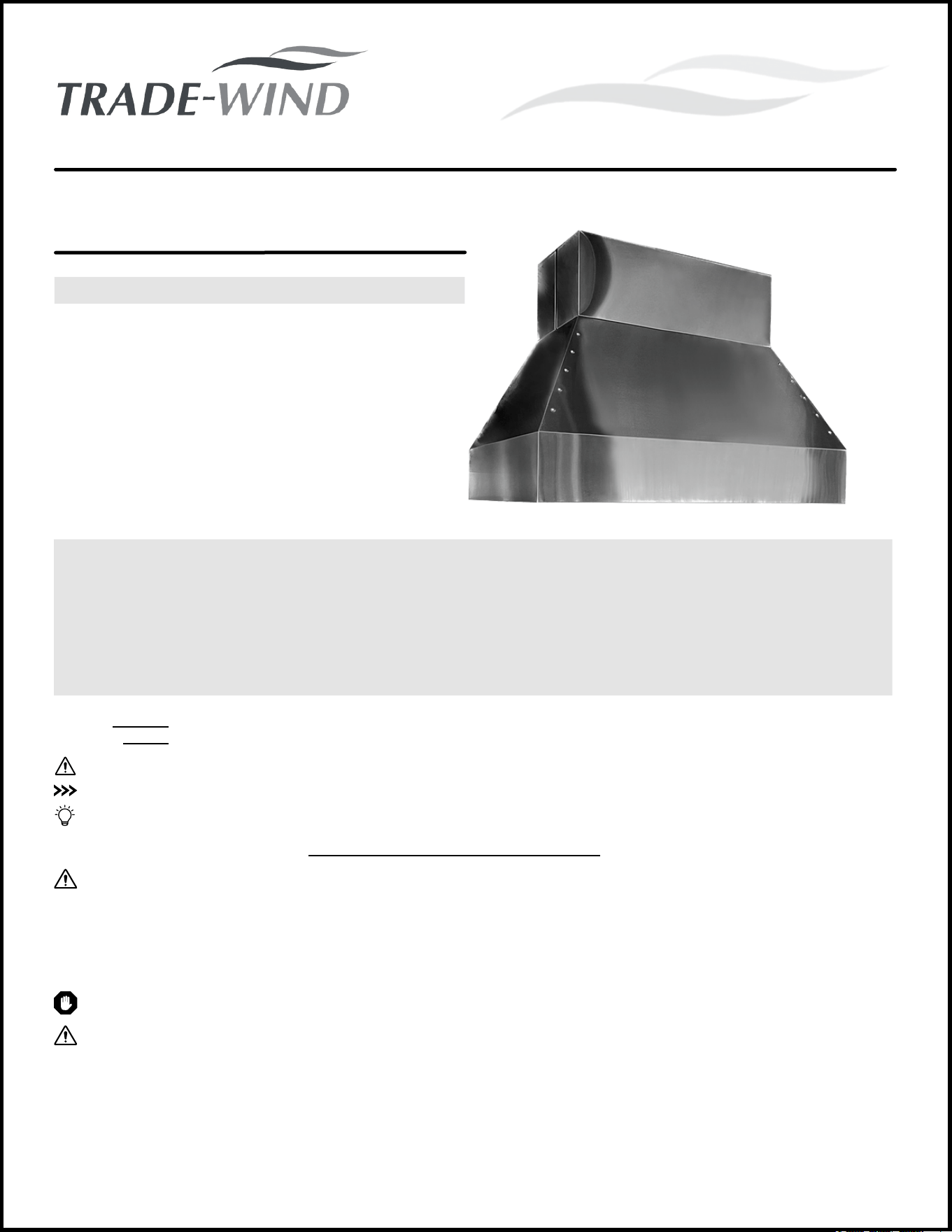
P 7 2 0 0 P Y R A M I D - S T Y L E S E R I E S
B A R B E C U E G R I L L H O O D S
√
MODEL
FRONT
TO
BACK
WIDTH CFM
IN-LINE OR
REMOTE
BLOWER
32"
32"
48"
48"
1200
√
3-SPEED
INTERNAL
BLOWER
P7248-ISL
P7248-12-ISL
Before beginning installation, please thoroughly read and become familiar with these instructions. Installation and service must
be completed by a qualified installer. Failure to properly install this product may void the warranty.
Please be advised that the TRADE-WIND® P7200 Series BBQ Hood MAY NOT be installed on a Patio or Lanai area that does not
have a roof over the BBQ Hood to protect it from direct rain or potential water ingress.This Hood should be installed with a
MINIMUM of three (3) feet of weather proof roof coverage on all sides that are not protected from direct rain by an adjacent wall.
It is required that all duct work and roof openings be thoroughly sealed with the applicable tape and/or roof sealant to prevent
ingress of water.
Installer:
Owner:
Please leave Installation Instructions with the range hood liner.
Please keep Installation Instructions for local electrical inspector’s use and for future reference.
WARNINGS:
IMPORTANT:
TIPS:
Must be followed carefully to avoid personal injury.
Must be followed carefully to avoid damage and incorrect installation.
Contains helpful information to facilitate installation.
WARNING! TO REDUCE THE RISK OF FIRE, ELECTRICAL SHOCK, OR INJURY TO PERSONS OBSERVE THE FOLLOWING:
a) Use this unit only in the manner intended by the manufacturer.If you have any questions, please contact the manufacturer at the
address or telephone number listed in the warranty.
b) Before servicing or cleaning unit, switch power off at service panel, lock service panel, and lock the service disconnection means to
prevent power from being switched on accidentally. When the service disconnecting means cannot be locked, securely fasten a prominent
warning device, such as a tag, to the service panel.
CAUTION: For general ventilating use only. Do not use to exhaust hazardous or explosive materials and vapors.
READ AND SAVE THESE INSTRUCTIONS
WARNING! TO REDUCE THE RISK OF A BBQ TOP GREASE FIRE:
a) Never leave surface units unattended at high settings. Boilovers cause smoking and greasy spillovers that may ignite. Heat oils slowly
on low or medium settings.
b) Always turn hood ON when cooking at high heat or when flambeing food (i.e. Crepes Suzette, Cherries Jubilee, Peppercorn Beef
Flambe’).
c) Clean ventilating fans frequently. Grease should not be allowed to accumulate on fan or filter.
d) Use proper pan size. Always use cookware appropriate for the size of the surface element.
1
RECOMMENDATIONS:
WARNING! TO REDUCE THE RISK OF FIRE, ELECTRICAL SHOCK, OR INJURY TO PERSONS OBSERVE THE FOLLOWING:
a) Installation work and electrical wiring must be done by qualified person(s) in accordance with all applicable codes and standards,
including fire-rated construction codes and standards.
b) Sufficient air is needed for proper combustion and exhausting of gasses through the flue (chimney) of fuel burning equipment to
prevent back drafting.Follow the heating equipment manufacturer's guidelines and safety standards such as those published by the
National Fire Protection Association (NFPA) and the American Society for Heating, Refrigeration and Air Conditioning Engineers
(ASHRAE) and the local code authorities.
c) When cutting or drilling into wall or ceiling, do not damage electrical wiring and other hidden utilities.
d) Ducted fans must always be vented to the outdoor.
e) For safe and secure wall mounting, the TRADE-WIND® BBQ Hood should be mounted to a solid vertical surface of sufficient width
to allow for mounting of the Hood. The horizontal surface should extend from a vertical plane to the point directly in front of the
exhaust roof cap (or wall cap).
f) The Hood should be installed with a MINIMUM of three (3) feet of weather proof roof coverage on all sides that are not protected
from direct rain by an adjacent wall.
g) It is also required that all duct work and roof openings be thoroughly sealed with the applicable tape and/or roof sealant to
prevent ingress of water.
INSTALLATION INSTRUCTIONS
WARNING! TO REDUCE THE RISK OF INJURY TO PERSONS IN THE EVENT OF A BBQ TOP GREASE FIRE, OBSERVING THE FOLLOWING:
a) SMOTHER FLAMES with a close-fitting lid, cookie sheet, or metal tray, then turn off the burner. BE CAREFUL TO PREVENT BURNS. If the
flames do not go out immediately, EVACUATE AND CALL THE FIRE DEPARTMENT.
b) NEVER PICK UP A FLAMING PAN—YOU MAY BE BURNED.
c) DO NOT USE WATER, including wet dishcloths or towels. A violent steam explosion will result.
d) Use an extinguisher ONLY if:
1.You know you have a Class ABC extinguisher and you already know how to operate it.
2.The fire is small and contained in the area where it started.
3.The fire department is being called.
4. You can fight the fire with your back to an exit.
e) Follow the BBQ grill manufacturer's instruction when using gas grills, cookers, or any propane appliances.
f) BE CAREFUL TO PREVENT BURNS. If the flame does not go out directly, EVACUATE AND CALL THE FIRE DEPARTMENT.
Consult a licensed ventilation contractor or qualified technician for proper installation of exhaust ducting. Locate the cooking area for
minimum cross drafts-away from doors and windows, when possible.
Ducts must be of adequate size and duct runs should be as short as possible. Where turns are necessary, keep turning radius as
large and as smooth as possible.
The ducting must be air tight. Use a minimum of 2 sheet metal screws at every duct joint. Then, seal the duct joints with high quality
duct tape.
Do not use this unit with any solid-state speed control device.
This unit must be grounded.
1.
2.
3.
4.
5.
CAUTION: To reduce the risk of fire and to properly exhaust air, be sure to duct air outside. Do not vent exhaust air into spaces
within walls, ceilings, cabinets or into attics, crawl spaces, or garages.
WARNING! TO REDUCE THE RISK OF FIRE, USE ONLY METAL DUCTWORK.
TO ACCESS THE INSTALLATION INSTRUCTIONS FOR YOUR TRADE-WIND® PRODUCT,
PLEASE SCAN THE QR CODE:
© 2 0 2 3 T R A D E - W I N D M A N U F A C T U R I N G , L L C
P R O V E R B S 2 2 : 2 9
2
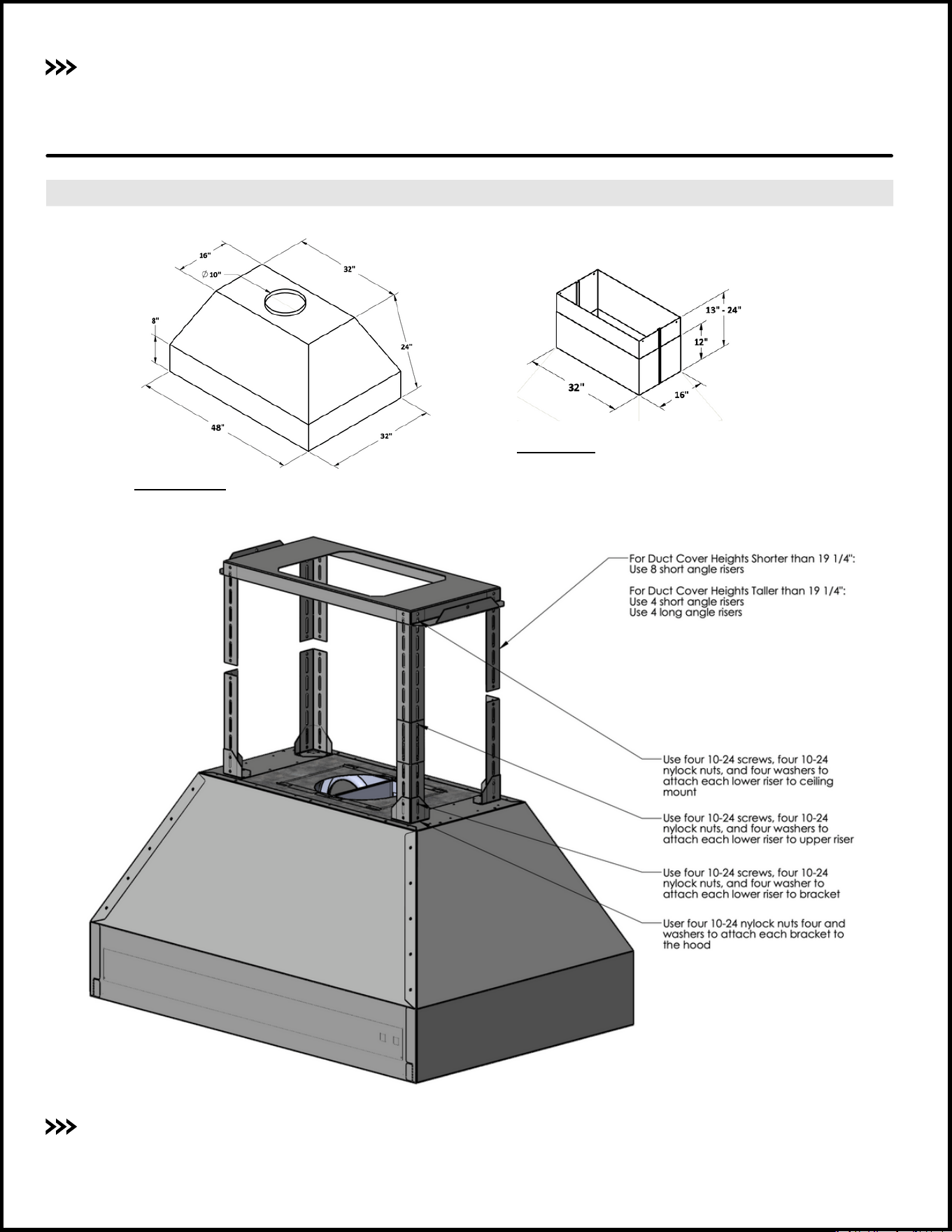
IMPORTANT: ALL DIMENSIONS ARE NOMINAL +/- 1/8"
√
MODEL
FRONT
TO
BACK
WIDTH CFM
HALOGEN
LIGHTS
S/S BAFFLE
FLITERS
DIMMABLE
LIGHT
CONTROL
DUCT
COLLAR
COLOR
IN-LINE OR
REMOTE
BLOWER
32"
32"
48"
48"
1200
3
3
√
√
10"
10"
√
√
S/S
S/S
√
3-SPEED
INTERNAL
BLOWER
P7248-ISL
P7248-12-ISL
RANGE HOODS
DUCT COVER
*Included for ceilings up to 10'
IMPORTANT: For ceilings higher than 10', a "chase" or soffit must be constructed prior to hood
installation, in order to secure the included duct cover.
© 2 0 2 3 T R A D E - W I N D M A N U F A C T U R I N G , L L C
P R O V E R B S 2 2 : 2 9
3

PART 1: PLANNING THE INSTALLATION
PART 2: ELECTRICAL CONNECTION
CAUTION:
1. For general ventilating use only. Do not use to exhaust hazardous or explosive materials and vapors.
2. To reduce the risk of fire and to properly exhaust air, the hood must be exhausted to outside air. Never exhaust into a
wall, an attic or a concealed area in the building. This can create a potential hazard.
3. Consult a licensed ventilation contractor or qualified technician for proper installation of exhaust ducting.
4. Locate the cooking area for minimum cross drafts—away from doors and windows, when possible.
5. Ducts must be of adequate size and duct runs should be as short as possible. Where turns are necessary, keep turning
radius as large and as smooth as possible.
6. The ducting must be air tight. Use a minimum of 2 sheet metal screws at every duct joint.Then, seal the duct joints with
high quality duct tape.
7. Only use ductwork constructed of materials deemed acceptable by state, municipal and local codes.
8. Plan the installation so that all minimum clearances are met or exceeded. Dimensions shown provide minimum
clearances, unless otherwise specified.
WARNING:
Hoods installed in custom canopies constructed of combustible materials should be installed with the combustible
material structure at 36” above the cooking surface.Hoods installed in custom canopies constructed of non-combustible
materials, should be installed with the non-combustible material structure at 36” above the cooking surface. Follow all
instructions regarding minimum safe clearances and installation location. Failure to do so may result in a safety hazard or
fire. To reduce the risk of fire use only metal ductwork.
WARNING:
Ensure that the power supply is disconnected before proceeding. Verify that the power supply matches the ratings found
on the appliance data label before proceeding. The complete appliance must be properly grounded at all times when
electrical power is applied. Do not ground the appliance with the neutral (white) house supply wire. A separate ground
wire must be utilized. Failure to complete electrical connections properly may result in damaged or non-functional
systems. Follow instructions carefully to ensure proper installation.
It is the owner’s responsibility to ensure that a qualified person performs the electrical connection of this
appliance. The electrical installation, including minimum supply wire size, must comply with the National Electric
Code ANSI/NFPA 70-1990 (or latest revision) and local codes and ordinances. A copy of this standard may be
obtained from:
Observe all National and local governing codes and ordinances. Have all electrical installation done by a qualified
electrical installer. This Hood requires a 120 Volt, 60 Hertz electrical supply of an individual properly grounded branch
circuit protected by a 15 or 20 Amp circuit breaker. The TRADE-WIND® P7200-12 Series BBQ Hood is supplied with a 6.0
Amp three speed fan control, the -23 models are supplied with (2) 6.0 Amp three speed fan controls.
IMPORTANT: ELECTRICAL REQUIREMENTS
National Fire Protection Association, 1 Batterymarch Park, Quincy, Massachusetts 02169-7471
For safety precautions, each Ventilation Hood should be installed in a GFCI protected branch circuit.
© 2 0 2 3 T R A D E - W I N D M A N U F A C T U R I N G , L L C
P R O V E R B S 2 2 : 2 9
4
PART 3: DIRECTION OF VENT AND SECURING THE HOOD
Always activate the ventilator when using cooking appliances. Activate the ventilator a few minutes before starting to cook
to establish an airflow pattern within the room. Adjust the fan speed as needed. Adjust the dimmable halogen lights as
desired.
OPERATING CONTROLS:
Do not operate the blower at a speed higher than necessary to remove the cooking exhaust. Turn off the unit once the
smoke and cooking odors have been eliminated. Clean filters and grease laden surfaces often to improve efficiency.
ENERGY SAVING TIPS:
H O O D
GREEN
WHITE
120V BLACK
HOUSE ELECTRICAL PANEL
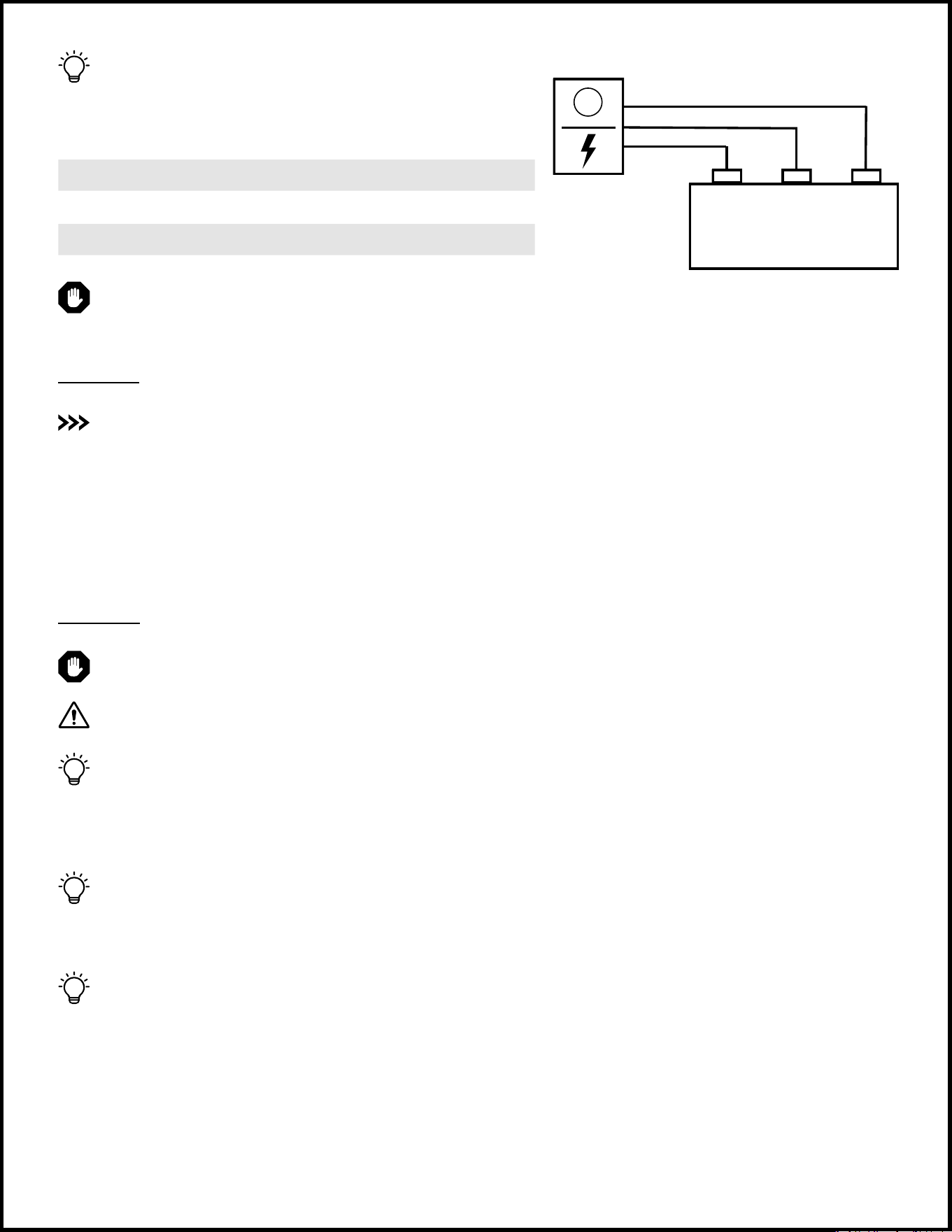
Wire Connections: (See Diagram)
There are 3 wires on the front panel that require connection.
INSTRUCTIONS:
BLACK
WHITE
GREEN
120 VOLT AC FROM ELECTRICAL PANEL (USUALLY BLACK)
NEUTRAL FROM ELECTRICAL PANEL (USUALLY WHITE)
GROUND FROM ELECTRICAL PANEL (USUALLY GREEN)
CAUTION:
The neutral wire (white) must only be connected to the white neutral wire coming in from the electrical
panel.
Because the TRADE-WIND® P7200 Series BBQ Hood was designed for all applications, no mounting holes have been pre-
drilled. This allows for custom applications for mounting. The hood should be attached to the framing through the top
and back, whenever possible.Remove the filters. Mark and drill screw holes through the hood as required.Secure the
hood by driving screws (provided by others) through the screw holes.
NOTE: DRILLING THROUGH STAINLESS STEEL REQUIRES TITANIUM DRILL BITS. BE CAREFUL NOT TO DRILL
THROUGH THE UL LABEL OR INTO THE HOOD’S ELECTRICAL COMPONENTS
MOUNTING HOLES:
PART 4: USE AND CARE
CAUTION:
The edges of the stainless steel are extremely sharp. To ensure safety, wear gloves when handling all
parts.
WARNING:
Do NOT operate the blower / ventilator system without the filters in place, or with dirty, grease laden
filters.
Each filter has two aluminum cylindrical knobs, one towards the rear and one towards the front. The front & rear knobs
are only for grasping and are permanently connected to the filter. To remove the filter, grasp the front & rear knobs, slide
the filter towards the center bar of the hood until the other end of the filter drops down. Grasping the filter, remove it
from the hood by now pulling it out of the center bar.
FILTER REMOVAL:
© 2 0 2 3 T R A D E - W I N D M A N U F A C T U R I N G , L L C
P R O V E R B S 2 2 : 2 9
5

Hoods are designed for halogen light bulbs. They can be purchased at most home and/or grocery stores.
HALOGEN LIGHT BULBS:
Proper cleaning is necessary to maintain performance and appearance, while also ensuring safe operation. The frequency
of cleaning should be adjusted according to the type and amount of cooking. Best results will be achieved by cleaning
soiled components as soon as possible.Filters must be cleaned regularly.
We recommend washing filters by placing them in the bottom rack of a dishwasher. Locate the holes on the sides of the
filter. Put filter in dishwasher with holes facing up, so detergent can enter filters. Dry the filters completely before using
again. Rinse and dry with a soft lint-free cloth. Always wipe stainless steel surfaces with the grain. Never wipe across the
grain. After cleaning, reinstall the filters carefully. Most common scrubber type pads will scratch the hood.
CARE AND CLEANING:
CAUTION:
If a commercially available stainless steel cleaner is used, it is important to read the labels for chlorine
compounds. Chlorine is a corrosive substance, DO NOT USE. Follow polish manufacturer’s instructions.
We endeavor to incorporate the best technology provided to our industry, in
manufacturing the TRADE-WIND® products, therefore, we reserve the right to
change models, mode of operation, and specification without prior notice.
© 2 0 2 3 T R A D E - W I N D M A N U F A C T U R I N G , L L C
P R O V E R B S 2 2 : 2 9
6
PERFORMANCE · QUALITY · CUSTOMER SERVICE
W A R R A N T Y
© 2 0 2 3 T R A D E - W I N D M A N U F A C T U R I N G , L L C
P R O V E R B S 2 2 : 2 9
8 0 0 W E S T G R A N T S T R E E T
P H O E N I X , A Z 8 5 0 0 7
1 - 8 0 0 - 9 5 5 - 5 7 3 7
6 0 2 - 9 0 0 - 8 5 0 0
T - W U S A . C O M
MAD E IN PHOE NIX, AZ U SA
WARRANTY REVISED: JANUARY 1, 2023
TRADE-WIND Manufacturing, LLC® has a policy of continuous improvements and
reserves the right to modify (at any time without notice) any or all of its products,
features, designs, components and specifications. For further information on
installation and wiring, see the installation instructions included with the product or
visit us on the web.
T R A D E - W I N D ® V E N T I L A T I O N P R O D U C T S
For more information, please contact your dealer or your TRADE-WIND® representative.
Normal maintenance and service of any product that has been subject to misuse, negligence, accident,
or installation inconsistent with the recommended TRADE-WIND® Installation Instructions and TRADE-
WIND® Best Practices Guidelines.
Product used other than for normal in-home use or products used outside of the United States and
Canada.
Damage to the product caused by accident, fire, flood, or other acts of God.
Service calls to educate the customer in the proper use and care of the product, change fuses, or to
reset the circuit breakers.
Service calls to correct faulty installation, such as performance issues relating to improperly sized
ducting or restrictive roof caps, are not covered and will, by default, be charged back to the
Homeowner.
Light bulbs are not covered under warranty.
What IS Covered:
TRADE-WIND Manufacturing, LLC® warrants its TRADE-WIND® Ventilation Products to the original user to
be free of defects in materials and workmanship for three (3) years from the date of purchase.
TRADE-WIND Manufacturing, LLC®, at its option, will repair or replace the complete unit or any defective
component without charge. This warranty may be voided if any unauthorized service, alterations, or
repairs are made to the product.
What is NOT Covered:
TRADE-WIND Manufacturing, LLC® disclaims and excludes any liability for implied warranties or for
incidental or consequential damages wherever permitted by law. There are no implied warranties of
merchantability or fitness for a particular use or purpose. This warranty gives you specific legal rights, and
you may also have other rights, which vary from state to state.
For Service: If you need service on your TRADE-WIND® Ventilation Product, visit our website at: www.t-
wusa.com and click on the warranty tab. Fill out the simple form providing the model number, serial
number, date of purchase, and brief description of the problem. Proof of purchase will also be required.

I N T E N T I O N A L L Y L E F T B L A N K

PERFORMANCE · QUALITY · CUSTOMER SERVICE
REVISED: APRIL 1, 2023
B E S T P R A C T I C E S
V E N T I N G I N S T A L L A T I O N I N S T R U C T I O N S
P 7 2 0 0 S E R I E S M O D E L S
DUCT RUNS - LENGTH
a.) Configure the ventilation duct run to be as short and as direct to the outside as possible. Minimize the number of
elbows and transition fittings used. Complex or long runs should be reviewed by a qualified installer.
b.) No portion of the ducting should be run so that the exhaust air flows downward. Since exhaust heat rises, forcing the
air to flow downward will cause increased static pressure. As previously mentioned, improperly installed duct pipe
will cause excessive static pressure (air resistance), that may result in rattling, vibration and air buffeting
noises, as well as inadequate ventilation.
c.) Duct runs for 1200 CFM ventilator models should not exceed 35 linear feet with two 90-degree elbows and two 45-
degree elbows, a damper and a roof or wall cap. Longer runs or additional elbows will result in decreased ventilation
performance. Each 90-degree elbow is the equivalent of 6 linear feet of duct pipe; each 45-degree elbow is equivalent to
3 linear feet of duct pipe.
d.) Always run ventilator ducts to the outdoors. DO NOT terminate a duct into an attic, basement, garage, crawl space
under a house, a chimney, other ducting or an enclosed room.
ADDENDUM TO INSTALLATION INSTRUCTIONS
1. BUILDING CODES
BBQ Hood Ventilators should be installed by qualified technicians familiar with state and local building codes.
2. DUCT PIPE & FITTINGS (ELBOWS, TRANSITIONS, ROOF & WALL CAPS)
a.) Use round or rectangular rigid metal duct only. Where possible, use round duct as it creates the least amount of static
pressure. DO NOT USE FLEX DUCT.
b.) All duct sections and fittings (EXCEPT DAMPERS, per Section 4), should overlap and be connected with at least 3 – 4
equally spaced screws and wrapped tightly with 2 – 3 layers of Aluminum Foil Metal Duct Tape. This type of duct tape is more
durable than traditional cloth duct tape. DO NOT USE BUTT JOINTS.
c.) For best air flow, elbows and pipe size transition fittings should not be directly connected to one another. Where possible,
always include at least 15 inches of straight pipe between fittings.
IMPORTANT:
Problems caused by the improper installations are not covered by the manufacturer's warranty.
IMPORTANT:
Undersized and improperly installed duct pipe and/or other ventilation components will cause
excessive static pressure (air resistance), that may result in rattling, vibration and air buffeting noises,
as well as inadequate ventilation.
IMPORTANT:
No portion of any length of duct pipe or fitting should be smaller than the discharge port of the
ventilator. This is very important because any type of restriction anywhere in the ventilation system will
cause increased static pressure (air resistance), that may result in rattling, vibration and air buffeting
noises, as well as inadequate ventilation.
3. DUCT PIPE & FITTING SIZES
(See Duct Sizing Chart and Area Calculations section for more details)
© 2 0 2 3 T R A D E - W I N D M A N U F A C T U R I N G , L L C
P R O V E R B S 2 2 : 2 9
9
IMPORTANT:
DO NOT USE ANY TYPE OF DAMPER IN A BBQ HOOD APPLICATION.
IMPORTANT:
Even though the intake side of the roof cap or wall cap may be properly sized, roof caps or wall caps
with built-in dampers must be made so that when the damper is fully open, the actual open area of the
final air path is equal to or greater than the discharge port of the ventilator. Any undersized portion of a
roof cap or wall cap will cause excessive static pressure that may result in rattling, vibration and air
buffeting noises, as well as inadequate ventilation.
VENTILATOR DISCHARGE
PORT TYPES & SIZES
DUCT SIZE
(IN SQ. IN.)
DUCT TYPE REQUIRED
MINIMUM DISCHARGE SIZE
OF ROOFCAP OR WALLCAP
OUTSIDE OPENING
6" DIAMETER, ROUND
7" DIAMETER, ROUND
8" DIAMETER, ROUND
10" DIAMETER, ROUND
3.25" x 10" RECTANGULAR
6" ROUND METAL DUCT
7" ROUND METAL DUCT
8" ROUND METAL DUCT
10" ROUND METAL DUCT
3.25" x 10" RECTANGULAR METAL DUCT
28.3"
38.5"
50.25"/54"
78.5"
32.5"
28.3"
38.5"
50.25"/54"
78.5"
32.5"
4. DAMPERS
In ventilation systems utilizing a roof cap or wall cap with a built-in damper, remove it. Dampers are unnecessary and will
cause increased static pressure (air resistance), that may result in rattling, vibration and air buffeting noises, as well
as inadequate ventilation.
The roof cap or wall cap is the termination point of the venting system that allows the exhaust air to exit to the outdoors.
All sections of this fitting must have an equal or greater air path area than the ventilator’s discharge port. If any section
of the roof cap or wall cap is smaller than the ventilator’s discharge port, the entire ventilation system will lose
efficiency and the restriction will cause increased static pressure and decrease performance.
5. ROOF CAPS & WALL CAPS
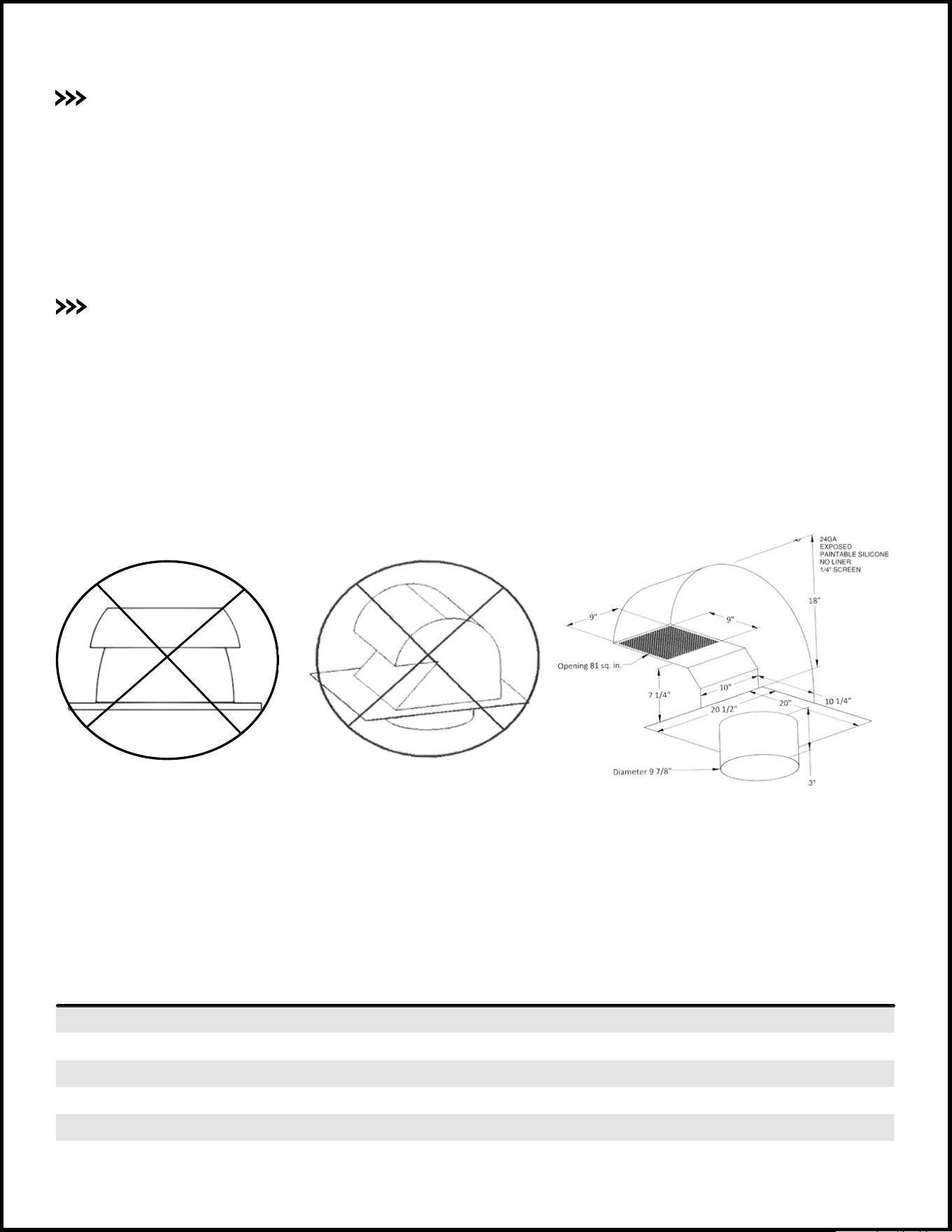
Do not use “goose-neck style” caps as they significantly restrict natural, heated air-flow. Do Not
use caps with dampers for BBQ Hoods.
6. ATTACHING DUCT TO HOUSE FRAMEWORK
The ventilation system should be attached to the framework in such a manner that the weight of the duct and fittings is
supported with no stress on the duct joints, fittings or on the ventilator. All ducting should be attached so as to avoid
any possible duct vibration from being transferred to the house’s framework.
7. DUCT SIZING CHART & AREA CALCULATION
ROOF CAP DRAWING
For higher profile roof tile, you may need a taller roof cap. See recommended dimensions below – Minimizes static
pressure and maximizes air flow to ensure optimum performance of your TRADE-WIND® product.
No Mushroom Cap Style No "Goose-Neck" Style
© 2 0 2 3 T R A D E - W I N D M A N U F A C T U R I N G , L L C
P R O V E R B S 2 2 : 2 9
1 0

ROUND DUCT
RADIUS
________
X
X
RADIUS
________
X
X
RADIUS
________
=
=
AREA (SQ. IN)
______________
The “radius” is one-half the diameter of a round duct, e.g.,
½ of a 10” round duct is 5”.3.1416 is “Pi”, the “constant”
used when calculating the area of a circle.
RECTANGULAR DUCT OR WALL/ROOF CAP
WIDTH
___________
X
X
DEPTH
___________
=
=
AREA (SQ. IN)
______________
© 2 0 2 3 T R A D E - W I N D M A N U F A C T U R I N G , L L C
P R O V E R B S 2 2 : 2 9
1 1