
X7508220500
© 7/23 ECHO Incorporated
Operator’s Manual
DCS-2500TN
Chainsaw
Read and understand all provided literature before use. Failure
to do so could result in serious injury.
In Canada, this chainsaw is designed especially for tree service
by a trained operator.
Cancer and Reproductive Harm
www.P65Warnings.ca.gov
Note: This product complies with CAN ICES-003(B) / NMB-003(B)

TABLE OF CONTENTS DCS-2500TN
2 X7508220500
© 7/23 ECHO Incorporated
TABLE OF CONTENTS
Introduction................................................................................................................. 3
Important information ......................................................................................... 3
Parts and Serial Number.................................................................................... 4
Service ............................................................................................................... 5
ECHO Consumer Product Support .................................................................... 5
Product Registration........................................................................................... 5
Additional Literature ........................................................................................... 5
Safety ......................................................................................................................... 6
For safe use of your product .............................................................................. 6
International Symbols......................................................................................... 7
Handling the Product ......................................................................................... 8
Chainsaw Safety Warnings .............................................................................. 15
Causes and Operator Prevention of Kickback ................................................. 16
Kickback Safety Precautions............................................................................ 17
General Precautions ....................................................................................... 18
Precautions for Use ......................................................................................... 19
Protective Gear ............................................................................................... 25
Description ............................................................................................................... 27
Contents................................................................................................................... 28
Assembly.................................................................................................................. 29
Assembly.......................................................................................................... 29
Temperature Information .................................................................................. 32
Battery Charging .............................................................................................. 32
Operation.................................................................................................................. 37
Starting the Unit ............................................................................................... 37
Stopping the Unit.............................................................................................. 38
Before Use ....................................................................................................... 39
Correct Use of Chain Brake ............................................................................. 40
Tree Service Chainsaw .................................................................................... 42
General Cutting Instructions - Ground Usage .................................................. 45
Maintenance............................................................................................................. 50
Skill Levels ....................................................................................................... 51
Servicing Guidelines ........................................................................................ 51
Saw Chain Maintenance ................................................................................. 52
Maintenance and Care..................................................................................... 54
Replacement Guide Bar and Chain ................................................................. 58
Troubleshooting........................................................................................................ 59
Storage..................................................................................................................... 60
Storage ............................................................................................................ 60
Disposal ........................................................................................................... 61
Specifications ........................................................................................................... 62
Product Registration................................................................................................. 63
Warranty................................................................................................................... 65
Notes.........................................................................................................................66
DCS-2500TN INTRODUCTION
X7508220500 3
© 7/23 ECHO Incorporated
INTRODUCTION
Important information
Specifications, descriptions, and illustrative material in this literature are as
accurate as possible. Specifications are subject to change without notice.
Illustrations might include optional equipment and accessories, and might
not include all standard equipment. Your equipment might appear slightly
different than pictured equipment.
Read and understand all provided
literature. Literature contains specifications
and information for safety, operation,
maintenance, storage, and assembly
specific to this product. Scan QR codes for
more information.
For additional literature, including safety manuals where applicable, or
questions regarding terms used in this manual, visit:
https://www.echo-usa.com/manuals
Please ensure that you read the operator's manual before using your
product.
Intended use of this product
• This ECHO Chainsaw is designed for cutting wood or wood products.
• Do not use this tool for anything other than its intended purpose.
Users of the product
• You should not use this product until you have read the operator's manual
carefully and fully understand its content.
• This product should not be used by anyone who has failed to read the
operator's manual properly, is suffering from a cold, tiredness or
otherwise in poor physical condition, or children.
• Keep in mind that the operator or user is responsible for accidents or
hazards occurring to other people or their property.

INTRODUCTION DCS-2500TN
4 X7508220500
© 7/23 ECHO Incorporated
About your operator's manual
• This manual contains necessary information about the operation and
maintenance of your product. Please read it carefully and understand its
contents.
• Always keep your manual in a place where it is readily accessible.
• If you have lost your manual or it is damaged and no longer readable,
please purchase a new one from your ECHO DEALER.
• The units used in this manual are SI units (International System of Units).
Figures in parentheses are reference values, and there may be a slight
conversion error in some cases.
Loaning or assigning your product
• When loaning the product described in this manual to another party,
ensure that the person borrowing and working with the product receives
the operator's manual along with the product. If you assign your product
to another party, please include the operator's manual with the product
when handing it over.
Inquiries
• Please contact your ECHO DEALER for requests regarding information
about your product, the purchase of consumables, repairs, and other
such inquiries.
Notices
• The content of this manual may be changed without notice for the
purpose of upgrades to the product. Some of the illustrations used may
differ from the product itself in order to make the explanations clearer.
• Please consult your ECHO DEALER if anything is unclear or of concern.
Parts and Serial Number
Genuine ECHO Parts and Assemblies for your ECHO products are
available only from an Authorized ECHO Dealer. When you do need to buy
parts always have the Model Number and Serial Number of the unit with
you. For future reference write them in the space provided below.
Model No. _______________ Serial No. _______________

DCS-2500TN INTRODUCTION
X7508220500 5
© 7/23 ECHO Incorporated
Service
Service of this product during the warranty period must be performed by
an Authorized ECHO Service Dealer. For the name and address of the
Authorized ECHO Service Dealer nearest you, ask your retailer or call:
1-800-432-ECHO (3246). Dealer information is also available on our Web
Site www.echo-usa.com. When presenting your unit for Warranty service/
repairs, proof of purchase is required.
ECHO Consumer Product Support
If you require assistance or have questions concerning the application,
operation, or maintenance of this product, call the ECHO Consumer
Product Support Department at 1-800-432-ECHO (3246) from 8:00 a.m. to
5:00 p.m. (Central Standard Time) Monday through Friday. Before calling,
please know the model and serial number of your unit.
Product Registration
Register your ECHO equipment on-line at www.echo-usa.com or by filling
out the product registration sheet included in this manual. Registering your
product confirms warranty coverage and provides a direct link to ECHO if
we find it necessary to contact you.
Additional Literature
In addition to finding information online, information is available from your
Authorized ECHO Service Dealer, or by contacting ECHO Incorporated,
400 Oakwood Road, Lake Zurich, IL 60047, 1-800-432-ECHO (3246).
SAFETY DCS-2500TN
6 X7508220500
© 7/23 ECHO Incorporated
SAFETY
For safe use of your product
Be careful to read this section before using your product.
• The precautions described in this section contain important safety
information. Please observe them carefully.
• You must also read the precautions that appear in the body of the manual
itself.
Throughout this manual and on the product itself, you will find safety alerts
and helpful, informational messages preceded by symbols or key words.
The following is an explanation of those symbols and key words and what
they mean to you.
The safety alert symbol accompanied by the word “DANGER”
calls attention to an act or condition which WILL lead to serious
personal injury or death if not avoided.
The safety alert symbol accompanied by the word “WARNING”
calls attention to an act or condition which CAN lead to serious
personal injury or death if not avoided.
The safety alert symbol accompanied by the word “CAUTION”
calls attention to an act or condition which might lead to minor
or moderate personal injury if not avoided.
The enclosed message provides information necessary for the
protection of the unit.
Note: This enclosed message provides tips for use, care and
maintenance of the unit.
CIRCLE AND SLASH SYMBOL
This symbol means the specific action shown is prohibited.
Ignoring these prohibitions can result in serious or fatal injury.
DCS-2500TN SAFETY
X7508220500 7
© 7/23 ECHO Incorporated
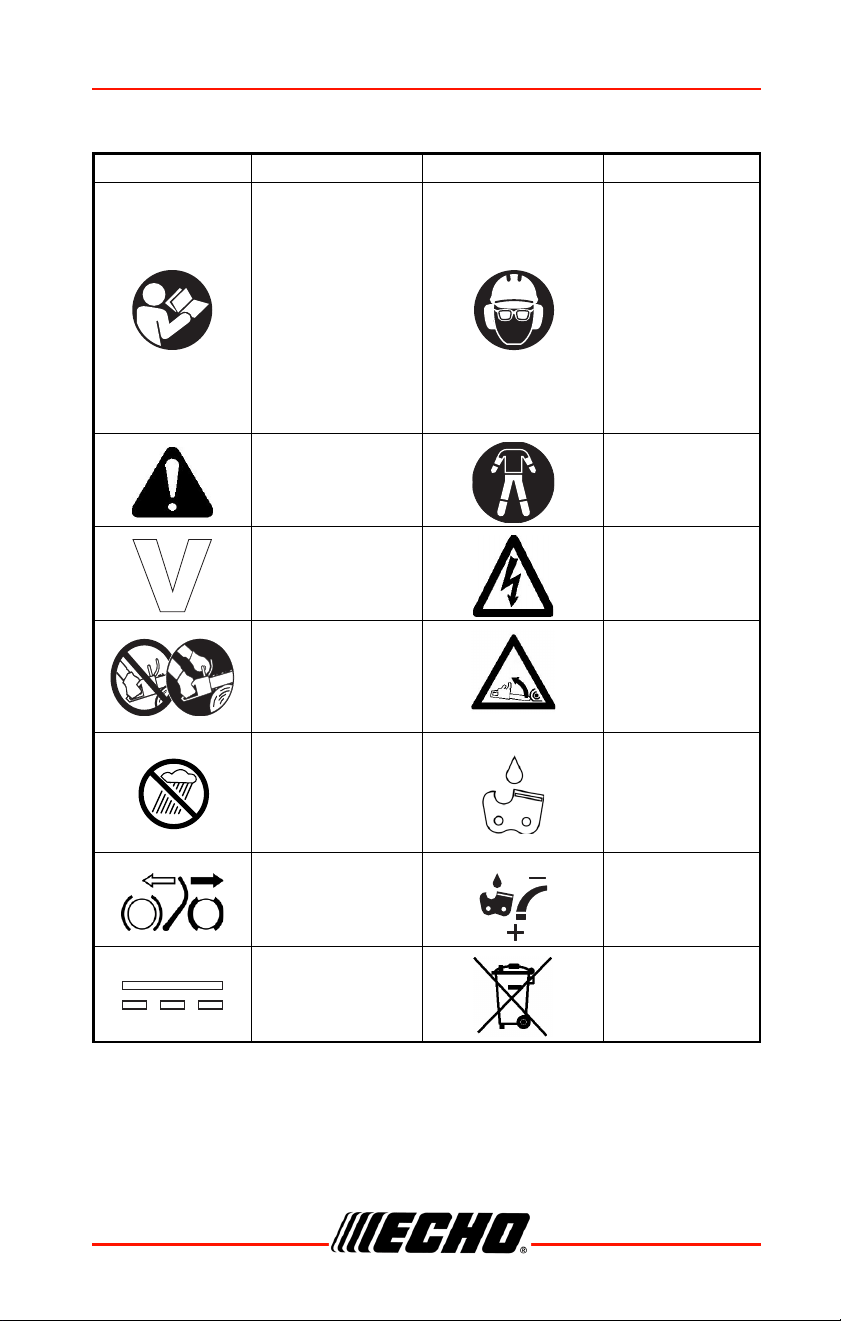
International Symbols
Note: Not all symbols will appear on your unit.
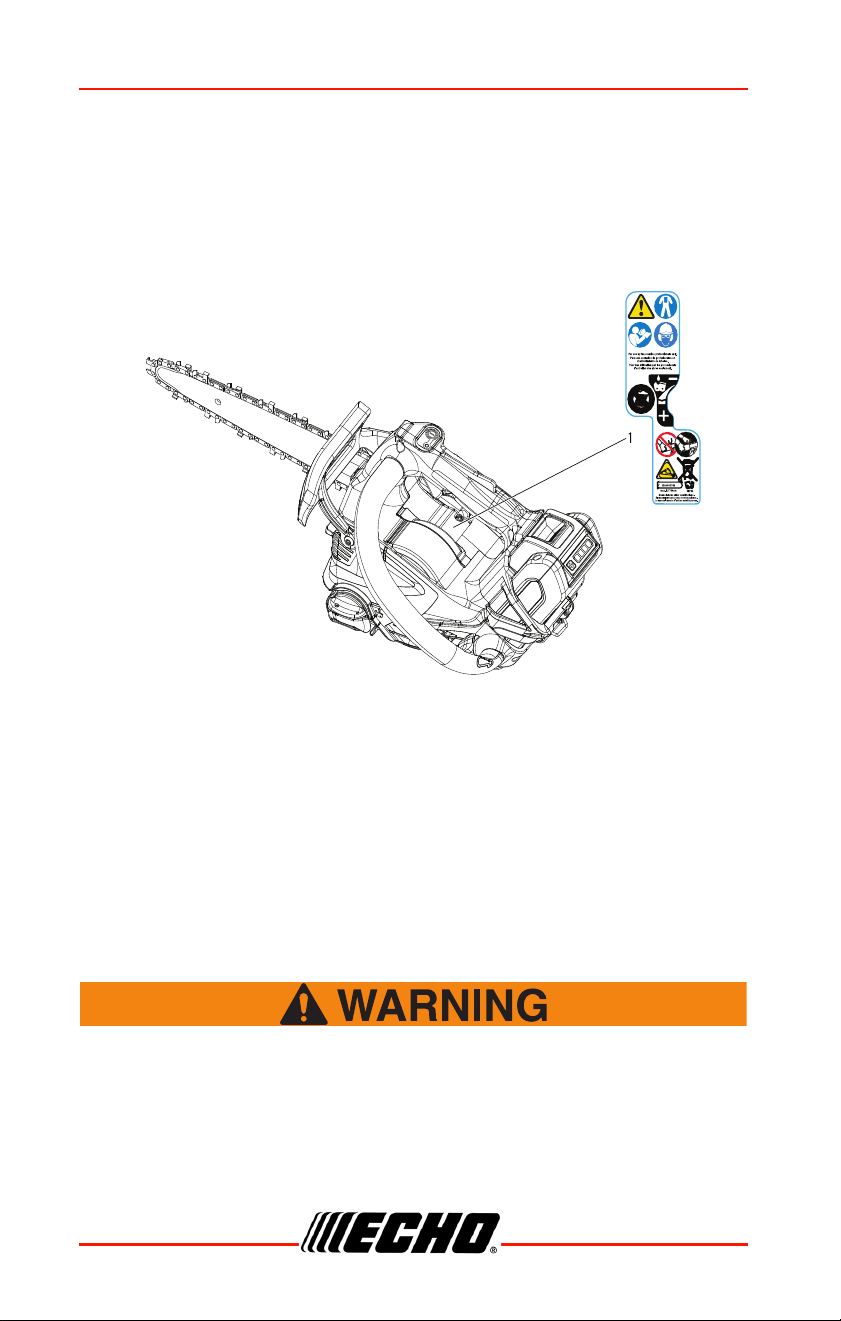
Location in which the safety decal is attached
• The safety decal shown below has been attached to the product
described in this manual. Ensure that you understand what the decal
means before using your product.
Symbol Description Symbol Description
WARNING!
Read and follow
all safety
precautions in
the instruction
manual. Failure
to follow
instructions
could result in
serious
personal injury.
Wear Eye,
Ear, and Head
Protection.
Safety / Alert
Use appropriate
protection for
foot-leg and
hand-arm.
Volts
Beware of
electric
shocks
Always operate
unit with two
hands.
Warning!
Kickback may
occur!
Do not expose
to rain / water
Chain Oil Fill
Chain Brake
Operation
Chain oiler
adjustment
Direct Current
Do not
dispose in
household
trash
SAFETY DCS-2500TN
8 X7508220500
© 7/23 ECHO Incorporated
• If the decal becomes illegible due to wear and tear, damage, or peels off,
please purchase a replacement decal from your dealer and attach it in the
location shown in the illustration below. Ensure that the decal is readable
at all times.
Note: The safety decal is for example only. Your label may appear slightly
different
Handling the Product
General Safety Warnings and Instructions
This section contains the prescribed general safety warnings and
instructions for battery-powered products contained in UL 2595 and for
handheld tools, transportable tools and lawn and garden machinery
contained in UL 62841-1. Additional important warnings and instructions
are provided in subsequent sections of this manual.
Important Safety Instructions
Read all safety warnings, instructions, illustrations, and
specifications provided with this power tool. Failure to follow all
instructions listed below may result in electric shock, fire,
serious injury and/or property damage.

DCS-2500TN SAFETY
X7508220500 9
© 7/23 ECHO Incorporated
Save all warnings and instructions for future reference.
The term "power tool" in the warnings refers to your mains-operated
(corded) power tool or battery-operated (cordless) power tool.
Work Area Safety
• Keep work area clean and well lit. Cluttered or dark areas invite
accidents.
• Do not operate power tools in explosive atmospheres, such as in the
presence of flammable liquids, gases or dust. Power tools create sparks
which may ignite the dust or fumes.
• Keep children and bystanders away while operating a power tool.
Distractions can cause you to lose control.
Electrical Safety
• Power tool plugs must match the outlet. Never modify the plug in any way.
Do not use any adapter plugs with earthed (grounded) power tools.
Unmodified plugs and matching outlets will reduce the risk of electric
shock.
• Avoid body contact with earthed or grounded surfaces such as pipes,
radiators, ranges and refrigerators. There is an increased risk of electric
shock if your body is earthed or grounded.
• Do not expose power tools to rain or wet conditions. Water entering a
power tool will increase the risk of electric shock.
• Do not abuse the cord. Never use the cord for carrying, pulling or
unplugging the power tool. Keep cord away from heat, oil, sharp edges or
moving parts. Damaged or entangled cords increase the risk of electric
shock.
• When operating a power tool outdoors, use an extension cord suitable for
outdoor use. Use of a cord suitable for outdoor use reduces the risk of
electric shock.
• If operating a power tool in a damp location is unavoidable, use a ground
fault circuit interrupter (GFCI) protected supply. Use of a GFCI reduces
the risk of electric shock.
Personal Safety
• Stay alert, watch what you are doing and use common sense when
operating a power tool. Do not use a power tool while you are tired, ill, or
under the influence of drugs, alcohol or medication. A moment of
inattention while operating power tools may result in serious personal
injury.

SAFETY DCS-2500TN
10 X7508220500
© 7/23 ECHO Incorporated
• Use personal protective equipment. Always wear eye protection.
Protective equipment such as dust mask, non-skid safety shoes, hard
hat, or hearing protection used for appropriate conditions will reduce
personal injuries.
• Prevent unintentional starting. Ensure the switch is in the off-position
before connecting to power source and/or battery, picking up or carrying
the tool. Carrying power tools with your finger on the switch or energizing
power tools that have the switch on invites accidents.
• Disconnect the battery pack from the appliance before making any
adjustments, changing accessories, or storing appliance. Such preventive
safety measures reduce the risk of starting the appliance accidentally.
• Remove any adjusting key or wrench before turning the power tool on. A
wrench or a key left attached to a rotating part of the power tool may
result in personal injury.
• Do not overreach. Keep proper footing and balance at all times. This
enables better control of the power tool in unexpected situations.
• Dress properly. Do not wear loose clothing or jewelry. Keep your hair,
clothing and gloves away from moving parts. Loose clothes, jewelry or
long hair can be caught in moving parts.
• If devices are provided for the connection of dust extraction and collection
facilities, ensure these are connected and properly used. Use of dust
collection can reduce dust-related hazards.
• Do not let familiarity gained from frequent use of tools allow you to
become complacent and ignore tool safety principles. A careless action
can cause severe injury within a fraction of a second.
Proper Clothing
Wear snug-fitting, durable clothing:
• Pants should have long legs, shirts should have long sleeves.
• DO NOT WEAR SHORTS.
• DO NOT WEAR TIES, SCARVES, JEWELRY, or clothing with loose or
hanging items that could become entangled in moving parts or
surrounding growth.
• Keep clothing buttoned or zipped, and keep shirt tails tucked in.
• Wear sturdy work shoes with nonskid rubber soles.

DCS-2500TN SAFETY
X7508220500 11
© 7/23 ECHO Incorporated
• Wear sturdy, no-slip, rubber work gloves to improve your grip on the
handles. Gloves also provide protection against cuts and scratches, cold
environments, and reduce the transmission of machine vibration to your
hands.
• DO NOT WEAR OPEN TOED SHOES.
• DO NOT OPERATE UNIT WITH BARE FEET.
Power Tool Use and Care
• Do not force the power tool. Use the correct power tool for your
application. The correct power tool will do the job better and safer at the
rate for which it was designed.
• Do not use the power tool if the switch does not turn it on and off. Any
power tool that cannot be controlled with the switch is dangerous and
must be repaired.
• Disconnect the plug from the power source and/or the battery from the
power tool before making any adjustments, changing accessories, or
storing power tools. Such preventive safety measures reduce the risk of
starting the power tool accidentally.
• Store idle power tools out of the reach of children and do not allow
persons unfamiliar with the power tool or these instructions to operate the
power tool. Power tools are dangerous in the hands of untrained users.
• Maintain power tools and accessories. Check for misalignment or binding
of moving parts, breakage of parts and any other condition that may affect
the power tool’s operation. If damaged, have the power tool repaired
before use. Many accidents are caused by poorly maintained power tools.
• Keep cutting tools sharp and clean. Properly maintained cutting tools with
sharp cutting edges are less likely to bind and are easier to control.
• Use the power tool, accessories and tool bits etc. in accordance with
these instructions, taking into account the working conditions and the
work to be performed. Use of the power tool for operations different from
those intended could result in a hazardous situation.
• Keep handles and grasping surfaces dry, clean, and free from oil and
grease. Slippery handles and grasping surfaces do not allow for safe
handling and control of the tool in unexpected situations.
Battery Tool Use and Care
• Recharge batteries only with ECHO eFORCE
®
56V battery series
chargers. A charger that is suitable for one type of battery may create a
risk of fire when used with another battery.

SAFETY DCS-2500TN
12 X7508220500
© 7/23 ECHO Incorporated
• Use only with ECHO eFORCE
®
56V battery series. Use of any other
battery may create a risk of injury and fire.
• When battery is not in use, keep it away from other metal objects, like
paper clips, coins, keys, nails, screws or other small metal objects, that
can make a connection from one terminal to another. Shorting the battery
terminals together may cause burns or a fire.
• Under abusive conditions, liquid may be ejected from the battery; avoid
contact. If contact accidentally occurs, flush with water. If liquid contacts
eyes, additionally seek medical help. Liquid ejected from the battery may
cause irritation or burns.
• Do not open or destroy the battery. Electrolytes contained within the
battery are corrosive and may cause damage to eyes or skin if released.
It may be toxic if swallowed.
• Exercise care in handling batteries to avoid shorting the battery with
conducting materials such as rings, bracelets, keys, etc. The battery or
conductor may overheat and cause burns if contact with said materials is
made.
• Do not use a battery or tool that is damaged or modified. Damaged or
modified batteries may exhibit unpredictable behavior resulting in fire,
explosion or risk of injury.
• Do not expose a battery or tool to fire or excessive temperature.
Exposure to fire or temperature above 130°C (265°F) may cause
explosion.
• Follow all charging instructions and do not charge the battery or tool
outside the temperature range specified in the instructions. Charging
improperly or at temperatures outside the specified range may damage
the battery and increase the risk of fire.
Service
• Do not modify or attempt to repair the appliance or the battery pack (as
applicable) except as indicated in the instructions for use and care.
• Have your power tool serviced by a qualified repair person using only
identical replacement parts. This will ensure that the safety of the power
tool is maintained.
• Never service damaged battery packs. Service of battery packs should
only be performed manufacturer or authorized service providers.
DCS-2500TN SAFETY
X7508220500 13
© 7/23 ECHO Incorporated
Environmentally Safe Battery Disposal
Recycle your ECHO ECHO eFORCE
®
56V battery FOR FREE at
Rechargeable Battery Recycling Corporation (RBRC) recycling locations.
Call 1-800-822-8837 or visit https://www.call2recycle.org for details.
The toxic and corrosive materials below are in the batteries used in this
machine: Lithium-Ion, a toxic material.
Discard all toxic materials in a specified manner to prevent
contamination of the environment. Before discarding a
damaged or worn out Lithium-ion battery, contact your local
waste disposal agency, or the local Environmental Protection
Agency for information and specific instructions. Take the
batteries to a local recycling and/or disposal center, certified for
Lithium-ion disposal.
If the battery cracks or breaks, with or without leaks, do not
recharge it and do not use. Discard it and replace with a new
battery. DO NOT TRY TO REPAIR IT! To prevent injury and risk
of fire, explosion, or electric shock, and to avoid damage to
the environment:
• Cover the terminals of the battery with heavy-duty adhesive tape.
• DO NOT try to remove or destroy any of the battery components.
• DO NOT try to open the battery.
• If a leak develops, the released electrolytes are corrosive and toxic. DO
NOT get the solution in the eyes or on skin, and do not swallow it.
R
E
C
Y
C
L
E
1
.
8
0
0
.
8
2
2
.
8
8
3
7
R B R C
Li - ion
TM
SAFETY DCS-2500TN
14 X7508220500
© 7/23 ECHO Incorporated
• DO NOT put these batteries in your regular household trash.
• DO NOT incinerate.
• DO NOT put them where they will become part of any waste landfill or
municipal solid waste stream.
• Take them to a certified recycling or disposal center.
FCC Statement
This device complies with Part 15 of the FCC Rules. Operation is subject
to the following two conditions:
• This device may not cause harmful interference.
• This device must accept any interference received, including interference
that may cause undesired operation.
Changes or modifications not expressly approved by the party
responsible for compliance could void the user’s authority to
operate equipment.
This equipment has been tested and found to comply with the limits
for a Class B digital device, pursuant to Part 15 of the FCC Rules.
These limits are designed to provide reasonable protection against
harmful interference in a residential installation. This equipment
generates, uses and can radiate radio frequency energy, and if not
installed and used in accordance with the instructions, may cause
harmful interference to radio or television reception. The reception
can be determined by turning the equipment off and on. The user is
encouraged to try to correct the interference by one or more of the
following measures:
• Reorient or relocate the receiving antenna.
• Increase the separation between the equipment and the receiver.
• Connect the equipment into an outlet on a circuit different from that to
which the receiver is connected.
• Consult the dealer or an experienced radio/TV technician for help.

DCS-2500TN SAFETY
X7508220500 15
© 7/23 ECHO Incorporated
Chainsaw Safety Warnings
• Keep all parts of the body away from the saw chain when the chainsaw is
operating. Before you start the chainsaw, make sure the saw chain is not
contacting anything. A moment of inattention while operating chainsaws
may cause entanglement of your clothing or body with the saw chain.
• Always hold the chainsaw with your right hand on the rear handle and
your left hand on the front handle. Holding the chainsaw with a reversed
hand configuration increases the risk of personal injury and should never
be done.
• Hold the power tool by insulated gripping surfaces only, because the saw
chain may contact hidden wiring or its own cord. Saw chains contacting a
"live" wire may make exposed metal parts of the power tool "live" and
could give the operator an electric shock.
• Wear safety glasses and hearing protection. Further protective equipment
for head, hands, legs and feet is recommended. Adequate protective
clothing will reduce personal injury by flying debris or accidental contact
with the saw chain.
• Always keep proper footing and operate the chainsaw only when standing
on fixed, secure and level surface. Slippery or unstable surfaces such as
ladders may cause a loss of balance or control of the chain saw.
• When cutting a limb that is under tension be alert for spring back. When
the tension in the wood fibres is released the spring loaded limb may
strike the operator and/or throw the chainsaw out of control.
• Use extreme caution when cutting brush and saplings. The slender
material may catch the saw chain and be whipped toward you or pull you
off balance.
• Carry the chainsaw by the front handle with the chainsaw switched off
and away from your body. When transporting or storing the chainsaw
always fit the guide bar cover. Proper handling of the chainsaw will
reduce the likelihood of accidental contact with the moving saw chain.
• Follow instructions for lubricating, chain tensioning and changing
accessories. Improperly tensioned or lubricated chain may either break or
increase the chance for kickback.

SAFETY DCS-2500TN
16 X7508220500
© 7/23 ECHO Incorporated
• Keep handles dry, clean, and free from oil and grease. Greasy, oily
handles are slippery causing loss of control.
• Cut wood only. Do not use chainsaw for purposes not intended. For
example: do not use chainsaw for cutting plastic, masonry or non-wood
building materials. Use of the chainsaw for operations different than
intended could result in a hazardous situation.
Using improper replacement components or removing safety
devices may result in serious or fatal injury.
Unit includes safety devices that reduce the likelihood of
kickback:
◆ Chain brake - brake actuated by kickback energy, not
manual activation.
◆ Reduced-kickback guide bar - reduced nose radius guide
bar.
◆ Low-kickback saw chain - saw chain that meets ANSI
kickback performance requirements when configured with
the bar/chain recommendations in this manual.
◆ Front hand guard - a structural barrier between the front
handle of a chain saw and the guide bar.
Causes and Operator Prevention of Kickback
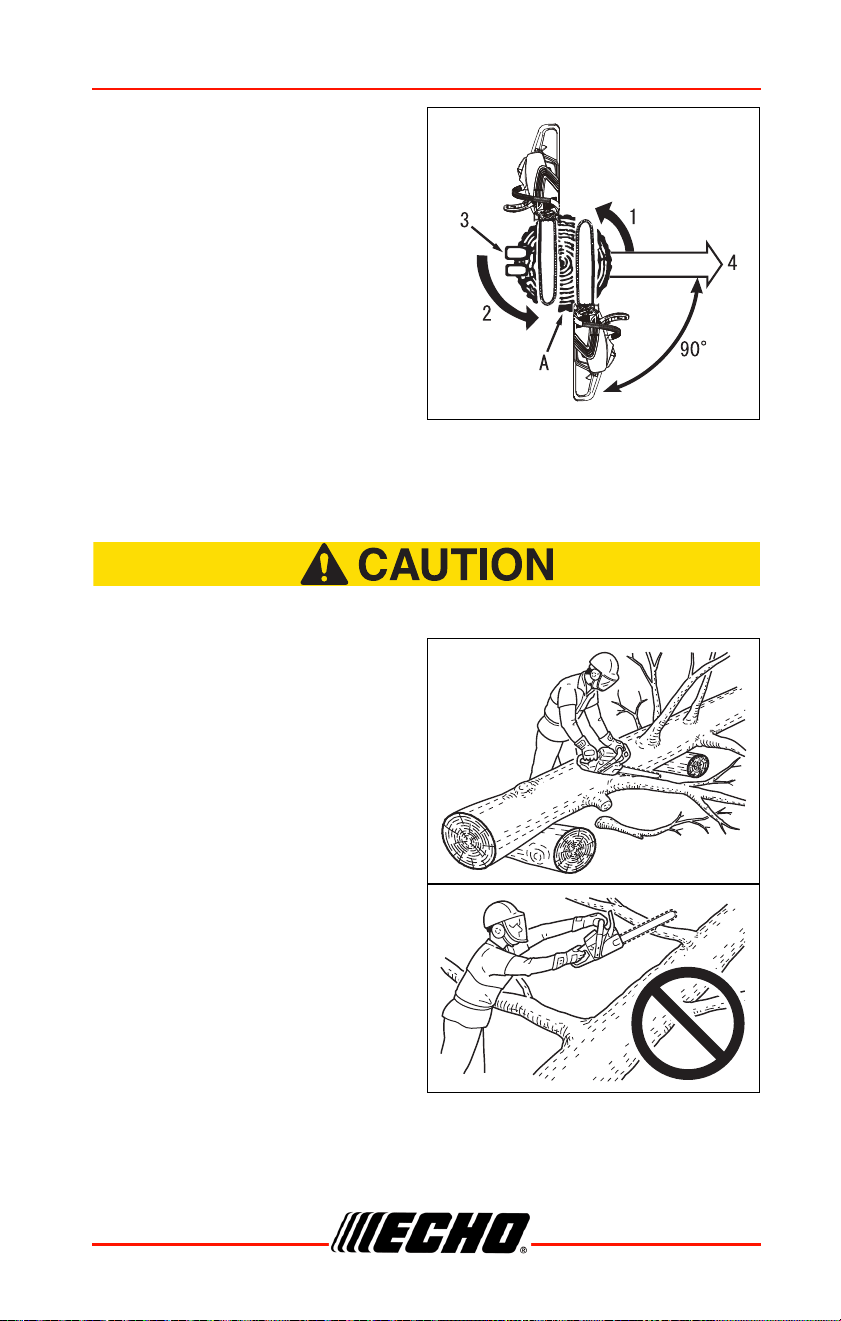
Kickback may occur when the nose or tip of the guide bar touches an
object, or when the wood closes in and pinches the saw chain in the cut.
Tip contact in some cases may cause a sudden reverse reaction, kicking
the guide bar up and back towards the operator. Pinching the saw chain
along the top of the guide bar may push the guide bar rapidly back towards
the operator. Either of these reactions may cause you to lose control of the
saw which could result in serious personal injury. Do not rely exclusively
upon the safety devices built into your saw. As a chainsaw user, you
should take several steps to keep your cutting jobs free from accident or
injury. Kickback is the result of tool misuse and/or incorrect operating
procedures or conditions and can be avoided by taking proper precautions
as given below:
DCS-2500TN SAFETY
X7508220500 17
© 7/23 ECHO Incorporated
• Maintain a firm grip, with thumbs and fingers encircling the chainsaw
handles, with both hands on the saw and position your body and arm to
allow you to resist kickback forces. Kickback forces can be controlled by
the operator, if proper precautions are taken. Do not let go of the
chainsaw.
• Do not overreach and do not cut above shoulder height. This helps
prevent unintended tip contact and enables better control of the chainsaw
in unexpected situations.
• Only use replacement bars and chains specified by the manufacturer.
Incorrect replacement bars and chains may cause chain breakage and/or
kickback.
• Follow the manufacturer’s sharpening and maintenance instructions for
the saw chain. Decreasing the depth gauge height can lead to increased
kickback.
Kickback Safety Precautions
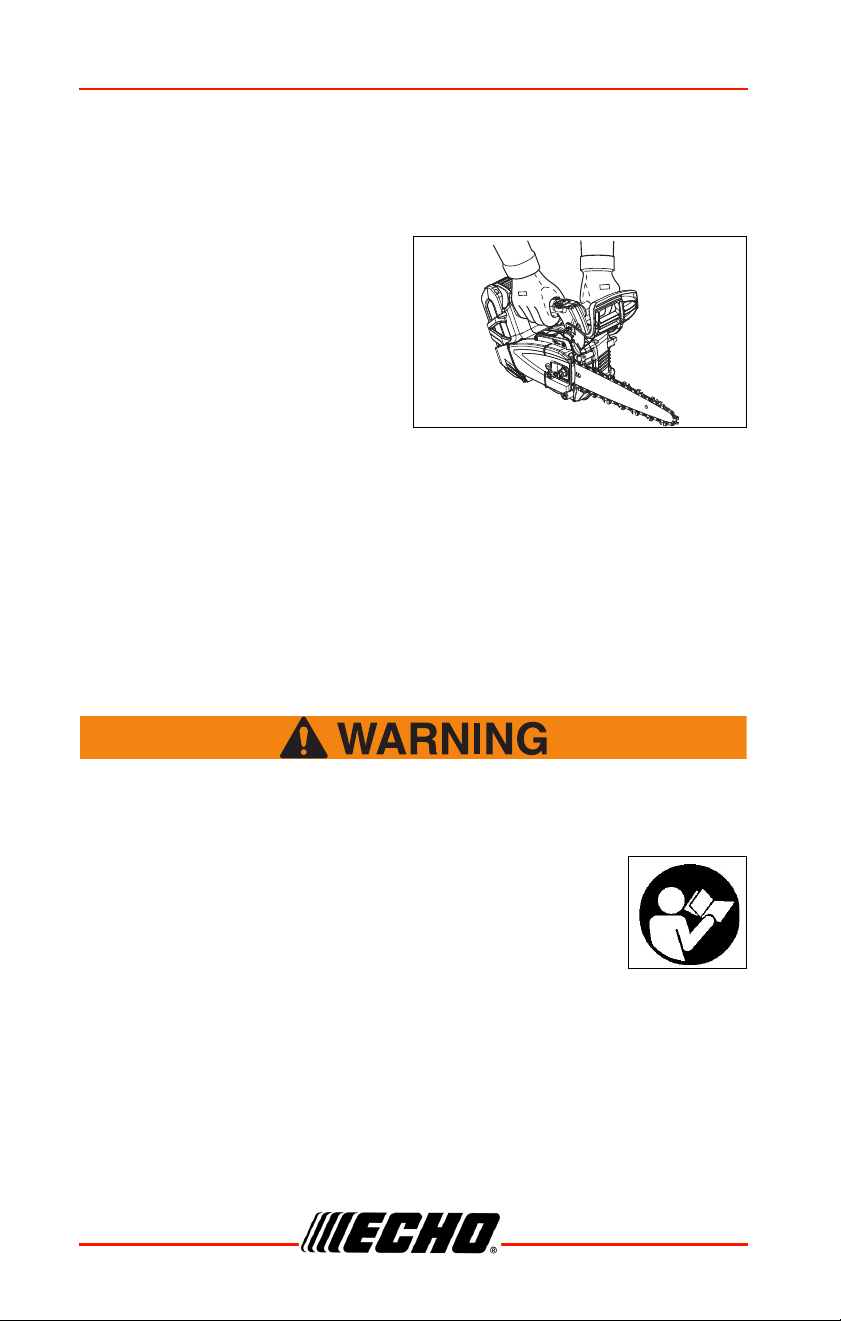
Kickback safety precaution for chainsaw users: kickback may occur
when the nose or tip of the guide bar touches an object or when the
wood closes in and pinches the saw chain in the cut.
• In some cases, tip contact may
cause a lightning-fast reverse
reaction, kicking the guide bar up
and back toward the operator
(this is called a rotational
kickback). Pinching the saw chain
along the top of the guide bar may
push the guide bar rapidly back
toward the operator (this is called
a linear kickback).
• Either or these reactions may
cause you to lose control of the
saw and come in contact with the
moving chain, which could result
in serious personal injury. As a
chainsaw user, you should take
several steps to keep your cutting
jobs free from accident or injury.
• With a basic understanding of
kickback, you can reduce or eliminate the element of surprise. Sudden
surprise contributes to accidents. Understand that rotational kickback is
preventable by keeping an unshielded bar nose from touching an object
or the ground.
SAFETY DCS-2500TN
18 X7508220500
© 7/23 ECHO Incorporated
• Do not operate a chainsaw with one hand! Serious injury to the operator,
helpers or bystanders may result from one-handed operation. For proper
control, always use two hands when operating a chainsaw, one of which
operates the trigger. Otherwise, this can result in the chain saw "skating"
or skidding, which can result in personal injury due to loss of control.
• Keep a good firm grip on the saw
which both hands, with the right
hand on the rear handle and the
left hand on the front handle,
when the unit is running. Use a
firm grip with thumbs and fingers
encircling the chainsaw handles.
A firm grip will help you reduce
kickback and maintain control of
the saw. Two hands must be used
to control the saw at all times.
• Make sure that the area in which you are cutting is free from obstructions.
Do not let the bar nose contact a log, branch, or any other obstruction
which could be hit while you are operating the saw.
• Cutting at high speeds may reduce the likelihood of kickback. But cutting
at part-throttle or low speeds may be preferable to control the chainsaw in
tight situations and may also reduce the likelihood of kickback.
General Precautions
Operator’s Manual
Be careful to read the operator's manual properly before
using your product in order to ensure correct operation.
Failure to do so could lead to an accident or serious injury.
Do not use the product for anything other than its intended
purpose.
You must not use the product for any purpose other than those described
in the operator’s manual. To do so could lead to an accident or serious
injury.

DCS-2500TN SAFETY
X7508220500 19
© 7/23 ECHO Incorporated
Do not modify the product
You must not modify the product. To do so could lead to an accident or
serious injury. Any malfunction resulting from a modification to the product
will not be covered by the manufacturer's warranty.
Do not use the product unless it has been checked and
maintained
You must not use the product unless it has been checked and maintained.
Always ensure that the product is checked and maintained on a regular
basis. Failure to do so could lead to an accident or serious injury.
Loaning or assigning your product
• When loaning your product to another party, ensure that the person
borrowing the product receives the operator's manual along with it.
• If you assign your product to another party, please enclose the operator's
manual with the product when handing it over. Failure to do so could lead
to an accident or serious injury.
Being prepared in case of an injury
In the unlikely event of an accident or injury, please ensure that you are
prepared.
• First aid kit
• Towels and wipes (to stop any bleeding)
• Whistle or mobile phone (for calling for outside help). If you are unable to
perform first aid or call for outside help, the injury could get worse.
Precautions for Use
Starting the unit: Never try to start the unit by positioning
yourself on the saw chain side. Physical injury can occur if the
saw chain suddenly starts to move.

SAFETY DCS-2500TN
20 X7508220500
© 7/23 ECHO Incorporated
Users of the product
The product should not be used by:
• people who are tired
• people who have taken alcohol
• people who are on medication
• people who are pregnant
• people who are in poor physical condition
• people who have not read the operator’s manual
• children
• Failure to observe these instructions could lead to an accident.
The components of this machine generate an electromagnetic field during
operation, which may interfere with some pacemakers. To reduce health
risks, we recommend that pacemaker users consult their physician and the
pacemaker manufacturer before operating this product.
If you have any physical condition which strenuous work could worsen,
check with your physician before using a chain saw.
Do not operate when ill or fatigued, or under the influence of any
substance or medication which could affect your vision, dexterity or
judgment.
Environment of Use and Operation
Do not use the product:
• in damp locations
• in the rain
• under poor weather conditions
To do so could lead to an accident or serious injury.
Do not use the product in places where there is no sure foothold, such as
on steep slopes or after rainfall, as such places are slippery and
dangerous. A serious injury could result if you fall or slip, or fail to operate
the product correctly.

DCS-2500TN SAFETY
X7508220500 21
© 7/23 ECHO Incorporated
Vibration and Cold
It is believed that a condition called Raynaud's Phenomenon which affects
the fingers of certain individuals may be brought about by exposure to
vibration and cold. Exposure to vibration and cold may cause tingling and
burning, followed by loss of color and numbness in the fingers.
The following precautions are strongly recommended because the
minimum exposure which might trigger the ailment is unknown.
• Keep your body warm, especially the head and neck, feet and ankles,
and hands and wrists.
• Maintain good blood circulation by performing vigorous arm exercises
during frequent work breaks.
• Limit the number of hours of operation. Try to fill each day with jobs where
operating the chain saw or other hand-held power equipment is not
required.
• If you experience discomfort redness and swelling of the fingers, followed
by whitening and loss of feeling, consult your physician before exposing
yourself further to cold and vibration.
Failure to observe these instructions could result in damage to your health.
Repetitive stress injuries
It is believed that over-using the muscles and tendons of the fingers,
hands, arms and shoulders may cause soreness, swelling, numbness,
weakness and extreme pain to the areas just mentioned. Certain repetitive
hand activities may put you at a high risk for developing a repetitive stress
injury (RSI).
To reduce the risk of RSI, do the following:
• Avoid using your wrist in a bent, extended or twisted position.
• Take periodic breaks to minimize repetition and rest your hands. Reduce
the speed and force in which you do the repetitive movement.
• Do exercises to strengthen hand and arm muscles.
• See a doctor if you feel tingling, numbness or pain in your fingers, hands,
wrists or arms. The sooner RSI is diagnosed, the more likely permanent
nerve and muscle damage can be prevented.
Failure to observe these instructions could result in damage to your health.

SAFETY DCS-2500TN
22 X7508220500
© 7/23 ECHO Incorporated
Transport of the product
When transporting in the situations described below, turn off the unit and
ensure that the saw chain has stopped moving, then fit the guide bar
cover. Do not carry unit with the power indicator LED illuminated.
• Moving to the place where you are working
• Moving to another area while you are working
• Leaving the place where you have been working.
Failure to observe these precautions could cause serious injury.
Orient guide bar to the rear when carrying chainsaw.
When transporting the product by vehicle, fit the guide bar cover, and
secure the product firmly in place to prevent it from moving around
Secure the unit against unintentional startup. Remove the battery from the
unit before transporting or storing the unit. Do not use metal containers for
transporting batteries.
Starting the unit
Be particularly careful to observe the following precautions when starting
the unit:
• Always ensure all handles and guards are fitted. Keep the handles dry,
clean, and free of oil.
• Check that none of the nuts and bolts are loose.
• Check that the guide bar is not damaged or excessively worn. If you find
any abnormalities, do not use the product.
• Operate the chainsaw only in well-ventilated areas. Oil mist (from chain
saw lubrication) or saw dust is harmful to health.
• Leave plenty of space around the product and do not allow people or
animals near it.
• Never operate a chainsaw when you are alone. Arrange to have someone
remain within calling distance in case you need help.
• Remove obstructions, if any.
• Make sure that the saw chain is not touching the ground or any obstacles.
DCS-2500TN SAFETY
X7508220500 23
© 7/23 ECHO Incorporated
Failure to observe the precautions could cause an accident or injury, or
even lead to a fatality.
Once the unit has started, check for abnormal vibrations and
sounds.
Check that there are no abnormal vibrations or sounds once the unit starts.
Do not use the product if there are abnormal vibrations or sounds. Contact
your dealer to have it repaired. Accidents involving parts that fall or shatter
off can cause wounds or serious injury.
Disconnect the battery:
• whenever the machine is left by the user
• before clearing a blockage
• before checking, cleaning or working on the machine
• after striking a foreign object to inspect the machine for damage.
Accidents can occur if the product starts unexpectedly.
Do not touch high temperature or high voltage components
while the product is running.
Do not touch the following high temperature or high voltage components
while the product is running or for some time after it stops.
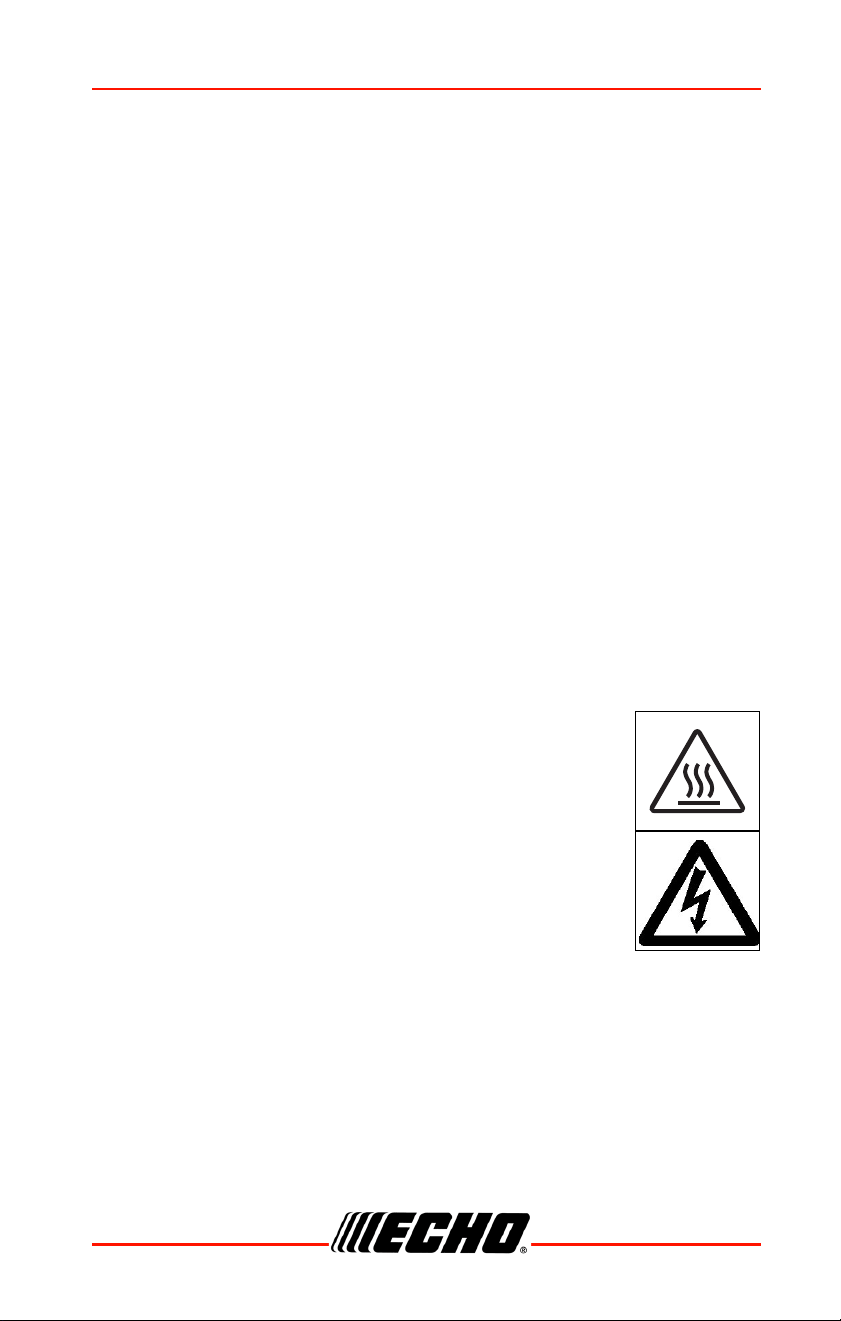
• High temperature components. You could burn yourself if
you touch a high temperature component.
• High voltage components. You could receive an electric
shock if you touch a high voltage component while the
product is running.
Turn off the unit when checking or maintaining the
product.
Observe the following precautions when checking and maintaining your
product after use:
Turn the unit off and do not attempt to check or maintain the product until
unit has cooled. You could burn yourself on a hot unit.

SAFETY DCS-2500TN
24 X7508220500
© 7/23 ECHO Incorporated
Turn off the unit immediately if anything goes wrong.
In the following situations, turn off the unit immediately and ensure that the
cutting device has stopped before checking each area of the product.
Replace any damaged parts.
• If the cutting device hits a rock, tree, post, or other such obstruction while
you work.
• If the product suddenly starts to vibrate abnormally. Continuing to use
parts when they are damaged could lead to an accident or serious injury.
A ten meter radius is a danger zone.
The area within a 10 m (33 ft.) radius of the product is a danger zone. Be
careful to observe the following precautions while working with the
product.
• If another person enters the danger zone, turn off the unit.
• Do not allow anyone to hold the material you are cutting. Any contact with
the saw chain could cause serious injury.
Using the product.
When using the product, pay special attention to observe the following
precautions.
• Do not operate a chainsaw that is damaged, improperly adjusted, or not
completely and securely assembled.
• Do not cut solid metal, sheet metal, plastics or any non-wood materials.
• Cutting while on a ladder is extremely dangerous because the ladder can
slip and your control of the chainsaw is limited.
• Stay on the uphill side when bucking or limbing logs which might roll when
cut.
• Use extreme caution when cutting small-size brush and saplings because
slender material may catch the saw chain and be whipped toward you or
pull you off balance.
• When cutting a limb that is under tension, be alert for spring-back so that
you will not be struck by the limb or chainsaw when the tension in the
wood fibers is released.
Failure to observe these instructions will cause the product to be held
unsteadily and could result in serious injury.
DCS-2500TN SAFETY
X7508220500 25
© 7/23 ECHO Incorporated
Make sure that the saw chain is stopped before putting the unit
on the ground
When you turn off the unit, check to ensure the saw chain has stopped
moving before you lower the product to the ground. Even if the unit has
been turned off, the saw chain can still cause an injury while free-wheeling.
Protective Gear
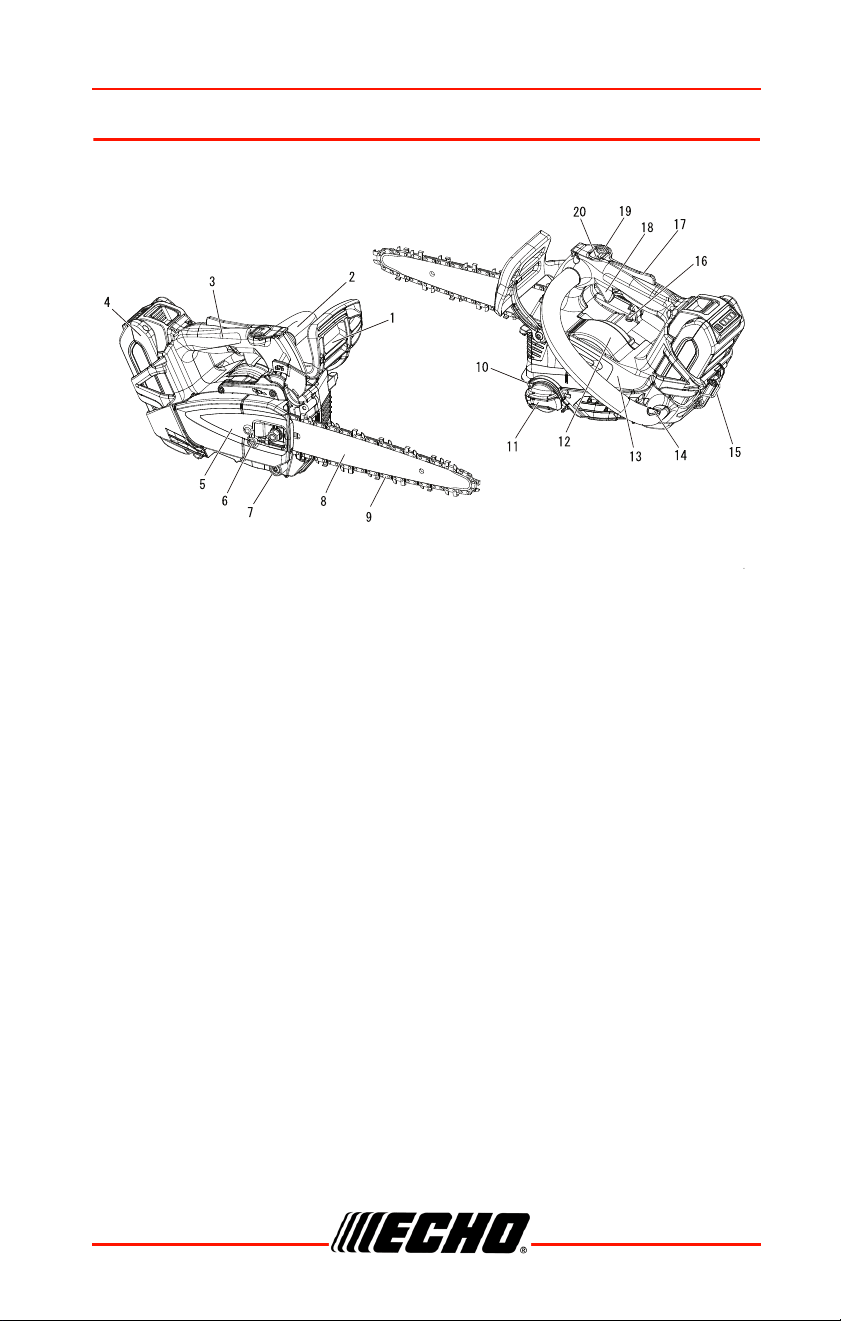
Wear protective gear
Always wear the following protective gear when working with the
chainsaw.
a Head protection (cap, hat or helmet):
Protects the head
b Ear muffs or ear plugs: Hearing
protection
c Safety goggles: Protect the eyes
d Safety gloves: Protect the hands from
cold and vibration
e Trim fitting clothes (long sleeves, long
trousers): Protect the body
f Safety tip shoes or boots with non-slip
sole: Protect the feet
Failure to observe these precautions could
result in damage to your sight or hearing, or
lead to a serious injury.
When necessary, please use the protective gear below:
• Dust mask: Breathing protection
• Bee net: Insect protection

SAFETY DCS-2500TN
26 X7508220500
© 7/23 ECHO Incorporated
Wear proper clothing
Do not wear ties, jewelry, or loose, dangling clothing which could be
caught in the unit. Do not wear open-toe footwear, or go bare foot or
barelegged.
Failure to observe these precautions could result in an accident or lead to
a serious injury.
DCS-2500TN DESCRIPTION
X7508220500 27
© 7/23 ECHO Incorporated
DESCRIPTION
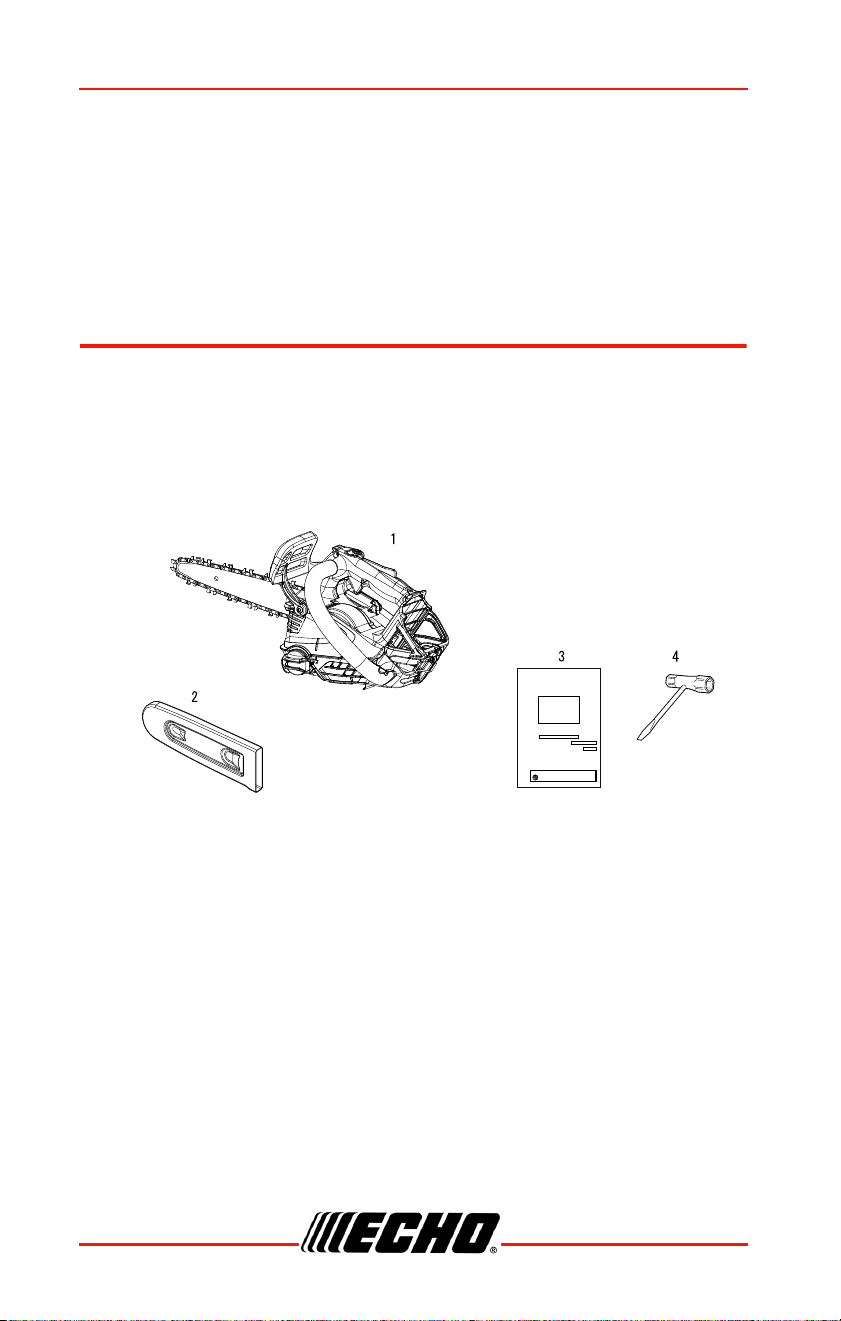
1. Front hand guard
2. Front handle (for the left hand)
3. Rear handle (for the right hand)
4. Battery
5. Sprocket cover
6. Chain tension adjuster
7. Chain catcher
8. Guide bar
9. Saw chain
10. Oil tank
11. Oil tank cap
12. Type and serial number
13. Cover
14. Hanging hook
15. Lifting hook
CONTENTS DCS-2500TN
28 X7508220500
© 7/23 ECHO Incorporated
CONTENTS
• The following parts are packed separately in the packing box.
• When you have unpacked the box, please check the parts that it contains.
• Contact your dealer if anything is missing or broken.
16. Oil adjusting screw
17. Trigger switch lockout
18. Trigger switch
19. Power button
20. Power indicator LED
Number Part Name Quantity
1Chainsaw 1
2 Guide Bar Cover 1
3 Operator’s Manual 1
4T wrench 1
DCS-2500TN ASSEMBLY
X7508220500 29
© 7/23 ECHO Incorporated
ASSEMBLY
Assembly
Mounting guide bar and chain
Always remove the battery before performing any of the
following operations, otherwise serious personal injury might
result.
All adjustments should be made cold. Always wear gloves when
working on a saw chain. Do not operate with a loose chain.
Otherwise personal injury might result.
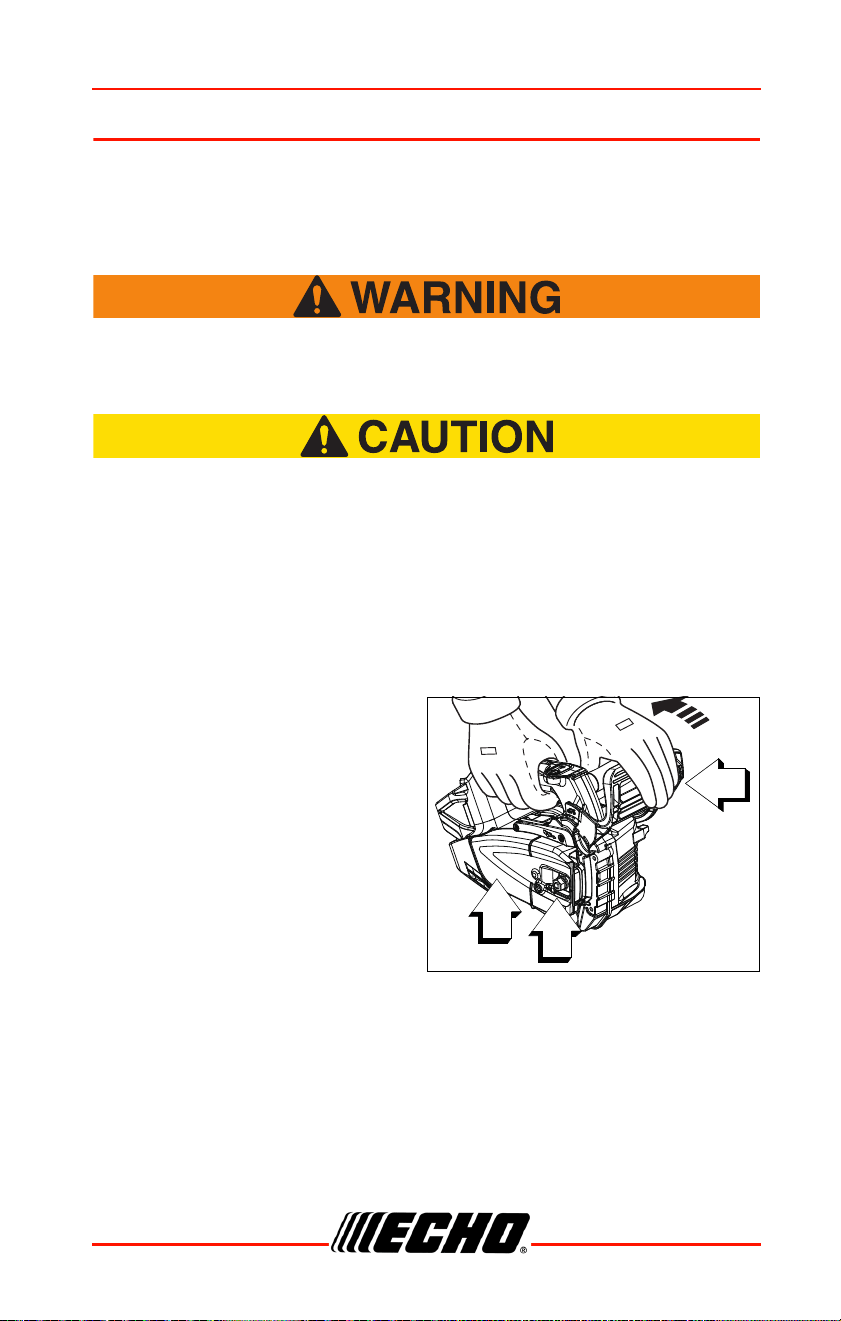
Note: Move the chain brake lever (Front hand guard) fully rearward
to remove or install the guide bar cover to the chain saw.
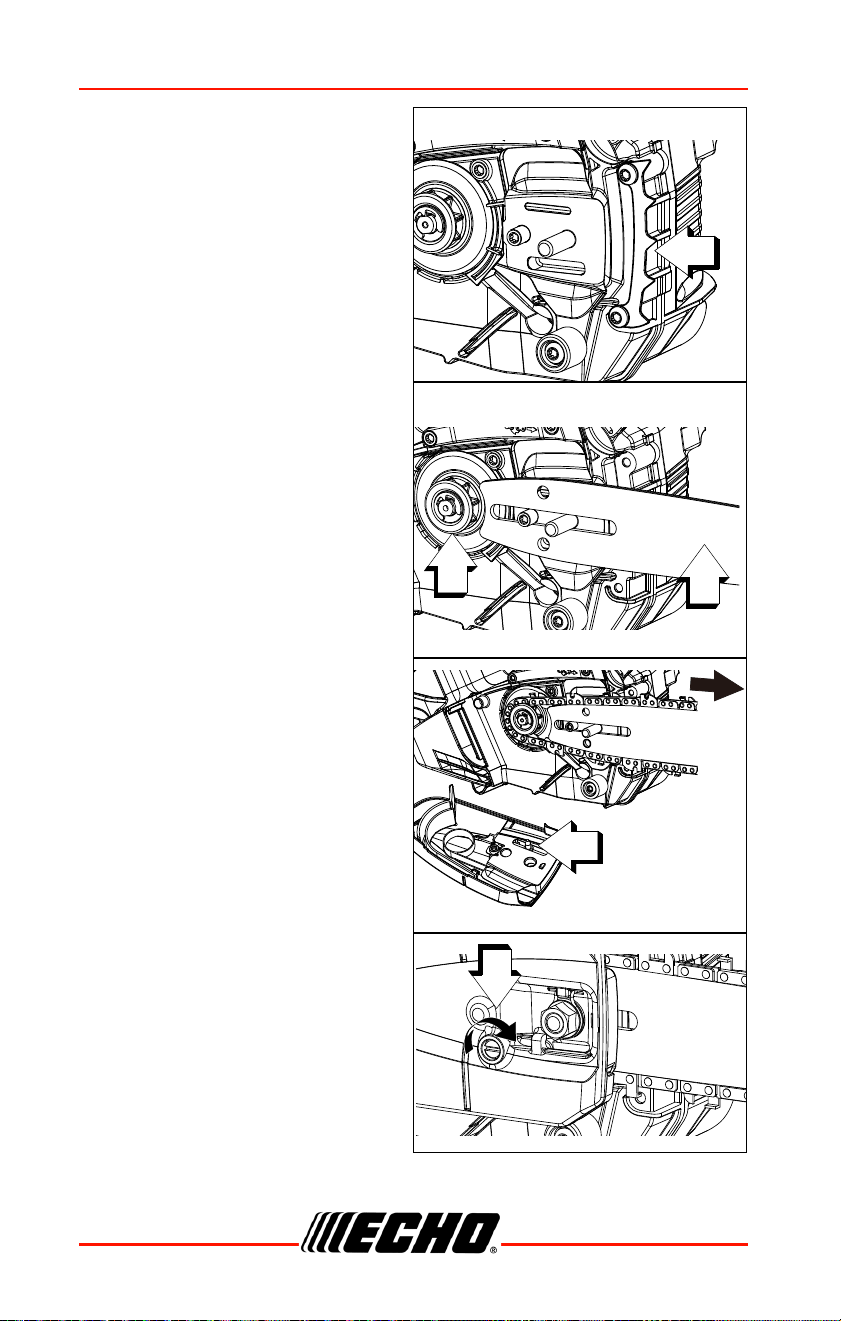
1. Release chain brake (A).
2. Loosen sprocket cover nut (B).
3. Remove sprocket cover (C).
C
A
B
C
ASSEMBLY DCS-2500TN
30 X7508220500
© 7/23 ECHO Incorporated
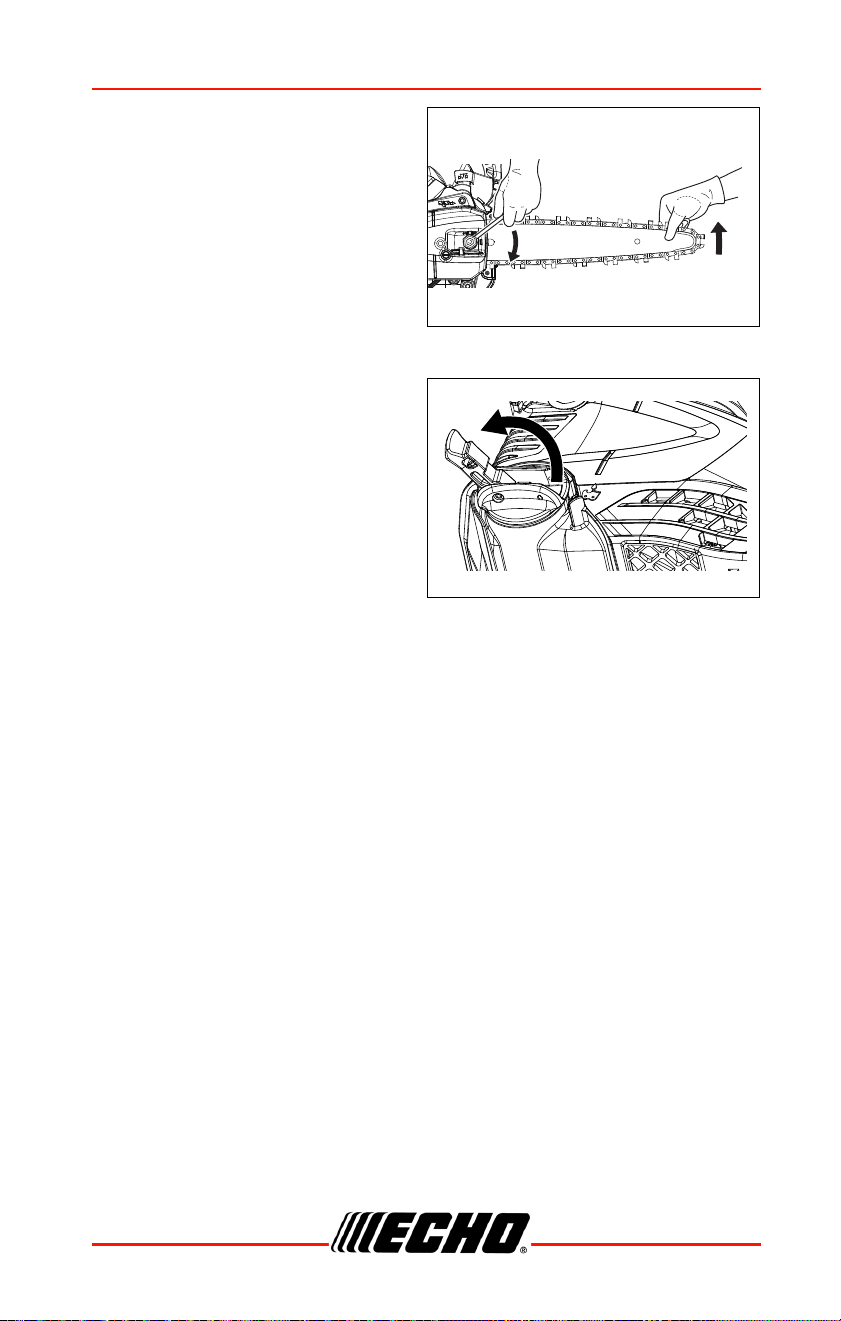
4. Install spiked bumper (D).
Secure with 2 bolts.
5. Mount guide bar (E) and slide
toward sprocket (F) to make
saw chain installation easier.
6. Install saw chain as shown.
(Ensure cutters are pointing in
the right direction.)
7. Install the sprocket cover over
the guide bar stud. Ensure that
chain tension adjuster (G) fits
into guide bar hole.
8. Tighten sprocket cover nut
finger tight.
9. Hold the guide bar nose up and
turn the adjuster (H) clockwise
until the chain fits snugly
against the underside of the
bar.
C
D
E
F
C
G
H
DCS-2500TN ASSEMBLY
X7508220500 31
© 7/23 ECHO Incorporated
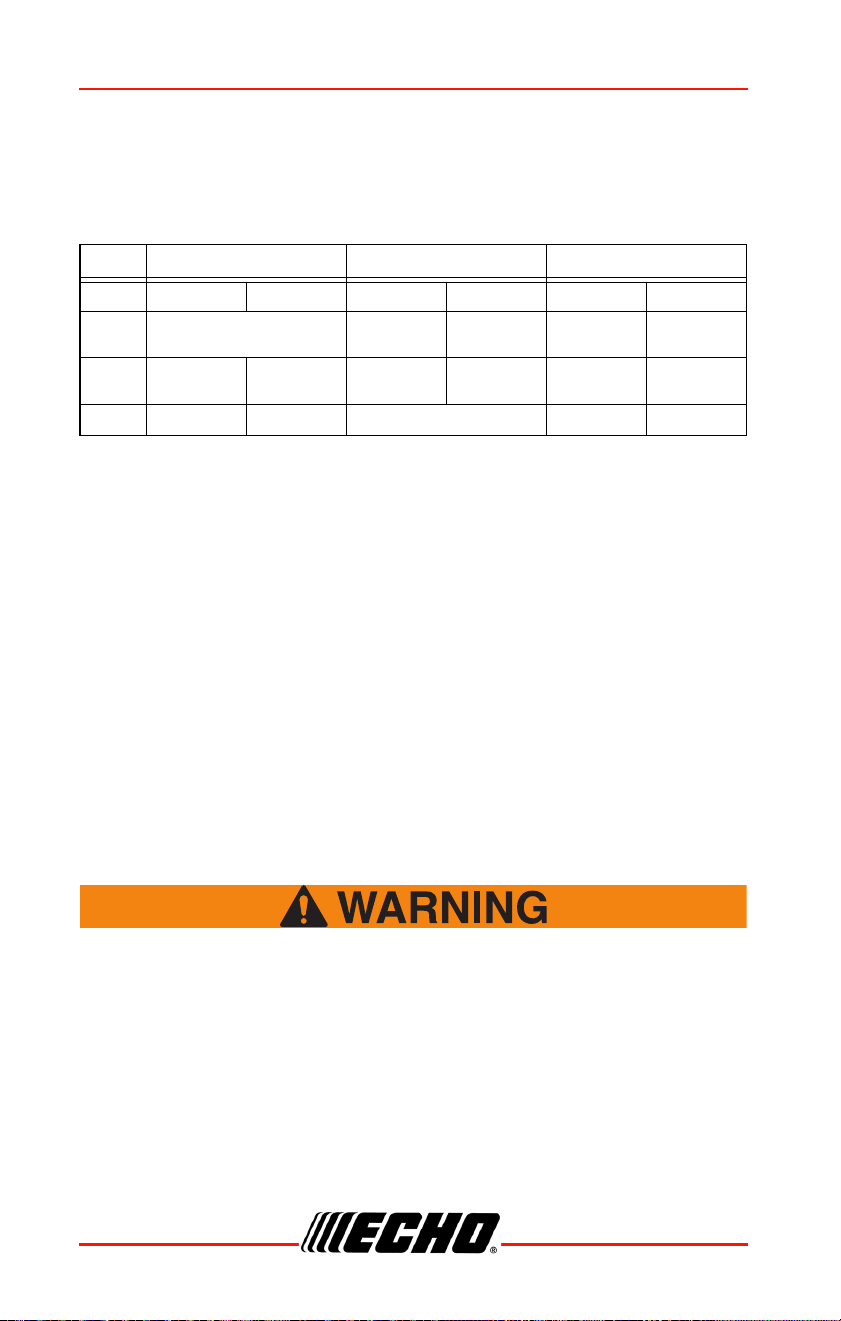
10. Tighten sprocket cover nut with
bar nose held up.
11. Pull the chain around the guide
bar by hand. Loosen the
adjustment if you feel tight
spots.
Chain Lubricant
Proper lubrication of the chain
while in operation minimizes
friction between the chain, the
guide bar and sprocket. Use
ECHO genuine chain oil or ECHO
recommended chain oil specially
formulated for bars and chains for
proper lubrication. These oils
contain tackifiers, anti-aging and
anti-oxidizing agents.
Consult your ECHO dealer for the proper chain oil. Never use waste or
reclaimed oil to avoid various malfunctions of the oil system, chain and
guide bar. Lubrication problems caused by the use of improper oil will void
the warranty.
Especially, vegetable based chain oil quickly turns to resin and adheres to
oil pump, chain and guide bar. It causes malfunctions and shorten product
life. Flush chain oil system with mineral or chemical based chain oil after
use, if it is required to use vegetable oil due to local / municipal restrictions
or any other reason.
For a short time of emergency operation, fresh SAE 10W-30 motor oil can
be used.
ASSEMBLY DCS-2500TN
32 X7508220500
© 7/23 ECHO Incorporated
Temperature Information
(1)
Assumes the battery is just off the charger or stored at the temperature
range noted for charger usage (39° F (4°C)) - 104°F (40°C)).
(2)
Hot batteries in high ambient temperatures require longer charge times.
(3)
To maximize life of batteries being stored more than 3 months, ECHO
recommends batteries being stored at 3 green lights on the battery
capacity indicator (BCI) and at room temperature.
Note: Long term storage of batteries in conditions or charge levels
on the battery capacity indicator (BCI) other than noted
above could degrade the performance and runtime of the
battery.
Battery Charging
Note: See separate operator’s manuals packaged with battery and
charger.
• Use only with ECHO eFORCE
®
56V battery series batteries and
chargers.
• Keep charger and battery away from damp conditions and all liquids.
• Do not operate the charger on an easily combustible surface (e.g. paper,
textiles) or in an environment with a high risk of fire.
• Do not cover the charger. Covering the charger will prevent it from
cooling.
Recommended Ambient Temperatures:
Charging Usage/Discharge Storage
Low High Low High Low High
Product
(1)
Not Applicable 32°F (0°C) 113°F (45°C) 32°F (0°C) 113°F (45°C)
Battery
(2)(3)
39°F (4°C) 104°F (40°C) 32°F (0°C) 113°F (45°C) 32°F (0°C) 113°F (45°C)
Charger 39°F (4°C) 104°F (40°C) Not Applicable 32°F (0°C) 113°F (45°C)

DCS-2500TN ASSEMBLY
X7508220500 33
© 7/23 ECHO Incorporated
• Do not operate the charger in explosive atmospheres, such as in the
presence of flammable liquids, gases or dust. Charger can produce
sparks which may ignite the dust or fumes - there is a risk of explosion.
• Connect the charger only to the mains of voltage and frequency specified
on the rating plate.
• Connect the charger only to an easily accessible wall outlet.
• Never insert objects in the battery's or charger's cooling slots.
• Do not charge or use a defective, damaged or deformed battery and
charger.
• Do not open, damage or drop the battery or the charger.
• Fluid may leak from the battery if it is damaged or not used properly;
avoid contact with the skin. In the event of accidental contact, wash the
affected areas of the skin with plenty of water and soap. If fluid gets in the
eyes, do not rub. Rinse the eyes with plenty of water for at least 15
minutes. Also seek medical assistance.
• Never bridge (short circuit) the battery contacts or the charger's terminals
with metallic objects.
• Protect from direct sunlight, heat and open flames and never throw
battery into fire; there is a risk of explosion.
• In the event of smoke or fire in the charger, disconnect it from the wall
outlet immediately.
• If the connecting cord is damaged, immediately disconnect the plug from
the power supply to avoid the risk of electric shock.
• Do not expose battery to microwaves or high pressure.
• To reduce the risk of stumbling, position and mark the connecting cord in
such a way that it cannot be damaged or endanger others.
The battery comes partially charged from the factory and needs to be
fully charged before first use. Charge the battery when it no longer
produces sufficient power to operate the unit or when battery lights
indicate that the battery is low.
ASSEMBLY DCS-2500TN
34 X7508220500
© 7/23 ECHO Incorporated
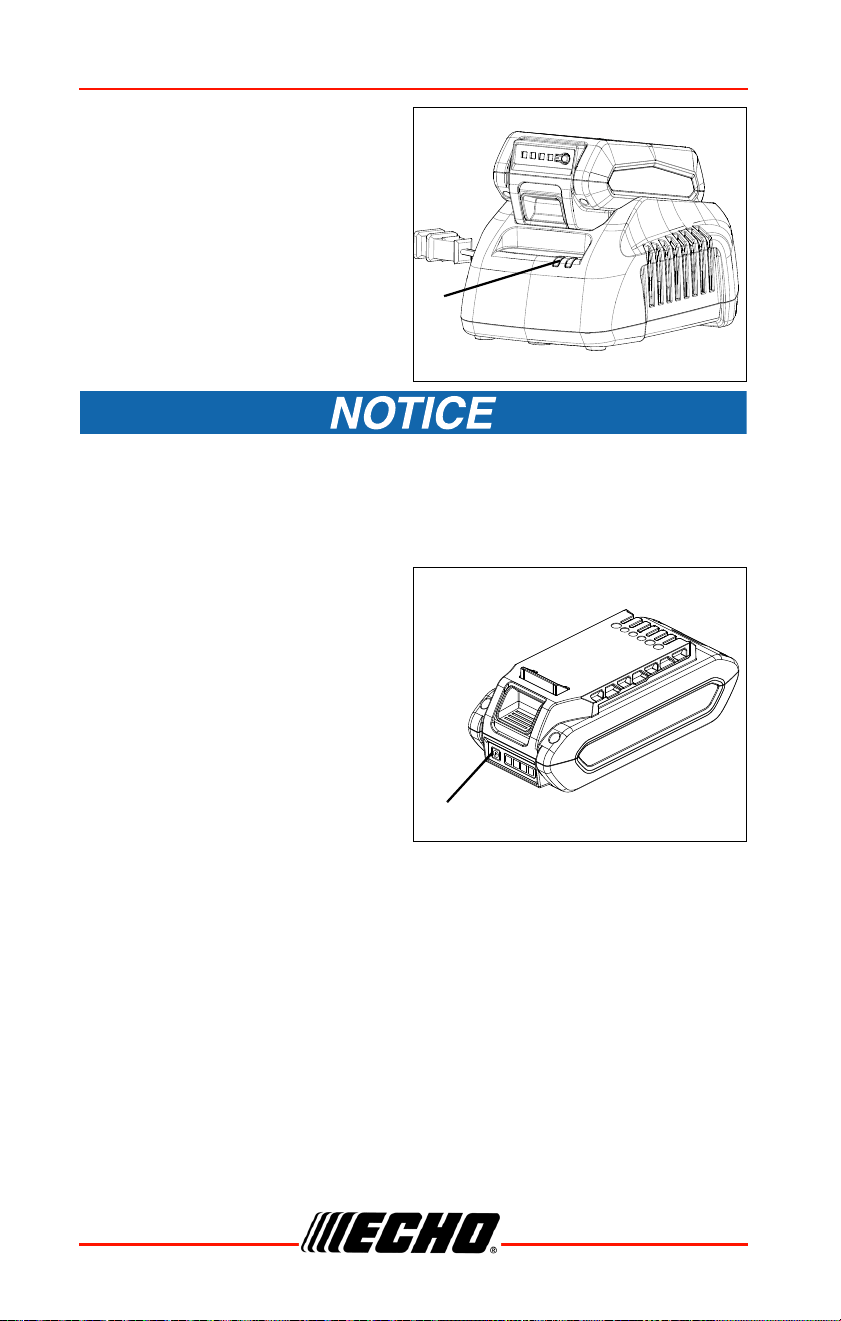
1. Plug charger AC cord in the
wall outlet.
2. Align ridges on battery with
grooves on charger, and slide
battery into charger.
3. During normal charging, the
charger LED (A) will blink
GREEN.
If charger detects a problem, LED will blink RED. Remove battery
from charger, clear obstructions from contacts and reinstall battery
into charger. If battery is outside acceptable temperature range (See
Recommended Ambient Temperature chart) LED will remain RED.
4. When charging is complete,
LED will remain GREEN. See
battery manual for charging
time.
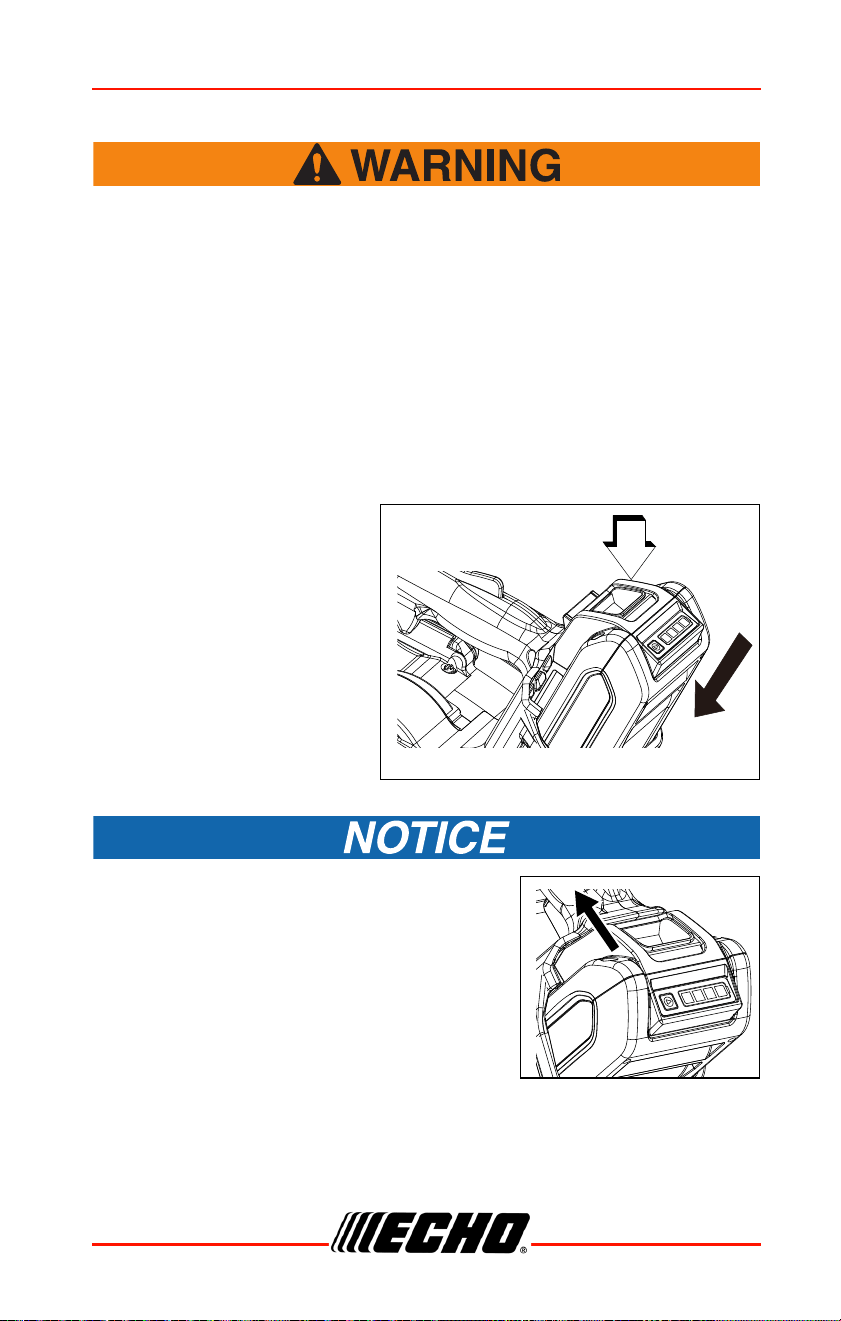
5. Verify battery is fully charged.
Remove battery from charger,
press battery charge status
button (B), and check LED
display.
• One green light indicates that
the battery has 1-24% charge.
• Two green lights indicate that
the battery has 25-54% charge.
• Three green lights indicate that the battery has 55-79% charge.
• Four green lights indicate that the battery has 80-100% charge.
6. Unplug charger AC cord from the wall outlet.
A
B
DCS-2500TN ASSEMBLY
X7508220500 35
© 7/23 ECHO Incorporated
Installing the Battery
The chainsaw will operate when the battery is installed, the
power indicator LED is lit, and the trigger switch and trigger
switch lockout are engaged. Make sure the chainsaw is properly
positioned to prevent loss of control and possible serious
injury. Keep movable parts of the chainsaw off the ground and
away from objects that could become entangled.
Note: The battery comes partially charged from the factory and
needs to be fully charged before first use.
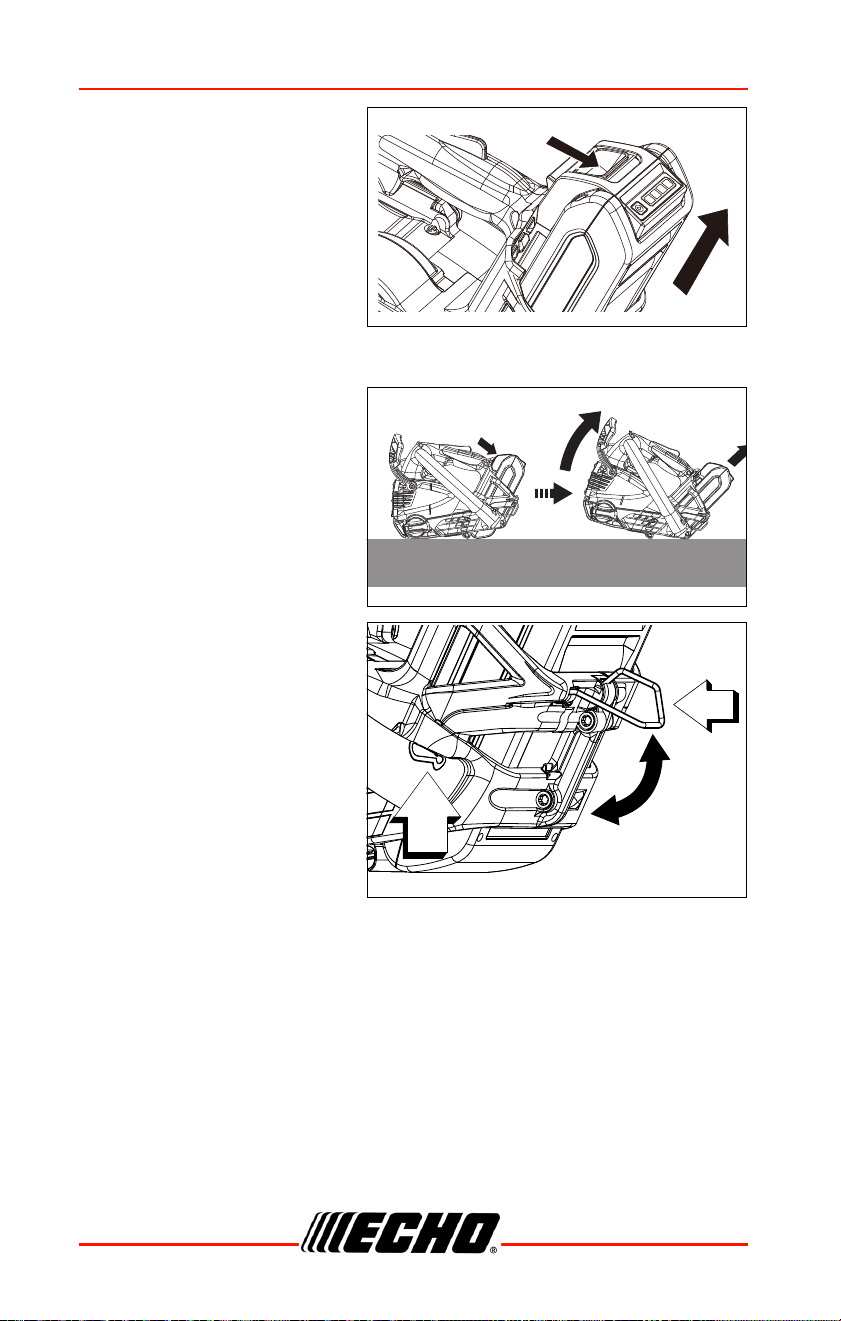
1. Push front hand guard
forward. (Chain brake
ACTIVATED position).
2. Make sure power indicator
LED is turned off.
3. Align ridges on battery
with groove on chainsaw,
and insert battery until
battery latch (A) is fully
engaged, and a clicking
sound is heard.
Before using the chainsaw, make sure that
battery is installed correctly with battery
latch in the fully engaged, upright position.
A
ASSEMBLY DCS-2500TN
36 X7508220500
© 7/23 ECHO Incorporated
Removing the Battery
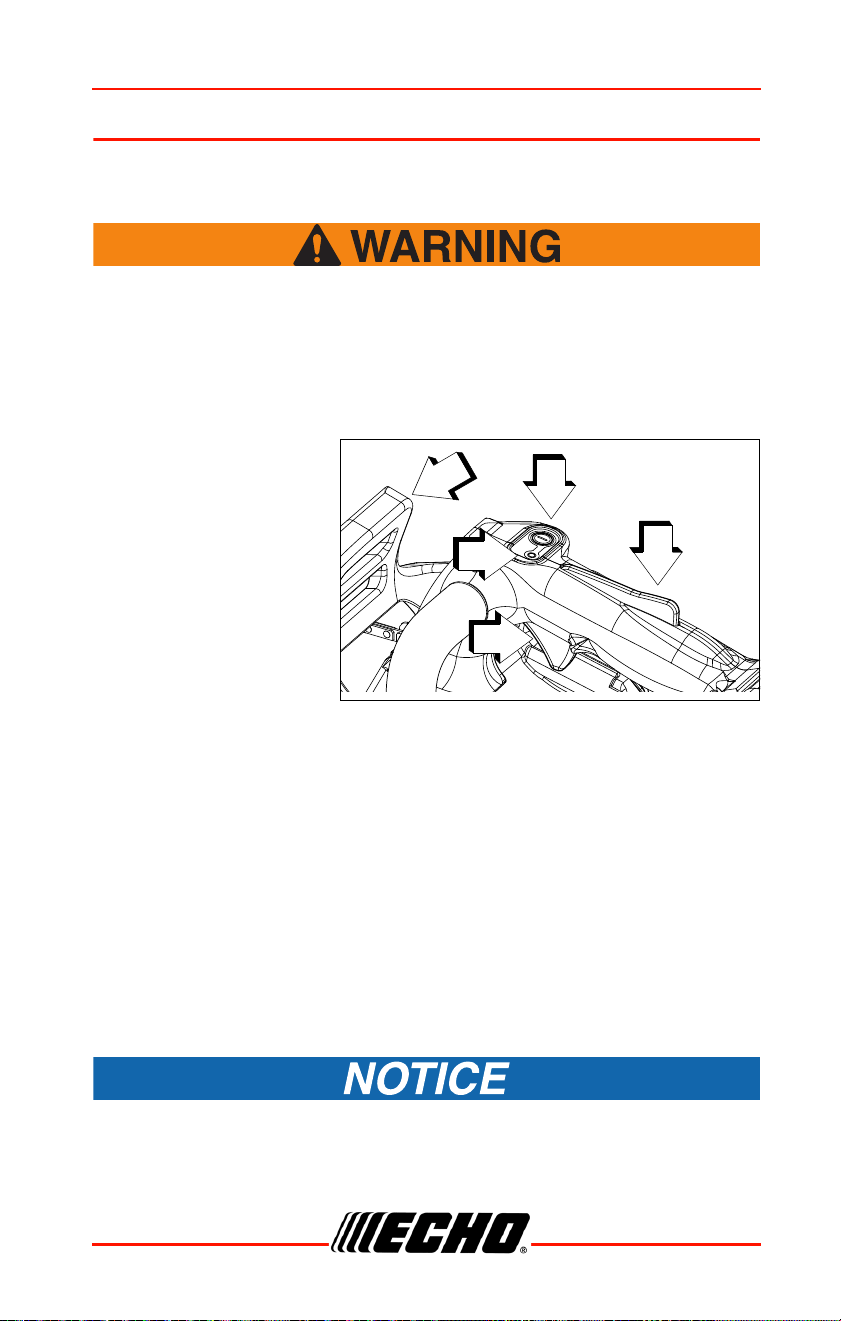
To remove battery, press
battery latch, and slide
battery out.
When the battery is difficult to remove:
1. Place saw on a hard flat
surface.
2. Press battery latch and
push bottom of battery
against the hard surface.
3. Slide battery out of saw.
Hanging and Lifting
Hooks
Hanging Hook (A):
Attach a rope or carabiner to
prevent accidental dropping
of saw while working in a
tree.
Lifting Hook (B):
Use to hook and unhook from
harness in one quick
movement.
A
C
B
DCS-2500TN OPERATION
X7508220500 37
© 7/23 ECHO Incorporated
OPERATION
Starting the Unit
When starting the unit, observe the precautions described in the
section "For safe use of your product" to ensure that you
operate the product correctly. Failure to do so might cause
serious personal injury.
1. Fill the chain oil tank
with lubricant.
2. Remove the guide
bar cover.
3. Make sure the guide
bar and saw chain
are not touching
anything when
starting the chainsaw.
4. Push front hand
guard (A) forward to
engage chain brake.
5. Push power button (B) once to turn on power to unit.
Note: Power indicator LED (C) blinks when power to unit is turned
on with chain brake engaged.
6. Pull front hand guard rearward to disengage chain brake.
Note: Power indicator LED (C) remains lit when power to unit is
turned on with chain brake disengaged.
7. Hold the chain saw by both handles.
8. Hold down the trigger switch lockout (D) and depress trigger switch (E)
to increase saw chain speed. If you depress trigger switch with chain
brake activated, the saw will not work.
When power to unit is turned on:
• After 90 seconds of inactivity, unit will power itself off.
B
C
A
D
E

OPERATION DCS-2500TN
38 X7508220500
© 7/23 ECHO Incorporated
• If the LED remains lit, operation is normal.
• If the LED flashes once per second, the battery needs to be charged.
• The LED flashes four times per second when the chain brake is
ACTIVATED. To disengage the chain brake, pull front hand guard towards
the operator to the chain brake RELEASED position. The saw will power
itself off in about 5 minutes if the chain brake remains in the ACTIVATED
position
• The LED flashes four times per second when the chain brake is
ACTIVATED. To disengage the chain brake, pull front hand guard towards
the operator to the chain brake RELEASED position. The saw will power
itself off in about 5 minutes if the chain brake remains in the ACTIVATED
position.
Stopping the Unit
1. Release trigger switch and trigger switch lockout, and allow saw chain
to stop.
2. Push power button to turn off power to unit.
Note: Power indicator LED (C) turns off when power to unit is turned
off.
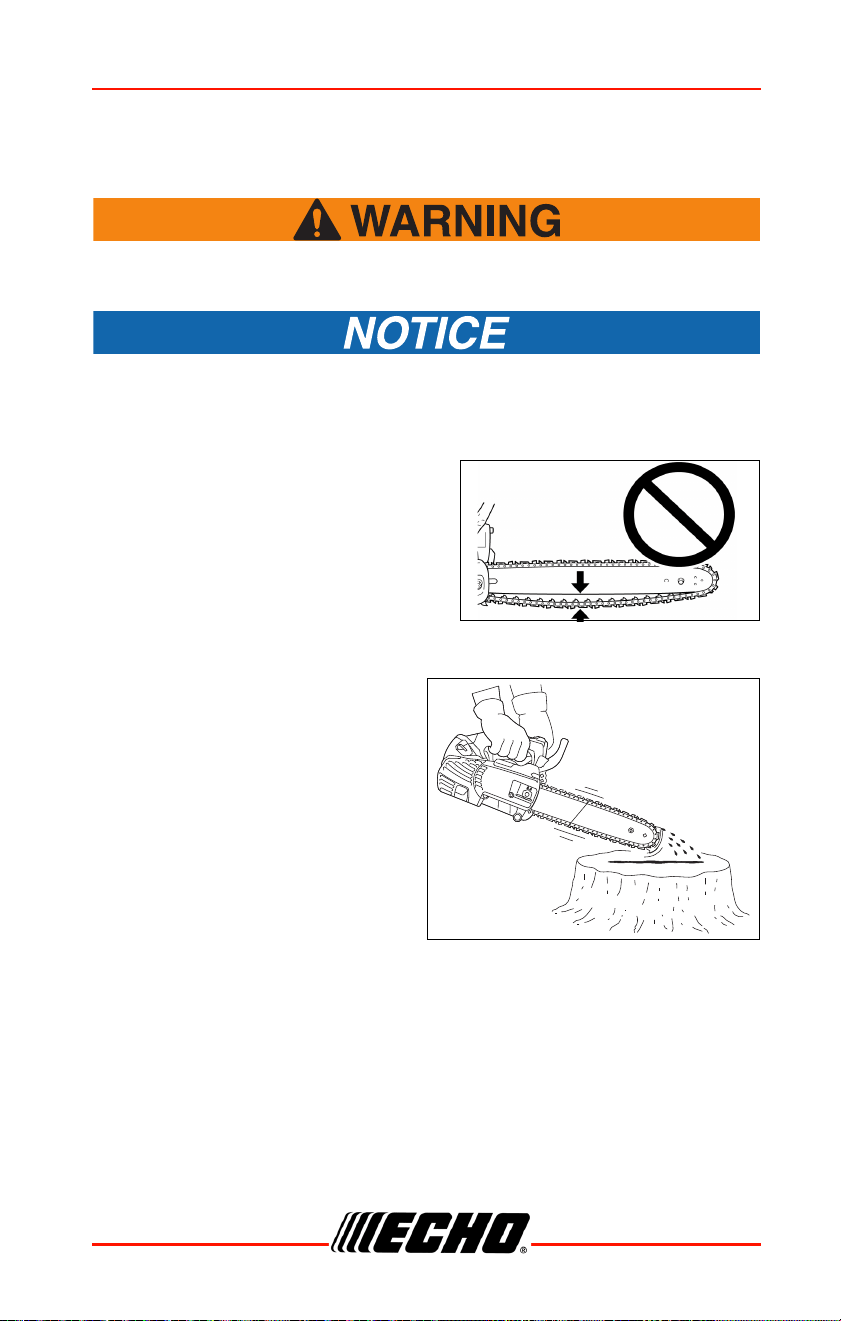
◆ When the trigger switch is released, the saw chain
automatically stops. Motor control changes depending on
temperature of the battery therefore stop time of the saw
chain might not be consistent.
◆ If the power button does not stop the chain saw, remove
the battery to stop the power supply to chain saw. Have
your authorized servicing dealer repair power button
before using chain saw again.
◆ If the saw chain does not stop when the trigger switch and
trigger switch lockout are released, activate chain brake
then remove battery to stop the power supply to chain
saw. Have your authorized servicing dealer repair unit
before using again.
DCS-2500TN OPERATION
X7508220500 39
© 7/23 ECHO Incorporated
Before Use
Checking Chain Tension
Remove battery from unit when checking chain tension.
Always loosen sprocket cover nut before turning the chain tension
adjuster, otherwise damage can occur to the sprocket cover and
tensioner.
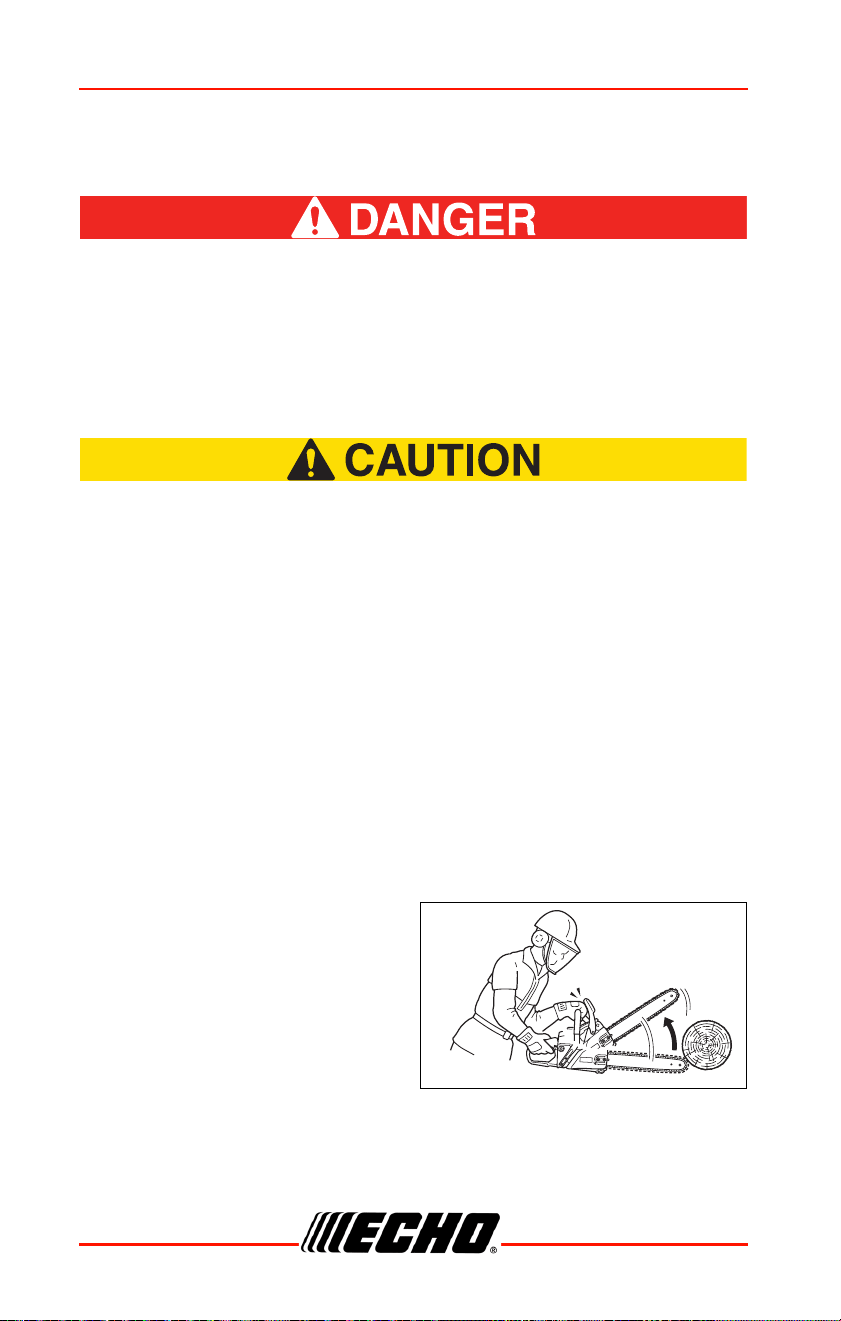
1. Chain tension should be checked
frequently during work and
adjusted if necessary.
2. Tension the chain as tight as
possible, but so that it can still be
pulled easily along the guide bar by
hand.
Chain Lubrication Test
Hold the chain just above a dry
surface and open the throttle to
half speed for 30 seconds.
A thin line of “thrown” oil should be
seen on the dry surface.
Pre Cutting Test
• Familiarize yourself with your chainsaw before you start actual cutting.
• For this purpose it may be wise to practice by cutting some small logs or
limbs several times on a sawhorse or cradle.
• Do not allow either people or animals into the work area. Multiple
operators - Keep a safe distance between two or more operators when
working together simultaneously.
OPERATION DCS-2500TN
40 X7508220500
© 7/23 ECHO Incorporated
Correct Use of Chain Brake
Kickback is very hazardous. If the tip of the bar touches wood
or the like, the guide bar kicks back instantly. The chain brake
reduces the possibility of injury due to kickback. Always check
that the chain brake works properly before use. Otherwise
serious personal injury can result.
Be sure to install a guide bar and saw chain when performing a
chain brake test.
Note:
• For practice, while cutting a small tree, push the front hand guard
forward to engage the brake.
• At all times, confirm whether the brake works properly before each
task.
• If the chain brake is clogged with wood chips, function of the brake
deteriorates a little. Always keep the device clean.
• Do not increase motor revolutions while the chain brake is engaged.
• Never test the brake in an area where petrol fumes are present.
Chain Brake
1. The chain brake's function is to
stop chain rotation after a
kickback.
2. It neither prevents nor reduces
kickback.
3. Do not depend on the chain
brake for protection against
kickback.
4. Even with a chain brake, depend on your own good sense and proper
cutting methods just as though there were no chain brake.
5. Even with normal use and proper maintenance, the response time of
the brake may lengthen.
DCS-2500TN OPERATION
X7508220500 41
© 7/23 ECHO Incorporated
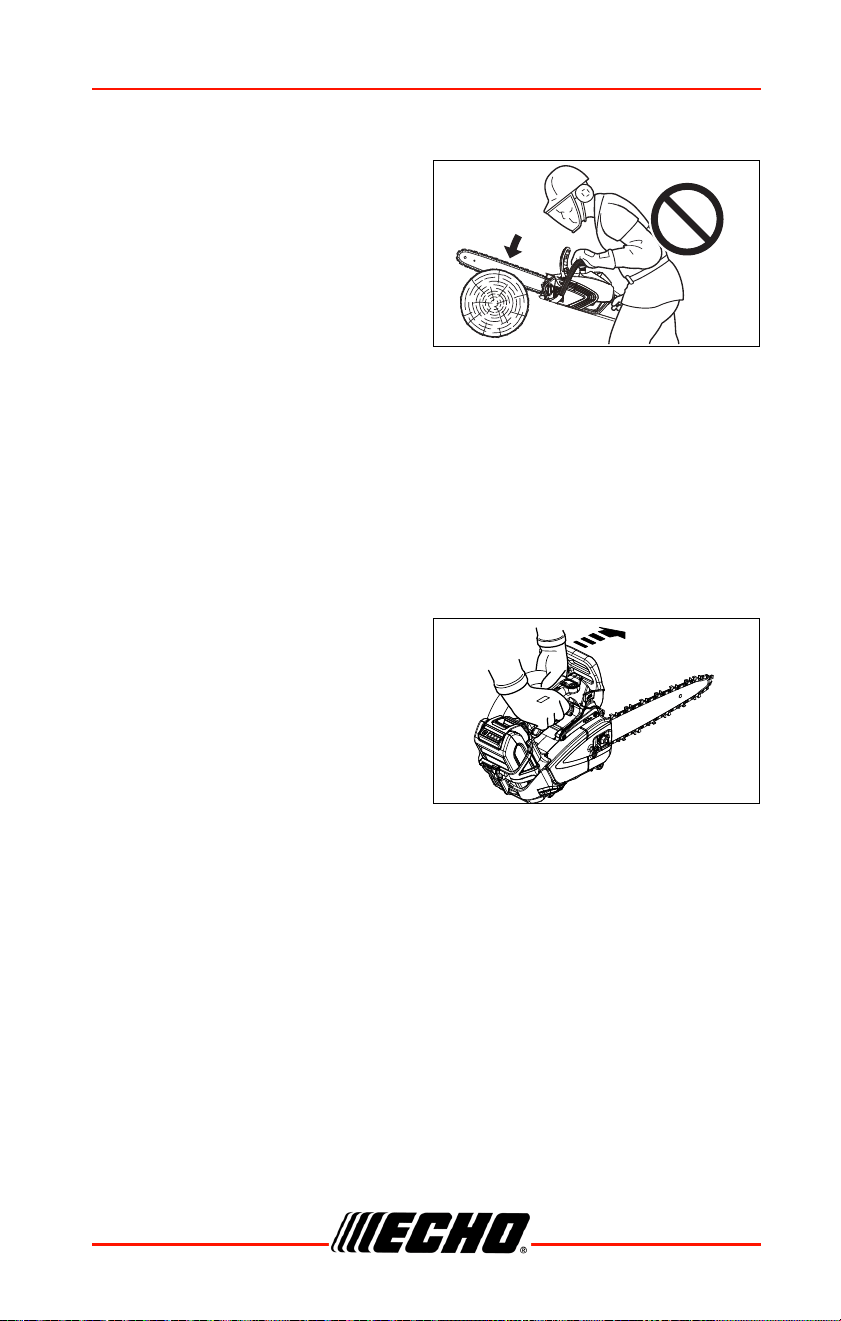
6. The following may interfere with the brake's ability to protect the
operator:
• Saw incorrectly held too close
to operator's body. Kickback
time may be too fast even for a
perfectly maintained brake to
work in time.
• The operator's hand may not
be in position to contact the
front hand guard. Brake will not
be tripped.
• Lack of proper maintenance lengthens the brake's stopping time,
making it less effective.
• Dirt, grease, oil, pitch, etc. getting into the working parts of the
mechanism may lengthen the stopping time.
• Wear and fatigue of the activating brake spring, and wear of the brake
/ brake drum and pivot points may lengthen the brake's stopping time.
• A damaged front hand guard may render the brake inoperative.
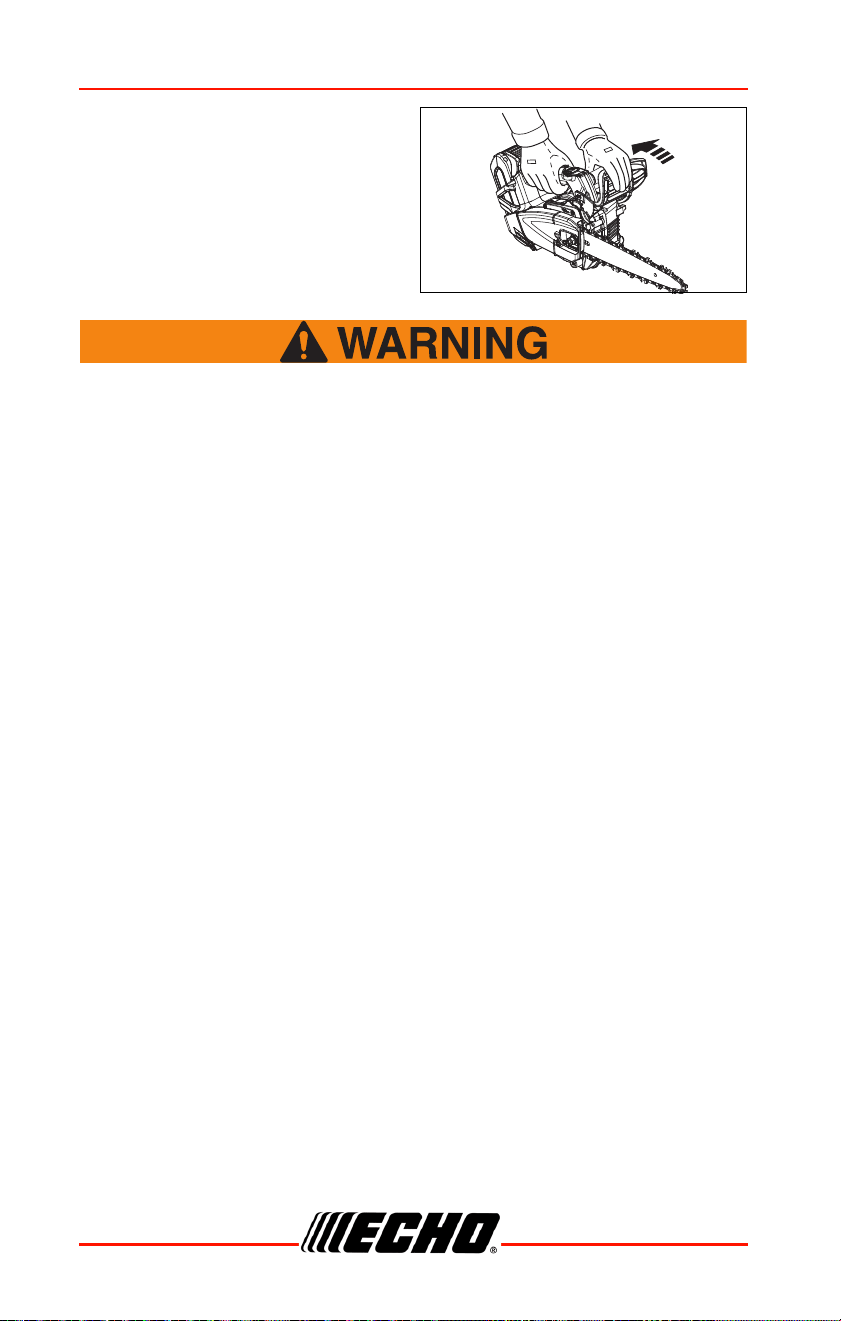
Checking the Function of the Brake
1. Place the chainsaw on the
ground.
2. Hold the handle with both hands
and accelerate the motor to high
speed by using the trigger
switch.
3. Operate the chain brake by
turning your left wrist against the
front hand guard while
maintaining your grip.
4. The chain should stop immediately.
5. Release the trigger switch.
If the chain does not stop immediately, take the chain saw to your
authorized dealer to repair.
OPERATION DCS-2500TN
42 X7508220500
© 7/23 ECHO Incorporated
Release the Chain Brake
When the hand guard is fully pulled
rearward, the chain brake is
released.
Tree Service Chainsaw
• The saw is designed for off-ground working in trees, and when being
used as such should only be used be trained operators. One handed
operation of the saw can be dangerous.
• If working off the ground the operator must be trained in safe climbing
techniques and use of all recommended safety equipment such as
harness, loops, strops, ropes and carabiners for himself and for the saw.
• When hoisting a chainsaw using a rope tied to a lifting hook for operation
on a tree, ensure that the lifting hook is not strained by excessive force
General Requirements
Operators of tree service chainsaws working at height from a rope and
harness should never work alone. A ground worker trained in appropriate
emergency procedures should assist them. Operators of tree service
chainsaws for this work should be trained in general safe climbing and
work positioning techniques and be properly equipped with harnesses,
ropes, strops, carabiners and other equipment for maintaining secure and
safe working positions for both themselves and the saw.
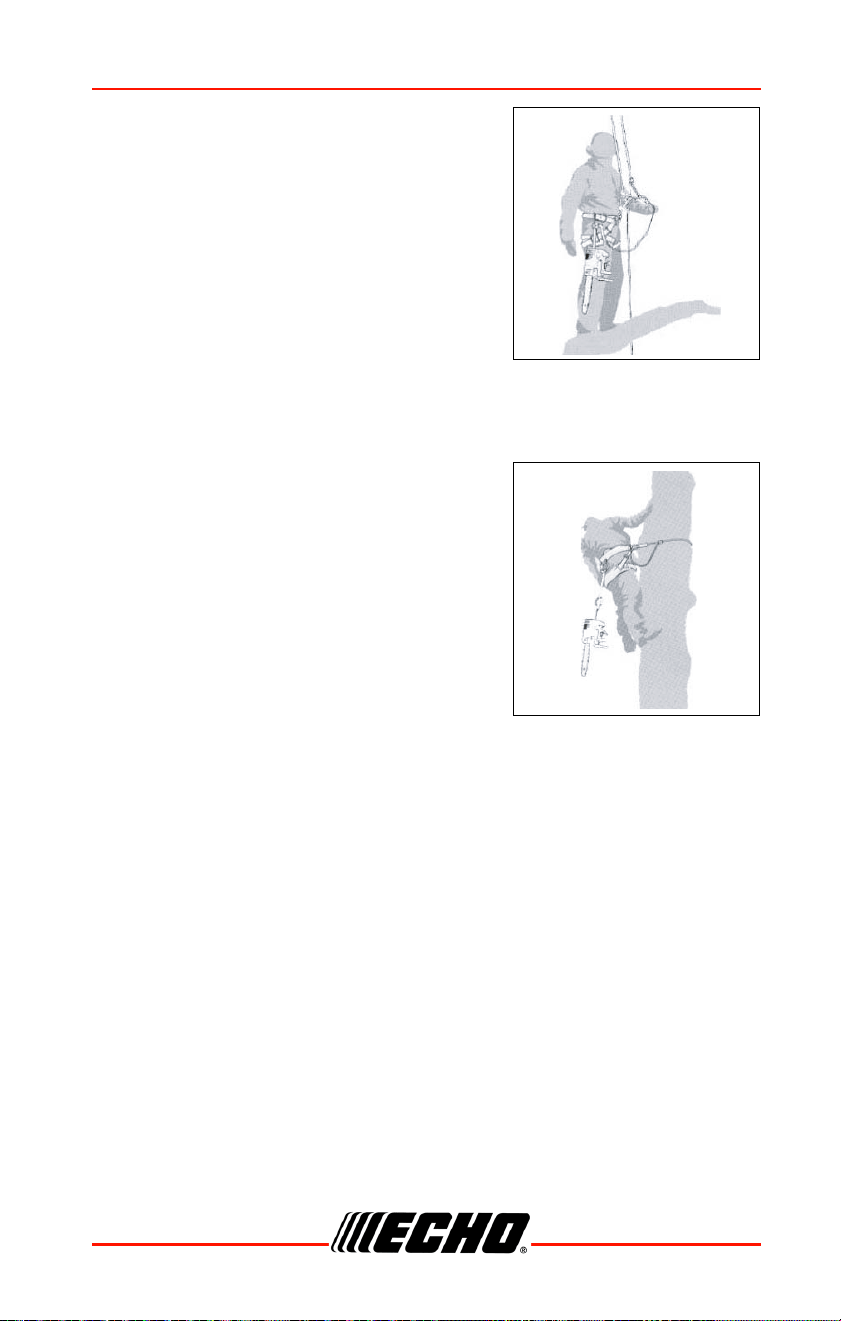
Preparing to Use the Saw in a Tree
The chainsaw should be checked by the ground worker and then switched
off before it is sent up to the operator in the tree.The chainsaw should be
fitted with a suitable strop for attachment to the operator's harness.
Example of attaching chainsaw to operator’s harness:
• secure the strop around the attachment point on the rear of the saw;
• provide suitable carabiners to allow indirect (i.e. via the strop) and direct
attachment (i.e. at the attachment point on the saw) of the saw to the
operator's harness;
• ensure the saw is securely attached when it is being sent up to the
operator;
DCS-2500TN OPERATION
X7508220500 43
© 7/23 ECHO Incorporated
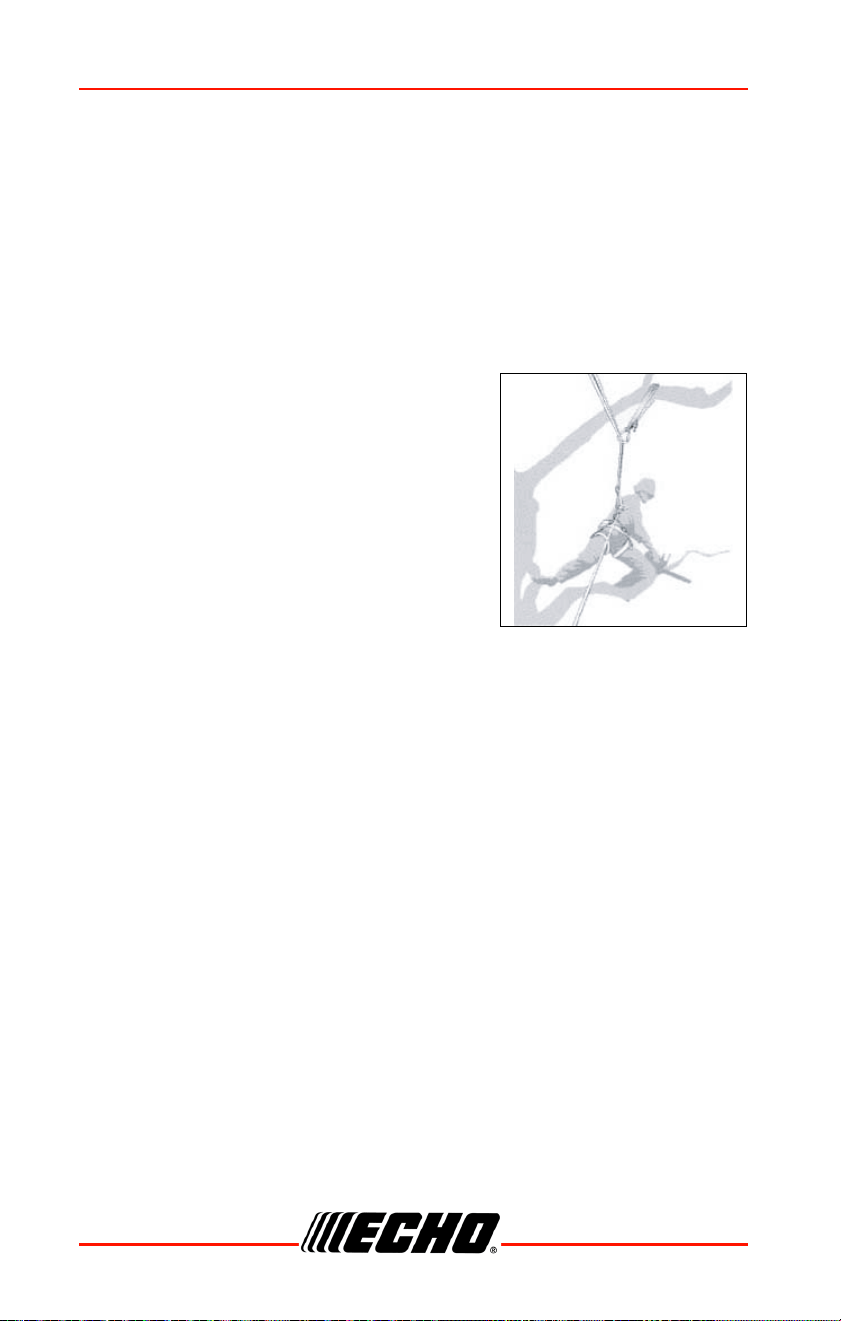
• ensure the saw is secured to the harness
before it is disconnected from the means of
ascent.
The ability to directly attach the saw to the
harness reduces the risk of damage to
equipment when moving around the tree.
Always switch the saw off when it is directly
attached to the harness.
Example of attachment of chainsaw to center rear mid-point on
harness:
The saw should only be attached to the
recommended attachment points on the
harness. These may be at mid-point (front or
rear) or at the sides. Where possible, attach
the saw to center rear mid-point to keep it
clear of climbing lines and to support its
weight centrally down the operator's spine.
When moving the saw from any one
attachment point to another, operators
should ensure it is secured in the new
position before releasing it from the previous
attachment point.
Using The Chainsaw In a Tree
An analysis of accidents with these saws during tree service operations
shows the primary cause as being one-handed use of the saw. In the vast
majority of accidents, operators fail to adopt a secure work position that
allows them to hold both handles of the saw. This results in an increased
risk of injury due to:
• not having a firm grip on the saw if it kicks back,
• a lack of control of the saw such that it is more likely to come into contact
with climbing lines and the operator's body (particularly the left hand and
arm), and
• loss of control owing to an insecure work position and resulting in contact
with the saw (unexpected movement during operation of the saw).
OPERATION DCS-2500TN
44 X7508220500
© 7/23 ECHO Incorporated
1. Securing the work position for two-handed use
In order to allow the saw to be held with both hands, as a general rule
operators should aim for a secure work position in which they operate the
saw at:
• hip level, when cutting horizontal sections, and
• solar plexus level, when cutting vertical sections.
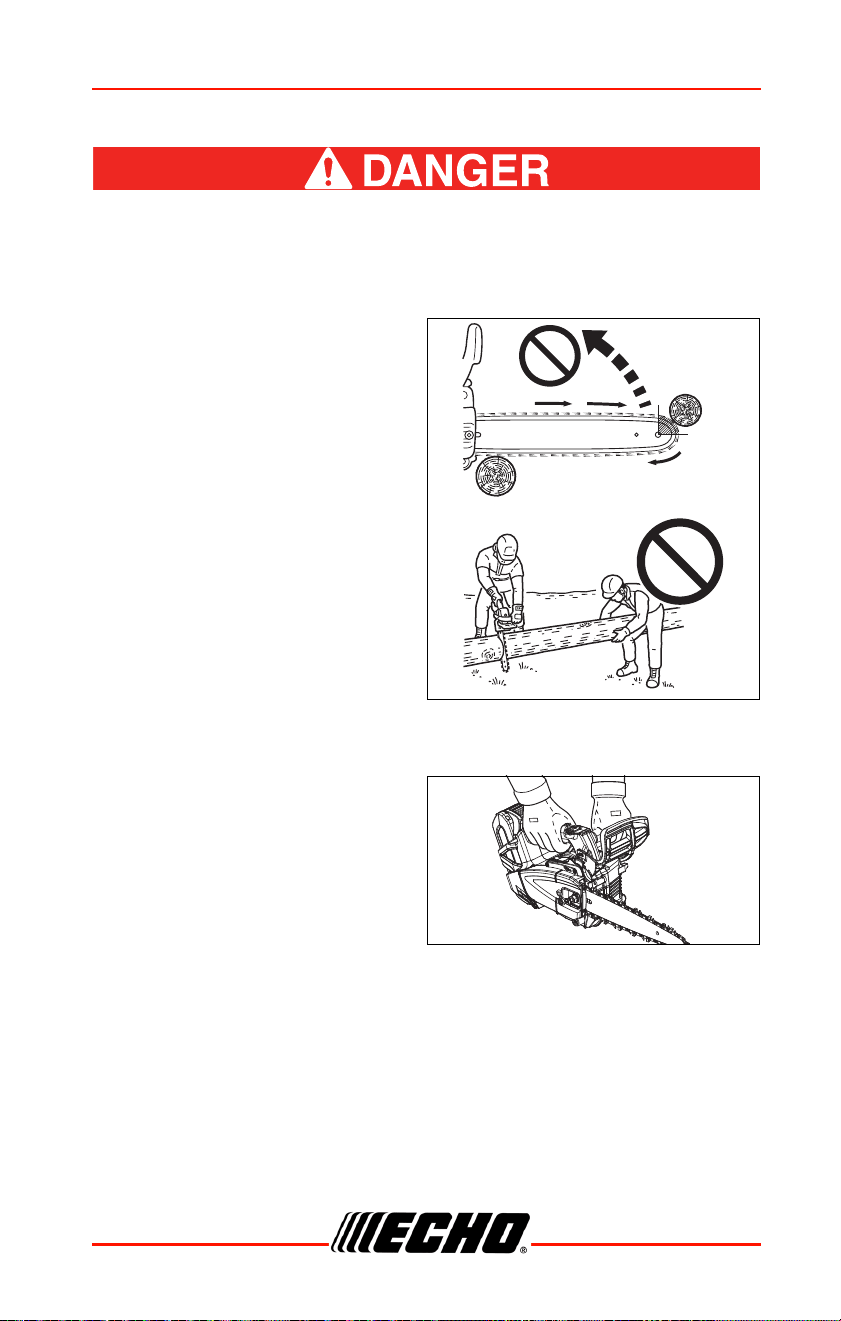
Example of redirection of the main line via supplementary anchor
point:
Where the operator is working close into
vertical stems with low lateral forces on the
work position, then a good footing could be
all that is needed to maintain a secure work
position. However, as operators move away
from the stem, they will need to take steps to
remove or counteract the increasing lateral
forces by, for example, a redirect of the main
line via a supplementary anchor point or
using an adjustable strop direct from the
harness to a supplementary anchor point.
2. Freeing a trapped saw
It the saw become trapped during cutting, operators should:
• switch off the saw and attach it securely to the tree inboard (i.e. towards
the trunk side) of the cut or to a separate tool line,
• pull the saw from the kerf while lifting the branch as necessary,
• if necessary, use a handsaw or second chainsaw to release the trapped
saw by cutting a minimum of 30 cm away from the trapped saw.
Whether a handsaw or a chainsaw is used to free a trapped saw, the
release cuts should always be outboard (toward the tips of the branch), in
order to prevent the saw being taken with the section and further
complicating the situation.
DCS-2500TN OPERATION
X7508220500 45
© 7/23 ECHO Incorporated
General Cutting Instructions - Ground Usage
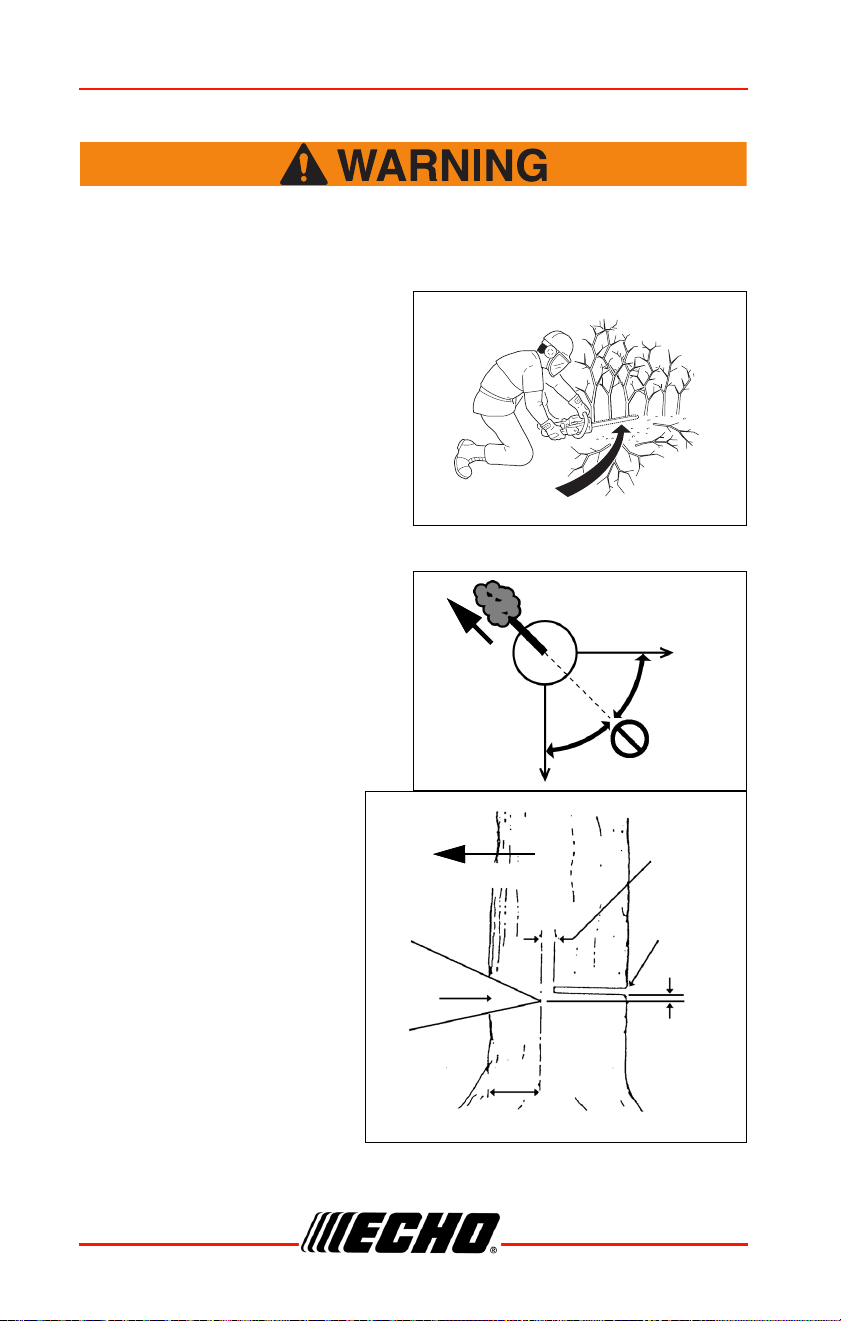
Do not let the nose or tip of the guide bar touch anything while
unit is running to avoid kickback.
General
In all circumstances the operation
of the chainsaw is a one-man job.
It is difficult at times to take care for
your own safety, so don’t assume
the responsibility for a helper as
well. After you have learned the
basic techniques of using the saw,
your best aid will be your own good
common sense.
The accepted way to hold the saw
is to stand to the left of the saw
with your left hand on the front
handle and your right hand on the
rear handle so you can operate the
trigger switch with your right index
finger. Before attempting to fell a
tree, cut some small logs or limbs.
Become thoroughly familiar with
the controls and the responses of the saw.
Start the unit, see that it is running
properly. Squeeze the trigger
switch to open the throttle wide
open and start the cut. If the chain
is properly sharpened, the cutting
should be relatively effortless. It is
not necessary to press down hard
to make the saw cut.
Some material may adversely affect the housing of your chainsaw.
(Example: palm tree acid, fertilizer etc.) To avoid housing deterioration
carefully remove all packed saw dust around sprocket and guide bar area
and wash with water.
OPERATION DCS-2500TN
46 X7508220500
© 7/23 ECHO Incorporated
Felling a Tree
Do not attempt to fell a tree until you have an understanding of
the risks and how to avoid them. Serious injury could occur to
the operator or bystanders while felling a tree.
A falling tree can seriously damage
anything it may hit - a car, a house,
a fence, a power line, or another
tree. There are ways to make a
tree fall where you want it, so first
decide where that is!
Before cutting, clear the area
around the tree. You will need
good footing while working and
you should be able to work the saw
without hitting any obstacles.
Next, select a path of retreat.
When the tree begins to fall you
should retreat away from the
direction of fall at a 45-degree
angle and at least 3 m (10 feet)
from the trunk to avoid the trunk
kicking back over the stump.
Begin the cut on the side to
which the tree is to fall.
• Notch: 1/3 of diameter and
30
o
to 45
o
angle
• Back cut: 2.5 to 5 cm higher
• Uncut hinge wood: 1/10 of
diameter
45°
45°
3 m (10 feet)
Direction of fall
First cut
Notch
Second cut
One-third tree diameter
5 cm (2 in.)
Felling cut
Hinge
5 cm (2 in.)
DCS-2500TN OPERATION
X7508220500 47
© 7/23 ECHO Incorporated
Begin the cut on the side to which
the tree is to fall. Cut a notch about
1/3 of the way into the tree. The
position of this notch is important
since the tree will try to fall “into”
the notch. The felling cut is made
on the side opposite the notch and
at a level about 5 cm (2 in.) above
the bottom of the notch. Do not try
to cut through to the notch with the
felling cut. The remaining wood
between the notch cut and felling
cut about 5 cm (2 in.) will act as a
hinge when the tree falls, guiding it
in the desired direction. When the
tree starts to fall, kill the engine, place the saw on the ground and make
your retreat quickly.
Limbing
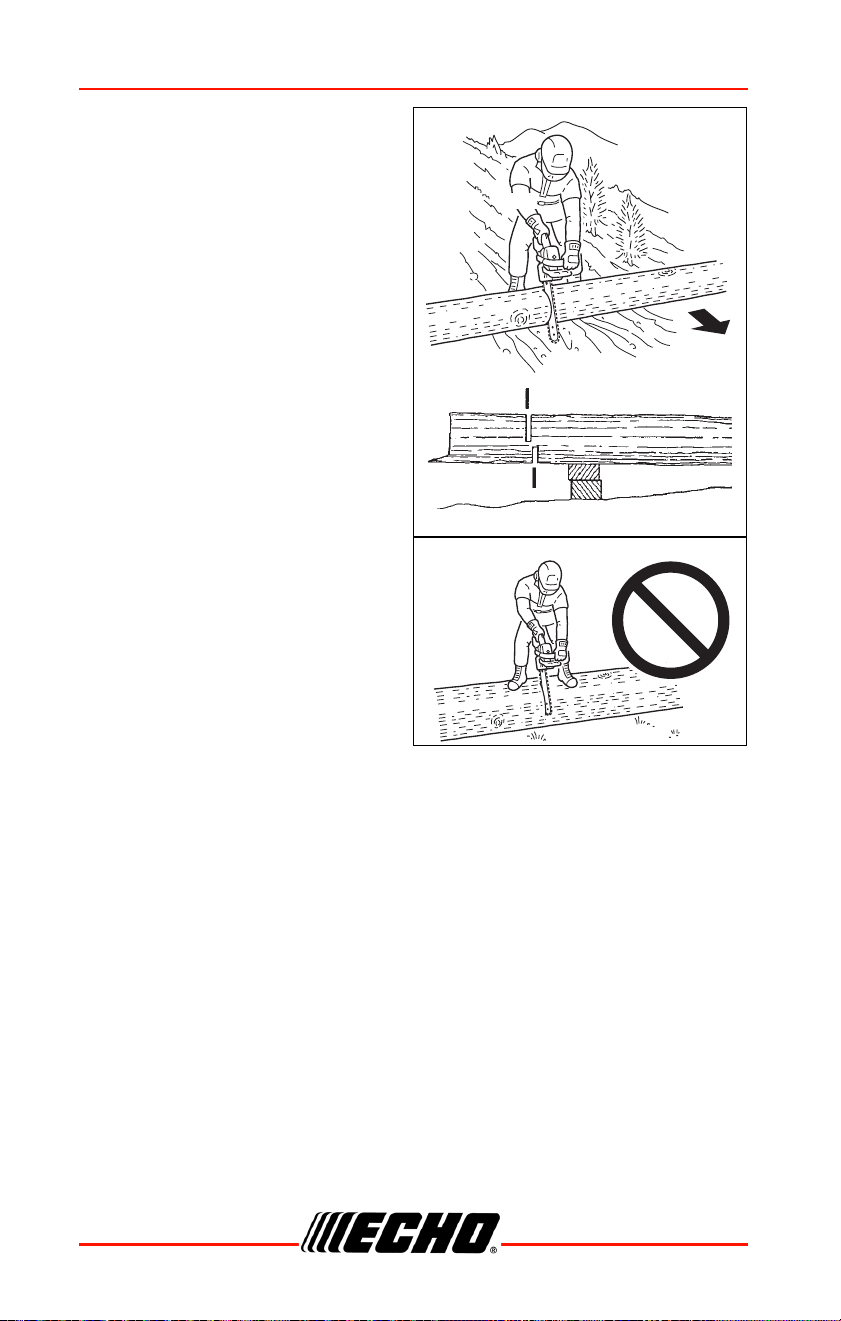
Don’t cut above chest height.
Limbing a fallen tree is much the
same as bucking. Never stand on
the tree that you are limbing. When
limbing, caution is the word. Be
careful of the tip touching other
limbs. Always use both hands.
Don’t cut with the saw overhead or
aligned vertically with your body. If
the saw should kick back, you may
not have enough control to prevent
possible injury.
Know how the limb is stressed.
If you have thick branches, work from the outside to the inside to avoid
your bar and chain getting stuck. Even when limbing, use of the spiked
bumper makes it easy to control the saw and lessens kickback.
OPERATION DCS-2500TN
48 X7508220500
© 7/23 ECHO Incorporated
Bucking
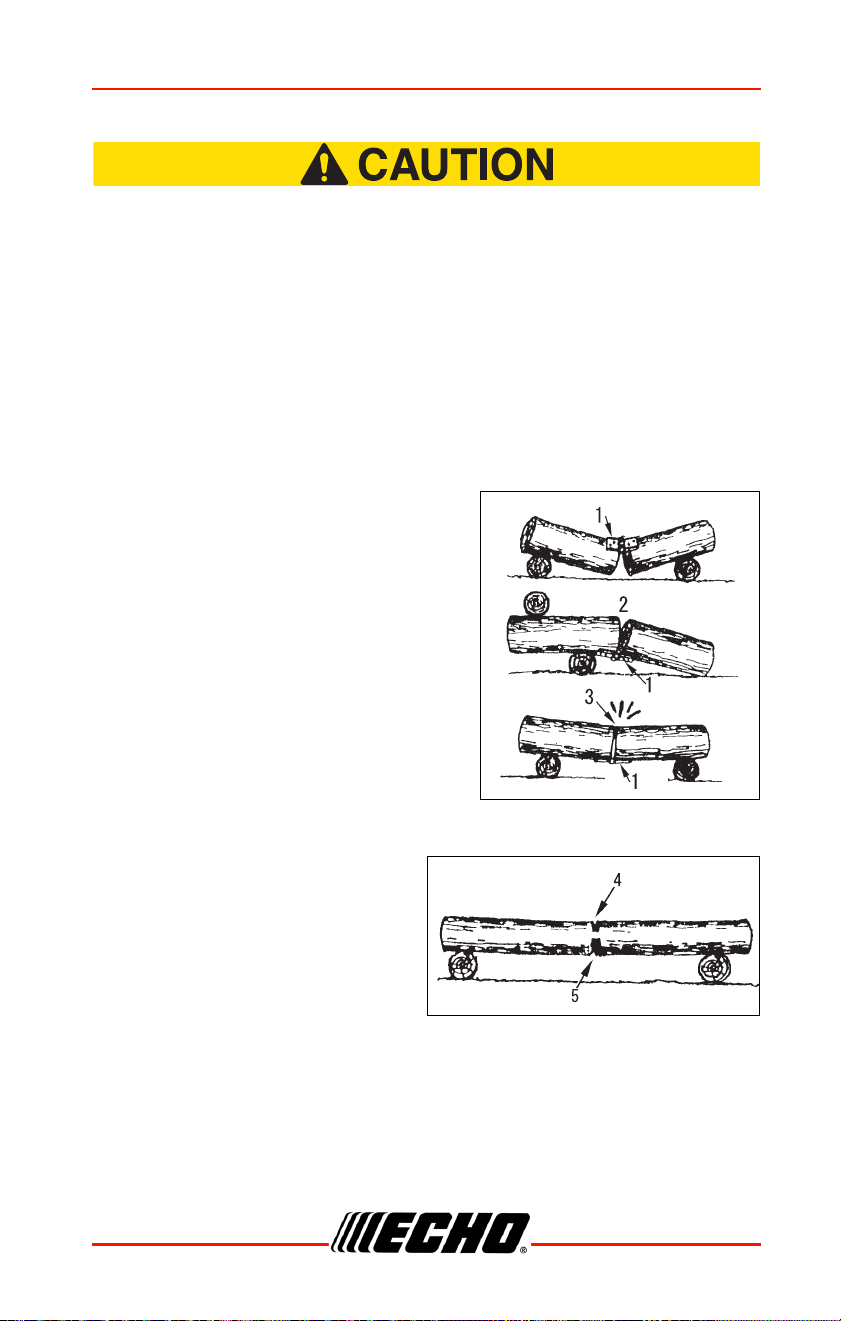
Bucking is the sawing of a log or
fallen tree into smaller pieces.
There are a few basic rules which
apply to all bucking operations.
• Keep both hands on the handles
at all times.
• Support logs if possible.
• When cutting on a slope or
hillside, always stand uphill.
• Never stand on the log.
Keep in mind that the wood is
heavy and that it will bend and
pinch the saw if improperly
supported. The trunk will weaken
at the point where you make the
cut unless the tree is lying on
perfectly flat ground or supported
as shown. If you make the cut with
the tree on the ground, don’t let the
saw’s chain dig into the earth; it is harmful for the saw, and you stand a
good chance of being struck by flying debris.
To cut the trunk, use the bucking and two-cut sequence shown. The first
cut should be no deeper than one-third the trunk diameter.
Support
Finish cut
Uphill Position
First cut
DCS-2500TN OPERATION
X7508220500 49
© 7/23 ECHO Incorporated
Tension and Compression in Timber
If you have misjudged the effects of tension and compression,
and cut from the wrong side, the timber will pinch the guide bar
and chain, trapping it. If the chain should become jammed and
the saw can not be removed from the cut do not force it out. Stop
the saw, force a wedge into the cut to open it up. Never force the
saw when it is jammed. Do not force the saw into the cut. A dull
chain is unsafe and will cause excessive wear to the cutting
attachments. A good way to tell when the chain is dull is when
fine saw dust comes out instead of chips.
A length of timber lying on the ground will
be subject to tension and compression,
depending at which points the major
support is. When timber is supported at
its ends the compression side is at the
top and the tension side is at the bottom.
To cut between these support points,
make the first cut downwards
approximately 1/3rd the timber diameter.
The second cut is made upwards and
should meet the first cut. (1. hinge, 2.
open, 3. closed)
Heavy Stress
When the timber is supported at
one end only, make the first cut
upwards approximately 1/3rd the
timber diameter. The second cut is
made downwards and should meet
the first cut. (4. 1/3 diameter to
avoid split, 5. weakening cut to
finish)
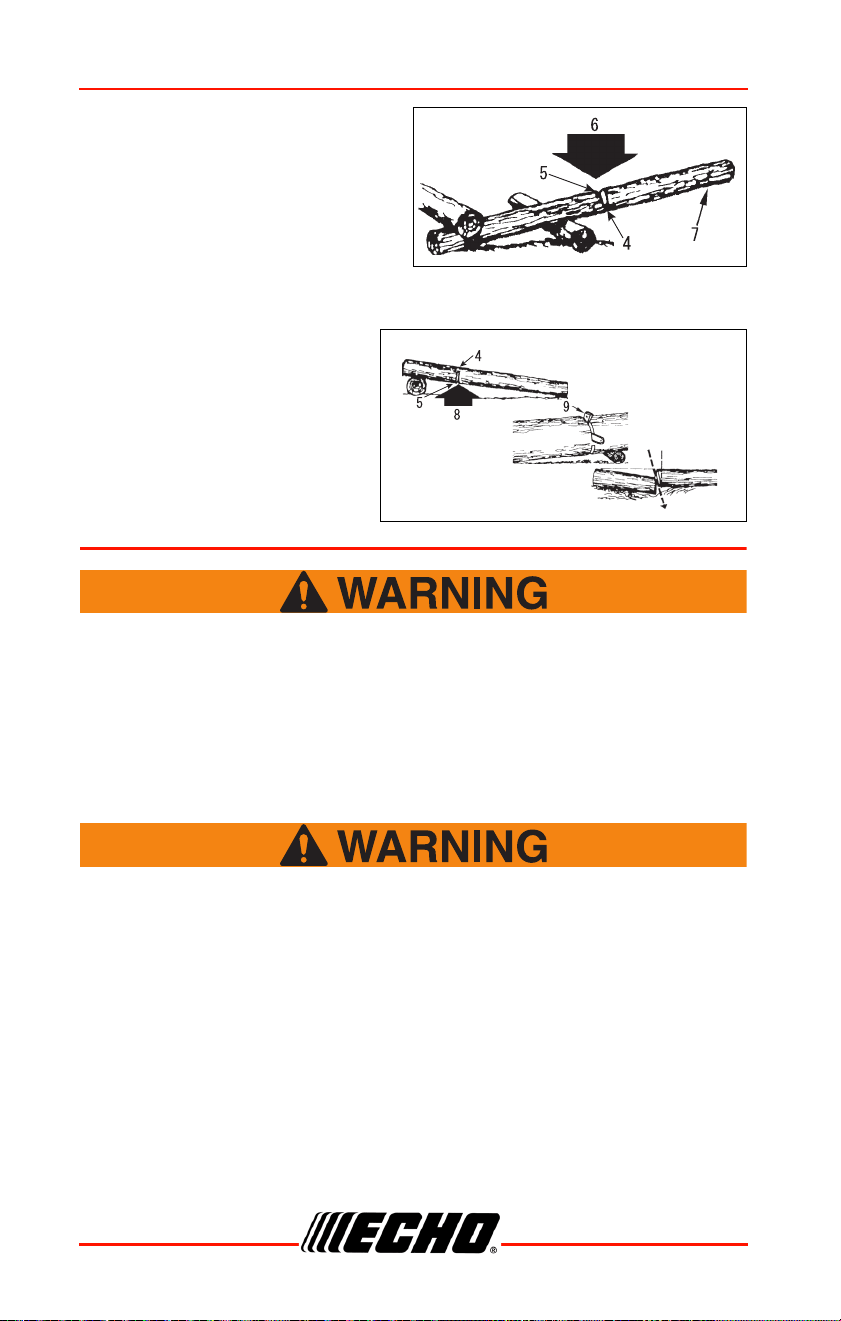
MAINTENANCE DCS-2500TN
50 X7508220500
© 7/23 ECHO Incorporated
Overbuck (6. down, 7.
unsupported end)
Underbuck
Make angled cut when one
section may settle against the
other.
(8. up, 9. wedge)
MAINTENANCE
Moving parts can amputate fingers or cause severe injuries.
Keep hands, clothing and loose objects away from all openings.
Always stop unit and make sure all moving parts have come to
a complete stop before removing obstructions, clearing debris,
or servicing unit. Allow unit to cool before performing service.
Wear gloves to protect hands from sharp edges and hot
surfaces.
Operating a poorly maintained unit can result in serious injuries
to operator or bystanders. Always follow all maintenance
instructions as written, otherwise serious personal injury can
result.
Your unit is designed to provide many hours of trouble-free service.
Regular scheduled maintenance will help your unit achieve that goal. If you
are unsure or are not equipped with the necessary tools, we recommend
that you take your unit to a Servicing Dealer for maintenance. To help you
decide whether you want to DO-IT-YOURSELF or have the Dealer do it,
each maintenance task has been graded. If the task is not listed, see your
Dealer for repairs.
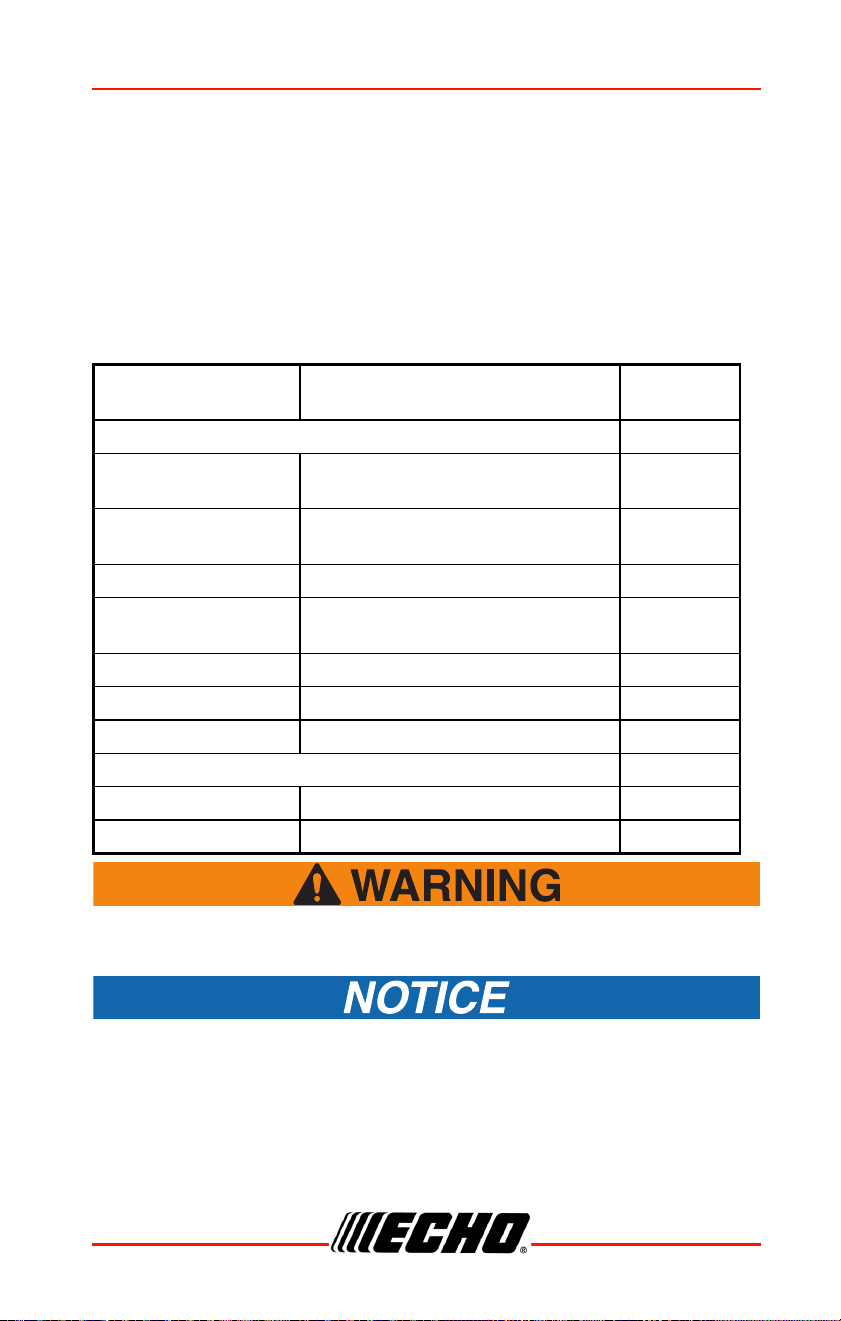
DCS-2500TN MAINTENANCE
X7508220500 51
© 7/23 ECHO Incorporated
Skill Levels
Level 1 = Easy to do. Common tools may be required.
Level 2 = Moderate difficulty. Some specialized tools may be required.
Level 3 = See your dealer.
Click HERE or go to http://www.echo-usa.com/products/maintenance-kit
Servicing Guidelines
If not maintained properly, the product may pose a serious risk
to physical health.
If not maintained properly, the product's performance may
deteriorate. Time intervals shown are maximum. Actual use and your
experience will determine the frequency of required maintenance. If
you continuously use vegetable based chain oil, inspect and do
maintenance often. When you find anything wrong, ask your ECHO
dealer for repair.
COMPONENT OR
SYSTEM
MAINTENANCE PROCEDURE Skill Level
Daily Or Before Use
Saw Chain
Inspect / Sharpen / Replace /
Clean
2
Battery / Battery
Compartment
Inspect / Clean / Charge
1
Guide Bar Inspect / Clean 1
Cooling System / Air
Filter
Inspect / Clean / Replace
2
Chain Brake Inspect / Clean / Replace 2
Screws / Nuts / Bolts Inspect / Tighten / Replace 1
Monthly
Oil Filter / Oil Tank Inspect / Clean / Replace 1
Sprocket Inspect / Replace 2
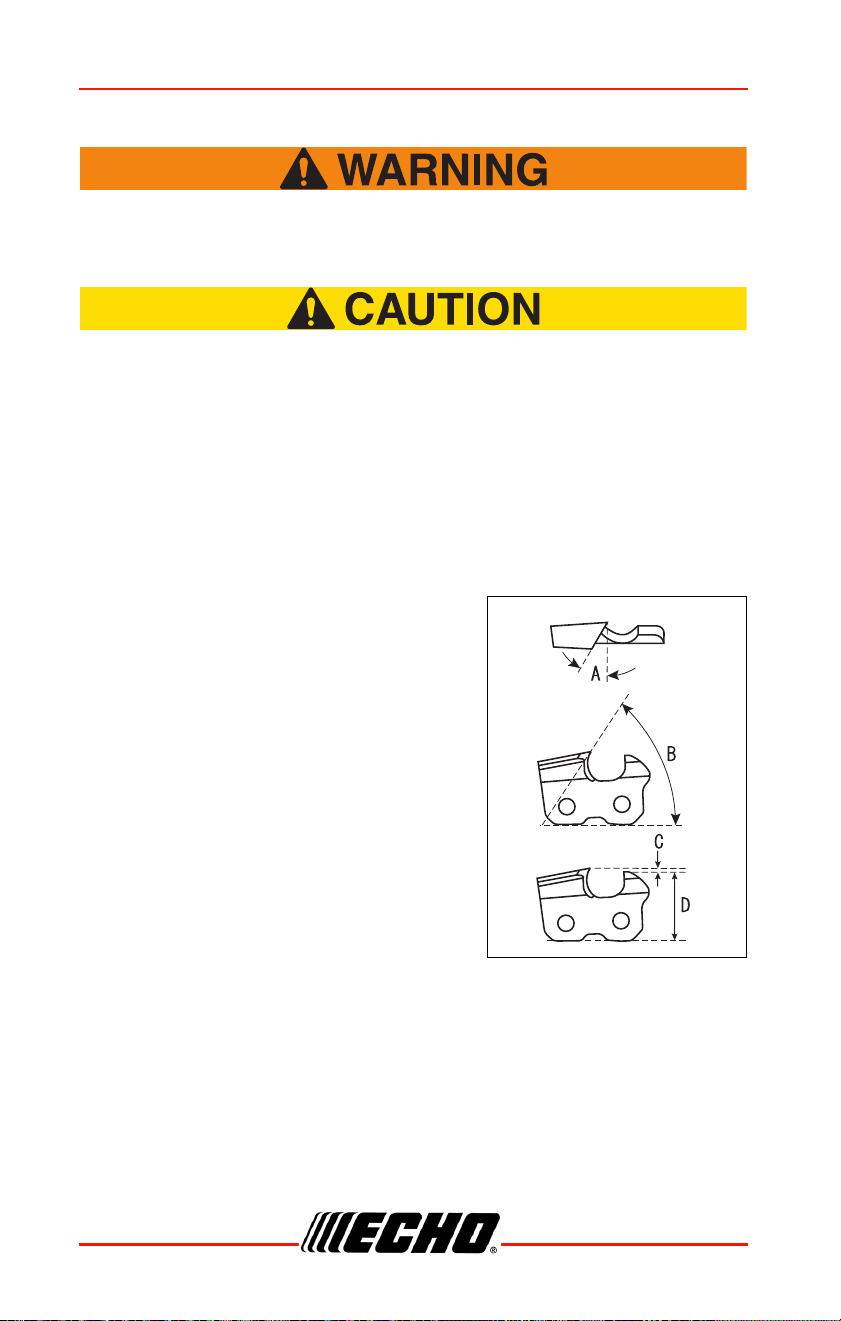
MAINTENANCE DCS-2500TN
52 X7508220500
© 7/23 ECHO Incorporated
Saw Chain Maintenance
Remove the battery before sharpening chain. Always wear
gloves when working on chain. Otherwise serious personal
injury may result.
The following factors will increase the risk of kickback:
◆ Top plate angle too large
◆ File diameter too small
◆ Depth gauge too large
Note: These angles are referred to as 80TXL. For chains of other
brands, follow manufacturers instructions.
Properly filed cutters are shown below.
A. Top plate angle 80TXL 25°
B. Top plate cutting angle 80TXL; 70°
C. Depth gauge 80TXL; 0.025 in
D. Parallel
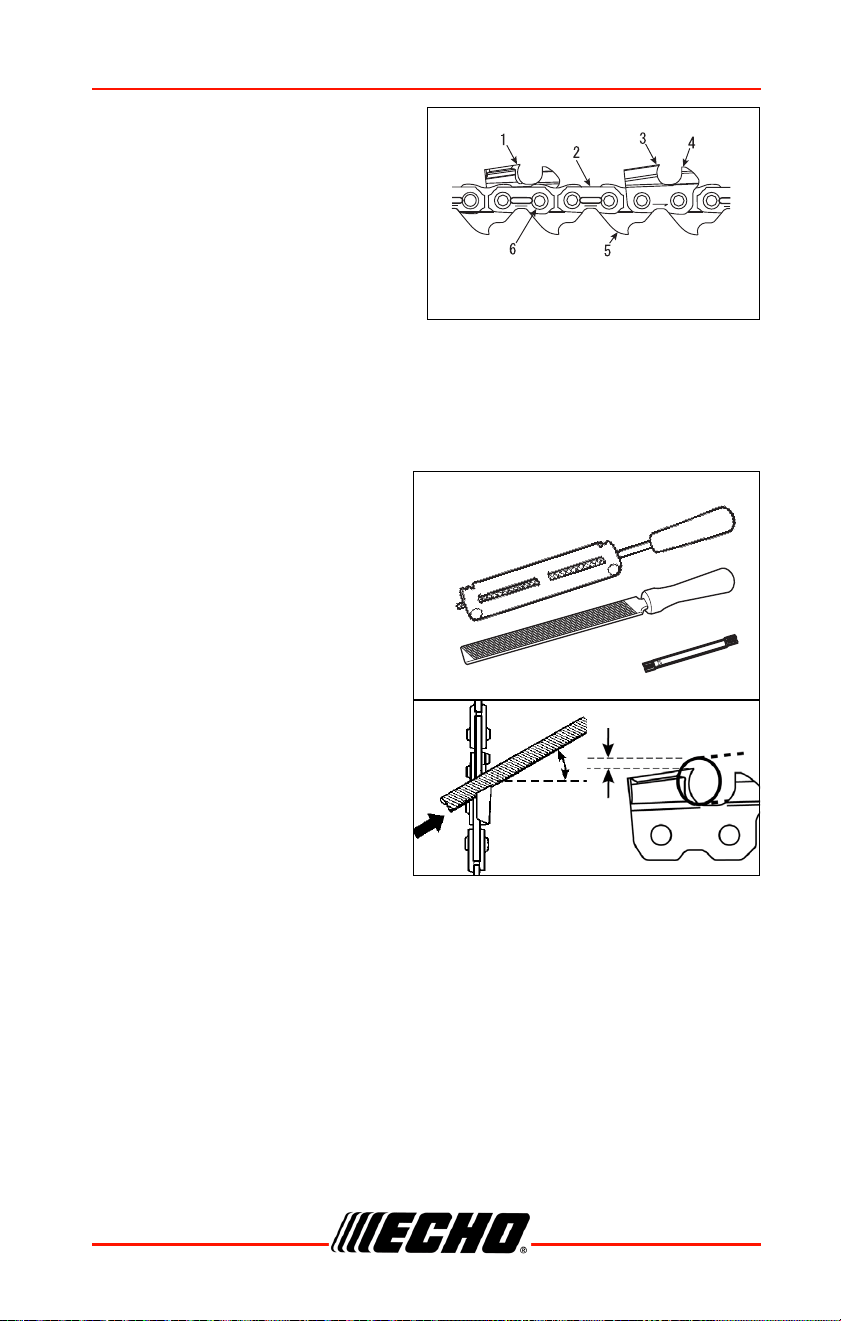
DCS-2500TN MAINTENANCE
X7508220500 53
© 7/23 ECHO Incorporated
Never operate a chainsaw with a
dull or damaged chain. If the chain
requires excessive pressure to cut
or produces dust instead of wood
chips then inspect the cutters for
damage. When sharpening the
chain the objective will be to
maintain the same angles and
profiles throughout its life as when
it was new. Inspect the chain for
damage or wear every time you
use your chainsaw.
Sharpening
In order to file the chain correctly
you need: round file and file
holder, flat file and a depth gauge
tool. By using the correct file size
(80TXL; 5/32 in. round file) and a
file holder, it is easier to receive a
good result.
Consult your ECHO dealer for
correct sharpening tools and
sizes
1. Lock the chain - push the front
hand guard forward. To rotate
the chain - pull the front hand
guard against front handle.
2. Your chain will have
alternative left and right hand cutters. Always sharpen from the inside
out.
3. Keep the angle lines of the file holder parallel to the line of the chain
and file the cutter back until the damaged area (side plate and top
plate) has been removed.
25°
.025 in.
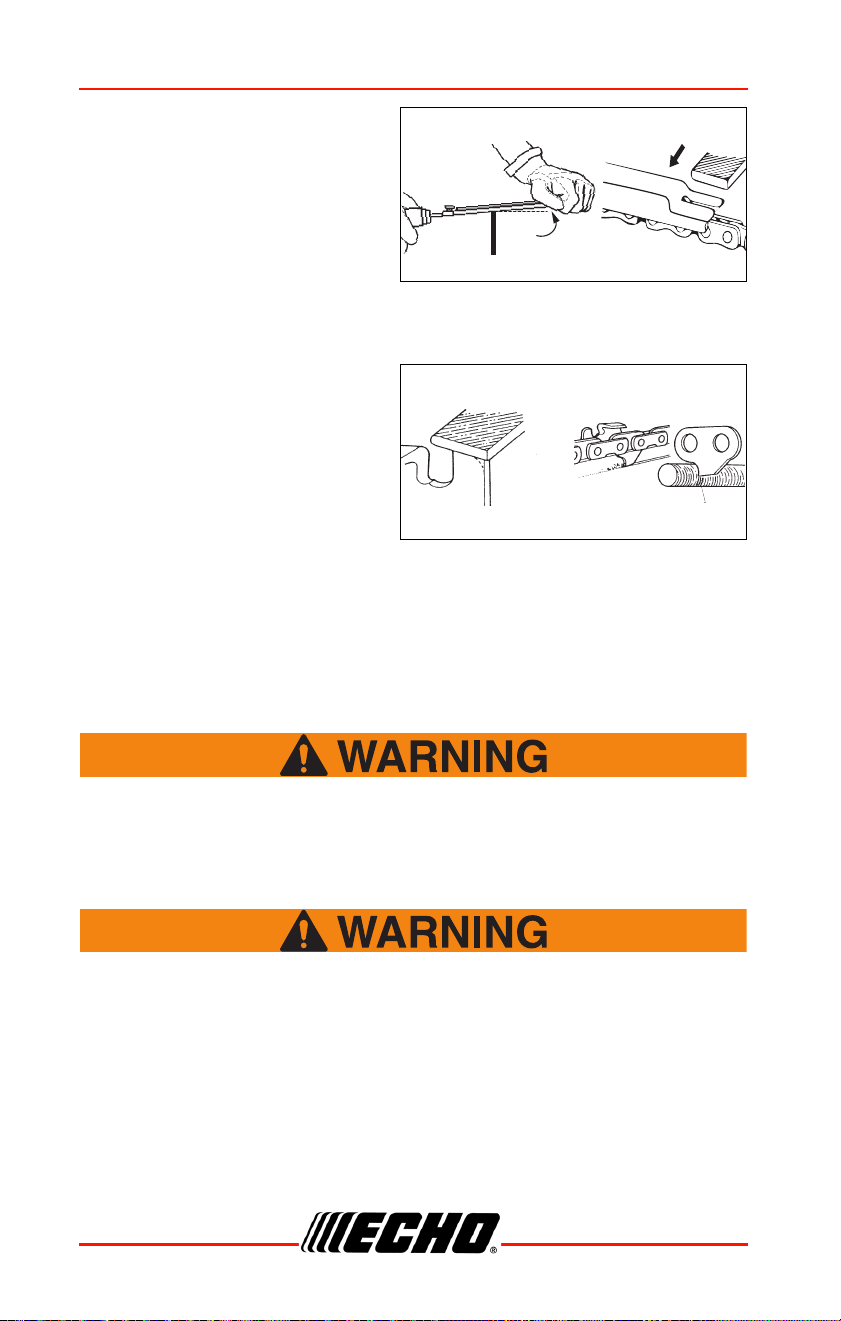
MAINTENANCE DCS-2500TN
54 X7508220500
© 7/23 ECHO Incorporated
4. Hold the file horizontally.
5. Avoid touching the tie straps
with the file.
6. Sharpen the most damaged
cutter first and then take all
the other cutters back to the
same length.
7. The depth control determines
the thickness of wood chip produced and must be maintained correctly
throughout the chain life.
8. As the cutter length is
reduced, the depth control
height is altered and must be
reduced.
9. Position the depth gauge, and
file off any of the depth control
which protrudes.
10. Round off the front of the
depth control to allow smooth cutting.
11. Drive link serves to remove sawdust from the groove of the guide bar.
Therefore, keep the lower edge of the drive link sharp.
Maintenance and Care
Remove battery before performing maintenance procedures.
Cleaning battery and battery compartment
Risk of electric shock or fire. Do not use conducting materials
to clean battery or battery compartment. Otherwise serious
personal injury may result.
10°
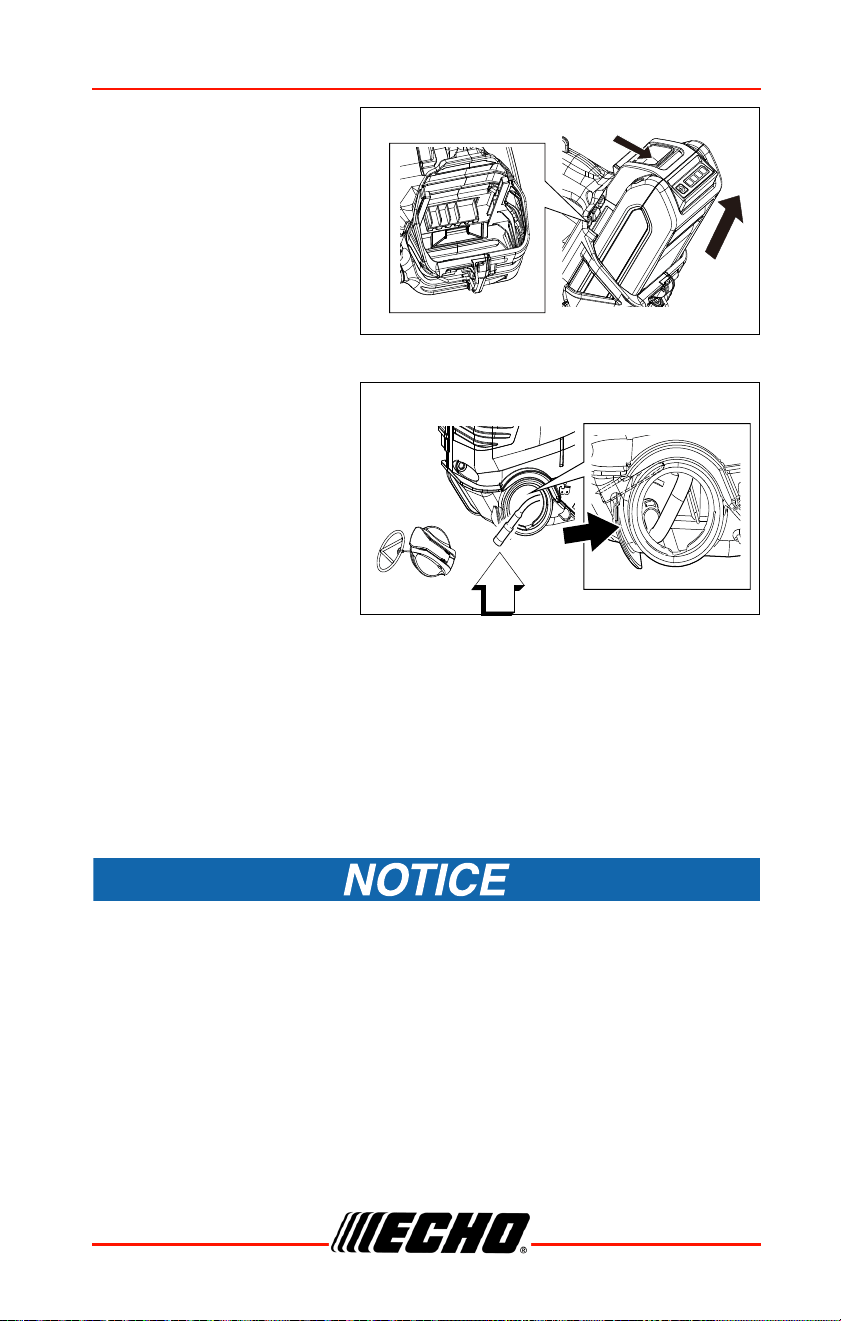
DCS-2500TN MAINTENANCE
X7508220500 55
© 7/23 ECHO Incorporated
1. Depress battery latch
release slide battery out
of saw.
2. Use compressed air or
a soft bristle brush to
remove debris from
battery and battery
compartment.
Oil Filter
1. Do not allow dust to
enter oil tank
2. A clogged oil filter will
affect the normal
lubricating system.
3. Remove filter (A)
through oil filling hole
with a piece of steel
wire or the like.
4. If the oil filter is dirty,
clean it with gasoline or replace it.
5. Install the oil filter as shown.
6. When the inside of the tank gets dirty, rinse the tank out with gasoline to
clean it.
7. Remove debris from O ring and thread of oil tank cap.
Guide Bar
Do not degrease brake drums and brake bands. After cleaning, apply
a thin oil between the brake drum and the brake band.
A
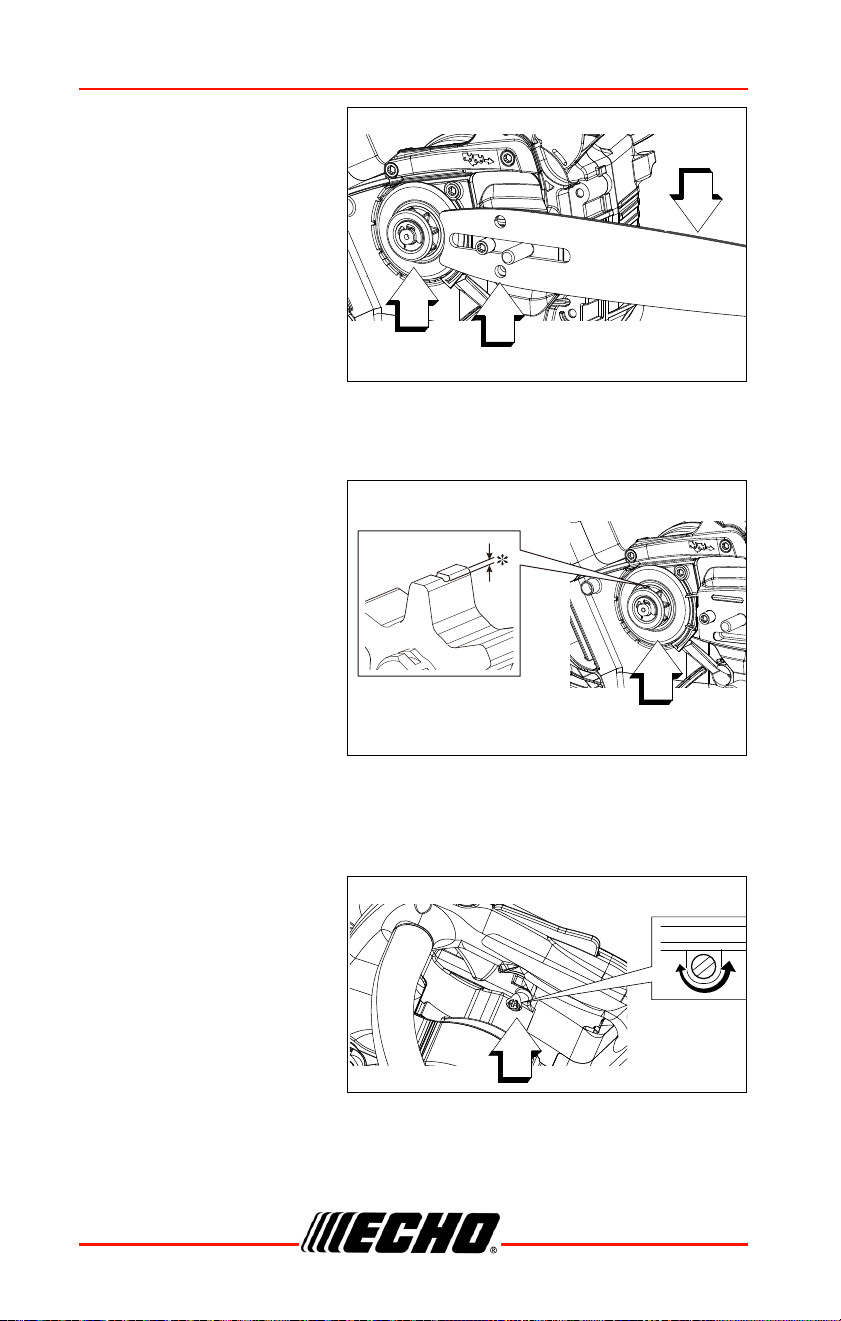
MAINTENANCE DCS-2500TN
56 X7508220500
© 7/23 ECHO Incorporated
1. Clean before using. Use
a small screwdriver or
wire to clean the guide
bar groove (B). Clean
oil holes (C) with a wire.
2. Reverse the bar
periodically.
3. Check sprocket (D) and
clean the bar mount
area before installation
of the guide bar.
Replace either if worn.
Sprocket
1. A damaged sprocket
can cause premature
damage or wear to saw
chain.
2. Check sprocket when
you install new chain.
Replace if worn 0.5 mm
or more.
3. Check brake drum (E).
If it will not rotate by
hand, see your
authorized dealer for
repair.
Automatic Oiler
1. The discharge volume
of the automatic oiler is
adjusted to 7 mL/min
approximately at 7000 r/
min, prior to shipment
from factory.
2. To increase the delivery
volume, turn the
adjusting screw (F)
counterclockwise.
3. When adjusting screw touches stops, it has reached maximum
discharge volume. (13 mL/min at 7000 r/min).
B
C
D
E
F
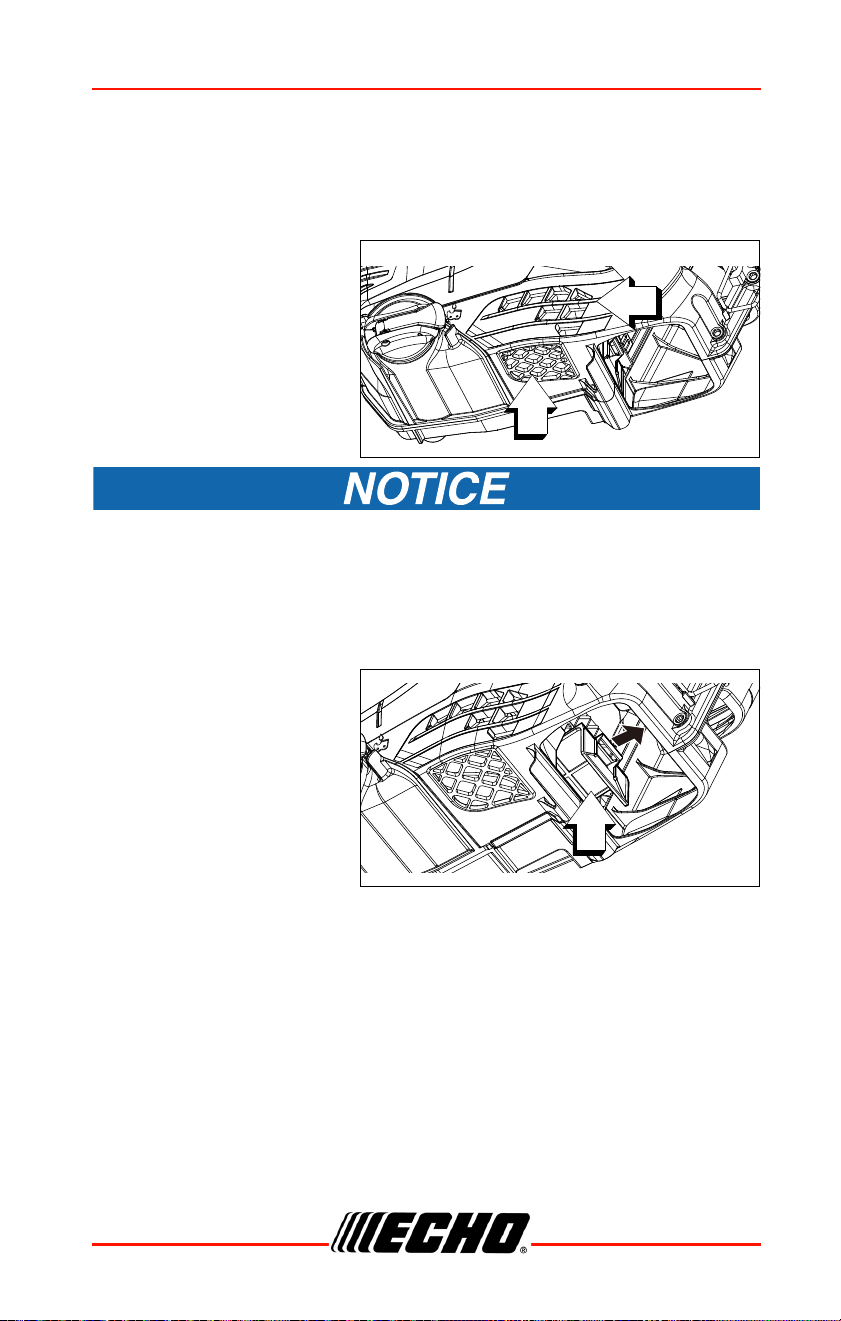
DCS-2500TN MAINTENANCE
X7508220500 57
© 7/23 ECHO Incorporated
4. Do not turn the adjusting screw beyond the maximum or minimum limit
of volume adjustment.
Cooling System
1. Check periodically.
2. Remove debris blocking
air inlet (G) and outlet
(H).
Clean the unit with the air filter attached to it in order to prevent trash
from entering inside.
Air Filter
1. Remove battery.
2. Remove air filter (I).
3. Clean air filter area with
compressed air.
4. Brush debris from filter.
If filter is excessively
dirty or no longer fits
properly, replace it.
5. Dry filter completely.
6. Reinstall filter.
C
G
H
I

MAINTENANCE DCS-2500TN
58 X7508220500
© 7/23 ECHO Incorporated
Replacement Guide Bar and Chain
Only use replacement bars and chains specified by the manufacture
or the equivalent. Otherwise, there may be a risk of accidents and
damage to the machine.
BAR P/N CHAIN P/N
CHAIN
TYPE
LINKS PITCH GAUGE
305 mm (12 in.)
narrow bar
P/N
12A4CD3351
80TXL51C
Q
80 51
0.325
in.
0.043
in.
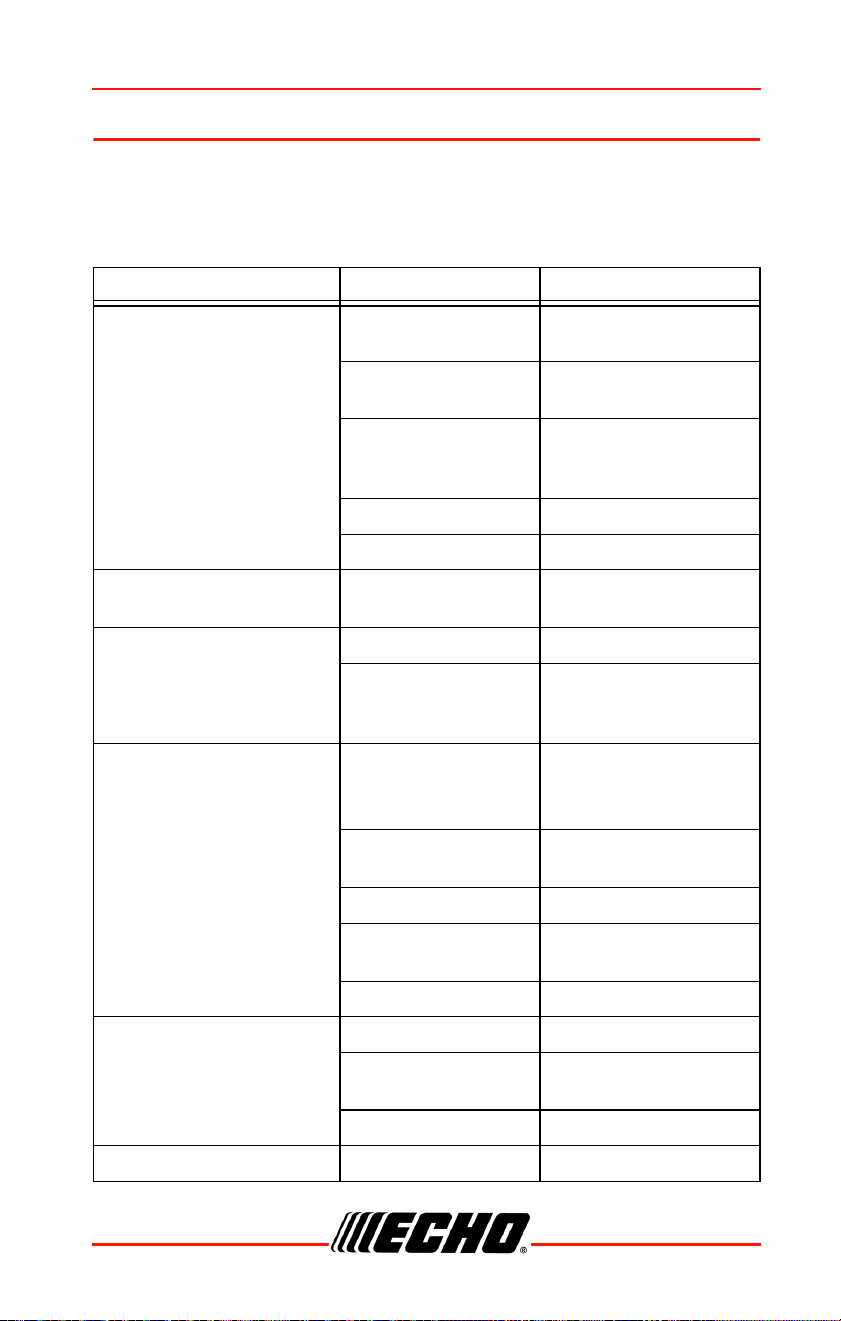
DCS-2500TN TROUBLESHOOTING
X7508220500 59
© 7/23 ECHO Incorporated
TROUBLESHOOTING
Trouble Cause Solution
Red Charger LED flashes or
does not light up
Plug not connected to
power outlet
Plug in the charger
Battery not installed
properly
Check the battery
installation
Obstructed connection Reinstall battery again
after remove obstructions
from connection
Fault in the charger Consult your dealer
Fault in the battery Consult your dealer
Unit will not turn on Battery not installed
properly
Check the battery
installation
Unit does not run when
turned on
Battery discharged Charge the battery
Battery outside
acceptable
temperature range
Remove the battery and
allow to cool
Running time is too short
Battery outside
acceptable
temperature range
Remove the battery and
allow to cool
Unit electronics too hot Turn unit off and allow to
cool
Battery discharged Charge the battery
Cutting attachment
dirty
Clean the cutting
attachment
Chain tension too hight Readjust chain tension
Chain oil does not come out No oil in the oil tank Fill the chain oil
Clogged chain oil pipe
or oil filter
Clean the chain oil pipe
and oil filter
Fault in the oil passage Consult your dealer
Unit vibrates excessively Fault in internal parts Consult your dealer

STORAGE DCS-2500TN
60 X7508220500
© 7/23 ECHO Incorporated
Checking and maintenance requires specialist knowledge. If you are
unable to check and maintain the product or deal with a fault yourself,
consult your dealer. Do not attempt to dismantle the product. Consult your
dealer in the event of a problem that is not covered in the table above, or
other such concerns. For spare parts and consumables, please use only
genuine parts and designated products and components. Using parts from
other manufacturers or non-designated components may result in a
malfunction.
STORAGE
Storage
Do Not Store In An Enclosure Where Combustible Fumes May
Accumulate. Fire May Result.
When storing the product for long periods of time, ensure that the following
preparations for storage are carried out.
Chain Saw
Do not store your unit without performing protective storage maintenance
which includes the following:
1. Turn power to unit off.
2. Remove Battery.
3. Remove accumulation of dirt and debris from exterior of unit.
4. Tighten all screws and nuts.
5. Install guide bar cover.
6. Cover battery compartment of chain saw.
7. Store unit in a dry, dust-free place out of the reach of children.
Battery
1. Remove battery from chainsaw.
2. Store in a dry, dust-free place, out of the reach of children.
3. Store in temperatures consistent with recommended ambient
temperature chart.
4. If battery is stored for longer than one year, charge it to 100% capacity.
DCS-2500TN STORAGE
X7508220500 61
© 7/23 ECHO Incorporated
Charger
1. Remove battery from charger.
2. Disconnect charger from power supply.
3. Store in a dry, dust-free place, out of the reach of children.
Disposal
Major plastic parts making up the product have
codes showing their materials. The codes refer to
the following materials; dispose of those plastic
parts in accordance with local regulations.
• Battery contains lithium. Dispose of only at a designated collection point.
• Lithium-ion batteries must be disposed of properly.
• Please contact your dealer in case you do not know how to dispose of or
recycle waste plastic parts.
Materials
Mark Material
>PA6-GF< Nylon 6 - Glass fiber
>PA66-GF< Nylon 66 - Glass fiber
>PP-GF< Polypropylene - Glass fiber
>PE-HD< Polyethylene
>POM< Polyoxymethylene
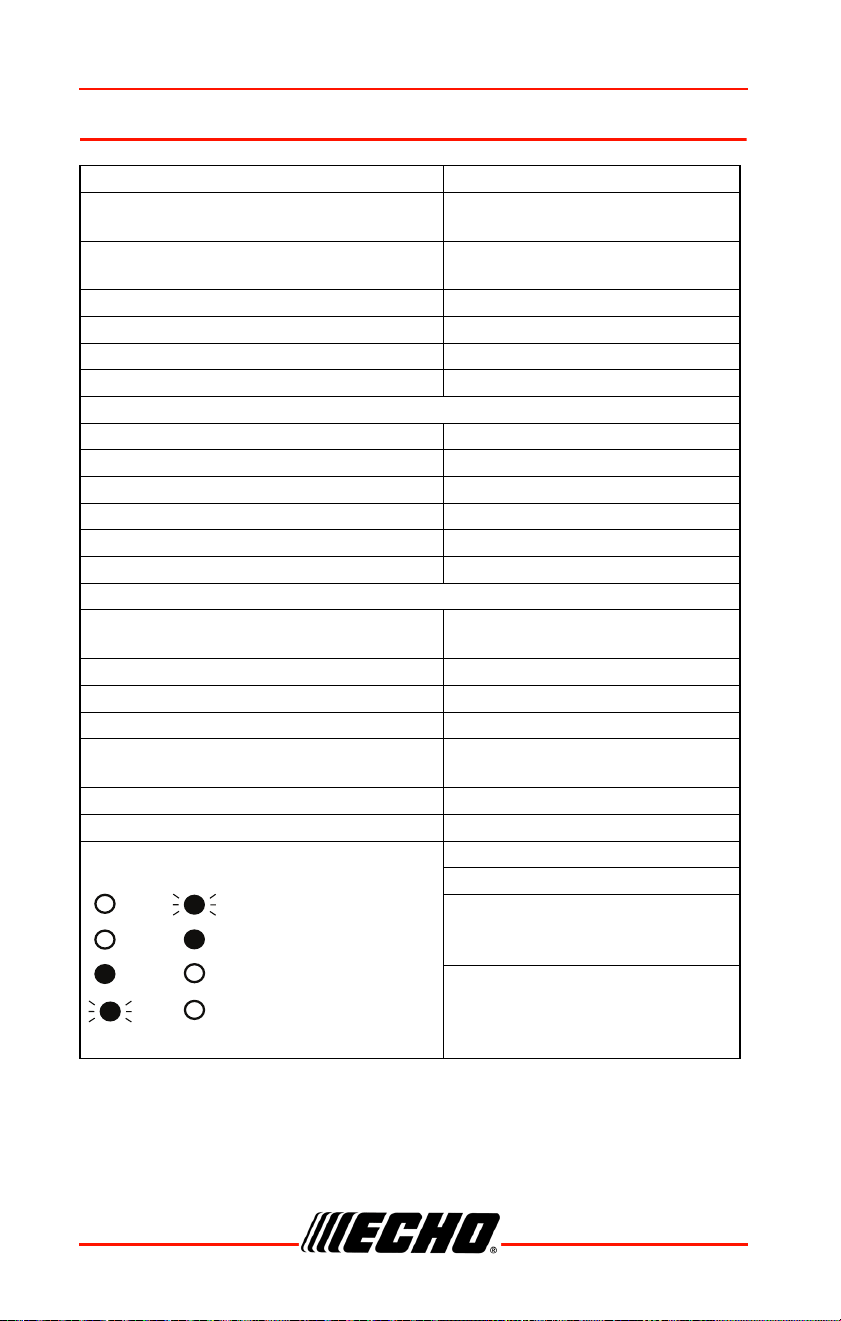
SPECIFICATIONS DCS-2500TN
62 X7508220500
© 7/23 ECHO Incorporated
SPECIFICATIONS
These specifications are subject to change without notice.
MODEL DCS-2500TN
Weight without battery, guide bar, saw chain
and chain oil
1.7 kg (3.7 lb.)
External Dimensions: length × width × height
260 × 188 × 209 mm (10.2 x 7.4 x 8.2
in.)
Chain oil capacity 120 mL (4.06 US fl. oz.)
Oiling system Automatic adjustable oiler
Hand guard Front and rear hand guards
Chain brake Manual and non manual band brake
Guide bar and saw chain:
Guide bar .050 in. gauge, sprocket nose
Bar length 12 in.
Saw Chain Oregon 80TXL (3/8 in. pitch)
Sprocket type Spur type, 6-tooth, 3/8 pitch
Chain speed 19.1 m/s
Chain tensioner Side access system
Battery
ECHO eFORCE™ 56V series 2.5
AH batteries
Type Li-Ion
Pack voltage 56 (rated 50.4)
Capacity 2.5 Ah/126 Wh
Charger type
ECHO eFORCE™ 56V series
charger
Charger input voltage 120V AC 60Hz
Charging time See battery manual
Green blinking - battery is charging
Green - battery is fully charged
Red - Battery is too warm. Remove
for approximately 30 minutes to cool
down
Red blinking - Defective battery.
Remove and replace with new
battery
Charger Lights
OFF Green blinking
OFF Green
Red OFF
Red OFF
blinking

DCS-2500TN PRODUCT REGISTRATION
X7508220500 63
© 7/23 ECHO Incorporated
PRODUCT REGISTRATION
Thank you for choosing ECHO Power Equipment
Please go to http://www.echo-usa.com/Warranty/Register-Your-ECHO to
register your new product on-line. It's FAST and EASY! NOTE: your
information will never be sold or misused by ECHO, Incorporated.
Registering your purchase enables us to contact you in the unlikely event
of a service update or product recall, and verifies your ownership for
warranty consideration.
If you do not have access to the Internet, you can complete the form below
and mail to:
ECHO Incorporated, Product Registration, PO Box 1139,
Lake Zurich, IL 60047.
PRODUCT REGISTRATION DCS-2500TN
64 X7508220500
© 7/23 ECHO Incorporated
ECHO Incorporated

DCS-2500TN WARRANTY
X7508220500 65
© 7/23 ECHO Incorporated
WARRANTY
WARRANTY
Limited Warranty Statement for ECHO 56 Volt
Handheld Products and Walk Behind Mowers
sold
in USA and Canada
ECHO Incorporated warrants
to the original retail purchaser
that this ECHO brand 56 Volt outdoor product is free from de-
fects in material and workmanship and agrees to repair or re-
place, at ECHO Incorporated’s discretion, any defective prod-
uct free of charge within these time periods from the date of
purchase:
If the product is for homeowner use:
• Units and Bare Tool – 5 Years
• Battery or charger – 2 years
If the product is for commercial use:
• Units and Bare Tool – 2 years
• Battery or charger – 2 years
If the product is for rental use: 90 days for all units, batter-
ies, and chargers.
Cutting attachments such as, but not limited to, bars,
chains, sprockets, blades, tines, belts, PowerBroom
TM
and
nylon trimmer heads for homeowner or non-income pro-
ducing use will be covered for failures due to defects in
material or workmanship for a period of 60 days from origi-
nal product purchase date and 30 days for commercial /
rental use. Any misuse from contact with concrete, rocks,
or other structures is not covered by this warranty.
This warranty extends to the original retail purchaser only and
commences on the date of the original retail purchase.
Any part of this product found in the reasonable judgment of
ECHO Incorporated, to be defective in material or workmanship
will be repaired or replaced without charge for parts and labor
by an authorized ECHO dealer. Units, repair parts and acces-
sories
replaced under this warranty are warranted only for the
balance of the original warranty period.
The product, including any defective part, must be returned to
an authorized ECHO dealer within the warranty period. The ex-
pense of delivering the product to the service center for war-
ranty work and the expense of returning it back to the owner
after repair or replacement will be paid by the owner. ECHO
Incorporated’s, responsibility in respect to claims is limited to
making the required repairs or replacements
and no claim of
breach of warranty shall be cause for cancellation or rescission
of the contract of sale of any ECHO brand 56 Volt outdoor prod-
uct. Proof of purchase will be required by the dealer to substan-
tiate any warranty claim. All warranty work must
be performed
by an authorized ECHO dealer.
This warranty does not cover any units, battery or charger
that
has been subject to misuse, neglect, negligence, or accident,
or that has been operated in any way contrary to the operating
instructions as specified in the Operator’s Manual. This war-
ranty does not cover normal deterioration due to the use or ex-
posure, and any repairs made necessary by normal wear, im-
proper maintenance, improper lubrication, improper storage,
dirt, abrasives, impact, moisture, water, rain, snow, rust, corro-
sion, varnish, or other similar conditions.
This warranty does not cover damage to chargers or batteries
by improper charging voltage and batteries that have been ex-
posed to temperatures beyond those specified in the Opera-
tor’s Manual, batteries that have not been properly charged or
batteries that have reached their useful life.
This warranty does not apply to any
damage to the product that
is the result of improper maintenance or to any product that has
been altered or modified. The warranty does not extend to re-
pairs made necessary by normal wear or by the use
of parts or
accessories which are either incompatible with the ECHO
brand 56 Volt outdoor product or adversely affect its operation,
performance, or durability. In addition, this warranty does not
cover wear to normal items such as, but not limited to:
Wear items –
Bump Knobs, Outer Spools, Cutting Lines, Inner
Reels, Felt Washers, Hitch Pins, Mulching Blades, Blower
Fans, Blower and Vacuum Tubes, Vacuum Bag and Straps,
Guide Bars, Saw Chains, Grass Catch B
ag, Hedge Trimmer
Blades, and Wheels
ECHO Incorporated,
reserves the right to change or improve
the design of this product without assuming any obligation to
modify any product previously manufactured.
All implied warranties are limited in duration to the stated war-
ranty period. Accordingly, any such implied warranties includ-
ing merchantability, fitness for a particular purpose, or other-
wise, are disclaimed in their
entirety after the expiration of the
appropriate
five-year, two-year, one-year, 90-day, 60-
day, or
30-day warranty period.
ECHO Incorporated’s
obligation under
this warranty is strictly and
exclusively limited to the repair or re-
placement
of defective parts. ECHO Incorporated, does not as-
sume or
authorize anyone to assume for them any other obliga-
tion. Some states do not allow limitations
on how long an implied
warranty lasts, so the above limitation may not apply to you.
ECHO Incorporated, assumes no responsibility for incidental, con-
sequential,
or other damages including, but not limited to, ex-
pense of returning the product to an authorized dealer
for
ECHO brand 56 Volt outdoor products and expense of deliver-
ing it back to the owner, mechanic’s travel time, telephone
charges, rental of a like product during the time warranty ser-
vice is being performed, travel, loss or damage to
personal prop-
erty, loss of revenue, loss of use
of the product, loss of time, or
inconvenience. Some states do not allow the exclusion or limi-
tation of incidental or conse
quential damages, so the above
limitation or exclusion may not apply to you.
This warranty gives you specific legal rights, and you may also
have other rights which vary from state to state.
This warranty applies to all ECHO brand 56 Volt outdoor prod-
ucts
manufactured by or for ECHO Incorporated, and sold in
the United States and Canada.
To locate your nearest authorized ECHO dealer, visit
www.ECHO-usa.com or dial 1-800-432-ECHO (3246).
–––
99922205724
11/2022

NOTES DCS-2500TN
66 X7508220500
© 7/23 ECHO Incorporated
NOTES

DCS-2500TN NOTES
X7508220500 67
© 7/23 ECHO Incorporated