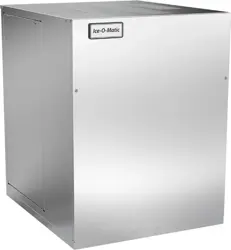
Property of Ice-O-Matic
F00383 Rev 04/16
Chemicals for Cleaning and Sanitizing an Ice-O-Matic Commercial Ice Machine
The cleaning and sanitizing of any commercial ice machine are important procedures all operators need
to have in their preventive maintenance protocol. While similar, these two procedures are uniquely
different and accomplish different things. Cleaning or de-liming, dissolves the mineral deposits on the
evaporator and removes scale, calcium and other mineral buildup. Sanitizing disinfects the machine and
removes microbial growth including mold and slime.
In either case, it is important to use solutions that do not harm the ice machine. Never use cleaning or
sanitizing solutions that contain Nitric Acid, Sulfuric Acid, Hydrochloric Acid, Carbolic Acid, Acetic Acid,
diluted Acetic Acid or non-food-grade vinegar (concentration of acetic acid greater than 6% and does
not contain enzymes created in processing) or any chlorine-based solution such as bleach, chlorine
dioxide or any type of salts such as potassium chloride (potassium salts) or sodium chloride. Check the
label or the manufacturer’s Material Safety Data Sheet (MSDS) to be sure. These chemicals can attack
the surface of the evaporator as well as other metal components causing corrosion and flaking. Reverse
Osmosis (RO) water can be very acidic and can attack the evaporator and other metal in the ice
machine. Because the RO process removes all minerals and metals from the water it can promote the
faster growth of microbial, mold and slime. If RO water is used, then Ice-O-Matic recommends the
water pH is verified to be a neutral 7.0 to minimize the corrosive effects. Incorrect cleaners, sanitizers,
and RO water that does not have a neutral pH could void the machine’s warranty.
Ice-O-Matic Ice Machine Sanitizing
Ice-O-Matic recommends sanitizing or
disinfecting an ice maker a minimum of every six
months, but no more than once per month to
avoid potential damage to the machine.
Frequency of sanitizing may depend on whether
the machine is in a high yeast environment or if
RO water is being used. It is the responsibility of
the operator to determine the optimal frequency
for their particular environment.
Ice-O-Matic requires a “nickel-safe” sanitizer
such as Nu-Calgon IMS-III or equivalent.
Sanitizing is a simple matter of running the
approved sanitizer through the ice machine and
wiping down surfaces with the sanitizer.
If being done at the same time as the cleaning
process, sanitizing must be done after the
cleaning process. Chemicals used for sanitizing
must be thoroughly purged and rinsed after use.
Follow the process as prescribed in the
Installation and Service Manuals.
Note: this process requires the ice be removed
from the bin.
Ice-O-Matic Ice Machine Cleaning
Cleaning or de-liming an ice machine refers to the
process of removing mineral buildup and scale from
the evaporator and other components. Ice-O-Matic
recommends cleaning the ice machine every 6
months, but no more than once per month to avoid
potential damage to the machine. Frequency of
cleaning may depend on water quality and filtration
system used. It is the responsibility of the operator
to determine the optimal frequency for their
particular environment. Cleaning will not remove
microbial, mold, or slime. The machine should
always be sanitized after cleaning, and chemicals
used for cleaning must be thoroughly purged and
rinsed prior to sanitizing.
Ice-O-Matic requires a “nickel-safe” cleaner such as
Nu-Calgon Nickel-Safe Ice Machine Cleaner or
equivalent. Typically the chemical composition is as
follows:
Water 53% to 82%
Phosphoric Acid 15% to 40%
Citric Acid 3% to 7%
Ice-O-Matic recommends cleaning be done by a
trained technician and that they follow detailed
steps as prescribed in the Installation and Service
Manuals.