

About This Document
This manual is intended for administ r a tors and users of the AXIS P55 44
PTZ Dom e Network Camera, an d is applicab le to firm ware 5.41 and
later. It includes instruction s for using and managing the product on
your network. Previous experience of networking will be of use when
using this product. Some knowledge of UNIX or Linux-based systems
may also be beneficial, for developing shell s cripts and applications.
Later version of this document will be posted to the Axis website,
as required. See also the prod uct’ s online help, available via the
web-based interface.
Liability
Every care has been taken in the preparation of this manual. Please
inform your local Axis office of any inaccuracies or omissions. Axis
Communications AB cannot be held responsible for any technical or
typographical errors and reserves the right to make changes to the
product and manuals w ithout prior notice. Axis Communications AB
makes no warranty of any kind with regard to the material contained
within this document, in cluding, but not limited to, the implied
warranties of merch antability and fitnes s for a partic u lar purpose. Axis
Communications AB shall not be liable nor responsib le for incidental or
consequential damages in connection with the furnishing, performance
or use of this mat erial. This product is only to be used for its intende d
purpose.
Intellectual Property R ights
Axis AB has intellectual property rights relating to technology embodied
in the product described in this document. In particular, and without
limitation, these in tel lectual property rights may in clude one or more
of the patents list e d at http://www.axis.co m/patent.htm and one or
more additional patents or pending pat e nt applications in the US a nd
other countries.
This product contains licensed third-party software. Se e the menu item
“About” in the product’s user interface for more information.
This product contains source code copyright Apple Computer,
Inc.,underthetermsofApplePublicSourceLicense2.0(see
http://www.opensource.ap ple.com/apsl). The source code is available
from http://develo per .apple.com/darwin/p rojects/bonjour/
Equipment Modifications
This equipment must be ins talled and used in strict accordance with the
instructions given in the user docum entation. This equipment contains
no user-serviceable co mponents. Unauthorized equipment changes o r
modifications will invalidate all applicable regulatory certifications
and approvals.
Trademark Acknowledgments
Apple, Boa, Bo njour, Ethernet, Internet E xplorer, Linux, Microso
ft,
Mozilla, Real, SMPTE, QuickTime, UNIX, Windows, Windows Vista and
WWW are registered trademarks of the respective holders. Java and
all Java-based trademarks and logos are trademarks or registe
red
trademarks of Oracle and/or its affiliates. UPnP
TM
is a certification
mark of the UPnP
TM
Implementers Corporation.
Electromagnetic Compatibility (EMC)
This equipment has been designed and tested to fulfill applicable
standards for:
• Radio frequency em ission when installed according to t he
instructions and used in it s intended environm ent.
• Immunity to electrica l and electromagnetic phen omena when
installed according to the instructions and used in its intended
environment.
USA
This equipment has been tested usin g a shielded net w ork cable (STP)
and found to comply with the limit s for a Class B digital device,
pursuant to part 15 of the FCC Rules. These limits are des ign ed
to provide reasonable protection against harmful interference in a
residential installation. This equipment generates, uses and can radiate
radio frequency energy and, if not installed and used in accordance
with the instructions, may cause harmful interference to radio
communications. However, there is no guarantee that interference
will not occur in a particular installation. If this equipment does
cause harmful inte rference t o radio or television reception, which
can be determined by turning the equipment off and on, the user is
encouraged to try to correct the i nterference by one or more of the
following measures:
• Reorient or relocate the receiving antenna.
• Increase the separation between the equipment and receiver.
• Connect the equipment int o an outlet on a circu it different from
that t o which the receiver is connected.
• Consult the dealer or an experienced radio/TV techni ci an for help.
Canada
This Class B digital app aratus complies with Cana d ia n ICES-003.
Europe
This digital equipment fulfills the requirements fo r RF emission
according to the Class B limit of EN 55022.
This product fulfills the requirements for immu nity according to
EN 61000-6-1 residential, commercial and light-industry environments.
This product fulfills the requirements for immu nity according to
EN 61000-6-2 industrial environments.
This product fulfills the requirements for immu nity according to
EN 55024 office an d commercial environments.
Australia/New Zealand
This digital equipment fulfills the requirements for RF emission
according to the Class B limit of A S/N ZS CISPR 22.
Korea
이 기기는 가정용(B급) 전자파적합기기로서 주로 가정에서 사
용하는것을목적으로하며, 모든 지역에서 사용할 수 있습니다.
Japan
この装置は、クラスB 情報技術装置です。この装置は、家庭
環境で使用することを目 的としていますが、この装置がラジ
オやテレビジョン受信機に近接して使用されると、 受信障
害を引き起こすことがあります。 取扱説明書に従って正し
い取り扱いをして下さい。
Safety
This product complies to EN/IEC 60950-1, Safety of Information
Technology Equipment.
The power supply used with this prod
uct shall fulfill the requirements
for Safety Extra Low Voltage and Limited Power Source according to
EN/IEC/UL 60950-1.
Support
Should you require any technical assistance, please contact your Axis
reseller. If your questions cannot be answered immediately, your
reseller will forw
ard your queries through the appropriate channels to
ensure a rapid response. If you are connected to the Internet, you can:
• download user documentati on and software updates
• find answers to resolved problems in the FAQ database. Search
by product, category, or phrase
• report problems to Axis support staff by logging in to your private
support area
• chat with Axis support staff (selected countries only)
• visit A xis Support at www.axis.com/techsup/
Learn More!
Visit Axis learning center www.axis.com/academy for useful trainings,
webinars, tutorials and guides.

AXIS P5544 PTZ Dome Network Camera
Table of Contents
HardwareOverview .......................................... 5
Connectors .................................................... 5
LEDIndicators .................................................. 6
MidspanLEDIndicators .......................................... 6
AccessingtheProduct ....................................... 7
AccessfromaBrowser ........................................... 7
AccessfromtheInternet .......................................... 8
SettheRootPassword ........................................... 8
TheLiveViewPage .............................................. 9
MediaStreams ............................................. 13
HowtoStreamH.264 ............................................ 13
MJPEG ........................................................ 13
AXISMediaControl(AMC) ........................................ 13
AlternativeMethodsofAccessingtheVideoStream .................... 14
AccessingAudioStreams ......................................... 15
SettingUptheProduct ...................................... 16
BasicSetup .................................................... 16
VideoandAudio ............................................ 17
VideoStream ................................................... 17
Stream Profiles ................................................. 18
CameraSettings ................................................ 19
Overlay ........................................................ 20
PrivacyMask ................................................... 21
AudioSettings .................................................. 21
AudioClips .................................................... 23
Live View Config ............................................ 24
PTZ (Pan Tilt Zoom) ......................................... 27
PresetPositions ................................................. 27
Gatekeeper .................................................... 27
GuardTour ..................................................... 28
OSDIZones .................................................... 28
Advanced ...................................................... 28
ControlQueue .................................................. 29
Detectors .................................................. 30
MotionDetection ............................................... 30
AudioDetection ................................................ 31
Applications . .............................................. 32
Events .................................................... 33
SettingUpanActionRule ........................................ 34
Recipients ..................................................... 35
Schedules ...................................................... 35
Recurrences .................................................... 35
Recordings ................................................. 37
RecordingList .................................................. 37
ContinuousRecording ............................................ 37
SystemOptions ............................................. 39
Security ....................................................... 39
Date&Time .................................................... 40
Network ....................................................... 41
Storage ....................................................... 45
Ports&Devices ................................................. 47
Maintenance ................................................... 47
Support ....................................................... 48
Advanced ...................................................... 49
ResettoFactoryDefaultSettings ................................... 49
Multi-ConnectorCable(soldseparately) ........................ 50
Troubleshooting ............................................ 52
CheckingtheFirmware ........................................... 52
UpgradingtheFirmware .......................................... 52
EmergencyRecoveryProcedure .................................... 52
Symptoms,PossibleCausesandRemedialActions ..................... 53
3

AXIS P5544 PTZ Dome Network Camera
Hardware Overview
Hardware Overview
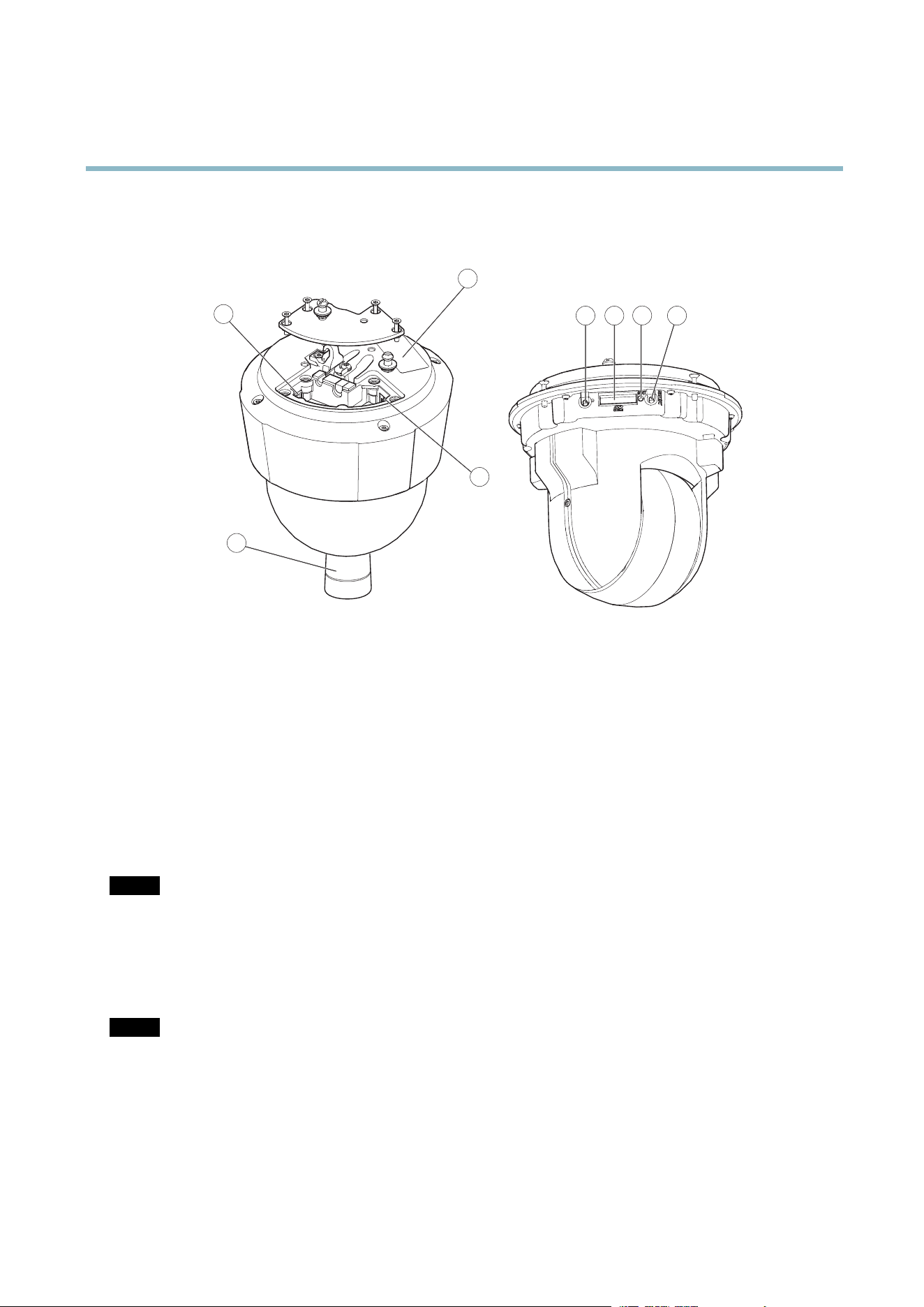
1
2
4
5
7
6 8
3
1
Part number (P/N) & Serial number (S/N)
2
Network connector (PoE+)
3
Panopsis lens
4
Multi-connector
5
Control button
6
SD card slot
7
Status LED indicator
8
Restart button
Connectors
For technical specifications, see page 57.
Network connector - RJ-45 Ethernet connector. Supports Power over Ethernet Plus (PoE+) IEEE 802.3at. Use the supplied midspan.
NOTICE
Due to local regulations or the environmental and electrical conditions in which the product is to be used, a s hielded network
cable (STP) may be ap propriate or required. Any network cables that are routed in outdoor environments or similar shall be
shielded (STP) and intended fo
rtheirspecific use. Make sure that the midspan is properly grounded. See Electromagnetic
Compatibility (EMC) for regulatory requirements.
SD card slot - A standard or high-capacity SD card (not included) can be used for local recording with removable storage.
NOTICE
To prevent corruption of recordings, the S D card should be unmounted before removal. To unmount, go to Setup > System
Options > Storage > SD Card and click Unmount.
Control b
utton - The control button is used for:
• ConnectingtoanAXISVideoHostingSystemservice.Seepage 42. To connect, p ress and hold the button for about
1 second until the Status LED flashes green.
5

AXIS P5544 PTZ Dome Network Camera
Hardware Overview
• ConnectingtoAXISInternetDynamicDNSService. Seepage 42. To connect, press and hold the button for
about 3 seconds.
• Resetting the product to factory default settings. See page 49.
Restart button - Press to restart the product.
Multi-connector - Terminal connector for connecting external equipment:
• Audio equipm ent
• Input/Output (I/O) devices
• AC/DC power supply
When connecting external equipment, a multi-connector cable (available from Axis) is required in order to maintain the product’s IP
rating, see Multi-Connector Cable (sold separately), on page 50.
LED Indica tors
Color
Indication
Unlit
Connection and normal operation
Amber
Steady during startup. Flashes during firmware upgr ade.
Amber/red Flashes amber/red if network connection is unavailable or lost.
Red Flashes red for firmware upgrade failure.
Green Shows steady green for 10 seconds for normal operation after restart.
Midspan LED Indicators
LED
Color
Indication
Unlit No camera connected.
Green Steady when camera connected, normal operation.
Green, flashing Slow flash when over current o r short circuit condition on the port.
Port
Green, flashing
Fast flash w hen
input voltage is out of range or other internal error.
AC input Green Steady when AC power connected.
6

AXIS P5544 PTZ Dome Network Camera
Accessing the Product
Accessing the Product
To install the Axis product, refer to the Installation Guide supplied with the product.
The product can be used with most operating systems and browsers. The recommended browsers are Internet Explorer with Windows,
Safari with Macintosh and Firefox with other operating systems. See Technical S pecifi cations, on page 57.Toviewstreamingvideoin
Internet Explorer, allow installation of AXIS Media Control (AMC) when prompted.
Note
• QuickTime
TM
is also supported for viewing H.264 streams and for audio.
• If your computer restricts the use of additional software components, the product can be con figured to use a Java
applet for viewing Motion JPEG.
Access from a Browser
1. Start a browser (Internet Explorer, Firefox, Safari).
2. Enter the IP address or host name of the Axis product in the browser’s Location/Address field. To access the product from a
Macintosh computer (Mac OS X), click on the Bonjour tab and select the product from the drop-down list.
If you do not know the IP address, use A XIS IP Utility to locate the product on the network. For more information on how to
discover and assign an IP address, refer to the Installation Guide.
3. Enter your user name and password. If this is the first time the product is accessed, the root password must first be
configured; for instructions see Set the Root Password, on page 8 .
4. If this is the first time the product is accessed, the PTZ Calibration tool starts automatically. See PTZ Calibration, on page 47.
5. The product’s Live View page appears in your browser.
Note
The controls and layout of the Live View page may have been customized to meet specific installation requirements and
user preferences. Consequently, some of the examples and functions featured here may differ from those displayed in
your own Live View page.
7

AXIS P5544 PTZ Dome Network Camera
Accessing the Product
Access from the Internet
Once connected, the Axis product is accessible o n your local network (LAN). To access the product from the Internet you must
configure your network router to allow incoming data traffic to the product. To do this, enable the NAT-traver
sal feature, which
will attempt to automatically configure the router to allow access to the product. This is enabled from Setup > System Options >
Network > TCP/IP Advan c ed.
For more information, please s ee NAT traversal (port mapping) for IPv4, on page 43.SeealsoAXISInternetDynamicDNSServiceat
www.axiscam.net For Technical notes on this and other topics, visit the Axis Support web at w
ww.axis.com/techsup
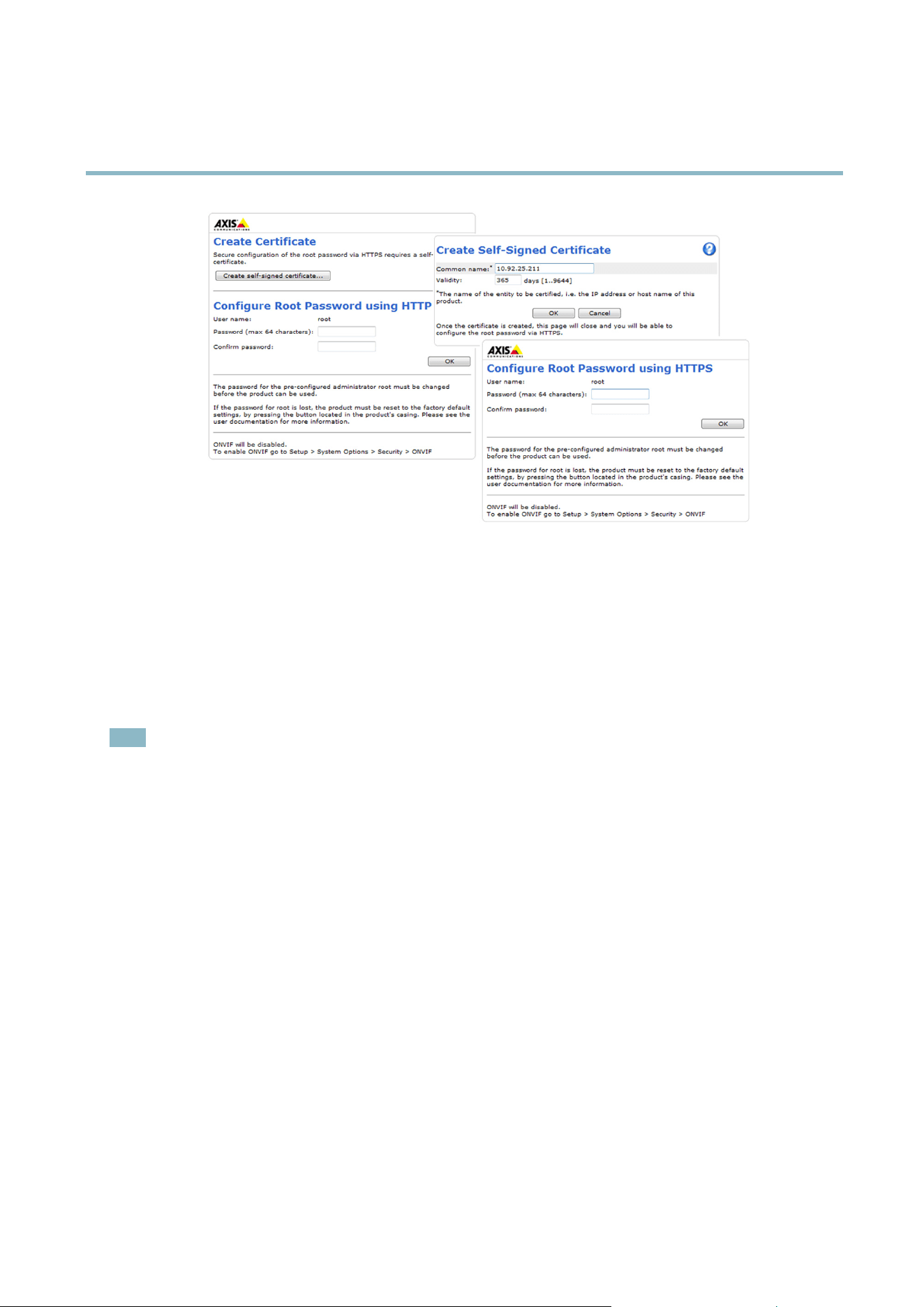
Set the Root Password
To gain access to the Axis product, you must set the password for the default administrator user root. This is done in the Configure
Root Password dialog, which appears when the product is accessed for the first time.
To prevent network eavesdropping, the root password can be set via an encrypted HTTPS connection, which requires an HTTPS
certificate. HTTPS (Hypertext Transfer Protocol over SSL) is a protocol used to encrypt traffic between web browsers and servers. The
HTTPS certificate ensures encrypted exchange of information.
To set the password via a standard HTTP connection, enter it directly in the firs t dialog.
To set the password via an encrypted HTTPS connection, follow these steps:
1. Click Create self-signed certificate.
2. Provide the req uested information and click OK.Thecertificate is created and the password can now be set securely. All
traffic to and from the product is encrypted from this point on.
3. Enter a password and then re-enter to confirm the spelling. Click OK. The password has now been con figured.
Note
•Thed
efault administrator user name root is permanent and cannot be deleted.
• If the password for root is lost, the product must be reset to the factory default settings. See Reset to Factory Default
Settings, on page 49.
8
AXIS P5544 PTZ Dome Network Camera
Accessing the Product
The Live View Page
TheLiveViewpagecanbeusedintwomodes:
• Overview mode — a 360° panoramic overview
• Normal mode — standard camera view (not using the Panopsis lens). PTZ controls can be used.
Click Setup to op en the product’s Setup pag es.
Click Help to open the online help.
Note
Some Live View functio ns and controls are only available when using AXIS Media Control and Internet Explorer. See AXIS
Media Control (AMC), on page 13.
Overview Mode
In Overview mode, the Live View page shows a 360° panoramic overview. The image is distorted, particularly around the edge. For a
magnified, corrected view of a part of the image, move the mouse pointer — do not click — to the desired part in the Overview.
The magnified, corrected view is displayed in t
he Magnifier.
To go to No rmal mode, click on the desired
position in the Overview to steer the camera to that position. Alternatively, use a joystick
or click in the im age and draw a rectangle around the area to display in Normal mode.
If preset positions are defined, Normal mode can also be opened by selecting a preset from the PTZ Presets tab. For more information
about presets, see Preset Positions, on page 27.
9

AXIS P5544 PTZ Dome Network Camera
Accessing the Product
Normal Mode
In Normal mode, the camera is looking through the dome cover avoiding the Panopsis lens. The Live View page shows the camera
view and an Overview snapshot.
Click in the Overview snapshot to quickly steer the camera view to a new position. The current po sition is indicated by the green
circle. Alternatively, use the mouse or a joystick to pan an d tilt in the camera view.
To zoo m in and out, use the Zoom bar, rotate the mouse wheel or use a joystick. No rmal mode also supports Area zoom.Tozoomin,
click in the image and draw a rectangle around the area to be magnified. To zo om out, rotate the mouse w heel.
If preset positions are defined, the presets are s hown as small circles in the Overview snapshot. Click on a preset position to
steer the camera view to that position. Alternatively, presets can be selected from the PTZ Presets tab. For more information
about presets, see Preset Positions, on page 27.
To go to Overview mode, click
or click in the circle in the cente r o
f the Overview snapshot.
10

AXIS P5544 PTZ Dome Network Camera
Accessing the Product
Controls on the Live View Page
The viewer toolbar on the Live View page provides the following controls:
Go to Overview mode.
Click the View size button to reduce the size of the displayed video.
Play a live media stream.
Pause the live media stream.
Start recording the video stream. An ongoing recording is indicated by a red marker. To stop recording, click the button
again. The recording is saved to the location specified in the AMC Control Panel.
Display video in Full-screen mode. Press ESC (Escape) on the computer keyboard to cancel full-screen mode.
Take a Snapshot of the video image. The image is saved to the location specified in the AMC Control Panel. Enable this
button from Setup > Live View Config > Action Buttons.
Zoom bar — (Normal mode only) Use the slider to zoo m in and out, or click on the
arrows to zoom in and out in steps.
The viewer toolbar can be disabled from Setup > Live View Config.
The following tabs contain ad ditional s ettings:
Displays the available Preset Positions. A preset position is a predefined view that can be used to quickly
steer the camera to a specific location. Click on a preset to g o to that position. For more informa tion, see
Preset Positions, on page 27.
Displays the available Stream Profiles.Astreamprofile is a set of pre-configured stream settings including
resolution, compression, frame rate and overlay settings. Click on a profile to stream live video using that
profile. For more information, see Stream Profiles, on page 18.
The Audio tab is displayed if audio is enabled. Se e Audio Controls, on page 11.
The Actions tab displays:
• Manual trigg er buttons, see page 12.
•User-defined links, see page 25.
• Output buttons. These are used to control external devices connected to the Axis product’s
output ports See page 25.
If PTZ Control Queue is enabled, the time each user is in control of the PTZ functionality is limited. Click the buttons to enter or exit
the queue. The PTZ Control Queue is set up under PTZ > Control Queue,seepage 29.
Note
The Live Vie w page can be customized to meet specific requirements and user preferences. If the Live View page has been
customized, some of the functions and controls described here may differ from those displayed in your own Live View page.
Audio Controls
The c ontrols available from the Audio tab on the Live View page are used to control the speakers and microphone connected to the
computer. The buttons are only visible when audio is enabled.
11
AXIS P5544 PTZ Dome Network Camera
Accessing the Product
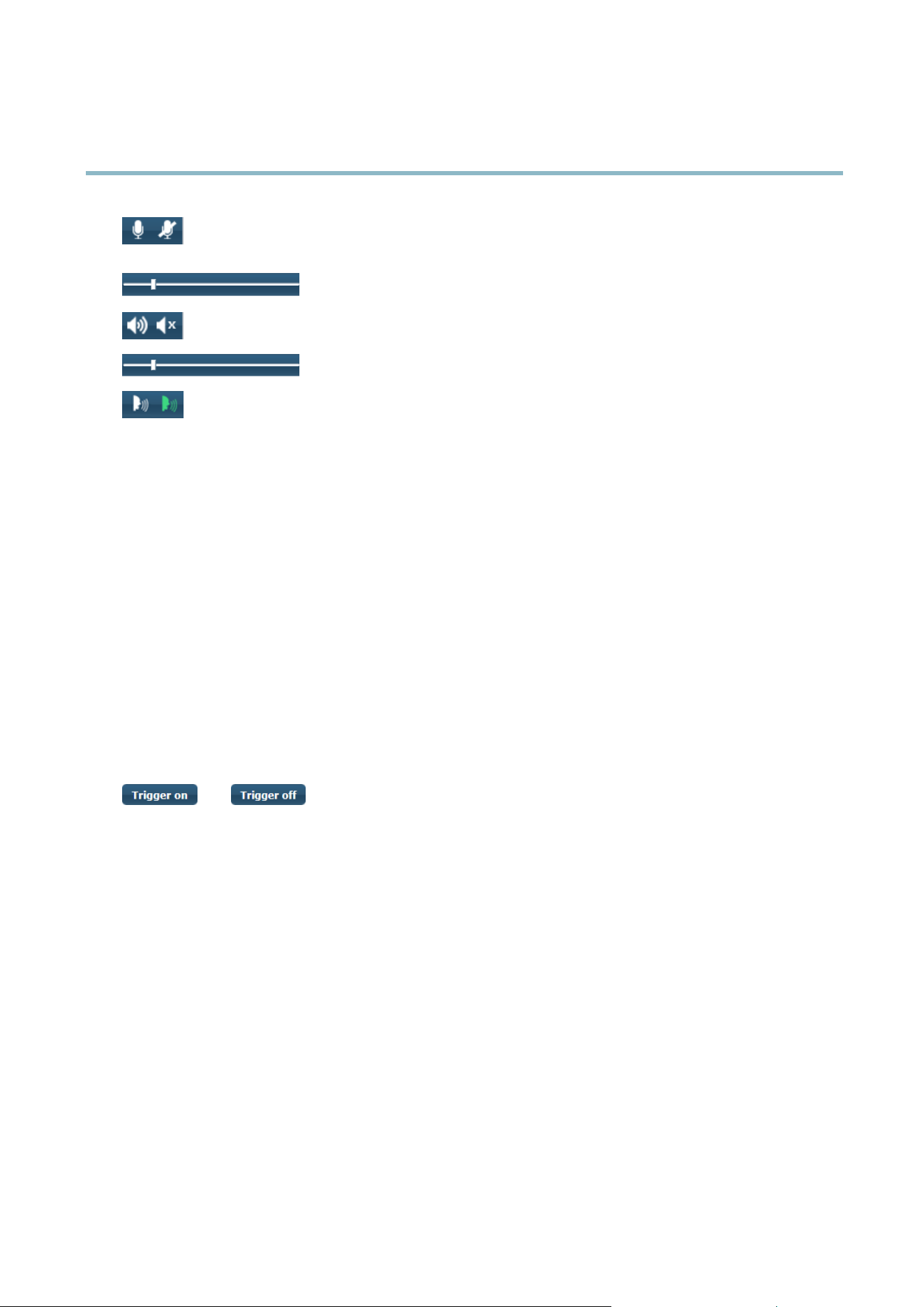
Microphone on and Microphone off. Click to mute or unmute the microphone. In Simplex — speaker only mode,
the Microphone on and Talk buttons must both be active to send audio to the Axis product. Click either button to
stop audio transmission.
Use the slider to control the volume of the microphone.
Speaker on and Speaker off. Click to turn the speakers on and off.
Use the slider to control the volume of the speakers.
Half-duplex mode
The Talk/Listen buttonisusedtoswitchbetweensendingandreceivingaudio.Thebuttoncanbeconfigured from
the Audio tab in the AMC Contro l panel:
• Push-To-Talk mode: Click and hold the button to t alk (send audio). Release the button to listen.
• Toggle mode: Click once to switch between talking and listening.
Simplex – speaker only mode
To send audio, the Microphone on and Talk buttons must both be active. Click either button to stop audio
transmission.
To open the AMC Control Panel, right-click in the image and select Settings.
To enable audio, go to Setup > Video & Audio > Video Stream.OntheAudio tab, select Enable audio.
To change the audio mode and to control the speakers and microphone connected to the Axis product, go to Setup > Video
& Audio > Audio Settings.
Manual Trigger
The Manual Trigger is used to trigger an action rule from the Live View page. The manual trigger can for example be used to
validate actions during p roduct installation an d c on figuration.
In the Live View page, the manual trigger buttons are available from the Actions tab. Click Trigger on to start the action. Click
Trigger off to stop the action.
To configu re the manual trigger:
1. Go to Setup > Events.
2. Click Add to add a new action rule.
3. From the Trigger drop-down list, select Input Signal.
4. From the second drop-down list, select Manual Trigger.
5. Select the desired action and configure the other settings as required .
For more information about action rules, see Events, on page 33.
To show the manual trigger buttons in the Live View page:
1. Go to Setup > Live View Layout.
2. Under Action Buttons,selectShow manual trigger button.
12
AXIS P5544 PTZ Dome Network Camera
Media Streams
Media Streams
The Axis product provides several audio and video stream formats. Your requirements and the properties of your network will
determine the type you use.
The Live View page in the product provides access to H.264 and Motion JPEG video streams, audio streams and to the list of available
stream profiles. Other applications and clients can access video and audio streams directly, without going via the Live View page.
How to Stream H.264
The video compression standard H.264 makes good use of bandwidth, and can provide high quality video streams at less than 1 Mbit/s.
Deciding which combination of protocols and methods to use depends on your viewing requirements, and on the properties of
your network. The available options in AXIS Media Control are:
Unicast RTP
This unicast method (RTP over UDP) is used
for live unicast video, especially when it is
important to always have an up-to-date video
stream, even if some images are dropped.
RTP over RTSP
This unicast method (RTP tunneled over RTSP )
is useful as it is relatively simple to configure
firewallstoallowRTSPtraffic.
RTP over RTSP over HTTP
This unicast method can be used to traverse
firewalls. Firewalls are c ommonly c on figured to
allow the HTTP protocol, thus allowing RTP to
be tunneled.
Unicasting is used for video-on-demand
transmission so that there is no video traffic
on the network until a client connects and
requests the stream.
Note that there are a maximum of 20
simultaneous unicast connections.
Multicast RTP
This method (RTP over UDP) should be used for liv e multicast video. The video stream is always
up-to-date, even if some im ages are d ropped.
Multicasting provides the most efficient usage of bandwidth when there are large numbers of
clients viewing simultaneously. A multicast cannot however, pass a network router unless the
router is configured to allow this. It is not possible to multicast over the Internet, for example.
Note also that all multicast viewers count as one unicast viewer in the maximum total of 20
simultaneous connections.
AXIS Media Control negotiates w ith the Axis product to determine the transport protocol to use. The order of priority, listed in the
AMC Control Panel, can be chang ed and the options disabled, to s uit specific requirements.
Note
H.264 is licensed technology. The Axis product includes one H.264 viewing client license. Installing additional unlicensed
copies of the client is prohibited. To
purchase additional licenses, contact your Axis reseller.
MJPEG
This format uses standa rd JPEG still images for the video stream. These images a re then displayedandupdatedataratesufficient
to create a stream that shows constantly updated motion.
The Motion JPEG stream uses considerable amounts of bandwidth, but provides excellent image qualityandaccesstoeveryimage
contained in the stream. The recommended method of accessing Motion JPEG live video from the Axis product is to use the AXIS
Media Control in Internet Explorer in Windows.
AXIS Media Control (AMC)
AXIS Media Control (AMC) in Internet Explorer in W indows is the recommended method of accessing live video from the Axis product.
13

AXIS P5544 PTZ Dome Network Camera
Media Streams
TheAMCControlPanelcanbeusedtoconfigure various video and audio settings . Please see the AXIS Media Control User’s
Manual for more information.
The AMC C ontrol Panel is automatically installed o n first use, after which it can be configured. Open the AMC Control Panel from:
• Windows Control Panel (from the Start menu)
• Alternatively, right-click the video image in Internet Explorer and click Settings.
Alternative Methods of Accessing the Video Stream
You can also access video and images from the Axis product in the following ways:
• Motion JPEG server push (if supported by the client, Firefox, for example). This option maintains an open HTTP connection
to the browser and sends data as and when required, for as long as required.
• Still JPEG images in a browser.Enterthepathhttp://<ip>/axis-cgi/jpg/image.cgi
• Windows Media Player. This requires AXIS Media Control and the H.264 decoder to be installed. The following paths
can be used:
- Unicast via RTP: axrtpu://<ip>/axis-media/media.amp
- Unicast via RTSP: axrtsp://<ip>/axis-media/media.amp
- Unicast via RTSP, tunneled via HTTP: axrtsphttp://<ip>/axis-media/media.amp
-Multicast:axrtpm://<ip>/axis-media/media.amp
• QuickTime
TM
. The following paths can be used :
- rtsp://<ip>/axis-media/media.amp
- rtsp://<ip>/axis-media/media.3gp
14

AXIS P5544 PTZ Dome Network Camera
Media Streams
Note
• <ip>= IP addess
• The Axis product supports QuickTime 6.5.1 and later.
• QuickTime adds latency to the video stream.
• It may be possible to use other players to view the H.264 stream using the paths above, although Axis does not guarantee
this.
Accessing Audio Streams
The Live View page provides access to audio through AXIS Media Control; in addition audio can be accessed in the following ways:
• VAPIX® Application Programming Interface (API) For more information, visit www.axis.com/developer
• Windows Media Player supports simplex audio. The following paths can be used:
- Unicast via RTP: axrtpu://<ip>/axis-media/media.amp
- Unicast via RTSP: axrtsp://<ip>/axis-media/media.amp
- Unicast via RTSP, tunneled via HTTP: axrtsphttp://<ip>/axis-media/media.amp
-Multicast:axrtpm://<ip>/axis-media/media.amp
• QuickTime
TM
supports G.711 and AAC audio encoding. The following paths can be used:
- rtsp://<ip>/axis-media/media.amp
- rtsp://<ip>/axis-media/media.3gp
•TheJava applet supports sim plex audio with G.711 encoding.
15

AXIS P5544 PTZ Dome Network Camera
Setting Up the Product
Setting Up the Product
The A xis product can be configured by users with administrator or operator rights. To open the product’s Setup pages, click Setup in
the top right-hand corner of the Live View page.
• Administrators have unrestricted access to all settings.
• Operators have access to all settings except System Options
See also the online help
.
Basic Setup
Basic Setup provides shortcuts to the settings thatshouldbemadebeforeusingtheAxisproduct:
1. Users. See page 39.
2. TCP/IP. See page 41.
3. Date & Time. See page 40.
4. Video Stream. See page 17.
5. Audio Settings. See page 21.
The Basic Setup menu can be disabled from System Options > Security > Users.
16

AXIS P5544 PTZ Dome Network Camera
Video and Audio
Video and Audio
The video and audio settings can be used to optimize video a n d audio quality. You ca n configure the following:
• Video stream settings. See page 17.
•Streamprofiles. See page 18.
• Camera settings. See page 19.
• Overlay image. See page 20.
•Privacymask.Seepage 21.
• Audio settings. See page 21.
• Audio clips. See page 23.
Video Stream
You can define the following video stream settings from Video & Audio > Video Stream:
•Image.Seepage 18.
• H.264. See page 18.
•MJPEG.Seepage 18.
Pixel Counter
The pixel counter shows the number of pixels in an area of the image. The pixel counter is useful in situations where there is a
requ
irement that the image is a certain size, for example in face recognition.
The pixel counter can be accessed fro m:
• Video & Audio > Video Stream.UnderPreview, click Open and select the Show pixel counter option to enable the
rectangle in the image. Use the mouse to mo ve and resize the rectangle, or enter the number of pixels in the Width
and Height fields and click Apply.
17

AXIS P5544 PTZ Dome Network Camera
Video and Audio
• The Live View page in Internet Explorer in Windows. Right-click in the image and s ele ct Pixel counter.Usethemouse
to move and resize the rectangle.
Image
The default image settings can be configured under Video & Audio > Video Stream.SelecttheImage tab.
The followi ng settings are available:
• Resolution. Select the default resolution.
• Compression. The compression level affects the image quality, bandwidth and file size of saved images; the lower the
compression, the higher the image quality with higher bandwidth requirements and larger file sizes.
• Maximum frame rate. To avoid bandwidth problems, the frame rate allowed to each v iewer can be limited.
• Overlay settings.SeeOverlay, on page 20.
Click Save to apply the new settings.
H.264
H.264, also known as MPEG-4 Part 10/AVC, is a video compression standard that provides high quality video streams at low bit rates.
An H.264 video stream consists of different types of frames such as I-frames and P-frames. An I-frame is a complete image whereas
P-frames only contain the differences from previous f rames.
The GOV length is the number of frames between two consecutive I-frames. Increasing the GOV length may s ave considerably on
bandwidth requirements in some cases, but may also have an adverse affect on image quality.
ThebitratecanbesetasVariable Bit Rate (VBR) or Constant Bit Rate (CBR). VBR adjusts the bit rate according to the image
complexity, using up more bandwidth for increased activity in the image , and less for lower image activity. CBR allows you to set a
fixed Target bit rate that consumes a predictable amount of band width. As the bit rate would usually need to increase for increased
image activity, but in this case cannot, frame rate and image quality are affect
ed negatively. To partly compensate for this, it is
possible to prioritize either frame rate or image quality. Not setting a priority means that frame rate and image quality are equally
affected. You must save your settings before they can take effect.
The current bit rate can be set to appear as text overlay. To do this, select the Include text check box option under Overlay
Settings and enter the modifier #b in the field.
MJPEG
Sometimes the image size is large due to low light or complex scenery. Adjusting the maximum frame size helps to control the
bandwidth and storage used by the Motion JPEG video stream i n these situations. Setting the frame size to the Default setting
provides consistently good image q
uality at the expense of increased bandwidth and storage usage in low light. Limiting the frame
size optimizes bandwidth and storage usage, but may give poor image quality. To prevent increased bandwidth and storage usage,
the maximum frame size should be set to an optimal value.
Stream Profiles
Astreamprofile is a set of pre-configured stream settings including resolution, compression, frame rate and overlay settings.
Stream profiles can be used:
• When setting up recording using action rules, see Events, on page 33.
• When setting up a continuous recording, see Continuous Recording, on page 37.
• In the Live View page – select the stream profile from the Video tab.
Four pre-programmed stream profiles are available for quick set up. Each pre-programmed profile has a descriptive name, indicating
its purpose. If required, the pre-programmed stream profiles can be modified and new customized stream profiles can be created.
To create a new profile or modify an existing profile, go to Setup > Video & Audio > Stream Profiles.
18

AXIS P5544 PTZ Dome Network Camera
Video and Audio
To select a default stream profile for the Live View page, go to Setup > Live View Config.
Camera Settings
The Video & Audio > Camera Settings page provides access to advanced image settings for the Axis product.
Image Appearance
Increasing the Color level increases the color saturation. The value 100 gives maximum color saturation. The v alue 0 gives a
black and white image.
The image Brightness can be adjusted in the range 0–100, where a higher value produces a brighter image.
Increasing the Sharpness can increase bandwidth usage. A sharper image might increase image noise especially in low light
conditions. A lower setting reduces image noise, but the whole image will appear less sharp.
White Balance
White balance is used to make colors in the image appear the same regardless o f the color temperature of the light source. The Axis
product can be set to automatically identify the light source and compensate for its color. Alternatively, select the type of light
source from the drop -dow n list. For a description of each available setting, see the online help
.
Wide Dynamic Range
Wide dynamic range can improve the exposure when there is a considerable contras t between light and dark areas in the image.
Enable WDR in intense backlight conditions. The different WDR settings adjust for v arious amounts of contrast in the image. Use a
higher WDR number for a higher contrast. Disable WDR in low light conditions for optimal exposure.
Exposure Settings
Configure the exposure settings to suit the image quality requirements in relation to lighting, frame rate and bandwidth
considerations.
Exposure control - These settings is used to adapt to the amount of light used. Auto
matic is the de fault settings can be used in most
situations. T he shutter speed is automatically set to produce optimum image quality.
Maxexposuretime-Select the maximum exposure time from the drop-down list. Increasing the exposure time will improve
image quality, but decrease the frame rate. There may also be an increase in mo tion blur. Checking Allow slow shutter decreases
the shutter speed in low light to improve image bri
ghtness.
Enable Backlight compensation - Enab le thi
s option if a bright spot of light, for example a light bulb, causes other areas in
the image to appear too dark.
Exposure zones - This settings determines which part of the image is used to calculate the exposure. For most situations, the Auto
setting can be used. For particular requirement, select a predefined area.
Max gain - Measured in decibels (dB), gain describes the amount of amplification applie d to a signal, in this case the visual
information in the im
age. A high level of amplification may provide a better image in very low light situations. A high ga in will also
increasetheamountofimagenoise.
Day/Night
The IR c ut fi
lter prevents infrared (IR) light from reaching the image sensor. In poor lighting conditions, for example at night, or
when using an IR lamp, set the IR cut filter to Off. This increases light sensitivity and al lo ws the product to “see” infrared lig ht. The
image is shown in black and white when the IR cut filter is off.
If using automatic Exposure control,settheIRcutfilter to Auto to automatically switch between On and Off accordingtothe
li
ghting conditions.
19

AXIS P5544 PTZ Dome Network Camera
Video and Audio
Image Settings
Autofocus enabled - Automatic focusing is enabled by default. If the focus position is changed manually using the focus bar,
autofocus will be disabled even if enabled here. In this case, use the PTZ control panel to enable autofocus, see . If required, the focus
control can be disabled under PTZ > Advanced > Controls.
ImagefreezeonPTZ-Select All movements to freeze the image while the camera is m oving during a pan, tilt or zoom operation.
Once the camera reaches its new position, the view from that position i s shown. Presets freezes the image only when the camera
moves between preset positions.
Overlay
Overlays are used to provide extra information, for example for forensic video analysis or during product ins t allation and
configuration. Overl ays are superimposed over the video stream.
An overlay text can displa y the current date and time, or a text string. W hen using a text string, modifiers can be used to display
information such as the current bit rate or the current frame rate. F or informat ion about available modifiers, see File Naming &
Date/Time Formats in the online help
.
To enable overlays:
1. Go to Video & Audio > Video Stream and select the Image tab.
2. To include an overlay image, select Include overlay image at the coordinates. The overlay image must first be uploaded to
the Axis product, see Overlay Image.
3. To include date and time, select Include date and Include time.
4. To include a text string, select Include text and enter the text in the field. M odifi ers can be used, see File Naming &
Date/Time Formats in the online help
.
5. Select the text color, the text background color and the position of the overlay.
6. Click Save .
Tomodifythedateandtimeformat,gotoSystem Options > Date & Time.SeeDate & Time, on page 40.
Note
Overlay images and transparent text backgrounds are not available in Overview mode.
Overlay Image
An overlay image is a static image superimposed over the video stream. The image, for example company logo, is used to provide
extra information or to mask a part of the image.
The overlay image is displayed in Normal mode. The image is not available in Overview mode.
To use an overlay image, the image must first be uploaded to the Axis product:
1. Go to Video & Audio > Overlay Image.
2. Click Browse andbrowsetothefile.
3. Click Upload.
4. Select the image to use from the Use overlay image lis t.
5. Click Save .
To display the overlay image:
1. Go to Video & Audio > Video Stream and select the Image tab.
20

AXIS P5544 PTZ Dome Network Camera
Video and Audio
2. Under Overlay Settings,selectInclude overlay image at the coordinates and enter the X and Y coordinates.
3. Click Save .
For information about supported image formats, see the online help
.
Privacy Mask
A privacy mask is an area of solid color that prohibits users from viewing parts of the monitored area. Privacy masks cannot be
bypassed via the VAPIX® Application Programming Interface (API).
Privacy masks are displayed in Normal mode. Overview mode always shows the whole monitored area.
The Privacy Mask List, Video & Audio > Privacy Mask, shows all the masks that are currently configured in the Axis product and
indicates if they are enabled.
The Pan/Tilt/Zoom coordinates of the privacy mask are locked in their position. This means that re gardless of the angle and zoom
of the lens, the same place or object will be hidden. To define at what magnification the mask should be displayed, zoom to
the desired level and click Set level.
You can add a new mask, re-size the mask with the mouse,chooseacolorforthemask,andgivethemaskaname.
For more information, see the online help
.
Important
Adding many privacy masks may affect the product’s performance.
Audio Settings
The audio functionality for each video stream is enabled under Video & Audio > Video Stream > Audio.
Note
A m ulti-connector cable (available from Axis; Multi-Connector Cable (sold separately)) is required when connecting external
audio equipment to the Axis product.
Audio Modes
The Axis product supports the following audio modes:
Full duplex - Simultaneous two-way audio allowing the Axis product to transmit and receive audio at the same time. There is no
echo cancellation; if feedback loops appear, try moving the microphone or the speaker.
Half-duplex - Audio can be transmitted to and from the Axis product but only in one direction at a time. To transmit audio using
the Live View page, use the Talk and Listen buttons, see Audio Controls, on page 11.
Simplex — speaker only - Audio is transmitted from a client to the Axis product and can be played by a speaker connected
to the pro duct. To transm it audio using the Live View page, the Talk and Microphone on buttons must both be active, see Audio
Controls, on page 11.
Simplex — microphone only - Audio captured by the product microphone is transmitted from the Axis product to one or more clients.
To set the audio mode, go to Video & Audio > Audio Settings and select the desired m ode from the Audio mode drop-down list.
Audio Input
An external microphon e or a line source can be connected to the product’s Audio-in connector. Config ure the audio input settings
under Video & Audio > Audio Settings.
21

AXIS P5544 PTZ Dome Network Camera
Video and Audio
Note
A m ulti-connector cable (available from Axis; Multi-Connector Cable (sold separately)) is required when connecting external
audio equipment to the Axis product.
Source - Select Microphone for an external microphone or Line for a Line in device, e.g. an audio mixer for multiple microphones or
a microphone with a built-in amplifier.
Microphone power - The Enable microphone power option provides DC power for an external microphone. Microphone power
should only be used with microphones that have no battery. This setting should not be enabled when using a dynamic or battery
powered microphone. Microphone power will not harm the microphone; if you are uncertain, try switching it off and on. To use a
professional microphone requiring 48V phantom power, you need an external power supply a nd a balanced-unbalanced converter
(audio transformer) in between.
Input gain - Control the volume (dB Full Scale) of the audio input. If the sound is to o low, choose a higher dB, to amplify the
sound. If the sound is too high, choose a lower dB. The Level bar gives a visual representa tion of the audio signal level in dB
relative to the full-scale input level.
• Green — the signal is at a good level.
• Yellow — the signal is becoming distorted.
• Red — the signal is distorted.
Encoding - Select digital audio encoding format.
• AAC requires a license for both encoding and decoding. AAC is the least complicated and most widely used codec.
If achieving the best possible audio quality is a priority, AAC is the recomm ended codec to use. An AAC license
is included in the Axis product.
• G711
• G726
Sample rate - The number of times per second the sound is sampled . A higher sample rate will provide better audio quality, but
also requi res a greater bandwidth.
Bit rate - Set the required bit rate depending on the s
elected encoding. A higher bit rate will give better audio quality. A lower bit
rate may have latency or delay, but will require less bandwidth.
For more information about these se ttings, please see the online help
.
Audio Output
An external speaker can be connected to the product’s Audio-out connector (a built-in amplifier is required for this). The output can
be connected to another am
plifier with speakers. A stereo connector must be used for the audio out.
Configure the audio ou
tput settings under Video & Audio > Audio Settings.
Note
A m ulti-connector cable (available from Axis; Multi-Connector Cable (sold separately)) is required when connecting external
audio equipment to the Axis product.
Output gain - Control the volume (dB Full Scale) of the line audio output. If the sound is too low, choose a higher dB. If the
sound is too high, choose a lowe r dB.
22

AXIS P5544 PTZ Dome Network Camera
Video and Audio
Audio Clips
An audio clip is a sound file that can be played when events occur. The audio clip must first be uploaded to the Axis product or
recorded by a micropho ne c onnected to the product.
To add, download, modify or remove audio clips, go to Video & Audio > Audio Clips. For more information s e e the online help
.
To configure the Axis product to play audio c lip s when an event occurs, an action rule must be set up. For more information, see
Events, on page 33.
Note
Audio clips cannot be used if the product’s audio functionality is enabled. The audio functionality is enabled on the Audio
tab under Video & Audio > Video Stream.
23

AXIS P5544 PTZ Dome Network Camera
Live View Config
Live View Config
You can customize the Live View page and alter it to suit your requirements. It is possible to d efine the following features of
theLiveViewpage.
•StreamProfile. See page 18.
• Default Viewer for Browser. See page 24.
• Viewer Settings. See page 25.
• Action Buttons. These are the buttons described in Controls on the Live View Page, on page 11.
•UserDefined Links. See page 25.
• Output Buttons. See page 2 5.
Default Viewer for Brow
sers
From Live View Config >
Default Viewer select the default me thod for viewing video images in your browser. The product attempts
to show the video im ages in the selected video format and viewer. If this is not possible, the product overrides the settings and
selects the best available combination.
Note
The Overview snapshot, see Normal Mode, on page 10, is only available when using AMC or Server Push.
24

AXIS P5544 PTZ Dome Network Camera
Live View Config
Browser Viewer Description
AMC
Recommended viewer in Internet Explorer (H.264/Motion JPEG)
QuickTime
H.264
Java applet
A slower imaging alternative to AMC (Motion JPEG). Requires one of the
following installed on the client:
• JVM (J2SE) 1.4.2 or higher
• JRE (J2SE) 5.0 or higher
Windows Internet Explorer
Still image Displays stil l images only. Click the Refresh button in yo ur browser to view a
new image
Server Push
Recommended viewer for other browsers (Motion JPEG).
QuickTime
H.264
Java applet
A slower ima ging alternative to S e rve r Push (Motion JPEG only).
Other browsers
Still image Displays stil l images only. Click the Refresh button in yo ur browser to view a
new image
For more information, please see the online help .
Viewer Settings
To configure options for the viewer, go to Live View Config > Viewer Settings.
•SelectShow viewer toolbar to display the viewer too lbar under the video image i n the Live View page. See Controls
on the Live View Page, on page 11.
• H.264 decoder installation. The administrator can disable installation of the H.264 decoder included with A XIS Media
Control. This is used to prevent installation of unlicensed copies. Further decoder licenses can be purchased from your
Axis reseller.
•SelectEnable recording button to enable recording from the Live View page. This button is available when using
the AMC viewer. The recordings are saved to the location specified in the AMC Control Panel. See AXIS Media Control
(AMC), on page 13.
User Defined Links
To display user-defined links in the Live View page, select the Show custom link op tion, give the link a name and then enter the URL
to link to. When d efining a web link do not remove the 'http://' from the URL address. Custom links can be used to run scripts or
activate external devices connected to the product, or they can link to a web page. Custo m links defined as cgi links will run the
script in the background, in a hidden frame. Defining the link as a web link will open the link in a new window.
IntheLiveViewpage,user-definedlinksareavailablefromtheActions tab.
Output Buttons
External I/O devices connected to the Axis product’s output ports can be controlled directly from the Live View page.
To display output buttons in the Live View page:
1. Go to Setup > Live View Config.
2. Under Output Buttons, select the type of control to use:
- Pulse activates the output for a defined period of time. The pulse time can be set from 1/100 second to 60
seconds.
- Active/Inactive displays two buttons, one or each action.
25

AXIS P5544 PTZ Dome Network Camera
Live View Config
In the Live View page, the buttons are displayed on the Actions tab.
To confi guretheactiveandinactivestates,gotoSystem Options > Ports & Devices > I/O Ports and set the port’s Normal state.
For more information about I/O ports, see I/O Ports, on page 47.
Note
A multi-connector cable (available from Axis) is required when connecting external I/O devices to the Axis product. See
Multi-Connector Cable (sold separately), on page 50
26
AXIS P5544 PTZ Dome Network Camera
PTZ (Pan Tilt Zoom)
PTZ (Pan Tilt Zoom)
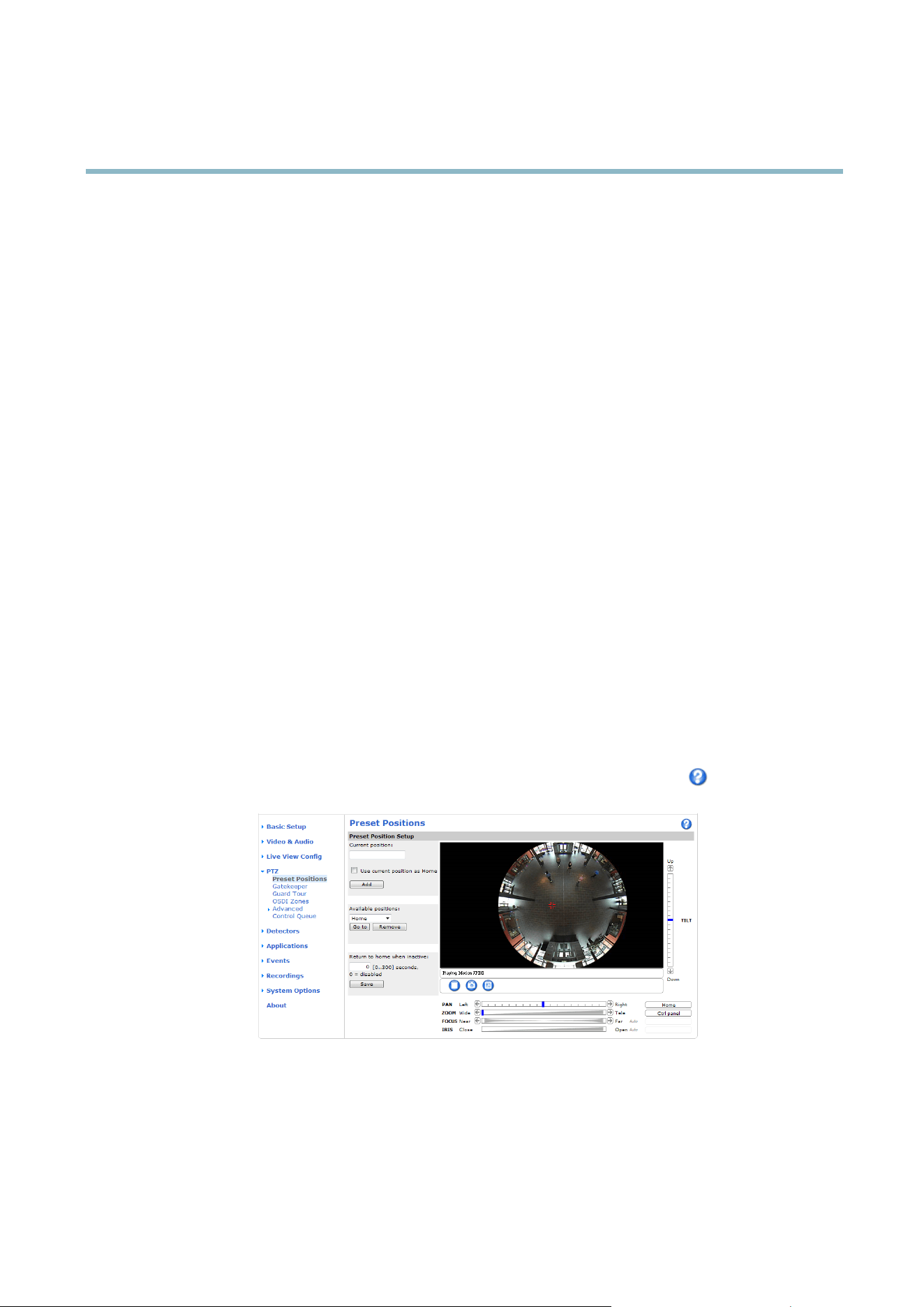
Preset Positions
A preset position is a predefined view that can be used to quickly steer the camera to a specific location. Preset positions can
be accessed in several ways:
• By selecting the preset from the PTZ Presets tab or the Overview snapshot in the Live View Page.
• When setting up action rules. See page 33.
• When setting up Guard Tour. See page 28.
• When setting up the Gatekeeper. See page 27
To add a preset position:
1. Go to PTZ > Preset Positions.
2. Use the pan, tilt and zoom controls to steer the camera view to the desired position.
3. Enter a descriptive name in the Current position field.
4. If required, select Use current position as Home.
5. Click Add.Thecamera’sposition,irisandfocussettingsaresavedasapresetposition.
The default Home position is Overview mode, see page 9 . To set a customized home position, select Use curren
t position as Home
when adding a preset position. The user-defined home position will have (H) added, for example, Entrance (H). The default Home
position, calle d “Home”, will still be available .
The product can be configured to return to the Home position when the PTZ functionality has been inactive for a specified length
of time. Enter the length of time in the Return to home wh
en inactive field and click Save.Setthetimetozerotopreventthe
product from automatically returning to the Home position.
To include the preset position name in the overlay text, go to Video & Audio,selectInclude overlay text and enter the modifier #P in
the field. For more information about modifiers, see File Naming & Date/Time Formats intheonlinehelp
.
Gatekeeper
The Gatekeeper monitors an area such as an entrance gate. It can pan, tilt and zoom in, and take a snapshot of, for example, a
face, triggered by movement in the area. The camera will then automatically return to the home position and continue to overview
the monitored area.
27

AXIS P5544 PTZ Dome Network Camera
PTZ (Pan Tilt Zoom)
To configure the Gatekeeper, follow the online instructions under PTZ > Gatekeeper.
Guard Tour
A guard to ur displays the video stream from different preset positions, one-by-one, in a predetermined order or at random and for
configurable time periods. The enabled guard tour will keep running after the user has logged off or closed the browser.
Toaddaguardtour:
1. Go to PTZ>GuardTourand click Add.
2. Enter a descriptive name.
3. Specify the pause length between runs.
4. Select an avai lable preset position and click Apply.
5. Specify the Move Speed.
6. Specify the View Time in seconds or minutes.
7. Specify the View Order or select the Random view order option.
8. Click Save .
To mo dify or remove guard tours, go to PTZ>GuardTour, select the guard tour in the Guard Tour List and click Modify/Remove.
For more information see the online help
.
Note
The pause between guard tour runs must be set to at least 10 minutes.
OSDI Zones
On-Screen Direction Indicator (OSDI) zones can be included in the overlay text (see Overlay, on pag e 2 0)toaidtheusertonavigate
the Axis product. Each OSDI zone is set up with coordinates and a descrip tive name.
OSDI zones are set up under PTZ > OSDI Zones. The Axis product uses the coordinates of the center of the view to set the lower
left and upper right zone are a
s. First navigate to where you would like the lowermost left point of the O SDI zone to be located.
Click Get to set the coordinates. Proceed to where the upper right point of zone should be located and click Get. Give the zone a
descriptive name and click OK.
To include the name of the OSDI zone in the overlay text, go to Video & Audio < Video Stream < Overlay Settings.Checkthe
Include text box a
nd enter the modifier #L in the field. For more information about modifiers, see File Naming & Date/Time
Formats intheonlinehelp
.
Advanced
Limits
Define the pan, tilt, zoom and focus limits for the Axis product. Movements to the left and right, up and down, can be restricted to
narrow the area under surveillance.
Configure the near focus limit to avoid focusing on objects too close to the camera lens.
Move speed sets the speed of the camera’s pan and tilt movements. The default setting is maximum speed.
28

AXIS P5544 PTZ Dome Network Camera
PTZ (Pan Tilt Zoom)
When using a joystick (or emulating one with the mouse) the Enable proportional speed setting can be used to reduce the maximum
pan/tilt movement speed, i.e. the speed the camera view moves at when the joystick is pushed all the way out in any direction. This is
useful then the view is zoomed in on an object.
When Enable Auto-flip is selected, the Axis product will simulate continuous pan movement in the same direction, i.e. the camera
will pan the full 360 degrees, even though there is a mechanical stop at ±180 degrees.
When Enable movement prediction is selected, the Axis product will attempt to predict the new position in the pan movement, after
compensating for the slight delay while the camera changes direction after an auto-flip. This is useful for tracking moving ob jects or
persons when using the joystick or emulated joystick mo d e.
See the online help
for more information.
Controls
Panel Shortcut Command Buttons can be configured to provide direct access to commands issued via the VAPIX® Application
Programming Interface. The buttons will be displayed in the PTZ control panel, which is available in the Live View page through
the Ctrl panel button, see .
Deselect the options under Enable/Disable controls to disable the pan, tilt, zoom, focus and iris controls.
Note
Disabling PTZ controls will not affect preset pos itions. For example, if the tilt control is disabled, the product can still move to
preset positions that require a tilt movement.
Control Queue
The administrator can set up a queue for PTZ controllers from PTZ > Control Q ueue. Once set up, the PTZ Control Queue buttons
appear in the Live View page offer ing one viewer exclusive control for a limited period of time. Other users will be placed in queue.
A user who belongs to a group (see Users, on page 39) with a higher PTZ priority c an go before other users in the queue and
take control of the product. The order of priority is as follows:
1. Administrator — An administrator takes over PTZ control regardless of who is first in queue. The administrator will be
removed from the queue 60 seconds after the last PTZ control command.
2. Event — The Axis product can be configured to go to a preset position when triggered by an alarm (see Events, on page 33).
The event w ill immediately be placed first in the queue except when an administrator is in control.
3. Operator — Same as ad m inistrator but with lower priority
4. Guard Tour — A guard tour (see page 28) has PTZ control for an indefinite period of time. It may be overridden by an
operator, event or administrator. The guard tour will resume when higher priority groups leave the queue.
5. Viewer — Multiple viewers must wait for their turn. The viewer has 60 seconds PTZ control before control is passed
on to the next viewer i n queue.
Note
• The administr
ator can enable and disable PTZ controls for selected users.
• To identify different users in the viewer group, cookies must be enabled on the client.
29
AXIS P5544 PTZ Dome Network Camera
Detectors
Detectors
Motion Detection
Motion detection is used to generate an alarm whenever movement starts or stops in the camera’s field of view. The alarm is
generated when the camera is in Overview Mode, that is, when using the Panopsis lens. See Overview Mode, on page 9 .
Motion detection is configured by d efining up to 10 Include and Exclude windows:
• Include windows —define areas where motion should be detected
• Exclude windows —define areas within an Include window that should be ignored (areas outside Include windows
are automatically ig nored).
For instructions, see Set Up Motion Detection Windows, on page 30.
To control the number of motion detection alarms, the parameters Object Size, History and Sensitivity can be adjusted. See
Motion Detection Parameters, on page 31.
Once motion d etection windows are configured, the Axis product can be configured to perform actions when motion is detected.
Possible actions include uploading images and start recording. For more information, see Setting Up an Action Rule, on page 34.
Note
Using the motion detection feature may decrease the prod uct’s overall performance.
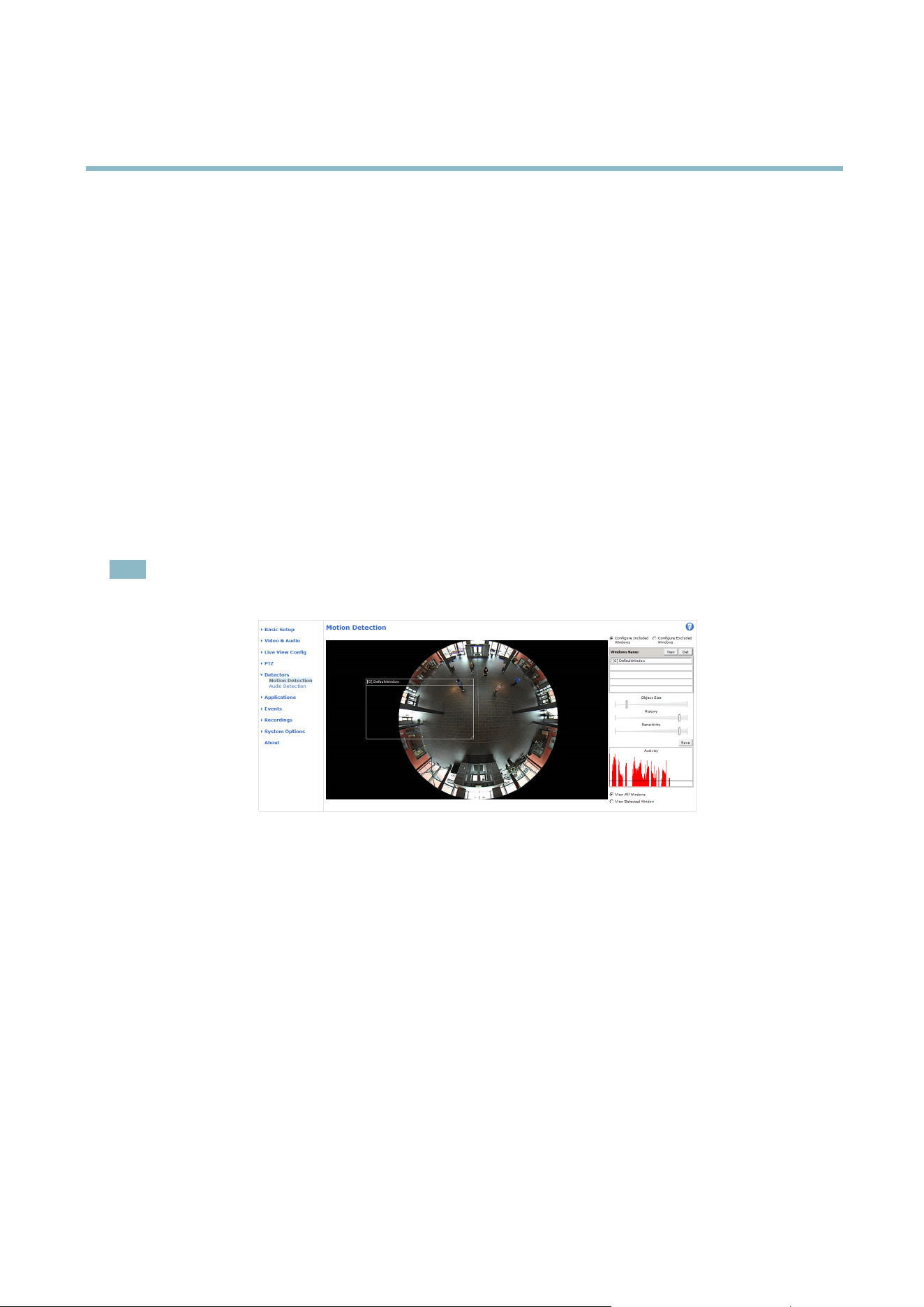
Set Up Motion Detection Windows
To set up a motion detection Include Window, follow thes e inst ructions :
1. Go to Detectors > Motion Detection.
2. Select the Configure Included Windows option and click New. Select the new window in the list of windows and enter
adescriptivename.
3. Adjust the size (drag the bottom right-hand corner) and the position (click on the text at the top and drag to the desired
position) of the window.
4. Adjust the Object Size, History and Sensitivity profile sliders (see Motion Detection Parameters for details). Any detected
motion within an active window is indicated by red peaks in the Activity window.
5. Click Save .
To exclude parts of the include window, select the Configure Excluded Windows and position the exclude window within the
include window.
To delete an include or exclude window, select the window in the list of windows and click Del.
30
AXIS P5544 PTZ Dome Network Camera
Detectors
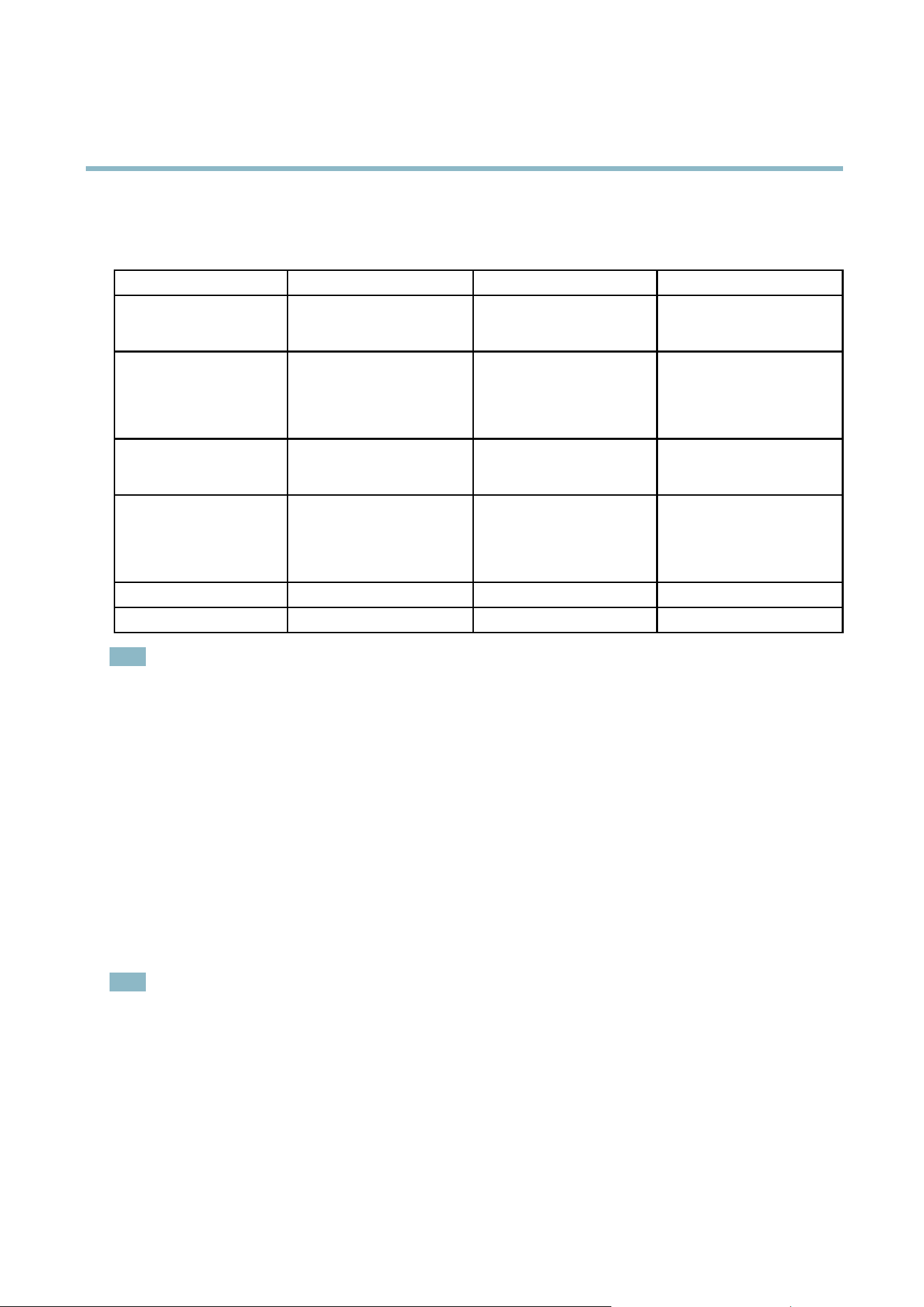
Motion Detection Parameters
The parameters controlling motion detectio n are described in the table below:
Parameter
Object Size
History
Sensitivity
Description
Object size r ela tive to window
size.
Object memory length.
Difference in luminance
between background and
object.
High level (100%)
Only very large objects trigger
motion detection.
An object that appears in
the window triggers motion
detection for a long time
before it is considered as
non-moving.
Ordinary colored objects on
ordinary backgrounds trigger
motion detection.
Medium level (50%)
A large difference in luminance
is required to trigger motion
detection.
Low level (0%)
Even very small objects trigger
motion detection.
An object that appears in
the window triggers motion
detection only for a very short
time before it is considered as
non-moving.
Only very bright objects on
a dark background trigger
motion detection.
Recommended values
5–15% 60–90% 75–95%
Default values
15% 90% 90%
Note
• To trigger on small objects or movements, use several small motion detection windows rather than o ne large window
and select a low object size.
• To avoid triggering on small objects, select a high object size.
• If no objects should appear in the Include Window, select a high history level.
This will cause motion detection to
trigger as long as the object is present in the window.
• To only detect flashing light, select a low sensitivity. In other cases high sensitivity is recommended.
Audio D etection
The Axis p roduct can be configured to generate an alarm when audio rises above or falls below the threshold value. The threshold
value can be set in the range 0–100 where 0 is the most sensitive and 100 the least sensitive.
1. Go to Detectors > Audio Detection.
2. Set the audio alarm level and click Save.
3. Go to Events > Action Rules and set up an action rule, see Setting Up an A ction Rule, on page 34.
Note
A multi-connector cable (available from Axis) is required when connecting external audio equipment to the Axis product.
See Multi
-Connector Cable (sold separately), on page 50.
Detected audio is indicated by colored peaks in the Activity indicator. An ev ent is triggered whe n detected audio rises above or fa lls
below the threshold value, w hich is represented by the bar.
31

AXIS P5544 PTZ Dome Network Camera
Applications
Applications
Third party ap plications can be uploa ded to and installed on the Axis product. For information about avai lable applications,
downloads, trials and licenses, go to www.axi s.com/applications
To upl oad an application, go to Applications > Overview, click Browse to locate the file and the n click Upload Package. Click on the
uploaded application’s name to open the menu options Settings, License and About.Forconfiguration instructions, please refer to
the documentation provided with the application.
Most applications need a license to run. To install the license, select the License menu option. If the product is connected
to the Internet, Automatic Installation appears in the web page. If the product is not connected to the Internet, go to
www.axis.com/applications to acquir e a License key. You will need a license code and the product’s serial number (found on the label
and under System Options > Support > System Overview) to receive a license key.
Installed Applications lists instal led applications with information about the version and the vendor, the status of the application
(running or not running), and information about the license.
Use the Start and Stop buttons to start and stop the application.
To generate a log file for the appli cation, select the a pplica tion and click Log.
Note
It is recommended to run one application at a time. A void running applications when motion detection is active.
32

AXIS P5544 PTZ Dome Network Camera
Events
Events
The Axis p roduct can be configured to perform actions when d ifferent events occur, for example, start a recording when m otion is
detected. The set of conditions that defines how and when the action is triggered is called an Action Rule.
Available Action Rul e triggers and conditions include:
• Applications — use installed applications to trigger the ru le, see Applications, on page 32.
• Detectors
- Audio Detection — trigger the rule when audio is detected, see Audio Detection, on page 31.
- Motion Detection — trigger the rule when motion is detected, see Motion Detection, on page 30.
• Hardware
- Fan — trigger the rule if the fan is m alfunctioning. Thiscanforexamplebeusedtosendmaintenance
notifications.
- Network — trigger the rule if network connectio n is lost or restored. This can for example be used to start
recording to the SD card.
- Temperature — trigger the rule if the temperature falls outside o r inside the operating range of the product. This
canforexamplebeusedtosendmaintenancenotifications.
• Input Signal
- Digital Input Port — trigger the rule when an I/O port receives a signal from a connected device, see I/O
Ports, on page 47.
- Manual Trigger — trigger the rule using the Manual Trigger buttons in the Live View p age, see M anual Trigger,
on page 12. This can for example be used to va lidate actions during product installation and configuration.
• PTZ
- Moving — trigger the rule when the camera view moves due to a PTZ operation. This can for example be used
as an additional condition to pre vent an action r
ule triggered by motion detection to record video while the
camera view moves due to a PTZ operation.
- Preset Reached —triggertherulewhenthecamerastopsatapresetposition.Thiscanbeforexamplebeused
with the Send Images action to upload images from the preset position.
• Storage
- Available — trigger the rule when the storage device is unmounted or removed. This can for example be
used to sen
d maintenance notifications.
- Full —
trigger the rule when the storage device is full . Under normal operation, the olde st recordings will be
overwritten to prevent the s torage device from becoming full.
- Locked
—triggertheruleifthestoragedeviceislocked(writeprotected).
• System
- System Initializing — trigger the rule when the product is being started. This can for example be used to send a
notification when the product restarts.
• Time
- Recurrence — trigger the rule periodically, see Recurrences, on page 35. This can for example be used to upload
an image every 5 minutes.
- Use Schedule — trigger the rule according to the selected schedule, see Schedules, on page 35.
33

AXIS P5544 PTZ Dome Network Camera
Events
Available actions include:
• Day/Night Vision Mode —setdaymode(IRcutfilter on) or night mode (IR cut filter off).
• Output Port — activate an I/O port to control an external device.
• Play Audio Clip —seeAudio C lips, on page 23.
• PTZ Control
- Preset Position — go to a preset position.
- Guard Tour — start a guard tour, see Guard Tour, on page 28.
• Record Video — record video to a selected storage.
• Send Images —sendimagestoarecipient.
• Send Notifications —sendanotification message to a recipient.
Setting Up an Action Rule
An action rule defines the conditions that must be met for the product to perform an action, for example record video or send email
notifications. If multiple conditions ar e defined, all must be met to trigger the action.
The following example describes how to set up an action rule to record video to a network share if there is m o vement in the
camera’s field of view.
Set up motion detection and a dd a network share:
1. Go to Detectors > Motion Detection and configure a motion detection window, see page 30
2. Go to System Options > Storage and set up the network share, see page 46.
Set up the action rule:
1. Go to Events > Action Rules and click Add.
2. Select Enable rule and enter a descriptive name for the rule.
3. Select Detectors from the Trigger drop-down list.
4. Select Motion Detection from the drop-down list. Select the motion detection window to use.
5. Optionally, select a Schedule and Additional conditions,seebelow.
6. Under Actions, select Record Video from the Type drop-down list.
7. Select a Stream profile and configure the Duration settings as describ ed below.
8. Select Network Share from the Storage drop-down list.
To add additional criteria, select the Additional conditions option and add additional triggers. To prevent an action from b eing
triggered repeatedly, a Wait at least time can be set. Enter the time in hours, minutes and s econds, d uring which the trigger
should be ignored be fore the action rule can be activated again.
The recording Duration of some actions can be set to include time immediately before and after the event. Select Pre-trigger time
and/or Post-trigger time and enter the number of seconds. When While the rule is active is enabled and the action is triggered
again during the post-trigger time, the recording time will be extended with another post-trigger time period.
For more information, see the online help
.
34

AXIS P5544 PTZ Dome Network Camera
Events
Recipients
Recipients receive media files and notification messages. The follow ing recipients are available:
Recipient Use with action
Email
Send Images
Send Notification
FTP
Send Images
HTTP
Send Images
Send Notification
Network Share Send Images
TCP Send Notification
To add a recipient:
1. Go to Events > Recipients and click Add.
2. Enter a descriptive name
3. Select a recipient Type.
4. Enter the information needed for the recipient type.
5. Click Test to test the connection to the recipient.
6. Click OK.
Schedules
Schedules can be used as action rule triggers or as additional conditions, for example to re c ord video if motion is detected outside
office hours. Use one of the predefined schedules or create a new schedule as described below.
To create a new schedule:
1. Go to Events > Schedules and click Add.
2. Enter a descriptive name and the information needed for a daily, weekly, monthly or yearly schedule.
3. Click OK.
To use the schedule in an Action Rule, select the schedule from the Schedule drop-down list in the Action Rule Setup page.
Recurrences
Recurrences are used to trigger Action Rules repeatedly, for example e v ery 5 minutes or every hour.
To set up a recurrence:
1. Go to Events > Recurrences and c lick Add.
2. Enter a descripti ve name and recurrence pattern .
3. Click OK.
To use the recurrence in an Action Rule, first select Time from the Trigger drop-do wn list in the Action Rule Setup page and
then select the recurrence from the second drop-down list.
35

AXIS P5544 PTZ Dome Network Camera
Events
To modify or remove recurrences, select the recurrence in the Recurrences List and click Modify or Remove.
36

AXIS P5544 PTZ Dome Network Camera
Recordings
Recordings
TheAxisproductcanbeconfigured to record video continuously or according to an action rule:
• To start a continuous recording, see page 37.
• To set up action rule s, see page 34.
• To access recordings, see Recording List, on page 37.
•Toconfigure camera controlled storage, see Storage, on page 45.
Recording List
Recorded videos are listed on the Recordings > List page. The list s hows each recording’s start date and time, duration and the
event that triggered the recording.
To play or download a recording, follow these steps:
1. Go to Recordings > List.
2. Use the filter to narrow the list of recordings. Enter the desired filter criter ia and click Filter. Some filters may take
a long time to complete.
3. Select the recording.
4. Click Play to play the recording, or click Download to download the recording.
Multiple recordings can be downloaded at the same time. Select the recordings and click Download. The downloaded file is a zip file
containing a minimum of three files, of which the Matroska (mkv) files are the actual recordings. The recordings are time-stamped
with the date and time they were downloaded (that is, not the date the
recordings were made).
Note
To play recordings in Windows Media Player, AXIS Matroska File Splitter must be installed. AXIS Matroska File Splitter
can be downloaded from www.axis.com/techsup/software
For detailed recording and video information, select a recording and click Properties.
To remove a recording, select the recording and click Remove.
Continuous Recording
The Axis product can be configured to continuously save video to a storage device. See Storage, on page 45 for more information
about storage devices. To prevent the disk from becoming full, it is recommended to configure the disk to automatically rem ove
old recordings.
To start a continuous recording, follow these steps:
1. Go to Recordings > Continuous.
2. Select Enabled.
3. Select type of storage device from the Disk list.
4. Select a Stream profile to use for continuous recordings.
5. Click Save to save and start the recording.
37

AXIS P5544 PTZ Dome Network Camera
Recordings
Note
If a new stream profile is selected while a recording is ongoing, the recording w ill be stopped and saved in the recording list
and a new recording with the new stream profile will start. All previous continuous re cordings will remain in the recording
list until they are r emoved manually or through automatic removal of old recordings.
38

AXIS P5544 PTZ Dome Network Camera
System Options
System Options
Security
Users
User access control is enabled by default and can be configured under System Options > Security > Users. An administrator can
set up other users by giving them user names and passwords. It is also possible to allow anonymous viewer login, which means
that anybody may access the Live View page .
The user list displays authorized us ers and u s er groups (access levels):
Viewer - Access to the Live View page
Operator - Access to the Live View page and to all settings except System Options
Administrator - Unrestricted access to all settings; can add, modify and remove other users.
Under HTTP/RTSPPasswordSettings, select the type of password to allow. You may need to allow unencrypted passwords if there
are viewing clients that do not support encryption, or if you upgraded the firmware and existing clients support encryption but need
to log in again and be configuredtousethisfunctionality.
Under User Settings, select the Enable anonymous viewer login option to allow anonymous users access to the Live View page.
Select the Enable anonymous PTZ control login to allow anonymous users access to the PTZ controls.
Deselect the Enable Basic Setup option to hide the Basic Setup menu. Basic Setup provides quick access to settings that should be
made before using the Axis product.
ONVIF
ONVIF (Open Network Vi d eo Interface Forum) is a global interface standard that makes it easier for e n d users, integrators, consu ltants,
and manufacturers to take advantage of the poss ibilities offered by network video technology. ONVIF enables interoperablity between
different vendor products, increased flexibility, red
uced cost and future-proof systems.
By creating a user you automaticall
y enable ONVIF communication. Use the user name and password with all ONVIF communication
with the product. For more information see www.onvif.org
IP Address Filter
IP address filtering is enabled on the System Options > Security > IP Address Filter page. Once enabled, the listed IP address are
allowed or denied acces
s to the Axis product. Select Allow or Deny from the list and click Apply to enable IP address filtering.
The administr
ator can add up to 256 IP address e ntries to the list (a single entry can contain multiple IP addresses).
HTTPS
The Axis product supports encrypted browsing using HTTPS. This is configured on the System Options > Security > HTTPS page.
A self-signed certificate can be used until a Certificate Authority-issued certificate has been obtained. Click Create self-signed
certificate to ins tall a self-signed certifi cate. Although self-signed certificates are free and offer some protection, true security is only
implemented after the installatio n of a signed certificate issued by a Certificate Authority.
To obtain a signe d certificate from an issuing Certificate Authority, click Create Certificate Request. When the signed certificate
is returned, click Install signed certificate to import the certificate. The properties of any certificate request currently resident in
the product or installed can be viewed by clicking Properties.
To enable HTTPS in the Axis product, the HTTPS Connection Policy must be set for each user group.
For more information, see the online help
.
39

AXIS P5544 PTZ Dome Network Camera
System Options
IEEE 802.1X
IEEE 802.1X is a standard for port-based Network A dmissio n Control p roviding secure authentication of wired and wireless network
devices. IEEE 802.1X is based on EAP (Extensible Authentication Protocol).
To access a network protected by IEEE 802.1X, devices must authenticate themselves. The authenticatio n is performed by a
third-party entity called an authentication server, typically a RADIUS server, examples of which are FreeRADIUS and Microsoft
Internet Authentication Service.
In Axis' implem enta tion, the network device and the authentication server authenticate themselves with the help of digital
certificates using EAP-TLS (Extensible Authentication Protocol - Transport Layer Security). The certificates are provided by an
Certification Authority (CA). You need:
•aCAcertificate to validate the identity of the authentication server
• a CA-signed client certificate and a private key to authenticate the network device.
To allow the network device to access a network protected by IEEE 802.1X:
1. Obtain a CA certificate, a client certificate and a client private key (contact your network administrator).
2. Go to Setup > System Options > Security > IEEE 802.1X and upload the CA certificate, the client certificate and the
client pri vat e key.
3. Under Settings, select the EAPOL version, provide your EAP identity and private key password.
4. Check the box to enable IEEE 802.1X and click Save.
Certificates
CA Certificate The CA certificate is used to validate the identity of the authentication server. Enter the path to
the certificate directly, or locate the file using the Brow se button. Then click U
pload.Toremove
acertificate , click Remove.
Client certificate
Client private key
The client certificate and private key are used to authenticate the network device. They can be
uploaded as separate files or in one combined file (e.g. a PFX file or a PEM file). Use the Client
private key field if uploading one combined file. For each file, enter the path to the file, or locate the
fi
le using the Browse button. Then click Upload.Toremoveafile, click Remove.
Settings
EAPOL version
SelecttheEAPOLversion(1or2)asusedinyournetworkswitch.
EAP identity
Enter the user identity (maximum 16 characters) a ssociated with your certificate.
Private key password
Enter the password (maximum
16 characters) for the private key.
Enable IEEE 802.1X
Check the box to enable the IEEE 802.1X protocol.
Audio Support
Select Enable audio support to allow clients to retrieve audio streams from the Axis product. For information on how to configure
audio settings, see Audio Setting s, on page 21.
Note
Deselecting this option will disable audio glo bally in the Ax is product, for configured events and profiles with audio as well.
Date & Time
The Axis product’s date and time settings are configured under System Options > Date & Time.
Current Server Time displays the current date and time (24h clock). The time can be displayed in 12h clock in the text overlay (see
below).
40

AXIS P5544 PTZ Dome Network Camera
System Options
To change the date and time settings, select the preferred Time mode under New Server Time:
• Synchronize with computer time sets date and time according to the com puter’s clock. With this op tion, date and
time are set once and will not be updated automatically.
• Synchronize with NTP Server obtains date and time from an NTP server. With this option, date and time settings are
updated continuously. For information on NTP settings, see NTP Configuration, on page 42.
If using a host name for the NTP server, a DNS server must be configured. See DNS Configuration, on page 42.
• Set manually allows you to manually set date and time.
If using an NTP server, select your Time zone from the drop-down list. If required, check Automatically adjust for daylight saving
time changes.
The Date & Time Format U sed in Images is the date a nd time form at displayed as a text overlay in the video stream. Use the
predefined formats or see File Naming & Date/Time Formats in the online help
for information on how to create custom date and
time formats. To include date and time in the overlay text, go to Video & Audio and select Include date and Include time.
Network
Basic TCP/IP Settings
The Axis product supports IP version 4 and IP version 6. Both versions can be e nabled simultaneously, and at least one version
must always be enabled.
IPv4 Address Con figuration
By default, the Axis product is set to use IPv4 (IP version 4) and to obtain the IP address automatically via DHCP. The IPv4 settings a re
configured under System Options > Network > TCP/IP > Basic.
DHCP (Dynamic Host Configuration Protocol) allows network administrators to centrally manage and automate the assignment of
IP addresses. DHCP should only be enabled if using dynamic IP address notification, or if the DHCP can update a DNS server. It is
then possible to access the Axis product by name (host name).
If DHCP is enabled and the product cannot be accessed, run AXIS IP Utility to search the network for connected Axis products, or reset
the product to the factory default settings (see page 49) and then perform the installation again.
To use a static IP address, check Use the following IP address and specify the IP address, subnet mask and default router.
IPv6 Address Con figuration
If IPv6 (IP version 6) is enabled, the Axis p roduct will receive an IP address according to the configuration in the network router.
To enable IPv6, go to System Options > Network > TCP/IP > Basic. Other settings for IPv6 should be configured in the network router.
ARP/Ping
The IP address can be set using ARP and Ping. For instructions, see the product’s Installation Guide.
ARP/Ping is ena bled by default. To disable, uncheck the box under System Options > Network > TCP/IP > Basic.
The ARP/Ping service is automatically disabled two minutes after the product is started, or as soon as an IP address is set. To reset the
IP address, the product must be restarted to activate ARP/Ping for an additional two minutes.
Pinging the product is still possible when this service is disabled.
41

AXIS P5544 PTZ Dome Network Camera
System Options
AXIS Video Hosting System (AVHS)
AVHS used in conjunction with an AVHS service, provides easy and secure Internet access to live and recorded video accessible from
any location. For more information and help to find a local AVHS Service Provider go to www.axis.com/hosting
AVHS is enabled by default. The settings are configured under System Options > Network > TCP IP > Basic.
One-click enabled - Press the product’s control button (see Hardware Overview, on page 5 ) to connect to an AVHS service over the
Internet. Once registered, Always will be enabled and the Axis product stays connected to the AVHS service. If the product is not
registered within 24 hours from when the b utton is pressed, the product will disconnect from the AVHS service.
Always - The Axis product will constantly attempt to connect to the AVHS service over the Internet. Once registered the product will
stay connected to the service. This option can be used when the product is already installed and it is not convenient to use the
one-click installation.
AXIS Internet Dynamic DNS Service
AXIS Internet Dynamic DNS Service assigns a host name for easy access to the product. For more information, see www.axiscam.net
To register the A xis product with AXIS Internet Dynamic DNS Service, go to System Options > Network > TCP/IP > Basic.Under
Services, click the AXIS Internet Dynamic DNS Service Settings button (requires access to the Internet). The domain nam e currently
registered at AXIS Internet Dynamic DNS service for the product can at any time be removed.
Advanced TCP/IP Settings
DNS Configuration
DNS (Domain Name Service) provides the translation of host names to IP addresses. The DNS settings are configured under System
Options > Network > TCP/IP > Advanced.
Select Obtain DNS server address via DHCP to use the DNS settings provided by the DHCP server.
To make manual settings, select Use the following DNS server address and specify the following:
Domain name - Enter the domain(s) to search for the host name used by the Axis product. Multiple domains can be separ ate d by
semicolons. The host name is always the firstpartofafullyqualified domain name, for example, myserver is the host name in the
fully qualified domain name myserver.mycompany.com where mycompany.com is the domain name.
Primary/Secondary DNS server - Enter the IP addresses of the primary and secondary DNS servers. The secondary DNS server is
optional and will be used if the primary is unavailable.
NTP Configuration
NTP (Network Time Protocol) is used to synchronize the clock times of devices in a network. The NTP settings are configured under
System Options > Network > TCP/IP > Advanced.
Select Obtain NTP server address via DHCP to use the NTP setting s provided by the DHCP server.
To m ake manual settings, select Use the following NTP server address and enter the host name or IP a ddress of the NTP server.
Host Name Configuration
The Ax is product can be acce ss ed using a host name instead of an IP address. The host name is usually the same as the assigned DNS
name. The host name is configured under System Options > Network > TCP/IP > Advanced.
Select Obtain host name via IPv4 DHCP to use host name provided by the DHCP server running on IPv4.
Select Use the host name to set the host name manually.
Select Enable dynamic DNS updates to dynamically update local DNS servers whenever the Axis product’s IP address changes.
For more information, see the online help
.
42

AXIS P5544 PTZ Dome Network Camera
System Options
Link-Local IPv4 Address
Link-Local Address is enabled by default and assigns the Axis product an additional IP address which can be used to access
the product from other hosts on the same segment on the local network. The product can have a Link-Local IP and a static
or DHCP-supplied IP address at the same time.
This function can be disabled under System Options > Network > TCP/IP > Advanced.
HTTP
The H TTP port used by the Axis product can be changed under System Options > Network > TCP/IP > Advanced. In addition to the
default setting, which is 80, any port in the range 1024–65535 can be used.
HTTPS
The HTTPS port used by the Axis product can be changed under System Options > Network > TCP/IP > Advanced. In addition to
the default setting, which is 443, any port in the range 1024–65535 can be used.
To enable HTTPS, g o to System Options > Security > HTTPS. For more information, see page 39.
NAT traversal (port mapping) for IPv4
A network router allows devices on a private network (LAN) to share a single connection to the Internet. This is done by forwarding
network traffic from the private network to the “outside”, that is, the Internet. Security on the private network (LAN) is incre as ed
since most routers are pre-configured to stop attempts to access the private network (LAN) from the public network (Internet).
Use NAT traversal when the Axis product is located on an intranet (LAN) and you wish to make it available from the other
(WAN) side of a NAT router. With NAT traversal properly configured, all HTTP traffic to an external HTTP port in the NAT router
isforwardedtotheproduct.
NAT traversal is configured under System Options > Network > TCP/IP > Advanced.
Note
• For NAT traversal to work, this must be supported by the router. The router must also support UPnP
TM
.
• The router has ma ny different names: “NAT router”, “Network router”, “Internet Gateway”, ”Broadband router”, “B roadband
sharing device” or “Home firewall” but the essential purpose of the device is the sa
me.
Enable/Disable - When enabled, the Axis product attempts to configure port mapping in a NAT router on your network, using UPnP
TM
.
Note that UPnP
TM
must be enabled in the product (see System Options > Network > UPnP).
Use manually selected NAT router - Select this option to manually select a NAT router and enter the IP address f or the router in
the field. If no router is specified, the product automatically searches for NAT routers on your network. If more than one router is
found, the default router is selected.
Alternative HTTP port - Select this option to manually define an external HTTP port. Enter the port number in the field. If no port is
entered here, a port number is automatically selected when NAT traversal is enabled.
Note
• An alternative HTTP port can be used or be active even if NAT traversal is disabled. This is useful if your NAT router does
not support UPnP and you need to manually configure port forwarding in the NAT router.
• If you attempt to man
ually enter a port that is already in use, another available port is automatically selected.
• When t he port is selected automatically it is displayed in this field. To change this, enter a new port number and click Save.
FTP
The FTP server running in the Axis product enables upload of new firmware, user a pplications, etc. The FTP server can be disabled
under System Options > Network > TCP/IP > Advanced.
43

AXIS P5544 PTZ Dome Network Camera
System Options
Note
This FTP server has nothing to do with the product’s ability to transfer images via FTP to other locations and servers .
RTSP
The RTSP server running in the Axis product allows a connecting client to start an H.264 stream. The RTSP port number can be
changed under System Options > Network > TCP/IP > Advanced. The default port is 554.
Note
H.264 video streams will not be available if the RTSP server is d isabled.
SOCKS
SOCKS is a networking proxy protocol. The Axis product can be configured to use a SOCKS server to reach networks on the other
side of a firewall or proxy server. This functionality is useful if the Axis product is located on a local network behind a firewall, and
notifications, uploads, alarms, etc need to be send to a destination outside the local network (for example the Internet).
SOCKS is configured under System Options > Network > SOCKS. For more informatio n, see the online help
.
QoS (Quality of Service)
QoS (Quality of Service) guarantees a certain level of a specified resource to selected traf fic on a network. A QoS-aware network
prioritizes network traf fic and provides a greater network reliability by co n trolling the amount of bandwidth an application may use.
TheQoSsettingsareconfigured under System Options > N etwork > QoS. Using DSCP (Differentiated Services Codepoint) values, the
Axis product can mark the following types of traffic: live vide o, live audio, e vent/alarm traffic and management traffic.
Note
Live audio DSCP will be equal to live video DSCP if H.264 ove r RTSP is used.
SMTP (email)
To send email messages from the Axis pro duct via SMTP (Simple Mail Transfer Protocol), an SMTP mail server must be set up. This
is done under System Options > Network > SMTP (email).
Enter the host names or IP addresses and port numbers for the primary and secondary mail servers in the fields provided. A From
email address is also required. If the mail server requires a
uthentication, check Use authentication to log in to this server and enter
the necessary information.
SNMP
The Simple N etwork Management Protocol (SNMP) allows remote management of network devices. An SNMP community is the
group of devices and management stati
on running SNMP. Community names are used to identify groups.
The Axis product can be configured
to support SNMP on the System Options > Network > SNMP page.
Depending on the level of sec
urity required, select the version on SNMP to use.
SNMP v1/v2 provides the
lowest level of security. The community name can be specified as a password for read or read/write
access to all supported SNMP devices. The default password for the Read community is public and the default password for the
Write community is write.
Note
If HTTPS is enabled, SNMP v1 and SNMP v2c should be disabled.
Traps for SNMP v1/v2 are used by t he Axis product to send messages to a management system on important events and status
change
s. Check Enable traps and enter the IP address where the trap message should be sent and the Trap community that
should receive the message.
44

AXIS P5544 PTZ Dome Network Camera
System Options
The following traps are available:
•Coldstart
•Warmstart
•Linkup
• Authentication failed
SNMP v3 provides encryption and secure passwords. To use traps with SNMP v3, an SNMP v3 management application is required.
To use SNMP v3, HTTPS must be enabled, see HTTPS, on page 39. To enable SNM P v3, check the box and provide the initial user
password.
Note
The initial password can o nly be set once. If the password is lost, the Axis product must be reset to factory default, see
Reset to Factory Default Settings, on page 49.
UPnP
TM
The Axis product includes support for UPnP
TM
.UPnP
TM
is enabled by default and the product is automatically detected by operating
systems and clients that support this protocol.
UPnP
TM
can be disabled under System Options > Network > UPnP
TM
.
RTP/H.264
The RTP p ort range and multicast settings are configured under System Options > Network > RTP.
The RTP port range defines the range of ports from which the video/audio ports are auto
matically selected. For multicast streams,
only certain IP addresses and port numbers should be used.
Select Always Multicast Video and/or Always Multicast Audio to start multicast streaming without opening an RTSP session.
Bonjour
The Axis product includes support for Bonjour. Bonjour is enabled by default and the product is automatically detected by operating
systems and clients that support this protoc
ol.
Bonjour can be disabled under System Op
tions > Network > Bonjour.
Storage
SD Card
NOTICE
To prevent corruption of recordings, the SD card should always be unmounted befo re it is ejected.
Important
ToaccesstheSDcard,thetopcovermustberemoved. Afterremounting the alignment of the lens may differ slightly
and the PTZ mechanics should be recalibrated. Go to System Options > Maintenance and click Calibrate PTZ.Formore
infor
mation, see PTZ Calibration, on page 47.
The Axis product supports SD cards with the following file systems:
• ext4 — recommended due to its resilience against data loss if the card is ejected or if there is abrupt power loss. To access
data stored on the card from the Windows operating system, a third-party ext4 driver or application is required.
• vFAT — most SD cards are pre-formatted with vFAT when purchased.
45

AXIS P5544 PTZ Dome Network Camera
System Options
If required, the SD card can be re-formatted to the desired file system. To format the SD card:
1. Insert the SD card in the SD card slot.
2. Go to System Options > Storage and click SD Card.
3. Click Format and s elect the desired file system.
Note
During formatting any previous data stored on the disk will be lost.
Mounting is done automatically when the card is inserted or when the product is started. A manual m ount is only required if the
card has been unmounted and not ejected and re-inserted.
To unmount the SD card:
1. Go to System Options > Storage and click SD Card.
2. Click Unmount.
3. The card can now be removed.
The SD card is managed on the System Options > Storage page. Click SD Card to open Storage Management.
If the card’s status shows as failed, click Check disk to see if the problem can be found and then try Repair. This option is only
available for SD cards w ith ext4. For SD cards with vFAT, use a card reader or computer to troubleshoot the card.
To avoid filling the card, it is recommended to remove recordings continuously. Under Recording Settings, select Remove recordings
older than and select the number of days or weeks.
To stop wr iting to the card and protect recordings from being removed, select Lock under Recording Settings.
Network Share
Network share allows you to add network storage such as a NAS (Ne
twork Attached Storage) or any server that uses CIFS (Common
Internet File System) and use them for storage of recordings.
To add a network share:
1. Go to System Options > Storage.
2. Click Network Share.
3. Enter the IP address, DNS or Bonjour name to the host server in the Host field.
4. Enter the name of the share in the Share field.
5. If required, select The share requires login and enter the user name and password.
6. Click Connect.
To clear all recordings and data from the Axis product’s folder on the designated share, c lick Clear under Storage Tools.
To avoid filling the share, it is recommended to remove recordings continuously. Under Recording Settings,selectRemove recordings
older than and select the number of days or weeks.
To stop writing to the share and protect recordings from being removed, select Lock under Recording Settings.
46

AXIS P5544 PTZ Dome Network Camera
System Options
Ports & Devices
I/O Ports
The Axis product provides four configurable input and output ports for connection of external devices. A multi-connector cable
(available from Axis) is required when connecting external devices, see Multi-Connector Cable (sold separately), on page 50.
The I/O ports are configured under System Options > Ports & Devices > I/O Ports. Select the port direction (Input or Output). The
ports can be given descriptive names and their Normal states can be configured as Open circuit or Grounded circuit.
Port Status
The lis t on the System Options > Ports & Devices > Port Status page shows the status of the product’s input and output ports.
Note
A multi-connector cable (available from Axis) is required when connecting I/O devices to the Axis product. See
Multi-Connector Cable (sold sep arately), on page 50.
Maintenance
The Axis product provides several maintenance functions. These are available under System Options > Maintenance.
Click Restart to perform a correct restart if the Axis product is not behaving as expected. This will not affect any of the current
settings.
Click Restore to reset most settings to the factory default values. The following settings are not affected:
• the boot pro tocol (DHCP or static)
• the static IP address
• the default router
• the subnet mask
•thesystemtime
• the IEEE 802.1X settings
Click Default to reset all settings, including the IP address, to the factory default values. This button should be used with caution. The
Axis product can also be reset to factory default using the control button, see Reset to Factory Default S ettings, on page 49.
To test the product’s PTZ mechanics, click Test under PTZ Status.
To calibrate the PTZ functionality, click Calibra te PTZ.SeePTZ Calibration.
For information about firmware upgrade, see Upgrading the Firmware, on page 52.
PTZ Calibration
The camera’s PTZ mechanics must be calibrated before use. PTZ calibration aligns the overview mode and normal mode coordinate
systems so that each point in the overview is mapped to the correct point in the normal mode image.
The PTZ Calibration tool starts automatically the first time the product is accessed. If required, PTZ calibration can a lso be accessed
from System Options > Maintenance.
Important
A new PTZ calibration is recommended if the top cover has been removed and remounted, for example when replacing
the SD card.
To calibrate the PTZ mechanics:
47

AXIS P5544 PTZ Dome Network Camera
System Options
1. Open PTZ Calibration from System Options > Maintenance.
2. Use the rotate buttons to adjust the image orientation.
3. Select an object inside the small circle and click on an easily identifiable point on that object.
4. Click on the same point on the sam e object in the normal mode image.
5. Repeat steps 3 and 4 until PTZ calibration is finished.
Note
For an accurate calibration, it is important to click on the same point in steps 3 and 4 above. For example, if the object is a
car a nd you clicked on the right headlight in step 3, make sure to click on the same headlight in step 4.
Support
Support Overview
The System Options > Support > Support Overview page provides information on troubleshooting and contact information,
should you require technical assistance.
See also Troubleshooting, on page 52.
System Overview
To g et an overview of the Axis product’s status and settings, go to System Options > Support > System Overview. Information that
can be found here includes firmware version, IP address, network and security settings, event settings, image settings and recent log
items. Many of the captions are links to the proper Setup page.
Logs & Reports
The System Options > Support > Logs & Reports page generates logs and reports useful for system analysis and troubleshooting. If
contacting Axis Support, please provide a valid Server Report with your query.
System Log - Provides information about system e vents.
Access Log - Lists all failed attempts to access the product. The Access Log can also be configured to list all connections to the
product (see below).
Server Report - Provides information about the product status in a pop-up window. The A ccess Log is automatically included
in the Server Report.
You can view or download the server report. Downloading the server report creates a .zip file that contains a complete server report
text file in UTF–8 format. Select the Include snapshot with default image settings option to include a snapshot of the pro duct’s
Live View that also s
hows the settings specified under Video Stream>Image>Image A ppea rance. The server report .zip file should
always be included when contacting support.
Parameter List - Shows the product's parameters and their current settings. This may prove useful when troubleshooting or
when contacting Axis Support.
Connection List - Lists all clients that are currently accessing med ia streams.
Crash Report - Generates an archive with debugging i n forma tion. The report takes several minutes to generate.
The log levels for the System Log and the Access Log a re set under System Options > Support > Logs & Reports > Configuration.
The Access Log can be configured to list all connections to the product (select Critical, Warnings & Info). If required, a different log
level can be used wh en sending emails.
48

AXIS P5544 PTZ Dome Network Camera
System Options
Advanced
Scripting
Scripting allows experienced users to customize and use their own scripts.
NOTICE
Improper use may cause unexpected behavior and loss of contact with the Axis product.
Axis strongly recommends that you do not use this function unless you understand the consequences. Axis Support does not provide
assistance for problems with customized scripts.
To open the Script Ed itor, go to System Options > Advanced > Scripting. It is recommended to create a backup file before
customizing the scripts. If a script causes problems, reset the product to its factory default settings, see page 49.
For more information, see www.axis.com/developer
File Upload
Files, for example web pages and images, can be uploaded to the Axis product a nd used as custom settings. To upload a file, go
to System Options > Advanced > File Upload.
Uploaded files are accessed through http://<ip address>/local/<user>/<file name> where <user> is the
selected user group (viewer, operator or administrator) for the uploaded file.
Plain Config
Plain Con fig is for advanced users w ith experience of Axis product configuration. M ost parameters can be set and modified from this
page. Help is available from the standard help pages.
To open Plain Config, go to System Options > Advanced > Plain Config.
Reset to Factory Default Settings
This will reset all parameters, including the IP address, to the factory default settings:
1. Press and hold the Control button and the Restart button at the same time (see Hardware Overview, on page 5 ).
2. Release the Restart button but continue to hold down the Control button for about 15 seconds until the Status indicator
flashes amber.
3. Release the Control button. The process is complete after about 1 minute (when the Status indicator turns green). The
product has been reset to the factory default settings. The default IP address is 192.168.0.90
4. Re-assign the IP address.
It is also possible to reset parameters to factory default via the web interface. Go to Setup > System Options > Maintenance.
49

AXIS P5544 PTZ Dome Network Camera
Multi-Connector Cable (sold separately)
Multi-Connector Cable (sold separately)
When connecting external equipment to the Axis product, a multi-connector cable (available from Ax is) is req u ire d in order to
maintain the product’s IP rating. The multi-connector cable can be purchased from your Axis reseller.
Connect the multi-connector cable to the product’s multi-connector (see page 5 ). The c able provides the following connectors:
Note
See page 57 for technical specifications.
Power connector - 3-pin terminal block used for power input. See image below.
Audio in (pink) - 3.5 mm input for a mono microphone, or a line-in mono signal (left channel is used from a stereo signal).
Audio out (green) - 3.5 m m output for audio (line level) that can be connected to a public address (PA) system or an active speaker
with a built-in amplifier. A pair of head phones can also be attached. A stereo connector must be used for the audio out.
I/O terminal connector - Use in applications for e.g. motion detection, event triggering, time lapse recording and alarm notifications.
In addition to an auxiliary power and a GND pin, the I/O terminal connector provides the interface to:
• Digital output — For connecting external devices such as relays and LEDs. Connected devices can be activated by the
VAPIX® Application Programming Interface, output buttonsontheLiveViewpageorbyanActionRule.Theoutput
will show as active (shown under System Options > Port & Devices > Port Status) if the alarm device is activated.
• Digital input — An alarm input for connecting devices that can toggle between an open and closed circuit, for
example: PIRs, door/window contacts, glass break detectors, etc. When a signal is received the state changes and
the input becom es active (shown under System Options > Port & Devices > Port Status).
Function Pin Notes
Specifications
GND
1
Ground
3.3 V DC Power
2
Can be used to power auxiliary equipment.
Note: This pin can only be used as power out.
Max load = 250 mA
Digital input — Connect to GND to a ctivate, or leave floating
(unconnected) to deactivate.
0to+40VDCConfigurable
(Input or Output)
3–6
Digital output — Internal connection to ground when
activated, floating (unconnected) when deactivated. If used
with an external relay, a diode m ust be connected in parallel
with the load, for protection against voltage transients.
Max load =100 mA
Max voltage = +40 V DC
50
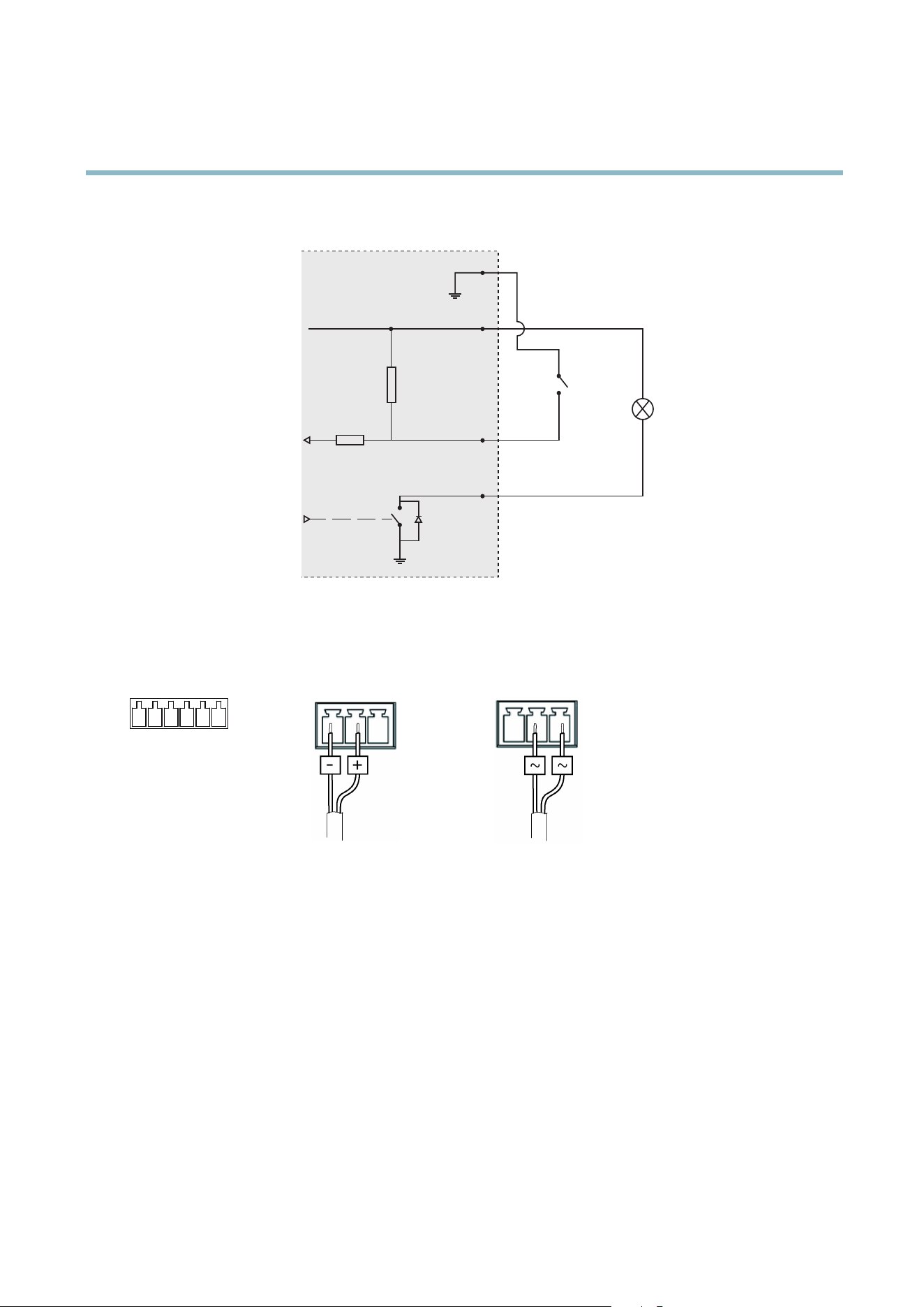
AXIS P5544 PTZ Dome Network Camera
Multi-Connector Cable (sold separately)
Connection diagram:
3.3 V max 250 mA
1
2
A
B
A
I/O configured as input
B
I/O configured as output
I/O connector
1 2 3 4 5 6
DC power input AC power input
51

AXIS P5544 PTZ Dome Network Camera
Troubleshooting
Troubleshooting
Checking the Firmware
Firmware is software that determines the functionality of network devices. One of your first actions when troubleshooting a problem
should be to check the current firmware version. The latest version may contain a correction that fixes your particular problem. The
current firmware ve rs ion in the A xis product is displayed in the page Setup > Basic Setup and in Setup > About.
Upgrading the Firmware
When you upgrade the product with the latest firmwa re from Axis website, the product receives the latest functionality available.
Always read the upgrade instructions and release notes available with each new release, before upgrading the firmware.
To upgrade, follow these instructions:
1. Save the firmware file to your computer. The latest version of the fir mware is available free of c harge from Axis website
at www.axis.com/techsup
2. Go to Setup > System Options > Maintenance in the products web pages.
3. Under Upgrade Server, click Browse and locate the file on your computer. Click Upgrade.
After starting the upgrade process, always wait at least 5–10 minutes before restarting the product, even if you suspect the
upgrade has failed.
AXIS Camera Management can be used for multiple upgrades. See www.axis.com for more information.
Note
• Your dealer reserves the right to charge for any repair attributable to faulty upgrade by the user.
•Preconfigured and customized settings are saved when the firmware i s upgraded
(providing the features are available in
the new firmware) although this is not guaranteed by Axis Communications AB.
Emergency Recovery Procedure
If power or network connection is lost during the upgrade, the process fails and the product becomes unresponsive. Flashing r ed Status
indicator indicates a failed upgrade. To recover the product, follow the steps below. The serial number is found on the product’s label.
1. In UNIX/Linux, type the following from the com mand line:
arp -s <IP address> <serial number> temp
52

AXIS P5544 PTZ Dome Network Camera
Troubleshooting
ping -s 408 <IP address>
In Windows, type the following from a command/DOS prompt (this may require that you run the command pro mpt as
an administrator):
arp -s <IP address> <serial number>
ping -l 408 -t <IP address>
2. If the product does not reply in 30 seconds, restart it and wait for a reply. Press CTRL+C to stop Ping.
3. Open a browser and type in the product’s IP address. In the page that appears, use the Browse button to select the upgrade
file to use. Then click Load to restart the upgrade process.
4. After the upgrade is complete (1–10 minutes), the product automatically restarts and shows a steady green on the Status
indicator.
5. Reinstall the product, referring to the Installation Guide.
If the emergency recovery procedure does not get the product up and running again, contact Axis support at www.axis.com/techsup/
Symptoms, Possible Causes and Rem edia l Actions
Problems setting the IP address
When using ARP/Ping
Try the installation again. The IP address must be set within two minutes after power has been
applied to the product. Ensure the Ping length is set to 408. See the Installation Guide for
detailed instructions.
The product is located on a
different subnet
If the IP address intended for the product and the IP address of the computer u sed to access the
product are located on different subnets, you will not be able to set the IP address. Contact your
network administrator to obtain an IP address.
The IP address is be ing used
by another device
Disconnect the Axis product from the network. Run the Ping command (in a Command/DOS
window, type ping and the IP address of the product:
•Ifyoureceive:Reply from <IP address>: bytes=32; time=10...
this means that the IP address may already be in use by another device on the network.
Obtain a new IP address from the network adm inistr ator and reinstall the product.
•Ifyoureceive:Request timed out, this means that the IP address is available for
use with the Axis product. Check all cabling and reinstall the product.
Possible IP address conflict
with another device on the
same subnet.
The static IP address in the Axis product is used be fore the DHCP server sets a dynamic address.
This means that if the same default static IP addressisalsousedbyanotherdevice,theremay
be problems accessing the product.
The product cannot be accessed from a browser
Cannot log in
When HTTPS is enabled, ensure that the correct protocol (HTTP or HTTPS) is used when attempting
to log in. You may need to manually type http or https in the browser’s address field.
If the password for root is lost, the product must be r eset to the factory default settings. See
Reset to F
actory Default Settings, on page 49.
The IP address has been
changed by DHCP
If the pro duct and the client are on the same network, run AXIS IP Utility to locate the product.
Identify the product using its model or serial number.
Move the Axis product to an isolated network, or to one with no DHCP or BOOTP server. Set the IP
address again, using AXIS IP Utility o r ARP/Ping (see the Installation Guide). Open the Setup pages
and disabled DHCP in the TCP/IP settings. Return the product to the m ain network. The product
now has a fixed IP address that will not change.
Certificate error when using
IEEE 802.1X
For authentication to work properly, the date and time settings in the Axis product should be
synchronized with an NTP server. See Date & Time, on page 40.
53

AXIS P5544 PTZ Dome Network Camera
Troubleshooting
The product is accessible locally but not externally
Router configuration To configure your router to allow incoming data traffic to the Axis product, enable the NAT-traversal
feature which will atte mpt to automatically configure the router to a llow access to the Axis
product, see NAT traversal (port mapping) for IPv4, on page 43. The router must support UPnP
TM
.
Firewall protection
Check the Internet firewall with your network administrator.
Default routers re quired
Check if you need to configure the router settings.
Problems with the H.264 format
No H.264 displayed i n the
client
Check that the relevant H.264 connection methods and correct interf ace are enabled in the AMC
Control Panel (streaming tab). See AXIS Media Control (AMC), on page 13.
In the AMC Control Panel, select the H.264 tab and click Set to default H.264 decoder.
Check that RTSP is enabled under System Options > Network > TCP/IP > Advanced.
No multicast H .264
displayed in the client
Check with your network administrator that the multicast addresses used by the Axis product
arevalidforyournetwork.
Check with your network administrator to see if there is a firewall preventing viewing.
Multicast H.264 only
accessible by local clients
Check if your router supports multicasting, or if the router settings between the client and the
product need to be configured . The TTL (Time To Live) value may need to be increased.
Poor rendering of H.264
images
Color depth set incorrectly on clients. Set to 16–bit or 32–bit color.
If text overlays are blurred, or if there are other rendering problems, you may need to enable
Advanced Video Rendering fromv the Video tab in the AMC Control Panel.
Ensure that your graphics card is us ing the latest driver. The latest drivers can usually be
downloaded from the manufacturer’s website.
Color saturation is different
in H.264 and Motion JPEG
Modify the settings for your graphics adapter. Refer to the adapter’s documentation for more
information.
Lower frame rate than
expected
Reduce the number of applications running on the client computer.
Limit the number of simultaneous viewers.
Check with the network administrator that there is enough bandwidth available.
Check in the AMC Control Panel (H.264 tag) that video processing is NOT set to Decode only
key fra mes.
Lower the image resolution.
Why do I not get maximum
f
rames per second?
See Performance Considerations, on page 59.
The maximum frames per second is depende nt on the utility freque ncy (60/50 Hz) of the Axis
product. See Technical Specifications, on page 57.
Image degeneration
Decrease the GOV length. Go to Video & Audio > Video Stream and select the H.264 tab
to modify the GOV length.
Status indicator LED is flashing red a nd the product is inaccessible
A firmware upgrade ha s
been interrupted or the
firmware has otherw ise been
damaged
See Emergency Recovery Procedure, on page 52.
54

AXIS P5544 PTZ Dome Network Camera
Troubleshooting
No images displayed o n web page
Problems with AXIS Media
Control (Internet Explorer
only)
To enable the updating of video images in Internet Explorer, set the browser to allow ActiveX
controls. Also, make sure that AXIS Media Control is installed on your com puter.
Installation of additional
ActiveX component
restricted or proh ibited
Configure the Axis product to use a Java applet for updating video images in Internet Explorer. Go
to Setup > Live View Config and select Java applet under Default viewer.
Video and image problems, general
Image too dark or too light
Check the video stream and camera settings under Setup > Video & Audio > Video Stream and
Setup > Video & Audio > Camera Settings.
Missing images in uploads This can occur when trying to use a larger image buffer than is actually available. Try lowering
the frame rate or the upload period.
Slow image u p date Configuring pre-buffers, motion detection, high-resolution images or high frame rates will a ffe ct
the performance of the Axis product.
Poor performance Poor performance may be caused by heavy network traffic, multiple users accessing the product,
low performance clients, use of features such as motion detection, event handling or uploaded
applications.
PTZ problems
Incorrect mapping between
Overview mode and Normal
mode
If the camera view does not m ove to the correct position in Normal mode when clicking an object
in Overview mode, the PTZ calibration is inaccurate and should be redone. Go to System Options >
Maintenance.SeePTZ Calibration, on page 47.
Poor quality snapshot images
Screen incorrectly
configured o n your computer
Configure your screen to show at least 65000 colors, that is, at least 16 bits. Using only 16 or 256
colors will produce dithering artifacts in the image.
Overlay image is not displayed
No o verlay image in
Overview mode
The overlay image is only displayed in Normal mode.
Incorrect size or location of
overlay image
The overlay image may have been positioned incorre ctly or may be too large. See Overlay Image
Settings in the online help for more information.
Privacy mask is not displayed
No privacy mask in Ove rview
mode
Privacy masks are only displayed in Normal mode.
Incorrect size or location of
privacy mask
The privacy mask may have been positioned incorrectly or may be too large.
Browser freezes
Firefox c an sometimes
freeze on a slow compu
ter
Lower the image resolution
Problems uploading files
Limited space There is only limited space available for the upload of your own files. Dele te existing files to free
up space.
55

AXIS P5544 PTZ Dome Network Camera
Troubleshooting
Motion Detection triggers unexpectedly
Changes in lum inance
Motion detection is based on changes in luminance in the image. This means that if there are
sudden changes in the lighting, motion detection may trigger mistakenly. Lower the sensitivity
setting to avoid problems w ith luminance.
No audio
Incorrect setup
Check the sound card in the computer. Ensure that mute is not selected and that the volume
settings are correct.
No audio or very poor audio
quality
Check that Enable audio support is selected under Setup > System Options > Security > Audio
Support.
Check that the correct Audio Input source is selected under Setup > Video & Audio > Audio
Settings.
Poor audio quality
CPU overloaded
Reduce the number of listeners and viewers. Decrease image resolution and compression.
Unsynchronized audio and
video
Synchronize the product’s date and timesettingswithanNTPserver. GotoSetup > System
Options > Date & Time.
Distorted audio
Check that the correct Audio Input source is selected under Setup > Video & Audio > Audio
Settings.
Feedback loops Feedback loops might appear in full-duplex mode. Try moving the microphone or the speaker, or
use half-duplex mod e instead.
Storage and disk management problems
Video cannot be recorded
Check that the SD card is not write protected (that is, read only).
SD card cannot be mounted Reformat the SD card and then click Mount.
56

AXIS P5544 PTZ Dome Network Camera
Technical Specifications
Technical Specifications
Function/group
Item
Specifications
Model
AXIS P5544 50 Hz
AXIS P5544 60 Hz
Image sensor
1/3” progressive scan CCD 1.3 megapixel
Lens
pan/tilt/zoom lens (Normal mode): f=4.7 – 84.6 mm, F1.6 – 2.8, autofocus, automatic
day/night
Horizontal angle of view: 55.2° - 3.2°
Wide angle lens (Overview mode): f=2.7 mm
Angle of view: 180°
Minimum
illumination
Color: 0.74 lux at 30 IRE F1.6
B/W: 0.04 lux a t 30 IRE F1.6
Camera
Shutter time
1/10 000 s to 1/4 s
Pan/Tilt/Zoom
E-flip, Auto- flip, 100 preset positions
Pan: 360° (with Auto-flip), 0.2° - 300°/s
Tilt: 180°, 0.2° – 300°/s
18x optical zoom and 12x digital zoom, total 216x zoom
Video
compression
H.264 (MPEG-4 Part 10/AVC, Baseline profile)
Motion JPEG
Resolutions HDTV 720p 1280x720 to 320x180
Frame rate H.264
Up to 30/25 fps (60/50 Hz) in all resolutions
Frame rate
Motion JPEG
Up to 30/25 fps (60/50 Hz) in all resolutions
Video streaming
Multiple, individually configurable streams in H.264 and Motion JPEG
Controllable frame rate and bandwidth
VBR/CBR H.264
Pan/Tilt/Zoom
functionalities
Limited guard tour
Control queue
On-screen di rectional indicator
Video
Image settings
Compression, color, brightness, sharpness, white balance, exposure control, exposure
zones, backlight compensation, fine tuning of behavior at low light
Text overlay
Image fre eze on PTZ
Wide dynamic range
Manual shutter time
Normal mode: Image overlay, 3D privacy maks
Audio streaming Two-way
Audio
compression
AA
CLC8kHz32kbit/s,16kHz64kbit/s
G.711 PCM 8 kHz 64 kbit/s
G.726 ADPCM 8 kHz 32 kbit/s or 24 kbit/s
Configurable bit rate
Audio
Audio
input/output
Requires multi-connector cable (sold separately) for external microphone input or line
input and line output
57
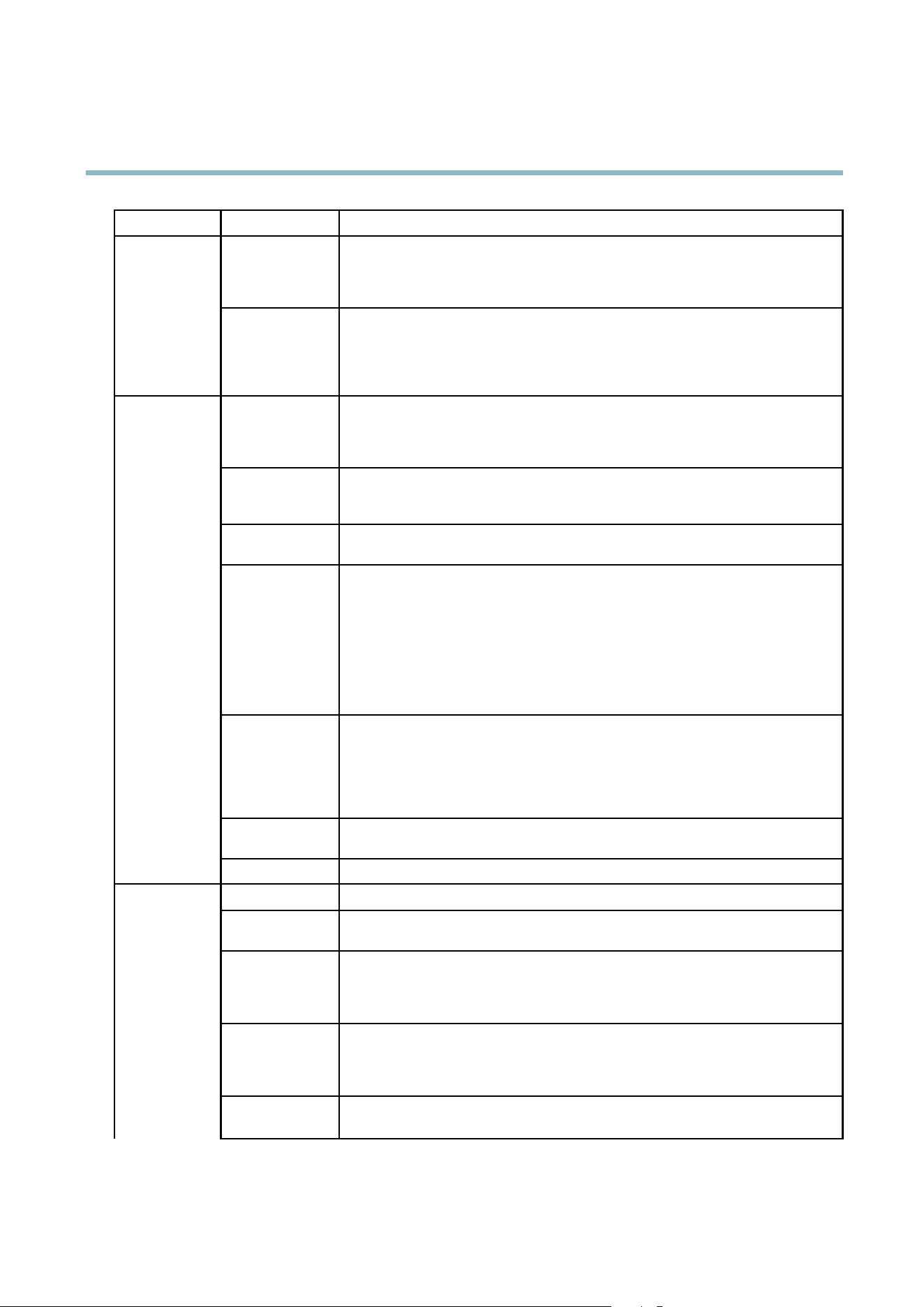
AXIS P5544 PTZ Dome Network Camera
Technical Specifications
Function/group
Item
Specifications
Security Password protection, IP address filtering, HTTPS encryption*, IEEE 802.1X netwo rk access
control*, digest authentication, user access log
*This product includes softw are developed by the Open SSL Project f or use in the Open
SSL Toolkit (www.openssl.org)
Network
Supported
protocols
IPv4/v6, HTTP, HTTPS*, SSL/TLS*, QoS Layer 3 DiffServ, FTP, SMTP, Bonjour, UPnP,
SNMPv1/v2c/v3(MIB-II), DNS, DynDNS, NTP, RTSP, RTP, TCP, UDP, IGMP, RTCP, ICMP,
DHCP, ARP, SOCKS
*This product includes softw are developed by the Open SSL Project f or use in the Open
SSL Toolkit (www.openssl.org)
Application
Programming
Interface
Open API for software integration, including VAPIX® and AXIS Camera Application
Platform from Axis Communications; specifications available at www.axis.com
Includes the ONVIF specification available at www.onvif.org
Support for AXIS Video Host ing System (AVHS) with One-Click Camera C onnection
Intelligent video
Audio detection, Advanced Gatekeeper, Support for AXIS Camera Application Platform
enabling installation of ad ditional applications
Overview mode: Video motion detection
Triggers Intelligent video, digital input, manual trigger, PTZ preset, PTZ moving, network lost,
temperature, edge storage status, system initializing
Actions
Day/Night vision mode
Play audio clip
Output port
PTZ preset
Guard tour
Video recording to edge storage
File upload via FTP, HTTP, email and network share
Notification via email, HTTP and TC P
Pre- and post alarm video buffering
Video access from
web browser
Camera live view
Video recording to file (ASF)
Customizable HTML pages
Windows 7, Windows Vista, Windows XP, Windows Server 2008, Windows Server 2003
DirectX 9c or higher
For other operating systems and browsers, see www.axis.com/techsup
Management and
maintenance
AXIS Camera Management tool on CD and web-based configuration
Firmware upgrades over HTTP or FTP, firmware available on www.axis.com
System
Integration
Installation aids Pixel counter
Casing
IP51-rated, metal casing (aluminum), PC clear dome
Processor,
memory
256 MB RAM , 128 MB Flash
Power
Power over Ethernet Plus (PoE+) IEEE 802.3at, max. 30 W
20-24 V AC, max. 23.6 VA
24-34 V DC, max. 17 W
AXIS T8123 High PoE Midspan 1-port: 100-240 V AC, max. 37 W
Connectors
RJ-45 for 10BASE-T/100BASE-TX PoE
Multi-connector (cable sold sepa rately) for:
power in, 4 configurable alarm inputs and outputs, mic in (max 74 mVpp), line mono
input (max 6.2 Vpp), line mono output (max 2.8 Vpp) to active speaker
Edge storage
SD/SDHC memory card slot (card not included)
Support for recording to network share (Network Attached Storage or file server).
General
58

AXIS P5544 PTZ Dome Network Camera
Technical Specifications
Function/group
Item
Specifications
Operating
conditions
Temperature: 0 ºC to 50 ºC ( 32 ºF to 122 ºF)
Humidity 20–80% RH (non-condensing)
Approvals
EN 55022 Class B, EN 61000-3-2, EN 61000-3-3, EN 61000-6-1, EN 61000-6-2, EN
55024,
FCCPart15SubpartBClassB,
ICES-003 Class B,
VCCI Class B,
C-tick AS/NZS CISPR 22,
KCC C lass B,
EN 60950-1,
IEC 60721-4-3 Class 3K3, 3M3, EN/IEC 60068-2
IP51
Midspan: EN 60950-1, GS, UL, cUL, CE, VCCI, CB, KCC
Dimensions
(HxWxD)
Camera with hard-ceiling mount: 235 x 183 x 183 mm (9.3” x 7.2” x 7.2”)
Camera with drop-ceiling mount: 235 x 238 x 238 mm (9.3” x 9.4” x 9.4”)
Weight
Camera: 1.9 kg (4.2 lb.)
Camera with drop-ceiling mount: 2.3 kg (5.1 lb.)
Included
accessories
AXIS T8123 High PoE Midspan 1-port, mounting kit for hard and drop ceilings, Installation
Guide, CD with recording software, ins t all ation and management tools, Windows decoder
1-user license
Video
management
software (not
included)
AXISCameraStation—Videomanagementsoftwareforviewingandrecordingupto100
cameras
See www.axis.com/products/video/software/ for more software applications via partners
Optional
accessories
AXIS T8310 Video Surveillance Control Board
AXIS T90A Illuminators
AXIS T91A Mounting Accessories
Multi-connector cable for AC/DC power, I/Os and audio
Performance Considerations
When settings up your system, it is important to consider how various settings and situations will affect performance. Some factors
affect the amount of bandwidth (the bit rate) required, others can affect the frame rate, and some affect both. If the load on the
CPU reaches its maximum, this will also af
fect the frame rate.
The following factors are among the
most important to consider:
• High i mage resolution and/or
lower compression le ve ls result in images containing more data. Bandwidth affected.
• Access by large num
bers of Mo tion JPEG and/or unicast H. 264 clients. Bandwidth affected.
• Simultaneous
viewing of different strea m s (resolution, compression) by different clients. Effect on frame rate and bandwidth.
• Accessin
g Motion JPEG and H.264 vide o streams simultaneously. Frame rate a n d bandwidth affected.
•Heav
y usage of event settings affect the product’s CPU load. Frame rate affected.
• Heavy network utilization due to poor infrastructure. Bandwidth affected.
• Viewing on poorly performing client computers lowers perceived performance. Frame rate affected.
59

User Manual Ver. M1.15
AXIS P5544 P
TZ D om e Network Camera Date: April 2012
© Axis Communications AB, 2012
Part No. 46
270