aeg.com/register
NCH74B01AB
EN User Manual | Hob
aeg.com\register
Welcome to AEG! Thank you for choosing our appliance.
Get usage advice, brochures, trouble shooter, service and repair information:
www.aeg.com/support
Subject to change without notice.
CONTENTS
1. SAFETY INFORMATION................................................................................ 2
2. SAFETY INSTRUCTIONS.............................................................................. 5
3. INSTALLATION...............................................................................................7
4. PRODUCT DESCRIPTION........................................................................... 10
5. BEFORE FIRST USE....................................................................................12
6. DAILY USE....................................................................................................12
7. ADDITIONAL FUNCTIONS...........................................................................16
8. HINTS AND TIPS.......................................................................................... 17
9. CARE AND CLEANING................................................................................ 20
10. TROUBLESHOOTING................................................................................ 23
11. TECHNICAL DATA..................................................................................... 25
12. ENERGY EFFICIENCY...............................................................................25
13. ENVIRONMENTAL CONCERNS................................................................27
1. SAFETY INFORMATION
Before the installation and use of the appliance, carefully read
the supplied instructions. The manufacturer is not responsible
for any injuries or damage that are the result of incorrect
installation or usage. Always keep the instructions in a safe
and accessible location for future reference.
1.1 Children and vulnerable people safety
• This appliance can be used by children aged from 8 years
and above and persons with reduced physical, sensory or
mental capabilities or lack of experience and knowledge if
they have been given supervision or instruction concerning
the use of the appliance in a safe way and understand the
hazards involved. Children of less than 8 years of age and
persons with very extensive and complex disabilities shall
be kept away from the appliance unless continuously
supervised.
2 ENGLISH

• Children should be supervised to ensure that they do not
play with the appliance.
• Keep all packaging away from children and dispose of it
appropriately.
• WARNING: The appliance and its accessible parts become
hot during use. Keep children and pets away from the
appliance when in use and when cooling down.
• If the appliance has a child safety device, it should be
activated.
• Children shall not carry out cleaning and user maintenance
of the appliance without supervision.
1.2 General Safety
• This appliance is for cooking purposes only.
• This appliance is designed for single household domestic
use in an indoor environment.
• This appliance may be used in, offices, hotel guest rooms,
bed & breakfast guest rooms, farm guest houses and other
similar accommodation where such use does not exceed
(average) domestic usage levels.
• WARNING: The appliance and its accessible parts become
hot during use. Care should be taken to avoid touching
heating elements.
• WARNING: Unattended cooking on a hob with fat or oil can
be dangerous and may result in fire.
• Smoke is an indication of overheating. Never use water to
extinguish the cooking fire. Switch off the appliance and
cover flames with e.g. a fire blanket or lid.
• WARNING: The appliance must not be supplied through an
external switching device, such as a timer, or connected to
a circuit that is regularly switched on and off by a utility.
• CAUTION: The cooking process has to be supervised. A
short term cooking process has to be supervised
continuously.
• WARNING: Danger of fire: Do not store items on the
cooking surfaces.
ENGLISH 3

• Metallic objects such as knives, forks, spoons and lids
should not be placed on the hob surface since they can get
hot.
• Do not use the appliance before installing it in the built-in
structure.
• Do not use a steam cleaner to clean the appliance.
• After use, switch off the hob element by its control and do
not rely on the pan detector.
• If the glass ceramic surface / glass surface is cracked,
switch off the appliance and unplug it from the mains. In
case the appliance is connected to the mains directly using
junction box, remove the fuse to disconnect the appliance
from power supply. In either case contact the Authorised
Service Centre.
• Ensure good air ventilation in the room where the appliance
is installed to avoid the backflow of gases into the room
from appliances burning gas or other fuels, including open
fires.
• Make sure that the ventilation openings are not blocked and
the air collected by the appliance is not conveyed into a
duct used to exhaust smoke and steam from other
appliances (central heating systems, thermosiphons, water-
heaters, etc.).
• When the appliance operates with other appliances the
maximum vacuum generated in the room should not exceed
0.04 mbar.
• Clean the hood filter regularly and remove grease deposits
from the appliance to prevent the risk of fire.
• If the supply cord is damaged, it must be replaced by the
manufacturer, an authorized Service or similarly qualified
persons in order to avoid a hazard.
• If the appliance is connected directly to the power supply,
the electrical installation must be equipped with an isolating
device that allows to disconnect the appliance from the
mains at all poles. Complete disconnection must comply
with conditions specified in the overvoltage category III. The
4 ENGLISH
means for disconnection must be incorporated in the fixed
wiring in accordance with the wiring rules.
• WARNING: Use only hob guards designed by the
manufacturer of the cooking appliance or indicated by the
manufacturer of the appliance in the instructions for use as
suitable or hob guards incorporated in the appliance. The
use of inappropriate guards can cause accidents.
2. SAFETY INSTRUCTIONS
2.1 Installation
WARNING!
Only a qualified person must install this
appliance.
WARNING!
Risk of injury or damage to the appliance.
• Remove all the packaging.
• Do not install or use a damaged
appliance.
• Follow the installation instructions supplied
with the appliance.
• Keep the minimum distance from other
appliances and units.
• Always take care when moving the
appliance as it is heavy. Always use safety
gloves and enclosed footwear.
• Seal the cut surfaces of the cabinet with a
sealant to prevent moisture from causing
swelling.
• Protect the bottom of the appliance from
steam and moisture.
• Do not install the appliance next to a door
or under a window. This prevents hot
cookware from falling from the appliance
when the door or the window is opened.
• Do not install in a manner that exhausts
air into a wall cavity, unless the cavity is
designed for that purpose.
• For ductless installation, the fan outlet
must be positioned directly against the
wall or must be separated by an additional
cabinet wall, in order to prevent access to
the fan blades.
• Each appliance has cooling fans on the
bottom.
• If the appliance is installed above a
drawer:
– Do not store any small pieces or
sheets of paper that could be pulled in,
as they can damage the cooling fans
or impair the cooling system.
– Keep a distance of minimum 2 cm
between the bottom of the appliance
and parts stored in the drawer.
• Remove any separator panels installed in
the cabinet below the appliance.
2.2 Electrical Connection
WARNING!
Risk of fire and electric shock.
• All electrical connections should be made
by a qualified electrician according to the
connection diagram or installation booklet.
• In case of exhaust installation, and where
the accessories are present or mandatory
(wall valve, window switch and/or window
opener) electrical connections should be
made by a qualified electrician, according
to the connection diagram or installation
booklet.
• The appliance must be earthed.
• Before carrying out any operation make
sure that the appliance is disconnected
from the power supply.
• Make sure that the parameters on the
rating plate are compatible with the
electrical ratings of the mains power
supply.
• Make sure the appliance is installed
correctly. Loose and incorrect electricity
mains cable or plug (if applicable) can
make the terminal become too hot.
ENGLISH 5
• Use the correct electricity mains cable.
• Do not let the electricity mains cable
tangle.
• Make sure that a shock protection is
installed.
• Use the strain relief clamp on the cable.
• Make sure the mains cable or plug (if
applicable) does not touch the hot
appliance or hot cookware, when you
connect the appliance to a socket.
• Do not use multi-plug adapters and
extension cables.
• Make sure not to cause damage to the
mains plug (if applicable) or to the mains
cable. Contact our Authorised Service
Centre or an electrician to change a
damaged mains cable.
• The shock protection of live and insulated
parts must be fastened in such a way that
it cannot be removed without tools.
• Connect the mains plug to the mains
socket only at the end of the installation.
Make sure that there is access to the
mains plug after the installation.
• If the mains socket is loose, do not
connect the mains plug.
• Do not pull the mains cable to disconnect
the appliance. Always pull the mains plug.
• Use only correct isolation devices: line
protecting cut-outs, fuses (screw type
fuses removed from the holder), earth
leakage trips and contactors.
• The electrical installation must have an
isolation device which lets you disconnect
the appliance from the mains at all poles.
The isolation device must have a contact
opening width of minimum 3 mm.
2.3 Use
WARNING!
Risk of injury, burns and electric shock.
• Do not change the specification of this
appliance.
• Remove all the packaging, labelling and
protective film (if applicable) before first
use.
• Make sure that the ventilation openings
are not blocked. The ventilation must be
checked periodically by a qualified person.
• Do not let the appliance stay unattended
during operation.
• Set the cooking zone to “off” after each
use.
• Do not put cutlery or saucepan lids on the
cooking zones. They can become hot.
• Do not operate the appliance with wet
hands or when it has contact with water.
• Do not use the appliance as a work
surface or as a storage surface.
• If the surface of the appliance is cracked,
disconnect immediately the appliance from
the power supply. This to prevent an
electrical shock.
• Users with a pacemaker must keep a
distance of minimum 30 cm from the
induction cooking zones when the
appliance is in operation.
• When you place food into hot oil, it may
splash.
• Never use an open flame when the
integrated hood operates.
• Do not use aluminum foil or other
materials between the cooking surface
and the cookware, unless otherwise
specified by the manufacturer of this
appliance.
• Use only accessories recommended for
this appliance by the manufacturer.
WARNING!
Risk of fire and explosion.
• Fats and oil when heated can release
flammable vapours. Keep flames or
heated objects away from fats and oils
when you cook with them.
• The vapours that very hot oil releases can
cause spontaneous combustion.
• Used oil, that can contain food remnants,
can cause fire at a lower temperature than
oil used for the first time.
• Do not put flammable products or items
that are wet with flammable products in,
near or on the appliance.
WARNING!
Risk of damage to the appliance.
• Do not keep hot cookware on the control
panel.
• Do not put a hot pan cover on the glass
surface of the hob.
• Do not let cookware boil dry.
6 ENGLISH
• Be careful not to let objects or cookware
fall on the appliance. The surface can be
damaged.
• Do not activate the cooking zones with
empty cookware or without cookware.
• Never remove the grid or the hood filter
when the integrated hood or the appliance
operates.
• Never use the integrated hood without the
hood filter.
• Do not cover the inlet of the integrated
hood with cookware.
• Do not open the bottom lid when the
integrated hood or the appliance operates.
• Do not place small or light objects near the
integrated hood to avoid the risk of being
trapped.
• Cookware made of cast iron or with a
damaged bottom can cause scratches on
the glass / glass ceramic. Always lift these
objects up when you have to move them
on the cooking surface.
2.4 Care and cleaning
• Clean the appliance regularly to prevent
the deterioration of the surface material.
• Switch off the appliance and let it cool
down before cleaning.
• Do not use water spray and steam to
clean the appliance.
• Clean the appliance with a moist soft
cloth. Use only neutral detergents. Do not
use abrasive products, abrasive cleaning
pads, solvents or metal objects, unless
otherwise specified.
2.5 Service
• To repair the appliance contact the
Authorised Service Centre. Use original
spare parts only.
• Concerning the lamp(s) inside this product
and spare part lamps sold separately:
These lamps are intended to withstand
extreme physical conditions in household
appliances, such as temperature,
vibration, humidity, or are intended to
signal information about the operational
status of the appliance. They are not
intended to be used in other applications
and are not suitable for household room
illumination.
2.6 Disposal
WARNING!
Risk of injury or suffocation.
• Contact your local authority for information
on how to dispose of the appliance.
• Disconnect the appliance from the mains
supply.
• Cut off the mains electrical cable close to
the appliance and dispose of it.
3. INSTALLATION
WARNING!
Refer to Safety chapters.
3.1 Before the installation
Before you install the hob, write down the
information below from the rating plate. The
rating plate is on the bottom of the hob.
Serial number ...........................
3.2 Built-in hobs
Only use the built-in hobs after you assemble
the hob into correct built-in units and work
surfaces that align to the standards.
3.3 Assembly
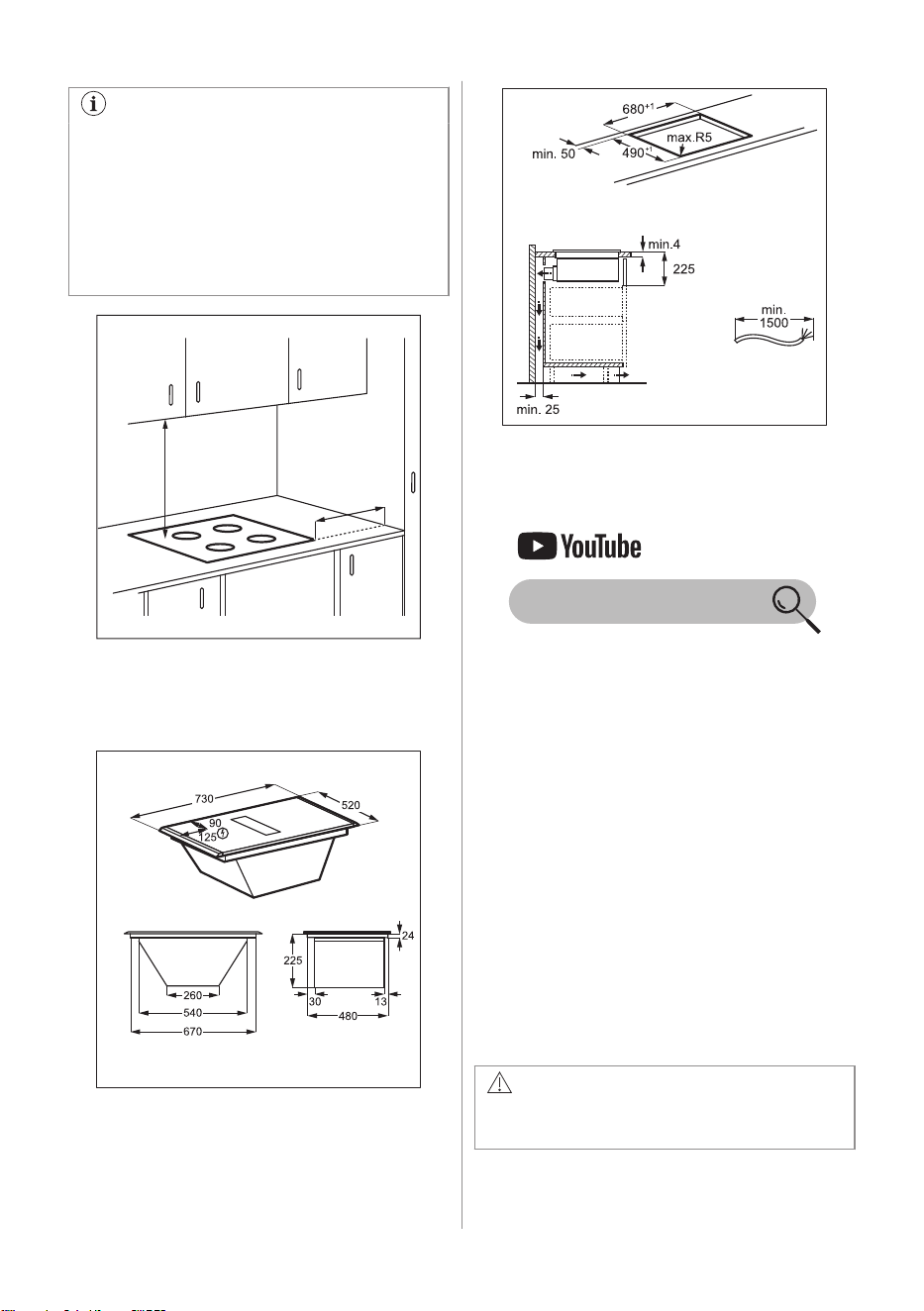
Refer to the installation booklet for detailed
information on how to assemble your hob.
Follow the hob connection diagram and the
window switch connection diagram (if
applicable) presented in the installation
booklet and / or the labels under the hob.
ENGLISH 7
Only for selected countries
In case of exhaust installation a window
switch might be required (consult an
authorised technician). You need to buy it
separately as it is not supplied with the
hob. The window switch has to be
installed by an authorised technician.
Refer to the installation booklet.
min.
50mm
min.
500mm
If the appliance is installed above a drawer,
the hob ventilation can warm up the items
stored in the drawer during the cooking
process.
Find the video tutorial "How to install your
AEG Extractor Hob 70 cm" by typing out the
full name indicated in the graphic below.
www.youtube.com/electrolux
www.youtube.com/aeg
How to install your AEG
Extractor Hob 70 cm
Filter housing assembly
Before the first use make sure to insert the
long life carbon filters inside the housing with
the handles facing inwards. Refer to
"Cleaning the hood filters". Once the filter
housing is assembled, put it inside the hood
system and place the grid on the hood.
3.4 Connection cable
• The hob is supplied with a connection
cable.
• To replace the damaged mains cable, use
the cable type which withstands a
temperature of 125 °C or higher.
• The single wire must have a diameter of
minimum 1,5 mm².
• Speak to your local Service Centre. The
connection cable may only be replaced by
a qualified electrician.
WARNING!
All electrical connections must be made
by a qualified electrician.
8 ENGLISH
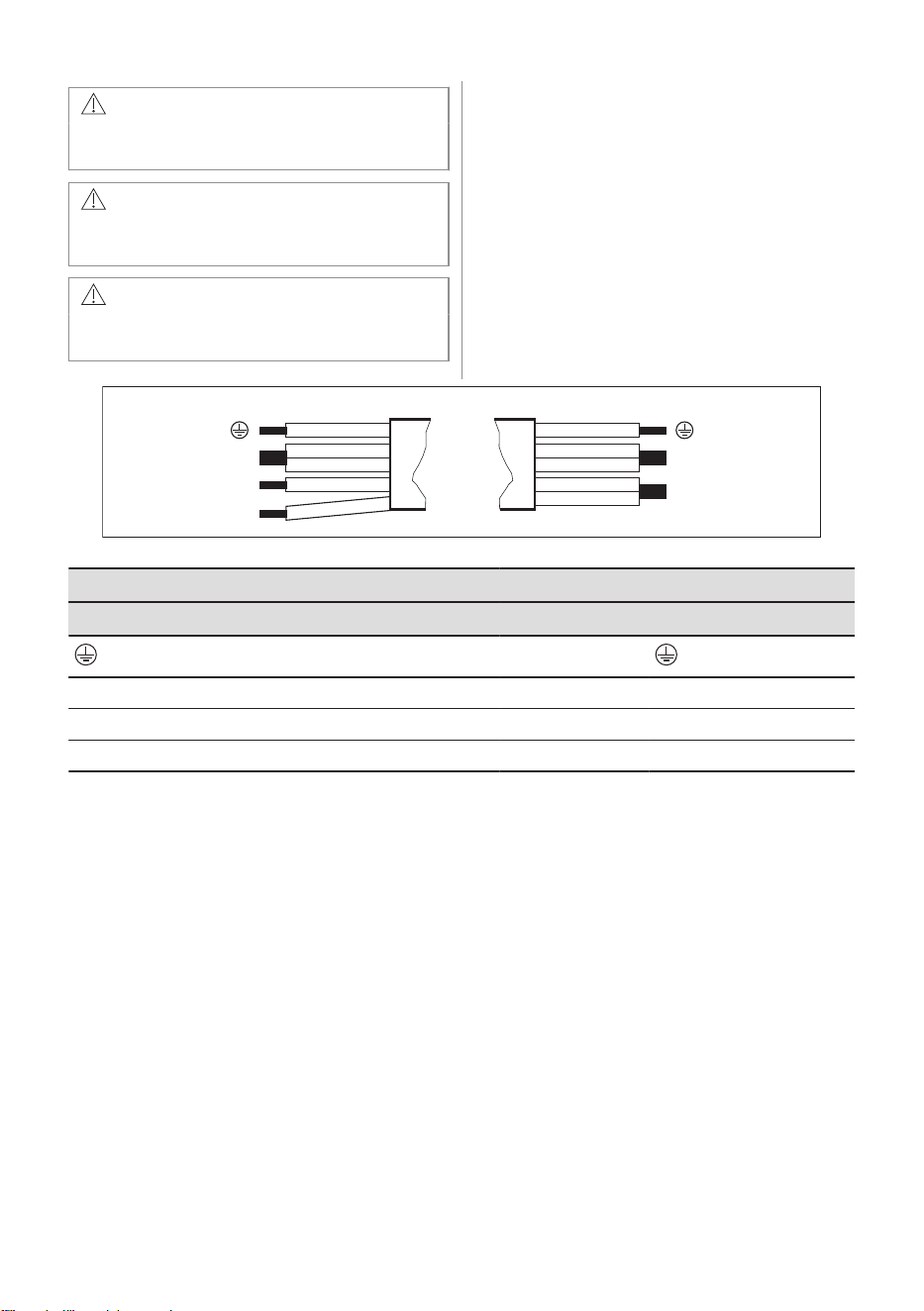
CAUTION!
Connections via contact plugs are
forbidden.
CAUTION!
Do not drill or solder the wire ends. It is
forbidden.
CAUTION!
Do not connect the cable without cable
end sleeve.
Two-phase connection
1. Remove the cable end sleeve from black
and brown wires.
2. Remove a part of the insulation of black
and brown cable ends.
3. Apply a new end wire sleeve on each
wire's end (special tool required).
N
L1
N
L
220-240 V~400V2N~
L2
Two-phase connection: 400 V2N~ One-phase connection: 220 - 240 V~
5x1,5 mm² or 4x2,5 mm² 5x1,5 mm² or 3x4 mm²
Green - yellow Green - yellow
N Blue and blue Blue and blue N
L1 Black Black and brown L
L2 Brown
ENGLISH 9
4. PRODUCT DESCRIPTION
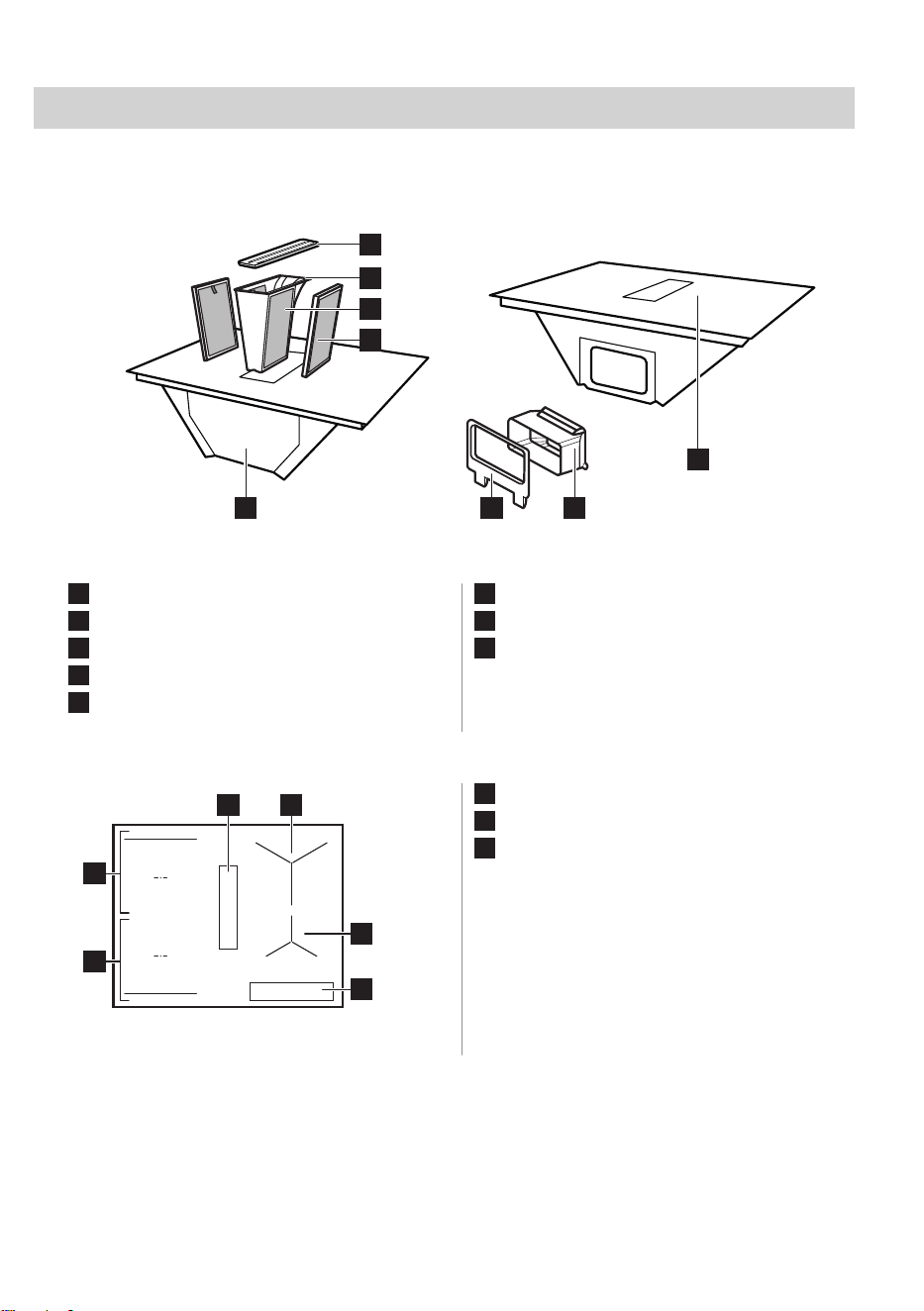
4.1 Product overview
4
2
3
1
8
6
75
1
Grid
2
Grease filter housing
3
Grease filter (non-removable)
4
Long life carbon filter
5
Drip tray (under the hood system)
6
Hob
7
Air duct adapter
8
Air duct fitting for the back wall
4.2 Cooking surface layout
13
2
1
1
1
1
Induction cooking zone
2
Control panel
3
Hood
10 ENGLISH
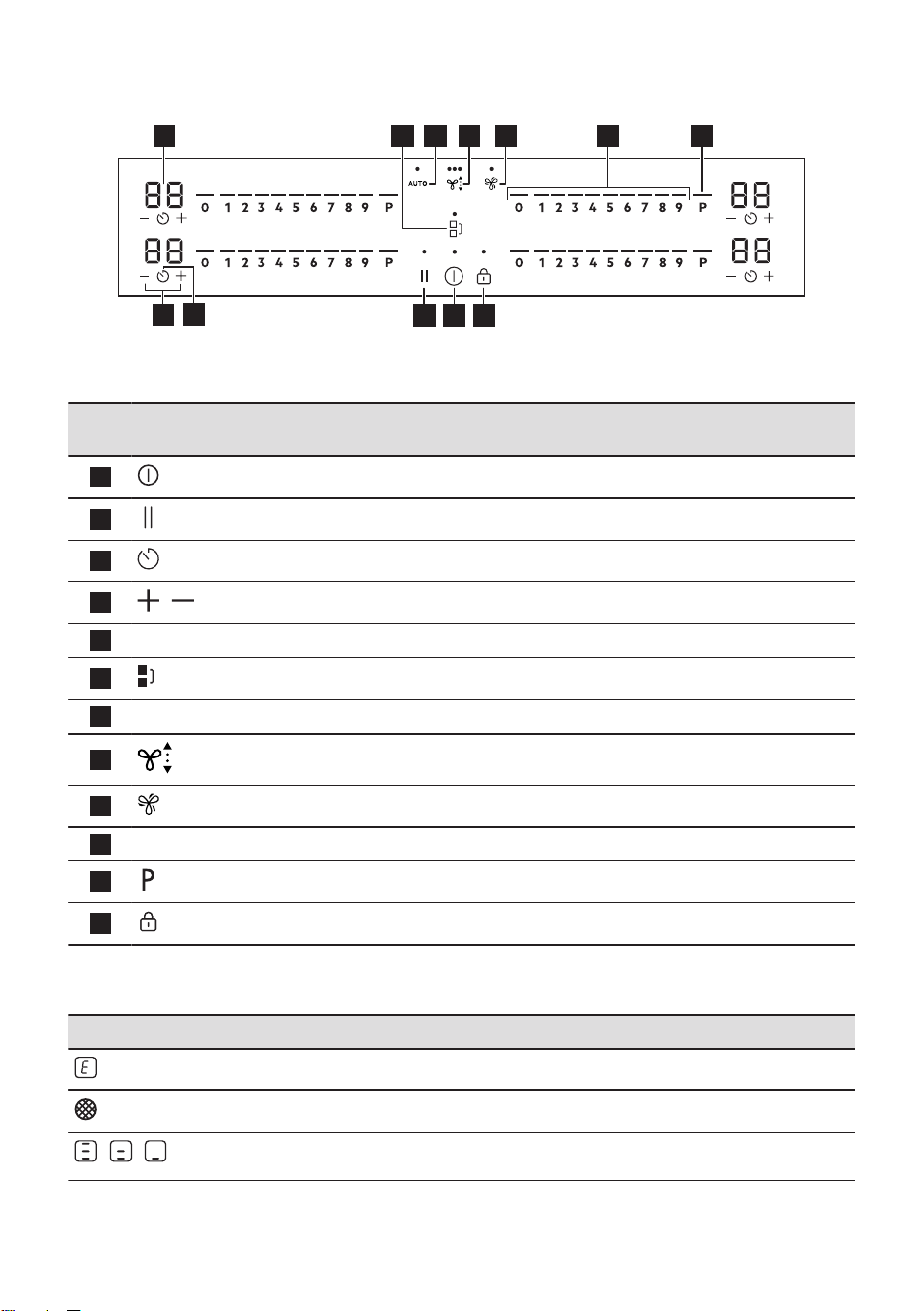
4.3 Control panel layout
5 6 7 8 9
11
1
12
234
10
Use the sensor fields to operate the appliance. The displays, indicators and sounds tell which
functions operate.
Sensor
field
Function Description
1
On / Off To activate and deactivate the appliance.
2
Pause To activate and deactivate the function.
3
Timer To set the function.
4
/
- To increase or decrease the time.
5
- Timer display To show the time in minutes.
6
Bridge To activate and deactivate the function.
7
AUTO Automatic mode of the hood To activate and deactivate the function.
8
Manual mode of the hood To activate / deactivate the function and to switch be‐
tween 3 fan speed levels.
9
Boost To activate and deactivate the function.
10
- Control bar To set a heat setting.
11
PowerBoost To activate the function.
12
Lock / Child Safety Device To lock / unlock the control panel.
4.4 Display indicators
Indicator Description
+ digit
There is a malfunction.
The long life carbon filter needs regenerating.
/ /
OptiHeat Control (3 step Residual heat indicator): continue cooking / keep warm / resid‐
ual heat.
ENGLISH 11
5. BEFORE FIRST USE
WARNING!
Refer to Safety chapters.
5.1 Power limitation
Power limitation defines how much power is
used by the hob in total, within the limits of
the house installation fuses.
The hob is set to its highest possible power
level by default.
To decrease or increase the power level:
1. Enter the menu: press and hold for 3
seconds. Then, press and hold
.
2. Press on the front timer until
appears.
3. Press / on the front timer to set the
power level.
4. Press to exit.
Power levels
Refer to “Technical data” chapter.
CAUTION!
Make sure that the selected power fits
the house installation fuses.
• P73 — 7350 W
• P15 — 1500 W
• P20 — 2000 W
• P25 — 2500 W
• P30 — 3000 W
• P35 — 3500 W
• P40 — 4000 W
• P45 — 4500 W
• P50 — 5000 W
• P60 — 6000 W
6. DAILY USE
WARNING!
Refer to Safety chapters.
6.1 Activating and deactivating
Press and hold to activate or deactivate
the hob.
6.2 Pot detection
This feature indicates the presence of
cookware on the hob and deactivates the
cooking zones if no cookware is detected
during a cooking session.
If you put cookware on a cooking zone before
you select a heat setting, the indicator above
0 on the control bar appears.
If you remove cookware from an activated
cooking zone and set it aside temporarily, the
indicators above the corresponding control
bar will start blinking. If you do not place the
cookware back on the activated cooking zone
within 120 seconds, the cooking zone will
automatically deactivate.
To resume cooking, make sure to put the
cookware back on the cooking zones within
the indicated timeout.
6.3 Using the cooking zones
Place the cookware in the centre of the
selected zone. Induction cooking zones adapt
to the dimension of the bottom of the
cookware automatically.
You can cook with large cookware placed on
two cooking zones at the same time using
Bridge function. The cookware must cover
the centres of both zones but not go beyond
the area marking. If the cookware is located
between the two centres, Bridge function will
not be activated.
12 ENGLISH
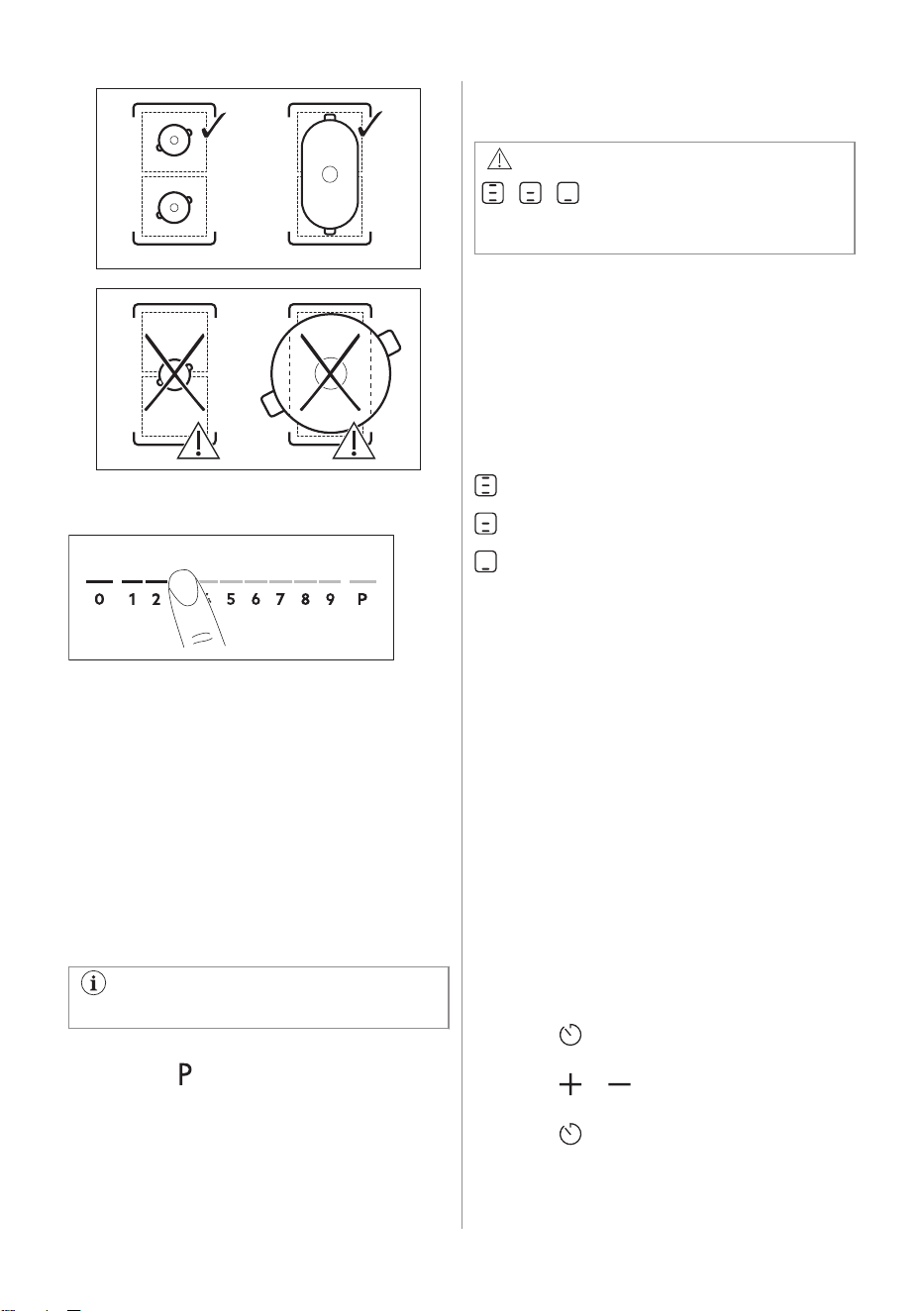
6.4 Heat setting
1. Press the desired heat setting on the
control bar.
The indicators above the control bar appear
up to the selected heat setting level.
2. To deactivate a cooking zone, press 0.
6.5 PowerBoost
This function makes more power available to
the induction cooking zones. The function can
be activated for the induction cooking zone
only for a limited period of time. After this time
the induction cooking zone automatically sets
back to the highest heat setting.
Refer to “Technical data” chapter.
To activate the function for a cooking
zone: touch
.
To deactivate the function: change the heat
setting.
6.6 OptiHeat Control (3 step
Residual heat indicator)
WARNING!
/ / As long as the indicator is
visible, there is a risk of burns from
residual heat.
The induction cooking zones produce the
heat necessary for the cooking process
directly in the bottom of the cookware. The
glass ceramic is heated by the heat of the
cookware.
The indicators appear when a cooking zone
is hot. They show the level of the residual
heat for the cooking zones you are currently
using:
- continue cooking,
- keep warm,
- residual heat.
The indicator may also appear:
• for the neighbouring cooking zones even if
you are not using them,
• when hot cookware is placed on cold
cooking zone,
• when the hob is deactivated but the
cooking zone is still hot.
The indicator disappears when the cooking
zone has cooled down.
6.7 Timer options
Count Down Timer
Use this function to specify how long a
cooking zone should operate during a single
cooking session.
Set the heat setting for the selected cooking
zone and then set the function.
1. Press
. 00 appears on the timer
display.
2. Press or to set the time (00-99
minutes).
3. Press to start the timer or wait 3
seconds. The timer begins to count down.
ENGLISH 13
To change the time: select the cooking zone
with and press or .
To deactivate the function: select the
cooking zone with
and press . The
remaining time counts back to 00.
The timer finishes counting down, a signal
sounds and 00 blinks. The cooking zone
deactivates. Press any symbol to stop the
signal and blinking.
Minute Minder
You can use this function when the hob is
activated but the cooking zones do not
operate. The heat setting shows 00.
1. Press .
2. Press or to set the time.
The timer finishes counting down, a signal
sounds and 00 blinks. Press any symbol to
stop the signal and blinking.
To deactivate the function: press and
. The remaining time counts back to 00.
6.8 Power management
If multiple zones are active and the
consumed power exceeds the limitation of the
power supply, this function divides the
available power between all cooking zones.
The hob controls heat settings to protect the
fuses of the house installation.
• If the hob reaches the limit of maximum
available power (refer to the rating plate),
the power of the cooking zones will be
automatically reduced.
• The heat setting of the cooking zone
selected first is always prioritised. The
remaining power will be divided between
the other cooking zones according to the
order of selection.
• For cooking zones that have a reduced
power, the control bar blinks and shows
the maximum possible heat settings.
• Wait until the display stops flashing or
reduce the heat setting of the cooking
zone selected last. The cooking zones will
continue operating with the reduced heat
setting. Change the heat settings of the
cooking zones manually, if necessary.
• The hood extractor is always available as
an electrical load.
6.9 Hood functions
WARNING!
Refer to Safety chapters.
Activating and deactivating the hood
The hood can operate alongside the hob
during the cooking session, as well as while
the hob is switched off.
1. Press to activate the hood.
A signal sounds and indicators above the
symbol appear.
2. Adjust the fan speed setting as needed
by pressing the symbol. The indicators
change to reflect the current fan speed.
3. To deactivate the hood, press
repeatedly until the indicators above the
symbol disappear.
AUTO
The function automatically adjusts the fan
speed level based on the selected heat
setting level of the hob.
When you use the hob for the first time, the
function is usually activated by default.
You can activate the function while the hob is
on and none of the cooking zones are active,
or at any point during the cooking session.
If you activate the function while the hob
is off, none of the cooking zones operate
and there is no residual heat visible on
the control panel, the function will switch
off by itself after a few seconds.
1. Press and hold to activate the hob.
2. Press AUTO to activate the function.
A signal sounds and an indicator above the
symbol appears.
3. Place cookware on the hob and select a
heat setting level. Increase or decrease
the heat setting level as needed.
14 ENGLISH
The hood will react to the heat setting level,
increasing or decreasing the fan speed level
accordingly. The indicators above the hood
symbol appear.
4. Press 0 on the hob control bar to
deactivate a cooking zone or to
deactivate the hob.
If the residual heat indicator appears, AUTO
will continue to adjust the fan speed.
5. To deactivate the function during cooking
and switch to the manual mode of the
hood, press AUTO.
A signal sounds and the indicator above the
symbol disappears.
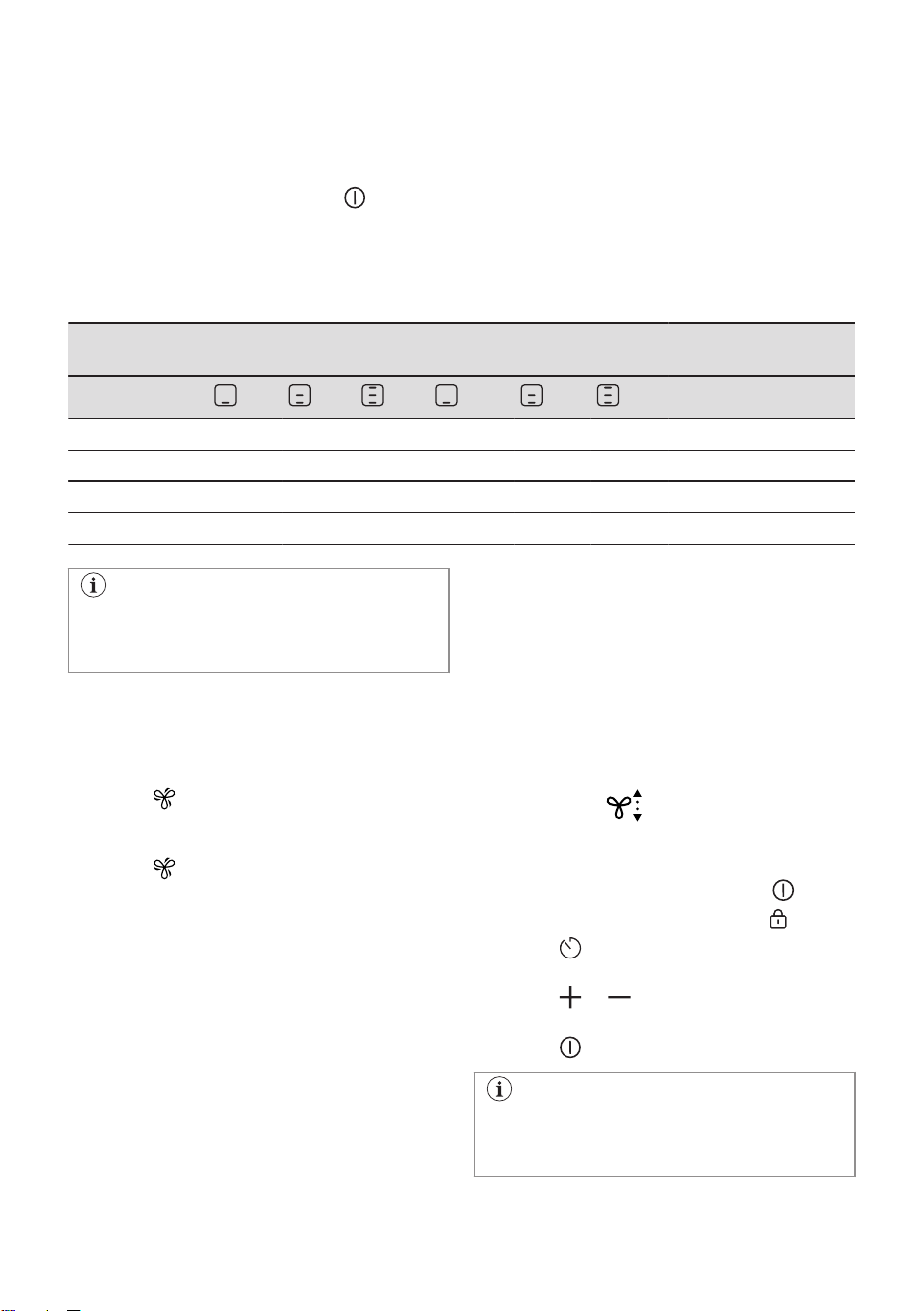
Automatic modes - fan speed levels
Hood
mode
Residual heat level (hob is off) Residual heat level (hob is
on)
Boiling Frying
0
H1 - - - - - - - - 1
H2 - - - - - - 1 1 1
H3 - - - - - 1 1 1 2
H4 - - - 1 1 1 2 2 3
If you deactivate the hob while AUTO is
running, the function will be remembered
for the next cooking session.
Boost
The function activates the hood fan at its
maximum speed level.
1. Press to activate the function.
A signal sounds and an indicator above the
symbol appears.
2. Press again to deactivate the function,
if needed.
The function can operate uninterrupted for a
maximum of 8 minutes. After that time the fan
speed setting automatically changes to 3.
You can activate the function again, if
needed.
Auto Breeze
The function automatically sets the hood fan
to continue running after you finish cooking
and switch off the hob. The fan runs at a
minimum speed level for maximum 20
minutes. The function removes any lingering
smells after cooking.
When you use the hob for the first time, the
function is activated by default.
When the function operates, the indicator
above AUTO appears. Once the cycle is
over, the fan switches off automatically.
To deactivate the function while it is
running:
Press AUTO or .
The hood fan deactivates.
To disable the function completely:
1. Enter the menu: press and hold for 3
seconds. Then, press and hold
.
2. Press on the front timer until dF
appears on the display.
3. Press or on the front timer until Off
(--) appears.
4. Press
to exit.
It is recommended not to disable the
function and to let it run uninterrupted for
the full duration of the cycle.
ENGLISH 15
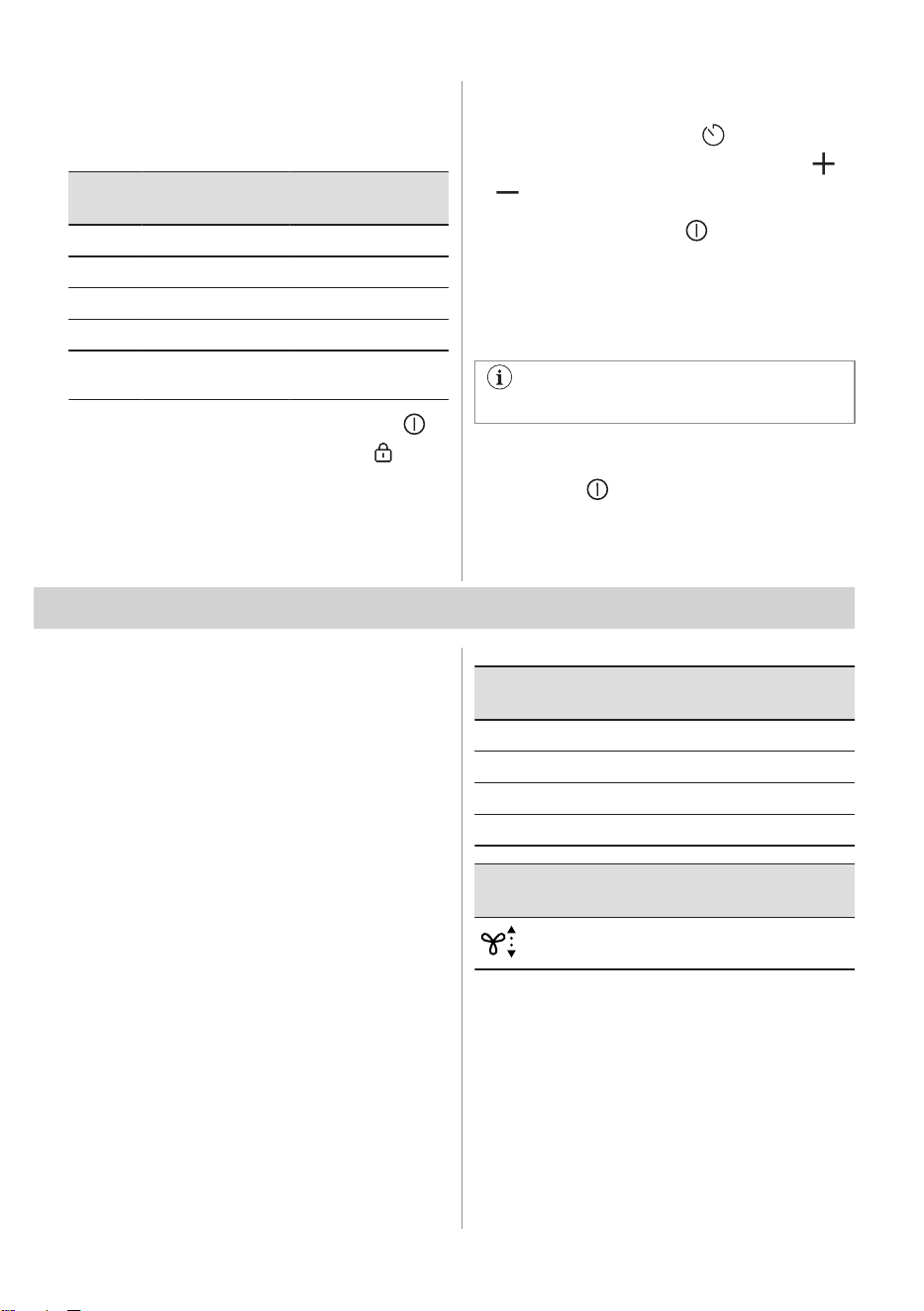
6.10 Menu structure
The table shows the basic menu structure.
User settings
Sym‐
bol
Setting Possible options
b Sound On / Off (--)
P Power limitation 15 - 73
H Hood mode 1 - 4
dF Auto Breeze On / Off (--)
E Alarm / error histo‐
ry
The list of recent
alarms / errors.
To enter user settings: press and hold
for 3 seconds. Then, press and hold . The
settings appear on the timer of the left
cooking zones.
Navigating the menu: the menu consists of
the setting symbol and a value. The symbol
appears on the rear timer and the value
appears on the front timer. To navigate
between the settings press on the front
timer. To change the setting value press
or on the front timer.
To exit the menu: press .
OffSound Control
You can activate / deactivate the sounds in
the Menu > User settings.
Refer to "Menu structure".
When the sounds are off you can still hear
the sound when:
• you touch ,
• the timer comes down,
• you press an inactive symbol.
7. ADDITIONAL FUNCTIONS
7.1 Automatic Switch Off
The function deactivates the hob
automatically if:
• all of the cooking zones, as well as the
hood, are deactivated,
• you do not set any heat setting or fan
speed setting after the activation of the
hob,
• you spill something or put something on
the control panel for more than 10
seconds (a pan, a cloth, etc.). A signal
sounds and the hob deactivates. Remove
the object or clean the control panel.
• the appliance gets too hot (e.g. when a
saucepan boils dry). Let the cooking zone
cool down before you use the hob again.
• you do not deactivate a cooking zone or
change the heat setting. After some time,
the hob deactivates.
The relation between the heat setting / fan
speed setting and the time after which the
appliance deactivates:
Heat setting The hob deactivates
after
1 - 2 6 hours
3 - 4 5 hours
5 4 hours
6 - 9 1.5 hours
Fan speed setting The hood deacti‐
vates after
10 hours
7.2 Pause
This function sets all operating cooking zones
to the lowest heat setting. The speed of the
hood fan decreases to 1. When you activate
the function while the hood operates in the
automatic mode, the speed of the hood fan
will not be reduced.
16 ENGLISH
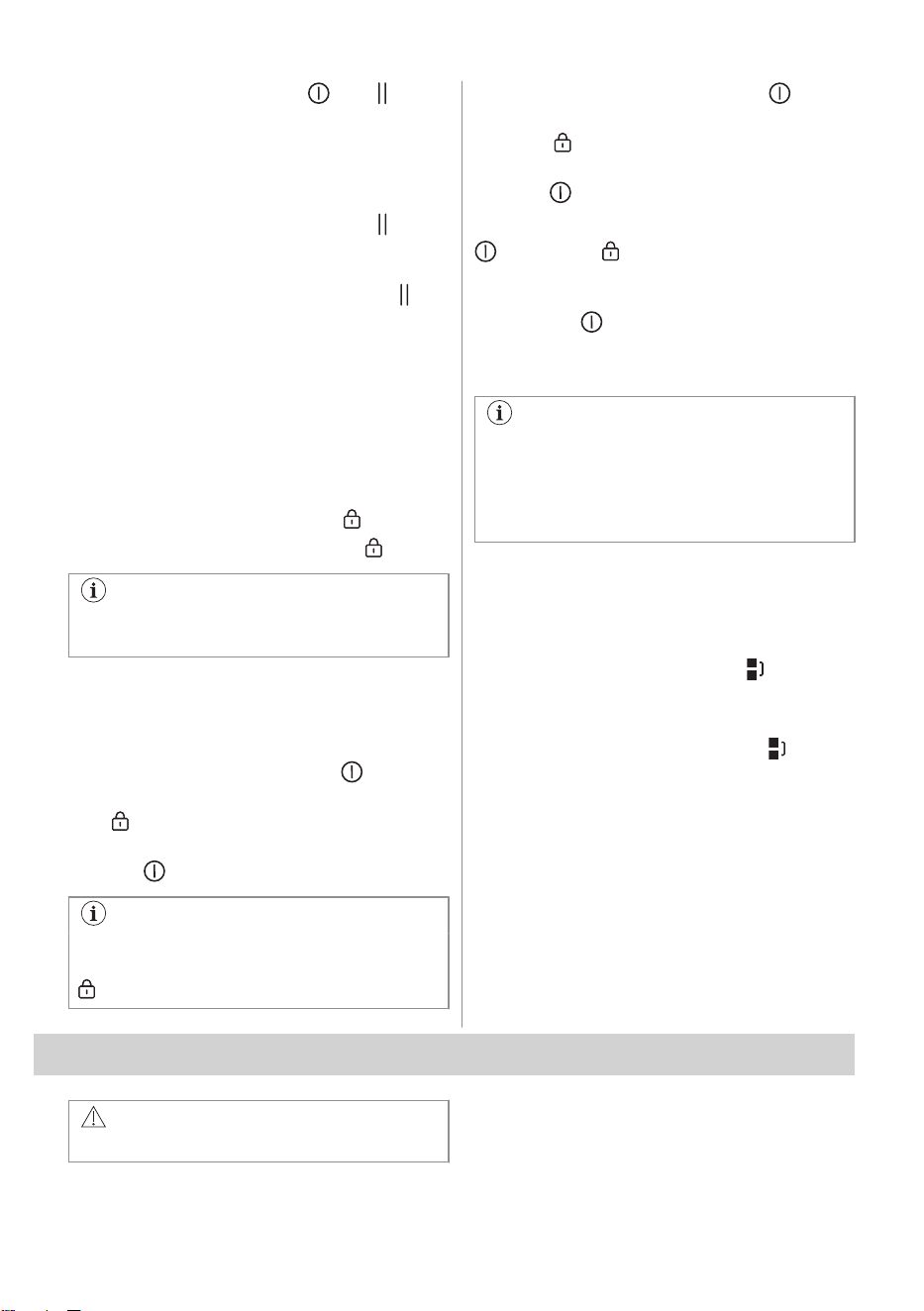
When the function operates, and can
be used. All other symbols on the control
panels are locked.
The function does not stop the timer
functions.
1. To activate the function: press
.
The heat setting is lowered to 1. The speed of
the hood fan decreases to 1.
2. To deactivate the function: press .
The previous heat setting / fan speed setting
appears.
7.3 Lock
You can lock the control panel while the hob
operates. It prevents an accidental change of
the heat setting / fan speed setting.
Set the heat setting / fan speed setting first.
To activate the function: press
.
To deactivate the function: press again.
The function deactivates as you
deactivate the hob.
7.4 Child Safety Device
This function prevents an accidental
operation of the hob and the hood.
To activate the function: press . Do not
set any heat setting / hood setting. Press and
hold for 3 seconds, until the indicator
above the symbol appears. Deactivate the
hob with .
The function stays active when you
deactivate the hob. The indicator above
is on.
To deactivate the function: press . Do
not set any heat setting / hood setting. Press
and hold for 3 seconds, until the indicator
above the symbol disappears. Deactivate the
hob with .
Cooking with the function activated: press
, then press for 3 seconds, until the
indicator above the symbol disappears. You
can operate the hob. When you deactivate
the hob with the function operates again.
7.5 Bridge
The function operates when the pot
covers the centres of the two zones. For
more information on the correct
placement of cookware refer to "Using
the cooking zones".
This function connects two left side cooking
zones and they operate as one.
First set the heat setting for one of the left
side cooking zones.
To activate the function: touch
. To set or
change the heat setting touch one of the
control sensors.
To deactivate the function: touch . The
cooking zones operate independently.
8. HINTS AND TIPS
WARNING!
Refer to Safety chapters.
ENGLISH 17
8.1 Cookware
For induction cooking zones a strong
electro-magnetic field creates the heat in
the cookware very quickly.
Use the induction cooking zones with suitable
cookware.
• To prevent overheating and improve the
performance of the zones, the cookware
must be as thick and flat as possible.
• Ensure cookware bases are clean and dry
before placing on the hob surface.
• Always be careful no to slide or rub the
cookware on the edges and corners of the
glass or the side trim as it may chip or
damage the glass surface.
Cookware material
• correct: cast iron, steel, enamelled steel,
stainless steel, multi-layer bottom (with a
correct marking from a manufacturer).
• not correct: aluminium, copper, brass,
glass, ceramic, porcelain.
Cookware is suitable for an induction hob
if:
• water boils very quickly on a zone set to
the highest heat setting.
• a magnet pulls on to the bottom of the
cookware.
Cookware dimensions
• Induction cooking zones adapt to the
dimension of the bottom of the cookware
automatically. Place the cookware in the
centre of the selected cooking zone.
• The cooking zone efficiency is related to
the diameter of the cookware. To ensure
optimal heat transfer use cookware with
diameter similar to the size of a given
cooking zone, no larger and no smaller
than recommended. To check the
recommended cookware diameter refer to
"Technical data" > "Cooking zones
specification".
– Cookware with a diameter smaller
than the declared minimum receives
only part of the power generated by
the cooking zone which results in
slower heating.
– For both safety reasons and optimal
cooking results, do not use cookware
larger than indicated in "Cooking
zones specification". Avoid keeping
cookware close to the control panel
during the cooking session. This might
impact the functioning of the control
panel or accidentally activate hob
functions.
Refer to "Technical data".
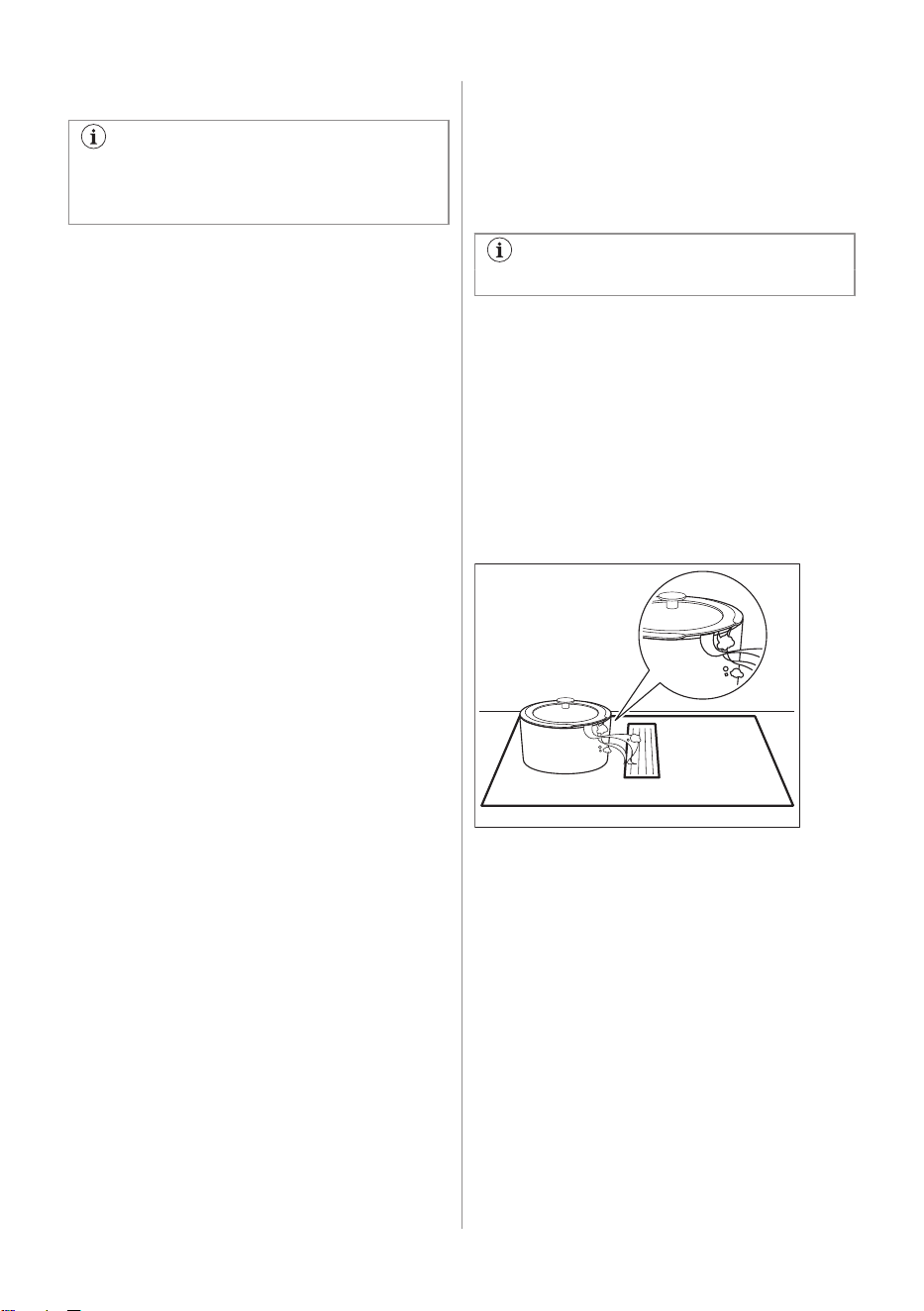
Steam Vented Lids
To further optimize the cooking sessions
alongside the hood you can use the special
Steam Vented Lids with your cookware. The
lids are designed to direct the steam
produced inside the pot towards the hood,
minimizing unwanted cooking smells and
excessive humidity in the kitchen. The lids
are available to buy separately in several
sizes to fit most common cookware types. For
more information visit our website.
8.2 Noises during operation
If you can hear:
• crack noise: cookware is made of different
materials (a sandwich construction).
• whistle sound: you use a cooking zone
with a high power level and the cookware
is made of different materials (a sandwich
construction).
• humming: you use a high power level.
• clicking: electric switching occurs.
• hissing, buzzing: the fan operates.
The noises are normal and do not indicate
any malfunction.
18 ENGLISH
8.3 Öko Timer (Eco Timer)
To save energy, the heater of the cooking
zone deactivates before the count down timer
sounds. The difference in the operation time
depends on the heat setting level and the
length of the cooking operation.
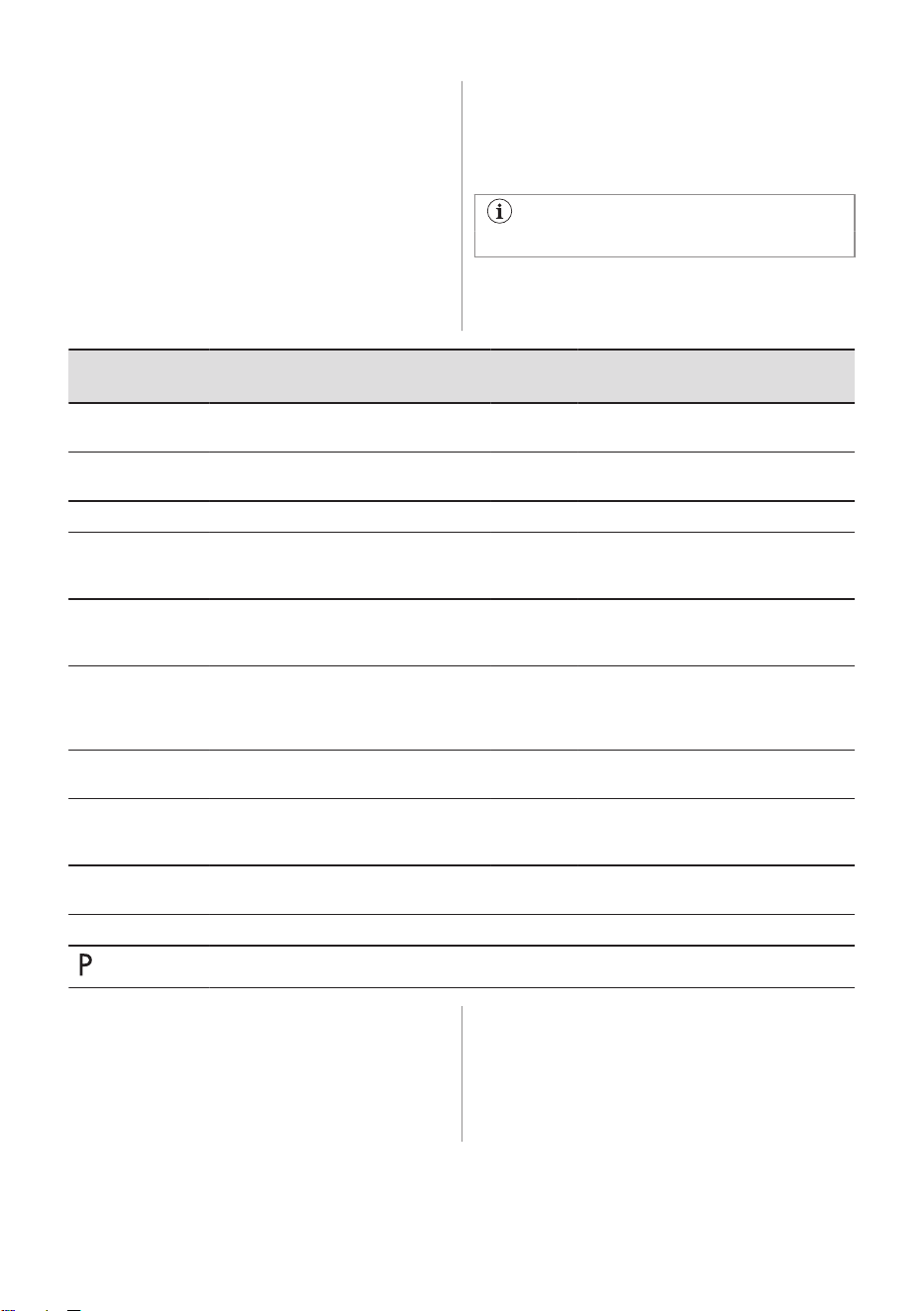
8.4 Simplified cooking guide
The correlation between the heat setting of a
zone and its consumption of power is not
linear. When you increase the heat setting, it
is not proportional to the increase of the
consumption of power. It means that a
cooking zone with the medium heat setting
uses less than a half of its power.
The data in the table is for guidance only.
Heat setting Use to: Time
(min)
Hints
1 Keep cooked food warm. as neces‐
sary
Put a lid on the cookware.
1 - 2 Hollandaise sauce; melt: butter, choco‐
late, gelatine.
5 - 25 Mix from time to time.
2 Solidify: fluffy omelettes, baked eggs. 10 - 40 Cook with a lid on.
2 - 3 Simmer rice and milk-based dishes,
heat up ready-cooked meals.
25 - 50 Add at least twice as much liquid as
rice, mix milk dishes halfway through
the procedure.
3 - 4 Stew vegetables, fish, meat. 20 - 45 Add a few tablespoons of water.
Check the water amount during the
process.
4 - 5 Steam potatoes and other vegetables. 20 - 60 Cover the bottom of the pot with 1-2
cm of water. Check the water level
during the process. Keep the lid on the
pot.
4 - 5 Cook larger quantities of food, stews
and soups.
60 - 150 Up to 3 l of liquid plus ingredients.
6 - 7 Gentle fry: escalope, veal cordon bleu,
cutlets, rissoles, sausages, liver, roux,
eggs, pancakes, doughnuts.
as neces‐
sary
Turn over when needed.
7 - 8 Heavy fry, hash browns, loin steaks,
steaks.
5 - 15 Turn over when needed.
9 Boil water, cook pasta, sear meat (goulash, pot roast), deep-fry chips.
Boil large quantities of water. PowerBoost is activated.
8.5 Hints and Tips for the hood
• The grid covering the hood is made of
aluminium.
• When AUTO mode operates, the fan
starts at a low speed at the beginning of
each cooking session. The speed
increases gradually. You can also adjust
the speed of the fan manually.
ENGLISH 19
9. CARE AND CLEANING
WARNING!
Refer to Safety chapters.
9.1 General information
• Clean the hob after each use.
• Always use cookware with a clean base.
• Scratches or dark stains on the surface
have no effect on how the hob operates.
• Use a special cleaning agent suitable for
the surface of the hob.
• Always use a scraper recommended for
hobs with a glass surface. Use the scraper
only as an additional tool for cleaning the
glass after the standard cleaning
procedure.
WARNING!
Do not use knives or any other sharp,
metal tools to clean the glass surface.
• For the metal side trim, use only a
dishwashing detergent with warm water.
Use a cloth to clean and wipe the trim.
WARNING!
Do not use the mildly abrasive
cleaning milk, any polishing
detergents, scrapers, or the hard layer
of a sponge to clean the side trim.
• The gap between the glass surface and
the side trim may gather dirt and small
particles of food. Use a wooden toothpick
to clean the gap between the glass
surface and the side trim.
WARNING!
Do not use any sharp metal tools to
clean the gap as they may widen the
gap and damage the side trim or the
glass surface.
9.2 Cleaning the hob
• Remove immediately: melted plastic,
plastic foil, salt, sugar and food with sugar,
otherwise, the dirt can cause damage to
the hob. Take care to avoid burns. Use a
special hob scraper on the glass surface
at an acute angle and move the blade on
the surface.
• Remove when the hob is sufficiently
cool: limescale rings, water rings, fat
stains, shiny metallic discoloration. Clean
the hob with a moist cloth and a non-
abrasive detergent. After cleaning, wipe
the hob dry with a soft cloth.
• Remove shiny metallic discoloration:
use a solution of water with vinegar and
clean the glass surface with a cloth.
9.3 Cleaning the hood
Grid
The grid guides the air into the hood.
Additionally, it protects the hood system and
prevents foreign objects from falling inside by
accident. You can wash the grid manually or
in a dishwasher. Wipe the grid with a soft
cloth.
Drip tray
There is a drip tray located under the hood. It
collects the condensation created during
each cooking process. At any time water
might be dripping from the hood system into
the drip tray. Remember to empty the tray
regularly. The drip tray is visible from above
once you remove the grid and the filter
housing along with the filters.
Before you access the drip tray, make sure to
protect the contents of the drawer or cabinet
under the hob from accidental spillage.
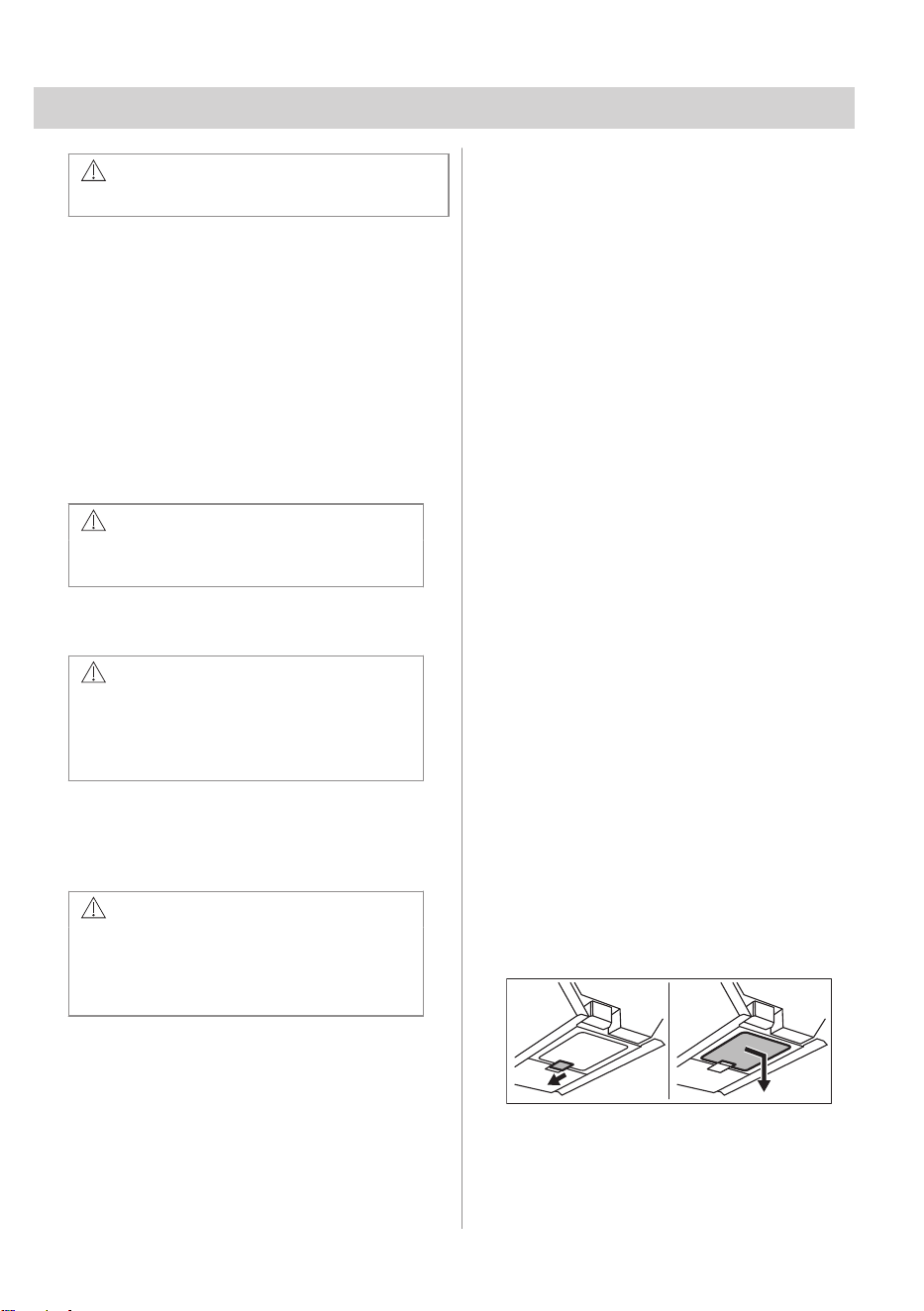
1. To access the drip tray, first unlock the
center latch. Slide the latch in the
opposite direction. Take hold of the drip
tray with both hands and slide it carefully
to the right.
1
2
2. Move the drip tray vertically downwards.
Be careful not to spill the water.
20 ENGLISH
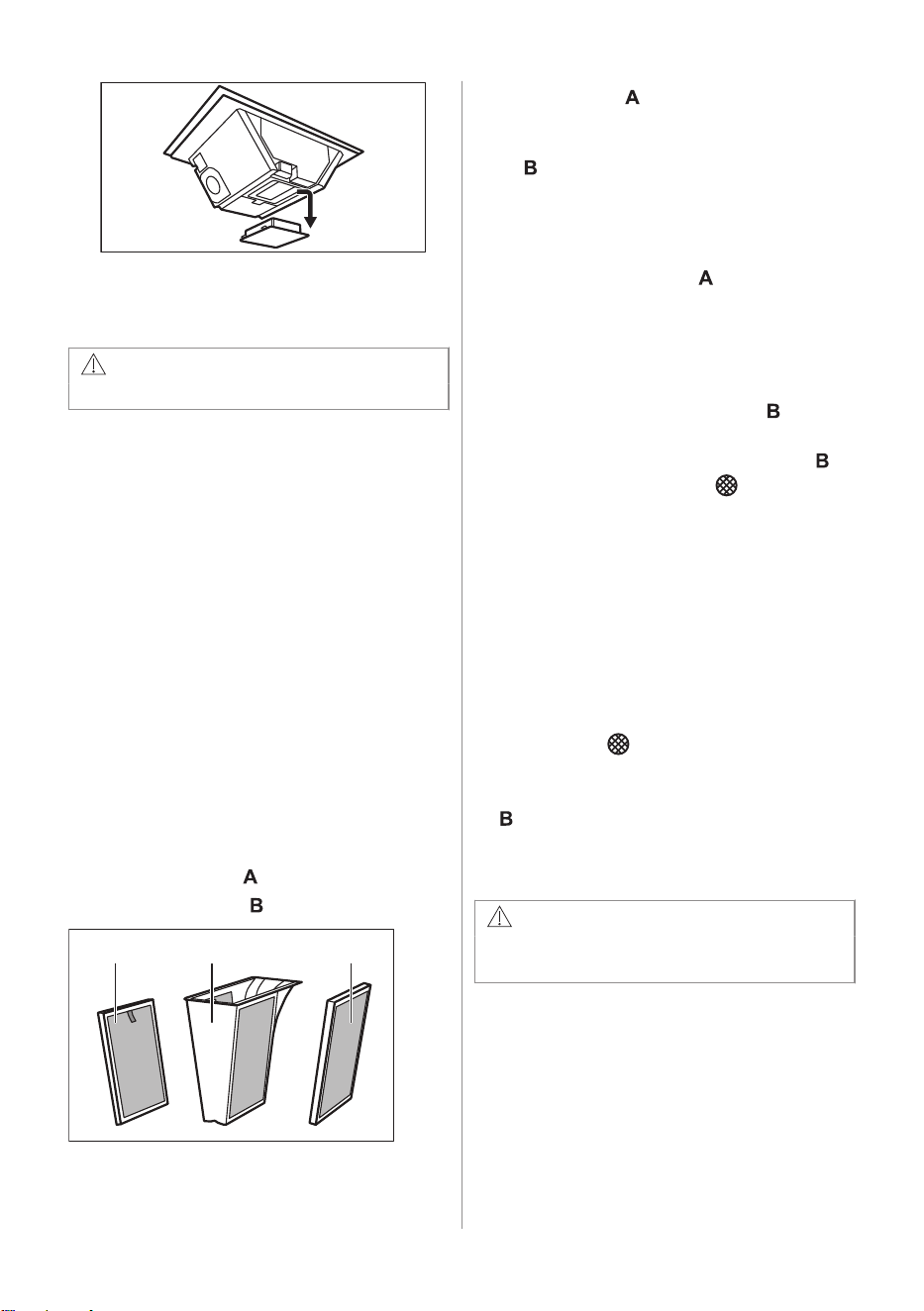
3. Dispose of the water and rinse the drip
tray out. You can wash the tray manually
(using soap and a soft cloth / sponge) or
in a dishwasher (standard cycle).
WARNING!
Make sure no liquid gets inside the hood.
If water or other liquids spill inside the
hood system:
1. Switch off the hood.
2. Lift the grid and clean the hood area
carefully with a moist cloth or sponge and
a mild cleaning agent.
3. Wipe away the excess liquid gathered on
the bottom of the hood cavity using a
sponge or a dry cloth.
4. Clean the filter, if needed (refer to
"Cleaning the hood filter").
5. Empty the drip tray, if needed.
6. Switch on the hood, set the fan speed
level to 2 or higher and let it run for some
time to get rid of the remaining moisture.
9.4 Cleaning and regenerating the
hood filters
The filtering unit consists of the following
elements: grease filters combined with the
grease filter housing
and the removable
long life carbon filters .
B A B
The grease filters
collect grease, oil, and
food remains and prevent them from getting
into the hood system. The long life carbon
filters , containing active carbon foam,
neutralise smoke and cooking smells.
Clean the filters regularly and regenerate
them periodically:
• Clean the grease filters
as soon as the
built-up grease is visible. The cleaning
frequency depends on the amount of fat
and oil used in cooking. It is
recommended to clean the filters once a
month, or more frequently, if needed.
• Clean the long life carbon filters
only
when the built-up grease is visible.
• Regenerate the long life carbon filters
only when the notification is on. The
maximum number of regeneration cycles
is 8 (approximately 3 years). After that
time, the filters need to be replaced with
new ones.
• Additionally, the hob has a built-in counter
with a notification that reminds you about
cleaning the grease filters and
regenerating the long life carbon filters.
The counter for the notification starts
automatically when you turn on the hood
for the first time. After 140 hours of use
the indicator
starts blinking to signal
that it is time to clean the grease filters
and regenerate the long life carbon filters
. The notification stays on for 30 seconds
after you deactivate the hood and the hob.
The notification does not block the use of
the hob.
WARNING!
Oversaturated filters can pose a risk of
fire.
Disassembling / reassembling the
filters
The filters and the grease filter housing are
located right under the grid in the centre of
the hob. Remove them carefully as they
might be slippery due to accumulated grease.
1. Remove the grid.
ENGLISH 21
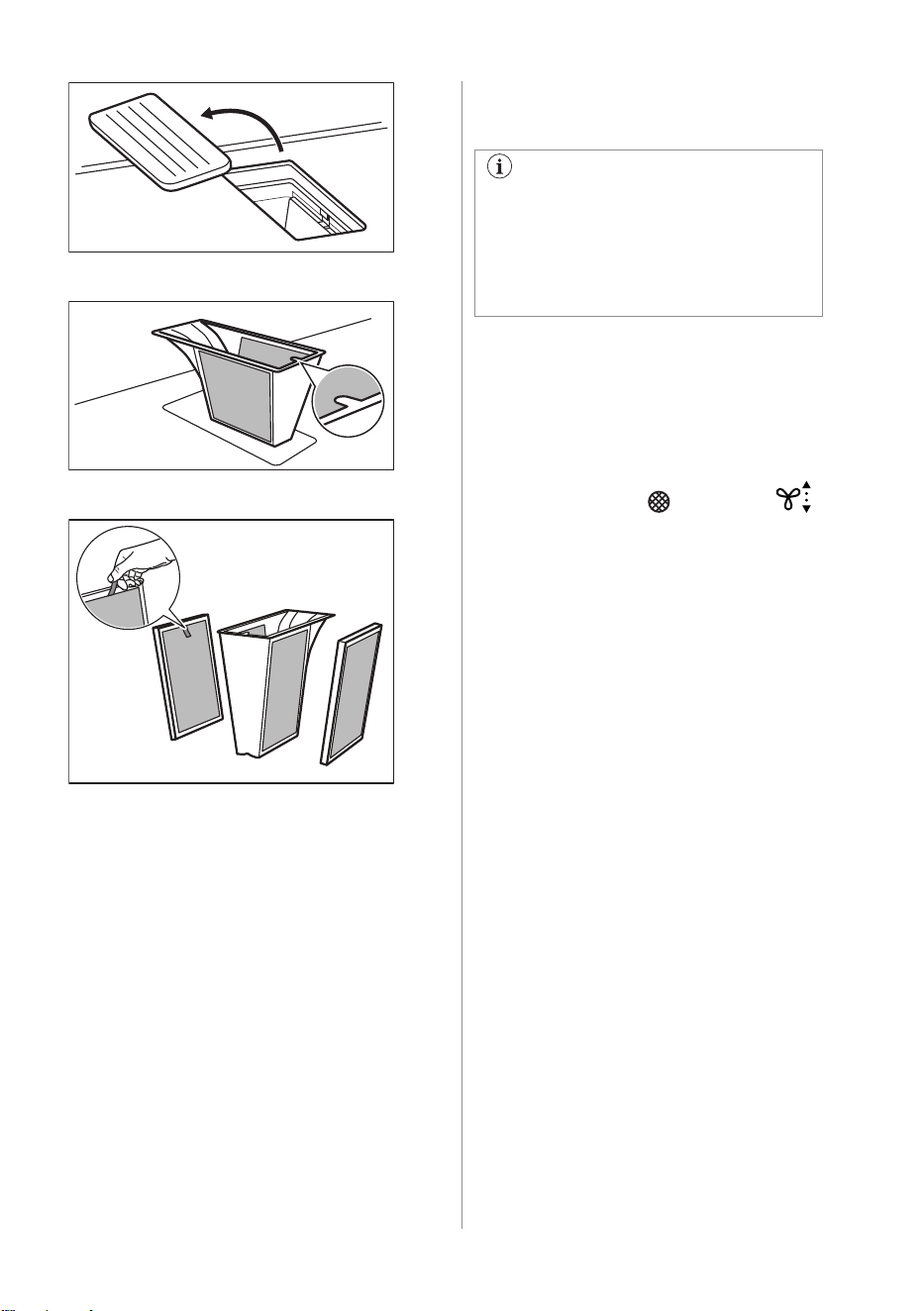
2. Take out the grease filter housing by
grabbing the protruding handle.
3. Take out the long life carbon filters by
grabbing the handle.
4. Reassemble the filtering unit after
cleaning:
a. Slide the long life carbon filters into
the hood system along the built-in
runners.
b. Place the grease filter housing back
inside.
c. Place the grid back on.
Cleaning the grease filters and the
grease filter housing
1. Wash the grease filter housing with the
grease filters carefully in warm water
using a mild cleaning agent, then rinse it
with warm water. You can use a soft
sponge, a soft cloth, or a non-abrasive
cleaning brush to remove food remains, if
necessary.
Wash the grease filters and the grease
filter housing in the dishwasher on any
standard cycle.
Depending on the detergent type and
the number of dishwasher cycles,
some mild discolouration on the
mesh may naturally occur. This does
not affect the performance of the
grease filter.
It is not recommended to use paper
towels while cleaning / drying the filtering
components.
2. Leave it for some time to dry at room
temperature.
3. Put the grease filter housing with the
grease filters back inside.
4. If the notification
is on, press
briefly to reset the counter.
The counter restarts.
Cleaning the long life carbon filters
1. Wash the filters carefully in warm water
without any cleaning agents. Detergents
can damage the carbon filtration. You can
use a soft sponge, a soft cloth, or a non-
abrasive cleaning brush to remove food
remains, if necessary. Alternatively, after
removing heavier dirt from the filters, you
can also wash the filters in a dishwasher
at 65-70 °C (using a program longer than
90 min), without detergents and without
dishes in the same load.
2. Leave the filters to dry overnight at room
temperature. The filters need to be fully
dried before reassembly.
3. Reassemble the filtering unit and put it
back inside.
Regenerating the long life carbon
filters
1. Clean the filters first, as described above.
2. Put the filters in the oven set to 100 °C for
120 min. Place the filters on the middle
wire shelf. Use a non-fan oven function.
3. Reassemble the filtering unit and put it
back inside.
22 ENGLISH
4. Press briefly to reset the counter.
The counter restarts.
10. TROUBLESHOOTING
WARNING!
Refer to Safety chapters.
10.1 What to do if...
Problem Possible cause Remedy
You cannot activate or operate
the hob.
The hob is not connected to an elec‐
trical supply or it is connected incor‐
rectly.
Check if the hob is correctly connected
to the electrical supply.
The fuse is blown. Make sure that the fuse is the cause of
the malfunction. If the fuse is blown
again and again, contact a qualified
electrician.
You did not set the heat setting for
60 seconds.
Activate the hob again and set the
heat setting in less than 60 seconds.
You touched 2 or more sensor fields
at the same time.
Touch only one sensor field.
Pause operates. Refer to "Pause".
There is water or fat stains on the
control panel.
Clean the control panel.
You can hear a constant beep
noise.
The electrical connection is incor‐
rect.
Disconnect the hob from the electrical
supply. Ask a qualified electrician to
check the installation.
You cannot select the maximum
heat setting for one of the cook‐
ing zones.
The other zones consume the maxi‐
mum available power.
Your hob works properly.
Reduce the heat setting of the other
cooking zones connected to the same
phase. Refer to "Power management".
An acoustic signal sounds and
the hob deactivates.
An acoustic signal sounds when
the hob is deactivated.
You put something on one or more
sensor fields.
Remove the object from the sensor
fields.
The hob deactivates. You put something on the sensor
field .
Remove the object from the sensor
field.
Residual heat indicator does not
come on.
The zone is not hot because it oper‐
ated only for a short time or the sen‐
sor is damaged.
If the zone operated sufficiently long to
be hot, speak to an Authorised Service
Centre.
The control panel becomes hot to
the touch.
The cookware is too large or you put
it too close to the control panel.
Put large cookware on the rear zones,
if possible.
There is no sound when you
touch the panel sensor fields.
The sounds are deactivated. Activate the sounds. Refer to "Daily
use".
ENGLISH 23
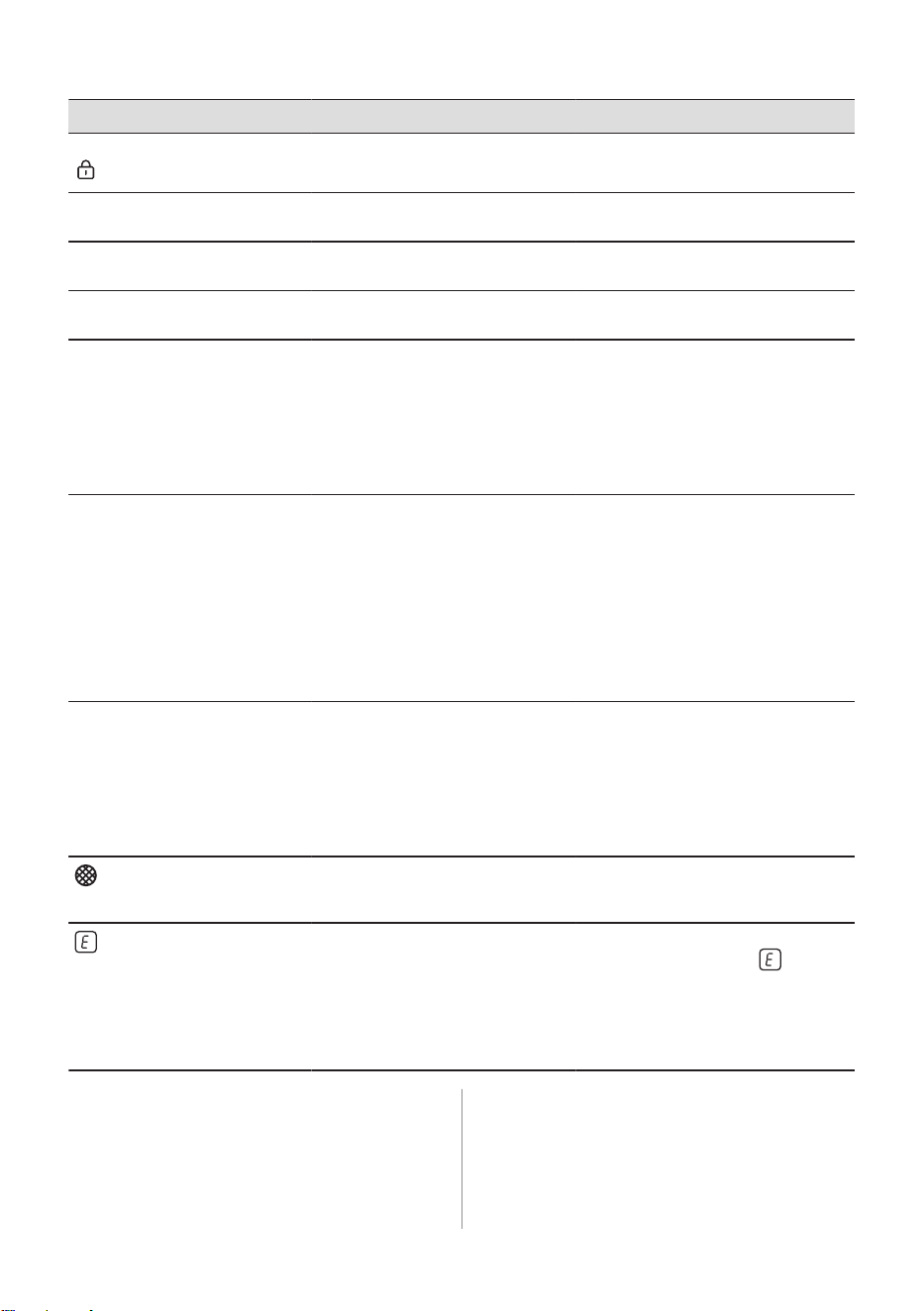
Problem Possible cause Remedy
The indicator above the symbol
comes on.
Child Safety Device or Lock oper‐
ates.
Refer to "Child Safety Device" and
"Lock".
The control bar blinks. There is no cookware on the zone or
the zone is not fully covered.
Put cookware on the zone so that it
fully covers the cooking zone.
The cookware is unsuitable. Use cookware suitable for induction
hobs. Refer to "Hints and tips".
The diameter of the bottom of the
cookware is too small for the zone.
Use cookware with correct dimen‐
sions. Refer to "Technical data".
The hood does not start or turns
off. The indicators above the
hood control symbols might also
blink.
The fan may turn off by itself in cer‐
tain conditions, e.g. when the room
is not properly ventilated.
Open the window. You may need to in‐
stall the window switch. Refer to "As‐
sembly". If the window switch is al‐
ready present, make sure it was cor‐
rectly installed. Refer to the installation
booklet.
Press any symbol. The hood operates
again.
The hood fan does not work
properly when the hood functions
are activated.
The ambient temperature surround‐
ing the hood is too high.
There is insufficient air circulation in‐
side and around the hood.
Deactivate the hob and unplug it from
the main power supply. Wait at least
10 seconds, then plug it in again.
Other suggestions:
Try to cool down the temperature of
the surrounding area. Take out the
hood filter and remove the residual
moisture from the inside of the hood.
Refer to "Care and cleaning". Leave
the hood system to dry for one day,
then activate the hood again.
The steam produced during
cooking is not sufficiently absor‐
bed by the hood.
The lids on the cookware are not
properly placed.
If your cookware does not have vented
lids, make sure to tilt the lids so that
the released steam is directed towards
the hood.
Refer to "Hints and Tips" for informa‐
tion on the special Steam Vented Lids
recommended to be used with the inte‐
grated hood.
The hood filter is oversaturated. Clean and regenerate the hood filter
and reset the notification. Refer to
"Care and cleaning".
and a number come on.
There is an error in the hob. Deactivate the hob and activate it
again after 30 seconds. If comes
on again, disconnect the hob from the
electrical supply. After 30 seconds,
connect the hob again. If the problem
continues, speak to an Authorised
Service Centre.
10.2 If you cannot find a solution...
If you cannot find a solution to the problem
yourself, contact your dealer or an Authorised
Service Centre. Give the data from the rating
plate. Make sure, you operated the hob
correctly. If not the servicing by a service
technician or dealer will not be free of charge,
also during the warranty period. The
information about guarantee period and
24 ENGLISH
Authorised Service Centres are in the
guarantee booklet.
11. TECHNICAL DATA
11.1 Rating plate
Model NCH74B01AB PNC 949 598 096 00
Typ 67 B4A 01 AD 220 - 240 V / 400 V 2N, 50 Hz
Induction 7.35 kW Made in: Germany
Ser.Nr. ................. 7.35 kW
AEG
11.2 Cooking zones specification
Cooking zone Nominal power
(maximum heat
setting) [W]
PowerBoost [W] PowerBoost
maximum dura‐
tion [min]
Cookware diame‐
ter [mm]
Left front 2300 3200 10 125 - 210
Left rear 2300 3200 10 125 - 210
Right front 1400 2500 4 125 - 145
Right rear 1800 2800 10 145 - 180
The power of the cooking zones can be
different in some small range from the data in
the table. It changes with the material and
dimensions of the cookware.
For optimal cooking results use cookware no
larger than the diameter in the table.
12. ENERGY EFFICIENCY
12.1 Product Information for hob according to EU and UK Ecodesign
Regulations
Model identification NCH74B01AB
Type of hob Built-In Hob
Number of cooking zones 4
Heating technology Induction
Diameter of circular cooking zones (Ø) Left front
Left rear
Right front
Right rear
21.0 cm
21.0 cm
14.5 cm
18.0 cm
ENGLISH 25
Energy consumption per cooking zone (EC electric
cooking)
Left front
Left rear
Right front
Right rear
189.1 Wh/kg
189.1 Wh/kg
180.2 Wh/kg
178.3 Wh/kg
Energy consumption of the hob (EC electric hob) 184.2 Wh/kg
IEC / EN 60350-2, BS EN 60350-2 -
Household electric cooking appliances - Part
2: Hobs - Methods for measuring
performance.
The energy measurements referring to the
cooking area are identified by the markings of
the respective cooking zones.
12.2 Hob - Energy saving
You can save energy during everyday
cooking if you follow the hints below.
• When you heat up water, use only the
amount you need.
• If it is possible, always put the lids on the
cookware.
• Put the cookware directly in the centre of
the cooking zone.
• Use the residual heat to keep the food
warm or to melt it.
12.3 Product Information and Product Information Sheet for hood
according to EU and UK Ecodesign and Energy Labelling Regulations
Product Information Sheet
Supplier’s name or trade mark AEG
Model identifier NCH74B01AB
Annual Energy Consumption - AEChood 32.7 kWh/a
Energy Efficiency Class A+
Fluid Dynamic Efficiency - FDEhood 32.0
Fluid Dynamic Efficiency class A
Lighting Efficiency - LEhood - lux/W
Lighting Efficiency Class -
Grease Filtering Efficiency - GFEhood 85.1 %
Grease Filtering Efficiency class B
Minimum Air Flow in normal use 270.0 m3/h
Maximum Air Flow in normal use 550.0 m3/h
Air Flow at intensive/boost setting 650.0 m3/h
A-weighted Sound Power Emissions at minimum speed 50 db(A) re 1 pW
A-weighted Sound Power Emissions at maximum speed 66 db(A) re 1 pW
A-weighted Sound Power Emissions at intensive or boost speed 69 db(A) re 1 pW
Measured power consumption off mode - Po 0.49 W
Measured power consumption in standby mode - Ps - W
26 ENGLISH
Additional Information
Time increase factor - f 0.8
Energy Efficiency Index - EEIhood 42.6
Measured air flow rate at best efficiency point - QBEP 286.7 m3/h
Measured air pressure at best efficiency point - PBEP 449 Pa
Maximum air flow - Qmax 650.0 m3/h
Measured electric power input at best efficiency point - WBEP 111.9 W
Nominal power of the lighting system - WL - W
Average illumination of the lighting system on the cooking surface - Emiddle - lux
Appliance tested according to: IEC / EN
61591, BS EN 61591, IEC / EN 60704-1, BS
EN 60704-1, IEC / EN 60704-2-13, BS EN
60704-2-13, IEC / EN 50564, BS EN 50564.
12.4 Hood - Energy saving
You can save energy during everyday
cooking if you follow the hints below.
• When you start cooking, set the hood fan
at a low speed level. Once the cooking is
finished, keep the hood running for a few
minutes.
• Increase the fan speed only to get rid of
large amounts of steam or smoke. It is
recommended to use the Boost function
only in extreme situations.
• Clean the hood filter regularly and replace
it when necessary to maintain its
efficiency.
• Use the maximum diameter of the ducting
system to optimize efficiency and minimize
noise.
13. ENVIRONMENTAL CONCERNS
Recycle materials with the symbol . Put the
packaging in relevant containers to recycle it.
Help protect the environment and human
health by recycling waste of electrical and
electronic appliances. Do not dispose of
appliances marked with the symbol with
the household waste. Return the product to
your local recycling facility or contact your
municipal office.
ENGLISH 27
*
867378903-A-482023