
2
Rinnai I-Series Plus Condensing Combi Boiler Manual
Contents
If the informaon in these instrucons are not followed exactly, a re or explosion may
result causing property damage, personal injury, or loss of life.
• Do not store or use gasoline or other ammable vapors and liquids in the vicinity of this or any other appliance.
• WHAT TO DO IF YOU SMELL GAS
− Do not try to light any appliance.
− Do not touch any electrical switch; do not use any phone in your building.
− Immediately call your gas supplier from a neighbor’s phone. Follow the gas supplier’s instrucons.
− If you cannot reach your gas supplier, call the re department.
• Installaon and service must be performed by a qualied installer, service agency or the gas supplier.
1. Welcome ................................................................................................................................................... 4
1.1 To the Installer ............................................................................................................................................... 4
1.2 To the Consumer ........................................................................................................................................... 4
1.3 Acronyms and Abbreviaons ......................................................................................................................... 4
2. Safety ........................................................................................................................................................ 5
2.1 Safety Symbols ............................................................................................................................................... 5
2.2 Safety Precauons ......................................................................................................................................... 5
3. About the Boiler ......................................................................................................................................... 7
3.1 Front View ..................................................................................................................................................... 7
3.2 Boom View .................................................................................................................................................. 7
3.3 Components .................................................................................................................................................. 9
3.4 Specicaons ............................................................................................................................................... 10
3.5 Dimensions .................................................................................................................................................. 11
3.6 Accessories .................................................................................................................................................. 13
4. Installaon............................................................................................................................................... 14
4.1 Installaon Guidelines ................................................................................................................................. 14
4.2 What You’ll Need ......................................................................................................................................... 15
4.3 Items Included ............................................................................................................................................. 16
4.4 Choose an Installaon Locaon ................................................................................................................... 17
4.5 Mount the Boiler to the Wall ....................................................................................................................... 20
4.6 Fill the Condensate Collector ....................................................................................................................... 21
5. Venng .................................................................................................................................................... 22
5.1 Guidelines .................................................................................................................................................... 22
5.2 Venng Installaon Sequence ..................................................................................................................... 23
5.3 Terminaon Consideraons......................................................................................................................... 23
5.4 PVC Venng Safety Switch ........................................................................................................................... 24
5.5 Venng Opons ........................................................................................................................................... 25
6. Gas Supply ............................................................................................................................................... 47
6.1 Connect the Gas Supply ............................................................................................................................... 47
6.2 Gas Operang Instrucons .......................................................................................................................... 48
6.3 Gas Pipe Sizing Reference Tables ................................................................................................................. 49
7. DHW System Piping .................................................................................................................................. 51
7.1 Guidelines .................................................................................................................................................... 51
7.2 Instrucons .................................................................................................................................................. 51
7.3 Piping Diagram for a Basic DHW Installaon ............................................................................................... 52
8. CH System Piping ..................................................................................................................................... 53
8.1 Guidelines .................................................................................................................................................... 53
8.2 Instrucons .................................................................................................................................................. 53
8.3 Common CH Components............................................................................................................................ 54
8.4 Piping Diagram for a Basic CH System (With Hydraulic Separaon) ............................................................ 56
8.5 Hydraulic Separaon.................................................................................................................................... 57
8.6 Connect the Pressure Relief Valves (DHW and CH) ...................................................................................... 59
8.7 Connect the Condensate Drain Line ............................................................................................................ 60
8.8 Condensate Pump Safety Switch Wiring ...................................................................................................... 61
WARNING

3
Rinnai I-Series Plus Condensing Combi Boiler Manual
9. Power Supply ........................................................................................................................................... 62
9.1 Guidelines .................................................................................................................................................... 62
9.2 Electrical Connecons .................................................................................................................................. 63
9.3 Post-Power Supply Connecon Checklist ..................................................................................................... 64
9.4 Inial Sengs .............................................................................................................................................. 65
10. Commissioning ....................................................................................................................................... 68
10.1 Safety Precauons ..................................................................................................................................... 68
10.2 Filling Process ............................................................................................................................................ 68
10.3 Deaeraon Process .................................................................................................................................... 69
11. Post-Installaon Checklist ...................................................................................................................... 71
12. Operaon ............................................................................................................................................... 73
12.1 Start-Up Informaon ................................................................................................................................. 73
12.2 Control Panel ............................................................................................................................................. 74
12.3 Basic Operaon Sengs ............................................................................................................................ 76
12.4 Parameter Sengs .................................................................................................................................... 85
12.5 Outdoor Reset Control ............................................................................................................................... 93
12.6 DHW Recirculaon Funcon ...................................................................................................................... 99
12.7 Simultaneous CH and DHW Operaon .................................................................................................... 103
12.8 Combi Boiler Cascade .............................................................................................................................. 104
12.9 Air Handler Control .................................................................................................................................. 107
12.10 Bluetooth Low Energy (BLE) and App Instrucons ................................................................................. 108
12.11 Diagnosc Codes .................................................................................................................................... 109
12.12 Forced Hi/Low Fire Modes ..................................................................................................................... 114
13. Maintenance ........................................................................................................................................ 115
13.1 Owner Maintenance ................................................................................................................................ 115
13.2 Licensed Professional Maintenance ......................................................................................................... 116
13.3 Test the Ignion Safety Shuto Device .................................................................................................... 119
14. Appendices .......................................................................................................................................... 120
14.1 Approved Cleaners, Inhibitors and Anfreezes ....................................................................................... 120
14.2 Flush the CH Plumbing System ................................................................................................................ 121
14.3 Flush the DHW Heat Exchanger .............................................................................................................. 124
14.4 System Applicaon Examples ................................................................................................................. 127
14.5 Gas Conversion ....................................................................................................................................... 131
14.6 Wiring Diagram ....................................................................................................................................... 134
14.7 Ladder Diagram ....................................................................................................................................... 135
14.8 CH Pressure Drop and Flow Curve ........................................................................................................... 136
14.9 DHW Pressure Drop and Flow Curve ....................................................................................................... 137
14.10 Guidelines for Addional DHW Controller (Oponal) ........................................................................... 138
14.11 Remove a Boiler from a Common Vent System .................................................................................... 140
14.12 Massachuses State Gas Regulaons ................................................................................................... 141
14.13 Federal Communicaon Commission (FCC) Interference Statement .................................................... 142
14.14 Industry Canada Statement .................................................................................................................. 143
14.15 Warranty ............................................................................................................................................... 144
4
Rinnai I-Series Plus Condensing Combi Boiler Manual
Thank you for purchasing a Rinnai I-Series
Plus Condensing Boiler. Before installing and
operang this boiler, be sure to read these
instrucons completely and carefully to
familiarize yourself with the boiler’s features
and funconality.
ANSI
American Naonal Standards
Instute
Btu Brish Thermal Unit
CH Central Heang
DHW Domesc Hot Water
GPM Gallons per minute
LP Liquid Propane
LWCO Low Water Cut O
NG Natural Gas
PP Polypropylene
PRV Pressure Relief Valve
PSI Pounds per square inch
W.C. Inches water column
• A trained and qualied professional
must install the boiler, inspect it, and
leak test it before use. The warranty
will be voided due to any improper
installaon.
• The trained and qualied professional
should have skills such as:
− Gas line sizing
− Connecng gas lines, water lines,
valves, and electricity
− Knowledge of applicable naonal,
state, and local codes
− Installing venng through a wall
or roof
− Training in installaon of
condensing boilers. Training on
Rinnai I-Series Plus Condensing
Boilers is accessible at
rinnaipro.myabsorb.com.
• Read all instrucons in this manual
before installing the boiler. The boiler
must be installed according to the
exact instrucons in this manual.
• Proper installaon is the responsibility
of the installer.
• When installaon is complete, leave
this manual with the boiler or give the
manual directly to the consumer.
Following is a list of common acronyms and
abbreviaons used in this manual:
• You must read the enre manual to
properly operate the boiler.
• Keep this manual for future reference.
• As when using any appliance generang
heat, there are certain safety precauons
you should follow. See secon “2.2 Safety
Precauons” for detailed safety
precauons.
• Be sure your boiler is installed by a
licensed installer.
• If installing in the state of Massachuses,
read secon “14.12 Massachuses State
Gas Regulaons” in this manual.
Table 1
5
Rinnai I-Series Plus Condensing Combi Boiler Manual
Safety alert symbol. Alerts you
to potenal hazards that can
kill or hurt you and others.
Indicates an imminently hazardous
situaon which, if not avoided, will
result in personal injury or death.
Indicates a potenally hazardous
situaon which, if not avoided, could
result in personal injury or death.
Indicates a potenally hazardous situaon
which, if not avoided, could result in minor
or moderate injury. It may also be used to
alert against unsafe pracces.
This manual contains the following important
safety symbols. Always read and obey all
safety messages.
The following precauons apply to the
installer and consumer. Read and follow all
instrucons in this secon.
• Before operang, smell all around the
appliance area for gas. Be sure to smell
next to the oor because some gas is
heavier than air and will sele on the
oor.
• Keep the area around the appliance clear
and free from combusble materials,
gasoline, and other ammable vapors and
liquids.
• Do not store or use gasoline or other
ammable vapors and liquids in the
vicinity of this or any other appliance.
• Combusble construcon refers to
adjacent walls and ceiling and should not
be confused with combusble or
ammable products and materials.
Combusble and/or ammable products
and materials should never be stored in
the vicinity of this or any gas appliance.
• Always check the water temperature
before entering a shower or bath.
• If the informaon in these instrucons
is not followed exactly, a re or
explosion may result causing property
damage, personal injury, or death.
• Do not store or use gasoline or other
ammable vapors and liquids in the
vicinity of this or any other appliance.
• WHAT TO DO IF YOU SMELL GAS:
− Do not try to light any appliance.
− Do not touch any electrical
switch; do not use any phone in
your building.
− Immediately call your gas
supplier from a neighbor’s
phone. Follow the gas supplier’s
instrucons.
− If you cannot reach your gas
supplier, call the re department.
• Installaon and service must be
performed by a qualied installer,
service agency or the gas supplier.
• The warning signs in this manual are
here to prevent injury to you and
others. Please follow them explicitly.
WARNING
WARNING
CAUTION
DANGER

6
Rinnai I-Series Plus Condensing Combi Boiler Manual
• Flammable liquids such as cleaning
solvents, aerosols, paint thinners,
adhesives, gasoline and propane must be
handled and stored with extreme care.
These ammable liquids emit ammable
vapors and when exposed to an ignion
source can result in a re hazard or
explosion. Flammable liquids should not be
used or stored in the vicinity of this or any
other gas appliance.
• DO NOT operate the boiler without the
front panel installed. The front panel
should only be removed for service/
maintenance or replacing internal
components.
• BURN HAZARD. Hot exhaust and vent may
cause serious burns. Keep away from the
boiler. Keep small children and animals
away from the boiler.
• Heang supply, return and domesc hot
water outlet pipes leaving the boiler can be
hot to touch.
• Install the vent system per local and
naonal codes.
• Do not install this boiler above 10,200
(3,109 m).
• Do not obstruct combuson air to the
boiler.
• The installer must verify that at least one
carbon monoxide alarm has been installed
within a residenal living space or home
following the alarm manufacturer’s
instrucons and applicable local codes
before pung the appliance into
operaon. Rinnai recommends that every
home have a carbon monoxide (CO) alarm
in the hallway near bedrooms in each
sleeping area. Check baeries monthly and
replace them annually.
• Failure to properly vent this appliance can
result in death, personal injury and/or
property damage.
• Do not use this appliance if any part has
been under water. Immediately call a
licensed professional to inspect the
appliance and replace any part of the
control system and any manual gas control
valve which has been under water.
• Do not use substute materials. Use only
parts cered for the appliance.
• Should overheang occur or the gas
supply fail to shut o, turn o the manual
gas control valve to the appliance.
• It is strongly recommended that you use a
trained and qualied professional who has
aended a Rinnai installaon training class
to adjust parameter sengs.
• Do not use an extension cord or adapter
plug with this appliance.
• Any alteraon to the appliance or its
controls can be dangerous and will void
the warranty.
• To protect yourself from harm, before
performing maintenance:
− Turn o the electrical power supply by
unplugging the power cord or by
turning o the electricity at the circuit
breaker. (The boiler controller does
not control the electrical power.)
− Turn o the gas at the gas control,
usually located immediately below the
boiler.
− Turn o the incoming water supply.
This can be done at the isolaon valve
immediately below the boiler for the
domesc hot water. Turning o the
water for the central heang system is
done at the boiler system lling staon
shut-o valve or the main water
supply to the building.
− Use only your hand to turn the manual
gas control valve. Never use tools. If
the manual gas control valve will not
turn by hand, do not try to repair it;
call a trained and qualied
professional. Force or aempted
repair may result in a re or explosion.
• Proper venng is required for the safe
operaon of this appliance. Failure to
properly vent this appliance can result in
death, personal injury and/or property
damage.
7
Rinnai I-Series Plus Condensing Combi Boiler Manual
Topics in this secon
• Front View
• Boom View
• Components
• Specicaons
• Dimensions
• Accessories
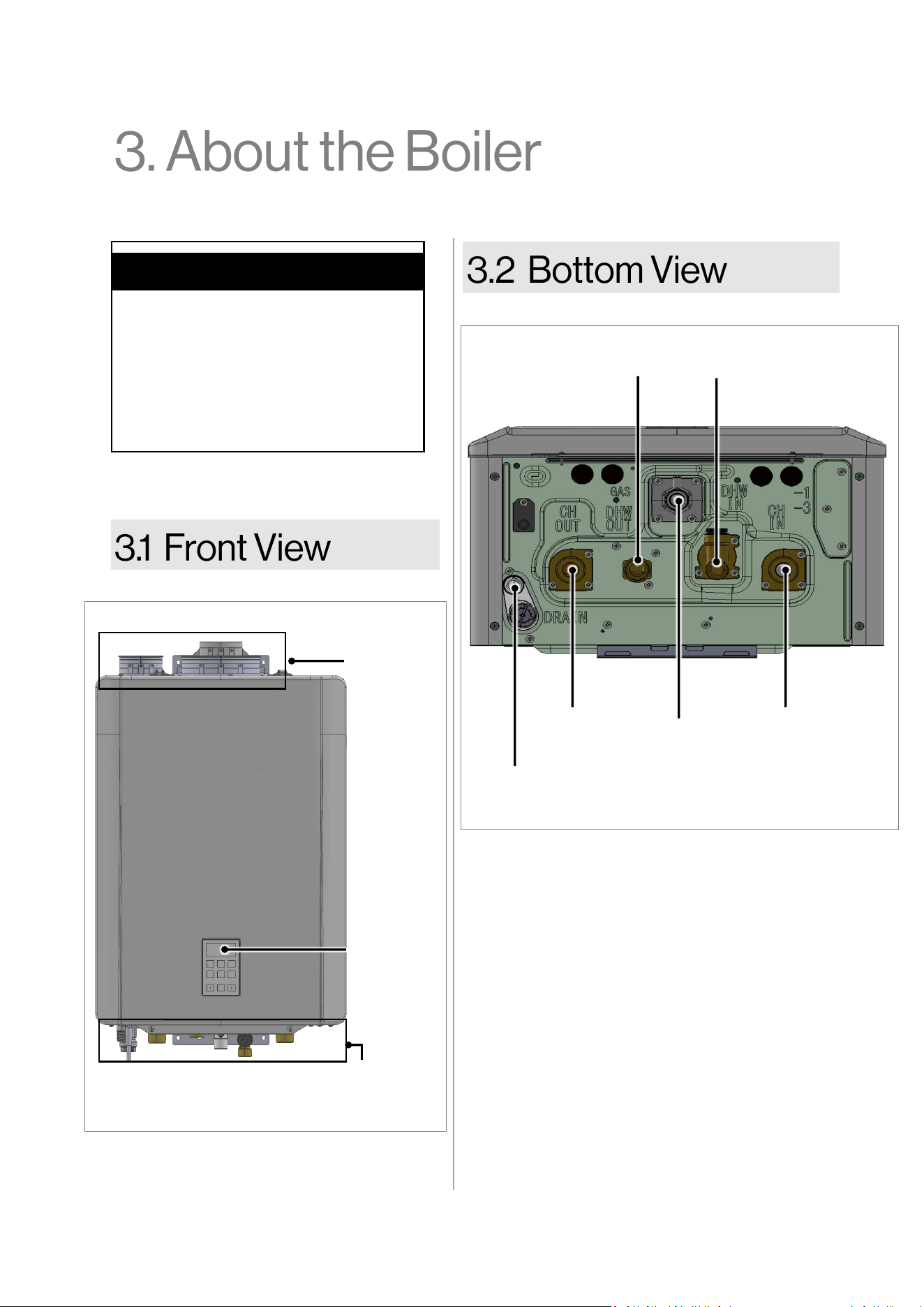
DHW
Hot Outlet
Central
Heang
Supply
Central
Heang
Return
Gas
DHW
Cold Inlet
Condensate
Drain
Controller
Vent
Connecons
Piping
Connecons
Figure 2: Bottom View
Figure 1: Front View
8
Rinnai I-Series Plus Condensing Combi Boiler Manual
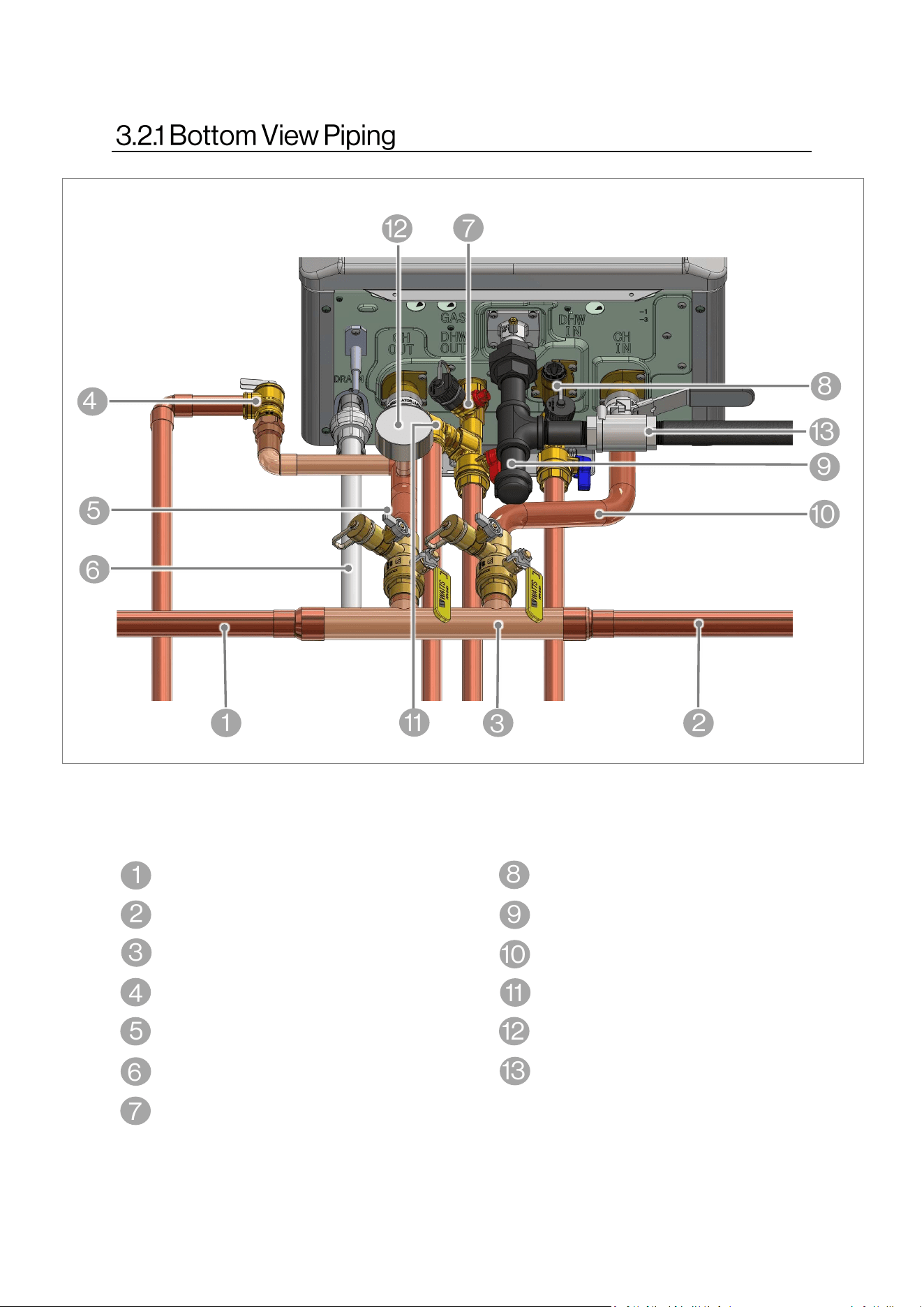
All items are eld-supplied unless otherwise noted.
Supply to CH System Domesc Cold Water
Return from CH System Gas
Primary-Secondary Heang Kit CH Return
CH Pressure Relief Valve (supplied with boiler) Domesc Hot Water Pressure Relief Valve
CH Supply Central Heang Pressure Gauge
Condensate Drain Gas Shut O Valve
Domesc Hot Water
Figure 3: Bottom View Piping
9
Rinnai I-Series Plus Condensing Combi Boiler Manual
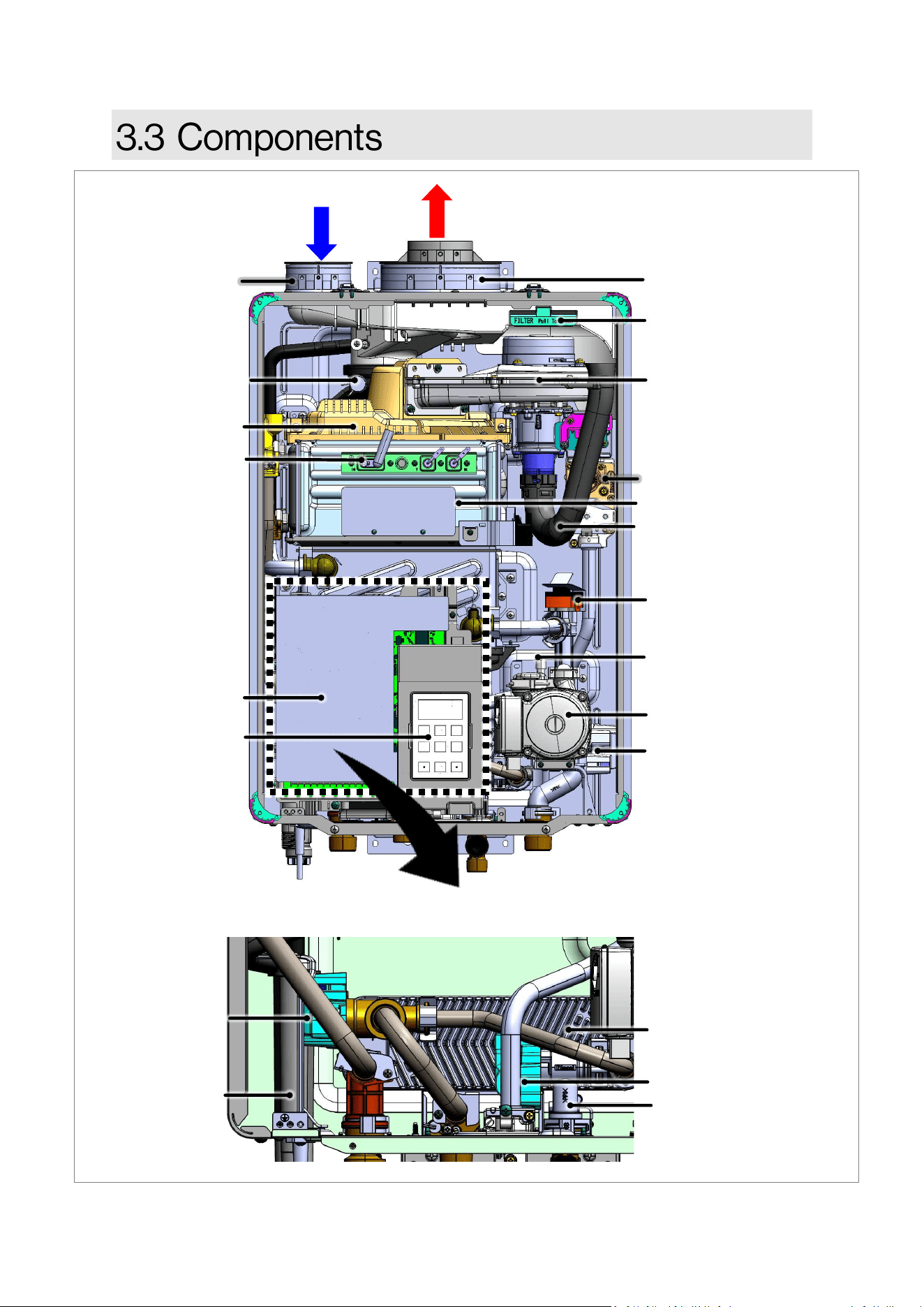
Exhaust
Intake
Air Inlet Filter
Fan with Integrated Venturi
Gas Valve
Heat Exchanger
Silencer
Pressure Sensor
Integrated Pump
Diverter Valve
Burner Assembly
Ignion Unit
PC Board Cover
Control Panel
Air Intake
Flue Gas Exhaust
Flow Sensor
Air Vent
PC Board Removed
Plate Heat Exchanger
Water Flow Servo Valve
Bypass Servo Valve
Condensate Trap
Combuson
Test Port
Figure 4: Components
10
Rinnai I-Series Plus Condensing Combi Boiler Manual
1
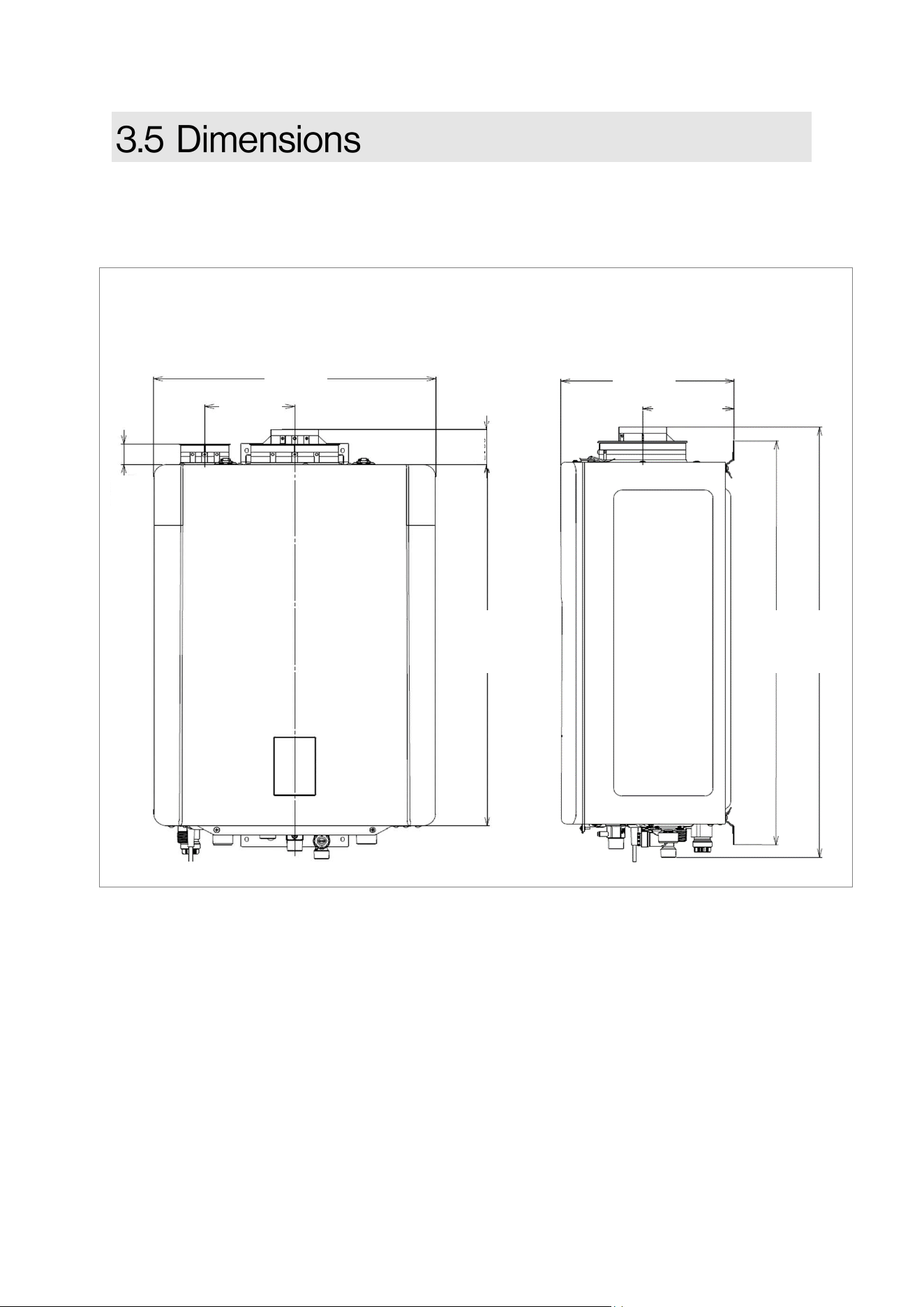
Maximum gas supply pressure must not exceed the value specied by the manufacturer.
Rinnai products are connually being updated and improved; therefore, specicaons are subject to change
without prior noce.
Model IP060160C IP090099C IP090160C IP090199C IP120199C IP150199C
Weight
73.0 lb (33 kg)
76.1 lb (34.5 kg)
Appliance Type Wall-Mounted, Gas-Fired Combi Boiler
Installaon Type Indoor
Ignion System Direct Electronic Ignion
Heat Exchanger Surface Area
9.3 sq
10.9 sq
Gas
Consumpon
(Btu/hr)
Minimum 15,000
Maximum
(CH)
60,000 90,000 90,000 90,000 120,000 150,000
Maximum
(DHW)
160,000 99,000 160,000
199,000
199,000
DHW
Specicaon
Minimum
Acvaon Flow
Rate
0.4 GPM (1.5 L/min)
Minimum
Operaon Flow
Rate
0.26 GPM (1.0 L/min)
Maximum Flow
Rate
7.9 GPM
(30 L/min)
5.3 GPM
(20 L/min)
7.9 GPM
(30 L/min)
9.8 GPM
(37 L/min)
Flow Rate at
70°F (39°C) rise
4.1 GPM (15 L/min)
5.1 GPM (19 L/min)
Temperature
Seng
CH (Minimum - Maximum) 86°F - 180°F (30°C - 82°C)
DHW (Minimum - Maximum) 98°F - 140°F (37°C - 60°C)
Water
Content
CH
0.75 gal
0.88 gal
DHW 0.05 gal
Water
Pressure
CH
Minimum: 13 PSI (90 kPa) Maximum: 45 PSI (310 kPa)
Recommended: 17-26 PSI (117-180 kPa)
Pressure Relief Valve for CH (included with system): 30 PSI (207 kPa)
DHW
Minimum: 20 PSI (138 kPa)/Maximum: 150 PSI (1,034 kPa)
(Recommend 30-80 PSI for maximum performance)
Grundfos Pump Model UPS 15-78
Sound Level
CH 43dB(A)
DHW 45dB(A) 47dB(A)
Normal
187 W 165 W 187 W
214 W
Electrical
Data
Standby 8 W
Max Current
14 Amps
Fuse
10 Amps ×1, 4 Amps ×5
Gas Supply
Pressure
1
Natural Gas 3.5 in. - 10.5 in. W.C. (0.87 - 2.61 kPa)
Propane 8.0 in. - 13.5 in. W.C. (1.99 - 3.36 kPa)
Electric Connecons AC 120 Volts, 60 Hz
Cercaons ANSI Z21.13, CSA 4.9, ASME
Canada CRN 2089.9CL
Table 2
11
Rinnai I-Series Plus Condensing Combi Boiler Manual
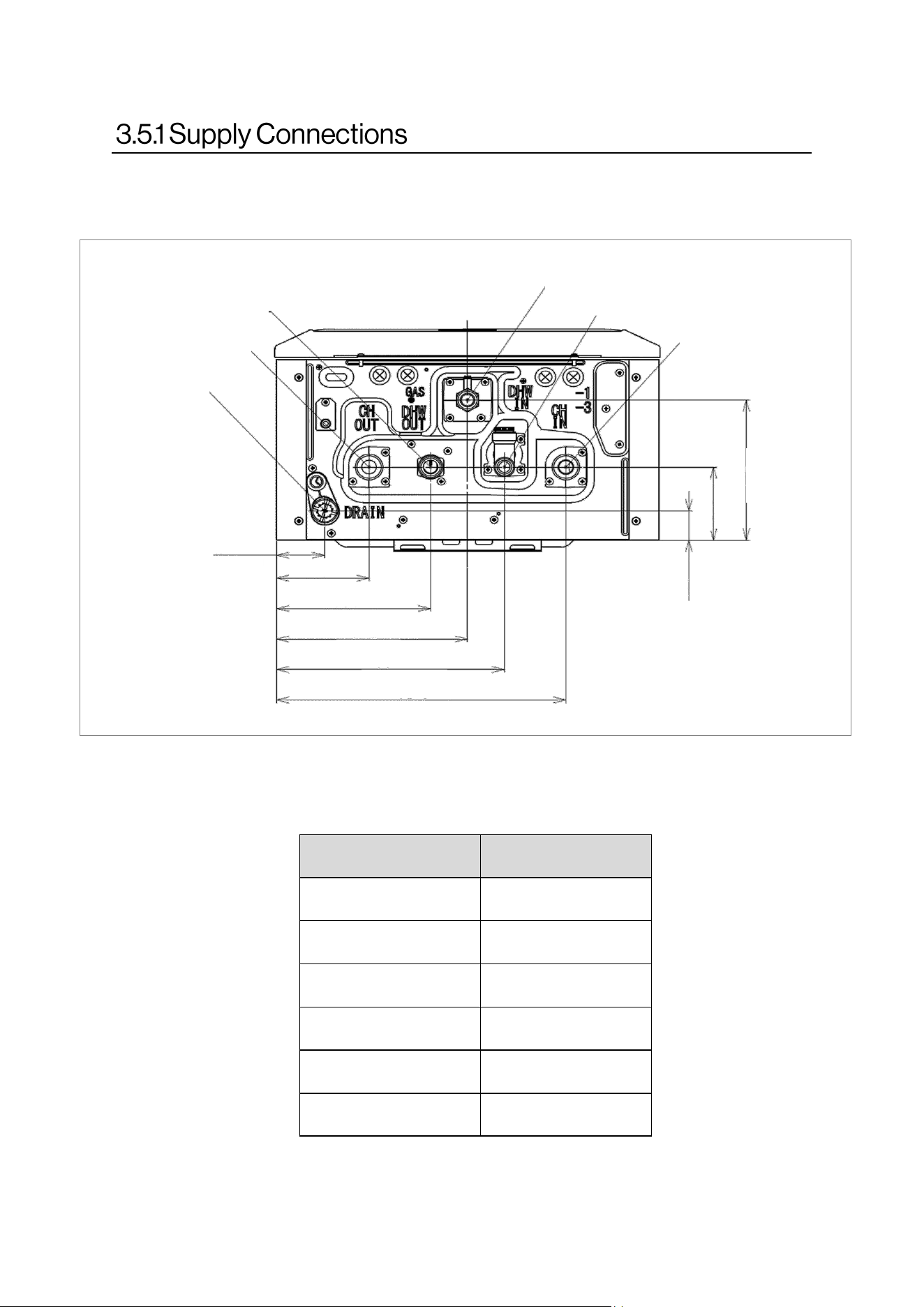
Measurements: in. (mm)
Vent Connecon: 2 in. (51 mm) nominal PVC/Polypropylene or 3 in./5 in. Concentric
Side Front
Figure 5: Dimensions
18.50”
(470mm)
5.91”
(150mm)
1.39”
(39mm)
25.75”
(654mm)
2.53”
(64mm)
6.10”
(154.4mm)
11.50”
(291mm)
28.74”
(730mm)
30.60”
(777mm)
12
Rinnai I-Series Plus Condensing Combi Boiler Manual
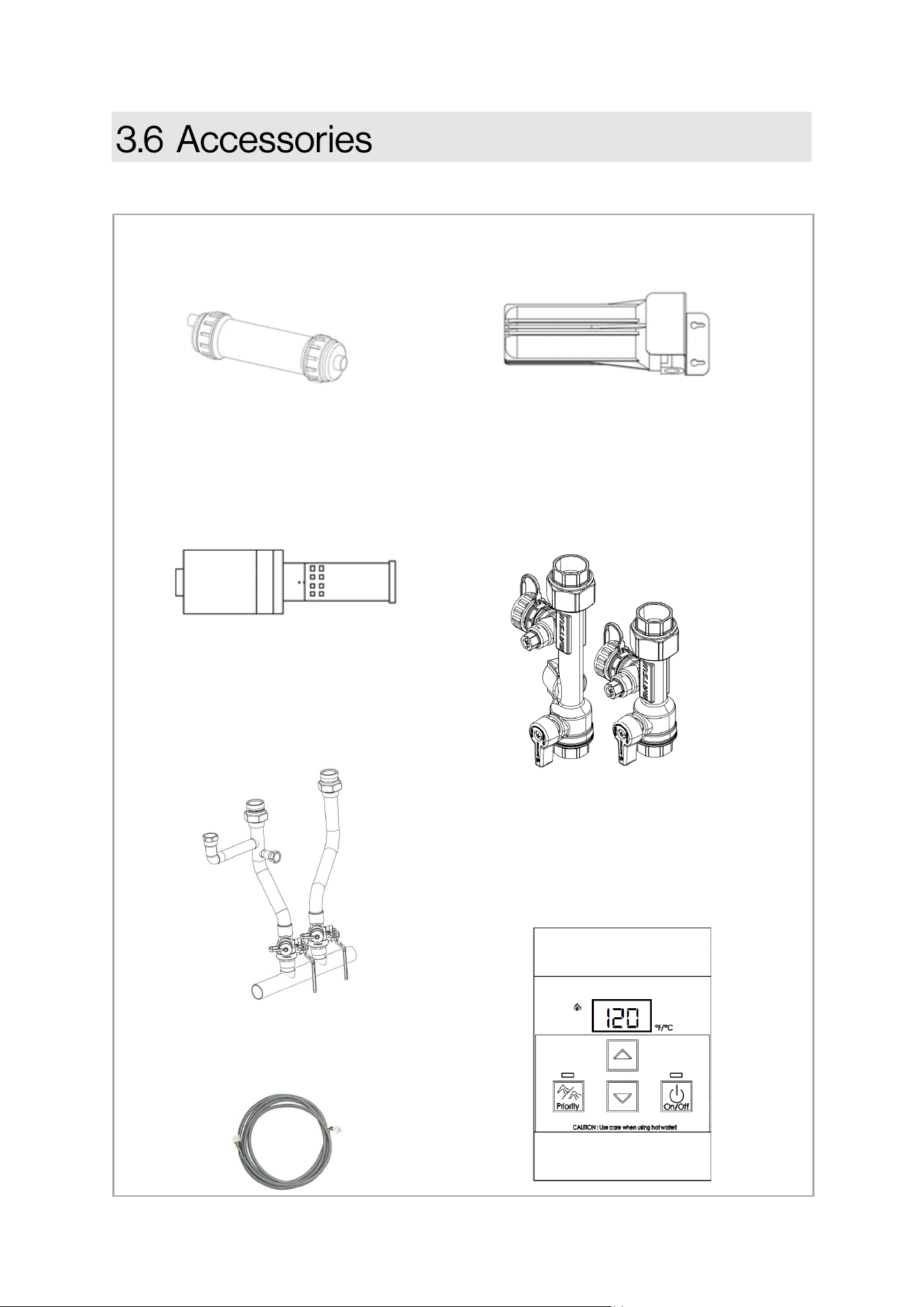
Connecon Connecon Size
Gas 3/4 in. NPT
DWH In (Cold Inlet) 3/4 in. NPT
DHW Out (Hot Outlet) 3/4 in. NPT
CH In (CH Return) 1 in. NPT
CH Out (CH Supply) 1 in. NPT
Condensate Outlet 1/2 in. NPT
Figure 6: Supply Connections
Table 3
DHW Hot Outlet
Central Heang Supply
Condensate Drain
Gas
DHW Cold Inlet
Central Heang Return
3.8”
(96mm)
1.5”
(39mm)
7.2”
(184mm)
2.3”
(59mm)
7.4”
(188mm)
4.5”
(113mm)
9.2”
(233mm)
11”
(278mm)
13.9”
(353mm)
13
Rinnai I-Series Plus Condensing Combi Boiler Manual
The following oponal accessories are available for the Rinnai I-Series Plus Condensing Boiler.
Neutralizes the condensate
generated by the boiler.
SCALECUTTER
Part #: 103000038
Filters and reduces the amount of
scale entering the boiler allowing
for greater boiler longevity.
SCALECUTTER REFILL CARTRIDGE
Part #: 103000039
Rell cartridge for the Scale Cuer
lter assembly.
DHW ISOLATION VALVE KIT
Part #: MIVK-T-LW
For quick isolaon of the
boiler DHW connecons.
PRIMARY-SECONDARY HEATING KIT
Part #: 807000212
DHW TEMPERATURE CONTROLLER
Part #: MC-601
CASCADE CABLE
• Part #: REU-CSA-C1 (10 /3 m cable)
• Part #: REU-CSA-C2 (26 /8 m cable)
Figure 7
CONDENSATE NEUTRALIZER
Part #: 804000074
14
Rinnai I-Series Plus Condensing Combi Boiler Manual
• Installaon Guidelines
• What You’ll Need
• Items Included
• Choose an Installaon Locaon
• Mount the Boiler to the Wall
• Fill the Condensate Collector
THIS SECTION IS INTENDED
FOR THE INSTALLER
Installer qualicaons: A trained and qualied
professional must install the appliance,
inspect it, and leak test the boiler before use.
The warranty will be voided due to any
improper installaon. The trained and
qualied professional should have skills such
as: Gas sizing; Connecng gas lines, water
lines, valves, and electricity; Knowledge of
applicable naonal, state, and local codes;
Installing venng through a wall or roof; and
training in installaon of condensing boilers.
Training for Rinnai I-Series Plus Condensing
Boilers is accessible online at
rinnaipro.myabsorb.com.
Topics in this secon
• This boiler is cered for installaon in
residenal and commercial applicaons.
• This boiler is suitable for combinaon
water heang and central heang.
• The installaon must conform with local
codes or, in the absence of local codes,
with the Naonal Fuel Gas Code, ANSI
Z223.1/NFPA 54, or the Natural Gas and
Propane Installaon Code, CSA B149.1. If
installed in a manufactured home, the
installaon must conform with the
Manufactured Home Construcon and
Safety Standard, Title 24 CFR, Part 3280
and/or CAN/SCA Z240 MH Series, Mobile
Homes.
• The appliance, when installed, must be
electrically grounded in accordance with
local codes or, in the absence of local
codes, with the Naonal Electrical Code,
ANSI/NFPA 70, or the Canadian
Electrical Code, CSA C22.1.
• The appliance and its main gas valve
must be disconnected from the gas
supply piping system during any
pressure tesng of that system at test
pressures in excess of 1/2 PSI (3.5 kPa)
(13.84 in W.C.). For system tesng at
pressures less than or equal to 1/2 PSI
(3.5 kPa) (13.84 in W.C.) the appliance
must be isolated from the gas supply
piping by closing its individual manual
shuto valve.
• You must follow the installaon
instrucons and those in secon
“5. Venng” for adequate combuson
air and exhaust.
• If this boiler’s DHW system is connected
to a closed water supply system, such as
one having a backow preventer in the
cold water supply line, means shall be
provided to control thermal expansion.
Contact the water supplier or local
plumbing inspector on how to control
thermal expansion.
• Should overheang occur or the gas
supply fail to shut o, turn o the
manual gas control valve to the
appliance.
• Combuson air must be free of
chemicals, such as chlorine or bleach,
that produce fumes. These fumes can
damage components and reduce the life
of your appliance.
• Where required by the authority having
jurisdicon, the installaon must comply
with the Standard for Controls and
Safety Devices for Automacally Fired
Boilers, ANSI/ASME CSD-1.
15
Rinnai I-Series Plus Condensing Combi Boiler Manual
DO NOT install the boiler in an area
where water leakage of the unit or
connecons will result in damage to
the area adjacent to the appliance
or to lower oors of the structure.
When such locaons cannot be
avoided, it is required that a
suitable drain pan, adequately
drained, be installed under the
boiler. The pan must not restrict
combuson air ow.
DO NOT install the boiler in an area
with negave air pressure.
DO NOT obstruct the ow of
combuson and venlaon air.
DO NOT use substute parts that
are not authorized for this boiler.
DO NOT install the boiler on
carpeng.
DO NOT install the boiler outdoor.
DO NOT
• Ensure the wall is of sucient
strength to support the weight of the
boiler, piping and any other
components needed for installaon;
if it is not, please reinforce the wall as
appropriate.
• Operang limits of the boiler:
Maximum boiler set
point temperature:
180°F (82 °C)
Maximum operang
pressure:
45 PSI (3.1 bar)
Maximum allowable
working
temperature ASME:
210°F (99°C)
Maximum allowable
working pressure
ASME:
45 PSI (3.1 bar)
• Pressure relief valve for domesc hot
water (150 PSI / 1,034 kPa)
• Pressure/Temperature Gauge
Note: When aaching the pressure/
temperature gauge, please comply with
applicable codes and the ASME
standard.
• Low loss header or closely spaced tee
• Expansion tank for a closed heang
system
• Isolaon valve kit or equivalent
components (for quick isolaon of the
boiler for service and/or maintenance)
• Air separator
• Standard tools for central heang, gas
ng, plumbing and electrical wiring.
• Digital manometer
• Digital mulmeter capable of reading
microamps
• pH digital meter or test strips
• For wall mounng bracket installaon:
− Level
− Screws (use appropriate screws for
type of wall construcon)
Gather the recommended tools and parts
before starng installaon.
• Combuson analyzer (intended for
use with condensing boilers)
• Hand truck with fastening belt
Table 4
16
Rinnai I-Series Plus Condensing Combi Boiler Manual
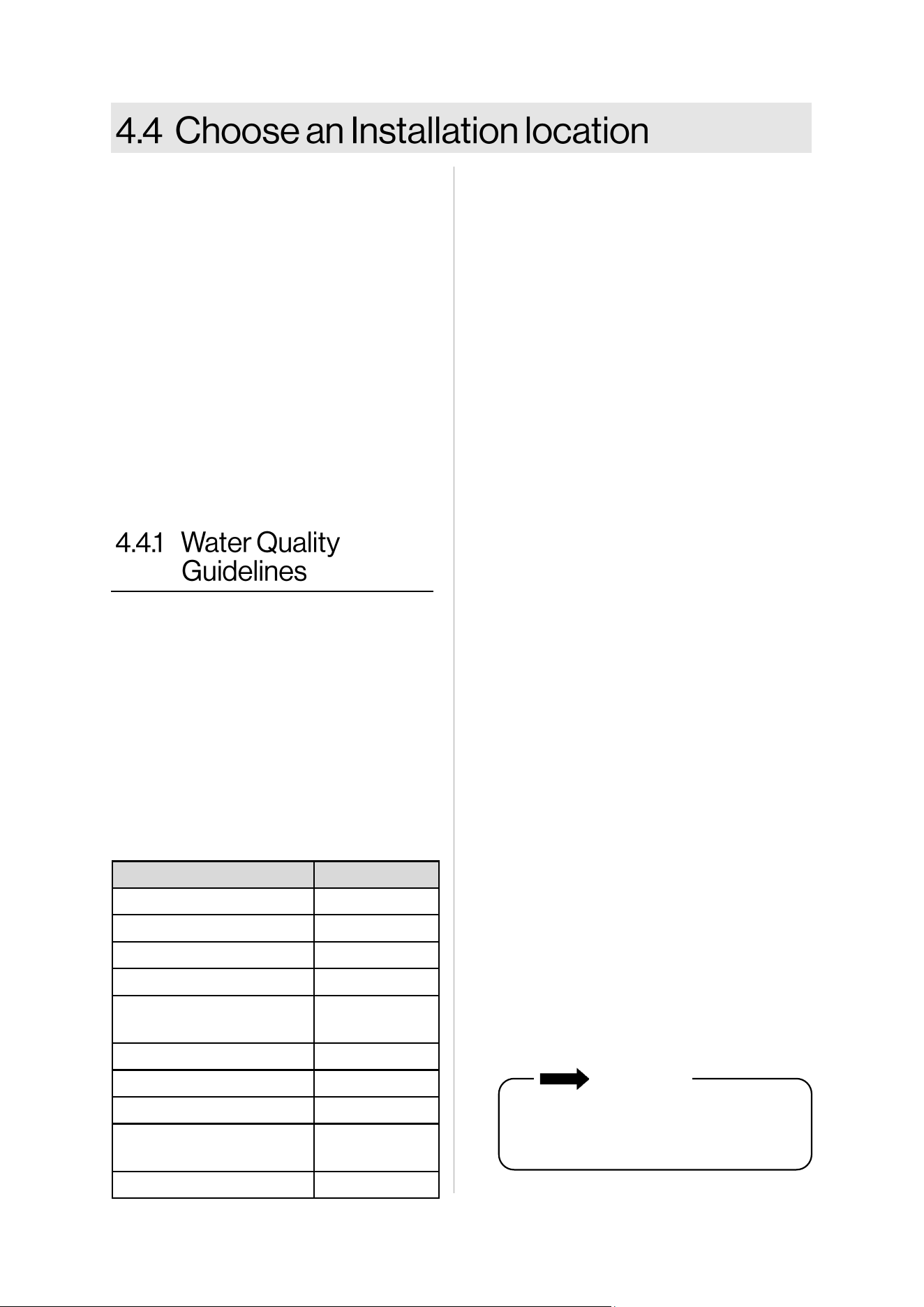
Carefully unpack your boiler system and verify the following contents are included. If any items are
damaged or missing, contact your local dealer/distributor. Do not aempt to use any item that
appears damaged.
• Installaon and Operaon Manual (this manual)
• User Manual
• Technical Data Sheet (located on inside of boiler front panel)
• “Key Points for a Successful Installaon” Sheet (adhered to boiler
front panel)
Vent top with integrated
2 in. PVC and
3 in. X 5 in. Concentric
Vent Adapter
Pump
Air
Supply
Filter
Refer to secon “3.3 Components” for a
complete list of integrated parts.
WALL MOUNTING BRACKET
PRESSURE RELIEF VALVE
For Central Heang Systems
OUTDOOR TEMPERATURE
SENSOR
VENT SCREENS
Vent screens (x2) and vent
screen screws (x2). The vent
screen prevents debris and
other objects from entering the
terminal. One vent screen is for
the intake; the other is for the
exhaust.
GAS CONVERSION LABEL
This boiler is congured for Natural Gas only. Use this kit to convert to
Propane Gas if needed. Contents include:
DOCUMENTATION
PART #:
807000211
PART #:
109000628
INTEGRATED
ITEMS
Figure 8
17
Rinnai I-Series Plus Condensing Combi Boiler Manual
Contaminant Maximum Level
Total Hardness Up to 200 mg/L
Aluminum * Up to 0.2 mg/L
Chlorides * Up to 250 mg/L
Copper * Up to 1.0 mg/L
Dissolved Carbon Dioxide
(CO2)
Up to 15.0 mg/L
Iron * Up to 0.3 mg/L
Manganese * Up to 0.05 mg/L
pH * 6.5 to 8.5
TDS (Total Dissolved
Solids) *
Up to 500 mg/L
Zinc * Up to 5 mg/L
Consideraon of care for your boiler should
include evaluaon of water quality.
• The water must be potable, free of
corrosive chemicals, sand, dirt, or other
contaminants.
• It is up to the installer to ensure the
water does not contain corrosive
chemicals or elements that can aect or
damage the boiler.
• Water that contains chemicals
exceeding the levels below can damage
the boiler.
* Source: Part 143 Naonal Secondary Drinking Water Regulaons
When choosing an installaon locaon, you
must ensure that clearances will be met and
that the vent length will be within required
limits. Consider the installaon environment,
water quality, and need for freeze
protecon. Requirements for the gas line,
water lines, electrical connecon, and
condensate disposal can be found in their
respecve installaon secons in this
manual.
This secon provides informaon on the
importance of water quality to the Rinnai
Condensing Boiler. The informaon is
intended to serve as general guidelines only
and is not a complete list of water quality
guidelines.
• Unsuitable heang system water can cause
the formaon of scale or sludge, which
aects system eciency. It can also cause
corrosion and reduce life of the heat
exchanger.
• Never use water that has been treated by a
reverse osmosis, deionized, or dislled
water to soen the water to ll the heang
system.
• For Domesc Hot Water systems, if you
install the boiler in an area that is known to
have hard water or that causes scale
build-up, the water must be treated and
may require a more frequent ushing
schedule. Scale build-up is caused by hard
water and can be accelerated if the boiler is
set at a high temperature. Rinnai oers
Southeastern Filtraon’s “Scale Cuer Water
Condioning System” that oers superior
lime scale prevenon and corrosion control
by feeding a blend of control compounds
into the cold water supply.
• Oxygen permeable or rubber tubing is not
permied in the heang system unless it is
separated from the boiler by a plate heat
exchanger.
• Thoroughly ush the system prior to lling.
While ushing, isolate the boiler.
• Do not introduce any system cleaner into
the boiler. Flush the system thoroughly to
remove all system cleaner before lling the
boiler with water.
• When freeze protecon of the heang
system is desired, only use Rinnai-approved
anfreezes. The allowed maximum
concentraon is 40%.
• Reference secon “14.1 Approved Cleaners,
Inhibitors and Anfreezes” in the Appendix
for an approved list of system cleaners,
inhibitors, and anfreezes.
IMPORTANT
Replacement of components due to
water quality damage is not covered by
the warranty.
Table 5
18
Rinnai I-Series Plus Condensing Combi Boiler Manual
• Air surrounding the boiler, venng, and vent terminaon(s) is used for combuson and must be
free of any compounds that cause corrosion of internal components.
• These include corrosive compounds that are found in aerosol sprays, detergents, bleaches,
cleaning solvents, oil-based paints/varnishes, and refrigerants. The air in hair/nail salons, spas,
dry cleaning stores, photo processing labs, and storage areas for pool supplies oen contains
these compounds. Therefore, it is recommended that external (outdoor) installaons be used
for these locaons where possible. In applicaons ulizing room air where there are high levels
of parculates, Rinnai oers a room air screen.
• The boiler, venng, and vent terminaon(s) should not be installed in any areas where the air
may contain these corrosive compounds.
• Install the boiler as far away as possible from any air inlet vents. Corrosive fumes, somemes
found in hair/nail salons, spas, or other industries exposed to toxic fumes, may be released
through these vents when not in operaon. Chemicals that are corrosive in nature should not be
stored or used near the boiler or vent terminaon. This requirement applies to indoor and
outdoor installaons.
• In coastal regions, the boiler should be installed so that it is sheltered/protected from exposure
to sea breeze. Exposure to salty spray or breeze can cause corrosion of the boiler.
• DO NOT install the boiler in areas where intake air might be contaminated with chemicals.
• DO NOT use room air in applicaons where the indoor air is corrosive. Install the boiler as direct
vent in a sealed closet so that it is protected from the potenal of contaminated indoor air.
• Install the boiler and/or vent terminaon as far away as possible from exhaust vent hoods and
dryer vents.
• Damage and repair due to corrosive compounds in the air is not covered by warranty.
19
Rinnai I-Series Plus Condensing Combi Boiler Manual
Use this checklist to ensure you have selected the correct locaon for the boiler.
□
The boiler is not exposed to corrosive compounds in the air.
□
The boiler locaon complies with the required clearances.
□
The planned combuson air and exhaust terminaon locaons meet the required clearances.
□
The water supply does not contain chemicals or exceed total hardness that will damage the
heat exchanger.
□
A standard 3 prong 120 VAC, 60 Hz properly grounded wall outlet or other 120 VAC, 60 Hz
source is available.
□
The installaon must conform with local codes or, in the absence of local codes, with the
Naonal Fuel Gas Code, ANSI Z223.1/NFPA 54, or the Natural Gas and Propane Installaon
Code, CSA B149.1.
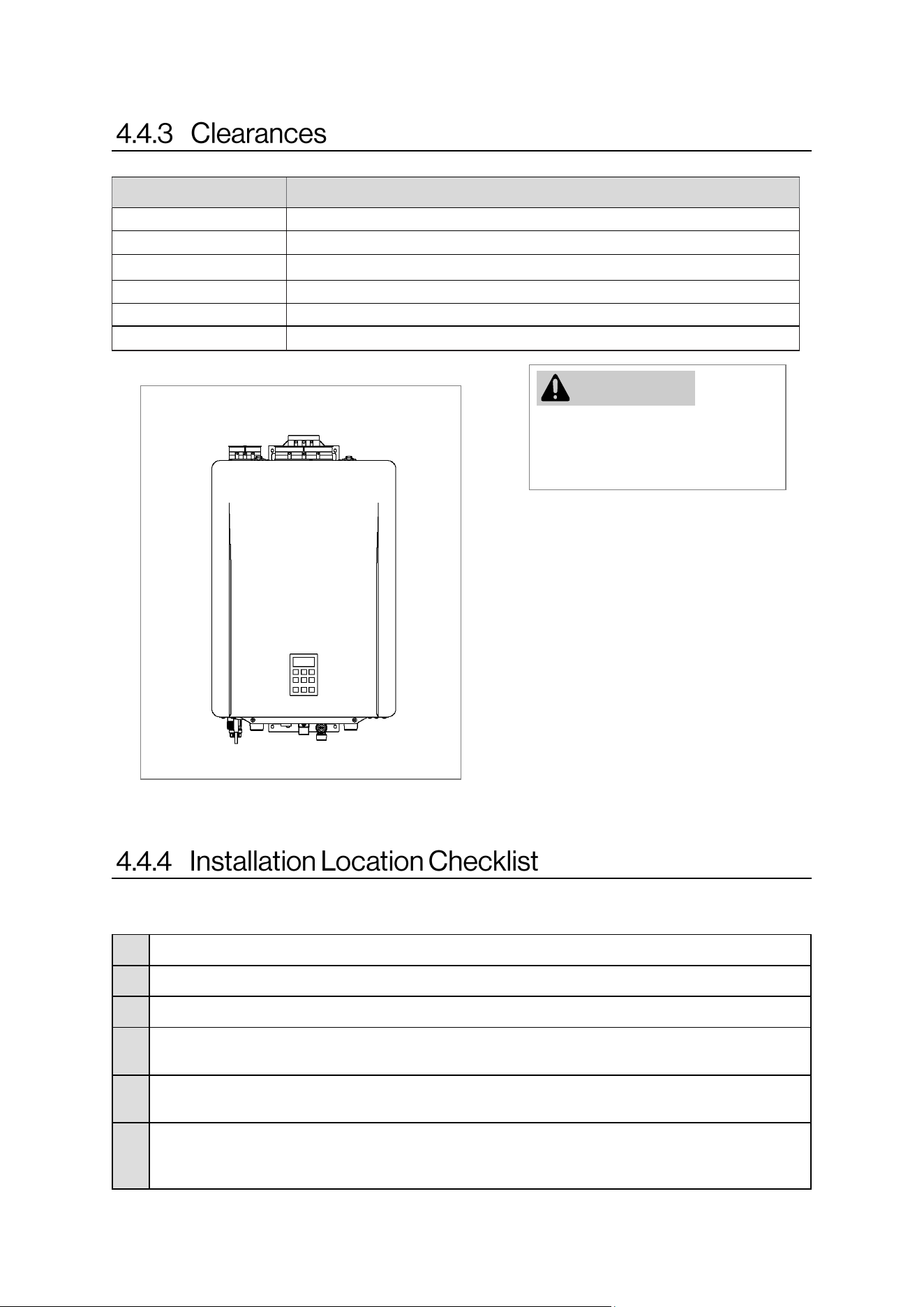
Locaon Clearance to Combusbles and Non-Combusbles
Top 2 in. (51 mm) (0 in. from vent components)
Boom/Ground 12 in. (305 mm)
Front 0 in. (Clearance for servicing is 24 in. / 610 mm in front of boiler)
Back 0 in.
Sides (Le and Right) 2 in. (51 mm) (Add 0.25 in. / 6.35 mm for recess box)
Vent 0 in.
TOP
If clearances are not met, damage
to the property and boiler may
occur.
Figure 9
Table 6
CAUTION
BOTTOM
FRONT SIDE
SIDE
20
Rinnai I-Series Plus Condensing Combi Boiler Manual
Supplied by Installer:
• Level
• Four screws for mounng bracket
installaon
• Screws for top and boom bracket
installaon
Use appropriate screws for type of
wall construcon.
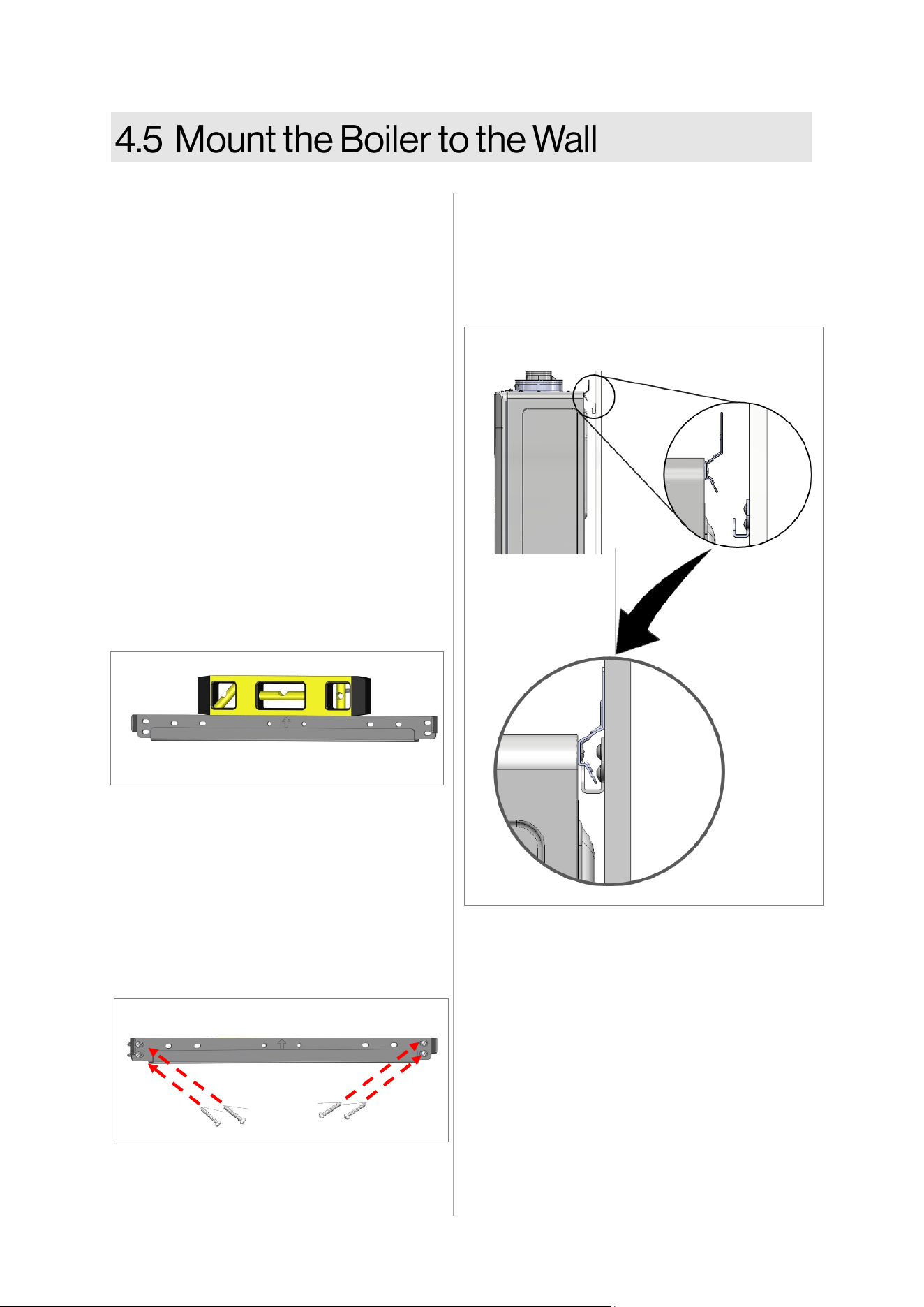
1. Hold the wall mounng bracket up
against the wall and use a level to make
sure the bracket is even. Proper
operaon requires the boiler to be level.
2. Use four screws to secure the wall
mounng bracket to the wall (two
screws on far le side and two screws
on far right side).
Use the appropriate screws for the wall
construcon to secure the mounng
bracket to the wall between two studs.
You Will Need:
• Rinnai Condensing Boiler
• Wall Mounng Bracket
Level
Wall Mounng Bracket
3. Insert the top bracket into the wall
mounng bracket. Make sure the wall
mounng bracket is aached to the wall
and can hold the weight of the boiler
before you fully let go.
Steps connued on next page.
Instrucons:
Figure 12
Figure 11
Figure 10
21
Rinnai I-Series Plus Condensing Combi Boiler Manual
Before operaon of the boiler, the
condensate collector must be lled with
water. This is to prevent the potenal of
exhaust gasses from entering the building.
Failure to ll the condensate collector could
result in severe personal injury or death.
4. Securely screw the top and boom
brackets into the wall, making sure the
screws are ush with the wall.
• Use any of the holes in the top and
boom brackets.
• Make sure the securing method is
sucient to support the weight of
the boiler. Refer to the boiler weight
in secon “3.4 Specicaons” of this
manual.
The boiler must be installed in an
upright and level posion. Do not
install the boiler upside down or on
its side.
IMPORTANT
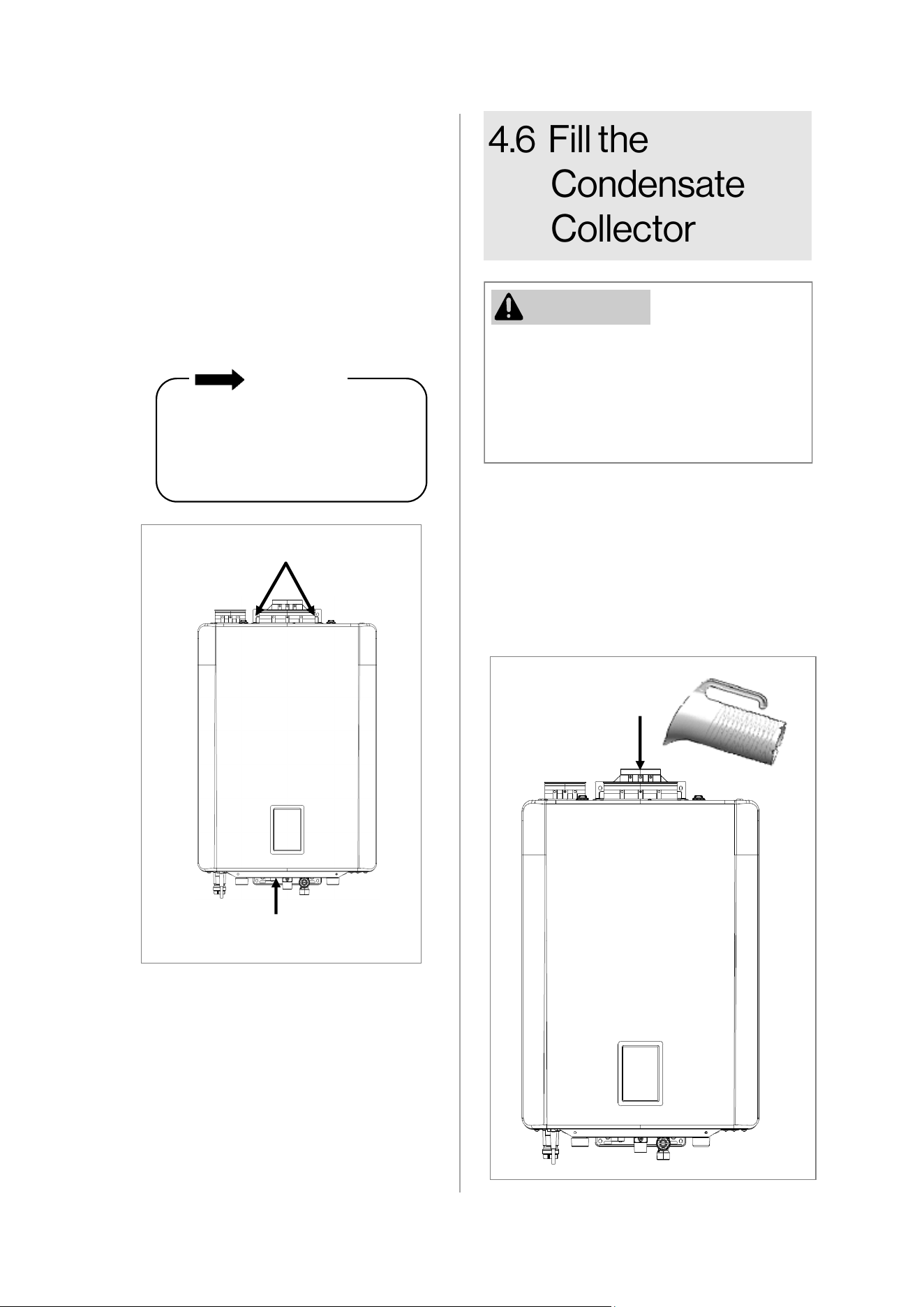
The condensate collector must be lled with
water prior to installing the vent system.
Pour approximately 10 ounces (1.25 cups) of
water directly into the boiler’s exhaust port
(do not remove the 2 in. PVC adapter prior to
this).
Exhaust
Port
Top Bracket
Boom Bracket
Figure 13
Figure 14
WARNING
22
Rinnai I-Series Plus Condensing Combi Boiler Manual
• I-Series Plus boilers can be installed in
direct vent or non-direct vent
applicaons.
• When installed as Direct Vent, refer to
the following secon for a complete list
of approved vent manufacturers and
products: “5.5.1 Direct Vent: Approved
Vent Manufacturers and Products.”
• When installed as Non-Direct Vent
(Room Air), the vent must be Category
IV and of a type listed by a naonal
recognized tesng agency.
• Exhaust must be directly vented to the
outside. Combuson air can be
provided from outside (Direct Vent) or
from room air (Non-Direct Vent).
• If using room air (Non-Direct Vent) for
combuson, ensure the required
volume of indoor air is available in
accordance with one of the following:
A. The Naonal Fuel Gas Code, ANSI
Z223.1/NFPA 54;
B. CSA B149.1, Natural Gas and Propane
Installaon Code; or
C. Applicable provisions of the local
building code.
• Avoid dips or sags in horizontal vent
runs by installing supports per the vent
manufacturer’s instrucons.
• Support horizontal vent runs every 4
(1.2 m) and all vercal vent runs every 6
(1.83 m) or as per vent
manufacturer’s instrucons or local
code requirements.
Topics in this secon
• Guidelines
• Venng Installaon Sequence
• Terminaon Consideraons
• PVC Venng Safety Switch
• Venng Opons
• Venng should be as direct as possible with a
minimum number of pipe ngs.
• For manufactured vent systems, vent
connecons must be rmly pressed together so
that the connecons form an air ght seal.
Follow the venng manufacturer’s instrucons.
• Refer to the schedule 40 PVC/CPVC
manufacturer for appropriate ngs, solvents
or joining methods.
• If venng reassembly is needed, follow the steps
for installing the venng in the following
secons. Make certain that the vent piping and
seals are not damaged. Only use sealants,
primers, or glues that are approved for the vent
material in use.
• Refer to the instrucons of the vent system
manufacturer for component assembly
instrucons.
• If the vent system is to be enclosed, it is
suggested that the design of the enclosure shall
permit inspecon of the vent system. The design
of such enclosure shall be deemed acceptable
by the installer or the local inspector.
• Any issues resulng from improper vent
installaon will not be covered by warranty.
• DO NOT use cellular core PVC/CPVC.
• DO NOT use Radel, ABS, or galvanized
material to vent this appliance.
• DO NOT cover non-metallic vent pipe and
ngs with thermal insulaon.
• DO NOT combine vent components from
dierent manufacturers.
• DO NOT reduce the vent diameter. Vent
diameter cannot be less than 2 in.
• DO NOT connect the venng system with an
exisng vent or chimney.
• DO NOT common vent with the vent pipe of
any other manufacturer’s boiler or appliance.
WARNING
IMPORTANT
If reusing exisng venng, the venng should be
inspected for damage and to ensure it is
appropriate (approved) for this boiler. To ensure
safe and proper operaon, damaged vent
components MUST be replaced before operang
the boiler.
23
Rinnai I-Series Plus Condensing Combi Boiler Manual
1. Determine the terminaon method—horizontal
or vercal, concentric, or twin pipes, etc.
2. Determine proper locaon for wall or roof
penetraon for each terminaon.
3. Install terminaon assembly as described in this
manual or in the vent manufacturer’s
installaon instrucons.
4. Install air and vent piping from boiler to
terminaon.
5. Slope horizontal exhaust run towards the boiler
1/4 in per foot. DO NOT slope combuson air
pipe towards boiler.
6. Install vent supports and brackets allowing for
movement from expansion, or as per vent
manufacturer’s instrucons or local code
requirements.
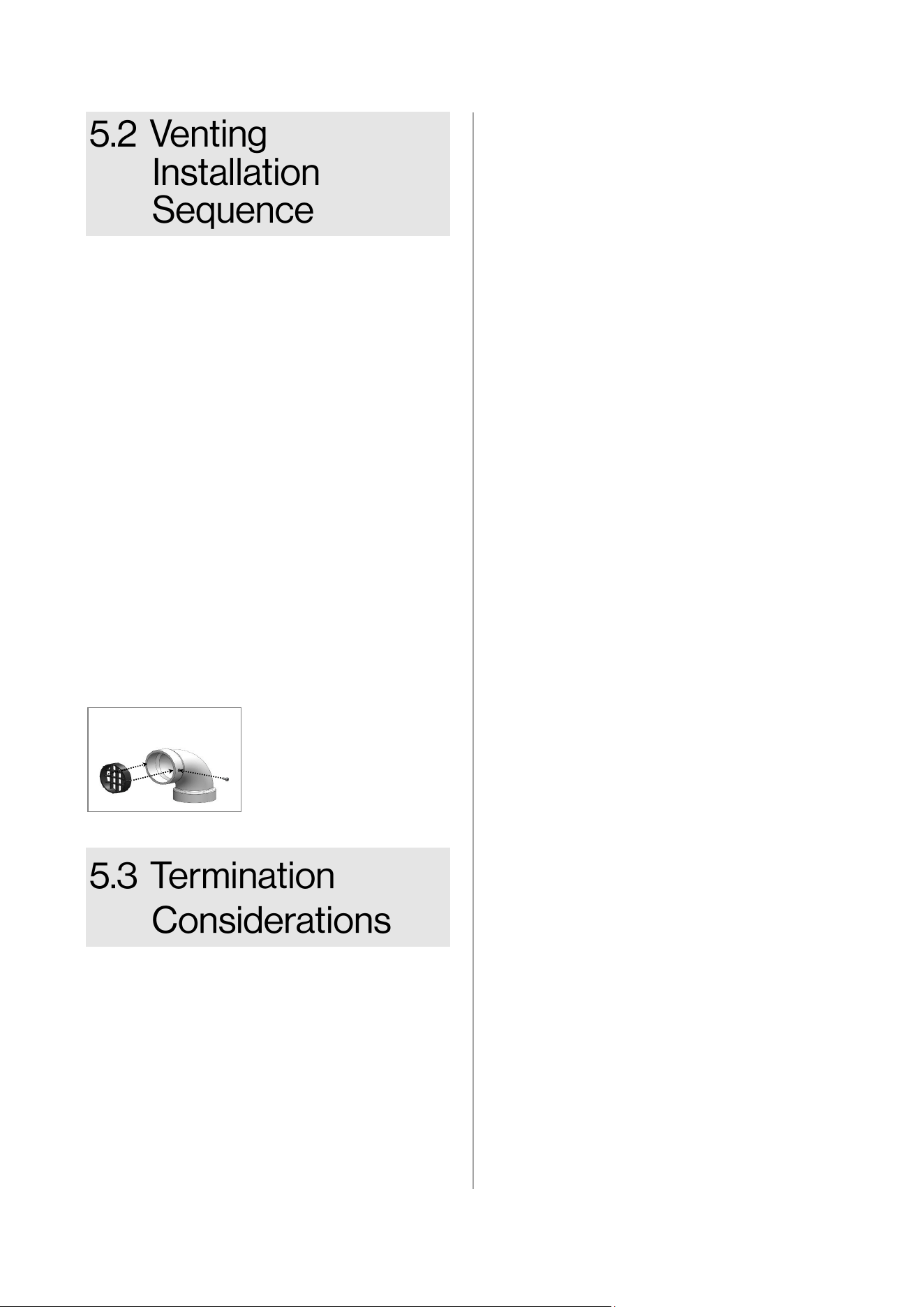
7. (Oponal step) Install vent screen or room air
lter (not included with purchase) on schedule
40 PVC combuson air and exhaust terminaon
elbows as illustrated below.
Check to determine whether local codes
supersede the following clearances:
• Avoid terminaon locaons near a dryer
vent.
• Avoid terminaon locaons near
commercial cooking exhaust.
• Avoid terminaon locaons near any air
inlets.
• You must install a vent terminaon at least
12 in above the ground or ancipated snow
level.
Vent Screen
• Press vent screen inside
of terminaon piece/
elbow.
• Secure vent screen to
the elbow with screw.
The vent for this appliance shall not
terminate:
• Over public walkways.
• Near sot vents or crawl space vents
or other area where condensate or
vapor could create a nuisance or
hazard or cause property damage.
• Where condensate or vapor could
cause damage or could be detrimental
to the operaon of regulators
pressure relief valves, or other
equipment.
Listed below are important consideraons
for locang vent terminaon under a sot
(venlated or unvenlated or eave vent; or
to a deck or porch):
• Do not install vent terminaon under
a sot vent such that exhaust can
enter the sot vent.
• Install vent terminaon such that
exhaust and rising moisture will not
collect under eaves. Discoloraon to
the exterior of the building could
occur if installed too close.
• Do not install the vent terminaon too
close under the sot where it could
present recirculaon of exhaust gases
back into the combuson air intake of
the terminaon.
Horizontal porons of the venng system
shall be supported to prevent sagging:
• For category IV boilers, have
horizontal runs sloping upwards not
less than 1/4 in. per foot (21 mm/m)
from the boiler to the vent terminal;
• For category IV boilers, be installed so
as to prevent accumulaon of
condensate; and
• For category IV boilers, where
necessary, have means provided for
drainage of condensate.
Figure 15
24
Rinnai I-Series Plus Condensing Combi Boiler Manual
4. Scroll to Parameter A2. Adjust Parameter A2 to “b” to conrm higher temperature vent
materials are in use.
5. The boiler is now set to allow higher exhaust temperatures. To exit parameter sengs and
enter normal operaon mode, press the SW1 le buon on the PC Board.
6. Replace the boiler’s front panel by reinserng the two screws that secure the panel.
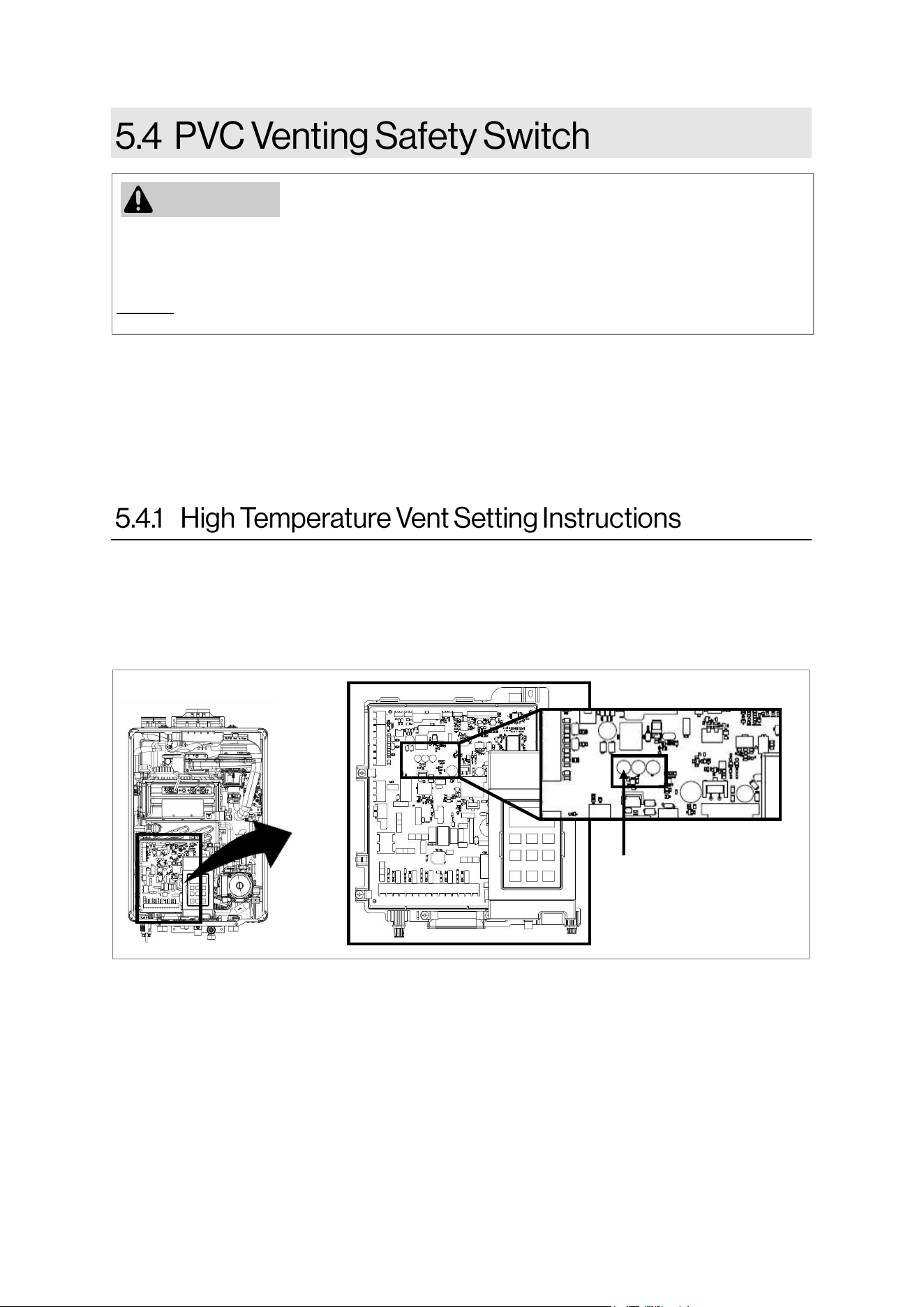
See secon “9.4 Inial Sengs” for inial installaon. To set up later, follow the below steps.
1. Remove the boiler’s front panel by removing the two screws that secure the panel.
2. Locate the PC Board (lower le side of unit).
3. Press the SW1 le buon on the PC Board.
PC Board
The instrucons in this secon explain how to adjust boiler sengs to
allow for higher exhaust temperatures. These instrucons apply only for
installaons using CPVC, listed Polypropylene, or stainless steel venng. If these instrucons are
not followed exactly, a re or carbon monoxide leak may result causing property damage,
personal injury, or death.
DO NOT adjust boiler sengs to allow higher exhaust temperatures when venng with PVC.
This product is equipped with safety devices to control the exhaust temperature which allows for a
variety of venng materials to be used in its nal installaon. The boiler is set up from the factory to
be installed with a PVC venng system and a built-in control to limit the exhaust temperature to be
below 149°F (65°C). In high temperature applicaons where the exhaust temperature can exceed
149°F (65°C), CPVC, listed Polypropylene (PP), or stainless steel venng must be used. The choice of
venng materials may have an impact on overall performance. Also, If the vent material is other than
PVC (CPVC, listed PP or stainless steel) follow the procedure below to adjust the internal sengs.
Figure 16
WARNING
25
Rinnai I-Series Plus Condensing Combi Boiler Manual
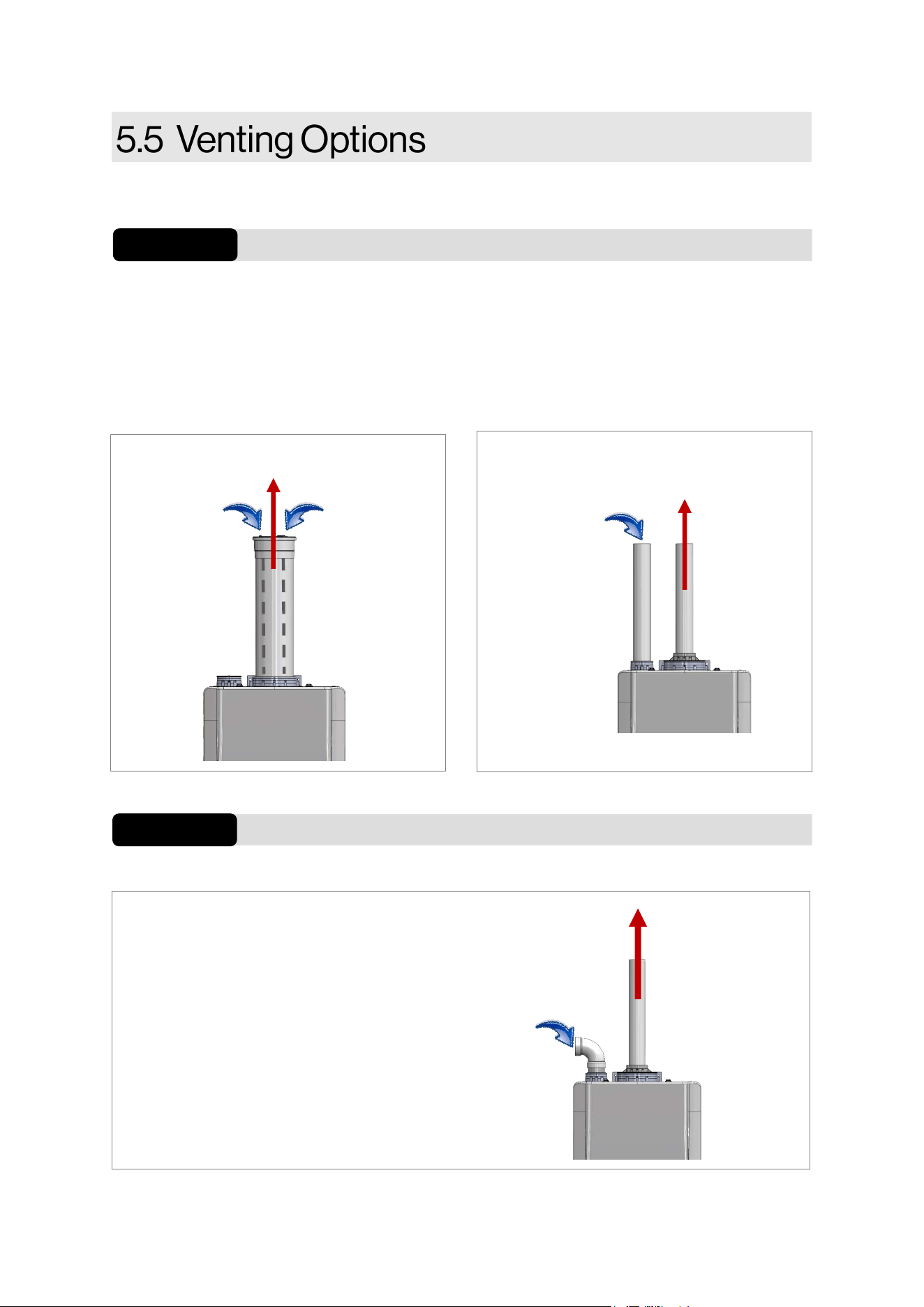
Two venng opons are available: Direct Vent and Non-Direct Vent (Room Air).
Concentric Pipe
Combuson air and exhaust vent directly
through a single concentric connecon. Hot
exhaust exits through the interior pipe, while
combuson air enters through the outer pipe.
Twin Pipe
Combuson air and exhaust vent
directly through separate penetraons.
See the Direct Vent secon for complete details.
Direct Vent (Concentric and Twin Pipe)
Opon 1
Opon 2
Exhaust
Combuson
Air
Combuson
Air
Exhaust
Combuson
Air
Non-Direct Vent (Room Air)
See the Non-Direct Vent secon for complete details.
Room air is used for combuson
while exhaust vents to the outside.
Exhaust
Combuson
Air
Figure 19
Figure 17
Figure 18
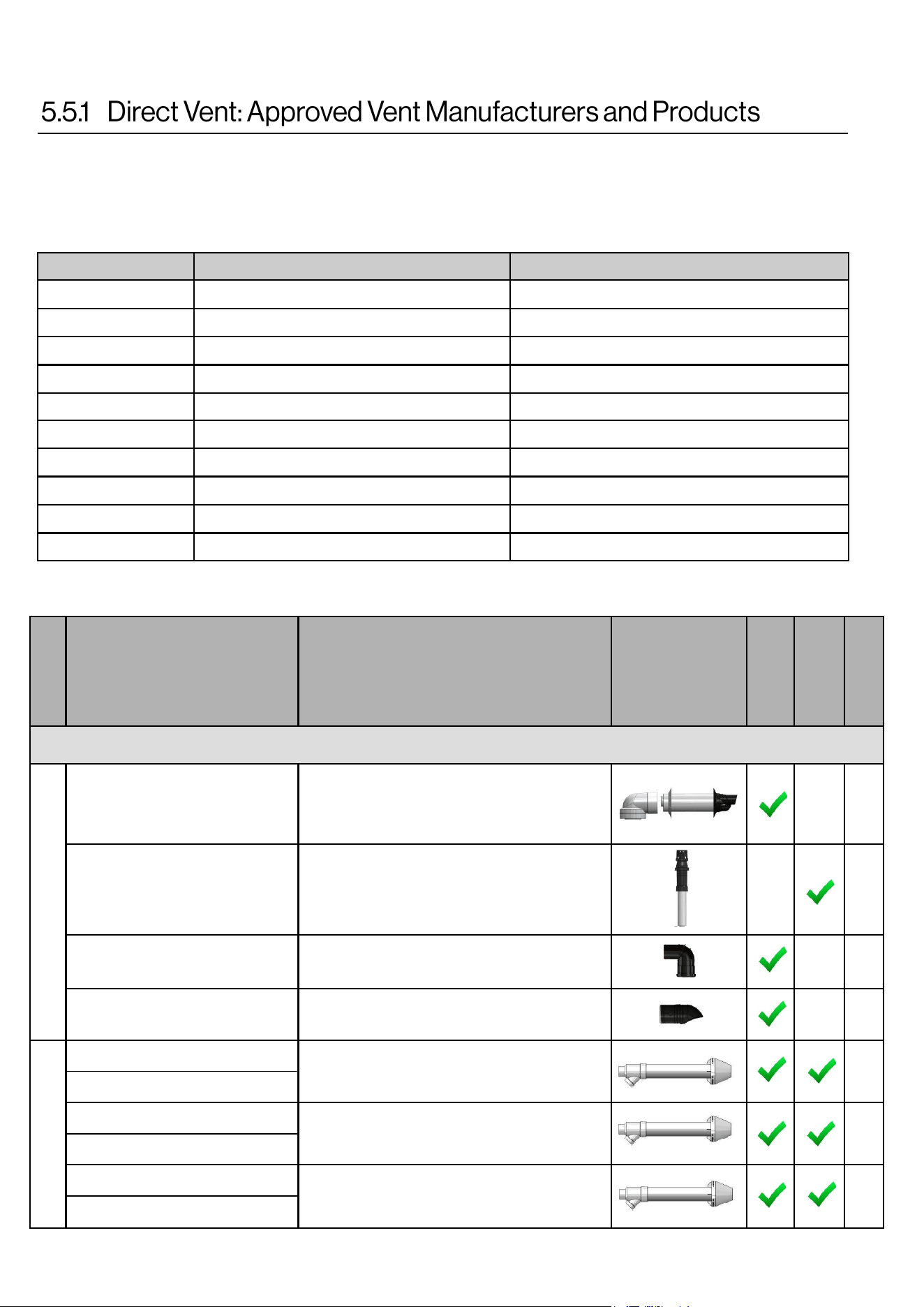
26
Rinnai I-Series Plus Condensing Combi Boiler Manual
Following is a list of vent components and terminaons for Direct Vent installaons (concentric and twin pipe).
Install the correct venng for your model according to the venng manufacturer’s instrucons and the guidelines
below. The informaon below is correct at me of publicaon and is subject to change without noce. Contact the
vent manufacturer for quesons related to the vent system, products, part numbers and instrucons.
Manufacturer Phone Web Site
Ubbink 800-621-9419 www.rinnai.us
Centrotherm 877-434-3432 www.centrotherm.us.com
Heat-Fab 800-772-0739 www.heaab.com
Metal Fab 800-835-2830 www.metal-fabinc.com
IPEX U.S.: 800-463-9572 Canada: 866-473-9462 www.ipexamerica.com, www.ipexinc.com
DuraVent 800-835-4429 www.duravent.com
Royal 800-232-5690 www.royalbuildingproducts.com
ECCO Manufacturing 877-955-4805 www.eccomfg.com
DiversiTech 800-995-2222 www.diversitech.com
Z-FLEX 603-669-5136 www.z-ex.com
2 in./4 in. CONCENTRIC VENT TERMINATIONS
229011NPP
229012NPP, 229031
229013NPP, 229032
2/4 Condensing Horizontal Term Kit 8.7 in.
2/4 Condensing Horizontal Term Kit 12 in.
2/4 Condensing Horizontal Term Kit 21 in.
5
224356NPP, 224359
2/4 Condensing Roof Discharge
Terminaon 20 in. above roof
5
710202NPP
2/4 Condensing 90 Degree Diverter Nose
(Use with Wall Terminal)
5
710215NPP
2/4 Condensing 45 Degree Diverter Nose
(Use with Wall Terminal)
5
196005, 197040
FGV Concentric Vent Kit (16 in. length)
20
196005PVC (Order from Rinnai)
196105, 197033
FGV Concentric Vent Kit (28 in. length)
20
196105PVC (Order from Rinnai)
196125
FGV Concentric Vent Kit (40 in. length)
20
196125PVC (Order from Rinnai)
UBBINK
IPEX
Diagram
Horizontal
Vercal
Equivalent
Length ()
2 in./4 in. CONCENTRIC VENT TERMINATIONS
Product
Descripon
Manufacturer
Part Number
Manufacturer
Table 8
Table 7
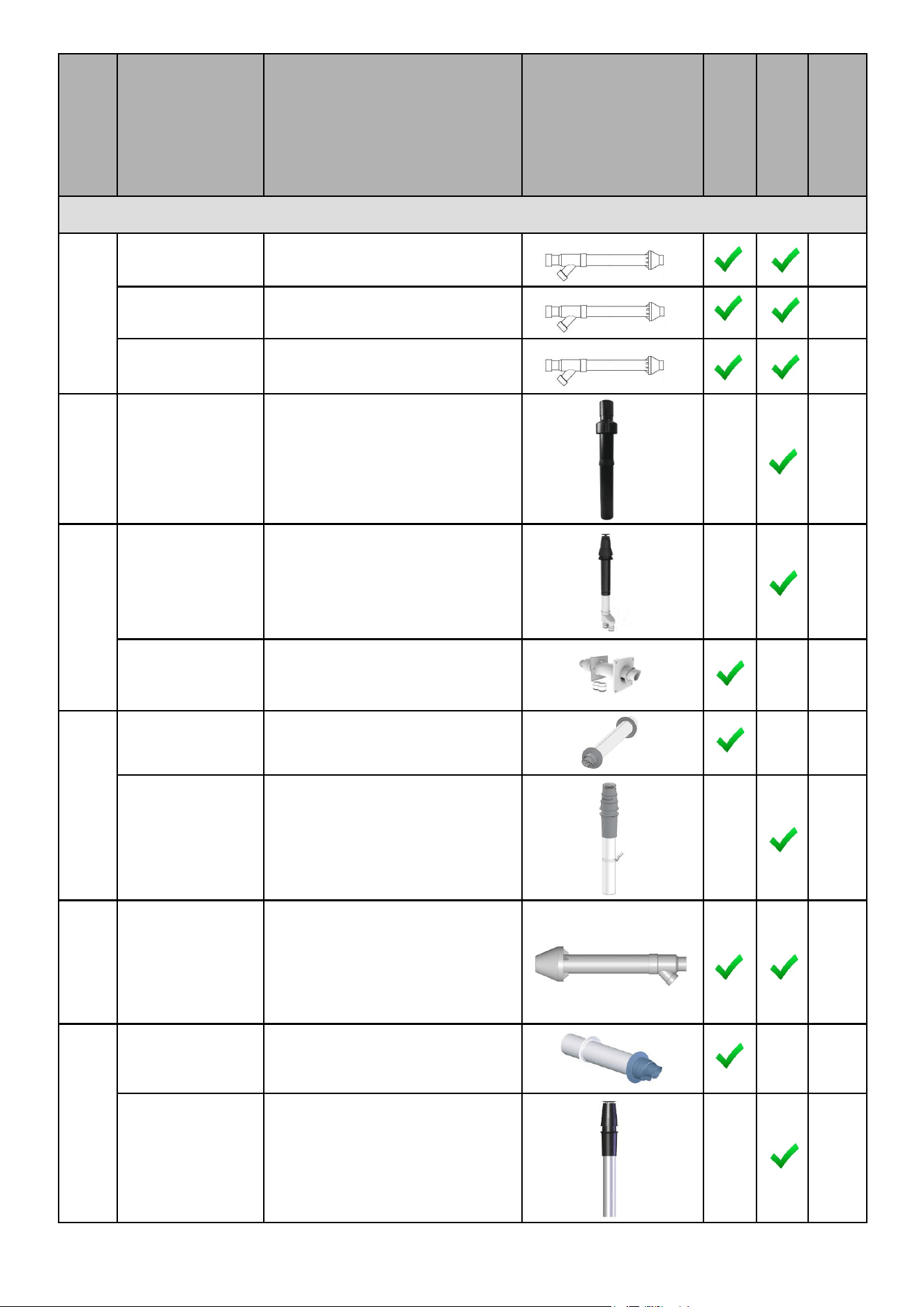
27
Rinnai I-Series Plus Condensing Combi Boiler Manual
2 in./4 in. CONCENTRIC VENT TERMINATIONS (Connued)
52CVKGVS6502
PVC Concentric Vent Kit
2 in. x 16 in.
20
52CVKGVS6502-28
PVC Concentric Vent Kit
2 in. x 28 in.
20
52CVKGVS6502-40
PVC Concentric Vent Kit
2 in. x 40 in.
20
ICRT2439
2 in. x 4 in. Concentric Roof
Terminaon
20
2PPS-VKL/VK-TCL
2 in. x 4 in. Vercal Terminaon
Cap Kit-Concentric
20
2PPS-HKL
2 in. x 4 in. Horizontal Terminaon
Kit-Concentric
20
190288
2 in. x 4 in. Concentric Horizontal
Terminaon
5
190295
2 in. x 4 in. Concentric Vercal
Terminaon
5
CVENT-2
2 in. x 4 in. Concentric Horizontal
Terminaon
20
2ZDCTH24
2 in. x 4 in. Concentric Horizontal
Terminaon
5
2ZDCTV24
2 in. x 4 in. Concentric Roof
Terminaon
5
ROYAL
CENTROTHERM
DURAVENT
Manufacturer
Manufacturer
Part Number
Product
Descripon
Diagram
Horizontal
Vercal
Equivalent Length
()
ECCO
DIVERSITECH
Z-FLEX
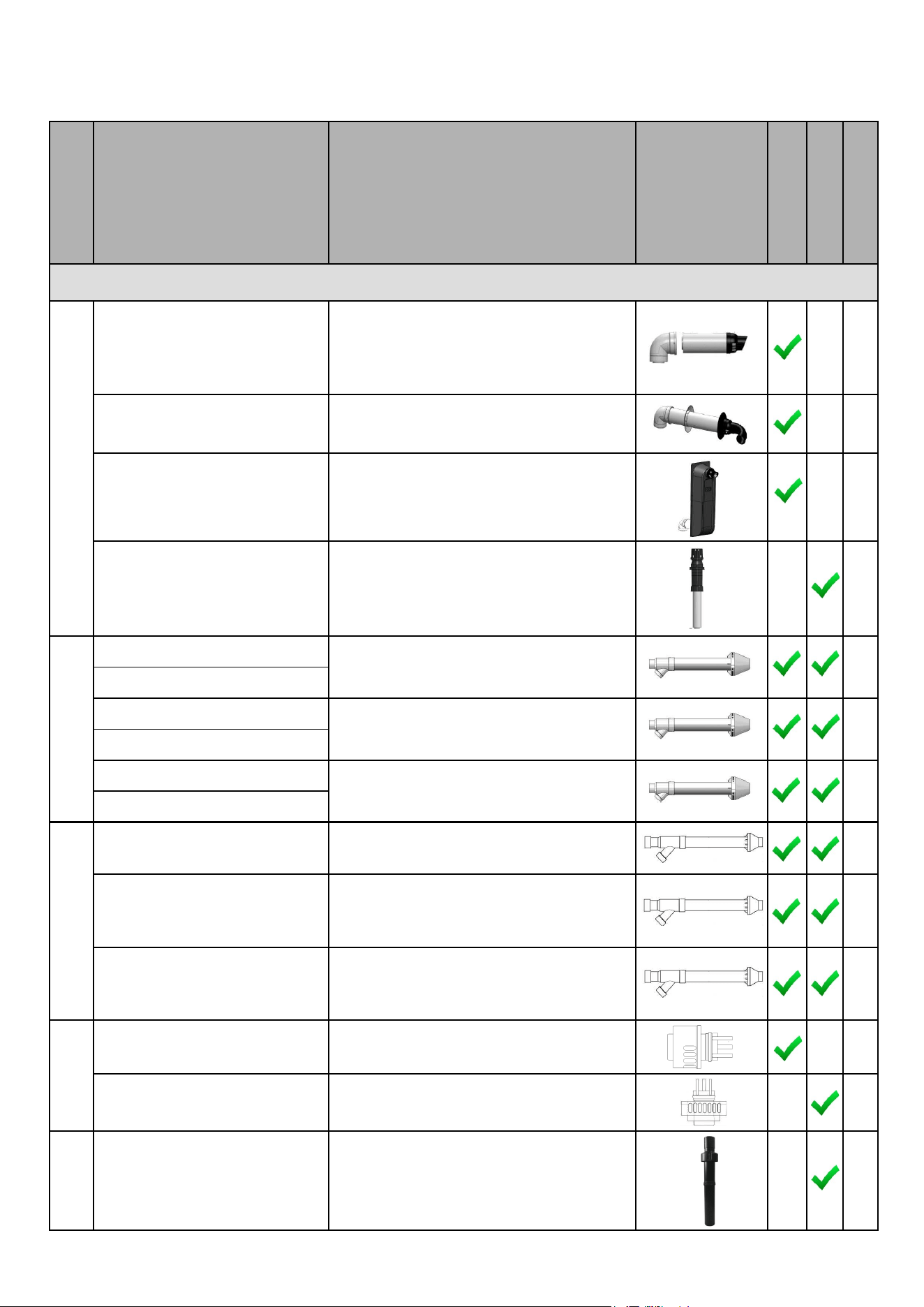
28
Rinnai I-Series Plus Condensing Combi Boiler Manual
3 in./5 in. CONCENTRIC VENT TERMINATIONS
223174PP
223176PP
223177PP
3/5 Condensing Horizontal Term Kit 8.7 in.
3/5 Condensing Horizontal Term Kit 12 in.
3/5 Condensing Horizontal Term Kit 21 in.
5
223186PP
3/5 Condensing Horizontal Diverter
Terminaon Kit 19 in.
16
224047PP
3/5 Condensing Raised Horizontal
Terminaon Kit
24
184162PP
3/5 Condensing Roof Discharge
Terminaon 20 in. above roof
5
196006, 197009
FGV Concentric Vent Kit 3 in. x 20 in.
20
196006PVC (Order from Rinnai)
196106, 197107
FGV Concentric Vent Kit 3 in. x 32 in.
20
196106PVC (Order from Rinnai)
196116, 197117
FGV Concentric Vent Kit 3 in. x 44 in.
20
196116PVC (Order from Rinnai)
52CVKGVS6503 (PVC)/
52CVKGVSF9003 (CPVC)
PVC/CPVC Concentric Vent Kit 3 in. x 20 in.
20
52CVKGVS6503-32 (PVC)/
52CVKGVSF9003-32 (CPVC)
PVC/CPVC Concentric Vent Kit 3 in. x 32 in.
20
52CVKGVS6503-44 (PVC)/
52CVKGVSF9003-44 (CPVC)
PVC/CPVC Concentric Vent Kit 3 in. x 44 in.
20
SC03HT Horizontal Terminaon Adapter
20
SC03VT Vercal Terminaon Adapter
20
ICRT3539
3''/5'' Concentric Roof Terminaon PPs-UV
20
Manufacturer
Manufacturer
Part Number
Product
Descripon
Diagram
Horizontal
Vercal
Equivalent Length
()
UBBINK
ROYAL
IPEX
CENTRO-
THERM
HEAT-FAB
3 in./5 in. CONCENTRIC VENT TERMINATIONS
Table 9
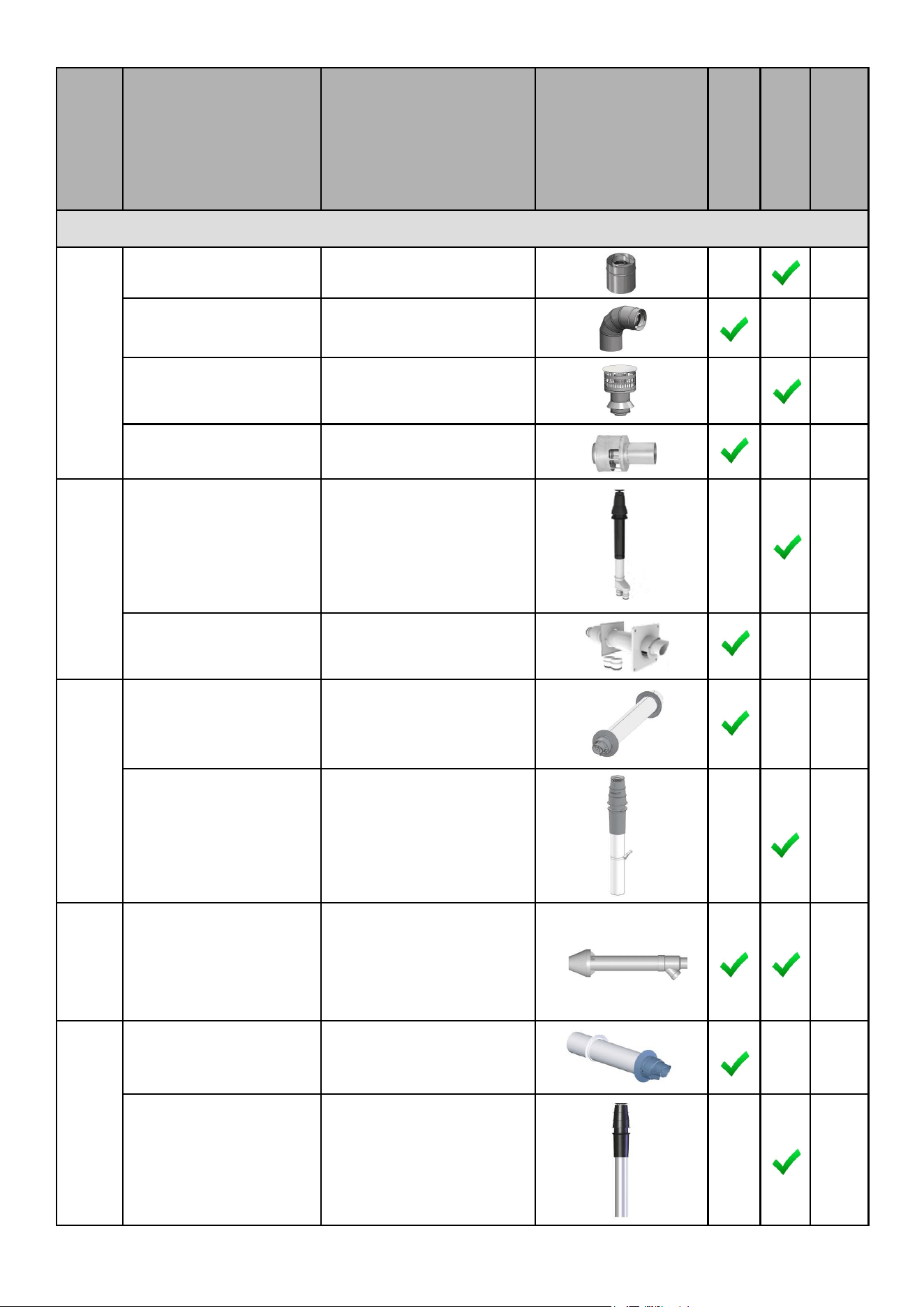
29
Rinnai I-Series Plus Condensing Combi Boiler Manual
3 in./5 in. CONCENTRIC VENT TERMINATIONS (Connued)
3CGRLSV Vercal Adapter
1
3CGRLSH Horizontal Adapter
6
3CGRVT Vercal Terminaon
5
3CGRHT Horizontal Terminaon
16
3PPS-VKL/VK-TCL
3 in. x 5 in. Vercal
Terminaon Cap
Kit-Concentric
20
3PPS-HKL
3 in. x 5 in. Horizontal
Terminaon Kit-Concentric
20
190388
3 in. x 5 in. Concentric
Horizontal Terminaon
5
190395
3 in. x 5 in. Concentric
Vercal Terminaon
5
CVENT-3
3 in. x 5 in. Concentric
Horizontal Terminaon
20
2ZDCTH35
3 in. x 5 in. Concentric
Horizontal Terminaon
5
2ZDCTV35
3 in. x 5 in. Concentric Roof
Terminaon
5
Manufacturer
Manufacturer
Part Number
Product
Descripon
Diagram
Horizontal
Vercal
Equivalent Length
()
METAL-FAB
DURAVENT
ECCO
DIVERSITECH
Z-FLEX
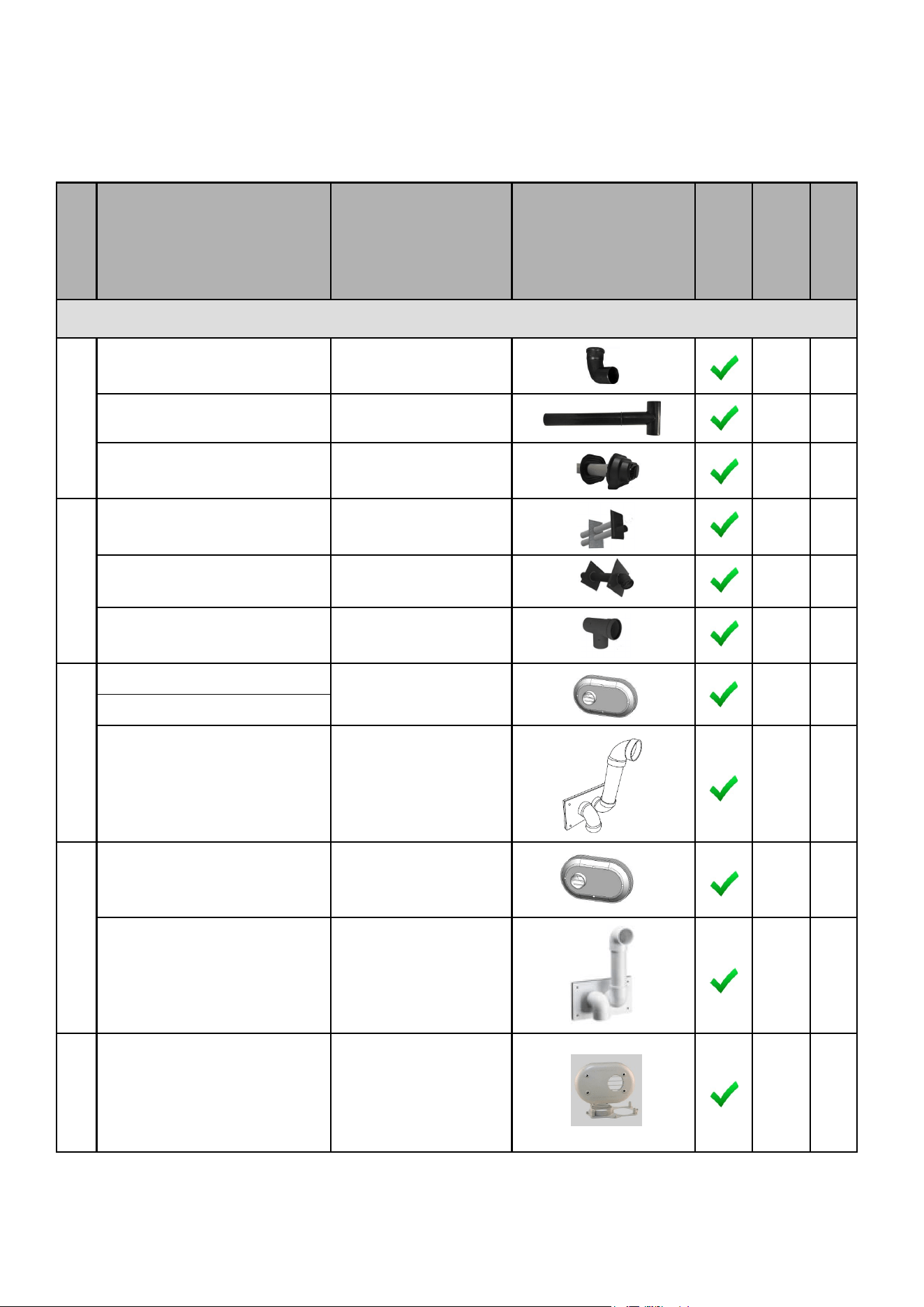
30
Rinnai I-Series Plus Condensing Combi Boiler Manual
2 in. TWIN PIPE TERMINATIONS
2 in. TWIN PIPE TERMINATIONS
ISELL0287UV 2 in. 87° Long PPS-UV
6
ISTT0220 2 in. Terminaon Tee
6
ISLPT0202
2 in. Low Prole Wall
Terminaon
5
2PPS-HTPL
2 in. Twin Pipe
Terminaon
10
2PPS-HSTL
2 in. Single Horizontal
Terminaon
6
2PPS-TBL
2 in. Black UV Resistant
Tee
5
196984
FGV PVC Low Prole
Terminaon Kit
5
196984PVC (Order from Rinnai)
081216
FGV PVC Wall
Terminaon Kit
16
52SWVKGVS6502 PVC Side Wall Vent Kits
5
52WTVKGVS6502 PVC Wall Vent Kits
16
HVENT-2
2 in. Low Prole
Horizontal Vent Kit
5
CENTROTHERM
DURAVENT
Manufacturer
Manufacturer
Part Number
Product
Descripon
Diagram
Horizontal
Vercal
Equivalent
Length ()
IPEX
ROYAL DIVERSITECH
Table 10
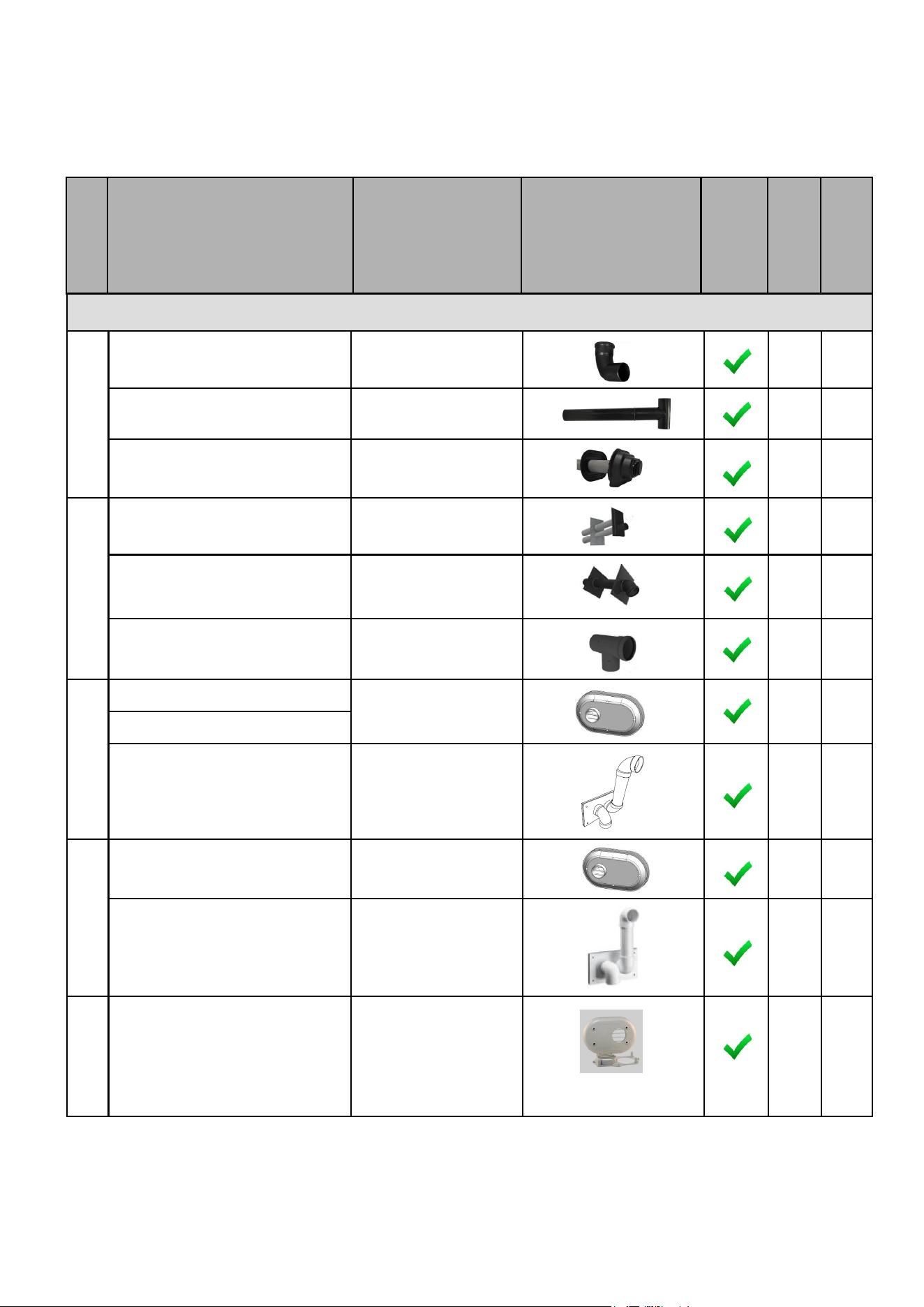
31
Rinnai I-Series Plus Condensing Combi Boiler Manual
3 in. TWIN PIPE TERMINATIONS
Manufacturer
Manufacturer
Part Number
Product
Descripon
Diagram
Horizontal
Vercal
Equivalent
Length ()
3 in. TWIN PIPE TERMINATIONS
ISELL0387UV 3 in. 87° Long PPS-UV
6
ISTT0320 3 in. Terminaon Tee
6
ISLPT0303
3 in. Low Prole Wall
Terminaon
5
3PPS-HTPL
3 in. Twin Pipe
Terminaon
10
3PPS-HSTL
3 in. Single Horizontal
Terminaon
5
3PPS-TBL
3 in. Black UV
Resistant Tee
6
196985
FGV PVC Low Prole
Terminaon Kit
5
196985PVC (Order from Rinnai)
081219
FGV PVC Wall
Terminaon Kit
16
52SWVKGVS6503
PVC Side Wall Vent
Kits
5
52WTVKGVS6503 PVC Wall Vent Kits
16
HVENT-3
3 in. Low Prole
Horizontal Vent Kit
5
CENTROTHERM DURAVENT
IPEX
ROYAL
DIVERSITECH
Table 11
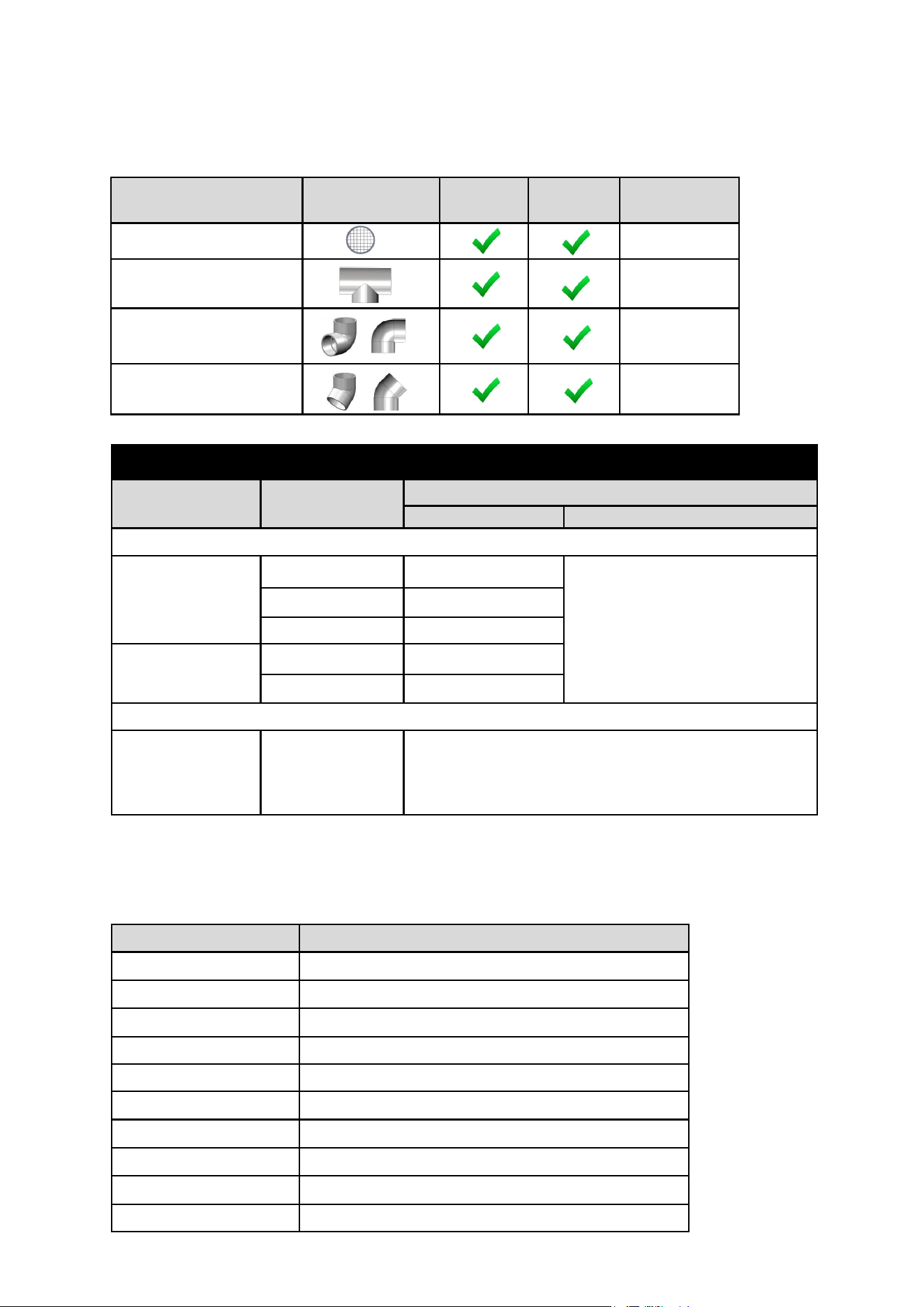
32
Rinnai I-Series Plus Condensing Combi Boiler Manual
VARIOUS 2 in. OR 3 in. SCHEDULE 40 PVC/CPVC TERMINATIONS
Approved PVC/CPVC Vent and Air Piping Material
Item Material
Standard for Installaon in North America
United States Canada
Thermoplasc Piping Materials
Vent or
Combuson Air
Intake Pipe and
Fings
PVC Schedule 40 ANSI/ASTM D1785
Thermoplasc vent pipe must be
cered to ULC S636. Intake pipe
may be of the materials listed in
this table.
PVC-DWV ANSI/ASTM D2665
CPVC Schedule 40 ANSI/ASTM F441
PVC Pipe Cement
and Primer
PVC ANSI/ASTM D2564
CPVC Schedule 40 ANSI/ASTM F493
PVC Vent Screens
Terminaon Vent
Screens
Polyethylene
• 2 in. Vent Screens (included in carton box) (IPEX Part
Number: 196050)
• 3 in. Vent Screens (IPEX Part Number: 196051)
Exhaust piping must be of solid core material. Refer to the PVC/CPVC manufacturer for
appropriate ngs, solvents or joining methods.
Manufacturer Vent Material
Ubbink PVC (Outer Vent), Polypropylene (Inner Vent)
Centrotherm Polypropylene
Heat-Fab Metal
Metal Fab Metal
IPEX PVC/CPVC
DuraVent Polypropylene
Royal PVC
ECCO Manufacturing Polypropylene
DiversiTech PVC/CPVC
Z-FLEX Polypropylene
APPROVED VENTING MATERIALS BY MANUFACTURER
Product Descripon Image Horizontal Vercal
Equivalent
Length ()
Air Filter Screen
N/A
Tee
5
90° Elbow
5
2.5 45° Elbow
Table 14
Table 13
Table 12
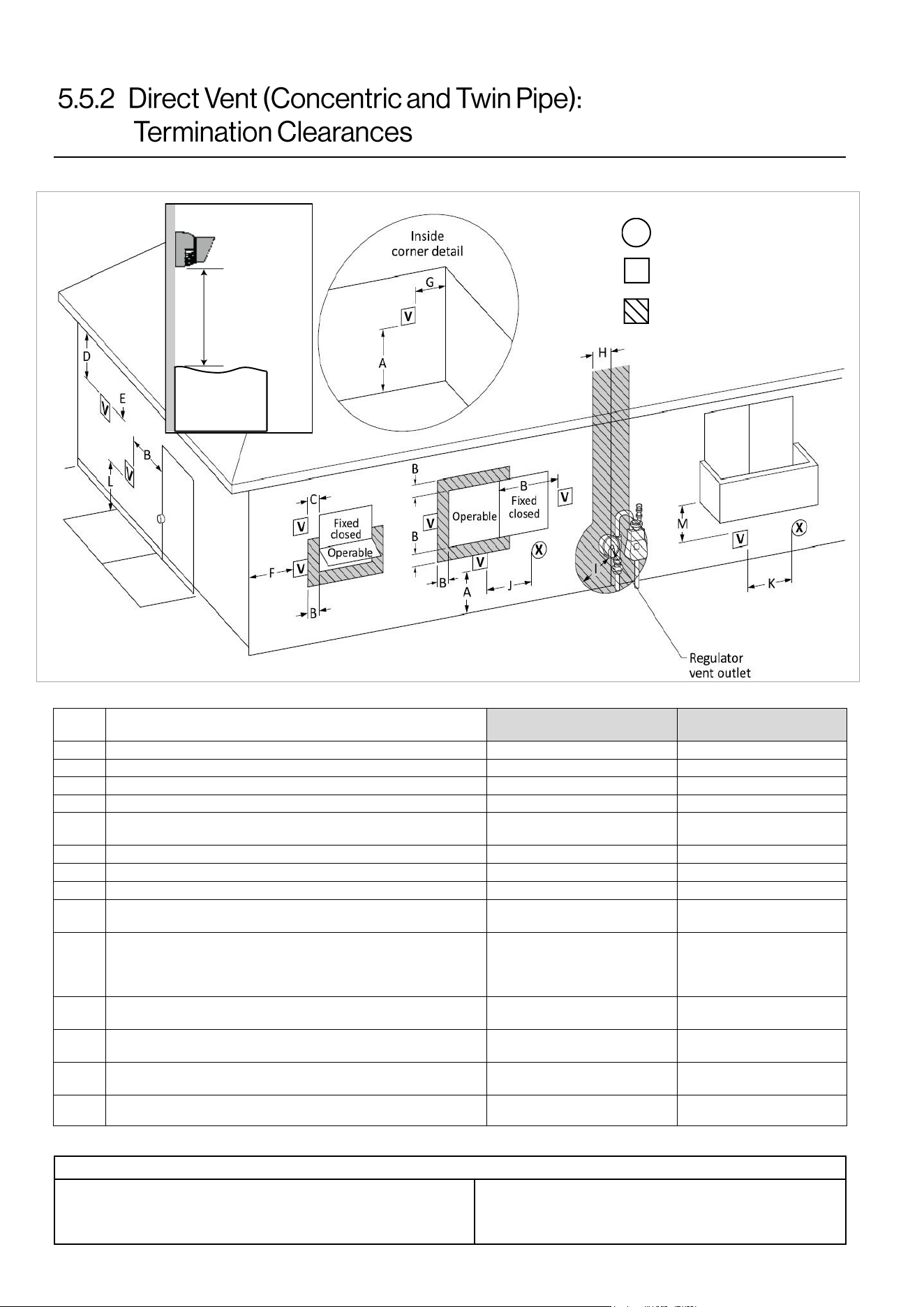
33
Rinnai I-Series Plus Condensing Combi Boiler Manual
Canadian Installaons
(CSA B149.1)
U.S. Installaons
(ANSI Z223.1 /NFPA 54)
Ref Descripon Direct Vent (Indoor Unit) Direct Vent (Indoor Unit)
A Clearance above grade, veranda, porch, deck, or balcony 12 in. (30 cm) 12 in. (30 cm)
B Clearance to window or door that may be opened 36 in. (91 cm) 12 in. (30 cm)
C Clearance to permanently closed window * *
D
Vercal clearance to venlated sot, located above the terminal within a
horizontal distance of 2 (61 cm) from the center line of the terminal
* *
E Clearance to unvenlated sot * *
F Clearance to outside corner * *
G Clearance to inside corner * *
H
Clearance to each side of center line extended above meter/regulator
assembly
* *
I Clearance to service regulator vent outlet
Above a regulator within 3
(91 cm) horizontally of the vercal
center line of the regulator vent
outlet to a maximum vercal
distance of 15 (4 m)
*
J
Clearance to non-mechanical air supply inlet to building or the
combuson air inlet to any other appliance
36 in. (91 cm) 12 in. (30 cm)
K Clearance to a mechanical air supply inlet 6 (1.83 m)
3 (91 cm) above if within
10 (3 m) horizontally
L
Clearance above paved sidewalk or paved driveway located on public
property
7 (2.13 m) [1] *
M Clearance under veranda, porch, deck, or balcony 12 in. (30 cm) [2] *
AIR SUPPLY INLET
VENT TERMINAL
AREA WHERE TERMINAL
IS NOT PERMITTTED
X
V
SNOW
TERMINATION
Clearance in
Ref. A also
applies to
anticipated
snow line
Clearance to opposite wall is 24 in. (60 cm).
[1] A vent shall not terminate directly above a sidewalk or paved driveway that
is located between two single family dwellings and serves both dwellings.
[2] Permied only if veranda, porch, deck, or balcony is fully open on a mini-
mum of two sides beneath the oor.
Clearances are in accordance with local installaon codes and the
requirements of the gas supplier.
The informaon below applies to Concentric and Twin Pipe.
Table 15
Table 16
Figure 20
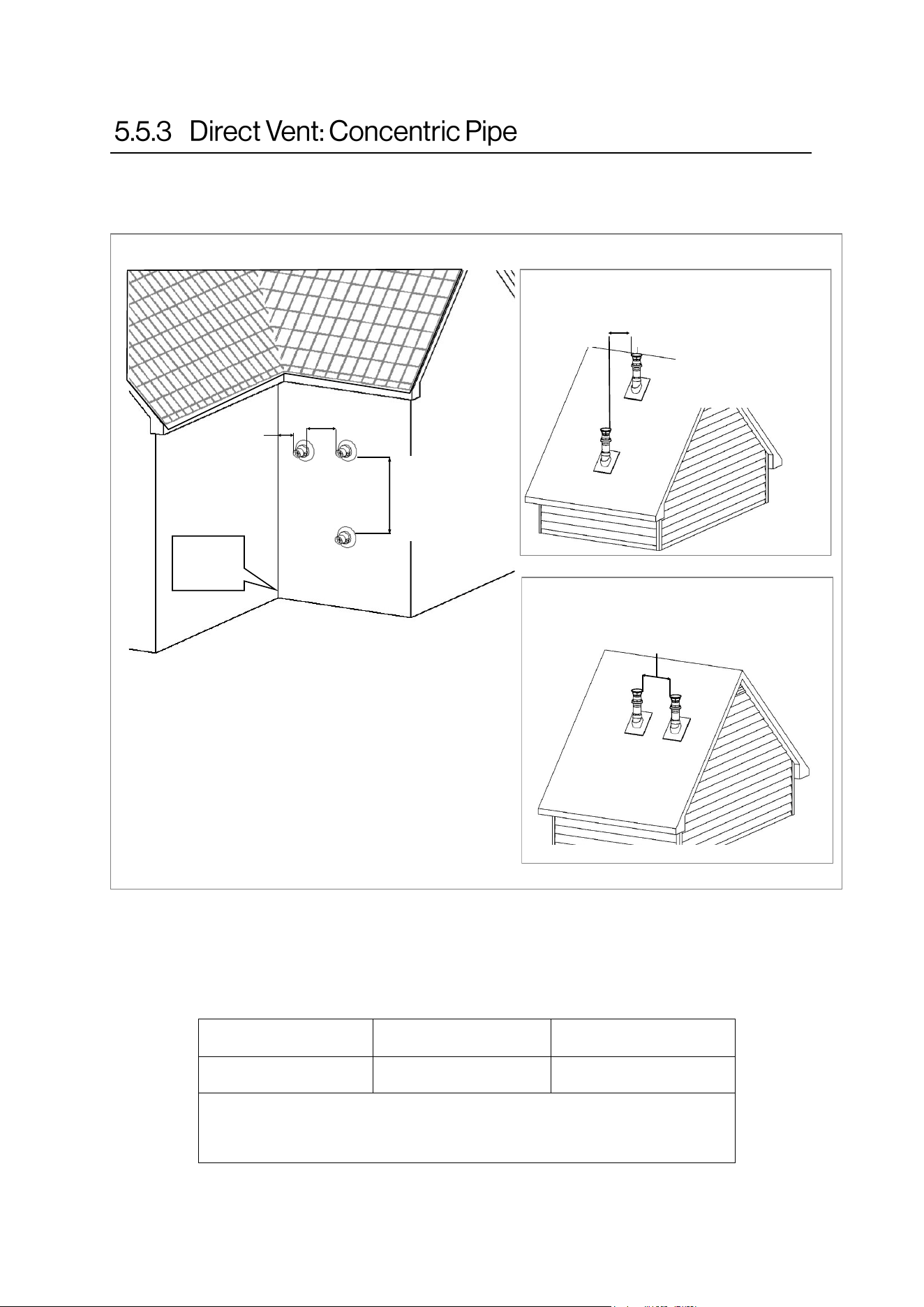
34
Rinnai I-Series Plus Condensing Combi Boiler Manual
Vent Sizes: 2 in. X 4 in. 3 in. X 5 in.
Vent Lengths:
75 (23 m) 160 (49 m)
• 45° elbow is equivalent to 3 (1 m)
• 90° elbow is equivalent to 6 (2 m)
All terminaons (horizontal and/or vercal)
must terminate 12 in. (0.30 m) above grade or
ancipated snow level.
Between terminals at same level
60 in. (1.52 m)
Between terminals at dierent levels
Note: 24 in. (0.61 m)
to wall or parapet
Inside
Corner
12 in.
(0.30 m)
60 in. (1.52 m)
vercally
between
terminals
Concentric Pipe: Terminaon Clearances
Concentric Pipe: Maximum Equivalent Vent Length
Figure 21
12 in.
(0.30 m)
12 in. (0.30 m)
Table 17
35
Rinnai I-Series Plus Condensing Combi Boiler Manual
Horizontal Wall
Terminaons
Vercal Roof
Terminaons
2 in. x 4 in. 2 in. x 4 in. and
3 in. x 5 in.
3 in. x 5 in.
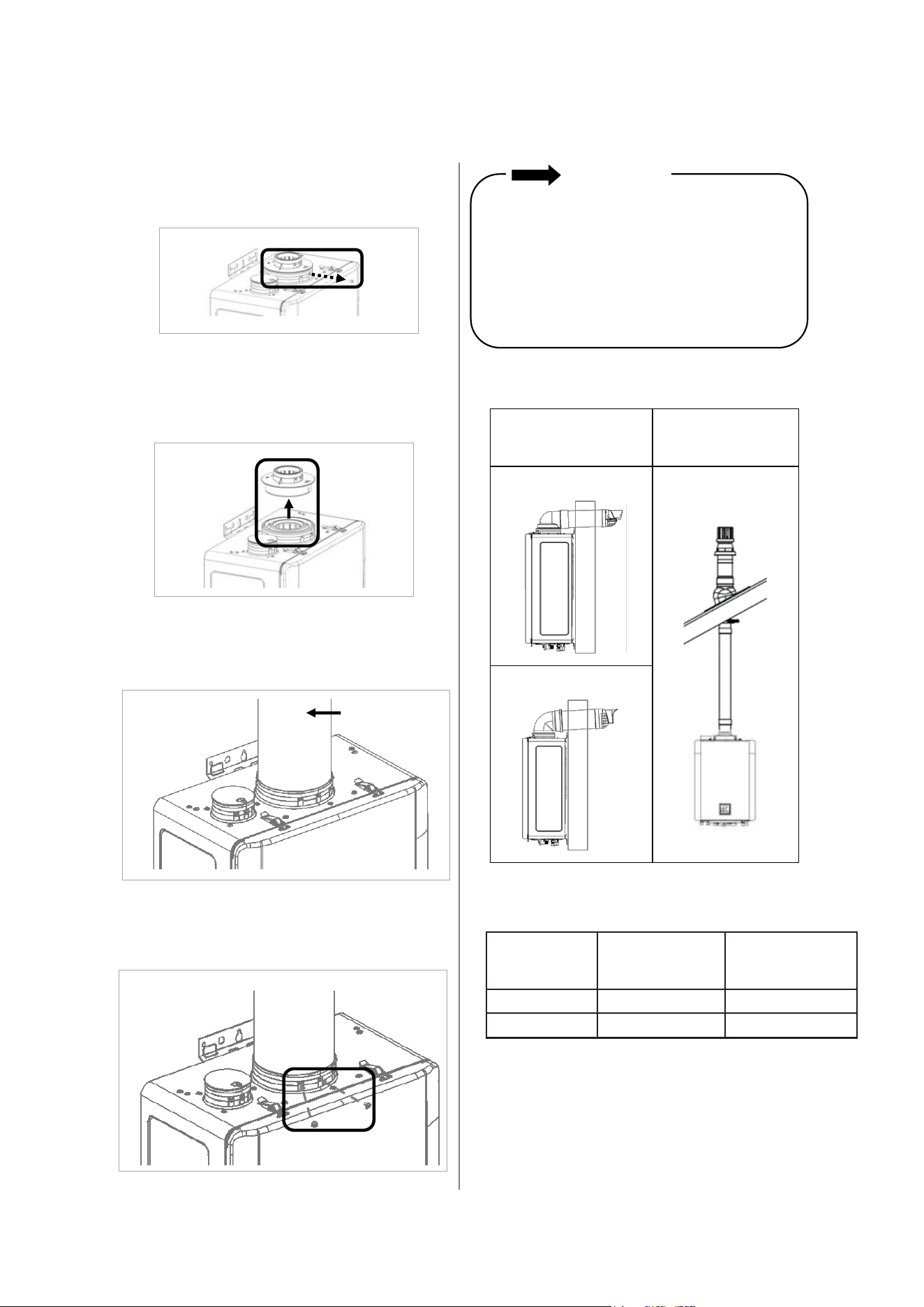
Concentric Pipe: Installaon Instrucons
1. Remove and discard screw from
concentric ue connecon.
2. Remove exhaust adapter ring (discard
for concentric venng conguraons.)
3. Install the concentric vent. Ensure it is
properly seated.
4. Secure the vent pipe to the concentric
ue connecon with the supplied screws.
IMPORTANT
Install the venng terminaon according to
the diagrams and instrucons in this manual.
Slope the venng 1/4 in. per foot (21 mm
per meter) toward the appliance according
to the vent manufacturer’s installaon
instrucons. Dispose of condensate per local
codes.
Vent Sizes
2 in / 4 in
(51 mm/100
mm)
3 in / 5 in
(76 mm/125 mm)
45° Elbow 3 (1 m) 2.5 (0.7 m)
90° Elbow 6 (2 m) 5 (1.5 m)
Concentric
Vent
Figure 25
Table 19
Table 18
Figure 24
Figure 23
Figure 22
36
Rinnai I-Series Plus Condensing Combi Boiler Manual
Twin Pipe Vercal Terminaon
of Mulple Boilers
12 in. (0.30 m)
minimum
12 in. (0.30 m)
minimum
above
combuson
air opening
Roof
12 in. (0.30 m)
above grade or
ancipated snow
level
12 in. (0.30 m)
minimum
Combuson
Air
Exhaust
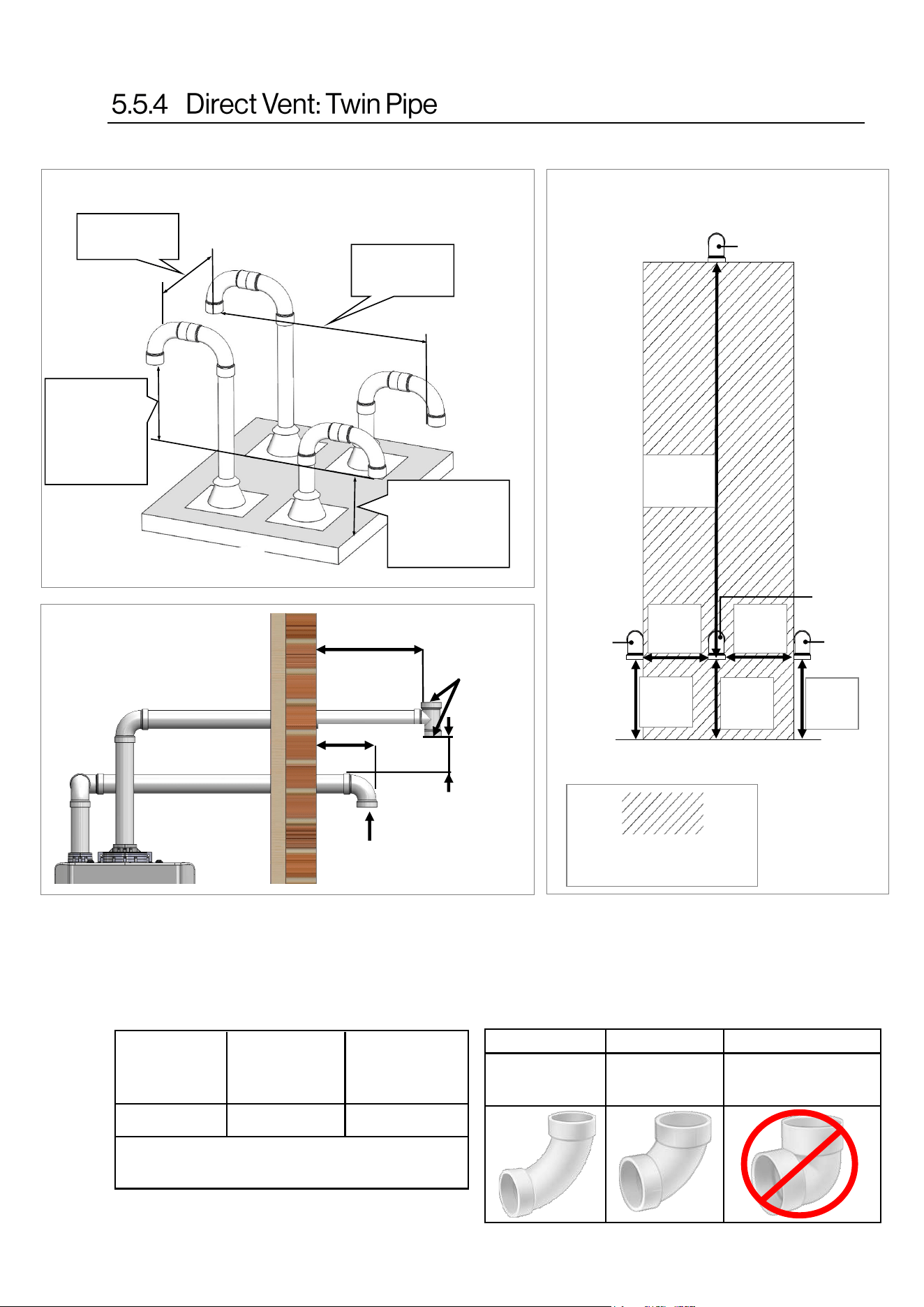
Twin Pipe: Terminaon Clearances
Vent Sizes:
• 2 in. PVC
• 2 in. (60 mm)
PP
• 3 in. PVC
• 3 in. (80 mm)
PP
Vent Lengths: 75 (23 m) 160 (49 m)
• 45° elbow is equivalent to 3 (1 m)
• 90° elbow is equivalent to 6 (2 m)
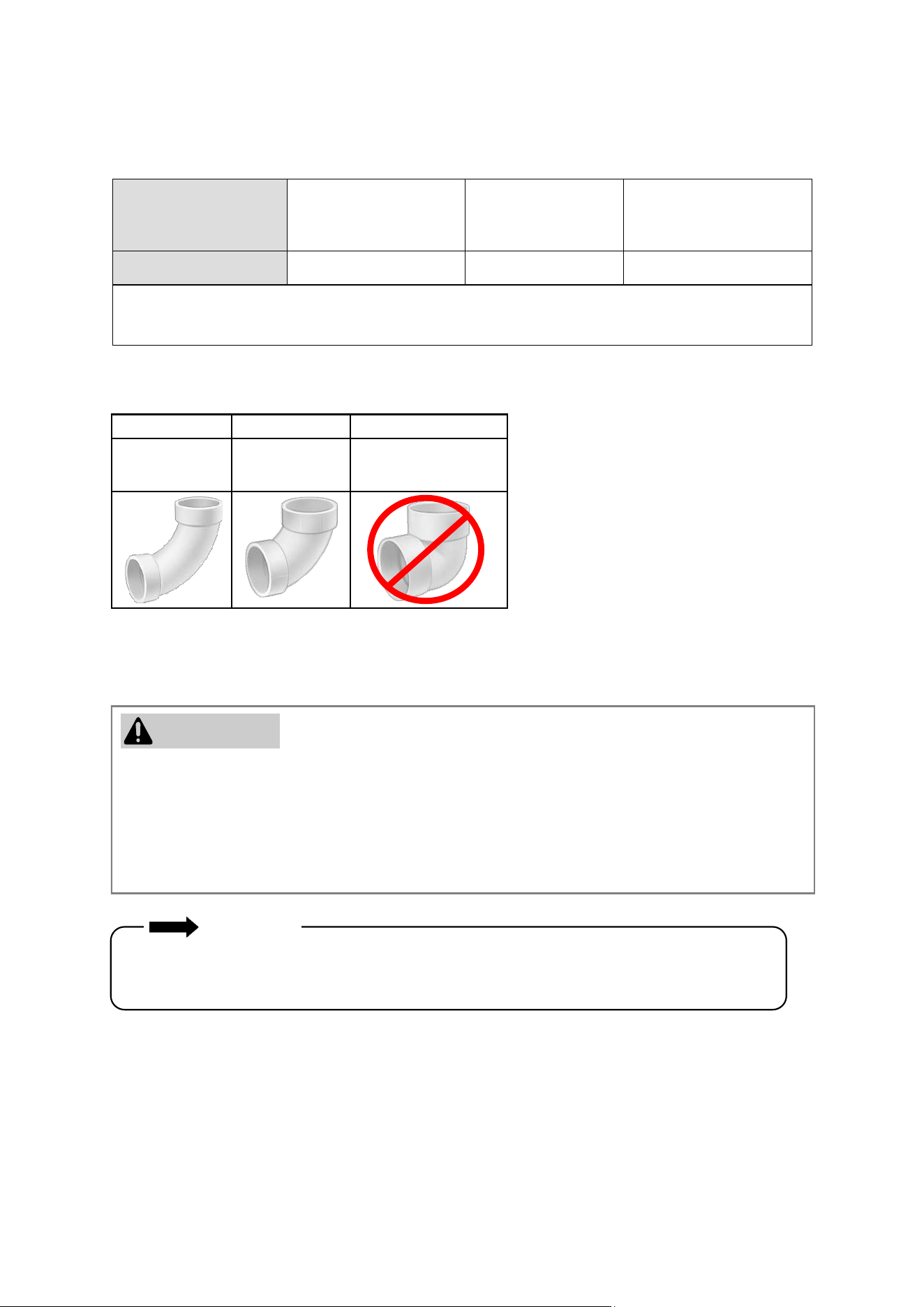
ACCEPTABLE ACCEPTABLE NOT ACCEPTABLE
90° Elbows,
Long Sweep
90° Elbows,
Short Sweep
90° Elbows,
Close Turn
Twin Pipe: Maximum Equivalent Vent Length
Vent length includes the addional venng, ngs and terminaons.
Sidewall Clearances
12 in. (30 cm)
4 in. (10 cm)
Combuson Air
Intake
Exhaust
8 in.
(20 cm)
Horizontal Vent and
Combuson Air Piping
Indicates area in which
intake cannot be located.
Intake
Ground/Grade/Snow Level
60 in.
(152 cm)
Min.
12 in.
(30 cm)
Min.
Intake
Exhaust
Intake
12 in.
(30 cm)
Min.
12 in.
(30 cm)
Min.
12 in.
(30 cm)
Min.
12 in.
(30 cm)
Min.
Figure 26
Figure 28
Table 21
Table 20
Figure 27
37
Rinnai I-Series Plus Condensing Combi Boiler Manual
This boiler is equipped with a 2 in. PVC pipe connecon. With the use of a pipe reducer, installers
can use a 3 in. pipe for the combuson air and exhaust.
DO NOT apply PVC glues, solvents, or cleaners to the boiler’s combuson air or exhaust gasket
connecons. Failure to correctly assemble the components according to these instrucons may
result in property damage, personal injury, or death.
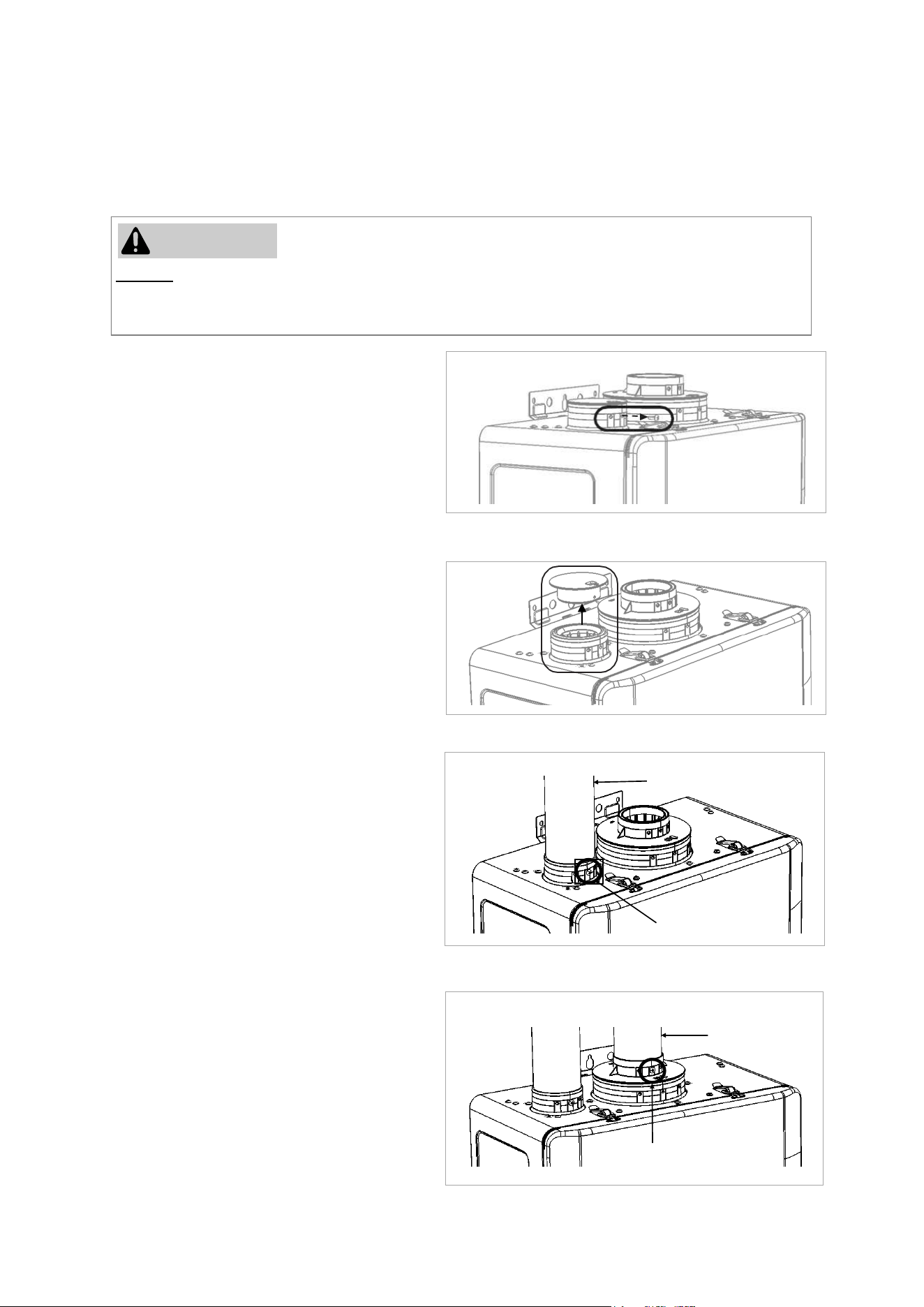
Twin Pipe: Installaon Instrucons
Supplied Screw
Combuson Air
Vent Pipe
Exhaust
Vent Pipe
Supplied Screw
Figure 32
1. Remove and discard the screw from
the combuson air vent connecon.
2. Remove and discard the
combuson air vent cap.
3. Install the combuson air vent pipe.
Ensure it is properly seated.
Secure the combuson air vent pipe to
the combuson air vent connecon
with the supplied screw.
4. Install the exhaust vent pipe. Ensure it
is properly seated.
Secure the exhaust vent pipe to the
exhaust adapter ring with the supplied
screw.
Figure 30
Figure 29
Figure 31
WARNING
38
Rinnai I-Series Plus Condensing Combi Boiler Manual
Rinnai cauons against installing the boiler in applicaons with venng in dierent pressure planes.
It is possible to have poor performance with this installaon.
Slope horizontal exhaust 1/4 in. per foot towards the boiler. DO NOT slope combuson air pipe
towards the boiler.
Twin Pipe: Example Vent Applicaons
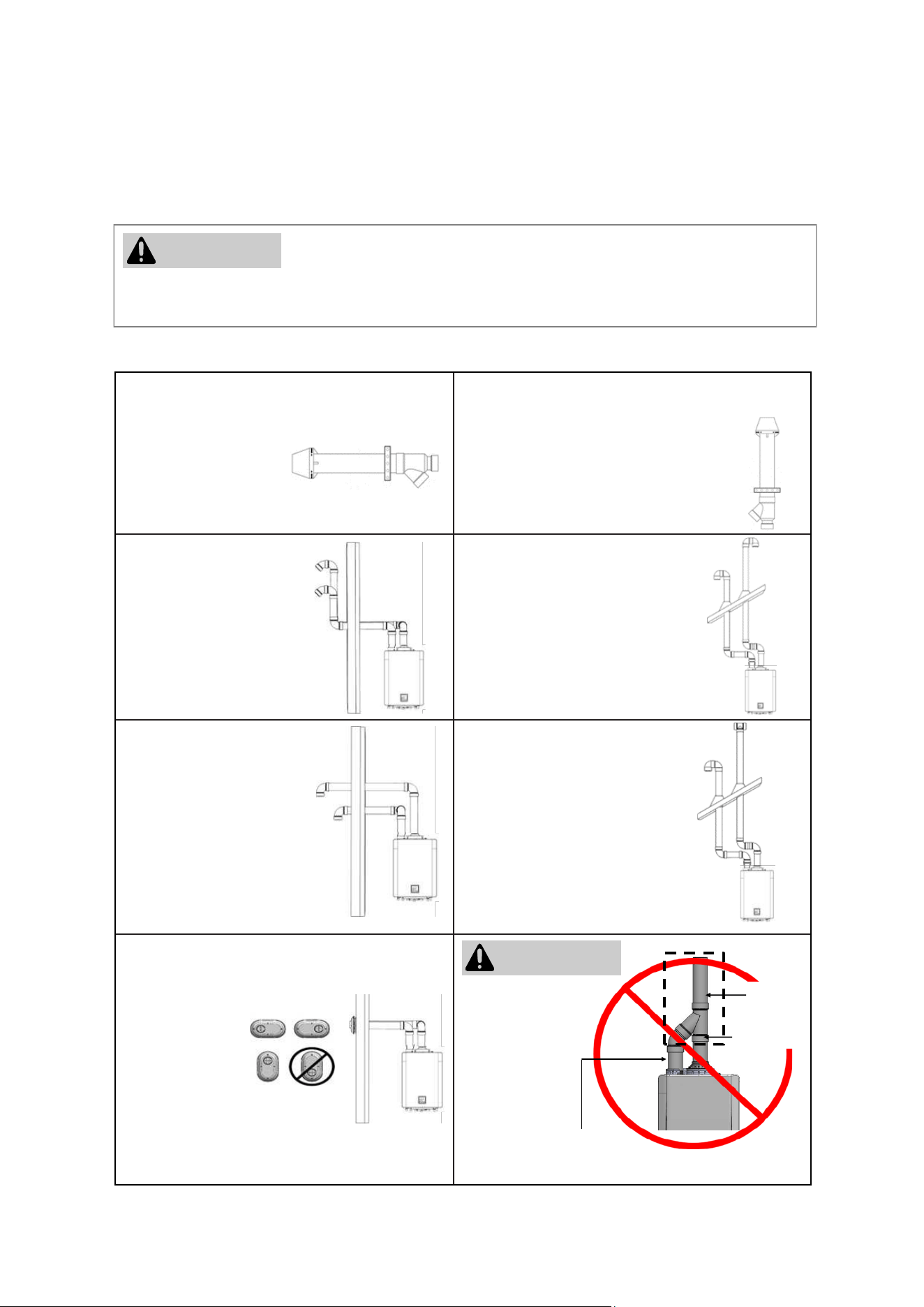
This configuration requires the use of a
Concentric Vent
Termination
This configuration requires the use of a
Concentric Vent Termination
2 in. or 3 in. PVC/ CPVC
IPEX/ Royal
Concentric
Side Wall
Terminaon
Conguraon
2 in. or 3 in. PVC/CPVC
IPEX/ Royal Concentric
Vercal Terminaon
Conguraon
2 in. or 3 in. Schedule
40 PVC/CPVC or ABS
Snorkel Terminaon
Conguraon
2 in. or 3 in. Schedule 40
PVC/CPVC or ABS Standard
upside down “U” Vercal
Terminaon Conguraon
2 in. or 3 in. Schedule
40 PVC/CPVC or ABS
Elbow or Tee Side Wall
Terminaon Conguraon
2 in. or 3 in. Schedule
40 PVC/CPVC or ABS Tee
Vercal Terminaon
Conguraon
2 in. or 3 in. PVC
Low Prole
Terminaon
Conguraon
Exhaust and
combuson air
MUST NOT be
brought
together into a
single PVC pipe
using a pipe
ng.
Single
Pipe
Exhaust
Combuson
Air
Table 22
CAUTION
WARNING
39
Rinnai I-Series Plus Condensing Combi Boiler Manual
Canadian Installaons
(CSA B149.1)
U.S. Installaons
(ANSI Z223.1 /NFPA 54)
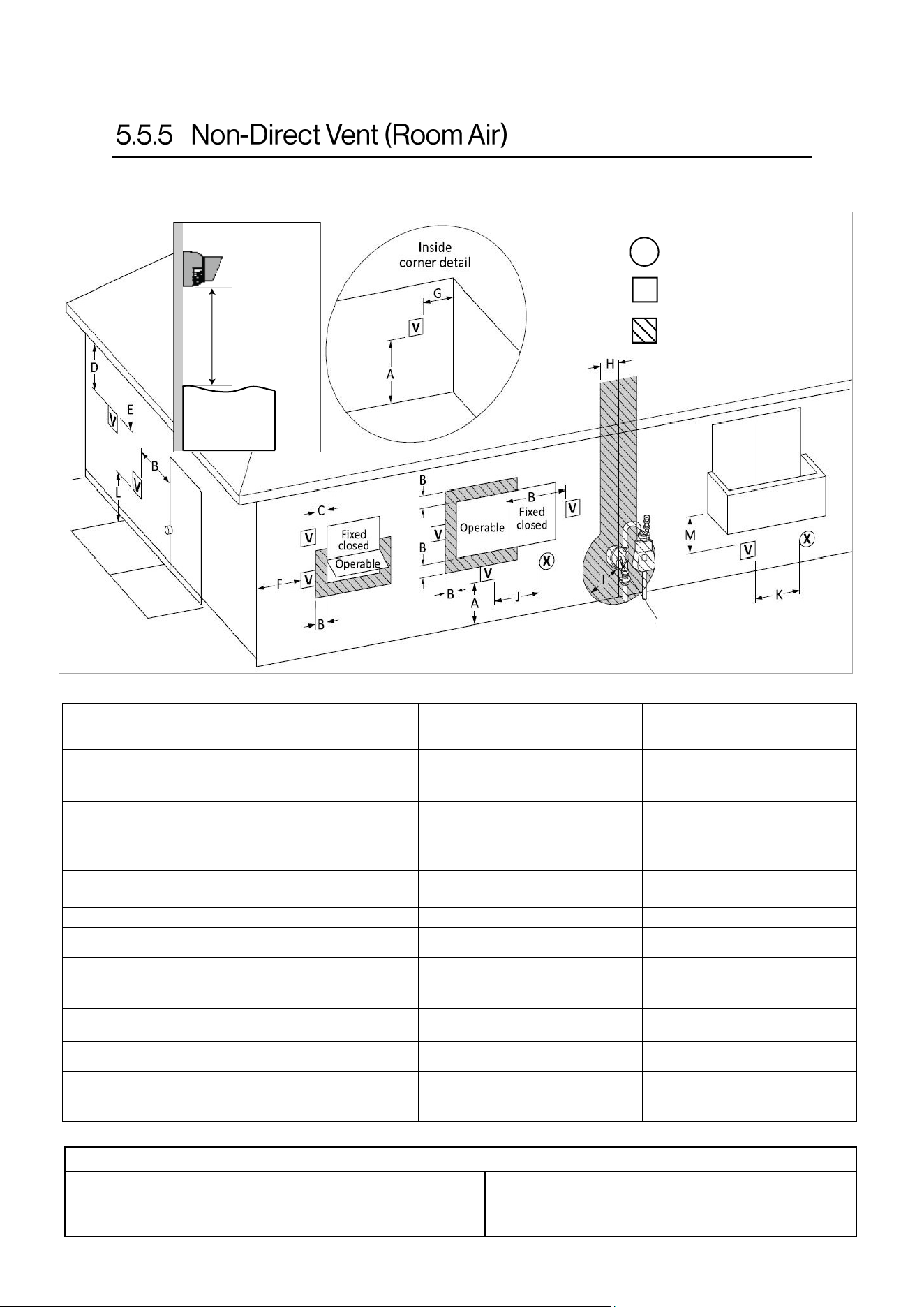
Ref Descripon Other than Direct Vent (Room Air) Other than Direct Vent (Room Air)
A Clearance above grade, veranda, porch, deck, or balcony 12 in. (30 cm) 12 in. (30 cm)
B Clearance to window or door that may be opened 36 in. (91 cm)
4 (1.2 m) below or to side of opening;
1 (300 mm) above opening
C Clearance to permanently closed window * *
D
Vercal clearance to venlated sot, located above the
terminal within a horizontal distance of 2 (61 cm) from
the center line of the terminal
* *
E Clearance to unvenlated sot * *
F Clearance to outside corner * *
G Clearance to inside corner * *
H
Clearance to each side of center line extended above
meter/regulator assembly
* *
I Clearance to service regulator vent outlet
Above a regulator within 3 (91 cm)
horizontally of the vercal center line of
the regulator vent outlet to a maximum
vercal distance of 15 (4 m)
*
J
Clearance to non-mechanical air supply inlet to building or
the combuson air inlet to any other appliance
36 in. (91 cm)
4 (1.2 m) below or to side of opening;
1 (300 mm) above opening
K Clearance to a mechanical air supply inlet 6 (1.83 m)
3 (91 cm) above if within 10
(3 m) horizontally
L
Clearance above paved sidewalk or paved driveway located
on public property
7 (2.13 m) [1] 7 (2.13 m)
M Clearance under veranda, porch, deck, or balcony 12 in. (30 cm) [2] *
AIR SUPPLY INLET
VENT TERMINAL
AREA WHERE TERMINAL
IS NOT PERMITTTED
X
V
SNOW
TERMINATION
Clearance in
Ref. A also
applies to
anticipated
snow line
Clearance to opposite wall is 24 in. (60 cm).
[1] A vent shall not terminate directly above a sidewalk or paved driveway that
is located between two single family dwellings and serves both dwellings.
[2] Permied only if veranda, porch, deck, or balcony is fully open on a
minimum of two sides beneath the oor.
Clearances are in accordance with local installaon codes and the
requirements of the gas supplier.
Room Air: Terminaon Clearances
Table 24
Table 23
Figure 33
Regulator
vent outlet
40
Rinnai I-Series Plus Condensing Combi Boiler Manual
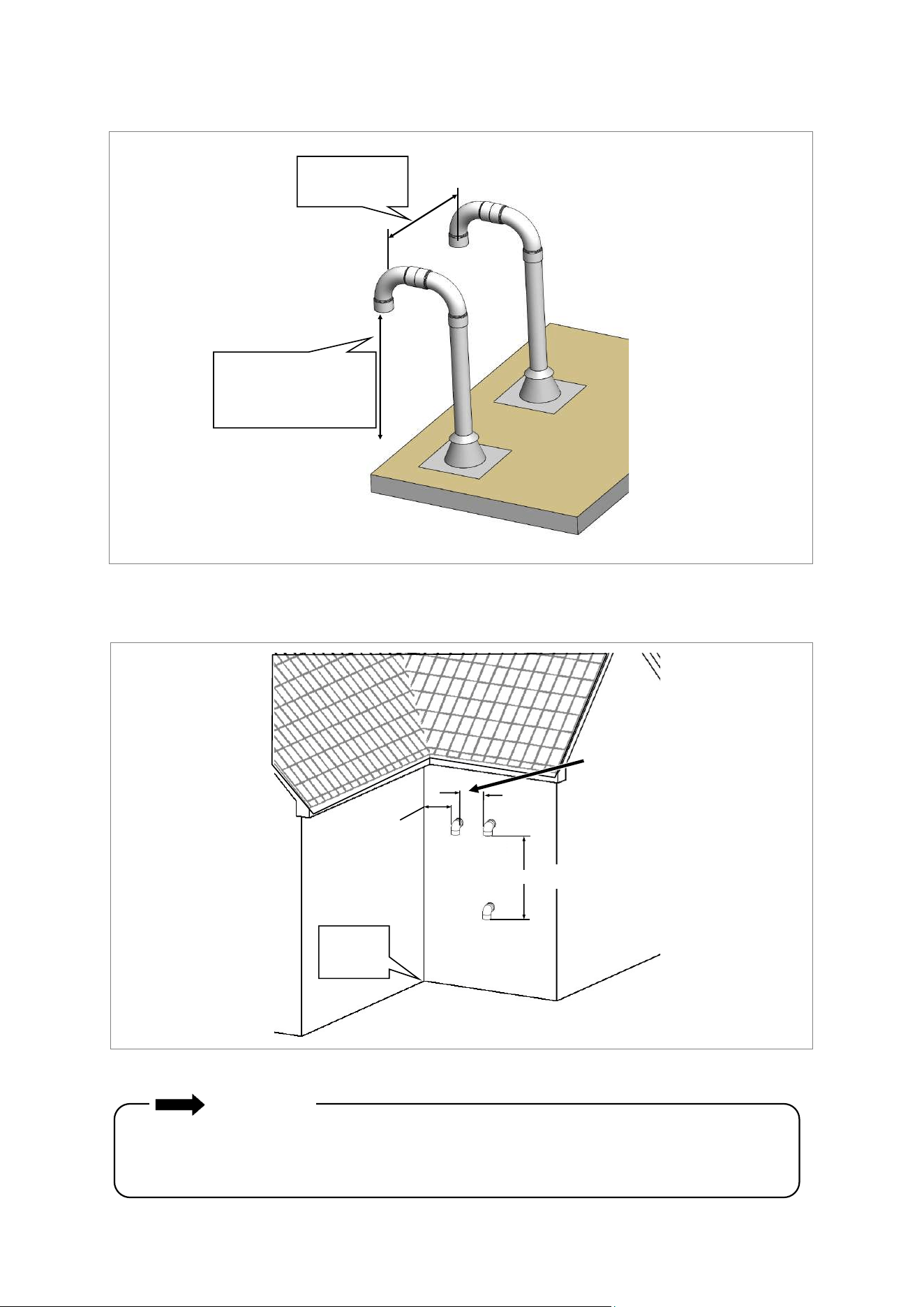
Room Air Vercal Terminaon of Mulple Boilers
Exhaust Terminaon Clearances for Internal (Indoor) Room Air Applicaons
Exhaust
Roof
12 in. (0.30 m)
minimum
12 in. (0.30 m) above
grade or ancipated
snow level
IMPORTANT
• Installaon of Room Air must use listed Category IV venng.
• All terminaons (horizontal and/or vercal) must terminate 12 in. above grade or
ancipated snow level.
Figure 35
12 in.
(0.30 m)
Inside
Corner
60 in. (1.52 m)
Vercally
Between
terminals
12 in.
(0.30 m)
Figure 34
41
Rinnai I-Series Plus Condensing Combi Boiler Manual
• This boiler requires adequate combuson air for venlaon and diluon of ue gases. Failure to
provide adequate combuson air can result in unit failure, re, explosion, serious bodily injury
or death. Use the following methods to ensure adequate combuson air is available for correct
and safe operaon of this boiler.
• Direct Venng is recommended in unusually ght buildings or in installaon locaons subject to
signicant negave air pressure.
Combuson air must be free of corrosive chemicals. Do not provide combuson air from
corrosive environments. Appliance failure due to corrosive air is not covered by warranty.
IMPORTANT
Vent Sizes
• 2 in. PVC
• 2 in. (60 mm) PP
• 3 in. PVC
• 3 in. (80 mm) PP
Ubbink Rolux® Flexible
Vent System:
• 2 in. (60 mm) PP
Vent Lengths
75 (23 m) 160 (49 m)
50 (15 m)
• 45° elbow is equivalent to 3 (1 m)
• 90° elbow is equivalent to 6 (2 m)
ACCEPTABLE ACCEPTABLE NOT ACCEPTABLE
90° Elbows,
Long Sweep
90° Elbows,
Short Sweep
90° Elbows,
Close Turn
Vent length includes the addional venng, ngs and terminaons.
Room Air: Maximum Equivalent Vent Length
Room Air: Combuson Air
For applicaons containing corrosive indoor air, this appliance must be installed as direct vent.
DO NOT use room air in applicaons where combuson air contains acid forming chemicals such as
sulfur, uorine and chlorine. These chemicals have been found to cause rapid damage and decay
and can become toxic when used as combuson air in gas appliances. Such chemicals can be found
in, but not limited to bleach, ammonia, cat lier, aerosol sprays, cleaning solvents, varnish, paint
and air fresheners. Do not store these products or similar products in the vicinity of this boiler.
Table 26
Table 25
WARNING

42
Rinnai I-Series Plus Condensing Combi Boiler Manual
Unconned Space
An unconned space is dened in Naonal Fuel Gas Code, ANSI Z223.1/NFPA 54 as “a space whose
volume is not less than 50 cubic feet per 1000 Btu/hr (4.8 m3 per kW per hour) of the aggregate
input rang of all appliances installed in that space. Rooms communicang directly with the space
in which the appliances are installed, through openings not furnished with doors, are considered a
part of the unconned space.” If the “unconned space” containing the appliance(s) is in a building
with ght construcon, addional outside air may be required for proper operaon. Outside air
openings should be sized the same as for a conned space.
Conned Space
A conned space is dened in the Naonal Fuel Gas Code, ANSI Z223.1/NFPA 54 as "a space whose
volume is less than 50 cubic feet per 1000 Btu/hr (4.8 m3 per kW per hour) of the aggregate input
rang of all appliances installed in that space." Examples include a small room, closet, alcove,
ulity room, etc. A conned space must have two combuson air openings. Size the combuson air
openings based on the Btu input for all gas ulizaon equipment in the space and the method by
which combuson air is supplied.
Using Indoor Air For Combuson
When using air from other room(s) in the building, the total volume of the room(s) must be of
adequate volume (greater than 50 cubic feet per 1000 Btu/hr). Combuson air openings between
joining rooms must have at least 1 square inch of free area for each 1000 Btu/hr, but not less than
100 square inches each.
Using Outdoor Air For Combuson
Outdoor air can be provided to a conned space through two permanent openings, one
commencing within 12 in. (0.30 m) of the top and one commencing within 12 in. (0.30 m) of the
boom, of the conned space. The openings shall communicate to the outside by one of two ways.
When communicang directly with the outdoors through horizontal ducts, each opening shall have
a minimum free area of 1 in
2
/2000 Btu/hr (1100 mm
2
/kW) of total input rang of all appliances in
the conned space.
Note: If ducts are used, the cross seconal area of the duct must be greater than or equal to the
required free area of the openings to which they are connected.
Louvers and Grills
When sizing the permanent opening consideraon must be taken for the design of the louvers or
grills to maintain the required free area required for all gas ulizing equipment in the space. If the
free area of the louver or grill design is not available, assume wood louvers will have 25% free area
and metal louvers or grills will have 75% free area. Under no circumstance should the louver, grill
or screen have openings smaller than 1/4 in.
Examples: Wood: 10 in. x 12 in. x 0.25 = 30 in.
2
Metal: 10 in. x 12 in. x 0.75 = 90 in.
2
43
Rinnai I-Series Plus Condensing Combi Boiler Manual
Combuson air provided to the appliance should not be taken from any area of the structure
that may produce a negave pressure (i.e. exhaust fans, powered venlaon fans).
Locaon
To maintain proper circulaon of combuson air two permanent openings (one upper, one lower)
must be posioned in conned spaces. The upper shall be within 12 in. (0.30 m) of the top of the
conned space and the lower opening shall be within 12 in. (0.30 m) of the boom of the conned
space. Openings must be posioned as to never be obstructed.
12 in.
(300 mm)
10 in.
(250 mm)
□
Verify all combuson air opening sizes are correct.
□
Ensure that the Combuson Air Requirements are followed that will provide sucient
combuson air for the appliance.
□
DO NOT use room air for combuson in applicaons where the indoor air is corrosive.
□
Verify that adequate combuson air is available for all appliances installed in the space.
□
Installaon complies with Naonal Fuel Gas Code, ANSI Z223.1/NFPA 54 as well as local
and state regulaons therein.
To prevent possible personal injury or death due to asphyxiaon, common venng with other
manufacturer’s induced dra appliances is not allowed.
IMPORTANT
Checklist for Combuson Air and Venng Requirements
Figure 36
WARNING
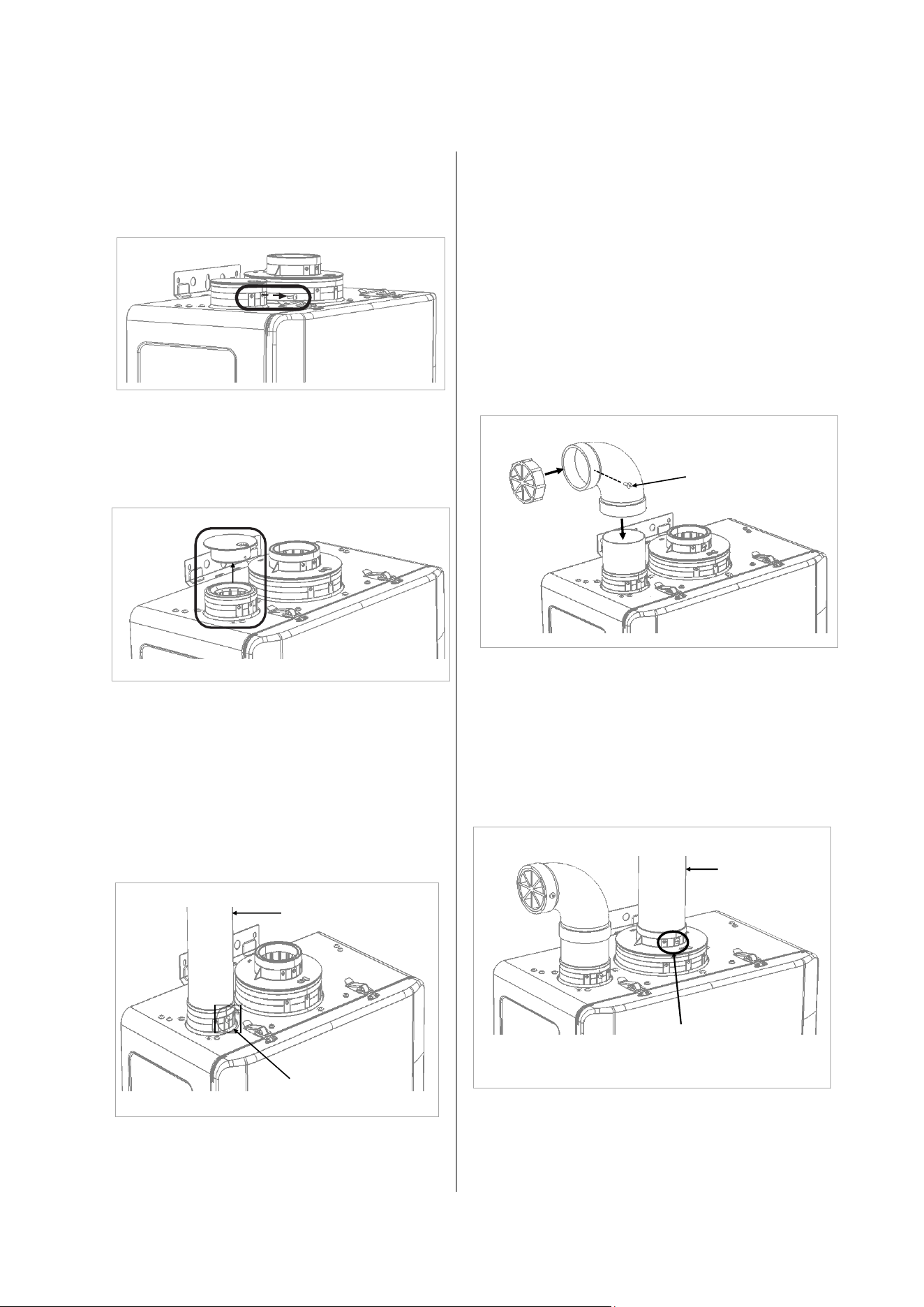
44
Rinnai I-Series Plus Condensing Combi Boiler Manual
1. Remove and discard screw from
combuson air vent connecon.
2. Remove and discard the combuson
air vent cap.
3. Install the combuson air vent pipe.
Ensure it is properly seated.
Secure the combuson air vent pipe to
the combuson air vent connecon with
the supplied screw.
Room Air: Installaon Instrucons
Combuson Air
Vent Pipe
Supplied Screw
4. Place the vent screen or room air screen
inside elbow and secure with the supplied
screw. Use the room air screen for
environments where room air is dusty.
Notes:
• 2 in vent screen supplied with
boiler.
• Room air screen is available as an
accessory.
Supplied Screw
Elbow
Vent
Screen
5. Install the exhaust vent pipe. Ensure it
is properly seated.
Secure the exhaust vent pipe to the
exhaust adapter ring with the supplied
screw.
Exhaust Vent
Pipe
Supplied Screw
Figure 41
Figure 40
Figure 39
Figure 38
Figure 37
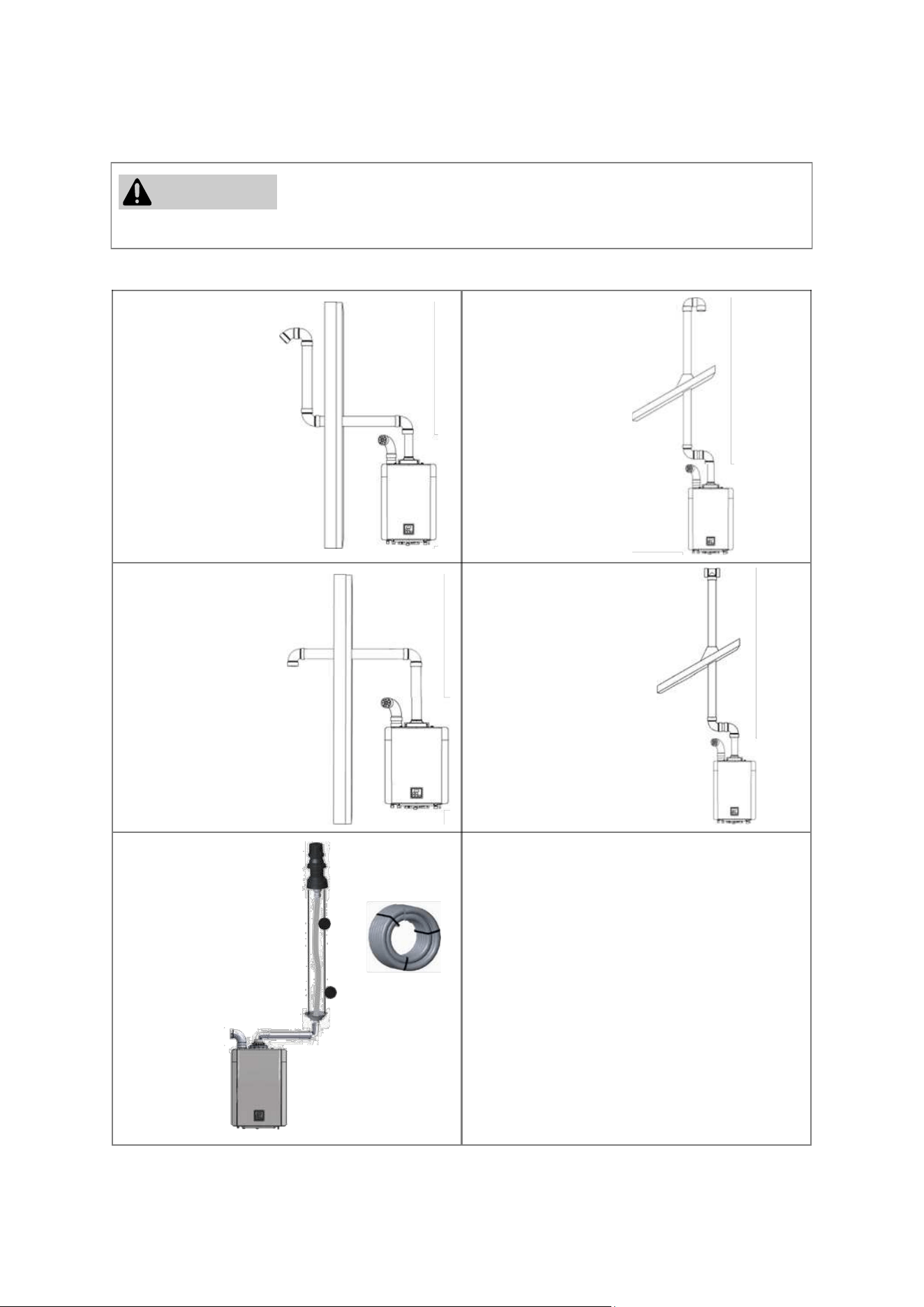
45
Rinnai I-Series Plus Condensing Combi Boiler Manual
Rinnai cauons against installing the boiler in applicaons with venng in
dierent pressure planes. It is possible to have poor performance with this
installaon.
Room Air: Example Vent Applicaons
2 in. or 3 in.
Schedule 40
PVC/CPVC or ABS
Snorkel
Terminaon
Conguraon
2 in. or 3 in.
Schedule 40
PVC/CPVC or
ABS Elbow or
Tee Side Wall
Terminaon
Conguraon
2 in. or 3 in.
Schedule 40
PVC/CPVC or
ABS Standard
Upside Down
“U” Vercal
Terminaon
conguraon
2 in. or 3 in.
Schedule 40 PVC/
CPVC or ABS Tee
Vercal
Terminaon
Conguraon
Slope horizontal exhaust 1/4 in. per foot
towards the boiler.
Ubbink exible
venng approved
for vercal
non-direct vent
(Room Air)
applicaons only.
Refer to the ex
vent manual for
further details.
PP Flex
Venng
B-Vent Pipe
4 in. (102 mm)
Table 27
CAUTION
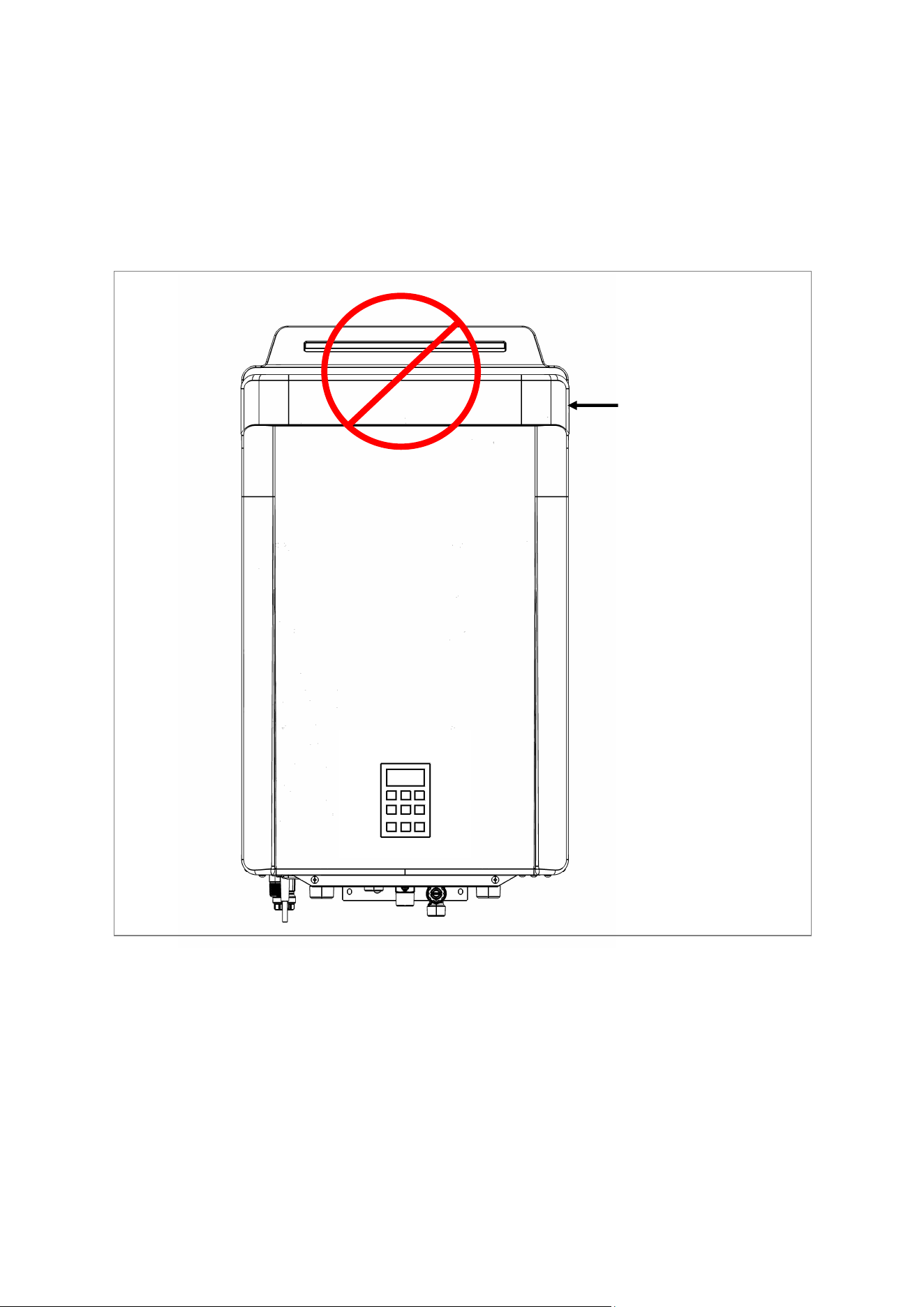
46
Rinnai I-Series Plus Condensing Combi Boiler Manual
The Rinnai RX Series Tankless Water Heater oers an outdoor vent cap as an accessory to enable
outdoor installaons. This is not an acceptable accessory for the I-Series Plus Condensing Boiler.
The boiler is only approved to be installed indoors with appropriate venng to the outdoors.
Outdoor Vent Cap Applicaon
Outdoor Vent Cap
Figure 42
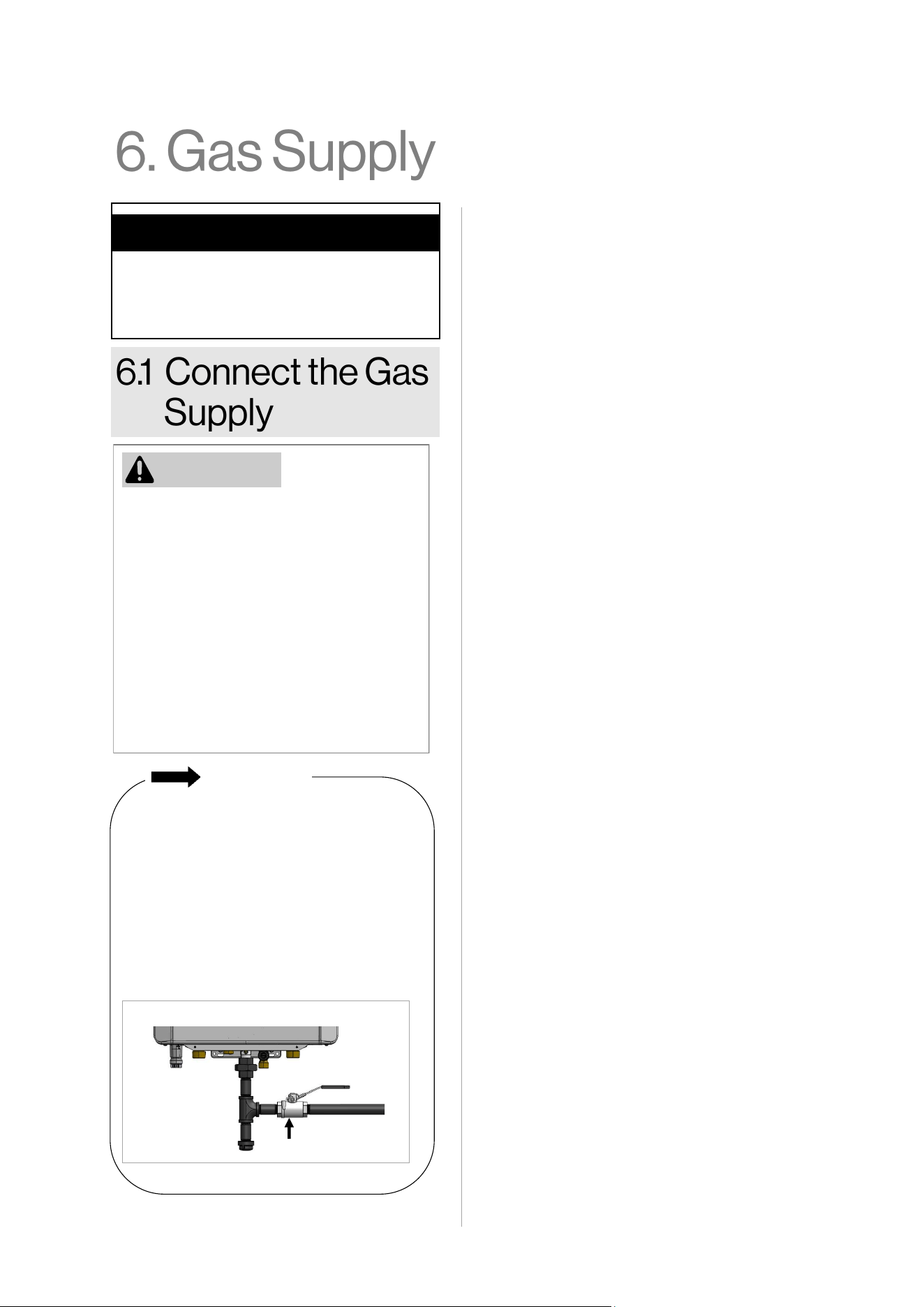
47
Rinnai I-Series Plus Condensing Combi Boiler Manual
• The boiler shall be installed such that
the gas ignion system components
are protected from water (dripping,
spraying, rain, etc.) during appliance
operaon and service (circulator
replacement, condensate trap, control
replacement, etc.).
• A sediment trap must be provided
upstream of the gas controls.
• A manual gas shuto valve between
the gas supply and the boiler must be
installed.
• A licensed professional must install the
gas supply.
• Turn o 120V power supply.
• Turn o the gas.
• Gas is ammable. Do not smoke or
provide other ignion sources while
working with gas.
• Do not turn on the boiler or gas unl all
fumes are gone.
• Conrm the gas type before
connecng. Failure to install correct gas
type may result in injury or damage to
the unit.
1. Check the type of gas and gas supply
pressure before connecng the boiler. If the
boiler is not of the gas type that the building
is supplied with, converng the gas type of
the boiler is necessary. A gas conversion kit is
included with the boiler. Refer to secon
“14.5 Gas Conversion” in the Appendix for
gas conversion instrucons.
2. Check the gas supply pressure immediately
upstream at a locaon provided by the gas
company. Supplied gas pressure must be
within the limits shown in secon “3.4
Specicaons” with all gas appliances
operang.
3. Before placing the appliance in operaon, all
joints including the heater must be checked
for gas ghtness by means of soap, gas leak
detector soluon, or an equivalent
nonammable soluon, as applicable. Since
some leak test soluons, including soap and
water, may cause corrosion or stress
cracking, the piping shall be rinsed with
water aer tesng, unless it has been
determined that the leak test soluon is
non-corrosive.
4. Use approved and appropriately sized
connectors to connect the boiler to the gas
line. Purge the gas line of any debris before
connecon to the boiler.
5. Any compound used on the threaded joint of
the gas piping shall be a type that resists the
acon of liqueed petroleum gas (Propane/
LPG).
6. The gas supply line shall be gas ght, sized,
and so installed as to provide a supply of gas
sucient to meet the maximum demand of
the heater and all other gas consuming
appliances at the locaon without loss of
pressure. If in doubt about the size of the gas
line, refer to secon “6.3 Gas Pipe Sizing
Reference Tables.”
7. Perform a leak and pressure test prior to
operang the boiler. If a leak is detected, do
not operate the boiler unl the leak is
repaired.
Topics in this secon
• Connect the Gas Supply
• Gas Operang Instrucons
• Gas Pipe Sizing Reference Tables
Gas Shuto Valve
Figure 43
IMPORTANT
WARNING
48
Rinnai I-Series Plus Condensing Combi Boiler Manual
WARNING: If you do not follow these instrucons EXACTLY, a re or explosion may
result causing property damage, personal injury or loss of life.
A. This appliance does not have a pilot. It is equipped with an ignion device which
automacally lights the burner. Do not try to light the burner by hand.
B. BEFORE OPERATING smell all around the appliance area for gas. Be sure to smell next
to the oor because some gas is heavier than air and will sele on the oor.
WHAT TO DO IF YOU SMELL GAS:
• DO NOT try to light any appliance.
• DO NOT touch any electric switch; DO NOT use any phone in your building.
• Immediately call your gas supplier from a neighbor’s phone. Follow the gas
supplier’s instrucons.
• If you cannot reach your gas supplier, call the re department.
C. Use only your hand to turn the gas control valve. Never use tools. If the gas control
valve will not turn by hand, don’t try to repair it, call a qualied service technician.
Force or aempted repair may result in a re or explosion.
D. Do not use this appliance if any part has been under water. Immediately call a
qualied service technician to inspect the appliance and to replace any part of the
control system and any gas control which has been under water.
1. Set the temperature controller to the lowest seng.
2. Turn o all electric power to the appliance if service is to be performed.
3. Turn the manual gas control valve located at gas inlet of appliance clock- wise
to the OFF posion.
TO TURN OFF GAS TO APPLIANCE
1. STOP! Read the safety informaon above on this label.
2. Set the temperature controller to lowest seng.
3. Turn o all electric power to the appliance.
4. This appliance does not have a pilot. It is equipped with a direct ignion device which
automacally lights the burner. DO NOT try to light the burner by hand.
5. Turn the manual gas control valve located at gas inlet of appliance clockwise to
the OFF posion.
6. Wait ve (5) minutes to clear out any gas. Then smell for gas, including near the oor.
If you smell gas, STOP! Follow “B” in the safety informaon above on this label. If you
don’t smell gas, go to the next step.
7. Turn the manual gas control valve located at gas inlet of appliance counter
clockwise to the ON posion.
8. Turn on all electric power to the appliance.
9. Set the temperature controller to desired seng.
10. If the appliance will not operate, follow the instrucons “To Turn O Gas To
Appliance” and call your service technician or gas supplier.
OPERATING INSTRUCTIONS
FOR YOUR SAFETY READ BEFORE OPERATING
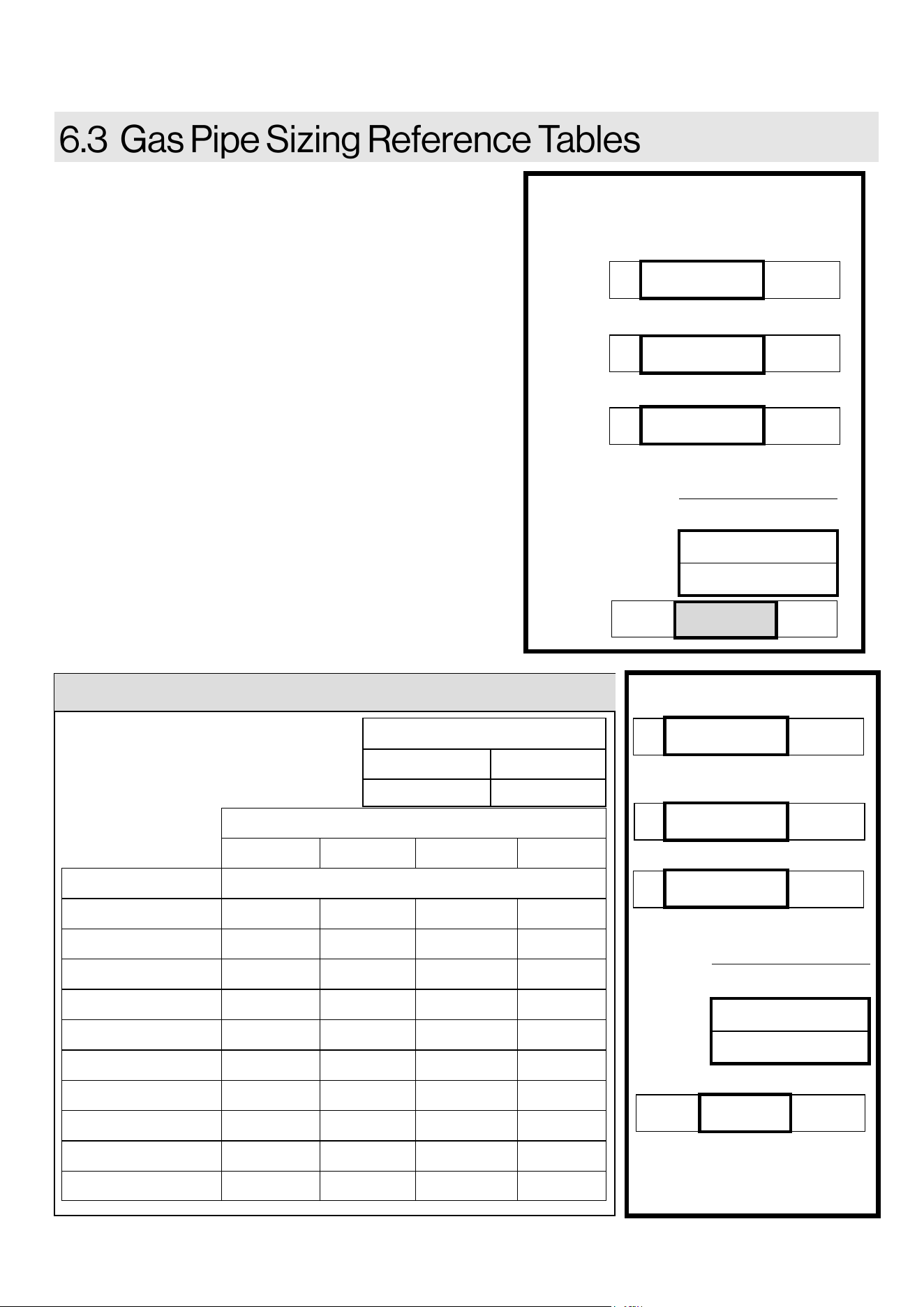
49
Rinnai I-Series Plus Condensing Combi Boiler Manual
The gas supply must be capable of handling the enre gas load
required at the locaon. Gas line sizing is based on gas type,
the pressure drop in the system, the gas pressure supplied,
and gas line type. For gas pipe sizing, refer to the Naonal Fuel
Gas Code, ANSI Z223.1/NFPA 54, or the Natural Gas and
Propane Installaon Code, CSA B149.1
For some tables, you will need to determine the cubic feet per
hour of gas required by dividing the gas input by the heang
value of the gas (available from the local gas company). The
gas input needs to include all gas products at the locaon and
the maximum Btu usage at full load when all gas products are
in use.
Use the table for your gas type and pipe type to nd the pipe
size required. The pipe size must be able to provide the
required cubic feet per hour of gas or the required Btu/hr.
The informaon below is provided as an example. The
appropriate table from the applicable code must be used.
Schedule 40 Metallic Pipe
Inlet Pressure: Less than 2 PSI
Specic Gravity: 0.60
Informaon in table obtained from
NFPA 54, ANSI Z223.1.
Pressure Drop 0.5 in. w.c.
Nominal Pipe Size (in.)
1/2 3/4 1 1 1/4
Length in (meters) Capacity in Cubic Feet of Gas per Hour
10 (3)
172 360 678 1,390
20 (6)
118 247 466 957
30 (9)
95 199 374 768
40 (12)
81 170 320 657
50 (15)
72 151 284 583
60 (18)
65 137 257 528
70 (21)
60 126 237 486
80 (24)
56 117 220 452
90 (27)
52 110 207 424
100 (30)
50 104 195 400
EXAMPLE
Rinnai Model Gas Input:
Addional Appliance Total Gas
Input:
Heang Value of Gas:
Cubic Feet Per Hour (CFH):
ANSWER:
B
65,000
Btu/hr
C
1,000
Btu/
3
A
199,000
Btu/hr
199,000+65,000
(CFH) =
1000
264
FT
3
/HR
CFH =
For this example, the pipe
diameter must be at least 3/4 in.
pipe size and 10 (3 m) in
length.
A + B
(CFH) =
C
Instrucons: Enter values in empty boxes.
Rinnai Model Gas Input:
Addional Appliance Total Gas Input:
Heang Value of Gas:
Cubic Feet Per Hour (CFH):
ANSWER:
B
Btu/hr
C
Btu/
3
A
Btu/hr
(CFH) =
FT
3
/HR
CFH =
A + B
(CFH) =
C
GAS PIPE SIZING CALCULATION WORKSHEET
Natural Gas
Table 28
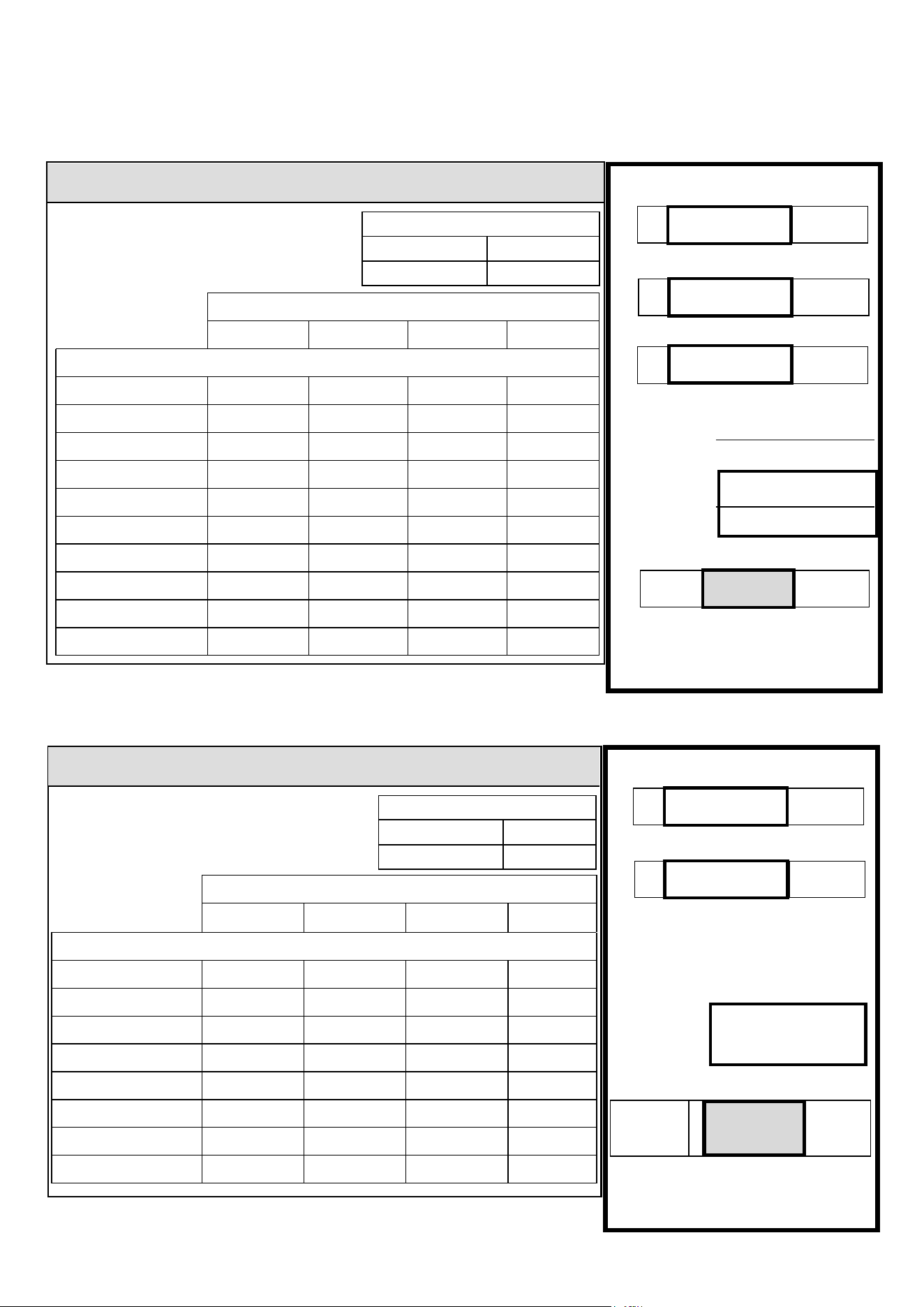
50
Rinnai I-Series Plus Condensing Combi Boiler Manual
Pressure Drop 0.5 in. w.c.
Nominal Inside Pipe Size (in.)
1/2 3/4 1 1 1/4
Length in (meters) Capacity in Thousands of Btu/hr
10 (3) 291 608 1,150 2,350
20 (6) 200 418 787 1,620
30 (9) 160 336 632 1,300
40 (12) 137 287 541 1,110
50 (15) 122 255 480 985
60 (18) 110 231 434 892
80 (24) 101 212 400 821
100 (30) 94 197 372 763
Pressure Drop 3.0 in. w.c.
Schedule 40 Metallic Pipe
Inlet Pressure: Less than 2 PSI
Specic Gravity: 0.6
Nominal Pipe Size (in.)
1/2 3/4 1 1 1/4
Length in (meters) Capacity in Cubic Feet of Gas per Hour
10 (3) 454 949 1,790 3,670
20 (6) 312 652 1,230 2,520
30 (9) 250 524 986 2,030
40 (12) 214 448 844 1,730
50 (15) 190 397 748 1,540
60 (18) 172 360 678 1,390
70 (21) 158 331 624 1,280
80 (24) 147 308 580 1,190
90 (27) 138 289 544 1,120
100 (30) 131 273 514 1,060
Informaon in table obtained from
NFPA 54, ANSI Z223.1.
Informaon in table obtained from
NFPA 54, ANSI Z223.1.
Intended use: Inial supply pressure
of 8.0 in. w.c. or greater.
Schedule 40 Metallic Pipe
Inlet Pressure: 11 in. w.c.
Specic Gravity: 1.50
EXAMPLE
Rinnai Model Gas Input:
Addional Appliance total Gas Input:
Heang Value of Gas:
Cubic Feet Per Hour (CFH):
ANSWER:
B
65,000
Btu/hr
C
1,000
Btu/
3
A
199,000
Btu/hr
199,000+65,000
(CFH) =
1000
264
3
/HR
CFH =
For this example, the pipe diameter
must be at least 1/2 in. nominal
pipe size and 20 (6 m) in length.
A + B
(CFH) =
C
EXAMPLE
Rinnai Model Gas Input:
Addional Appliance Total Gas Input:
Total Gas Input:
ANSWER:
B
65,000
Btu/hr
A
199,000
Btu/hr
= Btu/hr
Total Gas
Input
264,000
For this example, the pipe diameter
must be at least 1/2 in. nominal
pipe size and 10 (3 m) in length.
Total
Gas
Input
= A + B
Total
Gas
Input
=
199,000+65,000
Natural Gas
Propane (Undiluted)
Table 30
Table 29
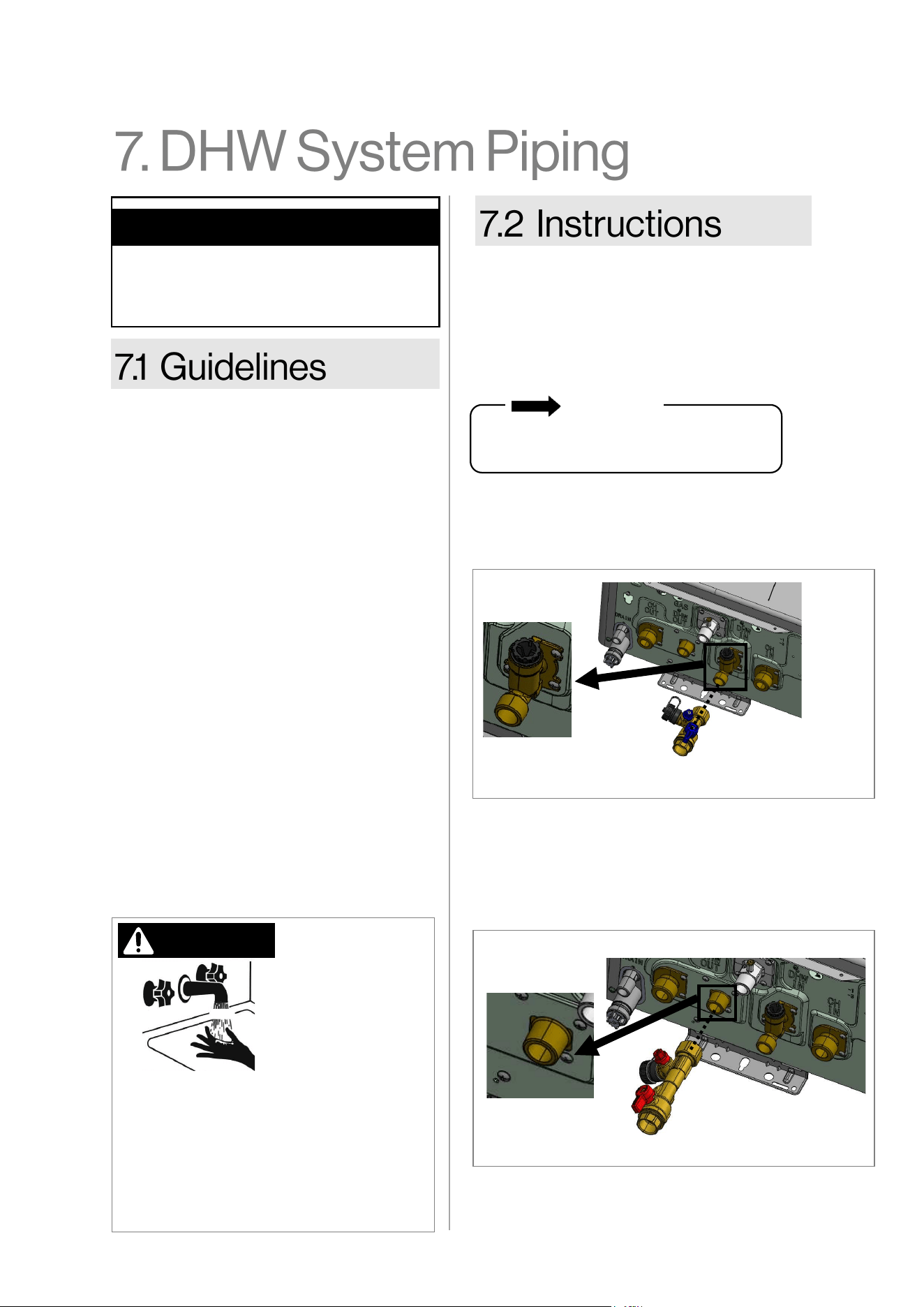
51
Rinnai I-Series Plus Condensing Combi Boiler Manual
• The piping (including soldering materials)
and components connected to this
appliance must be approved for use in
potable water systems.
• Purge the water line to remove all debris
and air. Debris will damage the boiler.
• The boiler DHW must not be connected to
any piping or components previously used
with a non-potable water heang
appliance.
• Boiler water treatment and other toxic
chemicals must NOT be introduced into
the boiler DHW or connected potable
water piping.
• Ensure that the water lter on the boiler is
clean and installed.
• An approved pressure relief valve is
required by the American Naonal
Standard (ANSI Z21.13) and ASME Boiler
and Pressure Vessel Code, Secon IV
(Heang Boilers) for all water heang
systems and shall be accessible for
servicing. Refer to secon “8.6 Connect
the Pressure Relief Valves (DHW and CH)”
for more informaon.
1. Plumb the cold water supply line to the
DHW cold inlet connecon on the boom
of the boiler.
To connect the water supply, follow the
instrucons below.
For standard installaons, refer to the Piping
Diagram for Basic DHW Installaon on the
next page.
2. Plumb the hot water supply line to the
DHW hot outlet connecon on the boom
of the boiler.
Isolaon Valve
DHW Cold Inlet
Connecon
Isolaon Valve
DHW Hot
Outlet
Connecon
Water connecons to the boiler should
follow all state and local plumbing codes.
IMPORTANT
Topics in this secon
• Guidelines
• Instrucons
• Piping Diagram for Basic DHW Installaon
Hot water can cause rst degree burns
with exposure for as lile as:
• 3 seconds at 140°F (60°C)
• 20 seconds at 130°F (54°C)
• 8 minutes at 120°F (49°C)
Children, disabled, or elderly are at
highest risk of being scalded. Feel water
before bathing or showering.
Water temperatures
over 125°F (52°C)
can cause severe
burns or scalding
resulng in death.
HOT
BURN
Figure 45
Figure 44
DANGER
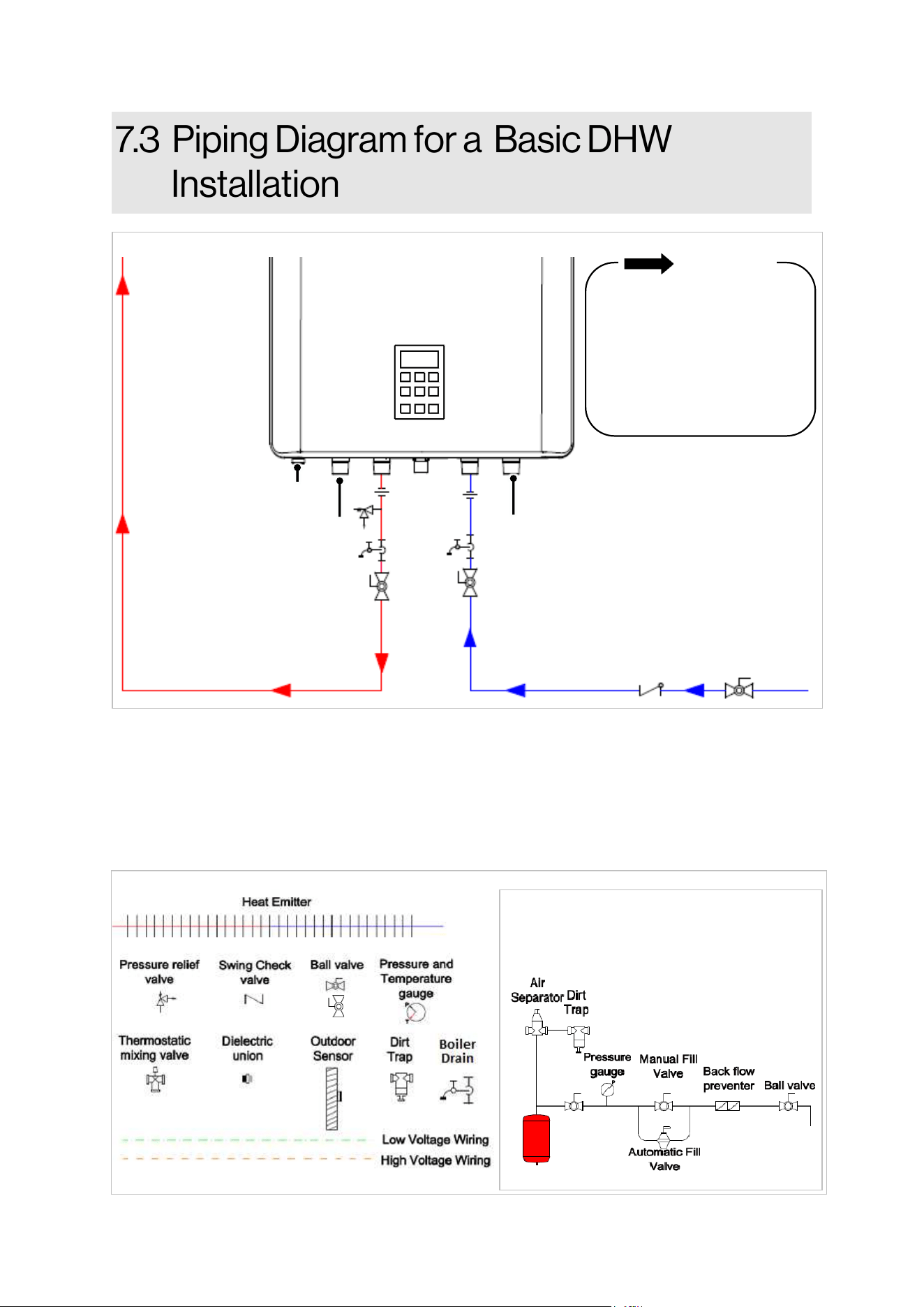
52
Rinnai I-Series Plus Condensing Combi Boiler Manual
The image below illustrates a suggested
arrangement. Some of the ngs are
oponal.
LEGEND
The above image is not an engineering drawing; it is intended only as a guide and not as a replacement for
professional engineering project drawings. This drawing is not intended to describe a complete system. It is
up to the contractor or engineer to determine the necessary components and conguraon of the parcular
system to be installed. The drawing does not imply compliance with local building code requirements. It is the
responsibility of the contractor or engineer to ensure the installaon is in accordance with all local building
codes. Confer with local building ocials before installaon.
Figure 47
Cold Water Supply Line
Heang
Return
Hot Water Supply Line
Condensate
Drain
Heang
Supply
IMPORTANT
The CH piping and
components have been
removed from this diagram
for clarity. Please reference
secon “8. CH System
Piping” for details on proper
CH piping.
Figure 46
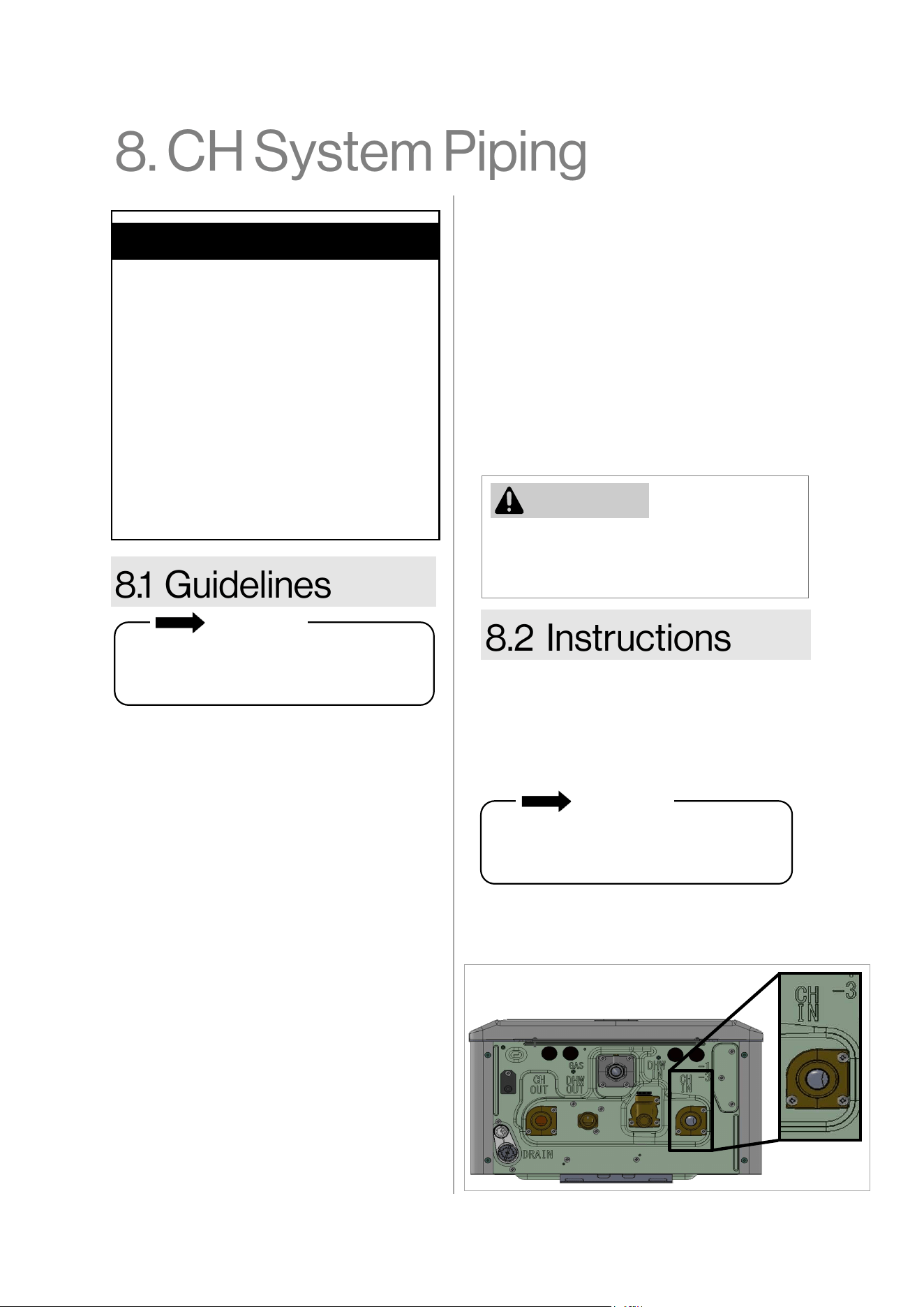
53
Rinnai I-Series Plus Condensing Combi Boiler Manual
• When removing the plasc sealing caps
from the boiler connecons, water may
come out of the boiler due to live re
tesng during manufacturing.
• The boiler, when used in connecon with
a refrigeraon system, must be installed
so the chilled medium is piped in parallel
with the boiler with appropriate valves
to prevent the chilled medium from
entering the boiler.
• The boiler piping system of a hot water
boiler connected to heang coils located
in air handling units where they may be
exposed to refrigerated air circulaon
must be equipped with ow control
valves or other automac means to
prevent gravity circulaon of the boiler
water during the cooling cycle.
• Some installaons with mulple zone
valves may require a dierenal bypass,
which will prevent excessively high ow
rates through a single zone when the
other zone valves are closed.
To connect the water supply, follow the
instrucons below.
For standard installaons, refer to the “Piping
Diagram for Basic Central Heang
Installaon” in this chapter.
1. Plumb the heang return line to the
heang return connecon on the boom
of the boiler.
Topics in this secon
• Guidelines
• Instrucons
• Common CH Components
• Piping Diagram for a Basic CH System
(With Hydraulic Separaon)
• Hydraulic Separaon
• Connect the Pressure Relief Valves
(DHW and CH)
• Connect the Condensate Drain Line
• Condensate Pump Safety Switch
Wiring
The boiler may not be installed directly to
a heang system where polybutylene or
other oxygen permeable piping is used.
Water connecons to the boiler should
follow all state and local plumbing codes.
IMPORTANT
• It is required to include an air separator on
the central heang supply of the system.
• Hydraulic separaon with primary/
secondary piping is required when
connecng the water supply (see secon
“8.5 Hydraulic Separaon” for more
informaon).
• System piping should be insulated when
freezing is a potenal concern.
• All piping must comply with local, state,
naonal or ASME code as appropriate.
Heang Return Connecon
IMPORTANT
Purge the heang system to remove all
debris and air. Debris and air in the lines
will damage the boiler.
Figure 48
CAUTION
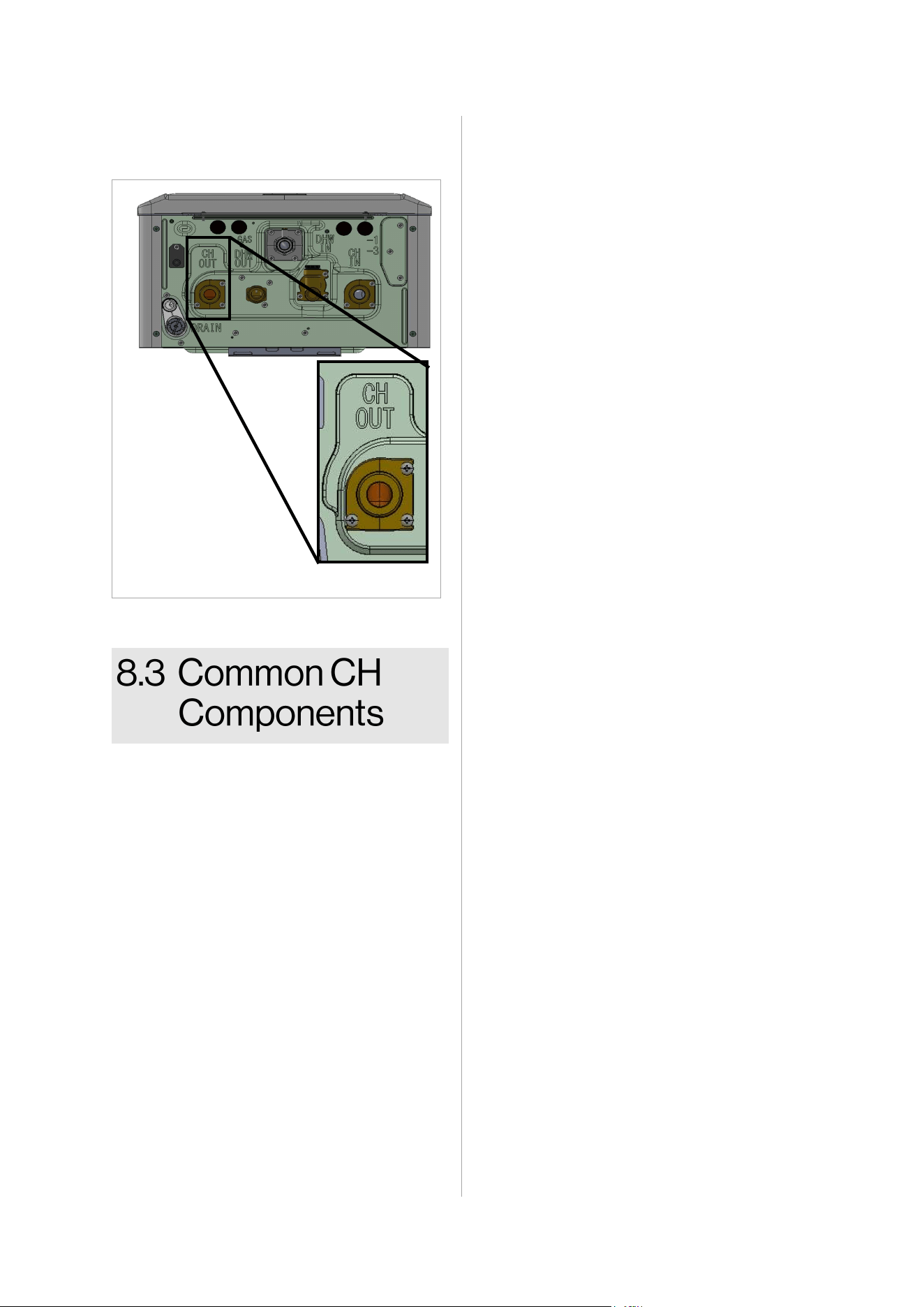
54
Rinnai I-Series Plus Condensing Combi Boiler Manual
2. Plumb the heang supply line to the
heang supply connecon on the boom
of the boiler.
Listed below are common components in a
Central Heang system. Refer to the diagram
on the next page.
• Expansion Tank — A properly sized
expansion tank charged to 2 PSI (14 kPa)
below the cold system pressure is
required to limit pressure changes in the
heang system. When replacing an
expansion tank, consult the expansion
tank manufacturer for sizing.
• Air Separator — An air separator is
needed on the central heang supply side
of the system to remove any air that may
be present in the piping.
• Pressure/Temperature Gauge — The
current pressure and temperature will
alternately be displayed on the boiler
control panel. A port for an external gauge
is present in the Primary-Secondary
Heang Kit accessory oered by Rinnai.
• Pressure Relief Valve (PRV) — A PRV
located directly on the supply side of the
boiler is required. The PRV must be 3/4 in.
with at least 30 PSI (207 kPa) and a
maximum of 45 PSI (310 kPa). A 30 PSI
(207 kPa) PRV is supplied with the boiler. A
port for the central heang PRV is present
in the Primary-Secondary Heang Kit
accessory oered by Rinnai.
• Oxygen Eliminaon — The boiler may only
be installed in a pressurized closed-loop
heang system, free of air and other
impuries. If using oxygen permeable
tubing in the central heang system, a
plate heat exchanger is necessary to
isolate the tubing and boiler.
• Water Fill Valve — Maintains proper
water pressure in the central heang
circuit.
• Back Flow Preventer — Use a back ow
preventer in the lling circuit to the
appliance as required by local code.
• Low Water Cut O (LWCO) — This boiler
has a factory-installed pressure sensor
type LWCO. The boiler's internal LWCO is
not serviceable or adjustable. Check your
local codes to determine if a LWCO is
required and if this device conforms to the
local code. If a LWCO is required to be
installed, the probe must be located higher
than the minimum safe water level. When
a LWCO is installed, it must be wired back
to the appropriate terminal on the boiler
PC Board.
• Dirt Trap — Protects the boiler from debris
in the plumbing system.
Figure 49
Heang Supply Connecon
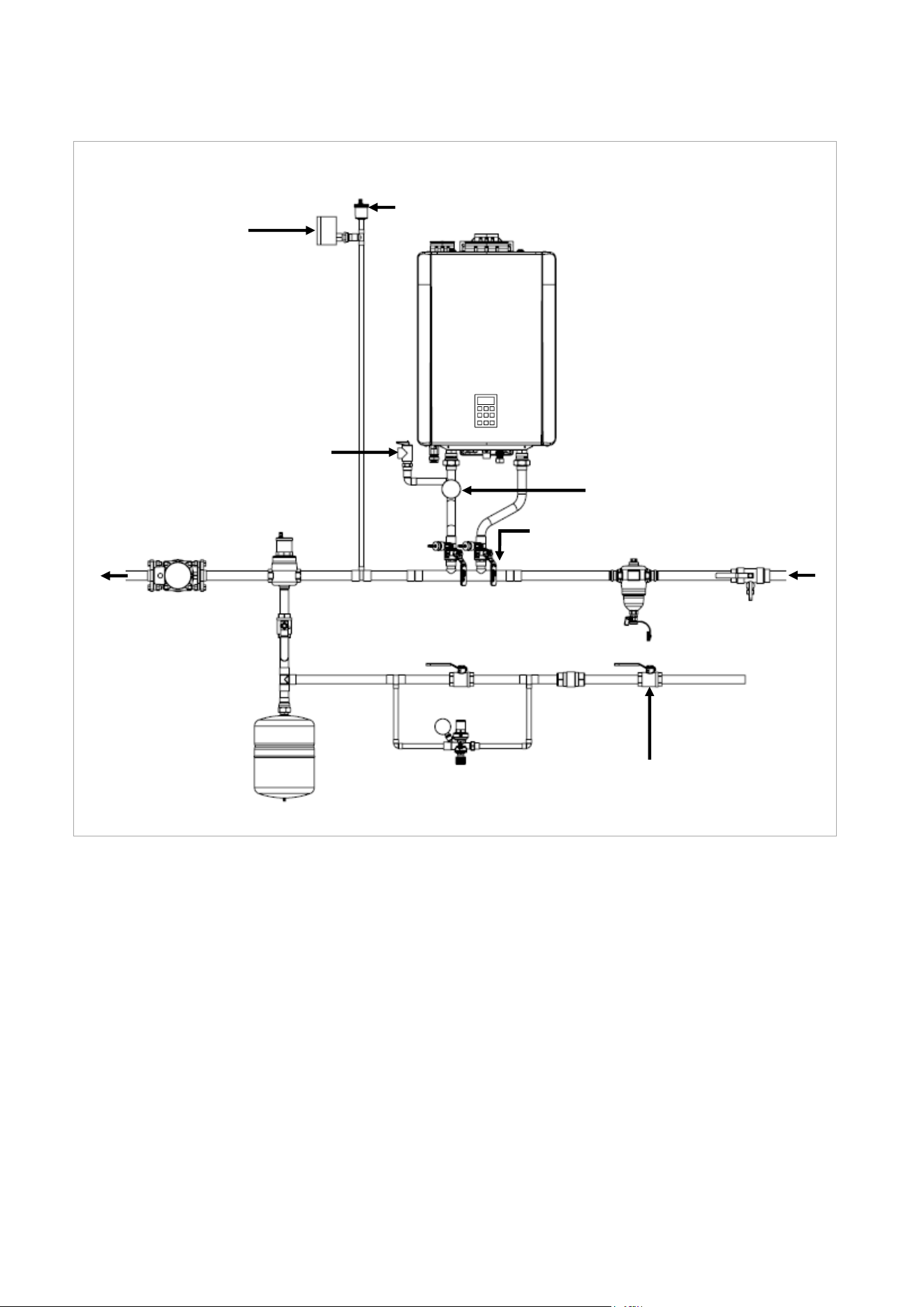
55
Rinnai I-Series Plus Condensing Combi Boiler Manual
Pressure Relief Valve
(supplied with boiler)
Dirt Trap
Backow
Preventer
Fill Valve with
Pressure Gauge
Expansion
Tank
Air Separator
Pressure Gauge
Low Water
Cut O
(if required by
local code)
Ball Valve
System
Supply
System
Return
CH System Common Components Diagram
Primary-Secondary
Heang Kit
Air Vent
Figure 50
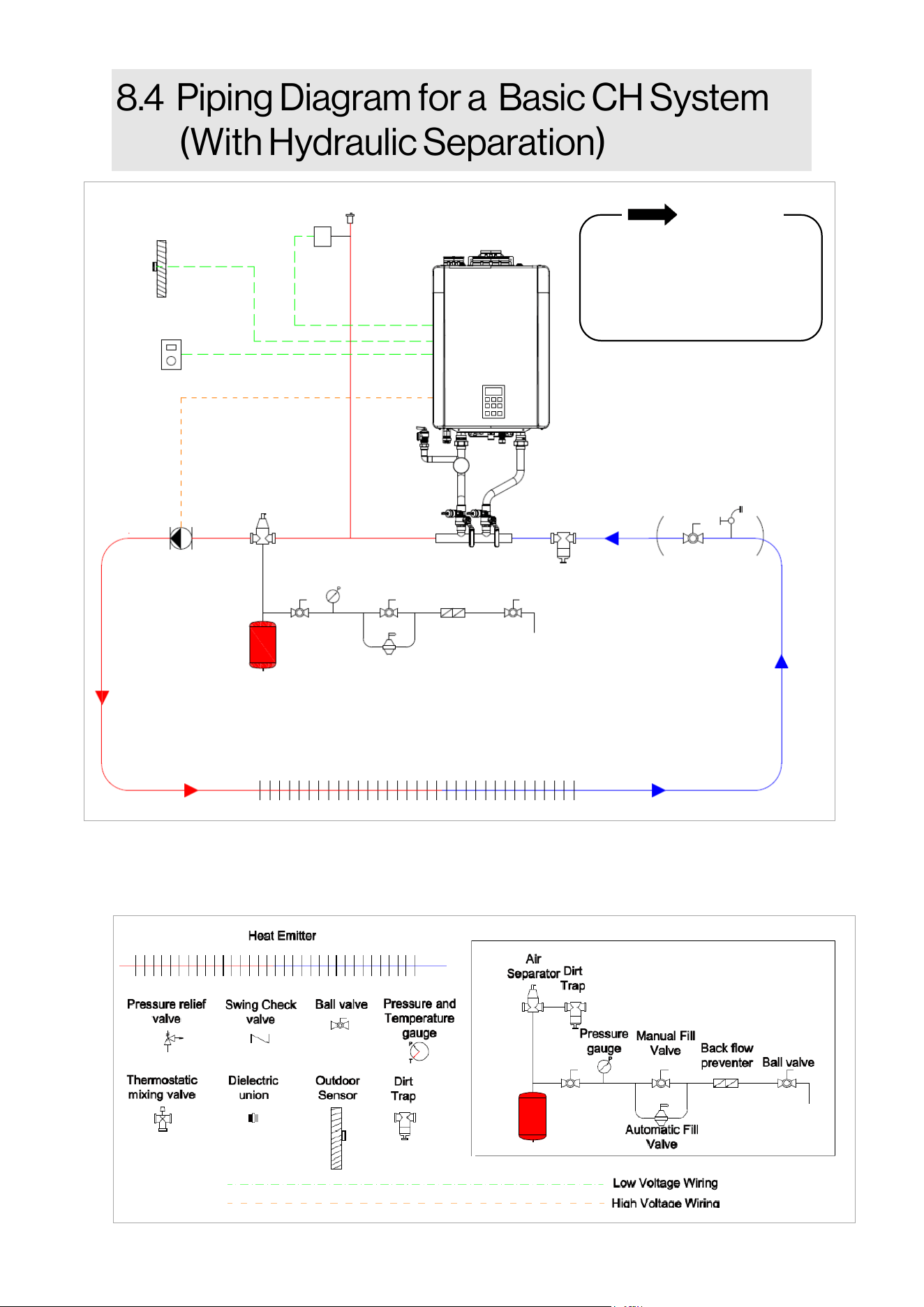
56
Rinnai I-Series Plus Condensing Combi Boiler Manual
This is not an engineering drawing; it is intended only as a guide and not as a replacement for professional engineering
project drawings. This drawing is not intended to describe a complete system. It is up to the contractor or engineer to
determine the necessary components and conguraon of the parcular system to be installed. The drawing does not
imply compliance with local building code requirements. It is the responsibility of the contractor or engineer to ensure
the installaon is in accordance with all local building codes. Confer with local building ocials before installaon.
Heat Emier
Thermostat
Outdoor
Sensor
Oponal Low Water Cut-O (LWCO)
This schemac shows an
example of a simple single zone
system with primary/secondary
piping by hydraulic separaon.
Purge Staon
IMPORTANT
This picture illustrates a suggested
arrangement. Some of the ngs
are oponal.
LEGEND
Figure 52
Figure 51
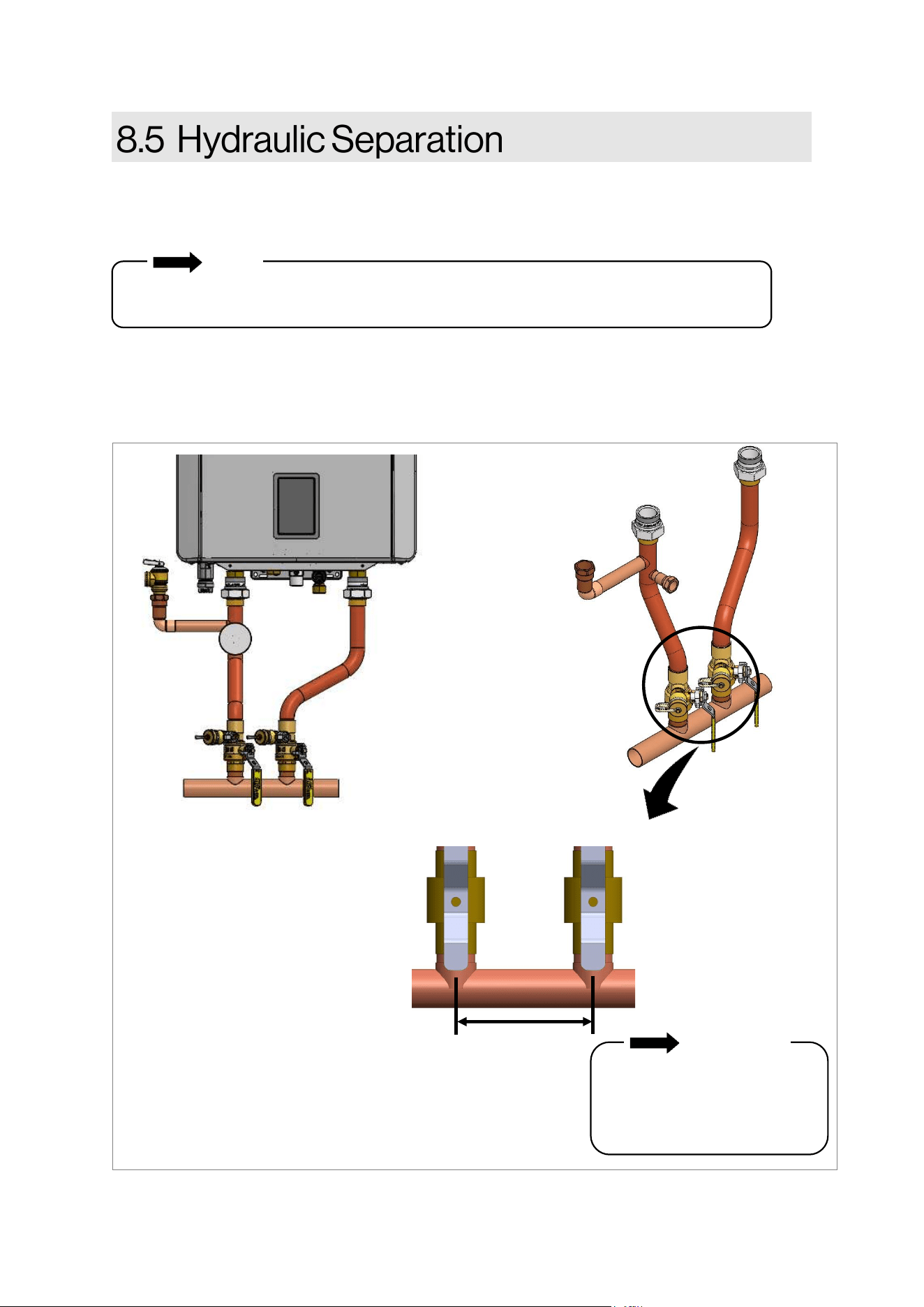
57
Rinnai I-Series Plus Condensing Combi Boiler Manual
Rinnai requires the use of hydraulic separaon between the boiler and central heang system.
Hydraulic separaon and primary/secondary piping allow two or more circulators in a hydronic
system to operate independently, without interfering with ow in connecng piping circuits.
Distance no
more than four
pipe diameters
IMPORTANT
For closely spaced tee
installaons, the separaon
at the header is to be no
more than four pipe
diameters.
Closely Spaced Tees
Boiler Return
NOTE
When Rinnai I-Series Plus Boilers are in use with Rinnai air handlers, please reference the
air handler Installaon and Operaon Manual for installaon and performance details.
Examples of Hydraulic Separaon
Closely spaced tees and low loss headers are common examples of hydraulic separators and are
used to separate the boiler loop from the central heang loop.
Primary/Secondary Piping
Boiler Supply
Figure 53
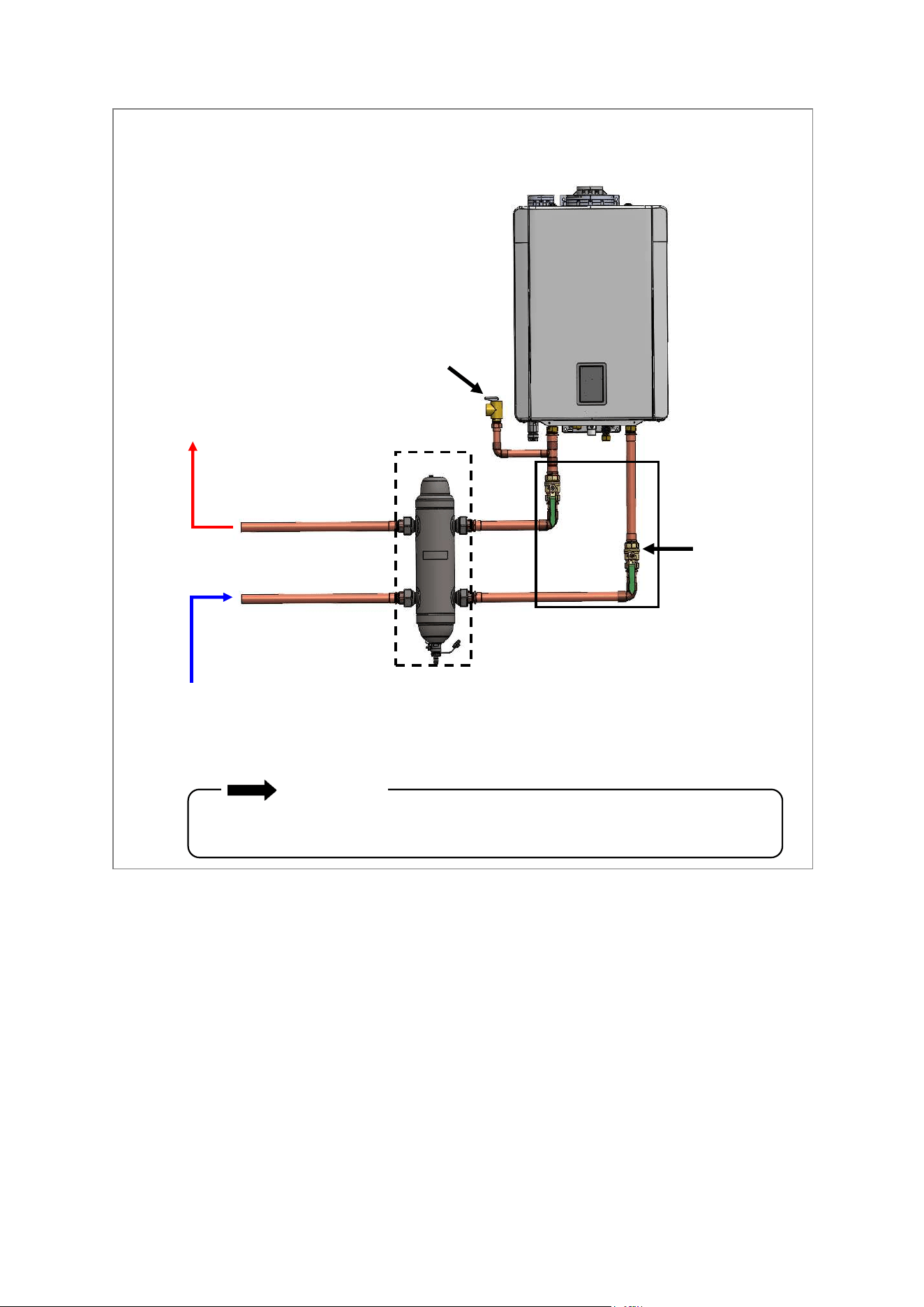
58
Rinnai I-Series Plus Condensing Combi Boiler Manual
Low Loss Header
To Heang Supply
From Heang Return
Shut O Valves
Pressure Relief Valve
Low Loss
Header
IMPORTANT
If using a low loss header, install the PRV and shut o valves between the boiler
and low loss header (as illustrated in the above image).
Figure 54
59
Rinnai I-Series Plus Condensing Combi Boiler Manual
An approved pressure relief valve is required
by the American Naonal Standard (ANSI
Z21.13) and ASME Boiler and Pressure Vessel
Code, Secon IV (Heang Boilers) for all water
heang systems and shall be accessible for
servicing (an approved pressure relief valve is
supplied with the boiler). When connecng a
pressure relief valve, follow the guidelines
below:
• The pressure relief valve must comply with
the standard for Relief Valves and
Automac Gas Shuto Devices for Hot
Water Supply Systems ANSI Z21.22, the
standard Temperature, Pressure,
Temperature and Pressure Relief Valves
and Vacuum Relief Valves, CAN1-4.4, and/
or the ANSI/ASME Boiler and Pressure
Vessel Code, Secon IV (Heang Boilers).
• The pressure relief valve must be rated up
to 150 psi for DHW systems, and to at
least the maximum Btu/hr of the
appliance.
• The pressure relief valve must be rated up
to 30 psi for central heang systems, and
to at least the maximum Btu/hr of the
appliance.
• The discharge from the pressure relief
valve should be piped to the ground or into
a drain system per local codes.
• The pressure relief valve must be manually
operated once a year to check for correct
operaon.
• The discharge line from the pressure relief
valve should pitch downward and
terminate 6 in. (152 mm) above drains
where discharge will be clearly visible.
An ASME 30 psi safety pressure relief
valve is included with the boiler and
must be ed before any shut o valve
in the system.
• DO NOT plumb the pressure relief
valve with the condensate drain;
both must be plumbed
independently to drain.
• DO NOT plug the pressure relief
valve and do not install any reducing
ngs or other restricons in the
relief line. The pressure relief line
should allow for complete drainage
of the valve and the line.
• DO NOT place any other valve or
shuto device between the pressure
relief valve and the boiler.
Water discharged from the pressure relief
valve could cause severe burns instantly or
death from scalds.
• The discharge end of the line shall be plain
(unthreaded) and a minimum of 3/4 in.
nominal pipe diameter. The discharge line
material must be suitable for water at
least 180°Fahrenheit (82°Celsius).
• If a pressure relief valve discharges
periodically, this may be due to thermal
expansion in a closed water supply system.
Contact the water supplier or local
plumbing inspector on how to correct this
situaon. Do not plug the pressure relief
valve.
• The American Naonal Standard (ANSI
Z21.13) does not require a combinaon
temperature and pressure relief valve for
this appliance. However, local codes may
require a combinaon temperature and
pressure relief valve.
• Protect pressure relief valve and pressure
relief valve discharge line from freezing.
Do not plug or restrict ow of the pressure
relief valve.
IMPORTANT
WARNING
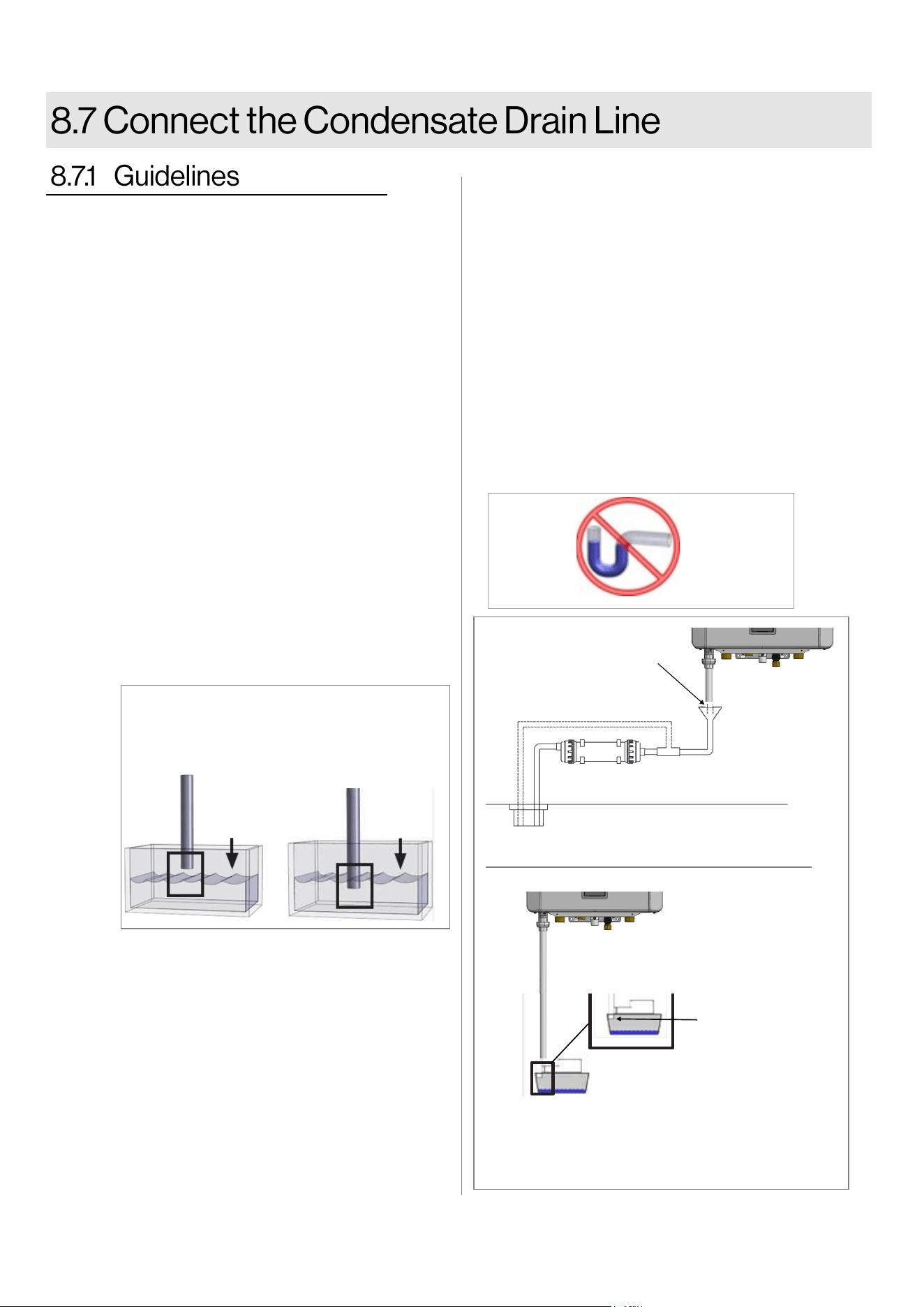
60
Rinnai I-Series Plus Condensing Combi Boiler Manual
Refer to neutralizer Installaon Manual and local
codes for neutralizer installaon guidelines.
Image is for reference purposes only.
To prevent condensate damage, follow these guidelines:
•
Do not plumb the condensate drain with the
pressure relief valve; both must be plumbed
independently to drain.
• All condensate must drain and be disposed of
according to local codes.
• Use only corrosion resistant materials for the
condensate drain lines such as PVC pipe or
plasc hose.
• T
he condensate drain pipe (along its enre
length) must be at least the same diameter as
the drain line (1/2 in. MNPT).
• Condensaon drain lines installed in areas that
are subject to freezing temperatures should be
wrapped with an approved supplemental heat
source. Install per manufacturer’s instrucons.
•
Slope the condensate drain lines toward the
inside oor drain or condensate pump.
• The end of the condensate drain pipe should be
open to the atmosphere. The end should not be
under water or other substances.
• For external (outdoor) installaons, to minimize
freezing of the condensate, run the condensate
drain line through an interior wall or between
insulaon and an interior wall.
• If a oor drain is not available or the drain is above
the level of the condensate drain, a condensate
pump should be installed.
• A condensate neutralizer kit (part number 804000074)
is available from Rinnai. The kit allows condensate to
ow through neutralizing media that raises the pH of
the condensate to a level that will help prevent
corrosion of the drain and public sewer system. Refer to
secon “3.6 Accessories” for more informaon.
• The condensate drain pipe should be as short as
possible and have a downward pitch.
• Pour approximately 10 ounces (1.25 cups) of water
directly into the boiler’s exhaust port.
• DO NOT connect the condensate drain line with an air
condioning evaporator coil drain.
• Boilers have an integrated condensate trap. DO NOT
install an external condensate trap.
CORRECT NOT CORRECT
Pipe submerged in
water
Pipe open to
atmosphere
Water
Level
Water
Level
Pipe open to
atmosphere
Condensate Pump
*Overow bypass
* Safety overow if condensate drain
becomes clogged.
Air Gap
Figure 57
Figure 56
Figure 55
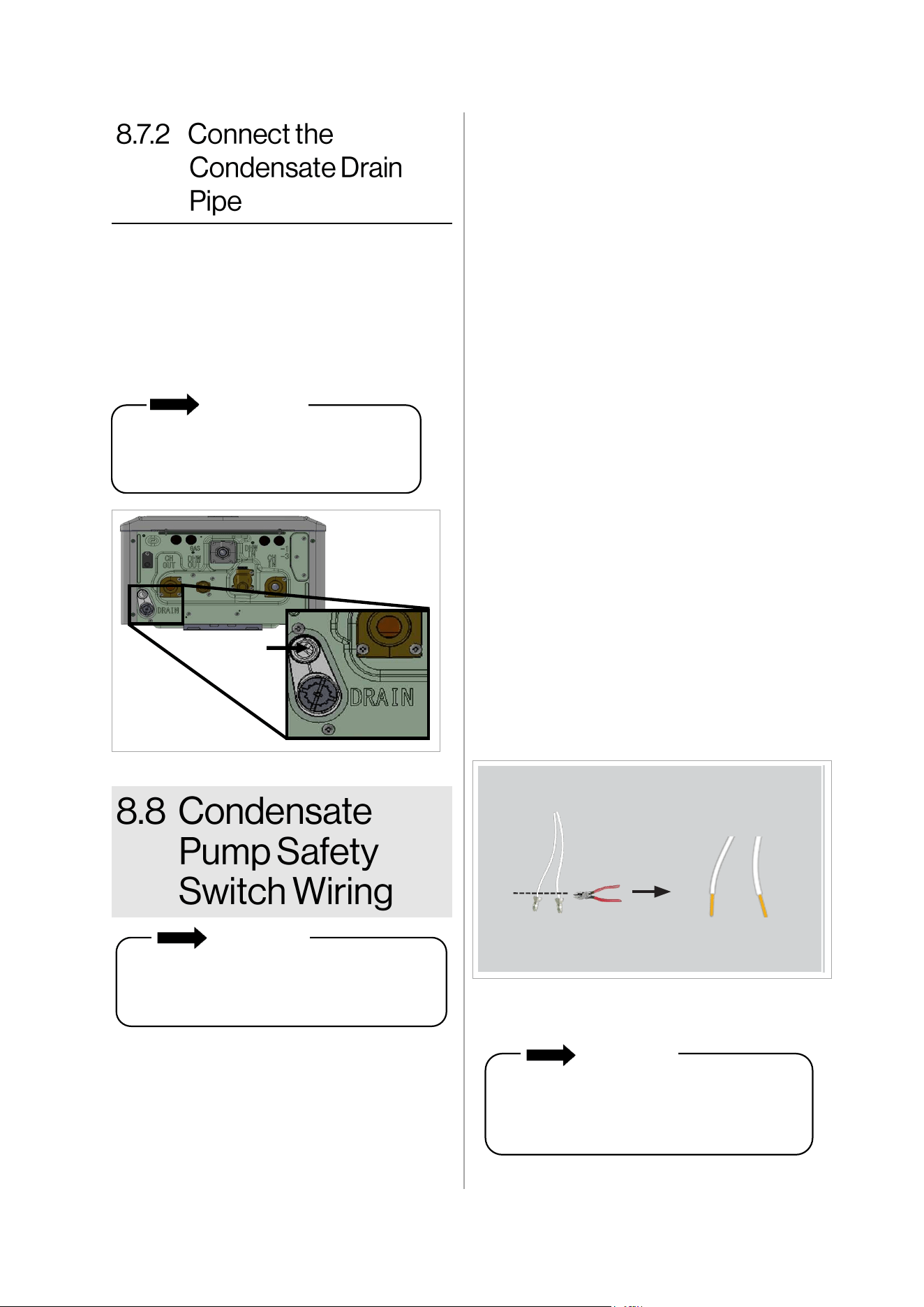
61
Rinnai I-Series Plus Condensing Combi Boiler Manual
IMPORTANT
To connect the condensate drain pipe:
1. Apply thread sealant to 1/2 in. NPT
condensate drain port.
2. By hand, thread 1/2 in. NPT ng onto
condensate drain port.
3. Follow the steps in the next secon: “8.8
Condensate Pump Safety Switch Wiring.”
The condensate pump (if installed) should be
wired to deacvate the boiler in the event the
condensate pump fails.
1. Disconnect power from the boiler.
2. Open the boiler cover and locate two white
wires labeled “To Condensate Pump” (the
wires may be located behind the PC Board).
3. Cut crimp connectors o white wires and
strip the insulaon o of the two ends.
Condensate Drain
DO NOT use a wrench to ghten the
condensate drain pipe connecon as this
could cause the connecon to break.
IMPORTANT
The steps in this secon must conform with
local codes and the guidelines established by
the Naonal Electrical Code (NEC).
4. Select an appropriate length of wire (18
AWG or greater) and strip the insulaon
o the ends. Follow the wiring guidelines
established by the Naonal Electrical Code
(NEC).
5. With wire nuts or other approved wire
connectors, connect the “To Condensate
Pump” wires to the normally open
contacts on the condensate pump (see
image below).
6. Reconnect power to the boiler and press
the On/O buon on the controller.
Test Operaon
1. Test the operaon of the shut o switch
by unplugging the condensate pump and
lling the condensate reservoir with
water unl the oat switch closes the
circuit.
2. Turn on the boiler.
3. The boiler displays diagnosc code “250.”
4. Plug in the condensate pump and conrm
condensate is owing out of the
reservoir.
5. Turn o the boiler by pressing the On/O
buon on the controller. Wait ve
seconds, then turn the power back on.
This will clear the diagnosc code.
Boiler condensate pump safety switch is NO
(normally open) and faults when the circuit
closes.
IMPORTANT
Strip insulaon o
both ends of wire
Cut o crimp
connectors
To Condensate Pump Safety Switch
Figure 58
Figure 59
1/2 in.
NPT
62
Rinnai I-Series Plus Condensing Combi Boiler Manual
IMPORTANT
• Do not use an extension cord or adapter
plug with this appliance.
• The boiler must be electrically grounded
in accordance with local codes and
ordinances or, in the absence of local
codes, in accordance with the Naonal
Electrical Code, ANSI/ NFPA No. 70.
• Boilers are equipped with a three-prong
(grounding) plug for your protecon
against shock hazard and should be
plugged directly into a properly
grounded three-prong receptacle. Do not
cut or remove the grounding terminal
from this plug.
When connecng the power supply, follow
these guidelines:
• If using the 5 (1.5 m) power cord
(supplied with boiler), plug it into a
standard three-prong 120 VAC, 60 Hz
properly grounded wall outlet.
• The boiler requires 120 VAC, 60 Hz
power from a properly grounded
circuit.
• Do not rely on the gas or water piping
to ground the boiler. Ground locaons
are provided inside the boiler.
• The wiring diagram is located on the
inside of the boiler front cover.
• This boiler is supplied with 120 volts and
is equipped with a three-prong
(grounding) plug for your protecon
against shock hazard. The plug should be
plugged directly into a properly
grounded three-prong receptacle. Do
not cut or remove the grounding
terminal from this plug.
• Disconnect incoming power to the boiler
by removing the three-prong plug
before:
− Performing repairs or installaon to
internal components or accessories.
− Making wiring connecons and/or
changes to the wiring terminals on
the boiler.
• No changes may be made to the wiring
of the boiler.
• All connecons should be designed in
accordance with the applicable
regulaons.
• Label all wires prior to disconnecon
when servicing controls. Wiring errors
can cause improper and dangerous
operaon.
• Verify proper operaon aer operaon
servicing.
A manually operated remote switch
should be located outside the boiler
room door for shung down the
boiler. Consideraon should be given
to protect the switch against
tampering. If there is more than one
door to the boiler room, a switch
should be located at each door.
Topics in this secon
• Guidelines
• Electrical Connecons
• Post-Power Supply Connecon
Checklist
CAUTION
WARNING
CAUTION
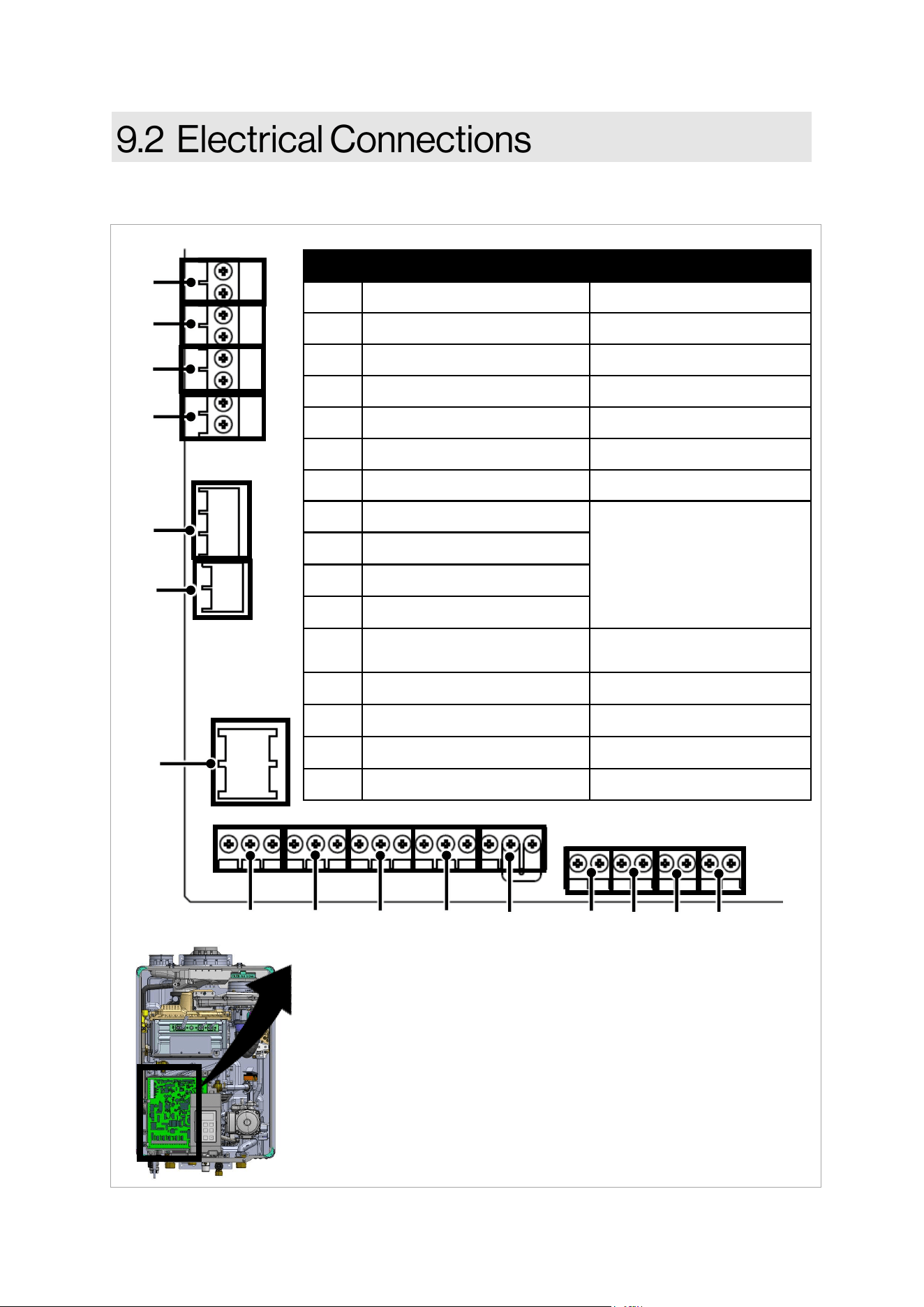
63
Rinnai I-Series Plus Condensing Combi Boiler Manual
Devices such as the room thermostat, outdoor temperature sensor, zones pumps, and relay
controls are connected to the boiler PC Board.
⓫
❿
❾
Item # Connecon Item Note
❶ 0-10V Compable Model Only
❷ Outdoor Temperature Sensor
❸ System Thermistor (Solo Only) Compable Model Only
❹ DHW Thermistor (Solo Only)
❺ Air Handler Connecon
❻ Internal Pump Connecon 120 VAC
❼ Power Input
❽ T/T 1 Connecon
C, R, W Thermostat
Connecons
Max 0.2 A
❾
T/T 2 Connecon
❿
T/T 3 Connecon
⓫
T/T 4 Connecon
⓬
LWCO (High Limit or Other
Safety Switch)
Included Jumper from Factory
⓭
External Pump Connecon 4 120 VAC, Max 2.0 A
⓮
External Pump Connecon 3 120 VAC, Max 2.0 A
⓯
External Pump Connecon 2 120 VAC, Max 2.0 A
⓰ External Pump Connecon 1 120 VAC, Max 2.0 A
❶
❻
❼
PC Board
⓬
⓮
⓭
⓯
⓰
❺
❷
❸
❹
Table 31
Figure 60
❽
C R W
C R W
C R W
C R W
64
Rinnai I-Series Plus Condensing Combi Boiler Manual
□
Conrm that the electricity is supplied from a 120 VAC, 60 Hz power source and is in a
properly grounded circuit.
□
Conrm that an extension cord or adapter plug has NOT been used with the boiler.
□
Conrm connecon terminals are connected correctly.
• Rinnai recommends the use of spade connectors or similar components for wiring to the
screw terminals.
• Ensure that the insulaon of the wire is not exposed to contact any other components
besides the terminal.
• If exposed wiring contacts to any other exposed wiring or metal components, an electrical
short may occur and cause damage to the PCB or other connected components.
• Use proper size of screwdriver for prevenng the screw on the terminal from breaking.
• Do not use an electric or torque screwdriver for wiring on the PC Board.
• Wiring should pass through the grommets provided at the boom of the boiler.
• Use proper diameter and size of wiring.
CAUTION
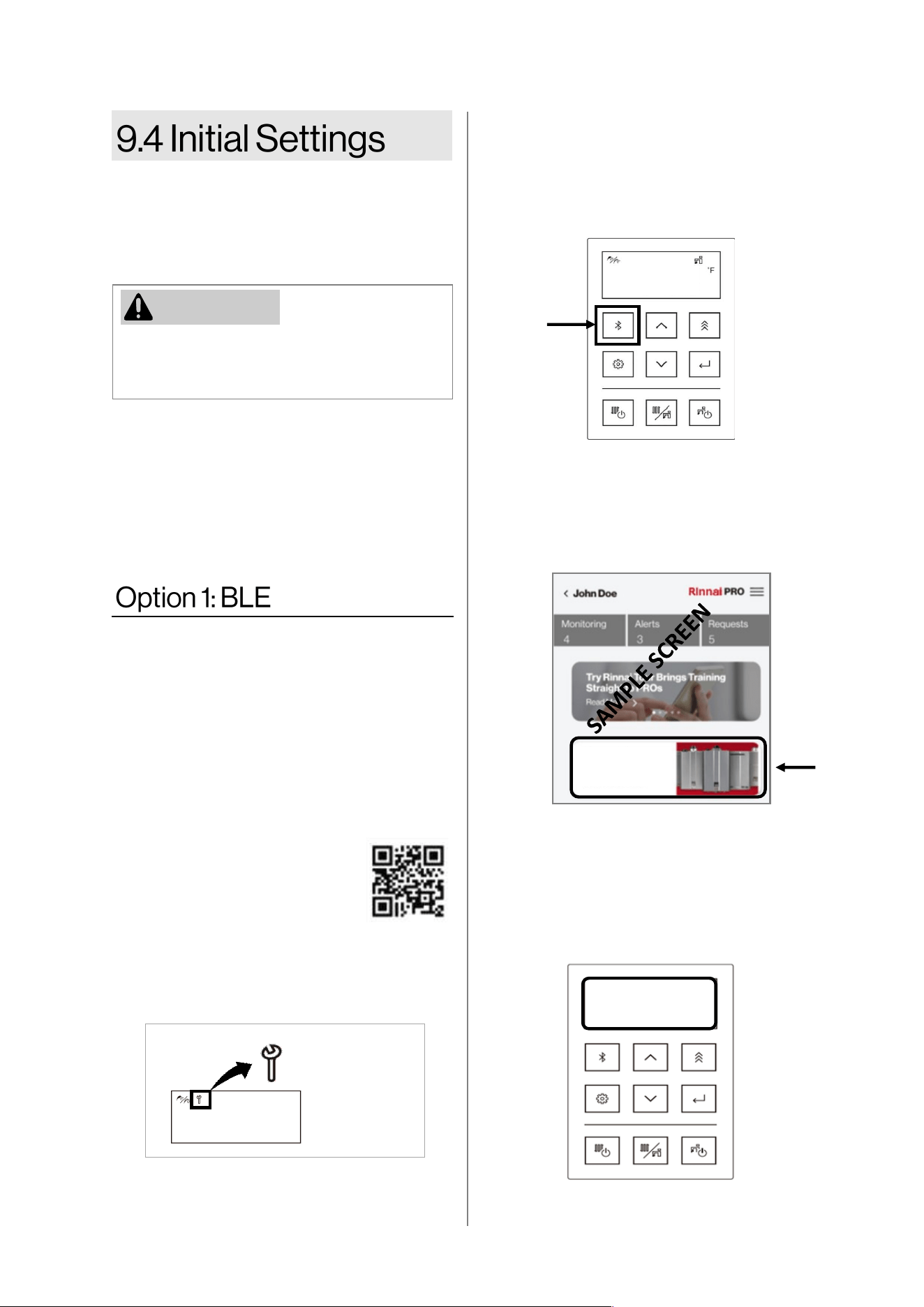
65
Rinnai I-Series Plus Condensing Combi Boiler Manual
This boiler is set up for natural gas and PVC
indoor installaons as default. When power is
connected for the rst me, you need to
conrm the sengs below or change them
properly.
I
f proper sengs are
not selected before
you use the boiler, it will cause a hazardous
situaon which results in personal injury or
property damage.
WARNING
Conrm/change inial sengs of the boiler by
choosing one of the two opons below:
Opon 1 (recommended): Conrm/change
sengs from a smart device using Bluetooth
Low Energy (BLE).
Opon 2: Conrm/change sengs from the
boiler controller.
To conrm/change inial sengs of the boiler
from a smart device using BLE recommended),
follow the steps below:
Note: To ulize BLE, your connecng device
(smartphone, tablet, computer, etc.) needs to
have Bluetooth 4.0 or a newer version.
Contact your connecng device manufacturer
if you are not sure. If your connecng device
has Bluetooth 4.0 or a newer version.
1. Download the Rinnai Central
app by scanning the
following QR code:
2. Supply power to the boiler for the rst
me. The controller displays “SEt” and the
Maintenance Mode icon on the controller
is blinking.
3. Open the Rinnai Central app from your smart
device and log into the Rinnai Central app with
a professional account.
4. Push the Bluetooth buon on the controller.
The Bluetooth LED light turns solid.
5. Tap “Connect to a Rinnai Boiler” on the
Rinnai Central app. You will hear a beeping
sound when pairing between the app and
boiler is established.
6. Follow the steps in the Rinnai Central app to
conrm and/or change your boiler sengs.
7. When sengs are completed, the controller
display will be normal operaon status.
Figure 64
Figure 61
Figure 63
Figure 62
SEt
Connect to a
Rinnai Boiler
SEt
Maintenance
Mode Icon
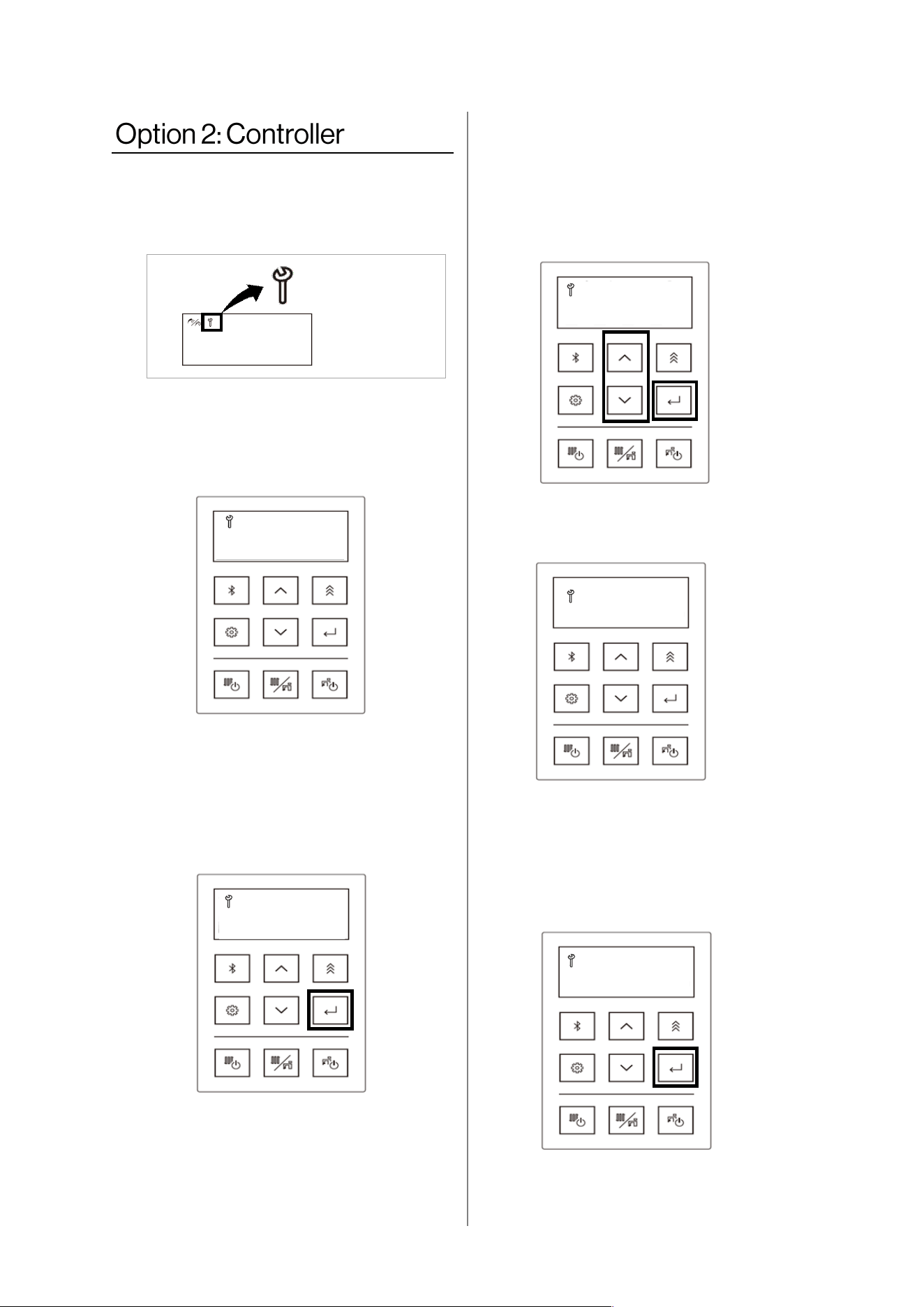
66
Rinnai I-Series Plus Condensing Combi Boiler Manual
3(A). If using natural gas: Press the Select
buon to conrm natural gas. Then,
proceed to step 4.
If using propane gas, skip this step and
proceed to step 3(B).
1. Supply power to the boiler for the rst me.
The controller displays “SEt” and the
Maintenance Mode icon appears.
2. Press the Sengs menu buon. The
controller displays “nG” (natural gas).
3(B). If using propane gas: Press the up or
down arrow buon. The controller
displays ”LPG” (Liquid Propane Gas).
Press the Select buon to conrm Liquid
Propane Gas. Proceed to step 4.
5.(A). If you install the boiler by PVC venng:
Press the Select buon. Proceed to step 6.
If you install the boiler by PP venng:
Proceed to step 5(B).
4. The controller displays “PVC.”
Figure 69
Figure 68
Figure 67
Figure 66
Figure 65
Figure 70
nG
nG
LPG
PVC
PVC
SEt
Maintenance
Mode Icon
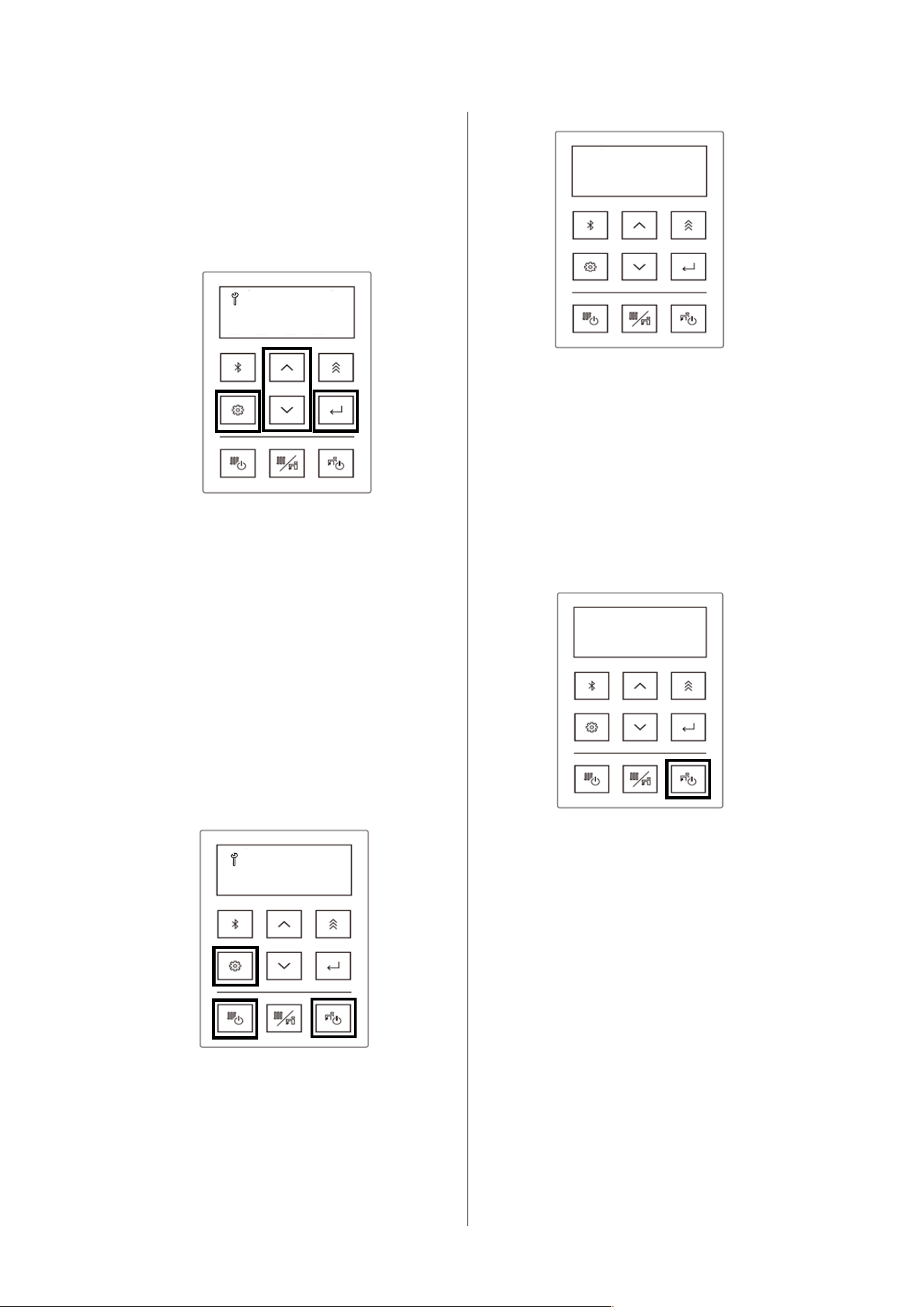
67
Rinnai I-Series Plus Condensing Combi Boiler Manual
5(B). If you install the boiler by PP venng:
Press the up or down arrow buons.
The controller displays “PP.”
Press the select buon to conrm PP.
When you re-enter each seng, press the
seng menu buon to go back to step 1.
Proceed to step 6.
6. The controller displays “nG” or “LPG” and
“PVC” or “PP” alternavely while the select
menu buon and ON/OFF buon is
blinking. The controller shows the current
gas seng and indoor/outdoor seng.
For example, the controller displays “NG”
and “PVC” alternavely, indicang the
boiler is set for natural gas and PVC venng
installaon. If you need to change these
sengs, press the Seng menu buon to
go back to step 1. Otherwise, press the
“ON/OFF” buon.
7. The controller briey displays “888” while
a beeping sound is observed. Then,
complete inial sengs and the controller
is o.
8. If you set inial sengs incorrectly, you
can adjust the sengs by conguring the
parameter sengs. Follow the steps in
secon “12.4 Parameter Sengs” and
change parameters A0 (Gas Type) and A2
Venng correctly.
9. Aer inial sengs are completed, press
the On/ O buon to turn on the unit.
10. If ”LPG” (Liquid Propane Gas) is selected,
apply the supplied gas conversaon label at
an open space above the exisng label on
the le side of the boiler.
Note: See the “Key Points For A Successful
Installaon” document (on boiler front
cover) for illustraon of label locaon.
11. The default altude seng for this boiler is
0-2,000 . (0-610 m). If this boiler is
installed at a dierent altude, select the
appropriate altude seng. Also, set up
other parameters property. Refer secon
“12.4 Parameter Seng” for specic details
on seng parameters.
Figure 74
Figure 73
Figure 72
Figure 71
PP
888
68
Rinnai I-Series Plus Condensing Combi Boiler Manual
Failure to properly commission the boiler as
described in this secon
may result in
unreliable and unsafe burner operaon and
reduced component life.
Boiler commissioning is a procedure used
aer boiler installaon to ensure the system
and boiler were installed correctly and ready
for operaon.
THIS SECTION IS INTENDED
FOR THE INSTALLER
This boiler must be commissioned by a
licensed professional. Installer qualicaons:
A trained and qualied professional must
install the appliance, inspect it, and leak test
the boiler before use. The warranty will be
voided due to any improper installaon. The
trained and qualied professional should
have skills such as: Gas sizing; Connecng
gas lines, water lines, valves, and electricity;
Knowledge of applicable naonal, state, and
local codes; Installing venng through a wall
or roof; and training in installaon of
condensing boilers. Training for Rinnai
Condensing I-Series Plus Boilers is accessible
online at rinnaipro.myabsorb.com.
1. Ensure all boiler components are installed
correctly.
2. Open the air vent inside the boiler.
3. Power on the boiler.
4. Open the ll valve on the lling circuit.
5. Check the pressure on the controller and/or
pressure gauge. Fill the boiler to a minimum of
20 PSI (138 kPa) water pressure and a maximum
of 30 PSI (207 kPa).
6. An E430 diagnosc code will be present unl the
boiler senses at least 13 PSI (90 kPa).
7. Check the heang system for leaks.
8. Begin the deaeraon process shown in the next
secon (“10.3 Deaeraon Process”).
• Work on the boiler must be carried out by a
licensed professional, using correctly
calibrated instruments with current test
cercaon. The commissioning instrucons
are intended for licensed professionals who
have the necessary knowledge and are
approved for working on heang and gas
systems.
• The fan will operate when power is inially
provided to perform a safety check on the
boiler.
• The boiler and its individual shut o valve
must be disconnected from the gas supply
piping system during any pressure tesng of
that system at test pressures in excess of
1/2 PSI (3.5 kPa).
• Before the boiler is red for the rst me:
− Ensure the boiler and system are fully
de-aerated
− Purge the gas line between the gas
meter and boiler
− Prime the pump (as described in this
secon)
IMPORTANT
IMPORTANT
Topics in this secon
• Safety Precauons
• Filling Process
• Deaeraon Process
Do not ll the boiler unless permanent power is
available. Freeze protecon is not available if
the boiler is not lled, air purged, and supplied
with power and gas.
WARNING
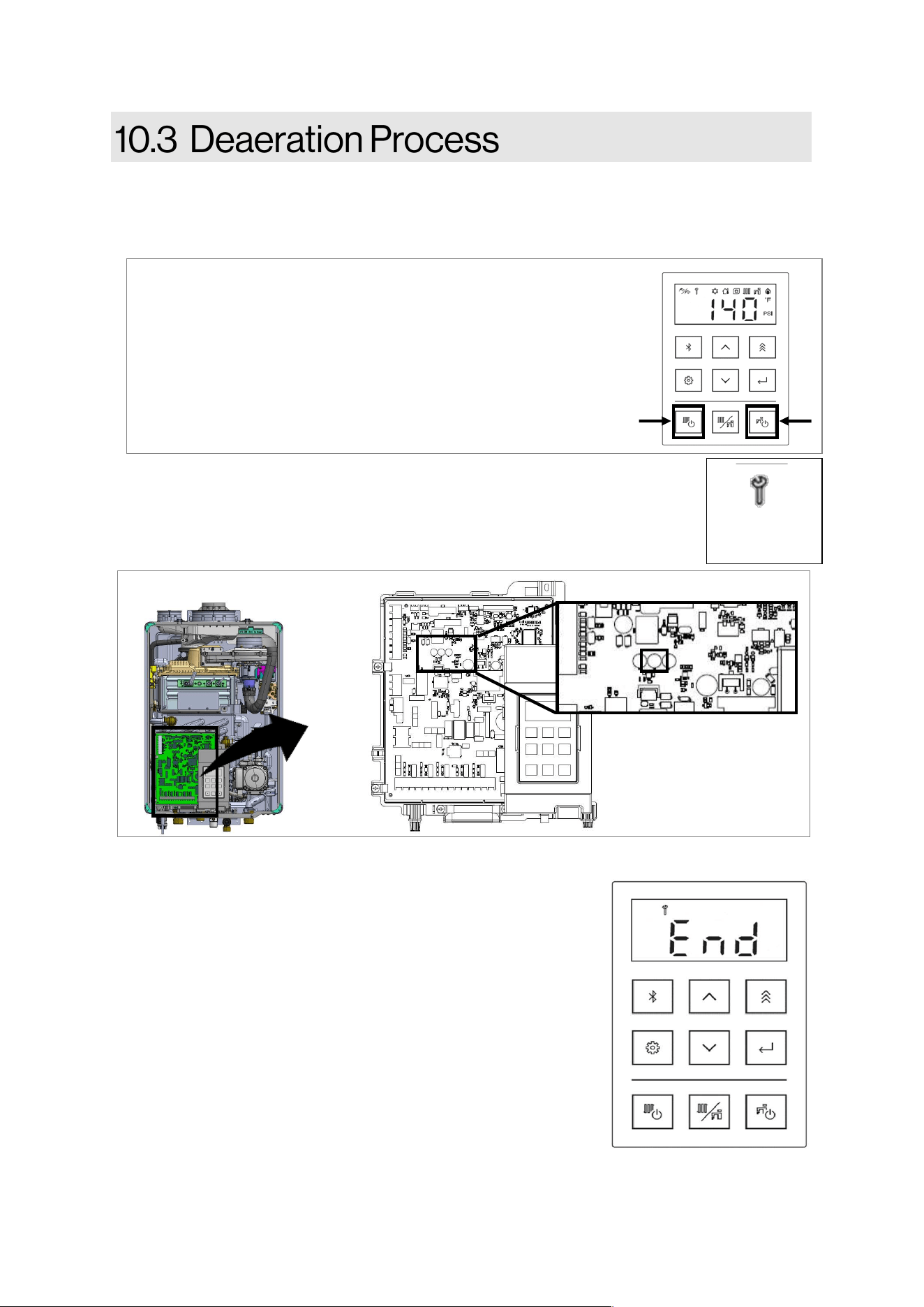
69
Rinnai I-Series Plus Condensing Combi Boiler Manual
You Will Need:
• Philips head screwdriver
1. Remove the boiler’s front panel by removing the two screws that secure the panel.
3. Conrm whether all heat emiers and pumps are connected to
the piping system.
4. Fill the boiler to a minimum of 20 PSI (138 kPa) water pressure
and a maximum of 30 PSI (207 kPa).
5. The deaeraon process takes approximately 15 minutes for
compleon.
Aer 15 minutes, the display will show “End” (see right image).
The commissioning process is complete.
6. On the PC Board, press the top, le black buon again to
resume normal operaon mode.
7. Operate the domesc hot water or central heang to ensure
the boiler operates properly.
8. Close the air vent on the pump. Aer approximately one week,
all air in the system should be eliminated via the air separator in
the piping system.
Note: Alternately, on inial installaon, you may press and hold the
DHW buon then simultaneously press the CH buon on the control
panel instead of removing the boiler’s front panel.
2. On the PC Board, press and hold the SW2 buon shown below. The
Maintenance Mode icon (see right image) on the controller display will
appear and iniate the deaeraon process.
Maintenance
Mode icon
PC Board
Figure 76 (B)
Figure 76 (A)
Figure 75
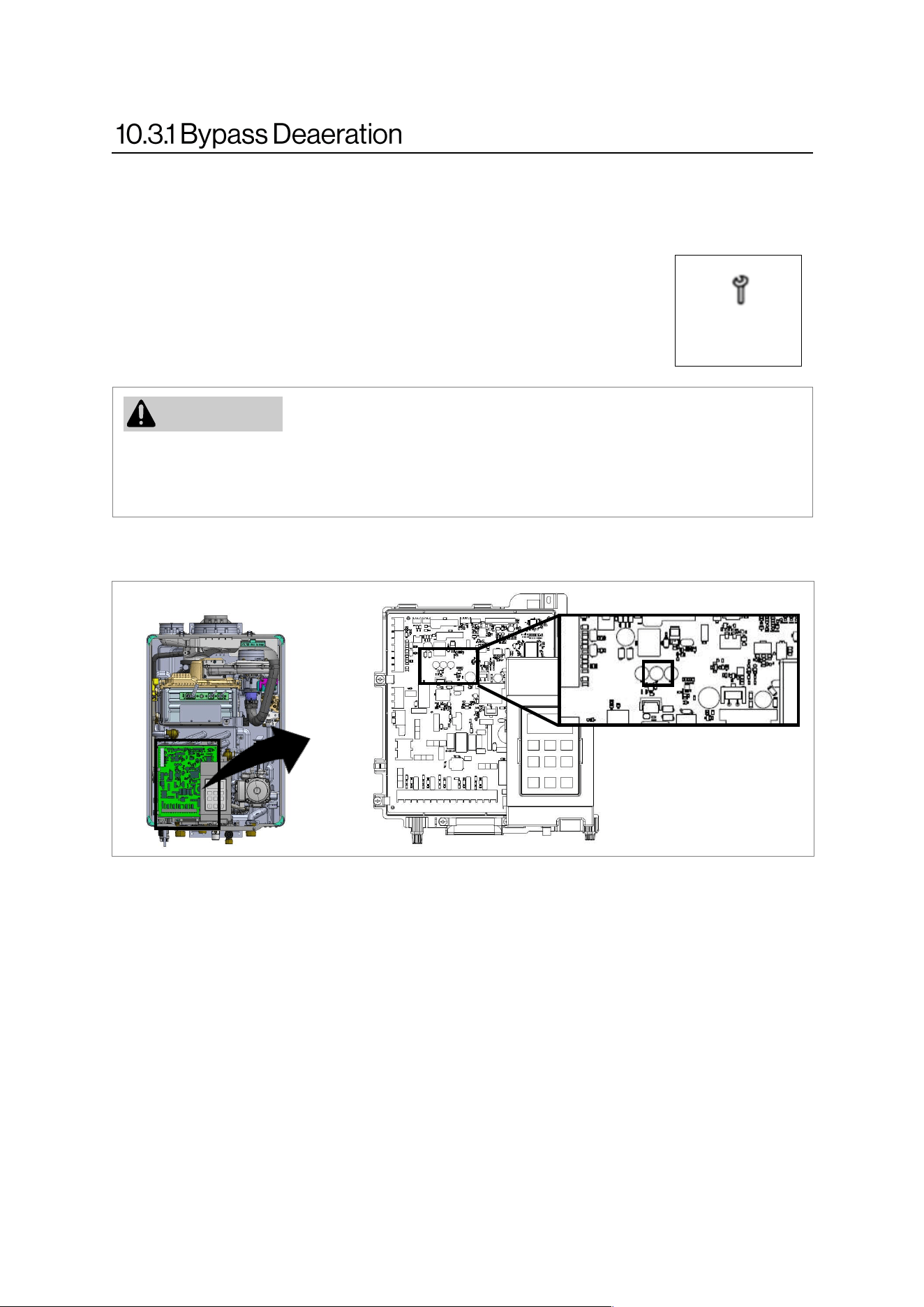
70
Rinnai I-Series Plus Condensing Combi Boiler Manual
DO NOT bypass the deaeraon program during commissioning or if any part of the system has
been opened or disconnected. Failure to properly deaerate the boiler and system may result in
damage to the boiler, which is not covered by the boiler warranty.
To iniate or end the deaeraon process, press and hold the SW2 buon (shown below).
Deaeraon is an eecve method of purging air from the boiler aer the system has been lled or
serviced. While the boiler is running the deaeraon process, the Maintenance Mode icon (see
image) appears on the controller display.
PC Board
Maintenance
Mode icon
Figure 77
WARNING
Do not bypass deaeraon during commissioning or if the system pressure has
dropped below 13 PSI (90 kPa). If there is any chance that air has entered the
system, deaeraon is crical to prevent damage to the boiler.
71
Rinnai I-Series Plus Condensing Combi Boiler Manual
Complete the following checklist when boiler installaon is complete. You should be able to answer
YES to each queson. If you answer NO, installaon is not complete. Refer to the applicable secon
in this manual for addional informaon.
INSTALLATION LOCATION YES NO
Have you veried the unit, vent and air intakes meet the clearance requirements?
VENTING YES NO
Have all corrosive compounds been removed from around the combuson air intake of the boiler?
Have you followed the combuson air requirements to provide sucient combuson air for the boiler?
Are the correct venng products for the installed model being ulized?
Have you installed the vent screen(s) for Schedule 40 PVC/CPVC vent applicaons if applicable?
Have you veried the vent system does not exceed maximum length?
SYSTEM PIPING YES NO
Have the water lines been purged of all debris and the lter cleaned?
Have you veried the hot and cold water lines to the boiler are not interchanged?
Does the water supply to the boiler have adequate pressure? Is it free of chemicals? Did you verify it
does not exceed total hardness that will damage the heat exchanger?
Have you veried that no toxic chemicals were introduced to the potable water?
Did you drain the boiler if not intended to be used immediately?
Have water quality issues (if any) been addressed?
Have you performed the leak and pressure test for the boiler and plumbing system?
Are the isolaon valves installed? (for DHW systems only)
CONDENSATE DRAIN YES NO
If the condensate pump is installed, is it wired to deacvate the boiler in the event of failure?
Did you verify the condensate drain pipe is as short as possible and has a downward pitch toward the
drain or condensate pump?
Is all condensate drained and disposed of as per local codes?
Did you use ONLY corrosion resistant materials for the condensate drain lines?
Did you verify the condensate drain pipe along its enre length is at least the same diameter as the
drain line?
Did you check to ensure the condensaon drain lines are protected from freezing?
Have you veried the condensate drain line is not plumbed with the pressure relief valve?
Have you conrmed the condensate drain line is not connected with an air condioning evaporator coil
drain?
This boiler has an integrated condensate trap. Have you veried that an external condensate trap is not
installed?
Have you conrmed the end of the condensate drain pipe is open to atmosphere?
Has an air gap been installed in the condensate drain line?
72
Rinnai I-Series Plus Condensing Combi Boiler Manual
PRESSURE RELIEF VALVE (PRV)
YES NO
Does the PRV comply with the standard for Relief Valves and Automac Gas Shuto Devices for Hot
Water Supply Systems ANSI Z21.22, and/or the standard Temperature, Pressure, Temperature and
Pressure Relief Valves and Vacuum Relief Valves, CAN1-4.4?
Did you verify the DHW PRV is rated up to 150 psi and (at least) the maximum Btu/hr of the boiler and
the heang system PRV rated to 30 PSI?
Is the discharge from the PRV piped to the ground or into a drain system as per local codes?
Is the discharge line from the PRV pitched downward and does it terminate 6 in. (152 mm) above the
drains?
Is the discharge end of the line plain (unthreaded) and a minimum of 3/4 in. diameter?
Is the discharge line material suitable for at least 180°F/(82°C) water?
Did you take measures to protect the PRV and PRV discharge line from freezing?
Have you veried the PRV is not plumbed with the condensate drain line?
Have you veried the PRV is not plugged and that reducing ngs, valves, or other restricons are not
installed in the relief line?
GAS SUPPLY YES NO
Did you verify the gas system is appropriately sized?
Did you verify the boiler is rated for the gas type supplied?
Have you performed a gas line and connecon leak test?
Did you install a manual gas control valve in the gas line to the boiler?
Is the inlet gas pressure within limits?
Did you purge the gas line of any debris before connecng the boiler?
POWER SUPPLY
YES NO
Did you conrm that the electricity is supplied from 120 VAC, 60 Hz power source and is in a properly
grounded circuit?
Did you conrm that an extension cord or an adapter plug has NOT been used with the boiler?
COMMISSIONING
YES NO
Did you prime the pump?
Was the boiler lled to 17-26 PSI?
Was the deaeraon process performed on the boiler?
73
Rinnai I-Series Plus Condensing Combi Boiler Manual
IMPORTANT
• On inial startup of the system, it is necessary to put the boiler into a deaeraon process to
remove all air from the system piping and boiler. Failure to properly deaerate the boiler
and system may result in damage to the boiler, which is not covered by the boiler
warranty.
• It can take up to a week before all the air has disappeared from a newly-lled and
pressurized installaon. During the rst week of operaon, noises can be heard which
indicate the presence of air. The automac air vent in the boiler and air separator in the
heang system will remove the air, which means the water pressure will reduce some
during this period; therefore, addional water is necessary to maintain proper pressure in
the heang system. Water pressure needed for operaon:
− The boiler is in normal operaon between 17 - 26 PSI.
− Below 7.3 PSI, the boiler will have an error code (E430 diagnosc code will be present
on the controller display) and will not operate. Increasing the heang system water
pressure is necessary for operaon.
− Between 7.3 - 13 PSI, operaon will be limited (E430 diagnosc code will be present
on the controller display).
− The maximum pressure permied inside the heat exchanger is 45 PSI.
− The pressure relief valve supplied with the boiler is rated to 30 PSI.
Topics in this secon
• Start-Up Informaon
• Control Panel
• Basic Operaon Sengs
• Parameter Sengs
• Outdoor Reset Control
• DHW Recirculaon Funcon
• Simultaneous CH and DHW Operaon
• Combi Boiler Cascade
• OPU Integraon
• Bluetooth Low Energy (BLE) and App
Instrucons
• Diagnosc Codes
• Forced Hi/Low Fire Modes
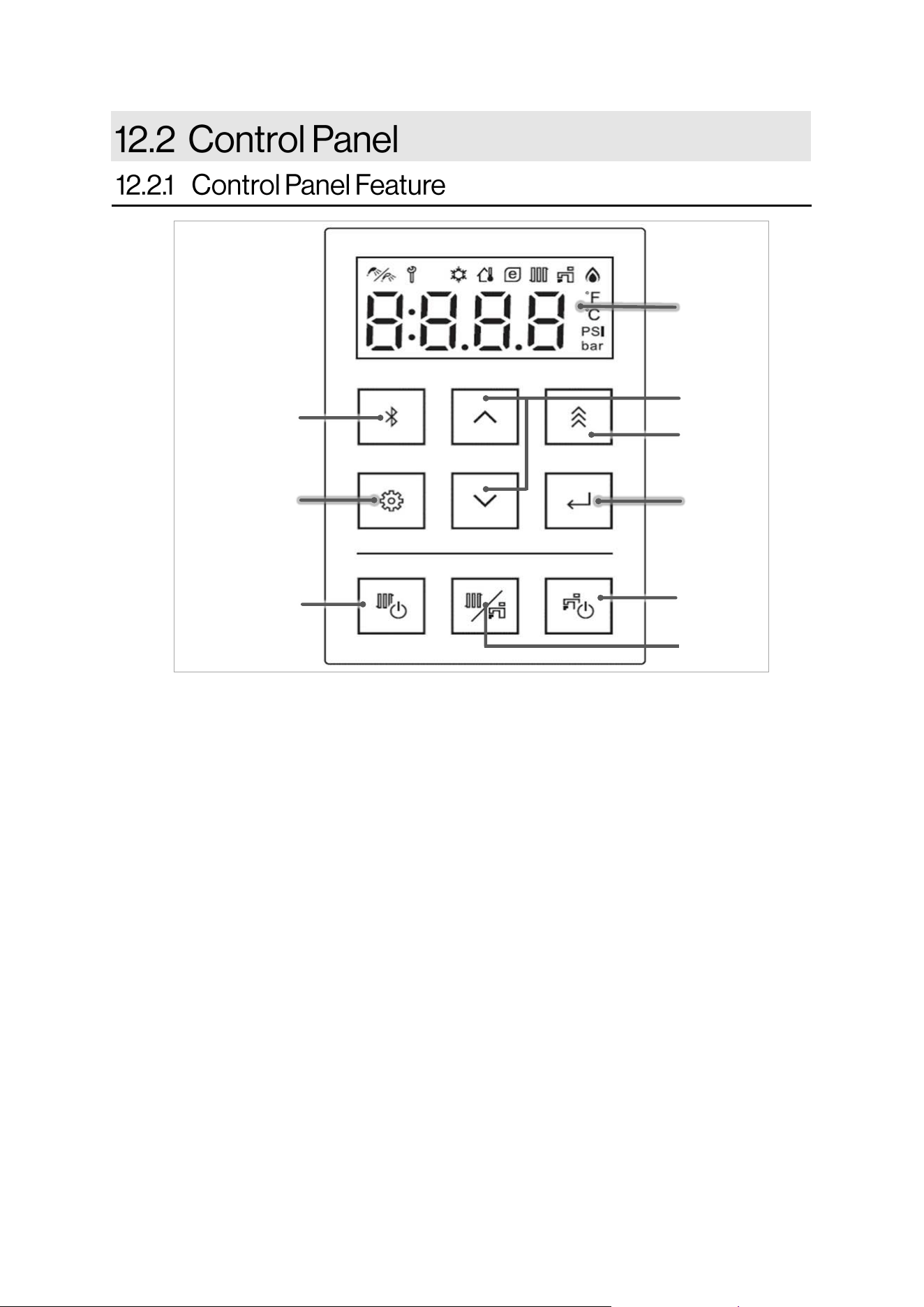
74
Rinnai I-Series Plus Condensing Combi Boiler Manual
Bluetooth
Connects for BLE
setup.
Up/Down Arrows
Scrolls through
available menu
opons including
adjusng the
temperature.
Sengs Menu
Selects Further Menus
to adjust sengs.
Central Heang (CH)
From the factory, this opon
is turned o by default. The
boiler runs o thermostat
inputs on the control board.
For any adjustments, contact
a trained and qualied
professional for seng
assistance. Adjustments
must be made by a trained
and qualied professional
for this mode to operate
correctly.
Domesc Hot
Water On
Press to run the boiler
in Domesc Hot
Water mode.
Select Buon
Press to select the
opon in the display
window.
❶
❷
❸
❹
❼
Display Window
Displays boiler status
informaon.
See secon “12.2.2
Display Window” for
more informaon.
❽
❺
❶
❷
❸
❹
❺
❻
❼
❽
❾
❾
Boost Buon
Engages the Boost
Funcon on the
boiler.
Figure 78
Switching Operaon
Mode
Press to change the
display between DHW
and CH for
temperature seng.
❻
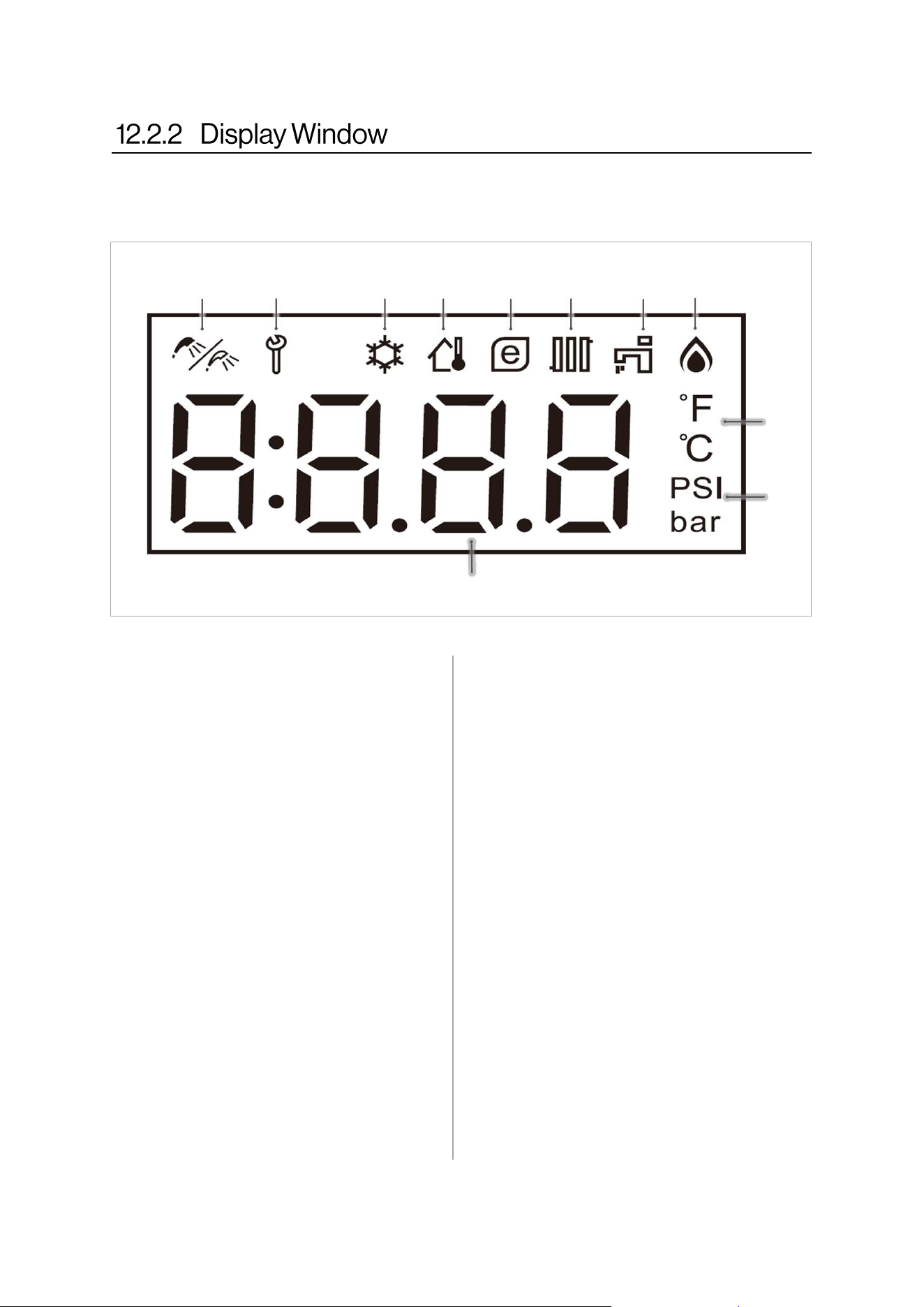
75
Rinnai I-Series Plus Condensing Combi Boiler Manual
When the boiler is turned on, the main screen (also called the home screen) appears in the display.
❽
❾
Central Heang Mode Acve
Priority Icon
This icon will be present on the
controller that has priority.
Outdoor Temperature Sensor
Connected
❶
❷
❸
❹
❺
❻
Freeze Protecon Acve
Maintenance Mode Icon
Appears when the boiler is in
Parameter Sengs Mode, Deaeraon
Mode, Performance Data Mode, Error
History Mode, etc.
Domesc Hot Water Mode Acve
Unit of Measurement for Pressure
Note: Pressure and temperature are
alternately displayed on the controller.
Setpoint Temperature, Current
Temperature or Current Pressure, and
Diagnosc Informaon
Note: Pressure and temperature are
alternately displayed on the controller.
❼
❽
❾
❿
Unit of Measurement for Temperature
❿
⓫
⓫
“In Use” Light (boiler has red and is
running)
Eco Mode Acve
Figure 79
❶
❷
❸ ❼
❺
❻ ❹
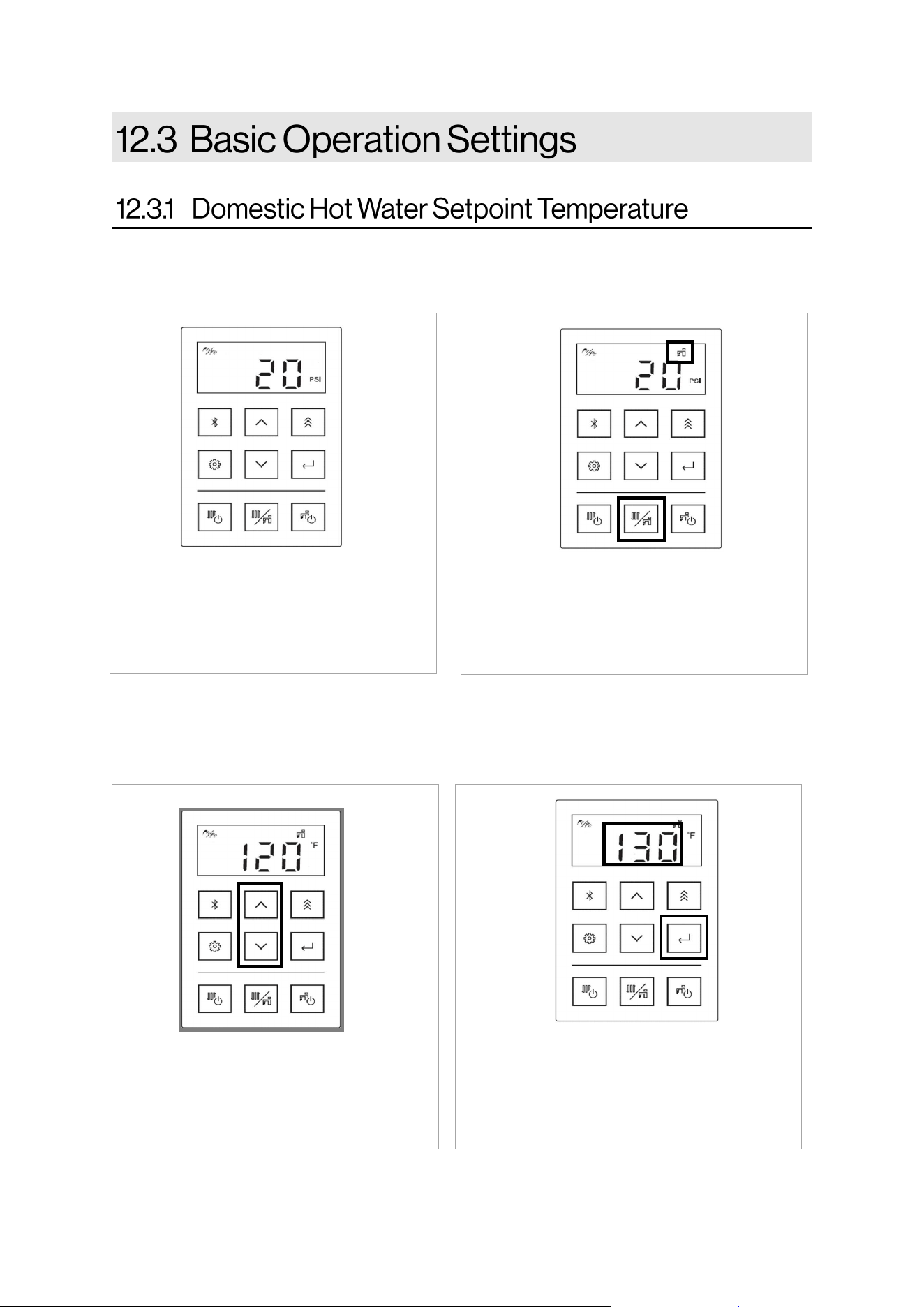
76
Rinnai I-Series Plus Condensing Combi Boiler Manual
To adjust the DHW setpoint temperature, follow the steps below.
1.
2.
3.
4.
If the backlit LED of the DHW buon is
not illuminated, press the DHW buon.
If the backlit LED of the DHW buon is
illuminated, proceed to Step 2.
Press the Switch Operaon
Mode buon unl the DHW
Acve icon appears on the
home screen.
Adjust the temperature with
the Up and Down arrows unl
the appropriate temperature is
displayed.
Press the Select buon to conrm
the temperature.
This temperature seng is
displayed for a few seconds and
then returns to standby mode.
Figure 83
Figure 82
Figure 81
Figure 80
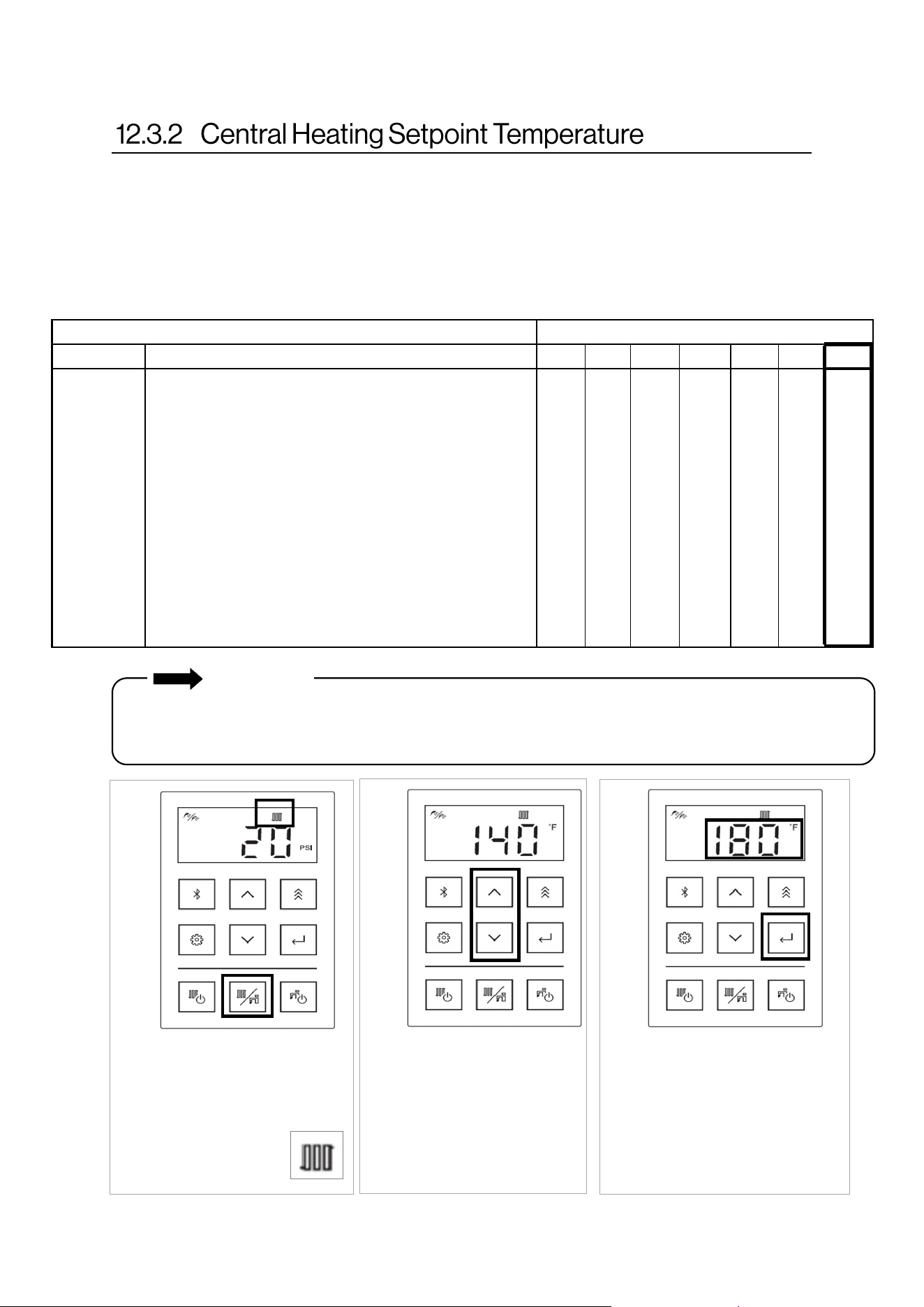
77
Rinnai I-Series Plus Condensing Combi Boiler Manual
IMPORTANT
• When outdoor reset control acvates, the target supply temperature for the CH system will not follow
the target temperature set on the controller.
• When the boiler is in operaon, pressure and temperature are alternately displayed on the controller.
1.
Press the Switch
Operaon Mode buon
unl the Central Heang
Acve buon appears on
the home screen.
2.
Adjust the temperature
with the Up or Down
arrows unl the
appropriate
temperature is
displayed.
3.
Press the Select buon to
conrm the temperature.
This temperature seng
is displayed for a few
seconds and then returns
to standby mode.
PSI
The Central Heang (CH) setpoint temperature is not adjustable in outdoor reset control unless the
custom heang curve (Curve 4) is selected.
If Parameter 01 is set to “d” (Curve 4), follow the steps below to change the CH target temperature.
For more informaon, see secon “12.4.1 Parameter Sengs Table” > Parameter 01 > Selecon
“H” (Curve 7).
Selecon
Parameter Seng Descripon A b C d E F
H
0 1
Outdoor Reset Curve
Select the proper curve from below. See secon
“12.5.4 Outdoor Reset Curves” for more informaon.
Curve 1: Standard baseboard, high-eciency air
handler, or panel radiators
Curve 2: Staple up radiant.
Curve 3: High temperature air handler or undersized
baseboard.
Curve 4: Cast Iron Baseboard
Curve 5: Radiators
Curve 6: High Mass Radiant
Curve 7: Custom curve based on customer input
Curve
1
Curve
2
Curve
3
Curve
4
Curve
5
Curve
6
Curve
7
Table 32
Figure 84
Figure 85
Figure 86
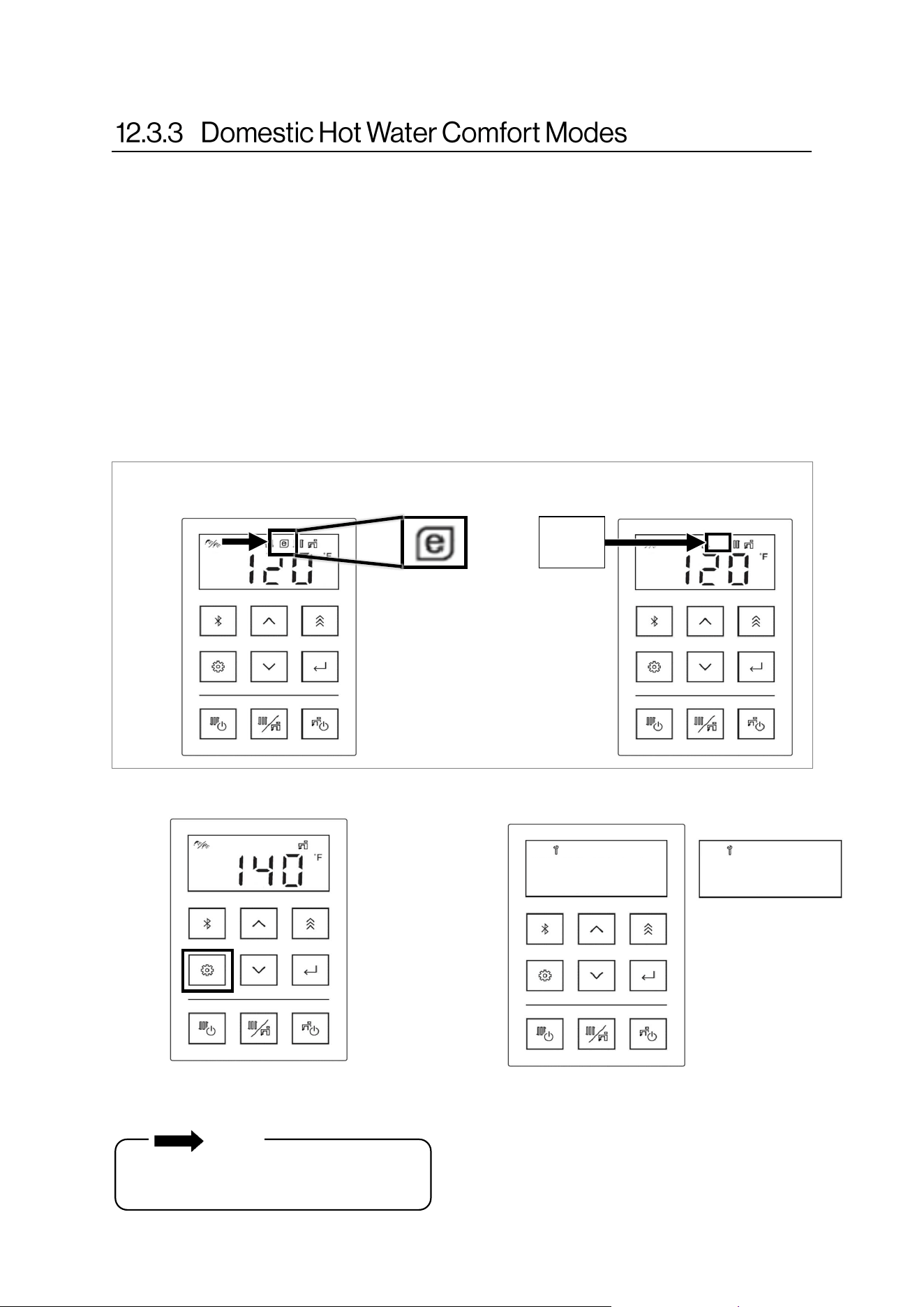
78
Rinnai I-Series Plus Condensing Combi Boiler Manual
1.
2.
Domesc Hot Water Comfort Modes are sengs that would either supply quicker delivery of hot
water to xtures or save energy in the boiler operaon.
• Eco Mode (Default) (Eco icon illuminates)
The boiler operates and produces hot water; however, it will not maintain the primary heat
exchanger temperature for quicker hot water producon. This selecon saves some energy,
but requires a longer me to provide hot water to the hot water xtures.
• Comfort Mode (Eco icon does not illuminate)
The boiler maintains the primary heat exchanger temperature to quickly deliver hot water to
the plate heat exchanger. This selecon provides the quickest delivery of hot water to hot
water xtures, but uses more energy.
By default, Eco mode is enabled (turned on). To enable (turn on) comfort mode, press the Eco
buon on the controller.
Eco Mode (Default) Comfort Mode
The Eco icon will
not illuminate
when Comfort
Mode is acve.
No Icon
During DHW recirculaon, the Eco icon
will always be on.
NOTE
Press the Up or Down arrows to select a unit.
• On = Eco Mode Acve
• OFF = Comfort Mode Acve
Press the Sengs buon.
Figure 87
Figure 88
Figure 89
4. On
4. OFF
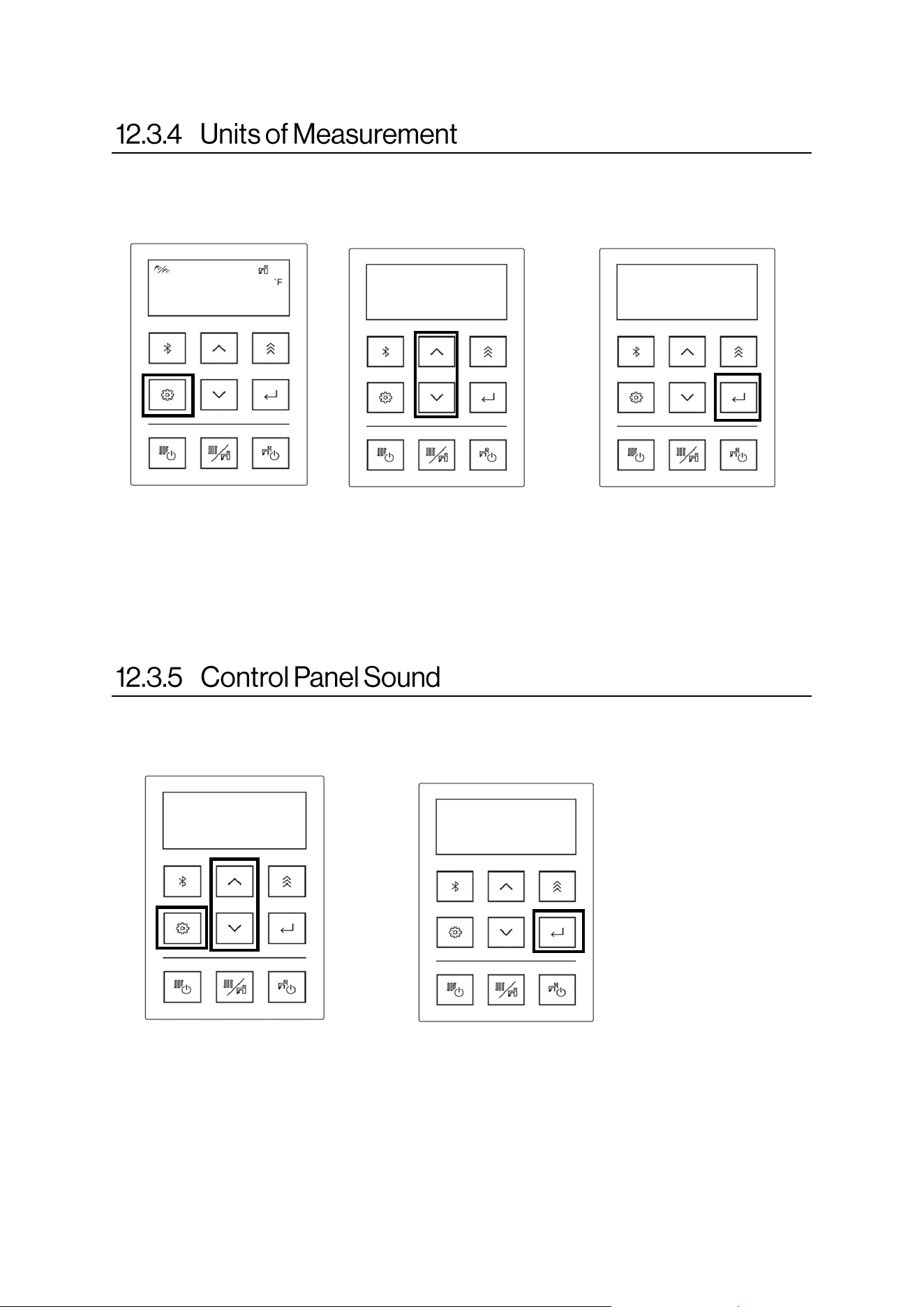
79
Rinnai I-Series Plus Condensing Combi Boiler Manual
To change the units of measurement appearing on the boiler display, follow the steps below.
To turn the control panel click sound on or o, follow the steps below.
1.
2.
Press the Up or Down arrows
to select a unit.
• F = U.S. Measurement
(°F/PSI)
• C = Metric (°C/bar)
Press the Sengs buon.
3.
Press the Select buon.
1.
2.
Press the Select buon.
Press the Mode buon twice.
2:on should appear on the
display. Press the Up or Down
arrows to select ON or OFF.
Figure 90
Figure 91
Figure 92
Figure 93
Figure 94
1 4 0
1 : F
1 : F
2:On
2:OFF
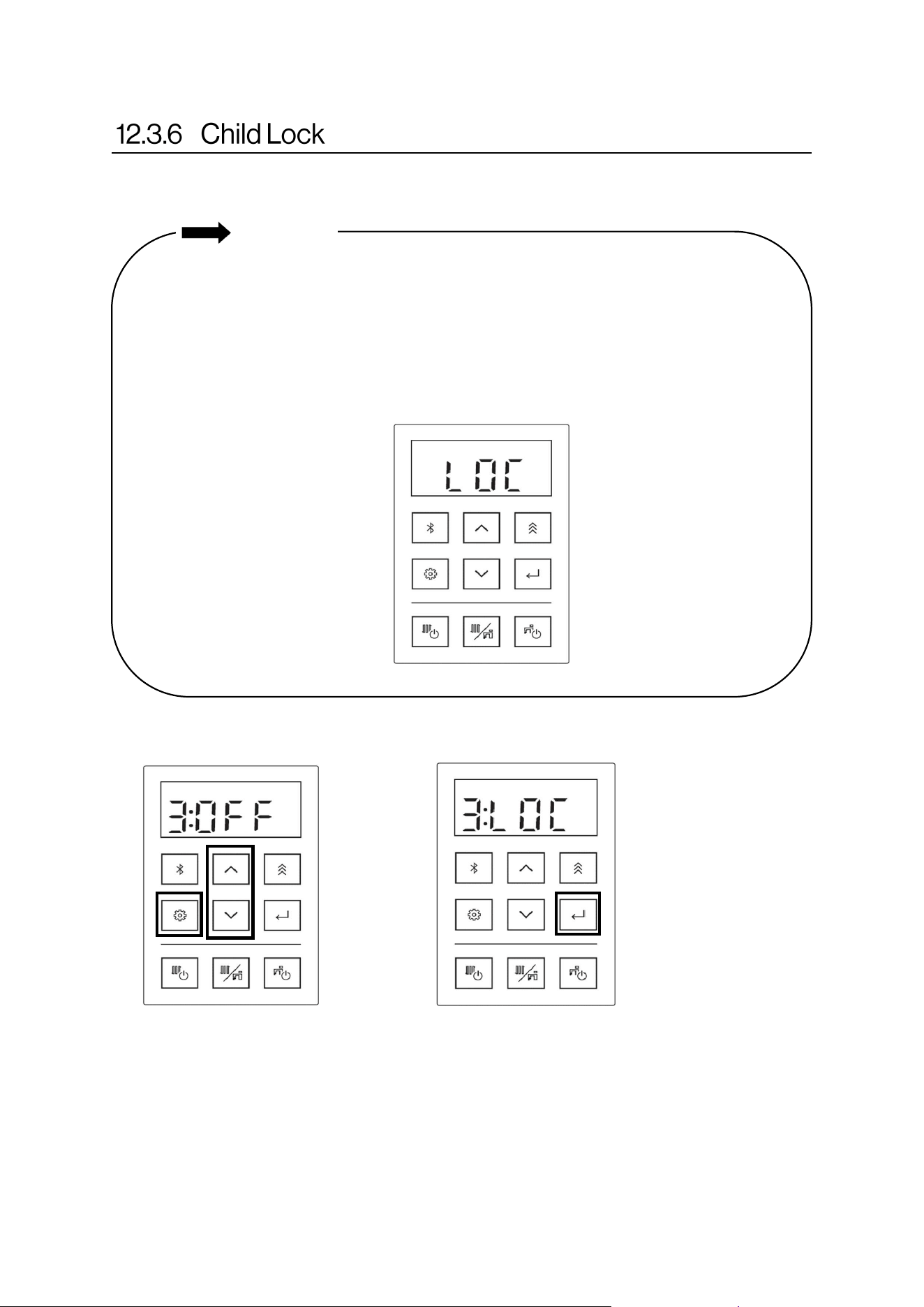
80
Rinnai I-Series Plus Condensing Combi Boiler Manual
To turn the child lock funcon on or o, follow the steps below.
1. 2.
• When Child Lock mode is enabled, the only funcon available is to turn o Central
Heang (by pressing the Central Heang buon on the controller); this occurs only if
Parameter 71 is set to “b”. See secon “12.4 Parameter Sengs” for more
informaon.
• If using mulple controllers, Child Lock can be set only on the controller that has
priority.
• If a buon is pressed when the Child Lock funcon is engaged, “LOC” will be
displayed on the controller.
IMPORTANT
Press the Select buon.
Press the Mode buon three
mes. 3:off should appear on
the display. Press the Up or Down
arrows to select:
• OFF - Child Lock OFF
• LOC - Child Lock ON
Figure 95
Figure 96
Figure 97
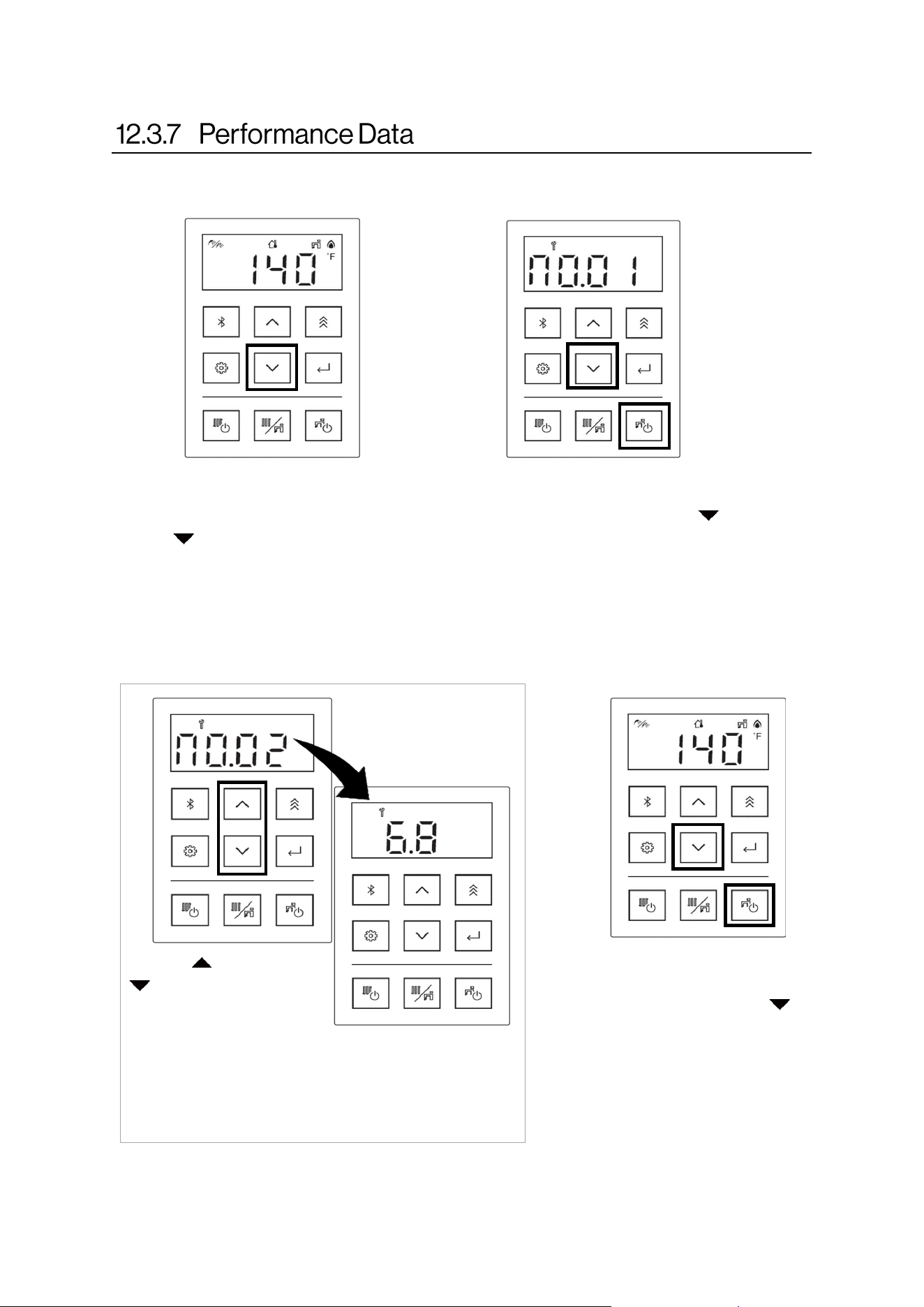
81
Rinnai I-Series Plus Condensing Combi Boiler Manual
To view the boiler’s performance data, follow the steps below.
1. 2.
While connuing to hold the
(Down) buon, press and hold
the Domesc Hot Water buon
(press and hold both buons
down at the same me).
Press and hold the
(Down) buon for
two seconds.
3.
Use the (Up) and
(Down) buons to
scroll to the desired
performance data
number described in
the Performance Data
Table in this secon.
4.
To exit performance data:
While connuing to hold the
(Down) buon, press and hold the
Domesc Hot Water buon
(press and hold both buons
down at the same me).
The data for the
performance number
automacally appears
in the display.
Figure 98
Figure 99
Figure 100
Figure 101
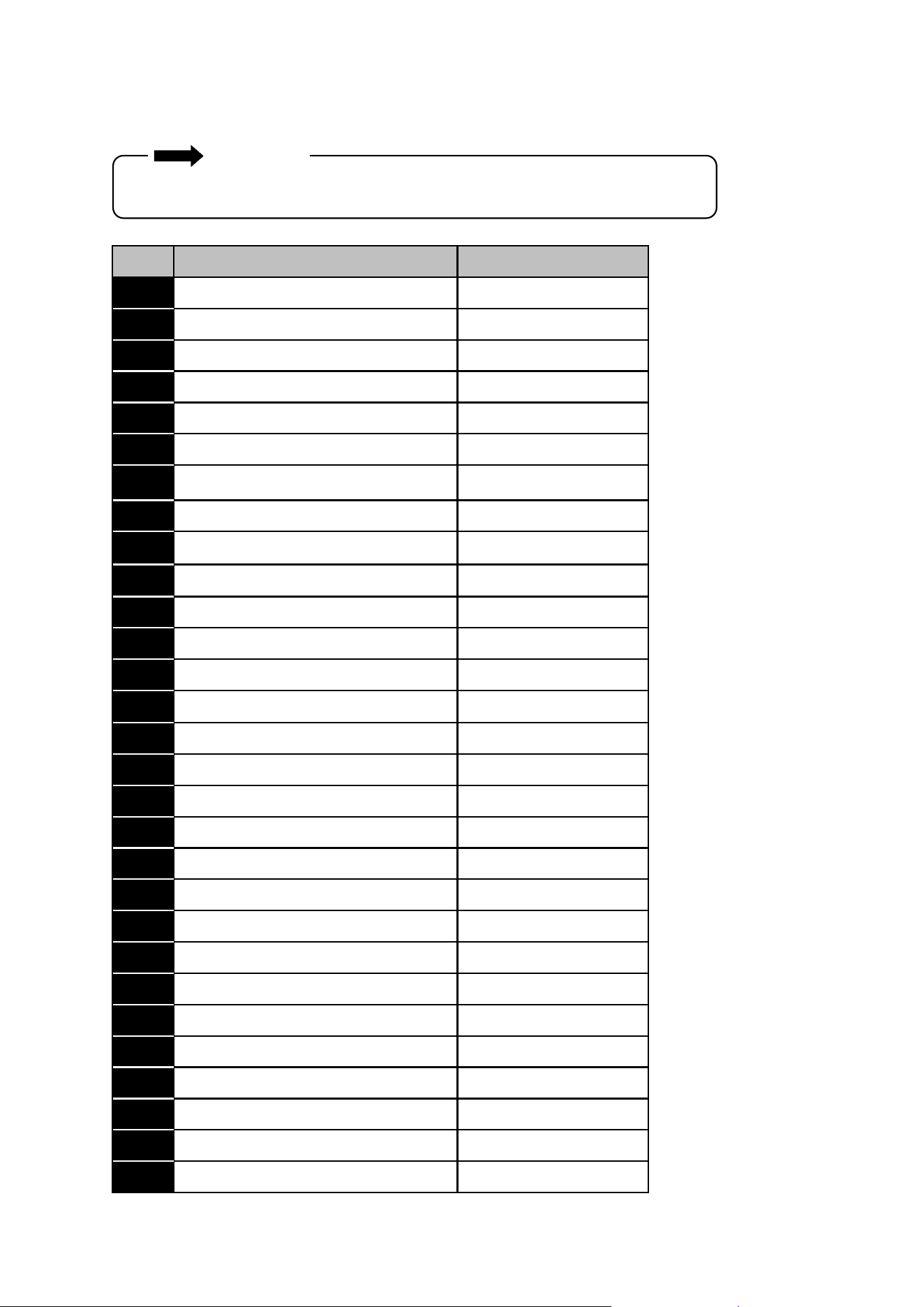
82
Rinnai I-Series Plus Condensing Combi Boiler Manual
* Refer to the Technical Data Sheet located on the inside front cover of the boiler for addional
informaon.
# DATA UNIT
01
Water Pressure PSI/bar
02
Water Flow Rate x0.1 GPM/LPM
03
Supply Temperature °F/°C
04
Return Temperature °F/°C
05
Freeze Protecon Temperature °F/°C
06
Exhaust Temperature °F/°C
07
Outgoing Temperature °F/°C
08
Inlet Temperature °F/°C
10
Heat Exchanger Outlet Temperature °F/°C
11
Fan Frequency Hz
13
Water Flow Control Posion 0=Mid, 1=Open, 2=Closed
14
Bypass Flow Control Posion Degrees of Opening
15
3-Way Valve Control Posion 0=Mid, 1=DHW, 2=CH
16
3-Way Valve Control Cycles x100
17
Venturi Posion 0=Closed, 1=Open
18
Venturi Cycles x100
20
Pump Cycles x100
21
Pump Hours x10 Hours
22
Pump for Boiler 0=OFF, 1=ON
23
Pump for System (Pumps 1-3) 0=OFF, 1=ON
24
Pump for System (Pump 4) 0=OFF, 1=ON
31
Outdoor Temperature °F/°C
32
Addional Controllers Connected *
40
Energizaon Hours x100 Hours
41
Combuson Hours x10 Hours
42
Combuson Cycles x100
43
Combuson Hours (DHW) x10 Hours
44
Combuson Cycles (DHW) x100
45
Commissioning Cycles x1
Performance Data Table
Unit of measurement (°F/°C, PSI/bar, and GPM/LPM) will vary depending on unit of
measure selecon.
IMPORTANT
Table 33
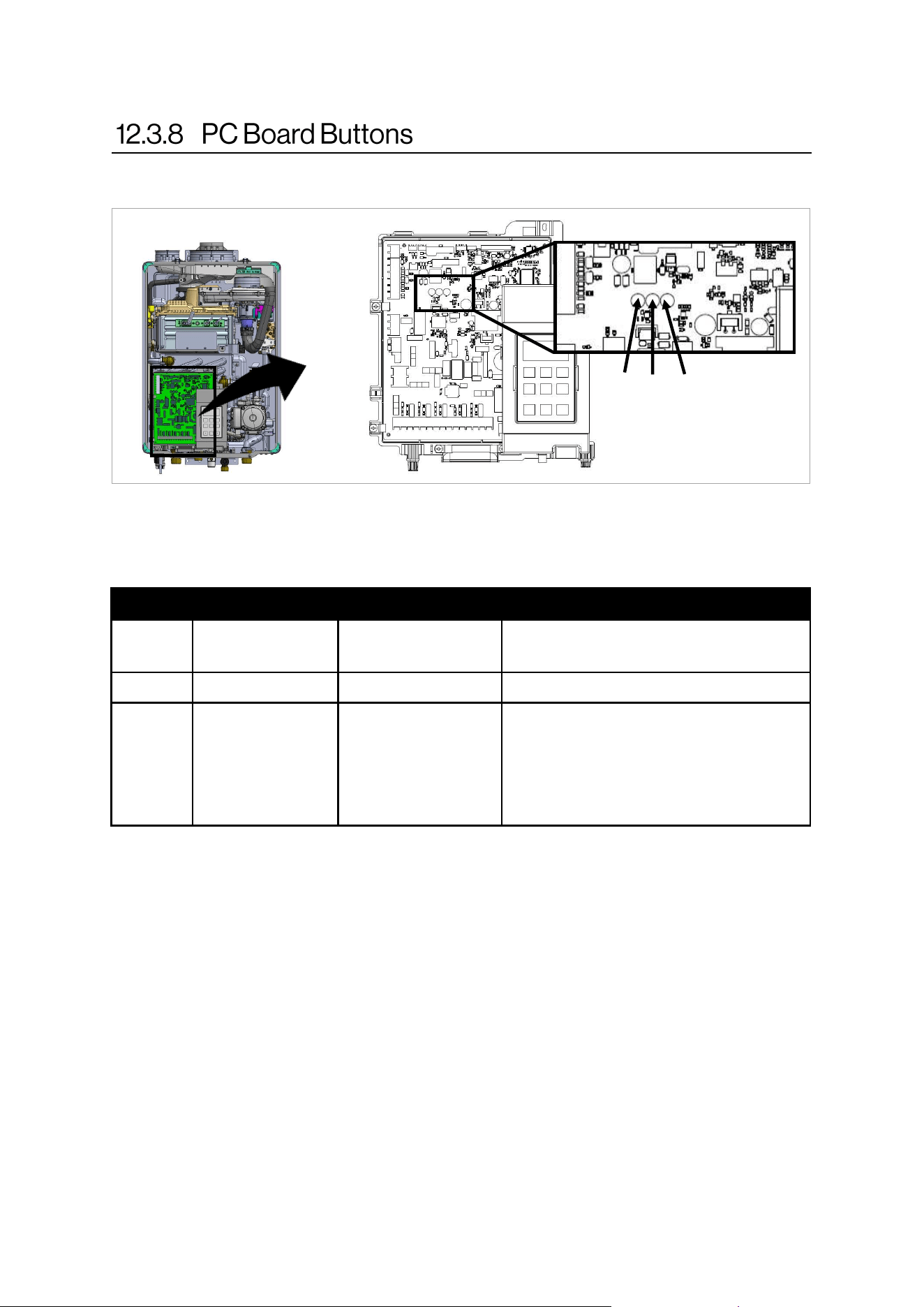
83
Rinnai I-Series Plus Condensing Combi Boiler Manual
Item # PC Board Switch # Primary Funcon Notes
1 Buon 1
Parameter Seng
Mode
Refer to secon “12.4 Parameter Sengs.”
2 Buon 2 Deaeraon Mode
Refer to secon “10. Commissioning”
3 Buon 3
Data Transfer Mode/
Test Combuson
Mode/Flushing Mode
This is for transferring PCB data when
replacing the PCB. Refer to the instrucons
included in the replacement parts. Also,
this is used for seng the boiler into
forced combuson mode and ushing
mode.
PC Board
❶
❷
❸
Table 34
Figure 102
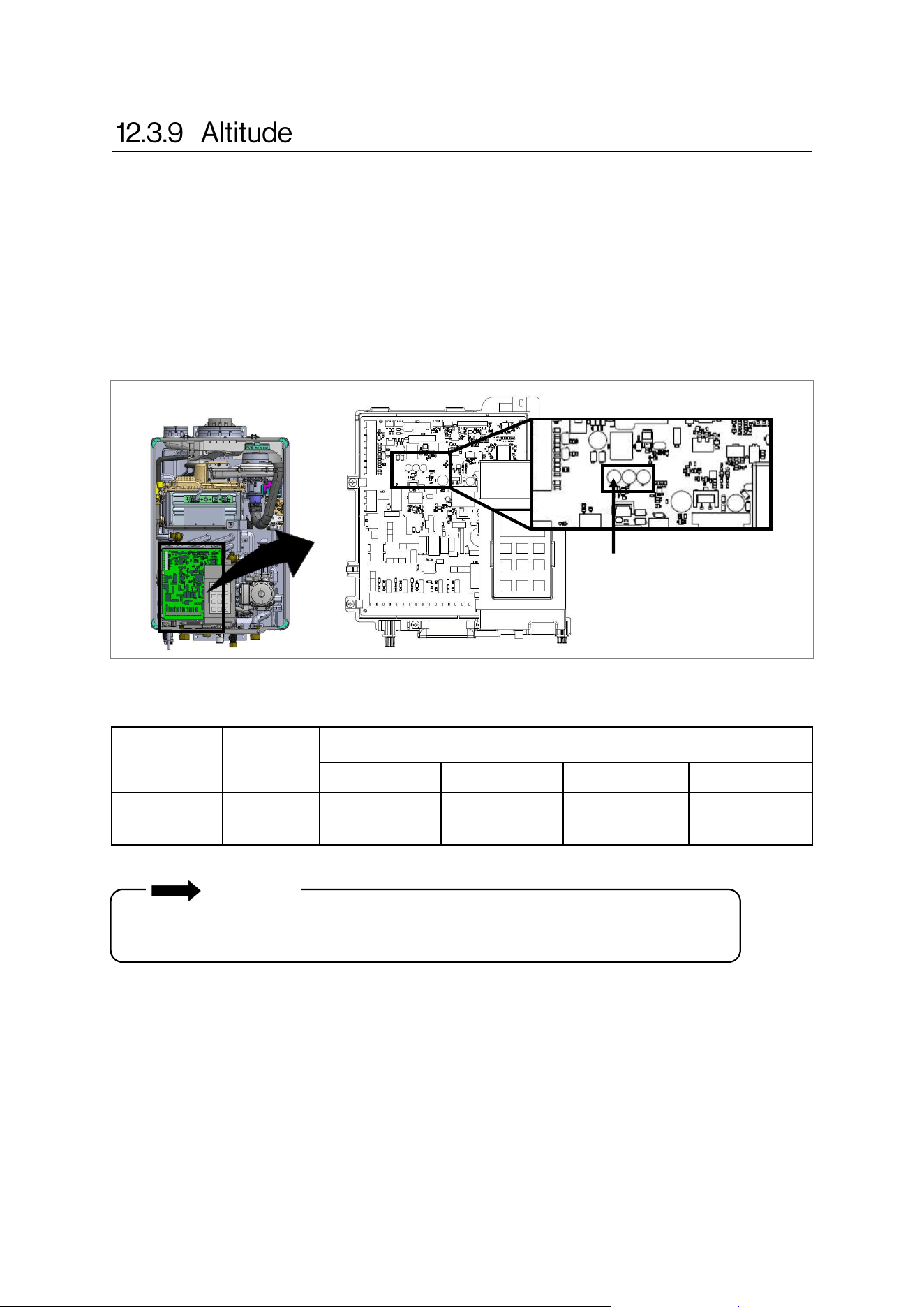
84
Rinnai I-Series Plus Condensing Combi Boiler Manual
To change the altude, follow the steps below.
1. Remove the boiler’s front panel by removing the two screws that secure the panel.
2. Locate the PC Board (lower le side of unit) (see below).
3. Locate the PC Board buons on the PC Board (see below).
4. Press the SW1 le buon on the PC Board (see below).
5. Scroll to Parameter A3. Adjust Parameter A3 based on the altude sengs in the table below.
When a PC Board buon is adjusted, it is not necessary to adjust the gas pressure seng
for high altude.
IMPORTANT
Parameter
Number
Seng
Parameter
Title
A B C D
A3
Altude
0-2,000
(0-610 m)
2,001-5,400
(610-1,646 m)
5,401-7,700
(1,646-2347 m)
7,701-10,200
(2,347-3,109 m)
PC Board
Figure 103
Table 35
SW1 le Buon
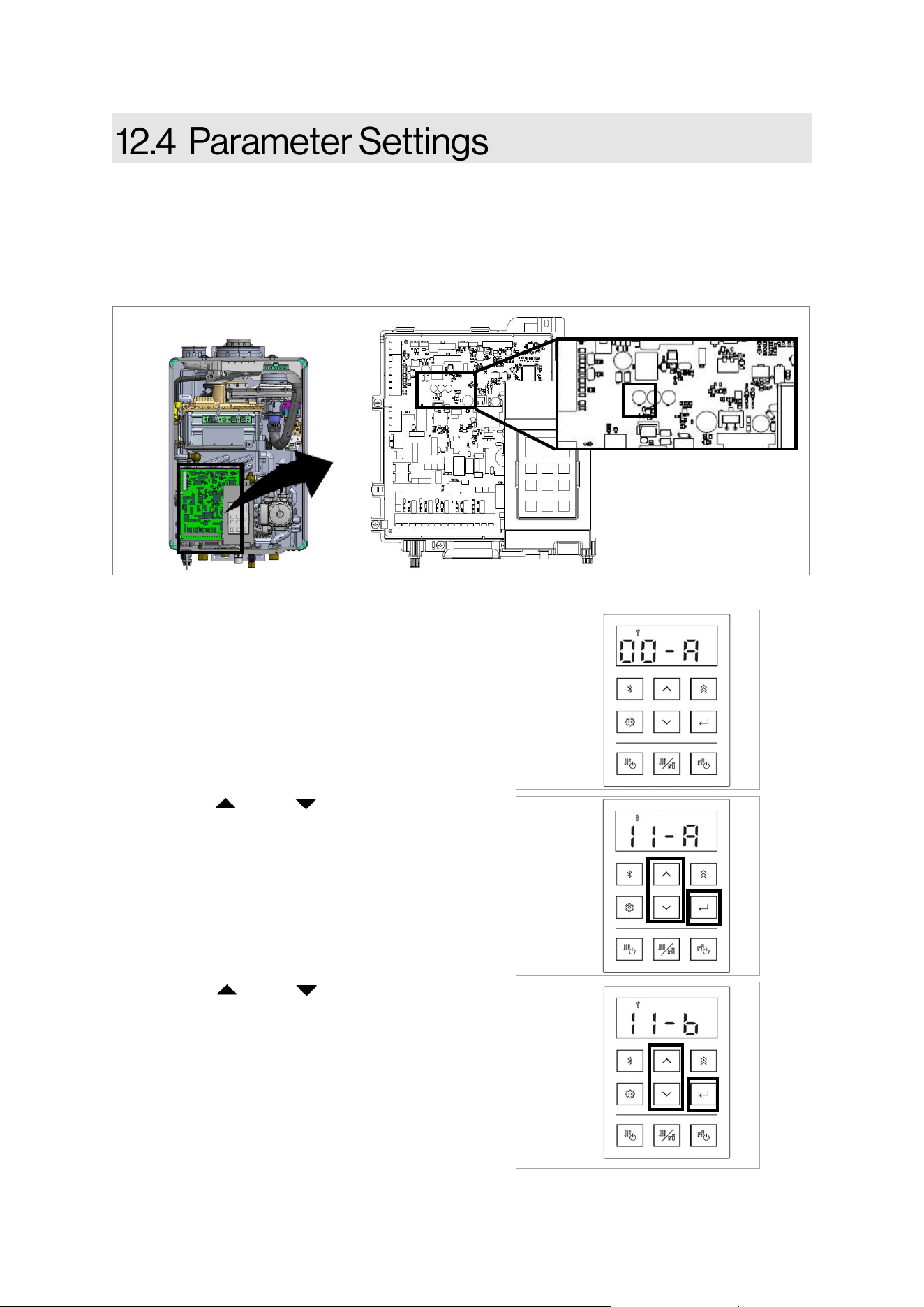
85
Rinnai I-Series Plus Condensing Combi Boiler Manual
1. Remove the boiler’s front panel by removing the two screws that secure the panel.
2. Locate the PC Board (lower le side of unit).
3. Locate the le PC Board buon.
4. Press and hold the buon for ve seconds.
6. Press the (Up) or (Down) arrows
to select a parameter seng number.
Then, press the Select buon.
8. To exit parameter sengs and enter normal operaon mode, press the PC Board buon.
7. Press the (Up) or (Down) arrows to
change the selecon for the seng number
(such as 11-A or 11-b).
Then, press the Select buon.
PC Board
Figure 104
Figure 105
Figure 106
Figure 107
5. 00-A appears on the display.
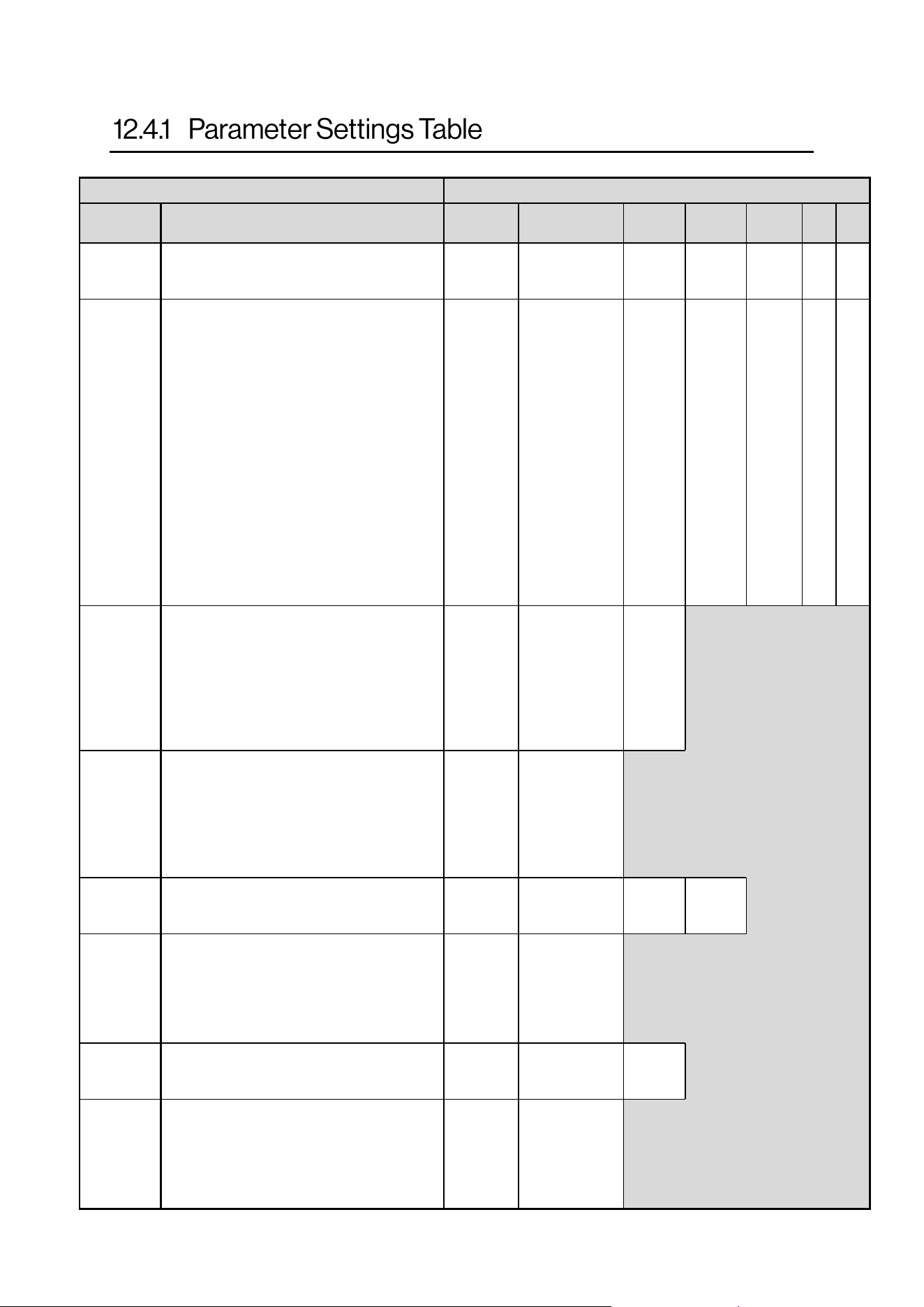
86
Rinnai I-Series Plus Condensing Combi Boiler Manual
Selecon
Parameter
Number
Funcon/Descripon
A
(Default)
b C d E F H
00
Outdoor Temperature Sensor
Enables or disables the outdoor
temperature sensor.
In Use Not In Use
01
Outdoor Reset Curve
(*) This parameter shows up only when
selecng Outdoor Temperature Sensor
“In Use” as selecng parameter number
00. For selecng outdoor reset curve,
see below:
Curve 1: Standard baseboard, high-
eciency air handler, or panel radiators
Curve 2: Staple up radiant.
Curve 3: High temperature air handler
or undersized baseboard.
Curve 4: Cast Iron Baseboard
Curve 5: Radiators
Curve 6: High Mass Radiant
Curve 7: Custom curve based on
customer input
1
2
3
4
5
6
7
02
Boost
This parameter is available when
parameter number 00 is selected as
“A.” Boost Mode increases the CH set
temperature above the outdoor reset
curve target when the boiler has been
running on an unusually long call for
heat.
No
30
Minutes
60
Minutes
03
Maximum Outdoor Temperature
This parameter is available when
parameter number 00 is selected as
“A.” This sets the maximum outdoor
temperature the boiler will re in CH
mode. This can prevent the boiler from
ring in warm outdoor temperatures.
77°F
(25°C)
No
Maximum
04
Service Soon
SS is a me based service indicator set
during installaon.
Disabled 0.5 Year 1 Year 2 Years
05
Pressure Indicaon on Controller Panel
The current pressure will cycle on the
controller display. If an external
pressure gauge is present, it is
permissible to change the seng to
"No."
Yes No
06
De-Rate
This parameter is to limit maximum
input when it is necessary.
No
Seng
1
Seng
2
08
Simultaneous Central Heang and
Domesc Hot Water
Enables simultaneous operaon
between Central Heang and Domesc
Hot Water.
Domesc
Hot
Water
Priority
Simultaneous
Central
Heang and
Domesc Hot
Water
Permied
Table 36
87
Rinnai I-Series Plus Condensing Combi Boiler Manual
Selecon
Parameter
Number
Funcon/Descripon
A
(Default)
b C d
09
DHW Recirculaon
Enables the DHW Recirculaon funcon for
Pump 4 connecon
Pump 4
Connecon
Enabled for
CH Zone
Pump
DHW
recirculaon ON
(Pump 4
connecon for
DHW
Recirculaon
Pump)
10
Maximum DHW Seng Temperature
This selects the maximum DHW set point
temperature. When 140°F, it is
recommended to have a mixing valve to
prevent scalding.
120°F
(49°C)
140°F
(49°C)
11
Length of Time 3 Way Valve in DHW
Posion
This selects the length of me the 3 Way
Valve will stay in the DHW posion aer
using DHW even if a CH demand is present.
While the 3 Way Valve is in the DHW
posion, this enables quicker delivery of hot
water.
3 Minutes 10 Seconds
12
DHW Recirculaon Piping Setup
This parameter is available when parameter
number 09 is selected as “b.” This sets the
DHW recirculaon piping mode, which
controls the circulaon logic. Ensure this
corresponds to the DHW recirculaon piping.
Cross Over
Valve
Dedicated
Return
13
DHW Recirculaon with Timer Relay Input
This parameter is available when parameter
number 09 is selected as “b.” This enables
an external mer to also control the ming
for DWH recirculaon to more directly
correspond to the customers needs. When
selecng "No,” the boiler operates with
pump ON connuously for controlling
external mer pump.
Yes No
14
CH Temperature Limitaon During
Simultaneous Operaon
This parameter is available when parameter
number 09 is selected as “b” or parameter
number 08 is selected as “b.” This enables
the CH temperature seng to be limited
during simultaneous DHW and CH operaon.
This can prevent unintenonally supplying
high temperature water to low temperature
CH applicaons. During simultaneous
operaon, the CH supply temperature may
be up to 180°F. When selecng "NO"
limitaon, ensure that the CH system and
heang applicaon is designed for high
temperature.
Yes No
Table 36 (Connued)
88
Rinnai I-Series Plus Condensing Combi Boiler Manual
Selecon
Parameter
Number
Funcon/Descripon
A
(Default)
b C d
15
3 Way Valve Posion During Simultaneous
Operaon
This parameter is available when parameter
number 09 is selected as “b” or parameter
number 08 is selected as “b.” This adjusts
the 3 Way Valve posion to open the CH side
more for when the ow of the CH side is
reduced due to DHW demand. This may
restrict the DHW capacity.
Normal Addional CH
16
Lime Condion (LC) Check
This seng enables the boiler to check for
lime scale condions in the DHW side of the
plate heat exchanger. When detecng lime
scale, an LC error code will appear on the
display. Once lime scale is removed by
ushing the plate heat exchanger, the LC
code will disappear.
Available No Detecon
17
Adjust DHW Temperature Seng
This seng enables the DHW output
temperature to be adjusted without
adjusng the set point temperature to make
up for system temperature losses.
0°F
(0°C)
1.8°F
(1°C)
3.6°F
(2°C)
5.4°F
(3°C)
18
DHW Connuous Operaon Time
This seng adjusts the maximum connuous
operang me of DHW, whether in DHW
priority or simultaneous modes.
120
Minutes
60
Minutes
180
Minutes
Unlimited
19
First Day Pump Operaon
To make the rst day pump running 24h or
waing for learning the DHW usage paer
for smart-circ
O On
20
Smart-Circ
To enable circ-logic together for DHW
recirculaon on each mode.
O On
40
Linked Operaon Among Each CH Pumps
This parameter enables linked operaon
among each CH pumps. For example, when
parameter b is selected and T/T 1 is acve,
both pump 1 and 2 are ON. The T/T wire
must be connected to the T/T1 connecon.
This seng is primarily for an applicaon
that requires two pumps or more for one
zone, such as in use with an injecon loop or
similar system.
No
Linked Together
CH pump 1 and
pump 2
Linked
Together
CH
pump 1,
pump 2
and
pump 3
Linked
Together
CH
pump 1,
pump 2,
pump 3
and
pump 4
Table 36 (Connued)
89
Rinnai I-Series Plus Condensing Combi Boiler Manual
Selecon
Parameter
Number
Funcon/Descripon
A
(Default)
b C
41
Linked Operaon Between Main Boiler
Pump and CH Pump 1
This enables the linked operaon
between the main boiler pump and CH
pump 1. For example, when the main
pump is on, pump 1 is also on.
No
Yes
(Linked
together)
42
Main Pump Runs When the Target
Temperature is Reached
This selects the mode of the main pump
running when the target setpoint is
achieved. This seng is for whether
running on intervals to reduce pump
operaon or connuously running to
reduce wait me to re-re. Intervals are
10 minutes ON and 30 minutes OFF.
Connuously Intervals
43
External Pump Runs When the
Temperature is Reached
For selecng the mode of external
pump running when the temperature is
reached to seng. This is seng for
whether stopping external pump
running to reduce pump operaon
ming or operang as same as main
pump operaon to enable to deliver
remained heat in heat exchanger
Same as
main Pump
Does Not
Run
44
External Pump Running at Freeze
Protecon Operaon
For selecng the mode of external
pump running when the freeze
protecon operaon. This is seng for
whether stopping external pump
running to reduce pump operaon
ming or operang as same as main
pump operaon to enable to deliver
remained heat to the system for
keeping the system piping from
freezing. But it could reduce the
temperature of inside of heat
exchanger.
Does
Not Run
Same as
Main Pump
Table 36 (Connued)
90
Rinnai I-Series Plus Condensing Combi Boiler Manual
Selecon
Parameter
Number
Funcon/Descripon
A
(Default)
b C d
45
Freeze Protecon Level
This selects the freeze protecon level.
Selecng “b” will prevent the boiler from
operang in freeze protecon mode more
than believed necessary.
Normal
For warm
room temp
46
The Dierenal Temperature From
Exnguishing Fire to Fire Again
How much temperature drop is permied by
the supply water thermistor before the boiler
will re again.
When selecng “Quick”, the boiler will re
more frequently and achieve more
temperature control
Normal Quick
CH Seng Temperature
Temperature
Drop
Temperature
Drop
168°F -182°F (75-82°C) 27°F (15°C) 15°F (8°C)
104°F -166°F (40-74°C) 15°F (8°C) 9°F (5°C)
47
The Time Which Not Allow to Fire Again for
CH
For selecng me which not allow to re
again for CH aer shutdown burner. This is
seng for whether prevenng from
frequently operang unit or allowing
frequent operaon for quick heang up
again.
Normal
(3 Minutes)
Quick
(10 Seconds)
50
Air Handler Connecon
The seng changes to enable to AH output
with linking pump 3.
Yes No
51
Air Handler Post Pump Extension Seng
Extending the post Pump ming of pump 3.
15 Seconds 40 Seconds
60
N/A
Manufacture Use Only
For Manufacturer Use Only
61
Thermostat Usage
Changes the mode between Thermostat
Usage and Central Heang Buon
Thermostat
Used
Central
Heang ON
buon used.
Boiler res
based on
return water
temperature
70 Not Used
Table 36 (Connued)
91
Rinnai I-Series Plus Condensing Combi Boiler Manual
Selecon
Parameter
Number
Funcon/Descripon
A
(Default)
b C d E F
71
Cascade
Seng Primary or Secondary
This parameter is only used for
Cascade compable models.
Secondary Primary
72
Cascade Units in Standby
Adjust the parameter seng
of the primary unit to set the
number of unit as in standby.
This parameter is only used for
Cascade compable models.
1 2 3 4 5 6
80
Recirculaon Seng for DHW
Cascade
This parameter is only when
Cascade with water heaters is
set up with recirculaon
mode. This parameter is to
seng the recirculaon mode
on water heater connected as
secondary.
No
Recirculaon
Recirculaon
(Dedicated)
Recirculaon
(Crossover)
81
Recirculaon Mode for DHW
Cascade
This parameter is only when
Cascade with water heaters is
set up with recirculaon
mode. This parameter is to
seng the recirculaon mode
on water heater connected as
secondary.
Economy Comfort Commercial
82
Not Used
On O
83
Pump Speed for DHW Cascade
This parameter is only when
cascade with water heaters is
set up with recirculaon
mode. This parameter is to
seng the pump speed of
recirculaon mode on water
heater connected as
secondary.
Max High Medium Low
A0
Gas Type
For selecng gas type when
conducng gas conversion
Natural
Gas
Liquid
Propane
A1
Model
Manufacture Use Only
For Manufacture use Only
A2
Vent Material Used
This selects the venng
material used. The boiler is set
from the factory to be
installed in a PVC venng
system. If CPVC, PP, or other
approved venng is used, this
may be adjusted. See the
secon on PVC Safety Switch
for more informaon.
PVC
Material
other then
PVC:
• CPVC
• PP
• Other
A3
Altude Seng
Sets the elevaon of the boiler
installaon.
Level 0
0-2,000
(0-610m)
Level 1
2,001-5,400
(610-1646m)
Level 2
5,401-7,700
(1,646-2,347m)
Level 3
7,701-10,200
(2,347-3,109 m)
Table 36 (Connued)
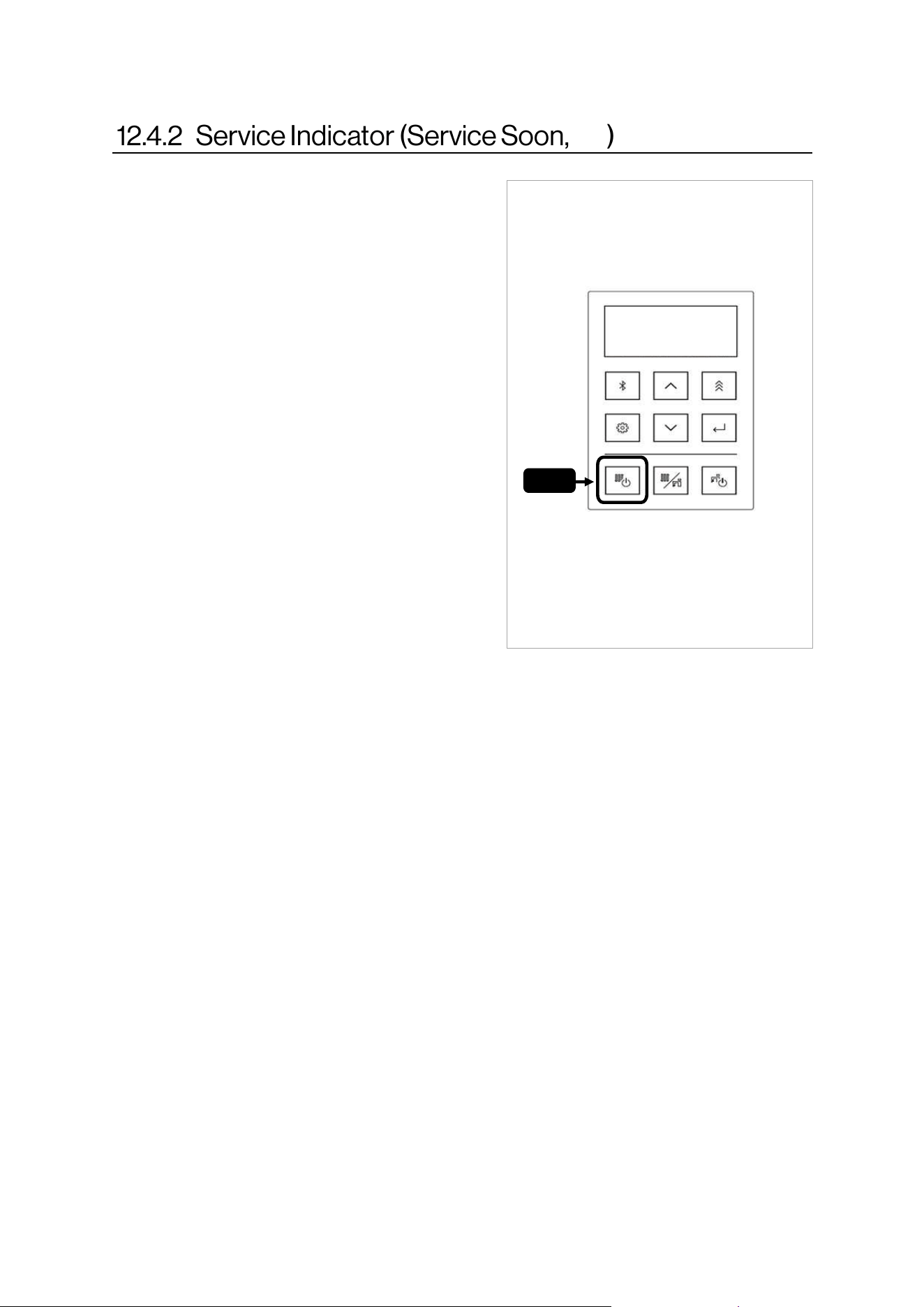
92
Rinnai I-Series Plus Condensing Combi Boiler Manual
This boiler includes a service indicator (Service
Soon, SS). When selected in the parameter
sengs, an SS code will display on the controller
indicang that it is me to ush and service the
boiler.
• Selecon is installers preference based on
water condions or other factors that may
inuence the suggested interval of service.
• See the “Parameter Sengs” secon of this
manual for selectable service intervals.
• If Service Soon (SS) appears on the controller
display, contact your local service provider to
ush and service the boiler (see 14.3 Flush the
DHW Heat Exchanger).
• Service Soon will appear again based on the
selected service interval.
Service Soon (SS) will display
on the controller again when
the boiler reaches the
interval selected in the
parameter sengs.
To reset Service Soon (SS)
Press the Central Heating (CH)
button 5 times.
5 times
SS
Figure 108
55
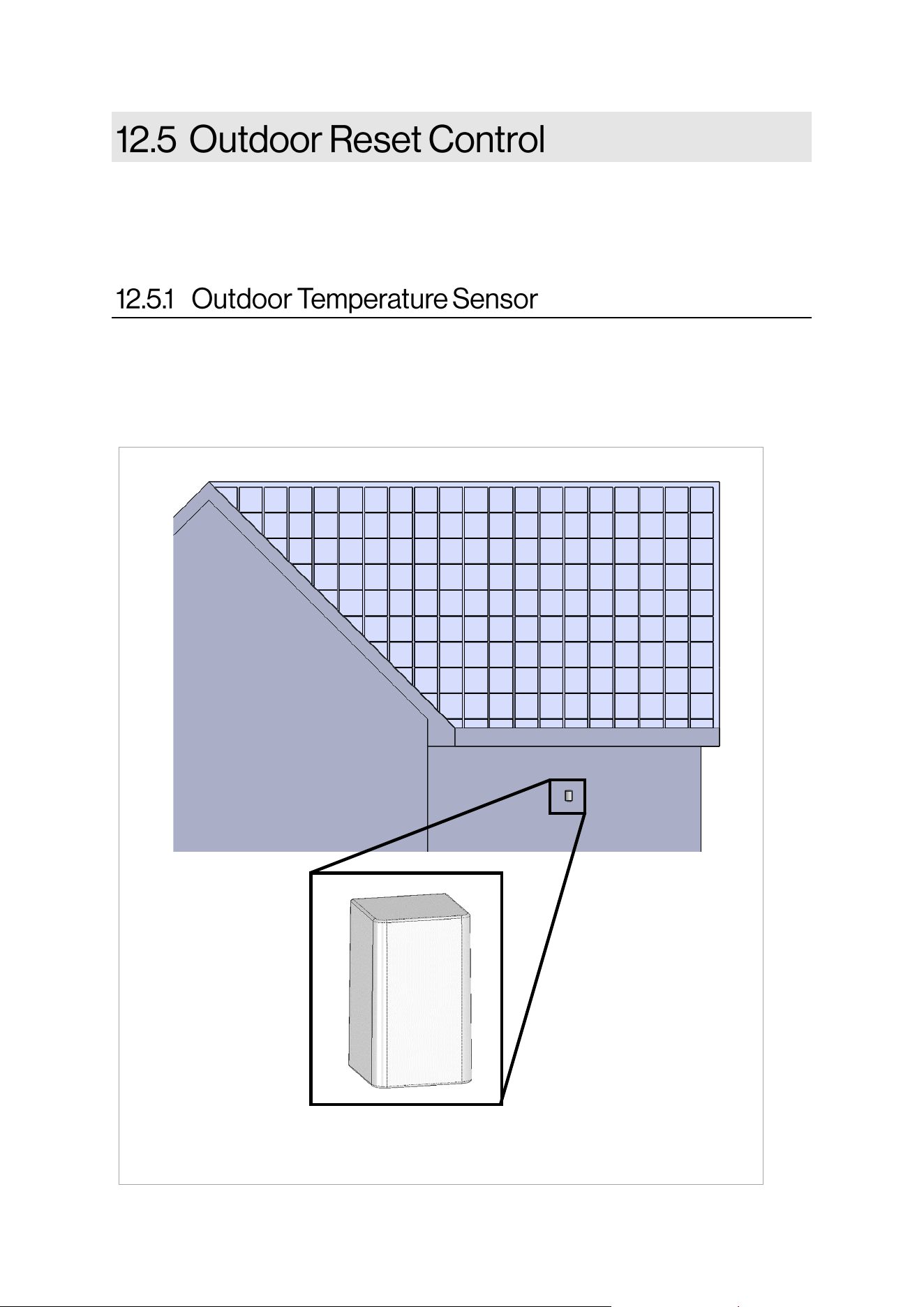
93
Rinnai I-Series Plus Condensing Combi Boiler Manual
North Facing Wall
Outdoor Temperature
Sensor
Outdoor reset is a built-in funcon to help maximize the eciency of the boiler. The design of this
funcon is to adjust the target temperature of the boiler relave to the outdoor ambient
temperature via the seven outdoor reset curve opons included in the boiler parameters. The
outdoor ambient temperature is observed via the provided outdoor temperature sensor.
The outdoor temperature sensor should be mounted on a North facing wall of the house below an
eave to avoid direct sunlight (to prevent obtaining a false reading of the outdoor temperature). The
sensor should also be mounted away from any vent, duct, or other device that may create an
arcial heat source. The sensor should then be wired back to the outdoor temperature sensor
terminal on the boiler. Refer to the following secons for more informaon.
Figure 109
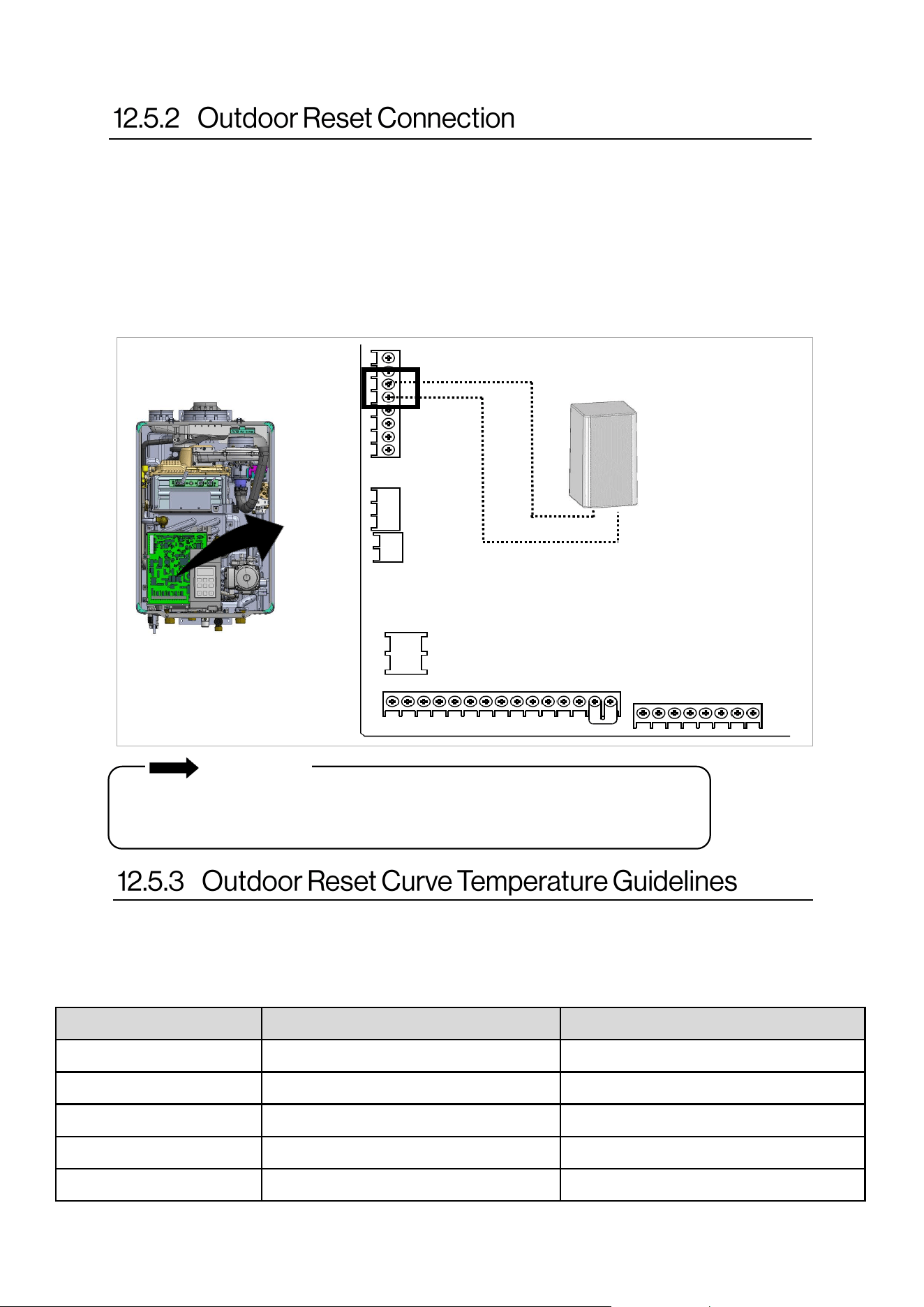
94
Rinnai I-Series Plus Condensing Combi Boiler Manual
PC Board
Outdoor
Temperature Sensor
Figure 110
Type of Heat Emier Typical Minimum Supply Temperature Typical Maximum Supply Temperature
Hydronic Air Handler 120°F - 140°F (49°C - 60°C) 140 °F - 180°F (60°C - 82°C)
Unit Heater 130°F - 140°F (55°C - 60°C) 160°F - 180°F (71°C - 82°C)
Base Board Convectors 100°F - 140°F (38°C - 60°C) 140°F - 180°F (60°C - 82°C)
Cast Iron/Panel Radiator 90°F - 120°F (32°C - 49°C) 140°F - 180°F (60°C - 82°C)
Undermount Radiant 100°F -120°F (38°C - 49°C) 120°F - 150°F (49°C - 66°C)
Below are some typical target temperatures for various heat emiers. These are basic guidelines; thus,
check with the emier manufacturer or consult your heang design engineer.
Note: If temperatures lower than 104°F/40°C are necessary, a mixing valve may be needed in the system.
1. Remove the boiler’s front panel by removing the two screws that secure the panel.
2. Locate the PC Board (lower le side of unit).
3. Connect the outdoor sensor to the terminals shown below using minimum 18 AWG wiring to
the two terminals provided in the enclosure.
4. Ensure Parameter 00 is set to “A” (Default). This ensures the boiler will operate based on the
outdoor temperature.
5. Set parameters 01—03 as appropriate for your applicaon (see secon “12.4.1 Parameter
Sengs Table” for more informaon).
IMPORTANT
If Parameter 00 is set to “A” (default) , and the wire harness to the outdoor sensor is
disconnected, then error code E393 will display. While the E393 error is displayed,
the boiler will operate at the CH setpoint temperature.
Table 37
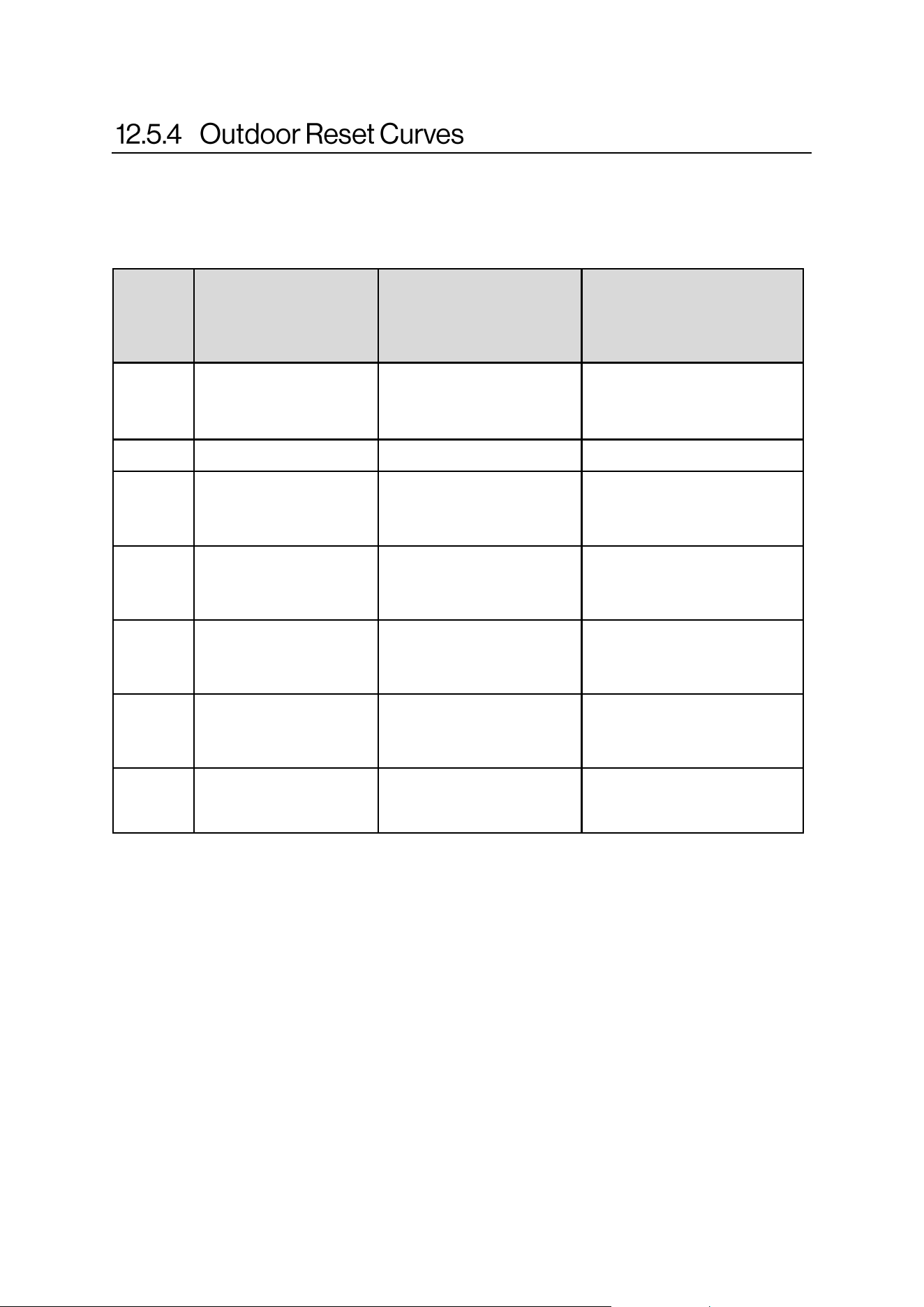
95
Rinnai I-Series Plus Condensing Combi Boiler Manual
Curve
Number
Maximum Supply
Temperature at
14°F (-10°C) Outdoor
Temperature
Minimum Supply
Temperature at
68°F (20°C) Outdoor
Temperature
Heat Emier
1
(Default)
180°F (82°C) 122°F (50°C)
Standard baseboard,
high-eciency air
handler, panel radiators
2 140°F (60°C) 104°F (40°C) Staple up radiant
3 180°F (82°C) 140°F (60°C)
High temperature air
handler or undersized
baseboard
4 Cast Iron Baseboard 170°F (77°C) 104°F (40°C)
5 Radiators 170°F (77°C) 120°F (49°C)
6 High Mass Radiant 120°F (49°C) 86°F (30°C)
7
Seng temperature on the
controller
Seng temperature on the
controller - 36°F (20°C)
Custom curve based on
customer input
The boiler has seven outdoor reset heang curves, which are dierent target temperature lines
dependent on the outdoor temperature. The selected curve should be based o of the type of heat
emier and the target temperature desired. The heang curves are described below.
Table 38
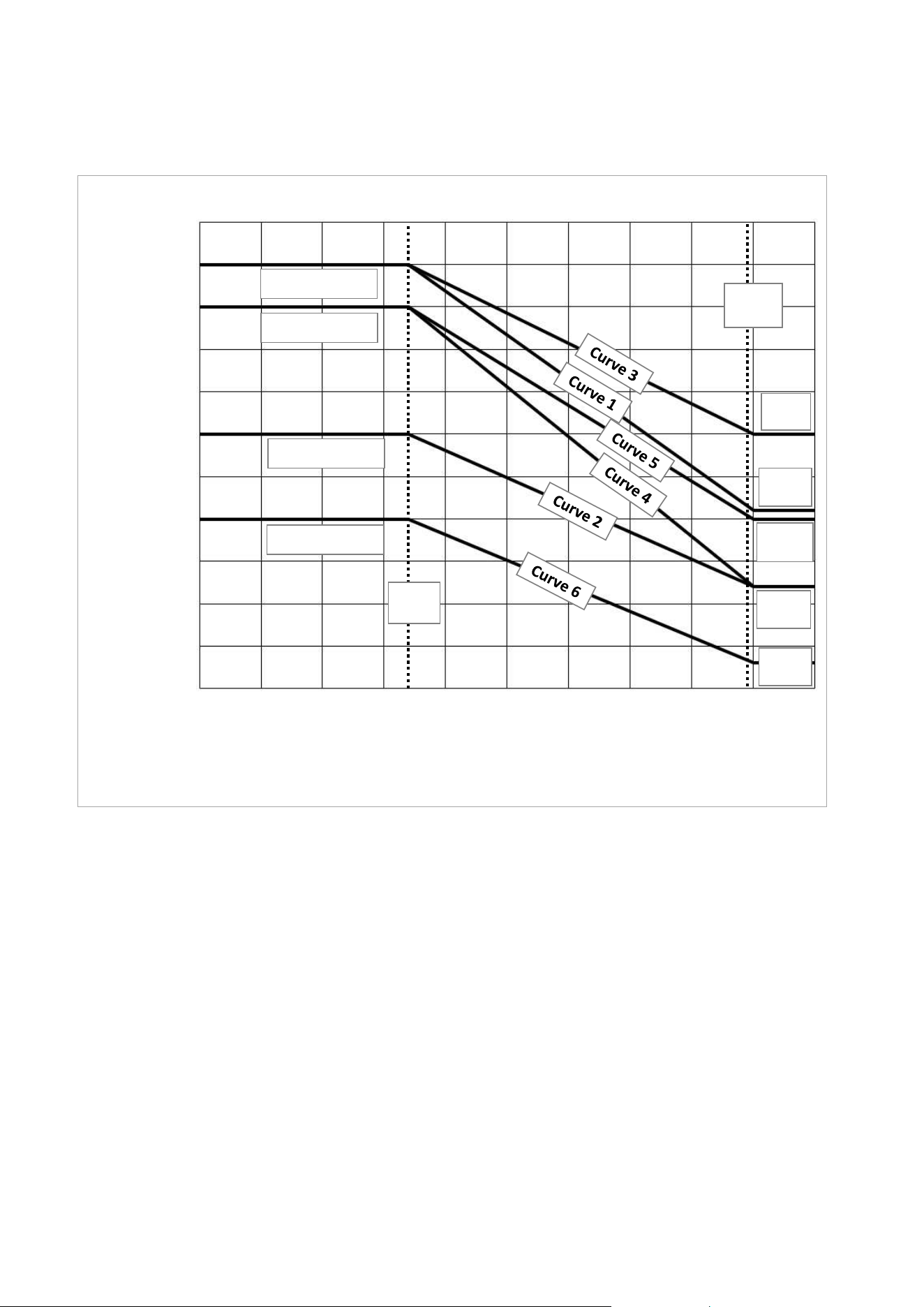
96
Rinnai I-Series Plus Condensing Combi Boiler Manual
Figure 111
80°F (27°C)
100°F (38°C)
110°F (43°C)
120°F (49°C)
140°F (60°C)
150°F (66°C)
170°F (77°C)
180°F (82°C)
90°F (32°C)
Supply Water Temperature
Outdoor Temperature
120°F
(49°C)
104°F
(40°C)
86°F
(30°C)
122°F
(50°C)
140°F
(60°C)
130°F (54°C)
160°F (71°C)
190°F (88°C)
-20°F -10°F 0°F 10°F 20°F 30°F 40°F 50°F 60°F 70°F
(-29°C) (-23°C) (-18°C) (-12°C) (-7°C) (-1°C) (4°C) (10°C) (16°C) (21°C)
180°F (82°C)
170°F (77°C)
140°F (60°C)
120°F (49°C)
14°F
(-10°C)
68°F
(20°C)
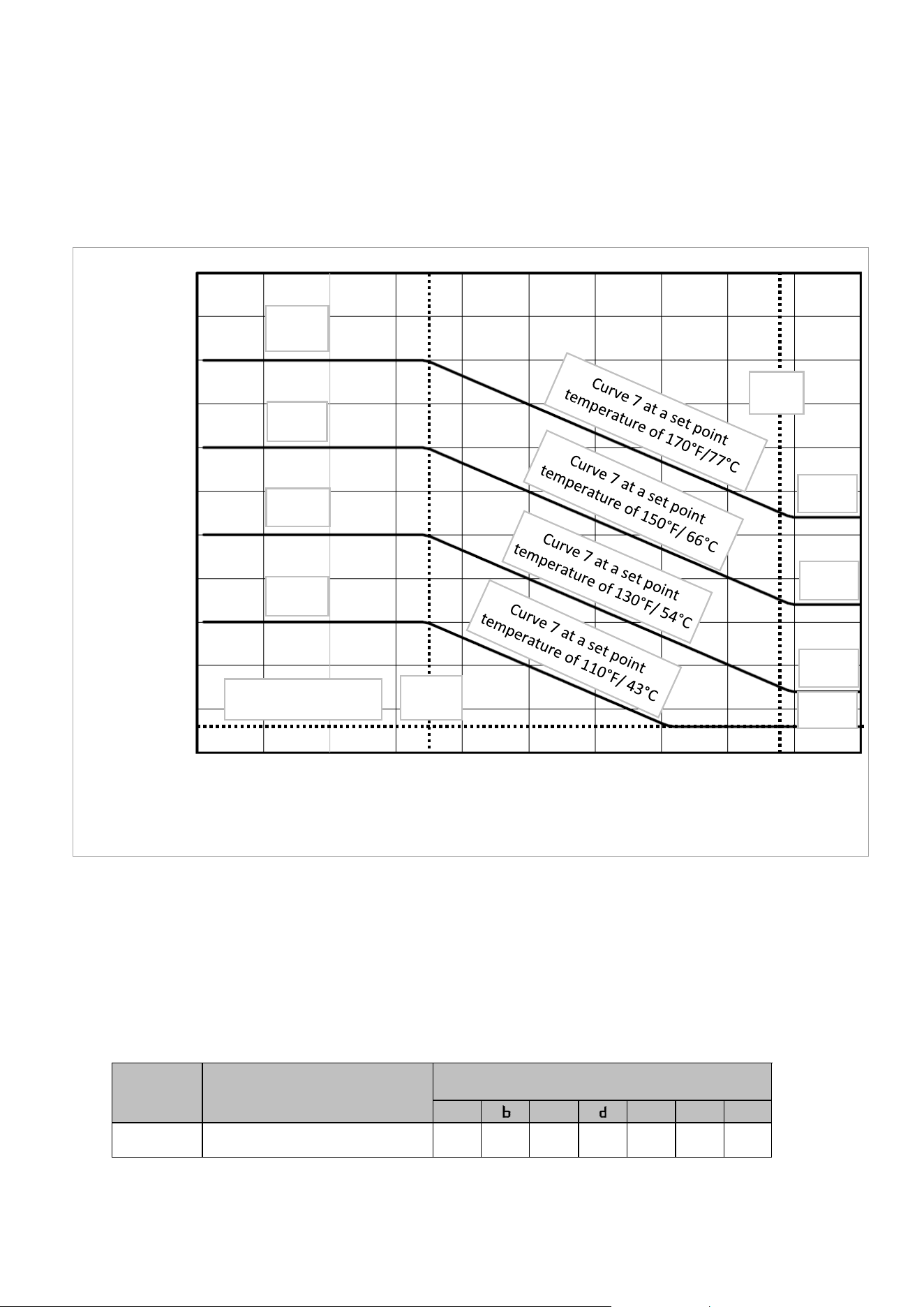
97
Rinnai I-Series Plus Condensing Combi Boiler Manual
Curve 7 is a custom curve based on the target setpoint temperature of the boiler the customer
selects. The maximum temperature is the target temperature. The minimum temperature is 36°F
(20°C) lower than the target temperature with a minimum of 86°F (30°C). See example curves
below.
Curve 7
To select the desired reset curve, access the parameters (as shown in secon “12.4 Parameter
Sengs”) and select parameter 01. Then, select the desired curve.
Parameter
Number
Seng Descripon
Selecon
A C F H E
01
Outdoor reset curve 1 2 3 6 7 4 5
Select Reset Curve
Table 39
Figure 112
-20°F -10°F 0°F 10°F 20°F 30°F 40°F 50°F 60°F 70°F
(-29°C) (-23°F) (-18°C) (-12°C) (-7°C) (-1°C) (4°C) (10°C) (16°C) (21°C)
Supply Water Temperature
Outdoor Temperature
94°F
(34°C)
114°F
(46°C)
134°F
(57°C)
110°F
(43°C)
130°F
(54°C)
150°F
(66°C)
170°F
(77°C)
190°F (88°C)
180°F (82°C)
170°F (77°C)
160°F (71°C)
150°F (66°C)
140°F (60°C)
130°F (54°C)
120°F (49°C)
110°F (43°C)
100°F (38°C)
90°F (32°C)
80°F (27°C)
14°F
(-10°C)
86°F
(30°C)
86°F (30°C) Minimum
Temperature
68°F
(20°C)
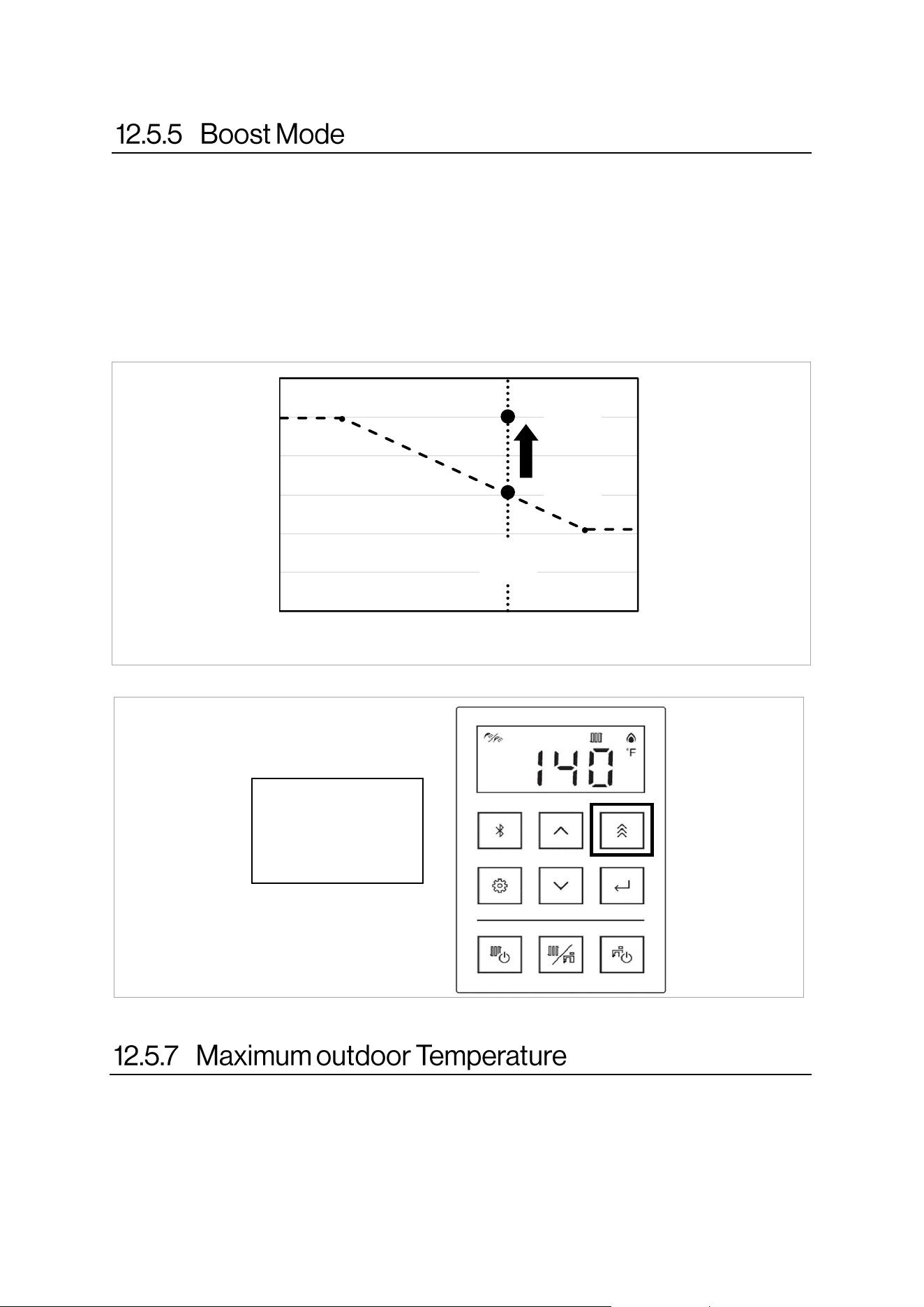
98
Rinnai I-Series Plus Condensing Combi Boiler Manual
Boost mode allows the boiler to override the target temperature determined by the outdoor reset
control, and will boost the boiler target temperature to the seng of Parameter 01 aer a connuous
run me or an interval as selected in Parameter 02. The boost funcon is acve unl the call for heat
is sased or the boiler cycles o.
For example: In the case of selecng curve 1 on parameter number 01 and 30 minutes on parameter
number 02, outdoor temperature is 51°F/11°C, and supply temperature is 140°F/60°C. When the
boiler connues operang with ring for 30 minutes, the target supply temperature will rise toward
180°F/82°C. This control connues unl shut down.
80
100
120
140
160
180
200
0 10 20 30 40 50 60 70 80
0°F
(-18°C)
20°F
(-7°C)
40°F
(4°C)
80°F
(27°C)
Outdoor Temperature
Supply Temperature
Example
180°F
(82°C)
140°F
(60°C)
51°F
(11°C)
Curve 1
The maximum outdoor temperature parameter seng (warm weather shutdown) enables the
boiler CH operaon to shut down when the outdoor temperature is higher than 77°F (25°C). This
mode can prevent the boiler from operang under warm condions unexpectedly.
Maximum outdoor temperature is selected by seng parameter number 03 to “77°F (25°C)” or
“No Maximum” (see secon “12.4 Parameter Sengs” for more informaon).
200°F (93°C)
180°F (82°C)
160°F (71°C)
140°F (60°C)
120°F (49°C)
100°F (38°C)
Boost Mode can be
achieved by pressing
the Boost Buon on
the controller.
Figure 114
Figure 113
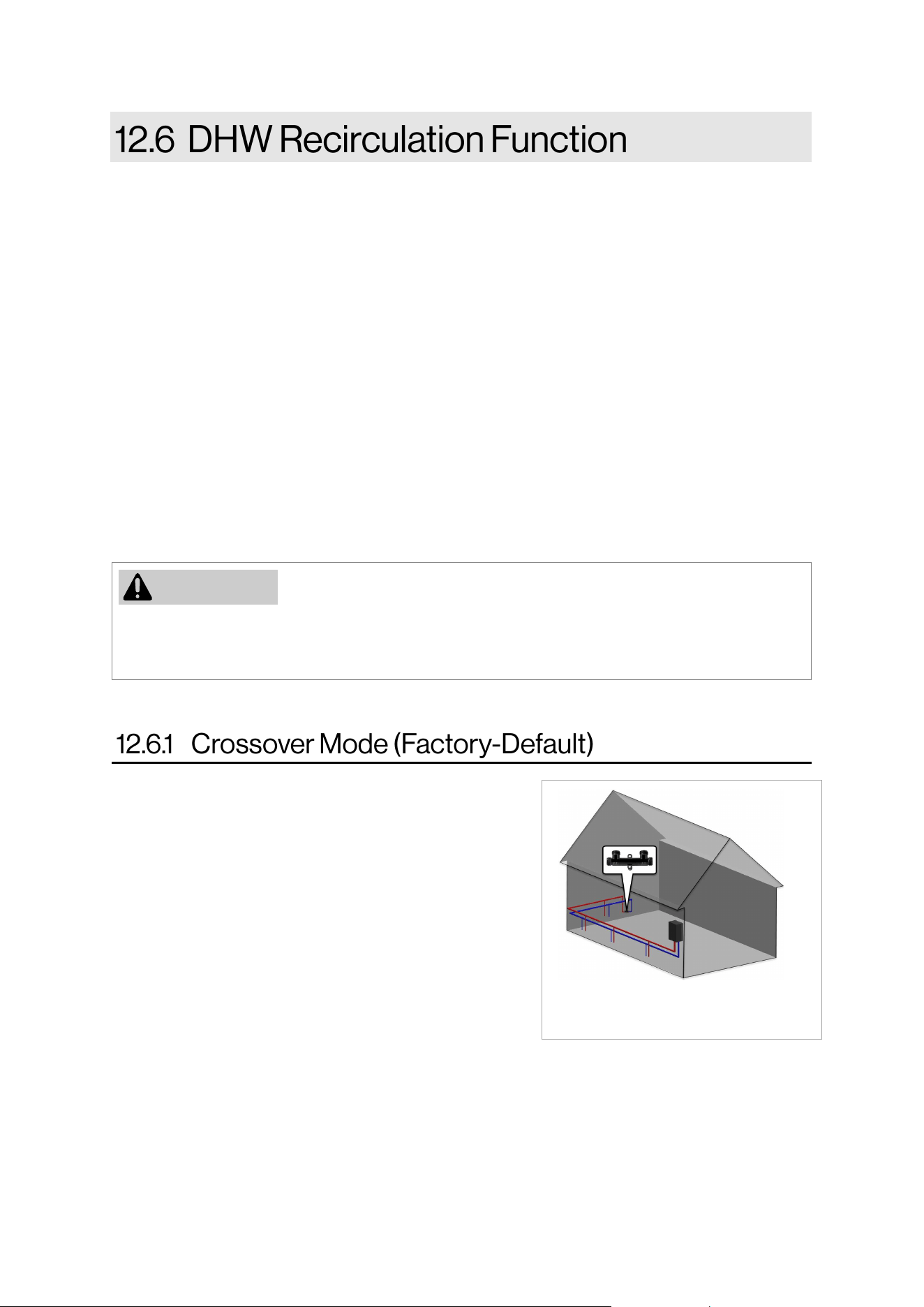
99
Rinnai I-Series Plus Condensing Combi Boiler Manual
The I-Series Plus Condensing Combi Boiler has the capability to control DHW recirculaon via an
external recirculaon pump. While the default seng for recirculaon is “o,” when selecng the
parameter number 09 as "b" ON, the DHW recirculaon funcon becomes available. An oponal
24 V mer can be used to set the me intervals and duraon of recirculaon.
When ulizing the domesc hot water recirculaon funcon, the external pump must be wired to
the Pump 4 terminal on the PC Board. Therefore, if four central heang zone pumps are used, an
external central heang zone controller is required.
During the DHW recirculaon operaon, the boiler will be in DHW operaon mode. To prevent the
central heang (CH) system from being inacve too long and the house potenally cooling down,
the boiler will operate in simultaneous operaon between DHW and CH as long as the DHW
recirculaon is taking place.
If the output target temperature for the CH system is higher than the temperature needed to heat
the DHW, the CH supply temperature will not be aected. The CH supply temperature will connue
to be the target temperature set for CH.
If the output target temperature for the CH system is less than the need to heat DHW, the supply to
the CH system will increase to the water temperature needed for DHW.
The temperature restricon can be canceled by adjusng Parameter 14. If
adjusted to "No" temperature restricon, ensure that the CH system and
heat emiers are designed for the hot water temperature supplied to the domesc plate heat
exchanger (typically 149° - 185°F / 65°C - 85°C). Failure to do so could cause damage to the CH
system, heat emiers, or building in which the system is installed.
There are two recirculaon modes available: Crossover and Dedicated.
• The plumbing system does not have a dedicated
circulaon return line. Crossover mode requires
installaon of a thermal bypass valve at the furthest
xture in the plumbing system. When installed, the boiler
uses the cold water line for hot water recirculaon. A
thermal bypass valve can be purchased through Rinnai
(PN: 107000143) or plumbing supply stores.
• How the recirculaon pump works:
− The pump turns ON and runs unl the thermal
bypass valve closes (with a DHW ow less than
approximately 0.26 GPM), or for 20 minutes,
whichever occurs rst.
− The pump stays OFF for 10 minutes.
Home includes a thermal bypass
valve installed at the furthest xture
Notes:
• The thermal bypass valve should only be used for Crossover Mode recirculaon systems.
Do not install more than one thermal bypass valve in the plumbing system.
• When ulizing the Crossover mode of recirculaon, the minimum DHW setpoint
temperature becomes 116°F (47°C).
Figure 115
CAUTION
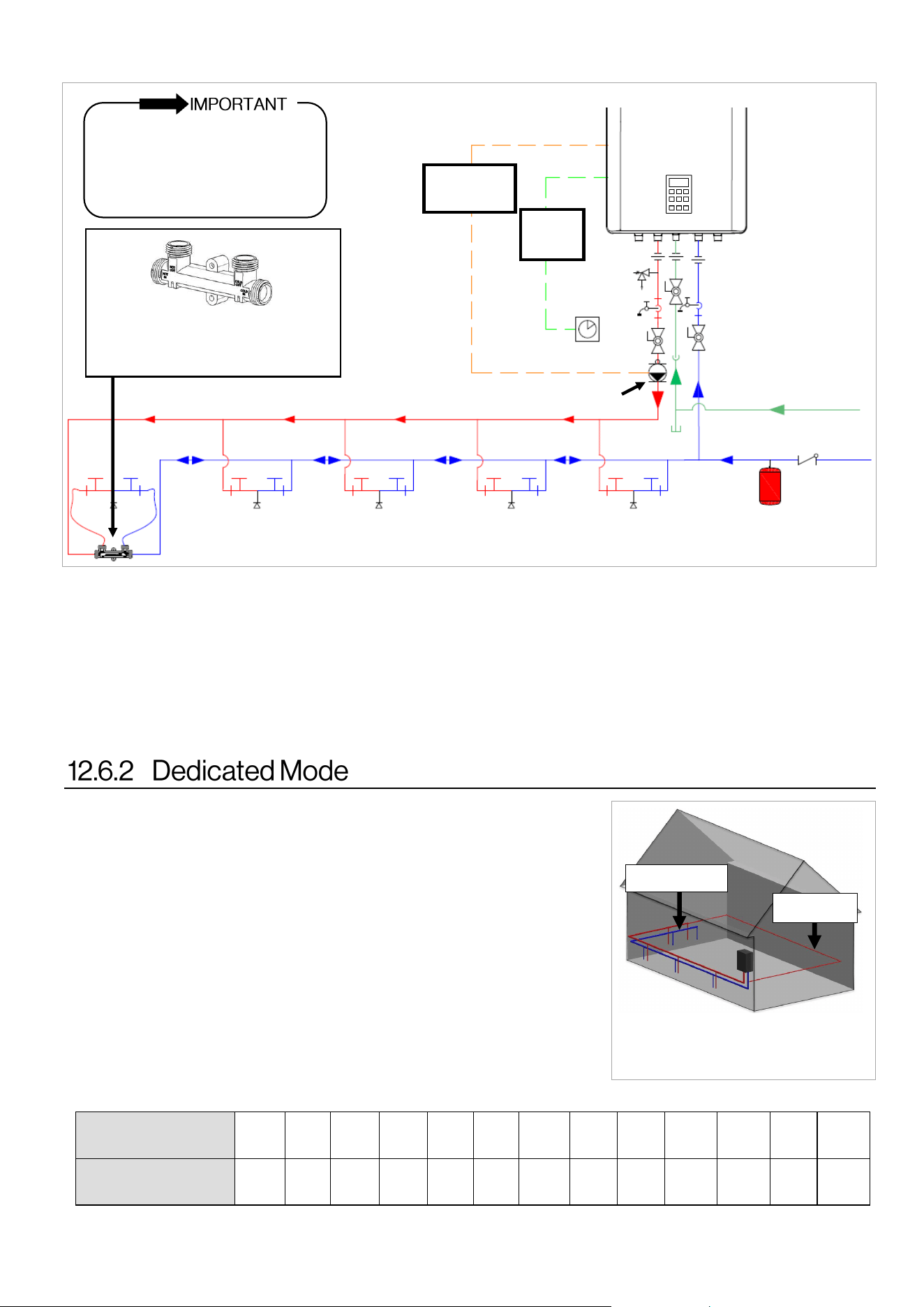
100
Rinnai I-Series Plus Condensing Combi Boiler Manual
Dedicated Mode:
• The plumbing system includes a dedicated hot water return line.
• Recirculaon technology in the boiler decides if the pump will
turn on based on me intervals and DHW setpoint temperature.
• How the recirculaon pump works:
− The pump turns ON and runs unl the DHW return water
temperature is within 6°F/ -14°C of the setpoint temperature,
or for 20 minutes, whichever occurs rst.
− The pump stays OFF based on the DHW setpoint temperature
(as outlined in the table below).
When the recirculaon logic starts, the pump will operate as described below.
• When the boiler detects the crossover valve is closed, the pump will turn o.
• Aer the o interval mer of the boiler has passed, the pump will turn on again.
• A minimum ow rate 0.5 GPM (2 L/min) is needed for the boiler to operate correctly (maximum current:
2 Amps). Select the proper pump size based on the crossover valve and DHW system pressure loss.
Note: The maximum current permissible to connect to the DHW_Pump connecon is 2 Amps.
DHW Setpoint
Temperature (°F/°C)
140/
60
135/
57
130/
54
125/
52
120/
49
115/
46
110/
43
108/
42
106/
41
104/
40
102/
39
100/
38
98/37
Typical Pump OFF
Intervals (Minutes)
9 10 11 12 14 16 19 20 22 24 26 28 31
Table 40
Gas Supply Line
Expansion Tank
Cold Water Supply Line
Hot Water Supply Line
Recirculaon
Pump Wiring
Recirculaon
Pump
Timer
(Oponal)
Crossover Mode Plumbing Diagram
This diagram is not a complete
piping diagram; it shows DHW
piping only (Central Heang
piping is not displayed).
Thermal Bypass Valve installed at
furthest xture in plumbing system.
Figure 116
Home includes dedicated hot water
and cold water lines.
Hot water
Cold water
Figure 117
T/T4
on PCB
Pump
Terminal 4
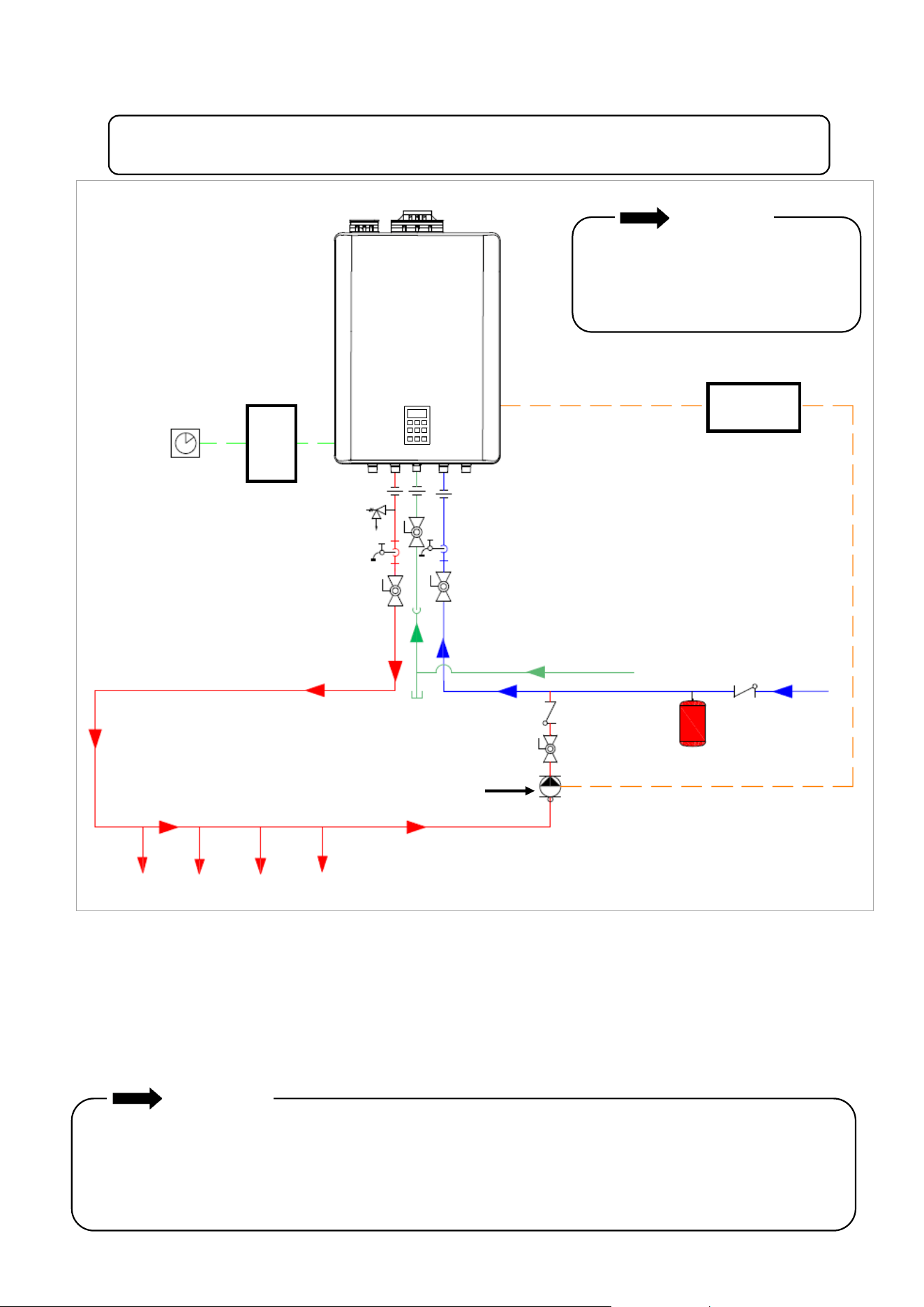
101
Rinnai I-Series Plus Condensing Combi Boiler Manual
Dedicated Mode Plumbing Diagram
DHW Recirculaon Pump
Recirculaon
Pump Wiring
Timer
(Oponal)
Hot Water Supply Line
Gas Supply Line
Cold Water Supply Line
Expansion Tank
IMPORTANT
This diagram is not a complete piping
diagram; it shows DHW piping only
(Central Heang piping is not
displayed).
Hot Water Fixtures
Building Hot
Water Return Line
When the recirculaon logic starts, the pump will operate as described below:
• When the DHW return water temperature reaches approximately 6°F (-14°C) below the DHW set point
temperature, power to the pump will be disconnued from T/T4 on the PC Board.
• Aer the o interval me of the boiler has passed, the pump will turn on again.
• If the boiler does not detect ow from the pump during the DHW recirculaon on mes, an E631 diagnosc
code will display on the controller.
IMPORTANT
The target ow rate for DHW recirculaon is from 1.3 GPM (5 L/min) to 4 GPM (15 L/min). If the ow rate is
less than 0.8 GPM (3 L/min), the DHW recirculaon pump will operate and an E631 diagnosc code will display
on the controller. If the DHW recirculaon pump ow rate drops to less than 0.4 GPM (1.5 L/min), the DHW
recirculaon pump will stop and an E631 diagnosc code will display on the controller. The proper pump size
needs to be selected for the pressure drop through the recirculaon loop (maximum current: 2 Amps).
Note: Rinnai strongly recommends installing insulaon to the hot water and dedicated return lines
to decrease the amount of heat loss.
Figure 118
T/T4
on
PCB
Pump
Terminal 4
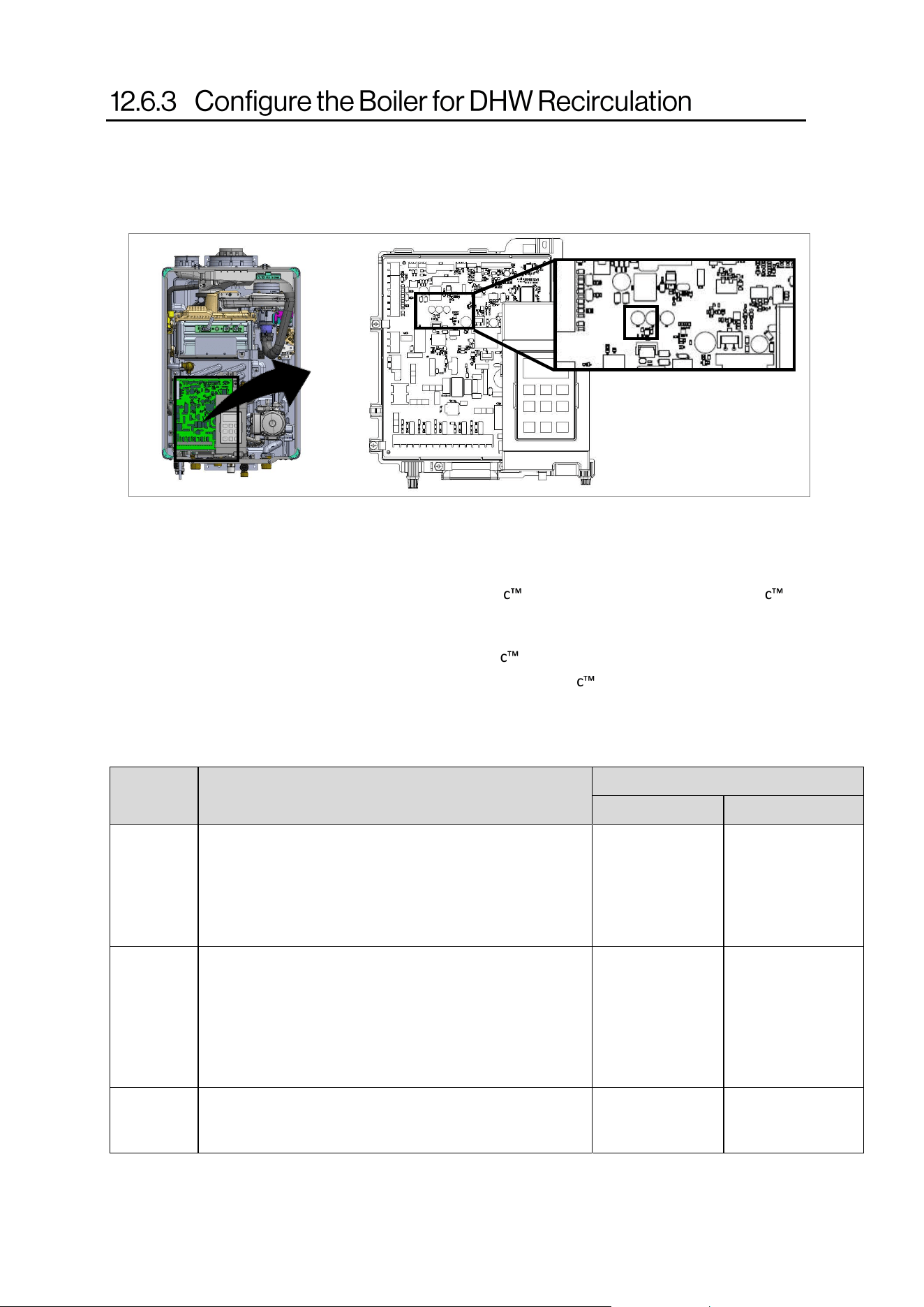
102
Rinnai I-Series Plus Condensing Combi Boiler Manual
The I-Series Plus Condensing Combi Boiler has Smart-Circ for recirculaon control. Smart-Circ allows the
boiler to idenfy when hot water is used, and then operates recirculaon on subsequent days to reduce wait
me for hot water.
When selecng parameter number 20 as "b", Smart-Circ is acvated (see table below).
The pump will operate, external mer or BLE buon and Smart-Circ together.
Fixed schedule recirculaon for the boiler requires installaon of an external mer and selecng parameter
number 20 as "A" (default).
1. Remove the boiler’s front panel, and locate the PC Board (lower le side of unit).
2. Locate the le PC Board buon.
3. Press and hold the buon for ve seconds.
4. Adjust parameter 09 to “b” - “YES” to enable DHW recirculaon.
5. Adjust parameters 12, 13 and 20 to the desired sengs shown in the table below.
6. Replace the boiler’s front panel.
Figure 119
Table 41
Parameter
Number
Funcon/Descripon
Selecon
A (Default) b
12
DHW Recirculaon Piping Setup
This parameter is available when parameter number
09 is selected as “b”. This sets the DHW recirculaon
piping mode, which controls the circulaon logic.
Ensure this corresponds to the DHW recirculaon
piping.
Cross Over Valve Dedicated Return
13
DHW Recirculaon with Timer Relay Input
This parameter is available when parameter number
09 is selected as “b”. This enables an external mer to
also control the ming for DWH recirculaon to more
directly correspond to the customer’s needs. When
selecng "No,” the boiler operates with pump ON
connuously for controlling by an external mer pump.
Yes No
20
Smart-Circ
Enables smart-circ logic together for DHW recirculaon
on each mode.
O On
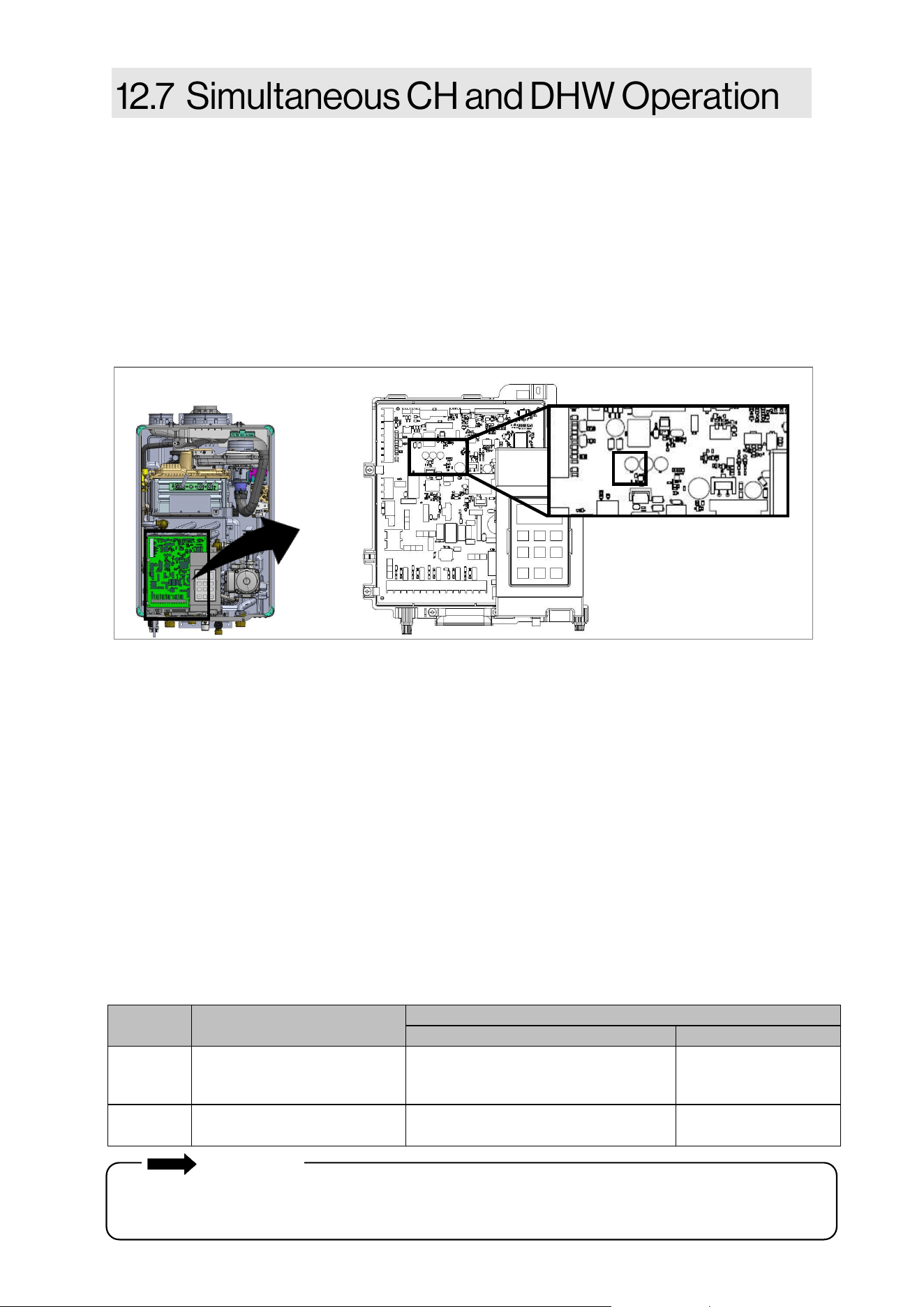
103
Rinnai I-Series Plus Condensing Combi Boiler Manual
IMPORTANT: The central heang supply water temperature can be as high as 180°F (82°C) or higher
during simultaneous operaon. If the central heang temperature is lower than 140°F (60°C), the default
seng is to not permit simultaneous operaon. The boiler would then default to a domesc hot water
priority seng. This is to prevent unintenonally supplying high supply water temperature to a low
water temperature applicaon.
If it is desired to have simultaneous operaon with a higher domesc hot water setpoint than the central
heang setpoint, access the parameters (as shown in secon “12.4 Parameter Sengs”) and adjust
parameter 14 to “b.” In this scenario, there is the potenal to have higher temperature water being
supplied to the central heang system. Ensure that the central heang system is designed for this high
supply water temperature.
If it is desired to have more capacity delivered to central heang during simultaneous operaon, adjust
parameter 15 to “b” (as shown in secon “12.4 Parameter Sengs”). This will enable the 3-way valve to
deliver a higher ow rate to the central heang circuit. This may restrict domesc hot water capacity in
this scenario.
1. Remove the boiler’s front panel by removing the two screws that secure the panel.
2. Locate the PC Board (lower le side of unit).
3. Locate the le PC Board buon.
4. Press and hold the buon for ve seconds.
5. Adjust Parameter 08 to “b” to enable Simultaneous Central Heang and Domesc Hot Water.
The boiler has the capability to operate simultaneously between central heang and domesc hot
water. The boiler can control dividing the ow between the domesc hot water plate heat
exchanger and the central heang circuit.
The boiler is set to a default domesc hot water priority operaon. If it is desired to have
simultaneous operaon of central heang and domesc hot water, follow the steps below.
IMPORTANT
When set for simultaneous operaon, domesc hot water could be reduced by up to half depending
on the central heang demand. If high domesc hot water ow is desired, it is recommended to not
use the simultaneous operaon feature.
Parameter
Number
Seng Descripon
Selecon
A
b
14
Simultaneous central heang
and domesc hot water
temperature limit
Domesc Hot Water
Priority (When CH target temperature
is less than 140°F/60°C)
Domesc Hot Water
Temperature Limited
15
3-way valve posion during
simultaneous operaon
Normal
Addional Central
Heang
PC Board
Figure 120
Table 42
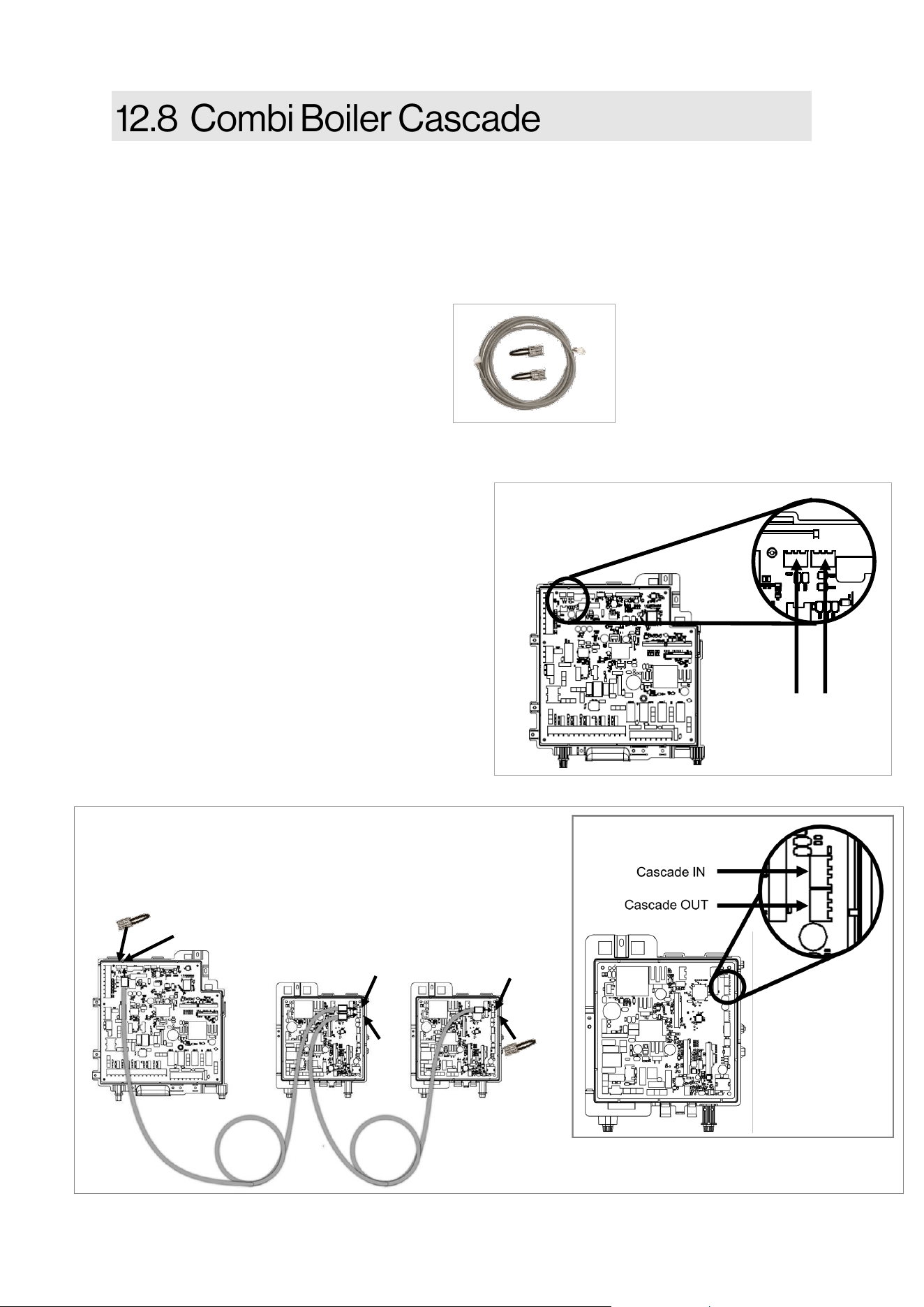
104
Rinnai I-Series Plus Condensing Combi Boiler Manual
With the use of cascade cable(s), an I-Series Plus Combi Boiler can be electronically connected with
up to 23 Rinnai CX (without pump) and CXP (with pump) tankless water heater models. This
connecon will rotate units operaon order to ensure equal usage among the enre system and
enables all units connected to modulate operaon and funcon as one domesc hot water source.
NOTE: Only use models shown in appropriate quanes as shown in Table 48.
Cascade Cables Required:
• Cable Length: 26 (8m) OR
• Cable Length: 10 (3m)
• One cable required for each unit.
• Includes 1 cable and 2 cascade jumpers.
Cascade Cable Assembly:
1. Connect one end of the Cascade Cable to the
“Cascade OUT” accessory port on the PC board.
2. Connect the other end of the cascade cable to
the “Cascade IN” accessory port on the PCB of
the next unit.
3. Repeat steps 1 and 2 for each subsequent unit
in the system.
4. Connect the “Cascade Jumper” (included with
the cascade cable) to the open accessory ports.
5. Proceed to “Programming Cascade
Communicaon” on the following page.
Cascade
IN
Cascade
OUT
I-Series Plus
Combi Boiler
Secondary 1
PCB
Secondary 2
PCB
OUT
OUT
IN
IN
Cascade Jumper
Cascade
Jumper
Figure 123
I-Series Plus
Primary PCB
Figure 121
Figure 122
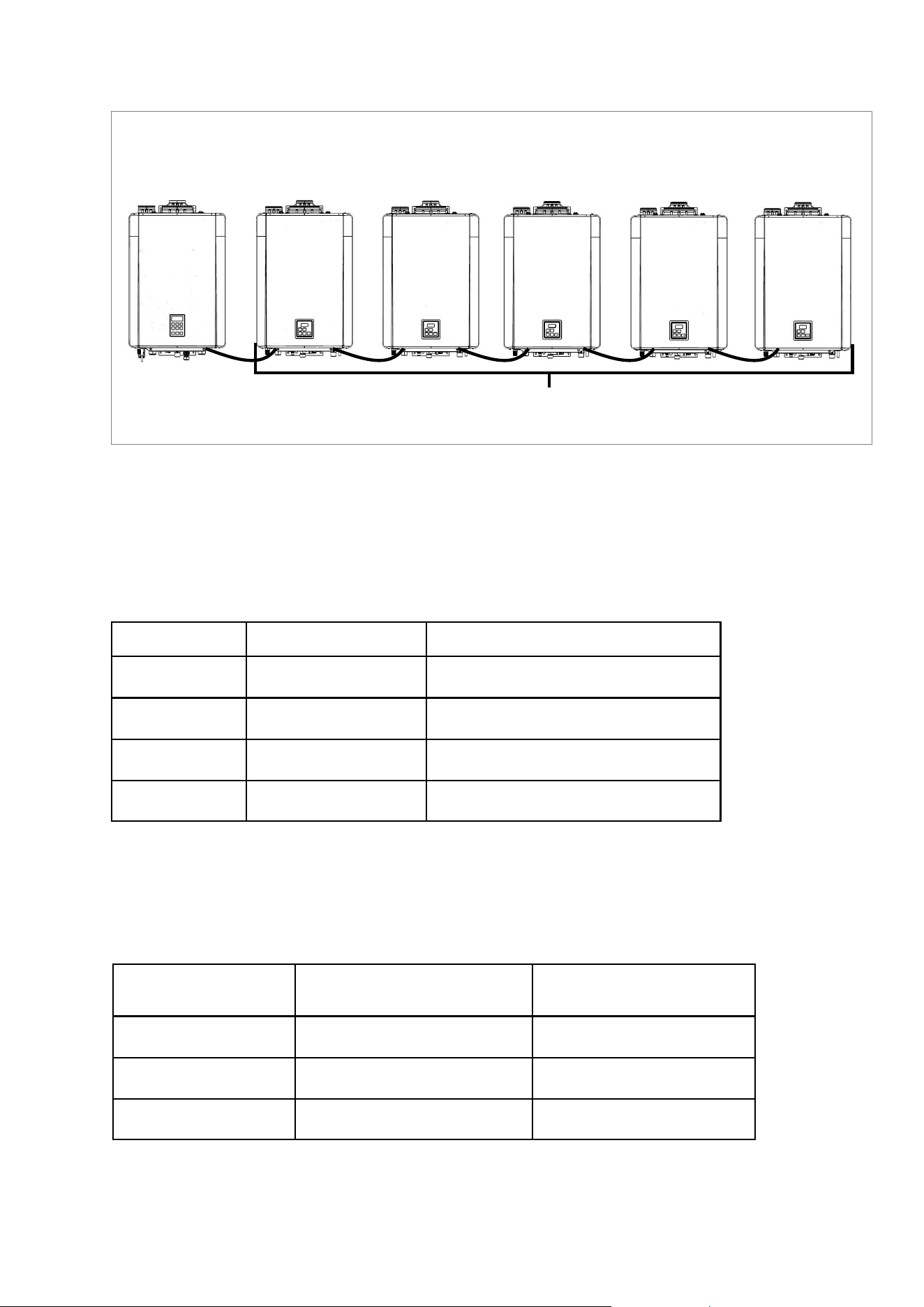
105
Rinnai I-Series Plus Condensing Combi Boiler Manual
Combi I-Series
Plus Boiler
Rinnai CX/CXP Tankless Water Heaters
Compatible I-Series Plus Combi Boilers:
• IP120199CN
• IP150199CN
Compatible Rinnai CX/CXP Tankless Water Heaters:
• CX199iN
• CXP199iN
Secondary
Unit
Model Primary/Secondary Maximum Per Unit Model in Cascade
IP120199CN Primary 1
IP150199CN Primary 1
CX199iN Secondary 23
CXP199iN Secondary 2
Notes:
• Only one (1) Combi boiler may be used in the cascade.
• A maximum of two (2) Rinnai CXP (with pump) tankless water heaters may be used in a cascade.
I-Series Combi
Boiler
Rinnai CX (without pump)
Tankless Water Heater
Rinnai CXP (with pump)
Tankless Water Heater
1 23 0
1 0 2
1 1 1
Maximum Permissible Number of Units Per Type in Cascade
Secondary
Unit
Secondary
Unit
Secondary
Unit
Secondary
Unit
Primary
Unit
Figure 124
Table 44
Table 43
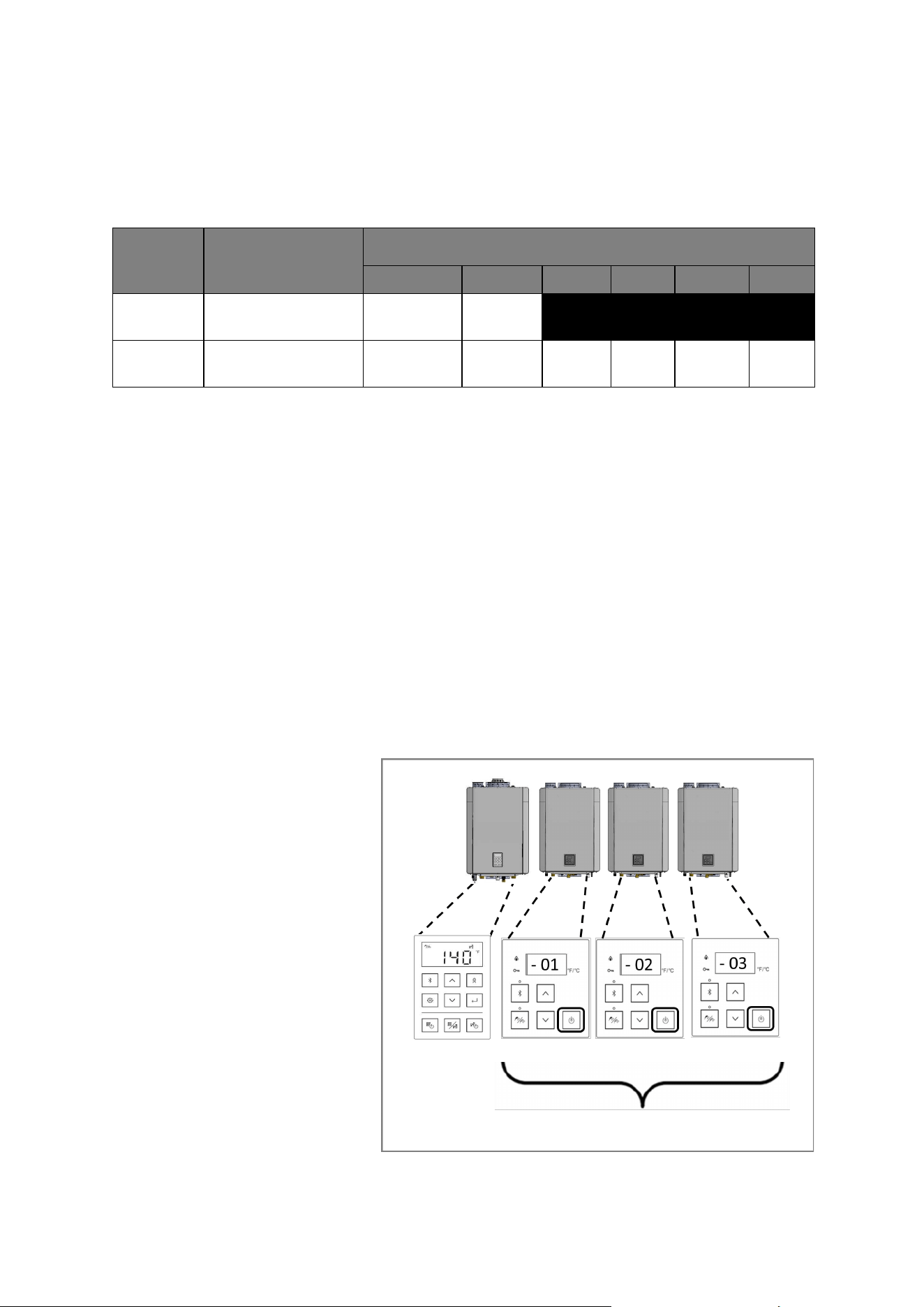
106
Rinnai I-Series Plus Condensing Combi Boiler Manual
71 Cascade:
NOTE: Controller will display P:140 (seng temp) for “Primary.”
Primary: Select the I-Series Combi Boiler intended to be the Primary unit for cascade communicaon.
Set the parameter seng for this boiler to “Primary” (71b).
NOTE: Controller will display the set temperature for the system.
Secondary: Factory Default seng for each water heater is set to “Secondary”. Parameter adjustment
is only needed on the boiler idened as “Primary.”
72 Units in Standby:
Adjust the parameter seng of the primary unit to set the number of boiler and water heaters in
standby. Standby units will maintain operaon with the water ow control valve in the open posion.
The remaining boiler and water heaters will maintain the water ow control valve in the closed
posion.
Programming Cascade Communicaon
Parameter
#
Selecon
Seng
Descripon
A
b
C
d
E F
71
Cascade Secondary Primary
72
Units in Standby
(Cascade)
1 2 3 4 5 6
Refer to the parameter seng secon of this manual for instrucons on how to access and change
parameter sengs.
Seng Secondary ID
Aer idenfying the “Primary”
boiler in the parameter
sengs, set the Secondary ID
for the remaining water heater
in the system by pressing the
“On/O” buon on the
controller.
When ID seng is successful,
the controller display will
change from “- - -” to the
newly set ID number.
Figure 125
Table 45
Primary
Boiler
Secondary 01 Secondary 02 Secondary 03
Identify Secondary ID by Pressing “On/Off”
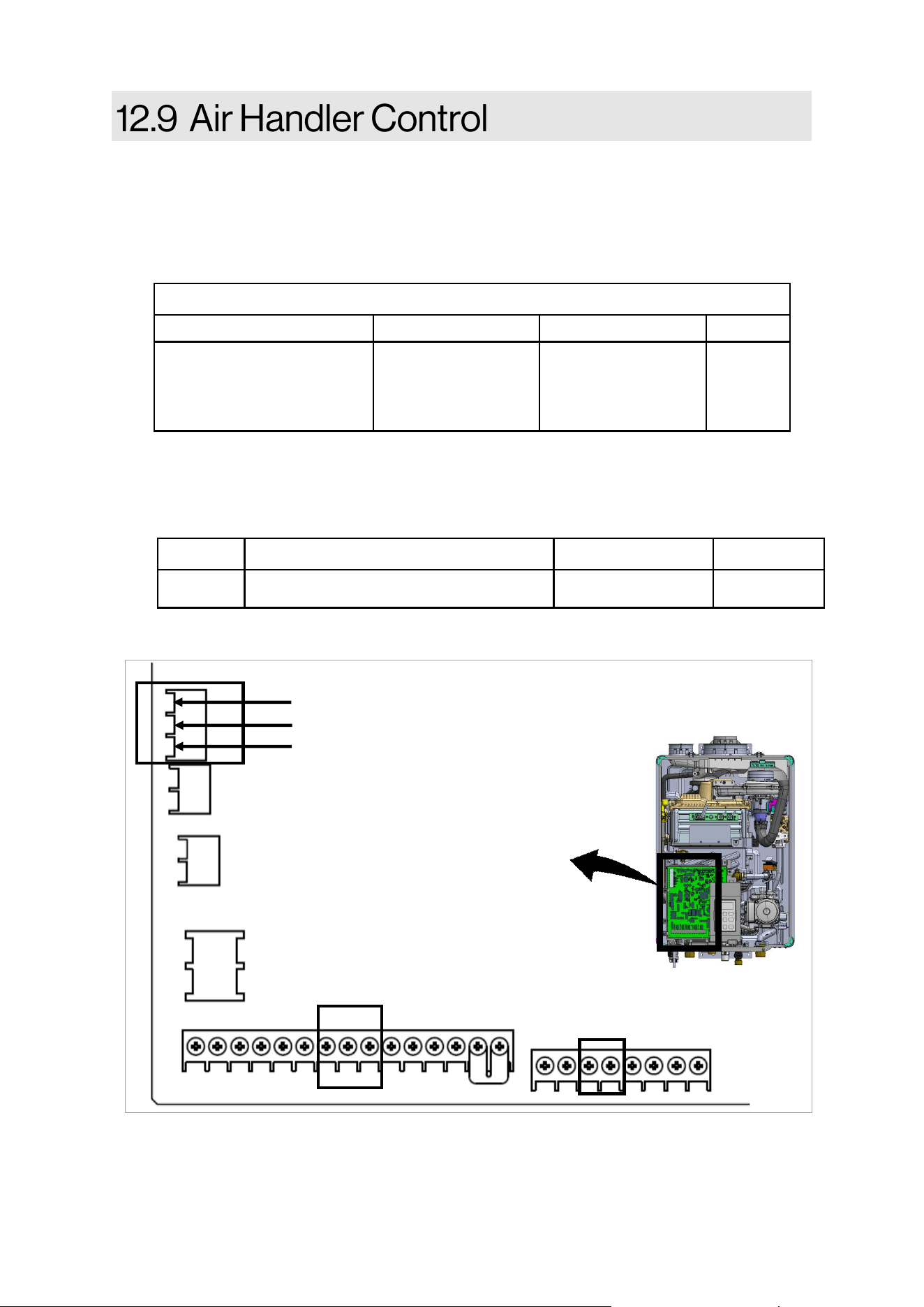
107
Rinnai I-Series Plus Condensing Combi Boiler Manual
Domesc Priority/Maintenance Indicaon Sengs
Switch Conguraon Required Leads/Wires Funcon Funcon
Air Handler Operaon White/Black
In series with
thermostat “W” wire
Normally
Closed or
Normally
Open
The OPU can be set up to operate with the boiler on Zone 3 thermostat connecons.
The post pump mer can be selected in parameter 51 (see table below).
Parameter Descripon Seng A (Default) Seng b
51 Air Handler Post Pump Operaon 15 Seconds 40 Seconds
Normally Open Terminal
Common Terminal
Normally Closed Terminal
OPU Terminal Connecons
PC Board
Figure 126
Table 47
Table 46
The I-Series Plus Condensing Combi Boiler has the capability to send an output signal to an Air Handler.
The zone pump for the air handler must be connected to Pump 3 and the thermostat must be
connected to T/T 3.
When selecng parameter 50 as "b" ON, the output signal for air handler operaon is available.
T/T 3 Connecon
C R W
External Pump
Connecon 3
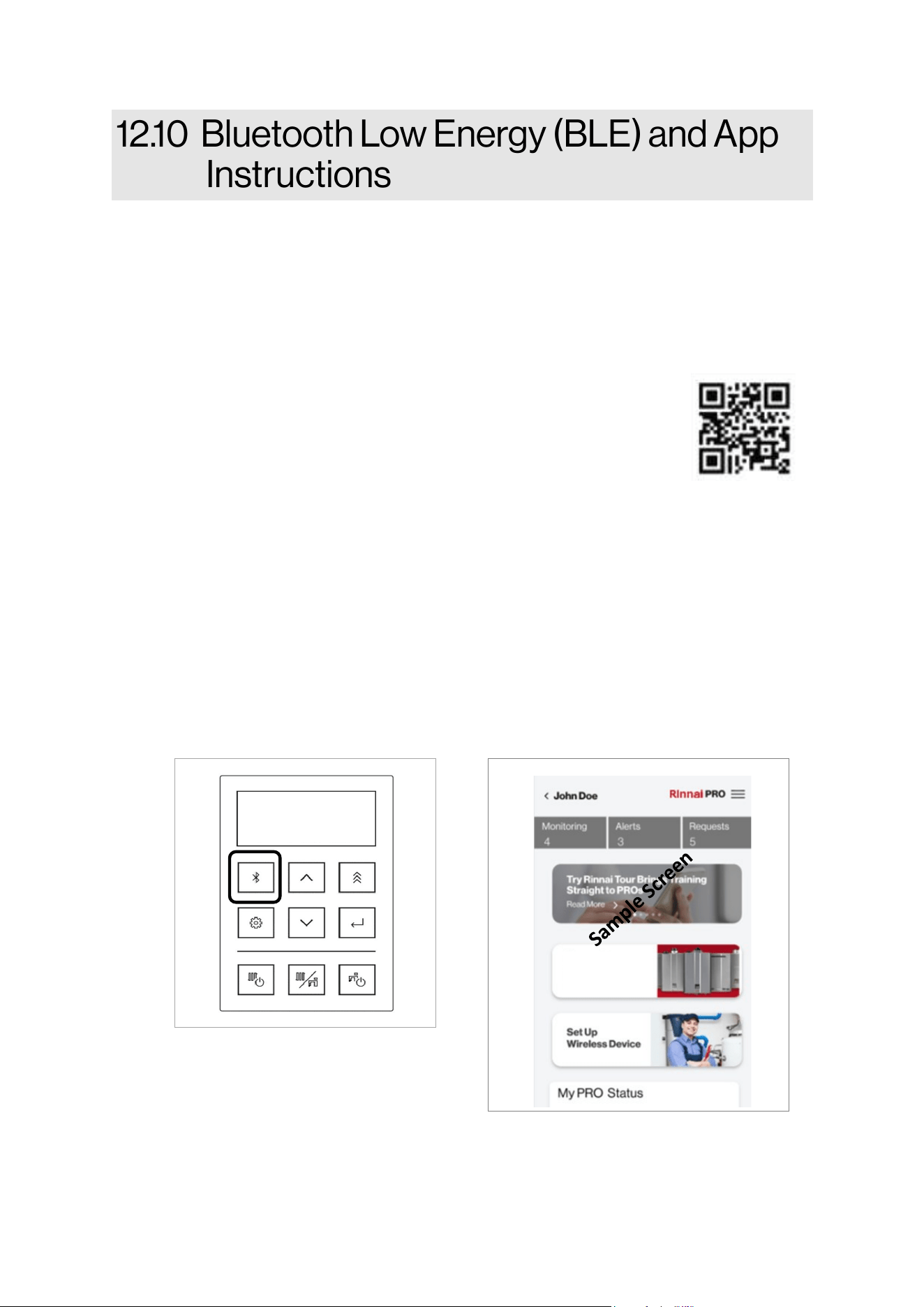
108
Rinnai I-Series Plus Condensing Combi Boiler Manual
Instrucons on this page are correct at the me of publishing; however, these instrucons may be
updated without noce. To make sure you have the most current instrucons, please visit
rinnai.us/wi (for United States installaons) or rinnai.ca/wi (for Canadian installaons).
To download the Rinnai Central app:
1. Scan the QR code shown to the right.
2. Download the Rinnai Central app from the app store.
To congure your boiler using the Rinnai Central app:
Note: To use the Rinnai Central app BLE feature with your boiler, your connecng
device (smartphone, tablet, computer, etc) must support Bluetooth 4.0 or newer.
Contact your connecng device manufacturer if you are not sure if your device
supports Bluetooth 4.0 or newer.
1. Press and release the Bluetooth buon on the controller. The Bluetooth
LED on the controller turns solid blue.
2. Log into the Rinnai Central app with a professional account and choose “Connect to a
Rinnai Boiler.”
3. The boiler will beep once when pairing is successful. If the pairing mode on the boiler
expires without having successfully paired, the boiler will beep twice.
4. Follow the Rinnai Central app through seng up your boiler.
To connect a Rinnai BLE push buon to your boiler:
1. Press and hold the Bluetooth buon on the controller unl the Bluetooth LED on the
controller starts blinking.
2. Press and hold the Rinnai BLE push buon unl the green light ashes. The boiler will beep
once when pairing is successful. If the pairing mode on the boiler expires without having
successfully paired, the boiler will beep twice. Pressing the Rinnai BLE push buon starts
recirculaon of your boiler.
Figure 128
Figure 127
Con nec t to a
Rinnai Boile r
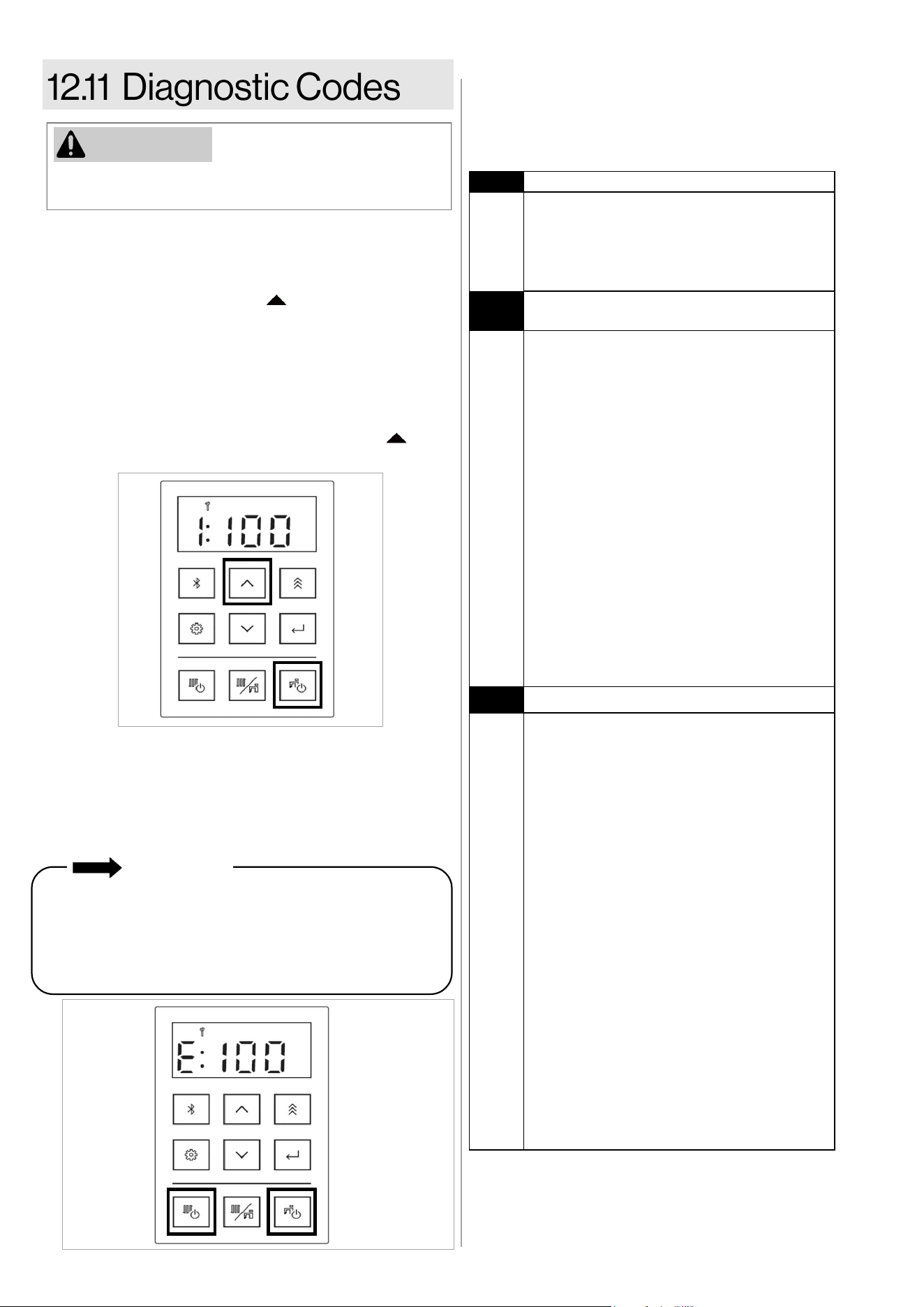
109
Rinnai I-Series Plus Condensing Combi Boiler Manual
Display Diagnosc Codes
To display diagnosc codes, follow the steps below.
1. Press and hold the Domesc Hot Water buon for
two seconds, and then the (Up) buon (hold both
buons at the same me).
2. The last nine maintenance codes display and ash
one aer the other.
3. To exit diagnosc codes and return the boiler to
normal operaon, press and hold the Domesc Hot
Water buon for two seconds, and then the (Up)
buon (hold both buons at the same me).
* See
“Electrical
Diagnoscs” on
Technical Data
Sheet located
on inside front
cover of boiler.
Some of the checks below
should be performed by a
licensed professional. Consumers should never aempt
any acon that they are not qualied to perform.
Reset Diagnosc Codes
To reset diagnosc codes, either the Central Heang or
Domesc Hot Water buon on the control panel will be
blinking. Press the buon to reset the code.
Diagnosc Codes
IMPORTANT
• Diagnosc codes that occur during DHW operaon
may be able to reset by turning o the faucet.
• Some diagnosc codes may not reset by pressing
the CH or DHW buons. If this is the case, contact
your service provider for troubleshoong
assistance.
021
Too Long DHW Connuous Operaon
• Using DHW beyond maximum
connuous operang me by
parameter 18 seng.
• Ensure the parameter seng is correct.
• Check the water leakage of DHW.
100
Air Supply or Exhaust Blockage/
Condensate Trap is Full
• Fan current inial check error.
• Ensure condensate line and trap is not
blocked.
• Ensure internal air lter is clean with no
obstrucons.
• Ensure high altude seng is set
properly (See High Altude Seng).
• Ensure combuson air and exhaust
vents are not blocked and the approved
venng materials are being used.
• Ensure either the exhaust ring or intake
cap is removed properly.
• Ensure vent length is within limits.
• Check fan for debris and ensure wheel
turns freely.
• Verify fan check valve is not stuck
between fan casing and burner body.
110
No Ignion (Unit Not Turning On)
• Ignion Error.
• Check that the gas is turned on at the
boiler, gas meter, and/or propane
cylinder.
• If the unit is installed in a propane
system, ensure that gas is in the tank.
• Bleed all air from the gas lines.
• Check the ground wire for the PC Board.
• Ensure the ame rod wire is connected.
• Ensure the igniter is operaonal.*
• Ensure the venng is installed in
accordance to this manual.
• Check that the surface of the electrode
and ame rod are clean.
• Check gas solenoid valves for open or
short circuits.*
• Verify gas orice installed is correct for
the gas system the unit is installed in.
• Check ame rod voltage to ground
during ignion.
Table 48
Figure 129
Figure 130
WARNING
* See “Electrical Diagnoscs” on Technical Data
Sheet located on inside front cover of boiler.
110
Rinnai I-Series Plus Condensing Combi Boiler Manual
* See “Electrical Diagnoscs” on Technical Data
Sheet located on inside front cover of boiler.
120
Flame Failure
• Boiler has ame failure.
• Check that the gas is turned on at the
boiler, gas meter, and/or propane
cylinder.
• If the unit is installed in a propane
system, ensure that gas is in the tank.
• Ensure the venng is installed in
accordance to this manual.
• Ensure the ame rod wire is
connected.
• Ensure the gas type and inlet gas
pressure are correct.
• Bleed all air from the gas lines.
• Check the ground wire to the PC
Board.
• Check ame rod voltage to ground
during ignion.
140
Heat Exchanger Overheat
• Overheat switch is tripped.
• Measure the resistance of the
Overheat Switch.*
• Check the heat exchanger surface for
hot spots which may indicate blockage
due to scale buildup.
• Ensure the boiler pump is not locked
up.
• Ensure that all of the valves in the CH
circuit are open.
• Ensure the boiler and CH circuit does
not have a freezing condion.
• The surface of the heat exchanger may
turn to a black color as stainless steel is
tempered even in normal condions.
This does not indicate an abnormal
condion.
• Check for damage on the exhaust, seal,
and venng.
150
Venturi Control
• Venturi operaon error.
• Ensure the venturi motor is operang
correctly.*
• Replace the gas valve assembly.
161
High Outgoing Temperature
• Safety shutdown because DHW
outgoing temperature is too hot.
• Check sensor wiring for damage of
outgoing thermistor.
• Measure resistance of outgoing
thermistor.*
• Ensure the gas valve has no damage
and the orice is installed correctly.
• Replace the gas valve assembly.
170
Venturi Blockage
• Check the venturi and silencer for
blockage.
• Before reseng this error, check if the
condensate drain is block and if the
venng is connected properly.
180
Gas Valve Adjustment Limit
• Ensure gas type is correct.
• Ensure the ground from PCB is correct.
• Ensure gas type parameter is correct.
• Please call Rinnai Technical Support.
190
Electrical Grounding
• Secondary circuit ground fault.
• Check all electrical components for
electrical short.
210
Data Transfer Error
If the PCB has been replaced, ensure the data
transfer process is complete.
220
Gas Valve Adjustment
• Ensure a Reed switch is located properly.
• Ensure the gas valve adjustment is
operang correctly.*
250
Condensate Pump (Accessory)
• Boiler will operate for 60 seconds.
• Conrm wire connecons and harnesses
are good.
• Ensure the condensate reservoir is empty
and condensate pump is operaonal.
310
Freeze Protecon Thermistor
• Check sensor wiring for damage.
• Measure the resistance of the sensor.
• Replace if necessary.
321
Outgoing Thermistor (Combi Only)
• Check sensor wiring for damage.
• Clean sensor of any scale buildup present.
• Measure the resistance of the sensor.
• Replace if necessary.
331
Heat Exchanger Thermistor (Combi Only)
• Check sensor wiring for damage.
• Measure the resistance of the sensor.
• Replace if necessary.
341
Inlet Thermistor (Combi Only)
• Check sensor wiring for damage.
• Measure the resistance of the sensor.
• Replace if necessary.
353
Supply Thermistor
• Check sensor wiring for damage.
• Clean the surface of the sensor.
• Measure the resistance of the sensor.
• Check the return thermistor.
• Replace if necessary.
111
Rinnai I-Series Plus Condensing Combi Boiler Manual
363
Return Thermistor
• Check sensor wiring for damage.
• Measure the resistance of the sensor.
• Replace if necessary.
380
Exhaust Thermistor
• Check sensor wiring for damage.
• Clean the surface of the sensor.
• Measure the resistance of the sensor.
• Check the return thermistor.
• Replace if necessary.
393
Outdoor Thermistor
• Ensure that parameter number 00 is
set to the appropriate posion.
• Check sensor wiring for damage.
• Measure the resistance of the sensor.
• Replace if necessary.
400
Pressure Sensor
• Check sensor wiring for damage.
• Measure the voltage of the sensor.
• Replace if necessary.
430
High/Low Water Pressure
• If the water pressure is too low, add
water into the system unl at least 13
PSI is observed.
• Ensure there are no leaking
components in the CH system.
• If the pressure is too high, adjust the
pressure to a maximum of 30 PSI.
• Ensure the pressure relief valve and
water ll are working correctly.
443
Low Water Cut-O (LWCO)
• Ensure the LWCO device is working
correctly.
• Ensure the LWCO jumper is connected
properly when LWCO is not in use.
• Ensure the output is 24 V AC. If it is
not, a transformer is needed.
520
Solenoid Valve Circuit
• Check the ame rod and wire for
damage.
• Close the gas shut o valve installed
near the boiler.
• Ensure the ame rod and wire are not
wet.
• Check the output from the PC Board to
the solenoid gas valve.
• If the output from the PC Board is
abnormal, replace the PC Board.
• If the output from the PC Board is
normal, replace the gas control.
540
High Exhaust Temperature
• Make sure boiler pump acvates during
operaon.
• Check the exhaust thermistor wiring for
damage.
• Clean the surface of the thermistor.
• Measure the resistance of the exhaust
thermistor.*
• If the sensor has been replaced and the
error sll appears, check the return
thermistor.
• If the boiler is used in a hard water
area, ush the DHW plate heat
exchanger.
• Check the exhaust duct, seal, and
venng for damage.
610
Combuson Fan
• Check the motor wire harness for loose
or damaged connecons.
• Measure resistance and voltage of
motor wire harness.*
• Ensure the combuson fan spins freely.
631
DHW Recirculaon Pump (Combi Only)
• Ensure the DHW recirculaon matches
the Parameter 12 seng.
• Ensure the dedicated return line is
properly installed.
• Ensure the inlet water lter and bypass
lter are clean and free of debris.
• Ensure the DHW recirculaon pump is
connected to the DHW Pump Terminal.
• Ensure the capacity of the recirculaon
pump is sized appropriately for the
piping (DHW recirculaon pump should
be higher than 1.3 GPM).
• Ensure air is removed from the
recirculaon line.
* See “Electrical Diagnoscs” on Technical Data
Sheet located on inside front cover of boiler.
112
Rinnai I-Series Plus Condensing Combi Boiler Manual
* See “Electrical Diagnoscs” on Technical Data Sheet
located on inside front cover of boiler.
651
Water Flow Control (Combi Only)
• Measure the resistance values and
voltage of the water ow control.*
• Ensure the harness and connector are
not wet.
• If the voltage from the PC Board is
abnormal, replace the PC Board;
otherwise, replace the water ow servo
valve.
661
By-Pass (Combi Only)
• Measure the resistance values and
voltage of the bypass servo valve.*
• Ensure the harness and connector are
not wet.
• If the voltage from the PC Board is
abnormal, replace the PC Board;
otherwise, replace the bypass servo
valve.
670
3-Way Valves (Combi Only)
• Check the CH system water quality.
• Measure the resistance values and
voltage of the 3-way valve control.*
• Replace the 3-way valve control device.
681
Hot Water Supply Temperature
Abnormality (Combi Only)
• If the DHW water temperature is higher
than the set point temperature
because the boiler bypass servo fails to
close.
• Measure resistance values and voltage
of the bypass ow control.*
• Replace the bypass ow control device
if needed; otherwise, check the inlet
thermistor and heat exchanger
thermistor wiring for damage.
• Measure the resistance of the sensor.
Replace if needed.
• Clean the sensor of any scale buildup
present.
700
PC Board
• PC Board circuit error.
• Replace PC Board.
710
Solenoid Valve Circuit
• Ensure Dip switch 5 on the PC Board is
in the OFF posion (default).
• Ensure the gas control wire is not loose
or damaged.
• Ensure the heater circuit is not
grounded.
• Ensure the outgoing thermistor works
without error by using DHW (Combi
Only).
• Replace the PC Board.
720
Flame Rod
• Check the ame rod and wire for damage.
• Ensure the ame rod and wire are not wet.
• If there is no issue with the ame rod or
wiring, replace the PC Board.
890
Freeze Issue
• The boiler checks the heat exchanger
temperature at the me of operaon. If the
temperature is too low, an error will occur.
• Check if there is freezing in the boiler or CH
system.
999
PC Board Mismatch
• This code occurs when the PC Board and the
internal logic do not match.
• Check if the soware versions of the board
and operaon board do not match.
LC
Scale Buildup in Heat Exchanger
(Combi Only)
• Flush the DHW plate heat exchanger.
• The LC code will reset automacally when
scaling is removed.
• If the LC code remains, check the DHW
thermistor, ow sensor or boiler pump.
FFF
Maintenance Indicator
• This code is a placeholder in diagnosc code
history indicang a service provider
performed maintenance or service.
• Enter this code aer performing service by
pressing the following buons at the same
me: UP, DOWN, and CH (or DHW). FFF
appears on the monitor.
SS
Service Soon (SS)
• Service Soon (SS) is a me-based service
indicator set during installaon. See
parameter 04 in secon “12.4 Parameter
Sengs" for more informaon.
• To reset SS code, press Central Heang
buon 5 mes unl SS disappears.
NO CODE
Nothing Happens When DHW Water Flow is
Acvated (Combi Only)
• Verify the minimum ow rate required to
re the boiler is seen.
• Measure the resistance of the ow control
sensor.*
• Clean the inlet water supply lter.
• On new installaons, ensure the hot and
cold water lines are not reversed.
• Conrm the inlet water temperature is not
too high.
• Ensure the integrated boiler pump operates
properly.
• Ensure the DHW operaon switch is on.
113
Rinnai I-Series Plus Condensing Combi Boiler Manual
* See “Electrical Diagnoscs” on Technical Data
Sheet located on inside front cover of boiler.
NO CODE
Decreasing or Fluctuang DHW Water
Flow Volume (Combi Only)
• Ensure the gas pressure is proper.
• Ensure the water pressure is proper.
• Ensure the inlet water lter for DHW is
clean.
• Ensure there is not lime scale buildup
present.
• Ensure the vent and vent sengs are
properly set up.
• If a DHW recirculaon system is used,
the DHW ow volume may vary
slightly.
• Ensure all air has been purged from
the system.
NO CODE
Fluctuang DHW Outgoing Temperature
(Combi Only)
• Ensure the gas pressure is proper.
• Ensure the water pressure is proper.
• Ensure the DHW thermistor, ow
servo, and bypass servo are in good
condion.
• Ensure the inlet lter for DHW is clean.
• If a DHW recirculaon system is used,
the DHW temperature may vary
slightly.
• Ensure all air is removed from the
system.
NO CODE
Boiler Does Not Start Heang With a
Heang Demand Present
• Supply temperature or return
temperature inside the boiler may be
too hot.
• Ensure the pump operates properly.
• If there is a demand immediately aer
using DHW, wait at least three
minutes for operaon.
NO CODE
Cannot Turn o ECO Mode
• During DHW recirculaon, ECO switch
will always be on (Combi only).
NO CODE
Cannot Set Up Lock
• Lock is available only when the
controller has the priority. (When
connecng addional remote
controller) (Combi only).
NO CODE
DHW Recirculaon Does Not Begin
(Combi Only)
• Ensure the DHW recirculaon pump is
connected to the DHW_Pump terminal.
• Ensure parameter number 09 is ON.
• Ensure the DHW recirculaon plumbing
type is set properly per Parameter 12.
• Ensure the DHW recirculaon with
mer relay input is set properly per
Parameter 13.
• Ensure the wiring to the external mer
is correct.
• Ensure the external mer is ON, if in
use.
• The recirculaon logic has an OFF
interval aer use.
NO CODE
Simultaneous DHW and CH is Not
Funconal (Combi Only)
• Ensure parameter number 08 is ON.
• If CH set point temperature is lower
than 140°F/60°C, it is not permied (this
includes outdoor reset temperature
sengs).
• Ensure the DHW inlet temperature is
not too hot.
• Ensure the heang load for DHW and
CH are within limits to handle both
simultaneously.
NO CODE
Cannot Change the DHW Set Point
Temperature (Combi Only)
• When DHW is being produced, the
temperature seng can only be
adjusted between 98°F (37°C) and
110°F (43°C).
NO CODE
Supply Temperature is Dierent From the
Seng Temperature on the Controller
• During outdoor sensor control, the
supply temperature will vary
dependent on the outdoor
temperature.
• During simultaneous operaon of
DHW and CH, the supply temperature
for CH is based on DHW control
(Combi Only).
NO CODE
CH Capacity is Insucient
• Ensure the parameters are properly set
for the installaon.
• During simultaneous operaon of DHW
and CH, ow volume to heang can be
reduced (Combi Only).
NO CODE
Pump or Fan Even With No Demand
• The boiler may start or operate the
pump for freeze protecon operaon.
• The pump may intermiently operate
to prevent it from becoming stuck.
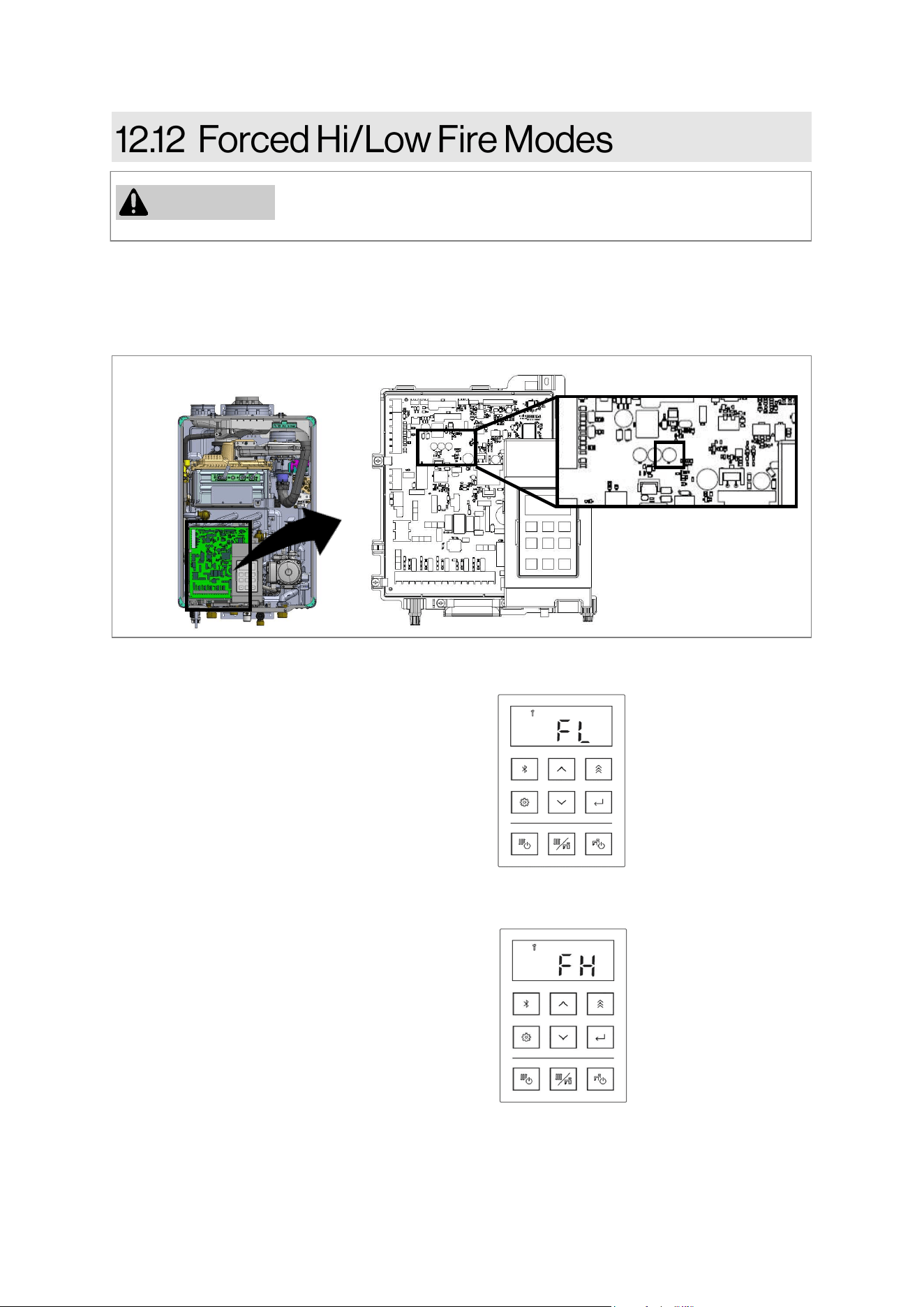
114
Rinnai I-Series Plus Condensing Combi Boiler Manual
5. Press the right-side, black buon again. The
controller now displays FH (the boiler is now
in forced high condion).
6. To enter back into normal operaon, press the right-side, black buon. The controller now
displays normal operaon mode.
This secon should be performed by a licensed professional. Consumers
should never aempt any acon that they are not qualied to perform.
1. Remove the boiler’s front panel by removing the two screws that secure the panel.
2. Locate the PC Board (lower le side of unit).
3. Press and hold the right-side, black buon.
4. The controller displays FL (the boiler is now
in forced low re condion).
PC Board
Figure 131 (A)
Figure 131 (C)
Figure 131 (B)
WARNING
115
Rinnai I-Series Plus Condensing Combi Boiler Manual
• Maintenance is required to
maintain safe operaon of the
boiler.
• The boiler must be inspected
annually by a licensed professional.
Repairs and maintenance shall be
performed by a licensed
professional. The licensed
professional must verify proper
operaon aer servicing.
• Keep the boiler area clear and free
from combusble materials,
gasoline, and other ammable
vapors and liquids.
• To protect yourself from harm,
before performing maintenance:
− Turn o the electrical power
supply by unplugging the
power cord or by turning o
the electricity at the circuit
breaker. (The boiler controller
does not control the electrical
power.)
− Turn o the gas at the manual
gas control valve, usually
located immediately below
the boiler.
− Turn o the incoming water
supply. This can be done at
the isolaon valve
immediately below the boiler
or by turning o the water
supply to the building.
Topics in this secon
• Owner Maintenance
• Licensed Professional Maintenance
• Test the Ignion Safety Shuto
Device
If you encounter a problem that is dicult
to solve, stop the operaon and
immediately contact a licensed professional.
MONTHLY
Boiler Area
• Verify the area is free of combusble
materials, gasoline and other ammable
vapors and liquids.
• Verify the area is clean from dust and
obstrucons.
• Verify the air intake area is free of any
contaminants listed in the boiler
Installaon and Operaon Manual. Any
contaminants in the boiler intake air
vicinity must be removed. If they cannot
be removed, contact a licensed
professional.
Piping
• Inspect all water, gas, and condensaon
piping for leaks. Look for signs of leaking
lines or corrosion.
• Conrm the condensaon line is not
blocked. If a condensaon drain pump is
used, conrm the condensaon drain
pump operates correctly.
Venng
• Verify the boiler vent discharge and air
intake is clean and free of obstrucons.
• Check for leakage, damage, or
deformaon of venng.
Boiler
• Verify the boiler is free from any
abnormal situaons, such as diagnosc
error codes, loud noises, leakage or other
potenal issues.
• Check that the pressure on the controller
display or external pressure gauge
indicates 17 to 26 PSI (117 to 180 kPa).
Table 49
WARNING
WARNING
116
Rinnai I-Series Plus Condensing Combi Boiler Manual
ANNUALLY
Vent System • Inspect for blockages or damage.
• Inspect vent screen or room air lter (if using) for debris and blockages.
Clean if needed.
Fan and Motors Clean dust and dirt from fan and motor (motors are permanently lubricated
and do not require lubricaon).
Controller Clean by using a so, damp cloth. Do not use solvents.
Pressure Conrm the pressure is within the proper range (between 17-26 PSI). If the
pressure is lower than the specied range, add water unl in the proper range.
Pressure Relief
Valve
Operate the pressure relief valve manually once a year. In doing so, it will be
necessary to take precauons with regard to the discharge of potenally
scalding hot water under pressure. Ensure discharge has a safe place to ow.
Contact with your body or other property may cause damage or harm.
Heang System
Dirt Trap
Clean annually. Be sure to close the shut o valves under the boiler. Aer
cleaning and installing the lter, purge the air.
DHW Filter If the ow volume of DHW is geng less, clean the lter at the DHW inlet. Be
sure to close the shut o valves on the DHW pipes under the boiler.
Expansion Tank Perform annual checks as recommended by the manufacturer to ensure proper
operaon.
Condensaon
Trap
Check if the trap contains sediment. To remove sediment, unplug the boom of
the condensate trap. Remove the sediment, and then return the plug. Do not
use a wrench to ghten the condensate drain as this could cause the
connecon to break.
Condensaon
Drain
• Conrm the condensaon drain line is not blocked or clocked.
• Ensure the condensaon drain pump (if ulized) is working correctly.
Flushing DHW
Heat Exchanger
Flushing for DHW (plate heat exchanger). When LC code appears, the boiler
detects lime scale accumulaon. Once the ushing done, the LC code will
disappear automacally. If the boiler is installed in hard water area, Rinnai
recommends periodically ushing.
Draining Water When the system will be shutdown for a long period of me (seasonal
shutdown), close the shuto valves below the boiler and drain the boiler to
protect it from potenal freeze damage.
Tesng the pressure relief valve should only be
performed by a licensed professional. Water
discharged from the pressure relief valve could cause severe burns
instantly or death from scalds.
Table 50
WARNING

117
Rinnai I-Series Plus Condensing Combi Boiler Manual
Pump Lock Conrm the pump operates smoothly. The boiler operates pump lock operaon
at least in 48 hours for all of system pumps. If it is pump locked, rotate the cap in
front of pump by at driver.
Water Quality Conrm the water quality. Refer to secon “4.4.1 Water Quality Guidelines” to
determine if the water needs to be treated or condioned. DHW must be
potable, free of corrosive chemicals, sand, dirt, or other contaminates. It is up to
the installer to ensure the water does not contain corrosive chemicals or
elements that can aect or damage the heat exchanger. Water that contains
chemicals exceeding the levels required aect and damage the heat exchanger.
Replacement of the heat exchanger due to water quality damage is not covered
by the warranty.
Snow
Accumulaon
• Verify the area around the ue terminal is free of snow and ice. The boiler will
not funcon properly if the combuson air or exhaust vent pipes are impeded
(blocked or parally blocked) by obstrucons.
• Verify the condensate drain line is free of snow and ice. Ensure the line is not
blocked or clogged and that condensate is owing freely.
Freeze
Protecon
• Freeze protecon for new or exisng systems must use glycol that is specially
formulated for this purpose. This includes inhibitors, which prevent the glycol
from aacking the metallic components. The glycol should be for
mul-metallic components. Reference secon “14.1 Approved Cleaners,
Inhibitors and Anfreezes” in the Appendix for an approved list of system
cleaners, inhibitors, and anfreezes.
• Check that the system uid is correct for the glycol concentraon and inhibitor
level. The system should be tested at least once a year and as recommended
by the producer of the glycol soluon. The allowed maximum concentraon is
40 percent.
Coast Area
Installaons
Installaons located in or near coastal areas may require addional maintenance
due to corrosive airborne ocean salt. If corrosion is observed on the body of the
boiler, the boiler shall be inspected to ensure proper operaon and repaired or
replaced, if necessary.
Cleaning It is imperave that control compartments, burners, and circulang air
passageways of the boiler be kept clean. Check burner ame for proper color.
Once ignited, the ame must cover the surface of the burner. The ame must
burn with a clear, blue, stable ame. If the ame does not have this appearance,
complete the following steps:
• Turn o and disconnect electrical power. Allow to cool.
• Remove the front panel.
• Use a vacuum to remove dust from the main burner and fan blades. Do not
use a wet cloth or spray cleaners on the burner. Do not use volale
substances such as benzene and thinners; they may ignite or fade the paint.
• Do not open the burner cabinet and touch the burner surface.
Condensate Trap Cleaning:
• Inspect the condensate drain assembly inside the boiler and your external
drain system.
• Remove any debris that may be present in the condensate removal system.
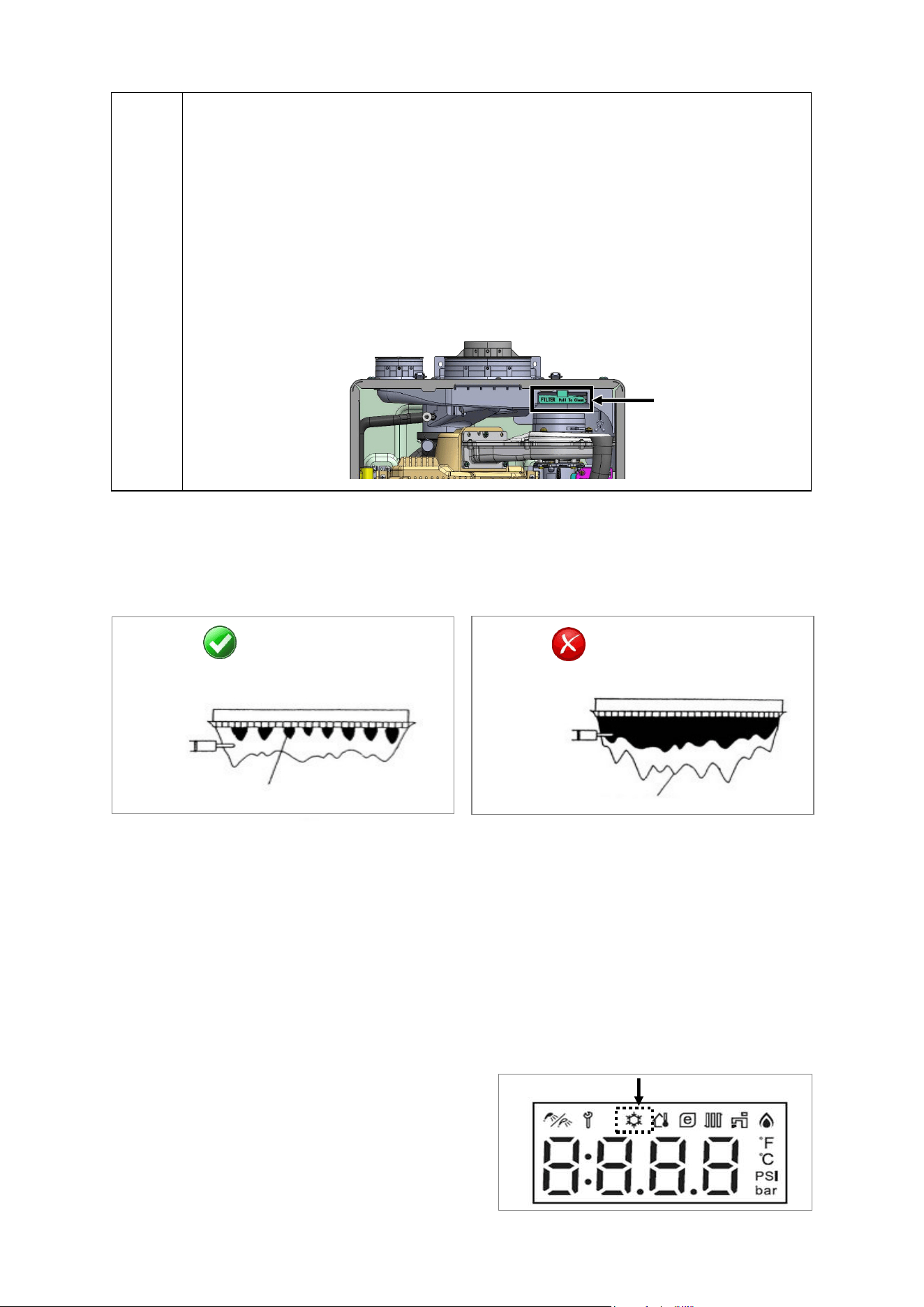
118
Rinnai I-Series Plus Condensing Combi Boiler Manual
AFTER SERVICING: VISUAL INSPECTION OF FLAME
Verify proper operaon aer servicing. The burner must ame evenly over the enre surface when
operang correctly. The ame must burn with a clear, blue, stable ame. See the parts breakdown
of the burner for the locaon of the view ports. The ame paern should be as shown in the
images below:
SATISFACTORY
Front View
Blue Flame
Flame Rod
Flame Rod
UNSATISFACTORY
Front View
Intake
Filter
Inspecon:
• To maintain opmum performance, periodically inspect the air lter.
• If the air lter appears to have lint and/or dust build up, follow the cleaning
procedure described below.
• If the air lter appears damaged, contact a trained and qualied professional for a
replacement air lter assembly.
Cleaning:
• Clean the Air Filter: With mild dish soap and a so bristle brush, scrub the lter area
of the air lter door. With clean water, rinse the soap o the lter.
• Dry the Air Filter: With a lint free towel, dry the air lter.
Yellow or Green ame
Freeze Protecon Operaon
When the boiler detects low outdoor ambient
temperatures, the boiler will begin its freeze
protecon operaon. The freeze protecon
operaon can protect the boiler from freezing
down to as low as -22°F (-30°C) outdoor
temperature.
When freeze protecon is in operaon, the
pump may circulate water and/or the boiler may
operate to prevent the boiler from freezing.
Ensure power and gas are supplied to the boiler
for freeze protecon to funcon. The internal
freeze protecon will not necessarily prevent
the system piping from freezing.
During freeze protecon operaon, the pressure
and supply temperature will alternately display
on the controller.
The icon for CH and DHW may alternate
depending on the operaon of the freeze
protecon sequence.
When the system needs to be shutdown for extended
periods of me, the boiler and all system piping
should be drained. The power and gas supply should
then be disconnected from the boiler. Freezing
damage may occur if there is water remaining in the
boiler or system piping. The plumbing lines should
also be blown out via compressed air.
Figure 132
Figure 135
Figure 134
Figure 133
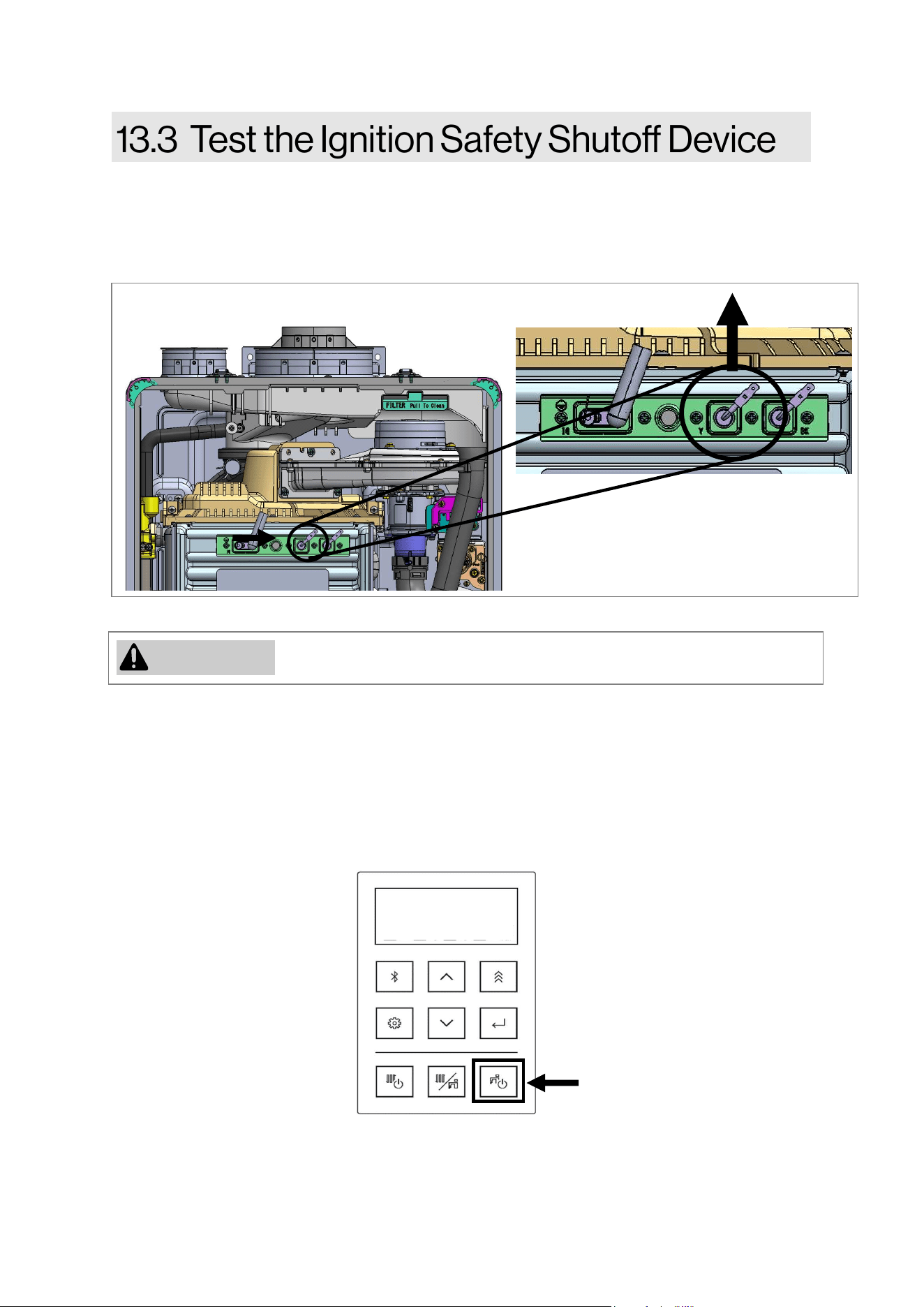
119
Rinnai I-Series Plus Condensing Combi Boiler Manual
Do not touch the inside of the wiring connecon while it is disconnected.
1. Ensure the boiler is not currently ring and the ame rod is not hot.
2. Remove the boiler front panel.
3. Disconnect the wiring connecon from the le side ame rod (located on front of the boiler
under the burner).
Boiler Front Side
Remove Wiring
Connecon
4. Place the boiler in operaon by either a call for heat or by turning on a Domesc Hot Water
xture.
5. The boiler iniates one start-up aempt and mulple restart aempts.
Aer the last start-up aempt, the boiler locks out and the gas valve shuts o. Code
110
appears on the controller display which indicates ignion system safety shuto.
6. Reconnect the wiring connecon to the ame rod. Be careful not to touch the inside of the
wiring connecon. To reset the error, press the DHW buon. The boiler starts up.
7. Replace the boiler front panel.
8. The boiler may now go back into normal operaon.
Figure 137
Figure 136
WARNING
120
Rinnai I-Series Plus Condensing Combi Boiler Manual
Approved System Cleaners:
• Fernox F3 Cleaner
• Noble Noburst Hydronic System Cleaner
• Rhomar Hydro-Solv 9100
• Sennel X400
Approved System Inhibitors:
• Fernox F1
• Noble Noburst AL Inhibitor
• Rhomar Pro-tek 922
• Sennel X100
Approved System Anfreezes:
• Chem Frost 100%
• Cryo-Tek 100
• Fernox Alphi 11
• Hall-Chem Solar II
• NemFrost-PG HTF
• Rechochem Recofreeze AL
• Rhomar RhoGard Mutli-Metal (AL safe)
• Sennel X500
• Univar Vanfrost
Below is a list of approved system cleaners, inhibitors, and anfreezes for use in hydronic plumbing
systems ulizing Rinnai boilers.
IMPORTANT
• If replacing a boiler, add system cleaners while the old boiler is installed and operate the old
boiler for heang for several days to most eecvely clean the system.
• The Rinnai boiler must be closed o (valved o) from the rest of the system, or not
connected, while cleaners are in the system.
• When cleaning is complete, drain the system and then ush with clean water to remove any
sediment.
Topics in this secon
• Approved Cleaners, Inhibitors and
Anfreezes
• Flush the CH Plumbing System
• Flush the DHW Heat Exchanger
• System Applicaon Examples
• Gas Conversion
• Wiring Diagram
• Ladder Diagram
• CH Pressure Drop and Flow Curve
• DHW Pressure Drop and Flow Curve
• Guidelines for Addional DHW Controller
(Oponal)
• Remove a Boiler from a Common Vent System
• Massachuses State Gas Regulaons
• Warranty
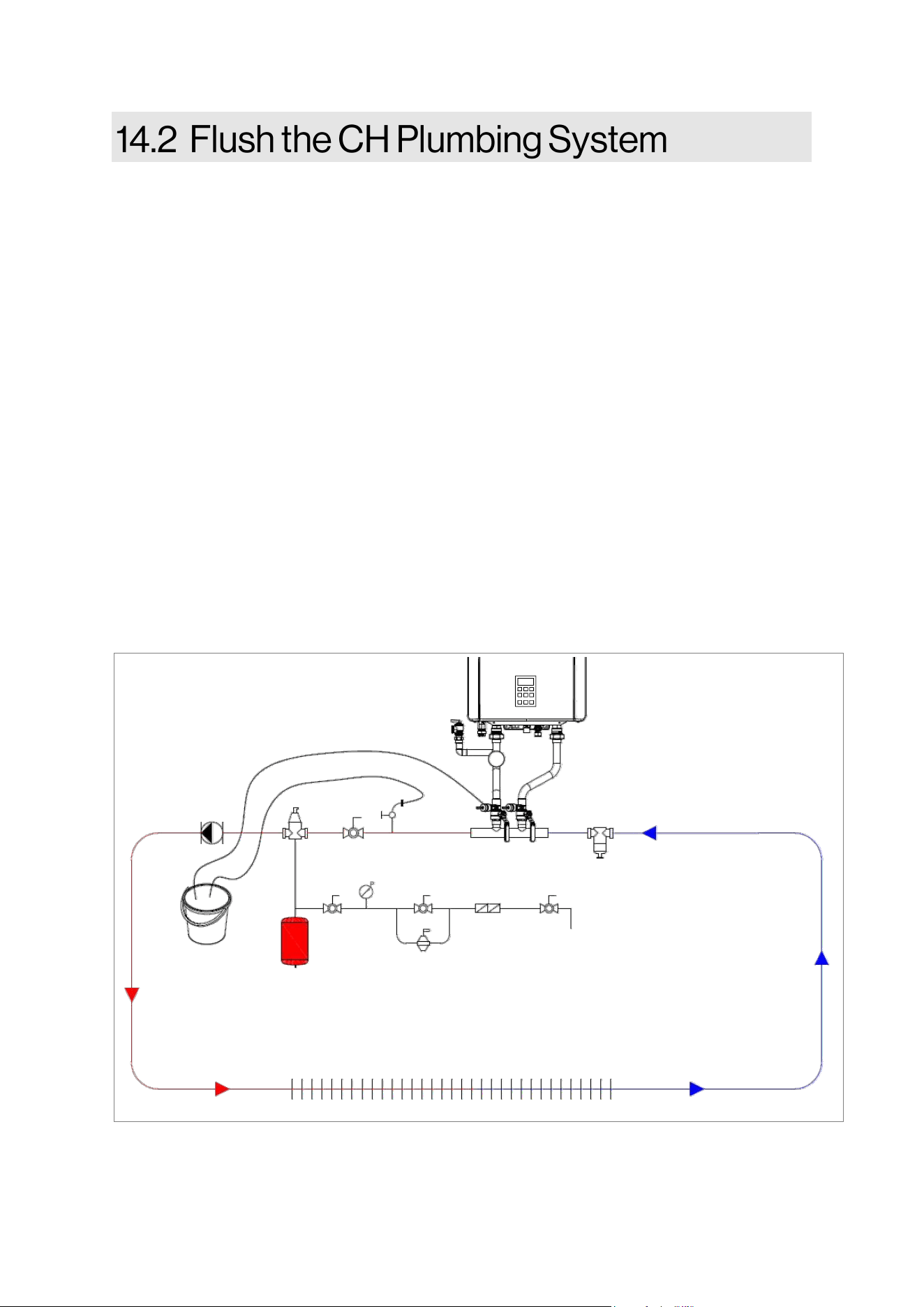
121
Rinnai I-Series Plus Condensing Combi Boiler Manual
Note: This secon explains how to ush the CH plumbing system. See the next secon for steps on
ushing the DHW Heat Exchanger.
When replacing an exisng boiler, the heang system shall be ushed with an approved system
cleaner before the new boiler is added to the system.
Manual Flush Procedure:
Note: Reference secon “14.1 Approved Cleaners, Inhibitors and Anfreezes” in the Appendix for an
approved list of system cleaners, inhibitors, and anfreezes.
1. Disconnect the power supply to the boiler and turn o gas.
2. Add an approved cleaner to the system following the manufacturer’s direcons. Allow the boiler
to run for 3 days in DHW and/or heang operaon.
3. Flush the boiler and the system, and clean the dirt trap if present.
4. Purge the boiler and the system as described below. Add an approved inhibitor (recommended).
Run the boiler in its deaeraon program per the instrucons in secon “10.3 Deaeraon
Process.”
Boiler Flush or Purge Procedure:
• System: Close supply shuto #3 and boiler valves #1 and #2. Open autoll to at least 20 PSI,
then ush or purge through Hose #2 by opening boiler drain #4.
• Boiler: Keep valves #1 and #3 closed. Open #2 and close #4. With the autoll open to at
least 20 PSI, ush or purge the boiler through Hose #1.
Note: When purging,
connue unl no bubbles are
seen in the bucket.
Hose 2
Hose 1
Supply
Shuto
Autoll Assembly
Boiler Purge and
Isolaon Valves
Heat Emier
Dirt Trap
#4
Boiler
Drain
#3
#2 #1
Figure 138
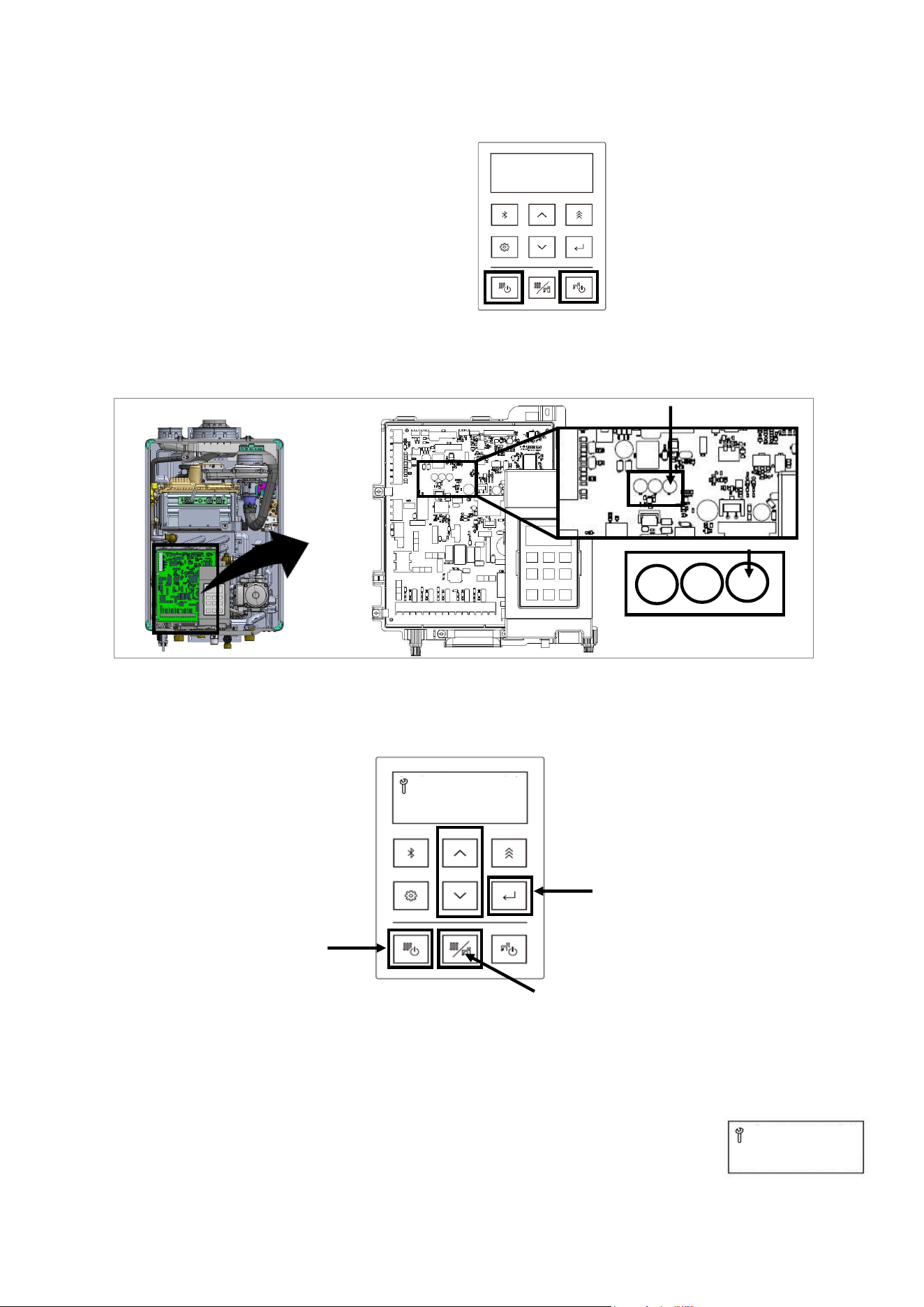
122
Rinnai I-Series Plus Condensing Combi Boiler Manual
Boiler Automated Flush Procedure:
1. Shut o gas supply and turn o DHW and
CH buons on the controller.
PC Board
SW3
Buon
5. Press the up or down arrow buon on the controller to select dES (descaling) (Figure 141).
6. Press the Select buon to select the dES (Figure 141).
Figure 141
dES
7. Make sure the valves and hoses are set up as shown in the previous page. Next,
operate the pump and allow the cleaner to circulate through the boiler for at
least 1 hour at a rate of four gallons per minute (15.1 liters per minute).
8. Press the Central Heang (CH) buon to start the count down (Figure 141).
9. Display shows “60” (Figure 142) which indicates the remaining ush me in
minutes. The number decreases by 1 every minute.
Note: If you need to cancel this procedure, you may press the Switching Operaon
Mode buon on the controller (Figure 141), or press the SW3 buon on the PC Board
(Figure 140).
Figure 142
60
Figure 140
2. Remove the boiler front panel by removing the two screws that secure the panel.
3. Locate the PC Board (lower le side of unit).
4. Press the SW3 buon on the PC Board (Figure 140).
CH Buon
Select Buon
Switching Operaon Mode Buon
Figure 139
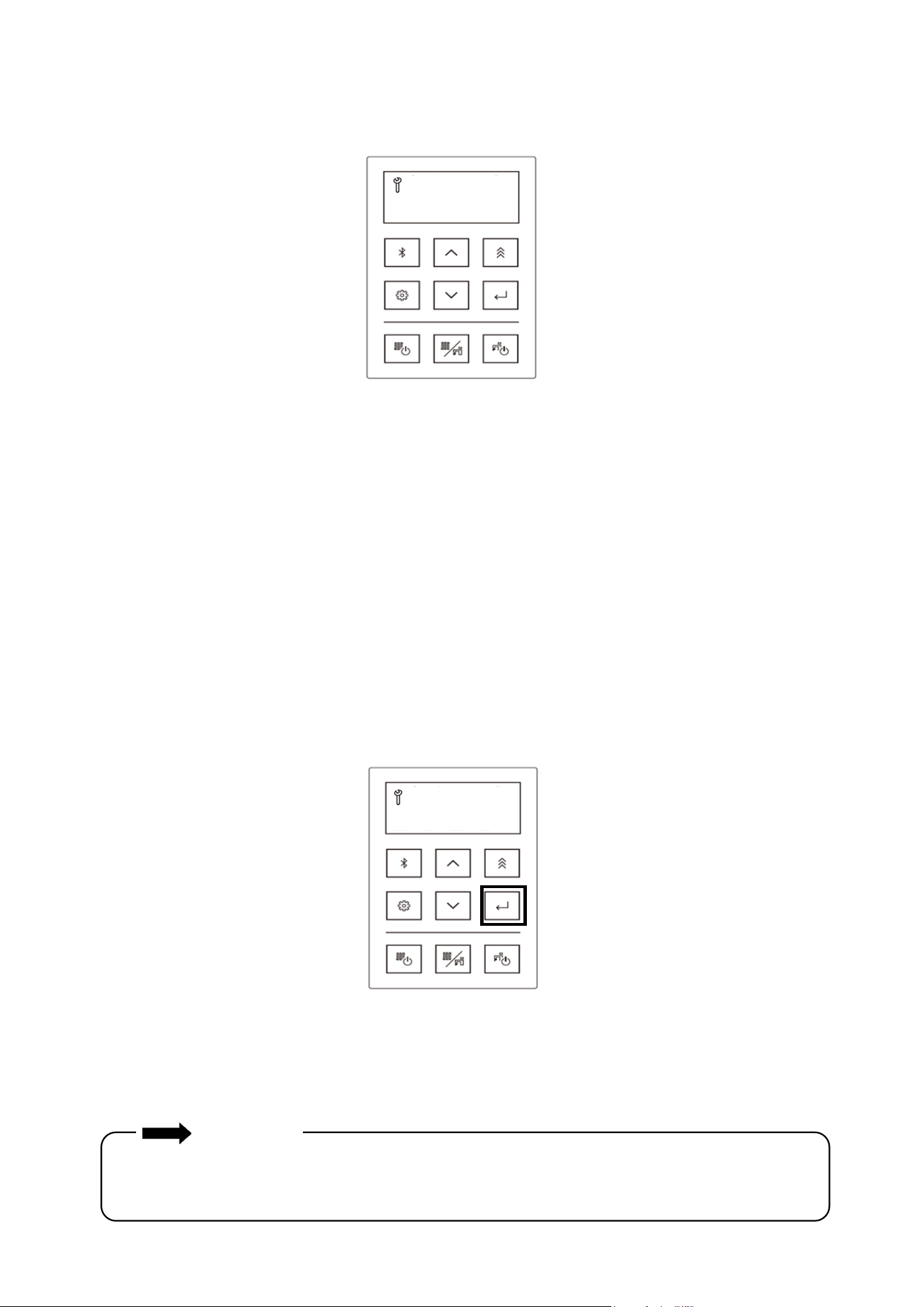
123
Rinnai I-Series Plus Condensing Combi Boiler Manual
10. Aer 60 minutes ushing me completes, display shows “rnS” (rinsing) (Figure 143) and
beeping sound is observed.
Figure 143
rnS
11. Turn o the pump.
12(A). Rinse cleaner from system:
a. Remove the free end of the drain hose (H2) from the pail. Place in sink or outside to
drain. Open autoll to at least 20 PSI.
b. Close boiler valves 1 and 2. Close shuto valve (V3).
c. Open drain valve 4.
d. Allow water to ow through the boiler for ve minutes.
e. Close drain valve (V4).
f. Open shuto valve (V3), boiler valve 1 and 2.
12(B). Rinse cleaner from boiler:
a. Remove the free end of the drain hose (H1) from the pail. Place in sink or outside to
drain. Open autoll to at least 20 PSI.
b. Close drain valve (V4).
c. Open boiler valves 1 and 2. Close shuto valve (V3).
d. Allow water to ow through the boiler for ve minutes.
e. Open shuto valve (V3).
13. Push the Select buon, and the display shows “End” (Figure 144).
IMPORTANT
Scale build-up will aect the performance of the boiler. Water should be treated. Rinnai oers
Southeastern Filtraon’s “Scale Cuer Water Condioning System” that oers superior lime scale
prevenon and corrosion control by feeding a blend of control compounds into the cold water supply.
14. Disconnect all hoses.
15. Push the Select buon to go back to "dES” and press the SW 3 on the PC board to put the unit
back to normal mode.
16. Install the front panel and restore gas supply.
Figure 144
End
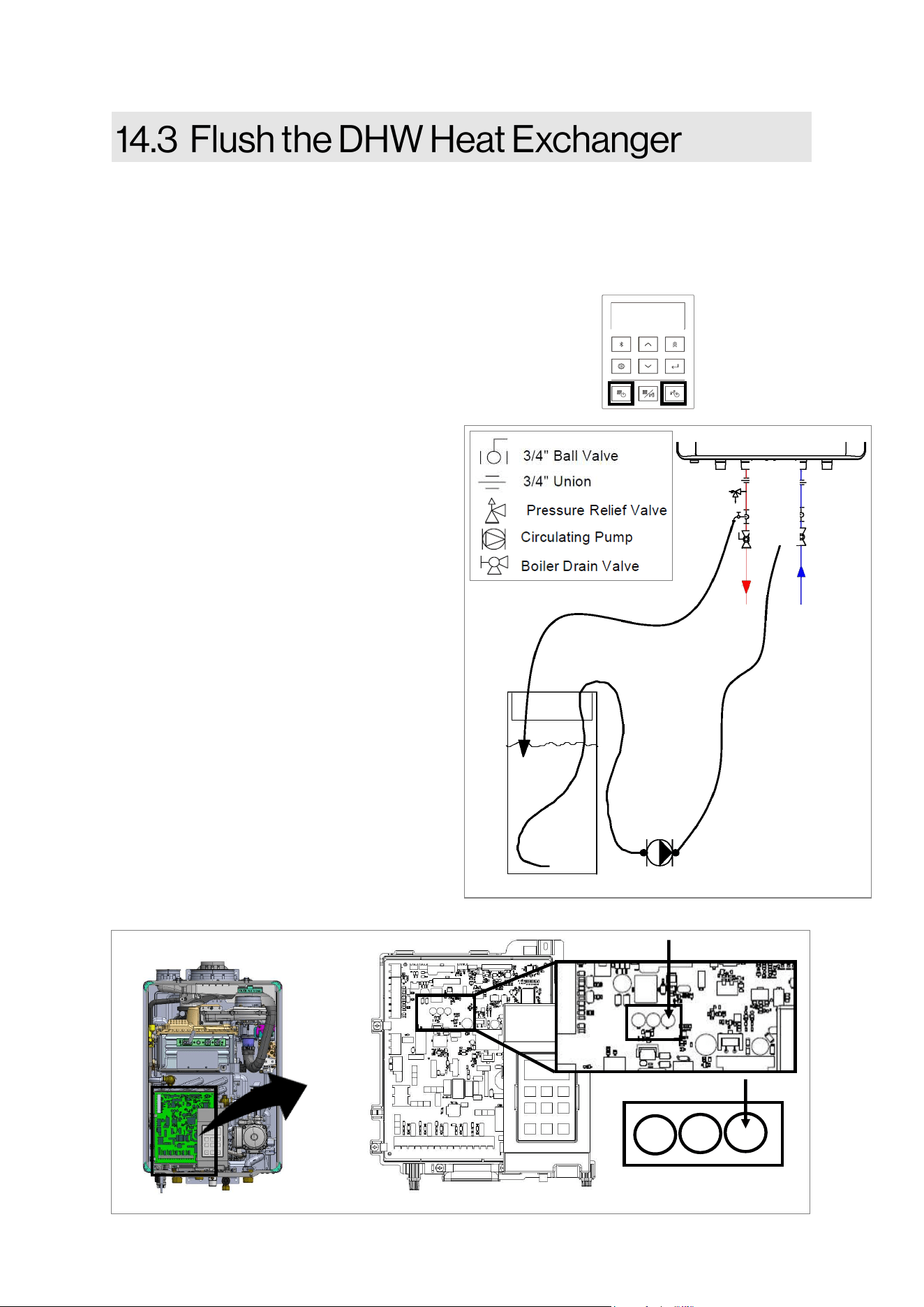
124
Rinnai I-Series Plus Condensing Combi Boiler Manual
SW3
Buon
This boiler includes a service indicator/reminder (also called an LC diagnosc code). When selected
in the parameter sengs, an LC code will display on the controller indicang that it is me to ush
and service the boiler. Failure to ush the boiler will cause damage to the plate heat exchanger.
Damage caused by lime build-up is not covered by the boiler’s warranty. Rinnai strongly
recommends installaon of isolaon valves to allow for ushing of the plate heat exchanger.
V1
H3
H2
H1
V4
V2
V3
Circulang Pump
Figure 146
PC Board
1. Shut o gas supply to the boiler.
2. Turn o DHW and CH buons on the
controller (Figure 145).
3. Close the shuto valves on both the hot
water and cold water lines (V3 and V4).
4. Connect pump outlet hose (H1) to the
cold water line at service valve (V2).
5. Connect drain hose (H3) to the hot water
line at service valve (V1).
6. Pour four gallons of undiluted virgin, food
grade, white vinegar into pail.
7. Place the drain hose (H3) and the hose
(H2) to the pump inlet into the cleaning
soluon.
8. Open both service valves (V1 and V2) on
the hot water and cold water lines.
9. Remove the boiler front panel by
removing the two screws that secure the
panel.
10. Locate the PC Board (lower le side of
unit).
11. Press the SW3 buon on the PC Board
(Figure 147).
Figure 147
Figure 145
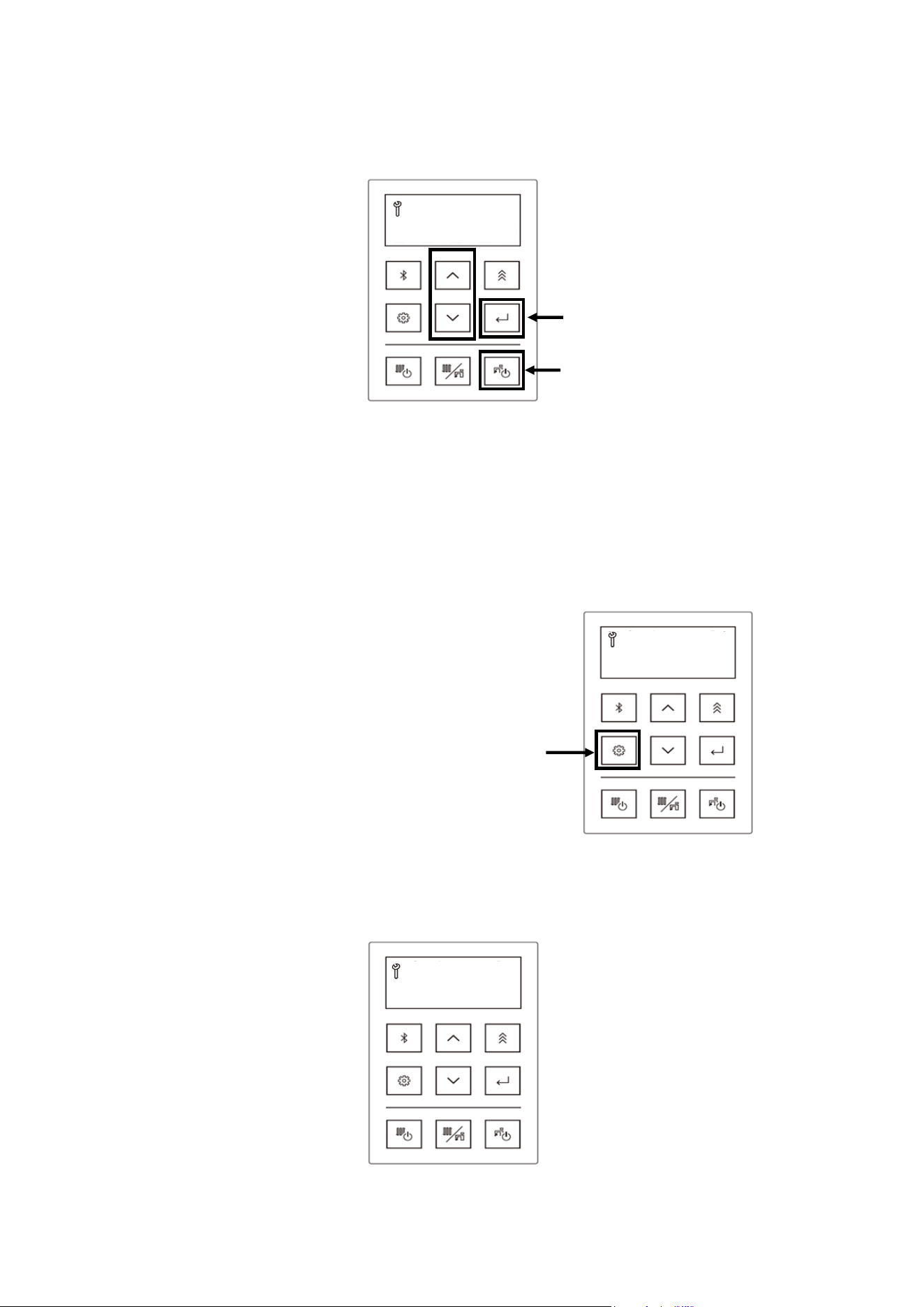
125
Rinnai I-Series Plus Condensing Combi Boiler Manual
17. Aer 60 minutes ushing me completes, display shows “rnS” (rinsing) (Figure 150) and
beeping sound is observed.
12. Press the up or down arrow buon on the controller to select dES (descaling) (Figure 148).
13. Press the Select buon to select the dES (Figure 148).
Figure 148
dES
Figure 149
60
14. Operate the pump and allow the vinegar to circulate through the boiler for at least 1 hour at a rate
of four gallons per minute (15.1 liters per minute).
15. Press the Domesc Hot Water (DHW) buon to start the count down (Figure 148).
16. Display shows “60” (Figure 149) which indicates the remaining ush me in minutes. The number
decreases by 1 every minute. For some reasons, ushing needs to be paused, stop the pump. The
number on the display does not decrease while the unit does not detect water ow. When the
pump resumes operaon, the remaining ush me resumes decreasing as well.
Figure 150
rnS
Note: If you need to cancel this procedure, you
may press the Sengs Menu buon on the
controller (Figure 149), or press the SW3 buon
on the PC Board (Figure 147).
Sengs Menu
Buon
Domesc Hot Water
(DHW) Buon
Select Buon
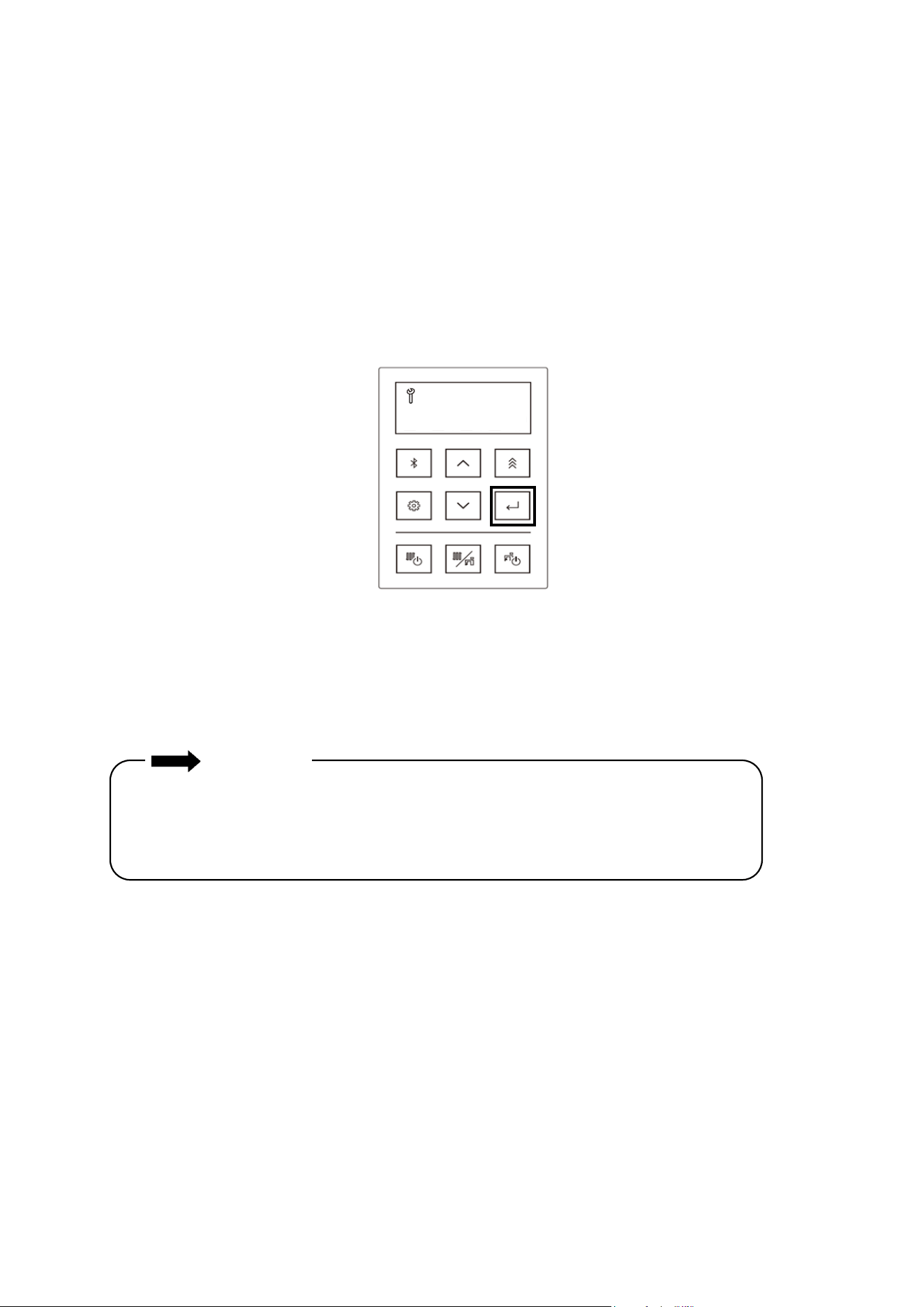
126
Rinnai I-Series Plus Condensing Combi Boiler Manual
IMPORTANT
Scale build-up will aect the performance of the boiler. Water should be treated. Rinnai
oers Southeastern Filtraon’s “Scale Cuer Water Condioning System” that oers
superior lime scale prevenon and corrosion control by feeding a blend of control
compounds into the cold water supply.
18. Turn o the pump.
19. Rinse the vinegar from the boiler as follows:
a. Remove the free end of the drain hose (H3) from the pail. Place in sink or outside to drain.
b. Close service valve (V2) and open shuto valve (V4). Do not open shuto valve (V3).
c. Allow water to ow through the boiler for ve minutes.
d. Close shuto valve (V4). When unit has nished draining remove the in-line lter at the cold
water inlet and clean out any residue. Place lter back into unit and open valve (V4).
e. Close service valve (V1) and open shuto valve (V3).
20. Push the Select buon, and the display shows “End” (Figure 151).
21. Disconnect all hoses.
22. Push the Select buon to go back to "dES” and press the SW 3 on the PC board to put the unit
back to normal mode.
23. Install the front panel and restore gas supply.
Figure 151
End
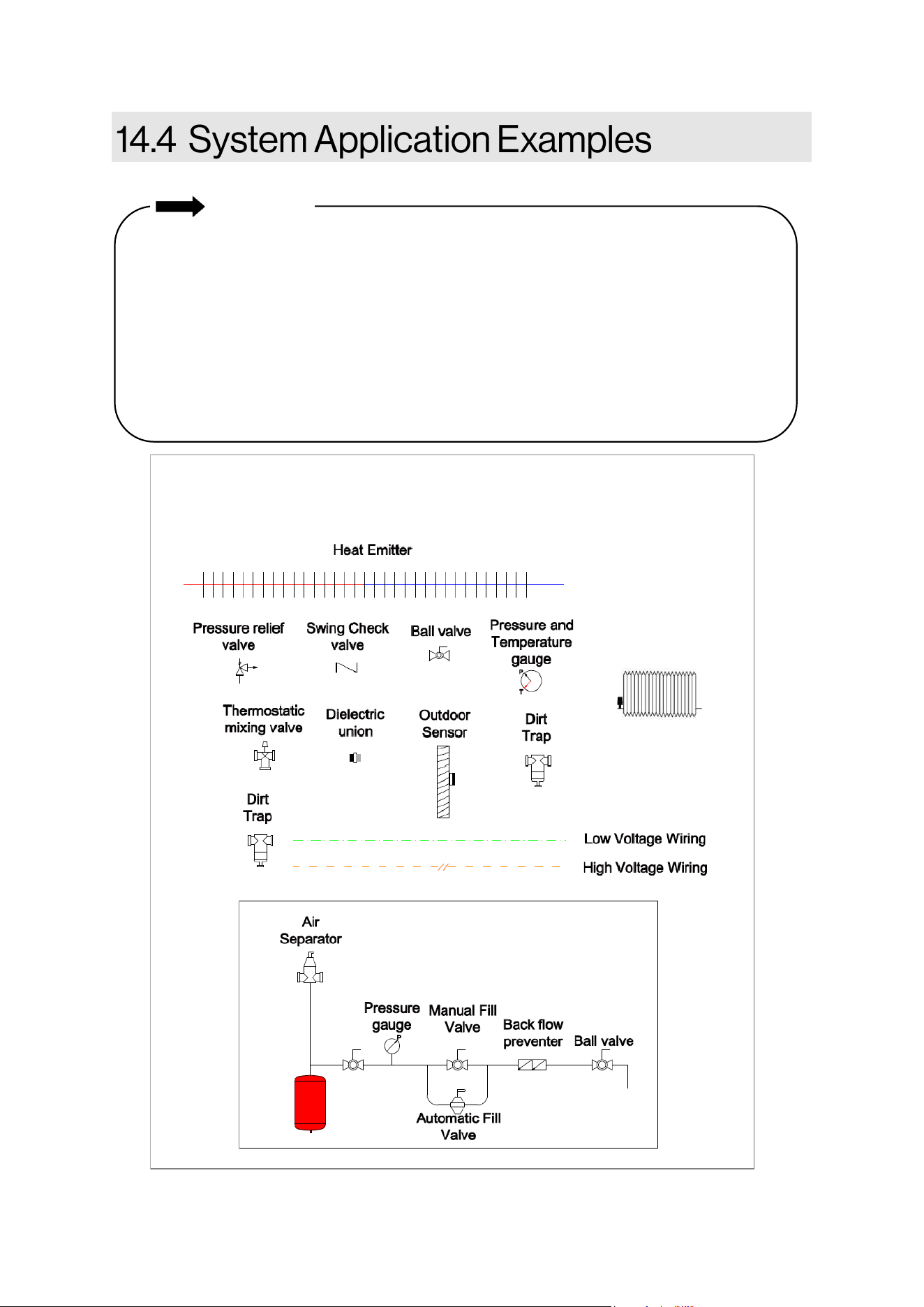
127
Rinnai I-Series Plus Condensing Combi Boiler Manual
Legend:
Refer to the legend below for the system applicaons shown in this secon.
IMPORTANT
Primary/secondary piping is necessary in the following applicaons:
• When using external pumps
• Large zoned systems
• High ow applicaons
• Systems with high dierenal pressures
• Systems with high pressure drops
For pressure curve informaon, refer to the following secons in the Appendix.
• 14.8 CH Pressure Drop and Flow Curve
• 14.9 DHW Pressure Drop and Flow Curve
This picture illustrates a suggested
arrangement. Some of the ngs
are oponal.
Radiator with
Thermostac
Heads
Figure 152
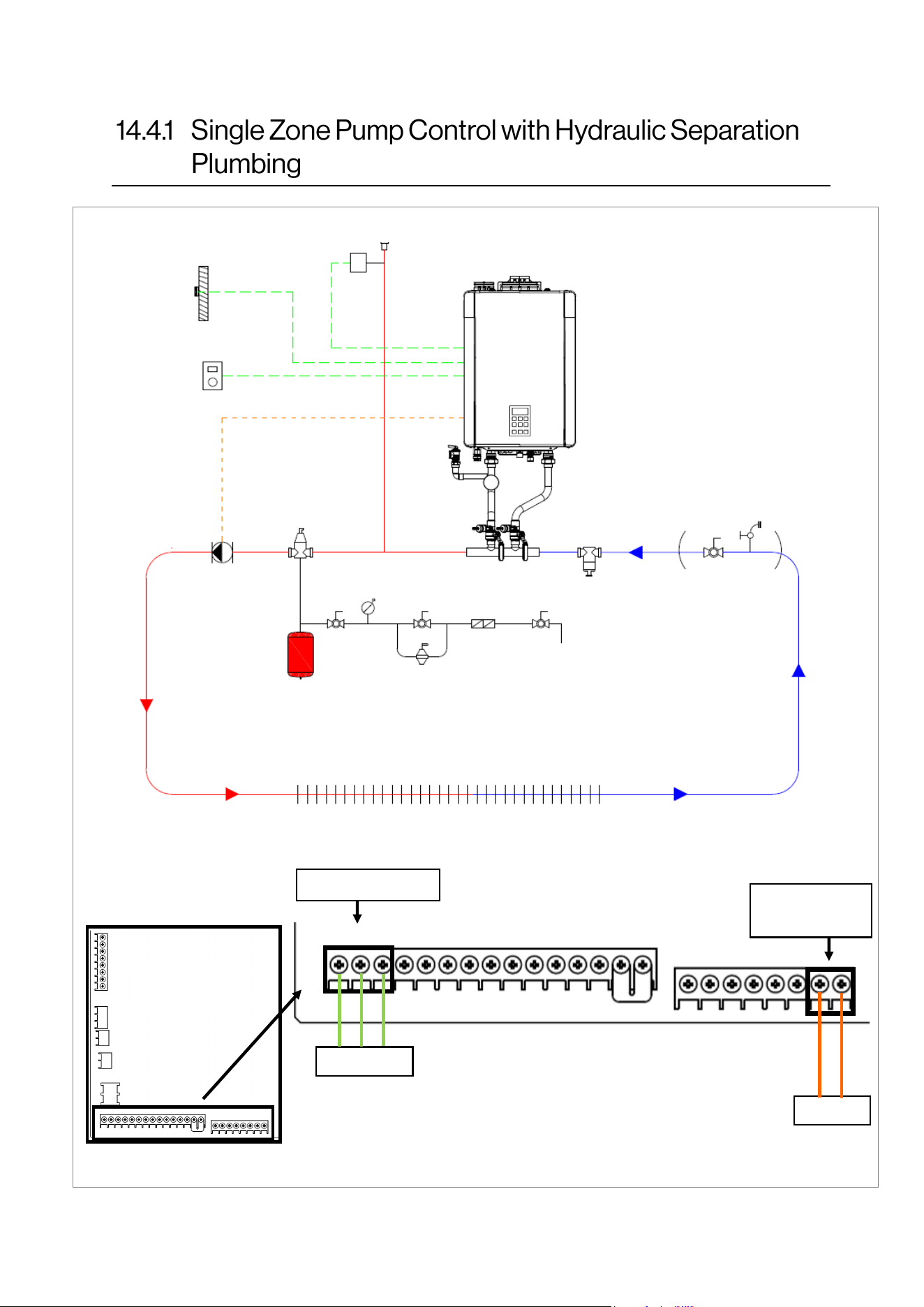
128
Rinnai I-Series Plus Condensing Combi Boiler Manual
Purge Staon
Thermostat
Oponal LWCO
Figure 153
External Pump
Connecon 1
C R W
T/T 1 Connecon
Pump
PC Board
PC Board Wiring
for the above
applicaon example
Thermostat
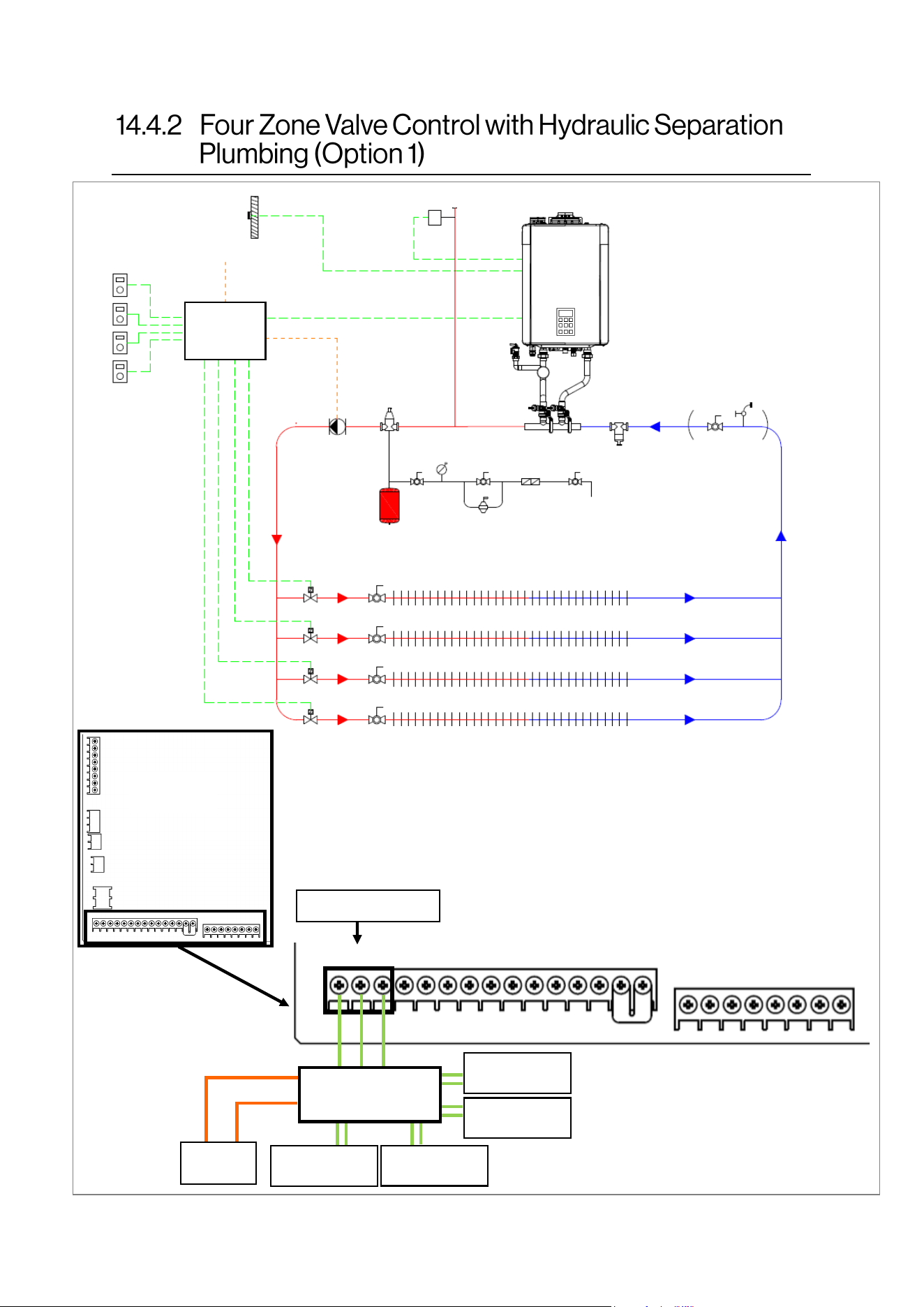
129
Rinnai I-Series Plus Condensing Combi Boiler Manual
Purge Staon
Thermostats
Oponal LWCO
Zone
Controller
120V Input
Figure 154
C R W
T/T 1 Connecon
PC Board
PC Board Wiring
for the above
applicaon example
Zone Control
Thermostat 1
Pump
Thermostat 2
Thermostat 3
Thermostat 4
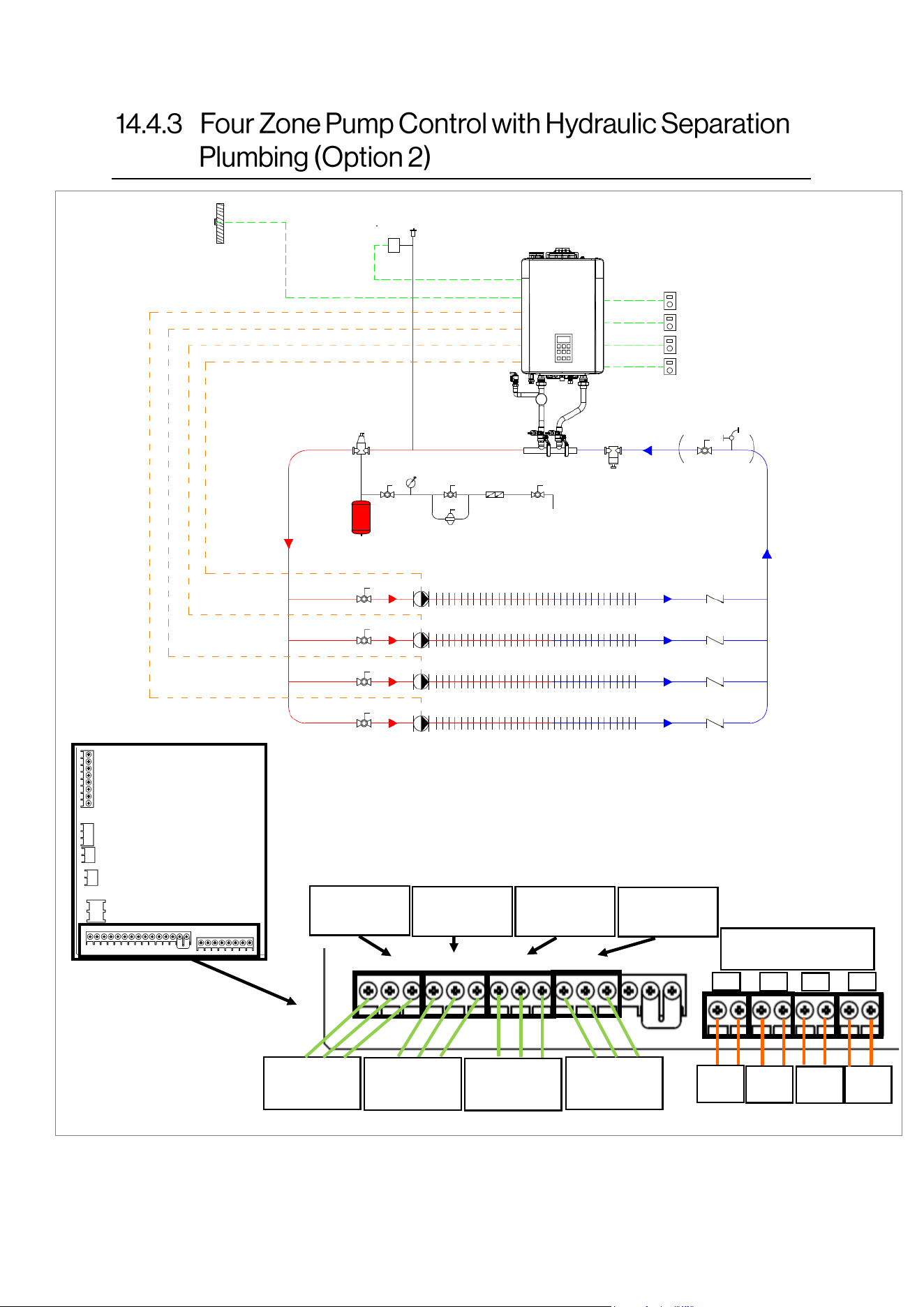
130
Rinnai I-Series Plus Condensing Combi Boiler Manual
Purge Staon
Thermostats
Oponal LWCO
Figure 155
PC Board
PC Board Wiring
for the above
applicaon example
C R W
T/T 1
Connecon
Thermostat
1
T/T 2
Connecon
Thermostat
2
External Pump
Connecon
Pump
1
C R W
T/T 3
Connecon
Thermostat
3
T/T 4
Connecon
Thermostat
4
C R W
C R W
Pump
2
Pump
3
Pump
4
1
2 3
4
131
Rinnai I-Series Plus Condensing Combi Boiler Manual
This boiler is congured for Natural Gas
only. To convert to Propane Gas, follow the
instrucons in this secon.
For installaons in Canada, the conversion
shall be carried out in accordance with the
requirements of the provincial authories
having jurisdicon and in accordance with
the requirements of the CGA-B149.1,
Natural Gas and Propane Installaon Code.
The appliance must be installed in
accordance with:
• Local codes or, in the absence of local
codes, the Naonal Fuel Gas Code, ANSI
Z223.1/NFPA 54 and/or CSA B149.1,
Natural Gas and Propane Installaon
Code.
• The Manufactured Home Construcon
and Safety Standard, Title 24 CFR, Part
3280 and/or CAN/CSA Z240 MH Series,
Mobile Homes, Series M86 /
Manufactured Home Construcon and
Safety Standard, Title 24 CFR.
IMPORTANT
• Before you get started, conrm that
the inlet gas pressure is between the
minimum and maximum pressures
allowed for this boiler.
• If subsequent conversions are made,
then a new conversion label must be
placed on the boiler to accurately
reect the gas type.
The gas supply shall be shut o prior to
disconnecng the electrical power, before
proceeding with the conversion.
Do not touch any other areas on the PC
board other than the described buons
while power is supplied to the appliance.
Parts of the PC board are supplied with 120
volts AC.
Do not touch the areas at or near the heat
exchanger or hot water lines. These areas
become very hot and could cause burns.
• The conversion kit shall be installed by
a qualied service agency in
accordance with the manufacturer’s
instrucons and all applicable codes
and requirements of the authority
having jurisdicon. The informaon in
these instrucons must be followed
exactly to minimize the risk of re or
explosion or to prevent property
damage, personal injury or death. The
qualied service agency is responsible
for the proper installaon of this kit.
The installaon is not proper and
complete unl the operaon of the
converted appliance is checked as
specied in the manufacturer’s
instrucons supplied with the kit.
• Failure to correctly assemble the
components according to these
instrucons may result in a gas leak or
explosion.
• Conversion Rang Plate
WARNING
CAUTION
CAUTION
CAUTION
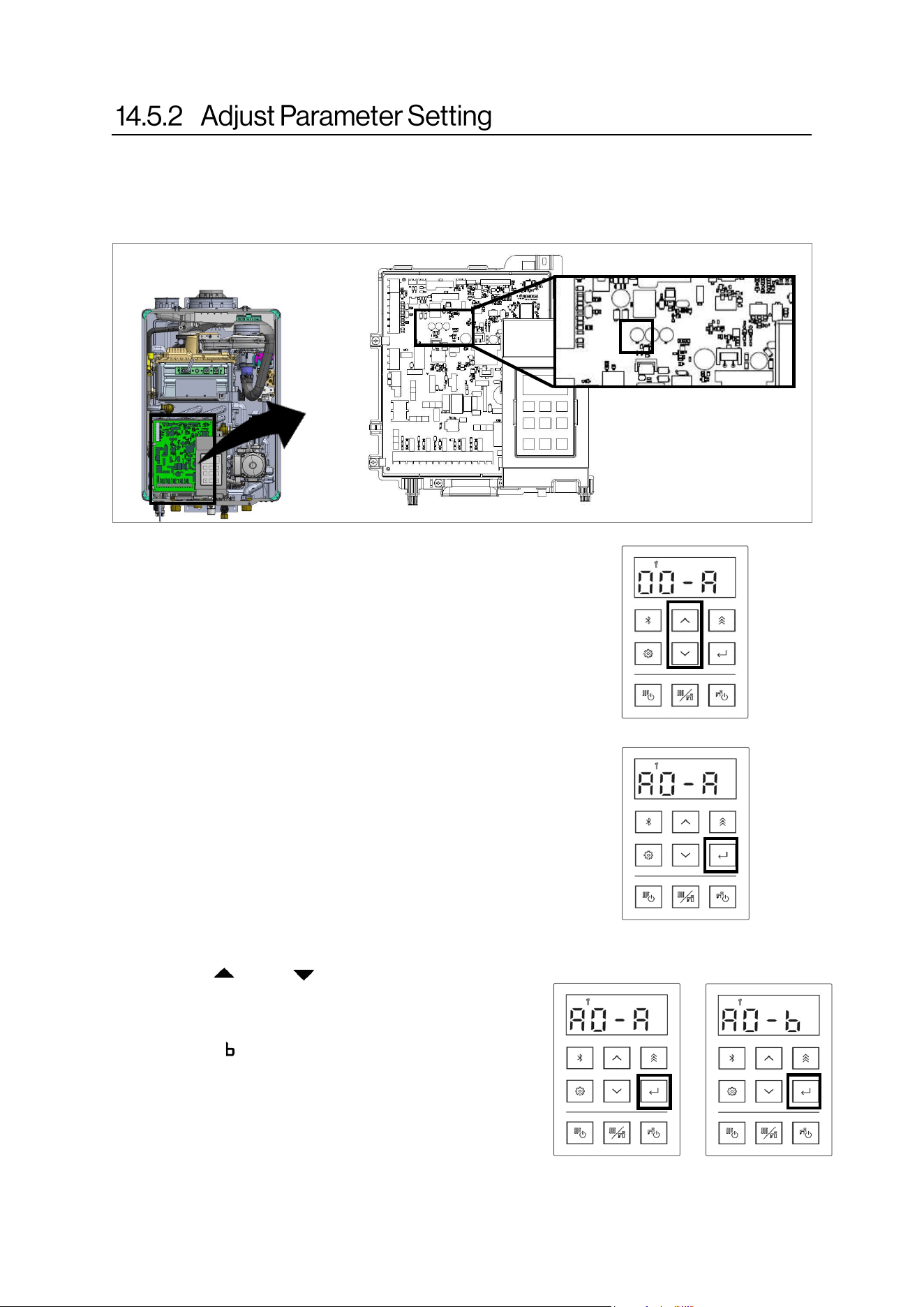
132
Rinnai I-Series Plus Condensing Combi Boiler Manual
1. Locate the PC Board (lower le side of unit).
2. Locate the le PC Board buon.
3. Press and hold the buon for ve seconds. 00-A appears (Figure 137).
4. Scroll to parameter AO and press the
Select buon.
5. Press the (Up) or (Down) arrows to select
the appropriate gas type.
• Select A for Natural Gas (NG)
• Select for Propane (LP)
Then, press the Select buon.
6. Parameter sengs are complete. To enter normal operaon mode, press the le PC Board buon.
NATURAL GAS
PROPANE
PC Board
Figure 157
Figure 156
Figure 158
Figure 159 Figure 160
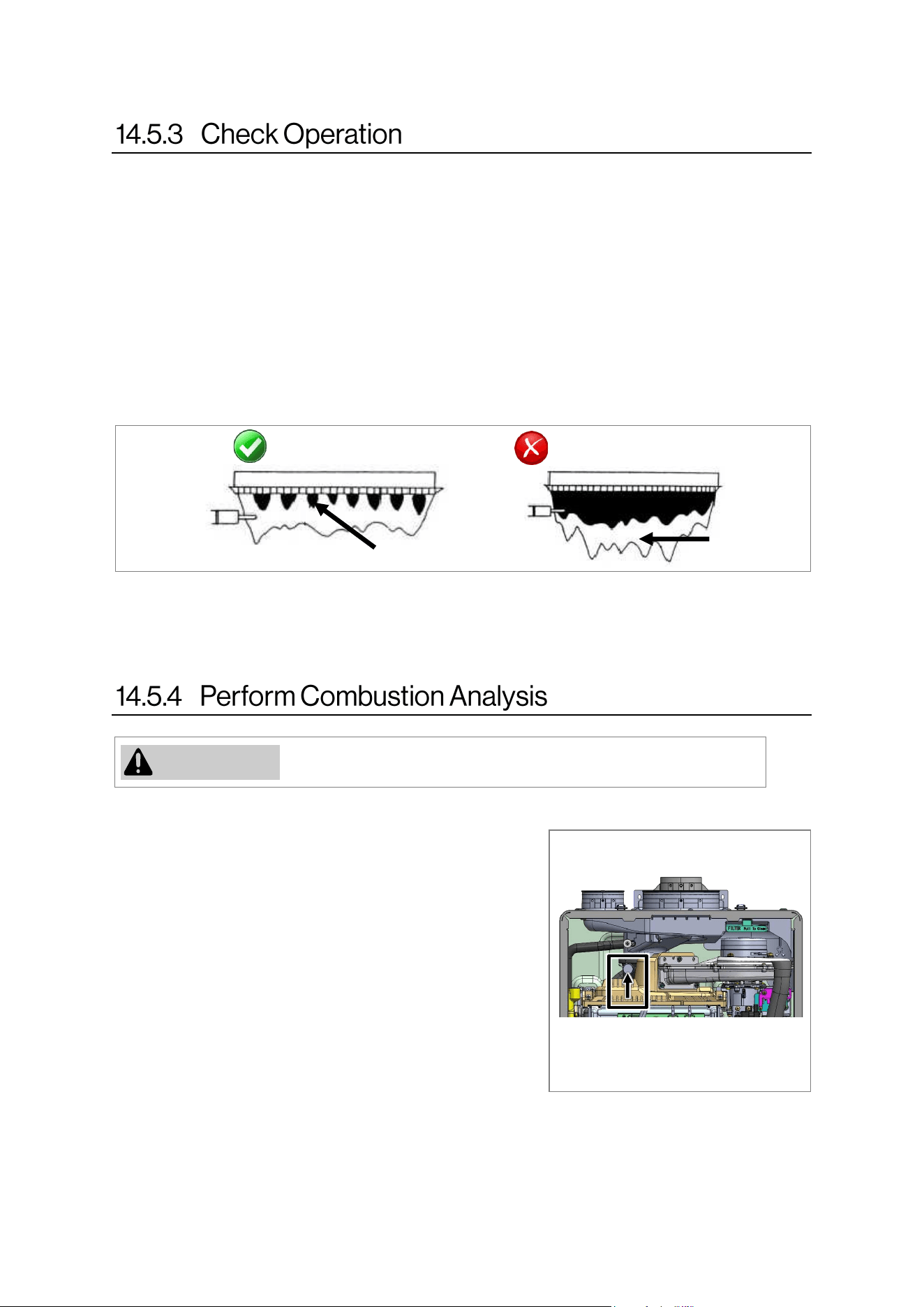
133
Rinnai I-Series Plus Condensing Combi Boiler Manual
SATISFACTORY
Front View
Blue Flame
UNSATISFACTORY
Flame
Rod
Flame
Rod
Yellow or
Green Flame
3. Reinstall the boiler front panel using the two screws to secure it.
1. Check the normal operang sequence:
a. When you press the ON/OFF buon, the LED display will illuminate, the combuson fan
will begin to run if water is owing, and the spark will ignite the main burner.
b. This boiler has an automac ignion system. When the main burner has lit, the “In Use”
lamp will glow red and the spark will stop.
2. Visual inspecon of ame:
a. Check that the burner ames are operang normally. The ame can be seen through the
circular window above the burner. When operang normally, the burner ame should
burn evenly over the enre surface. The ame should be clear, blue, and stable. A yellow
ame is abnormal and maintenance is required.
Combuson analysis must be performed by a trained and
qualied professional.
To perform a combuson analysis:
1. Remove the boiler’s front panel by removing the two
screws that secure the panel.
2. Remove the clamp holding the combuson analysis
port cap.
3. Remove the combuson analysis port cap and insert
the gas analyzer probe into the port.
4. Put the boiler into operaon in forced high re or
low re as necessary (see secon “12.12 Forced Hi/
Low Fire Modes”). Measure CO
2
or O
2
, as applicable,
in the exhaust system.
5. Aer measurement, remove the gas analyzer probe,
place the combuson analysis port cap back on, and
reinstall the clamp to secure the cap in place.
Insert gas analyzer probe into
combuson analysis port.
Figure 162
Figure 161
WARNING
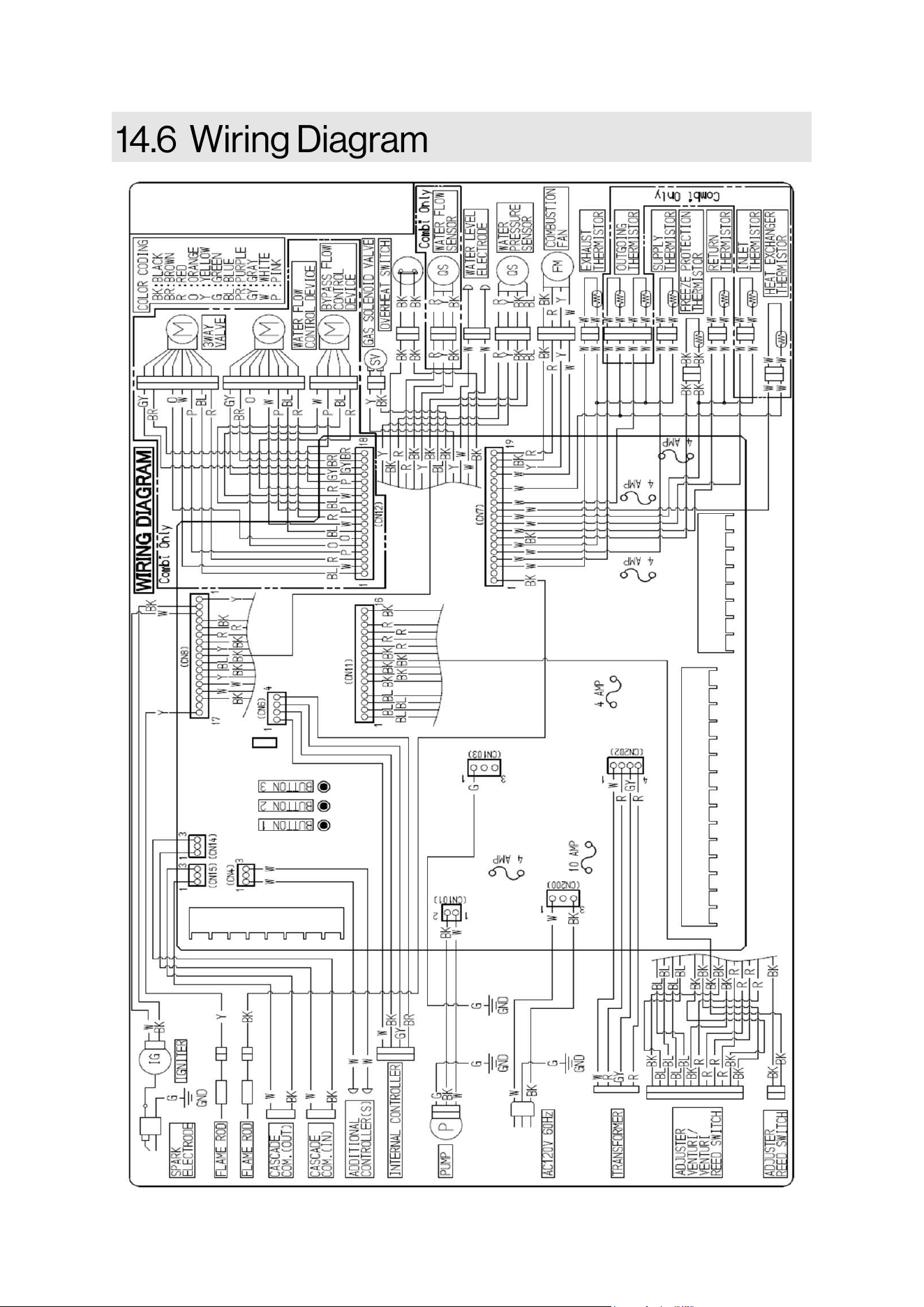
134
Rinnai I-Series Plus Condensing Combi Boiler Manual
Figure 163
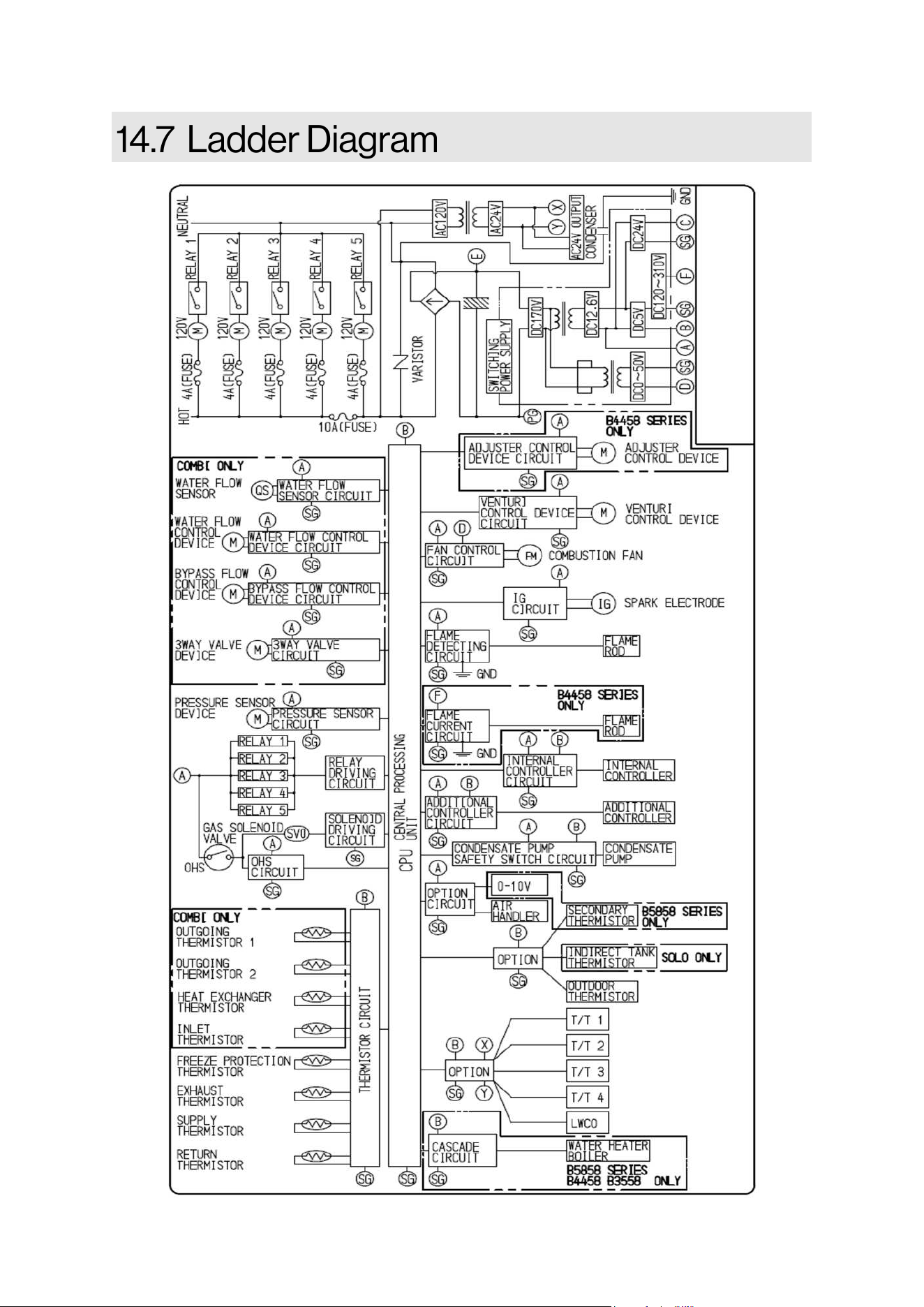
135
Rinnai I-Series Plus Condensing Combi Boiler Manual
Figure 164
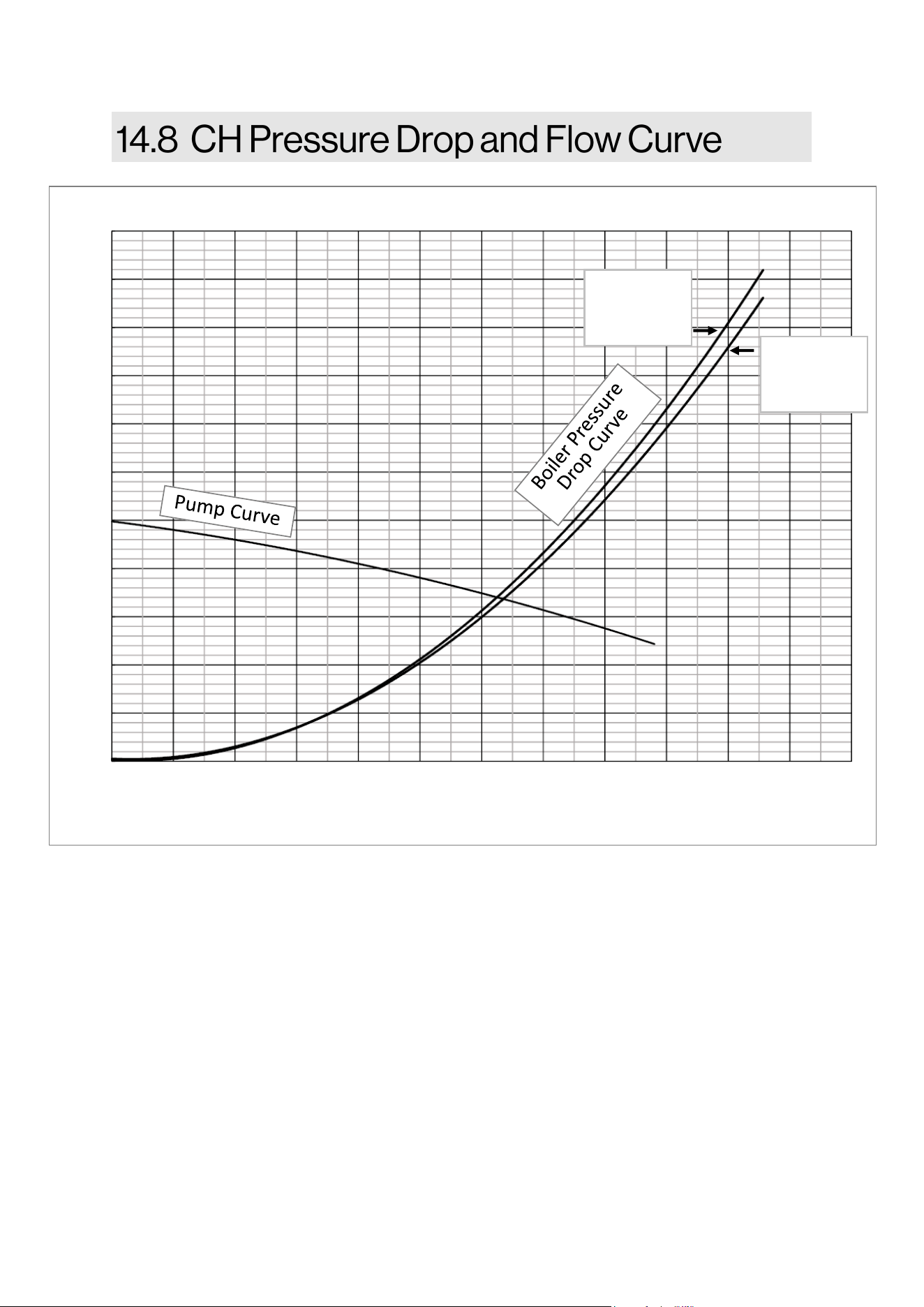
136
Rinnai I-Series Plus Condensing Combi Boiler Manual
0 1 2 3 4 5 6 7 8 9 10
20
15
25
30
10
5
0
Water Flow (GPM)
Pressure Loss (Feet of Head)
11
12
55
50
45
40
35
IP060160C,
IP090099C,
IP090160C
IP090199C,
IP120199C,
IP150199C
Figure 165
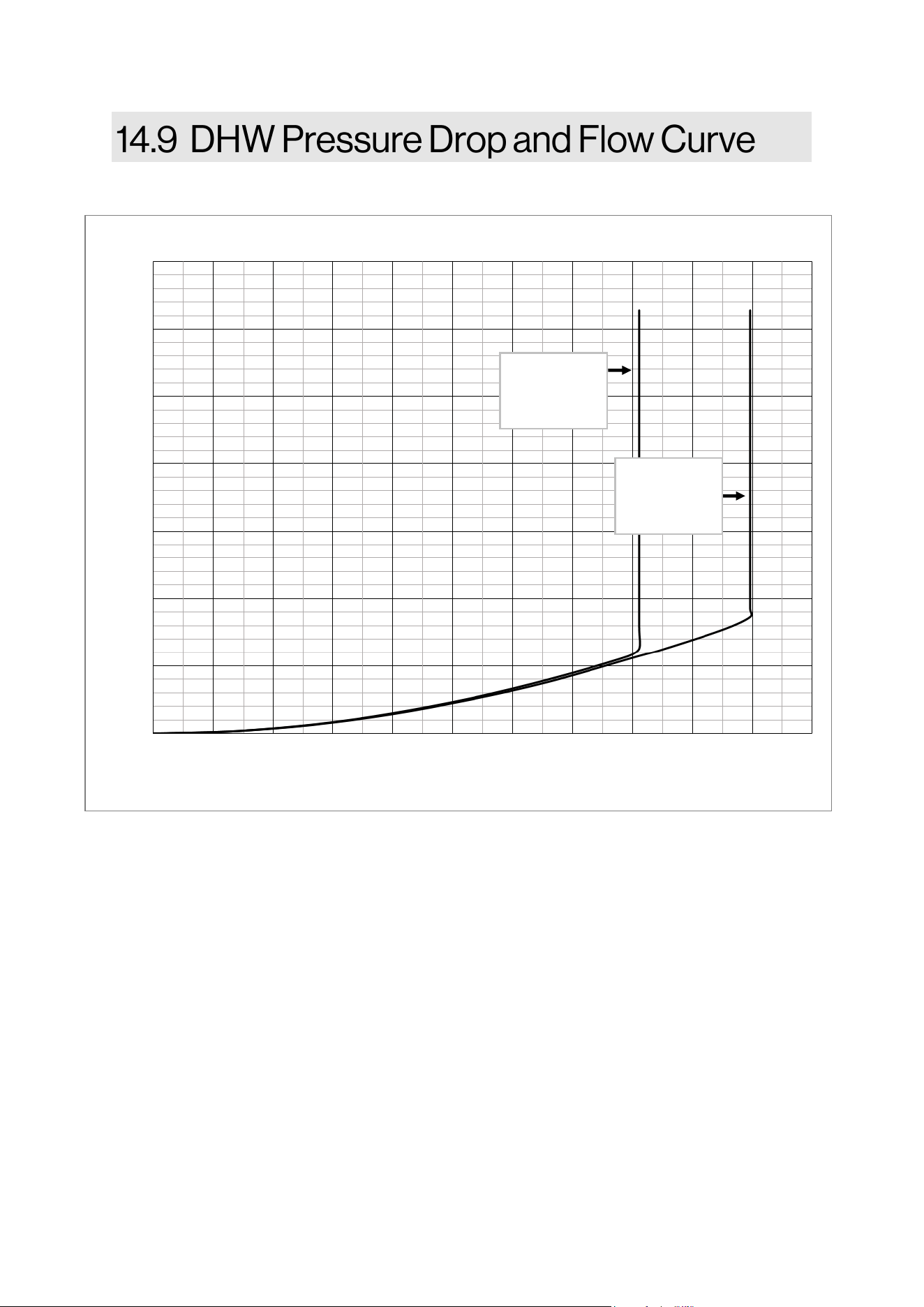
137
Rinnai I-Series Plus Condensing Combi Boiler Manual
Water Flow (GPM)
Pressure Loss (Feet of Head)
70
60
50
0
10
20
30
40
0
1
2 3 4
5 6 7 8 9
10
IP060160C,
IP090099C,
IP090160C
11
IP090199C,
IP120199C,
IP150199C
Figure 166
138
Rinnai I-Series Plus Condensing Combi Boiler Manual
• The temperature controller should be out of reach of small children.
• Avoid locaons where the temperature controller may become hot (near an oven or heat
emier).
• Avoid locaons in direct sunlight. The digital display may be dicult to read in direct sunlight.
• Avoid locaons where the temperature controller could be splashed with liquids.
• Do not install in locaons where the temperature controller can be adjusted by the public.
The MC-601 controller is available as an accessory and must be purchased separately (detailed
installaon instrucons are included with controller purchase).
When an MC-601 controller is connected to the boiler, the set temperature of DHW can be
changed on the controller, rather than the boiler.
The temperature controller cable should be a non-polarized two-core cable with a minimum gauge
of 22 AWG. The maximum cable length from each temperature controller to the boiler depends on
the total number of wired controllers connected to the boiler.
Number of Wired
Controllers
Maximum Cable Length for
Each Controller to Boiler
1 N/A (Included on Boiler)
2 164 Ft (50 m)
3 65 Ft (20 m)
Turn the power o. Do not aempt to connect the temperature controllers with the
power on. Although the controller is a low voltage device, there is 120 volt potenal
next to the temperature controller connecons inside the unit.
When a technician is performing maintenance, the MC-601 controller should not be used. The
MC-601 controller is only to be used for seng the DHW temperature and be selected as the
priority controller. Pressing the “Priority” buon on the MC-601 controller while in priority will
change the priority status to the integrated controller on the boiler. If priority is desired again
on the MC-601 controller, press the “Priority” buon again. The “In Use” indicator on the MC-
601 controller will display only during DHW operaon and not indicate CH operaon or freeze
protecon.
IMPORTANT
Table 51
WARNING
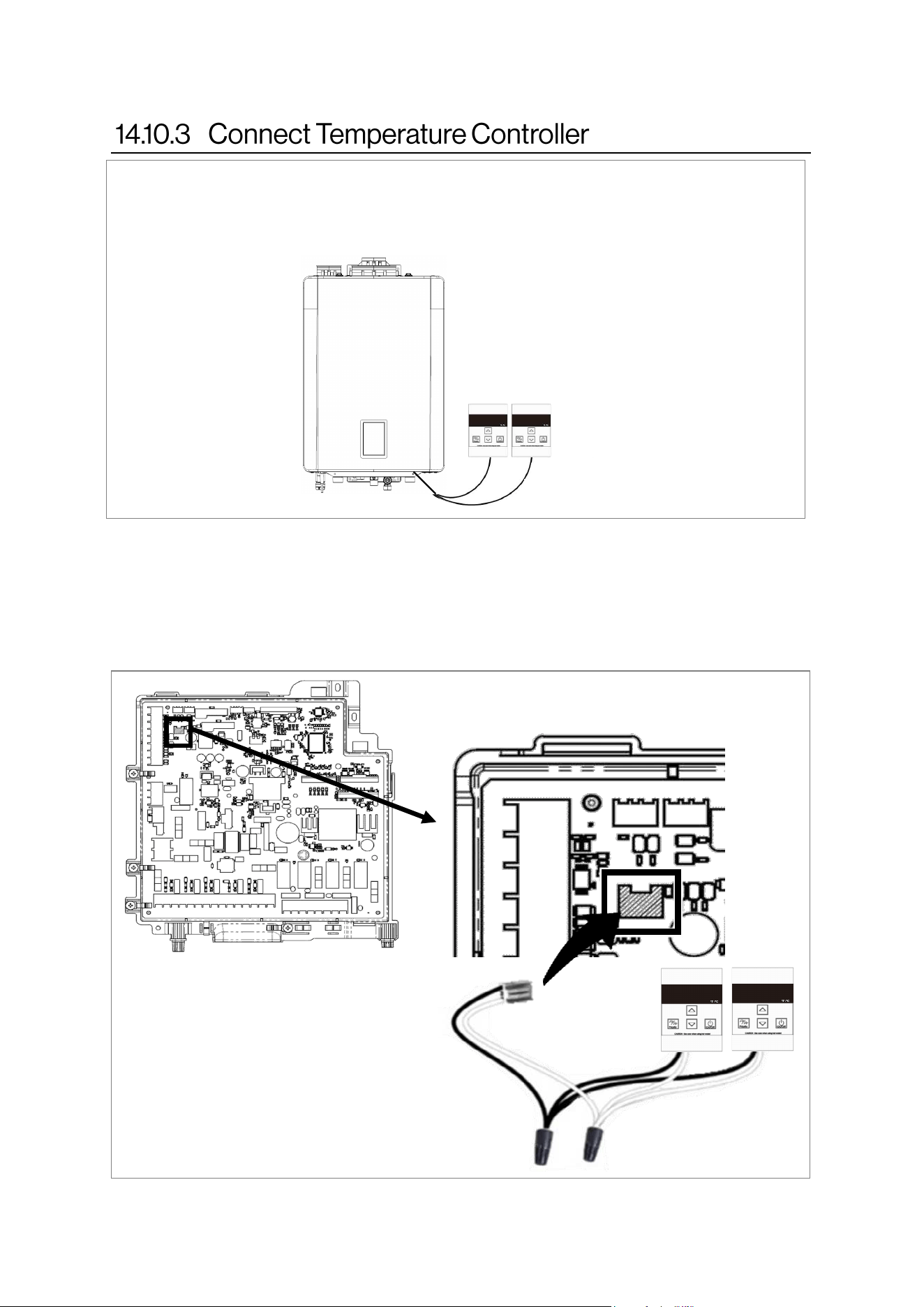
139
Rinnai I-Series Plus Condensing Combi Boiler Manual
A maximum of three temperature controllers can be installed for a boiler or bank of boilers
(including the controller built into the boiler).
Connect the controller cable to the mang terminal at the boom of the PC Board.
• Use the connecter (included) for wiring to remote controller.
• Wire the connecter and remote controller, and insert the connecter on remote controller.
Figure 167
Figure 168
140
Rinnai I-Series Plus Condensing Combi Boiler Manual
The following informaon is required by ANSI Z21.13:
If a boiler is removed from a common vent system, the common vent system is likely to be too large
for proper venng of the remaining appliances connected to it.
The instrucons shall include the test procedure set forth below:
At the me of removal of an exisng boiler, the following steps shall be followed with each other
appliances remaining connected to the common venng system are not in operaon.
1. Seal any unused openings in the common venng system.
2. Visually inspect the venng system for proper size and horizontal pitch and determine
there is no blockage or restricon, leakage, corrosion and other deciencies which could
cause an unsafe condion.
3. Insofar as is praccal, close all building doors and windows and all doors between the
space in which the appliances remaining connected to the common venng system are
located and other spaces of the building. Turn on clothes dryers and any appliance not
connected to the common venng system. Turn on any exhaust fans, such as range hoods
and bathroom exhausts, so they will operate at maximum speed. Do not operate a
summer exhaust fan. Close replace dampers.
4. Place in operaon the appliance being inspected. Follow the lighng instrucons. Adjust
thermostat so appliance will operate connuously.
5. Test for spillage at the dra hood relief opening aer ve minutes of main burner
operaon. Use the ame of a match or candle, or smoke from a cigaree, cigar, or pipe.
6. Aer it has been determined that each appliance remaining connected to the common
venng system properly vents when tested as outlined above, return doors, windows,
exhaust fans, replace dampers, and any other gas-burning appliance to their previous
condion of use.
7. Any improper operaon of the common venng system should be corrected so the
installaon conforms with the Naonal Fuel Gas Code, ANSI Z223.1/NFPA 54, and/or the
Natural Gas and Propane Installaon Code, CAN/CSA B149.1. When resizing any poron of
the common venng system, the common venng system should be resized to approach
the minimum size as determined using the appropriate tables in Chapter 13 of the
Naonal Fuel Gas Code, ANSI Z223.1/NFPA 54, and/or the Natural Gas and Propane
Installaon Code, CAN/CSA B149.1.
141
Rinnai I-Series Plus Condensing Combi Boiler Manual
FOR GAS MODELS SOLD IN MASSACHUSETTS
NOTICE BEFORE INSTALLATION:
This direct-vent appliance must be installed by a properly trained licensed professional. If you are
not properly trained, you must not install this unit.
IMPORTANT: In the State of Massachuses (248 CMR 4.00 & 5.00):
For all side wall horizontally vented gas fueled equipment installed in every dwelling, building or
structure used in whole or in part for residenal purposes, including those owned or operated by
the Commonwealth and where the side wall exhaust vent terminaon is less than 7 above
nished grade in the area of the venng, including but not limited to decks and porches, the
following requirements shall be sased:
1. INSTALLATION OF CARBON MONOXIDE DETECTORS. At the me of installaon of the side wall
horizontal vented gas fueled equipment, the installing plumber or gaser shall observe that a
hard wired carbon monoxide detector with an alarm and baery back-up is installed on the
oor level where the gas equipment is to be installed. In addion, the installing plumber or
gaser shall observe that a baery operated or hard wired carbon monoxide detector with an
alarm is installed on each addional level of the dwelling, building or structure served by the
side wall horizontal vented gas fueled equipment. It shall be the responsibility of the property
owner to secure the services of qualied licensed professionals for the installaon of hard
wired carbon monoxide detectors
A. In the event that the side wall horizontally vented gas fueled equipment is installed in a
crawl space or an ac, the hard wired carbon monoxide detector with alarm and baery
back-up may be installed on the next adjacent oor level.
B. In the event that the requirements of this subdivision can not be met at the me of
compleon of installaon, the owner shall have a period of thirty (30) days to comply with
the above requirements; provided, however, that during said thirty (30) day period, a
baery operated carbon monoxide detector with an alarm shall be installed.
2. APPROVED CARBON MONOXIDE DETECTORS. Each carbon monoxide detector as required in
accordance with the above provisions shall comply with NFPA 720 and be ANSI/UL 2034 listed
and IAS cered.
3. SIGNAGE. A metal or plasc idencaon plate shall be permanently mounted to the exterior
of the building at a minimum height of 8 above grade directly in line with the exhaust vent
terminal for the horizontally vented gas fueled heang appliance or equipment. The sign shall
read, in print size no less than one-half (1/2) inch in size, "GAS VENT DIRECTLY BELOW. KEEP
CLEAR OF ALL OBSTRUCTIONS.”
4. INSPECTION. The state or local gas inspector of the side wall horizontally vented gas fueled
equipment shall not approve the installaon unless, upon inspecon, the inspector observes
carbon monoxide detectors and signage installed in accordance with the provisions of 248 CMR
5.08(2)(a)1 through 4.

142
Rinnai I-Series Plus Condensing Combi Boiler Manual
FCC Interference Statement:
This device complies with Part 15 of the FCC Rules. Operaon is subject to the following two
condions: (1) This device may not cause harmful interference, and (2) this device must accept any
interference received, including interference that may cause undesired operaon.
This equipment has been tested and found to comply with the limits for a Class B digital device,
pursuant to Part 15 of the FCC Rules. These limits are designed to provide reasonable protecon
against harmful interference in a residenal installaon. This equipment generates, uses and can
radiate radio frequency energy and, if not installed and used in accordance with the instrucons,
may cause harmful interference to radio communicaons. However, there is no guarantee that
interference will not occur in a parcular installaon. If this equipment does cause harmful
interference to radio or television recepon, which can be determined by turning the equipment
o and on, the user is encouraged to try to correct the interference by one of the following
measures:
− Reorient or relocate the receiving antenna.
− Increase the separaon between the equipment and receiver.
− Connect the equipment into an outlet on a circuit dierent from that to which the receiver
is connected.
− Consult the dealer or an experienced radio/TV technician for help.
FCC Cauon: Any changes or modicaons not expressly approved by the party responsible for
compliance could void the user's authority to operate this equipment.
This transmier must not be co-located or operang in conjuncon with any other antenna or
transmier.
Radiaon Exposure Statement:
The product comply with the FCC portable RF exposure limit set forth for an uncontrolled
environment and are safe for intended operaon as described in this manual. The further RF
exposure reducon can be achieved if the product can be kept as far as possible from the user
body or set the device to lower output power if such funcon is available.
143
Rinnai I-Series Plus Condensing Combi Boiler Manual
IC
This device complies with ISED’s licence-exempt RSSs. Operaon is subject to the following two
condions: (1) This device may not cause harmful interference, and (2) this device must accept any
interference received, including interference that may cause undesired operaon.
Le présent appareil est conforme aux CNR d’ ISED applicables aux appareils radio exempts de
licence. L’exploitaon est autorisée aux deux condions suivantes : (1) le disposif ne doit pas
produire de brouillage préjudiciable, et (2) ce disposif doit accepter tout brouillage reçu, y
compris un brouillage suscepble de provoquer un fonconnement indésirable.
Radiaon Exposure Statement:
This equipment complies with ISED radiaon exposure limits set forth for an uncontrolled
environment. This equipment should be installed and operated with minimum distance 20cm
between the radiator & your body.
Déclaraon d'exposion aux radiaons:
Cet équipement est conforme aux limites d'exposion aux rayonnements ISED établies pour un
environnement non contrôlé. Cet équipement doit être installé et ulisé avec un minimum de 20
cm de distance entre la source de rayonnement et votre corps.
144
Rinnai I-Series Plus Condensing Combi Boiler Manual
Item Residenal Applicaons Commercial Applicaons
Heat Exchanger 12 Years 5 Years
All Other Parts and Components* 5 Years 5 Years
Reasonable Labor 1 Year 1 Year
Limited Warranty for I-Series Plus Boiler Models
Boiler Models:
• IP060160C (REB-B1847FF-US)
• IP090099C (REB-B2630FF-US)
• IP090160C (REB-B2647FF-US)
• IP090199C (REB-B2658FF-US)
• IP120199C (REB-B3558FF-US)
• IP150199C (REB-B4458FF-US)
What Is Covered?
The Rinnai Standard Limited Warranty covers any defects in materials or workmanship when the
product is installed and operated according to Rinnai wrien installaon instrucons, subject to
the terms within this Limited Warranty document. This Limited Warranty applies only to products
that are installed in the United States and Canada. Improper installaon may void this Limited
Warranty. It is strongly recommended that you use a trained and qualied professional who has
aended a Rinnai installaon training class before installing this boiler. This Limited Warranty is
subject to the condions that the Rinnai boiler has been installed and proper maintenance has
been performed, according to the Installaon and Servicing Instrucons, by a professional heang
contractor. Proof of the required service and maintenance must be kept in the provided Rinnai
Installaon, Commissioning and Service Record. This Limited Warranty coverage as set out in the
table below extends to the original purchaser and subsequent owners, but only while the product
remains at the site of the original installaon. This Limited Warranty only extends to the rst /
original installaon of the product and terminates if the product is moved or reinstalled at a new
locaon.
* Parts replaced during recommended maintenance procedures are not covered by this Limited
Warranty.
What Will Rinnai Do?
Rinnai will repair or replace the covered product or any part or component that is defecve in ma-
terials or workmanship as set forth in the above table. Rinnai will pay reasonable labor charges as-
sociated with the repair or replacement of any such part or component during the term of the la-
bor warranty period. All repair parts must be genuine Rinnai parts. All repairs or replacements must
be performed by a licensed professional who is properly trained to do the type of repair.
Replacement of the product may be authorized by Rinnai only at its sole discreon. Rinnai does not
authorize any person or company to assume for it any obligaon or liability in connecon with the
replacement of the product. If Rinnai determines that repair of a product is not possible, Rinnai
may replace the product with a comparable product at Rinnai’s sole discreon. The warranty claim
for product parts and labor may be denied if a component or product returned to Rinnai is found to
be free of defects in material or workmanship; damaged by improper installaon, use or operaon;
or damaged during return shipping.
Table 52

145
Rinnai I-Series Plus Condensing Combi Boiler Manual
How Do I Get Service? You must contact a trained and qualied professional for the repair of a
product under this Limited Warranty. For the name of a trained and qualied professional, please
contact your place of purchase, visit the Rinnai website (www.rinnai.us), call Rinnai at 1-800-621-
9419 or write to Rinnai at 103 Internaonal Drive, Peachtree City, Georgia 30269.
Proof of purchase is required to obtain warranty service. You may show proof of purchase with a
dated sales receipt, or by registering within 90 days of purchasing the product. To register your
Rinnai Condensing Boiler, please visit www.rinnai.us. For those without internet access, please call
1-866-RINNAI1 (746-6241). Receipt of Registraon by Rinnai will constute proof-of-purchase for
this product. Registraon of product installed in new home construcon may be veried with a
copy of the closing papers provided by the inial home buyer. However, Registraon is not
necessary in order to validate this Limited Warranty.
What Is Not Covered? This warranty does not cover any failures, heat exchanger leakage, or
operang dicules due to the following:
• Accident, abuse or misuse
• Alteraon
• Misapplicaon
• Force majeure
• Improper installaon (such as but not limited to inadequate water quality, condensate
damage, improper venng, incorrect gas type, incorrect gas or water pressure, or absence
of a drain pan under the product)
• Improper maintenance (such as but not limited to scale build-up, freeze damage, or vent
blockage)
• Improper water quality or the use of unapproved anfreeze or other chemical addives in
the boiler system
• Installaon of the boiler in a heang system where polybutylene pipe without an oxygen
barrier is used
• Any installaon that is not closed loop or where oxygen may enter the heang system
• Use in or around areas where chemical agents are used (such as but not limited to
chlorine, hair spray, or hair dyes)
• Damage or failure caused by contaminated air, including, but not limited to sheetrock
parcles, plasterboard parcles, dust, dirt, or lint entering the boiler or any of its
components
• Incorrect sizing
• A failure of any component in the Hydronic system not supplied by Rinnai
• Any other causes other than defects in materials or workmanship
This Limited Warranty does not cover any product used in an applicaon that uses chemically
treated water such as a pool or spa heater.
If you purchase a Rinnai product from an unauthorized dealer, or if the original factory serial
number has been removed, defaced or altered, your Rinnai warranty will not be valid.
Limitaon on Warranes — No one is authorized to make any other warranes on behalf of Rinnai
America Corporaon. Except as expressly provided herein, there are no other warranes,
expressed or implied, including, but not limited to warranes of merchantability or tness for a
parcular purpose, which extend beyond the descripon of the warranty herein.
Any implied warranes of merchantability and tness arising under state law are limited in
duraon to the period of coverage provided by this Limited Warranty, unless the period provided
by state law is less. Some states do not allow limitaons on how long an implied Limited Warranty
lasts, so the above limitaon may not apply to you.
Rinnai shall not be liable for indirect, incidental, special, consequenal or other similar damages
that may arise, including lost prots, damage to person or property, loss of use, inconvenience, or
liability arising from improper installaon, service or use. Some states do not allow the exclusion or
limitaon of incidental or consequenal damages, so the above limitaon may not apply to you.
This Limited Warranty gives you specic legal rights, and you may also have other rights which vary
from state to state. www.rinnai.us/warranty

146
Rinnai I-Series Plus Condensing Combi Boiler Manual

147
Rinnai I-Series Plus Condensing Combi Boiler Manual