• Do not store or use gasoline or other ammable vapors and liquids in vicinity of this or any other appliance.
• An LP cylinder not connected for use shall not be stored in the vicinity of this or any other appliance.
WHAT TO DO IF YOU SMELL GAS:
• Do not try to light appliance.
• Extinguish any open ame.
• Shut off gas to appliance.
Service must be performed by a qualied service agency.
WARNING: If the information in this manual is not followed exactly, a re or explosion may result causing
property damage, personal injury or loss of life.
READ INSTRUCTIONS CAREFULLY: Read and follow all instructions. Place instructions in a safe place for future
reference. Do not allow anyone who has not read these instructions to assemble, light, adjust or operate the heater.
This is an unvented gas-red portable heater. It uses air (oxygen) from the area in which it is used. Adequate
combustion and ventilation air must be provided.
854015B-2502M
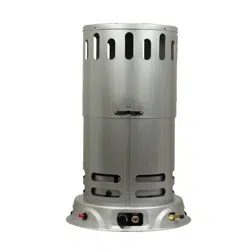
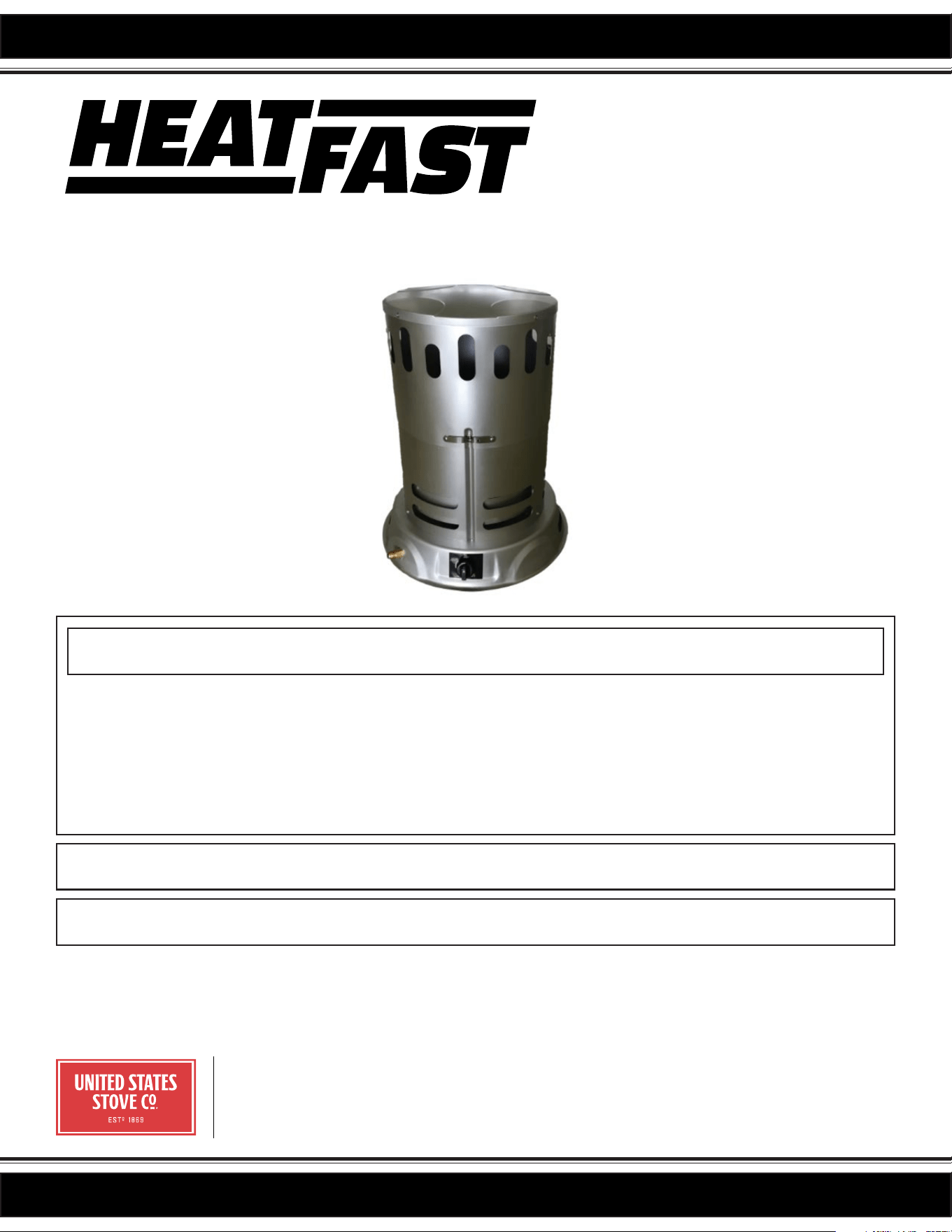
MODEL: HF80C/HF200C
®
CONVECTION
CONSTRUCTION
HEATER
United States Stove Company
227 Industrial Park Road, South Pittsburg, TN
PH: (800) 750-2723
www.usstove.com
-2-
WARNING: Never leave the heater unattended while operating.
Disconnect the heater from its power source when not in use.
-3-
WARNING: Never leave the heater unattended while operating.
Disconnect the heater from its power source when not in use.
GENERAL SAFETY INFORMATION
GENERAL HAZARD WARNING:
FAILURE TO COMPLY WITH THE PRECAUTIONS AND INSTRUCTIONS PROVIDED WITH THIS HEATER, CAN RESULT IN
DEATH, SERIOUS BODILY INJURY AND PROPERTY LOSS OR DAMAGE FROM HAZARDS OF FIRE, EXPLOSION, BURN,
ASPHYXIATION, CARBON MONOXIDE POISONING, AND/OR ELECTRICAL SHOCK.
ONLY PERSONS WHO CAN UNDERSTAND AND FOLLOW THE INSTRUCTIONS SHOULD USE OR SERVICE THIS HEATER.
IF YOU NEED ASSISTANCE OR HEATER INFORMATION SUCH AS AN INSTRUCTIONS MANUAL, LABELS, ETC. CONTACT
THE MANUFACTURER.
WARNING:
THE STATE OF CALIFORNIA REQUIRES THE FOLLOWING WARNING
COMBUSTION BY-PRODUCTS PRODUCED WHEN USING THIS PRODUCT CONTAIN CARBON MONOXIDE, A CHEMICAL
KNOWN TO THE STATE OF CALIFORNIA TO CAUSE CANCER AND BIRTH DEFECTS (OR OTHER REPRODUCTIVE HARM).
THIS PRODUCT CONTAINS CHEMICALS KNOWN TO THE STATE OF CALIFORNIA TO CAUSE CANCER AND BIRTH
DEFECTS OR OTHER REPRODUCTIVE HARM.
WARNING:
FIRE, BURN, INHALATION, AND EXPLOSION HAZARD. KEEP SOLID COMBUSTIBLES, SUCH AS BUILDING MATERIALS,
PAPER OR CARDBOARD, A SAFE DISTANCE AWAY FROM THE HEATER AS RECOMMENDED BY THE INSTRUCTIONS
NEVER USE THE HEATER IN SPACES WHICH DO OR MAY CONTAIN VOLATILE OR AIRBORNE COMBUSTIBLES, OR
PRODUCTS SUCH AS GASOLINE, SOLVENTS, PAINT THINNER, DUST PARTICLES OR UNKNOWN CHEMICALS.
WARNING:
NOT FOR HOME OR RECREATIONAL VEHICLE USE.
WARNING:
YOUR SAFETY IS IMPORTANT TO YOU AND TO OTHERS, SO PLEASE READ THESE INSTRUCTIONS BEFORE YOU OPERATE
THIS HEATER.
-2-
WARNING: Never leave the heater unattended while operating.
Disconnect the heater from its power source when not in use.
-3-
WARNING: Never leave the heater unattended while operating.
Disconnect the heater from its power source when not in use.
RETAIN THIS MANUAL FOR FUTURE REFERENCE
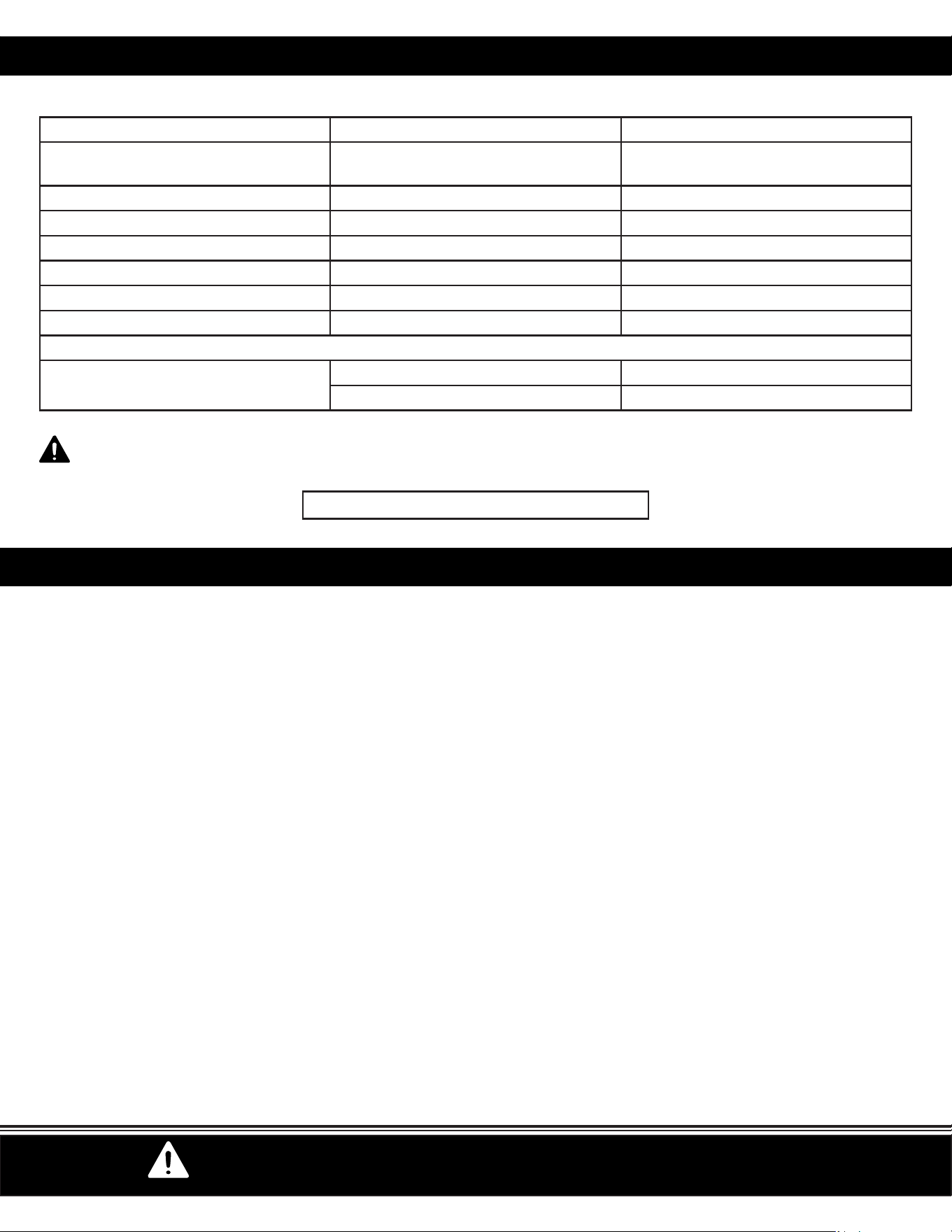
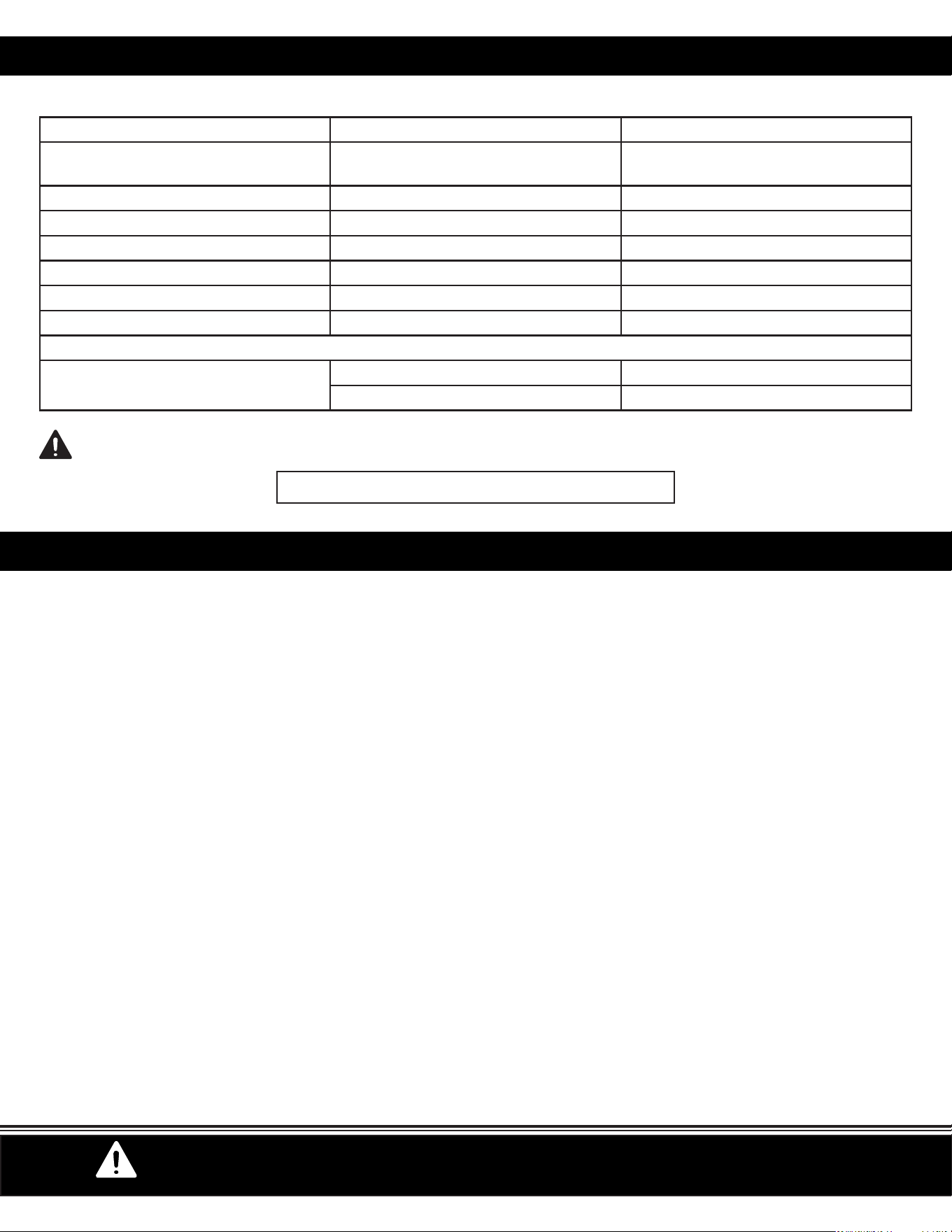
MAX SUPPLY PRESSURE: HF80C HF200C
To Regulator MIN (MAX=Bole
Pressure)
5PSI (34.5 kPa) 15PSI (103 kPa)
Regulator Out 11” W.C. (2.74 kPa) 10PSI (68.9 kPa)
Ignion Piezo Piezo
Min Ambient Temp. 0° F (17.8) ° C 0° F (17.8) ° C
BTU Rang Low-High 30,000-80,000 BTU/HR (8.8-23.4 kW) 75,000-200,000 BTU/HR (22-58.6 kW)
Fuel Consumpon 1.4-3.7 LBS/HR (.74-1.8 kg/HR) 3.5-9.3 LBS/HR (1.44-4.32 kg/HR)
Hose Length 15’ (456 cm) 15’ (456 cm)
VENTILATION:
Minimum openings required
2² Opening near oor 2² Opening near oor
2² Opening near ceiling 2² Opening near ceiling
FEATURES and SPECIFICATIONS
OPERATING PRECAUTIONS
This is a propane, direct-red, convecon heater. It’s intended use is primarily temporary heang of buildings under construcon,
alteraon or repair. Propane is heavier than air. If propane leaks from a connecon or ng, it sinks to the oor, collecng there
with the surrounding air, forming a potenally explosive mixture. Obviously, propane leaks should be avoided, so set up the
propane supply with utmost care. Leak check new connecons or reconnecon with a soap and water soluon and follow all
connecon instrucons herein. Also, ask your propane dealer for advice on the propane applicaon and supply installaon and ask
him to check it if there are any quesons. This heater was designed and cered for use as a construcon heater in accordance
with ANSI Standard ANSI Z83.7-2017 CSA 2.14-2017. Check with your local re safety authority if you have any quesons about
your applicaons. Other standards govern the use of fuel gases and heat producing products in specic applicaons.
Your local authority can advise you about these. Direct-Fired means that all of the combuson products enter the heated space.
Even though this heater operates very close to 100 percent combuson eciency, it sll produces small amounts of carbon
monoxide. Carbon monoxide (called CO) is toxic. We can tolerate small amounts but not a lot. CO can build up in a heated space
and failure to provide adequate venlaon could result in death. The symptoms of inadequate venlaon are:
• headache
• dizziness
• burning eyes and nose
• nausea
• dry mouth or sore throat
So, be sure to follow advice about venlaon in these operang instrucons. When the heater is to be operated in the presence
of other people the user is responsible for properly acquainng those present with the safety precauons and instrucons, and of
the hazards involved.
GENERAL INFORMATION
WARNING: FAILURE TO FOLLOW THESE VENTILATION REQUIREMENTS MAY RESULT IN SOOTING DAMAGE.
-4-
WARNING: Never leave the heater unattended while operating.
Disconnect the heater from its power source when not in use.
-5-
WARNING: Never leave the heater unattended while operating.
Disconnect the heater from its power source when not in use.
SAFETY PRECAUTIONS
1. Check the heater thoroughly for damage. DO NOT operate a damaged heater.
2. DO NOT modify the heater or operate a heater which has been modied from its original condion.
3. DO NOT light or operate heater unless the shells are fully extended and locked into posion.
4. Use only propane gas.
5. Use only VAPOR WITHDRAWAL propane supply. If there is any queson about vapor withdrawal, ask your propane dealer.
6. Mount the propane cylinders vercally (shuto valve up). Secure them from falling or being knocked over and protect them
from damage.
7. Locate propane containers at least (USA) 7 . (2.13m) from the heater and do not direct exhaust toward containers.
8. IMPORTANT Use only the hose and regulator assembly provided with the heater. Match the color stripe on the hang tag
aached to the hose assembly with the color on the label located near the propane inlet ng on the heater. Inspect hose
assembly before each use of the heater. If there is excessive abrasion or wear, or hose is cut, replace with hose assembly listed
on parts list before using heater.
9. For indoor use only. Area must be well venlated. (Also see “Operang Precauons”).
10. If at any me gas odor is detected, IMMEDIATELY DISCONTINUE operaon unl the source of gas has been located and
corrected.
11. Install the heater such that it is not directly exposed to water spray, rain and/or dripping water.
12. Maintain minimum clearance from normal combusble material (like paper).
13. Due to the high surface and exhaust temperatures, adults and children must observe clearances to avoid burns or clothing
ignion.
14. Operate only on a stable, level surface.
15. Do not use with duct work. Do not restrict inlet or exit.
16. Do not move, handle or service while hot or burning.
17. Use only in accordance with local codes or, in the absence of local codes, with the Standard for the Storage and Handling of
Liqueed Petroleum Gases ANSI/ NFPA 58 and CSA B149.1, Natural Gas and Propane Installaon Code.
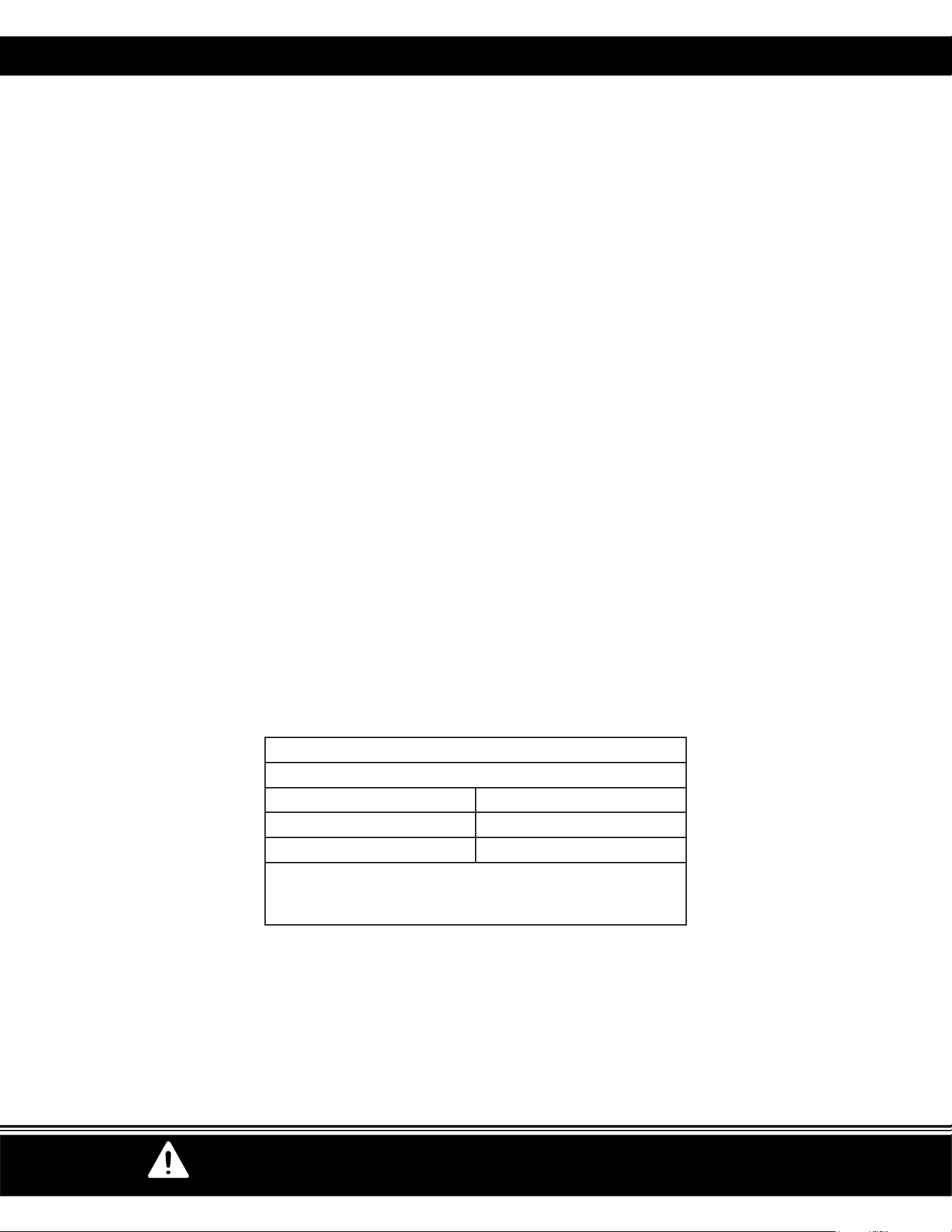
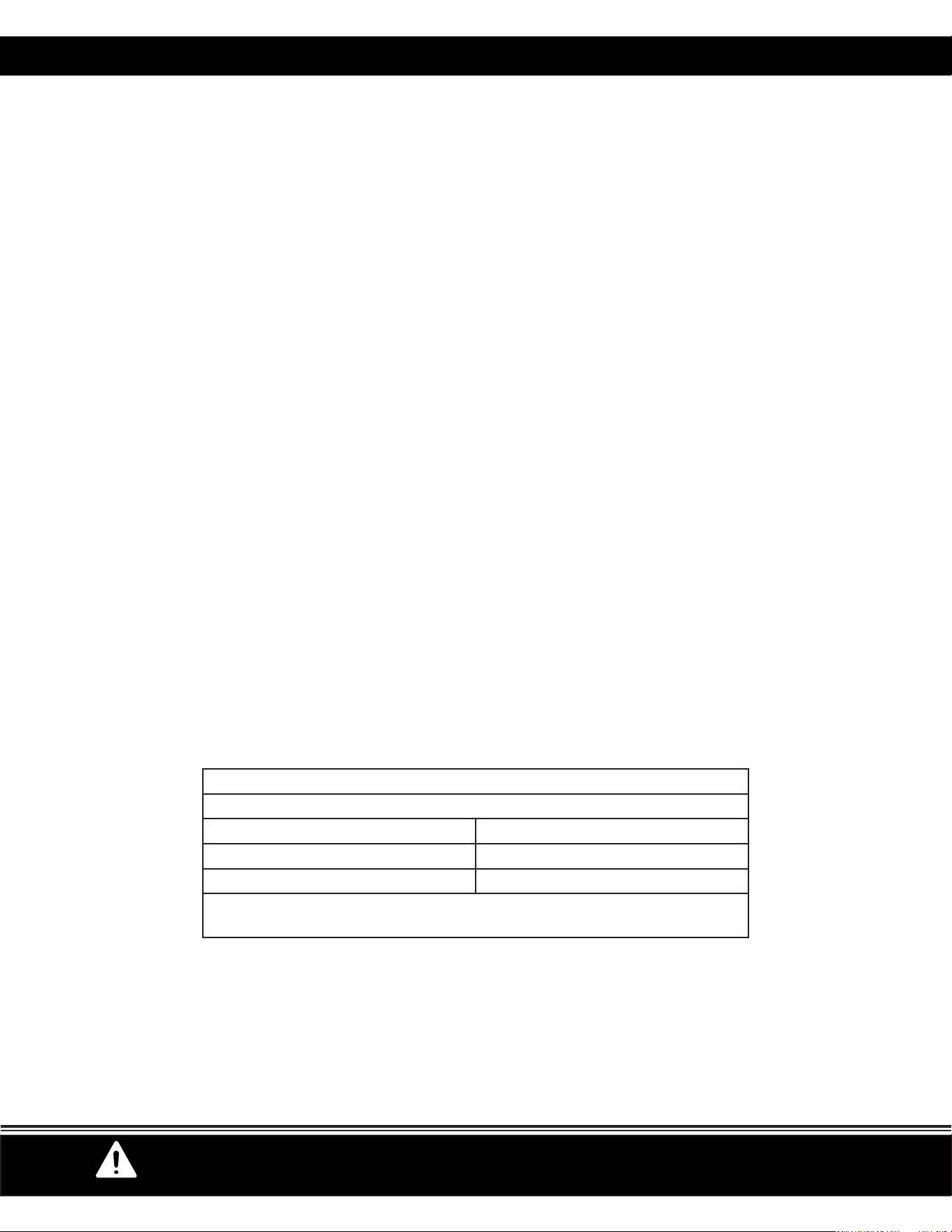
MINIMUM CLEARANCE
From normal combusble material
Clearance
From sides 4
From top 6
Locate 10' from canvas or plasc tarpaulins or similar
coverings and secure them to prevent apping or
movement due to wind acon.
GENERAL INFORMATION
-4-
WARNING: Never leave the heater unattended while operating.
Disconnect the heater from its power source when not in use.
-5-
WARNING: Never leave the heater unattended while operating.
Disconnect the heater from its power source when not in use.
GENERAL INFORMATION
ODOR FADE WARNING
WARNING
ASPHYXIATION HAZARD
• DO NOT USE THIS HEATER FOR HEATING HUMAN LIVING QUARTERS.
• DO NOT USE IN UNVENTILATED AREAS.
• THE FLOW OF COMBUSTION AND VENTILATION AIR MUST NOT BE OBSTRUCTED.
• PROPER VENTILATION AIR MUST BE PROVIDED TO SUPPORT THE COMBUSTION AIR REQUIREMENTS OF THE
HEATER BEING USED.
• REFER TO THE SPECIFICATION SECTION OF THE HEATER’S MANUAL, HEATER DATA PLATE, OR CONTACT THE
FACTORY TO DETERMINE COMBUSTION AIR VENTILATION REQUIREMENTS OF THE HEATER.
• LACK OF PROPER VENTILATION AIR WILL LEAD TO IMPROPER COMBUSTION.
• IMPROPER COMBUSTION CAN LEAD TO CARBON MONOXIDE POISONING LEADING TO SERIOUS INJURY OR
DEATH. SYMPTOM OF CARBON MONOXIDE POISONING CAN INCLUDE HEADACHES DIZZINESS AND DIFFICULTY
IN BREATHING.
WARNING
AIR QUALITY HAZARD
• USE OF DIRECT-FIRED HEATERS IN THE CONSTRUCTION ENVIRONMENT CAN RESULT IN EXPOSURE TO LEVELS OF
CO, CO2, AND NO2 CONSIDERED TO BE HAZARDOUS TO HEALTH AND POTENTIALLY LIFE THREATENING.
• KNOW THE SIGNS OF CO AND CO2 POISONING
• HEADACHES, STINGING EYES
• DIZZINESS, DISORIENTATION
• DIFFICULTY BREATHING, FEELS OF BEING SUFFOCATED
• PROPER VENTILATION AIR EXCHANGE (OSHA 29 CFR 1926.57) TO SUPPORT COMBUSTION AND MAINTAIN
ACCEPTABLE AIR QUALITY SHALL BE PROVIDED IN ACCORDANCE WITH OSHA 29 CFR PART 1926.154, ANSI A10.10
SAFETY REQUIREMENTS FOR TEMPORARY AND PORTABLE SPACE HEATING DEVICES AND EQUIPMENT USED IN
THE CONSTRUCTION INDUSTRY OR THE NATURAL GAS AND PROPANE INSTALLATION CODES CSA B149.1
• PERIODICALLY MONITOR LEVELS OF CO, CO2 AND NO2 EXISTING AT THE CONSTRUCTION SITE – AT THE MINIMUM
AT THE START OF THE SHIFT AND AFTER 4 HOURS.
• PROVIDE VENTILATION AIR EXCHANGE, EITHER NATURAL OR MECHANICAL, AS REQUIRED TO MAINTAIN
ACCEPTABLE INDOOR AIR QUALITY
-6-
WARNING: Never leave the heater unattended while operating.
Disconnect the heater from its power source when not in use.
-7-
WARNING: Never leave the heater unattended while operating.
Disconnect the heater from its power source when not in use.
GENERAL INFORMATION
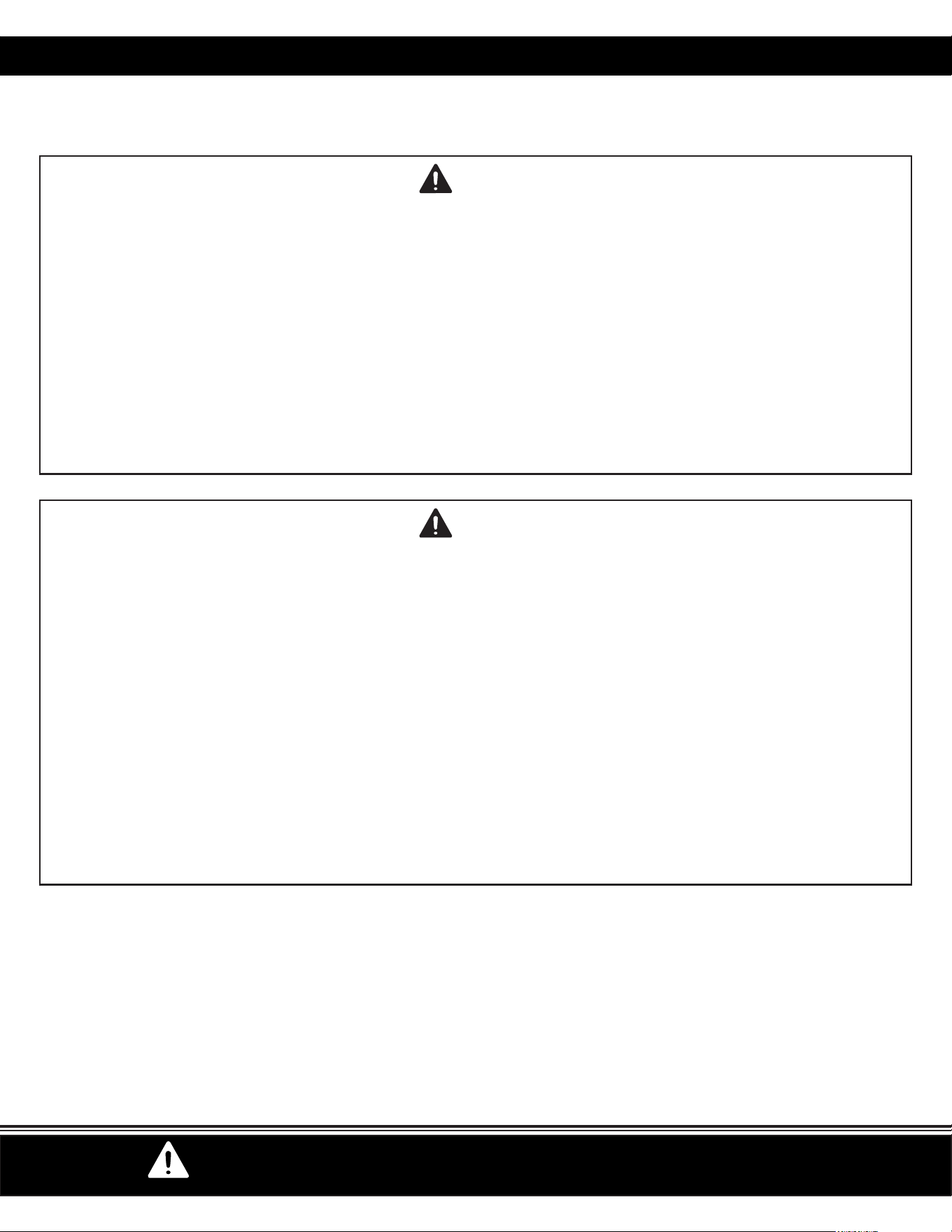
USA 8-Hr Time weighted average (OSHA
29 CFR 1926.55 App A)
Canada 8-hr me weighted average WorkSafe BC OHS Guidelines Part 5.1
and Ontario Workplaces Reg 833
CO 50 ppm 25 ppm
CO
2
5000 ppm 5000 ppm
NO
2
3 ppm (Reg 833)
USA – Ceiling Limit (Short Term
Exposure Limit = 15 minutes)
Canada STEL (15 minutes Reg 833/1 hour WSBC) WorkSafe BC OHS
Guidelines Part 5.1 and Ontario Workplaces Reg 833
CO 100 ppm
CO
2
15000 ppm (WSBC) 30000 ppm (Reg 833)
NO
2
5 ppm 1.0 ppm (WorkSafeBC) 5.0 ppm (Reg 833)
• Ensure that the ow of combuson and venlaon air exchange cannot become obstructed.
• As the building ‘ghtens up’ during the construcon phases venlaon may need to be increased.
FUEL GAS ODOR
LP gas and natural gas have man-made odorants added specically for detecon of fuel gas leaks. If a gas leak occurs you should
be able to smell the fuel gas. Since Propane (LP) is heavier than air you should smell for the gas odor low to the oor. ANY GAS
ODOR IS YOUR SIGNAL TO GO INTO IMMEDIATE ACTION!
• Do not take any acon that could ignite the fuel gas. Do not operate any electrical switches. Do not pull any power supply or
extension cords. Do not light matches or any other source of ame. Do not use your telephone.
• Get everyone out of the building and away from the area immediately.
• Close all propane (LP) gas tank or cylinder fuel supply valves, or the main fuel supply valve located at the meter if you use natural
gas.
• Propane (LP) gas is heavier than air and may sele in low areas. When you have reason to suspect a propane leak, keep out of
all low areas.
• Use your neighbor’s phone and call your fuel gas supplier and your re department. Do not re-enter the building or area.
• Stay out of the building and away from the area unl declared safe by the reghters and your fuel gas supplier.
• FINALLY, let the fuel gas service person and the reghters check for escaped gas. Have them air out the building and area
before you return. Properly trained service people must repair any leaks, check for further leakages, and then relight the
appliance for you.
ODOR FADING ‑ NO ODOR DETECTED
• Some people cannot smell well. Some people cannot smell the odor of the man-made chemical added to propane (LP) or natural
gas. You must determine if you can smell the odorant in these fuel gases.
• Learn to recognize the odor of propane (LP) gas and natural gas. Local propane (LP) gas dealers will be more than happy to give
you a scratch and sni pamphlet. Use it to become familiar with the fuel gas odor.
• Smoking can decrease your ability to smell. Being around an odor for a period of me can aect your sensivity to that
parcular odor. Odors present in animal connement buildings can mask fuel gas odor.
• The odorant in propane (LP) gas and natural gas is colorless and the intensity of its odor can fade under some circumstances.
• If there is an underground leak, the movement of gas through the soil can lter the odorant.
• Propane (LP) gas odor may dier in intensity at dierent levels. Since Propane (LP) gas is heavier than air, there may be more
odor at lower levels.
-6-
WARNING: Never leave the heater unattended while operating.
Disconnect the heater from its power source when not in use.
-7-
WARNING: Never leave the heater unattended while operating.
Disconnect the heater from its power source when not in use.
GENERAL INFORMATION
ASSEMBLY
• Always be sensive to the slightest gas odor. If you connue to detect any gas odor, no maer how small, treat it as a serious
leak. Immediately go into acon as discussed previously.
ATTENTION ‑ CRITICAL POINTS TO REMEMBER!
• Propane (LP) gas has a disncve odor. Learn to recognize these odors. (Reference Fuel Gas Odor and Odor Fading secons
above.
• Even If you are not properly trained in the service and repair of the heater, ALWAYS be consciously aware of the odors of
propane (LP) gas and natural gas.
• If you have not been properly trained in repair and service of propane (LP) gas then do not aempt to light heater, perform
service or repairs, or make any adjustments to the heater on the propane (LP) gas fuel system.
• A periodic sni test around the heater or at the heater’s joints; i.e. hose, connecons, etc., is a good safety pracce under any
condions. If you smell even a small amount of gas, CONTACT YOUR FUEL GAS SUPPLIER IMMEDIATELY. DO NOT WAIT!
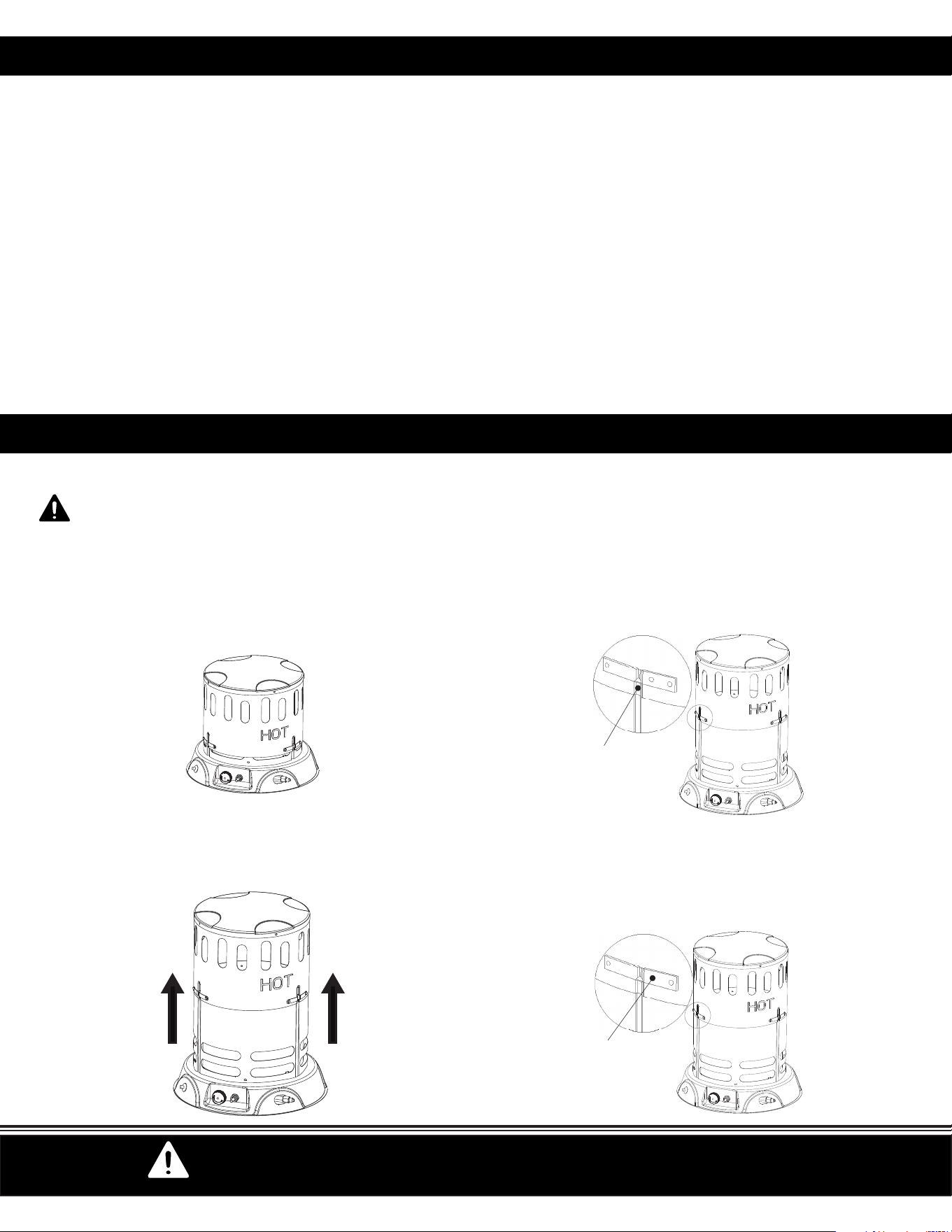
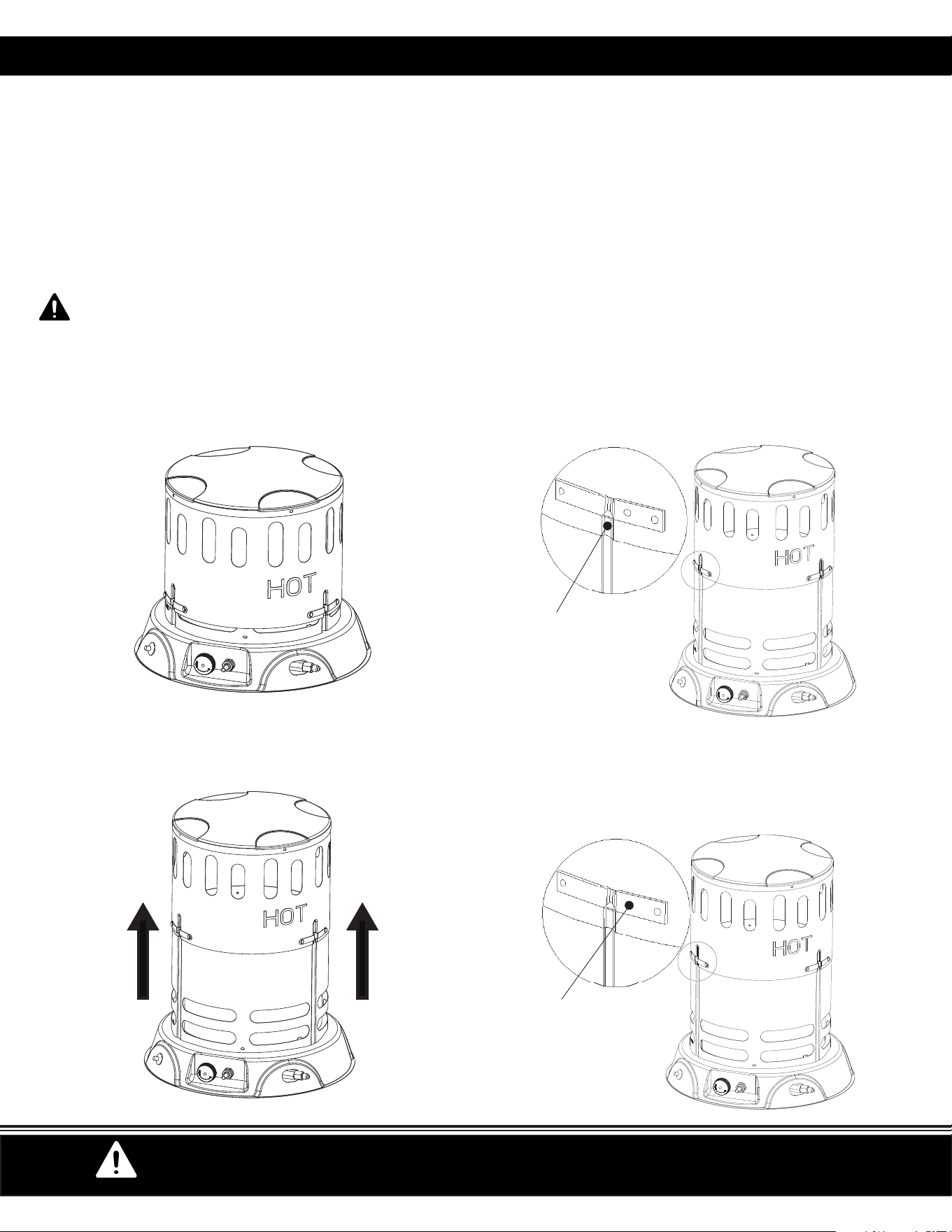
CAUTION: NEVER IGNITE AND / OR RUN THIS HEATER UNLESS THE SHELLS ARE FULLY EXTENDED AND LOCKED
INTO POSITION.
STEP 1
Remove heater from packaging. To protect your hands, put on
gloves before liing the outer shell. Never grasp bare metal
without gloves.
STEP 2
Li outer shell straight up. Care must be taken to protect hands
during li.
STEP 3
Li outer shell unl all three clips engage slots located in the
lower shell. When this happens, the screw holes will line up.
Make sure the clip
goes into the slots
in the lower shell
(3 places).
STEP 4
Lock the clip into place with 3 screws as shown. The heater must
not be operated unless the outer shell is properly extended and
fully locked into place.
Lock the shells together
with the clips in place
and with a screw in
each clip (3 screws
total).

-8-
WARNING: Never leave the heater unattended while operating.
Disconnect the heater from its power source when not in use.
-9-
WARNING: Never leave the heater unattended while operating.
Disconnect the heater from its power source when not in use.
OPERATING INSTRUCTIONS
PREPARING FOR OPERATION
1. Extend the shell fully and lock into place as shown in the enclosed instrucons sheet before lighng or operang the heater.
2. Check the heater for possible shipping damage. If any is found, immediately nofy the factory.
3. Follow all of the safety and operang precauons.
4. Connect the POL ng of hose and regulator assembly to the propane cylinder by rotang the POL nut counterclockwise
into the propane cylinder’s valve outlet and securely ghten with a wrench.
5. Connect the hose to the heater.
6. Securely ghten all gas connecons.
7. Open the cylinder’s gas valve and check all gas connecons with a soap and water soluon. DO NOT USE A FLAME.
STARTING THE HF80C
1. WARNING: BEFORE LIGHTING PILOT, turn main burner valve (turn knob fully clockwise) to low/light posion.
2. Fully open the valve on the propane cylinder and wait 15 seconds before Step 3.
3. Push knob in and hold for 5 seconds, allowing gas to emit from burner orice.
4. Rotate the knob counterclockwise unl the piezo igniter clicks. Connue to rotate and acvate the igniter unl the burner
lights.
5. Once the burner lights hold the knob in, on the low posion for 30 seconds. Then release. The burner should stay lit. If it does
not repeat steps 4 & 5 unl the burner stays lit.
6. Turn main burner valve to regulate heat output.
STARTING THE HF200C
1. WARNING: BEFORE LIGHTING PILOT, turn main burner valve (turn knob fully clockwise) to low/light posion.
2. Fully open the valve on the propane cylinder and wait 15 seconds before Step 3.
3. Depress red buon on safety pilot valve (to the right of the variable valve knob) adming gas to the pilot. Then push and
release the ignion buon (red buon to the right of the variable valve knob) unl the pilot lights.
4. When the pilot lights, connue to hold the buon depressed for 30 seconds, then release to light main burner.
5. If pilot goes out, wait 5 minutes and repeat the lighng procedure.
6. Turn main burner valve to regulate heat output.
STOP (ALL UNITS)
1. Securely close valve on the propane cylinder.
2. Connue to operate heater unl all fuel in the hose has burned.
3. Turn main burner valve to lo/light posion.
RESTART AFTER SAFETY SHUTDOWN
1. Securely close valve at propane cylinder.
2. Wait 5 minutes.
3. Restart following “Start” procedure for your model.
-8-
WARNING: Never leave the heater unattended while operating.
Disconnect the heater from its power source when not in use.
-9-
WARNING: Never leave the heater unattended while operating.
Disconnect the heater from its power source when not in use.
MAINTENANCE & STORAGE
1. The heater should be inspected before each use, and at least annually by a qualied person.
2. Before each use, check the so “O” ring seat at the bullnose of the POL ng. If the “O” ring is cut, scued, or otherwise
damaged, replace it.
3. Turn o the gas at the LP-gas supply cylinder(s) when the heater is not in use.
4. When the heater is to be stored indoors, the connecon between the LP-gas supply cylinder(s) and the heater must be
disconnected and the cylinder(s) removed from the heater and stored out of doors and in accordance with Chapter 5 of the
standard for Storage and Handling of Liqueed Petroleum Gases ANSI/NFPA 58 and CSA B149.1,Natural Gas and Propane
Installaon Code.
SERVICING
A hazardous condition may result if a heater is used that has been modied or is not functioning properly. When the
heater is working properly:
• The ame is contained within the heater.
• The ame is essenally yellow with some blue at the base of the fame adjacent to the burner.
• There is no strong disagreeable odor, eye burning or other physical discomfort.
• There is no smoke or soot internal or external to the heater.
• There are no unplanned or unexplained shut downs of the heater.
The parts lists and exploded view show the heater as it was constructed. Do not use a heater which is dierent from that shown. In
this regard, use only the hose, regulator and cylinder connecon ng (called a POL ng) supplied with the heater. IMPORTANT
Match the color stripe on the hang tag aached to the hose assembly with the color on the label located near the propane inlet
ng on the heater. Do not use alternates. For this heater, the regulator must be set as shown in “specicaons”. If there is any
uncertainty about the regulator seng, have it checked. A heater which is not working right must be repaired, but only by a trained,
experienced service person. In-warranty products will be repaired with no charge for either parts or labor. Please include a brief
statement indicang date, place of purchase, the nature of the problem and proof of purchase. Out-of-warranty products will be
repaired with a charge for parts and labor.
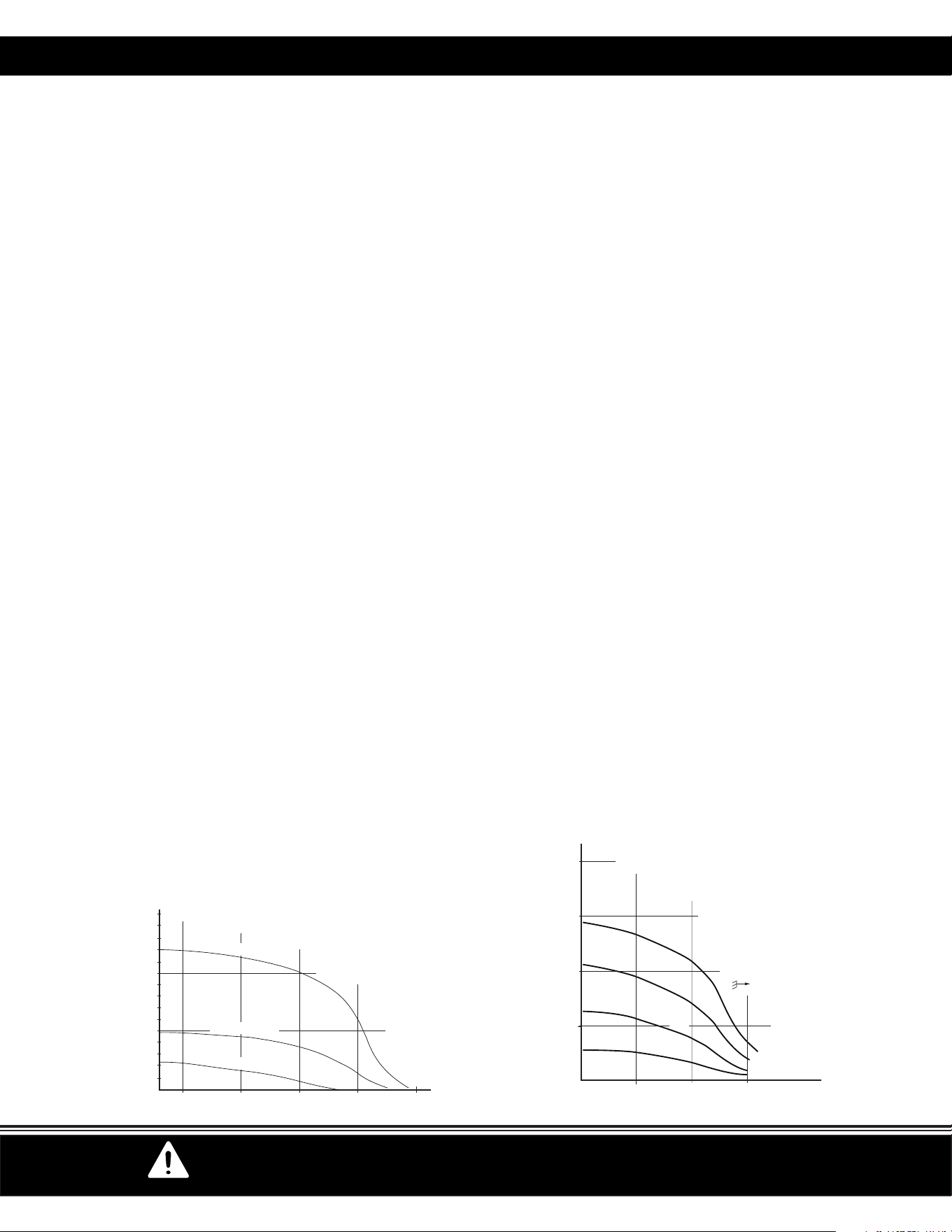
SIZE AND CAPACITY OF PROPANE CYLINDERS REQUIRED
The following charts show the approximate size of the cylinder required for these heaters. To use the chart:
1. Select the lowest air temperature expected (at the boom of the chart).
2. Move straight up to me of operaon desired (le side of chart).
3. Read the cylinder size required.
All heaters should have: Full cylinders good air circulaon no frost on cylinders
4
C
y
l
i
n
d
e
r
s
3
C
y
l
i
n
d
e
r
s
2
C
y
l
i
n
d
e
r
s
1
C
y
l
i
n
d
e
r
s
30
20
10
0
60
(16)
40
(4.4)
20
(-6.7)
0
(-18)
-20
(-29)
MAXIMUM OPERATING TIME - HOURS @ 200,000 BTU/hr (58.6 kW)
AIR TEMPERATURE - °F
HF200C
40
Fuel Cylinder Capacity: 100#
Use liquid withdrawal
and vaporizer
1
0
0
#
(
2
5
g
a
l
.
)
c
y
l
i
n
d
r
e
2
0
#
(
5
g
a
l
.
)
c
y
l
i
n
d
r
e
4
0
#
(
1
0
g
a
l
.
)
c
y
l
i
n
d
r
e
Burn Rate = 80,000 BTU/hr
30
28
26
24
22
20
18
16
14
12
10
8
6
4
2
0
60 40 20 0 -20
MAXIMUM OPERATING TIME - HOURS
AIR TEMPERATURE - °F
HF80C
-10-
WARNING: Never leave the heater unattended while operating.
Disconnect the heater from its power source when not in use.
-11-
WARNING: Never leave the heater unattended while operating.
Disconnect the heater from its power source when not in use.
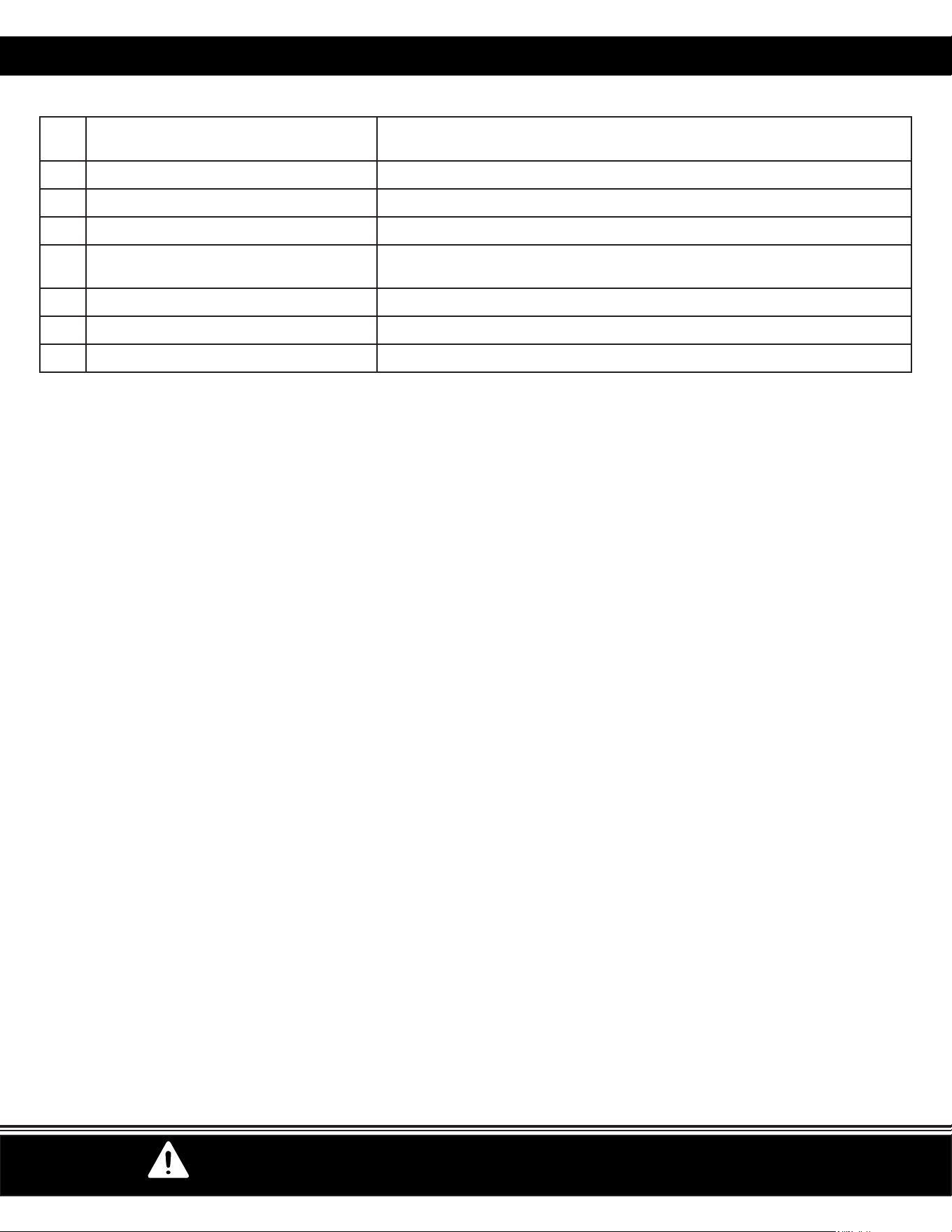
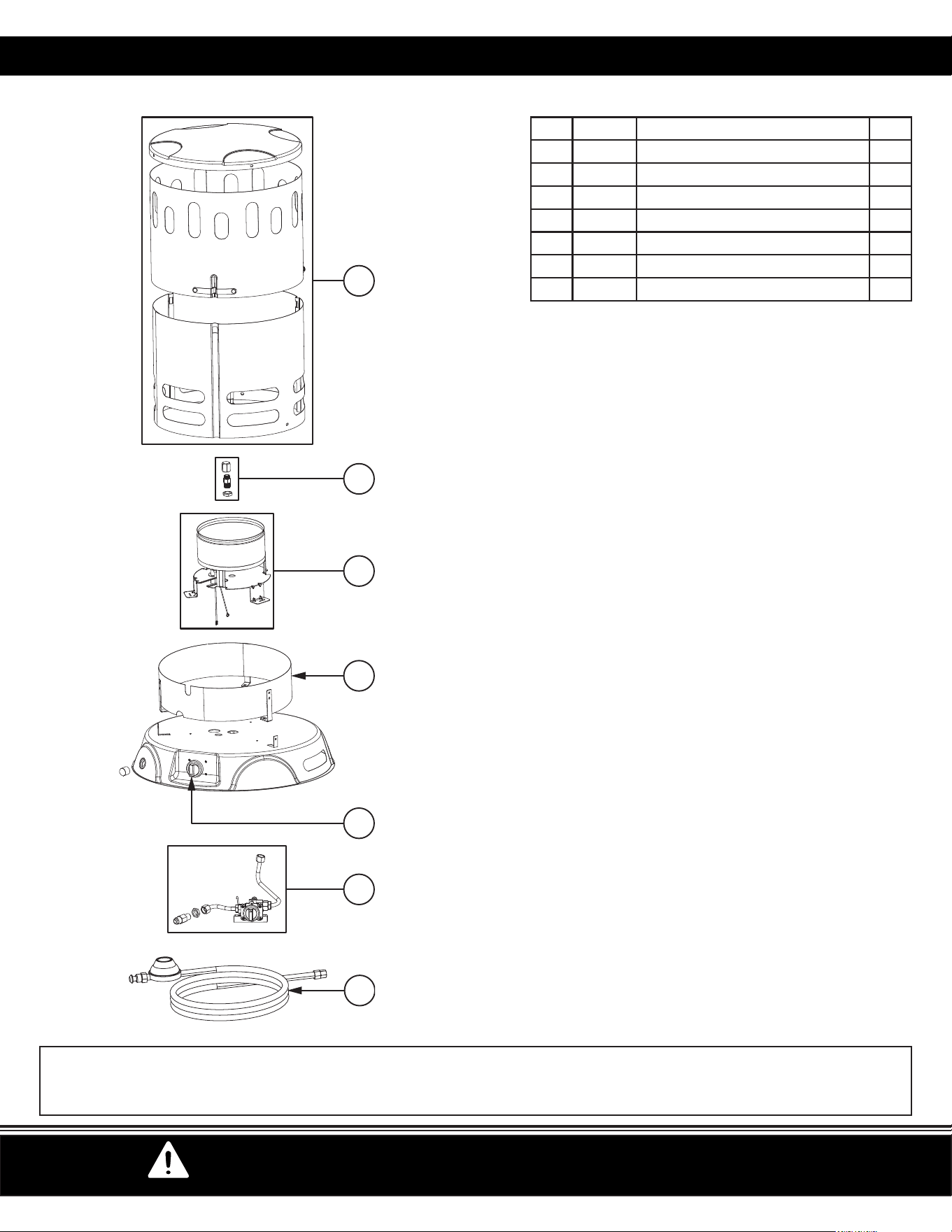
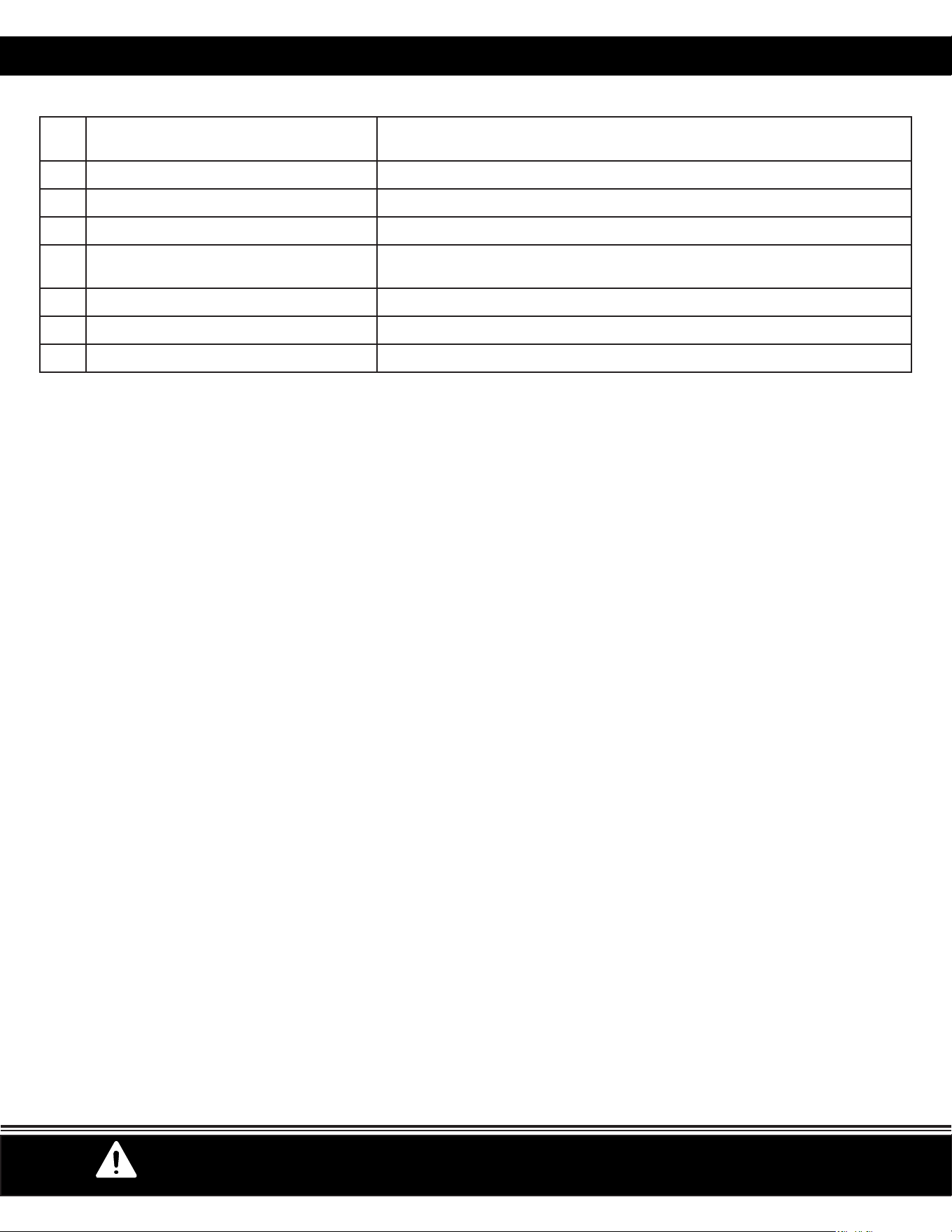
HF80C PARTS LIST
Key Part # Description Qty
1 893993 Combustion Chamber Assembly 1
2 81378 Burner Orice Assembly 1
3 893994 Burner Cone Assembly 1
4 893998 Combustion Chamber Ring 1
5 893991 Control Knob 1
6 81380 Valve and Gas Assembly 1
7 81376 Hose & Regulator Assembly 10' 1
1
2
3
4
5
7
6
IN ORDER TO MAINTAIN WARRANTY, COMPONENTS MUST BE REPLACED USING ORIGINAL MANUFACTURERS PARTS
PURCHASED THROUGH YOUR DEALER OR DIRECTLY FROM THE APPLIANCE MANUFACTURER. USE OF THIRD PARTY
COMPONENTS WILL VOID THE WARRANTY.
-10-
WARNING: Never leave the heater unattended while operating.
Disconnect the heater from its power source when not in use.
-11-
WARNING: Never leave the heater unattended while operating.
Disconnect the heater from its power source when not in use.
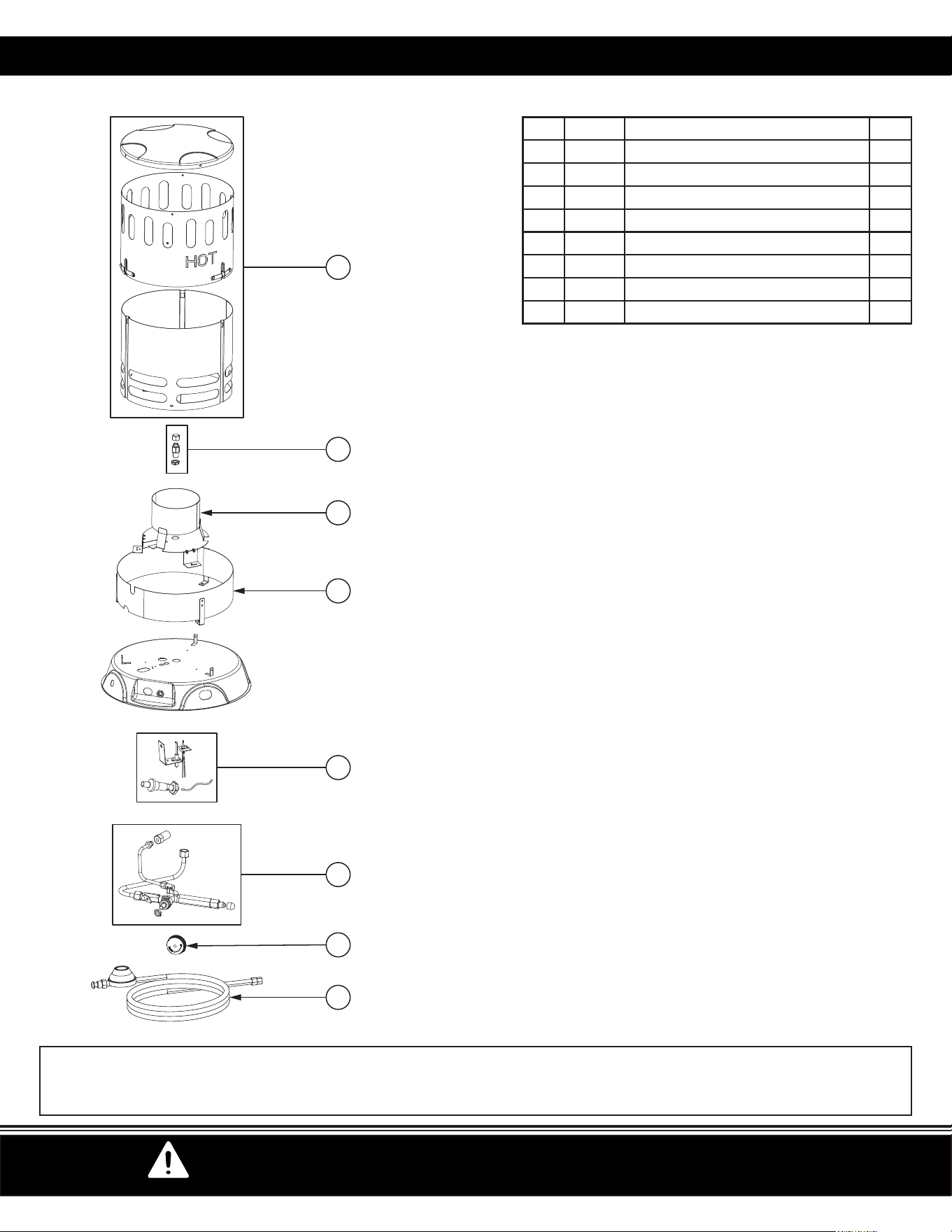
HF200C PARTS LIST
Key Part # Description Qty
1 893996 Combustion Chamber Assembly 1
2 81379 Burner Orice Assembly 1
3 893997 Burner Cone 1
4 893998 Combustion Chamber Ring 1
5 81382 Ignitor/Piezo Assembly 1
6 81381 Valve and Gas Assembly 1
7 893992 Control Knob 1
8 81377 Hose & Regulator Assembly 10' 1
1
2
5
6
3
4
8
7
IN ORDER TO MAINTAIN WARRANTY, COMPONENTS MUST BE REPLACED USING ORIGINAL MANUFACTURERS PARTS
PURCHASED THROUGH YOUR DEALER OR DIRECTLY FROM THE APPLIANCE MANUFACTURER. USE OF THIRD PARTY
COMPONENTS WILL VOID THE WARRANTY.
-12-
WARNING: Never leave the heater unattended while operating.
Disconnect the heater from its power source when not in use.
-13-
WARNING: Never leave the heater unattended while operating.
Disconnect the heater from its power source when not in use.
It is recommended that this unit is serviced regularly and that the appropriate Service Interval Record is completed.
Service Provider:
Before completing the appropriate Service Record below, please ensure you have carried out the service as described in the
manufacturer’s instructions. Always use the manufacturer's specified spare part when replacement is necessary.
Service 02 Date:
Engineer Name:
Company:
Telephone No.:
Unit Inspected:
Check Gas Lines For Wear Or Leaks
Check Integrity Of Orifice And Gas Ports
Items Replaced:
License No.:
Service 01 Date:
Engineer Name:
Company:
Telephone No.:
Unit Inspected:
Check Gas Lines For Wear Or Leaks
Check Integrity Of Orifice And Gas Ports
Items Replaced:
License No.:
Service 04 Date:
Engineer Name:
Company:
Telephone No.:
Unit Inspected:
Check Gas Lines For Wear Or Leaks
Check Integrity Of Orifice And Gas Ports
Items Replaced:
License No.:
Service 03 Date:
Engineer Name:
Company:
Telephone No.:
Unit Inspected:
Check Gas Lines For Wear Or Leaks
Check Integrity Of Orifice And Gas Ports
Items Replaced:
License No.:
Service 06 Date:
Engineer Name:
Company:
Telephone No.:
Unit Inspected:
Check Gas Lines For Wear Or Leaks
Check Integrity Of Orifice And Gas Ports
Items Replaced:
License No.:
Service 05 Date:
Engineer Name:
Company:
Telephone No.:
Unit Inspected:
Check Gas Lines For Wear Or Leaks
Check Integrity Of Orifice And Gas Ports
Items Replaced:
License No.:
SERVICE RECORD

-12-
WARNING: Never leave the heater unattended while operating.
Disconnect the heater from its power source when not in use.
-13-
WARNING: Never leave the heater unattended while operating.
Disconnect the heater from its power source when not in use.
United States Stove Company warrants this product, to
the original retail purchaser only, to be free from defects
in material and workmanship for a period of one (1) year
from the date of the initial purchase as evidenced on an
invoice, canceled check, sales receipt, etc. In the event
of a defect, this Limited Warranty shall be limited to the
repair or replacement of parts, which prove defective
under normal use and service within the limited warranty
period, and which United States Stove Company deems at
its reasonable discretion. THE LIMITED WARRANTY SET
FORTH HEREIN IS THE SOLE WARRANTY PROVIDED
TO PURCHASER AND IS IN LIEU OF ALL OTHER
WARRANTIES AND REPRESENTATIONS, EXPRESS OR
IMPLIED. UNITED STATES STOVE COMPANY MAKES NO
REPRESENTATIONS OR WARRANTIES WHATSOEVER,
EXPRESS OR IMPLIED, WITH RESPECT TO THE
PRODUCT, OTHER THAN (i) THE LIMITED WARRANTY
ABOVE, AND (ii) ANY IMPLIED WARRANTIES IMPOSED
BY APPLICABLE LAW WHICH CANNOT BE WAIVED
OR DISCLAIMED UNDER APPLICABLE LAW. ALL
OTHER WARRANTIES OF ANY KIND, INCLUDING
WITHOUT LIMITATION IMPLIED WARRANTIES OF
MERCHANTABILITY AND FITNESS FOR A PARTICULAR
PURPOSE, ARE HEREBY DISCLAIMED AND EXCLUDED
TO THE FULLEST EXTENT NOT PROHIBITED BY
APPLICABLE LAW. This Limited Warranty gives the
purchaser specific legal rights; a purchaser may have other
rights depending upon where he or she resides. Some
states do not allow the exclusion or limitation of special,
incidental or consequential damages, or state law may
aect the duration of limitations, so the above exclusion
and limitations may not be applicable.
OTHER LIMITATIONS: United States Stove Company
disclaims all other warranties for products that are
purchased from sellers other than authorized retailers
or distributors. This product must be properly installed,
maintained and operated in accordance with the
instructions provided herein. Furthermore, United States
Stove Company requires reasonable proof of the date
of purchase from an authorized retailer or distributor.
This Limited Warranty does not cover any operational
failures or diculties due to normal use and wear and
tear, accident, abuse, misuse, alteration, misapplication,
improper installation or improper maintenance or service
by you or any third party. Failure to perform normal and
routine maintenance on the product, shipping damage,
damage related to animals, and damage due to weather
are not covered under this Limited Warranty. In addition,
this Limited Warranty does not cover damage to the finish
on the product, such as scratches, dents, discoloration,
rust or other weather damage. This warranty does not
apply to products purchased for rental use. United States
Stove Company assumes no responsibility for any defects
caused by third parties. United States Stove Company
does not authorize any person or company to assume for
it any other obligation or liability in connection with the
sale, installation, use, removal, return, or replacement of
its products, and no such representations are binding on
United States Stove Company.
CLAIM PROCEDURE: All transportation costs for the
return of the damaged product or parts will be the
responsibility of the purchaser. Upon receipt of the
product, United States Stove Company will examine it and
determine if the product contains a defect. United States
Stove Company will repair or replace and return the item,
freight pre-paid. If United States Stove Company finds the
item to be in normal operating condition, or not defective,
the item will be returned freight collect. Purchaser shall
specify the model number(s) and serial number(s) of any
product(s) when making any claims with United States
Stove Company. Please use the following to identify your
product:
Model #: ____________________
Serial #: _____________________
854057
®
LIMITED LIFETIME WARRANTY (GAS)
LIMITED WARRANTY
Cet appareil de chauage portaf alimenté au gaz n’est pas venlé. Il ulise l’oxygène de l’air ambiant. Une circulaon d’air adéquate
doit être assurée pour la combuson et la venlaon.
• N’entreposez ni n’ulisez d’essence ou autres liquides ou vapeurs inammables à proximité de ce type d’appareil.
• Aucune bonbonne de propane liquéé non raccordée pour ulisaon ne doit se trouver à proximité de cet appareil, ni d’aucun autre
appareil.
EN PRÉSENCE D’UNE ODEUR DE GAZ:
• Ne tentez pas d’allumer l’appareil de chauage.
• Éteignez toute amme nue.
• Fermez l’alimentaon en gaz à l’appareil.
L’entreen doit être eectué par un fournisseur de services d’entreen qualié.
AVERTISSEMENT: Le non-respect des instrucons, telles qu’indiquées dans le présent guide, risque d’entraîner une explosion
ou un incendie entraînant des dommages matériels ou des blessures graves, voire mortelles.
VEUILLEZ LIRE ATTENTIVEMENT LES INSTRUCTIONS: Veuillez lire et suivre toutes les direcves. Conservez ces instrucons dans
un endroit sécuritaire pour vous y référer ultérieurement. Ne permeez pas à quiconque n’ayant pas lu les présentes instrucons
d’assembler, d’allumer, de régler ou de faire fonconner cet oul.
MODÈLE: HF80C/HF200C
®
APPAREIL DE CHAUFFAGE
À CONVECTION POUR
CHANTIER
DE CONSTRUCTION
United States Stove Company
227 Industrial Park Road, South Pittsburg, TN
PH: (800) 750-2723
www.usstove.com
-2-
AVERTISSEMENT : Ne laissez jamais le radiateur sans surveillance lorsqu’il fonctionne.
Débranchez le radiateur de sa source de combustible lorsque vous ne l’utilisez pas.
-3-
AVERTISSEMENT : Ne laissez jamais le radiateur sans surveillance lorsqu’il fonctionne.
Débranchez le radiateur de sa source de combustible lorsque vous ne l’utilisez pas.
AVERTISSEMENT:
VOTRE SÉCURITÉ PERSONNELLE ÉTANT IMPORTANTE POUR TOUS, VEUILLEZ LIRE LES INSTRUCTIONS AVANT D’UTILISER CET
APPAREIL DE CHAUFFAGE.
AVERTISSEMENT:
NON CONÇU POUR UNE UTILISATION DANS LA MAISON OU UN VÉHICULE RÉCRÉATIF.
AVERTISSEMENT
L’ÉTAT DE LA CALIFORNIE IMPOSE L’AVERTISSEMENT SUIVANT
L’UTILISATION DE CET APPAREIL CRÉE DES SOUS PRODUITS DE COMBUSTION CONTENANT DU MONOXYDE DE CARBONE, UN
PRODUIT CHIMIQUE RECONNU PAR L’ÉTAT DE LA CALIFORNIE COMME CAUSE DE CANCER ET D’ANOMALIES CONGÉNITALES
(OU AUTRES RISQUES POUR LA REPRODUCTION). CET APPAREIL CONTIENT DES PRODUITS CHIMIQUES RECONNUS PAR L’ÉTAT
DE CALIFORNIE COMME POUVANT CAUSER LE CANCER ET DES MALFORMATIONS CONGÉNITALES OU AUTRES DOMMAGES
AU SYSTÈME REPRODUCTEUR.
AVERTISSEMENT:
DANGER D’INCENDIE, D’EXPLOSION ET D’INHALATION CONSERVEZ LES MATÉRIAUX COMBUSTIBLES TELS QUE LES
MATÉRIAUX DE CONSTRUCTION, LE PAPIER ET LE CARTON À UNE DISTANCE SÉCURITAIRE DE L’APPAREIL DE CHAUFFAGE
COMME LE RECOMMANDENT LES INSTRUCTIONS. N’UTILISEZ JAMAIS L’APPAREIL DE CHAUFFAGE DANS UN LOCAL QUI
CONTIENT OU RISQUE DE CONTENIR DES PARTICULES COMBUSTIBLES EN SUSPENSION DANS L’AIR OU DES PRODUITS TELS
QUE DE L’ESSENCE, DES SOLVANTS, DU DILUANT À PEINTURE, DES PARTICULES DE POUSSIÈRE OU DES PRODUITS CHIMIQUES
INCONNUS.
AVERTISSEMENT GÉNÉRAL DE DANGER:
• LE NON-RESPECT DES MESURES DE PRÉVENTION ET INSTRUCTIONS FOURNIES AVEC CET APPAREIL DE CHAUFFAGE RISQUE
DE CAUSER LA MORT, DES BLESSURES GRAVES ET DES DOMMAGES OU DES PERTES MATÉRIELLES RÉSULTANT D’INCENDIE,
D’EXPLOSION, DE BRÛLURE, D’ASPHYXIE, D’INTOXICATION AU MONOXYDE DE CARBONE OU D’ÉLECTROCUTION.
• SEULES LES PERSONNES APTES À COMPRENDRE ET À RESPECTER LES INSTRUCTIONS DEVRAIENT UTILISER OU EFFECTUER
L’ENTRETIEN DE CET APPAREIL DE CHAUFFAGE.
• SI VOUS AVEZ BESOIN D’AIDE OU D’INFORMATION AU SUJET DE L’APPAREIL DE CHAUFFAGE (MANUEL D’INSTRUCTIONS,
ÉTIQUETTES, ETC.), VEUILLEZ COMMUNIQUER AVEC LE FABRICANT.
INFORMATION DE SÉCURITÉ
-2-
AVERTISSEMENT : Ne laissez jamais le radiateur sans surveillance lorsqu’il fonctionne.
Débranchez le radiateur de sa source de combustible lorsque vous ne l’utilisez pas.
-3-
AVERTISSEMENT : Ne laissez jamais le radiateur sans surveillance lorsqu’il fonctionne.
Débranchez le radiateur de sa source de combustible lorsque vous ne l’utilisez pas.
ATTENTION: LE NON RESPECT DE CES EXIGENCES DE VENTILATION PEUT PROVOQUER DES DOMMAGES À CAUSE DE LA SUIE.
MAINTENEZ CE MANUEL POUR LA FUTURE RÉFÉRENCE
MODÈLE MAX PRESSION: HF80C HF200C
POUR RÉGULATEUR: MIN (MAX=Bole
Pressure)
5PSI (34.5 kPa) 15PSI (103 kPa)
LA SORTIE DU RÉGULA TEUR 11po W.C. (2.74 kPa) 10PSI (68.9 kPa)
Allumage Piezo Piezo
Température Ambiante Minimum 0° F (17.8) ° C 0° F (17.8) ° C
BTU Taux Faible-Élevé 30,000-80,000 BTU/HR (8.8-23.4 kW) 75,000-200,000 BTU/HR (22-58.6 kW)
La Consommaon De Carburant 1.4-3.7 LBS/HR (.74-1.8 kg/HR) 3.5-9.3 LBS/HR (1.44-4.32 kg/HR)
Longueur Du Tuyau 15pi (456 cm) 15pi (456 cm)
VENTILATION:
Ouvertures minimales requises
2pi² Ouverture près du plafond 2pi² Ouverture près du plafond
2pi² Ouverture près du plancher 2pi² Ouverture près du plancher
PRÉCAUTIONS LIÉES AU FONCTIONNEMENT
Cet appareil de chauage à convecon et à feu direct fonconne au gaz propane. Il est desné principalement à chauer temporairement
des édices en construcon, en rénovaon ou en réparaon. Le gaz propane est plus lourd que l’air. Si du gaz propane fuit d’une connexion
ou d’un raccord, il se dirige vers le plancher, se mélange avec l’air ambiant et forme un mélange potenellement explosif. Évidemment, les
fuites de gaz propane devraient être évitées; il est donc important de raccorder l’alimentaon en propane avec le plus grand soin. Veuillez lire
le feuillet « Substance odorante et gaz propane » ci-joint pour obtenir plus de précisions relaves à la détecon des fuites de gaz propane.
Vériez la présence de fuite aux nouvelles connexions et raccords en ulisant un mélange d’eau et de savon et suivez les instrucons
menonnées. Obtenez également les conseils de votre détaillant quant à votre installaon au propane et posez-lui toute queson que vous
auriez à cet égard. Cet appareil a été conçu et homologué pour être ulisé comme appareil de chauage pour chaner de construcon,
conformément à la norme ANSI Z83.7-2017 CSA 2.14-2017. Soumeez à l’organisme local responsable de la sécurité et des incendies
toute queson relave à votre type d’installaon. Selon le type d’applicaon, d’autres normes peuvent s’appliquer et régir l’ulisaon des
produits de combuson, de gaz combusble et des appareils de chauage. L’organisme local qui en est responsable saura vous conseiller à
cet égard.Le fonconnement à feu direct de cet appareil signie que tous les produits de combuson se retrouvent dans l’air ambiant. Même
si l’ecacité de combuson de l’appareil de chauage est presque complète, il produit quand même de petes quantés de monoxyde de
carbone. Le monoxyde de carbone (appelé CO) est toxique. Notre organisme ne peut en supporter que de faibles quantés. Il est possible
que le CO s’accumule dans le local à chauer. Une venlaon inadéquate pourrait ainsi causer la mort. Les symptômes ressens en cas de
venlaon inadéquate sont les suivants:
• mal de tête
• étourdissement
• sensaon de brûlure au nez et aux yeux
• nausée
• mal de gorge ou bouche sèche
Assurez-vous donc de respecter les conseils au sujet de la venlaon menonnés dans ces instrucons. Lorsque l’appareil de chauage doit
fonconner en présence d’autres personnes, l’ulisateur est responsable d’informer ces dernières des instrucons et précauons liées à la
sécurité et de les averr des dangers inhérents.
CARACTÉRISTIQUES ET SPÉCIFICATIONS
INFORMATIONS GÉNÉRALES
-4-
AVERTISSEMENT : Ne laissez jamais le radiateur sans surveillance lorsqu’il fonctionne.
Débranchez le radiateur de sa source de combustible lorsque vous ne l’utilisez pas.
-5-
AVERTISSEMENT : Ne laissez jamais le radiateur sans surveillance lorsqu’il fonctionne.
Débranchez le radiateur de sa source de combustible lorsque vous ne l’utilisez pas.
PRÉCAUTIONS LIÉES À LA SÉCURITÉ
1. Vériez aenvement si l’appareil de chauage a subi des dommages. NE FAITES PAS fonconner un appareil endommagé.
2. NE MODIFIEZ PAS l’appareil de chauage et ne le faites pas fonconner s’il n’est plus dans son état d’origine.
3. N’ALLUMEZ PAS l’appareil et ne le faites pas fonconner à moins que la coque soit complètement ouverte et verrouillée en posion.
Consultez la feuille d’assemblage pour obtenir les instrucons.
4. Ulisez uniquement du gaz propane.
5. Ulisez uniquement une alimentaon au propane à ÉLIMINATION DES ÉMANATIONS. Si vous avez des quesons à propos de
l’éliminaon des émanaons, consultez votre détaillant de gaz propane.
6. Installez les bonbonnes de propane vercalement (robinet de fermeture vers le haut). Fixez-les comme il convient de sorte qu’ils ne
puissent se décrocher accidentellement et protégez-les contre les dommages.
7. Placer les contenants de propane à au moins (2,13 m) (7 pi) du chaue-eau et ne pas diriger l’évacuaon vers les contenants.
8. IMPORTANT Ulisez uniquement le tuyau et le régulateur fourni avec l’appareil. Faites correspondre la bande de couleur de l’équee
xée au tuyau à la couleur de l’équee située près du raccord d’entrée de gaz propane sur l’appareil. Inspectez le tuyau avant chaque
ulisaon de l’appareil de chauage. En cas d’abrasion, d’usure excessive ou de coupure, remplacez le tuyau par l’ensemble de tuyaux
recommandé avant d’uliser l’appareil de chauage.
9. Pour ulisaon intérieure seulement. La venlaon doit être adéquate (voir également « Précauons liées au fonconnement »).
10. Si une odeur de gaz est détectée, ARRÊTEZ IMMÉDIATEMENT l’appareil de chauage jusqu’à ce que la source d’émission du gaz ait
été localisée et colmatée. Veuillez lire le feuillet « Substance odorante et gaz propane » ci-joint pour obtenir plus de précisions relaves
à la détecon des fuites de gaz propane.
11. Installez l’appareil de chauage de façon à ce qu’il ne soit pas exposé à l’eau.
12. Conservez un écart minimal entre l’appareil et tout matériel combusble (tel que du papier).
13. En raison des températures élevées de la surface et de l’échappement, les adultes et les enfants doivent respecter les distances de
sécurité pour éviter des brûlures et l’inammaon des vêtements.
14. Ulisez uniquement sur des surfaces stables et de niveau.
15. N’ulisez pas l’appareil avec des conduits d’air. N’obstruez pas l’entrée et la sore d’air.
16. Ne déplacez pas l’appareil, ne le touchez pas et n’essayez pas d’en faire l’entreen alors qu’il est chaud.
17. Ulisez l’appareil en observant les codes de sécurité en vigueur localement ou référez-vous aux normes relaves à l’entreposage et à la
manutenon des produits de pétrole liquéés ANSI/NFPA 58 et CSA B149.1 du Code d’installaon du gaz naturel et du gaz propane.
ÉCART MINIMUM
Entre l’appareil et tout matériel combusble
Écart
Des côtés 1,22 m (4 pi)
Du dessus 1,82 m (6 pi)
Placez l’appareil à 3 m (10 pi) des bâches et des revêtements similaires, et xez-les
an d’empêcher tout baement ou mouvement causé par le vent.
INFORMATIONS GÉNÉRALES
-4-
AVERTISSEMENT : Ne laissez jamais le radiateur sans surveillance lorsqu’il fonctionne.
Débranchez le radiateur de sa source de combustible lorsque vous ne l’utilisez pas.
-5-
AVERTISSEMENT : Ne laissez jamais le radiateur sans surveillance lorsqu’il fonctionne.
Débranchez le radiateur de sa source de combustible lorsque vous ne l’utilisez pas.
AVERTISSEMENT
RISQUE D’ASPHYXIE
• CET APPAREIL NE DOIT PAS ÊTRE UTILISÉ POUR LE CHAUFFAGE DE LOCAUX OÙ DEMEURENT DES GENS.
• NE L’UTILISEZ PAS DANS DES ENDROITS NON AÉRÉS.
• LE DÉBIT DE CHALEUR ET D’AIR DE VENTILATION NE DOIT PAS ÊTRE OBSTRUÉ.
• LE PROCESSUS DE COMBUSTION DE CET APPAREIL EXIGE UN APPORT ADÉQUAT EN AIR DE VENTILATION.
• CONSULTEZ LA RUBRIQUE PORTANT SUR LES SPÉCIFICATIONS TECHNIQUES DANS LE MANUEL DE L’APPAREIL OU SUR LA
PLAQUE DE DONNÉES DE L’APPAREIL, OU COMMUNIQUEZ AVEC LE FABRICANT POUR OBTENIR LES RENSEIGNEMENTS
RELATIFS AUX EXIGENCES EN APPORT D’AIR DE VENTILATION POUR LA COMBUSTION.
• LE PROCESSUS DE COMBUSTION NE PEUT S’EFFECTUER CORRECTEMENT SI L’APPORT EN AIR DE VENTILATION EST
INSUFFISANT.
• UNE COMBUSTION INADÉQUATE PRODUIT DES ÉMANATIONS NOCIVES DE MONOXYDE DE CARBONE POUVANT ENTRAÎNER
DES TROUBLES DE SANTÉ GRAVES, VOIRE MORTELS. LES SYMPTÔMES D’EMPOISONNEMENT AU MONOXYDE DE CARBONE
SONT LES MAUX DE TÊTE, LES ÉTOURDISSEMENTS ET LA DIFFICULTÉ RESPIRATOIRE.
AVERTISSEMENT
DANGER POUR LA QUALITÉ DE L’AIR
• L’UTILISATION D’APPAREILS DE CHAUFFAGE À CHAUFFAGE DIRECT DANS L’ENVIRONNEMENT DE CONSTRUCTION PEUT
ENTRAÎNER UNE EXPOSITION À DES NIVEAUX DE CO, CO
2
ET NO
2
CONSIDÉRÉS COMME DANGEREUX POUR LA SANTÉ ET
POTENTIELLEMENT MORTELS.
• CONNAÎTRE LES SIGNES D’EMPOISONNEMENT AU CO ET AU CO
2
• MAUX DE TÊTE, YEUX QUI PIQUENT
• VERTIGES, DÉSORIENTATION
• DIFFICULTÉ À RESPIRER, SENSATION D’ÉTOUFFEMENT
• UN ÉCHANGE D’AIR DE VENTILATION APPROPRIÉ (OSHA 29 CFR 1926.57) POUR SOUTENIR LA COMBUSTION ET MAINTENIR
UNE QUALITÉ DE L’AIR ACCEPTABLE DOIT ÊTRE FOURNI CONFORMÉMENT À OSHA 29 CFR PART 1926.154, ANSI A10.10
EXIGENCES DE SÉCURITÉ APPLICABLES AUX APPAREILS ET ÉQUIPEMENTS TEMPORAIRES ET PORTATIFS DE CHAUFFAGE
DES LOCAUX UTILISÉS DANS L’INDUSTRIE DE LA CONSTRUCTION OU LES CODES D’INSTALLATION DU GAZ NATUREL ET DU
PROPANE CSA B149.1
• SURVEILLER PÉRIODIQUEMENT LES NIVEAUX DE CO, CO
2
ET NO
2
EXISTANT SUR LE CHANTIER DE CONSTRUCTION - AU
MINIMUM AU DÉBUT DU QUART DE TRAVAIL ET APRÈS 4 HEURES.
• FOURNIR UN ÉCHANGE D’AIR DE VENTILATION, NATUREL OU MÉCANIQUE, SELON LES BESOINS POUR MAINTENIR UNE
QUALITÉ D’AIR INTÉRIEUR ACCEPTABLE
INFORMATIONS GÉNÉRALES
-6-
AVERTISSEMENT : Ne laissez jamais le radiateur sans surveillance lorsqu’il fonctionne.
Débranchez le radiateur de sa source de combustible lorsque vous ne l’utilisez pas.
-7-
AVERTISSEMENT : Ne laissez jamais le radiateur sans surveillance lorsqu’il fonctionne.
Débranchez le radiateur de sa source de combustible lorsque vous ne l’utilisez pas.
INFORMATIONS GÉNÉRALES
USA Moyenne pondérée dans le temps sur
8 heures (OSHA 29 CFR 1926.55 App A)
Canada Moyenne pondérée sur 8 heures Travail sécurisé BC OHS Des lignes
directrices Part 5.1 et Ontario Lieux de travail Reg 833
CO 50 ppm 25 ppm
CO
2
5000 ppm 5000 ppm
NO
2
3 ppm (Reg 833)
États-Unis – Limite plafond (Limite
d’exposion à court terme = 15 minutes)
Canada STEL (15 minutes Reg 833/1 heure WSBC) Travail sécurisé afe BC OHS
Des lignes directrices Part 5.1 et Ontario Lieux de travail Reg 833
CO 100 ppm
CO
2
15000 ppm (WSBC) 30000 ppm (Reg 833)
NO
2
5 ppm 1,0 ppm (WorkSafeBC) 5,0 ppm (Reg 833)
• Assurez-vous que le ux d’échange d’air de combuson et de venlaon ne peut pas être obstrué.
• Au fur et à mesure que le bâment « se resserre » pendant les phases de construcon, il peut être nécessaire d’augmenter la venlaon.
ODEUR DU GAZ COMBUSTIBLE
Des addifs odorants ont été ajoutés au gaz propane liquéé et au gaz naturel dans le but de faciliter la détecon de fuites. Vous devriez
remarquer une odeur de gaz combusble s’il y a une fuite. Comme le gaz propane (liquéé) est plus lourd que l’air, l’odeur de gaz se détecte
plus facilement près du sol. TOUTE ODEUR DE GAZ EST UN SIGNAL QU’IL FAUT INTERVENIR IMMÉDIATEMENT !
• Ne prenez aucune mesure qui provoquerait l’allumage des vapeurs de gaz. N’ulisez aucun interrupteur électrique. Ne rez sur aucune source
d’alimentaon électrique ou rallonge électrique. N’allumez pas d’allumees ni aucune source de amme. N’ulisez pas votre téléphone.
• Faites évacuer immédiatement toute personne se trouvant dans l’immeuble.
• Fermez tous les robinets d’alimentaon du réservoir de gaz propane (liquéé) ou de la bonbonne, ainsi que le robinet d’alimentaon principale
situé sur le compteur, si vous ulisez du gaz naturel.
• Le gaz propane (liquéé) est plus lourd que l’air et peut s’accumuler dans les endroits près du sol. Si vous croyez qu’il y a une fuite de gaz
propane, éloignez-vous des endroits plus bas.
• Ulisez le téléphone d’un voisin et communiquez avec votre fournisseur en gaz combusble et votre service d’incendies. Ne retournez pas
dans l’immeuble ou dans le secteur.
• N’entrez pas dans l’immeuble et restez-en à l’écart jusqu’à ce que le personnel du service des incendies ou le fournisseur en gaz combusble
ait conrmé que l’endroit ne comporte aucun risque.
• EN DERNIER LIEU, laissez le personnel du service des incendies ou d’approvisionnement en gaz combusble vérier si du gaz s’échappe.
Assurez-vous qu’ils aient aéré l’immeuble avant d’y retourner. Le personnel d’entreen expérimenté doit colmater toute fuite, vérier la
présence d’autres fuites, puis se charger d’allumer l’appareil pour vous.
SUBSTANCE ODORANTE ‑ AUCUNE ODEUR DÉCELÉE
• Certaines personnes ne détectent pas bien les odeurs. Il est donc possible que certaines personnes ne puissent senr la substance odorante
ajoutée au gaz propane (liquéé) ou au gaz naturel. Vous devez savoir si vous arrivez à déceler l’odeur de cee substance dans le gaz
combusble.
• Apprenez à reconnaître l’odeur du gaz propane et celle du gaz naturel. Pour ce faire, les détaillants de gaz propane (liquéé) locaux seront
heureux de vous fournir un feuillet comprenant une paslle à humer. Servez-vous de cee paslle pour vous aider à reconnaître l’odeur de
gaz combusble.
• Le tabagisme peut nuire à votre faculté olfacve. Votre facilité à déceler une odeur quelconque peut s’estomper si vous demeurez un
certain temps dans un endroit où cee odeur est présente. La présence d’animaux dans des endroits clos peut aussi masquer l’odeur du gaz
combusble.
• La substance odorante contenue dans le gaz propane (liquéé) et le gaz naturel est incolore et, selon certaines circonstances, son odeur
pourrait s’estomper.
• En cas de fuite souterraine, le déplacement du gaz dans le sol peut ltrer l’odeur.
• L’intensité de l’odeur du gaz propane (liquéé) peut varier à diérents niveaux. Étant donné que le gaz propane (liquéé) est plus lourd que
l’air, l’odeur peut être plus prononcée à des niveaux inférieurs.
• Portez toujours aenon à la moindre odeur de gaz. Si une odeur de gaz persiste, même si elle est minime, agissez comme s’il s’agissait d’une
fuite importante. Intervenez immédiatement tel que décrit précédemment.
-6-
AVERTISSEMENT : Ne laissez jamais le radiateur sans surveillance lorsqu’il fonctionne.
Débranchez le radiateur de sa source de combustible lorsque vous ne l’utilisez pas.
-7-
AVERTISSEMENT : Ne laissez jamais le radiateur sans surveillance lorsqu’il fonctionne.
Débranchez le radiateur de sa source de combustible lorsque vous ne l’utilisez pas.
INFORMATIONS GÉNÉRALES
ATTENTION ‑ POINTS ESSENTIELS À RETENIR!
• Le gaz propane (liquéé) dégage une odeur parculière. Apprenez à reconnaître cee odeur. Consultez les rubriques Odeur du gaz
combusble et Substance odorante, ci-dessus.
• Même si vous n’avez pas été formé pour eectuer l’entreen et la réparaon de l’appareil, soyez TOUJOURS aenf aux odeurs que
dégagent le gaz propane (liquéé) et le gaz naturel.
• Si vous n’êtes pas formé pour procéder à l’entreen et à la réparaon des appareils au gaz propane (liquéé), ne tentez pas d’allumer
l’appareil, de le réparer ou de l’entretenir, ni d’apporter des réglages au système d’alimentaon en gaz propane de l’appareil.
• Peu importe les condions, une bonne praque de sécurité consiste à senr de temps à autre autour de l’appareil, des raccords, du tuyau
et autres éléments. Si vous décelez la moindre odeur de gaz, COMMUNIQUEZ IMMÉDIATEMENT AVEC VOTRE FOURNISSEUR EN GAZ
COMBUSTIBLE. N’ATTENDEZ PAS!
ATTENTION: N’ALLUMEZ PAS L’APPAREIL ET NE LE FAITES PAS FONCTIONNER À MOINS QUE LA COQUE SOIT COMPLÈTEMENT
OUVERTE ET VERROUILLÉE EN POSITION.
ÉTAPE 1
Appareil tel que reçu à la sore de l’emballage. Avant de soulever
la coque extérieure, protégez-vous les mains. Ne saisissez jamais le
métal nu sans vous protéger les mains.
ÉTAPE 2
Soulevez directement la coque extérieure. Protégez-vous bien les
mains avant de soulever la coque.
ÉTAPE 3
Soulevez la coque extérieure jusqu’à ce que les trois clips s’insèrent
dans les fentes de la coque inférieure. Ceci étant fait, les trous des vis
devraient être alignés.
Assurez-vous que le
clip va dans les fentes
de la coque inférieure
(3 endroits).
ÉTAPE 4
Verrouillez les clips au moyen des trois vis, tel qu’illustré. L’appareil
ne doit pas fonconner à moins que les coques extérieures soient
complètement ouvertes et verrouillées en posion.
Verrouillez les coquilles
ensemble avec les clips
en place et avec une vis
dans chaque clip (3 vis
au total).

-8-
AVERTISSEMENT : Ne laissez jamais le radiateur sans surveillance lorsqu’il fonctionne.
Débranchez le radiateur de sa source de combustible lorsque vous ne l’utilisez pas.
-9-
AVERTISSEMENT : Ne laissez jamais le radiateur sans surveillance lorsqu’il fonctionne.
Débranchez le radiateur de sa source de combustible lorsque vous ne l’utilisez pas.
AVANT LE FONCTIONNEMENT
1. Ouvrez complètement la coque et verrouillez-la tel qu’indiqué sur le feuillet d’instrucons fourni avant d’allumer et de faire fonconner
l’appareil.
2. Vériez soigneusement tout dommage qu’aurait pu subir l’appareil de chauage pendant l’expédion. Si vous en découvrez, averssez
immédiatement le fabricant.
3. Respectez toutes les précauons de sécurité et de fonconnement.
4. Branchez le raccord POL (let à gauche) du tuyau et du régulateur en tournant l’écrou POL en sens an-horaire dans la sore du robinet
de la bonbonne de gaz propane, puis serrez-le avec une clé.
5. Raccordez le tuyau exible à l’appareil.
6. Serrez fermement toutes les connexions de gaz.
7. Ouvrez le robinet de gaz de la bonbonne et vériez toutes les connexions au moyen d’un mélange d’eau et de savon. N’UTILISEZ PAS
DE FLAMME.
DÉMARRAGE HF80C
1. AVERTISSEMENT: Avant d’allumer la veilleuse , tournez la vanne de brûleur principal ( bouton tournant complètement à droite ) en
posion basse / lumière.
2. Ouvrir complètement le robinet de la bouteille de propane et aendre 15 secondes avant l’étape 3.
3. Bouton poussoir et maintenez pendant 5 secondes , permet- tant au gaz pour émere de l’orice du brûleur.
4. Tourner le bouton dans le sens anhoraire jusqu’à ce que les clics d’allumage piézo . Connuez à faire tourner et acver l’allumeur
jusqu’à ce que le brûleur se allume .
5. Une fois que le brûleur se allume maintenez le bouton dans, sur la posion basse pendant 30 secondes . Puis relâchez . Le brûleur doit
rester allumé Si elle ne se répète pas les étapes 4 et 5 jusqu’à ce que le brûleur reste allumé
6. Tournez la vanne de brûleur principal de réglementer la producon de chaleur.
DÉMARRAGE HF200C
1. AVERTISSEMENT: Avant d’allumer la veilleuse , tournez la vanne de brûleur principal ( bouton tournant complètement à droite ) en
posion basse / lumière.
2. Ouvrir complètement le robinet de la bouteille de propane et aendre 15 secondes avant l’étape 3.
3. Appuyer sur le bouton rouge de la soupape de pilote de sécurité ( vers la droite du bouton variable des soupapes ) admission de gaz au
pilote . Ensuite, poussez et relâchez le bouton d’allumage (bouton rouge à la droite du bouton variable des soupapes ) jusqu’à ce que
les voyants.
4. Lorsque les veilleuses , connuent à maintenir le bouton enfoncé pendant 30 secondes , puis relâchez pour brûleur principal lumière.
5. Si la veilleuse se éteint , aendre 5 minutes et répéter la procédure d’allumage.
6. Tournez la vanne de brûleur principal de réglementer la producon de chaleur
ARRÊT
1. Fermez le robinet sur la bonbonne de gaz propane.
2. Laissez l’appareil fonconner jusqu’à ce que tout le gaz dans le tuyau ait brûlé.
3. Tourner la valve de brûleur principale à la posion basse/ claire.
REDÉMARRAGE APRÈS UN ARRÊT D’URGENCE
1. Fermez complètement le robinet sur la bonbonne de gaz propane.
2. Aendez cinq minutes.
3. Recommencez la procédure « DÉMARRAGE ».
INSTRUCTIONS DE FONCTIONNEMENT
-8-
AVERTISSEMENT : Ne laissez jamais le radiateur sans surveillance lorsqu’il fonctionne.
Débranchez le radiateur de sa source de combustible lorsque vous ne l’utilisez pas.
-9-
AVERTISSEMENT : Ne laissez jamais le radiateur sans surveillance lorsqu’il fonctionne.
Débranchez le radiateur de sa source de combustible lorsque vous ne l’utilisez pas.
ENTRETIEN ET ENTREPOSAGE
1. L’appareil de chauage doit être vérié avant chaque ulisaon et au moins une fois par année par un technicien qualié.
2. Avant chaque ulisaon, vériez le siège du joint torique au niveau du boulon du raccord POL. Si le joint torique est coupé, éraé ou
endommagé, remplacez-le.
3. Coupez l’alimentaon en gaz propane liquéé quand l’appareil n’est pas ulisé.
4. Quand l’appareil de chauage est rangé à l’intérieur, la connexion entre la bouteille d’alimentaon en gaz basse pression et l’appareil
doit être débranchée et la bouteille doit être rerée de l’appareil et rangée à l’extérieur, tel que précisé au chapitre 5 de la norme relave
au rangement et à la manutenon des produits de pétrole liquéés ANSI/NFPA 58 et CSA B149.1 du Code d’installaon du gaz naturel
et du gaz propane.
VÉRIFICATION
Un appareil de chauage qui a été modié ou qui ne fonconne pas correctement risque d’être une cause de dangers.:
• La amme reste dans l’appareil de chauage.
• La amme a une teinte bleue avec une pointe de couleur jaune.
• Il n’y a pas de forte odeur désagréable, pas de sensaon de brûlure aux yeux, ni de malaise physique général.
• Il n’y a pas de fumée ni de suie à l’intérieur ou à l’extérieur de l’appareil de chauage.
• Il ne se produit pas d’arrêts imprévus ou inexpliqués de l’appareil.
La liste des pièces et le schéma du câblage illustrent la construcon détaillée de l’appareil de chauage. N’ulisez pas un appareil de chauage
qui dière de ce qui est illustré. N’ulisez à cet eet que le tuyau, le régulateur et le raccord de bonbonne (appelé raccord POL) fournis avec
l’appareil de chauage. IMPORTANT Faire correspondre la bande de couleur de l’équee xée au tuyau à la couleur de l’équee située
près du raccord d’entrée de gaz propane. N’ulisez aucun élément de substuon. Sur cet appareil de chauage, le régulateur doit être réglé
tel qu’indiqué à la rubrique « Spécicaons ». Si vous avez un doute au sujet du réglage du régulateur, faites-le vérier.
Si un appareil de chauage ne fonconne pas correctement, il doit être réparé, mais seulement par un technicien formé et expérimenté.
Les produits couverts par la garane seront réparés sans frais, pièces et main-d’oeuvre comprises. Veuillez joindre une courte descripon de
la nature du problème avec la date, le lieu et la preuve d’achat. Les produits non couverts par la garane seront réparés aux frais (pièces et
main-d’oeuvre) du client.
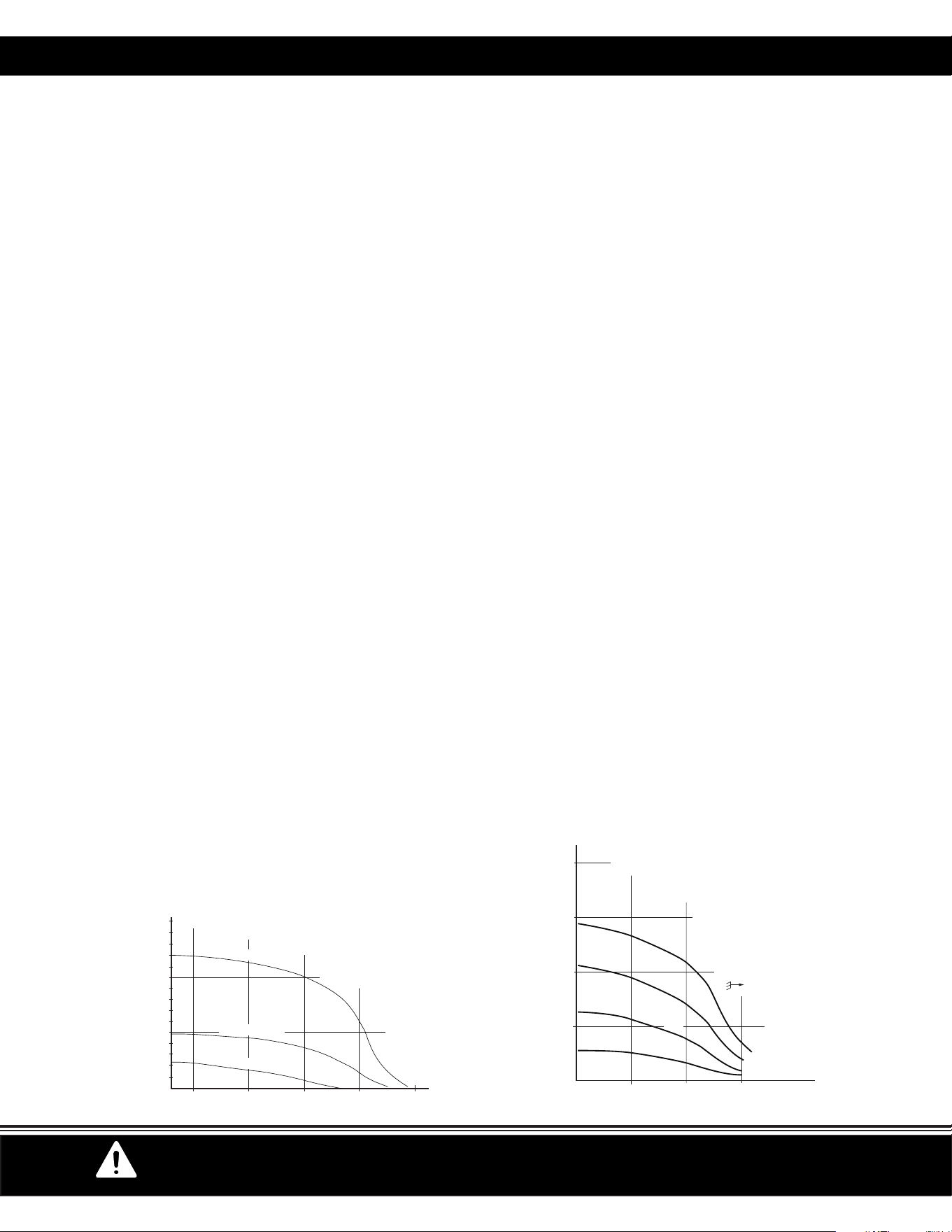
Les tableaux qui suivent indiquent la taille approximave de la bonbonne de gaz requise pour ces appareils de chauage. Pour uliser le
tableau:
1. Séleconnez la température de l’air la plus basse prévue (au bas du tableau).
2. Allez ensuite directement au haut du tableau au temps d’ulisaon désiré (côté gauche du tableau).
3. Notez la dimension de la bonbonne requise.
Tous les appareils de chauage doivent: Être munis de bonbonnes pleines disposer d’une bonne circulaon d’air ne présenter aucun signe
de givre.
4
C
y
l
i
n
d
r
e
s
3
C
y
l
i
n
d
r
e
s
2
C
y
l
i
n
d
r
e
s
1
C
y
l
i
n
d
r
e
s
30
20
10
0
60
(16)
40
(4.4)
20
(-6.7)
0
(-18)
-20
(-29)
DURÉE DE FONCTIONNEMENT MAXIMALE - HEURES @ 200 000 BTU/h (58,6 kW)
TEMPÉRATURE DE L'AIR - °F
HF200C
40
Capacité du cylindre de
carburant : 100 #
Utiliser le prélèvement
de liquide et le
vaporisateur
HF80C
1
0
0
#
(
2
5
g
a
l
.
)
c
y
l
i
n
d
r
e
2
0
#
(
5
g
a
l
.
)
c
y
l
i
n
d
r
e
4
0
#
(
1
0
g
a
l
.
)
c
y
l
i
n
d
r
e
Taux de combustion = 80,000 BTU/hr
30
28
26
24
22
20
18
16
14
12
10
8
6
4
2
0
60 40 20 0 -20
Temps de fonctionnement maximum - heures
Température de l'air - °F
INFORMATIONS GÉNÉRALES
-10-
AVERTISSEMENT : Ne laissez jamais le radiateur sans surveillance lorsqu’il fonctionne.
Débranchez le radiateur de sa source de combustible lorsque vous ne l’utilisez pas.
-11-
AVERTISSEMENT : Ne laissez jamais le radiateur sans surveillance lorsqu’il fonctionne.
Débranchez le radiateur de sa source de combustible lorsque vous ne l’utilisez pas.
Clé
No. De
Pièce
Descripon Qté.
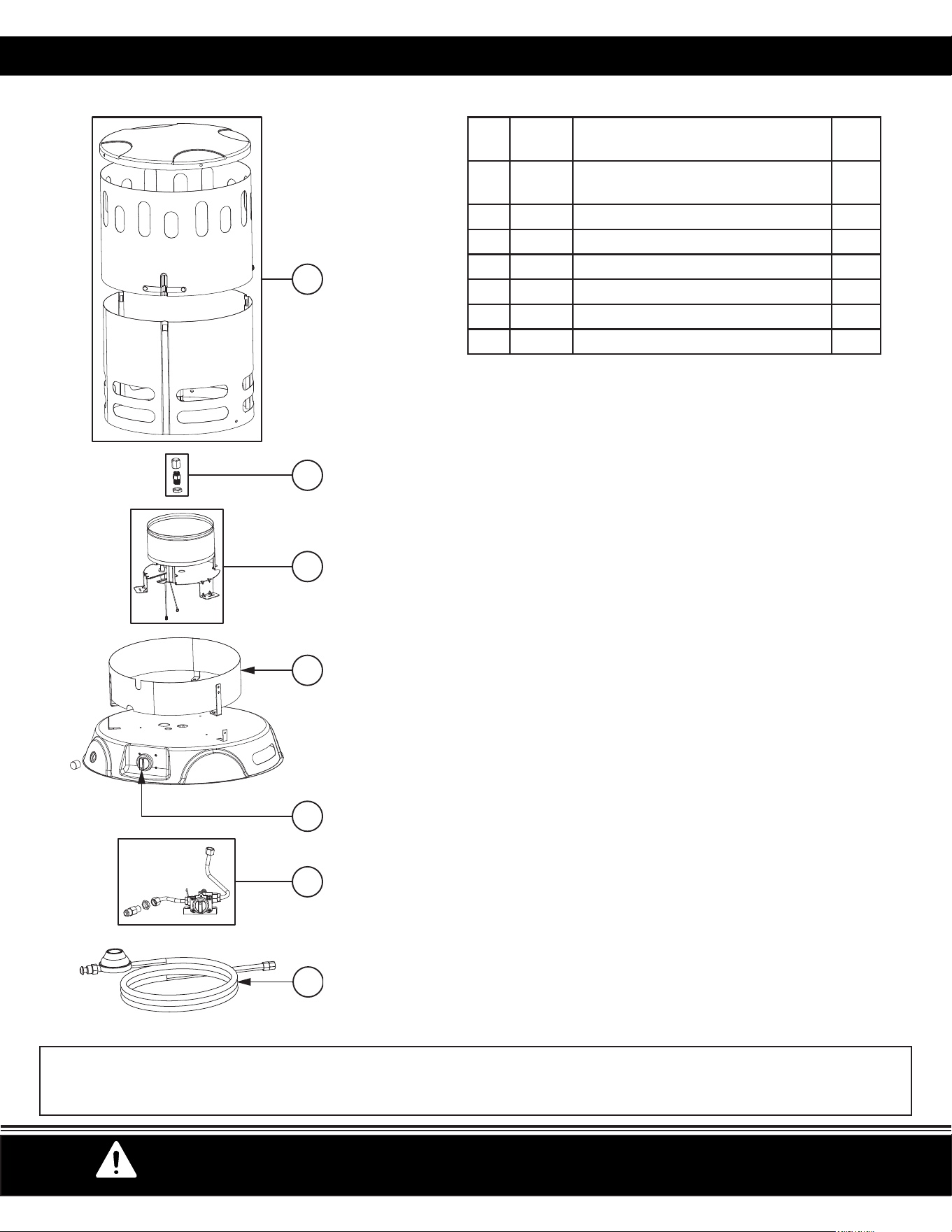
1
893993
Assemblage de la chambre de
combuson
1
2
81378
Assemblage de l'orice du brûleur 1
3
893994
Ensemble de cône de brûleur 1
4
893998
Anneau de chambre de combuson 1
5
893991
Bouton de controle 1
6
81380
Ensemble vanne et gaz 1
7
81376
Assemblage tuyau et régulateur 10 pi 1
1
2
3
4
5
7
6
AFIN DE CONSERVER LA GARANTIE, LES COMPOSANTS DOIVENT ÊTRE REMPLACÉS À L’AIDE DES PIÈCES D’ORIGINE
DU FABRICANT ACHETÉES AUPRÈS DE VOTRE REVENDEUR OU DIRECTEMENT AUPRÈS DU FABRICANT DE L’APPAREIL.
L’UTILISATION DE COMPOSANTS TIERS ANNULERA LA GARANTIE.
HF80C LISTE DES PIECES
-10-
AVERTISSEMENT : Ne laissez jamais le radiateur sans surveillance lorsqu’il fonctionne.
Débranchez le radiateur de sa source de combustible lorsque vous ne l’utilisez pas.
-11-
AVERTISSEMENT : Ne laissez jamais le radiateur sans surveillance lorsqu’il fonctionne.
Débranchez le radiateur de sa source de combustible lorsque vous ne l’utilisez pas.
AFIN DE CONSERVER LA GARANTIE, LES COMPOSANTS DOIVENT ÊTRE REMPLACÉS À L’AIDE DES PIÈCES D’ORIGINE
DU FABRICANT ACHETÉES AUPRÈS DE VOTRE REVENDEUR OU DIRECTEMENT AUPRÈS DU FABRICANT DE L’APPAREIL.
L’UTILISATION DE COMPOSANTS TIERS ANNULERA LA GARANTIE.
HF200C LISTE DES PIECES
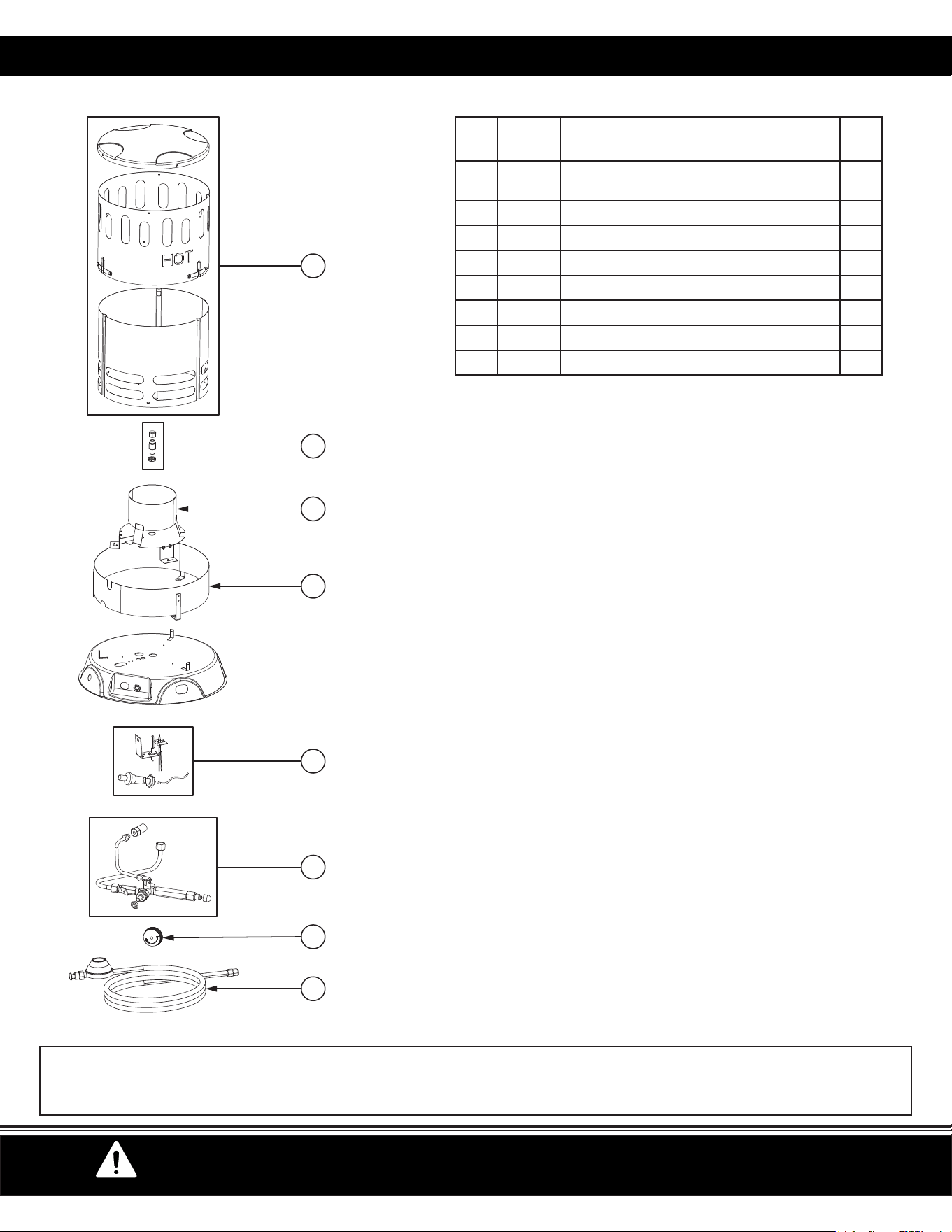
1
2
5
6
3
4
8
7
Clé
No. De
Pièce
Descripon Qté.
1
893996
Assemblage de la chambre de
combustion
1
2
81379
Assemblage de l'orice du brûleur
1
3
893997
Cône de brûleur
1
4
893998
Anneau de chambre de combustion
1
5
81382
Ensemble allumeur/piézo
1
6
81381
Ensemble vanne et gaz
1
7
893992
Bouton de controle
1
8
81377
Assemblage tuyau et régulateur 10 pi
1