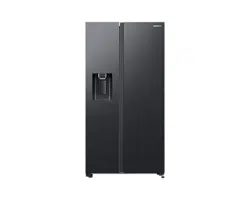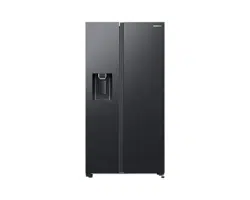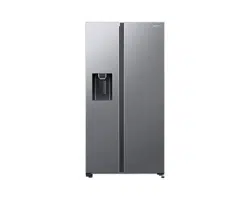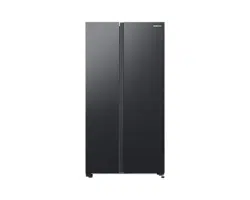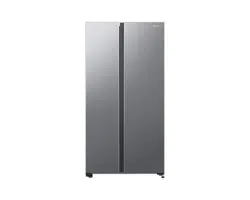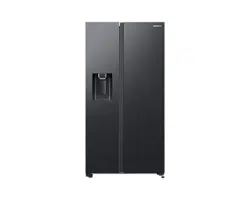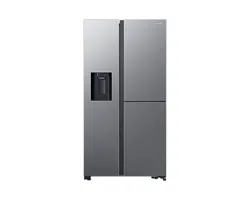
Refrigerator
User manual
RH65**5*****/RH64**5*****
Free Standing Appliance
English
2
Contents
Contents
Safety information 3
Important safety precautions 4
Instructions about the WEEE 10
Installation
11
Refrigerator at a glance 11
Step-by-step installation 13
Door removal for entrance 20
Operations
24
Main panel 24
Dispenser panel (applicable models only) 30
Special features 31
Maintenance
36
Cleaning 38
Replacement 39
Troubleshooting 41
General 41
SmartThings 45
English 3
Safety information
• R-600a or R-134a is used as a refrigerant. Check the
compressor label on the rear of the appliance or the rating
label inside the fridge to see which refrigerant is used for
your appliance. When this product contains ammable gas
(Refrigerant R-600a), contact your local authority in regard to
safe disposal of this product.
• In order to avoid the creation of a ammable gas-air mixture
if a leak in the refrigerating circuit occurs, the size of the
room in which the appliance may be sited depends on the
amount of refrigerant used.
• Never start up an appliance showing any signs of damage. If
in doubt, consult your dealer. The room must be 1 m
3
in size
for every 8 g of R-600a refrigerant inside the appliance.
• To avoid contamination of food, please respect the following
instructions:
- Opening the door for long periods can cause a signicant
increase of the temperature in the compartments of the
appliance.
- Clean regularly surfaces that can come in contact with food
and accessible drainage systems.
- Clean water tanks if they have not been used for 48h; ush
the water system connected to a water supply if water has
not been drawn for 5 days.
- Store raw meat and sh in suitable containers in the
refrigerator, so that it is not in contact with or drip onto
other food.
- Two-star frozen-food compartments are suitable for storing
pre-frozen food, storing or making icecream and making
ice cubes.
- One-, two- and three-star compartments are not suitable
for the freezing of fresh food.
- If the refrigerating appliance is left empty for long periods,
switch off, defrost, clean, dry, and leave the door open to
prevent mould developing within the appliance.
Safety information
English
4
Safety information
IMPORTANT SAFETY PRECAUTIONS
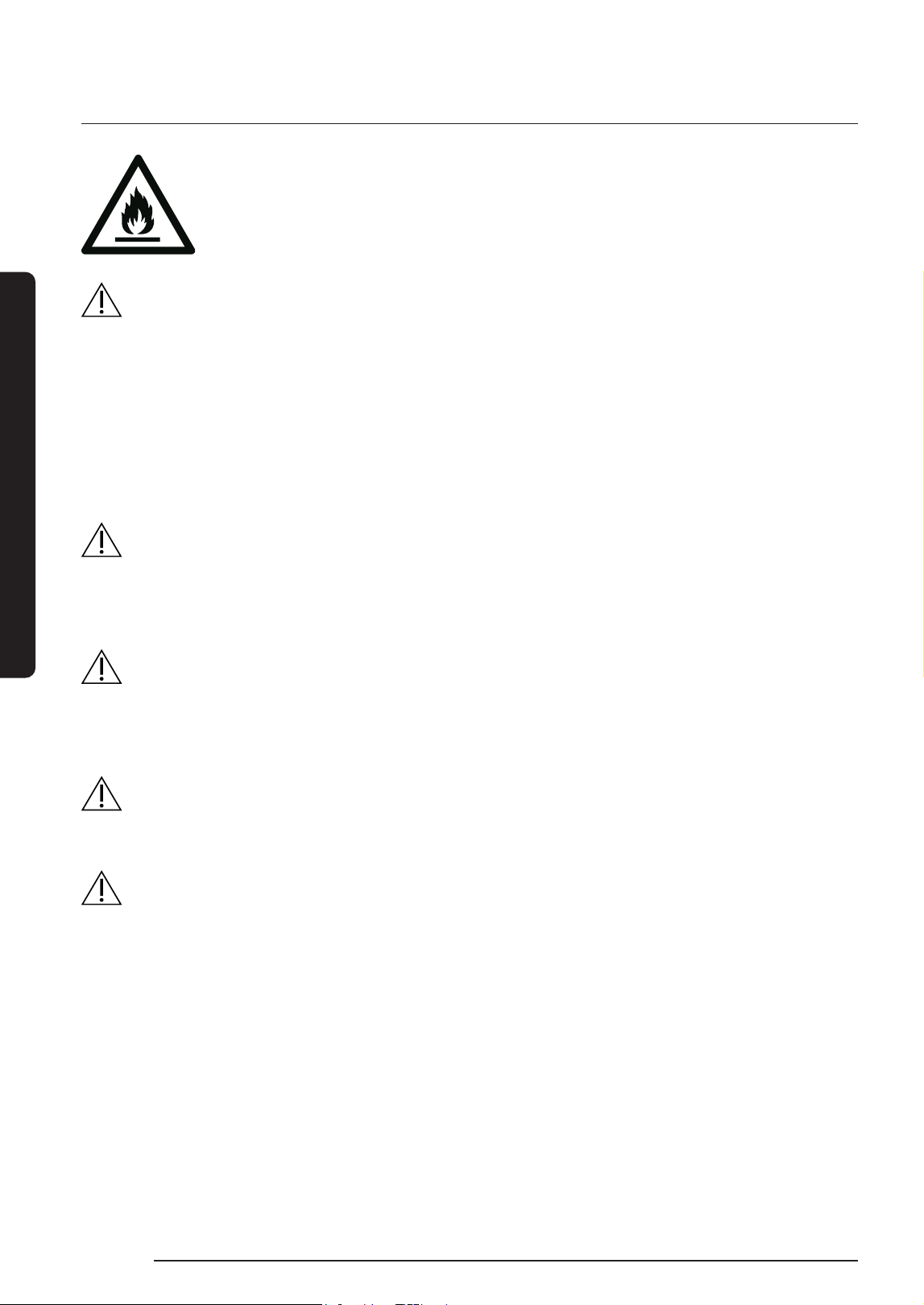
WARNING; Risk of re / ammable materials
WARNING
• When positioning the appliance, ensure the supply cord is not
trapped or damaged.
• Do not locate multiple portable socket-outlets or portable
power supplies at the rear of the appliance.
• Fill with potable water only.
• Connect to potable water supply only.
WARNING
• Keep ventilation openings, in the appliance enclosure or in the built-in
structure, clear of obstruction.
WARNING
• Do not use mechanical devices or any other means to accelerate the
defrosting process, other than those recommended by the manufacturer.
WARNING
• Do not damage the refrigerant circuit.
WARNING
• Do not use electrical appliances inside the food storage
compartments of the appliance, unless they are of the type
recommended by the manufacturer.
• This appliance is not intended for use by persons (including
children) with reduced physical, sensory, or mental
capabilities, or those who lack experience and knowledge,
unless they have been given supervision or instruction
concerning the use of the appliance by a person responsible
for their safety.
English 5
Safety information
• This appliance can be used by children aged from 8 years and
above and persons with reduced physical, sensory or mental
capabilities or lack of experience and knowledge if they
have been given supervision or instruction concerning use
of the appliance in a safe way and understand the hazards
involved. Children shall not play with the appliance. Cleaning
and user maintenance shall not be made by children without
supervision. Children aged from 3 to 8 years are allowed to
load and unload refrigerating appliances.
• If the supply cord is damaged, it must be replaced by the
manufacturer, its service agent or similarly qualied persons
in order to avoid a hazard.
• The socket must be easily accessible so that the appliance can
be quickly disconnected from the supply in an emergency.
- It must be outside the area of the rear of the appliance.
• Do not store explosive substances such as aerosol cans with a
ammable propellant in this appliance.
• If the product is equipped with LED lamps, do not disassemble
the Lamp Covers and LED lamps yourself.
- Contact a Samsung service center.
- Use only the LED Lamps provided by the manufacturer or
its service agents.
• New hose-sets supplied with the appliance are to be used and
old hose-sets should not be reused.
• Have the refrigerator’s water supply connected only to a
potable water supply. To operate the ice maker properly,
water pressure of 206-861 kPa (30-125 psi) is required.
• For the most efcient use of energy, please keep the all inner
ttings such as baskets, drawers, shelves on the position
supplied by manufacturer.
• To get the best energy efciency of this product, please leave
all shelves, drawers and baskets on their original position.
This appliance is intended to be used in household and similar
applications such as
- staff kitchen areas in shops, ofces and other working
environments;
English
6
Safety information
- farm houses and by clients in hotels, motels and other
residential type environments;
- bed and breakfast type environments;
- catering and similar non-retail applications.
WARNING
• This appliance contains a small amount of isobutane
refrigerant (R-600a), a natural gas with high environmental
compatibility that is, however, also combustible. When
transporting and installing the appliance, care should be
taken to ensure that no parts of the refrigerating circuit are
damaged.
• Do not keep volatile or ammable objects or substances
(benzene, thinner, propane gas, alcohol, ether, LP gas, and
other such products) in the refrigerator.
- This refrigerator is for storing food only.
- This may result in re or explosion.
• Fill the water tank, ice tray and water cubes only with potable
water (mineral water or puried water).
- Do not ll the tank with tea, juice or sports drink, this may
damage the refrigerator.
• R-600a or R-134a is used as a refrigerant. Check the
compressor label on the rear of the appliance or the rating
label inside the fridge to see which refrigerant is used for
your refrigerator. If this refrigerator contains ammable gas
(Refrigerant R-600a), contact your local authority in regard to
safe disposal of this product.
English 7
Safety information
• When disposing of this refrigerator, remove the door/door
seals and door latch so that small children or animals cannot
become trapped inside. Children should be supervised to
ensure that they do not play with the appliance. If trapped
inside, a child may get hurt or suffocate to death.
- If trapped inside, the child may become injury and
suffocate to death.
• Cyclopentane is used in the insulation. The gases in the
insulation material require a special disposal procedure. Please
contact your local authorities in regard to the environmentally
safe disposal of this product.
• The temperature of two star section (sections) or compartment
(compartments) which have two star symbol (
) is slightly
higher than other freezer compartment (compartments).
The two star section (sections) or compartment
(compartments) is (are) based on the instruction and/or the
condition as delivered.
• Note that temperature rise after defrosting has a permissible
range in the appliance specications. If you wish to minimise
the impact on the food storage due to a temperature rise,seal
or wrap the stored food in several layers.
• Food may freeze or spoil if stored at the wrong temperature.
Set the refrigerator to the correct temperature for the food
being stored.
• Cool hot food before storing. If too much hot food is placed
inside,the internal temperature of the appliance can increase
and negatively affect other foods stored in the appliance.
• If you set an excessively low temperature for food,It may
become frozen. Do not set a temperature lower than the
required temperature for the food to be stored correctly.
English
8
Safety information
Safety Guide
READING ALL INSTRUCTIONS BEFORE USE
The following safety guidelines are intended to prevent unforesoon risks or damage from
unsafe or incorrect operation of the appliance.
The guidelines are separeted into ‘WARNING’ and ‘CAUTION’ as described below.
Safety Messages
This symbol is displayed to indicate matters and operations that can cause risk. Read the
part with this symbol carefully and follow the instructions in order to avoid risk.
WARNING
This indicates that the failure to follow the instructions can cause serious injury or death.
CAUTION
This indicates that the failure to follow the instructions can cause the minor injury or
damage to the product.
WARNING
To reduce the risk of explosion, re, death, electric shock, injury or scalding to persons
when using this product, follow basic precautions, including the folloing:
Installation
• This appliance should only be transported by two or more people holding the appliance
securely.
• Install the appliance on a rm and level oor.
• Do not install the appliance in a damp and dusty place. Do nit install or store the
appliance in any outdoor area, or any area that is subject to weathering conditions such
as direct sunlight, wind, rain, or temperatures below freezing.
• Do not place the appliance in direct sunlight or expose it to the heat from heating
appliances such as stoves or heaters.
• Be careful not to expose the rear of the appliance when installing.
• Install the appliance in a place where it is easy to unplug the power plug of the
appliance.
• Be careful not to let the appliance door fall during assembly or disassembly.
• Be careful not to pinch, crush, or damage the power cable during assembly or
disassembly of the appliance door.
• Be careful not to point the power plug up or let the appliance lean against the power
plug.
• Do not connect a plug adapter or other accessories to the power plug.
• Do not modify or extend the power cable.
• Ensure that the outlet socker is properly grounded, and that the earth pin on the power
cord is not damaged or removed from the power plug. Fore more details on grounding,
inquire at the Samsung Electronics service center.
• This appliance is equipped with a power cord having an equipment-grounding
conductro and a grounding power plug. The power plug must be plugged into an
appropriate outlet socket that is installed and grounded in accordance with all local
codes and ordinances.
English 9
Safety information
• Never start up an appliance showing any signs of damage. If in doubt, consult your
dealer.
• Do no plug the appliance into a multi socket adapter which does not have a power
cable (mounted).
• The appliance should be connected to a dedicated power line which is separetely fused.
• Do not use a multi socker outlet which is not properly grounded (portable). In case of
using a properly-gounded multi socket outlet (portable), use the multi socket outlet
with the current capacity of the power cord rating or higher and use the multi socker
outlet only for the appliance.
• Dispose of all packaging materials (such as plastick bags and styroform) away from
children. The packaging materials can cause suffocation.
Operation
• Be careful of nearby children when you open or close the appliance door, The door
may bump the child and cause injury.
• Avoid the danger of children getting trapped inside the appliance. A child trapped
inside the appliance can cause suffocation.
CAUTION
To reduce the risk of minor injury to persons, malfunction, or damage to the product or
preperty when using this product, follow basic precaution, including the folowing:
Operation
• Do not touch frozen food or the metal parts in the freezer comparment with wet or
damp hands. It may cause frostbite.
• Do not place glass containers, bottles or cans (especially those containing carbonated
drinks) in the freezer compartment, shelves or ice bin that will be exposed to
temperatures below freezing,
• The tempered glass on the front side of the applicance door or the selves can be
damaged by an impact. If it is broken. Do not touch it with hands.
• Do not hang from the appliance doors, storage room, shelf or climb up into it.
• Do not store an excessive amount of water bottles or containers for side dishes on the
door baskets.
• Do not open or close the appliance door with excessive force.
• If the hinge of the appliance door is damaged or operates improperly, stop using the
appliance and contact an authorized service centre.
• Prevent animals from nibbling on the power cable or water hose.
• Never eat frozen foods immediately after they have been taken out in the freezer
compartment.
• Make sure not to get a hand or foot stuck upon opening or closing the appliance door
or door in door.
Maintenance
• Do not clean glass shelves or covers with warm water when they are cold. They my
shatter if exposed to sudden temperature changes.
• Do not insert the shelves upside down. The shelves may fall.
• To remove frost from the appliance, contact the Samsung Electronics service center.
• Dispose of the ice inside the ice bin in the freezer compartment during an extended
power outage
English
10
Safety information
Instructions about the WEEE
Correct Disposal of This Product (Waste Electrical &
Electronic Equipment)
(Applicable in countries with separate collection systems)
This marking on the product, accessories or literature indicates
that the product and its electronic accessories (e.g. charger,
headset, USB cable) should not be disposed of with other
household waste at the end of their working life. To prevent
possible harm to the environment or human health from
uncontrolled waste disposal, please separate these items from
other types of waste and recycle them responsibly to promote the
sustainable reuse of material resources.
Household users should contact either the retailer where they
purchased this product, or their local government ofce, for details
of where and how they can take these items for environmentally
safe recycling.
Business users should contact their supplier and check the terms
and conditions of the purchase contract. This product and its
electronic accessories should not be mixed with other commercial
wastes for disposal.
For information on Samsung’s environmental commitments and
product regulatory obligations, e.g. REACH, WEEE or Batteries,
visit our sustainability page available via www.samsung.com
(For products sold in European countries and in the UK only)
English 11
Installation
Follow these instructions carefully to ensure a proper installation of this refrigerator and
to prevent accidents before using it.
WARNING
• Use the refrigerator only for its intended purpose as described in this manual.
• Any servicing must be performed by a qualied technician.
• Dispose of the product packaging material in compliance with the local regulations.
• To prevent electric shock, unplug the power cord before servicing or replacements.
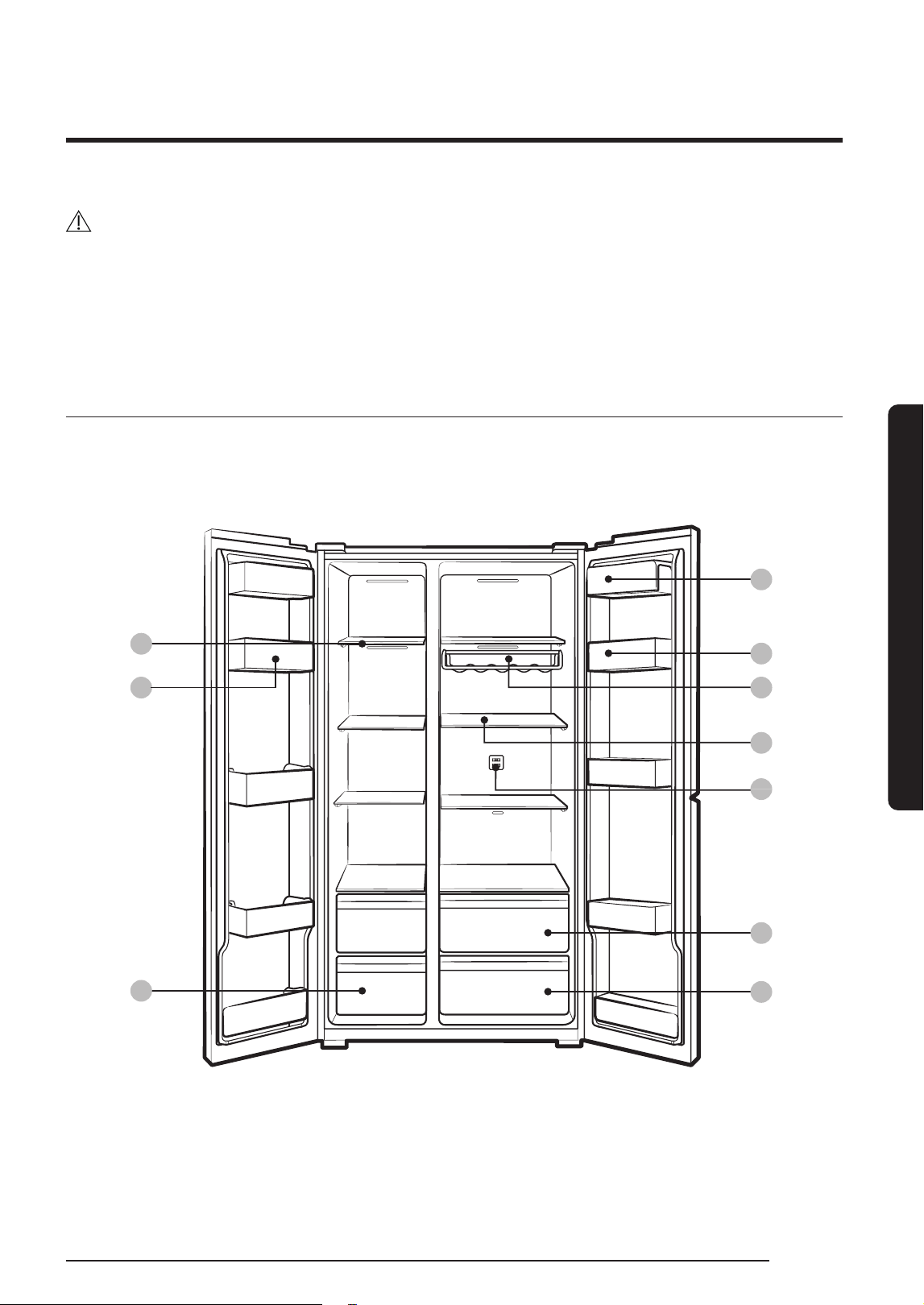
Refrigerator at a glance
The actual appearance of your refrigerator may differ, depending on the model and the
country.
Normal models
02
01
03
04
11
10
05
06
07
14
Installation
English
12
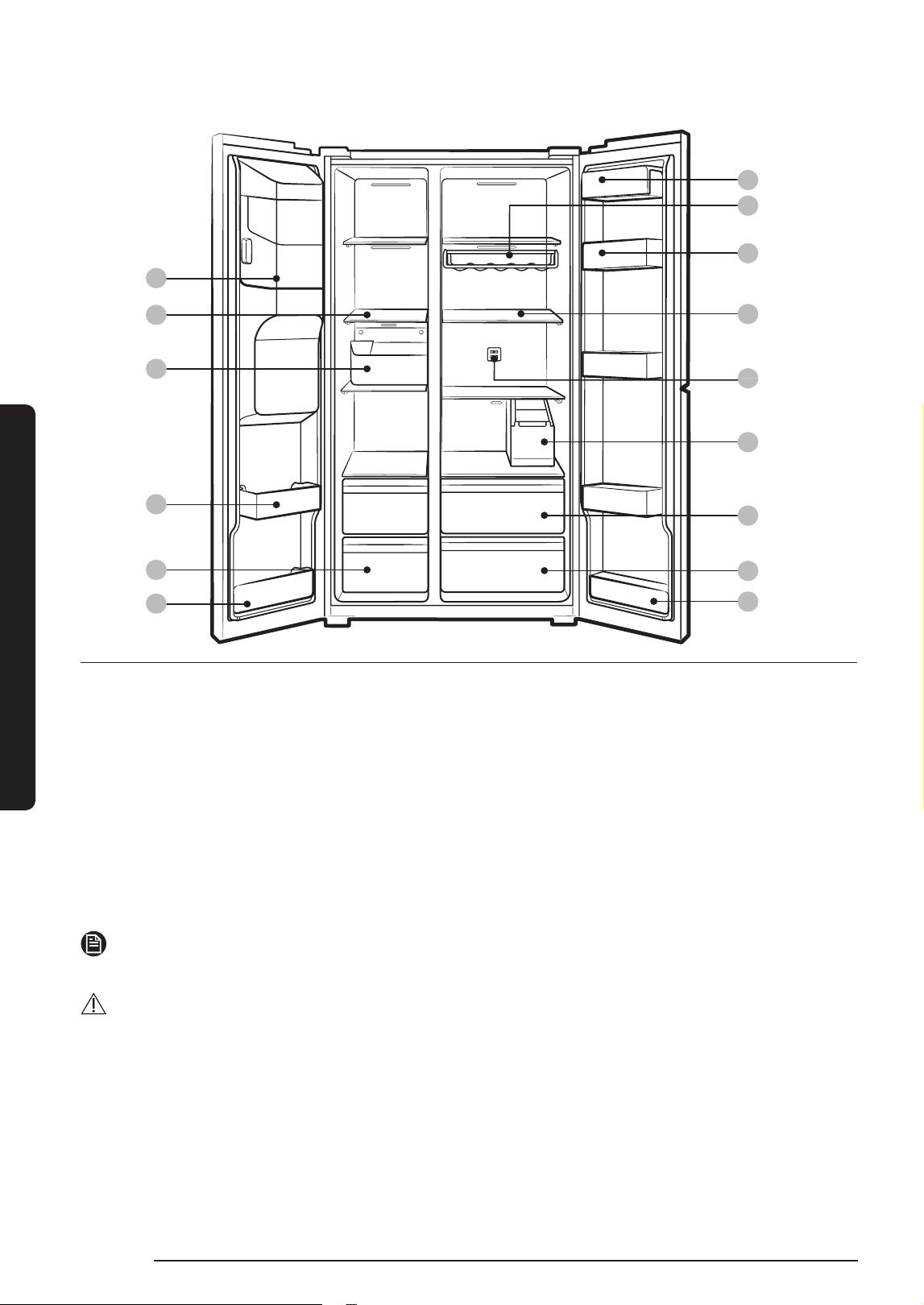
Dispenser-featured models
08
02
12
01
03
06
09
07
05
10
04
13
11
14
15
01 Freezer shelves 02 Multipurpose freezer
bin
03 Dried food and meat
storage drawer
04 Refrigerator bin 05 Refrigerator shelves 06 Vegetable drawer
07 Multipurpose drawer 08 Ice maker bucket ** 09 Water tank *
10 Wine rack * 11 Dairy bin 12 Lower freezer bin *
13 Lower refrigerator bin * 14 Deodorizer lter * 15 Freezer bin *
* Applicable models only
** Dispenser models only
NOTE
• The design of the egg container may differ with the model.
CAUTION
For all models, do not change the position of the freezer shelves. Freezer shelves have
different lengths, and if you change the position, you may damage the product when
closing the door.
Installation
English 13
Installation
Step-by-step installation
STEP 1 Select a site
Site requirements:
• Solid, level surface without carpeting or ooring that may obstruct ventilation
• Away from direct sunlight
• Adequate room for opening and closing the door
• Away from a heat source
• Room for maintenance and servicing
• Temperature range: between 5 °C and 43 °C
Effective temperature range
The refrigerator is designed to operate normally in the temperature range specied by its
class rating.
Class Symbol
Ambient Temperature range (°C)
IEC 62552 (ISO 15502) ISO 8561
Extended Temperate SN +10 to +32 +10 to +32
Temperate N +16 to +32 +16 to +32
Subtropical ST +16 to +38 +18 to +38
Tropical T +16 to +43 +18 to +43
NOTE
The cooling performance and power consumption of the refrigerator may be affected
by the ambient temperature, the door-opening frequency, and the location of the
refrigerator. We recommend adjusting the temperature settings as appropriate.
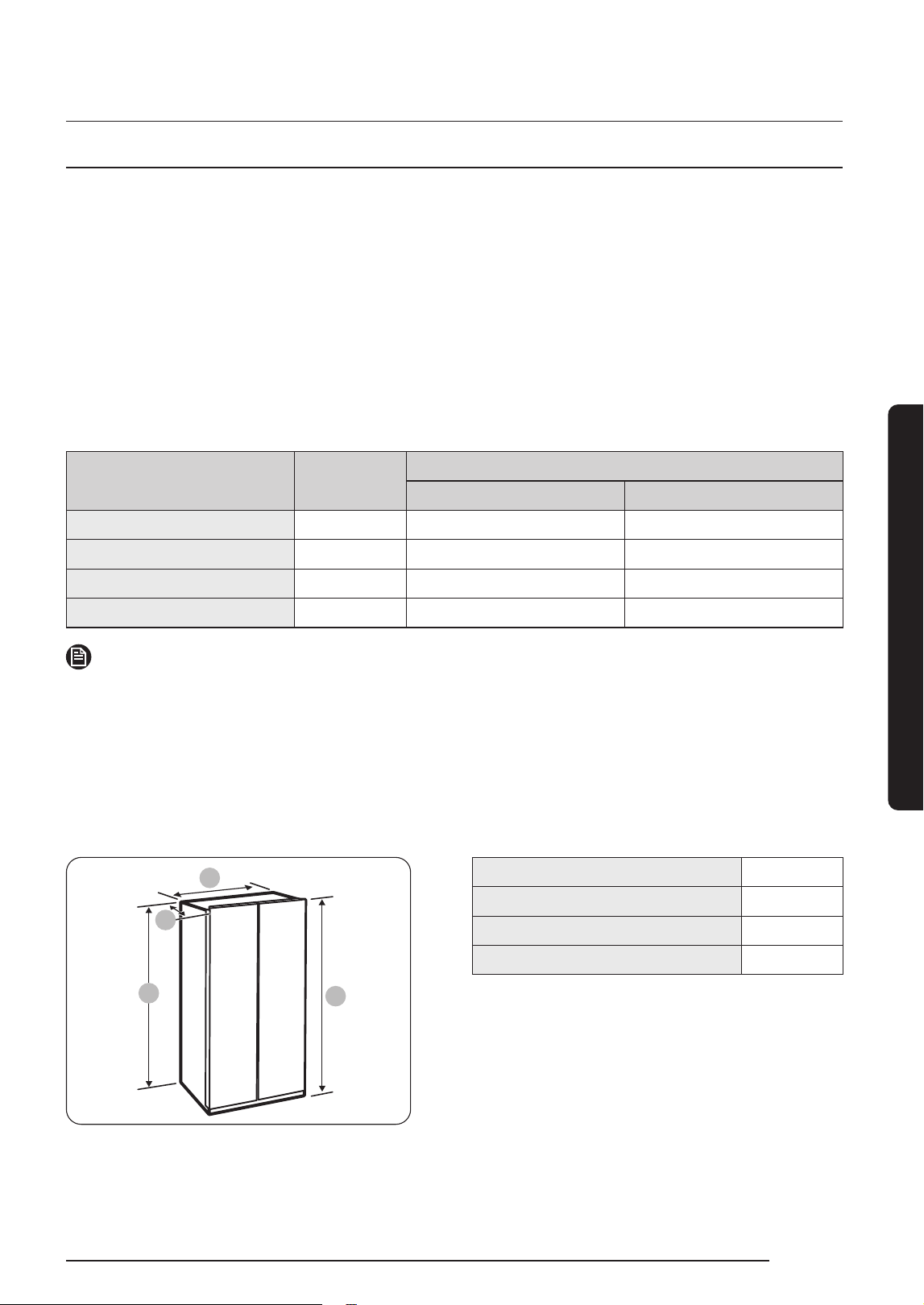
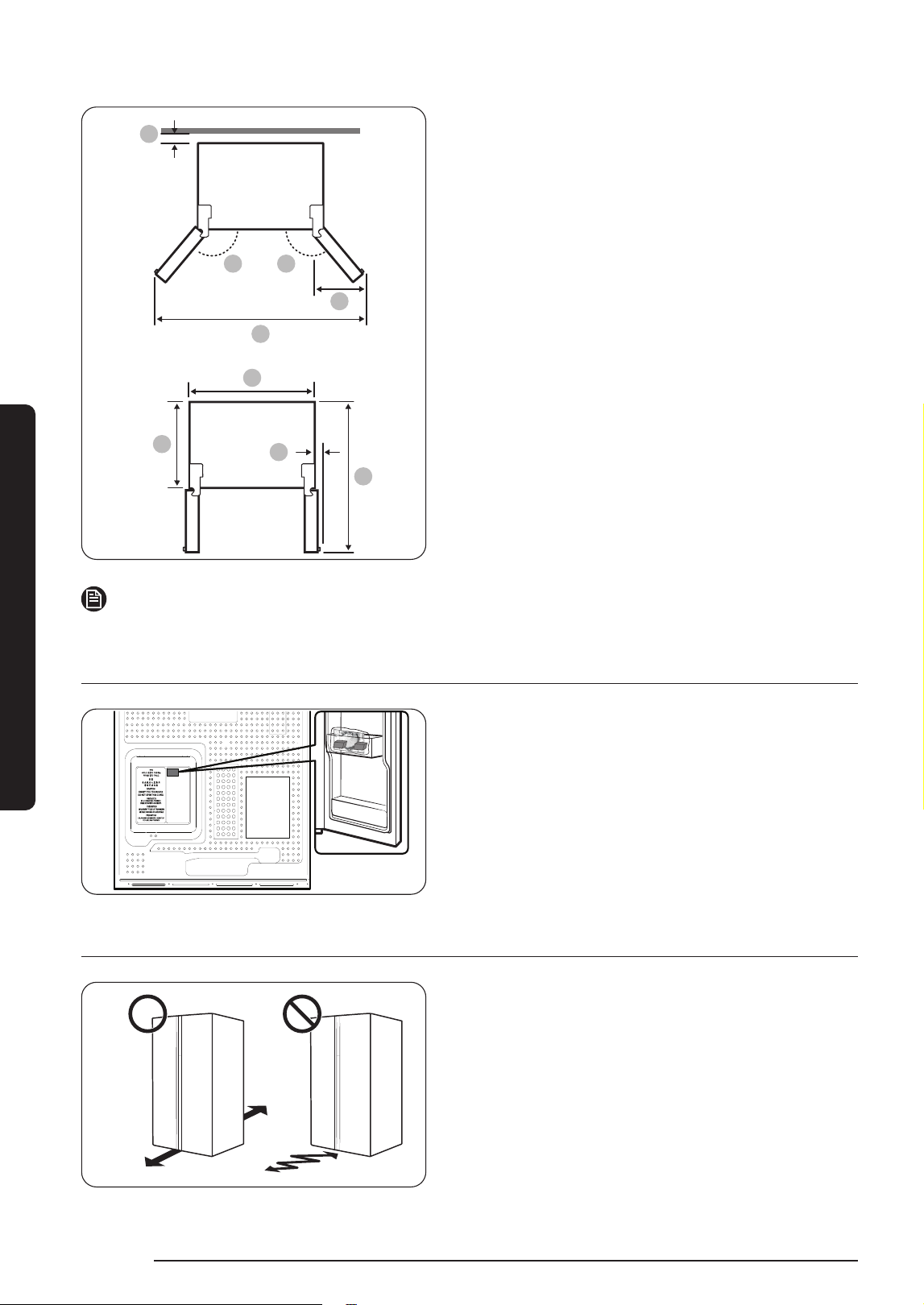
Clearance
See the pictures and table below for space requirements for installation.
A
B
C
D
Depth “A” 716
Width “B” 912
Height “C” 1744
Overall Height “D” 1780
(unit: mm)
English
14
Installation
01
02 03
05
06
07
08
09
04
01 more than 50 mm recommended
02 165°
03 165°
04 564 mm
05 1726 mm
06 610 mm
07 908 mm
08 29 mm
09 1165 mm
NOTE
The measurements in the above table may differ, depending on the measuring method.
STEP 2 Spacing (applicable models only)
1. Open the door and locate the provided
spacer.
2. Unpack the spacer and attach it to the
rear of the refrigerator as shown. It
helps ventilate air to the rear wall and
save power consumption.
STEP 3 Flooring
• The surface to install the refrigerator
must support a fully loaded refrigerator.
• To protect the oor, put a large piece of
cardboard on each leg of the refrigerator.
• Once the refrigerator is in its nal
position, do not move it unless necessary
to protect the oor. If you have to, use a
thick paper or cloth such as old carpets
along the movement path.
English 15
Installation
NOTE
If the refrigerator cannot pass through the entrance due to its size, see the Door removal
for entrance section in the Installation chapter.
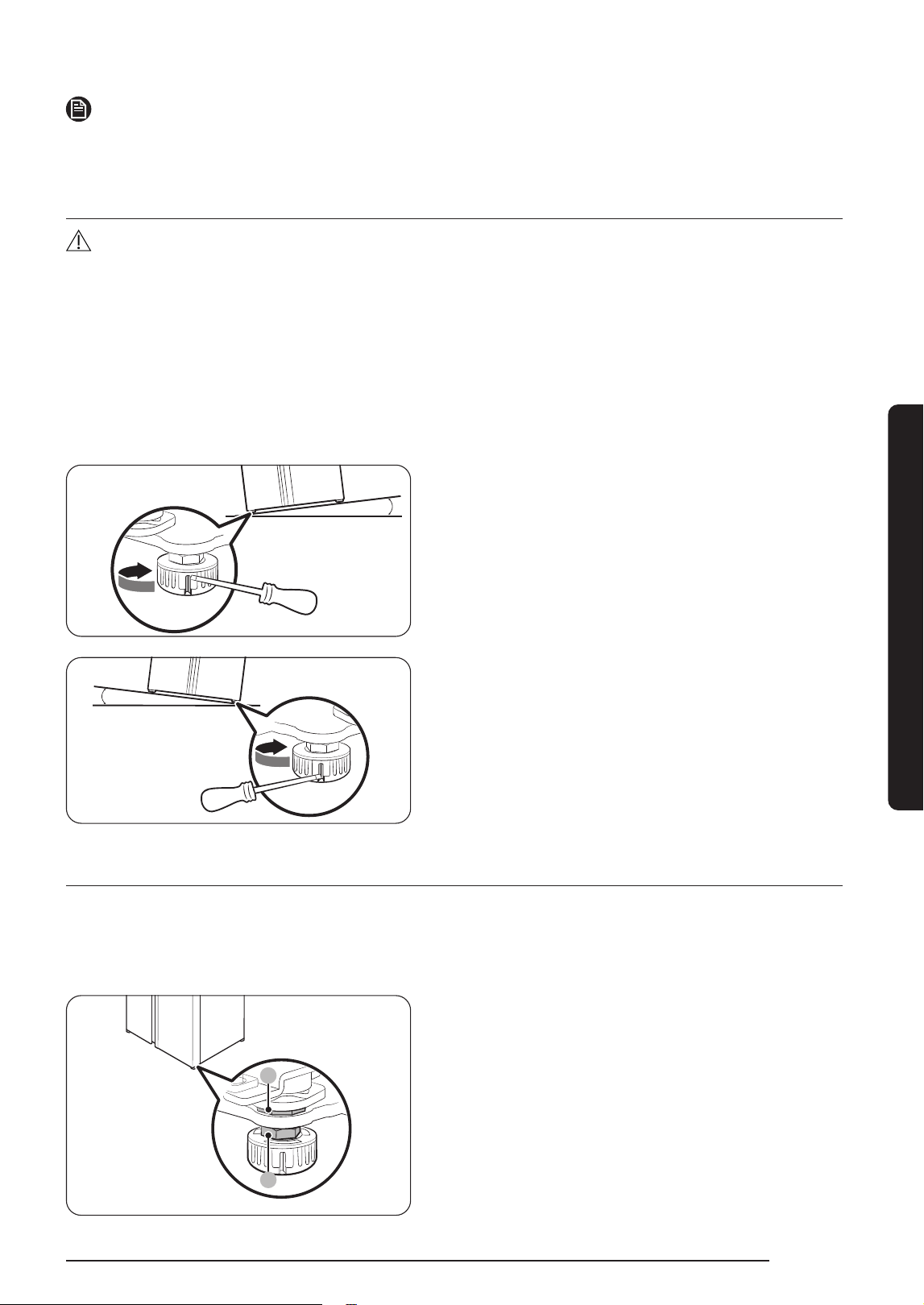
STEP 4 Adjust the levelling feet
CAUTION
• The refrigerator must be levelled on a at, solid oor. Failing to do so can cause
damage to the refrigerator or physical injury.
• Levelling must be performed with an empty refrigerator. Make sure no food items
remain inside the refrigerator.
• For safety reasons, adjust the front side a little higher than the rear side.
The refrigerator can be levelled using the front legs that have a special screw (leveller) for
levelling purposes. Use a at-head screwdriver for levelling.
To adjust the height of the freezer side:
Insert a at-head screwdriver into the
leveller of the freezer-side front leg. Turn
the leveller clockwise to raise, or turn it
counter clockwise to lower.
To adjust the height of the fridge side:
Insert a at-head screwdriver into the
leveller of the fridge-side front leg. Turn
the leveller clockwise to raise, or turn it
counter clockwise to lower.
STEP 5 Adjust the door height as well as the door gap
To adjust the height of a door
The height of a door can be adjusted using the clamp nut and the height nut on the front
bottom of each door.
B
A
1. Open the door to adjust, and locate the
two nuts (A) and (B) on the front bottom
of the door.
English
16
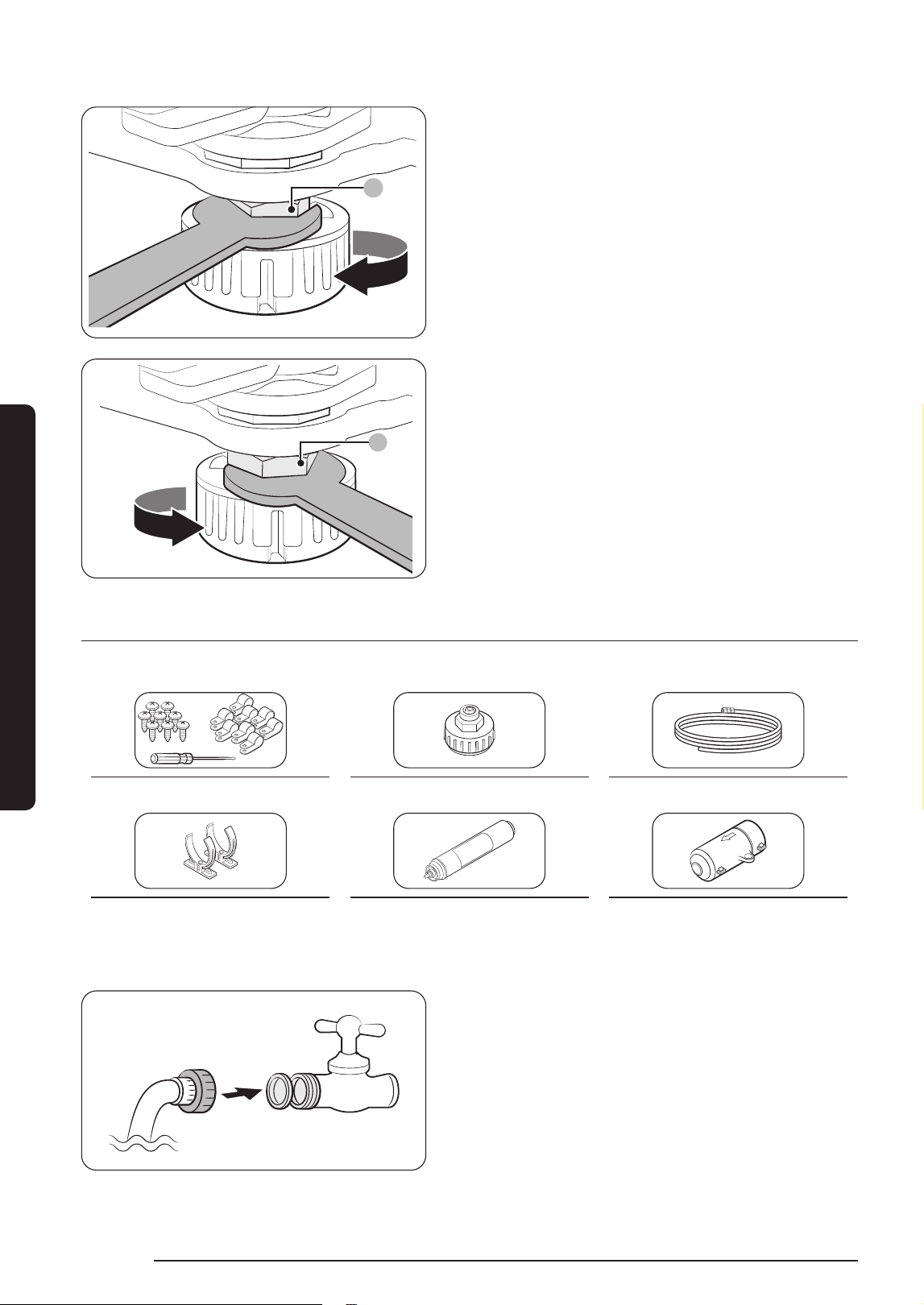
Installation
A
2. With a 19 mm spanner (not provided),
turn the clamp nut (A) clockwise to
loosen. Then, open the door, and do the
following inside the door.
- To raise the door, turn the height nut
(B) counter clockwise.
- To lower the door, turn the height
nut (B) clockwise.
A
3. When complete, tighten the clamp nut
(A) by turning it counter clockwise.
STEP 6 Connect the water dispenser line (applicable models only)
Parts and tools required
Water line xer and screws Coupler Water line
Water lter lock-clip Water lter Check valve
Installation (external dispenser line)
1. Assemble the water pipe line using
couplers.
2. Close the main water supply, and then
close the water tap.
3. Connect the coupler to the cold water
tap.
English 17
Installation
CAUTION
• Make sure you connect the coupler to the cold water tap. Connection to the hot water
tap may cause the water lter to be clogged and fail to operate normally.
• The warranty for your refrigerator does not cover the water line installation. The
water line installation will be performed at your own costs unless the installation fee is
included in the retailer’s price.
• Samsung takes no responsibility for the water line installation. If water leaks occur,
contact the installer of the water line.
• The water line must be repaired by a qualied professional. If you encounter a water
leak, contact a local Samsung service centre or the installer of the water line.
STEP 7 Connect to a water source (applicable models only)
CAUTION
• The water line must be connected by a qualied technician.
• The warranty for your refrigerator does not cover the water line installation. The
water line installation will be performed at your own costs unless the installation fee is
included in the retailer’s price.
• Samsung takes no responsibility for the water line installation. If water leaks occur,
contact the installer of the water line.
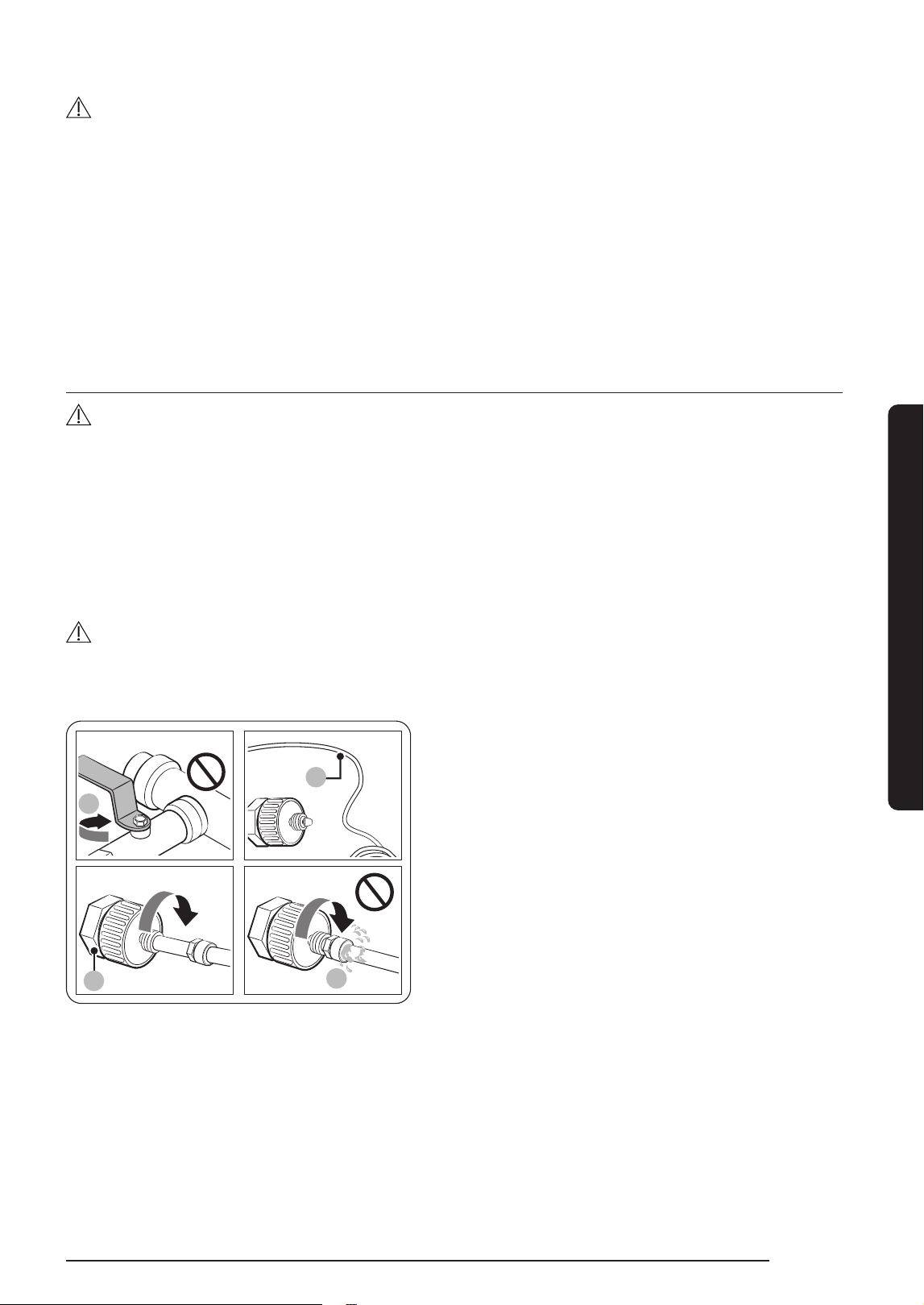
To connect the cold water pipe to the water ltering hose
CAUTION
• Make sure the water ltering hose is connected to a cold, potable water source pipe.
Connecting to the hot water pipe may cause the water lter to malfunction.
1
A
B
A
A. Close Main Water pipe
B. No gap
1. Shut off the water supply by closing the
main water valve.
2. Locate the cold, potable water pipe (1).
3. Follow the Water Line Installation to
connect to the water pipe.
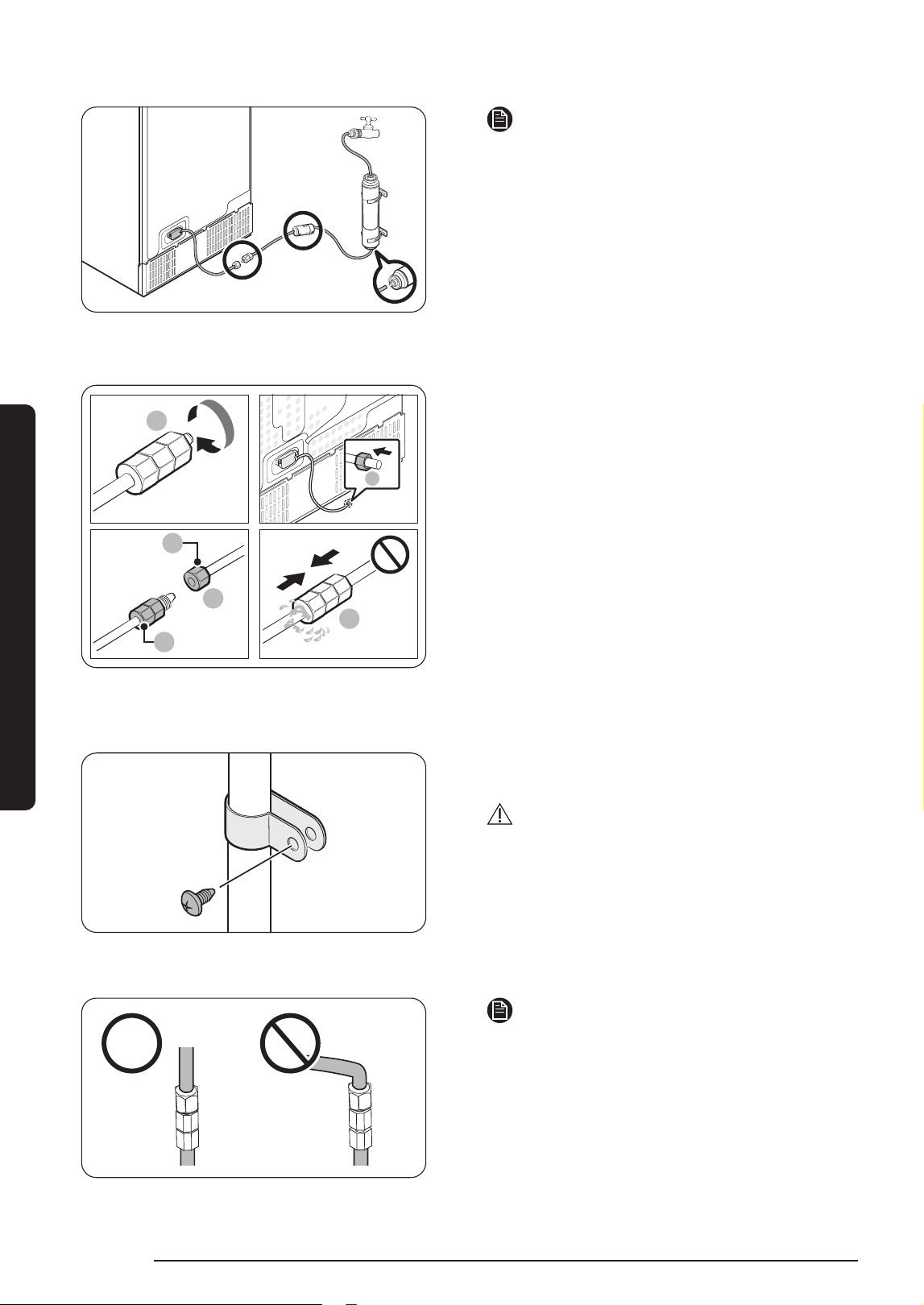
English
18
Installation
NOTE
New hose-sets supplied with the appliance
are to be used and old hose-sets should
not be reused.
To connect the water ltering hose to the water line
a
a
a
A
B
03
A. Water Line from unit
B. Water Line from Kit
1. Loosen and remove the compression
nut (a) from the water line of the
refrigerator, and insert it to the water
ltering hose.
2. Tighten up the compression nut (a) to
connect the water ltering hose and the
water line.
3. Open the main water valve and check
for any leaks.
4. If there are no leaks, dispense about 10
litres of water or dispense the water for
6 - 7 minutes before actually using the
refrigerator to remove impurities inside
the water ltering system.
5. Secure the water line to a sink or a wall
using a clip.
CAUTION
• Do not tighten the water line
excessively. Make sure the water line is
not bent, pinched, or squashed.
• Do not mount the water line on any
part of the refrigerator. This may
damage the refrigerator.
NOTE
If you have to relocate the refrigerator
after connecting the water line, make sure
the joined section of the water line must is
straight.
English 19
Installation
To repair the water line
CAUTION
The water line must be repaired by a qualied professional. If you encounter a water leak,
contact a local Samsung service centre or the installer of the water line.
Reverse osmosis water ltration system
The water pressure of the water supply system to a reverse osmosis water ltration
system must be between 206 kPa (30 psi) and 861 kPa (125 psi).
The water pressure of the reverse osmosis water ltration system to the refrigerator’s
cold water line must be at least 206 kPa (30 psi). If the water pressure is below the
specied:
• Check if the sediment lter in the reverse osmosis system is blocked. Replace the lter
if necessary.
• Rell the water tank in the reverse osmosis system with water.
• If your refrigerator has a water lter, it may further reduce the water pressure when
used in conjunction with a reverse osmosis system. Remove the water lter.
For more information or servicing, contact a licensed plumbing professional.
Ordering a new lter
To purchase a new water lter (part type: HAFEX/EXP), contact a local Samsung service
centre.
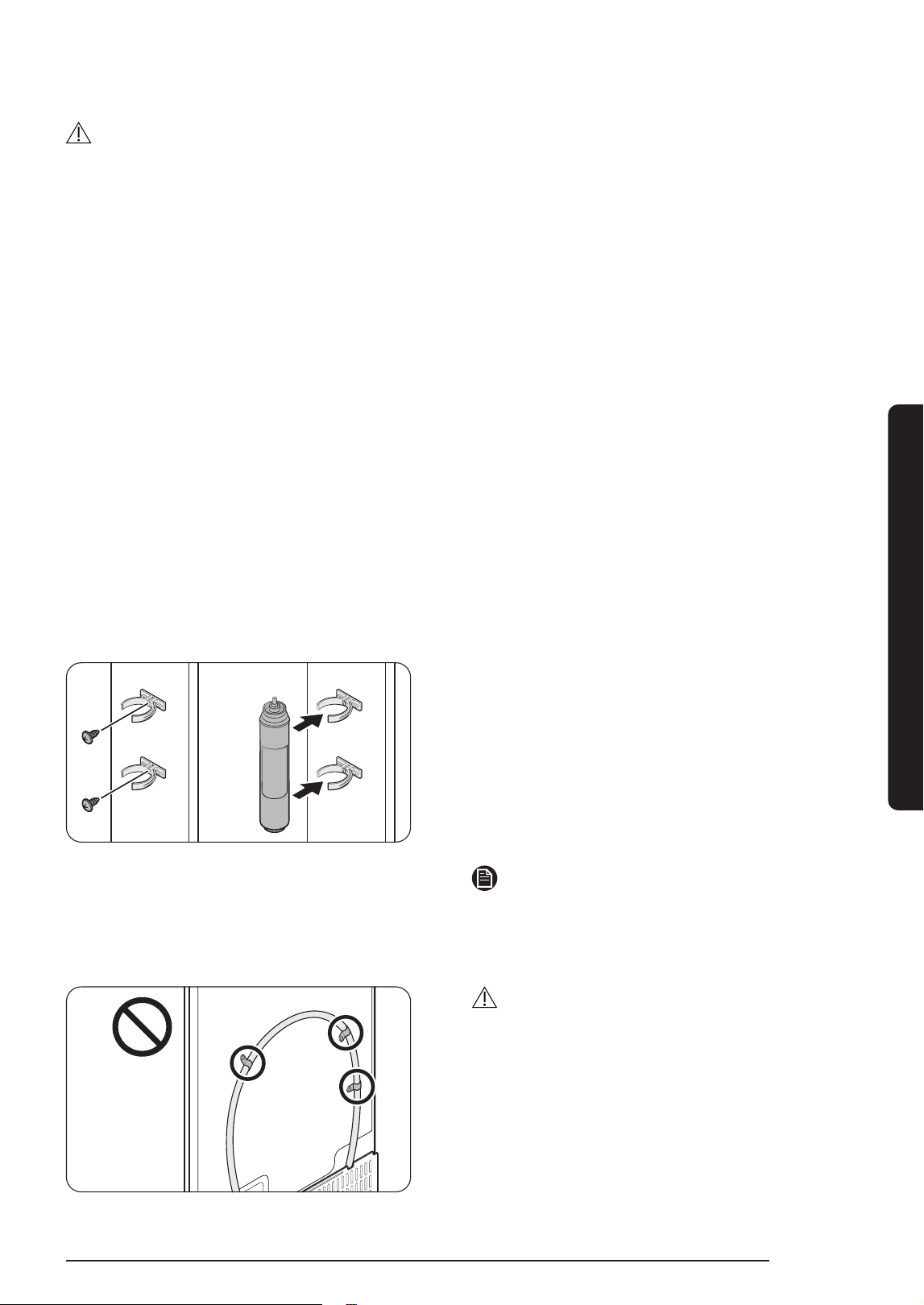
To mount the water lter into place
1. Attach the lock clips (x2) to appropriate
positions under the sink, for instance.
Then, x the lock clips rmly using
screws.
2. Insert the water lter into the upper
and lower clips in the correct direction.
Make sure to check the vertical
direction of the water lter.
NOTE
If the lter is installed horizontally, water
may remain in the lter. Therefore, vertical
installation is recommended.
CAUTION
Do not mount the water lter on any part
of the refrigerator. This may damage the
refrigerator.
English
20
Installation
STEP 8 Initial settings
By completing the following steps, the refrigerator should be fully functioning.
1. Plug the power cord into the wall socket to turn the refrigerator on.
2. Open the door, and check if the interior light lights up.
3. Set the temperature to the coldest, and wait for about an hour. Then, the freezer will be
slightly chilled, and the motor will run smoothly.
4. Wait until the refrigerator reaches the set temperature. Now the refrigerator is ready
for use.
STEP 9 Final check
When installation is complete, conrm that:
• The refrigerator is plugged into an electrical outlet and grounded properly.
• The refrigerator is installed on a at, level surface with a reasonable clearance from the
wall or the cabinet.
• The refrigerator is level and is sitting rmly on the oor.
• The door opens and closes freely, and the interior light turns on automatically when
you open the door.
Door removal for entrance
If the refrigerator cannot pass through the entrance due to its size, follow these
instructions:
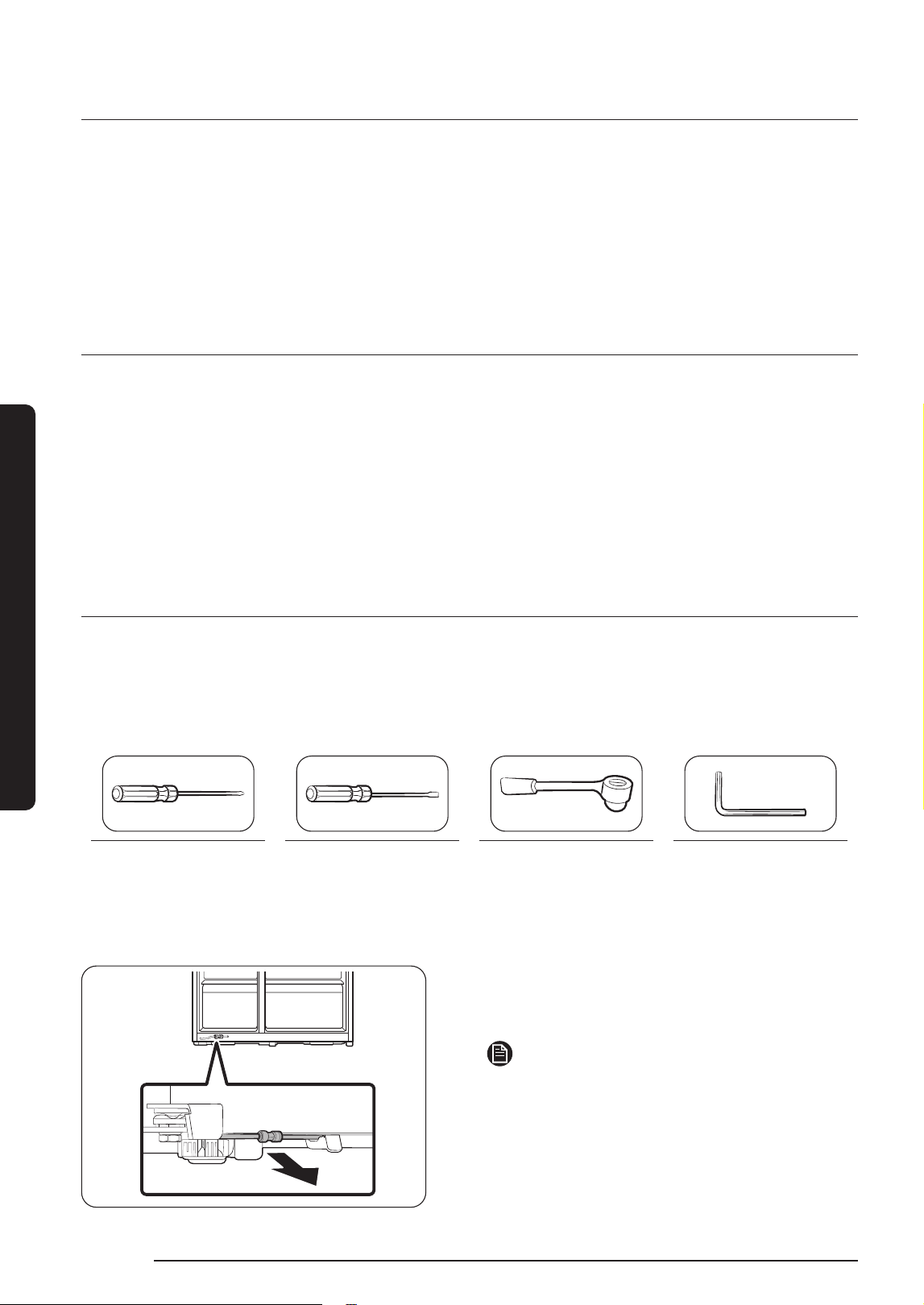
Tools required (not provided)
These tools are used for removing the doors.
Phillips screwdriver Flat-head
screwdriver
Socket spanner
(10 mm)
Allen spanner
(5 mm)
Disconnect the water line
1. From the bottom rear side of the
refrigerator, pull out the water line to
the front.
NOTE
The refrigerator’s water line is a water
circulation line that connects between the
water pipe from the water source and the
hoses from the water ltering system of
the refrigerator.
English 21
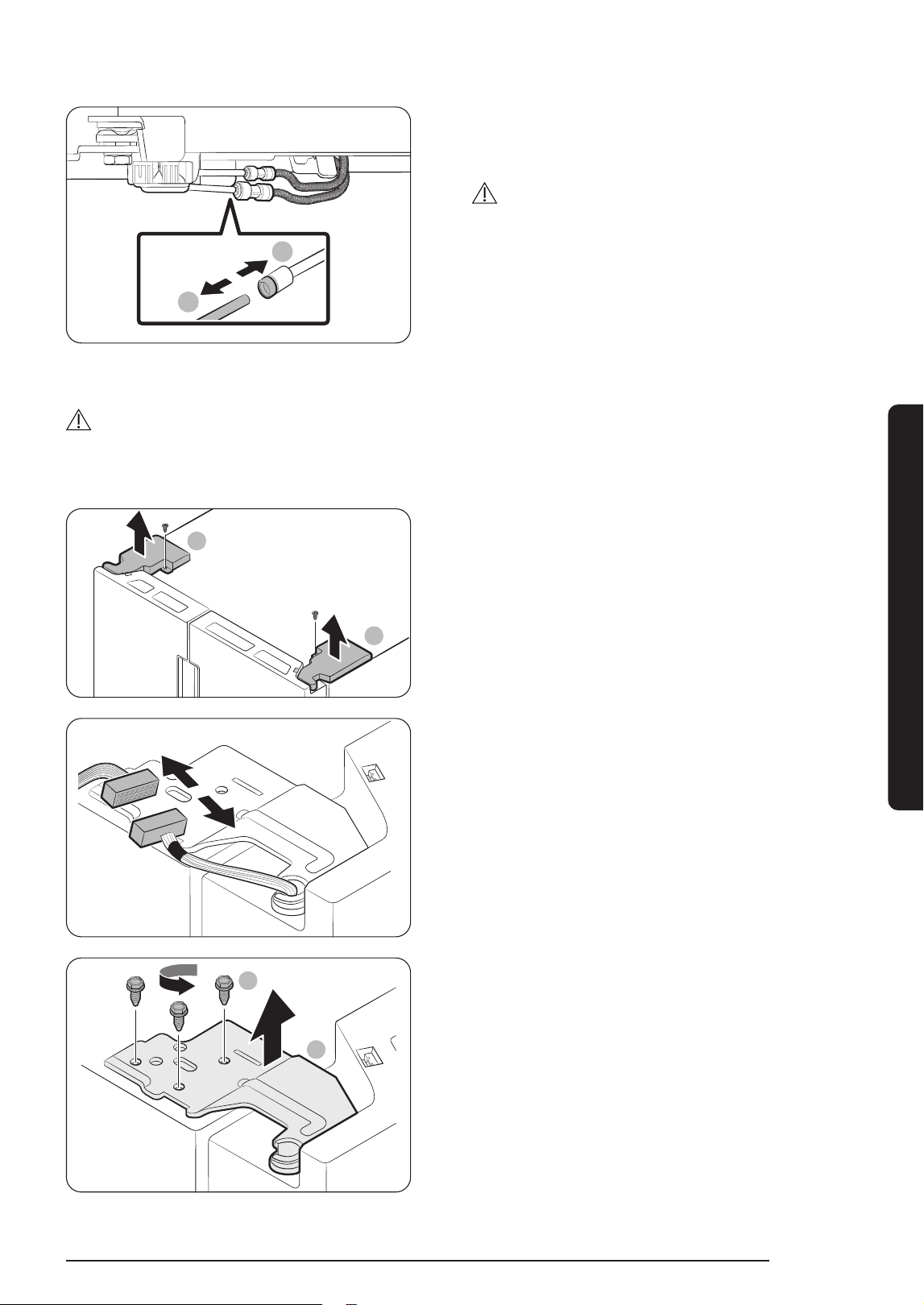
Installation
B
A
2. To disconnect the hoses, press and hold
the transparent coupler (A) and detach
the water hose (B).
CAUTION
Do not apply excessive force to the
coupler. It may break.
Detach the doors
CAUTION
The door may fall off or over and damage itself during any of these steps. To prevent an
accident, use extreme caution when performing these steps.
A
A
1. Use a Phillips screwdriver to unscrew
the hinge covers (A) on the top of each
door.
2. Open the doors to loosen the hinges
and remove the hinge covers. Once the
covers are removed, close the doors.
3. Disconnect the electrical harness.
B
C
4. Unscrew the hinge screws (B) counter
clockwise, and remove the upper hinge
(C). Be careful as the door can fall on
you, causing physical injury.
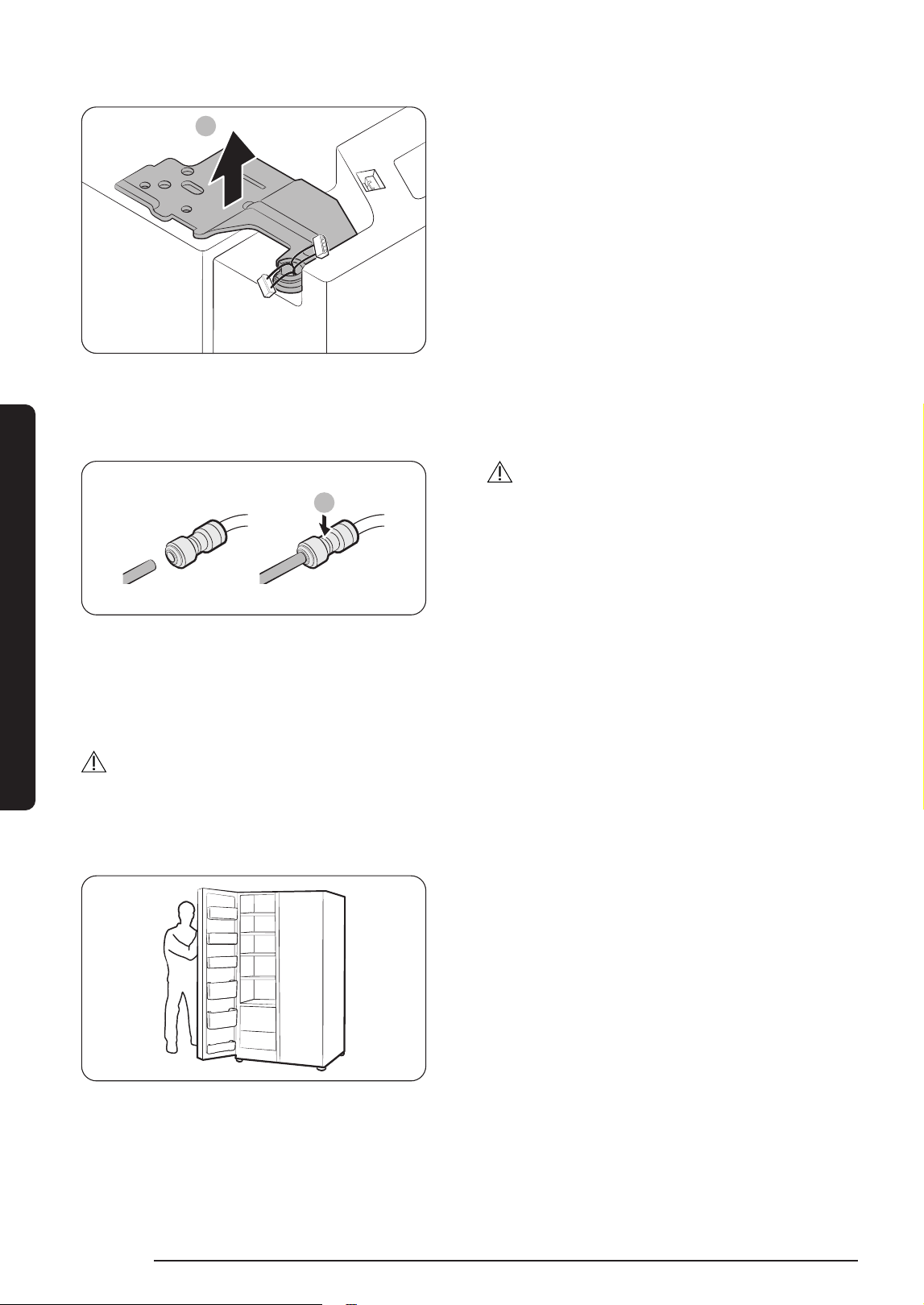
English
22
Installation
C
5. Remove the hinges (C) on both sides.
6. Gently lift up the doors one by one to
remove. Use caution as the door may
fall off or over.
Reconnect the water hoses
Once the refrigerator has passed through the entrance, reconnect the water hoses.
A
A. Centre of transparent coupler
CAUTION
• Make sure the water hoses are
connected with matching colours.
• To prevent water leaks, each water
hose must be inserted fully to the
centre of the transparent coupler.
• After reconnecting the water hoses,
push them under the cabinet and
arrange them on the hook.
Reattach the doors
CAUTION
• Before reattaching the doors, make sure all the electrical connectors are properly
connected.
• The freezer door must be reattached before the fridge door.
1. Hold the freezer door and hook to the
hinge at the bottom of the refrigerator.
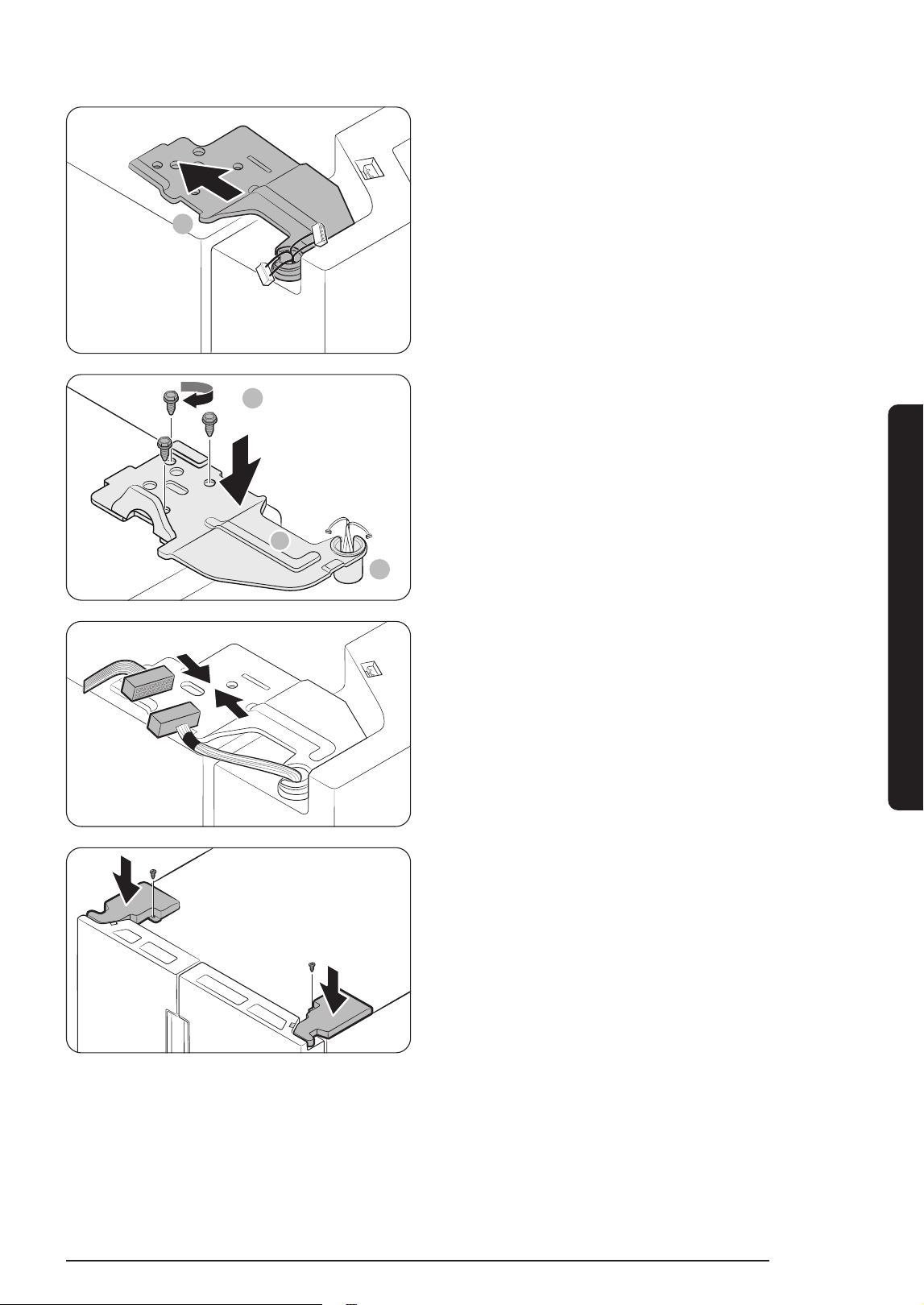
English 23
Installation
A
2. On the top side, insert the hinge (A) into
the hinge slot.
B
C
D
3. Insert the upper hinge shaft (B) into
the hinge hole (C). Make sure the hinge
shaft is straight so that all screw holes
are fully revealed. Then, tighten the
hinge screws (D) clockwise.
4. Connect the electrical harness.
5. Insert the hinge covers with the front
sides rst, and then tighten the screws.
Use a Phillips screwdriver for this step.
English
24
Operations
Main panel
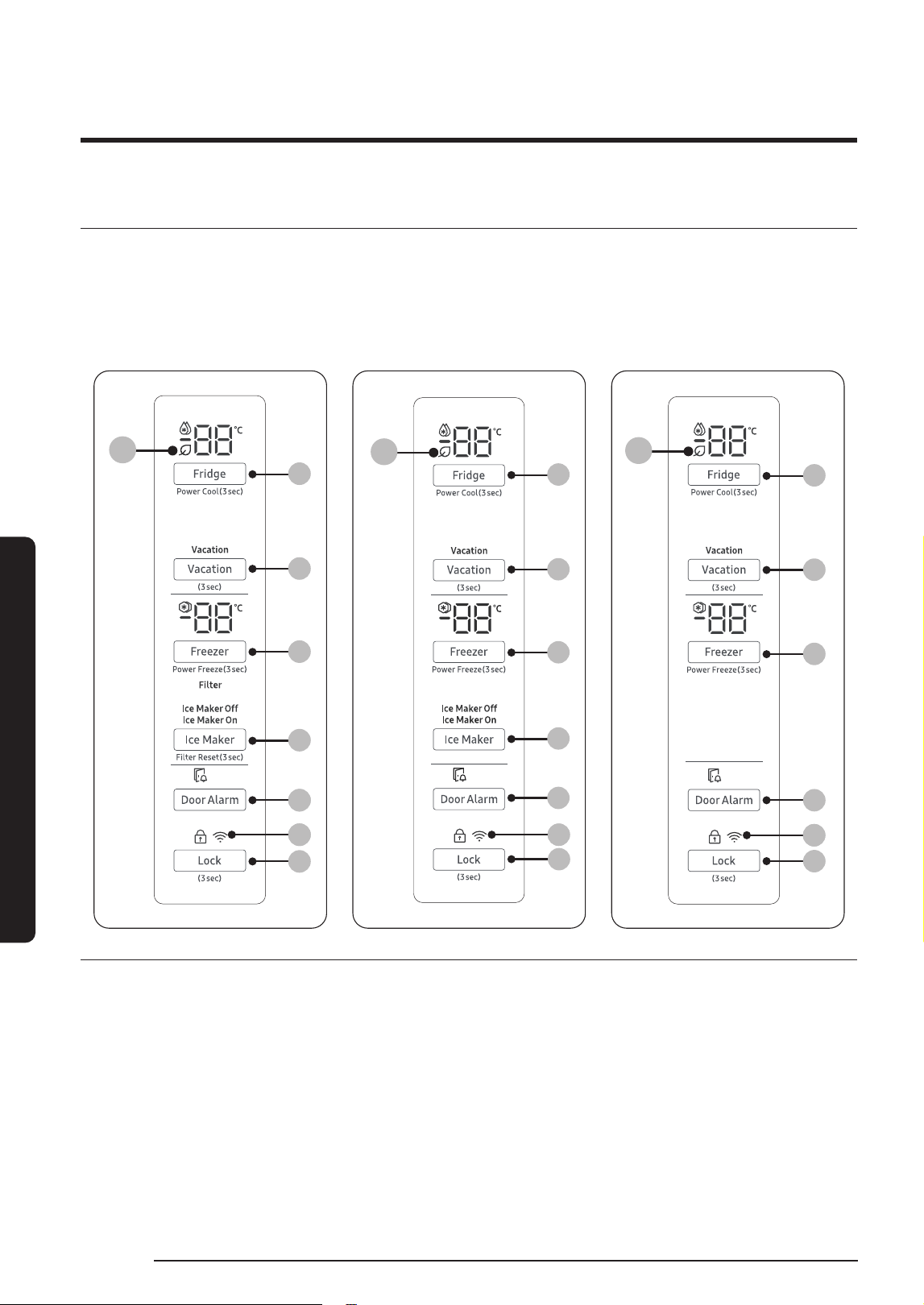
The actual appearance of your main panel may differ from the gure and the main panel
design is subject to change without notice.
Type A Type B Type C
01
02
03
04
05
06
05
0507
08
01
02
03
04
05
06
08
0507
01
02
03
05
06
08
0507
01 Fridge / Power Cool 02 Vacation
03 Freezer / Power Freeze 04 Ice Maker / Filter Reset *
05 Door Alarm 06 Lock
07 Network connection 08 AI energy mode *
* Applicable models only
Operations
English 25
Operations
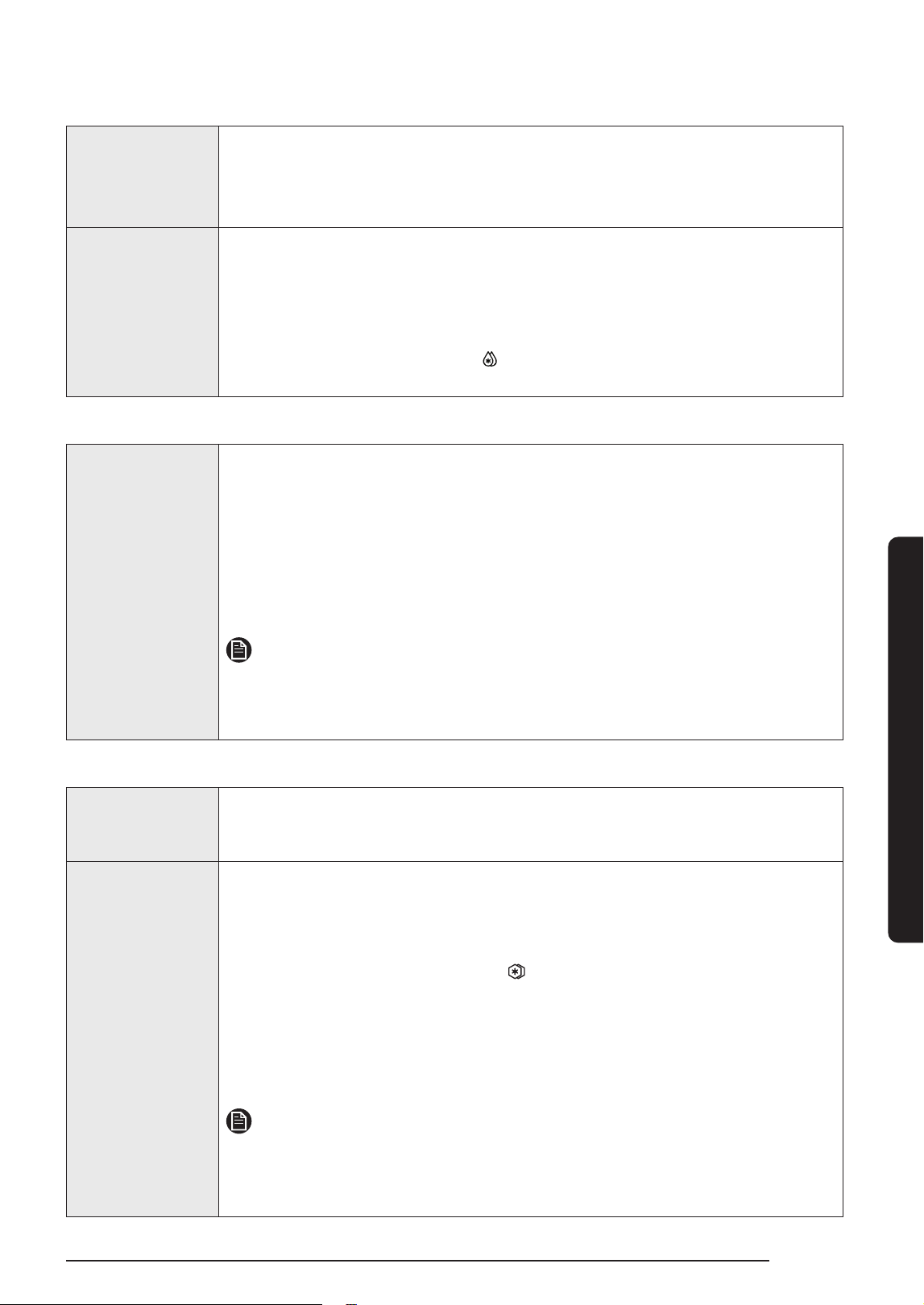
01 Fridge / Power Cool (3 sec)
Fridge
The Fridge button can be used to set the fridge temperature, or to
activate/deactivate Power Cool.
You can manually adjust the cooling temperature for the fridge. Keep
pressing
Fridge to select a desired temperature between 1 °C and 7 °C.
Power Cool
Power Cool speeds up the cooling process at maximum fan speed.
This is useful to quickly cool food that spoils quickly, or after the door
is left open for some time. The fridge keeps running at full speed for
several hours and then returns to the previous temperature.
Press and hold
Fridge for 3 seconds.
The corresponding indicator (
) lights up, and the refrigerator will
speed up the cooling process for you.
02 Vacation (3 sec)
Vacation
If you are going on vacation or a business trip, or if you do not intend
to use the fridge for an extended time, use the Vacation mode.
• To activate Vacation mode, press and hold
Vacation for 3 seconds.
The Vacation On indicator turns on while the display of the fridge
temperatures will turn off. The fridge temperature will be controlled
under 17 °C.
• To deactivate Vacation mode, press and hold
Vacation again for 3
seconds. The fridge temperature will return to the previous setting.
NOTE
• Make sure to remove foods in the fridge compartment before using
Vacation mode.
• The Vacation mode will be disabled if you adjust the temperature.
03 Freezer / Power Freeze (3 sec)
Freezer
The Freezer button can be used to set the freezer temperature, or to
activate Power Freeze. Available temperatures are between -15 °C and
-23 °C.
Power Freeze
Power Freeze speeds up the freezing process at maximum fan speed.
The freezer keeps running at full speed for 50 hours and then returns
to the previous temperature.
• To activate Power Freeze, press and hold
Freezer for 3 seconds.
The corresponding indicator ( ) lights up, and the refrigerator will
speed up the freezing process for you.
• To deactivate, press and hold Freezer for 3 seconds again. The
freezer returns to the previous temperature setting.
• To freeze large amounts of food, activate Power Freeze for at least
20 hours before putting food in the freezer.
NOTE
Using Power Freeze increases power consumption. Make sure you turn
it off and return to the previous temperature if you do not intend to
use it.
English
26
Operations
04 Ice Maker / Filter Reset (3 sec)
Ice Maker
Press Ice Maker to turn the ice maker on or off.
The ice maker has 2 indicators (
/ ) to
indicate the operating status.
• When the ice maker operates, the corresponding indicator (
) turns on.
• When the ice maker is turned off, the corresponding indicator (
) turns on. In this case, ice making is disabled even
if you press the Cubed Ice or Crushed Ice buttons on the dispenser
panel. To enable ice making, you must turn the ice maker on.
• When the ice maker is off, pressing the dispenser lever for more
than 5 seconds will automatically turn on the ice maker.
• When you turn the ice maker off, you must wait at least 1 minute
before you can turn it back on.
CAUTION
If the ice bucket has been removed, you must turn the ice maker off.
NOTE
If the ice maker is turned off, it will turn on if you press and hold the
ice lever for more than 5 seconds.
Filter Reset
After about 6 months (approximately 300 gallons) of using the original
water lter, the Filter indicator turns red to remind you that the lter
needs to be replaced. The Filter indicator blinks ref for several seconds
when you open the door, reminding you that the lter needs to be
replaced. If this happens, replace the lter, and press and hold Filter
Reset for 3 seconds. The lter indicator will be reset, and the Filter
indicator turns off.
NOTE
Some regional areas have relatively large amounts of lime contained
in the water. This may reduce the lifecycle of the lter. In these areas,
you will have to replace the water lter more often than specied
above.
05 Door Alarm
Door Alarm
You can set the alarm for a reminder. If the door is left open for more
than 2 minutes, the alarm will sound with the alarm indicator blinking.
The alarm is enabled by factory default. To disable the alarm, press
Door Alarm. To enable, press Door Alarm again.
If the door is left open for 5 minutes, internal lights (in the fridge
and freezer) will blink for 10 seconds and then turn on. This will be
repeated every minute for 5 minutes. This is to alert hearing-impaired
users that a door is open and it is normal.
English 27
Operations
06 Lock (3 sec)/Wi-Fi On or Off (10 sec)
Lock
(Main panel)
To prevent accidental setting changes, press and hold
Lock for 3
seconds. The main panel will be disabled and the Lock indicator ( )
will turn on.
When Lock is on, the indicator blinks if any button on the main panel
is pressed.
If you press and hold the button again for more than 3 seconds, Lock
will be deactivated.
However, Lock will be reactivated if no button is pressed within 1
minute.
NOTE
Lock on the main panel does not affect the dispenser. The dispenser
operates independently and so does the dispenser lever. To lock
the dispenser and the dispenser lever, use the Lock function on the
dispenser.
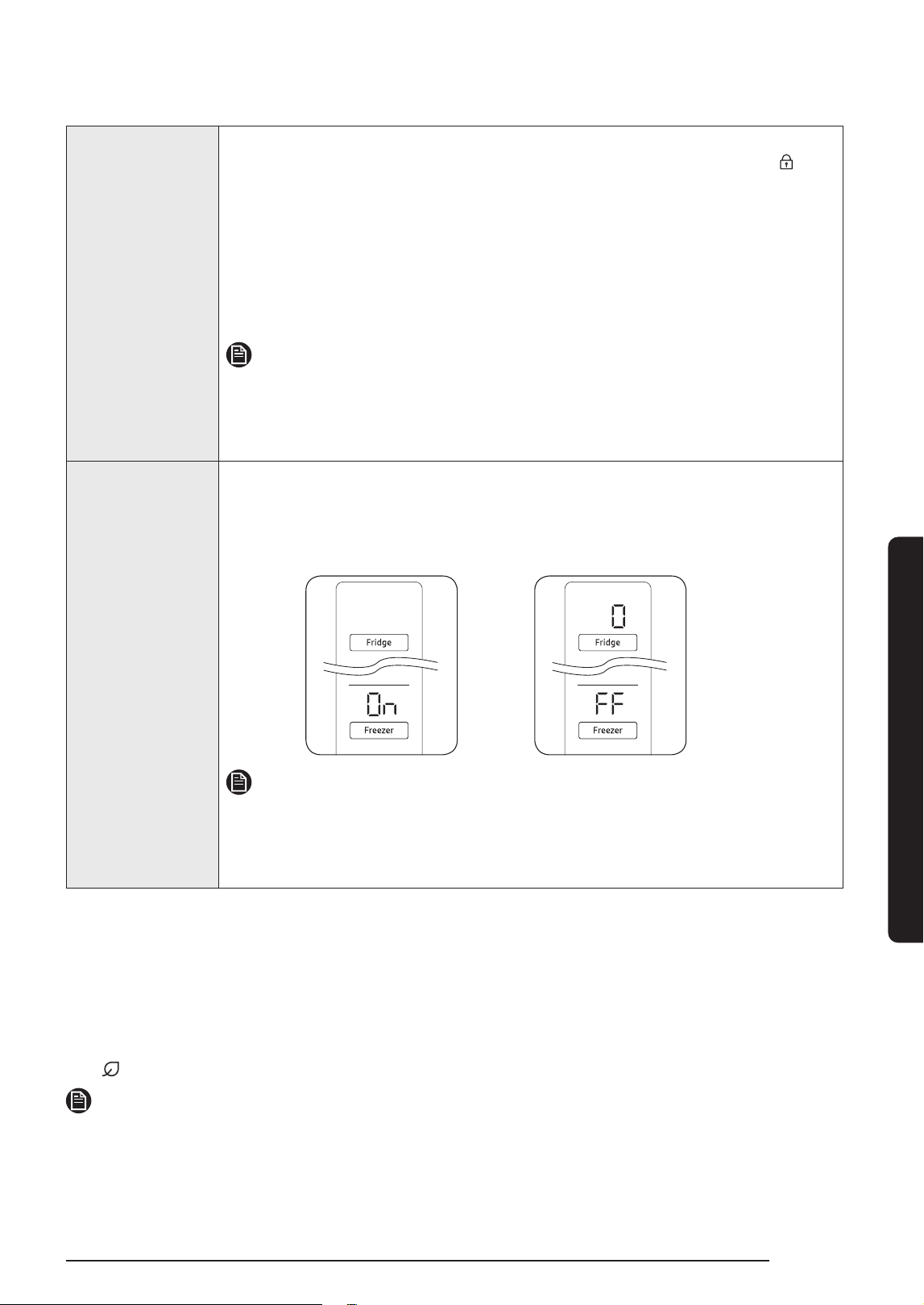
Wi-Fi On or Off
To turn the Wi-Fi on or off, press Lock button for 10 seconds. The
display shows the status of Wi-Fi for 5 seconds (as shown in the
gure).
WI-Fi On Wi-Fi Off
NOTE
• You must turn on the Wi-Fi to connect the refrigerator to the
SmartThings app.
• For more information, see the SmartThings (applicable models only)
section.
07 Network connection
This icon indicates that the refrigerator is connected to a network. If the Wi-Fi icon
ashes, we recommend connecting your refrigerator with the SmartThings app. You can
control and monitor your refrigerator on the SmartThings app. For more information, see
the SmartThings (applicable models only) section.
08 AI energy mode
The
icon appears if you turn on the AI energy mode in the SmartThings app.
NOTE
• When the alarm sounds, you can press any button on the Main panel to turn off the
alarm.
• Even if the alarm sound is turned off, the alarm will sound again after 12 hours if the
cause of the alarm sound is unresolved.
English
28
Operations
SmartThings
Installation
Visit the Google Play Store, Galaxy Apps, or Apple App Store and search for “SmartThings”.
Download and install the SmartThings app provided by Samsung Electronics to your smart
device.
NOTE
• The supporting software version of the SmartThings app is subject to change according
to the OS supporting policy the manufacturer provides. In addition, as for the
SmartThings app or the functions that the app supports, the new application update
policy on the existing OS version can be suspended due to usability or security reasons.
• The SmartThings app is subject to change without notice to improve usability or
performance. As the mobile phone OS version is updated every year, the SmartThings
is also updated continually according to the latest OS. If you have enquiries regarding
the items mentioned above, please contact us at [email protected]
• Recommended encryption systems include WPA/TKIP and WPA2/AES. Any newer or
non-standard Wi-Fi authentication protocols are not supported.
• Wireless networks may be affected by the surrounding wireless communication
environment.
• If your Internet service provider has registered the MAC address of your PC or modem
for identication, your Samsung Smart Refrigerator may fail to connect to the Internet.
If this happens, contact your Internet service provider for technical assistance.
• The rewall settings of your network system may prevent your Samsung Smart
Refrigerator from accessing the Internet. Contact your Internet service provider for
technical assistance. If this symptom continues, contact a local Samsung service center
or retailer.
• To congure the wireless access point (AP) settings, see the user manual of the AP
(router).
• Samsung Smart Refrigerators support IEEE 802.11 b/g/n (2.4 GHz) protocols. (IEEE
802.11 n is recommended.)
• Unauthorized Wi-Fi wireless routers may fail to connect to applicable Samsung Smart
Refrigerators.
Samsung account
You are required to register your Samsung account to use the app. If you don’t have a
Samsung account, follow the app’s onscreen instructions to create a free Samsung account.
Getting started
Turn on the device you want to connect, open the SmartThings app on your phone, and
then follow the instructions below.
If a pop-up appears saying that a new device has been found, tap
ADD NOW.
If a pop-up doesn’t appear, tap the
+ button, and then select the device you want to
connect from the list of available devices.
If your device isn’t in the list of available devices, tap
Supported Devices, select the device
type (Refrigerator), and then select the specic device model.
English 29
Follow the instructions in the app to set up your device. Once setup is complete, your
refrigerator will appear as a “card” on your
Devices screen.
SmartThings app
Integrated control
You can monitor and control your refrigerator at home and on the go.
• Tap the refrigerator icon on the SmartThings Dashboard or tap the Devices icon at the
bottom of the Dashboard, and then tap the refrigerator “card” to open the Refrigerator
page.
• Check the operation status or notications related to your refrigerator, and then
change options or settings if necessary.
NOTE
Some options or settings of the refrigerator may not be available for remote control.
Refrigerator settings
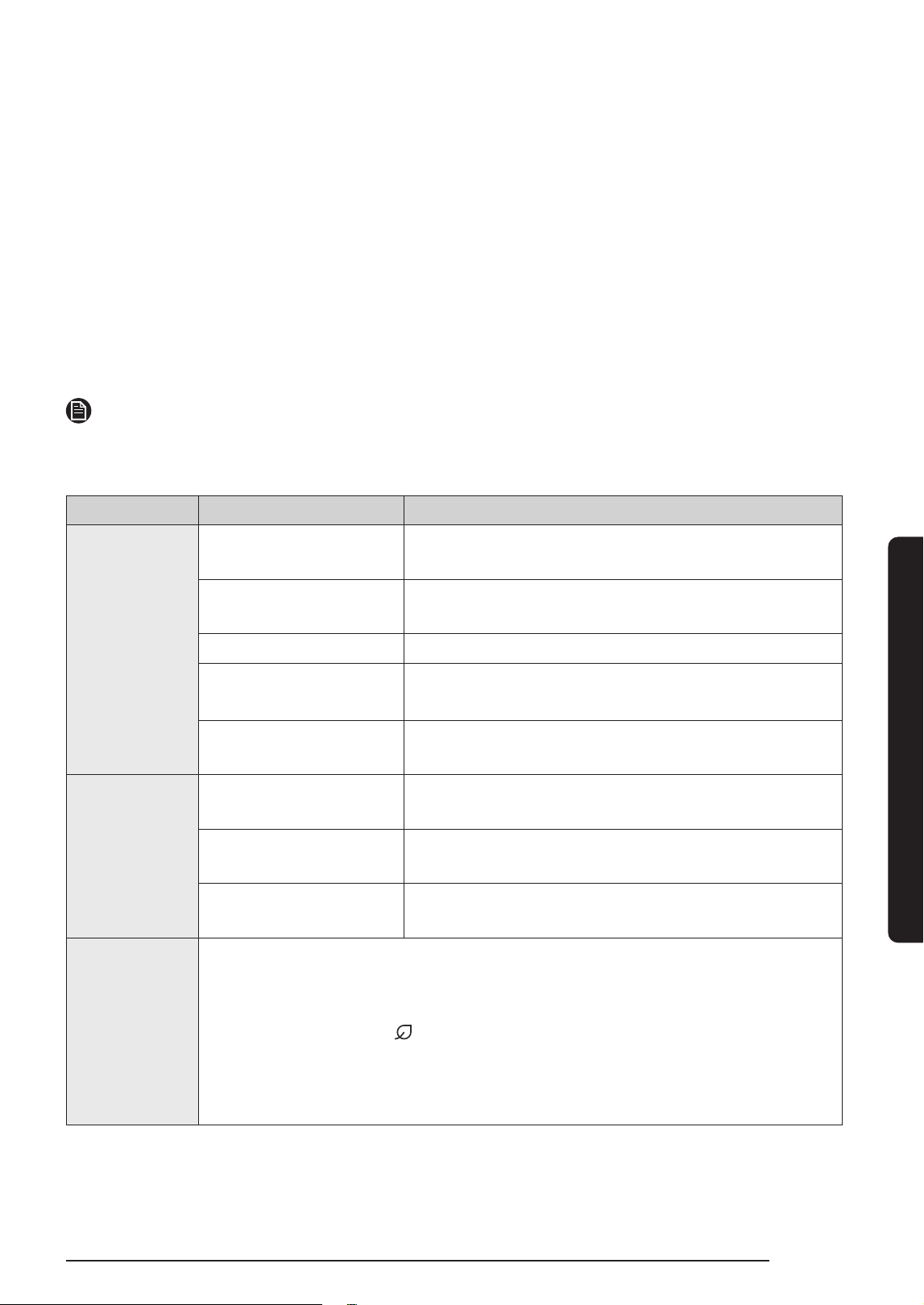
Category Item Description
Monitor &
Control
Fridge temperature
You can set and monitor the desired temperature
of the fridge.
Freezer temperature
You can set and monitor the desired temperature
of the freezer.
Ice Maker * You can turn the ice maker on or off.
Power Cool
You can turn Power Cool on or off, and check the
current settings.
Power Freeze
You can turn Power Freeze on or off, and check
the current settings.
Alarms
Abnormally high
temperature
This alarm triggers when the temperature of the
refrigerator is abnormally high.
Door opening
This alarm triggers if the door is open for a
specic time.
Water lter
replacement*
This alarm reminds you that the water lter must
be replaced.
AI Energy
Mode *
You can turn on or off the AI Energy Mode under the Energy menu in the
SmartThings app.
You can check the status of the AI Energy Mode on the SmartThings app.
On some models, the
icon appears on the main panel to indicate that
AI Energy Mode is on. (applicable models only)
Turning on the AI Energy Mode decreases energy consumption, but it
may also reduce the cooling performance.
* applicable models only
Operations
English
30
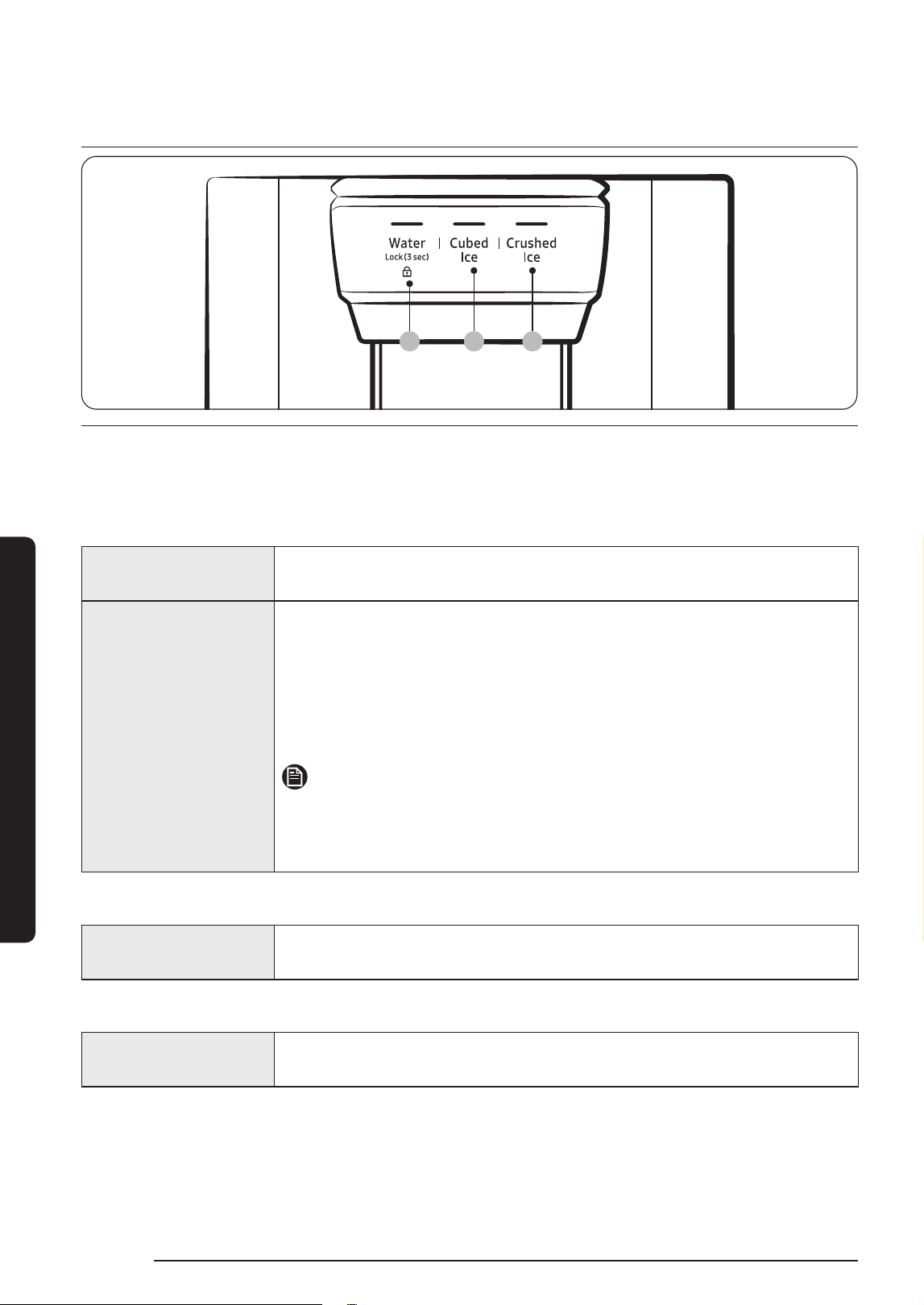
Dispenser panel (applicable models only)
01 02 03
01 Water / Lock 02 Cubed Ice
03 Crushed Ice
01 Water / Lock (3 sec)
Water
To dispense chilled water, press Water. The corresponding
indicator turns on.
Lock
(Dispenser panel /
Dispenser lever)
To prevent use of the dispenser panel buttons and the dispenser
lever, press and hold
Water for more than 3 seconds.
If you press and hold the button again for more than 3 seconds,
the dispenser lock will be deactivated.
When dispenser lock is on, the indicator blinks if any button on
the dispenser panel is pressed or the dispenser lever is pressed.
NOTE
The Lock on the dispenser panel does not affect the controls on
the main panel. To lock the main panel, use the Lock function on
the main panel.
02 Cubed Ice
Cubed Ice
Press Cubed Ice to dispense cubed ice. The corresponding
indicator turns on.
03 Crushed Ice
Crushed Ice
Press Crushed Ice to dispense crushed ice. The corresponding
indicator turns on.
Operations
English 31
Operations
Special features
The refrigerator features user-oriented devices that you can use to benet from.
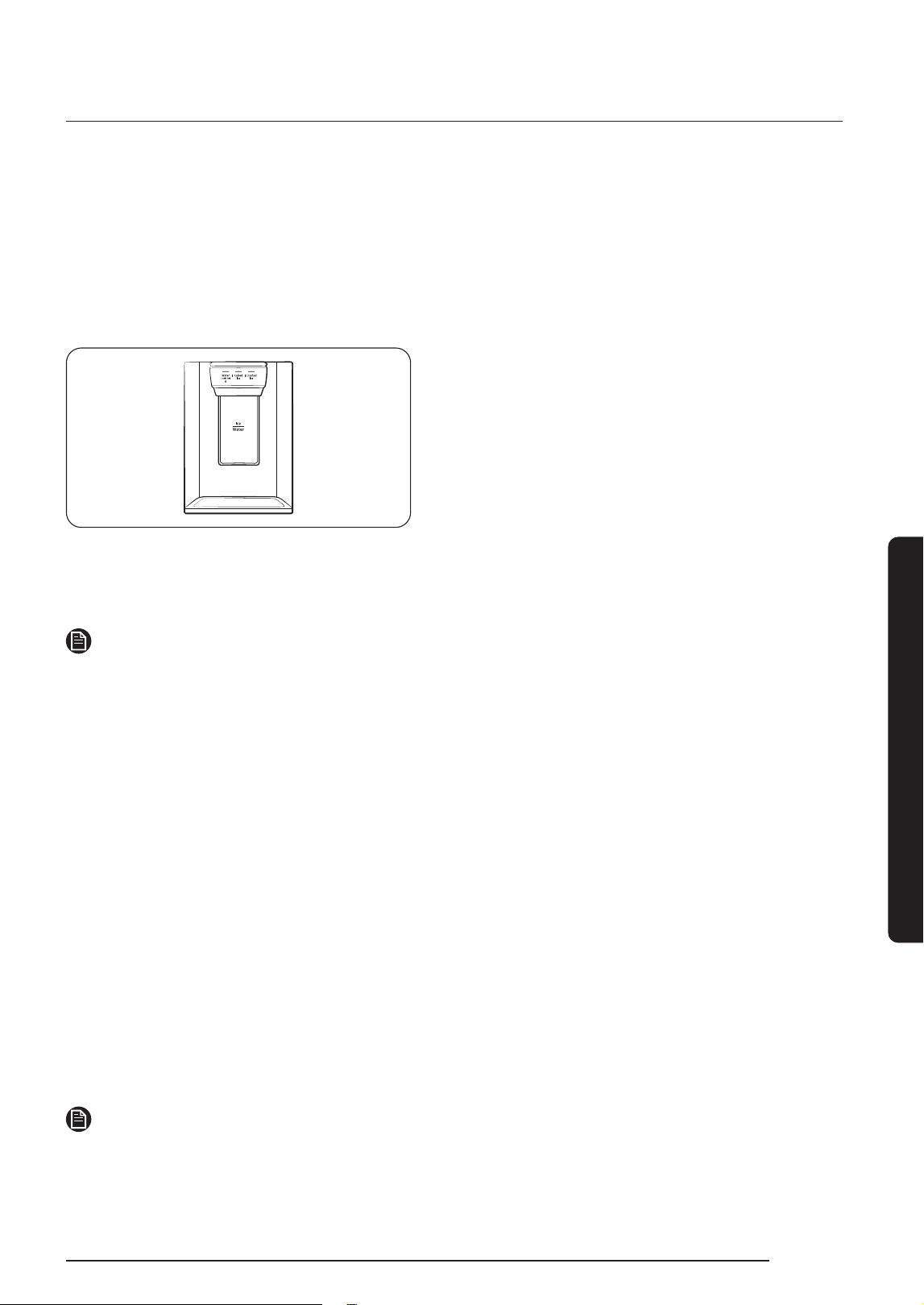
Water/Ice dispenser (applicable models only)
Using the dispenser, you can dispense water with or without ice.
The water dispenser offers 3 options: chilled water, cubed ice, and crushed ice. To
dispense chilled water, press Water on the dispenser panel. Put a water glass under the
dispenser, and then push the dispenser lever.
To dispense water with ice
1. With the Ice Maker enabled, press
Cubed Ice or Crushed Ice to select the
ice type.
2. Put a water glass under the dispenser,
and then push the dispenser lever with
the glass. Ice will be dispensed from the
dispenser.
3. Press Water to select water.
4. Push the dispenser lever with the
glass. Water will be dispensed from the
dispenser.
NOTE
• The dispenser will stop dispensing if you keep pushing the dispenser lever for about 1
minute. To dispense more water, release and push the lever again.
• Make sure the glass is in line with the dispenser to prevent the dispensed water from
spilling out.
• If you do not use the water dispenser for 2-3 days, the dispensed water may have an
abnormal smell or taste. This is not a system failure. Discard the rst 1-2 glasses of
water.
Ice maker (applicable models only)
The refrigerator has a built-in ice maker that automatically dispenses ice so that you can
enjoy ltered water with cubed or crushed ice.
Ice making
After you have installed your refrigerator and plugged it in, follow these instructions to
ensure proper ice making and to keep the ice bucket full of ice:
1. Let the refrigerator operate for at least 24 hours to ensure optimal performance.
2. Dispense the rst 4 to 6 ice cubes into a glass.
3. Wait another 8 hours and dispense another 4 to 6 ice cubes.
4. Then, wait another 16 hours and dispense the rst glass-full of ice.
NOTE
• If you consume all the ice at once, you must wait 8 hours before dispensing the rst 4
to 6 cubes. This ensures that the ice bucket is lled with ice properly.
• Ice cubes generated rapidly may look white, which is normal.
English
32
Operations
CAUTION
Dispense the ice according to the size of the cup.
• If you dispense excessive amount, ice may fall out on the ground and cause personal
injury.
• Ice may accumulate and block the ice chute.
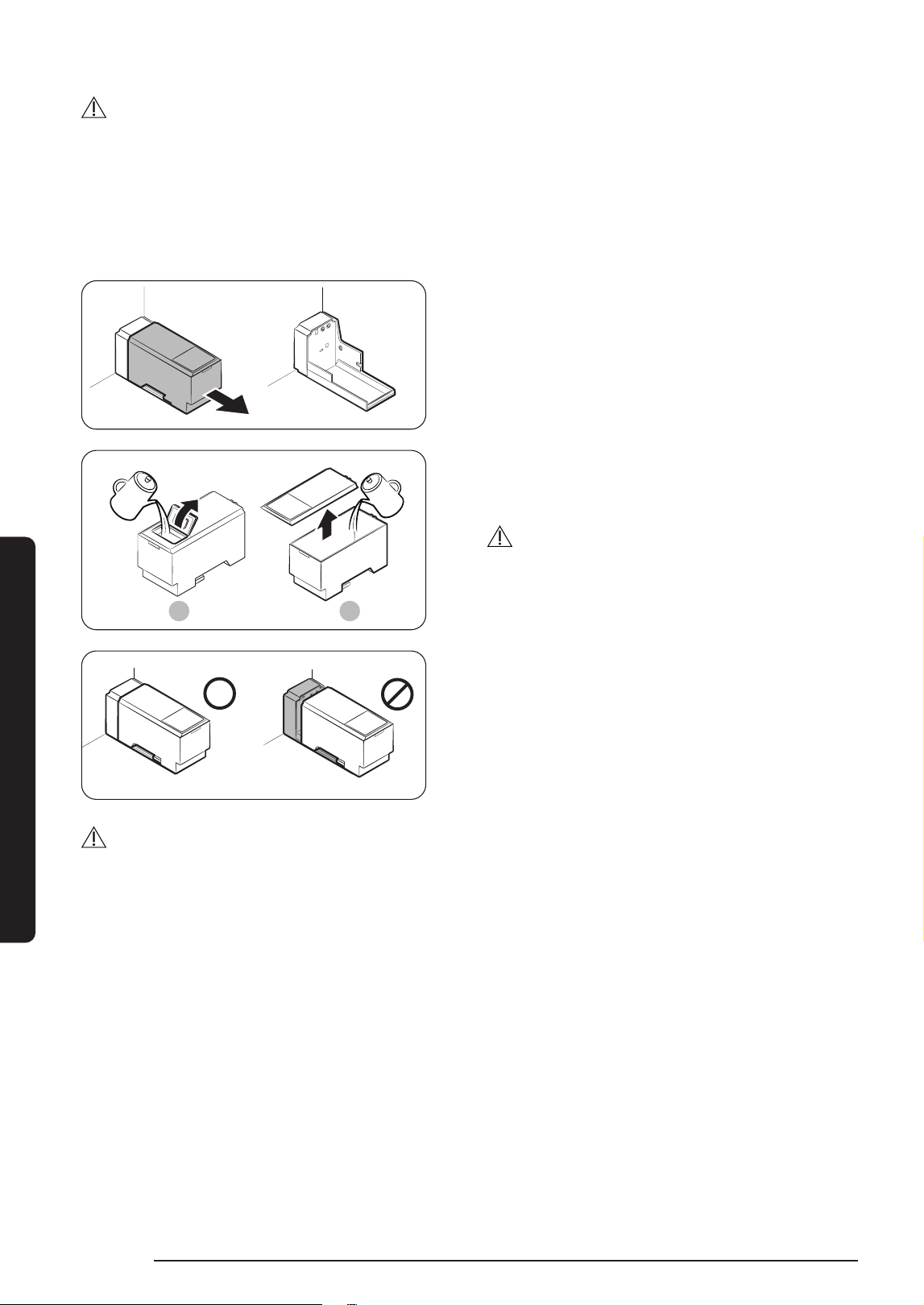
To ll the water tank (applicable models only)
For rst-time use, clean the inner side of
the water tank and dry well.
1. Hold both handgrips on the front of the
tank, and slide out as shown.
A B
2. Open the front lid (A) of the cover or
the entire cover (B) and ll the tank
with a max of 5 litres water.
CAUTION
Do not exceed the max line. Water
overows.
3. Reinsert the water tank and t into the
dispenser mechanism. Make sure the
front side (with the front lid) of the tank
faces to the front.
CAUTION
• Make sure the water tank ts into the shelf. Otherwise, the water tank may not operate
properly.
• Do not use the refrigerator without inserting the water tank. This may decrease the
cooling performance.
• Fill the tank only with potable water such as mineral or puried water. Do not use
other liquid.
• Use caution when moving a lled tank. Physical injury may occur if the tank is
dropped.
• Do not try to disassemble the internal pump yourself. If the internal pump is damaged
or disconnected from the water tank, the dispenser does not operate.
For rst-time use
• Push the dispenser lever for 10 seconds to emit air from the hoses of the water supply
system.
• Discard the rst six glasses of water to remove impurities in the water supply system.
English 33
Operations
Ice making (applicable models only)
The refrigerator has a built-in ice maker that automatically dispenses ice so that you can
enjoy ltered water with cubed or crushed ice to your preference.
A B
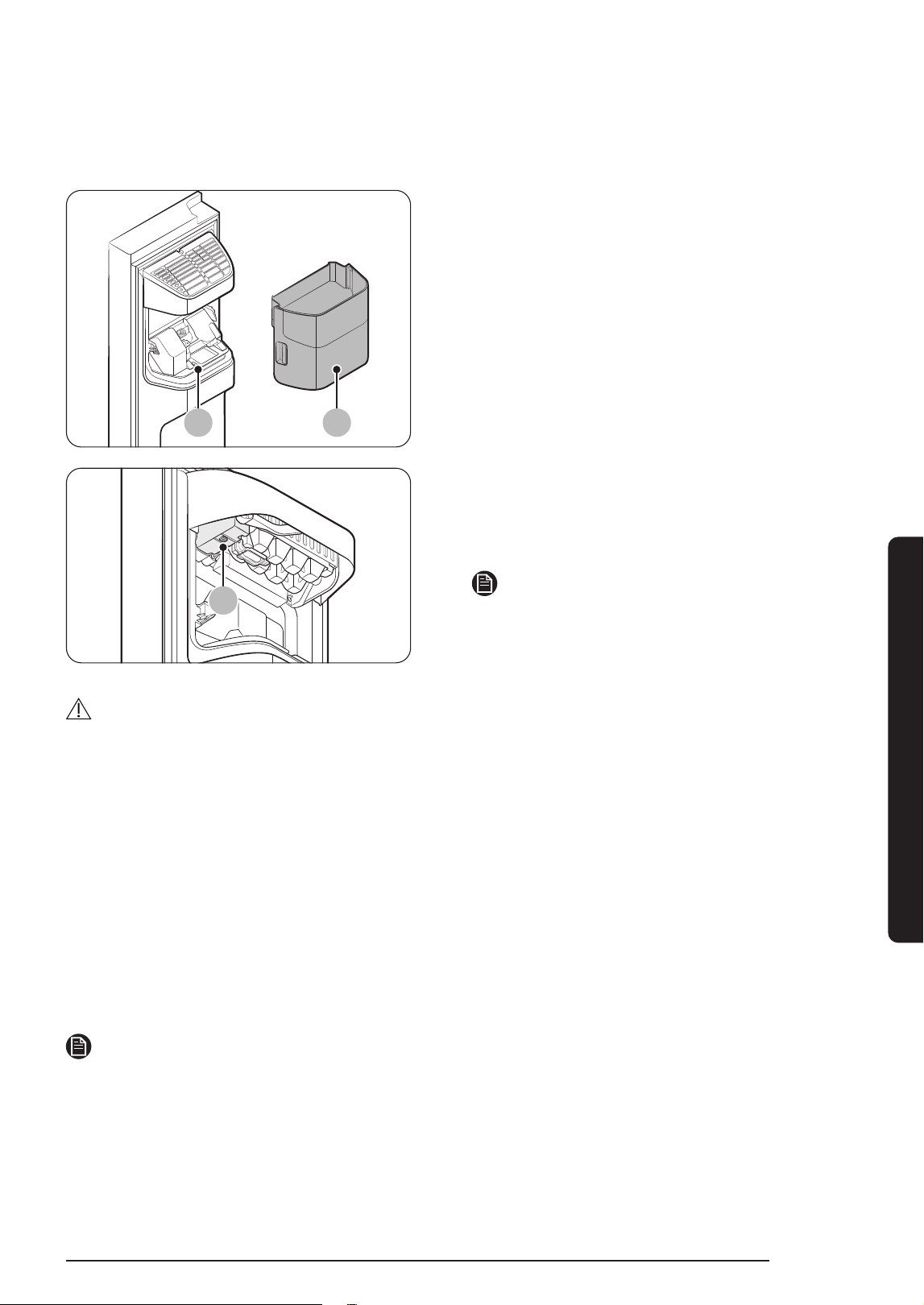
If ice does not dispense, rst check the ice
maker if it makes ice properly.
To check the ice maker
1. Gently hold the icemaker bucket (B)
with both hands and remove it from the
ice chute (A).
2. Check the icemaker bucket if it contains
ice as appropriate.
C
3. Press the button (C) on the bottom of
the ice maker.
4. You will hear a chime if the ice maker
operates properly.
NOTE
If this symptom continues, contact the
water line installer or a local Samsung
service centre.
CAUTION
• Do not press the button repeatedly after the ice tray is lled with ice or water. Water
may overow or ice may be jammed.
• When the refrigerator recovers power supply after a power failure, the icemaker
bucket may contain a mix of melted and jammed ice cubes, resulting in a system
failure. To prevent this, make sure to empty the icemaker bucket before using the
refrigerator.
• To prevent dropping the icemaker bucket, make sure to use both hands when removing
or reinserting the icemaker bucket.
• Do not let children hang on or play with the ice dispenser or the icemaker bucket.
Children may get hurt.
• Do not put ngers or other objects into the dispenser hole or the ice chute. This may
cause physical injury or property damage.
NOTE
• Removal of the icemaker bucket does not affect the thermal and mechanical
performance of the refrigerator.
• The declared freezer volume is measured with the freezer guide and the bottom shelf,
after removing the ice maker, upper and lower drawers.
English
34
Operations
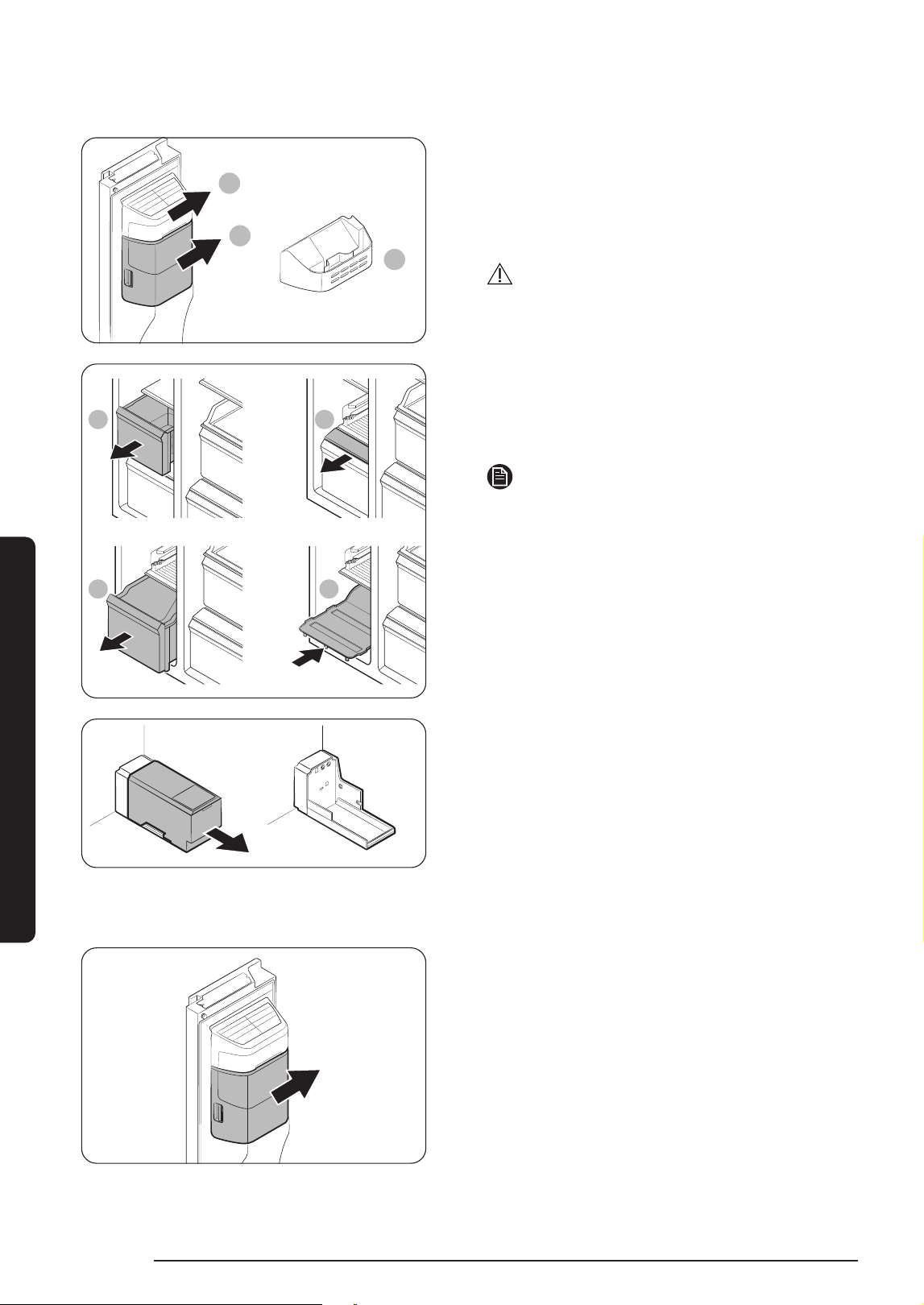
To secure more storage space (applicable models only)
A
B
G
If you do not use the ice maker and need
more storage space, remove the icemaker
bucket (A) and ice maker cover (G). Then,
insert the Freezer guard (Optional) (B) into
the icemaker bucket’s place.
CAUTION
If the ice bucket has been removed, you
must turn the ice maker off.
C
D F
E
To secure more space, remove the upper
drawer (C), lower drawer (D), and lower
drawer cover (E). Then, insert the provided
bottom shelf (F).
NOTE
• Removing the drawers does not affect
the temperature or usage of the freezer.
• The declared freezer volume is
measured with the bottom shelf, after
removing the upper drawer, lower
drawer, and lower drawer cover.
For more space, remove the water tank
and use the space to store more items.
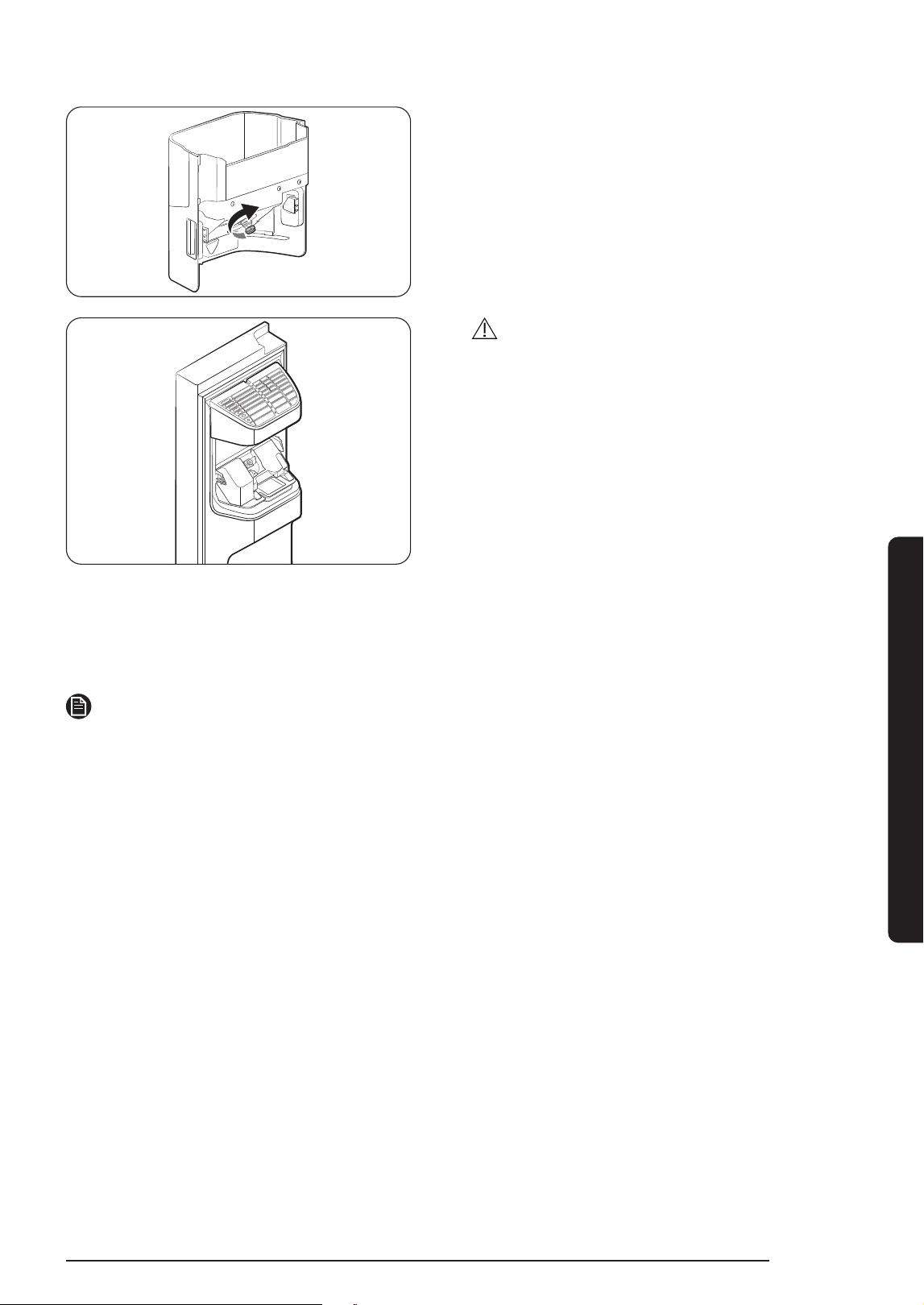
Icemaker bucket
If you do not dispense ice for an extended
period, ice may form clumps inside the
bucket. If this happens, remove and empty
the icemaker bucket.
1. To remove the icemaker bucket, gently
lift it up and pull out slowly while
holding the handgrips with both hands.
2. Remove and empty the icemaker
bucket.
English 35
Operations
3. When done, turn the gear handle on the
rear of the bucket by 90°, and then put
the bucket back into position. Make sure
the bucket is inserted properly until you
hear a clicking sound.
4. Press Ice Maker to reset the ice maker.
CAUTION
• Do not apply excessive force to the
bucket cover. The cover may break.
• Do not close the door hard. Water may
spill over the ice maker.
• To prevent injury, make sure to clean
up any ice or water that has fallen on
the oor.
• To prevent accidents or injury, do
not let children play with the water
dispenser or the ice maker.
• Do not put your hand or an object into
the ice chute. This may cause physical
injury or product damage.
NOTE
• Any sound from the ice maker is normal, which outputs during the ice making process.
• While the door is open, neither the ice maker nor the water dispenser operates.
English
36
Maintenance
Handle and care
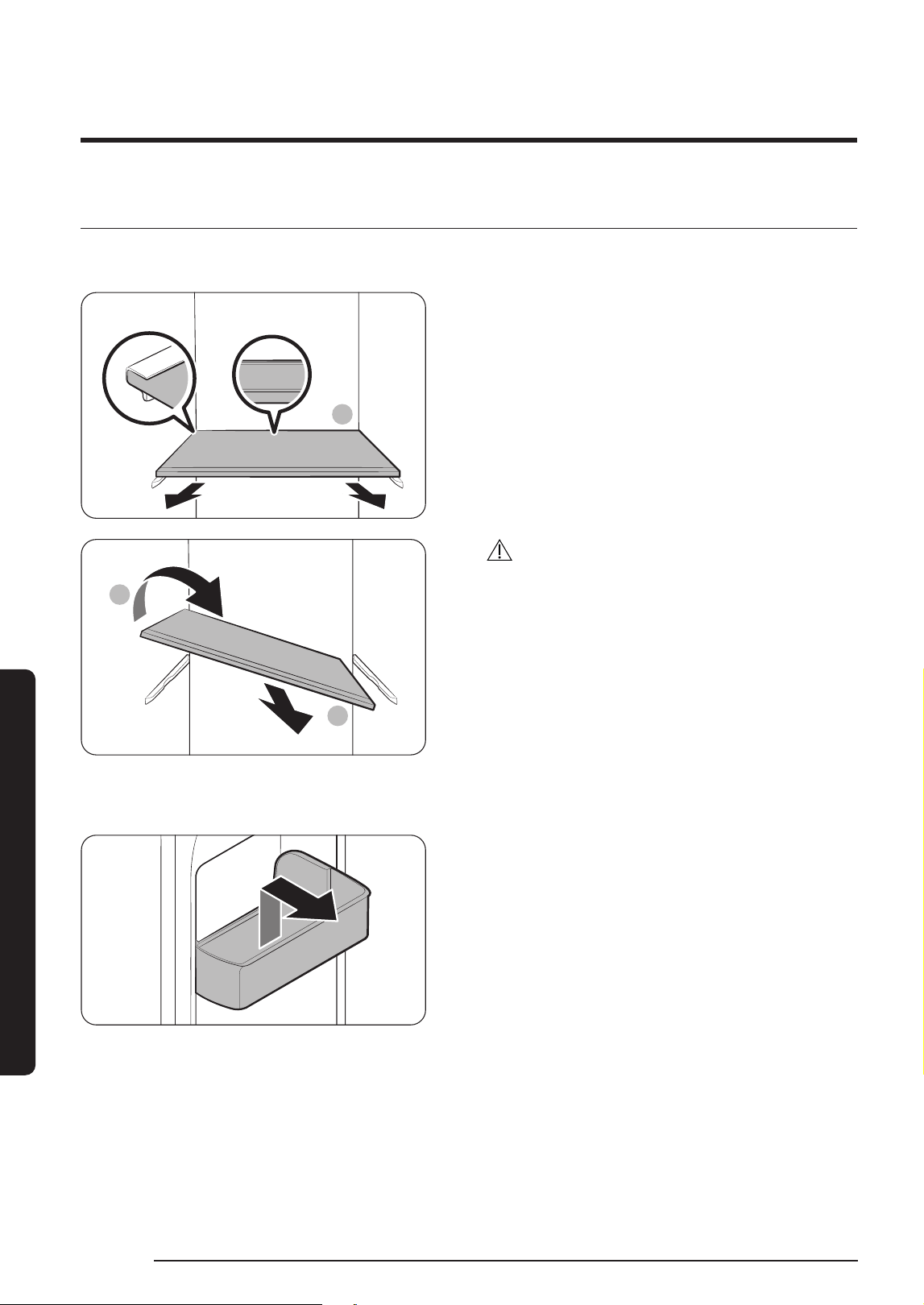
Shelves (fridge/freezer)(applicable models only)
Rear
1
• To remove a shelf, fully open the
corresponding door. Hold the front of
the shelf and gently lift up and slide
out.
• If the door cannot fully open, slide out
the shelf half way to the front and turn
it over to remove.
2
3
CAUTION
• The shelf must be inserted correctly. Do
not insert upside down.
• Glass containers may scratch the
surface of glass shelves.
• Do not insert a shelf in the wine
rack position. This may damage the
refrigerator. (applicable models only)
Door bins
To remove a door bin, hold the front sides
of the bin and gently lift up to remove.
Maintenance
English 37
Maintenance
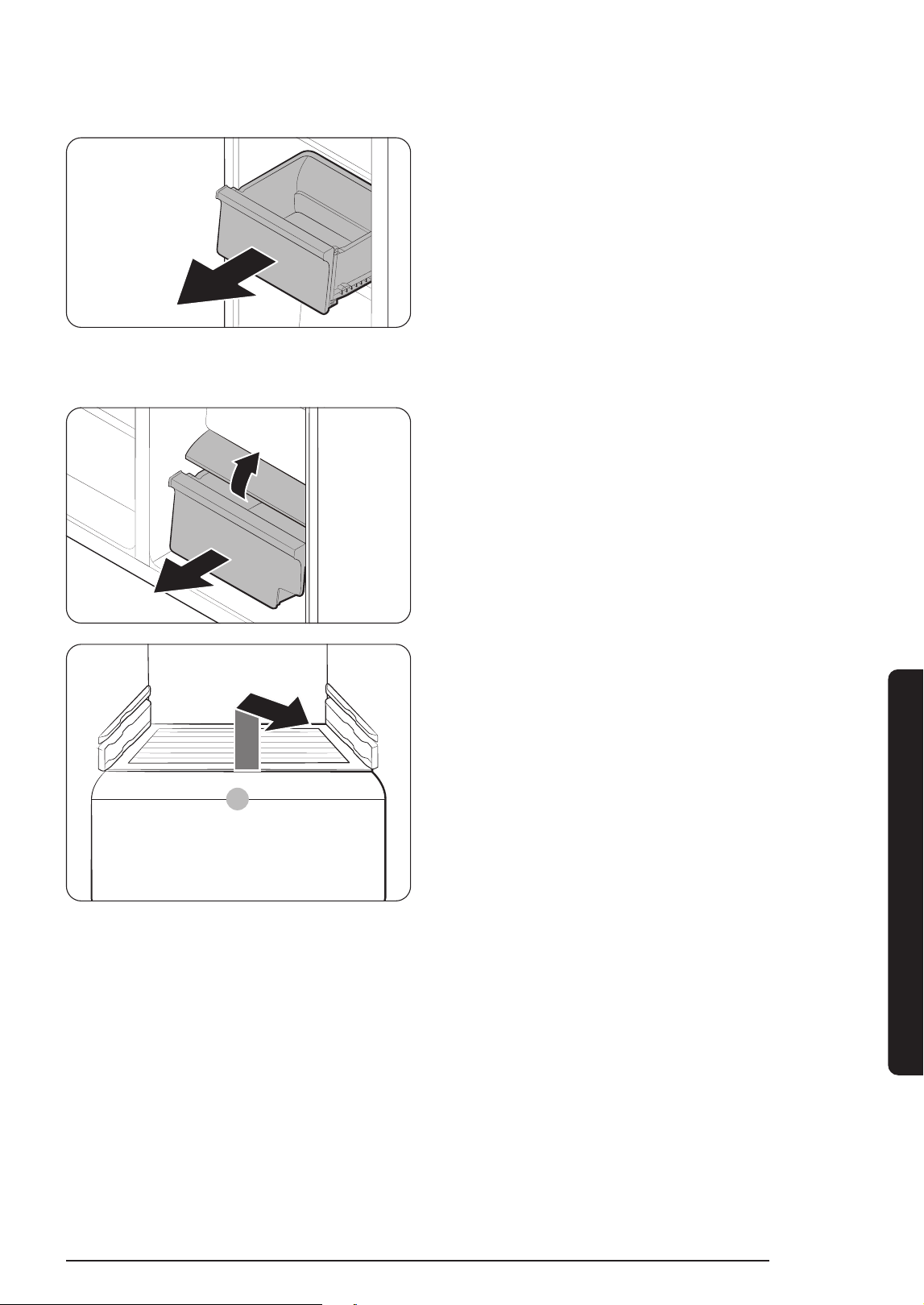
Drawers
Gently lift up the front of the drawer and
slide out.
Vegetable / Dry drawers
To remove the vegetable drawer from the
fridge or the dry drawer from the freezer.
1. First, remove surrounding multipurpose
drawers if necessary.
A
2. Gently pull out the vegetable/dry
drawer.
3. If your refrigerator is provided with a
cover (A) for the vegetable/dry drawer,
remove the cover. For this, hold the
front of the shelf and gently lift up and
slide out.
Icemaker bucket
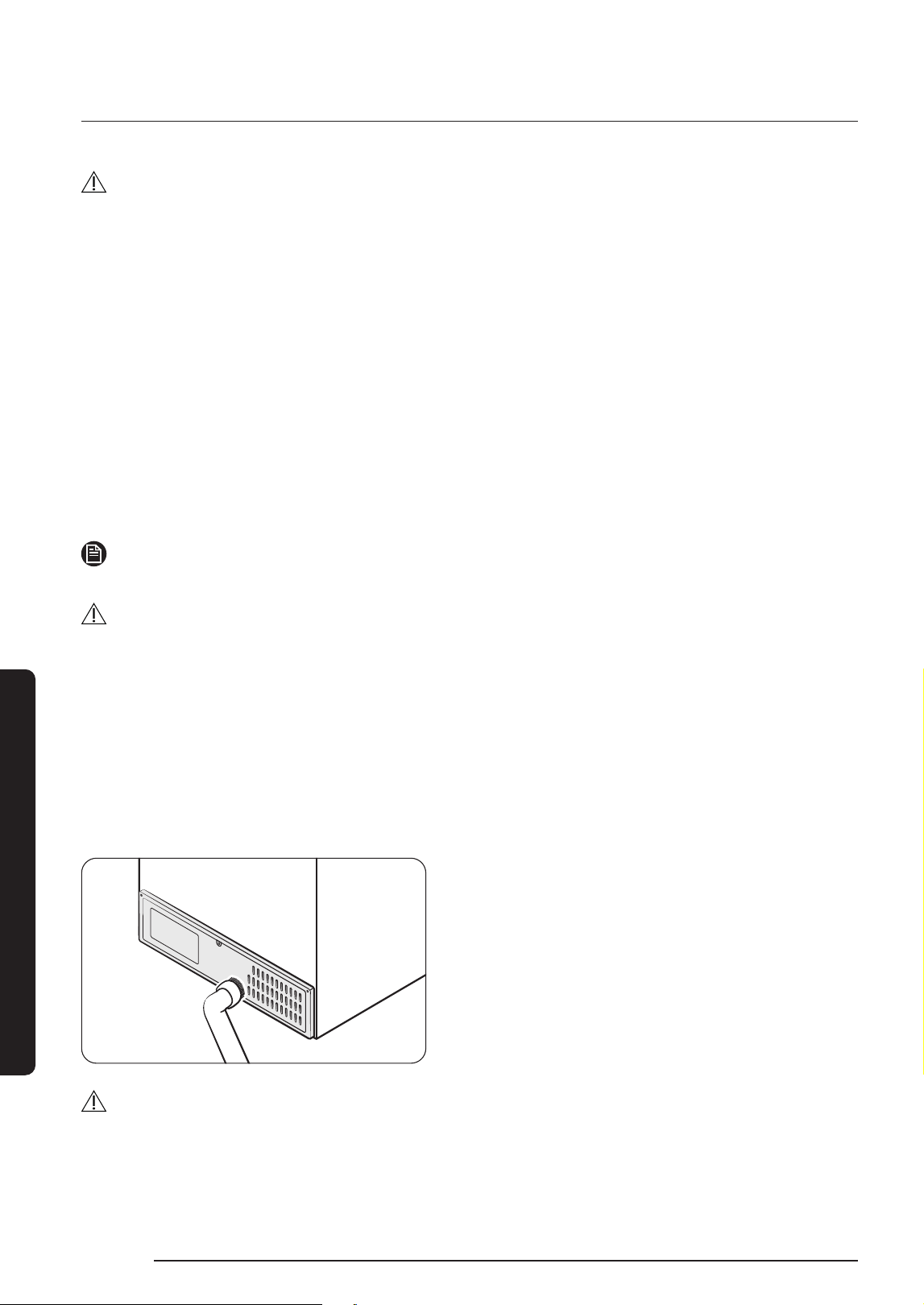
To remove the ice maker bucket, see the Icemaker bucket section on page 34.
English
38
Cleaning
Interior and exterior
WARNING
• Do not use benzene, thinner, or home/car detergent such as Clorox™ for cleaning
purposes. They may damage the surface of the refrigerator and cause a re.
• Do not spray water onto the refrigerator. This may cause electric shock.
• Do not put ngers or other objects into the dispenser hole.
Regularly use a dry cloth to remove all foreign substances such as dust or water from the
power plug terminals and contact points.
1. Unplug the power cord.
2. Use a moistened, soft, lint-free cloth or paper towel to clean the refrigerator’s interior
and exterior.
3. When done, use a dry cloth or paper towel to dry well.
4. Plug in the power cord.
Ice / Water dispenser (applicable models only)
NOTE
For hygienic purposes, frequently clean the dispenser area.
CAUTION
When crushed ice is selected, some residual ice chips may collect in the ice chute. To
prevent this, remove the residual ice from the chute using a soft, clean cloth.
Rubber seals
If the rubber seals of a door become dirty, the door may not close properly and reducing
refrigerator performance and efciency. Use a mild detergent and damp cloth to clean the
rubber seals. Then, dry well with a cloth.
Rear panel
To keep cords and exposed parts of the
rear panel free of dirt, vacuum the panel
once or twice a year.
CAUTION
Do not remove the rear panel cover. Electric shock may occur.
Maintenance
English 39
Maintenance
Replacement
Water lter (applicable models only)
CAUTION
• Do not use third-party water lters. Use only Samsung-provided or -approved lters.
• Unapproved lters may leak and damage the refrigerator, causing electric shock.
Samsung holds no responsibility for any damage that may occur from use of third
party water lters.
• The lter indicator turns red as a reminder that lets you know it is time to replace the
water lter.
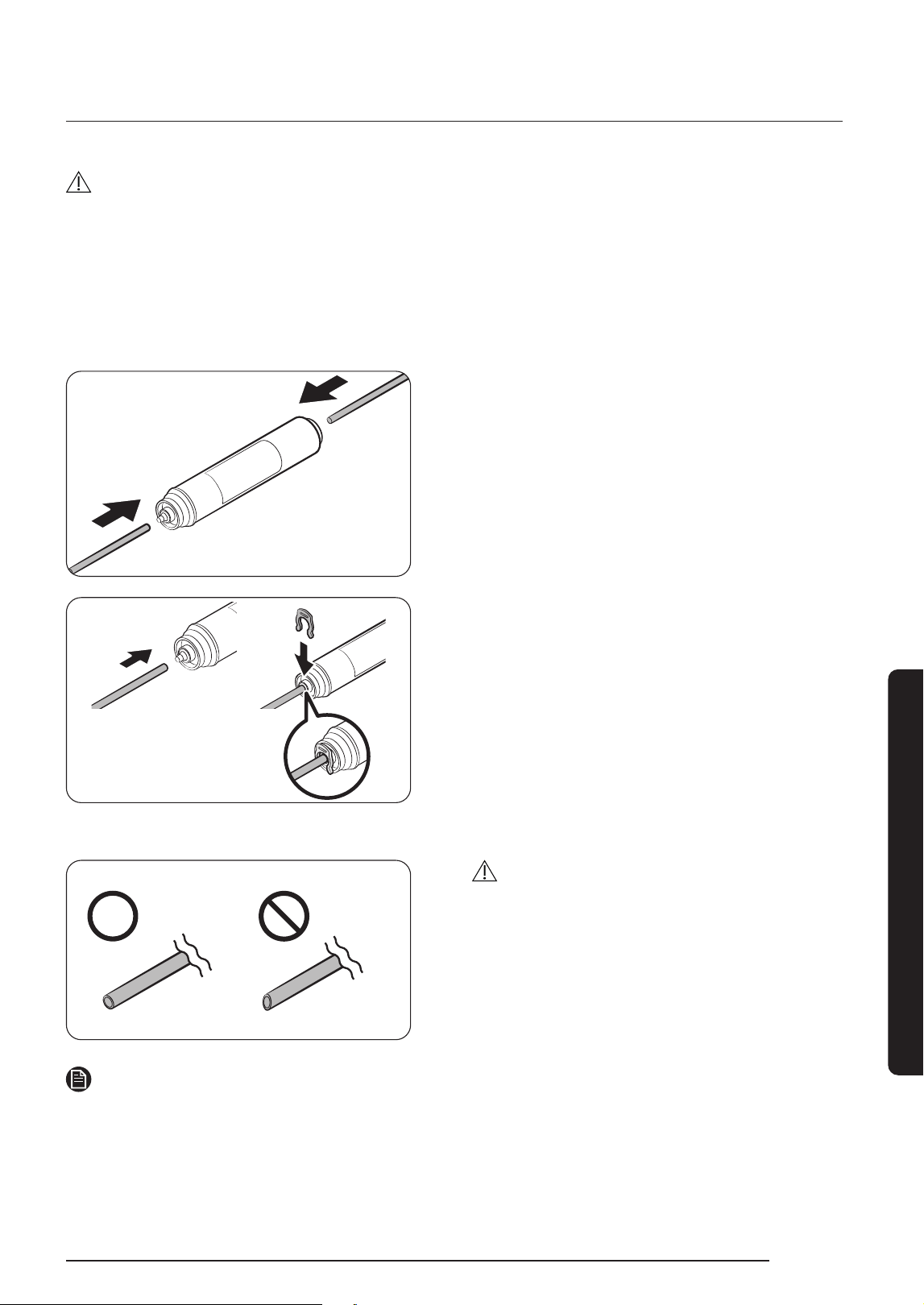
1. Shut off the main water supply.
2. Connect the water supply line to the
inlet side of the lter to the end.
3. Connect the dispenser line to the outlet
side of the lter.
4. Check if there is any leak. If not, x the
lines with the clips.
5. Put the water lter into place and x it
with the clips.
6. Press and hold Filter Reset for 3
seconds to reset the lter lifecycle.
7. When replacing is complete, ush 1 litre
of water to remove impurities from the
water line.
CAUTION
When adjusting the length of the water
line tubing, make sure to smooth out the
cut surface at a right angle. This is to
prevent a water leak.
NOTE
• A newly installed lter may cause the water dispenser to spurt water briey. This is
because air has entered the water line.
• This replacement process may involve the refrigerator to drip water onto the oor. If
this happens, wipe up with dry cloths.
English
40
Reverse osmosis water ltration system
The water pressure of the water supply system to a reverse osmosis water ltration
system must be between 206 kPa (30 psi) and 861 kPa (125 psi).
The water pressure of the reverse osmosis water ltration system to the refrigerator’s
cold water line must be at least 206 kPa (30 psi). If the water pressure is below the
specied:
• Check if the sediment lter in the reverse osmosis system is blocked. Replace the lter
if necessary.
• Rell the water tank in the reverse osmosis system with water.
• If your refrigerator has a water lter, it may further reduce the water pressure when
used in conjunction with a reverse osmosis system. Remove the water lter.
For more information or servicing, contact a licensed plumbing professional.
Ordering a new lter
To purchase a new water lter (part type: HAFEX/EXP), contact a local Samsung service
centre.
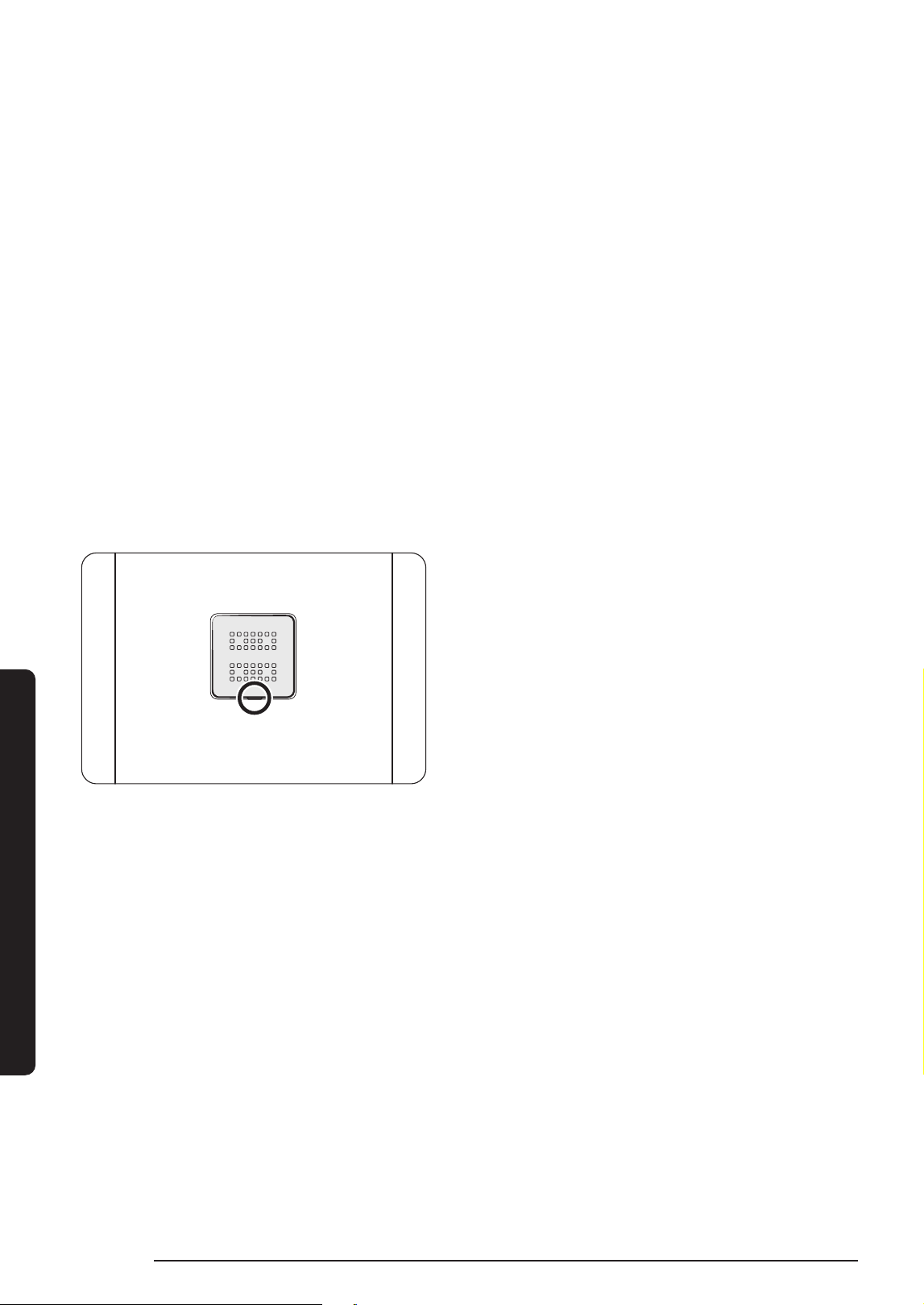
Deodorizer lter
• Put the at-head driver in the groove
on the bottom of the deodorizer lter
cover, and pry up. Replace the lter,
and then put the lter cover back.
• The recommended usage period of the
deodorizer lter is one year, and the
period may vary depending on your
usage. You can purchase the deodorizer
lter separately from the service center.
Lamps
The lamps are not user-serviceable. To replace the lamps of the refrigerator, contact a
local Samsung service centre.
Lamp (Light Source)
This product contains a light source of energy efciency class <G>.
The lamp(s) and/or control gear(s) are not user-serviceable. To replace the lamp(s) and/or
control gear(s) in the product, contact a local Samsung service centre.
For detailed instructions on replacing lamp(s) or control gear(s) in your product, visit the
Samsung website (http://www.samsung.com), go to Support > Support home, and then
enter the model name.
For detailed instructions on dismantling lamp(s) and/or control gear(s), simply follow the
replacement instruction reached as described above.
Maintenance
English 41
Troubleshooting
Before calling for service, review the checkpoints below. Any service calls regarding
normal situations (No Defect Cases) will be charged to users.
General
Temperature
Symptom Possible causes Solution
Fridge/freezer does
not operate.
Fridge/freezer
temperature is warm.
• Power cord is not plugged in
properly.
• Properly plug in the power
cord.
• Temperature control is not
set correctly.
• Set the temperature lower.
• Refrigerator is located near a
heat source or direct sunlight.
• Keep the refrigerator away
from direct sunlight or a heat
source.
• Not enough clearance
between refrigerator and
nearby walls or cabinets.
• We recommend that the gap
between the refrigerator and
nearby walls (or cabinets) is
more than 50 mm.
• The refrigerator is
overloaded. Food is blocking
the refrigerator vents.
• Do not overload the
refrigerator. Do not allow
food to block vents.
Fridge/freezer is
over-cooling.
• Temperature control is not
set correctly.
• Set the temperature higher.
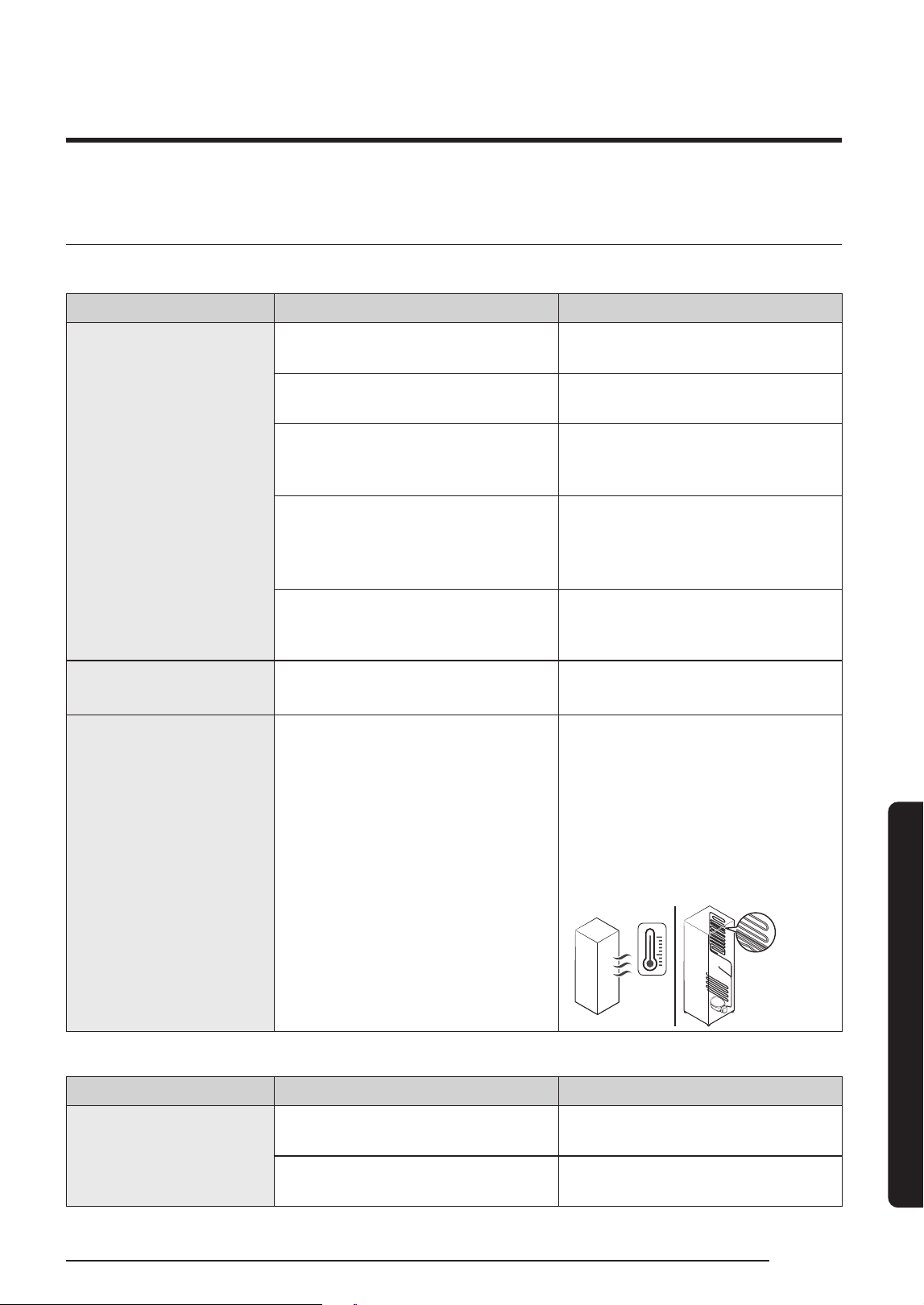
Interior wall is hot.
• Refrigerator has heat-proof
piping in the interior wall.
• To prevent condensation
from forming, the
refrigerator has heat-proof
piping in the front corners.
If the ambient temperature
rises, this equipment may not
work effectively. This is not a
system failure.
Odour
Symptom Possible causes Solution
Refrigerator has
odours.
• Spoiled food.
• Clean the refrigerator and
remove any spoiled food.
• Food with strong odours.
• Make sure strong smelling
food is wrapped airtight.
Troubleshooting
English
42
Frost
Symptom Possible causes Solution
Frost around the
vents.
• Food is blocking the vents.
• Make sure no food blocks the
refrigerator vents.
Frost on interior
walls.
• Door is not closed properly.
• Make sure food does not
block the door. Clean the door
gasket.
Condensation
Symptom Possible causes Solution
Condensation forms
on the interior walls.
• If door is left open, moisture
enters the refrigerator.
• Remove the moisture and
do not leave a door open for
extended periods of time.
• Food with high moisture
content.
• Make sure food is wrapped
airtight.
Water/ice (dispenser models only)
Symptom Possible causes Solution
Water ow is weaker
than normal.
• Water pressure is too low.
• Make sure the water pressure
is between 206 kPa (30 psi) to
861 kPa (125 psi).
Ice maker makes a
buzzing sound.
• The ice maker function is
activated, but the water supply
to the refrigerator has not
been connected.
• Turn off the Ice maker.
Ice maker does not
make ice.
• Ice maker has just been
installed.
• You must wait for 24 hours for
the refrigerator to make ice.
• Freezer temperature is too
high.
• Set the freezer temperature
below -18 °C (0 °F) or -20 °C
(-4 °F) in warm ambient air.
• Dispenser panel Lock is
activated.
• Deactivate dispenser panel
Lock.
• Ice maker is off. • Turn on the ice maker.
Ice does not dispense.
• Ice may jam if the ice
dispenser is not used for a long
time (approx. 3 weeks).
• If you won't be using the
refrigerator for a long time,
empty the ice bucket and turn
off the ice maker.
• Ice bucket is not properly
inserted.
• Make sure the ice bucket is
properly inserted.
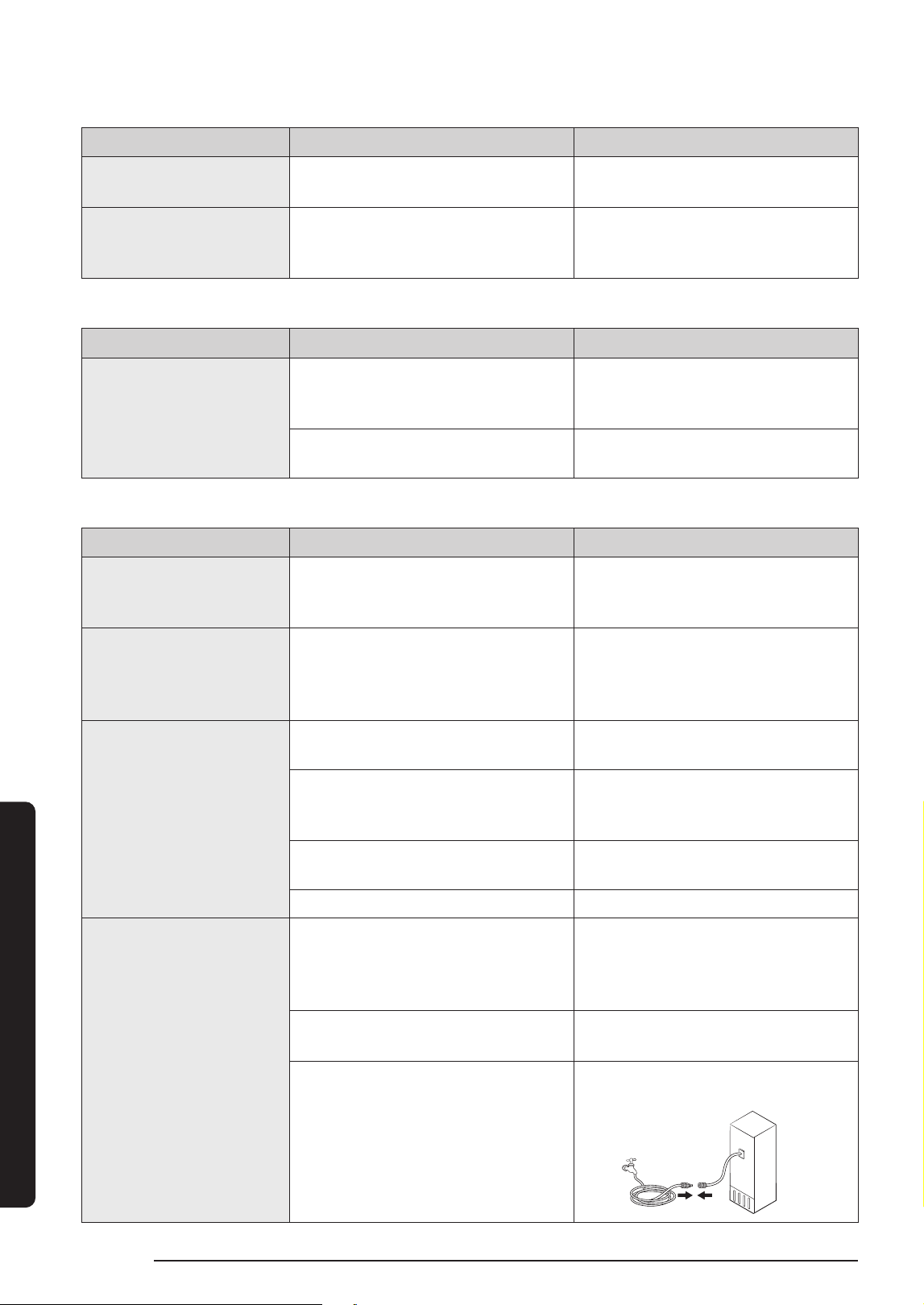
• Water line is not connected
properly or water supply is not
on.
• Check the water
installation conditions.
Troubleshooting
English 43
Troubleshooting
Symptom Possible causes Solution
Water does not
dispense.
• Water line is not connected
properly or water supply is not
on.
• Check the water installation
conditions.
• Dispenser panel Lock is
activated.
• Deactivate dispenser panel
Lock.
• A third-party water lter was
installed.
• Use only Samsung-provided or
approved lters.
• Unapproved lters may leak
and damage the refrigerator.
Do you hear abnormal sounds from the refrigerator?
Before calling for service, review the checkpoints below. Any service calls related to
normal sounds will be charged to the user.
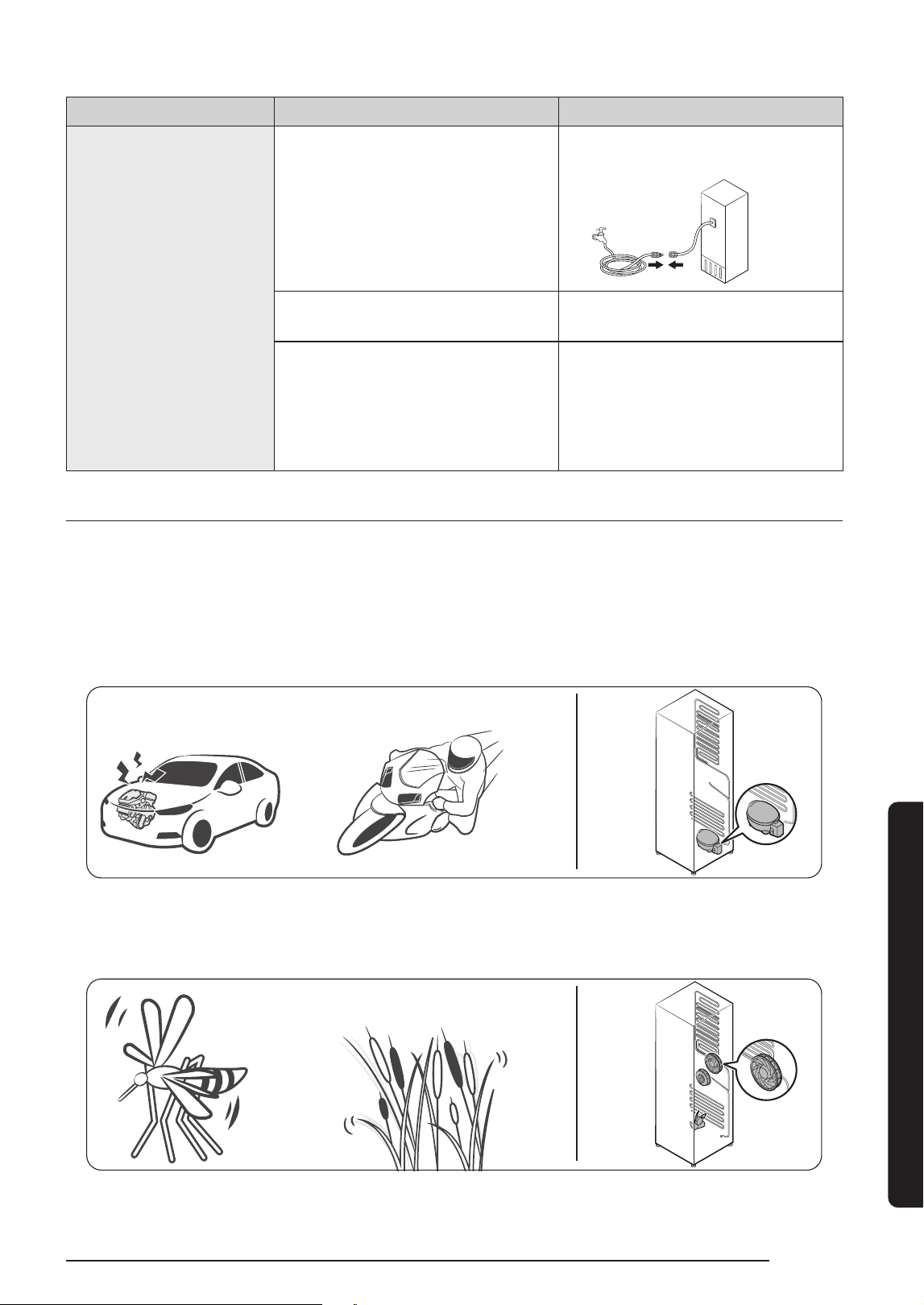
These sounds are normal.
• When starting or ending an operation, the refrigerator may make sounds similar to a
car engine igniting. As the operation stabilizes, the sounds will decrease.
Clicking!
or Chirping!
Buzzing!
• While the fan is operating, these sounds may occur. When the refrigerator reaches the
set temperature, no fan sound will occur.
SSSRRR!
Whir!
English
44
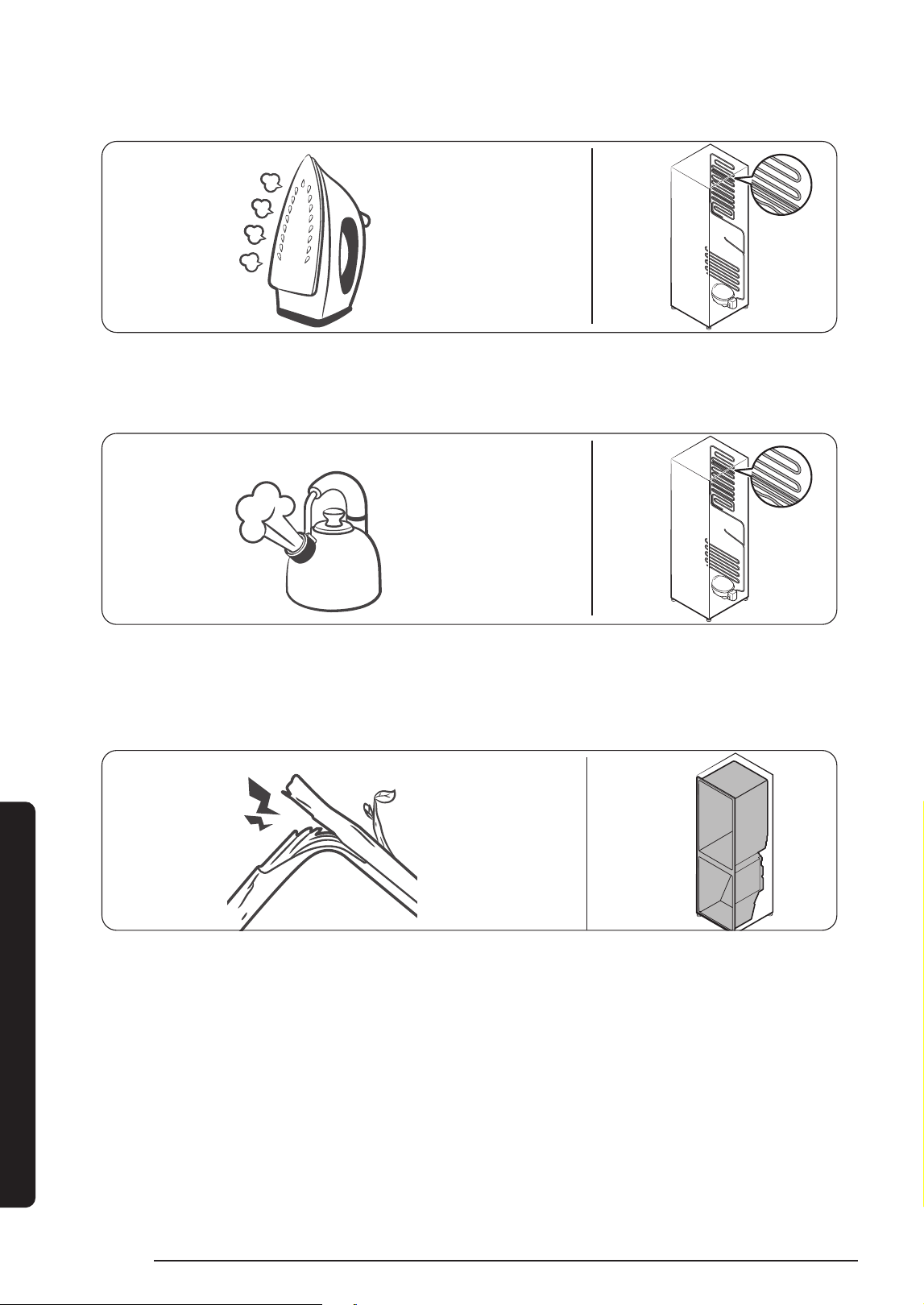
• During a defrost cycle, water may drip on the defrost heater, causing sizzling sounds.
HiSS!
• As the refrigerator cools or freezes, refrigerant gas moves through sealed pipes,
causing bubbling sounds.
Bubbling!
• As the refrigerator temperature increases or decreases, plastic parts contract and
expand, creating knocking noises. These noises occur during the defrosting cycle or
when electronic parts are working.
Cracking!
• For ice maker models: When the water valve opens to ll the ice maker, buzzing
sounds may occur.
• Due to pressure equalizing when opening and closing the refrigerator door, whooshing
sounds may occur.
Troubleshooting
English 45
SmartThings
Symptom Action
Could not nd
“SmartThings” in the app
market.
• The supporting software version of the SmartThings app is subject
to change according to the OS supporting policy the manufacturer
provides. In addition, as for the SmartThings app or the functions
that the app supports, the new application update policy on the
existing OS version can be suspended due to usability or security
reasons.
The SmartThings app
fails to operate.
• The SmartThings app is available for applicable models only.
• The old Samsung Smart Refrigerator app cannot connect with
Samsung Smart Home models.
The SmartThings app
is installed but is
not connected to my
refrigerator.
• You must log into your Samsung account to use the app.
• Make sure that your router is operating normally.
• If you have not connected your refrigerator to the SmartThings App
after the app was installed, you must make the connection using
the device registration function of the app.
Could not log into the
app.
• You must log into your Samsung account to use the app.
• If you don’t have a Samsung account, follow the app’s onscreen
instructions to create one.
An error message
appears when I try to
register my refrigerator.
• Easy Connection may fail due to the distance from your access
point (AP) or electrical interference from the surrounding
environment. Wait a moment and try again.
The SmartThings app is
successfully connected
to my refrigerator but
does not run.
• Exit and restart the SmartThings app or disconnect and reconnect
the router.
• Unplug the power cord of the refrigerator, and then plug it in again
after 1 minute.
The Wi-Fi icon is
blinking.(
)
• Connect your refrigerator with the SmartThings app before use.
When the connection is made successfully, the indicator stops
blinking.
- If you fail to make connection or don’t want to use the app,
press and hold the Lock button for 10 seconds. The indicator
stops blinking with “O FF” shown on the temperature display.
Open Source Announcement
(For Wi-Fi models only)
The software included in this product contains open source software.
The following URL http://opensource.samsung.com/opensource/SMART_TP1_0/seq/0
leads to open source license information as related to this product.
Troubleshooting
English
46
Appendix
Safety Instruction
• For the most efcient use of energy, please keep the all inner ttings such as baskets, drawers,
shelves and ice cube tray on the position supplied by manufacturer.
• This refrigerating appliance is not intended to be used as a built-in appliance.
Install Instruction
For refrigerating appliances with climate class
Depending on the climate class, This refrigerating appliance is intended to be used at ambient
temperatures range as specied following table.
The climate class can be found on the rating plate. The product may not operate properly at
temperatures outside of the specic range.
You can nd climate class on label inside of your refrigerator
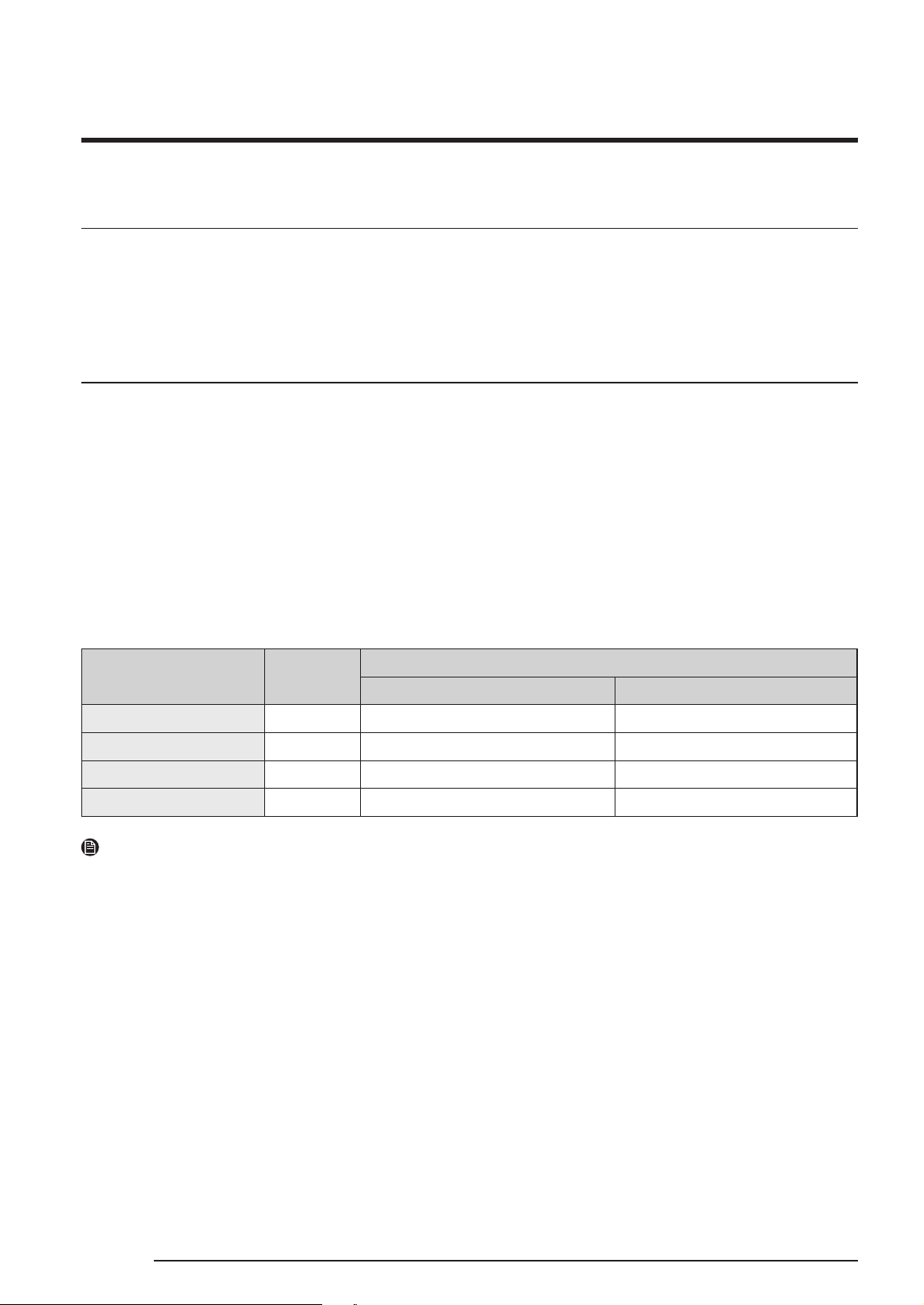
Effective temperature range
The refrigerator is designed to operate normally in the temperature range specied by its class
rating.
Class Symbol
Ambient Temperature range (°C)
IEC 62552 (ISO 15502) ISO 8561
Extended Temperate SN +10 to +32 +10 to +32
Temperate N +16 to +32 +16 to +32
Subtropical ST +16 to +38 +18 to +38
Tropical T +16 to +43 +18 to +43
NOTE
The cooling performance and power consumption of the refrigerator may be affected by the
ambient temperature, the door-opening frequency, and the location of the refrigerator. We
recommend adjusting the temperature settings as appropriate.
English 47
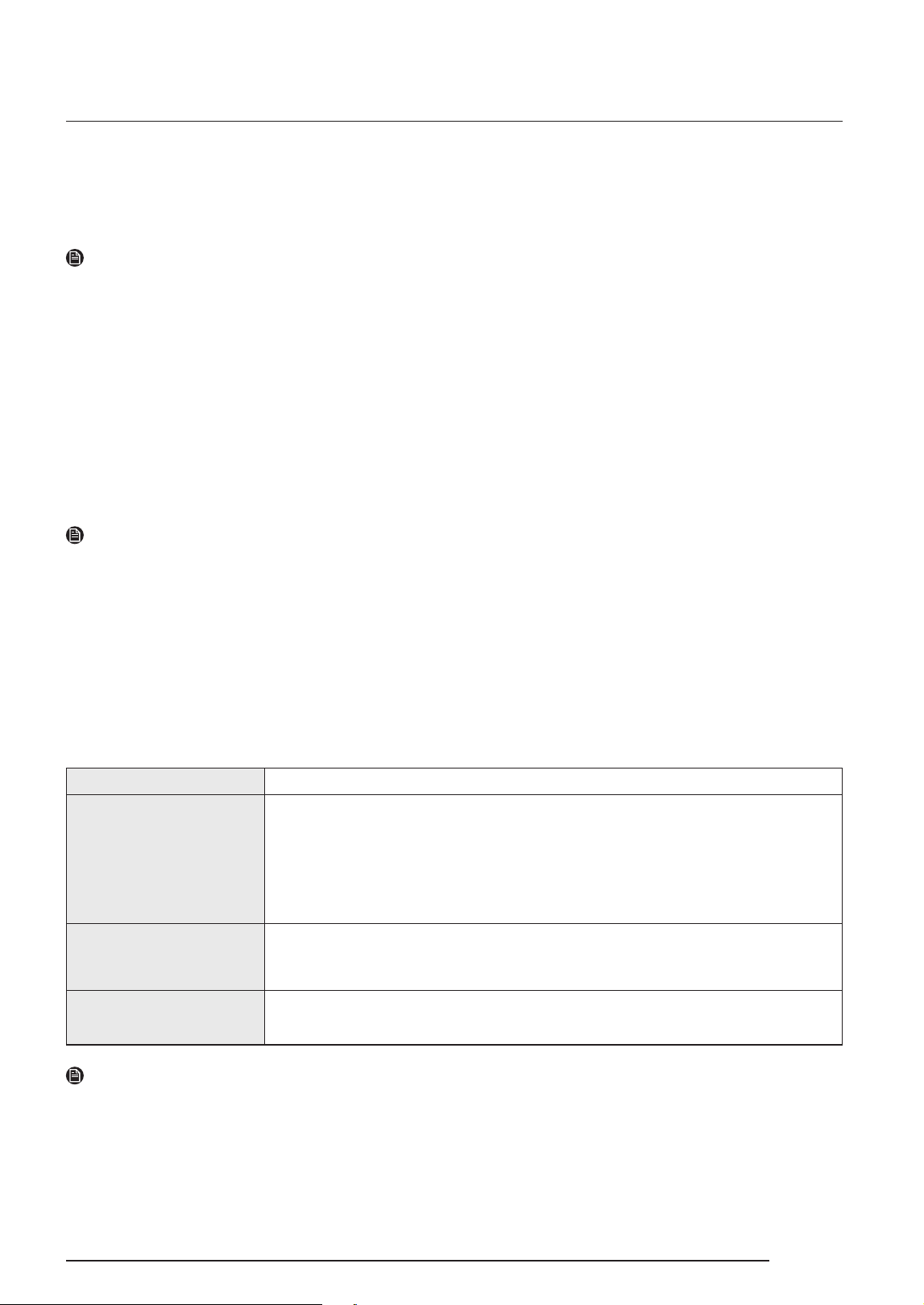
Temperature Instruction
Recommended Temperature
The optimal temperature setting for food storage:
• Fridge: 3 °C
• Freezer: -19 °C
NOTE
The optimal temperature setting of each compartment depends on the ambient temperature. Above
optimal temperature is based on the ambient temperature of 25 °C.
Power Cool
Power Cool speeds up the cooling process at maximum fan speed. The fridge keeps running at full speed
for two and a half hours and then returns to the previous temperature.
Power Freeze
Power Freeze speeds up the freezing process at maximum fan speed. The freezer keeps running at full
speed for 50 hours and then returns to the previous temperature. To freeze large amounts of food,
activate Power Freeze for at least 20 hours before putting food in the freezer.
NOTE
When you use this function the energy consumption of the refrigerator will increase. Remember to turn it
off when you don’t need it and return the freezer to your original temperature setting.
How to store for best preservation (applicable models only)
Cover foods to retain moisture and prevent them from picking up odors from other foods. A large pot of
food like soup or stew should be divided into small portions and put in shallow containers before being
refrigerated. A large cut of meat or whole poultry should be divided into smaller pieces or placed in
shallow containers before refrigerating.
Placement of Foods
Shelves Shelves should be adjustable to accommodate a variety of packages.
Specialized compartment
(applicable models only)
Sealed crisper drawers provide an optimal storage environment for fruits and
vegetables. Vegetables require higher humidity conditions while fruits require
lower humidity conditions.
Crispers are equipped with controls devices to control the humidity level.
(*Depending on model and options) An adjustable temperature meat drawer
maximizes the storage time of meats and cheeses.
Stored on the door
Don’t store perishable foods in the door. Eggs should be stored in the carton on
a shelf. The temperature of the storage bins in the door uctuate more than the
temperature in the cabinet. Keep the door closed as much as possible.
Freezer Compartment
You can store frozen food, make ice cubes and freeze fresh food in the freezer
compartment.
NOTE
Freeze fresh, undamaged food only. Keep food which is to be frozen away from food which is already
frozen. To prevent food from losing its avour or drying out, place in airtight containers.
English
48
Appendix
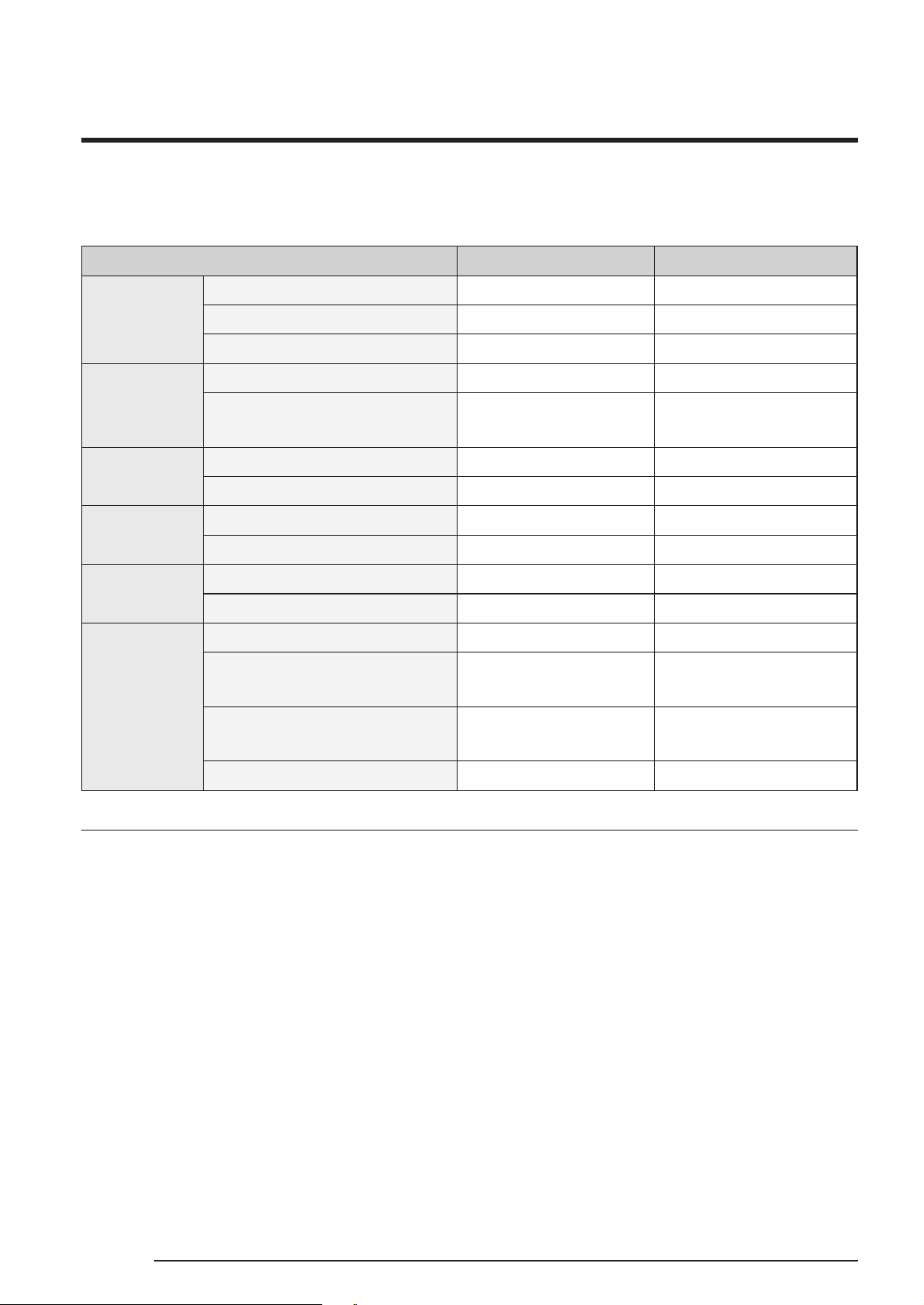
Refrigerator & Freezer Storage Chart
The freshness longevity depends on temperature and exposure to moisture. Since product
dates aren’t a guide for safe use of a product, consult this chart and follow these tips.
Product Refrigerator Freezer
Milk
products
Milk 1 week 1 month
Butter 2 weeks 12 months
Cream cheese 2 weeks Not recommended
Meat
Fresh roasts, steaks, chops 3-4 days 2-3 months
Sausage, Raw from pork,
beef, turkey
1-2 days 1-2 months
Poultry /
Eggs
Fresh poultry 2 days 6-8 months
Eggs, Fresh in shell 2-4 weeks Not recommended
Fish /
Seafood
Fresh sh 1-2 days 3-6 months
Dried or pickled sh 3-4 weeks -
Fruits
Apples 1 month -
Other fresh fruit 3-5 days 9-12 months
Vegetables
Asparagus 2-3 days -
Broccoli, Brussels sprouts,
green peas, mushrooms
3-5 days -
Cabbage, cauliower,
celery, cucumbers, lettuce
1 week -
Carrots, beets, radishes 2 weeks -
Information for model and ordering spare parts
Model information
To access energy labelling information about this product on the European Product Registry for
Energy Labelling (EPREL), scan QR-Code on the energy label.
You can nd QR-Code on the energy label in your product box.
Part information
• The minimum period during which spare parts, necessary for the repair of the appliance, are
available
- 7 Years thermostats, temperature sensors, printed circuit boards and light sources, door
handles, door hinges, trays, baskets (boxes or drawers)
- 10 Years door gaskets
• The minimum duration of the guarantee of the refrigerating appliance offered by the
manufacturer 24 Months.
• Relevant information for ordering spare parts, directly or through other channels provided by
the manufacturer, importer or authorized representative
• You can nd professional repair information on http://samsung.com/support.
You can nd user servicing manual on http://samsung.com/support.
English 49
NOTE
Hereby, Samsung declares that this radio equipment is in compliance with Directive 2014/53/EU and with
the relevant statutory requirements in the UK.
RF Exposure Information:
This device has been tested and meets applicable limits for Radio Frequency (RF) exposure.
Frequency range Transmitter power (Max)
Wi-Fi 2412 - 2472 MHz 20 dBm
Bluetooth 2402 - 2480 MHz 20 dBm
(For products sold in European countries and in the UK only)
Contact SAMSUNG WORLD WIDE
If you have any questions or comments relating to Samsung products, please contact the
SAMSUNG customer care center.
Country Contact Center Web Site
NEW ZEALAND 0800 726 786 (All Product) www.samsung.com/nz/support
INDIA
1800 5 SAMSUNG (1800 5 7267864)
(Toll-Free)
1800 40 SAMSUNG (1800 40 7267864)
(Toll-Free)
www.samsung.com/in/support
BANGLADESH
08000-300-300 (Toll free)
09612-300-300
www.samsung.com/in/support
MALAYSIA
1800-22-8899 (HHP)
1800-88-9999 (OTH)
+603-7713 7420 (Overseas contact)
www.samsung.com/my/support
PHILIPPINES
Dedicated Hotline for Mobile Phones:
#GALAXY (just dial #425299)
All Products :
1-800-10-7267864 [ PLDT - Toll Free ]
1-800-8-7267864 [ Globe - Toll Free ]
84222111 [ Landline ]
www.samsung.com/ph/support
SINGAPORE
1800 7267864 | 1800-SAMSUNG (Other)
1800 4252997 | 1800-GALAXYS (HHP)
www.samsung.com/sg/support
PANAMA 800-0101
www.samsung.com/latin/support (Spanish)
www.samsung.com/latin_en/support (English)
SOUTH AFRICA 0860 SAMSUNG (726 7864) www.samsung.com/za/support
UK 0333 000 0333 www.samsung.com/uk/support
IRELAND (EIRE) 0818 717100 www.samsung.com/ie/support
MYANMAR
+95-1-2399-888
VIP HHP +95-1-2399-990
www.samsung.com/mm/support
SRI LANKA 011 SAMSUNG (011 7267864) www.samsung.com/support
PAKISTAN 0800-Samsung (72678) www.samsung.com/pk/support
DA68-04798G-00