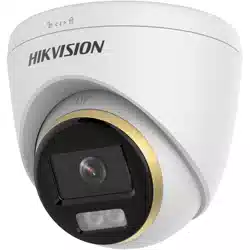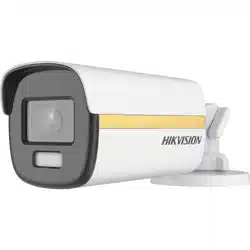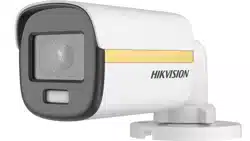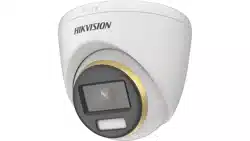
3K ColorVu
Bullet & Turret Camera
User Manual
User Manual
Thank you for purchasing our product. If there are any
questions, or requests, do not hesitate to contact the
dealer.
This manual applies to the models below:
Type
Model
Type I Camera
DS-2CE12KF3T-LE
DS-2CE12KF3T-L
Type II Camera
DS-2CE10KF3T-LE
DS-2CE10KF3T-L
Type III Camera
DS-2CE72KF3T-LE
DS-2CE72KF3T-L
This manual may contain several technical mistakes or
printing errors, and the content is subject to change
without notice. The updates will be added to the new
version of this manual. We will readily improve or update
the products or procedures described in the manual.
02010020221227

Initiatives on the Use of Video Products
Thank you for choosing Hikvision products.
Technology affects every aspect of our life. As a high-tech
company, we are increasingly aware of the role
technology plays in improving business efficiency and
quality of life, but at the same time, the potential harm of
its improper usage. For example, video products are
capable of recording real, complete and clear images. This
provides a high value in retrospect and preserving real-
time facts. However, it may also result in the infringement
of a third party’s legitimate rights and interests if
improper distribution, use and/or processing of video data
takes place. With the philosophy of “Technology for the
Good”, Hikvision requests that every end user of video
technology and video products shall comply with all the
applicable laws and regulations, as well as ethical
customs, aiming to jointly create a better community.
Please read the following initiatives carefully:
1. Everyone has a reasonable expectation of privacy,
and the installation of video products should not be
in conflict with this reasonable expectation.
Therefore, a warning notice shall be given in a
reasonable and effective manner and clarify the
monitoring range, when installing video products in
public areas. For non-public areas, a third party’s
rights and interests shall be evaluated when
installing video products, including but not limited
to, installing video products only after obtaining the
consent of the stakeholders, and not installing
highly-invisible video products.
2. The purpose of video products is to record real
activities within a specific time and space and under
specific conditions. Therefore, every user shall first
reasonably define his/her own rights in such specific
scope, in order to avoid infringing on a third party’s
portraits, privacy or other legitimate rights.
3. During the use of video products, video image data
derived from real scenes will continue to be
generated, including a large amount of biological
data (such as facial images), and the data could be
further applied or reprocessed. Video products
themselves could not distinguish good from bad
regarding how to use the data based solely on the
images captured by the video products. The result of
data usage depends on the method and purpose of
use of the data controllers. Therefore, data
controllers shall not only comply with all the
applicable laws and regulations and other normative
requirements, but also respect international norms,
social morality, good morals, common practices and
other non-mandatory requirements, and respect
individual privacy, portrait and other rights and
interests.
4. The rights, values and other demands of various
stakeholders should always be considered when
processing video data that is continuously generated
by video products. In this regard, product security
and data security are extremely crucial. Therefore,
every end user and data controller, shall undertake
all reasonable and necessary measures to ensure
data security and avoid data leakage, improper
disclosure and improper use, including but not
limited to, setting up access control, selecting a
suitable network environment (the Internet or
Intranet) where video products are connected,
establishing and constantly optimizing network
security.
Video products have made great contributions to the
improvement of social security around the world, and we

believe that these products will also play an active role in
more aspects of social life. Any abuse of video products in
violation of human rights or leading to criminal activities
are contrary to the original intent of technological
innovation and product development. Therefore, each
user shall establish an evaluation and tracking mechanism
of their product application to ensure that every product
is used in a proper and reasonable manner and with good
faith.

© 2023 Hangzhou Hikvision Digital Technology Co., Ltd.
All rights reserved.
About this Manual
The Manual includes instructions for using and managing
the Product. Pictures, charts, images and all other
information hereinafter are for description and
explanation only. The information contained in the
Manual is subject to change, without notice, due to
firmware updates or other reasons. Please find the latest
version of this Manual at the Hikvision website
(https://www.hikvision.com/).
Please use this Manual with the guidance and assistance
of professionals trained in supporting the Product.
Trademarks
and other Hikvision’s trademarks and
logos are the properties of Hikvision in various
jurisdictions.
Other trademarks and logos mentioned are the properties
of their respective owners.
Disclaimer
TO THE MAXIMUM EXTENT PERMITTED BY APPLICABLE
LAW, THIS MANUAL AND THE PRODUCT DESCRIBED, WITH
ITS HARDWARE, SOFTWARE AND FIRMWARE, ARE
PROVIDED “AS IS” AND “WITH ALL FAULTS AND ERRORS”.
HIKVISION MAKES NO WARRANTIES, EXPRESS OR IMPLIED,
INCLUDING WITHOUT LIMITATION, MERCHANTABILITY,
SATISFACTORY QUALITY, OR FITNESS FOR A PARTICULAR
PURPOSE. THE USE OF THE PRODUCT BY YOU IS AT YOUR
OWN RISK. IN NO EVENT WILL HIKVISION BE LIABLE TO
YOU FOR ANY SPECIAL, CONSEQUENTIAL, INCIDENTAL, OR
INDIRECT DAMAGES, INCLUDING, AMONG OTHERS,
DAMAGES FOR LOSS OF BUSINESS PROFITS, BUSINESS
INTERRUPTION, OR LOSS OF DATA, CORRUPTION OF
SYSTEMS, OR LOSS OF DOCUMENTATION, WHETHER
BASED ON BREACH OF CONTRACT, TORT (INCLUDING
NEGLIGENCE), PRODUCT LIABILITY, OR OTHERWISE, IN
CONNECTION WITH THE USE OF THE PRODUCT, EVEN IF
HIKVISION HAS BEEN ADVISED OF THE POSSIBILITY OF
SUCH DAMAGES OR LOSS.
YOU ACKNOWLEDGE THAT THE NATURE OF THE INTERNET
PROVIDES FOR INHERENT SECURITY RISKS, AND HIKVISION
SHALL NOT TAKE ANY RESPONSIBILITIES FOR ABNORMAL
OPERATION, PRIVACY LEAKAGE OR OTHER DAMAGES
RESULTING FROM CYBER-ATTACK, HACKER ATTACK, VIRUS
INFECTION, OR OTHER INTERNET SECURITY RISKS;
HOWEVER, HIKVISION WILL PROVIDE TIMELY TECHNICAL
SUPPORT IF REQUIRED.
YOU AGREE TO USE THIS PRODUCT IN COMPLIANCE WITH
ALL APPLICABLE LAWS, AND YOU ARE SOLELY
RESPONSIBLE FOR ENSURING THAT YOUR USE CONFORMS
TO THE APPLICABLE LAW. ESPECIALLY, YOU ARE
RESPONSIBLE, FOR USING THIS PRODUCT IN A MANNER
THAT DOES NOT INFRINGE ON THE RIGHTS OF THIRD
PARTIES, INCLUDING WITHOUT LIMITATION, RIGHTS OF
PUBLICITY, INTELLECTUAL PROPERTY RIGHTS, OR DATA
PROTECTION AND OTHER PRIVACY RIGHTS. YOU SHALL
NOT USE THIS PRODUCT FOR ANY PROHIBITED END-USES,
INCLUDING THE DEVELOPMENT OR PRODUCTION OF
WEAPONS OF MASS DESTRUCTION, THE DEVELOPMENT
OR PRODUCTION OF CHEMICAL OR BIOLOGICAL
WEAPONS, ANY ACTIVITIES IN THE CONTEXT RELATED TO
ANY NUCLEAR EXPLOSIVE OR UNSAFE NUCLEAR FUEL-
CYCLE, OR IN SUPPORT OF HUMAN RIGHTS ABUSES.

IN THE EVENT OF ANY CONFLICTS BETWEEN THIS
MANUAL AND THE APPLICABLE LAW, THE LATTER
PREVAILS.
Regulatory Information
EU Conformity Statement
This product and - if applicable - the
supplied accessories too are marked with
"CE" and comply therefore with the
applicable harmonized European standards
listed under the General Product Safety Directive
2001/95/EC, the EMC Directive 2014/30/EU, the RoHS
Directive 2011/65/EU.
2012/19/EU (WEEE directive): Products
marked with this symbol cannot be disposed
of as unsorted municipal waste in the
European Union. For proper recycling,
return this product to your local supplier
upon the purchase of equivalent new
equipment, or dispose of it at designated collection
points. For more information see: www.recyclethis.info.
2006/66/EC (battery directive): This product contains a
battery that cannot be disposed of as
unsorted municipal waste in the European
Union. See the product documentation for
specific battery information. The battery is
marked with this symbol, which may include
lettering to indicate cadmium (Cd), lead (Pb), or mercury
(Hg). For proper recycling, return the battery to your
supplier or to a designated collection point. For more
information, see: www.recyclethis.info.
Industry Canada ICES-003 Compliance
This device meets the CAN ICES-3 (A)/NMB-3(A) standards
requirements.
Warning
This is a class A product. In a domestic environment this
product may cause radio interference in which case the
user may be required to take adequate measures.
Safety Instruction
These instructions are intended to ensure that user can
use the product correctly to avoid danger or property loss.
The precaution measure is divided into “Warnings” and
“Cautions”.
Warnings: Serious injury or death may occur if any of the
warnings are neglected.
Cautions: Injury or equipment damage may occur if any of
the cautions are neglected.
Warnings
Warnings Follow
these safeguards to
prevent serious injury
or death.
Cautions Follow these
precautions to prevent
potential injury or
material damage.

In the use of the product, you must be in strict
compliance with the electrical safety regulations of the
nation and region.
Input voltage should meet both the SELV (Safety Extra
Low Voltage) and the Limited Power Source with 12 VDC
according to the IEC60950-1 and IEC62368-1 standard.
Refer to technical specifications for detailed
information.
The socket-outlet shall be installed near the equipment
and shall be easily accessible.
An all-pole mains switch shall be incorporated in the
electrical installation of the building.
Do not connect multiple devices to one power adapter
to avoid over-heating or a fire hazard caused by
overload.
Make sure that the plug is firmly connected to the
power socket.
If smoke, odor or noise rise from the device, turn off the
power at once and unplug the power cord, and then
contact the service center.
Never attempt to disassemble the camera by
unprofessional personal.
Cautions
CAUTION: Hot parts! Burned fingers when handling the
parts. Wait one-half hour after switching off before
handling parts. This sticker is to indicate that
the marked item can be hot and should not
be touched without taking care. For device
with this sticker, this device is intended for installation
in a restricted access location, access can only be gained
by service persons or by users who have been
instructed about the reasons for the restrictions applied
to the location and about any precautions that shall be
taken.
The equipment shall not be exposed to dripping or
splashing and that no objects filled with liquids, such as
vases, shall be placed on the equipment.
Shock hazard! Disconnect all power sources before
maintenance.
No naked flame sources, such as lighted candles, should
be placed on the equipment.
Install the equipment according to the instructions in
this manual.
To prevent injury, this equipment must be securely
attached to the floor/wall in accordance with the
installation instructions.
Do not drop the camera or subject it to physical shock.
Do not touch senor modules with fingers.
Do not place the camera in extremely hot, cold (the
operating temperature shall be -40°C to 60°C), dusty or
damp locations, and do not expose it to high
electromagnetic radiation.
If cleaning is necessary, use clean cloth with a bit of
ethanol and wipe it gently.
Do not aim the camera at the sun or extra bright places.
The sensor may be burned out by a laser beam, so
when any laser equipment is in using, make sure that
the surface of sensor will not be exposed to the laser
beam.
Do not expose the device to high electromagnetic
radiation or extremely hot, cold, dusty or damp
environment.
To avoid heat accumulation, good ventilation is required
for the operating environment.
Keep the camera away from liquid while in use for non-
water-proof device.

While in delivery, the camera shall be packed in its
original packing, or packing of the same texture.
Use Hikvision DVR that supports the power over coaxial
(PoC) technology if you power the device over coaxial
cable.

1
1 Introduction
1.1 Product Features
The main features are as follows:
High quality imaging with 3K resolution
High performance CMOS sensor
OSD menu with configurable parameters
24-hour color image
Smart light
3-axis adjustment
3D Digital Noise Reduction
1.2 Overview
1.2.1 Overview of Type I Camera
Power Cord
Video Cable
Bracket
Main Body
Lens
Figure 1-1 Overview of Type I Camera
1.2.2 Overview of Type II Camera
Lens
Main Body
Bracket
Power Cord
Video Cable
Figure 1-2 Overview of Type II Camera
1.2.3 Overview of Type III Camera
Video Cable
Power Cord
Base
Installation
Plate
Enclosure
Main Body
Figure 1-3 Overview of Type III Camera
2 Installation
Before you start
Make sure that the device in the package is in good
condition and all the assembly parts are included.
Make sure that all the related equipment is power-off
during the installation.
Check the specification of the products for the
installation environment.
Check whether the power supply is matched with your
power output to avoid damage.
Make sure the wall is strong enough to withstand three
times the weight of the camera and the mount.
If the product does not function properly, contact your
dealer or the nearest service center. DO NOT
disassemble the camera for repair or maintenance by
yourself.

2
2.1 Installation of Type I and Type II Camera
2.1.1 Ceiling/Wall Mounting of Type I Camera
Before you start:
Ceiling mounting and wall mounting are similar. Following
steps take ceiling mounting as an example.
Steps:
1. Paste the drill template (supplied) to the place where
you want to install the camera.
2. (Optional) For cement ceiling, drill the screw holes
with a 5.5 mm drill and insert the supplied wall plugs.
Screw
Hole
Screw
Hole
Screw
Hole
template
Cable
Hole
Figure 2-1 Drill Template
3. (Optional) Drill the cable hole, when the cables are
routed through the ceiling.
4. Route and connect the power cord and video cable.
5. Align the screw holes in the bracket to the ceiling, and
secure the camera with three PA4 × 25 screws
(supplied).
Figure 2-2 Secure Camera to Ceiling
6. Power on the camera to check whether the image on
the live view is captured from the optimum angle. If
not, turn the trim ring counterclockwise to loosen it
and adjust the positions according to the figure below.
Rotation Position
[0° to 360°]
Tilt Position
[0° to 180°]
Pan Position
[0° to 360°]
Trim Ring
Screw
Thumbscrew
Figure 2-3 3-Axis Adjustment
1). Loosen the trim ring to adjust the pan position [0°
to 360°].
2). Loosen the thumbscrew to adjust the tilt position
[0° to 180°].
3). Loosen the screw to adjust the rotation position
[0° to 360°].
7. Tighten the trim ring and screws to finish the
installation.
2.1.2 Ceiling/Wall Mounting of Type II Camera
Before you start:

3
Ceiling mounting and wall mounting are similar. Following
steps take ceiling mounting as an example.
Steps:
1. Paste the drill template (supplied) to the place where
you want to install the camera.
2. (Optional) For cement ceiling, drill the screw holes
with a 5.5 mm drill and insert the supplied wall plugs.
Screw
Hole
Screw
Hole
Screw
Hole
template
Cable
Hole
Figure 2-4 Drill Template
3. (Optional) Drill the cable hole, when the cables are
routed through the ceiling.
4. Route and connect the power cord and video cable.
5. Align the screw holes in the bracket to the ceiling, and
secure the camera with three PA4 × 25 screws
(supplied).
Figure 2-5 Secure Camera to Ceiling
6. Power on the camera to check whether the image on
the live view is captured from the optimum angle. If
not, turn the trim ring counterclockwise to loosen it
and adjust the positions according to the figure below.
Rotation Position
[0° to 360°]
Tilt Position
[0° to 90°]
Pan Position
[0° to 360°]
Trim Ring
Figure 2-6 3-Axis Adjustment
7. Turn the trim ring clockwise to lock the positions.
2.1.3 Ceiling/Wall Mounting with Junction Box
Before you start:
You need to purchase a junction box in advance.
Ceiling mounting and wall mounting are similar.
Following steps take wall mounting as an example.
Type I camera wall mounting and type II camera wall
mounting are similar. Following steps take type I
camera wall mounting as an example.
Steps:
1. Paste the drill template for junction box to the place
where you want to install the camera.
2. (Optional) For cement wall, drill the screw holes with
a 5.5 mm drill and insert the supplied wall plugs.

4
Figure 2-7 Drill Template for Junction Box
3. (Optional) Drill the cable hole, when the cables are
routed through the wall.
4. Take apart the junction box.
5. Align the screw holes of the camera with those on the
junction box cover. Attach the camera to the junction
box cover with three PM4 × 10 screws.
Figure 2-8 Attach Camera to Junction Box Cover
6. Secure the junction box body on the wall with three
PA4 × 25 screws (supplied).
Figure 2-9 Secure Junction Box on Wall
7. Route the cables through the bottom cable hole or
side cable hole of the junction box and connect the
cables.
8. Fix the junction box cover on its body with three PM3
× 16 L6 screws that come with the junction box.
Figure 2-10 Fix Junction Box Cover on Its
Body
9. Refer to steps 6 to 7 of 2.1.1 Ceiling/Wall Mounting of
Type I Camera to adjust the viewing angle.
2.1.4 Wall Mounting with Wall Mount
Before you start:
You need to purchase a wall mount in advance.
Type I camera wall mounting and type II camera wall
mounting are similar. Following steps take type I
camera wall mounting as an example.
Steps:

5
1. Take apart the wall mount.
Main Body
Cover
Figure 2-11 Take Apart Wall Mount
2. Paste the drill template (supplied) to the place where
you want to install the camera.
3. Drill the screw holes with a 5.5 mm drill and insert the
supplied wall plugs.
Figure 2-12 Drill Template for Wall Mount
4. Attach the main body of the wall mount to the wall
and secure it with three PA4 × 25 screws (supplied).
Figure 2-13 Secure Main Body to Wall
5. (Optional) Drill the cable hole, when the cables are
routed through the wall.
6. Secure the camera to the cover of the wall mount with
three PM4 × 13 screws and three M4 screws.
PM4 × 13 screw
M4 screw
Figure 2-14 Secure Camera to Wall Mount Cover
7. Route the cables through the cable hole of the wall
mount and connect the cables.
8. Insert one end of the wall mount cover diagonally into
the wall mount body, and then snap the other end of
the cover upward on the body.

6
Step 1
Step 2
Main Body
Cover
Figure 2-15 Secure Cover to Body
9. Lock the cover to the body with one PA3 × 13 screw.
Figure 2-16 Lock Cover to Body
10. Refer to steps 6 to 7 of 2.1.1 Ceiling/Wall Mounting of
Type I Camera to finish installation and adjust the
viewing angle.
2.2 Installation of Type III Camera
2.2.1 Ceiling/Wall Mounting
Steps:
1. Paste the drill template (supplied) to the place where
you want to install the camera.
2. (Optional) For cement ceiling, drill the screw holes
with a 5.5 mm drill and insert the supplied wall plugs.
Figure 2-17 Drill Template
3. Attach the installation plate to the ceiling and secure it
with three PA4 × 25 screws (supplied).
Figure 2-18 Attach Installation Plate to Ceiling
4. Fit the camera onto the installation plate.
Figure 2-19 Fit Camera

7
5. Turn the camera clockwise until it snaps into the
installation plate.
Figure 2-20 Snap Camera into Installation Plate
6. Connect the power cord and video cable.
7. Power on the camera to check whether the image on
the live view is captured from the optimum angle. If
not, adjust the camera according to the figure below.
Rotation Position
[0° to 360°]
Pan Position
[0° to 360°]
Tilt Position
[0° to 75°]
Figure 2-21 3-Axis Adjustment
1). Rotate the enclosure to adjust the pan position [0°
to 360°].
2). Move the main body up and down to adjust the
tilt position [0° to 75°].
3). Rotate the main body to adjust the rotation
position [0° to 360°].
2.2.2 Ceiling Mounting with Junction Box/Inclined
Ceiling Mount
Before you start:
You need to purchase a junction box or inclined ceiling
mount in advance.
Ceiling mounting with junction box and inclined ceiling
mount are similar. Following steps take junction box as
an example.
Steps:
1. Paste the drill template for junction box to the place
where you want to install the camera.
2. (Optional) For cement ceiling, drill the screw holes
with a 5.5 mm drill and insert the supplied wall plugs.
Figure 2-22 Drill Template
3. (Optional) Drill the cable hole, when the cables are
routed through the wall.
4. Take apart the junction box.
5. Install the installation plate to the junction box cover
with three PM4 screws.

8
Figure 2-23 Install Installation Plate to Junction Box Cover
6. Fit the camera onto the installation plate.
Figure 2-24 Fit Camera
7. Turn the camera clockwise until it snaps into the
installation plate.
Figure 2-25 Snap Camera into Installation Plate
8. Secure the junction box body on the ceiling with four
PA4 × 25 screws.
Figure 2-26 Secure Junction Box Body
9. Route the cables through the bottom cable hole or
the side cable hole of the junction box and connect
the cables.
10. Combine the junction box cover with its body with
four PM4 screws.
Figure 2-27 Combine Junction Box Cover with Body

9
11. Refer to step 7 of 2.2.1 Ceiling/Wall Mounting to
adjust the viewing angle.
2.2.3 Wall Mounting with Wall Mount
Before you start:
You need to purchase a wall mount in advance.
Type I Wall Mount
Steps:
1. Drill Ø10 mm screw holes in the wall where you want
to install the wall mount.
2. Use four M6 expansion bolts to fix the wall mount
onto the wall.
Figure 2-28 Fix Wall Mount
3. Use three PM4 × 10 screws to fix the installation plate
onto the wall mount.
Figure 2-29 Fix Installation Plate
4. Repeat the step 4 to 7 of 2.2.1 Ceiling/Wall Mounting
to finish the installation.
Figure 2-30 Finish Installation
Type II Wall Mount
1. Take apart the wall mount.
Main Body
Cover

10
Figure 2-31 Take Apart Wall Mount
2. Paste the drill template (supplied) to the place where
you want to install the camera.
3. Drill the screw holes with a 5.5 mm drill and insert the
supplied wall plugs.
Figure 2-32 Drill Template for Wall Mount
4. Attach the main body of the wall mount to the wall
and secure it with three PA4 × 25 screws (supplied).
Figure 2-33 Secure Main Body to Wall
5. (Optional) Drill the cable hole, when the cables are
routed through the wall.
6. Secure the camera to the cover of the wall mount with
three PM4 × 13 screws and three M4 screws.
PM 4 × 13 screw
M 4 screw
Figure 2-34 Secure Camera to Wall Mount Cover
7. Route the cables through the cable hole of the wall
mount and connect the cables.
8. Insert one end of the wall mount cover diagonally into
the wall mount body, and then snap the other end of
the cover upward on the body.
Step 1
Step 2
Main Body
Cover
Figure 2-35 Secure Cover to Body
9. Lock the cover to the body with one PA3 × 8 screw.

11
Figure 2-36 Lock cover to Body
10. Repeat steps 6 to 7 of 2.2.1
错误
!
未找到引用源。
to adjust the angle and finish the installation.
3 Menu Description
Please follow the steps below to call the menu.
Note:
The actual display may vary with your camera model.
Steps:
1. Connect the camera with the TVI DVR and the
monitor, as shown in figure 3-1.
Camera
TVI DVR
Monitor
Figure 3-1 Connection
2. Power on the camera, TVI DVR, and monitor to view
the image on the monitor.
3. Click PTZ Control to enter the PTZ Control interface.
4. Call the camera menu by clicking button, clicking
Iris+, or calling preset No. 95.
Note:
Functions may differ from models. Please take the
actual product as standard.

12
EXPOSURE
EXPOSURE MODE
MAIN MENU
VIDEO
SETTINGS
FUNCTIONS
EXIT
SAVE & EXIT
AGC
BACK
EXIT
CONTRAST
SHARPNESS
SATURATION
3 DNR
MIRROR
BACK
BACK
EXIT
VIDEO
FORMAT
FACTORY
DEFAULT
SAVE & EXIT
WHITE BALANCE
BRIGHTNESS
EXIT
SAVE & EXIT
SAVE & EXIT
IMAGE MODE
MOTION DET
PRIVACY
ANTI-BANDING
SLOW SHUTTER
CANCEL
CONFIRM
LIGHTING
LIGHTING MODE
BACK
EXIT
SAVE & EXIT
THRESHOLD
LEVEL
MODE
SETTINGS
IR/WHITE LIGHT
SMART IR
Figure 3-2 Main Menu Overview
5. Click the direction buttons to control the camera.
1). Click up/down direction buttons to select menu
options.
2). Click Iris + to confirm the selection.
3). Click left/right direction buttons to adjust the
value of the selected option.
3.1 VIDEO FORMAT
You can set the video format to 3K@20 fps, 4MP@25 fps,
4MP@30 fps, 2MP@25 fps, or 2MP@30 fps.

13
3.2 EXPOSURE
EXPOSURE MODE
You can set the EXPOSURE MODE to GLOBAL, BLC, HLC,
WDR, or HLS.
GLOBAL
GLOBAL refers to the normal exposure mode that adjusts
lighting distribution, variations, and non-standard
processing.
BLC (Backlight Compensation)
BLC (Backlight Compensation) compensates light to the
object in the front to make it clear, but this may cause
over-exposure of the background where the light is
strong.
HLC (Highlight Compensation)
HLC stands for highlight compensation. The camera
detects strong spots (over-exposure portion of image)
and reduces the brightness of strong spots to improve the
overall images.
WDR (Wide Dynamic Range)
The wide dynamic range (WDR) function helps the
camera provide clear images even under back light
circumstances. When there are both very bright and very
dark areas simultaneously in the field of view, WDR
balances the brightness level of the whole image and
provides clear detailed images.
HLS (Highlight Suppression)
It is the same visual effect as the solar eclipse. If the
brightness of a part in the image exceeds the threshold,
this part will become black. Then whole image can be
clear.
AGC (Auto Gain Control)
It optimizes the clarity of the image in poor light
conditions. The AGC level can be set to HIGH, MEDIUM,
or LOW.
Note:
The noise will be amplified when setting the AGC level.
SLOW SHUTTER
SLOW SHUTTER increases the exposure time on a single
frame, which makes a camera more sensitive to the light
so it can produce images even in low lux conditions.
Note:
The function is not supported by the device model with
power over coaxial (PoC) technology.
ANTI-BANDING
ANTI-BANDING is a camera setting that prevents the
appearance of horizontal lines (banding) when
photographing images in low frequency light and high
brightness environments.
3.3 LIGHTING SETTINGS
LIGHTING MODE
IR and WHITE LIGHT are available.
IR
IR LIGHT
You can turn on/off the IR LIGHT to meet the
requirements of different circumstances.
SMART IR
The Smart IR function is used to adjust the light to its
most suitable intensity, and prevent the image from over
exposure.
D N Threshold (Day to Night Threshold)

14
Day to Night Threshold is used to control the sensitivity
of switching the day mode to the night mode. You can set
the value from 1 to 9. The larger the value is, the more
sensitive the camera is.
N D Threshold (Night to Day Threshold)
Night to Day Threshold is used to control the sensitivity
of switching the night mode to the day mode. You can set
the value from 1 to 9. The larger the value is, the more
sensitive the camera is.
WHITE LIGHT
Under the WHITE LIGHT sub-menu, you can set the mode
to OFF or AUTO.
OFF: Set it to OFF to give up this function.
AUTO: You can set THRESHOLD and LEVEL in this section.
THRESHOLD
The higher the threshold is, the more sensitive the device
is to dark environment.
LEVEL
You can adjust the maximum brightness of supplement
light.
MODE
The function is to reduce frame rate in low-light
environment in order to increase SNR and enhance the
brightness of the image.
MODE1: Turn on the function.
MODE2: Turn off the function.
Note:
The function is not supported by the device powered via
coaxial (PoC) technology, or the device with its video
format setting to 3K@20 fps.
3.4 VIDEO SETTINGS
Move the cursor to VIDEO SETTINGS and click Iris+ to
enter the submenu. IMAGE MODE, WHITE BALANCE,
BRIGHTNESS, CONTRAST, SHARPNESS, SATURATION,
3DNR, and MIRROR are adjustable.
VIDEO SETTINGS
IMAGE MODE STD
WHITE BALANCE
BRIGHTNESS
CONTRAST
SHARPNESS
SATURATION
3DNR
MIRROR
BACK
EXIT
SAVE & EXIT
5
5
5
5
5
OFF
Figure 3-3 VIDEO SETTINGS
IMAGE MODE
IMAGE MODE is used to adjust the image saturation, and
you can set it to STD (Standard), HIGH-SAT (High
Saturation), or HIGHLIGHT (better indoor facial details).
WHITE BALANCE
White balance, the white rendition function of the
camera, is to adjust the color temperature according to
the environment. It can remove unrealistic color casts in

15
the image. You can set WHITE BALANCE mode to AUTO,
OUTDOOR, and GLOBAL.
AUTO
The white balance can automatically adjust according to
the environment.
OUTDOOR
You can choose this mode for outdoor environment.
GLOBAL
You can choose this mode in complicated scene, such as
public square.
Note:
AWB LOCK is supported under AUTO, OUTDOOR, and
GLOBAL modes.
BRIGHTNESS
Brightness refers to the brightness of the image. You can
set the brightness value from 1 to 9 to darken or brighten
the image. The greater the value is, the brighter the
image is.
CONTRAST
This feature enhances the difference in color and light
between parts of an image.
SHARPNESS
Sharpness determines the amount of detail an imaging
system can reproduce.
SATURATION
Saturation is the proportion of pure chromatic color in the
total color sensation. Adjust this feature to change the
saturation of the color.
3DNR (3D DNR)
3DNR refers to 3D digital noise reduction. Comparing with
the general 2D digital noise reduction, the 3D digital noise
reduction function processes the noise between two
frames besides processing the noise in one frame. The
noise will be much less and the video will be clearer.
MIRROR
OFF, H, V, and HV are selectable for mirror.
OFF: The mirror function is disabled.
H: The image flips 180° horizontally.
V: The image flips 180° vertically.
HV: The image flips 180° both horizontally and vertically.
3.5 FUNCTIONS
3.5.1 MOTION DET
MOTION DET refers to motion detection. With motion
detection feature, motion can be detected in any part of a
camera's view. You can configure full screen or a number
of zones in a camera’s view where motion is to be
detected.
3.5.2 PRIVACY
This function allows you to block or mask certain area of a
scene to protect personal privacy from being recorded or
live viewed. You can turn on/off the PRIVACY to meet
your needs.
3.6 FACTORY DEFAULT
Reset all the settings, except for image mode, to factory
defaults.
3.7 EXIT
Move the cursor to EXIT and click Iris+ to exit the menu.

16
3.8 SAVE & EXIT
Move the cursor to SAVE & EXIT and click Iris+ to save the
settings and exit the menu.
UD31263B