User Guide

Contents
Essentials
Basic Gestures
1
Get Familiar with the Home Screen
4
Control Panel
9
Screenshots & Screen Recording
16
Enter Text
21
Multi-Window
22
Show Date and Time When the Screen Is O
30
Charging
31
Smart Features
AI Voice
32
AI Touch
35
Super Device
36
Easy Projection
40
Multi-screen Collaboration
44
Huawei Share
52
Easy Print
52
Camera and Gallery
Take Photos
54
Portrait Mode
55
Night Mode
56
Aperture Mode
57
Master AI
58
Take Photos with Various Zoom Settings
58
Macro
59
Monochrome Photography
60
Moving Pictures
61
Pro Mode
62
Record Videos
66
Tracking Shot
68
Slow-Mo Recording
69
Time-Lapse Photography
70
Dual-View Mode
70
Story Creator
71
Multi-cam
71
Adjust Camera Settings
73
Manage Gallery
75
Edit Pictures and Videos
79
Golden Snap
81
i

Essentials
Basic Gestures
Basic Gestures and Shortcuts
System Navigation Gestures
Go to Settings > System & updates > System navigation and make sure that Gestures is
selected.
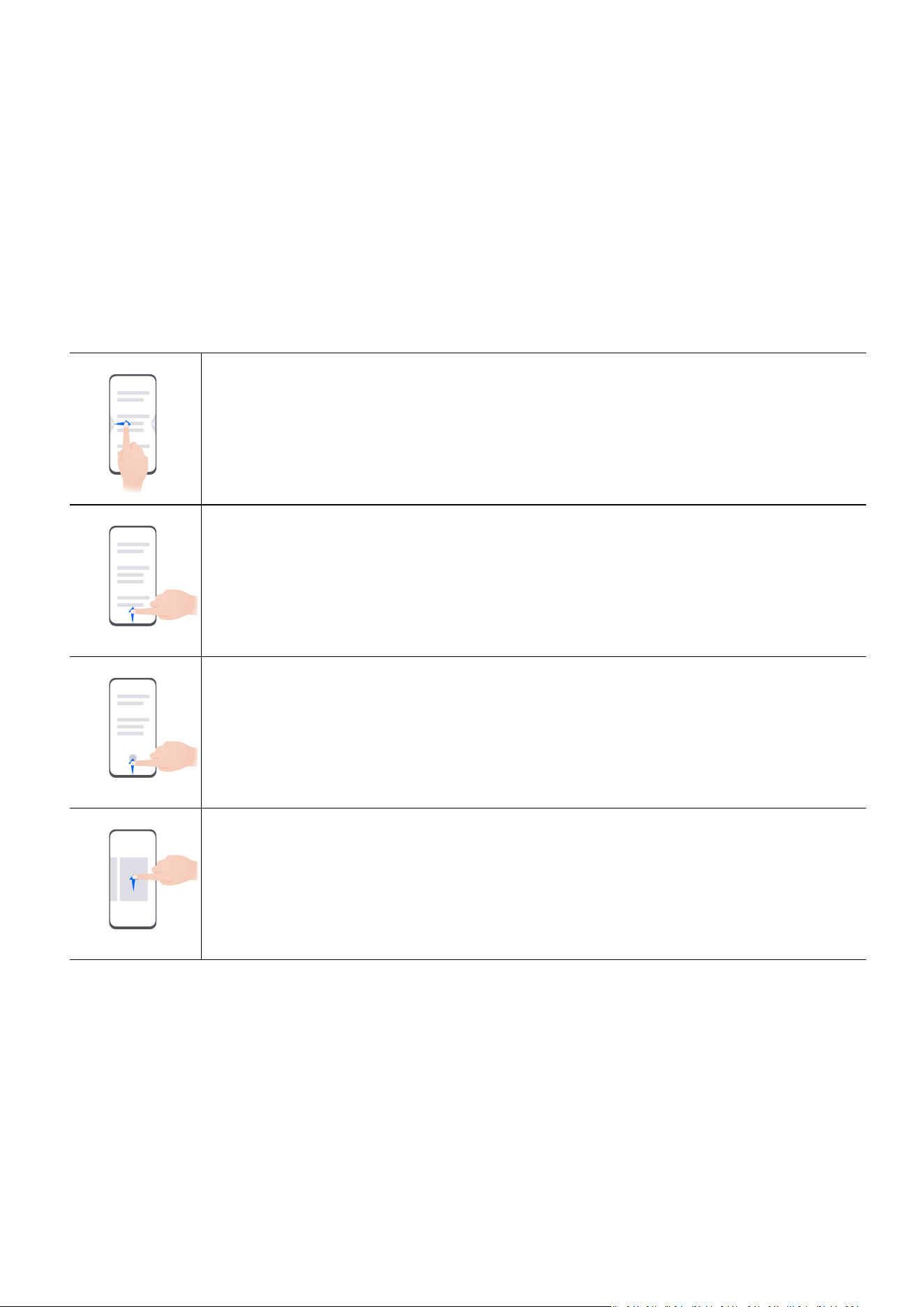
Return to the previous screen
Swipe in from the left or right edges to return to the previous screen.
Back to home screen
Swipe up from the bottom to go to the home screen.
Recent tasks
Swipe up from the bottom of the screen and hold to view recent tasks.
Close an app
When viewing recent tasks, swipe up on an app preview to close the app.
1
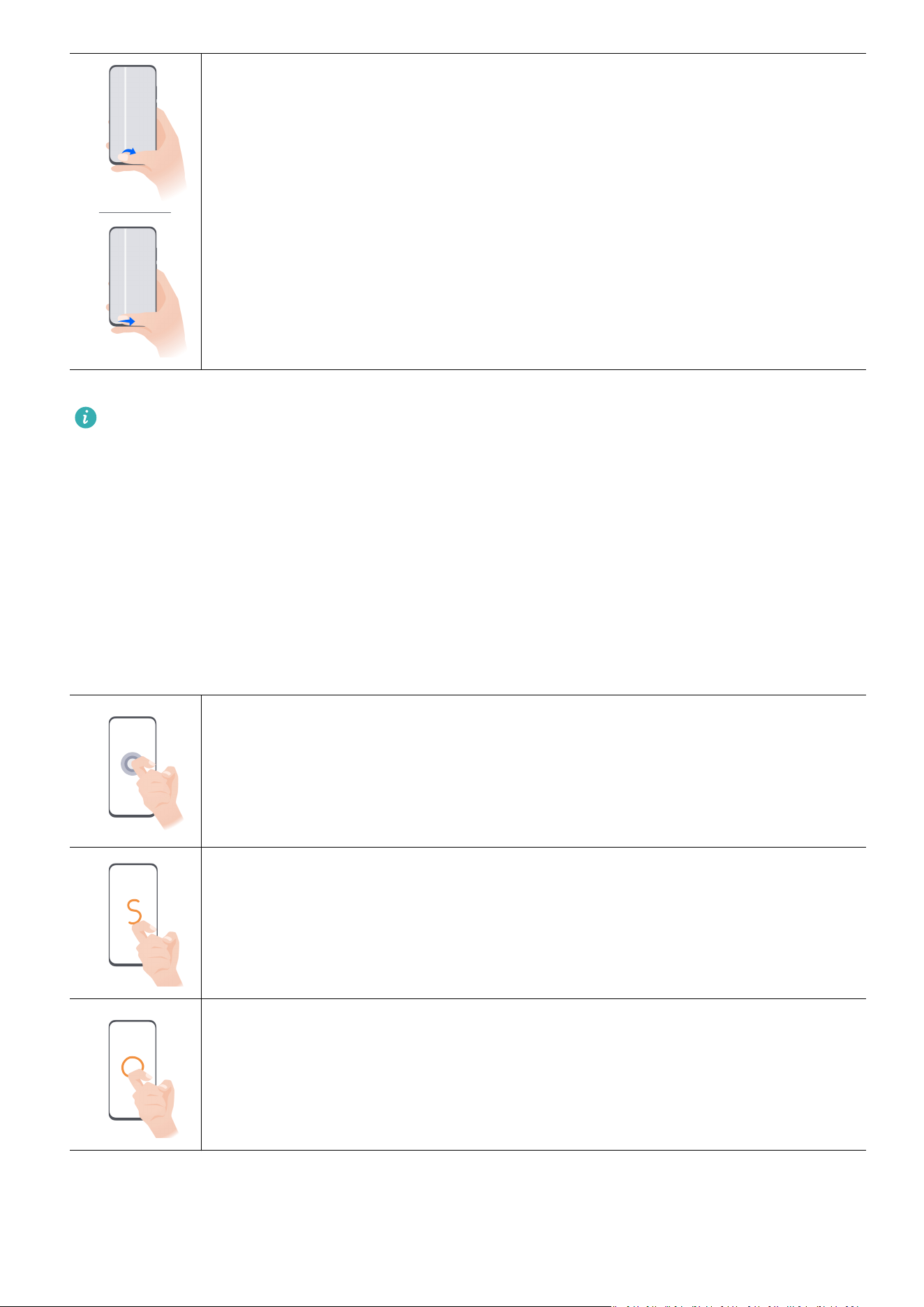
Switch between apps
• Slide across the bottom edge of the screen to switch between apps.
Before using this gesture, touch Settings on the System navigation
screen, and ensure that Slide across bottom to switch apps is enabled.
• Swipe across the bottom of the screen in an arc to switch between apps.
If your device does not have the Slide across bottom to switch apps switch, it indicates
that the corresponding feature is not supported.
Knuckle Gestures
Before using knuckle gestures, use either of the following methods to make sure that all
necessary features are enabled (depending on your device model):
• Go to Settings > Accessibility features > Shortcuts & gestures, and enable Take
screenshot and Record screen.
• Go to Settings > Accessibility features > Motion control > Take screenshot, and enable
Smart screenshot.
Take a screenshot
Knock twice on the screen with a knuckle to take a screenshot.
Take a scrollshot
Knock on the screen with a knuckle and draw an "S" to take a scrolling
screenshot.
Capture part of the screen
Knock and draw an enclosed area with a knuckle to capture part of the
screen.
Essentials
2
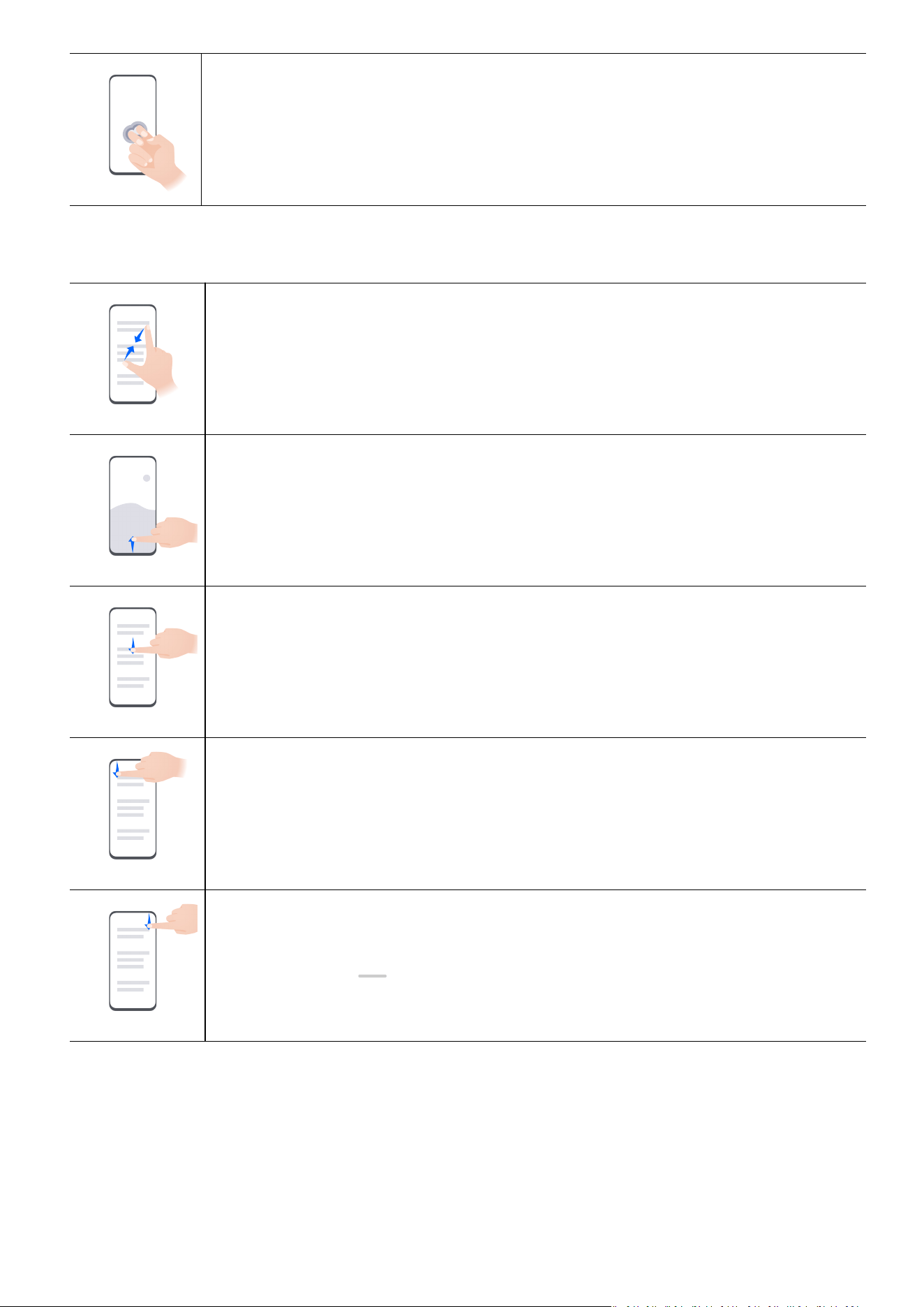
Record screen
Knock twice on the screen with two knuckles to start or end a screen
recording.
More Gestures
Access Home screen editing mode
Pinch two ngers together on the home screen.
Display the shortcut panel on the lock screen
Turn on the screen and swipe up from the bottom of the lock screen.
Display the search bar
Swipe down from the middle of the home screen.
Display the notication panel
Swipe down from the upper left edge of the screen.
Turn on a shortcut switch
Swipe down from the upper right edge of the screen to display Control
Panel and touch to expand the shortcut switches panel.
Essentials
3
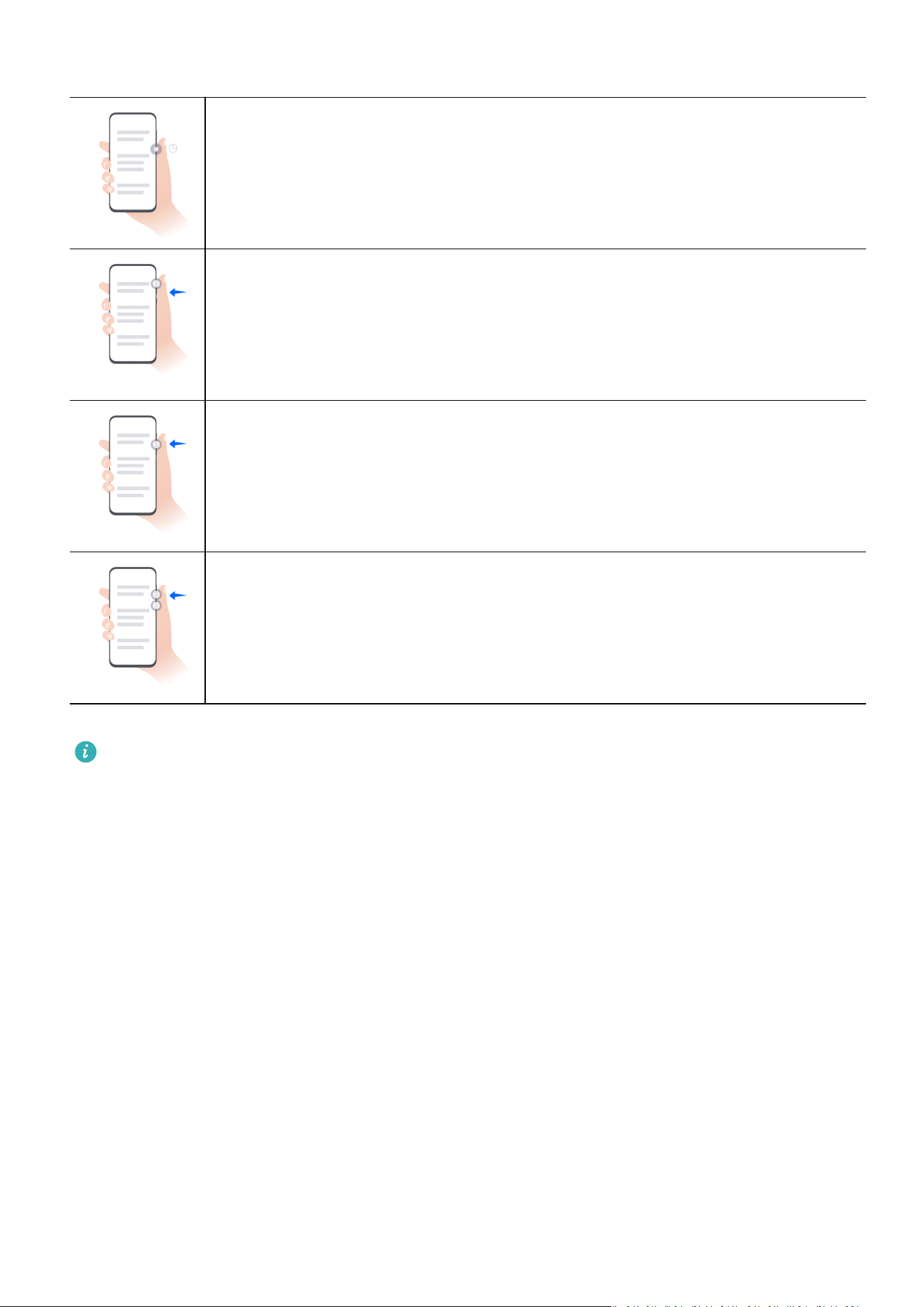
Button Shortcuts
Power o and restart
Press and hold the Power button until your phone displays the Power o
and Restart menus.
Turn up the volume
Press the Volume up button.
Turn down the volume
Press the Volume down button.
Take a screenshot
Press the Volume down and Power buttons simultaneously.
Some products do not have volume buttons.
Get Familiar with the Home Screen
Use Service Widgets
Service widgets allow you to:
• Preview or access apps, such as to view the weather forecast, or play music.
• Select from a range of service widget styles and layouts to customize your home screen.
• Stack and combine multiple service widgets to save home screen space, streamline your
home screen, and navigate with greater ease.
Essentials
4
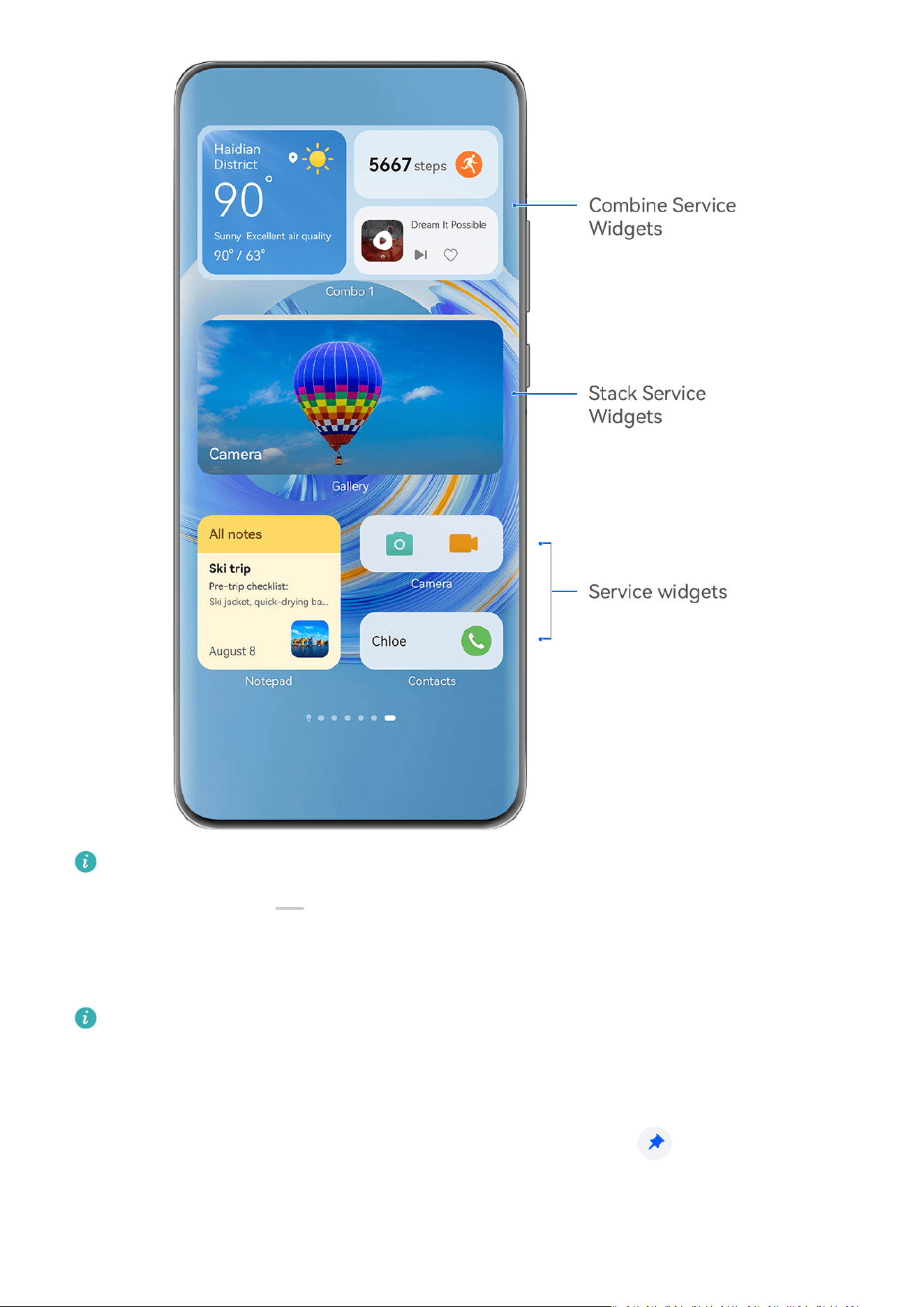
The gures are for reference only.
Apps with a widget bar at the bottom support service widgets.
To remove the widget bar, go to Settings > Home screen & wallpaper > Home screen
settings > Show widget bars.
This feature is not supported in some cases, such as when your device is in Simple mode.
Add Service Widgets to Your Home Screen
You can add a service widget to the home screen in any of the following ways:
• Swipe up on an app icon to expand its service widget, and touch to add the service
widget to the home screen.
Essentials
5

• Swipe up on an app icon to expand its service widget, touch and hold down on the service
widget, select More service widgets, and select your desired style. Then touch Add to
home screen.
• Touch and hold down on an app icon, touch Service widgets, select your desired style, and
touch Add to home screen.
If there is no space available on the current screen, the widget will be pinned to the next
screen. If neither screen has any space, a new screen will be created for the service widget, to
the right of the current screen.
You can also touch and hold down on a service widget on the More service widgets screen,
and drag it to any blank area on the home screen. If you decide not to add the service widget
to the home screen while dragging it, drag it to the cancel zone instead at the top of the
screen.
• Service widgets cannot be pinned to folders.
• You won't be able to swipe up on an app icon to expand the service widget in Drawer
mode.
Stack Service Widgets
Stack same-sized service widgets to save home screen space, and streamline your home
screen.
1 To do so, touch and hold down on a service widget, drag it to another service widget of
the same size, and release to stack the two widgets, once they have completely
overlapped. Swipe up or down to cycle between widgets.
2 Swipe down further to expand the stack. From there, you can perform the following
operations for any single service widget:
• Pinning a service widget to the top: Touch a service widget, and pin it to the top of
the stack.
• Adjusting the position of a service widget: Touch and hold down on a service
widget, and drag it to change its position.
• Removing a service widget from the stack: Touch and hold down on a service
widget, drag it to the left or right screen edge, wait for the service widget to be moved
out of the stack, and drag it to any blank area on the home screen.
• Deleting a service widget from the stack: Swipe left on a service widget.
You can also touch and hold down on a service widget stack to edit or remove the top service
widget.
Combine Service Widgets
Combine service widgets of all sizes, and add frequently-used shortcuts to service widget
combinations, to create shortcuts for common features.
Essentials
6

1 To do so, touch and hold down on a service widget, drag it to another service widget of
any size until they partially overlap, and release to complete the combination, once the
back panel has been expanded.
2 Touch and hold down on a service widget combination. From there, you can:
• Touch Edit combo to add or remove Service widgets or Shortcuts. Touch , , or
to change the template size. Hold and drag to adjust the position of the added
content.
• Touch Rename to edit the name of the service widget combination.
• Touch Remove combo to remove the service widget combination.
If there is an empty space in a service widget combination, you can drag another service
widget to add it to the combination. If there is not enough space for the service widget
combination, you can go to Edit combo, and change the template size to a larger one.
You can also touch and hold down on a service widget to edit or remove it.
Certain service widgets can't be edited.
Edit and Remove Service Widgets
Edit service widgets:
Touch and hold down on a service widget, and select Edit to set which information will
display for the widget. For example, you can select cities for the Weather service widget, or
select a time zone for the Clock service widget.
Remove service widgets:
Touch and hold down on a service widget, and select Remove to remove it from the home
screen.
• If you uninstall certain apps, the corresponding service widgets will also be removed.
• Certain service widgets can't be edited.
Create and Use Large Folders
Large folders make it easy to categorize app icons on the home screen. Directly open an app
by touching the app icon, without expanding the folder, and adjust the folder size as needed,
to craft your ideal home screen layout.
Create a Large Folder
1 Touch and hold an app icon and drag it over another icon to create a new folder.
2 Touch and hold a folder to switch between display modes. For example, you can touch
and hold a new folder and select Enlarge from the displayed menu to create a large
folder.
3 You can touch the lower right corner of the large folder to open it and then touch the
folder name to rename it.
Essentials
7
You can also rename the folder by touching and holding it and selecting Rename.
Operations in a Large Folder
You can perform the following operations in large folders:
• Adjust the folder size: Touch and hold down on a large folder, and release your nger
when the pop-up menu displays. Drag the blue edges or corners around the folder to adjust
the folder size, and touch any blank area on the home screen to complete the operation.
• Enter or exit folders: Touch the lower right corner on a large folder to enter it. Touch a
blank area in the folder to exit it.
When there are too many app icons to display on one page within a large folder, a stacked
icon will appear in the folder's lower right corner. You can touch the stack icon to open the
folder.
• Add or remove apps: Open a large folder, and touch , and add or remove apps as
required. If you deselect all apps within the folder, the folder will be deleted.
• Switch between display modes: Touch and hold down on a folder to switch between a
standard and large display. For example, you can touch and hold down on a standard
folder, and select Enlarge from the displayed menu to create a large folder.
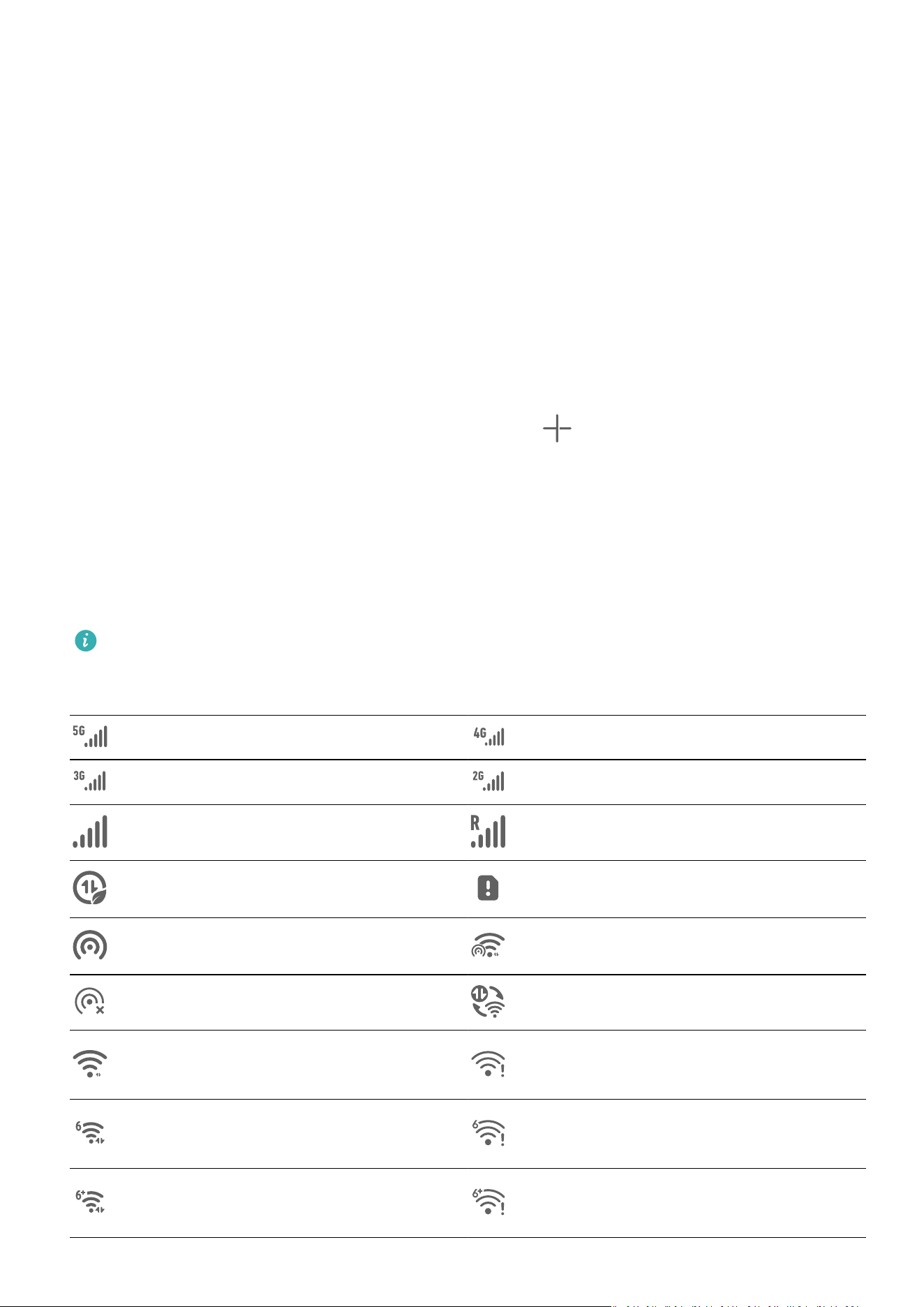
Notication and Status Icons
Network status icons may vary depending on your region or network service provider.
Supported features vary depending on the device model. Some of the following icons
may not be relevant to your phone.
5G network connected 4G network connected
3G network connected 2G network connected
Full signal strength Roaming
Data saver enabled No SIM card inserted
Hotspot enabled Hotspot connected
Hotspot disconnected Switching networks via Wi-Fi+
Wi-Fi connected
Wi-Fi network is faulty, unable to
connect to the Internet
Wi-Fi 6 connected
Wi-Fi 6 network is faulty, unable
to connect to the Internet
Wi-Fi 6+ connected
Wi-Fi 6+ network is faulty, unable
to connect to the Internet
Essentials
8
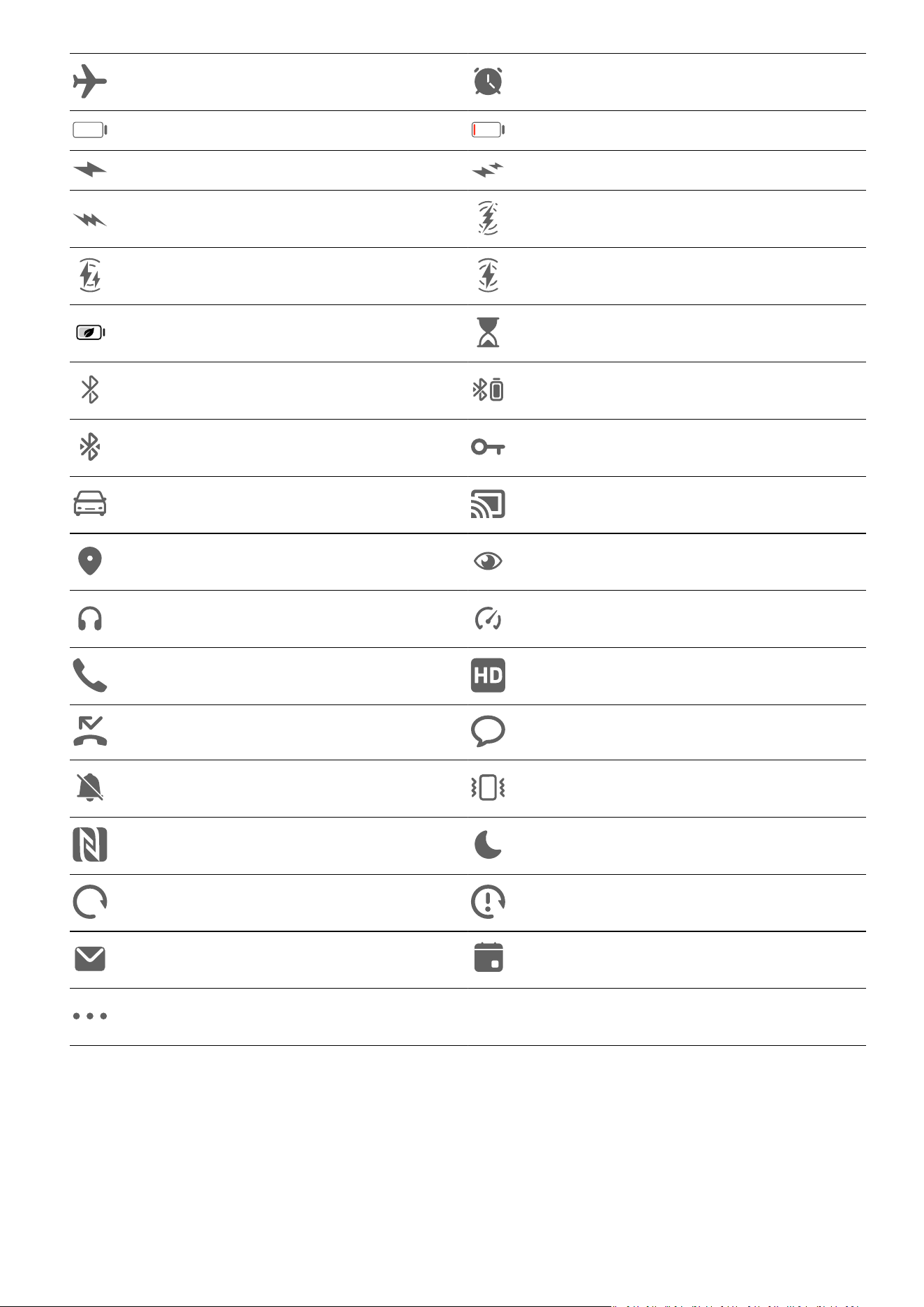
Airplane mode enabled Alarm set
Battery empty Low battery
Charging Fast charging
Super charging Wireless super charging
Wireless fast charging Regular wireless charging
Power Saving mode enabled Digital Balance enabled
Bluetooth enabled Bluetooth device battery
Bluetooth device connected VPN connected
Driving mode enabled Projection device connected
Location service enabled Eye Comfort enabled
Headset connected Performance mode enabled
Calling VoLTE enabled
Missed call New message
Silent mode Vibration pattern
NFC enabled Do Not Disturb mode enabled
Syncing data Data syncing failed
New email Event reminder
More notications
Control Panel
Introduction to Control Panel
Manage and control audio playback, shortcuts, and Super Device, with greater ease, in
Control Panel.
Essentials
9
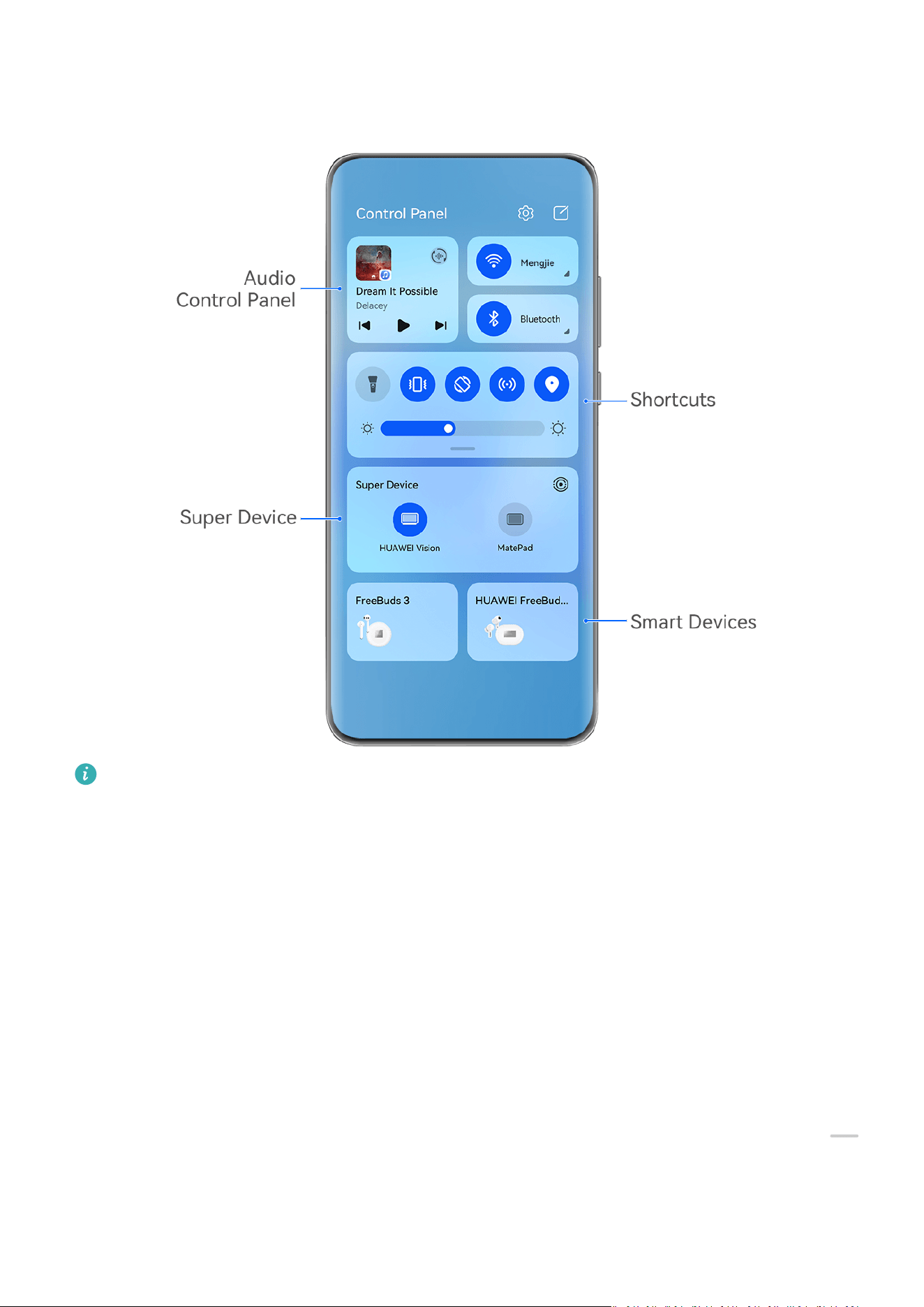
Swipe down from the upper right edge of the screen to display Control Panel to access the
following features:
The gures are for reference only.
• Audio Control Panel: Controls audio playback and switches between recently-used media
apps and media devices (such as Visions and Bluetooth headsets).
• Shortcuts: Enables, disables, or sets frequently-used features.
• Super Device: Collaborates with tablets, laptops, Visions, and other devices to facilitate
seamless video transfers and other cross-device features.
• Smart devices: Allows you to manage and control devices and scenes that have been
added in AI Life.
Use Shortcut Switches
Turn on a Shortcut Switch
Swipe down from the upper right edge of the screen to display Control Panel and touch
to expand the shortcut switches panel.
Essentials
10
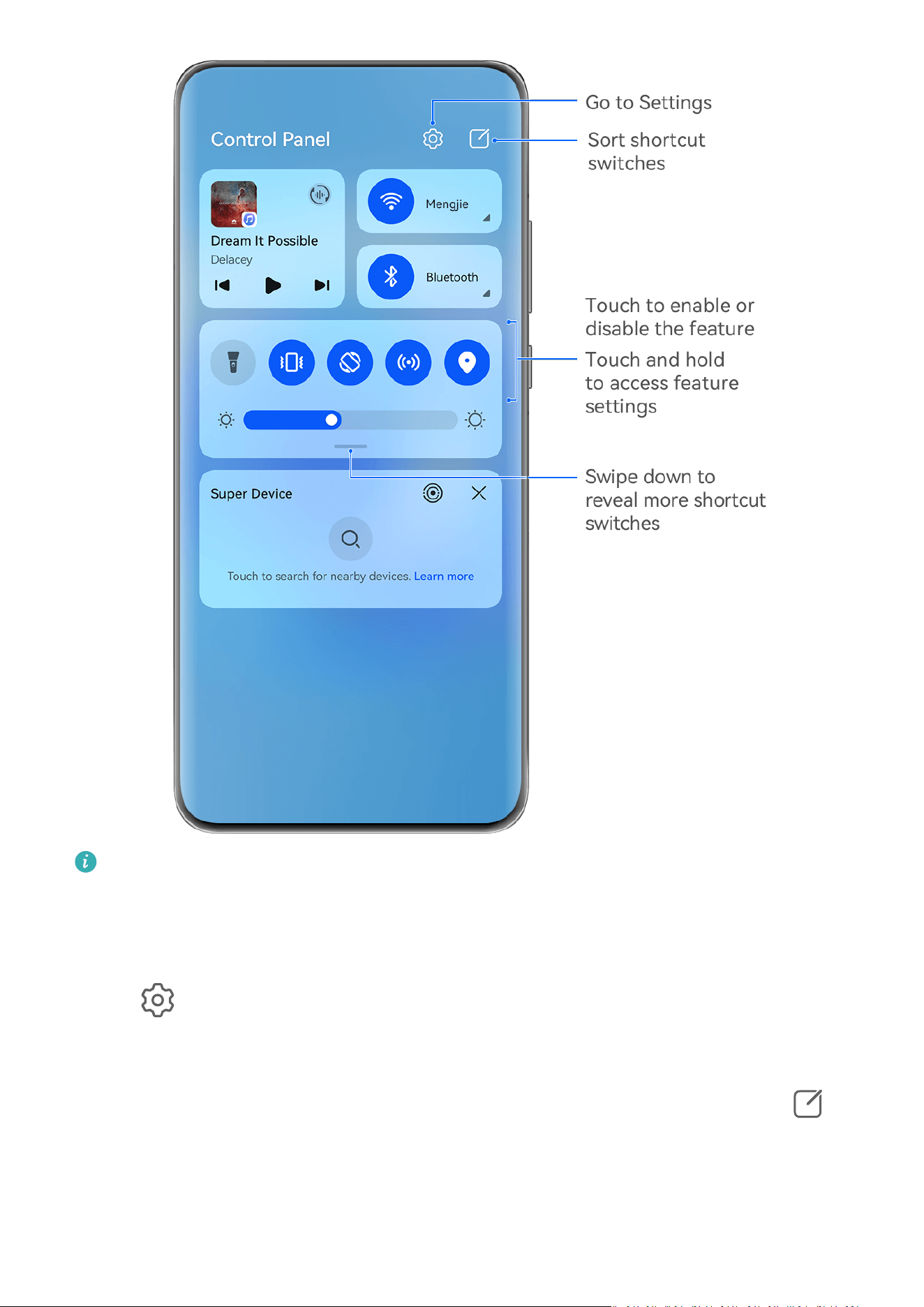
The gures are for reference only.
• Touch a shortcut switch to enable or disable the corresponding feature.
• Touch and hold a shortcut switch to access the settings screen of the corresponding feature
(supported by some features).
• Touch
to access the system settings screen.
Customize Shortcuts
Swipe down from the upper right edge of the screen to display Control Panel, go to >
Edit switches, then touch and hold a shortcut switch to drag it to your preferred position,
and touch Done.
Essentials
11

Audio Control Panel
Manage playback and switch listening apps at any time, or even transfer streaming audio
from your phone to other devices, like a headset or speaker.
Manage Playback and Switch Seamlessly Between Audio Apps
When multiple audio apps (such as Music) are open, use the audio control panel to manage
playback and switch audio apps at any time.
1 Swipe down from the upper right edge of the phone to display Control Panel, and touch
the playback control card at the top.
2 Current and recently-used audio apps will display in the playback control card, where you
can manage playback (such as playing, pausing, and switching tracks) in the app in use,
or switch to another audio app.
• The audio control panel is only supported for certain apps .
• Some apps need to be updated to the latest version.
Sharing Audio with Friends via Bluetooth Earphones
Sharing audio allows you to connect multiple pairs of Bluetooth earphones to the same
phone, so that you can listen to music or watch videos along with a friend.
• This feature is only supported on certain Bluetooth earphones.
• If your Bluetooth earphones support this feature, update them to their latest available
version.
1 Pair your device with a pair of Bluetooth earphones, and touch in the upper right
corner of the playback control card for Control Panel.
2 Set a sharing mode based on the pairing status of the other pair of earphones:
Self sharing (the other pair of earphones has been paired with your device): The
paired earphones will display in the device list. Select the two pairs of earphones that you
wish to share audio with.
You can also go to Control Panel > Super Device, and drag the icons for the two pairs of
earphones to the icon for this device, to initiate a connection.
Temporary sharing (the other pair of earphones has not been paired with this
device): Select the paired earphones from the device list on this device, touch Share
audio under the name of the earphones, and initiate sharing as follows:
• The other pair of earphones has not been paired with any device: Place the
earphones that you wish to share in the charging case, open the case, place it close to
this device, and follow the onscreen instructions to complete the connection. If your
phone does not detect any earphones, touch and hold down on the button on the
charging case, and place the earphones close to this device to initiate paring.
• The other pair of earphones has been paired with another tablet/phone: Turn on
the screen of the phone that is paired with that earphones, and place that phone close
to this device, and follow the onscreen instructions to complete the connection.
Essentials
12

3 Once the pairing is complete, you'll be able to share the audio on this device with the two
pairs of earphones.
To stop audio sharing, touch
on the playback control card, touch the shared earphones,
and deselect it.
Transfer Phone Audio to Another Device
When your phone is connected to a listening device (such as a headset, speaker, or Vision
product), you can send the audio playing on your phone to the listening device, and continue
to manage playback in the audio control panel.
1 Connect your phone to a listening device via Bluetooth, AI Life, or another method.
2 Touch
in the upper right corner of the playback control card in Control Panel, and
select the listening device from the list to transfer the audio playing on your phone to the
listening device.
If there is no audio cast device list in the playback control card, touch to display the list.
Use a Phone to Control HUAWEI Smart Speakers and Other Devices
When your phone is connected to multiple HUAWEI smart audio devices (such as HUAWEI
smart speakers), you can use the audio control panel to manage playback and switch
listening devices at any time.
• Before using this feature, update any HUAWEI smart speaker to their latest versions.
The following uses the HUAWEI smart speaker as an example.
1 Add the HUAWEI smart speaker to AI Life, and connect your phone and speaker to the
Internet.
2 Touch the playback control card in Control Panel. The icon of the added device will
display above the card.
3 Touch a device icon to access the corresponding device control screen. From there, you can
play, pause, switch tracks, and adjust the volume.
If multiple audio devices are connected, you can tap on device icons to switch listening
devices.
If there are no device icons above the playback control card, touch
to display the device
list.
Switch Seamlessly Between Screens, with Super Device
Use Super Device for multi-device collaboration with just a tap, to turn all of your smart
devices into one cohesive unit. For example, when you go home, you can continue watching
a movie on your HUAWEI Vision, by picking up right from where you had left o on your
phone; when you return to the oce, you can continue to edit the same documents on your
computer, by picking up right from where you had left o on your phone.
Essentials
13
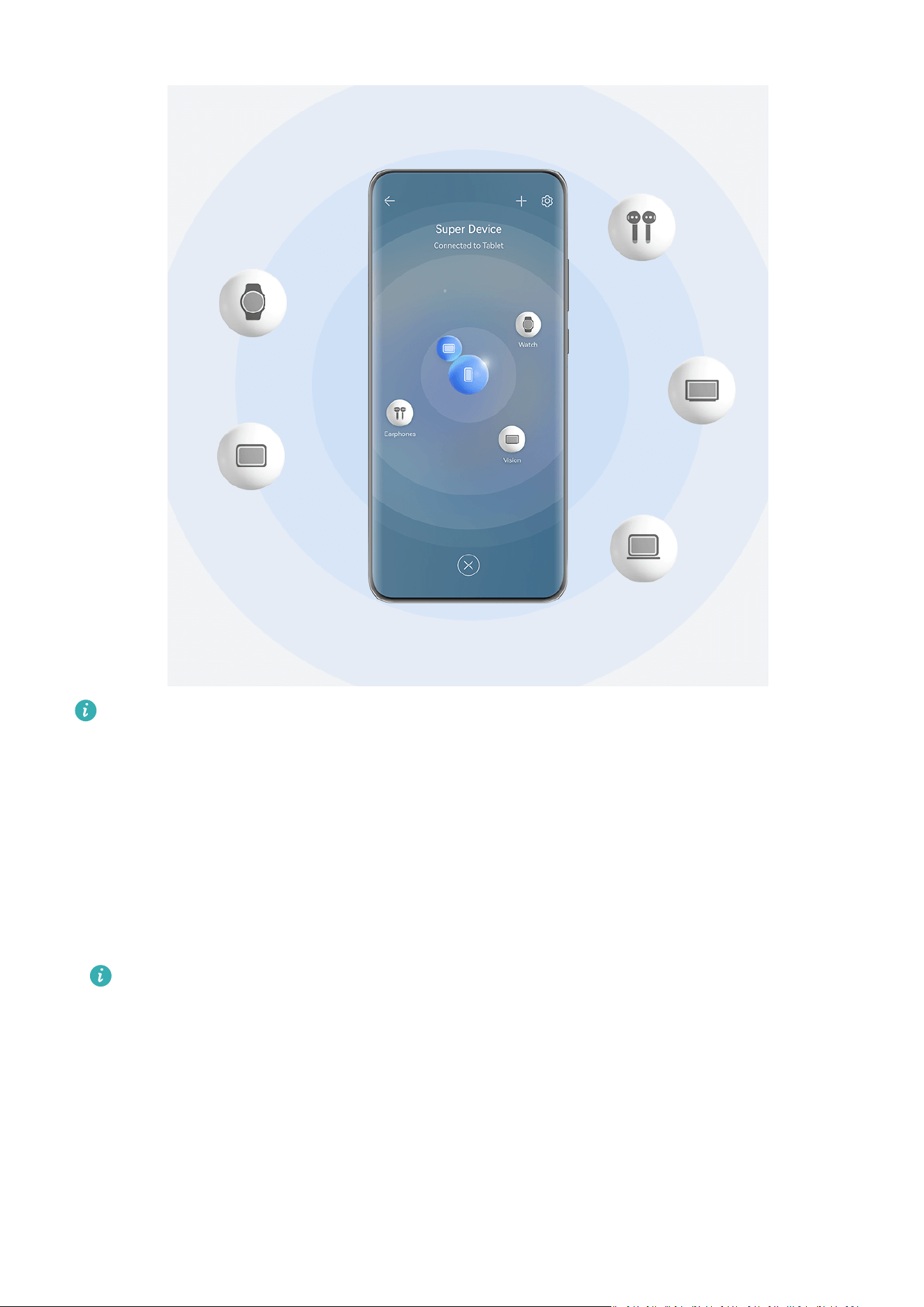
The gures are for reference only.
Device types supported by Super Device may vary by product.
Set Super Device Before Getting Started
Before using Super Device, enable Bluetooth and Wi-Fi on your phone, and log in to your
HUAWEI ID.
Make sure that the screens of your other devices remain on, and apply the following settings
on these devices:
• Phone: Enable Bluetooth and Wi-Fi.
Only phones that support Multi-cam mode can be used as connected devices. You can
check whether Multi-cam mode is supported by going to Camera > More (for the list
of supported devices, please visit the Huawei ocial website).
• Tablet: Enable Bluetooth and Wi-Fi.
• Tablet with an E Ink display: Enable Bluetooth and Wi-Fi, and make sure that it is logged
in to the same HUAWEI ID as your phone.
• Computer: Enable Bluetooth and Wi-Fi, and make sure that it is logged in to the same
HUAWEI ID as your phone.
• Vision or monitor: Enable Bluetooth and Wi-Fi.
Essentials
14
• Smart speaker or printer: Make sure that it is connected to the same LAN as your phone,
paired in AI Life with your phone, and logged in to the same HUAWEI ID.
Enter the AI Life home screen, go to > Add device, and follow the onscreen
instructions to complete the connection.
• Earphones or glasses: Make sure that they are paired and connected to your phone via
Bluetooth.
• Watch or band: Make sure that it is paired with your phone via Huawei Health, and logged
in to the same HUAWEI ID.
Create Your Super Device, by Connecting to Nearby Devices
If you can't nd Super Device in Control Panel, touch in the upper right corner, and
touch Show Super Device.
The devices are logged in to the same HUAWEI ID.
1 Swipe down from the upper right edge of your phone to display Control Panel, and touch
or in Super Device to search for nearby devices to connect with.
2 Touch the device to be connected, or drag the device to be connected to this device, and
follow the onscreen instructions to complete the connection.
Once device connections are established, you can touch to switch the application
scenario.
The devices are not logged in to the same HUAWEI ID.
1 On the phone/tablet that you wish to connect to, go to Settings > Super Device > This
device > Visible to, and select All nearby devices.
2 Swipe down from the upper right edge of your phone to display Control Panel, and touch
in Super Device.
3 Touch , select the device that you wish to connect to, and follow the onscreen
instructions to complete the connection.
To unlink a device that is not logged in to the same HUAWEI ID, touch in Super
Device, touch and hold down on the device, and touch Delete. Alternatively, you can
go to Settings > Super Device, select the device that you wish to unlink in Other
devices, and touch Delete.
4 Touch the device to be connected, or drag the device to be connected to this device, and
follow the onscreen instructions to complete the connection.
Once device connections are established, you can touch to switch the application
scenario.
Essentials
15

Multi-Screen Collaboration on a Computer or Tablet
Connect your phone to a computer and tablet via Super Device to make oce work more
ecient and collaborative. You can view and edit les, drag and drop les, copy and paste
text, or even browse phone apps, from the Multi-screen Collaboration window on your
computer or tablet.
1 Swipe down from the upper right edge of the phone to display Control Panel, and touch
in Super Device to search for nearby available devices, or go to > to bind a
new device.
2 Touch the device to be connected, or drag this device to the local device, and follow the
onscreen instructions to complete the connection.
Once the connection is established, your phone screen will display on the connected device.
To halt Multi-Screen Collaboration, touch the connected device on the Super Device screen.
Screenshots & Screen Recording
Take a Screenshot
Take a Full Screenshot with a Knuckle Tap
1 Before using knuckle gestures, use either of the following methods to enable this feature
(depending on your device model):
• Go to Settings > Accessibility features > Shortcuts & gestures > Take screenshot,
and enable Knuckle screenshots.
• Go to Settings > Accessibility features > Motion control > Take screenshot, and
enable Smart screenshot.
2 Tap twice in quick succession with one knuckle to take a screenshot of the entire screen.
Take a Screenshot with a Key Shortcut
Press and hold down on the Power and Volume down buttons at the same time to take a
screenshot.
Take a Screenshot with a Shortcut Switch
Swipe down from the upper right edge of the screen to display Control Panel, touch
to
expand the shortcut switches panel, and touch Screenshot to take a screenshot.
Share or Edit a Screenshot
After you take a screenshot, a thumbnail will appear in the lower left corner of the screen.
Feel free to:
• Swipe up on the thumbnail to select a method for sharing the screenshot with others.
• Tap on the thumbnail to edit, delete, or do more with the screenshot.
Essentials
16
Screenshots are saved to Gallery by default.
Take a Partial Screenshot
Use Partial screenshot to take a screenshot of a part of the screen. You can choose your
preferred screenshot shape (such as a rectangle, oval, or heart).
Take a Partial Screenshot with Knuckle Gestures
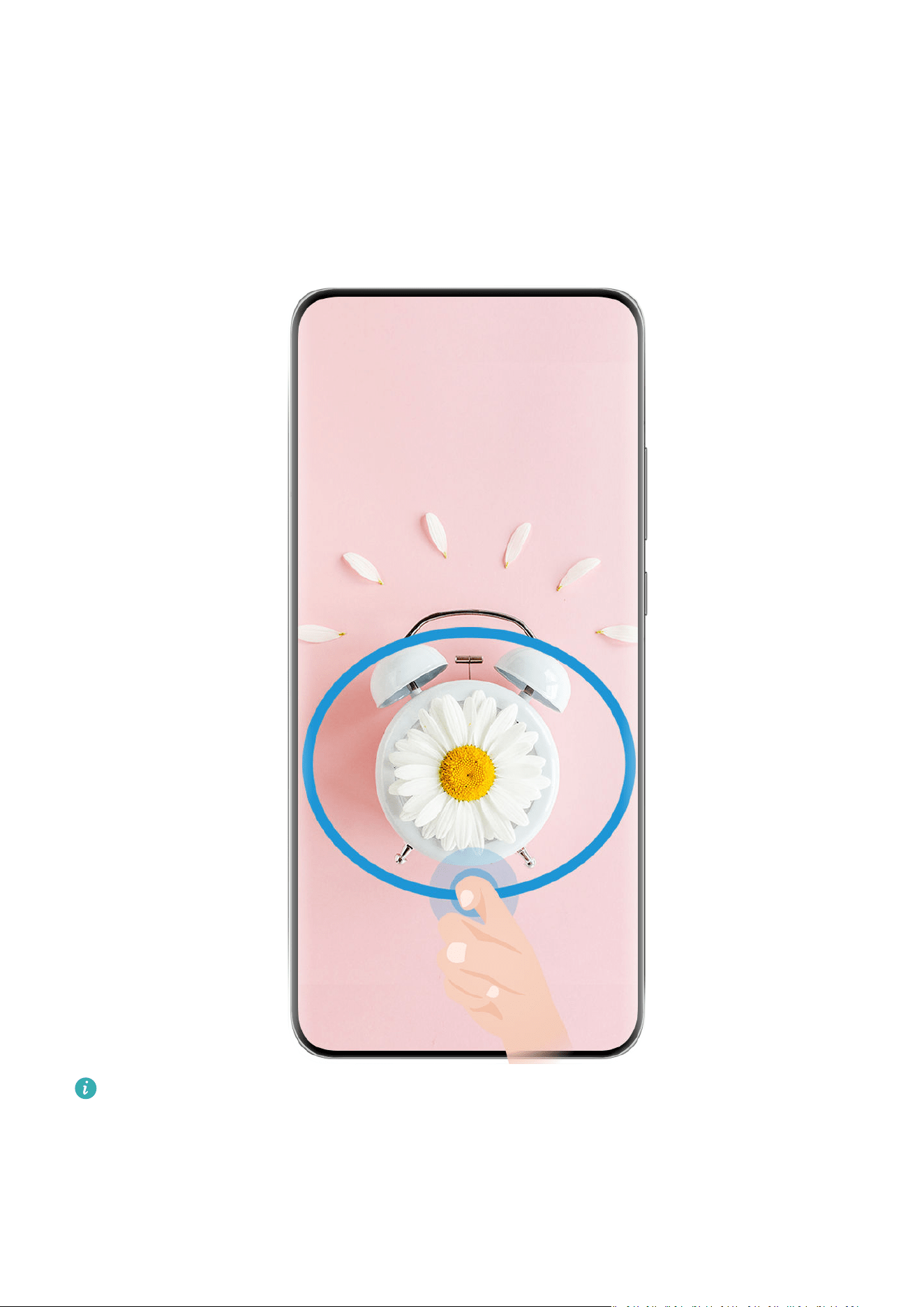
The gures are for reference only.
1 Knock on the screen with a single knuckle and hold to draw an enclosed shape around the
part of the screen that you wish to capture. Make sure that your knuckle does not leave
the screen.
2 The screen will display the motion of your knuckle. From there, feel free to:
Essentials
17

• Drag the frame to the desired position, or resize it.
• Touch any of the shape options on the toolbar to change the shape of the captured
area.
3 Touch to save the screenshot.
Use a Shortcut to Take a Partial Screenshot
1 Swipe down from the upper right edge of the screen to display Control Panel, touch
to expand the shortcut switch panel, touch the triangle icon next to Screenshot, and then
touch Partial screenshot in the pop-up.
2 Follow the onscreen instructions to draw an enclosed shape with your nger around the
part of the screen that you wish to capture.
3 The screen will display the motion of your
nger. From there, feel free to:
• Drag the frame to the desired position, or resize it.
• Touch any of the shape options on the toolbar to change the shape of the captured
area.
4 Touch
to save the screenshot.
Take a Scrolling Screenshot
Use Scrollshot to capture a memorable chat, article, or essential work document that can't
display in full on the screen, and share with others.
Use a Knuckle to Take a Scrolling Screenshot
Essentials
18
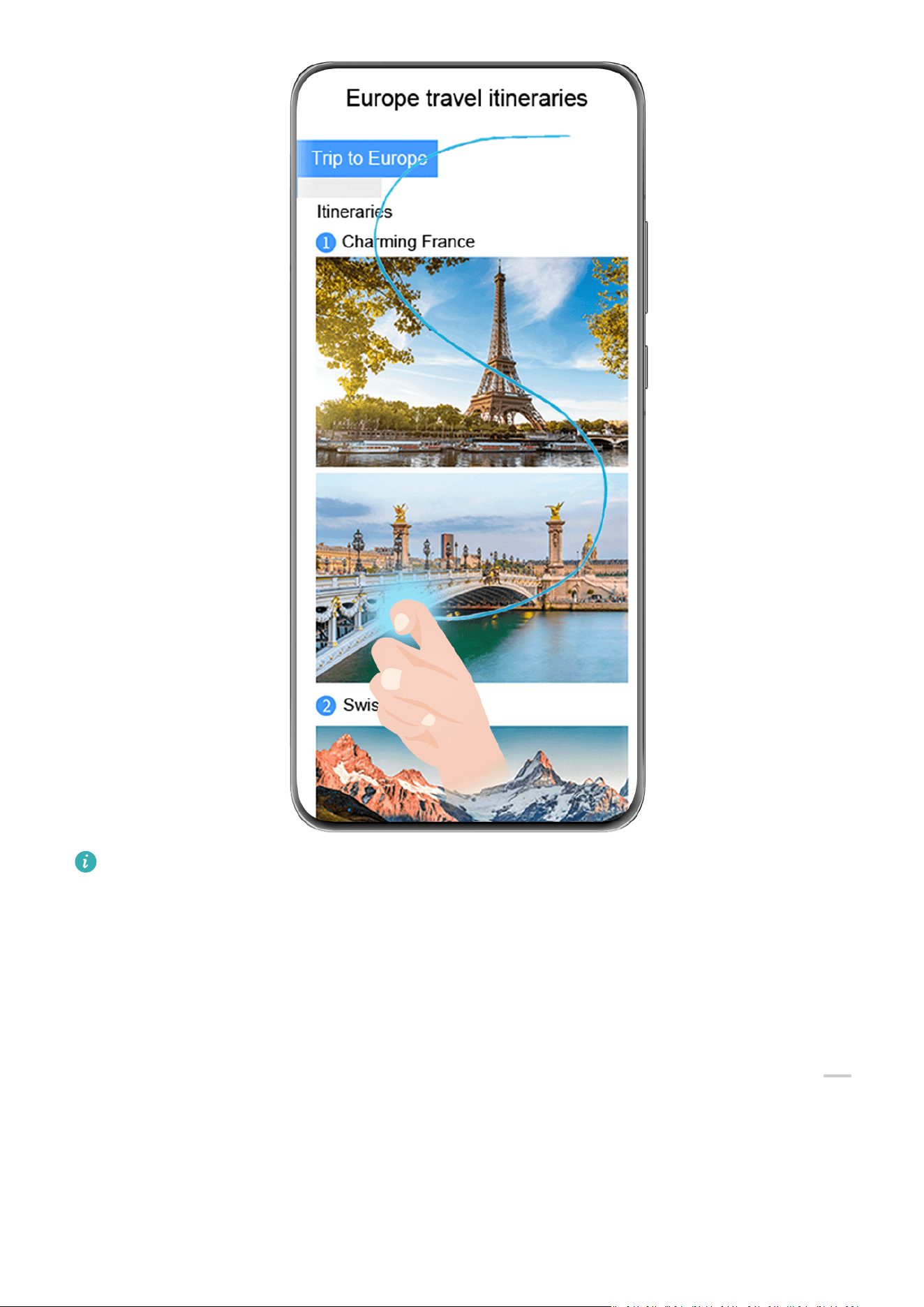
The gures are for reference only.
1 Tap a single knuckle against the screen and hold to draw an "S". Your device will
automatically scroll to the bottom of the page to capture all of the content in a single
screenshot.
2 You can touch the screen at any time to stop the scrolling.
Use a Shortcut to Take a Scrolling Screenshot
1 Swipe down from the upper right edge of the screen to display Control Panel, touch
to expand the shortcut switches panel, touch the triangle icon next to Screenshot, and
touch Scrollshot in the displayed dialog box.
2 You can touch the screen at any time to stop the scrolling.
Swipe down on the Thumbnail to Take a Scrolling Screenshot
Essentials
19
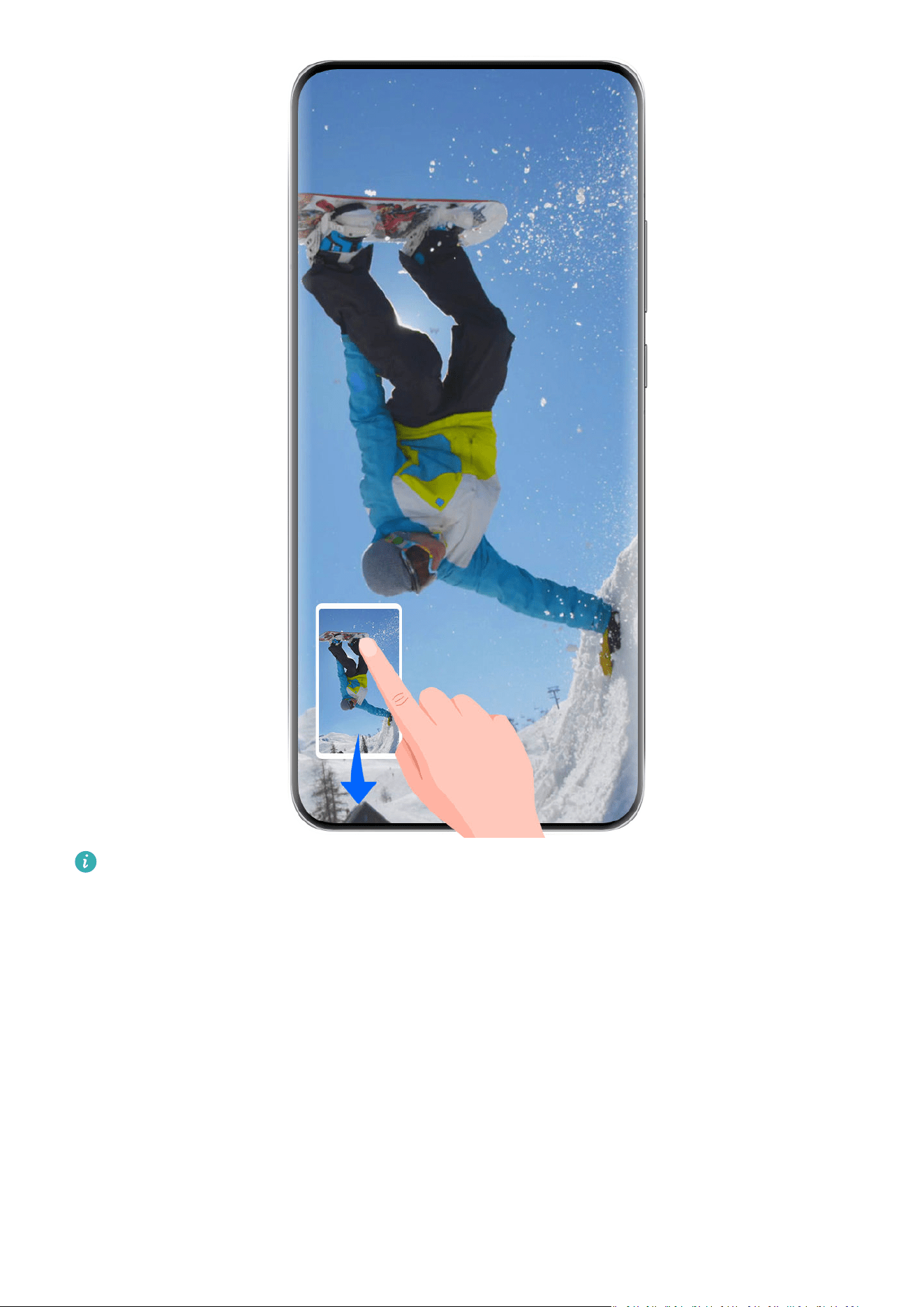
The gures are for reference only.
After you take a screenshot, a thumbnail will appear in the lower left corner. You can
continue to take a scrolling screenshot.
1 Swipe down on the thumbnail to take a scrolling screenshot.
2 You can touch the screen at any time to stop the scrolling.
Record the Screen
Capture action onscreen to create sharable videos, to show
o your gaming skills, compose
tutorials, and do so much more.
Use a Key Combination to Start Screen Recording
Press and hold the Power and Volume up buttons simultaneously to start screen recording. To
stop recording, press and hold both buttons again.
Essentials
20

Use a Shortcut to Start Screen Recording
1 Swipe down from the upper right edge of the screen to display Control Panel, touch
to expand the shortcut switches panel, and touch Screen Recorder to start screen
recording.
2 To stop the recording, touch the timer at the top of the screen.
3 The recording will be saved in Gallery.
Use Two Knuckles to Start Screen Recording
1 Before using knuckle gestures, use either of the following methods to enable this feature
(depending on your device model):
• Go to Settings > Accessibility features > Shortcuts & gestures > Record screen, and
enable Record screen.
• Go to Settings > Accessibility features > Motion control > Take screenshot, and
enable Smart screenshot.
2 Knock the screen twice in quick succession with two knuckles to start a screen recording.
To stop recording, knock twice as before.
Record Your Voice During Screen Recording
Touch the microphone icon to enable or disable the microphone while recording the screen.
• When the microphone is enabled (i.e. it is displayed as ), you can record your voice
while recording the screen.
• When the microphone is disabled (i.e. it is displayed as ) you'll only be able to record
system sounds, such as audio and video playback.
Enter Text
Use Celia Keyboard
Celia Keyboard is a secure and intuitive keyboard developed by Huawei. It supports
ecient
voice inputs, smooth handwriting, as well as 170+ input languages.
If Celia Keyboard is not yet installed on your device, search for and install it in AppGallery.
Go to Settings > System & updates > Language & input and set Celia Keyboard as the
default keyboard.
Text Input
Keyboard input
Celia Keyboard comes with a 26-key layout by default. As you type on the keyboard, a box
will be displayed for you to select predicted words.
Essentials
21
Press and hold a letter key and then swipe up to enter a number, or swipe left or right to
enter the letter.
Voice input
You can have your speech converted into text to improve your input eciency.
• Touch and hold to go to the voice input screen.
• On the voice input screen, touch to select your preferred language.
This feature is only available in some countries and regions.
Rich Media Input
• On the keyboard, touch and hold
, then touch and select dierent emojis.
• On the keyboard, touch and hold , then touch and select dierent emoticons.
Switch to Another Input Language
Touch and hold in the lower left corner and select English(United States) or More
languages… in the pop-up menu. Alternatively, touch
to quickly switch input language.
Celia Keyboard Settings
Set the skin
On the input keyboard, go to > Theme and select a skin.
Set the font
On the input keyboard, go to > Settings > Font and select a font.
Set the Mechanical Keyboard
On the input keyboard, go to > Mechanical keyboard and toggle on the Mechanical
keyboard switch.
To switch back to the normal keyboard, toggle o the Mechanical keyboard switch.
Some devices do not support the mechanical keyboard.
Multi-Window
Edit the Multi-Window Dock
Edit apps in the Multi-Window dock, by adding or removing them, or rearranging their order,
to customize the dock to your heart's content!
Essentials
22
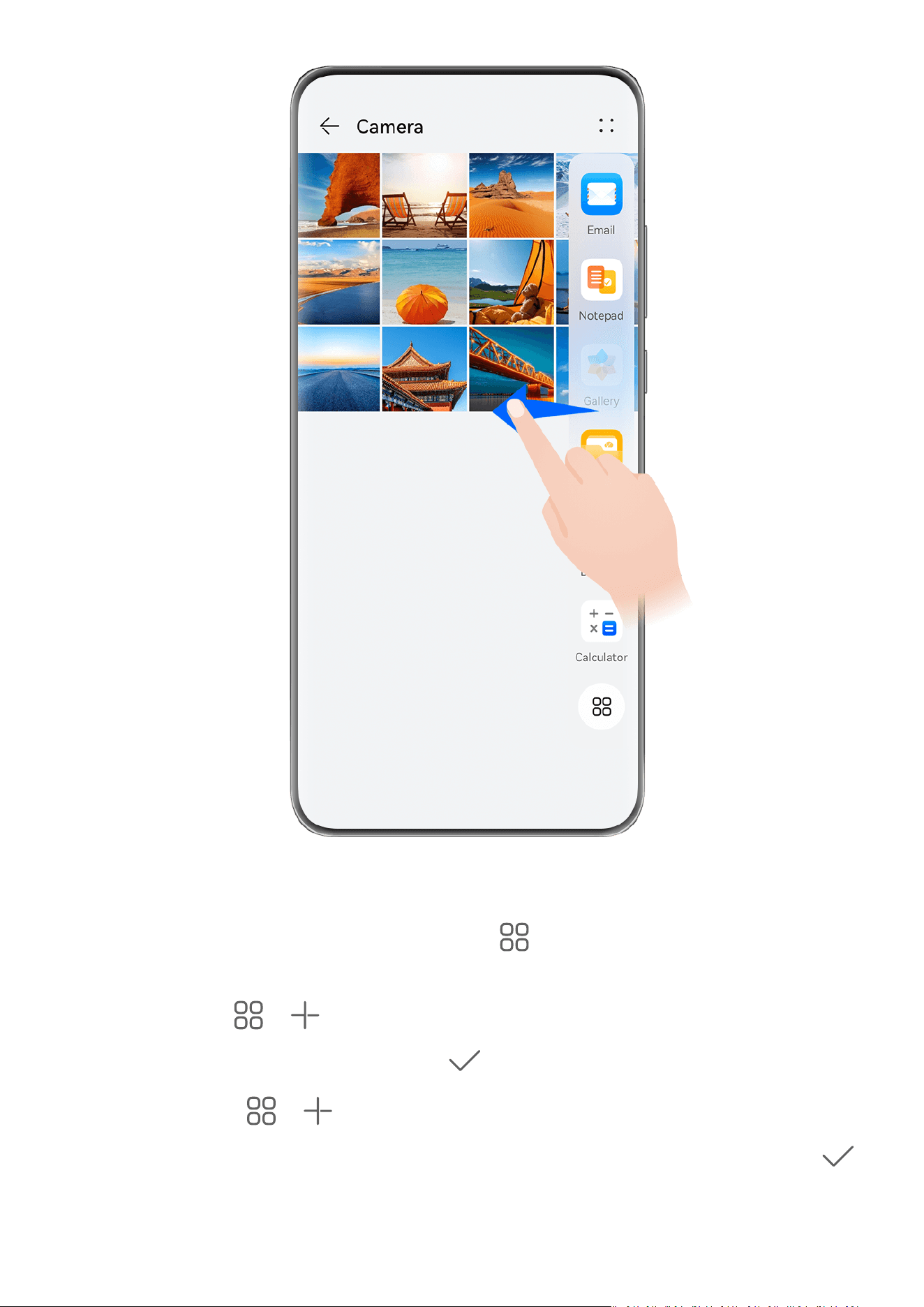
Swipe inward from the left or right edge of your phone and hold to bring up the Multi-
Window dock. From there, feel free to:
• View apps that support Multi-Window: Touch to nd apps that support Multi-
Window in the More apps section.
• Add apps: Go to > to enter the editing screen. Then touch the apps you wish to
add to the Multi-Window dock, and touch
.
• Move apps: Go to > to enter the editing screen, touch and hold down on an app
icon in the Multi-Window dock, drag it to your desired position in the dock, and touch .
Essentials
23
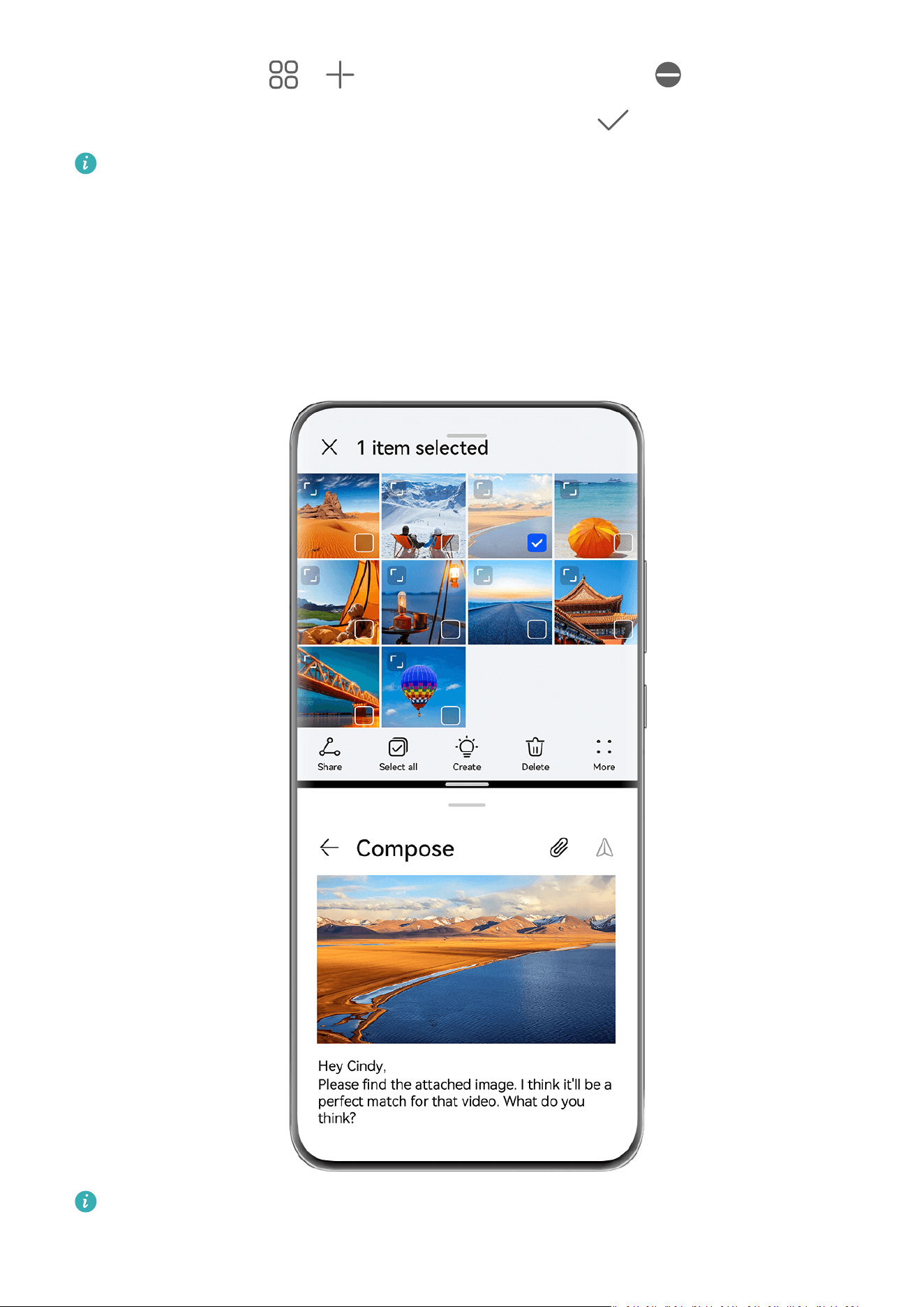
• Remove apps: Go to > to enter the editing screen, touch in the upper right
corner of an app icon in the Multi-Window dock, and touch .
The recommended apps in the Multi-Window dock can't be deleted.
The Multi-Window dock is enabled by default. To disable it, go to Settings > Accessibility
features > Multi-Window, and turn o the Multi-Window dock switch.
Split the Screen, to Multi-Task Away
Multi-Window allows you to open apps in split-screen mode, for seamless multi-tasking at all
times.
The gures are for reference only.
To split the screen:
Essentials
24

1 After opening an app from the home screen, swipe inward from the left or right edge of
your phone and hold, to bring up the Multi-Window dock.
2 Hold down on an app in the dock, drag it on to the screen, and release.
Split-screen mode is only supported on certain apps.
To switch split-screen panes:
Touch and hold down on at the top of a split-screen pane until the pane shrinks, then
drag the pane to the other side of the screen and release, to switch panes.
To adjust the split screen ratio:
Drag on the split screen line to adjust the relative size of each split screen.
To exit split-screen mode:
Drag
or on the split screen line, until you see the other pane disappear.
To switch to a oating window: Touch and hold down on at the top of a split-screen
window, and drag it to the left or right (in portrait mode) or down (in landscape mode).
Drag and Drop Between Apps with Multi-Window
Use the Multi-Window feature to easily drag and drop images, text, and documents between
apps.
• Drag and drop an image: When taking notes with Notepad, open Files, select the photo
you want to add, and drag it into the Notepad editor.
• Drag and drop text: When sending an SMS message, open Notepad, touch and hold the
text you want to send, and drag it into the message text input box.
• Drag and drop a document: When writing an email, open Files, select the document you
want to attach, and drag it into the email editor.
Not all apps fully support drag-and-drop with Multi-Window.
Multi-Window View for a Single App
You can create two task windows for the same app (such as Email and Notepad), and drag
images, text, or documents between the windows.
This feature is unavailable in some apps.
To enable multi-window view for a single app:
1 On the home screen, open Email.
2 Swipe inward from the left or right edge of your phone and hold to bring up the Multi-
Window dock.
3 Touch and hold down on the Email app icon in the dock, and drag it on to the screen and
release, to open two windows within the app.
To drag images, text, or documents between a single app's split-screen windows:
Essentials
25
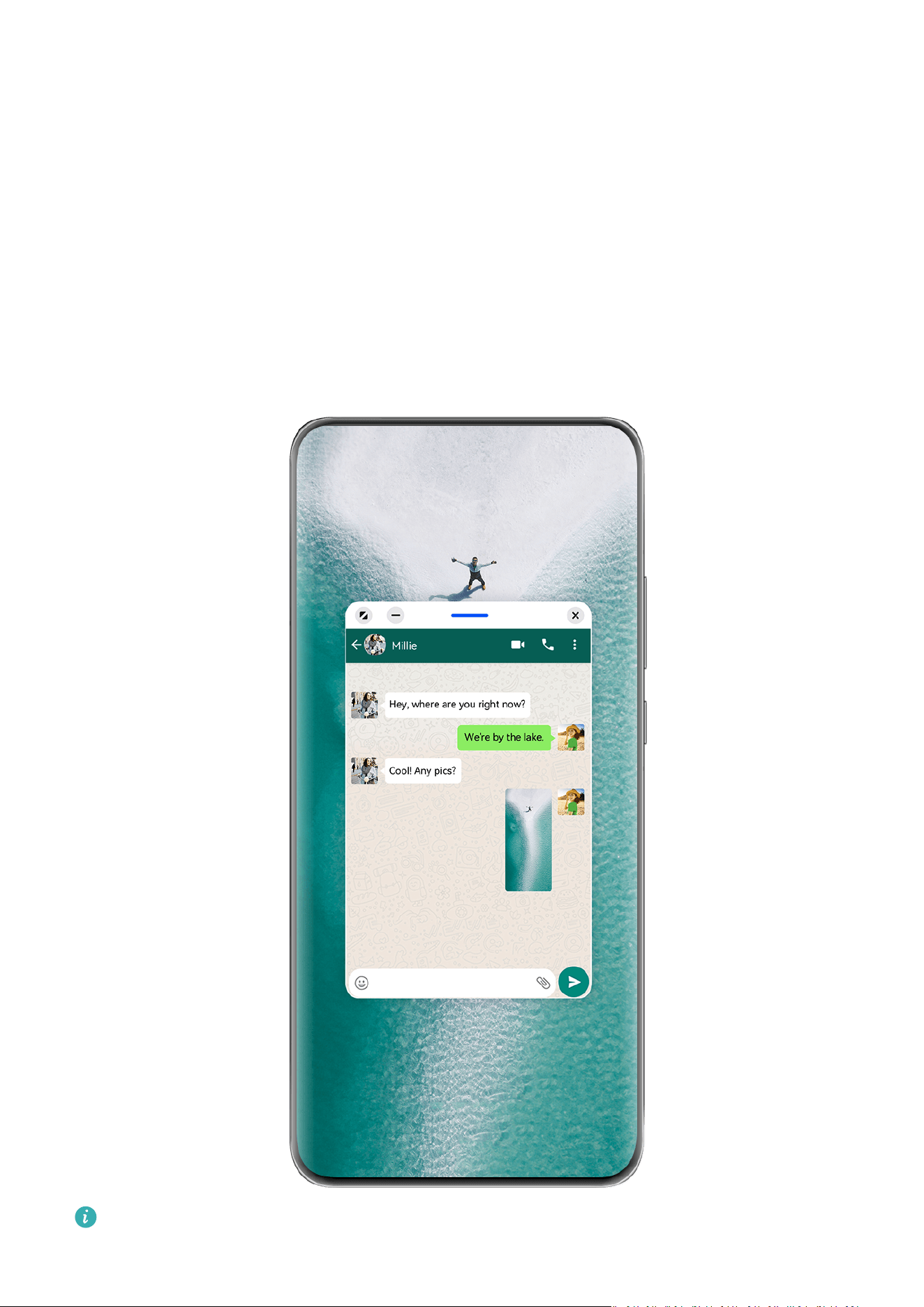
• Drag an image: Select an image from one of the Email app's split-screen windows, and
drag it to the other window.
• Drag text: Touch and hold down on the text and select the desired portion, from one of the
Email app's split-screen windows, then touch and hold down on the text once again, and
drag it to the other window.
• Drag a document: Select a document from one of the Email app's split-screen windows,
and drag it to the other window.
Use the Floating Window
Open a oating window while gaming, and you can chat with a friend without missing a
second of the action.
The gures are for reference only.
Essentials
26

To open a oating window:
• Swipe inward from the left or right edge of your phone and hold to bring up the Multi-
Window dock. Then touch any app in the dock to open it as a oating window.
• Swipe up from the bottom of the screen to enter the Recent tasks screen, and touch the
icon in the top right corner of an app preview to open the app as a oating window.
To relocate the oating window:
Drag the bar at the top of the oating window to move the window to the desired location.
To resize the oating window:
Drag the bottom edge, two sides, or bottom corners of the oating window to resize it.
If you reduce the oating window to the smallest possible size, and then release the
window, it will automatically shrink into a small oating window that remains xed to
the upper right corner of the screen.
To minimize a oating window, perform any of the following:
• Touch at the top of the oating window.
• Touch and hold down on the bar at the top of the
oating window, and quickly drag it to
the left or right.
• Touch and hold down on the bar at the top of the oating window, and drag it to the left
or right screen edge.
To return to full-screen mode, perform any of the following:
• Touch at the top of the oating window.
• Touch and hold down on the bar at the top of the oating window, and quickly drag it
upwards.
• Touch and hold down on the bar at the top of the oating window, and drag it up to the
status bar.
To close a oating window, perform any of the following:
• Touch
at the top of the oating window.
• Touch and hold down on the bar at the top of the oating window, and quickly drag it
downwards.
• Touch and hold down on the bar at the top of the oating window, and drag it down to
at the bottom of the screen.
To switch to Split-screen mode: If you are not on the home screen, touch and hold down
on at the top of the oating window, and drag it to the left or right edge (in
landscape mode) or the top or bottom edge (in portrait mode) of the screen.
Essentials
27

Find and Switch Between Floating Windows for Apps
You can quickly nd and switch between oating windows for apps using the oating
window management function.
1 Make sure that you have opened
oating windows for multiple apps and minimized them
into the oating ball.
2 Touch the oating ball to display all oating window previews:
• Browse through the oating window previews: Swipe up or down to nd the
oating window preview of the app you are looking for.
• Display the oating window for an app: Touch the oating window preview of the
app to display it in a oating window.
• Close the oating window for an app: Touch on the oating window preview to
close it.
Open an Attachment in a Floating Window
You can open a link or attachment within specic apps (such as Email and Notepad) in a
oating window.
This feature is unavailable in some apps.
1 Open the Email app.
2 Touch a link or attachment in the Email app to open it in the oating window.
• Open a link: Touch a link in the Email app to display it in a oating window.
• Open an attachment: Touch an attachment (such as a document, image, or video) in
the Email app to display it in a
oating window.
Shrink an App Window or Split the Screen
In full-screen mode, you can shrink the app screen to turn it into a oating window, or create
a split screen with another app as well, at any time.
This feature is unavailable in some apps.
Before using this feature, go to Settings > System & updates > System navigation, and
select Gestures.
Shrink the app window
When an app is displayed in full-screen mode, swipe up from the bottom to in the top
right corner of the screen, to display the app as a small oating window. The small oating
window will automatically display in landscape mode, when you shrink a video or game app
in landscape mode.
Small oating windows in Landscape mode are only supported in certain apps.
Essentials
28
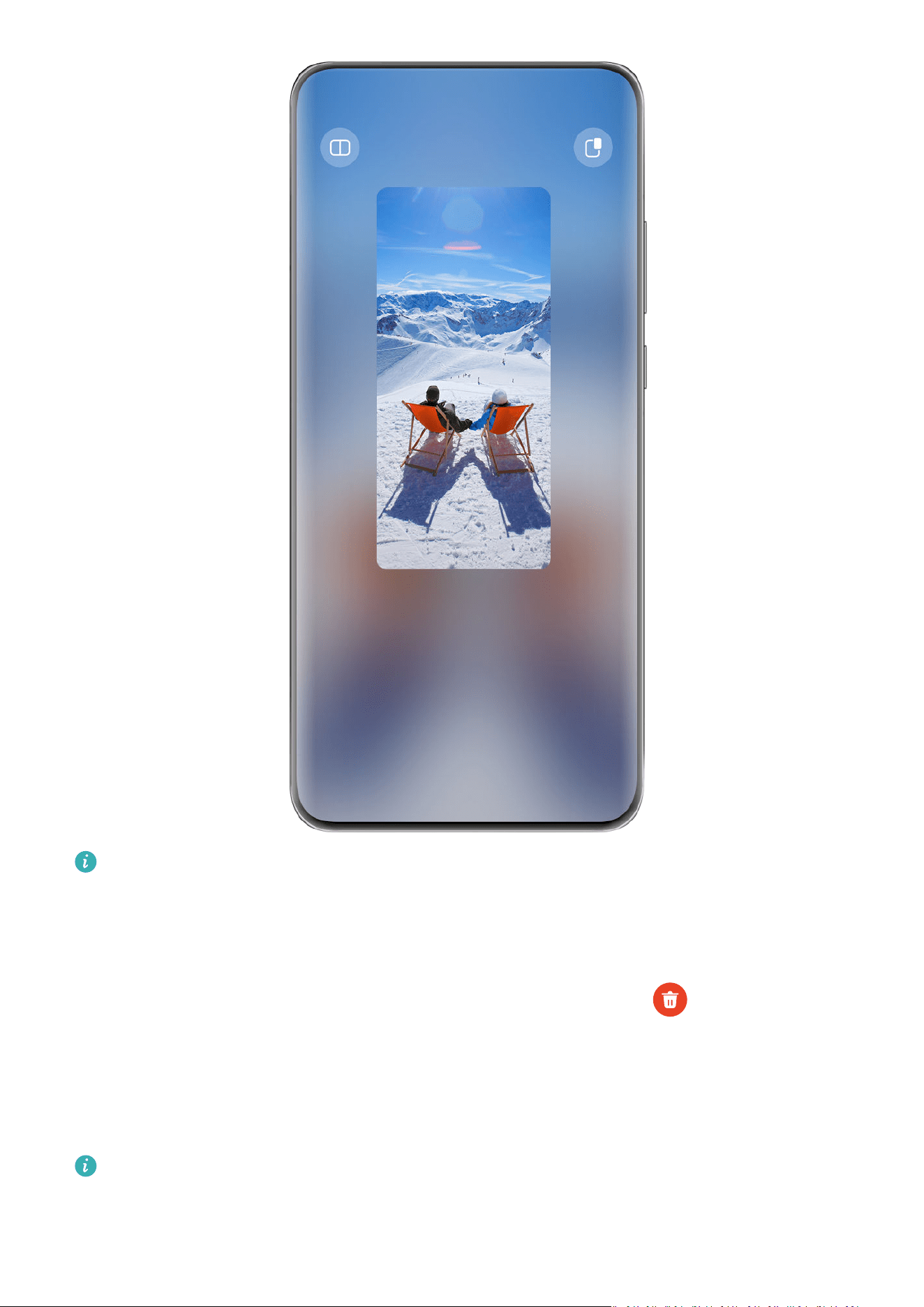
The gures are for reference only.
You can try the following:
• To minimize a oating window, hold down on the window, and drag it to the left or right
edge of the screen, or quickly drag it to the left or right.
• To close a oating window, hold down on the window, drag it to at the bottom of
the screen, or quickly drag it downwards.
• To open in full-screen mode, hold down on the window, drag it to the top of the screen,
or quickly drag it upwards.
• To enlarge the small oating window, tap on it.
If you drag the bottom edge, two sides, or bottom corners of the standard-sized oating
window to reduce the window to the smallest possible size, and then release the window,
it will automatically shrink into a small oating window that remains xed to the upper
right corner of the screen.
Essentials
29

Split the screen
1 When an app is displayed in full-screen mode, swipe up from the bottom to in the
top left corner of the screen.
2 Then open another split-screen-capable app to display both apps in split-screen mode.
Show Date and Time When the Screen Is O
Always On Display
With Always On Display enabled, the lock screen will show the date, time, and more when
the screen is o.
Enable Always On Display
1 Go to Settings > Home screen & wallpaper > Always On Display, and enable Always
On Display.
2 Set Display mode as prompted.
Set the Style for Always On Display
You can customize the display style for Always On Display (AOD) on your phone according to
your preferences.
Select a GIF Image or Moving Picture
You can select a local image (such as a GIF image or moving picture) for Always On Display
to make your display stand out.
1 From under Images on the Always On Display screen, go to > Select image > .
After selecting a GIF image or moving picture, you can go to Edit > Edit to edit it.
2 Set other options available on the screen as needed, and touch Apply.
Add Grati
You can personalize Always On Display by specifying text to be displayed, selecting your
preferred color scheme, and adding stickers.
1 From under
Grati on the Always On Display screen, touch the style you would like to
use.
2 Enter text in the input box and set the style options, such as Color.
You can also add Stickers and drag the sticker border to adjust its position and size, and
touch or to change its direction or delete it.
3 Touch Apply.
Essentials
30

Create an Artistic Image for Always On Display
You can choose from multiple modern art styles. You can also specify the color scheme for
the artistic image, by taking a photo or choosing from your favorite photos. The colors in the
photo will form a color palette for the artistic image.
1 From under Artistic on the Always On Display screen, touch the style you would like to
use.
2 Set the related options for the Artistic style, such as Layout.
When setting Color, your phone can parse the colors in your
specied photo and apply
the abstracted color palette to the artistic image.
Touch , take a photo or select a photo from Gallery, and then go to > Extract
colors.
3 Touch Apply.
Clock Styles
You can select an Analog or Digital clock style for Always On Display.
1 From under Analog or Digital on the Always On Display screen, swipe left or right to
browse the clock styles and select your preferred clock style.
2 Set the related options for the selected clock style, such as Show date.
3 Touch Apply.
Get More Styles for Always On Display
On the Always On Display screen, touch My AODs or More.
Charging
Wireless Reverse Charging
Wireless reverse charging allows your device to charge other devices that support this
feature, including phones, tablets, watches, and bands.
1 Go to Settings > Battery (or Optimizer >
) and enable Wireless reverse charging.
2 Power on the device to be charged and place it on the center of the back of your phone.
Do not place any metal objects between your phone and the device to be charged.
3 If the device does not start charging within a few seconds, adjust its position and try
again.
Essentials
31

Smart Features
AI Voice
AI Voice
AI Voice allows you to communicate verbally with your phone.
To operate hands-free on your phone, wake up AI Voice and give a voice command.
• This feature is only available in some countries and regions.
• Please make sure your device has been updated to the latest system version.
Countries and Regions that Support AI Voice
AI Voice is only supported in certain countries and regions. You can set your location to one
of these countries and regions on your phone to use AI Voice.
AI Voice can be used in countries/regions such as the UK, France, Spain, Chile, Mexico,
Colombia, Italy, Germany, Saudi Arabia, UAE, Kuwait, Jordan, Iraq, Egypt, Türkiye,
Thailand, the Philippines, Czech Republic, Romania, Serbia, Ukraine, Pakistan, Singapore,
Poland, and Malaysia. You need to select a language supported by AI Voice during use.
1 Go to Settings > System & updates > Language & input > Language and region and
touch Current region to select a country/region from the above list.
2 Go to Settings > HUAWEI Assistant > AI Voice, touch Conversation language, select a
language, and follow the onscreen instructions to set it up.
Wake up AI Voice
You can wake up AI Voice in multiple ways:
Press and hold the Power button for 1 second to wake up AI Voice
1 Go to Settings > HUAWEI Assistant > AI Voice > Wake with Power button, and enable
Wake with Power button.
2 Press and hold the Power button for 1 second to wake up AI Voice.
Say the wakeup phrase to wake up AI Voice
1 Go to Settings > HUAWEI Assistant > AI Voice > Voice wakeup, enable Voice wakeup,
and follow the onscreen instructions to record your wakeup phrase.
2 When you need to wake up AI Voice, say the wakeup phrase.
32

• The settings items vary by device. If your phone does not provide a specic item, it
indicates that the corresponding feature is not supported.
• You cannot wake up AI Voice with the wakeup phrase when your phone is in a call.
• You cannot wake up AI Voice with the wakeup phrase either if you are making an
audio or screen recording (with microphone enabled). In this case, you can press and
hold the Power button to wake up AI Voice.
• This feature is only available in some countries and regions.
Communicate with AI Voice
AI Voice can be in one of the following three modes: Idle, Listening, and Thinking. You can
talk to AI Voice when it is in the Listening mode.
• Idle mode: AI Voice doesn't pick up any sound in this mode.
• Listening mode: You can talk to AI Voice as it can listen to you in this mode.
• Thinking mode: AI Voice can start to execute your voice commands.
This feature is only available in some countries and regions.
AI Voice Skills
AI Voice allows you to navigate on your phone with simple voice commands. You can use AI
Voice to:
• Make phone calls
• Send SMS messages
• Launch apps
• Add calendar events and reminders
• Check the weather and more
• Enable AI Lens, and identify content onscreen
To use the voice assistant, wake up AI Voice and say your command, such as "Call Zichen",
"Set an alarm for 8 AM", and "Open Camera".
View AI Voice Skills
You can view the skills incorporated into the AI Voice feature in either of the following ways:
• Wake up AI Voice and ask: "What can you do?". AI Voice will display the Skill center, where
its skills are listed.
• This feature is only available in some countries and regions.
• Please make sure your device has been updated to the latest system version.
Play Music or Videos with Voice Commands
If you want to listen to music or watch videos, wake up AI Voice and give the voice
commands directly.
Smart Features
33

Play Music with Voice Commands
You can request your device to play a song for you with AI Voice.
Wake up AI Voice, and give voice commands such as "Play a song for me", "Play the song
My Dream", or "Skip this song".
This feature is only available in some countries and regions.
Play Videos with Voice Commands
Wake up AI Voice and give voice commands such as "Play video", "Play Friends in HUAWEI
Video", "Show me a funny video", or "Play a Coldplay video".
This feature is only available in some countries and regions.
Speech Translation
AI Voice allows you to translate your voice or text input so you can communicate with
foreign friends easily.
• This feature is only available in some countries and regions.
• Please make sure your device has been updated to the latest system version.
Speech Translation
You can use AI Voice to translate your voice or text input into the target language you have
set.
1 Wake up AI Voice and give the voice command "Translate".
2 Say or type in what you want to be translated.
3 AI Voice will display the translated result and broadcast it for you.
Communicate Easily with Face-to-Face Translation
Face-to-face translation allows you to overcome language barriers when you are traveling
abroad or in an international conference.
1 Wake up AI Voice, and give the voice command "Face-to-face translation" to enter the
translation screen.
2 Touch , so the text on each of the two sections can be read from each side of the
device.
3 Press the button on your side of the section, say what you want to be translated, and
release the button for AI Voice to display the translated result in real time and broadcast
it.
Enable AI Lens with AI Voice
You can use AI Voice to wake up AI Lens.
Wake up AI Voice and give a voice command such as "AI Lens".
Smart Features
34

• This feature is only available in some countries and regions.
• Please make sure your device has been updated to the latest system version.
Scan and Shop with AI Voice
1 Wake up AI Voice, and give voice commands such as "I want to buy this" or "Find similar
items".
2 Position the object you wish to buy within the
viewnder, and touch the shutter button.
3 After the item has been identied by AI Lens, links to purchase it on dierent shopping
platforms will be displayed.
Scan and Translate with AI Voice
1 Wake up AI Voice, and ask questions or give voice commands such as "Translate this for
me".
2 Select the source and target languages from the language list.
3 Position the text you wish to translate within the
viewnder, and follow the onscreen
instructions. For example, if you select Photo translation, you will need to touch the
shutter button and wait for the translation result.
Scan to Learn More with AI Voice
1 Wake up AI Voice, and give voice commands such as "What is this" or "Who is this".
2 Position the object you wish to identify within the viewnder. Then touch the shutter
button and wait for your device to recognize the object.
3 Touch the service widget in the recognition result to obtain additional information.
Scan and Count Calories with AI Voice
1 Wake up AI Voice and ask questions or give voice commands such as "Have a look how
much heat this steak has", or "How much heat I can gain by eating this egg tart".
2 Position the food within the
viewnder and wait for the calorie and nutrient information
to be displayed.
Scan Codes with AI Voice
1 Wake up AI Voice, and give voice commands such as "Scan the code", "Scan the QR
code", or "Scan the barcode".
2 Position the QR code or barcode within the scan frame, and wait for it to be recognized.
AI Touch
Enable AI Touch
When you see any content that you are interested in on your phone, touch and hold the
screen with two
ngers to bring up AI Touch to learn more.
Smart Features
35

Go to Settings > HUAWEI Assistant > AI Touch, and enable AI Touch.
AI Touch will not be triggered when your phone is in landscape mode.
Shop with AI Touch
When you see an item you wish to buy on your phone, you can use AI Touch to quickly
search for the item and compare prices across multiple shopping platforms before making
the purchase.
Touch and Hold the Screen with Two Fingers for Visual Shopping
1 Go to Settings > HUAWEI Assistant > AI Touch, and enable AI Touch.
2 When you see an item that you wish to buy on your device, touch and hold down on the
image of the item with two ngers.
3 Adjust the size and position of the identication box to t around the item you wish to
identify.
4 After the item has been identied, links to purchase it on dierent shopping platforms will
be displayed.
Super Device
Switch Seamlessly Between Screens, with Super Device
Use Super Device for multi-device collaboration with just a tap, to turn all of your smart
devices into one cohesive unit. For example, when you go home, you can continue watching
a movie on your HUAWEI Vision, by picking up right from where you had left
o on your
phone; when you return to the oce, you can continue to edit the same documents on your
computer, by picking up right from where you had left o on your phone.
Smart Features
36
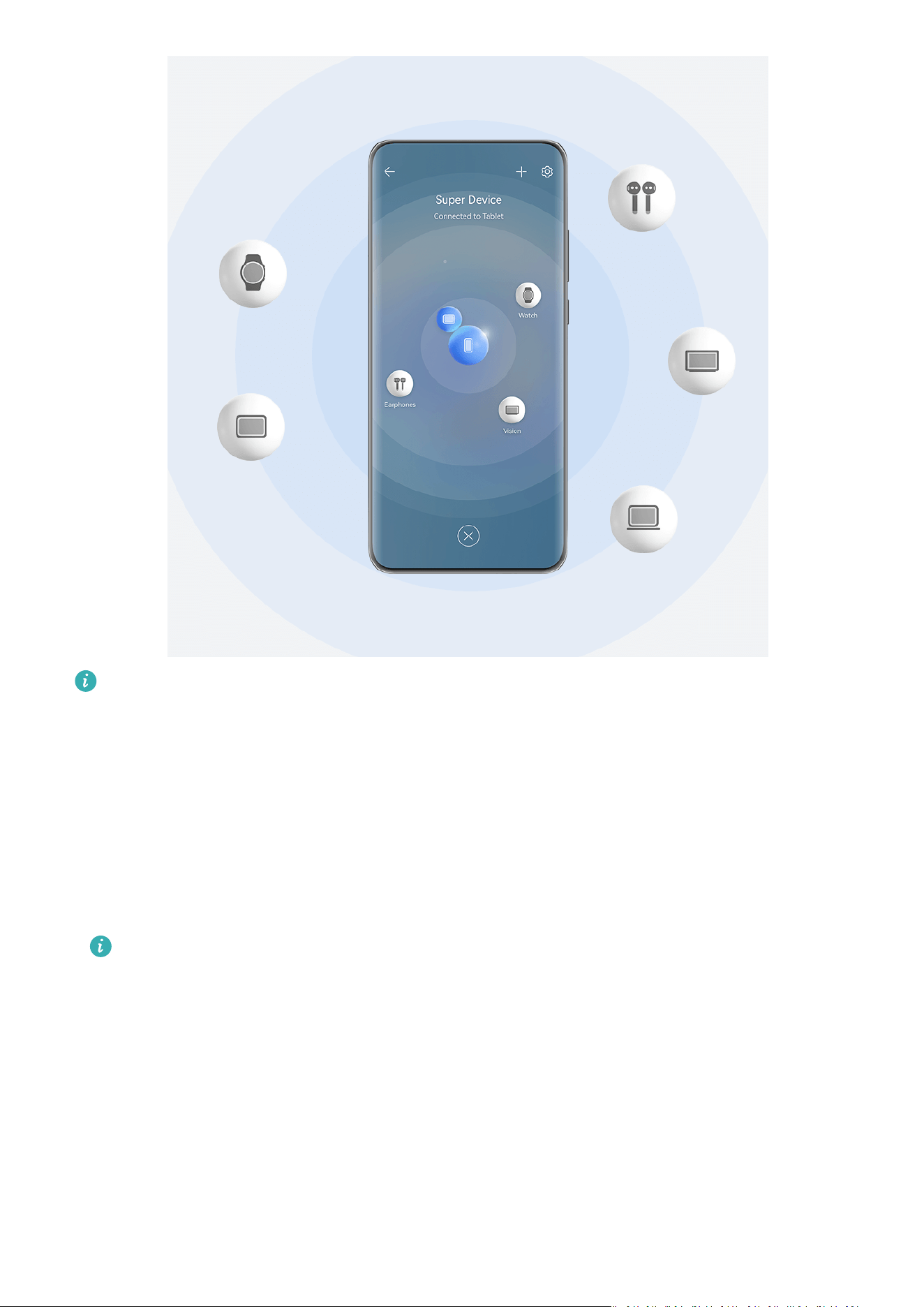
The gures are for reference only.
Device types supported by Super Device may vary by product.
Set Super Device Before Getting Started
Before using Super Device, enable Bluetooth and Wi-Fi on your phone, and log in to your
HUAWEI ID.
Make sure that the screens of your other devices remain on, and apply the following settings
on these devices:
• Phone: Enable Bluetooth and Wi-Fi.
Only phones that support Multi-cam mode can be used as connected devices. You can
check whether Multi-cam mode is supported by going to Camera > More (for the list
of supported devices, please visit the Huawei ocial website).
• Tablet: Enable Bluetooth and Wi-Fi.
• Tablet with an E Ink display: Enable Bluetooth and Wi-Fi, and make sure that it is logged
in to the same HUAWEI ID as your phone.
• Computer: Enable Bluetooth and Wi-Fi, and make sure that it is logged in to the same
HUAWEI ID as your phone.
• Vision or monitor: Enable Bluetooth and Wi-Fi.
• Smart speaker or printer: Make sure that it is connected to the same LAN as your phone,
paired in AI Life with your phone, and logged in to the same HUAWEI ID.
Smart Features
37

Enter the AI Life home screen, go to > Add device, and follow the onscreen
instructions to complete the connection.
• Earphones or glasses: Make sure that they are paired and connected to your phone via
Bluetooth.
• Watch or band: Make sure that it is paired with your phone via Huawei Health, and logged
in to the same HUAWEI ID.
Create Your Super Device, by Connecting to Nearby Devices
If you can't nd Super Device in Control Panel, touch in the upper right corner, and
touch Show Super Device.
The devices are logged in to the same HUAWEI ID.
1 Swipe down from the upper right edge of your phone to display Control Panel, and touch
or in Super Device to search for nearby devices to connect with.
2 Touch the device to be connected, or drag the device to be connected to this device, and
follow the onscreen instructions to complete the connection.
Once device connections are established, you can touch to switch the application
scenario.
The devices are not logged in to the same HUAWEI ID.
1 On the phone/tablet that you wish to connect to, go to Settings > Super Device > This
device > Visible to, and select All nearby devices.
2 Swipe down from the upper right edge of your phone to display Control Panel, and touch
in Super Device.
3 Touch , select the device that you wish to connect to, and follow the onscreen
instructions to complete the connection.
To unlink a device that is not logged in to the same HUAWEI ID, touch in Super
Device, touch and hold down on the device, and touch Delete. Alternatively, you can
go to Settings > Super Device, select the device that you wish to unlink in Other
devices, and touch Delete.
4 Touch the device to be connected, or drag the device to be connected to this device, and
follow the onscreen instructions to complete the connection.
Once device connections are established, you can touch to switch the application
scenario.
Multi-Screen Collaboration on a Computer or Tablet
Connect your phone to a computer and tablet via Super Device to make oce work more
ecient and collaborative. You can view and edit les, drag and drop les, copy and paste
Smart Features
38

text, or even browse phone apps, from the Multi-screen Collaboration window on your
computer or tablet.
1 Swipe down from the upper right edge of the phone to display Control Panel, and touch
in Super Device to search for nearby available devices, or go to > to bind a
new device.
2 Touch the device to be connected, or drag this device to the local device, and follow the
onscreen instructions to complete the connection.
Once the connection is established, your phone screen will display on the connected device.
To halt Multi-Screen Collaboration, touch the connected device on the Super Device screen.
Copy and Paste Content Between Your Phone and Tablet
Copy and paste text or pictures between your phone and tablet using the shared clipboard to
make writing and creating posters even easier.
1 Log in to the same HUAWEI ID on your phone and tablet.
2 Enable Bluetooth and connect to the same Wi-Fi network on both devices.
3 Go to Settings > Super Device > Cross-Device Clipboard and make sure that Cross-
Device Clipboard is enabled.
4 Copy text or a picture from one device to another.
This feature is supported by HUAWEI Notepad, Email, Gallery, Browser, and certain
third-party apps.
Copy and Paste Text or Pictures Across Devices
Copy and paste text
1 Touch and hold the text to be selected within an app (such as Notepad, Email, or
Browser) on a device until
is displayed.
What happens after you touch and hold the text may vary between apps. Perform
operations as prompted.
2 Drag and to select just the words you want, or touch Select all.
3 Touch Copy or Cut as required.
4 On another device, touch and hold where you want to insert the text within an app (such
as Notepad or Email) and touch Paste.
Copy and paste pictures
1 Touch and hold the picture you want to copy within an app (such as Notepad or Email)
on a device and touch Copy.
You can also select a picture in your Gallery and go to > Copy to clipboard to copy it.
2 On another device, touch and hold where you want to insert the picture within an app
(such as Notepad or Email) and touch Paste.
Smart Features
39
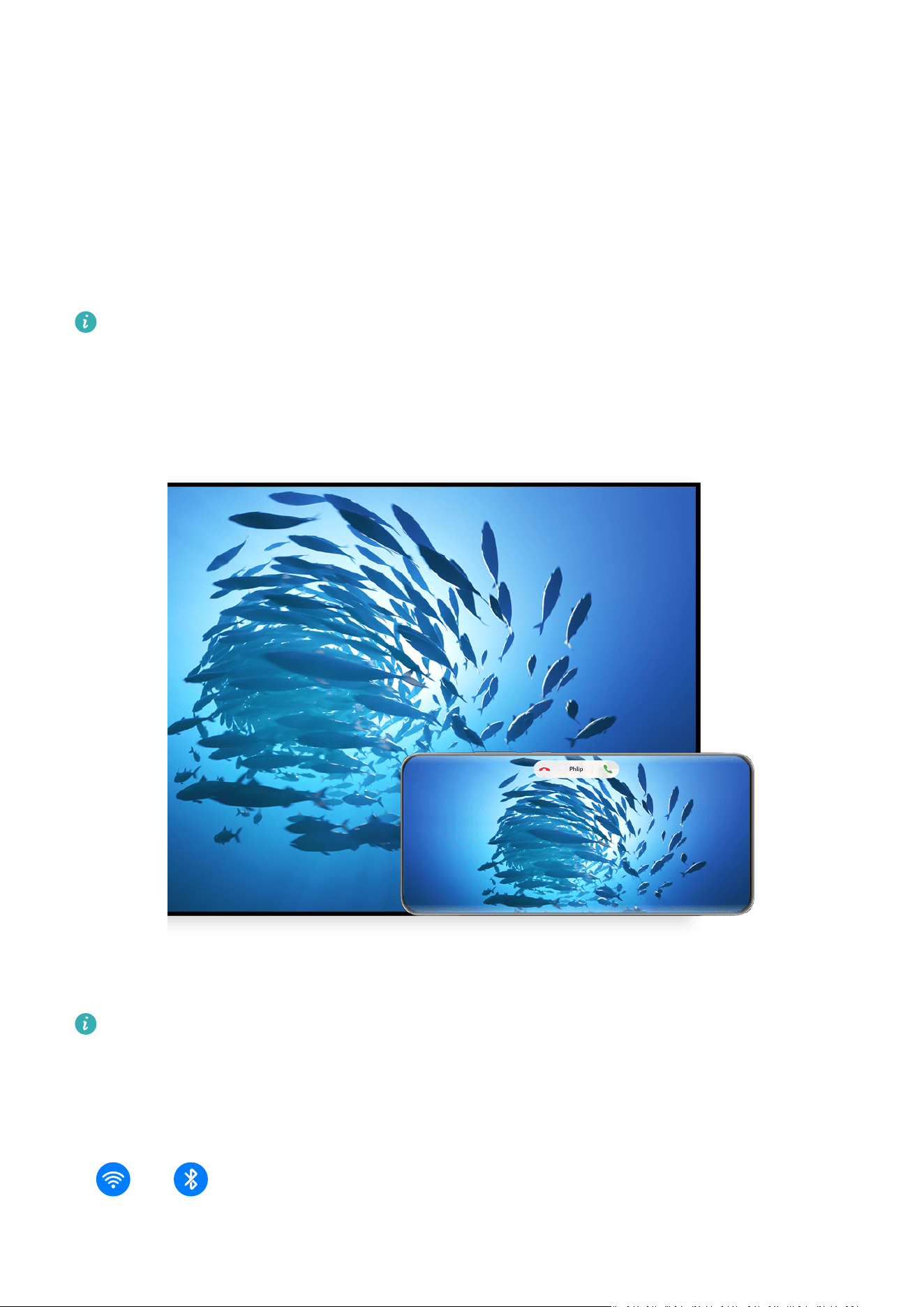
Easy Projection
Project Your Phone Screen Wirelessly
Project your phone wirelessly to stream movies and work on a large-screen device (such as a
Vision).
Dierent display devices support dierent projection protocols. Therefore, the projection
method may vary. Choose a suitable method based on the protocol supported by your device.
For details about the supported projection protocols, refer to the product manual or
contact the product manufacturer.
The gures are for reference only.
1 Ensure that the Cast+/Miracast switch or the projection switch is enabled on the large-
screen device. For details about how to turn on the switch, refer to the product manual or
contact the product manufacturer.
2 Swipe down from the upper right edge of your phone to display Control Panel, and touch
and .
Smart Features
40

3 In Control Panel, touch to expand the shortcut switch panel (depending on your
device model), and touch Wireless Projection. Your phone will then start searching for
available external large-screen devices.
You can also go to Settings > More connections > Easy Projection to enable
Wireless projection.
4 Touch the device that you want to project your phone to from the detected devices.
By default, after the connection is successful, banner notications for incoming calls,
messages, and alarms, and Multi-Window are only displayed on your phone instead of the
large-screen device. To change the settings, touch , and turn o the switch for Hide
notications.
Some products do not support the Hide notications feature. The actual product
prevails.
To exit wireless projection, go to > Project screen on the phone screen; alternatively,
swipe down from the upper left edge of the screen to display the notication panel, and
touch DISCONNECT (depending on your device model).
Use Desktop Mode to Make Work More Convenient
After your phone screen is projected, go to > Desktop mode.
In Desktop mode, your phone and the large-screen device work independently and can show
dierent content. The content of a phone projected on the large-screen device is in a layout
similar to that of the computer desktop.
For example, you can edit a document on the large-screen device while chatting on your
phone. You don't need to worry about missing out on notications, calls, or messages, as a
red dot will appear on the notication panel on the large-screen device to let you know.
Use Your Phone as a Touchpad
After your phone screen is projected to a large-screen device in Desktop mode, if no
keyboard or mouse is available, your phone can work as a touchpad to complete input
operations of a mouse and keyboard.
Go to > Touchpad, and you're free to:
• Use gestures as instructed to simulate mouse commands.
Smart Features
41
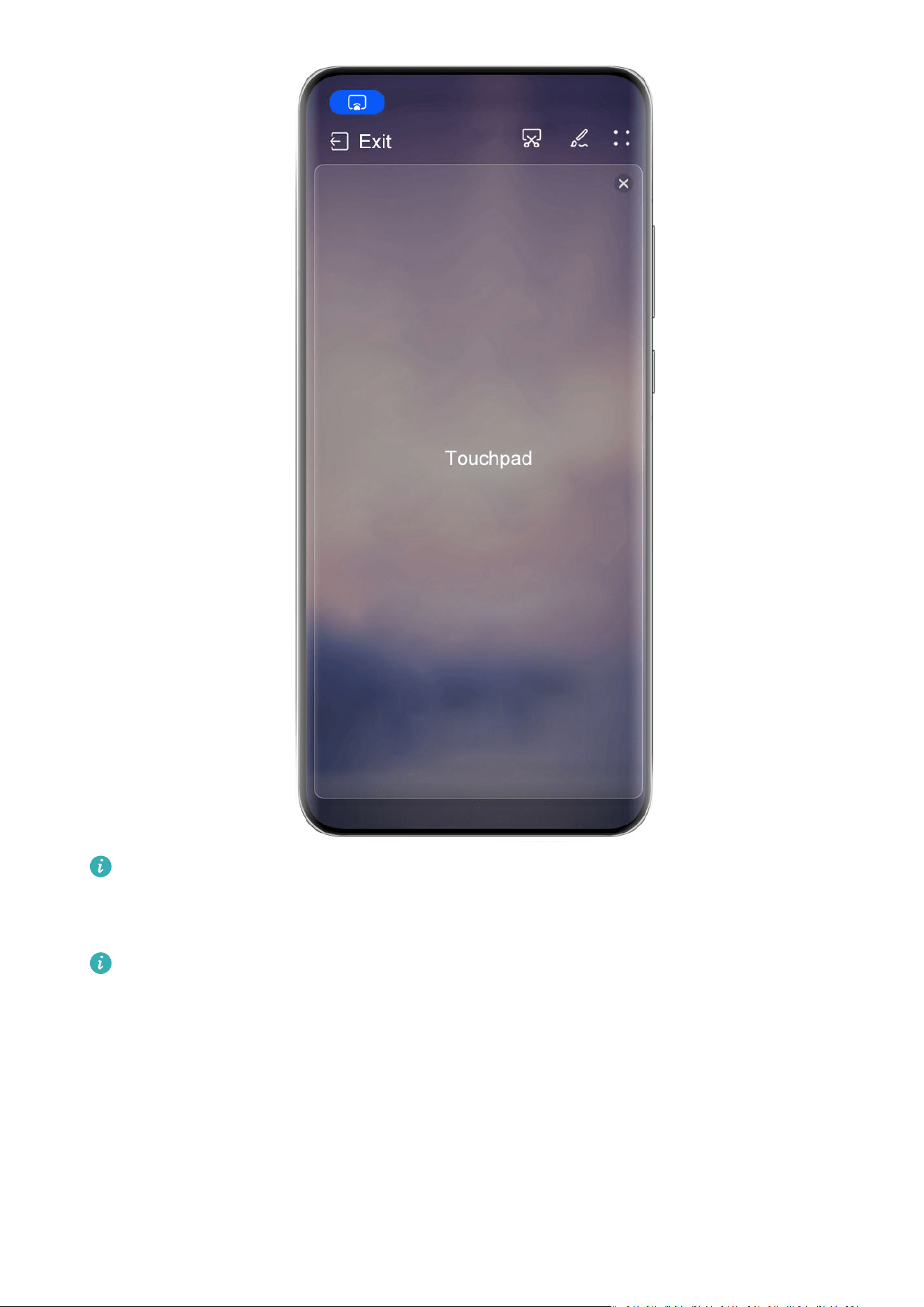
The gures are for reference only.
• When no external keyboard is connected, touch the text input box on the large-screen
device to display the onscreen keyboard to input text.
If an external keyboard is connected, the onscreen keyboard will not be available. In
this case, you need to use the external keyboard to input text.
Project the Phone's Screen to the Large-Screen Device to Make Work Easier
In Desktop mode, you can use the following features:
• Multi-window display: Open multiple windows at a time to multitask.
• File management: Save les to the desktop, create les or folders, and rename or delete
les.
• Quick search: Search for documents, multimedia les, and apps using the start menu
search box.
Smart Features
42
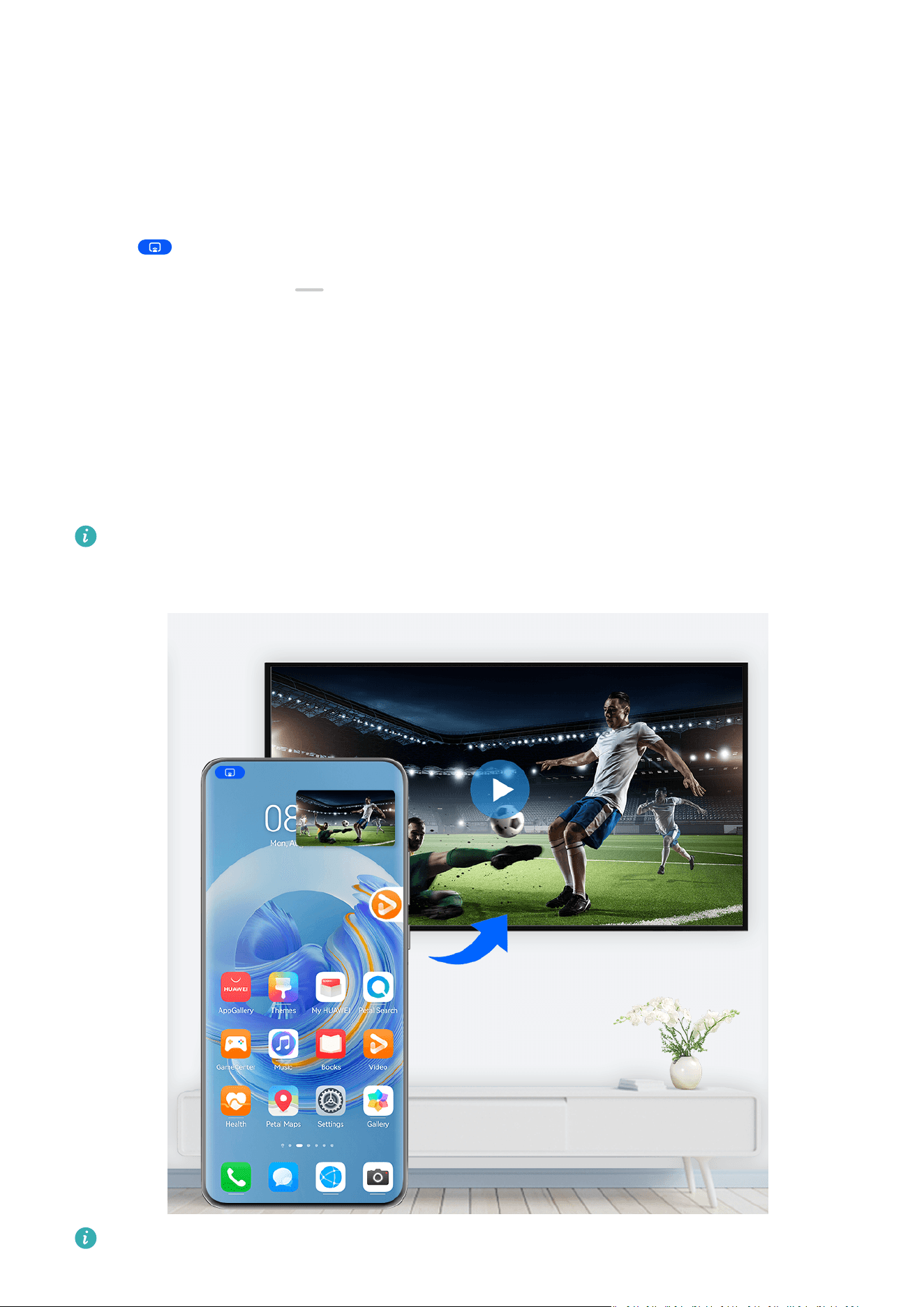
• Quick app projection: Touch and hold down on an app icon on your phone, and touch the
projection menu to project the app to the large-screen device and open it.
Exit Desktop mode
You can exit Desktop mode in any of the following ways:
• Touch Exit to exit Desktop mode.
• Go to > Project screen to return to wireless projection.
• In Control Panel, touch to expand the shortcut switch panel (depending on your
device model), and touch Wireless Projection to exit wireless projection.
• Swipe down from the upper left edge of your phone to display the notication panel and
touch DISCONNECT to exit wireless projection.
Project the Current App to a Large-screen Device
You can project the current app on your phone to a large-screen device (for example, a
Huawei Vision), while continuing to use and browse other apps on your phone.
App projection is supported on large-screen devices that support the Cast+/Miracast
protocol.
The gures are for reference only.
Smart Features
43

After wireless projection is enabled on your phone, open the app you wish to project in full-
screen mode, go to > to project the app to the large-screen device, and minimize
the app, which will appear as a oating ball o to the side on the phone screen.
• Apps in split-screen or oating-window mode can't be projected.
• To safeguard your privacy, this feature can't be used once your device screen has been
locked.
Touch the projected app in the oating ball to display the app's oating window, and use this
window to control the app.
You can exit app projection in any of the following ways:
• Go to > Project screen to return to wireless projection.
• In Control Panel, touch to expand the shortcut switch panel (depending on your
device model), and touch Wireless Projection to exit wireless projection.
• Swipe down from the upper left edge of your phone to display the notication panel and
touch DISCONNECT to exit wireless projection.
Tap to Project Your Phone to a Vision
With just one tap, you can project videos or games from your phone to a Vision to enjoy it on
a larger display.
1 Swipe down from the upper right edge of your phone to display Control Panel, touch
to expand the shortcut switch panel, and enable NFC and Wi-Fi.
2 Tap the NFC area of your phone (usually around the rear camera) against the
icon on
the remote control of your Vision.
3 Follow the instructions in the pop-up dialog to select the Vision on your phone when
pairing the two devices for the
rst time, click on ALWAYS ALLOW on the Vision, and
enter the code shown on the Vision, on your phone to complete the process.
To disconnect the two devices, swipe down from the upper left edge of your phone to display
the notication panel and touch DISCONNECT.
Screen projection won't work if your phone is locked or the screen is o.
Multi-screen Collaboration
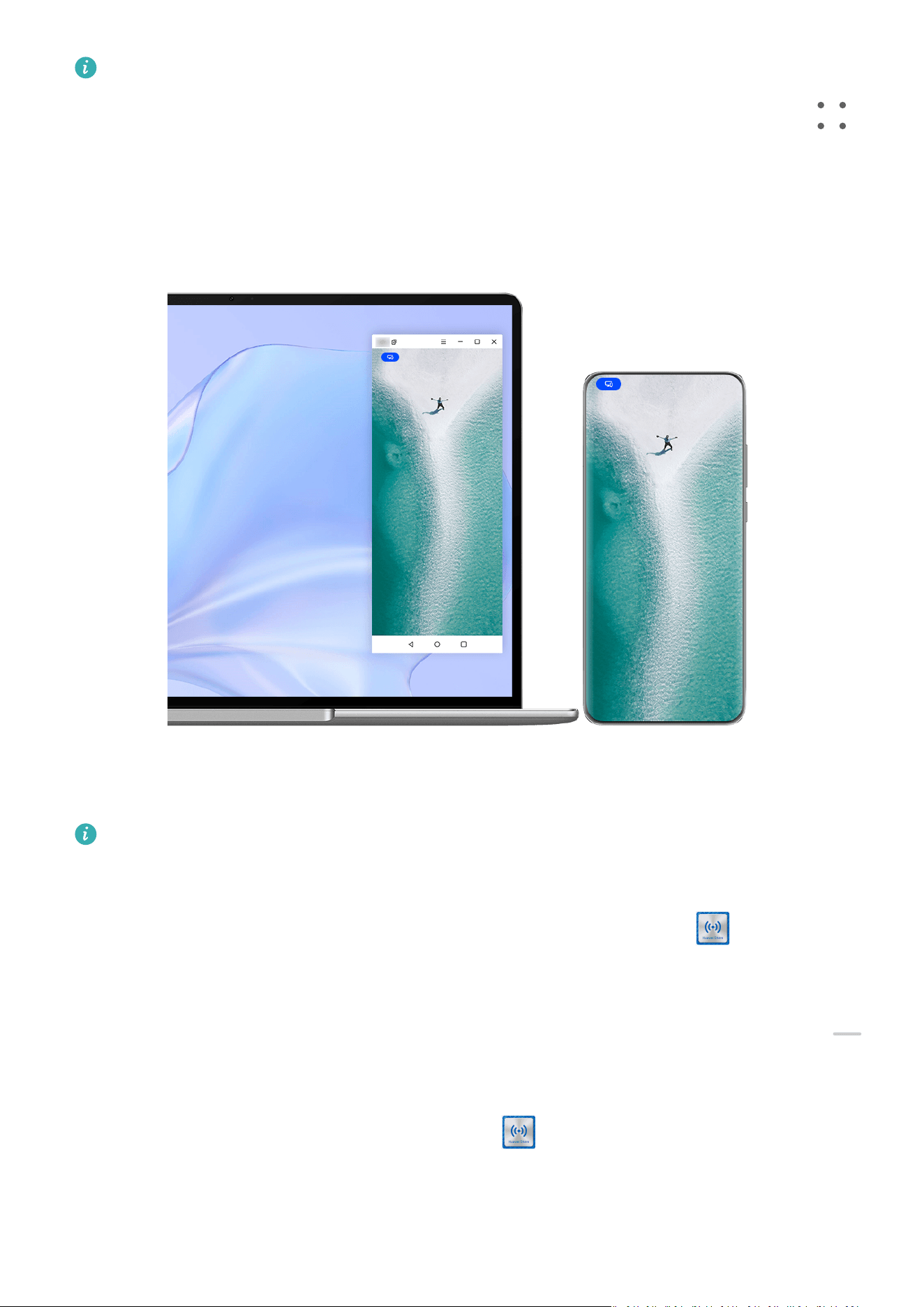
Multi-Screen Collaboration Between Your Phone and Laptop
Connect your phone to a laptop, and use your keyboard and mouse to control your phone, or
share and edit
les, and copy and paste text across systems, making your work more
productive and ecient.
Smart Features
44
• The features and operations may vary between PC Manager versions.
• It is recommended that you update PC Manager to the latest version by going to
>
Check for updates.
The gures are for reference only.
Connect Your Phone to Your Laptop Through OneHop
1 Ensure that your laptop has a Huawei Share sensor or an area with a label.
2 On your laptop, enable Wi-Fi, Bluetooth, and PC Manager, and agree to the user license
agreement.
3 Swipe down from the upper right edge of your phone to display Control Panel, touch
to expand the shortcut switch panel, and enable NFC, Wi-Fi, and Bluetooth.
4 Tap the NFC area (near the rear camera) on the back of your phone against the Huawei
Share sensor of your laptop, or the area with a label, until your phone vibrates or
plays a tone.
5 Follow the onscreen instructions on your phone and laptop to complete the connection.
Smart Features
45

Connect Your Phone to Your Laptop via Bluetooth
1 Swipe down from the upper right edge of your phone to display Control Panel, and touch
Bluetooth.
2 Open PC Manager on your laptop, and go to My devices > My Phone > Connect. Place
your phone above the keyboard, and your laptop will start searching for your phone.
3 Follow the onscreen instructions on your phone and laptop to complete the connection.
Connect Your Phone to Your Laptop by Scanning the QR Code
1 Open PC Manager on your laptop, and go to My devices > My Phone > Connect, and
click the QR code in the upper left corner.
2 Ensure that your phone is connected to the Internet. Go to the Account center on your
phone, and scan the QR code displayed on your laptop.
3 Follow the onscreen instructions on your phone and laptop to complete the connection.
Connect Your Phone to Your Laptop Using Super Device
1 Enable Bluetooth and Wi-Fi on your laptop, and make sure that it is logged in to the same
HUAWEI ID as your phone.
2 Swipe down from the upper right edge of your phone to display Control Panel, and touch
or to search for nearby available devices.
3 Touch the name of the laptop or drag the laptop to the local device, and follow the
onscreen instructions to complete the connection.
Connect Your Phone to Your Laptop via a USB Cable
1 Use a USB cable to connect your phone to your laptop.
2 Open PC Manager on your laptop.
3
Conrm the connection on your phone.
If you have canceled the connection on your phone and wish to re-establish the
connection, open PC Manager and go to My devices > My Phone > Connect > Other
ways to connect > USB.
Disconnect Your Phone from Your Laptop
After you have nished using Multi-Screen Collaboration, you can disconnect your devices
using the following methods:
• Open PC Manager on your laptop, and go to My devices > My Phone > Disconnect.
• Swipe down from the upper left edge of your phone to display the
notication panel, and
touch DISCONNECT.
• Touch , and touch Disconnect.
• If your phone and laptop are connected via a USB cable, remove the cable to disconnect
them.
Smart Features
46
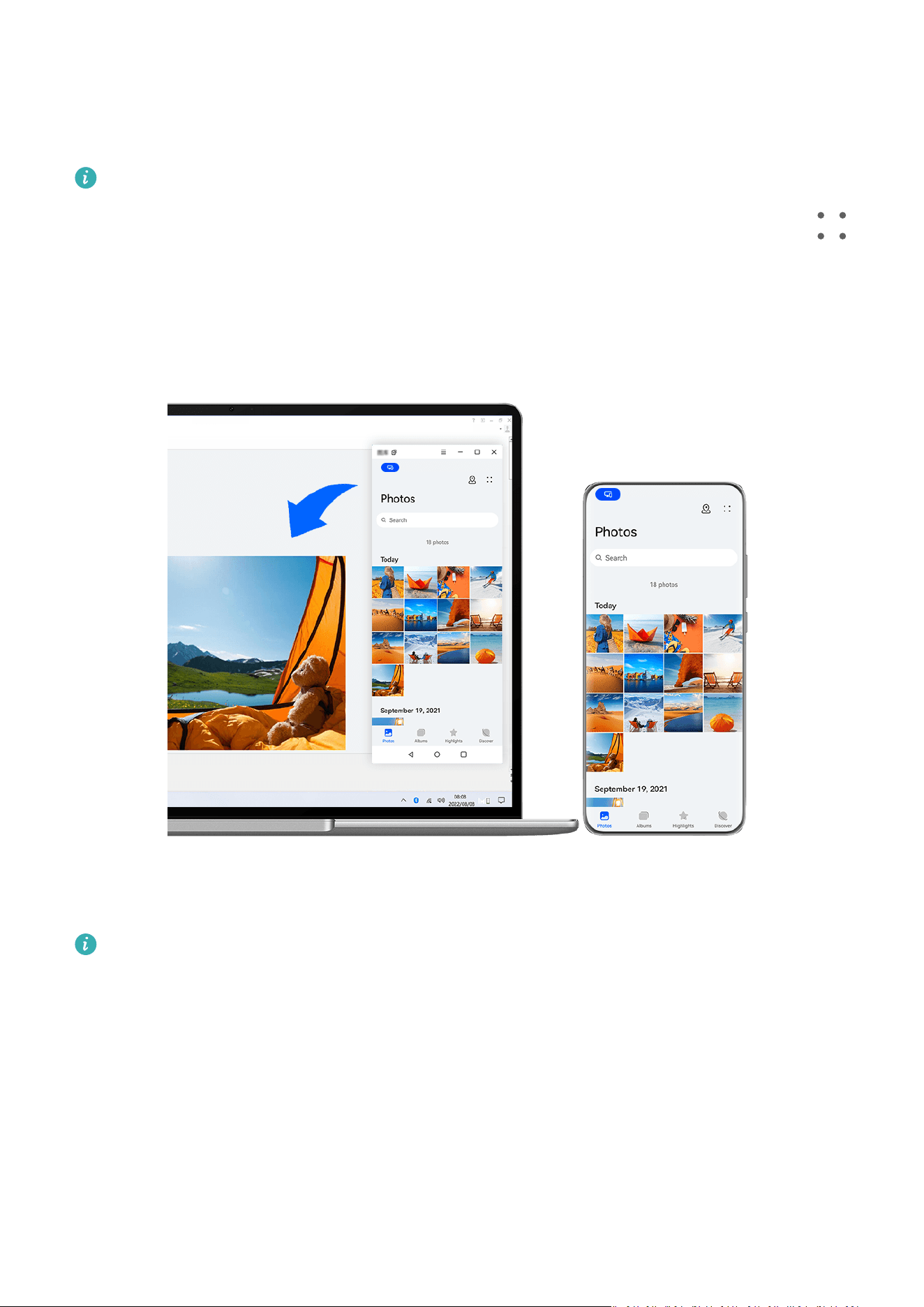
Drag to Transfer Files Between Your Phone and Laptop
After connecting your phone to a laptop, you can transfer les between them to work more
eciently.
• The features and operations may vary between PC Manager versions.
• It is recommended that you update PC Manager to the latest version by going to
>
Check for updates.
The gures are for reference only.
Drag and Drop Files
After Multi-Screen Collaboration is established between your phone and laptop, you can drag
and drop les such as pictures and videos between them to make your work easier.
From phone to laptop:
• In the phone window on your laptop, open Gallery or Files, click and hold down on a
picture or video, click and hold down on the selected les until a dragging icon displays,
then drag the les to a folder or the desktop on your laptop.
• In the phone window on your laptop, drag a selected picture or a segment of text and drop
it in an opened document on your laptop.
Smart Features
47

For example, drag a picture or a segment of text from Notepad in the phone window, and
drop it into an Oce document opened on your laptop, then continue editing on your
laptop.
Transfer les from your laptop to your phone:
• Drag and drop a picture or video from your laptop to Gallery > Albums in the phone
window on your laptop.
• Drag and drop a le from your laptop to Files in the phone window on your laptop.
The le will be saved in the folder that is open in Files, or in the Huawei Share folder
by default.
• Drag and drop a picture or a segment of text from your laptop to an opened document in
the phone window on your laptop.
For example: Drag and drop a picture from your laptop to an opened note in the phone
window, then continue editing on your phone.
Access Phone Apps and Files on Your Laptop
After Multi-Screen Collaboration is enabled between your phone and laptop, you can use a
mouse and keyboard with the laptop to facilitate using phone apps and les.
• The features and operations may vary between PC Manager versions.
• It is recommended that you update PC Manager to the latest version by going to
>
Check for updates.
Access Phone Apps from Your Laptop
Use a mouse to perform operations quickly
• Open an app: Click an app in the phone window to open it.
• Browse a page: Use the mouse scroll wheel to browse web pages in the phone window or
scroll between home screen tabs.
Use a keyboard to perform operations quickly
• Input text: Use the input method on your laptop to enter text in the phone window.
• Copy and paste text: Press Ctrl+C on the laptop keyboard to copy text and press Ctrl+V to
paste it in the phone window.
To view information about the text you have copied recently, click Notication Center of
PC Manager on your laptop, then select Clipboard.
• Send messages quickly: Press Ctrl+Enter on the laptop keyboard to quickly send the
message edited in the phone window
• Exit an app: Press the ESC key on the laptop keyboard to exit an app in the phone window.
Always display the phone window on the top
In the phone window on your laptop, click
> to pin the window so that it will always
display on the top, and click this icon again to unpin the window.
Smart Features
48

Answer a Voice or Video Call on Your Laptop
After Multi-screen Collaboration is enabled between your phone and your laptop, you can
use the laptop to answer voice and video calls (such as those in WeChat and MeeTime) from
your phone. During a call, the audio and video can be played through your computer and its
accessories such as the speaker and camera.
Swipe down from the upper left edge of your phone to display the notication panel or touch
to switch between playback devices.
Open and Edit Files on Your Phone Using Laptop Apps
After connecting your Phone to your laptop, you can open and edit various les on your
Phone with laptop apps.
• Documents: Use laptop Microsoft Oce to open a document.
• Pictures: In PC Manager, go to My devices > My Phone to view pictures on your Phone.
You may also use a photo viewing or editing app on your laptop, such as Photoshop, to
open and edit a picture.
• Audio and video les: In PC Manager, go to My devices > My Phone to view audio and
video les on your Phone. You may also use a laptop player, such as Windows Media Player,
to open the les.
• Web pages: Use a laptop browser, such as IE, to open a web page.
• Compressed
les: Use a le compression app on your laptop, such as WinRAR, to extract
and open compressed les.
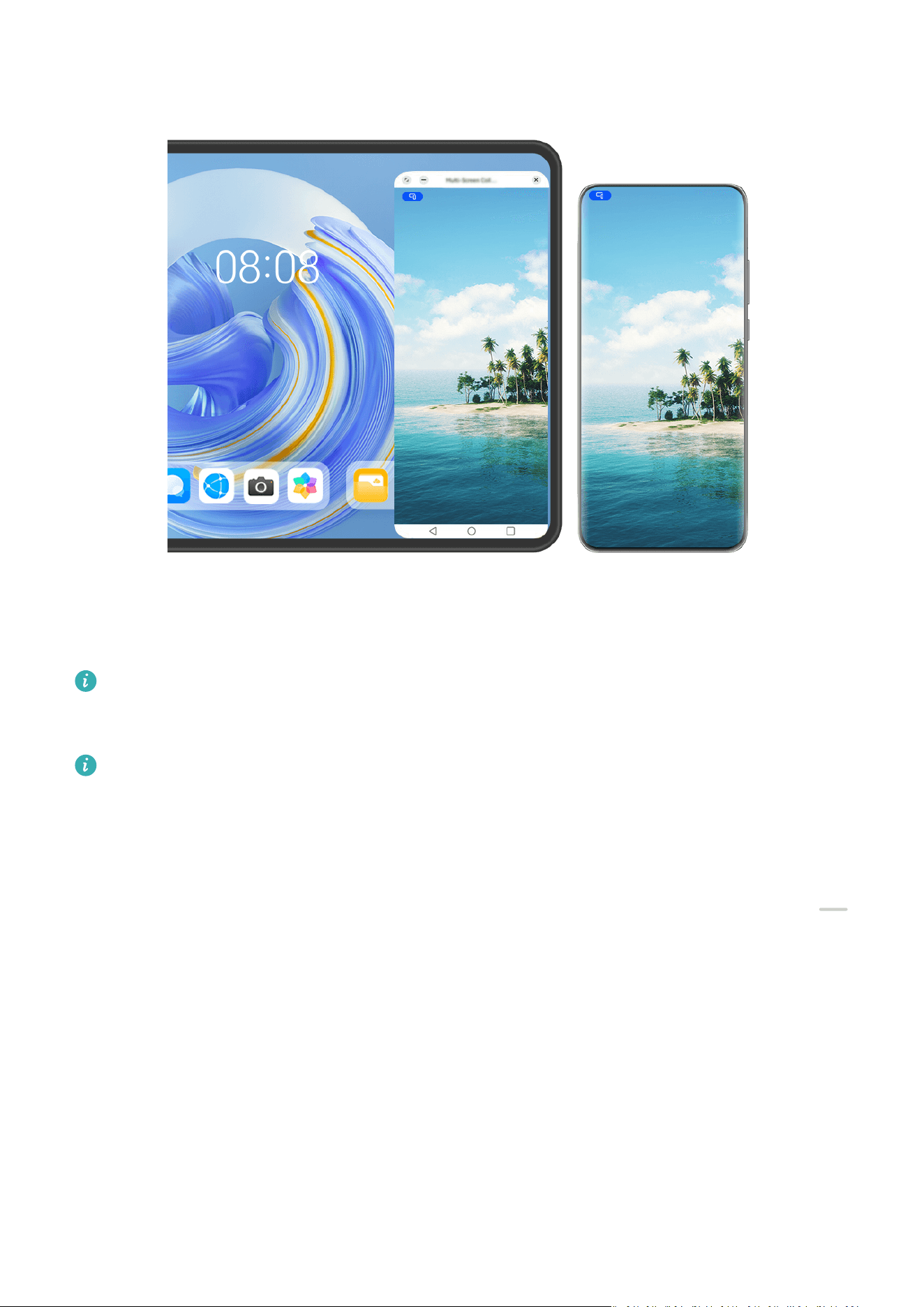
Multi-screen Collaboration Between Your Phone and Tablet
Connect your phone and tablet to use Multi-screen Collaboration for cross-device operations,
such as to display your phone screen on the tablet, use your phone apps on the tablet, drag
les across the two devices, copy and paste text, and edit a le from your phone on the
tablet.
Smart Features
49
The gures are for reference only.
Connect Your Tablet and Phone
Only certain tablets support this feature.
Connect your phone and tablet and enable Multi-Screen Collaboration using one of the
following methods (depending on your device model):
Connect over Bluetooth:
1 Swipe down from the upper right edge of the tablet to display Control Panel, touch
to expand the shortcut switch panel, and enable Multi-Screen Collaboration.
2 Swipe down from the upper right edge of the phone to display Control Panel, and enable
Bluetooth.
3 Hold your phone close to your tablet and follow the onscreen instructions to establish a
connection.
Scan a QR code to connect:
1 Open Multi-Screen Collaboration on your tablet, and touch Scan to connect on the
Multi-Screen Collaboration screen.
2 Ensure that your phone is connected to the Internet and connect your phone and tablet as
prompted.
Connect by tapping against an NFC-capable keyboard:
Smart Features
50

You can tap your phone against the standard NFC-capable keyboard that comes with your
tablet to enable Multi-screen Collaboration.
1 Make sure that your tablet has been paired with the keyboard.
2 Swipe down from the upper right edge of your phone to display Control Panel, touch
to expand the shortcut switch panel, and enable NFC.
3 Tap the NFC area at the back of your phone (near the rear cameras) against the NFC area
of the keyboard until your phone vibrates or plays a tone.
4 Follow the onscreen instructions on your phone and tablet to complete the connection.
Connect via Super Device:
1 Enable Bluetooth and Wi-Fi and log in to the HUAWEI ID on your phone.
2 Swipe down from the upper right edge of the tablet to display Control Panel, and enable
Wi-Fi and Bluetooth.
If you have not logged in to your HUAWEI ID on your tablet or you are not using the
same HUAWEI ID, go to Settings > Super Device > This device > Visible to, and
selectAll nearby devices.
3 Swipe down from the upper right edge of the phone to display Control Panel, and touch
in Super Device to search for nearby available devices or touch > to bind a
new device.
4 Touch the name of the tablet or drag the tablet to the local device, and follow the
onscreen instructions to complete the connection.
Access Phone Apps and Files from Your Tablet
After connecting your phone with your tablet, navigate on your phone from the convenience
of the tablet screen, such as browsing phone apps and les, viewing phone notications
(such as SMS messages), and making or answering phone calls.
When your phone screen is unlocked, you can perform the following operations in the phone
window on your tablet:
• Open Phone to make a call by dialing a number.
• Open Messaging to view and reply to SMS messages.
• Open Gallery or Files to view photos, videos, and
les, as well as to play video or audio
les from your phone.
• Swipe down from the upper left edge of your phone or tablet to display the notication
panel or touch to switch between playback devices.
• If your tablet is connected to an external keyboard or a stylus, you can use it to input text
and control the phone window on your tablet.
Drag to Transfer Files Between Your Phone and Tablet
1 Open Gallery or Files, and touch and hold a picture, video, or document.
Smart Features
51

2 Select more les if needed, touch and hold any of the selected les, then drag them when
an icon for dragging les appears.
For example, you can:
• Drag to transfer les in Gallery or Files between your phone and tablet.
• Drag to transfer
les in Files between your phone and tablet.
• Drag a picture, text, or le from your phone to an open document on your tablet, such as a
Microsoft Oce document, memo, or email.
Disconnect Your Phone from Your Tablet
After you have nished using Multi-Screen Collaboration, you can disconnect your devices
using the following methods:
• In the Multi-screen Collaboration window on your tablet, touch
.
• Touch , and touchDisconnect.
• Swipe down from the upper left edge of your phone to display the
notication panel, and
touch Disconnect.
• Swipe down from the upper right edge of your phone to display Control Panel, and touch
the name of your tablet in Super Device.
Huawei Share
Pin Frequently-Used Sharing Methods to the Top
Pin your frequently-used sharing methods (such as Bluetooth or email) to the top of the
system sharing box, to share
les and content with friends, colleagues, and loved ones with
greater ease.
1 Touch and hold down on the le to be shared, and touch .
2 In the app sharing area, swipe left to the last screen, and touch All >
.
3 Touch the sharing method to be pinned to the top. Some apps include multiple sharing
methods. You can also add a sharing method as needed.
4 In the top area, drag to sort the sharing methods, and touch
.
You can also touch a sharing method pinned to the top to unpin it.
Easy Print
Print Files, with Huawei Print
Your phone makes it easy to print images and documents on it, by detecting nearby printers
that support Huawei Print. Then just touch to print!
Smart Features
52

1 Power on the target printer and make sure that it is connected to the same Wi-Fi network
as your phone, or that Wi-Fi Direct is enabled.
2 To print les stored in dierent locations on your phone:
• Gallery: Open an image or select multiple images in Gallery, and go to Share >
or More > Print or export to PDF.
• Notepad: Open a note in Notepad, and go to More > Print.
• Files: Select one or more
les in Files, and go to Share > Print.
3 After granting the necessary permissions, touch Select to detect nearby printers and select
the desired printer. You can then set the number of copies, color, paper size, and other
options on the preview screen, and touch PRINT.
If no printer is detected, download and install the required printer plug-in as prompted on
the Select printer screen.
Eortlessly Print Files with Fast Print
Once a printer has been added to Super Device, it can be connected to your phone in real
time via Drag to Connect, and you'll be able to print multiple les, including images,
documents, notes, and web pages, with just a tap.
Currently, Fast Print is only supported on select HUAWEI printer models. For details,
please contact Huawei customer service.
Before using this feature, complete the printer's network conguration, by referring to the
user guide.
1 Swipe down from the upper right edge of your phone to display Control Panel, enable
Bluetooth, and connect your phone to the same Wi-Fi network as the printer.
2 In the Super Device panel from Control Panel on your phone, touch , and drag the
printer to the phone to display the print oating ball.
If you wish to set printing parameters based on the content to be printed, touch the print
oating ball to expand it, and touch Fast Print. Once you've completed the settings,
perform the steps below:
• To print one or more images, open an image or select multiple images in Gallery.
• To print a document, open the document with WPS.
• To print a note, open the note in Notepad.
• To Print a web page, open the web page in the pre-installed browser on your phone.
Then touch the
oating ball to expand it, and touch to start printing.
3 Once the printing task is complete, touch and hold down on the oating ball, drag it to
at the bottom of the screen, and follow the onscreen instructions to cancel the
connection.
If you need to view the print status and print list while printing, you can expand the print
oating ball and touch the text to display the print task dialog box.
Smart Features
53
Camera and Gallery
Take Photos
Take Photos
1 Open Camera.
2 You can then:
• Focus: Touch the location you want to focus on.
To adjust focus and metering separately, touch and hold the
viewnder and drag the
respective frame or ring to the desired location.
• Adjust brightness: Touch the
viewnder. When the symbol appears next to the
focus frame, drag it up or down.
• Zoom in or out: On the viewnder, pinch in or out, or drag the zoom slider.
• Select a camera mode: Swipe up, down, left, or right across the camera mode options.
• Turn the ash on or o: Touch and select (Auto), (On), (O), or
(Always on).
If you select (Auto) and the camera detects that you are in a dimly lit
environment, a ash icon will appear in the viewnder and the ash will be
automatically turned on when you take a photo.
These features may not be available in some camera modes.
3 Touch the shutter button to take a photo.
Use the Floating Shutter to Take Photos
You can enable the
oating shutter to display it in the camera viewnder, and drag it
anywhere you like to take photos quickly.
1 Go to Camera > and enable Floating shutter.
2 The oating shutter will then be displayed in the viewnder. You can drag it anywhere you
like.
3 Touch the oating shutter to take a photo.
Take Burst Photos
Use Burst mode to take a sequence of photos in quick succession so you can choose the best
one.
1 Open Camera, select Photo mode, and make sure the rear camera is in use.
54

2 Press and hold the shutter button or one of the Volume buttons to take burst photos.
When shooting, you'll see a number in the viewnder, which indicates how many photos
you've taken so far.
Burst shooting via Volume button pressing is only supported on certain phone models.
3 Release your nger to stop shooting.
Select the Burst Photos You Want to Keep
1 Open Gallery. Touch a burst photo (which is tagged with
), then touch .
2 Swipe through the burst photos, select the ones you want to keep, then touch and
follow the onscreen instructions.
To delete the whole burst photo, touch and hold to select the photo, then touch .
Take Timed Photos
The camera timer allows you to set a countdown so you can get into position after you have
touched the shutter button.
1 Go to Camera > > Timer and select a countdown.
2 Return to the viewnder and touch the shutter button. Your phone will take a photo when
the countdown ends.
Use Audio Control to Take Photos
You can use your voice to take photos without having to touch the shutter button.
1 Go to Camera > > Audio control, and select an option.
2 Go back to the viewnder, then say your command to take a photo.
Get Instant Gratication, with Snapshot Mode
Snapshot will reward you with a photo as soon as you touch the shutter button, turning your
spur-of-the-moment pics into instant classics!
1 Go to Camera > More and select Snapshot.
2 Touch
to take a photo.
Portrait Mode
Shoot Dazzling Portraits
Portrait mode comes with custom beauty and lighting
eects to choose from, so that a touch
of the shutter brings out your subject at their best.
1 Open Camera and select Portrait mode.
Camera and Gallery
55
2 Frame your subject within the viewnder.
To take a sele, touch .
3 From there, feel free to:
• Enable beauty eects: Touch to adjust the beauty eects.
To disable the beauty eects, drag the setting to its lowest value, or touch .
• Set lighting eects: Touch , and select your desired eect.
• Light compensation: When you switch to the front camera in dim lighting conditions,
you can touch the ash icon to enable light compensation.
Touch the ash icon and select (auto) or (steady on).
Not all devices support all of these features.
4 Touch the shutter button to take a photo.
Night Mode
Take Night Shots
Night mode gives your photos sharper details and brighter colors even when shooting in low
light or at night.
1 Open Camera and select Night mode.
2 When shooting with the rear camera, some phones allow you to adjust the ISO sensitivity
and shutter speed by touching
or in the viewnder.
3 Steady your phone and touch the shutter button.
4 Your phone will adjust the exposure time based on the ambient brightness. Keep your
phone steady until the countdown nishes.
You can also touch the shutter button to take a photo before the countdown nishes.
Some phones do not support ending a countdown before it is due to nish.
Take Dazzling Night Seles
To take a sele at night, or in a low-light environment, simply use the front camera in Night
mode.
In dim environments, you can turn on the ash to illuminate your face.
1 Open Camera and select Night mode.
2 Touch
to switch to the front camera. From there, feel free to:
Camera and Gallery
56

• Touch the ash icon and select (auto) or (steady on) to enable the ash. This
allows you to capture a well-lit photo of your face when you are in a poor lighting
environment.
• Touch to adjust the beauty eects.
If you can't nd the icon in the viewnder of your phone, it means that Beauty
mode is not available.
3 Steady your phone and touch the shutter button.
Aperture Mode
Take Photos and Videos, with Aperture Mode
Take Wide Aperture Photos
Wide aperture mode allows you to shoot photos with blurry backgrounds, which brings your
subjects into sharper focus.
1 Open Camera, and select Aperture mode.
2 Touch the area that you wish to focus in on. For best results, your phone should be within
2 meters of your subject.
3 Touch in the viewnder, and drag the slider to adjust the virtual aperture. A smaller
virtual f-number will create a more blurry background.
4 Touch the shutter button to take the picture.
Edit Background Blur in Wide Aperture Photos
Feel free to adjust the focus and background blur after you've taken a wide aperture photo.
1 Go to Gallery > Albums > Camera.
2 Touch a photo tagged with
, and touch at the top of the photo.
3 Touch other areas on the photo to re-focus. Drag the slider at the bottom to adjust the
virtual aperture.
4 Touch to save the settings.
Shoot Wide Aperture Videos
Wide aperture mode allows you to shoot videos with blurry backgrounds, which brings your
subjects into sharper focus.
1 Open Camera, and select Aperture mode.
2 Touch to switch to Video mode.
Camera and Gallery
57

3 Touch the area that you wish to focus in on. Touch in the viewnder, and drag the
slider to adjust the virtual aperture. A smaller virtual f-number will create a more blurry
background.
4 Touch the shutter button to start recording. While recording, touch the viewnder to
adjust the focus.
Master AI
Take Professional-Looking Photos
Master AI is a pre-installed camera feature that helps you take better photos by intelligently
identifying objects and scenes (such as food, beaches, blue skies, and greenery, as well as
text) and optimizing the color and brightness settings accordingly.
Master AI is displayed as AI photography or AI camera on some devices.
1 Open Camera and select Photo mode.
2 Touch to turn on
.
3 Frame the subject within the viewnder. Once the camera identies what you are
shooting, it will automatically recommend a mode (such as portrait, greenery, or text).
4 To disable the recommended mode, touch
next to the mode text or turn o .
Use Moon Mode
1 Open Camera and select Photo mode.
2 Touch to turn on
.
3 Aim the camera at the moon and spread your ngers on the viewnder to adjust the
zoom to 10x or more.
When the camera detects the moon, it will automatically enter Moon mode.
4 Touch to take a photo.
Moon mode can only identify the moon if it is at least half full. The mode may not
launch if the moon is shrouded by clouds.
Take Photos with Various Zoom Settings
Take Wide-Angle or Long-Focus Photos
The zoom capabilities of your device's camera allow you to capture more of a scene, or
distant vistas.
Camera and Gallery
58

Take Wide-Angle Photos
1 Open Camera and select Photo mode.
2 Point the camera at the subject and zoom in or out using the side bar, or by pinching or
spreading two
ngers on the screen. The smaller the value, the wider the angle of view.
You can also use Super wide angle mode (only available on certain models).
On the Photo screen, make sure that
is enabled. Then point the camera at the
desired subject. If your phone detects a high-rise or other buildings, it will automatically
recommend Super wide angle mode to you. Touch Wide to get a wider eld of view.
3 Touch to take a photo.
Automatically Switch to Wide Angle When Taking Seles with the Front Camera
When the front camera of your phone detects multiple people in the frame, it will
automatically switch to the wide angle to t more people into your photo.
1 Open Camera, select Photo or Portrait mode, then touch
to switch to the front
camera.
2 After you switch your phone from portrait to landscape orientation, the camera will
automatically switch to Wide-angle mode. When there are three or more people in the
viewnder, the camera will automatically switch to the widest angle in Wide-angle mode.
You can also drag the zoom slider in the viewnder to manually switch between zoom
levels.
3 Touch
to take a photo.
Take Photos from Far Away
1 Open Camera and select Photo mode.
2 Point the camera at a distant subject and zoom in or out using the side bar or by pinching
or spreading two ngers on the screen.
If your phone supports zooming in more than 15X, a picture-in-picture preview frame will
be displayed in the viewnder to help you focus on your subject when you zoom in more
than 15X.
Some products do not support the picture-in-picture preview frame.
3 In the viewnder, touch where you want to focus, and touch to shoot when the
subject is in focus.
Macro
Get Closer with Super Macro
Delve down into the details by enabling Super macro mode, and capture the dance of a
dragony or dewdrop in descent.
Camera and Gallery
59

Shoot Close-up Photos, with Super Macro
1 You can access Super macro in any of the following ways:
• Open Camera, and select Photo mode. Then frame your subject within the
viewnder,
and bring your camera closer. When the camera is close enough, it will automatically
enter Super macro mode and focus in on the subject.
• Go to Camera > More, and select Super macro mode. The camera will automatically
focus. You can also touch AF and drag the zoom slider to manually focus.
2 Drag the zoom slider in the viewnder to adjust the focal length. A smaller value will
create a wider angle of view.
3 Touch to take the picture.
Shoot Close-up Videos, with Super Macro
1 You can access Super macro in any of the following ways:
• Open Camera, and select Video mode. Then frame your subject within the viewnder,
and bring your camera closer. When displays, touch to enter Super macro
mode. The camera will automatically focus in on the subject.
• Go to Camera > More, select Super macro mode, and touch
to switch to Video
mode. The camera will automatically focus. You can also touch AF and drag the zoom
slider to manually focus.
2 Drag the zoom slider in the
viewnder to adjust the focal length. A smaller value will
create a wider angle of view.
3 Touch
to start recording.
Monochrome Photography
Monochrome
Take Black and White Photos
Black and white photography removes distracting colors to help you focus more on form,
shape, and texture.
1 Go to Camera > More and select
mode.
2 Touch to take a photo.
Take Monochrome Videos
Monochrome videos lter out colors and highlight the contrast and details.
Camera and Gallery
60

1 Go to Camera > More and select mode.
2 Touch to switch to Video mode.
3 Touch the shutter button to begin recording. While shooting, you can touch
to take a
photo.
Moving Pictures
Take Moving Pictures to Bring Photos to Life
Can't quite capture that perfect moment? Moving picture shoots a short period of movement
and sound before and after you touch the shutter button, to bring that elusive snapshot you
just missed… into full view!
Take Moving Pictures
1 Go to Camera > Photo and touch
to enable Moving picture, or go to Camera > More
and select Moving picture (depending on your device model).
2 Touch the shutter button to shoot.
Play Moving Pictures
Moving pictures are saved in JPG format in Gallery.
Go to Gallery > Albums > Camera, touch a moving picture, then touch
at the top of the
picture to view it.
The moving picture will automatically stop after a complete playback. You can also touch the
screen to stop the playback.
Edit Moving Pictures
After taking a moving picture, you can select and optimize any frame within it, and even set
the frame as a cover or static photo.
1 Open Gallery, touch the moving picture that you wish to edit, and then touch .
2 Touch Smart to have your phone recommend the best frames for you, which are indicated
by crown icons. Touch the frame that you wish to edit, and touch Set as cover. A dot will
display over the selected frame.
3 After setting the frame to be edited as the cover frame, select Auto, De-mist, from
among other options in Smart. Your phone will automatically optimize the cover frame
for you.
If you wish to apply more than one of the above features to the photo, touch
each time that you apply a feature to save the edit.
Camera and Gallery
61

4 After you are done with editing the picture, touch to save it as prompted. You can
also save the picture as a new moving photo in the original photo album.
To save one of the frames in the moving picture as a static photo, touch , set the frame
as the cover frame, edit the frame using any other features than Smart, and touch
. The
cover frame will be saved as a static photo.
Save a Moving Picture as a GIF File or Video
To save a moving picture as a GIF le or video, touch the moving picture in the album, touch
, then select Save as video or Save as GIF.
Share Moving Pictures
Share moving pictures to your HUAWEI devices via Wi-Fi Direct, Bluetooth, or Huawei Share.
Go to Gallery > Albums > Camera, touch and hold to select the moving pictures that you
wish to share, and touch . Then follow the onscreen instructions to complete the process.
If you share moving pictures to third-party apps or incompatible devices, moving pictures will
be displayed as static images.
View Cinemagraphs of Your Moving Pictures
When you take a moving picture of a dynamic object from the same angle (such as a leaf
swaying in the wind), and there is a sharp static and dynamic contrast within the scene, your
phone will automatically create a cinemagraph of the picture to make it interactive and stand
out.
1 Open Gallery, touch the moving picture you want to view, then swipe up on the picture.
If no playback eects are available after you swipe up on a picture, it indicates that
your phone does not support this feature.
2 If conditions permit, your phone will recommend three playback eects: Default (played
once when swiping left or right), Loop (played repeatedly), and Cinemagraph (the part
of the moving picture that stands out the most is identied automatically and played
repeatedly). Cinemagraphs will not be displayed if they are unavailable.
3 You can touch to preview the eects and apply the one you want to the picture.
To save the eect as a video or GIF, touch on the picture details screen, and touch
Save as video or Save as GIF.
Pro Mode
Camera and Gallery
62
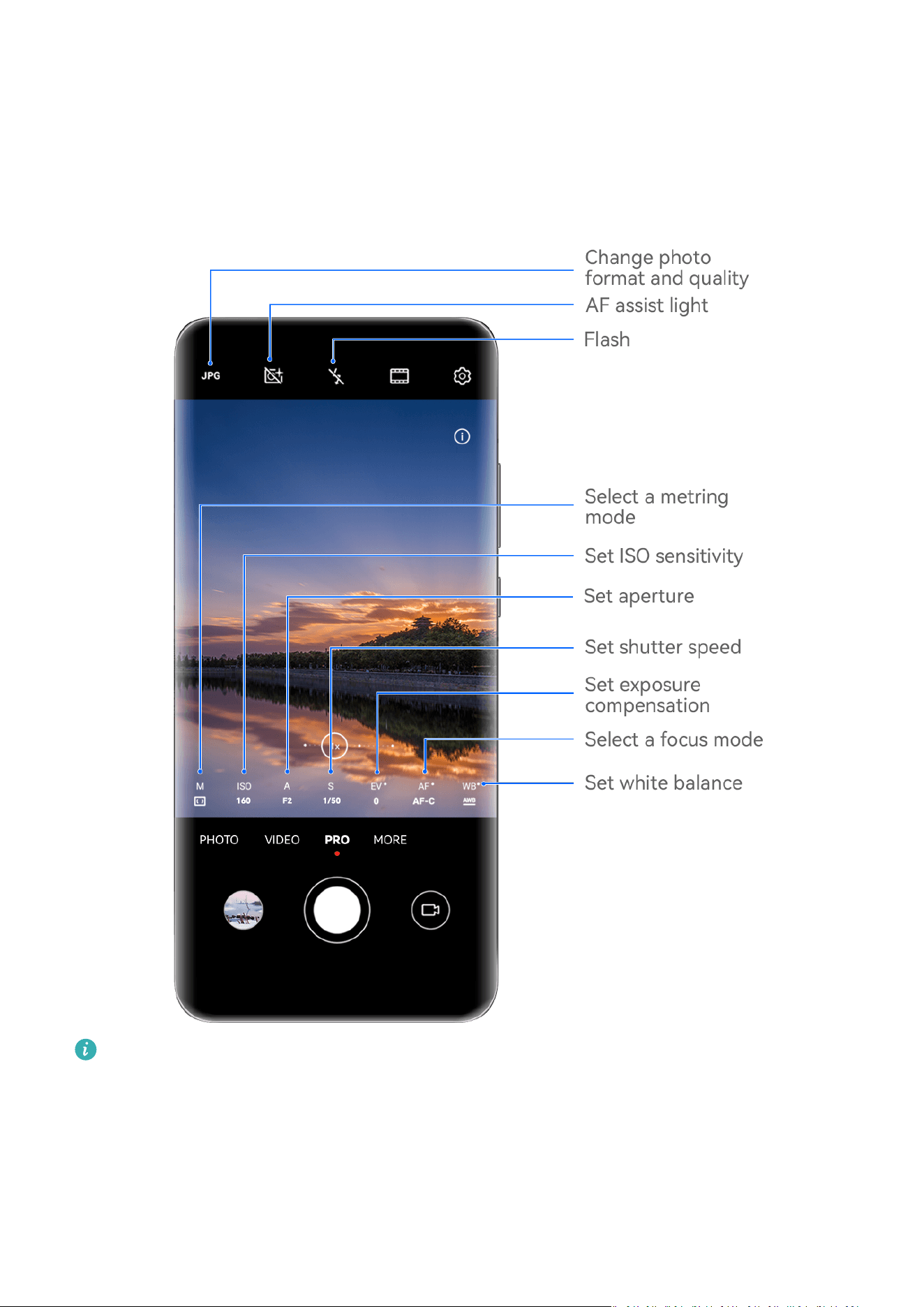
Use Pro Mode to Shoot Like a Pro
Pro mode lets you ne-tune photos and videos and gives you full control over ISO sensitivity,
focus mode, and more when taking photos or recording videos.
Shoot Photos in Pro Mode
The gures are for reference only.
1 Open Camera, and select Pro mode.
2 From there, feel free to:
• Adjust the metering mode: Touch M, and select a metering mode.
Camera and Gallery
63
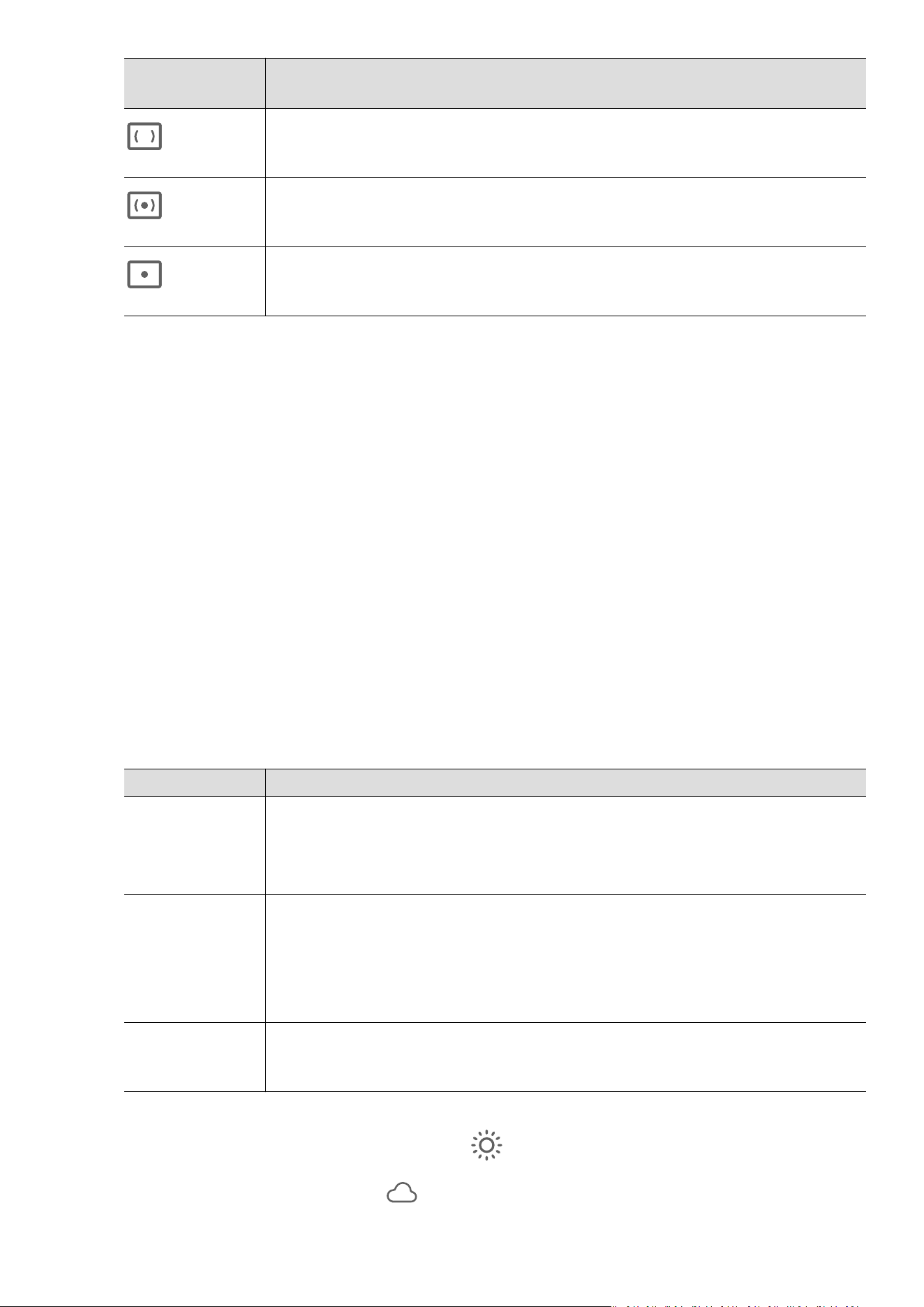
Metering
Mode
Usage Scenario
Matrix
Measures light across the entire frame; ideal for shooting natural
landscapes.
Center
Focuses in on light near the center of the screen; ideal for shooting
portraits.
Spot
Focuses in on light from a specic tiny region, such as from a
subject's eyes.
• Adjust the ISO sensitivity: Touch ISO, and drag the slider.
In low-light environments, you'll generally want to increase the ISO sensitivity. In well-
lit environments, you'll want to reduce it to avoid image noise.
• Adjust the shutter speed: Touch S, and drag the slider.
The shutter speed determines the amount of light that is able to enter the camera
lens. When shooting stationary scenes or portraits, it is recommended that you use a
slower shutter speed. Likewise, when shooting fast-moving scenes or objects, you'll
want to increase the shutter speed.
• Adjust the aperture: Touch A, and drag the slider.
A smaller f-number will create a more blurry background. To take portrait shots, try
small f-numbers. To shoot scenery, try large f-numbers.
• Adjust EV exposure compensation: Touch EV·, and drag the slider.
It is recommended that you increase the EV value in low-light environments, and
decrease it in well-lit environments.
• Adjust the focus: Touch AF·, and select a focus mode.
Focus Mode Usage Scenario
AF-S (single-
shot auto-
focus)
Stationary subjects
AF-C
(continuous-
shot auto-
focus)
Moving subjects
MF (manual
focus)
Touch the subject of interest to focus in on them, or on specic
features, such as their face.
• Adjust the color cast: Touch WB·, and select a mode.
When shooting in bright daylight, select . When shooting in overcast conditions or
low-light environments, select .
Camera and Gallery
64
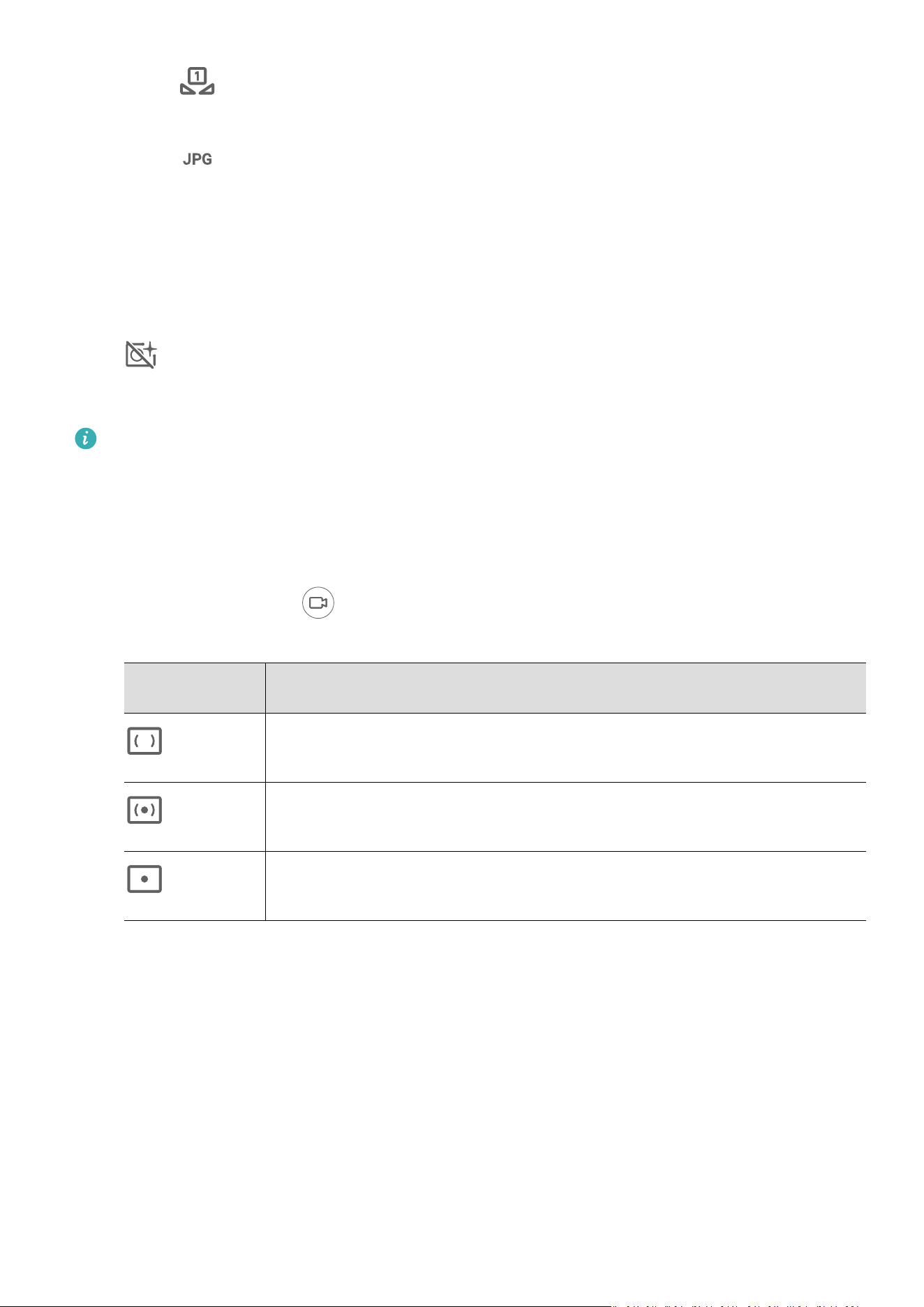
Touch to adjust the color temperature.
• Select the storage format: Pro mode allows you to save the photo in dierent formats.
Touch in the viewnder to select your preferred format.
Images in JPG format require less storage space.
If you select RAW format, your phone will automatically save photos taken in DNG
and standard formats. DNG format retains more details, and gives you access to a
wider range of post-processing options, but takes up more storage space.
• Enable AF assist light: For better focus performance in low-light environments, touch
to enable AF assist light.
3 Touch the shutter button to take the picture.
• These features are only supported on certain device models.
• Adjusting a specic setting will sometimes cause other settings to change as well.
Remember to only make adjustments based on actual needs.
Shoot Videos in Pro Mode
1 Under Pro mode, touch to switch to Video mode. From there, feel free to:
• Adjust the metering mode: Touch M, and select a metering mode.
Metering
Mode
Usage Scenario
Matrix
Measures light across the entire frame; ideal for shooting natural
landscapes.
Center
Focuses in on light near the center of the screen; ideal for shooting
portraits.
Spot
Focuses in on light from a specic tiny region, such as from a
subject's eyes.
• Adjust the ISO sensitivity: Touch ISO, and drag the slider.
In low-light environments, you'll generally want to increase the ISO sensitivity. In well-
lit environments, you'll want to reduce it to avoid image noise.
• Adjust the aperture: Touch A, and drag the slider.
A smaller f-number will create a more blurry background. To take portrait shots, try
small f-numbers. To shoot scenery, try large f-numbers.
• Adjust the shutter speed: Touch S, and drag the slider.
The shutter speed determines the amount of light that is able to enter the camera
lens. When shooting stationary scenes or portraits, it is recommended that you use a
slower shutter speed. Likewise, when shooting fast-moving scenes or objects, you'll
want to increase the shutter speed.
Camera and Gallery
65
• Adjust EV exposure compensation: Touch EV·, and drag the slider.
It is recommended that you increase the EV value in low-light environments, and
decrease it in well-lit environments.
• Adjust the focus: Touch AF·, and select a focus mode.
Focus Mode Usage Scenario
AF-S (single-
shot auto-
focus)
Stationary subjects
AF-C
(continuous-
shot auto-
focus)
Moving subjects
MF (manual
focus)
Touch the subject of interest to focus in on them, or on specic
features, such as their face.
• Adjust the color cast: Touch WB·, and select a mode.
When shooting in bright daylight, select . When shooting in overcast conditions or
low-light environments, select .
Touch to adjust the color temperature.
2 Touch
to start recording.
• These features are only supported on certain device models.
• Adjusting a specic setting will sometimes cause other settings to change as well.
Remember to only make adjustments based on actual needs.
Record Videos
Capture Video
1 Open Camera and select Video mode.
2 Adjust the following settings:
• Zoom in or out: Pinch in or out on the viewnder, or drag the zoom slider.
• Focus: Touch the location you want to focus on. Touch and hold the
viewnder to lock
the exposure and focus.
• Turn the ash on or o: Touch and select (steady on) or (o).
Camera and Gallery
66
When using the front camera to record videos in low-light conditions, you can set the
ash to (steady on). The camera will provide light compensation.
• Adjust beauty eects: Touch and drag to adjust the eects.
• Adjust the video resolution and frame rate: Go to > Video resolution and select
the desired resolution. A higher resolution will result in a higher quality video with a
larger le size.
You can touch Frame rate to select your desired frame rate.
• Select a space-saving video format: Touch and toggle on the Ecient video
format switch.
When this feature is enabled, your phone will use a video format that takes up less
storage space. However, videos in this format may not play on other devices. Please
exercise caution when selecting this option.
• Not all devices support these features.
• Changing a specic setting will sometimes cause other settings to change as well.
Adjust them according to your actual requirements.
3 Touch to shoot.
When recording videos with the rear camera, you can touch and hold or to zoom
in or out.
Touch
to take a shot of the current frame.
4 Touch to pause and touch to stop shooting.
Steady Your Shooting
When shooting and moving at the same time, you can enable Steady shot to reduce camera
shake.
1 Open Camera and select Video mode.
2 Touch to enable Steady shot.
3 Touch
to start the recording.
4 Touch to pause and touch to end the recording.
When Steady shot is enabled, some features (such as zooming and video resolution
adjustment) may be unavailable.
Camera and Gallery
67
Use AI Movie Eects to Record Videos
Use AI movie eects to add an artistic element to your videos without the need for post-
processing.
1 Open Camera and select Video mode.
2 Switch to the rear camera, touch
or , and follow the onscreen instructions to
select AI color, Background blur, or other movie eects (depending on your device
model).
3 Go to > Video resolution and select the 21:9 aspect ratio (which most movies are
shot in).
• Some products do not support the 21:9 aspect ratio.
• If your phone supports the
feature, disable it rst.
4 Touch to shoot.
Touch to take photos with movie eects while recording.
5 Touch to end shooting.
Shoot 4K UHD Videos
Your phone supports 4K Ultra HD (UHD) video recording, allowing you to record in even
greater clarity.
1 Open Camera and select Video mode.
2 Go to > Video resolution and select the 4K resolution.
Beauty mode, lters, and special eects are not supported at 4K, and will be
automatically disabled when you select the 4K resolution.
3 Return to the Video screen and touch to start recording.
A higher resolution will result in a higher quality video, but will also take up more
storage space.
Tracking Shot
Take Tracking Shots
Tracking shots allow the camera to follow the subjects being recorded so that they always
remain in the center of the viewnder.
1 Open Camera and select Video mode.
2 Touch to conrm that Tracking shot is enabled.
Camera and Gallery
68
3
4
5
Slow-Mo Recording
Shoot Slow-Mo Videos
•
•
Shoot Slow-Mo Videos
1 Camera More Slow-mo
2
3
Shoot Slow-Mo Videos with the Front Camera
1 Camera More Slow-mo
camera.
69

2 If your phone allows, touch and select a slow motion speed.
3 Touch to start recording.
4 Touch
to end the recording.
Time-Lapse Photography
Use Time-Lapse to Create a Short Video
You can use Time-lapse to capture images slowly over several minutes or even hours, then
condense them into a short video. This allows you to capture the beauty of change –
blooming owers, drifting clouds, and more.
1 Go to Camera > More and select Time-lapse mode.
2 Place your phone in position. To reduce camera shake, use a tripod to steady your phone.
3 Touch
to start recording, then touch to end the recording.
The recorded video is automatically saved to Gallery.
Dual-View Mode
Record Dual-View Videos
In Dual-view mode, you can capture two
dierent perspectives at once by independently
lming on two cameras – using both the front and rear cameras or just the rear camera
setup – instead of one. When using the front and rear cameras, the dual view shows what's
captured by the front camera and rear camera side by side. When using just the rear camera
setup, the dual view shows a panorama and a close-up of the center of what is being lmed.
Please make sure your device has been updated to the latest system version.
1 Go to Camera > More and select Dual-view.
2 Frame your subject in the viewnder.
• To capture images from both the front and rear cameras, touch to have the dual
view show what's captured by the front camera and rear camera. You can pinch in or
out on the viewnder to adjust the zoom level of the view from the rear camera.
Touch the screen twice to swap the positions of the dual view images.
Touch
to enable Picture in Picture mode. You can then tap the small window twice
to swap the positions of the images, or drag the window to any other position. Touch
to return to split-screen mode.
Camera and Gallery
70
• To use just the rear camera setup for dual-view recording, touch to switch to the
rear camera. A panoramic view and a close-up of the center of the panorama will be
displayed in split-screen mode in the viewnder.
You can adjust the zoom level of the close-up view by pinching in or out on the
viewnder. Touch the screen twice to swap the positions of the panorama and close-up
views.
3 Touch to start recording and to stop recording.
Story Creator
Tell Your Story in Story Creator Mode
In Story creator mode, you can choose a template and follow the instructions to create an
engaging story with the camera and without having to focus or zoom manually.
1 Go to Camera > More, and select Story creator mode.
2 Touch a template to preview what it looks like. Touch
to start.
3 Your phone will instruct you to take several shots. Before shooting, the viewnder will
show the preview of each shot. Touch to close the preview.
Touch to start recording. Your phone will take care of the focusing, rotating, and
zooming in the viewnder. When the preset time has elapsed, your phone will stop
recording. You can touch
and record the next shot until all shots are recorded.
4 To shoot a
dierent scene, exit the camera. Your phone will automatically save your shots.
When you enter Story creator mode again, you can continue with the saved shots (only
the shots recorded from the last time are saved).
5 When you are nished, your phone will automatically splice the shots and create a video
clip with music. If you are unsatised with any of the shots, touch the preview frame of
the shot, then touch and follow the onscreen instructions to retake the shot.
If you are
unsatised with all shots, touch to remove them all and shoot again.
6 When you are nished, touch to export the video to the Videos album.
Multi-cam
Quickly Switch to Multi-cam Mode
If you have more than one Huawei phone or tablet, you can connect the devices to quickly
switch between their cameras on the host device while shooting to
lm from dierent angles
without missing a single moment!
Camera and Gallery
71

Getting Started
Before you get started, perform the following operations on this device and the connected
device:
Multi-cam is only supported on certain devices and apps.
1 Log in to HUAWEI ID on this device, and enable Bluetooth and Wi-Fi on both this device
and the connected device.
If the two devices are not logged in to the same HUAWEI ID or the connected device is
not logged in to any HUAWEI ID, go to Settings > Super Device > This device > Visible
to, and select All nearby devices on both devices.
2 On this device and the connected device, go to Settings > Super Device > This device,
and make sure that the Camera permission has been enabled.
In the Camera App
Enter Multi-cam mode in the Camera app to switch between the cameras on this device and
a connected device to capture every angle.
1 On this device, go to Camera > More, and select Multi-cam.
2 This device will then search for and display all available devices. Touch the device that you
wish to connect to, and follow the onscreen instructions to complete the connection. It is
recommended that the distance between the two devices is less than 10 m.
3 Once the connection is successful, the
viewnder of the connected device will be displayed
on this device. You can then start shooting or performing the following operations:
• Touch Select camera to switch between the camera on this device and that on the
connected device.
• Touch to switch to Video mode. This device picks up sound during the recording.
To end the connection, touch or on the connected device.
In Multi-cam mode, only certain shooting parameters can be adjusted.
In Third-Party Live Stream and Camera Apps
Switch device cameras on a moment's notice, when using third-party live stream, camera, or
video chat apps.
1 It is recommended that the distance between the two devices is less than 10 m. Swipe
down from the upper right edge of this device to display Control Panel. From there, feel
free to:
• If both this device and the device to be connected to are logged in to the same
HUAWEI ID:Super Device will search for and display that device. Touch that device,
and follow the onscreen instructions to complete the connection. You can also touch
in Super Device, and drag the icon for that device to the icon for this device.
Camera and Gallery
72
• If the two devices are not logged in to the same HUAWEI ID or the device to be
connected is not logged in to any HUAWEI ID: Touch in Super Device, and
touch at the top of the screen. Your phone will automatically search for and
display all available devices. Touch the device that you wish to connect to, and follow
the onscreen instructions to complete the connection.
2 When you start shooting, the viewnder of the connected device will be displayed on this
device during live video streams or photography in a third-party app on this device. This
device picks up sound during the recording.
To switch devices, use any of the following methods on this device:
• Swipe down from the status bar, touch , and touch the name of the device that
you wish to connect to in the displayed list.
• Swipe down from the upper right edge of this device to display Control Panel, and
touch the name of the device that you wish to connect to in Super Device.
• In Super Device, touch
. Then drag the icon for the connected device away from
the icon for this device, and drag the icon for the new device to the icon for this device.
To end the connection, touch or on the connected device.
If Super Device is not displayed in Control Panel, go to > Show Super Device in
Control Panel.
Adjust Camera Settings
Adjust Camera Settings
You can adjust the camera settings to take photos and videos more quickly.
The following features may not be available in some camera modes.
Adjust the Aspect Ratio
Go to Camera >
> Aspect ratio and select an aspect ratio.
This feature is not available in some modes.
Enable Location Tags
To enable Location tag, enable Location Services for your phone rst, then go to Camera >
. Your photos and videos will then be tagged with location information.
You can touch and swipe up on a photo or video in Gallery to view its shooting location.
To enable Location Services on your phone:
Camera and Gallery
73

• Swipe down from the upper right edge of the phone to display Control Panel, touch to
expand the shortcut switches panel, and enable Location.
• Go to Settings > Location and enable Access my location.
Add Device Watermarks
Enable Add watermark. Photos and videos shot with the rear camera will have a device
watermark added.
Adding a device watermark to videos is not supported on certain phones.
Use the Assistive Grid to Compose Your Photos
Use the assistive grid to help you line up the perfect shot.
1 Enable Assistive grid. Grid lines will then appear in the
viewnder.
2 Place the subject of your photo at one of the intersecting points, then touch the shutter
button.
Use Mirror Reection
When using the front camera, touch , then enable or disable Mirror reection.
When Mirror reection is enabled, the image will appear as you see yourself in the
viewnder, instead of ipped.
When Mirror reection is disabled, the image will be ipped, so it's the opposite of what
you see in the viewnder.
Mute the Shutter Sound
Enable Mute to mute the camera shutter sound.
This feature is only available in some countries and regions.
Capture Smiles
Enable Capture smiles. The camera will take a photo automatically when it detects a smile
in the viewnder.
Use the Horizontal Level for Better Compositions
Enable Horizontal level to display a horizontal guiding line on the viewnder.
When the dotted line overlaps with the solid line, it indicates that the camera is parallel with
the horizontal level.
Customize Camera Mode Layout
You can customize the layout of the Camera mode screen based on your preferences by
moving the frequently used modes to the camera home screen, or change the order of
modes.
Camera and Gallery
74

Photo, Portrait, and Video modes cannot be moved to More.
1 Go to Camera > More, and touch to enter the mode editing screen.
2 Touch and hold a mode and drag it to the desired position. You can move a mode on the
More screen to the camera home screen, move the mode on the camera home screen to
More, or adjust the layout of the mode screen based on how often you use certain modes.
Modes with a
icon can be deleted by simply touching this icon.
3 Touch to save the layout.
To restore a deleted mode, go to Camera > More, touch
, and then touch ADD.
Manage Gallery
Make Quick Searches in Gallery
Quickly Search for Images in Gallery
Quickly locate an image by searching with keywords, such as a date, food, or category, in
Gallery.
1 Go to Gallery, touch the search bar at the top of the screen, then type in a keyword (such
as "food" or "scenery") or touch a suggested word to start searching.
2 Thumbnails of images related to that keyword will be displayed, and more keywords will
be suggested. Touch a suggested keyword or enter more keywords for more precise
results.
Quickly Search for Videos in Gallery
Your phone automatically analyzes and categorizes videos in Gallery when charging and with
the screen
o. Suggested keywords will be displayed in the search bar for quick results on
related topics.
1 Go to Gallery, touch the search bar at the top of the screen, then type in a keyword (such
as "food" or "scenery") or touch a suggested word to start searching.
2 Thumbnails of videos related to that keyword will be displayed, and more keywords will
be suggested. Touch a suggested keyword or enter more keywords for more precise
results.
Key moments of videos in the search results will automatically be played in sequence for
you to see a preview.
Screenshots will not be analyzed.
Share Images and Videos
Open Gallery and share an image or video in the following ways:
• Share a single image or video: Touch the image or video, then touch .
Camera and Gallery
75

• Share multiple images or videos: In an album or on the Photos tab, touch and hold to
select multiple images and videos, then touch .
Share Images Without Divulging Your Life
When sharing an image in Gallery, you can choose to delete sensitive information such as the
location, time, device, and image name, to keep your privacy intact.
1 Open Gallery.
2 Touch an image, or touch and hold down to select multiple images, and touch
.
3 Touch Privacy options at the top of the sharing screen, follow the onscreen instructions to
enable both Remove location info and Remove other info, and touch OK to share the
image.
If Location tag was disabled when an image was taken, Remove location info will not
display in Privacy options.
Organize Albums
Organize images and videos into albums to easily sift through them.
Add Albums
1 Go to Gallery > Albums.
2 Touch
, name the album, then touch OK.
3 Select the images or videos you want to add, and then move or copy them to the album.
Sort Albums
1 Go to Gallery > Albums > and touch Sort albums.
2 Hold and drag next to the albums to adjust the order.
Touch Reset or go to > Reset to restore the default order.
Adjust the Album Display Style
Go to Gallery > Albums, touch or at the top, and select an album display style.
Change Album Covers
1 Go to Gallery > Albums and touch the album you want to set.
2 Go to > Change album cover and select the image you want to set as the album
cover.
Move Images and Videos
1 Open an album, then touch and hold to select the images and videos you want to move.
Camera and Gallery
76

2 Touch > Move to album to select the desired album.
3 Once the items are moved, they will no longer be in their original album.
The All photos and Videos albums show all images and videos stored on your device.
Moving items across albums will not remove them from these albums.
Delete Images and Videos
Touch and hold to select images, videos, or albums and go to Delete > Delete.
Some preset albums cannot be deleted, including All photos, My favorites, Videos, and
Camera.
Deleted images and videos will be temporarily moved to the Recently deleted album for a
period of time, after which they will be permanently deleted.
To permanently delete images and videos before the retention period expires, touch and hold
to select images or videos in the Recently deleted album and go to Delete > Delete.
Recover Deleted Images and Videos
In the Recently deleted album, touch and hold to select the items you want to recover, then
touch
to restore them to their original albums.
If the original album has been deleted, a new one will be created.
Add Images and Videos to Favorites
Open an image or video, then touch .
The item will appear in both its original album and the My favorites album.
Block Albums
Block third-party app albums to prevent them from being displayed in Gallery.
1 In the Others list, touch the album you want to block.
2 Go to
> Block this album?.
Blocked albums can only be viewed in Files.
3 To unblock an album, open the Others list, touch View blocked albums, then touch
Unblock next to the album.
Only some albums in Others can be blocked.
Keep Gallery Images, Videos, and Albums Safe from Prying Eyes
Hide private images, videos, or albums in Gallery, for additional peace of mind.
First go to Gallery > Albums. From there, you can:
• Hide images or videos: Tap to open an album, touch and hold down to select images or
videos you wish to hide, and go to > Hide > OK.
Camera and Gallery
77

• Hide a single album: Tap to open an album you wish to hide, and go to > Hide this
album > OK.
• View hidden images, videos, or albums: On the Albums tab, go to > Hidden items.
You can switch to the album view, to quickly locate desired items by album. In Hidden
items, go to
> Album view.
• Unhide images or videos: In Hidden items, touch and hold down to select the images or
videos you wish to unhide, and touch Unhide. These images and videos will then be
restored to their original albums.
• Unhide a single album: In Hidden items, go to > Album view, and switch to the
album view. Touch the album you wish to unhide, and go to > Unhide.
View Images or Videos on Other Devices from Your Phone
With Multi-device browsing, you can browse and search for photos and videos saved on a
connected phone or tablet.
• This feature is only available in some countries and regions.
• Before using this feature, ensure that your devices have sucient power and that the
device being connected is near the phone.
1 Enable the following functions on this device and the connected device:
Go to Settings > Super Device > Multi-Device Gallery and ensure that Multi-Device
Gallery is enabled.
If Multi-Device Gallery is not displayed in the above path on the phone or tablet, search
for and enable Multi-Device Collaboration in Settings. If neither of the two switches can
be found on your device, it indicates that this feature is not supported.
2 Enable Wi-Fi and Bluetooth and log in to the same HUAWEI ID on your phone and the
device you want to connect to.
After the connection is set up, the Other devices tab will be displayed under Gallery >
Albums.
If your phone cannot connect to the target device, connect them to the same router or
personal hotspot, log in to the same HUAWEI ID, and enable Bluetooth on both
devices.
3 Touch the Other devices tab to view connected devices. If the device you want to browse
from is not connected, touch the device name and initiate a connection as prompted. You
can then:
• Browse images or videos: Touch a connected device to view the albums stored on that
device.
• Search for images: On the Albums tab, enter a keyword (such as "food" or
"landscapes") in the search bar. The search results will be displayed by device.
Camera and Gallery
78

• Save items from other devices to your phone: Touch the target device, touch and hold
to select images or videos, then touch .
The saved items will be displayed in Gallery > Albums > From other devices.
To disable this feature, disable Multi-Device Gallery.
Edit Pictures and Videos
Edit Images
Gallery
oers a wide range of editing features for images.
Basic Editing
1 Open Gallery, touch the image you want to edit, and then touch . You can then:
• Crop and rotate: Touch Crop, select a frame, then drag the grid or its corners to select
which part you want to keep. You can drag the image in the frame, or use two ngers
to zoom in or out to adjust the displayed part of the image.
To rotate the image, touch Crop and drag the angle wheel to the desired orientation.
To rotate the image by a certain degree or mirror
ip the image, touch or .
• Add a lter eect: Touch Filter to select a lter.
• Adjust image eects: Touch Adjust to adjust the brightness, contrast, saturation, and
other aspects of the image.
• Other: Touch More to edit the image in other ways, such as by adding a color splash,
blur, doodle, or text element.
When using the Adjust or Filter feature, you can touch Compare to compare the image
before and after editing. Comparison is not supported in some editing modes.
2 Touch or to save the edits.
Add Stickers to Images
1 In Gallery, touch an image, then go to
> More > Stickers.
2 Select a sticker and drag it anywhere you like. Touch and hold the dot on the corner of the
sticker and drag it to resize the sticker. Touch to delete the sticker.
You can also edit the text in some types of stickers. Touch the editable area which is
typically encircled with dash lines to enter the new text.
3 Touch to save your edits and touch to save the image.
Pixelate Images
1 In Gallery, touch an image, then go to
> More > Mosaic.
Camera and Gallery
79

2 Select a mosaic style and size to cover parts of the image.
3 To remove the mosaic, touch Eraser and wipe it o the image.
4 Touch to save your edits and touch to save the image.
Rename Images
1 In Gallery, touch the image thumbnail you want to rename.
2 Go to > Rename and enter a new name.
3 Touch OK.
Remove Unwanted Objects from Images
1 In Gallery, touch the image you wish to edit, then go to > More > Remove.
2 You can remove objects from images in either of the following ways:
• Smart: Select Smart, and tap on or draw lines over items you wish to remove.
• Manual: Select Manual, choose the size of the eraser that best meets your needs, and
swipe on the part of the image you wish to remove.
It's recommended that you use a smaller eraser to remove
ner details (such as power
cables).
To undo the changes you have made, touch at the top of the screen.
3 Touch to save the changes and touch to save the edited image as prompted.
Collage
You can use the collage feature in Gallery to quickly combine multiple images into one for
easier sharing.
1 You can access the collage feature in the following ways :
• On the Discover tab, touch Create collage, select some images, then touch Create.
• On the Photos or Albums tab, touch and hold to select some images, then go to
> Collage.
2 Select a template. You can then:
• Relocate an image: Touch and hold the image and drag it to a dierent position.
• Adjust the displayed portion of an image: Slide on the image, or pinch in or out on it
so that only the part you want to see is displayed in the grid.
• Rotate an image: Touch the image, then touch to rotate it or to ip it.
• Add or remove borders: By default, borders are displayed between images and along
the grid edges. To remove them, touch Frame.
Camera and Gallery
80

3 Touch to save the collage.
To view the saved collage, go to Albums > Collages.
Golden Snap
Spruce Up Images with Golden Snap
Enhance Your Images with Functions Such As Brighten and De-mist
1 Open Gallery, touch the image that you want to edit, then touch
.
2 Touch Smart to access the smart editing screen. You can then:
• Perform one-touch automatic optimization: Touch Auto for your phone to intelligently
optimize the image.
• Brighten the image: Touch Brighten to brighten the image.
• Remove blurriness: Touch De-mist for your phone to automatically detect and remove
blurriness from the image.
• Straighten the image: Touch Straighten for your phone to automatically check
whether the image is tilted (for example, whether the background horizon line is
tilted) and straighten it.
If you want to apply more than one of the aforementioned features to the image, save
the image each time you apply a feature.
3 After you have nished editing the image, touch to save the image to the same
album as the original image.
Retouch Images of Documents
If there are shadows in an image of a document, you can use the Retouch document
function in Gallery to remove them.
1 Open Gallery, touch an image of a document, then touch .
2 Go to Smart > Retouch document. Your phone will then remove the shadows.
3 Touch and follow the onscreen instructions to save the image to the same album as
the original image.
Adjust document
If an image of a document is skewed, you can use the Adjust document function in Gallery
to straighten the image.
1 Open Gallery, touch an image of a document, then touch .
Camera and Gallery
81
2 Go to Smart > Adjust document and drag the four corners to select the area to be
straightened.
3 Touch
. Your phone will then straighten the selected area.
4 Touch
and follow the onscreen instructions to save the image to the same album as
the original image.
Highlights
Introduction to Highlights
Gallery automatically creates Highlights albums from your best photos and videos based on
time, location, and theme information, and even generates a short video clip so you can walk
down memory lane and instantly relive the good times.
• To start using Highlights, go to Camera > and enable Location tag.
• Highlights albums are created automatically when your phone is charging and connected
to a Wi-Fi network, the screen is turned o, and the battery has sucient power. It may
take a while for the albums to be created.
Highlights albums will not be automatically generated if there are not enough relevant
photos.
View Highlights Videos
1 Go to Gallery > Highlights and touch an album.
2 Touch
to play the video.
Edit Highlights Videos
1 Touch
to play a Highlights video.
2 On the playback screen, touch , and select your favorite theme template.
3 When you are nished, touch Export, follow the onscreen instructions to select the
resolution and frame rate, and export the video.
Change the Highlights Album Cover
1 On the Highlights tab, touch an album.
2 Go to
> Change cover, select a photo, then touch .
Add or Remove Images or Videos from a Highlights Album
1 In the Highlights tab, select a Highlights album.
2 You can then:
Camera and Gallery
82

• Add images or videos: Touch and follow the onscreen instructions to select images
or videos to be added to the album.
• Remove images or videos: Touch and hold to select the images or videos you want to
remove from the album, touch , then touch Remove.
Share Highlights
You can share Highlights as videos, full-length images, or covers.
Share Highlights as videos
1 If you have edited and exported a Highlights video, the exported video can be found in
Gallery > Albums > Video Editor.
2 You can touch and hold to select the video in Video Editor and touch to share it.
Share Highlights as full-length images or covers
Touch the Highlights album you wish to share, touch
, and select Full-length image or
Cover only.
• If you select Full-length image, your phone will generate a full-length Highlights image.
You can follow the onscreen instructions to share it.
• If you select Cover only, your phone will generate an image (including the cover and text)
based on the Highlights cover. You can follow the onscreen instructions to share it.
You can also share the photo under Gallery > Albums > Collages, where the full-length
images and covers created for Highlights albums are saved by default.
Rename Highlights Albums
1 On the Highlights tab, touch an album.
2 Go to
> Rename and enter a new name.
Delete Highlights Albums
1 On the Highlights tab, select a Highlights album.
2 Go to > Delete and then touch Delete.
After you delete a Highlights album, it cannot be restored, and the photos and videos in
the Highlights album will remain in Gallery.
Camera and Gallery
83

Apps
MeeTime
Use MeeTime to Make Calls
Use MeeTime to make high-quality video or voice calls with contacts who have Huawei
devices (such as phones and tablets), and share your screen during calls.
Thanks to the GPU Turbo technology, the video call resolution will be optimized
automatically when the network signal is weak. With intelligent algorithms, the other party
can see your face clearly even when making a video call at night or in dark environments.
• Please make sure your device has been updated to the latest system version.
• This feature is only available in some countries and regions.
• If your phone is not pre-installed with the MeeTime app, download it from
AppGallery.
Using the Free MeeTime Service
• MeeTime only uses Wi-Fi or mobile data and will not be charged as calls by your carrier. It
is recommended that you use this feature over a Wi-Fi network.
• If you need to make a video call using mobile data, you can perform the following to save
on the amount of mobile data you use: On the MeeTime screen, touch your prole picture
in the upper right corner to access the Settings screen, then turn on the Data saver switch.
Make a High-quality Video or Voice Call
Use MeeTime to make smooth and high-quality calls between Huawei devices such as
phones and tablets. You can enjoy clear video calls even in dark environments and adjust the
beauty level during video calls.
1 Open MeeTime and follow the onscreen instructions to activate and enable it.
2 In the MeeTime app, go to Contacts > MeeTime, and touch
or next to a contact
who has enabled MeeTime on their devices to make a high-quality video or voice call.
3 During a video call, touch the screen and then touch
> to access the Soften
function. Drag the slider left or right to adjust the beauty level.
• For better video calls, keep your phone within 1 meter (3.3 feet) of you and ensure
that you are in a bright environment.
• The beauty mode is only supported by some products.
4 You can touch and then perform the following:
84
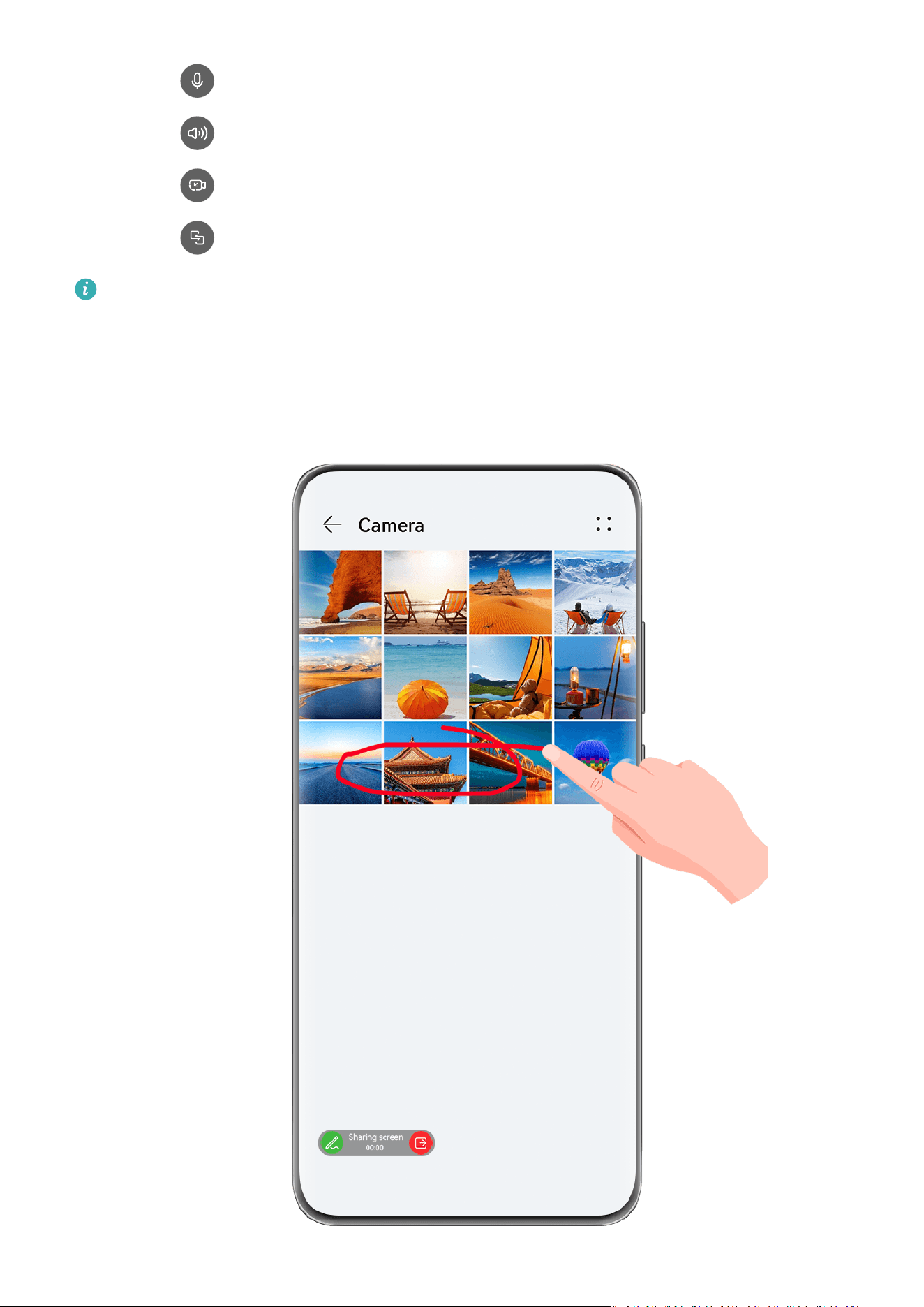
• Touch to mute MeeTime.
• Touch to use the speaker.
• Touch
to switch to a voice call.
• Touch to share the screen.
To view or manage your call logs, touch Calls.
Share Your Phone Screen During a MeeTime Call
During a MeeTime video call, you can share your screen with the other party and doodle on
the screen. The other party will then be able to view your screen and your doodles on it.
Apps
85
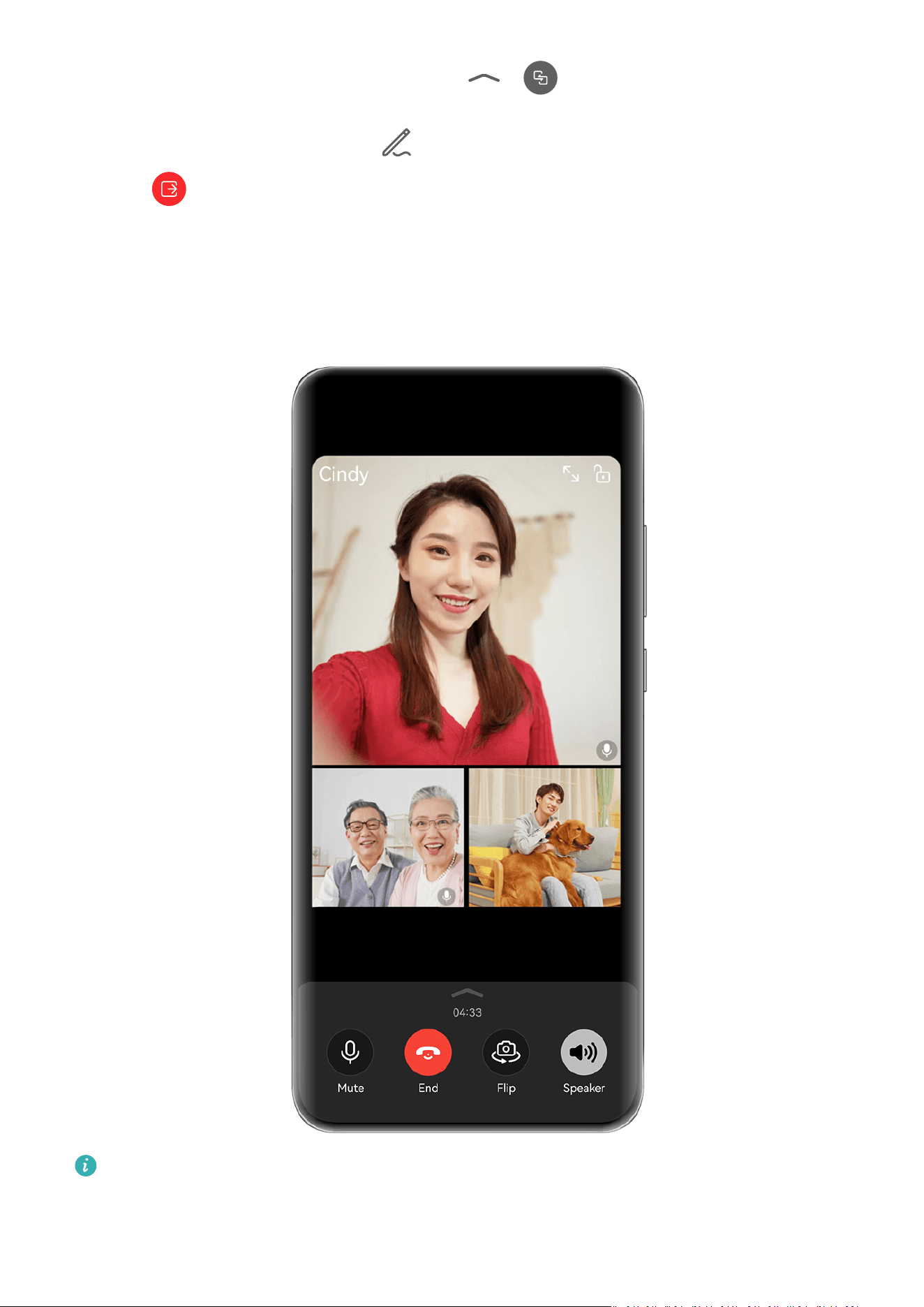
1 During a video call, touch the screen, go to > , and follow the onscreen
instructions to share your screen.
While sharing your screen, touch to start doodling on your screen.
2 Touch
to exit screen sharing.
Initiate MeeTime Group Calls
With MeeTime group calls you can have a voice or video call with multiple users at the same
time.
The gures are for reference only.
Go to MeeTime and select one of the following methods to initiate a group call:
Apps
86

• Go to > Group call, select contacts that you want to invite, and touch START CALL.
• During a one-on-one video call, tap the screen, go to > , add contacts, and then
touch Add members to call to initiate a group call.
• During a one-on-one voice call, touch , add contacts, and then touch Add members to
call to initiate a group call.
During a group call, you can tap the screen and touch to display the shortcut panel.
From there, you can:
• Add call members: Go to
> Add members, select contacts that you want to invite,
and touch START CALL.
• Beauty mode: Touch to adjust the beauty level during a video call.
• Share screen: Touch to share your screen with other members. When sharing your
screen, you can touch to write or doodle on the screen. To stop sharing your screen,
touch and then touch .
• Switch between voice and video calls: Touch to switch between voice and video calls.
• Some of these features are only supported in group video calls.
• Beauty mode is only supported on certain device models.
Set MeeTime Phone Numbers
You can use MeeTime with more than one of your phone numbers.
1 On the MeeTime screen, touch your prole picture icon in the upper right corner to
access the Settings screen.
2 Touch Number settings. You can then:
• Touch to add another phone number if only one phone number has been linked.
• Touch
to delete any numbers or add new ones if multiple phone numbers have
been linked.
• In the list of Outgoing number (this device), select one of the added phone numbers
to set it as the default number.
Notepad
Apps
87

Create and Edit a Note
Capture an inspired idea before it's too late, with Notepad. You can also add checklists,
images, and web links to notes to make them more detailed and enriching.
Create a Note
1 Go to Notepad > Notes, touch , and enter the title and content.
2 To change the text style, color, or background, touch .
3 Once you're done editing, touch
to save the note.
Add a Checklist
Add the work content and items you wish to purchase to the checklist. Once the checklist is
created, you can select annotations to organize your work and life with greater ease.
When you create a note in Notepad, touch
. From there, feel free to:
• Add an item to the list: Enter text after the hollow circle, and go to the next line to enter
another item.
• Mark an item as completed: Touch the hollow circle next to an item to mark the item as
completed.
Add Images to a Note
1 When creating a note in Notepad, touch , and select Take photo or Select from
Gallery to insert an image. Hold and drag to adjust the position of the added image
within the note.
2 Once you're done editing, touch to save the note.
Add Web Page Content to a Note
Add web page content or text to Notepad to quickly create a note. Touch the added web
page link in the note to open the web page and view the details.
Content sharing is not supported in all apps.
1 When browsing a web page, select the content you wish to share, such as a web page or
text on the web page.
2 Touch the share button, and select Notepad.
3 Add the shared content to an existing note, or create a new note, by following the
onscreen instructions.
Create Notes by Dragging Content from Other Apps
Drag text, images, and
les to Notepad, from apps like HUAWEI Browser and Files, to create
informative notes in little time. You can also select and drag individual items (such as text,
Apps
88
images, audio and video les, and documents) all at a time within notes to create a new
note.
Drag-and-drop operations are only supported in certain apps.
1 Go to Notepad > Notes, and touch .
2 Select and drag the content that you wish to add (from the corresponding apps) to
Notepad.
• Drag from other apps: Open Files in either split-screen or oating window mode,
select the text, images, or les, and hold and drag them to the desired note.
• Drag between notes: Open another note in either split-screen or oating window
mode, select the desired items (including text, images, audio and video les, and
documents), and hold and drag them all at a time to the desired note.
3 When editing a note, you also select multiple types of items, and hold and drag these
items to relocate them within the note.
4 Touch to save the note.
Create To-dos
You can create to-dos to keep a track of day-to-day essentials, such as daily shopping lists,
tasks at work, and household chores.
Add a To-do Item and Set a Reminder
You can add a to-do item and set a time reminder for it.
If you have marked the to-do item as important, you will be prompted with a full-screen
reminder when the screen is locked.
1 Go to Notepad > To-dos and touch .
2 Enter your to-do item.
3 Touch
, set a reminder time, then touch OK.
4 Touch to mark the to-do item as important.
5 Then touch Save.
Set Repeated Reminders for a To-do Item
If you specify a time for a to-do item, you can select a repeat mode for it (for example,
Never, Every day, Every week, Every month, or Every year), and your phone will repeatedly
prompt you to complete the to-do item at the specied time.
Draw
Grati and Handwrite Notes
Sketch and write to record sources of inspiration, and make your notes more vivid and
informative.
Apps
89
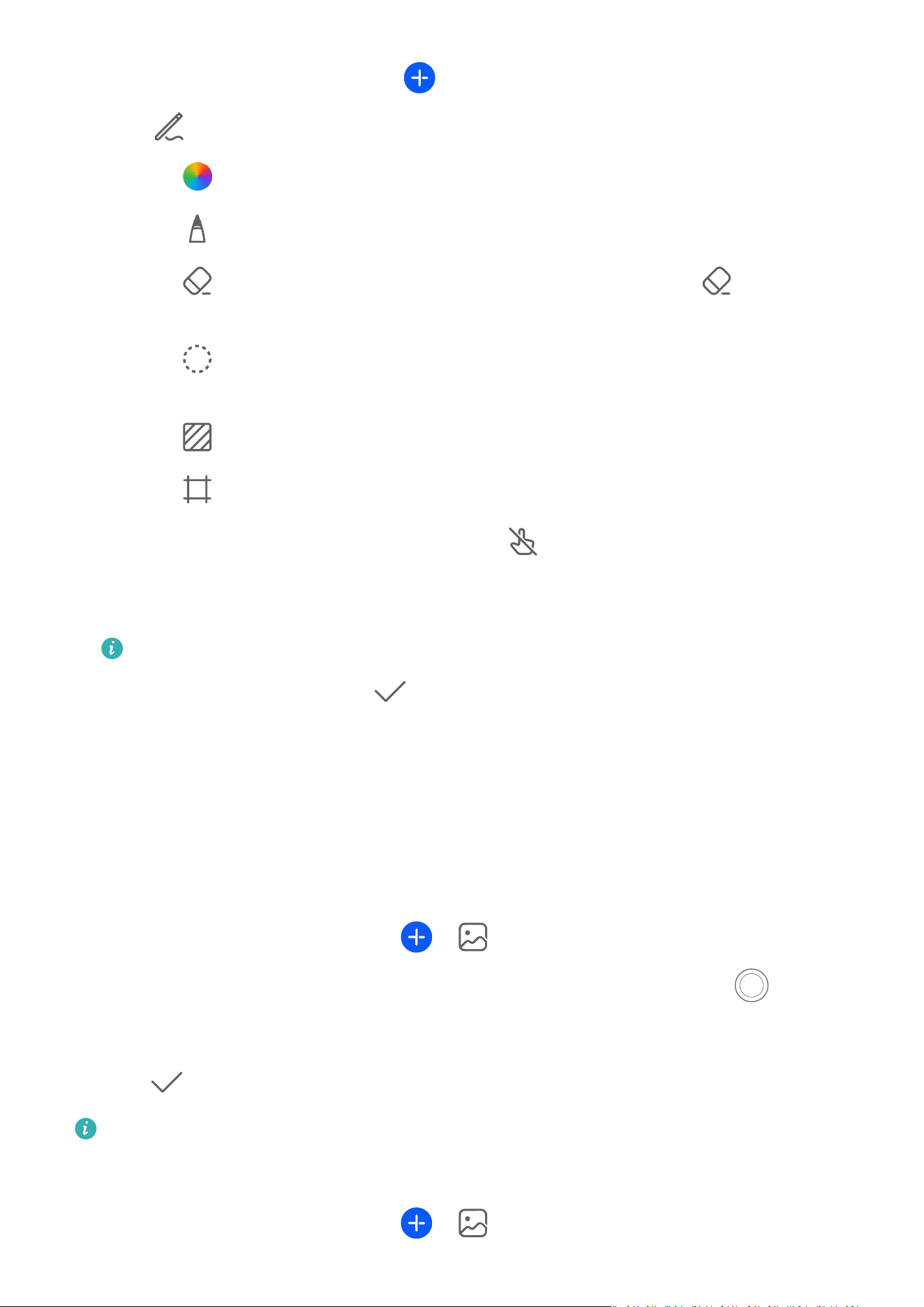
1 Go to Notepad > Notes, and touch .
2 Touch , and draw or write by following the instructions below:
• Touch to select a brush color.
• Touch to select the pen type (such as ballpoint pen or pen) and tip size.
• Touch
to manually erase specic grati or handwriting. Touch again, and
select Clear to clear all grati or handwriting.
• Touch
, circle the grati or handwritten content, and drag the circle to adjust its
position within the note. Touch and hold down on the circle to copy, share, or resize it.
• Touch to select the note background.
• Touch to display horizontal lines.
• If your device is connected to a stylus, touch
to block drawing grati or
handwriting by nger. After you do so, you'll only be able to edit the note with a
stylus.
Not all devices support all of these features.
3 Once you're done editing, touch to save the note.
Scan a Document or Card
In Notepad, you can use your device's camera to scan an image or document, such as an ID
card, bank card, or other
certicate, to save it as a note in Notepad, with an anti-theft
watermark.
Scan Documents to Create Notes
1 Go to Notepad > Notes, and go to
> > Scan document.
2 Point the camera to the images or documents you wish to scan, and touch
to scan
them one at a time, or consecutively.
3 Then go to Extract text > Save, select Save images and text or Save text only, and
touch
If your phone does not have this option, it indicates that this feature is not supported.
Scan Cards and Certicates to Store Them Away
1 Go to Notepad > Notes, and go to
> > Add card.
Apps
90

2 Point the camera to the certicates you wish to scan, and touch to scan them one at
a time, or consecutively. Touch to preview the scanned copies.
3 (Optional) If you wish to adjust the photo, touch
in the upper left corner to return to
the scanning screen. Then touch the thumbnail, manually adjust the photo, and touch
to preview the scanned copy.
4 (Optional) To add a watermark to the scanned copy, touch Full-screen watermark or
Single watermark.
5 Touch to insert the modied scanned copy into the note.
6 Touch
to save the note.
Search for and Sort Notes
Quickly Search for Notes
Use keywords, such as note titles, specic text content, or attachment names, to search for
notes within Notepad with newfound ease.
1 Open Notepad, touch the search bar at the top of the screen, and type in a keyword to
start searching.
2 Notes will display based on the keywords. You can continue to enter keywords for more
accurate searches.
Add a Folder or Notebook
Create folders or notebooks to store
dierent types of notes, and even add color-coded labels
to create digital notebooks in Notepad.
Go to Notepad, and touch All notes or All to-dos. From there, feel free to:
• Create a folder: Go to Manage > New folder, rename the folder, and touch Save.
• Create a notebook: Open any folder, touch New, select a color label, rename the
notebook, and touch Save.
To rename or delete a folder or notebook, go to Manage > Edit, and touch the folder or
notebook name to rename or delete it.
Folders and items in Exchange accounts cannot be edited.
Classify Notes and To-Dos by Category
Classify notes or to-dos into notebooks separated by folder and category, to reference
content with greater ease.
• Pin a note to the top: In the All notes list, swipe left on a note, and touch to pin it to
the top.
Apps
91

• Add a note to favorites: In the All notes list, swipe left on a note, and touch to add it
to favorites.
To view favorite items, touch All notes, and go to My favorites.
• Move a note or to-do to another notebook: In the All notes or All to-dos list, swipe left
on a note or to-do, touch , and select the target notebook.
Touch and hold down on a note or to-do item you wish to classify, select or swipe along
the check boxes of multiple items, and touch
to move them by batch to the target
category.
Lock Notes
You can apply App Lock to Notepad or set a password for a note to protect your privacy.
• To lock the Notepad app, go to Settings > Security > App Lock, follow the onscreen
instructions to enter the screen lock password or custom app lock password, and enable the
switch next to Notepad.
• To lock a single note, go to Notepad > Notes, open the note you wish to lock, go to
> Add lock, follow the onscreen instructions to set a password, and touch .
To remove the note lock, open the note, and go to > Remove lock.
If your device supports ngerprint or face unlock, and you've enrolled your ngerprint or
facial data, you can use fast authentication by performing the following steps: Go to
Notepad >
> Settings > Note lock, and enable Unlock with Fingerprint ID and Unlock
with Face Recognition.
Share and Export Notepad Items
Share notes or to-dos in Notepad with others, and even export notes in image, TXT, and
other formats.
Share Notes or To-dos
• To share a single note or to-do: Open the note or to-do you wish to share in the All notes
or All to-dos list, and touch . Then follow the onscreen instructions to complete the
process.
You can share a note by touching Share as image, Share as text, or To another device.
• To share multiple notes: Touch and hold down on a note, select multiple notes you wish
to share in the All notes list, and touch . Then follow the onscreen instructions to
complete the process.
Apps
92

Export Notes
Go to Notepad > Notes, open the note you wish to export, and touch . From there, feel
free to:
• Export it as an image: Go to Share as image > Save image. You'll nd the exported image
in Gallery.
• Export it as a document: Touch Export as document, and follow the instructions to select
the document format you need and complete the process.
To view notes that you have saved, open Files, search for and access Documents, and
touch NotePad.
The Export as document feature is not available for handwritten-only notes. Other types
of notes can be exported into TXT or HTML les when you select Export as document.
Delete Notes or To-dos
You can delete notes or to-dos in any of the following ways:
• In the All notes or All to-dos list, swipe left on a note or to-do, and touch to delete it.
• Touch and hold down on the note or to-do you wish to delete, select or swipe along the
check boxes of multiple notes or to-dos that you wish to delete, and touch
.
Once deleted, you can touch All notes or All to-dos and go to Recently deleted to view the
deletion records. To restore a deleted item, touch and hold down on it, or go to its details
screen, and touch .
Compass
Compass
View Directions and Coordinates, with Compass
Compass shows you the direction your phone is pointing towards, as well as your current
longitude and latitude.
1 You can open Compass in either of the following ways:
• Swipe down from the middle of the home screen to display the search box, and search
for Compass. The
rst result will be the pre-installed Compass app.
• Find Compass in the Tools folder.
2 You can view directions and coordinates in either of the following ways:
• When you hold your phone at, the Compass screen will display the direction your
phone is pointing towards, along with the current coordinates.
Apps
93

• When you hold your phone upright, the Compass screen will display the viewnder of
the rear camera on your phone, as well as the direction your phone is pointing
towards, and the current coordinates.
To lock the current direction, touch the compass dial. The dial marks will turn blue if you
stray o course.
For optimal accuracy, remember to hold your phone at or upright when using Compass.
Optimizer
Clean Up Phone Storage
Cleanup in Optimizer helps you scan for redundant or large
les, such as residual app les,
unwanted installation packages, WeChat data, and more. Once detected, you can choose
whether or not to delete individual les. This tool can also compress duplicate les and less
frequently-used apps to free up space.
Compress Apps and Files to Free up Space
1 Go to Optimizer, and touch Cleanup.
2 Once the scan is complete, touch Compress in the Recommended for compression list,
and follow the onscreen instructions to compress duplicate
les and rarely-used apps to
free up storage space.
Compression will not change the storage location, quantity, or quality of les, nor aect
the running of apps.
Manually Clean the System Trash
1 Go to Optimizer, and touch Cleanup.
2 Once the scanning is complete, touch Clean up next to Junk les. You can also touch
Clean up next to other items, select the items to be cleaned, and touch DELETE.
Clean Up WeChat Data
Over an extended period of use, WeChat will accumulate a large amount of data, including
cache les, chat videos, audio les, emojis, and more. Optimizer can scan for unwanted
WeChat data for you to clean up by category or by chat thread.
On the Cleanup screen, and touch WeChat. Then you can:
• Clean up Cached les, Cached videos, and Favorites.
• Go to WeChat to delete data from chats.
• Perform targeted cleanups of Chat images, Chat videos, Chat audios, and more.
Clean Up Duplicate Files
Optimizer can identify duplicate
les on your phone.
Apps
94

On the Cleanup screen, touch Duplicate les, then select unwanted les to delete them.
Apps
95
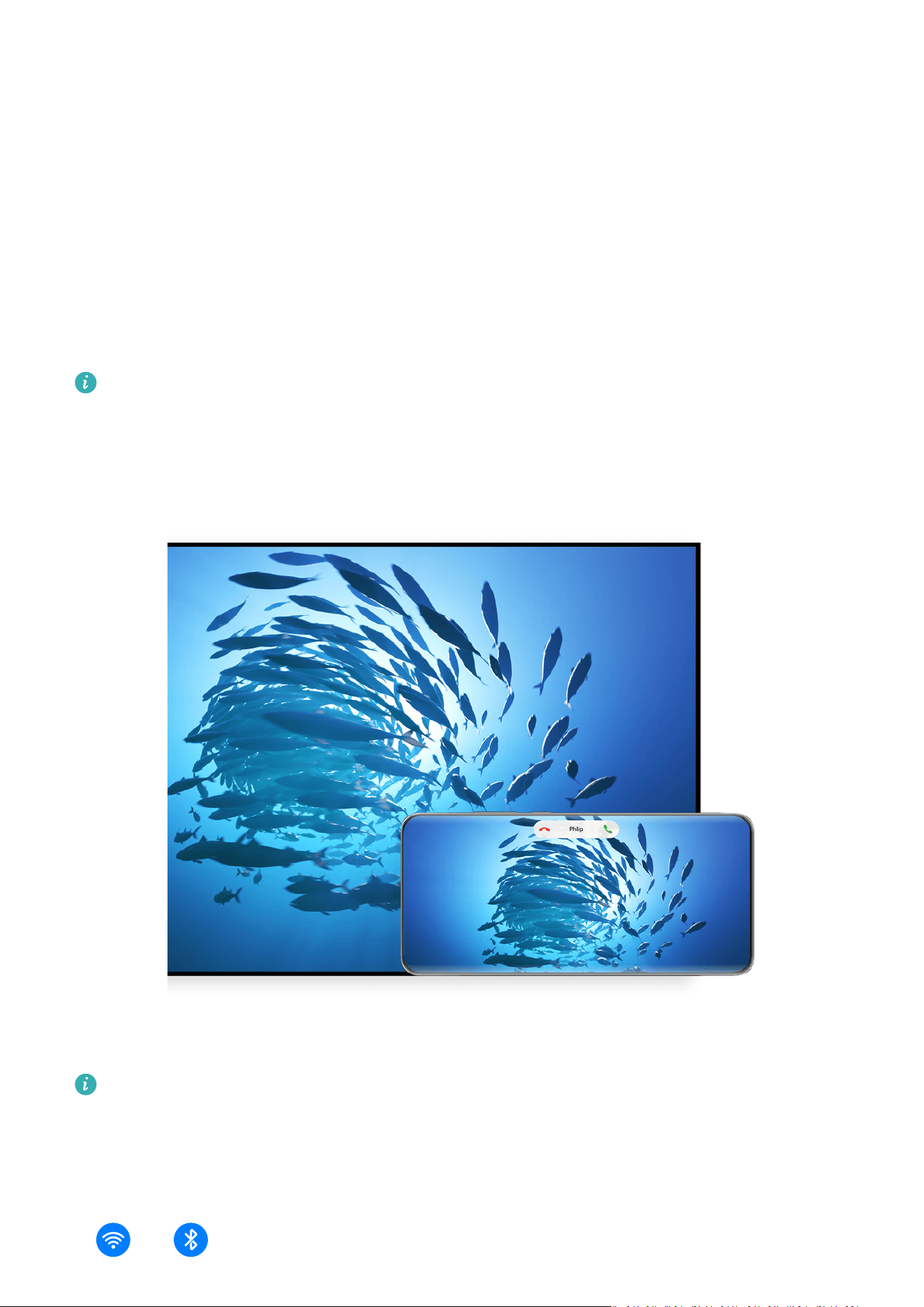
Settings
More Connections
Project Your Phone Screen Wirelessly
Project your phone wirelessly to stream movies and work on a large-screen device (such as a
Vision).
Dierent display devices support dierent projection protocols. Therefore, the projection
method may vary. Choose a suitable method based on the protocol supported by your device.
For details about the supported projection protocols, refer to the product manual or
contact the product manufacturer.
The gures are for reference only.
1 Ensure that the Cast+/Miracast switch or the projection switch is enabled on the large-
screen device. For details about how to turn on the switch, refer to the product manual or
contact the product manufacturer.
2 Swipe down from the upper right edge of your phone to display Control Panel, and touch
and .
96

3 In Control Panel, touch to expand the shortcut switch panel (depending on your
device model), and touch Wireless Projection. Your phone will then start searching for
available external large-screen devices.
You can also go to Settings > More connections > Easy Projection to enable
Wireless projection.
4 Touch the device that you want to project your phone to from the detected devices.
By default, after the connection is successful, banner notications for incoming calls,
messages, and alarms, and Multi-Window are only displayed on your phone instead of the
large-screen device. To change the settings, touch , and turn o the switch for Hide
notications.
Some products do not support the Hide notications feature. The actual product
prevails.
To exit wireless projection, go to > Project screen on the phone screen; alternatively,
swipe down from the upper left edge of the screen to display the notication panel, and
touch DISCONNECT (depending on your device model).
Use Desktop Mode to Make Work More Convenient
After your phone screen is projected, go to > Desktop mode.
In Desktop mode, your phone and the large-screen device work independently and can show
dierent content. The content of a phone projected on the large-screen device is in a layout
similar to that of the computer desktop.
For example, you can edit a document on the large-screen device while chatting on your
phone. You don't need to worry about missing out on notications, calls, or messages, as a
red dot will appear on the notication panel on the large-screen device to let you know.
Use Your Phone as a Touchpad
After your phone screen is projected to a large-screen device in Desktop mode, if no
keyboard or mouse is available, your phone can work as a touchpad to complete input
operations of a mouse and keyboard.
Go to > Touchpad, and you're free to:
• Use gestures as instructed to simulate mouse commands.
Settings
97
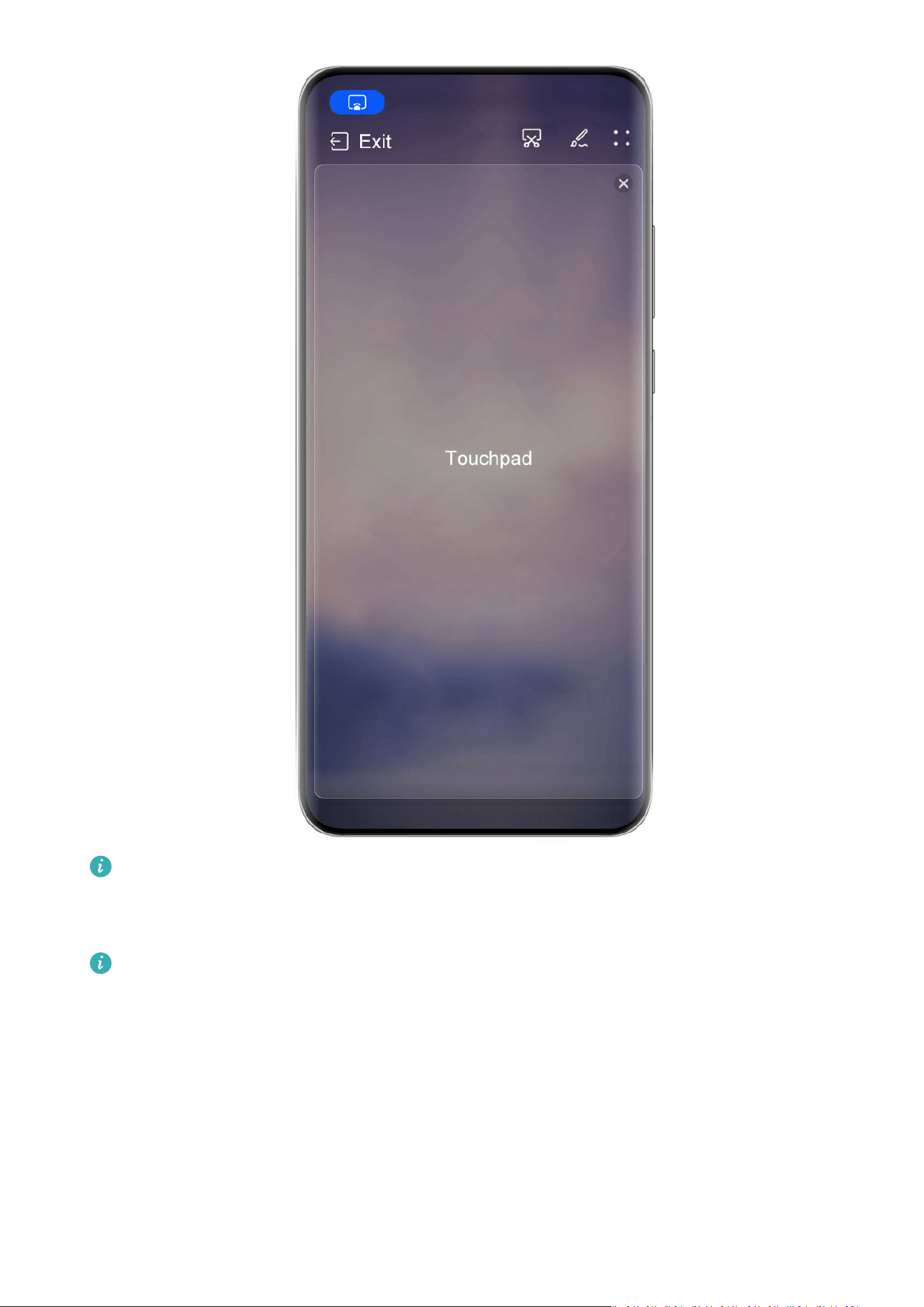
The gures are for reference only.
• When no external keyboard is connected, touch the text input box on the large-screen
device to display the onscreen keyboard to input text.
If an external keyboard is connected, the onscreen keyboard will not be available. In
this case, you need to use the external keyboard to input text.
Project the Phone's Screen to the Large-Screen Device to Make Work Easier
In Desktop mode, you can use the following features:
• Multi-window display: Open multiple windows at a time to multitask.
• File management: Save les to the desktop, create les or folders, and rename or delete
les.
• Quick search: Search for documents, multimedia les, and apps using the start menu
search box.
Settings
98
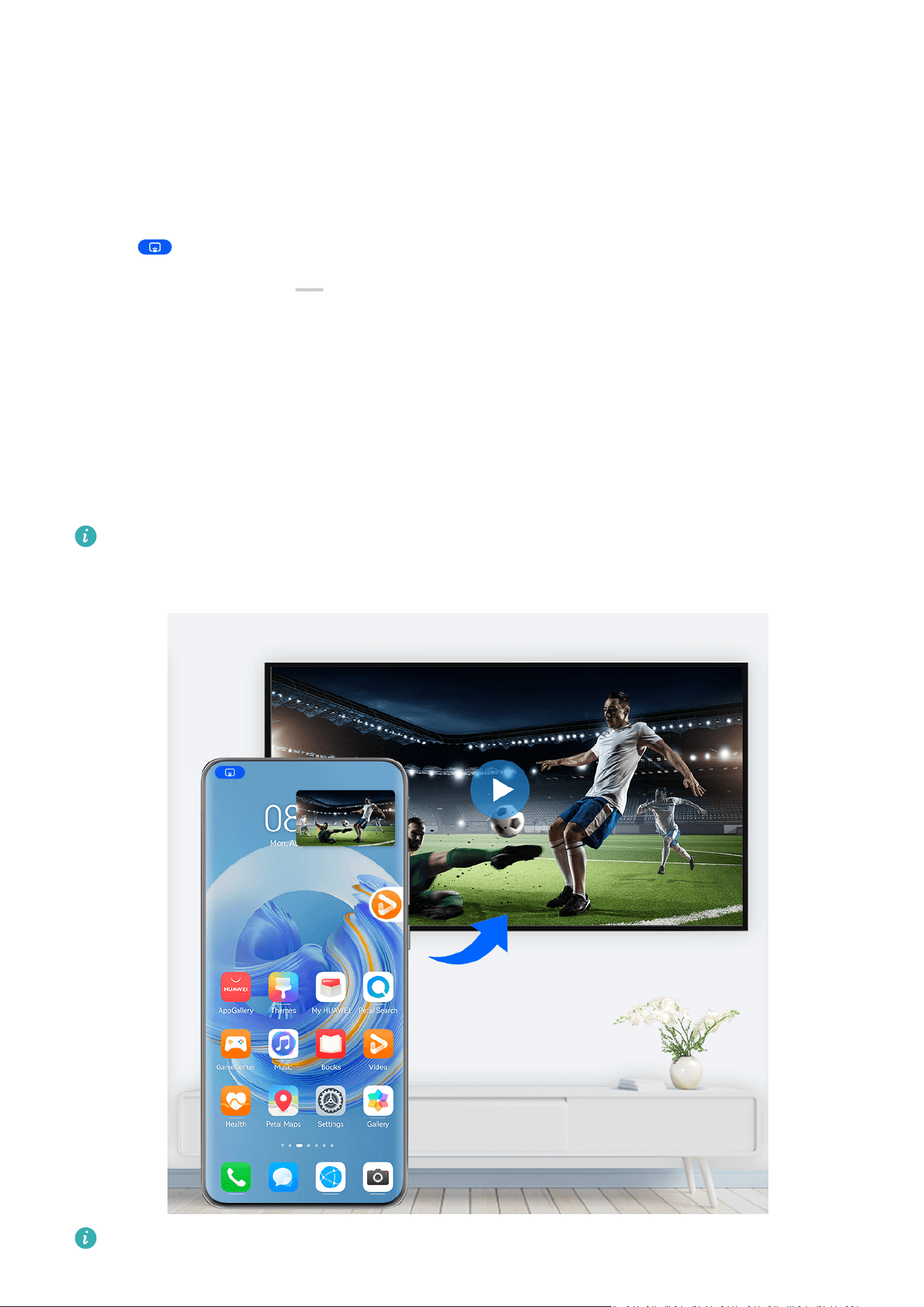
• Quick app projection: Touch and hold down on an app icon on your phone, and touch the
projection menu to project the app to the large-screen device and open it.
Exit Desktop mode
You can exit Desktop mode in any of the following ways:
• Touch Exit to exit Desktop mode.
• Go to > Project screen to return to wireless projection.
• In Control Panel, touch to expand the shortcut switch panel (depending on your
device model), and touch Wireless Projection to exit wireless projection.
• Swipe down from the upper left edge of your phone to display the notication panel and
touch DISCONNECT to exit wireless projection.
Project the Current App to a Large-screen Device
You can project the current app on your phone to a large-screen device (for example, a
Huawei Vision), while continuing to use and browse other apps on your phone.
App projection is supported on large-screen devices that support the Cast+/Miracast
protocol.
The gures are for reference only.
Settings
99

After wireless projection is enabled on your phone, open the app you wish to project in full-
screen mode, go to > to project the app to the large-screen device, and minimize
the app, which will appear as a oating ball o to the side on the phone screen.
• Apps in split-screen or oating-window mode can't be projected.
• To safeguard your privacy, this feature can't be used once your device screen has been
locked.
Touch the projected app in the oating ball to display the app's oating window, and use this
window to control the app.
You can exit app projection in any of the following ways:
• Go to > Project screen to return to wireless projection.
• In Control Panel, touch to expand the shortcut switch panel (depending on your
device model), and touch Wireless Projection to exit wireless projection.
• Swipe down from the upper left edge of your phone to display the notication panel and
touch DISCONNECT to exit wireless projection.
Display & Brightness
Use Eye Comfort Mode
Eye comfort mode can
eectively reduce harmful blue light and adjust the screen to display
warmer colors, relieving eye fatigue and protecting your eyesight.
Enable or Disable Eye Comfort Mode
• Swipe down from the upper right edge of the screen to display Control Panel and touch
to expand the shortcut switches panel. Enable or disable Eye Comfort. Touch and hold
Eye Comfort to access the settings screen.
• Go to Settings > Display & brightness > Eye Comfort and enable or disable Enable all
day.
Once Eye Comfort mode is enabled,
will be displayed in the status bar, and the screen
will take on a yellow tint since less blue light is being emitted.
Set a Schedule for Eye Comfort Mode
Go to Settings > Display & brightness > Eye Comfort, enable Scheduled, then set Start and
End according to your preferences.
Settings
100
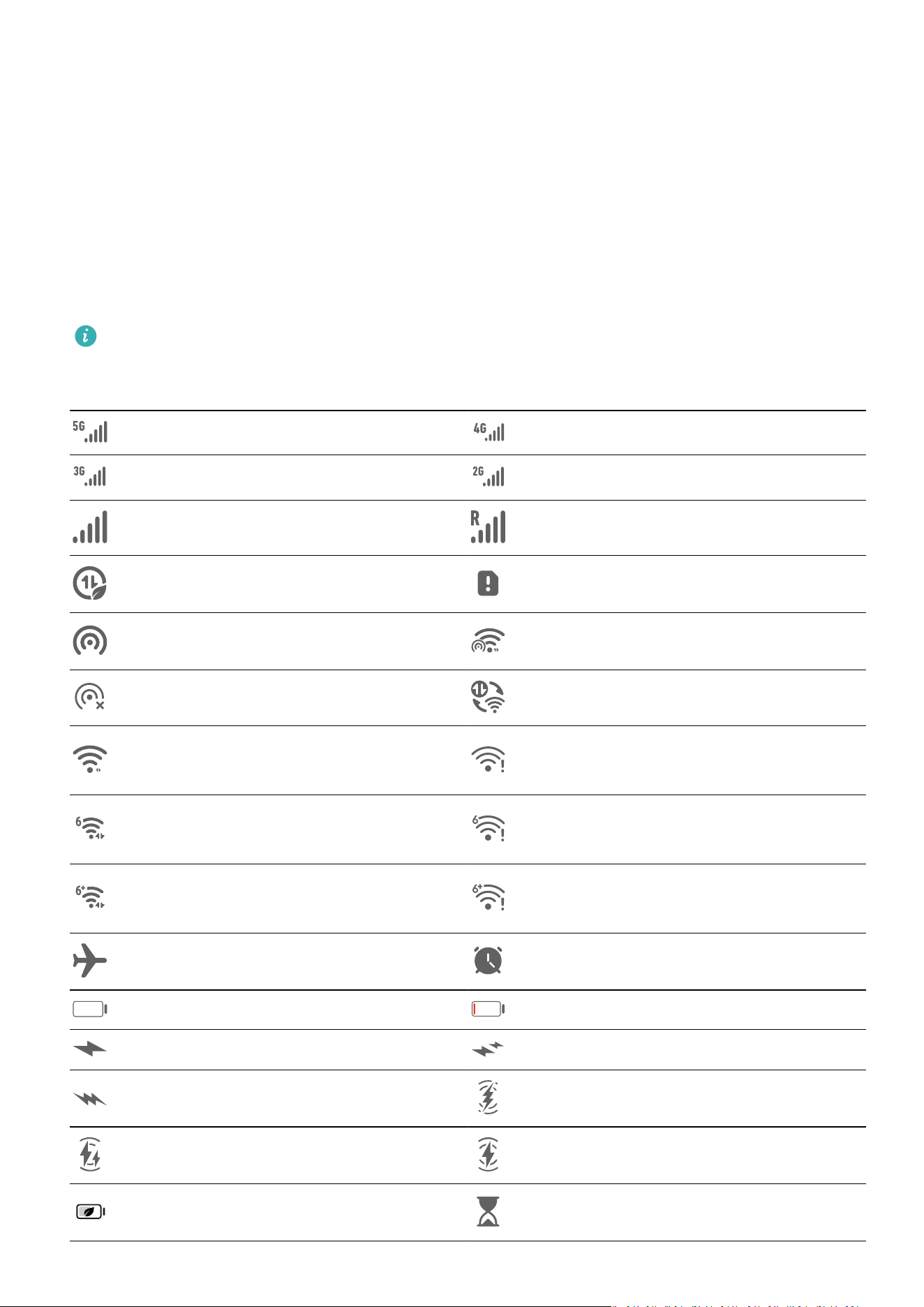
Adjust the Blue Light Filter in Eye Comfort Mode
Go to Settings > Display & brightness > Eye Comfort, enable Enable all day or set up
Scheduled, and adjust the slider under Filter level to customize how much blue light you
would like to be ltered.
Notications & status bar
Notication and Status Icons
Network status icons may vary depending on your region or network service provider.
Supported features vary depending on the device model. Some of the following icons
may not be relevant to your phone.
5G network connected 4G network connected
3G network connected 2G network connected
Full signal strength Roaming
Data saver enabled No SIM card inserted
Hotspot enabled Hotspot connected
Hotspot disconnected Switching networks via Wi-Fi+
Wi-Fi connected
Wi-Fi network is faulty, unable to
connect to the Internet
Wi-Fi 6 connected
Wi-Fi 6 network is faulty, unable
to connect to the Internet
Wi-Fi 6+ connected
Wi-Fi 6+ network is faulty, unable
to connect to the Internet
Airplane mode enabled Alarm set
Battery empty Low battery
Charging Fast charging
Super charging Wireless super charging
Wireless fast charging Regular wireless charging
Power Saving mode enabled Digital Balance enabled
Settings
101
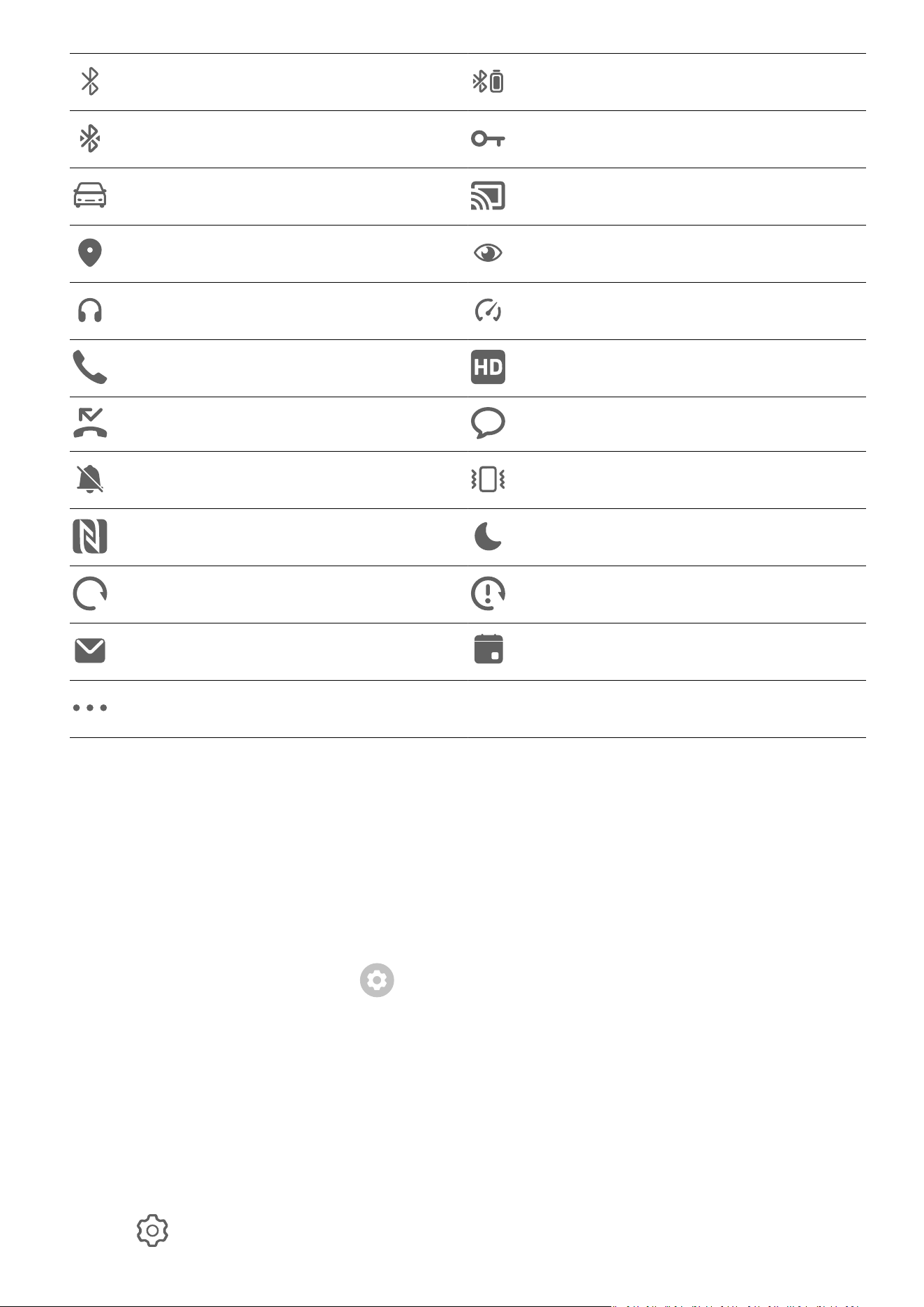
Bluetooth enabled Bluetooth device battery
Bluetooth device connected VPN connected
Driving mode enabled Projection device connected
Location service enabled Eye Comfort enabled
Headset connected Performance mode enabled
Calling VoLTE enabled
Missed call New message
Silent mode Vibration pattern
NFC enabled Do Not Disturb mode enabled
Syncing data Data syncing failed
New email Event reminder
More notications
Manage the Notications and Status Bar
Pin App Notications to the Top
You can pin app notications to the top of the notication panel in either of the following
ways:
• Swipe down from the upper left edge of the screen to display the notication panel, swipe
left on a notication, and touch > Pin to top.
• Go to Settings > Notications & status bar, locate and touch the app for which you wish
to pin notications, and enable Pin to top.
Disable App Notications
If you do not want to be disturbed by notications from an app, perform either of the
following:
• After you receive a notication from the app, swipe left on it in the notication panel, and
go to > Disable notications.
Settings
102

• Go to Settings > Notications & status bar, locate and touch the app for which you want
to disable notications, then disable Allow notications.
• Go to Settings > Notications & status bar > Manage all, and turn o the switch next to
the app.
Hide Content of Notications on the Lock Screen
To enable this feature:
Go to Settings > Notications & status bar, and enable Hide notication content.
Notications Turn on Screen
Go to Settings > Notications & status bar, and enable Wake screen. Your phone will then
automatically turn on the lock screen when it receives a notication.
Manage Notications for Specic Apps
Go to Settings > Notications & status bar, touch an app to go to the notication
management details screen, and enable or disable notications for the app. You can then set
the notication mode within the app, or separate modes for dierent types of notications,
by touching the corresponding notication type (for example, Social), as follows:
The notication types may vary by app.
• Gentle notications: When this switch is turned on, notications will only display in
Notication Panel, and will not appear as banners, lock screen notications, or status bar
icons, nor will your device ring or vibrate.
• Lock screen and Banners: Allows you to select the notication display method.
• Notication sound: Allows you to change the notication tone and set a vibration pattern.
• Allow interruptions: When you enable Allow interruptions for an app, your phone will
still be able to receive
notications from this app in Do Not Disturb mode.
You can also swipe down from the upper left edge of the screen to display Notication Panel,
swipe left on a notication, and go to > More settings to manage the app's
notications.
Set the Status Bar to Simple Display
Go to Settings > Notications & status bar > Status bar, and enable Simple display. After
doing so, only the following frequently-used icons will display on the phone status bar by
default: time, Wi-Fi network, mobile signal, and battery level.
Biometrics & Password
Settings
103

Set Fingerprints
You can enroll a ngerprint and then use it to unlock the screen and access your Safe, App
Lock, and more.
Add Fingerprints
1 Go to Settings > Biometrics & password > Fingerprint ID and follow the onscreen
instructions to set or enter the lock screen password.
2 Touch New
ngerprint or New rear ngerprint (depending on your device model) to
begin enrolling your ngerprint.
3 Place your ngertip on the ngerprint sensor. When you feel a vibration, lift your nger
and then press down again. Move your nger around until the entire ngerprint is
captured.
4 Once enrollment is complete, touch OK.
You can now place your nger on the ngerprint sensor to unlock the screen.
Rename or Delete a Fingerprint
1 Go to Settings > Biometrics & password > Fingerprint ID and enter your lock screen
password.
2 In the Fingerprint list section, touch an enrolled
ngerprint to rename or delete it.
Fingerprint Identication
Fingerprint identication allows you to match your ngers with the enrolled ngerprints.
1 Go to Settings > Biometrics & password > Fingerprint ID and enter the lock screen
password.
2 In the Fingerprint list section, touch Identify ngerprint.
3 Touch the ngerprint sensor with your nger. The recognized ngerprint will be
highlighted.
Use Your Fingerprint to Access Your Safe
1 Go to Settings > Biometrics & password > Fingerprint ID and enter your lock screen
password.
2 Turn on the switch for Access Safe and follow the onscreen instructions to link your
ngerprint with the Safe.
Now you can go to Files > Me, touch Safe, then use your ngerprint to access it.
Please make sure your device has been updated to the latest system version.
Use Your Fingerprint to Access a Locked App
1 Go to Settings > Biometrics & password > Fingerprint ID and enter the lock screen
password.
2 Turn on the Access App Lock switch and follow the onscreen instructions to link your
ngerprint with App Lock.
Settings
104

You can then touch a locked app on your home screen and use your ngerprint to access it.
Enable and Use Fingerprint Payment
You can use your ngerprint to verify your payments in a payment app.
Go to the payment app and follow the onscreen instructions to enable this feature.
Set a Fingerprint Animation
If you have added your ngerprint, you can select an animation to be displayed whenever
you unlock with your ngerprint.
Go to Settings > Biometrics & password > Fingerprint ID > Fingerprint animation and
follow the onscreen instructions to complete the settings.
Face Recognition
Face Recognition allows you to unlock your phone or access locked apps with your facial
data.
Set up Face Recognition
1 Go to Settings > Biometrics & password > Face Recognition, and enter your lock screen
password.
If you haven't set the lock screen password, follow the onscreen instructions to do so.
2 Some phones support screen wakeup when you raise the device. If you can
nd the
Enable raise to wake setting option on your device, you can enable it as needed.
The settings items vary by device. If your phone does not provide a specic item, it
indicates that the corresponding feature is not supported.
3 Touch Get started, position your face in front of your phone, and follow the onscreen
instructions to enroll your facial data.
Set an Alternate Look
You can add an alternate look for more accurate and convenient face recognition.
On the Face Recognition screen, touch Set an alternate look, and follow the onscreen
instructions to enroll the alternate facial data.
Set Face Unlock
On the Face Recognition screen, touch Unlock device and select an unlock method.
Some phones support Require eye contact. When this is enabled, you will need to keep your
eyes open while unlocking the device with your face. If you can't nd this switch on your
device, it means that this feature is not supported.
If you have enabled PrivateSpace, you'll only be able to use Face unlock in MainSpace. If
you have added multiple users, you'll only be able to use Face unlock with the Owner
account.
Settings
105

Link Your Face with Password Vault
Access the Face Recognition screen and enable Autoll usernames and passwords.
When logging in to an app, you can use Face Recognition to automatically ll in the account
name and password saved in Password Vault.
Bolster Your Device Security, with Face Recognition
Enable Require trusted device when using Face unlock to ensure that your phone will only
unlock when it detects your face and is connected to a trusted device.
This feature is disabled by default. To enable it, go to the Face Recognition settings screen,
touch Require trusted device, turn on the Require trusted device switch, and follow the
onscreen instructions to complete the settings.
A trusted device can be any Bluetooth device that can be used for unlocking purposes,
such as earphones, a watch, or a band.
Set Accessibility Mode for Face Recognition
Once Accessibility mode for Face Recognition has been enabled, your face will be identied
even with your eyes closed if you are in ScreenReader mode.
To enable Accessibility mode, perform the following steps:
1 Go to Settings > Accessibility features > Accessibility > ScreenReader, and enable
ScreenReader.
2 Access the Face Recognition screen and enable Accessibility mode.
If you have not enrolled a face, Accessibility mode will be automatically enabled when
you are enrolling the facial data once ScreenReader is turned on.
Disable or Delete Facial Data
Go to the Face Recognition screen to:
• Prevent certain features from accessing your facial data: Disable Unlock device, Access
App Lock, or other features, to prevent them from using your facial data. Doing so won't
delete your facial data.
• Delete facial data: Touch Delete facial data to delete your facial data. You'll have to enroll
your face once again if you want to use the facial recognition feature later on.
Storage
Clean Up Phone Storage
Cleanup in Optimizer helps you scan for redundant or large
les, such as residual app les,
unwanted installation packages, WeChat data, and more. Once detected, you can choose
whether or not to delete individual les. This tool can also compress duplicate les and less
frequently-used apps to free up space.
Settings
106

Compress Apps and Files to Free up Space
1 Go to Optimizer, and touch Cleanup.
2 Once the scan is complete, touch Compress in the Recommended for compression list,
and follow the onscreen instructions to compress duplicate
les and rarely-used apps to
free up storage space.
Compression will not change the storage location, quantity, or quality of les, nor aect
the running of apps.
Manually Clean the System Trash
1 Go to Optimizer, and touch Cleanup.
2 Once the scanning is complete, touch Clean up next to Junk les. You can also touch
Clean up next to other items, select the items to be cleaned, and touch DELETE.
Clean Up WeChat Data
Over an extended period of use, WeChat will accumulate a large amount of data, including
cache les, chat videos, audio les, emojis, and more. Optimizer can scan for unwanted
WeChat data for you to clean up by category or by chat thread.
On the Cleanup screen, and touch WeChat. Then you can:
• Clean up Cached les, Cached videos, and Favorites.
• Go to WeChat to delete data from chats.
• Perform targeted cleanups of Chat images, Chat videos, Chat audios, and more.
Clean Up Duplicate Files
Optimizer can identify duplicate
les on your phone.
On the Cleanup screen, touch Duplicate les, then select unwanted les to delete them.
Security
Keep Your Phone Under Lock-and-Key with Security Center
Security Center provides you with your phone's real time security status, and handy tips,
making it easy to set a wide range of high-level security safeguards.
Check the Security Status of Your Device
Your phone will display the security status of this device and devices connected via Super
Device, and logged in to the same HUAWEI ID as well. You can also view security tips and
records for all of these devices.
This feature is currently supported on phones and tablets running EMUI 13.0 or later.
More devices will be supported in the future.
Settings
107

Go to Settings > Security. Your phone will display the security status of this device and
devices connected via Super Device, and logged in to the same HUAWEI ID as well.
A green sign indicates that your device is in good condition. A yellow sign indicates that your
device has security risks. A red sign indicates that your device is at high risk, and should be
optimized as soon as possible.
Touch this device, to do the following:
• View and set security features: This device will display its current security status. You can
touch specic features to set or apply them. For example, you can touch Lock screen
password, and follow the onscreen instructions to set it.
• View security suggestions: This device will provide you with security suggestions based on
the device settings. Feel free to touch the button next to each suggestion, and follow the
onscreen instructions to optimize your safeguards.
• View recent security records: You can nd your recent security records in a list, for a
better sense of how to protect your device.
Touch a connected device to view its security status. If you would like to modify the settings,
follow the onscreen instructions on the corresponding device.
Set Security Features for Your Phone
Go to Settings > Security, touch the features you wish to set, such as App Lock and
Password Vault, and follow the onscreen instructions to complete the process.
View Security Suggestions on Your Phone
Feel free to view the recommended safeguards on your phone, and apply them on a case-by-
case basis.
To do so, go to Settings > Security, and touch the switch next to the suggestion you wish to
optimize, or follow the onscreen instructions to go to the corresponding screen and optimize
the settings.
If you wish to ignore a suggestion, swipe left on the suggestion, and touch .
Privacy
View and Manage the Privacy Settings on Your Phone
Find privacy tips, privacy permissions, and app privacy behavior logs on your phone, by
visiting the privacy center. When an app uses a sensitive permission, your phone will inform
you in real time, so that you can make timely adjustments, when necessary.
Settings
108

• Privacy behavior logs are analyzed and displayed solely on your phone, and will not be
uploaded to the cloud.
• Some system apps will not display permission reminders or privacy suggestions when
using permissions.
View Permission Access Notications
Your phone will inform you of any sensitive permissions that are being used on the status bar,
and display the app information on Control Panel in real time. From there, you can choose to
manage these permissions on a case-by-case basis.
For example, when an app uses the microphone permission, the microphone icon will display
on the status bar. You can swipe down from the upper right edge of your phone to display
Control Panel, and check which app is using this permission at the top.
Touch the app name to view the recent sensitive permission logs for the app, or to disable
specic permissions for the app.
Real-time access notication is only supported for certain sensitive permissions.
View Sensitive Permission Records
You can view records related to sensitive permission usage and recent app privacy behavior in
the privacy dashboard.
To do so, go to Settings > Privacy, and touch the permission icon, app icon, or next to
the permission icon on the dashboard.
Touch View full history to view records of lock screen data access, frequent data access, and
app privacy behavior.
Bolster Image Privacy Protections
Concerned that certain third-party apps might obtain sensitive information from images in
the background, or the image information may be leaked when you share images on social
media, just enable Image privacy for ultimate peace of mind.
Go to Settings > Privacy, touch Image privacy, and enable Remove location info and
Remove other info.
Once this feature has been enabled, third-party apps, rather than system apps, for example
Gallery, will not be able to obtain sensitive image information, such as the locations, device
models, and times when the images were taken.
Get Tips on How to Protect Your Privacy
When your phone detects that your privacy settings are risky or can be optimized, it will
provide handy tips that are easy to apply.
Go to Settings > Privacy, and follow the onscreen instructions to touch the button next to
each suggestion.
Settings
109

If you wish to ignore a suggestion, swipe left on the suggestion, and touch . The system
will not continue to remind you, if you ignore the same suggestion twice.
Accessibility Features
Use the Accessibility Features on Your Phone
Accessibility features, like screen-reading apps,
magnication gestures, and screen color
corrections, make the phone easier to navigate and more friendly to visually-impaired users.
Enable Color Correction to Customize the Screen Color
Color correction helps people with poor eyesight see the screen content more easily.
1 Go to Settings > Accessibility features > Accessibility > Color correction and enable
Color correction.
2 Touch Correction mode to select a color correction mode.
Use Magnication Gestures
Use magnication gestures to zoom in on the screen.
On the Accessibility > Magnication screen, touch Magnication, then enable it.
Zoom in or out by touching the screen three times in a row.
• While zoomed in, spread two or more ngers to further zoom in, then pinch two or more
ngers together to zoom back out.
• Drag the screen with two or more ngers to view other parts of the screen.
Enable Color Inversion
Color inversion allows you to invert the color of the text and the background. When Color
inversion is enabled, your phone will display text in white and the background in black.
On the Accessibility screen, enable Color inversion.
Use a Shortcut to Activate an Accessibility Feature
You can use Volume buttons to quickly activate an accessibility feature.
1 On the Accessibility screen, touch Accessibility shortcut.
2 Touch Select feature to select the feature you want to activate with the shortcut.
3 Enable Accessibility shortcut. You can now press and hold the Volume up and down
buttons simultaneously for 3 seconds to activate the feature.
Adjust the Screen Touch Duration
You can adjust the touch duration and long touch duration, and set the time within which
repeated touches will be ignored.
Settings
110

On the Accessibility settings screen, touch Touchscreen settings, then you can perform the
following:
• Touch Touch duration, and set the touch duration as required.
• Touch Touch & hold duration, and set the long touch duration as required.
• Enable Ignore repeated touches, and drag the slider to set the time interval for repeated
screen touches as required.
Connect to a Hearing Aid Device via Bluetooth
Link your phone with a hearing aid device that supports Bluetooth low energy technology, to
hear calls and audio loud and clear.
1 Swipe down from the upper right corner of the phone to display Control Panel, and
enable Bluetooth.
2 Pair your phone with a hearing aid device that supports Bluetooth low energy technology
via Bluetooth.
3 Once the connection is established, simply put on your hearing aid device to answer calls
and listen to audio directly on it.
You can also manually switch the playback device.
• MeeTime/Voice calls: On the call screen, touch to switch between them.
If there is no option on the call screen, it means that you won't be able to use
the hearing aid device to answer calls.
• Audio playback: Swipe down from the upper right corner of your phone to display
Control Panel, and touch
in the audio control panel to switch the playback
device.
You can also go to Settings > Accessibility features > Accessibility > Hearing aids, and
follow the onscreen instructions to set the hearing aid device (for example, adjust the
volume).
Pool Text and Images with SuperHub
Drag text, images, and les on dierent screens to SuperHub, where they are temporarily
stored, and then drag individual items, or multiple items, to other apps as needed.
Pool Content from Dierent Screens
Select text, images, or les within an app, touch and hold down on the content until it starts
oating, and drag the content to the SuperHub oating window.
If you select multiple images or les at the same time, the selected content will stack up in
SuperHub. You can touch the stacked content to view its details.
Settings
111
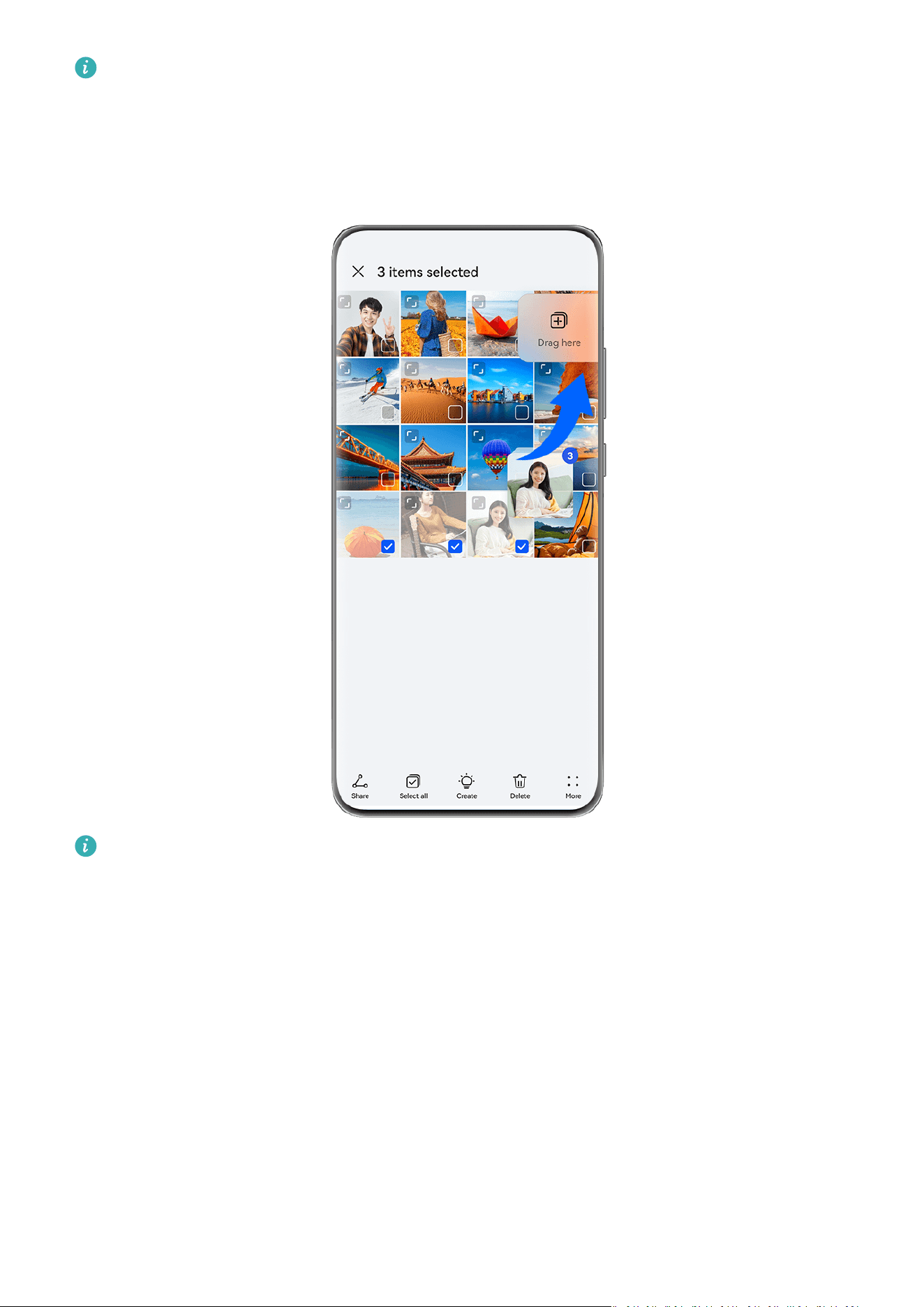
• If the SuperHub oating window does not pop up after you touch and hold down on
the content, go to Settings > Accessibility features > SuperHub, and enable Show on
drag.
• Drag-and-drop operations are only supported in certain apps.
The gures are for reference only.
Drag Content to Other Apps
Drag content in SuperHub to apps like Notepad or Email for editing, or to apps like Files or
Gallery for storage.
Settings
112
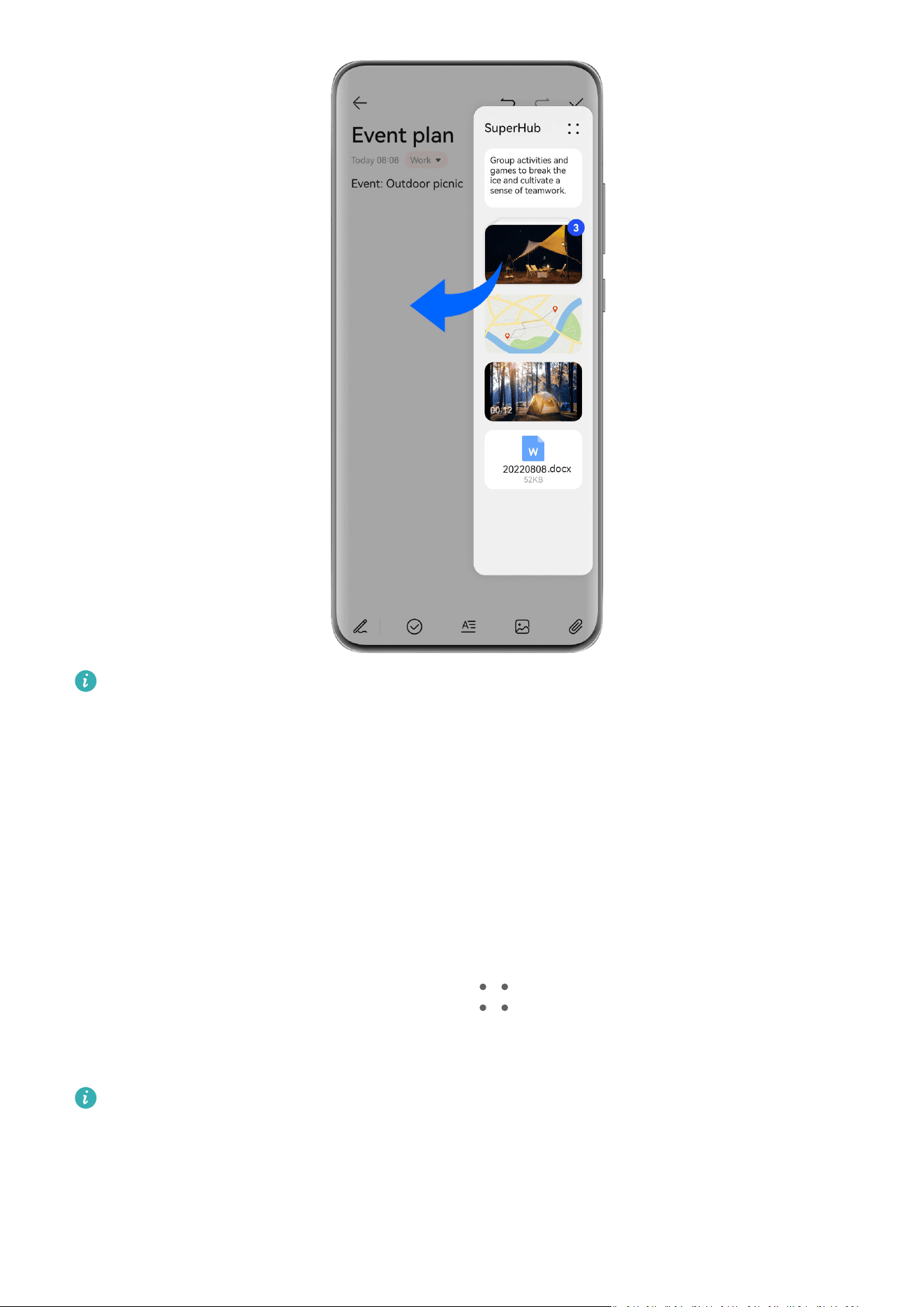
The gures are for reference only.
For example, when editing a note in Notepad, feel free to:
• Drag out all items: Touch and hold down on the SuperHub oating window, wait for the
content to start oating, and drag all items to the note at once.
• Drag out individual items: Touch the SuperHub oating window to expand SuperHub,
touch and hold down on the item that you wish to transfer, wait for the item to start
oating, and drag it to the note.
You can also touch the stacked content in SuperHub to view details, and drag individual
items out as needed.
• Drag out multiple items: Touch the SuperHub oating window to expand SuperHub,
touch and hold down on the content or go to
> Select, select the items that you wish
to transfer, touch and hold down on these items, wait for them to start oating, and drag
them to the note.
Drag-and-drop operations are only supported in certain apps.
Settings
113

Manage SuperHub
Deleting content from SuperHub: Touch the SuperHub oating window to expand
SuperHub, touch and hold down on the content or go to > Select, select the items that
you wish to delete, and touch Delete.
Closing the SuperHub oating window: Touch the SuperHub oating window to expand
SuperHub, and go to > Close. Once closed, content in SuperHub will be transferred to
History, which will overwrite the previously used content.
History: Touch the SuperHub oating window to expand SuperHub, and swipe up from the
bottom of SuperHub to view and use History.
Clipboard: Touch the SuperHub
oating window to expand SuperHub, and go to >
Clipboard to view and use the recently cut or copied text.
Drag Content to Other Devices
If you wish to complete an unnished task on another device, you can transfer the content
from SuperHub to another device capable of SuperHub with just a touch.
1 Make sure that Wi-Fi and Bluetooth are enabled on both this device and the target
device, and that both devices are logged in to the same HUAWEI ID.
2 On this device, touch the SuperHub
oating window to expand SuperHub, touch and
hold down on the content or go to > Select, select the items that you wish to
transfer, touch Hop, and touch the name of the target device to transfer the items to
SuperHub on the target device.
Unable to Find the Target Device During Transfers
To transfer content between devices, both of the following conditions must be met:
1 Make sure that the operating systems of this device and target device are EMUI 13.0 or
later, and that both devices support SuperHub. (This feature will be made available on
more models.)
If the target device does not display the SuperHub option, it indicates that this feature is
not supported by the target device.
2 Make sure that Wi-Fi and Bluetooth are enabled on both this device and the target
device, and that both devices are logged in to the same HUAWEI ID.
Write with a Stylus
A stylus can perfectly capture the unique character of your writing style and make you feel as
if you are writing or painting on paper. You can use it to take quick notes, perform standard
touchscreen operations, such as taking screenshots, or use it with special apps for a more
interactive and dynamic writing and drawing experience.
When using the stylus for the rst time, open the stylus cap and insert the stylus into the
charging port of your phone, then follow the onscreen instructions to complete the pairing.
Settings
114

The stylus can be connected to a maximum of four devices at the same time (depending on
your device model).
The stylus will power o if left inactive for a certain period of time. In this case, press the
Smart key on the stylus or insert the stylus into your phone to resume the connection.
After pairing, you can:
• Quickly access Notepad: Press and hold the Smart key on the stylus, then tap the screen to
quickly open Notepad.
• Capture screenshots: When the screen is on, press and hold the Smart key on the stylus,
then tap the screen twice to take a screenshot, draw a closed shape to capture part of the
screen, or draw an "S" to take a scrollshot.
• Learn more about the stylus: Go to Settings > Accessibility features > Stylus. You can also
touch Firmware update to update the stylus rmware.
HUAWEI M-Pen 2 is not supported on all phone models.
About Phone
Legal Notice
Copyright © Huawei 2022. All rights reserved.
Settings
115

This guide is for reference only. The actual product, including but not limited
to the color, size, and screen layout, may vary. All statements, information,
and recommendations in this guide do not constitute a warranty of any kind,
express or implied.
Please visit https://consumer.huawei.com/en/support/hotline for recently
updated hotline and email address in your country or region.
Model:
CET-LX9
EMUI13.0_01