Version Info
Version
Date
Remarks
V1.0
2022.06

Preface
Preface
Dear customers,
Congratulations! Thank you for buying Micsig instrument. Please read this manual carefully before use and
particularly pay attention to the “Safety Precautions”.
If you have read this manual, please keep it properly for future reference.
The information contained herein are furnished in an “as-is” state, and may be subject to change in future versions
without notice.
The standard applicable for this product: GB/T15288-2013.

Table of Contents
i
Table of Contents
TABLE OF CONTENTS ......................................................................................................................................................... I
CHAPTER 1. SAFETY PRECAUTIONS .................................................................................................................................. 10
1.1 SAFETY PRECAUTIONS .................................................................................................................................................. 10
1.2 SAFETY TERMS AND SYMBOLS ...................................................................................................................................... 14
CHAPTER 2. QUICK START GUIDE OF OSCILLOSCOPE ........................................................................................................ 17
2.1 INSPECT PACKAGE CONTENTS ...................................................................................................................................... 18
2.2 USE THE BRACKET ....................................................................................................................................................... 19
2.3 SIDE PANEL .................................................................................................................................................................. 21
2.4 REAR PANEL ................................................................................................................................................................ 22
2.5 TOP PANEL ................................................................................................................................................................... 24
2.6 FRONT PANEL .............................................................................................................................................................. 25
ii
2.7 POWER ON/OFF THE OSCILLOSCOPE............................................................................................................................... 26
2.8 UNDERSTAND THE OSCILLOSCOPE DISPLAY INTERFACE ................................................................................................. 27
2.9 INTRODUCTION BASIC OPERATIONS OF TOUCH SCREEN ................................................................................................. 33
2.10 MOUSE OPERATION .................................................................................................................................................... 35
2.11 CONNECT PROBE TO THE OSCILLOSCOPE ..................................................................................................................... 36
2.12 USE AUTO .................................................................................................................................................................. 37
2.13 LOAD FACTORY SETTINGS .......................................................................................................................................... 42
2.14 USE AUTO-CALIBRATION ............................................................................................................................................ 42
2.15 PASSIVE PROBE COMPENSATION ................................................................................................................................. 43
2.16 MODIFY THE LANGUAGE ............................................................................................................................................ 48
CHAPTER 3 HORIZONTAL SYSTEM .................................................................................................................................... 49
3.1 MOVE THE WAVEFORM HORIZONTALLY ........................................................................................................................ 51
3.2 ADJUST THE HORIZONTAL TIME BASE (TIME/DIV) ......................................................................................................... 52
3.3 PAN AND ZOOM SINGLE OR STOPPED ACQUISITIONS ...................................................................................................... 54

Table of Contents
iii
3.4 ROLL, XY .................................................................................................................................................................... 55
3.5 ZOOM MODE ................................................................................................................................................................ 64
CHAPTER 4 VERTICAL SYSTEM ......................................................................................................................................... 68
4.1 OPEN/CLOSE WAVEFORM (CHANNEL, MATH, REFERENCE WAVEFORMS) ....................................................................... 70
4.2 ADJUST VERTICAL SENSITIVITY .................................................................................................................................... 75
4.3 ADJUST VERTICAL POSITION ......................................................................................................................................... 76
4.4 OPEN CHANNEL MENU ................................................................................................................................................. 76
4.4.1 Set Channel Coupling ............................................................................................................................................. 78
4.4.2 Set Bandwidth Limit .............................................................................................................................................. 81
4.4.3 Waveform Inversion .............................................................................................................................................. 83
4.4.4 Set Probe Type ....................................................................................................................................................... 84
4.4.5 Set Probe Attenuation Coefficient .......................................................................................................................... 85
4.4.6 Vertical Expansion Reference ................................................................................................................................. 87
4.4.7 Labels .................................................................................................................................................................... 87
iv
4.4.8 Channel Input impendance .................................................................................................................................... 89
CHAPTER 5 TRIGGER SYSTEM .......................................................................................................................................... 91
5.1 TRIGGER AND TRIGGER ADJUSTMENT ........................................................................................................................... 92
5.2 EDGE TRIGGER ........................................................................................................................................................... 105
5.3 PULSE WIDTH TRIGGER .............................................................................................................................................. 110
5.4 LOGIC TRIGGER .......................................................................................................................................................... 117
5.5 NTH EDGE TRIGGER ................................................................................................................................................... 123
5.6 RUNT TRIGGER ........................................................................................................................................................... 126
5.7 SLOPE TRIGGER .......................................................................................................................................................... 128
5.8 TIMEOUT TRIGGER ..................................................................................................................................................... 133
5.9 VIDEO TRIGGER ......................................................................................................................................................... 136
5.10 SERIAL BUS TRIGGER ............................................................................................................................................... 141
CHAPTER 6 ANALYSIS SYSTEM ....................................................................................................................................... 142
6.1 AUTOMATIC MEASUREMENT ....................................................................................................................................... 143

Table of Contents
v
6.2 FREQUENCY METER MEASUREMENT ........................................................................................................................... 153
6.3 CURSOR ..................................................................................................................................................................... 155
CHAPTER 7 SCREEN CAPTURE, MEMORY DEPTH AND WAVEFORM STORAGE ................................................................ 161
7.1 SCREEN CAPTURE FUNCTION ...................................................................................................................................... 162
7.2 VIDEO RECORDING ..................................................................................................................................................... 165
7.3 WAVEFORM STORAGE ................................................................................................................................................ 166
7.4 OSCILLOSCOPE SETTING SAVE ..................................................................................................................................... 174
CHAPTER 8 MATH AND REFERENCE ............................................................................................................................... 175
8.1 DUAL WAVEFORM CALCULATION ............................................................................................................................... 176
8.2 FFT MEASUREMENT .................................................................................................................................................. 181
8.3 ADVANCED MATH ........................................................................................................................................................... 188
8.4 REFERENCE WAVEFORM CALL .................................................................................................................................... 192
CHAPTER 9 DISPLAY SETTINGS ....................................................................................................................................... 196
vi
9.1 WAVEFORM SETTINGS ................................................................................................................................................ 198
9.2 GRATICULE SETTING .................................................................................................................................................. 198
9.3 PERSISTENCE SETTING ................................................................................................................................................ 199
9.4 HORIZONTAL EXPANSION CENTER............................................................................................................................... 202
9.5 COLOR TEMPERATURE SETTING .................................................................................................................................. 202
9.6 TIME BASE MODE SELECTION .................................................................................................................................... 203
CHAPTER 10 SAMPLING SYSTEM ................................................................................................................................... 204
10.1 SAMPLING OVERVIEW............................................................................................................................................... 205
10.2 RUN/STOP KEY AND SINGLE SEQ KEY ...................................................................................................................... 211
10.3 SELECT SAMPLING MODE ......................................................................................................................................... 212
10.4 RECORD LENGTH AND SAMPLING RATE ..................................................................................................................... 218
10.5 SEGMENTED MEMORY .............................................................................................................................................. 221
10.5.1 Segment number setting .................................................................................................................................. 222
10.5.2 Acquire Waveform ............................................................................................................................................ 224

Table of Contents
vii
10.5.3 Display and View .............................................................................................................................................. 225
10.5.4 Example of Segmented Storage ........................................................................................................................ 228
CHAPTER 11 SERIAL BUS TRIGGER AND DECODE (OPTIONAL) ........................................................................................ 232
11.1 UART (RS232/RS422/RS485) BUS TRIGGER AND DECODE ...................................................................................... 237
11.2 LIN BUS TRIGGER AND DECODE ............................................................................................................................... 248
11.3 CAN BUS TRIGGER AND DECODE ............................................................................................................................. 256
11.4 SPI BUS TRIGGER AND DECODE ................................................................................................................................ 263
11.5 I2C BUS TRIGGER AND DECODE ................................................................................................................................ 270
11.6 ARINC429 BUS TRIGGER AND DECODE ................................................................................................................... 278
11.7 1553B BUS TRIGGER AND DECODE ........................................................................................................................... 286
CHAPTER 12 HOMEPAGE FUNCTIONS ............................................................................................................................ 294
12.1 OSCILLOSCOPE (SEE CHAPTERS 2~11) ....................................................................................................................... 296
12.2 APP STORE ............................................................................................................................................................... 296
12.3 SETTINGS ................................................................................................................................................................. 300
viii
12.4 FILE MANAGER ........................................................................................................................................................ 307
12.5 CALCULATOR ........................................................................................................................................................... 308
12.6 BROWSER ................................................................................................................................................................. 308
12.7 GALLERY ................................................................................................................................................................. 309
12.8 CALENDAR ............................................................................................................................................................... 312
12.9 ELECTRONIC TOOLS ................................................................................................................................................. 312
12.10 CLOCK ................................................................................................................................................................... 313
12.11 POWER OFF ............................................................................................................................................................ 316
CHAPTER 13 REMOTE CONTROL .................................................................................................................................... 318
13.1 HOST COMPUTER...................................................................................................................................................... 319
13.1.1 Installation of Host Computer Software ............................................................................................................. 319
13.1.2 Connection of Host Computer ........................................................................................................................... 320
13.1.3 Main Interface Introduction............................................................................................................................... 322
13.1.4 Operation Interface Introduction ....................................................................................................................... 324

Table of Contents
ix
13.1.5 Storage and View of Pictures and Videos ........................................................................................................... 324
13.2 MOBILE REMOTE CONTROL ...................................................................................................................................... 327
CHAPTER 14 UPDATE AND UPGRADE FUNCTIONS ......................................................................................................... 331
14.1 SOFTWARE UPDATE .................................................................................................................................................. 332
14.2 ADD OPTIONAL FUNCTIONS ...................................................................................................................................... 333
CHAPTER 15 REFERENCE ............................................................................................................................................... 336
15.1 MEASUREMENT CATEGORY ....................................................................................................................................... 337
15.2 POLLUTION DEGREE ................................................................................................................................................. 338
CHAPTER 16 TROUBLESHOOTING .................................................................................................................................. 340
CHAPTER 17 SERVICES AND SUPPORT ........................................................................................................................... 346
ANNEX .......................................................................................................................................................................... 348
ANNEX A:MAINTENANCE AND CARE OF OSCILLOSCOPE ................................................................................................... 348
ANNEX B: ACCESSORIES .................................................................................................................................................. 350
10
Chapter 1. Safety Precautions
1.1 Safety Precautions
The following safety precautions must be understood to avoid personal injury and prevent damage to this product or
any products connected to it. To avoid possible safety hazards, it is essential to follow these precautions while using
this product.
Only professionally trained personnel can operate the maintenance procedure.
Avoid fire and personal injury.
Use proper power cord. Use only the power cord specified for this product and certified for the country/region
of use.
Connect and disconnect probes properly. Connect the instrument probe correctly, and its ground terminal is
ground phase. Do not connect or disconnect probes or test leads while they are connected to a voltage source.

Chapter 1. Safety Precautions
11
Disconnect the probe input and the probe reference lead from the circuit under test before disconnecting the
probe from the measurement product.
Ground the product. To avoid electric shock, the instrument grounding conductor must be connected to
earth ground.
Observe all terminal ratings. To avoid fire or shock hazard, observe all rating and markings on the product.
Consult the product manual for further information of ratings before making connections to the product.
User correct probes. To avoid excessive electric shock, use only correct rated probes for any measurement.
Disconnect AC power. The adapter can be disconnected from AC power and the user must be able to access the
adapter at any time.
Do not operate without covers. Do not operate the product with covers or panels removed.
Do not operate with suspected failures. If you suspect that there is damage to this product, have it inspected
by service personnel designated by Micsig.
12
Use adapter correctly. Supply power or charge the equipment by power adapter designated by Micsig, and
charge the battery according to the recommended charging cycle.
Avoid exposed circuitry. Do not touch exposed connections and components when power is present.
Provide proper ventilation.
Do not operate in wet/damp conditions.
Do not operate in a flammable and explosive atmosphere.
Keep product surfaces clean and dry.
The disturbance test of all models complies with Class A standards, based on EN61326:1997+A1+A2+A3,
but do not meet Class B standards.
Measurement Category
The Smart series oscilloscope is intended to be used for measurements in Measurement Category I.

Chapter 1. Safety Precautions
13
Measurement Category Definition
Measurement category I is for measurements performed on circuits not directly connected to the MAINS. Examples
are measurements on circuits not derived from MAINS, and specially protected (internal) MAINS derived circuits.
In the latter case, transient stresses are variable; for that reason, the user must understand the transient withstand
capability of the equipment.
Warning
IEC Measurement Category. Under IEC Category I mounting conditions, the input terminal can be connected to the
circuit terminal with a maximum line voltage of 300Vrms. To avoid the risk of electric shock, the input terminal
should not be connected to the circuit with a line voltage greater than 300Vrms. Instantaneous overvoltage is
present in circuits that are isolated from the mains supply. The Smart series digital oscilloscope is designed to safely
withstand sporadic transient overvoltage up to 1000Vpk. Do not use this equipment for any measurements in
circuits where the instantaneous overvoltage exceeds this value.
14
1.2 Safety Terms and Symbols
Terms in the manual
These terms may appear in this manual:
Warning. Warning statements indicate conditions or practices that could result in injury or loss of life.
Caution. Caution statements indicate conditions or practices that could result in damage to this product or
other property.
Terms on the product
These terms may appear on the product:
Danger indicates an injury hazard immediately accessible as you read the marking.
Warning indicates an injury hazard not immediately accessible as you read the marking.
Caution indicates a hazard to this product or other properties.
Chapter 1. Safety Precautions
15
Symbols on the product
The following symbols may appear on the product:
Hazardous Voltage Caution Refer to Manual Protective Ground Terminal
Chassis Ground Measurement Ground Terminal
Please read the following safety precautions to avoid personal injury and prevent damage to this product or
any products connected to it. To avoid possible hazards, this product can only be used within the specified
scope.
Warning
If the instrument input port is connected to a circuit with the peak voltage higher than 42V or the power exceeding
4800VA, to avoid electric shock or fire:
16
User only insulated voltage probes supplied with the instrument, or the equivalent product indicated in the
schedule.
Before use, inspect voltage probes, test leads, and accessories for mechanical damage and replace when
damaged.
Remove voltage probes and accessories not in use.
Plug the battery charger into the AC outlet before connecting it to the instrument.

Chapter 2. Quick Start Guide of Oscilloscope
17
Chapter 2. Quick Start Guide of Oscilloscope
This chapter contains checks and operations of the oscilloscope. You are recommended to read them carefully to
understand appearance, power on/off, settings and related calibration requirements of the Smart series oscilloscope.
Inspect package contents
Mouse operation
Use bracket
Connect probe to the oscilloscope
Side panel & rear panel
Use automatic
Front panel
Use factory settings
Power on/off the oscilloscope
Use auto-calibration
Understand the oscilloscope display interface
Passive probe compensation
Introduction to basic operations of oscilloscope
Modify the language
18
2.1 Inspect Package Contents
When you open package after receipt, please check the instrument according to the following steps.
1) Inspect if there is any damage caused by transportation
If the package or foam is found to be severely damaged, please retain it until the instrument and accessories
pass the electrical and mechanical properties test.
2) Inspect the accessories
A detailed description is given in “
Annex B” of this manual. You can refer it to check if the accessories are
complete. If the accessories are missing or damaged, please contact Micsig’s agent or local office.
3) Inspect the instrument
If any damage to oscilloscope is found by the appearance inspection or it fails to pass the performance test,
please contact Micsig’s agent or local office. If the instrument is damaged due to transportation, please retain
the package and contact the transportation company or Micsig’s agent, and Micsig will make arrangement.

Chapter 2. Quick Start Guide of Oscilloscope
19
2.2 Use the Bracket
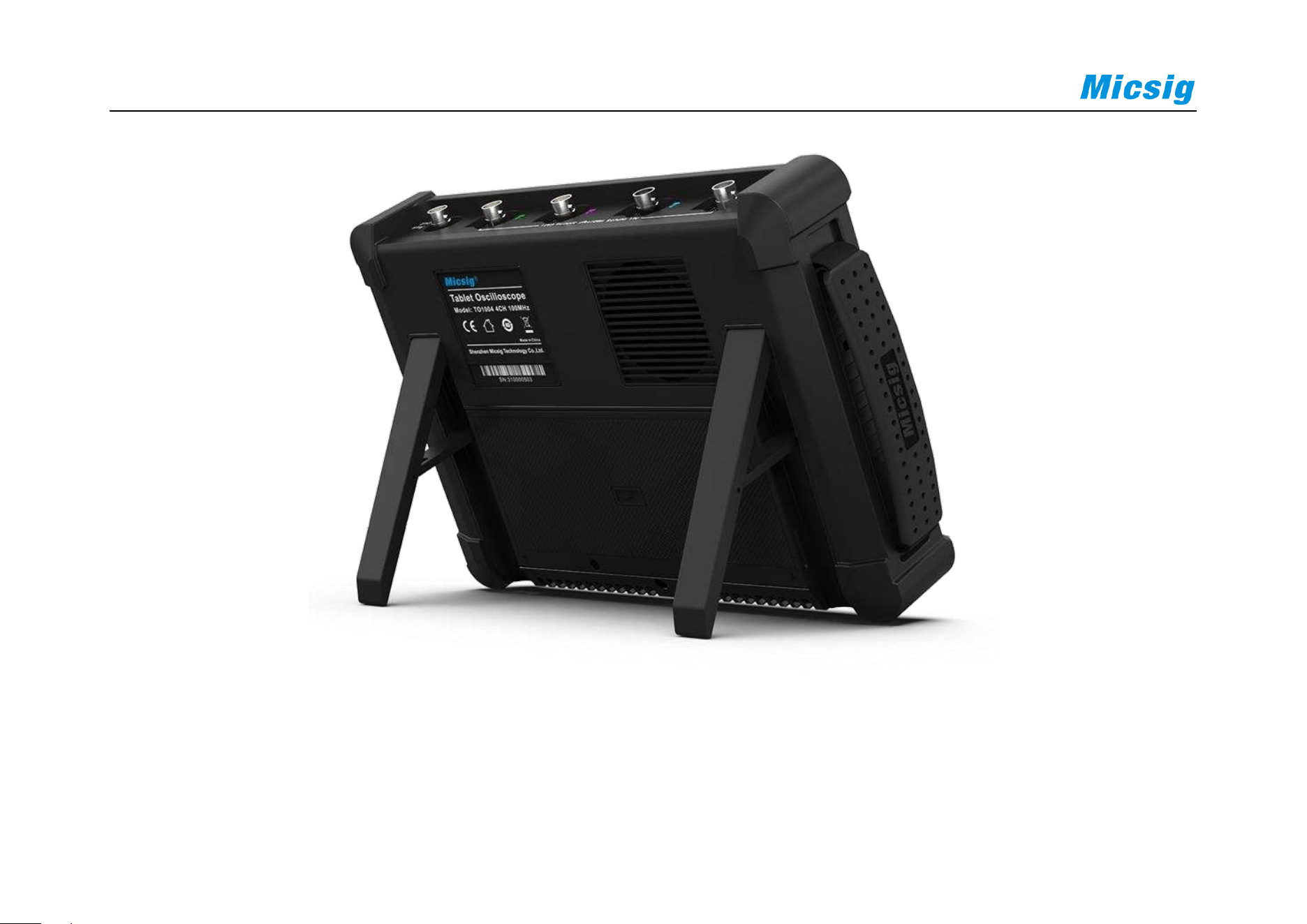
Put the front panel of the oscilloscope flatly on the table. Use your two index fingers to hold the underside of the
bracket and open the bracket by slightly upwards force, as shown in Figure 2-1.
20
Figure 2-1 Open Bracket
Chapter 2. Quick Start Guide of Oscilloscope
21
2.3 Side Panel
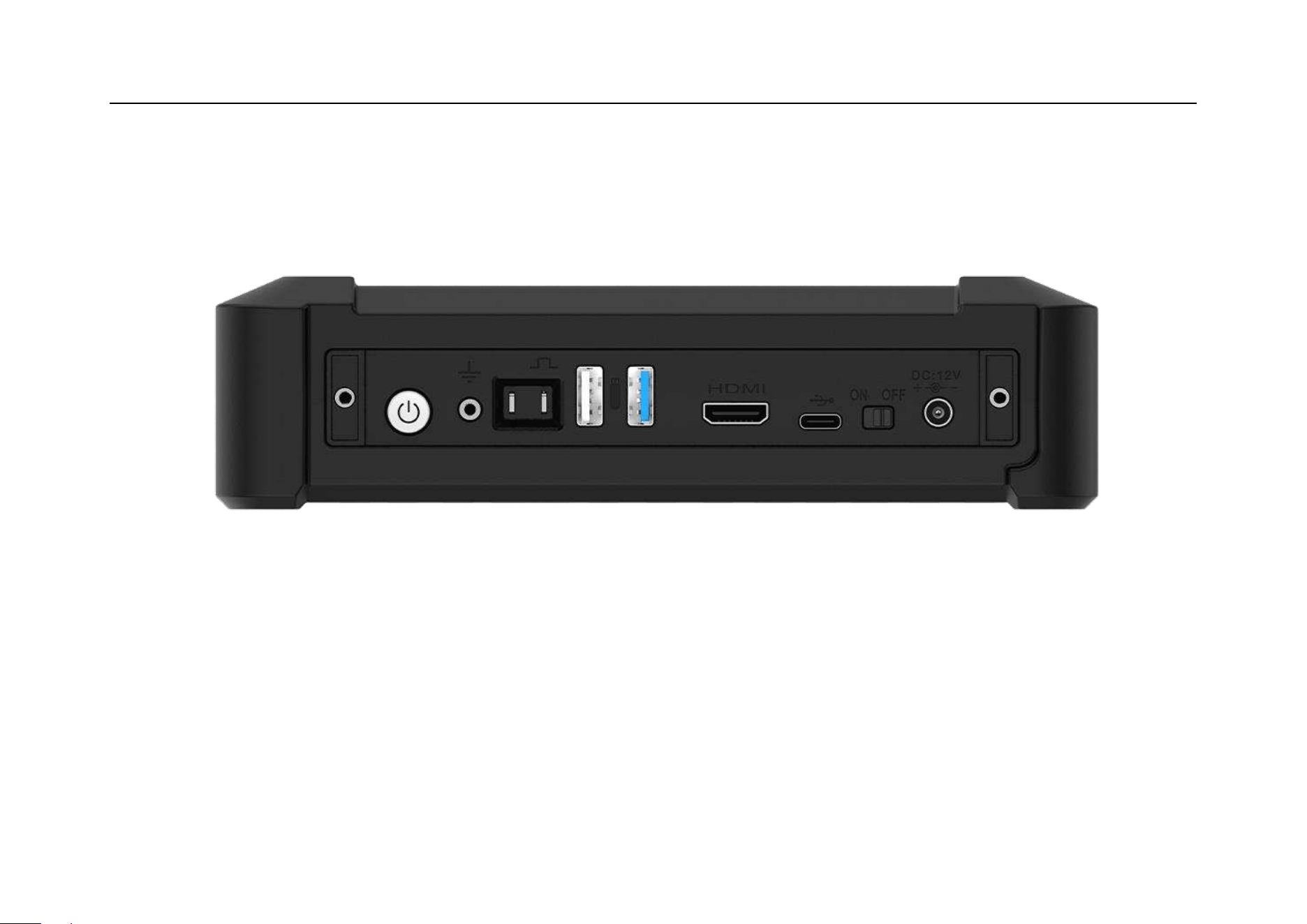
Figure 2-2 Side Panel
There are various interfaces on the side of the oscilloscope, from left to right: Power-on button, Grounding, Probe
compensation signal output, USB Host, HDMI, USB Device, Power-off lock, and Power port.
22
2.4 Rear Panel
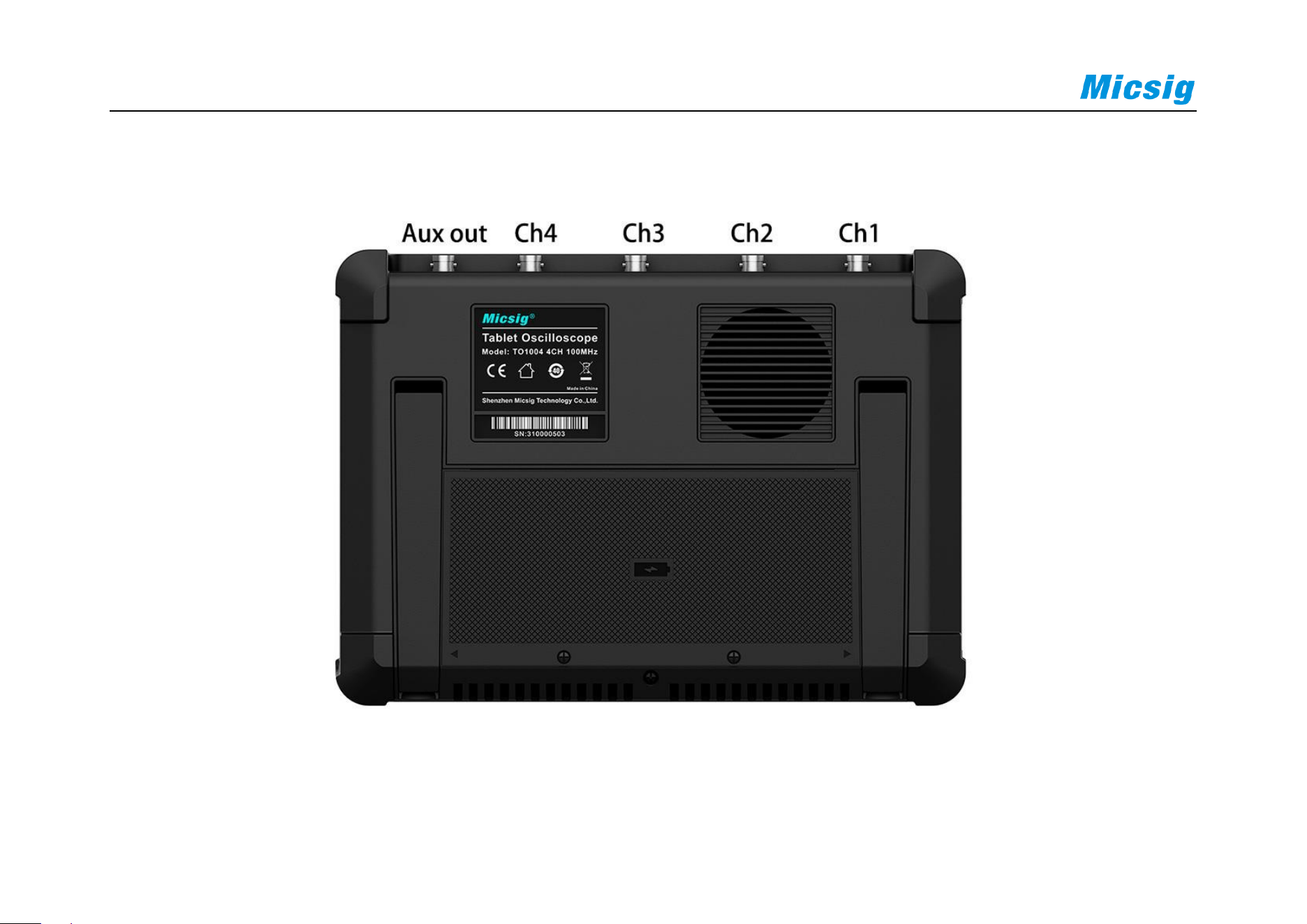
Figure 2-3 Rear Panel
a) Ch1 – Ch4 are signal measurement channels

Chapter 2. Quick Start Guide of Oscilloscope
23
b) Aux out is an auxiliary channel, which is mainly used to measure the waveform refresh rate of the oscilloscope
and cascade the current oscilloscope signal to other oscilloscopes.
24
2.5 Top Panel
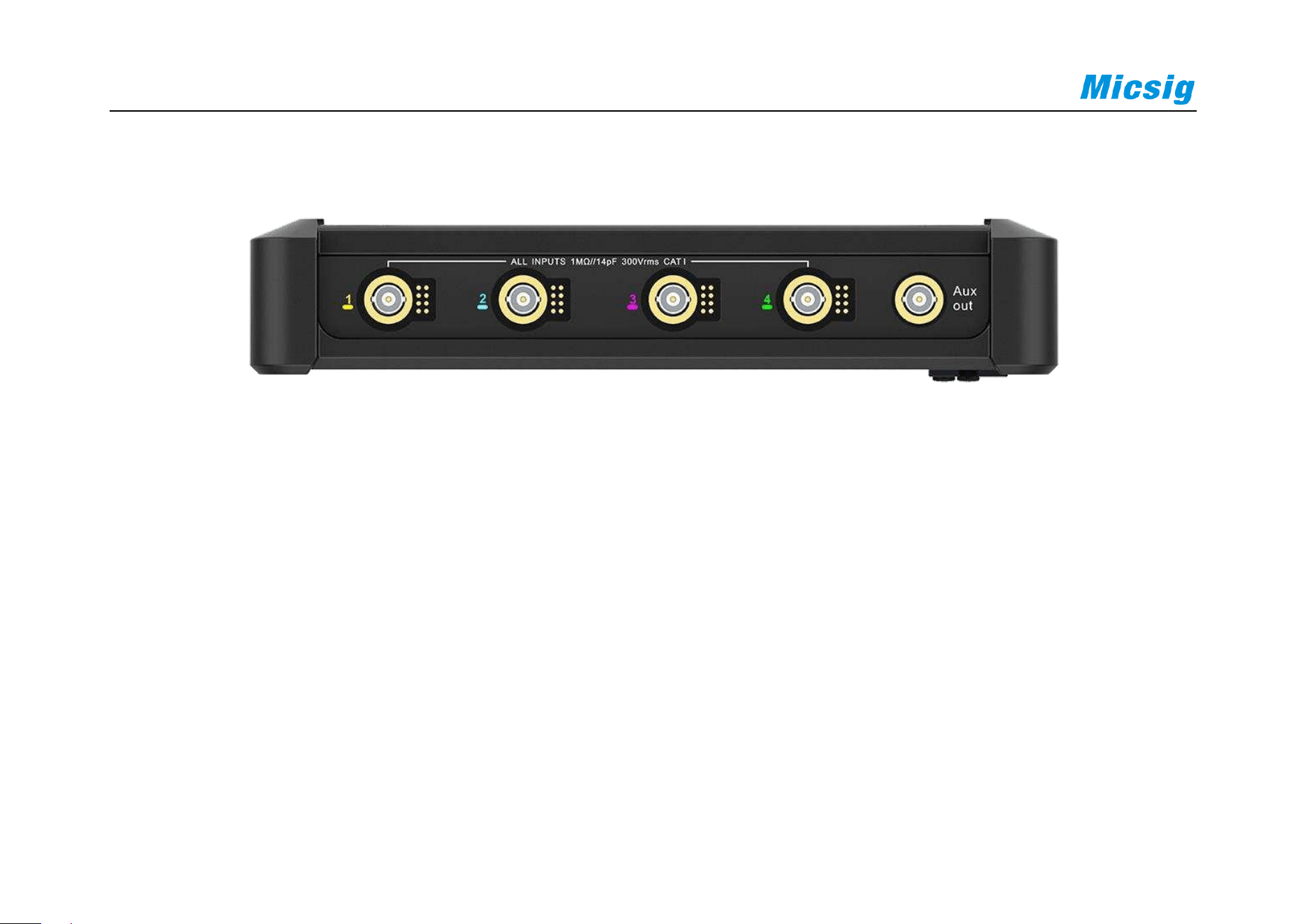
Figure 2-4 Top Panel of Tablet Oscilloscope
On top of the oscilloscope is the Micsig UPI universal probe interface, which is designed to power active probes
and automatically communicate scale factors on the scope display.
Chapter 2. Quick Start Guide of Oscilloscope
25
2.6 Front Panel
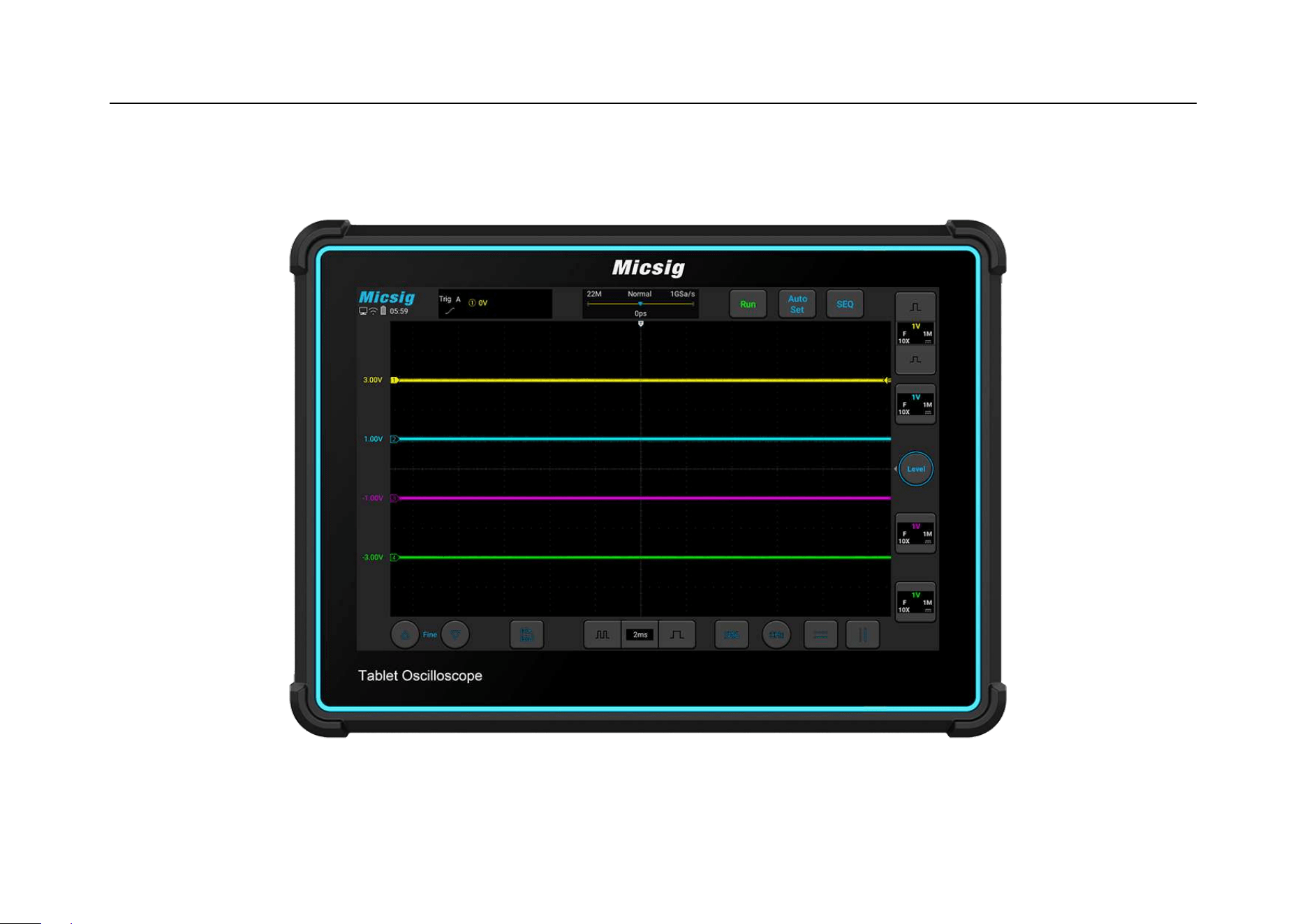
Figure 2-5 Front Panel of Tablet Oscilloscope
26
2.7 Power on/off the Oscilloscope
Power on/off the oscilloscope
First time start
Connect power adapter to the oscilloscope, and the oscilloscope should not be pressed on the adapter cable.
Check the Power-off lock on the side of oscilloscope and press the power button to start the instrument.
Power on
Press the power button to start the instrument while ensuring it is connected to a power supply.
Power off
Press the power button , go to power-off interface, and click to turn off the instrument.
Long press the power button for forced power-off of the instrument.
Power-off lock
Turn the power-off lock switch to OFF, the oscilloscope cannot be turned on.
Chapter 2. Quick Start Guide of Oscilloscope
27
Caution: Forced power-off may result in loss of unsaved data, please use with caution.
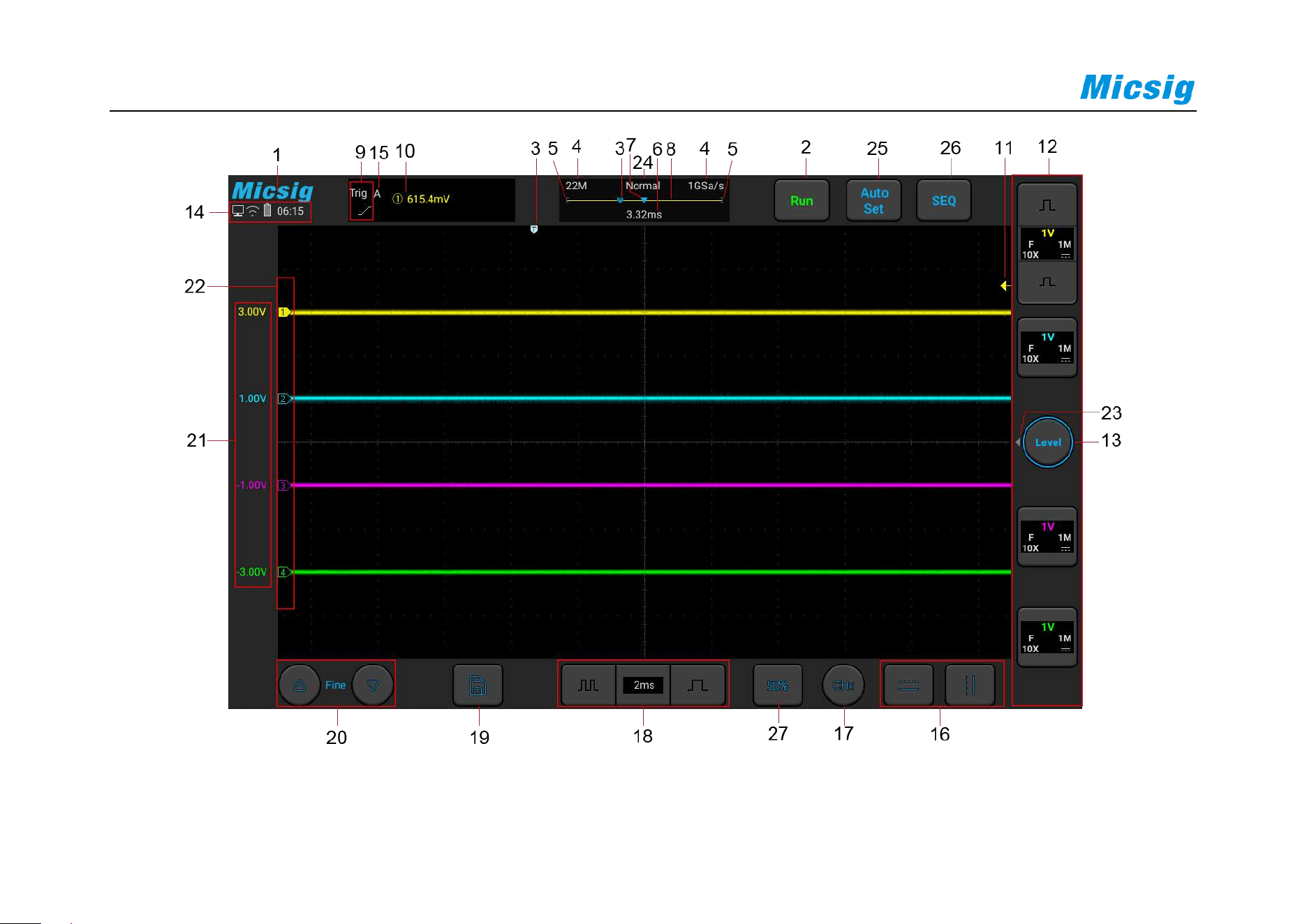
2.8 Understand the Oscilloscope Display Interface
This section provides a brief introduction and description of the Smart Series oscilloscope user’s interface. After
reading this section, you can be familiar with the oscilloscope display interface content within the shortest possible
time. The specific settings and adjustments will be detailed in subsequent chapters and sections. The following
items may appear on the screen at a given time but not all items are visible. The oscilloscope interface is shown in
Figure 2-6.
28
Figure 2-6 Oscilloscope Interface Display
Chapter 2. Quick Start Guide of Oscilloscope
29
No.
Description
1
Micsig logo
2
Oscilloscope status, including RUN, STOP, WAIT, Auto;Tap to switch to STOP
3
Trigger point
4
Sampling rate, memory depth
5
The area in “[]” indicates the position of waveform displayed on the screen throughout the memory
depth
6
Delay time, the time at which the center line of the waveform display area is relative to the trigger
point
7
Center line of waveform display area
8
Memory depth indicatrix
9
Current trigger type indication
10
Current trigger source, trigger level
30
No.
Description
11
Trigger level indicator
12
CH1、CH2、CH3、CH4 channel icons and vertical sensitivity icon. Tap the channel icons to open
channels; Click or to adjust the vertical sensitivity of channels; Open the channel menu by
swipe left from the desired channel and swipe right to close; Display the vertical sensitivity of
channels; Display couple method.
13
Trigger level adjustment, press on the button to modify the trigger level through upward and
downward movements.
14
Display areas of USB-PC connection, USB connection, battery level, time etc.
15
Trigger Mode: A(auto), N(Normal).
16
Horizontal and vertical cursors open and close.
17
Current channel selection. Click to pop up the current channel switching menu to switch the current
channel.
Chapter 2. Quick Start Guide of Oscilloscope
31
No.
Description
18
Horizontal time base control icon. Tap the left/right time base buttons to adjust the horizontal time
base of the waveform. Tap the time base to open the time base table. Tap to select the desired time
base.
19
Quick save. Tap to quickly save the waveform as a reference waveform.
20
Fine adjustment button. Tap the button to finely adjust the last operation, including waveform
position, trigger level position, trigger point and cursor position.
21
The vertical position value of the channel indicator.
22
Channel indicator can indicate the zero-level position of the open channel.
23
Trigger quick start menu indicator: swipe left to open trigger quick start menu
24
Sample Mode: Normal, Average, Envelope, Peak
25
Auto Set, AutoRange
26
SEQ, Single Sequence Acquisition
32
No.
Description
27
50%: Touch to set:
The vertical position of the current channel waveform to the zero point
The horizontal position of the current channel waveform to center of the screen
The trigger level to the center of the trigger channel's waveform
The activecursor back to the center of the scree
Table 2-1 Description of Oscilloscope Display Interface
Chapter 2. Quick Start Guide of Oscilloscope
33
2.9 Introduction Basic Operations of Touch Screen
The Smart Series oscilloscope operates mainly by tap, swipe, single-finger drag.
Tap
Tap button on the touch screen to activate the corresponding menu and function. Tap any blank space on the screen
to exit the menu.
Swipe
Single-finger swipe: to open/close menus, including main menu, shortcut menu button and other channel menu
operations. For example, the main menu is opened as shown in Figure 2-7. The closing method is the opposite of
the opening method.

34
Figure 2-7 Slide out of Main Menu
Tap the options in the main menu to enter the corresponding submenu.
Chapter 2. Quick Start Guide of Oscilloscope
35
Single-finger drag
For coarse adjustments of vertical position, trigger point, trigger level, cursor, etc. of the waveform. Refer to “
4.1
Horizontal Move Waveform” and “5.3 Adjust Vertical Position” for details.
2.10 Mouse Operation
Connect the mouse to the “USB Host” interface, then operate the oscilloscope with the mouse. The left button, right
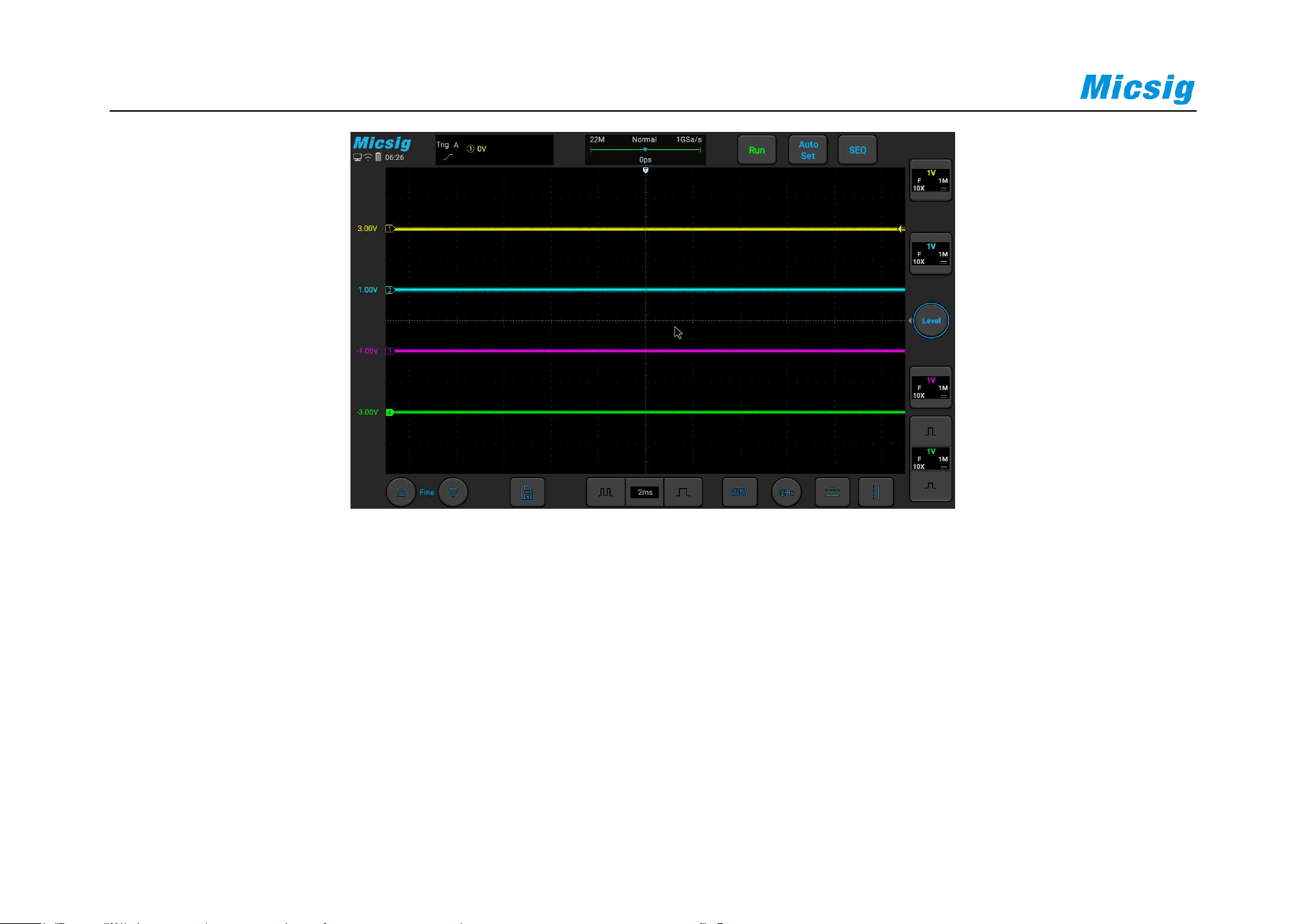
button and scroll wheel of the mouse have the same functions as the finger touch function. Figure 2-8 is a schematic
diagram of the mouse single click to select “Run/Stop” function under the “Menu” option in the “Short-cut Menus”.
36
Figure 2-8 Mouse Cursor
2.11 Connect Probe to the Oscilloscope
1) Connect the probe to the oscilloscope channel BNC connector.
2)
Connect the retractable tip on the probe to the circuit point or measured equipment. Be sure to connect the
probe ground wire to the ground point of the circuit.

Chapter 2. Quick Start Guide of Oscilloscope
37
Maximum input voltage of the analog input
Category I 300Vrms, 400Vpk.
2.12 Use Auto
Once the oscilloscope is properly connected and a valid signal is input, tap the Auto Set button to quickly
configure the oscilloscope to be the best display effects for the input signal. While the oscilloscope in auto state, the
Auto Set button will turn to green .
Auto is divided into Auto Set and Auto Range. It is defaulted as Auto Set.
Auto Set — Single-time auto, and each time press “Auto”, the screen displays “Auto” in the upper left corner. The
oscilloscope can automatically adjust the vertical scale, horizontal scale and trigger setting according to the
amplitude and frequency of signals, adjust the waveform to the appropriate size and display the input signal. After
adjustments, exit from the auto set, the “Auto” in the upper left corner disappears.
38
Channels may be automatically opened. Any channel greater or less than the threshold level can be opened or
closed automatically according to the set threshold level. The threshold level can be settable.
Source can be automatically triggered, and the triggered source channel can be automatically set to select priority to
the current signal or to the maximum signal.
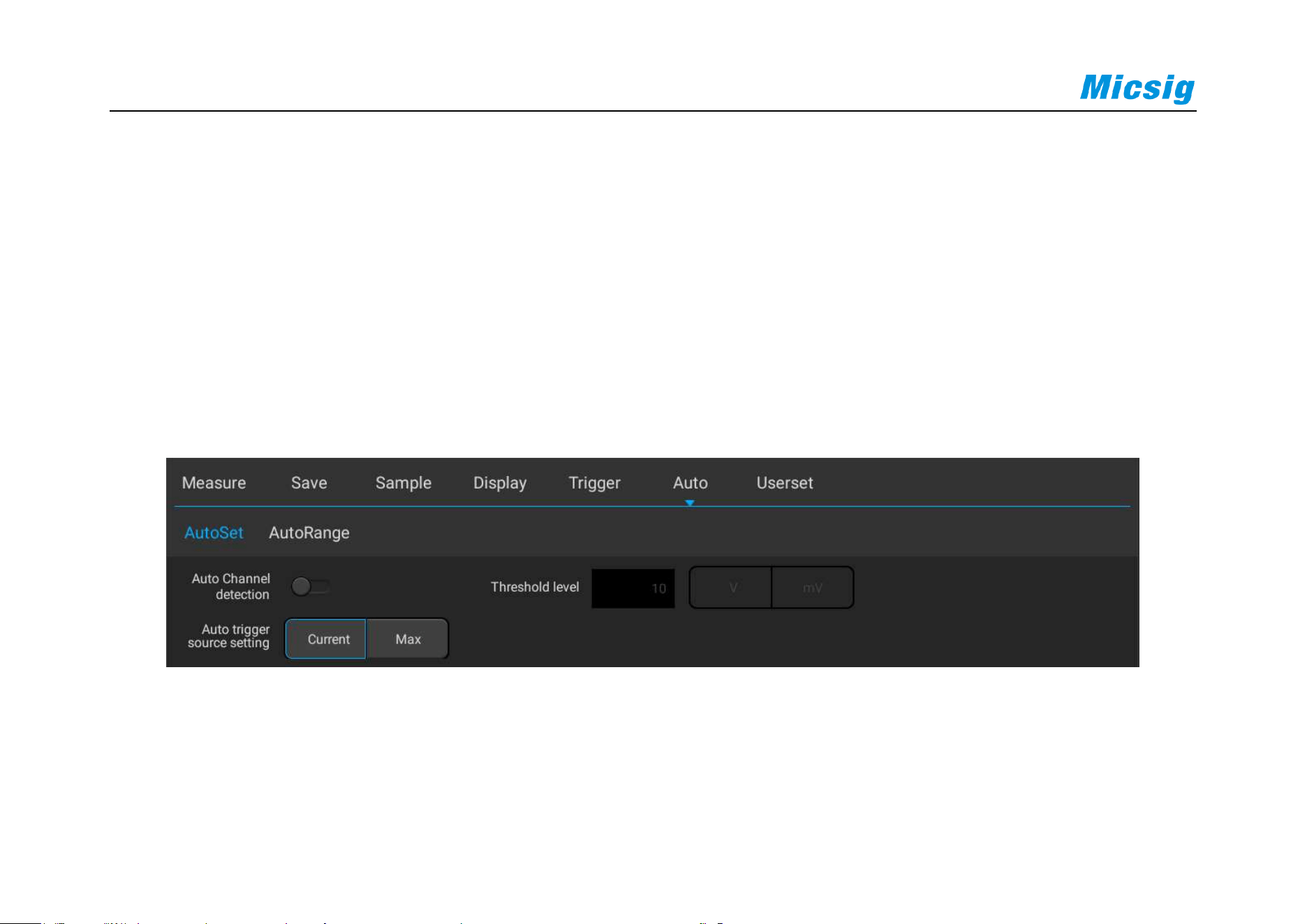
Open the main menu. Tap “Auto” to open the auto set menu, including channel open/close setting, threshold voltage
setting and trigger source setting.
Figure 2-9 Open Auto Set
Automatic configuration includes: single channel and multiple channels; automatic adjustment of the horizontal
time base, vertical sensitivity and trigger level of signal; the oscilloscope waveform is inverted off, the bandwidth
Chapter 2. Quick Start Guide of Oscilloscope
39
limit sets to full bandwidth, it sets as DC coupling mode, the sampling mode is normal; the trigger type is set to
edge trigger and the trigger mode is automatic.
Note: The application of Auto Set requires that the frequency of measured signal is no less than 20Hz, the duty ratio
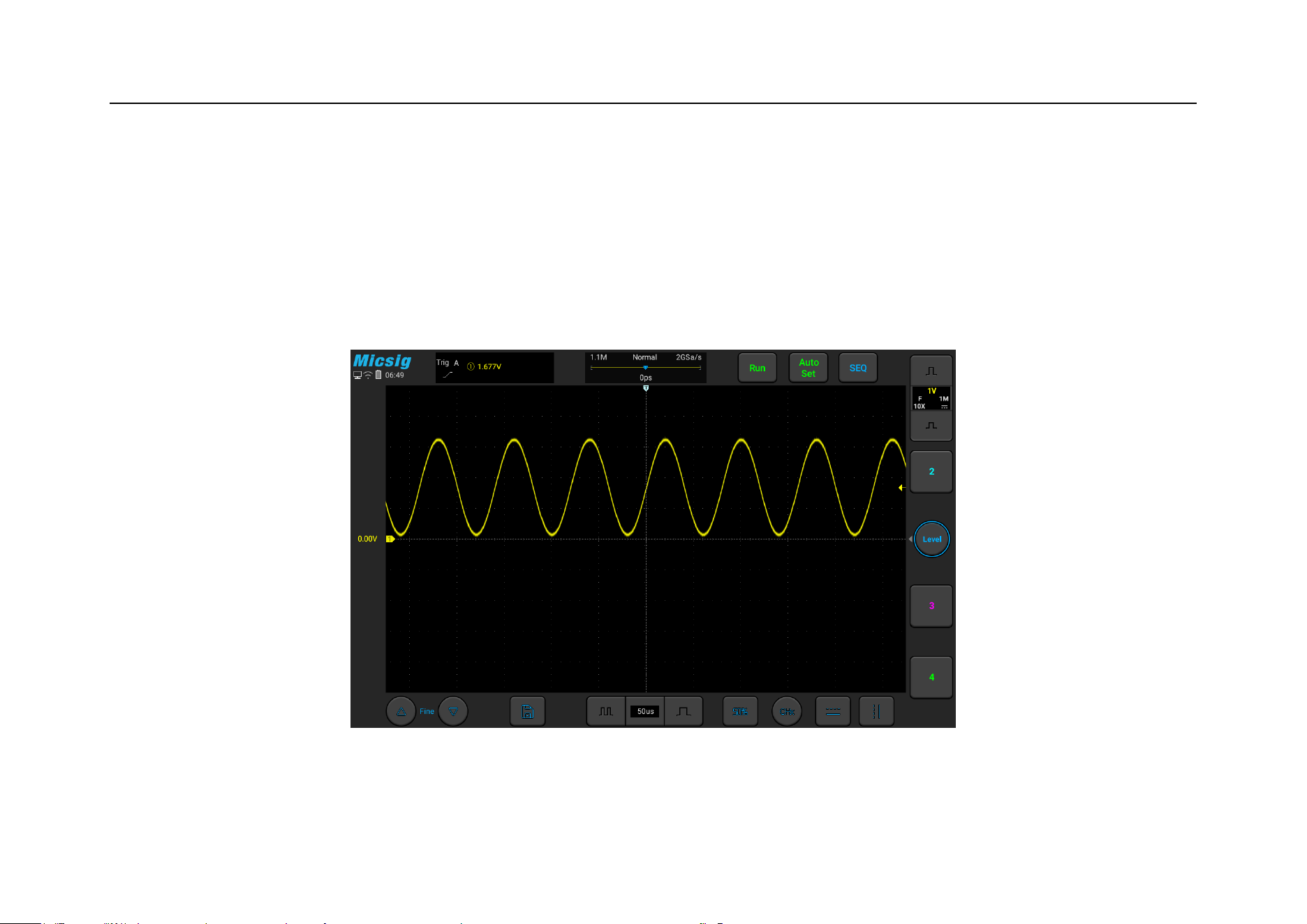
is greater than 1% and the amplitude is at least 2mVpp. If these parameter ranges are exceeded, Auto Set will fail.
Figure 2-10 Auto Set Waveform
40
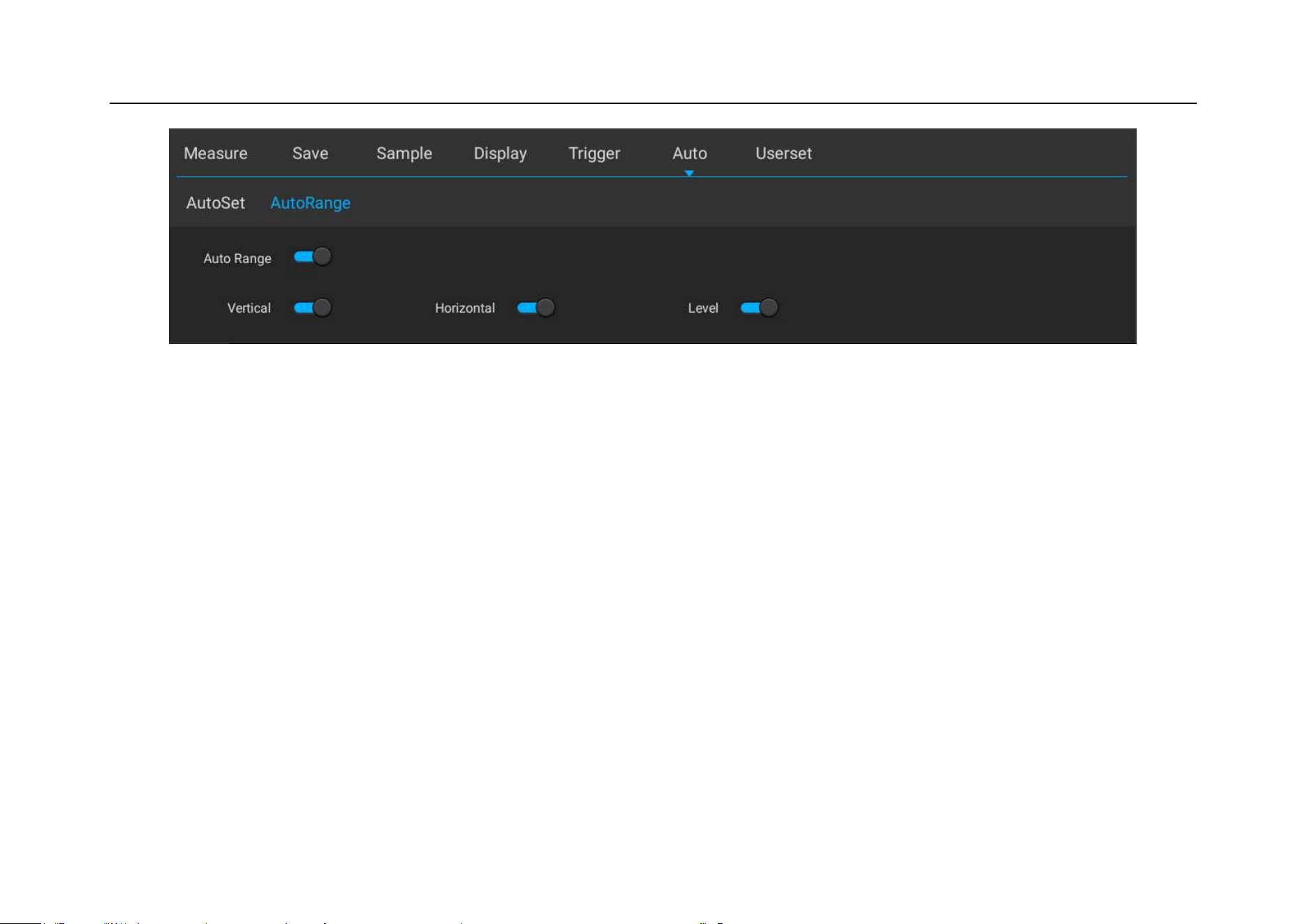
Auto Range - Continuously automatic, the oscilloscope continuously adjusts the vertical scale, horizontal time base
and trigger level in a real-time manner according to the magnitude and frequency of signal. It is defaulted as off and
needs to be opened in the menu. This function is mutually exclusive with “Auto Set”.
Open the main menu and tap “Auto” to open the auto range menu for the corresponding settings. When the
oscilloscope auto range function is turned on, the oscilloscope will automatically set various parameters, including:
vertical scale, horizontal time base, trigger level, etc. When the signal is connected, these parameters will
automatically change, and the signal does not need to be operated again after the change. The oscilloscope will
automatically recognize and make the appropriate changes.
Auto range: Turn the auto range function on or off
Vertical scale: Turn on the vertical scale automatic adjustment function;
Horizontal time base: Turn on the horizontal time base automatic adjustment function;
Trigger level: Turns on the auto-adjust trigger level function.
Chapter 2. Quick Start Guide of Oscilloscope
41
Figure 2-11 Open Auto Range
Auto Range is usually more useful than Auto Set under the following situations:
1) It can analyze signals subject to dynamic changes.
2) It can quickly view several continuous signals without adjusting the oscilloscope. This function is very useful
if you need to use two probes at the same time, or if you can only use the probe with one hand because the
other hand is full.
3) Control the automatic adjustment setting of the oscilloscope.
42
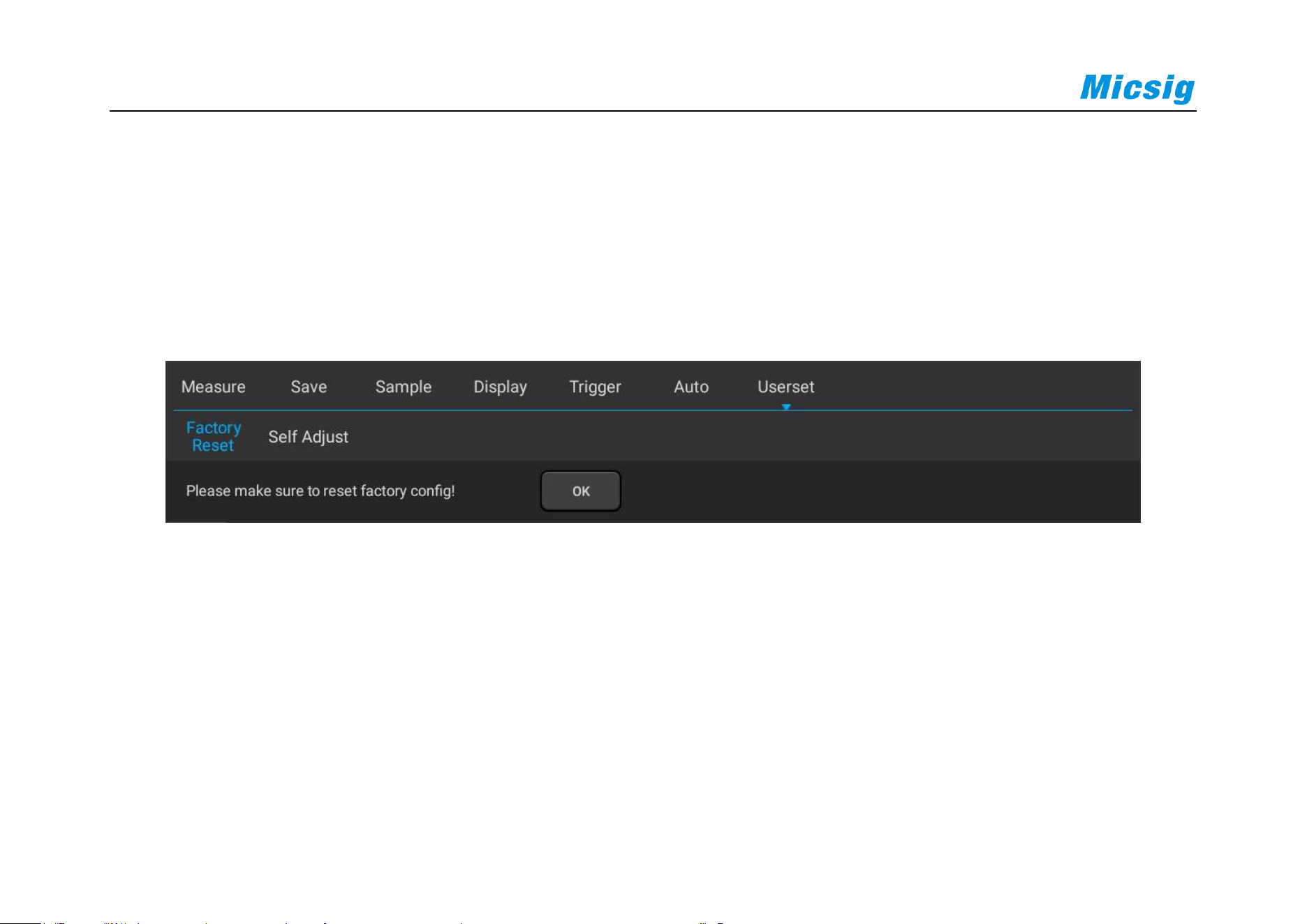
2.13 Load Factory Settings
Open the main menu, tap “User Settings” to enter the user setting page. Tap “Factory Settings” and the dialog box
for loading factory settings will pop-up. Press “OK” and load the factory settings. The dialog box for loading
factory settings is shown in Figure 2-12.
Figure 2-12 Load Factory Settings
2.14 Use Auto-calibration
Open the main menu, tap “User Settings” to enter the user setting page. Tap “Auto Calibration” to enter the auto-
calibration mode. When the auto-calibration function is active, the upper left corner of the screen displays

Chapter 2. Quick Start Guide of Oscilloscope
43
“Calibrating” in red, and after calibrating is finished, the word in red disappears. When the temperature changes
largely, the auto-calibration function can make the oscilloscope maintain the highest accuracy of measurement.
Auto-calibration should be done without probe.
Auto-calibration process takes about two minutes.
If the temperature changes above 10℃, we recommended users perform the auto-calibration.
2.15 Passive Probe Compensation
Before connecting to any channels, users should make a probe compensation to ensure the probe match the input
channel. The probe without compensation will lead to larger measurement errors or mistakes. Probe compensation
can optimize the signal path and make measurement more accurate. If the temperature changes 10℃ or above, this
program must run to ensure the measurement accuracy.
Probe compensation may be conducted in the following steps:
44
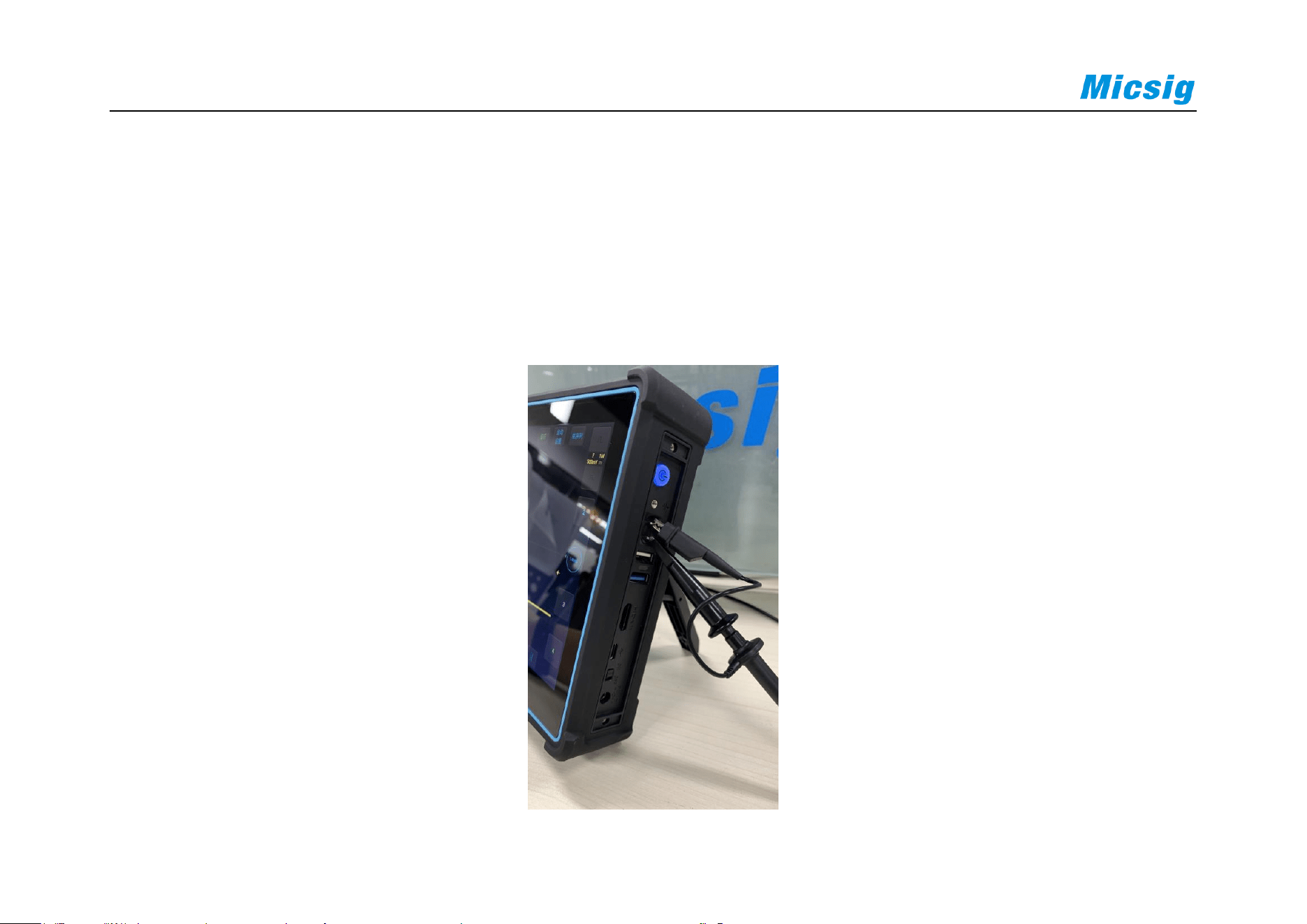
1) First, connect the oscilloscope probe to CH1. If a hook head is used, make sure that it is in good connection
with the probe.
2) Connect the probe to the calibration output signal terminal and connect the probe ground to the ground
terminal. As shown in Figure 2-13.
Chapter 2. Quick Start Guide of Oscilloscope
45
Figure 2-13 Probe Connection
3) Open the channel (if the channel is closed).
4) Adjust the oscilloscope channel attenuation coefficient to match the probe attenuation ratio.
5) Tap button or manually adjust the waveform vertical sensitivity and horizontal time base. Observe the
shape of the waveform, see Figure 2-14.
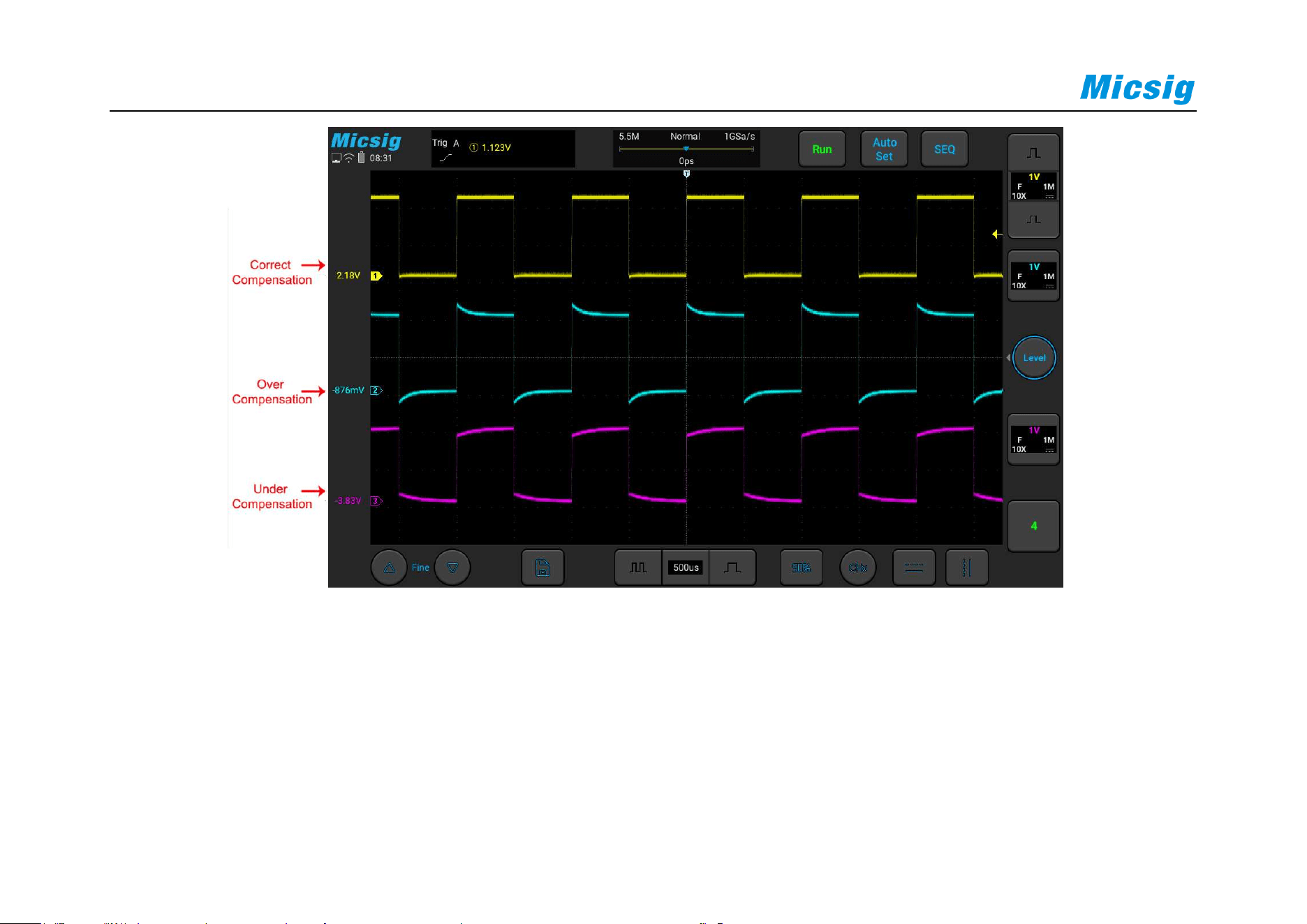
46
Figure 2-14 Probe Compensation
If the waveform on the screen is shown as “under-compensation” or “over-compensation”, please adjust the
trimmer capacitor until the waveform shown on the screen as “correct-compensation”. The probe adjustment is
shown in Figure 2-15.
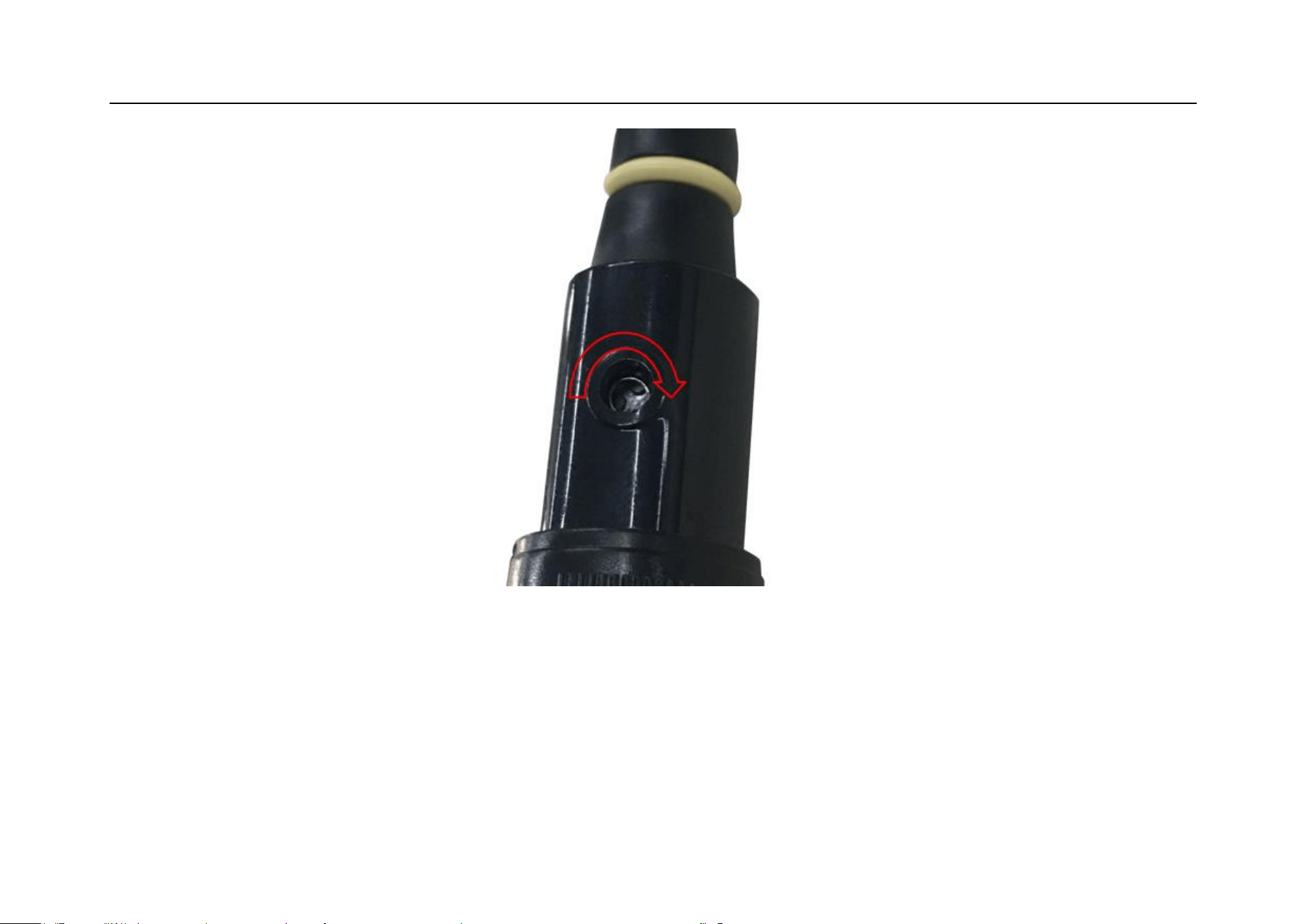
Chapter 2. Quick Start Guide of Oscilloscope
47
Figure 2-15 Probe Adjustment
The safety ring on the probe provides a safe operating range. Fingers should not exceed the safety ring when using
the probe, so as to avoid electric shock.
48
6) Connect the probe to all other oscilloscope channels (Ch2 of a 2-channel oscilloscope, or Ch 2, 3 and 4 of a 4-
channel oscilloscope).
7) Repeat this step for each channel.
Warning
Ensure the wire insulation is in good condition to avoid probe electric shock while measuring high voltage.
Keep your fingers behind the probe safety ring to prevent electric shock.
When the probe is connected a voltage source, do not touch metal parts of the probe-head to prevent electric
shock.
Before any measurement, please correctly connect the probe ground end.
2.16 Modify the Language
To modify the display language, please refer to “12.3 Settings - Language and Input Method”.

Chapter 3 Horizontal System
49
Chapter 3 Horizontal System
This chapter contains the detailed information of the horizontal system of the oscilloscope. You are recommended
to read this chapter carefully to understand the set functions and operation of the horizontal system of the Smart
series oscilloscope.
Move the waveform horizontally
Adjust the horizontal time base (time/div)
Pan and zoom single or stopped acquisitions
Roll, XY
Zoom mode
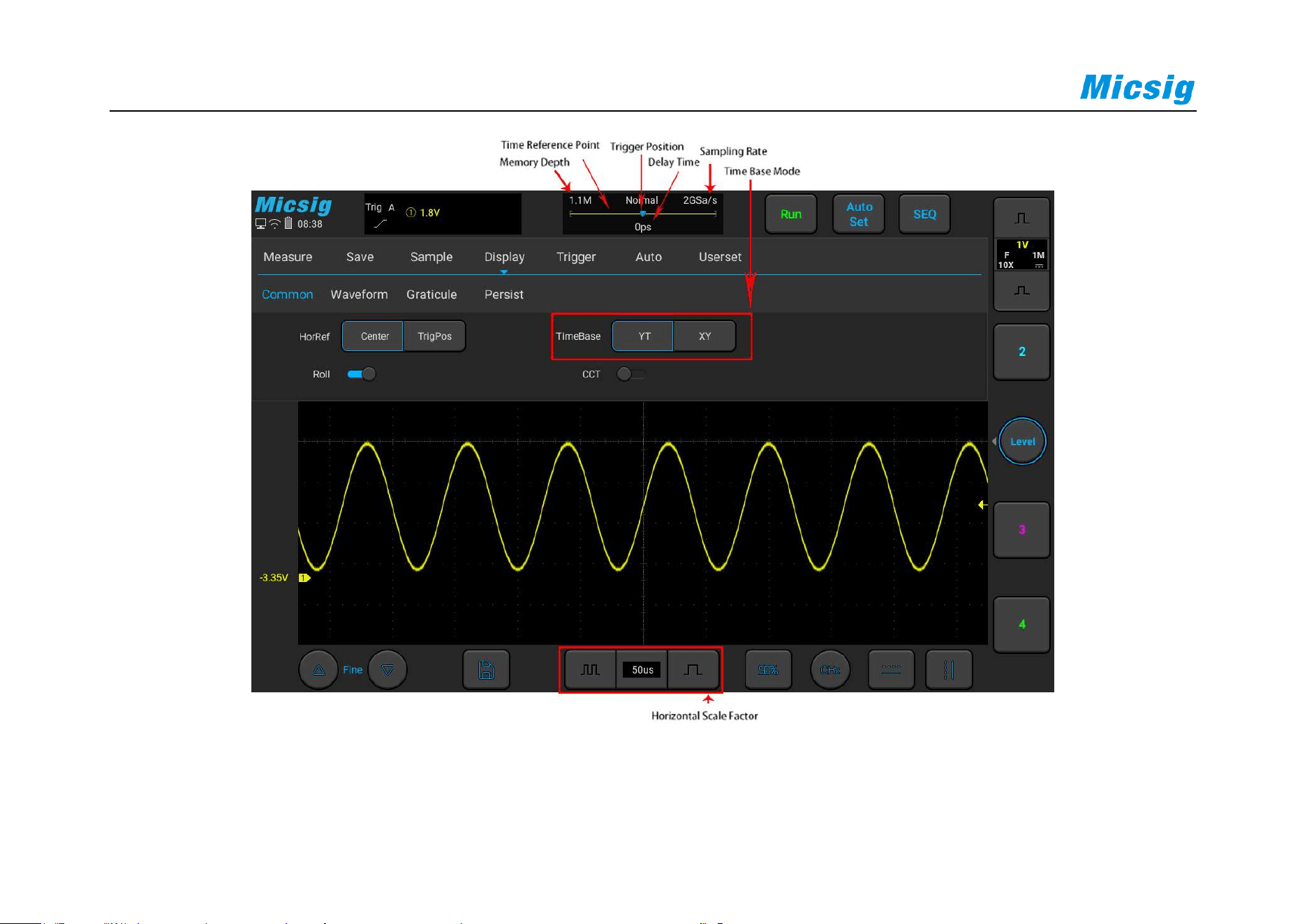
50
Figure 3-1 Horizontal system
Chapter 3 Horizontal System
51
3.1 Move the Waveform Horizontally
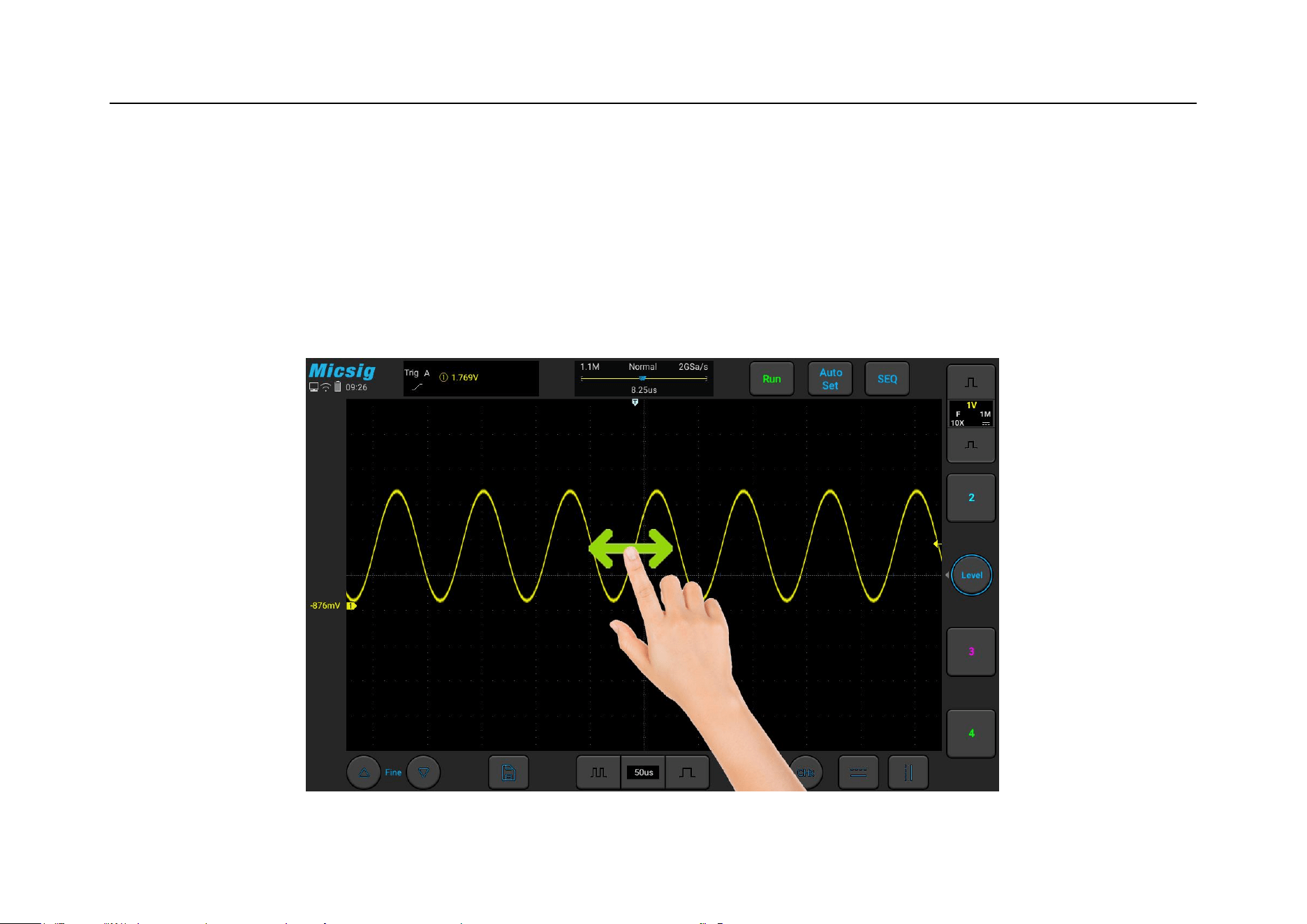
Put one finger on the waveform display area to swipe left and right, for the coarse adjustment of the waveform
position horizontally of all analog channels; after moving the waveform, tap the fine adjustment button in the lower
left corner of the screen for fine adjustment.
52
Figure 3-2 Move the Waveform Horizontally on the Screen
3.2 Adjust the Horizontal Time Base (time/div)
Method 1: Soft Keys
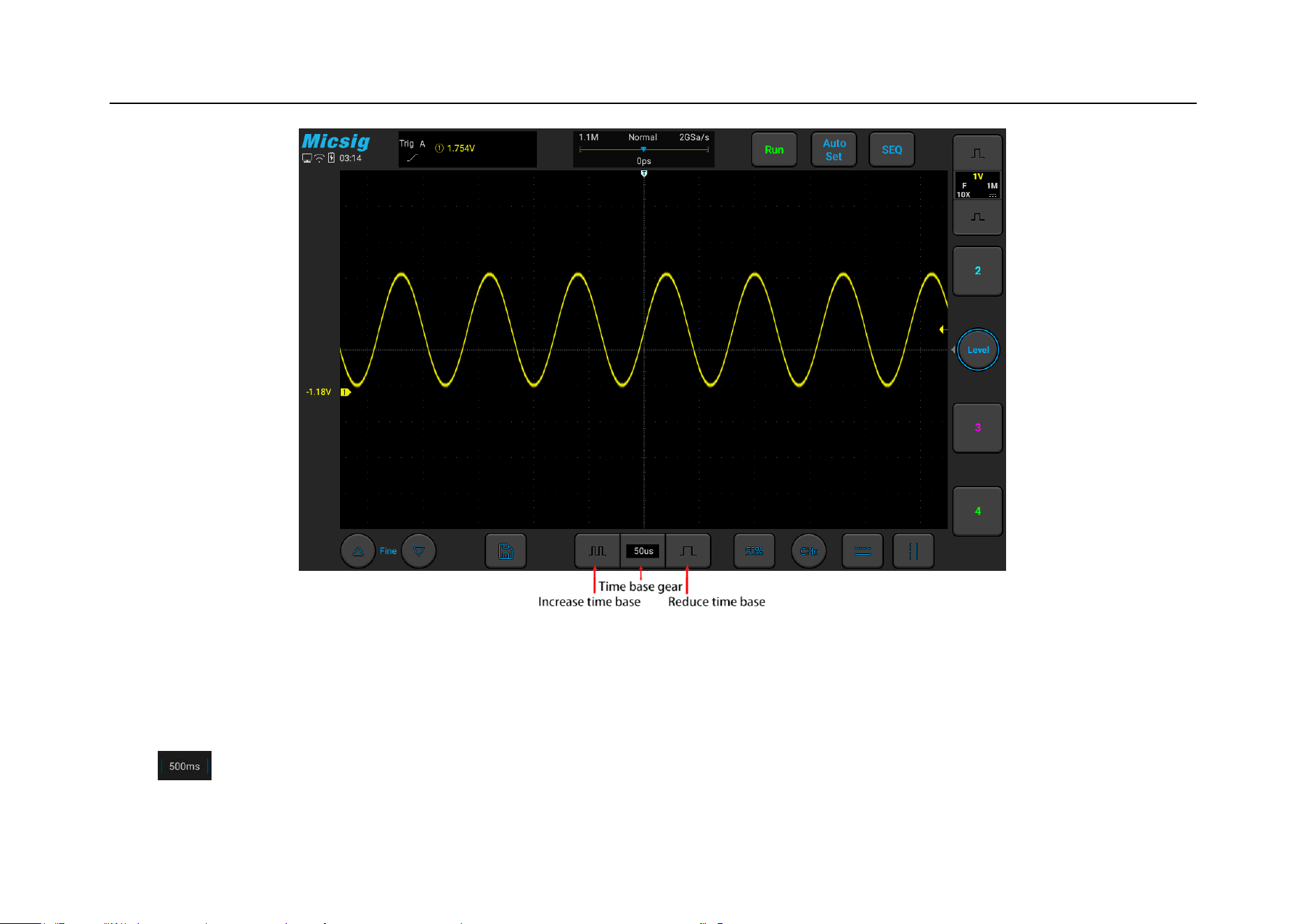
Tap , buttons to adjust the horizontal time base of all analog channels (current channels). Tap button
to increase the horizontal time base; tap button to zoom out the horizontal time base (see Figure 3-3 Adjust the
Horizontal Time Base). The horizontal time base is stepped in 1-2-5, while the waveform changes as the time base
changes.
Chapter 3 Horizontal System
53
Figure 3-3 Adjust the Horizontal Time Base
Method 2: Time Base Knob
Tap to open the time base list (see Figure 3-4 Horizontal Time Base List), then tap the list to select the
appropriate time base. The time base with the blue filled background is the currently selected time base.
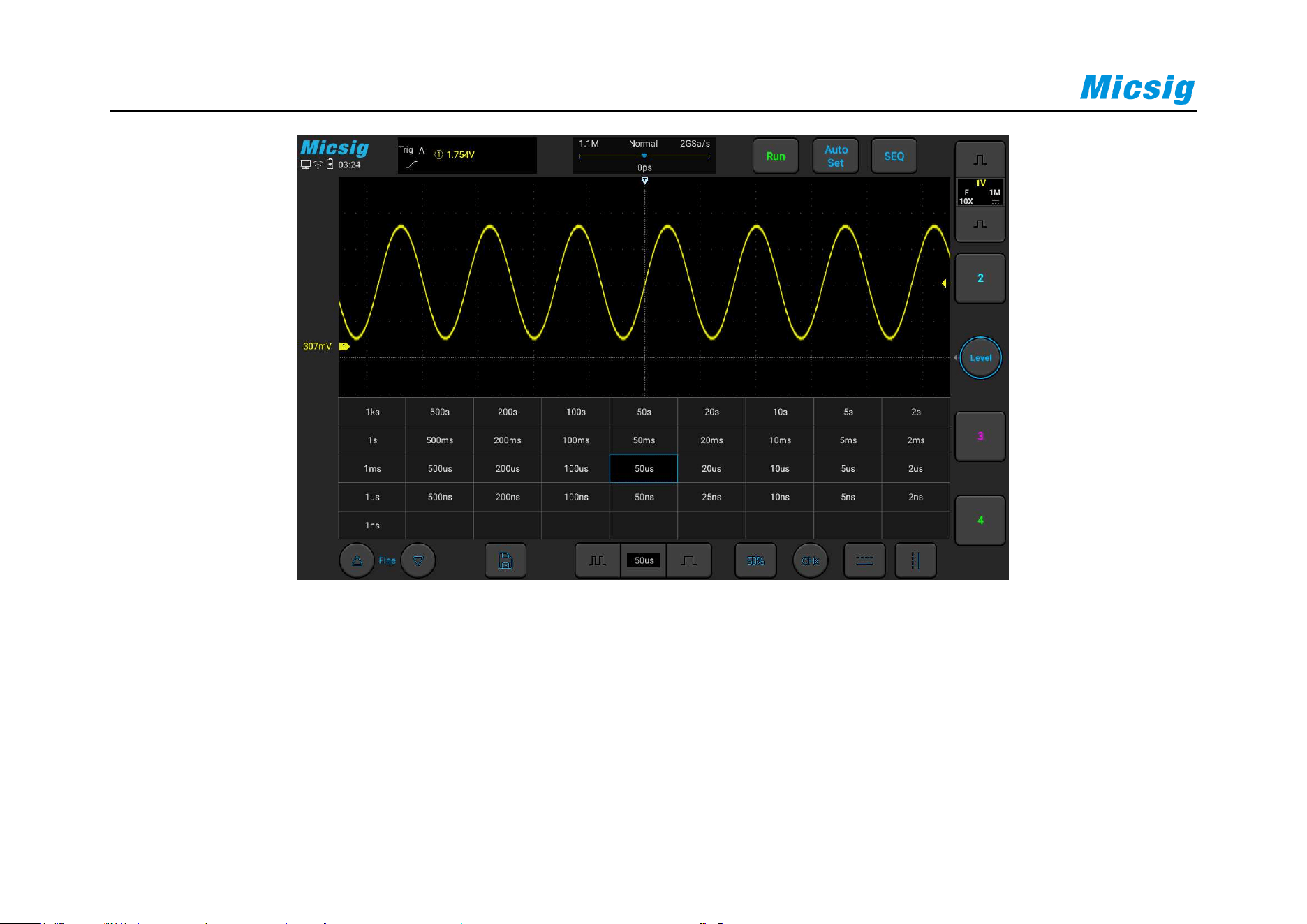
54
Figure 3-4 Horizontal Time Base Knob
3.3 Pan and Zoom Single or Stopped Acquisitions
After the oscilloscope is stopped, the stopped display screen may contain several acquired data with useful
information, but only the data in the last acquisition can be horizontally moved and zoomed. The data of the single
Chapter 3 Horizontal System
55
acquisition or stopped acquisition is moved horizontally and zoomed. For details, refer to “3.1 Move the Waveform
Horizontally” and “3.2 Adjust the Horizontal Time Base (time/div)”.
3.4 Roll, XY
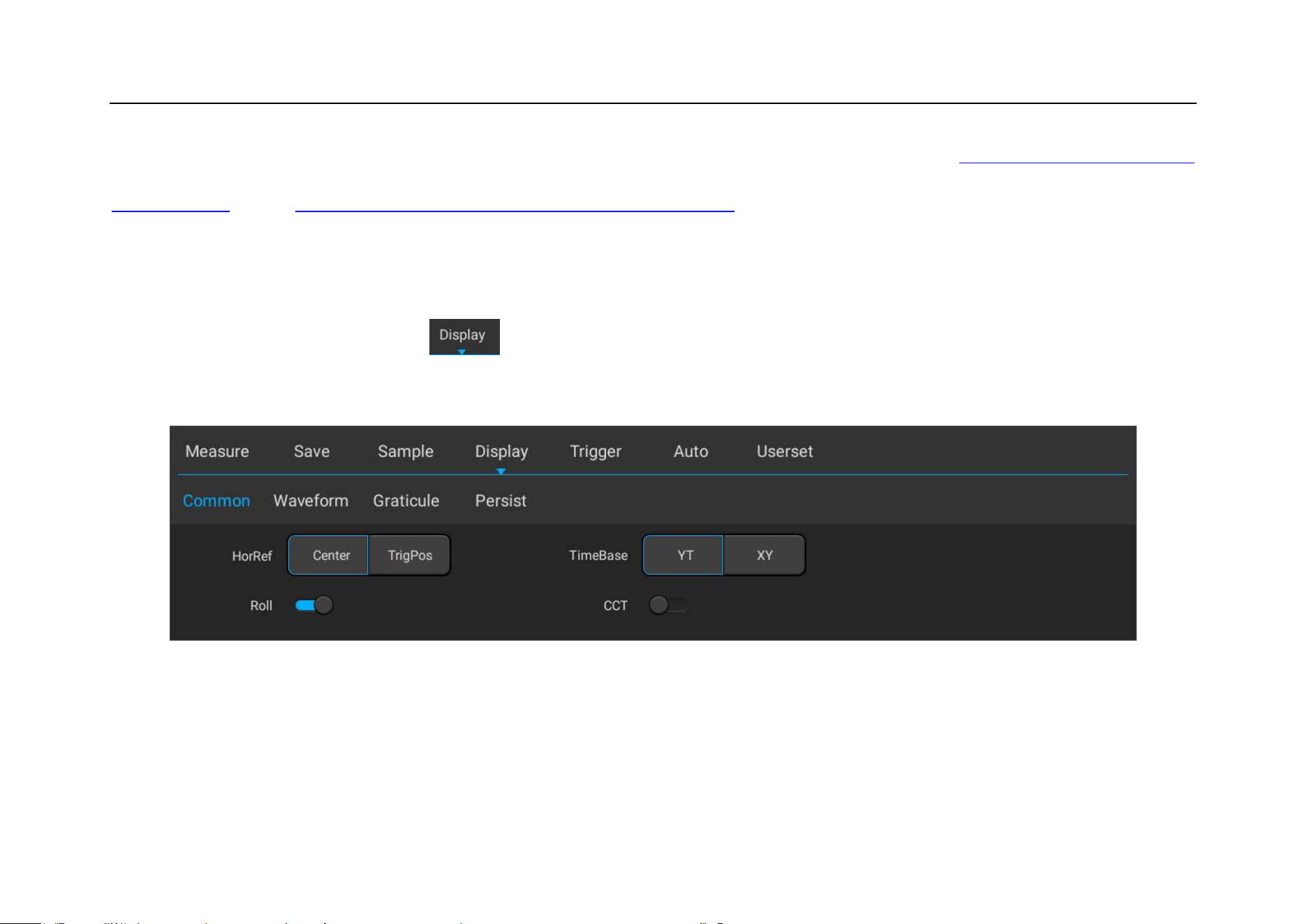
In the main menu, tap the soft key , then select the desired time base mode. The time base mode is divided
into YT, ROLL, and XY.
Figure 3-5 Display Mode
YT——Normal View Mode of Oscilloscope
56
In YT mode, the relative relationship between vertical voltage and horizontal time is displayed. Y axis represents
the voltage, X axis represents the time, and the waveform is displayed after triggering (waveform displayed from
left to right).
Note: When the time base is large (such as 200ms and above), sometimes the waveform will not be displayed for a
long time; this is because in YT mode, the waveform must be triggered before display. It is closely related to the
time base and can be roughly calculated as: the number of divisions on the left side of the trigger position * time
base level position; if you want to reduce the waiting time, move the trigger position to the left.
The case that trigger position is moved out of the waveform screen is not considered here.
ROLL—— ROLL Mode
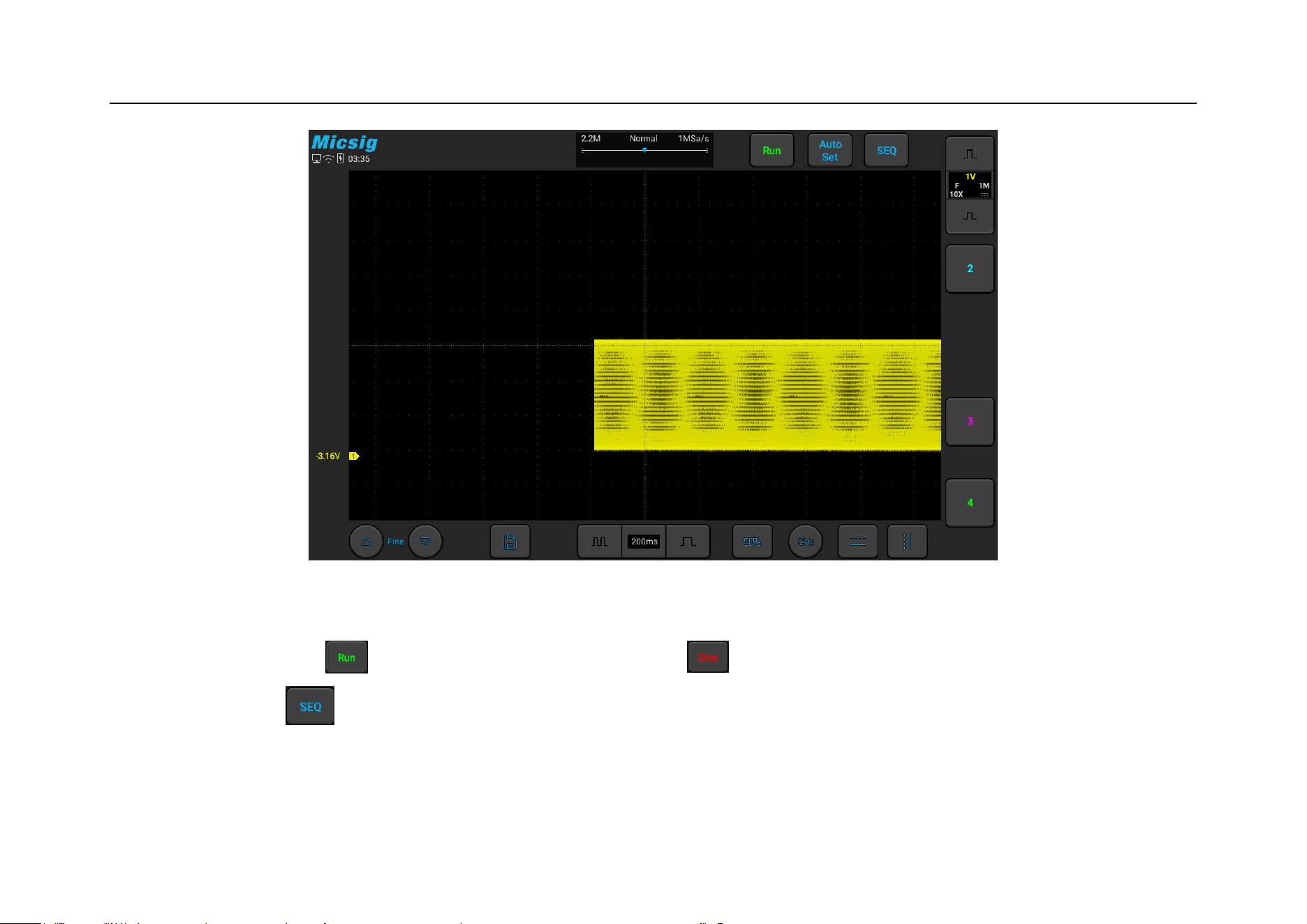
In ROLL mode, the waveform rolls from right to left to refresh the display (see Figure 3-6 ROLL Mode). The
horizontal time base adjustment range of the ROLL mode in the running state is 200ms/div~1ks/div.
In ROLL mode, trigger related information is invalid, including trigger position, trigger level, trigger voltage, etc.
Chapter 3 Horizontal System
57
Figure 3-6 ROLL Mode
In ROLL mode, press to stop waveform display; press again to clear waveform display and restart
acquisition; press to execute single sequence, it will stop automatically after completing a full screen
acquisition.
ROLL mode is generally used to observe waveforms with frequencies below 5 Hz.
58
ROLL mode is defaulted as open. When the time base is greater than 100ms, it automatically enters the ROLL
mode. If the signal to be triggered under a large time base needs to be viewed, turn off the ROLL mode.
Roll mode on and off: In the main menu, tap the soft key . In the “Common” option, you can turn the roll
mode on and off (refer to Figure 3-7). When the roll mode is on and the time base is within 200ms~1ks, the
oscilloscope automatically enters the roll mode.
Figure 3-7 Roll Mode On/Off
XY——XY Mode

Chapter 3 Horizontal System
59
The vertical amount of CH1 is displayed on the horizontal axis in XY mode, and the vertical amount of CH2 is
displayed on the vertical axis (see Figure 3-8 XY Mode).
You can use XY mode to compare the frequency and phase relationship of two signals.
XY mode can be used for sensors to display stress-displacement, flow-pressure, voltage-frequency or voltage-
current, for example: plotting a diode curve.
You can also use the cursor to measure the waveform in XY mode.
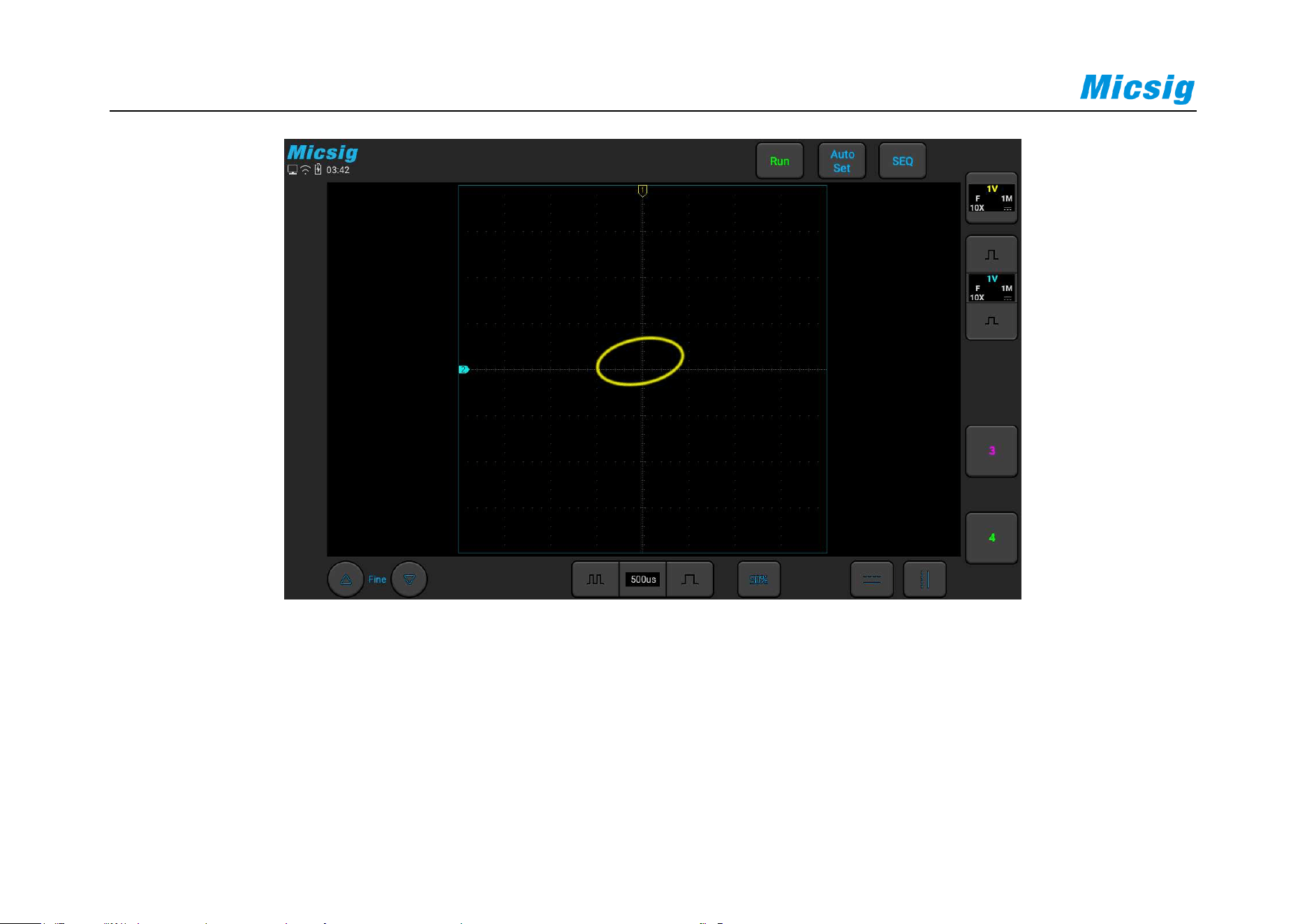
60
Figure 3-8 XY Mode
XY Mode Example
This exercise shows the usual practice of XY display mode by measuring the phase difference between two signals
of the same frequency using the Lissajous method.
Chapter 3 Horizontal System
61
1) Connect sine wave signals to CH1 and connect sine wave signals of the same frequency and different phases to
CH2.
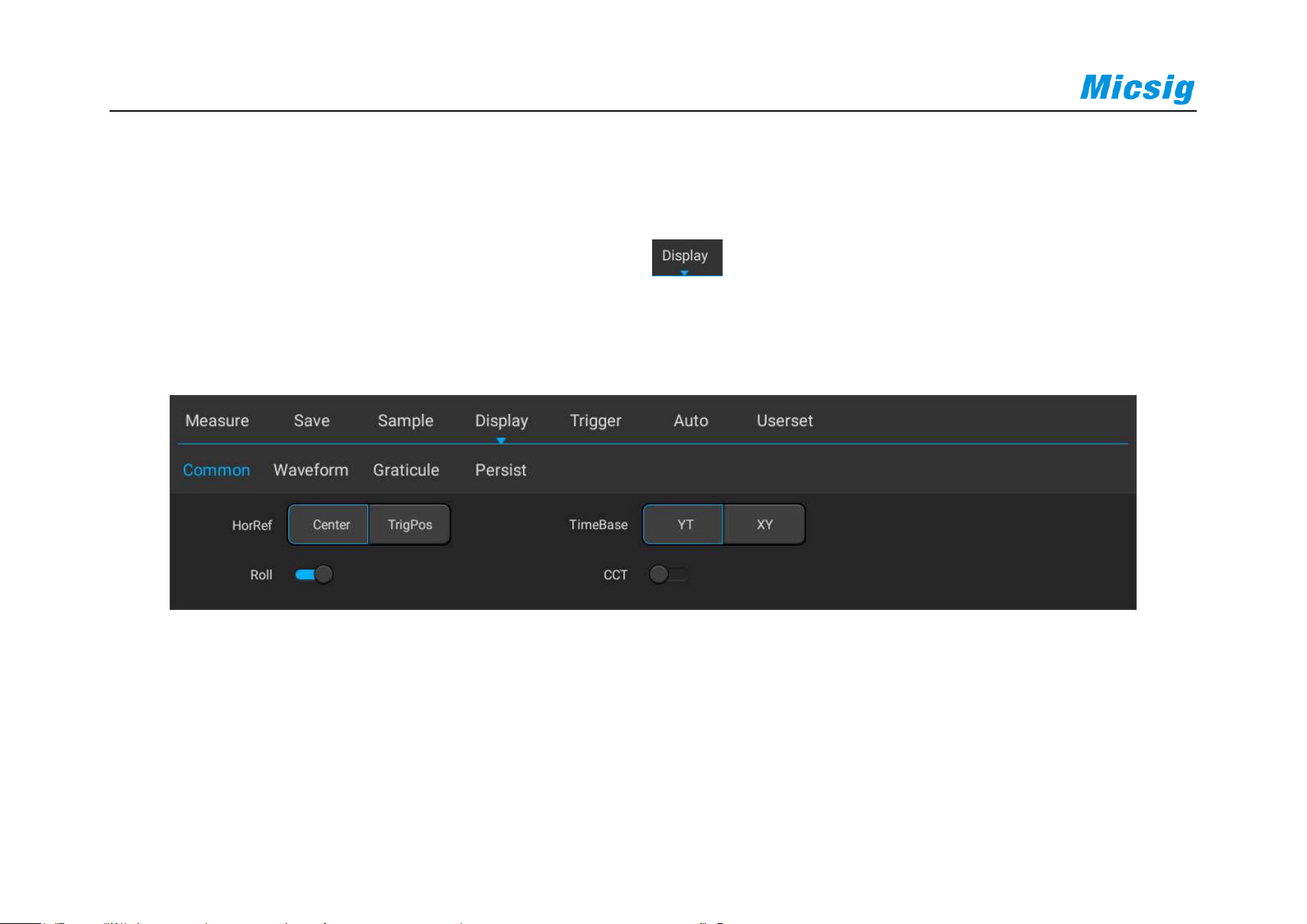
2) Press “Auto” set button, tap “Display” in the main menu, then select “XY” in “Time Base”.
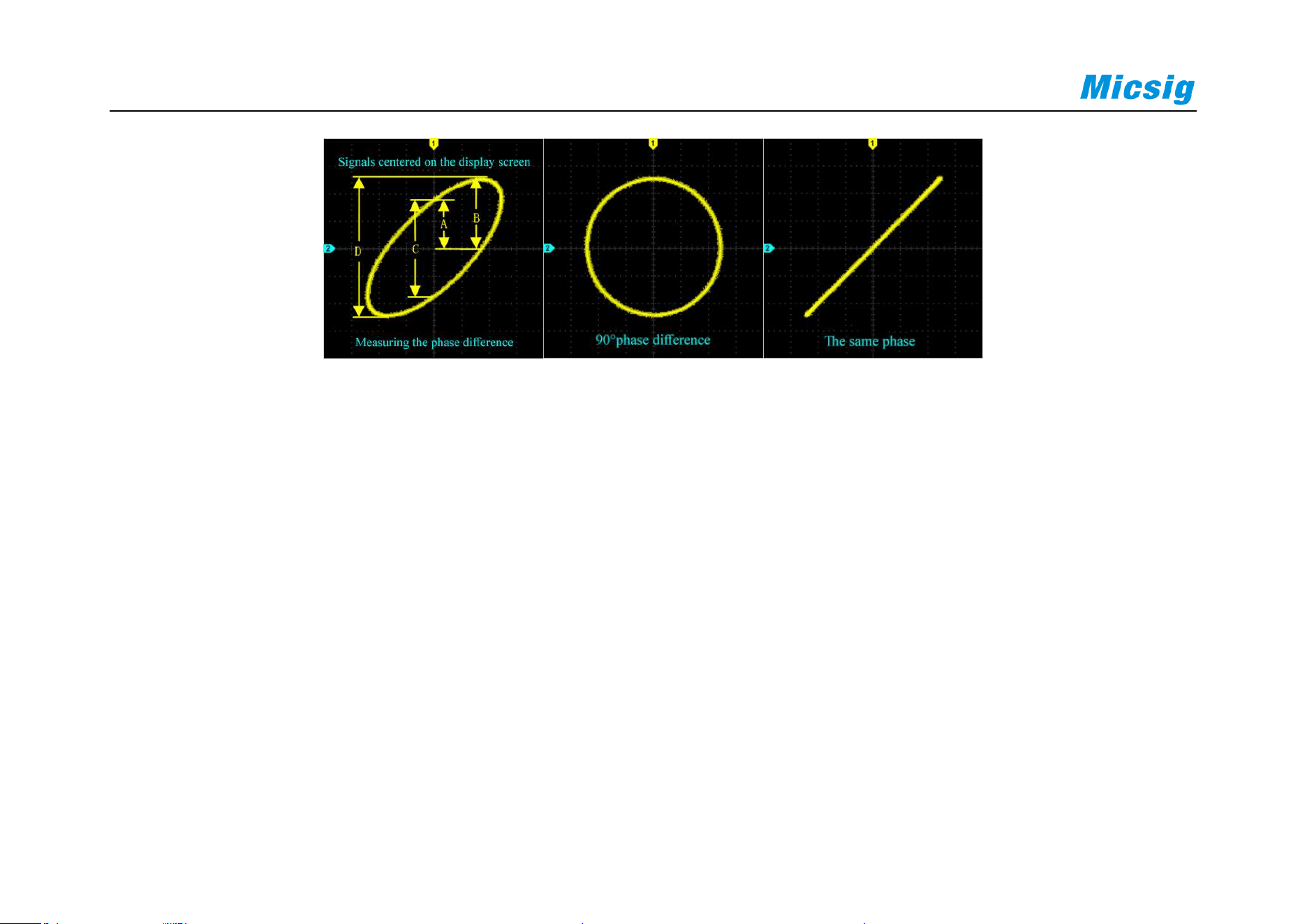
3) Drag signals so that they are centered on the display screen. Adjust the vertical sensitivity of CH1 and CH2,
and extend signals for viewing.
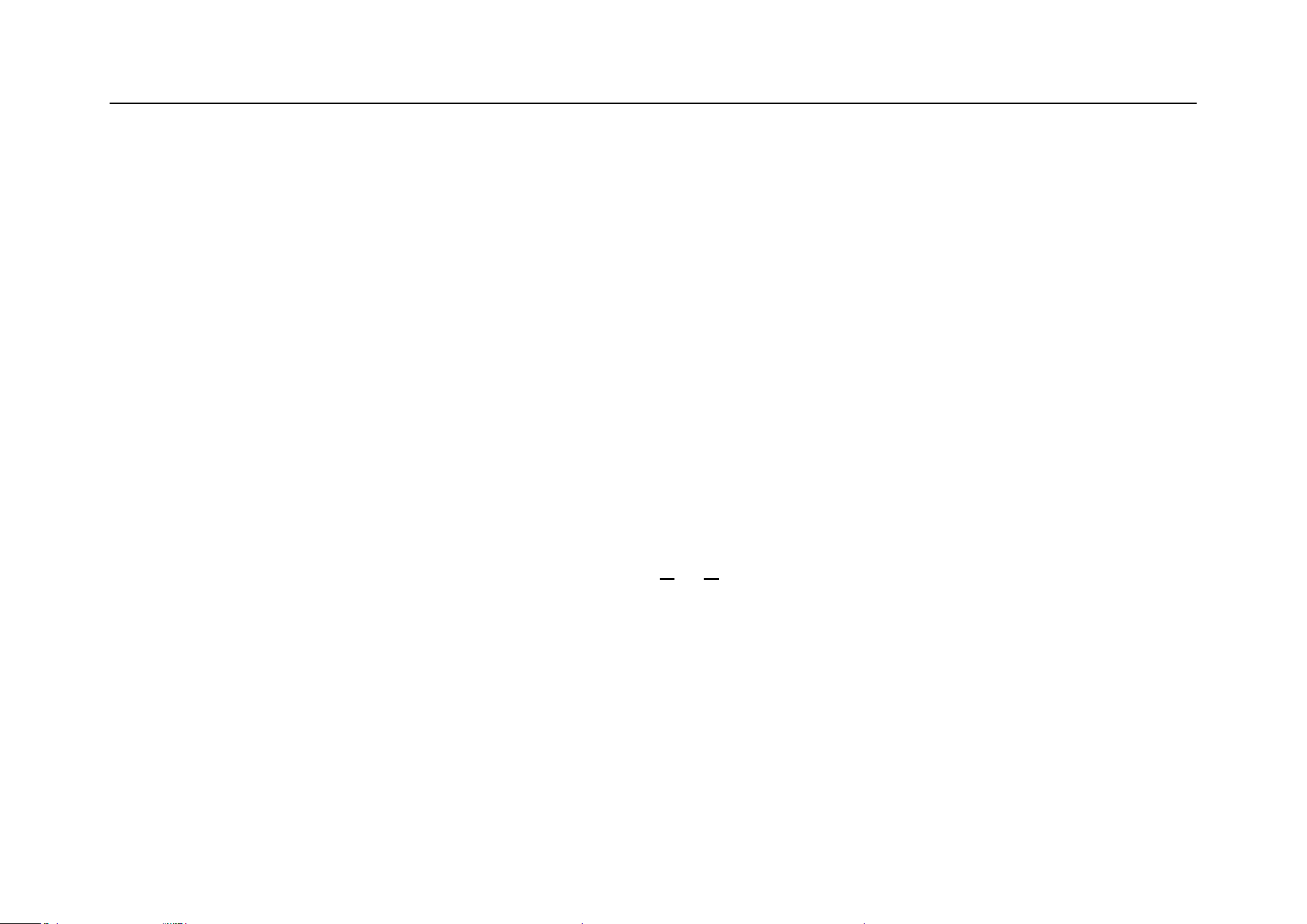
The phase difference (θ) can be calculated using the following formula (assuming that the amplitudes of the
two channels are the same):
62
Figure 3-9 XY Time Base Mode Signal, Center on the Display Screen
4) Tap the “Cursor” button to open the horizontal cursor.
5) Set the cursor y2 at the top of the signal and the cursor y1 at the bottom of the signal. Record the Δy value in
the upper right corner of the screen.
6) Move y1 and y2 cursors to the intersection point of the signal and the y-axis. Record the Δy value again.
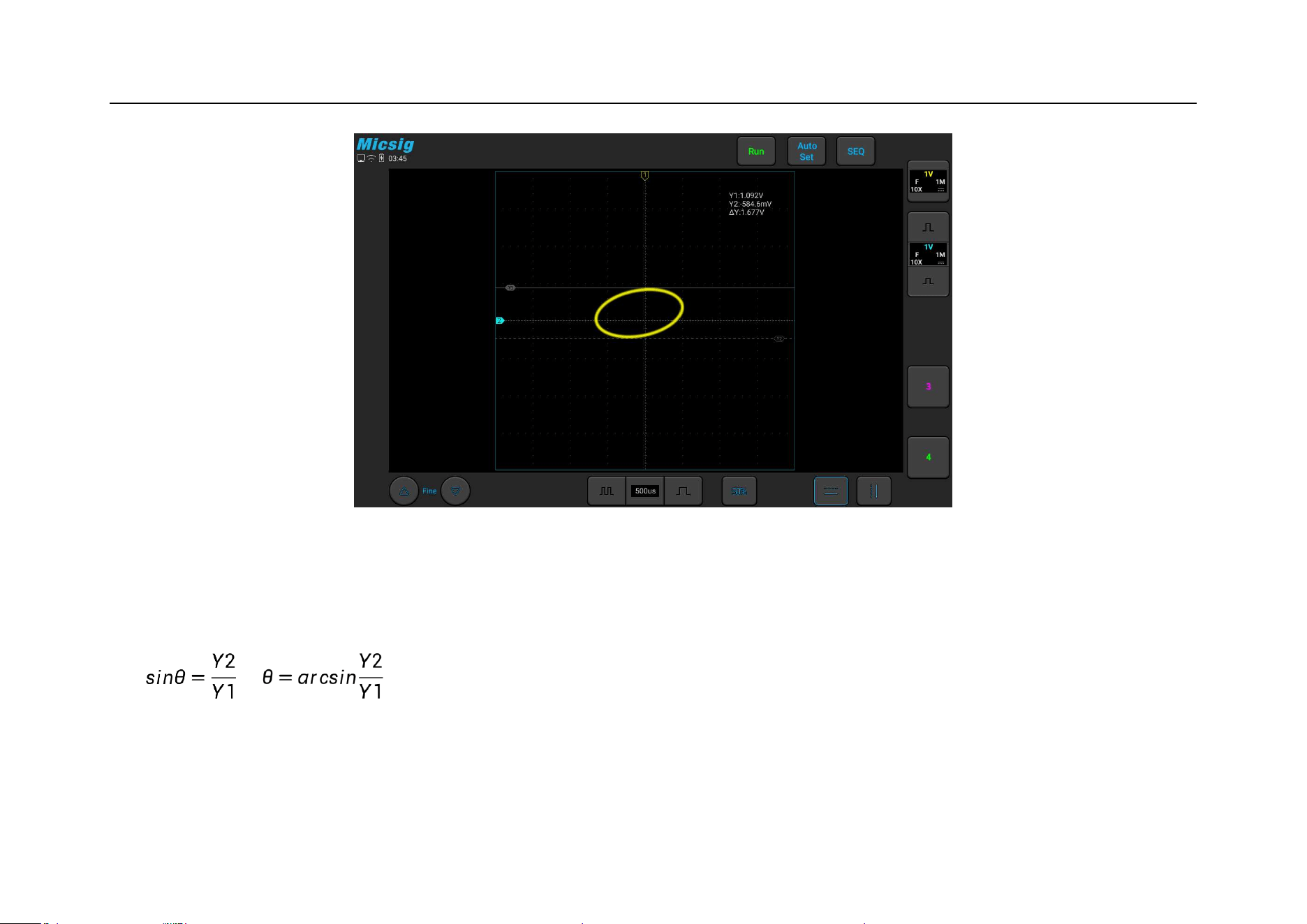
Chapter 3 Horizontal System
63
Figure 3-10 Phase Difference Measurement and Using the Cursor
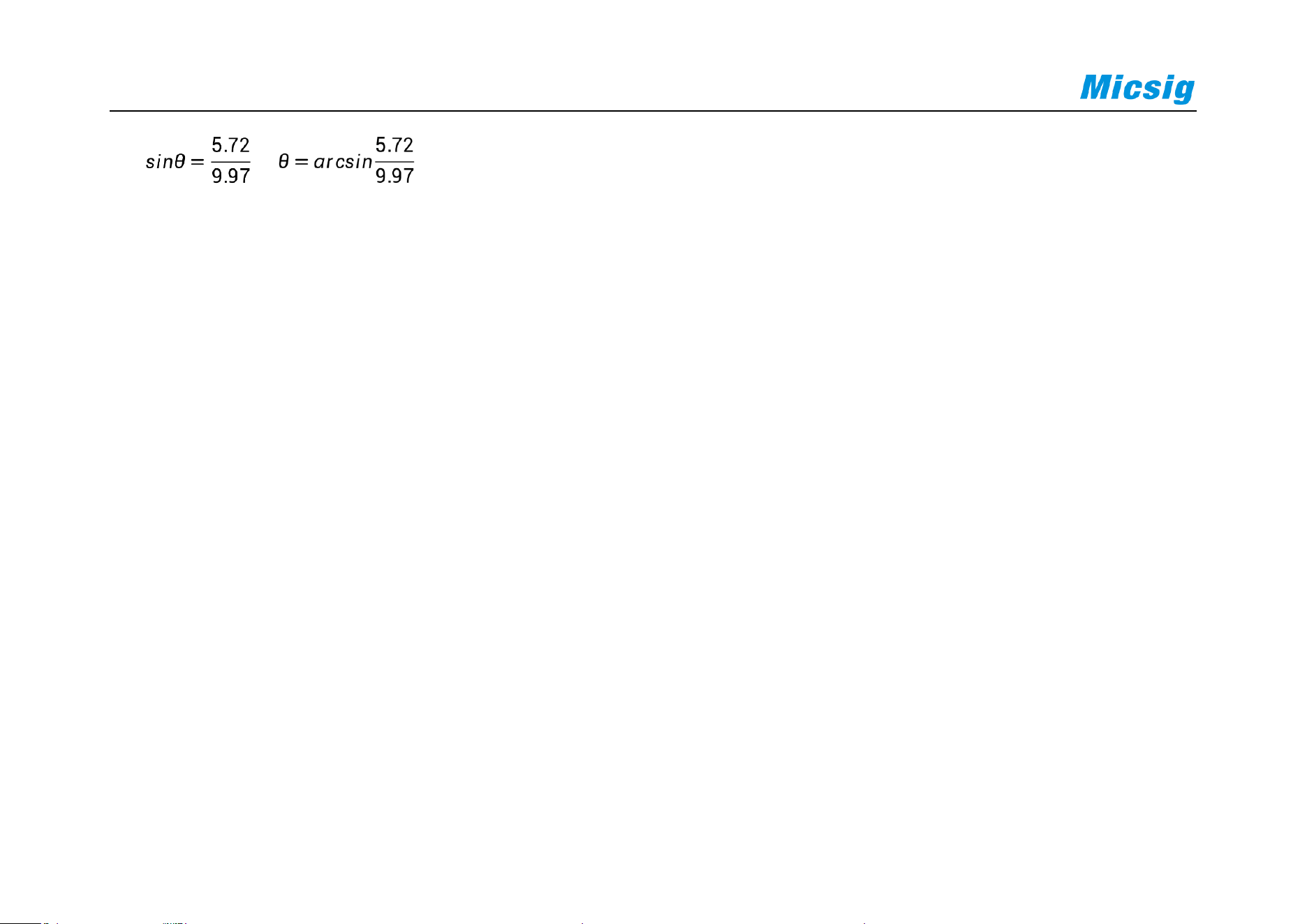
7) The following formula is used to calculate the phase difference.
;
For example, if the first Δy value is 9.97V, the second Δy value is 5.72V:
64
;
3.5 Zoom Mode
Zoom is a horizontally expanded version of the normal display. Open the zoom function, the display is divided into
two parts (see Figure 3-11 Zoom Interface). The upper part of the display screen shows the normal display window
view and the lower part shows the zoomed display window.
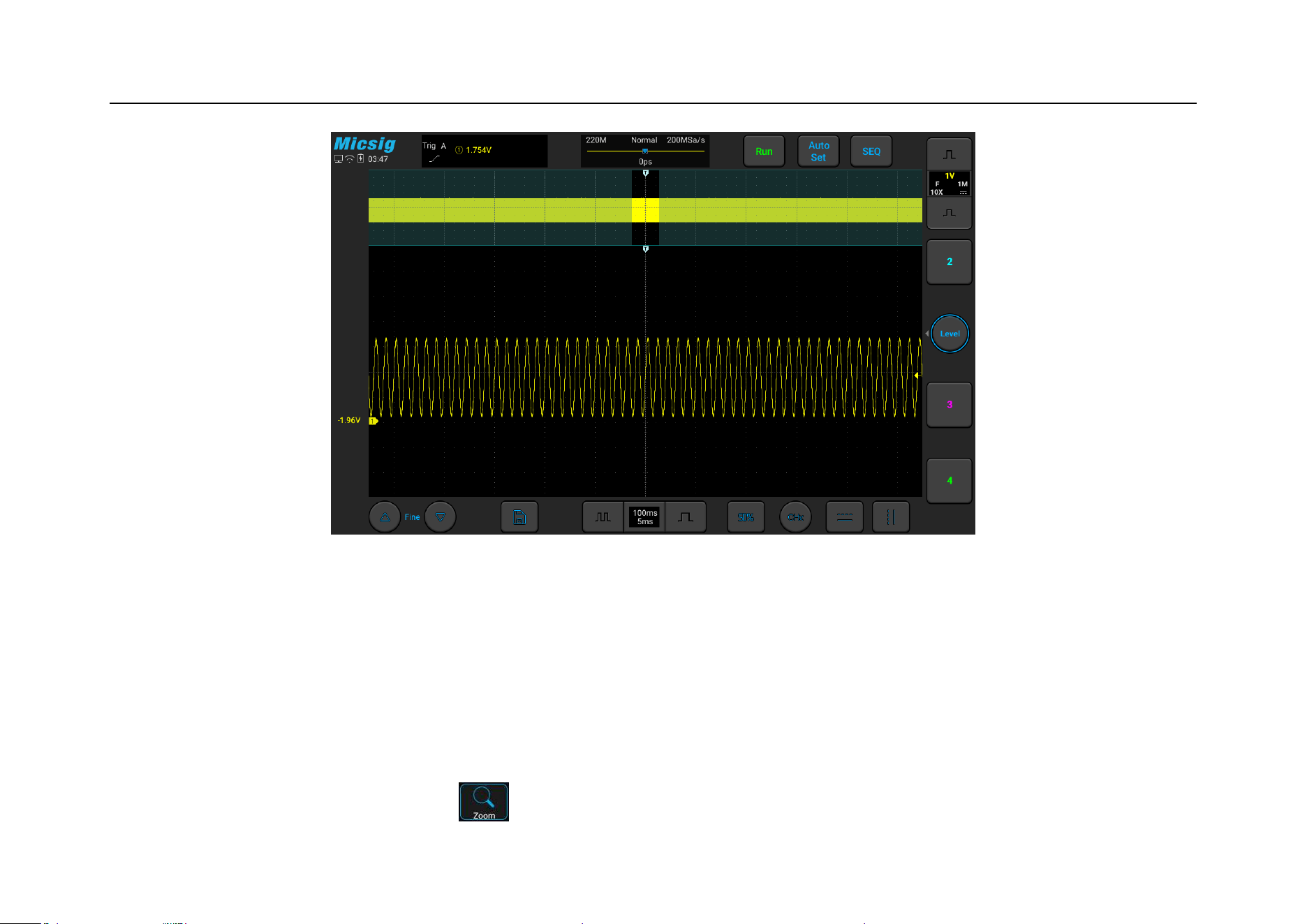
Chapter 3 Horizontal System
65
Figure 3-11 Zoom Interface
Zoom window view is the enlarged portion of the normal display window. You can use “Zoom” to view a portion
of the normal window that is horizontally expanded to learn more about signal analysis.
Zoom on/off:
Open the pull-up menu and tap button to turn the zoom function on/off.
66
Zoom window is framed in a box on the normal window, and the other portion is covered by gray shade not
displayed in the zoom window. This box shows the normal scan portion that was zoomed in the lower bottom.
Tap the time base button to adjust the time base of the zoom window. The size of the box in the normal window
changes according to the time base of the zoom window.
Drag the waveform of the zoom window horizontally to adjust the waveform position. The box in the main window
moves oppositely against the waveform; or directly drag the box in the normal window to quickly locate the
waveform to be viewed.
Note:
1) The minimum time base is displayed in the normal window when the waveform in the screen is exactly within
the memory depth. If the current time base is smaller than the minimum time base in the normal window at the

Chapter 3 Horizontal System
67
current memory depth, when the zoom window is opened, the time base in the normal window is automatically
set to the minimum time base in the normal window at the current memory depth.
2) The cursor, math waveform, and reference waveform are not displayed in the normal window, but can be
displayed in the Zoom window.
3) If Roll mode is stopped, Zoom mode can be turned on, and tap “Run/Stop” to automatically turn off Zoom
mode.
68
Chapter 4 Vertical System
This chapter contains the detailed information of the vertical system of the oscilloscope. You are recommended to
read this chapter carefully to understand the set functions and operation of the vertical system of the Smart series
oscilloscope.
Open/close channel, set the current channel
Set probe type
Adjust vertical sensitivity
Set probe attenuation coefficient
Adjust vertical position
Vertical expansion reference
Open channel menu
Set channel coupling
Set bandwidth limit
Waveform inversion
Chapter 4 Vertical System
69
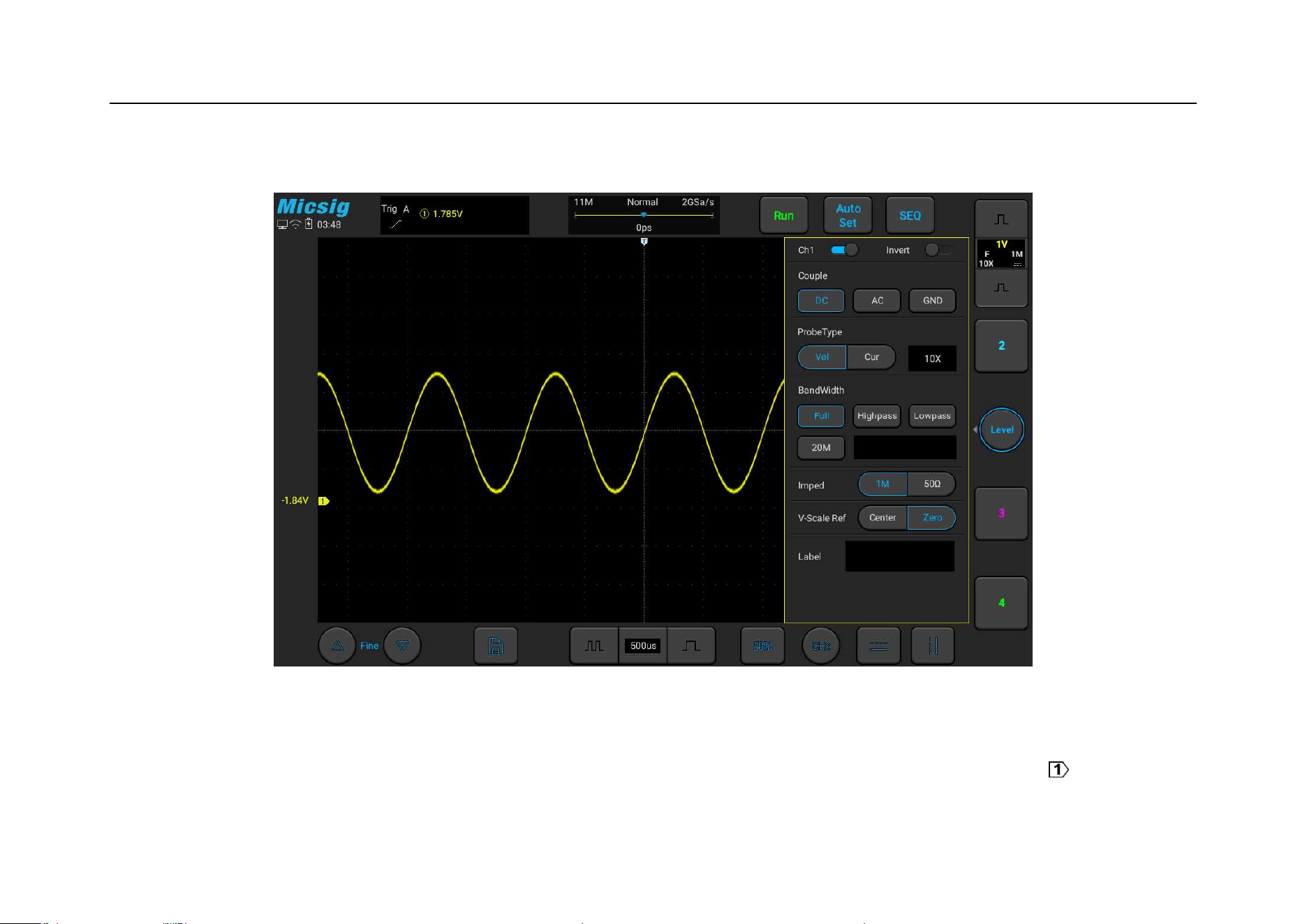
The figure below shows the “CH1 Channel Menu” displayed after opening the CH1 channel menu.
Figure 4-1 Channel Menu Display Interface
The ground level of each displayed analog channel signal is indicated by the channel indicator icon on the far
left of the display screen.
70
4.1 Open/Close Waveform (Channel, Math, Reference Waveforms)
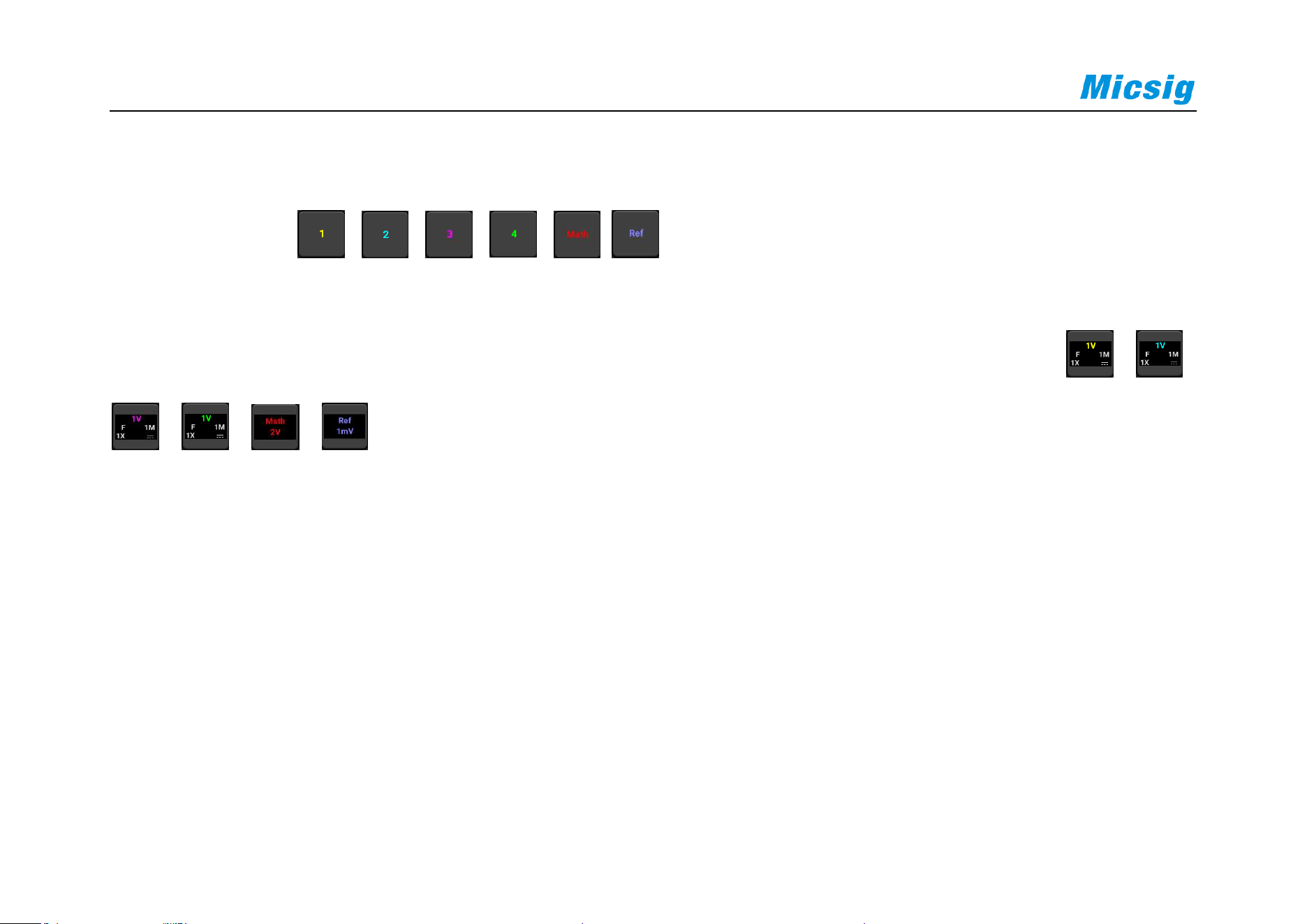
The channel icons , , , , on the right side of the oscilloscope waveform display
area (swipe up or down to switch to math channel and reference channel) correspond to the six channels of CH1,
CH2, CH3, CH4, math function and reference channel. The channel icons in open state will shows like , ,
, , , . Swipe right to close the desired channel.
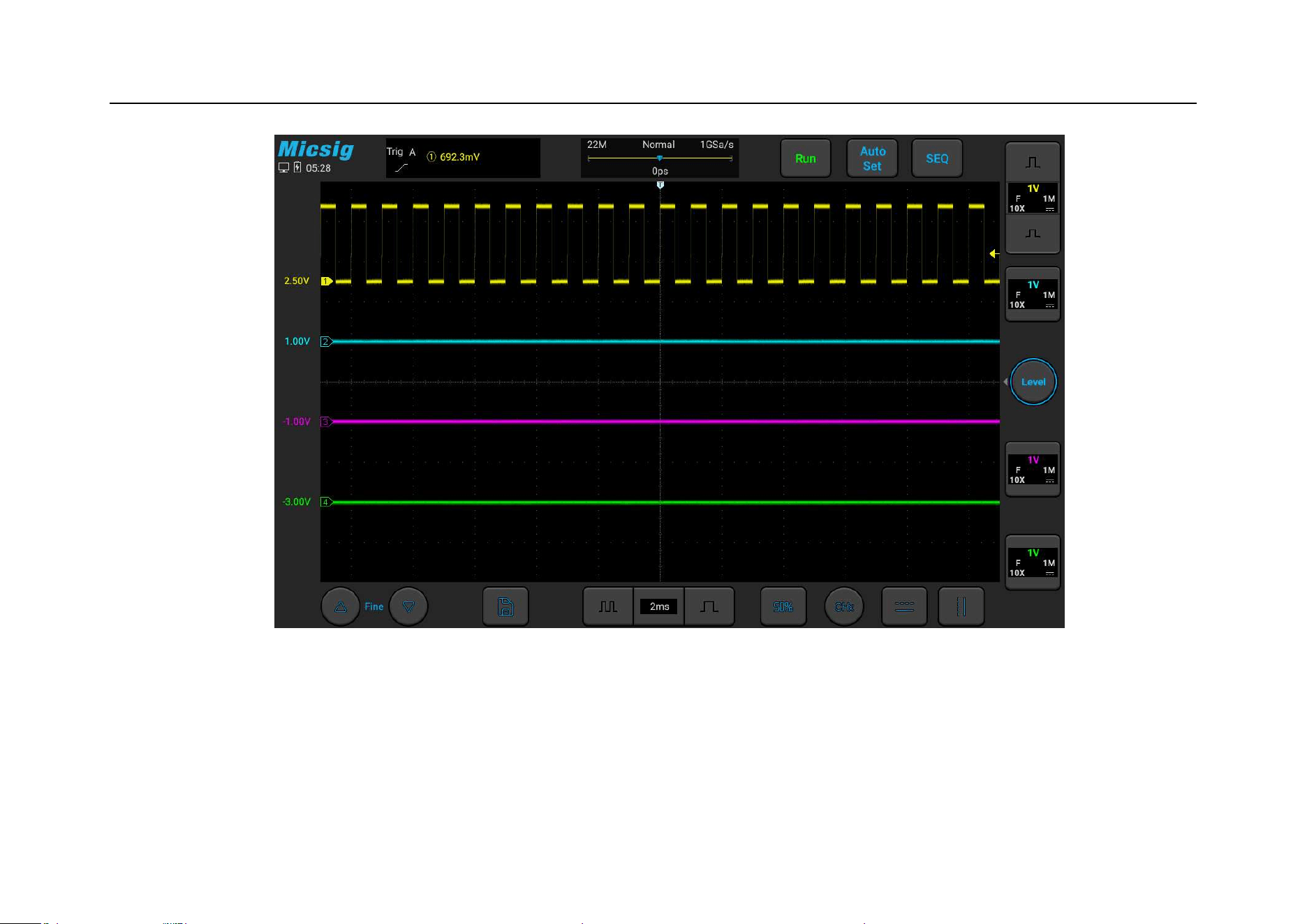
Current channel: The oscilloscope can display multiple waveforms at the same time, but only one waveform is
preferentially displayed on the uppermost layer, and the channel that is preferentially displayed on the uppermost
layer is called the current channel. The channel indicator for the current channel is solid, and the channel indicator
for the non-current channel is hollow, as shown in Figure 4-2.
Chapter 4 Vertical System
71
Figure 4-2 Current Channel and Non-Current Channel
The display content of the oscilloscope channel display interface includes the vertical scale, vertical scale
sensitivity button, coupling mode, invert, bandwidth limitation of the channel, as shown in Figure 5-3.
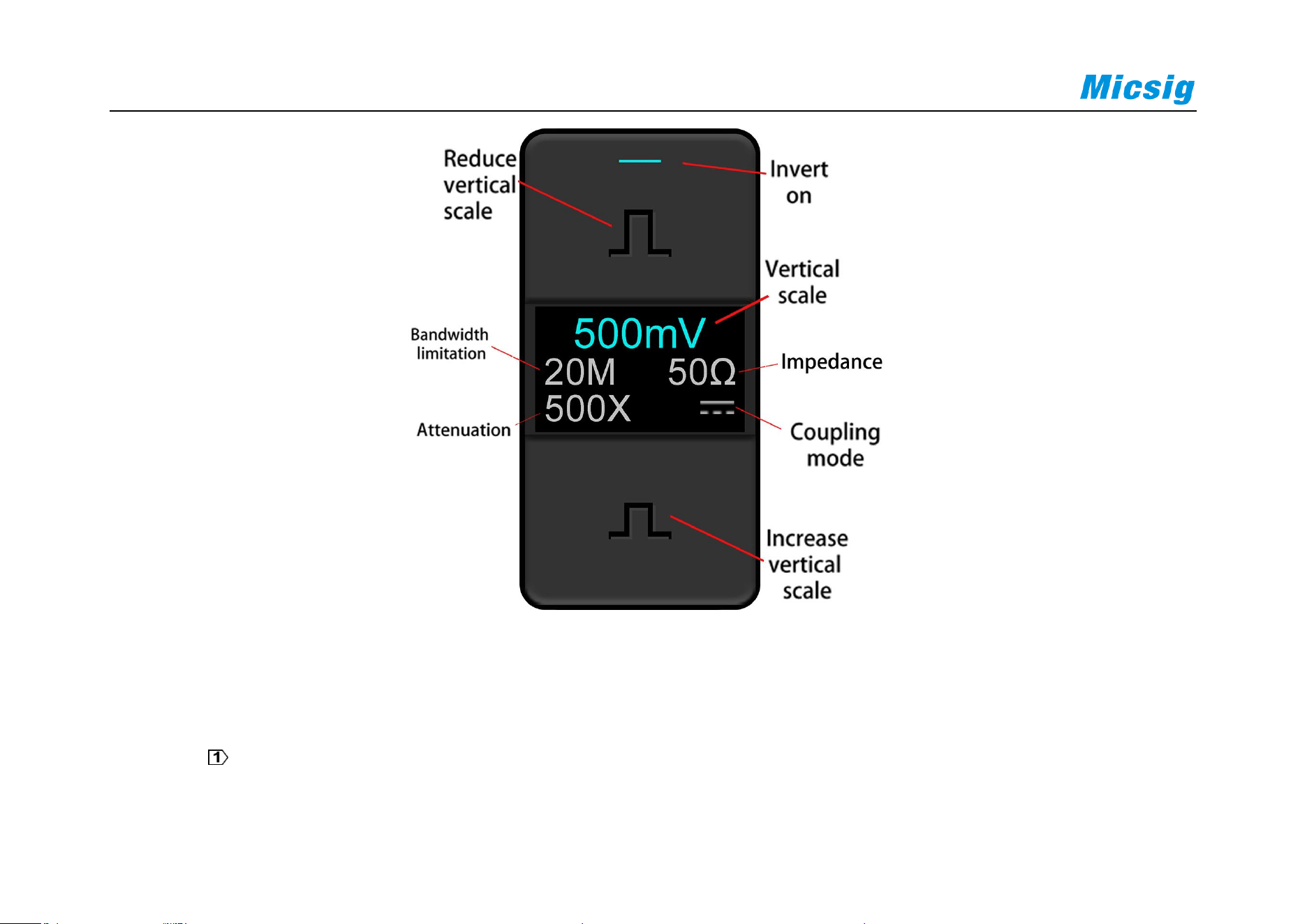
72
Figure 4-3 Channel Display Interface
When CH1 is on, but the state is not the current channel, tap CH1 waveform or vertical sensitivity or channel
indicator or vertical sensitivity button or current channel selection button to set CH1 as the current channel, as
shown in Figure 4-4.
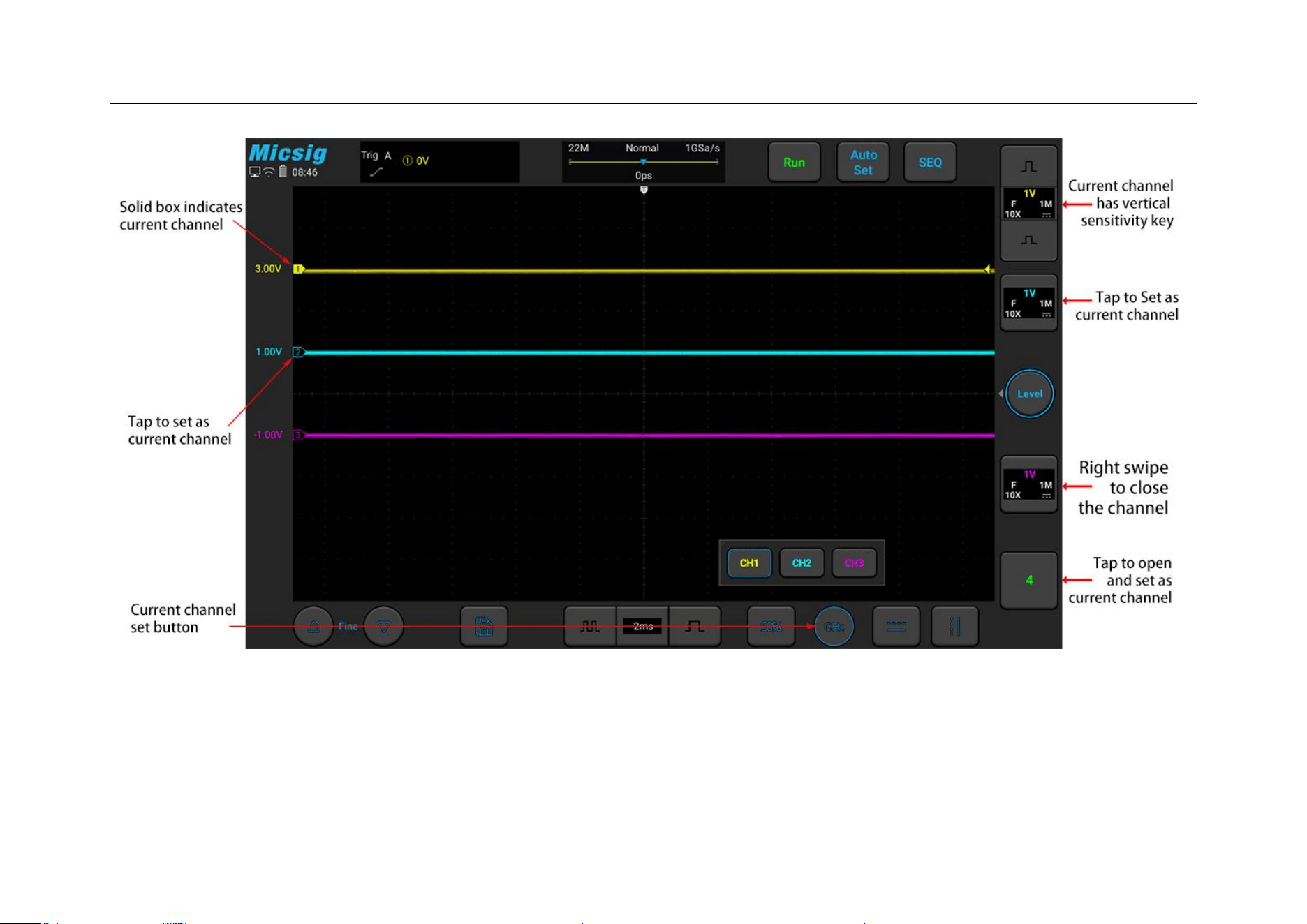
Chapter 4 Vertical System
73
Figure 4-4 Channel Open, Close and Switching

74
Figure 4-5 Using the Current Channel Selection Button
Tap the current channel icon at the bottom of the screen to pop up the current channel switching menu and press the
button to light it up, as shown in Figure 4-5. Tap the button in the menu to switch the current channel. When this
function is opened:
Chapter 4 Vertical System
75
a. the current channel may be switched in the channel switching menu;
b. the current channel menu can be moved anywhere on the screen;
c. only the open channel is displayed in the channel switching menu;
d. when the math or reference waveform is opened, the current channel switching menu is automatically opened.
4.2 Adjust Vertical Sensitivity
Tap the vertical sensitivity or buttons on the right side of the channel icon to adjust the vertical display
of the waveform corresponding to the channel, so that the waveform is displayed on the screen at an appropriate
size.
The vertical sensitivity scale (V/div) after each adjustment is displayed on the channel icon. For example,
means that the current vertical sensitivity of CH1 is 1.0V/div.
76
The vertical sensitivity coefficient adjusts the vertical sensitivity of the analog channel in steps of 1-2-5 (the probe
attenuation coefficient is 1X), and the vertical sensitivity range of 1:1 probe is 1mV/div-10V/div (optionally
minimum at 500uV/div).
4.3 Adjust Vertical Position
The method of adjusting vertical position is as follows:
1) Coarse adjustment: In the waveform display area, hold the waveform and put one finger to slide up and down
for changing the vertical position of the waveform.
2) Fine adjustment: Click the fine adjustment button in the lower left corner of the screen to fine adjust the
vertical position of the waveform for the current channel.
4.4 Open Channel Menu
Right swipe the channel icon to open the desired channel menu.
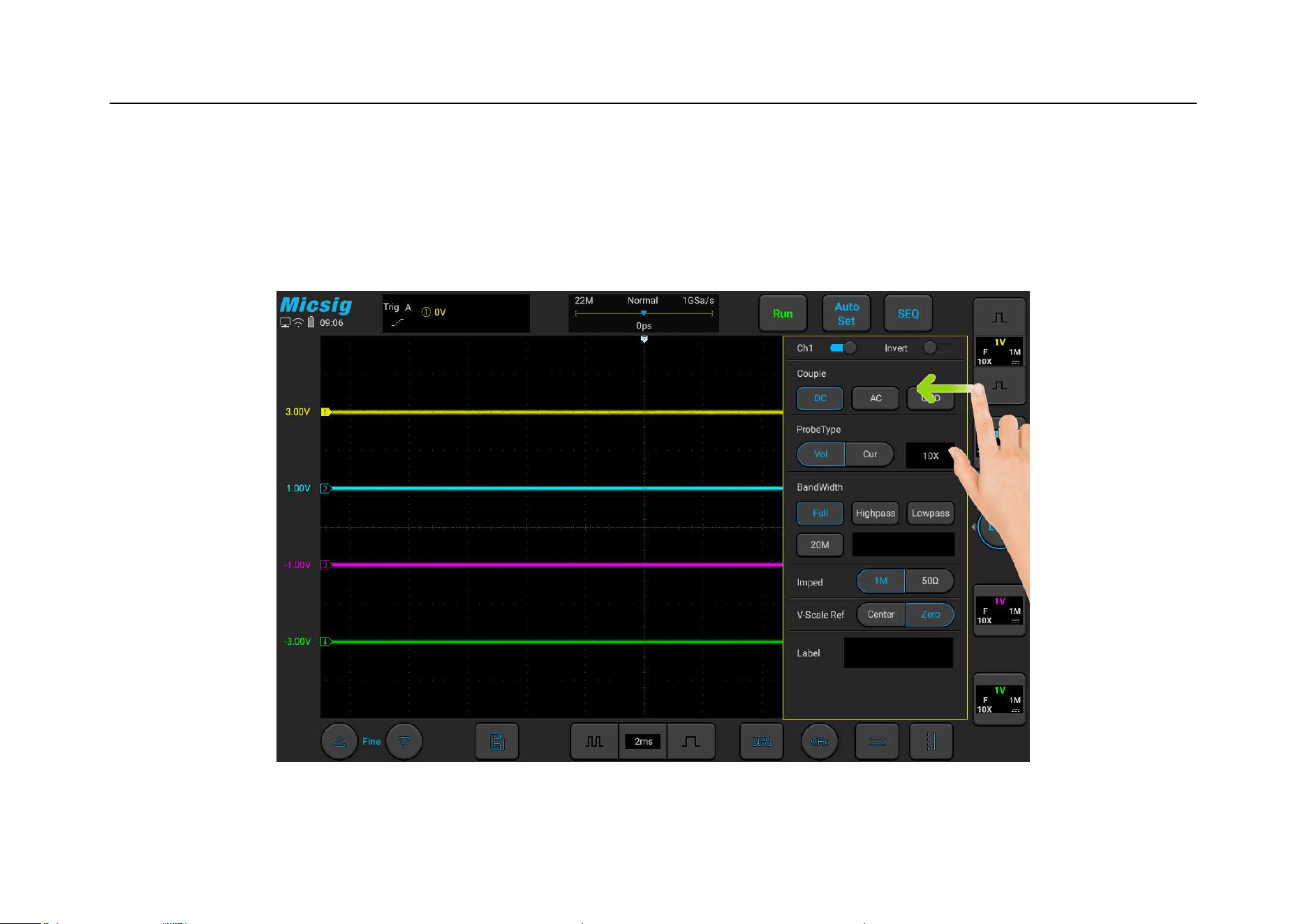
Chapter 4 Vertical System
77
The channel menu is shown in Figure 4-6. Channel waveform inversion, channel bandwidth limit, probe type, probe
attenuation factor, channel coupling mode, vertical expansion reference, channel label and channel on/off can be set
in the vertical menu.
Figure 4-6 Channel menu
78
4.4.1 Set Channel Coupling
Tap the icon under “Coupling Mode” and select “DC”, “AC” and “GND” channel coupling modes in the pop-up
box.
DC: DC coupling. Both the DC component and the AC component of the measured signal can pass, and can be
used to view waveforms as low as 0 Hz without large DC offset.
AC: AC coupling. Measured DC signal is blocked, and only the AC component can be allowed to pass, and used to
view waveforms with large DC offsets.
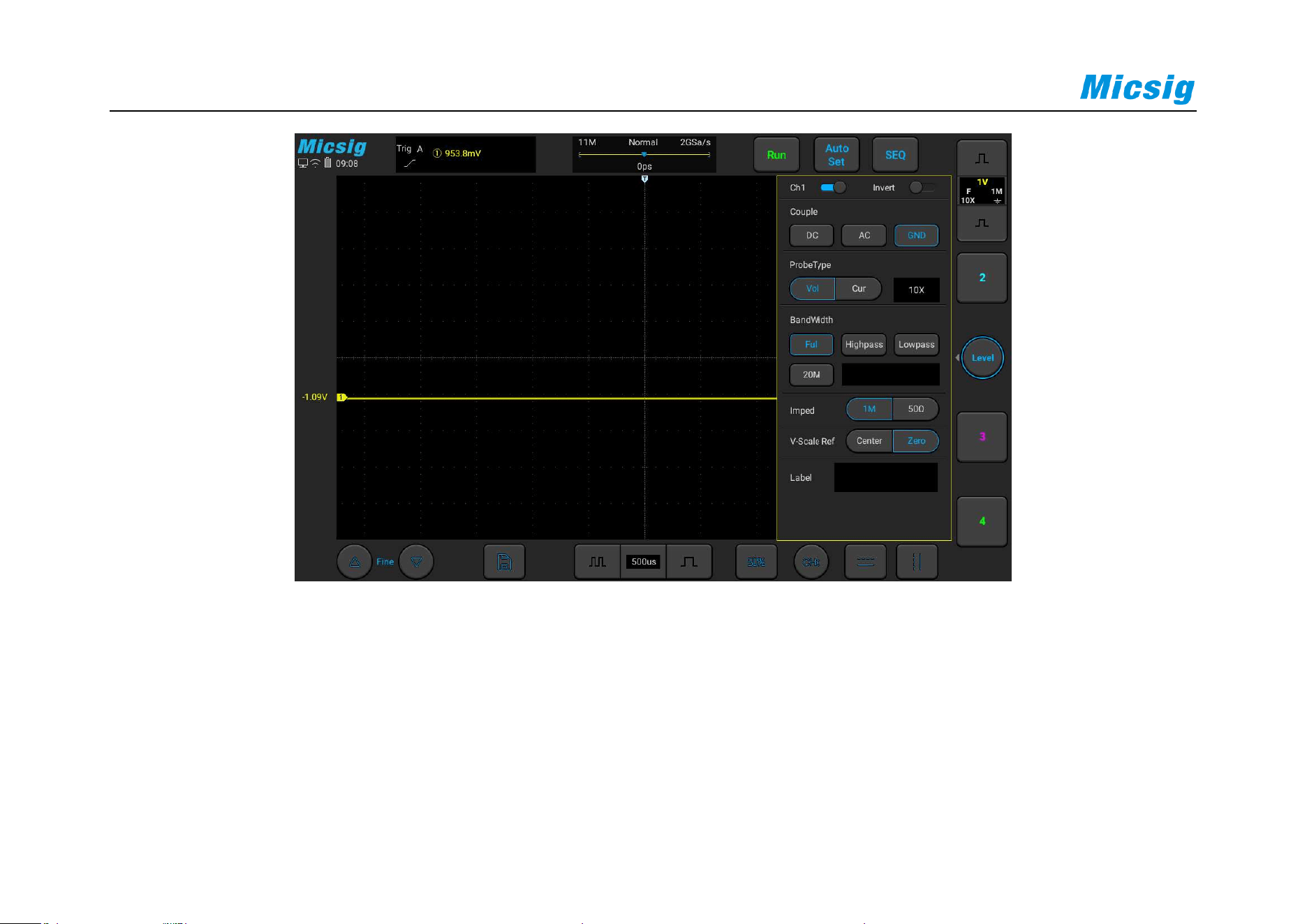
GND: Internal input ground, disconnecting from external input.
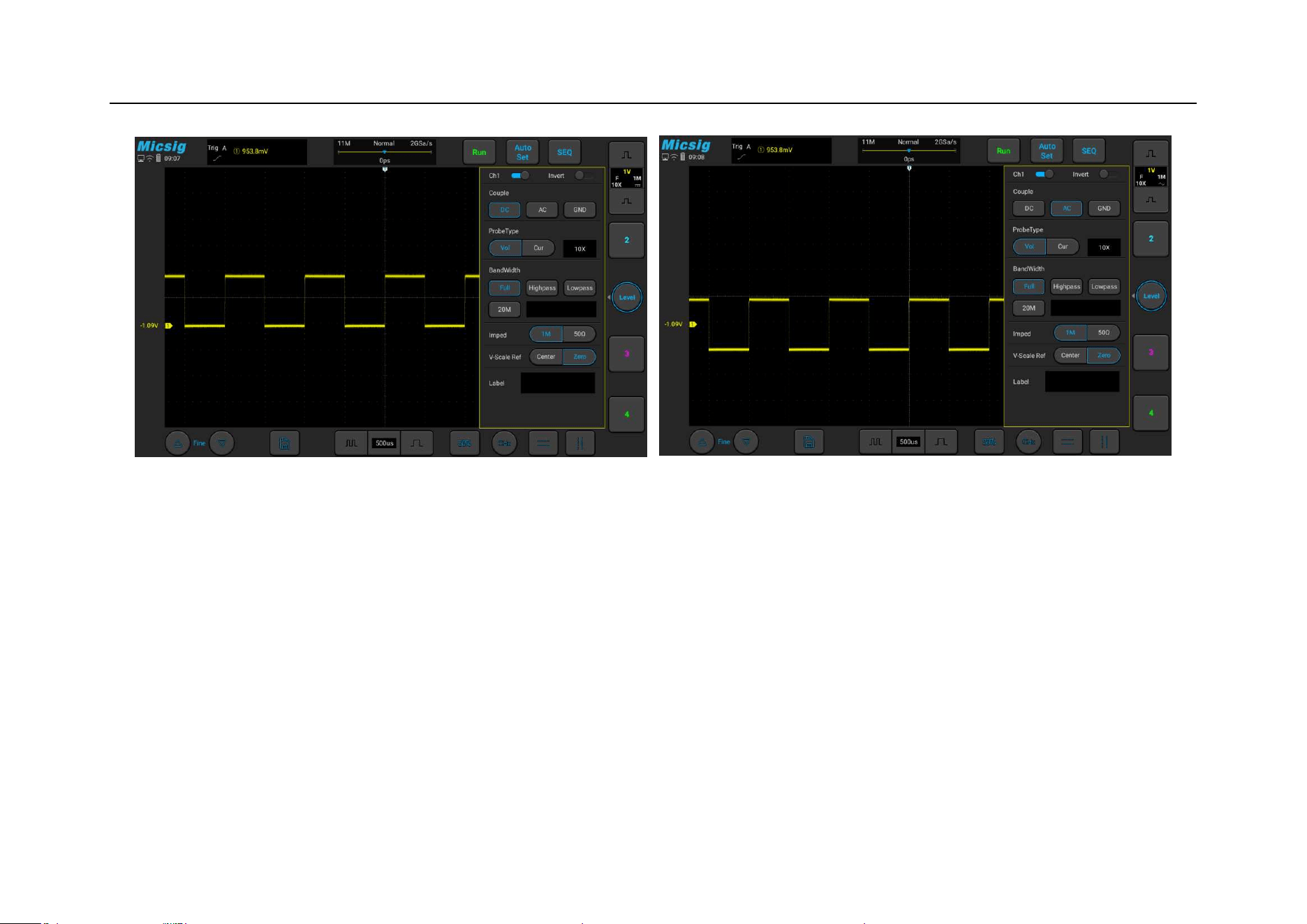
The oscilloscope is connected to the square wave signal with a frequency of 1KHz, an amplitude of 2V and an
offset of 1V. The waveforms of the channel couplings of DC, AC, and GND are shown in Figures 4-7, 4-8, and 4-9.
Chapter 4 Vertical System
79
Figure 4-7 DC Coupling Figure 4-8 AC Coupling
80
Figure 4-9 GND Coupling
Note: This setting is only valid for the current channel. To switch from the current channel, just tap the channel
icon, channel indicator icon or horizontal position pointed by the channel indicator icon for direct switching. You do
not need to exit the menu.
Chapter 4 Vertical System
81
4.4.2 Set Bandwidth Limit
Open the channel menu, find the “Bandwidth” selection box in the channel menu, set bandwidth limit, high-pass
filtering and low-pass filtering as needed.
Full Bandwidth: Allows signals of all frequencies to pass.
20M Bandwidth: Only signals with frequencies below 20MHz are allowed to pass, and signals above 20MHz are
effectively attenuated.
High Pass: Only signals above the lower limit of the currently set frequency are allowed to pass.
Select high pass, tap the frequency box , open the frequency setting interface, tap “MHz” and “KHz”
to select the frequency scale, drag or tap the slide bar for coarse adjustment of the maximum frequency allowed to
pass, tap “+”, “-” buttons to precisely adjust the frequency.
Low pass: Only signals below the currently set frequency upper limit are allowed to pass. (with the settings same as
High Pass)
82
High-pass filtering and low-pass filtering can be set within the frequency range of 30kHz-100MHz.
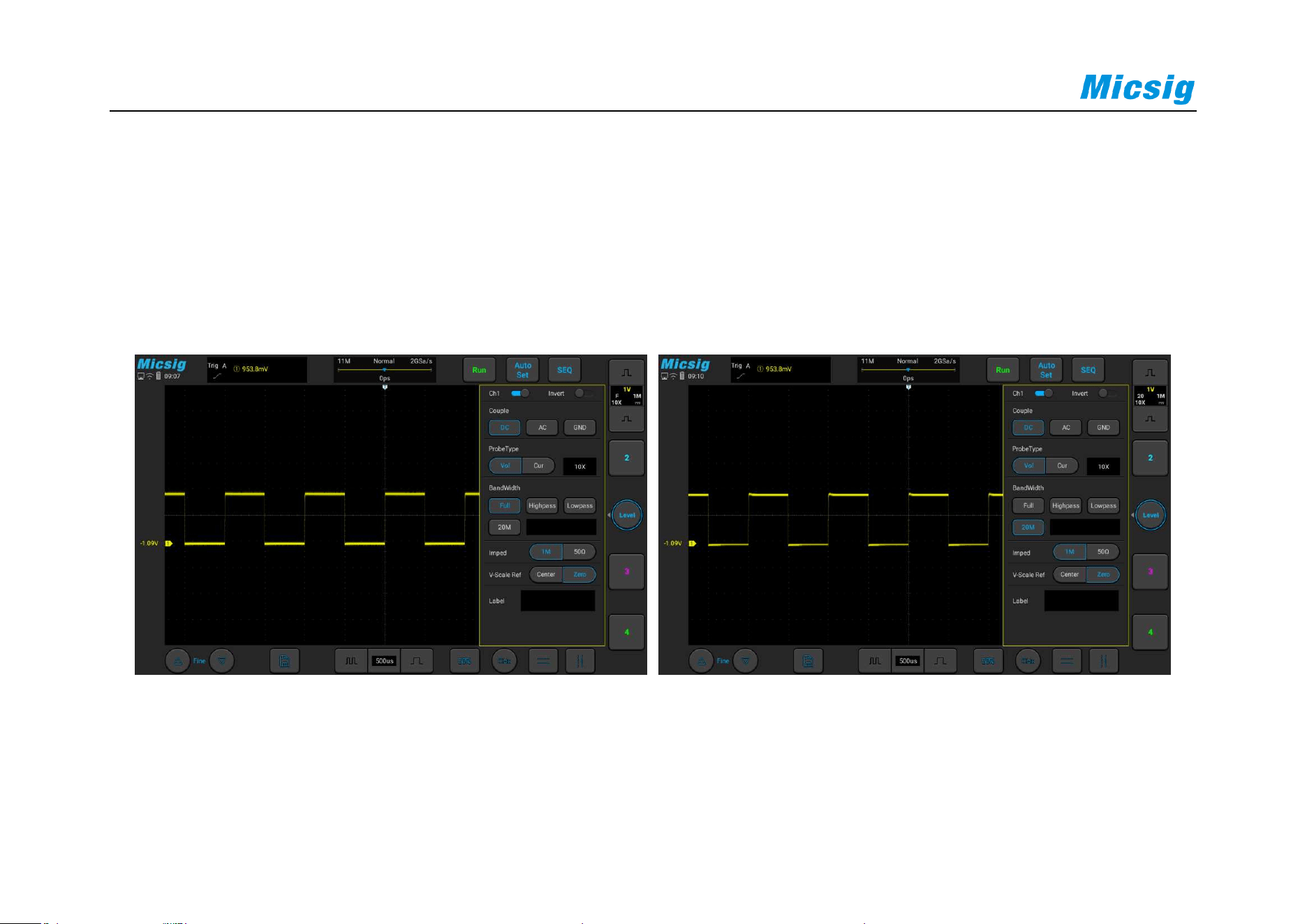
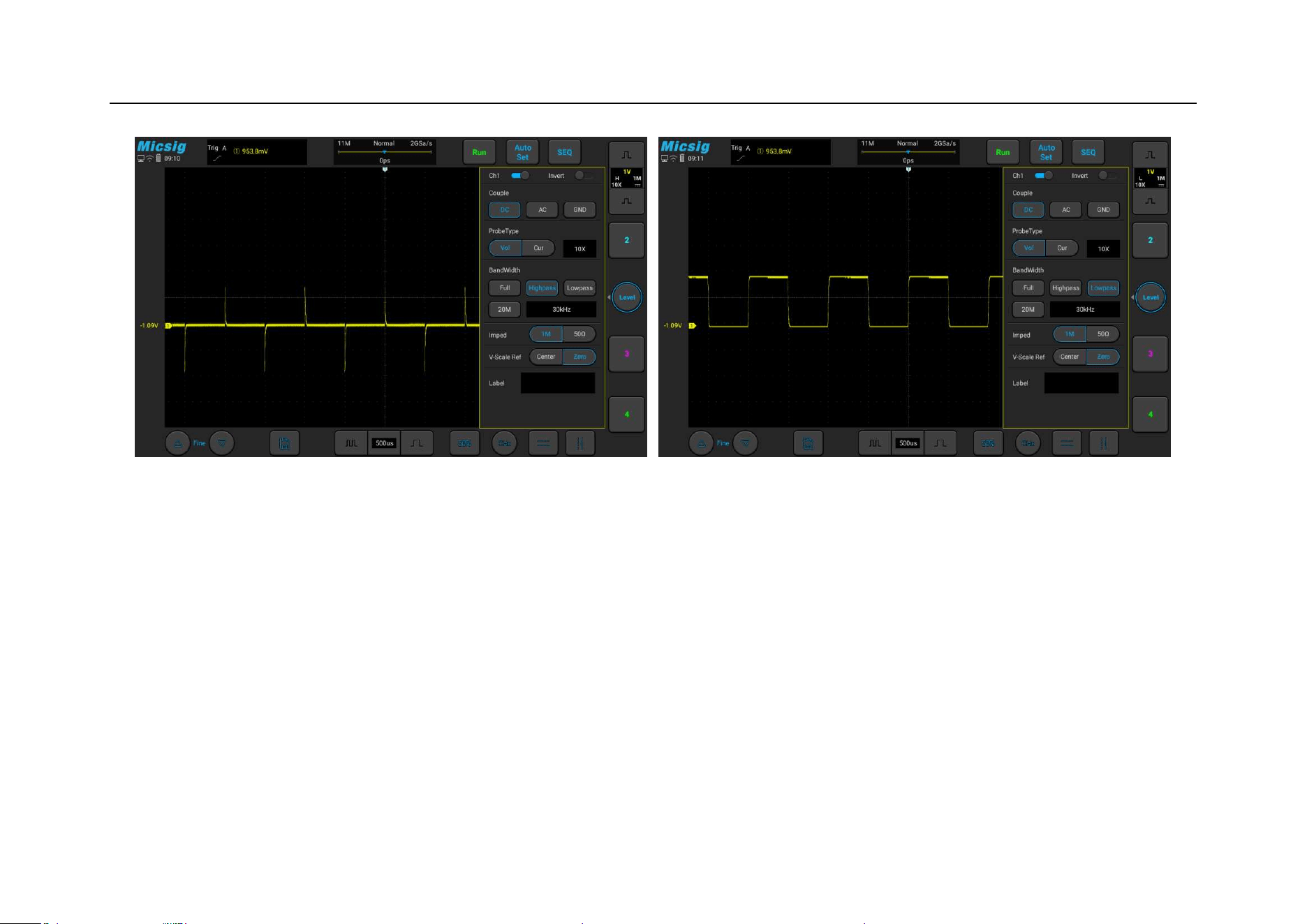
The difference in bandwidth limitation can be visualized by the waveform. The full bandwidth is shown in Figure
4-10, the 20M bandwidth is shown in Figure 4-11, the high pass is shown in Figure 4-12, and the low pass is shown
in Figure 4-13.
Figure 4-10 Full Bandwidth
Figure 4-11 20M Bandwidth
Chapter 4 Vertical System
83
Figure 4-12 High Pass
Figure 4-13 Low Pass
4.4.3 Waveform Inversion
After selecting “Invert”, the voltage value of the displayed waveform is inverted. Inversion affects the way the
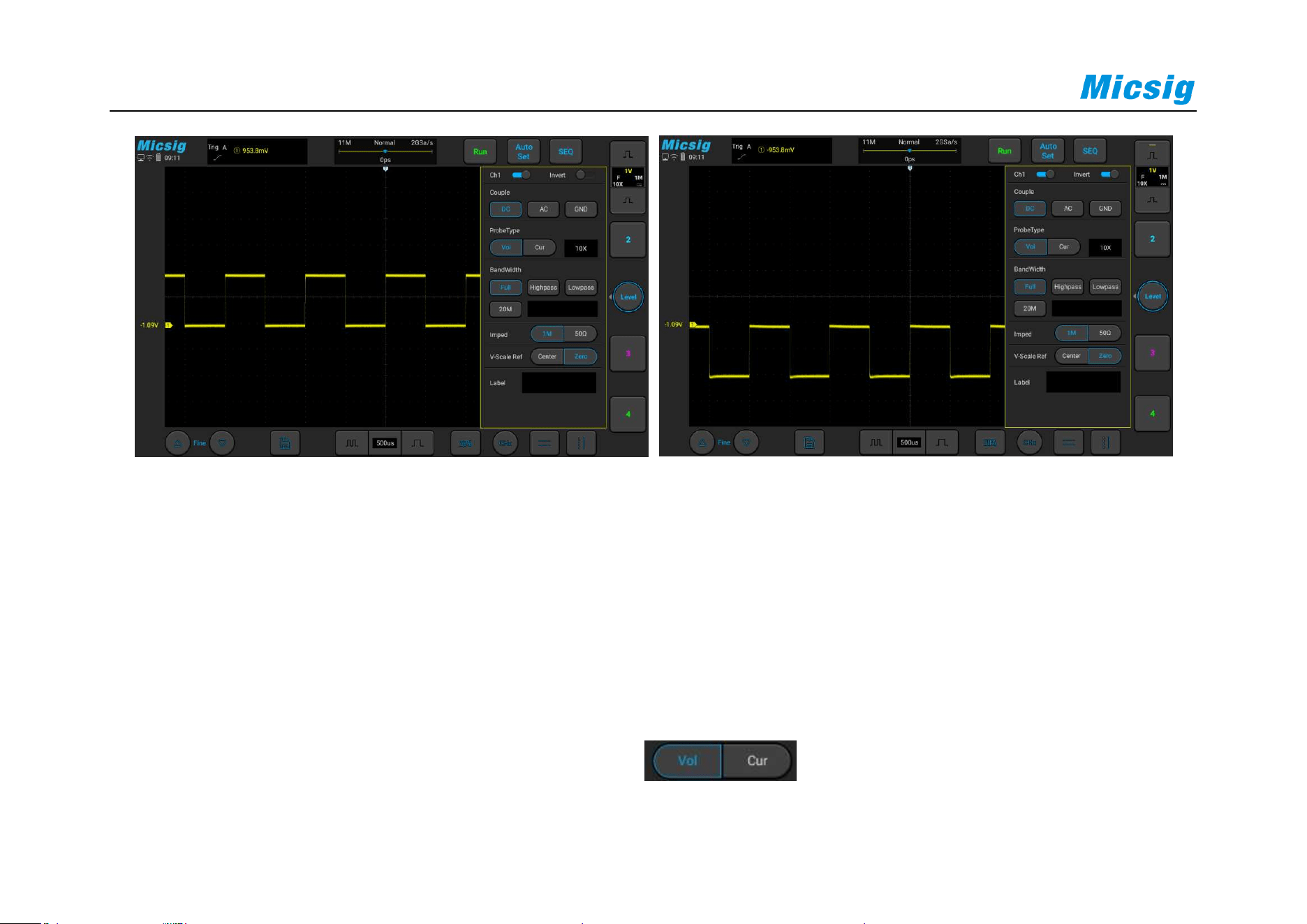
channel is displayed. When using a basic trigger, you need to adjust the trigger level to keep the waveform stable.
84
Figure 4-14 Before Inversion Figure 4-15 After Inversion
4.4.4 Set Probe Type
Probe types are divided into voltage probe and current probe.
Probe type adjustment steps:
Open the channel menu, find the “Probe Type” checkbox in the channel menu, then select:
Vol - corresponding the voltage probe.

Chapter 4 Vertical System
85
Cur - corresponding the current probe.
4.4.5 Set Probe Attenuation Coefficient
When measuring with a probe, the correct measurement result can only be obtained by setting the correct probe
attenuation ratio. In order to match the actual probe attenuation ratio, it is necessary to adjust the channel
attenuation factor correspondingly under the channel menu. When probe attenuation ratio is changed, the
corresponding attenuation ratio must be set on the channel menu to ensure the correctness of the waveform
amplitude and measurement result displayed by the oscilloscope.
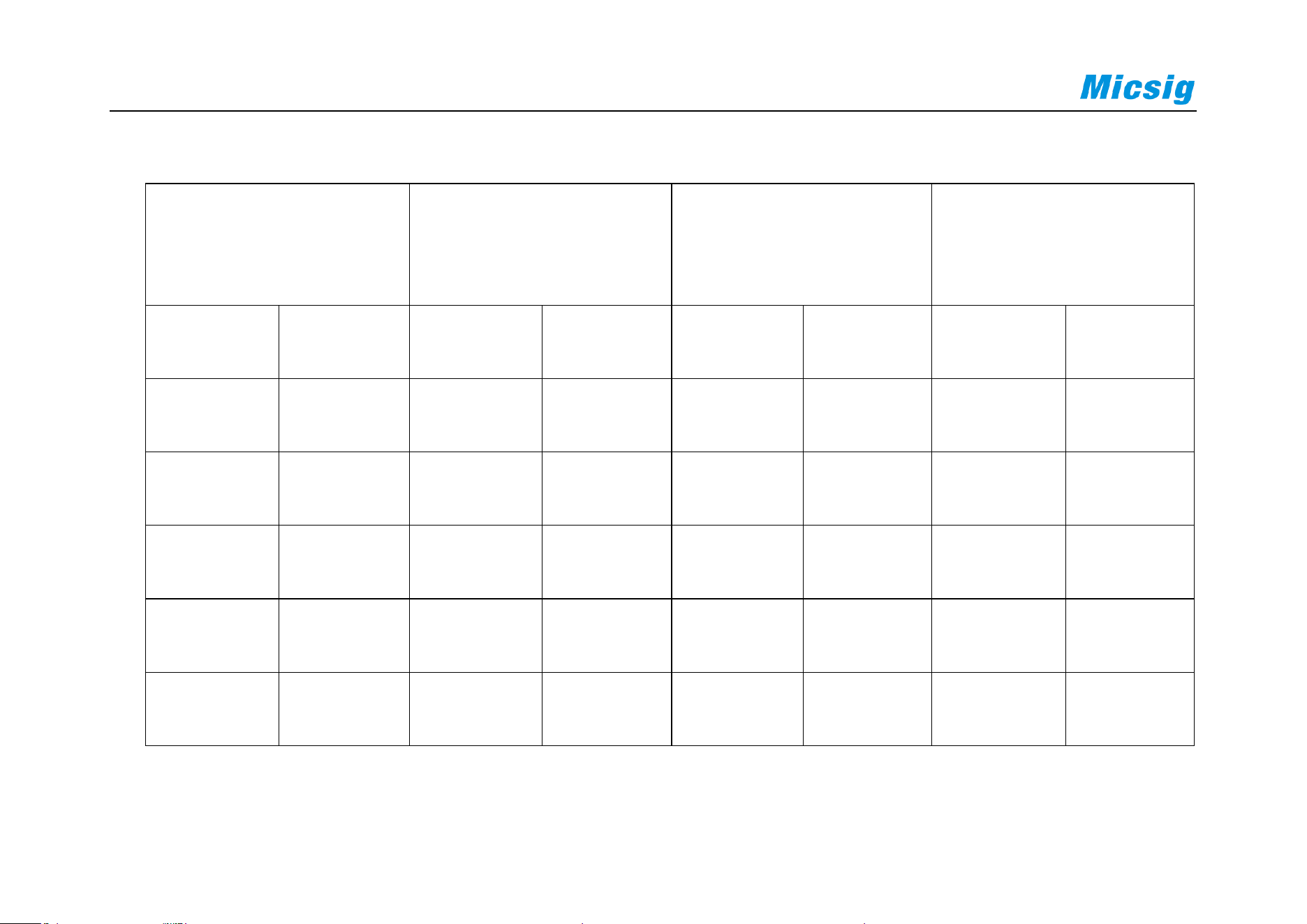
86
Probe attenuation ratio and menu attenuation ratio are shown in the table below:
Probe attenuation ratio
Menu attenuation ratio
Probe attenuation ratio
Menu attenuation ratio
Probe attenuation ratio
Menu attenuation ratio
Probe attenuation ratio
Menu attenuation ratio
0.001:1
1mx
0.1:1
100mx
10:1
10x
1000:1
1kx
0.002:1
2mx
0.2:1
200mx
20:1
20x
2000:1
2kx
0.005:1
5mx
0.5:1
500mx
50:1
50x
5000:1
5kx
0.01:1
10mx
1:1
1x
100:1
100x
10000:1
10kx
0.02:1
20mx
2:1
2x
200:1
200x
0.05:1
50mx
5:1
5x
500:1
500x
Table 4-2 Probe Attenuation Ratio Correspondence Table

Chapter 4 Vertical System
87
4.4.6 Vertical Expansion Reference
When using vertical expansion, click the center or zero point.
Center: Click the center, adjust the vertical scale, and the oscilloscope waveform is expanded with the screen center
as reference
Zero point: Click the zero point, adjust the vertical scale, and the oscilloscope waveform is expanded with the
waveform zero point as reference
4.4.7 Labels
Labels can be added to each analog channel as needed, and the added label is displayed behind the channel
indicator.
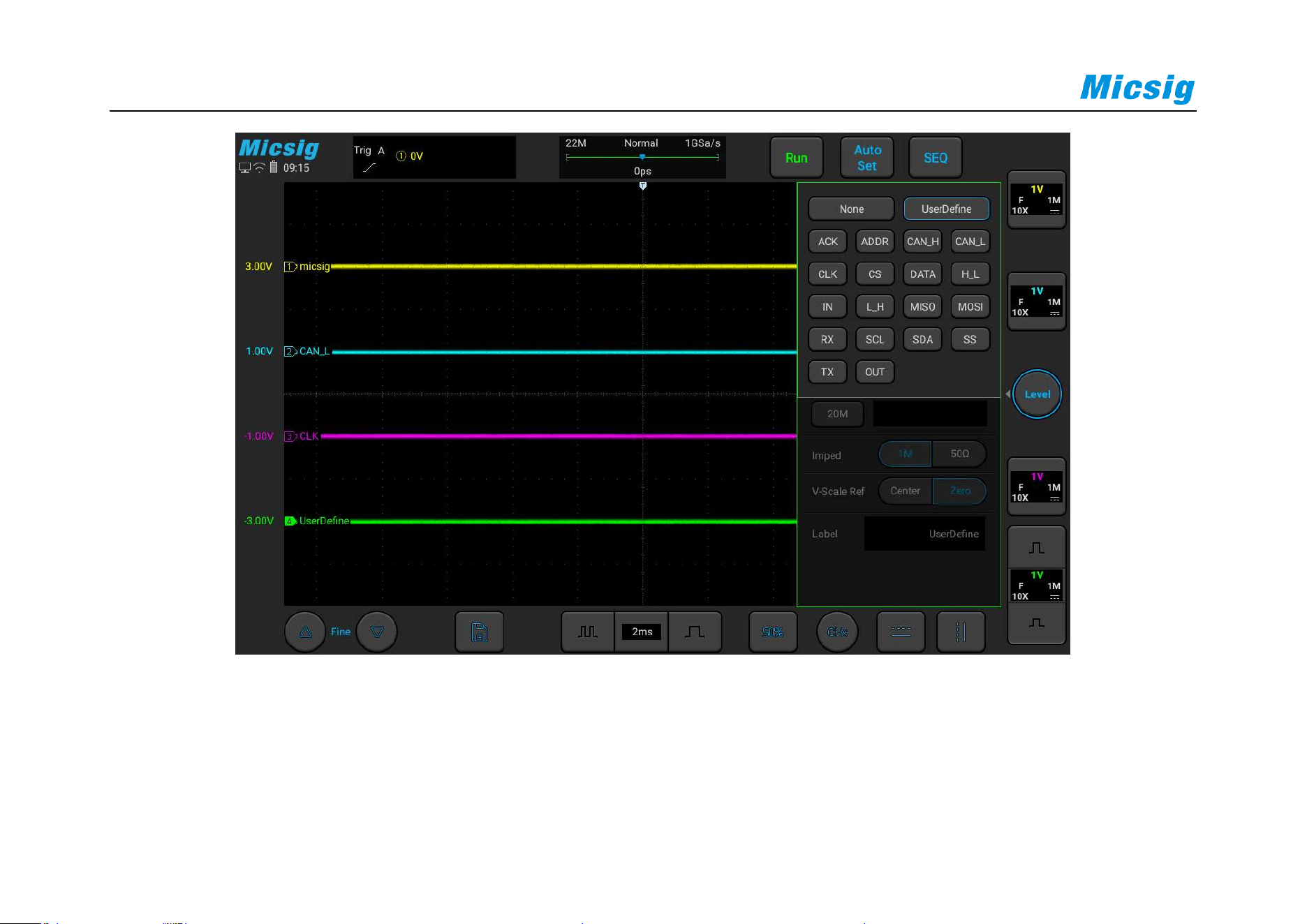
Channel labels can be selected: none, custom, preset (including ACK, ADDR, CAN_H, CAN_L, CLK, CS, DATA,
H_L, IN, L_H, MISO, MOSI, RX, SCL, SDA, SS, TX, OUT) .
88
Figure 4-16 Label
Note: Customization supports up to 16 characters.

Chapter 4 Vertical System
89
4.4.8 Channel Input impendance
Choose the appropriate impedance according to the actual test matching cable or probe, you can choose "1MΩ" or
"50Ω", the default input impedance is 1MΩ.
1MΩ-also known as high resistance, matching most passive probes, can minimize the load effect of the oscilloscope
on the device under test.
50Ω-In high frequency measurement, 50 Ω cables or active probes are commonly used, and 50 Ω impedance
matching is required.
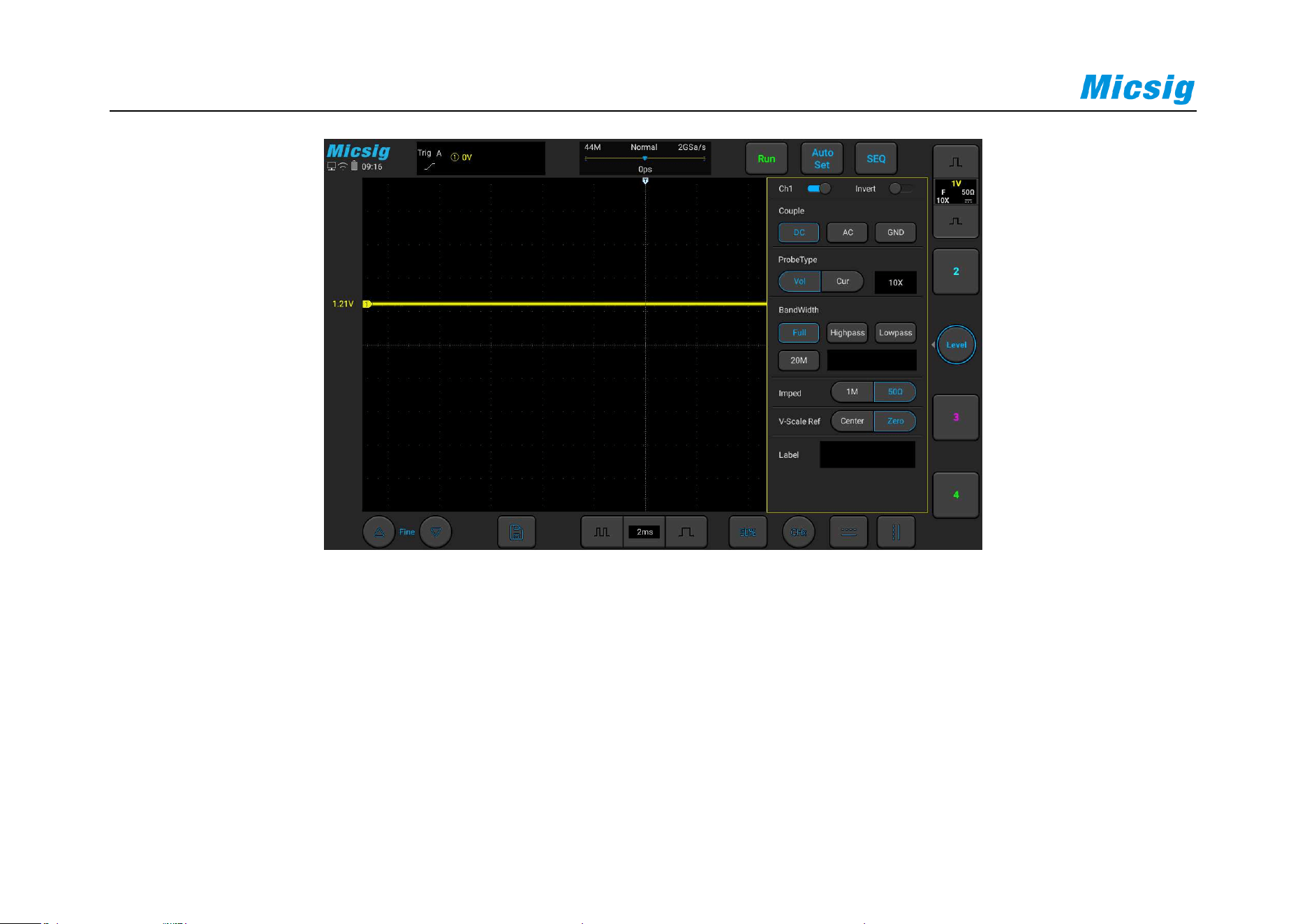
Choosing a proper impedance matching can minimize reflections along the signal path and make the measurement
more accurate. Please refer to Figure 4-17 for input impedance setting.
90
Figure 4-17 Channel Input impendance
Note: When switching channel input impedance, you need to pay attention to the input voltage not to exceed the
allowable voltage;
In order to obtain protection for the channel input, the oscilloscope input impedance is 1MΩ by default in the
shutdown state.

Chapter 5 Trigger System
91
Chapter 5 Trigger System
This chapter contains the detailed information of the trigger system of the oscilloscope. You are recommended to
read this chapter carefully to understand the set functions and operation of the trigger system of the Smart series
oscilloscope.
Trigger and trigger adjustment
Slope trigger
Edge trigger
Time out trigger
Pulse width trigger
Video trigger
Logic trigger
Serial bus trigger
Nth edge trigger
Runt trigger
92
5.1 Trigger and Trigger Adjustment
What is Trigger?
The oscilloscope can capture a waveform only when it meets a preset condition first. This action of capturing the
waveform according to the condition is Trigger. The so-called capture waveform is that the oscilloscope grabs a
signal and displays it. If it is not triggered, there is no waveform display.
What can Trigger be used for?
Chapter 5 Trigger System
93
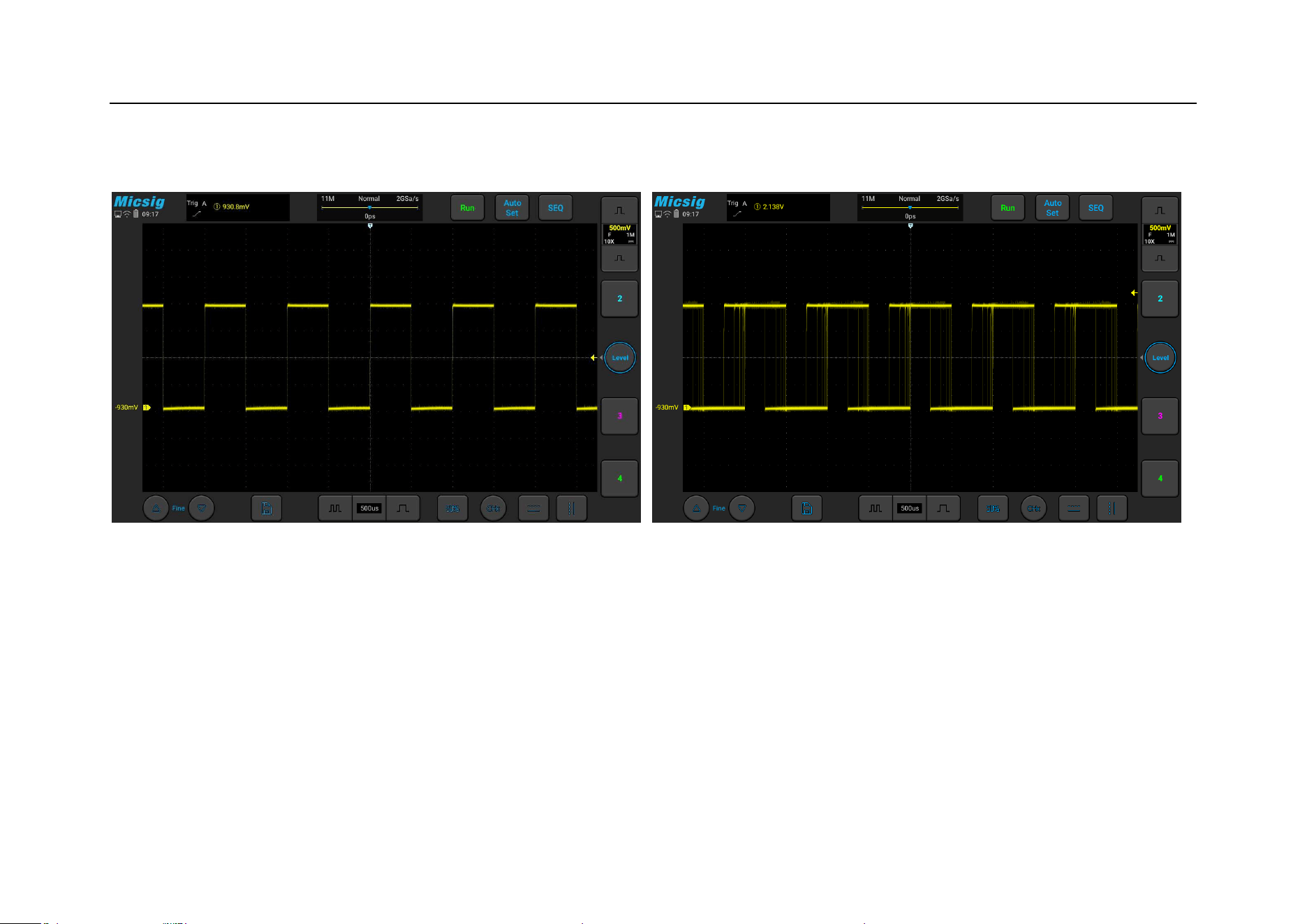
(1) The oscilloscope can stably display a periodic signal.
Figure 5-1 Stably Displayed Periodic Signal Figure 5-2 Non-Stably Displayed Periodic Signal
94
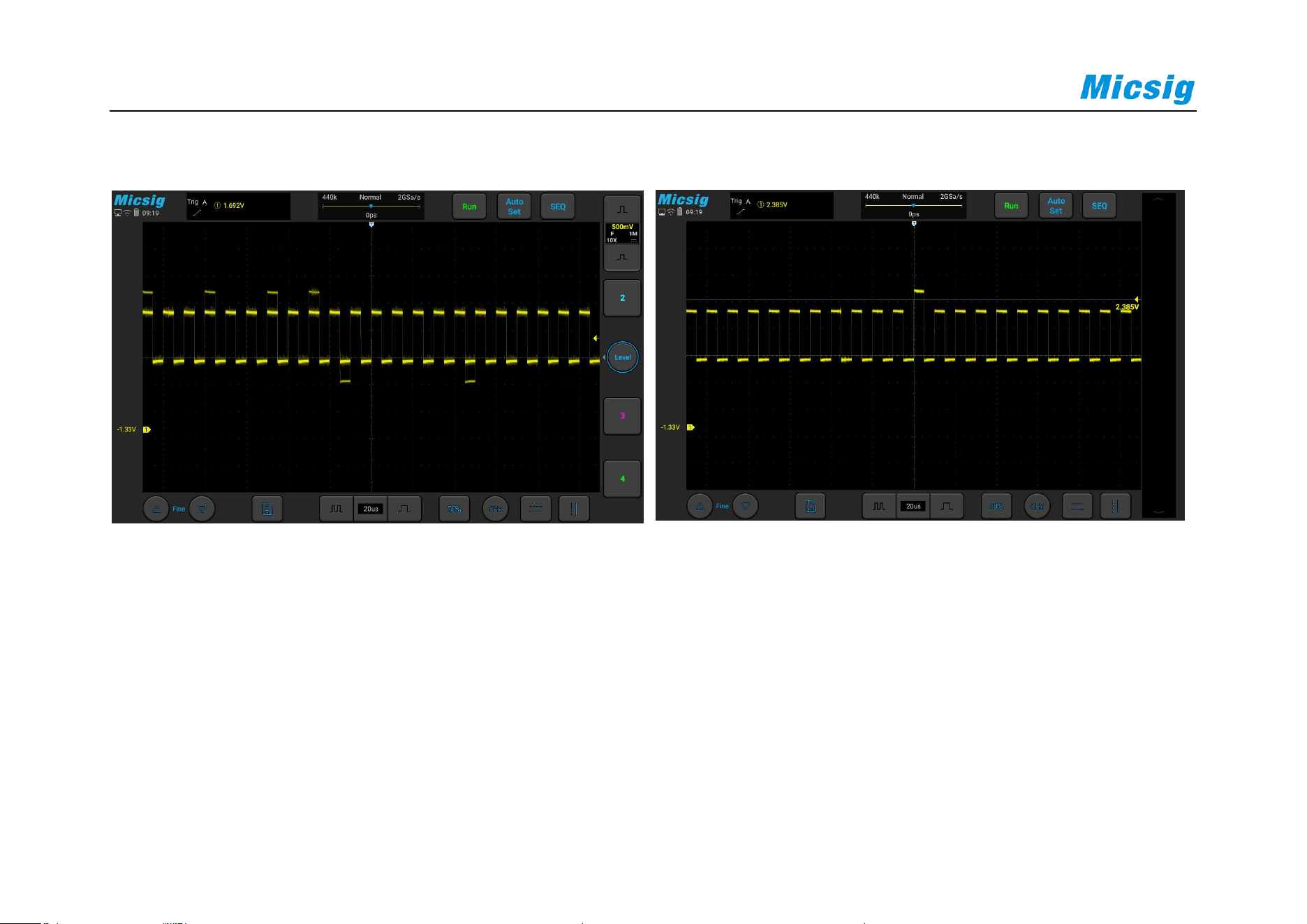
(2) Grab the segment you want to observe from a fast and complex signal
Figure 5-3 Abnormal Signal in Periodic Signals
Figure 5-4 Abnormal Signal Captured by Setting
Trigger Level

Chapter 5 Trigger System
95
What is Forced Trigger?
When the oscilloscope does not meet the trigger condition, the artificial or automatic oscilloscope trigger is the
forced trigger. It means that the oscilloscope only grabs a signal segment for display regardless of whether the
condition is met or not.
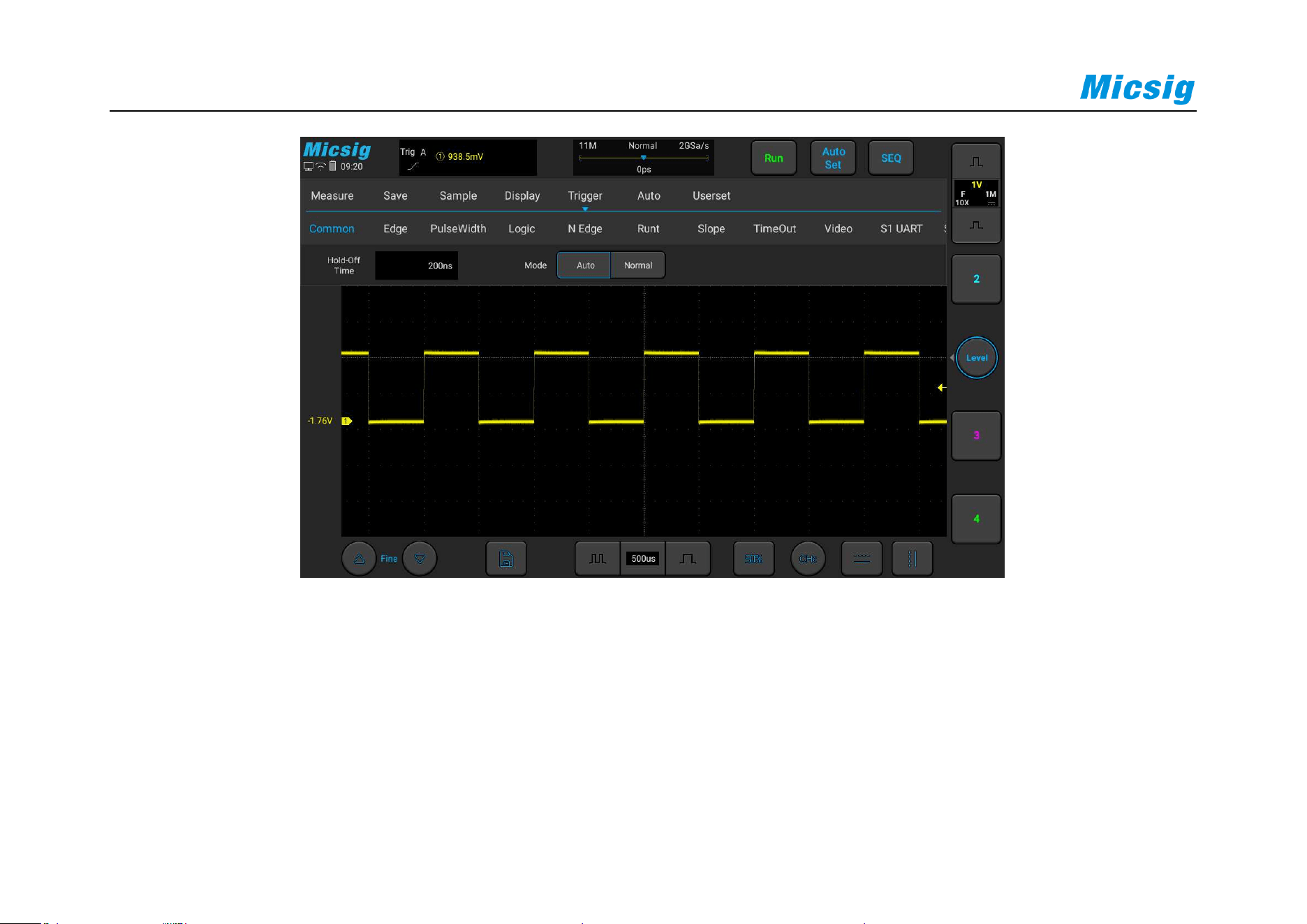
Automatic forced trigger is set in the menu. In the trigger settings, there is usually a trigger mode option, which can
be set as “Normal” or “Auto”. Normal trigger means trigger after meeting the set condition. Automatic trigger is a
kind of forced trigger. The oscilloscope will be force triggered if it does not trigger for a certain period of time.
96
Figure 5-5 Oscilloscope Trigger Mode Setting
If a signal feature is not understood, the oscilloscope should be set as “Auto” mode, which can ensure that the
oscilloscope can also display the waveform when other trigger settings are not correct. Although the waveform is
not necessarily stable, it can provide the intuitive judgment for our further adjustment of the oscilloscope. The
signal in Figure 2-9 is the result of forced trigger in “Auto” mode.
Chapter 5 Trigger System
97
When we set a specific trigger condition for a specific signal, especially when the time interval for satisfying the
trigger condition is long, we need to set the trigger mode to “Normal” so as to prevent the oscilloscope from
automatic forced trigger.
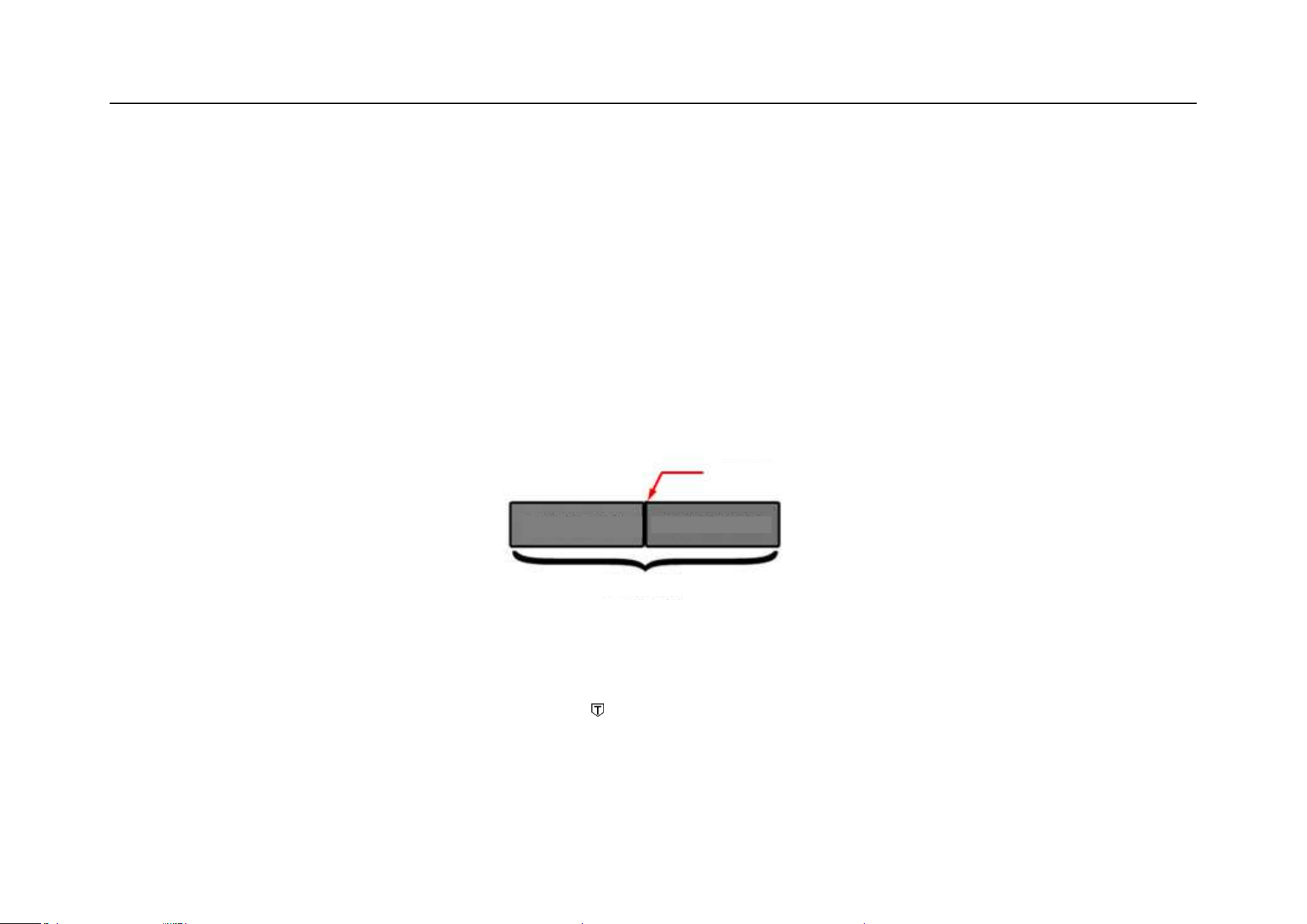
Figure 5-6 shows a conceptual demonstration of the acquisition memory. In order to understand the trigger event,
the acquisition memory can be divided into pre-trigger and post-trigger buffers. The position of the trigger event in
the acquisition memory is defined by the time reference point and trigger position (horizontal delay) settings.
Figure 5-6 Conceptual Demonstration of Acquisition Memory
All events displayed to the left of the trigger point occur before trigger. These events are called pre-trigger
messages that show events before the trigger point. All events to the right of the trigger point is called post-trigger
Trigger Event
Acquisition Memory
Pre-trigger Buffer
Post-trigger Buffer
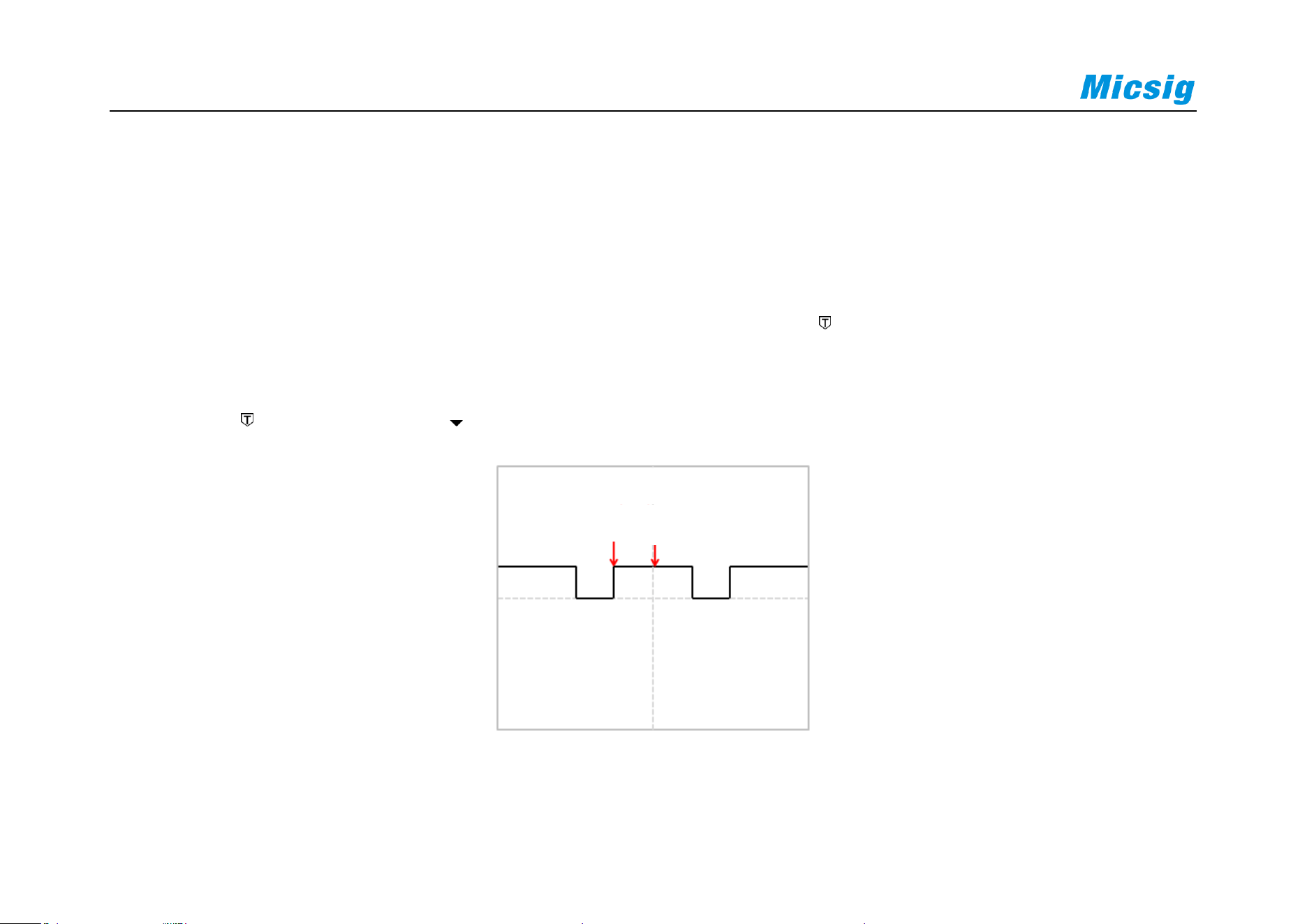
98
messages. The number of delay ranges available (pre-trigger and post-trigger messages) depends on the selected
time base and memory depth.
Adjust trigger position (horizontal delay)
Fingers swipe left and right in the waveform display area, the trigger point will move horizontally, the horizontal
delay time changes, and the delay time is displayed at the top center of the screen, that is, the distance between the
trigger point and the center line of the waveform display area is displayed.
Figure 5-7 Horizontal Delay
Horizontal Delay
Trigger
Center Position
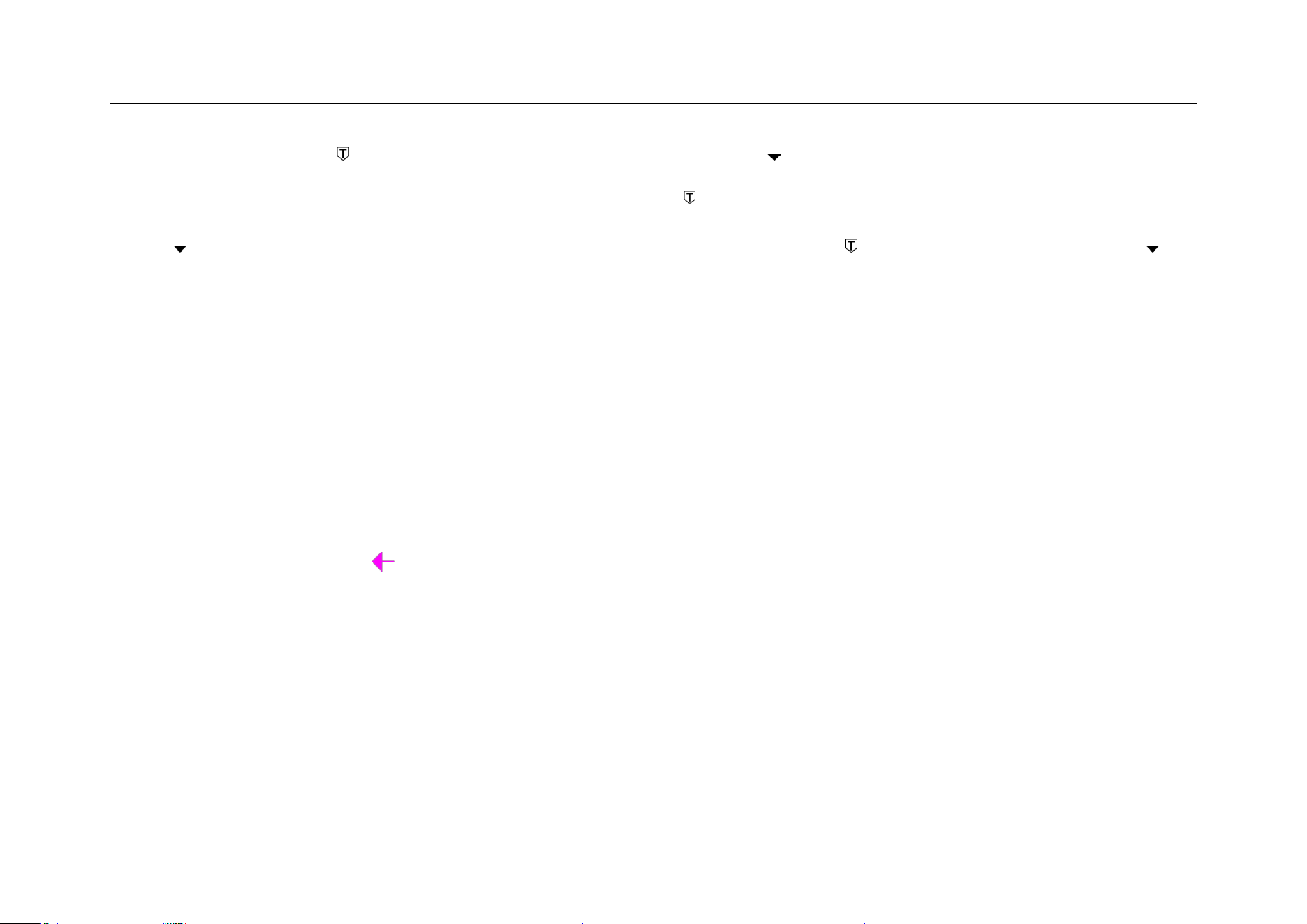
Chapter 5 Trigger System
99
When the trigger point is located on the left side to the center line of the waveform display area, the delay
time is displayed as a positive value; When the trigger point is located on the right side to the time reference
point , and the delay time is displayed as a negative value; the trigger point overlaps with the center line of
the waveform display area, and the delay time is zero.
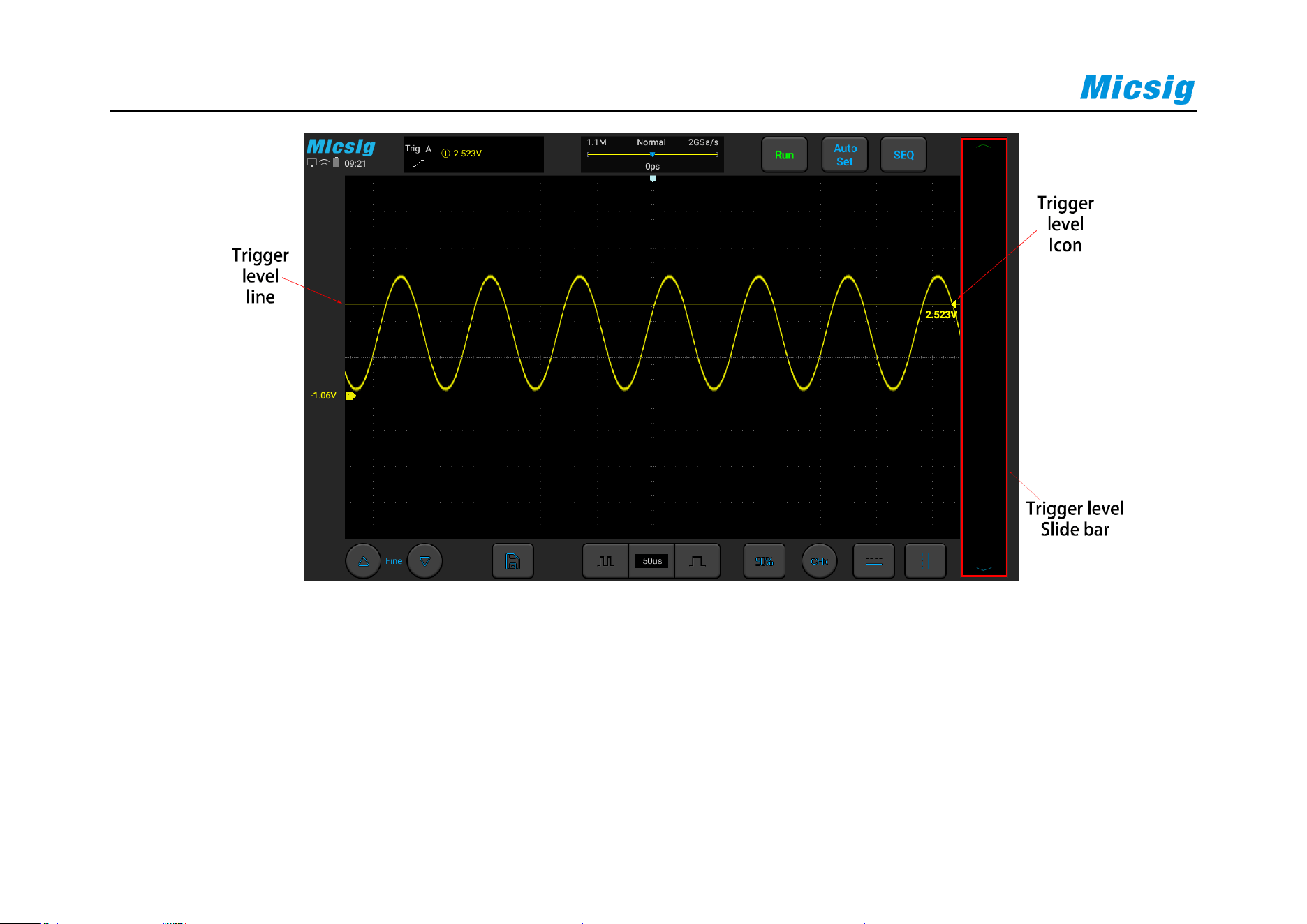
Trigger level
Trigger level is the signal voltage corresponding to the set trigger point. When the trigger level is changed, a
horizontal line will appear temporarily on the screen to tell you the level position (the specific value of the trigger
level is displayed in the upper right corner of the screen), then the horizontal line disappears, the trigger level is
indicated by a small arrow and the indication icon can be dragged to adjust the trigger level value. The trigger
level is shown in Figure 5-8 (the arrow indicates the trigger level line).
100
Figure 5-8 Trigger Level
Adjust trigger level
The trigger level can be coarsely adjusted and finely adjusted.
Coarse adjustment: Slide up and down in the trigger level adjustment area.
Chapter 5 Trigger System
101
Fine adjustment: Tap the fine adjustment button in the lower left corner of the screen for fine adjustment of the
trigger level.
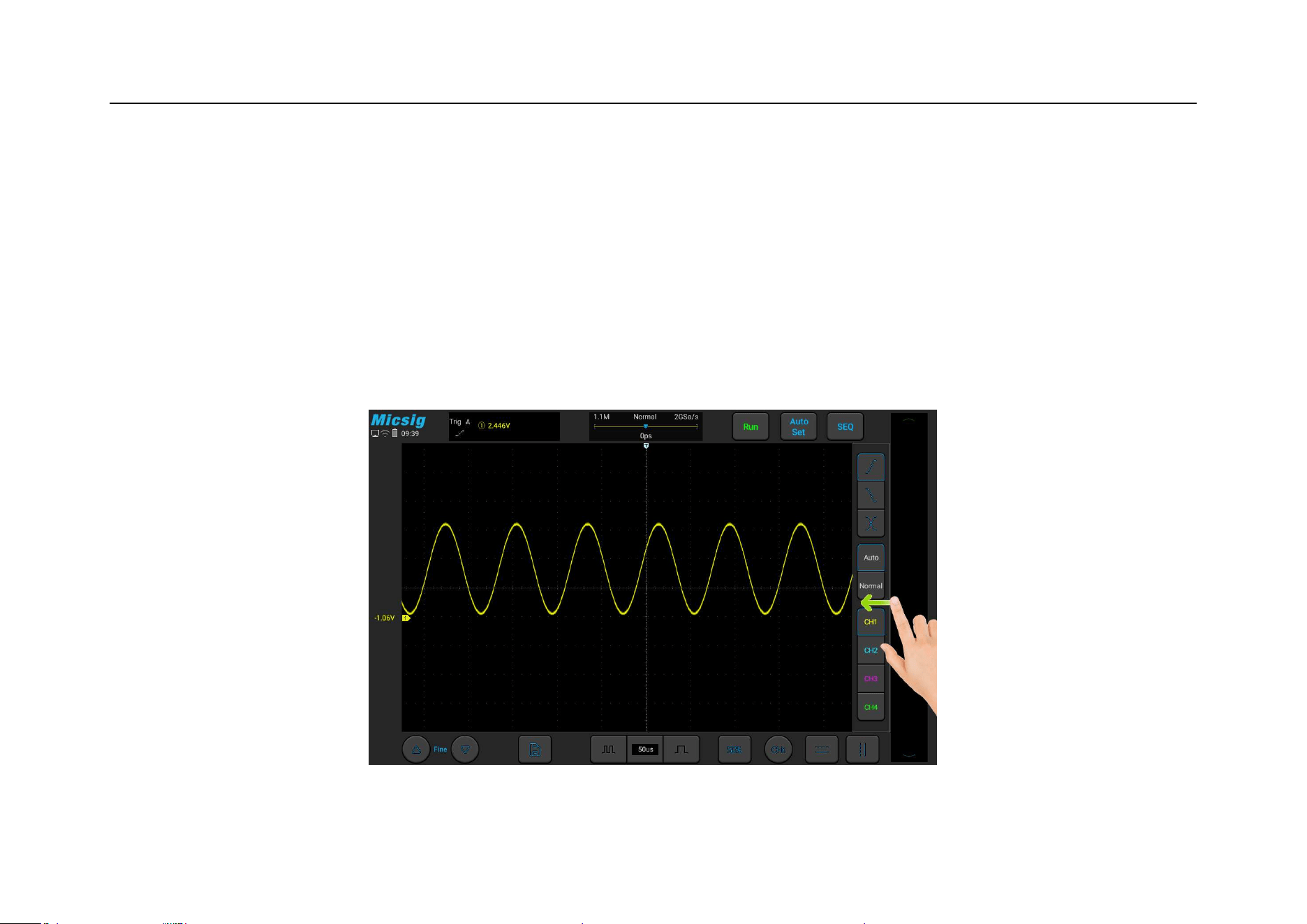
Trigger setting shortcut
Left swipe from trigger level slide bar to open trigger setting shortcut, which includes trigger source, trigger mode
etc.
Figure 5-9 Trigger setting shortcut
102
Set trigger hold-off time
The trigger hold-off time can set up the waiting time of the oscilloscope after the trigger and before the trigger
circuit is reconnected. During hold-off time, the oscilloscope does not re-trigger until the end of the hold-off time,
and the hold-off time can be used to stably trigger complex waveforms. The trigger hold-off time ranges from
200ns~10s.
The hold-off may be used to trigger on repetitive waveforms with multiple edges (or other events) between
waveform repetitions. If the shortest time between triggers is known, the hold-off may also be used to trigger on the
first edge.
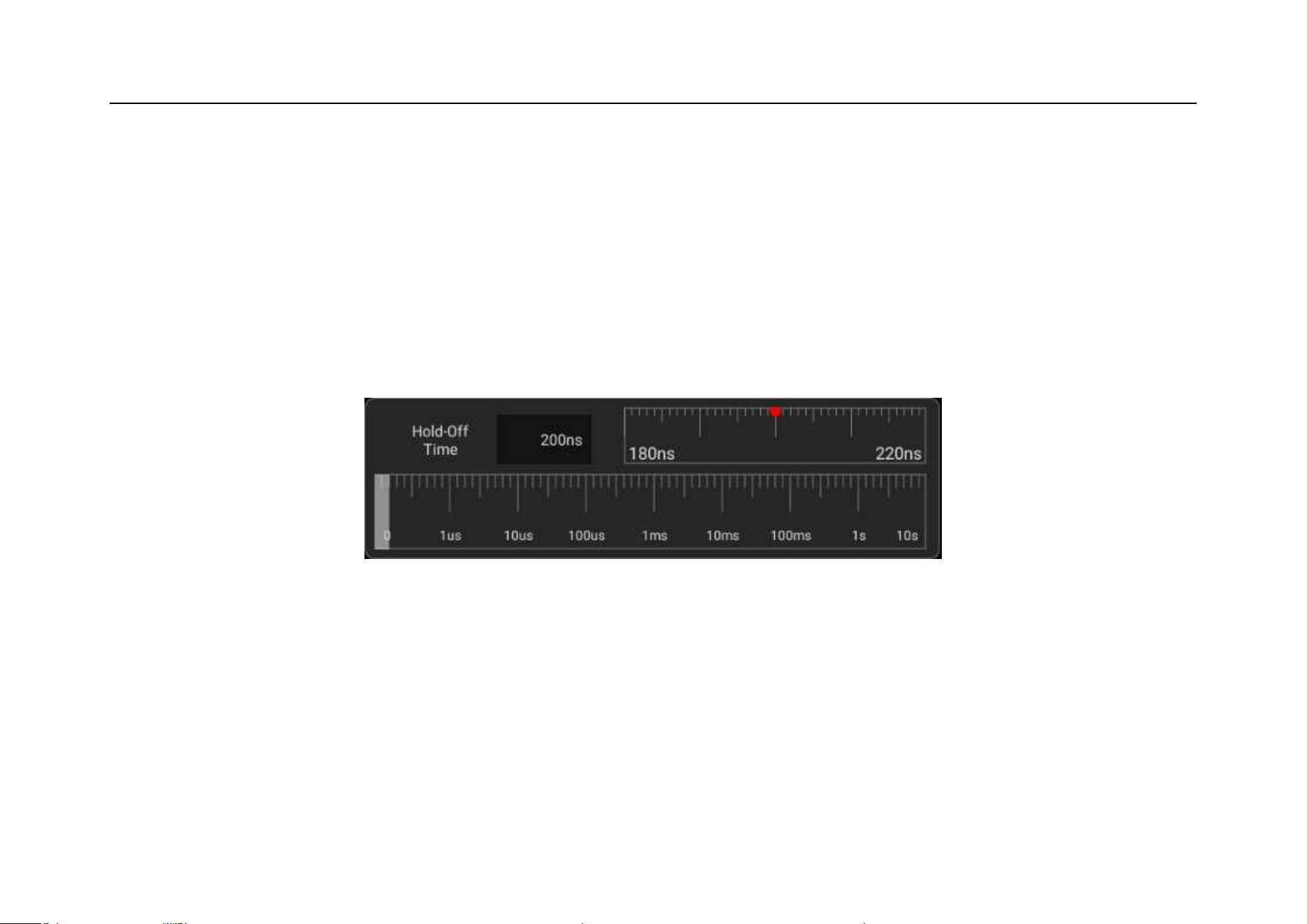
For example, to obtain stable trigger on the repetitive pulse trigger shown below, set the hold-off time to a
value >200ns but <600ns.
Figure 5-10 Trigger Hold-Off Time
Hold-off Time
Oscilloscope Trigger Position
Chapter 5 Trigger System
103
Set trigger hold-off time:
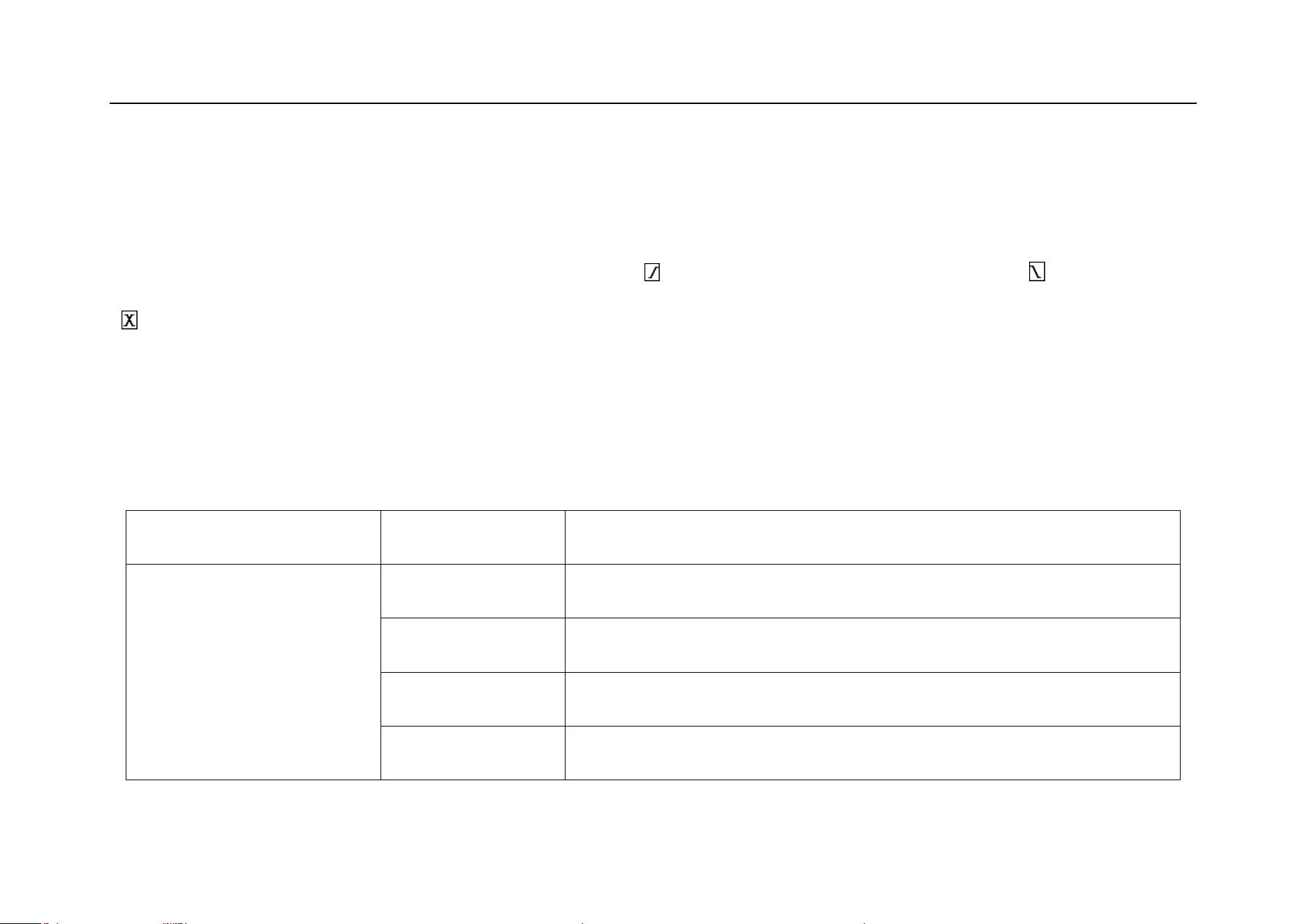
1) Tap “Trigger” on the main menu to open the trigger menu. Under “Common”, tap the box after “Rejection
Time” to open the hold-off time adjustment interface. The trigger time is displayed on the upper left, the fine
adjustment time scale is displayed on the upper right, and the coarse time scale is displayed below, as shown in
Figure 5-11.
Figure 5-11 Trigger Hold-Off Time Set Interface
2) When adjusting the time, drag or tap the coarse adjustment scale for coarse adjustment, and then drag the fine
adjustment scale for fine adjustment of the hold-off time.

104
Trigger hold-off operation prompt
It is typically used for complex waveforms. The correct rejection setting is usually slightly smaller than one
repetition of the waveform. Setting the hold-off time to this time can become the only trigger point for the repetitive
waveform.
Changing the time base setting will not affect the trigger hold-off time.
Using Zoom function, you can tap “Run/Stop” to stop, then horizontally move and zoom the data to find the
position where the waveform is repeated. Use the cursor to measure this time and then set the hold-off time.
Use “SingleSEQ” button for single acquisition
Usually when performing a single acquisition, you must initiate some operations on the measured equipment, and
the oscilloscope is not desired to trigger automatically before these operations. The trigger condition indicator
is displayed in the upper left corner of the screen before starting operations in the circuit (this means the pre-trigger
buffer is filled).
Chapter 5 Trigger System
105
5.2 Edge Trigger
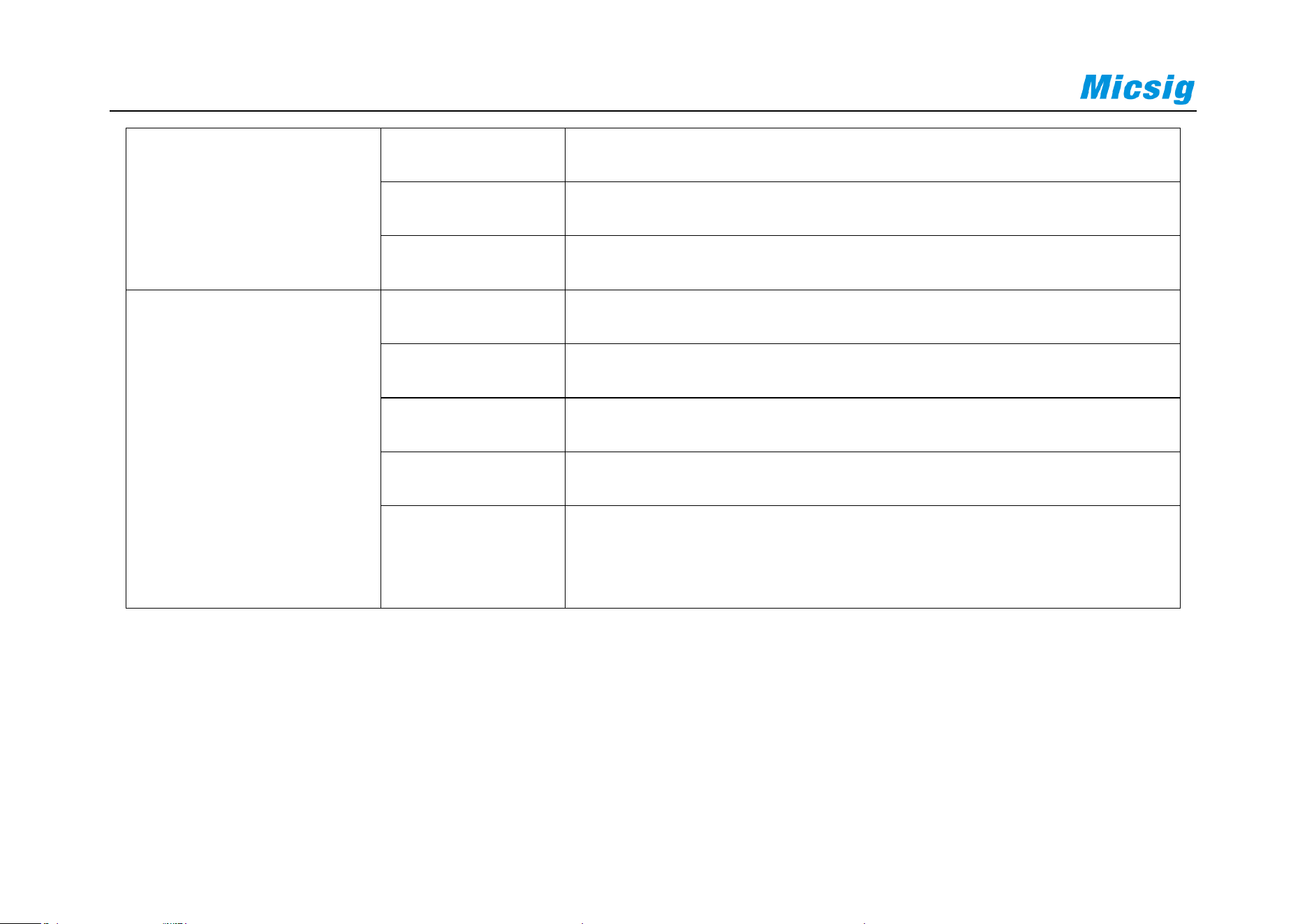
When the edge of trigger signal reaches a certain trigger level, the set signal is triggered and generated. Trigger
occurs on either edge of the rising edge (indicating icon at the top of the screen), falling edge ( ) or dual edge
( ), and the trigger level can be set to change the vertical position of the trigger point on the trigger edge, namely
the intersection point of the trigger level line and the signal edge. The stable waveform can be obtained by correctly
setting the edge trigger coupling mode. Edge trigger menu is shown in the table below:
Trigger Option
Setting
Description
Trigger Source
CH1
Set CH1 as trigger signal source
CH2
Set CH2 as trigger signal source
CH3
Set CH3 as trigger signal source
CH4
Set CH4 as trigger signal source
106
Slope
Rising edge
Set signal trigger on the rising edge
Falling edge
Set signal trigger on the falling edge
Dual edge
Set signal trigger on either rising edge or falling edge
Coupling
DC
AC and DC components getting through trigger signals
AC
Filter out the DC component of trigger signals
HF rejection
Suppress signals above 50KHz in trigger signals
LF rejection
Suppresses signals below 50KHz in trigger signals
Noise rejection
Low-sensitivity DC coupling to suppress high-frequency noise
in trigger signals
Set CH1 rising edge trigger and coupling as DC with operation steps as follows:
1) Tap “Trigger” on the main menu to open the trigger menu, select edge trigger in the trigger type, and set edge
trigger as follows, as shown in Figure 5-11:
Trigger source: CH1;
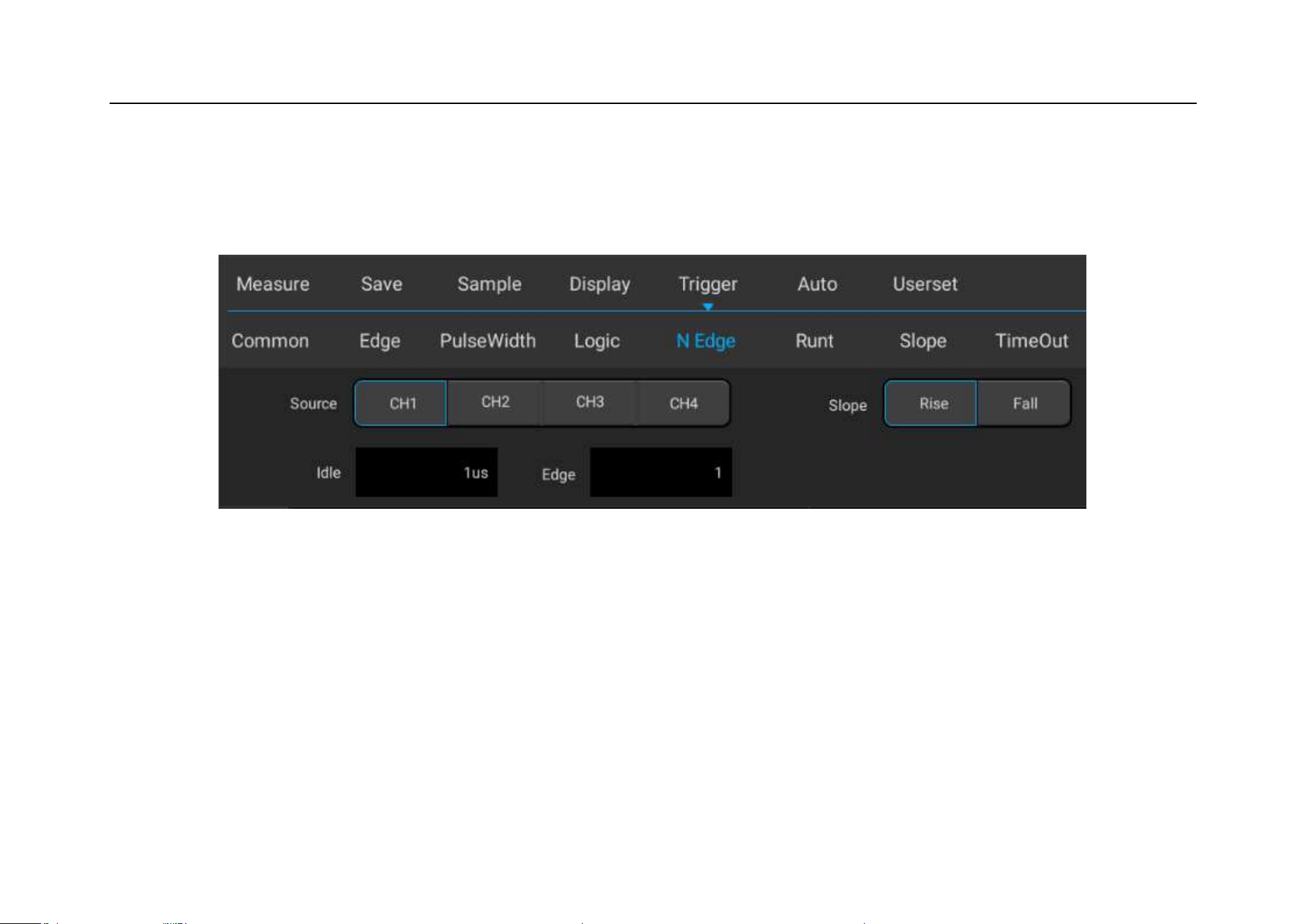
Chapter 5 Trigger System
107
Trigger coupling mode: DC;
Trigger edge: rising.
Figure 5-12 Edge Trigger Setting Menu
2) Adjust the trigger level to ensure that the waveform can be triggered stably, for example, the trigger level is set
to 1V.
108
Trigger coupling description
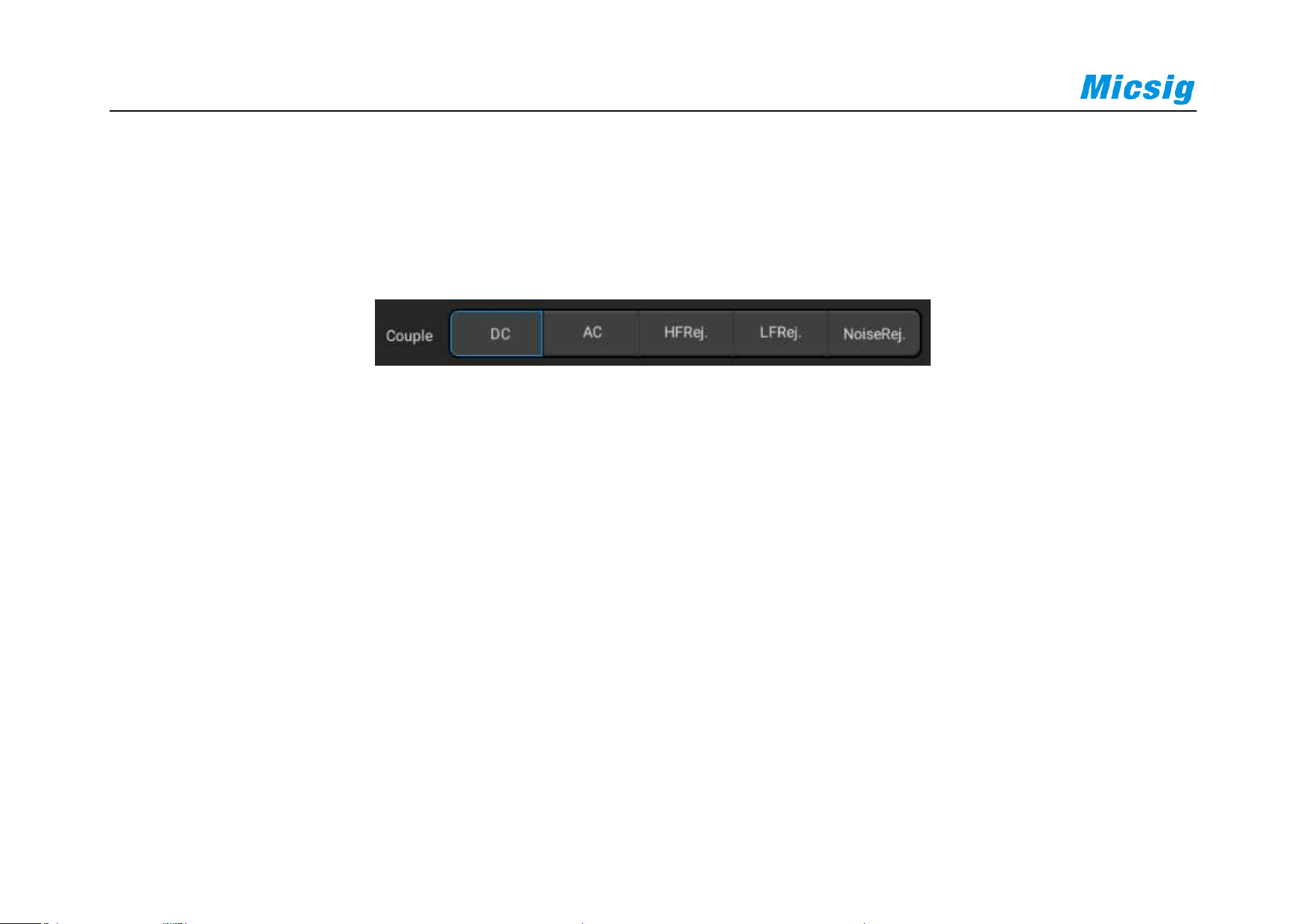
When the edge trigger setup menu is opened, the trigger coupling option is displayed below the menu. Trigger
coupling includes DC, AC, HFRei., LFRej., NoiseRej, see Figure 5-13:
Figure 5-13 Trigger Coupling Menu
1) DC coupling - allows DC and AC signals to enter the trigger path.
2) AC coupling - removes any DC offset voltage from the trigger waveform.
When the waveform has a large DC offset, stable edge triggering can be achieved using AC coupling.
3) HFRej. (High Frequency Rejection Coupling) - removes high frequency components from the trigger
waveform, using high frequency rejection to remove high frequency noises or noises from fast system clocks,
from trigger paths such as AM or FM radio stations.

Chapter 5 Trigger System
109
4) LFRej. (Low Frequency Rejection Coupling) - removes any unnecessary low frequency components from the
trigger waveform, for example, power line frequencies that can interfere with correct trigger.
When there is low frequency noise in the waveform, stable edge triggering can be obtained using LF rejection
coupling.
5) NoiseRej. (Noise Rejection Coupling) - Noise rejection can add extra hysteresis to the trigger circuit. By
increasing the trigger hysteresis band, the possibility of noise triggering can be reduced. But it also reduces the
trigger sensitivity, so triggering the oscilloscope requires a slightly larger signal.
Note: Trigger coupling is independent of channel coupling.
110
5.3 Pulse Width Trigger
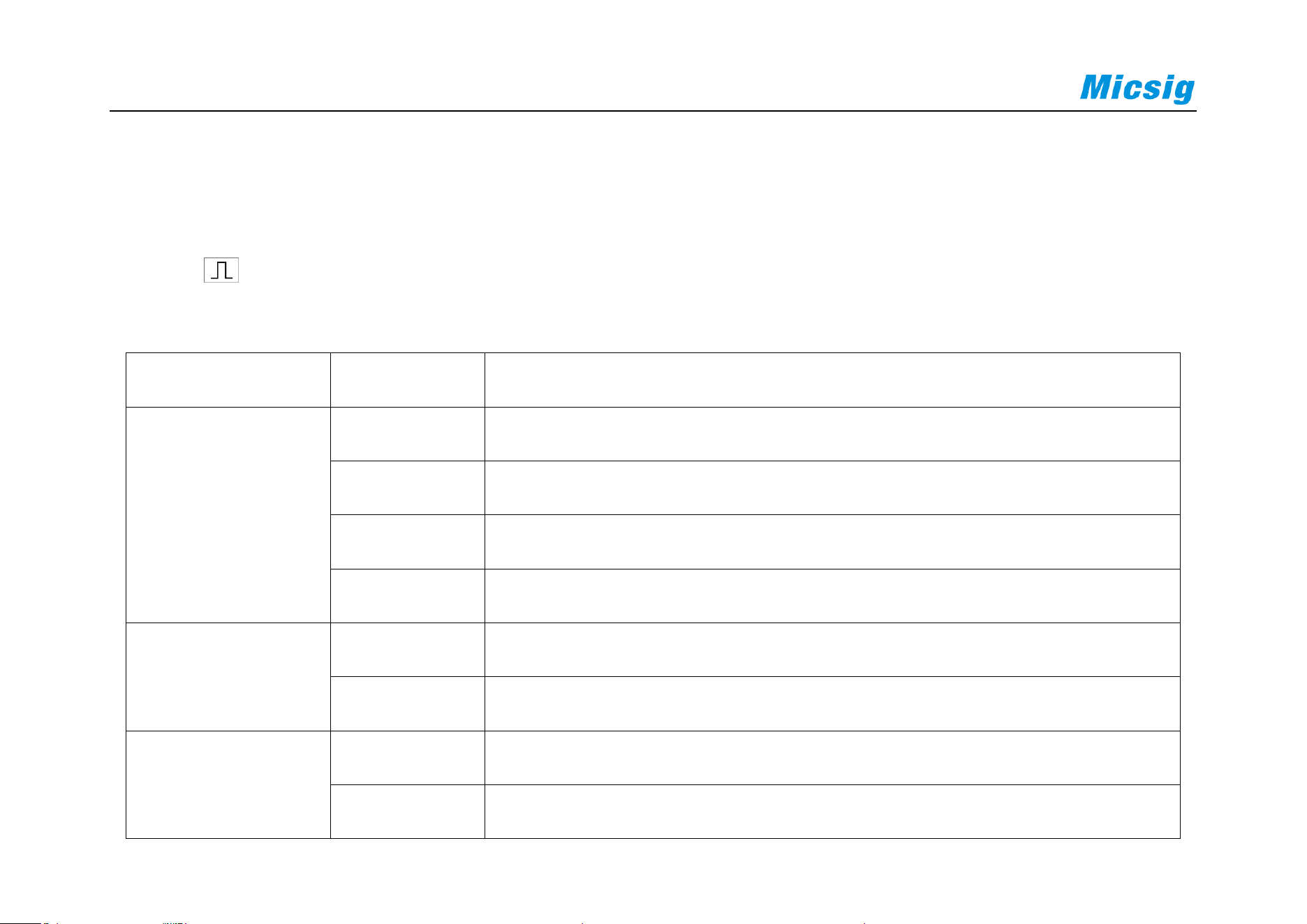
The trigger happens when the trigger signal pulse width (8ns~10s, the trigger type indication icon at the top of the
screen is ) reaches the set condition and the signal voltage reaches the set trigger level. Pulse width trigger
menu is shown in the following table:
Trigger Option
Setting
Description
Trigger Source
CH1
Set CH1 as trigger signal source
CH2
Set CH2 as trigger signal source
CH3
Set CH3 as trigger signal source
CH4
Set CH4 as trigger signal source
Polarity
Positive
Trigger on setting the positive pulse width of signals
Negative
Trigger on setting the negative pulse width of signals
Trigger Condition
<T
Trigger when the signal pulse width is smaller than pulse width T
>T
Trigger when the signal pulse width is greater than pulse width T
Chapter 5 Trigger System
111
Trigger Option
Setting
Description
=T
Trigger when the signal pulse width is equal to pulse width T
≠T
Trigger when the signal pulse width is not equal to pulse width T
Trigger Pulse
Width
8ns~10s
Set the trigger pulse width
Notes: Conditions of greater than, smaller than, equal to or not equal to indicating that the error is 6%.
Trigger steps of positive polarity pulse width: (taking CH1 as an example)
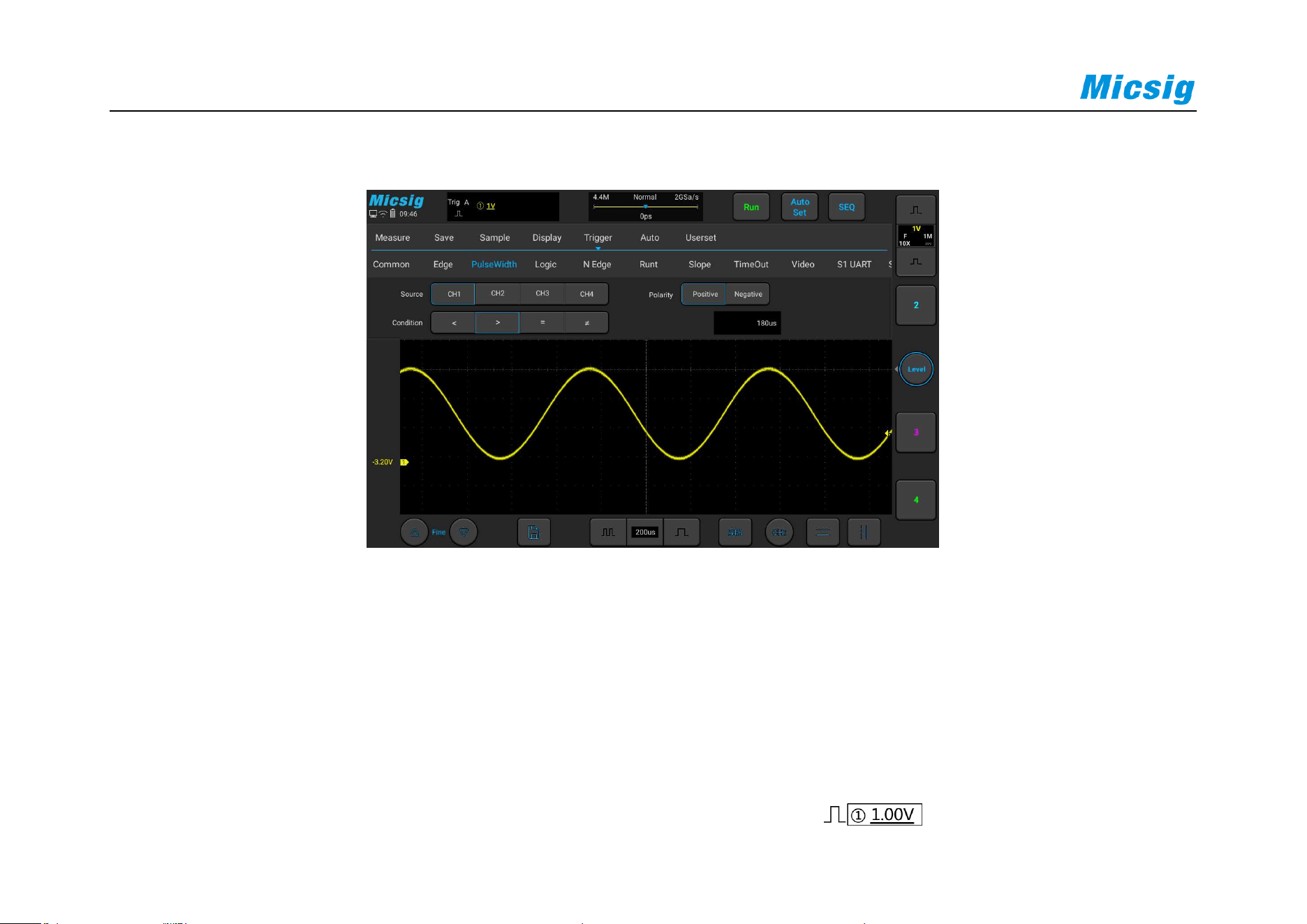
1) Tap “Trigger” on the main menu to open the trigger menu, select the pulse width trigger in the trigger type, and
set the pulse width trigger as follows, as shown in Figure 5-14:
Trigger source: CH1;
Trigger pulse polarity: positive;
Trigger level: 1V
112
Trigger condition and pulse width time: “greater than”, the adjustment time is 180us.
Figure 5-14 Pulse Width Trigger Setting Menu
Pulse width trigger setting description:
1) Pulse polarity selection
The selected pulse polarity icon is displayed in the upper right corner of the display screen. The positive pulse
is higher than current trigger level (CH1 positive pulse indication icon ), and the negative pulse is
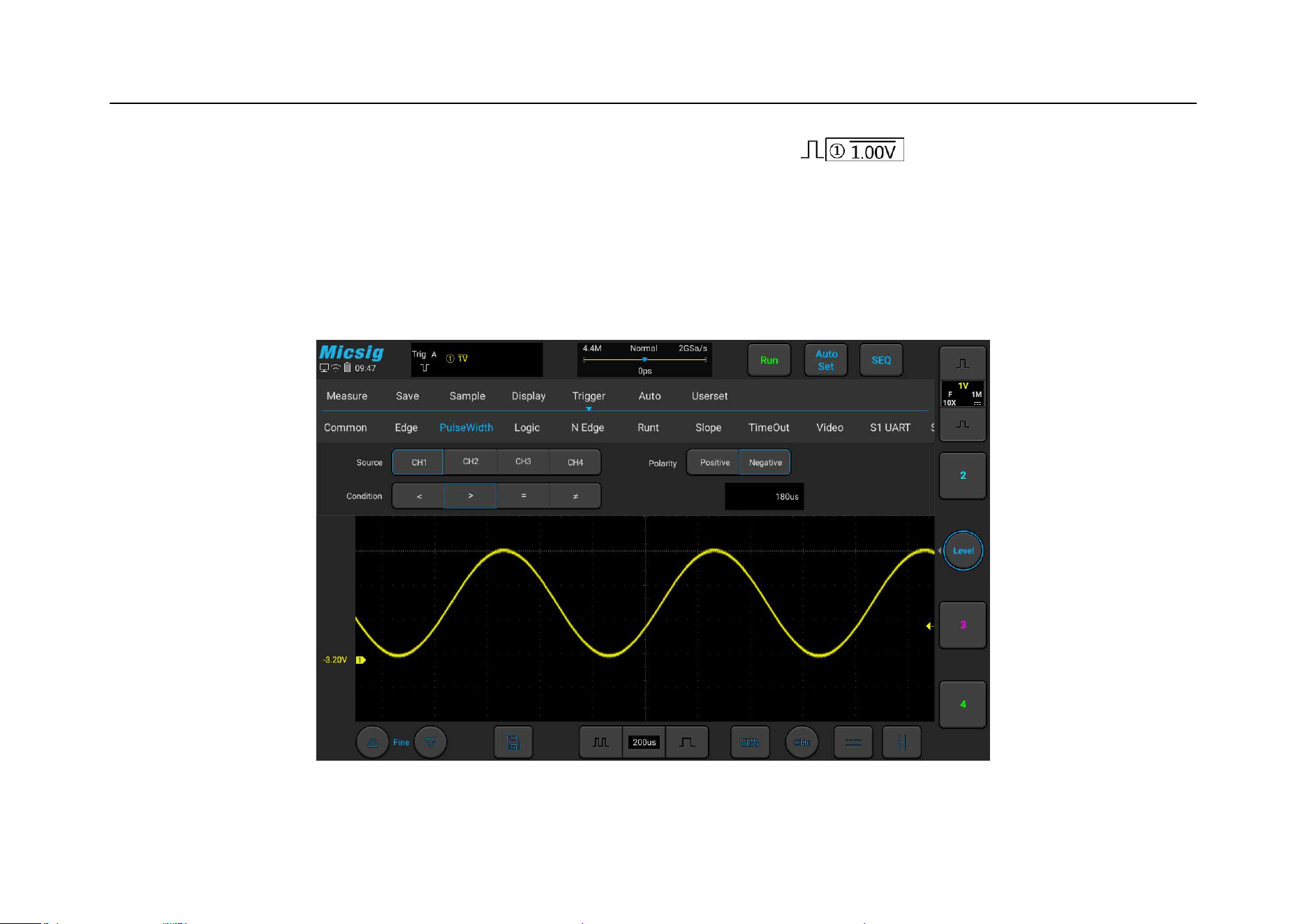
Chapter 5 Trigger System
113
lower than current trigger level (CH1 negative pulse indication icon ). When triggered on positive
polarity pulse, if the restrictions are true, the trigger will happen on the high-to-low transition of the pulse;
when triggered on negative polarity pulse, if the restrictions are true, the trigger will happen on the low-to-high
transition. (Figure 5-15 Negative Pulse Level Flip)
Figure 5-15 Negative Polarity Pulse Level Flip
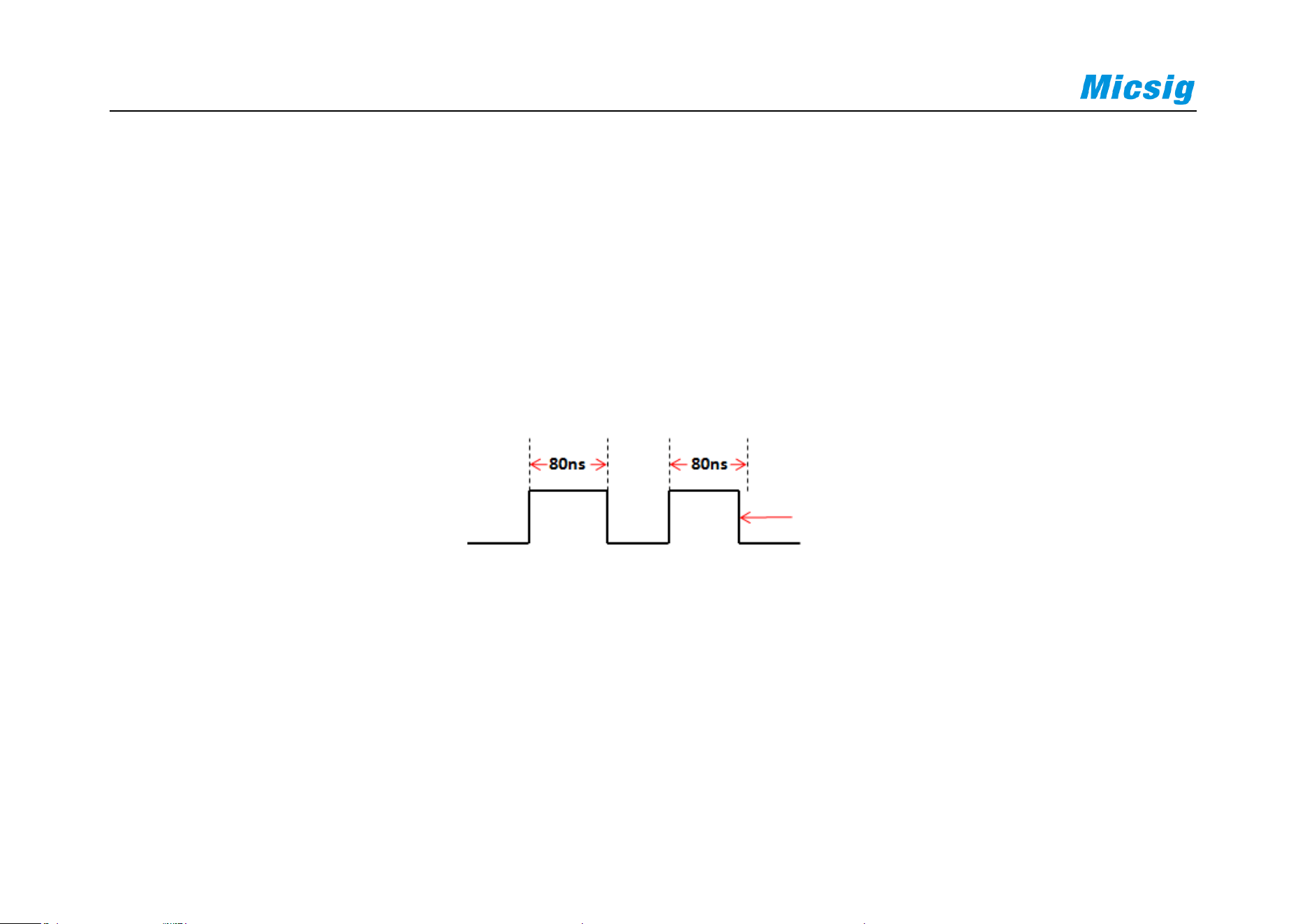
114
2) Trigger condition and pulse width time setting
Time restrictions that can set in the trigger condition: <, >, =, ≠.
Smaller than the time value (<)
For example, for positive pulse, if it is set as T<80ns, the trigger will happen stably only when the pulse
width is smaller than 80ns (Figure 5-16 Trigger Time T<80ns).
Figure 5-16 Trigger Time T<80ns
Greater than the time value (>)
For example, for positive pulse, if it is set as T>80ns, the trigger will happen stably only when the pulse
width is greater than 80ns (Figure 5-17 Trigger Time T>80ns).
Trigger

Chapter 5 Trigger System
115
Figure 5-17 Trigger Time T>80ns
Equal to the time value (=)
For example, for positive pulse, if it is set as T=80ns, the trigger will happen stably only when the pulse
width is equal to 80ns (Figure 5-18 Trigger Time T=80ns).
Figure 5-18 Trigger Time T=80ns
Not equal to the time value (≠)
Trigger
Trigger
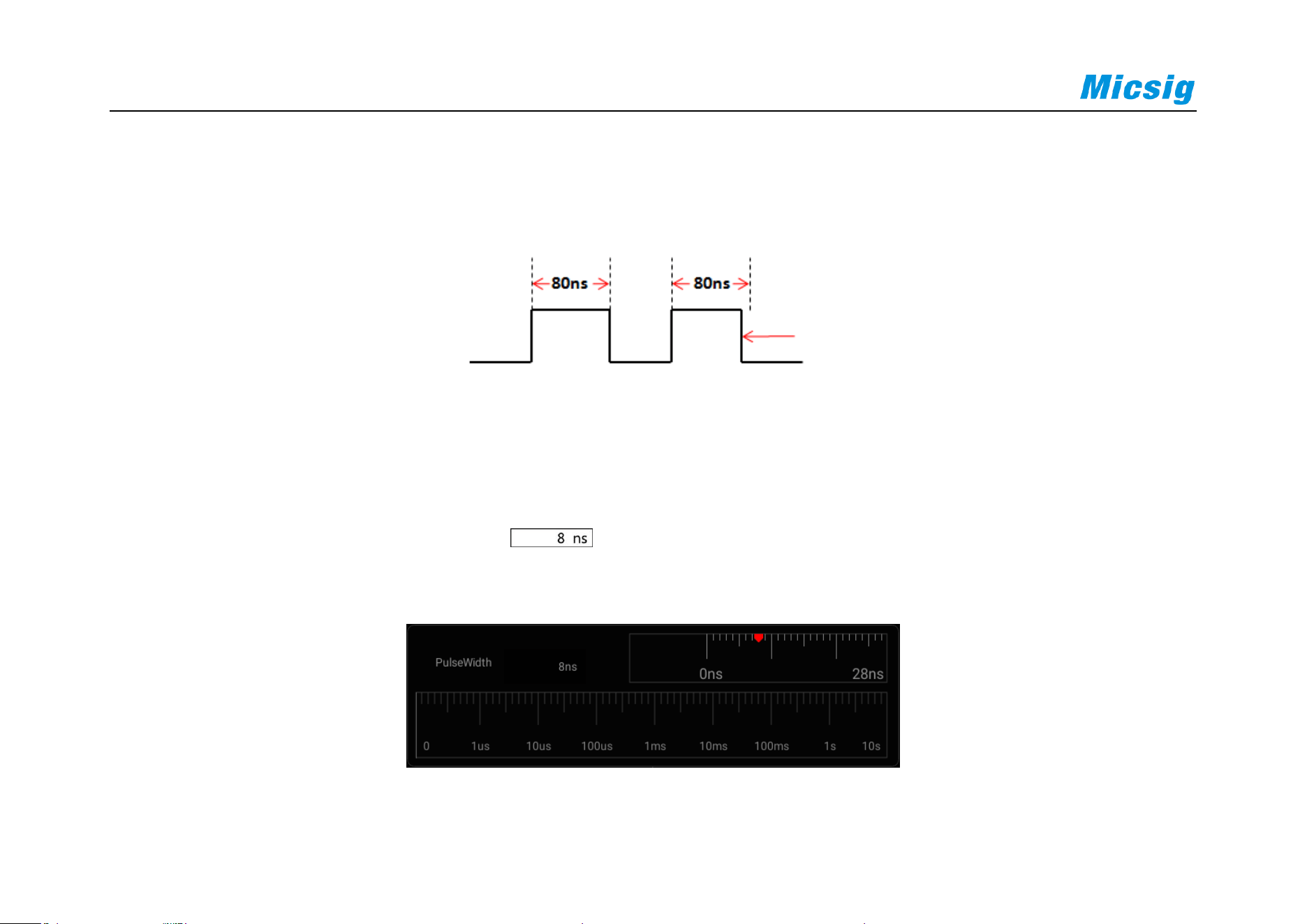
116
For example, for positive pulse, if it is set as T≠80ns, the trigger will happen stably only when the pulse
width is not equal to 80ns (Figure 5-19 Trigger Time T≠80ns).
Figure 5-19 Trigger Time T≠80ns
The trigger pulse width time can be set as 8ns~10s.
Tap the pulse width time setting box to pop up the time adjustment interface (as shown in Figure 5-
20), and adjust the pulse width time. Adjust the pulse width time by adjusting or dragging the time scale.
Figure 5-20 Pulse Width Time Adjustment Interface
Trigger
Chapter 5 Trigger System
117
5.4 Logic Trigger
Trigger happens when the level between analog channels satisfies a certain logical operation (AND, OR, NAND,
NOR) and the signal voltage reaches the set trigger level and the trigger logic width (8ns~10s). Logic trigger menu
descriptions are shown in the table below:
Trigger Option
Setting
Description
Trigger Source
CH1
High
Set CH1 as high
Low
Set CH1 as low
None
Set CH1 as none
CH2
High
Set CH2 as high
Low
Set CH2 as low
None
Set CH2 as none
CH3
High
Set CH3 as high
118
Low
Set CH3 as low
None
Set CH3 as none
CH4
High
Set CH4 as high
Low
Set CH4 as low
None
Set CH4 as none
Trigger Logic
AND
Select the logic of trigger source as “AND”
OR
Select the logic of trigger source as “OR”
NAND
Select the logic of trigger source as “NAND”
NOR
Select the logic of trigger source as “NOR”
Trigger
Condition
Change to true value
Trigger when the logic changes to true value
Change to false value
Trigger when the logic changes to false value
<, >, =, ≠T
If logic status for hold time as <, >, =, ≠T, then trigger
Logic Time
8ns~10ns
Set trigger logic time

Chapter 5 Trigger System
119
Notes: Conditions of greater than, smaller than, equal to or not equal to indicating that the error is 6%.
Logic trigger operation steps between channels:
1) Tap “Trigger” on the main menu to open the trigger menu, select logic trigger in the trigger type, and set the
logic trigger as follows, as shown in Figure 5-21:
Logic levels: CH1, CH3: High; CH2, CH4: Low; (without reference to the channel of logic operation, the
level selection is None to avoid interference to the logic operation);
Logic gate: AND;
Condition: <;
Logic time: 400ns.
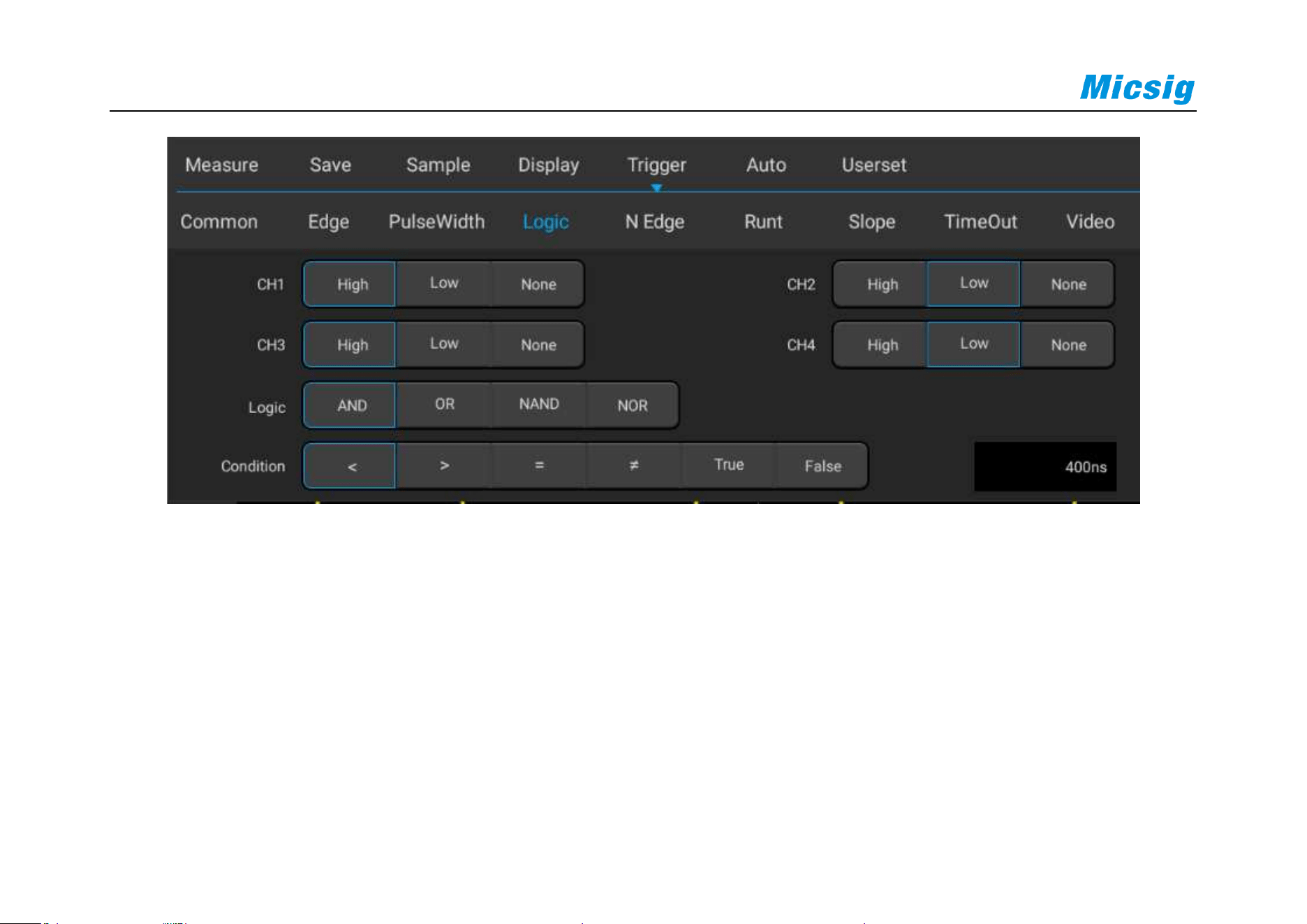
120
Figure 5-21 Logic Trigger Setting Menu
Logic trigger setting description:
Logic level setting
After trigger source, select High, Low and None for the channel. The corresponding trigger level value is
displayed in the upper right corner of the display screen.
Chapter 5 Trigger System
121
High: means a value higher than the current trigger level, and the icon indication is “ ”.
Low: means a value lower than the current trigger level, and the icon indication is “ ”.
None: This channel is invalid.
Switch the trigger level channel: Tap the trigger level slide bar arrow or use trigger setting shortcut
Logic conditions
1) True: Trigger when the logic changes to true value
2) False: Trigger when the logic changes to false value
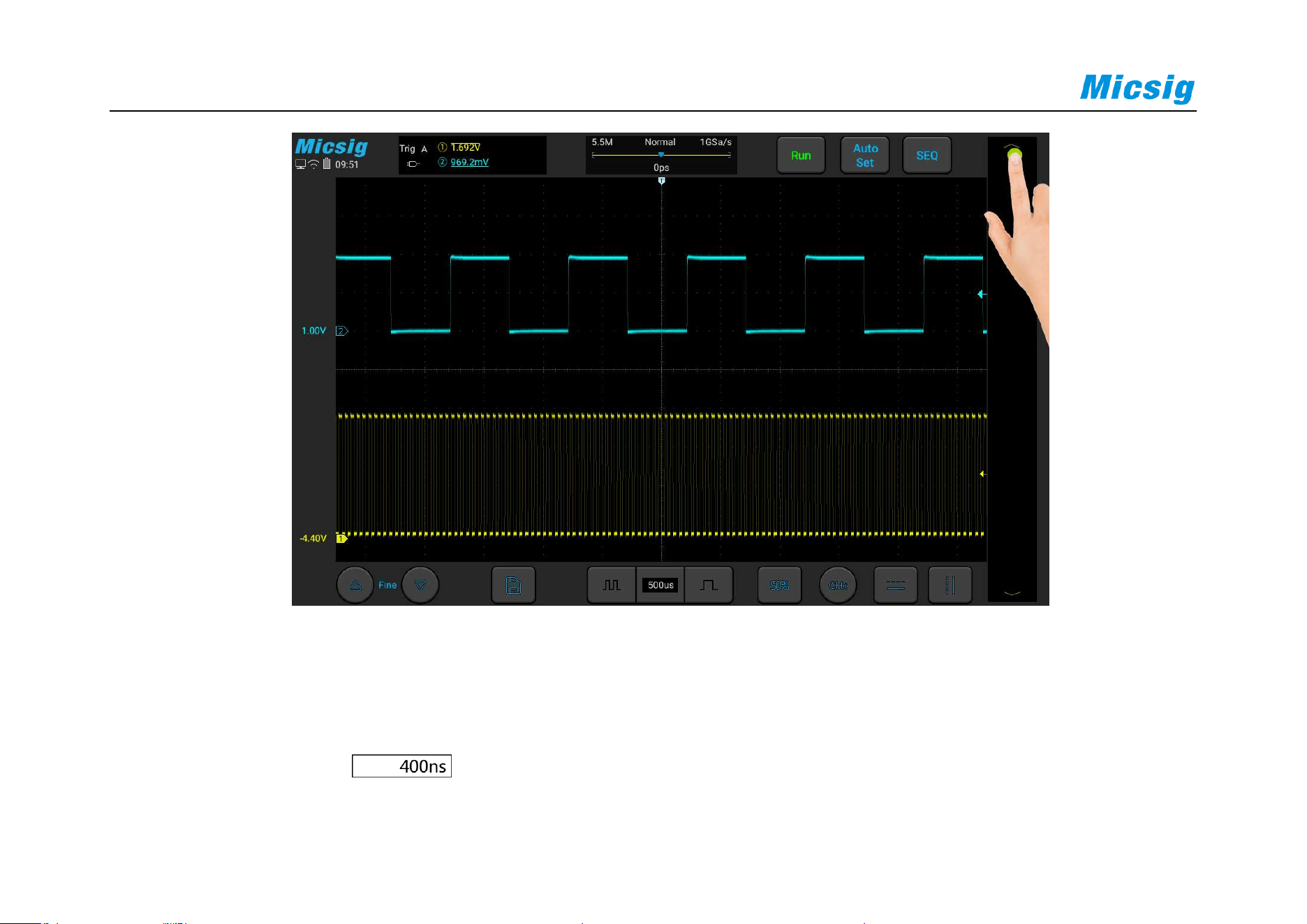
122
Figure 5-22 Trigger Level Adjustment
Trigger pulse width time can be set as 8ns~10s.
Tap the time setting box ( ) to pop up the time adjustment interface and adjust the logic time. Please refer
to the Pulse Width Adjustment section for details.
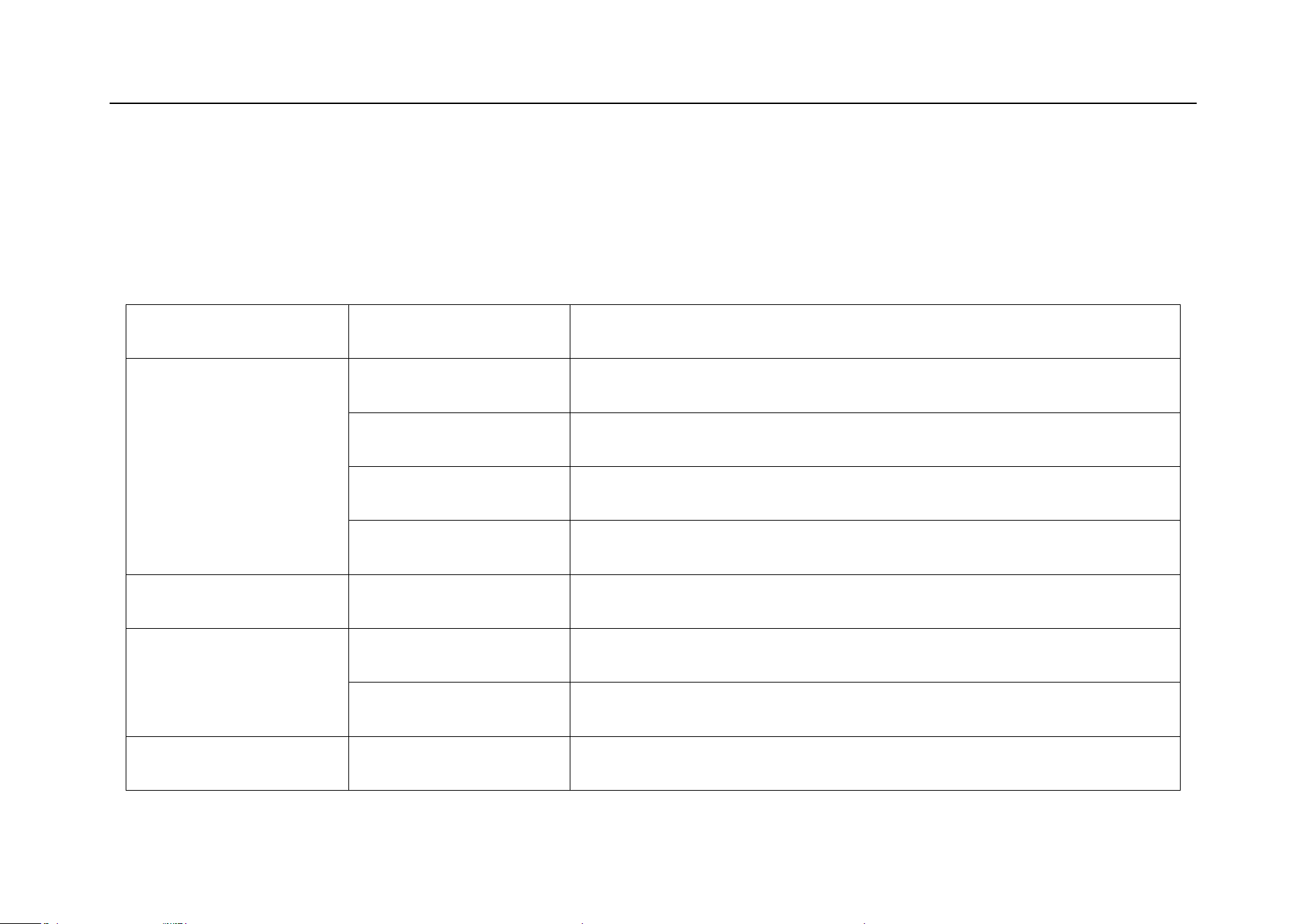
Chapter 5 Trigger System
123
5.5 Nth Edge Trigger
When the trigger signal is triggered on the Nth edge after the specified idle time, it is Nth edge trigger. Menu
descriptions of the Nth edge trigger are shown in the table below:
Trigger Option
Setting
Description
Trigger Source
CH1
Set CH1 as trigger signal source
CH2
Set CH2 as trigger signal source
CH3
Set CH3 as trigger signal source
CH4
Set CH4 as trigger signal source
Time
8ns~10s
Idle time
Edge
Rising edge
Set signal trigger on the rising edge
Falling edge
Set signal trigger on the falling edge
Nth Edge
1~65535
Set trigger on Nth edge after idle time
124
Set CH1 to trigger on the 5th rising edge after 500us. The steps are as follows:
1) Tap “Trigger” on the main menu to open the trigger menu, select Nth edge trigger in the trigger type, and set
the Nth edge trigger as follows, as shown in Figure 5-23:
Trigger source: CH1;
Idle Time: 10ms;
Slope: Rise;
Nth edge: 99

Chapter 5 Trigger System
125
Figure 5-23 Nth Edge Trigger Menu
2) Adjust the trigger level to ensure that the waveform can be triggered stably, for example the trigger level is set
to 1.692V.
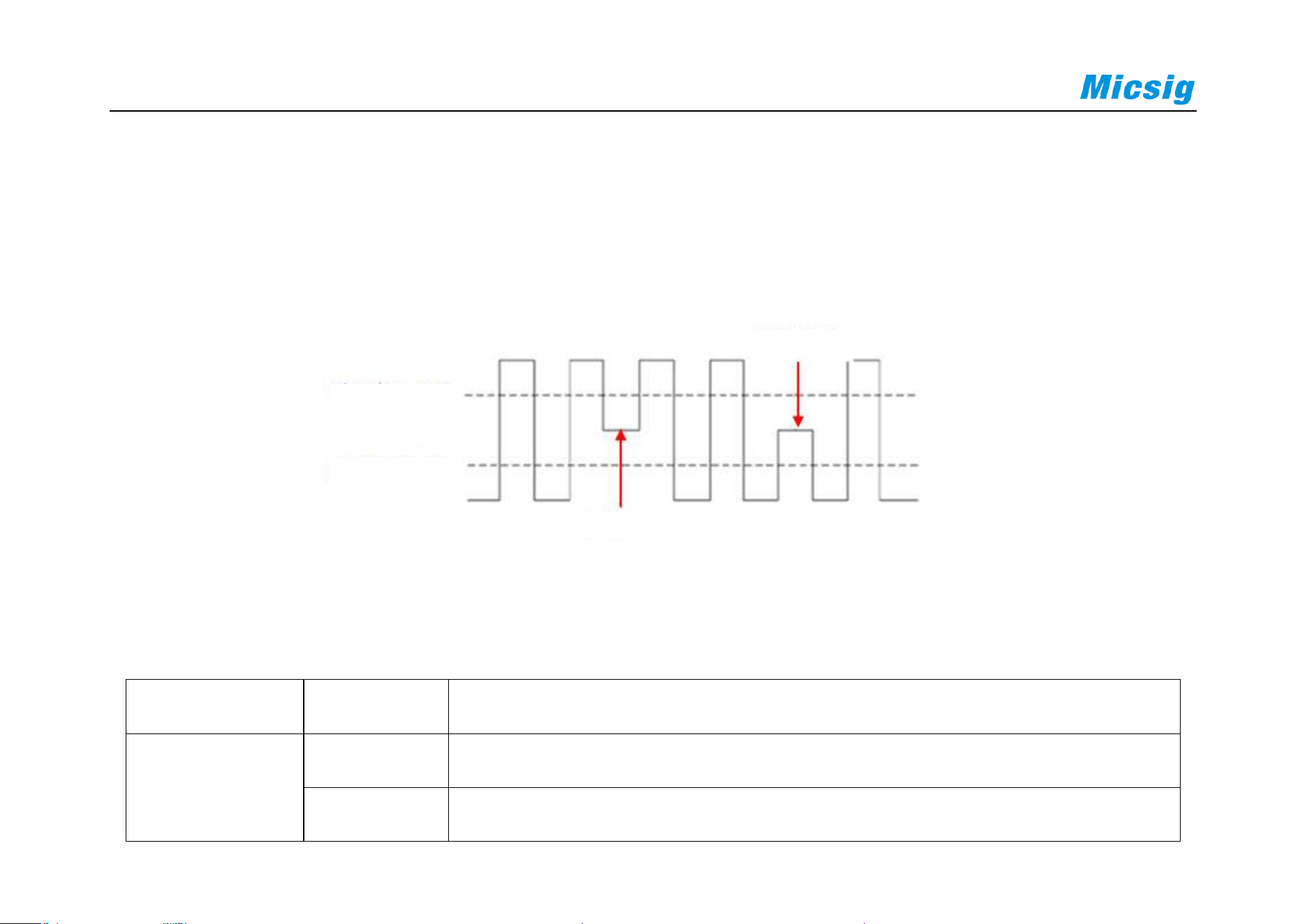
126
5.6 Runt Trigger
By setting the high and low thresholds, trigger on a pulse that cross one threshold but fail to cross a second
threshold. There are two types available: positive short pulse and negative short pulse.
Figure 5-24 Runt Trigger
Runt trigger menu descriptions are shown in the table below:
Trigger Option
Setting
Description
Trigger Source
CH1
Set CH1 as trigger signal source
CH2
Set CH2 as trigger signal source
High Level
Low Level
Positive Short Pulse
Negative Short Pulse
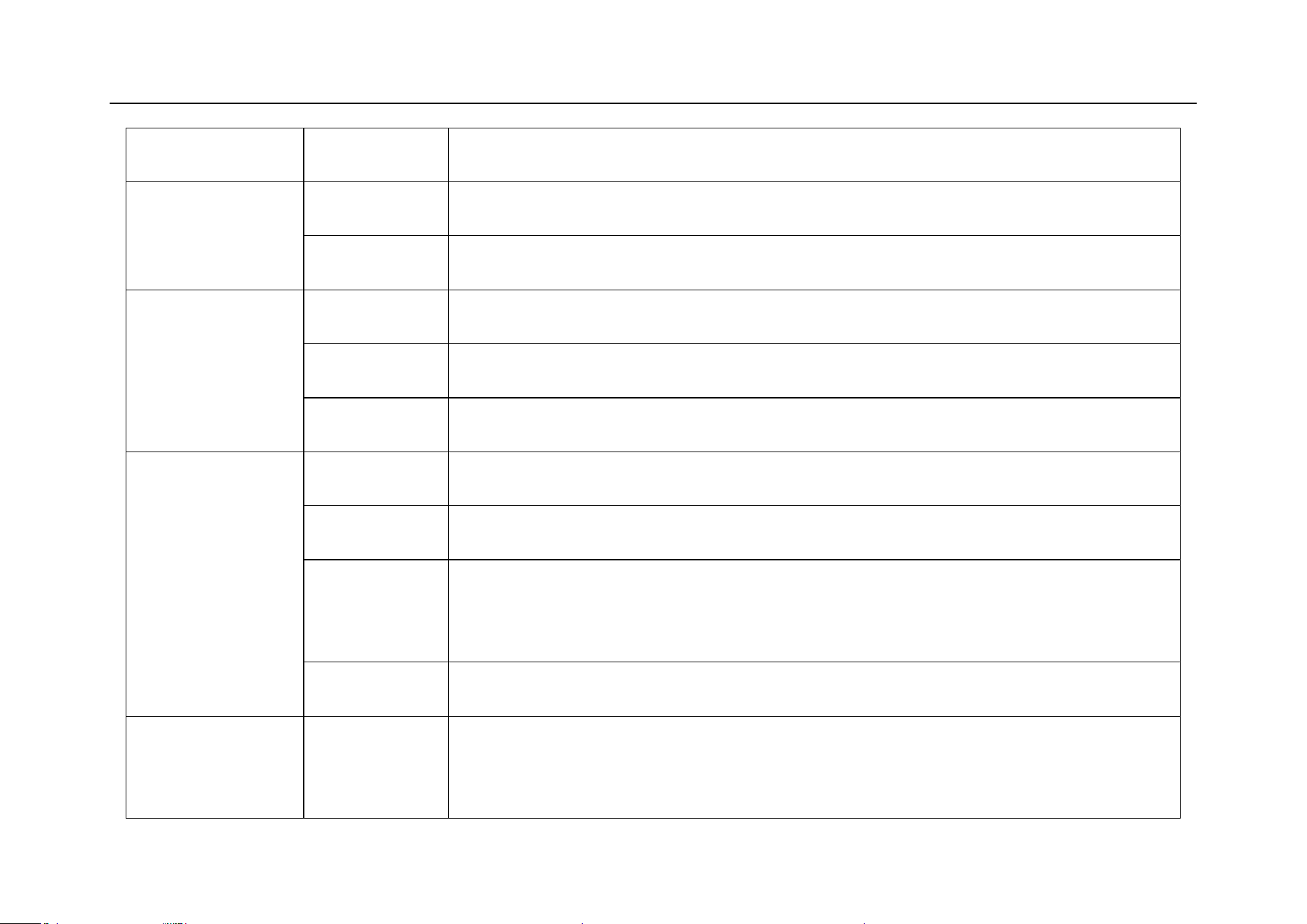
Chapter 5 Trigger System
127
Trigger Option
Setting
Description
CH3
Set CH3 as trigger signal source
CH4
Set CH4 as trigger signal source
Polarity
Positive
Set signal to trigger on positive runt pulse
Negative
Set signal to trigger on negative runt pulse
Any
Set signal to trigger on either positive or negative runt pulse
Trigger
Condition
<T
Trigger when the signal pulse width is smaller than pulse width T
>T
Trigger when the signal pulse width is greater than pulse width T
<>T
Trigger when the signal pulse width is greater than lower limit T1 and
smaller than upper limit T2
None
No trigger restrictions for runt pulse trigger
Trigger Pulse
Width
8ns~10s
Set the trigger pulse width
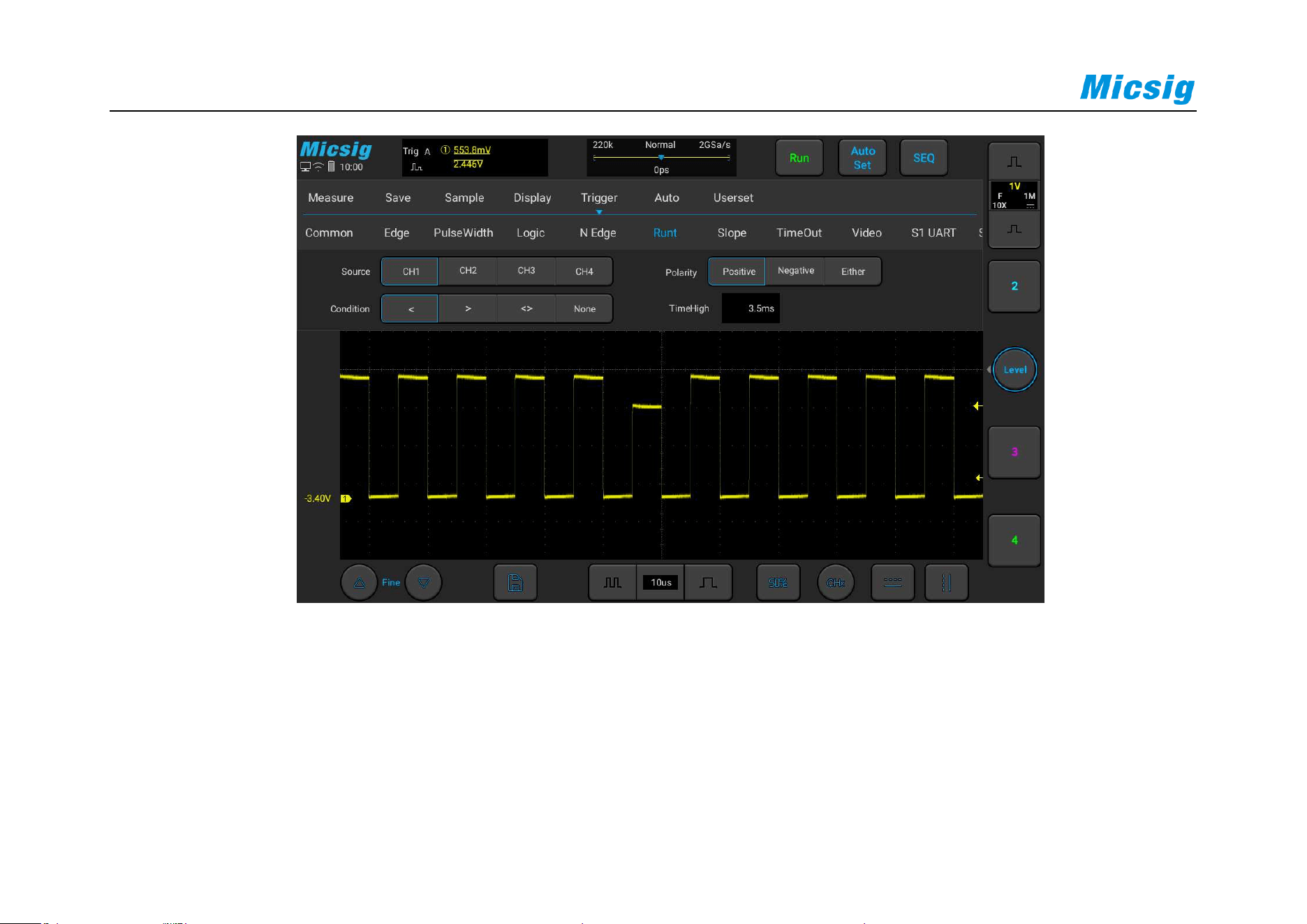
128
Figure 5-25 Runt Trigger Setting Menu
5.7 Slope Trigger
Slope Trigger means trigger when the waveform reaches a set time condition from one level to another.
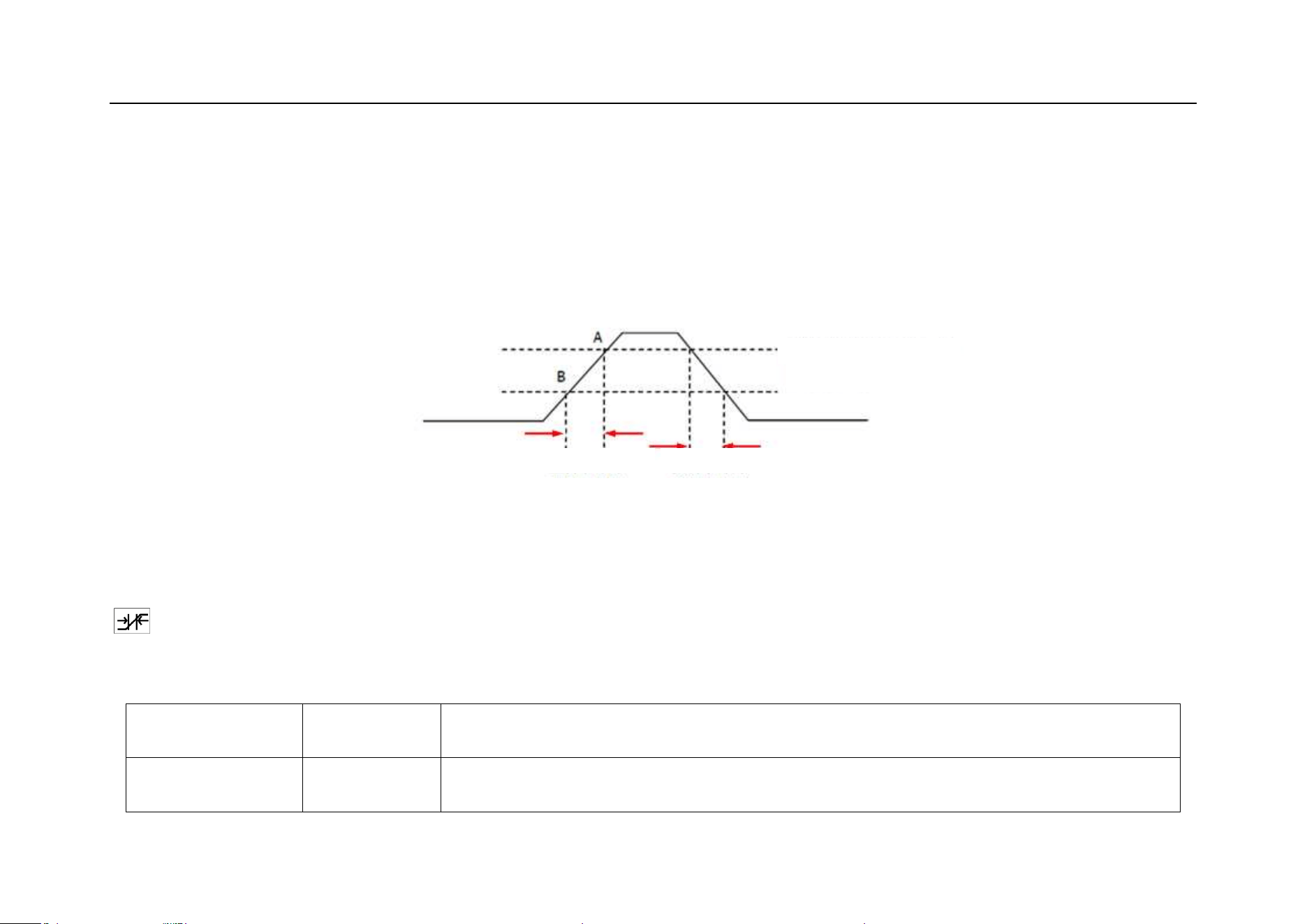
Chapter 5 Trigger System
129
Positive slope time: Time takes for the waveform to go from low to high.
Negative slope time: Time takes for the waveform to go from high to low.
As shown in Figure 5-26
Figure 5-26 Positive/Negative Slope Time
When the trigger signal slope has the hold time (8ns~10s), the trigger type on the top of the screen is only the icon
, and trigger happens when the set condition is reached. Slope trigger is suitable for observing sawtooth or
triangular waves. The slope trigger menu descriptions are shown in the table below:
Trigger Option
Setting
Description
Trigger Source
CH1
Set CH1 as trigger signal source
High Level
Positive Slope Time
Negative Slope Time
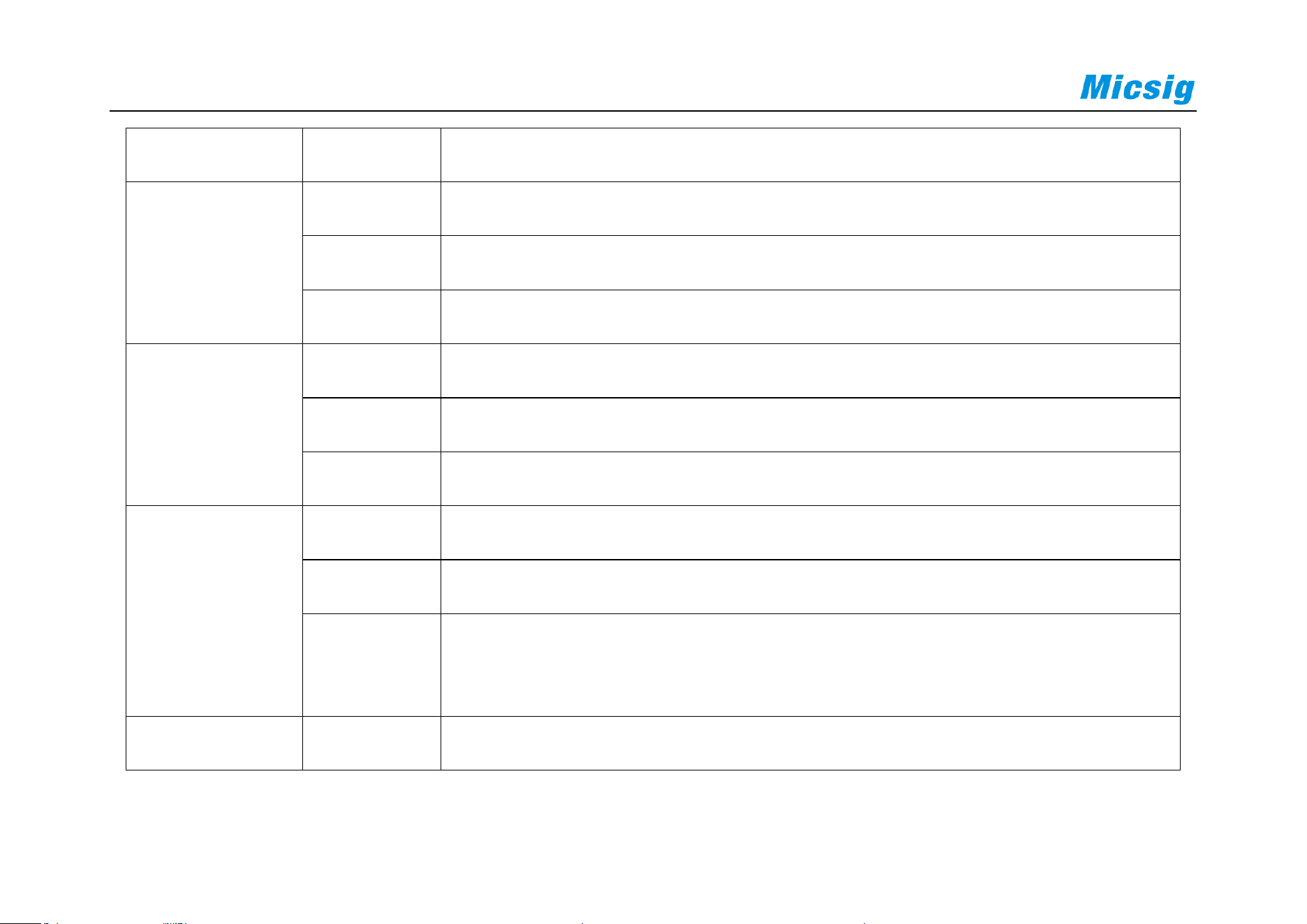
130
Trigger Option
Setting
Description
CH2
Set CH2 as trigger signal source
CH3
Set CH3 as trigger signal source
CH4
Set CH4 as trigger signal source
Edge
Rising
Set trigger on positive signal slope
Falling
Set trigger on negative signal slope
Any
Set trigger on detecting a signal slope change
Trigger
Condition
<T
Trigger when the signal slope hold time is smaller than T
>T
Trigger when the signal slope hold time is greater than T
<>T
Trigger when the signal slope hold time is smaller than upper limit T1 and
greater than lower limit T2
Time
8ns~10s
Set the trigger signal slope hold time
Set CH1 slope status as rise and hold time less than 1ms. The steps are as follows:

Chapter 5 Trigger System
131
1) Tap “Trigger” on the main menu to open the trigger menu, select the slope trigger in the trigger type, and set
the slope trigger as follows, as shown in Figure 5-27:
Trigger source: CH1;
Edge: Rise;
Slope hold time: 1us;
2) Adjust trigger level, adjust High or Low trigger level, click arrow at both ends of the chute Switch the trigger
level between High and Low.
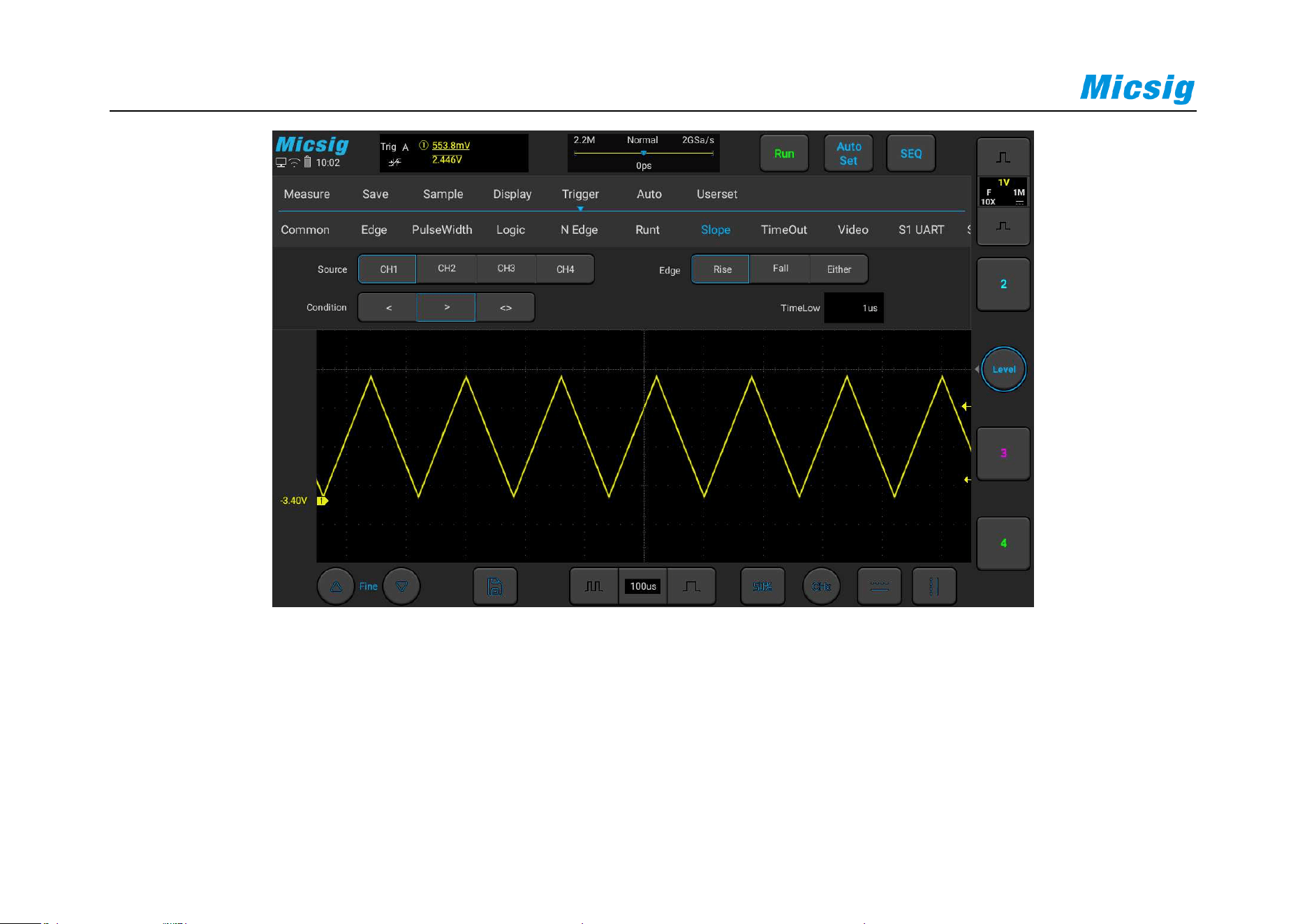
132
Figure 5-27 Slope Trigger Setting Menu
The slope hold time can be set as 8ns~10s.
Note: A stable trigger waveform can only be obtained by selecting the channel to which signals are connected as
trigger source.
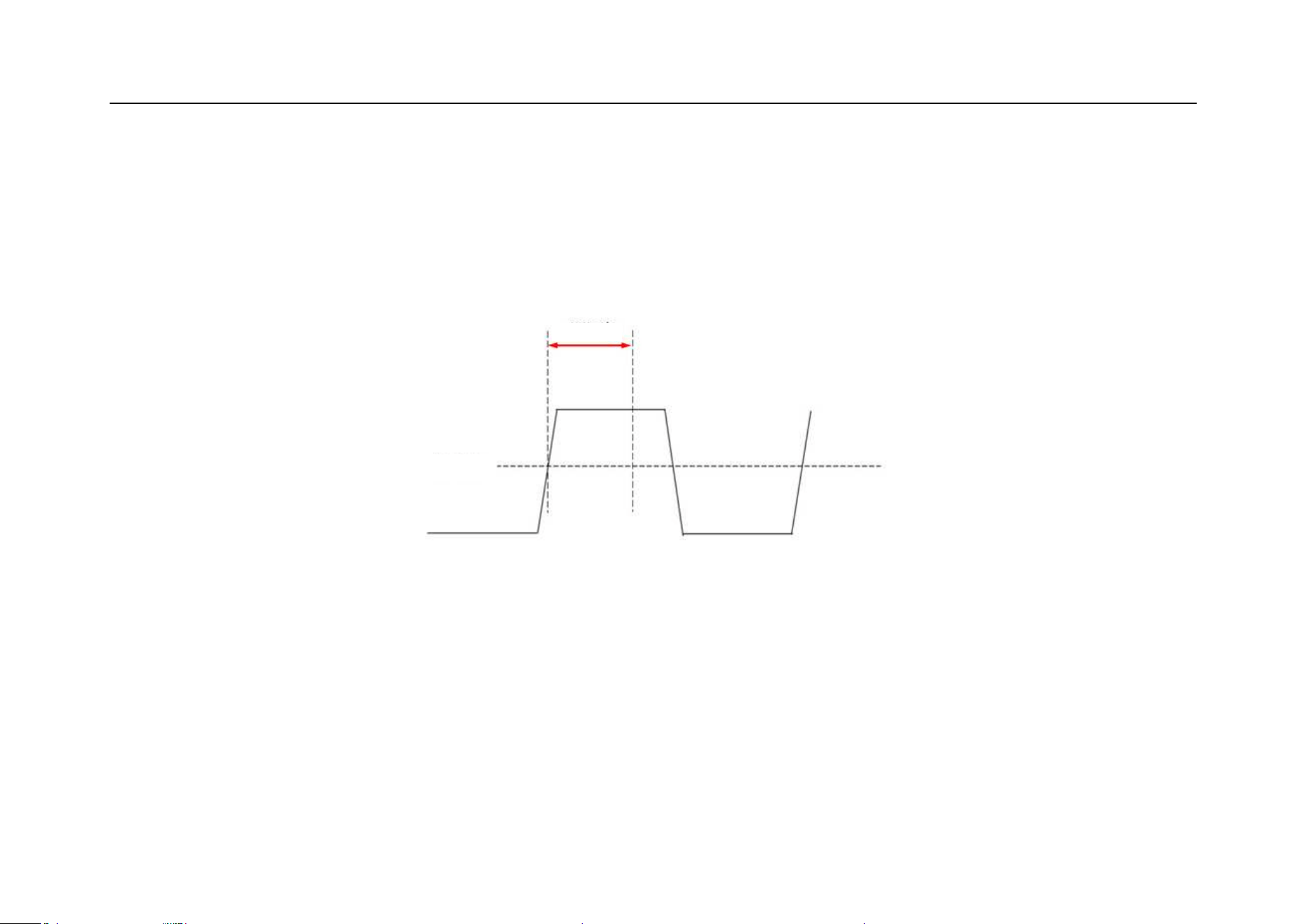
Chapter 5 Trigger System
133
5.8 Timeout Trigger
Timeout trigger happens when the time from the intersection of signal and trigger level and above (or below) the
trigger level reaches the set time, as shown in Figure 5-28:
Figure 5-28 Timeout Trigger Schematics
Duration
Set Level
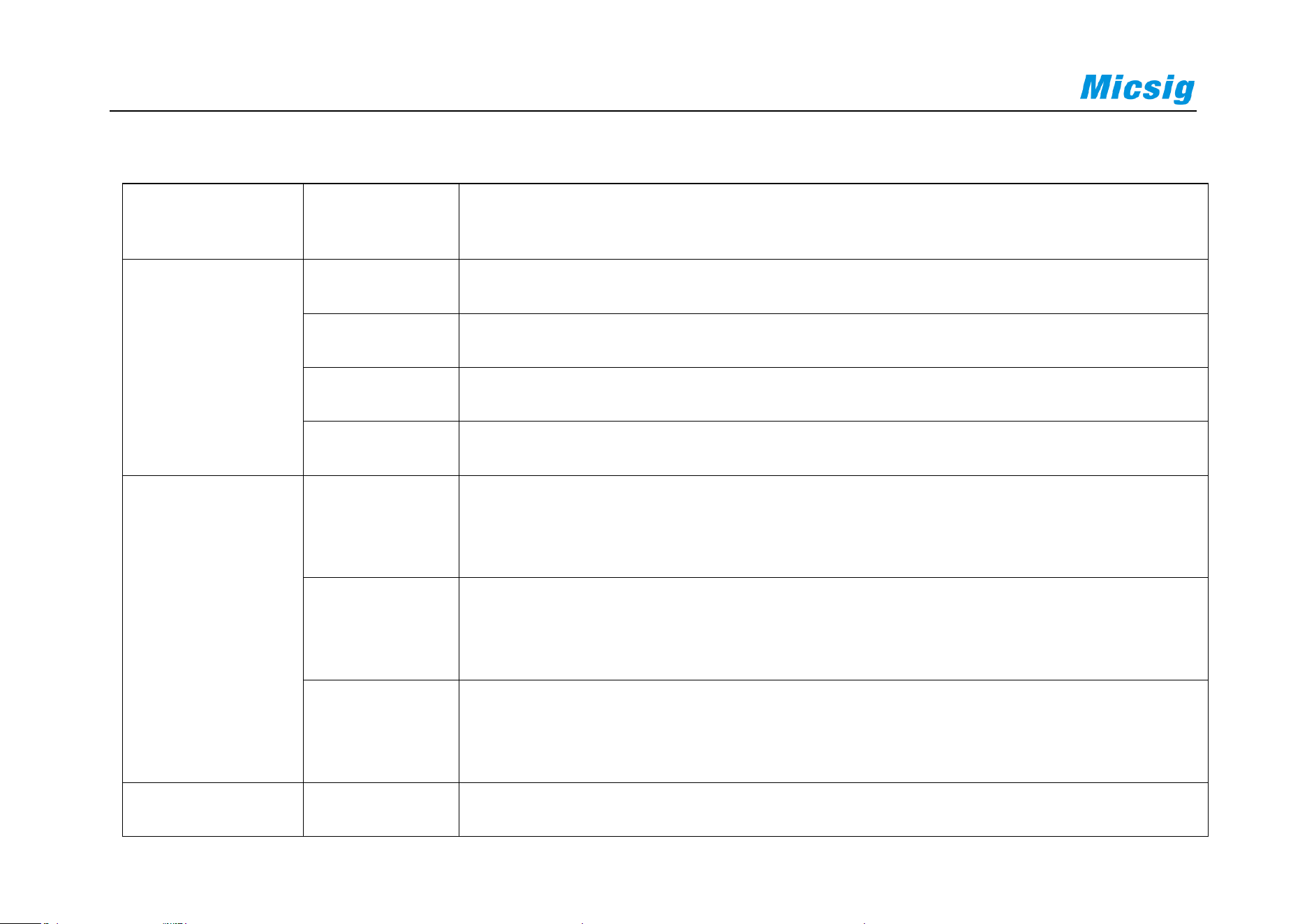
134
Timeout trigger menu descriptions are shown in the table below:
Trigger Option
Setting
Description
Trigger Source
CH1
Set CH1 as trigger signal source
CH2
Set CH2 as trigger signal source
CH3
Set CH3 as trigger signal source
CH4
Set CH4 as trigger signal source
Polarity
Positive
Select to count time when the rising edge of input signal gets through the
trigger level
Negative
Select to count time when the falling edge of input signal gets through the
trigger level
Any
Select to count time when the rising edge or falling edge of input signal gets
through the trigger level
Time
8ns~10s
Timeout time

Chapter 5 Trigger System
135
Set the polarity of CH1 trigger signal to be positive and the timeout time as 15us. The steps are as follows:
1) Tap “Trigger” on the main menu to open the trigger menu, select timeout trigger in the trigger type, and set the
timeout trigger as follows, as shown in Figure 5-29:
Trigger source: CH1;
Edge: positive;
Timeout time: 8ns;
2) Adjust the trigger level to ensure that the waveform can be triggered stably.
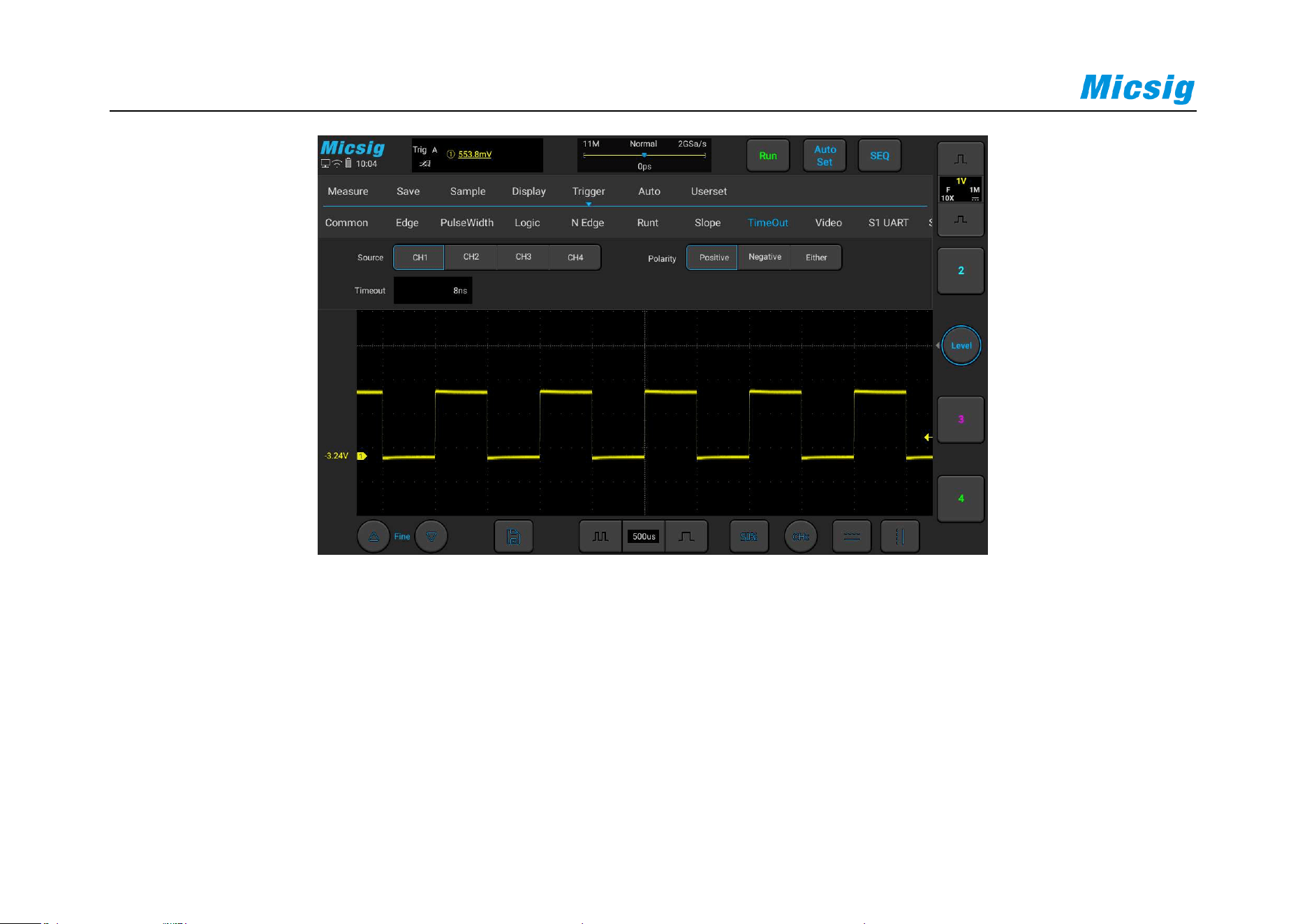
136
Figure 5-29 Time-out Trigger
5.9 Video Trigger
The triggering method for video signals depends on video formats. Generally, there are PAL/625, SECAM,
NTSC/525, 720P, 1080I and 1080P formats. The video trigger can be triggered at different voltage scales, and the
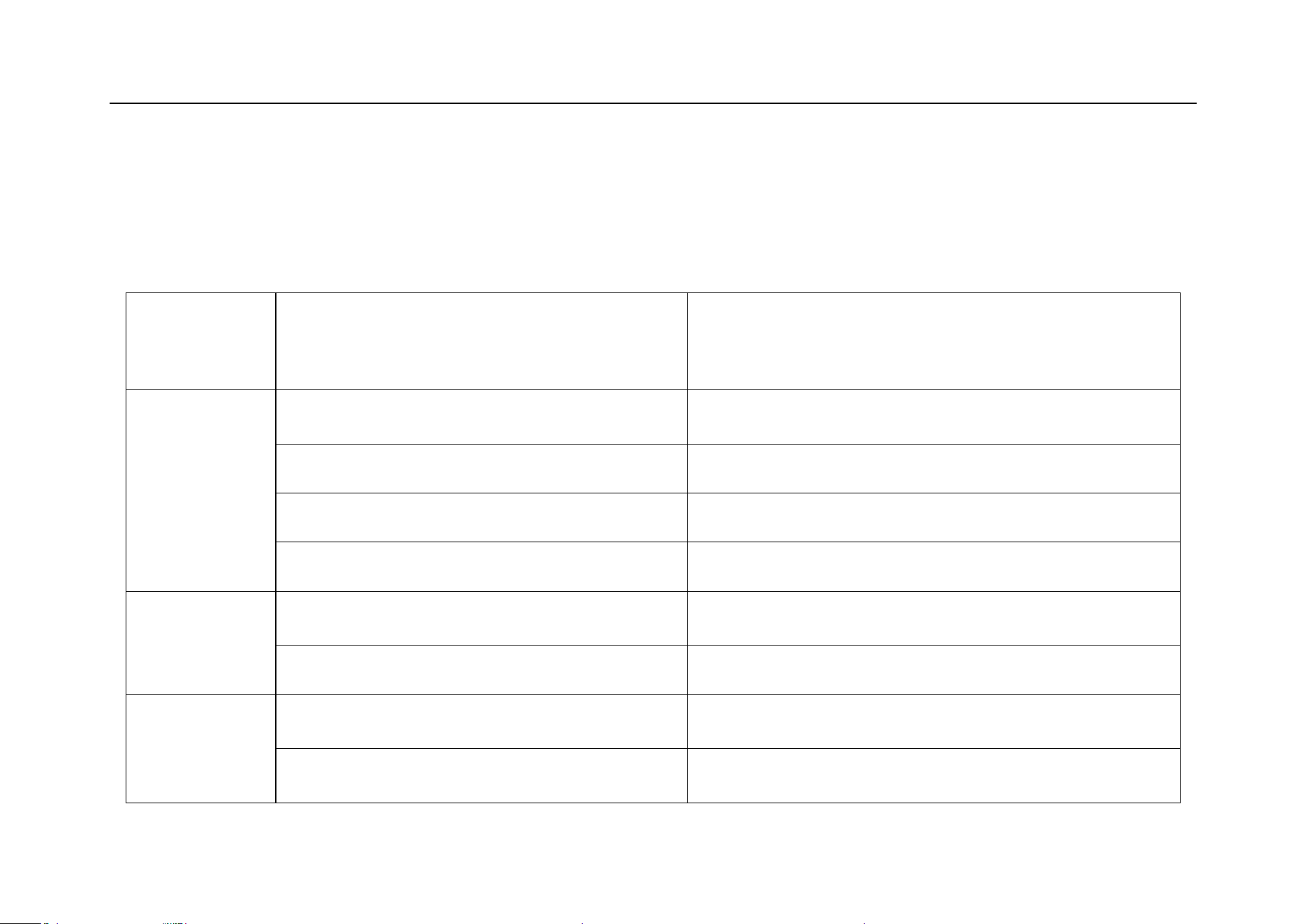
Chapter 5 Trigger System
137
appropriate voltage scale can be adjusted as needed to observe the waveform. The video trigger menu descriptions
are shown in the table below:
Trigger
Option
Setting
Description
Trigger
Source
CH1
Set CH1 as trigger signal source
CH2
Set CH2 as trigger signal source
CH3
Set CH3 as trigger signal source
CH4
Set CH4 as trigger signal source
Polarity
Positive
Set signal positive polarity trigger
Negative
Set signal negative polarity trigger
Video
Standard
625/PAL
Based on PAL signal trigger
SECAM
Based on SECAM signal trigger
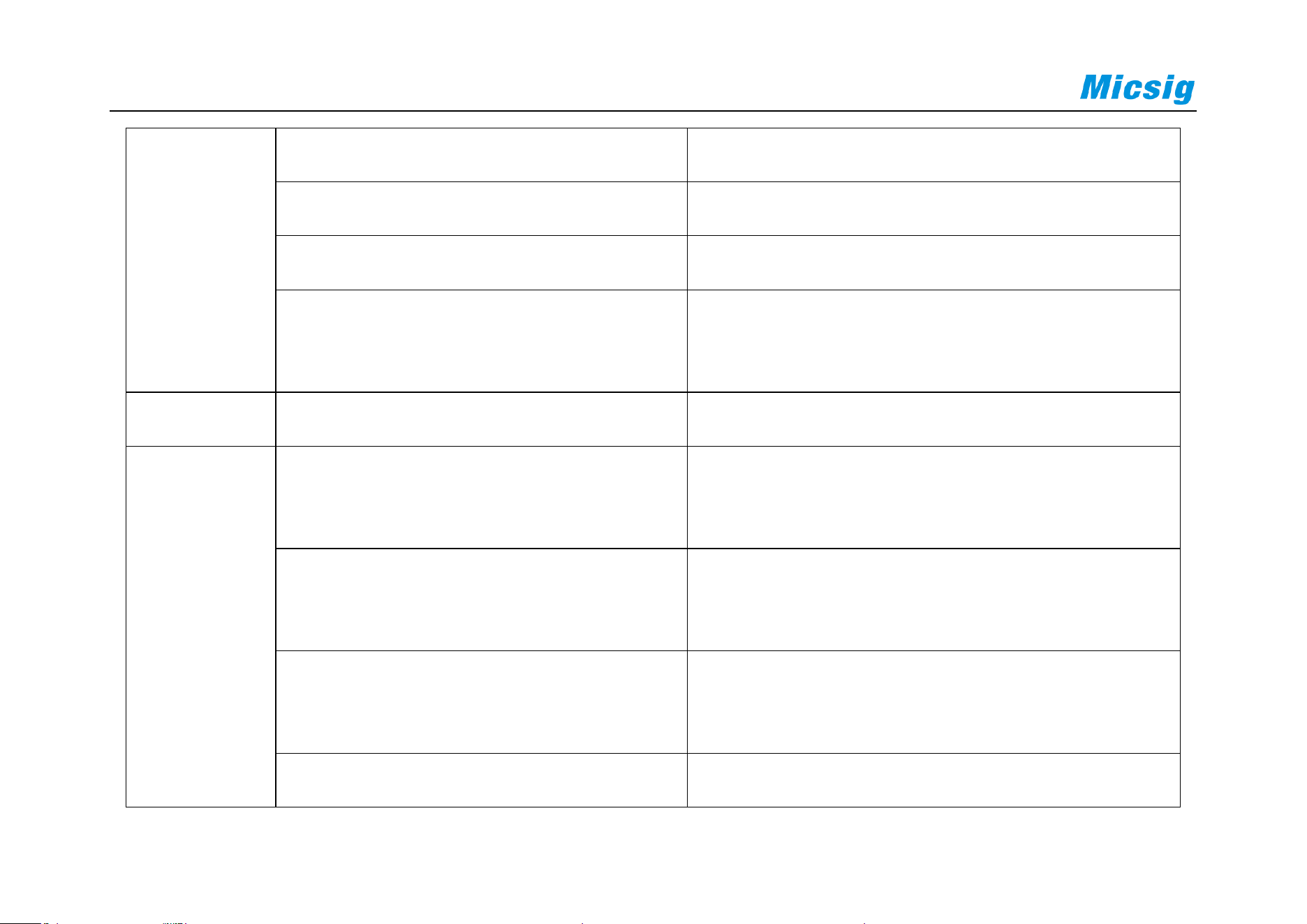
138
525/NTSC
Based on NTSC signal trigger
720P
Base on 720P(50Hz, 60Hz) signal trigger
1080I
Base on 1080I(50Hz, 60Hz) signal trigger
1080P
Base on 1080P (24Hz, 25Hz, 30Hz, 50Hz, 60Hz)
signal trigger
Line
Trigger lines
Trigger
Odd fields
Trigger on the rising edge of the first tooth pulse
in odd fields
Even fields
Trigger on the rising edge of the first tooth pulse
in even fields
All fields
Trigger on the rising edge of the first tooth pulse
found
All lines
Trigger on all horizontal sync pulses
Chapter 5 Trigger System
139
Lines
625 line (PAL,SECAM)
Trigger on a specified line in odd or even fields
263 odd line 262 even line
(NTSC)
750 line (720P)
1125 line (1080I,1080P)
Set CH1 as trigger channel, positive polarity, NTSC standard video, all fields trigger, and the steps are as
follows:
Tap “Trigger” on the main menu to open the trigger menu, select the video trigger in the trigger type, and set the
video trigger as follows, as shown in Figure 5-30:
Trigger source: CH1;
Polarity: positive;
Standard: 525/NTSC;
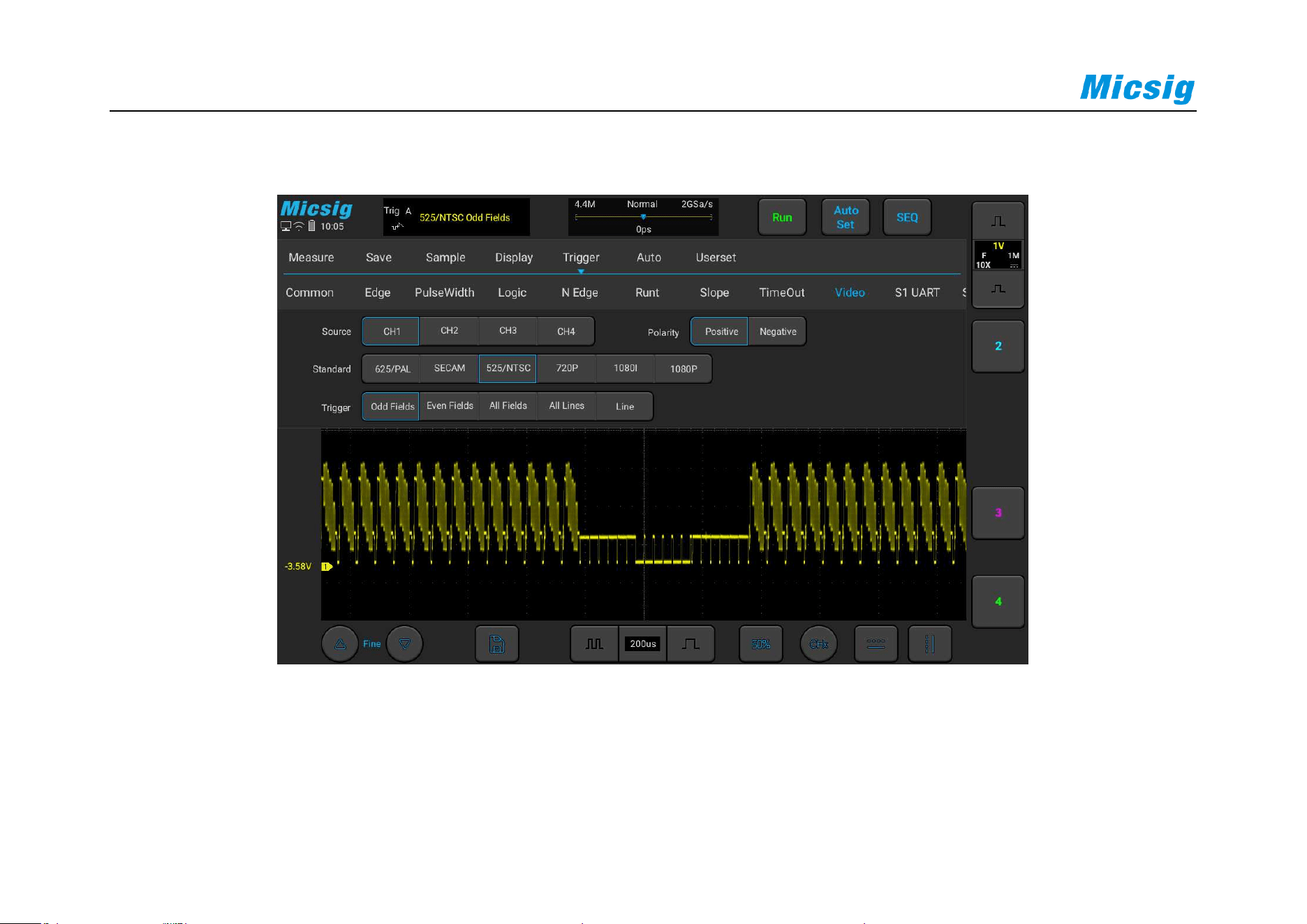
140
Trigger: Odd fields
Figure 5-30 Video Trigger
Prompts:
In order to better observe the waveform details in the video signal, first set the memory depth to be larger.
Chapter 5 Trigger System
141
During the trigger debugging of the video signal, since the digital oscilloscope has multi-level gray scale display
function, different brightness can reflect the frequency of different parts of the signal. Experienced users can
quickly judge the quality of the signal during the debugging process and find abnormal conditions.
5.10 Serial Bus Trigger
Please refer to
Chapter 11 Serial Bus Trigger and Decode (Optional)
142
Chapter 6 Analysis System
This chapter contains the detailed information of the analysis system of the oscilloscope. You are recommended to
read this chapter carefully to understand the set functions and operation of the analysis system of the Smart series
oscilloscope.
Automatic measurement
Frequency meter measurement
Cursor
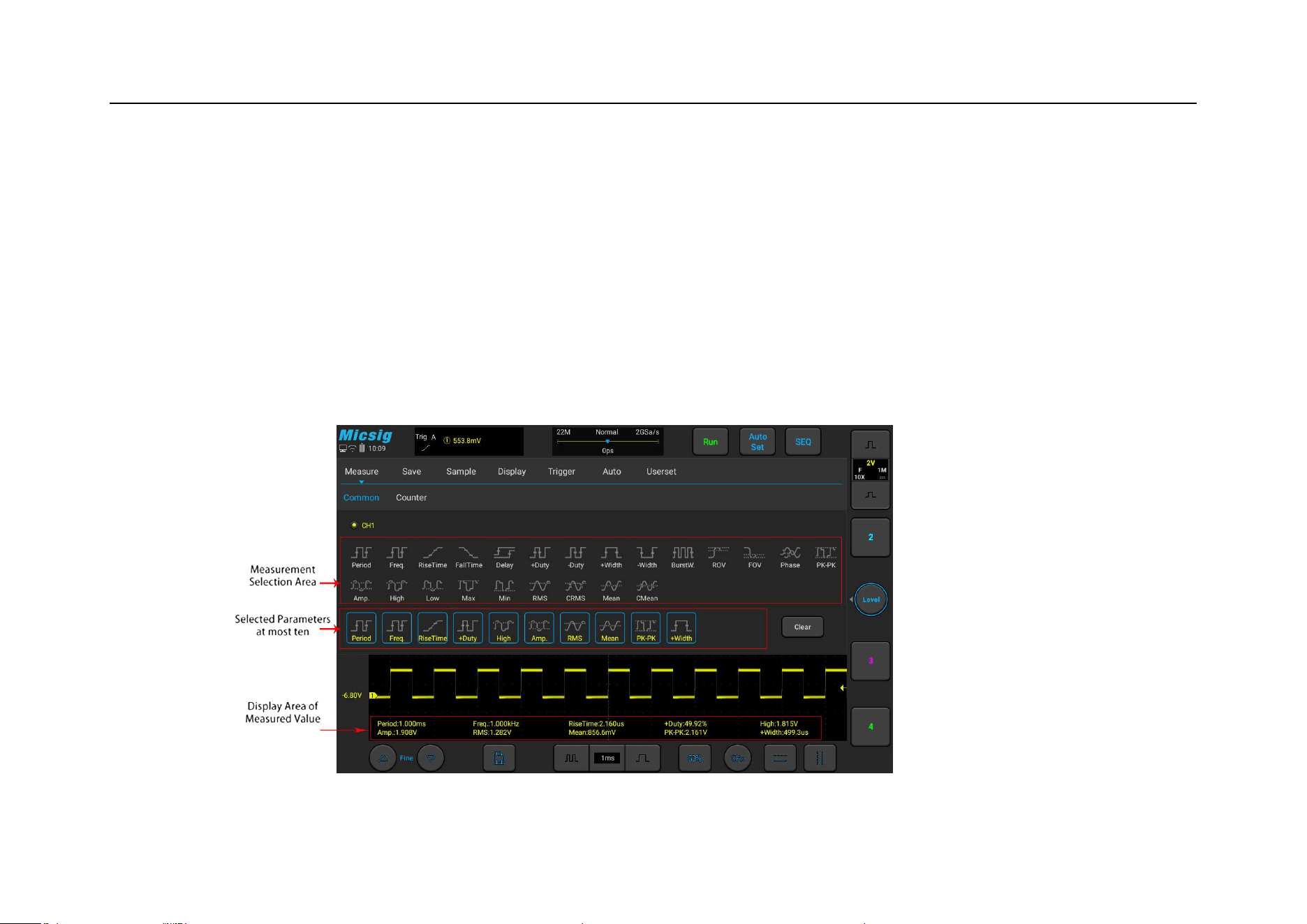
Chapter 6 Analysis System
143
6.1 Automatic Measurement
Measurement setting
Slide down from top, open the main menu, tap “Measure” to enter the measurement menu. There are 23
measurement items on the measurement menu. Measurement menu, selected measurement item display and
measurement item display are shown in Figure 6-1:
Figure 6-1 Automatic Measurement Menu
144
Automatic measurement
1) Select channel: Select the channel to be measured above the measurement menu.
2) Select measurement: Select the desired measurement item on the measurement menu. The selected
measurement item is displayed in the “Selected Parameters” display area below.
3) Cancel measurement item: In the “Selected Parameters” display area below measurement menu, tap the
measurement item to be cleared; or tap button to clear all measurement items.
Note:
Measurements and math functions will be recalculated when moving/zooming and opening/closing channels.
Oscilloscope has an automatic measurement memory function. Shutdown and restart will not automatically clear
added automatic measurement options.
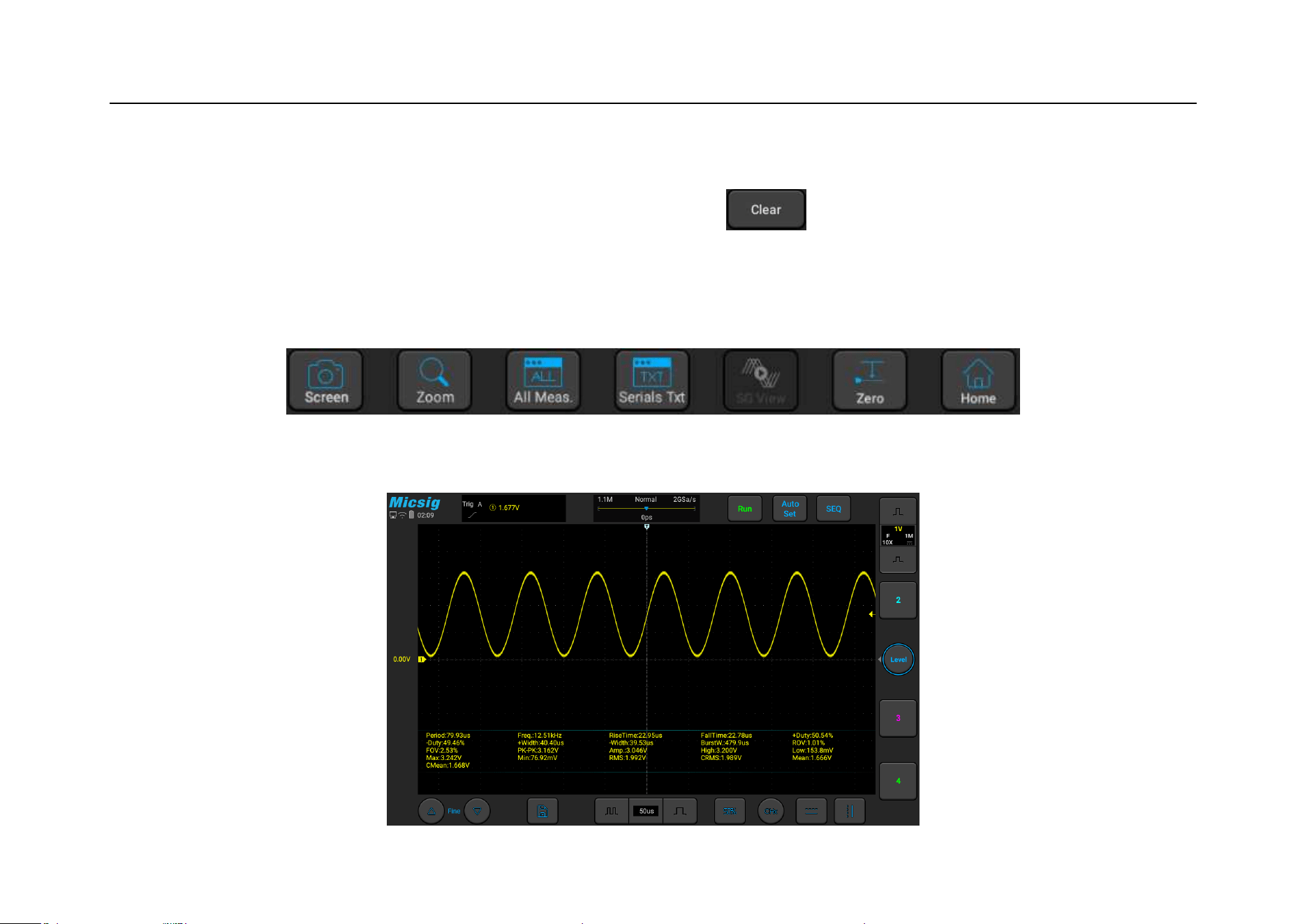
Chapter 6 Analysis System
145
All measurements
Slide from bottom, open the pull-up menu, see Figure 6-2, click to open all measurement items, display
the current channel measurement value. Switch the current channel to open all the measurement items of other
channels, as shown in Figure 6-3; click again to turn off all measurements.
Figure 6-2 Pull-up Menu
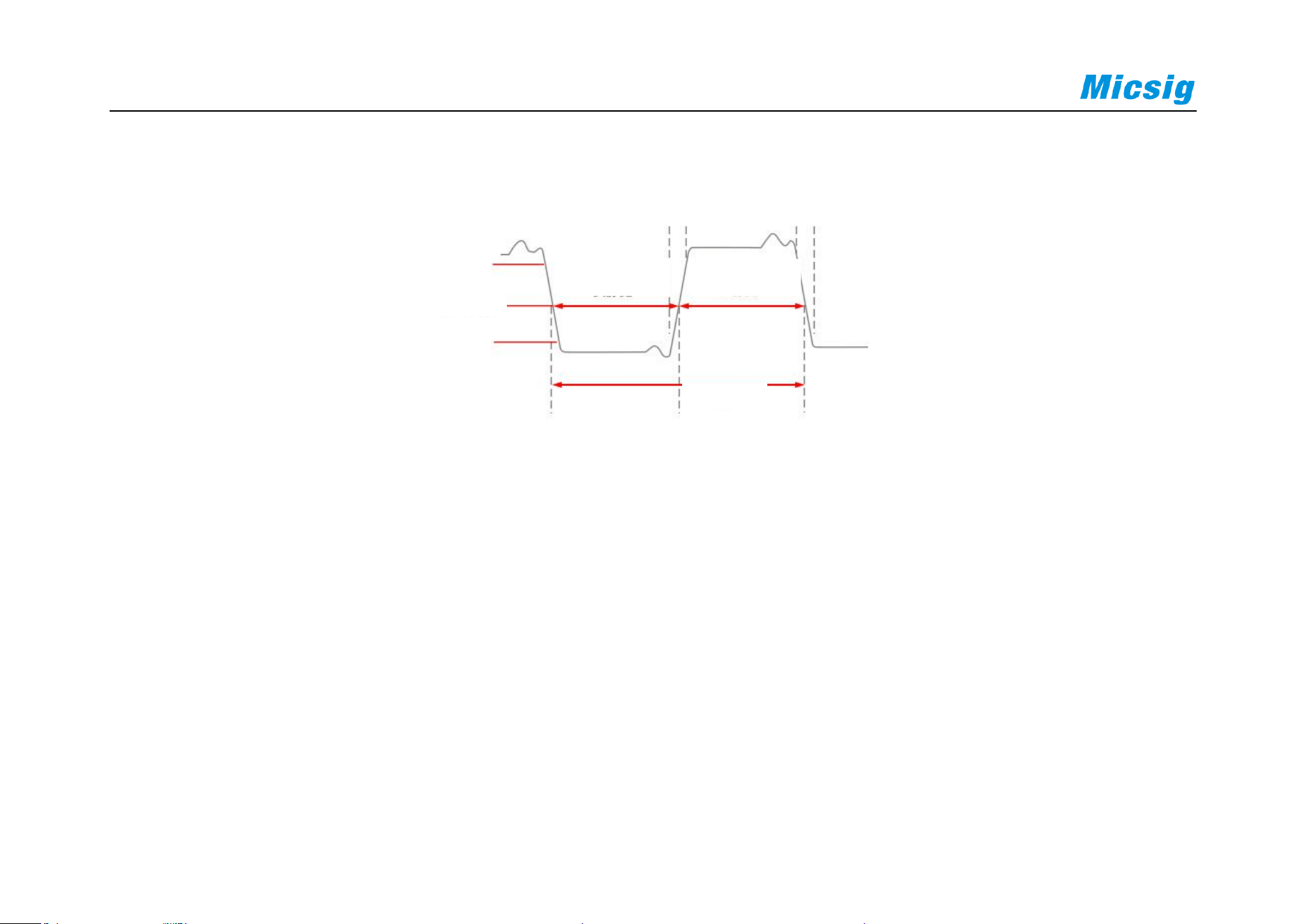
146
Figure 6-3 All Measurements
Figure 6-4 Time Parameter
Period
Time of the first complete signal cycle in the waveform
Frequency
Reciprocal to the cycle time
Rise time
Time required for the first rising edge of the waveform to rise from the amplitude of 10% to 90%
Threshold Upper Limit
Threshold Median
Threshold Lower Limit
Period
Rise Time
Fall Time
Positive Pulse
Width
Negative Pulse
Width
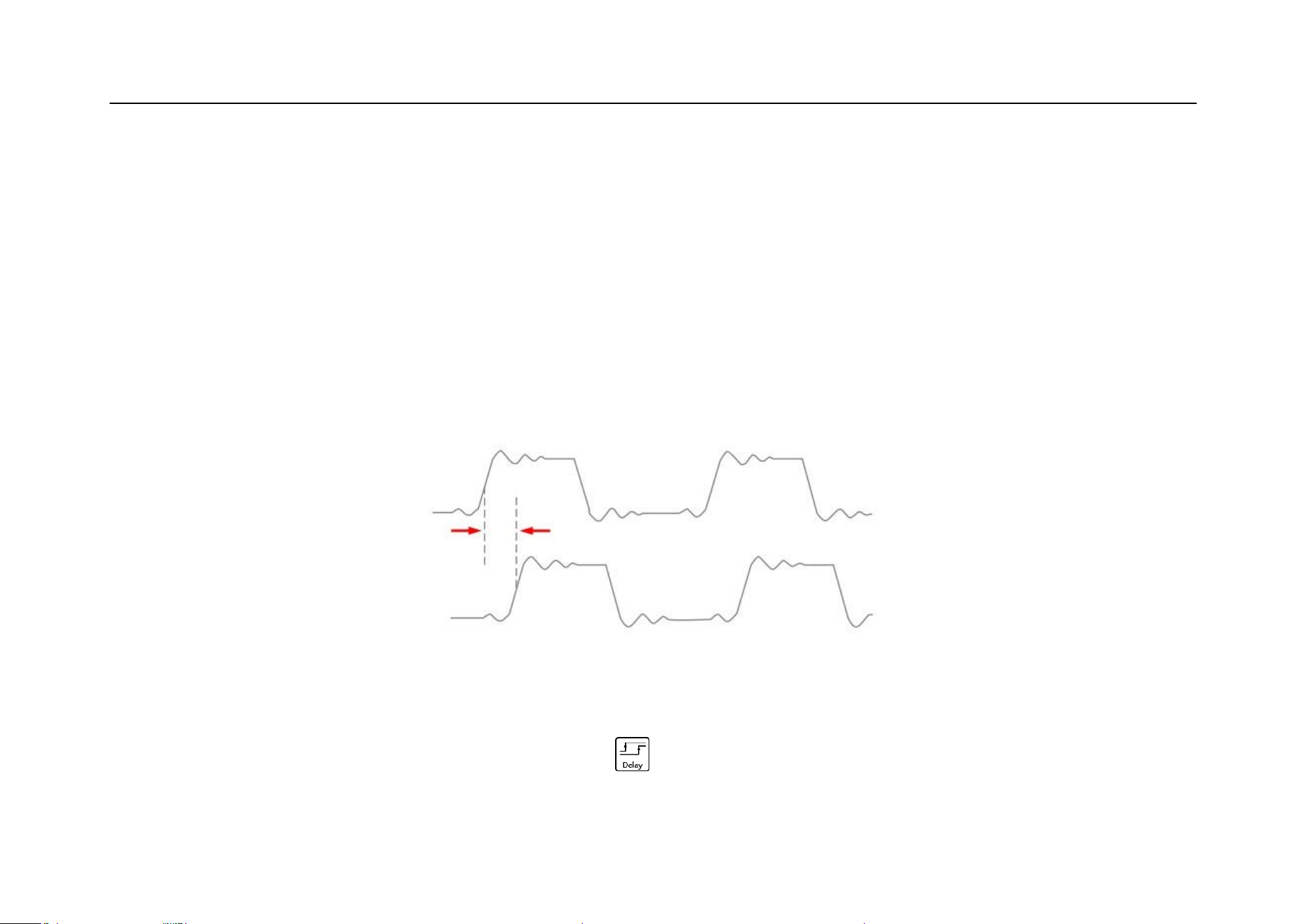
Chapter 6 Analysis System
147
Fall time
Time required for the first falling edge of the waveform to rise from the amplitude of 10% to 90%
Delay
Time delay between rising or falling edges of channels may be measured, and there are nine effective measurement
combinations
Figure 6-5 Delay Measurement Schematics
1) Open the automatic measurement menu and tap to pop up the phase selection menu.
Delay

148
2) The left channel is defaulted as the current channel, and other channels can be selected by the channel area that
has been opened (except the reference channel); there are four edge selections: first rising edge, first falling
edge, last rising edge, last falling edge.
3) The right channel is a contrast delay channel, which can be selected between each channel and math channel.
There are four edge selections: first rising edge, first falling edge, last rising edge, and last falling edge.
4) Tap button to confirm.
Positive duty cycle
Measured value of the first cycle in the waveform
Positive duty cycle = (waveform positive pulse width / period) * 100%
Negative duty cycle
Measured value of the first cycle in the waveform
Negative duty cycle = (waveform negative pulse width / period) * 100%

Chapter 6 Analysis System
149
Positive pulse width
Measured value of the first positive pulse in the waveform, taking the time between two 50% amplitude points
Negative pulse width
Measured value of the first negative pulse in the waveform, taking the time between two 50% amplitude points
Burst width
Duration of a burst measured over the entire waveform
Overshoot
Positive overshoot
Positive overshoot = [(max - high) / amplitude] *100%
Negative overshoot
Negative overshoot = [(low - min) / amplitude] *100%
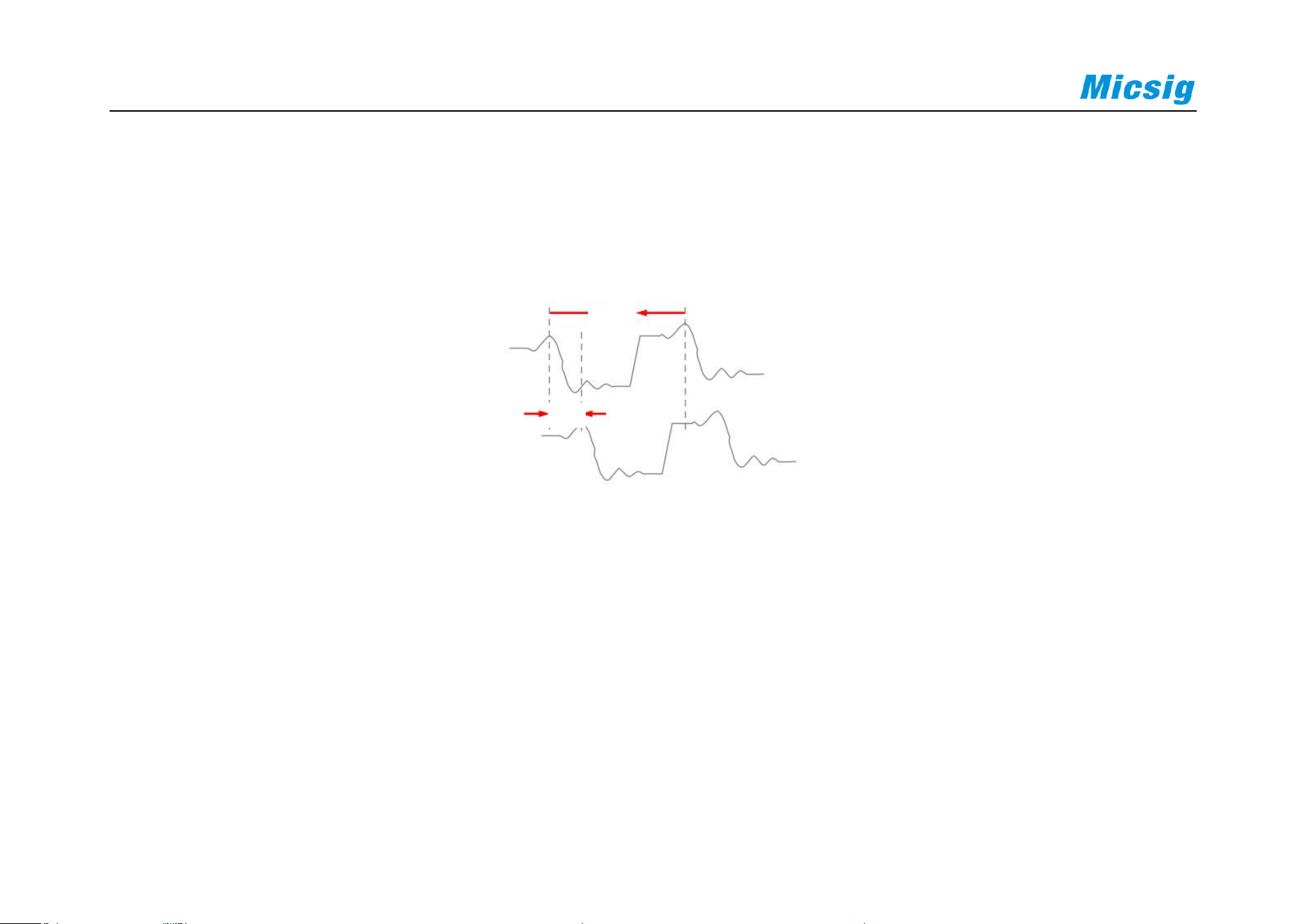
150
Phase
Timing measurement. The amount of time that one waveform leads or lags another waveform, expressed in degrees
where 360°comprises one waveform cycle.
Figure 6-6 Phase Measurement Schematics
Peak-peak
In the entire waveform measurement, peak-peak = max - min
Amplitude
In the entire waveform measurement, amplitude = high (100%) - low (0%)
The figure below shows voltage measurement points.
Delay
Period
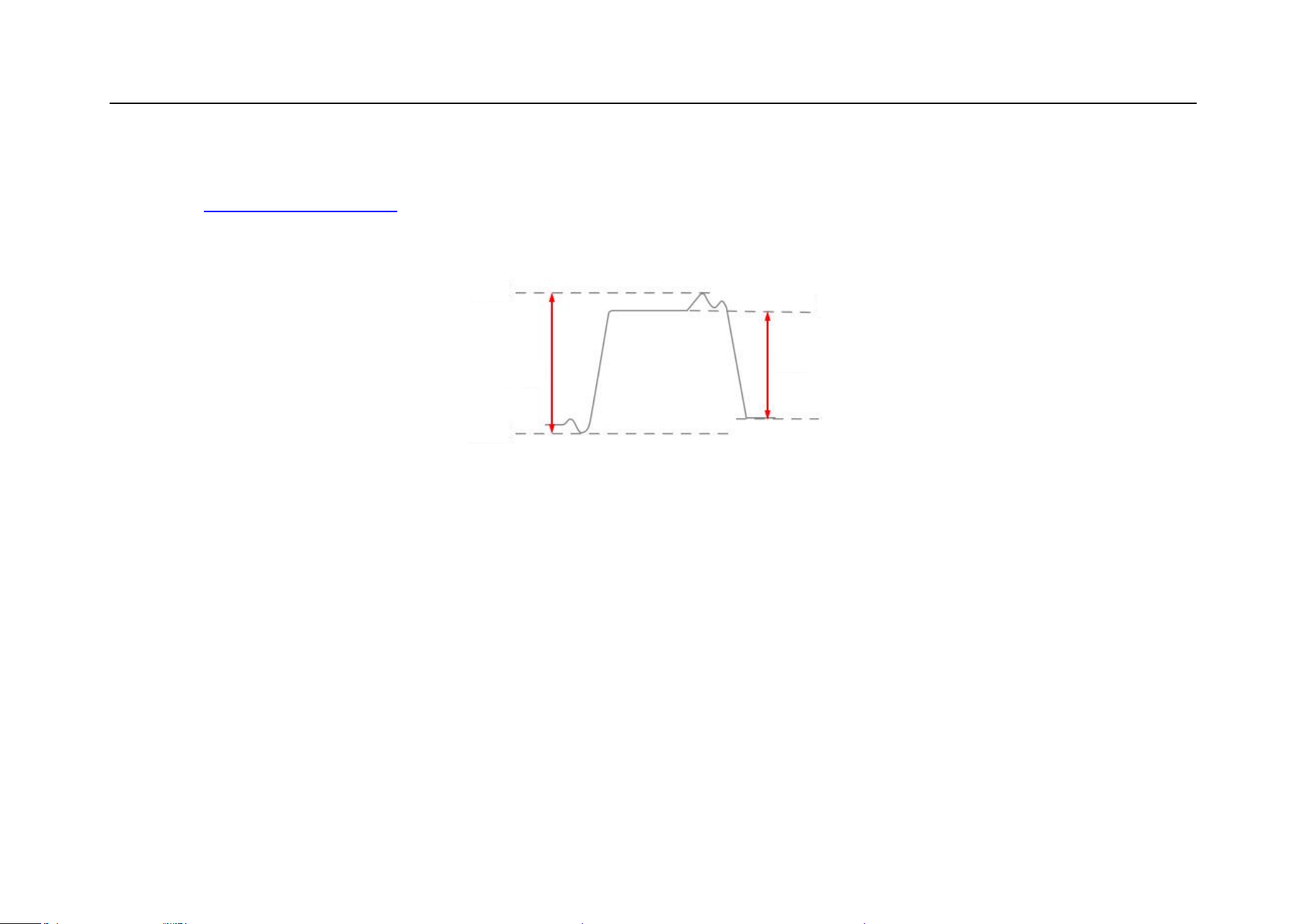
Chapter 6 Analysis System
151
The channel probe type setting is used to set the measurement unit for each input channel to Volts or Amperes.
Refer to “
4.4.4 Set Probe Type”.
Figure 6-7 Voltage Measurement
High
Take 100% in the entire waveform, and calculated using either the min/max or histogram method.
Low
Take 0% in the entire waveform, and calculated using either the min/max or histogram method.
Amplitude
Low
Max
Min
Peak-peak
152
Max
Highest positive peak measured over the entire waveform
Min
Highest negative peak measured over the entire waveform
RMS
True root mean square value over the entire waveform
C RMS
True root mean square value of the first cycle in the waveform
Mean
Arithmetic mean over the entire waveform
C mean
Arithmetic mean over the first cycle in the waveform

Chapter 6 Analysis System
153
Note:
If the waveform required for measurement is not fully displayed on the screen, “Forward Clipping” or “Negative
Clipping” is displayed at the position of the measured value.
When the math function is operated, if source channel waveform is fully displayed, and the math waveform appears
to be off the screen, the measured value of math waveform will not be influenced.
If source channel is clipped, the measured value of math waveform is the source channel value during screen wave
clipping.
6.2 Frequency Meter Measurement
Open the main menu, tap Measure and Counter to enter the hardware frequency meter setting menu, and select the
channel to be measured, as shown in Figure 6-8. The measured value is displayed in the upper left corner of the
screen, as shown in Figure 6-9.
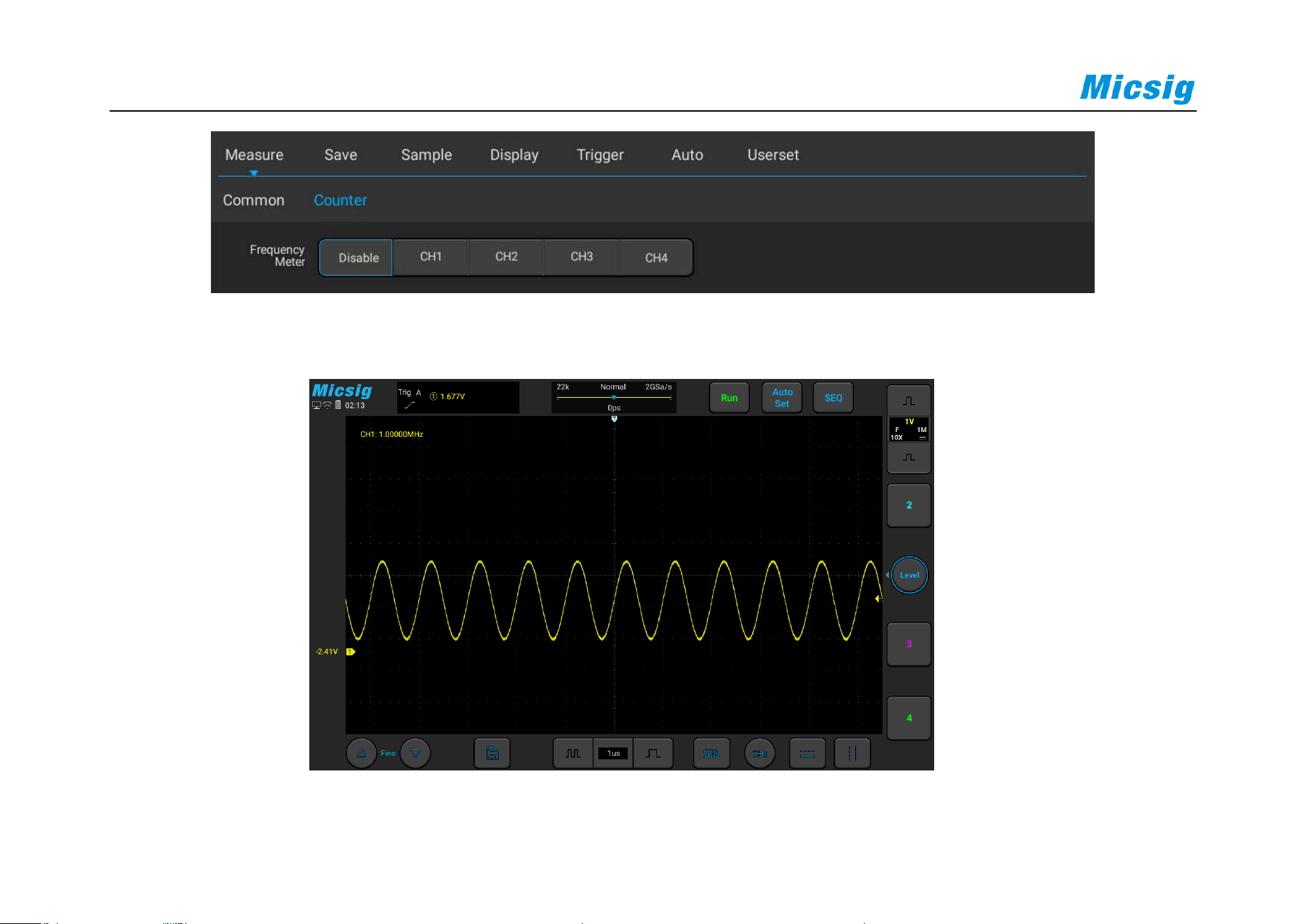
154
Figure 6-8 Frequency Meter Measurement Menu Open
Figure 6-9 Frequency Meter Measurement

Chapter 6 Analysis System
155
6.3 Cursor
Open cursor and place it on the measurement point to read the waveform measurement value. There are two types
of cursors: horizontal cursor and vertical cursor. The horizontal cursor measures the vertical direction magnitude,
and the vertical cursor measures the horizontal direction magnitude, as shown in Figure 6-10.
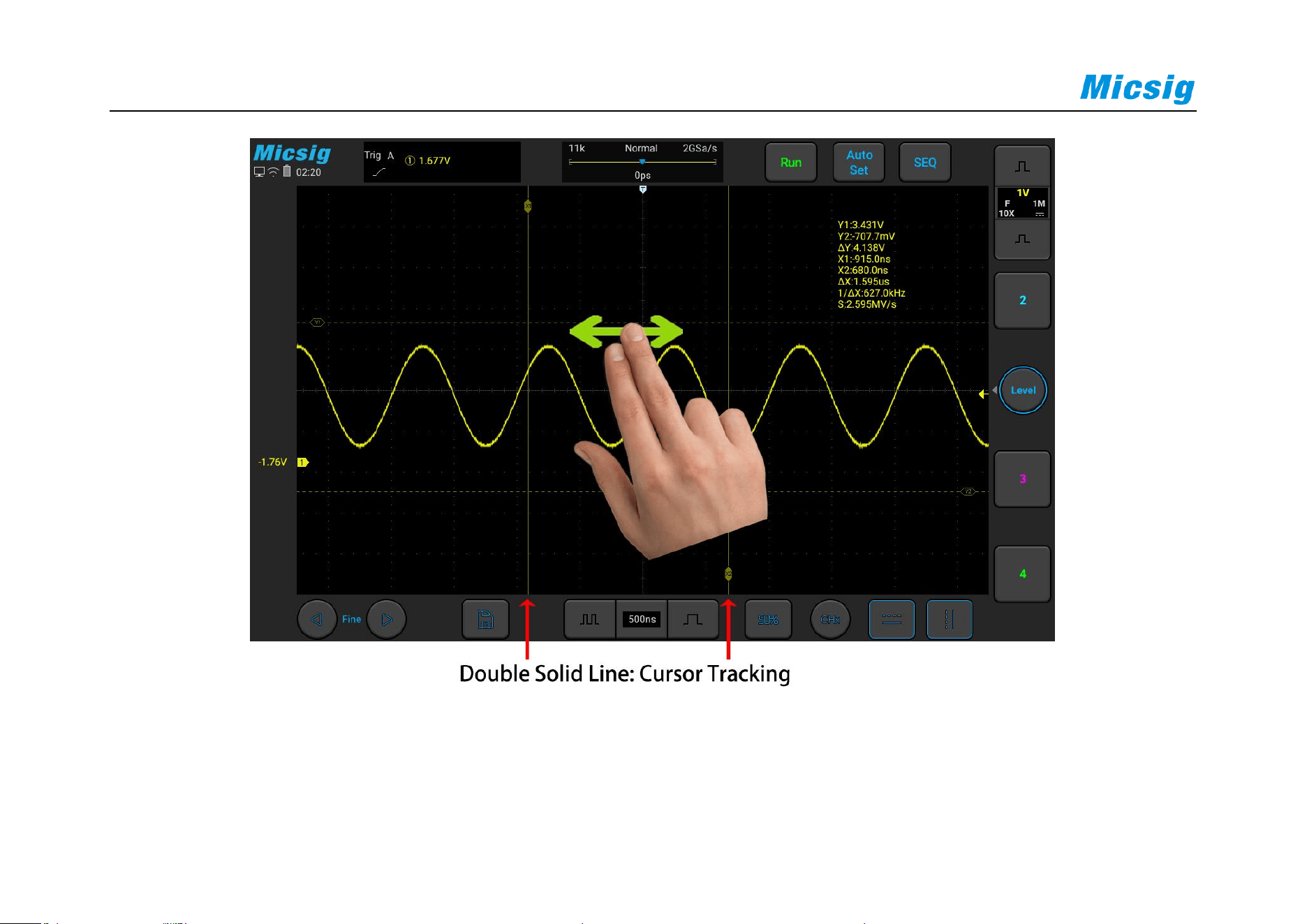
156
Figure 6-10 Cursor Measurement Description
Chapter 6 Analysis System
157
Note:
reading: indicates the difference between two cursor positions.
Voltage readings after Y1, Y2: indicate the position of activated horizontal cursors relative to the zero
potential.
Time readings after X1, X2: indicate the position of activated vertical cursors relative to the trigger point.
1/
X: frequency
S reading. Indicates the quotient of
(voltage difference) of horizontal cursors and Δ (time difference) of
vertical cursors, that is, the slope of the intersection of the four cursors.
Vertical cursor on/off and activation
Vertical cursor on/off
Vertical cursor on: Tap cursor icon to open vertical cursors and the icon is on and activated.
Vertical cursor off: Tap cursor icon to turn off vertical cursors.
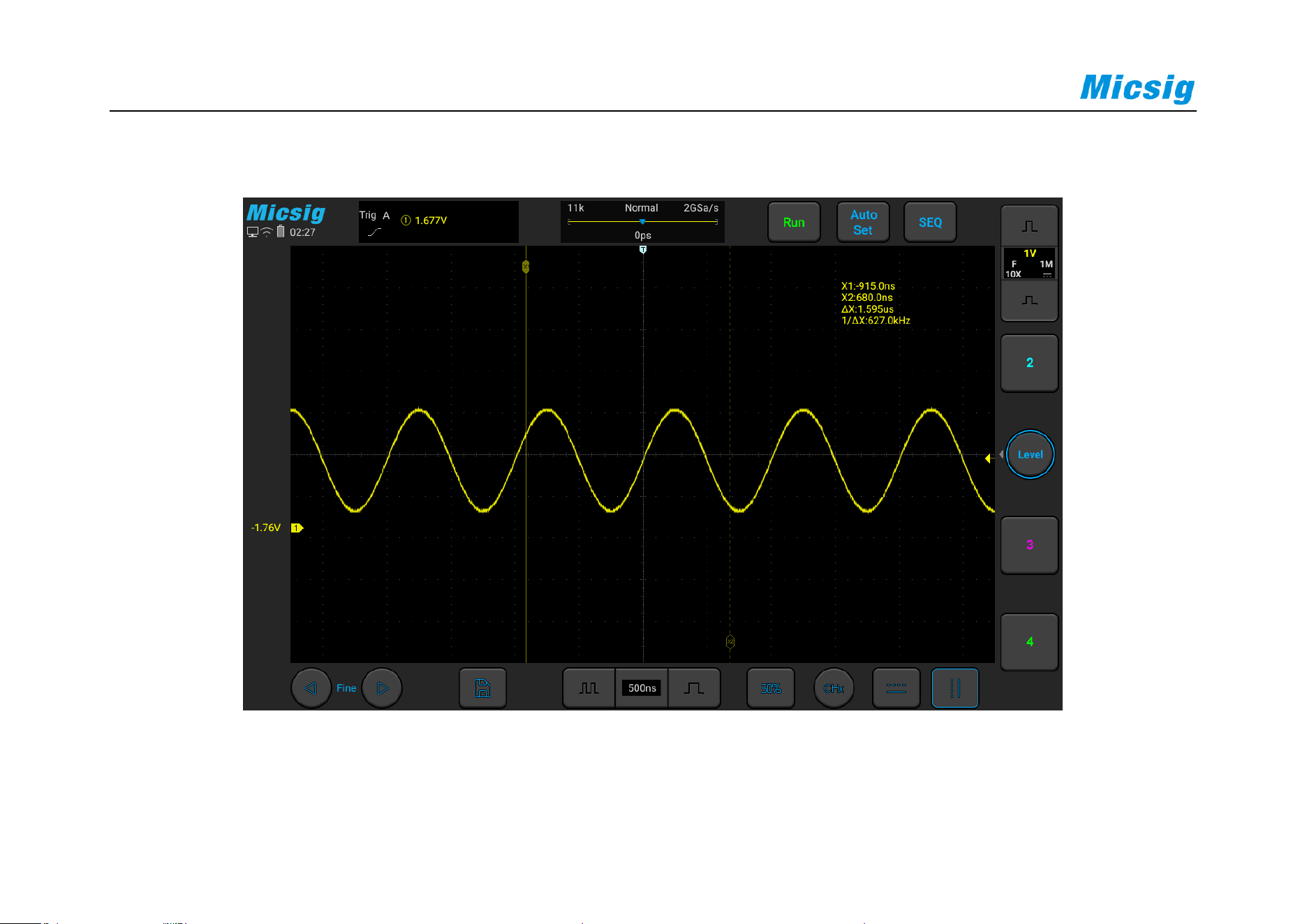
158
Tap the vertical cursor indicator line to switch the cursors.
Figure 6-11 Open Cursor Selection Box and Close Cursor

Chapter 6 Analysis System
159
Vertical cursor movement descriptions:
1) Use a single finger to press and hold the cursor indicator line on the screen to make coarse adjustment to the
cursor; tap the fine adjustment button in the lower left corner of the screen to fine-adjust the cursor that has
just been adjusted.
2) Cursor linkage: When the cursor is opened, two finger slide and enter the cursor linkage state.
Note: During the sliding process, the current operation is changed unless the initial two fingers leave the
screen. If one finger leaves the screen and the other finger does not leave, the current linkage adjustment is
continued.
Horizontal cursor on/off and activation
Horizontal cursor on/off, switching, activation and movement operations, similar to those of vertical cursors, will
not be described in detail here, and please refer to vertical cursors for details.
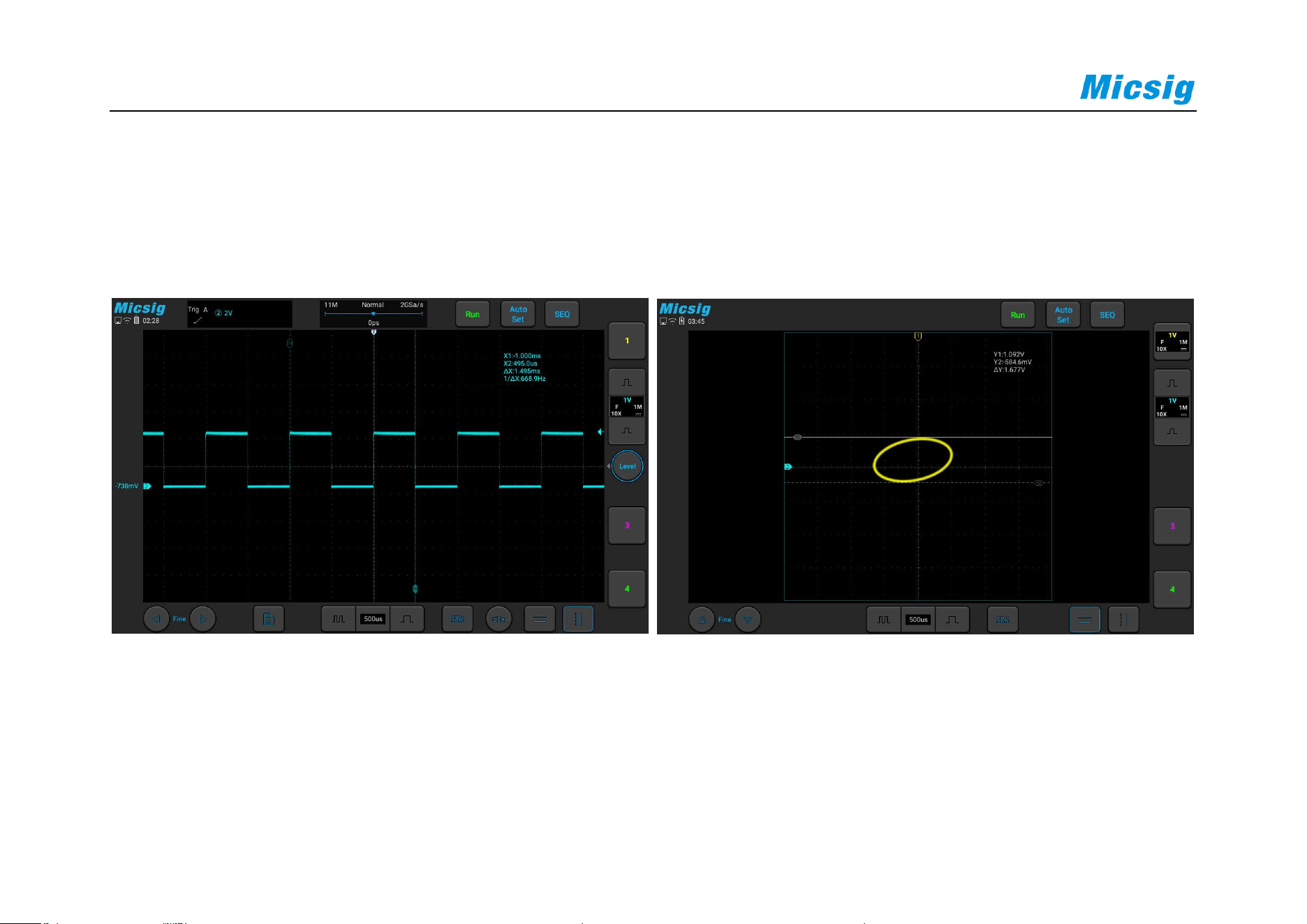
160
Cursor test example
When vertical cursors are activated, the two cursors move together to check for pulse width changes in the pulse
sequence.
Figure 6-12 Cursor Measurement Pulse Width Figure 6-13 In XY Mode, Cursor Measurement
In the XY horizontal mode, X cursor displays CH1 value (V or A), and Y cursor displays CH2 value (V or A).

Chapter 7 Screen Capture, Memory Depth and Waveform Storage
161
Chapter 7 Screen Capture, Memory Depth and Waveform Storage
This chapter contains the detailed information of the screen capture function and memory depth of the oscilloscope.
You are recommended to read this chapter carefully to understand the storage system of the Smart series
oscilloscope.
Screen capture function
Video recording
Memory depth
Waveform storage
162
7.1 Screen Capture Function
The screen capture function can locally store the display information on the current display screen in picture format.
Screen capture method: Slide upward from bottom to open pull-up menu. Tap the icon to have a screen capture
in the oscilloscope application. Or pull down the menu in non-oscilloscope application interface twice and click the
screen capture option to capture the screen content of the non-oscilloscope application.
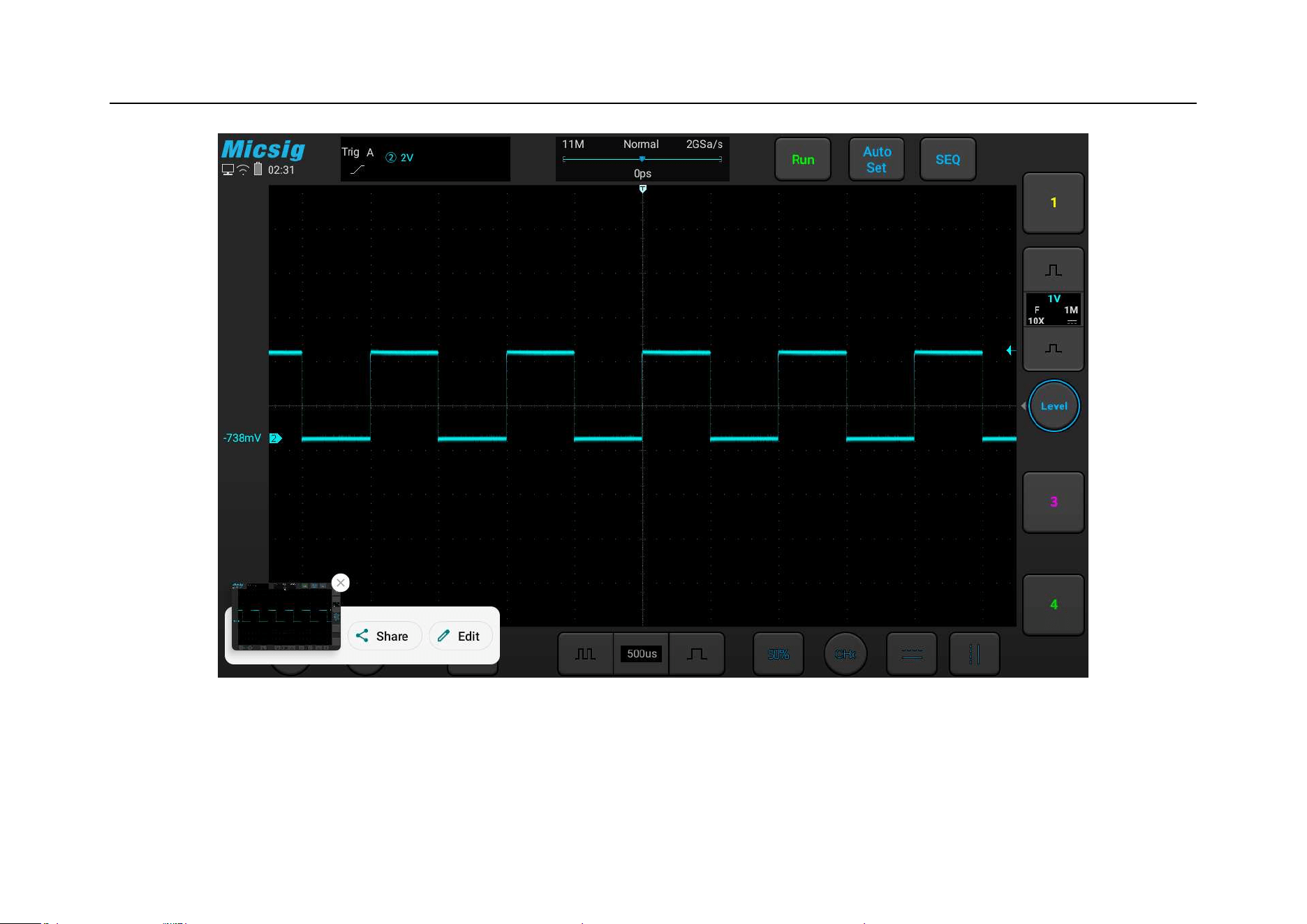
Chapter 7 Screen Capture, Memory Depth and Waveform Storage
163
Figure 7-1 Screen Capture
Please refer to “12.7 Gallery” for details on viewing pictures.
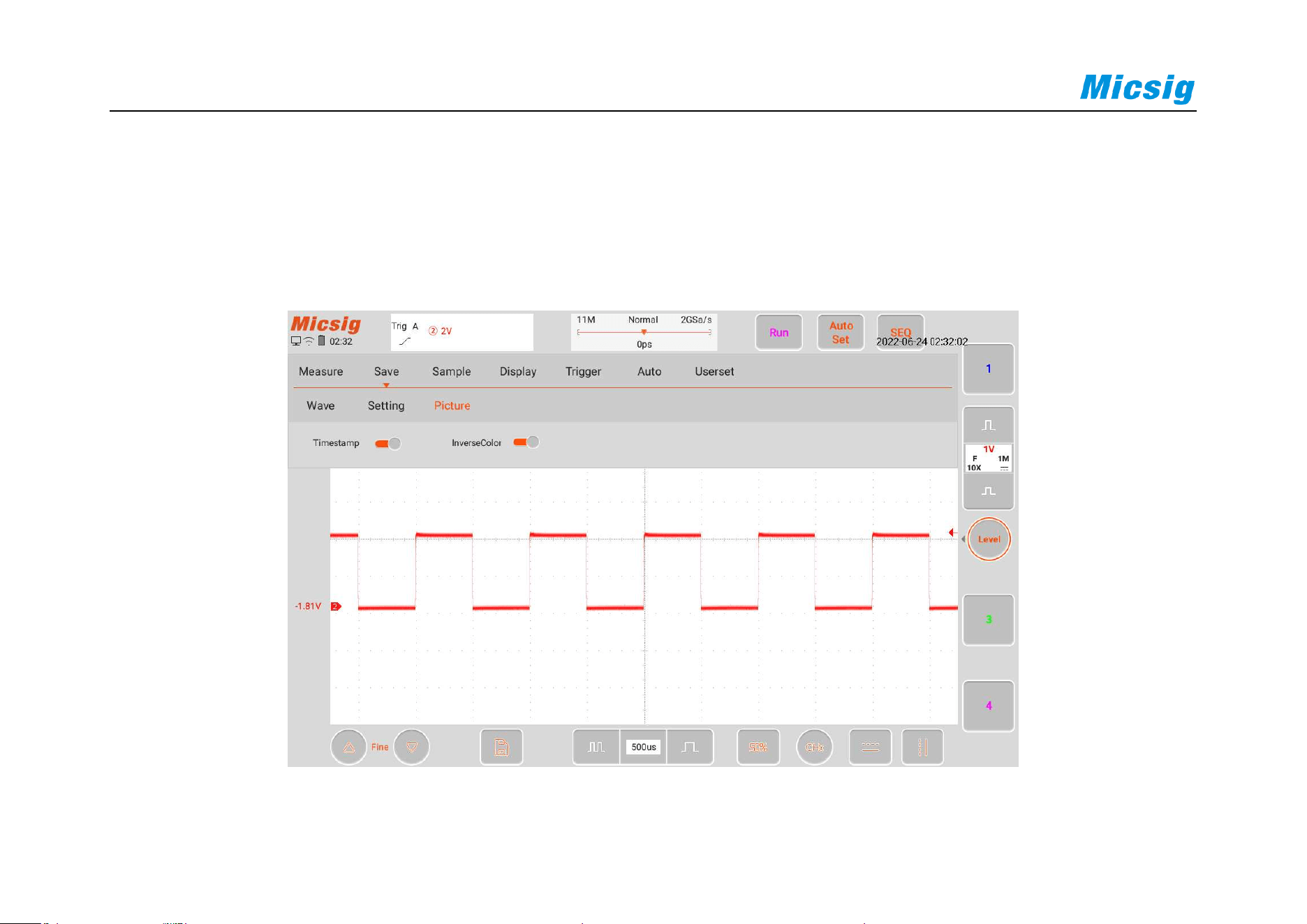
164
Timestamp and InverseColor
Invert and time-stamp screenshots is possible in oscilloscope.
Open the main menu, tap Save and enter Picture menu, turn off/on Timestamp and InverseColor button as desired.
Figure 7-2 Timestamp & inverse color

Chapter 7 Screen Capture, Memory Depth and Waveform Storage
165
7.2 Video Recording
The video recording function is similar to the screen capture function, and the display information of the current
display screen can be stored locally in video format.
Video recording method is sliding down from top in non-oscilloscope application, open pull-down menu, tap the
screen to start recording, and count down to three seconds to complete the video recording, as shown in Figure 7-3.
You can cancel recording by pressing the triangular, circular or square button at the bottom of the screen before the
countdown ends.
During video recording, you can end recording by tapping the video recording time at the top left of the screen. Or
you can leave the oscilloscope application interface to open the pull-down menu, and click “Stop Recording” to end
the video recording.
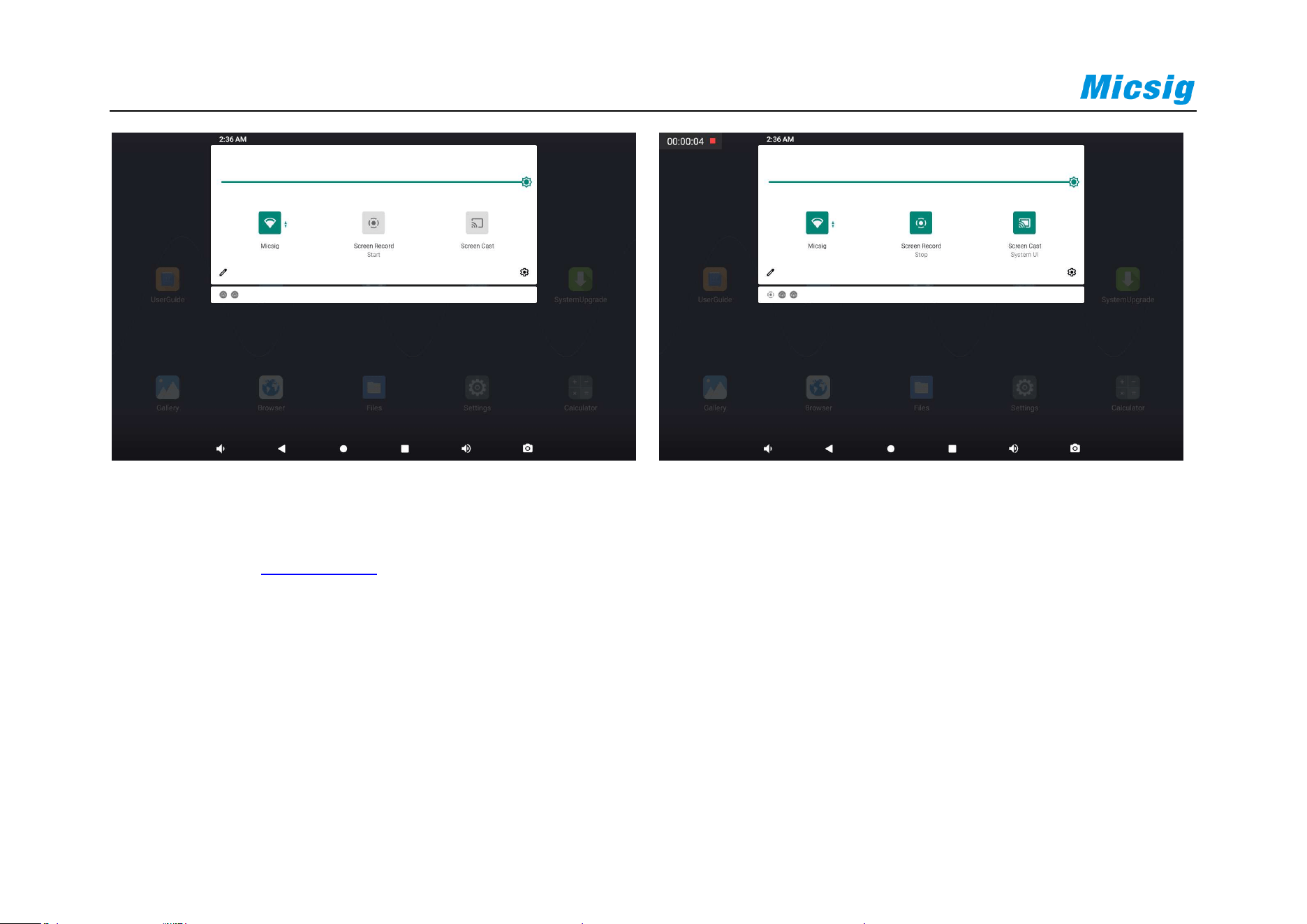
166
Figure 7-3 Video Recording Method Figure 7-4 Video Recording
Please refer to “
12.7 Gallery” for details of viewing videos.
7.3 Waveform Storage
The oscilloscope can save the analog channel or math channel waveform locally or in USB device. The file type can
be WAV, CSV or BIN.
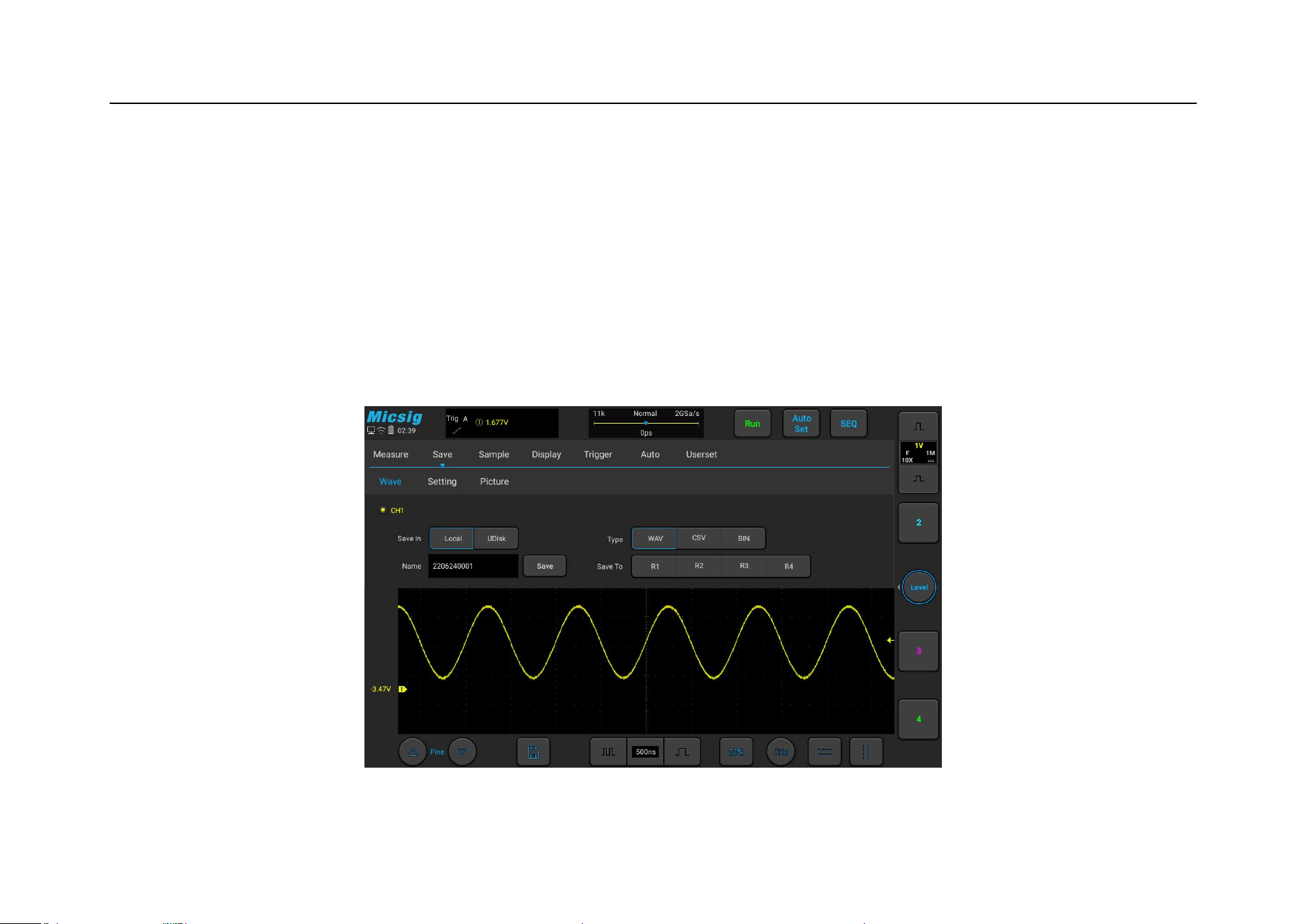
Chapter 7 Screen Capture, Memory Depth and Waveform Storage
167
The oscilloscope provides four reference channels, which can be called to load WAV format files into the reference
channel and open the reference channel to display the reference waveform.
Save reference file
Slide down from top, open main menu and tap "Save" to open the menu. Save the reference waveform interface of
the specified channel as follows:
Figure 7-5 Save CH1 Reference Waveform Interface
168
Location: Stored locally and in USB device.
File types: WAV, CSV, and BIN.
File name: The initial file name is displayed as year + month + day + storage serial number. Press the file name box
to pop up the virtual keyboard, tap “Backspace” to delete the file name, and use the virtual keyboard to rename the
file.
Save: Tap to save the reference file and pop up the save success prompt. The most recently saved file will be
displayed at the top of the called menu.
Save to: Tap the R* (R1, R2, R3, R4) button to save the current channel waveform directly to the corresponding
reference channel, and the save success prompt will pop up.
Back: Tap to return to the previous level.
Method 1: Click the “save” button
In the Save Reference Waveform menu, select the channel waveform to be saved, select the file save location, file
type and file name, and click the “save” button to save the reference waveform file.

Chapter 7 Screen Capture, Memory Depth and Waveform Storage
169
Save the reference waveform by steps as follows:
1) The current channel is set to the channel to be saved, which can be analog channel, math channel or reference.
2) In the main menu, tap "Save" to enter the save menu.
3) In the Save menu, tap "Save" to open the Save Reference Waveform menu and make the following settings:
Storage location: locally.
Selecting the file type: WAV.
Entering the file name: CH1.
4) Tap “Save” to save the reference file. The save success prompt box is popped up.
If the reference waveform file is to be saved in USB device, the oscilloscope must be connected to an external
USB device. After connection, the reference waveform save location is preferentially set to the USB device.
There is no limit to the number of saved reference waveform files.
Method 2: Click R* button
170
In the Save Reference Waveform menu, tap R* (R1, R2, R3, R4) button to save the current channel waveform
directly to the corresponding reference channel, and the save success prompt will pop up. The file name is displayed
as Ref* in the reference channel (* is the corresponding reference channel name). Reference waveform files saved
by this method will be overwritten after loading other reference waveforms and cannot be restored.
Method 3: Click “Quick Save” button
Tap at bottom of the screen to save all channel waveforms as reference waveforms and capture the current
screen. The file names are the default initial file names.
Management of reference files
In the file manager, open waveforms in the classification file to manage reference files by operations such as copy,
cut, delete, rename, compress, etc., as shown in Figure 7-6. Select reference files and click trash button to delete
them; click More at bottom of the screen, tap Rename to open soft keyboard and change the reference file name.
Tap Compress to pop up the soft keyboard and enter the compressed file name to compress the file; when inserting
the USB device, files on the oscilloscope can be moved to the USB device.
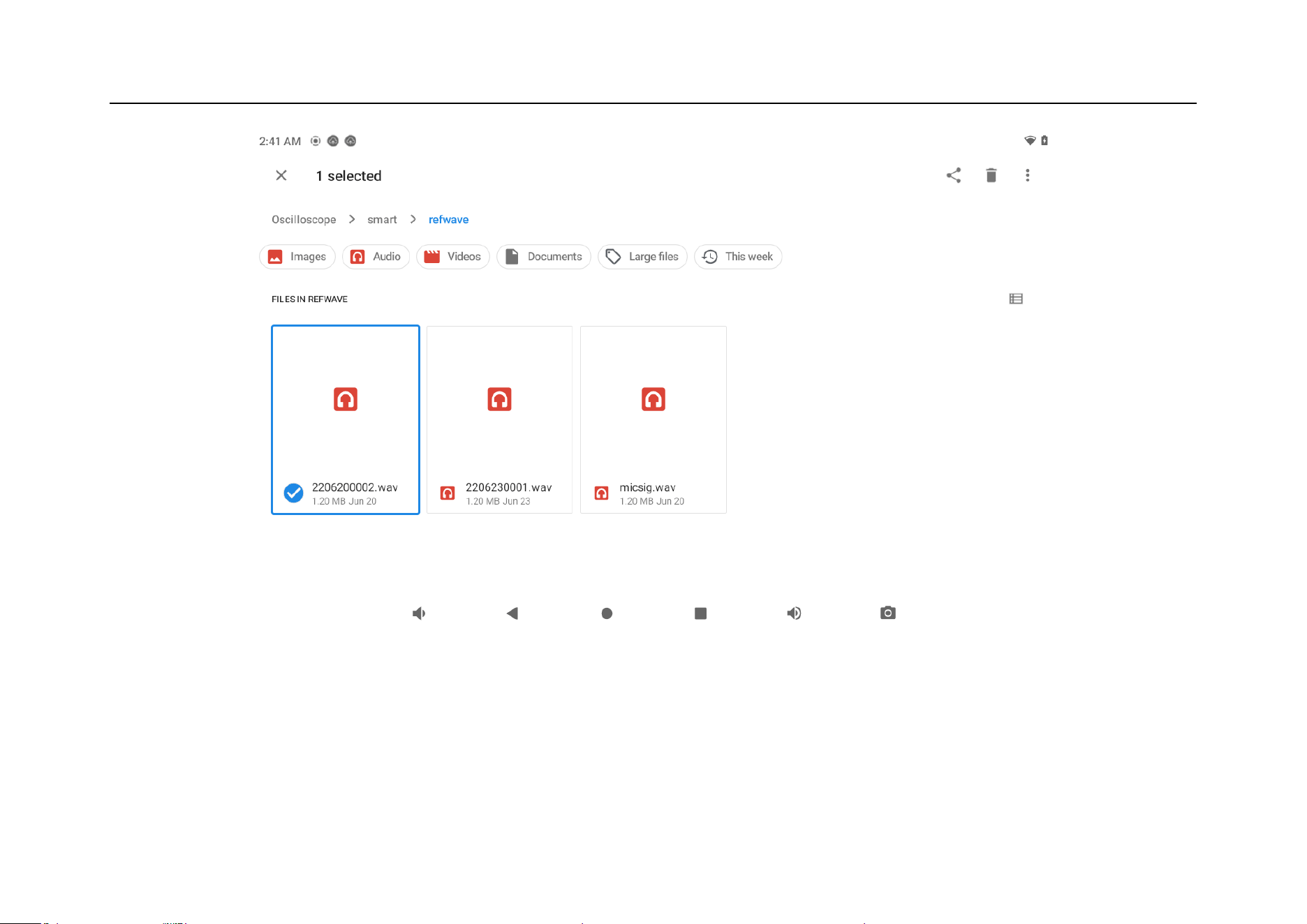
Chapter 7 Screen Capture, Memory Depth and Waveform Storage
171
Figure 7-6 Delete Reference Files
172
CSV files
CSV file structure
CSV format contains the basic information of the saved data: save time, file name, data length, sampling interval,
trigger time, source, vertical scale, vertical offset, vertical accuracy, horizontal time base, horizontal accuracy, probe
multiples.
The data and length of CSV files can be saved up to 70K/35K depending on the single/dual channel while being
saved. If the oscilloscope record length or the displayed data length is less than 70K/35K, the data length of CSV
files changes either. For example, when the record length is set to 14/7/3.5K, there will be 7000 sample points in the
dual channel CSV file.
Max and Min in CSV files
If running Min or Max measurements, Min and Max values displayed on the measurement results screen may not
appear in CSV files.

Chapter 7 Screen Capture, Memory Depth and Waveform Storage
173
Explanation: If the oscilloscope sampling rate is 1GSa/s, sampling will be once every 1ns. If the horizontal scaling
is set to 10us/div, the data of 140us will be displayed (because there are 14 divisions on screen). To find the total
number of samples, the oscilloscope will perform: 140us×1GSa/s=140K sampling, which require the oscilloscope
to display 140K times of sampling using 600-pixel columns. The oscilloscope extracts 140K samples into 600-pixel
columns, and this extraction will track Min and Max values of all points represented by any given column. These
Min and Max values will be displayed in this screen column.
The similar process is applied to reduce sampled data and produce records that can be used to perform various
analyses, such as measurements and CSV data. This analysis record (or measurement record) is much larger than
600 and may actually contain up to 60,000 points. However, once the number of points sampled exceeds 60,000,
some extraction method is required. The extraction factor used to generate the CSV record is configured to provide
the best estimate of all samples represented by each point in the record. Therefore, Min and Max values do not
appear in CSV files.
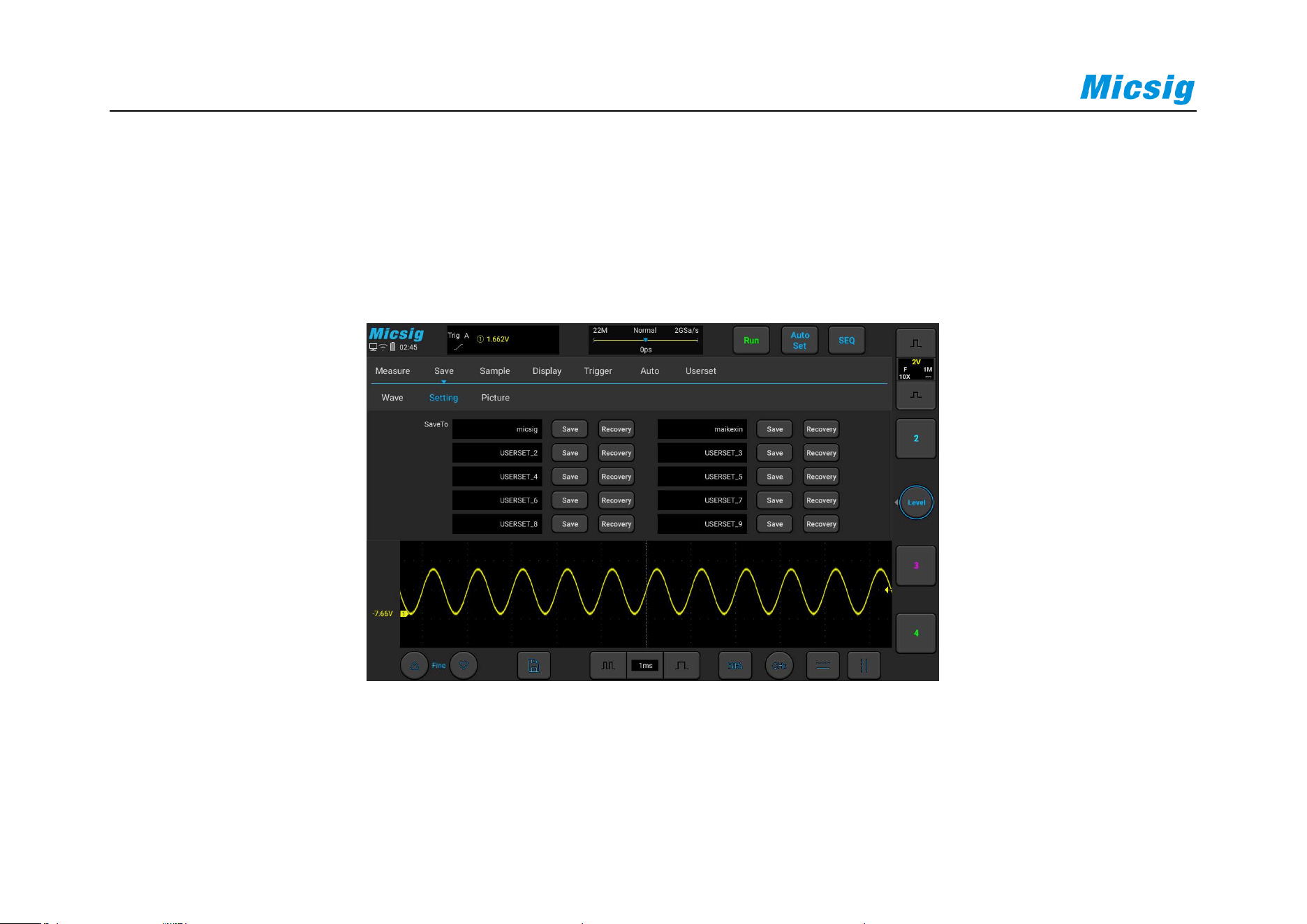
174
7.4 Oscilloscope setting save
The oscilloscope supports saving up to 10 current settings and restoring them with one key.
Open the main menu, tap Save and enter Setting menu, as shown in Figure 7-7.
Figure 7-7 oscilloscope setting save
Tap the black box area to rename save settings, tap the Save button to store, the Recovery button to restore the
settings.

Chapter 8 MATH and Reference
175
Chapter 8 MATH and Reference
This chapter contains the detailed information of the MATH operation and reference channel of the oscilloscope.
You are recommended to read this chapter carefully to understand the setting functions and operations of the MATH
and reference channels of the Smart series oscilloscope.
Dual waveform calculation
FFT measurement
Reference waveform call
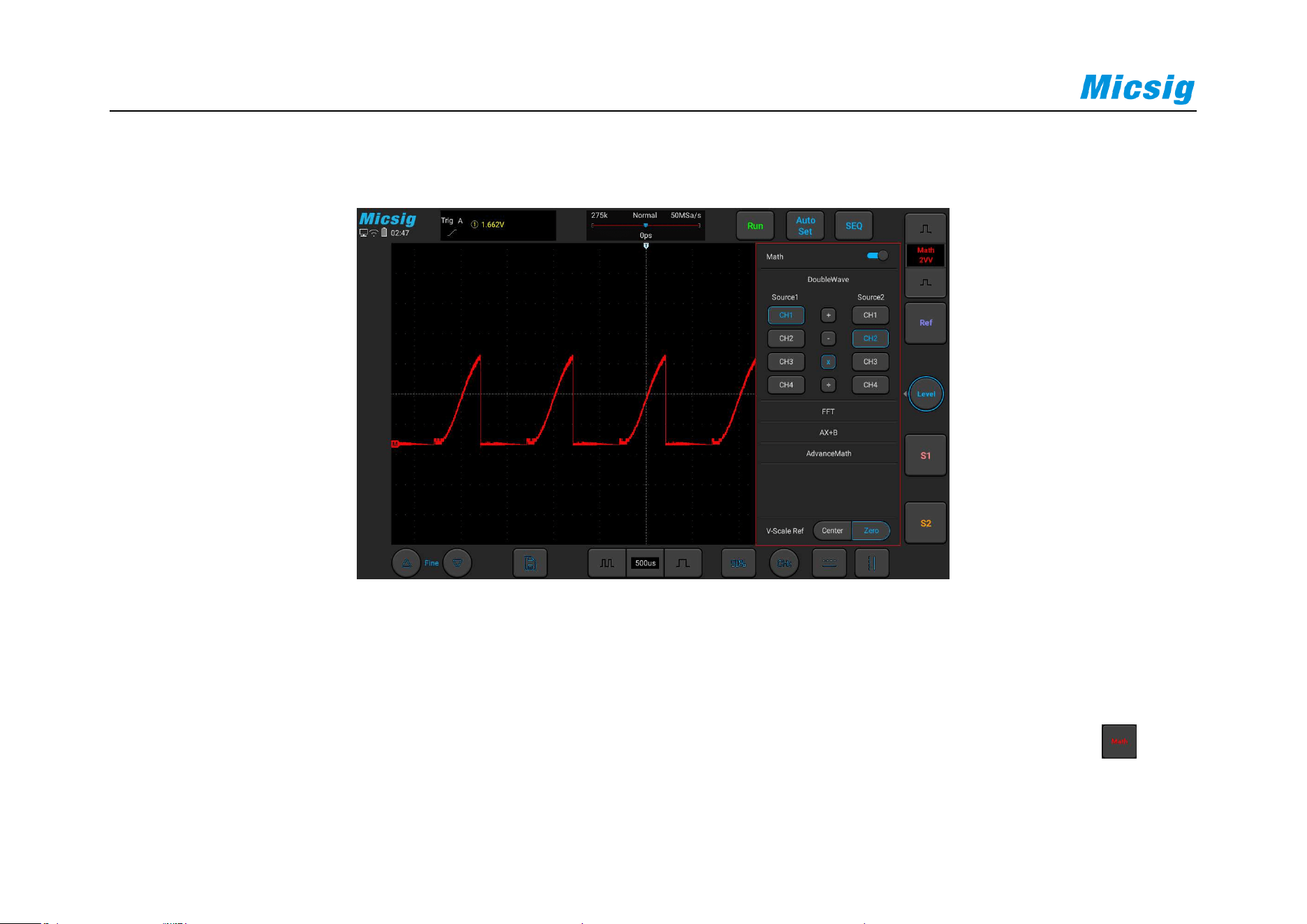
176
8.1 Dual Waveform Calculation
Figure 8-1 MATH Channel Waveform
Display math waveform
Swipe up or down at the channel selection area to enter the second channel selection area. Tap the soft key to
open the math channel. After the math waveform is opened, the current channel selector is automatically opened.
Chapter 8 MATH and Reference
177
Left swipe math channel icon to open the math channel menu. While opening math for the first time, the math
operation is defaulted as the dual channel calculation.
Math operation prompt
If the analog channel or math function is clipped (not fully displayed on the screen), the resulting math function will
also be clipped.
Once the math waveform is displayed, tap the channel icon to close the source channel for a better view of the math
waveform.
The vertical sensitivity and offset of each channel participating in the math function can be adjusted to facilitate
viewing and measuring of the math waveform.
The math function waveform can be measured using “Cursor” and “Measure”.
Adjust the math waveform
1) Press the math channel vertical sensitivity icon, directly tap the math waveform or math channel indication
icon , and set the math channel as the current channel.
178
2) For details of movement, vertical sensitivity adjustment, time base adjustment and vertical expansion reference
of the math channel, please refer to “
Chapter 3 Horizontal System” and “Chapter 4 Vertical System”.
3) The vertical sensitivity, unit and time base corresponding to the math waveform are displayed in the channel
area of the math channel. For details, see “
2.8 Understand the Oscilloscope Display Interface”.
Math waveform units
Use “Probe Type” on the channel menu to adjust the channel unit (refer to “
4.4.4 Set Probe Type”) and set the unit
of each input channel to Volt or Ampere. The units of math function waveform include:
Math Function
Unit
+/-
V, A, ?
×
VV, AA, W
÷
V/V, V/A, A/A, A/V
Table 8-1 List of Mathematical Units

Chapter 8 MATH and Reference
179
Note: If the units of two operation source channels are different and the unit combination cannot be identified, the
unit of math function will be displayed as? (undefined).
Math operators
Math operators perform arithmetic operations on the analog input channels.
Addition or subtraction
If addition or subtraction is selected, the values of function sources 1 and 2 will be added or subtracted point by
point and the results will be displayed.
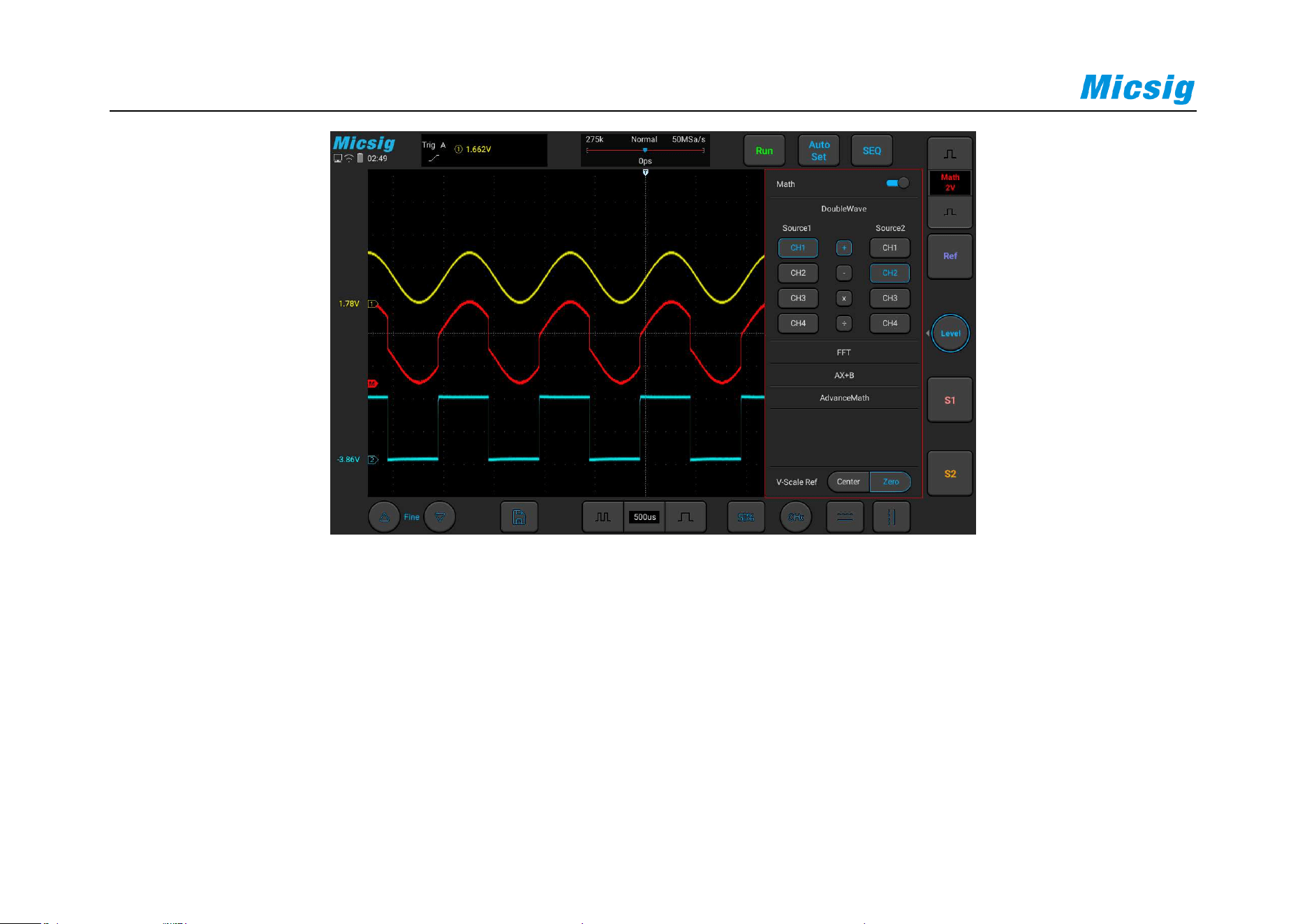
180
Figure 8-2 Mathematical Operation of CH1 adding CH2
Multiplication or division
When multiplication or division is selected, the values of function sources 1 and 2 values will be multiplied or
divided point by point and the results will be displayed.
Multiplication is useful when viewing the power relationship, if one of the channels is proportional to the current.
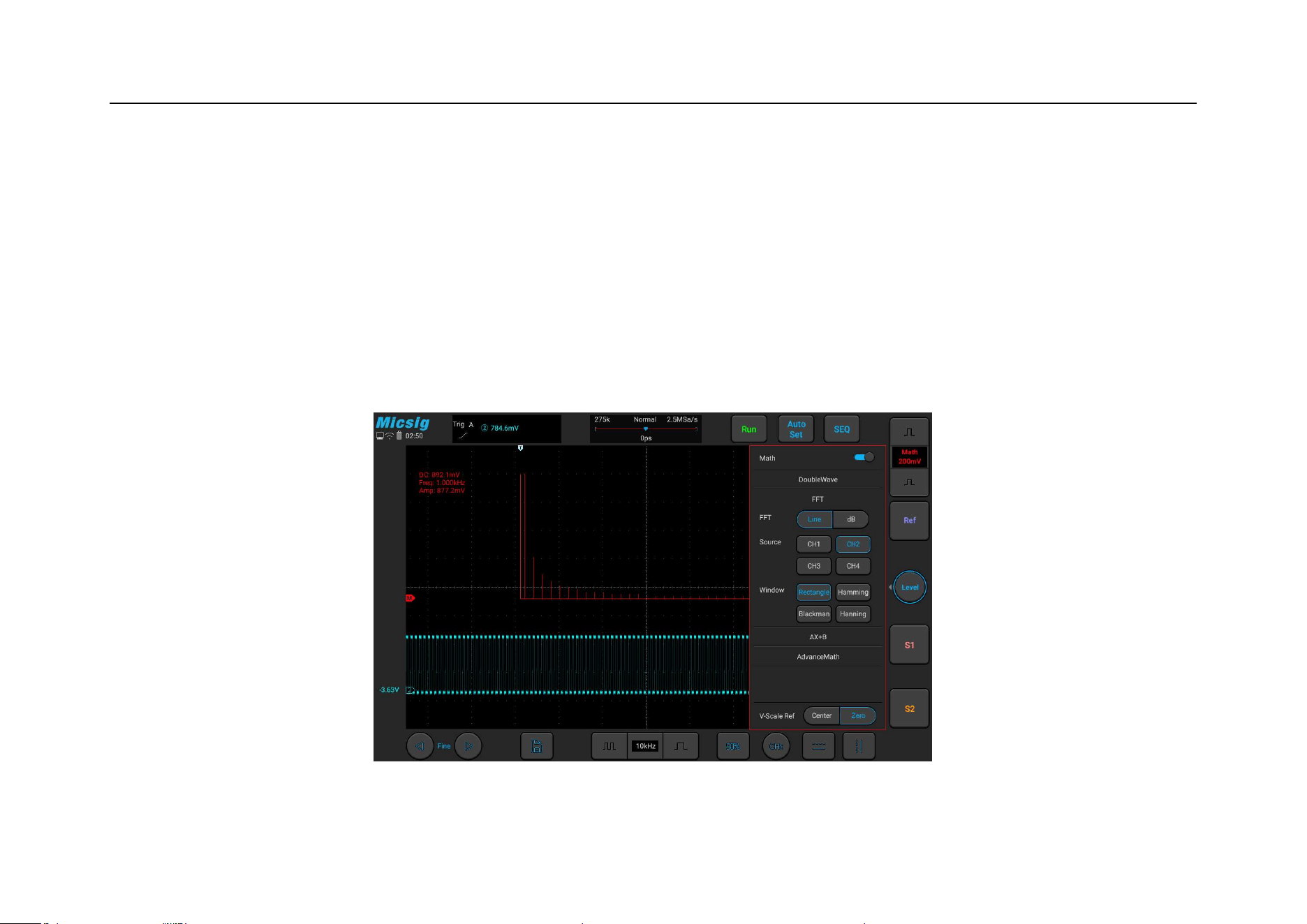
Chapter 8 MATH and Reference
181
8.2 FFT Measurement
FFT is used to calculate the Fast Fourier Transform using the analog input channel. FFT record specifies the
digitization time of the source and converts it to the frequency domain. After selecting the FFT function, FFT
spectrum is plotted as amplitude in V-Hz or dB-Hz on the oscilloscope display screen. The reading of the horizontal
axis changes from time to frequency (Hz), while the unit of the vertical axis changes from volt to V or dB.
Figure 8-3 FFT Window
182
Open FFT
1) Swipe up or down at the channel selection area to enter the second channel selection area. Tap the soft key
to open the math channel, left swipe to open math channel menu.
2) Tap spectrum type “Line/Decibel” to open the FFT window (see Figure 8-3 FFT Window).
3) Tap the Operation Source box to select the channel for which FFT transform is required.
4) Tap the window box to select the window function applied to the FFT input signal.
Selection of window function
In the FFT transform, four different FFT windows can be selected.
Each window is alternatively used between frequency resolution and amplitude accuracy, and the appropriate
window may be selected according to the characteristics of the following windows.

Chapter 8 MATH and Reference
183
Rectangular window
This is the best window type for resolution frequencies that are very close to the same value, but this type is
the least effective at accurately measuring the amplitude of these frequencies. It is the best type of
measuring the spectrum of non-repetitive signals and measuring the frequency component close to DC.
Use the “Rectangular” window to measure transients or bursts of signal levels before or after almost the
same event. Moreover, this window can be used to measure equal-amplitude sine waves with very close
frequencies and wideband random noises with relatively slow spectral variations.
Hamming window
This is the best window type for resolution frequencies that are very close to the same value, and the
amplitude accuracy is slightly better than the “Rectangular” window. The Hamming type has a slightly
higher frequency resolution than the Hanning type.
Use Hamming to measure sinusoidal, periodic, and narrowband random noises. This window is used for
measuring transients or bursts of signal levels before or after events with significant differences.
184
Hanning window
This is the best window type for measuring amplitude accuracy but less effective for resolving frequencies.
Use Hanning to measure sinusoidal, periodic, and narrowband random noises. This window is used for
measuring transients or bursts of signal levels before or after events with significant differences.
Blackman-Harris window
This is the best window type for measuring frequency amplitude, but worst for measuring the resolution
frequency.
Use the Blackman-Harris measurement to find the main single-signal frequency waveform for higher
harmonics.
Since the oscilloscope performs FFT transform on the finite-length time record, the FFT algorithm assumes
that YT waveform is continuously repeated. Thus, when the period is integral, the amplitudes of YT
waveform at the beginning and at the end are the same, and waveform will not interrupt. However, if the
period of YT waveform is not integral, the waveform amplitudes at the beginning and at the end are

Chapter 8 MATH and Reference
185
different, resulting in high-frequency transient interruption at the junction. In the frequency domain, this
effect is called leakage. Therefore, to avoid leakage, the original waveform is multiplied by a window
function, forcing the values at the beginning and at the end to be zero.
Note: Signals with DC components or deviations can cause errors or deviations in the FFT waveform components.
AC coupling can be selected to reduce DC components.
Spectrum type
Select Line, the vertical axis reads V or A; select dB, the vertical axis reads dB. When the spectrum is linear, the
waveform is shown in Figure 8-4.
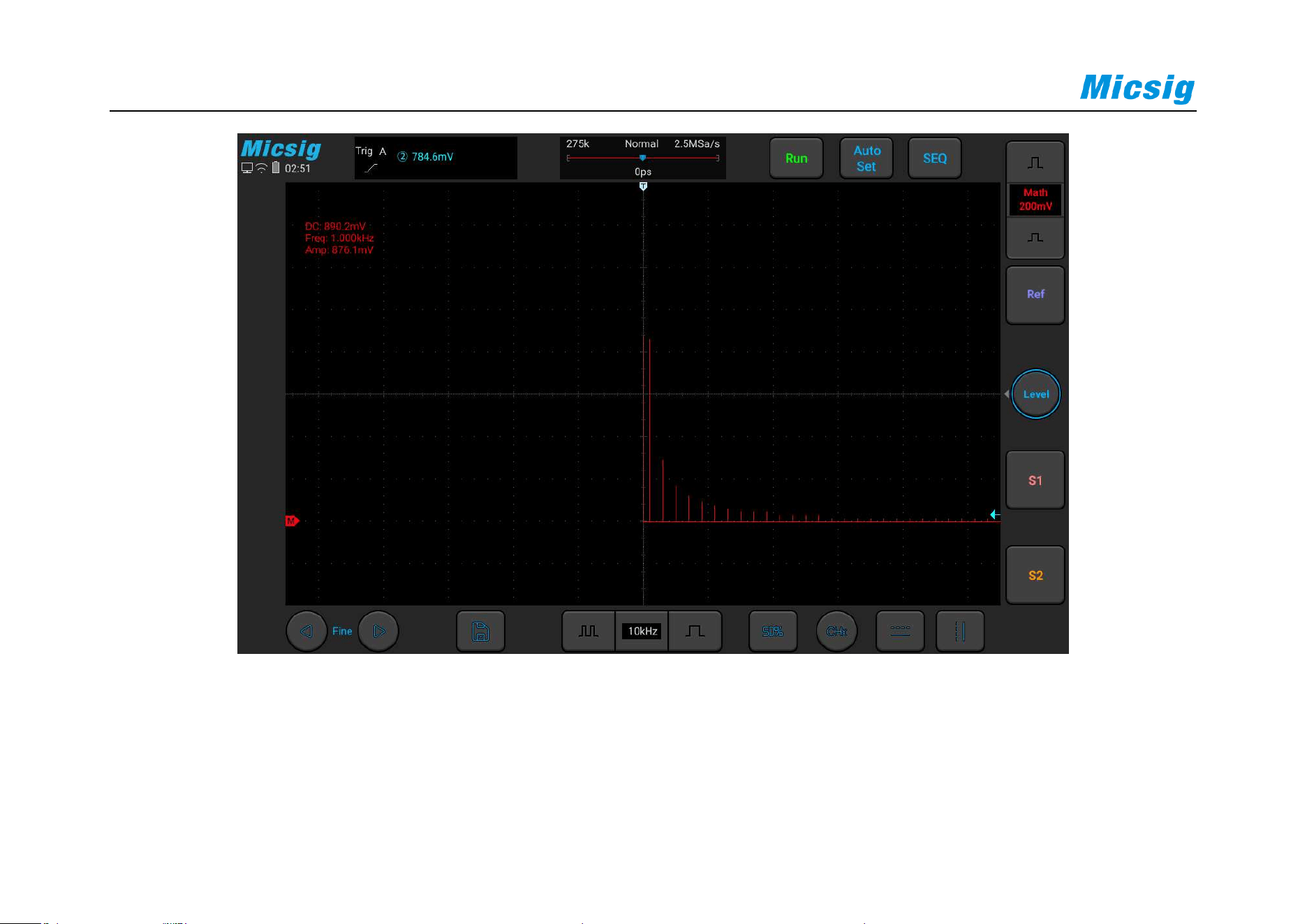
186
Figure 8-4 Spectrum Amplitude as V-Hz

Chapter 8 MATH and Reference
187
Adjust FFT waveforms
Waveform position
Select math channel as the current channel. After touching math waveform on the screen with one finger,
adjust the waveform display position by dragging upward and downward, leftward and rightward, or tap
the fine adjustment button in the lower left corner of the screen for fine adjustment
Select math channel as the current channel and press the “position” knob in the horizontal button area to
move the leftmost side of the waveform (0Hz) to the horizontal center of the screen.
Select math channel as the current channel and press the “position” knob in the vertical button area to move
the waveform to the vertical center of the screen.
Horizontal time base scale
Select math channel as the current channel, tap the time base adjustment button, and adjust the horizontal time base
scale. The horizontal time base is stepped in 1-2-5, and the waveform changes either.
188
For FFT measurement, the reading of the horizontal axis changes from time to frequency (Hz), and it no longer
shares the same time base with other analog channels. Therefore, before adjusting the horizontal frequency scale,
the math channel must be set as the current channel.
Vertical sensitivity
Tap or on the right side of the screen to set the vertical sensitivity (V/div or dB/div) for the channel so
that waveform is displayed on the screen at an appropriate size. The vertical sensitivity factor is stepped in 1-2-5
(using 1:1 probe).
Note: FFT waveform does not support automatic parameter measurement.
8.3 Advanced Math
Smart series oscilloscopes support user-defined editing formulas for waveform calculation. Support the input of
functions, operators, channels, constants, variables, etc. The expression supports up to 36 characters.
Click the corresponding button to input and edit the waveform (please click in order, the ones that are grayed out
cannot be clicked).
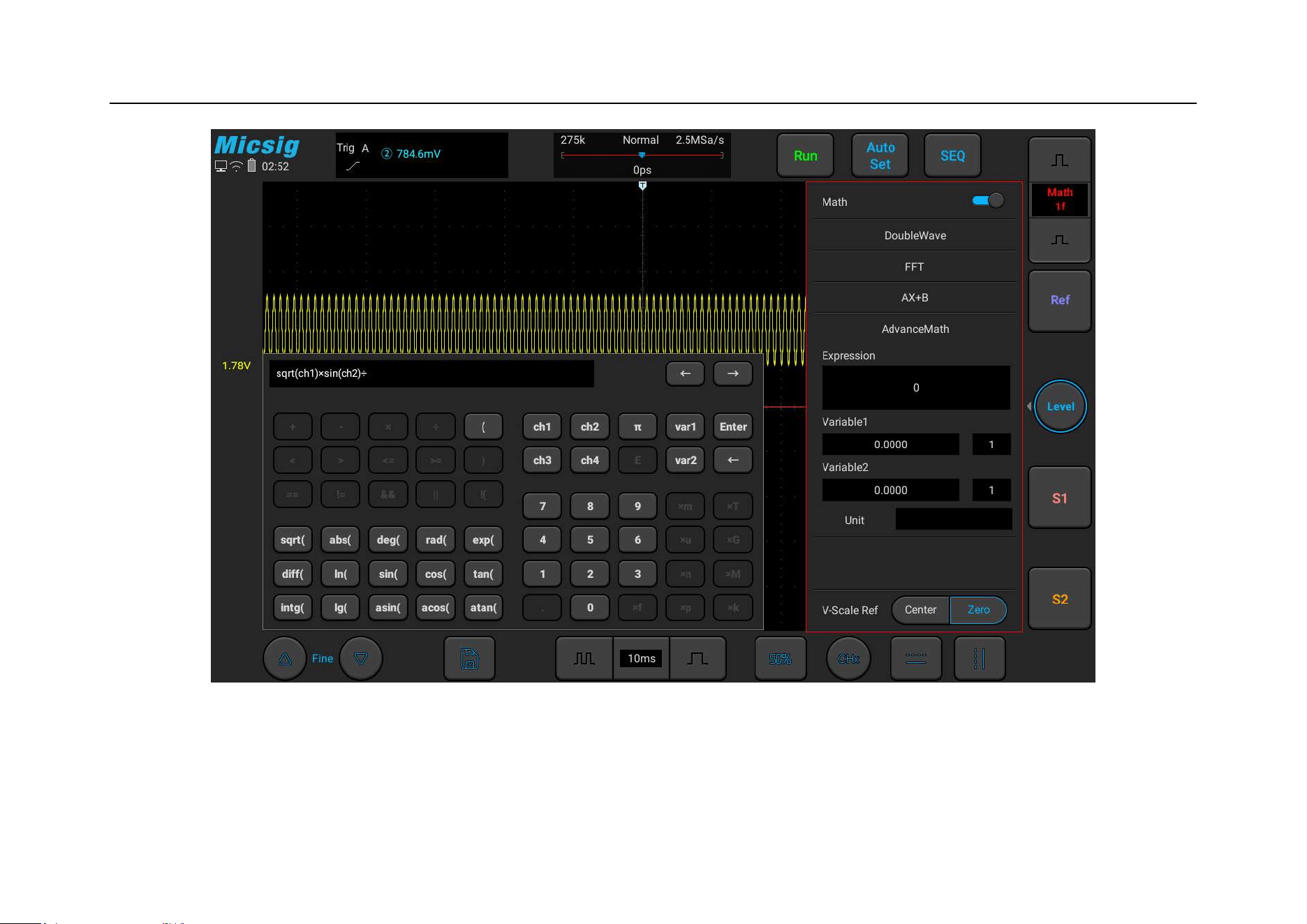
Chapter 8 MATH and Reference
189
Figure 8-5 Advanced Math
190
Type
Description
Item
Remark
Function
Sqrt()、Abs()、Deg()、
Rad()、Exp()、Diff()、
ln()、Sine()、Cos()、
Tan()、Intg()、Log()、
arcsin()、arccos()、
arctan()
Functions can be nested
Channel
Source
Ch1、Ch2、Ch3、Ch4
Variable
Source
variable1、variable2
When a variable is written in the
expression, the input box of the
variable appears in the math menu,
indicating that it can be input; for
example, input 4.1235 -3 for variable
1, which means 4.1235×10
-3
Chapter 8 MATH and Reference
191
Variable value range -9.9999~9.9999,
variable power range -9~9
Operator
+、-、*、/、==、!=、>、
<、≥、≤、&&、||、!(
symbol
brackets
(、)
Value
Source
0、1、2、3、4、5、6、7、8、
9、.、π、E
Source
10
×
Numerical
unit
f、p、n、u、m、K、M、G、T
Table 8-2 List of Advanced Math
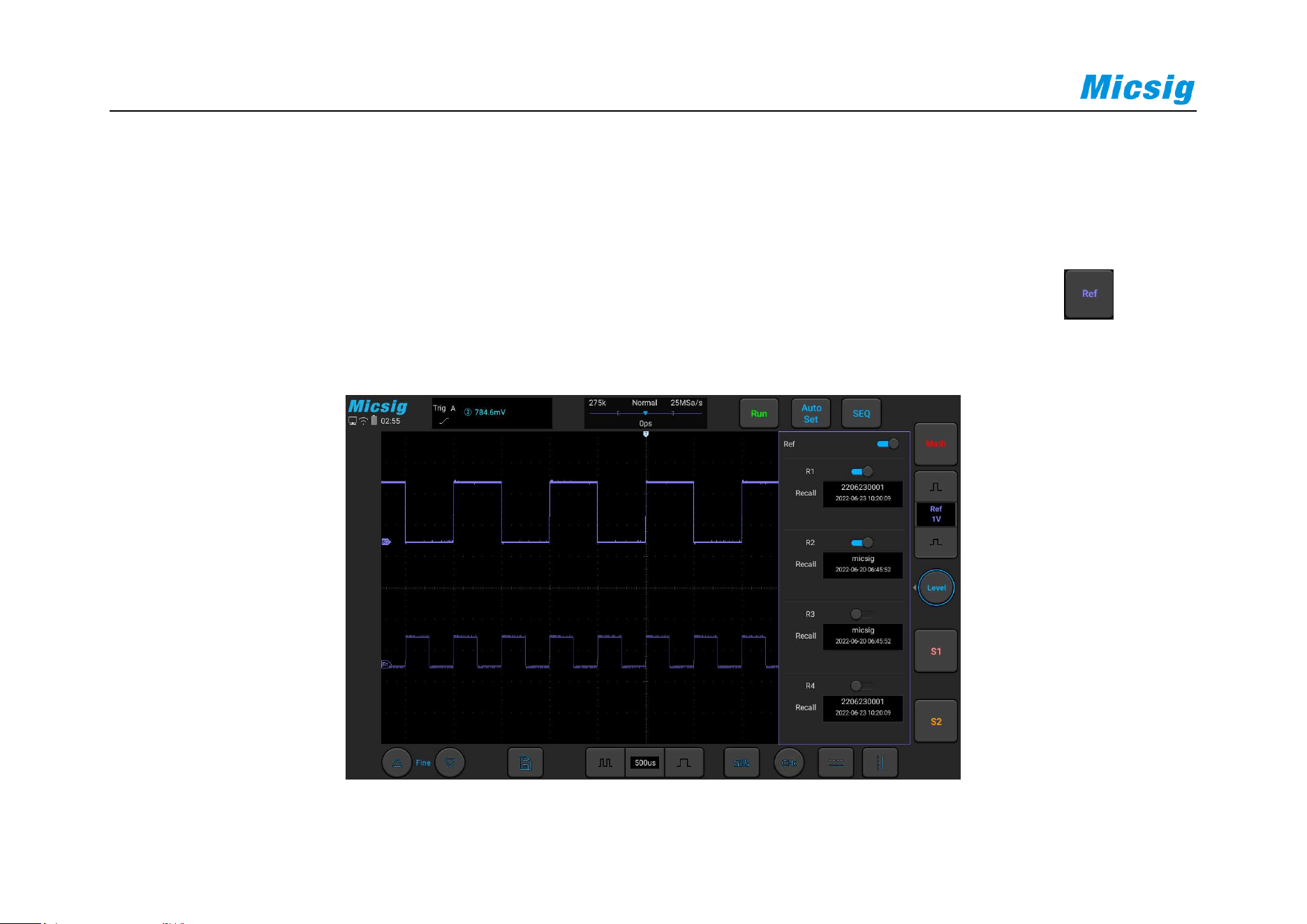
192
8.4 Reference Waveform Call
Reference waveform call and close
Swipe up or down at the channel selection area to enter the second channel selection area. Left swipe button
to open the reference menu, see Figure 8-5.
Figure 8-6 Reference Channel Menu
Chapter 8 MATH and Reference
193
When there are already waveforms loaded into the reference channel, click “Open/Close” button to open or close
the reference channel; the reference waveform is displayed in blue-violet, and the four stored waveforms can be
displayed simultaneously, wherein the current reference waveform is brighter than non-current reference
waveforms.
When there are no waveforms loaded into the reference channel, turn on the “Call” switch to call waveforms.
Take R1 as an example, with operation steps as follows:
1) Open reference menu.
2) Tap the “Call” file box under R1 to open the reference file column.
3) Click the name of the reference waveform file to be called. The file is loaded into R1 channel. Then, R1
channel is turned on as the current channel waveform, and the reference waveform channel icon is
highlighted. The displayed state changes from “Close” to “Open”. As in Figure 8-6, the brighter reference
waveform is shown as the current reference channel.
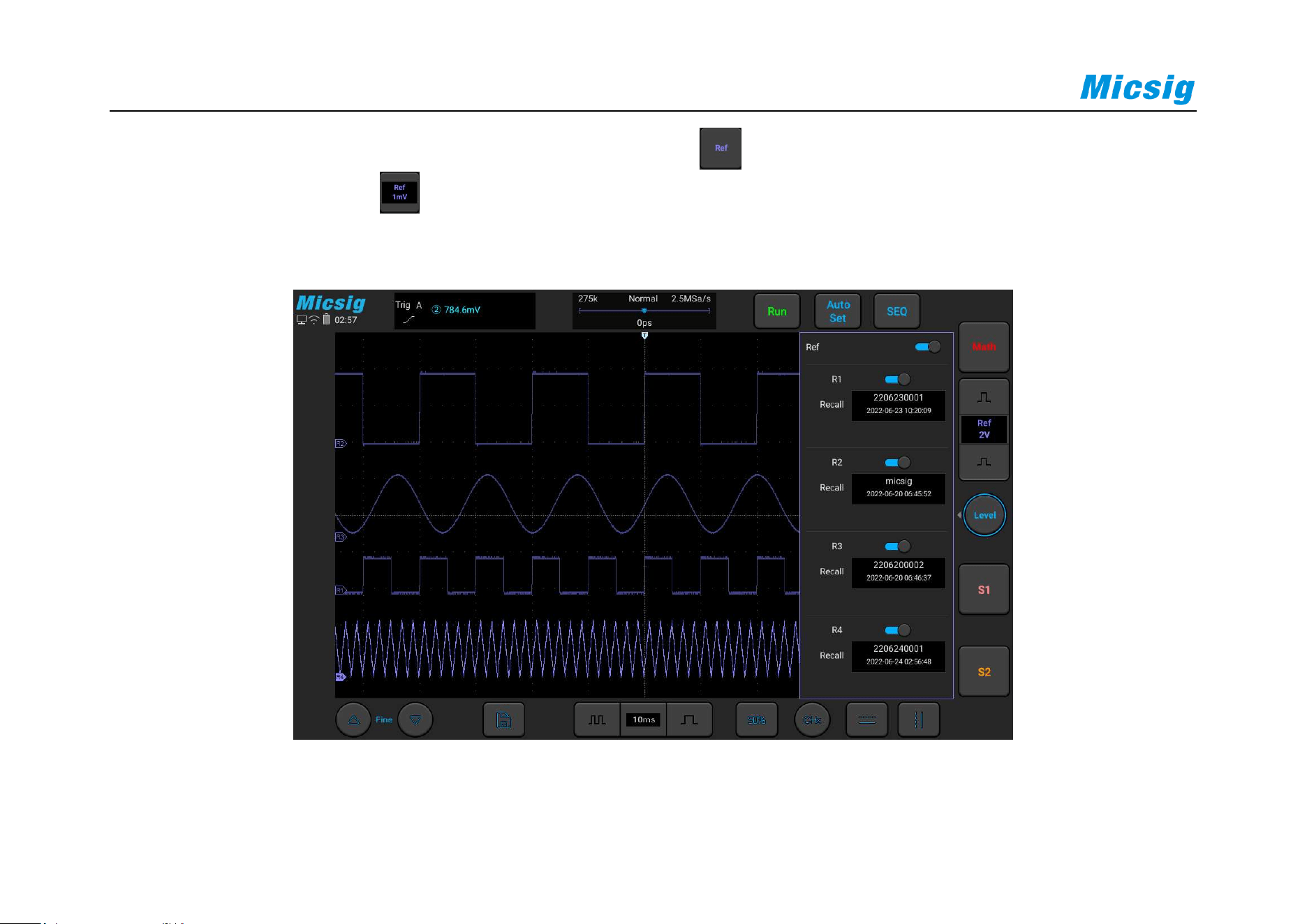
194
If there are already files loaded into the reference channel, tap to open the reference channel of all loaded
reference files; Right swipe to close all currently opened reference waveforms. A single reference channel
may also be opened with the Open/Close button.
Figure 8-7 Restore Reference Waveform
Chapter 8 MATH and Reference
195
Close the reference waveform:
1) In the reference menu, tap “Open/Close” button in R1 to close the reference waveform.
2) Repeat step 1 to close other reference channels.
3) Right swipe to turn off all reference waveforms.
Reference waveform movement and time base adjustment
The horizontal or vertical movement and zoom of reference waveforms are independent of analog channels, and the
adjustments among different reference waveform channels are also independent of each other.
To adjust the reference waveform of a channel, first set the channel as the current channel, and then adjust the
reference waveform by move or zoom (in accordance with the analog channel method).
The scale and time base of the current channel reference waveform are displayed on the reference button. After
switching the current reference channel, the scale and time base on the reference button change with the change of
current reference channel.
196
Chapter 9 Display Settings
This chapter contains the detailed information of the display settings and function buttons of the oscilloscope. You
are recommended to read this chapter carefully to understand the display setting functions and operations of the
Smart series oscilloscope.
Waveform setting
Persistence setting
Graticule setting
Horizontal expansion center
Color temperature setting
Time base mode selection
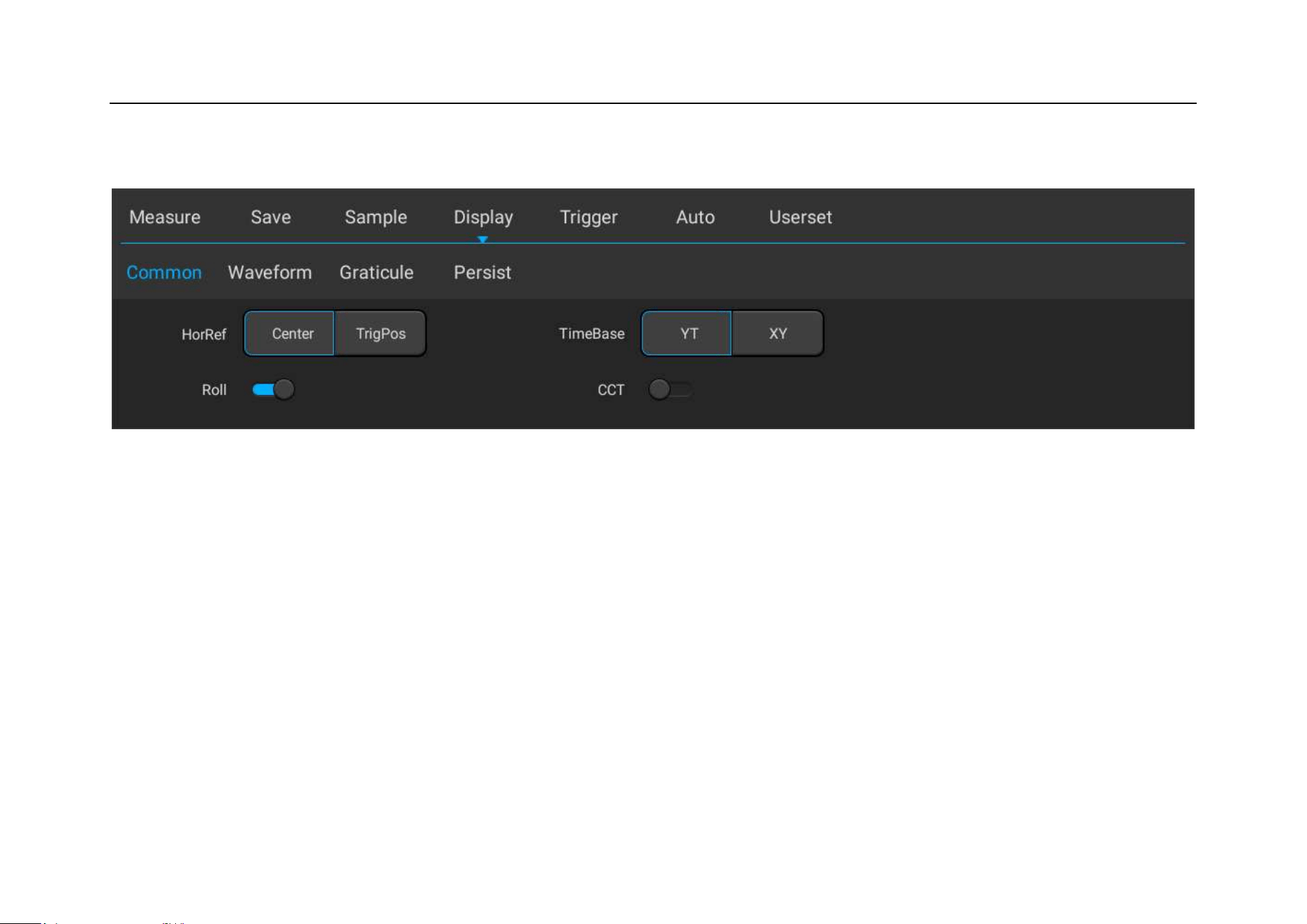
Chapter 9 Display Settings
197
In the main menu, tap Display button to enter display settings menu, as shown in Figure 9-1.
Figure 9-1 Display Settings and Function Buttons
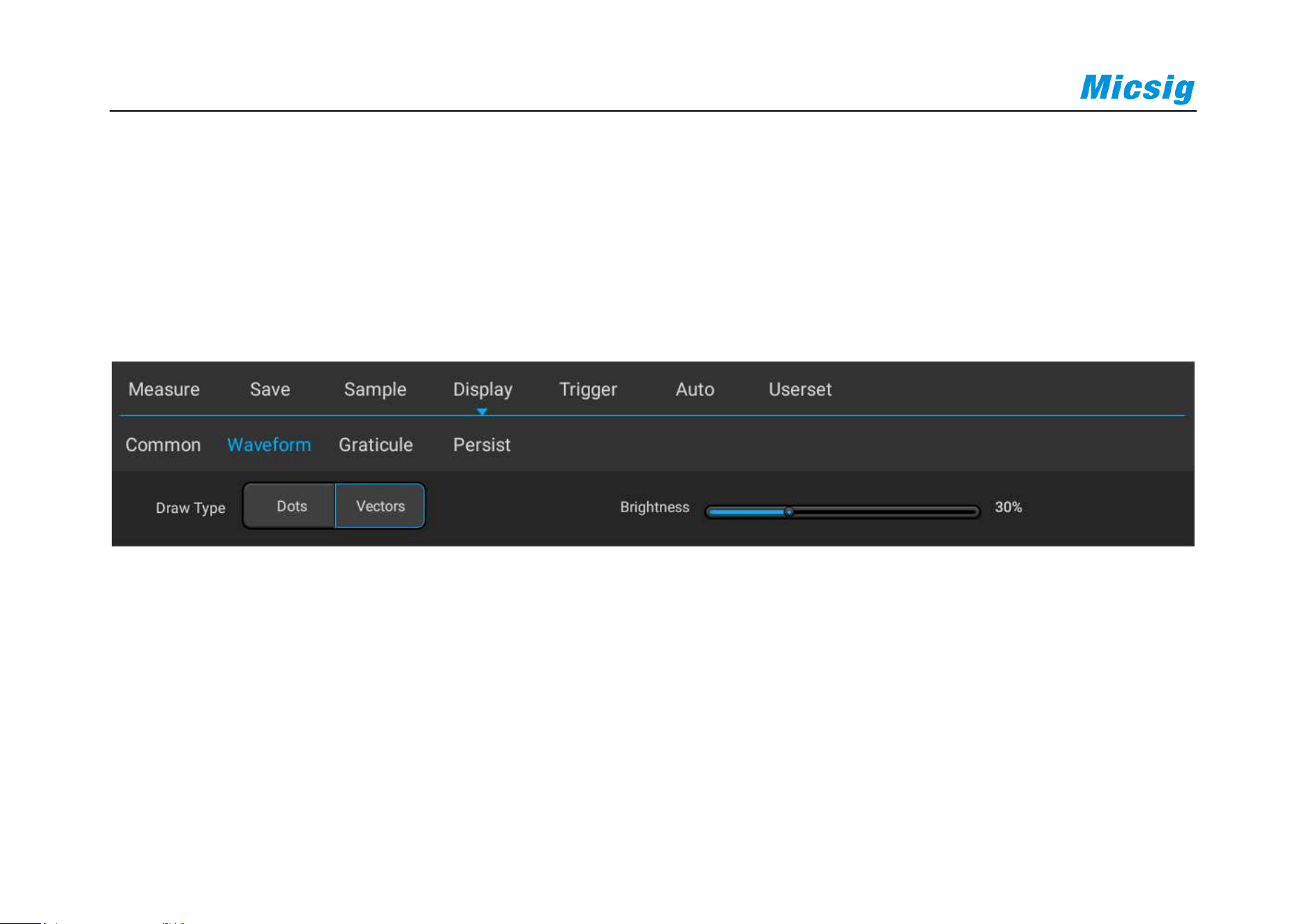
198
9.1 Waveform Settings
Open the display menu, tap Waveform button to open the waveform display menu. This menu is used to set the
display mode and brightness of waveform. The waveform display mode is divided into two types: dots and vectors.
The waveform brightness percentage is adjustable, and the waveform display setting is shown in Figure 9-2.
Figure 9-2 Waveform Display Menu
9.2 Graticule Setting
Open the display menu and tap Graticule button to open the graticule setting menu (Figure 9-3). Graticule display
mode includes: “Full”, “Grid”, “Crosshair” and “Frame”, and the brightness percentage is adjustable.
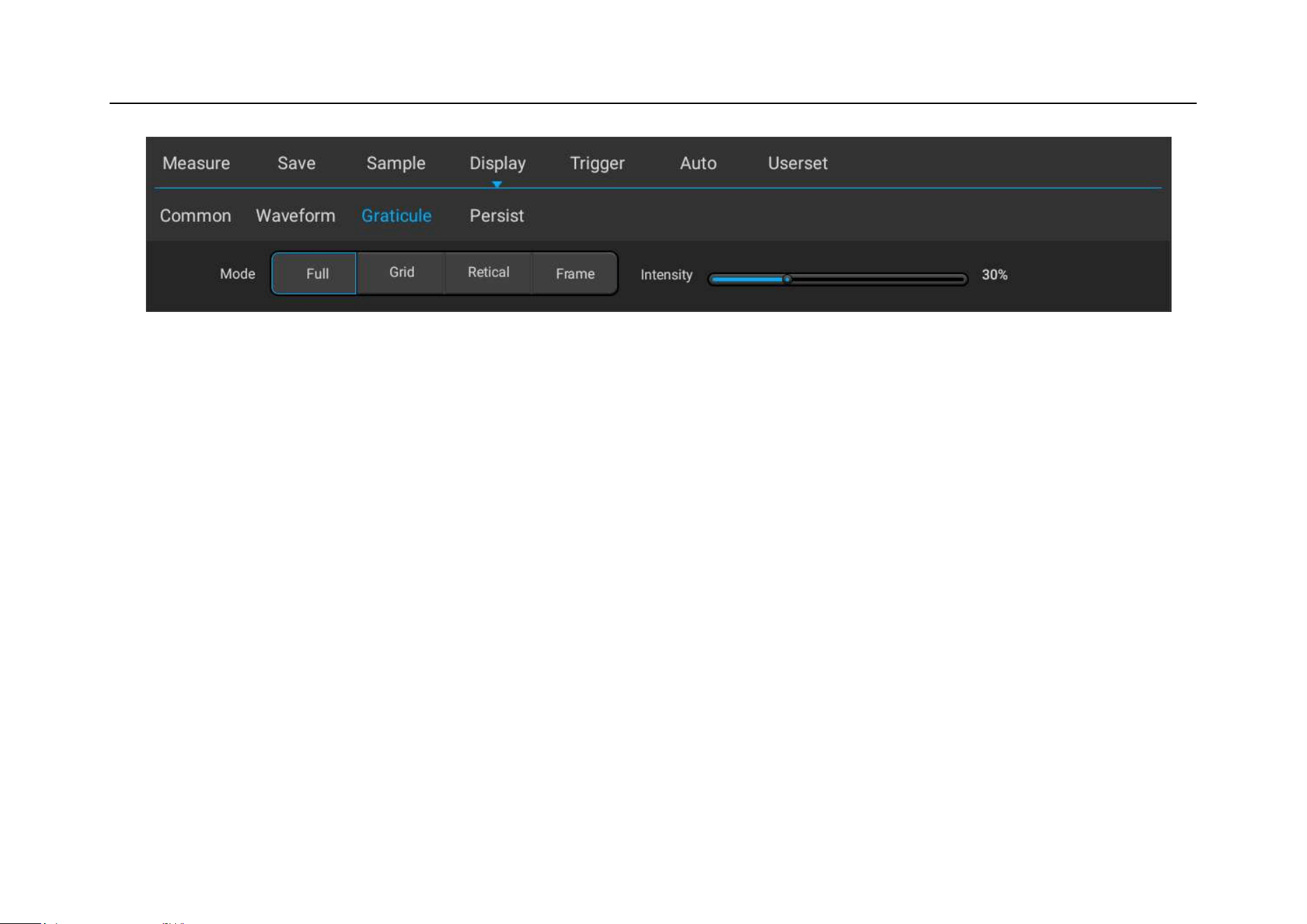
Chapter 9 Display Settings
199
Figure 9-3 Graticule Menu Display
9.3 Persistence Setting
Open the display menu and tap Persist key to open the persistence settings menu.
1) Persistence setting
In the persistence setting menu, select:
None: None - no persistence.
Auto: Auto — automatic persistence.
200
Normal: Normal - set the persistence time — After selecting the variable persistence, tap the box on the
right of “Adjust” to pop up the persistence time selection box (Figure 9-4) and set the persistence time. It
can be set between 10ms and 10s.
∞: Infinite persistence - never erase the results of previous acquisitions
Infinite persistence can be used to measure noise and jitter, display the worst-case extremes of varying
waveforms, find time violations, capture events that occur infrequently.
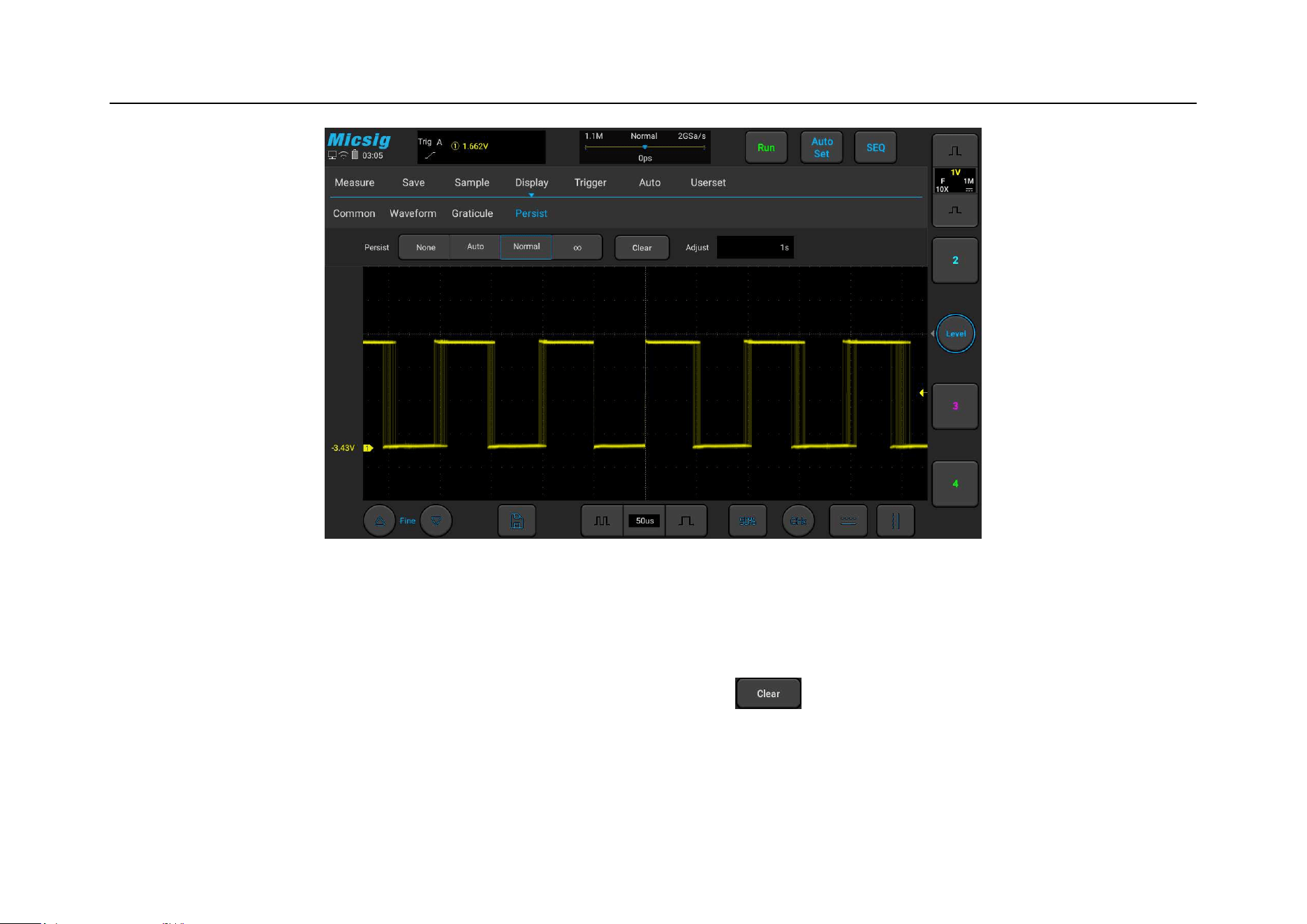
Chapter 9 Display Settings
201
Figure 9-4 Persist time adjust
2) Erase persistence
To erase the previously acquired results from the display, tap key or adjust the horizontal time base
and vertical sensitivity. The oscilloscope will erase the persistence display and start the cumulative acquisition
again.
202
9.4 Horizontal Expansion Center
Horizontal expansion is divided into two types: screen center and trigger position:
1) Screen center
Select "Center" to adjust the time base waveform to expand or contract toward both sides with the screen
center as the base point, and the delay time does not change.
2) Trigger position
Select "TrigPos" to adjust the time base waveform to expand or contract toward both sides with the trigger
position as the base point. The delay time varies with the horizontal time base.
9.5 Color Temperature Setting
Turn on the color temperature mode, and the waveform display is shown in Figure 9-5;
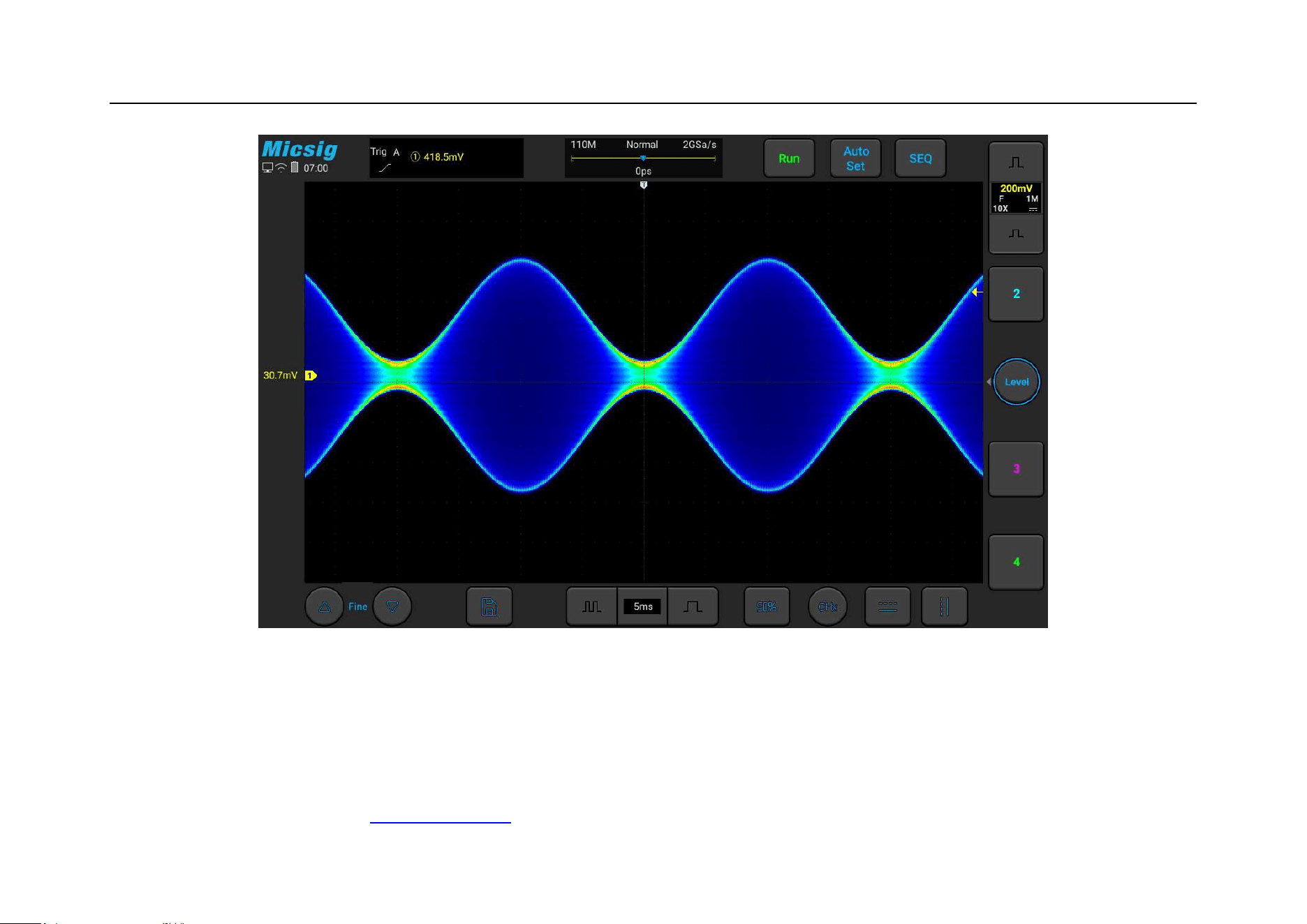
Chapter 9 Display Settings
203
Figure 9-5 Color Temperature Open Mode
9.6 Time Base Mode Selection
For details, please refer to “
3.4 ROLL, XY“ in Chapter 3.
204
Chapter 10 Sampling System
This chapter contains the detailed information of the sampling system of the oscilloscope. You are recommended to
read this chapter carefully to understand the setting and operation of the sampling system of the Smart series
oscilloscope.
Sampling overview
Run, stop and single sequence acquisition (running control)
Select sampling mode
Record length and sampling rate

Chapter 10 Sampling System
205
10.1 Sampling Overview
To understand the sampling and sampling modes of the oscilloscope, you need to understand the sampling
principle, aliasing, oscilloscope bandwidth and sampling rate, oscilloscope rise time, required oscilloscope
bandwidth, and the influence of memory depth on the sampling rate.
Sampling principle
According to the Nyquist sampling principle, for a bandwidth-limited signal with the maximum frequency f
MAX
, the
equidistant sampling frequency f
S
must be twice as large as the maximum frequency f
MAX
, so that a unique signal
can be reconstructed without aliasing.
Aliasing
Aliasing occurs when the signal is under sampled (f
S
<2f
MAX
). Aliasing is signal distortion caused by incorrectly
reconstructing low frequencies from a small number of sampling points.
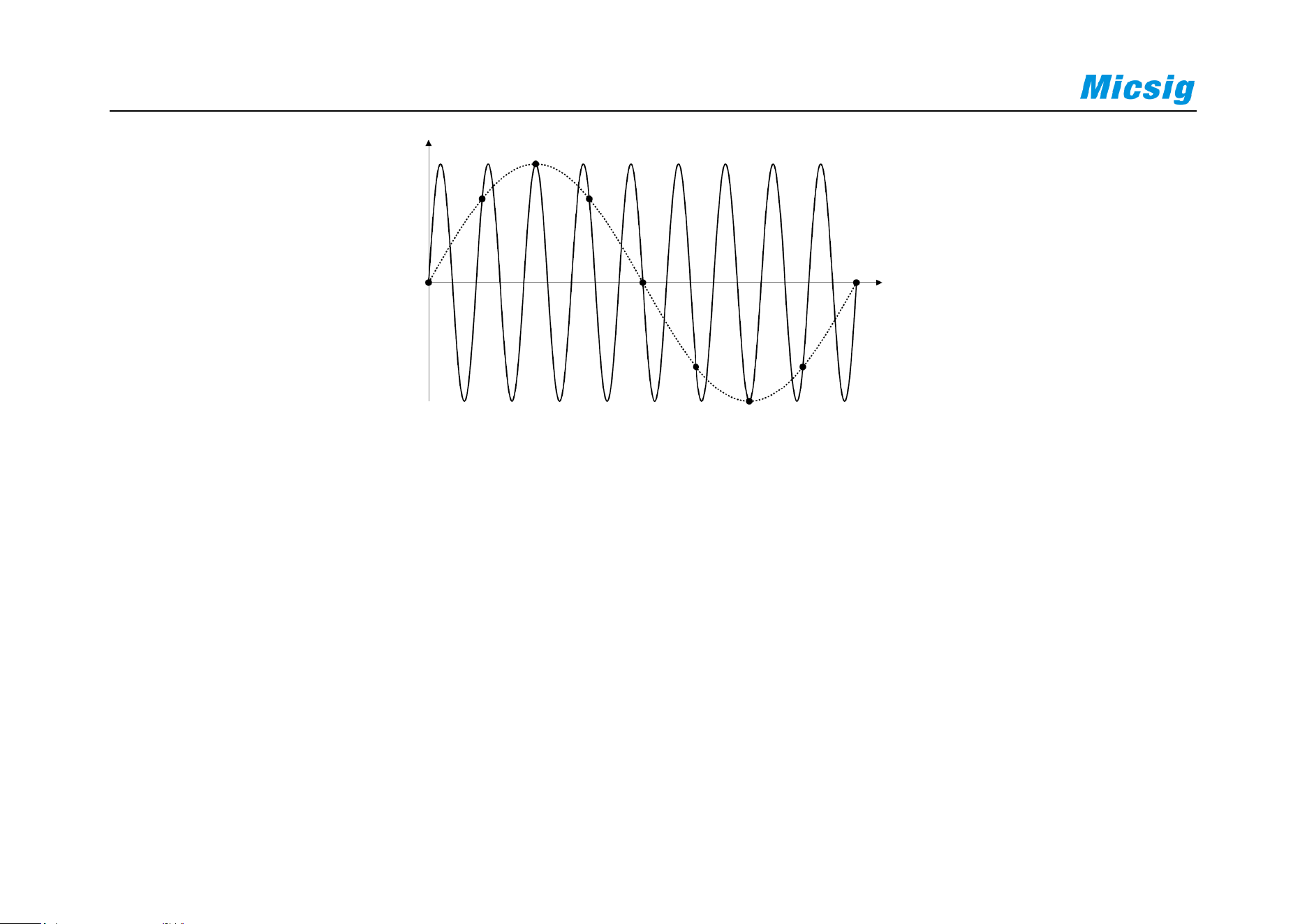
206
Figure 10-1 Aliasing
Oscilloscope bandwidth and sampling rate
The oscilloscope bandwidth usually refers to the lowest frequency at which the input signal sine wave is attenuated
by 3dB (-30% amplitude error).
For oscilloscope bandwidth, according to the sampling principle, the required sampling rate is f
S
=2f
BW
. However,
this principle assumes that there is no frequency component exceeding f
MAX
(f
BW
in this case) and requires a system
with ideal brick-wall frequency response.
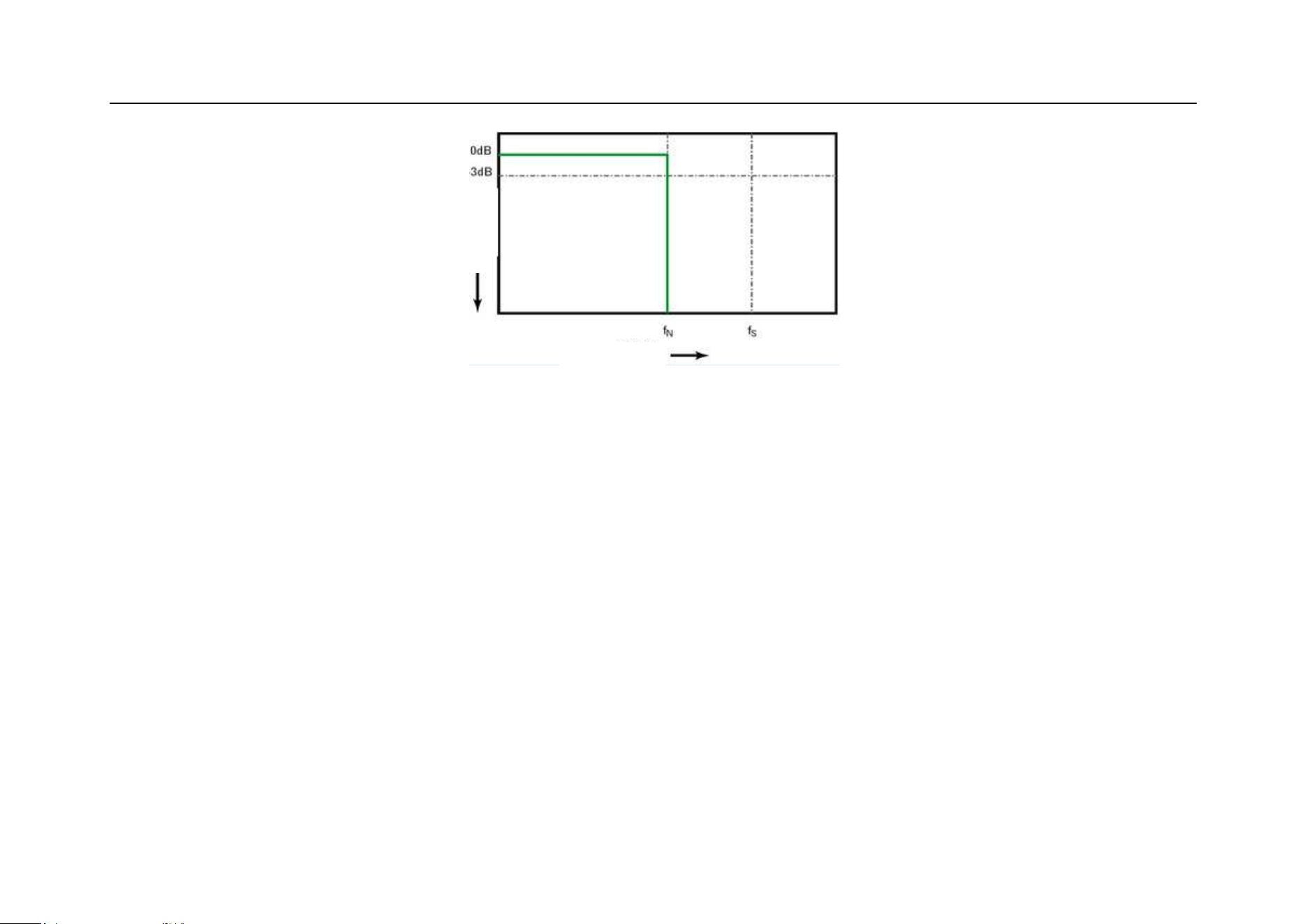
Chapter 10 Sampling System
207
Figure 10-2 Theoretical Brick-Wall Frequency Response
However, digital signals have frequency components that exceed the fundamental frequency (the square wave
consists of sine waves at fundamental frequency and an infinite number of odd harmonics), and for bandwidths of
500MHz and below, the oscilloscope typically has Gaussian frequency response.
Frequency
Attenuation
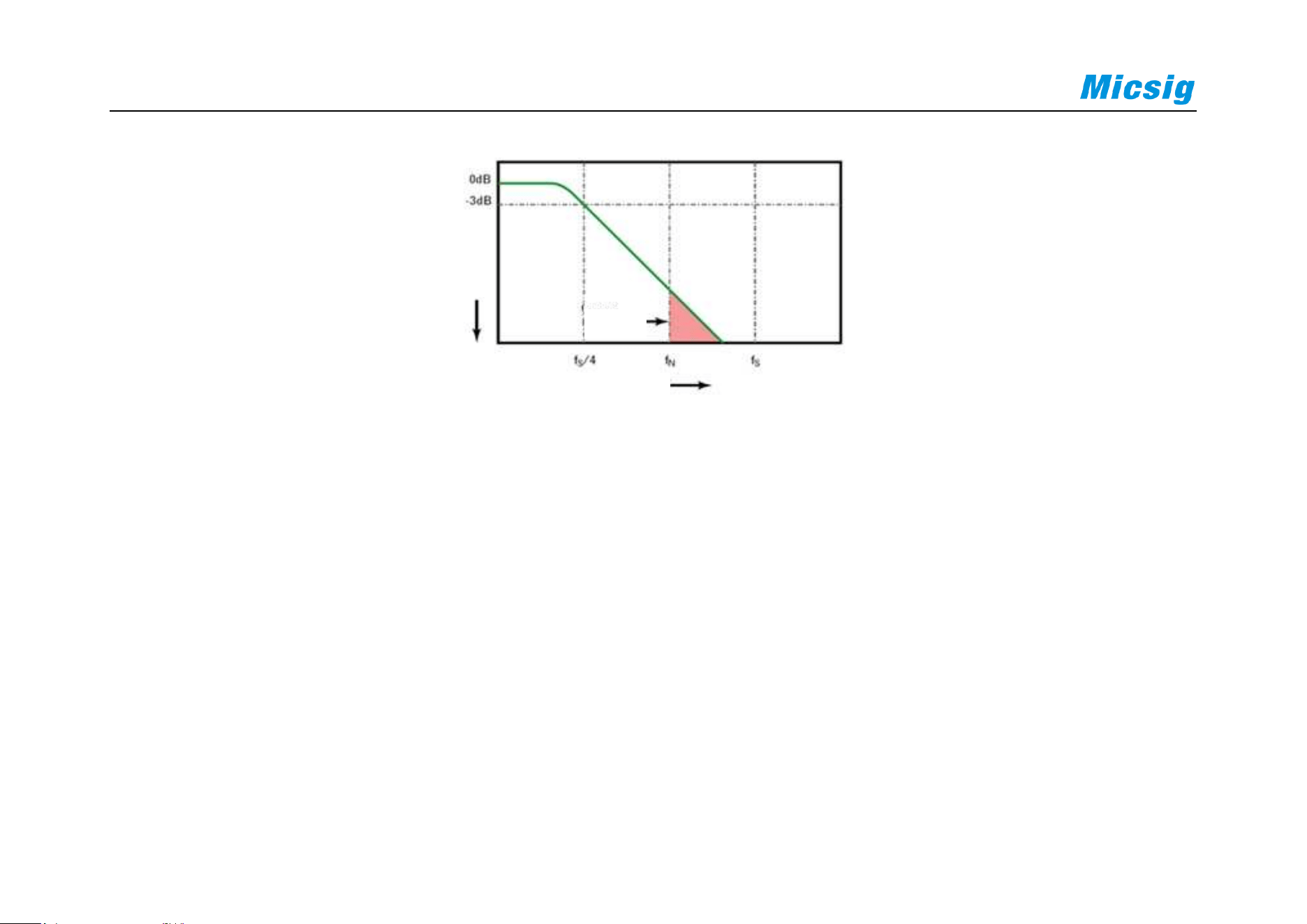
208
Figure 10-3 Sampling Rate and Oscilloscope Bandwidth
The oscilloscope bandwidth is limited to 1/4 sampling frequency and reduces the frequency response above the
Nyquist frequency.
Therefore, in fact, the oscilloscope sampling rate should be 4 times or more of its bandwidth: f
S
≥4f
BW
. This can
reduce aliasing and cause greater attenuation in the aliased frequency components.
Frequency
Attenuation
Aliasing

Chapter 10 Sampling System
209
Oscilloscope rise time
The oscilloscope rise time is closely related to its bandwidth. The rise time of an oscilloscope with Gaussian type
frequency response is approximately 0.35/f
BW
(based on the standard from 10% to 90%).
The oscilloscope rise time is not the fastest edge speed that an oscilloscope can accurately measure. It is the fastest
edge speed that the oscilloscope can produce.
Desired oscilloscope bandwidth
The oscilloscope bandwidth required to accurately measure signal is primarily determined by the rise time of the
signal rather than the frequency of the signal.
The following steps can be used to calculate the required oscilloscope bandwidth:
1) Determine the fastest edge speed.
Rise time information is typically obtained from the published device specifications used in the design.
2) Calculate the maximum “actual” frequency component.
210
According to Dr. Howard W. Johnson’s book “High-Speed Digital Design–A Handbook of Black Magic”, all
fast edges have wirelessly continuous frequency components. However, there is a turning point (or “inflection
point”) in the fast edge spectrum at which frequency components above f
knee
are negligible in determining the
signal shape.
f
knee
=0.5/signal rise time (based on 10% - 90% threshold)
f
knee
=0.4/signal rise time (based on 20% - 80% threshold)
3) The multiplication factor for the desired accuracy is used to determine the required oscilloscope bandwidth.
Desired
Accuracy
Desired Oscilloscope
Bandwidth
20%
f
BW
=1.0xf
knee
10%
f
BW
=1.3xf
knee
3%
f
BW
=1.9xf
knee
Chapter 10 Sampling System
211
Figure 10-4 Bandwidth Corresponding to Oscilloscope Measurement Accuracy
10.2 Run/Stop Key and Single SEQ Key
Use softkeys in the button area to start and stop the oscilloscope acquisition system: Run/Stop button and
Single Sequence Acquisition button.
When the Run/Stop button is displayed in green, it indicates that the oscilloscope is running, that is,
it meets the trigger condition and data acquisition is being performed. To stop data collection, tap the
Run/Stop button. After stopping, the screen displays the last acquired waveform.
When the Run/Stop button is displayed in red, it indicates that data acquisition has stopped. To
resume data acquisition, press the Run/Stop button again.
To capture and display single acquisition (whether the oscilloscope is running or stopped), tap the single
sequence key for a single acquisition.
212
10.3 Select Sampling Mode
Open the main menu, tap the sampling mode option under “Sample”, and choose among the four sampling modes:
normal, average, peak and envelope in the pop-up box.
The sampling modes of all channels are same. That is, if the sampling mode of any channel is changed, the
sampling mode of all channels is changed at the same time.
Normal sampling mode
Oscilloscope samples signal through equivalent time intervals to build waveform. When the time base of 20 ns or
faster is chosen, the oscilloscope automatically performs an interpolation algorithm that inserts difference point
between sampling points.
This mode produces the best display effects for most waveforms.

Chapter 10 Sampling System
213
Peak sampling mode
In peak sampling mode, when the horizontal time base setting is low, the minimum and maximum sample values
are retained to capture rare events and narrow events (with any noise expanded). This mode will display all pulses
that are at least as wide as the sampling period.
When the time base is set to 200ms and above, the oscilloscope will automatically exit the peak sampling mode and
switch to the normal sampling mode.
Burr or narrow pulse capture
Burr is the rapid change in waveform that is usually narrower than waveform. Peak sampling mode can be used to
view burr or narrow pulses more easily. In the peak sampling mode, narrow burr and transition edges are brighter
than in those in the “normal” sampling mode, making them easier to see.
Applying the peak sampling mode can avoid signal aliasing but show more real noises.
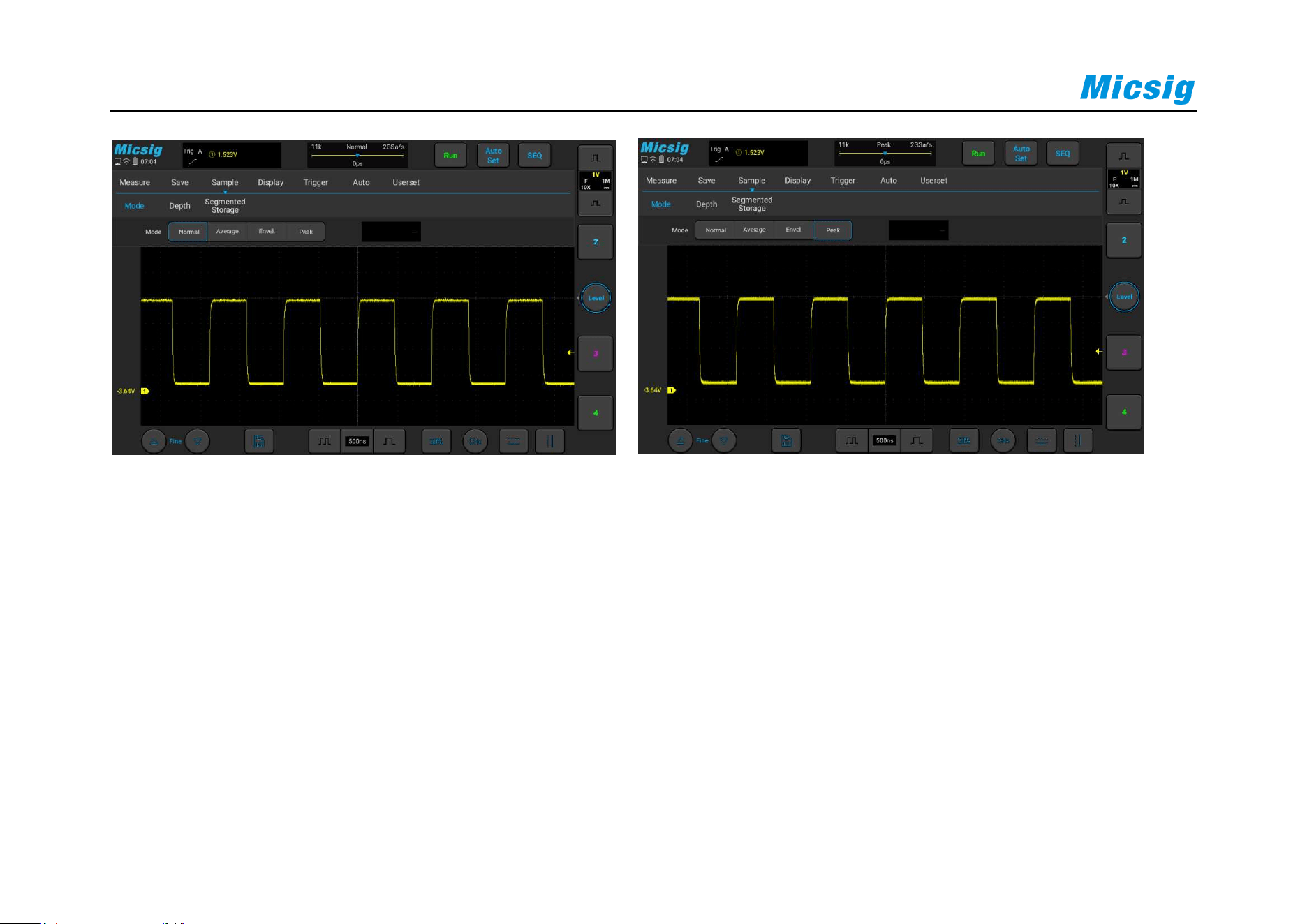
214
Figure 10-5 Sine Wave with Burr
Normal Sampling Mode
Figure 10-6 Sine Wave with Burr
Peak Sampling Mode

Chapter 10 Sampling System
215
Use peak detection mode to find burrs
1) Connect signal to the oscilloscope to be stably displayed.
2) To find burr, select the peak sampling mode in Sampling Mode option in the Channel menu.
3) In the menu, tap “Display” → “Persistence”, then tap “∞” (infinite persistence). The oscilloscope will restart
sampling data and display them on the screen.
4) Use the zoom mode to represent the characteristics of burr:
a. Tap the “Zoom” button in the main menu to open the zoom window.
b. To get a better resolution of burr, expand the time base to set the expanded portion of the normal window
view around burr.
216
Average sampling mode
The average sampling mode averages multiple acquisition results to reduce random or unrelated noises in the
displayed signal. The average of multiple sampling results requires stable trigger.
The average number can be set in the selection box after the average sampling mode, and can be set to eight order
of magnitudes: 2, 4, 8, 16, 32, 64, 128 and 256.
The higher the average number is, the slower the response of the displayed waveform-to-waveform changes. A
compromise must be made between the response speed of waveform versus the changes and the degree of noise
reduction shown on the signal.
Use average sampling mode
1) Open the channel menu and select the average sampling mode in the sampling mode option.
2) Press the number box on the right of the average sampling mode box to pop up the average number and then
tap it to set the average number that can best eliminate displayed waveform noises.
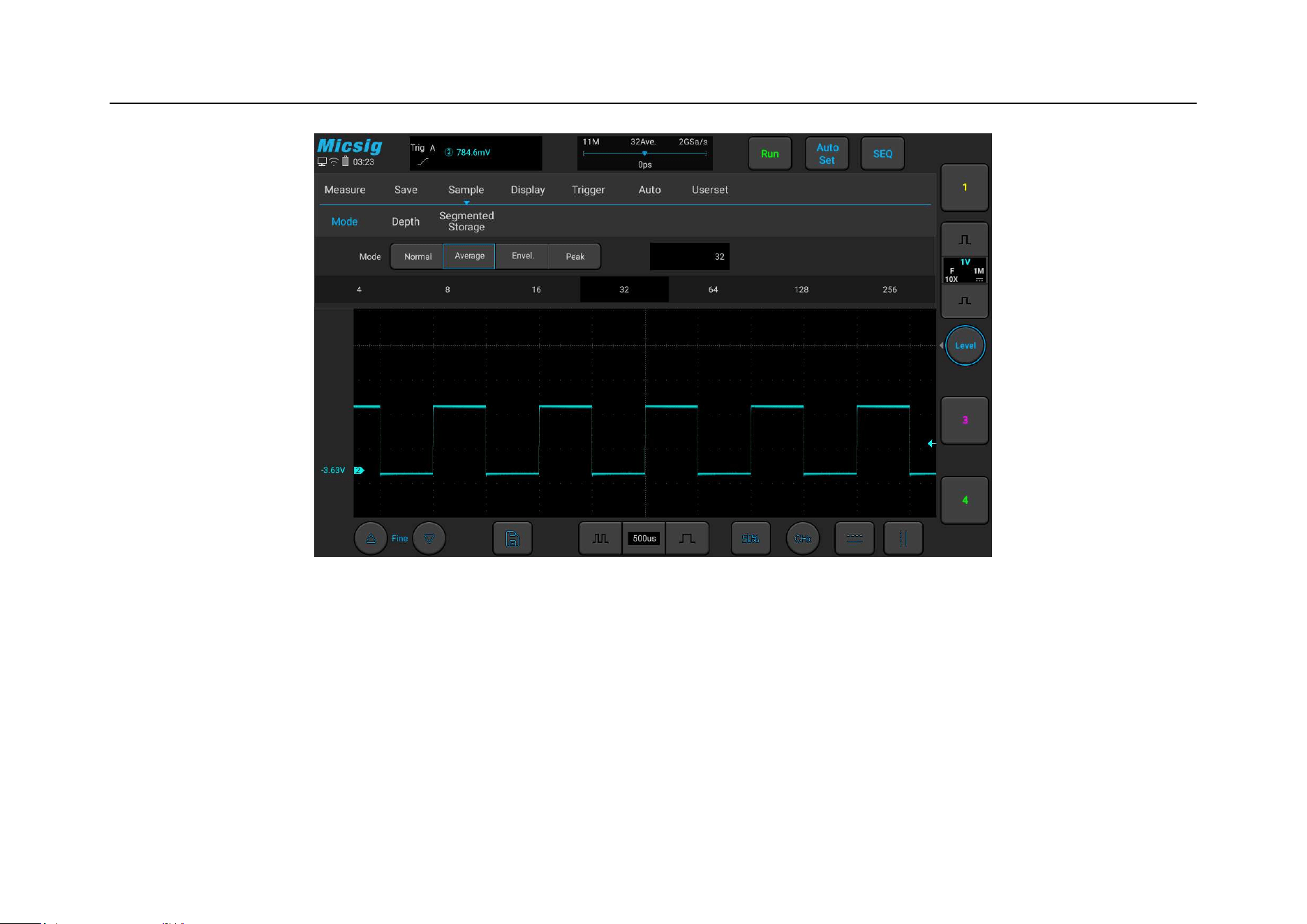
Chapter 10 Sampling System
217
Figure 10-7 Waveform after choosing the average sampling mode, with average number 32
Envelope sampling mode
In the envelope sampling mode, the superposition effect of several sampled waveforms can be observed. The
maximum and minimum values of one signal can be captured in the specified N sample data, and the number of
waveform superpositions can be set to 2, 4 , 8, 16, 32, 64, 128, 256 or ∞.
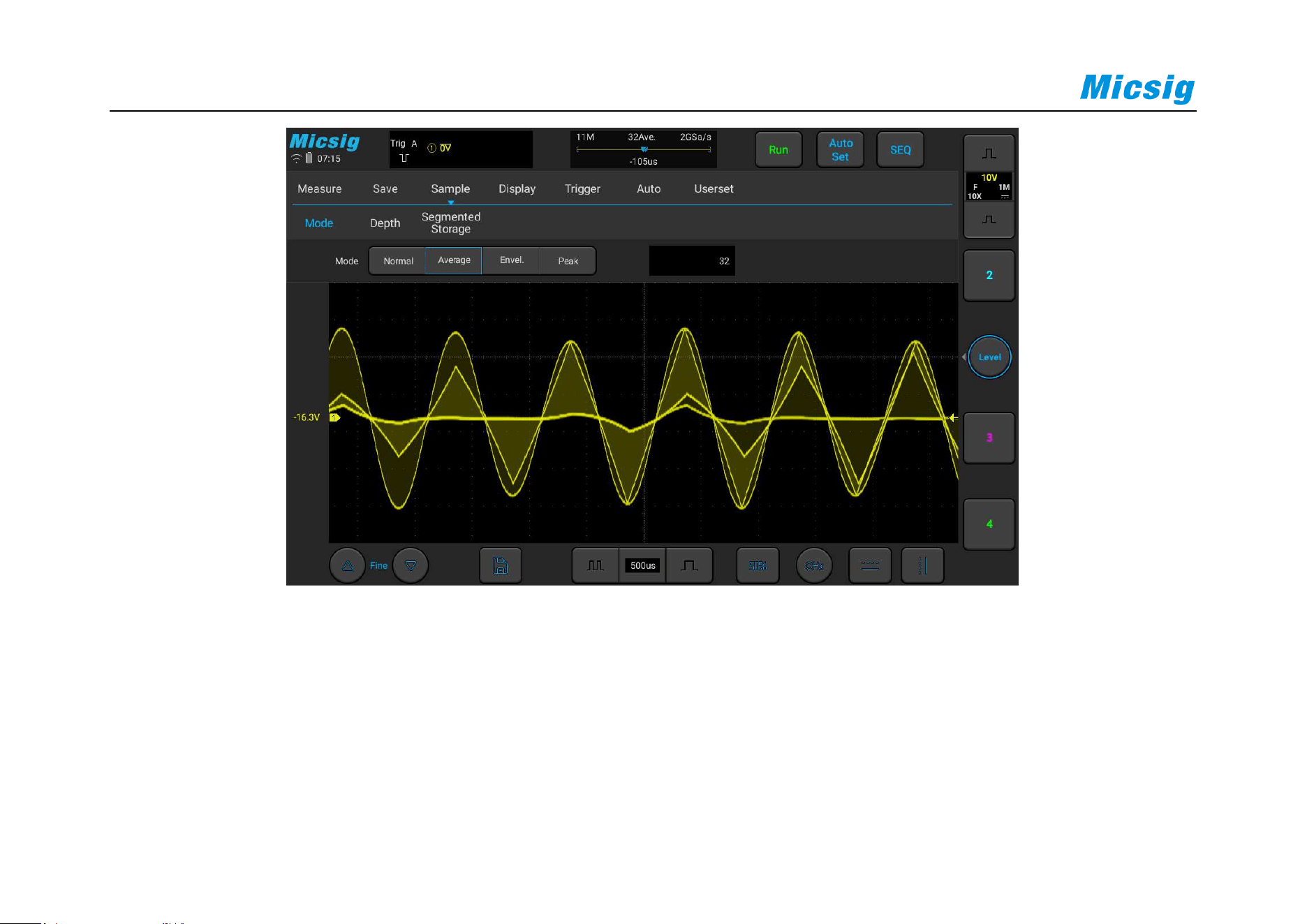
218
Figure 10-8 AM Signal in Envelope Sampling Mode (32)
10.4 Record Length and Sampling Rate
The record length is the data volume for each captured waveform. For example, if the record length is 700K, it
means that 700K sample points are captured by one trigger.
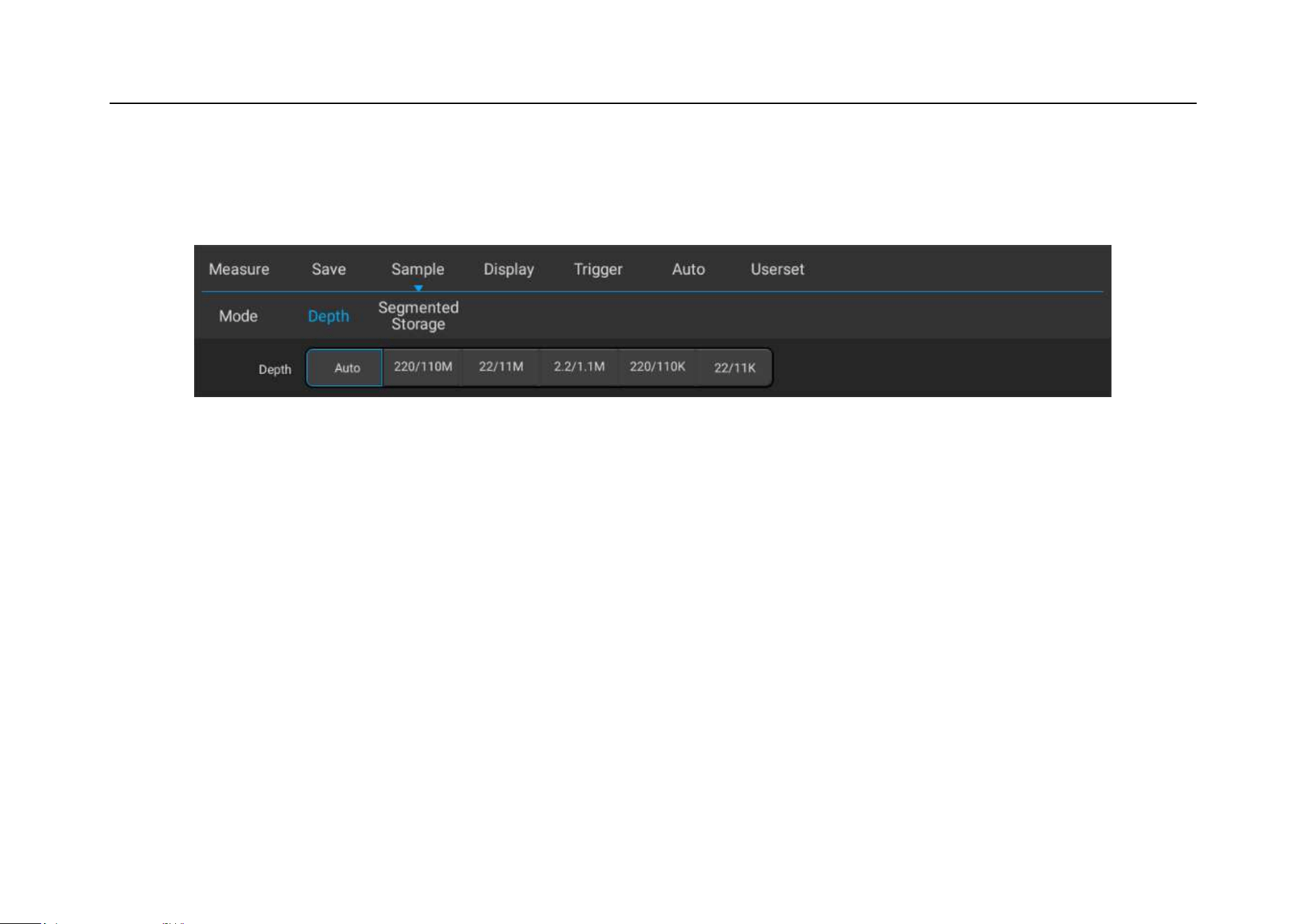
Chapter 10 Sampling System
219
In the main menu, tap "Sample" to enter the record length setting menu, which can be set by tapping the
corresponding record length.
Figure 10-9 Record Length
In normal refresh mode, if it is a single channel, the record length can be set to 22k, 220k, 2.2M, 22M, 220M, Auto;
if it is dual channel, the record length can be set to 11k, 110k, 1.1M, 11M, 110M, Auto; if it is three or four
channels, the record length can be set to 5.5k, 55k, 0.55M, 5.5M, 55M, Auto.
Record length and sampling rate
The record length is data volume collected per waveform capture. For example, if the record length is 0.7M, it
means that 700K sample points are captured by one trigger.
220
The oscilloscope record length and sampling rate have the following relationship:
Sampling rate = record length/acquisition time
Generally, the oscilloscope acquisition time is exactly the display time on the current entire screen (current
horizontal time base×14).
For example, if the oscilloscope has the memory depth of 700K, the sampling rate of 1GSa/s, and the horizontal
time base of 50us/div, the acquisition time is 700us, which is 50us/div×14div.
However, when the fast time base (below 20 ns) or the record length is set to a fixed value, the oscilloscope
acquisition time does not necessarily represent the display time on the current entire screen.
For example, if the oscilloscope has the memory depth of 700K, the sampling rate of 1GSa/s, and the horizontal
time base of 20ns, the acquisition time is 700ns, which is 2.5 times of the current display time on the entire screen.
Or, if the memory depth is 140K (fixed value), the sampling rate is 1GSa/s, and the horizontal time base is 1us, the
acquisition time is 140us, which is 10 times of the current display time on the entire screen.
For a single channel in a channel pair, the maximum sampling rate of the Smart Series oscilloscope is 1GSa/s.

Chapter 10 Sampling System
221
If any two channels are opened, the sampling rate of the two channels will halved. For example, when CH1 and
CH3 are opened, the sampling rates of CH1 and CH3 are both 500 MSa/s.
If any three channels or all four channels are opened, the sampling rate per channel will become 1/4 of the
maximum sampling rate. For example, when CH1, CH2 and CH3 are opened, the sampling rates of CH1, CH2 and
CH3 are 250 MSa/s for each of them.
10.5 Segmented Memory
Segmented memory is to divide the oscilloscope memory into segments, and each trigger waveform uses one of
them. Different memory depths will result in different number of segments. Each waveform in the trigger storage
has a time label. The stored waveform can be played back and viewed in a single frame, or can be fitted to the
overall view.
It is mainly used for the acquisition, viewing and analysis of signals with longer intervals and higher frequencies.
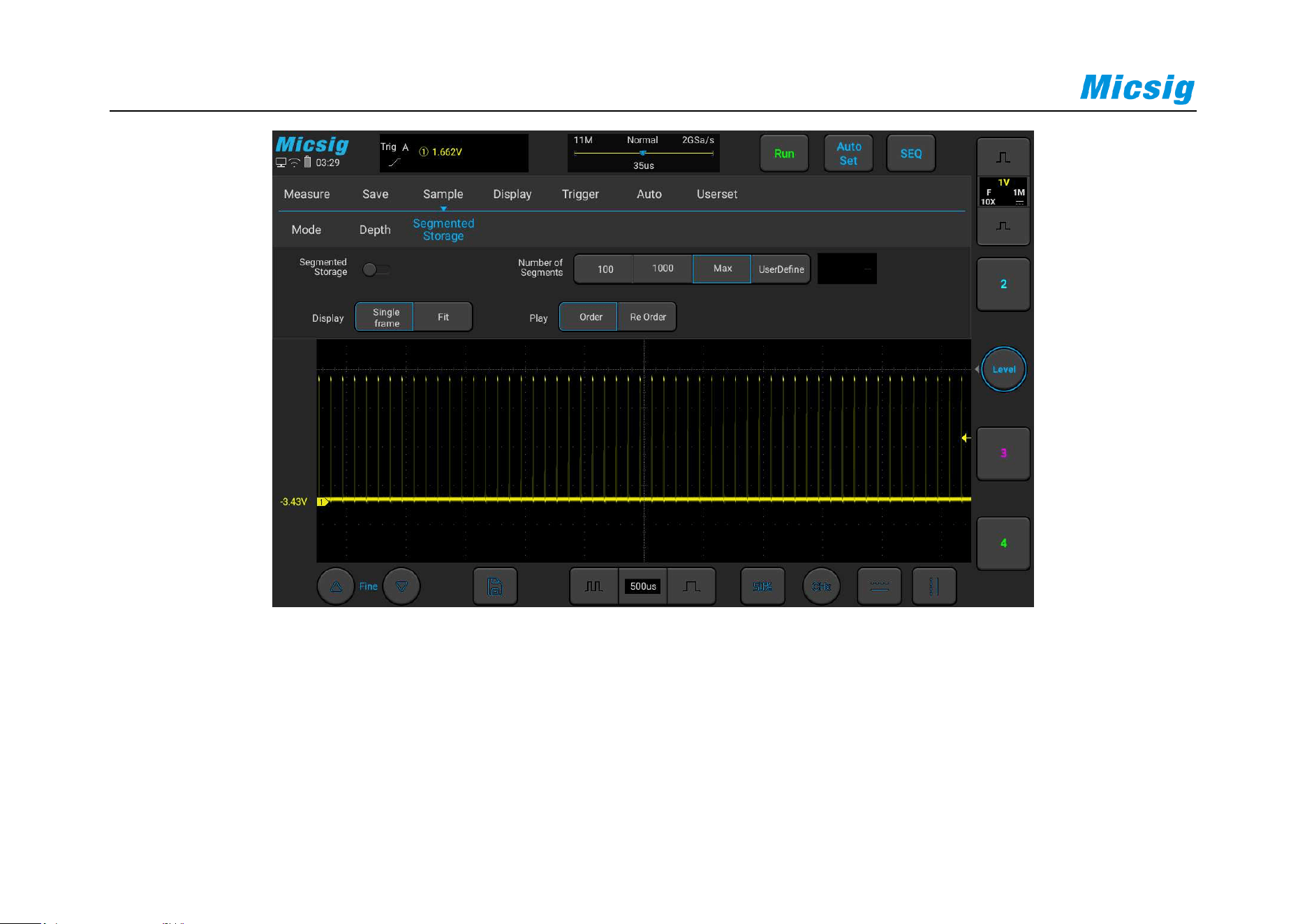
222
Figure 10-10 Segmented memory settings
10.5.1 Segment number setting
Open the main menu, tap "Sample", and select the "Segmented storage" option in the secondary menu to set up
segmented memory.

Chapter 10 Sampling System
223
The number of segments can be set at different storage depths. The number of segments is based on the storage
depth of the oscilloscope. When the record length is set to "Auto", the number of segments can be set freely
between 1 and the maximum number of segments. The maximum number of segments in TO series is 10000.
When the record length is selected, the maximum number of segments allowed for different record lengths is
different. When switching the record length, if the number of segments set is greater than the maximum number of
segments allowed under this record length, the number of segments will be automatically changed to the maximum
number of segments allowed.
The "Maximum" option in the selection of the number of segments, when the storage depth is auto, it means 10000.
When the storage depth is manually selected, the number of segments represented will change with the selected
storage depth.
E.g:
For TO3004 model oscilloscope, when the record length is auto, the number of segments can be set to 1-10000,
then choose to set the number of segments to Max; then manually change the record length to 220/110K, at this
224
time the record length is 220/110K In the case of, the maximum number of segments allowed is 1791, so the
number of segments for segmented memory will be automatically set to 1791, and the user can also modify the
number of segments required between 1-1791.
10.5.2 Acquire Waveform
There are two collection methods, conventional collection and single collection.
Routine acquisition, including automatic and normal, each acquired waveform is displayed on the screen in time,
occupying one of the segments, and after all segments are used up, it is stored in a loop.
Single acquisition, no display during the acquisition process, display only after the acquisition is stopped; one
acquisition, fill all segments, and stop the acquisition after the acquisition (all segments are filled); during the
acquisition process, you can press the "stop" button, Stop collection.
Note: In segmented memory, it is recommended to set the trigger mode to normal to store more effective signals.
The current segment/total allowable segment number during the acquisition process is displayed in the upper left
corner of the waveform area.
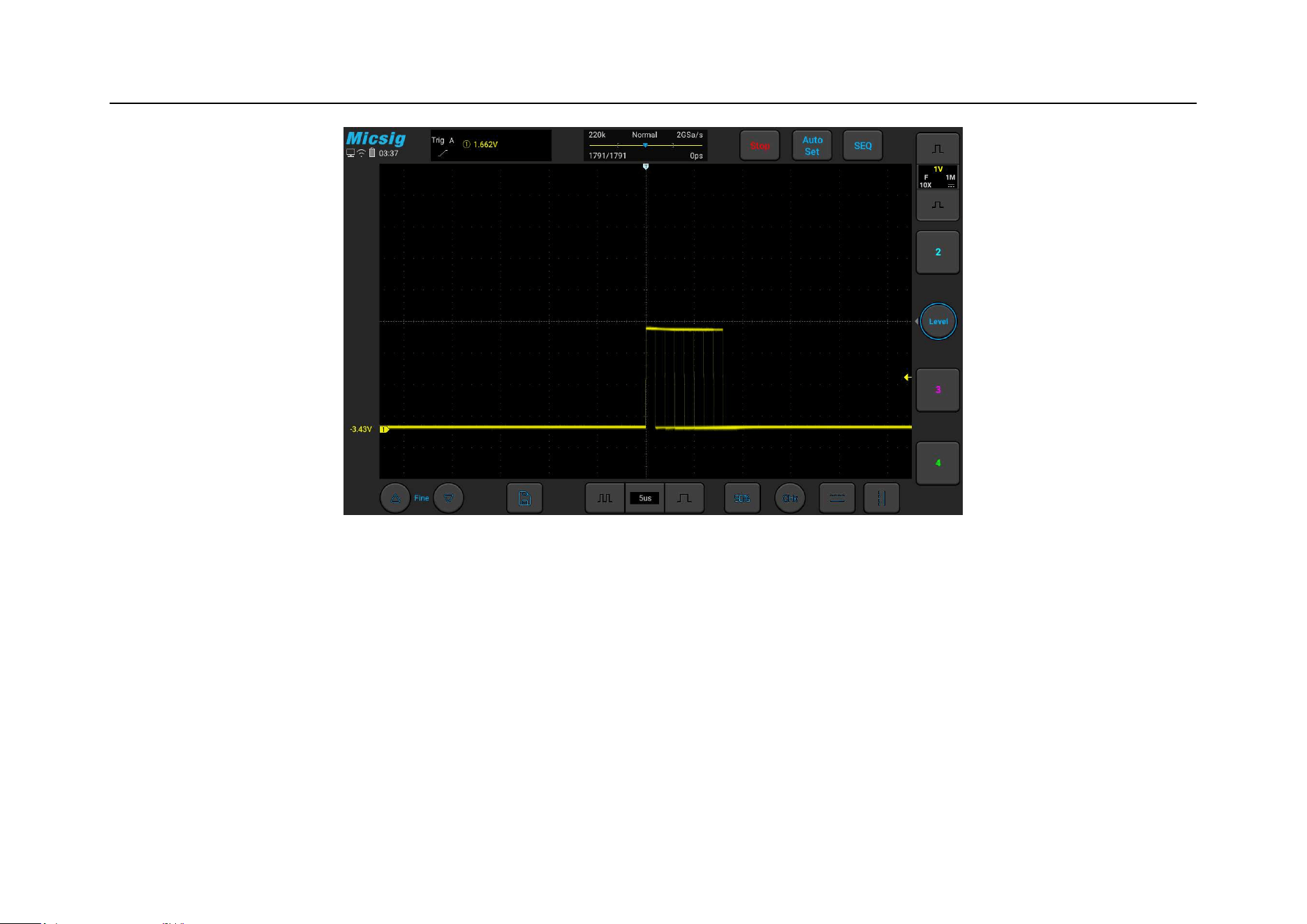
Chapter 10 Sampling System
225
Figure 10-11 Segmented memory waveform acquisition
10.5.3 Display and View
Divided into single frame display and fitting display.
Single frame display is to display each segment of the waveform on the screen individually in turn. During regular
acquisition, each frame of waveform will be displayed in the normal display mode. In a single acquisition, only the
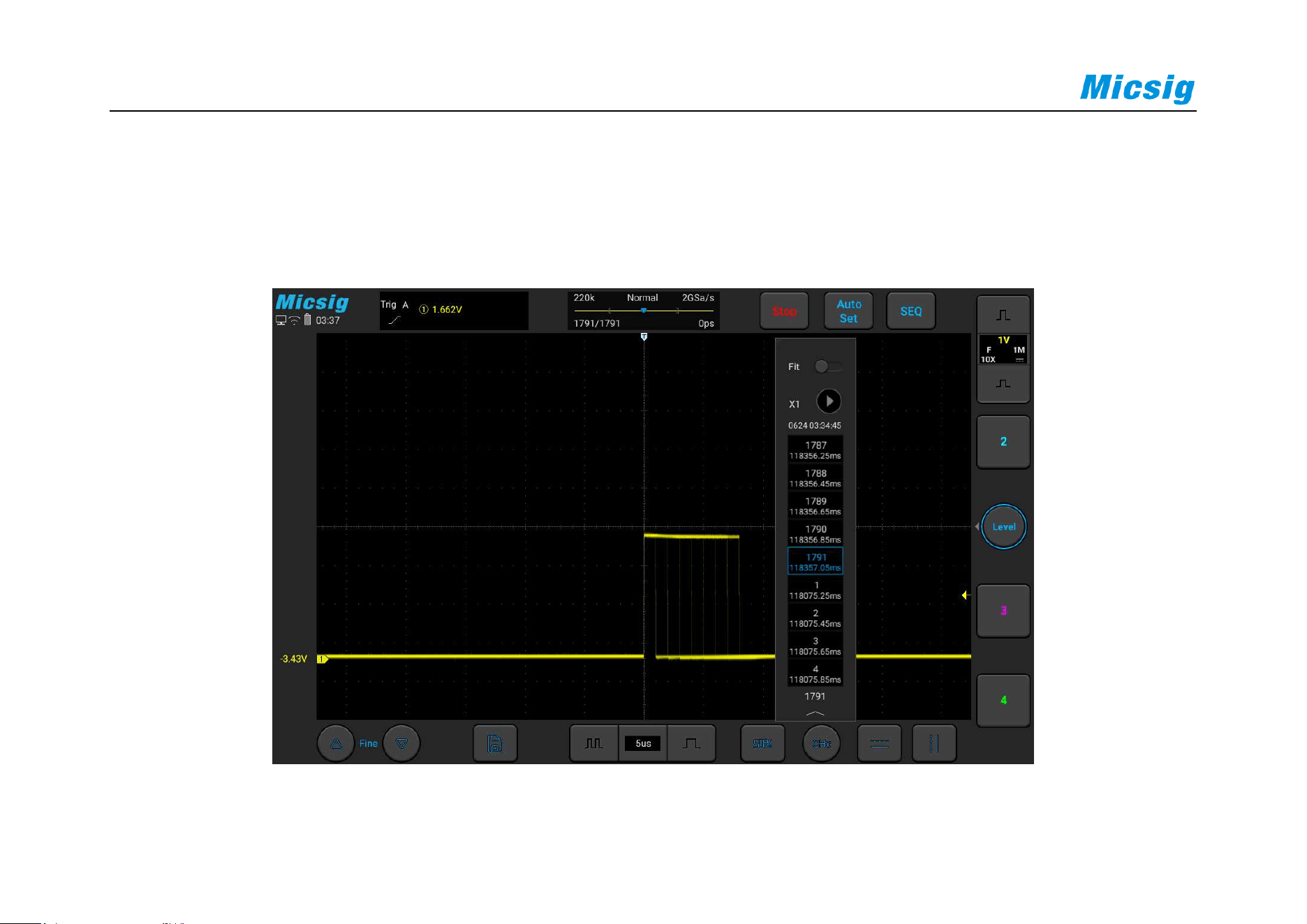
226
last frame of waveform acquired is displayed. In the stopped state, you can view the stored segments frame by
frame, the previous frame/next frame, locate to a certain frame, you can play in sequence, in reverse, and you can
change the playback rate.
Figure 10-12 Single frame view of segmented storage
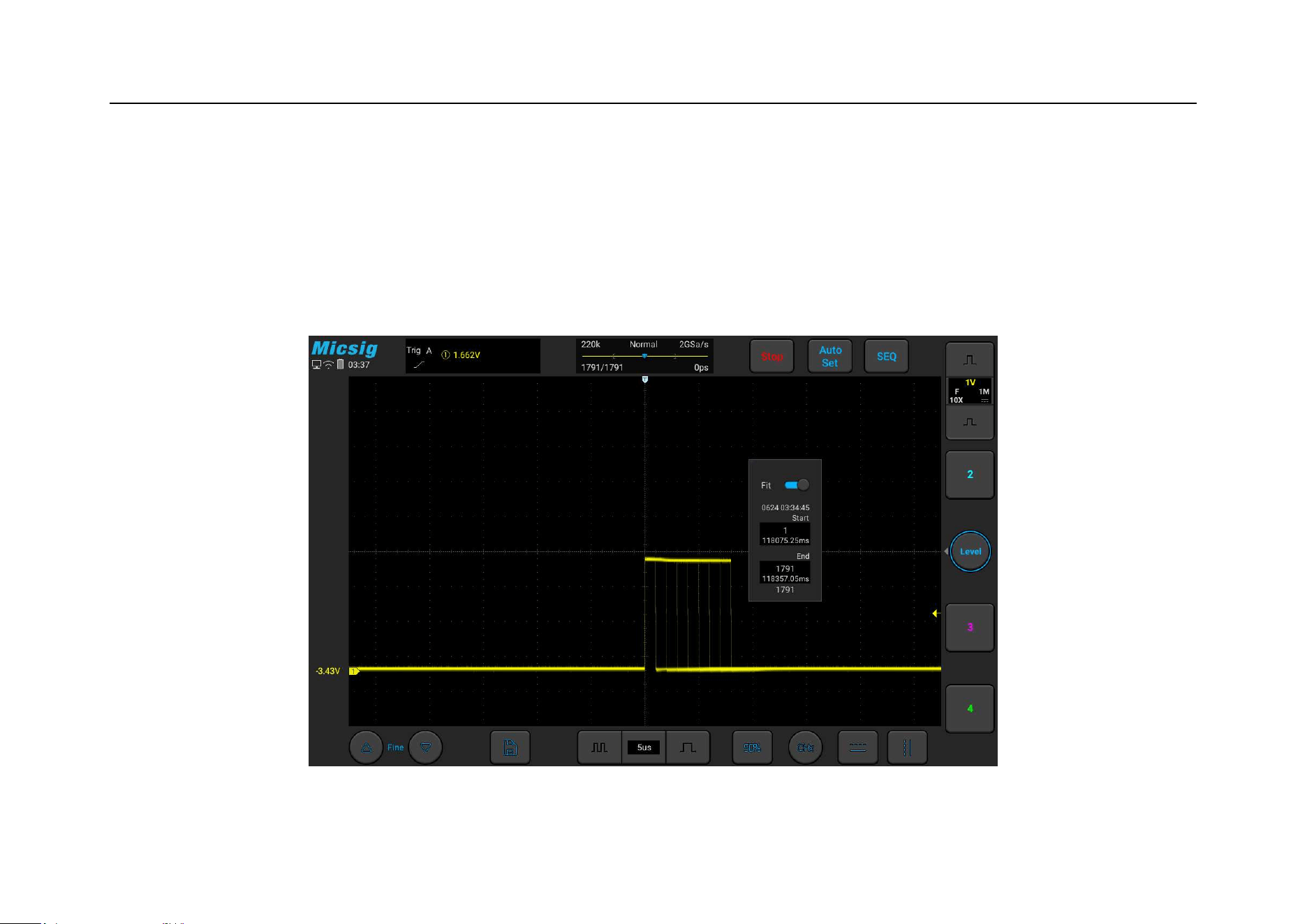
Chapter 10 Sampling System
227
Fitting display is to superimpose the waveforms of a certain range selected and display them on the screen. The start
frame and end frame of the fitting display can be set. Usually the last frame of the waveform can be fitted and
displayed on the screen to check whether there is an abnormality, and then locate the abnormality by changing the
start frame and the end frame after finding an abnormality.
Figure 10-13 Segmented storage fitting view
228
In both single frame display and fitting display, you can change the gear and position of the waveform, use zoom,
etc.
The navigation bar and the menu are mutually exclusive. When the menu is opened, the navigation bar disappears.
If necessary, it can be opened in the shortcut menu at the bottom.
To save waveforms in segmented memory, please refer to Chapter 8 "
7.3 Waveform Storage".
For segmented memory measurement, please refer to Chapter 7 "6.1 Automatic Measurement".
Segmented memory review does not support bus decoding temporarily.
10.5.4 Example of Segmented Storage
The signal is connected to channel 1, amplitude 2Vpp, no offset, duration 200ns, interval 2ms.
Set the vertical scale of the oscilloscope to 500mV, the horizontal scale to 1us, the rising edge trigger, the trigger
level to 500mV, and the trigger mode to normal, and then set the segmented storage:
1) Open the main menu, sample, segment storage;

Chapter 10 Sampling System
229
2) Set the number of segments to 100;
3) Set the display mode to fit;
4) Set the number of fitting segments to 1-100;
5) Turn on segmented storage;
6) Select single sequence.
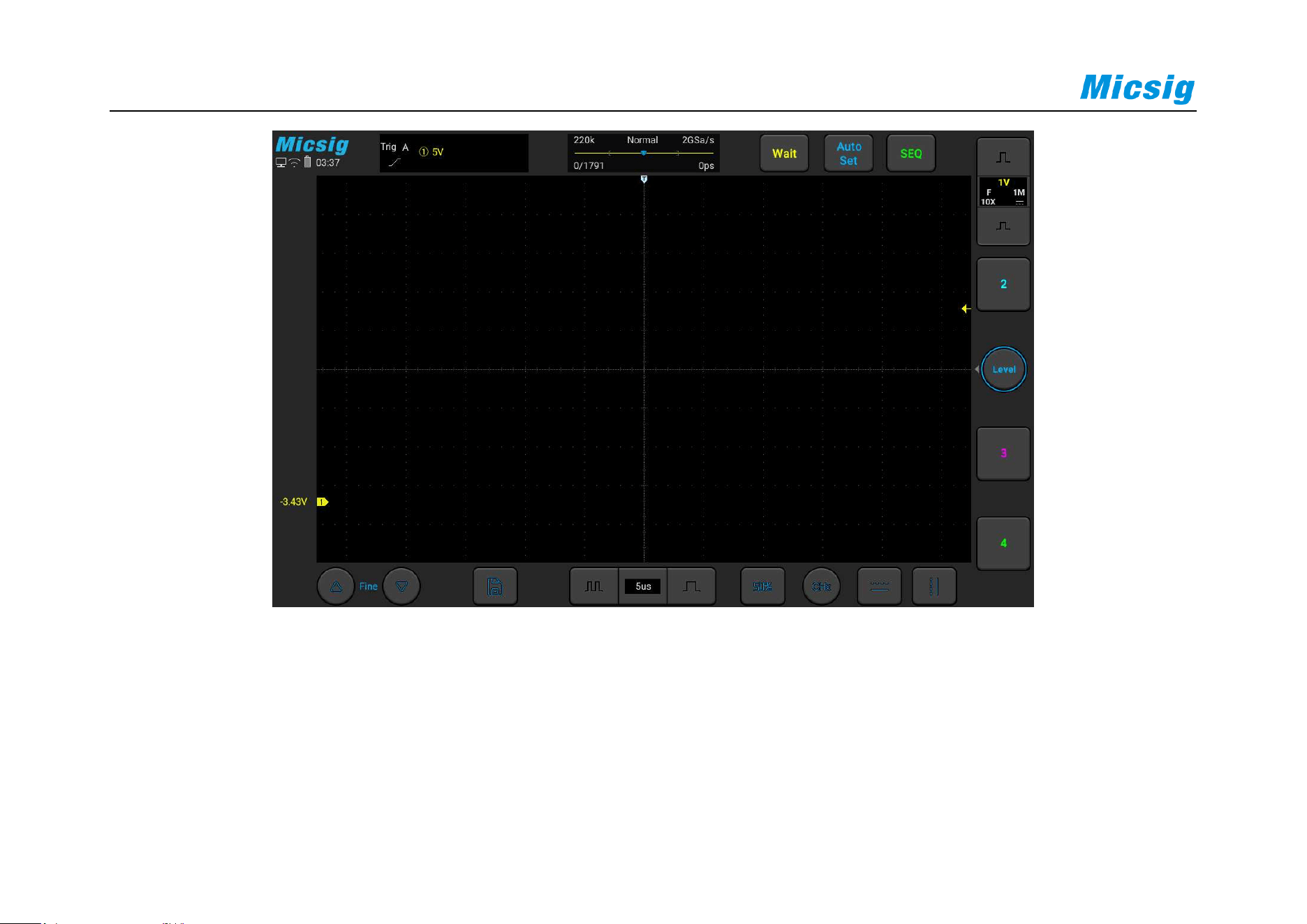
230
Figure 10-14 Single sequence segmented storage
There is no waveform display on the screen during the sampling process. After the sampling is completed, all the
waveforms in the 1-100 segments are fitted and displayed on the screen.
After observation, close the fitting display:

Chapter 10 Sampling System
231
1) Click the play button to start playing frame by frame;
2) Slide the indicator bar backward to play in reverse order;
3) Long press the play button to change the play rate;
4) Short press the play button to stop playing.
Figure 10-15 View after segment collection is completed
232
Chapter 11 Serial Bus Trigger and Decode (Optional)
This chapter contains the detailed information of serial bus decoding. You are recommended to read this chapter
carefully to understand the setting and operation of Smart bus trigger and decode.
This chapter mainly include the below contents:
UART (RS232/RS422/RS485) bus trigger and decode
LIN bus trigger and decode
CAN bus trigger and decode
SPI bus trigger and decode
I2C bus trigger and decode
ARINC429 bus trigger and decode
1553B bus trigger and decode
Chapter 11 Serial Bus Trigger and Decode (Optional)
233
Swipe up or down at the channel selection area to enter the second channel selection area, tap or to
enable decoding, open bus configuration menu, select bus type, there are seven bus types: UART
(RS232/RS422/RS485), LIN, CAN, SPI, I2C, ARINC429, 1553B, where channels S1 and S2 can be used for
decoding simultaneously. Open the trigger setting menu, choose an appropriate trigger type, the corresponding bus
trigger type and trigger mode can be set when the bus trigger is selected, and the serial bus is displayed in graphic
form.
In the serial bus decode mode, if it is screen rolling in other modes, the time base is automatically adjusted to 1ms
when switching to serial decode (the maximum time base supported by the serial decode mode is 100ms); in Zoom
mode, the enlarged signal can be decoded and displayed. The normal display window supports a maximum time
base of 100ms. When decoding is enabled, clicking “AUTO” will set the trigger type to be the same as the decode
channel bus type. The bus type selection menu is shown in Figure 11-1:
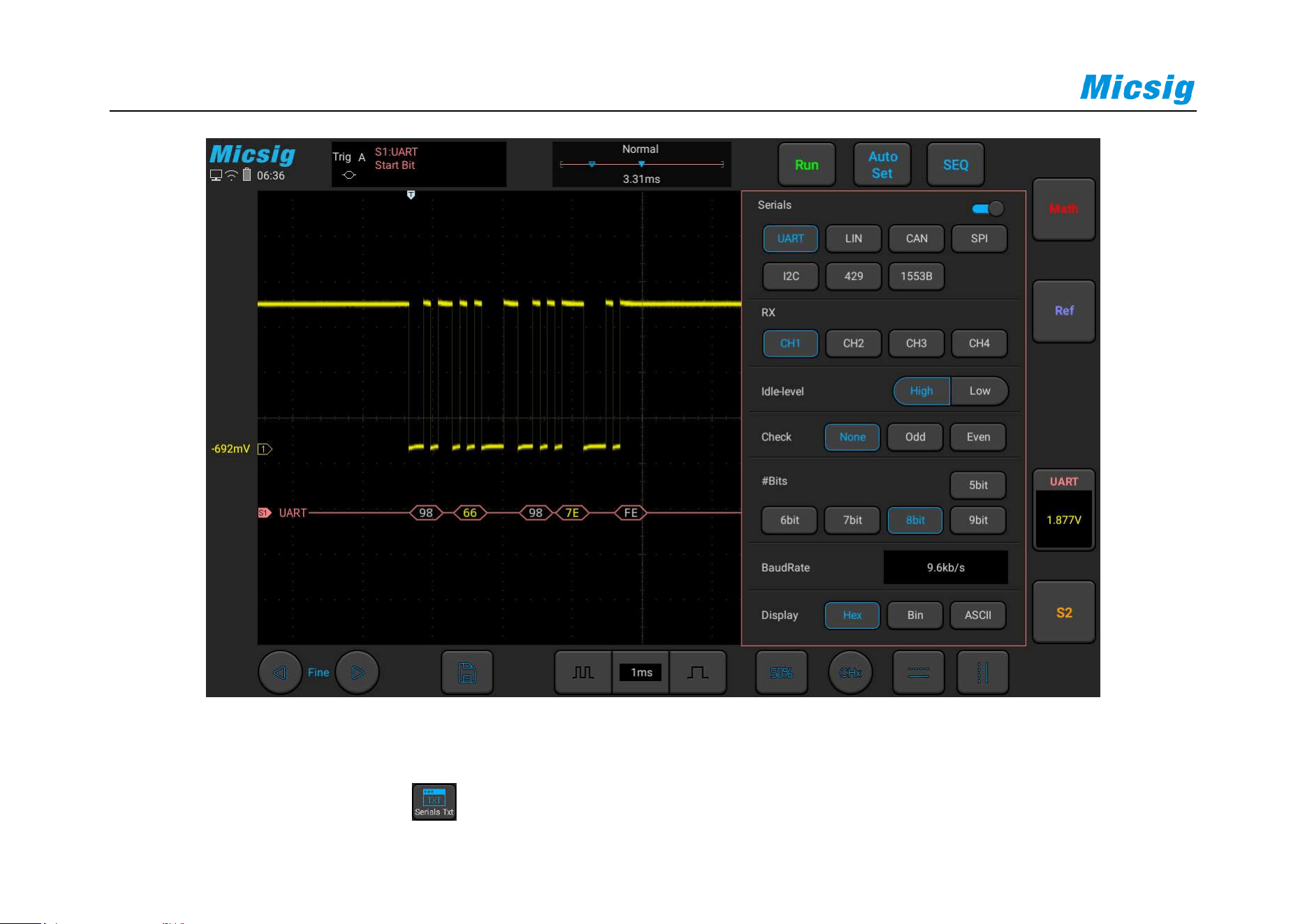
234
Figure 11-1 Bus Type Selection Menu
Open the pull-up menu and tap key to open or close the text mode, as shown in Figure 11-2.
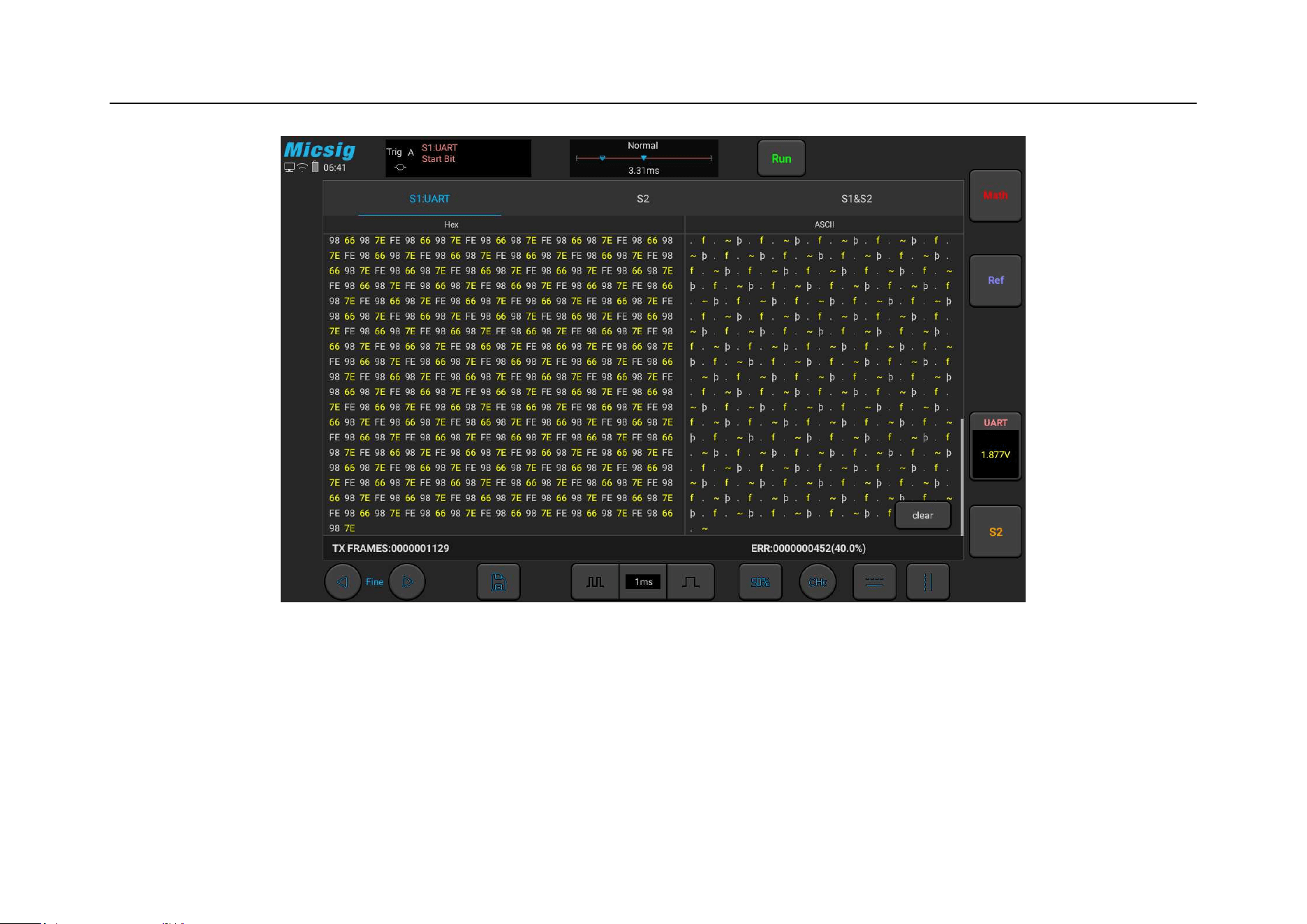
Chapter 11 Serial Bus Trigger and Decode (Optional)
235
Figure 11-2 Bus Decode Text Mode
Description:
Two decode channels S1&S2 in the text interface must be configured identically to be opened, and each channel is
displayed in chronological order with different colors;
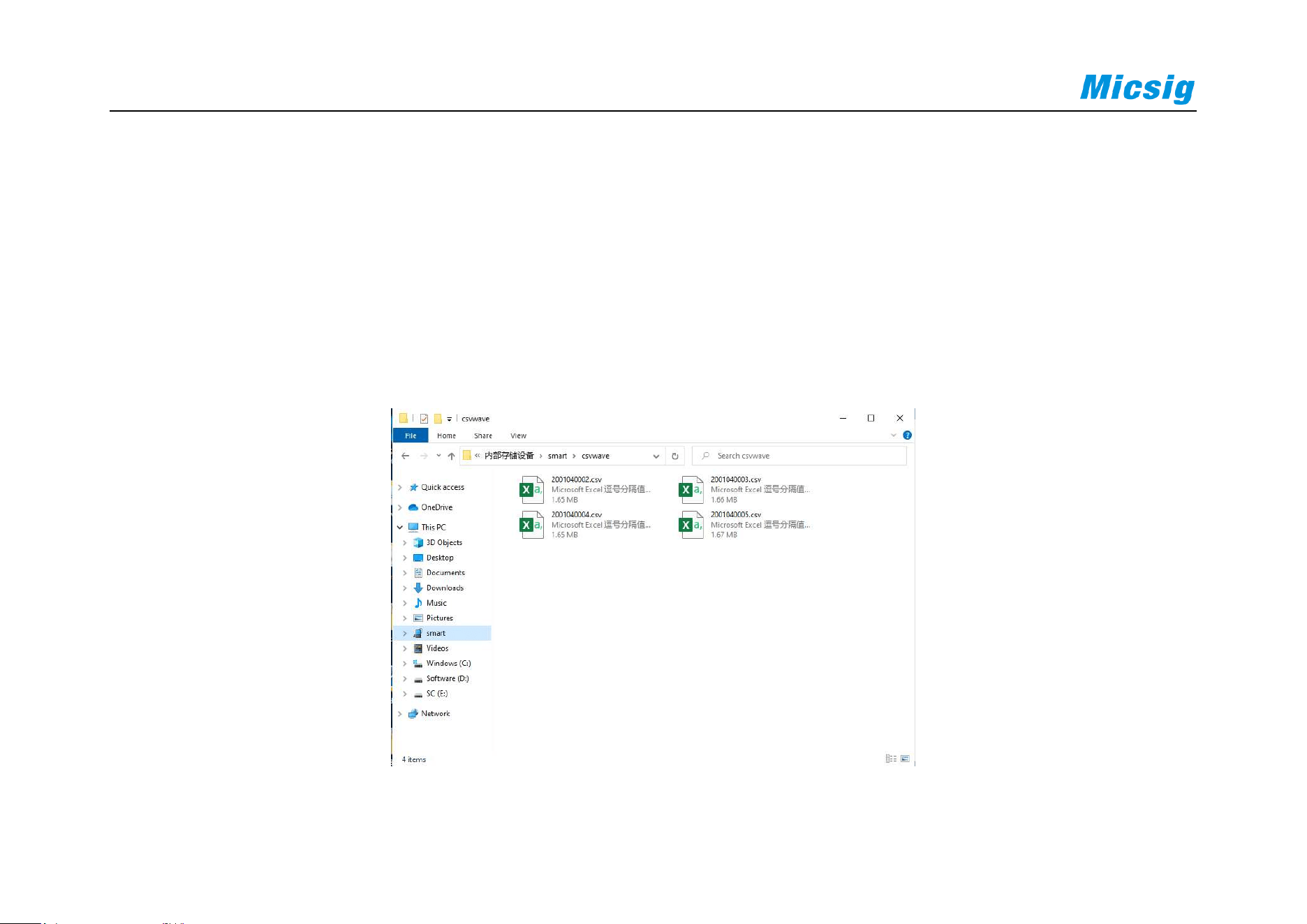
236
S1/S2/S1&S2 are the channel configuration bus information, and X knob is rotated or the label is switched to
change the bus channel;
Clicking save during the text acquisition process can save all currently acquired data. If the date volume is too
large, “wait” will be displayed, and the save success prompt will be displayed.
Oscilloscope can be used as a USB storage device to view saved files on a computer, as shown in Figure 11-3:
Figure 11-3 Bus Text Storage Files
Chapter 11 Serial Bus Trigger and Decode (Optional)
237
11.1 UART (RS232/RS422/RS485) Bus Trigger and Decode
For correctly decoding UART(RS232/RS422/RS485) bus data and making trigger stable, the bus configuration,
trigger mode setting and trigger level need to be adjusted.
Bus configuration
Left swipe or to open the bus configuration menu, as shown in Figure 11-4. The RX channel must
be chosen and the following parameters must be set according to measured signals:
Idle Level — Choose Idle Low or Idle High to match the idle state of measured equipment. For RS232, Idle
Low may be chosen.
Note: RS232 industry standard uses “negative logic”, namely high level is logic “0” and low level is logic
“1”.
Parity Bit — Choose odd, even or none depending on measured equipment.
Word Length — Set the number of bits in UART word to match measured equipment (5-9 bits available).
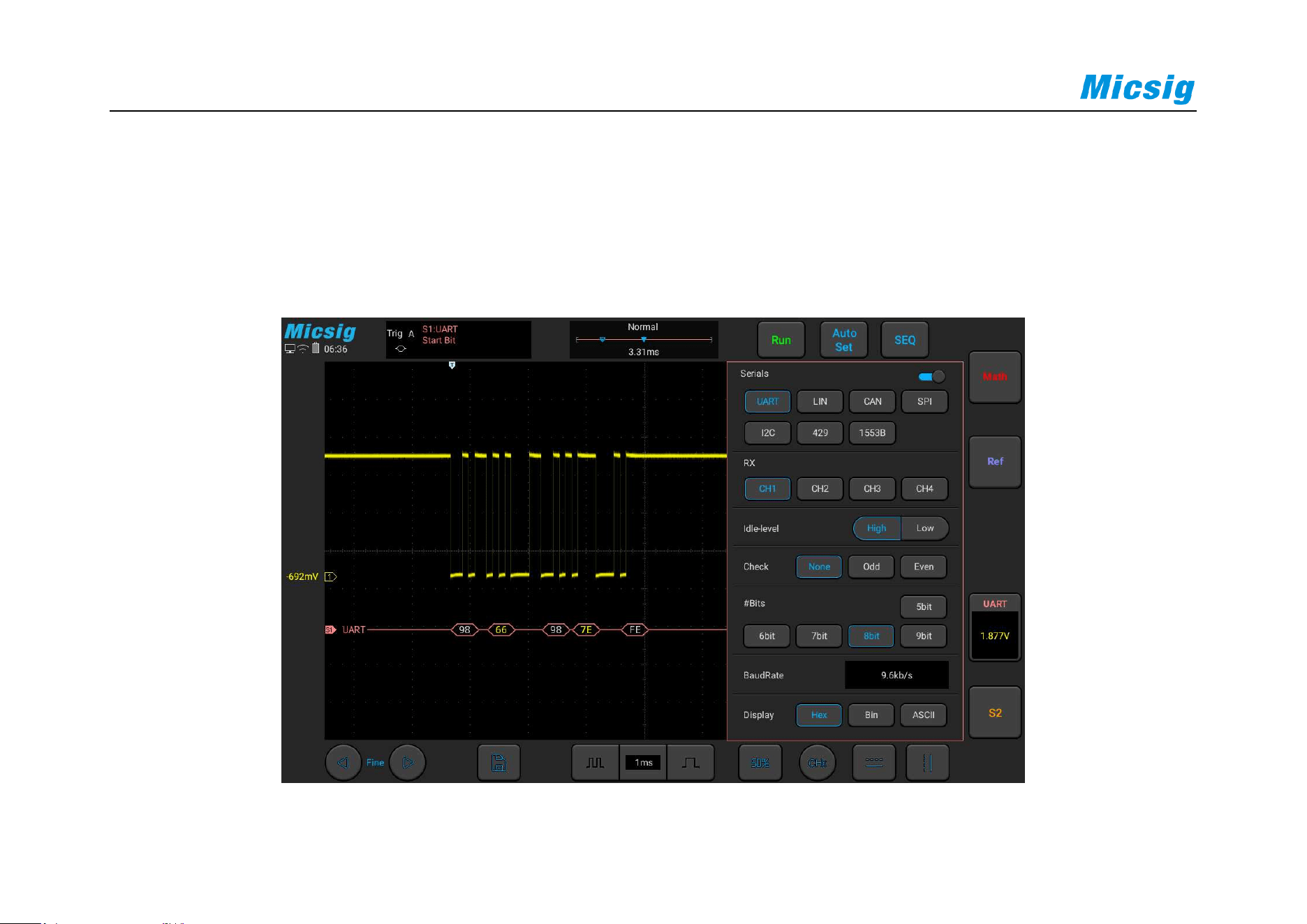
238
Baud Rate — Choose the baud rate that matches signal in measured equipment.
The baud rate can be set within the range from 1.2Kb/S to 8.000Mb/S.
Bus Display — Choose hexadecimal, binary or ASCII code display.
Figure 11-4 UART Bus Configuration Menu

Chapter 11 Serial Bus Trigger and Decode (Optional)
239
When word is displayed in ASCII, 6-bit ASCII format is used. Valid ASCII characters are between 0x00 and
0x7F. To display in ASCII, at least 7 bits in the “Bus Configuration” must be chosen. If ASCII is chosen and the
data exceeds 0x7F, the data will be displayed in hexadecimal.
Click the baud rate setting box to open the baud rate selection column. If Custom is chosen, click to pop up the
virtual soft keyboard, select the bit to be modified, enter value, and click “Enter” on the virtual soft keyboard to
complete setting. The baud rate can be set from 1.2Kb/S to 8.000Mb/S. The virtual soft keyboard is shown in
Figure 11-5:
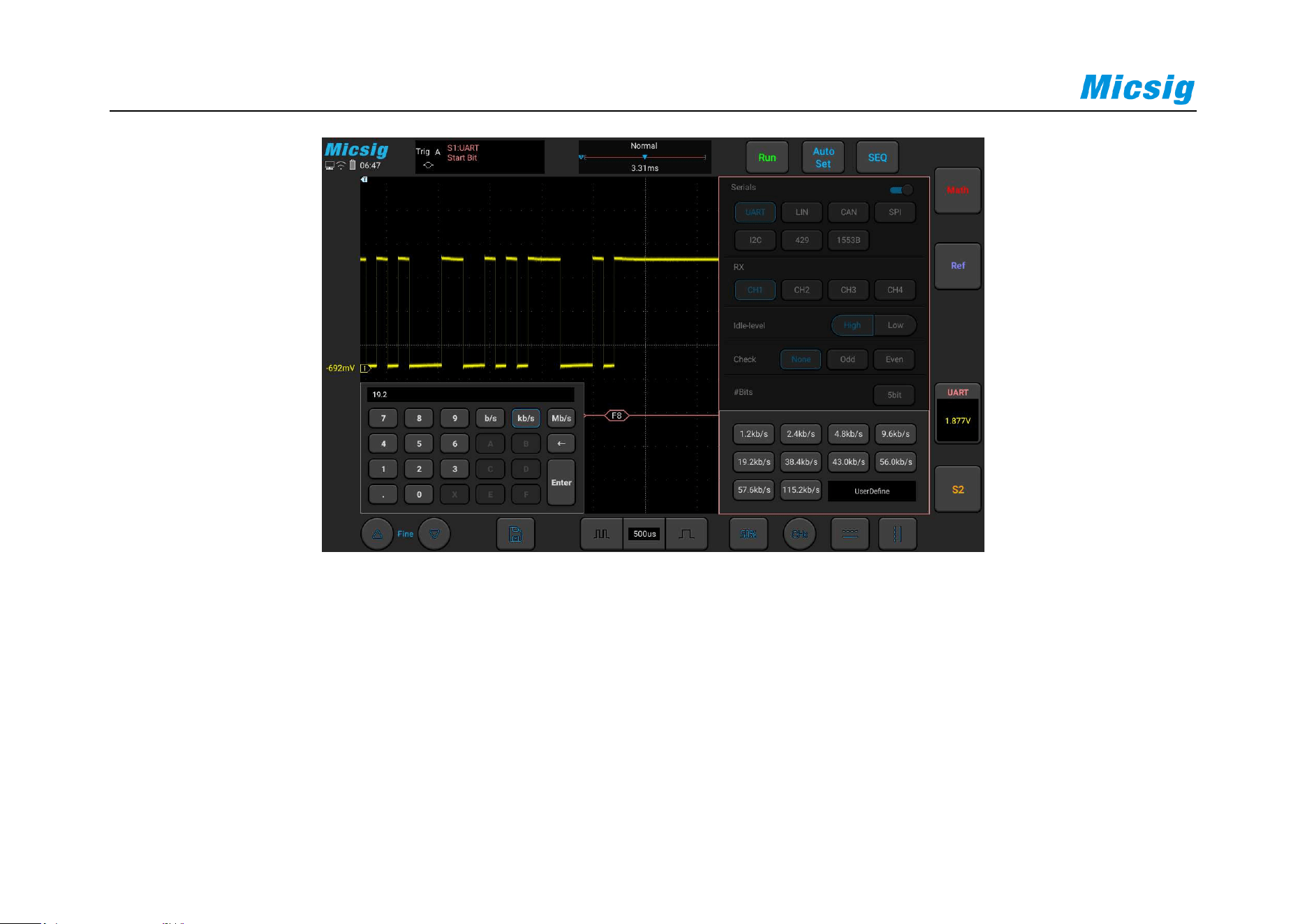
240
Figure 11-5 Baud Rate Default Setting
Note: When there is parity bit, the data word length indicates the total length of data bit plus parity bit. When
there is no parity bit, the data word length is considered to be the length of data bit. For example, if the data
word length is 8bit, when there is no parity bit, it means that the total length of data bits is 8bit; when there is
parity bit, it means that the total length of data bits is 7bit, and there is parity bit of 1 bit.
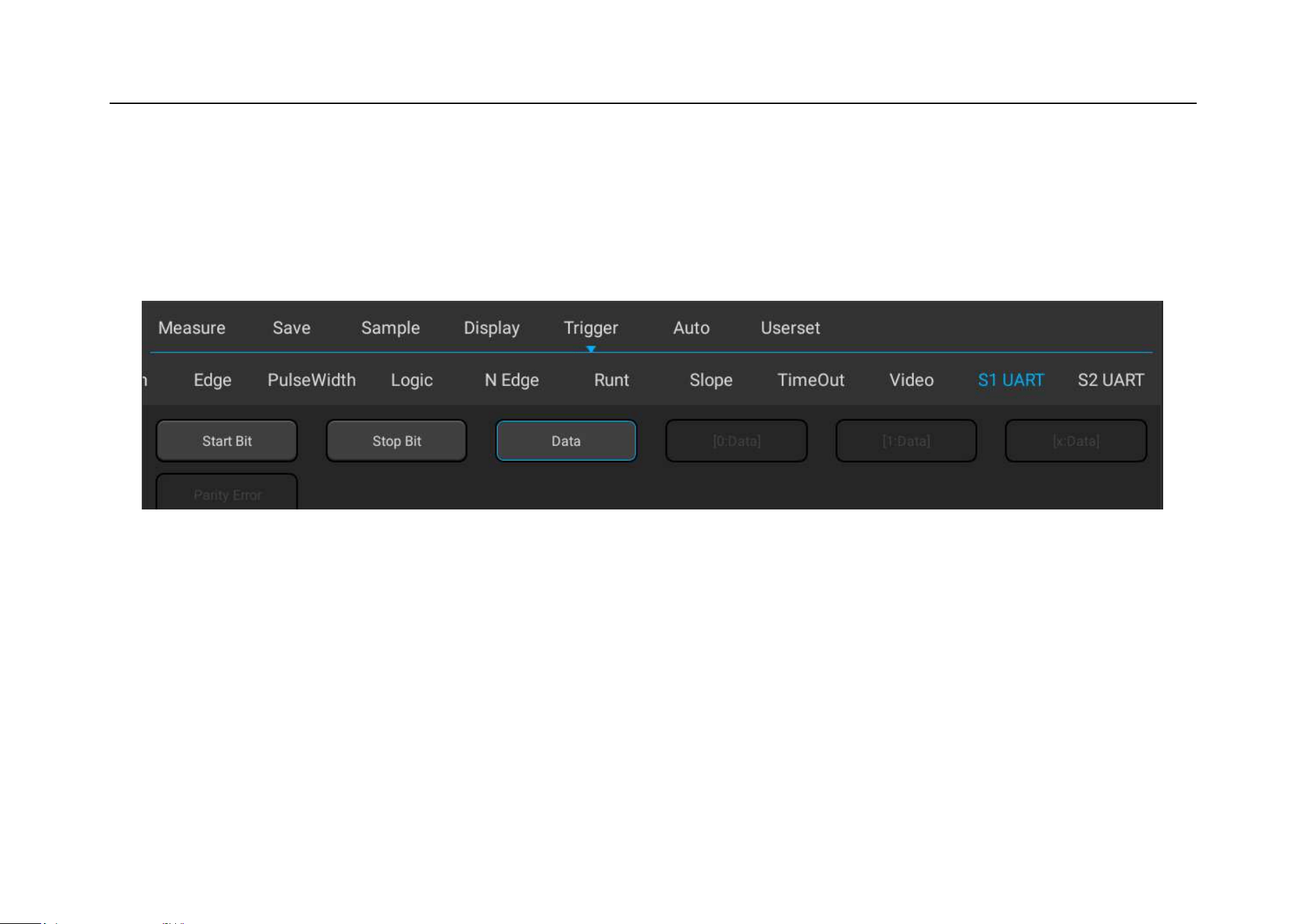
Chapter 11 Serial Bus Trigger and Decode (Optional)
241
Trigger mode
Open the trigger configuration menu and select the appropriate trigger type; when choosing UART bus trigger,
the trigger type, trigger relationship and trigger data need to be set, as shown in Figure 11-6:
Figure 11-6 Trigger Setting Menu
After selecting the trigger data, use the pop-up virtual keyboard to modify it, enter the value, and click “Enter”
on the virtual soft keyboard to complete the setting.
UART trigger configuration menu description:
a) Start bit — trigger at the start bit of the measured signal;
242
b) Stop bit — trigger at the stop bit of the measured signal, no matter the measured signal uses 1, 1.5, or 2
stop bits or not, the trigger will occur at the first stop bit.
c) [data] — Trigger at the specified data bit, when measured signal data bits are effective as 5 to 8bits, select
[data], and select the trigger relationship as” =“ “ >“ “ <“ “≠”, then select “Trigger Data”, press data on the
touch screen, and use the pop-up virtual keyboard to modify;
d) [0:data] — the measured signal data bits is 9bits (the 9th bit is parity bit). Only when the 9th bit is 0, then
trigger. The trigger relationship, trigger data configuration are the same as those of [data] trigger;
e) [1:data] — the measured signal data bits is 9bits (the 9th bit is parity bit). Only when the 9th bit is 1, then
trigger. The trigger relationship, trigger data configuration are the same as those of [data] trigger;
f) [x:data] — the measured signal data bits is 9bits (the 9th bit is parity bit). No matter what the value of the
9th bit is, trigger at the designated data bit. The trigger relationship, trigger data configuration are the same
as those of [data] trigger;
g) Parity error — valid when there is parity check at parity bit, trigger while parity error.
Chapter 11 Serial Bus Trigger and Decode (Optional)
243
UART serial decode
The measured signal word length is 8bit; parity bit, none; baud rate, 19.2kb/s, hexadecimal; trigger mode as
data bit:55; follow the steps as below:
(1) Tap S1 to open the decode channel, and click S1 again to open the bus configuration menu;
(2) Select the bus type as “UART”, click “Ch1”, “Idle High”, “Parity None”, “8bit”, “19.20kb/s”, display
“hexadecimal”, then close menu;
(3) Open the trigger mode setting menu, click “Data”, enter 55 manually, and press “enter” to confirm;
(4) Adjusting the threshold level according to the amplitude level of signal may make the signal to be stably
triggered. The UART trigger graphic interface is shown in Figure 11-8:
Method: Click configuration information to open the decode channel threshold level adjustment
box, and drag the adjustment box upward and downward to adjust the threshold level.
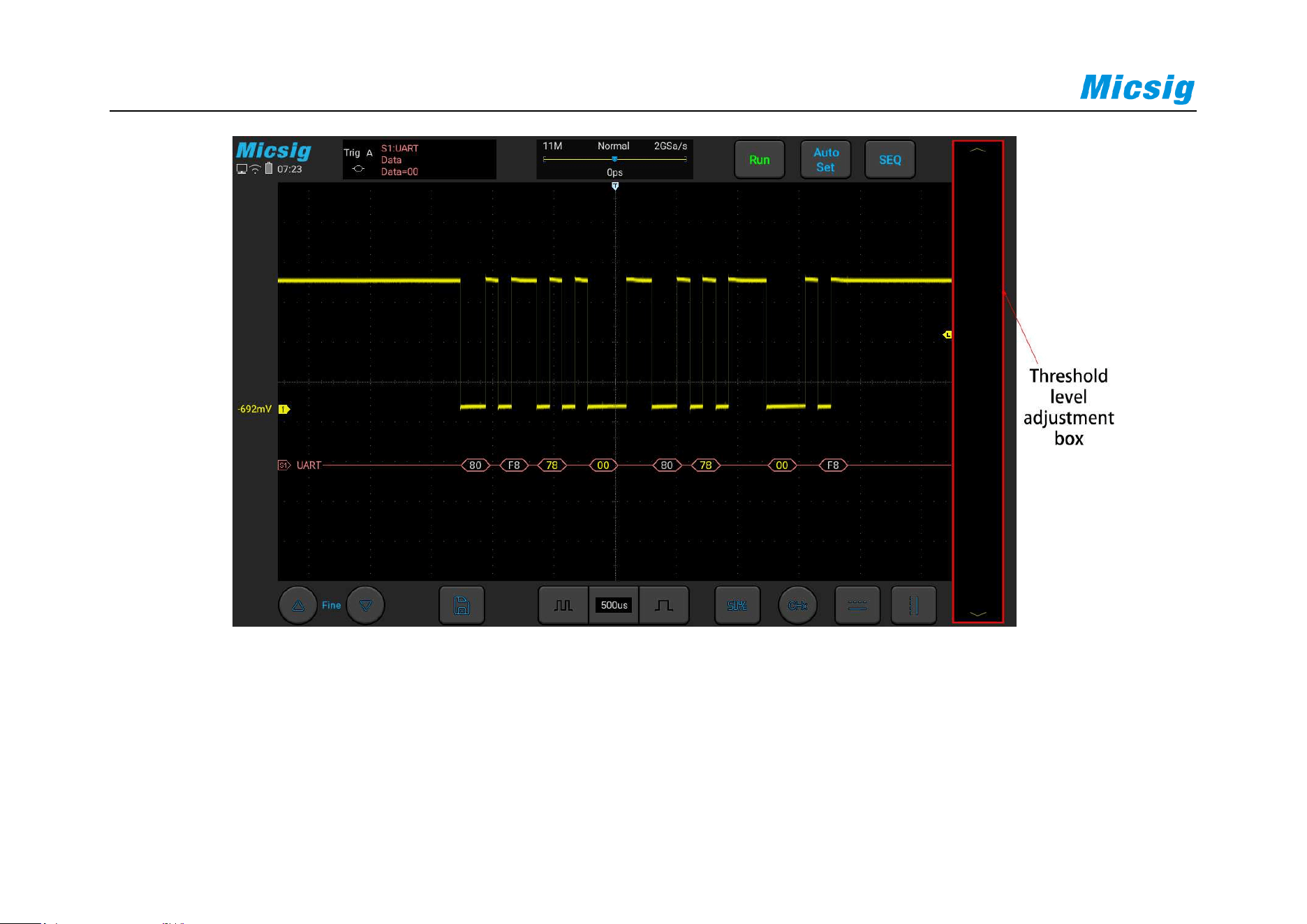
244
Figure 11-7 UART Decode Level Adjustment
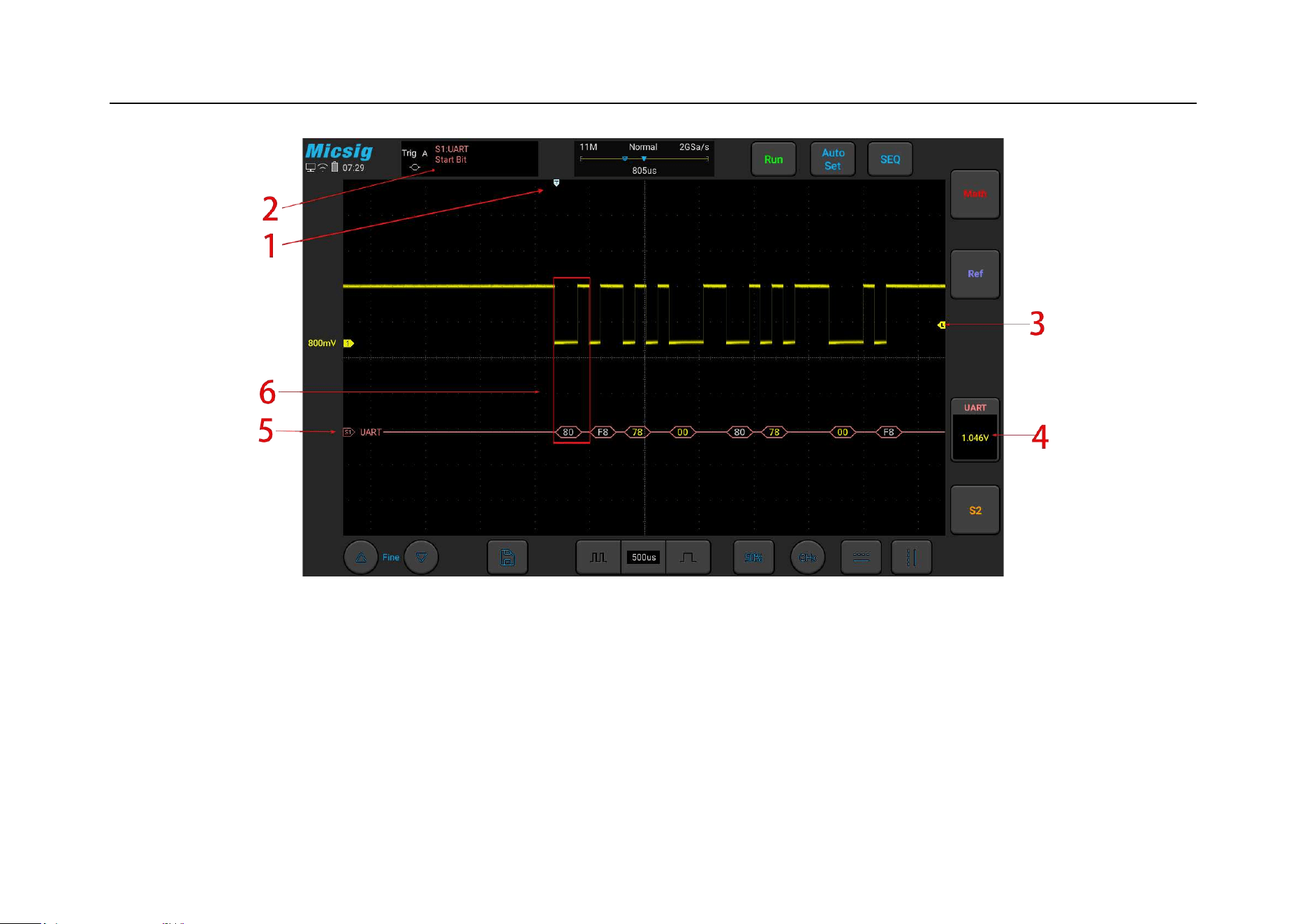
Chapter 11 Serial Bus Trigger and Decode (Optional)
245
Figure 11-8 UART Graphic Interface
UART graphic interface description:
(1) Trigger position
(2) Trigger type
246
(3) Threshold level
(4) Configuration information
(5) Decode the data packet, detailed as follows
(6) Decode data and the corresponding waveform area
UART decode data packet description:
(1) Decode data packet displays real-time data about the bus activities;
(2) Decode data displays as hexadecimal system in white;
(3) When the word length is 5-8 bits, the decode data displays as two bits of hexadecimal; when the word
length is 9 bits, the decode data displays as 3 bits of hexadecimal, and the 9th bit displays at the left side;
(4) When there is error in decode data, if the error is at stop bit, the data displays in yellow, if it is parity error,
data displays in red;
(5) When “?” appears, the time base needs to be adjusted to view decode results.
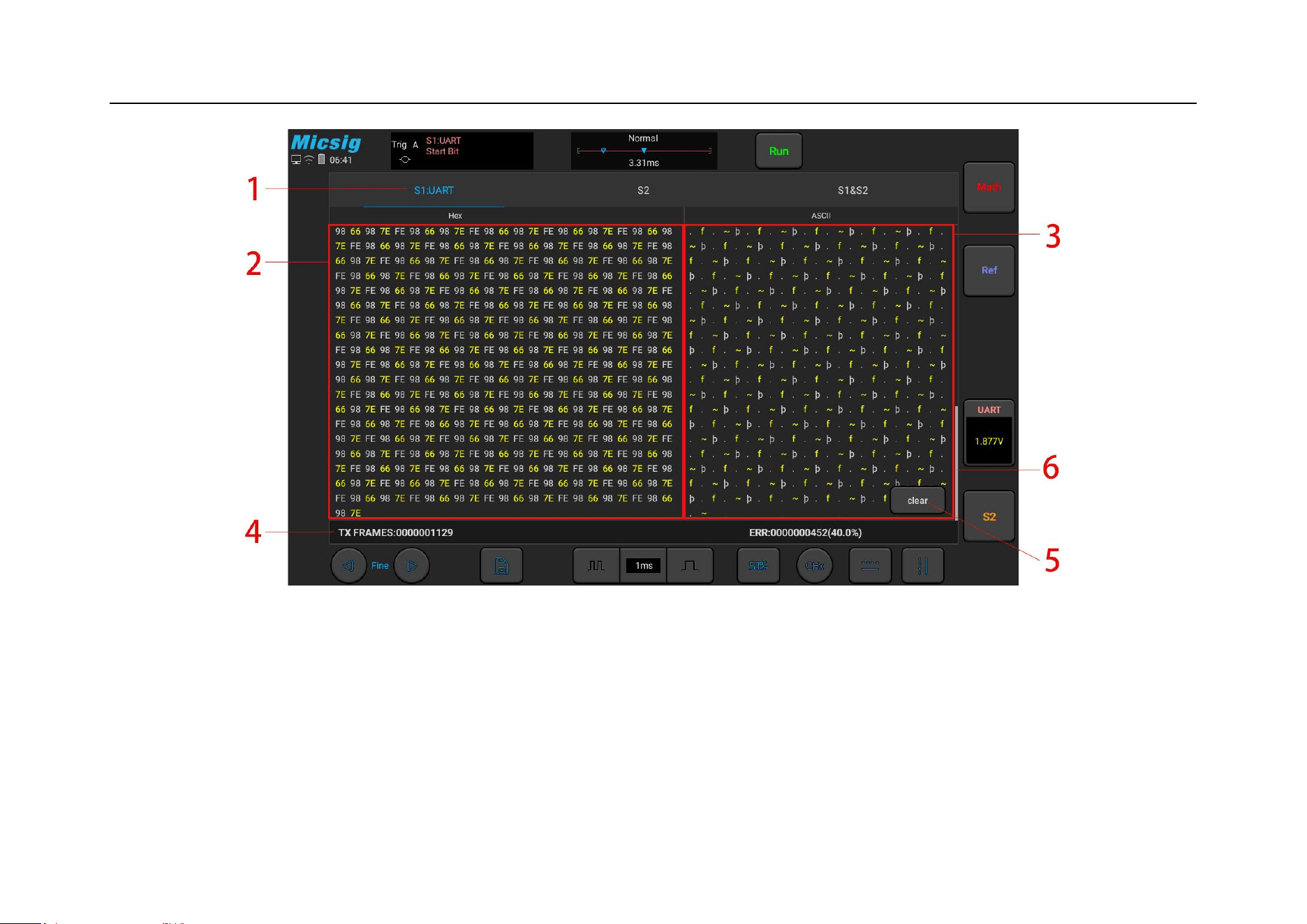
Chapter 11 Serial Bus Trigger and Decode (Optional)
247
Figure 11-9 UART Text Interface
UART text interface description, see Figure11-9:
(1) S1/S2/S1&S2 is channel configuration bus information.
(2) Area for decode data.
248
(3) ASCII code corresponding to the text data (when the data format is 9 bits and there is no parity bit, ASCII
code corresponds to lower 8 bits of data on the left side).
(4) Counter: Calculates the total number of frames and the percentage of ERR (parity error and stop bit error)
frames.
(5) Clear: Clear the counter data.
(6) Roller bar.
In the decode data area, the stop bit error data is displayed in yellow, and the decode error data is displayed in
red;
11.2 LIN Bus Trigger and Decode
For correctly decoding LIN bus data and making trigger stable, the bus configuration, trigger mode set and trigger
level need to be adjusted.
Chapter 11 Serial Bus Trigger and Decode (Optional)
249
Bus configuration
Left swipe or to open the bus configuration menu, and the following need to be set according to
measured signal:
Source — Select the signal source of decode.
Idle Level - high and low. Select whether to display high active or low active after the signal start bit of
measured equipment.
Baud Rate — Select the baud rate that matches the signal being measured, and it can be customized.
The setting method is the same as that of UART, and will not be repeated here. As shown in Figure 11-10:
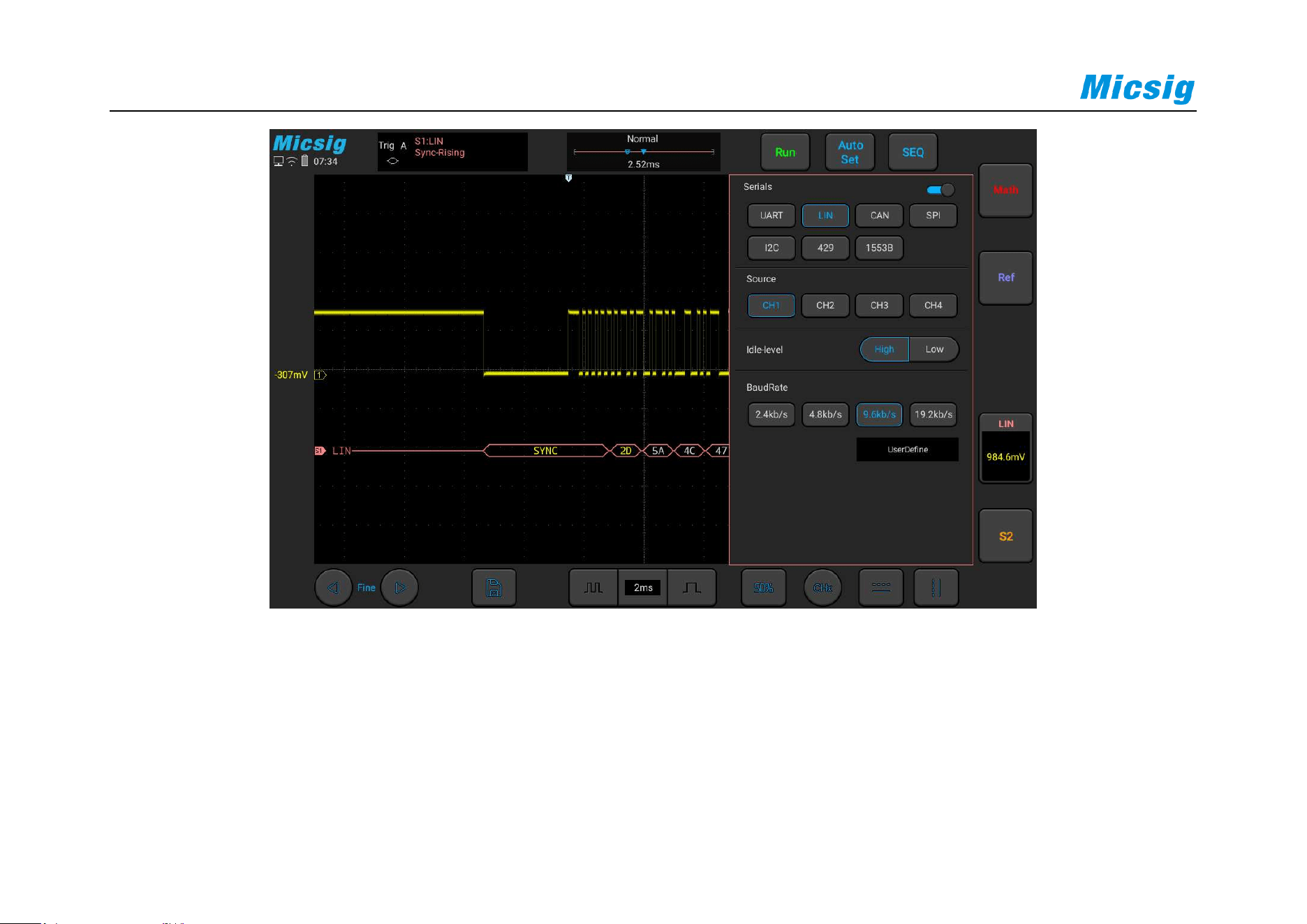
250
Figure 11-10 LIN Bus Configuration Menu
Trigger mode
Open the trigger configuration menu and select the appropriate trigger type. When the LIN bus trigger is
selected, the trigger mode includes: synchronous rising edge, frame ID, frame ID and data. See Figure 11-11:
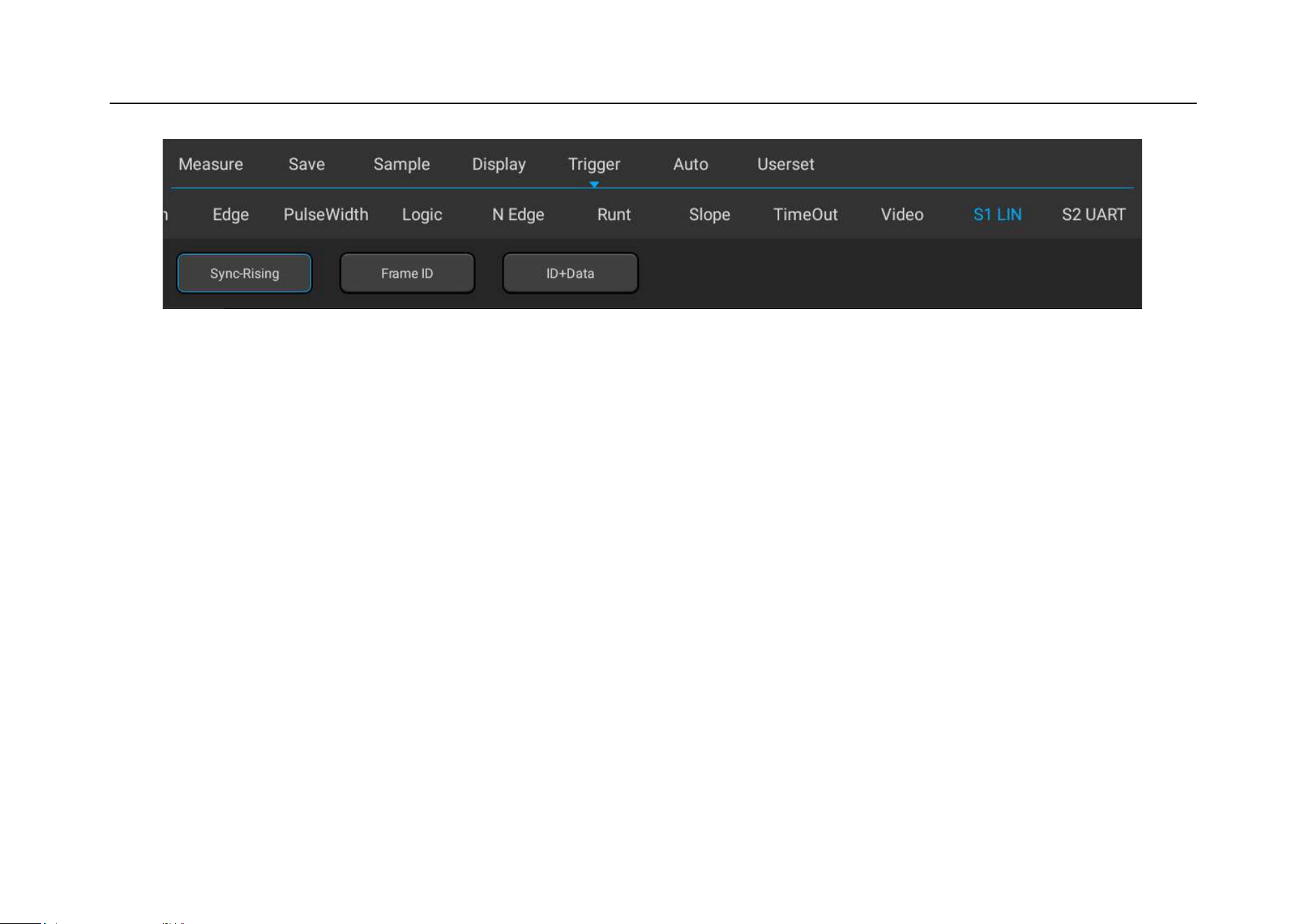
Chapter 11 Serial Bus Trigger and Decode (Optional)
251
Figure 11-11 LIN Trigger Mode Configuration Menu
a) Synchronous rising edge – When the “Sync Interval” of LIN bus ends, the rising edge triggers.
b) Frame ID — Triggered when a frame with an ID equal to the set value is detected. Select “Frame ID”, click
data on the touch screen, and use the pop-up virtual keyboard to modify it.
c) Frame ID and data—triggered when a frame with ID and data equal to the set value is detected. After
selecting “Frame ID and Data”, click ID or data, and set them.
LIN serial decode
Ch1 is connected to measured signal. The idle level is high and the baud rate is 19.2 kb/s. The trigger mode is
synchronous rising edge. Please follow these steps:
252
(1) Tap S1 to open the decode channel, and click again to open the bus configuration menu;
(2) Select the bus type as “LIN”, click “Ch1”, “Idle High”, “19.20kb/s”, and then close the menu;
(3) Open the trigger mode configuration menu and click “Synchronous Rising Edge”;
(4) Click configuration information to open the decode channel threshold level adjustment box, and drag
the adjustment box upward and downward to adjust the threshold level; adjust the threshold level according
to the signal amplitude level to make the signal stably triggered. The LIN trigger graphic interface is shown
in Figure 11-12:
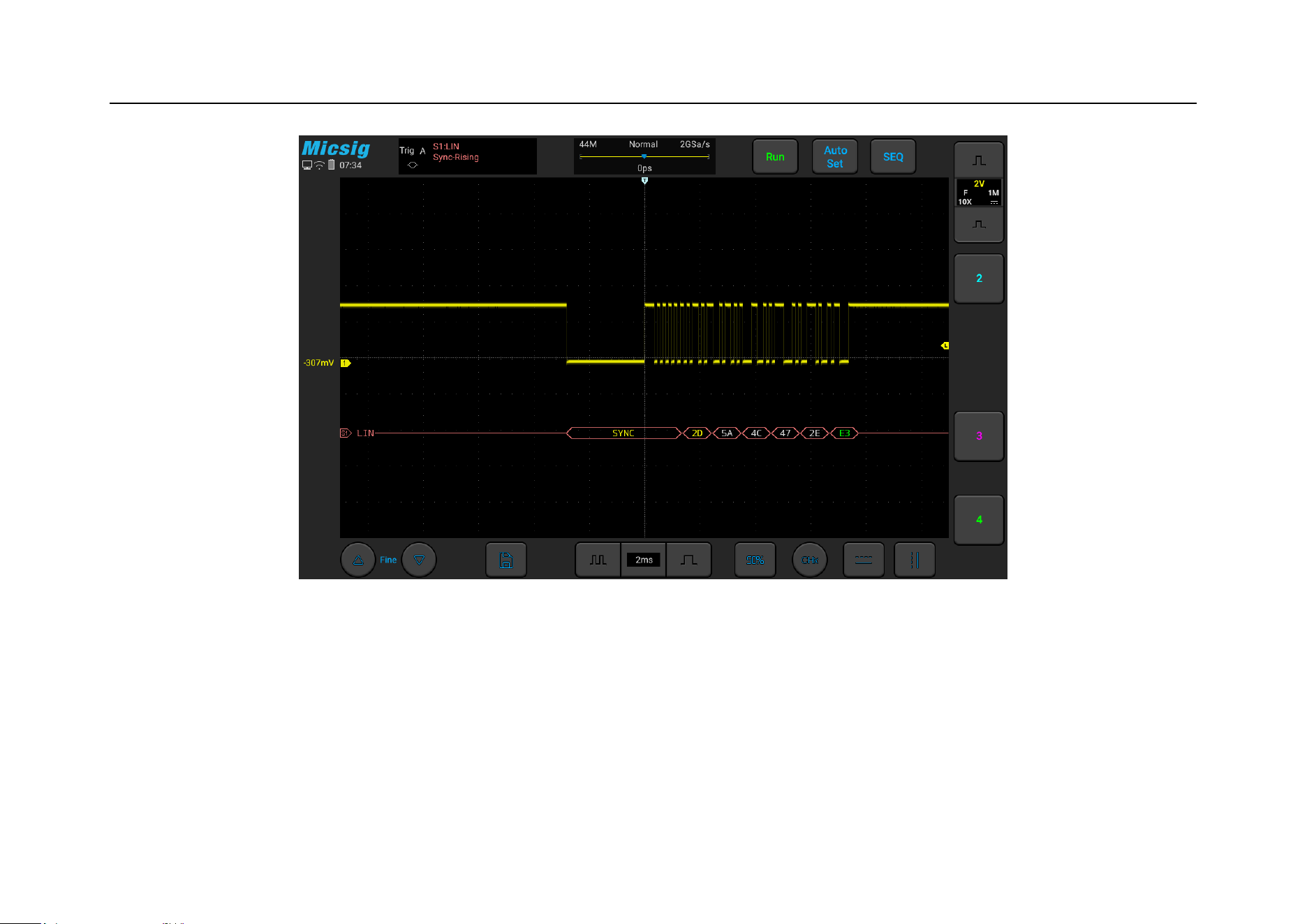
Chapter 11 Serial Bus Trigger and Decode (Optional)
253
Figure 11-12 LIN Graphic Interface
LIN decode data packet description:
(1) Decode data packet displays real-time data about the bus activities.
(2) Decode data displays as hexadecimal system.
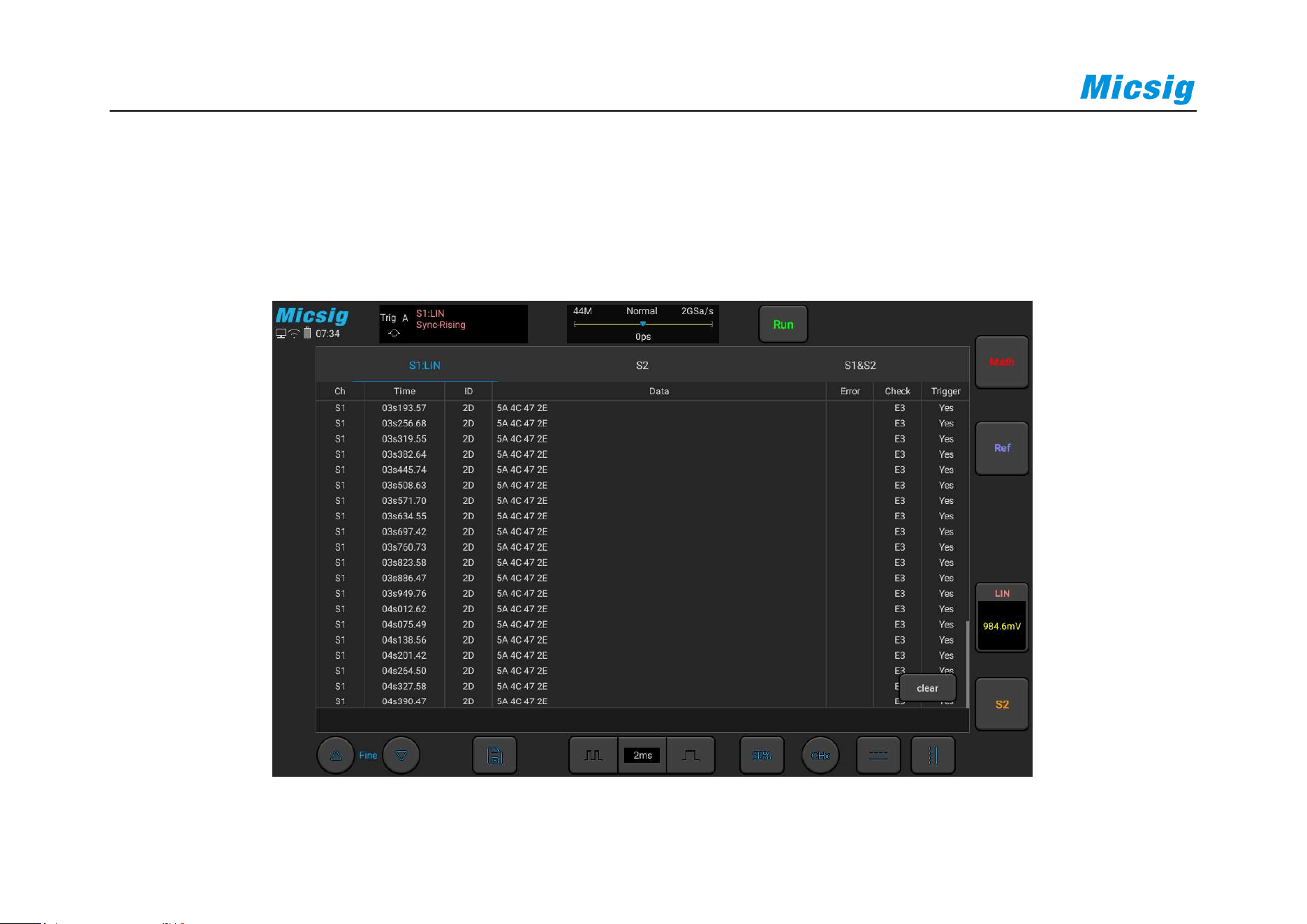
254
(3) “Frame ID” displays in yellow, “Data” displays in white, and “Parity sum” displays in green. If the parity
sum has error, it is displayed in red “E”.
(4) When “?” appears, the time base needs to be adjusted to view decode results.
Figure 11-13 LIN Text Interface

Chapter 11 Serial Bus Trigger and Decode (Optional)
255
LIN text interface description, as shown in Figure 11-13:
(1) “Ch”: bus channel.
(2) “Time”: Time intervals between the last frames to current frames.
(3) “ID”: Frame ID value.
(4) “Data”: Frame data.
(5) “Parity sum”: Frame parity sum, the sum of parity error displays in red.
(6) “Trigger”: “Yes” means the frame reaches trigger condition.
(7) “Clear”: Clear counter data.
256
11.3 CAN Bus Trigger and Decode
For correctly decoding CAN bus data and making trigger stable, the bus configuration, trigger mode set and trigger
level need to be adjusted.
Bus configuration
Left swipe or to open the bus configuration menu, the signal source needs to be set, and the signal
type and baud rate are set according to measured signal; the setting method is the same as that of UART and will
not be repeated here. See Figure 11-14:
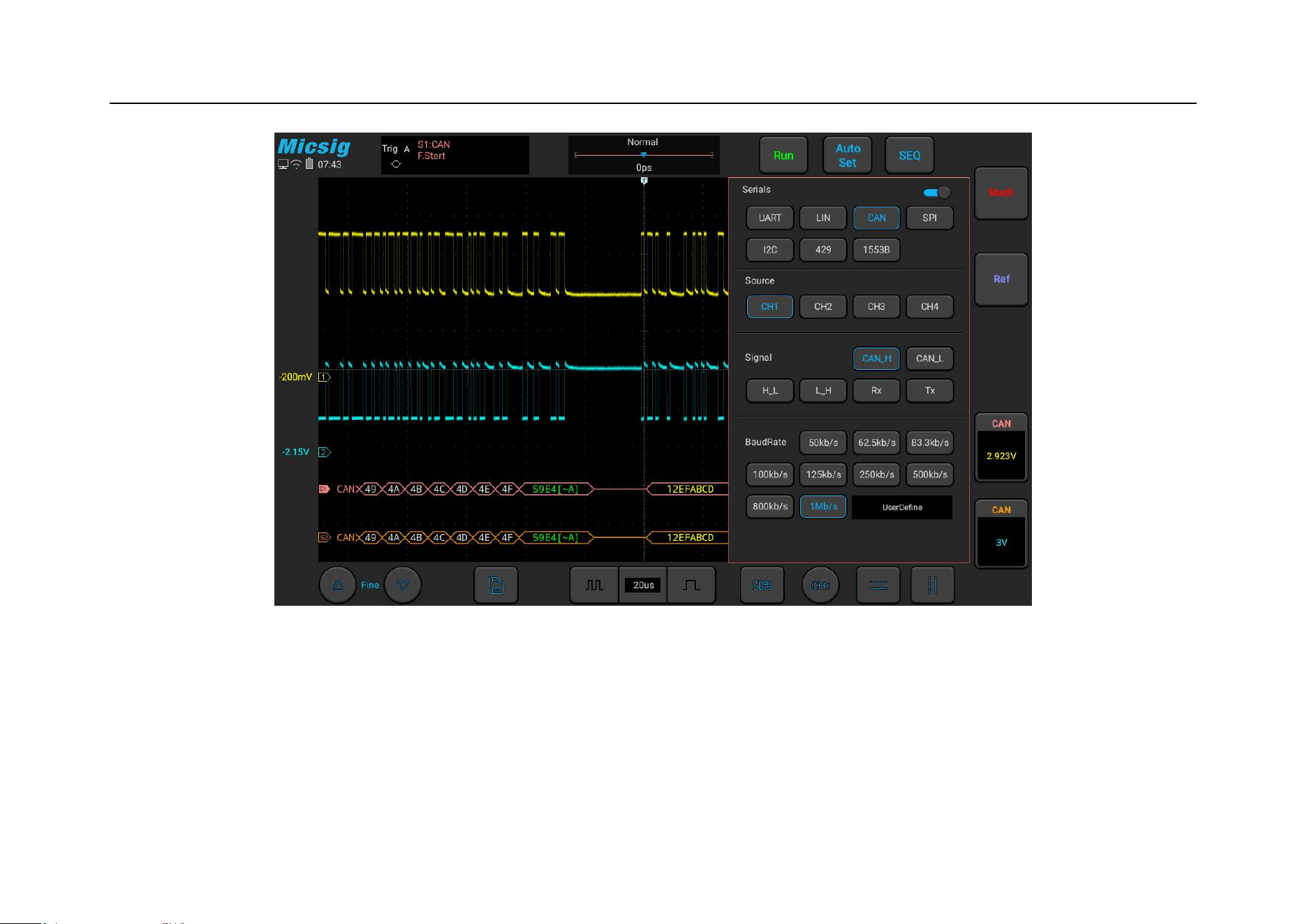
Chapter 11 Serial Bus Trigger and Decode (Optional)
257
Figure 11-14 CAN Bus Configuration Menu
Trigger mode
Open the trigger configuration menu and select the appropriate trigger type; when S1 CAN bus trigger is
selected, as shown in Figure 11-15:
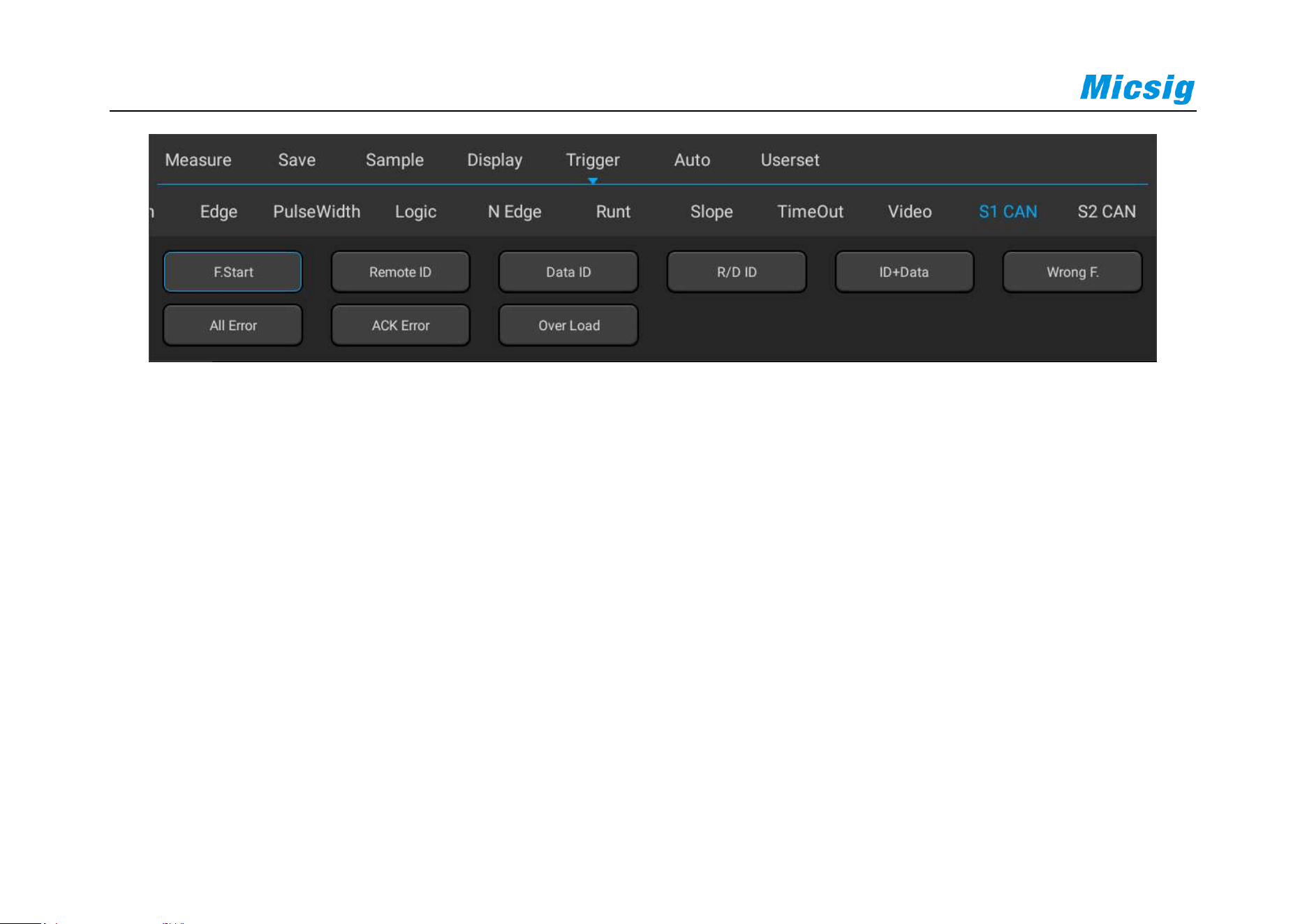
258
Figure 11-15 CAN Trigger Mode Configuration Menu
Trigger mode selection menu description:
a) Frame start — trigger at the start of the frame;
b) Remote frame ID — setting the ID matches the remote frame trigger. After selecting the “Remote Frame
ID”, and then set the ID value at the bottom of the trigger data area
Operation description: Press the numbers on the touch screen and use the virtual keyboard to set;
c) Data framed ID — trigger on data frame that matches set ID. Data frame ID configuration mode is the
same as the remote data frame ID configuration;

Chapter 11 Serial Bus Trigger and Decode (Optional)
259
d) Remote frame/data frame ID — trigger on remote frame or data frame that matches set ID. Remote
frame/data frame ID configuration is the same as the remote data frame ID configuration;
e) Data frame ID and data ID — trigger on data frame that matches set ID and data. The configuration method
is the same as the remote frame ID configuration;
f) Error frame — trigger on CAN error frame;
g) All errors — trigger when there is any error in format or activity;
h) Ack error — trigger on recessive (high) Ack position;
i) Overload frame — trigger on CAN overload frame.
CAN serial decode
Ch1 is connected to measured signal. The idle level is high and the baud rate is 1Mb/s; the Trigger mode is the
frame start. Please follow these steps:
(1) Tap S1 to open the decode channel, and click S1 again to open the bus configuration menu;
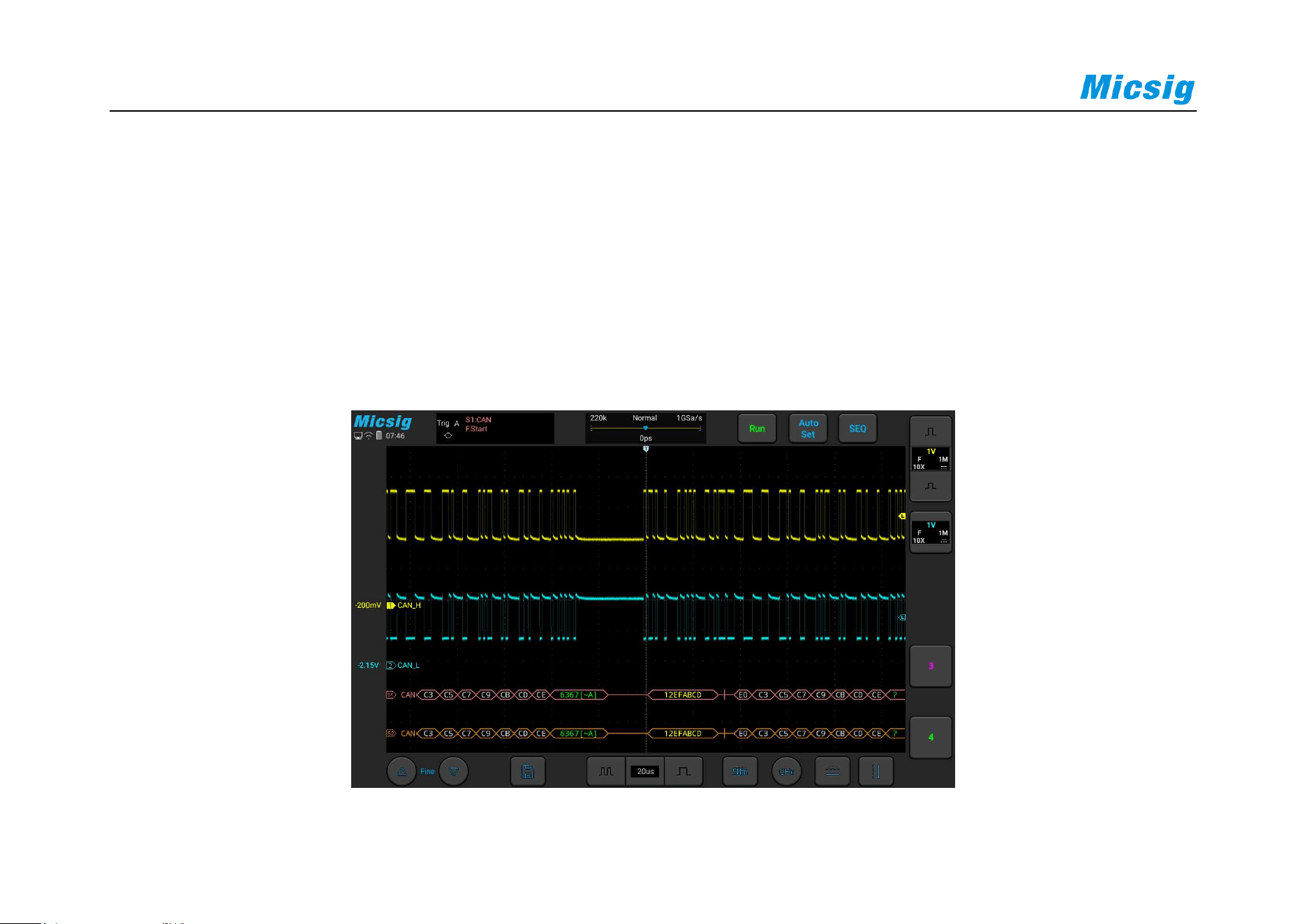
260
(2) Select the bus type as “CAN”, and then click “Ch1”, “Idle High” and “1Mb/s”. After setting, click the
blank area to close the menu;
(3) Open the trigger mode configuration menu and click “Frame Start”;
(4) Adjust the threshold level according to the signal amplitude; the CAN trigger graphic interface is shown in
Figure 11-16:
Figure 11-16 CAN Graphic Interface

Chapter 11 Serial Bus Trigger and Decode (Optional)
261
CAN decode data packet description:
(1) Decode data packet displays real-time data about the bus activities.
(2) Decode data displays as hexadecimal system.
(3) “Frame ID” displays in yellow, “Data” displays in white, and “DLC” and “CRC” codes display in green. If
there is frame error, it is displayed in red “E”.
(4) When “?” appears, the time base needs to be adjusted to view decode results, and “!” indicates that the bus
waveform corresponding to the decode data packet is incomplete and the data cannot be displayed
correctly.
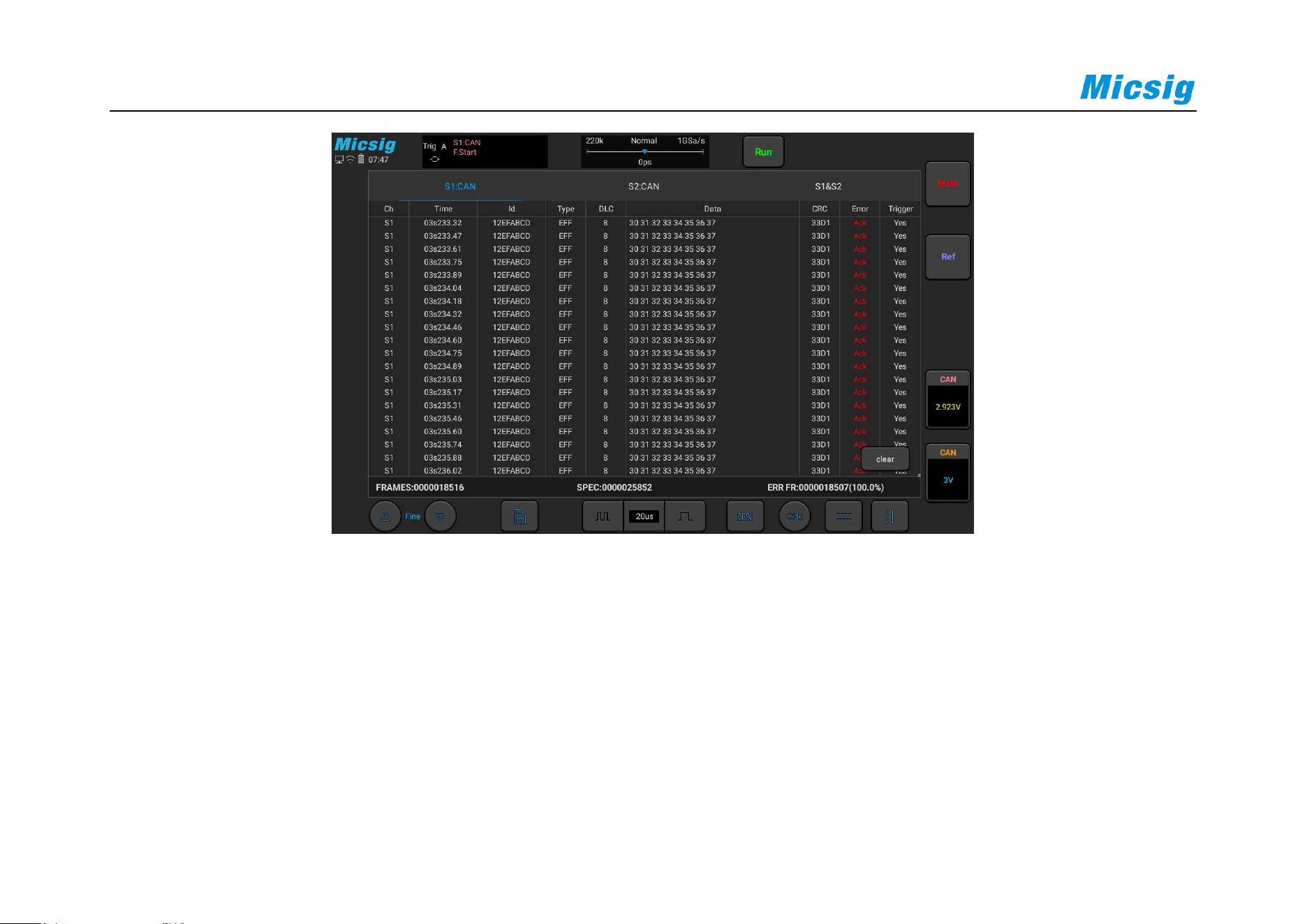
262
Figure 11-17 CAN Text Interface
CAN text interface description, as shown in Figure 11-17:
(1) “Ch”: bus channel.
(2) “Time”: Time intervals between the last frames to current frames.
(3) “ID”: CAN frame ID value displayed in hexadecimal, maximum 29 bits.

Chapter 11 Serial Bus Trigger and Decode (Optional)
263
(4) “Type”: Frame type, “SFF” standard data frame, “SRF” standard remote frame, “EFF” extended data
frame, “ERF” extended remote frame.
(5) “DLC”: Number of data bytes sent by this frame. This value can be ignored for remote frames.
(6) “Data”: Frame data.
(7) “CRC”: Frame CRC check code.
(8) “Error”: Response error, bit stuffing error, format error, CRC error.
(9) “Trigger”: “Yes” means the frame reaches trigger condition.
(10) “Statistics”: counts the number of occurrences of frame type, data length, status, etc., and the percentage.
11.4 SPI Bus Trigger and Decode
For correctly decoding SPI bus data and making trigger stable, the bus configuration, trigger mode set and trigger
level need to be adjusted.
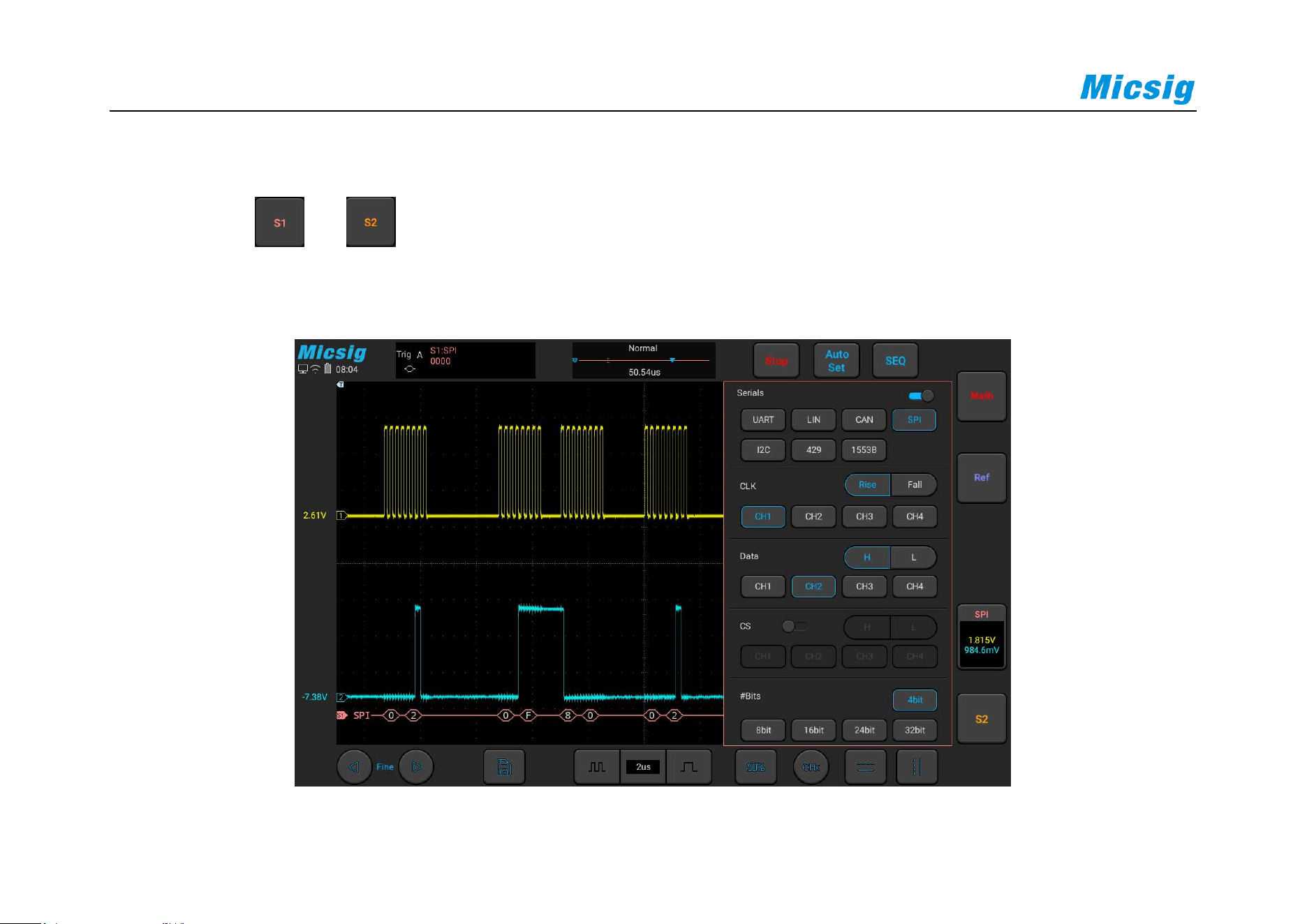
264
Bus configuration
Left swipe or to open the bus configuration menu, the following need to be set:
Clock source, data source, chip select signal, and data word length, as shown in Figure 11-18:
Figure 11-18 SPI Bus Configuration Menu
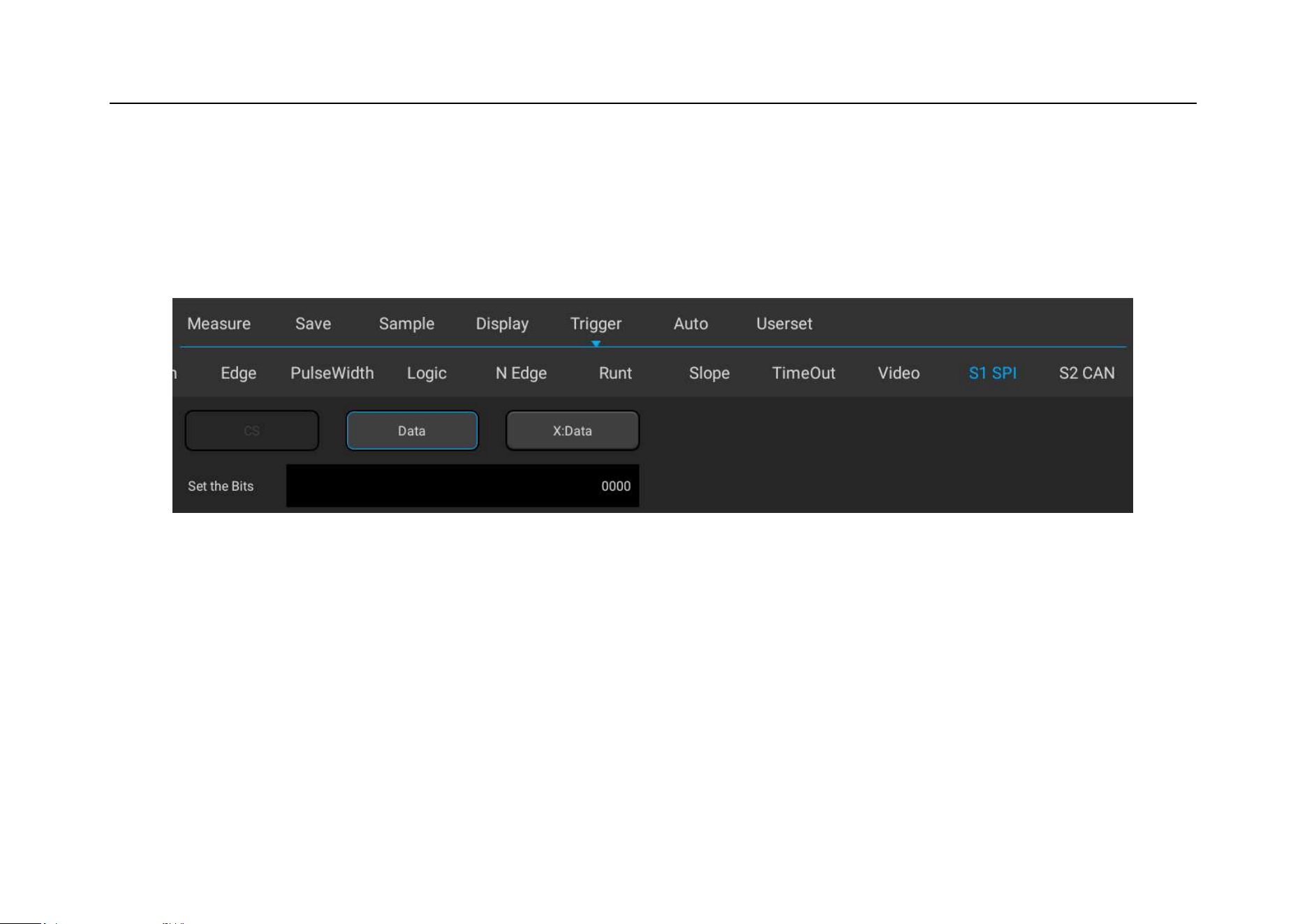
Chapter 11 Serial Bus Trigger and Decode (Optional)
265
Trigger mode
Open the trigger configuration menu and select the appropriate trigger type; when selecting the SPI bus trigger,
as shown in Figure 11-19:
Figure 11-19 SPI Trigger Mode Configuration Menu
The operation method is the same as CAN frame ID to be matched in the configuration, and will not be repeated
here.
Note: According to the data byte length set by bus decode, the value of the relevant bit within the byte length is
set. Trigger when the corresponding bit on data bus matches the set value.
266
SPI serial bus
The measured signal channel Ch1 is connected to CLK, Ch2 channel is connected to DATA, the bus idle state is
high, the clock rising edge is sampled; the data word length is 4 bits; the CS chip select is off; the trigger mode
matches the “Data” at 0001, please follow the steps below:
(1) Tap S1 to open the decode channel, and click S1 again to open the bus configuration menu;
(2) Select the bus type as “SPI”, click clock as “Ch1” rising edge, the data is “Ch2” high level, and the data
word length is “4bit”;
(3) Open the trigger setting menu, click data on the touch screen, and use the virtual soft keyboard to set the
data to be matched as “0001”;
(4) Adjust the threshold levels of two channels according to signal amplitude; the SPI trigger graphic interface
is shown in Figure 11-20:
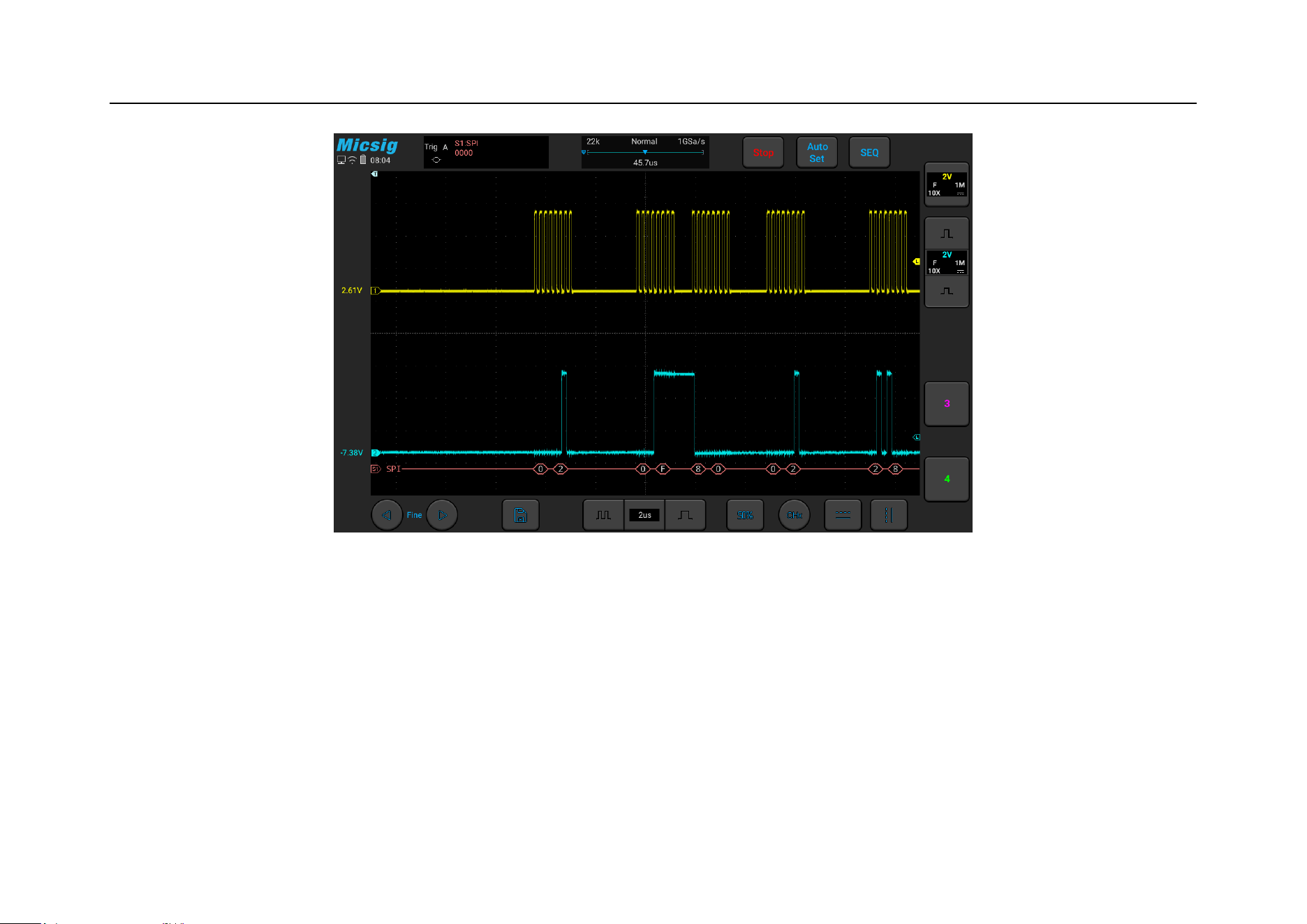
Chapter 11 Serial Bus Trigger and Decode (Optional)
267
Figure 11-20 SPI Graphic Interface
SPI decode data packet description:
(1) Decode data packet displays real-time data about the bus activities.
(2) Decode data displays as hexadecimal system.
(3) Data displays in white.
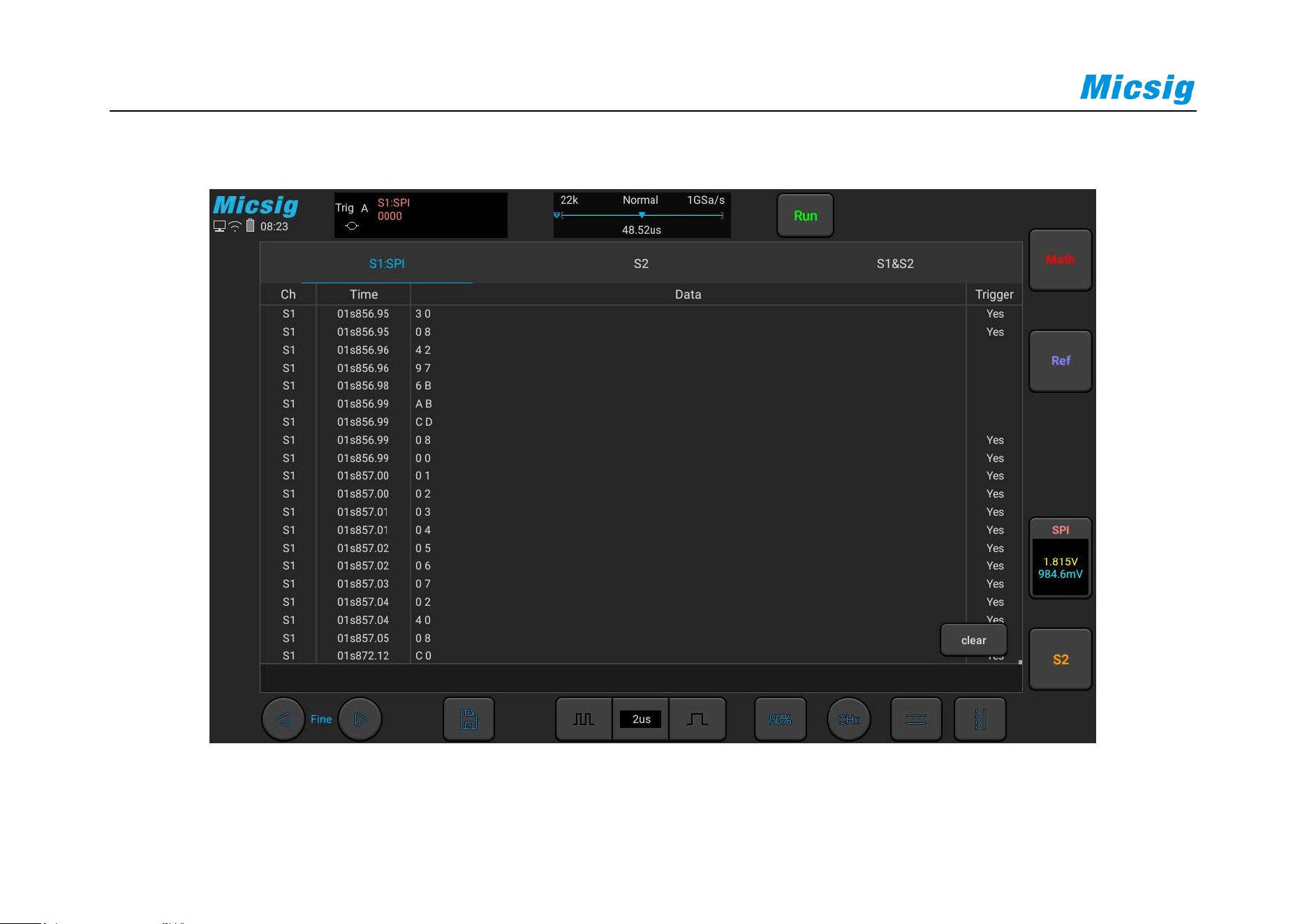
268
(4) When “?” appears, the time base needs to be adjusted to view decode results.
Figure 11-21 SPI Text Interface

Chapter 11 Serial Bus Trigger and Decode (Optional)
269
SPI text interface description, as shown in Figure 11-21:
(1) “Ch”: bus channel.
(2) “Time”: Time intervals between the last frames to current frames.
(3) “Data”: According to the data word length setting, the decode data is displayed. For example, if the data
word length is 8bit, only one byte displays in the data column; if the data word length is 16bit, 2 bytes
display in the data column; if the data word length is 24bit, 3 bytes display; and if the data word length is
32bit, 4 bytes display.
(4) “Trigger”: “Yes” means the frame reaches trigger condition.
Note: “One frame” is measured by the set “data word length” and can meet 1 data bit code stream.
270
11.5 I2C Bus Trigger and Decode
For correctly decoding I2C bus data and making trigger stable, the bus configuration, trigger mode set and trigger
level need to be adjusted.
Bus configuration
Left swipe or to open the bus configuration menu, Bus configuration includes the serial clock
(SCL) and the serial data (SDA) corresponding to the channel settings. See Figure 11-22:
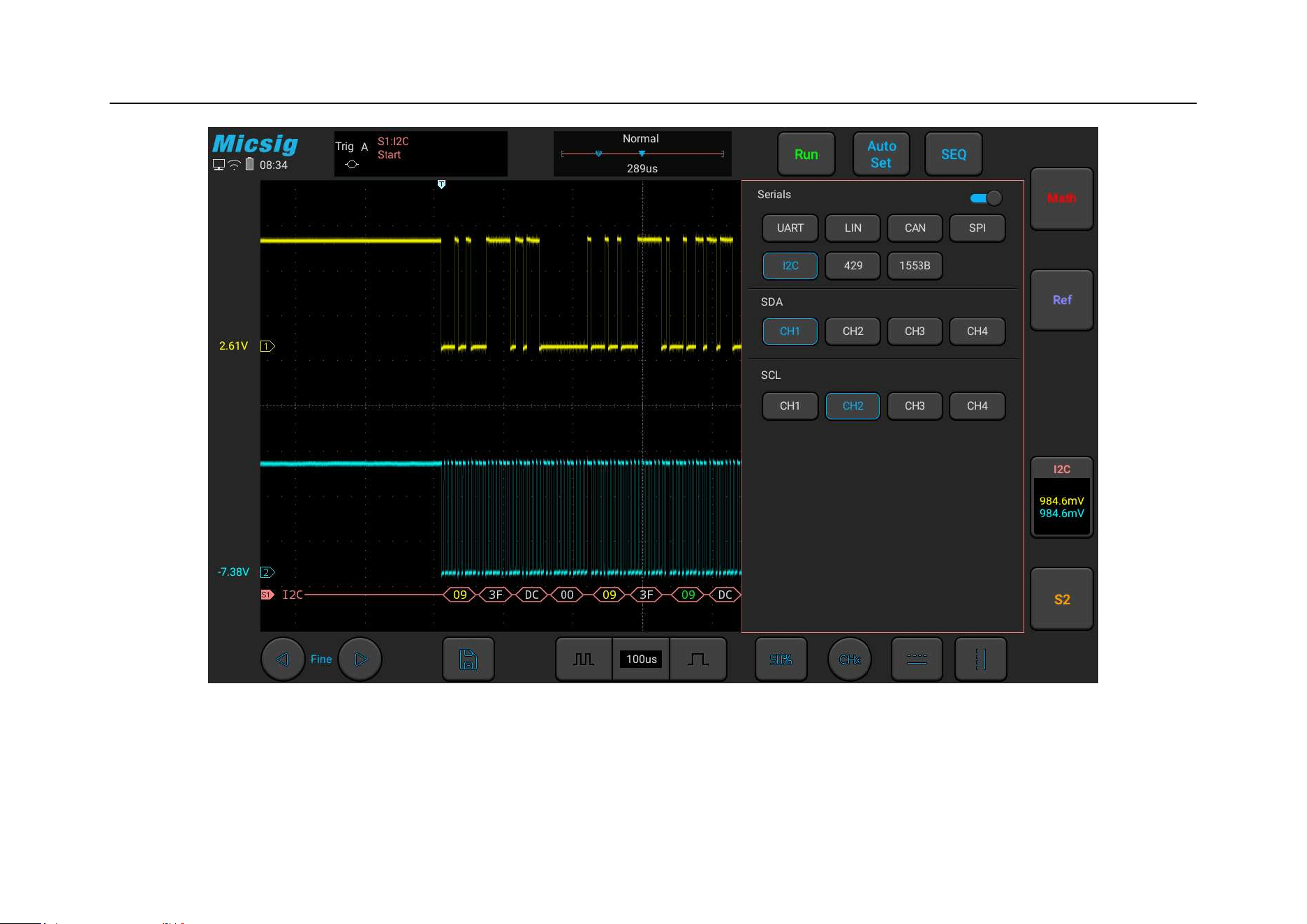
Chapter 11 Serial Bus Trigger and Decode (Optional)
271
Figure 11-22 I2C Bus Configuration Menu
Notes: When SCL or SDA channel is set, the system will automatically set other channels.
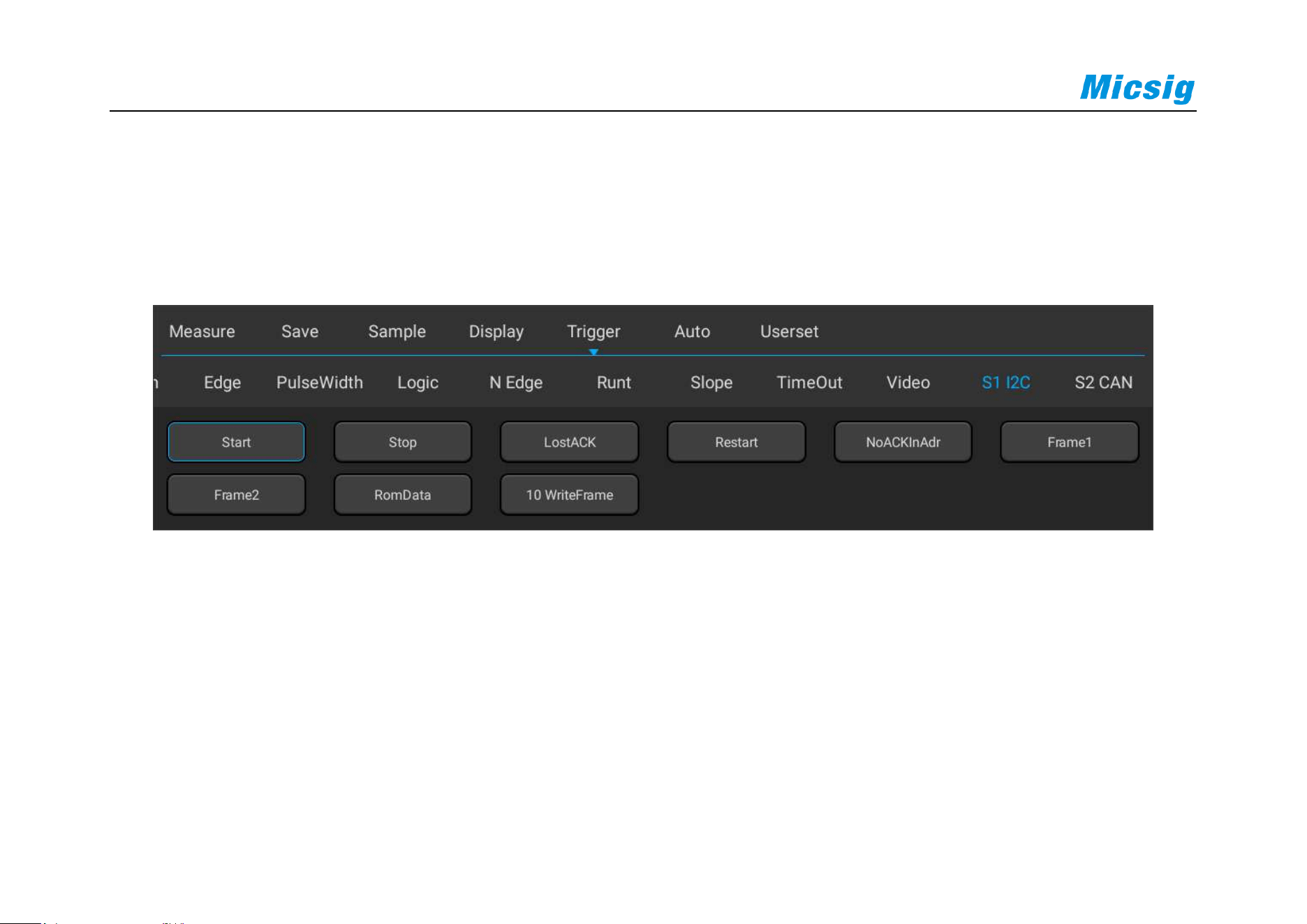
272
Trigger mode
Open the trigger configuration menu and select the appropriate trigger type. When the I2C bus trigger is
selected, click the trigger type and relationship on the screen, as shown in Figure 11-23:
Figure 11-23 I2C Trigger Mode Configuration Menu
Trigger mode menu description:
a) Start condition — trigger when SCL is high and SDA has a falling edge (includes restart).
b) Stop condition — trigger when SCL is high and SDA has a rising edge.
c) Ack Loss — Trigger when the bus Ack bit is high.

Chapter 11 Serial Bus Trigger and Decode (Optional)
273
d) Restart — triggered when a new start condition occurs before the stop condition.
e) Address no ack — trigger when the ack bit in the set address field is invalid (ignoring W/R bit), select
“Address” in the trigger data, and use the pop-up virtual soft keyboard to modify it.
f) Frame Type 1 - Start + Address 7 + Read/Write + Acknowledge + Data; if all bits in the frame type match,
trigger on read/write frames in 6-bit addressing mode on the 17th clock edge.
Frame type 1 operation method: Select values after the address/data, click values after the address/data on
the touch screen, and modify them on the pop-up virtual soft keyboard.
g) Frame type 2 — Start + Address 7 + Read/Write + Acknowledge + Data 1 + Acknowledge + Data 2; trigger
on read/write frames in 6-bit addressing mode on the 26th clock edge if all bits in the frame type match.
The operation method of configuring frame type 2 is the same as frame type 1, and will not be repeated
here.
h) EEPROM data read - When the read operation which contains 1010xxx control byte of the EEPROM
appears on the bus and the Ack bit is correct, then the read data can be captured. If the captured data and
274
the set data match the set relationship condition, trigger on the clock edge of Ack bit after the data byte.
After selecting “EEPROM Data Read”, click the relationship by “=” “ >” “<” “ ≠”, and the setting method
is the same as the address field.
i) 9-bit write frame - Trigger on 9-bit write frame on the 26th clock edge if all bits in the pattern match.
Trigger mode is start condition, SCL connect to Ch2, SDA connect to Ch1, follow these steps as below:
(1) Tap S1 to open the decode channel, and click S1 again to open the bus configuration menu;
(2) Select the bus type as “I2C”, open the bus setting menu, and select the clock SCL as Ch2 channel;
(3) Open the trigger mode configuration menu and click “Start Condition” on the touch screen.
(4) Set the threshold level of two channels according to signal amplitude; I2C trigger graphic interface is
shown in Figure 11-24:
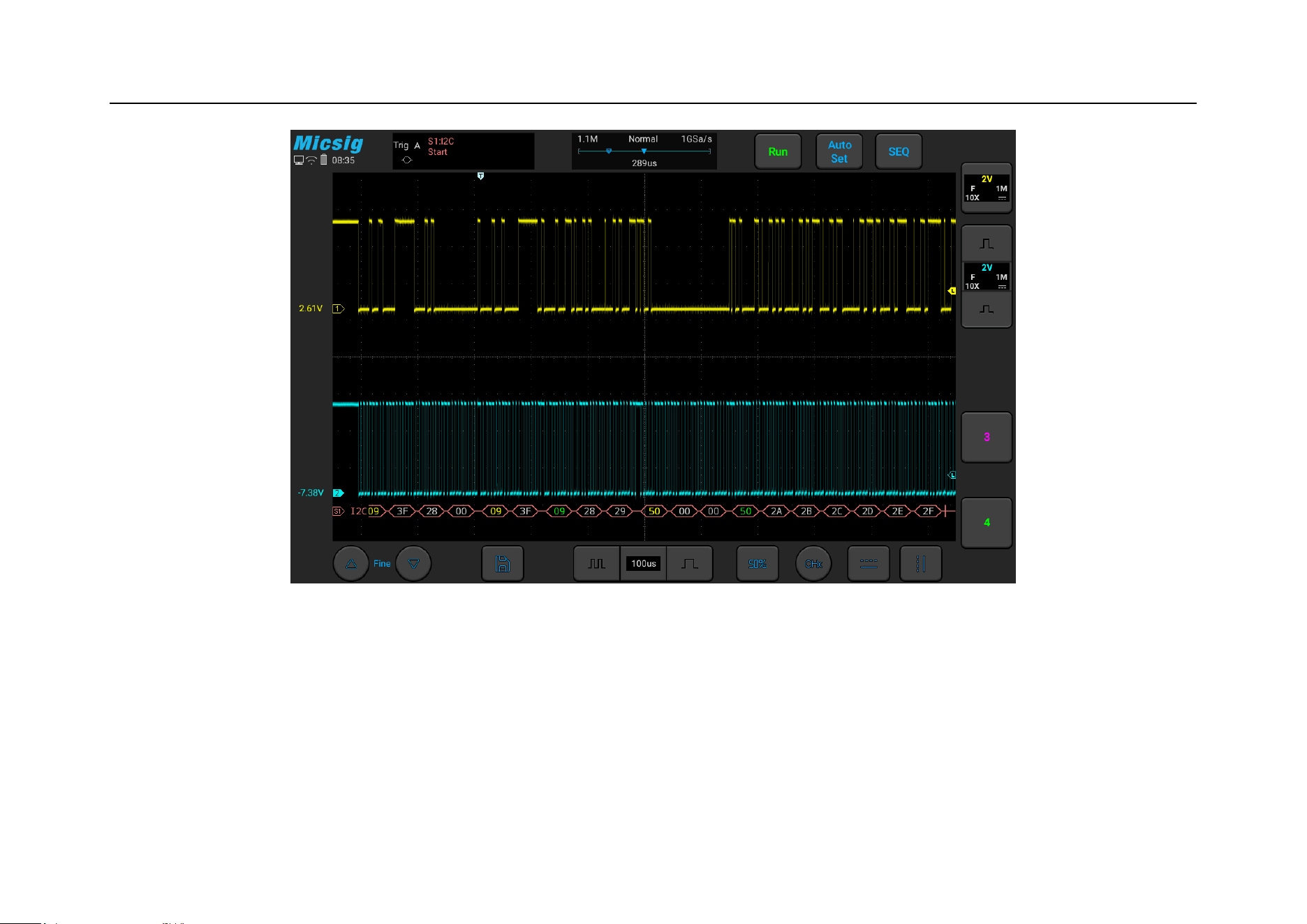
Chapter 11 Serial Bus Trigger and Decode (Optional)
275
Figure 11-24 I2C Graphic Interface
I2C decode data packet description:
(1) Decode data packet displays real-time data about the bus activities.
(2) Decode data displays as hexadecimal system.
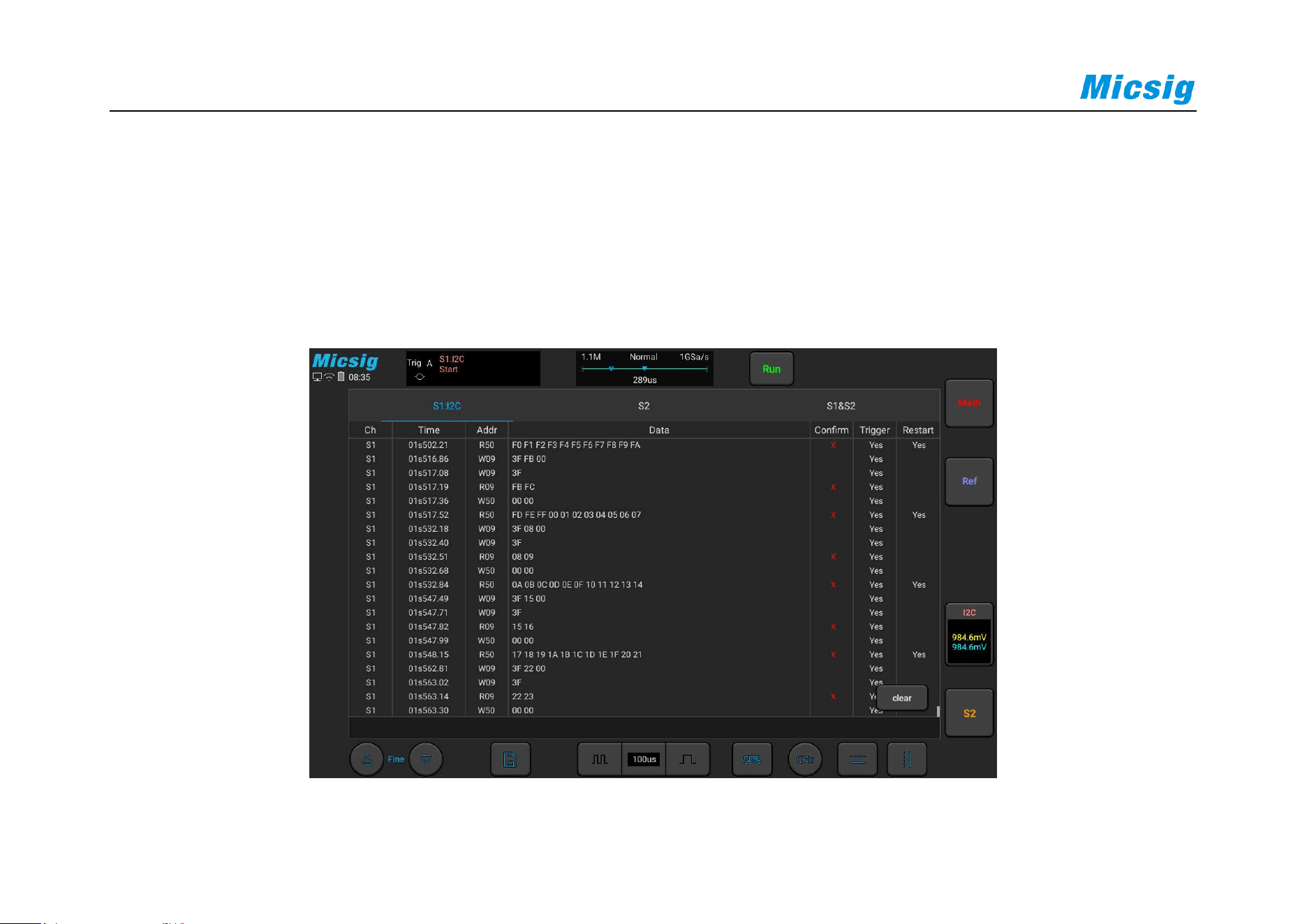
276
(3) Address content display: Read address displays in green, write address displays in yellow, and data displays
in white. “W” denotes write operation, “R” denotes read operation, “D” denotes decode data, and “~A”
denotes no Ack bit.
(4) When “?” appears, the time base needs to be adjusted to view decode results.
Figure 11-25 I2C Text Interface

Chapter 11 Serial Bus Trigger and Decode (Optional)
277
I2C text interface description, as shown in Figure 11-25:
(1) “Ch”: bus channel.
(2) “Time”: intervals between the last read/write operations to current read/write operations
(3) “Address”: in address bar, “R” means the read operation, and “W” means write operation
(4) “Data”: data sent by one read and write operation is in the data bar.
(5) “Ack”: in Ack bar, “X” means Ack bit lost.
(6) “Trigger”: “Yes” means reach trigger condition.
(7) “Restart”: “Yes” means reach restart condition.
278
11.6 ARINC429 Bus Trigger and Decode
For correctly decoding ARINC429 bus data and making trigger stable, the bus configuration, trigger mode set and
trigger level need to be adjusted.
Bus configuration
Left swipe or to open the bus configuration menu, the following needs to be set:
Data Source — Select channel for ARINC 429 signal.
Word format — Select ARINC 429 decode mode.
Bus Display — Set the format for ARINC 429 decode data.
Baud Rate — Set the speed of ARINC 429 signal.
As shown in Figure 11-26:
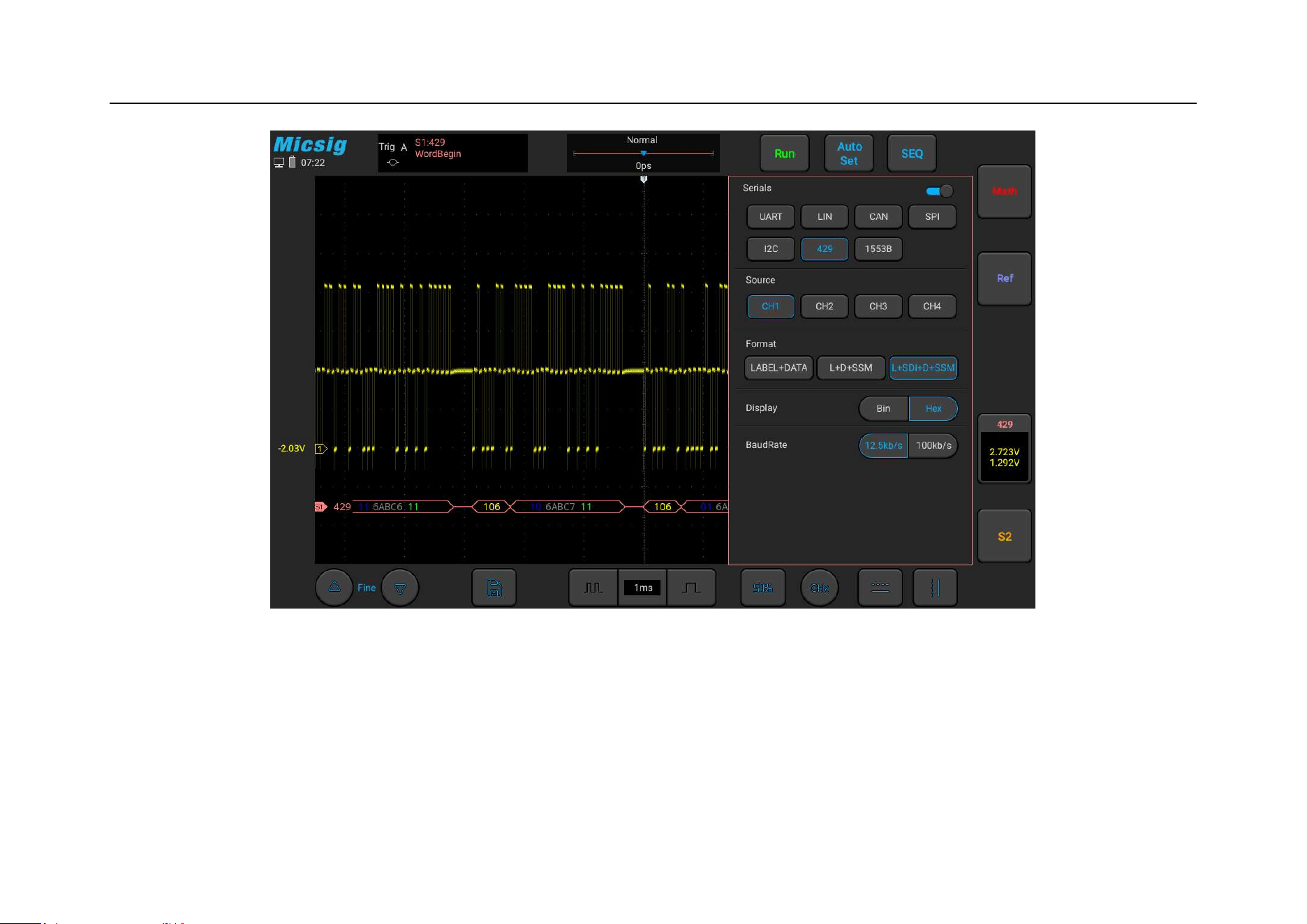
Chapter 11 Serial Bus Trigger and Decode (Optional)
279
Figure 11-26 ARINC429 Bus Configuration Menu
Trigger mode
Open the trigger configuration menu and select the appropriate trigger type; when the ARINC429 bus trigger is
selected, click the trigger type and relationship on the screen, as shown in Figure 11-27:
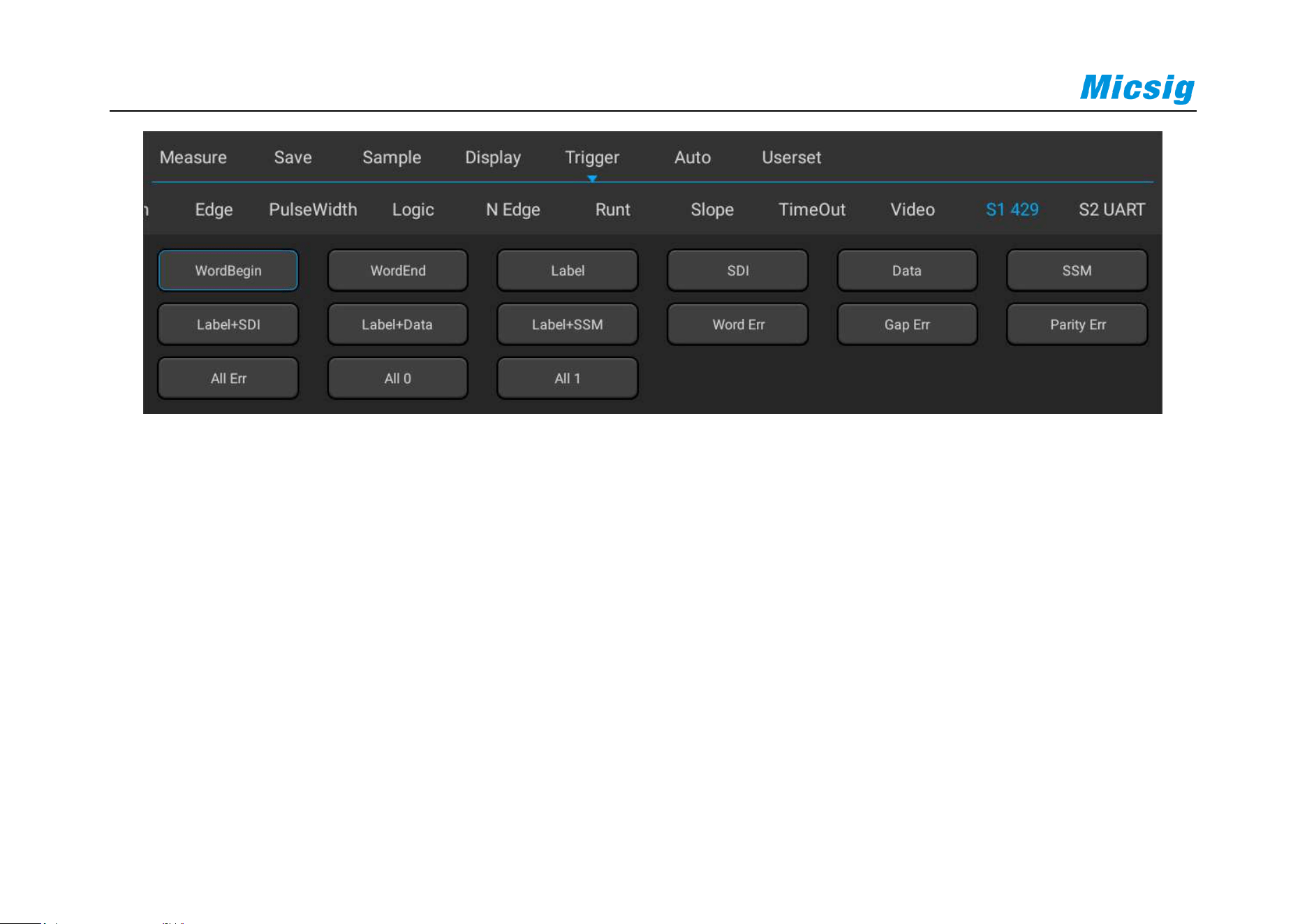
280
Figure 11-27 ARINC429 Trigger Mode Configuration Menu
If LABEL, SDI (source identifier), DATA or SSM (symbol/status mark) trigger are used, after selecting trigger
mode, use the pop-up virtual keyboard to modify it, enter the value, and click “Enter” on the virtual soft
keyboard to complete the setting.
Trigger configuration menu description:
a) Word start: Trigger at the word start.
b) Word stop: Trigger at the word stop.

Chapter 11 Serial Bus Trigger and Decode (Optional)
281
c) LABEL: Label, triggered when the specified tag value occurs.
d) SDI: Source identifier, triggered on the specified source terminal.
e) DATA: Trigger on the specified data.
f) SSM: Symbol/status mark, triggered on the specified symbol status matrix.
g) LABEL+SDI: Trigger on the specified label and the specified source terminal.
h) LABEL+DATA: Trigger on the specified label and the specified data.
i) LABEL+SSM: Trigger on the specified label and the specified symbol status matrix.
j) Word Error - Triggered when a word error occurs.
k) Word gap error: Triggered when a gap error occurs.
l) Verification error: Triggered when a verification error occurs.
m) All errors: Triggered when any of the above errors occur.
n) All 0 bits: Triggered when any bit with the value of zero occurs.
282
o) All 1 bit -: Triggered when any bit with the value of 1 appears.
ARINC 429 serial decode
The measured signal source is CH1, the decode format is LABEL+DATA, the display is in hexadecimal, the
baud rate is 12.5kb/s, and the trigger mode is LABEL, operate as follows:
(1) Tap S1 to open the decode channel, and click S1 again to open the bus configuration menu;
Select bus type “429”, source as “CH1”, decode format as “LABEL+DATA”, display in “hexadecimal”,
baud rate as 12.5kb/s.
(2) Open the trigger setting menu, select the trigger type as bus trigger, S1-ARINC429, the trigger mode is
LABEL, and enter LABEL as “106” on virtual keyboard.
Adjust High trigger threshold level and Low trigger threshold level according to signal amplitude; and
ARINC429 trigger graphic interface is shown in Figure 11-28:
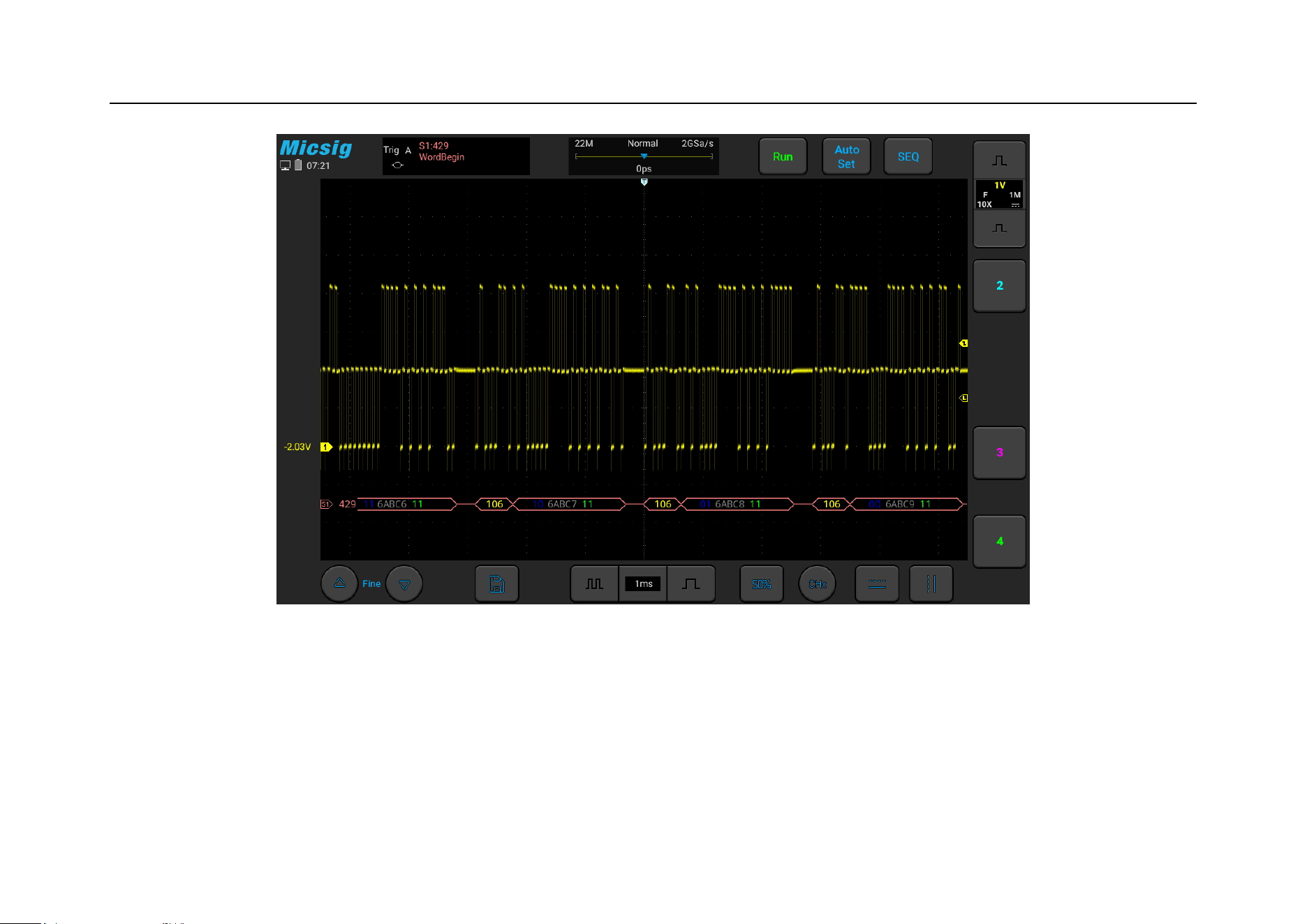
Chapter 11 Serial Bus Trigger and Decode (Optional)
283
Figure 11-28 ARINC429 Graphic Interface
ARINC429 decode data packet description:
(1) Data packet, a total of 32bits, the data format is 8~1 (label bit, high bit first) +9~10(SD) +11~29 (data bit,
low bit first) +30~31 (symbol status bit) +32 (parity bit)
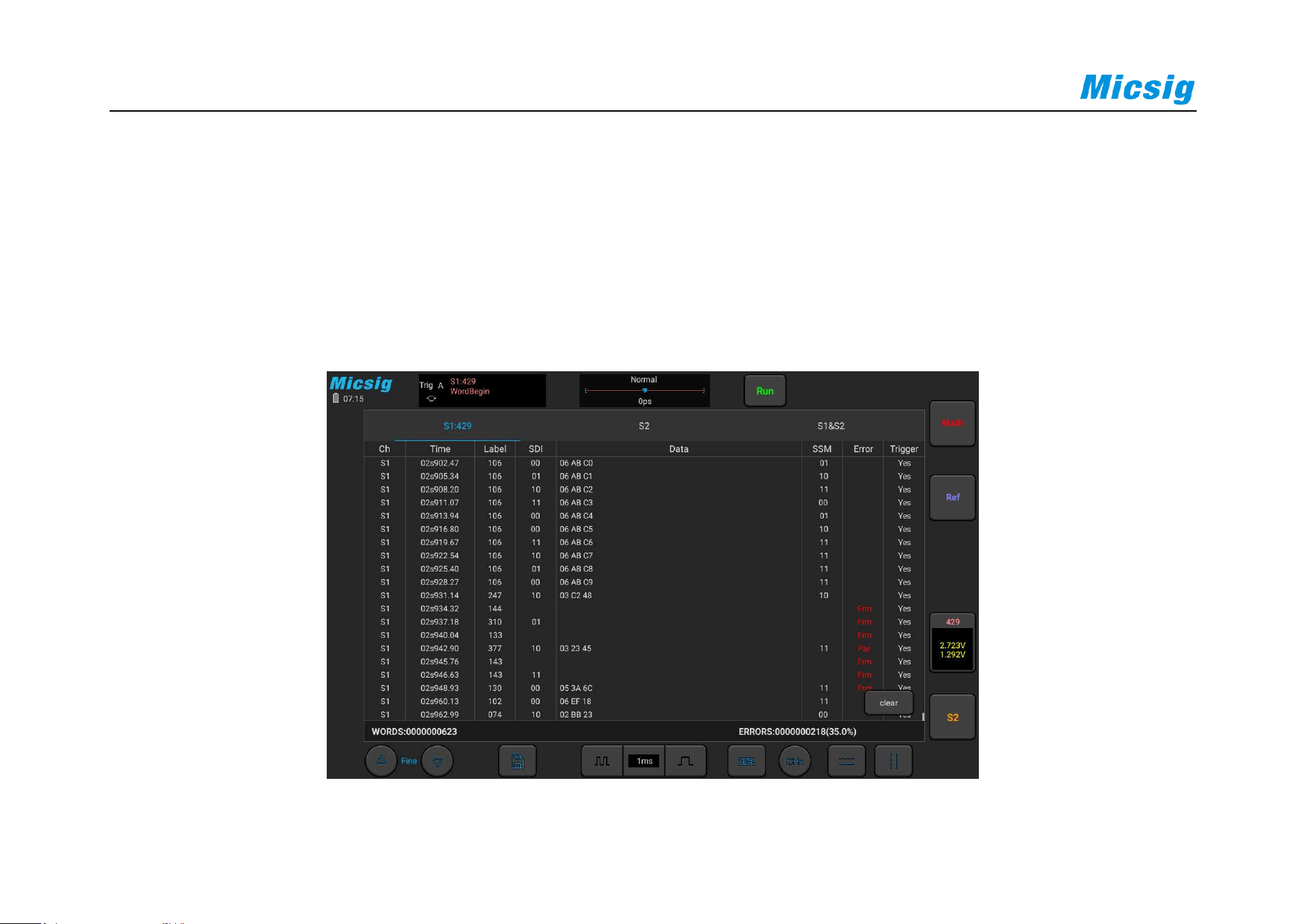
284
(2) Label (8bits) - Displayed in octal: yellow
(3) SDI (2bits) - Displayed in binary: blue
(4) Data (19bits) - Displayed in selected numeration system: white, or red if there is parity error
(5) SSM (2bits) - Displayed in binary: green
Figure 11-29 ARINC429 Text Interface

Chapter 11 Serial Bus Trigger and Decode (Optional)
285
ARINC429 text interface description, as shown in Figure 11-29:
(1) “Ch”: bus channel.
(2) “Time”: intervals between the last read/write operations to current read/write operations
(3) “LABLE”: label, information identifier, displayed in octal.
(4) “SDI”: source/target identifier, displayed in binary (displays XX if not identified separately).
(5) “Data”: content of the transmitted information, displayed in the selected numeration system.
(6) “SSM”: symbol/status matrix, displayed in binary (displays XX if not identified separately).
(7) “Error”: displays the frame error type (parity error Par, frame error Frm).
(8) “Trigger”: “Yes” means reach trigger condition.
286
11.7 1553B Bus Trigger and Decode
For correctly decoding 1553B bus data and making trigger stable, the bus configuration, trigger mode set and
trigger level need to be adjusted.
Bus configuration
Left swipe or to open the bus configuration menu, the data source and display hexadecimal need
to be set, as shown in Figure 11-30:
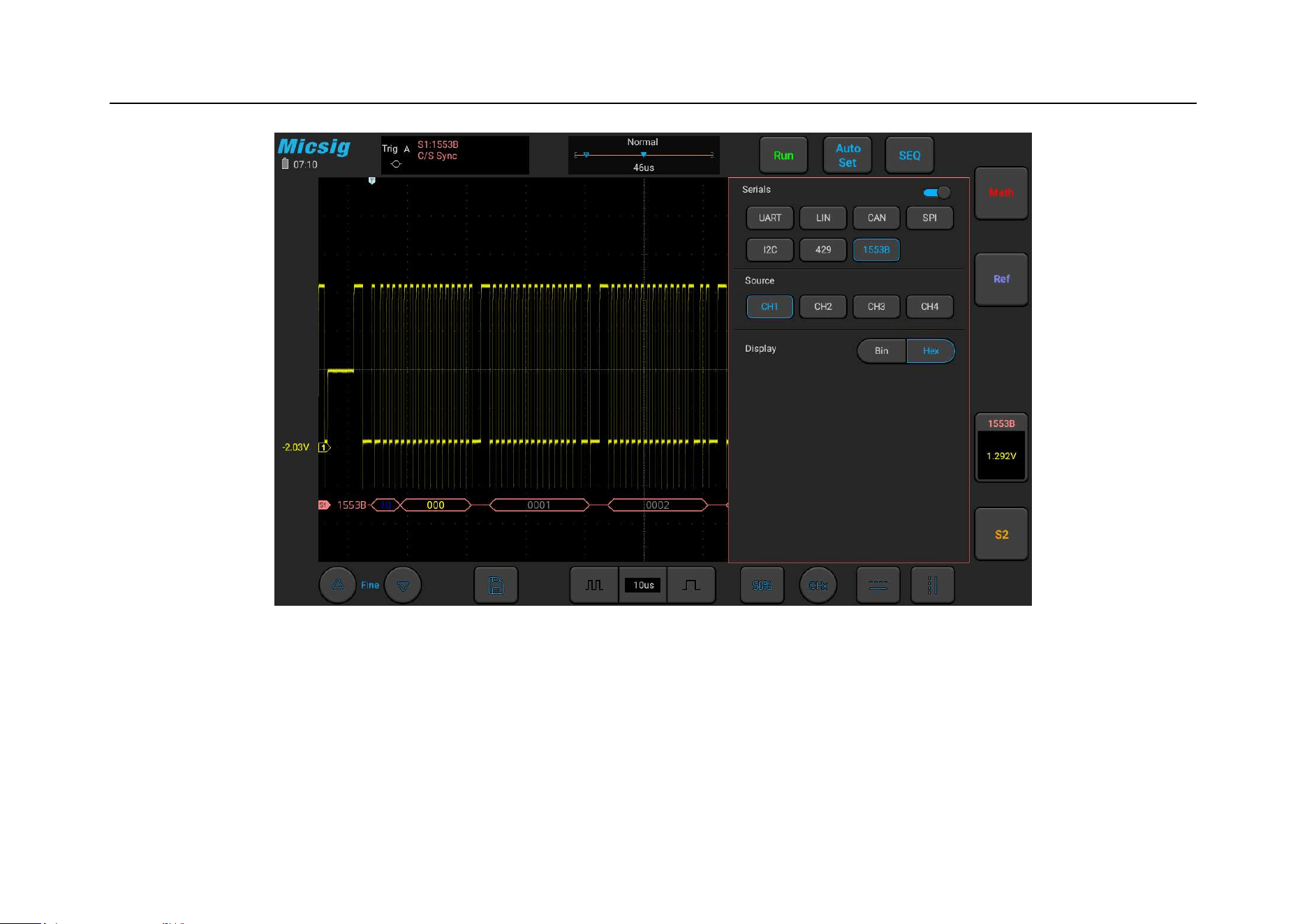
Chapter 11 Serial Bus Trigger and Decode (Optional)
287
Figure 11-30 1553B Bus Configuration Menu
Trigger mode
Open the trigger configuration menu and select the appropriate trigger type. When the trigger type is 1553B bus
trigger, click the trigger type on the screen, as shown in Figure 11-31:
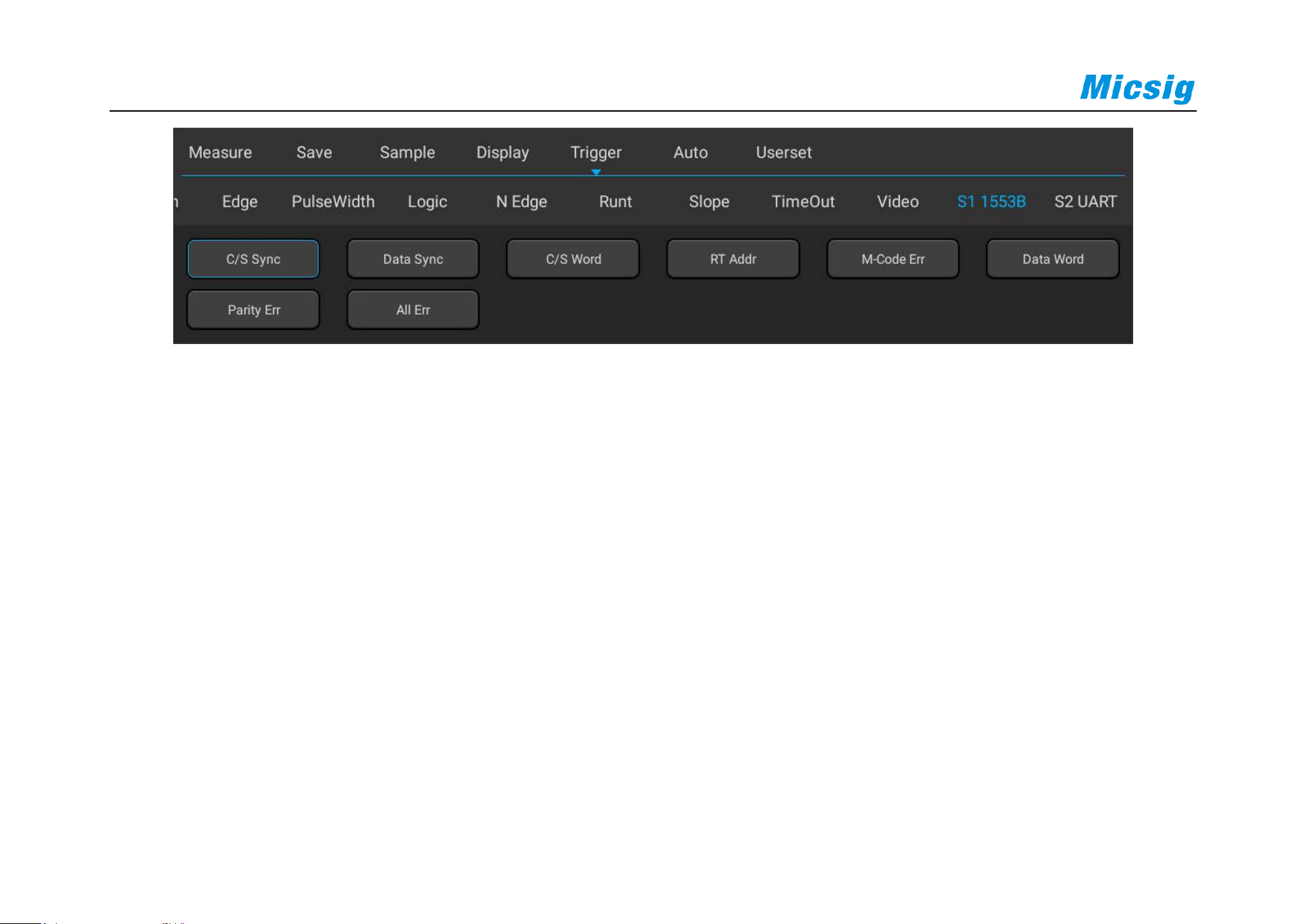
288
Figure 11-31 1553B Trigger Mode Configuration Menu
Trigger configuration menu description:
a) Command/status word sync header: Triggered at the beginning of the command/status word (at the end of
valid C/S sync pulse).
b) Data word sync header: Triggered at the beginning of data word (at the end of valid data sync pulse).
c) Command/status word: Triggered when the specified command/status word is detected.
d) Remote terminal address: Triggered when RTA of command/status word matches the specified value.

Chapter 11 Serial Bus Trigger and Decode (Optional)
289
e) If you select this option, RTA softkey will be available, allowing you to select the hexadecimal remote
terminal address value to be triggered on it. If you select 0xXX (irrelevant), oscilloscope will trigger on any
RTA.
f) Manchester coding error: Triggered when a Manchester coding error is detected.
g) Data word: Triggered when the specified data word is detected.
h) Odd parity error: Triggered when the odd parity bit is incorrect for data in the word.
i) All errors: Triggered when an error is detected.
1553B serial decode
The measured signal source is CH1, the bus display is hexadecimal, the baud rate is 12.5kb/s, and the trigger
mode is the command/status word sync header, and operate as follows:
(1) Tap S1 to open the decode channel, and click S1 again to open the bus configuration menu;
(2) Select the bus type as “1553B”, source as “CH1’, and display in “hexadecimal”.
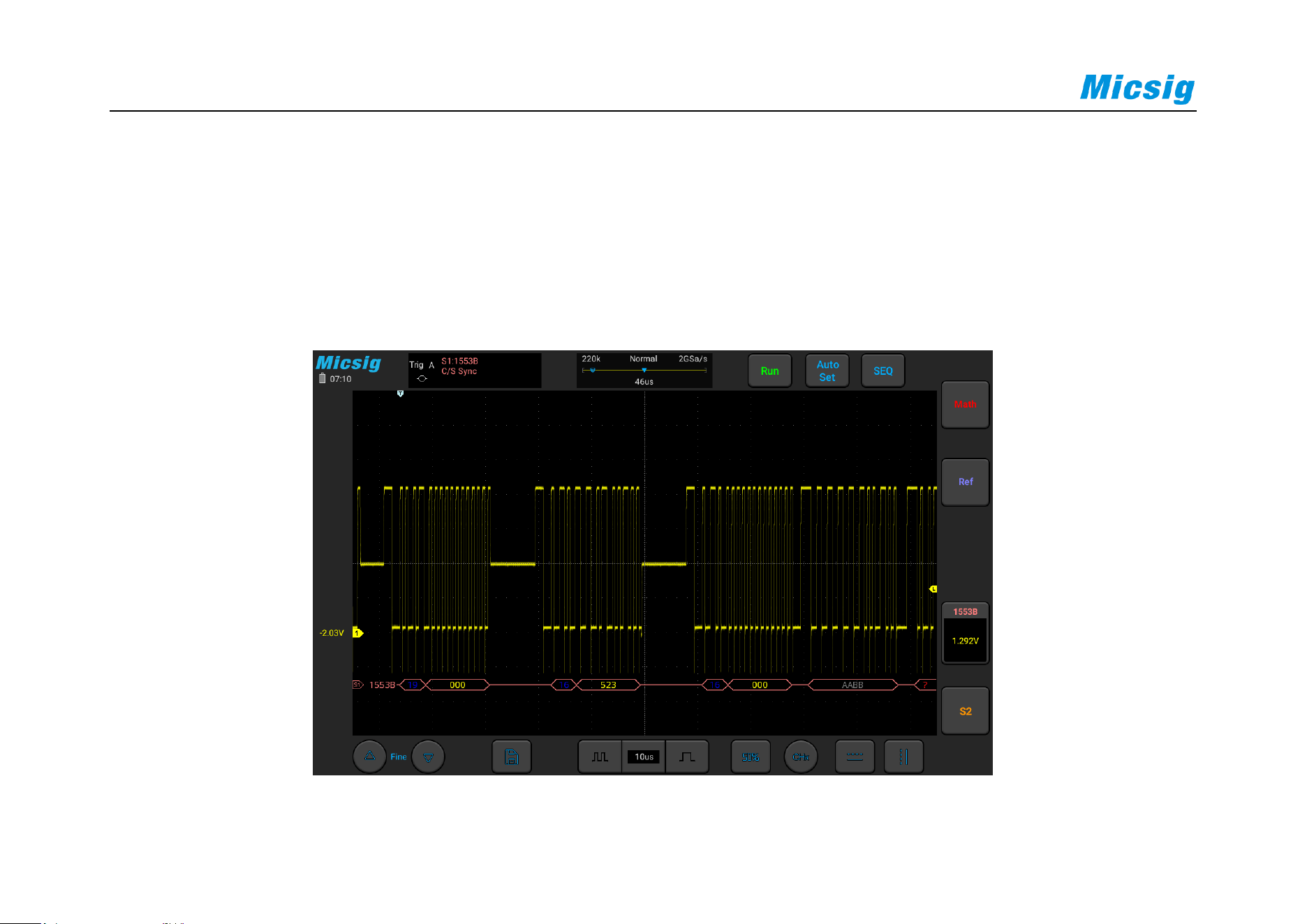
290
(3) Open the trigger setting menu, select the trigger type as bus trigger, 1553B, and trigger mode as
“command/status word sync header”.
Channel threshold level is adjusted according to signal amplitude. 1553B trigger graphic interface is shown in
Figure 11-32:
Figure 11-32 1553B Graphic Interface

Chapter 11 Serial Bus Trigger and Decode (Optional)
291
1553B decode data packet description:
(1) Remote terminal address (5-bit data): blue
(2) The value of remaining 11 bits of the command/status word: yellow
(3) Decoded data: white
(4) If the command/status or data word has a parity error, its decoded text is displayed in red instead of green
or white.
(5) The sync error is displayed together with the word “SYNC”.
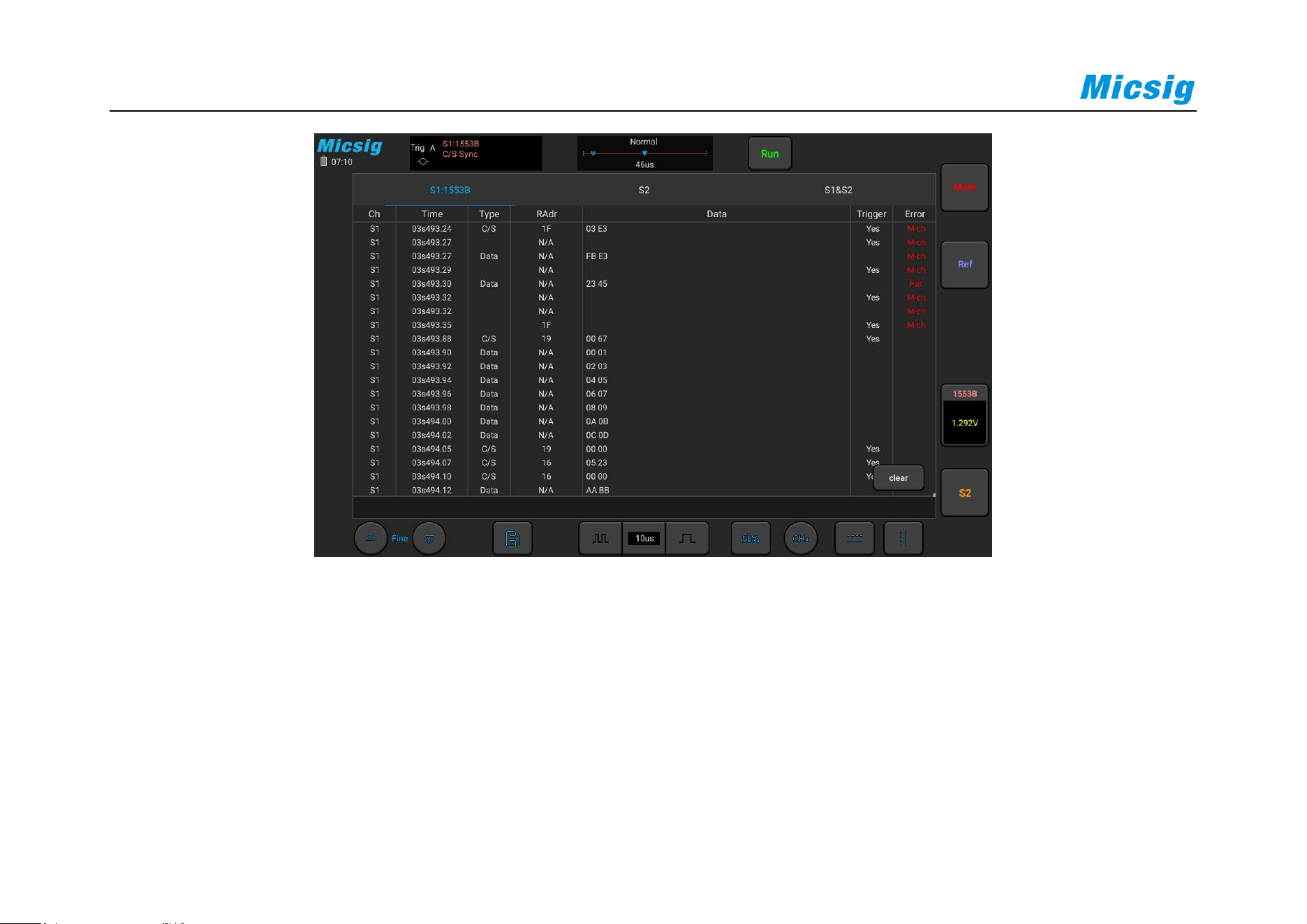
292
Figure 11-33 1553B Text Interface
1553B text interface description, as shown in Figure 11-33:
(1) “Ch”: bus channel.
(2) “Time”: intervals between the last read/write operations to current read/write operations.

Chapter 11 Serial Bus Trigger and Decode (Optional)
293
(3) “Type”: frame type (data frame DATA, command/status frame C/S, others N/A).
(4) “RAdr”: remote terminal address, displayed in the selected numeration system (N/A for no content
display).
(5) “Data”: content of the transmitted information, displayed in the selected numeration system.
(6) “Trigger”: “Yes” means reach trigger condition.
(7) “Error”: displays the frame error type (parity error Par, Manchester coding error M-ch).
294
Chapter 12 Homepage Functions
This chapter contains the functions of the oscilloscope homepage and describes the functions of all icons on the
homepage and settings. You are recommended to read this chapter carefully to understand the homepage functions
of the Smart series oscilloscope.
Oscilloscope
Gallery
App Store
Calendar
Settings
Electronic Tools
File manager
Clock
Calculator
Power Off
Browser
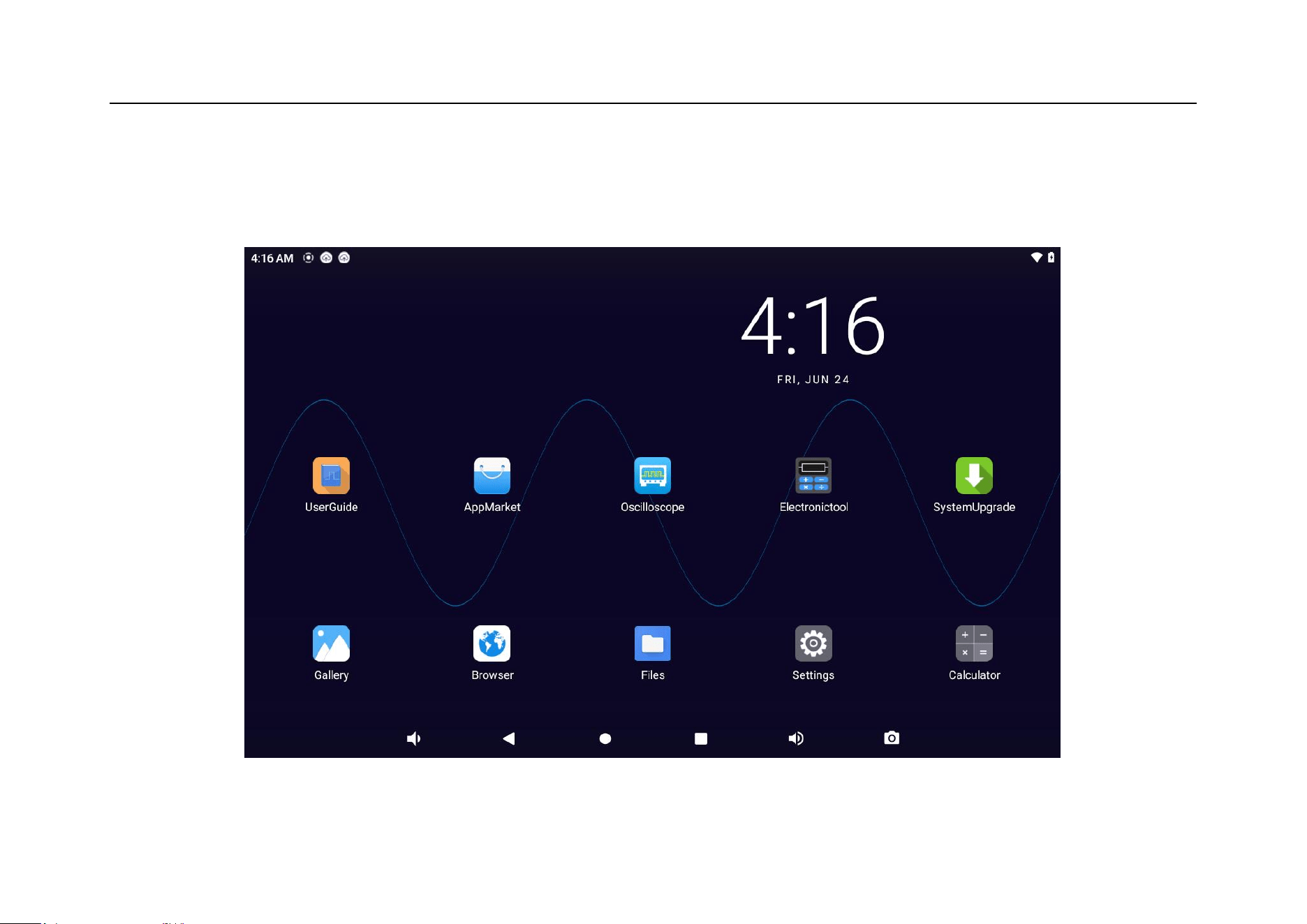
Chapter 12 Homepage Functions
295
The following figure shows the contents of the oscilloscope home page. Slide left or right to display the remaining
applications. See Figure 12-1.
Figure 12-1 Homepage Interface
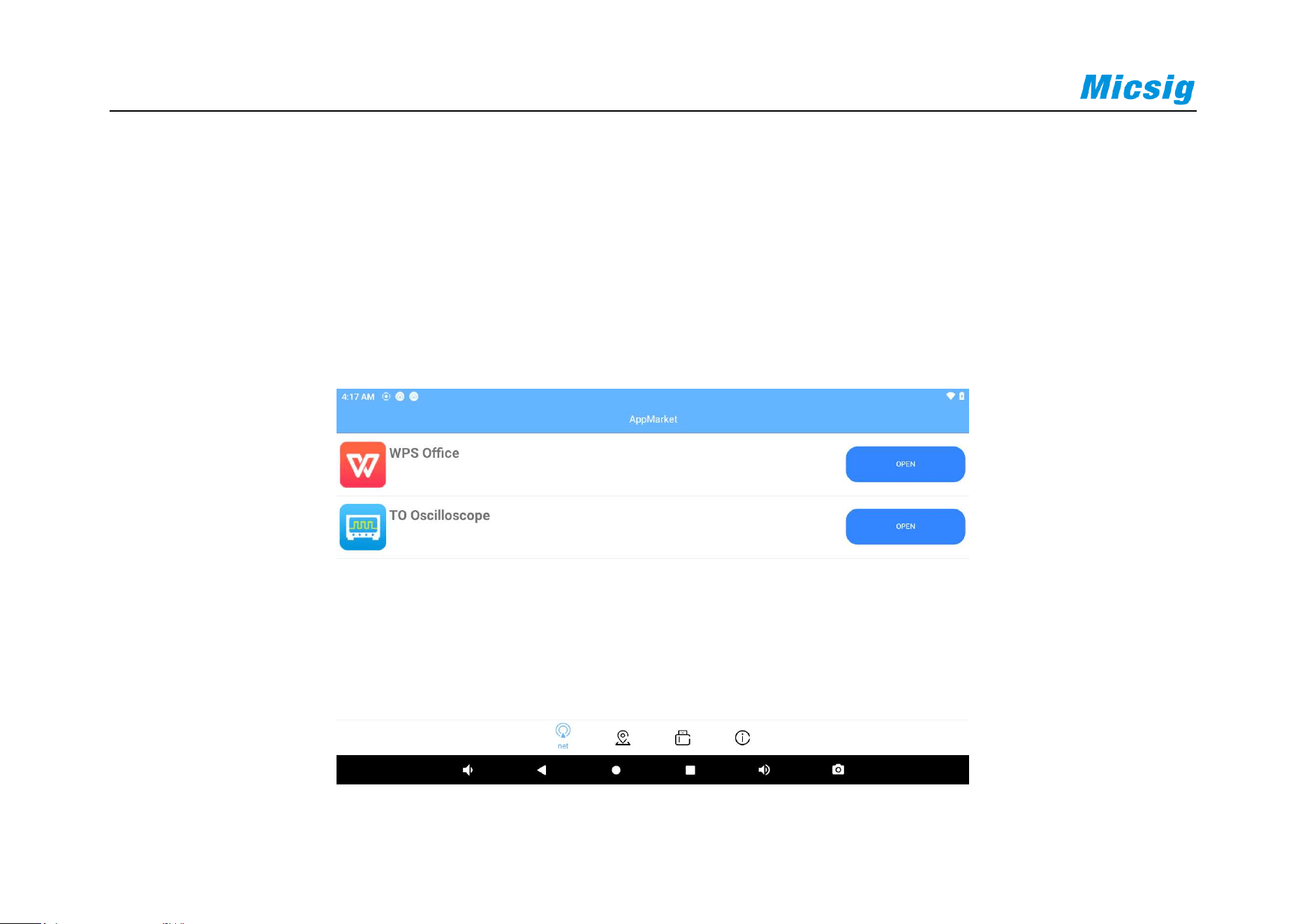
296
12.1 Oscilloscope (see Chapters 2~11)
12.2 App Store
Tap the app store icon on the homepage to go to the app store interface, as shown in Figure 12-2. App store content
includes Network, Local, U-disk, and About.
Figure 12-2 App Store

Chapter 12 Homepage Functions
297
Network
Tap “Network” to open the application list.
Tap app icon to view details such as version number of the current app and app description, and tap the green open
option below to open or install the current app.
Tap the green option on the right of the app list to open and install the app.
Local
Apps that have been downloaded and installed are displayed locally. When there is no downloaded application
installation package file locally, the interface will display “There are no available apk files in the local directory”.
U-disk
The U disk interface will display applications that can be opened in the USB disk.
If the USB disk is not plugged, the interface displays “U-disk not inserted”.
298
After USB disk has been plugged, if there are no apk files in the USB device for installation, the interface displays
“There is no available apk file in the U disk directory”.
About
In “About” interface, the equipment model, bandwidth, serial number, version information, shipment date and
information about installed options can be viewed. Open the virtual keyboard and enter the license to install the
corresponding options.
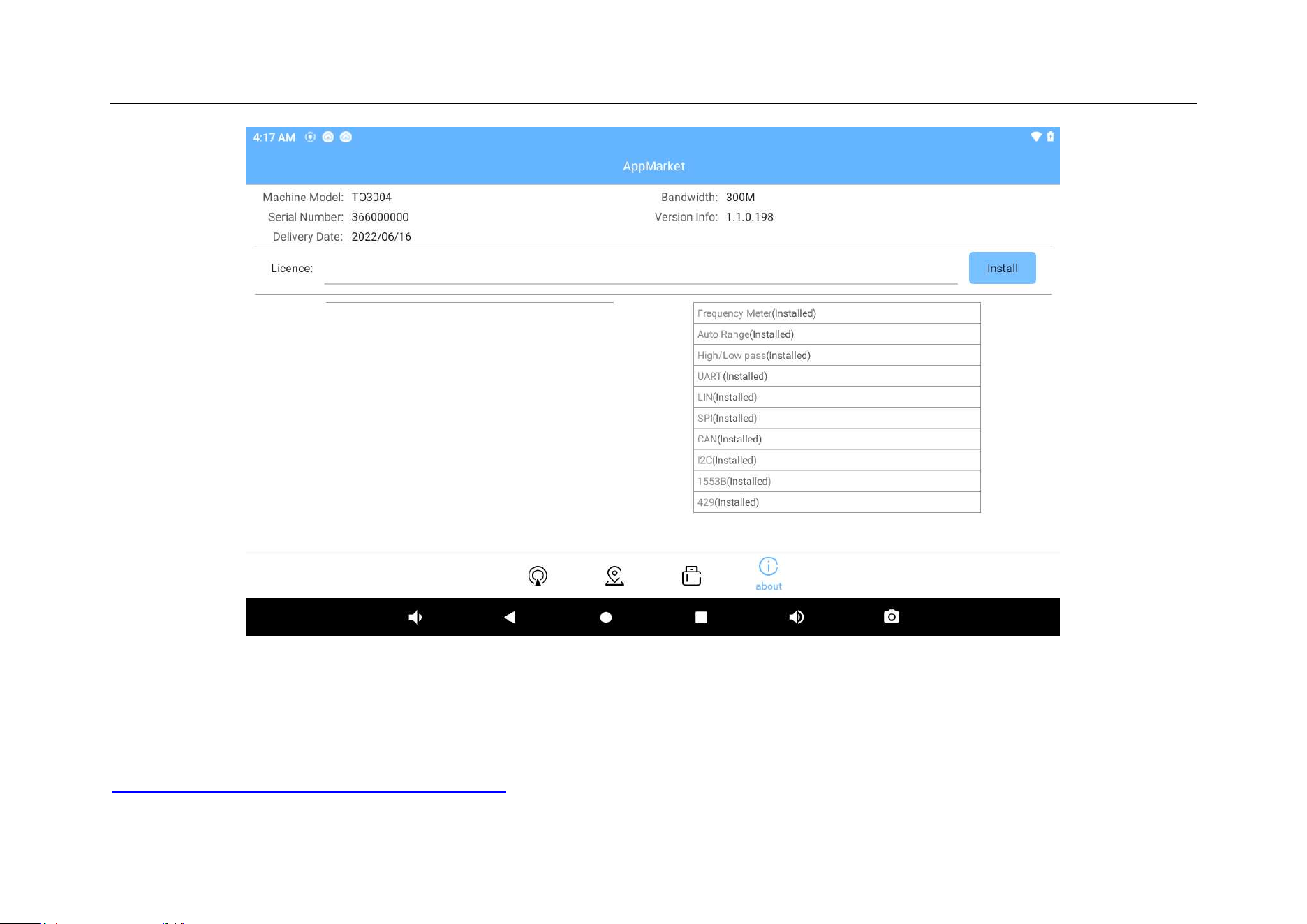
Chapter 12 Homepage Functions
299
Figure 12-3 About Interface
The options that can be installed include: UART, LIN, SPI, CAN, I2C, 1553B, 429 and other serial decode (refer to
Chapter 11 Serial Bus Trigger and Decode).
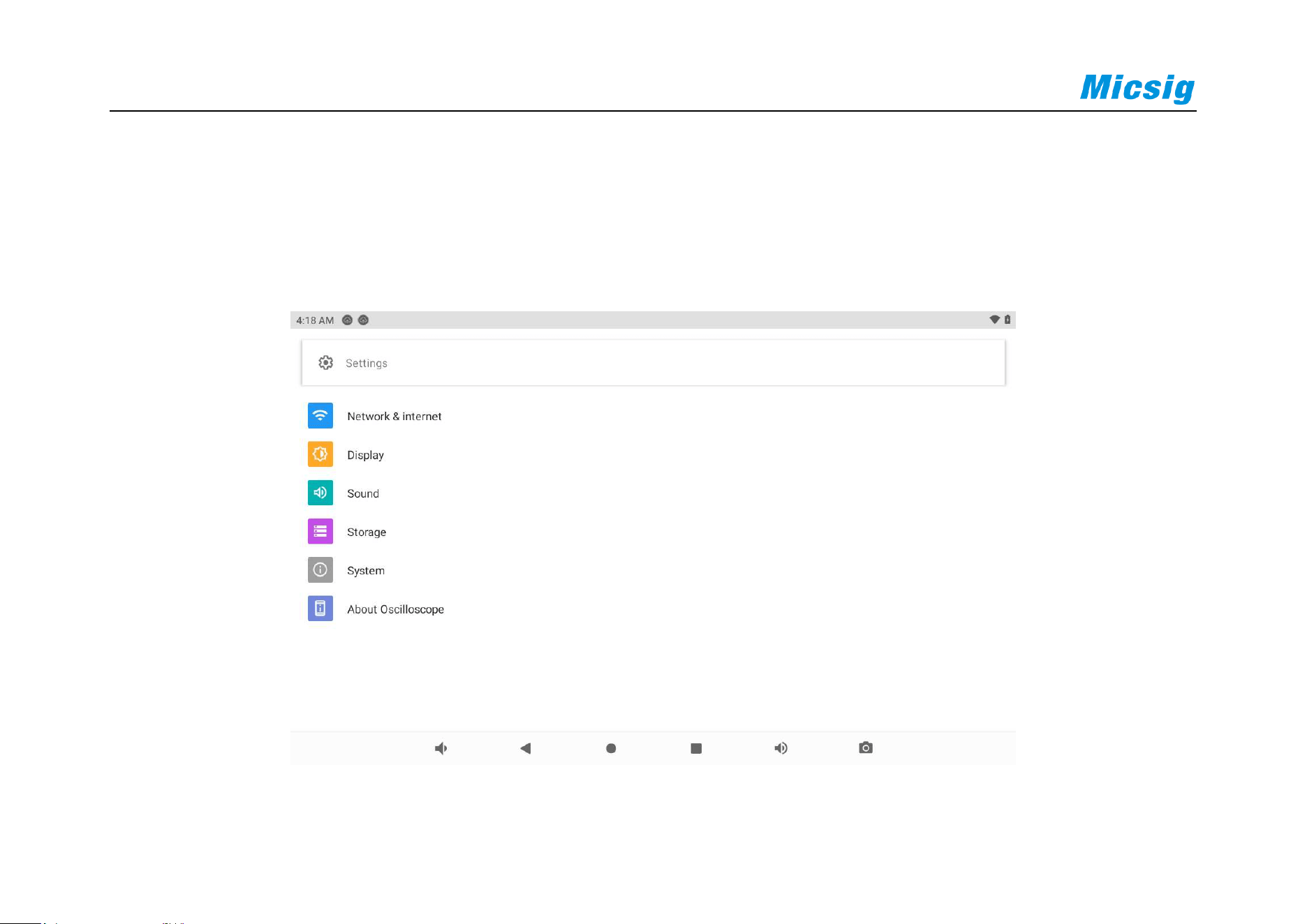
300
12.3 Settings
Tap settings on Homepage to enter the System Settings interface. Settings on the settings interface include Network
& internet, display, sound, storage, system and About Oscilloscope, as shown in Figure 12-4.
Figure 12-4 System Setting Interface
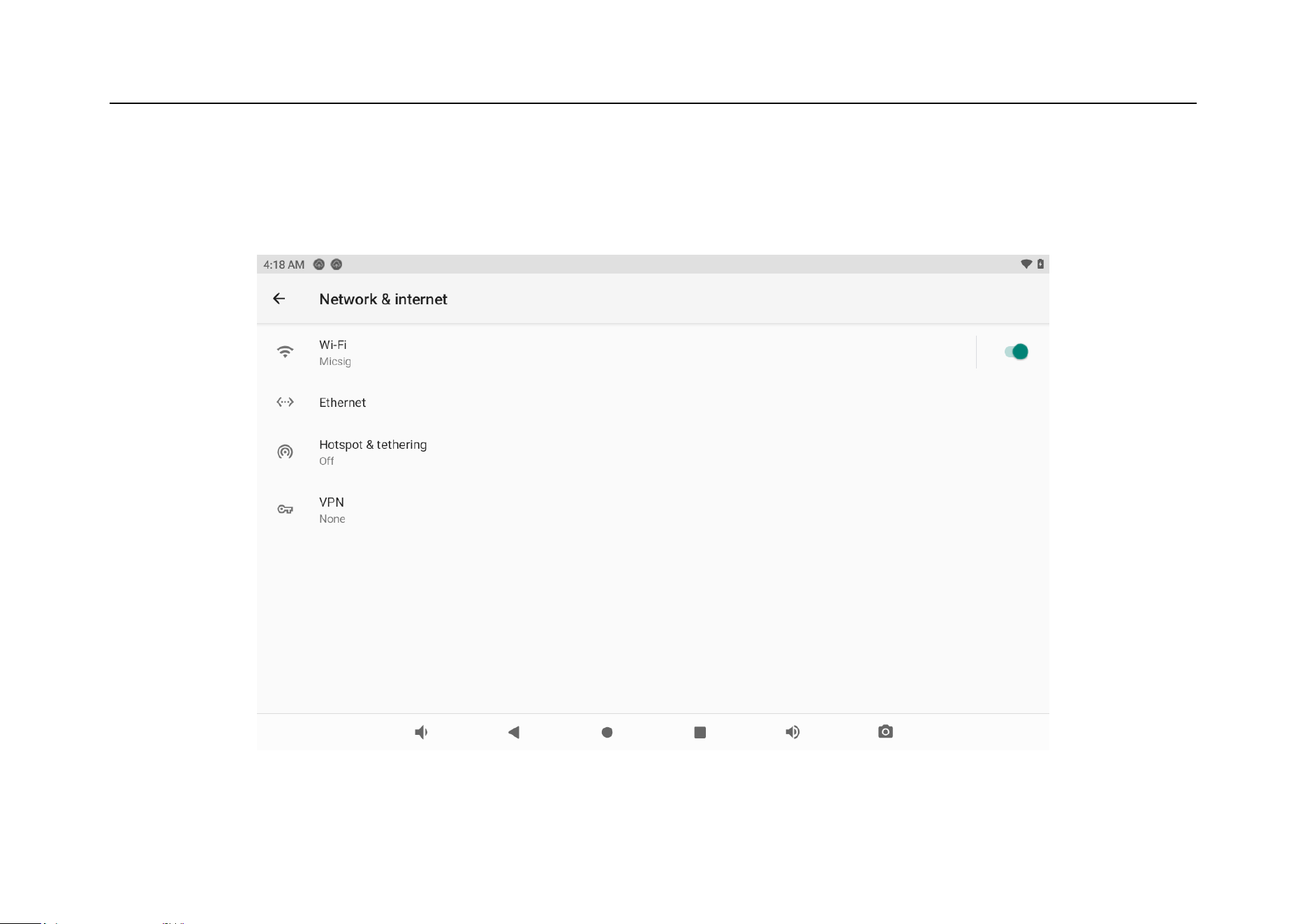
Chapter 12 Homepage Functions
301
WLAN connection
Tap WIFI icon to enter the WLAN settings interface, as shown in Figure 12-5.
Figure 12-5 WLAN Connection Setting
302
Tap on/off bar to turn the WLAN function on. Oscilloscope can automatically scan the surrounding wireless
networks and display their names by list.
Tap the wireless network to be connected and the password input box will pop up. After entering password using
the virtual keyboard, tap Enter to connect oscilloscope to the wireless network.
Click the current network can advanced settings for WIFI.
Portable WLAN hotspot
Tap Hotspot to enter the portable hotspot settings interface.
Tap the off icon to open the hotspot. Click “hotsopt name” to enter the network name and password using the
virtual keyboard, as shown in Figure 12-6. Other equipment can share oscilloscope files by linking oscilloscope
hotspots.
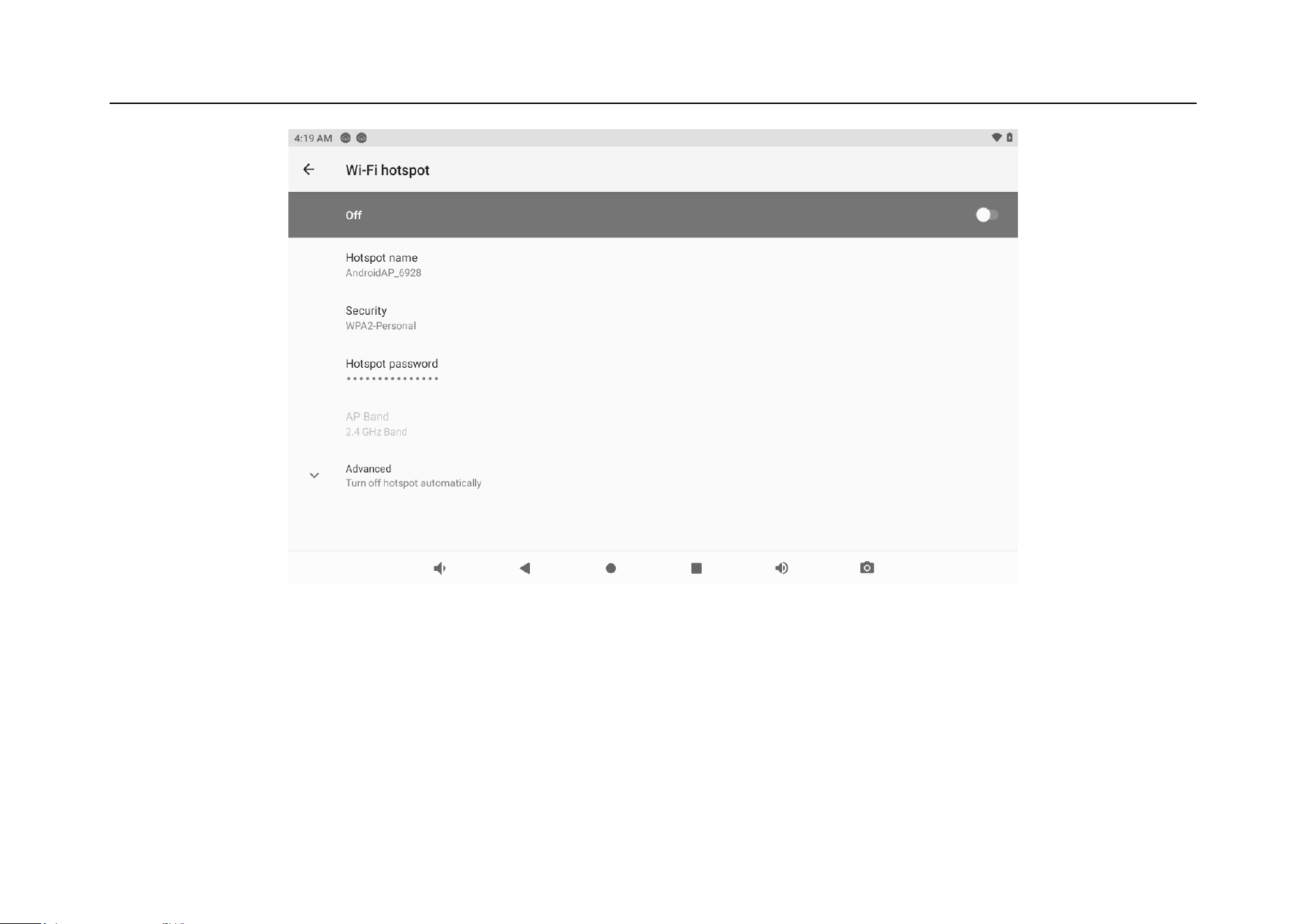
Chapter 12 Homepage Functions
303
Figure 12-6 Portable WLAN Hotspot Setting
Display
Tap display icons to set the oscilloscope Brightness level, Dark theme, Wallpaper, Font size and Display size.
Brightness level: The progress bar can be dragged to set the brightness of the screen display.
304
Dark theme: Set Dark theme uses a black background to help keep battery alive longer on some screens.
Wallpaper: Set the screen wallpaper.
Font size: Change the system display font size.
Display size: Make the items on your screen smaller or larger. Some apps on your screen may change position.
Sound
Tap the “sound” icon and drag the progress bar in the sound section to change the media volume, alarm volume and
notification volume. After clicking the default notification ring tone, drag up and down to select the ring tone, then
click OK.

Chapter 12 Homepage Functions
305
Storage
Tap storage to enter the storage space view interface, then view the total storage capacity, size of available space, as
well as memory size of applications (application data and media content), pictures, videos, audio (music, ringtones,
podcasts, etc.), download content, cache data, and others.
If USB device is plugged, it will display the total storage capacity and available memory size, and can also uninstall
and format SD card.
Language and input method
Tap System →language & input icons to set your system language and input method.
Language: add a language and drag it to the first position of language list to make it as system language.
Spell Checker: When this function is turned on, it will automatically check for correctness as you type.
306
On-screen keyboard includes Android keyboard and Gboard, tap +manage on-screen keyboards to turn off one of
them.
Advanced setting include Spell checker, Autofill service, Personal dictionary, Pointer speed.
Date and time
Tap System →Date & time icons to set your system date and time
Use network-provided time: When turned on, the time provided by the network will be used as the system time.
Date and time cannot be set manually after turning this on.
Set date: Set the system date manually.
Set time: Set the system time manually.
Select time zone: Set the time zone manually.
Use 24-hour system: If on, the system time will be 24-hours, and off for 12 hours.

Chapter 12 Homepage Functions
307
About Oscilloscope
In the “About” interface, view legal information, Android version, IP address, build number and other information.
Accept online updates: turn off/on System update, app update, boot interface update, userguide update ...
12.4 File Manager
File manager app can enable quick access to and management of various files stored on the equipment.
Tap the Files app icon on the homepage screen to enter the file manager interface.
Recent: shows files that have been opened recently
Classification: views files by types, including images, videos, Audio, Documents, Downloads, STO etc.
Local: views the content stored in the oscilloscope by the traditional folder list mode. When USB device is plugged,
the content in the USB device can also be accessed through external storage.
308
To operate files, simply press and hold a single file to select it. The selected file will show blue √. Then, click the
remaining files to select them. If all files must be selected, tap the icon at the right top of the screen and click
Select all, which also includes copy, cut, compress, rename and more operations. Tap the trash icon to delete files.
12.5 Calculator
Tap calculator icon on the homepage to open the calculator app.
Calculator can perform simple addition, subtraction, multiplication and division calculations as well as scientific
calculations.
12.6 Browser
Tap the browser icon on homepage interface to enter the browser interface, and then it can access to the internet if
the network condition is good, as shown in Figure 12-7.
Chapter 12 Homepage Functions
309
Figure 12-7 Browser Interface
12.7 Gallery
Tap gallery application on the homepage interface to enter the picture viewing interface, as shown in Figure 12-8.
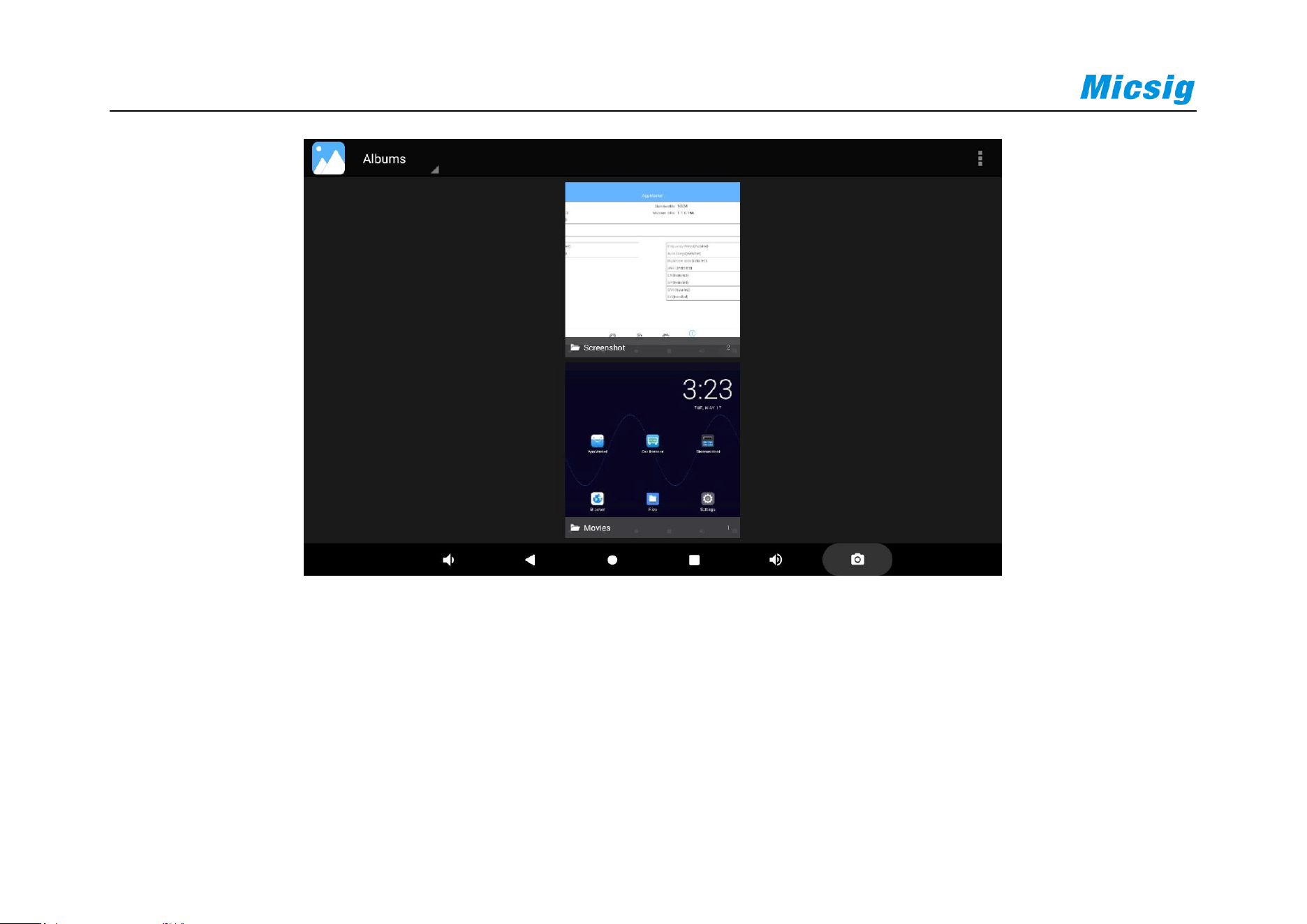
310
Figure 12-8 Picture Viewing Interface
Gallery provides locally stored photos/videos with the functions of picture/video viewing and photo editing.
In the picture view interface, pictures and videos can be classified into different categories according to the method
in the upper left corner, and tap them to view pictures or videos.
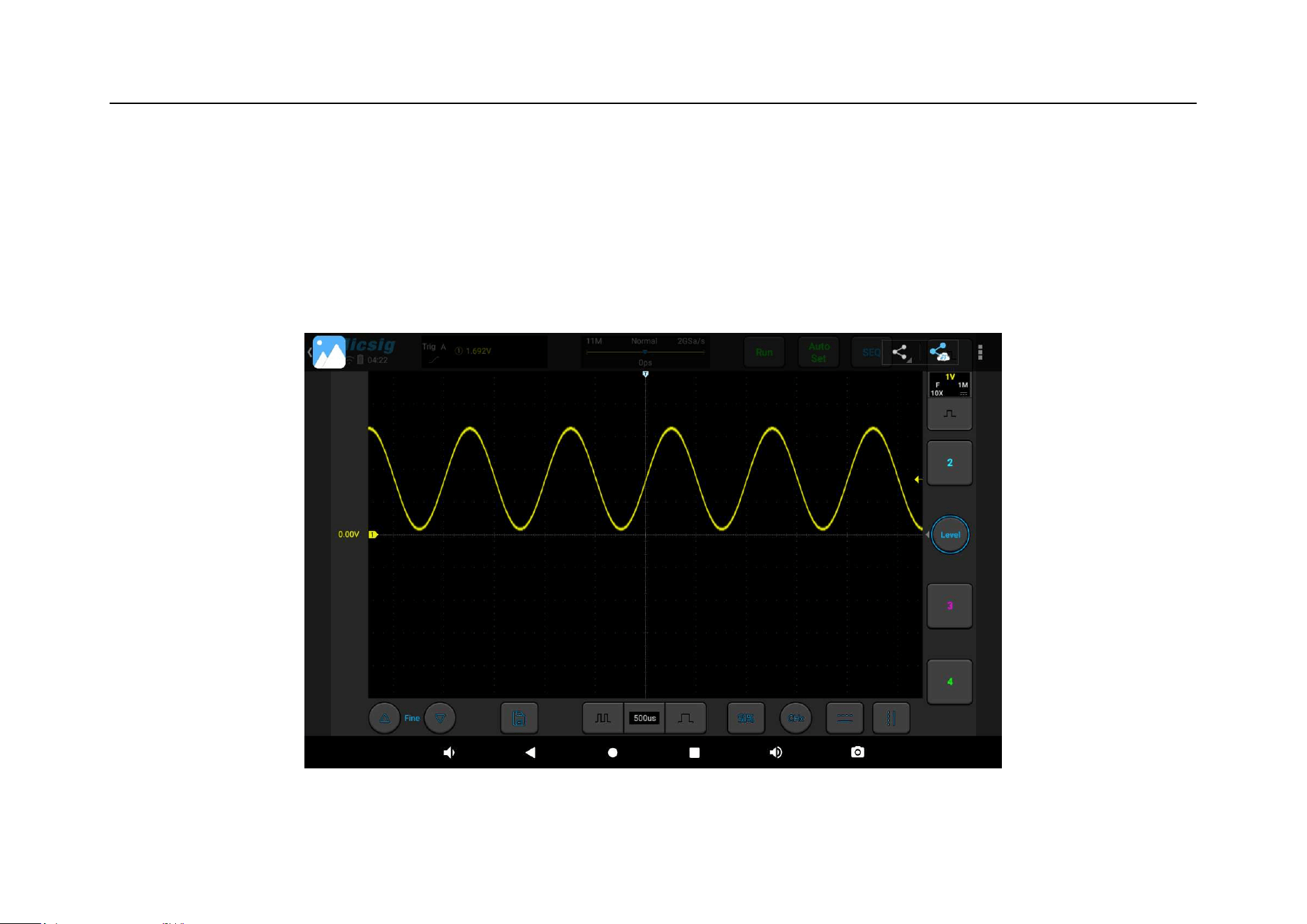
Chapter 12 Homepage Functions
311
When viewing pictures, click to display them in full screen. When viewing videos, swipe left and right to select the
video you want to play. Click the triangle play button, and the video will play automatically. Tap the screen to pause
play. Drag the pictures left and right when displaying in full screen to view previous and next pictures. Tap the back
button to exit the full screen display, as shown in Figure 12-9.
Figure 12-9 Full-Screen Picture Viewing Interface
312
When viewing pictures and videos, tap the option at the top right of the screen and click to select items. The
pictures and videos can be selected. Click the recycle bin icon in the upper right corner of the screen to delete
pictures or videos.
After the USB device is connected to oscilloscope, if there are pictures or videos in the USB device, they will be
automatically displayed on the picture viewing interface.
12.8 Calendar
Tap the calendar app icon on the homepage to enter the calendar interface.
Tap TODAY at the top right of the screen to navigate directly to today's date.
Tap the date at the top left of the screen to adjust the calendar display style by day, week and month.
12.9 Electronic Tools
Electronic tools can provide a convenient set of electronic calculation tools.
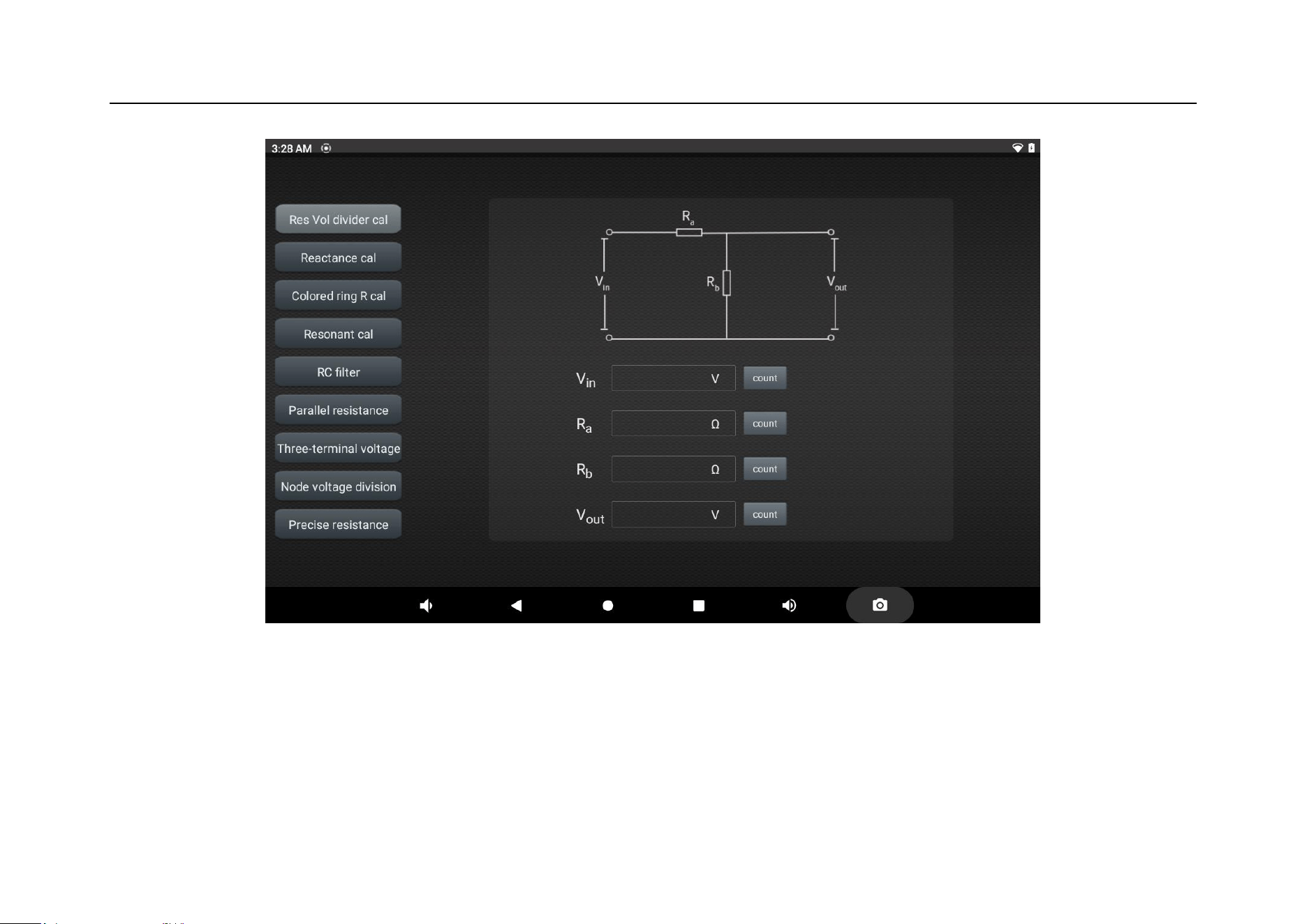
Chapter 12 Homepage Functions
313
Figure 12-10 Electronic Calculation Tool Function
12.10 Clock
Tap time icon on the homepage or tap clock app icon to enter the clock settings screen, as shown in Figure 11-11.
314
Alarm clock
Add an alarm: Click “+” button below to add an alarm clock and create settings.
Alarm time: Drag pink dot in the dial to set the hour, and drag again to set the minute.
Repeat: Monday to Sunday available and click calendar icon on the right to enter the calendar for custom selection.
Alarm ringtone: Select alarm ringtone, support local ringtone, system ringtone, none.
Label: The alarm will be displayed on the screen when it rings.
Delete alarm: Click the alarm to be deleted in the list and select “delete” at the bottom of the alarm edit page.
Switch status: Click the switch behind the alarm to turn it on and off.
World clock
Add region: Click the bottom globe button and select city in the list of cities.
Timer
Add timer: Enter the hour, minute and second, click the triangle button to start countdown.

Chapter 12 Homepage Functions
315
Delete timer: Click “DELETE” to delete the timer.
Pause: Click the double rectangle button to pause timer.
Stopwatch
Start: Click “Triangle” to start timing.
Pause: Click “Double Rectangle” below to pause the stopwatch.
Mark: Click the LAP to mark it.
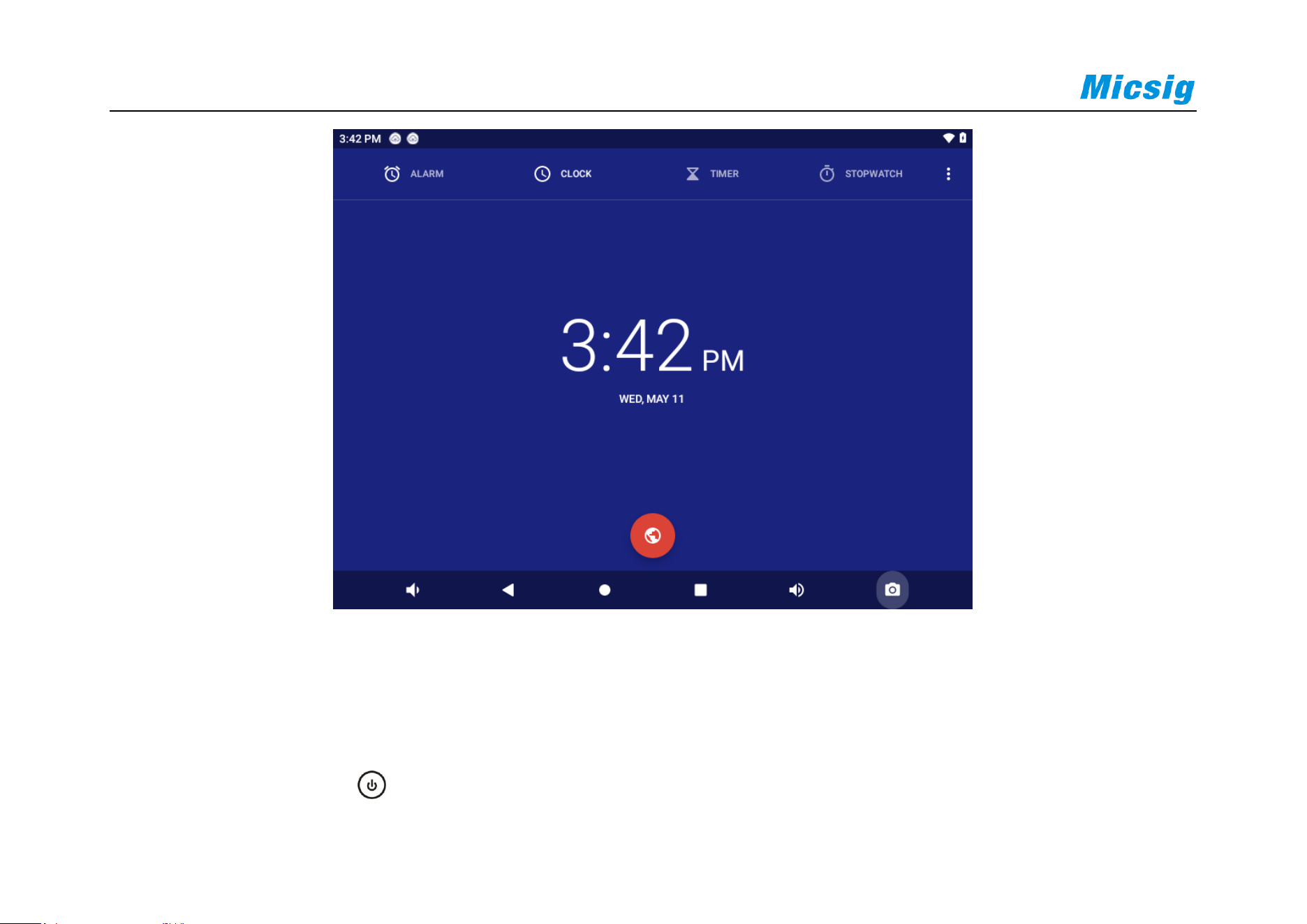
316
Figure 12-11 Time Setting
12.11 Power Off
Long press power button to enter the power off interface, as shown in Figure 12-12. Power off contains 2
options: power off, restart.
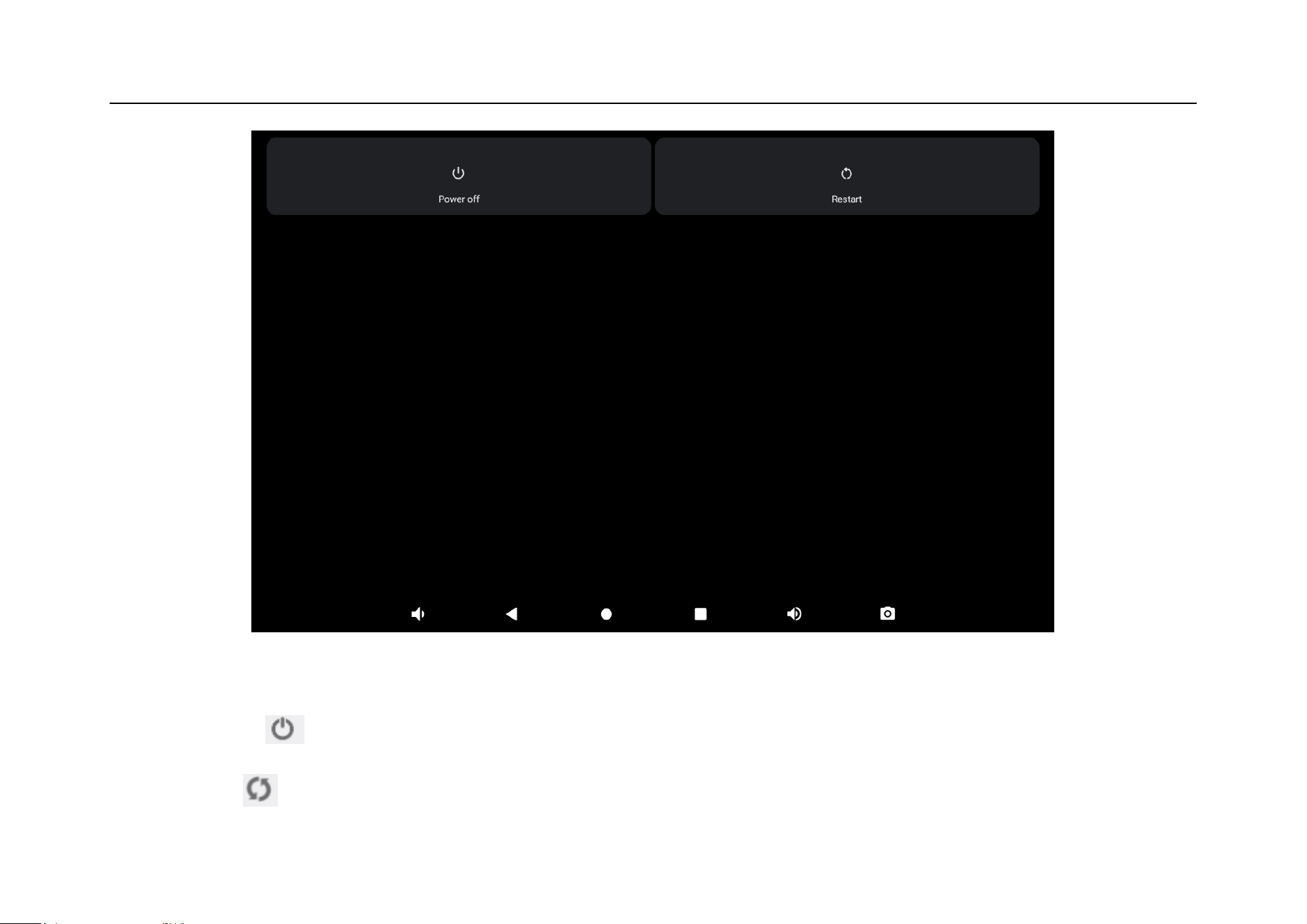
Chapter 12 Homepage Functions
317
Figure 12-12 Power Off Interface
Power off: Tap icon to turn off the oscilloscope.
Restart: Tap icon to restart the oscilloscope.
318
Chapter 13 Remote Control
This chapter contains the application of host computer, mobile remote control, in order to understand remote control
functions of the Smart series oscilloscope.
Host computer
Mobile remote control

Chapter 13 Remote Control
319
13.1 Host Computer
To control the instrument using the host computer software, you need to install the NI driver first, then the
RemoteDisplay software is downloaded and installed. This software is only suitable for Micsig Smart Series
oscilloscopes.
13.1.1 Installation of Host Computer Software
Note: The host computer software only supports Win7 or higher edition operating system. The computer needs to
install NI-VISA driver first.
The host computer and needed NI-VISA driver can be downloaded from Micsig offical website:
http://www.micsig.com
Download the host computer software on official website of Micsig, open RemoteDisplaySetup.exe file, and
complete the software installation.
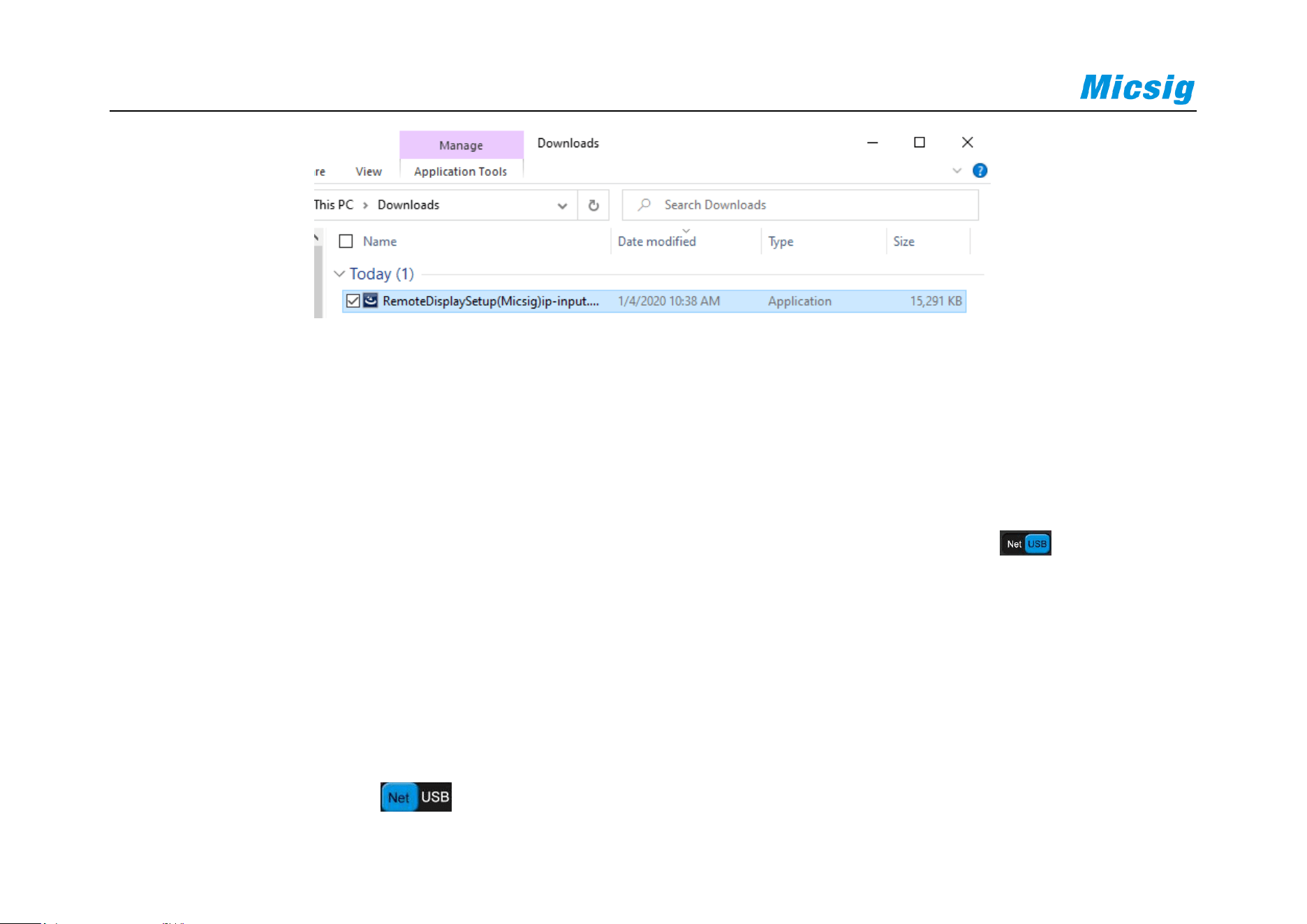
320
Figure 13-1 RemoteDisplay Software
13.1.2 Connection of Host Computer
USB connection: Connect USB Device to the computer and oscilloscope through USB data cable. After the
computer recognizes the USB device, open the host computer, set the connection mode to USB , and display
the device information in the device information display box in the lower right corner. This indicates that the
oscilloscope has been found. Click to connect to the selected oscilloscope.
WIFI connection: Under the oscilloscope settings →WLAN menu, choose and connect the same WIFI with the
computer to ensure that the computer and the oscilloscope are in the same network. Open the host computer, set
the connection mode to Net , and display the device information in the device information display box in

Chapter 13 Remote Control
321
the lower right corner. This indicates that the oscilloscope has been found. Click to connect to the selected
oscilloscope.
Enter IP connection: In case of network connection (WIFI or LAN), directly type oscilloscope IP to be connected
in the oscilloscope device information display box in the lower right corner, and then click the oscilloscope
connection status button, the host computer will be connected to the oscilloscope corresponding to the entered IP
address.
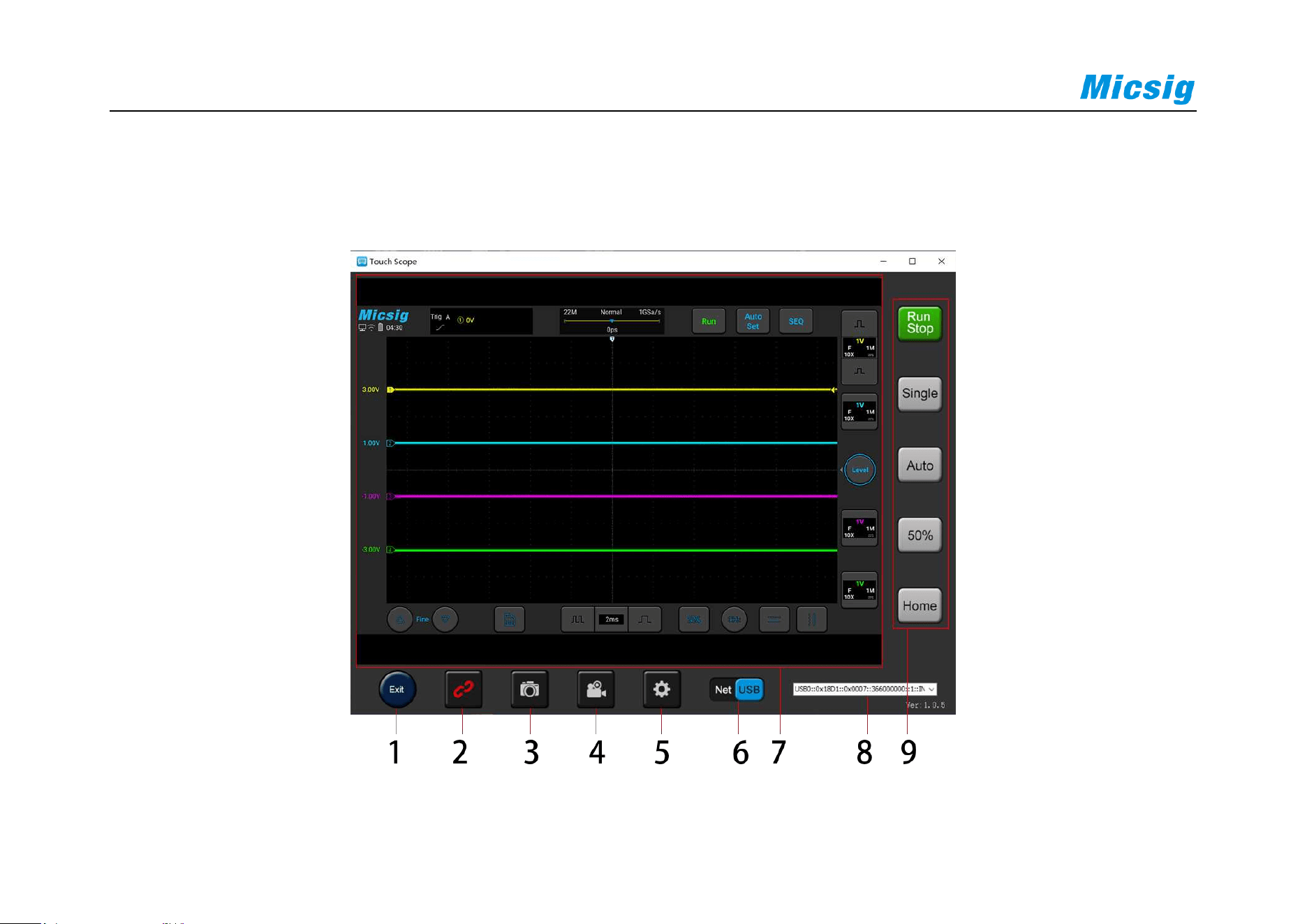
322
13.1.3 Main Interface Introduction
Figure 13-2 Host Computer Interface
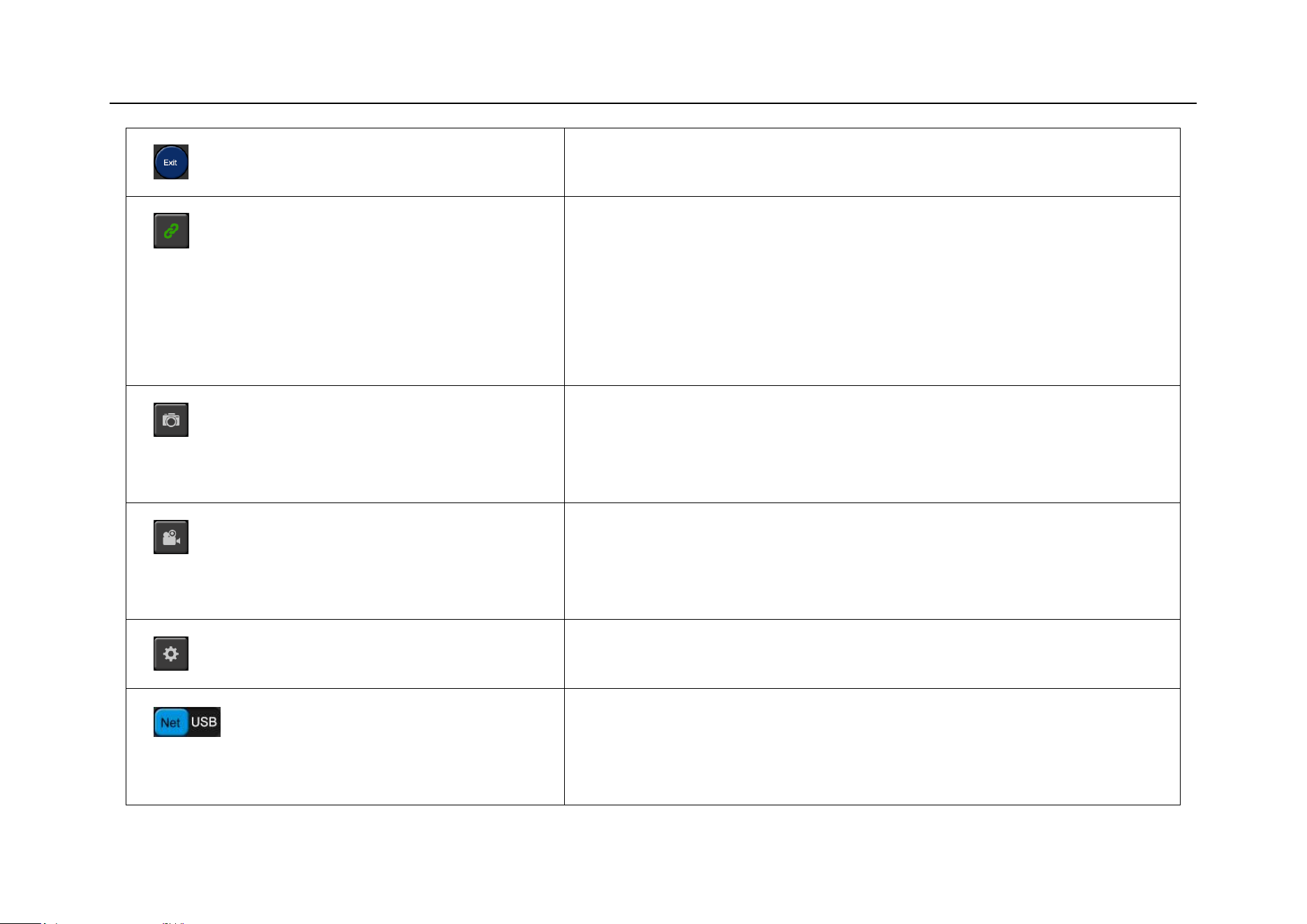
Chapter 13 Remote Control
323
1. Host computer on/off button
Click to exit the host computer software
2. Oscilloscope connection status button
The button has two states:
Green: Connect to selected oscilloscope when clicked
Red: Disconnect from oscilloscope when clicked
3. Quick camera button
Click to take photo quickly. Pictures are stored in the local
directory C:\Users\Public\Pictures
4. Video record button
Click to open or close video record function. Videos are stored
in local directory C:\Users\Public\Videos
5. Host computer storage button
Set photo taking and video recording storage locations
6. Select oscilloscope connection
mode
USB and WIFI connections are available
324
Note: WIFI connection must ensure that oscilloscope and
computer are in the same network
7. Host computer display area
Synchronous display with oscilloscope
8. Oscilloscope information display
Display oscilloscope model, connection mode, SN, IP and other
information, select the oscilloscope to be connected
9. Host computer waveform control area
Waveform control area button has the same function with that
button on the oscilloscope
13.1.4 Operation Interface Introduction
The host computer and the oscilloscope are synchronously displayed, and the waveform operation mode and the
menu opening and closing mode are the same as those on the oscilloscope; the left mouse button and the single
finger operation mode are the same, and both of them can perform the operations of slide, click, drag, etc.
13.1.5 Storage and View of Pictures and Videos
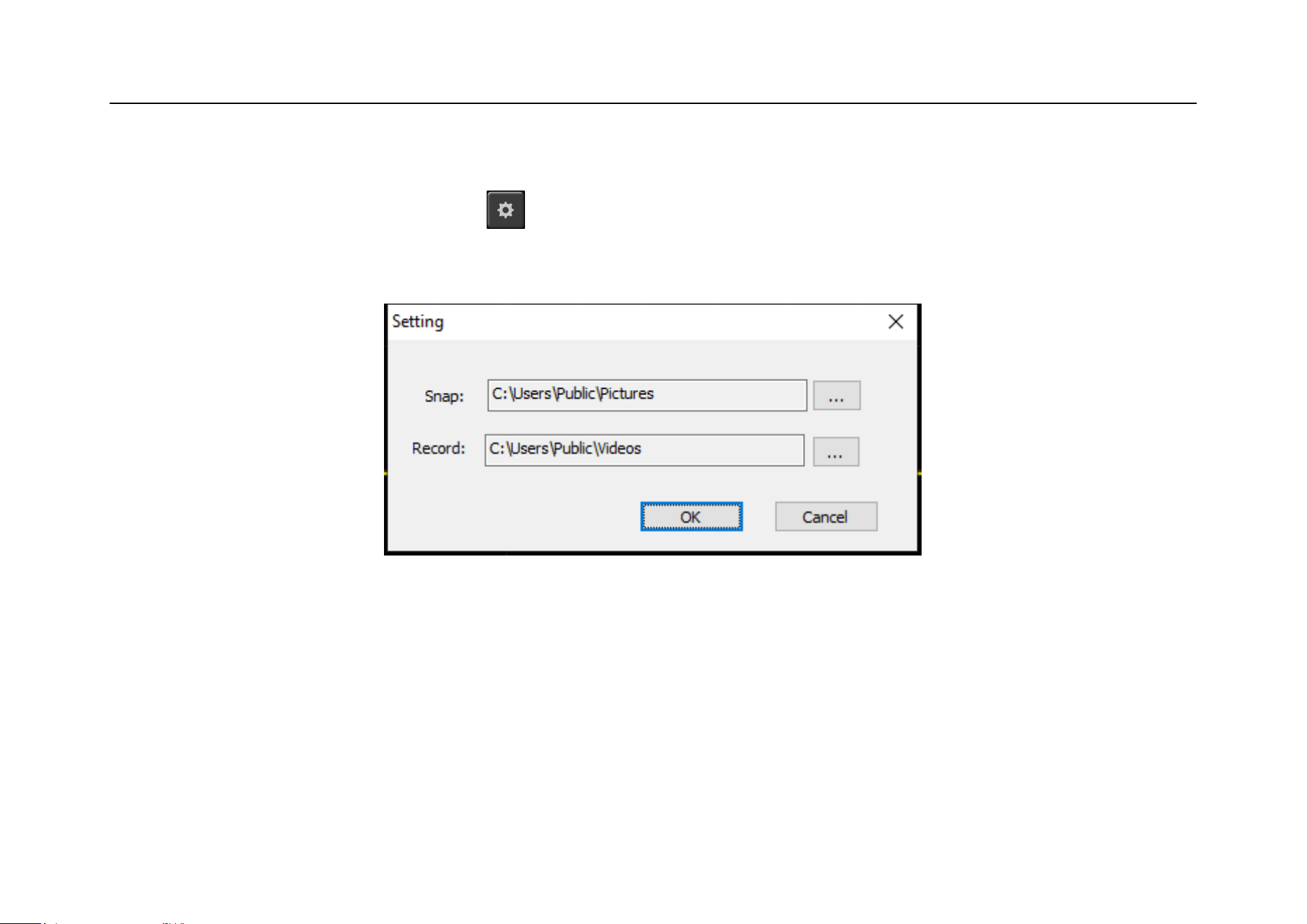
Chapter 13 Remote Control
325
Storage setting of pictures and videos:
Open the host computer storage setting , set the storage location of pictures and videos, as shown in the figure
below:
Figure 13-3 Host Computer Storage Setting
Pictures are stored in the local directory C:\Users\Public\Pictures by default. We can also store them under the
directory defined by ourselves according to our own needs. For example, we store pictures in a “mini photo”
directory under E-drive disk. We can set the video storage location in the same way, then click OK.
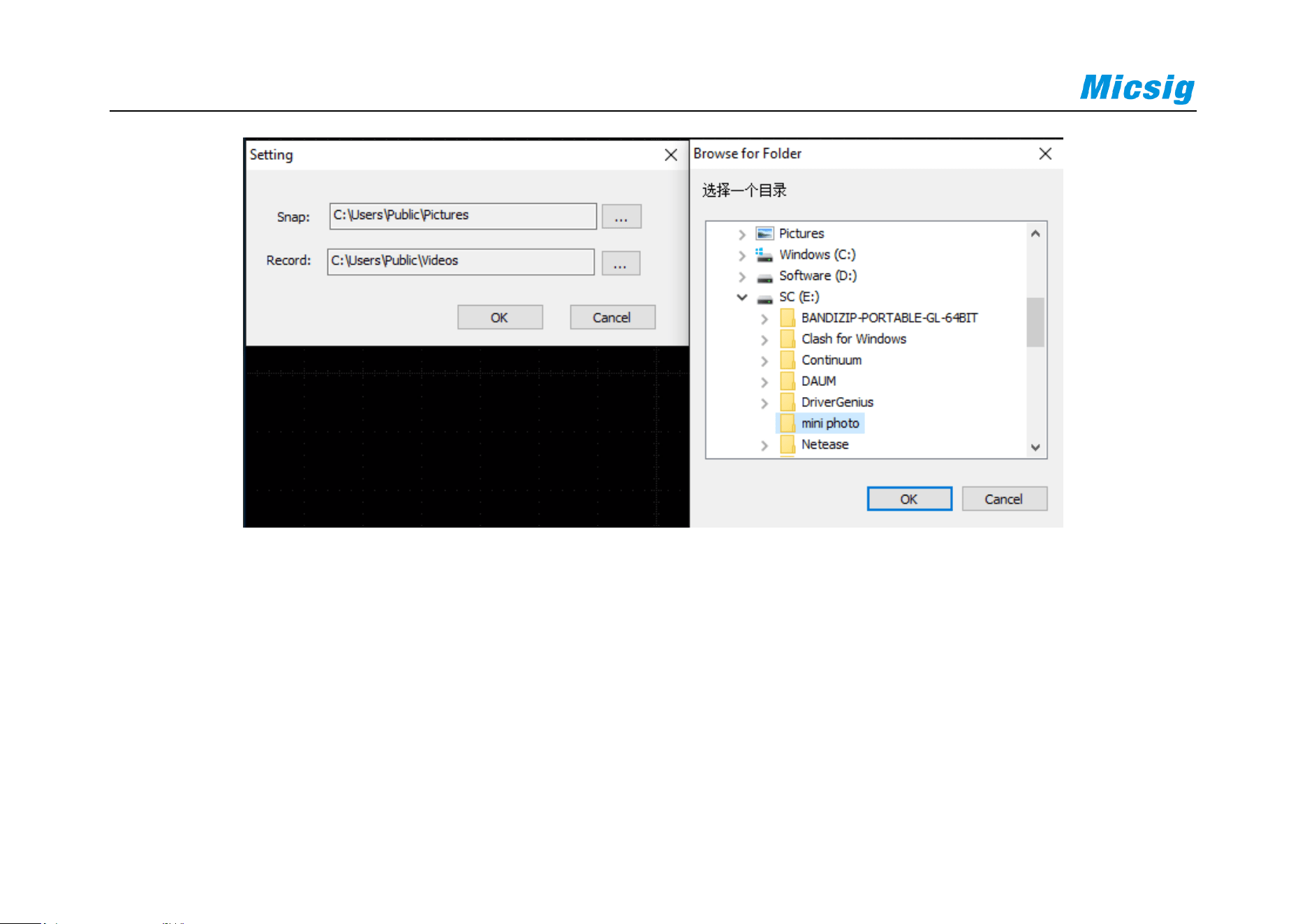
326
Figure 13-4 Change Storage Directory
View pictures and videos:
Open picture (video) storage directory to view pictures (videos) stored on the host computer.
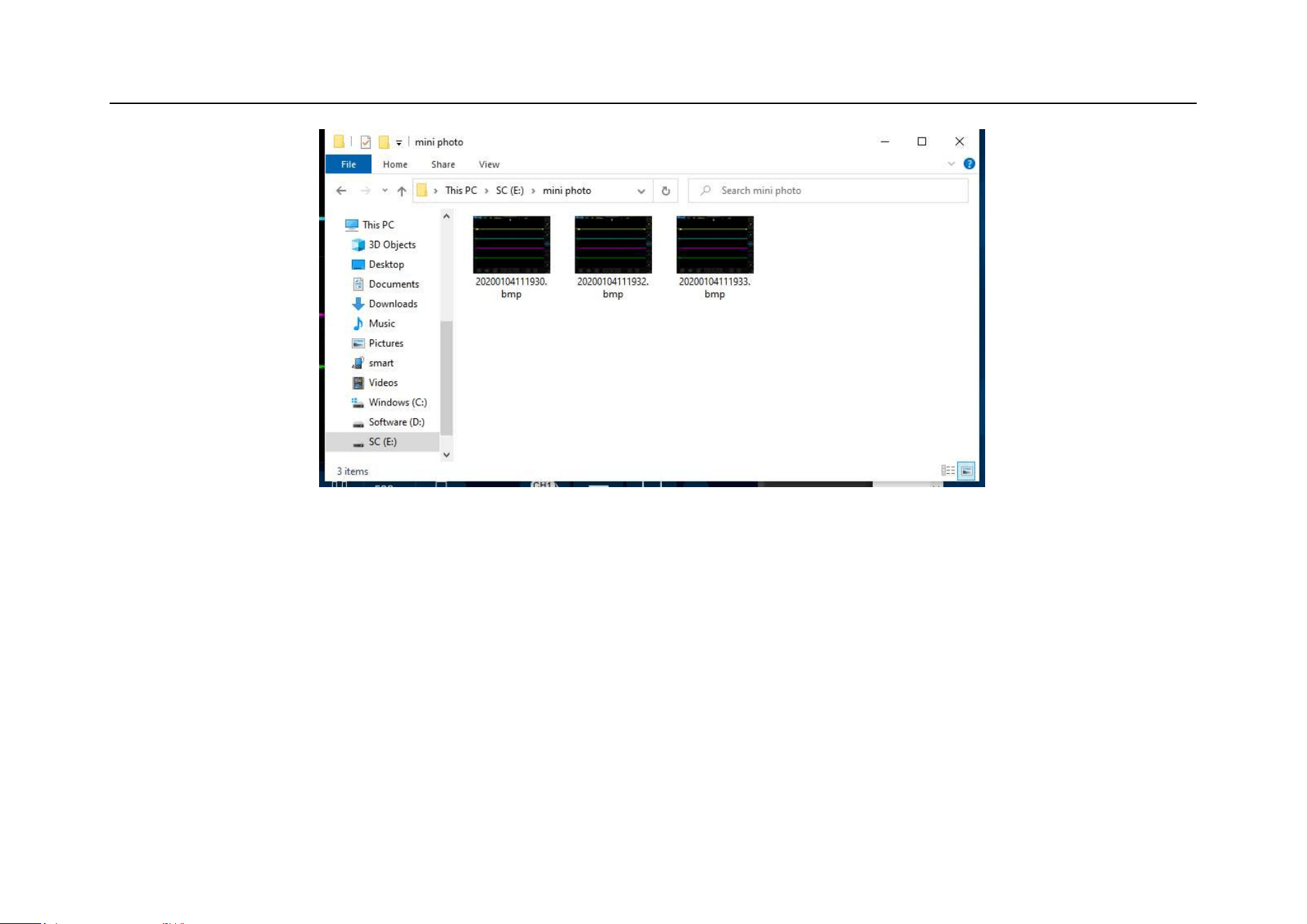
Chapter 13 Remote Control
327
Figure 13-5 View Pictures
13.2 Mobile Remote Control
Micsig Smart series oscilloscopes support remote control on mobile phone (android & iOS). You need to download
Android app from the official website of Micsig (address: http://www.micsig.com) and install it. For iOS, go to
apple store search Tablet Oscilloscope or Micsig to get it.
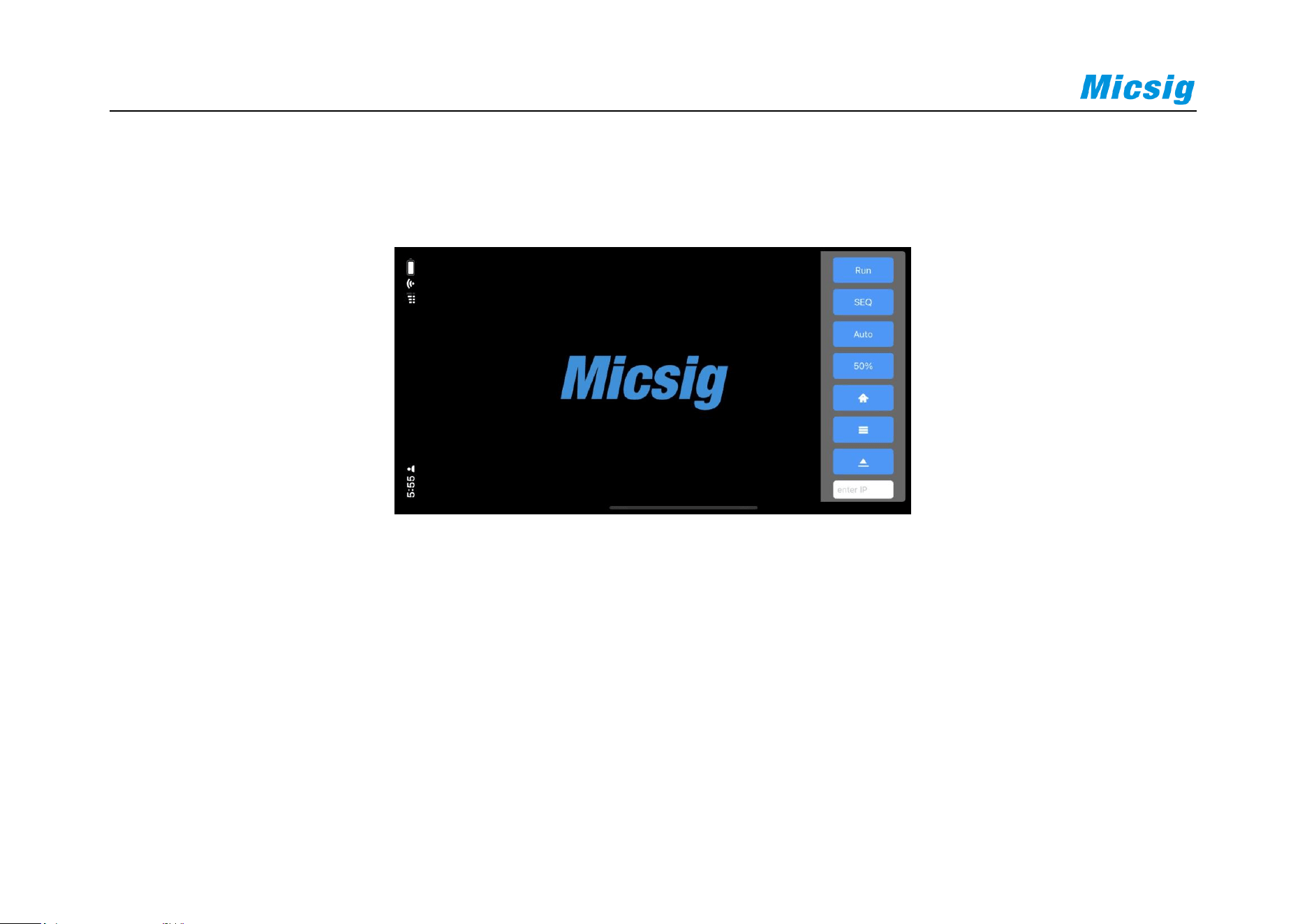
328
After App is successfully connected, mobile device can be used to control the oscilloscope and display the
oscilloscope interface in a real time manner.
Figure 13-6 APP interface
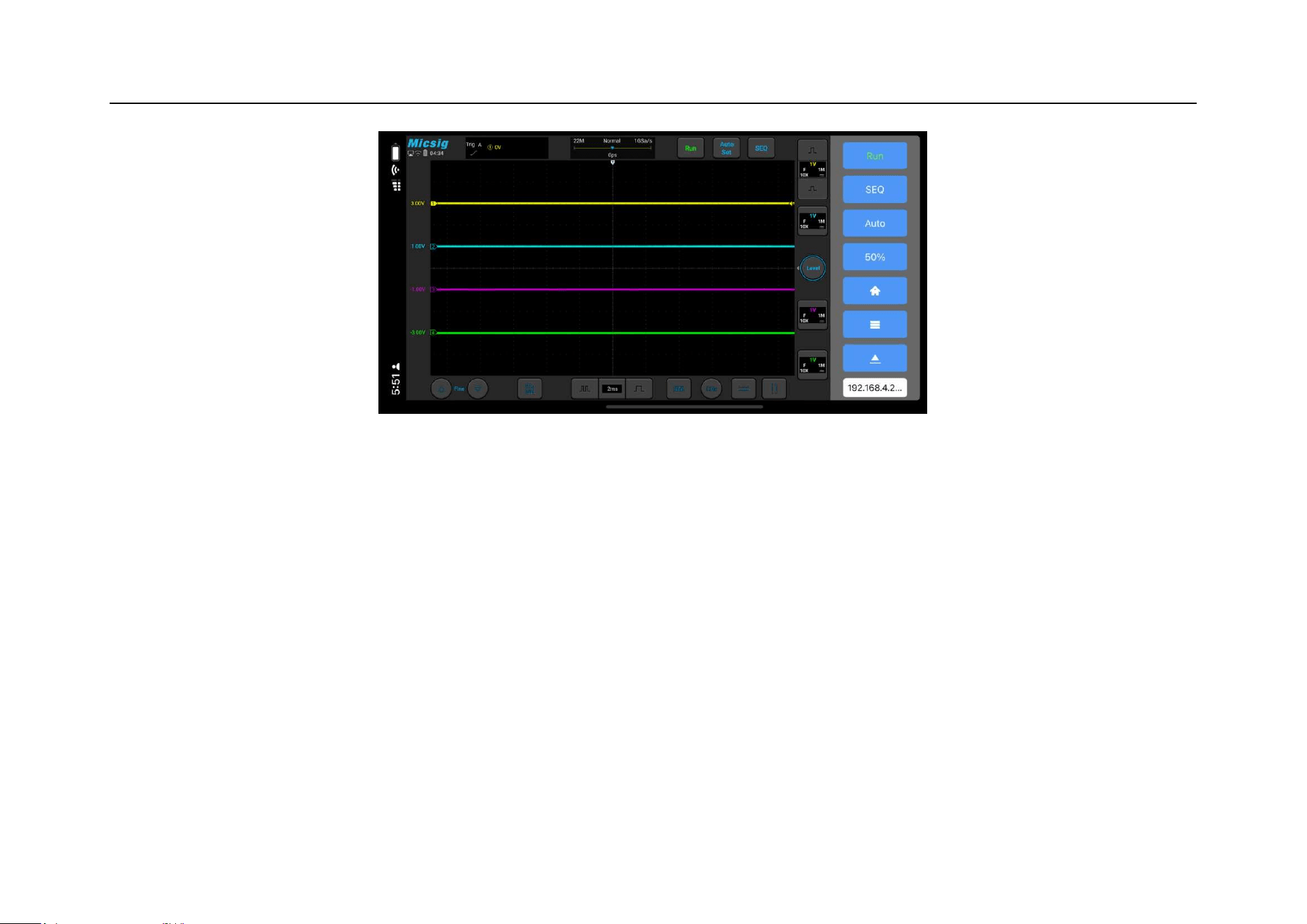
Chapter 13 Remote Control
329
Figure 13-7 Successful Connection of APP
Android APP can be connected by two methods:
1. Use oscilloscope portable hotspot: Mobile phone can be connected to the hotspot of oscilloscope. Enter the
oscilloscope IP 192.168.195.149 in the IP box at the lower right corner of the screen to connect successfully
for control;
330
2. Connect mobile phone and oscilloscope to the network segment under the same router: view the IP address of
the oscilloscope, and enters such IP address in the lower right corner of the mobile phone to connect
successfully.
The first connection method is recommended.

Chapter 14 Update and Upgrade Functions
331
Chapter 14 Update and Upgrade Functions
This chapter describes the methods of software update and increasing the optional function. You are recommended
to read this chapter carefully understand the upgrade functions of the Smart series oscilloscope.
Software update
Add optional functions
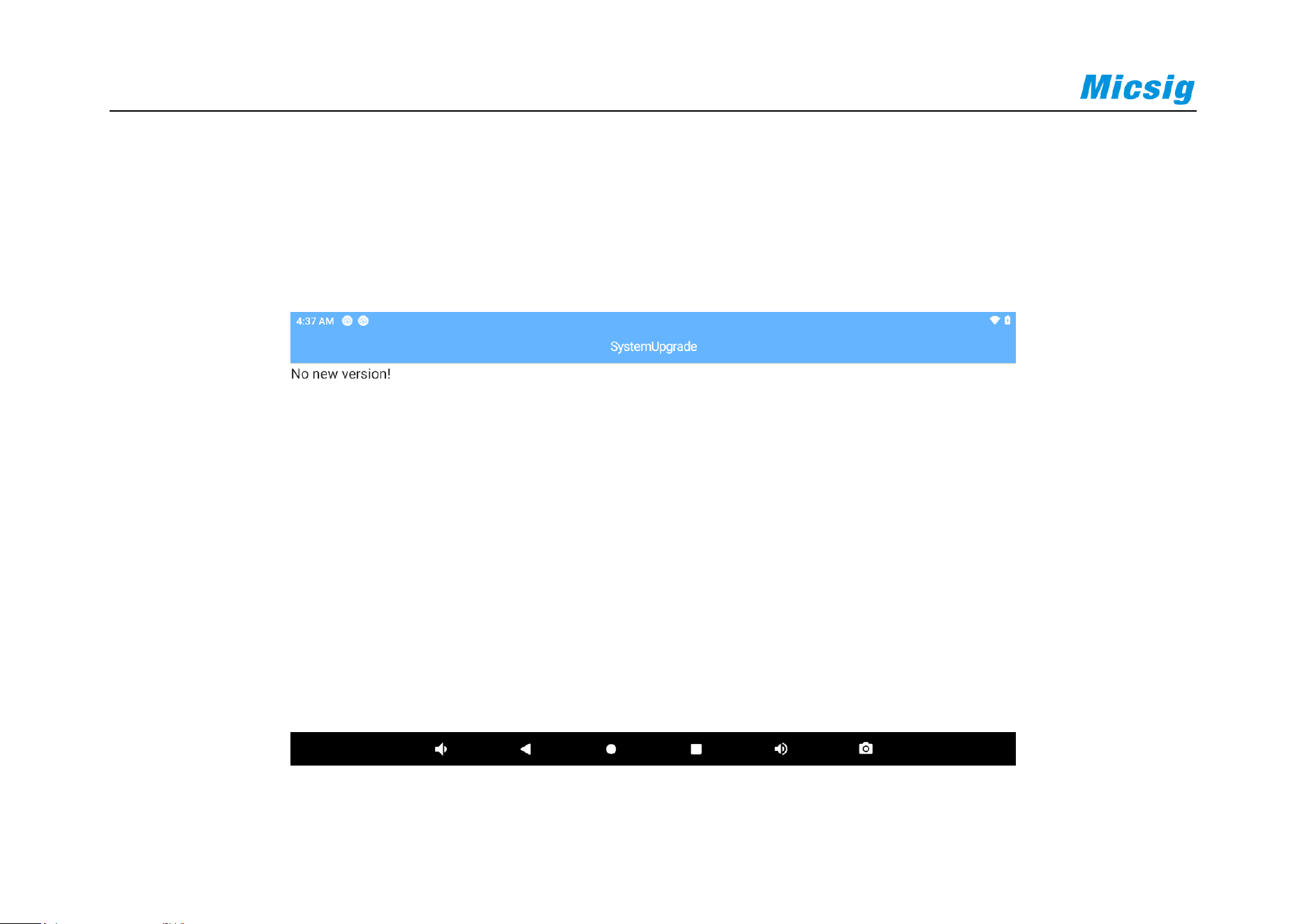
332
14.1 Software Update
Micsig often releases software updates for its products. To update your oscilloscope software, you can connect the
oscilloscope to WIFI for networking, and open the SystemUpgrade application to check and install update.
Figure 14-1 SystemUpgrade application
Chapter 14 Update and Upgrade Functions
333
Note: Please pay attention to keep the oscilloscope power more than 50% when installing updates or connect
the oscilloscope to the adapter, so as to prevent the oscilloscope from becoming abnormal due to insufficient power
for update.
To view the currently installed software and firmware, tap the “App Store” software in the “Home” page to display
the oscilloscope software and firmware information on the “About” screen. Please refer to
12.2 App Store.
14.2 Add Optional Functions
Tap the “App Store” software in the “Home” page to display the installed and uninstalled decoded options on the
“About” screen. Please refer to
12.2 App Store.
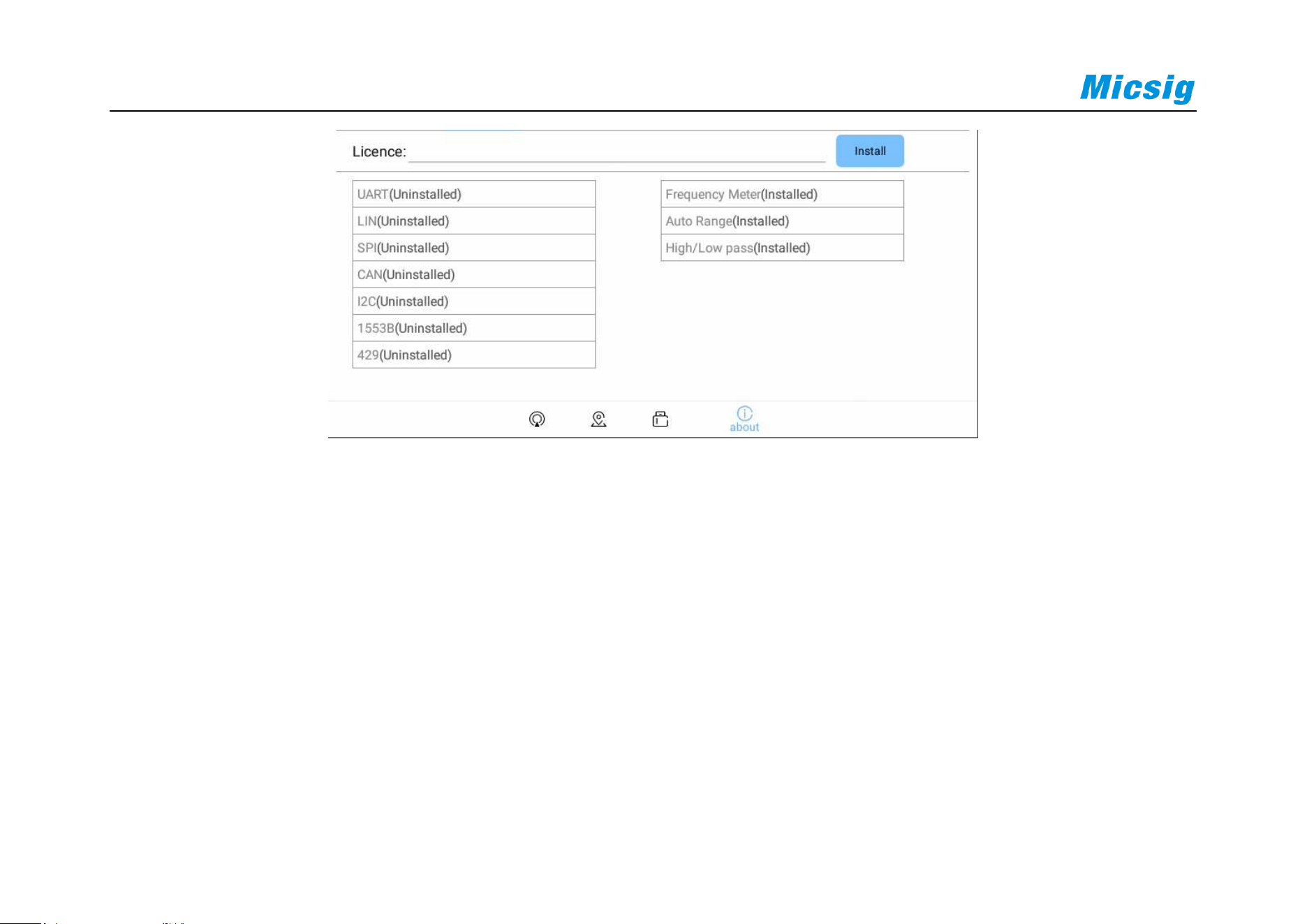
334
Figure 14-2 Decode Functions Not Installed
If you need the optional function service, please contact Micsig for license and enter the install option function at
the license bar.
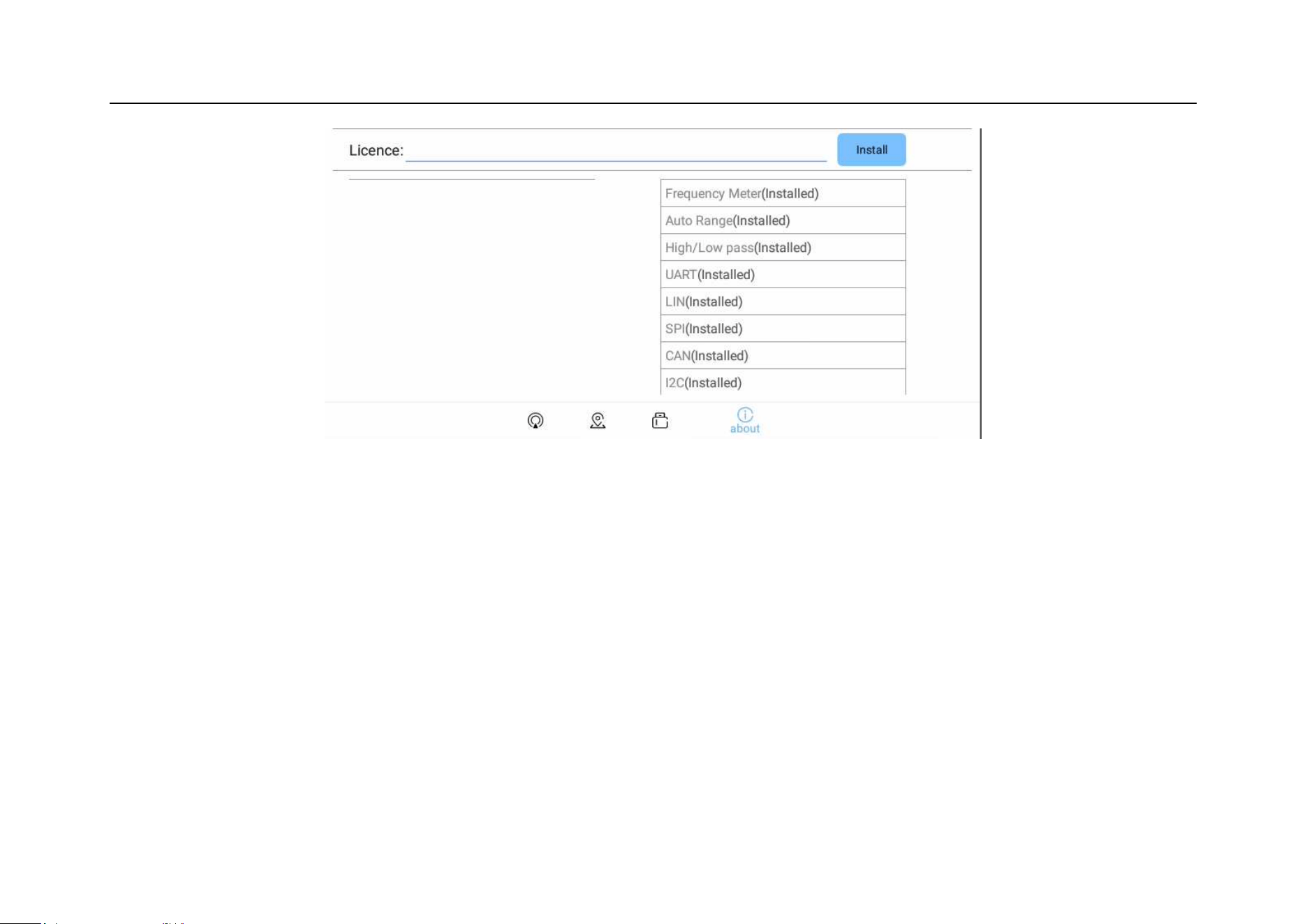
Chapter 14 Update and Upgrade Functions
335
Figure 14-3 Decode Functions Installed
336
Chapter 15 Reference
This chapter contains the measurement category suitable for the oscilloscope and the environmental level of
pollution degree supported. You are recommended to read this chapter carefully to understand the conditions of use
of the Smart series oscilloscope.
Measurement Category
Pollution Degree

Chapter 15 Reference
337
15.1 Measurement Category
Oscilloscope measurement category
Smart oscilloscopes are primarily used for measurements in Measurement Category I.
Measurement category definitions
Measurement category I is for measurements performed on circuits not directly connected to MAINS. Examples are
measurements on circuits not derived from MAINS, and specially protected (internal) MAINS derived circuits. In
the latter case, transient stresses are variable; for that reason, the transient withstand capability of the equipment is
made known to the user.
Measurement category II is for measurements performed on circuits directly connected to the low voltage
installation. Examples are measurements on household appliances, portable tools and similar equipment.
Measurement category III is for measurements performed in the building installation. Examples are measurements
on distribution boards, circuit-breakers, wiring (including cables, bus-bars, junction boxes, switches, socket-outlets)
338
in the fixed installation, and equipment for industrial use and some other equipment, for example, stationary motors
with permanent connection to the fixed installation.
Measurement category IV is for measurements performed at the power source of the low-voltage installation.
Examples are electricity meters and measurements on primary overcurrent protection devices and ripple control
units.
Transient withstand capability
Maximum input voltage of the analog input
Category I 300Vrms, 400Vpk.
15.2 Pollution Degree
Pollution Degree
Smart Series oscilloscopes can operate in environments with pollution degree 2 (or
pollution degree 1).
Chapter 15 Reference
339
Pollution Degree
Categories
Pollution degree 1: No pollution or only dry, non-conductive pollution occurs. The
pollution has no influence. For example: a clean room or air-conditioned office
environment.
Pollution degree 2: Normally only dry, non-conductive pollution occurs.
Occasionally temporary conductivity caused by condensation may occur. For
example: general indoor environment.
Pollution degree 3: Conductive pollution, or dry, non-conductive pollution occurs
which becomes conductive due to condensation. For example: sheltered outdoor
environment.
Pollution degree 4: Pollution that generates persistent conductivity through
conductive dust, rain, or snow. For example: outdoor locations.
340
Chapter 16 Troubleshooting
1. If the oscilloscope does not start up at power on, please follow steps below:
Check the power cord to verify whether it has been connected properly and whether the power supply is
normal;
Check the power on/off buttons to ensure it has been pushed, and if you are using battery, check whether
the battery is in good condition;
Check the Power-off lock on the side of oscilloscope;
Contact Micsig if the problem persists, and we will provide service to you.
2. If acquired waveforms do not display on the screen when the signal source is connected, please follow
the steps below:
Check whether the probe is connected correctly in the BNC socket;
Check whether the probe is connected correctly in the signal source;
Chapter 16 Troubleshooting
341
Check whether the trigger type is correctly selected;
Check whether trigger conditions are set correctly
Check whether signal source is working properly;
Check whether the channel is turned on;
Check whether the vertical scale factor is set correctly;
Check whether the instrument is in single-sequence waiting state for trigger
Tap to resample signal.
3. If the measured voltage amplitude is 10 times greater or smaller than the actual value:
Check whether the set attenuation factor of the channel is consistent with the attenuation factor of the
actually used probe.
4. There is a waveform display, but cannot be stable:
342
Check the trigger source on the trigger type menu to ensure that it is consistent with the actually used signal
channel;
Check the trigger type: edge trigger is adopted for general signal, and video trigger mode for video signal.
Only the correct trigger mode is used, the waveform can be displayed stably;
Check signal source noise. Set the trigger coupling mode to be high-frequency rejection or low-frequency
rejection to filter out high frequency or low frequency noise interference
5. A waveform is displayed but inconsistent with the input waveform:
Check whether the coupling mode setting in the channel menu is correct.
6. If there is no display after pressing or button:
Check whether the trigger mode is “Normal”, and whether the trigger level is beyond the scope of the
waveform. Center the trigger level and set the trigger mode as “Auto”.
Check whether the picture is displayed in full screen, and if so, exit the display.

Chapter 16 Troubleshooting
343
7. If the display becomes slower after setting average times of sampling:
If the average times are above 32, it is normal for the general speed to become slow.
You can reduce the average times.
8. Staircase waveform is displayed:
This phenomenon is normal because the horizontal time base is too low, and the horizontal time base may be
increased to raise the horizontal resolution, and then improve the display;
The display type may be “line”. The connection between sampling points may lead to the display of
staircase waveform. This problem can be solved by setting the display type as “point” display mode.
9. There is persistence of vision in waveform display:
This phenomenon is normal because the persistence time may be set too long, and the waveform persistence
shows persistence of vision;
344
The reason may be that sampling mode is set to envelope of sampling, and the sampling mode can be
modified to normal waveform for normal display
10. During measurement, the measured value is displayed as -----:
This phenomenon is normal. When the channel waveform displays beyond the waveform display area, the
measured value is displayed as -----. If the channel vertical sensitivity or vertical position is adjusted, the
measured value can be displayed correctly;
This phenomenon is normal. When there is no full-cycle waveform in the waveform display area, the
measured value may be displayed as -----. If the time base is adjusted, the measured value will be displayed
correctly.
This phenomenon is normal, and the measured value of the FFT waveform is displayed as -----.
11. CSV files cannot be selected when loading reference:
CSV files are not the supported format that can be loaded into reference channels.
12. Tap the button during the use of oscilloscope, there is no beep sound:

Chapter 16 Troubleshooting
345
Check whether the sound volume setting is correct.
13. Oscilloscope backlight has low brightness:
Check whether the backlight settings are correct.
14. A waveform being moved changes abruptly:
Check whether the picture is displayed in full screen.
15. Turn off the channel at Auto state:
This phenomenon is normal. At Auto state, the channel with an amplitude less than 10mV will be turned off.
16. Function buttons are pressed without response:
Check whether the picture is displayed in full screen.
346
Chapter 17 Services and Support
Service Commitments : Micsig guarantees that the products are manufactured and tested according to national
standards or enterprise standards, no unqualified products will leave our factory and the first-class customer
services are provided for all sold products. The warranty period for our products is three years since date of
shipment, and three months for the sold spare parts and the product repair and maintenance. For the details of
warranty service, please read the “Scope of Limited Warranty and Services” chapter. Micsig provides lifetime repair
and maintenance services for products. In accordance with the relevant provisions of after-sale service of industrial
products and the enterprise’s own capacities, Micsig commit as follows:
Repair Commitments : Micsig commits to use the original factory parts for products returned by the user for
repair (under warranty or not) and the commissioning and testing standards are identical with new products. Micsig
the obligation to inform the customer, but without any other obligations for non-product defects or products with
decreased performance not for objective reasons.

Chapter 17 Services and Support
347
Service Time Commitments : Micsig will give a reply of the time and cost for repair within 2 working days after
receiving the product returned by the user for repair. After the reply is confirmed, the repair period for a general
fault is 5 working days and shall not exceed 10 working days for any special fault.
Contact us
Shenzhen Micsig Technology Co., Ltd.
Address: 1F, Bldg A, Huafeng International Robot Industrial Park, Hangcheng Rd, Bao'an District, Shenzhen,
Guangdong, China
Tel: (0755)-8860-0880
Website:
www.micsig.com
Email: [email protected]
Postal Code: 518126
348
Annex
Annex A:Maintenance and Care of Oscilloscope
General maintenance
Do not put or leave the instrument in a place where the LCD display will be exposed to direct sunlight for
long period.
Caution: To avoid damage to the oscilloscope or probes, do not expose them to sprays, liquids, or solvents.
Clean oscilloscope
Examine the oscilloscope and probes as often as operating conditions require. To clean the exterior surface, perform
the following steps:
Use a soft cloth to remove floating dust on the outside of the oscilloscope and probes. Take care to avoid
scratching the touch screen while cleaning.
Annex
349
Use a soft cloth dampened with water to clean the oscilloscope while doing this please keep the power off. Wipe
with a mild detergent and water. Do not use any corrosive chemical cleaning agent, in order to avoid damaging
the oscilloscope or probe.
Clean the ventilation hole with a soft brush to keep it unimpeded. Do not use any corrosive chemical cleaning
agent, so as to avoid damage to the oscilloscope motherboard.
If the fan needs to be cleaned, please consult the after-sales service personnel, so as to avoid damage to the
oscilloscope.
Warning
Make sure the instrument is dry before recharging, to avoid electrical short circuit or personal injury caused by
moisture.
Store oscilloscope
The lithium battery needs to be charged before storing the oscilloscope for a long period.
350
Battery charge
Upon delivery, the lithium battery may not be charged. It takes 6 hours to be fully charged (the oscilloscope is
recommended to turn off to save the charging time). When running on battery power, the battery level indicator in
the lower right corner of the screen will indicate the battery usage.
Caution: In order to avoid charging battery from overheating, do not use beyond the permitted environmental
temperature value given in the technical specification.
Annex B: Accessories
Standard accessories
1) 4 pcs or 2 pcs for 10X standard probes (incl. grounding nut, grounding crocodile clip, standard rubber plug)
2) Power adapter (12V DC, 4A)
3) Power cord
4) Smart calibration certificate

Annex
351
5) Smart packing list
Optional accessories
1) Oscilloscope suitcase/handbag
2) Battery
3) High voltage probe
4) Differential probe
5) Current probe
352
This manual is subject to change without notice.
The contents of this manual are considered correct. If the user finds any error or omission, please contact
Micsig.
The company will assume no responsibility for accident or hazard caused by the improper operation of the
user.
The copyright of this manual shall belong to Micsig. Any organization or individual may not duplicate, copy
or excerpt the contents without Micsig’s authorization. Micsig reserves the right to claim against such
actions.