10042022JA www.akiascreens.com U-00232 1
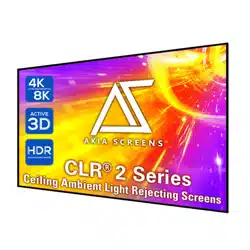
EDGE FREE® CLR® 2 Series
Ceiling Light Rejecting Fixed Frame Screen
USER’S GUIDE – V1.1
Product Description:
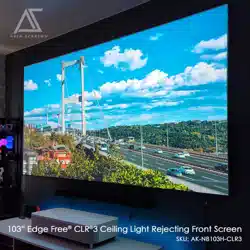
The EDGE FREE® CLR® 2 Series is a fixed frame projection screen that uses Akia’s EDGE FREE® technology.
The EDGE FREE® design resembles a giant size flat panel TV display. The screen includes a bezel trim to further
enhance the frame appearance and absorb projector overshoot. An optional LED kit is available for backlighting.
The screen material included is our ISF Certified CLR® 2 (Ceiling Light Rejecting) which is a front projection
material designed for ultra and short throw projectors, precisely formulated for environments with minimal control of
overhead room lighting. Its multi-layer structure enhances picture brightness, maintain color purity, and improves
contrast levels in ambient light room environments. The CLR® 2 is best for family rooms, educational facilities,
conference rooms, house of worship or any applications in which incident light is a factor.
Screen Maintenance
Dust, dirt and scratches on the projection screen surface will affect the quality and performance of the projection
image. For optimal results we advise to pay attention to the following instructions.
1) Use a dry microfiber cloth or soft brush to remove dust from the screen’s surface.
2) When cleaning, use a damp microfiber cloth with warm water to remove any marks.
3) Never rub or apply pressure when cleaning the surface
4) The screen material has a scratch-resistant layer to protect the material through many years of use.
Notes:The following precautions should always be followed to avoid damaging the material, which is not covered
under warranty.
▪ Don’t touch the screen material with your bare hands to avoid leaving oil residue from fingertips.
Use gloves when handling the material.
▪ Don’t point to the screen material with a fingertip or other sharp objects to prevent damage to the material.
▪ Don’t use acetone, benzene, alcohol and any other organic solvents to clean the screen material.
Using such chemicals will permanently damage the screen.
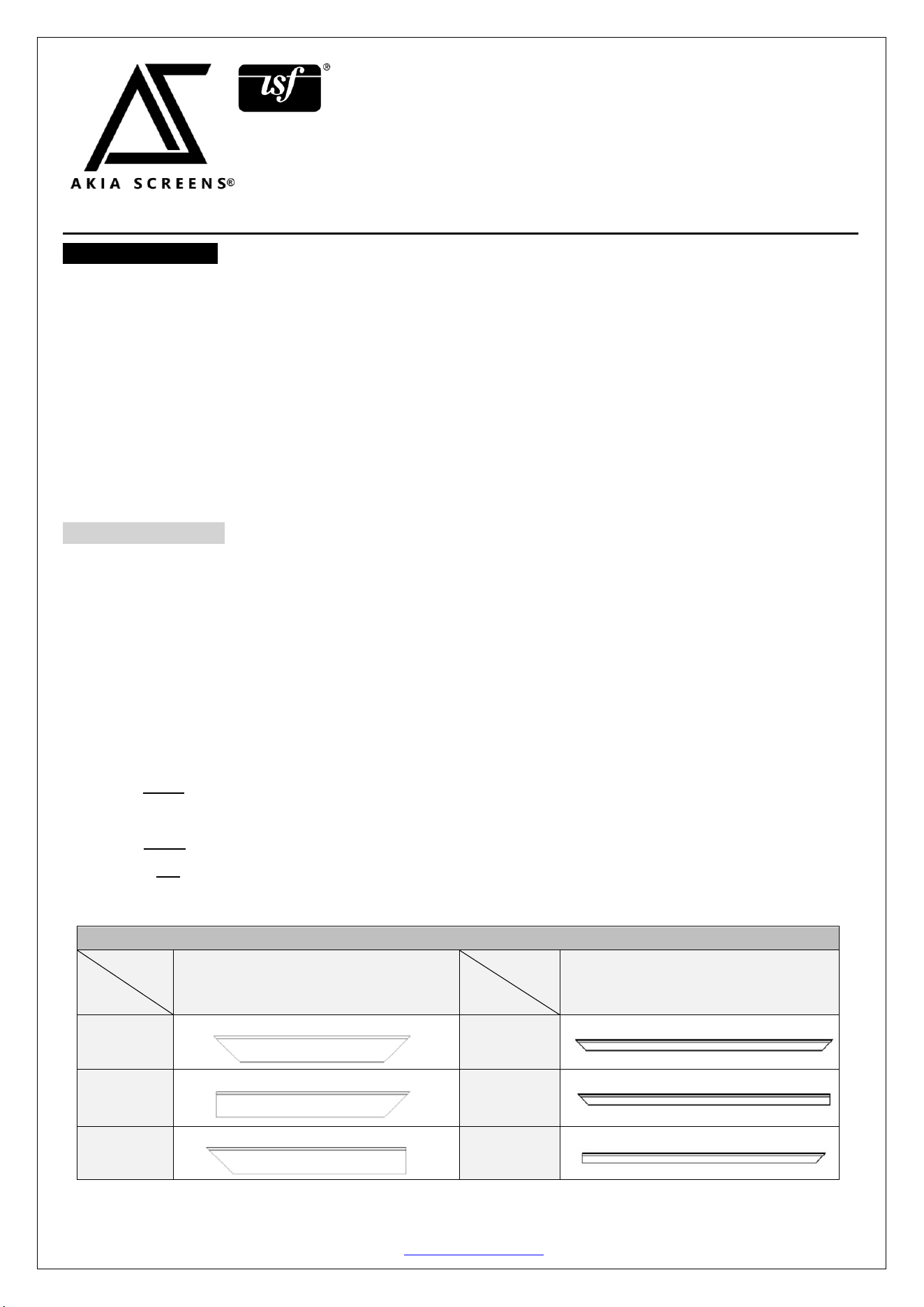
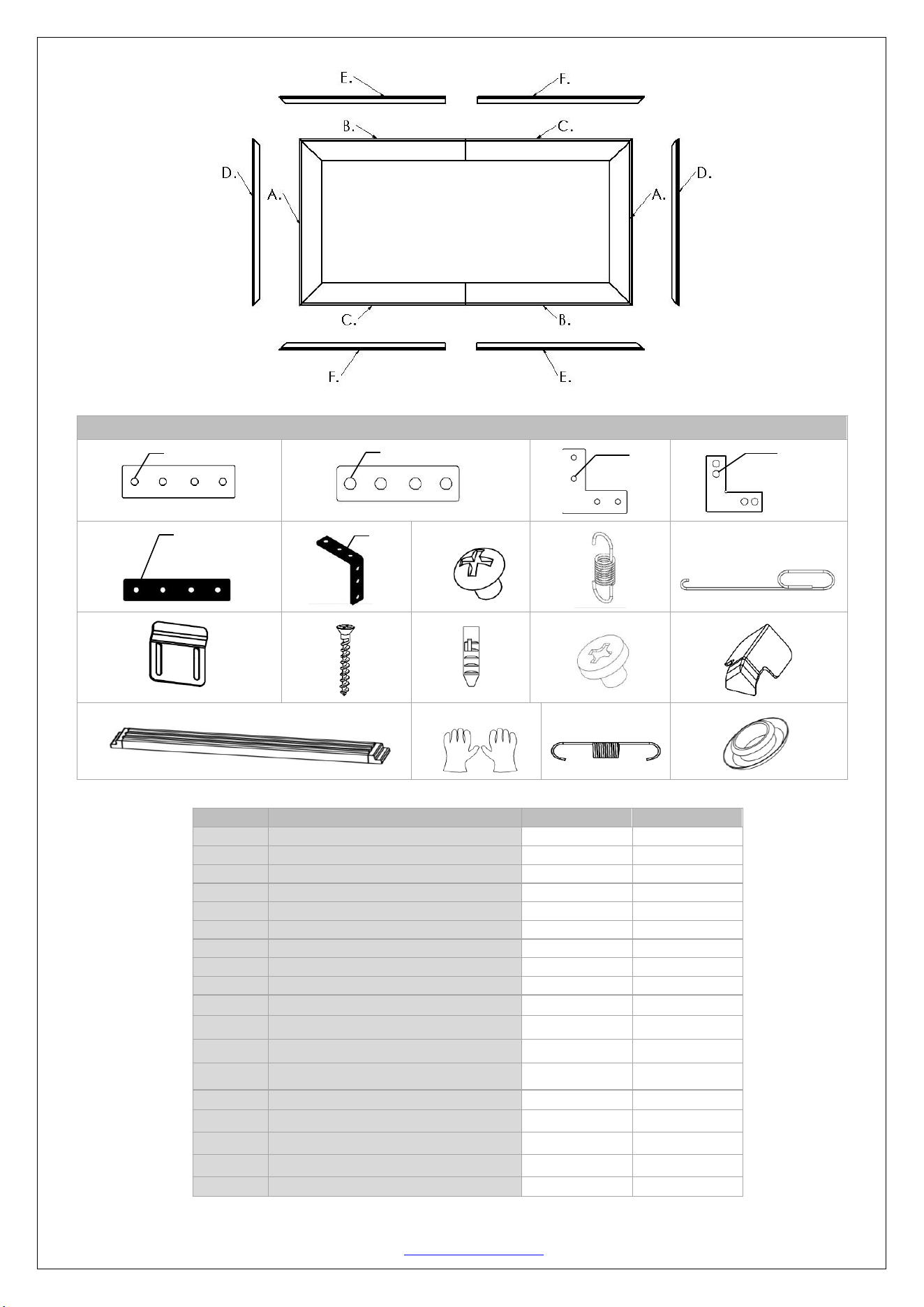
1. Frame and Edge Trim Parts List
Qty
item
2 pcs
Main Frame Parts
Qty
item
2 pcs
Edge Trim Parts
Part A.
vertical frame
Part D.
Part B.
½ horizontal frame
Part E.
Part C.
½ horizontal frame
Part F.
10042022JA www.akiascreens.com U-00232 2
2. Hardware Parts List
a. M4*4
b. D5*4
c. M4*4
d. D5*4
e. M4*4
f. M4*4
g.
h.
i.
j.
k.
l.
m.
n.
o.
p.
q.
r.
Item
Parts List
103”
123”
a.
Center Joints- M4 (bottom position)
2
2
b.
Center Joints-D5 (top position)
2
2
c.
Elbow Joints M4 (bottom position)
4
4
d.
Elbow Joints D5 (top position)
4
4
e.
Side cover Center Joints- M4
2
2
f.
Side cover Elbow Joints M4
4
4
g.
M4x7 Screws
24
24
h.
Spring
88
104
i.
Spring Hook
2
2
j.
wall brackets
4
4
k.
Φ5x50 Wall Screws
8
8
l.
Hollow Wall anchors
8
8
m.
M4x4 Screws
24
24
n.
Angle cover
4
4
o.
Center Support Bar
1
1
p.
White gloves
2
2
q.
Spring
4
4
r.
Iron eyelet
88
104
10042022JA www.akiascreens.com U-00232 3
Frame Assembly
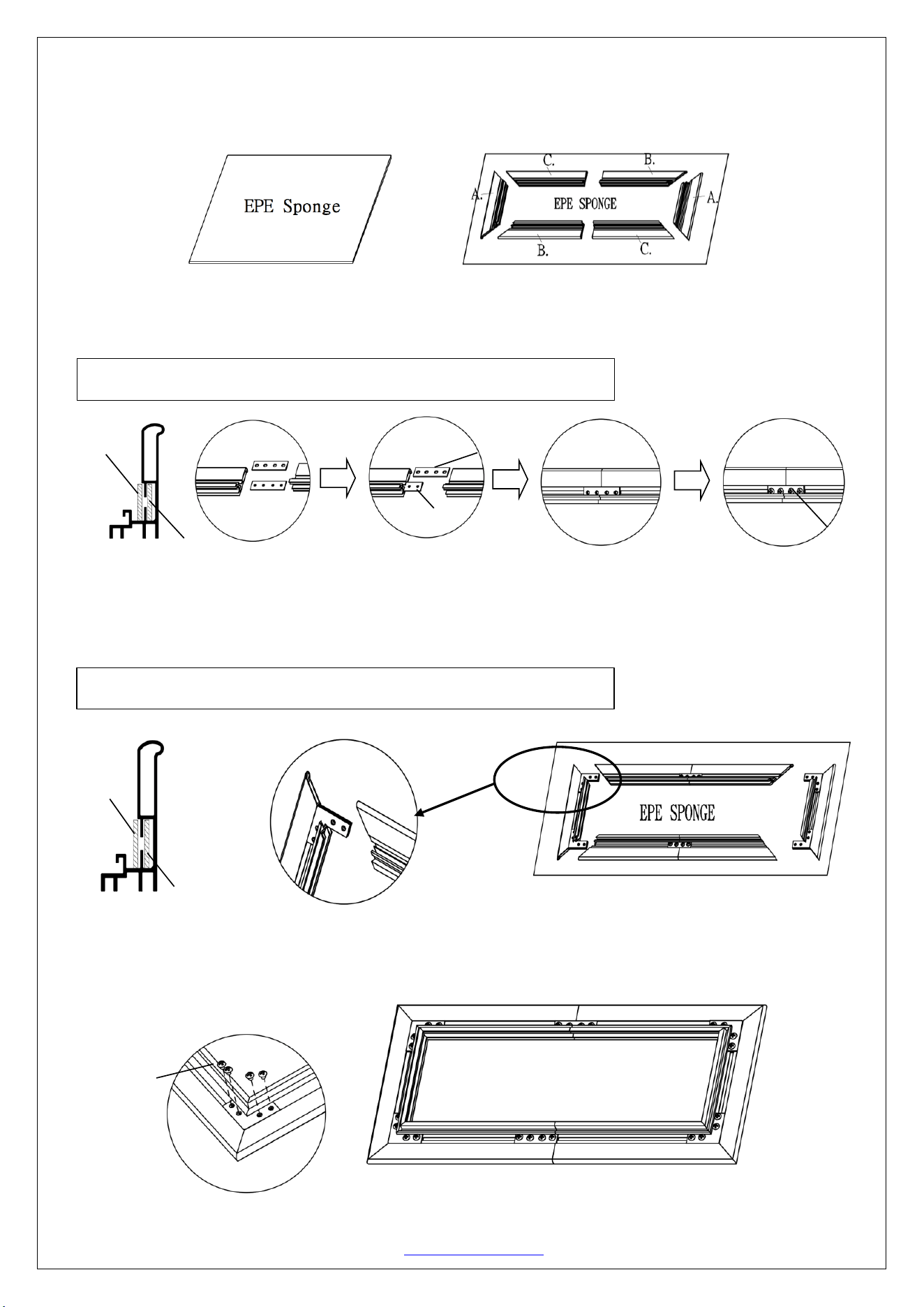
Step 1: Place the included soft padded EPE sponge sheet on a clean area where the screen will be assembled.
Step 2: Position the pieces of the frame on the EPE sponge in the arrangement shown below
Step 3: Insert center joint (a/b) connectors into one-half of the horizontal frame (B/C) and secure with the M4x7
screws (M) as shown in the illustration below.
Step 4: Connect the elbow joints (c/d) to the top and bottom sections of the vertical frame. Once inserted, connect
the vertical sections to the horizontal frame sections. Make sure all holes are in alignment and the frame pieces are
flush (no gaps). They should form perfect right angles.
Step 5: Secure the elbow joints by fastening them with M4x7 screws (
g)
, 4 at each corner.
2. Hardware Parts List
a.
b.
c.
d.
e.
f.
g.
h.
i
j.
k.
l.
m.
c.
d.
b.
a.
a.
b.
g.
…
g.
Tip: The elbow joint (d) with the larger diameter holes should be on top.
Tip: The center joint (b) with the larger diameter holes should be on top.
10042022JA www.akiascreens.com U-00232 4
Screen Material
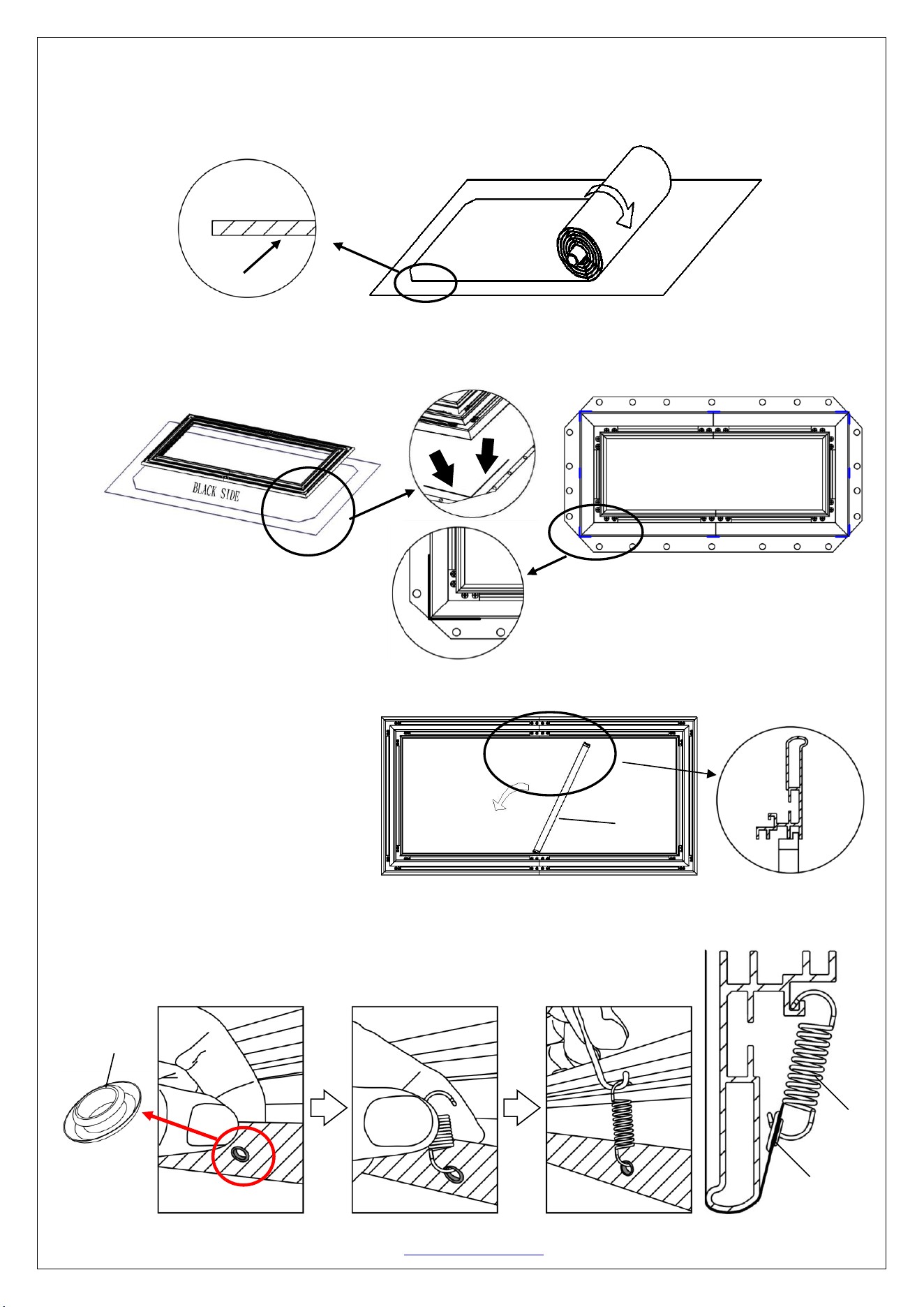
Step 6: Put on the white gloves (p) and carefully unroll the screen material on a clean surface from the roller to the
other side as shown below. The back side of the screen material should be placed upwards.
Step 7: Carefully and gently place the assembled frame on top of the screen material in the marked areas as shown
below. Make sure to not allow the angle edge of the frame to come in direct contact with the screen material to
avoid puncturing it.
Center Support Bar
Step 8: Insert the Center Support Bar (o)
into the upper top groove on the back of
the frame with the bottom end near the
approximate center point of the frame and
rotate it in at an angle so that both ends of
the bar are in alignment with the groove.
Step 9: 1. Insert iron eyelet through the CLR® 2 material hole from behind.
2. Attach the spring into the iron eyelet.
3. Use the spring hook tool to attach the other side of the spring on the frame.
Back side
*Make sure the frame corners are positioned
in the marked areas of the material.
Front
Back Side
r.
h
.
r.
o.
10042022JA www.akiascreens.com U-00232 5
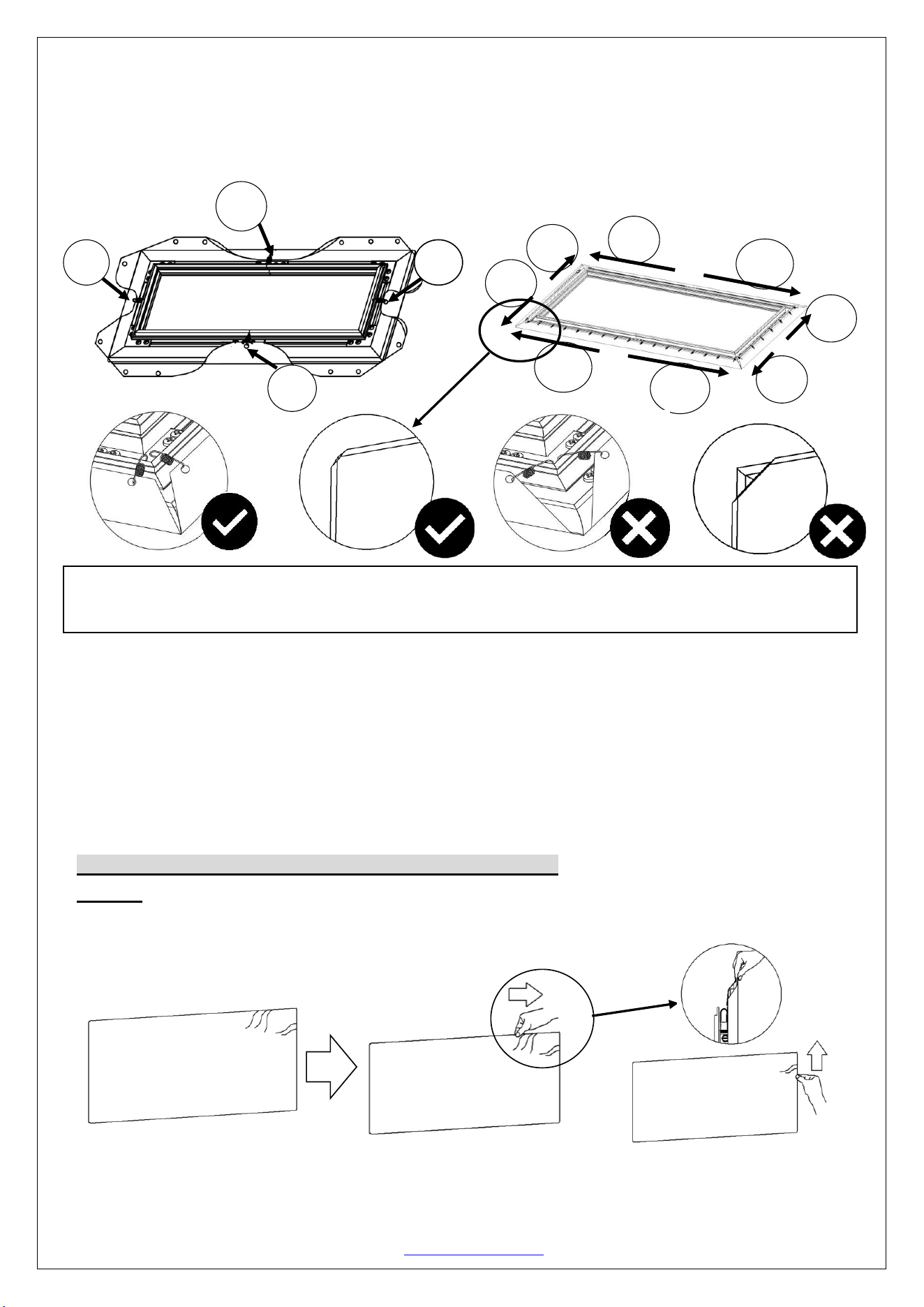
Begin by first attaching the center points on both vertical (left/right) sides, steps 1-2. Then the center points on both
horizontal (top/bottom) sides, steps 3-4. Once all center points have been secured, make sure the screen material is
still within the marked areas before proceeding to attach the next springs.
Continue attaching the rest of the springs to the material in the following order in steps 5-12.
Note (after all springs have been attached):
Correct material installation –Corners of the screen material are properly wrapped around the corner edges of the
frame and material is evenly tensioned and flat, creating a nicely taut surface.
Incorrect material installation –The corners of the screen material are not properly wrapped along the edge of the
frame leaving the material with unbalanced tension and an uneven finish. To correct, detach springs from material
at the corner(s) where material does not lie flat along the edge of the frame, reposition the material so that it lies flat
and wraps along the edge of the frame, and reattach springs to the material.
How to avoid getting ripples on the screen’s material surface
Solution: With the gloves on and assuring they are clean, pull and smooth out the material using your hand from
the center to the corners, creating a nicely taut surface as shown below.
Attention: Do not proceed with the Edge Trim installation until making sure there are no ripples in the material.
5
6
7
8
9
11
10
12
1
2
3
4
To avoid ripples forming in the material it is imperative that all of the corners are properly wrapped around the
edges as illustrated in the check mark diagrams.
10042022JA www.akiascreens.com U-00232 6
Edge Trim Installation
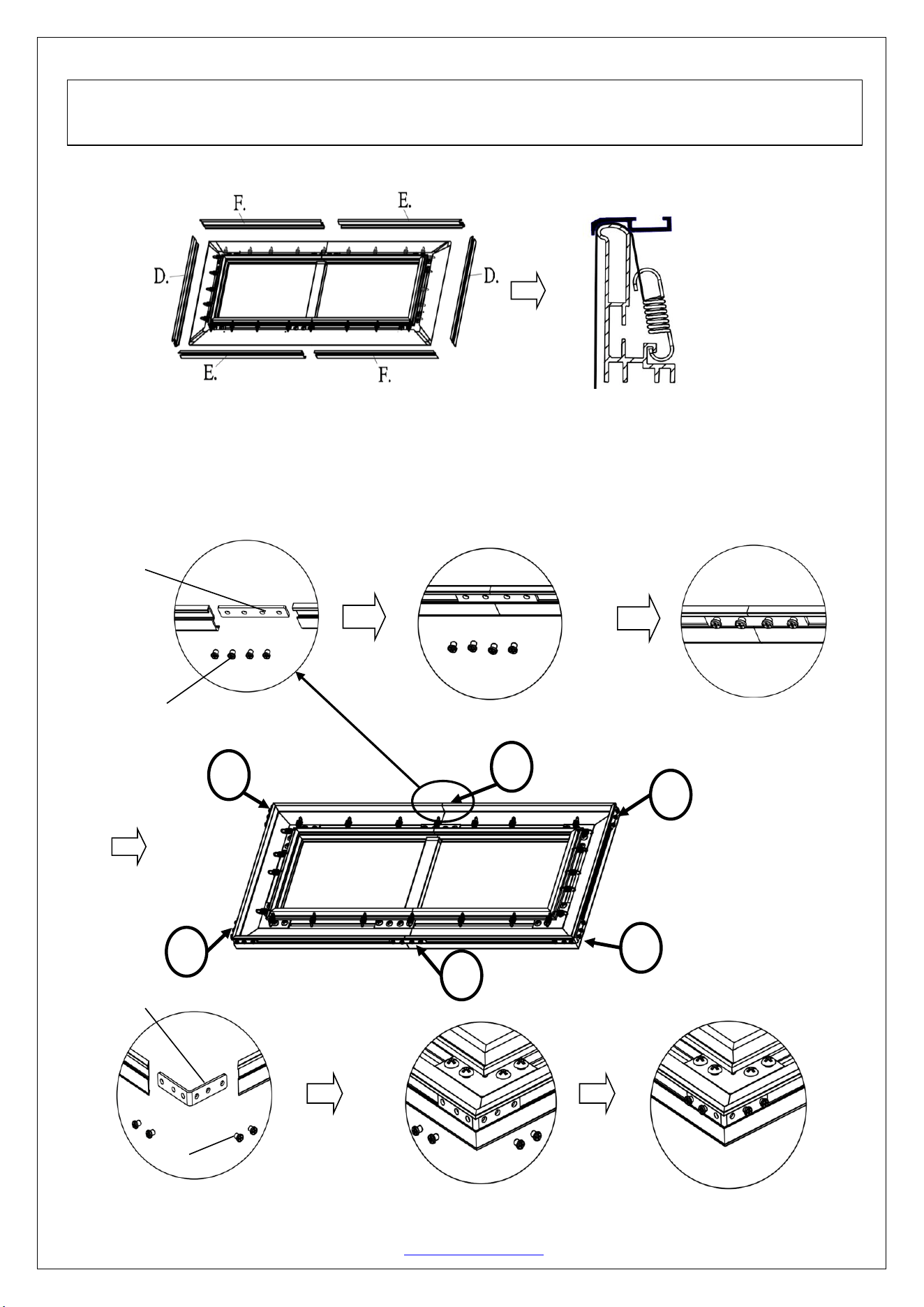
Step 10: Place the edge trim frame pieces over each end of the frame.
Connect edge trim frames (e/f) together using the M4 center joint (e) and secure with four of the M4x4 screws (m)
as show in Step 1. Repeat for other side.
Once both top and bottom edge trim frames have been connected, attach the vertical (left/right) sides edge trim
frames (d) using the elbow joints (f) and secure with four M4x4 screws (m) on all corners, Step 2.
e.
m.
1
1
2
2
2
2
f.
m
.
ATTENTION: The back of the material has labels indicating the TOP and BOTTOM. The top edge trim piece with the
logo should be installed at the top. The material is directional and will not accurately reflect if bottom side is projected on.
10042022JA www.akiascreens.com U-00232 7
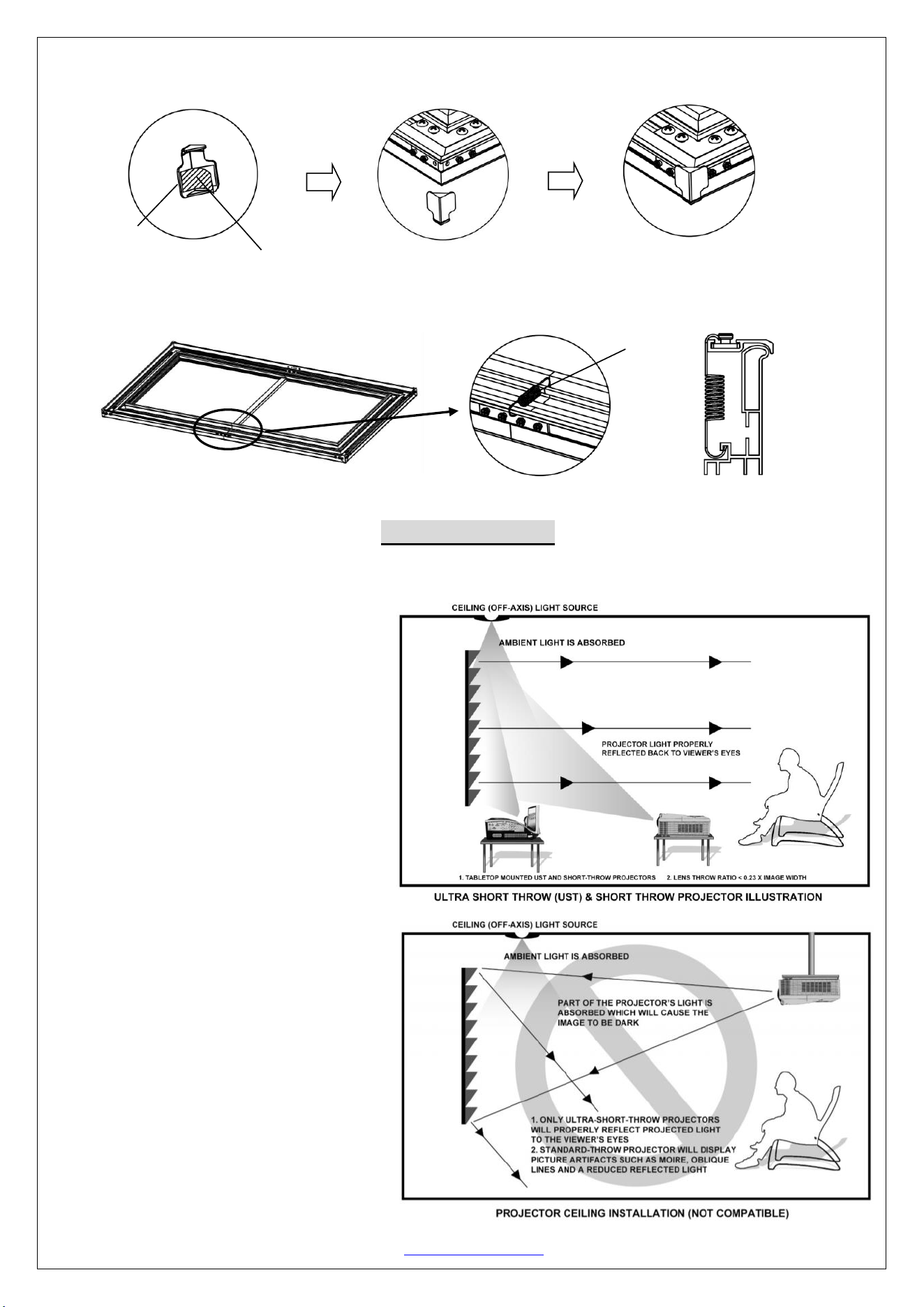
Step 11: Install the angle cover (n) on each corner of the frame using the M4x4 screws (m).
Note: The angle cover screws holes align with the screw holes on the elbow joint.
Step 12: Install the springs (q) in each middle area to further support the bezel trim edge frame.
Notice to Installer:
Material Tip: Proper Projector Placement for CLR®2
CORRECT
The CLR®2 is exclusively for tabletop
mounted ultra and short throw projectors.
INCORRECT
Overhead placement or a standard projector
will make the image very dark, on account of
the screen’s absorbent layer deflecting light
that is not aligned with its reflective angle.
n.
Peel off the double-sided tape.
q.
10042022JA www.akiascreens.com U-00232 8
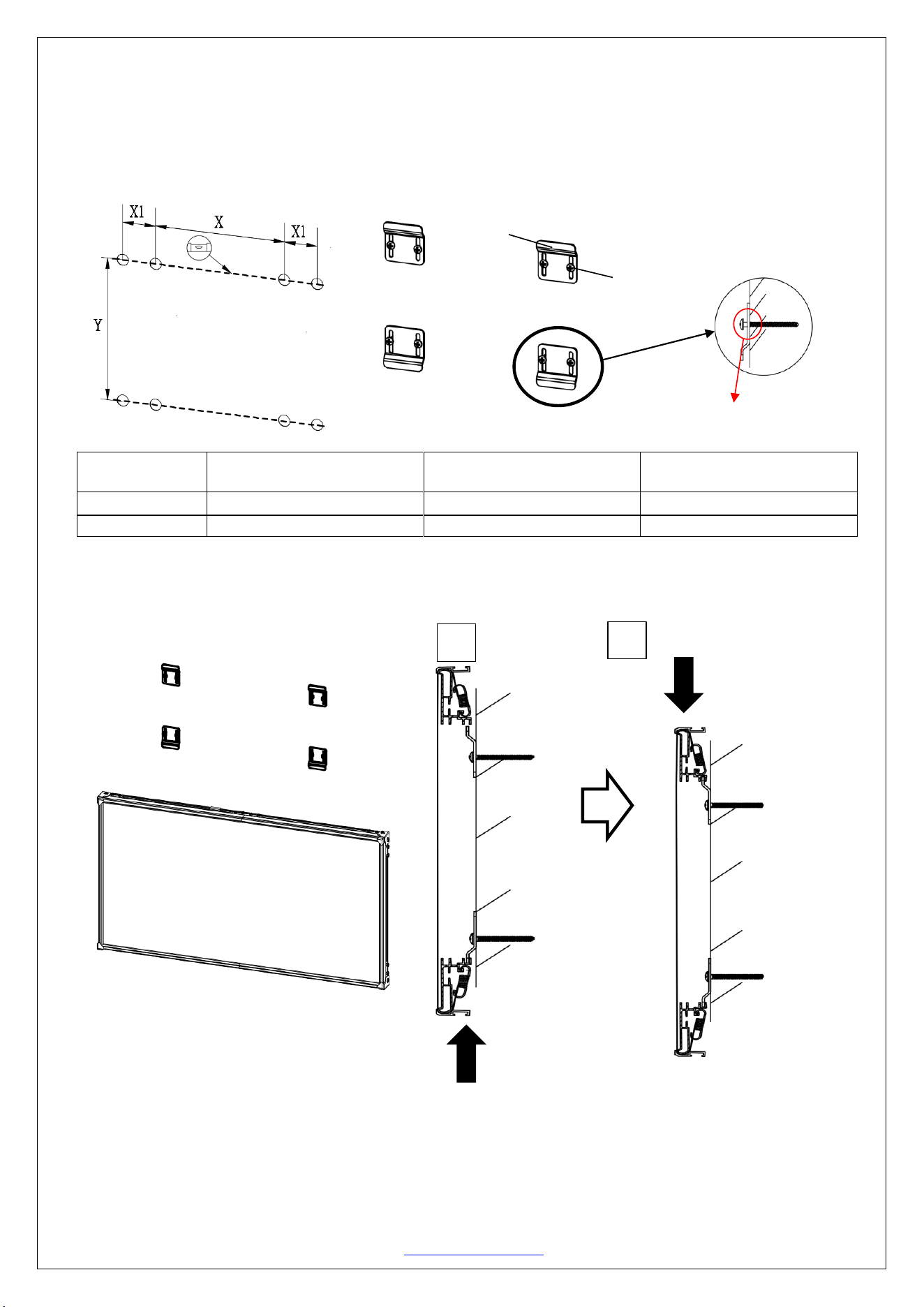
Wall Installation
Step 13: Measure the overall length and height of the frame and drill holes for the top brackets. Line up the wall
brackets with the drilled holes on the installation location and screw them in using a Phillips screwdriver. If not
installing into a structural wood stud, use a hollow wall anchor then screw in the M5x50 wood screws with a
screwdriver. Make sure the brackets are leveled.
Step 14: Position the fixed frame screen onto the top wall brackets (fig 1) as shown below and push
down at the center of the top of the frame (fig 2) to secure.
For Technical Support or an Akia Screens contact in your area, visit
www.akiascreens.com
Model/Size
X = Wall bracket distance
X1 = Bracket hole distance
Y = Top/Bottom Wall
Bracket Height
103”
1200mm (47.24”)
30mm (1.18”)
1100mm (43.3”)
123”
1400mm (55.12”)
30mm (1.18”)
1360mm (53.54”)
Don’t lock the screw to allow
the screen to move up and down
l.
k.
1
2