Operating and Installation
Instructions
Oven
To prevent accidents and machine damage, read these instructions
before installation or use.
en-US, CA M.-Nr. 11 899 990

Contents
2
IMPORTANT SAFETY INSTRUCTIONS ............................................................ 5
Overview............................................................................................................. 16
Control panel ..................................................................................................... 17
On/Off button ...................................................................................................... 18
Display................................................................................................................. 18
Sensor buttons.................................................................................................... 18
Symbols............................................................................................................... 20
Using the appliance........................................................................................... 21
Selecting a menu option ..................................................................................... 21
Changing a setting in a list .................................................................................. 21
Changing the setting with a segment bar ........................................................... 21
Selecting an operating mode or function............................................................ 22
Entering numbers ................................................................................................ 22
Activating MobileStart ......................................................................................... 22
Features.............................................................................................................. 23
Data plate ............................................................................................................ 23
Scope of delivery................................................................................................. 23
Standard and optional accessories..................................................................... 23
Safety features .................................................................................................... 27
PerfectClean treated surfaces............................................................................. 28
Self-Clean-ready accessories ............................................................................. 28
Before first use .................................................................................................. 29
Miele@home ........................................................................................................ 29
Basic settings...................................................................................................... 30
Heating the oven for the first time....................................................................... 31
Settings .............................................................................................................. 32
Settings overview ................................................................................................ 32
Opening the “Settings” menu.............................................................................. 34
Language ......................................................................................................... 34
Time..................................................................................................................... 34
Lighting................................................................................................................ 34
Display................................................................................................................. 35
Volume................................................................................................................. 35
Units .................................................................................................................... 35
Electrical version ................................................................................................. 35
Calibrate temperature.......................................................................................... 36
Booster................................................................................................................ 36
Recommended temps......................................................................................... 36

Contents
3
Self clean recommended .................................................................................... 36
Cooling fan run-on .............................................................................................. 36
Safety .................................................................................................................. 37
Miele@home ........................................................................................................ 37
Remote control.................................................................................................... 38
Activating MobileStart .................................................................................... 38
RemoteUpdate .................................................................................................... 38
Software version.................................................................................................. 39
Showroom program............................................................................................. 39
Factory default..................................................................................................... 39
Timer................................................................................................................... 40
Main and submenus .......................................................................................... 41
Energy-saving tips............................................................................................. 42
Operation............................................................................................................ 44
Changing values and settings for a cooking program......................................... 44
Changing the temperature.............................................................................. 44
Setting additional durations ........................................................................... 45
Changing set durations .................................................................................. 45
Deleting the set cooking durations................................................................. 45
Canceling a cooking program ............................................................................. 46
Preheating the oven ............................................................................................ 46
Booster........................................................................................................... 46
Automatic programs ......................................................................................... 47
Categories ........................................................................................................... 47
Using automatic programs .................................................................................. 47
Usage notes ........................................................................................................ 47
Further applications .......................................................................................... 48
Defrost................................................................................................................. 48
Slow Roasting ..................................................................................................... 49
Canning ............................................................................................................... 51
Frozen food/ready meals ..................................................................................... 53
Warm-up Cookware ............................................................................................ 53
Baking................................................................................................................. 54
Tips for baking..................................................................................................... 54
Notes on the operating modes............................................................................ 55

Contents
4
Roasting ............................................................................................................. 56
Tips for roasting .................................................................................................. 56
Notes on the operating modes............................................................................ 57
Broiling ............................................................................................................... 58
Tips for broiling.................................................................................................... 58
Notes on the operating modes............................................................................ 59
Cleaning and care of the oven ......................................................................... 60
Unsuitable cleaning agents ................................................................................. 60
Removing normal soiling..................................................................................... 61
Removing stubborn soiling.................................................................................. 61
Cleaning the oven compartment with Self clean................................................. 62
Removing the door.............................................................................................. 65
Installing the door................................................................................................ 66
Removing the side runners with FlexiClip telescopic runners............................. 67
Lowering the browning/broiling element ............................................................. 68
Frequently Asked Questions ............................................................................ 69
Customer Service.............................................................................................. 73
Contact in the event of a fault ............................................................................. 73
Appliance warranty and product registration ...................................................... 73
Caring for the environment .............................................................................. 74
Installation.......................................................................................................... 75
Installation dimensions........................................................................................ 75
Installation in a tall or base cabinet................................................................ 75
Side view ........................................................................................................ 76
Connections and ventilation........................................................................... 77
Installing and removing the oven ........................................................................ 78
Taking the oven out of the housing unit ......................................................... 79
Electrical connection ........................................................................................... 80
Declaration of conformity................................................................................. 81
Copyrights and licenses ................................................................................... 82

IMPORTANT SAFETY INSTRUCTIONS
When using the appliance, follow basic safety precautions, including the
following:
Read all instructions before installation and use of the oven to prevent
accidents and machine damage.
This appliance complies with current safety requirements.
Improper use of the appliance can lead to personal injury and
material damage.
Read all instructions before installing or using the oven for the first
time. Only use the appliance for its intended purpose.
Keep these operating instructions in a safe place and pass them
on to any future user.
Appropriate use
This oven is intended for domestic use and use in other similar
environments.
The oven is not intended for outdoor use.
The oven is intended for cooking food – and, in particular, for
baking, roasting, broiling, reheating, defrosting, and drying food – in
domestic settings only.
All other types of use are not permitted.
Risk of Fire! Do not use this oven to store or dry flammable
materials.
This oven can only be used by people with reduced physical,
sensory, or mental capabilities or lack of experience and knowledge
if they are supervised while using it.
They may only use it unsupervised if they have been shown how to
do so in a safe manner. They must be able to understand and
recognize the possible dangers caused by incorrect operation.
5

IMPORTANT SAFETY INSTRUCTIONS
The oven compartment is equipped with special bulbs to cope
with particular conditions (e.g., temperature, moisture, chemical
resistance, abrasion resistance, and vibration). These special bulbs
must only be used for the purpose for which they are intended. They
are not suitable for room lighting.
Safety with children
Children should be supervised in the vicinity of the oven. Never
allow children to play with the oven.
Burn Hazard - Do not allow children to use the oven. Failure to do
so can result in severe burns or serious injury.
Risk of suffocation from packaging material. While playing,
children may become entangled in packaging material (such as
plastic wrapping) or pull it over their head, presenting the risk of
suffocation.
Keep packaging material away from children.
Risk of injury caused by hot surfaces. Children’s skin is far more
sensitive to high temperatures than that of adults. External parts of
the oven such as the door glass, control panel, and the vent become
quite hot.
Do not let children touch the oven when it is in operation.
Risk of injury caused by hot surfaces. Children’s skin is far more
sensitive to high temperatures than that of adults. The oven gets
much hotter during the Self Clean program than during normal use.
Do not let children touch the oven during the Self Clean program.
Risk of injury from the open door. The oven door can support a
maximum weight of 33lbs (15kg). Children could injure themselves
on an open door.
Do not let children sit on the door, lean against it, or swing on it.
6

IMPORTANT SAFETY INSTRUCTIONS
Technical safety
This appliance must be installed and connected in compliance
with the installation instructions.
Unauthorized installation, maintenance, and repairs can cause
considerable danger for the user. Installation, maintenance, and
repairs should only be carried out by a Miele authorized technician.
Maintenance by the user: Never repair or replace any part of the
appliance unless the instructions specifically recommend doing so.
Service work should only be performed by a qualified technician.
Damage to the oven can compromise your safety. Check the oven
for visible signs of damage. Do not use a damaged oven.
Temporary or permanent operation on an autonomous power
supply system or a power supply system that is not synchronized
with the grid power supply (e.g., island networks, back-up systems)
is possible. A prerequisite for operation is that the power supply
system complies with the specifications of EN50160 or an
equivalent standard.
The function and operation of the protective measures provided in
the domestic electrical installation and in this Miele product must
also be maintained in isolated operation or in operation that is not
synchronized with the grid power supply, or these measures must be
replaced by equivalent measures in the installation. As described, for
example, in the current version of VDE-AR-E 2510-2.
The electrical safety of this appliance can only be guaranteed
when correctly grounded. It is essential that this basic safety
requirement is fulfilled. If in doubt, the electrical installation should
be checked by a qualified electrician.
Proper installation: Make sure that your appliance has been
installed correctly and that it has been grounded by a qualified
technician.
7

IMPORTANT SAFETY INSTRUCTIONS
The connection data (voltage and frequency) on the data plate of
the oven must match the domestic electrical supply in order to avoid
the risk of damage to the oven. Compare this before connecting the
appliance to the domestic electrical supply. If in any doubt, consult a
qualified electrician.
Power bars and extension cords do not guarantee the required
safety of the appliance. Do not use these to connect the oven to the
power supply.
For safety reasons, only use the oven when it has been fully
installed.
This appliance must not be used in a non-stationary location (e.g.,
on a ship).
Risk of injury due to electric shock. Any contact with live
connections or tampering with the electrical or mechanical
components of the oven will endanger your safety and may lead to
appliance malfunctions.
Do not open the oven housing under any circumstances.
While the appliance is under warranty, repairs should only be
undertaken by a service technician authorized by Miele Customer
Service. Otherwise the warranty will be invalidated.
Miele can only guarantee the safety of the appliance when original
Miele parts are used. Faulty components must only be replaced with
genuine Miele parts.
If the oven is delivered without a power cord, a special cord must
be installed by a Miele authorized technician (see “Installation –
Electrical connection”).
If the power cord is damaged, it must be replaced with a special
power cord by a Miele authorized technician (see “Installation –
Electrical connection”).
8

IMPORTANT SAFETY INSTRUCTIONS
During installation, maintenance, and repair work, e.g., if the oven
interior lighting is faulty, the oven must be completely disconnected
from the power supply (see “Frequently asked questions”). To ensure
this:
- The circuit breakers have been switched off, or
- the fuses of the electrical installation have been completely
removed, or
- the plug (if present) is removed from the outlet. To do this, pull the
plug not the cord.
The oven requires a sufficient supply of cool air for efficient
operation. Make sure that the supply of cool air is not hindered in
any way (e.g., by installing heat insulation strips in the cabinet niche).
In addition, the required supply of cool air must not be excessively
heated by other heat sources.
If the oven is built in behind a cabinet door front, do not close the
cabinet door while the oven is in use. Heat and moisture can build
up behind the cabinet door when closed. This can result in damage
to the oven, cabinet niche, and floor. Leave the cabinet door front
open until the oven has cooled down completely.
Correct use
Caution: Heating elements may be hot even though they are not
glowing. Interior surfaces of an oven become hot enough to cause
burns. External parts of the oven such as the door glass, vents, and
the control panel can become hot. During and after use, do not
touch, or let clothing or other flammable materials come into contact
with heating elements or interior surfaces of the oven until they have
had sufficient time to cool.
Do not let food sit in the oven for an extended period of time
before or after cooking. Doing so can result in food poisoning or
sickness.
9

IMPORTANT SAFETY INSTRUCTIONS
Loose fitting or hanging garments present a fire hazard. Wear
proper apparel while operating the appliance.
Use only dry, heat-resistant potholders. Moist or damp potholders
used on hot surfaces may result in steam burns. Do not let
potholders come in contact with oil or grease. Do not substitute dish
towels or other bulky items for potholders. Do not let potholders
touch hot heating elements.
Open the door carefully to allow hot air or steam to escape before
placing or removing food.
To prevent burns, always place oven racks at their desired height
while the oven is cool. If the rack must be moved while the oven is
hot, do not let pot holders touch hot heating elements.
To prevent burns, allow the heating elements to cool before
cleaning by hand.
Smother the fire or flames, or use a dry chemical extinguishing
agent or foam fire extinguisher.
Never store flammable liquids and materials in, above or under an
oven, or near cooking surfaces.
WARNING
NEVER use this appliance as a space heater to heat or warm the
room. Doing so may result in carbon monoxide poisoning and
overheating of the oven.
WARNING
NEVER use this appliance as storage space. Doing so may result
in carbon monoxide poisoning and overheating of the oven.
10

IMPORTANT SAFETY INSTRUCTIONS
WARNING
NEVER cover any slots, holes or openings in the oven bottom or
cover an entire rack with materials such as aluminum foil. Doing so
blocks air flow through the oven and may cause carbon monoxide
poisoning. Aluminum foil linings may also trap heat, causing a fire
hazard.
Do not obstruct the flow of combustion and ventilation air.
This oven must only be used for cooking food. Corrosive
chemicals and vapors as well as fumes, vapors or heat given off by
glues, plastics or flammable liquids and materials could be
hazardous. Do not use it as a dryer, kiln, dehumidifier, etc.
Do not let metal objects (aluminum foil, pans) come in contact
with the heating element.
Make certain that the power cords of small appliances do not
come in contact with or get caught in the oven door.
When baking frozen pizzas or pies, place them on the wire rack
lined with parchment paper. Do not use the baking tray or the
roasting pan for frozen foods with a large surface area. The tray or
pan could become warped and difficult to remove from the oven
when hot. Frozen foods like french fries, chicken nuggets, etc. can
be baked on the baking tray.
Risk of injury caused by hot surfaces. The oven gets hot during
operation. You could burn yourself on the heating elements, oven
compartment, accessories, or food.
When the oven is hot, use pot holders to insert, remove, or turn food,
as well as when adjusting the oven shelves, etc.
Due to the high temperatures radiated, objects left near the oven
could catch fire. Do not use the oven to heat up the room.
11

IMPORTANT SAFETY INSTRUCTIONS
Oils and fats are a fire hazard if allowed to overheat. Never leave
the oven unattended when cooking with oil or fats. Never attempt to
put out oil or fat fires with water. Turn the oven off and extinguish the
flames by leaving the door closed.
Broiling food for excessively long cooking durations can cause it
to dry out with the risk of catching fire. Do not exceed the
recommended cooking durations.
Some foods dry out very quickly and can be ignited by high
broiling temperatures. Do not use broiling modes for crisping rolls or
bread, or to dry flowers or herbs. Instead use the Convection Bake/
Convection Roast or Surround modes.
If using alcohol in your recipes, please be aware that high
temperatures can cause the alcohol to evaporate. The vapor can
catch fire on hot heating elements.
When using residual heat to keep food warm, corrosion from high
air humidity and condensation can occur in the oven. This can cause
damage to the control panel, countertop, and cabinet carcase. Keep
the oven on and select the lowest temperature available for the
selected operating mode. The cooling fan will then continue to run
automatically.
Food which is stored in the oven compartment or left in it to be
kept warm can dry out and the moisture released can lead to
corrosion damage in the oven. Always cover food that is left in the
oven to keep warm.
A buildup of heat can cause the enamel on the floor of the oven to
crack or flake off.
Never line the floor of the oven with aluminum foil or oven liners.
If you wish to place dishware on the floor of the oven during the
cooking process, or place dishware on the floor of the oven to heat it
up, you can do so, but only with the Convection Bake/Convection
Roastoperating mode, without the Boosterfunction.
12

IMPORTANT SAFETY INSTRUCTIONS
The oven floor can become damaged by items being pushed
around on it. When placing pots, pans, or dishware on the oven floor,
do not push them around.
Risk of injury caused by steam. Pouring a cold liquid onto a hot
surface creates steam, which can cause severe scalding. The
sudden temperature change can also cause damage to hot surfaces.
Never pour cold liquids directly onto hot enameled surfaces.
Risk of injury caused by steam. During cooking processes with
moisture injection and during the residual moisture evaporation
process, steam is produced, which can lead to severe scalding.
Never open the door when bursts of steam are being injected or
while the residual water is being evaporated.
It is important that the temperature in the food being cooked is
evenly distributed and sufficiently high. You can ensure this by
stirring or turning the food.
Plastic containers which are not heat-resistant melt and may
ignite at high temperatures and can damage the oven.
Use only plastic containers that are suitable for use in an oven.
Follow the manufacturer’s instructions.
Canning food and heating it up in closed containers results in an
increase in pressure which can cause them to explode. Do not use
cans for canning or reheating food.
Risk of injury from the open door. You could bang into the open
door or trip over it. Do not leave the door open unnecessarily.
The door can support a maximum load of 33lbs (15kg). Do not
lean or sit on an open door, or place heavy items on it. Make sure
that nothing gets trapped between the door and the oven
compartment. This could damage the oven.
13

IMPORTANT SAFETY INSTRUCTIONS
The following applies to stainless steel surfaces:
Adhesives will damage the coated stainless steel surface and
cause it to lose its dirt-repellent protective coating. Do not use sticky
notes, adhesive tape, or other types of adhesive on the stainless
steel surface.
Magnets can cause scratches. Do not use the stainless steel
surface as a magnetic notice board.
Cleaning and care
Only clean parts listed in these operating and installation
instructions.
There is a delicate fiberglass seal around front of the oven
compartment provide a seal for the glass on the inside of the oven
door. This can be damaged by rubbing or scouring. If possible,
refrain from cleaning this.
Do not use oven cleaners. Do not use standard oven cleaners in
the oven compartment or on the front of the oven. Never line the
oven with oven liners.
Risk of injury due to electric shock. The steam from a steam
cleaning appliance could reach live electrical components and cause
a short circuit. Never use a steam cleaner for cleaning.
Scratches on the door glass can cause the glass to break. Do not
use abrasive cleaners, hard sponges, brushes, or sharp metal tools
to clean the door glass.
The side runners can be removed (see “Cleaning and care of the
oven – Removing the side runners with FlexiClip telescopic
runners”). Reinstall the side runners correctly.
Coarse soiling in the oven compartment can cause thick smoke to
develop. Remove coarse soiling from the oven compartment before
running the Self Clean program.
14

IMPORTANT SAFETY INSTRUCTIONS
In warm, moist environments, there is a higher probability of pest
infestations. Ensure the oven and the area surrounding it are always
kept clean.
Damage caused by pests is not covered by the warranty.
Accessories
Only use original Miele accessories. Using parts or accessories
from other manufacturers will invalidate the warranty, and Miele
cannot accept liability.
The Miele Gourmet Casserole Dish HUB5000/HUB5001 (if
available) must not be inserted on shelf level1. This will damage the
floor of the oven. The lack of clearance will create a buildup of heat,
which can cause the enamel to crack or flake off. Never place a
Miele Casserole Dish on the upper support of shelf level1 either as it
will not be secured by the non-tip safety notches. As a general rule,
use shelf level2.
Accessories that are not suitable for the Self Clean program will
be damaged by the high temperatures. Remove all accessories that
are not suitable for the Self Clean program from the oven
compartment before starting the Self Clean process. This also
applies to optional accessories that are not suitable for the Self
Clean program (see “Cleaning and care of the oven”).
KEEP THE OPERATING AND INSTALLATION INSTRUCTIONS IN A SAFE
PLACE AND REVIEW THEM PERIODICALLY.
15
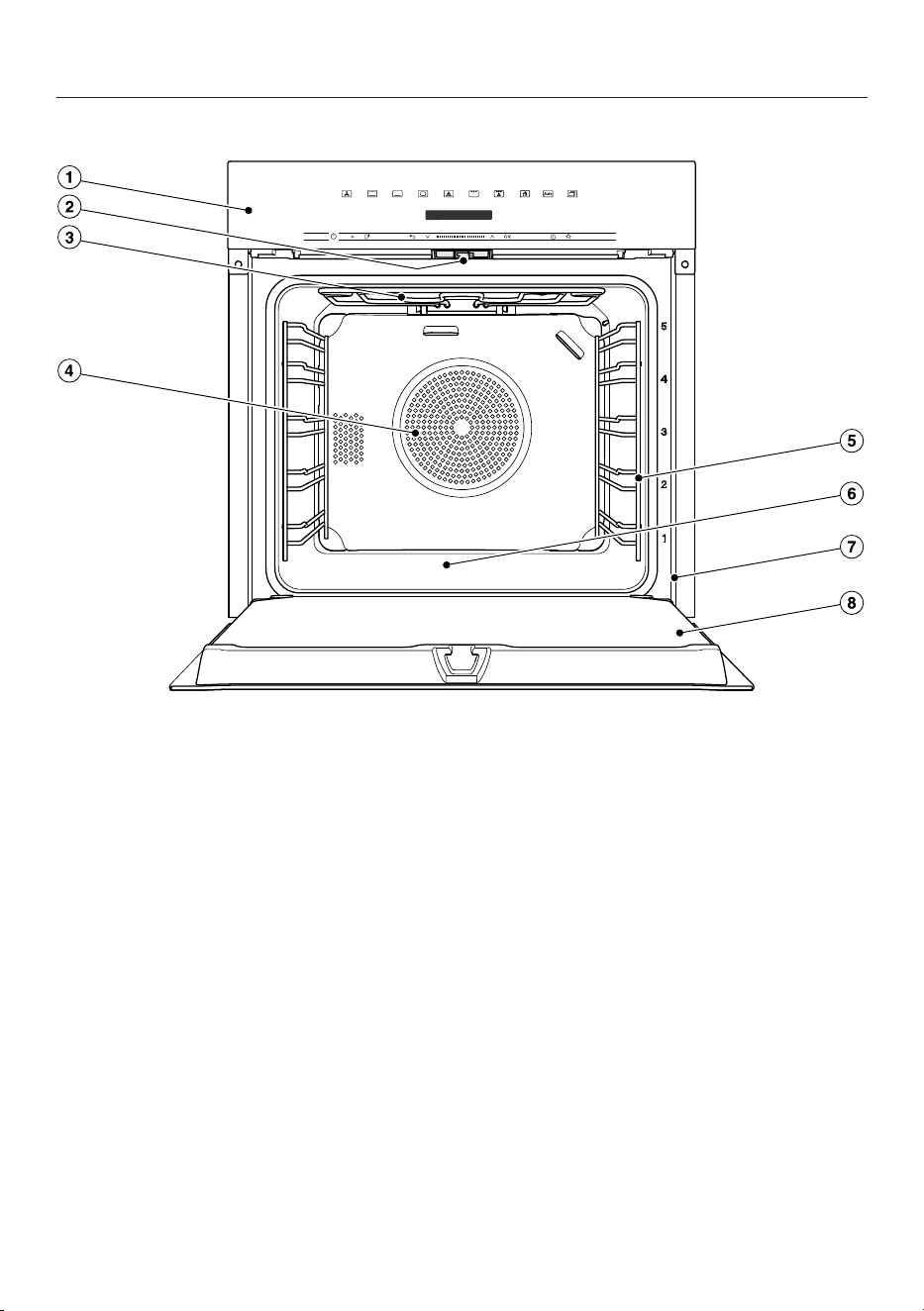
Overview
Oven
a
Controls
b
Door lock
c
Browning/Broiling element
d
Convection fan with heating element
e
Side runners with 5shelf levels
f
Oven floor with bottom heat element underneath it
g
Front frame with data plate
h
Door
16
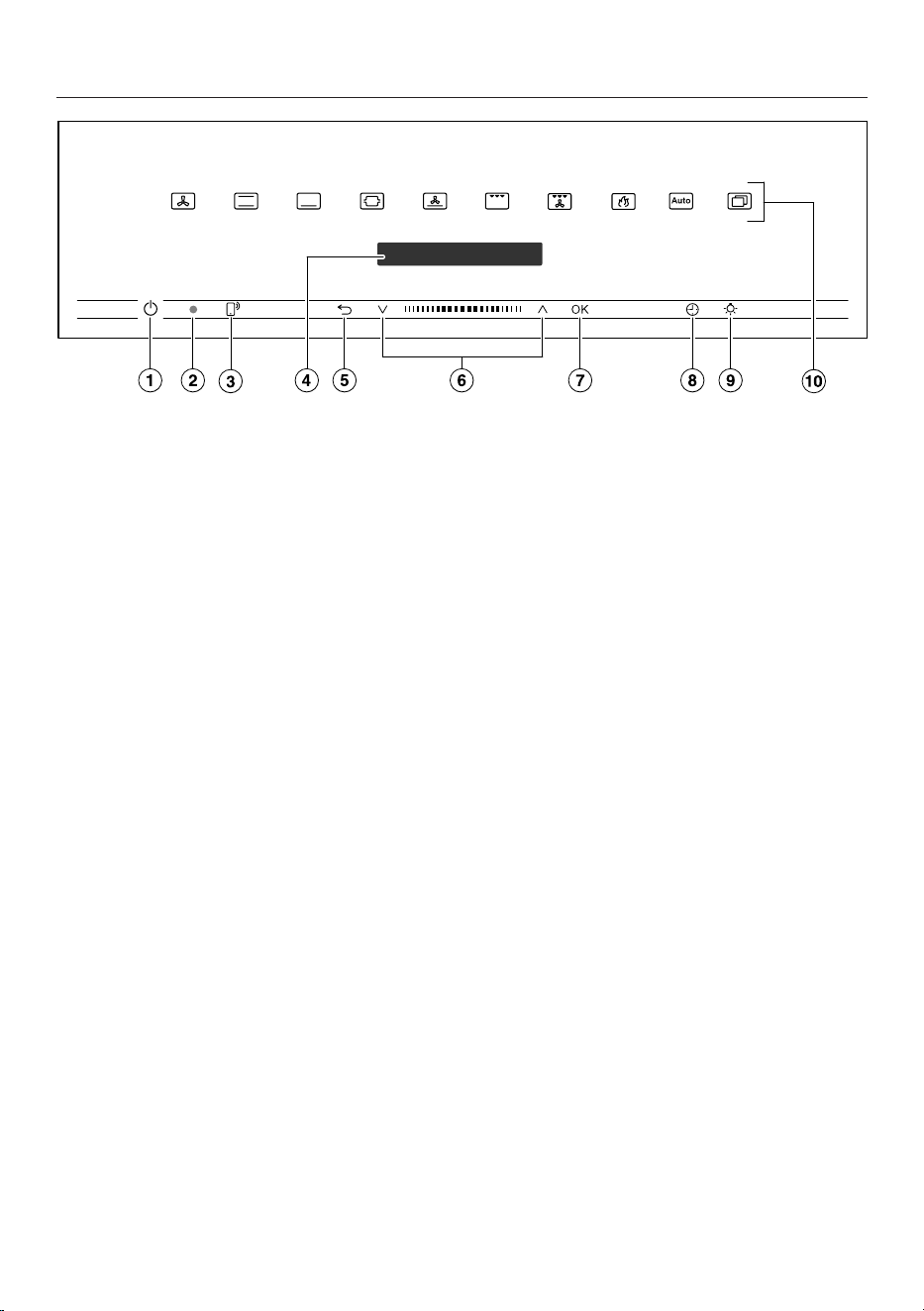
Control panel
17
a
Recessed On/Off button
For turning the oven on and off
b
Optical interface
(for Miele Service only)
c
sensor button
For controlling the oven via your
mobile device
d
Display
For displaying the time of day and
information on operation
e
sensor button
For going back a step and for
canceling a cooking program
f
Navigation area with and arrow
buttons
For scrolling through lists and for
changing values
g
OKsensor button
For accessing functions and saving
settings
h
sensor button
For setting a timer, the cooking
duration, or the start or finish time
for the cooking program
i
sensor button
For switching the oven interior
lighting on and off
j
Sensor buttons
For selecting operating modes,
automatic programs, and settings

Control panel
18
On/Off button
The On/Off button is recessed and
reacts to touch.
Use this button to turn the oven on and
off.
Display
The display is used for showing the
time of day or information about
operating modes, temperatures,
cooking durations, automatic programs,
and settings.
After turning the oven on with the
On/Off button, Select operating mode
will appear in the main menu.
Sensor buttons
The sensor buttons react to touch.
Every tap of a sensor button is
confirmed with an audible keypad tone.
You can turn this keypad tone off using
More| Settings| Volume| Keypad
tone.
If you want the sensor buttons to
respond even when the oven is turned
off, select the Display| QuickTouch|
Onsetting.
Sensor buttons above the display
For information on the functions and
operating modes, see “Main and
submenus”, “Settings”, “Automatic
programs”, and “Further applications”.

Control panel
Sensor buttons under the display
Sensor button Function
If you want to control the oven from your mobile device, you
must have the Miele@home system, turn on the Remote control
setting, and tap this sensor button. The sensor button then lights
up and the MobileStart function is available.
As long as this sensor button is illuminated, you can control the
oven via your mobile device (see “Settings – Miele@home”).
Depending on which menu you are in, this sensor button will
take you back a level or back to the main menu.
If a cooking program is in progress at the same time, use this
sensor button to cancel the program.
In the navigation area, use the arrow buttons or the area
between them to scroll up or down in the lists. The display
shows the menu option that you want to select.
You can change the values and settings using the arrow buttons
or the area between them.
OK As soon as you reach a confirmable value, message, or setting,
the OKsensor button will light up orange.
By selecting this sensor button you can access functions such
as the timer, save changes to values or settings, or confirm
instructions.
If no cooking program is in progress, you can use this sensor
button to set a timer (e.g., when boiling eggs) at any point.
If a cooking program is in progress at the same time, you can set
a timer, the cooking duration, and a start or end time for the
program.
Select this sensor button to turn the oven interior lighting on and
off.
Depending on the setting selected, the oven interior lighting
turns off after 15seconds or remains constantly turned on or off.
19

Control panel
Symbols
The following symbols may appear on the display:
Symbol Meaning
This symbol indicates that there is additional information and
advice about using the appliance. Select OK to confirm the
information.
Timer
A check indicates the option which is currently selected.
Some settings, e.g., display brightness and signal tone volume,
are selected using a segment bar.
The system lock prevents the oven being switched on by mistake
(see “Settings – Safety”).
20

Using the appliance
21
Use the and arrow buttons or the
area between them in the
navigation area to use the oven.
As soon as you reach a confirmable
value, message, or setting, the
OKsensor button will light up orange.
Selecting a menu option
Touch the or arrow buttons or
swipe to the right or left in the
area until you reach the desired menu
option.
Tip: If you press and hold an arrow
button, the list continues scrolling
automatically until you release the arrow
button.
Confirm your selection with OK.
Changing a setting in a list
A check will appear beside the
current setting.
Touch the or arrow buttons or
swipe to the right or left in the
area until you reach the desired value
or setting.
Confirm with OK.
The setting is now saved. This will take
you back to the previous menu.
Changing the setting with a
segment bar
Some settings are represented by a
bar made up of segments.
If all of the segments are illuminated,
the maximum value is selected.
If none of the segments are illuminated
or if only one is, the minimum value is
selected or the setting is turned off
altogether (e.g., volume).
Touch the or arrow buttons or
swipe to the right or left in the
area until you reach the desired
setting.
Confirm your selection with OK.
The setting is now saved. This will take
you back to the previous menu.

Using the appliance
22
Selecting an operating mode
or function
The sensor buttons for the operating
modes and functions (e.g., More)
are located above the display (see
“Controls” and “Settings”).
Touch the sensor button for the
desired operating mode or function.
The sensor button on the control panel
lights up orange.
For operating modes and functions:
set values such as the temperature.
Under More: scroll through the
lists until you reach the desired menu
option.
Confirm with OK.
Changing the operating mode
You can change to another operating
mode during a cooking program.
The sensor button for the previously
selected function lights up orange.
Touch the sensor button of the new
operating mode or function.
The new operating mode will appear on
the display with its corresponding
recommended values.
The sensor button for the new operating
mode lights up orange.
Under More, scroll through the
lists until you reach the desired menu
option.
Entering numbers
Numbers that can be changed are
highlighted.
Touch the or arrow buttons or
swipe to the right or left in the
area until the desired number is
highlighted.
Tip: If you press and hold an arrow
button, the numbers continue scrolling
automatically until you release the arrow
button.
Confirm with OK.
The changed number is now saved.
This will take you back to the previous
menu.
Activating MobileStart
Select the sensor button to
activate MobileStart.
The sensor button lights up. You can
operate your oven remotely with the
Miele app.
Directly operating on the oven takes
priority over operating it via the remote
control function on the app.
You can use MobileStart as long as
the sensor button is lit up.

Features
23
A list of the models described in these
operating and installation instructions
can be found on the back page.
Data plate
The data plate located on the front
frame of the oven is visible when the
door is open.
The data plate states the model
number, the serial number, and
connection data (voltage, frequency,
and maximum rated load).
Have this information available if you
need to contact Miele so that any
issues can be rectified as quickly as
possible.
Scope of delivery
- Operating and installation
instructions for using the oven
- Screws for securing the oven to the
cabinet niche
- Various accessories
Standard and optional
accessories
Features will vary depending on
model.
The side runners, universal tray, and
wire rack (or “rack” for short) are
supplied as standard with the oven.
Depending on the model, your oven
may also come supplied with some of
the accessories listed here.
All accessories and cleaning and care
products in these instructions are
designed to be used with Miele Ovens.
These can be ordered from the Miele
web store, Miele Customer Service, or
from your Miele dealer.
When ordering, please have your model
number ready along with the desired
accessories.
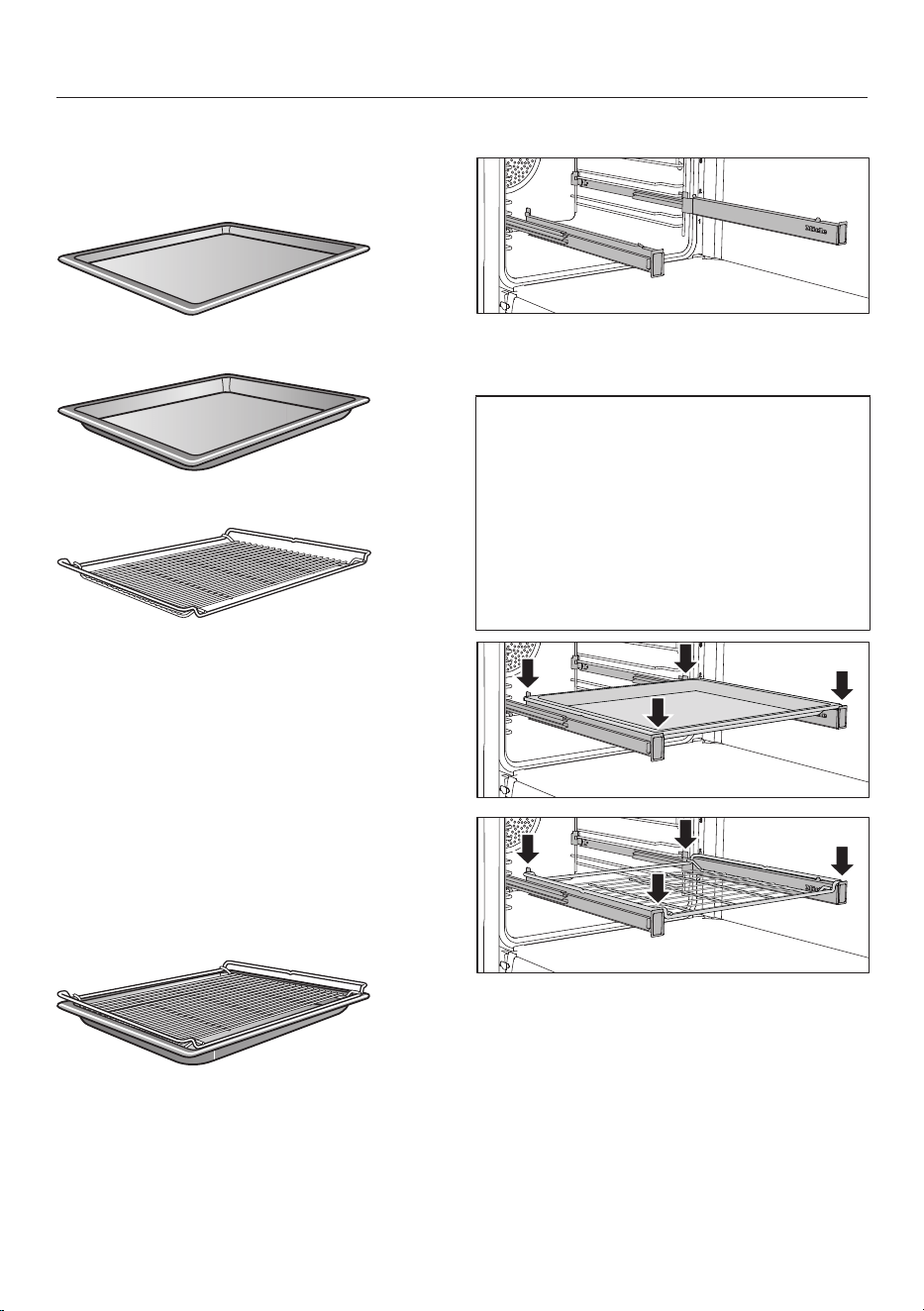
Side runners
Side runners for accessories are
installed on either side of the oven
compartment for shelf levels.
The shelf level numbers are indicated
on the front of the oven frame.
Each level consists of 2rails, one above
the other.
The accessories (e.g., the wire rack) are
pushed into the oven between the two
rails.
The FlexiClip telescopic runners (if
present) are installed on the lower rail.
You can remove the side runners (see
“Cleaning and care of the oven –
Removing the side runners with
FlexiClip telescopic runners”).
Features
24
Baking tray, universal tray, and wire
rack with non-tip safety notches
Baking tray HBB71:
Universal tray HUBB71:
Wire rack HBBR72:
These accessories are inserted into the
oven between the two rails of a side
runner.
Always position the wire rack with the
loading surface in the lower position.
These accessories have non-tip safety
notches installed in the middle of their
short sides. These prevent the trays
from being pulled out completely from
the side runners when you only wish to
pull accessories out partially.
If you are using the universal tray with
the wire rack on top, insert the tray
between the rails of the side runners
and the rack will automatically slide in
above them.
FlexiClip telescopic runners HFC72
You can use the FlexiClip telescopic
runners on shelf levels1–4.
Push the FlexiClip telescopic runners
all the way into the oven before
placing accessories on them.
The accessories will then
automatically sit securely in between
the stoppers at either end of each
runner and be prevented from sliding
off.
The FlexiClip telescopic runners can
support a maximum load of 33lb
(15kg).
Features
25
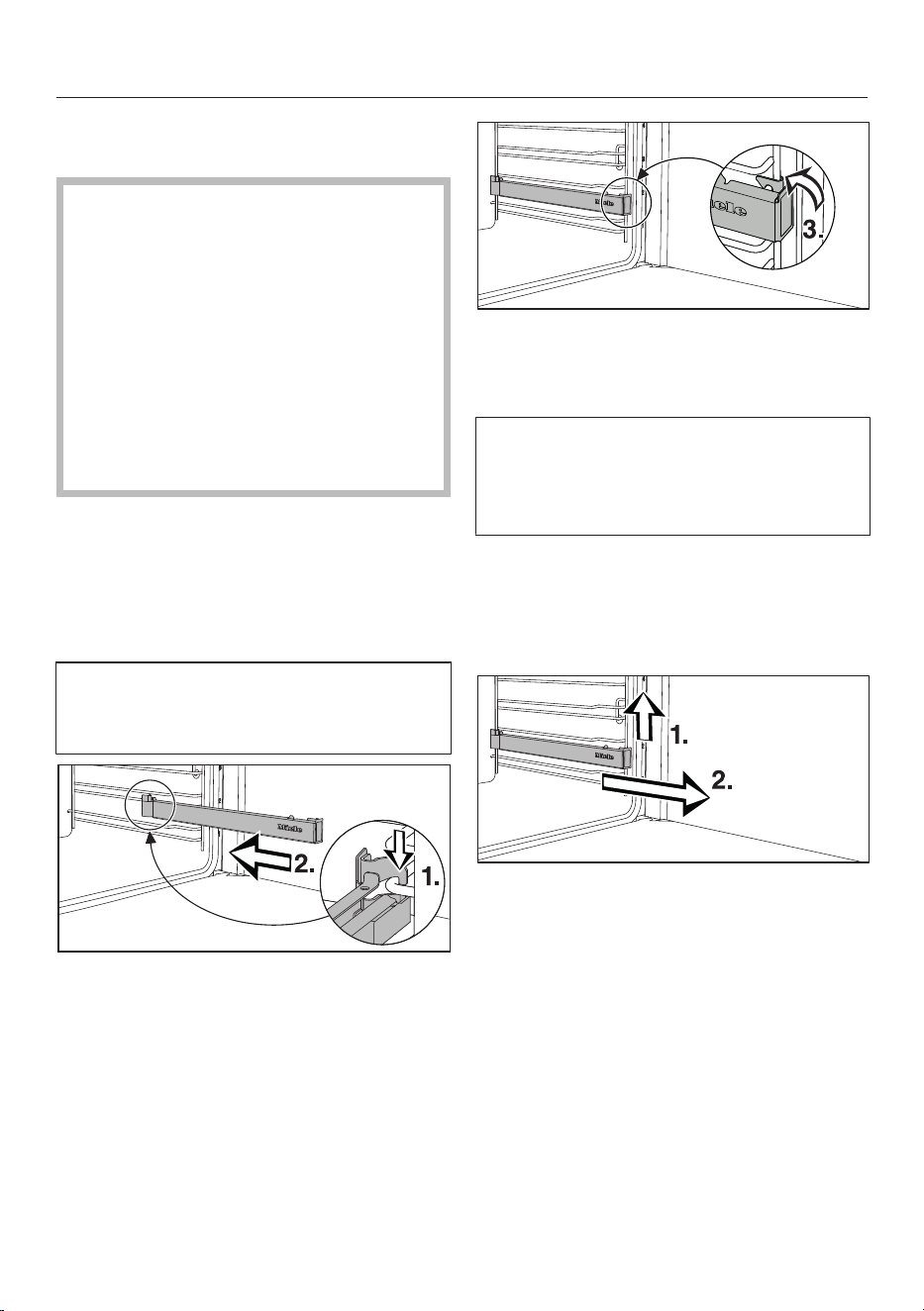
Installing and removing the FlexiClip
telescopic runners
Risk of injury caused by hot
surfaces.
The oven gets hot during operation.
You could burn yourself on the
heating elements, oven
compartment, or accessories.
Allow the heating elements, oven
compartment, and the accessories to
cool down before installing or
removing the FlexiClip telescopic
runners.
The FlexiClip telescopic runners are
installed in between the two rails that
make up a shelf level.
The FlexiClip telescopic runner with the
Miele logo is installed on the right.
When installing or removing the
FlexiClip telescopic runners, do not
extend them.
Hook the FlexiClip telescopic runner
onto the lower rail of a shelf level at
the front (1.) and push it along the rail
into the oven compartment (2.).
Then secure the FlexiClip telescopic
runner to the lower rail of the shelf
level (3.).
If the FlexiClip telescopic runners are
difficult to pull out after installing, you
may need to pull firmly on them once
to release them.
To remove a FlexiClip telescopic runner,
proceed as follows:
Push the FlexiClip telescopic runner
in all the way.
Remove the FlexiClip telescopic
runner by raising it at the front (1.)
and then pulling it forwards along the
rail of the shelf level and out (2.).
Features
26
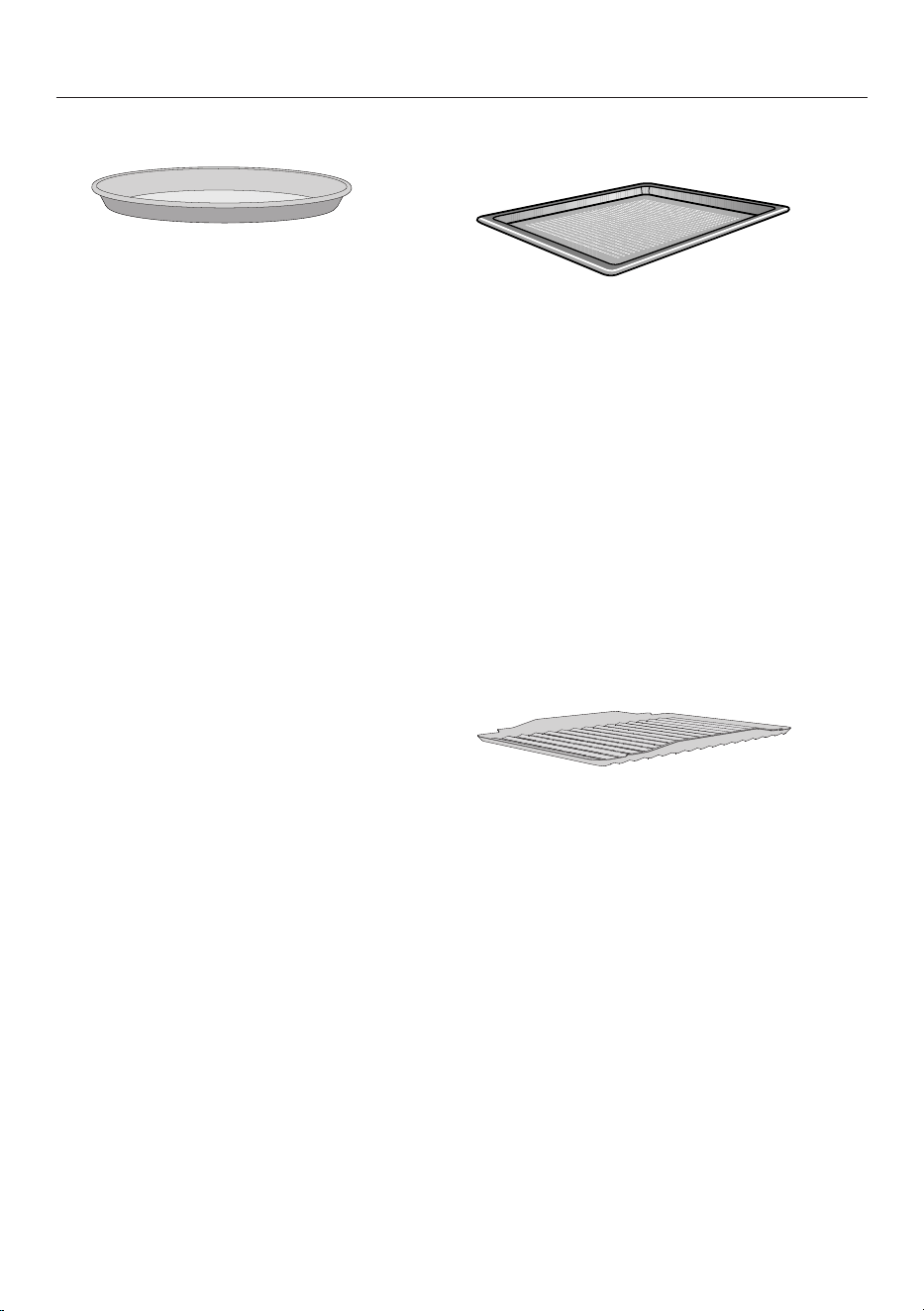
Round baking pans
The solid round baking pan HBF27-1
is suitable for cooking pizzas, flat
cakes, sweet and savory tarts, baked
desserts, flat bread, and can also be
used for frozen cakes.
The perforated round baking pan
HBFP27-1 has been specially
developed for baked goods made from
fresh yeast dough, and for baking bread
and rolls. The tiny perforations assist in
browning the underside of baked
goods.
They can also be used for dehydrating
or drying food.
The enameled surface of both baking
pans has been treated with
PerfectClean.
Insert the wire rack and place the
round baking pan on the rack.
Perforated Gourmet Baking Tray
HBBL71
The perforated Gourmet Baking Tray
has been specially developed for
preparing baked goods made from
fresh yeast doughs.
The tiny perforations assist in browning
the underside of baked goods.
The Gourmet Baking Tray can also be
used for dehydrating or drying food.
The enameled surface has been treated
with PerfectClean.
The round perforated baking tray
HBFP27-1 can be used for these
purposes.
Broiling and roasting insertHGBB71
The broiling and roasting insert fits in
the universal tray.
The tray will collect meat juices and
stop them from burning so that they
can be used for making gravy and
sauces.
The enameled surface has been treated
with PerfectClean.
Features
27
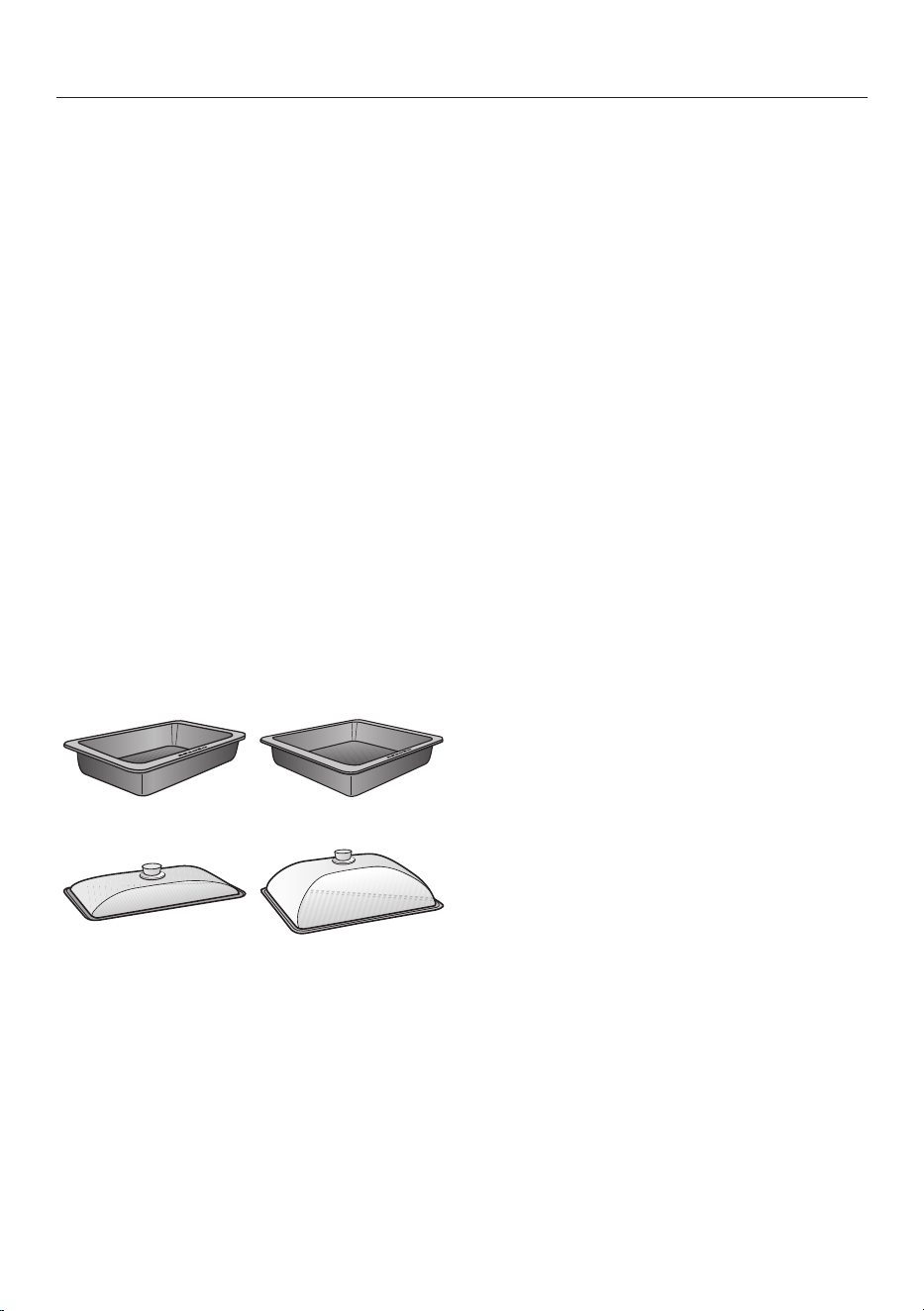
Gourmet Casserole Dishes HUB
Casserole dish lids HBD
Unlike other roasting dishes, the Miele
Gourmet Casserole Dishes can be
placed in the oven directly on the side
runners. They have non-tip safety
notches like the wire rack to prevent
them from being pulled out too far.
The surface of the casserole dishes has
a non-stick coating.
Gourmet Casserole Dishes are available
in different depths. The width and the
height are the same.
Suitable lids are available separately.
Please quote the model number when
ordering.
Depth:
81/2"(22cm)
Depth:
133/4"(35cm)
HUB5000-M
HUB5001-M*
HUB5001-XL*
HBD60-22 HBD60-35
* Suitable for induction cooktops
Safety features
- System lock
(see “Settings – Safety”)
- Sensor lock
(see “Settings – Safety”)
- Cooling fan
(see “Settings – Cooling fan run-on”)
- Safety shut-off
This safety shut-off is activated
automatically if the oven has been
operating for an unusually long
period of time. The period of time will
depend on the particular operating
mode being used.
- Ventilated door
The oven door is made of glass
panes that have a heat-reflective
coating on part of their surface.
When the oven is operating, air is
passed through the door to keep the
outer pane cool.
You can remove the door for cleaning
purposes (see “Cleaning and care of
the oven”).
- Door locking for Self Clean
At the beginning of a Self Clean
program, the door will lock for safety
reasons. The door will only unlock
when the temperature in the oven
compartment has dropped to below
535°F (280°C).

Features
28
PerfectClean treated surfaces
PerfectClean surfaces have very good
non-stick properties making them
exceptionally easy to clean.
Food can be easily removed from these
surfaces. Soiling from baking and
roasting can also be easily removed
from these surfaces.
However, do not use ceramic knives
as these will scratch the
PerfectClean surface.
Read the instructions in “Cleaning and
care of the oven” to retain the benefits
of the non-stick properties and easy
cleaning.
PerfectClean treated surfaces:
- Universal tray
- Baking tray
- Broiling and roasting insert
- Perforated Gourmet Baking Tray
- Round perforated baking pan
- Round baking pan
Self-Clean-ready accessories
See “Cleaning and care of the oven” for
more information.
The following accessories can be left in
the oven compartment during the Self
Clean program:
- Side runners
- FlexiClip telescopic runners HFC72
- Wire rack
Before first use
29
Miele@home
Your oven is equipped with an
integrated WiFi module.
To use this feature, you will need:
- A WiFi network
- The Miele app
- A Miele user account. You can create
a user account via the Miele app.
The Miele app will guide you as you
connect your oven to your home WiFi
network.
Once your oven is connected to your
WiFi network, you can use the app to
carry out various activities, such as:
- Call up information on the operating
status of your oven
- Retrieve information on cooking
processes that are in progress
- Stop cooking programs that are in
progress
Connecting your oven to your WiFi
network will increase energy
consumption, even when the oven is
turned off.
Make sure that the signal of your
WiFi network is sufficiently strong in
the place where your oven is
installed.
Availability of the WiFi connection
The WiFi connection shares a frequency
range with other appliances (including
microwave ovens and remote control
toys). This can cause sporadic or even
complete connection failures.
Therefore, the availability of featured
functions cannot be guaranteed.
Miele@home availability
The ability to use the Miele app
depends on the availability of the
Miele@home service in your country.
The Miele@home service is not
available in every country.
For information about availability,
please visit www.miele.com.
Miele App
The Miele App is available to download
free of charge from the Apple App
Store
®
or from the Google Play Store™.

Before first use
30
Basic settings
You must make the following settings
before starting up for the first time. You
can change these settings again at a
later time (see “Settings”).
Risk of injury caused by hot
surfaces.
The oven gets hot during operation.
For safety reasons, only use the oven
when it has been fully installed.
The oven will turn on automatically
when it is connected to the electrical
supply.
Setting the language
Select the desired language.
If you have accidentally selected a
language that you don’t understand,
proceed as described in “Settings –
Language”.
Setting the location
Select the required location.
Setting up Miele@home
Set up “Miele@home” will appear on the
display.
To set up Miele@home now, confirm
by touching OK.
To set it up at a later date, select Skip
and confirm with OK.
See “Settings – Miele@home” for
information on setting up at a later
date.
To set up Miele@home immediately,
select the connection method you
want to use.
You will then be guided by the display
and the Miele app.
Setting the time
Set the time of day in hours and
minutes.
Confirm with OK.
Setting the voltage
The set voltage variant must
match the voltage of the domestic
electrical supply in order to avoid the
risk of damage to the oven.
Confirm the voltage before setting. If
in any doubt, consult a qualified
electrician.
Select the voltage variant.
Confirm with OK.
Completing the commissioning
process
Follow any further instructions on the
display.
The appliance is now ready for use.

Before first use
31
Heating the oven for the first
time
New ovens may have a slight odor
during their first use. Heating up the
oven for at least an hour with nothing in
it will eliminate the odor.
Ensure that the kitchen is well
ventilated while the appliance is being
heated up for the first time.
Close doors to other rooms to prevent
the odor spreading throughout the
house.
Remove any adhesive labels or
protective films from the ovens and
accessories.
Before heating the oven up, wipe the
interior with a damp cloth to remove
any dust or bits of packaging.
Insert the FlexiClip telescopic runners
(if available) into the side racks and
insert all trays and the wire rack.
Turn the oven on using the On/Off
button.
Select operating mode will appear.
Select Convection Bake.
The recommended temperatures are
displayed (375°F/160°C).
The oven heating, lighting, and cooling
fan will turn on.
Set the highest possible temperature
(475°F/250°C).
Confirm with OK.
Heat up the oven for at least an hour.
After at least an hour, turn the oven
off with the On/Off button.
Cleaning the oven compartment after
heating it up for the first time
Risk of injury caused by hot
surfaces.
The oven gets hot during operation.
You could burn yourself on the
heating elements, oven
compartment, or accessories.
Allow the heating elements, oven
compartment, and accessories to
cool before manual cleaning.
Take all accessories out of the oven
compartment and clean it by hand
(see “Cleaning and care of the oven”).
Clean the oven compartment with
warm water and liquid dish soap,
applied with a soft sponge or
microfiber cloth.
Dry all surfaces with a soft cloth.
Leave the oven door open until the
oven compartment is completely dry.

Settings
Settings overview
Menu option Available settings
Language ...| deutsch| english| ...
Location
Time Display
On*| Off| Night dimming
Clock format
12 h*| 24 h
Set
Lighting On
“On” for 15 seconds*
Off
Display Brightness
QuickTouch
On| Off*
Volume Buzzer tones
Melodies*
Solo Tone
Keypad tone
Welcome Melody
On*| Off
Units Temperature
°C| °F*
Electrical version 208V / 60Hz
220V / 60Hz
240V / 60Hz
Calibrate temperature
Booster On*| Off
Recommended temps.
Self clean recommended On*| Off
Cooling fan run-on Temperature controlled*
Time controlled
* Factory default
32

Settings
Menu option Available settings
Safety Sensor lock
On| Off*
System lock
On| Off*
Miele@home Activate| Deactivate
Connection status
Set up again
Reset
Set up
Remote control On*
Off
RemoteUpdate On*
Off
Software version
Showroom program Demo Mode
On| Off*
Factory default Appliance settings
Recommended temps.
* Factory default
33

Settings
34
Opening the “Settings” menu
In theMore| Settings menu, you can
personalize your oven by adapting the
factory default settings to suit your
requirements.
Select More.
Select Settings .
Select the setting you want.
You can check settings or change them.
You cannot change settings while a
cooking program is in progress.
Language
You can set your language and location.
After selecting and confirming your
choice, the language you have selected
will appear on the display.
Tip: If you have selected the wrong
language by mistake, select the
sensor button. Follow the symbol
to get back to the Language submenu.
Time
Display
Select how you want the time of day to
show on the display when the oven is
turned off:
-
On
The time is always visible on the
display.
If you also select the Display|
QuickTouch| On setting, all sensor
buttons will react to touch straight
away.
If you also select the Display|
QuickTouch| Off setting, the oven has to
be turned on before it can be used.
- Off
The display appears dark to save
energy. The oven has to be turned on
before you can use it.
- Night dimming
To save energy, the time only shows
on the display between 5:00a.m. and
11:00p.m. The display remains dark
at all other times.
Clock format
The time of day can be displayed in the
24 or 12-hour format (24 h or 12 h).
Set
Set the hours and the minutes.
If there is a power failure, the current
time of day will reappear once the
power has been restored. The time of
day is saved for approx. 150hours.
If the oven has been connected to a
WiFi network and signed into the Miele
app, the time will be synchronized
based on the location setting in the
Miele app.
Lighting
- On
The oven interior lighting is turned on
during the entire cooking period.
- “On” for 15 seconds
The oven interior lighting turns off
15seconds after a cooking program
has begun. Press the sensor
button to turn the oven interior
lighting on again for 15seconds.
- Off
The oven interior lighting is turned
off. Press the sensor button to
turn the oven interior lighting on for
15seconds.

Settings
35
Display
Brightness
The display brightness is represented
by a segment bar.
-
Maximum brightness
-
Minimum brightness
QuickTouch
Select how the sensor buttons should
respond when the oven is turned off:
- On
If you have also selected the Time|
Display| On or Night dimming setting,
the sensor button will also respond
when the oven is turned off.
- Off
Regardless of the Time| Display
setting, the sensor buttons only
respond when the oven is turned on,
as well as for a certain amount of
time after turning it off.
Volume
Buzzer tones
If audible signals are turned on, an
audible signal will sound when the set
temperature is reached and at the end
of a set time.
Melodies
At the end of a process, a melody will
sound several times at intervals.
The volume of the melody is
represented by a segment bar.
-
Maximum volume
-
Melody is turned off
Solo Tone
At the end of a process, a continuous
tone will sound for a period of time.
The pitch of this continuous tone is
represented by a segment bar.
-
Maximum pitch
-
Minimum pitch
Keypad tone
The volume of the tone that sounds
each time you tap a sensor button is
represented by a segment bar.
-
Maximum volume
-
Keypad tone is turned off
Welcome Melody
The melody that sounds when you tap
the On/Off button can be turned on
or off.
Units
Temperature
You can set the temperature in Celsius
(°C) or Fahrenheit (°F).
Electrical version
You can set the voltage variant. The
setting must correspond to the voltage
of your domestic electrical supply.

Settings
36
Calibrate temperature
You can change the temperature in
increments in all operating modes and
automatic programs so that it is higher
or lower in the oven compartment than
displayed.
The temperature calibration is
represented by a bar with seven
segments.
If all of the segments are filled, the oven
compartment temperature is much
higher than displayed. If one segment is
filled, the oven compartment
temperature is much lower than
displayed.
Booster
The Booster function is used to quickly
preheat the oven.
- On
The Booster function is automatically
turned on during the preheating
phase of a cooking program. The
browning/broiling element, ring
heating element, and blower all
preheat the oven compartment to the
set temperature at the same time.
- Off
The Booster function is turned off
during the preheating phase of a
cooking program. Only the heating
elements for the selected operating
mode are used to preheat the oven
compartment.
Recommended temps.
If you often cook with temperatures that
differ from the default, the
recommended temperatures can be
changed.
After selecting this menu option, the list
of operating modes will appear in the
display together with their
recommended temperatures.
Select the operating mode you want
to use.
Change the recommended
temperature.
Confirm with OK.
Self clean recommended
You can set whether the
recommendation for carrying out the
Self Clean function will appear (On) or
will not appear (Off).
Cooling fan run-on
The cooling fan will continue to run for a
while after the oven has been turned off
to prevent any humidity building up in
the oven, on the control panel, or in the
cabinet carcase.
- Temperature controlled
The cooling fan turns off when the
temperature in the oven drops below
approx. 160°F (70°C).
- Time controlled
The cooling fan turns off after a
period of about 25minutes.

Settings
37
Condensation can damage the
cabinet carcase and the countertop.
This could lead to corrosion of the
oven.
When keeping food warm in the
oven, increases to the Time controlled
setting can lead to condensation in
the control panel and moisture on
the countertop and cabinet doors.
Do not adjust the Time controlled
setting and try not to leave food in
the warm oven.
Safety
Sensor lock
The sensor lock prevents the cooking
program from being turned off by
mistake or settings from being
changed. Once activated, the sensor
lock prevents the sensor buttons and
fields on the display from working for a
few seconds after a program has been
started, with the exception of the On/
Off button.
- On
The sensor lock is active. TouchOK
sensor button for at least 6seconds
to deactivate the sensor lock for a
short period of time.
- Off
The sensor lock is not active. All
sensor buttons react to touch as
normal.
System lock
The system lock prevents the oven from
being turned on inadvertently.
You can still set a timer as well as use
the MobileStart function when the
system lock is active.
The system lock will remain activated
even after a power failure.
- On
The system lock is now active.
Before you can use the oven, touch
the OK sensor button for at least
6seconds.
- Off
The system lock is now deactivated.
You can use the oven as normal.
Miele@home
The oven is a Miele@home-compatible
appliance. Your oven is equipped ex-
works with a WiFi communication
module and is suitable for wireless
communication.
There are a number of ways of
connecting your oven to your WiFi
network. We recommend connecting
your oven to your WiFi network using
the Miele app or via WPS.
- Activate
This setting is only visible if
Miele@home is deactivated. The WiFi
function is reactivated.
- Deactivate
This setting is only visible if
Miele@home is activated.
Miele@home remains set up; the WiFi
function is turned off.
- Connection status
This setting is only visible if
Miele@home is activated. The display
shows information such as the WiFi
reception quality, network name, and
IP address.

Settings
38
- Set up again
This setting is only visible if a WiFi
network has already been set up.
Reset the network settings and set
up a new network connection straight
away.
- Reset
This setting is only visible if a WiFi
network has already been set up. The
WiFi function is deactivated and the
WiFi connection will be reset to the
factory default. You must set up a
new WiFi connection to be able to
use Miele@home.
Reset the network settings if you are
disposing of or selling your oven, or if
you are putting a used oven into
operation. This is the only way to
ensure that all personal data has
been removed and the previous
owner will no longer be able to
access the oven.
- Set up
This setting is only visible if no WiFi
connection has been set up yet. You
must set up a new WiFi connection to
be able to use Miele@home.
Remote control
If you have installed the Miele app on
your mobile device, have access to the
Miele@home system, and have
activated the remote control function
(On), you can use the MobileStart
function to retrieve information on oven
cooking programs that are in progress
or to end a program in progress.
Activating MobileStart
Select the sensor button to
activate MobileStart.
The sensor button lights up. You can
operate your oven remotely with the
Miele app.
Directly operating on the oven takes
priority over operating it via the remote
control function on the app.
You can use MobileStart as long as
the sensor button is lit up.
RemoteUpdate
The RemoteUpdate menu option is only
displayed and can only be selected if
the requirements for using
Miele@home have been met (see
“Before using for the first time –
Miele@home”).
The RemoteUpdate function is used for
updating the software in your oven. If
an update is available for your oven, it
will automatically download it. Updates
will not be installed automatically. They
must be initiated manually.
If you do not install an update, you can
continue to use your oven as usual.
However, Miele recommends installing
updates.
Activating/deactivating
The RemoteUpdate function is
activated as standard. Available
updates will be downloaded
automatically but will only be installed if
you initiate installation manually.
Deactivate RemoteUpdate if you do not
want any updates to be downloaded
automatically.

Settings
39
Running a RemoteUpdate
Information about the content and
scope of an update is provided in the
Miele app.
A message will appear on your oven
display if a software update is available.
You can install the update immediately
or postpone this until later. When the
oven is turned on again, you will be
reminded about the update.
Deactivate RemoteUpdate if you do not
want to install the update.
The update may take several minutes.
Please note the following information
about the RemoteUpdate function:
- You will only receive a message when
an update is available.
- Once an update has been installed, it
cannot be undone.
- Do not turn the oven off during the
update. Otherwise, the update will be
aborted and will not be installed.
- Some software updates can only be
carried out by Miele Customer
Service.
Software version
The software version menu option is for
use by Miele Customer Service. You do
not need this information for domestic
use.
Showroom program
This function enables the oven to be
demonstrated in showrooms without
heating up. Do not activate this setting
for domestic use.
Demo Mode
If you have Demo mode activated,
Demo mode is active. The appliance will
not heat up will appear when you turn
on the oven.
- On
Touch the OK sensor button for at
least 4seconds to activate Demo
mode.
- Off
Touch the OK sensor button for at
least 4seconds to deactivate Demo
mode. You can use the oven as
normal.
Factory default
- Appliance settings
Any settings that have been altered
will be reset to the factory default
settings.
- Recommended temps.
Any recommended temperatures that
have been changed will be reset to
the factory default settings.

Timer
40
Using the Timerfunction
The timer can be used to time other
activities in the kitchen, e.g.,boiling
eggs.
The timer can also be used at the same
time as a cooking program for which
the start and finish times have been set
(e.g., as a reminder to stir the food or
add seasoning, etc.).
The maximum timer duration that can
be set is 59minutes and 59seconds.
Tip: When using an operating mode
with moisture injection, use the timer to
remind you to inject steam manually at
the required time.
Setting the timer
If you have selected the Display|
QuickTouch| Off setting, you will need
to turn the oven on before setting the
timer. The timer can then be seen
counting down on the display when
the oven is turned off.
Example: You want to boil some eggs
and set a timer of 6minutes and
20seconds.
Select the sensor button.
Select Timer if a cooking program is in
progress at the same time.
The prompt Set00:00min will appear.
Using the navigation area, set 06:20.
Confirm with OK.
The timer duration is now saved.
When the oven is turned off, the timer
duration counts down on the display
and appears instead of the time of
day.
If you are cooking at the same time
without a set cooking duration, and
the timer time will appear as soon as
the selected temperature is reached.
If you are cooking at the same time
with a set cooking duration, the timer
will count down in the background as
the cooking duration takes priority in
the display.
If you are in a menu, the timer will count
down in the background.
At the end of the timer duration, will
flash, the time will start counting up,
and an audible signal will sound.
Select the sensor button.
If required, confirm with OK.
The audible signal will stop and the
symbols on the display will go out.
Changing the timer
Select the sensor button.
Select Timer if a cooking program is in
progress at the same time.
Select Change.
Confirm with OK.
The timer appears.
Change the time set for the timer.
Confirm with OK.
The altered timer time is now saved.
Deleting the timer
Select the sensor button.
Select Timer if a cooking program is in
progress at the same time.
Select Delete.
Confirm with OK.
The timer is deleted.
Main and submenus
As different countries have different preferences when it comes to preparing food,
the temperatures in °F and °C may not match. The temperatures are defined as
they are specified in the table.
Menu Recommended
temp.
Range
Operating Modes
Convection Bake 350°F (160°C) 85–475°F
(30–250°C)
Surround 400°F (180°C) 85–525°F
(30–280°C)
Bake 375°F (190°C) 200–525°F
(100–280°C)
Auto Roast 375°F (160°C) 200–450°F
(100–230°C)
Intensive 400°F (170°C) 125–475°F
(50–250°C)
Maxi Broil 500°F (240°C) 400–575°F
(200–300°C)
Convection Broil 400°F (200°C) 200–500°F
(100–260°C)
Self clean
Automatic programs
More
Convection Roast 375°F (170°C) 85–475°F
(30–250°C)
Defrost 100°F (25°C) 75–125°F
(25–50°C)
Settings
41

Energy-saving tips
42
Cooking programs
- If possible, use the automatic
programs for cooking food.
- Remove all accessories from the
oven that are not required for a
cooking process.
- If a temperature range is given, it is
best to select the lower temperature
and check the food after the shortest
cooking time given.
- Preheat the oven only if instructed to
do so in the recipe.
- Try not to open the door when
cooking.
- It is best to use dark bakeware and
cooking containers with a matte
finish made of non-reflective
materials (enameled steel, heat-
resistant glass, non-stick coated cast
aluminum). Shiny materials such as
stainless steel or aluminum reflect the
heat and therefore can give a more
uneven result. Do not cover the oven
floor or the wire rack with heat-
reflecting aluminum foil.
- Monitor cooking durations to avoid
wasting energy when cooking.
Set the cooking duration, or use a
food probe if you have one.
- Most food can be cooked using
Convection Bake/Convection
Roast. Because the blower
distributes the heat in the oven
compartment straight away, it allows
you to use a lower temperature than
you would with Surround. It also
enables you to cook on multiple shelf
levels at the same time.
- Convection Broil is the best
operating mode for broiled dishes.
Lower temperatures can be used
than with other broil modes that use
the maximum temperature setting.
- Whenever possible you should cook
several dishes at the same time.
Place them next to each other in the
oven or on different shelf levels.
- Dishes which you are unable to
prepare at the same time should, if
possible, be cooked one after the
other in order to make use of existing
heat in the oven.

Energy-saving tips
43
Residual heat utilization
- The temperature in cooking programs
using temperatures above 285°F
(140°C) which take longer than
30minutes to cook can be turned
down to the lowest possible
temperature about 5minutes before
the end of cooking. The residual heat
in the oven is sufficient for cooking
the food until it is done. However, do
not turn the oven off (see
“IMPORTANT SAFETY
INSTRUCTIONS”).
- If you have set a cooking duration for
a cooking program, the oven heating
elements will turn off automatically
shortly before the end of cooking.
The residual heat in the oven is
sufficient to complete the cooking
process.
- It is best to start the Self Clean
program immediately after a cooking
program. The residual heat in the
oven will help reduce the amount of
energy required.
Customizing settings
Select the Display| QuickTouch|
Offsetting for the control elements in
order to reduce energy consumption.
Select the Lighting| Off or “On” for 15
secondssetting for the oven interior
lighting. You can turn the oven interior
lighting on again at any time by
tapping the sensor button.
Energy-saving mode
The oven will turn itself off automatically
to save energy if a program is not being
run and no controls have been
operated. The time of day will appear
on the display or the display will remain
dark (see “Settings”).

Operation
44
Turn the oven on.
The main menu will appear.
Place the food in the oven.
Select the operating mode you want
to use.
The operating mode will appear first,
followed by the recommended
temperature.
Adjust the recommended
temperature, if necessary.
Otherwise, the recommended
temperature will be accepted within a
few seconds. You can change the
temperature later via the arrow
buttons.
Confirm with OK.
The actual temperature will appear and
the preheating phase will begin.
You will see the temperature rising on
the display. An audible signal will sound
when the set temperature is reached for
the first time.
After cooking, select the sensor
button for the selected operating
mode to end the cooking program.
Take the food out of the oven.
Turn the oven off.
Changing values and settings
for a cooking program
Depending on the operating mode, as
soon as a cooking program is in
progress, you can change the values or
settings for this program.
Depending on the operating mode, you
can change the following settings:
- Temperature
- Duration
- Finish at
- Start at
Changing the temperature
You can permanently reset the
recommended temperature to suit
your cooking preferences by selecting
More| Settings| Recommended
temps..
Select the or arrow buttons or
swipe to the right or left in the
area.
The desired temperature appears in the
display.
Change the desired temperature via
the navigation area.
The temperature changes in 5° steps.
Confirm with OK.
The cooking program will restart with
the new desired temperature.

Operation
45
Setting additional durations
Cooking results can be adversely
affected if there is a long delay
between the food being placed in the
oven and the start of cooking. Fresh
food can change color and even spoil.
When baking, the cake mixture or
dough can dry out, and the raising
agents can lose their effectiveness.
Select as short a time as possible
until the start of the cooking process.
You have placed the food in the oven,
selected a mode and the required settings
such as the temperature.
By entering Duration, Finish at, or Start at
via the sensor button, you can
automatically turn the cooking program
off or on and off.
- Duration
Enter the required cooking duration
for the food. The oven heating will
turn off automatically once the
cooking duration has elapsed. The
maximum cooking duration that can
be set depends on the mode that you
have selected.
- Finish at
Specify when you want the cooking
program to finish. The oven will turn
off automatically at the time you have
set.
- Start at
This function will only appear in the
menu if you have set a Duration or
Finish at time. With Start at, you have
to specify when you want the
cooking program to start. The oven
will turn on automatically at the time
you have set.
Select the sensor button.
Set the required times.
Confirm with OK.
Touch the sensor button to return
to the menu of the selected mode.
Changing set durations
Select the sensor button.
Select the time you want.
Confirm with OK.
Select Change.
Change the set time.
Confirm with OK.
Touch the sensor button to return
to the menu of the selected operating
mode.
These settings will be deleted in the
event of a power failure.
Deleting the set cooking durations
Select the sensor button.
Select the time you want.
Confirm with OK.
Select Delete.
Confirm with OK.
Touch the sensor button to return
to the menu of the selected operating
mode.
If you delete Duration, the set durations
for Finish at and Start at are also
deleted.
If you delete Finish at or Start at, the
cooking program will start using the
cooking duration set.

Operation
46
Canceling a cooking program
Touch the sensor button for the
selected operating mode or the
sensor button.
When Cancel process appears in the
display, confirm with OK.
The oven heating and lighting will then
turn off. Any cooking durations set will
be deleted.
The main menu will appear.
Preheating the oven
The Booster function is used to quickly
preheat the oven compartment in some
operating modes.
The oven only needs to be preheated in
a few cases.
You can place most dishes in the
cold oven compartment to make use
of the heat produced during the
preheating phase.
Preheat the oven when cooking the
following food with the following
operating modes:
- Dark bread dough, as well as roast
beef and fillets with the Convection
Bake/Convection Roast and
Surround operating modes
- Cakes and pastries with a short
cooking duration (approx. 30minutes
or less) as well as delicate items (e.g.,
sponge cake) with the Surround
operating mode (without the Booster
function)
Booster
The Booster function is used to quickly
preheat the oven.
This function is switched on as the
factory default setting for the following
operating modes (More| Settings|
Booster| On):
- Convection Bake
- Convection Roast
- Surround
- Auto Roast
If you set a temperature above 210°F
(100°C) and the Booster function is turned
on, a rapid preheating phase heats the
oven compartment to the set
temperature. The browning/broiling
element and the ring heating element
come on together with the hot air blower.
Delicate items (e.g., sponge or
cookies) will brown too quickly on the
top if the Booster function is used.
Turn off the Booster function for these
items.
Turning Booster off for a cooking
program
Select the Booster| Off setting before
selecting the desired operating mode.
The Booster function is turned off during
the preheating phase. Only the heating
elements for the selected operating
mode are used to preheat the oven
compartment.
If you then want to restart a cooking
program with the Booster function,
select the Booster| On setting to
switch the function on again.

Automatic programs
47
With the wide range of automatic
programs, you can achieve excellent
results with ease.
Categories
The automatic programs are sorted
into categories to provide a better
overview. Simply select the appropriate
automatic program for the type of food
you are cooking and follow the
instructions on the display.
Using automatic programs
Select Automatic programs.
A list will appear.
Select the food category you want.
The automatic programs available for
the category selected will then appear.
Select the automatic program that
you want to use.
Follow the instructions on the display.
Usage notes
- After cooking, allow the oven
compartment to cool down to room
temperature again before starting a
automatic program.
- Some automatic programs require a
preheating phase before food can be
placed in the oven. A prompt will
appear on the display indicating
when this needs to be done.
- Some automatic programs require
liquid to be added during the cooking
process. You will be prompted by a
message on the display when this
needs to be done (e.g., for adding
liquid).
- The duration quoted for automatic
programs is an estimate. It may
increase or decrease depending on
the program. The duration, in
particular with meat, will vary
depending on the initial temperature
of the food.
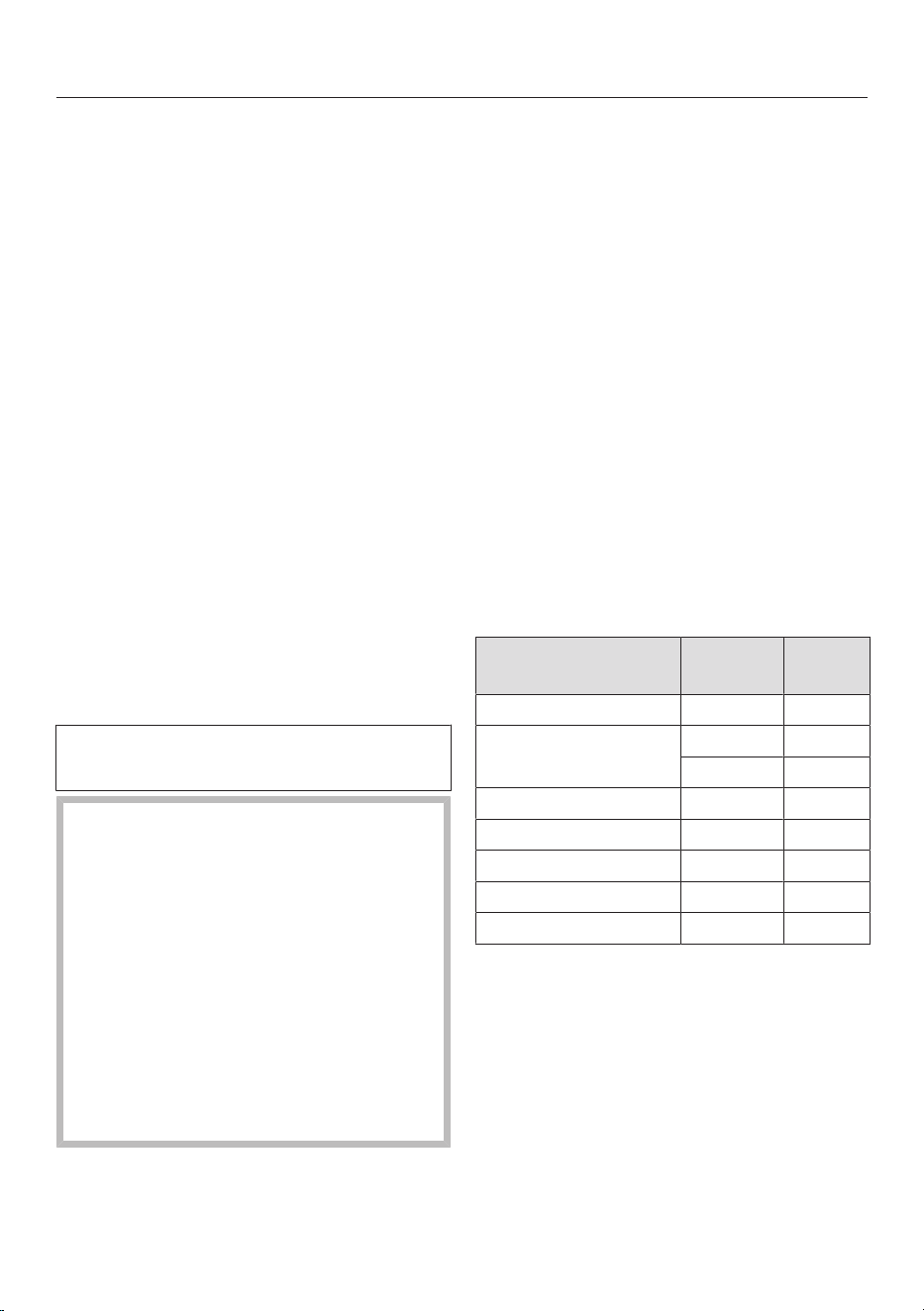
Further applications
48
This section provides information on the
following applications:
- Defrost
- Slow Roasting
- Heating dishware
- Canning
- Frozen food/ready meals
Defrost
Gentle defrosting of frozen food means
that the vitamins and minerals are
generally retained.
Select More.
Select Defrost.
Alter the recommended temperature
if necessary.
Air is circulated throughout the oven
compartment to gently defrost the food.
Always observe USDA/CFIA food
safety guidelines.
Risk of infection from bacteria.
Bacteria such as salmonella can
cause life-threatening food
poisoning.
It is particularly important to observe
food hygiene rules when defrosting
fish and meat, and in particular when
defrosting poultry.
Do not use the liquid produced
during defrosting.
Process the food as required as soon
as it has been defrosted.
Tips
- Remove the packaging and place the
frozen food on the universal tray or in
a suitable bowl or dish.
- Use the universal tray with the wire
rack placed on top of it for defrosting
poultry. This way the food will not be
lying in the defrosted liquid.
- Fish does not need to be fully
defrosted before cooking. Defrost
until the food has started to thaw.
The surface will then be sufficiently
thawed to take herbs and seasoning.
Defrosting durations
The duration needed for defrosting
depends on the type and weight of the
frozen food:
Frozen food
[oz/g]
[min]
Chicken 28/800 90–120
Meat
17.5/500 60–90
35/1000 90–120
Sausage 17.5/500 30–50
Fish 35/1000 60–90
Strawberries 10.5/300 30–40
Pound cake
17.5/500 20–30
Bread 17.5/500 30–50
Weight/defrosting duration

Further applications
49
Slow Roasting
Slow Roasting is ideal for cooking
delicate cuts of beef, pork, veal, or
lamb to perfection.
Always observe USDA/CFIA food
safety guidelines.
First briefly sear the meat on all sides at
a high temperature on the cooktop in
order to seal it.
Then place the meat in the preheated
oven where the low temperature and
long cooking duration will cook it to
perfection and ensure it is very tender.
The meat will relax. The juices inside
will start to circulate evenly throughout
the meat to reach the outer layers.
This gives very tender and succulent
results.
Only use lean meat which has been
correctly seasoned and trimmed.
Bones should be removed before
cooking.
For searing, use a suitable cooking oil
or fat that can withstand high
temperatures (e.g., clarified butter,
vegetable oil).
Do not cover meat during the cooking
process.
Cooking takes approx. 2–4hours
depending on the weight and size of
the meat and how well you want it
cooked.
As soon as the cooking program has
finished, you can carve the meat
straight from the oven. It does not
need to rest.
You can leave the meat in the oven to
keep warm until you serve it. This will
not affect results in any way.
Serve on preheated plates with very
hot sauce or gravy to prevent it
cooling down too quickly. The meat is
at an ideal temperature to eat straight
away.
Using Surround
Use the universal tray with the wire
rack placed on top of it.
Turn off the Boosterfunction for the
preheating phase.
Place the wire rack with the universal
tray on shelf level 2.
Select the Surround function and
a temperature of 250°F (120°C)
without the Booster function.
Preheat the oven together with the
universal tray and wire rack for
approx. 15minutes.
While the oven is preheating, sear the
meat on all sides on the cooktop.
Danger of burning due to hot
surfaces.
The oven gets hot during operation.
You could burn yourself on the
heating elements, oven
compartment, or accessories.
When the oven is hot, use pot
holders to insert, remove, or turn
food, as well as when adjusting the
oven shelves, etc.
Place the seared meat on the wire
rack.
Reduce the temperature to 210°F
(100°C).
Continue cooking until the end of the
cooking duration.

Further applications
Cooking durations/core temperatures
Always observe USDA/CFIA food safety guidelines.
Meat Cooking
duration
Core temperature
Beef tenderloin, approx. 2.2lbs
(1kg)
- rare
- medium
- well done
60–80min
75–85min
110–130min
113–119°F (45–48°C)
129–135°F (54–57°C)
145–151°F (63–66°C)
Prime rib, approx. 2.2lbs (1kg)
- rare
- medium
- well done
70–80min
105–115min
130–140min
113–119°F (45–48°C)
129–135°F (54–57°C)
145–151°F (63–66°C)
Pork tenderloin, approx. 0.75lbs
(350g)
70–90min 145–156°F (63–69°C)
Gammon joint*, approx. 2.2lbs
(1kg)
140–160min 145–151°F (63–66°C)
Veal tenderloin, approx. 2.2lbs
(1kg)
- pink
- medium
- well done
45–55min
75–85min
90–100min
113–119°F (45–48°C)
129–135°F (54–57°C)
145–151°F (63–66°C)
Saddle of veal*, approx. 2.2lbs
(1kg)
- pink
- medium
- well done
75–85min
100–130min
130–140min
113–119°F (45–48°C)
129–135°F (54–57°C)
145–151°F (63–66°C)
Saddle of lamb* 40–60min 129–151°F (54–66°C)
*
Boneless
50

Further applications
51
Canning
Risk of infection from bacteria.
The spores of the botulinum
bacterium are not sufficiently killed
by canning legumes and meat only
once. Toxins may form which can
lead to serious poisoning. These
spores are only destroyed by
canning the food again.
After they have cooled down, always
reheat legumes and meat a second
time within 2days.
Risk of injury from increased
pressure in sealed cans.
Canning food and heating it up in
closed containers results in an
increase in pressure which can
cause them to explode.
Do not use cans for canning or
reheating food.
Always observe USDA/CFIA food
safety guidelines.
Preparing fruit and vegetables
The instructions are for 6 jars with a
capacity of 1liter each.
Only use special jars for canning
(preserving jars or jars with a screw
cap). Only use undamaged jars and
rubber rings.
Rinse the jars with hot water before
canning and fill them up to a
maximum of 3/4" (2cm) below the
rim.
Slide the universal tray onto shelf
level2. Place the jars on the tray.
Select the Convection
Bakeoperating mode and a
temperature of 325-350°F
(160–170°C).
Wait until bubbles rise evenly in the
jars.
Then reduce the temperature to
prevent the contents from boiling over.

Further applications
52
Canning fruit and vegetables
Set the specified post-canning
warming temperature as soon as
bubbles are visible in the jars, then
leave the jars in the warm oven for
the time specified.
Canning vegetables
As soon as bubbles are visible in the
jars, set the specified preserving
temperature and cook the vegetables
for the time specified.
After canning, set the specified post-
canning warming temperature, then
leave the jars in the warm oven for
the time specified.
/ /
Fruit –/–
85°F
(30°C)/
25–35min
Pickling
cucumbers
–/–
85°F
(30°C)/
25–30min
Beets
250°F
(120°C)/
30–40min
85°F
(30°C)/
25–30min
Beans (green
or yellow)
250°F
(120°C)/
90–120min
85°F
(30°C)/
25–30min
/Canning temperature and time once
bubbles are visible in the jars
/Post-canning warming temperature
and time
Removing the jars after canning
Risk of injury caused by hot
surfaces.
The jars will be very hot after
canning.
Use oven mitts when removing the
jars from the oven.
Take the jars out of the oven.
Cover the jars with a towel and leave
to set for approx. 24hours in a draft-
free area.
After they have cooled down, always
reheat beans and meat a second time
within 2days.
Remove the fasteners from the jars
and make sure all jars are closed
properly when storing them.
Either boil open jars again or store
them in a cool place and consume the
preserved fruit or vegetables
immediately.
Check the jars during storage. If jars
have opened during storage or if the
screw cap is bulging and does not
make a popping noise when opened,
dispose of the contents.

Further applications
53
Frozen food/ready meals
Tips for cakes, pizza, and baguettes
- Bake cakes, pizza, and baguettes on
parchment paper on the wire rack.
- Use the lowest temperature
recommended by the manufacturer.
Tips for French fries, croquettes, and
similar items
- Cook frozen food items on parchment
paper placed on a baking tray or the
universal tray.
- Use the lowest temperature
recommended by the manufacturer.
- Turn several times during cooking.
Preparing frozen food/ready meals
Handling and cooking food correctly
is essential for maintaining good
health.
Cakes, pizzas, and French fries
should be cooked until golden, not
dark brown.
Select the operating mode and
temperatures recommended on the
food’s packaging.
Preheat the oven.
Place the food in the preheated oven
on the shelf level recommended on
the packaging.
Check the food at the end of the
shortest time recommended on the
packaging.
Warm-up Cookware
Use the Convection Bake operating
mode for preheating dishware.
Only preheat heat-resistant dishware.
Place the wire rack on shelf level1
and place the dishware to be
preheated on it. Depending on the
size of the dishware, you can also
place the wire rack on the oven floor
and take the side racks out to make
more room.
Select Convection Bake.
Set the temperature to 120-175°F
(50–80°C).
Danger of burning!
Use pot holders when removing
dishware. Condensation may
accumulate on the bottom of the
dishware.
Remove the heated dishware from
the oven.

Baking
54
Handling and cooking food correctly
is essential for maintaining good
health.
Cakes, pizzas, and French fries
should be cooked until golden, not
dark brown.
Always observe USDA/CFIA food
safety guidelines.
Tips for baking
- Set a cooking duration. If used for
baking, do not delay the start for too
long. Otherwise the cake mixture or
dough will dry out, and the raising
agents will lose their effectiveness.
- Generally speaking, you can use wire
racks, baking trays, universal trays,
and any type of bakeware made of
heat-resistant material.
- Avoid using bright, thin-walled pans
made from a shiny material as they
give an uneven or poor browning
result. In certain unfavorable
conditions, the food will not cook
properly.
- Place cakes in rectangular bakeware
on the wire rack with the longer side
across the width of the oven for
optimum heat distribution and even
results.
- Always place bakeware on the wire
rack.
- When baking cakes with fruit
toppings or deep cakes, place the
pan on the universal tray to catch any
spillages.
Using parchment paper
Miele accessories, e.g., the universal
tray, are treated with PerfectClean (see
“Features”). Surfaces treated with
PerfectClean generally do not need to
be greased or covered with parchment
paper.
Use parchment paper when baking
lye mixtures (e.g., pretzels) because
the sodium hydroxide can damage
the PerfectClean treated surface.
Use parchment paper when baking
sponge cake, meringue, macaroons,
or similar items. These are more likely
to stick due to their high egg white
content.
Use parchment paper when cooking
frozen food on the wire rack.
Selecting the temperature
Select the suggested temperature in
general.
Choosing a baking temperature higher
than those recommended may reduce
the cooking time, but will lead to
uneven browning and unsatisfactory
cooking results.
Selecting the cooking duration
Check whether the food is cooked
shortly before the end of the specified
cooking duration. Stick a wooden
skewer into the food.
If it comes out clean without any batter/
dough on it, the food is done.

Baking
55
Notes on the operating modes
You can find an overview of all the
operating modes with their
recommended values in “Main and
submenus”.
Using Automatic programs
Follow the instructions on the display.
Using Convection Bake
Because the blower distributes the heat
around the oven compartment straight
away, you can use a lower temperature
than you would with the
Surroundoperating mode.
Use this operating mode if you are
baking on multiple shelf levels at the
same time.
1shelf: Place the food on shelf
level2.
2shelves: Place the food on shelf
levels1+3 or 2+4.
3shelves: Place the food on shelf
levels1+3+5.
Tips
- If you are cooking on multiple shelf
levels at the same time, slide the
universal tray in on the lowest level.
- For moist cookies and cakes, bake on
a maximum of 2shelf levels at once.
Using Intensive
Use this operating mode for baking
cakes with moist toppings.
Do not use this operating mode for
baking thin biscuits.
Place cakes on shelf level1 or 2.
Using Surround
Dark metal, enamel, or aluminum
bakeware with a matte finish, as well as
heat-resistant glass, ceramic, and
coated bakeware can be used.
Use this operating mode for cooking
traditional recipes. If using an older
recipe or cookbook, set the oven
temperature 25°F (10°C) lower than that
recommended. This will not change the
cooking duration.
Place the food on shelf level1 or 2.

Roasting
56
Tips for roasting
- You can use all dishware made from
temperature-resistant materials, e.g.,
roasting dishes, roasting pans with
lid, ovenproof glass dishes, roasting
bags, dishes made from earthenware
or cast iron, the universal tray, wire
rack, and/or anti-splash insert (if
available) on top of the universal tray.
- Preheating the oven is only required
when preparing roast beef and fillets.
Preheating is generally not necessary.
- Use a closed cooking container for
roasting meat, such as a roasting
dish. The meat will stay succulent.
The oven compartment will also stay
cleaner than when roasting on the
wire rack. It ensures that enough
stock remains for making gravy.
- If you are using a roasting bag,
follow the instructions on the
packaging.
- If you are using the wire rack or an
open cooking container for roasting,
you can add a little fat or oil to very
lean meat or place a few strips of
bacon on the top.
- Season the meat and place in the
cooking container. Dot with butter or
brush with oil or cooking fat. For large
lean cuts of meat (4–6lb/2–3kg) and
fatty poultry, add about 1/2cup
(1/8liter) of water to the dish.
- Do not add too much liquid during
cooking as this will hinder the
browning process. Browning only
occurs towards the end of the
cooking duration. Remove the lid
about halfway through the cooking
duration if you want a more intensive
browning result.
- At the end of the program, take the
food out of the oven, cover it, and
leave to stand for about 10minutes.
This helps retain the juices when the
meat is sliced.
- For a crisp finish, baste poultry
10minutes before the end of the
cooking duration with slightly salted
water.
Selecting the temperature
As a general rule, select the
temperature given in the
corresponding recipe.
For large pieces of meat, do not
choose a temperature that is too
high. The roasting process will take
longer, but the meat will cook through
evenly and the skin or crackling will
not be too thick.
When cooking with Convection
Roast and Auto Roast, select
a temperature 70°F (20°C) lower than
when using Surround.
When roasting on the wire rack, set a
temperature approx. 50°F (10°C)
lower than for roasting in a covered
cooking container.

Roasting
57
Selecting the cooking duration
Check whether the food is cooked
shortly before the end of the specified
cooking duration.
Tips
- For frozen meat, increase the cooking
duration by approx. 10minutes per lb
(20minutes per kg).
- Frozen meat weighing less than
approx. 3.3 lb (1.5kg) does not need
to be defrosted before roasting.
Notes on the operating modes
You can find an overview of all the
operating modes with their
recommended values in “Main and
submenus”.
Use the Bakeoperating mode
towards the end of the cooking
duration to brown the base of the
food.
Do not use the Intensiveoperating
mode for roasting as the juices will
become too dark.
Using Automatic programs
Follow the instructions on the display.
Using Convection Roast or Auto
Roast
These operating modes are suitable for
roasting meat, fish, and poultry that
needs to be well browned, as well as
sirloin joints and fillet.
The Convection Roast operating
mode allows you to use a lower
temperature than you would with the
Surround operating mode, because
the heat is immediately distributed
throughout the oven compartment.
With the Auto Roast operating
mode, the oven compartment heats
initially to a high searing temperature
(approx. 450°F/230°C). As soon as this
temperature has been reached, the
oven automatically drops the
temperature back down to the pre-
selected cooking temperature
(continued roasting temperature).
Place the food on shelf level2.
Using Surround
Use this operating mode for cooking
traditional recipes. If using an older
recipe or cookbook, set the oven
temperature 50°F (10°C) lower than
that recommended. This will not change
the cooking duration.
Place the food on shelf level2.
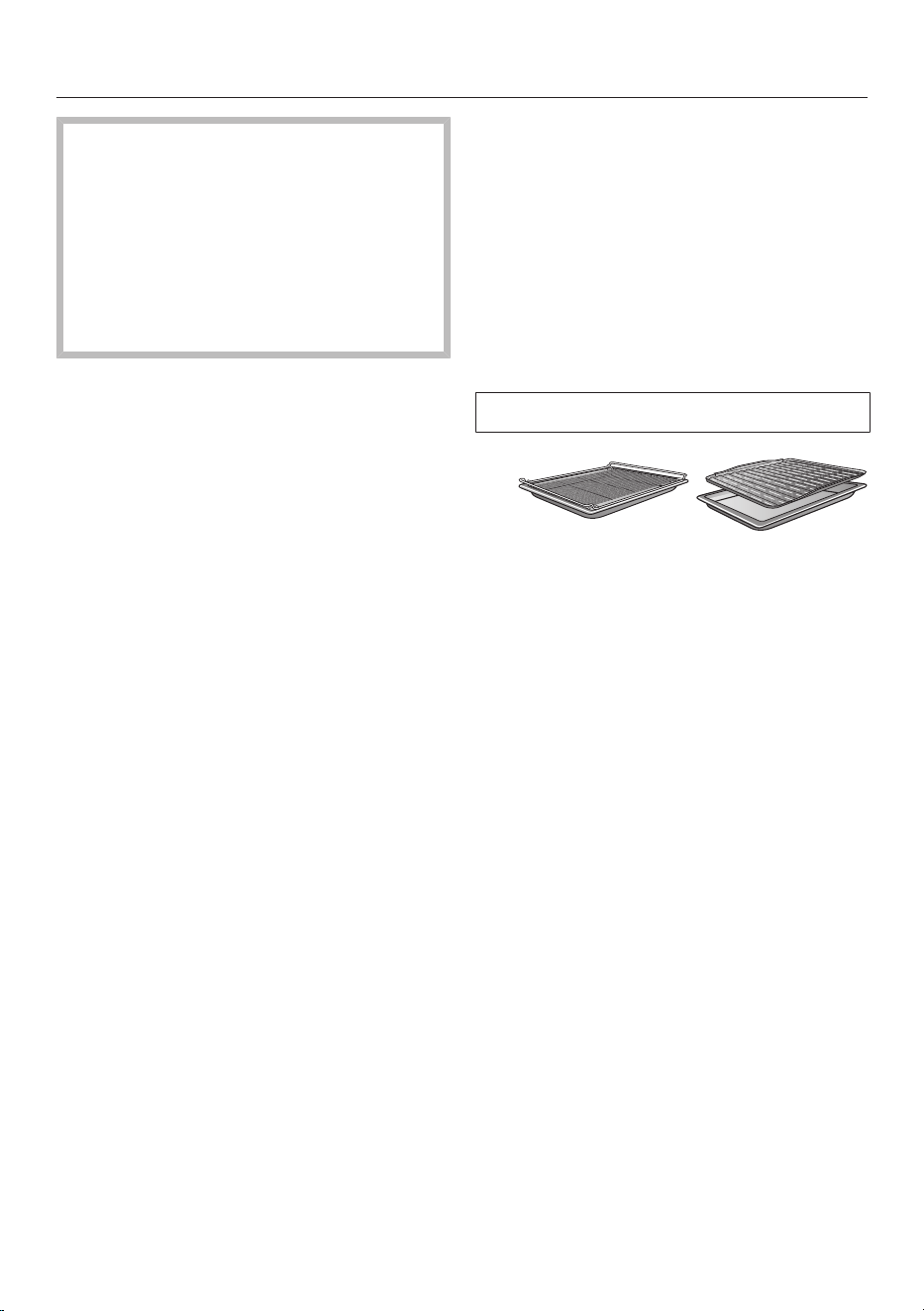
Broiling
58
Risk of injury caused by hot
surfaces.
If you broil with the door open, the
hot air will escape from the oven
before it has been cooled by the
cooling fan. The control elements will
get hot.
Broil with the oven door closed.
Tips for broiling
- Preheating is necessary when
broiling. Preheat the browning/
broiling element for approx. 5minutes
with the door closed.
- Trim the meat if necessary. Do not
season the meat with salt before
broiling, as this will draw out the
juices.
- Add a little oil to lean meat if
necessary. Do not use other types of
fat as they can easily burn and cause
smoke.
- Clean fish in the normal way. To
enhance the flavor, season with a
little salt. You can also drizzle the fish
with lemon juice.
- Use the universal tray with the wire
rack or the broiling and roasting insert
(if present) placed on top. The tray
under the insert will collect the meat
juices and stop them from burning so
that they can be used for making
gravy and sauces. Brush the wire
rack or the broiling and roasting insert
with oil and then place the food on
top.
Do not use the baking tray.
Selecting the temperature
As a general rule, select the
temperature given in the
corresponding recipe.
For large pieces of meat, do not
choose a temperature that is too
high. The roasting process will take
longer, but the meat will cook through
evenly and the skin or crackling will
not be too thick.
Choosing a shelf level
Select the shelf level depending on
the thickness of the food to be
cooked.
Place flat food on shelf level3 or 4.
Place thicker food on shelf level1 or
2.

Broiling
59
Selecting the cooking duration
Broil thinner cuts of meat/slices of
fish for approx. 6–8minutes per side.
It is best to broil food of a similar
thickness at the same time so that
the cooking durations do not vary too
much.
Check whether the food is cooked
shortly before the end of the specified
cooking duration.
Tip: If the surface of a thicker cut of
meat is browned but the center is still
raw, move the food to a lower level or
reduce the temperature and continue
broiling. This will stop the surface from
becoming too dark.
Notes on the operating modes
You can find an overview of all the
operating modes with their
recommended values in “Main and
submenus”.
Using Maxi Broil
Use this operating mode to broil flat thin
cuts in large quantities and for browning
large baked dishes.
The entire browning/broiling element
will become red hot to produce the
necessary heat.
Using Convection Broil
This operating mode is suitable for
broiling thicker food, such as chicken.
We generally recommend a temperature
setting of 425°F (220°C) for thinner
types of food and 350-400°F (180–
200°C) for thicker cuts.

Cleaning and care of the oven
60
Risk of injury caused by hot
surfaces.
The oven gets hot during operation.
You could burn yourself on the
heating elements, oven
compartment, or accessories.
Allow the heating elements, oven
compartment, and accessories to
cool before manual cleaning.
Risk of injury due to electric
shock.
The steam from a steam cleaning
appliance could reach live electrical
components and cause a short
circuit.
Never use a steam cleaner for
cleaning.
All surfaces could be discolored or
damaged if unsuitable cleaning
agents are used. The oven front is
particularly susceptible to damage
from oven cleaners or descaling
agents.
All surfaces are susceptible to
scratching. Scratches on glass can
lead to breakage in some
circumstances.
Remove all cleaning agent residues
immediately.
Unsuitable cleaning agents
To avoid damaging the surfaces of your
appliance, do not use:
- Cleaning agents containing soda,
ammonia, acids, or chlorides
- Cleaning agents containing descaling
agents on the front
- Abrasive cleaning agents
(e.g.,powder cleaners and cream
cleaners)
- Solvent-based cleaning agents
- Stainless steel cleaning agents
- Dishwasher cleaner
- Glass cleaners
- Cleaning agents for ceramic
cooktops
- Hard, abrasive brushes or sponges
(e.g.,pot scourers, brushes, or
sponges which have been previously
used with abrasive cleaning agents)
- Eraser sponges
- Sharp metal scrapers
- Steel wool
- Spot cleaning with mechanical
cleaning agents
- Oven cleaners
- Stainless-steel spiral pads
If soiling is allowed to sit for any
length of time, it may become
impossible to remove. If items are
used frequently without being
cleaned, it may become very difficult
to clean them.
It is therefore best to remove any
soiling immediately.
The accessories are not
dishwasher-safe.

Cleaning and care of the oven
61
Tip: Soiling caused by spilled fruit
juices and cake mixtures is best
removed while the oven is still warm.
Use caution and make sure the oven is
not too hot.
To make it easier to clean the oven:
Remove the door.
Remove the side runners together
with the FlexiClip telescopic runners
(if present).
Lower the browning/broiling element.
Removing normal soiling
There is a fiberglass seal around the
oven compartment which seals the
inside of the glass oven door and
can be damaged by rubbing and
scouring.
Avoid cleaning the fiberglass seal.
The fiberglass seal is essential for
sealing the door properly.
Remove normal soiling immediately
with warm water, liquid dish soap,
and a clean sponge or a clean, damp
microfiber cloth.
Remove all cleaning agent residues
thoroughly with clean water.
This is particularly important for any
parts with a PerfectClean finish, as
cleaning agent residues will impair
the non-stick function.
After cleaning, wipe the surfaces dry
using a soft cloth.
Removing stubborn soiling
Do not line the oven (e.g., with
aluminum foil) and do not use
standard oven cleaners unless they
are suitable for use in a self-cleaning
oven.
Spilt fruit and roasting juices may
cause lasting discoloration or matte
patches on surfaces. This
discoloration will not affect the
properties of the surface finish.
Do not attempt to remove these
marks. Clean them following the
instructions given here.
Baked-on deposits can be removed
with a glass scraper or with a
stainless-steel spiral pad, hot water,
and liquid dish soap.
You do not need to treat the oven
compartment with an oven cleaner as
the oven comes with Self Clean.
If necessary, you can use the
scouring pad on the back of a non-
scratching dish sponge to remove the
soiling after the holding time.
Remove all cleaning agent residues
thoroughly with clean water.
Dry all surfaces with a soft cloth.

Cleaning and care of the oven
62
Cleaning the oven
compartment with Self clean
Instead of cleaning the oven
compartment by hand, you can run the
Self cleanfunction.
During the Self Clean function, the oven
compartment reaches temperatures in
excess of 750°F (400°C). Any grime that
has accumulated will be broken down
and burnt to ash as a result of the high
temperatures.
There are 3Self Clean settings
available, each with a different duration:
- Level1 for light soiling
- Level2 for heavier soiling
- Level3 for very heavy soiling
The oven door is automatically locked
when the Self Clean process starts. It
cannot be opened until after the
program has finished.
The timer can be used to delay the start
time of the Self Clean program.
At the end of the Self Clean program,
any residues such as ash from the
cleaning process, which are formed
depending on the oven compartment’s
degree of soiling, can be easily wiped
away.
Preparing for Self Clean
Accessories that are not suitable for
the Self Clean program will be
damaged by the high temperatures.
Remove all accessories that are not
suitable for the Self Clean program
from the oven compartment before
starting the Self Clean process. This
also applies for optional accessories
that are not suitable for the Self
Clean program.
The following accessories are suitable
for the Self Clean program and can be
left in the oven compartment during the
process:
– Side runners
– FlexiClip telescopic runners HFC72
– Wire rack HBBR72
Remove all accessories that are not
suitable for the Self Clean program
from the oven.
Slide the wire rack into the top shelf
level.
Coarse soiling in the oven
compartment can cause thick smoke
to develop.
Burnt-on residues can cause lasting
discoloration or dull spots on
enameled surfaces.
Before starting the Self Clean
program, remove coarse soiling from
the oven compartment and scrape
any burnt-on residues off enameled
surfaces with a glass scraper.

Cleaning and care of the oven
63
Starting Self Clean
Risk of injury caused by hot
surfaces.
The oven gets much hotter during
the Self Clean program than during
normal use.
Do not let children touch the oven
during the Self Clean program.
Select Self clean.
Select the level required according to
the amount of soiling.
Confirm with OK.
Follow the instructions on the display.
Confirm with OK.
You can start the Self Clean program
straight away or schedule it to begin at
a later time.
Starting Self Clean straight away
To start the Self Clean program
straight away, select Start now.
Confirm with OK.
The Self Clean program will start.
The door will lock automatically. The
oven heating and the cooling fan will
then turn on automatically.
The oven interior lighting will not come
on during the Self Clean program.
The time left for the Self Clean program
will start counting down on the display.
You cannot alter the duration.
You can use the timer while the Self
Clean program is running. When the set
time has elapsed, the audible signal will
sound and will flash. The time will
then continue to increase on the display.
When you tap the sensor button, the
audible signal will stop and the symbols
on the display will go out.
Starting Self Clean at a later time
To start the Self Clean program later,
select Start at.
Confirm with OK.
Set the time at which you want the
Self Clean program to start.
Confirm with OK.
The door will lock automatically. Start at
and the start time set will appear on the
display.
The sensor button lights up orange.
You can reset the start time via the
sensor button at any point up to the
start time.
Once the start time has been reached,
the oven heating and cooling fan
functions will be automatically
activated. The time left will appear on
the display.
Finishing Self Clean
When the time left has counted down to
00:00h, a message will appear in the
display to tell you that the door is
unlocking.
Program finished will appear on the
display and an audible signal will sound
as soon as the door has been unlocked.
Turn the oven off.
The audible signal will stop and the
symbols on the display will go out.

Cleaning and care of the oven
64
Risk of injury caused by hot
surfaces.
At the end of the Self Clean program,
the oven will still be very hot. You
could burn yourself on the heating
elements, oven compartment, or
accessories.
Allow the heating elements, oven
compartment, and accessories to
cool down before removing any Self
Clean residues or oiling the side
runners.
Clean the oven compartment and
accessories suitable for the Self
Clean program to remove any Self
Clean residues (e.g., ash) that can
build up depending on the degree of
soiling in the oven compartment.
Add a few drops of heat-resistant
cooking oil to some kitchen paper
and use this to lubricate the side
runners.
Most soiling can be easily removed
using a clean, soft sponge and a mild
solution of warm water and liquid dish
soap.
Depending on how dirty the oven was
prior to cleaning, there may be a
visible layer of soiling across the inner
glass pane on the door. You can
remove this using the scouring side of
a dish sponge, a glass scraper, or with
a stainless-steel spiral pad and liquid
dish soap.
There is a fiberglass seal around the
oven compartment which seals the
inside of the glass oven door and
can be damaged by rubbing and
scouring.
Avoid cleaning the fiberglass seal.
The fiberglass seal is essential for
sealing the door properly.
Spilled fruit juices may cause lasting
discoloration of enameled surfaces.
This discoloration is permanent but
will not affect the properties of the
enamel.
Do not attempt to remove these
marks.
Extending and retracting the FlexiClip
telescopic runners
After cleaning, discoloration or light
patches may remain on the FlexiClip
telescopic runners. This will not affect
the function of the runners in any way.
Extend and retract the FlexiClip
telescopic runners several times after
running the Self Clean program.
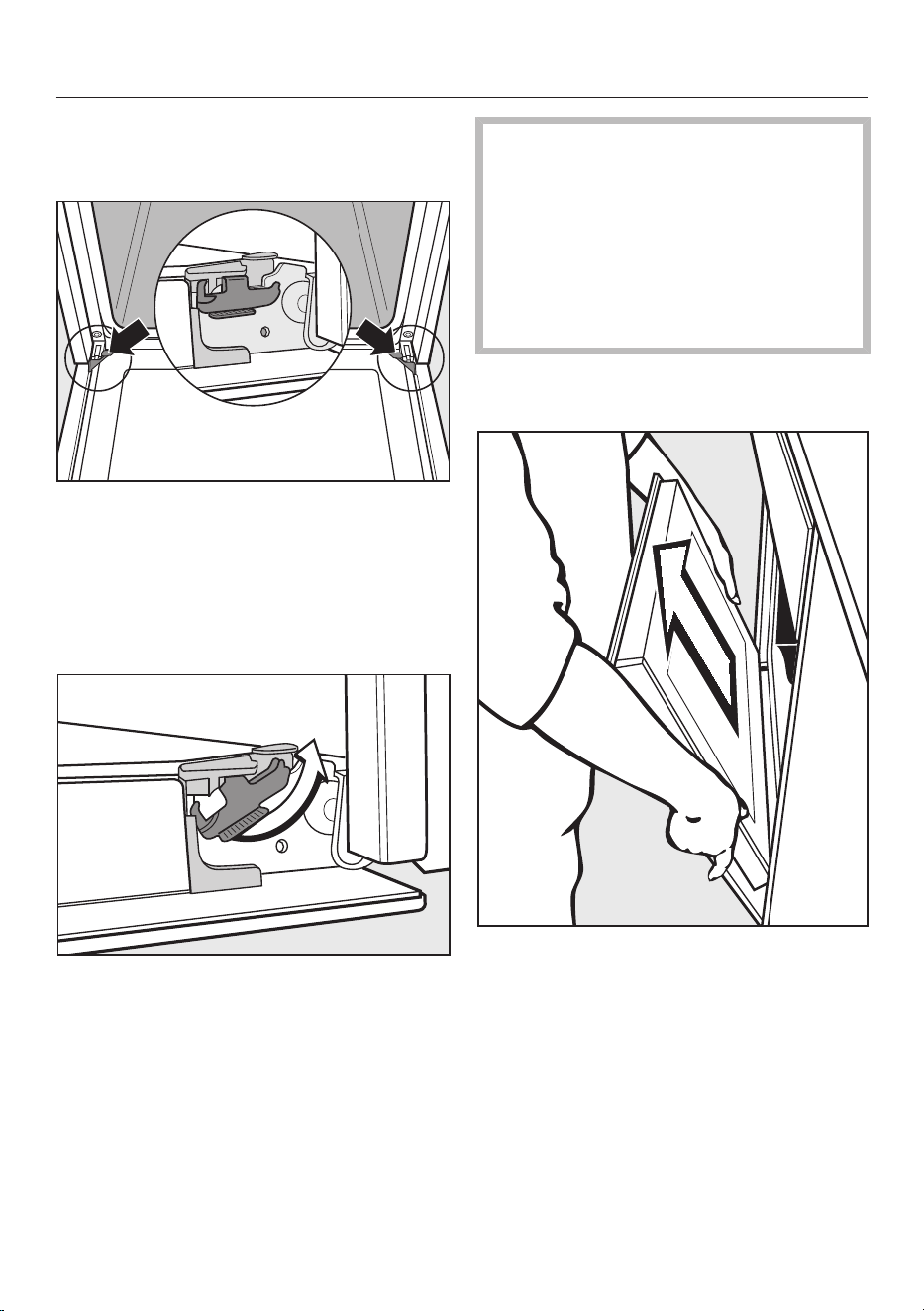
Cleaning and care of the oven
65
Removing the door
The door weighs approx. 24 lbs (11kg).
The oven door is connected to the
hinges by retainers.
Before removing the door from the
retainers, the locking clamps on both
hinges have to be released.
Open the door fully.
Release the locking clamps by
turning them as far as they will go.
You could damage the oven if you
remove the door incorrectly.
Do not pull the door horizontally off
its retainers, as they will spring back
against the oven.
Do not pull the door off the retainers
by the handle, as the handle could
break off.
Raise the door up till it rests partially
open.
Hold the door on either side and pull
it upwards off the hinge retainers.
Make sure that the door is straight.
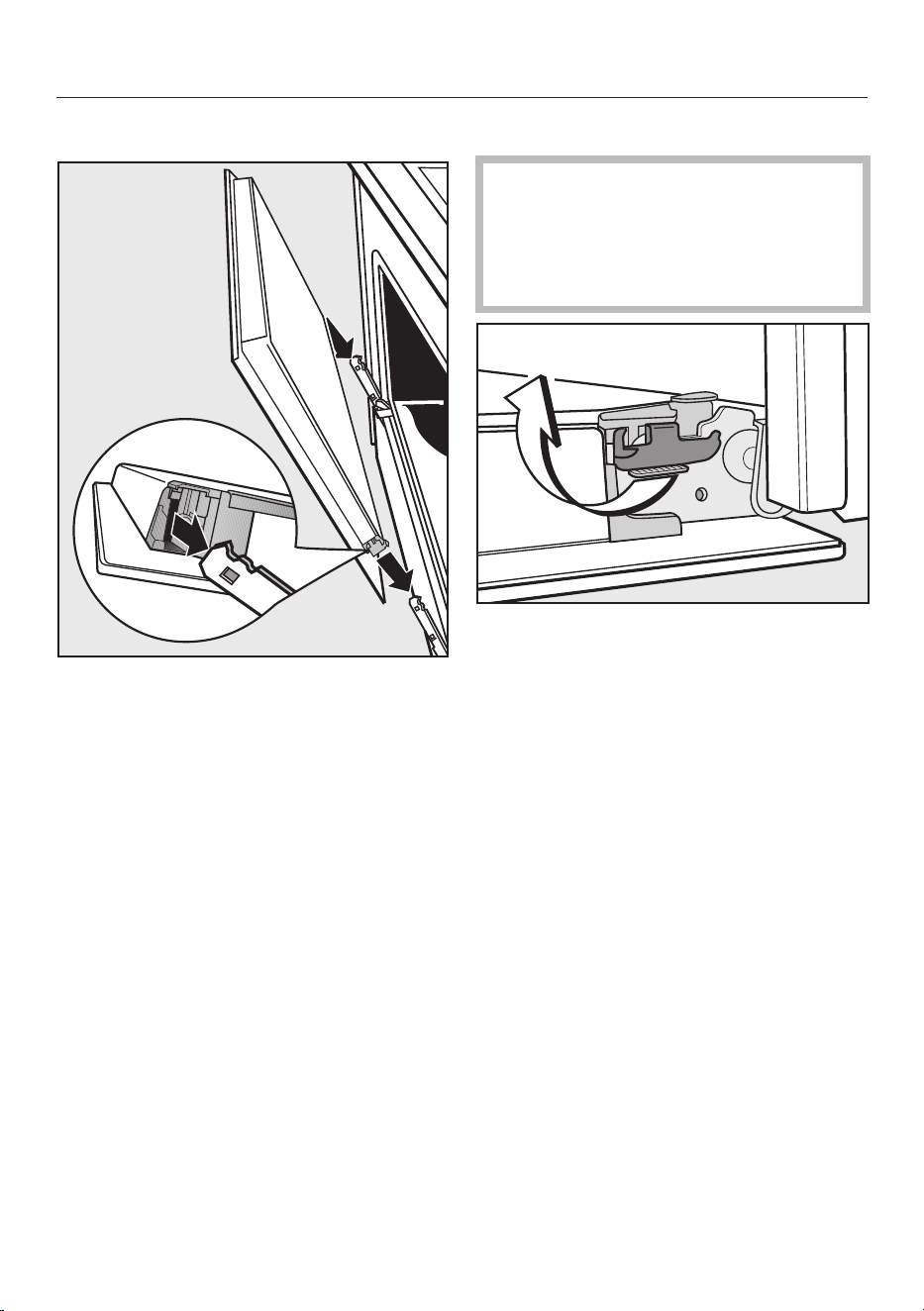
Cleaning and care of the oven
66
Installing the door
Hold the door securely on both sides
and carefully install it back into the
hinge retainers.
Make sure that you do not tilt the
door.
Open the door fully.
If the locking clamps are not locked,
the door could become loose,
resulting in damage.
Ensure that the locking clamps are
locked after reinstalling the door.
To relock the locking clamps, turn
them back up to the horizontal
position as far as they will go.
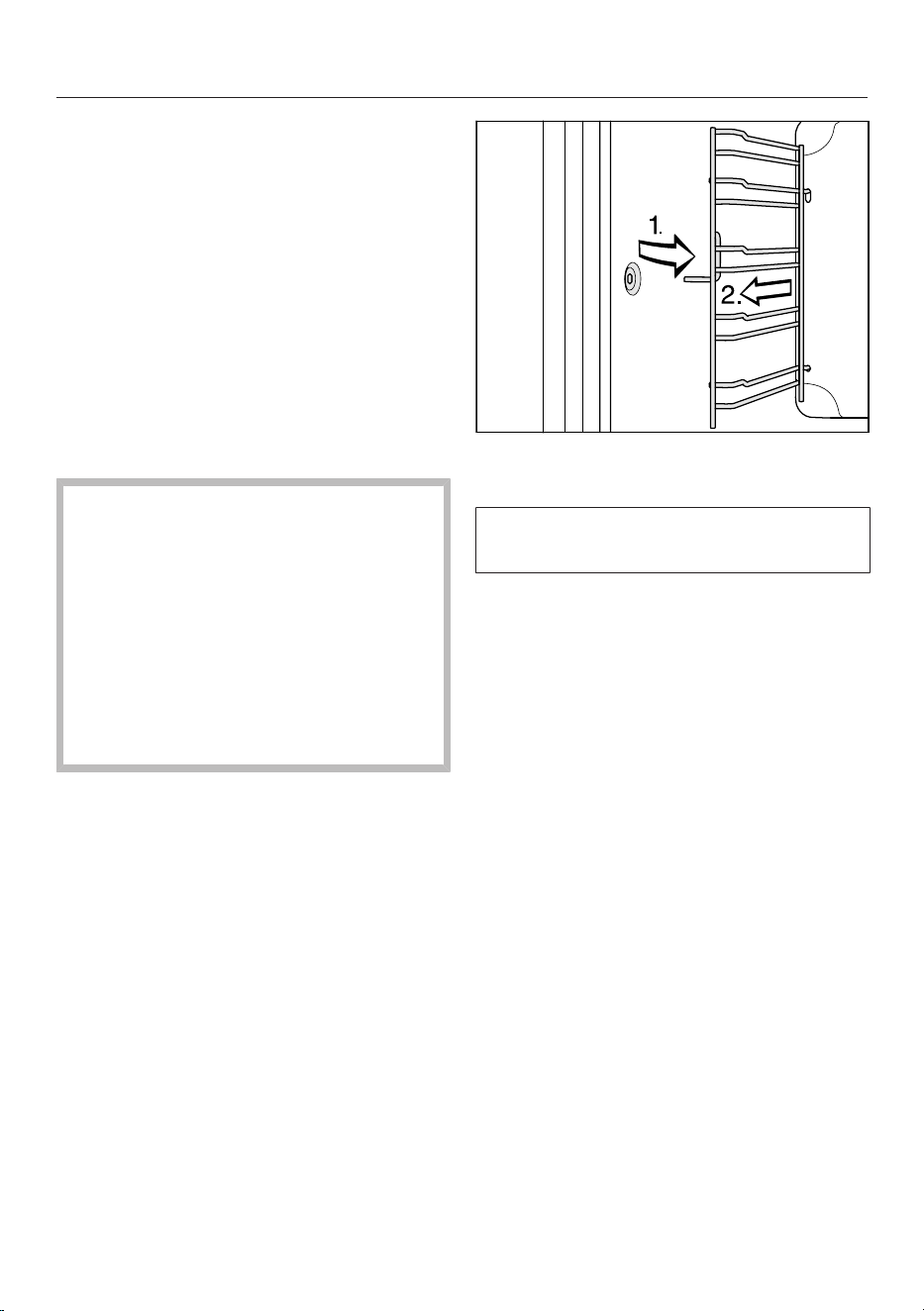
Cleaning and care of the oven
67
Removing the side runners
with FlexiClip telescopic
runners
You can remove the side runners
together with the FlexiClip telescopic
runners (if present).
If you wish to remove the FlexiClip
telescopic runners separately
beforehand, please follow the
instructions in “Features – Installing and
removing the FlexiClip telescopic
runners”.
Risk of injury caused by hot
surfaces.
The oven gets hot during operation.
You could burn yourself on the
heating elements, oven
compartment, or accessories.
Allow the heating elements, oven
compartment, and accessories to
cool before removing the side
runners.
Pull the side runners out of the holder
(1.) and remove them (2.).
Reinstall by following these
instructions in reverse order.
Insert the components carefully.
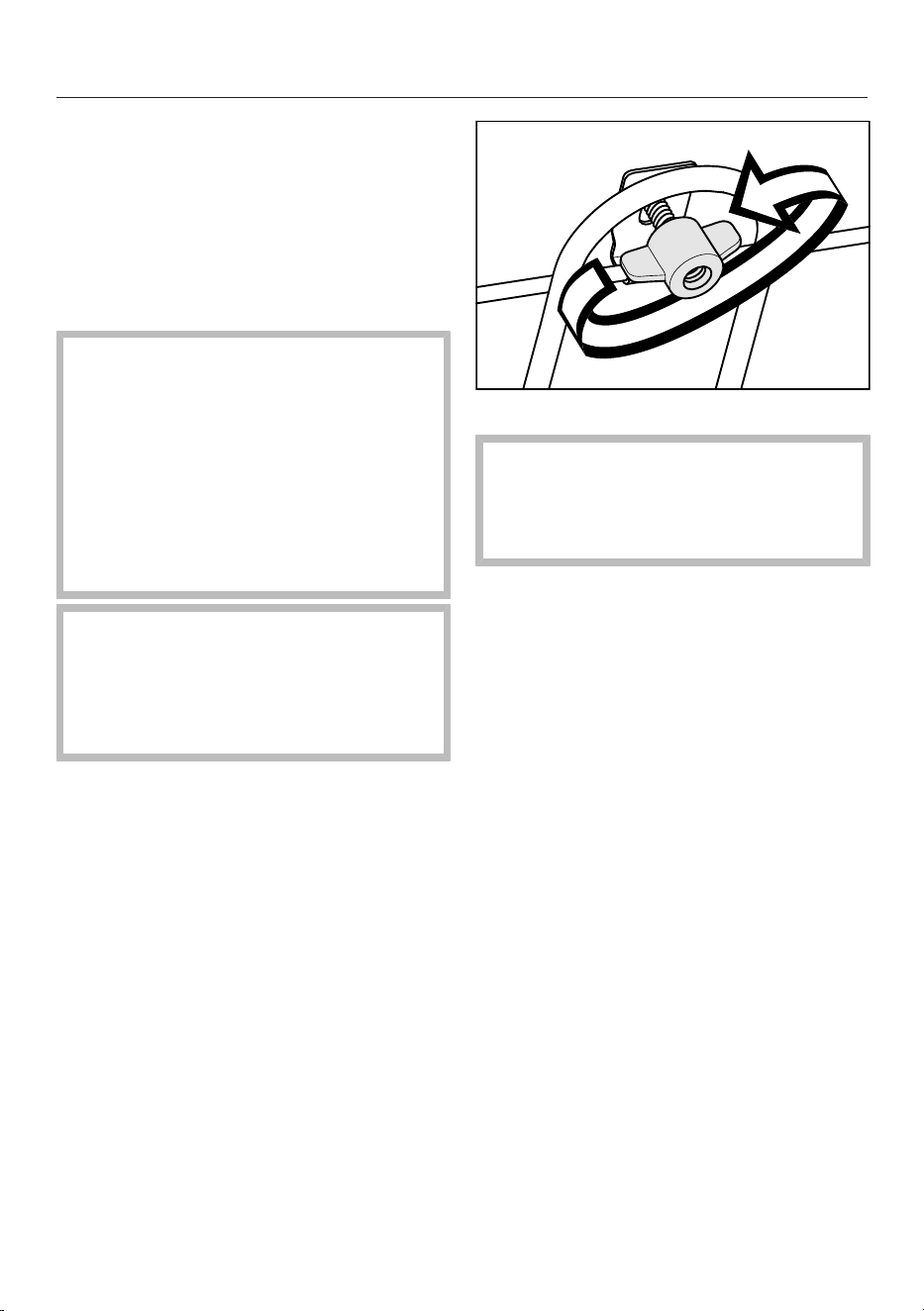
Cleaning and care of the oven
68
Lowering the browning/broiling
element
If the ceiling of the oven is badly soiled,
the browning/broiling element can be
lowered to make cleaning easier. Clean
the ceiling of the oven regularly with a
damp cloth or a dish sponge.
Risk of injury caused by hot
surfaces.
The oven gets hot during operation.
You could burn yourself on the
heating elements, oven
compartment, or accessories.
Allow the heating elements, oven
compartment, and accessories to
cool before manual cleaning.
You may damage the enamel on the
oven floor if you drop fastening nuts
on it.
Place a cloth or similar item over the
oven floor to protect it.
Remove the side runners.
Unscrew the wing nut.
Take care not to damage the
browning/broiling element.
Do not use force when lowering the
browning/broiling element.
Carefully lower the browning/broiling
element.
You can now access the ceiling of the
oven.
Clean the ceiling of the oven with hot
water and liquid dish soap, applied
with a clean sponge cloth or a clean,
damp microfiber cloth.
After cleaning, raise the browning/
broiling element gently back up
again.
Replace the wing nut and tighten it
securely.
Reinsert the side runners.

Frequently Asked Questions
With the help of the following guide minor faults in the performance of the
machine, some of which may result from incorrect operation, can be remedied
without contacting the Service Department.
This guide may help you to find the reason for the fault, and how to correct it.
Problem Possible cause and solution
The display is dark. You have selected the Time| Display| Off setting.
When the oven is turned off, the time-of-day display
is turned off.
As soon as the oven is turned on, the main menu
will appear. If you want the time of day to be
displayed constantly, select theTime| Display| On
setting.
There is no power to the oven.
Check if the breaker has tripped. If it has, contact
a qualified electrician or Miele Customer Service.
The audible signal does
not sound.
The audible signals are deactivated or set at too low
a volume.
Turn on the audible signals or increase the volume
with Volume| Buzzer tones.
The oven does not heat
up.
Demo mode is activated.
You can select menu options on the display and
sensor buttons, but the oven heating does not work.
Deactivate Demo mode with the Showroom
program| Demo Mode| Off setting.
Press “OK” for 6 secs
appears on the display
when the oven is turned
on.
The system lock is activated.
You can deactivate the system lock for a cooking
program by touching the OKsensor button for at
least 6seconds.
If you want to permanently deactivate the system
lock, select theSafety| System lock | Off setting.
Power failure appears on
the display.
There has been a brief power failure. This has caused
the current cooking process to stop.
Turn the oven off and then back on again.
Restart the cooking process.
12:00 appears on the
display.
There was a power failure for more than 150hours.
Reset the date and time.
69

Frequently Asked Questions
Problem Possible cause and solution
The sensor buttons do
not respond.
You have selected the Display| QuickTouch| Off
setting. When this is activated, the sensor buttons do
not respond when the oven is turned off.
As soon as the oven is turned on, the sensor
buttons will respond. If you want the sensor
buttons to respond even when the oven is turned
off, select the Display| QuickTouch| On setting.
The oven is not connected to the domestic electrical
supply.
Make sure that the plug is correctly inserted in the
socket and that the socket switch has been
switched to on.
Check if the breaker has tripped. If it has, contact
a qualified electrician or Miele Customer Service.
There is a fault with the controls.
Touch and hold the On/Off button until the
display turns off and the oven restarts.
Max. op. hours reached ap-
pears on the display.
The oven has been operating for an unusually long
time. This has triggered the safety shut-off.
Confirm with OK.
The oven is now ready to use again.
FaultF32 appears on
the display.
The door lock for the Self Clean program has not
locked.
Turn the oven off and then back on again. Start the
Self Clean program again.
If the message appears again, contact Miele
Customer Service.
FaultF33 appears on
the display.
The door lock for the Self Clean program has not
opened.
Turn the oven off and then back on again.
If the door lock still does not deactivate itself,
contact Miele Customer Service.
Fault and a fault code
not listed here appear
on the display.
A fault has occurred that you cannot resolve.
Contact Miele Customer Service.
You can hear a noise af-
ter a cooking program.
The cooling fan remains turned on after a cooking
program (see “Settings – Cooling fan run-on”).
70

Frequently Asked Questions
Problem Possible cause and solution
The oven has turned it-
self off.
To save power, the oven turns off automatically if a
button is not pressed after a certain amount of time
or after a cooking program has ended.
Turn the oven back on.
The cake/cookies are
not baked properly.
A different temperature than that given in the recipe
was used.
Select the temperature required for the recipe.
The ingredient quantities are different from those
given in the recipe.
Check if you have amended the recipe. The
addition of more liquid or more eggs will make a
wetter mixture which will take longer to cook.
The browning is un-
even.
You selected the wrong temperature or shelf level.
There will always be a slight unevenness. If
browning is very uneven, check whether you
selected the correct temperature and shelf level.
The material or color of the bakeware is not suitable
for the operating mode selected.
When using the Surroundoperating mode,
light-colored, shiny baking pans will not produce
as desirable results. Dark, matte baking pans are
best for baking.
There is still soiling in
the oven compartment
after a Self Clean pro-
gram.
The Self Clean program burns off soiling in the oven
and leaves it as ash.
Remove the ash with warm water, liquid dish soap,
and a clean sponge or a clean, damp microfiber
cloth.
If there is still coarse soiling left in the oven after
the Self Clean program, you should start the
program again, selecting a longer duration if
necessary.
The accessories make
noises when they are
pushed into or pulled
out of the oven.
The Self-Clean-resistant surface of the side runners
creates friction when accessories are pushed into or
pulled out of the oven.
To reduce the friction, add a few drops of heat-
resistant cooking oil to some kitchen paper and
use this to lubricate the side runners. Repeat this
after every Self Clean program.
71
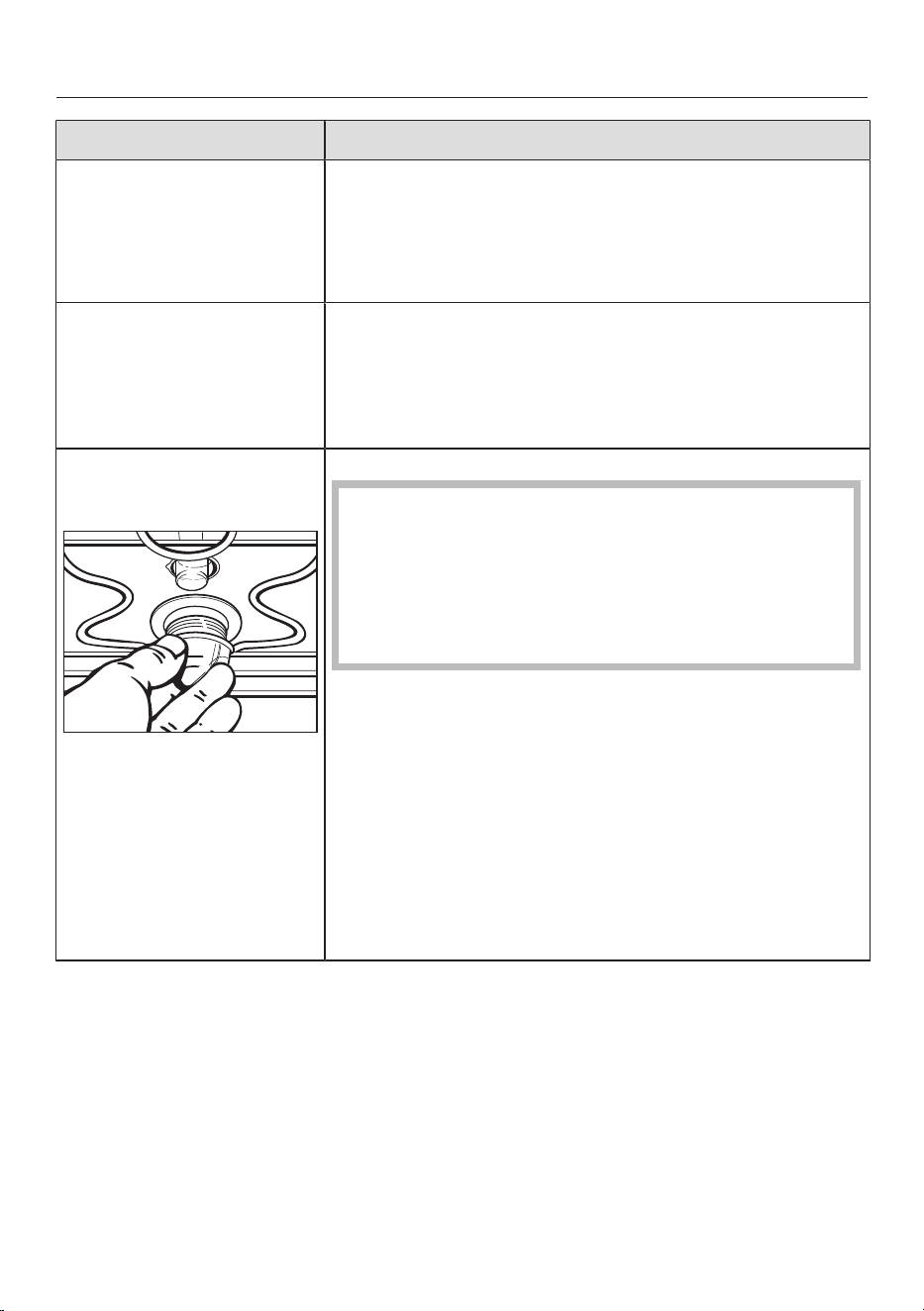
Frequently Asked Questions
Problem Possible cause and solution
The oven interior light-
ing turns off after a
short time.
You have selected the Lighting| “On” for 15 seconds
setting.
If you want the oven interior lighting to remain on
during the entire cooking program, select the
Lighting| On setting.
The oven interior light-
ing is off.
You have selected the Lighting| Off setting.
Press the sensor button to turn the oven interior
lighting on for 15seconds.
If required, select the Lighting| On or “On” for 15
seconds setting.
The oven interior light-
ing does not turn on.
The halogen lamp is faulty.
Risk of injury caused by hot surfaces.
The oven gets hot during operation. You could
burn yourself on the heating elements, oven
compartment, or accessories.
Allow the heating elements, oven compartment,
and accessories to cool before manual cleaning.
Disconnect the oven from the electrical supply.
Unplug the appliance or switch off the breaker.
Turn the bulb cover a quarter turn
counterclockwise to release it and then pull it
together with its seal downward to take it out.
Replace the halogen bulb (Osram66725AM/A,
230V, 25W, G9).
Reinstall the bulb cover together with its seal and
turn it clockwise to secure.
Reconnect the oven to the electrical supply.
72

Customer Service
73
Contact in the event of a fault
In the event of a fault which you cannot
remedy yourself, please contact your
Miele dealer or Miele Customer Service.
You can book a Miele Service Call
online at www.miele.com/service.
Contact information for Miele
Customer Service can be found at the
end of this document.
Please quote the model identifier and
serial number of your appliance (SN)
when contacting Miele Customer
Service. Both pieces of information can
be found on the data plate.
This information is given on the data
plate, which is visible on the front frame
of the oven when the door is fully open.
Appliance warranty and
product registration
You can register your product and/or
view the manufacturer´s warranty terms
and conditions for Miele appliances and
vacuum cleaners at
www.mieleusa.com.

Caring for the environment
74
Disposal of the packing
material
The cardboard box and packing
materials protect the appliance during
shipping. They have been designed to
be biodegradable and recyclable.
Ensure that any plastic wrappings,
bags, etc. are disposed of safely and
kept out of the reach of children.
Danger of suffocation!
Disposal of your old appliance
Electrical and electronic appliances
contain valuable materials. They also
contain certain substances, compounds
and components which were essential
for the proper functioning and safe use
of the equipment. Handling these
materials improperly by disposing of
them in your household waste can be
harmful to your health and the
environment. Therefore, please do not
dispose of your old appliance with
regular household waste and follow
local regulations on proper disposal.
Consult with local authorities, dealers or
Miele in order to dispose of and recycle
electrical and electronic appliances.
Miele assumes no responsibility for
deleting any personal data left on the
appliance being disposed. Please
ensure that your old appliance is kept
away from children until removal.
Observe safety requirements for
appliances that may tip over or pose an
entrapment hazard.
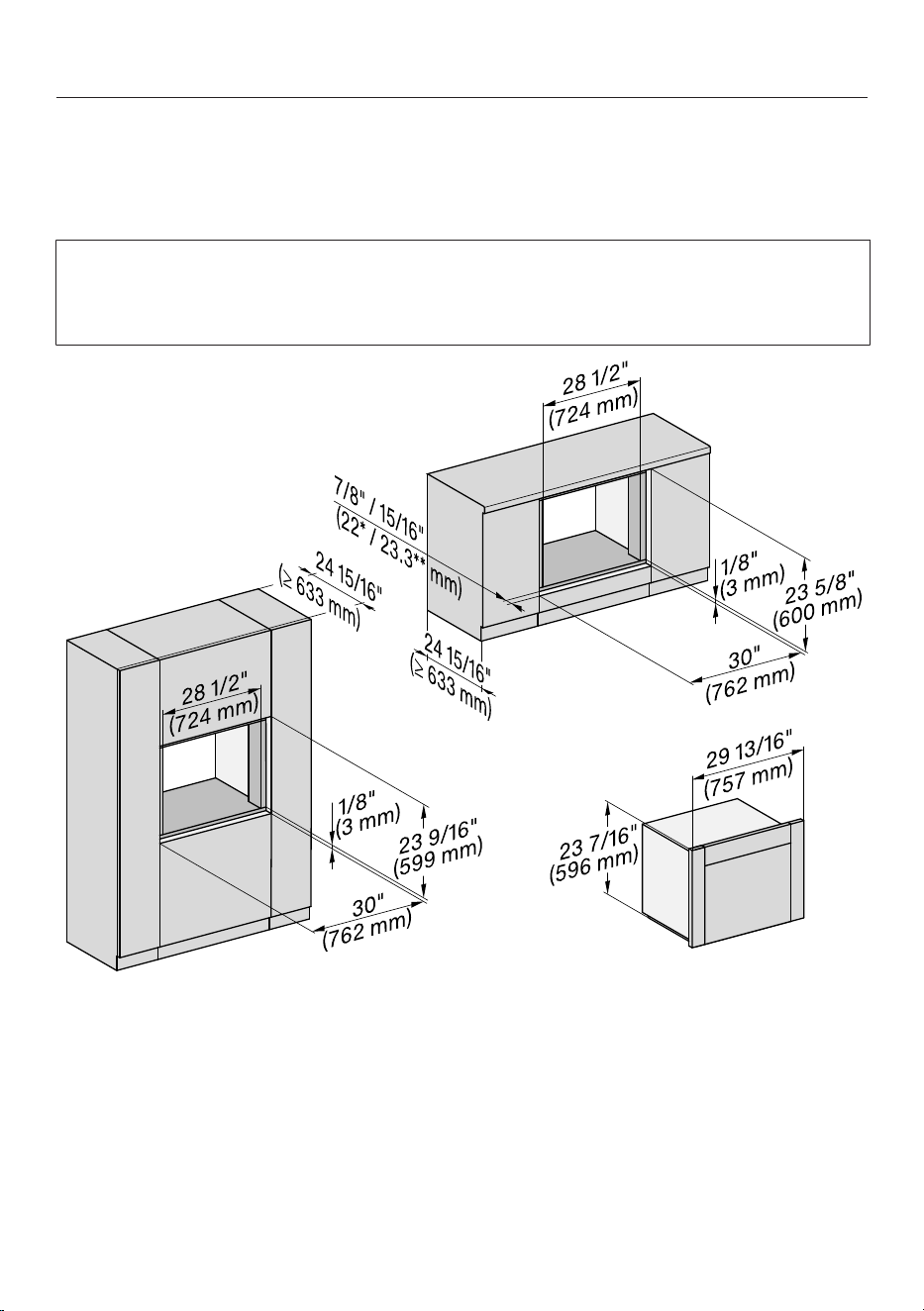
Installation
*INSTALLATION*
Installation dimensions
The example shows installation in a 30" niche with trim kit EBA7xxx.
Installation in a tall or base cabinet
Miele Ovens can be installed flush or proud. Discuss your requirements with your
architect, kitchen designer, and installer.
More installation drawings are available on the Miele website.
* Oven with glass front
** Oven with metal front
75
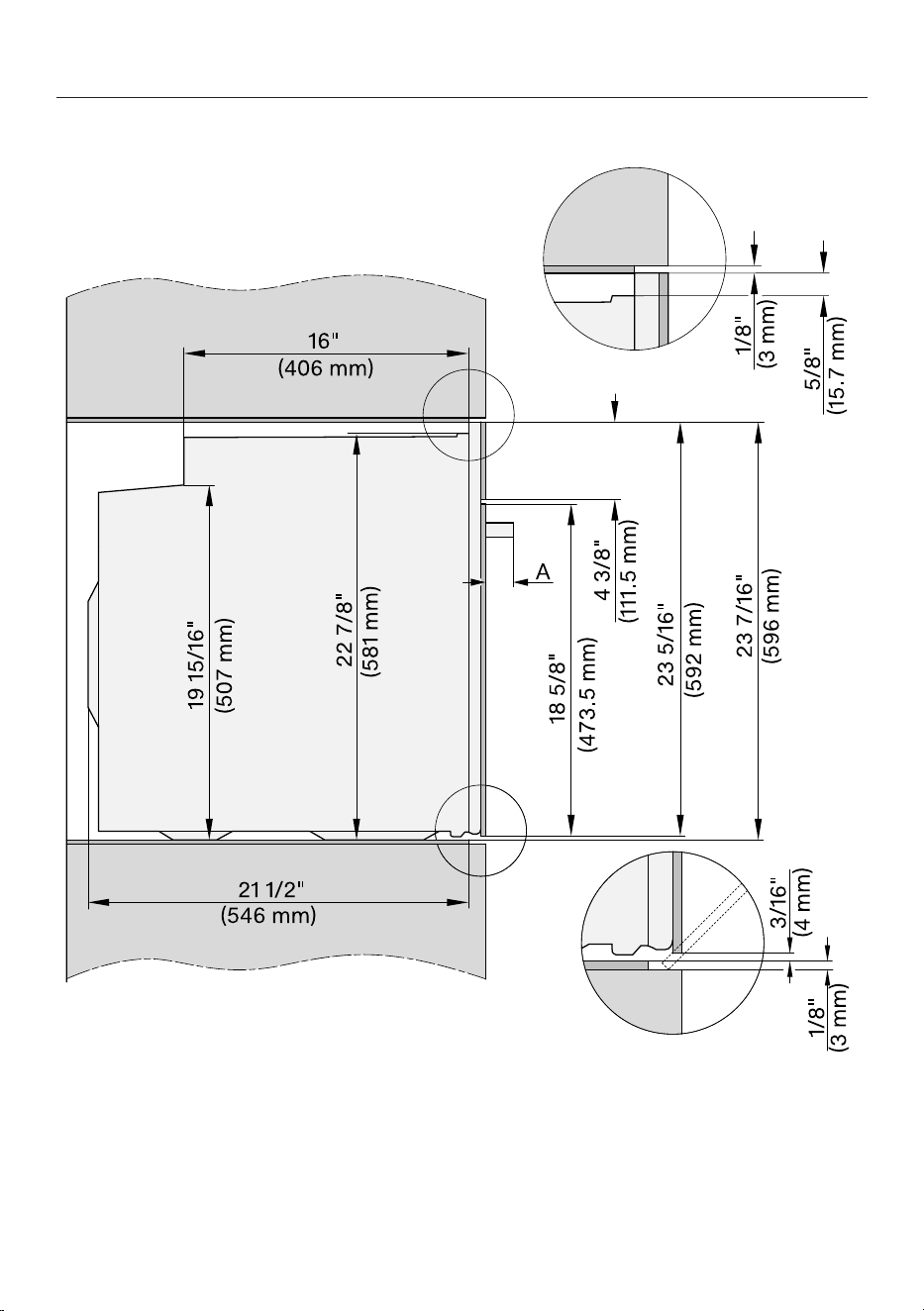
Installation
*INSTALLATION*
Side view
A H 72xx: 17/8" (47mm)
76
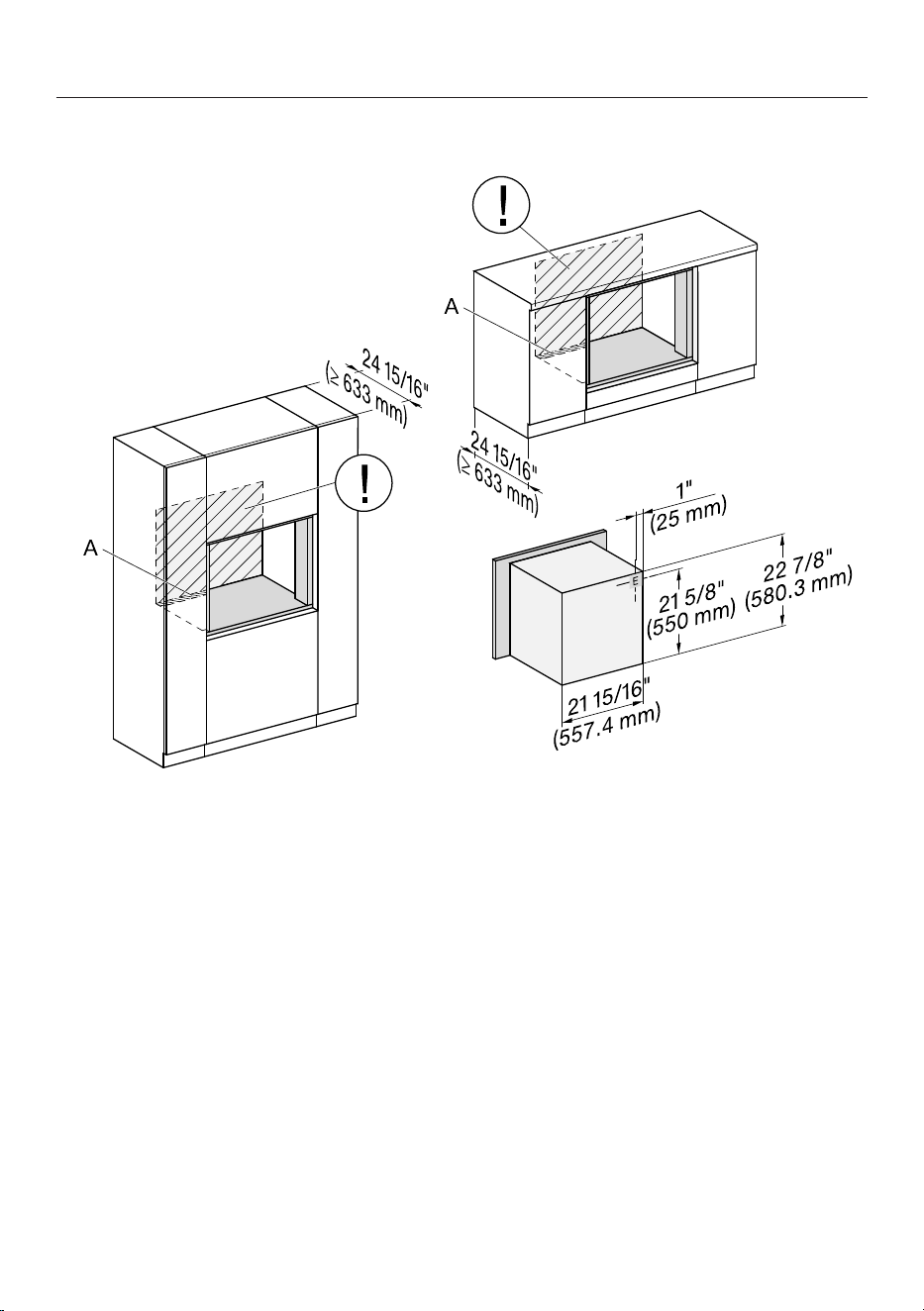
Installation
*INSTALLATION*
Connections and ventilation
A Cutout 4"x283/8" (100mmx720mm) in the base of the kitchen cabinet for
power cord and ventilation
The outlet for the electrical connection should be accessible, e.g., in an
adjacent kitchen cabinet. If the electrical connection is behind the oven, the
kitchen cabinet needs to be deeper than specified.
E Electrical connection
77
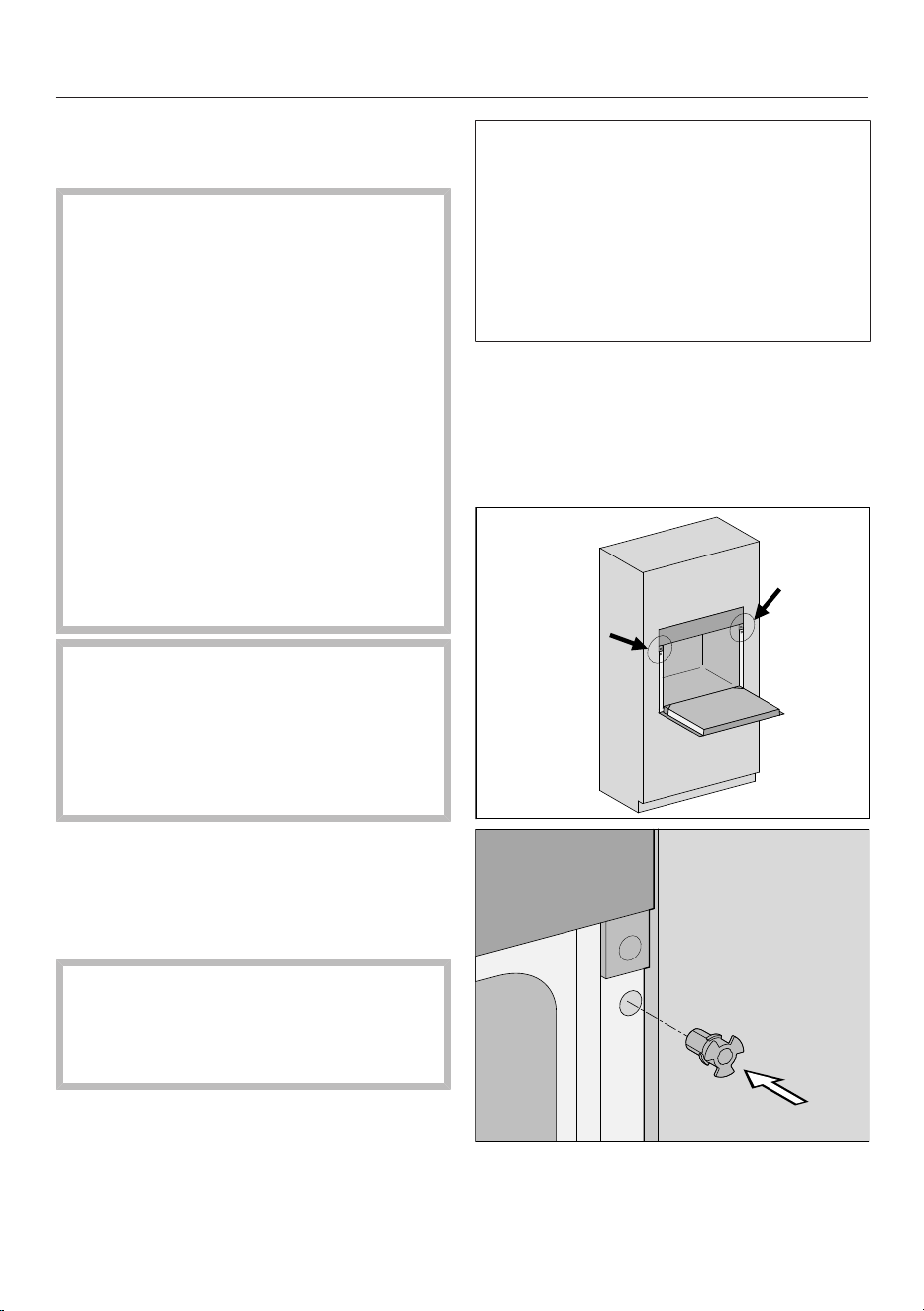
Installation
*INSTALLATION*
78
Installing and removing the
oven
For safety reasons, only use the oven
when it has been fully installed.
The oven requires a sufficient supply
of cool air for efficient operation. The
required supply of cool air must not
be excessively heated by other heat
sources (e.g., wood burning stoves).
The following must be observed
when installing the appliance:
Make sure that the shelf that the
oven sits on does not touch the wall.
Do not install heat insulation strips
on the side walls of the cabinet
carcase.
Do not open the door when the oven
is on the floor. This could damage
the door.
Do not open the door until the oven
has been installed inside the housing
unit.
Securing the oven in the cabinet
niche
Connect the oven to the power
supply.
Do not carry the oven by the door
handle. This could damage the door.
Use the handles on each side of the
housing to carry the appliance.
It is a good idea to remove the door
(see “Cleaning and care of the oven –
Removing the door”) and the
accessories before installing the
appliance. The oven is then easier to
push into the cabinet carcase and you
do not run the risk of lifting it by the
door handle.
Push the oven into the cabinet niche
and align it in the center of the
cabinet niche.
Open the door if you have not
removed it.
Insert the mounting aid into the hole
in the front frame.
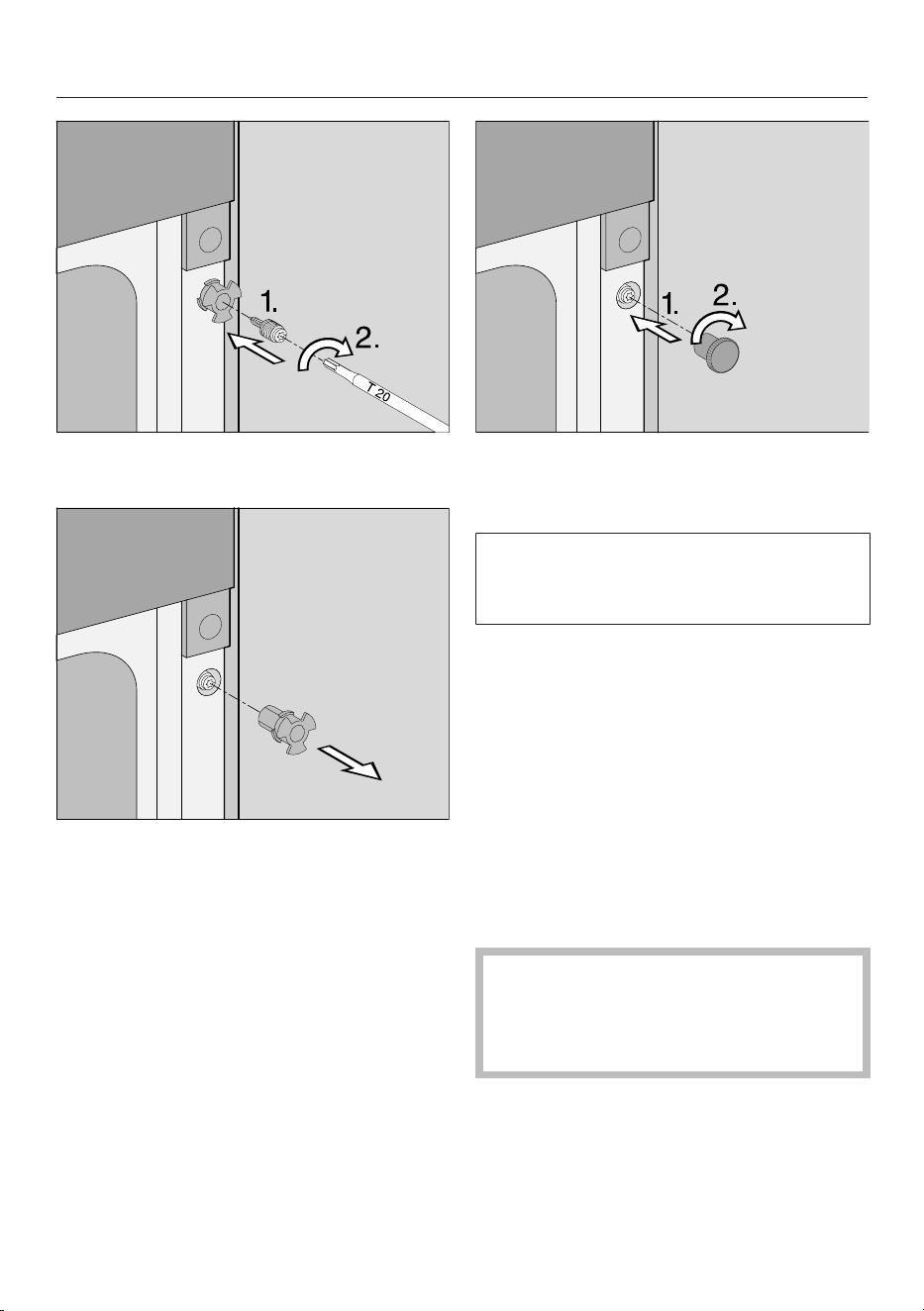
Installation
*INSTALLATION*
79
Insert the bolt into the mounting aid
and tighten it in the cabinet niche.
Remove the mounting aid.
Screw the knurled nut onto the bolt
by hand to fix the oven in the cabinet
niche.
Reinstall the door, if necessary (see
“Cleaning and care of the oven –
Installing the door”).
Taking the oven out of the housing
unit
Open the door.
Unscrew the knurled nuts and bolts
from the front frame (see “Securing
the oven in the housing unit”).
Keep these parts in case the oven
needs to be installed again in the
future.
Pull the oven out of the housing unit.
Do not carry the oven by the door
handle. This could damage the door.
Use the recessed grips on each side
of the housing to carry the appliance.
Take the oven out of the housing unit.
Disconnect the oven from the power
supply.

Installation
*INSTALLATION*
80
Electrical connection
Risk of injury due to electric
shock.
During installation, maintenance, and
repair work, the oven must be
completely disconnected from the
power supply:
Disconnect the oven from the power
supply by tripping the breakers, or
unplugging the power cord from the
outlet. To do this, pull the plug not
the cord.
Risk of injury.
Installation, repairs, and other work
by unqualified persons could be
dangerous. Miele cannot be held
liable for unauthorized work.
Installation, maintenance, and repairs
must only be carried out by a Miele
authorized technician.
The connection data (voltage and
frequency) on the data plate of the
oven must match the power supply
in order to avoid the risk of damage
to the oven.
Compare this before connecting the
appliance to the power supply. If in
any doubt, consult a qualified
electrician.
For safety reasons, the oven may
only be used when it has been fully
installed.
The power cord plug must be inserted
into a suitable outlet that has been
installed and grounded in compliance
with all applicable local codes.
WARNING: THIS APPLIANCE MUST
BE GROUNDED
Installer: Please pass these
instructions on to the customer.
Electrical connection
The oven is equipped with a power cord
approx. 6ft (1.8m) long with a 4-pin
NEMA 14-30P plug for connection to a
power supply with:
- 2NAC 208V, 30A, 60Hz
or
- 2NAC 240V, 30A, 60Hz
Temporary or permanent operation on
an autonomous power supply system or
a power supply system that is not
synchronized with the grid power
supply (e.g., island networks, back-up
systems) is possible. A prerequisite for
operation is that the power supply
system complies with the specifications
of EN50160 or an equivalent standard.
The function and operation of the
protective measures provided in the
domestic electrical installation and in
this Miele product must also be
maintained in isolated operation or in
operation that is not synchronized with
the grid power supply, or these
measures must be replaced by
equivalent measures in the installation.
As described, for example, in the
current version of VDE-AR-E 2510-2.
You can set the voltage variant (see
“Settings – Electrical version”).
KEEP THE OPERATING AND
INSTALLATION INSTRUCTIONS IN A
SAFE PLACE.

Declaration of conformity
81
Radio Module
This device contains the following WiFi
module:
FCC ID 2AC7Z-EK057
IC ID 21098-EK057
Frequency band 2.412 GHz –
2.462GHz
Maximum
transmitting
power
< 0.2W
Compliance Statement
This device complies with Part 15 of the
FCC Rules and contains licence-
exempt transmitter(s)/receiver(s) that
comply with Innovation, Science and
Economic Development Canada’s
licence-exempt RSS Standard(s).
Operation is subject to the following
two conditions:
(1) this device may not cause harmful
interference, and
(2) this device must accept any
interference received, including
interference that may cause undesired
operation.
The construction of the device assures
that the FCC/IC exposure limits are
verifiably met using the integrated radio
module.
Warning!
Any changes or modifications to this
unit not expressly approved by the
party responsible for compliance
could void the user’s authority to
operate the equipment.

Copyrights and licenses
For the purpose of operating and controlling the communication module, Miele
uses proprietary or third-party software that is not covered by open source
licensing terms. This software/these software components are protected by
copyright. The copyrights held by Miele and third parties must be respected.
In addition, the integrated communication module contains software components
which are distributed under open source licensing terms. You can access these
open source components along with the associated copyright notices, copies of
the valid licensing terms, and any additional information locally via IP using a web
browser (http[s]://<ip address>/Licenses). The liability and warranty arrangements
for the open source licenses displayed in this location only apply in relation to the
respective rights holders.
82

9 Independence Way
Princeton, NJ 08540
www.mieleusa.com
U.S.A.
Miele, Inc.
National Headquarters
Please have the model and serial number
of your appliance available when
contacting Customer Service.
Canada
Importer
Miele Limited
Headquarters and Miele Centre
Customer Support
Phone: 888-99-MIELE (64353)
161 Four Valley Drive
Vaughan, ON L4K 4V8
www.miele.ca
Customer Care Centre
Phone:
800-565-6435
905-532-2272
International Headquarters
Miele & Cie. KG
Carl-Miele-Straße 29
33332 Gütersloh
Germany

M.-Nr. 11 899 990 / 01en-US, CA
H 7263 BP