
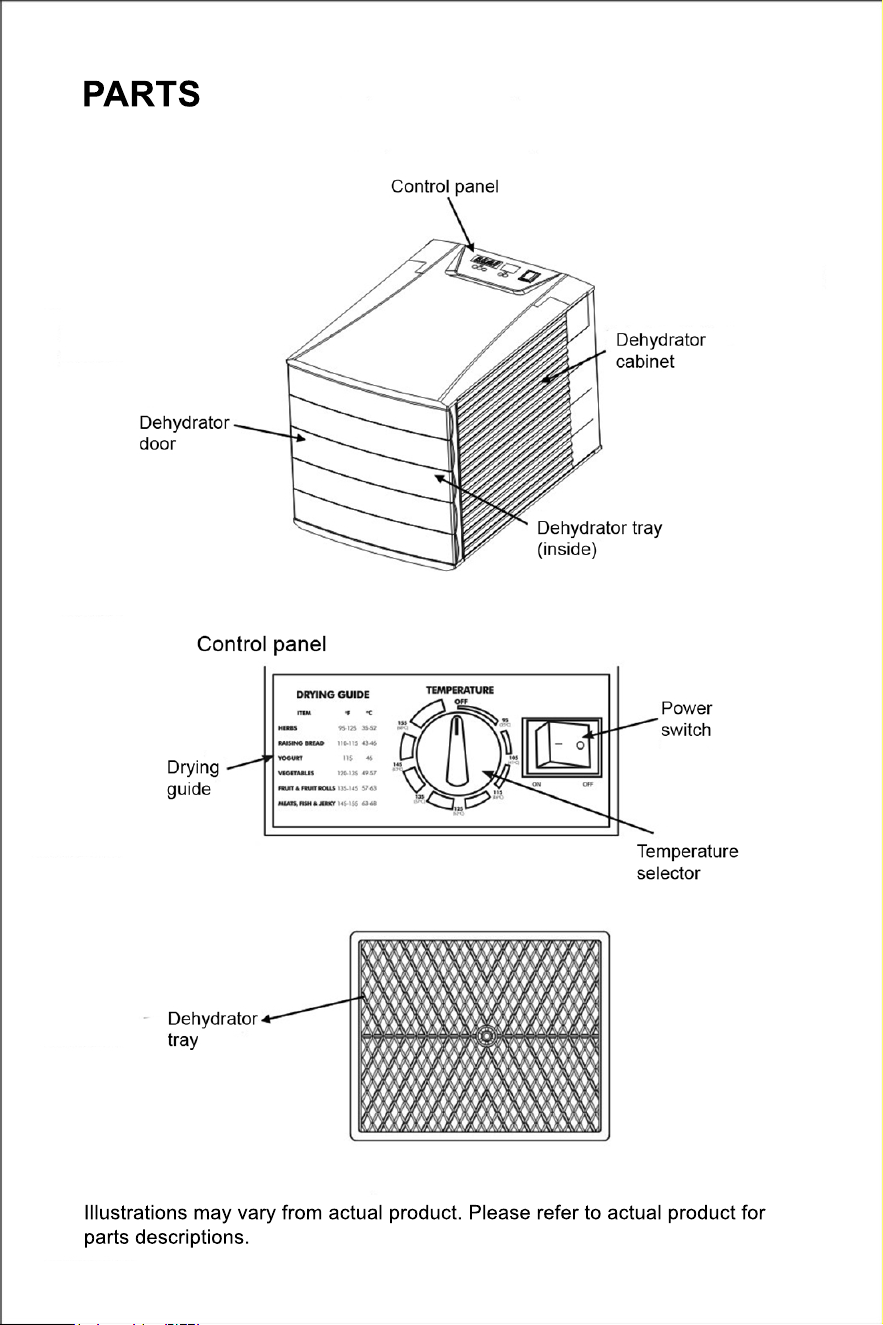
PARTS
Illustrations may vary from actual product. Please refer to actual product for
parts descriptions.
CONTENTS
INTRODUCTION ................................................ 01
DEHYDRATION .................................................... 01
IMPORTANT SAFEGUARDS ............................. 02
PREPARATION OF FOODS ................................. 03
(PRE-TREATMENT)
OPERATING INSTRUCTIONS ............................. 04
FOOD SFOOD STORAGE ............................................... 04
RECONSTITUTION ........................................... 05
FOOD DRYING GUIDES .................................... 05
CLEANING ........................................................... 07
DEHYDRATION PROCESS ................................. 07
REVIEW
INTRODUCTION
Drying food for preservation dates back to the ancient Egyptians. The
Spaniards were the first explorers known to use dehdydration to prepare
food for their expeditions. The method was used extensively in the days of
the Lewis and Clark expeditions as they charted the expanse of the
Lousiana Land Purchase. Buffaloes and elks were plentiful. But their
success relied heavily upon the proper use of this preserving method.success relied heavily upon the proper use of this preserving method.
The information in this manual is intended to help you get the best results
from this appliance. Please read this manual carefully and contact the
manufacturer if you have any questions.
DEHYDRATION
There are no exact rules that apply to food dehydration because your
results can be affected by room temperature, relative humidity and moisture
levels in the food that you are drying.levels in the food that you are drying. To become proficient, it will be
necessary to experiment with your drying techniques. If you use too much
heat, your drying times will be very long. With a little practice, you will be
creating tasty ready-to-eat snacks in no time.
01
CONTENTS
INTRODUCTION ................................................ 01
DEHYDRATION .................................................... 01
IMPORTANT SAFEGUARDS ............................. 02
PREPARATION OF FOODS ................................. 03
(PRE-TREATMENT)
OPERATING INSTRUCTIONS ............................. 04
FOOD SFOOD STORAGE ............................................... 04
RECONSTITUTION ........................................... 05
FOOD DRYING GUIDES .................................... 05
CLEANING ........................................................... 07
DEHYDRATION PROCESS ................................. 07
REVIEW
INTRODUCTION
Drying food for preservation dates back to the ancient Egyptians. The
Spaniards were the first explorers known to use dehdydration to prepare
food for their expeditions. The method was used extensively in the days of
the Lewis and Clark expeditions as they charted the expanse of the
Lousiana Land Purchase. Buffaloes and elks were plentiful. But their
success relied heavily upon the proper use of this preserving method.success relied heavily upon the proper use of this preserving method.
The information in this manual is intended to help you get the best results
from this appliance. Please read this manual carefully and contact the
manufacturer if you have any questions.
DEHYDRATION
There are no exact rules that apply to food dehydration because your
results can be affected by room temperature, relative humidity and moisture
levels in the food that you are drying.levels in the food that you are drying. To become proficient, it will be
necessary to experiment with your drying techniques. If you use too much
heat, your drying times will be very long. With a little practice, you will be
creating tasty ready-to-eat snacks in no time.
01
IMPORTANT SAFEGUARDS
1. Read all instructions thoroughly before using the dehyrator.
2. Save these instructions for future reference.
3. Never leave the dehydrator unattended.
4. Close supervision is required if the appliance i used around children.
5. The dehydrator is only for use indoors in a clean and dry location
that is free from flammable objects.
6. The dehydrator will get hot during use. Do not touch the surfaces
while the appliance is in operation.
7. Continuous operation of the applicance above 68°C is not
recommended as surfaces will become very hot.
8. This dehydrator may scratch household surfaces.
9. Do not use the appliance if the power cord or controls has been
damaged in any way. Contact the manufacturer before attempting to
make any repairs.
10. Do not use sharp untensils inside the appliance.
11. Turn off the dehydrator before plugging in or unplugging from an
electrical mains outlet.
12. Unplug the dehydrator when it is not in use.
13. Allow the dehydrator to cool before cleaning.
14.14. Never immerse the appliance or power cord in water or other liquids.
15. Never plug the appliance into a damaged electrical wall outlet.
16. Do not allow the power cord to come in contact with any hot surface
or be placed near the edge of a counter or table.
17. Do not attempt to move the dehdydrator while it is in operation.
PREPARATION OF FOODS
(PRE-TREATMENT)
For best results, select the freshest foods available to dehydrate. Note thatFor best results, select the freshest foods available to dehydrate. Note that
immature fruits and vegetables do not have as much colour and flavour
compared to fully matured ones. Foods should be dehydrated as soon as
after a purchase is made.
Foods high in sugar such as apples, pears, peaches and bananas are
prone to darkening as a result of oxidation of the sugars. The following are
some of the pre-treatments that will help to reduce this effect.
02 03
Lemon and pineapple juice
These are natural anti-oxidants. Place the sliced produce in the juice for a
few minutes. Remove, drain and place on the dehydrator tray. For extra
flavour, try sprinkling on cinnamon, jello powders or other sweetners.
Ascorbic acid mix
This is a form of Vitamin C which is available at most health food stores
and comes in tablet or powder form. use about 2 to 3 tablespoons of and comes in tablet or powder form. use about 2 to 3 tablespoons of
powder or ground tablets per 950ml of water. Stir to completely dissolve
the powder. Place fruits into the solution for 2 to 3 minutes. Remove,
frain, and place on the dehydrator tray.
Sodium Bisulphite
This can be purchased at your local pharmacy. If you or anyone who will be
eating food has any known chemical allergies, please check with your
doctor before using this chemical. Be certain to ask for food-grade safedoctor before using this chemical. Be certain to ask for food-grade safe
product only. Mix one teaspoon of sodium bisulphite in 950ml of water.
Dip the sliced fruits in the solution for a few minutes. Remove, drain and
place on dehdyrator tray.
Blanching
Blanching is used primarily to prepare fruits and vegetables for dehydrating
that have skins will toughen during drying. This process helps to lock in the
colour and flavour as well as soften the skin of grapes, cherries, prunes colour and flavour as well as soften the skin of grapes, cherries, prunes
and plums. There are two blanching methods:
1. Water blanching
Fill a large pan about half full of water. Bring the water to a boil.
Place the food directly into the water and cover the pan. Blanch for
about 3 minutes. Remove, drain and place on dehydrator tray.
2. Steam blanching
Use a steamer basket such as those used in Chinese cooking. Place
5cm to 8cm of water in the pan and bring it to a boil. Place food in
the steamer basket and then place it in the pan. Steam the food
for about 5 minutes. Remove and place on dehydrator tray.
IMPORTANT SAFEGUARDS
1. Read all instructions thoroughly before using the dehyrator.
2. Save these instructions for future reference.
3. Never leave the dehydrator unattended.
4. Close supervision is required if the appliance i used around children.
5. The dehydrator is only for use indoors in a clean and dry location
that is free from flammable objects.
6. The dehydrator will get hot during use. Do not touch the surfaces
while the appliance is in operation.
7. Continuous operation of the applicance above 68°C is not
recommended as surfaces will become very hot.
8. This dehydrator may scratch household surfaces.
9. Do not use the appliance if the power cord or controls has been
damaged in any way. Contact the manufacturer before attempting to
make any repairs.
10. Do not use sharp untensils inside the appliance.
11. Turn off the dehydrator before plugging in or unplugging from an
electrical mains outlet.
12. Unplug the dehydrator when it is not in use.
13. Allow the dehydrator to cool before cleaning.
14.14. Never immerse the appliance or power cord in water or other liquids.
15. Never plug the appliance into a damaged electrical wall outlet.
16. Do not allow the power cord to come in contact with any hot surface
or be placed near the edge of a counter or table.
17. Do not attempt to move the dehdydrator while it is in operation.
PREPARATION OF FOODS
(PRE-TREATMENT)
For best results, select the freshest foods available to dehydrate. Note thatFor best results, select the freshest foods available to dehydrate. Note that
immature fruits and vegetables do not have as much colour and flavour
compared to fully matured ones. Foods should be dehydrated as soon as
after a purchase is made.
Foods high in sugar such as apples, pears, peaches and bananas are
prone to darkening as a result of oxidation of the sugars. The following are
some of the pre-treatments that will help to reduce this effect.
02 03
Lemon and pineapple juice
These are natural anti-oxidants. Place the sliced produce in the juice for a
few minutes. Remove, drain and place on the dehydrator tray. For extra
flavour, try sprinkling on cinnamon, jello powders or other sweetners.
Ascorbic acid mix
This is a form of Vitamin C which is available at most health food stores
and comes in tablet or powder form. use about 2 to 3 tablespoons of and comes in tablet or powder form. use about 2 to 3 tablespoons of
powder or ground tablets per 950ml of water. Stir to completely dissolve
the powder. Place fruits into the solution for 2 to 3 minutes. Remove,
frain, and place on the dehydrator tray.
Sodium Bisulphite
This can be purchased at your local pharmacy. If you or anyone who will be
eating food has any known chemical allergies, please check with your
doctor before using this chemical. Be certain to ask for food-grade safedoctor before using this chemical. Be certain to ask for food-grade safe
product only. Mix one teaspoon of sodium bisulphite in 950ml of water.
Dip the sliced fruits in the solution for a few minutes. Remove, drain and
place on dehdyrator tray.
Blanching
Blanching is used primarily to prepare fruits and vegetables for dehydrating
that have skins will toughen during drying. This process helps to lock in the
colour and flavour as well as soften the skin of grapes, cherries, prunes colour and flavour as well as soften the skin of grapes, cherries, prunes
and plums. There are two blanching methods:
1. Water blanching
Fill a large pan about half full of water. Bring the water to a boil.
Place the food directly into the water and cover the pan. Blanch for
about 3 minutes. Remove, drain and place on dehydrator tray.
2. Steam blanching
Use a steamer basket such as those used in Chinese cooking. Place
5cm to 8cm of water in the pan and bring it to a boil. Place food in
the steamer basket and then place it in the pan. Steam the food
for about 5 minutes. Remove and place on dehydrator tray.
OPERATION INSTRUCTIONS
1. Examine the cartion and the appliance for any damage that may have
occurred during shipping. Contact the seller and the to report damage.
2. Make sure the power switch is turned off. Place the appliance on a
clean and dry surface and away from children and pets. Plug in the
appliance to an undamaged eletrical outlet. WARNING: Do not use
an extension cord with the dehyrator.
3. Turn on the appliance and it willbegin to heat up.
4. Heat up appliance for 45 minutes at 32°C to remove any moisture.
5. If the appliance stops for any reason, turn it off, unplug it and then
repeat Steps 2 and 3. If the appliance does not operate normally,
turn off, unlug and call the manufacturer.
6. Foolow your recipe to prepare the food that you wish to dehydrate.
7.7. Using oven mitts, slide out the dehydrator tarys out of the appliance
and load the food to be dehydrated onto the trays. For best results,
do not overlap the trays ad be sue to leave space between the
items to allow for maximum air circulation.
8. Using both hands for maximum stability, slide the dehydrator trays
back into the dehydrator.
9. Set the temperature by turning the temperature selector. Monitor the
internal temperature and adjust as needed.
10. Moisture may collect on the surface of the food. This should be
blotted off.
FOOD STORAGE
Dried foods should be allowed to condition before being placed into a
storage container. In general, let it stand for about a week in a dry and
well-ventitlated area. The conditioning time allows for further drying and
removes most of the remanining moisture in the food. Dried foods can be removes most of the remanining moisture in the food. Dried foods can be
placed into clean, dry and insect-resistant containers, preferably glass
jars. Heavy-gauge plastic freezer bags can also be used. Eliminate as
much air as possible before sealing the bag. When properly used, vacuum
sealers provide ideal storage. The less air is present, the less potential for
the formation of moulds. Chcek stored food for insects and mould monthly.
If mould is present, scrape it off. And then place the food on a baking sheet
and heat in the oven at 79and heat in the oven at 79°C for 15 to 25 minutes. Re-pack into a clean and
air-tight container.
04 05
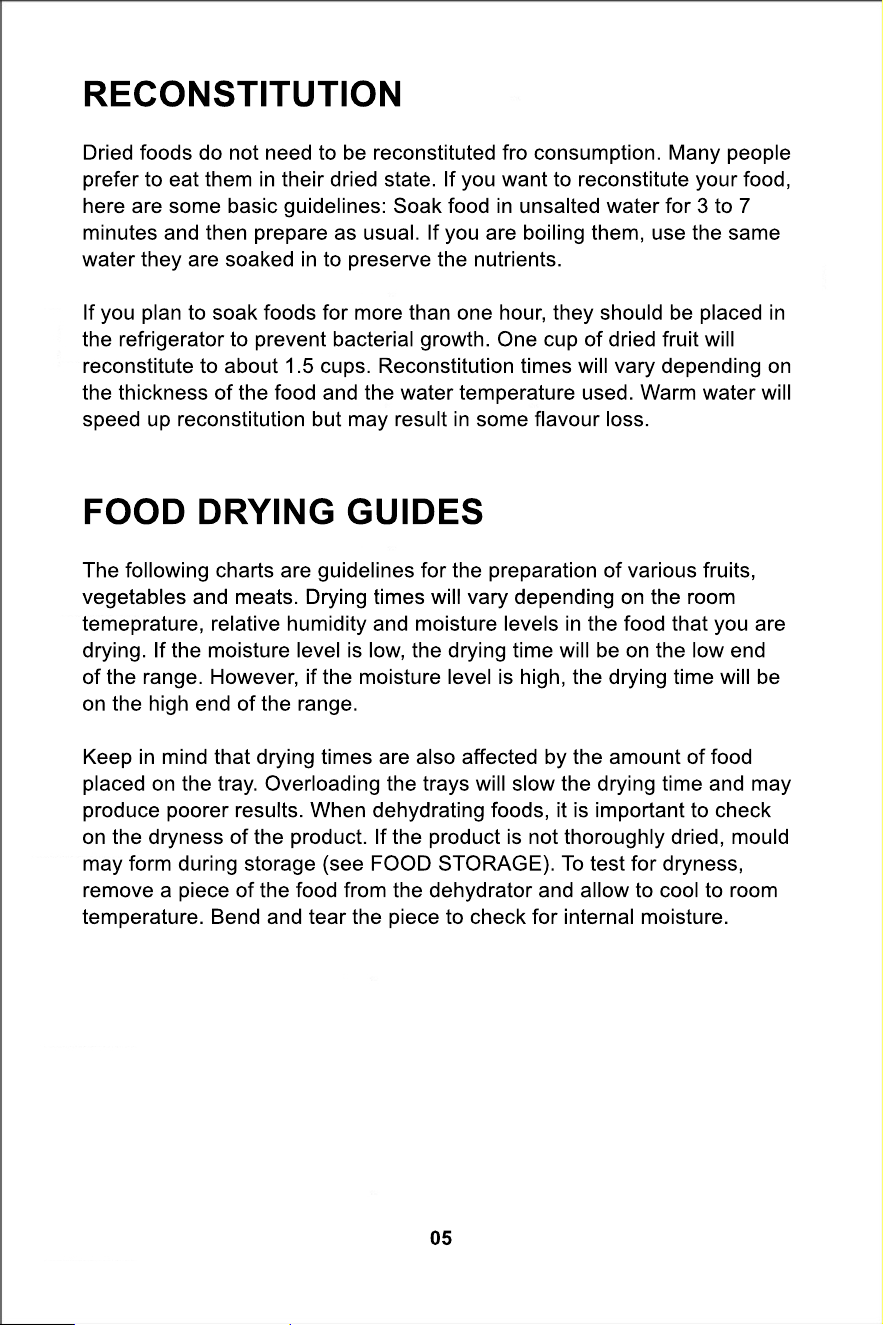
RECONSTITUTION
Dried foods do not need to be reconstituted fro consumption. Many people
prefer to eat them in their dried state. If you want to reconstitute your food,
here are some basic guidelines: Soak food in unsalted water for 3 to 7
minutes and then prepare as usual. If you are boiling them, use the same
water they are soaked in to preserve the nutrients.
If you plan to soak foods for more than one houIf you plan to soak foods for more than one hour, they should be placed in
the refrigerator to prevent bacterial growth. One cup of dried fruit will
reconstitute to about 1.5 cups. Reconstitution times will vary depending on
the thickness of the food and the water temperature used. Warm water will
speed up reconstitution but may result in some flavour loss.
FOOD DRYING GUIDES
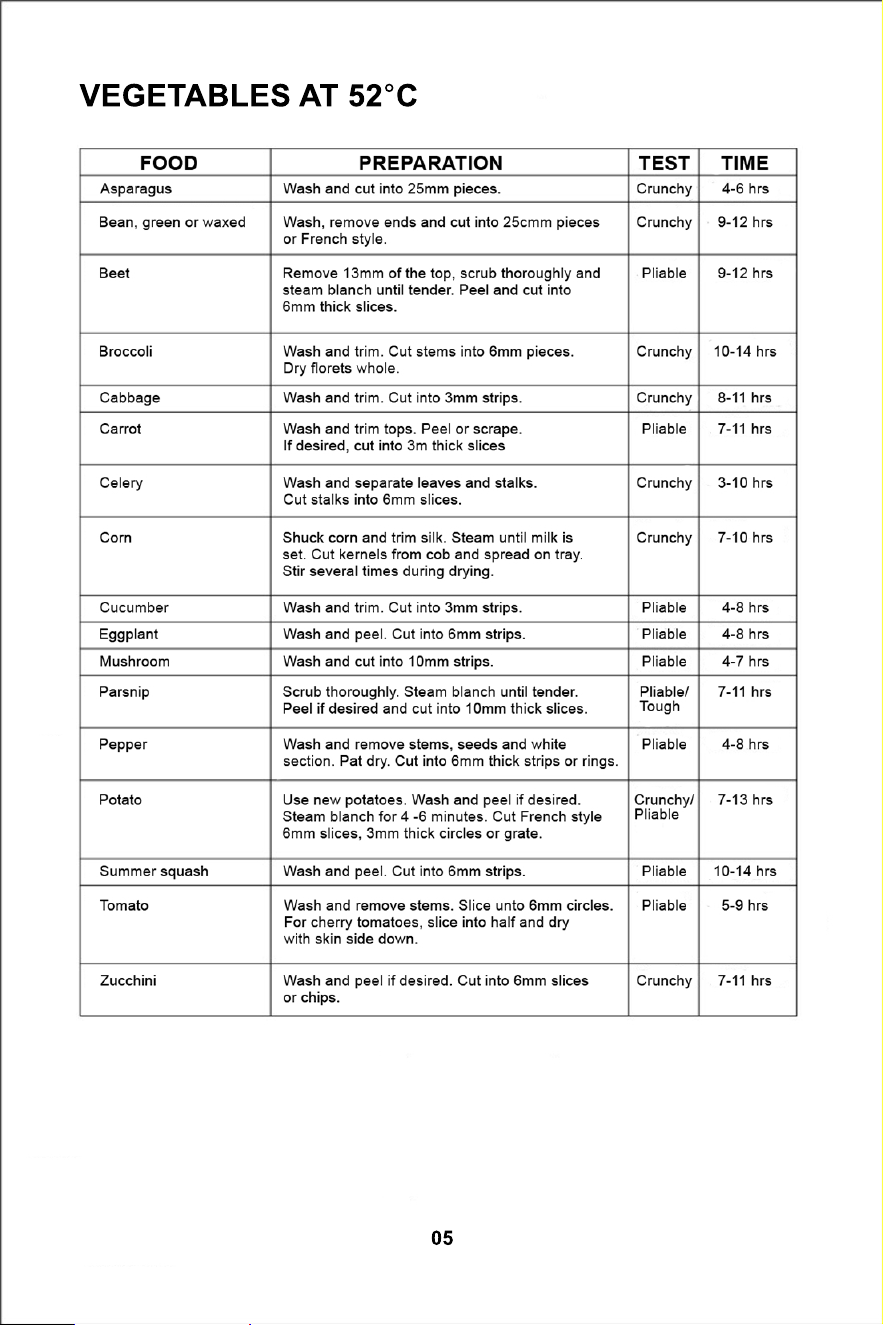
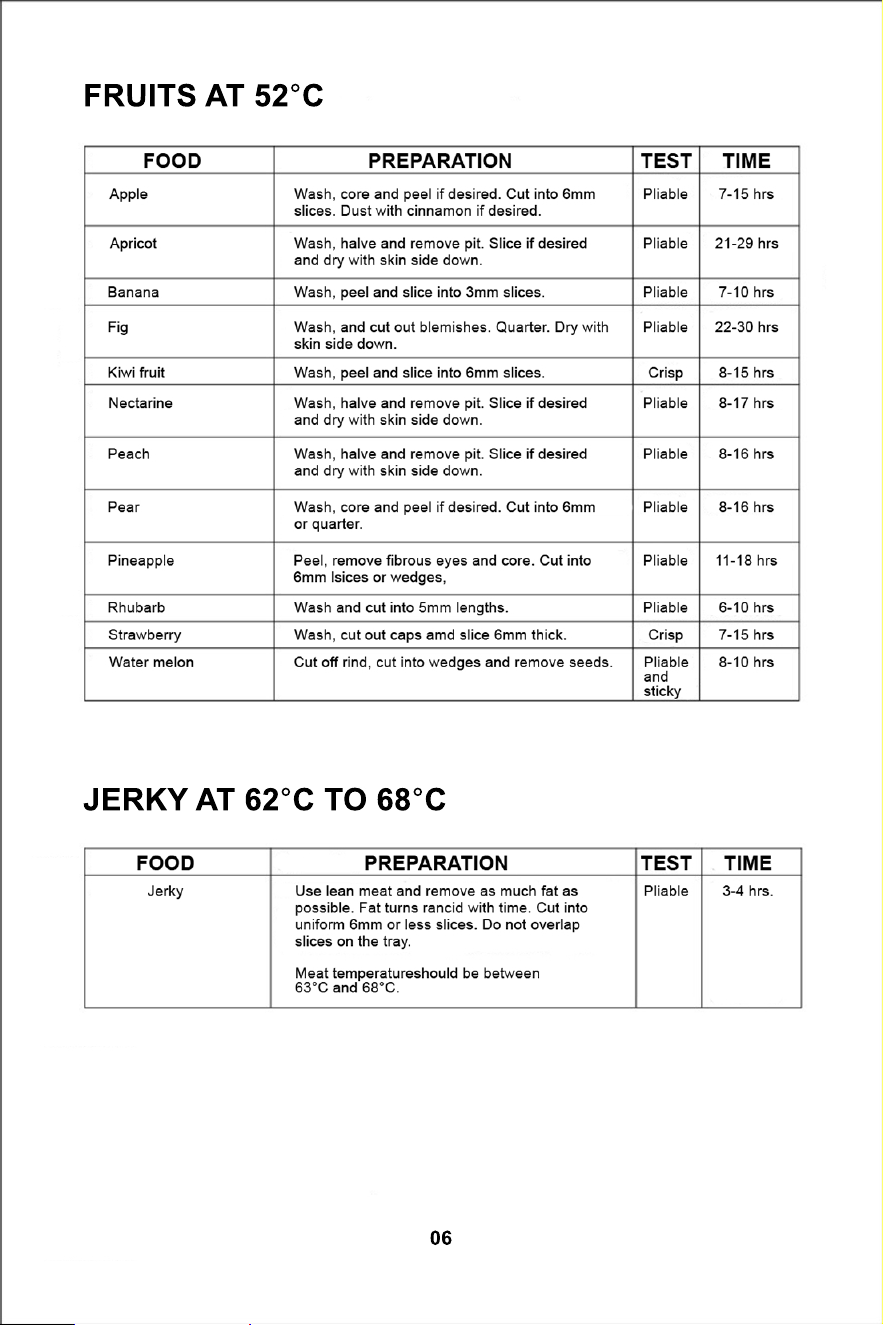
The following charts are guidelines for the preparation of various fruits,
vegetables and meats. Drying times will vary depending on the roomvegetables and meats. Drying times will vary depending on the room
temeprature, relative humidity and moisture levels in the food that you are
drying. If the moisture level is low, the drying time will be on the low end
of the range. However, if the moisture level is high, the drying time will be
on the high end of the range.
Keep in mind that drying times are also affected by the amount of food
placed on the tray. Overloading the trays will slow the drying time and may
produce poorer results. When dehydrating foods, it is important to check produce poorer results. When dehydrating foods, it is important to check
on the dryness of the product. If the product is not thoroughly dried, mould
may form during storage (see FOOD STORAGE). To test for dryness,
remove a piece of the food from the dehydrator and allow to cool to room
temperature. Bend and tear the piece to check for internal moisture.
OPERATION INSTRUCTIONS
1. Examine the cartion and the appliance for any damage that may have
occurred during shipping. Contact the seller and the to report damage.
2. Make sure the power switch is turned off. Place the appliance on a
clean and dry surface and away from children and pets. Plug in the
appliance to an undamaged eletrical outlet. WARNING: Do not use
an extension cord with the dehyrator.
3. Turn on the appliance and it willbegin to heat up.
4. Heat up appliance for 45 minutes at 32°C to remove any moisture.
5. If the appliance stops for any reason, turn it off, unplug it and then
repeat Steps 2 and 3. If the appliance does not operate normally,
turn off, unlug and call the manufacturer.
6. Foolow your recipe to prepare the food that you wish to dehydrate.
7.7. Using oven mitts, slide out the dehydrator tarys out of the appliance
and load the food to be dehydrated onto the trays. For best results,
do not overlap the trays ad be sue to leave space between the
items to allow for maximum air circulation.
8. Using both hands for maximum stability, slide the dehydrator trays
back into the dehydrator.
9. Set the temperature by turning the temperature selector. Monitor the
internal temperature and adjust as needed.
10. Moisture may collect on the surface of the food. This should be
blotted off.
FOOD STORAGE
Dried foods should be allowed to condition before being placed into a
storage container. In general, let it stand for about a week in a dry and
well-ventitlated area. The conditioning time allows for further drying and
removes most of the remanining moisture in the food. Dried foods can be removes most of the remanining moisture in the food. Dried foods can be
placed into clean, dry and insect-resistant containers, preferably glass
jars. Heavy-gauge plastic freezer bags can also be used. Eliminate as
much air as possible before sealing the bag. When properly used, vacuum
sealers provide ideal storage. The less air is present, the less potential for
the formation of moulds. Chcek stored food for insects and mould monthly.
If mould is present, scrape it off. And then place the food on a baking sheet
and heat in the oven at 79and heat in the oven at 79°C for 15 to 25 minutes. Re-pack into a clean and
air-tight container.
04 05
RECONSTITUTION
Dried foods do not need to be reconstituted fro consumption. Many people
prefer to eat them in their dried state. If you want to reconstitute your food,
here are some basic guidelines: Soak food in unsalted water for 3 to 7
minutes and then prepare as usual. If you are boiling them, use the same
water they are soaked in to preserve the nutrients.
If you plan to soak foods for more than one houIf you plan to soak foods for more than one hour, they should be placed in
the refrigerator to prevent bacterial growth. One cup of dried fruit will
reconstitute to about 1.5 cups. Reconstitution times will vary depending on
the thickness of the food and the water temperature used. Warm water will
speed up reconstitution but may result in some flavour loss.
FOOD DRYING GUIDES
The following charts are guidelines for the preparation of various fruits,
vegetables and meats. Drying times will vary depending on the roomvegetables and meats. Drying times will vary depending on the room
temeprature, relative humidity and moisture levels in the food that you are
drying. If the moisture level is low, the drying time will be on the low end
of the range. However, if the moisture level is high, the drying time will be
on the high end of the range.
Keep in mind that drying times are also affected by the amount of food
placed on the tray. Overloading the trays will slow the drying time and may
produce poorer results. When dehydrating foods, it is important to check produce poorer results. When dehydrating foods, it is important to check
on the dryness of the product. If the product is not thoroughly dried, mould
may form during storage (see FOOD STORAGE). To test for dryness,
remove a piece of the food from the dehydrator and allow to cool to room
temperature. Bend and tear the piece to check for internal moisture.
VEGETABLES AT 52°C FRUITS AT 52°C
05 06
JERKY AT 62°C TO 68°C
VEGETABLES AT 52°C FRUITS AT 52°C
05 06
JERKY AT 62°C TO 68°C
07
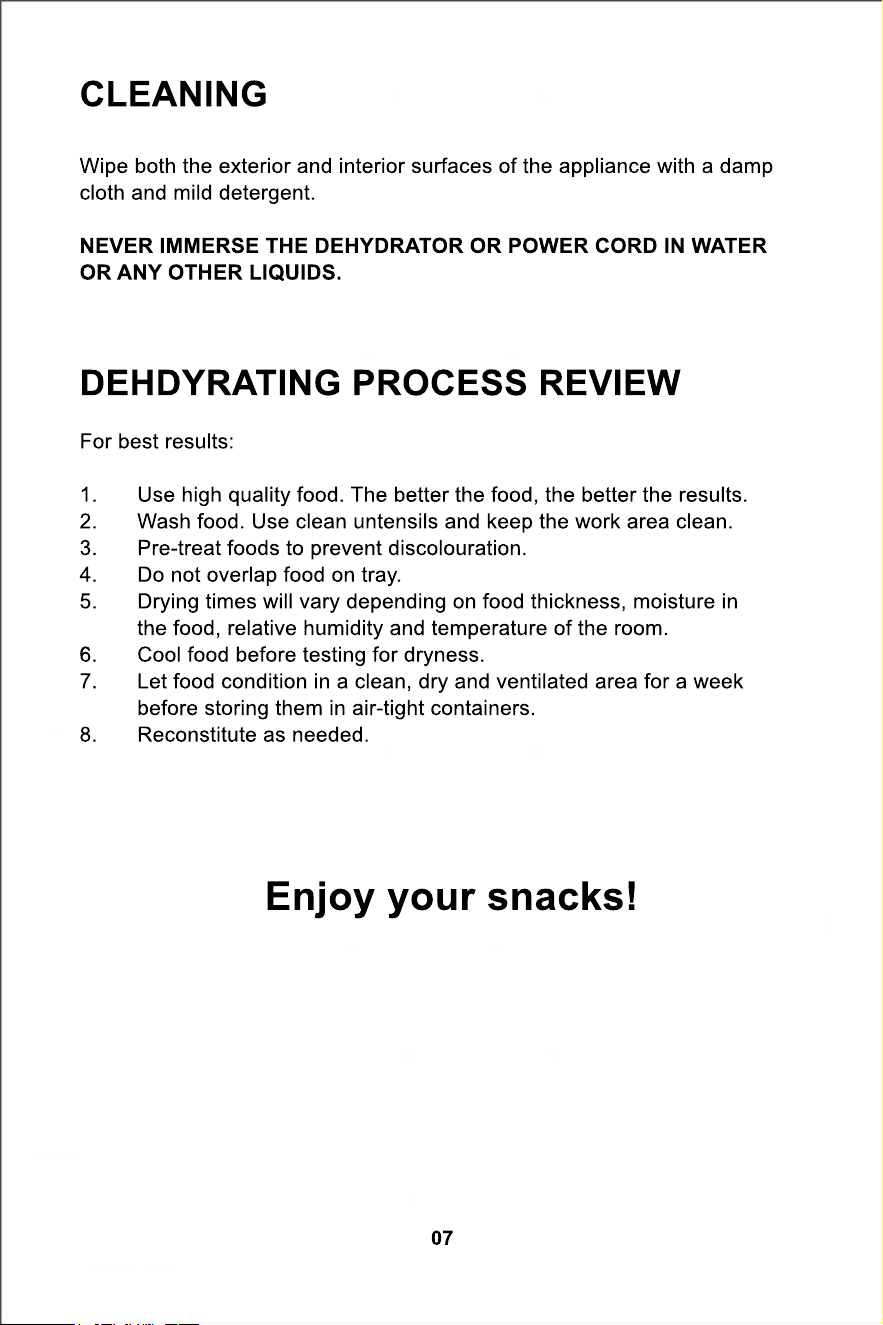
CLEANING
Wipe both the exterior and interior surfaces of the appliance with a damp
cloth and mild detergent.
NEVER IMMERSE THE DEHYDRATOR OR POWER CORD IN WATER
OR ANY OTHER LIQUIDS.
DEHDYRATING PROCESS REVIEW
For best results:For best results:
1. Use high quality food. The better the food, the better the results.
2. Wash food. Use clean untensils and keep the work area clean.
3. Pre-treat foods to prevent discolouration.
4. Do not overlap food on tray.
5. Drying times will vary depending on food thickness, moisture in
the food, relative humidity and temperature of the room.
6.6. Cool food before testing for dryness.
7. Let food condition in a clean, dry and ventilated area for a week
before storing them in air-tight containers.
8. Reconstitute as needed.
Enjoy your snacks!