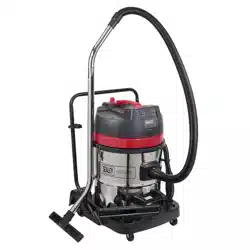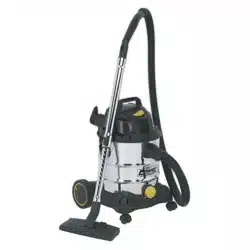
20L WET & DRY INDUSTRIAL VACUUM
CLEANER 1250W/110V STAINLESS DRUM
MODEL NO: PC200SD110V.V2
Thank you for purchasing a Sealey product. Manufactured to a high standard, this product will, if used according to these
instructions, and properly maintained, give you years of trouble free performance.
IMPORTANT: PLEASE READ THESE INSTRUCTIONS CAREFULLY. NOTE THE SAFE OPERATIONAL REQUIREMENTS, WARNINGS & CAUTIONS. USE
THE PRODUCT CORRECTLY AND WITH CARE FOR THE PURPOSE FOR WHICH IT IS INTENDED. FAILURE TO DO SO MAY CAUSE DAMAGE AND/OR
PERSONAL INJURY AND WILL INVALIDATE THE WARRANTY. KEEP THESE INSTRUCTIONS SAFE FOR FUTURE USE.
1. SAFETY
1.1. ELECTRICAL SAFETY
WARNING! It is the responsibility of the owner and the operator to read, understand and comply with the following:
You must check all electrical products, before use, to ensure that they are safe. You must inspect power cables, plugs, sockets and
any other connectors for wear or damage. You must ensure that the risk of electric shock is minimised by the installation of appropriate
safety devices. A Residual Current Circuit Breaker (RCCB) should be incorporated in the main distribution board. We also recommend
that a Residual Current Device (RCD) is used. It is particularly important to use an RCD with portable products that are plugged into a
supply which is not protected by an RCCB. If in any doubt consult a qualified electrician. You may obtain a Residual Current Device by
contacting your Sealey stockist.
9 You must also read and understand the following instructions concerning electrical
safety.
1.1.1. The Electricity at Work Act 1989 requires that all portable electrical appliances, if
used on business premises, are tested by a qualified electrician, using a Portable
Appliance Tester (PAT), at least once a year.
1.1.2. The Health & Safety at Work Act 1974 makes owners of electrical appliances
responsible for the safe condition of those appliances and the safety of the appliance
operators. If in any doubt about electrical safety, contact a qualified electrician.
9 Ensure that the insulation on all cables and on the appliance is safe before connecting
it to the power supply.
9 Ensure that cables are always protected against short circuit and overload.
9 Regularly inspect power supply cables and plugs for wear or damage and check all
connections to ensure that none are loose.
9 Ensure that the voltage marked on the appliance matches the power supply to be
used.
8 DO NOT pull or carry the appliance by its power supply lead.
8 DO NOT pull the plug from the socket by the power cable.
8 DO NOT use worn or damaged cables, plugs or connectors. Immediately have any
faulty item repaired or replaced by a qualified electrician.
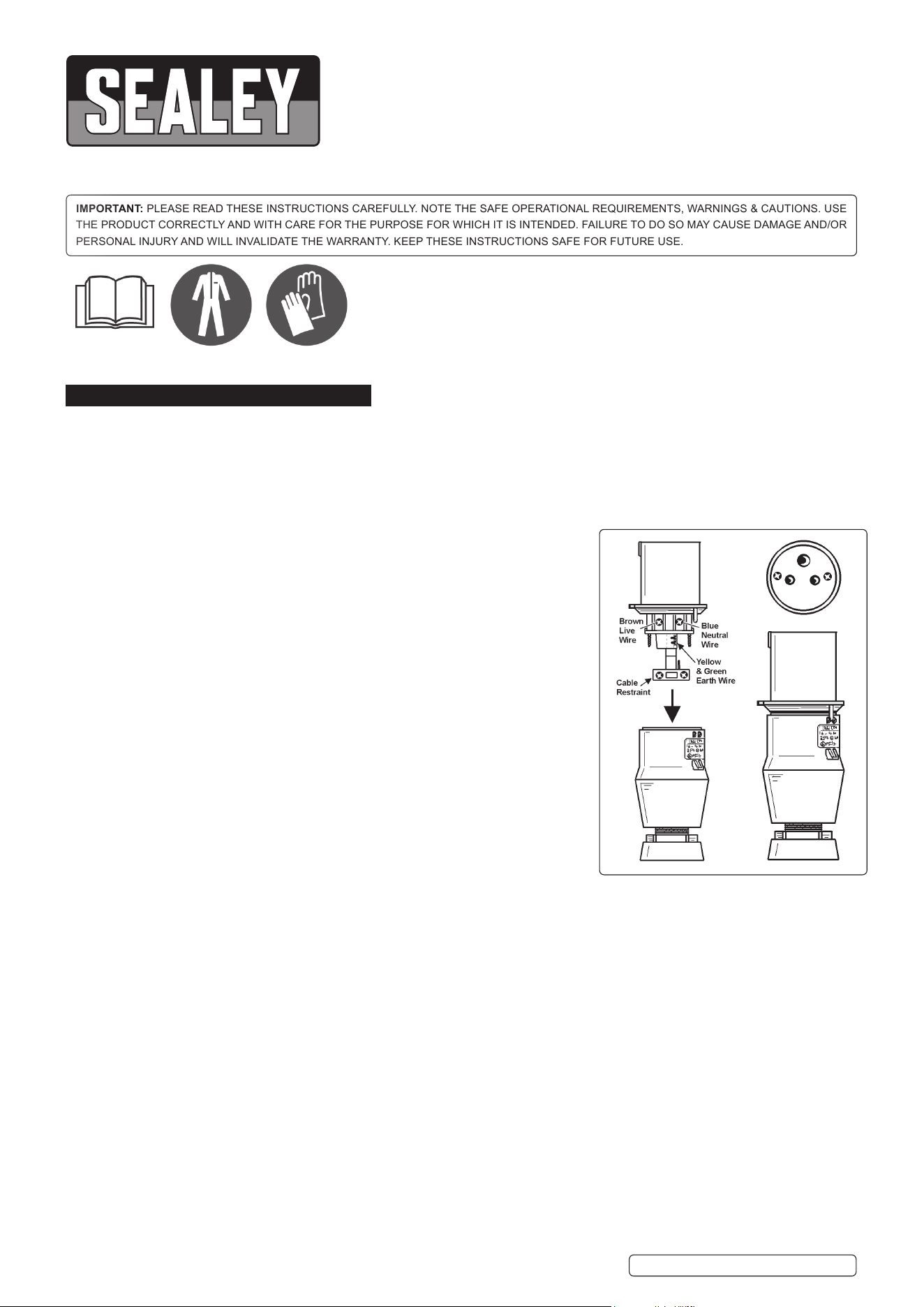
9 Ensure the unit is correctly earthed via a three-pin 110V plug.
a) Connect the GREEN/YELLOW earth wire to the earth terminal ‘PE’.
b) Connect the BROWN live wire to the live terminal ‘L/+’.
c) Connect the BLUE neutral wire to the neutral terminal.
d) After wiring, check that there are no bare wires, that all wires have been correctly connected, that the cable outer insulation extends
past the cable restraint and that the restraint is tight.
1.2. GENERAL SAFETY
9 Disconnect the cleaner from the power supply before servicing, changing accessories, or performing any maintenance.
9 Use only genuine parts and accessories. Unauthorised parts and accessories may be dangerous and will invalidate your warranty.
9 Maintain the cleaner in good condition. Use an authorised agent for servicing. Keep machine clean,
but DO NOT use solvents.
9 For dry vacuuming ensure the locking cartridge filter is firmly in place before operating the cleaner.
8 DO NOT operate the unit without the locking cartridge filter in place (except when wet vacuuming).
Using the cleaner without a locking cartridge filter will cause machine faults and will invalidate your warranty.
9 Wear protective clothing and gloves.
8 DO NOT allow children or untrained persons to operate the cleaner.
8 DO NOT place attachments close to your face (especially eyes, ears, etc). Do not point the hose end at other persons or animals.
▲ DANGER! DO NOT vacuum hot or glowing ash, cigarette ends, inflammable, explosive, corrosive or other dangerous substances.
8 DO NOT operate the unit without the locking cartridge filter or optional dust bag (except when wet vacuuming).
8 DO NOT leave machine running unattended. Turn power supply OFF, and DO NOT leave the vicinity until motor has come to a
complete stop.
8 DO NOT operate the cleaner while under the influence of drugs, alcohol or impairing medication, or if you are tired.
8 DO NOT use the cleaner in the rain or in very damp conditions.
8 DO NOT use the cleaner for a task it is not designed to perform.
9 When not in use, store the cleaner in a safe, dry, childproof location.
PC200SD110V.V2 Issue 3 21/08/2020
Original Language Version
© Jack Sealey Limited
Read before rst
use
Wear protective
gloves
Wear protective
clothing
Fuse rating: 16 Amp
2. INTRODUCTION
High powered, lightweight industrial unit with blower facility. Constructed from stainless steel, the drum unit is mounted on two castor and
two xed wheels. Tool storage points on head and base. Supplied with 4m cable and 110V plug, deluxe tool kit, including stainless steel
telescopic rigid extension tubes, cartridge lter and wet-use foam lter.
3. SPECIFICATION
MODEL NO: ................................................. PC200SD110V.V2
Airow: ..........................................................................173m³/hr
Drum Size: ............................................................................ 20L
Filter Type: ................................................................... Cartridge
Maximum Vacuum Pressure: ........................................125mbar
Motor Power:....................................................................1250W
Supply: ................................................................................ 110V
Vacuum Accessories Diameter: ...................................... Ø35mm
Optional Accessories:
PC200PB5 ................................. Optional Dust Bags (Pack of 5)
Replacement Parts:
PC200CFL .......................................................... Cartridge Filter
PC200FF10 .........................................Foam Filters (Pack of 10)
4. CONTENTS
4.1. CARTON CONTENT
4.1.1. Carefully unpack the carton.
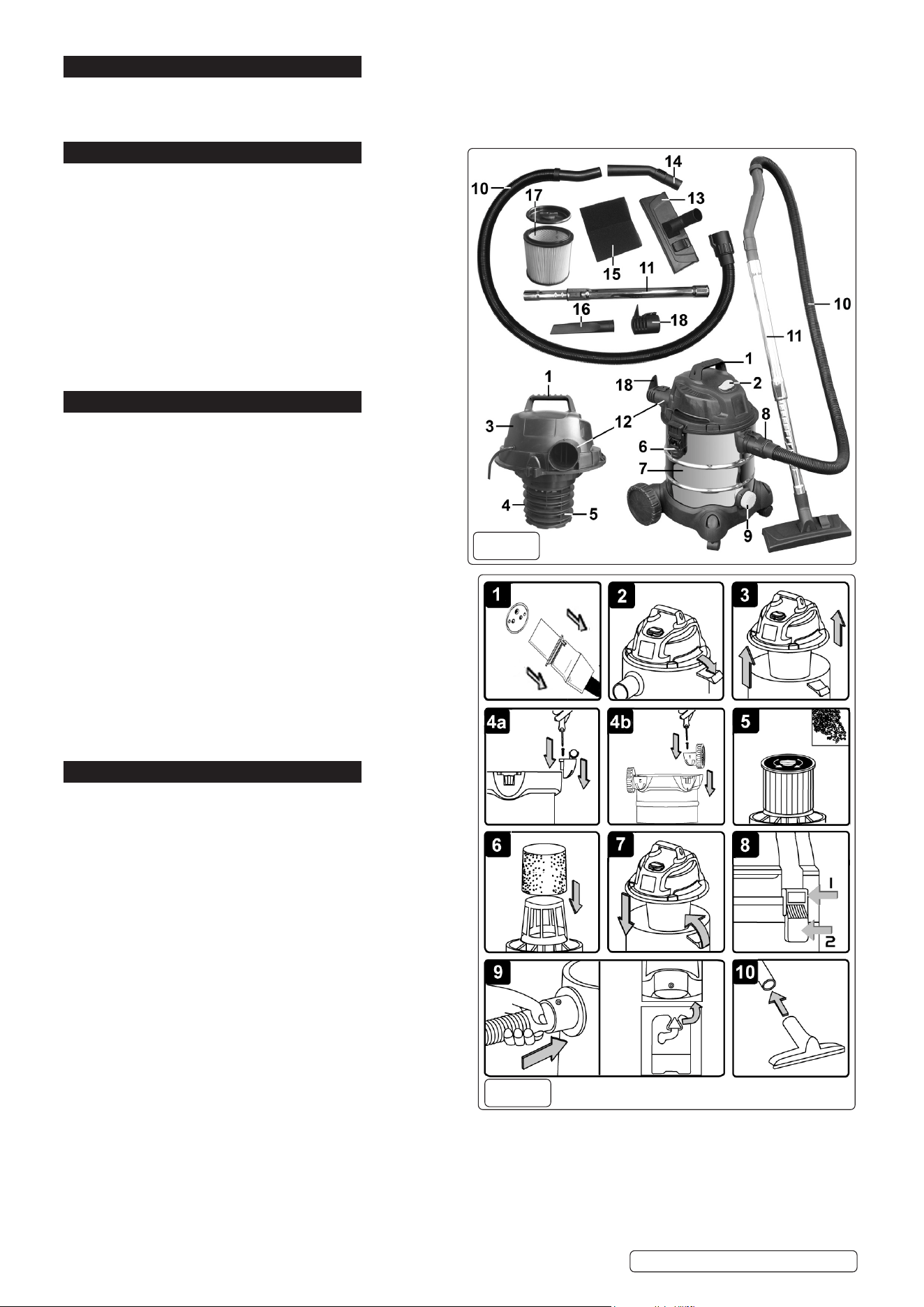
4.1.2. Locate the two side clasps (g.1.6) which hold the top
section (g.1.3) in place.
4.1.3. Undo the clasps, remove the power head and take out the
items in the container.
4.1.4. Check and identify each component as listed below. If
anything is missing or damaged please contact your supplier
immediately.
5. ASSEMBLY
5.1. Ensure the mains plug is disconnected. (fig.2.1)
5.2. Undo clasps. (fig.2.2)
5.3. Lift off the power head assembly. (fig.2.3)
5.4. Locate contents for assembly if not already done so, remove
from inside of vacuum drum and check against contents list
above.
5.4.1. Turn the drum upside down and insert the castor assembly
mouldings into the slots in the base either side of the drain cap.
Ensure they are pushed all the way in and fix them with the self
tapping screws provided. DO NOT overtighten. (fig.2.4a)
5.4.2. The wheel assembly mouldings are marked 1 and 2. Insert the
wheel assembly mouldings into the two remaining slots in the
base ensuring that the number on each moulding matches the
number to be found on the base. Ensure they are pushed
all the way in and fix them with the self tapping screws provided
(fig.2.4b). DO NOT overtighten.
5.5. For dry vacuum cleaning use the locking cartridge filter supplied
and push it fully down onto the filter basket, and lock in place
(fig.2.5).
5.6. For wet vacuum cleaning fit the supplied foam filter. (fig.2.6)
NOTE: DO NOT operate the cleaner without a cartridge filter fitted as this will damage the machine and invalidate your warranty. Ensure
filter is correctly fitted before every use.
5.7. Replace the power head assembly onto the drum ensuring that the on/off switch is above the vacuum hose connector. (fig.2.7)
5.8. Align the ridges on the rim of the power head with the two side clasps. Place the upper part of each clasp over the ridges and snap the
clasps into place by pressing on the lower part of each clasp in turn. (fig.2.8)
5.9. Align the arrow symbol on the large end of the vacuum hose with the pin on the front inlet of the drum. Push the fitting into the inlet
and lock in place by turning the fitting clockwise. (fig.2.9)
5.10. Choose the desired nozzle and push it onto the telescopic suction tube. (fig.2.10)
g.1
g.2
Item Description
1 Handle
2 ON/OFF switch
3 Top section
4 Filter basket
5 Safety float valve
6 Clasp
7 Stainless Steel drum
8 Hose connection
9 Drain Cap
10 Flexible vacuum hose
Item Description
11 Telescopic suction tube
12 Blow connection
13 Combination nozzle
14 Air regulator handle
15 Foam filter
16 Crevice nozzle
17 Locking Cartridge filter
(fitted as standard)
18 Noise muffler
PC200SD110V.V2 Issue 3 21/08/2020
Original Language Version
© Jack Sealey Limited
6. DRY VACUUM CLEANING
WARNING! Ensure you read, understand and apply Section 1 ‘Safety Instructions’.
Reminder: DO NOT vacuum hazardous substances. Use of an incorrect cartridge filter will
invalidate your warranty.
IMPORTANT! IF THE MACHINE IS USED WITHOUT A CARTRIDGE FILTER FITTED
THE MOTOR WILL EVENTUALLY BURN OUT AND YOUR GUARANTEE WILL BE
INVALIDATED. ALWAYS KEEP A SPARE CARTRIDGE FILTER HANDY.
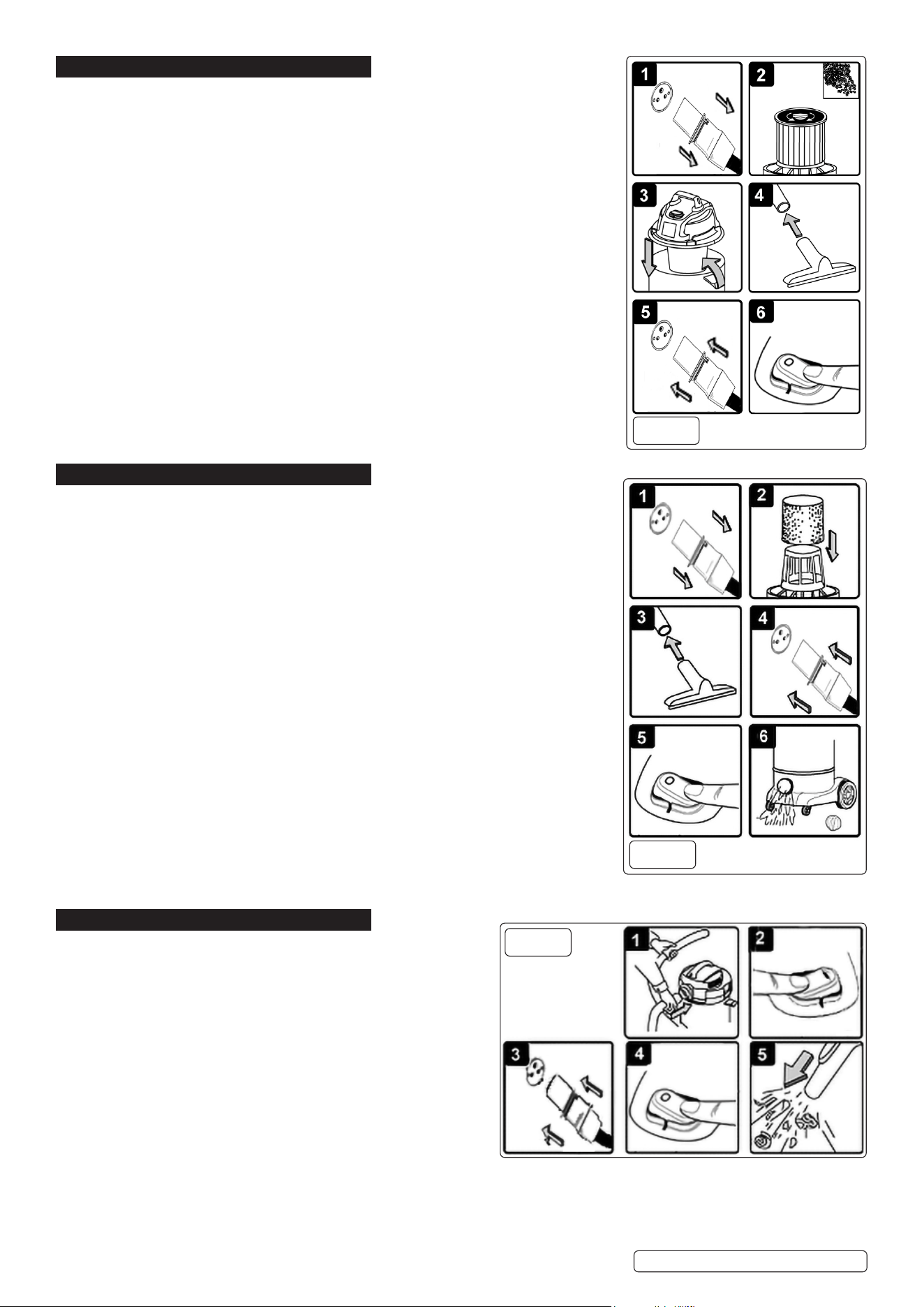
6.1. Ensure the machine is unplugged from the power supply. (fig.3.1)
6.2. Remove the power head and with the raised rim uppermost fit the cartridge filter tube down
over the filter basket and push fully home. Place the locking disc onto the top of the filter and
turn the locking bar until the latch drops into the slot in the top of the filter basket. Continue
turning until the filter is fully locked down. (fig.3.2)
6.3. Reposition the power head onto the drum body, and clip in place. (fig.3.3)
6.4. Insert the larger end of the flexible hose into the front inlet on the container and lock in place.
Push the required attachment onto the free end of the hose. (fig.3.4)
6.5. Plug in the power supply. (fig.3.5)
6.6. Switch to the ‘On’ (position ‘I’). (fig.3.6)
6.7. When you have completed vacuuming, press the switch to ‘Off’.
7. WET VACUUM CLEANING
WARNING! Ensure you read, understand and apply Section 1 ‘Safety Instructions’.
Reminder: Remove plug from power supply before opening unit. DO NOT vacuum solvents,
explosives, inflammable and/or hazardous liquids such as petrol, oil, spirits, paint, thinners,
acids etc.
7.1. Ensure the machine is unplugged from the power supply. (fig.4.1) Make sure the tank is
clean and free from dust and dirt.
7.2. Remove the cartridge filter and fit a foam filter over the filter basket. (fig.4.2) Refit the power
head onto the drum.
7.3. To the same flexible hose used in dry cleaning, fit the desired nozzle. (fig.4.3)
7.4. Ensure the switch is ‘Off’ (position ‘0’) before plugging into the power supply. (fig.4.4)
7.5. Press the switch to ‘On’ (position ‘I’). (fig.4.5)
NOTE: To vacuum large quantities of liquid, from a sink or tank etc, DO NOT immerse the nozzle
completely in the liquid, leave a gap at the top of the nozzle opening to allow an air inflow.
The machine is fitted with a float valve which stops the suction action when the tank has
reached its maximum capacity. The user will notice an increase in motor speed. When this
happens, turn off the machine, disconnect from power supply, remove the power head
from the container and empty the liquid into a suitable receptacle or drain. (fig.4.6)
To continue vacuuming, refit the power head and proceed. After wet vacuuming, turn the
machine off and unplug from power supply. Empty the container and clean and dry the
inside and outside before storage.
Remember! After wet vacuuming the foam filter must be removed and a cartridge filter
must be fitted before dry vacuuming again.
WARNING! Not designed for liquid storage. Always empty liquids after use and before
storing.
8. BLOWING
8.1. Push the large end of the flexible hose into the blow connection in
the top section. (fig.5.1)
8.2. Ensure the power switch is turned off (fig.5.2) and plug in the power
supply. (fig.5.3)
8.3. Switch on the power (position ‘I’). (fig.5.4)
8.4. The unit will now blow through the hose and can be used to clear
obstructions within the pipe. (fig.5.5)
WARNING! If after a few seconds the hose is still blocked turn off
the unit and clear the hose manually.
g.3
g.4
g.5
PC200SD110V.V2 Issue 3 21/08/2020
Original Language Version
© Jack Sealey Limited
9. MAINTENANCE
9.1. GENERAL MAINTENANCE.
9.1.1. Ensure the machine is unplugged from the power supply.
9.1.2. Disconnect the hose from the container.
9.1.3. Undo the clasps and remove power head from the container.
9.1.4. Clear out any dirt or debris from the container and hose.
9.1.5. Clean the foam filter by washing it in a mild soapy solution.
9.1.6. Check that the telescopic suction tube operates smoothly and
check the power cable to make sure it has not received any
damage.
9.2. CARTRIDGE FILTER MAINTENANCE.
9.2.1. Handle the filter carefully when cleaning or installing.
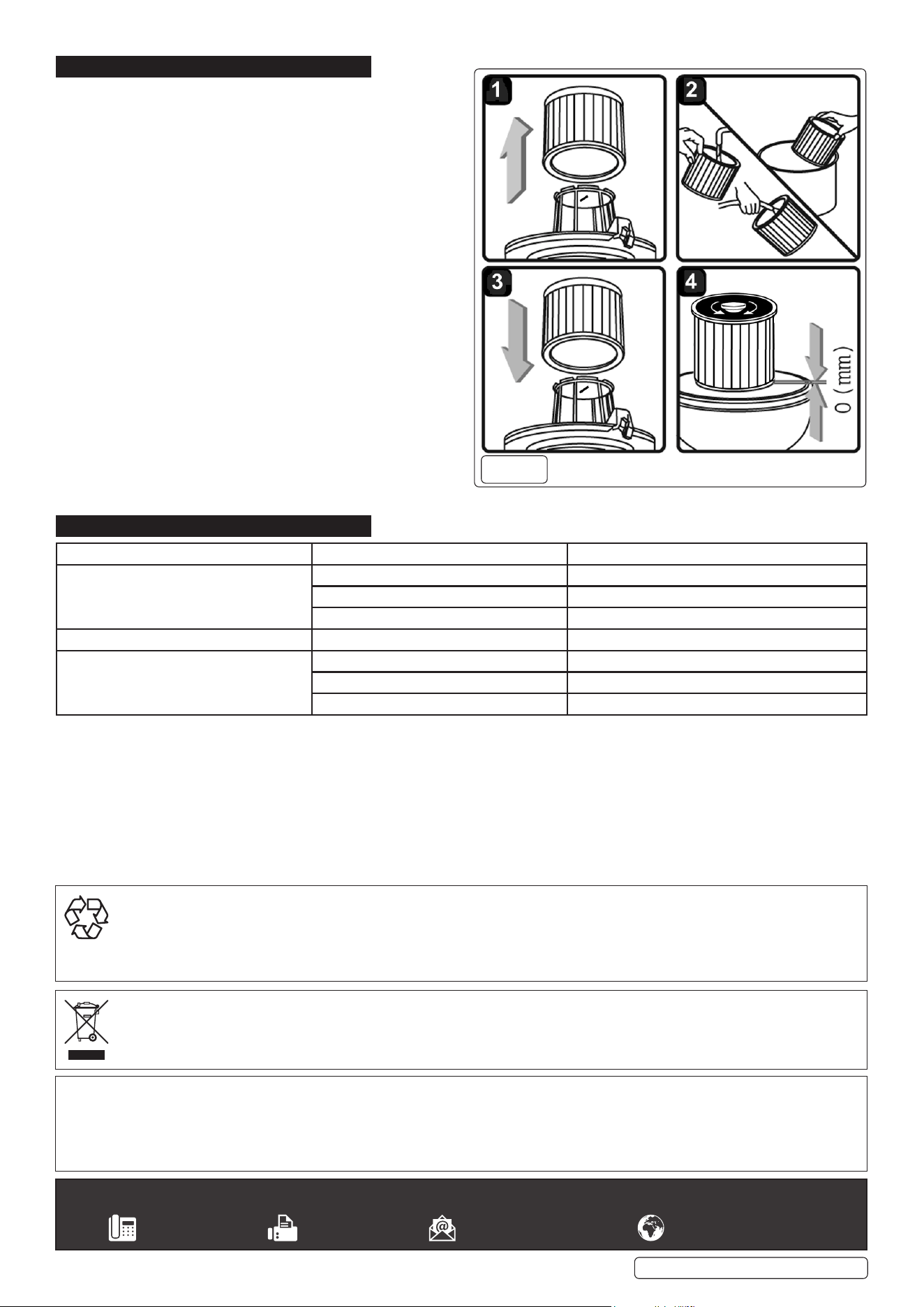
9.2.2. Carefully remove the cartridge filter (fig.6.1) and inspect it for
damage. A filter that has small holes or tears in it will not
perform efficiently and should be replaced.
9.2.3. To clean a dry filter, tap it inside a waste bin. (fig.6.2)
8 DO NOT use the filter if it becomes wet as the filter will clog
quickly and be very difficult to clean. (The cartridge filter is
designed for dry vacuuming only). Should the filter be
inadvertently wetted it should be rinsed from the inside (fig.6.2)
and allowed to air dry for 24 hours.
9.2.4. Fit a new/cleaned filter and with the raised rim uppermost fit the
cartridge filter tube down over the filter basket and push fully
home. Place the locking disc onto the top of the filter and turn
the locking bar until the latch drops into the slot in the top of the
filter basket. Continue turning until the filter is fully locked down. (fig.6.4).
10. TROUBLESHOOTING
g.6
PROBLEM CAUSE SOLUTION
1) Cleaner will not operate 1a) No power supply Check supply
1b) Faulty power cable, switch or motor Check and repair or replace faulty item
1c) Container full of liquid Empty container
2) Dust comes from the motor cover 2) Cartridge lter missing or damaged Fit or replace cartridge lter
3) Reduced eciency and increased motor
speed/vibration
3a) Dust container full Empty container
3b) Filter clogged Clean or replace cartridge lter
3c) Nozzle, hose or container inlet blocked Check nozzle, hose & container inlet for blockage
Sealey Group, Kempson Way, Suffolk Business Park, Bury St Edmunds, Suffolk. IP32 7AR
01284 757500 01284 703534 sales@sealey.co.uk www.sealey.co.uk
ENVIRONMENT PROTECTION
Recycle unwanted materials instead of disposing of them as waste. All tools, accessories and packaging should be sorted, taken to
a recycling centre and disposed of in a manner which is compatible with the environment. When the product becomes completely
unserviceable and requires disposal, drain any fluids (if applicable) into approved containers and dispose of the product and fluids
according to local regulations.
Note: It is our policy to continually improve products and as such we reserve the right to alter data, specifications and component parts without prior
notice. Please note that other versions of this product are available. If you require documentation for alternative versions, please email or call
our technical team on technical@sealey.co.uk or 01284 757505.
Important: No Liability is accepted for incorrect use of this product.
Warranty: Guarantee is 12 months from purchase date, proof of which is required for any claim.
WEEE REGULATIONS
Dispose of this product at the end of its working life in compliance with the EU Directive on Waste Electrical and Electronic Equipment
(WEEE). When the product is no longer required, it must be disposed of in an environmentally protective way. Contact your local solid
waste authority for recycling information.
PC200SD110V.V2 Issue 3 21/08/2020
Original Language Version
© Jack Sealey Limited