
Hussong Mfg. Co., Inc. • SLA-42S Report No: 0216GF036S • Rev. 4, October 2016
HUSSONG MANUFACTURING CO., INC.
ͷ Do not store or use gasoline or other
ammable vapors and liquids in the
vicinity of this or any other appliance.
ͷ WHAT TO DO IF YOU SMELL GAS
• Do not try to light any appliance.
• Do not touch any electrical switch; do
not use any phone in your building.
• Leave the building immediately.
• Immediately call your gas supplier from
a neighbor’s phone. Follow the gas
supplier’s instructions.
• If you cannot reach your gas supplier,
call the re department.
ͷ Installation and service must be performed
by a qualied installer, service agency or
the gas supplier.
WARNING:
FIRE OR EXPLOSION HAZARD
Failure to follow safety warnings exactly
could result in serious injury, death, or
property damage.
This appliance may be installed in
an aftermarket, permanently located,
manufactured home (USA only) or mobile
home, where not prohibited by local codes.
This appliance is only for use with the type
of gas indicated on the rating plate. This
appliance is not convertible for use with
other gases, unless a certied kit is used.
INSTALLER: Leave this manual with the appliance.
CONSUMER: Retain this manual for future reference.
SLAYTON-42S
Model #SLA-42S
Direct Vent Linear Gas Fireplace
Tested &
Listed By
OMNI-Test
Laboratories, Inc.
C US
Portland
Oregon USA
Installation and
Operation Manual
English and French installation manuals are
available through your local dealer. Visit our website
www.kozyheat.com or scan the QR code for our mobile app.
Les manuels d’installation en français et en anglais sont
disponibles chez votre détaillant local. Visitez
www.kozyheat.
com
ou scannez ce code QR pour notre application mobile.
DANGER
HOT GLASS WILL
CAUSE BURNS
DO NOT TOUCH GLASS
UNTIL COOLED
NEVER ALLOW CHILDREN
TO TOUCH GLASS
A barrier designed to reduce the risk of burns
from the hot viewing glass is provided with this
appliance and shall be installed for the protection
of children and other at-risk individuals.

HOMEOWNER REFERENCE 3
Read this manual before installation or operating this appliance.
Please retain this owner’s manual for future reference.
CONGRATULATIONS!
We welcome you as a new owner of a Kozy Heat gas replace. Kozy Heat products are designed with superior components
and materials, and assembled by trained craftsmen who take pride in their work. To ensure you receive a quality product,
the burner and valve assembly are 100 percent test-red, and the complete replace is thoroughly inspected before packaging.
Our commitment to quality and customer satisfaction has remained the same for 40 years. We offer a complete line of gas and
wood replaces, along with stylish accessories to complement any decor. Adding a replace is one of the best ways to increase
the value of your home, and we are proud to offer a network of dealers throughout the country to help make your experience
everything you imagine. We pride ourselves in being dedicated not only to functionality and reliability, but also customer
safety. We offer our continual support and guidance to help you achieve the maximum benet and enjoyment from your Kozy
Heat gas replace.
Jim Hussong
President
Dudley Hussong
Board Chairman
Homeowner Reference Information
We recommend you record the following information:
Model Name: ___________________________________________
Serial Number: __________________________________________
Dealership Purchased from: _______________________________
Date purchased/installed: _________________________________
Location of fireplace: _____________________________________
Dealer phone: ___________________________________________
Notes: _____________________________________________________________________________________________________________
____________________________________________________________________________________________________________________
____________________________________________________________________________________________________________________
____________________________________________________________________________________________________________________
____________________________________________________________________________________________________________________


TABLE OF CONTENTS 5
TABLE OF CONTENTS
TABLE OF CONTENTS ...................................................................5
1.0 INTRODUCTION ......................................................................7
1.1 Appliance Certification ..................................................................7
1.2 Requirements for the Commonwealth of Massachusetts ......7
2.0 SPECIFICATIONS .................................................................... 8
2.1 Appliance Components ................................................................8
2.2 Heating Specifications ..................................................................8
2.3 Appliance Dimensions ..................................................................9
2.4 Safety Barrier Dimensions ...........................................................10
3.0 FRAMING .................................................................................11
3.1 Appliance Placement Considerations ........................................11
3.2 Stand-off Assembly and Installation ...........................................11
3.3 Clearances to Combustibles .......................................................12
3.4 Wall Enclosure Rough Opening ..................................................13
3.5 Floor Support and Protection ......................................................14
3.6 Recess Construction ..................................................................... 14
3.7 Vent Termination Framing ............................................................. 15
4.0 #970 HEAT DUCT KIT ............................................................ 16
4.1 Kit Components ..............................................................................16
4.2 Specifications .................................................................................16
4.3 Attach Heat Duct to Fireplace .....................................................17
4.4 Install Register Mounting Frame and Junction Box ................17
4.5 Install and Wire Fan Assembly ....................................................17
4.6 Run and Secure Duct Pipe ..........................................................18
4.7 Complete the Installation .............................................................. 18
4.8 Operating Instructions ..................................................................18
4.9 Maintenance ...................................................................................18
5.0 FACING AND FINISHING ........................................................ 19
5.1 Nailing Flange Assembly and Installation .................................19
5.2 Facing and Finishing Requirements ........................................... 20
5.4 Optional Trim Kit Assembly #SL42-FTK ...................................22
6.0 GAS LINE CONNECTION .......................................................23
6.1 Gas Conversion (sold separately) ..............................................23
6.2 Gas Line Installation ...................................................................... 23
7.0 TERMINATION LOCATIONS ................................................... 24
7.1 Vertical Vent Cap Termination .....................................................24
7.2 Minimum Termination Clearances ............................................... 25
8.0 VENTING ..................................................................................26
8.1 Approved Vent Systems ...............................................................26
8.2 Venting Requirements ................................................................... 26
8.3 Elbows .............................................................................................. 26
8.4 Restrictor Plate Assembly and Installation ...............................26
8.5 Vertical Terminations ..................................................................... 27
8.6 Combination Venting .....................................................................28
8.7 #800-2 Series Direct Vent Termination Kit(s) ..........................30
8.8 Vent Heat Shield Assembly Installation ..................................... 31
9.0 FIREPLACE SET UP ................................................................32
9.1 Glass Frame Assembly .................................................................32
9.2 Light Kit ............................................................................................ 32
9.3 Glass Media ....................................................................................33
9.4 Glass Media Dam ...........................................................................33
9.5 Control Board Removal and Installation .................................... 34
10.0 ELECTRICAL INFORMATION ............................................... 35
10.1 Electrical Specifications .............................................................35
10.2 Wiring Requirements ...................................................................35
11.0 OPERATING INSTRUCTIONS ..............................................36
11.1 Setup Proflame 2 IFC Module ...................................................37
11.2 Initialize the Control System ......................................................37
11.3 Reset the System for Manual Operation ................................. 37
11.4 Automatic Safety Restart ............................................................37
11.5 Backup Battery Operation ........................................................ 37
11.6 IFC Module Ignition Sequence .................................................38
11.7 Additional Diagnostic Information .............................................38
11.8 Remote Control Operation ........................................................ 39
12.0 ADJUSTMENT ....................................................................... 42
12.1 Pressure Testing ..........................................................................42
12.2 Flame Appearance Adjustment .................................................43
13.0 TROUBLESHOOTING ........................................................... 45
14.0 MAINTENANCE .....................................................................47
14.1 Burner and Pilot System ...........................................................47
14.2 Fan(s) .............................................................................................47
14.3 Vent System ..................................................................................47
14.4 Glass Assembly ...........................................................................47
15.0 REPLACEMENT PARTS LIST ............................................... 48
LIMITED WARRANTY ..................................................................... 49
LIFETIME WARRANTY ...................................................................51


INTRODUCTION 7
1.0 INTRODUCTION
1.1 Appliance Certification
Laboratory: OMNI-Test Laboratories in Portland, Oregon
Standards:
ANSI Z21.88-2014/CSA 2.33-2014, Vented Gas Fireplace Heaters
CGA 2.17-M91 (R2014), Gas-Fired Appliances for Use at High
Altitudes
This installation must conform with local codes, or in the absence
of local codes, with the National Fuel Gas Code, ANSI Z223.1/
NFPA 54, or the Natural Gas and Propane Installation Code, CSA
B149.1.
1.2 Requirements for the
Commonwealth of Massachusetts
The following requirements reference various Massachusetts
and national codes not contained in this manual.
For all sidewall horizontally vented gas fueled equipment installed
in every dwelling, building or structure used in whole or in part
for residential purposes, including those owned or operated
by the Commonwealth and where the side wall exhaust vent
termination is less than (7) feet above finished grade in the area
of the venting, including but not limited to decks and porches, the
following requirements shall be satisfied:
1.2.1 Installation of Carbon
Monoxide Detectors
At time of installation of side wall horizontally vented gas fueled
equipment, the installing plumber or gas-fitter shall observe that
a hard wired carbon monoxide detector with an alarm and battery
back-up is installed on the floor level where the gas equipment is
to be installed. In addition, the installing plumber or gas-fitter shall
observe that a battery operated or hard wired carbon monoxide
detector is installed on each additional level of the dwelling,
building or structure served by the side wall horizontal vented gas
fueled equipment. It shall be the responsibility of the property
owner to secure the services of qualified licensed professionals
for the installation of hard wired carbon monoxide detectors.
In the event that the side wall horizontally vented gas fueled
equipment is installed in a crawl space or attic, the hard wired
carbon monoxide detector with alarm and battery back-up may
be installed on the next adjacent floor level. In the event that
the requirements of this subdivision can not be met at the time
of completion of installation, the owner shall have a period of
thirty (30) days to comply with the above requirements; provided,
however, that during said thirty (30) day period, a battery
operated carbon monoxide detector with an alarm shall be
installed.
1.2.2 Approved Carbon Monoxide Detectors
Each carbon monoxide detector as required in accordance with
the above provisions shall comply with NFPA 720 and be ANSI/
UL 2034 listed and IAS certified.
1.2.3 Signage
A metal or plastic identification plate shall be permanently
mounted to the exterior of the building at a minimum of eight (8)
feet above grade directly in line with the exhaust vent terminal
for the horizontally vented gas fueled heating appliance or
equipment. The sign shall read, in print no less the one-half inch
(½) in size, “GAS VENT DIRECTLY BELOW. KEEP CLEAR OF ALL
OBSTRUCTIONS”.
1.2.4 Inspection
The state or local gas inspector of the side wall horizontally
vented gas fueled equipment shall not approve the installation
unless, upon inspection, the inspector observes carbon monoxide
detectors and signage installed in accordance with the provisions
of 248 CMR 5.08 (2) (a) 1 through 4.
1.2.5 Exemptions
The following equipment is exempt from 248 CMR 5.08 (2) (a) 1
through 4: The equipment listed in Chapter 10 entitled “Equipment
Not Required To Be Vented” in the most current edition of NFPA
54 as adopted by the Board; and Product Approved side wall
horizontally vented gas fueled equipment installed in a room or
structure separate from the dwelling, building or structure used in
whole or in part for residential purposes.
1.2.6 Manufacturer Requirements
1.2.6.1 Gas Equipment Venting System Provided
When the manufacturer of Product Approved side wall horizontally
vented gas equipment provides a venting system design or
venting system components with the equipment, the instructions
provided by the manufacturer for installation of the equipment and
the venting system shall include:
• Detailed instructions for the installation of the venting system
design or the venting system components; and
• A complete parts list for the venting system design or venting
system.
1.2.7 Gas Equipment Venting
System NOT Provided
When the manufacturer of Product Approved side wall horizontally
vented gas equipment does not provide the parts for venting the
flue gases, but identifies “special venting systems”, the following
requirements shall be satisfied by the manufacturer:
• The referenced “special venting systems” instructions shall
be included with the appliance or equipment installation
instructions and;
• The “special venting systems” shall be Product Approved by
the Board, and the instructions for that system shall include a
parts list and detailed installation instructions.
A copy of all installation instructions for all Product Approved
side wall horizontally vented gas fueled equipment, all venting
instructions, all parts lists for venting instructions, and/or all
venting design instructions shall remain with the appliance or
equipment at the completion of the installation.

8 SPECIFICATIONS
2.0 SPECIFICATIONS
2.1 Appliance Components
Part Number Description
SL42-160 Control Board Assembly
SL42-135A Burner Assembly
SL42-BLK Light Kit
700-203 Manual Gas Shut-off Valve
SL42-057T Glass Frame Assembly
SL42-028 Fan Kit (2)-75 CFM
700-508 Remote Control
SL36-085 5 in (127 mm) Restrictor Plate
SL42-HHSS Vent Heat Shield Assembly
2.1.1 Additional Components Required
• Refer to Section 8.0 Venting on page 26 for approved vent
systems.
• Refer to Section 9.3 Glass Media on page 33 for glass
media options (various colors available, see your dealer for
details).
2.2 Heating Specifications
Natural Gas LP Gas
Maximum
Input Rating
42,000 Btu/h
(12.3 kW)
42,000 Btu/h
(12.3 kW)
Minimum
Input Rating
15,000 Btu/h
(4.4 kW)
15,000 Btu/h
(4.4 kW)
Manifold Pressure
(High)
3.8” WC
(0.95 kPa)
11” WC
(2.74 kPa)
Manifold Pressure
(Low)
1.1” WC
(0.27 kPa)
2.9” WC
(.72 kPa)
Orifice Size
(DMS)
CENTER BURNER: 37
SIDE BURNERS: 54
CENTER BURNER: 52
SIDE BURNERS: 67
2.2.1 Altitude Adjustment
This appliance may be installed at higher altitudes. Please refer
to National Fuel Gas Code ANSI Z223.1/NFPA 54, CSA-B149.1
Natural Gas and Propane Installation Code, local authorities,
or codes having jurisdiction in you area regarding derate
guidelines.
2.2.1.1 US Installations
Refer to the American Gas Association guidelines for the gas
designed appliances derating method. For elevations above 2,000
ft (610 m), input ratings are to be reduced by 4% for each 1,000 ft
(305 m) above sea level.
2.2.1.2 Canadian Installations
When the appliance is installed at elevations above 4,500 ft (1,372
m), the certified high altitude rating shall be reduced at the rate of
4% for each additional 1,000 ft (305 m).
SPECIFICATIONS 9
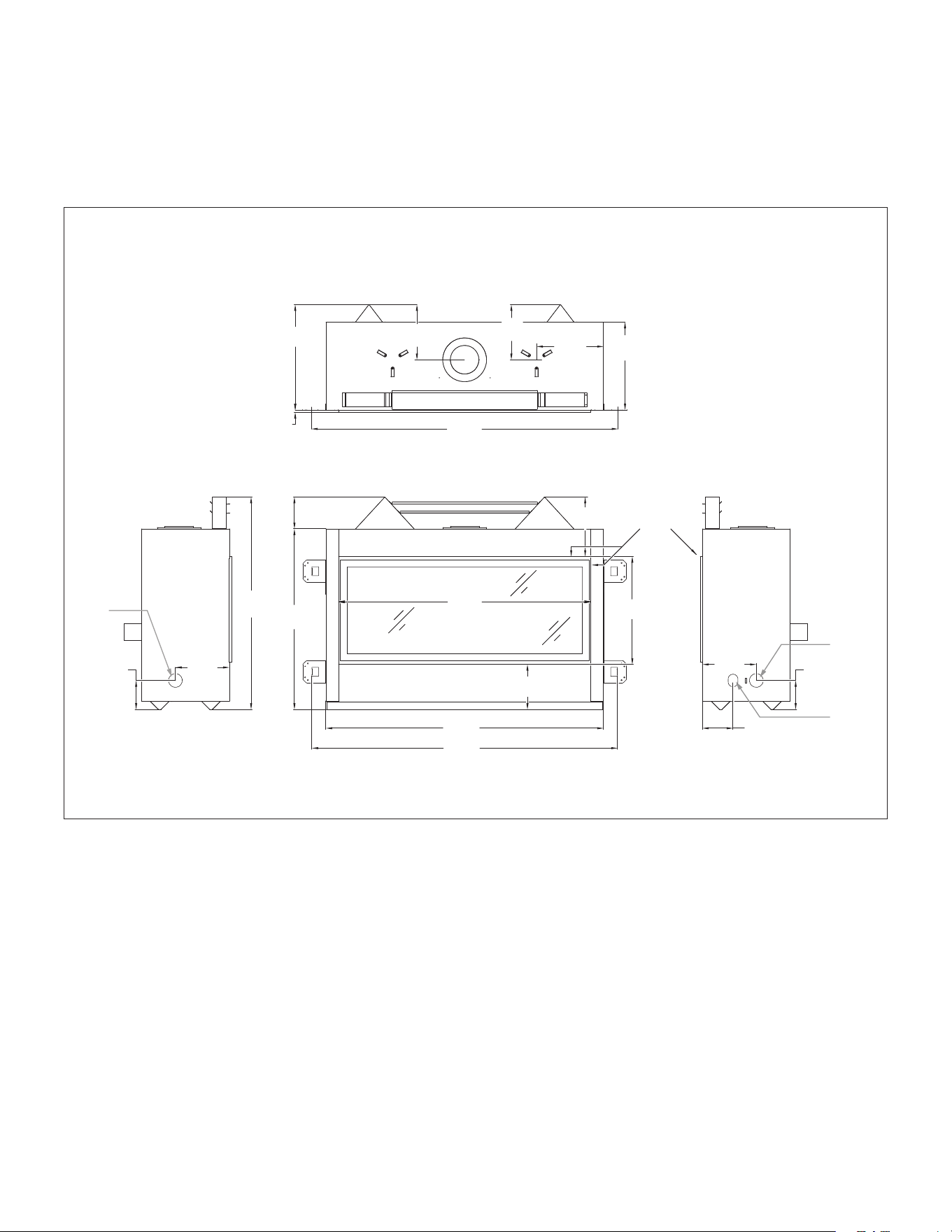
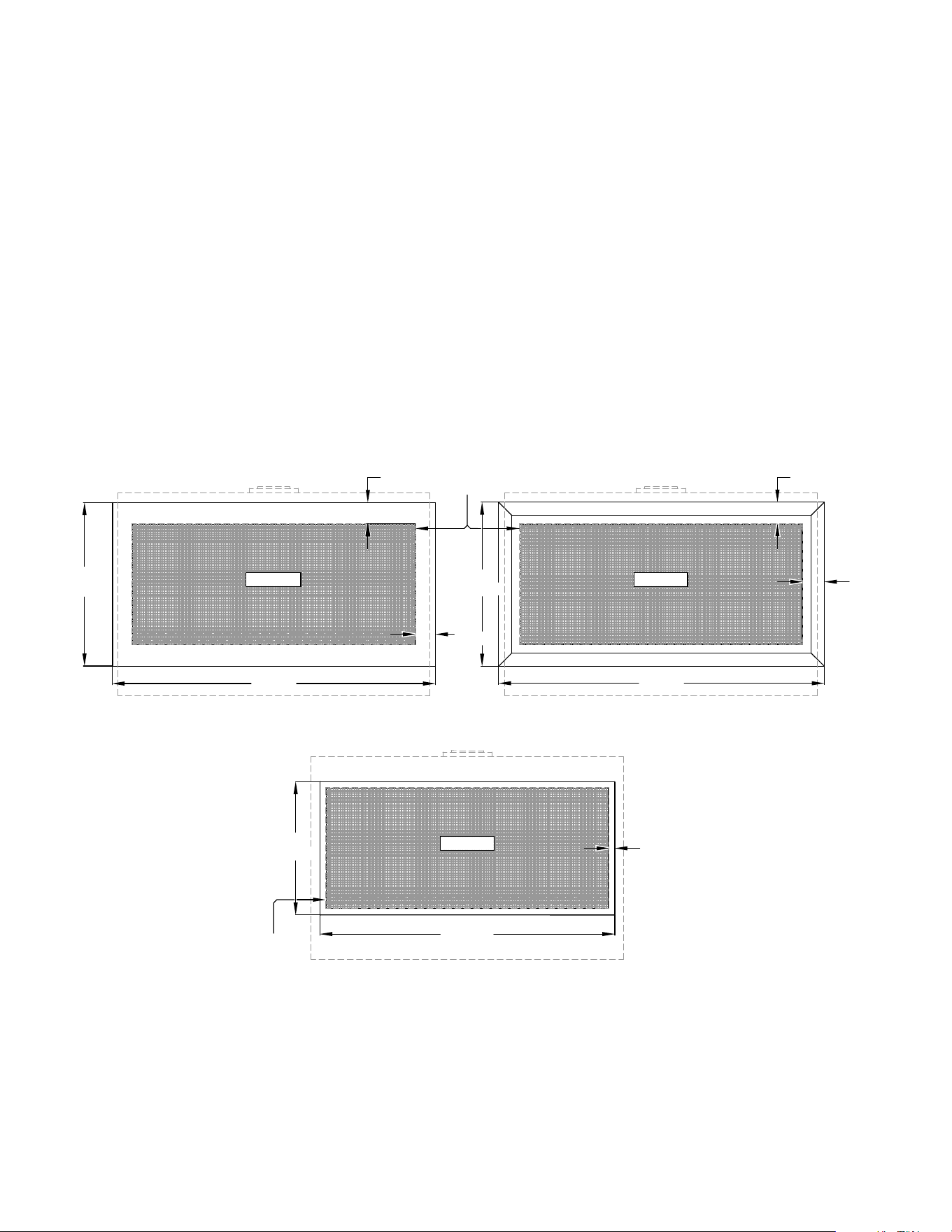
2.3 Appliance Dimensions
TOP
LEFT SIDE FRONT RIGHT SIDE
19”
(483mm)
3⁄8”
(10mm)
9
15⁄16”
(252mm)
55
¼”
(1404mm)
12
1⁄16”
(306mm)
15
13⁄16”
(402mm)
5
¼”
(133mm)
10
1⁄16”
(256mm)
38
5⁄16”
(972mm)
5
¾”
(146mm)
32
9⁄16”
(827mm)
45
7⁄16”
(1154mm)
50”
(1271mm)
55
¼”
(1404mm)
8
1⁄8”
(206mm)
19
7⁄16”
(494mm)
10
11⁄16”
(272mm)
9
11⁄16”
(246mm)
5
¼”
(133mm)
5
½”
(140mm)
9
15⁄16”
(252mm)
GAS LINE
HOLE
ELECTRICAL
ACCESS
FINISHING EDGE
GAS LINE
HOLE
Figure 2.1, Appliance Dimensions
10 SPECIFICATIONS
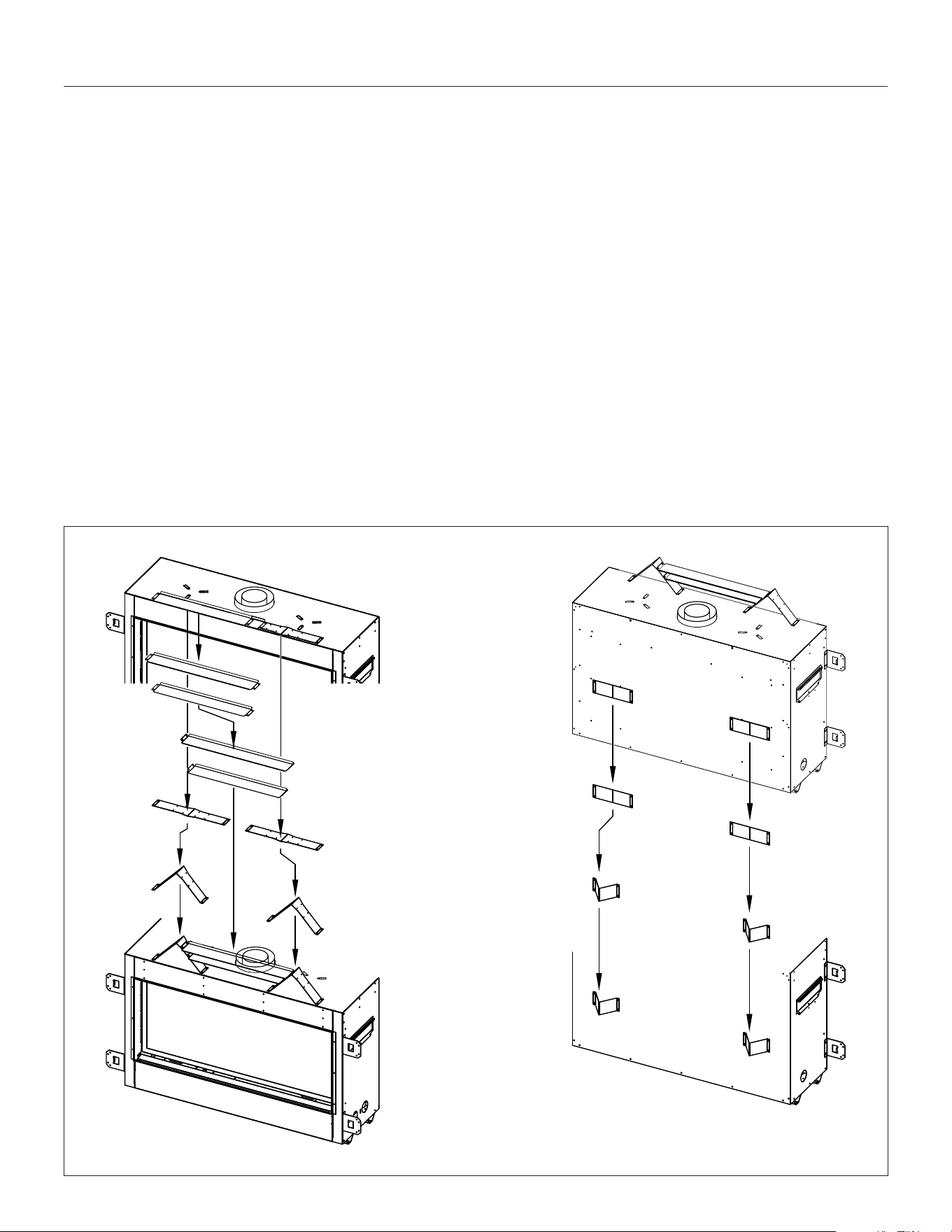
2.4 Safety Barrier Dimensions
WARNING: A barrier designed to reduce the risk of burns from
the hot viewing glass is provided with this appliance and shall
be installed for the protection of children and other at-risk
individuals.
If the barrier becomes damaged, the barrier shall be replaced
with Hussong Mfg.’s barriers for this appliance. Only doors
certified with the appliance shall be used.
2.4.1 Safety Barrier Installation
1. Center the screen front over the glass frame assembly,
allowing the screen front’s mounting brackets to fit inside the
air openings.
2. Align the notched tabs (located on the back) with the slots
in the fireplace. Raise slightly and push back to desired
position.
3. Lower the screen front until the notched tabs are firmly in
position, verifying the depth accommodates finish material.
• To remove safety screen: lift the screen up and out of slots.
33⁄8”
(86mm)
26
3⁄16”
(665mm)
51
13⁄16”
(1316mm)
3
3⁄16”
(82mm)
26
¼”
(667mm)
3
7⁄16”
(87mm)
52
1⁄8”
(1325mm)
21
3⁄8”
(543mm)
15⁄16”
(24mm)
47
¼”
(1200mm)
3
7⁄16”
(87mm)
SL42-CXSFS
SL42-BSFS
SL42-RSFS
FINISHING
EDGE
FINISHING
EDGE
FRAMING 11
3.0 FRAMING
3.1 Appliance Placement
Considerations
WARNING: Due to high temperatures, the appliance should be
located out of traffic and away from furniture and draperies.
FIRE HAZARD: Do NOT install this appliance directly on
carpeting, vinyl, or any other combustible material other than
wood.
• This appliance must be installed on a level surface capable
of supporting the fireplace and venting. If possible, place the
fireplace in a position where the vent terminates between two
studs, eliminating the need for any additional framing.
• This fireplace may be installed in a bedroom.
• Please be aware of the large amount of heat this fireplace will
produce when determining a location.
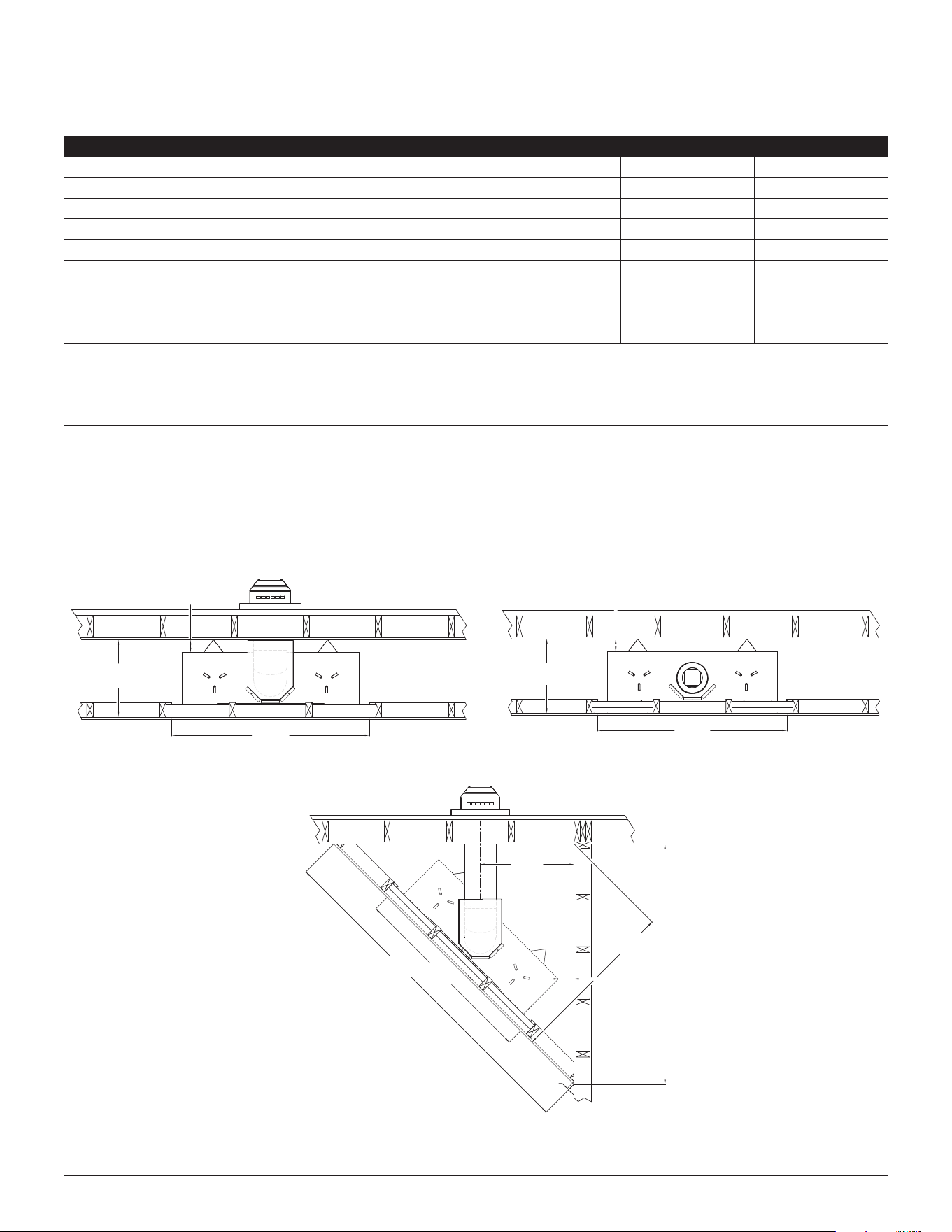
3.2 Stand-off Assembly and Installation
WARNING: The top stand-offs provide the 5¾ in (147 mm)
minimum clearance to the header. Use only non-combustible
material in this area for the entire width of the fireplace. DO
NOT use wood, sheetrock, et cetera, in this zone.
Top stand-off brackets must be formed and attached prior to
positioning fireplace into framed opening.
1. Remove and save the (4) screws securing the secondary
stand-off heat shield and the top stand-off brackets, located
on the top of the fireplace.
2. Form the top stand-off brackets as shown, then re-attach to
the fireplace using screws previously removed, along with (4)
screws provided in the fireplace components packet.
3. Form secondary heat shield and attach to top stand-
off brackets using (4) screws provided in the fireplace
component packet.
4. Form the top stand-off upper heat shield as shown, and
attach to top stand-off brackets with the (4) screws provided
in the fireplace component packet.
5. Form back stand-offs and secure to fireplace back with
provided screws.
Figure 3.1, Stand-off Assembly and Installation
12 FRAMING
33⁄16”
(80mm)
19”
(483mm)
55
¼”
(1403mm)
26
3⁄8”
(670mm)
92
13⁄16”
(2358mm)
½”
(13mm)
4”
(102mm)
65
5⁄8”
(1667mm)
46
3⁄8”
(1178mm)
3
3⁄16”
(80mm)
19”
(483mm)
55
¼”
(1403mm)
55
¼”
(1403mm)
TYPICAL HORIZONTAL INSTALLATION
TYPICAL VERTICAL INSTALLATION
TYPICAL CORNER INSTALLATION
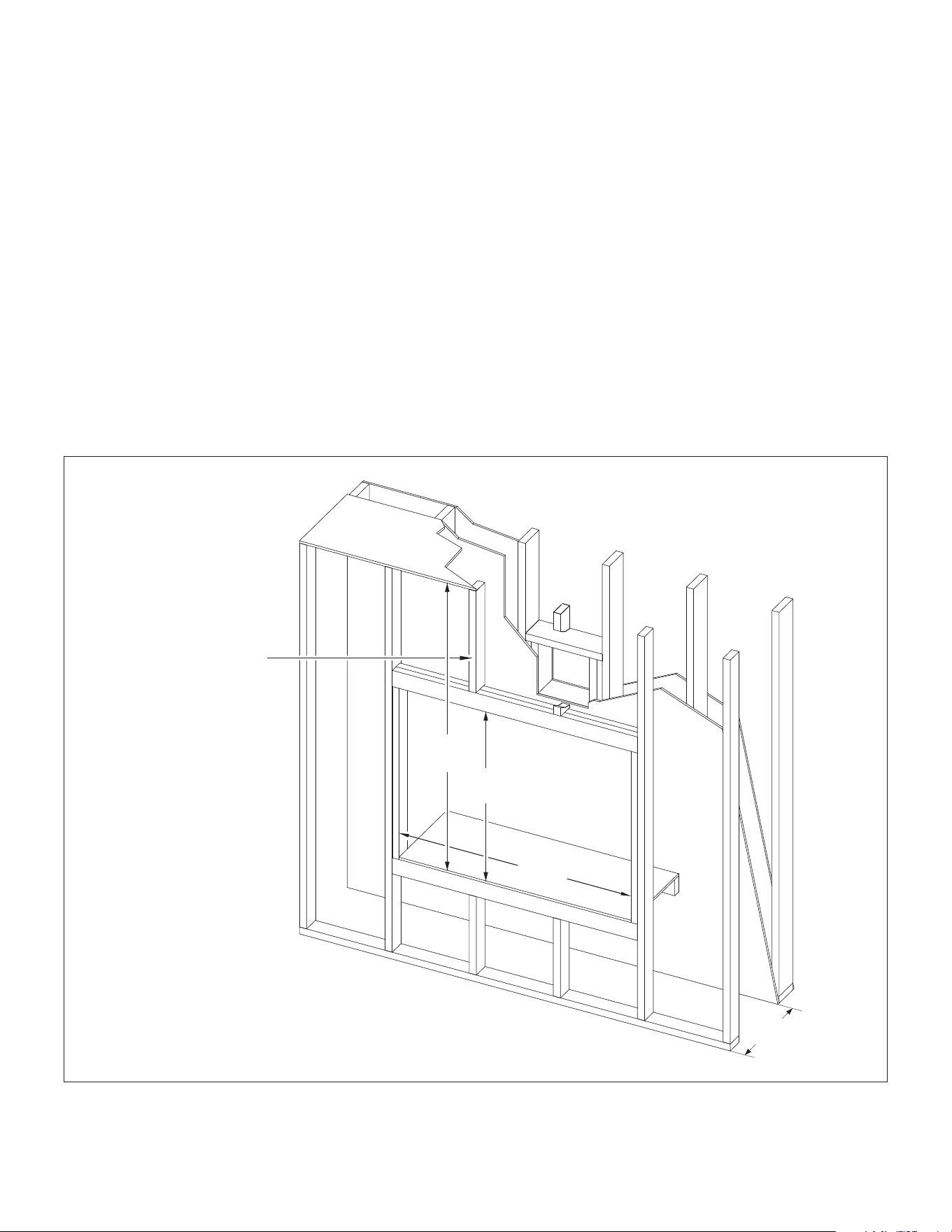
3.3 Clearances to Combustibles
Table 3.1, Minimum Appliance Clearances to Combustible Material
From appliance top stand-offs 0 in 0 mm
From appliance left and right side stand-offs 0 in 0 mm
From appliance back stand-offs 0 in 0 mm
From appliance bottom stand-offs 0 in 0 mm
From appliance corners 4 in 102 mm
From appliance front 36 in 914 mm
Top of finishing edge to ceiling 36 in 914 mm
Sides of finishing edge to adjacent sidewall 6 in 152 mm
Mantel 9 in (229 mm) deep from finishing edge 14-1/4 in 362 mm
Figure 3.2, Typical Install Options
FRAMING 13
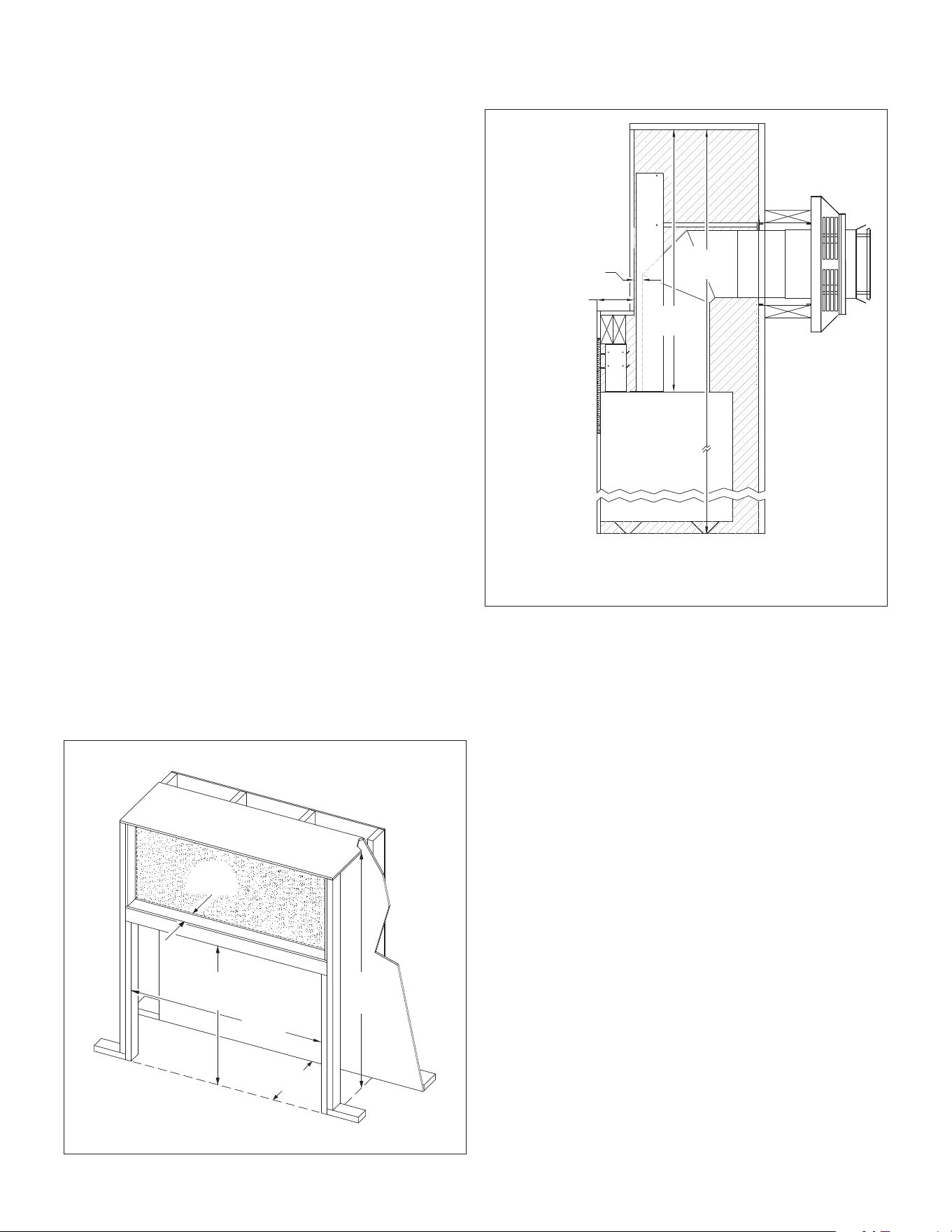
3.4 Wall Enclosure Rough Opening
WARNING: Provide adequate clearances around air openings
into the combustion chamber. Provide adequate clearance in
front of the fireplace for barrier removal, component access,
gas line installation, service access, etc.
• Determine if the fireplace face will be flush with the wall
surface (where the wall surface and fireplace will be covered
with non-combustible material, such as tile) or the fireplace
face will be flush with framing (flat wall appearance).
• Framing dimensions should allow for wall covering thickness
and fireplace facing materials. If using a hearth, adjust the
rough opening size as necessary to maintain minimum
clearance requirements.
• This fireplace may be elevated off the floor as shown below,
provided it is properly supported by framing materials and
maintains ceiling clearances.
• If masonry is to be used (optional), prepare the necessary
foundation for the masonry load. When masonry construction
is to be used, a lintel must be used over the top of the
appliance to support the additional weight.
• If installing the optional heat duct kit, refer to Section 4.0
#970 Heat Duct Kit on page 16.
Figure 3.3, Framing Requirements and Dimensions
62¼”
(1581mm)
38
3⁄8”
(975mm)
55
¼”
(1403mm)
19”
(483mm)
FRAMING STUDS
MUST MAINTAIN
1” (25mm) CLEARANCE
TO VENTING
14 FRAMING
3.5 Floor Support and Protection
• The fireplace must be placed directly on a wood or non-
combustible surface (not linoleum or carpet) extending the
entire depth and width of the fireplace.
• If this appliance is to be installed directly on carpeting, tile,
or other combustible material other than wood flooring,
this appliance shall be installed on a metal or wood panel
extending the full width and depth of the appliance.
• If the appliance is to be installed above floor level, a
solid, continuous platform must be constructed below the
appliance.
• Consider the height of hearth finish material (stone, brick,
et cetera) when building a fireplace platform. The bottom of
the fireplace must be level with finished hearth to allow for a
proper fit of the safety barriers.
• Build the hearth to desired size and height. If a hearth
extension is desired, combustible material may be used.
3.6 Recess Construction
WARNING: All clearances to venting must be maintained.
Mounting a television above a fireplace has become a common
practice. Television surface temperatures are affected by mantel
depth, ceiling heights, and wall and mantel construction material.
Most television manufacturers specify in their instructions that a
television should not be installed on, near, or above a heat source.
Television location rests solely on the homeowner. It is the
homeowner’s responsibility that the preferred TV mounting and
mantel design will not exceed the listed maximum operation
temperature of their electronic goods.
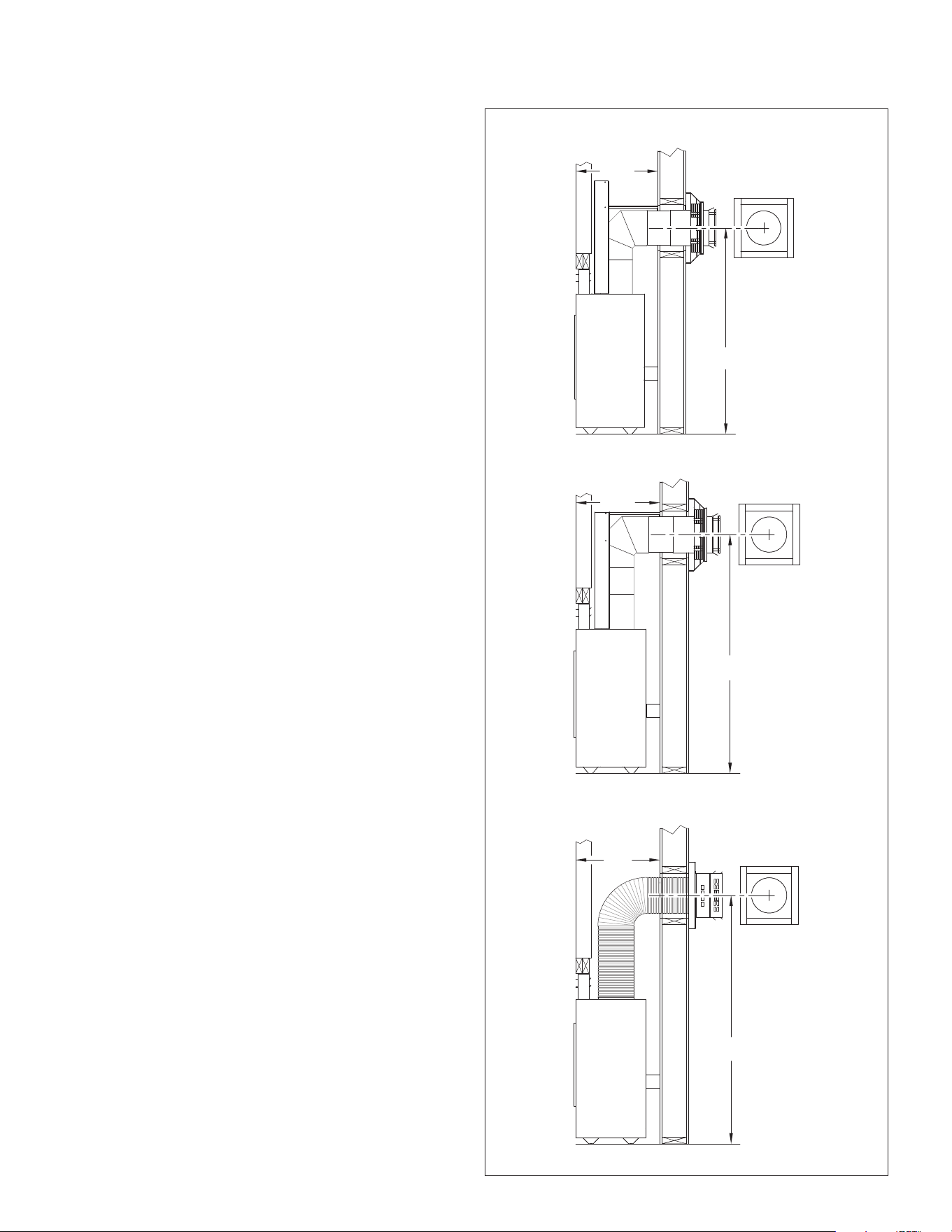
Tests performed determined that surface temperatures did
not exceed 150°F (66°C) when a 4¼ in (108mm) deep recess
is constructed above the fireplace. See illustrations below.
Figure 3.4, Recess Framing
Figure 3.5, Framing Clearances for Recess Construction
2911⁄16”
(754mm)
62
¼”
(1581mm)
FIREPLACE ENCLOSURE FLOOR
1” (25mm) MINIMUM
CLEARANCE TO VENTING
4
¼” (108mm)
MAXIMUM DEPTH
4¼”
(108mm)
38
3⁄8”
(975mm)
55
¼”
(1403mm)
19”
(483mm)
62
¼”
(1581mm)
FRAMING 15
3.7 Vent Termination Framing
IMPORTANT: Vent cap location must be in compliance with
Section 7.2 Minimum Termination Clearances on page 25.
WARNING: DO NOT RECESS THE VENT CAP INTO WALL OR
SIDING.
3.7.1 Vertical Terminations
CAUTION: Cold air transfer area. The surround fireplace chase
must comply with all clearances as outlined in this manual,
and be constructed in compliance with local building codes.
Outside walls should be insulated to prevent cold air from
entering room.
• Follow vent pipe manufacturer’s installation instructions for
vertical terminations.
• A minimum of 1 in (25 mm) clearance on all sides of the
vertical vent pipe must be maintained.
• Attic insulation shields may be insulated using unfaced
insulation products listed as non-combustible per ASTM E
136.
3.7.2 Horizontal Terminations
IMPORTANT: Horizontal vent sections require ¼ in (6 mm) rise
for every 12 in (305 mm) of travel.
NOTE: Wall thimble products that comply with the required 1
in (25 mm) clearance to combustibles must be installed for all
horizontal vent runs that pass through interior or exterior walls.
These wall thimble products may be insulated using unfaced
insulation products listed as noncombustible per ASTM E 136.
1. Measure from floor level of the fireplace to the center of
where the vent pipe will penetrate the wall. Elbows listed
with approved vent systems for this appliance vary in vertical
length. Please consult the vent manufacturer’s instructions
to determine the elbow dimension used for installation.
Adjust the wall pass-through rough opening dimensions as
necessary to maintain clearance requirements.
2. Cut and frame an opening in the wall to allow the vent system
to run level through the wall pass-through.
3. Follow the vent pipe manufacturer’s installation instructions
for vent installation.
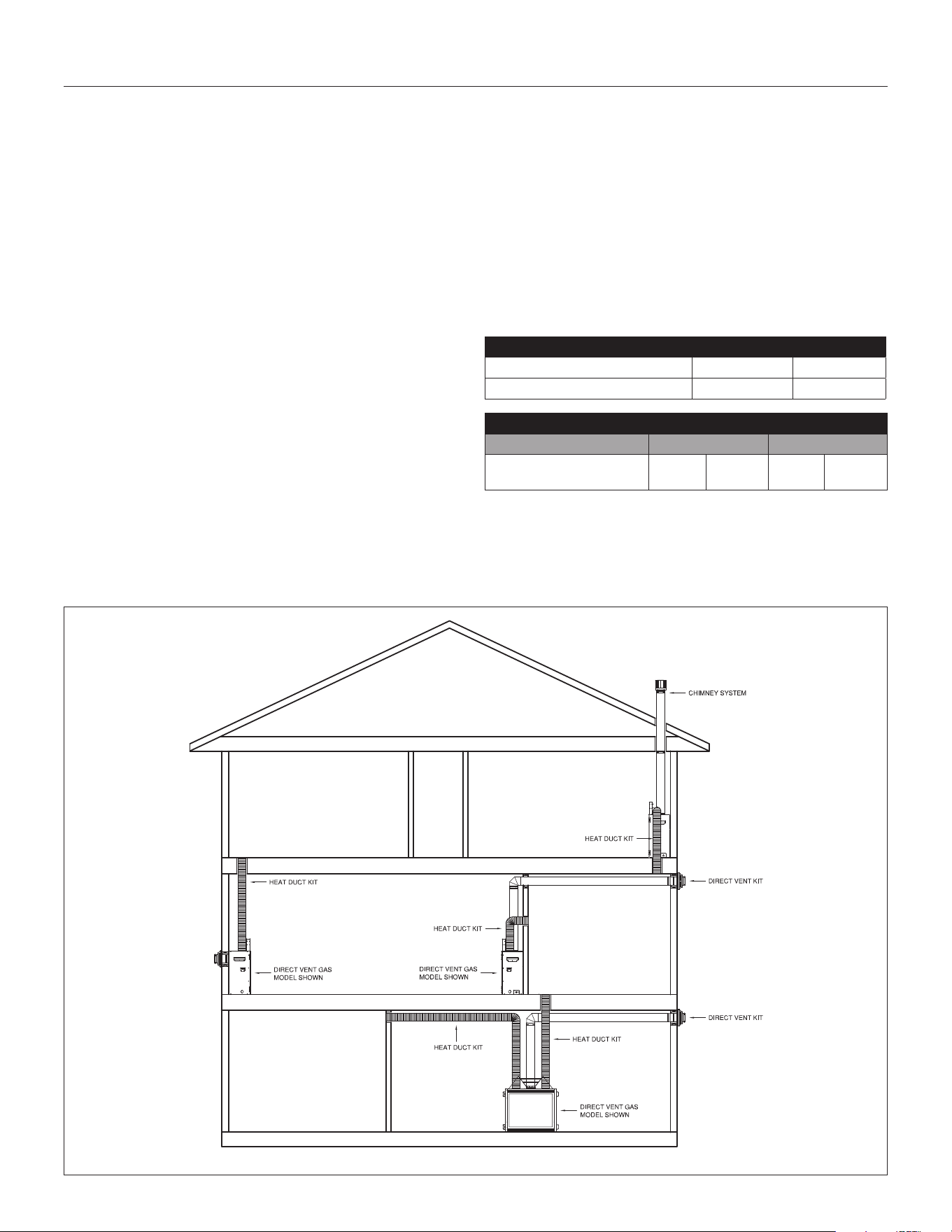
Figure 3.6, Minimum Horizontal Termination Framing
19”
(483mm)
48”
(1219mm)
52
½”
(1334mm)
56”
(1422mm)
19”
(483mm)
19”
(483mm)
MINIMUM RIGID VENT PIPE TERMINATION
NATURAL GAS
MINIMUM RIGID VENT PIPE TERMINATION
LP GAS
MINIMUM HORIZONTAL FLEX VENT PIPE TERMINATION
NATURAL GAS AND LP GAS
16 #970 HEAT DUCT KIT
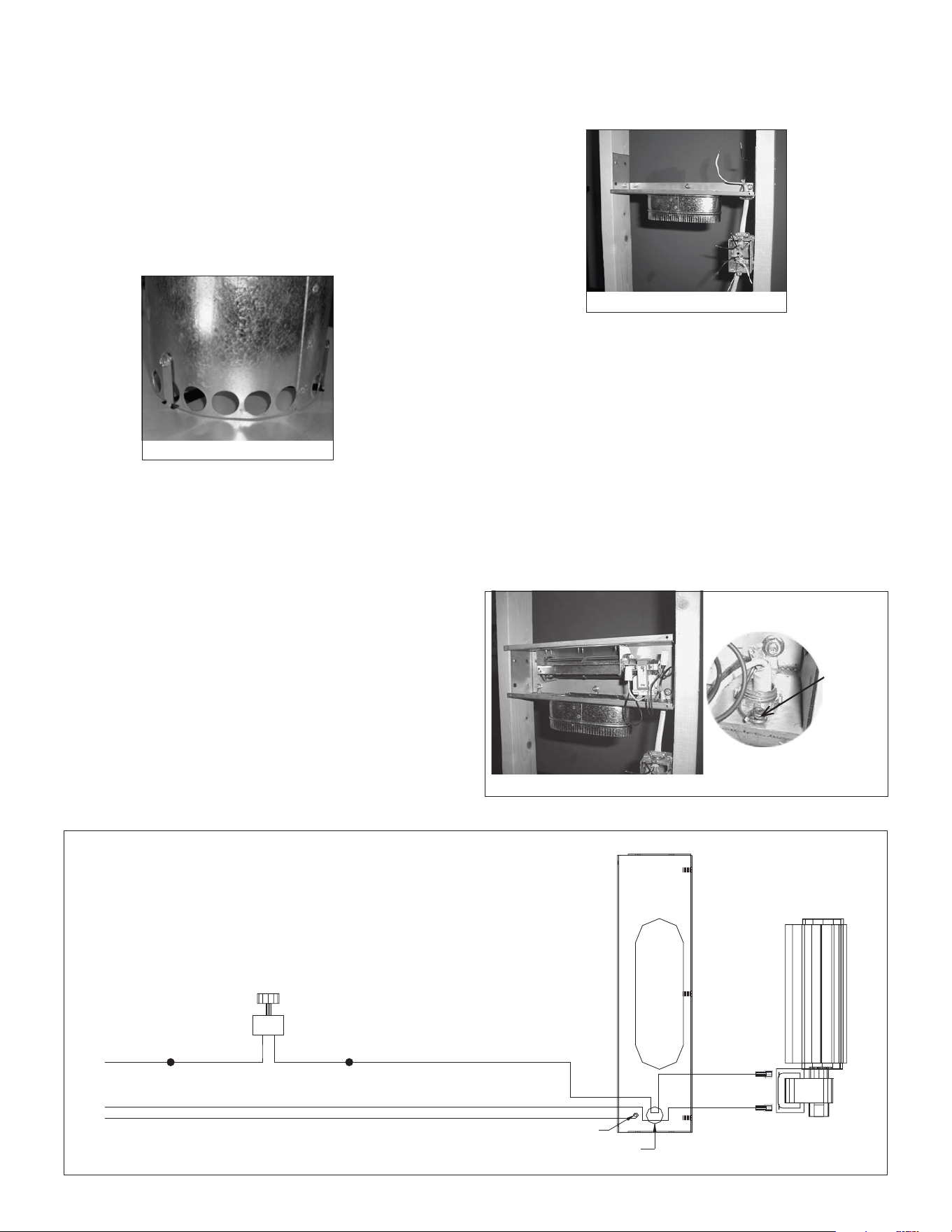
4.0 #970 HEAT DUCT KIT
CAUTION : Read and follow instructions carefully prior to and
during the installation of the optional heat duct kit.
WARNING: Installation of this heat duct kit and its electrical
wiring must be performed by a qualified service person, and
must be in accordance with local codes, or in the absence of
local codes, with the National Electrical Code, ANSI/NFPA 70,
or the Canadian Electrical Code, CSA C22.1.
Do not substitute the flexible heat duct pipe with plastic vent
pipe.
4.1 Kit Components
NOTE: A junction box, cover, and hardware must be purchased
to mount the speed control.
(1) 6” (152 mm) diameter flexible heat
duct pipe, expandable to 20 ft. (6.10 m)
(2) Mounting brackets
(1) Register mounting frame with collar (11) Sheet metal screws
(1) Register cover with screws (4) Sheet rock screws
(1) Duct collar (3) Flange nuts
(1) Fan assembly (1) Strapping cord
(1) Fan housing cover plate (3) Wire nuts
(1) Speed control mounting bracket (2) Fan wire connectors
(1) Speed control
4.2 Specifications
• The appliance is manufactured with (2) heat duct knock-outs.
One, or both, may be utilized.
• The register mounting frame is designed to fit between 2” x
4” stud walls, 16 in (406mm) on center.
• An oval duct pipe (equivalent to 6 in [152 mm] round) can be
used in conjunction with the included 6 in (152 mm) diameter
flexible heat duct pipe, included with this kit. It must be
purchased from a HVAC supplier.
• Carefully plan location of duct pipe runs and register in
relation to fireplace.
Table 4.1, Heat Duct Clearances
From flexible duct to combustibles 0 in 0 mm
From air duct to ceiling 2 in 51 mm
Table 4.2, Heat Duct Vent runs
Vent Run Minimum Maximum
Any direction, including
downward
2 ft 609 mm 20 ft 6.1 mm
Figure 4.1
#970 HEAT DUCT KIT 17
4.3 Attach Heat Duct to Fireplace
1. Bend the tabs on fireplace top up. With circulation holes
facing down, use (3) screws to fasten the tabs to the duct
collar.
2. Secure the flexible pipe to the duct collar. Verify screws
penetrate both the flexible pipe and the duct collar.
3. Do not cover circulation holes on the duct pipe.
4. Position the fireplace in the desired location.
4.4 Install Register Mounting
Frame and Junction Box
1. The register mounting frame and the fan housing are
designed to fit between 2” x 4” stud walls, 16 in (406mm) on
center. Additional framing is required if larger opening exists.
2. Locate and mark the position of the register.
3. Insert the register mounting bracket into the 16 in (406 mm)
opening.
4. Level and adjust the mounting bracket. The sides of the
bracket should be flush with the front of the framing studs,
and the front of the bracket should protrude ½ in from the
studs to allow for ½” sheetrock installation.
5. Secure the mounting bracket to framing with the provided (4)
sheetrock screws.
6. Install the junction box on the wall at desired location. The
junction box is used to house the speed control assembly,
which controls fan speed and operation.
4.5 Install and Wire Fan Assembly
1. Attach, but do not tighten, flange nuts to the mounting studs
on the back of the register mounting bracket.
2. Align (3) slots on the fan assembly to studs, then slide the
fan into position. Tighten the flange nuts to secure.
3. Slide the included fan wire connectors into the fan terminals.
4. Properly wire the 110 VAC wire to the hot and neutral fan
wires, and the speed control wires, with provided wire nuts.
5. Run 110 VAC to fan speed control, then from the fan
speed control through the romex connector (on the register
bracket).
6. Secure grounding wire to the grounding screw installed in
register mounting bracket. Fan must be properly grounded.
Figure 4.2
BLACK BLACK
WHITE
OR
BLACK
WHITE
OR
BLACK
SPEED
CONTROL
WHITE
GROUND
GROUNDING SCREW
ROMEX CONNECTOR
BLACK
WHITE
Grounding
Screw
Figure 4.4
Figure 4.5
Figure 4.3
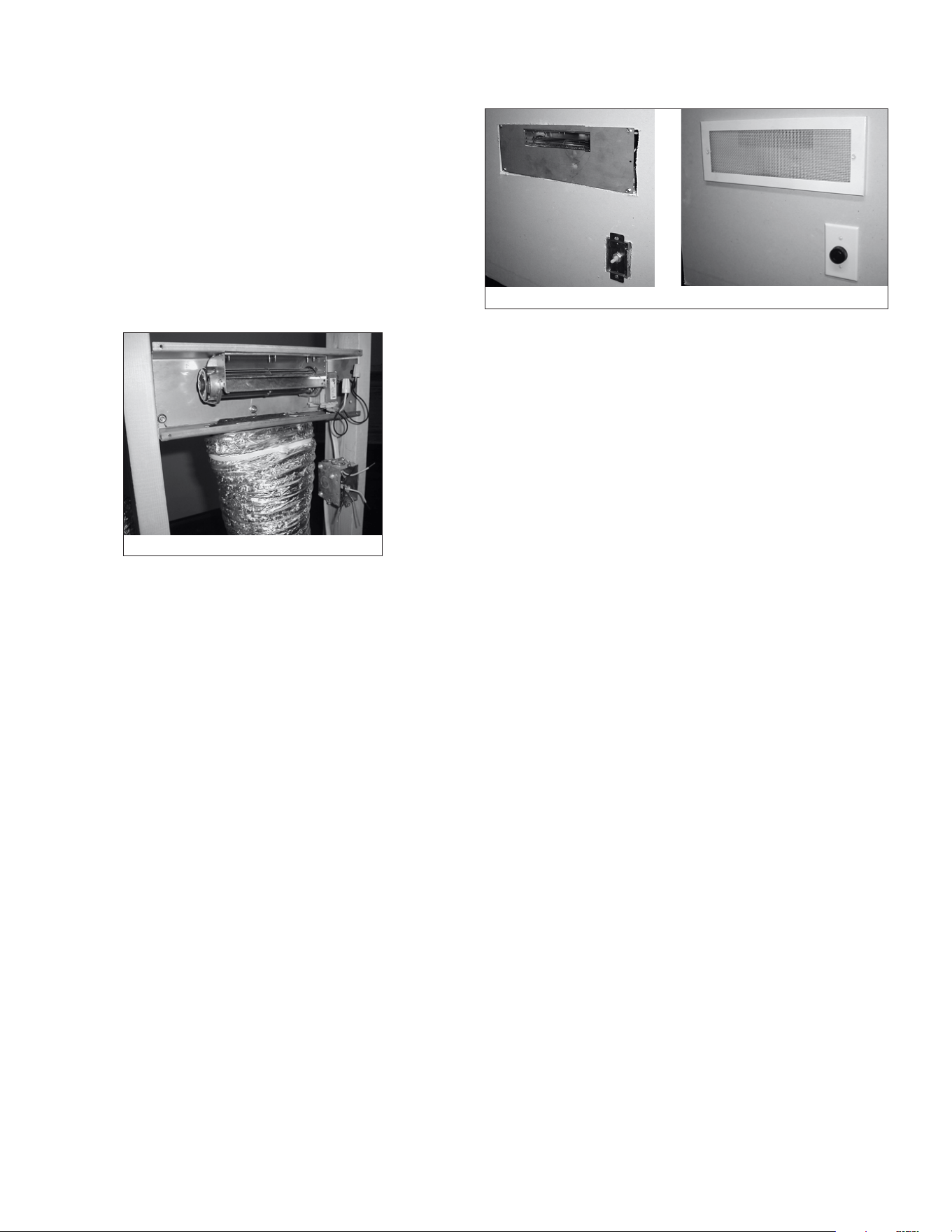
18 #970 HEAT DUCT KIT
4.6 Run and Secure Duct Pipe
4.6.1 Oval Duct Pipe
1. Run the oval and round duct pipe to the register location.
2. Shape the 6 in (152 mm) round duct pipe to fit outside the
oval duct pipe. Secure with the screws provided.
3. Slide the oval duct pipe over the oval collar on the register
mounting bracket. Secure with the sheet metal screws
provided.
4. OPTIONAL: Secure duct pipe with any additional screws
provided.
4.6.2 Round Duct Pipe
1. Run the round duct pipe to the register location.
2. Shape the 6 in (152 mm) round duct pipe so it will fit outside
the oval collar on the register mounting bracket.
3. Slide the round duct pipe until it touches the register
mounting bracket.
4. Position the locking strap around the 6 in (152 mm) duct
pipe, above the crimped metal.
5. Pull the locking strap tight enough to firmly secure the duct
pipe.
4.7 Complete the Installation
1. Install sheetrock or wall finish material as desired before
attaching the register cover and fan housing cover plate.
2. Position the cut-out portion of the fan housing cover plate
over the fan chute to allow air flow. Align the holes in the
fan housing cover plate to the corresponding holes in the
register mounting plate and fan assembly. Secure with (4)
screws provided.
3. Slide the speed control through the mounting bracket.
Secure with the mounting nut.
4. Secure mounting bracket to the junction box with the (2)
screws provided.
5. Center the register cover over the fan housing cover plate to
install. Secure register cover to stud wall with the provided
mounting screws.
6. Attach a cover plate (not provided), then install the control
knob for the speed control.
7. Complete the fireplace installation by following the
instructions included with the fireplace.
4.8 Operating Instructions
1. After complete fireplace installation and subsequent initial
burn period, turn the fireplace burner ON by following the
lighting instructions included with the fireplace.
2. Allow the fireplace to produce heat for approximately 15
minutes.
3. To operate the heat duct fan, turn the wall-mounted speed
control clockwise until it stops. The fan should turn on
and be operating at its highest speed. Adjust the speed
to desired air flow level by turning the speed control knob
counter-clockwise until it ‘clicks’ off.
4.9 Maintenance
• The duct register must be kept clear and unobstructed. Clean
and vacuum as necessary to remove dust, lint, etc. from fan
which will inhibit air flow.
• Detach the register cover and the fan housing cover plate at
least once a year to remove dust, lint, etc. from the fan. More
frequent cleaning may be necessary.
• The fireplace must be maintained and serviced as outlined in
the unit installation and operating instructions.
Figure 4.7
Figure 4.6
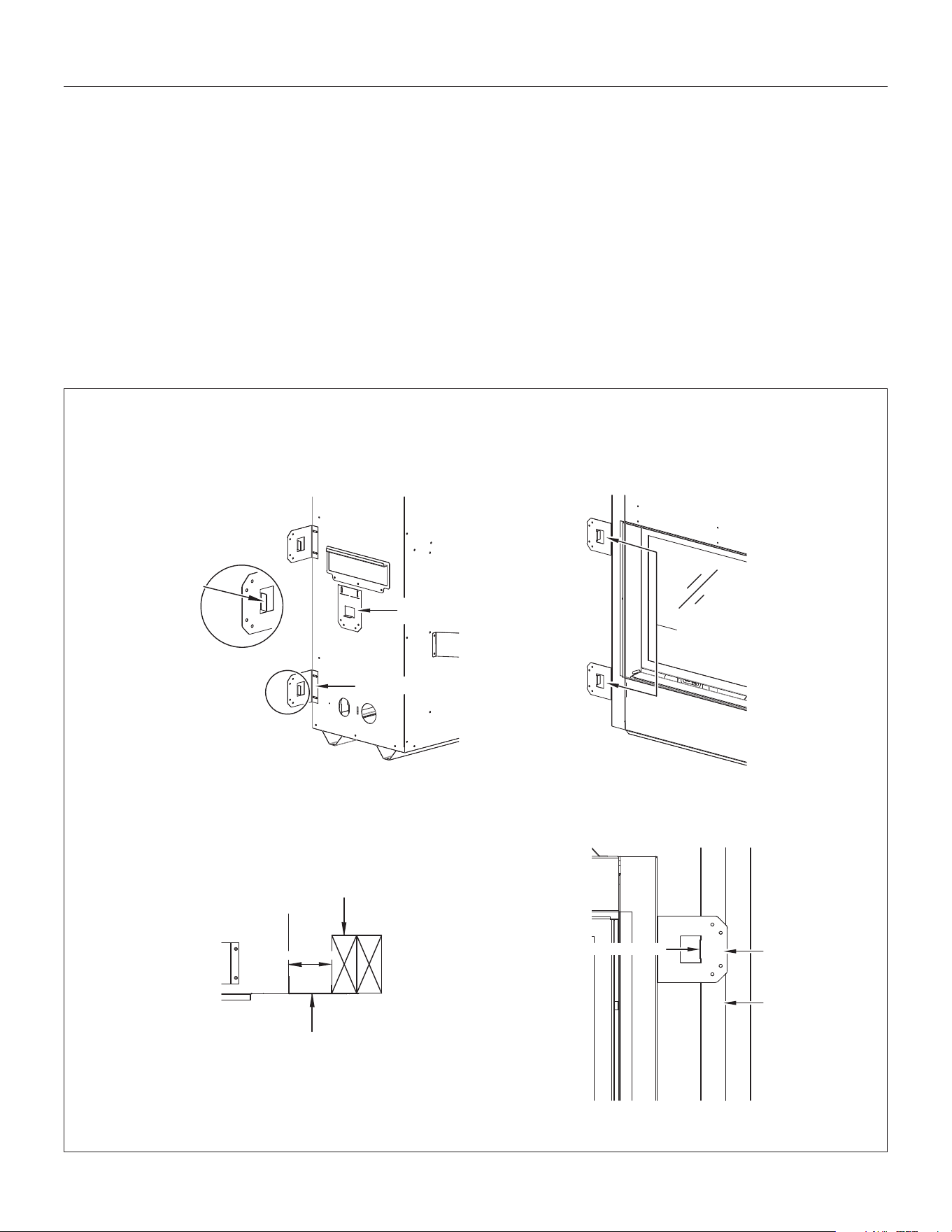
FACING AND FINISHING 19
5.0 FACING AND FINISHING
5.1 Nailing Flange Assembly
and Installation
NOTE: Depending on facing material, tabs can be adjusted
forward or backward up to ½ in (13 mm).
CAUTION: Never permanently remove these assemblies
from the fireplace—they must be secured regardless of finish
material used.
1. Remove (4) nailing flanges from the right and left side of the
fireplace.
2. Align nailing flange with holes on outside corners of fireplace,
with the stand-off flanges on the nailing flanges facing away
from the fireplace
3. Secure the nailing flanges to the fireplace with screws
(provided) through the slots in nailing flanges.
4. Bend perforation on nailing flange until parallel with fireplace
face. Do not bend toward fireplace face.
5. Position framing stud against the small stand-off (located on
backside of nailing flange). Secure with nails or screws.
• When installed, the nailing flanges provide the minimum
2½ in (64 mm) clearance from the sides of the fireplace
to framing.
Figure 5.1, Nailing Flange Installation
STAND-OFF FLANGE
NAILING FLANGE
AS SHIPPED
NAILING FLANGE INSTALLED
NAILING FLANGE
INSTALLED
FRAMING STUD
NAILING FLANGE
STAND-OFF FLANGE
FRAMING STUD
NAILING FLANGE
2½”
(64mm)
CLEARANCE
BACK VIEW FRONT VIEW
TOP VIEW FRONT VIEW
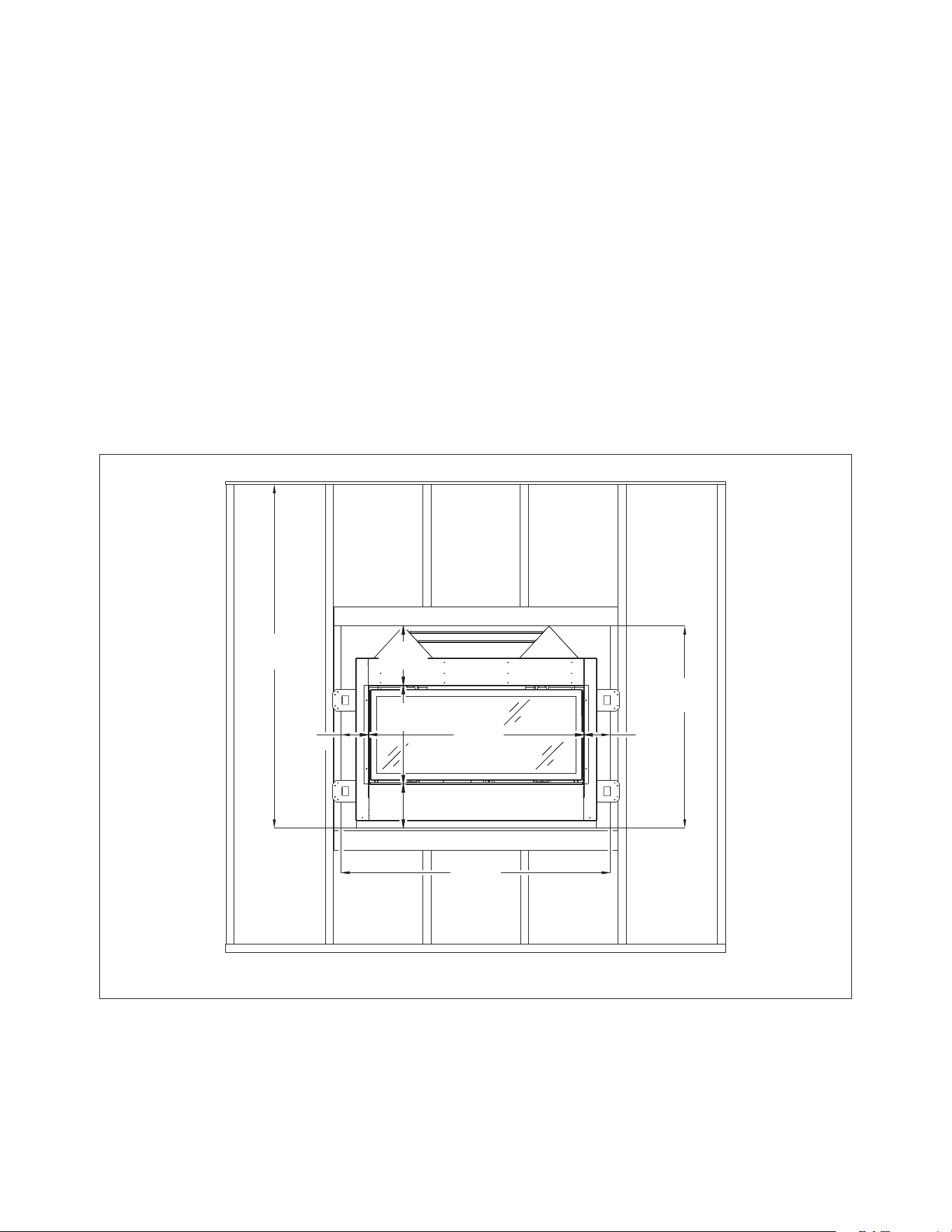
20 FACING AND FINISHING
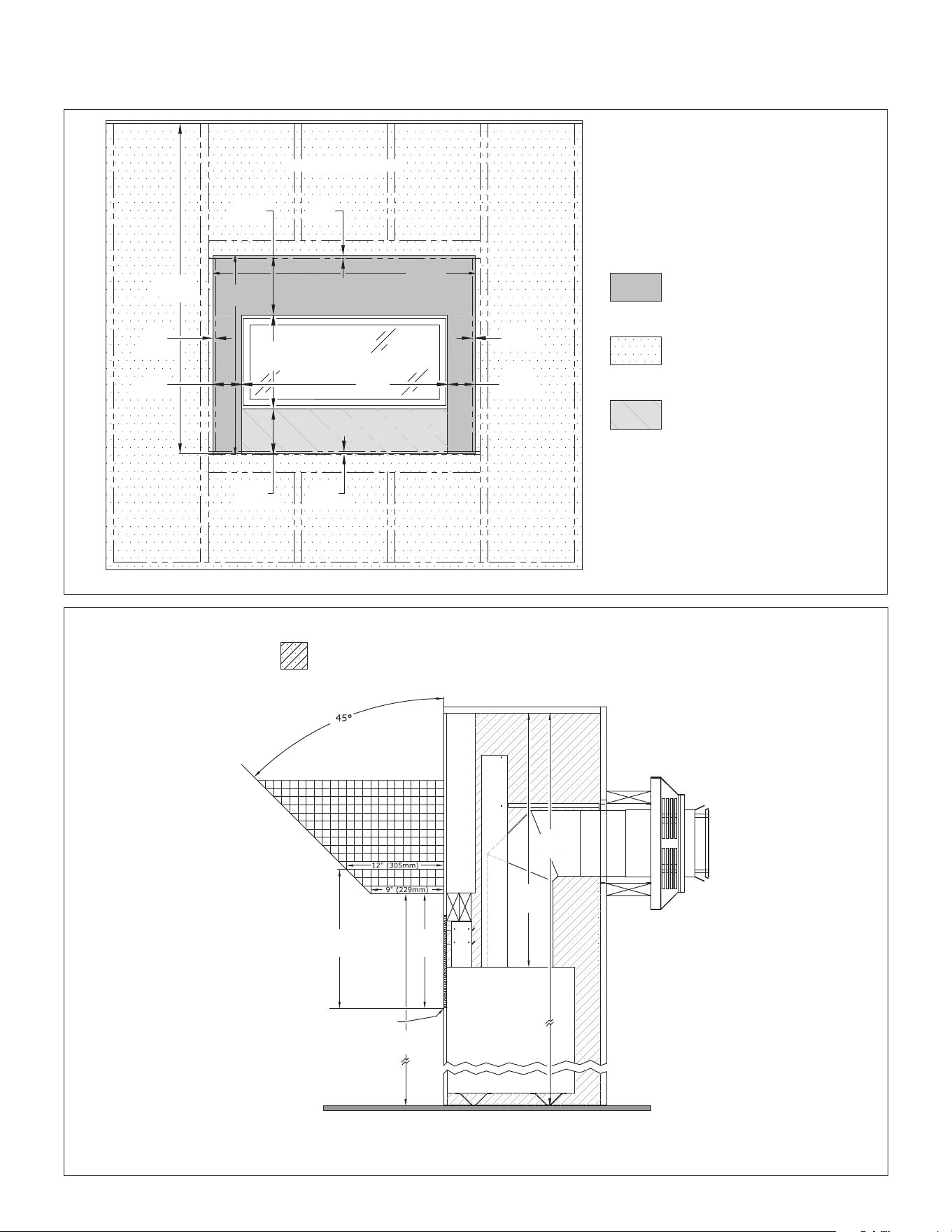
62¼”
(1581mm)
10
¾”
(274mm)
4
¾”
(121mm)
19
7⁄16”
(494mm)
45
7⁄16”
(1154mm)
8
1⁄8”
(206mm)
55
¼”
(1403mm)
38
3⁄8”
(975mm)
4
¾”
(121mm)
Figure 5.2, Framed Opening Dimensions
5.2 Facing and Finishing Requirements
WARNING: Maintain all minimum clearances to combustibles
from the appliance and vent system.
• Non-combustible material is required at the top and sides of
the fireplace. This fireplace is designed to accommodate non-
combustible facing material up to ½ in (13mm) thick.
• Install facing material up to the finishing edge that surrounds
the glass frame assembly. Do not apply any material beyond
this point. The glass frame assembly must be removable.
• Do not secure material to the lower cover panel using
screws. This may damage control system components. To
secure material to this area, use a silicone sealant that has a
300°F (149°C) continuous exposure rating.
• It is acceptable to pre-drill holes and to use self-tapping
screws prior to attach the non-combustible material to the
top and sides of the fireplace face. Do not use excessively
long screws.
5.2.1 Finishing Recommendations
NOTE: The surface area above the appliance may be affected
by high temperatures emitted from this appliance. To help avoid
or reduce the possibility of the sheetrock to crack, Hussong
Mfg. recommends the following methods:
• Ensure the non-combustible material and sheetrock is dry
and dust free.
• For taping and mudding seams, we recommend heat resilient
tape, mesh and joint compounds, such as Durabond. Mud
must be cured as per manufacturer’s recommendations.
• For a painted surface, use a high quality acrylic latex primer
and finish coat. Avoid flat or light-colored paints to prevent
discoloring.
FACING AND FINISHING 21
17¼”
(438mm)
14
¼”
(362mm)
42”
(1067mm)
29
11⁄16”
(754mm)
62
¼”
(1581mm)
NON-COMBUSTIBLE ZONE
EACH SQUARE REPRESENTS
1” (25mm)
OF MANTEL PROJECTION
FINISHING EDGE
COMBUSTIBLE FLOORING
NON-COMBUSTIBLE MATERIAL ONLY
COMBUSTIBLE MATERIAL ALLOWED
COMBUSTIBLE MATERIAL ALLOWED
LOWER COVER PANEL
COMBUSTIBLE MATERIAL ALLOWED
NO SCREWS ABOVE FRAMING
(BOTTOM
¾” [19mm])
COMBUSTIBLE MATERIAL
ALLOWED
NON-COMBUSTIBLE MATERIAL ONLY
11½”
(292mm)
¾”
(19mm)
63”
(1600mm)
5
½”
(140mm)
8
7⁄8”
(225mm)
19
7⁄16”
(494mm)
45
7⁄16”
(1154mm)
397⁄8”
(1013mm)
56
¾”
(1441mm)
¾”
(19mm)
¾”
(19mm)
¾”
(19mm)
5
½”
(140mm)
Figure 5.3, Minimum Non-Combustible Material Dimensions
Figure 5.4, Mantel Requirements
22 FACING AND FINISHING
5.4 Optional Trim Kit
Assembly #SL42-FTK
For use ONLY with safety barrier #SL42-RSFS.
IMPORTANT: This trim kit assembly must be attached before
fireplace installation.
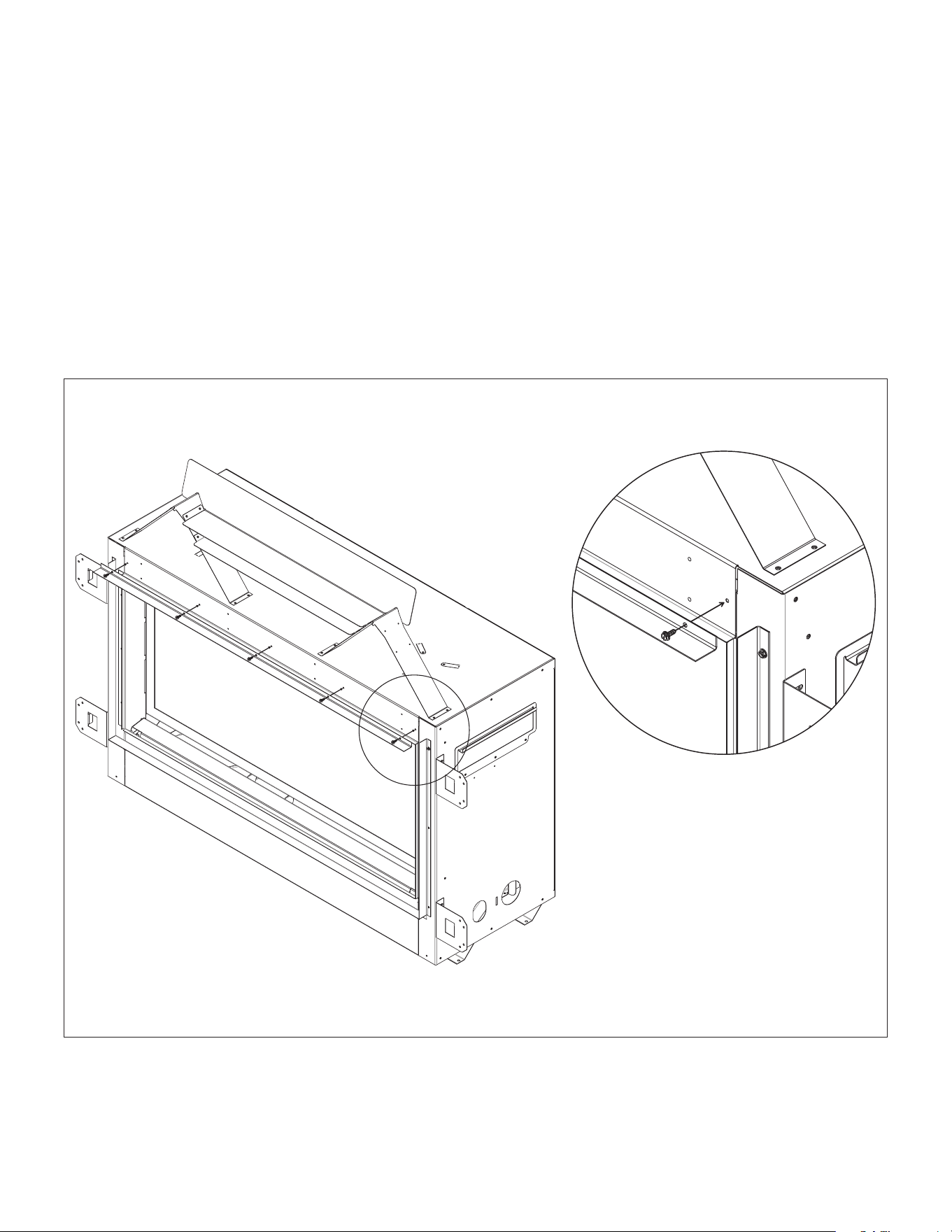
1. Locate the pre-drilled holes on the fireplace face surrounding
the glass frame assembly. There are (5) holes above and (5)
holes below the fireplace opening, and (3) holes on each
side.
2. Align the top and bottom trim panels with the pre-drilled
holes on the fireplace face. Position the flange on the trim
panel as pictured below. Secure with screws included in
components packet.
3. Align the left and right trim panels with the pre-drilled holes
on the fireplace face. Position the flange on the trim panel as
pictured below. Secure with screws included in components
packet.
Figure 5.5, Trim Kit Installation
10/25 Rev 4: ADDED OPTIONAL TRIM KIT ASSEMBLY #SL36-FTK
new brackets do not need to removed for installation, removed the rst line where top and bottom safety brackets
need to be removed
LOST LAST PAGE? NOT SURE, UPDATED

GAS LINE CONNECTION 23
6.0 GAS LINE CONNECTION
6.1 Gas Conversion (sold separately)
ATTENTION: The conversion shall be carried out in accordance
with the requirements of the provincial authorities having
jurisdiction and in accordance with the requirements of the
ANSI Z223.1 installation code.
This fireplace is manufactured for use with natural gas. Follow the
instructions included with the conversion kit if converting to LP
gas.
6.2 Gas Line Installation
CAUTION: Installation of the gas line must only be done by
a qualified person in accordance with local building codes, if
any. If not, follow ANSI 223.1. Commonwealth of Massachusetts
installations must be done by a licensed plumber or gas fitter.
NOTE: The appliance and its individual shutoff valve must be
disconnected from the gas supply piping system during any
pressure testing of that system at pressures in excess of ½
psi (3.5 kPa). For test pressures equal to or less than ½ psi
(3.5 kPa), the appliance must be isolated from the gas supply
piping system by closing its individual manual shut-off valve.
• A listed (and Commonwealth of Massachusetts approved) ½
in. (13 mm) tee handle manual shut-off valve and flexible gas
connector are to be connected to the ½ in. (13 mm) control
valve inlet. If substituting for these components, please
consult local codes for compliance.
• This fireplace is equipped with a ⅜” (10 mm) x 18” (457 mm)
long flexible gas connector and manual shut-off valve.
• Run gas line into fireplace. The gas line should be run to the
point of connection where the shut-off valve and flexible gas
line will connect.
• Do not run gas line in a manner that would obstruct fan
operation.
• For high altitude installations, consult the local gas distributor
or the authority having jurisdiction for proper rating methods.
Table 6.1, Inlet Gas Supply Pressures
Fuel Minimum Pressure Maximum Pressure
Natural Gas 5” WC (1.25 kPa) 10.5” WC (2.62 kPa)
LP Gas 12” WC (2.99 kPa) 13” WC (3.24 kPa)
24 TERMINATION LOCATIONS
7.0 TERMINATION LOCATIONS
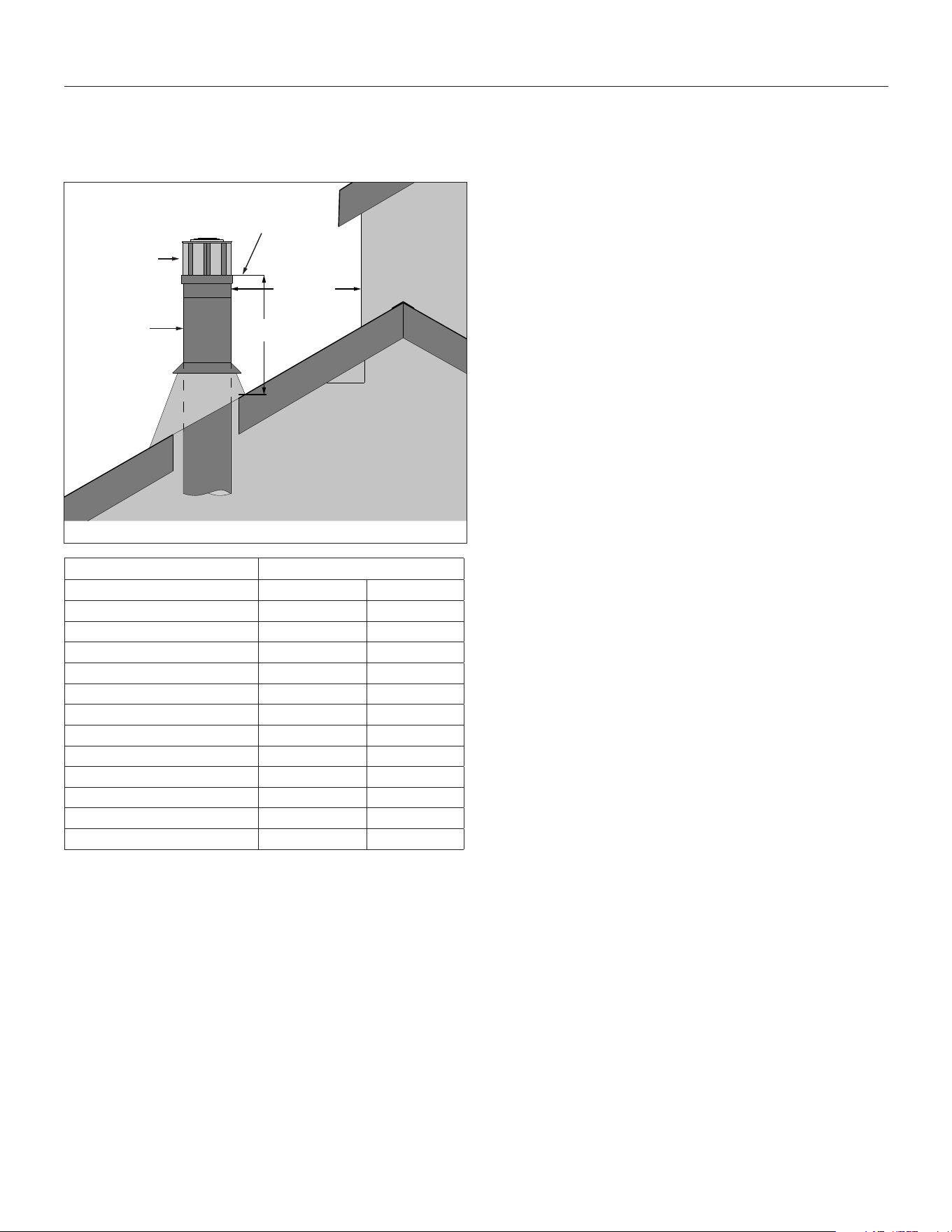
7.1 Vertical Vent Cap Termination
WARNING: This gas appliance must not be connected to a
chimney serving any other appliance.
Minimum height (H) from roof
Roof Pitch Feet Meters
Flat to 6/12 1.0 0.30
Over 6/12 to 7/12 1.25 0.38
Over 7/12 to 8/12 1.5 0.46
Over 8/12 to 9/12 2.0 0.61
Over 9/12 to 10/12 2.5 0.76
Over 10/12 to 11/12 3.25 0.99
Over 11/12 to 12/12 4.0 1.22
Over 12/12 to 14/12 5.0 1.52
Over 14/12 to 16/12 6.0 1.83
Over 16/12 to 18/12 7.0 2.13
Over 18/12 to 20/12 7.5 2.27
Over 20/12 to 21/12 8.0 2.44
12
x
HH
LOWEST
DISCHARGE
OPENING
APPROVED CAP
APPROVED
VENT PIPE
ROOF PITCH = x/12
H - MINIMUM HEIGHT FROM ROOF TO
LOWEST DISCHARGE OPENING
MINIMUM
12” (.30m)
Figure 7.1, Vertical Vent Cap Clearance
TERMINATION LOCATIONS 25
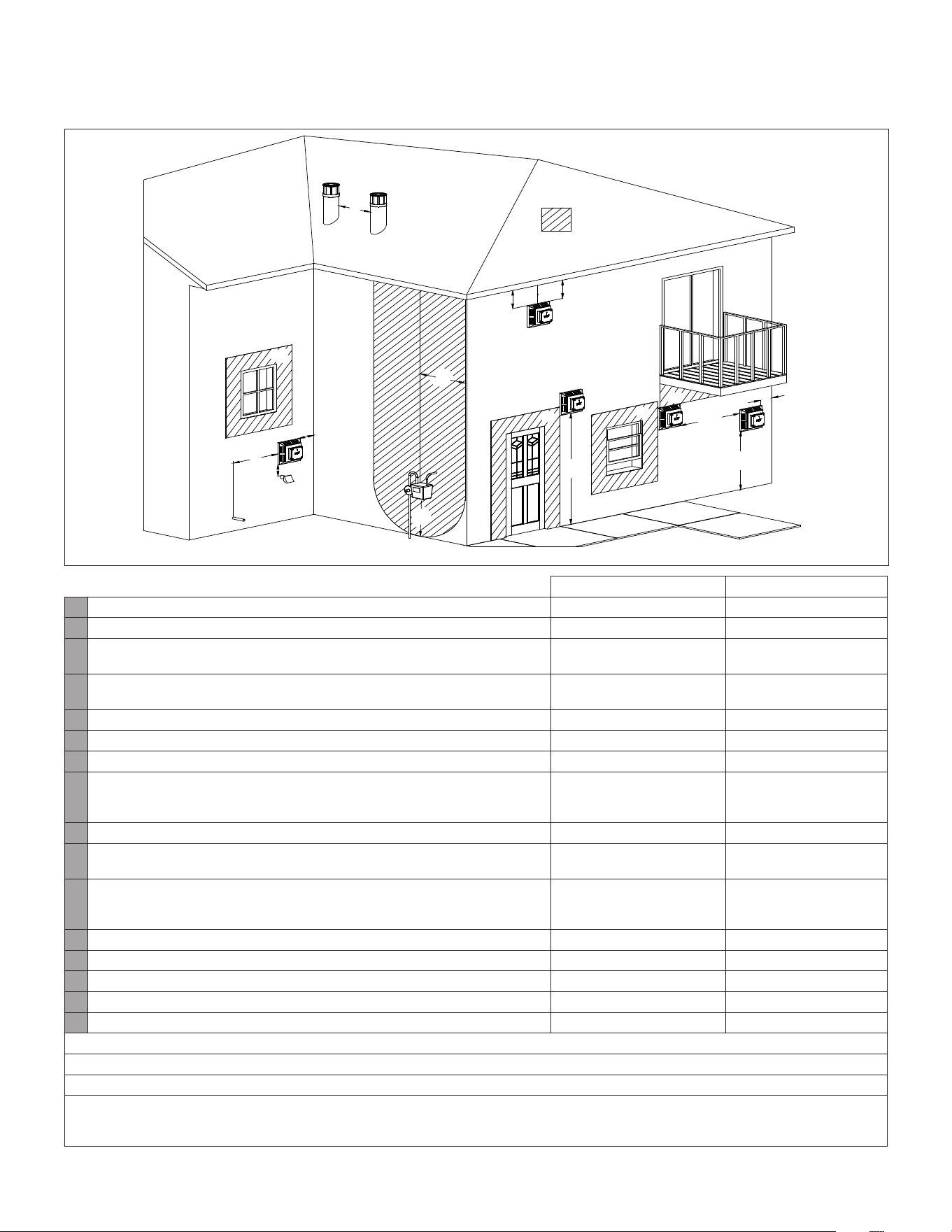
7.2 Minimum Termination Clearances
AREA WHERE TERMINAL
IS NOT PERMITTED
B
B
L
J
K
C
G
P
H
I
D
E
A
N
F
M
O
Canadian installations US installations
A Clearance above grade, veranda, porch, deck, or balcony 12 in (30 cm) 12 in (30 cm)
B Clearance to window or door that may be opened 12 in (30 cm) 9 in (23 cm)
C Clearance to permanently closed window (recommended to prevent condensation
on window)
12 in (30 cm)* 12 in (30 cm)*
D Vertical clearance to ventilated soffit located above the terminal within a horizontal
distance of 2 feet (61 cm) from the cent line of the terminal
24 in (61 cm)* 24 in (61 cm)*
E Clearance to unventilated soffit 12 in (30 cm)* 12 in (30 cm)*
F Clearance to outside corner 0 in (0 cm)* 0 in (0 cm)*
G Clearance to inside corner 12 in (30 cm)* 12 in (30 cm)
H Clearance to each side of center line extended above meter/regulator assembly 3 ft (91 cm) within a height
15 ft (4.5 m) above the meter/
regulator assembly
*
I Clearance to service regulator vent outlet 3 ft (91 cm) *
J Clearance to non mechanical air supply inlet to building or the combustion air inlet
to any other appliance
12 in (30 cm) 9 in (23 cm)
K Clearance to mechanical air supply inlet 6 ft (1.83 m) 3 ft (91 cm) above if within
10 ft (3 m) horizontally
Massachusetts: 10 ft (3 m)
L Clearance above paved sidewalk or paved driveway located on public property 7 ft (2.13 m)† *
M Clearance under veranda, porch deck, or balcony 12 in (30 cm)‡ 12 in (30 cm)
N Clearance between two horizontal terminations 12 in (30 cm) 12 in (30 cm)
O Clearance between two vertical terminations (may be same height) 12 in (30 cm) 12 in (30 cm)
P Above furnace exhaust or inlet 12 in (30 cm) 12 in (30 cm)
* Clearance in accordance with local installation codes and the requirements of the gas supplier.
† A vent shall not terminate directly above a sidewalk or paved driveway that is located between two single family dwellings and serves both dwellings.
‡ Permitted only if veranda, porch, deck, or balcony is fully open on a minimum of two sides beneath the floor.
VINYL SOFFIT, VINYL CEILING, AND VINYL OVERHANG DISCLAIMER: Clearances to heat resistant material (i.e. wood, metal). This does not
include vinyl. Hussong Manufacturing Co., Inc. will not be held responsible for heat damage caused from terminating under vinyl overhangs,
vinyl ceilings, or vinyl ventilated/unventilated soffits.
Figure 7.2, Vent Cap Locations
26 VENTING
8.0 VENTING
8.1 Approved Vent Systems
Vent Manufacturer Direct Vent System Termination
American Metal
Products
Ameri-Vent 5” x 8” Horizontal & Vertical
BDM Pro-Form 5” x 8” Horizontal & Vertical
ICC EXCELDirect 5” x 8”,
EXCEPT CAPS TM5ST14
and TM5VT
Horizontal & Vertical
Kozy Heat 800 Series Flexible
Vent Kit
Horizontal Only
Metal Fab Direct Vent Chimney
5” x 8”, EXCEPT CAP
5DST36
Horizontal & Vertical
Olympia Chimney
Supply, Inc.
Ventis Direct Vent 5” x 8” Horizontal & Vertical
Selkirk Direct Temp 5” x 8” Horizontal & Vertical
Simpson
DuraVent
DV-GS 5” x 8” Horizontal & Vertical
8.2 Venting Requirements
Consult the local and national installation codes to assure
adequate combustion and ventilation air is available. Venting
requirements apply to both natural gas and LP gas.
• Flame height and appearance will vary depending upon
venting configuration and the type of fuel used.
• A minimum of 1 in (25 mm) clearance on all sides of the
vertical vent pipe must be maintained. Attic insulation shields
may be insulated using unfaced insulation products listed as
noncombustible per ASTM E 136.
• A minimum of 1 in (25 mm) clearance on all sides of the
horizontal vent pipe at the wall pass-through must be
maintained. Wall thimble products that comply with the
required 1 in (25 mm) clearance to combustibles must
be installed for all horizontal vent runs that pass through
interior or exterior walls. These wall thimble products may
be insulated using unfaced insulation products listed as
noncombustible per ASTM E 136.
• Refer to the vent manufacturer’s installation manual for
complete installation instructions. Vent installation must
conform with venting requirements and restrictions as
outlined in this manual.
• Provide a means for visually checking the vent connection to
the appliance after the fireplace is installed.
8.3 Elbows
• MAXIMUM NUMBER OF 90° ELBOWS: 5
• For each additional 90° elbow used after the first elbow, 3 ft
(91.4 cm) must be subtracted from maximum venting allowed.
• For each 45° elbow used, 1½ ft (457 mm) must be
subtracted from maximum venting allowed.
• (2) 45° degree elbows may be used in place of (1) 90°
elbow.
8.4 Restrictor Plate Assembly
and Installation
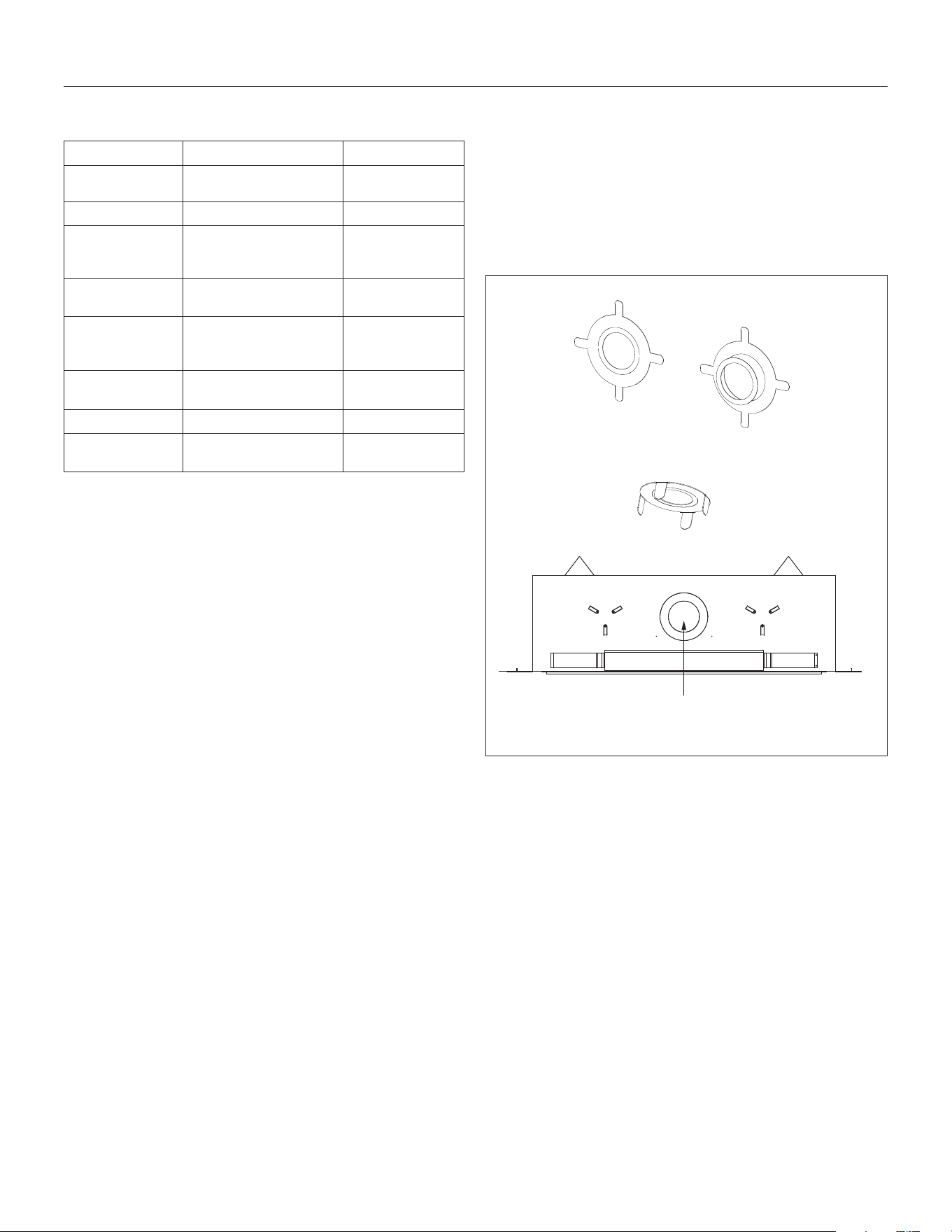
A restrictor plate (included in components packet) may be used to
achieve desired flame appearance on any venting installation with
at least 8 ft (2.4 m) of vertical pipe or more. Section 12.2.2 on
page 44 outlines restrictor plate recommendations depending
on burner flame appearance, and instructions on installation after
venting is completed.
RESTRICTOR PLATE
REMOVE CIRCLE TO
CREATE LESS RESTRICTION
BEND TABS TO APPROX. 80° ANGLES TO CREATE
TENSION TO HOLD ITSELF IN PLACE WHEN INSTALLED
Figure 8.1, Restrictor Assembly and Installation
SLIDE RESTRICTOR PLATE INTO EXHAUST PIPE ON TOP OF FIREPLACE
WITH TABS POINTING TOWARDS YOU PRIOR TO ATTACHING VENTING
VENTING 27
8.5 Vertical Terminations
IMPORTANT: The vertical vent heat shield must be installed for
every type of venting application. Refer to Section 8.8 on page
31.
NOTE: Attic insulation shields may be insulated using unfaced
insulation products listed as non-combustible per ASTM E 136.
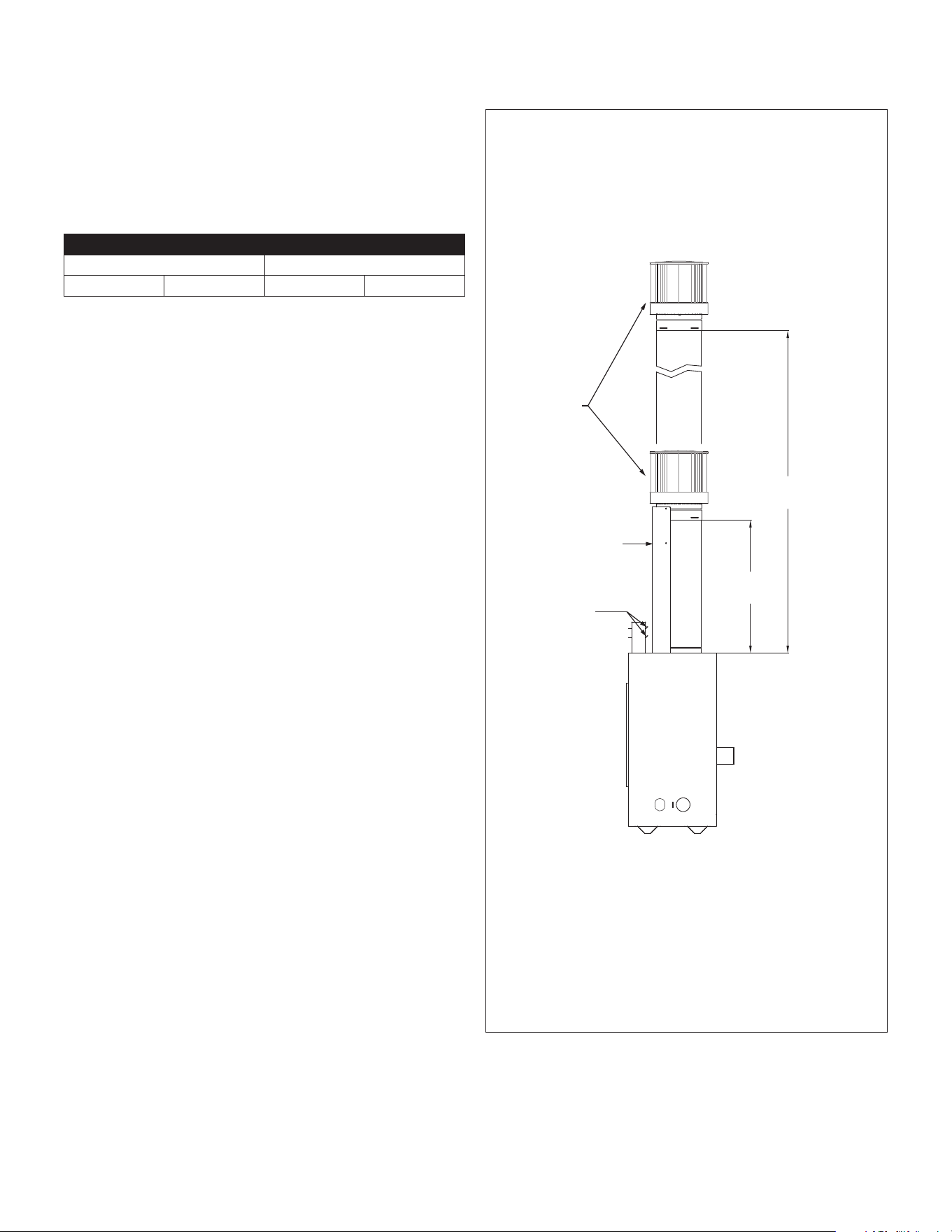
Table 8.1, NG & LPG - Minimum / Maximum Vertical Terminations
Minimum Vertical Length (V
MIN
) Maximum Vertical Length (V
MAX
)
2 ft 610 mm 50 ft 15.2 m
NATURAL GAS AND LP GAS VERTICAL VENT DIAGRAM
(A) Stand-off Brackets
(B) Stand-off Heat Shields
(C) 90° Elbow (not applicable)
(D) Vertical Vent Heat Shield
(E) Horizontal Vent Heat
Shield (not applicable)
(F) Termination Cap
A
B
D
F
2’ (610mm) MIN / 50’ (15.2m) MAX
V
MIN
V
MAX
28 VENTING
8.6 Combination Venting
8.6.1 Natural Gas Installations
IMPORTANT: The vertical vent heat shield included with this
fireplace must be installed for all venting configurations. The
horizontal vent heat shield must be installed when incorporating
minimum horizontal venting. Refer to Section 8.8 on page 31.
IMPORTANT: Horizontal vent sections require ¼ in (6 mm) rise
for every 12 in (305 mm) of travel.
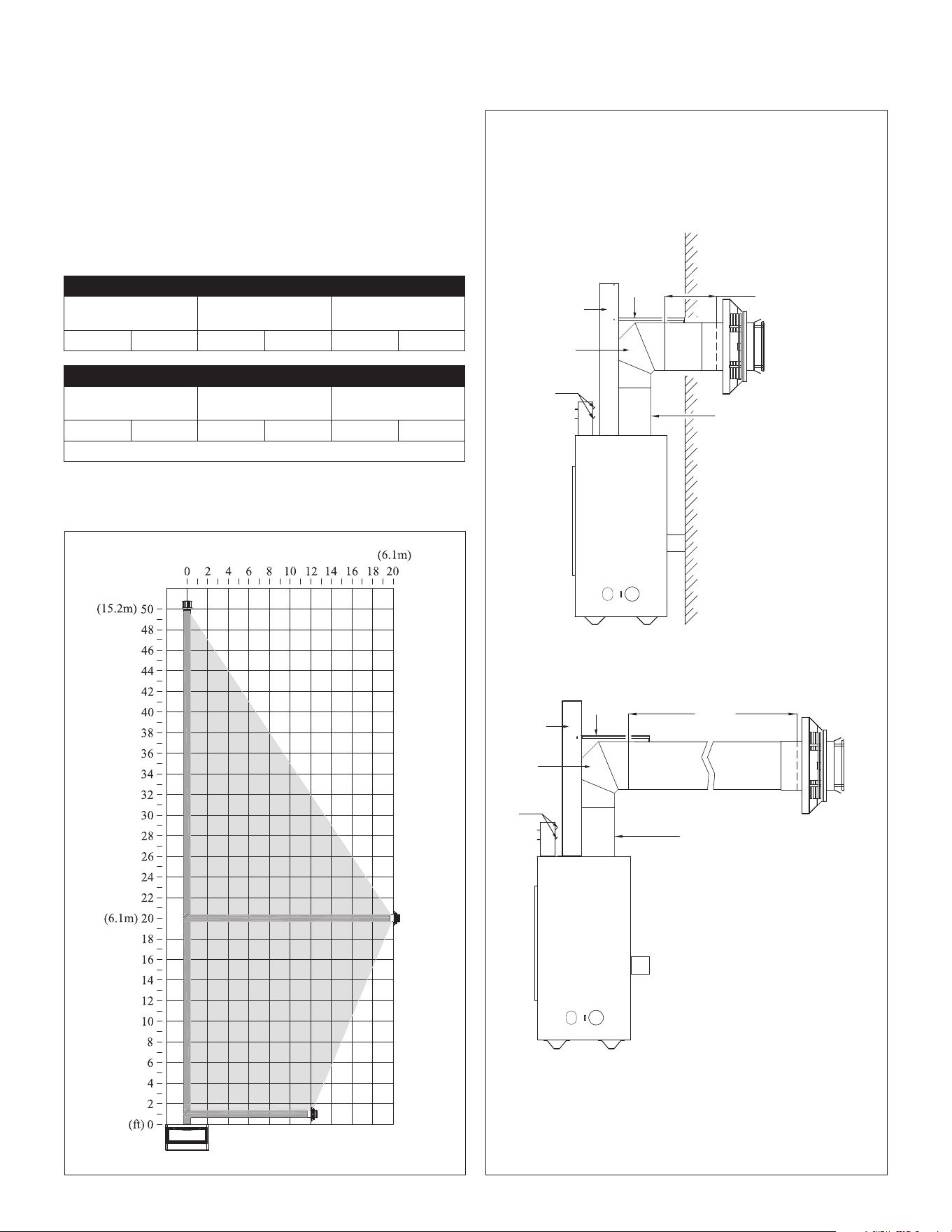
Table 8.2, NG - Minimum Horizontal Vent Terminations
Minimum
Vertical Rise (V
MIN
)
Minimum
Horizontal Run (H
MIN
)
Maximum
Horizontal Run (H
MAX
)
9 in 229 mm 9 in 229 mm 12 ft 3.6 m
Table 8.3, NG - Max Vertical / Max Horizontal Combination
Maximum
Vertical Rise
Maximum
Horizontal Run
Total Length
20 ft 6 m 20 ft 6 m 40 ft 12.2 m
Maximum number of 90° elbows: 5
NATURAL GAS MINIMUM HORIZONTAL VENTING DIAGRAM
(A) Stand-off Brackets
(B) Stand-off Heat Shields
(C) 90° Elbow
(D) Vertical Vent Heat Shield
(E) Horizontal Vent Heat Shield
(F) Termination Cap
Figure 8.2, Natural Gas Combination Venting
A
B
C
D
E
F
9” (229mm) + 90° ELBOW + 9” (229mm) MIN
V
MIN
H
MIN
A
B
C
D
E
F
9” (229mm) + 90° ELBOW + 12’ (3.6m) MAX
V
MIN
H
MAX
VENTING 29
8.6.2 LP Gas Installations
IMPORTANT: The vertical vent heat shield included with this
fireplace must be installed for all venting configurations. The
horizontal vent heat shield must be installed when incorporating
minimum horizontal venting. Refer to Section 8.8 on page 31.
IMPORTANT: Horizontal vent sections require ¼ in (6 mm) rise
for every 12 in (305 mm) of travel.
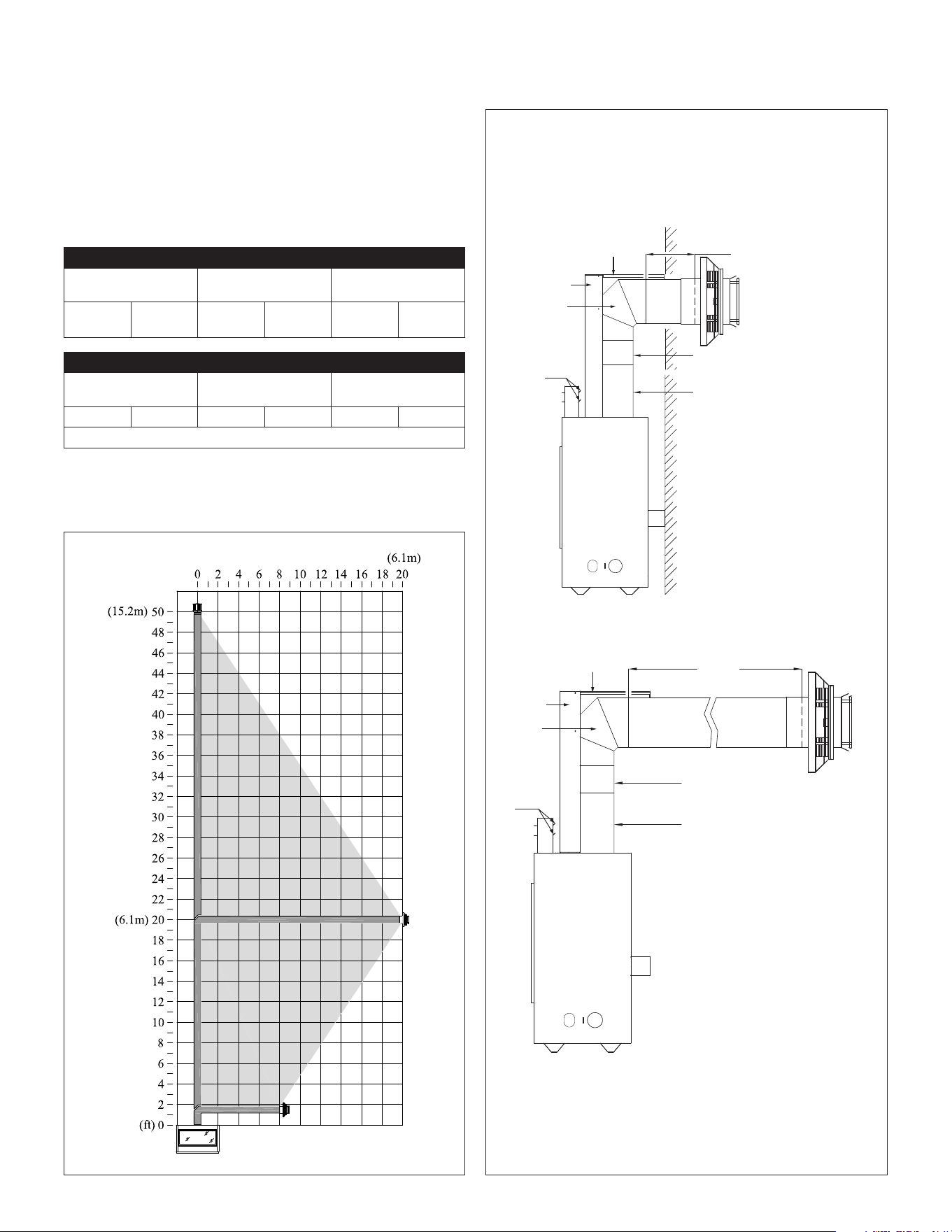
Table 8.4, LPG - Minimum Horizontal Vent Terminations
Minimum
Vertical Rise (V
MIN
)
Minimum
Horizontal Run (H
MIN
)
Maximum
Horizontal Run (H
MAX
)
9 in +
6 in
229 mm +
152 mm
9 in 229 mm 8 ft 2.4 m
Table 8.5, LPG - Max Vertical / Max Horizontal Combination
Maximum
Vertical Rise
Maximum
Horizontal Run
Total Length
20 ft 6 m 20 ft 6 m 40 ft 12.2 m
Maximum number of 90° elbows: 5
LP GAS MINIMUM HORIZONTAL VENTING DIAGRAM
(A) Stand-off Brackets
(B) Stand-off Heat Shields
(C) 90° Elbow
(D) Vertical Vent Heat Shield
(E) Horizontal Vent Heat Shield
(F) Termination Cap
Figure 8.3, LP Gas Combination Venting
A
B
C
D
E
F
9” (229mm) with 6” (152mm) + 90° ELBOW + 9” (229mm) MIN
H
MIN
V
MIN
- 9” (229mm) VENT PIPE
V
MIN
- 6” (152mm) VENT PIPE
A
B
C
D
E
F
9” (229mm) with 6” (152mm) + 90° ELBOW + 8’ (2.4m) MAX
H
MAX
V
MIN
- 9” (229mm) VENT PIPE
V
MIN
- 6” (152mm) VENT PIPE
30 VENTING
8.7 #800-2 Series Direct Vent
Termination Kit(s)
IMPORTANT: The vertical vent heat shield included with this
fireplace must be installed for all venting configurations. The
horizontal vent heat shield must be installed when incorporating
minimum horizontal venting. Refer to Section 8.8 on page 31.
IMPORTANT: The flex pipe is permanently attached to the
exterior plate. DO NOT ATTACH either #844-2 or #845-2
termination kit to fireplace (or extension kit) until it has passed
through the wall. Install termination plates to the outside wall
exterior.
IMPORTANT: The minimum bend radius to center is 6 in (152
mm) required for installation of the flexible vent pipe. Care
should be taken when installing the flexible vent pipe to avoid
a tight bend that may cause abrasion or damage to the flexible
pipe.
• If terminating against vinyl siding, a vinyl siding protector
must be used (included with the #844-2 and #845-2 direct
vent kits). Follow instructions included.
• Each #846-2 extension kit contains enough 5” & 8” flexible
aluminum pipe to extend chimney an additional 6 ft (1.83 m).
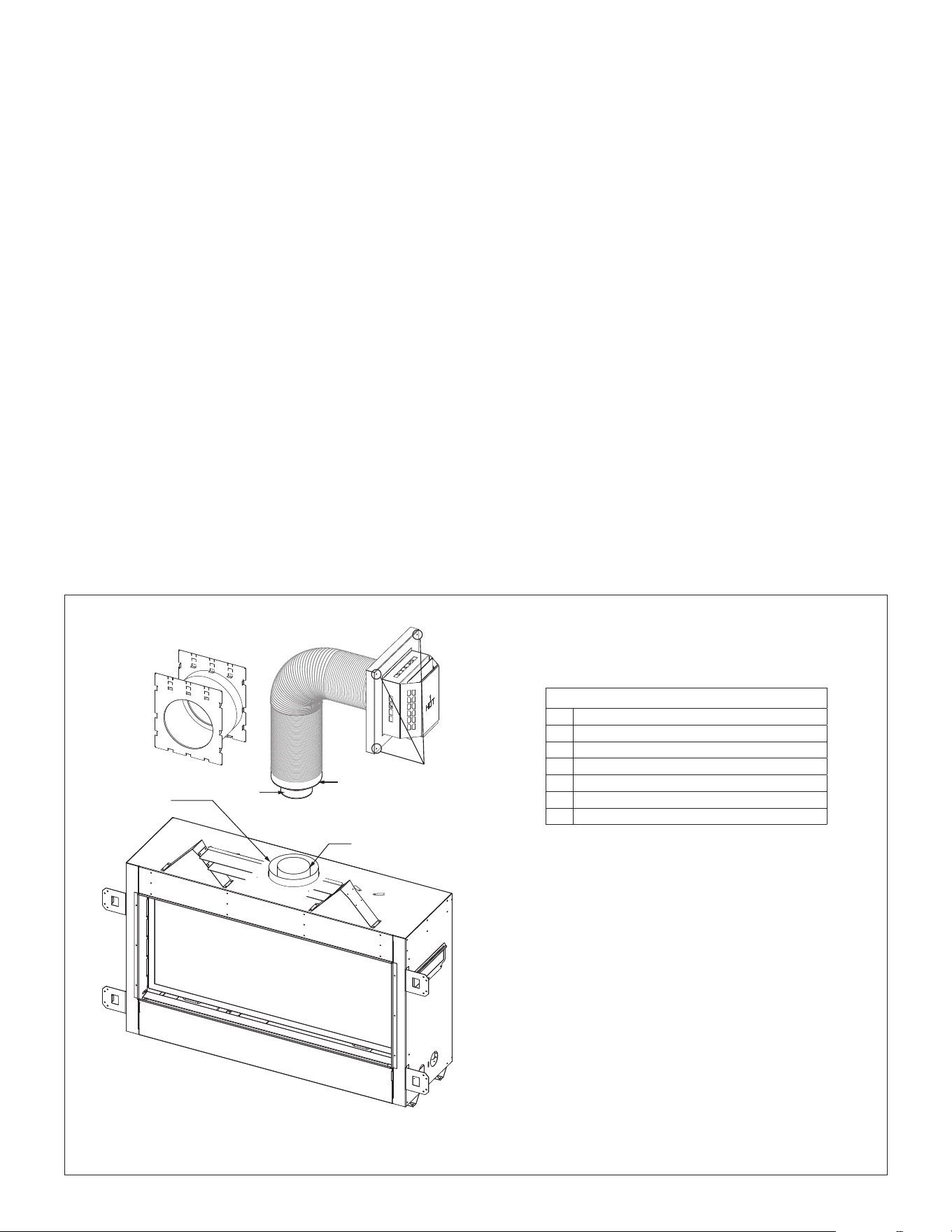
8.7.1 Assembly and Installation
1. Mount the required wall thimble (G) with the required 1 in (25
mm) top clearance and 1 in (25 mm) side clearances to the
exterior wall, and seal.
2. (OPTIONAL) insulate the wall-pass through with any unfaced
insulation products listed as non-combustible per ASTM E
136.
3. Apply a liberal bead of exterior sealant around outer edge of
termination box (A), placing assembly through the wall-pass
through in exterior wall. Place screws through the four holes
(B), securing it in place.
4. Form the 5” & 8” flexible aluminum pipes on termination kit
(#844-2 or #845-2), and if applicable, on each extension kit.
5. Gently pull 5” & 8” pipes down to the top of the fireplace, or if
applicable, the extension kit.
DO NOT stretch extension kit beyond 6 ft. (1.83 m); DO
NOT stretch beyond what is required. It is very difficult to
decompress flex pipes once stretched.
6. Place a bead of sealant outside 5” flex pipe collar (C) (end
with EXTERNAL LIP) and sliding it into 5” pipe on extension
kit or top of fireplace (D). Secure with 3 evenly spaced
screws.
7. Place a bead of sealant inside 8” flex pipe collar (E) (end
with the INTERNAL lip), sliding it over 8” pipe on top of
fireplace (F). Secure with 3 evenly spaced screws.
8. If additional extension kits are required, repeat Steps 4 and
5, placing 5” & 8” pipes onto previous extension kit.
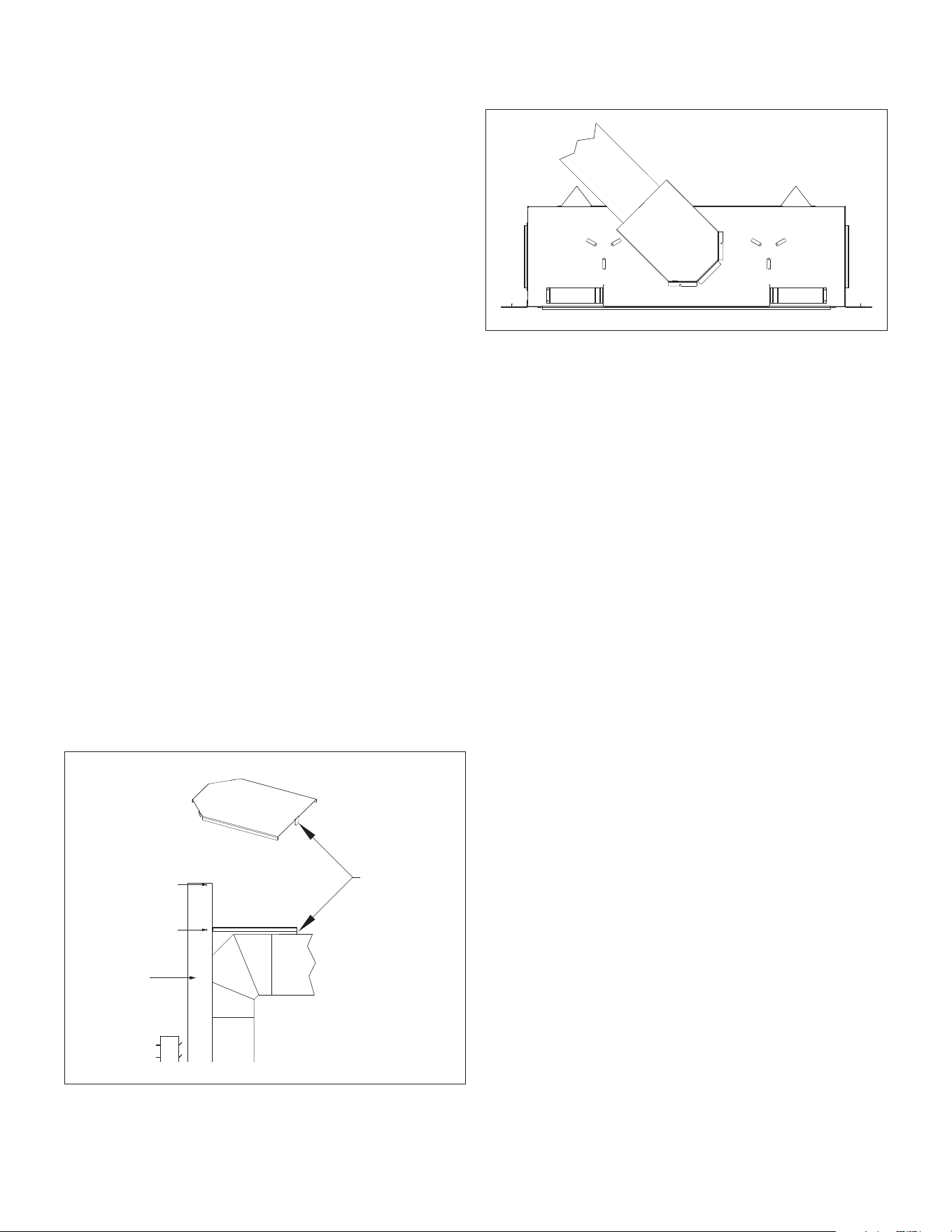
LEGEND
A Termination box
B Holes in exterior wall (only 3 shown)
C 5” flex pipe collar
D 5” pipe on fireplace or extension kit
E 8” flex pipe collar
F 8” pipe on fireplace or extension kit
G Wall thimble with 1 in (25mm) clearance
Figure 8.4, Installation and Assembly #800-2 Series
A
B
D
E
F
G
C
VENTING 31
8.8 Vent Heat Shield Assembly
Installation
IMPORTANT: The vertical vent heat shield MUST be installed
for every type of venting application. The horizontal vent heat
shield must be installed when incorporating minimum horizontal
venting.
NOTE: There are (6) screw holes located in front of the flue
outlet to offset the vent heat shield assembly in front of the
vent pipe. Align the heat shield as necessary for your venting
installation.
8.8.1 Vertical Vent Heat Shield Installation
1. Position the vertical vent heat shield in front of the vent
pipe, with the flanges facing towards the fireplace face as
necessary for the type of installation.
2. Align the (2) slots on the vertical heat shield flanges with
corresponding screw holes located in front of the flue outlet
on the top of the fireplace.
3. Secure the vertical vent heat shield to the fireplace with (2)
attachment screws (provided in the components package).
8.8.2 Minimum Horizontal Venting
1. Bend perforation on the (3) hand-tabs down on the horizontal
vent heat shield.
2. Locate (3) screw holes at the top of the vertical vent heat
shield. There are (2) sets of screw holes, allowing for natural
gas and LP gas minimum horizontal venting.
3. Align the (3) slots on horizontal vent heat shield tabs to the
corresponding (3) screws holes on the vertical vent heat
shield necessary for your installation.
4. Attach the horizontal vent heat shield with screws (provided)
through the screw holes on the vertical vent heat shield. The
1 in (25 mm) vent stand-off tab will rest on top of the vent
pipe.
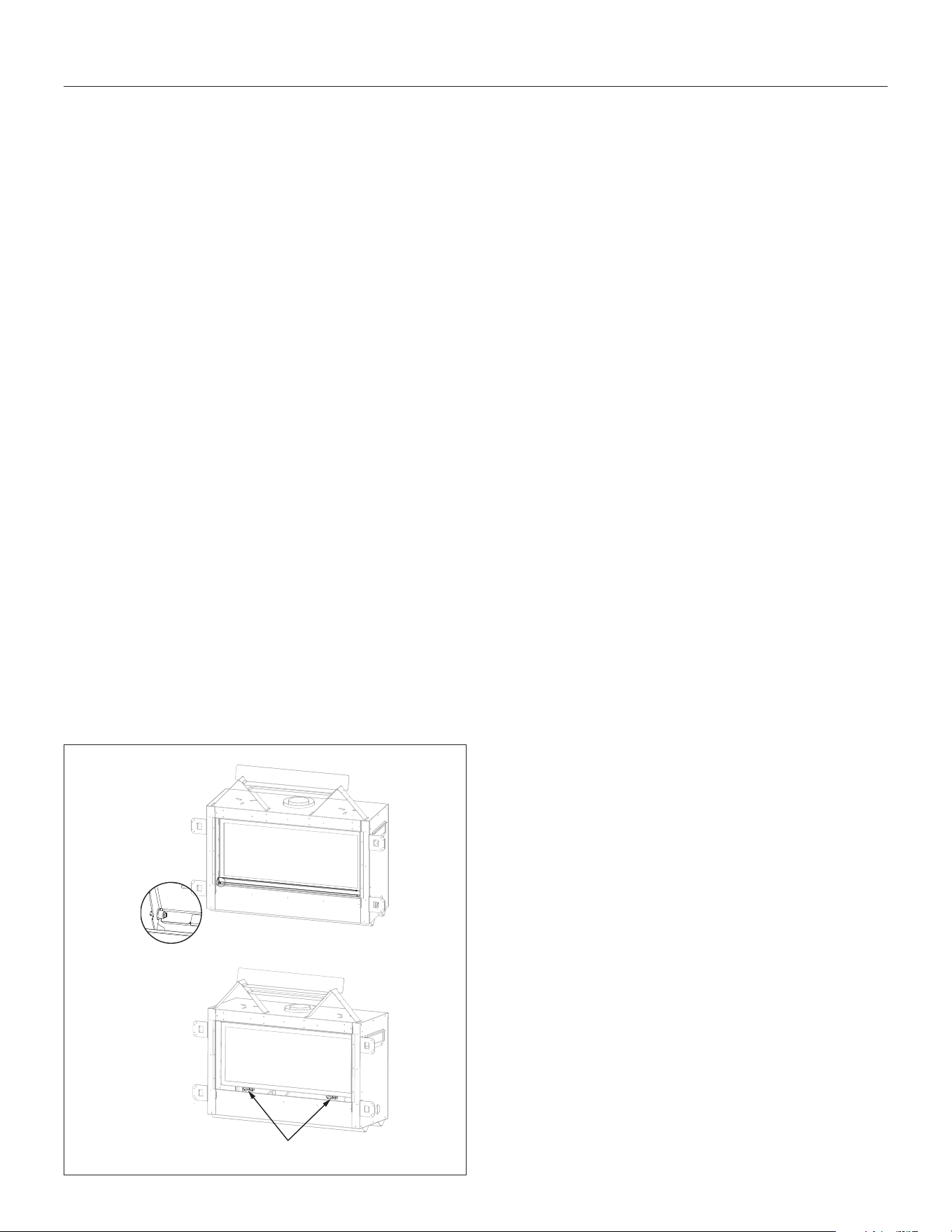
Figure 8.5, Installed Horizontal Vent Heat Shield
Figure 8.6, Vent Heat Shield Assembly on a Corner Installation
LP GAS LOCATION
NATURAL GAS LOCATION
VENT STAND-OFF TAB
VERTICAL VENT
HEAT SHIELD
HORIZONTAL VENT HEAT SHIELD
32 FIREPLACE SET UP
9.0 FIREPLACE SET UP
9.1 Glass Frame Assembly
WARNING: Do not operate this fireplace with the glass removed,
cracked, or broken. Replacement of the glass assembly should
be done by a licensed or qualified service person.
9.1.1 Remove Glass Frame Assembly
WARNING: Do not remove the glass assembly when hot.
1. Remove the safety barrier.
2. Remove the gas valve access cover. Back out one of the (2)
hinge screws until the access cover is able to pivot away
from the glass frame.
3. Loosen, but do not remove (2) wing nuts securing the
component upper heat shield.
4. Remove the heat shield.
5. Locate (2) spring-loaded latches securing the glass assembly
at the bottom of the firebox.
6. Pull the spring-loaded latches out and down to release the
bottom of the glass assembly.
7. Lift glass assembly up and off of the (2) tabs located at the
top of the firebox.
9.1.2 Install Glass Frame Assembly
1. Align the slots on top of the glass assembly over the tabs at
the top of the firebox while lowering the bottom of the glass
assembly into position.
2. Pull the spring-loaded latches out and up to secure the
bottom of glass to the bottom of the fireplace.
3. Reinstall component upper heat shield. Secure with (2) wing
nuts.
4. Reinstall valve access cover by securing the hinge screw
previously backed out.
5. Reinstall safety barrier.
9.2 Light Kit
CAUTION: Disconnect all electrical power from the fireplace
before performing this task.
ATTENTION: If converting to LP (propane) gas, complete the
conversion before installing any light kit components. Follow
instructions provided with the conversion kit (sold separately).
NOTE: To avoid damage and prolong the life of the halogen
bulbs, never touch with bare hands. Always use a soft cloth
when handling.
9.2.1 Install Light Kit
1. Remove the safety barrier and glass frame assembly.
2. Remove glass media (if installed).
3. Remove (10) screws securing burner cover. Lift cover out of
firebox.
4. Install (6) halogen bulbs (included in component packet) into
lamp bases.
5. Reinstall the burner cover with (10) previously removed.
6. Reinstall glass media, glass frame assembly, and safety
barrier.
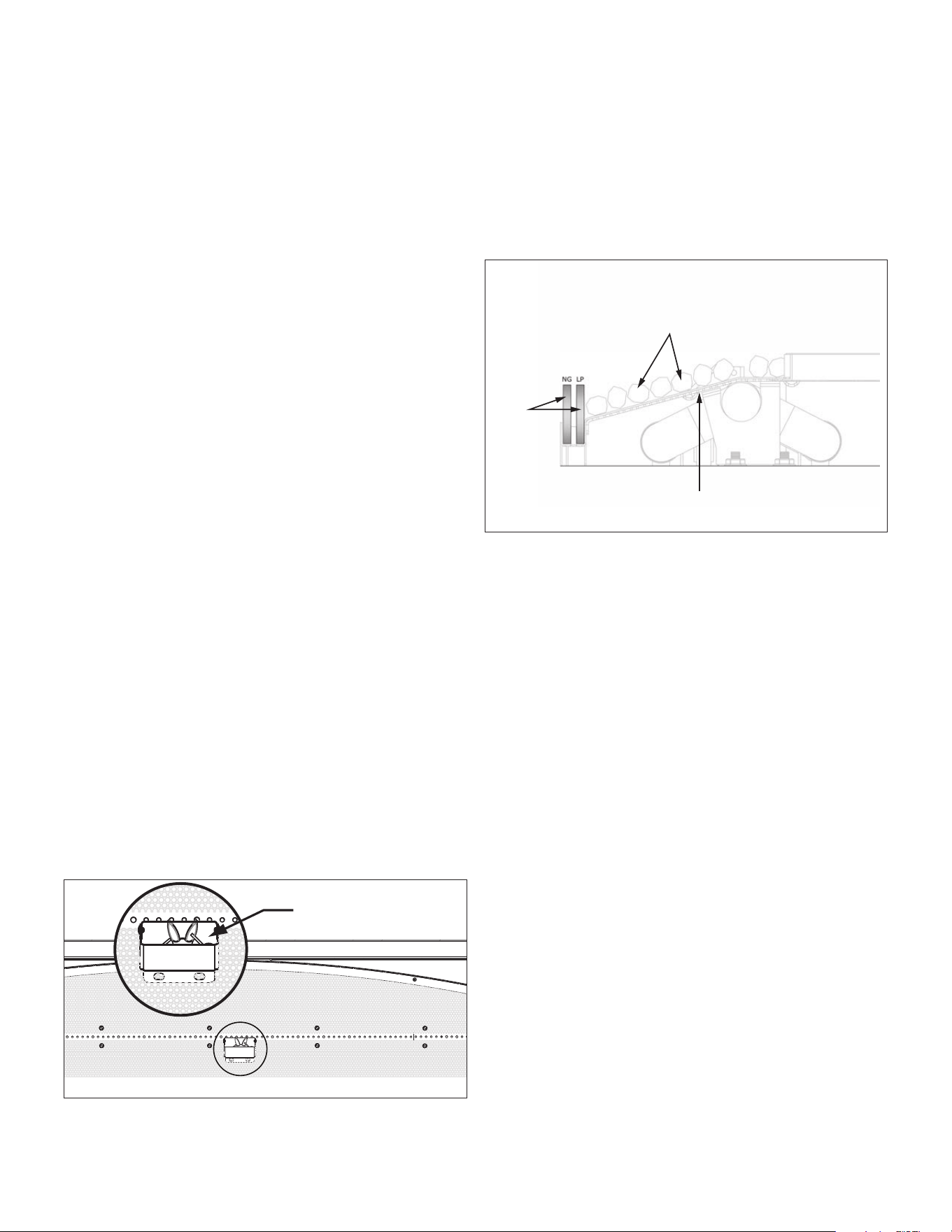
HINGE SCREW SECURING VALVE
TO ACCESS COVER (1 EACH SIDE)
HANDLE LOCATION
Figure 9.1, Glass Frame Assembly Removal and Installation
FIREPLACE SET UP 33
9.3 Glass Media
WARNING: DO NOT BLOCK PILOT WITH GLASS MEDIA. A
BLOCKED PILOT MAY CAUSE DELAYED IGNITION.
NOTE: This fireplace allows two types of glass media: #101
Series glass beads media or #213 Series crushed glass media.
Follow instructions below for proper installation of your specific
glass media. Do not substitute materials.
9.3.1 #101 Series Glass Media Installation
1. Remove glass media from its packaging. The glass media
may be cleaned prior to installation. See section 9.3.3 below.
2. Install 10 lbs. (4.5 kg) of glass beads onto burner assembly
and pilot shield.
3. Verify glass media is one layer deep across the firebox and
does not block any burner ports. Do not block the pilot
assembly.
4. Save any unused media for later use.
9.3.2 #213 Series Glass Media Installation
1. Remove glass media from its packaging. The glass media
may be cleaned prior to installation. See section 9.3.3 below.
2. Install 13 lbs. (5.8 kg) of crushed glass onto burner assembly
and pilot shield.
3. Remove up to 75% of the crushed glass covering the burner
ports. Do not block the pilot assembly.
4. Save any unused media for later use.
9.3.3 Cleaning Glass Media
As a natural reaction from direct contact to heat and exposure
to flame, glass media may discolor or produce a fine oil residue.
Follow instructions below to clean glass media. Contact your local
authorized dealer for replacement glass media.
• Remove glass media from firebox using protective gloves.
• Clean glass media with mild dish soap and water.
• Drain and rinse the glass media thoroughly. Verify the glass
media is completely dry before placing on media tray.
• Follow instructions above for your specific glass media
reinstallation. Do not block the pilot assembly with glass
media.
DO NOT BLOCK
THIS AREA
Figure 9.2, Pilot Assembly Area
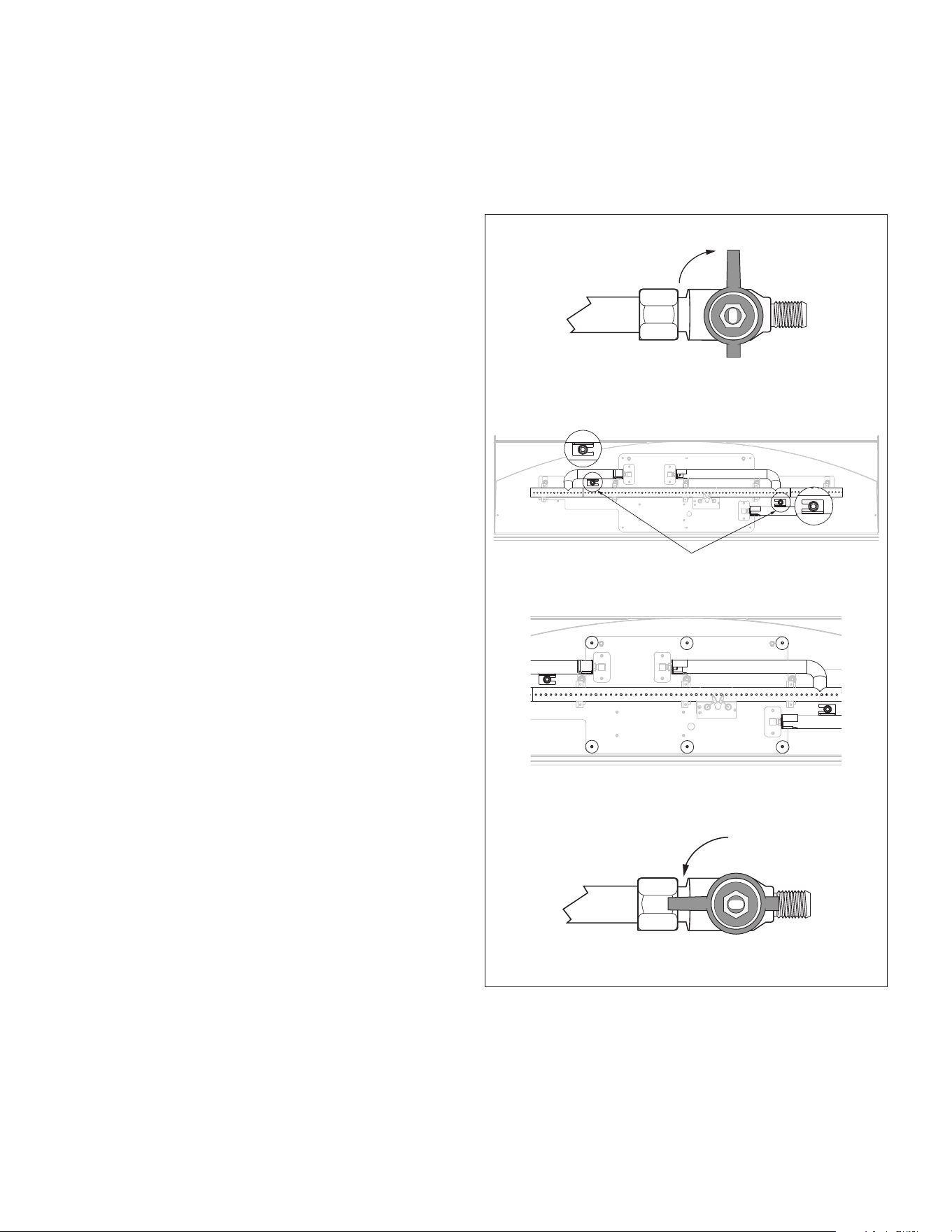
9.4 Glass Media Dam
There are (2) channels located in the front of the burner cover/
media tray to install the glass media dam for natural gas or LP
gas installations. Proper placement of the glass media dam allows
for air flow and proper flame appearance.
See below for correct installation of the glass media dam for your
specific gas installation.
GLASS
MEDIA DAM
BURNER COVER/MEDIA TRAY
GLASS MEDIA
SIDE VIEW
Figure 9.3, Glass Media Dam Installation
34 FIREPLACE SET UP
9.5 Control Board Removal
and Installation
WARNING: If burner and/or pilot have been burning,
use appropriate protection to avoid burns or damage
to personal property before removing any components.
DO NOT OPERATE THIS APPLIANCE WITHOUT THE SEALING
GASKET (LOCATED UNDER THE CONTROL BOARD) IN PLACE.
IF GASKETING IS DAMAGED, IT MUST BE REPLACED.
CAUTION: Check all connections for leaks with soapy water,
whether field or factory made.
9.5.1 Control Board Removal
1. Disconnect electrical power.
2. Locate the manual valve installed by your qualified service
technician.
3. Turn the manual valve clockwise to the OFF position.
4. Remove the safety barrier and glass frame assembly.
5. Remove glass media and media dam.
6. Remove burner cover (10) screws.
7. Use a 7/16” wrench to remove (2) ¼” flange nuts securing
the side burner tubes. Remove side burner tubes from
mounting cradles.
8. Remove the center burner tube from its mounting cradles.
9. Use a 7/16” wrench to remove (2) ¼” flange nuts securing
the light bar. Remove assembly from firebox.
10. Remove and save (8) screws securing the control board.
11. Lift the control board out of the firebox, being careful not to
damage sealing gasket underneath.
9.5.2 Control Board Installation
1. Place control board in firebox, aligning holes in the board to
the holes in the firebox floor. VERIFY SEALING GASKET IS
IN PLACE.
2. Secure the control board to the firebox using (8) screws
previously removed.
3. Reinstall the light kit assembly using (2) nuts previously
removed.
4. Reinstall the center burner. Position the venturi over the
burner orifice, aligning the burner tube with the mounting
cradles.
5. Reinstall the side burner tubes. Position the burner tubes
over the burner orifices and align with the mounting cradles.
Secure with (2) flange nuts previously removed.
6. Reinstall burner cover (10) screws.
7. Reinstall the media dam and glass media, being careful not
to block pilot with glass media.
8. Reinstall the glass frame assembly and safety barrier.
9. Turn the manual valve counterclockwise to the ON position.
10. Reconnect electrical power.
11. Verify proper glass media placement, operation of fireplace,
and any electrical components.
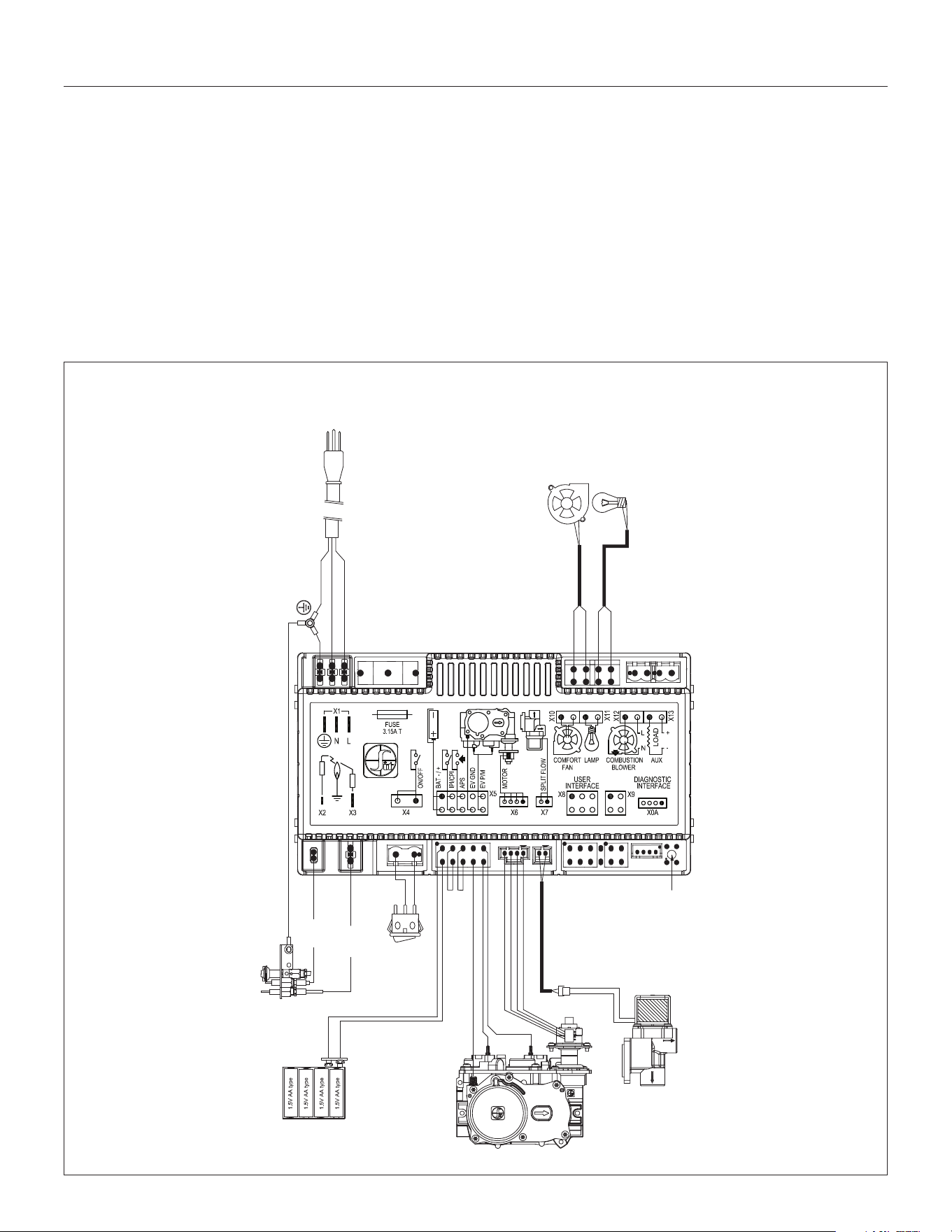
Figure 9.4, Control Board Removal and Installation
FLANGE NUTS SECURING SIDE BURNER TUBES
CONTROL BOARD SCREWS (6 SHOWN)
ELECTRICAL INFORMATION 35
10.0 ELECTRICAL INFORMATION
WARNING: Do not use this fireplace if any part has been under
water. Immediately call a qualified service technician to inspect
this appliance and to replace any part of the control system and
any gas control which has been under water.
WARNING - Electrical Grounding Instructions: This appliance
is equipped with a three-prong (grounding) plug for your
protection against shock hazard and should be plugged directly
into a properly grounded three-prong receptacle. Do not cut or
remove the grounding prong from this plug.
10.1 Electrical Specifications
This appliance, when installed, must be electrically grounded in
accordance with local codes, or in the absence of local codes,
with the National Electrical Code, ANSI/NFPA 70, or the Canadian
Electrical Code, CSA C22.1.
10.2 Wiring Requirements
• The IFC System Module requires 120V of electricity and/or
batteries to operate.
• Using the battery back-up will operate the burner only.
• Fan and light components will not function on battery back
up power.
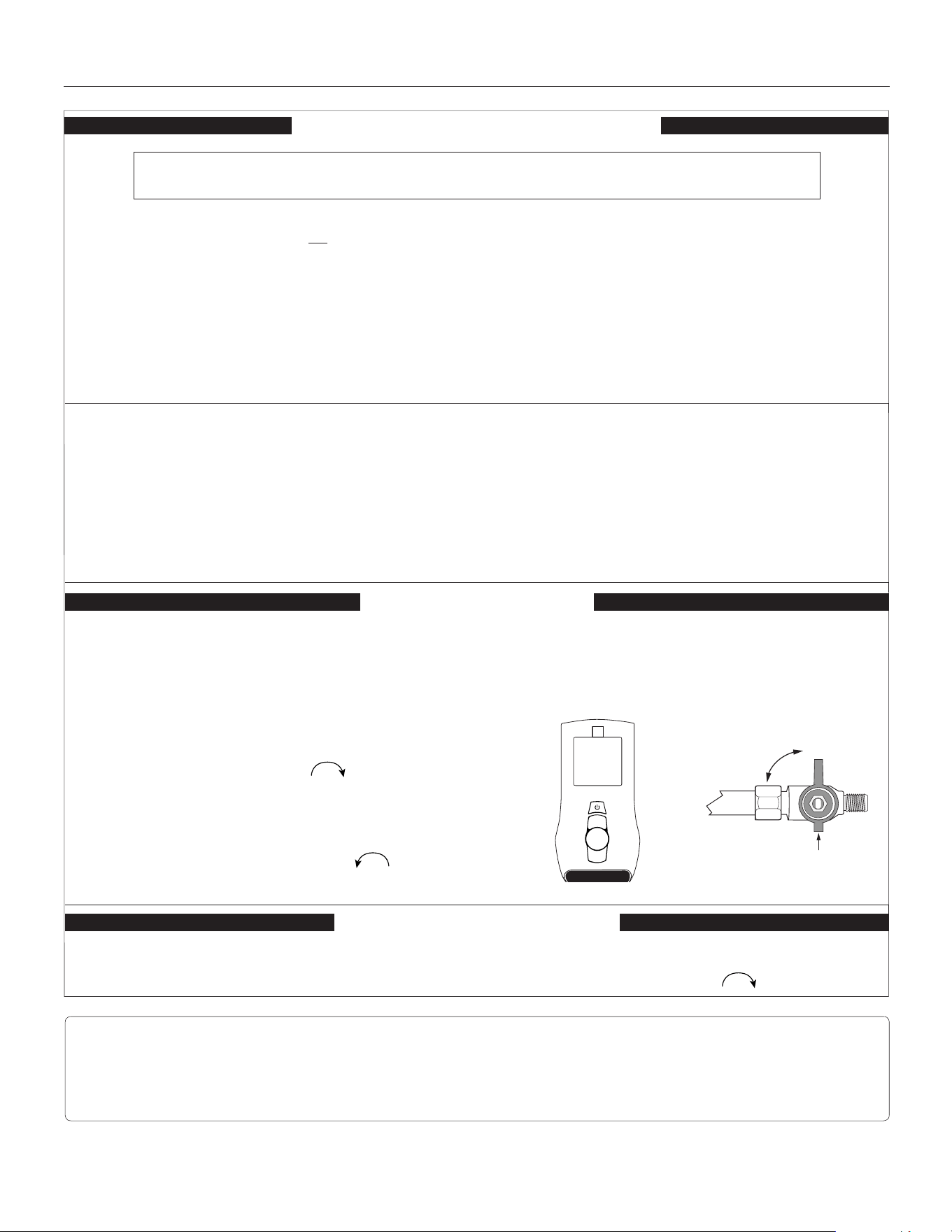
PILOT
IGNITER
FLAME
SENSOR
PILOT
BURNER
BATTERY PACK
MAIN ON/OFF
SWITCH
885 PROFLAME
540 SPLIT FLOW
VARIABLE SPEEN FAN
VARIABLE LIGHT
APPLIANCE
GROUND STAR
SW1 BUTTON (RED)
MALE END
Figure 10.1 Wiring Schematics
36 OPERATING INSTRUCTIONS
WARNING
Do not operate appliance with the glass front removed, cracked,
or broken. Replacement of the glass should be done by a licensed
or qualified service person.
Under no circumstances should any solid fuel (wood, coal, paper,
cardboard, etc.) be used in this appliance.
Children and adults should be alerted to the hazards of high
surface temperature and should stay away to avoid burns or
clothing ignition.
CAUTION
Clothing or other flammable material should not be placed on or
near the appliance.
Young children should be carefully supervised when they are in the
same room as the appliance. Toddlers, young children and others
may be susceptible to accidental contact burns. A physical barrier
is recommended if there are at risk individuals in the house. To
restrict access to a fireplace or stove, install an adjustable safety
gate to keep toddler, young children and other at risk individuals
out of the room and away from hot surfaces.
WARNING: If you do not follow these instructions exactly, a fire or explosion may result causing property damage,
personal injury, or loss of life.
1. STOP! Read all the safety information above on this page.
2. Press the wireless remote OFF button.
3. Turn off all electric power to the appliance.
4. This appliance is equipped with an ignition device which
automatically lights the pilot. Do not try to light the pilot by
hand.
5. Locate the manual valve installed by your qualified service
technician.
6. Turn the manual valve clockwise to the OFF position.
7. Wait five (5) minutes to clear out any gas. Then, smell
for gas, including near the floor. If you smell gas, STOP!
Follow ‘B’ in the safety information above. If you do not smell
gas, go to the next step.
8. Turn the manual valve counterclockwise to the ON
position.
9. Turn on all electric power to the appliance.
10. Press the wireless remote ON button.
11. If the appliance will not operate, follow the instructions, “To
Turn Off Gas To Appliance” and call your service technician
or gas supplier.
OPERATING INSTRUCTIONS
NOTE
When this fireplace is initially lit, condensation will appear on the glass. This is normal in all gas fireplaces and will disappear after
several minutes. A paint smell will occur during the first few hours of burning. It is recommended to leave the fan off during this period to
help speed the paint curing process. This fireplace may produce noises of varying degree as it heats and cools due to metal expansion
and contraction. This is normal, and does not affect the performance or longevity of the fireplace.
A. This appliance is equipped with an ignition device which
automatically lights the pilot. Do not try to light the pilot by
hand.
B. BEFORE OPERATING smell around the appliance area for
gas. Be sure to smell next to the floor because some gas is
heavier than air and will settle on the floor.
WHAT TO DO IF YOU SMELL GAS
• Do not try to light any appliance.
• Do not touch any electric switch; do not use any phone
in your building.
• Immediately call your gas supplier from a neighbor’s
phone. Follow the gas supplier’s instructions.
• If you cannot reach your gas supplier, call the fire
department.
C. Use only your hand to turn the gas control manual valve.
Never use tools. If the valve will not turn by hand, do not
try to repair it; call a qualified service technician. Force or
attempted repair may result in a fire or explosion.
D. Do not use this appliance if any part has been under water.
Immediately call a qualified service technician to inspect the
appliance and to replace any part of the control system and
any gas control that has been under water.
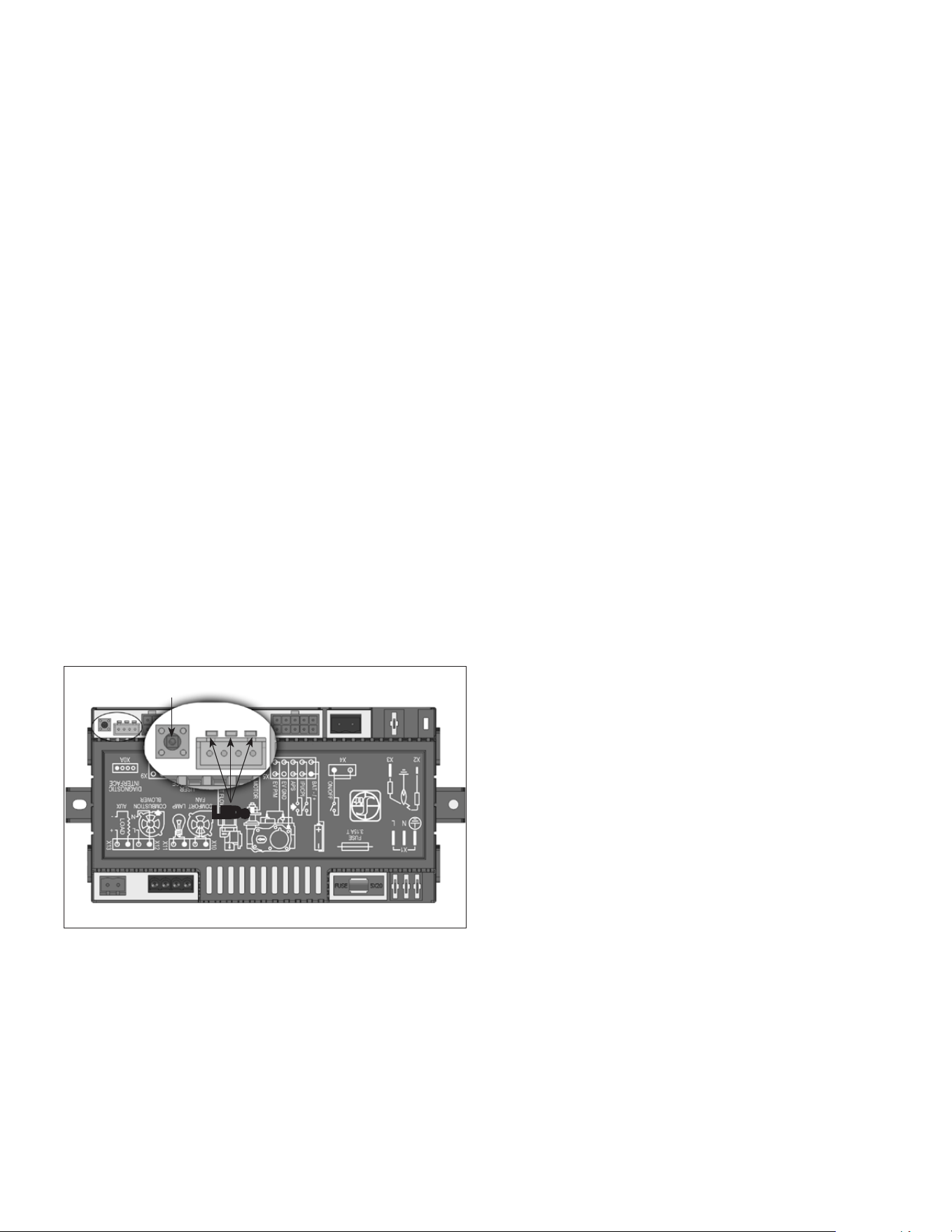
ON/OFF
ON
OFF
1. Press the wireless remote OFF button.
2. Turn off all electric power to the appliance if service is to
be performed.
3. Locate the manual valve installed by your qualified service
technician.
4. Turn the manual valve clockwise to OFF position.
FOR YOUR SAFETY READ BEFORE OPERATING
TO TURN OFF GAS TO APPLIANCE
11.0 OPERATING INSTRUCTIONS
OPERATING INSTRUCTIONS 37
11.1 Setup Proflame 2 IFC Module
1. Set the main ON/OFF rocker switch in the OFF position.
2. Install (4) AA batteries (included in the components packet)
into backup battery holder on the control module.
3. Install (3) AAA batteries (included in the components packet)
in the remote control battery bay, located at the base of the
remote.
4. Connect the IFC Module to an AC power supply.
11.2 Initialize the Control System
IMPORTANT: Remove all packaging and combustible material
from the firebox before initializing the control system.
NOTE: Performing the next steps will initiate pilot start-up in
manual mode, where the pilot igniter will spark repeatedly. The
pilot will ignite if gas is supplied to the fireplace.
1. Locate the red SW1 button the IFC module.
2. Press the button. The IFC module will BEEP (3) times and
illuminate an amber LED. This indicates the receiver is ready
to synchronize with the transmitter.
3. Within (5) seconds, push the ON/OFF button on the
remote control. The receiver will BEEP (4) times to indicate
the transmitter’s command is accepted, and is set to the
transmitter’s particular code. The pilot will automatically ignite.
4. Press the remote control ON/OFF button again. The pilot
will extinguish, confirming the remote control command. The
control system is now initialized.
5. Set the main ON/OFF rocker switch to ON position for remote
control operation of the main burner and fireplace features.
11.3 Reset the System for
Manual Operation
1. Set the ON/OFF rocker switch to OFF position.
2. Press the red SWI button on the IFC module until it emits (3)
beeps and an amber LED is illuminated.
3. Within (5) seconds, press the red SWI button again. This will
close synchronization with the remote control. The pilot will
automatically light.
• Turn the main burner ON by setting the ON/OFF switch in ON
position. The main burner will only operate on HI.
Figure 11.1, IFC Module
• Turn the main burner OFF by setting the ON/OFF switch in the
OFF position. The pilot will remain lit even if burner is turned
off, provided CPI mode is turned on.
11.4 Automatic Safety Restart
• This system will execute an automatic turn OFF command
within (24) hours of a continued pilot flame ignition. This allows
the system to verify correct safety functions.
• After the turn OFF sequence is completed, the IFC module will
re-execute the latest command.
11.5 Backup Battery Operation
This appliance will operate on the backup battery pack when
electric power is interrupted, or in a power outage. The lifespan of
the backup batteries depend on various factors, such as the quality
of the batteries, number of ignitions, et cetera.
• When the backup battery pack is low, the IFC module will emit
a double-beep while receiving an ON/OFF command.
• No commands will be accepted after this alert until the back
up batteries are replaced.
• Once replaced, the IFC module will emit a ‘beep’ as soon as
it is powered.
SW1
BUTTON
LEDs

38 OPERATING INSTRUCTIONS
11.6 IFC Module Ignition Sequence
The IFC module will try (2) times for ignition, each lasting
approximately (60) seconds, with approximately (35) seconds
between each attempt.
1. With the system in OFF position, press the remote control
ON/OFF key. Approximately (4) seconds after this key is
depressed, the IFC module will generate sparks to the pilot
hood.
2. First ignition attempt will generate sparks for (60) seconds.
3. If there is no flame ignition (rectification) within the (60)
second time frame, the IFC module will stop generating sparks
for approximately (35) seconds.
4. After (35) seconds of wait time, the IFC module will generate
sparks for another (60) seconds for the second ignition
attempt.
5. If there is no positive rectification after (60) seconds, the IFC
module will go into a lock out. The red LED will blink (3) times,
in intervals, until the system is reset.
11.6.1 Reset IFC Module after Lockout
11.6.1.1 ON/OFF Rocker Switch
1. Set the ON/OFF rocker switch to the OFF position.
2. After approximately (2) seconds, move the switch to the ON
position. The ignition sequence will start again.
11.6.1.2 Remote Control ON/OFF Key
1. Press the remote control ON/OFF key to turn the system OFF.
2. After approximately (2) seconds, press the ON/OFF key again.
The ignition sequence will start again.
11.6.1.3 Cycling Flame
1. Press the remote control down arrow key during flame
adjustment mode to reduce the flame to OFF (indicated by
OFF displayed on the LCD screen).
2. After approximately (2) seconds, press the up arrow key. The
ignition sequence will start again.
11.7 Additional Diagnostic Information
Low Battery Condition (<4V) Remote Control:
• Battery Icon will appear on LCD remote control display.
• Replace batteries.
Low Battery Condition (<4V) Battery Backup:
• The red LED Indicator will blink (1) time in intervals.
• A low double-beep emits from the IFC control module when it
receives an ON/OFF command from the remote control..
• Replace Batteries.
Pilot Flame Error Condition:
• Red LED Indicator will blink (2) times in intervals. Contact
your dealer if this occurs.
System Lock Out Condition:
• Red LED Indicator will blink (3) times in intervals.
• Verify gas is turned on.
• Verify sensor is not shorted.
• Follow 11.2 Initialize the Control System on page 37.
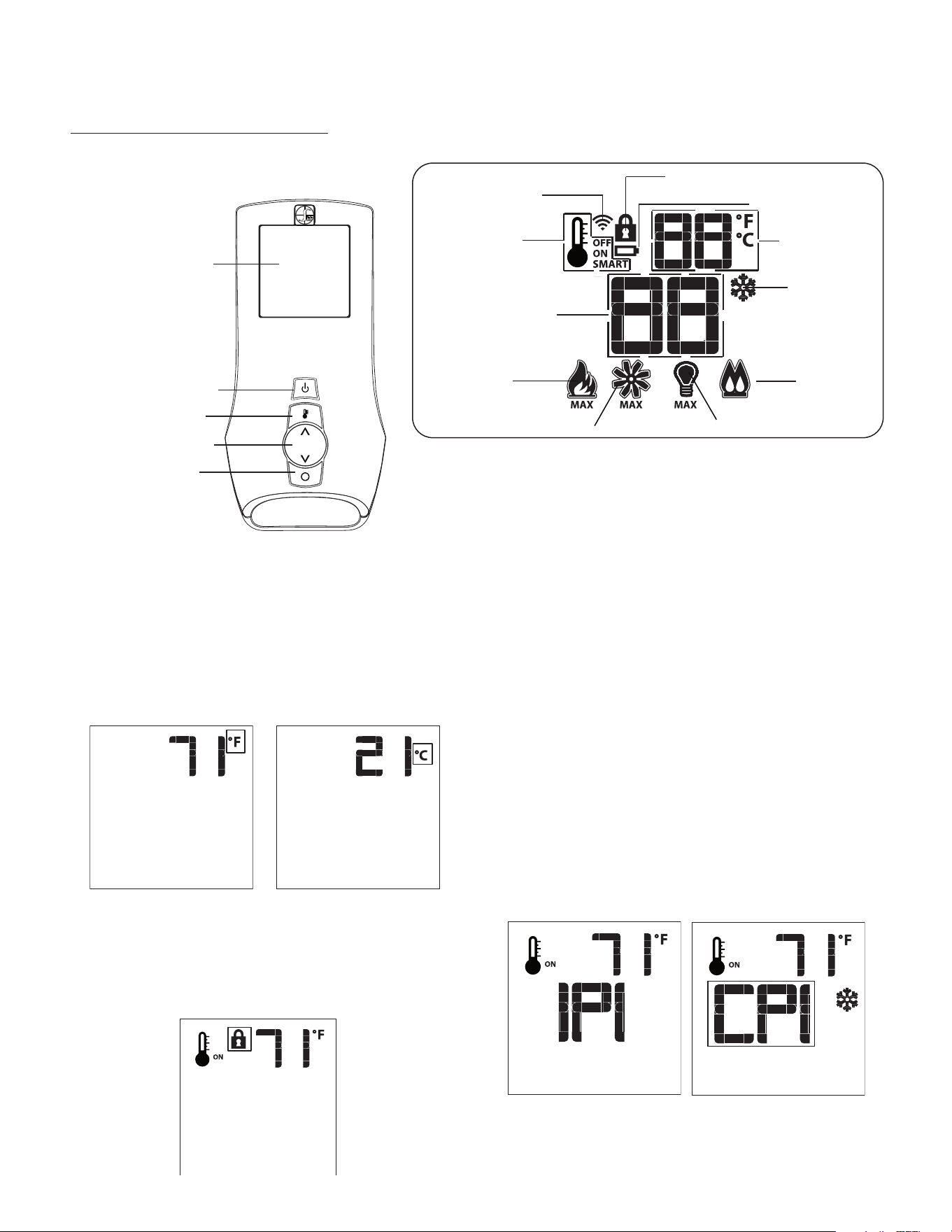
OPERATING INSTRUCTIONS 39
11.8 Remote Control Operation
11.8.1 Temperature Display
1. With the system in the OFF position, simultaneously press the
thermostat key and the mode key to change degrees from °F
to °C.
2. Visually check the LCD screen to verify either °F or °C is
displayed on the right side of the room temperature display.
11.8.2 Key Lock
This function locks the keys to avoid unsupervised operation.
Once activated, a lock icon will appear on the LCD screen.
1. Simultaneously press the mode key and the up arrow key to
activate or deactivate this function.
11.8.3 Pilot Ignition Selection (IPI/CPI)
This system has the option of a continuous (standing) pilot. This
features allows the system to change from a spark-to-pilot system
to the standing pilot option. The standing pilot will keep the firebox
warm and establish a draft in the vent, which allows the main burner
to ignite with less air-flow disruption.
When the system is OFF, the LCD screen will display the snowflake
icon during the setup of either IPI or CPI mode. To select the
preferred pilot ignition feature,
1. With the system in the OFF position, press the mode key to
index the CPI mode icon.
2. Press the up arrow key to activate CPI.
3. Press the down arrow key to return to IPI. A single ‘beep’ will
confirm reception of the command.
When the system is ON,
IPI mode: LCD screen will not display the snowflake icon
CPI mode: LCD screen will display the snowflake icon
PROFLAME 2 TRANSMITTER
LOW BATTERY ALARM
KEY LOCK
LIGHT ON
ROOM
TEMPERATURE
SET POINT
TEMPERATURE/LEVEL/STATE
FLAME ON
THERMOSTAT
OFF/ON/SMART
FAN
TRANSMISSION
SPLIT FLOW
CPI MODE
ON/OFF KEY
THERMOSTAT KEY
UP/DOWN ARROWS
MODE KEY
BLUE BACK
LCD DISPLAY
LCD DISPLAY
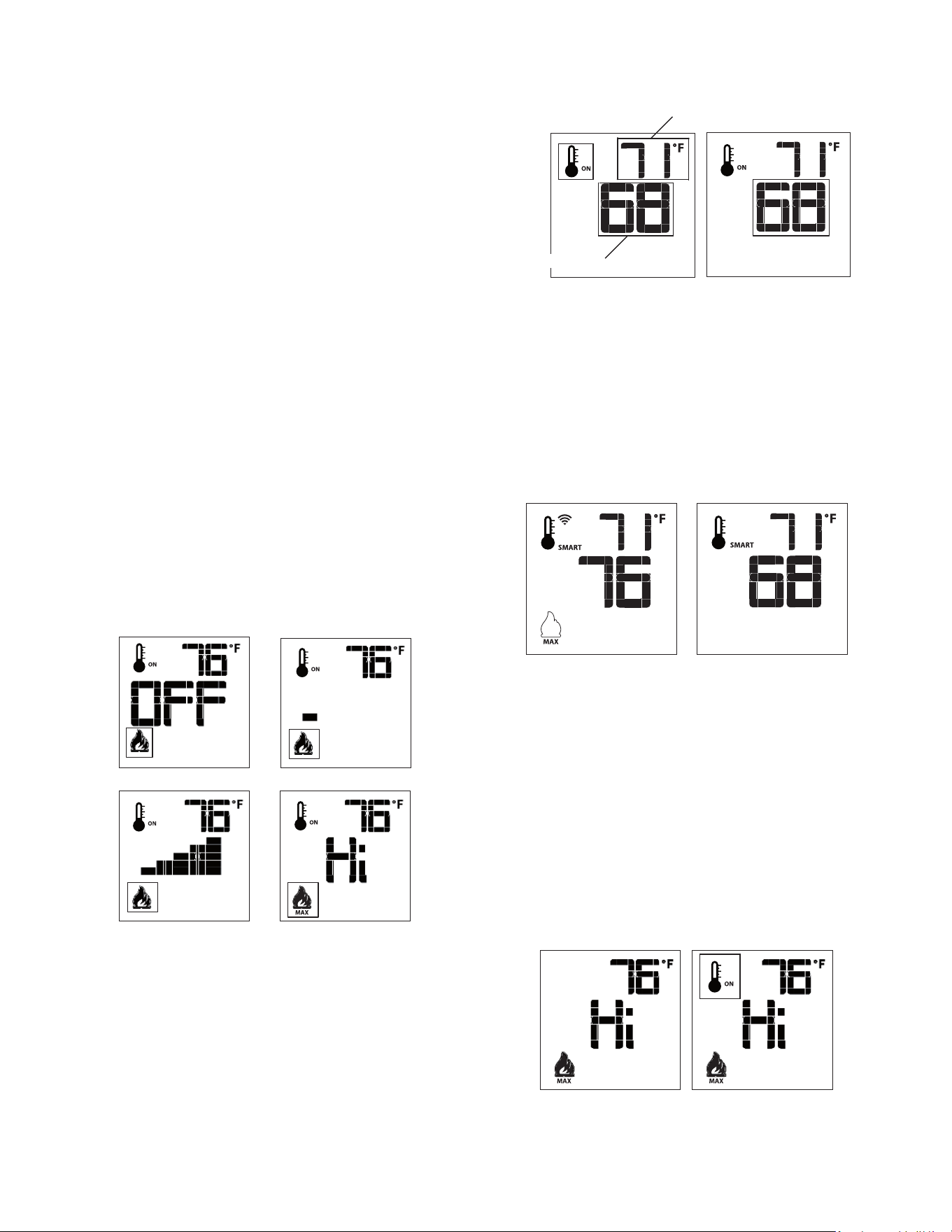
40 OPERATING INSTRUCTIONS
11.8.4 Turn ON the Appliance
1. With the system in the OFF position, press the remote control
ON/OFF key to turn ON the appliance.
A single ‘beep’ will emit from the IFC module to confirm
reception of the command.
The LCD screen will display all active icons, and the IFC module
will start the ignition sequence.
11.8.5 Turn OFF the appliance
1. With the system in the OFF position, press the remote control
ON/OFF key to turn ON the appliance.
A single ‘beep’ will emit from the IFC module to confirm
reception of the command.
The LCD screen will only display the room temperature and its
icon, and the IFC module will turn off the main burner.
11.8.6 Remote Control Flame Adjustment
This control system has (6) flame levels. If the smart thermostat
operation is activated, then the manual adjustment of the flame
height will be disabled.
1. Verify the system is in the ON position and the flame level is
set at maximum.
2. Press the down arrow key once to reduce flame height by
one level until the flame is turned off.
3. Press the up arrow key once to increase flame height by one
step. If the up arrow key is pressed while the system is on,
but the flame is off, the flame will ignite on HI.
4. A single ‘beep’ will confirm reception of the command.
11.8.7 Remote Control Thermostat Operation
11.8.7.1 Room Thermostat
The remote control can operate as a room thermostat. The
thermostat can be set to a desired temperature to control a
room’s comfort level. To activate this function,
1. Press the thermostat key. The LCD screen will display a
temperature bulb graphic, the room temperature and set
temperature.
2. To adjust the set temperature, press the up or down arrow
keys until the desired temperature is displayed on the LCD
screen.
11.8.7.2 Smart Thermostat
The smart thermostat function will adjust the flame height based
on the set temperature and the actual room temperature. The
smart thermostat function automatically adjusts the flame down
when the room temperature reaches the set point. To activate this
function,
1. Press the thermostat key until the ‘SMART’ appears on LCD
screen on the right side of the temperature bulb graphic.
2. To adjust the set temperature, press the up or down arrow
keys until the desired temperature is displayed on the LCD
screen.
11.8.7.3 Deactivate Remote Control
Thermostat Operation
The thermostat operation function can be deactivated. The remote
control will still operate the main burner on and off, and function
flame, fan, and light modulation. To deactivate this function,
1. Verify all (3) AAA batteries are installed in the remote control.
2. Remove (1) AAA battery.
3. While reinserting the battery, push and hold the thermostat
key. The temperature bulb graphic will not be displayed on
the LCD screen.
4. To reactivate remote thermostat operation, follow the same
key sequence procedure above. The temperature bulb
graphic will reappear on the LCD screen.
Flame Off
Flame Level 1
Flame Level 5 Flame Level Maximum
SET TEMPERATURE
ROOM TEMPERATURE
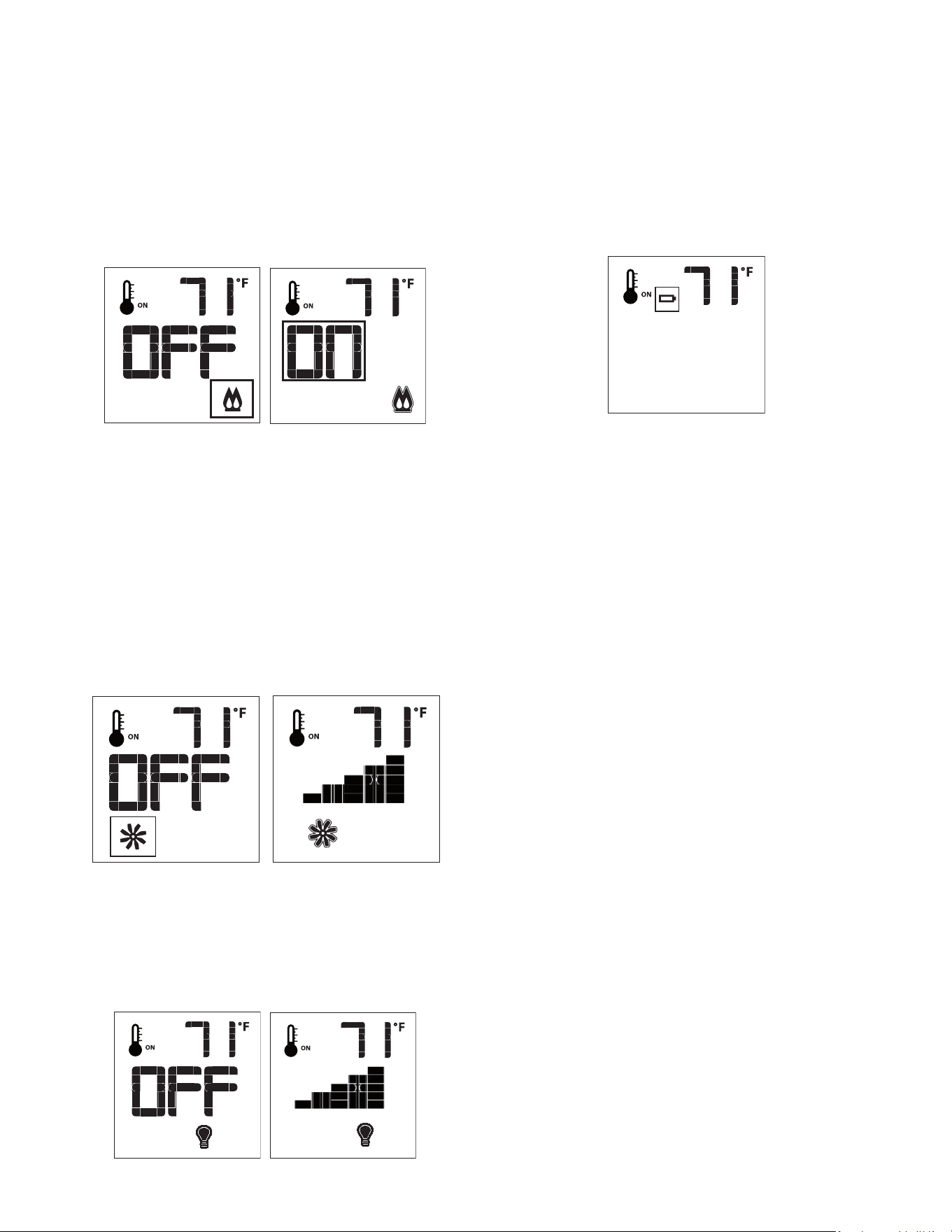
OPERATING INSTRUCTIONS 41
11.8.8 Split Flow Control
The secondary burner is controlled by the split flow. To activate
this function,
1. Press the mode key to index to the split flow mode icon.
2. Press the up arrow key to activate the secondary burner.
3. Press the down arrow key to turn the secondary burner off. A
single ‘beep’ will confirm the reception of the command.
11.8.9 Fan Speed Control
Fan speed can be adjusted through (6) speeds. To activate this
function,
1. Press the mode key to index to the fan control icon.
2. Press the up or down arrow keys to turn on, off, or to adjust
fan speed.
Thermostat mode: Fan(s) have a (5) minute delay time when the
fireplace is let. This allows time for heat to build in fireplace before
fan operation. The fan will continue to operate for approximately
(12) minutes after the fireplace has been turned off.
Manual mode: Fan(s) will operate at previous setting. There is no
delay in start up or stop time.
11.8.10 Accent Light Kit
The light intensity can be adjusted through (6) levels.
1. Press the mode key to index to the light icon.
2. Press the up or down arrow keys to adjust the intensity level.
3. A single ‘beep’ will confirm reception of the command.
11.8.11 Remote Control Low Battery Detection
Remote control battery lifespan depends on various factors
including battery quality, number of ignitions, changes to room
thermostat set point, etcetera.
• When the remote control battery are low, a battery icon will
appear on the LCD display before all battery power is lost.
• When the batteries are replaced, this icon will disappear.
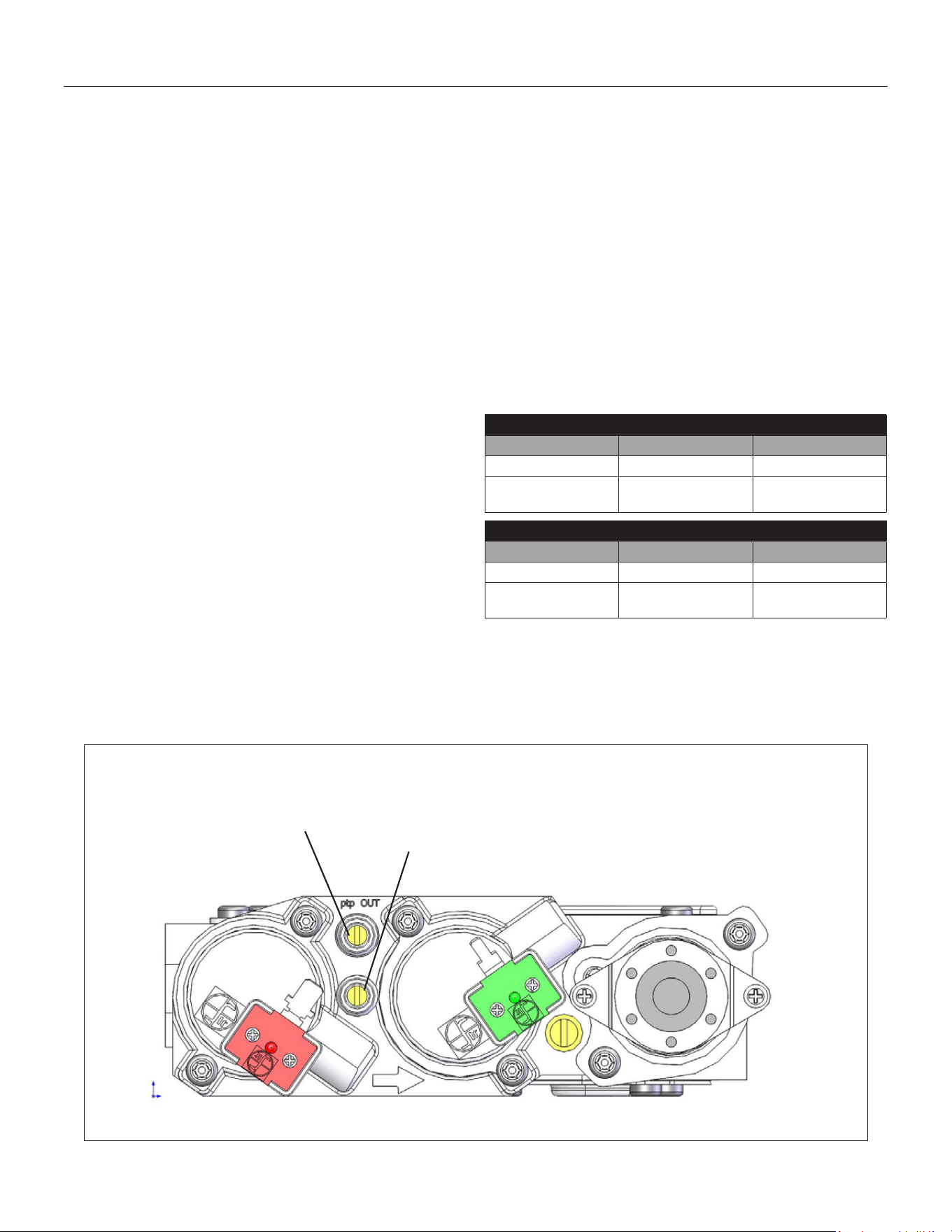
42 ADJUSTMENT
12.0 ADJUSTMENT
12.1 Pressure Testing
NOTE: The appliance and its appliance main gas valve must
be disconnected from the gas supply piping system during any
pressure testing of the system at test pressures in excess of ½
psi (3.5 kPa).
IMPORTANT: Pressure check taps for manifold (outgoing) and
inlet (incoming) pressure have been incorporated into the valve.
The pressure tap marked OUT measures outgoing pressure.
The pressure tap marked IN measures incoming pressure.
12.1.1 Inlet Pressure Test
NOTE: Make sure to apply these incoming pressure test with
all other gas appliances on, or at full capacity in the house for
proper pressure reading.
IMPORTANT: If the inlet pressure reading is too high or too
low, contact the gas company. Only a qualified gas service
technician should adjust incoming gas pressure.
1. Loosen the inlet (IN) pressure tap by turning screw counter-
clockwise. See (A) in Figure 12.1.
2. Attach manometer using a ¼ in (6 mm) I.D. hose.
3. Light pilot and burner. Check pressure to ensure it is
between the minimum and maximum recommended pressure
settings.
4. Turn off burner and pilot.
5. Disconnect hose and tighten the inlet (IN) pressure tap by
turning screw clockwise. Screw should be snug. Do not over
tighten.
6. Relight pilot and burner. Then reattach manometer to the
inlet pressure tap (A) to verify the tap is completely sealed.
Manometer should read no pressure.
12.1.2 Manifold Pressure Test
1. Light pilot.
2. Loosen manifold (OUT) pressure tap by turning screw
counter-clockwise. See (B) in Figure 12.1.
3. Attach manometer to pressure tap using a ¼ in (6 mm) I.D.
hose.
4. Light burner. Check manometer reading.
5. Turn burner and pilot off.
6. Disconnect manometer hose and tighten the manifold (OUT)
pressure tap by turning screw clockwise. Screw should be
snug. Do not over tighten.
7. Attach the manometer to the manifold pressure tap (B) to
verify it is completely sealed. The manometer should read no
pressure when pilot and burner are on.
Table 12.1, Inlet Pressures
Fuel Natural Gas LP Gas
Gas Supply Min - Max Min - Max
Inlet Pressure
Tap (A)
5” - 10.5” WC
(1.25 - 2.62 kPa)
12” - 13” WC
(2.99 - 3.24 kPa)
Table 12.2, Manifold Pressure
Fuel Natural Gas LP Gas
Gas Supply Low - High Low - High
Manifold Pressure
Tap (B)
1.1” - 3.8” WC
(.27 - .95 kPa)
2.9” - 11” WC
(.72 - 2.74 kPa)
A
B
Figure 12.1, Pressure Check Taps
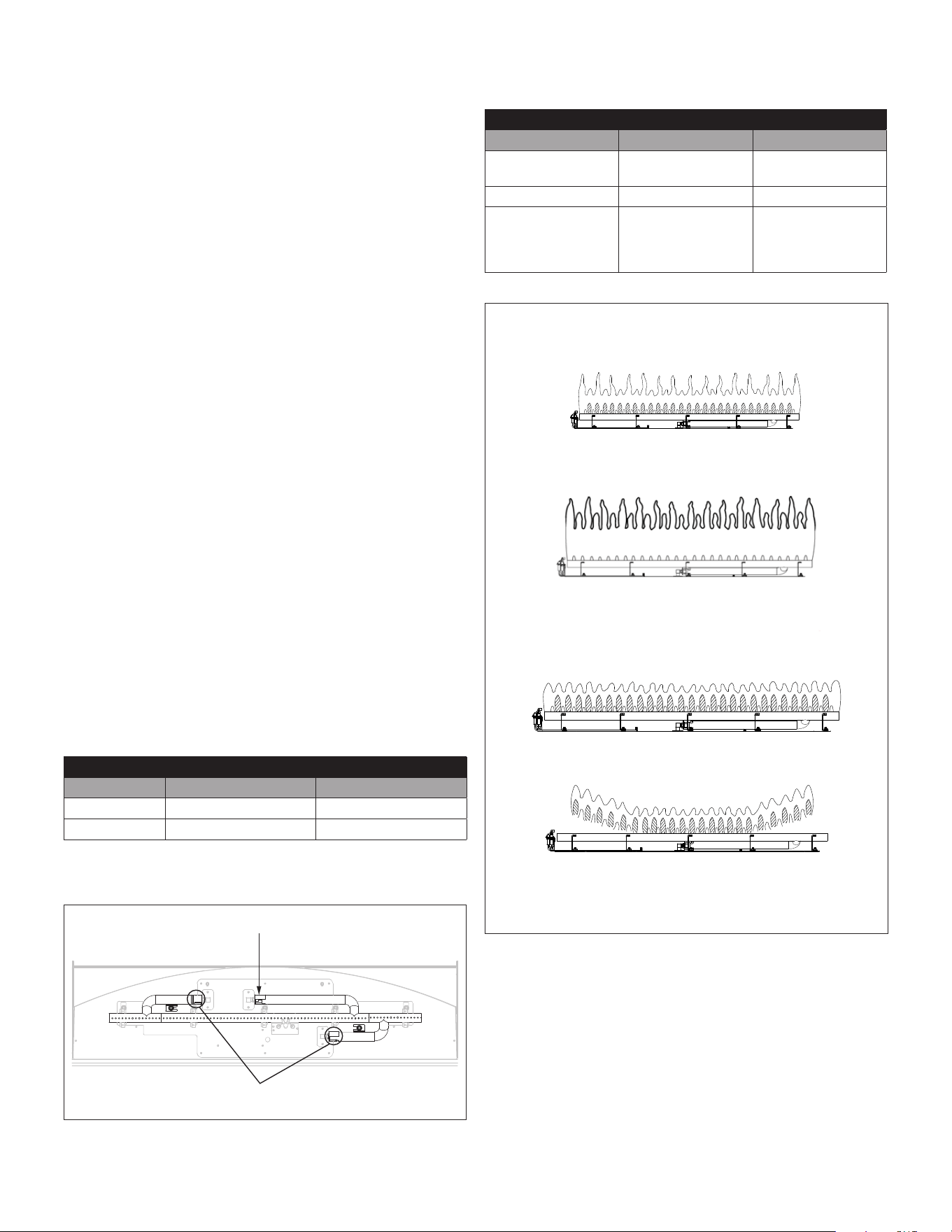
ADJUSTMENT 43
12.2 Flame Appearance Adjustment
WARNING: To avoid property damage or personal injury, allow
the fireplace ample time to cool before making any adjustments.
Burner flame appearance and characteristics are affected by
altitude, fuel quality, venting configuration, and other factors. After
installation, this appliance may need additional adjustments to
achieve optimum flame appearance and visual aesthetics.
12.2.1 Burner Venturi
WARNING: VENTURI ADJUSTMENT MUST BE DONE BY A
QUALIFIED SERVICE TECHNICIAN.
NOTE: Burner venturi air shutter settings have been factory set.
Refer to Table 12.3.
When this appliance is first lit, the burner flames will appear blue.
During the first 15 minutes of operation, flame appearance will
gradually turn to the desired yellow appearance. If the flames
remain blue, or become dark orange with evidence of sooting
(black tips), adjustment of the air shutter opening may be
necessary.
Regardless of venturi orientation, closing the air shutter will
achieve a desired yellow flame, but may produce soot on the
glass. Opening the air shutter will cause a short, blue flame that
may lift off the burner.
12.2.1.1 Venturi Opening Adjustment
IMPORTANT: Slight adjustments to the venturi opening will
create dramatic results. Adjust at slight increments until desired
look is achieved.
1. Remove the safety barrier, glass frame assembly, and glass
media.
2. Remove burner cover (10) screws.
3. Loosen screw on venturis and adjust as necessary. Tighten
screw.
4. Reinstall all components previously removed.
Table 12.3, Factory Set Venturi Openings
Fuel Center Burner Venturi Side Burner Venturis
Natural Gas 1/8” (3 mm) 1/8” (3 mm)
LP Gas 5/8” (16 mm) 5/8” (16 mm)
Table 12.4, Flame Appearance Venturi Adjustment
Flame Characteristic Cause Solution
Dark, orange flame
with black tips
Venturi closed too far Open venturi slightly
Short, blue flames Venturi open too far Close setting slightly
Lifting (ghosting)
flames
Gas pressure too high
Venturi closed too far
Check manometer
settings
Open venturi setting
slightly
Figure 12.2, Burner Venturis Locations
LAZY, YELLOW FLAMES
IDEAL
SHORT, BLUE FLAMES
LIFTING (GHOSTING) FLAMES
Figure 12.3, Flame Appearance and Characteristics
DARK, ORANGE FLAMES
WITH BLACK TIPS
CENTER BURNER VENTURI
SIDE BURNER VENTURIS
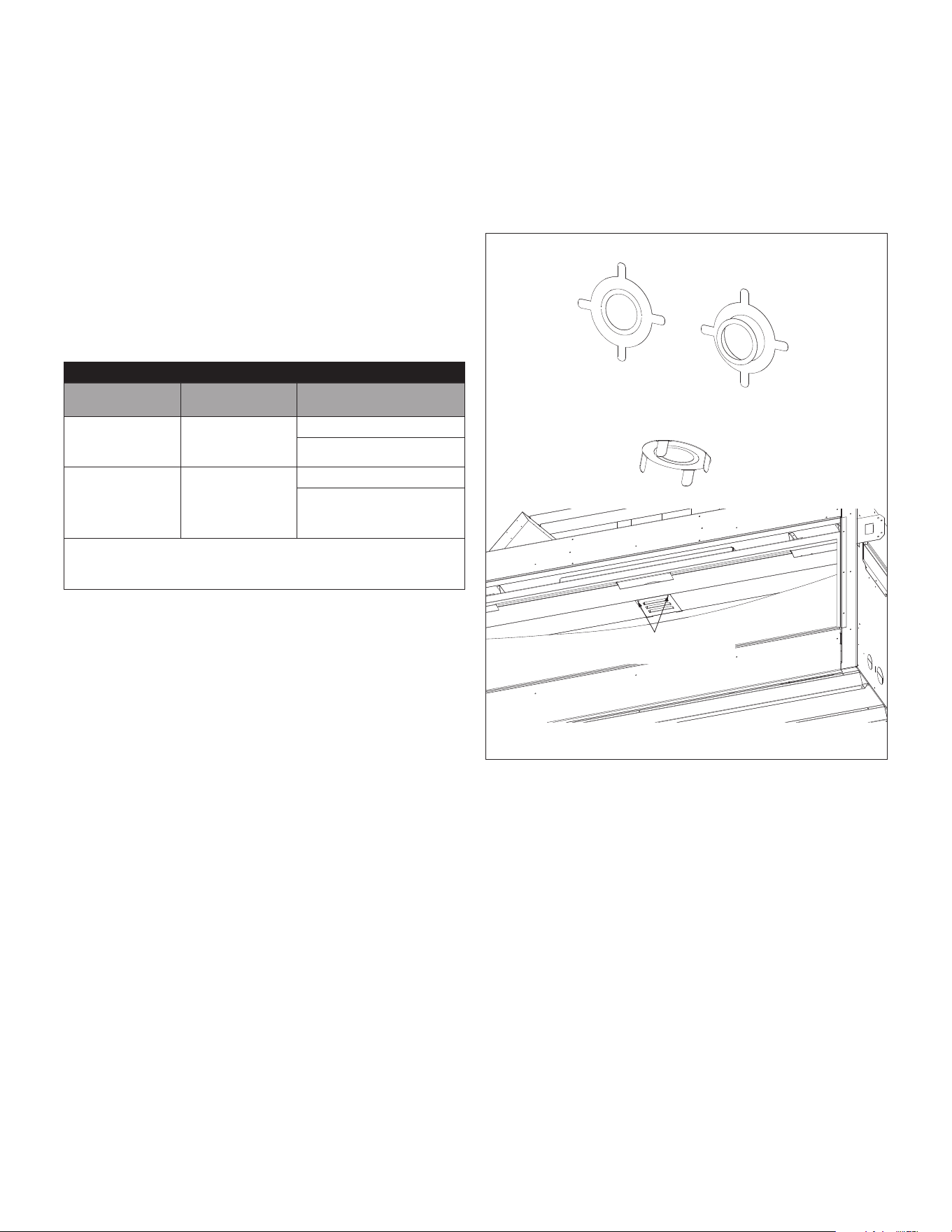
44 ADJUSTMENT
12.2.2 Vent Restriction
WARNING: To avoid property damage or personal injury, allow
the fireplace ample time to cool before making any adjustments.
WARNING: Improper vent installation may cause the burner
flames to lift or “ghost.” Perform a visual check on flame
appearance after restrictor adjustment to ensure proper
performance.
Vertical terminations may display an active, compact flame.
To achieve desirable flame appearance, the vent exit may be
restricted by the restrictor plate (included in components packet).
Follow the tables below to adjust the restrictor to desired flame
appearance. Allow the fireplace to burn for 15 minutes before
making any adjustments to the restrictor setting.
Table 12.5, Restrictor Adjustment for Flame Appearance
Flame
Appearance
Draft Problem Vent Restriction
Short, flickering Excessive draft
Not enough
restriction
Close baffle restrictor
Install restrictor plate
Lifting or ghosting* Insufficient draft
Too much
restriction
Open baffle restrictor
Remove inner ring(s) on
restrictor plate, or remove
restrictor plate
*If flames continue to lift or ghost after opening the baffle restrictor or
installing and verifying correct vent installation, shut off the gas supply
and call a qualified service technician.
12.2.2.1 Restrictor Plate Installation
1. Remove the safety barrier and the glass frame assembly.
2. Remove (2) screws securing termination access panel.
Release panel tabs from slots in baffle.
3. Bend the tabs on the restrictor plate (included in components
packet) to approximately 80° angles. This will create tension
when the restrictor is inserted into the exhaust pipe.
4. Insert restrictor into the 5 in (127 mm) exhaust pipe with the
tabs pointing towards you.
5. Reinstall termination access panel by inserting tabs in
panel into slots in baffle. Secure with (2) screws previously
removed.
6. Reinstall all components previously removed.
12.2.2.2 Restrictor Plate Modification
1. Remove the safety barrier and the glass frame assembly.
2. Remove (2) screws securing termination access panel.
Release panel tabs from slots in baffle.
3. Remove the restrictor by pulling it down and out of the 5 in
(127 mm) exhaust pipe.
4. Make necessary modifications to achieve desired flame
appearance.
5. Insert restrictor into the 5 in (127 mm) exhaust pipe with the
tabs pointing towards you.
6. Reinstall termination access panel by inserting tabs in
panel into slots in baffle. Secure with (2) screws previously
removed.
7. Reinstall all components previously removed.
RESTRICTOR PLATE
REMOVE CIRCLE TO
CREATE LESS RESTRICTION
BEND TABS TO APPROX. 80° ANGLES TO CREATE
TENSION TO HOLD ITSELF IN PLACE WHEN INSTALLED
Figure 12.4, Restrictor Installation and Modification
(2) SCREWS SECURING
TERMINATION ACCESS PANEL

TROUBLESHOOTING 45
13.0 TROUBLESHOOTING
ATTENTION: Troubleshooting must be performed by a qualified
technician.
Before proceeding with the steps in the following troubleshooting
guide,
• Verify proper 120VAC power supply to the control module.
• Verify the control module battery pack and the remote
control batteries are fresh and installed with correct polarity.
• Verify all connections between the wire harnesses and the
system components are proper and positive.
• Verify the communication link is established between the
remote control and the IFC module.
• Verify inlet pressure meets the recommended inlet pressure.
If necessary, adjust line pressure regulator.
Issue Cause Solution
Pilot will not light Electrical power interrupted or
disconnected
Restore electrical power to appliance or use battery back-up.
Wiring disconnection Ensure batteries are fully charged if using battery back-up as
power source.
Use wiring schematic to determine that all wiring connections are
secure and correct.
Gas supply turned off Check remote shut-off valves from the appliance. Usually there is
a valve near the main gas line. There may be more than (1) valve
between the appliance and main gas line.
Pilot will not stay lit No LP (propane) gas in tank Check LP (propane tank). Refill if necessary.
Low gas pressure Consult a plumber or a gas supplier.
Can be caused by situations such as a bent line, too narrow
diameter or pipe, or a low line pressure.
Pilot flame not making contact
with the flame rectification
sensor on the pilot assembly
Verify the pilot flame envelopes the top of the flame sensor and
extends far enough onto burner for ignition.
To adjust pilot flame, turn pilot adjustment screw on the gas valve
clockwise to decrease flame, and counterclockwise to increase
flame.
Pilot adjustment screw not
sealed
Seal pilot adjustment screw. Do not over-tighten.
Pilot flame always on, or
will not extinguish
Control system set to CPI mode Set control system to IPI mode
Main burner flame will not
light
ON/OFF rocker switch in OFF
position
Switch rocker switch to ON position.
Gas supply turned off Check for multiple shut-offs in the supply line. Verify gas supply is
turned on.
Low gas supply Consult with plumber or gas supplier.
Check LP (propane) tank. Refill if necessary.
Wiring disconnection or
improper wiring
Check for faulty or incorrect wiring.
Plugged main burner orifice Remove blockage.
Pilot flame Verify the pilot flame is properly directed to ignite burner. See pilot
flame troubleshooting above.
Remote control not working
properly
Replace batteries.
No call for heat Verify remote control is powered ON and thermostat operation is
turned OFF.

46 TROUBLESHOOTING
Issue Cause Solution
Pilot and burner
extinguish while in
operation
No LP (propane) gas in tank Check LP (propane) tank. Refill if necessary.
Incorrect glass assembly
installation
Refer to Section 9.1 Glass Frame Assembly on page 32.
Incorrect vent cap installation Adjust if necessary.
Vent cap blockage Remove debris if necessary.
Improper pitch on horizontal
venting
¼ in. (6 mm) rise per foot (30 cm) is required on horizontal
venting
Inner vent pipe leaking exhaust
gases back into firebox
Check for leaks and repair if necessary.
Excessive draft Restrictor setting may need to be adjusted. Refer to Section 12.2.2
Vent Restriction on page 44.
Soot appears on glass Improper glass media
placement
Refer to Section 9.3 Glass Media on page 33.
Improper venturi setting Venturi air shutter may need to be opened slightly to allow more air
into the gas mix. Refer to Section 12.2.1 Burner Venturi on page
43.
Incorrect vent cap installation Adjust if necessary.
Vent cap blockage Remove debris if necessary.
Improper pitch on horizontal
venting
¼ in. (6 mm) rise per foot (30 cm) is required on horizontal
venting
Flame burns blue and lifts
off burner
Improper venturi setting Venturi air shutter may need to be opened slightly to allow more air
into the gas mix. Refer to Section 12.2.1 Burner Venturi on page
43.
Incorrect vent cap installation Adjust if necessary.
Blockage or leakage of the vent
system
Check the vent pipes for leaks, and the vent cap for debris. Repair
the vent pipes or remove debris from vent cap, if necessary.
No reaction to command Battery back batteries or
remote control batteries low
Replace batteries.
No communication between
remote control and IFC module
Reprogram remote control to IFC module
A maximum number of failed
ignitions or flame restorations
has been reached
Reset IFC module
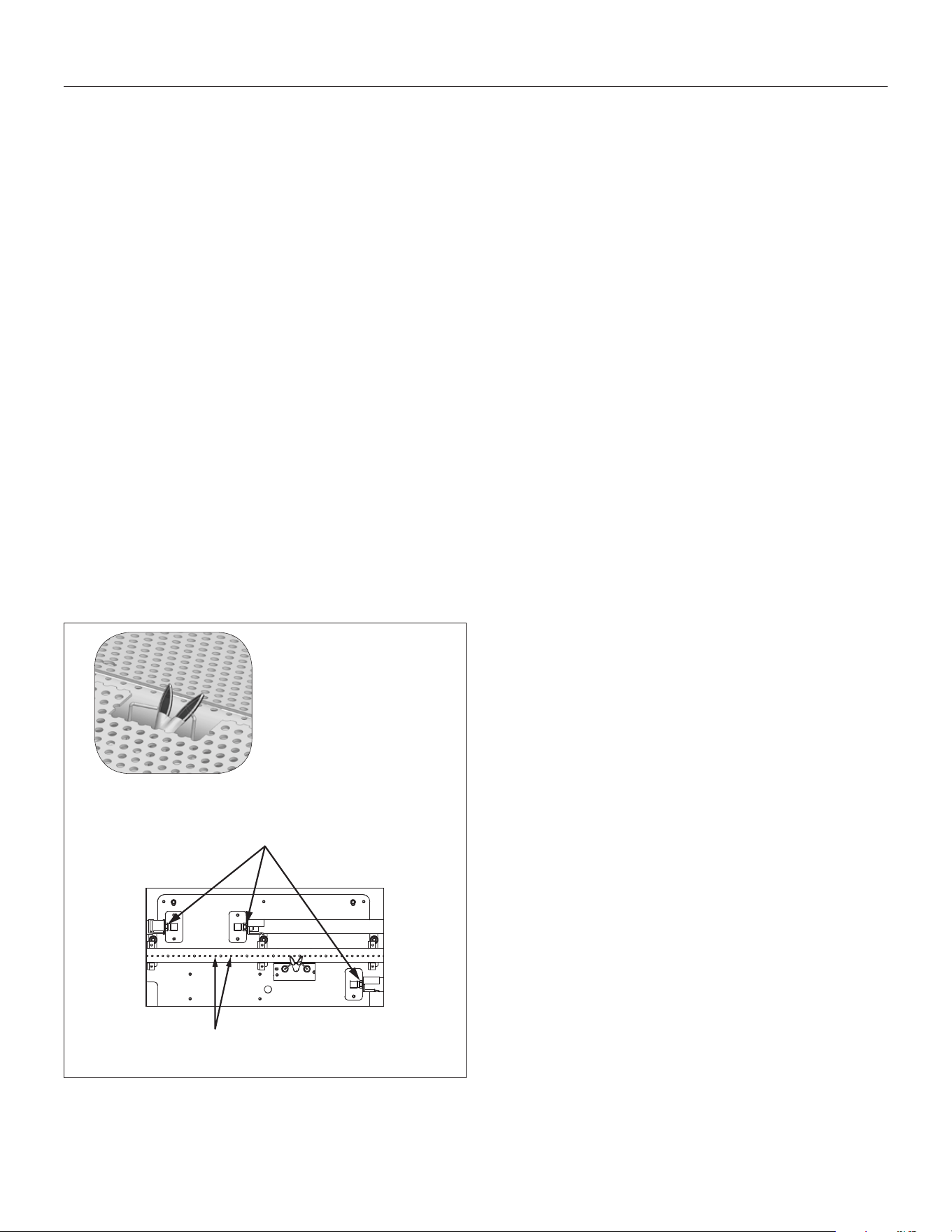
MAINTENANCE 47
14.0 MAINTENANCE
ATTENTION: Installation and repair should only done by a
qualified service person. The appliance should be inspected
before use and at least annually by a professional service
person. More frequent cleaning might be required due to
excessive lint from carpeting, bedding material, et cetera. It is
imperative that control compartments, burners, and circulating
air passageways of the appliance be kept clean. Use a vacuum
to clean all components.
WARNING: The appliance area must be kept clear and free
from combustible materials, gasoline and other flammable
vapors and liquids.
14.1 Burner and Pilot System
The burner assembly may be removed for easier access to the
control compartment. Refer to Section 9.5 Control Board Removal
and Installation on page 34 for instructions.
Performed by: Qualified Service Person
Frequency: Annually
Action:
• Vacuum all components of the burner system.
• Visually check burner ports for blockage, especially near the
pilot.
• Visually check pilot light and burner flame pattern when in
operation. Flames should be steady, not lifting or floating.
Refer to section Figure 12.3, Flame Appearance and
Characteristics on page 43.
14.2 Fan(s)
CAUTION: Label all wires prior to disconnection when servicing
controls. Wiring errors can cause improper and dangerous
operation. Verify proper operation after servicing.
Performed by: Qualified Service Person
Frequency: Every 6 months
Action:
• Disconnect the fan from electrical current and vacuum.
• The bearings are sealed and require no oiling.
14.3 Vent System
NOTE: If the vent-air intake system is disassembled for any
reason, reinstall per instructions provided with installation.
Refer to Section 8.0 Venting on page 26.
Performed by: Qualified Service Person
Frequency: Annually
Action:
• Examination of the vent system is required.
• The flow of combustion and ventilation air must not be
obstructed.
14.4 Glass Assembly
CAUTION: Do not operate appliance with the glass assembly
removed, cracked, or broken. Use protective gloves to handle
any broken or damaged glass assembly components.
WARNING: Do not use substitute materials.
WARNING: Avoid striking or slamming glass assembly. Avoid
abrasive cleaner. DO NOT clean glass while it is hot.
IMPORTANT: Any safety screen, guard, or barrier removed for
servicing the appliance must be replaced prior to operating the
appliance.
Performed by: Homeowner
Frequency: Annually
Action:
• Prepare a work area large enough to accommodate the glass
assembly on a flat, stable surface.
• Remove safety screen and glass frame assembly.
• Clean glass with a soft cloth and a non-abrasive cleaner.
• Reinstall glass assembly and safety screen.
• Any safety screen, guard, or barrier removed for servicing the
appliance must be replaced prior to operating the appliance.
Performed by: Qualified Service Person
Frequency: Annually
Action:
• Inspect the glass for cracks, scratches, and nicks.
• Verify the glass assembly is properly intact and not damaged.
• Replace the glass and the assembly #SL42-057T as
necessary.
• Only Hussong Mfg. Co., Inc. will supply the replacement of
glass assembly as a complete unit.
Figure 14.1, Burner and Pilot System
BURNER PORTS
BURNER ORIFICES
CORRECT PILOT
FLAME APPEARANCE
48 REPLACEMENT PARTS LIST
15.0 REPLACEMENT PARTS LIST
Replacement parts are available through your local dealer. Contact your local dealer for availability and pricing.
CONTROL BOARD AND PARTS
Control Board - NG SL42-160 Valve Step Motor - LPG 700-504-1
Control Board - LPG SL42-161 18 in. Flexible Gas Line - Black 700-213B
S.I.T. IPI Gas Valve - NG 700-567 Flexible Gas Line - Valve to Burner Connection 700-226
S.I.T. IPI Gas Valve - LPG 700-567-1 NG Burner Orifice #37 CENTER BURNER 700-237
Proflame 2 IFC Board 700-652 NG Burner Orifice #54 SIDE BURNERS 700-254
IFC Wire Harness Assembly 700-653 LPG Burner Orifice #52 CENTER BURNER 700-252
Pilot Assembly - NG 700-596 LPG Burner Orifice #67 SIDE BURNERS 700-267
Pilot Assembly - LPG 700-596-1 Conversion Kit - NG NCK-SL42-SPB
540 Split Flow 700-595 Conversion Kit - LPG LCK-SL42-SPB
Transmitter (Remote Control) with Split Flow 700-508 Center Burner Tube SL42-C035
Pilot Orifice - NG #.023N 700-123 Side Burner Tube (Left or Right) SL42-S035
Pilot Orifice - LPG #.014LP 700-114 Media Tray SL42-350A
Valve Step Motor - NG 700-504 Media Dam 700-173
GLASS AND GLASS PARTS
17-5/8” X 44-5/16” Glass with Gasket 700-172T
Replacement Valance SL42-005
Glass Gasket 900-006
Hussong Manufacturing Co., Inc.
P.O. Box 577
204 Industrial Park Drive
Lakefield, MN 56150-0577
SLA-42S
SAFETY BARRIERS
Rectangle Screen Front SL42-RSFS
Convex Screen Front SL42-CXSFS
Beveled Screen Front SL42-BSFS
LIGHT KIT
Light Kit SL42-BLK
20W 130V Halogen Bulb 600-676

LIMITED WARRANTY 49
LIMITED WARRANTY
Kozy Heat Limited 10 Year Warranty
This limited 10 Year Warranty will not become effective until the
Warranty Registration Form has been completed and mailed to
Hussong Manufacturing Co., Inc., P.O. Box 577, Lakefield, MN
56150. This registration form must be received within 30 days
of installation. Failure to do so may result in delayed warranty
coverage and submission of proof of purchase will be required.
Hussong Manufacturing Co., Inc. warranties to the original
purchaser of this Kozy Heat Fireplace, that it is free of defects in
materials and workmanship at the time of manufacture.
Subject to the following conditions & requirements, Hussong
Manufacturing Co., Inc. extends the following limited warranty
under normal use and service, with respect to the Kozy Heat line of
gas burning fireplaces.
Year 1
Subject to the conditions & requirements listed below, within the
first year from date of purchase, Hussong Manufacturing Co., Inc.
shall, at its discretion, replace or repair any such defect in material
or workmanship, at Hussong Manufacturing Co., Inc.’s expense,
including reasonable labor costs to repair or replace the defective
component, if a factory pre-authorization is given for the repair.
Years 2 through 10
Subject to the conditions & requirements listed below, beginning
with the first day of the second year and continuing through the
tenth year, Hussong Manufacturing Co., Inc., will at its discretion,
provide repair or replacement parts at current list prices for any
defect in material or workmanship of components, including
optional components and accessories (if available). Hussong
Manufacturing Co., Inc. shall not be responsible for any installation,
labor, transportation of other indirect costs.
Limitation of Liability
To make a claim under this warranty, the purchaser must first
contact the dealer/installer from whom the fireplace was purchased.
This limited warranty will be void if the fireplace is not installed by a
qualified installer and according to the installation instructions. Use
of unauthorized components will make this warranty null and void.
This limited warranty also is void if the fireplace is not operated, at
all times, according to the operating instructions furnished.
This warranty is limited to defects in material and workmanship. It
does not apply to any product that has been subject to negligence,
misapplication, improper installation.
No person is authorized to extend the time of this warranty or to
accept on Hussong Manufacturing Co., Inc.’s behalf any additional
obligation of liability connected with the unit.
It is expressly agreed and understood that this warranty is Hussong
Manufacturing Co., Inc.’s sole obligation and purchaser’s exclusive
remedy for defective fireplace equipment. Hussong Manufacturing
Co., Inc. shall not be liable for any consequential, incidental or
contingent damages whatsoever. The foregoing warranty is
exclusive and in lieu of all other expressed warranties. Hussong
Manufacturing Co., Inc. shall not be held to implied warranties or
merchantability and fitness for a particular purpose. This warranty
replaces all previous warranty policies.
Some states do not allow the exclusion or limitation of incidental
or consequential damages or limitations on how long an implied
warranty lasts, so the above limitations or exclusions may not apply
to you. This warranty gives you specific legal rights and you may
also have other rights which vary from state to state.
Hussong Manufacturing Co., Inc. reserves the right to make changes
at any time, without notice, in design, material, specifications and
prices. Hussong Manufacturing Co., Inc. reserves the right to
discontinue models and products.
December 2014
Warranty Conditions and Requirements
1. You are the original purchaser. This warranty is not transferable.
2. Installation of the fireplace is performed by a qualified installer.
3. Installation and operation must comply with installation and operation instructions.
4. Paint and glass gaskets are covered for 30 days from date of purchase.
5. Remote controls and all optional accessories are covered for 1 year from date of purchase.
6. This warranty does not offer coverage for Light Bulbs, Batteries or Fuses (whether factory, dealer or installer supplied). This
includes any damage stemming from either component’s nonuse.
7. Components broken, (including glass panels), during shipping, careless handling of components, or defects resulting from
improper installation, misuse of the fireplace and components are not covered under this warranty.
8. This warranty does not cover any part of the fireplace or any components which have been exposed to or submerged underwater.
9. Hussong Manufacturing Co., Inc. must be notified by the dealer the fireplace was purchased from or a qualified installer/service
technician of the defect.
10. Annual service of the fireplace as required in the installation manual, is performed by a qualified installer/service technician.
(Copies of such service records may be required to claim a warranty).
11. All previous warranty/service has been performed by a qualified installer or service technician. (Copies of such service records
may be required to claim a warranty).

CUT ALONG DOTTED LINE
LIFETIME WARRANTY 51
LIFETIME WARRANTY
LIFETIME WARRANTY COVERAGE WILL BE EXTENDED AS DESCRIBED BELOW PROVIDED ALL WARRANTY CONDITIONS AND
REQUIREMENTS ARE MET AS OUTLINED IN THE 10 YEAR LIMITED WARRANTY POLICY.
Lifetime Warranty Coverage
LIFETIME WARRANTY IS EXTENDED AS FOLLOWS:
Hussong Manufacturing Co., Inc. warranties to the original
purchaser that the firebox, heat exchanger, fiber logs, burner tube
and glass panel of this Kozy Heat Fireplace will not be defective in
material or workmanship under normal use and service for as long
as you own this product. If any of these components fail due to
defects in material and workmanship under normal use and service,
Hussong Manufacturing, Co., Inc. will, at its sole discretion, repair
or replace the defective component. This LIFETIME WARRANTY
does not cover any installation, labor, transportation or other
indirect cost arising from defective components.
Limitation of Liability
This Lifetime Warranty will be void if the fireplace is not installed by a
qualified installer and according to the installation instructions. Use
of unauthorized components will make this warranty null and void.
This Lifetime Warranty also is void if the fireplace is not operated,
at all times, according to the operating instructions furnished.
This warranty is limited to defects in material and workmanship of
components specified. It does not apply to any product that has
been subject to negligence, misapplication, improper installation.
No person is authorized to extend the time of this Lifetime Warranty
or to accept on Hussong Manufacturing Co., Inc.’s behalf any
additional obligation of liability connected with the unit.
Hussong Manufacturing Co., Inc. may fully discharge all obligations
with respect to this Lifetime Warranty by refunding the wholesale
price of the defective component(s).
It is expressly agreed and understood that this Lifetime Warranty
is Hussong Manufacturing Co., Inc.’s sole obligation and original
purchaser’s exclusive remedy for defective fireplace equipment.
Hussong Manufacturing Co., Inc. shall not be liable for any
consequential, incidental or contingent damages whatsoever other
than those incurred by Hussong Manufacturing Co., Inc. to repair
or replace the defective component. The foregoing warranty is
exclusive and in lieu of all other expressed warranties. Hussong
Manufacturing Co., Inc. shall not be held to implied warranties,
including but not limited to the implied warranties or merchantability
and fitness for a particular purpose. This lifetime warranty replace
all previous lifetime warranty policies.
Hussong Manufacturing Co., Inc. reserves the right to make changes
at any time, without notice, in design, material, specifications and
prices. Hussong Manufacturing Co., Inc. reserves the right to
discontinue models and products.
To activate this Lifetime Warranty coverage, this registration
card must be completed and mailed with your completed 10
Year Limited Warranty form within 30 days of installation to the
following address:
Hussong Manufacturing Co., Inc.
P.O. Box 577
204 Industrial Park Drive
Lakefield, MN 56150-0577
September 2011
CUT ALONG DOTTED LINE
PURCHASER NAME: _______________________________
ADDRESS: ________________________________________
__________________________________________________
TELEPHONE: _____________________________________
__________________________________________________
INSTALLER NAME: _________________________________
ADDRESS: ________________________________________
__________________________________________________
TELEPHONE: _____________________________________
__________________________________________________
INSTALLATION DATE: ______________________________
MODEL NUMBER: _________________________________
SERIAL NUMBER: _________________________________
HUSSONG MANUFACTURING CO., INC.