
0
Monitor
User Manual

Monitor • User Manual
i
Legal Information
About this Document
●
This Document includes instructions for using and managing the Product. Pictures, charts, images and all other
information hereinafter are for description and explanation only.
●
The information contained in the Document is subject to change, without notice, due to firmware updates or other
reasons. Please find the latest version of the Document at the Hikvision website (https://www.hikvision.com).
Unless otherwise agreed, Hangzhou Hikvision Digital Technology Co., Ltd. or its affiliates (hereinafter referred to as
"Hikvision") makes no warranties, express or implied.
●
Please use the Document with the guidance and assistance of professionals trained in supporting the Product.
About this Product
This product can only enjoy the after-sales service support in the country or region where the purchase is made.
Acknowledgment of Intellectual Property Rights
●
Hikvision owns the copyrights and/or patents related to the technology embodied in the Products described in this
Document, which may include licenses obtained from third parties.
●
Any part of the Document, including text, pictures, graphics, etc., belongs to Hikvision. No part of this Document
may be excerpted, copied, translated, or modified in whole or in part by any means without written permission.
●
and other Hikvision's trademarks and logos are the properties of Hikvision in various
jurisdictions.
●
Other trademarks and logos mentioned are the properties of their respective owners.
●
The terms HDMI and HDMI High-Definition Multimedia Interface, and the HDMI Logo are trademarks or
registered trademarks of HDMI Licensing Administrator, Inc. in the United States and other countries.
LEGAL DISCLAIMER
●
TO THE MAXIMUM EXTENT PERMITTED BY APPLICABLE LAW, THIS DOCUMENT AND THE PRODUCT DESCRIBED,
WITH ITS HARDWARE, SOFTWARE AND FIRMWARE, ARE PROVIDED "AS IS" AND "WITH ALL FAULTS AND ERRORS".
HIKVISION MAKES NO WARRANTIES, EXPRESS OR IMPLIED, INCLUDING WITHOUT LIMITATION, MERCHANTABILITY,
SATISFACTORY QUALITY, OR FITNESS FOR A PARTICULAR PURPOSE. THE USE OF THE PRODUCT BY YOU IS AT YOUR
OWN RISK. IN NO EVENT WILL HIKVISION BE LIABLE TO YOU FOR ANY SPECIAL, CONSEQUENTIAL, INCIDENTAL, OR
INDIRECT DAMAGES, INCLUDING, AMONG OTHERS, DAMAGES FOR LOSS OF BUSINESS PROFITS, BUSINESS
INTERRUPTION, OR LOSS OF DATA, CORRUPTION OF SYSTEMS, OR LOSS OF DOCUMENTATION, WHETHER BASED
ON BREACH OF CONTRACT, TORT (INCLUDING NEGLIGENCE), PRODUCT LIABILITY, OR OTHERWISE, IN CONNECTION
WITH THE USE OF THE PRODUCT, EVEN IF HIKVISION HAS BEEN ADVISED OF THE POSSIBILITY OF SUCH DAMAGES
OR LOSS.
●
YOU ACKNOWLEDGE THAT THE NATURE OF THE INTERNET PROVIDES FOR INHERENT SECURITY RISKS, AND
HIKVISION SHALL NOT TAKE ANY RESPONSIBILITIES FOR ABNORMAL OPERATION, PRIVACY LEAKAGE OR OTHER

Monitor • User Manual
ii
DAMAGES RESULTING FROM CYBER-ATTACK, HACKER ATTACK, VIRUS INFECTION, OR OTHER INTERNET SECURITY
RISKS; HOWEVER, HIKVISION WILL PROVIDE TIMELY TECHNICAL SUPPORT IF REQUIRED.
●
YOU AGREE TO USE THIS PRODUCT IN COMPLIANCE WITH ALL APPLICABLE LAWS, AND YOU ARE SOLELY
RESPONSIBLE FOR ENSURING THAT YOUR USE CONFORMS TO THE APPLICABLE LAW. ESPECIALLY, YOU ARE
RESPONSIBLE, FOR USING THIS PRODUCT IN A MANNER THAT DOES NOT INFRINGE ON THE RIGHTS OF THIRD
PARTIES, INCLUDING WITHOUT LIMITATION, RIGHTS OF PUBLICITY, INTELLECTUAL PROPERTY RIGHTS, OR DATA
PROTECTION AND OTHER PRIVACY RIGHTS. YOU SHALL NOT USE THIS PRODUCT FOR ANY PROHIBITED END-USES,
INCLUDING THE DEVELOPMENT OR PRODUCTION OF WEAPONS OF MASS DESTRUCTION, THE DEVELOPMENT OR
PRODUCTION OF CHEMICAL OR BIOLOGICAL WEAPONS, ANY ACTIVITIES IN THE CONTEXT RELATED TO ANY
NUCLEAR EXPLOSIVE OR UNSAFE NUCLEAR FUEL-CYCLE, OR IN SUPPORT OF HUMAN RIGHTS ABUSES.
●
IN THE EVENT OF ANY CONFLICTS BETWEEN THIS DOCUMENT AND THE APPLICABLE LAW, THE LATTER PREVAILS.
© Hangzhou Hikvision Digital Technology Co., Ltd. All rights reserved.
Monitor • User Manual
iii
Applicable Models
This manual is applicable to monitor.
Symbol Conventions
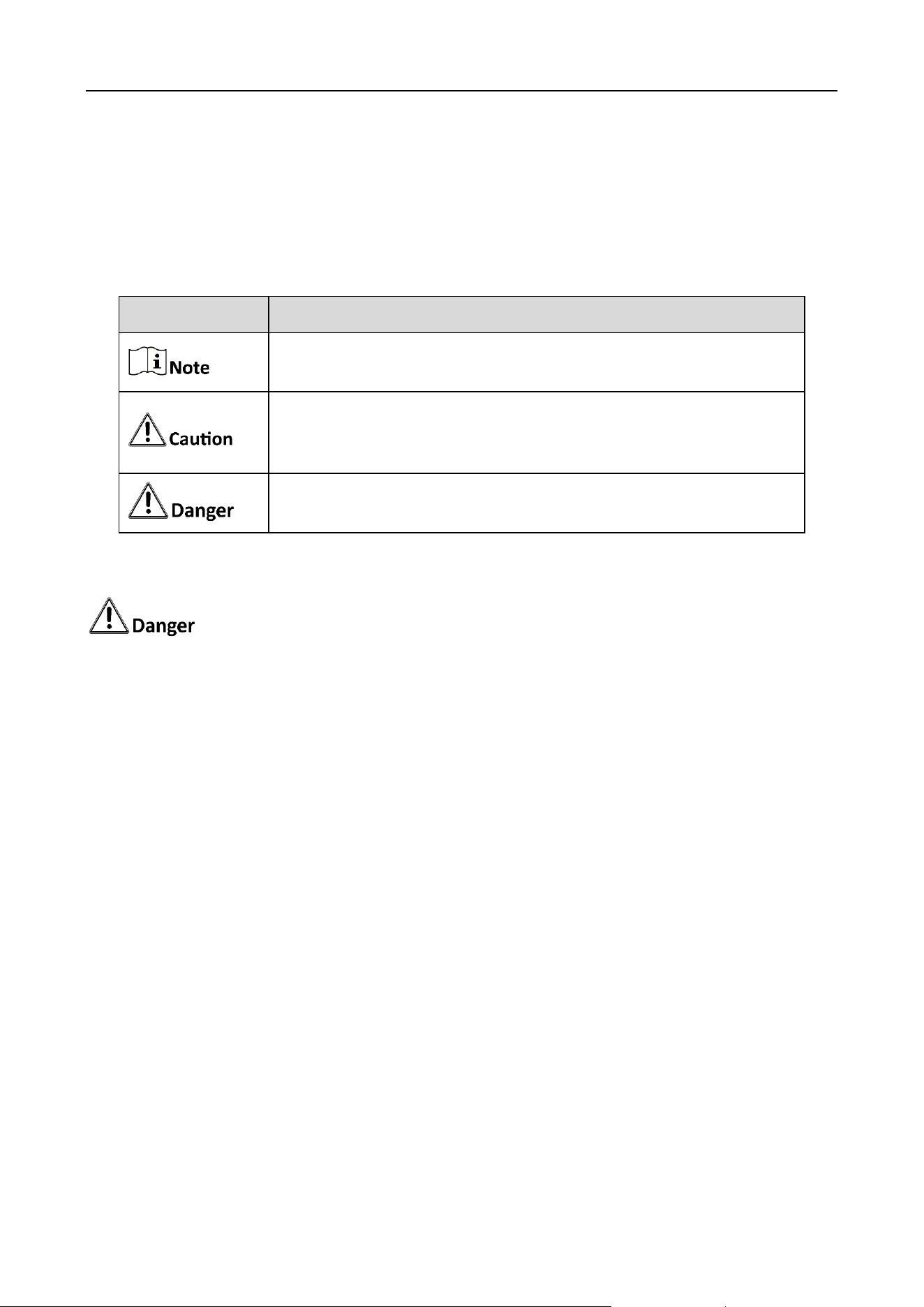
The symbols that may be found in this document are defined as follows.
Safety Instructions
Caution: The device may generate radio interference in indoor environment. Necessary
precautions may be required.
In the use of the product, you must be in strict compliance with the electrical safety
regulations of the nation and region.
Input voltage should meet both the SELV (Safety Extra Low Voltage) and the Limited Power
Source with 100 to 240 VAC or 12 VDC/2 A according to the IEC60950-1 standard.
CAUTION: Replace the fuse only with the same model to reduce the risk of fire or electric
shock.
The device must be connected to an earthed mains socket-outlet.
Make sure that the power has been disconnected before you wire, install, or disassemble the
device.
CAUTION: This device is for use only with specified bracket (Hikvision's monitor stand). Use
with other (carts, stands, or carriers) may result in instability causing injury.
To prevent possible hearing damage, do not listen at high volume levels for long periods.
If the device is not working properly, contact the store where the device was purchased or the
nearest service center and do not remove or modify the device in any way. (Our company is
not responsible for problems caused by unauthorized modifications or repairs.)
Do not connect several devices to one power adapter as adapter overload may cause over-
heating or a fire hazard.
Symbol
Description
Provides additional information to emphasize or supplement
important points of the main text.
Indicates a potentially hazardous situation, which if not avoided,
could result in equipment damage, data loss, performance
degradation, or unexpected results.
Indicates a hazard with a high level of risk, which if not avoided, will
result in death or serious injury.
Monitor • User Manual
iv
The device shall not be exposed to water dripping or splashing and that no objects filled with
liquids, such as vases, shall be placed on the equipment.
Ensure correct wiring of the terminals for connection to mains supply.
The device has been designed, when required, modified for connection to an IT power
distribution system.
identifies the battery holder itself and identifies the positioning of the cell(s) inside the
battery holder.
+ identifies the positive terminal(s) of equipment which is used with, or generates direct
current. - identifies the negative terminal(s) of device which is used with, or generates direct
current.
No naked flame sources, such as lighted candles, should be placed on the equipment.
The ventilation should not be impeded by covering the ventilation openings with items, such
as newspapers, tablecloths, curtains, etc. The openings shall never be blocked by placing the
equipment on a bed, sofa, rug or other similar surface.
Keep product surface clean and dry. Do not operate in humid or explosive environment.
Avoid contact with exposed circuits. Do not touch exposed contacts or components when
powering on the product.
The USB port of the device is used for connecting to a mouse, a keyboard, or a USB flash drive
only.
Install the device according to the instructions in this manual.
To prevent injury, this device must be securely attached to the floor/wall in accordance with
the installation instructions.
Do not cause objects to fall on the device or shake the device vigorously, and keep the device
away from areas where magnetic field interference exists. Avoid installing the device in a place
where the surface vibrates or is vulnerable to shock.
Do not install the device at high temperatures (above 40 ° C) or low temperatures (below -10 °
C) or high humidity.
Keep vertical when moving or using the device.
Proper configuration of all passwords and other security settings is the responsibility of the
installer and/or end-user.

Monitor • User Manual
v
TABLE OF CONTENTS
Chapter 1 Product Introduction .................................................................................................. 1
Overview ............................................................................................................................................................... 1
Key Features ......................................................................................................................................................... 1
Panel Buttons ........................................................................................................................................................ 1
Rear Panel Interface.............................................................................................................................................. 2
Power Supply Connections ................................................................................................................................... 3
Remote Control ..................................................................................................................................................... 3
1.6.1 Remote Control Panel ................................................................................................................................ 3
1.6.2 Remote Control Operation ........................................................................................................................ 5
Chapter 2 Terminal Operations ................................................................................................... 6
Switch Signal Source ............................................................................................................................................. 6
Main Menu ........................................................................................................................................................... 6
2.2.1 OSD Operations.......................................................................................................................................... 6
2.2.2 OSD Settings ............................................................................................................................................... 7
2.2.3 Image Settings ............................................................................................................................................ 8
2.2.4 Backlight Settings ....................................................................................................................................... 8
2.2.5 VGA Settings .............................................................................................................................................. 9
2.2.6 Screen ID Settings .................................................................................................................................... 10
2.2.7 Overscan Settings .................................................................................................................................... 11
2.2.8 Linked Control Settings ............................................................................................................................ 11
2.2.9 Configuring Aspect ................................................................................................................................... 12
2.2.10 Enable/Disable the Keypad .................................................................................................................... 12
2.2.11 Other Settings ........................................................................................................................................ 12
2.2.12 Color Space Settings............................................................................................................................... 13
2.2.13 Eye Protection Mode ............................................................................................................................. 13
2.2.14 Audio Settings ........................................................................................................................................ 13
System Settings ................................................................................................................................................... 14
2.3.1 Upgrade (USB) .......................................................................................................................................... 14
2.3.2 Restore Defaults ...................................................................................................................................... 14
2.3.3 Configure Overheat Alarm ....................................................................................................................... 15
2.3.4 View System Information ......................................................................................................................... 16
2.3.5 System Time ............................................................................................................................................. 16
2.3.6 Timing Startup/Shutdown ........................................................................................................................ 16
Chapter 3 Client Operation ....................................................................................................... 18
Monitor • User Manual
1
Chapter 1 Product Introduction
Overview
LCD monitor adopts Mstar ACE-5 auto-coloring and image-enhancing engine to improve image
contrast, detail, edge, etc. It is an ideal choice for financial institution, metro, railway station,
airport and exhibition.
Key Features
Up to 1920 × 1080 resolution.
Adopts 3D digital comb filter and 3D noise reduction technology.
Programmable 12-bit RGB gamma correction.
Complete factory settings.
Software spread spectrum technology reduces EMI radiation.
Adopts 2 MACE color correction engines to improve image contrast, detail, edge, etc.
Provides multiple video and audio input interfaces, including DVI, CVBS, USB, HDMI and VGA.
Panel Buttons
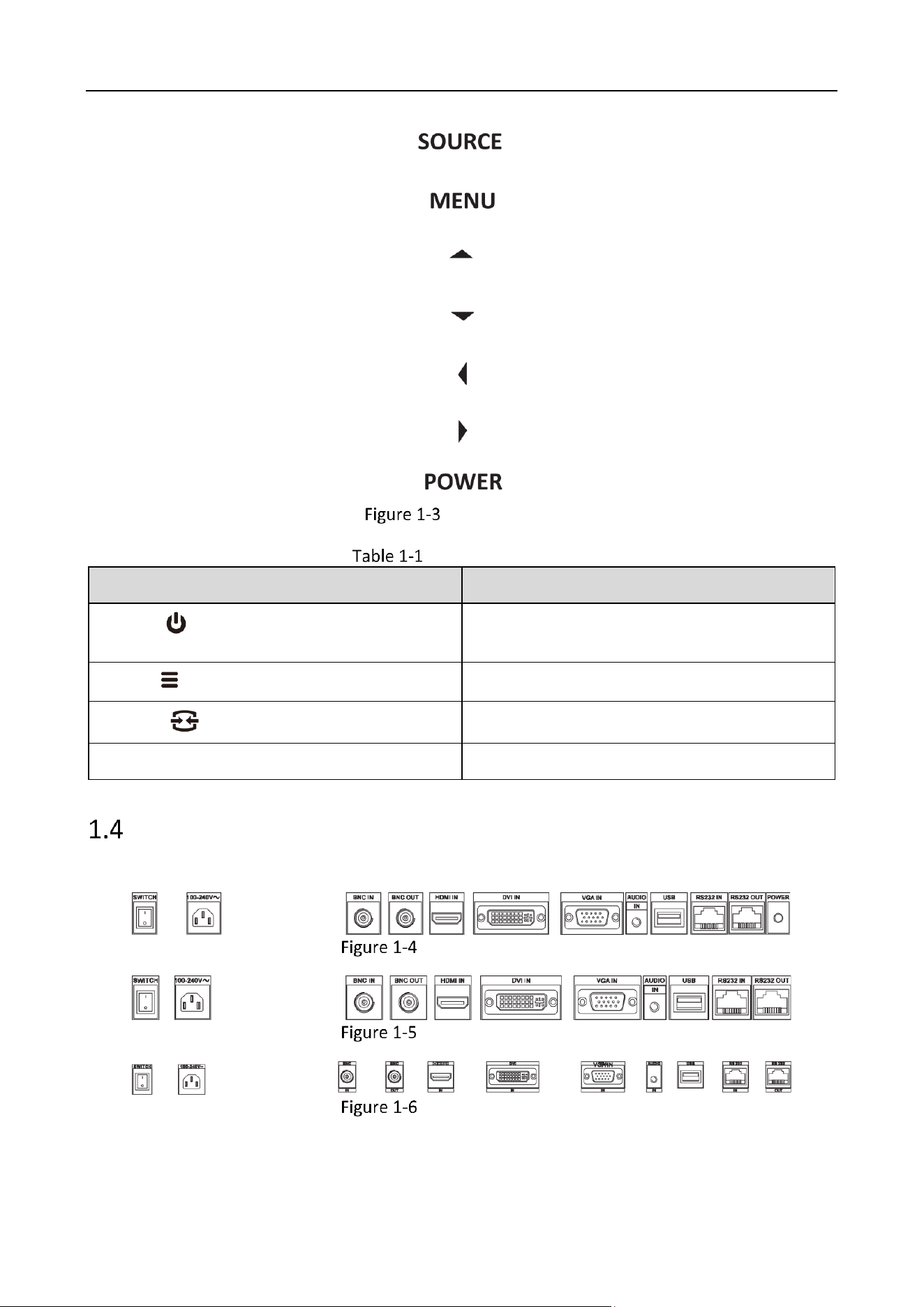
Panel buttons are for illustration only. See details in the following figure and table.
Panel Buttons 1
Panel Buttons 2
Monitor • User Manual
2
Panel Buttons 3
Buttons Description
Button
Description
POWER /
Power on, short press to confirm/turn on, long
press to turn off.
MENU /
Enter the Menu page.
SOURCE /
Enter Input Signal Source page.
▲ / ▼ / ◀ / ▶
Move the cursor up/down/left/right
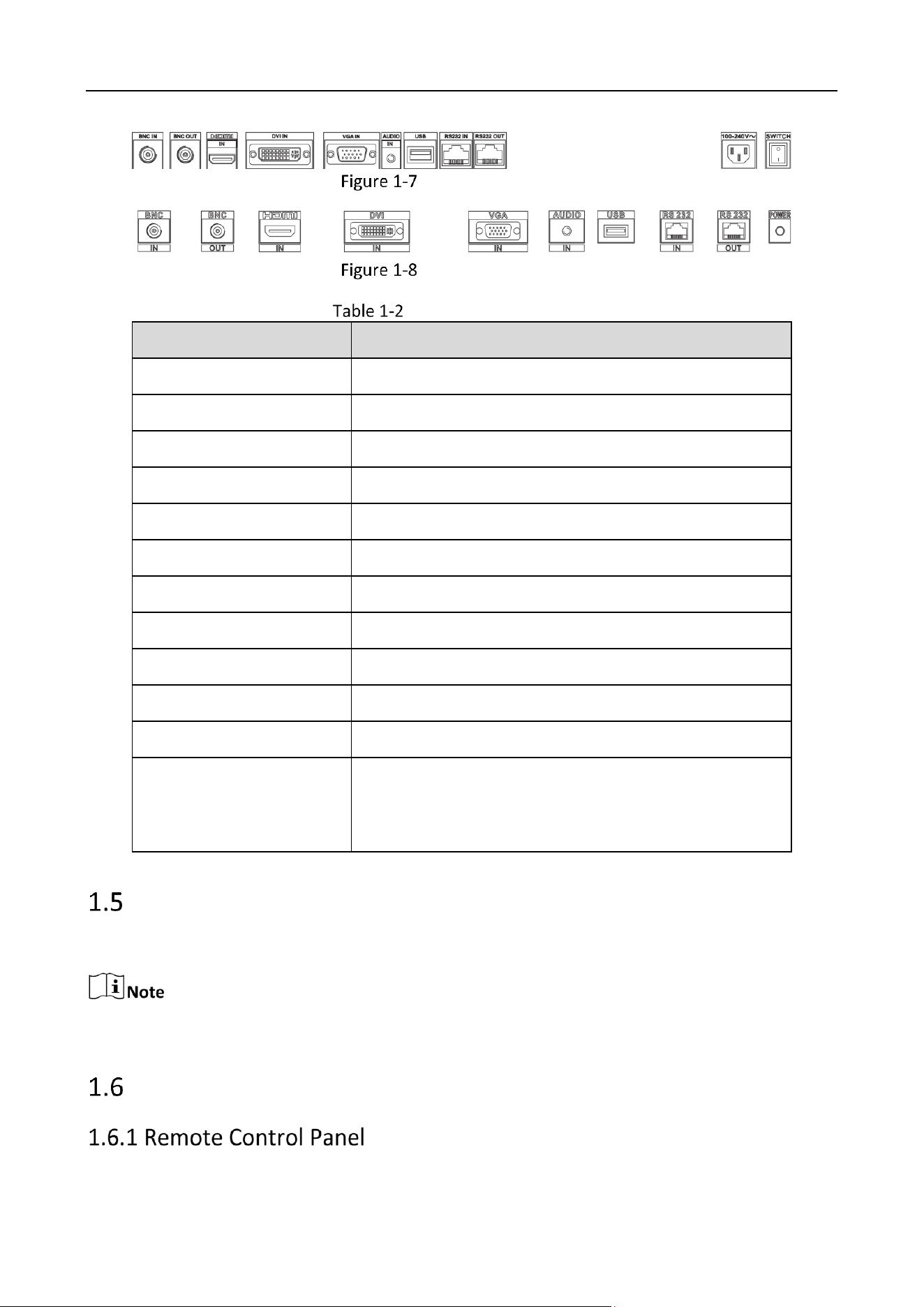
Rear Panel Interface
Please view the corresponding rear panel of your monitor.
Rear Panel of Device 1
Rear Panel of Device 2
Rear Panel of Device 3
Monitor • User Manual
3
Rear Panel of Device 4
Rear Panel of Device 5
Description of Rear Panel
Interface
Description
SWITCH
Power switch
100-240V~
100 to 240 VAC power supply
BNC IN
CVBS/SDI signal input
BNC OUT
CVBS/SDI signal output
HDMI IN
HDMI digital signal input
DVI IN
DVI digital signal input
VGA IN
VGA analog signal input
AUDIO IN
3.5 mm audio input
USB
USB interface
RS232 IN
RS-232 serial port input
RS232 OUT
RS-232 serial port output
POWER
Working status indicator
Turns red when the device is standby.
Turns green when the device is working.
Power Supply Connections
Insert the 3-pin power plug (100 to 240 VAC) into well-grounded power socket.
Disconnect the power of the monitor if it will not be used for a long time.
Remote Control
Monitor • User Manual
4
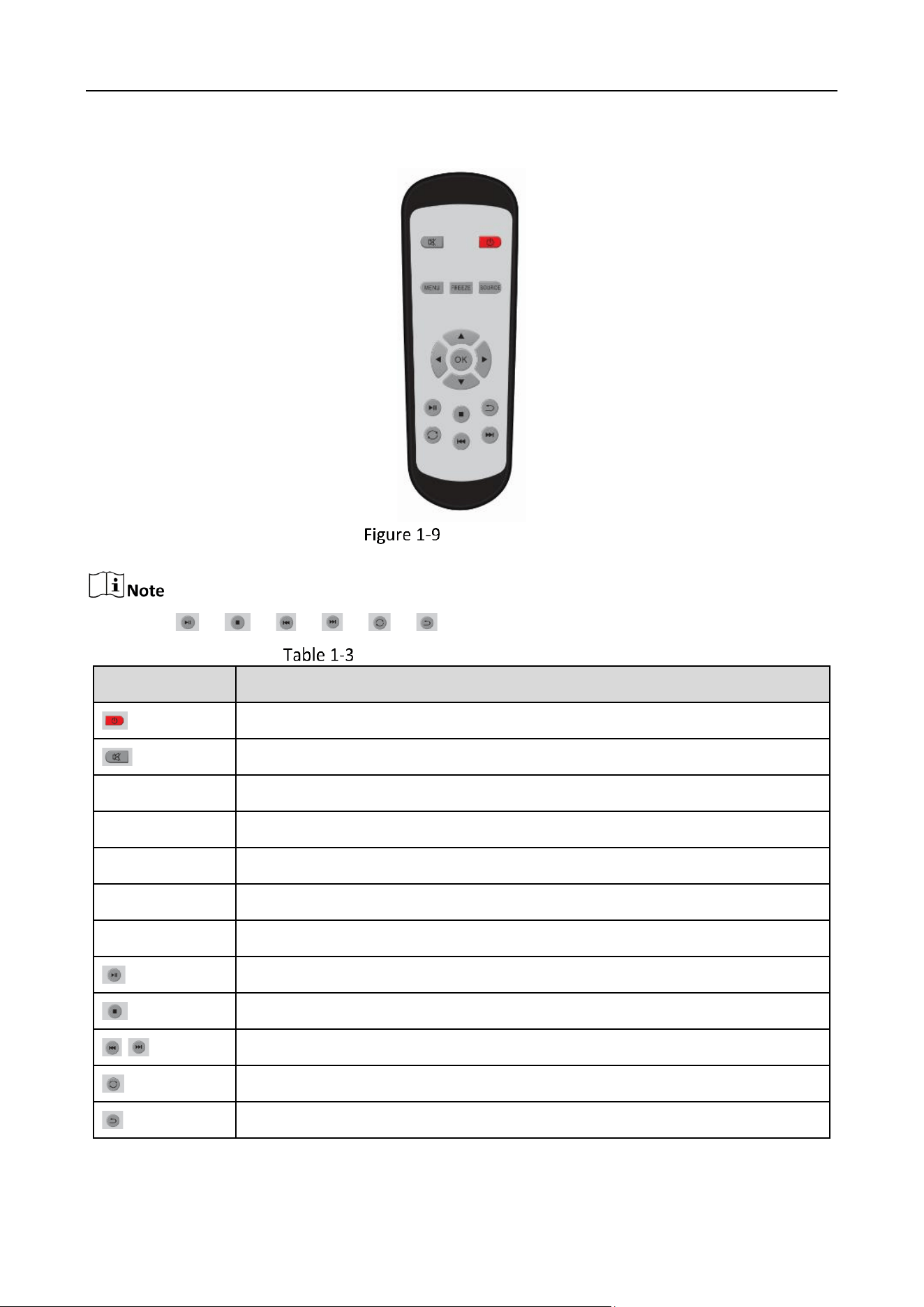
Refer to the following table for the remote control panel description.
Remote Control
Buttons of / / / / / can only be used with USB input signal source.
Description of Remote Control Buttons
Button
Description
Power Switch. Turn on/off the device
Turn off/on the sound
MENU
Enter/Exit main menu
FREEZE
Freeze the image
SOURCE
Enter Input Source page
▲ / ▼ /
◀
/
▶
Up/down/left/right direction keys, select a submenu or set menu parameters
OK
Confirm
Play/Pause
Stop
/
Previous/Next
Replay
Return
Monitor • User Manual
5
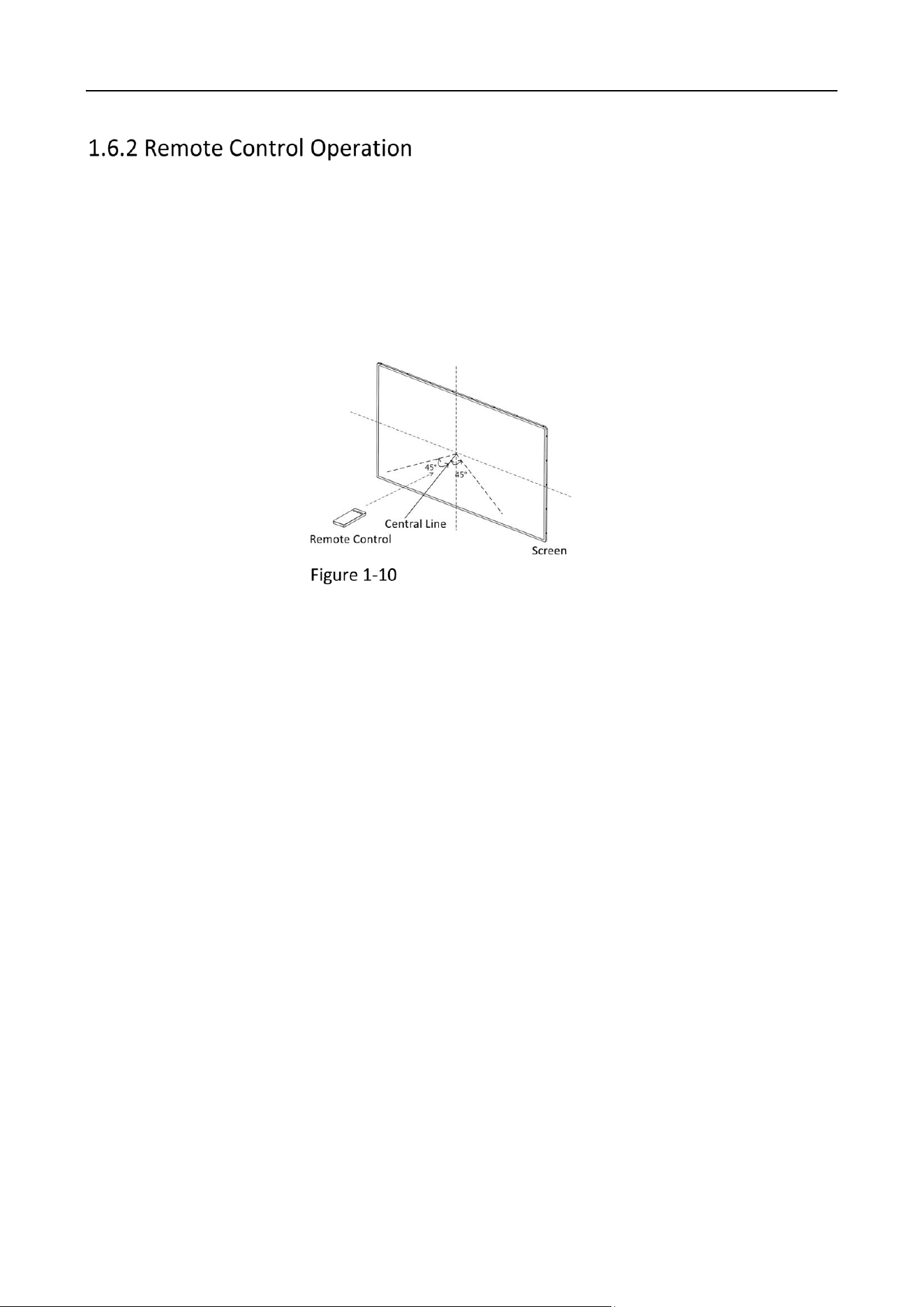
If the monitor has an IR receiver at the corner, you shall aim the remote control at the IR receiver.
Otherwise, you shall aim the remote control at screen center.
You should operate the remote control within an angle of ±45° when aiming at the IR receiver or
screen center. Otherwise, the screen may not respond.
In order to achieve better performance, it is recommend to keep the distance between remote
control and monitor within 5 meters.
Operation of Remote Control
Monitor • User Manual
6
Chapter 2 Terminal Operations
Switch Signal Source
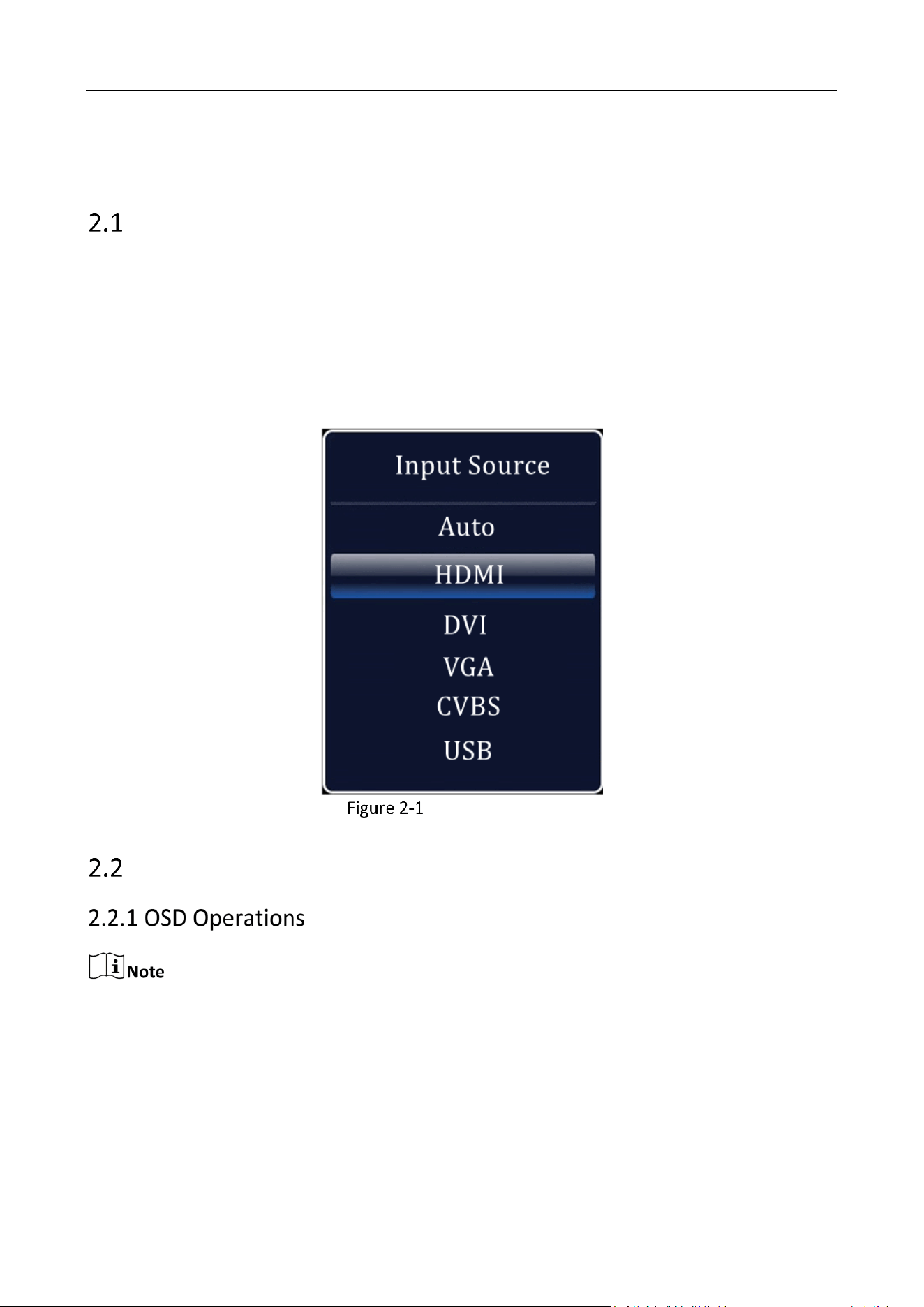
The monitor can display input signal source including HDMI, DVI, VGA, USB, and CVBS.
Steps
1. Press Source to enter Input Source page.
2. Press ▲ or ▼ to select the input source.
3. Press OK to accomplish the input source selection.
Switch Signal Source
Main Menu
You need to operate the OSD based on the real situation.
Monitor • User Manual
7
Operation Description
Step
Description
1
Press MENU to show the main menu page, such as Image Settings, Backlight
Settings, VGA Settings, OSD Settings, and System Settings
2
Press ▲/▼/◀/▶ to select a sub-menu
3
Press OK to enter the setting page of the sub-menu
4
Press ▲/▼ to select the parameters that are needed to be set
5
Press ▲/▼ to set the value of parameters
7
Press MENU to exit the menu page.
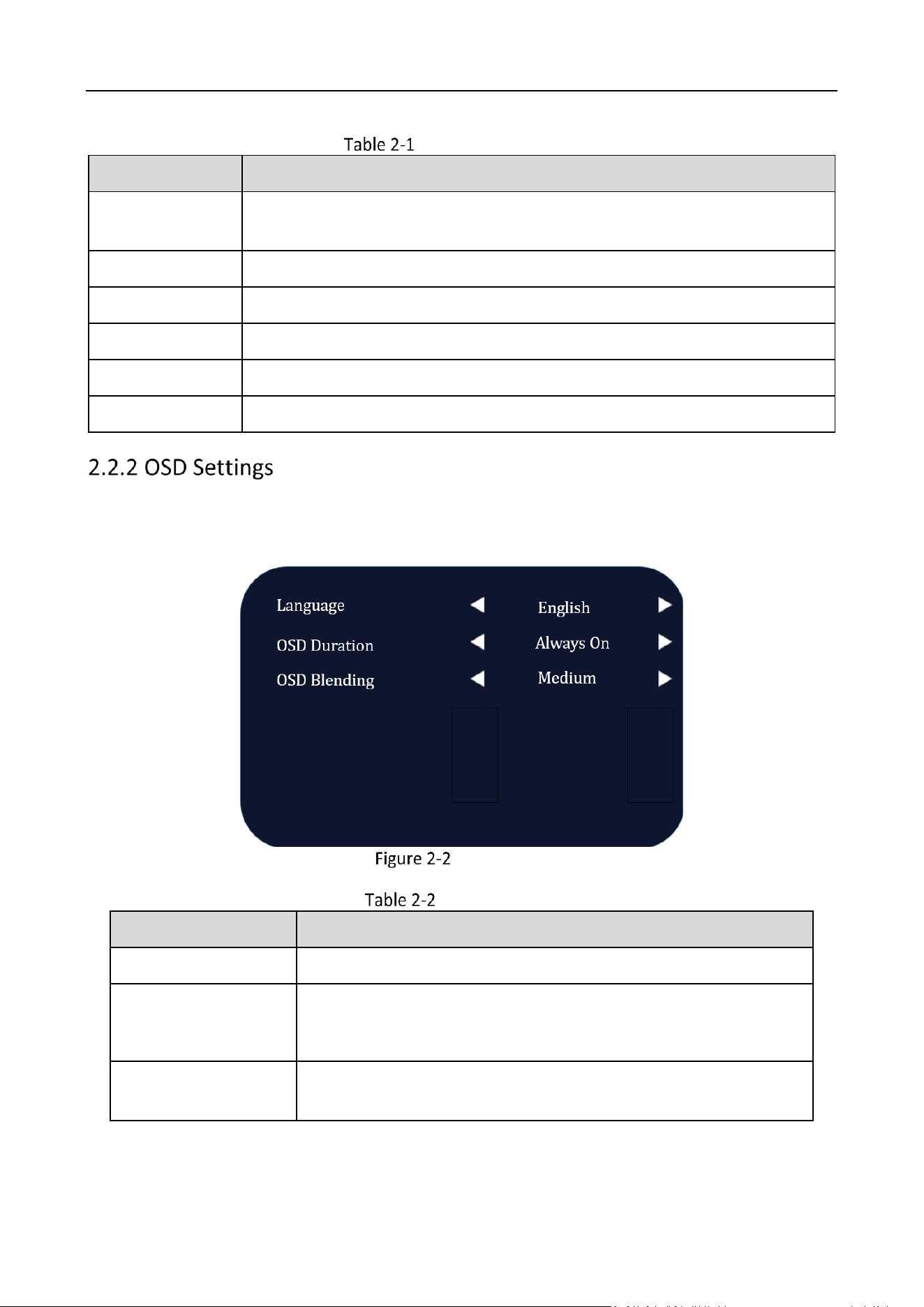
You can set language, OSD duration, and OSD blending.
Enter MENU→OSD Setting→OK.
OSD Settings
OSD Parameters
Parameter
Description
Language
Chinese/English
OSD Duration
The OSD display time when you stopping operating the monitor.
Always On/5 s/15 s/30 s/1 min
OSD Blending
Off/Low/Medium/High. Adjust the transparency degree of the
OSD.
Monitor • User Manual
8
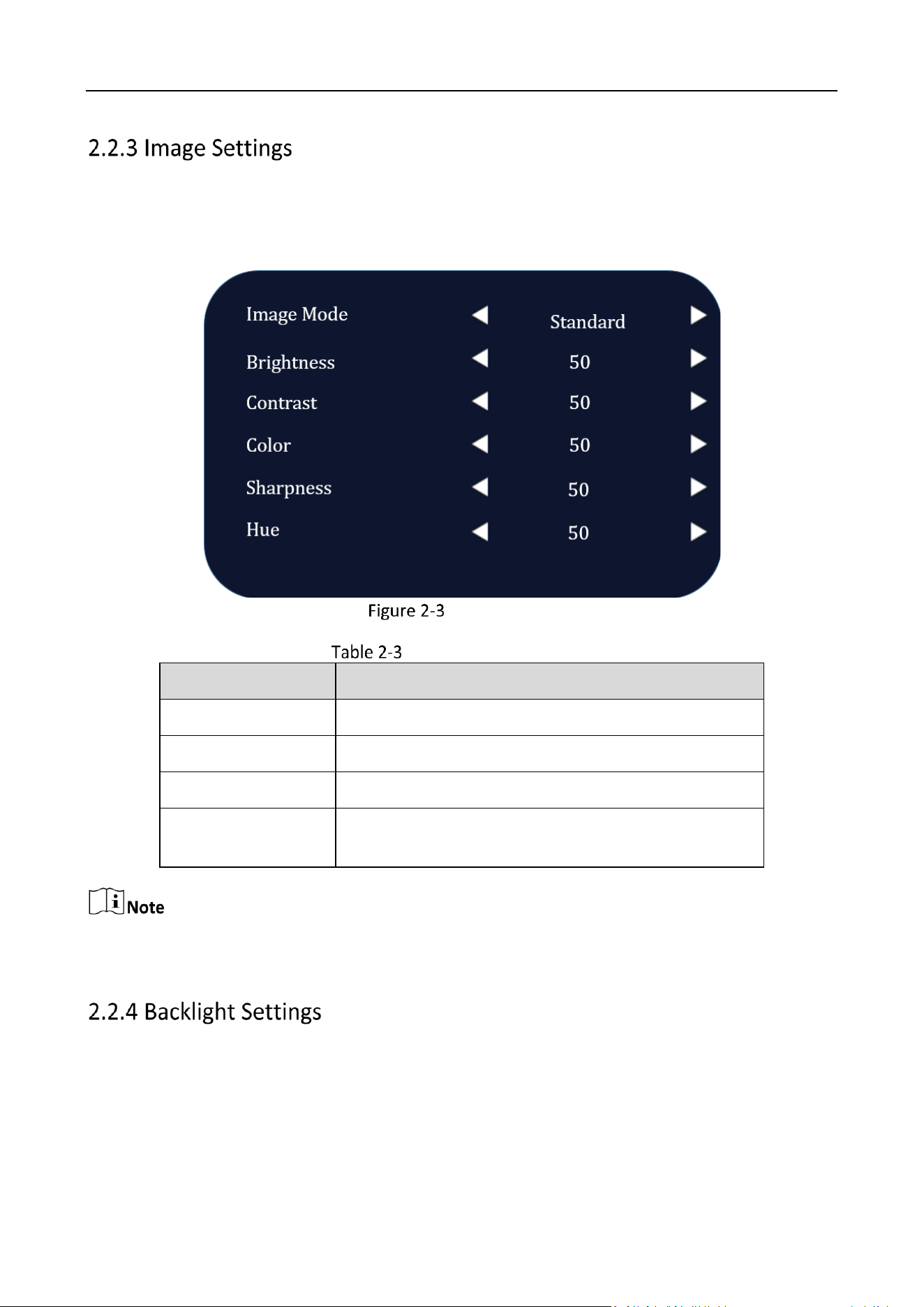
You can switch image mode and adjust image parameters including contrast, brightness, color,
sharpness, and hue to achieve the best display effect.
Enter MENU→Image Settings→OK, and select the mode as your desire.
Image Settings
Picture Mode Description
Picture Mode
Description
Standard
Suitable for a normal environment.
Gentle
Suitable for a dark room.
Dynamic
Suitable for a bright room.
User
Set the brightness, contrast, color, or sharpness to
adjust display effect.
Adjustable parameters vary depending on the input source you choose. If the parameter bar is
gray, it indicates that the parameter is not adjustable under the current input source.
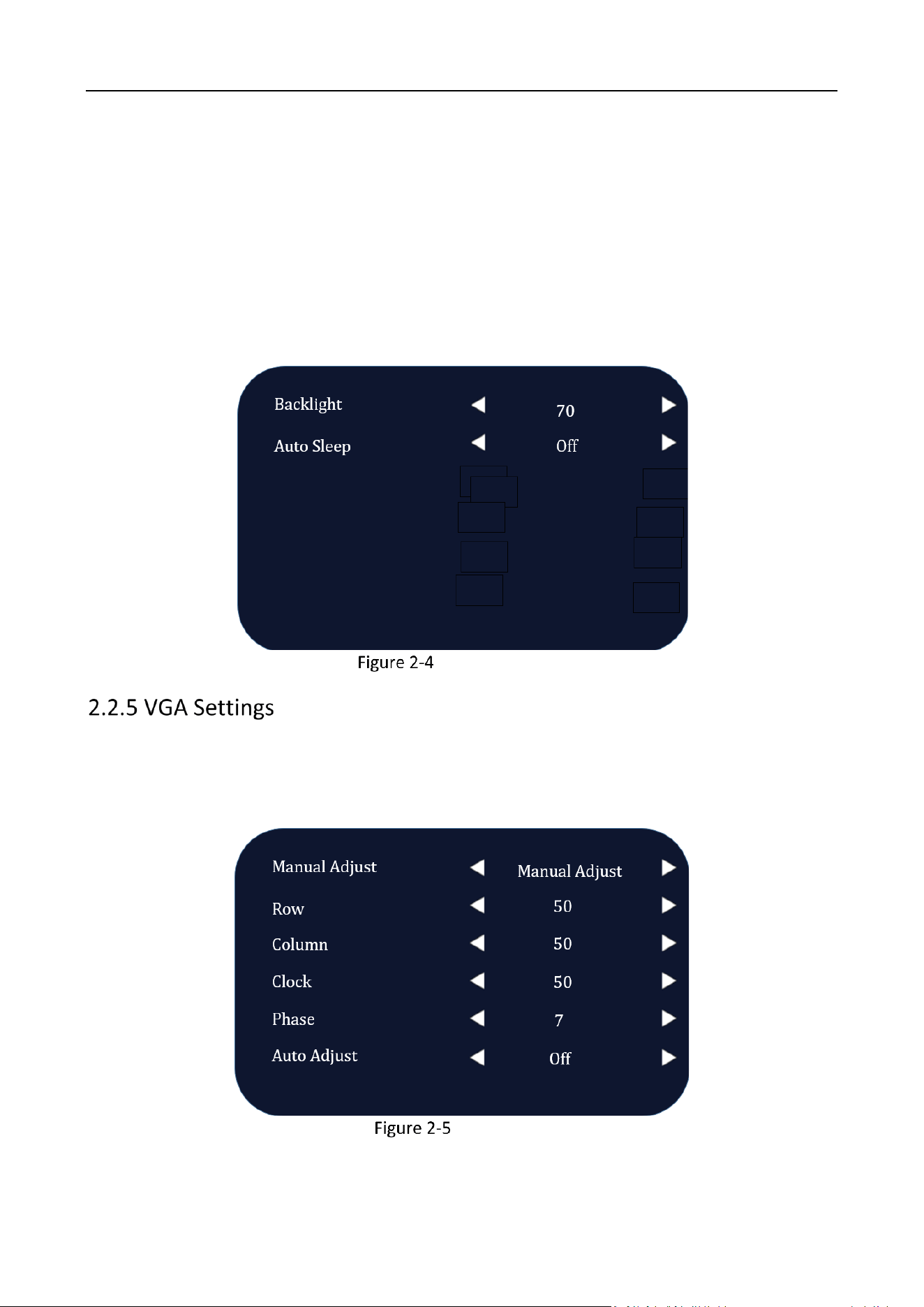
You can set the backlight parameters to adapt different lighting conditions.
Backlight Settings
Enter MENU→Backlight Settings→OK. Press ◀ or ▶ to set the backlight parameters from 0 to 100.
Monitor • User Manual
9
Configure Auto Sleep
When the device does not have signal input in a preset time, it will automatically go to sleep. In
the countdown time, if there is no operation, it will automatically enter the auto sleep mode; If
you press any key on the remote control, it will exit the countdown menu and restart the timer.
After the auto sleep is turned off, the device will not automatically go to sleep.
Enter MENU→Backlight Settings→Auto Sleep.
Press ◀ or ▶ to select Off/1 min/5 min/10 min/1 h to turn off the auto sleep mode or enter the
auto sleep mode after the device does not have signal input in a preset time.
Backlight Settings
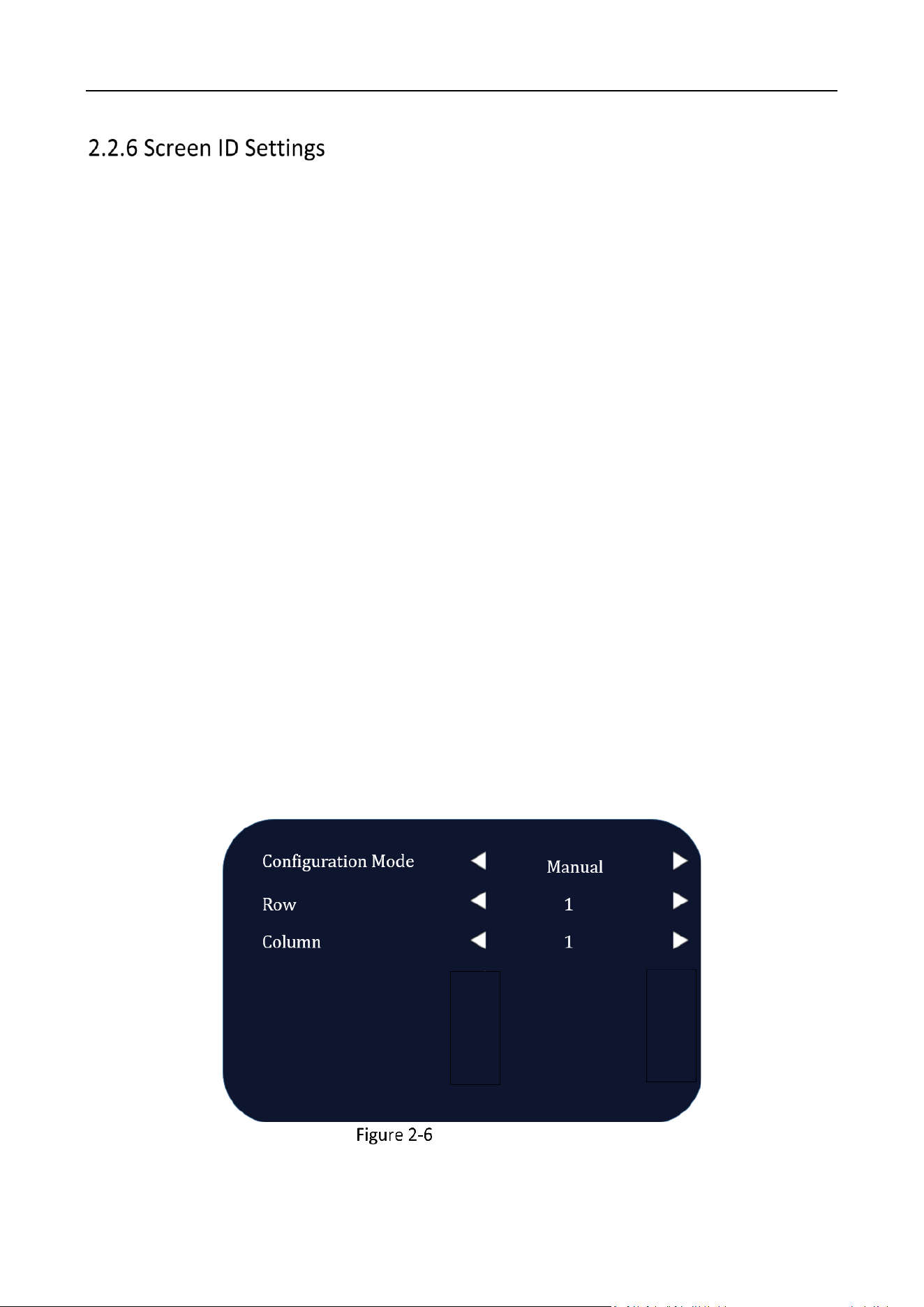
When you select VGA as the input source, you can adjust VGA parameters to make the picture
show in the correct position.
Enter MENU→VGA Settings→OK to set the parameters as your desire.
VGA Settings
Monitor • User Manual
10
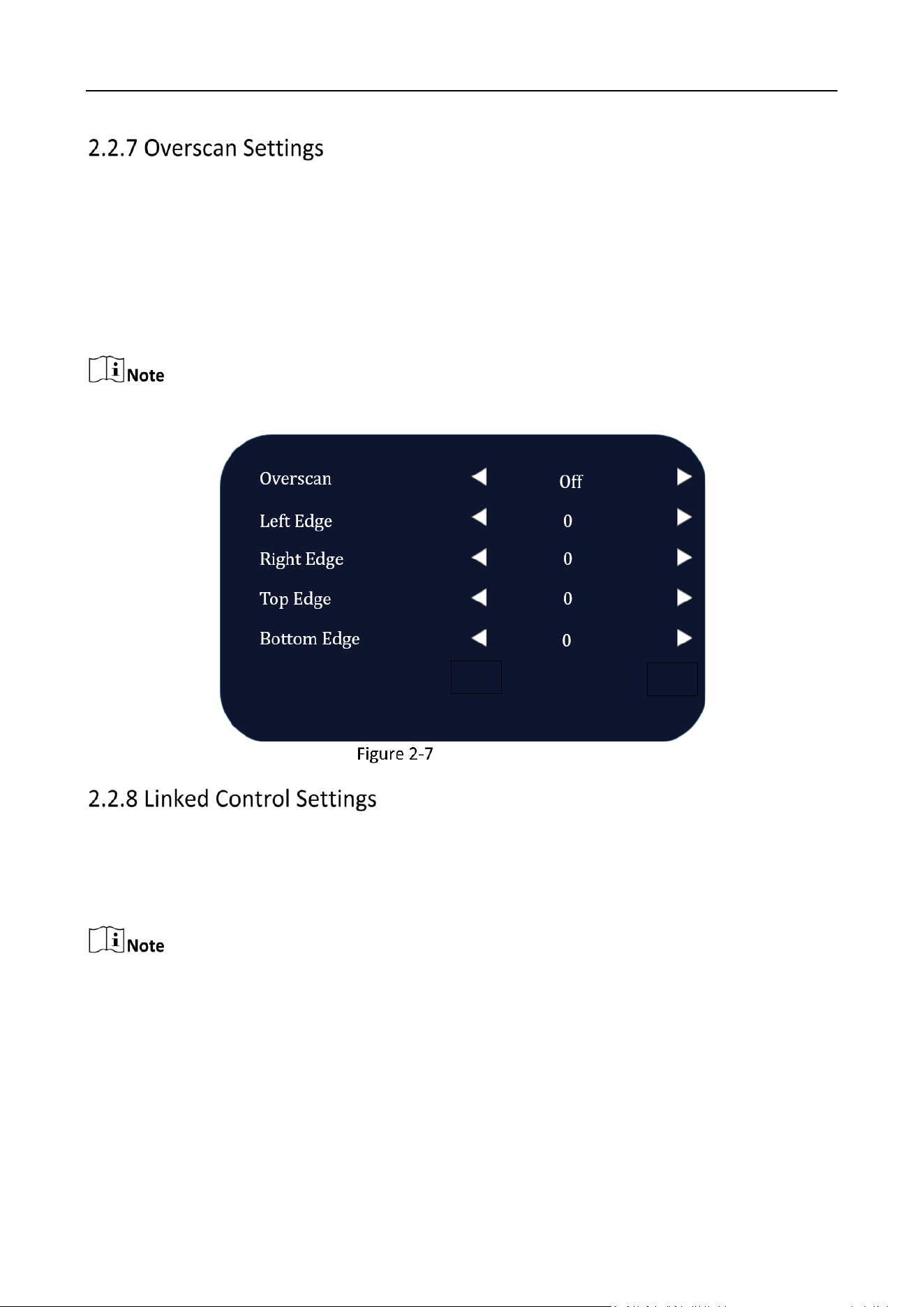
ID, the number of rows and columns of a single screen, can be used to determine the location of
the screen.
Enter MENU→ID Settings→OK.
Press ◀ or ▶ to select configuration mode and corresponding parameters such as Row and
Column.
Manually Configure Screen ID
Steps
1. Enter MENU→Screen ID→OK.
2. Select Configuration Mode as Manual.
3. Set Rows and Columns as you required.
4. Press OK.
Example
If you set Rows as 1, and Columns as 2, the screen ID would be 0102.
Automatically Configure Screen ID
Steps
1. Enter MENU→Screen ID→OK.
2. Set Configuration Mode as Auto.
3. Set Total Rows and Total Columns to configure display unit.
4. Press OK.
Screen ID Settings
Monitor • User Manual
11
Overscan is the situation in which not all of an image is present on a viewing screen. You can shield
the borders for better image quality by adjusting the overscan value of Top/Bottom/Left/Right
Edge.
Enter MENU→Overscan Settings→OK. Press ◀ or ▶ on the remote control to enter the page.
Select the Overscan item as On and set the value of the Left Edge, Right Edge, Top Edge, and
Bottom Edge from 0 to 100 as you required.
The value of overscan is the pixel value of certain edge.
Overscan Settings
You can link the device with another one by HDMI input signal source after turning on the linked
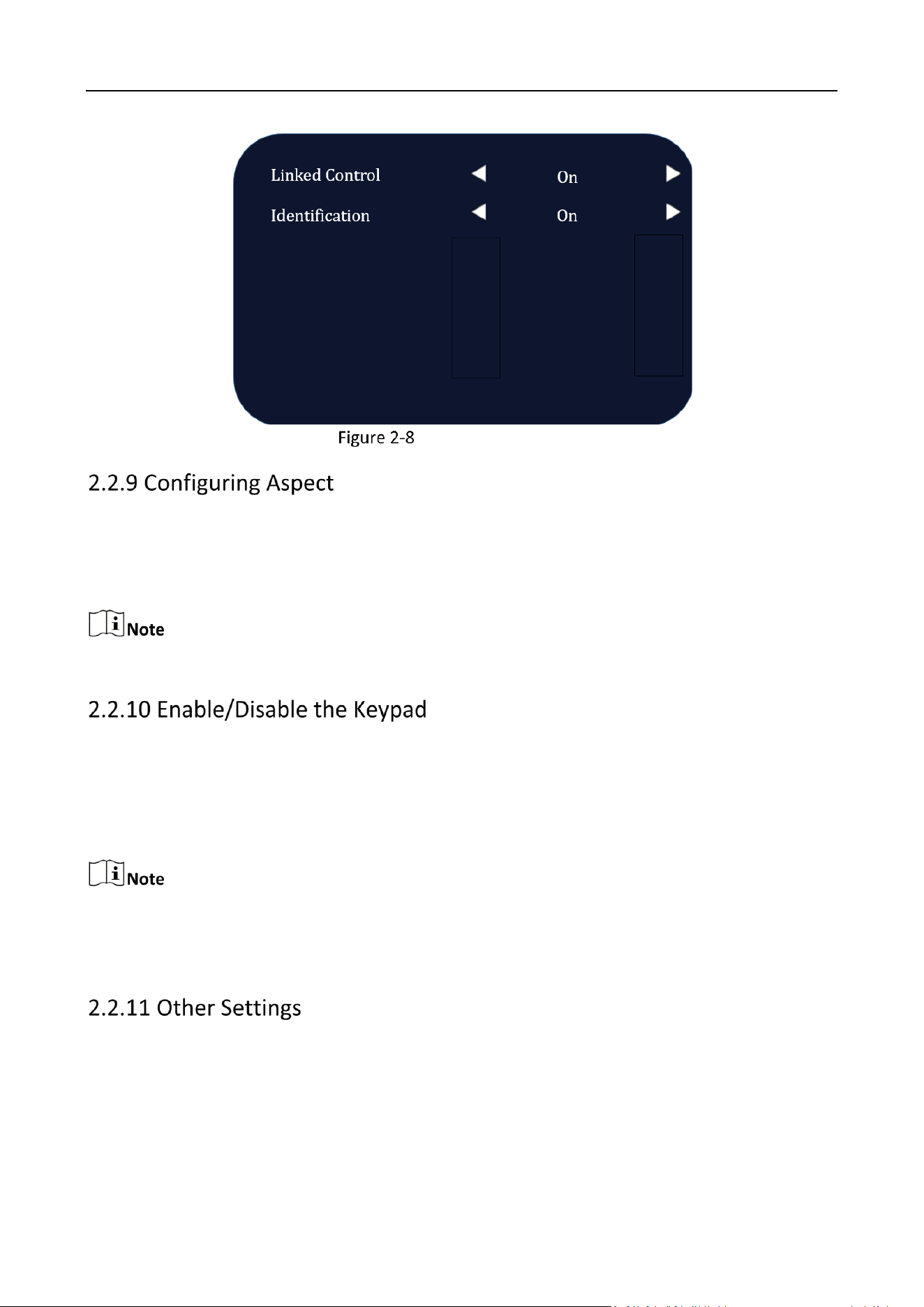
control. For example, use the remote control to set DVD.
Enter MENU→Linked Control→OK and press ◀ or ▶ to enter linked control mode or not.
Linked Control and ID Identification should be set as On to enable linking.
Monitor • User Manual
12
Linked Control Settings
The aspect refers to the proportions of the height and width of an image. You can set the aspect to
16:9, 4:3, or P to P.
Enter MENU→Aspect→OK to select an aspect as you required.
You can not change the aspect when the input source is USB.
You can enable or disable the keypad of the device. If there is no need to use the keypad or the
keypad is squeezed in the installation environment, you can turn off the keypad to disable the
buttons on it.
Enter MENU→Keypad→OK. Press ◀ or ▶ to select the keypad as On/Off.
When the keypad is off, it can also be enabled by pressing the panel buttons. Press any panel
button to bring up the unlocking prompt menu, long press MENU to unlock. When unlocking is
finished, the "Unlock Completed" menu will pop up.
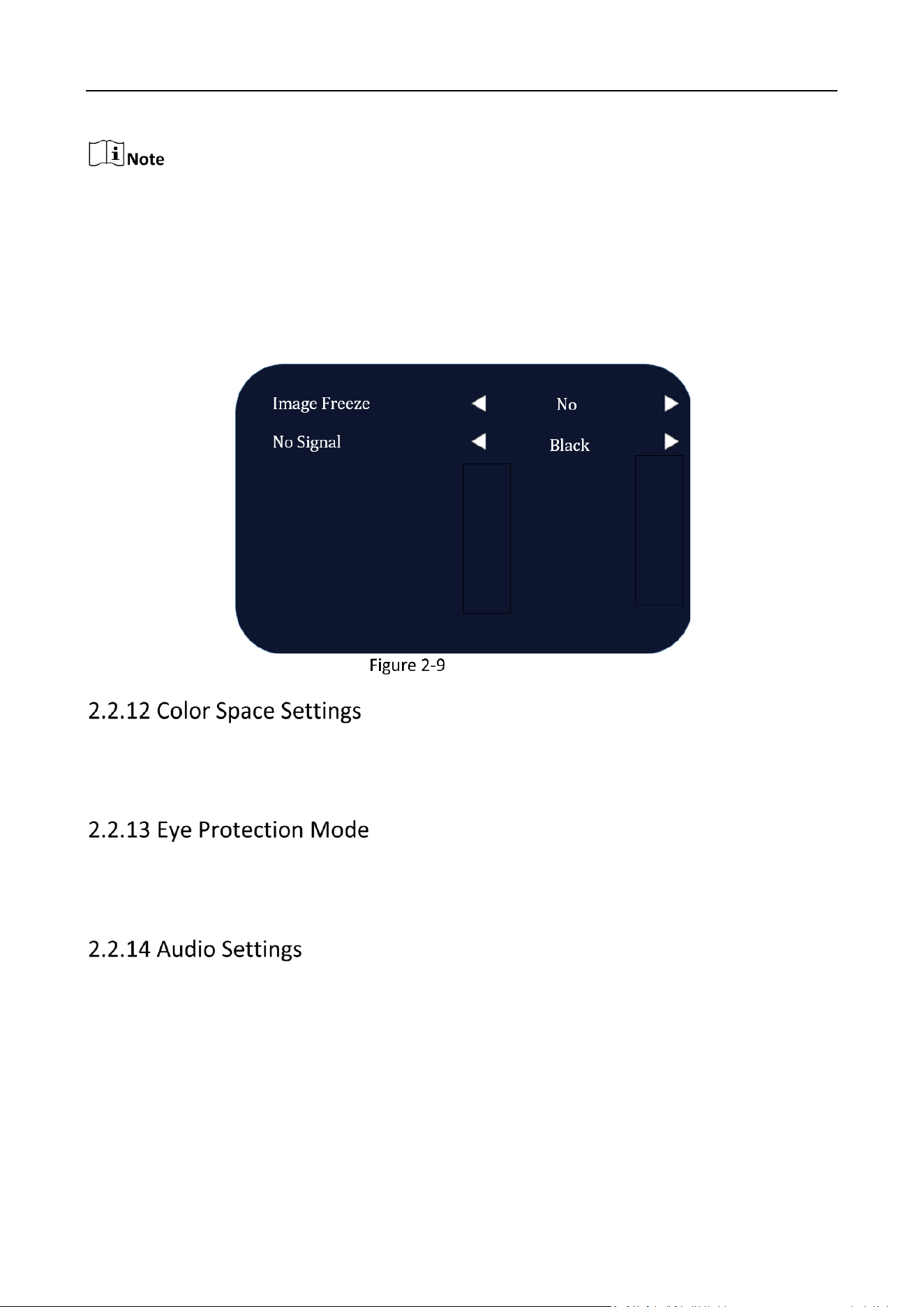
Image Freezing
Image freeze refers to freeze the current image on the screen as you required.
Enter MENU→Other Settings→Image Freezing→OK. Press ◀ or ▶ to set Image Freeze as Yes, and
the current image on screen will be freezed.
Monitor • User Manual
13
After switching the input source, the image freeze is automatically disabled by default.
No Signal Screen Saver
When the device does not have signal input in a preset time, it will automatically enable screen
saver mode.
Enter MENU→Other Settings→No Signal→OK. Press ◀ or ▶ to select no signal screen saver as
Logo/Black Screen/Blue Screen.
Other Settings
Set the color space of the monitor.
Enter MENU→Color Space→OK. Press ◀ or ▶ to select color space as Auto, 16-235, or 0-255.
Enable the eye protection to reduce blue light radiation.
Enter MENU→Eye Protection→OK. Press ◀ or ▶ to turn on or turn off the eye protection mode.
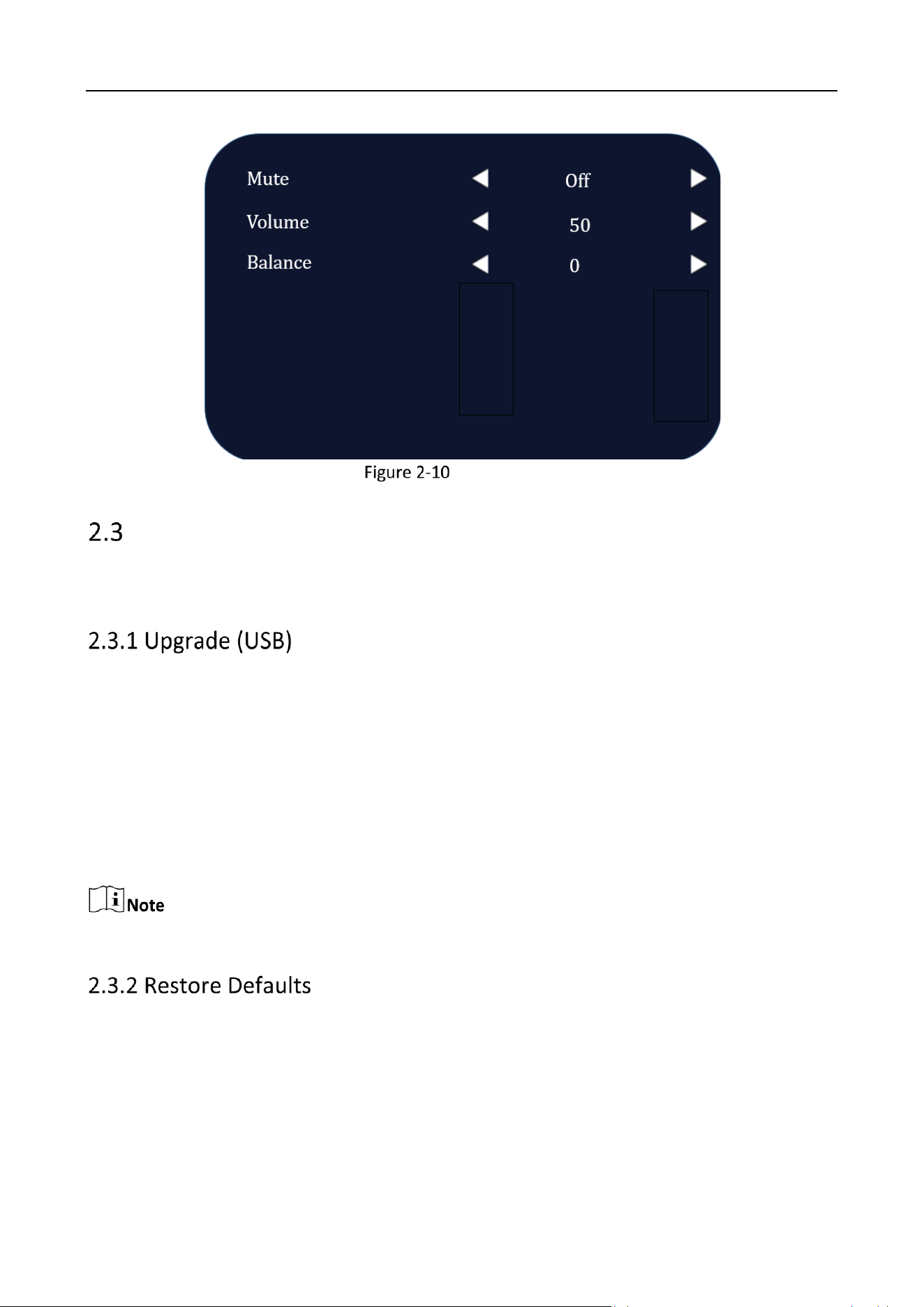
You can switch the mute on/off, and adjust the volume or balance.
Enter MENU→Audio Setting→OK, and then set audio parameters as you required.
Balance refers to adjust the balance between the left and right speakers.
Monitor • User Manual
14
Audio Settings
System Settings
You can view system information, upgrade software, configure overheat alarm, restore defaults,
etc.
Before you start
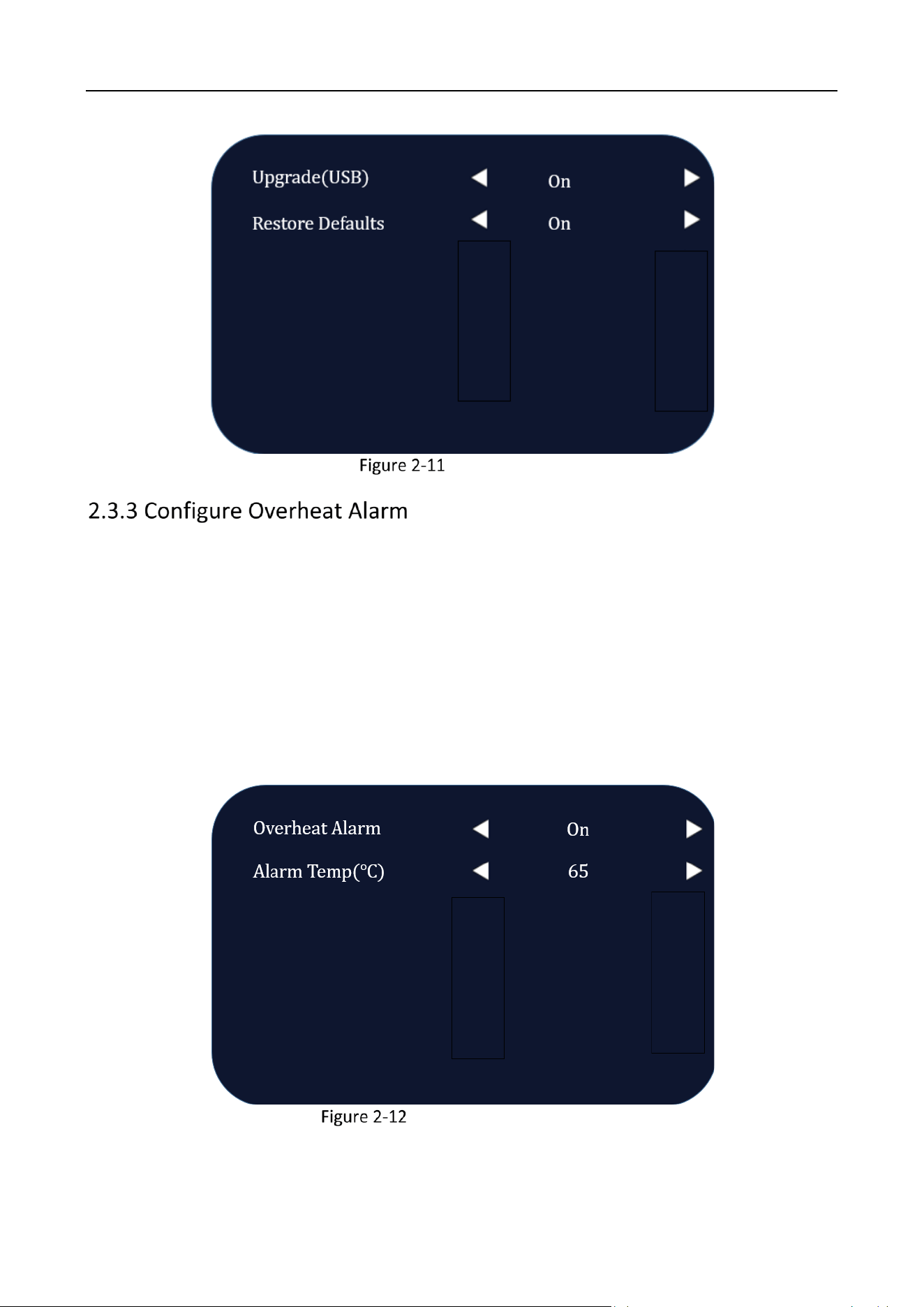
Insert the USB flash drive with the update file to the device before you upgrade the device.
Steps
Enter MENU→System Settings→OK→Upgrade (USB).
Press ◀ or ▶ on the remote control to enter the Other Settings page.
Press ◀ to select Yes to continue the system upgrade.
Press ▶ to select No to cancel the Upgrade.
All parameters of the device can be restored to the user defaults settings.
Enter MENU→System Maintenance→OK→Restore Defaults. Press ◀ or ▶ to select Restore
Defaults.
Monitor • User Manual
15
System Settings
When the board temperature exceeds or equals its set value, it will trigger an overheat alarm.
Steps
1. Enter MENU→Alarm Setting→OK.
2. Enable Overheat Alarm.
3. Set Alarm Temp (°C) as your desire.
4. Press OK.
(Optional) Press MENU to exit the OSD page.
Configure Overheat Alarm
Monitor • User Manual
16
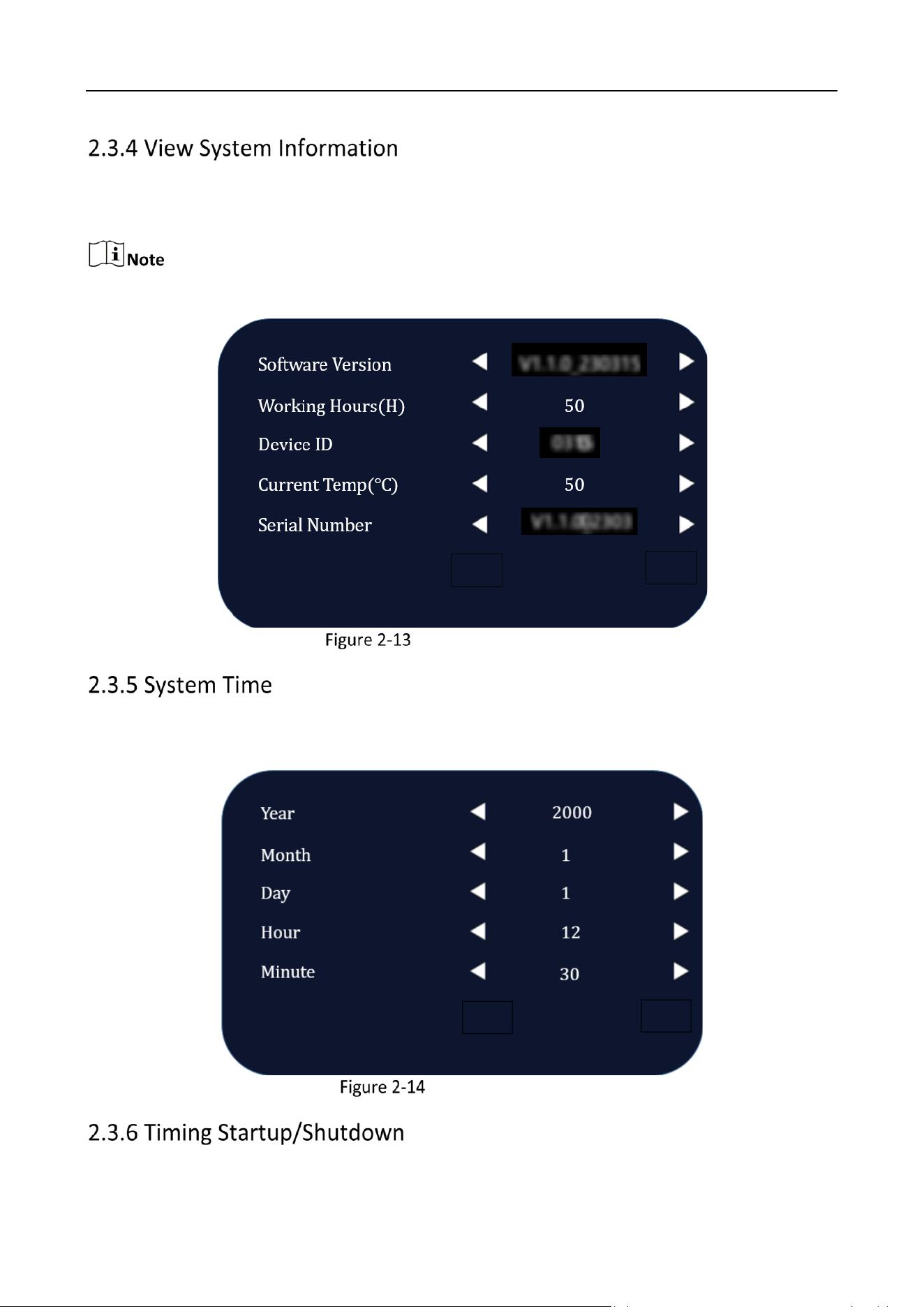
Enter MENU→System Info to view system information including software version, working hours,
device ID, current temperature, and serial number.
Please refer to the actual software version.
View System Information
Enter MENU→System Time→OK. Press ◀ or ▶ to set the value of year, month, day, hour and
minute.
System Time Settings
Monitor • User Manual
17
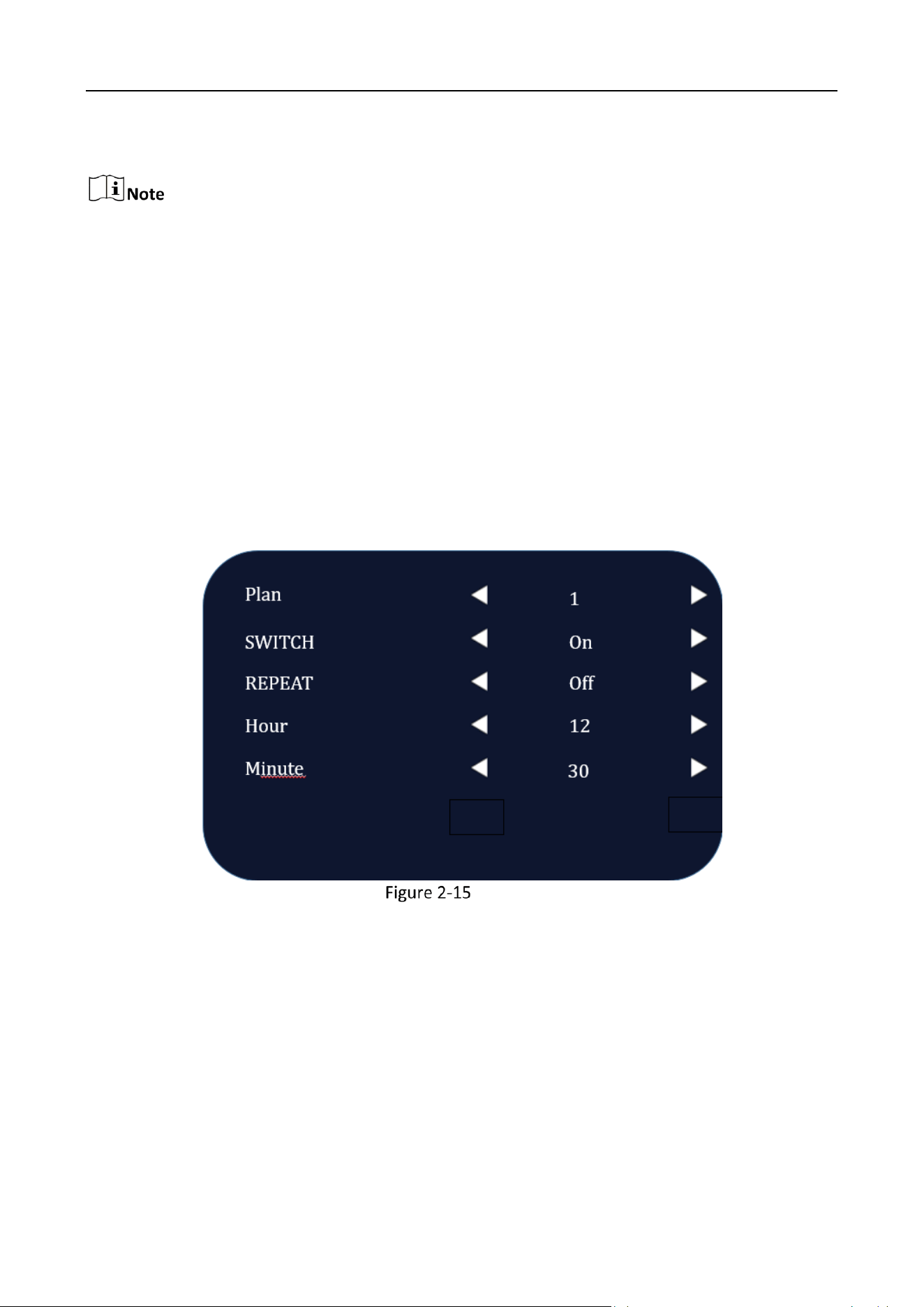
You can control the screen working time by setting its startup time.
The plans of timing startup and shutdown are both set as two.
Steps
1. Enter MENU→Timing Startup/Shutdown→OK.
2. Press ◀ or ▶ to select the sequence number of plans.
3. Select the Switch as On.
4. Turn on/off the Repeat week as you required.
Turn on the Repeat week: You can select the weeks you want the system to turn on/off
automatically, and then the system will automatically turn on/off repeatedly on the set weeks.
Turn off the Repeat week: This setting will take effect only once.
5. Set the startup and shutdown time.
Time On

Monitor • User Manual
18
Chapter 3 Client Operation
You can turn on/off the monitor, switch input signal through the ScreenControl client.
(ScreenControl software and its operation methods can be obtained from the technical support.)

0
UD36797B