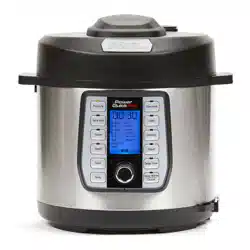
Save These Instructions – For Household Use Only
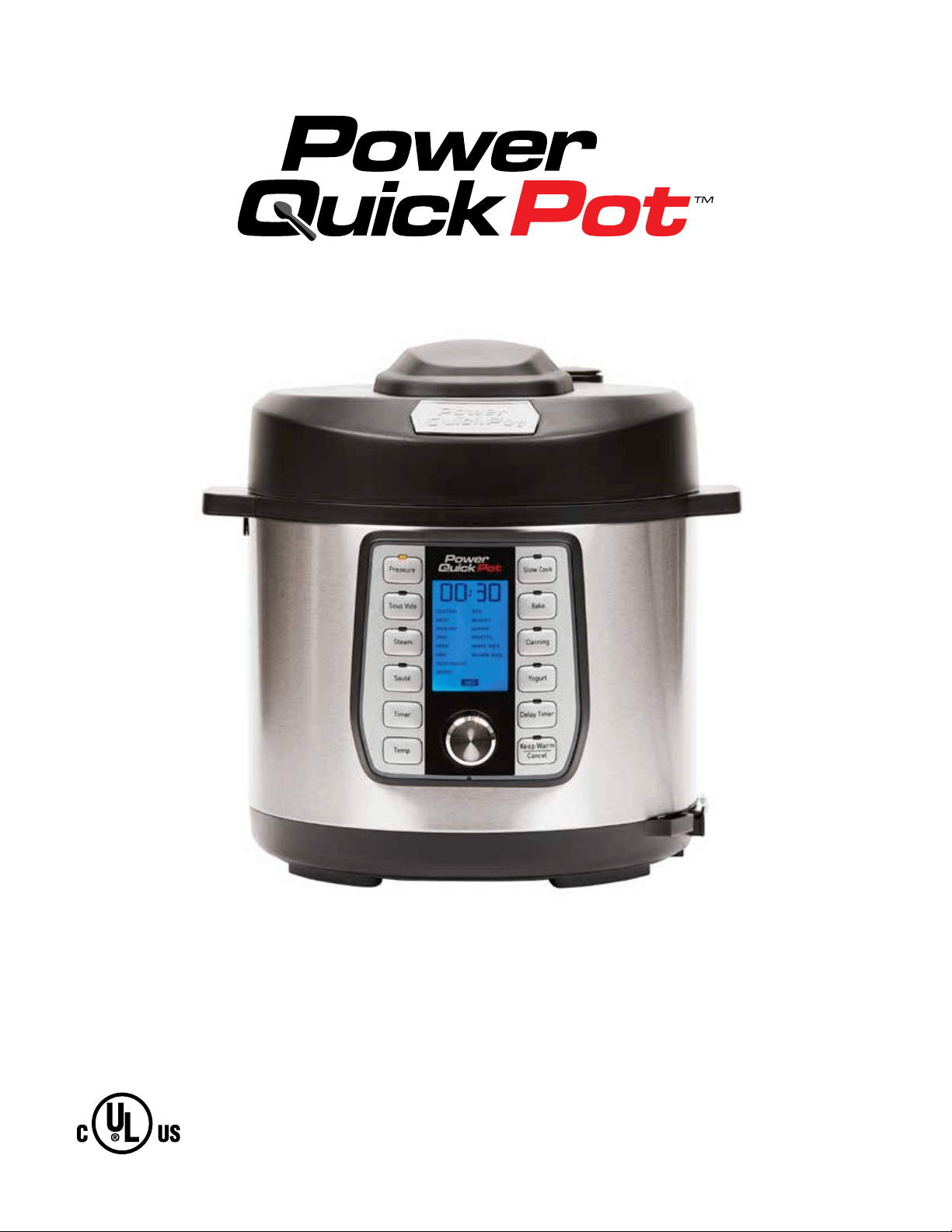
Owner’s Manual
Warranty Information Inside
MODELS: Y4D-36 (4 qt.) - Y6D-36 (6 qt.) - Y8D-36 (8 qt.) - Y10D-36 (10 qt.)

2
CONGRATULATIONS
You are about to discover what so many other
food lovers have known for years. Meals prepared
properly with the pressure cooking method taste
better and cook faster than foods prepared using
conventional stove top methods. It's that simple.
For decades, our culinary design division has
created some of the most useful and popular
kitchen appliances for worldwide use. The Power
Quick Pot is the latest in our distinguished line.
With features to enhance your cooking experience,
Sauté, Steam, Slow Cook, Bake, Sous Vide, Yogurt,
Canning, and under Pressure, the Power Quick Pot
is more than a pressure cooker.
We have tested and evaluated the right combination
of cooking surfaces and digital technology that will
guarantee rave reviews at mealtimes
for the entire family. Once familiar with the unique
One-Touch, Pre-Set System, you'll nd that many
of your favorite family recipes can be cooked
to perfection in a fraction of the time.
The sealed cooking chamber builds up heat
and pressure. The result: more avor stays locked
within the food and less energy is wasted in a
shorter cooking time. The “sealed” cooking process
eliminates messy stove top spills while “trapping”
heat, resulting in cooler kitchens and easier cleanups.
BEFORE YOU BEGIN
The Power Quick Pot will provide you many years
of delicious family meals and memories around
the dinner table. But before you begin, it's very
important that you read this entire manual,
making certain that you are totally familiar
with this appliance's operation and precautions.
Power Quick Pot

3
IMPORTANT SAFEGUARDS 4
Attaching the Power Cord 5
Features & Benefits 6
A. Built-In Safety Devices
6
1. Lid Safety Device
2. Spring-Loaded Safety Devices
3. Back-Up Safety Release Valve
4. Clog-Resistant Feature
5. Pressure & Temperature Sensors
6. Temperature Cut-Off Device
7. Magnetic Sensor for Lid
B. Special Features
7
1. Digital Display
2. Warm Mode
3. Sterile Environment
4. Red Pressure Indicator
5. Pressure Release Valve
6. One-Touch Technology
Releasing Pressure 8
Natural Release and Rapid Release
8
· How Natural Release Works
and When to Use It
· How Rapid Release Works
and When to Use It
Table of Contents
Parts & Accessories 10
Assembly Instructions 12
Instructions for Use 14
A. Preparing for Use
14
· Check Parts & Accessories
· Conduct Test Run with Water Only
B. Operation Instructions
16
Pressure Cooking Programs 18
Sous Vide 20
Yogurt 22
General Pressure Cooking
Time Charts
23
Frequently Asked Questions 24
Care & Cleaning 25
Troubleshooting 26
Canning Guide 28
Manufacturer's 60-Day Warranty 33

4
1. Read all instructions carefully to prevent injuries.
2. This appliance is not intended for use by persons
with reduced physical, sensory, or mental capabilities
or a lack of experience and knowledge unless they
are under the supervision of a responsible person
or have been given proper instruction in using the
appliance. Do not leave unattended with children
or pets. Keep appliance and cord away from children.
Anyone who has not fully read and understood all
operating and safety instructions contained
in this manual is not qualied to operate or clean
this appliance.
3. Always place Unit on a at, heat resistant surface.
Intended for countertop use only. DO NOT operate
on unstable surface. Do not place on or near a hot
gas or electric burner or in a heated oven. Do not
operate the Unit in an enclosed space or under
hanging cabinets. Proper space and ventilation
is needed to prevent property damage that may
be caused by steam released during operation.
Never operate the Unit near any ammable materials,
such as dish towels, paper towels, curtains, or paper
plates. Do not let the cord hang over the edge
of the table or counter or touch hot surfaces.
4. NEVER FORCE THE LID OPEN. Never attempt
to open Lid during operation as a pressure cooker.
Any pressure in the cooker can be hazardous.
Do not open the pressure cooker until Unit has
cooled and all internal pressure has been released.
If the lid is difcult to open, this indicates that the Unit
is still under pressure - do not force it open. Once
pressure is released, follow instructions to open Lid.
Always open Lid away from face and body to avoid
steam burns (see OPERATING INSTRUCTIONS,
p.16).
IMPORTANT SAFEGUARDS
5. Lid should rotate freely and any resistance
indicates that the Lid is improperly placed
or under pressure.
6. Always attach plug to appliance rst, then plug cord
into the wall outlet. To disconnect, turn any control
to “off,” then remove plug from wall outlet.
7. This appliance cooks under pressure. Improper use
may result in scalding injury. Make certain Unit
is properly closed before operating and the Pressure
Release Valve is free from debris.
8. Extreme caution must be used when moving an
appliance containing hot oil or other hot liquids.
RECOMMENDED: DO NOT LIFT OR MOVE THE
UNIT when under pressure or when contents are hot.
Hot spilled foods can cause serious burns!
To remove contents in cooker, use ladle provided.
9. Always check the pressure release devices
for clogging before use.
10. CAUTION HOT SURFACES: This appliance
generates extreme heat and steam during use.
Do not touch hot surface. Use handles or knobs.
To avoid injury, do not touch the hot surfaces or the
Pressure Release Valve on the Lid during operation.
Proper precautions must be taken to prevent the risk
of personal injury, res, and damage to property.
11. Do not use this appliance for anything other than
its intended use.
12. Never use the Lid Handle to lift or move cooker.
Use only the black handles located on the side
of the Unit's base when lifting or moving the Unit (see
OPEN LID in PREPARING FOR USE, p. 14).
13. Never ll above the Inner Pot’s max ll line (FULL
CUP). Overlling can clog the Pressure Release
Valve, which can cause excess pressure to develop.
14. WARNING: to reduce risk of electric shock, cook only
in the removable container (Inner Pot) provided.
15. Some foods, such as rice, beans, applesauce,
cranberries, pearl barley, oatmeal or other cereals,
split peas, noodles, macaroni, rhubarb,
WARNING
When using electrical appliances, always follow
these basic safety precautions.
PREVENT INJURIES! – CAREFULLY READ
ALL INSTRUCTIONS BEFORE USE!

5
SAVE THESE INSTRUCTIONS – FOR HOUSEHOLD USE ONLY
IMPORTANT SAFEGUARDS
and spaghetti, expand and create foam when
cooking and need special cooking instructions.
Pay particular attention to liquid quantities. Do not
ll the Inner Pot more than HALFWAY when cooking
with these foods.
16. DO NOT ll the Unit over maximum ll line at /
full.
When cooking foods that expand during cooking,
such as rice or dried vegetables, do not ll the Unit
beyond the recommended level at ½ full. Overlling
may cause a risk of clogging the Pressure Release
Valve and developing excess pressure.
17. Never deep fry or ll with oil. Do not use this pressure
cooker for pressure frying with oil.
18. The use of accessory attachments not recommended
by the appliance manufacturer may cause injuries.
19. Never use outlet below counter.
20. Never use with an extension cord.
21. Do not use Unit outdoors.
22. Do not operate if the cord or plug are damaged.
If appliance begins to malfunction during use,
immediately unplug cord from power source.
DO NOT USE OR ATTEMPT TO REPAIR A
MALFUNCTIONING APPLIANCE. Contact Customer
Service for assistance (see the back of the manual
for contact information).
23. To prevent risk of explosion and injury, replace
only the Rubber Gaskets (dynamic seal ring)
as recommended by the manufacturer.
24. Unplug the Unit from the outlet when not in
use and before cleaning. Allow the Unit to cool
before attaching or removing parts.
25. NEVER IMMERSE HOUSING IN WATER.
IF UNIT FALLS OR ACCIDENTALLY BECOMES
IMMERSED IN WATER, UNPLUG FROM WALL
OUTLET IMMEDIATELY. DO NOT REACH INTO
LIQUID IF UNIT IS PLUGGED IN AND IMMERSED.
DO NOT IMMERSE OR RINSE CORDS OR PLUGS
IN WATER OR OTHER LIQUIDS.
• Always attach electrical cord to the Power Quick Pot
before plugging the Unit into an outlet. Plug into a 3-prong
wall outlet with no other appliances on the same outlet.
Plugging other appliances into the outlet will cause
the circuit to overload.
• DO NOT USE AN EXTENSION CORD WITH THIS
PRODUCT.
• Models Y4D-36, Y6D-36, Y8D-36, and Y10D-36 have
been designed for use with a 3-prong, grounded, 120V
dedicated electrical outlet only. DO NOT USE WITH
ANY OTHER ELECTRICAL OUTLET or modify the plug.
• A short power-supply cord, equipped with grounding
conductor and plug, is provided to reduce the risk
of becoming entangled or tripping over a longer cord.
• To disconnect, turn any control to “off,” then remove
plug from wall outlet.
CAUTION: Attaching the Power Cord

6
1. SAFETY LID LOCK: The Lid tabs connect under
the Base tabs to lock the Lid to the Base when
fully closed.
2. POSITIVE PRESSURE MECHANISM (FLOAT
VALVE): When the pressure reaches a required
point, the pressure lifts the Float Valve up,
contacting the Locking Pin.
3. LID POSITIONING SENSOR: A magnetic
sensor indicates whether the Lid is fully closed.
The Unit will beep and display "LID" when
the Lid is not locked or is not required for
a preprogrammed setting.
NOTE: The Sous Vide, Steam, Sauté, Slow
Cook, and Yogurt presets will not start if the Lid
is locked. It is recommended to use the Glass
Lid to prevent splatter and keep a consistent
temperature during the Sous Vide, Steam,
Slow Cook, and Yogurt cooking cycles. It is also
recommended to have the Glass Lid on while
slow cooking to prevent splatter.
4. LID INNER TRAY (GUARD): The Inner Lid
prevents food from entering the Upper Lid
and entering the Float Valve and Pressure
Release Chambers.
5. ANTI-BLOCKAGE GUARD: Guards the
underside of the Pressure Release Valve.
6. TWO-STEP SECURITY RESET FOR QUICK
RELEASE: The Steam Release Switch needs
to be slid once to release the steam and then
let go to open the Lid. If there is steam/pressure
coming out of the Pressure Release Valve
or your hand is still holding the Steam Release
Switch in the Open position, the Lid will not slide
to open.
7. EXCESS PRESSURE RELEASE SYSTEM:
The Pressure Release Valve is weighted, which
maintains a pressure level and only allows the
Unit to build pressure at a certain level. When
the pressure is higher than the weight can
handle, the steam is released until the pressure
is less than the weight.
8. AUTOMATIC TEMPERATURE CONTROL: The
temperature is regulated by the programming to
maintain a consistent temperature.
9. PRESSURE CONTROLLER: The Inner Pot
sits on a pressure plate. When there is too
much pressure, the plate depresses and turns
off the heater, which stops the pressure from
increasing.
10. ELECTRICAL (CURRENT-TEMP)
PROTECTION: There is a temperature sensor
on the Base of the Unit. When the temperature
rises above the preprogrammed setting,
the heater shuts down and then uctuates
to allow the Unit to maintain the correct
temperature.
11. CYCLE INDICATOR (LCD DISPLAY):
The LCD display changes colors and a program
countdown is shown.
12. ANTI-TAMPER FLOAT VALVE GUARD:
A screen on the Lid covers the Float Valve,
so it cannot be tampered with.
A. BUILT-IN SAFETY DEVICES
Features & Benets

7
1. LCD DISPLAY: The LCD Display on
your Power Quick Pot offers a wide range
of 37 preprogrammed choices. Cooking time
may be adjusted to suit any recipe or personal
preference or delayed to meet required
timetable. The display changes color based
on its operation.
2. KEEP WARM MODE: At completion of cooking
cycle, the Unit will automatically shift to Keep
Warm mode. Keep Warm mode keeps cooked
food warm for up to 24
hrs.
NOTE: Foods kept at Keep Warm mode
for longer than 6–8 hrs. may lose their avor
and texture and can be a food concern when
left on the Keep Warm function too long.
3. STEAM RELEASE SWITCH: Quickly lowers
pressure. Move the Release Switch on the top
of the Lid from the Closed to the Open position
to open the Pressure Release Valve.
WARNING: Hot steam is released from the
Pressure Release Valve. DO NOT USE BARE
HANDS to open Pressure Release Valve.
4. ONE-TOUCH TECHNOLOGY: With 37
preprogrammed default settings, your family’s
favorite homemade meals can be quickly
and easily cooked to perfection in a single
pot with a single touch of a button and a turn
of a dial.
5. COOL-TO-THE-TOUCH LID HANDLE: The
Handle stays cool to the touch, so you can open
the Lid even when there is hot food inside. It is
always recommended to use oven mitts when
opening the Lid after the cooking cycle
is complete.
6. STAINLESS STEEL INNER POT: The Inner Pot
is made of stainless steel, which means it is
completely PTFA and PFOA free.
B. SPECIAL FEATURES
Features & Benets

8
Releasing Pressure
Natural release and rapid release are two common
methods used to depressurize a pressure cooker
once active cooking is complete. Pressure cookers
use steam pressure that builds up inside the closed
pot to cook food. As the pot heats up, the liquid
inside forms steam, which raises the pressure in
the pot, cooking food at up to triple the normal rate.
After active cooking is complete, the pressure built
up inside the pressure cooker needs to be released.
The Power Quick Pot has a safety mechanism that
prevents the Lid from opening until the pressure has
been lowered. There are two ways to release the
pressure within the Unit: natural release
and rapid release. While both methods depressurize
the Unit, the process for each method differs,
and each process has a different impact on the food
inside the Unit.
Natural release lets pressure reduce slowly on its
own. Once the active cooking cycle is complete,
you can press the Cancel Button on the Control
Panel and the pressure will automatically drop
inside the pressure cooker slowly. Because of this
slow drop in pressure and heat, when using natural
release, food continues cooking even though active
cooking is complete.
Use this method when cooking meats, foods
that increase in volume or that foam (like dried
beans and legumes), soups, or any other foods
that are primarily liquid.
Timing for natural release varies and will differ based
on the type and amount of food being cooked.
Generally, natural release takes between 20 and
60 mins.
NOTE: check that all pressure has been released
by sliding the Steam Release Switch to the Open
position and let go. There should not be any steam
releasing from the Unit.
NATURAL RELEASE AND RAPID RELEASE
HOW NATURAL RELEASE WORKS AND WHEN TO USE IT

9
Releasing Pressure
To use rapid release, once the active cooking
cycle is complete, cancel the cooking cycle
by pressing the Cancel Button. Then, slide the
Steam Release Switch to the Open position and let
go, wait for the steam to evacuate. Once the steam
has been released, the Lid will slide open freely.
The rapid release process requires an extra degree
of care because a burst of steam is released
through the Pressure Release Valve. Rapid release
takes no more than a few minutes or two and works
best with foods like eggs, vegetables, or delicate
ingredients that do not benet from any extra
cooking time. This method is also helpful when
you need to check the doneness of food or to add
additional ingredients to the Power Quick Pot,
such as when cooking a stew.
Avoid using rapid release when cooking foods that
foam, froth, or increase in volume, such as legumes,
or foods that are mostly liquid, such as soup,
because the liquid can boil up and vent through
the Pressure Release Valve.
HOW RAPID RELEASE WORKS AND WHEN TO USE IT
10
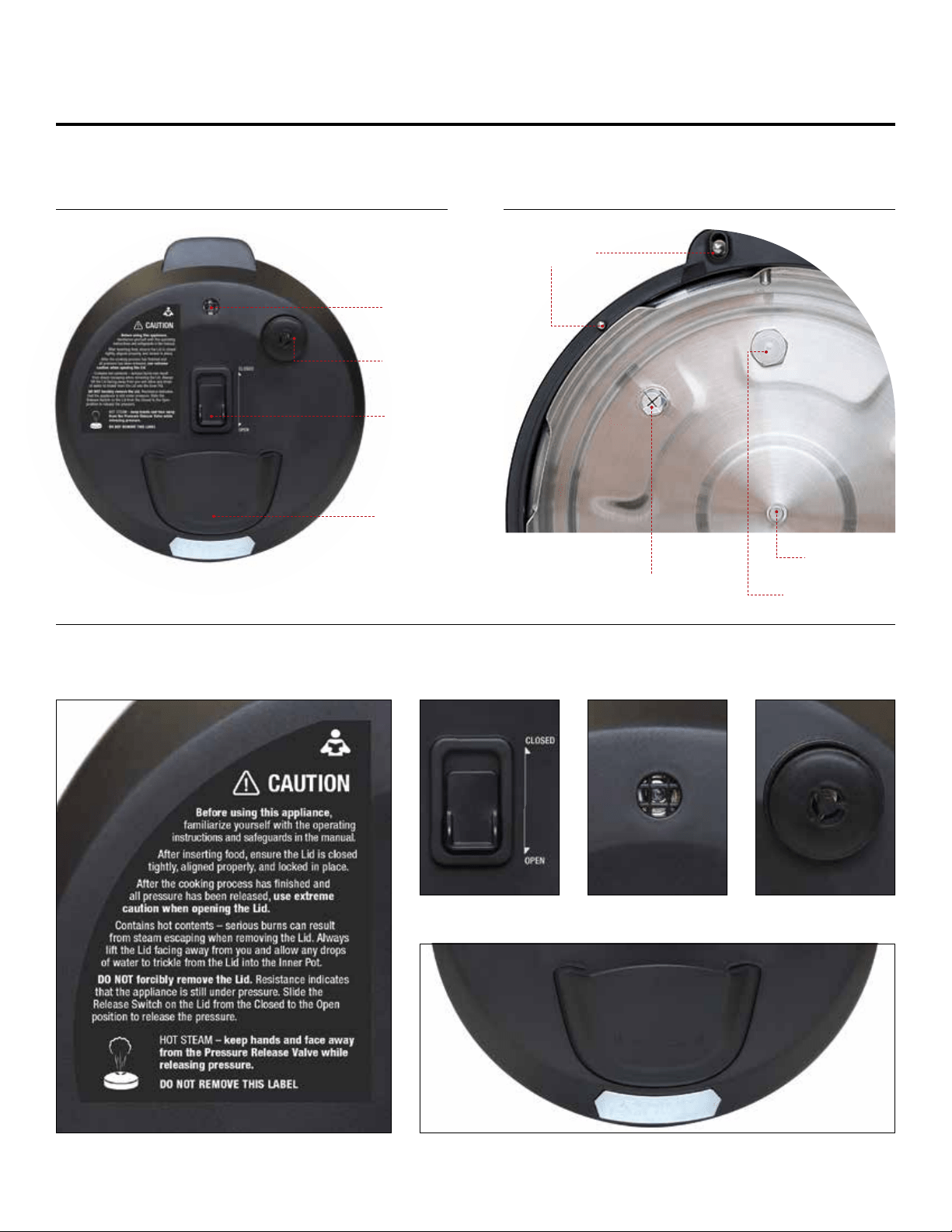
Parts & Accessories
LID – TOP VIEW LID – UNDERSIDE (WITHOUT INNER LID)
Lid Handle
Steam
Release SwitchCaution Label (Do Not Remove)
Pressure
Release Valve
Float Valve
Float Valve
Steam
Release
Switch
Pressure
Release
Valve
Lid Handle
Locking Pins
Center Knob
Float Valve
Rubber Gasket
Pressure Release
Valve (underside)
11
Parts & Accessories
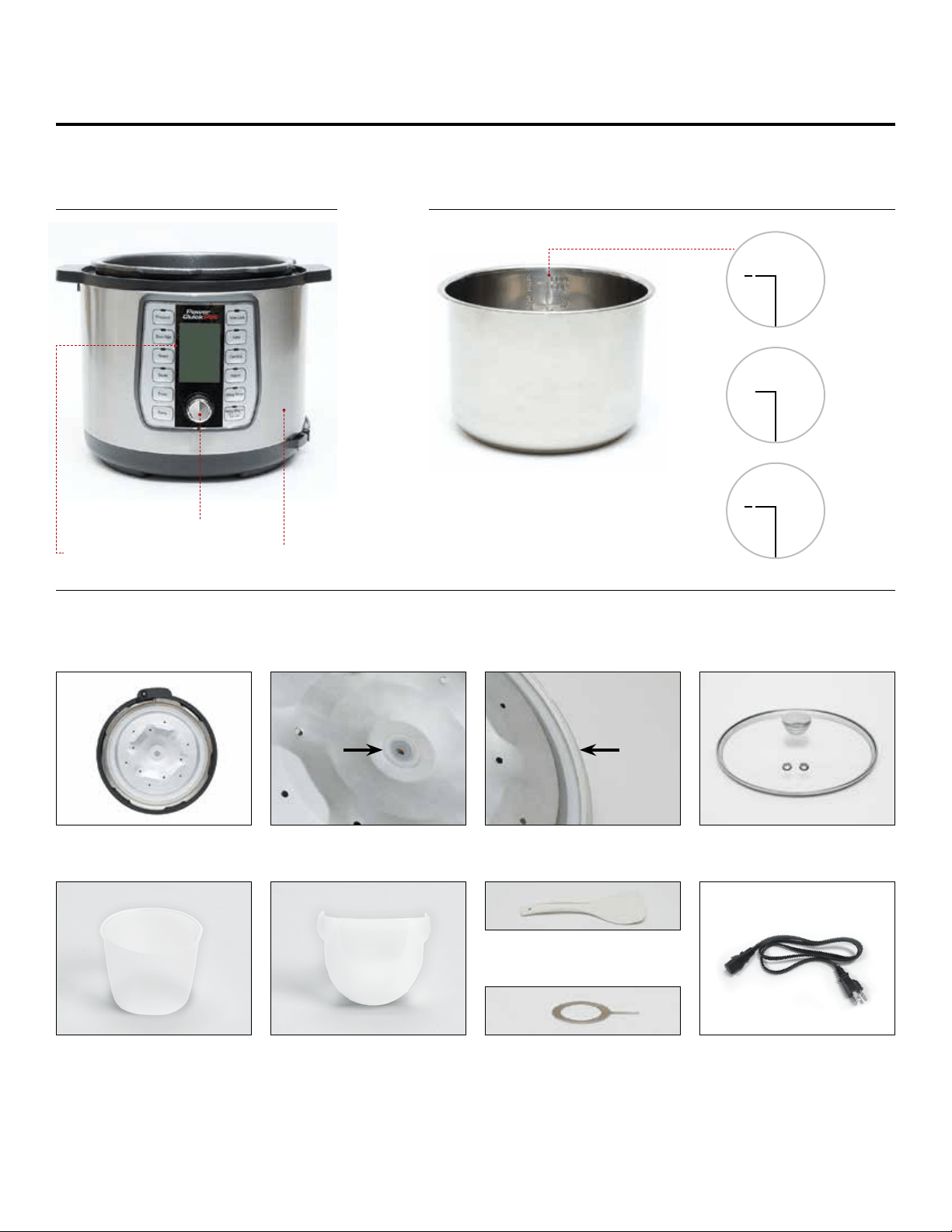
Your Power Quick Pot has been shipped with parts and accessories as shown above.
Check everything carefully before use. If any part appears damaged, do not use
this product and contact Customer Service using the number located in the back
of this manual. For replacement parts, visit www.PowerQuickPot.com.
FRONT STAINLESS STEEL INNER POT
Measuring Cup
Lid Underside
(with Inner Lid)
Condensation Collector
Inner Lid Center Gasket
Ladle
Float Valve Pin
Power Cord
Inner Lid Outer Gasket Glass Lid
LCD Display
Program Dial
Base
The Max Fill Line in the Inner Pot is
represented by "FULL CUP" on some
models and "MAX" on other models.
DO NOT ll past the Max Fill Line.
8 QT.
10 QT.
6 QT.
4
5
4
5
MAX
6L
FULL
CUP
FULL
CUP
RICE
CUP
12
Assembly Instructions
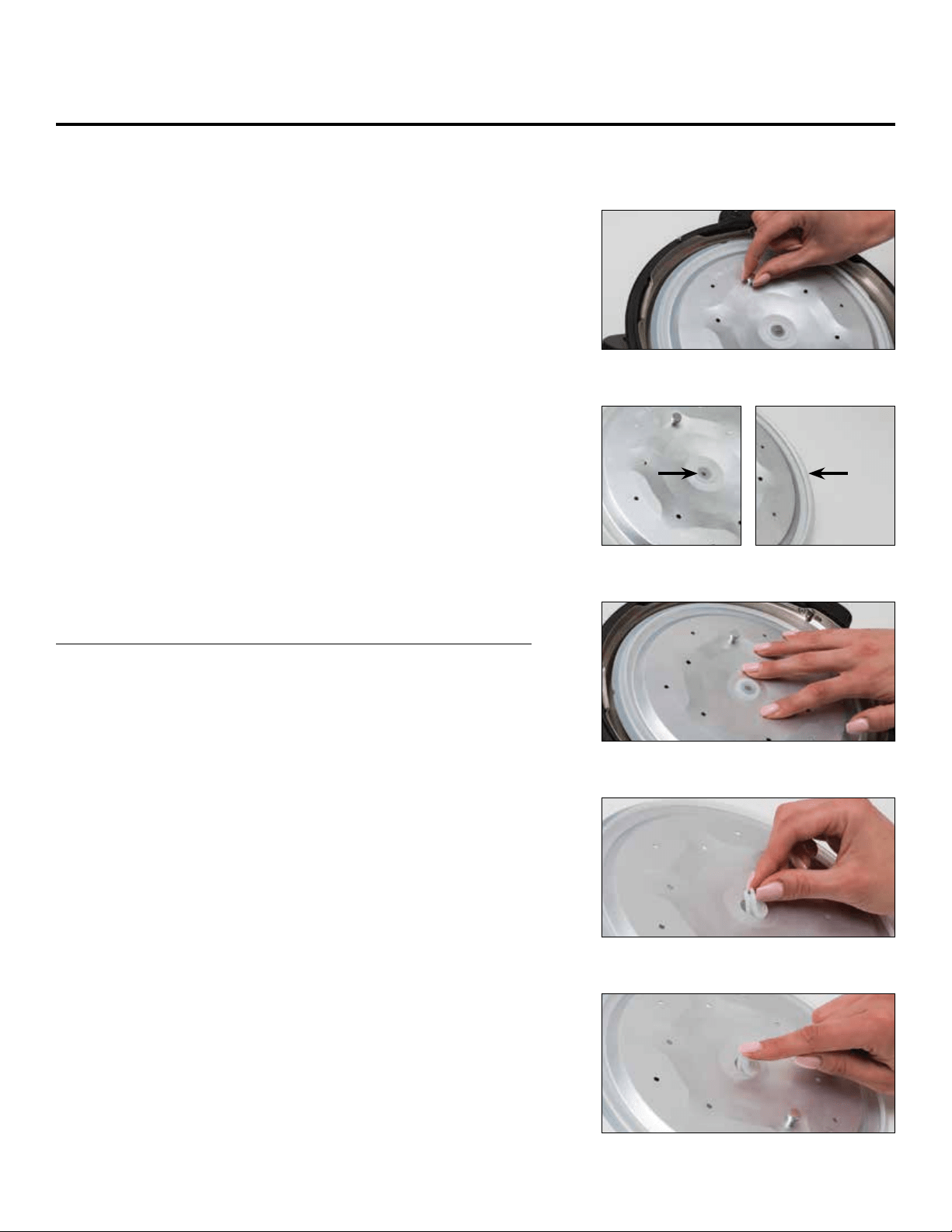
1. Hold the Knob on the underside of the Inner Lid and pull
to remove the Inner Lid (see Fig. i).
1. Hold the Inner Lid Knob on the underside of the Inner Lid
and pull to remove the Inner Lid (see Fig. i).
2. Pull off the Inner Lid Center Gasket (see Fig. iv) and the Inner Lid
Outer Gasket (see Fig. ii-b).
3. Inspect the Inner Lid Rubber Gaskets to ensure that they are clear
of debris. Clean after each use.
4. Place the new or clean Inner Lid Center Gasket in the hole
in the Inner Lid (see Fig. v). Attach the Inner Lid Outer Gasket
to the outside of the Inner Lid. When properly attached, the Inner
Lid Rubber Gaskets should sit evenly.
5. Ensure that the Knob on the Inner Lid is facing outward, away
from the Lid. You should be able to see the Knob.
6. Press the Inner Lid onto the Lid and press the hole on the Inner
Lid onto the Center Knob on the underside of the Lid (see Fig. iii).
7. Ensure that the Inner Lid is facing outward and that the Inner Lid
Rubber Gasket sits correctly and evenly on the Inner Lid.
1. Ensure that the Knob on the underside of the Inner Lid is facing
outward, away from the Lid.
2. Ensure that the Inner Lid Rubber Gaskets are properly attached
to the Inner Lid (see Fig. ii-a & ii-b).
3. Press the hole on the Inner Lid into the Center Knob on
the underside of the Lid (see Fig. iii).
4. Ensure that the Inner Lid is facing outward and that the Inner Lid
Rubber Gaskets sit correctly and evenly on the Lid.
INNER LID ASSEMBLY
REMOVING LID
CHANGING OR CLEANING THE INNER LID
INSERTING INNER LID
FIG. i
FIG. iv
FIG. ii-a
FIG. v
FIG. iii
FIG. ii-b
13
Assembly Instructions
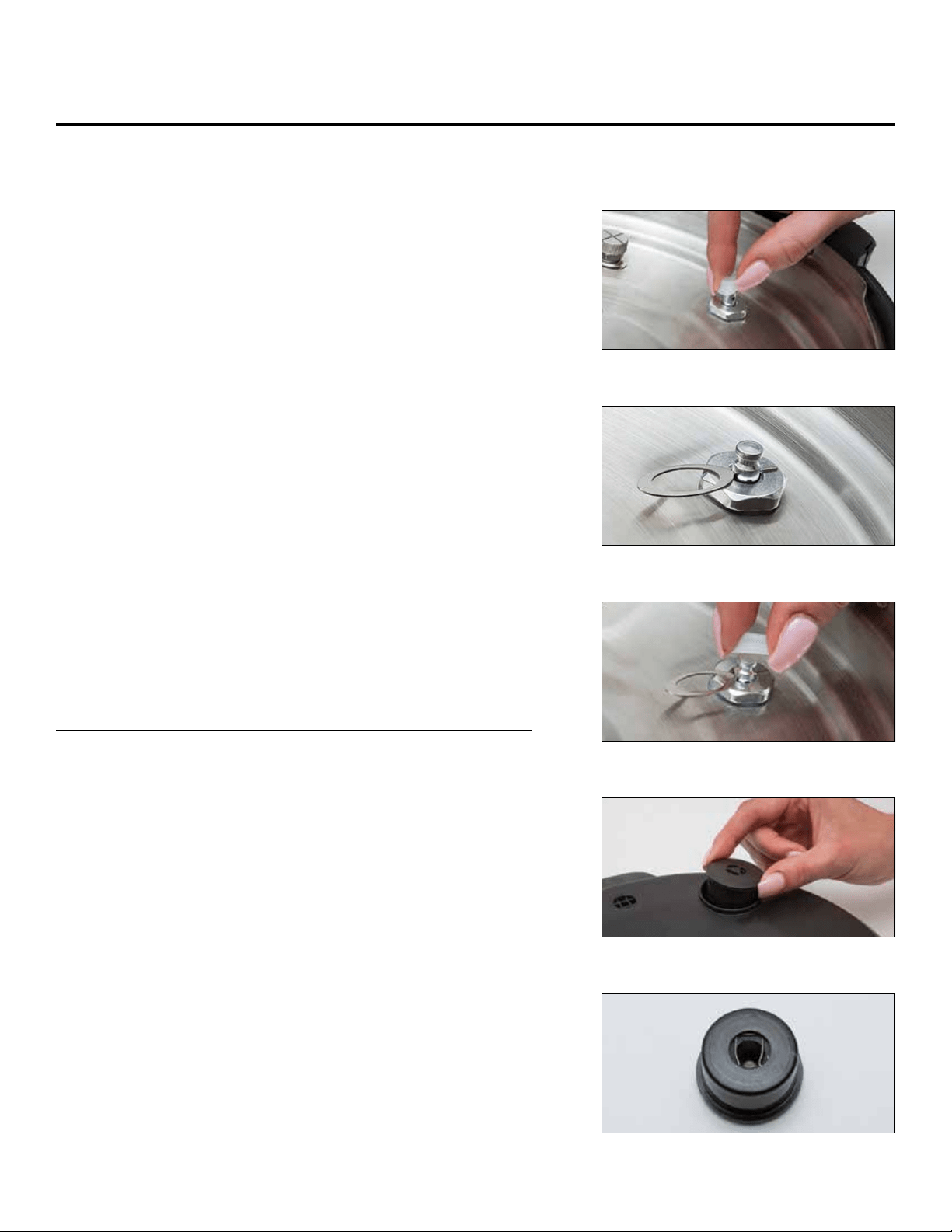
1. Remove the Lid from the Unit and remove the Inner Lid
(see INNER LID ASSEMBLY, p. 12).
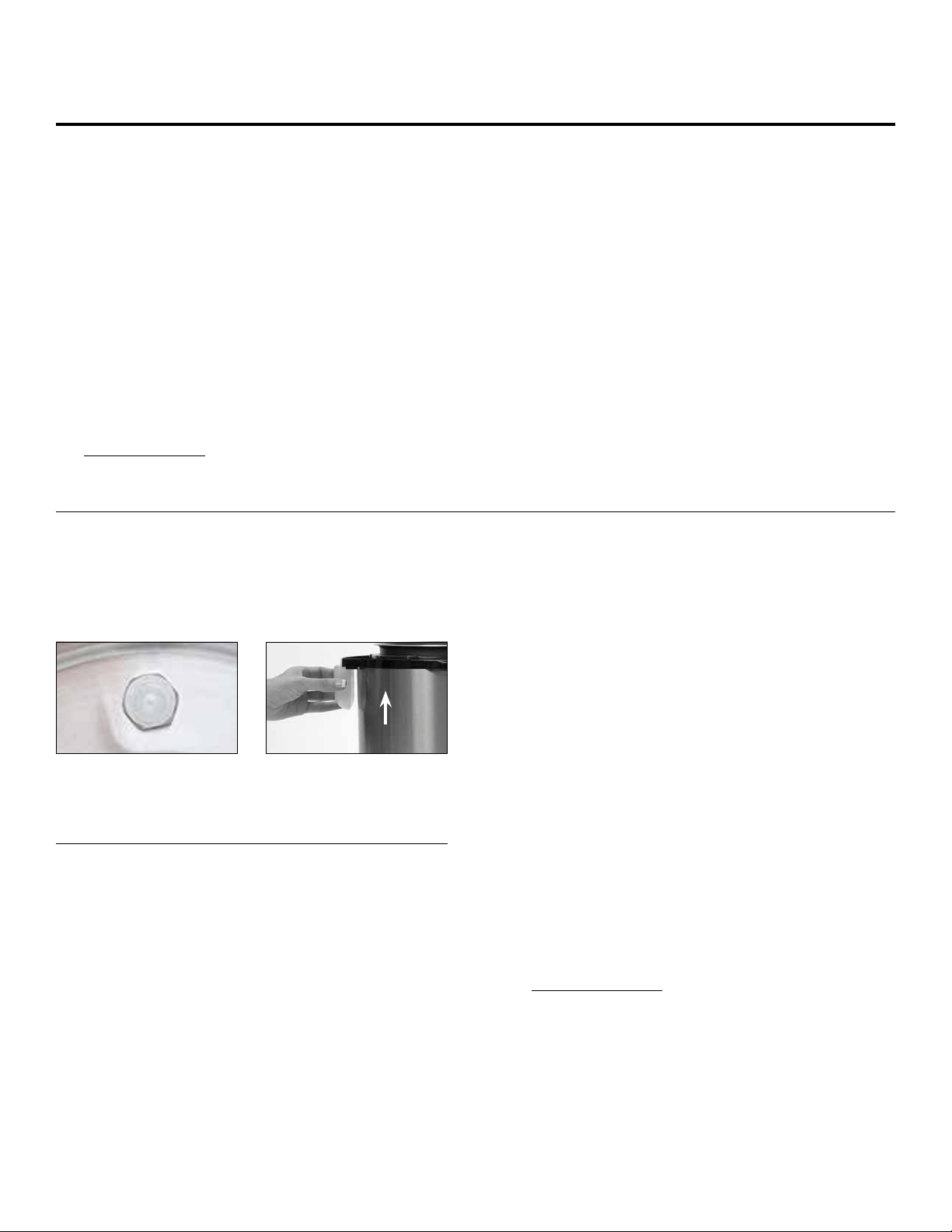
2. Pull off the Rubber Gasket at the bottom of the Float Valve
(see Fig. vi). The Float Valve will be loose in its chamber.
3. Inspect that no food is stuck in the chamber and run water
through the Float Valve Chamber to clean it. Be cautious not
to submerge the whole Lid.
4. When the chamber is clear of debris, turn the Lid right side up
to allow the Float Valve to drop into the Float Valve Chamber on
the underside of the Lid. Turn the lid to the side so you can view
the oat valve
5. Stick the pointed end of the Float Valve Pin into the side hole
of the Float Valve (see Fig. vii).
6. With the Float Valve Pin inserted into the side hole, slide
the Rubber Gasket onto the Float Valve, ensuring that the wider
side of the Rubber Gasket is against the Lid (see Fig. viii).
7. The Rubber Gasket should be snug on the Float Valve.
8. Remove the Float Valve Pin.
NOTE:
Do not attempt to assemble or disassemble the Pressure
Release Valve when the Power Quick Pot is in use.
1. Pull to remove the Pressure Release Valve (see Fig. ix).
2. Ensure that the Pressure Release Valve and holes are not blocked
by food or debris. If blocked, wash out or use a pin to unblock.
3. Look at the clip on the underside of the Pressure Release Valve
(see Fig. x). It should not be damaged or severely bent.
4. Press the Pressure Release Valve back into the hole on the Lid.
If the Valve does not insert correctly, it may have a bent clip.
FLOAT VALVE ASSEMBLY
PRESSURE RELEASE VALVE ASSEMBLY
FIG. vi
FIG. ix
FIG. vii
FIG. x
FIG. viii
14
Instructions for Use
1. Before using, remove parts and accessories
from package and be sure all parts have been
included before discarding any packaging
materials. Remove all packing materials such
as plastic lm, cardboard, and stickers on the
Pressure Release Valve and Condensation
Collector (see PARTS & ACCESSORIES, p. 10).
2. CLEAN INSIDE: Remove the Inner Lid from Lid
by pulling metal knob. Remove Rubber Gaskets
from Inner Lid (see INNER LID ASSEMBLY,
p. 12). Wash Inner Lid, Rubber Gasket, Inner
Pot, and other loose accessories with warm,
soapy water, rinse and dry. NOTE: Be sure
to replace Rubber Gaskets (see CHANGING
THE INNER LID RUBBER GASKETS AND
FLOAT VALVE ASSEMBLY sections) before
reinstalling Inner Lid.
A. PREPARING FOR USE
CHECK PARTS & ACCESSORIES
CONDUCT TEST RUN WITH WATER ONLY
FIG. B
(Condensation Collector)
FIG. A
(Float Valve Rubber Gasket)
4. Remove the Lid. Ensure the Inner Lid gaskets
are in place. Place the Inner Lid Outer Gasket
around the outside of the Inner Lid and the Inner
Lid Center Gasket in the center hole.Make sure
the oat valve and gasket are in place in the lid
(see ASSEMBLY INSTRUCTIONS, p. 12).
5. Place the Inner Pot in the Base. Pour 2 cups
(473mL) of water in the Inner Pot.
6. Attach the Power Cord to the Unit Base rst and
then into wall outlet (see the ATTACHING THE
POWER CORD, p. 5)a. When the Unit is rst
plugged in, “----” will appear on the LED Display.
The Unit is automatically “ON” when plugged in.
7. ATTACHING LID: With the LCD Display facing
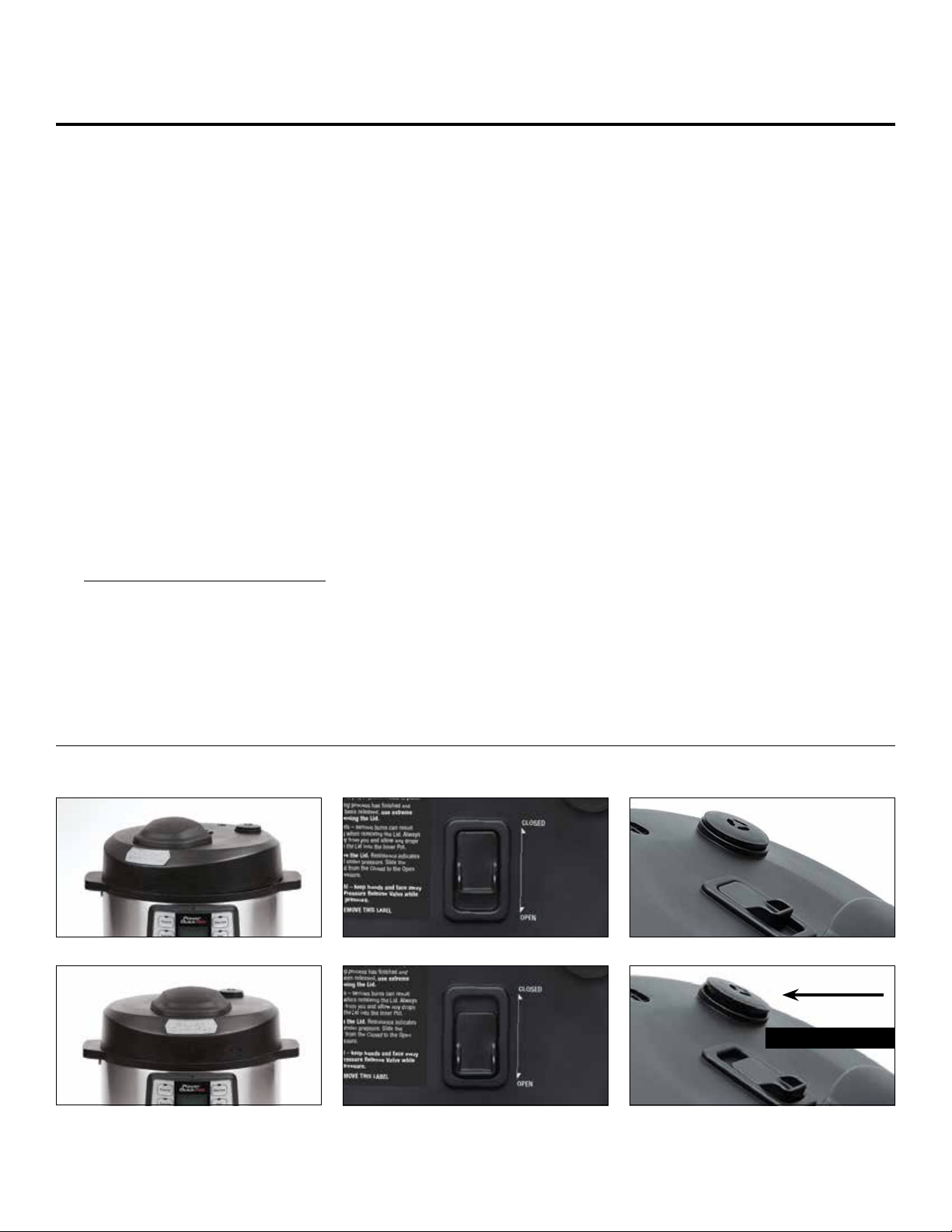
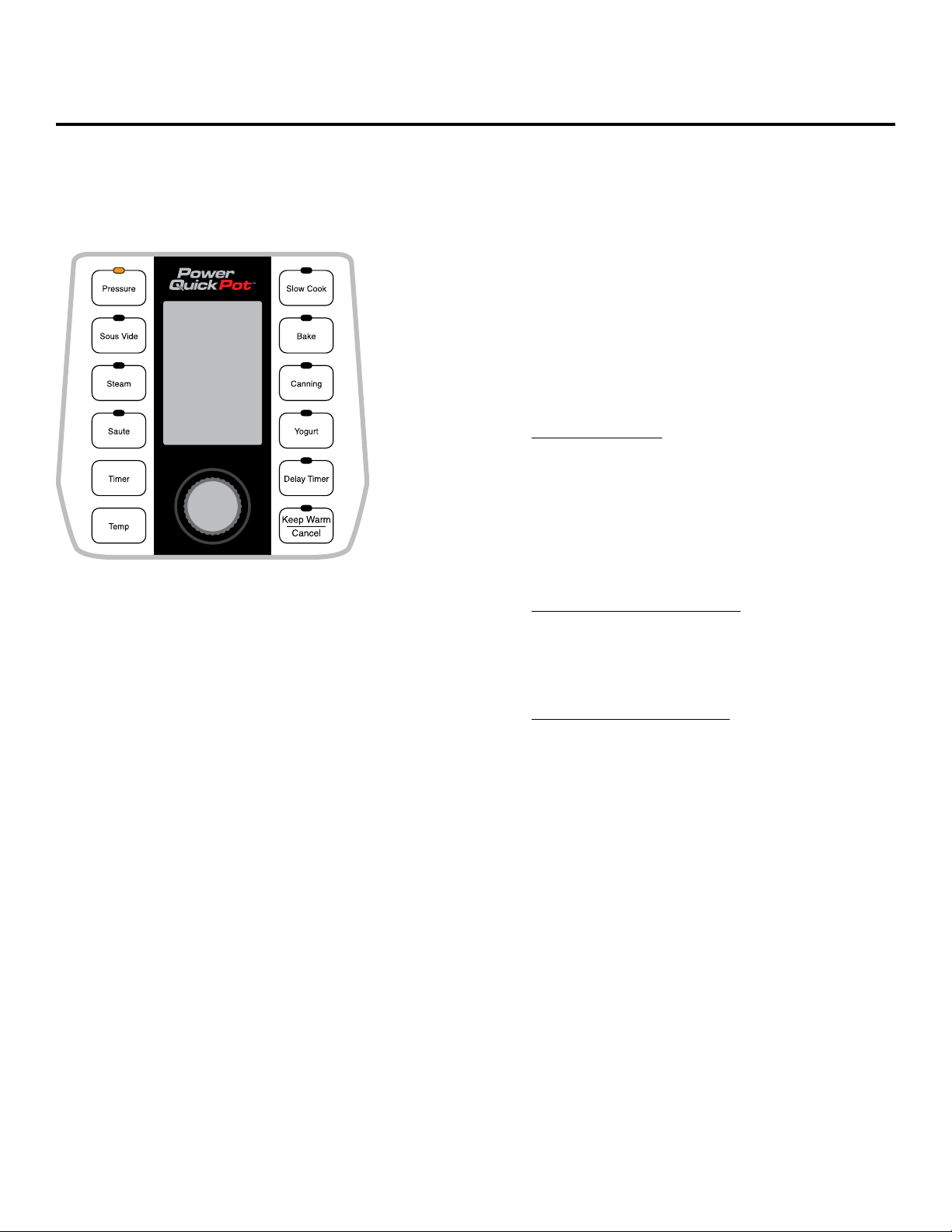
you, place the Lid on the Unit, aligning the Lid
Position Mark with the Open Mark (see Fig.C).
Twist the Lid counterclockwise about 30° (see Fig.
D). When the Lid is locked, the Release Switch will
move to the Closed position (see Fig. E).
1. To check that the Unit will operate properly,
it is recommended to periodically check its
operation without food.
2. Place the Power Quick Pot on a clean, at
surface.
3. Attach Condensation Collector to side of
the Unit by sliding it into the slots (see Fig. B).
NOTE: The Condensation Collector may be
preassembled.
15
Instructions for Use
8. The Magnetic Safety Sensor assures Lid is
properly closed before the Unit can pressurize.
If Lid is not on correctly when starting a cooking
cycle, a beeping noise will occur and the word
“LID” will appear on the display, indicating Lid
is not fully closed.
9. Once Lid is properly attached, select the
Canning Button on the Panel. Turn the Program
Dial to the left to select the Low setting and then
press the Program Dial to conrm the setting.
This setting will automatically set a 10-min.
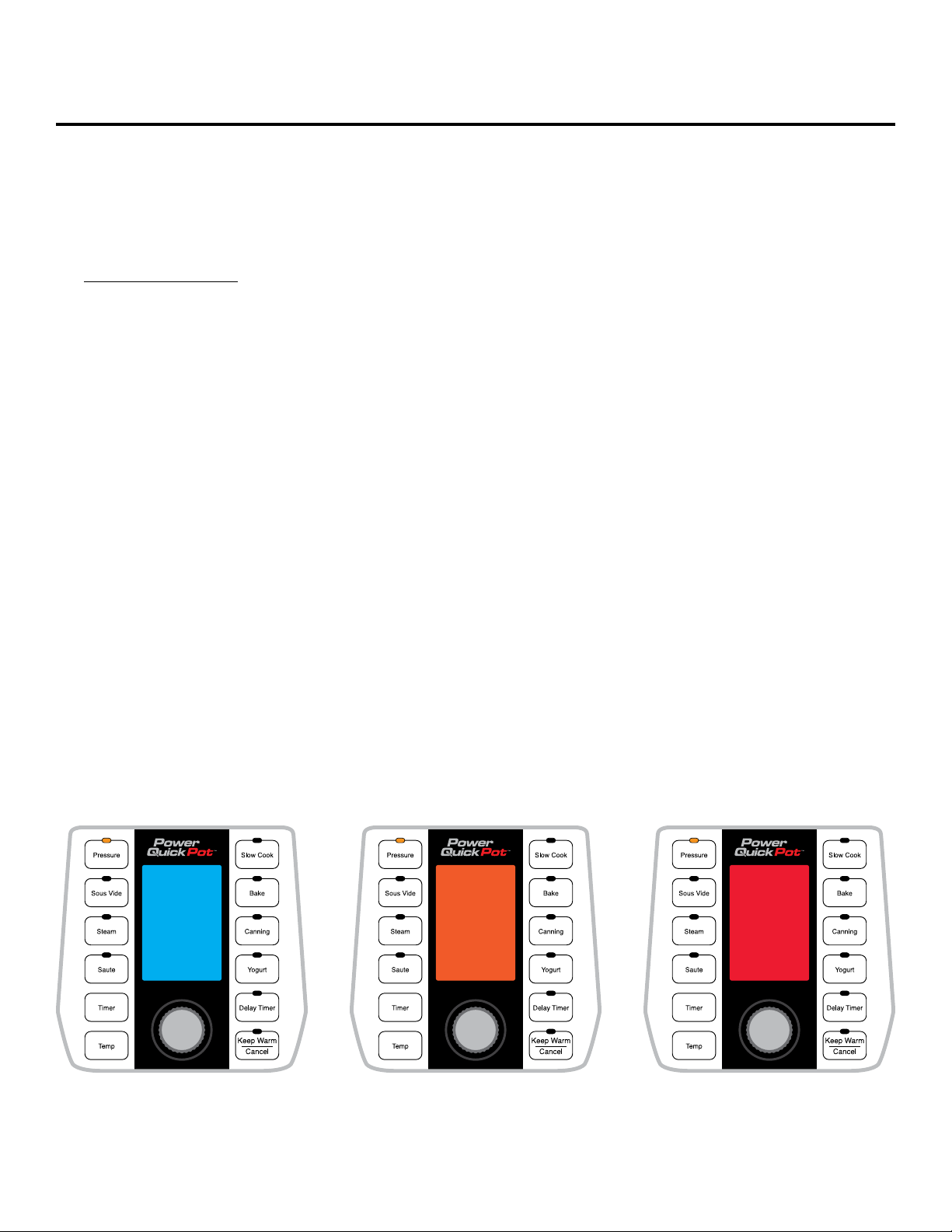
cooking time. The LCD Display will turn orange
while pressure builds in the Unit and will turn red
when the desired pressure level is reached.
CAUTION: DO NOT ATTEMPT TO OPEN LID
WHEN LCD DISPLAY IS ORANGE OR RED.
10. SAFELY RELEASE PRESSURE: Once the
cycle is complete, the Unit will beep. Press
the Cancel Button. Move the Release Switch
from the Closed to the Open position and let go
(see Fig. F). Allow all pressure to escape from
cooker. You will notice a slight incline of the
Pressure Release Valve while pressure is being
released (see Fig. H).
WARNING: Keep body (face, arms, torso)
away from Pressure Release Valve
area when operating the Release Switch
to avoid being exposed to the steam
released from the valve. Follow these safety
precautions when releasing pressure
to prevent serious injury.
11. Allow the water in Inner Pot to cool. Remove
and empty the Inner Pot. Rinse and towel dry.
WARNING: DO NOT LIFT BASE TO REMOVE
CONTENTS from Inner Pot. Do not lift the Inner
Pot from the Base when contents are hot.
NOTE: Do not use metal utensils in the Inner Pot.
WARNING: PREVENT BURNS! DO NOT TOUCH
STAINLESS STEEL EXTERIOR. ONLY USE BLACK
HANDLE ON LID TO OPEN. CONTENTS IN
COOKER ARE HOT. ALWAYS OPEN LID AWAY
FROM FACE AND BODY.
FIG. D (Locked Position)
FIG. C (Open Position)
FIG. F (Open Position)
FIG. E (Closed Position)
FIG. H (Valve is Up and Open)
FIG. G (Valve is Down and Closed)
Note the slight Incline
16
Instructions for Use
handle and twist the Lid clockwise to open the
Lid see OPEN LID in PREPARING FOR USE.
6. Place the Inner Pot in the Base. Add ingredients
to Inner Pot. NEVER LOAD INNER POT ABOVE
THE FULL CUP LINE (see IMPORTANT
SAFEGUARDS, p. 4).
7. ATTACHING LID: With the LCD Display facing
you, place the Lid on the Unit, aligning the Lid
Position Mark with the Open Mark (see Fig.C).
Twist the Lid counterclockwise about 30° (see
Fig. D). When the Lid is locked, the Release
Switch will move to the Closed position (see
Fig. E).
8. SELECT COOKING MODE: You can select
a preprogrammed setting (see part A, p. 18–19).
The LCD Display will turn blue when a program
is selected (see Fig. I).
9. SELECT COOKING TIME: When a cooking
preset button is pressed and a food type
is selected, the LCD Display will show
the default cooking time for that preset.
Some cooking presets feature multiple cooking
options. Turn the Program Dial to the left or right
to choose a preset subcategory. (see part B,
p. 18–19). Press the Program Dial to select
the subcategory.
10. Turn the Program Dial to the left or right
to switch between LOW, MED, or HIGH cooking
settings and press the Program Dial to select
(see part C, p. 18).
11. Alternatively, you can select the Timer (see part
D, p. 18–19) and Temperature (see part E, p.
18–19) Buttons to manually adjust the cooking
time and temperature for most presets.
B. OPERATING INSTRUCTIONS
IMPORTANT: Any function can be stopped
immediately by pressing the Cancel Button.
1. Review PREPARING FOR USE (see p. 14)
to be comfortable with the Unit.
2. Place the Power Quick Pot on a clean, at
surface.
3. Attach Condensation Collector to side
of the Unit (see Fig. B).
4. Attach the Power Cord rst into the Power
Quick Pot and then into a wall outlet (see
ATTACHING THE POWER CORD, p. 5). When
the Unit is rst plugged in, “----” will appear on
the LED Display. The Unit automatically powers
on when plugged in.
5. Open the Lid by sliding and letting go of
the Steam Release Switch from the Closed
position to the Open position. Then, grab the
17
Instructions for Use
12. Once a cooking time and temperature have been
conrmed, the LCD Display will turn orange (see
Fig. J).
13. USE DELAY TIMER: The Delay Timer lets you
delay the beginning of the cooking cycle.
To use the Delay Timer, select a cooking time
and temperature. Instead of pressing the Program
Dial to conrm the time and temperature, press
the Delay Timer Button. Then, use the Program
Dial to select the desired time delay and press
the Program Dial to conrm the setting.
NOTE: Using a delay time of more than 2 hrs.
is not recommended.
14. For pressure cooking settings, once the inside
of the Power Quick Pot has reached the desired
pressure level, the LCD Display will turn red (see
Fig. K).
NOTE: DURING THIS TIME OR ANY TIME
DURING THE COOKING CYCLE, DO NOT
ATTEMPT TO MOVE THE UNIT OR OPEN
THE LID.
15. At completion of the cooking cycle, the Unit will
“beep” and enter Keep Warm mode until manually
cancelled by pressing the Cancel Button.
NOTE: Foods kept at Keep Warm mode for longer
than 6–8 hrs. may lose their avor and texture
and can be a food concern.
NOTE: When using the Keep Warm setting,
when the cooking cycle is complete, the screen
will remain Red until the temperature drops
to the Keep Warm holding temperature (160° F).
Then, the screen will turn Blue.
16. Open and remove the Lid by moving the Steam
Release Switch to the Open position and then
letting go. The Pressure Release Valve should
move from the Closed position to the Open
position (see Fig. H), releasing pressurized steam.
Next, grab the handle and twist the Lid clockwise
approximately 30°.
If pressure and steam are being released, wait
until all the pressure and steam are released
before trying to open the Lid. Do not force the Lid
open until all the pressure is released, which may
take several minutes.
FIG. I (standby) FIG. J (preheating) FIG. K (fully heated)

18
Preset Cooking Programs
PRESET LOW
Default Cook Time
MED
Default Cook Time
HIGH
Default Cook Time
COOK TIME
Adjust Range (Increments)
TEMP
Adjust Range (Increments)
Pressure
CUSTOM 10 mins. 30 mins. 60 mins. 1–120 mins. (1 min.) -
BEEF 15 mins. 30 mins. 90 mins. 1–90 mins. (1 min.) -
POULTRY 10 mins. 30 mins. 45 mins. 1–59 mins. (1 min.) -
FISH 2 mins. 3 mins. 10 mins. 1–59 mins. (1 min.) -
PORK 15 mins. 30 mins. 90 mins. 1–90 mins. (1 min.) -
RIBS 20 mins. 30 mins. 90 mins. 1–90 mins. (1 min.) -
VEGETABLES 2 mins. 6 mins. 12 mins. 1–59 mins. (1 min.) -
BEANS 5 mins. 20 mins. 30 mins. 1–59 mins. (1 min.) -
EGG 2 mins. 4 mins. 6 mins. 1–59 mins. (1 min.) -
BARLEY - 6 mins. - 1–59 mins. (1 min.) -
QUINOA - 4 mins. - 1–59 mins. (1 min.) -
RISOTTO 6 mins. 8 mins. 10 mins. 1–59 mins. (1 min.) -
WHITE RICE 6 mins. 8 mins. 10 mins. 1–59 mins. (1 min.) -
BROWN RICE - 18 mins. - 1–59 mins. (1 min.) -
Sous Vide
BEEF 1 hr. 5 hrs. 12 hrs. 1–24 hrs. (5 mins.) 95–195° F (5° F)/35–90° C (5° C)
POULTRY 45 mins. 1 hr. 90 mins. 30 mins.–24 hrs. (5 mins.) 95–195° F (5° F)/35–90° C (5° C)
FISH 20 mins. 40 mins. 1 hr. 20 mins.–24 hrs. (5 mins.) 95–195° F (5° F)/35–90° C (5° C)
PORK 1 hr. 3 hrs. 5 hrs. 30 mins.–24 hrs. (5 mins.) 95–195° F (5° F)/35–90° C (5° C)
VEGETABLES 10 mins. 1 hr. 2 hrs. 10 mins.–3 hrs. (5 mins.) 95–195° F (5° F)/35–90° C (5° C)
EGG/CUSTARD 45 mins. 1 hr. 2 hrs. 30 mins.–3 hrs. (5 mins.) 95–195° F (5° F)/35–90° C (5° C)
• The default temperature for the Sous Vide, Sauté, and Slow Cook presets are 140°, 340°, and 195° F (60°, 170°, and 90° C),
respectively.
• The maximum time the cooking cycle can be delayed with the Delay Timer Button for all presets is 24 hrs. (with increments
of 10 mins.). When cooking perishable food (meat, fish, chicken, etc.), you should not delay the cooking cycle for more than
2 hrs.
• The Keep Warm function for all presets (except Sous Vide and Yogurt) lasts for a maximum time of 24 hrs. Foods kept at Keep
Warm mode for longer than 6–8 hrs. may lose their flavor and texture and can be a food concern.
• Consult recipes to use the appropriate liquid amount when cooking. It is not recommended to cook dry contents unless using
the Sauté function.
• It is recommended to use the Glass Lid to maintain a consistent temperature during the Sous Vide, Steam, Sauté, Slow Cook,
and Yogurt cooking cycles.
NOTES
A (B) C D E

19
Preset Cooking Programs
PRESET LOW
Default Cook Time
MED
Default Cook Time
HIGH
Default Cook Time
COOK TIME
Adjust Range (Increments)
TEMP
Adjust Range (Increments)
Steam
FISH 5 mins. 10 mins. 15 mins. 1–59 mins. (1 min.) -
EGGS (poach) 3 mins. 9 mins. 15 mins. 1–59 mins. (1 min.) -
VEGETABLES 15 mins. 25 mins. 35 mins. 1–59 mins. (1 min.) -
Sauté
BEEF - 20 mins. - 1–59 mins. (1 min.) 95–360° F (5° F)/35–182° C (5° C)
POULTRY - 20 mins. - 1–59 mins. (1 min.) 95–360° F (5° F)/35–182° C (5° C)
FISH - 20 mins. - 1–59 mins. (1 min.) 95–360° F (5° F)/35–182° C (5° C)
PORK - 20 mins. - 1–59 mins. (1 min.) 95–360° F (5° F)/35–182° C (5° C)
RIBS - 20 mins. - 1–59 mins. (1 min.) 95–360° F (5° F)/35–182° C (5° C)
VEGETABLES - 10 mins. - 1–59 mins. (1 min.) 95–360° F (5° F)/35–182° C (5° C)
Slow Cook
BEEF 4 hr. 6 hrs. 10 hrs. 1–12 hrs. (15 mins.) 195–212° F (1° F)/90–100° C (1° C)
POULTRY 4 hr. 6 hrs. 10 hrs. 1–12 hrs. (15 mins.) 195–212° F (1° F)/90–100° C (1° C)
PORK 6 hr. 8 hrs. 10 hrs. 1–12 hrs. (15 mins.) 195–212° F (1° F)/90–100° C (1° C)
RIBS 6 hr. 8 hrs. 10 hrs. 1–12 hrs. (15 mins.) 195–212° F (1° F)/90–100° C (1° C)
VEGETABLES 1 hr. 2 hrs. 4 hrs. 1–12 hrs. (15 mins.) 195–212° F (1° F)/90–100° C (1° C)
Bake
- 10 mins. 25 mins. 40 mins. 1 min.–1 hr. (1 min.) -
Canning
ALT (on/off) 10 mins. 1 hr. 2 hrs. 5 mins.–3 hrs. (5 min.) -
Yogurt
- 5 hrs. 7 hrs. 9 hrs. 4–10 hrs. (15 mins.) -
A (B) C D E

20
Sous Vide
Using traditional cooking methods, heat is
transferred from a hot burner or oven to a pan
and then to your food, where it heats from the
outside to the middle. Using guesswork and a little
luck, you sometimes get good results, but the food
is often overdone on the outside and sometimes
undercooked toward the center. The heat generated
by a pan or air inside an oven is usually much hotter
than it needs to be. If you don’t remove the food at
precisely the right time, results will be inconsistent.
Sous vide cooking utilizes precise temperature
control to produce results that you can’t achieve
through any other cooking technique. Simply set
up the Power Quick Pot as shown in this manual;
place your seasoned food in a slider, snap shut,
or vacuum-sealable food storage bag; place the
bag in the water and set the time and temperature.
That’s it! Your food will cook to its perfect doneness
every time. Once cooked, you can leave the food
in the water bath until you are ready to serve.
NOTE: Is it suggested not to keep food heated
at the temperature beyond the completion of its
cooking cycle.
1. Put seasoned food in a sealable bag(s).
2. Remove as much air as possible from
the bags(s) before sealing. You may use
a vacuum sealer for best results.
3. Pour water into the Inner Pot, being careful not
to add so much water that the water passes
the FULL CUP Line when the bags are added.
NOTE: You can place the food bags in the Inner
Pot rst and then add the water to ensure that
the water does not ll above the FULL CUP
Line. Then, remove the bags before beginning
the cooking cycle and preheating the water.
4. Press the Sous Vide Button and use the
Program Dial to choose the desired cooking
preset time. You may choose between LOW,
MED, or HIGH default TIME SETTINGS.
Or press the Timer Button to adjust the time
to a custom time setting. Then press the Temp
Button to adjust the cooking temperature
to your desired temperature.
NOTE: The LOW, MED, and HIGH settings
are default times. You still need to adjust
the temperature to the desired doneness.
5. Press the Program Dial to begin cooking cycle.
The LCD Display will turn orange. Once the
desired cooking temperature has been reached,
Unit will beep and the timer will begin counting
down.
6. Carefully place the food bag in the water.
Make sure you don't drop the bag in the water.
7. Once the timer has completed, the LCD Display
will turn blue and the Unit will maintain the
desired temperature (DO NOT press the Keep
Warm Button). Use tongs to remove the sealed
bag with food. Do not use your hands because
the water will be hot.
OPERATING INSTRUCTIONS

21
SOUS VIDE TIPS
NOTE: Do not place food in the water without
placing it in a sealable bag.
• You may add seasonings and rubs to food
before bagging.
• Always use BPA-free vacuum-seal
or snap seal food storage bags for cooking.
• The thickness of meat, poultry, or fish will
determine the cooking time. Use a food
thermometer after removing food from
the bag to guarantee that a safe food
temperature has been reached.
• For health and safety, if unsure of doneness,
add 30 mins. to the cooking time (for
example, to pasteurize eggs or poultry).
• Searing after cooking gives foods the right
look, cooking temperature, and a crispy
texture. To achieve this, toss butter into
a smoking-hot skillet and quickly sear
cooked meat for 30 secs. on each side.
• Ensure that the sealed bag with food
is constantly submerged so the food is fully
cooked. Clip a food-safe or sous vide weight
(not included) to the food bag.
• Cook fruit to make toppings, purées,
and syrups. Cook for 2–2½ hrs. at 160° F
and let cool in the bag before using.
Sous Vide
FOOD TEMP. TIME
Beef
Rare 125° F 1 hr. 15 mins.
Medium Rare 135° F 1 hr. 15 mins.
Medium 140° F 1 hr. 15 mins.
Medium Well 150° F 1 hr. 15 mins.
Well Done 160° F 1 hr. 15 mins.
Rib Roast – Med. 140° F 6–14 hr.
Pork
Roast 155° F 3 hrs.
Chops – Medium 145° F 1 hr.
Chops – Well Done 160° F 1 hr.
Poultry
Chicken Breast 150° F 1 hr.
Dark Meat 165° F 1 hr.
Fish
Filet or Steak 125° F 45 mins.
Eggs
Poached 150° F 1 hr.
Vegetables
Green Vegetables 180° F 5–20 mins.
Root Vegetables 180° F 1.5–3 hrs.
SUGGESTED TIMES & TEMPERATURES

22
Yogurt
1. Place the Inner Pot in the Base.
2. Pour 2 qts. of whole or 2% milk into the Power
Quick Pot’s Inner Pot.
3. Press the Yogurt Button. The LCD Display
will show "7:00." Press the Program Dial
to accept the program. Use the dial to choose
between the default preset time settings
or press the Timer Button to set a custom time.
Press the Dial to conrm the time.
4. Once the Unit reaches 180° F, the Unit will
maintain the temperature. Then, the Unit will
stop heating and the LCD Display will show
“COOL.”
5. Once the milk reaches 110° F, the Power Quick
Pot will beep and the LCD Display will show
"ADD."Using a ladle or measuring cup, remove
1 cup of milk from the Inner Pot. Mix the 1 cup
milk with yogurt or yogurt starter. Then, return
the milk mixture into the Inner Pot with
the remaining heated milk and stir gently.
6. Press the Yogurt Button. Use the Program
Dial and the Timer Button to adjust the time
if needed. Press the Program Dial again
and the timer will begin counting down.
NOTE: If the Yogurt Button is not pressed,
the Unit will beep continuously, and the Power
Quick Pot will return to standby mode.
7. Place the Glass Lid back on the Power Quick
Pot.
8. Leave the Power Quick Pot undisturbed,
allowing the yogurt to incubate for 4–10 hrs.
9. Once the incubation is complete, press the
Cancel Button, remove the yogurt, and store
in a container in the refrigerator.
THE YOGURT-MAKING PROCESS
• The incubation process can be shorter
(as low as 4 hrs.) or longer (as long as 10 hrs.)
depending on the desired thickness of the
yogurt. Longer incubation periods produce
thicker, tarter yogurt.
• For thicker, Greek-style yogurt: After incubation,
spoon the yogurt into a cheesecloth-lined
colander set over a bowl and let the yogurt drain
for at least 1 hr. (potentially overnight) in
the refrigerator. Discard or reserve the whey
that drains from the yogurt.
• Yogurt can be stored in the refrigerator in
covered glass, ceramic, or plastic containers
for up to two weeks (the flavor will be best
|within the first week).
TIPS

23
General Pressure Cooking Time Charts
Meat Liquid Amount
(cups)
Approx.
Time (min.)
Beef/veal, roast or brisket 3–4 35–40
Beef, meatloaf (2 lb) 1 10–15
Beef, corned 4 50–60
Pork, roast 1 40–45
Pork, ribs (2 lb) 3 20
Leg of lamb 2–4 35–40
Chicken, whole (2–3 lb) 3–4 20
Chicken, pieces (2–3 lb) 3–4 15–20
Cornish hens, two 1 15
Meat/poultry soup/stock 4–6 15–20
Seafood/Fish Liquid Amount
(cups)
Approx.
Time (min.)
Clams 1 2–3
Lobster (1 ½–2 lb) 1 2–3
Shrimp 1 1–2
Fish, soup, or stock 1–4 5–6
Vegetable Liquid Amount
(cups)
Approx.
Time (min.)
Asparagus, thin whole 1 1–2
Beans, fava 1 4
Beans, green 1 2–3
Beans, lima 1 2
Beets, medium 1 10
Broccoli, pieces 1 2
Brussels sprouts, whole 1 4
Carrots, 1-in. pieces 1 4
Corn, on the cob 1 3
Pearl onions, whole 1 2
Potatoes, 1 ½-in. chunks 1 6
Potatoes, whole, medium 1 10–11
Squash, acorn, halved 1 7
Squash, summer, zucchini 1 4
NOTE: All pressure cooking modes require
the addition of liquid in some form (water, stock,
etc.). Unless you are familiar with the pressure
cooking process, follow recipes carefully for liquid
addition suggestions.
NOTE: A minimum of 1 cup of liquid is needed
to build pressure.

24
Frequently Asked Questions
1. What is the material of construction?
This appliance has a stainless steel housing
and Inner Pot.
2. How do you assemble/disassemble the Unit?
This appliance comes fully assembled with Float
Valve, Pressure Release Valve, and Inner Lid.
Attach Condensation Collector before operation
(see PREPARING FOR USE, p. 14).
3. What is the default time?
Each cooking mode has a default time
that appears as soon as you select a desired
program button. Before the timer on the LCD
Display begins counting down, the appliance
must rst reach the proper pressure and/or
temperature for that mode.
4. How long does it take for the Unit to reach
full pressure and for the cook time clock
to start a countdown?
When the Unit reaches the desired cooking
pressure, the LCD Display will change color
from orange to red and the cooking time will
begin counting down. The time required
to reach the desired pressure setting depends
on the volume, concentration, and ratios of solid
to liquid in the Unit – generally 5–40 mins.
5. Can you change the cook time from
the default setting?
Yes! You can change the cook time two ways.
Select LOW, MED, or HIGH. These
are preprogrammed settings that will give
a predetermined time. Alternatively, select
the Time Button to adjust the cooking time
to suit your needs.
6. Can you leave the Unit on while not at home?
The Power Quick Pot has a delayed start
function, but leaving the Unit on while not
at home is not recommended.
7. Can you put frozen foods in Unit without
defrosting?
Yes! Remember to add an average of 10 extra
mins. to the cooking time when cooking frozen
meals.
8. Can I cook with oil in the pressure cooker?
No! Do not attempt to pressure fry in
the Power Quick Pot. The Unit does not have
safety measures to prevent oil fumes
and re. Pressurized oil fumes are very
dangerous and can cause an explosion.
9. How do I turn off the Unit?
Press the Cancel Button on the Control Panel
and unplug the Power Cord from the wall outlet
and the Unit Base.

25
Care & Cleaning
CAUTION
Any leftover food or debris remaining in the Unit
could prevent safety devices from operating
correctly during subsequent use!
FOLLOW THESE CLEANING INSTRUCTIONS
AFTER EACH USE.
1. Allow Unit to cool to room temperature before
cleaning. Do not attempt to clean a hot Power
Quick Pot!
2. Unplug the Power Cord from the wall and then
from the Unit Base.
3. Clean exterior of the Unit with soft, damp cloth
or paper towel. Do not immerse the Unit Base
in water or pour water into housing.
4. Unlock the Pressure Release Valve by moving
the Steam Release Switch to the Open position
and let go. Wash with mild, soapy water
and rinse well. Use a small pin if necessary to
remove any blockages that may have occurred
during cooking process. Check to see that the
interior spring-loaded part moves freely
by pressing down on it. Check to see that it is
free from debris.
5. Clean the Lid and Inner Lid (see INNER LID
ASSEMBLY, p. 12). Remove the Inner Lid
Rubber Gaskets from the Inner Lid. The Inner
Lid Rubber Gaskets must be washed separately
with a sponge or soft cloth and warm, soapy
water. Reattach the Inner Lid Rubber Gasket
Rubber Gasket to the Inner Lid.
NOTE: Check periodically to make sure the
Rubber Gasket is clean, exible, and not torn.
If damaged, replace before operating Unit (see
INNER LID ASSEMBLY, p.12).
6. Rinse upper and underside of Lid with warm
water, making sure the Float Valve and Pressure
Release Valve are free from debris. Both valves
should be able to move up and down freely,
with the Float Valve stopping only when the
Float Valve Rubber Gasket meets the Lid. Dry.
7. Attach the Inner Lid to the Lid. Improper
placement of the Inner Lid will prevent
the Lid from closing properly. (see INNER LID
ASSEMBLY, p. 12).
8. Remove the Inner Pot after every use.
The Inner Pot is dishwasher safe, but to prolong
its use, you should wash it by hand using warm,
soapy water and a soft cloth or sponge.
Rinse and towel dry. Do not use harsh chemicals
or scouring pads.
9. To clean the condensation collector, slide
to remove it; clean with warm, soapy water;
and then reattach it.
10. Customer Service should be contacted for any
questions or parts (see the back of this manual
for contact information).
NOTE: The following parts can be placed
in dishwasher: Inner Pot, Measuring Cup,
Spoon. We recommend hand washing all
parts to prolong the life of the components.

26
Troubleshooting
Symptom Possible Cause Solution
Cannot Open Lid DO NOT FORCE OPEN.
Lid Does Not Lock
Inner Lid Rubber Gasket is not properly
installed
Reinstall Inner Lid Rubber Gasket.
Cannot Open Lid after
Pressure is Released
Float Valve and Pressure Release Valve
are still raised
Ensure the Pressure Release Valve is open, the Steam Release Switch
is in the Open position, and you have let go of the Steam Release Switch.
CAUTION: Hot steam may be released during this process. Do not place
face near valve opening.
Air Escapes from Rim
of Lid and Pressure will
Not Increase
Lid is put on incorrectly Read Instruction for Use, specic to Lid placement.
Inner Lid Rubber Gasket was not
installed or was not installed properly
Install Inner Lid Rubber Gasket.
Food residue remains on Inner Lid
Rubber Gasket
Clean Inner Lid Rubber Gasket.
Inner Lid Rubber Gasket is damaged
or worn out
Replace Inner Lid Rubber Gasket. Contact Customer Service
for assistance (see the back of the manual for contact information).
for replacement parts.
Air Escapes from Float
Valve During Operation
Food is stuck on Float Valve Rubber
Gasket
Clean Float Valve Rubber Gasket
Float Valve Does
Not Rise
Float Valve Rubber Gasket is worn out
Replace Float Valve Rubber Gasket. Contact Customer Service
for assistance (see the back of the manual for contact information).
Appliance is not lled with enough food
or water
Check recipe for proper quantities of solids and liquids.
Air is escaping from rim of Lid and/or
from Pressure Release Valve
Contact Customer Service for assistance (see the back of the manual
for contact information).
Float Valve not assembled correctly
Float Valve should be able to move up and down, stopping only when
its Rubber Gasket meets the Lid interior. Ensure that its Rubber Gasket
is clean and the Float Valve can move freely.*
Unit Turns Off
Unexpectedly
Appliance is overheated Unplug and let the Unit cool for 30 mins. in order to reset.
Display Reads “LID” and
Beeping Sound Occurs
Lid not positioned correctly or not fully
closed
Adjust Lid by following ATTACHING LID in PREPARING FOR USE, p. 14.
NOTE: Non-pressure programs require the Glass Lid and not the main Lid.
Lid does not open Lid is put on incorrectly
DO NOT FORCE LID OPEN. Unplug and then let the Unit cool down.
Then, attempt to remove the Lid again.
*NOTE: If necessary to reassemble Float Valve (see FLOAT VALVE ASSEMBLY, p. 13).

27
Troubleshooting
Unit Specications
Error Code Cause of Error Solution
E1 Bottom sensor open Contact Customer Service*
E2 Bottom sensor short circuit Contact Customer Service*
E3 Unit has overheated Let the Unit cool down before use
E4 Pressure switch malfunction Contact Customer Service*
LID Wrong Lid Attach the correct Lid before use
DISPLAY ERROR INDICATOR
NOTE: DO NOT use or attempt to repair a malfunctioning appliance.
*See the back of the manual for Customer Service contact information.
Model
Number
Supply
Power
Rated
Power
Capacity
of Inner Pot
Working
Pressure
Safety Working
Pressure
Y4D-36 AC 120V 60HZ 800W 4 qt. 0–80 kPa 80–90 kPa
Y6D-36 AC 120V 60HZ 1200W 6 qt. 0–80 kPa 80–90 kPa
Y8D-36 AC 120V 60HZ 1300W 8 qt. 0–80 kPa 80–90 kPa
Y10D-36 AC 120V 60HZ 1400W 10 qt. 0–80 kPa 80–90 kPa

28
Canning Guide
CAUTION
Improper canning can lead to serious health
consequences. It is important to read this guide
carefully and follow all steps to ensure that food
is processed to preserve its nutritional value
and is safe for consumption.
The canning process allows for preparation and
preservation of all your family’s favorites, including
fresh and cooked fruits, vegetables, meats, jams
and jellies. Canning is a great way to bring “out-of-
season” foods to the table economically. Buy food
items in bulk at low prices and preserve for future
use when they become scarce and costly.
Pressure canning can be used for all foods,
particularly those containing little acid, such
as vegetables, meat, and seafood.
Safety Precaution: Use the exact time,
temperature, and method specied in the recipes
to protect food from harmful bacteria, mold, and/
or enzymes. Altering times given in a recipe may
destroy the nutrients and avor in foods. Food
enzymes can promote the growth of mold
and yeast, which in turn will cause food to spoil.
These agents can be destroyed by achieving
a temperature of 212° F with steam canning
methods. However, other contaminants, such as
salmonella, staphylococcus aureus, and clostridium
botulinum – the cause of botulism – may develop.
Killing these harmful bacteria requires a temperature
of 240°F, which is provided only by the pressure
canning process.
The lower the acid content in the food, the greater
the potential for spoilage and contamination.
Foods such as fruits are high in acid. Meats, dairy
products, and sea foods have low acid levels (see
chart below). Proper pressure canning minimizes
the possibility of spoilage and contamination.
A. PRESSURE CANNING
WHY PRESSURE CANNING?
FOOD ACIDITY
Foods High in Acidity
Apples Oranges
Applesauce Peaches
Apricots Pears
Berries Pickled Beets
Cherries Pineapple
Cranberries Plums
Fruit Juices Rhubarb
Foods Low in Acidity
Asparagus Mushrooms
Beans Okra
Beets Peas
Carrots Potatoes
Corn Seafood
Hominy Spinach
Meat Winter Squash

29
Canning Guide
Do not use above 2,000 ft. above sea level.
The chart on the right indicates style of packing
and proper processing time (with pint-sized jars)
for various foods using the Power Quick Pot.
The Canning Button sets the pressure at 80kPa
(11.6 psi). For processing times and methods
for additional low acid foods, please refer to the
National Center for Home Food Preservation
(http://www.uga.edu/nchfp/): or your local county
extension agent.
IMPORTANT: Review USDA guidelines prior
to canning.
PROCESSING TIME, PRESSURE, ALTITUDE
PINT SIZE JAR QUANTITIES
Food
Item
Canning
Time
Asparagus 30 mins.
Beans (green) 20 mins.
Beans (lima, pinto, butter,
or soy)
40 mins.
Beets 30 mins.
Carrots 25 mins.
Corn, whole-kernel 55 mins.
Greens 70 mins.
Okra 25 mins.
Peas, green or English 40 mins.
Potatoes, white 35 mins.
Meat strips, cubes or chunks 75 mins.
Ground or chopped meat 75 mins.
Poultry, without bones 75 mins.
Poultry, with bones 65 mins.
4 qts. 6 qts. 8 qts. 10 qts.
2 4 4 7
30
Canning Guide
• Do not use over-ripe fruit. Bad quality fruit
degrades with storage.
• Do not add more low-acid ingredients (such as
onions, peppers, garlic) than specified in recipe.
Doing so may result in an unsafe product.
• Do not over-season with spices. Spices tend
to be high in bacteria and may make canned
goods unsafe.
• Do not add butter or fat. Fats don’t store well
and may increase the rate of spoilage.
• Use only USDA recommended thickeners –
never use flour, starch, pasta, rice, or barley.
• Add acid (lemon juice, vinegar, or citric acid)
when directed in the recipe – especially
to tomato products. If necessary, add sugar
to balance the tart taste.
Your Power Quick Pot is designed
to accommodate a specic number of pint sized
jars per session. Jars with self-sealing lids
are suggested for use.
JAR CLEANING
Always wash empty jars in hot water with soap -
either by hand or in dishwasher. Rinse thoroughly.
Scale or hard water lms on jars are easily removed
by soaking jars for several hours in a solution
containing 1cup vinegar (5% acidity) per gallon
of water.
LID PREPARATION
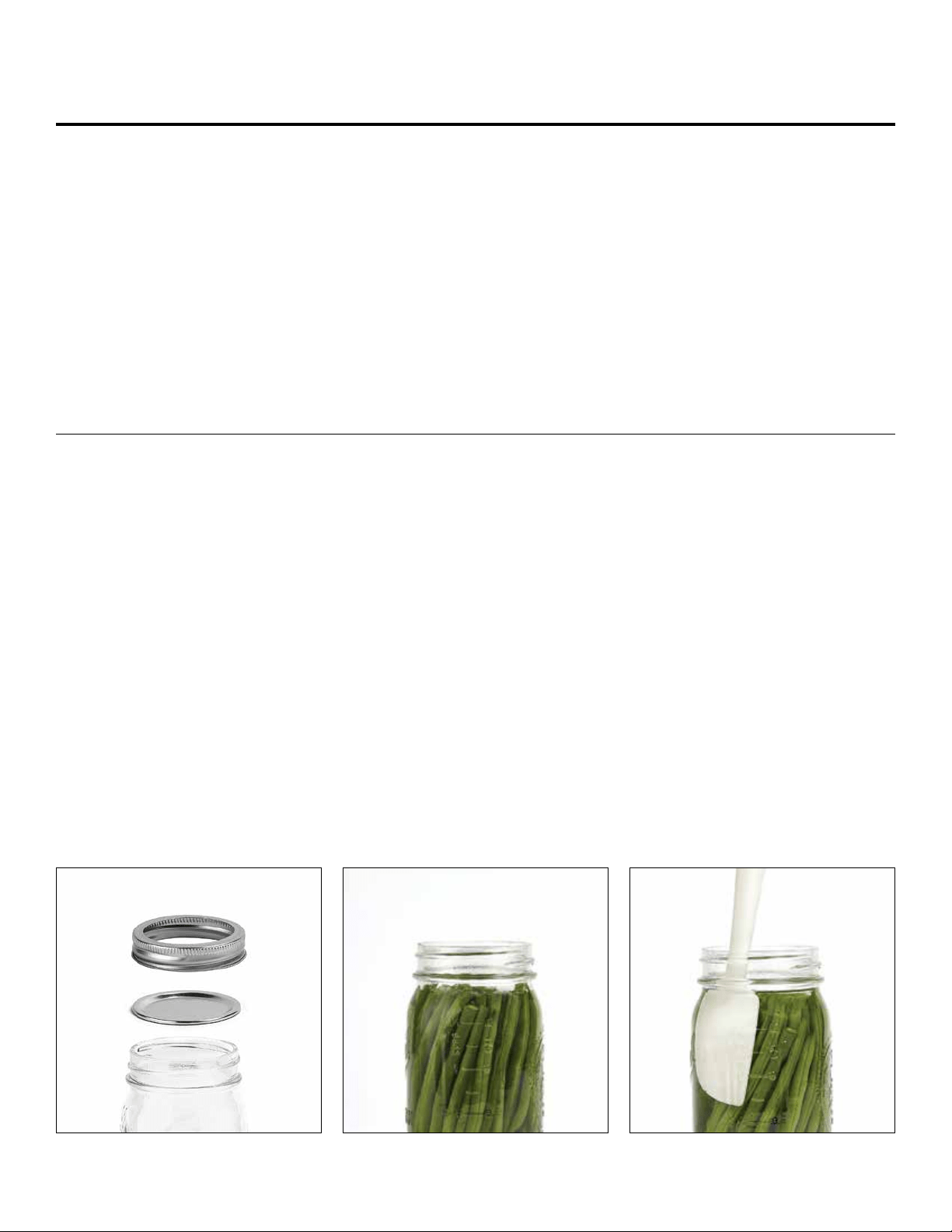
The self-sealing Jar Lid consists of a at metal lid
held in place during processing by a metal screw
band (see Fig. L). When jars are processed,
the lid gasket softens to form an airtight seal
with the jar. To ensure a good seal, carefully follow
lid manufacturer’s directions in preparing lids
for use. Do not reuse jar lids.
B. SAFE CANNING TIPS
C. GETTING STARTED
FIG. L FIG. M FIG. N
31
Canning Guide
1. Select a pretested pressure canning recipe.
Although ingredients may vary, foods will be
generally processed as instructed in this manual.
2. Using only the freshest ingredients and fruits
and vegetables at their peak of ripeness, prepare
food as instructed in the recipe.
3. Fill 16-oz clean canning jars to liquid level
as indicated. Do not ll above Liquid Level mark.
An approximate 1-in. headspace should remain
at top of jar (see Fig. M).
4. Using a exible, nonporous spatula, gently press
food against jar in order to remove any trapped
air bubbles (see Fig. N).
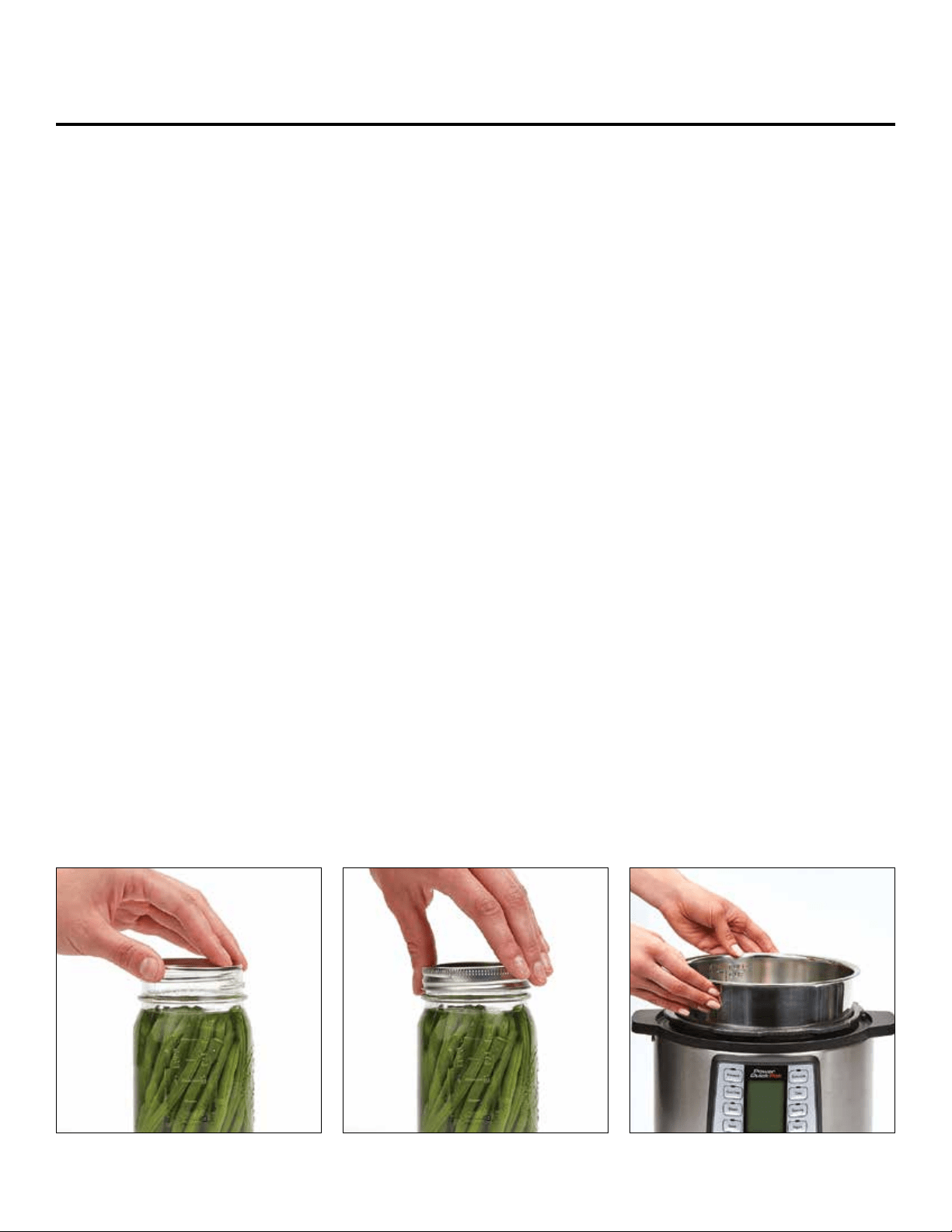
5. Place a clean at lid on opening of jar (see Fig.O).
Add screw band. Turn clockwise and hand tighten
in place (see Fig. P).
NOTE: If screw bands are too loose, liquid may
escape from jars during processing and seals may
fail. If screw bands are too tight, air cannot vent
during processing and food will discolor during
storage. Overtightening also may cause lids
to buckle and jars to break.
6. Place the Inner Pot in the Unit Base (see Fig.Q).
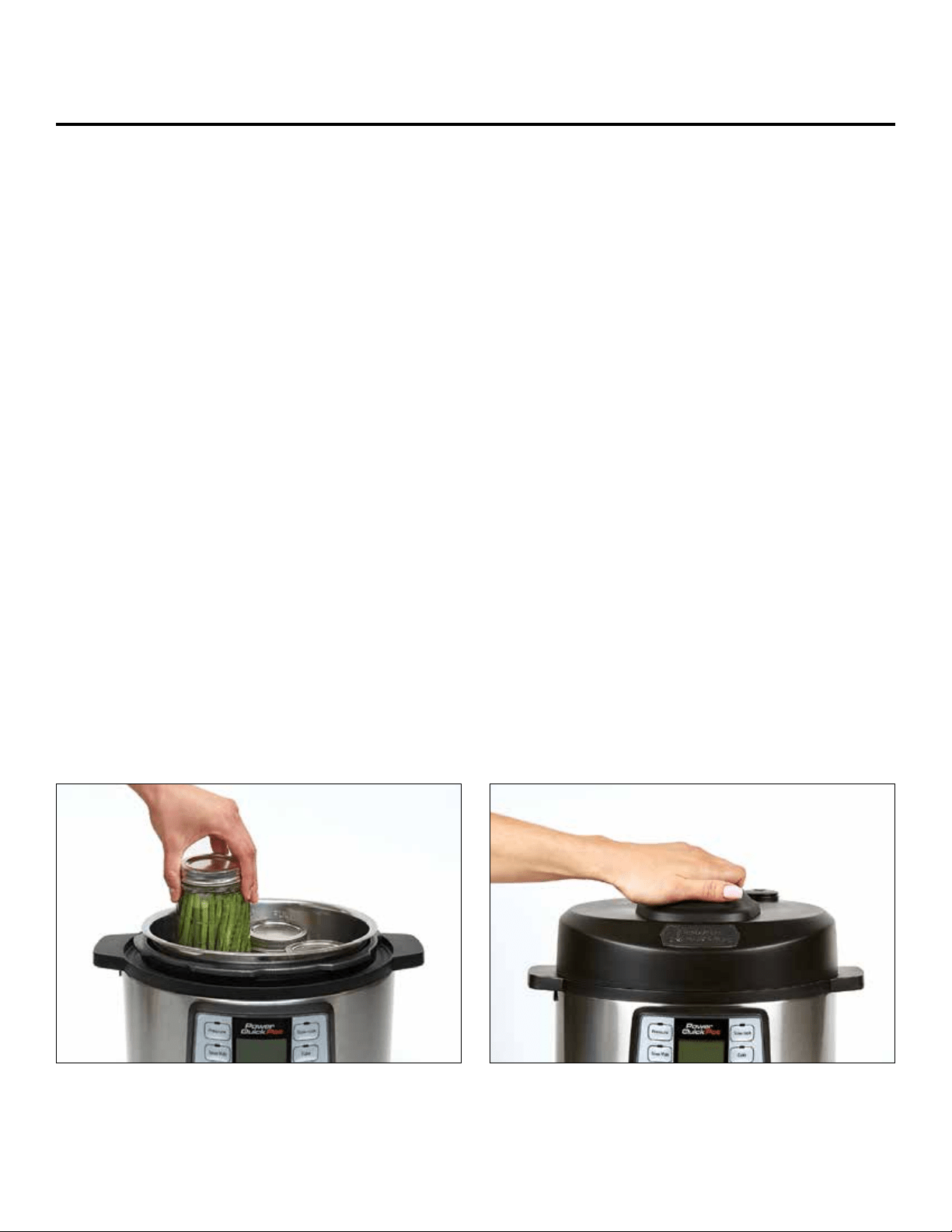
Place a wire rack (not included) in bottom of Inner
Pot. Place lled, sealed jars on wire rack (see
Fig.R). Maximum jar quantity varies per model
(see PINT SIZE JAR QUANTITIES, p. 29).
7. Pour hot water into Inner Pot with jars until water
level reaches ¼ way up sides of jars. Amount
of water depends on how many jars you place
in the Unit. For example, for four 16-oz jars,
use about 6 cups of water. When processing
fewer jars, more water is necessary.
8. Following proper instructions in this manual,
place Lid on base of appliance and lock into
place (see Fig. S). Plug the Unit into wall outlet.
9. Press the Canning Button. Pressure will
automatically set at 80 kPa. Select Cook Time
as indicated in chosen recipe.
10. When the canning process is complete, Press
the Steam Release Switch to release pressure.
Release pressure by moving the Steam Release
Switch to the Open position and letting go (see
INSTRUCTIONS FOR USE, p. 14).
D. THE CANNING PROCESS
FIG. O FIG. P FIG. Q
32
Canning Guide
11. Using canning tongs (not included), carefully
remove hot jars and place them on a-resistant
surface. Allow to cool to room temperature.
CAUTION: Jars are hot! If not handled properly
and with extreme care, burns may occur.
12. When jars are completely cool, remove screw
bands. Lids should be tightly sealed to jars.
When pressed in center, there should not be
any give or springing motion. If this happens,
the canning process was not successful and food
must be re-processed immediately or refrigerated
and used within a few days.
NOTE: Never retighten lids after processing jars.
As jars cool, the contents contract, pulling
the self-sealing lid rmly against the jar to form
a high vacuum.
NOTE: Screw bands are not needed on stored
jars. They should be removed after jars are
cooled. If left on stored jars, they become difcult
to remove, often rust, and may not work properly
again.
13. Place nished jars on shelves in cool, clean,
dry atmosphere.
FIG. R FIG. S

33
Manufacturer’s 60-Day Limited Warranty
The manufacturer warrants that all parts and components are free of defects in materials
and workmanship for 60 days. This warranty is valid only in accordance with the conditions
set forth below:
1. The warranty extends only to the original consumer purchaser and is not transferable.
In addition, proof of purchase must be provided for the 60-day warranty to be applicable.
2. This limited warranty is the only written or express warranty given by the manufacturer.
Any implied warranty of merchantability or tness for a particular purpose on this product
is limited to the duration of this warranty. Some states do not allow limitations on how
long an implied warranty lasts, so the above limitation may not apply to you.
3. This warranty gives you specic legal rights, and you may also have other rights which
may vary from state to state.
Procedure for Return within 60 Days:
To return the product within the 60-day money-back guarantee period, the original purchaser
must package the product securely and include the following information: name, address,
reason for return and request of refund or replacement, and either proof of purchase or order
number. Place the information inside an envelope inside the package with the Unit
and mail to the following address:
Tristar Products, Inc.
500 Returns Road
Wallingford, CT 06495

34

35

We are very proud of the design and quality of our
Power Quick Pot
TM
.
This product has been manufactured to the highest standards.
Should you have any problem, our friendly customer service staff
is here to help you.
Call us at 973-287-5145 or visit us
at www.TristarCares.com
Distributed by:
Tristar Products, Inc.
Faireld, NJ 07004
© 2018 Tristar Products, Inc.
Made in China
PQP_4-6-8-10QT_IB_TP_ENG_V6_180720