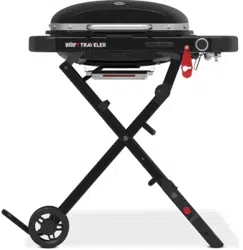
8652731
113023
enUS
Keep this Owner’s Manual for future reference, thoroughly read through it, and
if you have any questions please contact us today.
COMPACT | LP OWNER’S MANUAL
REGISTER TODAY
Register your gas grill and receive
special content to make you the ultimate
backyard hero.
Scan the QR Code or text a photo of
the camera icon to 71403
Or register online at weber.registria.com
Need help? Visit photoregister.com/help
or text help to 71403
WEB932TR
m DANGER
If you smell gas:
• Shut o gas to the appliance
(grill).
• Extinguish any open flame.
• Open lid.
• If odor continues, keep away
from the appliance (grill)
and immediately call your
gas supplier or your fire
department.
m WARNING
• Do not store or use gasoline
or other flammable liquids
or vapors in the vicinity
of this (grill) or any other
appliance.
• An LP cylinder (tank) not
connected for use shall
not be stored in the vicinity
of this (grill) or any other
appliance.
USE OUTDOORS ONLY.
READ THE INSTRUCTIONS BEFORE USING
THE APPLIANCE (GRILL).
NOTICE TO INSTALLER: These instructions
must be left with the consumer.
NOTICE TO CONSUMER: Retain these
instructions for future reference.
Important
SafetyInformation
DANGER, WARNING, and CAUTION
statements are used throughout this
Owner's Manual to emphasize critical and
important information. Read and follow
these statements to help ensure safety and
prevent property damage. Thestatements
are defined below.
m DANGER: Indicates a hazardous situation
which, if not avoided,
will result in death or seriousinjury.
m WARNING: Indicates a hazardous
situation which, if not avoided,
could result in death or seriousinjury.
m CAUTION: Indicates a hazardous situation
which, if not avoided,
could result in minor or moderateinjury.
Installation and Assembly
m DANGER: This grill is not intended to be installed in
or on recreational vehicles or boats.
m WARNING: Do not use this grill unless all parts
are in place and the grill was properly assembled
according to the assembly instructions.
m WARNING: Do not build this model of grill in any
built-in or slide-in construction.
m WARNING: Do not modify the appliance (grill). Liquid
propane gas is not natural gas. The conversion or
attempted use of natural gas in a liquid propane gas
unit or liquid propane gas in a natural gas unit is
unsafe and will void your warranty.
• In the United States, installation must conform with
local codes or, in the absence of local codes, with
either the National Fuel Gas Code, ANSI Z223.1/
NFPA 54, Natural Gas and Propane Installation Code,
CSA B149.1; or Propane Storage and Handling Code,
B149.2; or the Standard for Recreational Vehicles,
ANSI A119.2/NFPA 1192, and CSA Z240 RV Series,
Recreational Vehicle Code, as applicable.
• InCanada, the installation of this grill must comply
with local codes and/or the latest edition of Standard
CAN/CSA-B149.2 (Propane Storage and Handling
Code). These instructions, while generally acceptable,
do not necessarily comply with the Canadian
installation codes, particularly with piping above and
below ground.
• In Mexico, if there are local codes that apply to
portable gas appliances, you must comply with the
latest edition of Ocial Mexican Standard (NOM).
• If an external electrical source is utilized (such as
a rotisserie) it must be electrically grounded in
accordance with local codes or, in the absence of local
codes, with the National Electrical Code, ANSI/NFPA
70, or the Canadian Electrical Code, Part 1, CSA C22.1.
Operation
m DANGER: Only use the grill outdoors in a well-
ventilated area. Do not use in a garage, building,
breezeway, tent, any other enclosed area, or
beneath overhead combustibleconstruction.
• An appliance is considered to be outdoors if installed
with shelter no more inclusive than with walls on three
sides, but with no overhead cover; all openings must
be permanently open; sliding doors, garage doors,
windows, or screened openings are not considered as
permanent openings.
• An appliance is considered to be outdoors if installed
with shelter no more inclusive than within a partial
enclosure that includes an overhead cover and no
more than two sidewalls. The sidewalls may be paral-
lel, as in a breezeway, or at right angles to each other;
all openings must be permanently open; sliding door,
garage doors, windows, or screened openings are not
considered as permanent openings.
• An appliance is considered to be outdoors if installed
with shelter no more inclusive than within a partial
enclosure that included an overhead cover and three
sidewalls, as long as 30% or more of the horizontal
periphery of the enclosure is permanently open. All
openings must be permanently open; sliding doors,
garage doors, windows, or screened openings are not
considered as permanent openings.
2
SAFETY
• The minimum ambient operating temperature for safe
use of the appliance shall be 0° F (-17° C).
m DANGER: Do not use the grill in any vehicle or in any
storage or cargo area of any vehicle. This includes,
but is not limited to, cars, trucks, station wagons,
mini-vans, sport utility vehicles, recreational
vehicles, andboats.
m DANGER: Do not use the grill within 24 inches (61 cm)
of combustible materials.
m DANGER: Keep the cooking area clear of flammable
vapors and liquids such as gasoline, alcohol, etc., and
combustible materials.
m DANGER: The grill is not intended for and should
never be used as a heater.
m DANGER: This appliance (grill) must be kept away
from flammable materials during use.
m DANGER: Do not put a grill cover or anything
flammable on, or in the storage area under the grill
while it is in operation or is hot.
m DANGER: Should a grease fire occur, turn o all
burners and leave lid closed until fire is out.
m WARNING: Accessible parts may be very hot.
Keepyoung children away.
m WARNING: The use of alcohol, prescription drugs,
non-prescription drugs, or illegal drugs may impair
the consumer’s ability to properly and safely
assemble, move, store, or operate thegrill.
m WARNING: Never leave the grill unattended during
pre-heating or use. Exercise caution when using this
grill. The entire cookbox gets hot when in use.
m WARNING: Do not move the appliance (grill)
duringuse.
m WARNING: Keep any electrical supply cord and the
fuel supply hose away from any heated surfaces.
m CAUTION: This product has been safety-tested and
is only certified for use in a specific country. Refer to
country designation located on outside of box.
m CAUTION: The grill is not intended for commercial
use.
m CAUTION: Do not use charcoal or lava rock in the
grill.
Storage and/or Non-Use
m WARNING: Turn o the gas supply at the gas cylinder
(tank) after use.
m WARNING: LP tanks must be stored outdoors out of
the reach of children and must not be stored in a
building, garage, or any other enclosed space.
m WARNING: After a period of storage and/or nonuse,
the grill should be checked for gas leaks and burner
obstructions before use.
m Storage of the grill indoors is permissible only if the
LP tank is disconnected and removed from the grill.
California Proposition 65
m WARNING: Combustion byproducts produced when
using this product contain chemicals known to the
state of California to cause cancer, birth defects, or
other reproductive harm.
m PROPOSITION 65 WARNING: Handling the brass
material on this product exposes you to lead, a
chemical known to the state of California to cause
cancer, birth defects, or other reproductive harm. Wash
hands after handling this product.
Limited Warranty
Thank you for purchasing a WEBER product. Weber-Stephen
Products LLC, 1415 S. Roselle Road, Palatine, Illinois 60067
(“WEBER”) prides itself on delivering a safe, durable, and
reliableproduct.
This is WEBER’s Limited Warranty (“Warranty”) provided to you at
no extra charge. It contains the information you will need to have
your WEBER product repaired in the unlikely event of a failure or
defect.
Pursuant to applicable laws, the customer has several
rights in case the product is defective. Those rights include
supplementary performance or replacement, abatement of the
purchasing price, and compensation. These and other statutory
rights remain unaffected by this warranty provision. In fact,
this warranty grants additional rights to the Owner that are
independent from statutory warranty provisions.
WEBER’S LIMITED WARRANTY
WEBER warrants, to the purchaser of the WEBER product (or in
the case of a gift or promotional situation, the person for whom it
was purchased as a gift or promotional item) (“Owner”), that the
WEBER product is free from defects in material and workmanship
for the period(s) of time specified below when assembled and
operated in accordance with the accompanying Owner’s Manual,
normal wear and tear excluded . (Note: If you lose or misplace
your WEBER Owner’s Manual, a replacement is available online
at www.weber.com.) WEBER agrees within the framework of this
warranty to repair or replace the part that is defective in material
or workmanship subject to the limitations, and exclusions listed
below. TO THE EXTENT ALLOWABLE BY APPLICABLE LAW, THIS
WARRANTY IS EXTENDED ONLY TO THE ORIGINAL PURCHASER
AND IS NOT TRANSFERABLE TO SUBSEQUENT OWNERS, EXCEPT
IN THE CASE OF GIFTS AND PROMOTIONAL ITEMS AS NOTED
ABOVE.
WEBER stands by its products and is happy to provide you with the
Warranty described for material defects in the grill or its relevant
components, normal wear and tear excepted.
• ‘Normal wear and tear’ includes cosmetic and other immaterial
deterioration that may come with ownership of your grill over
time, such as surface rust, dents / scratches, etc.
However, WEBER will honor this Warranty for the grill or its
relevant components where damage or dysfunction results from
a material defect.
• ‘Material defect’ includes rust through or burn through of certain
parts, or other damage or failure inhibiting your ability to safely /
properly use your grill.
OWNER’S RESPONSIBILITIES UNDER THIS WARRANTY
To ensure trouble-free warranty coverage, it is important (but it
is not required) that you register your WEBER product online at
www.weber.com. Please also retain your original sales receipt
and/or invoice. Registering your WEBER product confirms your
warranty coverage and provides a direct link between you and
WEBER in case we need to contact you. If you have not had time to
register your grill before calling for Warranty service, please have
the following information available when you do call:
Name – Address – Phone Number – Email – Serial Number –
Purchase Date – Purchase Dealer – Model – Color – Primary Issue
The above warranty only applies if the Owner takes reasonable
care of the WEBER product by following all assembly instructions,
usage instructions, and preventative maintenance as outlined in
the accompanying Owner’s Manual, unless the Owner can prove
that the defect or failure is independent of non-compliance with
the above mentioned obligations. If you live in a coastal area, or
have your product located near a pool, maintenance includes
regular washing and rinsing of the exterior surfaces as outlined in
the accompanying Owner’s Manual.
WARRANTY HANDLING / EXCLUSION OF WARRANTY
If you believe that you have a part which is covered by this
Warranty, please contact WEBER Customer Service using the
contact information on our website (www.weber.com, or such
country-specific website to which Owner may be redirected).
WEBER will, upon investigation, repair or replace (at its option) a
defective part that is covered by this Warranty. In the event that
repair or replacement are not possible, WEBER may choose (at its
option) to replace the grill in question with a new grill of equal or
greater value. WEBER may ask you to return parts for inspection,
shipping charges to be pre-paid by owner.
When you contact Customer Service, please have the following
information available:
Name – Address – Phone Number – Email – Serial Number –
Purchase Date – Purchase Dealer – Model – Color – Primary Issue
This WARRANTY lapses if there are damages, deteriorations,
discolorations, and/or rust for which WEBER is not responsible
caused by:
• Abuse, misuse, alteration, modification, misapplication,
vandalism, neglect, improper assembly or installation, and
failure to properly perform normal and routine maintenance;
• Insects (such as spiders) and rodents (such as squirrels),
including but not limited to damage to burner tubes and/or gas
hoses;
• Exposure to salt air and/or chlorine sources such as swimming
pools and hot tubs/spas;
• Severe weather conditions such as hail, hurricanes,
earthquakes, tsunamis or surges, tornadoes or severe storms.
• Acid rain and other environmental factors.
Using third party parts will not void this Warranty. However, any
parts that are used and/or installed on your WEBER product that
are not genuine WEBER parts are not covered by this Warranty. In
addition, any damages that result from the use and/or installation
of parts on your WEBER product that are not genuine WEBER parts
are not covered by this Warranty. Any conversion of a gas grill
not authorized by WEBER and performed by a WEBER authorized
service technician will void this Warranty.
PRODUCT WARRANTY PERIODS
Cookbox:
5 years, no rust through/burn through
Lid assembly:
5 years, no rust through/burn through
Stainless steel burner tube:
3 years, no rust through/burn through
Porcelain-enameled cast iron cooking grates:
3 years, no rust through/burn through
Plastic components:
2 years, excluding fading or discoloration
All remaining parts:
2 years
DISCLAIMERS
APART FROM THE WARRANTY AND DISCLAIMERS AS
DESCRIBED IN THIS WARRANTY STATEMENT, THERE ARE
EXPLICITLY NO FURTHER WARRANTY OR VOLUNTARY
DECLARATIONS OF LIABILITY GIVEN HERE WHICH GO BEYOND
THE STATUTORY LIABILITY APPLYING TO WEBER. THE
PRESENT WARRANTY STATEMENT ALSO DOES NOT LIMIT
OR EXCLUDE SITUATIONS OR CLAIMS WHERE WEBER HAS
MANDATORY LIABILITY AS PRESCRIBED BY STATUTE.
NO WARRANTIES SHALL APPLY AFTER THE APPLICABLE
PERIODS OF THIS WARRANTY. NO OTHER WARRANTIES
GIVEN BY ANY PERSON, INCLUDING A DEALER OR RETAILER,
WITH RESPECT TO ANY PRODUCT (SUCH AS ANY “EXTENDED
WARRANTIES”), SHALL BIND WEBER. THE EXCLUSIVE REMEDY
OF THIS WARRANTY IS REPAIR OR REPLACEMENT OF THE
PART OR PRODUCT.
IN NO EVENT UNDER THIS WARRANTY SHALL RECOVERY OF
ANY KIND BE GREATER THAN THE AMOUNT OF THE PURCHASE
PRICE OF THE WEBER PRODUCT SOLD.
YOU ASSUME THE RISK AND LIABILITY FOR LOSS, DAMAGE, OR
INJURY TO YOU AND YOUR PROPERTY AND/OR TO OTHERS AND
THEIR PROPERTY ARISING OUT OF THE MISUSE OR ABUSE
OF THE PRODUCT OR FAILURE TO FOLLOW INSTRUCTIONS
PROVIDED BY WEBER IN THE ACCOMPANYING OWNER’S
MANUAL.
PARTS AND ACCESSORIES REPLACED UNDER THIS WARRANTY
ARE WARRANTED ONLY FOR THE BALANCE OF THE ABOVE
MENTIONED ORIGINAL WARRANTY PERIOD(S).
THIS WARRANTY APPLIES TO PRIVATE SINGLE FAMILY HOME
OR APARTMENT USE ONLY AND DOES NOT APPLY TO WEBER
GRILLS USED IN COMMERCIAL, COMMUNAL OR MULTI-UNIT
SETTINGS SUCH AS RESTAURANTS, HOTELS, RESORTS, OR
RENTAL PROPERTIES.
WEBER MAY FROM TIME TO TIME CHANGE THE DESIGN OF ITS
PRODUCTS. NOTHING CONTAINED IN THIS WARRANTY SHALL
BE CONSTRUED AS OBLIGATING WEBER TO INCORPORATE
SUCH DESIGN CHANGES INTO PREVIOUSLY MANUFACTURED
PRODUCTS, NOR SHALL SUCH CHANGES BE CONSTRUED AS
AN ADMISSION THAT PREVIOUS DESIGNS WERE DEFECTIVE.
Weber-Stephen Products LLC
Customer Service Center
1415 S. Roselle Road
Palatine, IL 60067
U.S.A.
For replacement parts, call:
1-800-446-1071
WARRANTY
3weber.com
ASSEMBLY
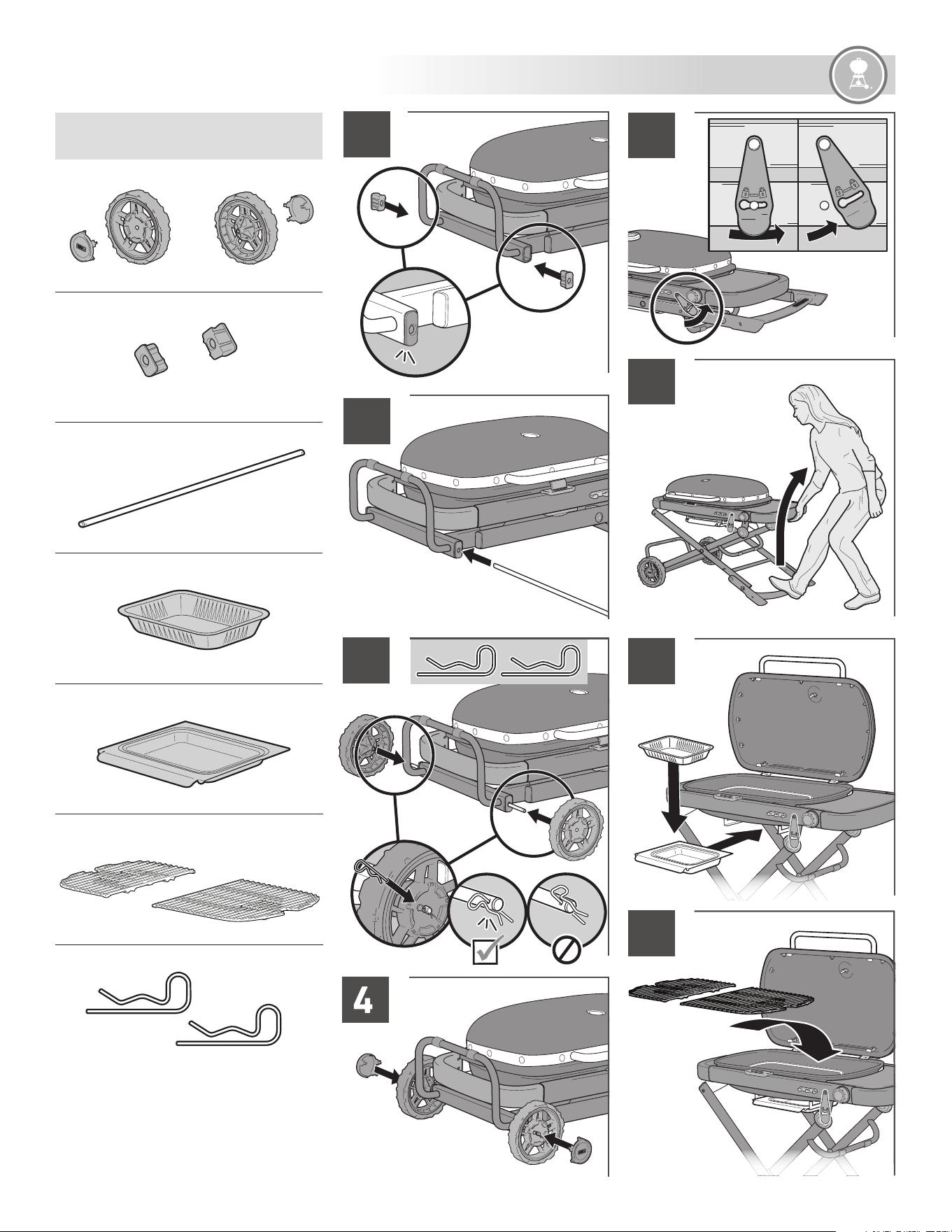
Parts List
The grills that are illustrated in this Owner’s Manual
may vary slightly from the model purchased.
m Remove all packaging materials and
protective film before operating your grill.
2
1
3
6
5
8
7
4
PRODUCT FEATURES
m WARNING: Only set up the cart on a stable and
level outdoor surface. Never set up the cart on
a sloping surface.
m WARNING: Use caution when removing slide-
out catch pan and disposing of hot grease.
m WARNING: Do not store the grill while the LP
cylinder is attached.
m WARNING: Do not store or transport a
disconnected LP cylinder inside the grill.
m CAUTION: Do not move the grill when in use.
Allow the grill to cool before moving or storing.
m CAUTION: Do not lift the grill by the lid handle
as this could result in damage to the lid lock.
m CAUTION: Do not stack additional items on grill
during storage or transit.
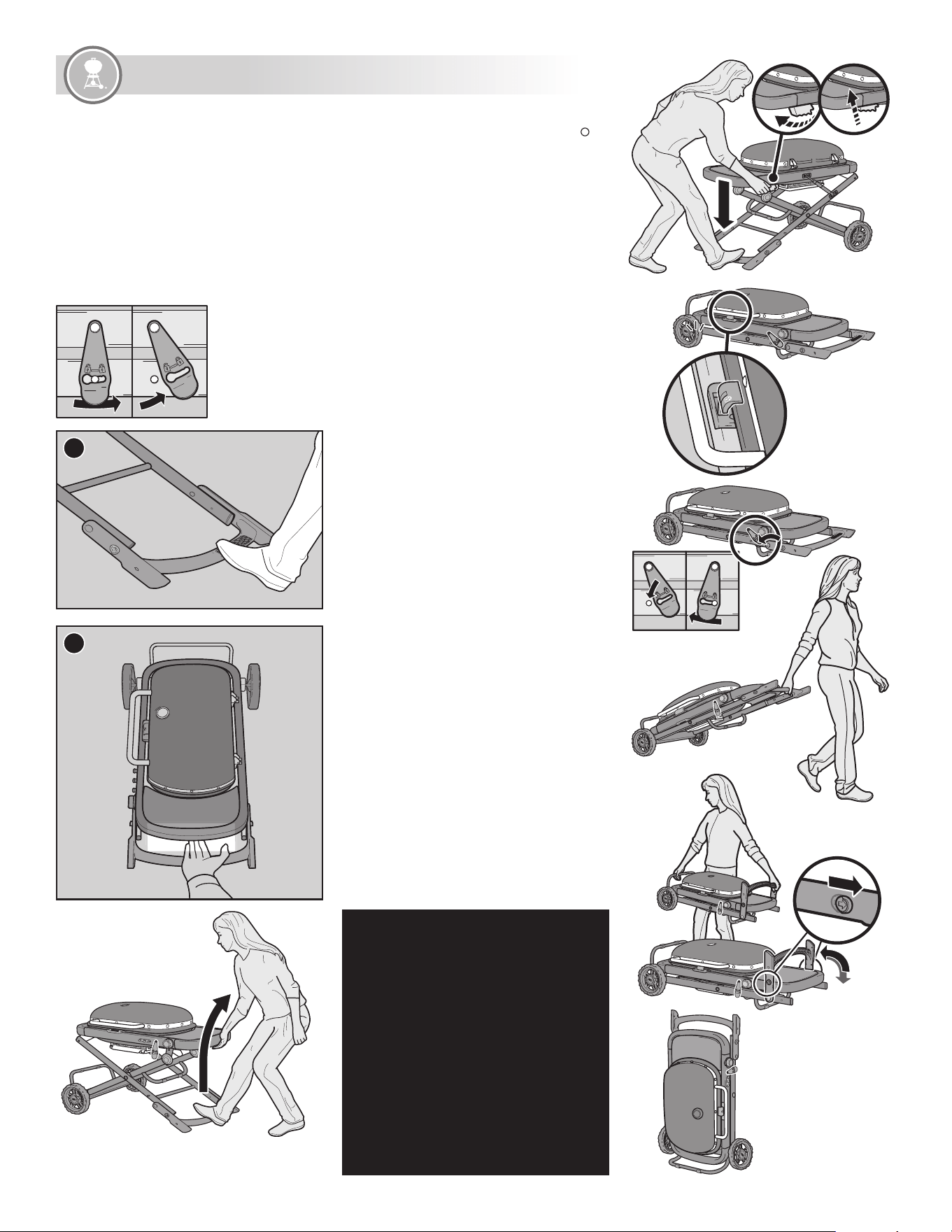
Raising and Lowering the Grill
When it's time to set up or put away the grill, follow
these steps to ensure the grill is ready.
Raising the Grill
1) Move the cart lock to the unlocked position and
disengage it from the pin.
2) Stabilize the grill by keeping one foot on the foot
stand (A) and lift the grill from the end of the side
table frame (B) until it clicks into the raised position.
Lowering the Grill
1) Make sure the burner control knob is in the o (
)
position.
2) Close the lid.
3) Allow the grill to cool completely.
4) Remove the LP cylinder. Refer to "Removing the LP
Cylinder."
NOTE: A safety feature of the release lever actuates
when the LP cylinder is installed. The release lever
becomes locked out and the cart cannot be folded
down while the LP cylinder is connected.
5) Always check the slide-out catch pan to clean or
replace the disposable drip tray.
6) To lower the cart, make sure to keep one foot on
the foot stand at the base of the grill and grasp the
release lever on the back of the frame (a).
Carefully disengage the release lever by: 1) pulling
the lever toward you, and 2) lifting it up. Then, slowly
lower the grill keeping your foot in place.
Important: Use caution when lowering the cart.
Always guide the cart while moving to the down
position by maintaining a steady grip on the frame.
Repeated lowering of the cart without maintaining
a grip on the frame may cause damage to the gas
spring.
Transportation and Storage
1) Once the cart is folded down, the automatic lid
lock engages to keep the lid and cooking grates in
place (b). To secure the cart in the folded position,
fasten the cart lock over the pin (c) and move it to the
locked position.
2) After the cart is lowered and locked, the grill is ready
to roll (d).
3) For added convenience in the folded position, rotate
the foot stand upward by first sliding back the red
tabs on the side of the frame (e). This provides areas
on both ends of the grill for lifting into storage or
transportation.
NOTE: Do not lift the grill by the lid handle.
4) After a thorough cleaning, store the grill upright for a
smaller footprint (f). Follow the steps in the "Cleaning
and Maintenance" section of this owner's manual.
b.
c.
a.
e.
d.
f.
A
B
5weber.com
GETTING STARTED
Important Information about LPGas
& Gas Connections
What Is LP Gas?
Liquefied petroleum gas, also called LP, LP gas, liquid
propane, or simply propane or butane, is the flammable,
petroleum-based product used to fuel your grill. It is a gas
at moderate temperatures and pressure when it is not
contained. But at moderate pressure inside a container,
such as a tank, LP is a liquid. As pressure is released
from the tank, the liquid readily vaporizes and becomes
gas.
Safe Handling Tips for LP Gas Cylinders
There are various guidelines and safety factors that you
need to keep in mind when using LP gas. Carefully follow
these instructions before using your WEBER gas grill.
• Do not use a damaged, dented or rusty LP cylinder.
• Although your LP cylinder may appear to be empty,
gas may still be present, and the cylinder should be
transported and stored accordingly.
• LP cylinders should not be dropped or handled roughly.
• Never store or transport the LP cylinder where
temperatures can reach 125° F (51.7° C) (the cylinder
will become too hot to hold by hand). For example: do
not leave the LP cylinder in a car on a hot day.
• LP cylinders must be kept out of reach of children.
• The LP cylinder to be used must be constructed and
marked in accordance with the specifications for LP gas
cylinders, U.S. Department of Transportation (DOT) or
the Standard for Cylinders, Spheres and Tubes for the
Transportation of Dangerous Goods, CAN/CSA-B339.
• Cylinders must be provided with a listed OPD (Overfilling
Prevention Device) and a CGA #600 cylinder connection.
The cylinder connection must be compatible with the
grill connection.
Regulator Connections
Your WEBER gas grill is equipped with a pressure
regulator, which is a device to control and maintain
uniform gas pressure as gas is released from the LP
cylinder. Each WEBER pressure regulator is designed for
vapor withdrawal.
• The pressure regulator supplied with the WEBER gas
grill must be used. This regulator is set for 11 inches of
water column pressure.
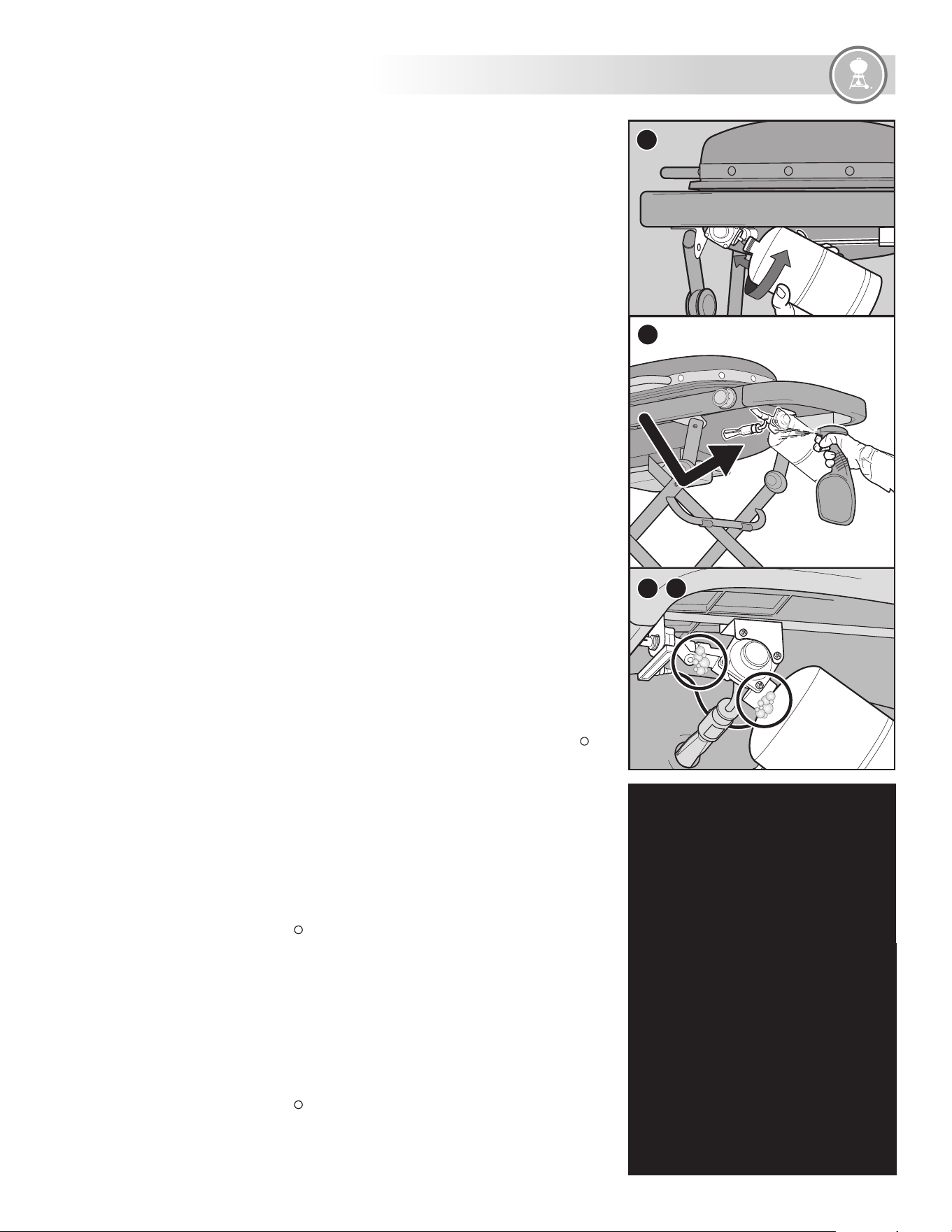
Installing the LP Cylinder
Use disposable LP cylinders with a capacity of 16.4
oz./465 g (1.02 lbs) equipped with a CGA #600 connection
and marked "propane" only.
1) Make sure burner control knob is turned o by
pushing it in and turning it clockwise to the o (
)
position.
2) Push LP cylinder into regulator and turn clockwise
until tight (A). With the LP cylinder in place, the
release lever of the cart becomes locked, preventing
the grill from being lowered.
Removing the LP Cylinder
Every time you need to lower the grill cart, or your LP
cylinder needs to be replaced, follow these instructions
to remove it.
1) Make sure burner control knob is turned o by
pushing it in and turning it clockwise to the o (
)
position.
2) Unscrew LP cylinder from regulator and remove it
from the grill.
Storage and/or Travel
Disconnect the cylinder if: 1) the cylinder is empty; 2) the
grill is being transported; 3) the grill is being stored in a
garage or other enclosed area; 4) the grill is not in use.
• Place dust cap on cylinder valve outlet whenever the
cylinder is not in use. Only install the type of dust cap
on the cylinder valve outlet that is provided with the
cylinder valve. Other types of caps or plugs may result
in leakage of propane.
• Do not store a disconnected LP cylinder in a building,
garage, or any other enclosed area.
• Do not store or transport a disconnected LP cylinder
inside the grill.
For grills that have been stored or left unused for a while,
it is important to follow these guidelines:
• The WEBER gas grill should be checked for gas leaks
and any obstructions in the burner tube before it
is used. (Refer to “CHECKING FOR GAS LEAKS” and
“ANNUAL MAINTENANCE.”)
• Check that the areas under the cookbox and the
removable catch pan are free from debris that might
obstruct the flow of combustion or ventilation air.
• The spider/insect screen should also be checked for any
obstructions. (Refer to “ANNUAL MAINTENANCE.”)
What is a Leak Check?
Once the LP tank is properly installed, it is necessary
to perform a leak check. A leak check is a reliable way
to verify that gas is not escaping after you connect the
tank. The fuel system in your grill features factory-
made connections that have been thoroughly checked
for gas leaks and the burners have been flame-tested.
WEBER recommends performing a thorough leak check
after assembly, as well as every time you disconnect
and reconnect a gas fitting. The following fittings should
be tested:
• Where the cylinder connects to the regulator.
• Where the regulator connects to the valve.
Checking for Gas Leaks
1) Make sure burner control knob is turned o by
pushing it in and turning it clockwise to the o (
)
position.
2) Wet fittings (B) with a soap and water solution, using
a spray bottle, brush, or rag. You can make your own
soap and water solution by mixing 20% liquid soap
with 80% water; or, you can purchase leak check
solution in the plumbing section of any hardware
store.
3) If bubbles appear there is a leak:
a) If the leak is at the cylinder (C), remove the
propane cylinder. DONOT OPERATE THE GRILL.
Install a dierent propane cylinder and recheck
for leaks with a soap and water solution. If the
leak persists, remove the propane cylinder. DO
NOT OPERATE THE GRILL. Contact the Customer
Service Representative in your area using the
contact information on our website.
b) If the leak is at the regulator (D), turn o the gas.
NEVER ATTEMPT TO TIGHTEN THE REGULATOR.
DO NOT OPERATE THE GRILL. Contact the
Customer Service Representative in your area
using the contact information on our website.
If a leak is present, contact the Customer Service
Representative in your area using the contact
information on our website.
4) If bubbles do not appear, leak checking is complete:
a) Rinse connections with water.
NOTE: Since some leak test solutions, including soap and
water, may be slightly corrosive, all connections should be
rinsed with water after checking for leaks.
m DANGER: Do not use a flame to check for gas
leaks. Besure there are no sparks or open
flames in the area while you check for leaks.
m DANGER: Leaking gas may cause a fire or
explosion.
m DANGER: Do not operate the grill if there is a
gas leak present.
m DANGER: If you see, smell, or hear the hiss of
gas escaping from the liquid propane tank:
1) Move away from liquid propane tank.
2) Do not attempt to correct the problem
yourself.
3) Call your fire department.
m DANGER: Do not store a spare LP tank under or
near this grill. Never fill the tank beyond 80%
full. Failure to follow these statements exactly
may result in a fire causing death or serious
injury.
m WARNING: Do not use a wrench to tighten the
connection. Using a wrench could damage the
regulator coupling and could cause a leak.
m CAUTION: Use cylinders that are marked
"Propane" only.
A
B
C
D
6
The Very First Time You Grill
Perform an Initial Burn-O
Heat the grill on the highest setting, with the lid closed,
for at least 20 minutes prior to grilling for the firsttime.
Every Time You Grill
Meal-to-Meal Maintenance
The Meal-To-Meal Maintenance plan includes the
following simple, yet important, steps that should
always be performed prior to grilling.
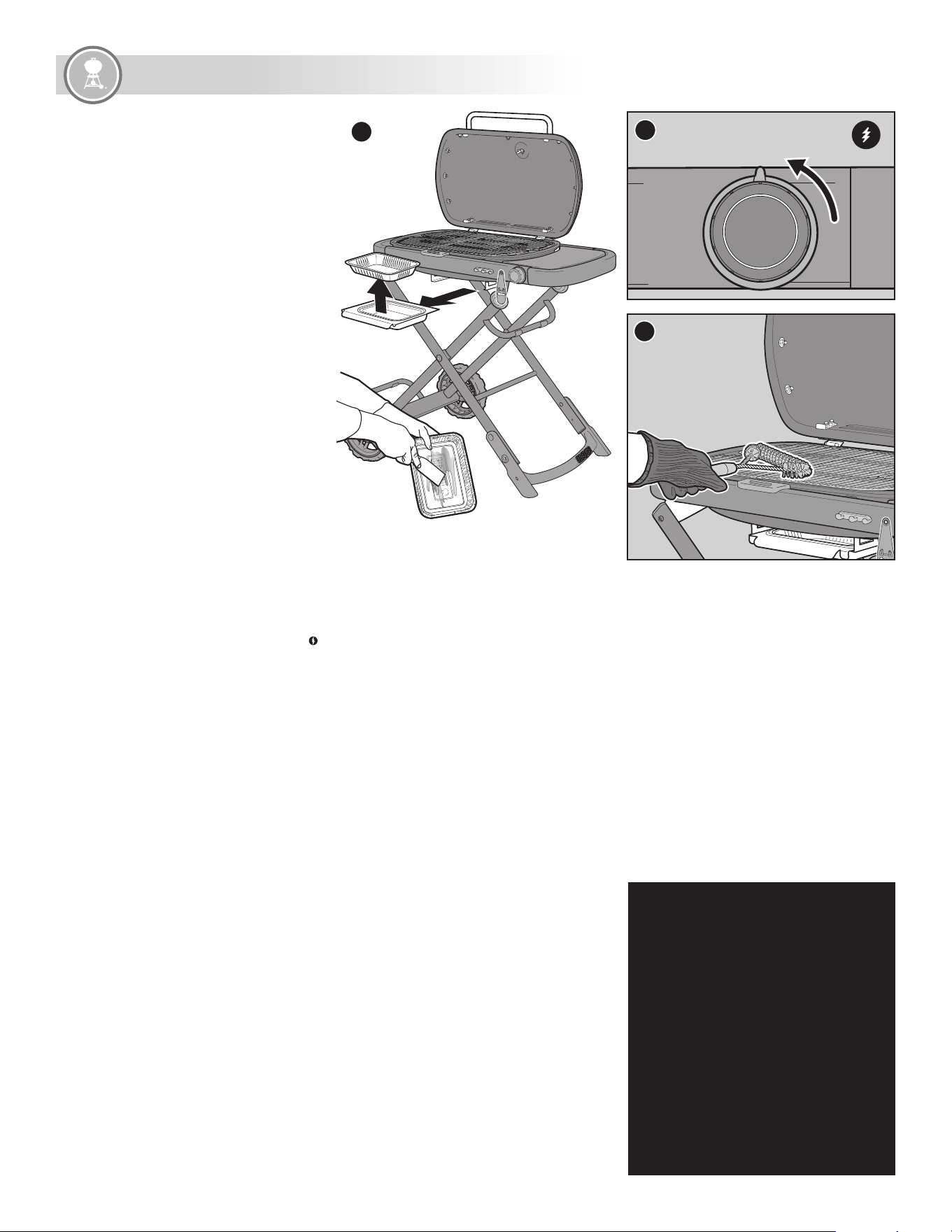
Check for Grease
Your grill was built with a grease management
system that funnels grease away from food and into a
disposable container. As you cook, grease is channeled
down the cookbox and into a disposable drip tray that
lines the slide-out catch pan. This system should be
cleaned each and every time you grill to preventfires.
1) Confirm that the grill is o and cool.
2) Remove the slide-out catch pan (A). Check for
excessive amounts of grease in the disposable drip
pan that lines the catch pan. Discard disposable drip
pan when necessary and replace with a new one.
4) Reinstall all components.
Preheat the Grill
Preheating the grill is critical to successful grilling.
Preheating helps to prevent food from sticking to the
grate and gets the grate hot enough to sear properly.
Italso burns o residue of a previously cooked meal.
1) Open the grill lid.
2) Ignite your grill according to the ignition instructions
in this Owner's Manual.
3) Close lid.
4) Preheat the grill with the burner on the start/high
position for 10 to 15 minutes or until thermometer
registers 500° F (260° C)(B).
Clean the Cooking Grate
After preheating, any bits of food or debris left over
from previous use will be easier to remove. Cleaned
grates will also prevent your next meal from sticking.
1) Brush the grates with a stainless steel bristle grill
brush immediately after preheating (C).
m DANGER: Do not line the slide-out catch pan or
cookbox with aluminum foil.
m DANGER: Check the slide-out catch pan for
grease build-up before each use. Remove
excess grease to avoid a grease fire.
m WARNING: Use caution when removing slide-out
catch pan and disposing of hot grease.
m WARNING: Use heat-resistant barbecue mitts or
gloves when operating grill.
m WARNING: Grill brushes should be checked for
loose bristles and excessive wear on a regular
basis. Replace brush if any loose bristles are
found on cooking grates or brush. WEBER
recommends purchasing a new stainless steel
bristle grill brush at the beginning of every
spring.
m WARNING: Keep ventilation openings around
tank clear and free of debris.
C
OPERATION
A
B
7weber.com
m WARNING: Open lid during ignition.
m WARNING: Do not lean over open grill while
igniting or cooking.
m WARNING: If ignition does not occur within five
seconds, turn the burner control knob to the o
position. Wait five minutes to allow accumulated
gas to dissipate, and then repeat the lighting
procedure.
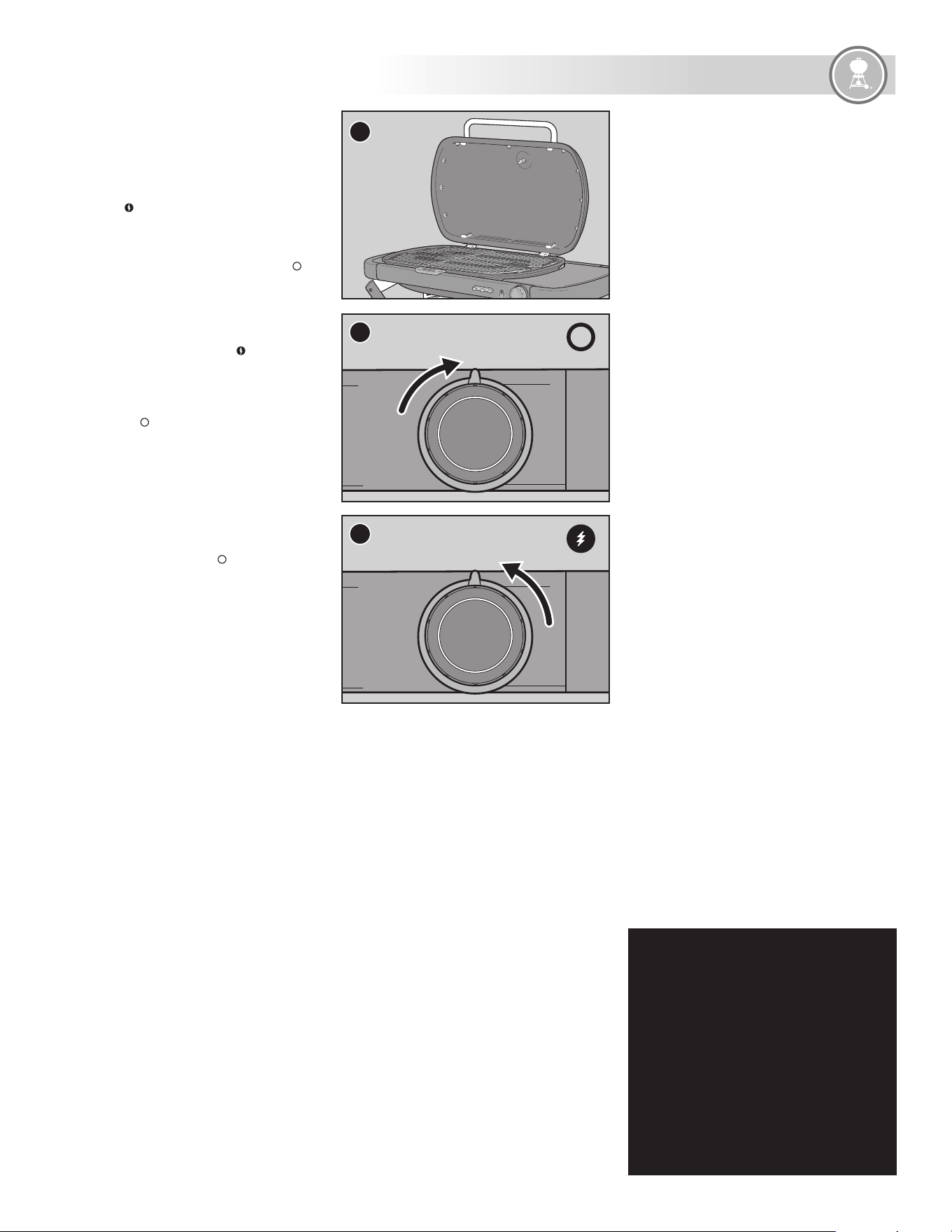
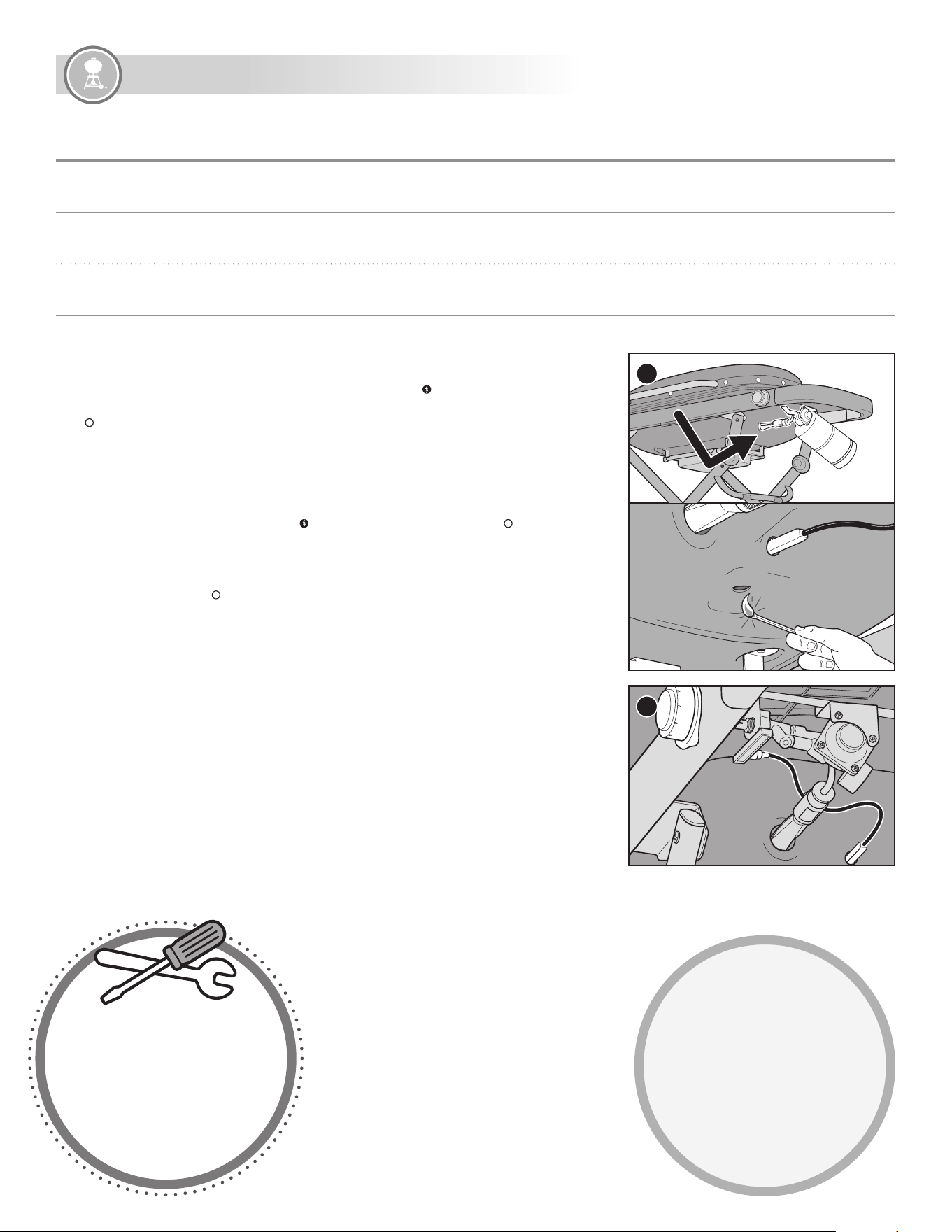
Igniting the Grill
Using the Ignition System to Ignite the Grill
The ignition system ignites the burner with a spark
from the igniter electrode. You generate the energy for
the spark by pushing and turning the control knob to
the start/high position. You will hear the igniter click.
After preheating on high is complete, you may adjust the
burner control knob to your desired setting for grilling.
1) Open the grill lid (A).
2) Check that the burner control knob is in the o
position. Check by pushing in and turning knob
clockwise (B).
3) Confirm that the cylinder is properly installed. Refer
to “Installing the LP Cylinder.”
4) Push the burner control knob in and turn it
counterclockwise to the start/high
position. You
will hear the igniter click (C).
5) Check that the burner is lit by looking through the
cooking grates. You should see a flame.
6) If the burner does not ignite, turn burner control
knob to the o
position and wait five minutes to
allow the gas to clear before attempting to light the
burner again.
Should the burner fail to ignite using the ignition
system, refer to the TROUBLESHOOTING section.
Thereyou will find instructions on igniting the grill with
a match to help determine the exact problem.
To Extinguish Burners
1) Push the burner control knob in and then turn
clockwise all the way to the o
position.
A
OPERATION
B
C
8
m WARNING: Turn your grill o and wait for it to
cool before thoroughly cleaning.
m WARNING: When cleaning the burners, never
use a brush that has already been used to clean
the cooking grates. Never put sharp objects into
the burner port holes.
m CAUTION: Do not place any grill components
onto the side tables as they may scratch the
paint or stainless steel surfaces.
m CAUTION: Do not use any of the following
to clean your grill: abrasive stainless steel
polishes or paints, cleaners that contain acid,
mineral spirits or xylene, oven cleaner, abrasive
cleansers (kitchen cleansers), or abrasive
cleaning pads.
Cleaning and Maintenance
Cleaning the Inside of the Grill
Over time, the performance of your grill can diminish if
it has not been maintained properly. Low temperatures,
uneven heat, and food sticking to cooking grates are all
signs that cleaning and maintenance are overdue.
A thorough cleaning is recommended when the grill is
going to be folded and stored vertically, or at least twice
a year. Consistent use may require quarterly cleanings.
When your grill is o and cool, start by cleaning the
inside, from the top down.
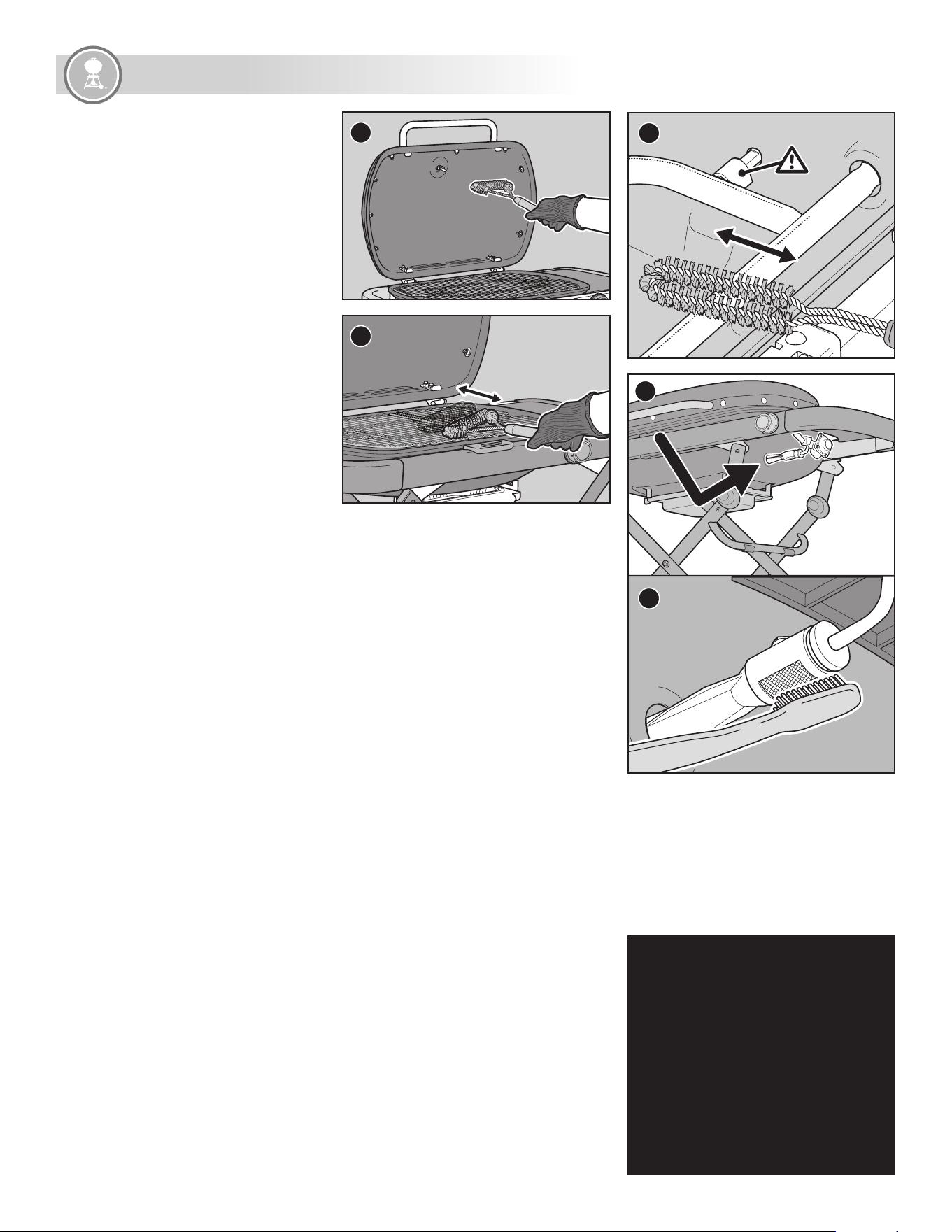
Cleaning the Lid
From time to time you may notice “paint-like” flakes
on the inside of the lid. During use, grease and smoke
vapors slowly change into carbon and deposit on the
inside of your lid. These deposits will eventually peel,
and looks very similar to paint. These deposits are non-
toxic, but the flakes could fall onto your food if you do
not clean the lid regularly.
1) Brush the carbonized grease from the inside of the
lid with a stainless steel bristle grill brush (A). To
minimize further build-up, the inside of the lid can be
wiped with a paper towel after grilling while the grill
is still warm (nothot).
Cleaning the Cooking Grates
If you have been cleaning your cooking grates as
recommended, the debris on your grates should be
minimal.
1) With grates installed, brush the debris o your
cooking grate with a stainless steel bristle grill
brush(B).
2) Take the grates out and set aside.
Cleaning the Burner
Two areas on the burner that are key to optimum
performance are the ports (small openings running
along the length of the burner) and the spider/insect
screens on the ends of the burner. Keeping these areas
clean is essential for safe operation.
Cleaning the Burner Ports
1) Use a clean stainless steel bristle grill brush to clean
the outside of the burners by brushing across the
top of the burner ports (C). Do not brush lengthwise.
along the tube, as this will only brush debris from
one port to another.
2) When cleaning the burner, avoid damaging the
ignition electrode by carefully brushing around it.
Cleaning the Spider Screens
1) Locate the end of the burner behind the control panel
where it meets the valve (D).
2) Clean the spider/insect screen on the burner using a
soft bristle brush (E).
D
C
PRODUCT CARE
A
B
E
9weber.com
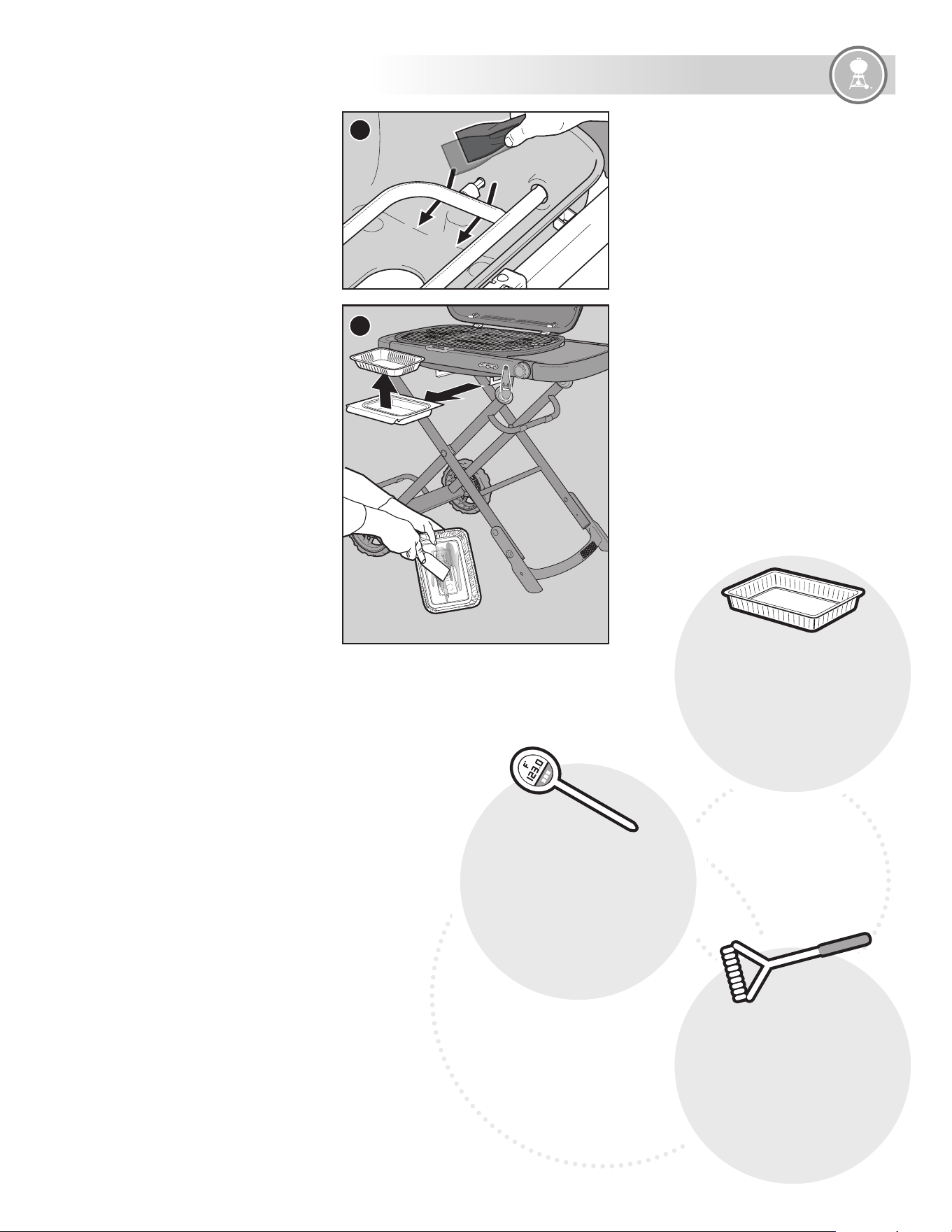
Cleaning the Cookbox
Look inside the cookbox for any grease accumulation
or leftover food particles. Excessive accumulation can
cause a fire.
1) Use a plastic scraper to scrape debris o the sides
and bottom of the grill into the opening in bottom of
the cookbox(F). This opening leads debris into the
slide-out catch pan.
Cleaning the Grease ManagementSystem
The grease management system consists of a slide-
out catch pan and a disposable drip tray(G). These
components were designed to be easily removed,
cleaned, and replaced; an essential step every time you
prepare to grill. Instructions on inspecting the grease
management system can be found in MEAL-TO-MEAL
MAINTENANCE.
Cleaning the Outside of theGrill
The outside of your grill may include stainless steel,
porcelain-enameled, and plastic surfaces. WEBER
recommends the following methods based on the
surfacetype.
Cleaning Stainless Steel Surfaces
Clean stainless steel using a non-toxic, non-abrasive
stainless steel cleaner or polish designed for use on
outdoor products and grills. Use a microfiber cloth to
clean in the direction of the grain of the stainless steel.
Donot use paper towels.
Note: Do not risk scratching your stainless steel with
abrasive pastes. Pastes do not clean or polish. They
will change the color of the metal by removing the top
chromium oxide film coating.
Cleaning Painted, Porcelain-Enameled Surfaces
and PlasticComponents
Clean painted, porcelain-enameled and plastic
components with warm soapy water, and paper towels
or cloth. After wiping down the surfaces, rinse and dry
thoroughly.
Cleaning the Outside of Grills that are in Unique
Environments
If your grill is subject to a particularly harsh
environment, you will want to clean the outside more
often. Acid rain, pool chemicals, and salt water can
cause surface rusting to appear. Wipe down the outside
of your grill with warm soapy water. Follow up with a
rinse and thorough drying. Additionally, you may want
to apply a stainless steel cleaner weekly to prevent
surface rust.
GRILLBRUSH
A must-use before you even dream
of grilling. A quick once-over on hot
grates prevents the charred remains
of meals past from sticking to
your meals present.
M
U
S
T
-
H
A
V
E
G
R
I
L
L
I
N
G
T
O
O
L
S
•
M
U
S
T
-
H
A
V
E
G
R
I
L
L
I
N
G
T
O
O
L
S
•
M
U
S
T
-
H
A
V
E
G
R
I
L
L
I
N
G
T
O
O
L
S
•
M
U
S
T
-
H
A
V
E
G
R
I
L
L
I
N
G
T
O
O
L
S
•
M
U
S
T
-
H
A
V
E
G
R
I
L
L
I
N
G
T
O
O
L
S
•
THERMOMETER
Small and relatively inexpensive,
this gadget is essential for quickly
gauging the internal temperature
of the meat when grilling.
M
U
S
T
-
H
A
V
E
G
R
I
L
L
I
N
G
T
O
O
L
S
•
M
U
S
T
-
H
A
V
E
G
R
I
L
L
I
N
G
T
O
O
L
S
•
M
U
S
T
-
H
A
V
E
G
R
I
L
L
I
N
G
T
O
O
L
S
•
M
U
S
T
-
H
A
V
E
G
R
I
L
L
I
N
G
T
O
O
L
S
•
M
U
S
T
-
H
A
V
E
G
R
I
L
L
I
N
G
T
O
O
L
S
•
FOILPANS
Perfect for lining the
catchpan to make cleanup
convenient and easy.
M
U
S
T
-
H
A
V
E
G
R
I
L
L
I
N
G
T
O
O
L
S
•
M
U
S
T
-
H
A
V
E
G
R
I
L
L
I
N
G
T
O
O
L
S
•
M
U
S
T
-
H
A
V
E
G
R
I
L
L
I
N
G
T
O
O
L
S
•
M
U
S
T
-
H
A
V
E
G
R
I
L
L
I
N
G
T
O
O
L
S
•
M
U
S
T
-
H
A
V
E
G
R
I
L
L
I
N
G
T
O
O
L
S
•
F
PRODUCT CARE
G
10
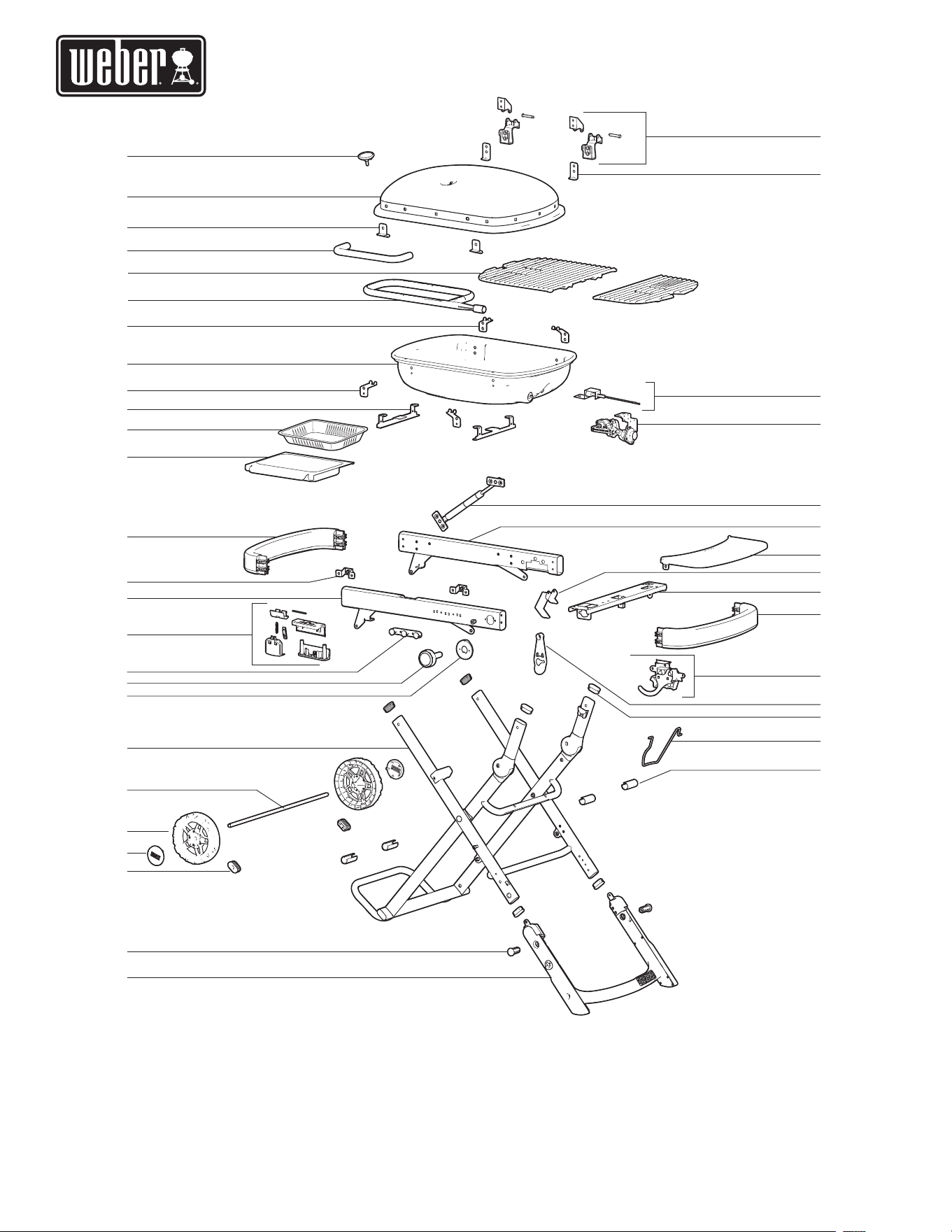
REPLACEMENT
PARTS
To obtain replacement parts,
contact the local retailer
in your area or log onto weber.com.
CALL
CUSTOMER
SERVICE
If you are still experiencing any
problems, contact the CustomerService
Representative in your area using
the contact information on
weber.com.
Using a Match to Determine if there is Gas Flow
to the Burners
1) Open the grill lid.
2) Check that the burner control knob is in the
o position. Check by pushing in and turning knobs
clockwise.
3) Confirm that the cylinder is properly installed. Refer
to “Installing the LP Cylinder.”
4) Strike a match and put the flame under the
matchlight hole (A).
5) While holding lit match, push the burner control knob
in and turn it counterclockwise to the start/high
position.
6) Check that the burner is lit by looking through the
cooking grates.
7) If the burner does not ignite within 4 seconds, turn
burner control knob to the o
position and wait five
minutes to allow the gas to clear before attempting
to light the burner again. If repeated attempts fail,
follow the gas flow troubleshooting instructions on
the next page.
8) If the burner ignites, the problem lies in the ignition
system. Follow the instructions for “Checking the
Components of the Ignition System.”
GRILL WILL NOT IGNITE
SYMPTOM
• Burner does not ignite when following the ignition instructions in the “Operation” section of this Owner's Manual.
CAUSE SOLUTION
There is a problem with gas flow. If the grill will not ignite, the first step is to determine if there is gas flowing to the burners. Tocheck this, follow the
instructions below for “Using a Match to Determine if there is Gas Flow to the Burners.”
If match lighting IS NOT successful, follow the gas flow troubleshooting suggestions on the next page.
There is a problem with the ignition system. If the grill will not ignite, the first step is to determine if there is gas flowing to the burners. Tocheck this, followthe
instructions below for “Using a Match to Determine if there is Gas Flow to the Burners.”
If match lighting IS successful, follow the instructions below for “Checking the Components of the IgnitionSystem.”
Checking the Components of the Ignition System
When turning the burner control knob counterclockwise
to the start/high
position, you should hear it click.
Check the wire to ensure the igniter is creating a spark.
Checking the Wire
1) Check that the black ignition wire is connected
securely to the terminals behind the control panel
(B).
2) Verify the burner control knob pushes in, rotates,
clicks, and returns out again.
3) Push the burner control knob in and then turn
clockwise all the way to the o
position.
If the grill will not ignite, contact the Customer
Service Representative in your area using the
contact information on our website.
TROUBLESHOOTING
A
B
11weber.com
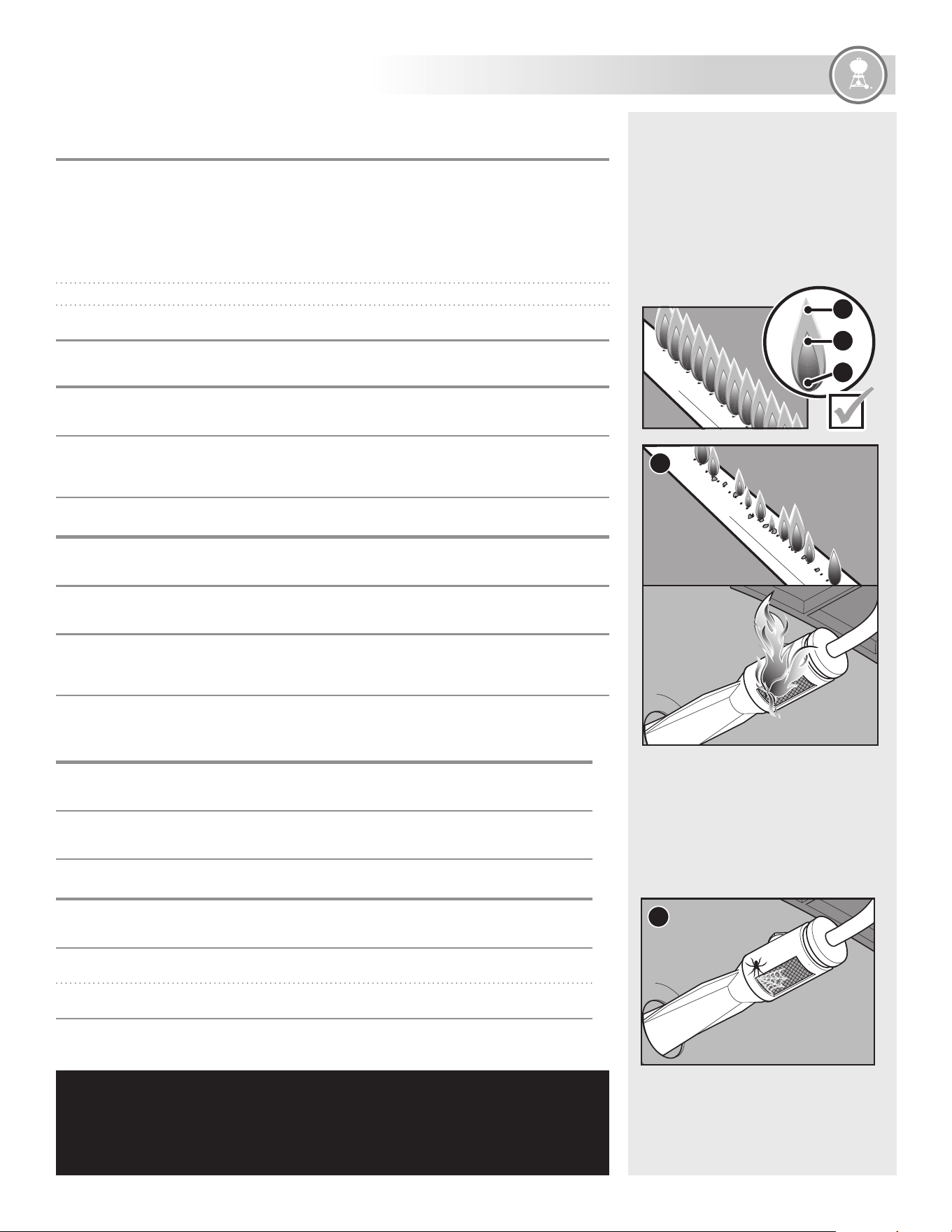
Proper Burner Flame Pattern
The burner in your grill is factory set for the
correct air and gas mixture. When the burner is
performing correctly, you will see a specific flame
pattern. The tips may occasionally flicker yellow
(A), with a descending light blue (B) to dark blue
flame (C).
m WARNING: Blocked and dirty ports can restrict
full gas flow, resulting in a fire (D) in and around
the gas valves, causing serious damage to your
grill.
m WARNING: Do not attempt to make any repair to gas carrying, gas burning, ignition components or structural
components without contacting Weber-Stephen Products LLC, Customer Service Department.
m CAUTION: The burner tube openings must be positioned properly over the valve orifices.
Spider Screens
The combustion air openings of the burners(E)
are fitted with stainless steel screens to
prevent spiders and other insects from spinning
webs and building nests inside the burners.
Additionally, dust and debris can accumulate
on the outside of the spider/insect screen and
obstruct the oxygen flow to the burners.
B
A
C
GAS FLOW
SYMPTOM
• Grill does not reach desired temperature or heatsunevenly.
• The burner fails to ignite.
• Flame is low when burner is on high position.
• Flames do not run the whole length of the burner.
• Burner flame pattern is erratic.
CAUSE SOLUTION
The LP cylinder is low or empty. Replace LP cylinder.
Burner ports are dirty. Clean burner ports. Refer to “Cleaning the
BurnerPorts.”
SYMPTOM
• Gas is smelled in conjunction with burner flames that appear yellow andlazy.
CAUSE SOLUTION
Spider screens on the burner is obstructed. Clean spider screens. Refer to “Cleaning the Spider
Screens” in the Product Care section. Also refer to
the illustrations and information in this section about
proper flame pattern and spiderscreens.
SYMPTOM
• The smell of gas and/or a light hissing sound.
CAUSE SOLUTION
Connection between regulator and LP cylinder could be
incomplete.
Extinguish any open flame. Remove and reinstall
the LP Cylinder. Refer to “Installing the LP Cylinder”
section of your owner’s manual.
The regulator coupling with the LP cylinder could be
damaged.
Extinguish any open flame. Remove the LP cylinder.
DO NOT OPERATE THE GRILL. Contact the Customer
Service Representative in your area using the
contact information on our website.
GREASY GRILL (Resembles Peeling Paint & Flare-Ups)
SYMPTOM
• Inside of lid appears to have what resembles peelingpaint.
CAUSE SOLUTION
The flakes you see are accumulated cooking vapors
that have turned into carbon, and NOT paint.
This happens over time after repeated use of your
grill. This is not a defect. Clean the lid. Refer to the
“Product Care” section.
SYMPTOM
• Experiencing flare-ups when grilling or preheating.
CAUSE SOLUTION
There is leftover food from the previous meal. Always preheat the grill on the highest setting for 10
to 15 minutes.
The inside of the grill needs to be cleaned thoroughly. Follow the steps in the "Cleaning and Maintenance"
section to clean the grill inside from the top down.
TROUBLESHOOTING
E
D
© 2023 Designed and engineered by Weber-Stephen Products LLC, 1415 S. Roselle Road, Palatine, Illinois 60067 USA.
U.S./EE. UU./États-Unis :
1-800-446-1071
Mexico/México/Mexique :
01 800 0093237
Canada/Canadá/Canada :
1-800-446-1071
weber.com
TRAVELER COMPACT - LP - US - 100223
7
8
10
12
11
18
23
19
17
20
24
22
16
21
25
26
15
14
13
5
6
1
4
2
3
9
27
28
29
30
33
36
35
34
38
39
41
32
31
37
40
REPLACEMENT PARTS