76416
121520
enGB
Keep this Owner’s Manual for future reference, thoroughly read through it, and
if you have any questions please contact us today.
PHONE MOBILE EMAIL ONLINE
REGISTER TODAY
LPG OWNER’S MANUAL
Free download
Unlock barbecuing happiness: Register your gas barbecue and receive special content
to make you the ultimate backyard hero.
Registration is easy and we only ask a few quick questions. In less than two minutes,
activate your unique WEBER-ID, and unlock a lifetime of WEBER knowledge and
guidance. Stay inspired along the way.

2
SAFETY
Installation and Assembly
m DANGER: This barbecue is not intended to be installed
in or on recreational vehicles or boats.
m WARNING: Do not use this barbecue unless all
parts are in place and the barbecue was properly
assembled according to the assembly instructions.
m WARNING: Do not build this model of barbecue in any
built-in or slide-in construction.
m WARNING: Do not modify the appliance. LP gas is
not natural gas. The conversion or attempted use of
natural gas in an LP gas unit or LP gas in a natural
gas unit is unsafe and will void your warranty.
• Any parts sealed by the manufacturer must not be
altered by the user.
Operation
m DANGER: Only use the barbecue outdoors in a well-
ventilated area. Do not use in a garage, building,
breezeway, tent, any other enclosed area, or beneath
an overhead combustible structure.
m DANGER: Do not use the barbecue in any vehicle
or in any storage or cargo area of any vehicle. This
includes, but is not limited to, cars, trucks, station
wagons, mini-vans, sport utility vehicles, recreational
vehicles, andboats.
m DANGER: When in use, combustible materials should not
be within 61 cm (24 inches) of the back or sides of the
barbecue.
m DANGER: Keep the cooking area clear of flammable
vapours and liquids such as petrol, alcohol, etc., and
combustible materials.
m DANGER: This appliance must be kept away from
flammable materials during use.
m DANGER: Do not put a barbecue cover or anything
flammable on, or in the storage area under the
barbecue while it is in operation or is hot.
m DANGER: Should a grease fire occur, turn o all
burners and leave lid closed until fire is out.
m WARNING: Accessible parts may be very hot.
Keepyoung children away.
m WARNING: The use of alcohol, prescription drugs,
non-prescription drugs, or illegal drugs may impair
the consumer’s ability to properly and safely
assemble, move, store, or operate thebarbecue.
m WARNING: Never leave the barbecue unattended
during pre-heating or use. Exercise caution when
using this barbecue. The entire cookbox gets hot
when in use.
m WARNING: Use heat-resistant barbecue mitts or
gloves (conforming to EN 407, Contact Heat rating
level 2 or greater) when operating barbecue.
m WARNING: Do not move the appliance duringuse.
m WARNING: Keep any electrical supply cord and the
fuel supply hose away from any heated surfaces.
m CAUTION: This product has been safety-tested and
is only certified for use in a specific country. Refer to
country designation located on outside of box.
• Do not use charcoal, briquettes or lava rock in the
barbecue.
m DANGER
If you smell gas:
• Shut o gas to the appliance
(barbecue).
• Extinguish any open flame.
• Open lid.
• If odour continues, keep
away from the appliance
(barbecue) and immediately
call your gas supplier or the
emergency fire services.
m WARNING
• Do not store or use gasoline
or other flammable liquids
or vapours in the vicinity of
this (barbecue) or any other
appliance.
• An LPG cylinder not
connected for use shall not
be stored in the vicinity of
this (barbecue) or any other
appliance.
USE OUTDOORS ONLY.
READ THE INSTRUCTIONS BEFORE USING
THE APPLIANCE (BARBECUE).
NOTICE TO INSTALLER: These instructions
must be left with the consumer.
NOTICE TO CONSUMER: Retain these
instructions for future reference.
Important
SafetyInformation
DANGER, WARNING, and CAUTION
statements are used throughout this
Owner's Manual to emphasise critical and
important information. Read and follow
these statements to help ensure safety and
prevent property damage. Thestatements
are defined below.
m DANGER: Indicates a hazardous situation
which, if not avoided,
will result in death or seriousinjury.
m WARNING: Indicates a hazardous
situation which, if not avoided,
could result in death or seriousinjury.
m CAUTION: Indicates a hazardous situation
which, if not avoided,
could result in minor or moderateinjury.
Storage and/or Nonuse
m WARNING: Turn o the gas supply at the gas cylinder
after use.
m WARNING: LPG cylinders must be stored outdoors out
of the reach of children and must not be stored in a
building, garage or any other enclosed space.
m WARNING: After a period of storage and/or nonuse,
the barbecue should be checked for gas leaks and
burner obstructions before use.
• Storage of the barbecue indoors is permissible only if
the LPG cylinder is disconnected and removed from
thebarbecue.

3weber.com
SAFETY
TABLE OF CONTENTS
2 Safety
Important Safety Information
4
Warranty
4 Parts List
5 Assembly
6 Product Features
Traveler Features
Folding the Cart and Transporting the
Barbecue
8 Getting Started
Important Information about LP Gas &
Gas Connections
10 Operation
The Very First Time You Barbecue
Every Time You Barbecue
Igniting the Barbecue
12 Product Care
Cleaning and Maintenance
14 Troubleshooting
16 Tips and Hints
Barbecuing Do's and Don'ts
17 Replacement Parts
We are so glad that you have joined us on the journey to barbecuing happiness.
Pleasetake some time to read through this Owner’s Manual to ensure that
you are up and barbecuing quickly and easily. We want to be with you for the
life of your barbecue, so please take just a couple of minutes to register your
barbecue. Wepromise that we will never sell your information or spam you with
unnecessary emails. What we do promise is to be by your side, every step of the
way. By signing up for your WEBER-ID, as part of your registration, we will deliver
special content just for you and your barbecue to enjoy.
So, come along and join us online, on the phone or however else you’d like to
stay in touch.
Thank you for choosing WEBER. We are happy you are here.
WELCOME TO THE FAMILY
4
WARRANTY PARTS LIST
Traveler
The barbecues that are illustrated in this Owner’s
Manual may vary slightly from the model purchased.
Thank you for purchasing a WEBER product. Weber-Stephen
Products LLC, 1415 S. Roselle Road, Palatine, Illinois 60067
(“WEBER”) prides itself on delivering a safe, durable, and reliable
product.
This is WEBER’s Voluntary Warranty provided to you at no extra
charge. It contains the information you will need to have your
WEBER product repaired in the unlikely event of a failure or defect.
Pursuant to applicable laws, the customer has several rights in
case the product is defective. Those rights include supplementary
performance or replacement, abatement of the purchasing
price, and compensation. In the European Union, for example,
this would be a two-year statutory warranty starting on the
date of the handover of the product. These and other statutory
rights remain unaected by this warranty provision. In fact,
this warranty grants additional rights to the Owner that are
independent from statutory warranty provisions.
WEBER’S VOLUNTARY WARRANTY
WEBER warrants, to the purchaser of the WEBER product (or in
the case of a gift or promotional situation, the person for whom
it was purchased as a gift or promotional item), that the WEBER
product is free from defects in material and workmanship for the
period(s) of time specified below when assembled and operated
in accordance with the accompanying Owner’s Manual. (Note: If
you lose or misplace your WEBER Owner’s Manual, a replacement
is available online at www.weber.com, or such country-specific
website to which Owner may be redirected.) Under normal,
private single family home or flat use and maintenance, Weber
agrees within the framework of this warranty to repair or replace
defective parts within the applicable time periods, limitations
and exclusions listed below. TO THE EXTENT ALLOWABLE BY
APPLICABLE LAW, THIS WARRANTY IS EXTENDED ONLY TO
THE ORIGINAL PURCHASER AND IS NOT TRANSFERABLE TO
SUBSEQUENT OWNERS, EXCEPT IN THE CASE OF GIFTS AND
PROMOTIONAL ITEMS AS NOTED ABOVE.
OWNER’S RESPONSIBILITIES UNDER THIS WARRANTY
To ensure trouble-free warranty coverage, it is important (but it is
not required) that you register your Weber product online at www.
weber.com or such country-specific website to which you may be
redirected. Please also retain your original sales receipt and/or
invoice. Registering your WEBER product confirms your warranty
coverage and provides a direct link between you and WEBER in
case we need to contact you.
The above warranty only applies if the Owner takes reasonable
care of the WEBER product by following all assembly instructions,
usage instructions, and preventative maintenance as outlined in
the accompanying Owner’s Manual, unless the Owner can prove
that the defect or failure is independent of non-compliance with
the above-mentioned obligations. If you live in a coastal area,
or have your product located near a pool, maintenance includes
regular washing and rinsing of the exterior surfaces as outlined in
the accompanying Owner’s Manual.
WARRANTY HANDLING / EXCLUSION OF WARRANTY
If you believe that you have a part which is covered by this
Warranty, please contact WEBER Customer Service using the
contact information on our website (www.weber.com, or such
country-specific website to which Owner may be redirected).
WEBER will, upon investigation, repair or replace (at its option) a
defective part that is covered by this Warranty. In the event that
repair or replacement are not possible, Weber may choose (at its
option) to replace the barbecue in question with a new barbecue
of equal or greater value. WEBER may ask you to return parts for
inspection, shipping charges to be pre-paid.
This WARRANTY lapses if there are damages, deteriorations,
discolourations, and/or rust for which WEBER is not responsible
caused by:
• Abuse, misuse, alteration, modification, misapplication,
vandalism, neglect, improper assembly or installation, and
failure to properly perform normal and routine maintenance;
• Insects (such as spiders) and rodents (such as squirrels),
including but not limited to damage to burner tubes and/or gas
hoses;
• Exposure to salt air and/or chlorine sources such as swimming
pools and hot tubs/spas;
• Severe weather conditions such as hail, hurricanes,
earthquakes, tsunamis or surges, tornadoes or severe storms.
The use and/or installation of parts on your WEBER product that
are not genuine WEBER parts will void this Warranty, and any
damages that result hereby are not covered by this Warranty. Any
conversion of a gas barbecue not authorised by WEBER and not
performed by a WEBER authorised service technician will void
this Warranty.
PRODUCT WARRANTY PERIODS
Cookbox:
5 years, no rust through/burn through
Lid assembly:
5 years, no rust through/burn through
Stainless steel burner tube:
3 years, no rust through/burn through
Porcelain-enamelled, cast-iron cooking grates
3 years, no rust through/burn through
Plastic components:
2 years, excluding fading or discolouration
All remaining parts:
2 years
DISCLAIMERS
APART FROM THE WARRANTY AND DISCLAIMERS AS DESCRIBED
IN THIS WARRANTY STATEMENT, THERE ARE EXPLICITLY NO
FURTHER WARRANTY OR VOLUNTARY DECLARATIONS OF
LIABILITY GIVEN HERE WHICH GO BEYOND THE STATUTORY
LIABILITY APPLYING TO WEBER. THE PRESENT WARRANTY
STATEMENT ALSO DOES NOT LIMIT OR EXCLUDE SITUATIONS
OR CLAIMS WHERE WEBER HAS MANDATORY LIABILITY AS
PRESCRIBED BY STATUTE.
NO WARRANTIES SHALL APPLY AFTER THE APPLICABLE PERIODS
OF THIS WARRANTY. NO OTHER WARRANTIES GIVEN BY ANY
PERSON, INCLUDING A DEALER OR RETAILER, WITH RESPECT TO
ANY PRODUCT (SUCH AS ANY “EXTENDED WARRANTIES”), SHALL
BIND WEBER. THE EXCLUSIVE REMEDY OF THIS WARRANTY IS
REPAIR OR REPLACEMENT OF THE PART OR PRODUCT.
IN NO EVENT UNDER THIS VOLUNTARY WARRANTY SHALL
RECOVERY OF ANY KIND BE GREATER THAN THE AMOUNT OF THE
PURCHASE PRICE OF THE WEBER PRODUCT SOLD.
YOU ASSUME THE RISK AND LIABILITY FOR LOSS, DAMAGE, OR
INJURY TO YOU AND YOUR PROPERTY AND/OR TO OTHERS AND
THEIR PROPERTY ARISING OUT OF THE MISUSE OR ABUSE OF
THE PRODUCT OR FAILURE TO FOLLOW INSTRUCTIONS PROVIDED
BY WEBER IN THE ACCOMPANYING OWNER’S MANUAL.
PARTS AND ACCESSORIES REPLACED UNDER THIS WARRANTY
ARE WARRANTED ONLY FOR THE BALANCE OF THE ABOVE
MENTIONED ORIGINAL WARRANTY PERIOD(S).
THIS WARRANTY APPLIES TO PRIVATE SINGLE FAMILY HOME OR
FLAT USE ONLY AND DOES NOT APPLY TO WEBER BARBECUES
USED IN COMMERCIAL, COMMUNAL OR MULTI-UNIT SETTINGS
SUCH AS RESTAURANTS, HOTELS, RESORTS, OR RENTAL
PROPERTIES.
WEBER MAY FROM TIME TO TIME CHANGE THE DESIGN OF ITS
PRODUCTS. NOTHING CONTAINED IN THIS WARRANTY SHALL
BE CONSTRUED AS OBLIGATING WEBER TO INCORPORATE SUCH
DESIGN CHANGES INTO PREVIOUSLY MANUFACTURED PRODUCTS,
NOR SHALL SUCH CHANGES BE CONSTRUED AS AN ADMISSION
THAT PREVIOUS DESIGNS WERE DEFECTIVE.
Refer to International Business Units list at the end of this Owner’s
Manual for additional contact information.
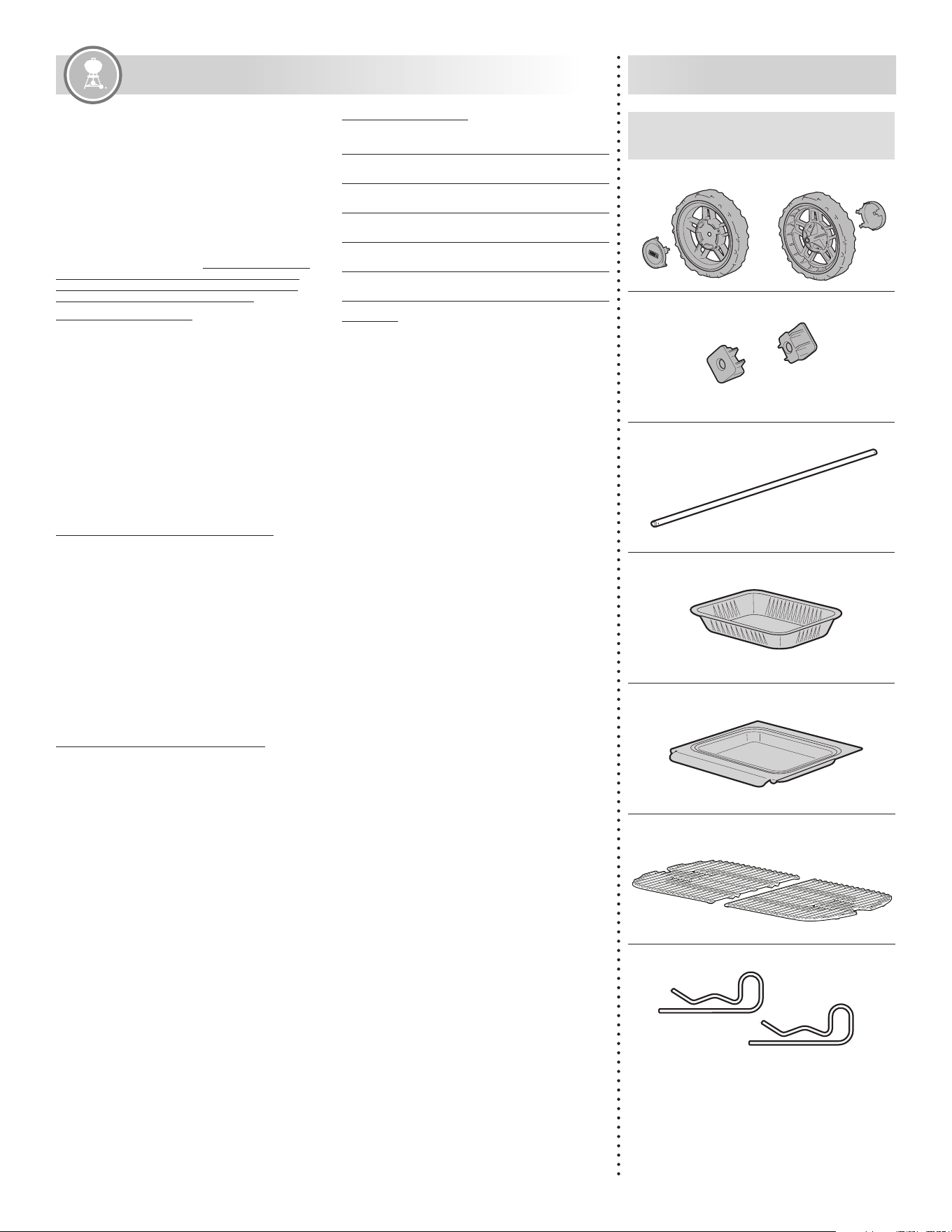
m Remove all packaging materials and protective
film before operating your barbecue.
5weber.com
ASSEMBLY
2
1
3
6
5
8
7
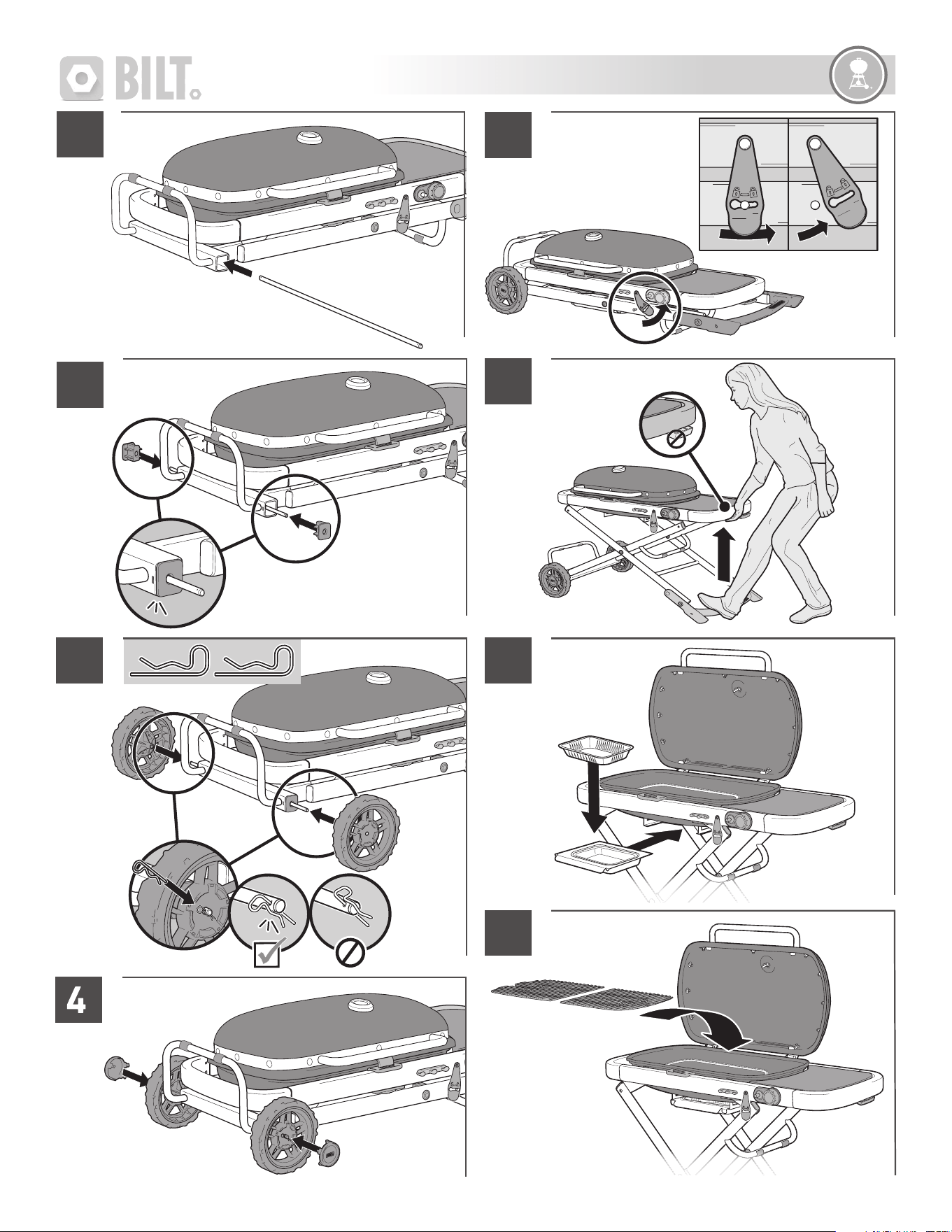
Download the free BILT™ app for
3Dstep-by-step instructions.
6
TRAVELER
FEATURES
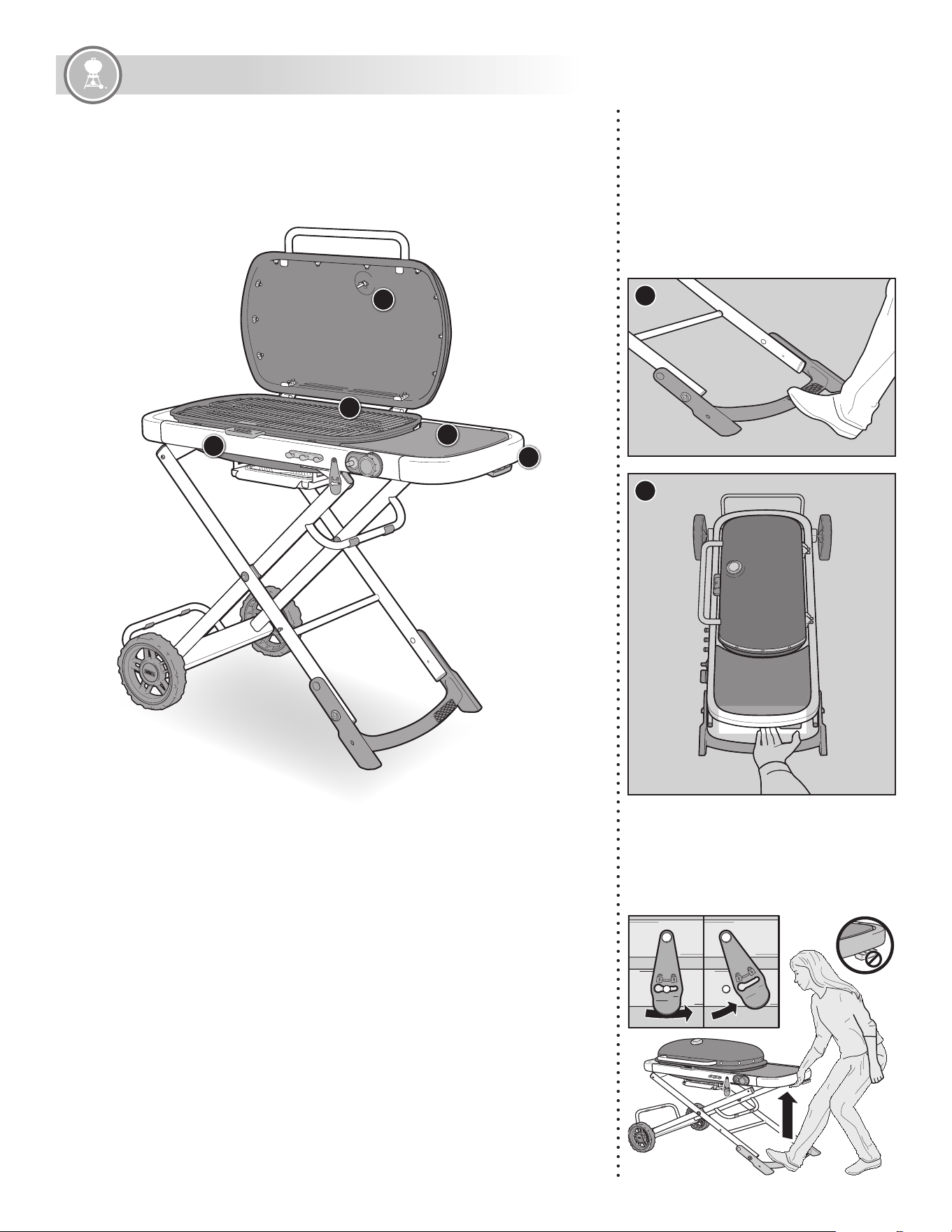
A Folding Cart for Easy Transport
Compact, folding cart with automatic lid lock allows the Traveler to easily go where
you go. It's designed to fit in the boot of your car and to not take up room in your
garage when storing.
B Porcelain-Enamelled,
Cast Iron Cooking Grates
Porcelain-enamelled, cast-iron cooking grates provide even heat distribution across the
entire barbecuing surface and superior heat retention.
C Side Table and Tool Hooks
Use the side table to keep platters, seasonings, and tools within arm’s reach. Hang
your essential barbecuing tools on the hooks for easy access and organisation of your
workspace.
D Built-In Thermometer
Being aware of the temperature inside your barbecue allows you to adjust the heat
when needed.
E Automatic Lid Lock
Keeping the lid closed and the cooking grates in place occurs automatically when the
barbecue is lowered to the down position.
A
D
E
B
C
PRODUCT FEATURES
A
B
Raising and Lowering the
Barbecue
When it's time to set up or put away the barbecue,
follow these steps to ensure the barbecue is ready.
When raising and lowering the barbecue, always be
sure to stabilise the barbecue by keeping a foot placed
on the foot stand (A), and grasping the barbecue
from the END of the side table frame (B). It is not
recommended to grasp the barbecue from the sides or
corners of the frame.
Raising the Barbecue
1) Move the cart lock to the unlocked position and
disengage it from the pin.
2) Keep one foot on the foot stand and lift the barbecue
from the end of the side table frame until it clicks
into the raised position. Do not grip the cart release
lever while raising the barbecue.
7weber.com
PRODUCT FEATURES
b.
c.
a.
e.
f.
d.
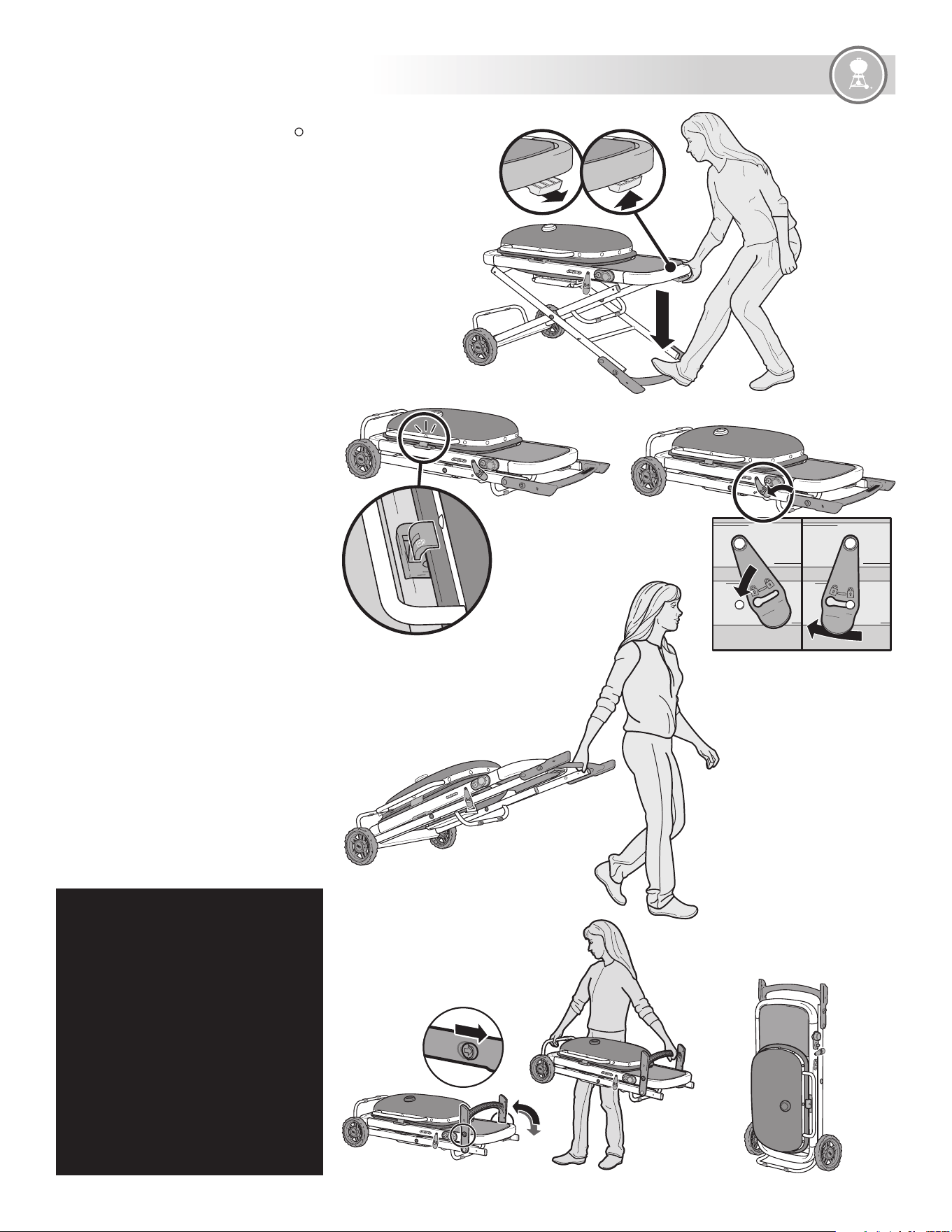
Lowering the Barbecue
1) Make sure the burner control knob is in the o ( )
position.
2) Close the lid.
3) Allow the barbecue to cool completely.
4) Remove the LP cartridge by first turning o
the regulator valve, then rotate the LP cartridge
anticlockwise to disconnect it from the regulator.
Refer to "Disconnecting the LP Cartridge."
5) Always check the slide-out catch pan to clean or
replace the disposable drip tray.
6) To lower the cart, make sure to keep one foot on the
foot stand at the base of the barbecue and grasp the
end of the side table frame (a).
Carefully disengage the release lever beneath the
side table by: 1) pulling the lever toward you, and
2) lifting it up toward the end-rail. Then, slowly lower
the barbecue keeping your foot in place.
Important: Use caution when lowering the cart.
Always guide the cart while moving to the down
position by maintaining a steady grip on the frame.
Repeated lowering of the cart without maintaining
a grip on the frame may cause damage to the gas
spring.
Transportation and Storage
1) Once the cart is folded down, the automatic lid
lock engages to keep the lid and cooking grates in
place (b). To secure the cart in the folded position,
fasten the cart lock over the pin (c) and move it to the
locked position.
2) After the cart is lowered and locked, the barbecue is
ready to roll (d).
3) For added convenience in the folded position, rotate
the foot stand upward by first sliding back the red
tabs on the side of the frame (e). This provides areas
on both ends of the barbecue for lifting into storage
or transportation.
NOTE: Do not lift the barbecue by the lid handle.
4) After a thorough cleaning, store the barbecue upright
for a smaller footprint (f).Follow the steps in the
"Cleaning and Maintenance" section of this owner's
manual.
m WARNING: Only set up the cart on a stable and
level outdoor surface. Never set up the cart on
a sloping surface.
m WARNING: Use caution when removing slide-
out catch pan and disposing of hot grease.
m WARNING: Do not store the barbecue while the
LP cylinder is attached.
m WARNING: Do not store or transport a
disconnected LP cylinder inside the barbecue.
m CAUTION: Do not move the barbecue when in
use. Allow the barbecue to cool before moving
or storing.
m CAUTION: Do not lift the barbecue by the lid
handle as this could result in damage to the
lid lock.
m CAUTION: Do not stack additional items on
barbecue during storage or transit.
8
GETTING STARTED
EN417
A
B
NORMAL VALVE DAMAGED VALVE
Important Information about LP
Gas & Gas Connections
What Is LP Gas?
Liquefied petroleum gas, also called LPG, LP gas, liquid
propane, or simply propane or butane, is the flammable,
petroleum-based product used to fuel your barbecue. It
is a gas at moderate temperatures and pressure when
it is not contained. But at moderate pressure inside a
container, such as a tank, LP is a liquid. As pressure is
released from the tank, the liquid readily vapourises and
becomes gas.
Safe Handling Tips for Disposable
Cartridges
There are various guidelines and safety factors that you
need to keep in mind when using LP gas. Carefully follow
these instructions before using your gas barbecue.
• Do not use a damaged, dented or rusty cartridge.
• Although the cartridge may appear to be empty, gas
may still be present, and the cartridge should be
transported and stored accordingly.
• Cartridges should not be dropped or handled roughly.
• Never store or transport the cartridge where
temperatures can reach 51° C (the cartridge will
become too hot to hold by hand). For example: do not
leave the cartridge in a car on a hot day.
• Cartridges must be kept out of reach of children.
• Leak-test the joint where the regulator connects to the
cartridge each time a reconnection occurs. For example:
test each time the cartridge is reinstalled.
• Leak-test the joint where the regulator connects to the
cartridge each time a reconnection occurs. For example:
test each time the cartridge is reinstalled.
• The areas around the cartridge must be free and clear
from debris.
• The cartridge should not be changed in the proximity of
an ignition source.
• Always close the regulator gas control valve before
disconnecting regulator.
What is a Regulator?
Your gas barbecue is equipped with a pressure
regulator, which is a device to control and maintain
uniform gas pressure as gas is released from the
LPGcylinder.
Regulator Connections
• In Great Britain, this barbecue must be fitted with a
regulator complying with BS 3016, having a nominal
output of 37 millibars.
• The length of the hose must not exceed 1.5 metres.
• Avoid kinking the hose.
• Change the flexible hose when national regulations
stipulate this as a requirement.
• Any parts sealed by the manufacturer must not be
altered by the user.
• Any modification of the appliance may be dangerous.
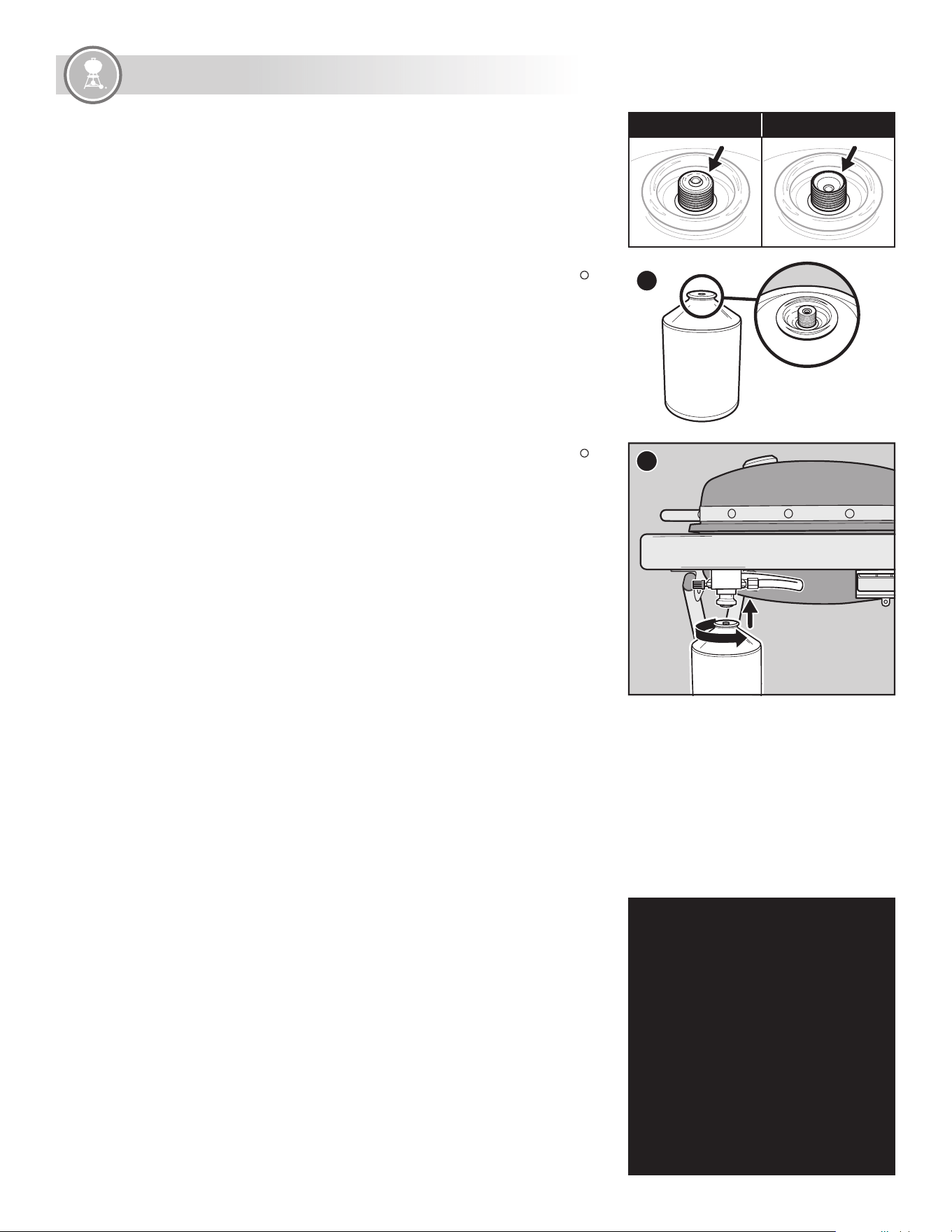
Installing the Cartridge
Use only butane/propane disposable cartridges with
a minimum capacity of 430g and a maximum capacity
of 460g. The cartridge must have an EN417 valve as
illustrated (A).
Check that seals (between the appliance and the gas
container) are in place and in good condition before
connecting to the gas container.
1) Raise the barbecue.
2) Make sure burner control knob is turned o by
pushing it in and turning it clockwise to the o (
)
position.
3) Make sure the regulator gas control valve is turned
o by turning clockwise until tight.
4) Push cartridge into regulator and turn clockwise
until tight (B).
Removing the Cartridge
Every time you need to lower the barbecue cart, or if the
cartridge is empty and needs to be replaced, follow these
instructions to remove it.
1) Make sure burner control knob is turned o by
pushing it in and turning it clockwise to the o (
)
position.
2) Make sure the regulator gas control valve is turned
o by turning clockwise until tight.
3) Unscrew the cartridge from the regulator by turning
it anticlockwise and remove it from the barbecue.
Storage and/or Travel
Disconnect the cartridge if: 1) the cartridge is empty; 2)
the barbecue is being transported; 3) the barbecue is
being stored in a garage or other enclosed area; 4) the
barbecue is not in use.
• Do not store a disconnected cartridge in a building,
garage, or any other enclosed area.
• Do not store or transport a disconnected cartridge
inside the barbecue.
For barbecues that have been stored or left unused for a
while, it is important to follow these guidelines:
• The WEBER gas barbecue should be checked for gas
leaks and any obstructions in the burner tube before
it is used. (Refer to “CHECKING FOR GAS LEAKS” and
“ANNUAL MAINTENANCE.”)
• Check that the areas under the cookbox and the
removable catch pan are free from debris that might
obstruct the flow of combustion or ventilation air.
• The spider/insect screen should also be checked for any
obstructions. (Refer to “ANNUAL MAINTENANCE.”)
m CAUTION: Only use WEBER Q Gas or other
EN 417 cartridges marked 80% Butane/20%
Propane.
m WARNING: Hand tighten only. Using excessive
force could damage the regulator coupling
and cartridge valve. This could cause a leak or
prevent gas flow
.
m Check the seals before connecting a new gas
container to the appliance.
m Do not use the appliance if it has damaged or
worn seals.
m Gas containers shall be changed in a well
ventilated location, preferably outside, away
from any sources of ignition, such as naked
flames, pilots, electric fires and away from
other people.
9weber.com
GETTING STARTED
C
D
F
A
B
E
Burner Valve Orifice Sizes & Consumption Data
BURNER VALVE ORIFICE SIZES CONSUMPTION DATA
Country Gas Category
China, Cyprus, Czech
Republic, Denmark,
Estonia, Finland, Hong
Kong, Hungary, Iceland,
India, Israel, Japan, Korea,
Latvia, Lithuania, Malta,
the Netherlands, Norway,
Romania, Russia, Singapore,
Slovakia, Slovenia, South
Africa, Sweden, Turkey
I
3B/P
(30 mbar or 2.8 kPa) Main Burner 1.01 mm 3.80 kW Propane
4.25 kW Butane
267.1 g/h Propane
304.0 g/h Butane
Belgium, France, Greece,
Ireland, Italy, Luxembourg,
Portugal, Spain,
Switzerland, Great Britain
I
3+
(28-30/37 mbar) Main Burner 0.95 mm 3.80 kW Propane
3.80 kW Butane
267.1 g/h Propane
271.8 g/h Butane
Poland I
3P
(37 mbar) Main Burner 0.95 mm 3.80 kW Propane
267.1 g/h Propane
Austria, Germany I
3B/P
(50 mbar) Main Burner 0.87 mm 3.80 kW Propane
4.25 kW Butane
267.1 g/h Propane
304.0 g/h Butane
m IMPORTANT: We recommend that you replace
the gas hose assembly on your gas barbecue
every five years. Some countries may have
requirements that the gas hose be replaced
within less than five years, in which case that
country’s requirement would take precedence.
For replacement hose, regulator, and valve
assemblies, contact the Customer Service
Representative in your area using the contact
information on our web site.
Log on to weber.com.
m DANGER: Do not use a flame to check for gas
leaks. Be sure there are no sparks or open
flames in the area while you check for leaks.
m DANGER: Leaking gas may cause a fire or
explosion.
m DANGER: Do not operate the barbecue if there
is a gas leak present.
m DANGER: If you see, smell, or hear the hiss of
gas escaping from the liquid propane tank:
1) Move away from liquid propane tank.
2) Do not attempt to correct the problem yourself.
3) Call your fire brigade.
What is a Leak Check?
Once the cartridge is properly installed, it is necessary
to perform a leak check. A leak check is a reliable way to
verify that gas is not escaping after you connect the tank.
The fuel system in your barbecue features factory-made
connections that have been thoroughly checked for gas
leaks and the burners have been flame-tested. WEBER
recommends performing a thorough leak check after
assembly, as well as every time you disconnect and
reconnect a gas fitting. The following fittings should be
tested:
•Where the cartridge connects to the regulator.
•Where the regulator connects to the regulator hose.
•Where the regulator hose connects to the valve.
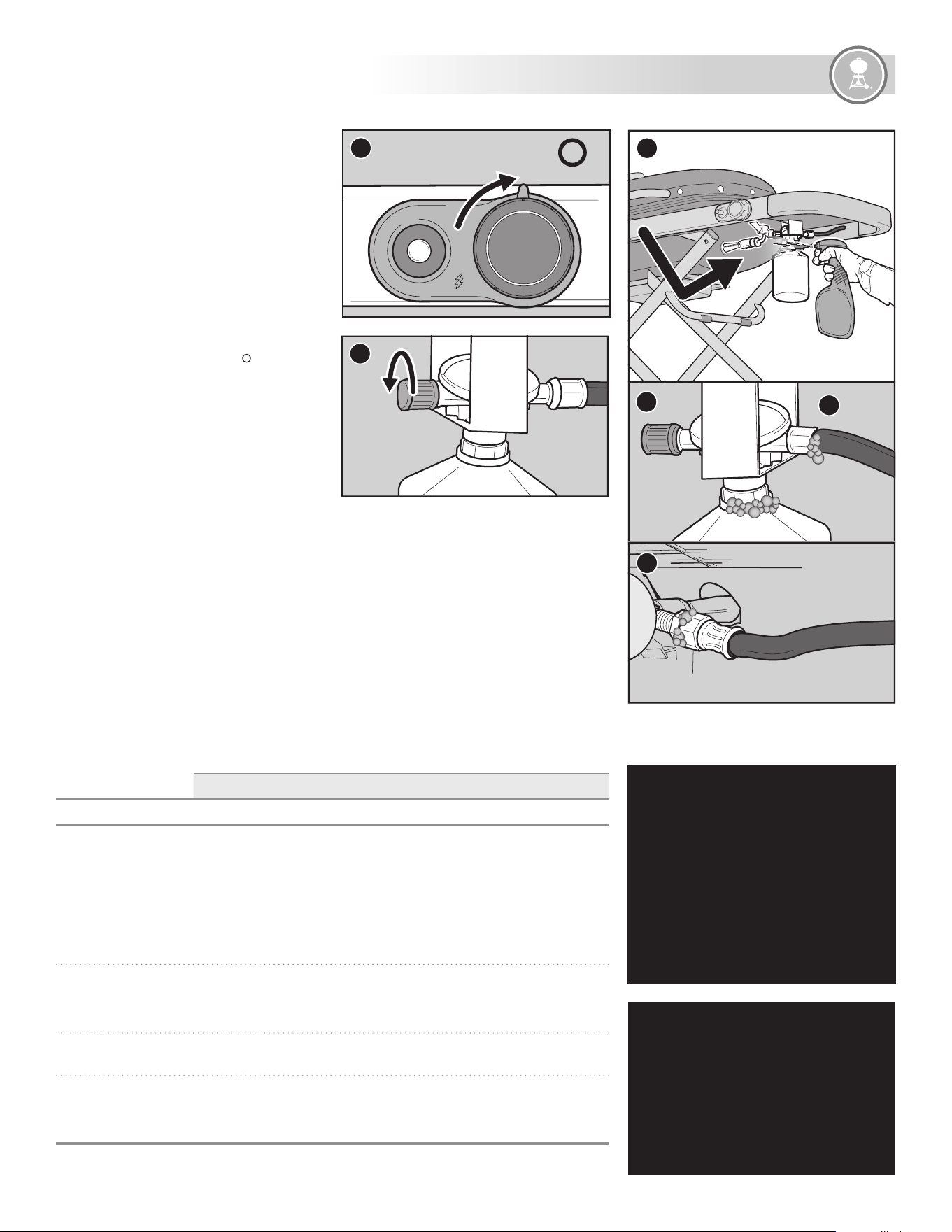
Checking for Gas Leaks
1) Make sure burner control knob is turned o by pushing
it in and turning it clockwise to the o (
) position (A).
2) Turn gas supply on by turning the regulator gas control
valve anticlockwise (B).
3) Wet fittings (C) with a soap and water solution, using a
spray bottle, brush, or rag. You can make your own soap
and water solution by mixing 20% liquid soap with 80%
water; or, you can purchase leak check solution in the
plumbing section of any hardware store.
4) If bubbles appear there is a leak:
a) If the leak is at the cartridge (D), remove the
cartridge. DONOT OPERATE THE BARBECUE. Install
a dierent cartridge and recheck for leaks with a
soap and water solution. If the leak persists, remove
the cartridge. DO NOT OPERATE THE BARBECUE.
Contact the Customer Service Representative in your
area using the contact information on our website.
b) If the leak is at the regulator (E) or burner valve (F),
turn o the gas. NEVER ATTEMPT TO TIGHTEN THE
REGULATOR. DO NOT OPERATE THE BARBECUE.
Contact the Customer Service Representative in your
area using the contact information on our website.
If a leak is present, contact the Customer Service
Representative in your area using the contact information
on our website.
5) If bubbles do not appear, leak checking is complete:
a) Rinse connections with water.
NOTE: Since some leak test solutions, including soap and
water, may be slightly corrosive, all connections should be
rinsed with water after checking for leaks.
10
D
OPERATION
A
B
C
The Very First Time You Barbecue
Perform an Initial Burn-Off
Heat the barbecue on the highest setting, with the lid
closed, for at least 20 minutes prior to barbecuing for
the first time.
Every Time You Barbecue
Meal-to-Meal Maintenance
The Meal-To-Meal Maintenance plan includes the
following simple, yet important, steps that should
always be performed prior to barbecuing.
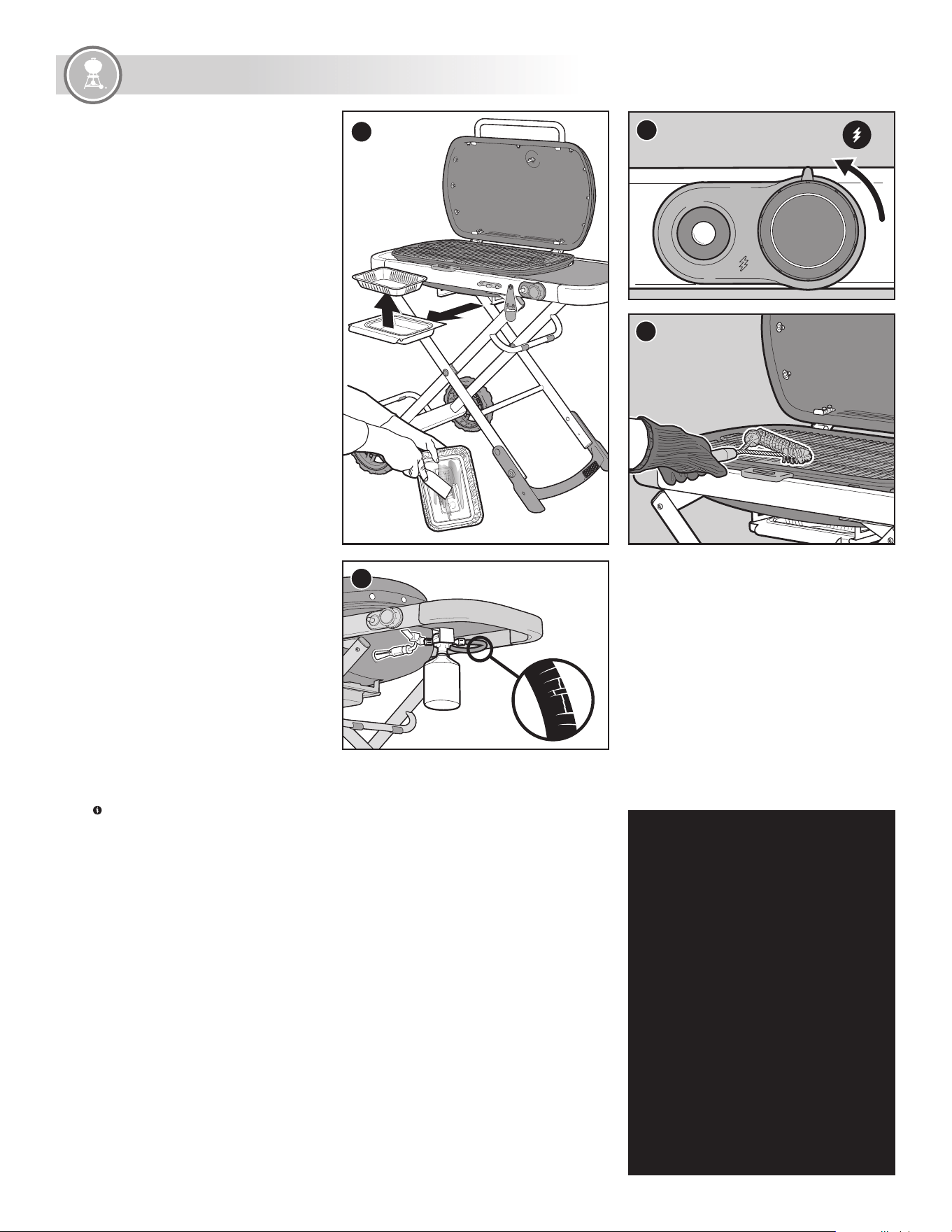
Check for Grease
Your barbecue was built with a grease management
system that funnels grease away from food and into a
disposable container. As you cook, grease is channelled
down to the slide-out catch pan and into a disposable
drip tray that lines the catch pan. This system should be
cleaned each and every time you barbecue to prevent
fires.
1) Confirm that the barbecue is o and cool.
2) Remove the slide-out catch pan by pulling it forward (A).
3) Check for excessive amounts of grease in the
disposable drip tray that lines the slide-out catch
pan. Discard disposable drip pan when necessary
and replace with a new one.
4) Reinstall all components.
Inspect the Hose
Routine inspection of the hose is necessary.
1) Confirm that the barbecue is o and cool.
2) Check hose for any signs of cracking, abrasions, or
cuts (B). If the hose is found to be damaged in any
way, do not use the barbecue.
Preheat the Barbecue
Preheating the barbecue is critical to successful
barbecuing. Preheating helps to prevent food from
sticking to the grate and gets the grate hot enough to
sear properly. It also burns o any residue from the
previous meal.
1) Open the barbecue lid.
2) Ignite your barbecue according to the ignition
instructions in this Owner’s Manual.
3) Close lid.
4) Preheat the barbecue with all burners on the start/
high
position for 10 to 15 minutes or until the
thermometer shows 260°C (500°F) (C).
Clean the Cooking Grate
After preheating, any bits of food or debris left over
from previous use will be easier to remove. Cleaned
grates will also prevent your next meal from sticking.
1) Brush the grates with a stainless steel bristle
barbecue brush immediately after preheating (D).
m DANGER: Do not line the slide-out catch pan or
cookbox with aluminium foil.
m DANGER: Check the slide-out catch pan for
grease build-up before each use. Remove
excess grease to avoid a grease fire.
m WARNING:Use caution when removing catch pan
and disposing of hot grease.
m WARNING: Use heat-resistant barbecue mitts
or gloves (conforming to EN 407, Contact
Heat rating level 2 or greater) when operating
barbecue.
m WARNING: Barbecue brushes should be
checked for loose bristles and excessive
wear on a regular basis. Replace brush if any
loose bristles are found on cooking grates or
brush. WEBER recommends purchasing a new
stainless steel bristle barbecue brush at the
beginning of every spring.
m WARNING: If the hose is found to be damaged in
any way, do not use the barbecue. Replace using
only WEBER authorised replacement hose.
m WARNING: Keep ventilation openings around
tank clear and free of debris.
11weber.com
A
OPERATION
B
D
E
C
m WARNING: Open lid during ignition.
m WARNING: Do not lean over open barbecue
while igniting or cooking.
m WARNING: If ignition does not occur within
five seconds, turn the burner control knob
to the o position. Wait five minutes to allow
accumulated gas to dissipate, and then repeat
the lighting procedure.
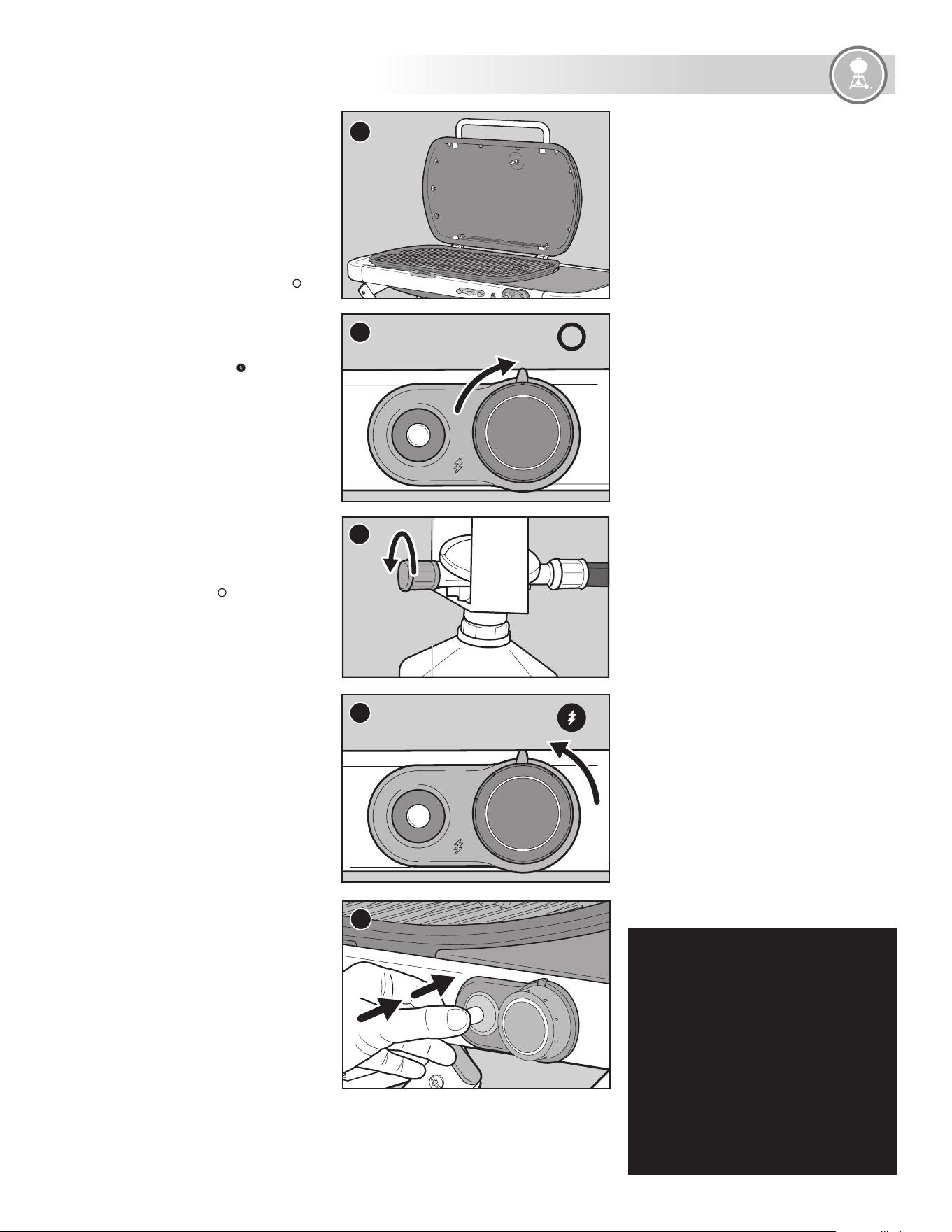
Igniting the Barbecue
Using the Ignition System to Ignite the
Barbecue
The ignition system ignites the burner with a spark from
the igniter electrode. You generate the energy for the
spark by pushing the igniter button. You will hear the
igniter ticking. After preheating on high is complete,
you may adjust the burner control knob to your desired
setting for barbecuing.
1) Open the barbecue lid (A).
2) Check that the burner control knob is in the o
position. Check by pushing in and turning knob
clockwise (B).
3) Turn gas supply on by turning the regulator gas
control valve anticlockwise (C).
4) Push the burner control knob in and turn it
counterclockwise to the start/high
position (D).
5) Push the red igniter button several times, so it clicks
each time (E).
6) Check that the burner is lit by looking through the
cooking grates. You should see a flame.
7) If the burner does not ignite, turn burner control
knob to the o
position and wait five minutes to
allow the gas to clear before attempting to light the
burner again.
Should the burner fail to ignite using the ignition
system, refer to the TROUBLESHOOTING section. There
you will find instructions on igniting the barbecue with a
match to help determine the exact problem.
To Extinguish Burners
1) Push the burner control knob in and then turn
clockwise all the way to the o position.
12
D
C
PRODUCT CARE
A
B
E
m WARNING: Turn your barbecue o and wait for
it to cool before thoroughly cleaning it.
m WARNING: When cleaning the burners, never
use a brush that has already been used to clean
the cooking grates. Never put sharp objects into
the burner port holes.
m CAUTION: Do not place any barbecue
components onto the side tables as they may
scratch the paint or stainless steel surfaces.
m CAUTION: Do not use any of the following
to clean your barbecue: abrasive stainless
steel polishes or paints, cleaners that contain
acid, mineral spirits or xylene, oven cleaner,
abrasive cleansers (kitchen cleansers), or
abrasive cleaning pads.
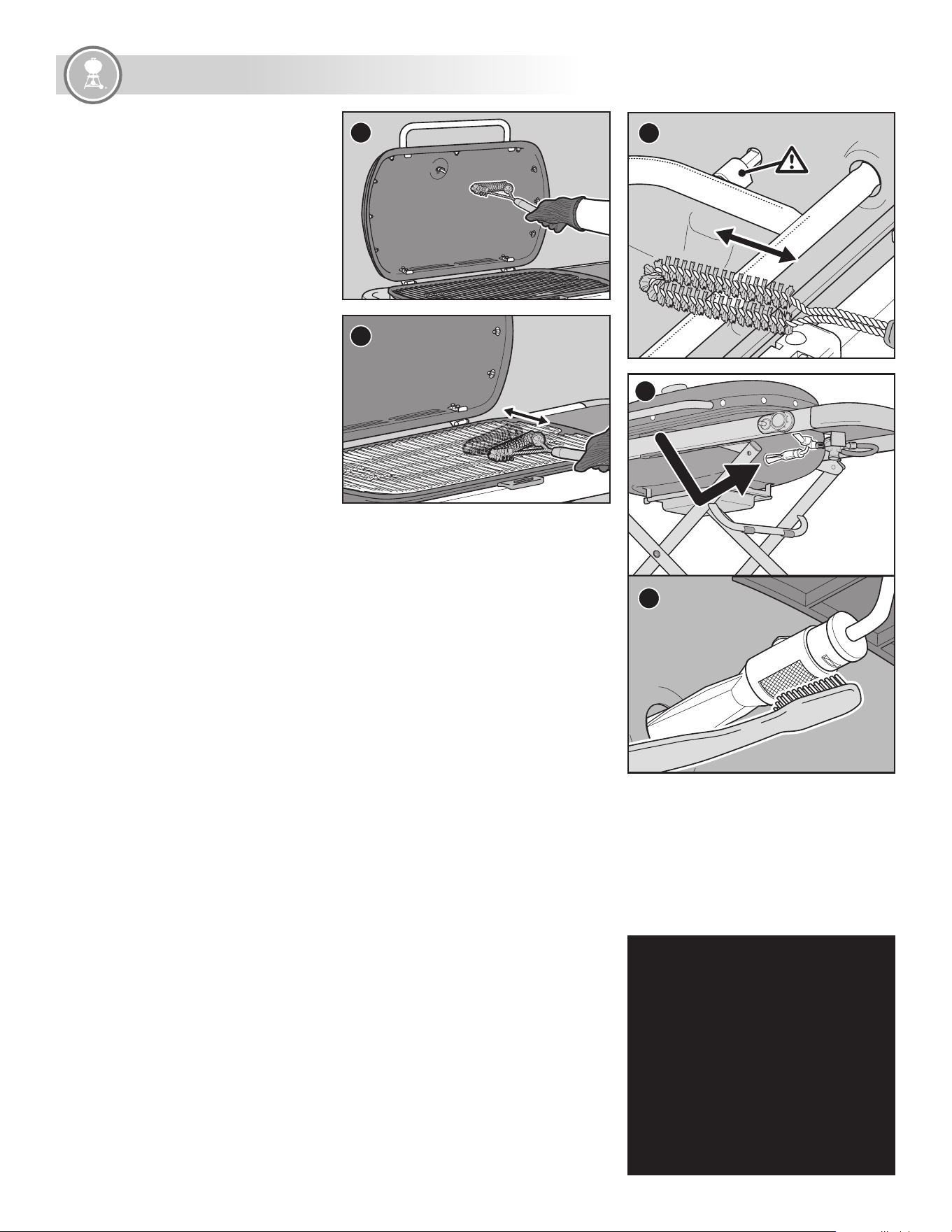
Cleaning and Maintenance
Cleaning the Inside of the Barbecue
Over time, the performance of your barbecue can
diminish if it has not been maintained properly. Low
temperatures, uneven heat, and food sticking to cooking
grates are all signs that cleaning and maintenance are
overdue.
A thorough cleaning is recommended when the
barbecue is going to be folded and stored vertically,
or at least twice a year. Consistent use may require
quarterly cleanings. When your barbecue is o and cool,
start by cleaning the inside from the top down.
Cleaning the Lid
From time to time you may notice ‘paint-like’ flakes
on the inside of the lid. During use, grease and smoke
vapours slowly change into carbon and deposit on
the inside of your barbecue’s lid. These deposits will
eventually peel, and look very similar to paint. These
deposits are non-toxic, but the flakes could fall onto
your food if you do not clean the lid regularly.
1) Brush the carbonised grease from the inside of the
lid with a stainless steel bristle barbecue brush (A).
To minimise further build-up, the inside of the lid can
be wiped with a paper towel after barbecuing while
the barbecue is still warm (not hot).
Cleaning the Cooking Grates
If you have been cleaning your cooking grates as
recommended, the debris on your grates should be
minimal.
1) With grates installed, brush the debris o your
cooking grate with a stainless steel bristle barbecue
brush (B).
2) Take the grates out and set aside.
Cleaning the Burner
Two areas on the burner that are key to optimum
performance are the ports (small openings running
along the length of the burner) and the spider/insect
screens on the ends of the burner. Keeping these areas
clean is essential for safe operation.
Cleaning the Burner Ports
1) Use a clean stainless steel bristle barbecue brush
to clean the outside of the burners by brushing
across the top of the burner ports (C). Do not brush
lengthwise along the tube, as this will only brush
debris from one port to another.
2) When cleaning the burner, avoid damaging the
ignition electrode by carefully brushing around it.
Cleaning the Spider Screens
1) Locate the end of the burner behind the control panel
where it meets the valve (D).
2) Clean the spider/insect screen on the burner using a
soft bristle brush (E).
13weber.com
BARBECUE
BRUSH
A must-use before you even dream of
barbecuing. A quick once-over on hot
grates prevents the charred remains
of meals past from sticking to
your meals present.
M
U
S
T
-
H
A
V
E
B
A
R
B
E
C
U
I
N
G
T
O
O
L
S
•
M
U
S
T
-
H
A
V
E
B
A
R
B
E
C
U
I
N
G
T
O
O
L
S
•
M
U
S
T
-
H
A
V
E
B
A
R
B
E
C
U
I
N
G
T
O
O
L
S
•
M
U
S
T
-
H
A
V
E
B
A
R
B
E
C
U
I
N
G
T
O
O
L
S
•
M
U
S
T
-
H
A
V
E
B
A
R
B
E
C
U
I
N
G
T
O
O
L
S
•
THERMOMETER
Small and relatively inexpensive,
this gadget is essential for quickly
gauging the internal temperature
of the meat when
barbecuing.
M
U
S
T
-
H
A
V
E
B
A
R
B
E
C
U
I
N
G
T
O
O
L
S
•
M
U
S
T
-
H
A
V
E
B
A
R
B
E
C
U
I
N
G
T
O
O
L
S
•
M
U
S
T
-
H
A
V
E
B
A
R
B
E
C
U
I
N
G
T
O
O
L
S
•
M
U
S
T
-
H
A
V
E
B
A
R
B
E
C
U
I
N
G
T
O
O
L
S
•
M
U
S
T
-
H
A
V
E
B
A
R
B
E
C
U
I
N
G
T
O
O
L
S
•
FOILPANS
Perfect for lining the catch pan to
make cleanup convenient and easy.
M
U
S
T
-
H
A
V
E
B
A
R
B
E
C
U
I
N
G
T
O
O
L
S
•
M
U
S
T
-
H
A
V
E
B
A
R
B
E
C
U
I
N
G
T
O
O
L
S
•
M
U
S
T
-
H
A
V
E
B
A
R
B
E
C
U
I
N
G
T
O
O
L
S
•
M
U
S
T
-
H
A
V
E
B
A
R
B
E
C
U
I
N
G
T
O
O
L
S
•
M
U
S
T
-
H
A
V
E
B
A
R
B
E
C
U
I
N
G
T
O
O
L
S
•
F
PRODUCT CARE
G
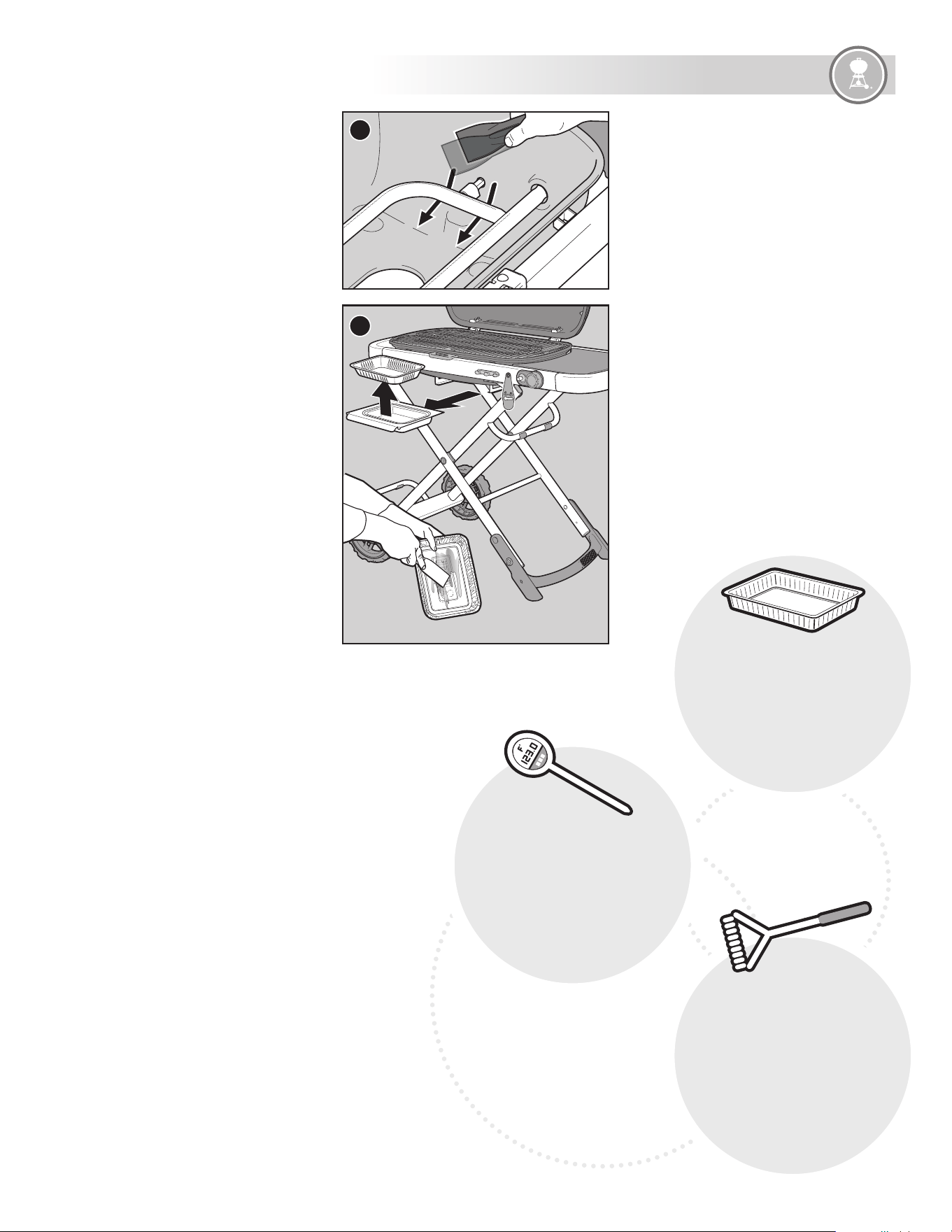
Cleaning the Cookbox
Look inside the cookbox for any grease accumulation
or leftover food particles. Excessive accumulation can
cause a fire.
1) Use a plastic scraper to scrape debris o the sides
and bottom of the barbecue into the opening in
bottom of the cookbox (F). This opening leads debris
into the slide-out catch pan.
Cleaning the Grease ManagementSystem
The grease management system consists of a slide-
out catch pan and a disposable drip tray(G). These
components were designed to be easily removed,
cleaned, and replaced; an essential step every time you
prepare to barbecue. Instructions on inspecting the
grease management system can be found in MEAL-TO-
MEAL MAINTENANCE.
Cleaning the Outside of theBarbecue
The outside of your barbecue may include stainless
steel, porcelain-enamelled, and plastic surfaces.
WEBER recommends the following methods based on
the surfacetype.
Cleaning Stainless Steel Surfaces
Clean stainless steel using a non-toxic, non-abrasive
stainless steel cleaner or polish designed for use on
outdoor products and barbecues. Use a microfibre cloth
to clean in the direction of the grain of the stainless
steel. Do not use paper towels.
Note: Do not risk scratching your stainless steel with
abrasive pastes. Pastes do not clean or polish. They
will change the colour of the metal by removing the top
chromium oxide film coating.
Cleaning Painted, Porcelain-Enamelled
Surfaces and PlasticComponents
Clean painted, porcelain-enamelled and plastic
components with warm soapy water, and paper towels
or cloth. After wiping down the surfaces, rinse and dry
thoroughly.
Cleaning the Outside of Barbecues that
are in Unique Environments
If your barbecue is subject to a particularly harsh
environment, you will want to clean the outside more
often. Acid rain, pool chemicals, and salt water can
cause surface rusting to appear. Wipe down the outside
of your barbecue with warm soapy water. Follow up
with a rinse and thorough drying. Additionally, you
may want to apply a stainless steel cleaner weekly to
prevent surface rust.
14
REPLACEMENT
PARTS
To obtain replacement parts, contact
the local retailer in your area or log
onto weber.com.
CALL
CUSTOMER
SERVICE
If you are still experiencing any
problems, contact the Customer
Service Representative in your area
using the contact information
on weber.com.
TROUBLESHOOTING
A
B
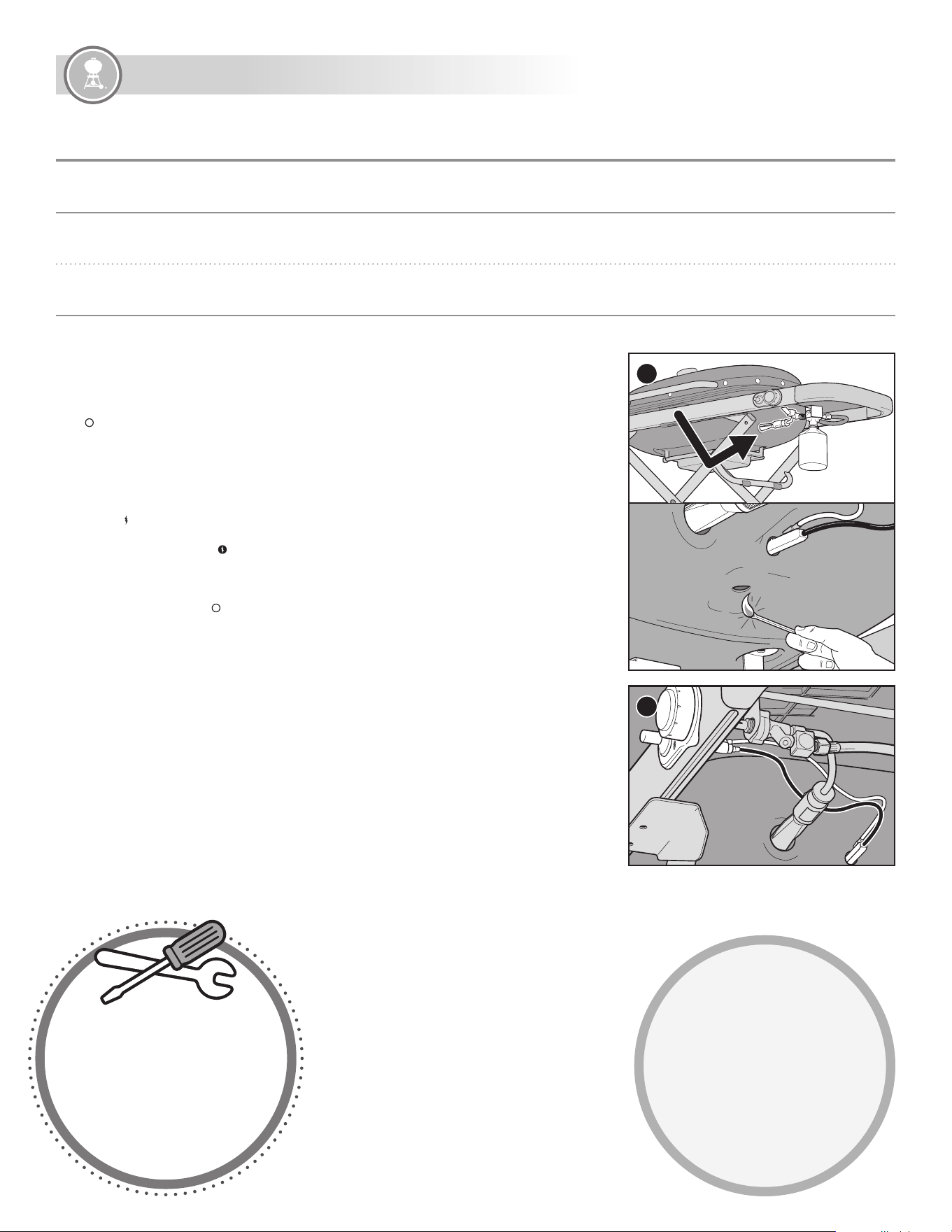
Using a Match to Determine if there is Gas
Flow to the Burners
1) Open the barbecue lid.
2) Check that the burner control knob is in the
o position. Check by pushing in and turning knobs
clockwise.
3) Confirm that the cylinder is properly installed. Refer
to “Installing the LP Cylinder.”
4) Strike a match and put the flame under the
matchlight hole(A).While holding lit match, push
burner control knob in and turn it anticlockwise to
start/high (
) position.
5) Push the burner control knob in and turn it
anticlockwise to the start/high
position.
6) Check that the burner is lit by looking through the
cooking grates.
7) If the burner does not ignite within 4 seconds, turn
burner control knob to the o
position and wait five
minutes to allow the gas to clear before attempting
to light the burner again. If repeated attempts fail,
follow the gas flow troubleshooting instructions on
the next page.
8) If the burner ignites, the problem lies in the ignition
system. Follow the instructions for “Checking the
Components of the Electronic Ignition System”.
BARBECUE WILL NOT IGNITE
SYMPTOM
• Burner does not ignite when following the ignition instructions in the “Operation” section of this Owner's Manual.
CAUSE SOLUTION
There is a problem with gas flow. If the barbecue will not ignite, the first step is to determine if there is gas flowing to the burners. Tocheck this,
follow the instructions below for “Using a Match to Determine if there is Gas Flow to the Burners.”
If match lighting IS NOT successful, follow the gas flow troubleshooting suggestions on the next page.
There is a problem with the ignition system. If the barbecue will not ignite, the first step is to determine if there is gas flowing to the burners. Tocheck this,
followthe instructions below for “Using a Match to Determine if there is Gas Flow to the Burners.”
If match lighting IS successful, follow the instructions below for “Checking the Components of the Ignition System.”
Checking the Components of the Ignition
System
When pressing the igniter button you should hear it
click. Check the wires to ensure the igniter is creating
a spark.
Checking the Wires
1) Check that the white and black ignition wires are
connected securely to the terminals on the igniter
button behind the control panel (B).
2) Verify the igniter button pushes in, clicks, and
returns out again.
15weber.com
TROUBLESHOOTING
GAS FLOW
SYMPTOM
• Barbecue does not reach desired temperature or heats unevenly.
• The burner fails to ignite.
• Flame is low when burner is on high position.
• Flames do not run the whole length of the burner.
• Burner flame pattern is erratic.
CAUSE SOLUTION
The LP cylinder is low or empty. Replace LP cylinder.
Burner ports are dirty. Clean burner ports. Refer to “Cleaning the Burner
Ports.”
SYMPTOM
• Gas is smelled in conjunction with burner flames that appear yellow and lazy.
CAUSE SOLUTION
Spider screens on the burner is obstructed. Clean spider screens. Refer to “Cleaning the Spider
Screens” in the Product Care section. Also refer to
the illustrations and information in this section about
proper flame pattern and spiderscreens.
SYMPTOM
• The smell of gas and/or a light hissing sound.
CAUSE SOLUTION
Connection between regulator and LP cylinder could be
incomplete.
Extinguish any open flame. Remove and reinstall
the LP Cylinder. Refer to “Installing the LP Cylinder”
section of your owner’s manual.
The regulator coupling with the LP cylinder could be
damaged.
Extinguish any open flame. Remove the LP cylinder.
DO NOT OPERATE THE BARBECUE. Contact the
Customer Service Representative in your area using
the contact information on our website.
GREASY BARBECUE (Peeling Paint & Flare-Ups)
SYMPTOM
• Inside of lid appears to have the appearance of peelingpaint.
CAUSE SOLUTION
The flakes you see are accumulated cooking vapours
that have turned into carbon.
This happens over time after repeated use of your
barbecue. This is not a defect. Clean the lid. Refer to
the “Product Care” section.
SYMPTOM
• Experiencing flare-ups when barbecuing or preheating.
CAUSE SOLUTION
There is leftover food from the previous meal. Always preheat the barbecue on the highest setting for
10 to 15 minutes.
The inside of the barbecue needs to be cleaned
thoroughly.
Follow the steps in the "Cleaning and Maintenance"
section to clean the barbecue inside from the top
down.
m WARNING: Do not attempt to make any repair to gas carrying, gas burning, ignition components or structural
components without contacting Weber-Stephen Products LLC, Customer Service Department.
m WARNING: Failure to use genuine Weber-Stephen parts for any repair or replacement will void all warranty
protection.
m CAUTION: The burner tube openings must be positioned properly over the valve orifices.
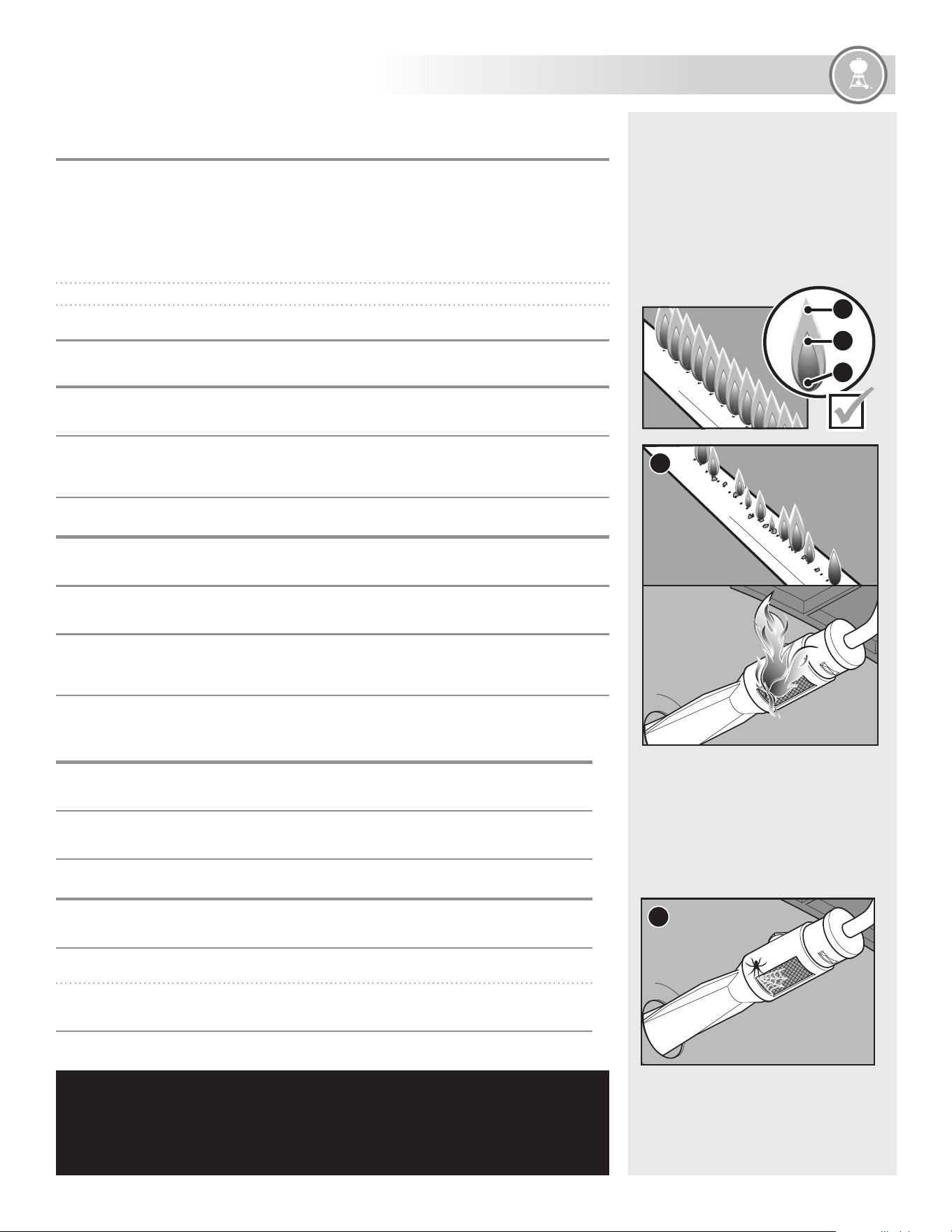
Proper Burner Flame Pattern
The burner in your barbecue is factory set for the
correct air and gas mixture. When the burner is
performing correctly, you will see a specific flame
pattern. The tips may occasionally flicker yellow
(A), with a descending light blue (B) to dark blue
flame (C).
m WARNING: Blocked and dirty ports can restrict
full gas flow, resulting in a fire (D) in and
around the gas valves, causing serious damage
to your barbecue.
Spider Screens
The combustion air openings of the burners (E)
are fitted with stainless steel screens to prevent
spiders and other insects from spinning webs
and building nests inside the burners. Dust and
debris can accumulate on the outside of the
spider/insect screen and obstruct the oxygen
flow to the burners.
B
A
C
E
D

16
TIPS AND HINTS
TIMER
Avoid the disappointment of torching your
dinner by simply setting a timer. Nothing
fancy needed—just one that is
reliable and easy to use.
M
U
S
T
-
H
A
V
E
B
A
R
B
E
C
U
I
N
G
T
O
O
L
S
•
M
U
S
T
-
H
A
V
E
B
A
R
B
E
C
U
I
N
G
T
O
O
L
S
•
M
U
S
T
-
H
A
V
E
B
A
R
B
E
C
U
I
N
G
T
O
O
L
S
•
M
U
S
T
-
H
A
V
E
B
A
R
B
E
C
U
I
N
G
T
O
O
L
S
•
M
U
S
T
-
H
A
V
E
B
A
R
B
E
C
U
I
N
G
T
O
O
L
S
•
BARBECUE
MITTS
When in doubt, wear them. The good
ones are insulated and protect
both hand and forearm.
M
U
S
T
-
H
A
V
E
B
A
R
B
E
C
U
I
N
G
T
O
O
L
S
•
M
U
S
T
-
H
A
V
E
B
A
R
B
E
C
U
I
N
G
T
O
O
L
S
•
M
U
S
T
-
H
A
V
E
B
A
R
B
E
C
U
I
N
G
T
O
O
L
S
•
M
U
S
T
-
H
A
V
E
B
A
R
B
E
C
U
I
N
G
T
O
O
L
S
•
M
U
S
T
-
H
A
V
E
B
A
R
B
E
C
U
I
N
G
T
O
O
L
S
•
Preheat each and every time.
If the cooking grates aren’t hot enough, food will
stick, and you will likely never have a chance of
searing properly or developing those handsome
barbecue marks. Even if a recipe calls for medium
or low heat, always preheat the barbecue on the
highest setting first. Open the lid, turn up the heat,
close the lid, and then let the cooking grate heat up
for about ten minutes or until the lid thermometer
reads 260°C (500°F) .
Don't barbecue on dirty grates.
Placing food onto the cooking grates before they
have been cleaned is never a good idea. Leftover
“stu” on the grates acts like glue, binding it to
the grates and your new food. To avoid tasting last
night’s dinner on today’s lunch, make sure that you
are barbecuing on a clean cooking grate. Once the
grates are preheated, use a stainless steel bristle
barbecue brush to make a clean, smooth surface.
Be present in the process.
Before firing up your barbecue, make sure that
everything you need is within arm’s reach. Don’t
forget your essential barbecuing tools, already oiled
and seasoned food, glazes or sauces, and clean
cooking platters for cooked food. Having to run back
to your kitchen not only means missing out on the
fun, but it could also result in burning your food.
French chefs call this "mise en place" (meaning, “put
in place”). We call it "being present".
Create a little elbow room.
Packing too much food onto the cooking grates
restricts your flexibility. Leave at least one-quarter of
the cooking grates clear with plenty of space between
each food item in order to get your tongs in there and
easily move the food around. Sometimes barbecuing
involves split-second decisions and the ability to
jockey food from one area to another. Sogive yourself
enough room to operate.
Try not to peek.
The lid on your barbecue is for more than just keeping
the rain out. Most importantly, it’s for preventing
too much air from getting in and too much heat and
smoke from getting out. When the lid is closed, the
cooking grates are hotter, the barbecuing times are
faster, the smoky tastes are stronger, and the flare-
ups are fewer. So put a lid on your barbecue!
Only flip once.
What’s better than a juicy steak with a deep sear and
plenty of beautifully caramelised bits? The key to
accomplishing these results is to keep your food in
place. Sometimes we have the tendency to flip our
food before it reaches the desirable level of colour
and flavour. In nearly all cases, you should turn food
just once. If you are moving it more than that, you are
probably also opening the lid too often which causes
its own set of problems. So step back and trust the
barbecue.
Know when to tame the flame.
When barbecuing, sometimes the most important
thing to know is when to stop. The most reliable
way to test doneness of your food is to invest in an
instant-read thermometer. This slim little gem will
help you pinpoint that critical moment when your
food is at its best.
Don’t be afraid to experiment.
Back in the 1950s, barbecuing meant one thing:
meat (and only meat) charred over open flames.
Themodern day backyard chef doesn’t need a kitchen
in order to prepare a full course meal. Use your
barbecue to make char-barbecued appetisers, side
dishes, and even desserts. Register your barbecue
to receive special content that will inspire you along
the way. We’d love to join you on your barbecuing
adventures.
BarbecuingDo’s andDon’ts
17weber.com
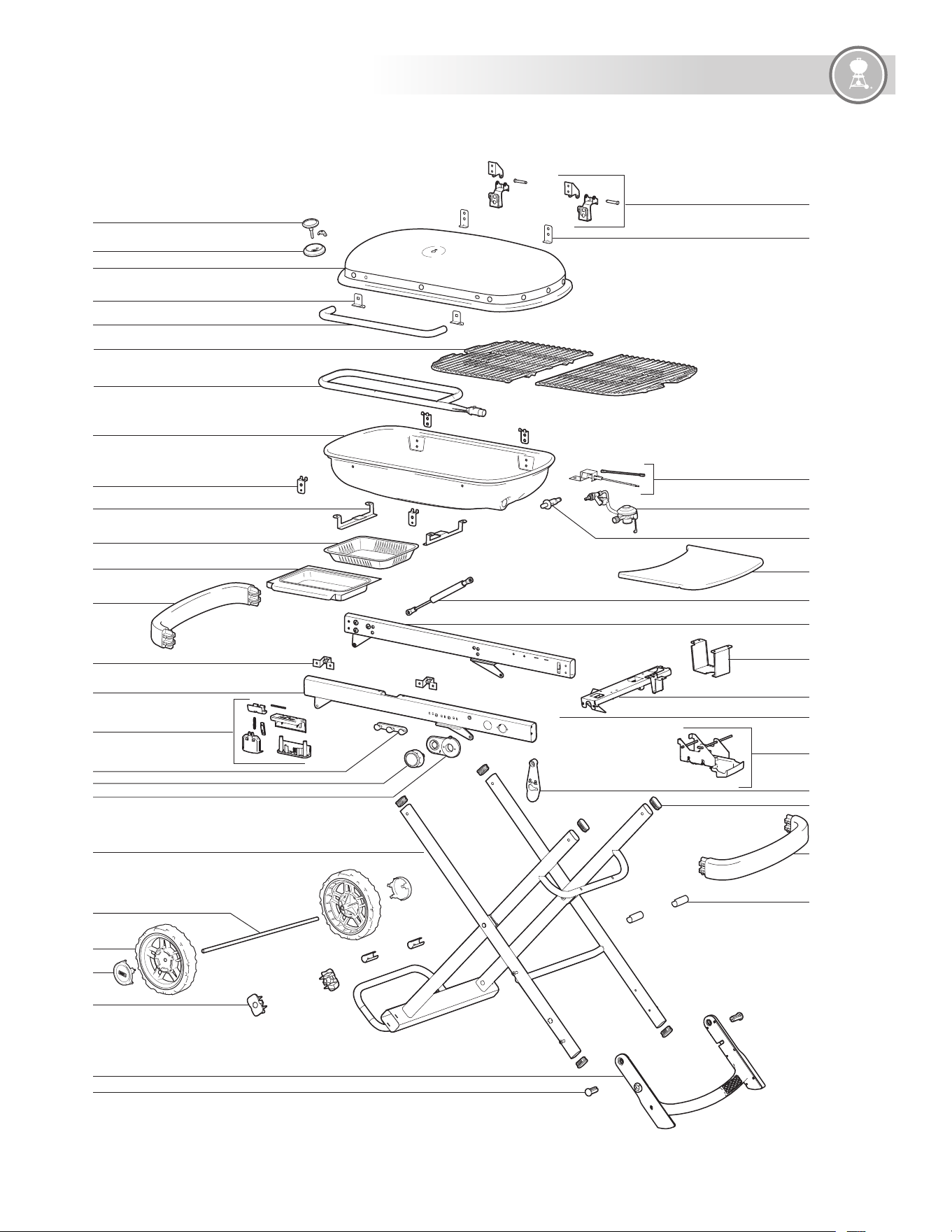
REPLACEMENT PARTS
TRAVELER - LP - EMEA - 120520
8
10
12
11
13
18
23
19
17
20
24
22
16
21
25
26
15
14
6
7
1
5
3
2
4
9
27
28
29
30
32
36
35
38
37
31
34
33
39
41
40
42

18
NOTES
DON'T FORGET TO REGISTER

19weber.com
NOTES

© 2020 Designed and engineered by Weber-Stephen Products LLC, 1415 S. Roselle Road, Palatine, Illinois 60067 USA.
weber.com
AUSTRIA
Weber-Stephen Österreich GmbH
+43 (0)7 242 89 0135
service-at@weber.com
BELGIUM
Weber-Stephen Products Belgium Sprl
+32 15 28 30 99
service-b[email protected]
CHILE
Weber-Stephen Chile SpA.
+01 56 2-3224-3936
CZECH REPUBLIC
Weber-Stephen CZ & SK spol. s r.o.
+42 267 312 973
info-cz@weberstephen.com
DENMARK
Weber-Stephen Nordic ApS
+45 99 36 30 10
service-dk@weber.com
FRANCE
Weber-Stephen France SAS
+33 0810 19 32 37
service-fr@weber.com
GERMANY
Weber-Stephen Deutschland GmbH
+49 (0) 30 219 0710
service-[email protected]
ICELAND
Jarn & Gler Wholesale EHF
+354 58 58 900
INDIA
Weber-Stephen Barbecue Products India Pvt. Ltd.
080 42406666
customercare@weberindia.com
ISRAEL
D&S Imports
+972 392 41119
info@weber.co.il
ITALY
Weber-Stephen Products Italia Srl
+39 0444 367 911
service-it@weber.com
NETHERLANDS
Weber-Stephen Holland B.V.
+31 (0) 513 4 333 22
service-nl@weber.com
POLAND
Weber-Stephen Polska Sp. z o.o.
+48 22 392 04 69
info-pl@weberstephen.com
RUSSIA
Weber-Stephen Vostok LLC
+7 495 956 63 21
info.ru@weberstephen.com
SOUTH AFRICA
Weber-Stephen Products (South Africa) Pty Ltd.
+27 11 454 2369
info@weber.co.za
SPAIN
Weber-Stephen Ibérica SRL
+34 935 844 055
service-es@weber.com
SWITZERLAND
Weber-Stephen Schweiz GmbH
+41 52 24402 50
service-[email protected]
UNITED ARAB EMIRATES
Weber-Stephen Deutschland GmbH, Dubai Branch
+971 4 454 1626
info@weberstephen.ae
UNITED KINGDOM
Weber-Stephen Products (UK) Ltd.
+44 (0)203 630 1500
service-uk@weber.com
USA
Weber-Stephen Products LLC
847 934 5700
support@weberstephen.com
For Republic of Ireland, please contact:
Weber-Stephen Products (U.K.) Limited.
For other Eastern European countries, such as ROMANIA,
SLOVENIA, CROATIA or GREECE, please contact:
Weber-Stephen Deutschland GmbH.
For Baltic states, please contact:
Weber-Stephen Nordic ApS.