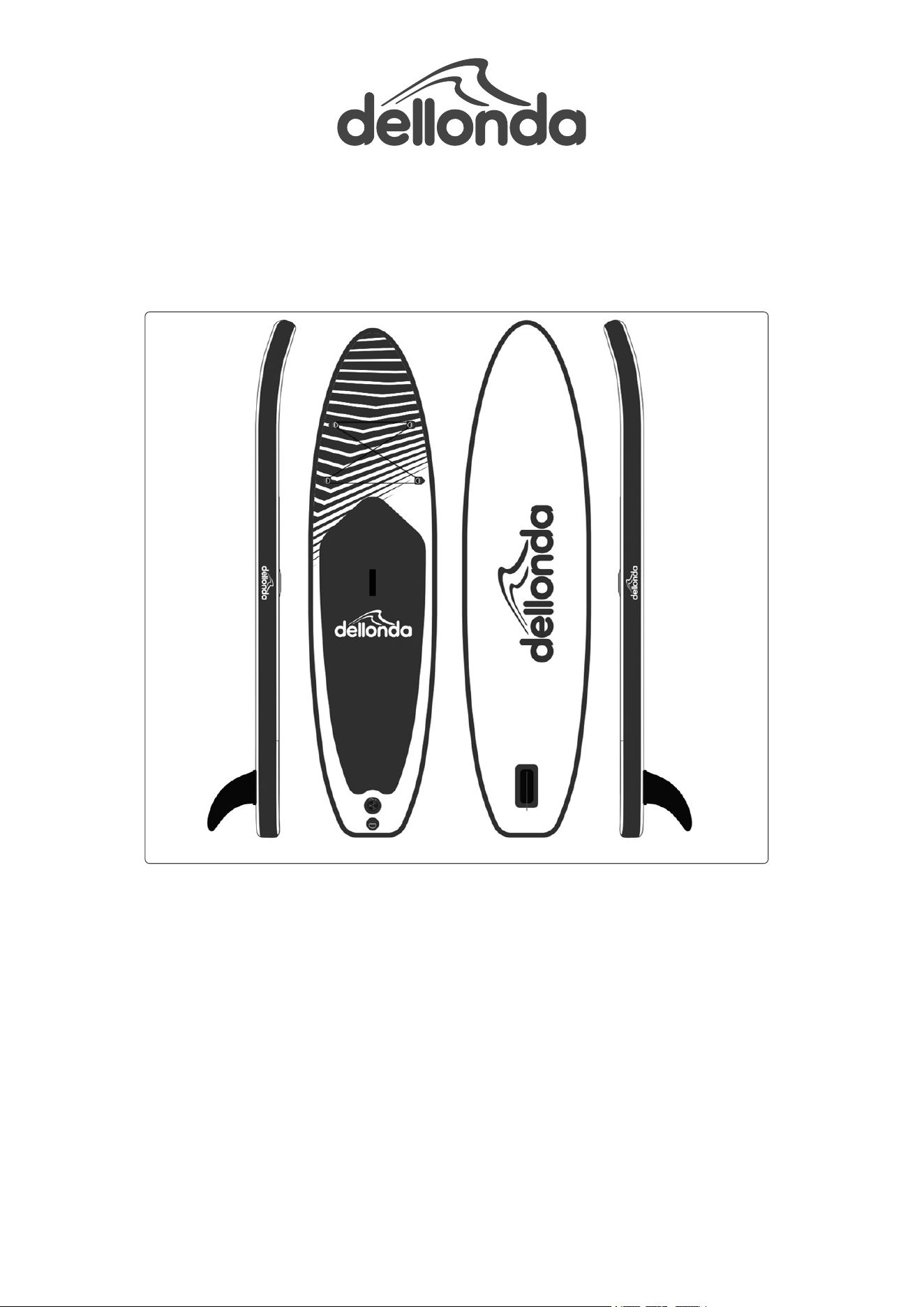
INFLATABLE STAND UP PADDLE BOARDS WITH LEASH,
PUMP & CARRY BAG
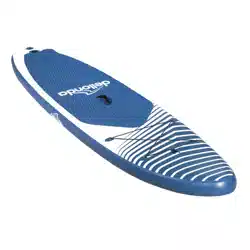
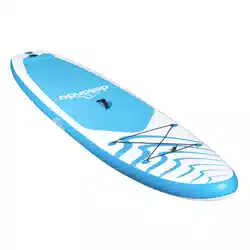
Model No: DL152 & DL153
Thank you for purchasing a Dellonda product. Manufactured to a high standard, this product will, if used according
to these instructions, and properly maintained, give you years of trouble free performance.
www.dellonda.co.uk
DL152 & DL153 Issue 2 15/05/24
SAFETY
READ THESE INSTRUCTIONS IN FULL BEFORE USE.
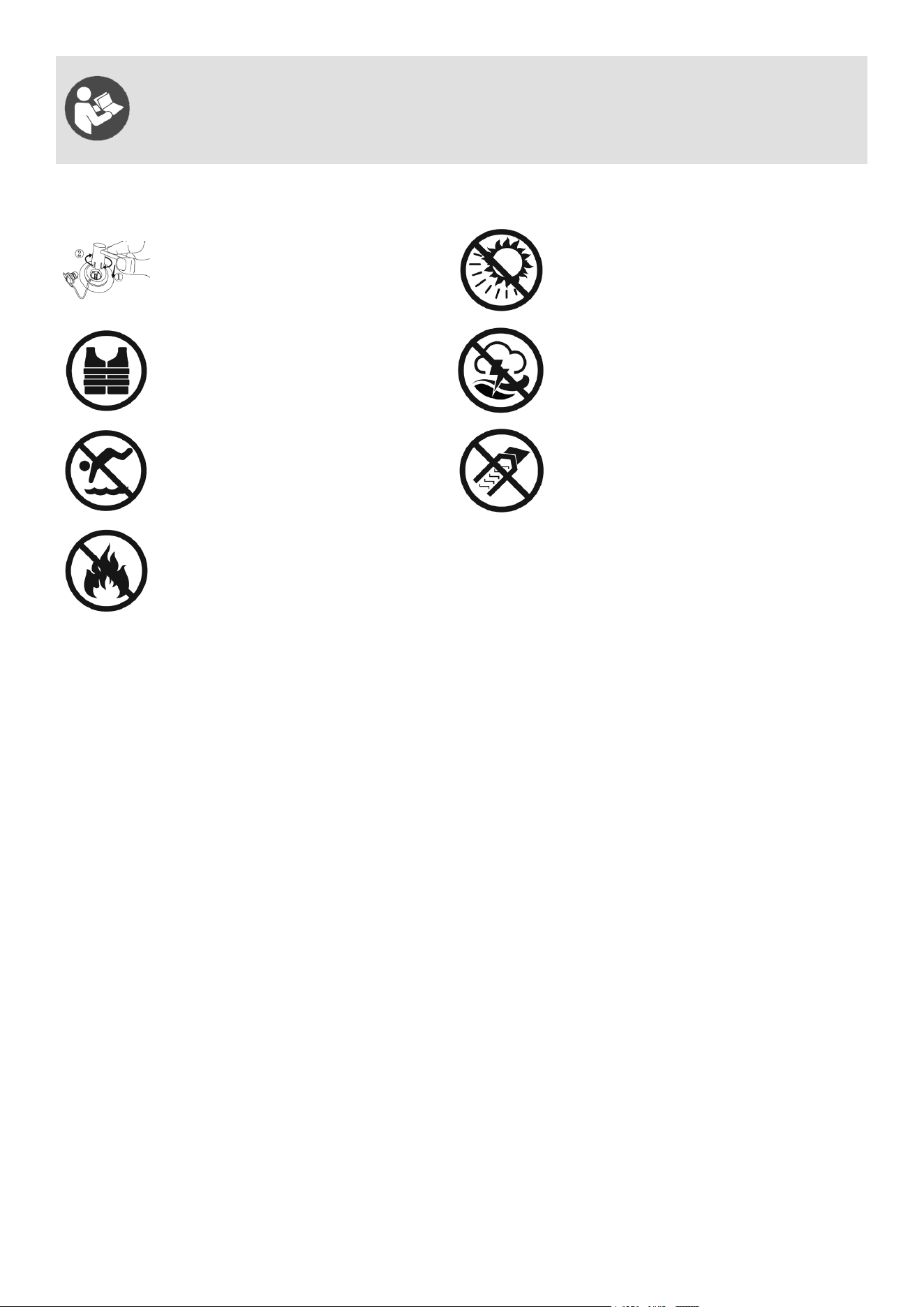
ATTENTION! Tighten the air valve
before rst use and before reuse after
long breaks.
WARNING! DO NOT leave the paddle
board exposed under direct sunlight.
This will shorten the life of product.
WARNING! A Personal Flotation Device
(PFD) is required for each user.
WARNING! Beware of offshore winds
and currents. DO NOT use in high
wind,open water!
WARNING! DO NOT dive or jump from
the paddle board.
WARNING! DO NOT use the paddle
board around sharp objects.
WARNING! Keep away from re.
• Keep away from re.
• This is not a life saving device. Use only under competent supervision.
• Never allow diving/jumping into this product.
• Never leave in or near the water when not in use.
• Never tow from any vehicle.
• Adult assembly and operation required.
• Excessive ination of the paddle board can cause the chamber to burst or cause damage to the welded seams.
• Take a paddle boarding safety course or get hands-on training from an approved provider.
• Review all safety requirements regularly.
• Never navigate alone.
• A Personal Floatation Device (PFD) is required for each user.
• It is especially important that children and non-swimmers wear a Personal Flotation Device at all times.
• Children and non-swimmers need additional special instruction in the use of SUP.
• Care should be taken when stepping or climbing onto the paddle board.
• Distribute the weight evenly so that the paddle board sits even front to back and each side.
• DO NOT use your paddle board if you suspect a puncture or an air leak. It might be unsafe and is dangerous.
• WARNING! Beware of offshore winds and under-currents.
• WARNING! It is the responsibility of the paddle board operator to identify and obey all local and state laws
pertaining to paddle board safety and equipment. Consult your local authorities to ensure compliance.
• WARNING! DO NOT dive or jump from board.
• DO NOT allow unattended children on the paddle board.
• Always make sure that at least one responsible adult is supervising all children and those who don’t know how
to swim at all times.
• Always maintain the proper paddle board safety equipment in an easily accessible place.
• Indicate clearly emergency phone numbers and safety advisories and rules (such as “No Jumping or Diving”).
• The total weight on board shall not exceed the information printed on the paddle board.
• DO NOT exceed the maximum recommended capacities. Overloading violates regulations, and is dangerous.
• DO NOT place the Paddle board against or near any open ames, heaters, furnaces or other hot objects.
• WARNING! Children must not be left unattended when using the paddle board. Use only under adult competent
supervision.
• WARNING! DO NOT leave product exposed under sunlight directly because it will shorten the life of the product.
• Children shall not play with the paddle board.
• Keep pets away from paddle board. Pets may tear or puncture the paddle board.
• NOTE: Follow these rules to avoid drowning, paralysis or other serious injuries.
IMPORTANT INFORMATION
Please read these instructions carefully. Note the safe operational requirements, warnings & cautions.
Use the product correctly and with care for the purpose for which it is intended. Failure to do so may
cause damage and/or personal injury and will invalidate the warranty. Keep these instructions safe for
future use.
WATERWAYS
Managed waterways in England and Wales, such as some rivers and canals require a licence to be able to paddle
on them. This license can be purchased from the British Canoeing website and costs around £45 per year (2023). A
portion of that license fee goes towards the upkeep and maintenance of those waterways. If your board is shorter
than 3.5 metres long, it is classed as recreational beach gear. Under that category, you are permitted to paddle
anywhere in the sea but must stay within 300 metres of the shore.
SPECIFICATION
MODEL NO: DL152 DL153
Accessories: Pump, Carry Bag, Leash, Paddle, Valuables/Puncture Repair Kit Container
Boat/Board Type: SUP SUP
Colour: Light Blue/White Blue/White
Dimensions (W x D x H): 3200*840*150mm 3100*790*150mm
Length (SUP): 10’6” 10’2”
Maximum Weight: 330lb / 150kg 298lb / 140kg
Nett Weight (Board): 8.03kg 8.3kg
Nett Weight (Board + Accessories): 11.28kg 11.4kg
PSI: 12-15psi 12-15psi
Volume: 332L 308L
PREPARATION
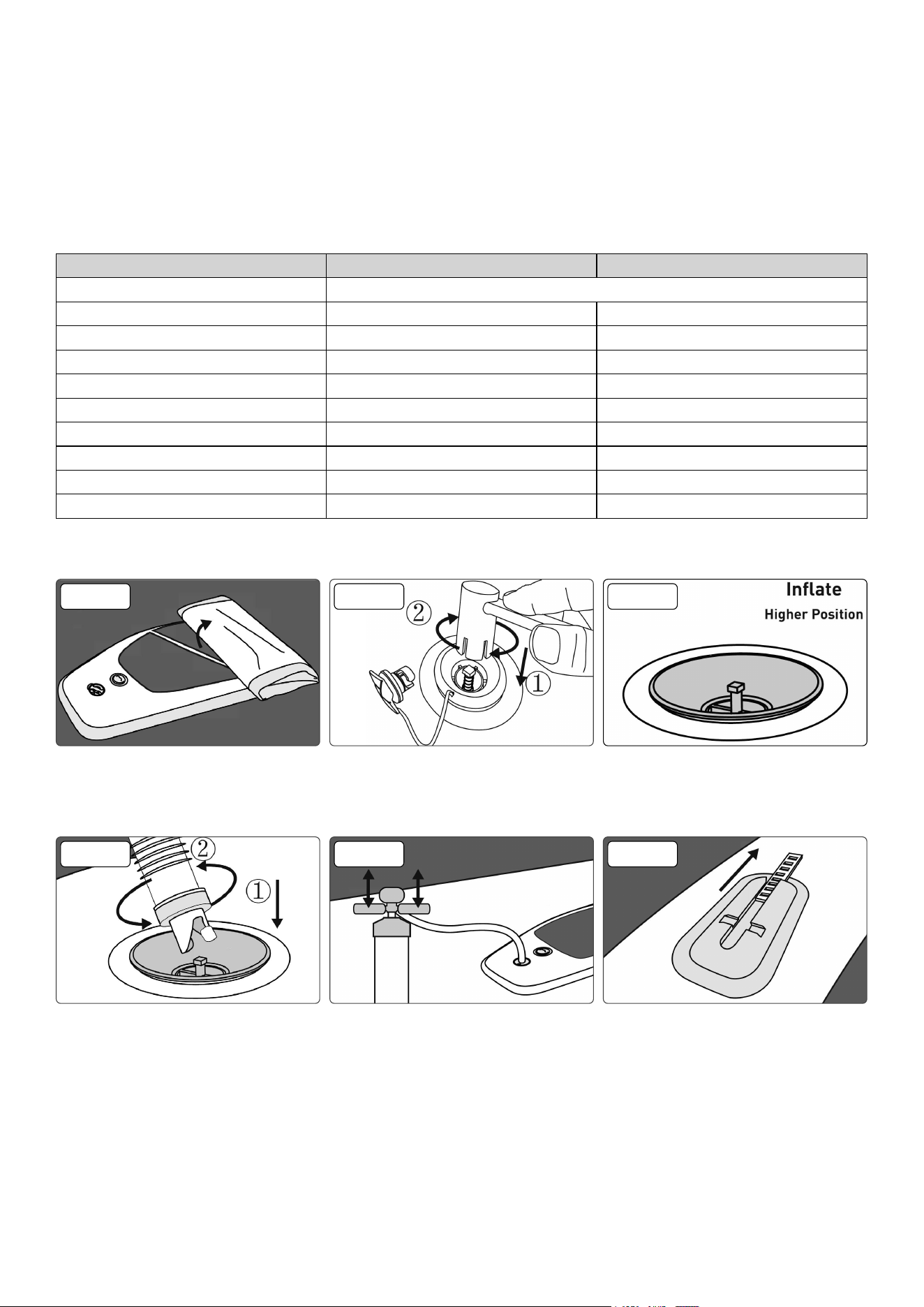
2. Ensure the valve and cap are fully
secure using the tool provided.
1. Unroll the paddle board on a at
surface, away from sharp objects
such as stones. Ensure the valve is
facing up.
STEP 1 STEP 2
3. To inate the paddle board, ensure
the valve is in the higher position.
STEP 3
4. Remove the valve cover and insert
the pump provided (push and twist).
STEP 4
5. Pump the paddle board up to a
pressure of 12-15PSI. Replace valve
cap.
STEP 5
6. Remove the plastic insert and
store in bag for future use.
STEP 6
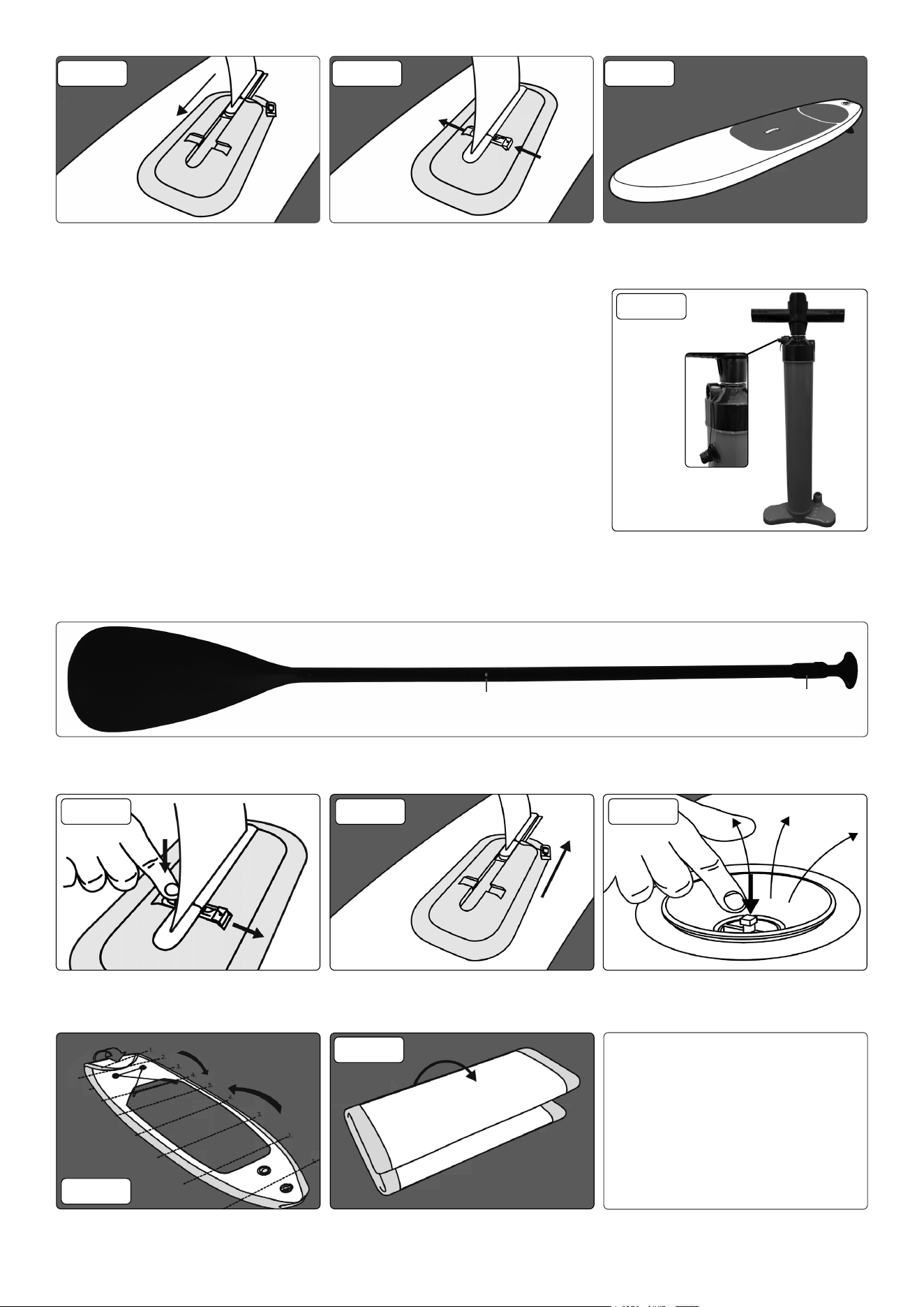
8. Secure the n to the paddle board
using the clip. ‘Click’ into place.
9. The paddle board is ready for use.7. Insert the n so the leading edge
faces the front of the paddle board.
STEP 7 STEP 8 STEP 9
REMEMBER TO USE THE LEASH: The primary purpose of a paddleboard leash
is to keep your board close to you while paddling, ensuring your safety and
preventing it from getting lost or damaged. It serves this purpose by attaching
to your leg or ankle and the board, keeping the two connected.
NOTE: the dual action pump works when the cap is closed. This means air
will be expelled when you lift the handle up or push it down. When you remove
the cap, the pump becomes single action. This means air will only be expelled
when you push the handle down. The dual-action is useful to quickly ll the
paddleboard with air. As the pressure increases, switch to single action to
reach the required pressure (12-15PSI).
PADDLE
Assemble the paddle as shown below. Ensure the spring-loaded button secures the shaft of the paddle. The lock
lever can be used to adjust the length to suit the user. For general paddling, the paddle length should be 6-8 inches
above the head of the paddler. This can be tweaked according to individual needs.
Spring-loaded button
Lock Lever
(Handle Adjustment)
DEFLATING
1. Push the n clip down and slide
out.
STEP 1
2. Remove the n from the paddle
board. Replace with the plastic insert.
STEP 2
3. Push the valve down to deate the
paddle board.
STEP 3
IMPORTANT:
Clean your paddle board after a trip
to prevent damage from sand, salt
water or sun exposure.
4. Fold the paddle board as shown
above.
STEP 4
5. Once folded, store the paddle
board in its original bag.
STEP 5
PUMP
CLOSE THE CAP FOR
DUAL ACTION
Dellonda Limited
Kempson Way, Suffolk Business Park, Bury St Edmunds, Suffolk. IP32 7AR
01284 757575 suppor[email protected] www.dellonda.co.uk
ENVIRONMENT PROTECTION AND WASTE PROTECTION
Recycle unwanted packaging materials. When this product is no longer required, or has reached the end of it’s
useful life, please dispose of it in an environmentally friendly way. Drain any uids (if applicable) into approved
containers, in accordance with local waste regulations. It is our policy to continually improve products and we
reserve the right to alter data, specications and parts without prior notice. No liability is accepted for incorrect
use of this product. Guarantee is 12 months from purchase date, proof of which is required for any claim.
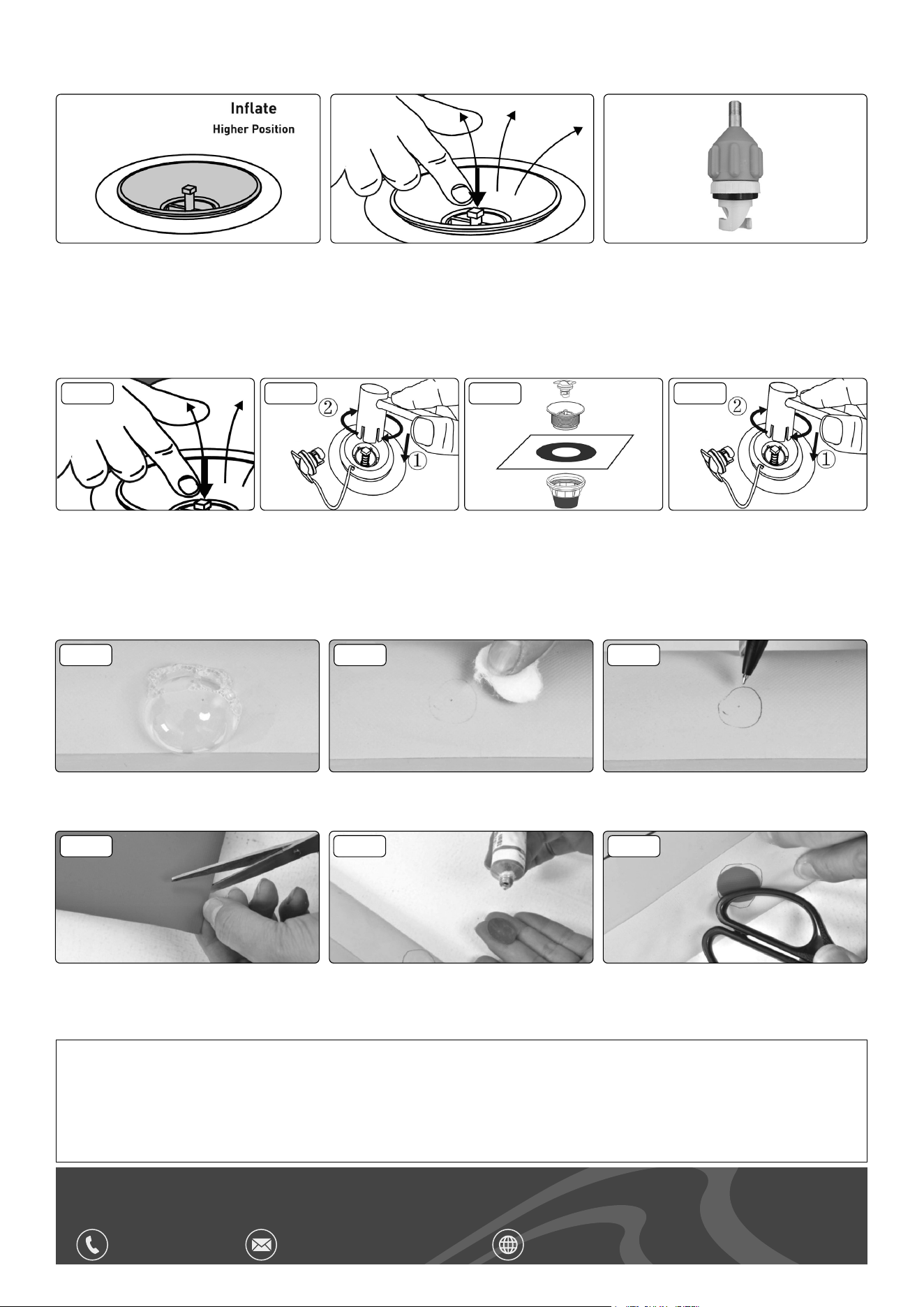
VALVE
To inate the paddle board, ensure
the valve is in the higher position.
To deate the paddle board, ensure
the valve is in the lower position.
The Schrader valve (supplied) can be
used with a range of pumps to inate
the paddle board.
VALVE REPLACEMENT
To replace a broken or leaky valve, follow the steps below.
1. Deate the paddle board.
STEP 1
2. Using the tool provided,
remove the valve.
STEP 2
3. Assemble the new valve
as shown above.
STEP 3
4. Secure the new valve with
the tool provided.
STEP 4
PUNCTURE REPAIR
The Repair Kit includes glue and PVC sheet. The Repair Kit can be used only if the leak is below 10mm diameter.
1. Wipe the hull with soap and water
to nd holes in the SUP. The soap will
bubble over the hole.
STEP 1
2. Clean the area around the hole
with water or alcohol.
STEP 2
3. Use a pencil to sketch out the
outline of the patch.
STEP 3
4. Cut a patch of suitable size.
STEP 4
5. Apply glue (not supplied) evenly to
the damaged area and patch. Press
and hold the patch on the damaged
area.
STEP 5
6. Leave the paddle board for at least
24 hours or more before inating.
STEP 6