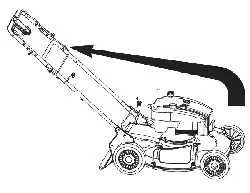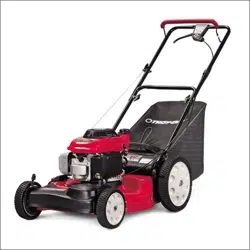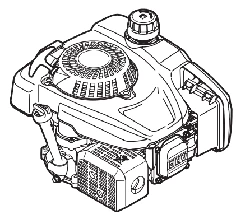
Printed In USA
operator’s manual
Safe Operation Practices • Set-Up • Operation • Maintenance • Service • Troubleshooting • Warranty
WARNING
READ AND FOLLOW ALL SAFETY RULES AND INSTRUCTIONS IN THIS MANUAL
BEFORE ATTEMPTING TO OPERATE THIS MACHINE.
FAILURE TO COMPLY WITH THESE INSTRUCTIONS MAY RESULT IN PERSONAL INJURY.
P. O. Box 1386, 97 Kent Avenue, KITCHENER, ONTARIO, CANADA N2G 4J1
769-09625
12.18.13
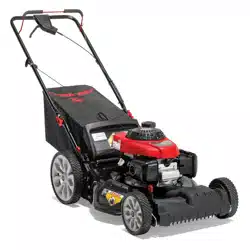
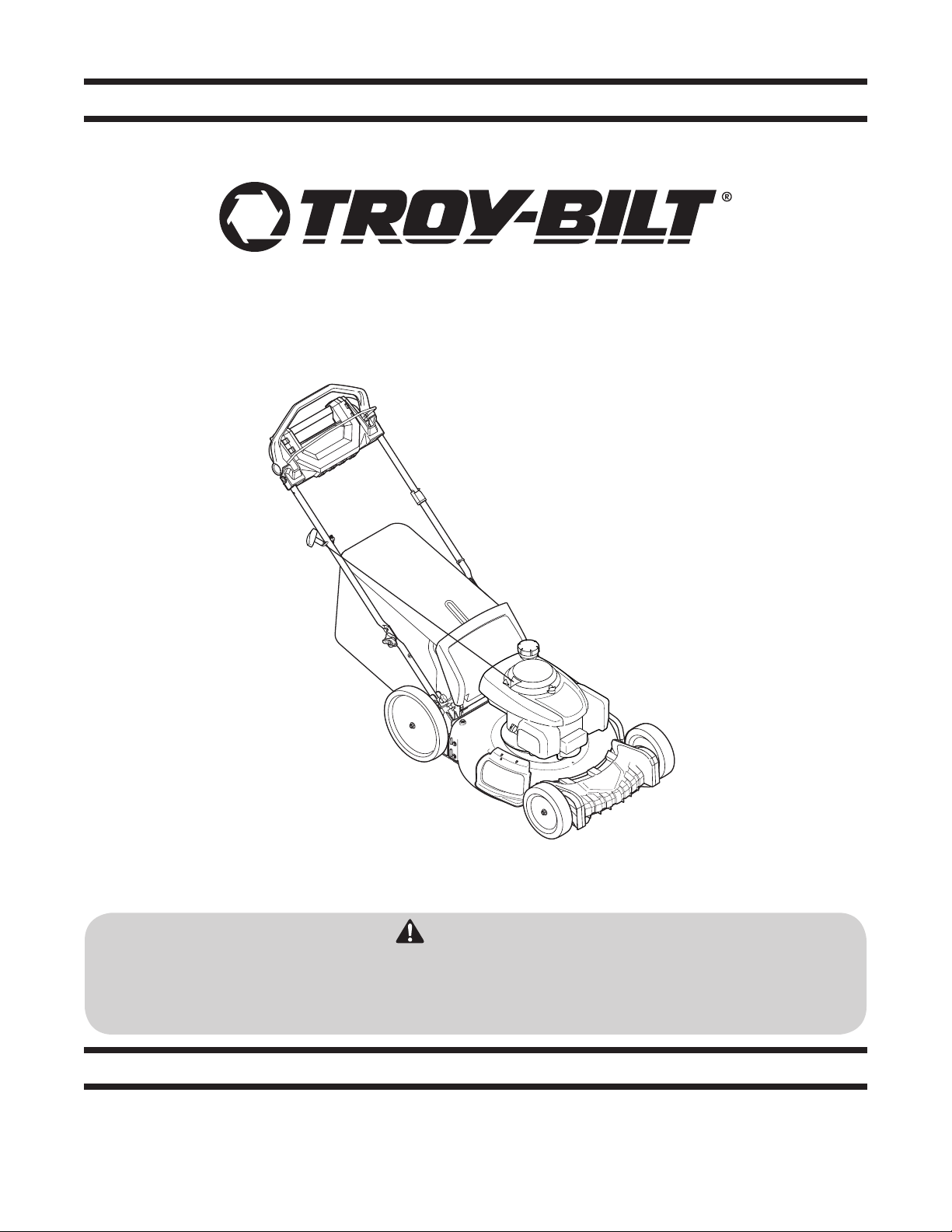
Self-Propelled Mower — Model Series DXX

Customer Support
Please do
NOT
return the unit to the retailer from which it was purchased, without first contacting Customer Support.
If you have difficulty assembling this product or have any questions regarding the controls, operation, or maintenance of
this machine, you can seek help from the experts. Choose from the options below:
◊ Visit our web at www.troybilt.ca
◊ Locate your nearest dealer from Customer Support: 1-800-668-1238
◊ Contact Troy Bilt • P.O. Box 1386 • 97 Kent Avenue • Kitchener, Ontario, Canada • N2G 4J1
To The Owner
1
2
Safe Operation Practices ........................................ 3
Assembly & Set-Up .................................................. 9
Controls & Features ................................................13
Operation ................................................................14
Maintenance & Adjustment .................................15
Service .....................................................................17
Troubleshooting .....................................................18
Replacement Parts ................................................ 20
Warranty .................................................................21
2 Pull Promise™ ...................................................... 22
Table of Contents
Record Product Information
Before setting up and operating your new equipment, please
locate the model plate on the equipment and record the
information in the provided area to the right. You can locate
the model plate by standing at the operating position and
looking down at the rear of the machine. This information will
be necessary, should you seek technical support with your local
dealer.
Model NuMber
Serial NuMber
Thank you for purchasing your new equipment. It was carefully
engineered to provide excellent performance when properly
operated and maintained.
Please read this entire manual prior to operating the equipment.
It instructs you how to safely and easily set up, operate and
maintain your machine. Please be sure that you, and any other
persons who will operate the machine, carefully follow the
recommended safety practices at all times. Failure to do so could
result in personal injury or property damage.
All information in this manual is relative to the most recent
product information available at the time of printing. Review
this manual frequently to familiarize yourself with the machine,
its features and operation. Please be aware that this Operator’s
Manual may cover a range of product specifications for
various models. Characteristics and features discussed and/or
illustrated in this manual may not be applicable to all models.
The manufacturer reserves the right to change product
specifications, designs and equipment without notice and
without incurring obligation.
If you have any problems or questions concerning the machine,
phone your local service dealer or contact us directly. Customer
Support telephone numbers and mailing address can be found
on this page. We want to ensure your complete satisfaction at all
times.
Throughout this manual, all references to right and left side of the
machine are observed from the operating position.
The engine manufacturer is responsible for all engine-related
issues with regards to performance, power-rating, specifications,
warranty and service. Please refer to the engine manufacturer’s
Owner’s/Operator’s Manual, packed separately with your
machine, for more information.
Thank You
Important Safe Operation Practices
2
3
General Operation
1. Read this operator’s manual carefully in its entirety before
attempting to assemble this machine. Read, understand,
and follow all instructions on the machine and in the
manuals) before operation. Keep this manual in a safe
place for future and regular reference and for ordering
replacement parts.
2. Be completely familiar with the controls and the proper use
of this machine before operating it.
3. This machine is a precision piece of power equipment,
not a plaything. Therefore, exercise extreme caution at all
times. This machine has been designed to perform one job:
to mow grass. Do not use it for any other purpose.
4. Never allow children under 14 years of age to operate this
machine. Children 14 and over should read and understand
the instructions and safe operation practices in this manual
and on the machine and should be trained and supervised
by an adult.
5. Only responsible individuals who are familiar with these
rules of safe operation should be allowed to use this
machine.
6. Thoroughly inspect the area where the equipment is to be
used. Remove all stones, sticks, wire, bones, toys and other
foreign objects, which could be tripped over or picked up
and thrown by the blade. Thrown objects can cause serious
personal injury.
7. Plan your mowing pattern to avoid discharge of material
toward roads, sidewalks, bystanders and the like. Also,
avoid discharging material against a wall or obstruction,
which may cause discharged material to ricochet back
toward the operator.
8. To help avoid blade contact or a thrown object injury,
stay in operator zone behind handles and keep children,
bystanders, helpers and pets at least 75 feet from mower
while it is in operation. Stop machine if anyone enters area.
9. Always wear safety glasses or safety goggles during
operation and while performing an adjustment or repair
to protect your eyes. Thrown objects which ricochet can
cause serious injury to the eyes.
10. Wear sturdy, rough-soled work shoes and close-fitting
slacks and shirts. Shirts and pants that cover the arms
and legs and steel-toed shoes are recommended. Never
operate this machine in bare feet, sandals, slippery or light-
weight (e.g. canvas) shoes.
11. Do not put hands or feet near rotating parts or under the
cutting deck. Contact with blade can amputate fingers,
hands, toes and feet.
WARNING: This symbol points out important safety instructions which, if not followed,
could endanger the personal safety and/or property of yourself and others. Read and follow
all instructions in this manual before attempting to operate this machine. Failure to comply
with these instructions may result in personal injury.
When you see this symbol. HEED ITS WARNING!
WARNING: Engine Exhaust, some of its constituents, and certain vehicle components
contain or emit chemicals known to State of California to cause cancer and birth defects or
other reproductive harm.
WARNING: Battery posts, terminals, and related accessories contain lead and lead
compounds, chemicals known to the State of California to cause cancer and reproductive
harm. Wash hands after handling.
DANGER: This machine was built to be operated according to the safe operation practices in
this manual. As with any type of power equipment, carelessness or error on the part of the
operator can result in serious injury. This machine is capable of amputating fingers, hands,
toes and feet and throwing objects. Failure to observe the following safety instructions could
result in serious injury or death.

4 Section 2 — important Safe operation practiceS
12. A missing or damaged discharge cover can cause blade
contact or thrown object injuries.
13. Many injuries occur as a result of the mower being pulled
over the foot during a fall caused by slipping or tripping.
Do not hold on to the mower if you are falling; release the
handle immediately.
14. Never pull the mower back toward you while you are
walking. If you must back the mower away from a wall or
obstruction first look down and behind to avoid tripping
and then follow these steps:
a. Step back from mower to fully extend your arms.
b. Be sure you are well balanced with sure footing.
c. Pull the mower back slowly, no more than half way
toward you.
d. Repeat these steps as needed.
15. Do not operate the mower while under the influence of
alcohol or drugs.
16. Do not engage the self-propelled mechanism on machines
so equipped while starting engine.
17. The blade control handle is a safety device. Never attempt
to bypass its operation. Doing so makes the safety device
inoperative and may result in personal injury through
contact with the rotating blade. The blade control handle
must operate easily in both directions and automatically
return to the disengaged position when released.
18. Never operate the mower in wet grass. Always be sure of
your footing. A slip and fall can cause serious personal
injury. If you feel you are losing your footing, release the
blade control handle immediately and the blade will stop
rotating within three seconds.
19. Mow only in daylight or good artificial light. Walk, never
run.
20. Stop the blade when crossing gravel drives, walks or roads.
21. If the equipment should start to vibrate abnormally, stop
the engine and check immediately for the cause. Vibration
is generally a warning of trouble.
22. Shut the engine off and wait until the blade comes to
a complete stop before removing the grass catcher or
unclogging the chute. The cutting blade continues to
rotate for a few seconds after the blade control is released.
Never place any part of the body in the blade area until you
are sure the blade has stopped rotating.
23. Never operate mower without proper trail shield, discharge
cover, grass catcher, blade control handle or other safety
protective devices in place and working. Never operate
mower with damaged safety devices. Failure to do so can
result in personal injury.
24. Muffler and engine become hot and can cause a burn. Do
not touch.
25. Never attempt to make a wheel or cutting height
adjustment while the engine is running.
26. Only use parts and accessories made for this machine by
the manufacturer. Failure to do so can result in personal
injury.
27. When starting engine, pull cord slowly until resistance
is felt, then pull rapidly. Rapid retraction of starter cord
(kickback) will pull hand and arm toward engine faster than
you can let go. Broken bones, fractures, bruises or sprains
could result.
28. If situations occur which are not covered in this manual,
use care and good judgement. Contact Customer Support
for assistance or the name of the nearest service dealer.
Slope Operation
Slopes are a major factor related to slip and fall accidents, which
can result in severe injury. Operation on slopes requires extra
caution. If you feel uneasy on a slope, do not mow it. For your
safety, use the slope gauge included as part of this manual to
measure slopes before operating this machine on a sloped or
hilly area. If the slope is greater than 15 degrees, do not mow it.
Do:
1. Mow across the face of slopes; never up and down. Exercise
extreme caution when changing direction on slopes.
2. Watch for holes, ruts, rocks, hidden objects, or bumps
which can cause you to slip or trip. Tall grass can hide
obstacles.
3. Always be sure of your footing. A slip and fall can cause
serious personal injury. If you feel you are losing your
balance, release the blade control handle immediately and
the blade will stop rotating within three (3) seconds.
Do Not:
1. Do not mow near drop-offs, ditches or embankments, you
could lose your footing or balance.
2. Do not mow slopes greater than 15 degrees as shown on
the slope gauge.
3. Do not mow on wet grass. Unstable footing could cause
slipping.
Children
Tragic accidents can occur if the operator is not alert to the
presence of children. Children are often attracted to the mower
and the mowing activity. They do not understand the dangers.
Never assume that children will remain where you last saw them.
1. Keep children out of the mowing area and under watchful
care of a responsible adult other than the operator.
2. Be alert and turn mower off if a child enters the area.
3. Before and while moving backwards, look behind and
down for small children.
4. Use extreme care when approaching blind corners,
doorways, shrubs, trees, or other objects that may obscure
your vision of a child who may run into the mower.
5. Keep children away from hot or running engines. They can
suffer burns from a hot muffler.
6. Never allow children under 14 years of age to operate this
machine. Children 14 and over should read and understand
the instructions and safe operation practices in this manual
and on the machine and be trained and supervised by an
adult.

5Section 2 — important Safe operation practiceS
Service
Safe Handling Of Gasoline:
1. To avoid personal injury or property damage use extreme
care in handling gasoline. Gasoline is extremely flammable
and the vapors are explosive. Serious personal injury can
occur when gasoline is spilled on yourself or your clothes,
which can ignite. Wash your skin and change clothes
immediately.
2. Use only an approved gasoline container.
3. Never fill containers inside a vehicle or on a truck or trailer
bed with a plastic liner. Always place containers on the
ground away from your vehicle before filling.
4. Remove gas-powered equipment from the truck or
trailer and refuel it on the ground. If this is not possible,
then refuel such equipment on a trailer with a portable
container, rather than from a gasoline dispenser nozzle.
5. Keep the nozzle in contact with the rim of the fuel tank or
container opening at all times until fueling is complete. Do
not use a nozzle lock-open device.
6. Extinguish all cigarettes, cigars, pipes and other sources
of ignition.
7. Never fuel machine indoors because flammable vapors will
accumulate in the area.
8. Never remove gas cap or add fuel while engine is hot or
running. Allow engine to cool at least two minutes before
refueling.
9. Never over fill fuel tank. Fill tank to no more than 1 inch
below bottom of filler neck to provide for fuel expansion.
10. Replace gasoline cap and tighten securely.
11. If gasoline is spilled, wipe it off the engine and equipment.
Move machine to another area. Wait 5 minutes before
starting engine.
12. Never store the machine or fuel container near an open
flame, spark or pilot light as on a water heater, space
heater, furnace, clothes dryer or other gas appliances.
13. To reduce fire hazard, keep machine free of grass, leaves,
or other debris build-up. Clean up oil or fuel spillage and
remove any fuel soaked debris.
14. Allow machine to cool at least 5 minutes before storing.
General Service:
1. Never run an engine indoors or in a poorly ventilated area.
Engine exhaust contains carbon monoxide, an odorless
and deadly gas.
2. Before cleaning, repairing, or inspecting, make certain the
blade and all moving parts have stopped. Disconnect the
spark plug wire and ground against the engine to prevent
unintended starting.
3. Check the blade and engine mounting bolts at frequent
intervals for proper tightness. Also, visually inspect blade
for damage (e.g., bent, cracked, worn) Replace blade with
the original equipment manufacture’s (O.E.M.) blade only,
listed in this manual. “Use of parts which do not meet the
original equipment specifications may lead to improper
performance and compromise safety!”
4. Mower blades are sharp and can cut. Wrap the blade or
wear gloves, and use extra caution when servicing them.
5. Keep all nuts, bolts, and screws tight to be sure the
equipment is in safe working condition.
6. Never tamper with safety devices. Check their proper
operation regularly.
7. After striking a foreign object, stop the engine, disconnect
the spark plug wire and ground against the engine.
Thoroughly inspect the mower for any damage. Repair the
damage before starting and operating the mower.
8. Never attempt to make a wheel or cutting height
adjustment while the engine is running.
9. Grass catcher components, discharge cover, and trail shield
are subject to wear and damage which could expose
moving parts or allow objects to be thrown. For safety
protection, frequently check components and replace
immediately with original equipment manufacturer’s
(O.E.M.) parts only, listed in this manual. “Use of parts
which do not meet the original equipment specifications
may lead to improper performance and compromise
safety!”
10. Do not change the engine’s governor setting or over-speed
the engine. The governor controls the maximum safe
operating speed of the engine.
11. Check fuel line, tank, cap, and fittings frequently for cracks
or leaks. Replace if necessary.
12. Do not crank engine with spark plug removed.
13. Maintain or replace safety and instruction labels, as
necessary.
14. Observe proper disposal laws and regulations. Improper
disposal of fluids and materials can harm the environment.
15. According to the Consumer Products Safety Commission
(CPSC) and the U.S. Environmental Protection Agency (EPA),
this product has an Average Useful Life of seven (7) years,
or 140 hours of operation. At the end of the Average Useful
Life have the machine inspected annually by an authorized
service dealer to ensure that all mechanical and safety
systems are working properly and not worn excessively.
Failure to do so can result in accidents, injuries or death.
Do not modify engine
To avoid serious injury or death, do not modify engine in any
way. Tampering with the governor setting can lead to a runaway
engine and cause it to operate at unsafe speeds. Never tamper
with factory setting of engine governor.

6 Section 2 — important Safe operation practiceS
Notice Regarding Emissions
Engines which are certified to comply with California and federal
EPA emission regulations for SORE (Small Off Road Equipment)
are certified to operate on regular unleaded gasoline, and
may include the following emission control systems: Engine
Modification (EM), Oxidizing Catalyst (OC), Secondary Air
Injection (SAI) and Three Way Catalyst (TWC) if so equipped.
Spark Arrestor
WARNING: This machine is equipped with an
internal combustion engine and should not be used
on or near any unimproved forest-covered, brush
covered or grass-covered land unless the engine’s
exhaust system is equipped with a spark arrester
meeting applicable local or state laws (if any).
If a spark arrester is used, it should be maintained in effective
working order by the operator.
A spark arrester for the muffler is available through your nearest
engine authorized service dealer.
7Section 2 — important Safe operation practiceS
WARNING: Your Responsibility—Restrict the use of this power machine to persons who read, understand and
follow the warnings and instructions in this manual and on the machine.
SAVE THESE INSTRUCTIONS!
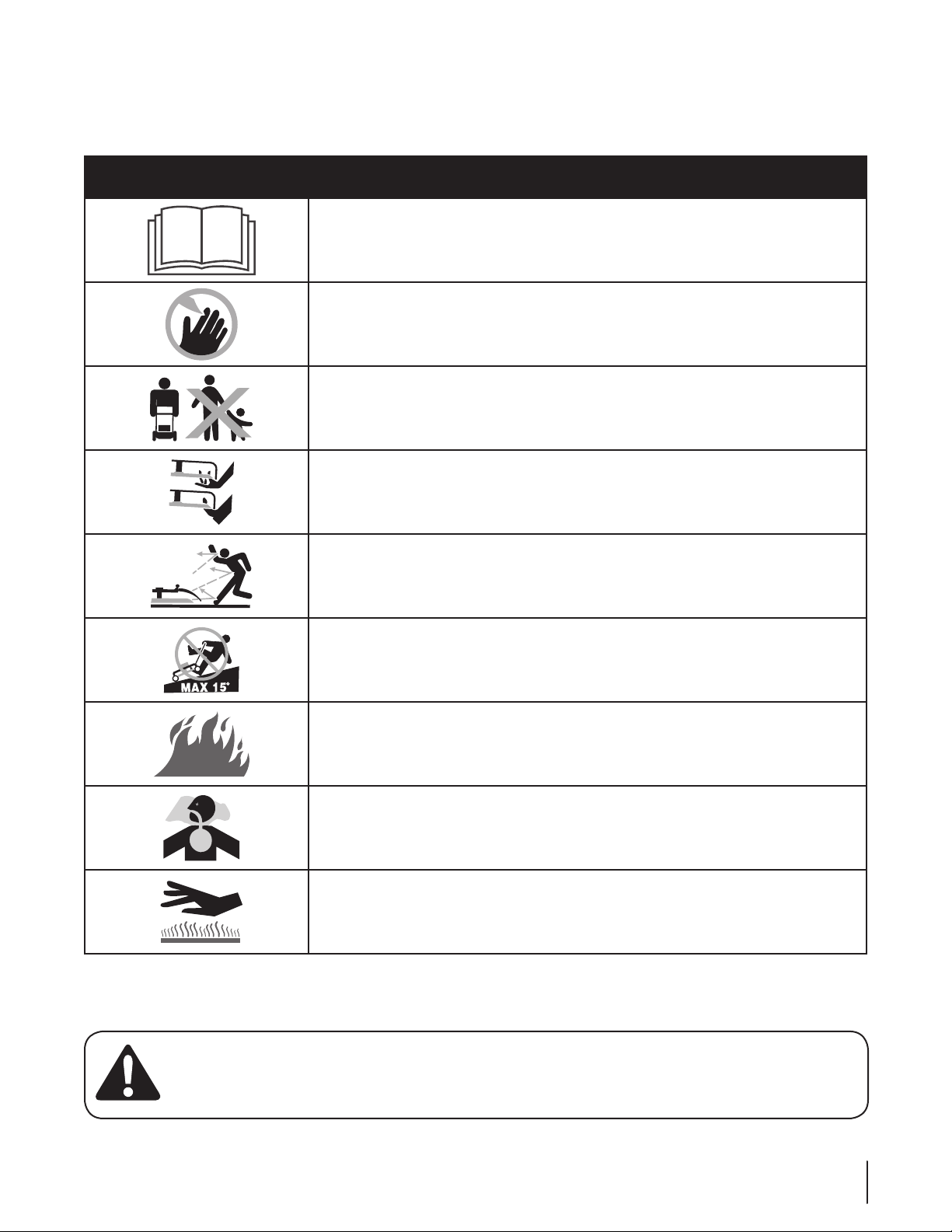
Safety Symbols
This page depicts and describes safety symbols that may appear on this product. Read, understand, and follow all instructions on the
machine before attempting to assemble and operate.
Symbol Description
READ THE OPERATOR’S MANUAL(S)
Read, understand, and follow all instructions in the manual(s) before attempting to
assemble and operate
DANGER — ROTATING BLADES
To reduce the risk of injury, keep hands and feet away. Do not operate unless discharge cover
or grass catcher is in its proper place. If damaged, replace immediately.
DANGER — BYSTANDERS
Do not mow when children or others are around.
DANGER — HAND/ FOOT CUT
Keep hands and feet away from rotating parts.
DANGER — THROWN DEBRIS
Remove objects that can be thrown by the blade in any direction. Wear safety glasses.
DANGER — SLOPES
Use extra caution on slopes. Do not mow slopes greater than 15°.
WARNING—GASOLINE IS FLAMMABLE
Allow the engine to cool at least two minutes before refueling.
WARNING— CARBON MONOXIDE
Never run an engine indoors or in a poorly ventilated area. Engine exhaust contains carbon
monoxide, an odorless and deadly gas.
WARNING— HOT SURFACE
Engine parts, especially the muffler, become extremely hot during operation. Allow engine
and muffler to cool before touching.
8 Section 2 — important Safe operation practiceS
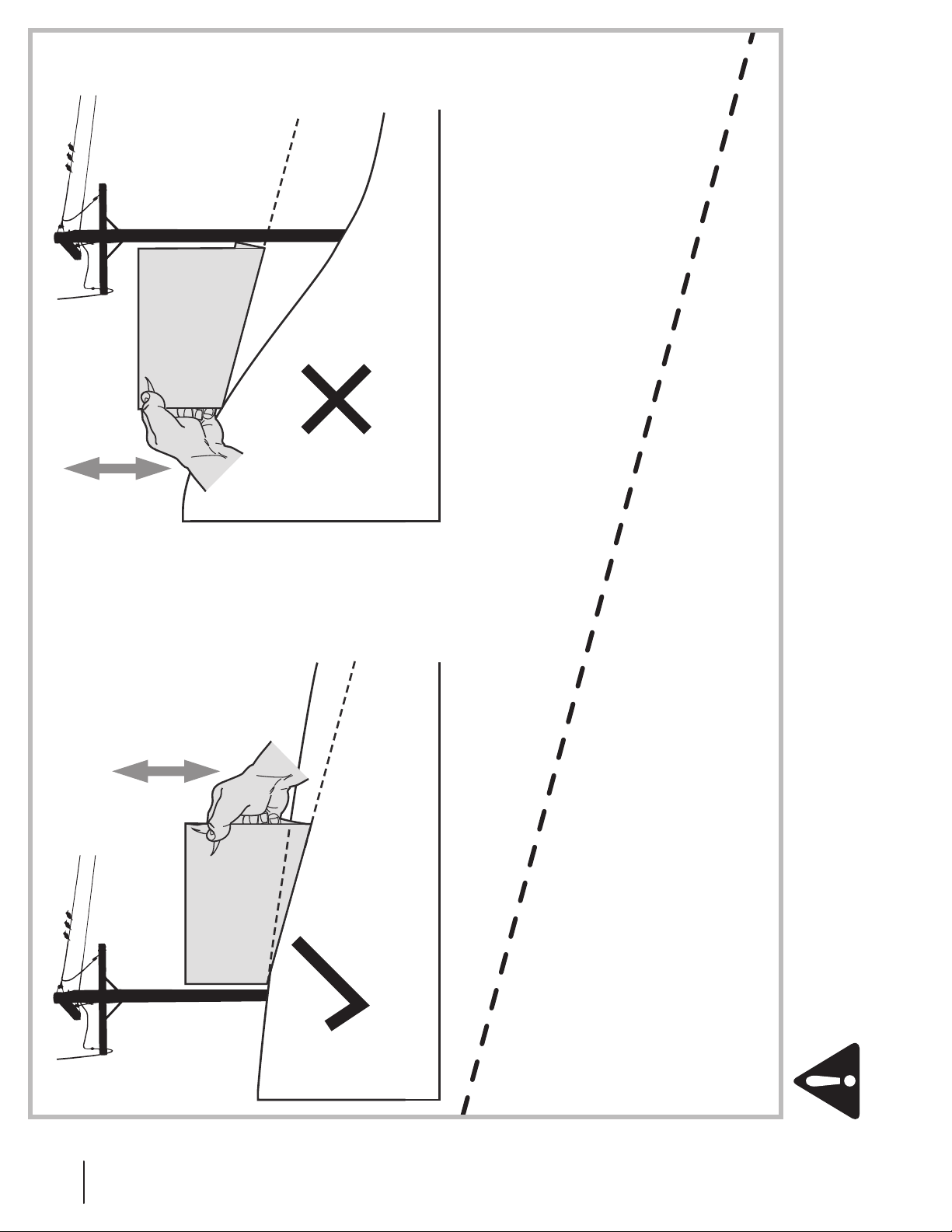
(OK) (TOO STEEP)
USE THIS SLOPE GAUGE TO DETERMINE
IF A SLOPE IS TOO STEEP FOR SAFE OPERATION!
To check the slope, proceed as follows:
1. Remove this page and fold along the dashed line.
2. Locate a vertical object on or behind the slope (e.g. a pole, building, fence, tree, etc.)
3. Align either side of the slope gauge with the object (See Figure 1 and Figure 2 ).
4. Adjust gauge up or down until the left corner touches the slope (See Figure 1 and Figure 2).
5. If there is a gap below the gauge, the slope is too steep for safe operation (See Figure 2 above).
15° dashed line
Slope Gauge
Figure 2Figure 1
15° Slope
15° Slope
WARNING! Slopes are a major factor related to tip-over and roll-over accidents which can result in severe injury or death.
Do not operate machine on slopes in excess of 15 degrees. All slopes require extra caution.
Always mow across the face of slopes, never up and down slopes.
Assembly & Set-Up
3
9
Contents of Carton
• One Lawn Mower • One Grass Catcher • One Bottle of Oil
• One Lawn Mower Operator’s Manual • One Engine Operator’s Manual • One Side Discharge Chute
b
Figure 3-2
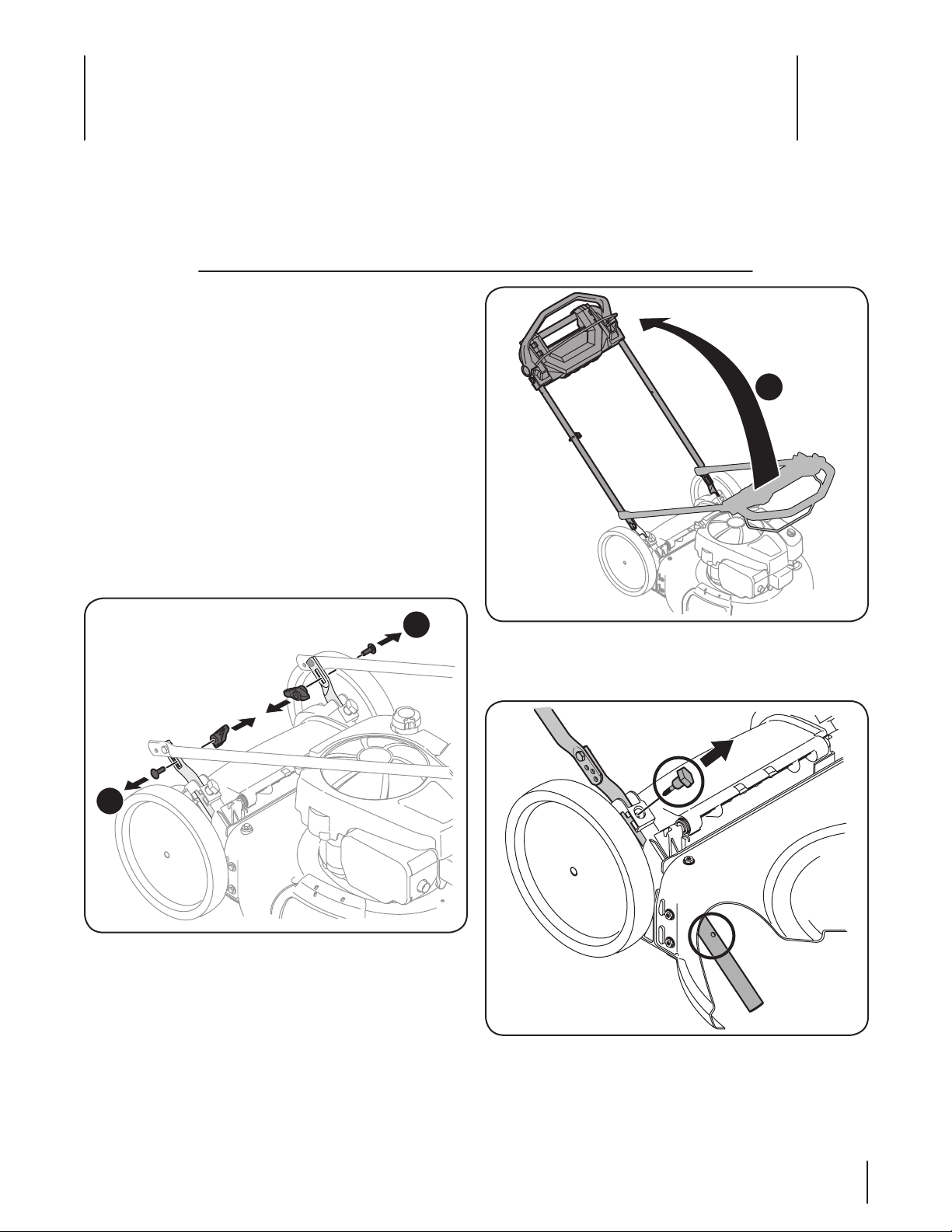
2. Remove the T-bolts from the handle brackets as shown in
Figure 3-3.
Figure 3-3
NOTE: Please be aware that this Operator’s Manual covers both
the low and high wheel models of this mower. While this section
illustrates the high wheel model, the instructions and features
are equally applicable to the low wheel model as well, unless
otherwise noted.
Assembly
NOTE: This unit is shipped without gasoline or oil in the engine.
Fill up with gasoline and oil as instructed in the accompanying
engine manual BEFORE operating your mower.
Handle
1. Remove any packing material which may be between
upper and lower handles.
a. Remove wing nuts and carriage bolts from handle
as shown in Figure 3-1. Do not loosen or remove
adjacent hex head screws.
a
a
Figure 3-1
b. While stabilizing mower so it doesn’t move, pivot
upper handle up as shown in Figure 3-2. Do not
crimp cables while lifting the handle up and make
sure they go on the outside of the handle.
10 Section 3 — ASSembly & Set-Up
c
c
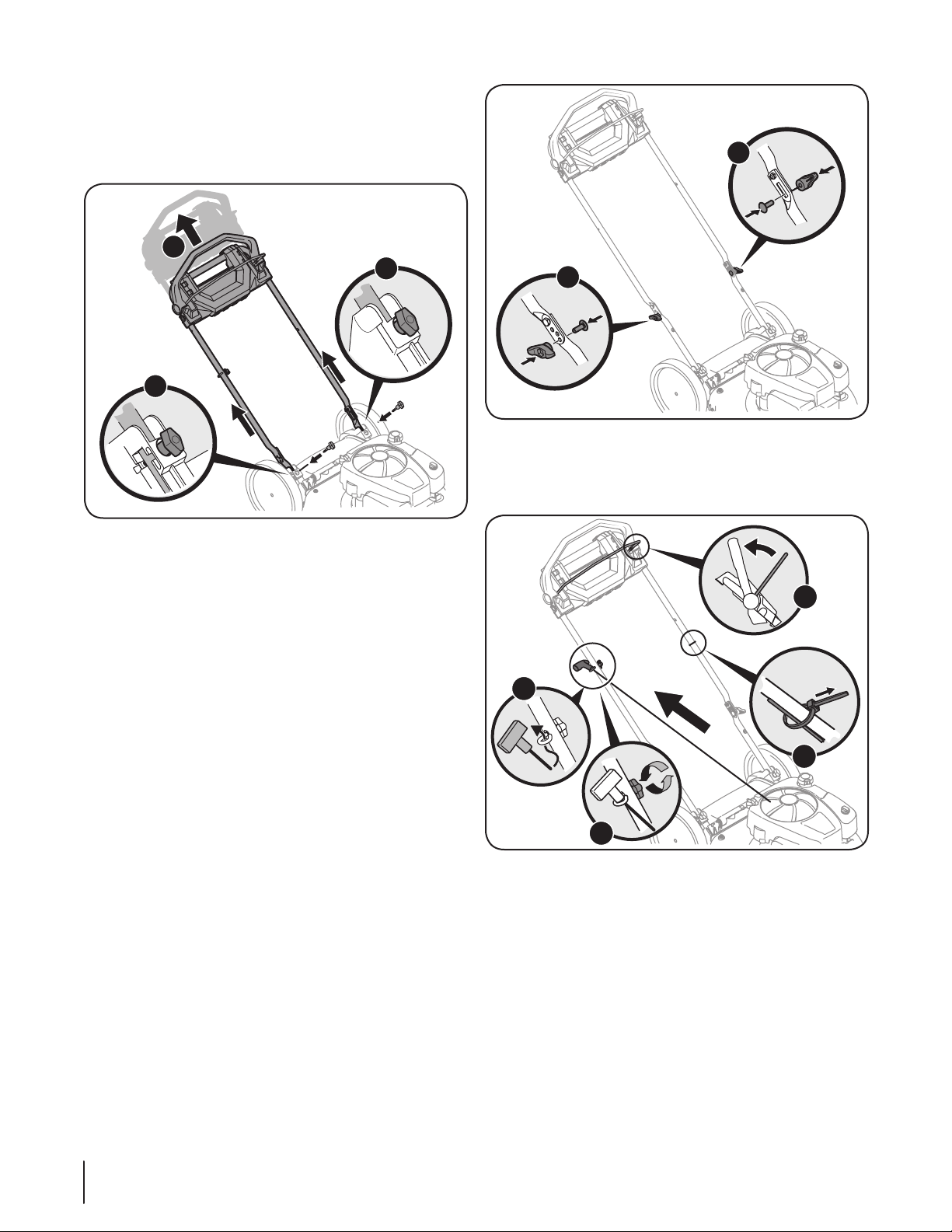
Figure 3-5
4. The rope guide is attached to the right side of the upper
handle. Loosen the wing knob which secures the rope
guide. See Figure 3-6.
d
b
a
c
Figure 3-6
a. Hold blade control against upper handle.
b. Slowly pull starter rope handle from engine and slip
starter rope into the rope guide. See Figure 3-6.
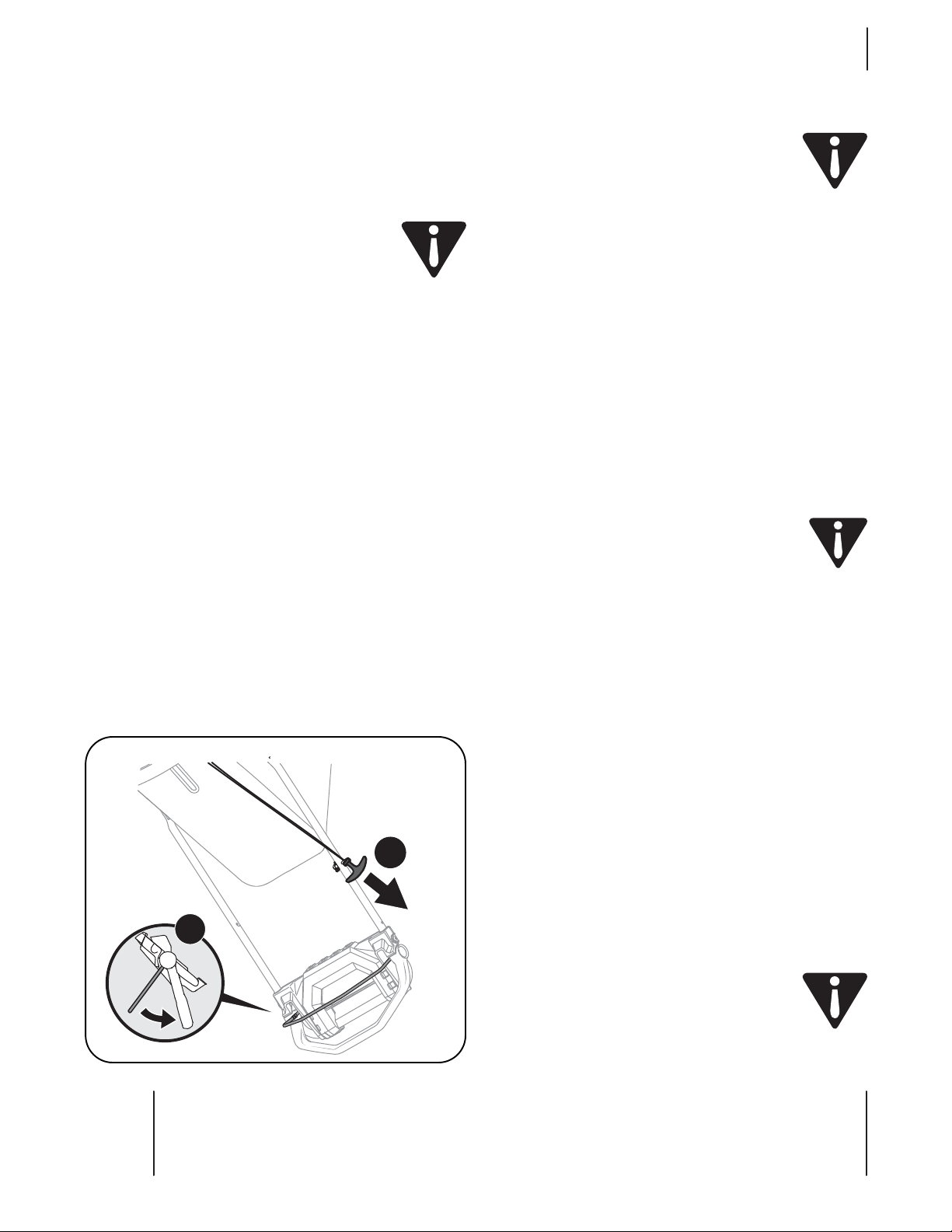
c. Tighten rope guide wing knob.
5. Use cable tie(s) to secure cable(s) to lower handle. See
Figure 3-6d.
IMPORTANT: To reduce wear and allow for proper
operation, make sure to leave some slack in the upper
portion of the cable(s).
3. Follow the steps below to complete handle assembly:
a. Pull upward on the handle approximately 8 inches
until holes in lower handle (shown in Figure 3-3 deck
cutaway) line up with holes in handle bracket. See
Figure 3-4.
a
b
b
Figure 3-4
NOTE: When pulling upward on handle, make sure to not
pull handle all the way out.
b. Insert the T-bolts removed earlier through the
handle brackets and lower handle and tighten
securely to secure the handle in place. See Figure
3-4.
c. Reattach wing nuts and carriage bolts removed
earlier into lower holes of handle as shown in Figure
3-5.
11Section 3 — ASSembly & Set-Up
To remove grass catcher, lift rear discharge door on the mower.
Lift grass catcher up and off of the slots in the handle brackets.
Release rear discharge door to allow it to close rear opening of
mower.
Side Discharge Chute
Your mower is shipped as a mulcher. To convert to side discharge,
make sure grass catcher is off of the unit and rear discharge door
is closed.
1. On the side of the mower, lift the side mulching plug. See
Figure 3-9.
1
2
Side Mulching
Plug
Figure 3-9
2. Slide two hooks of side discharge chute under hinge pin on
mulching plug assembly. Lower the mulching plug. Do not
remove side mulching plug at any time, even when you are
not mulching.
Grass Catcher
1. Follow steps below to assemble the grass catcher (if
needed). Make certain bag is turned right side out before
assembling (warning label will be on the outside).
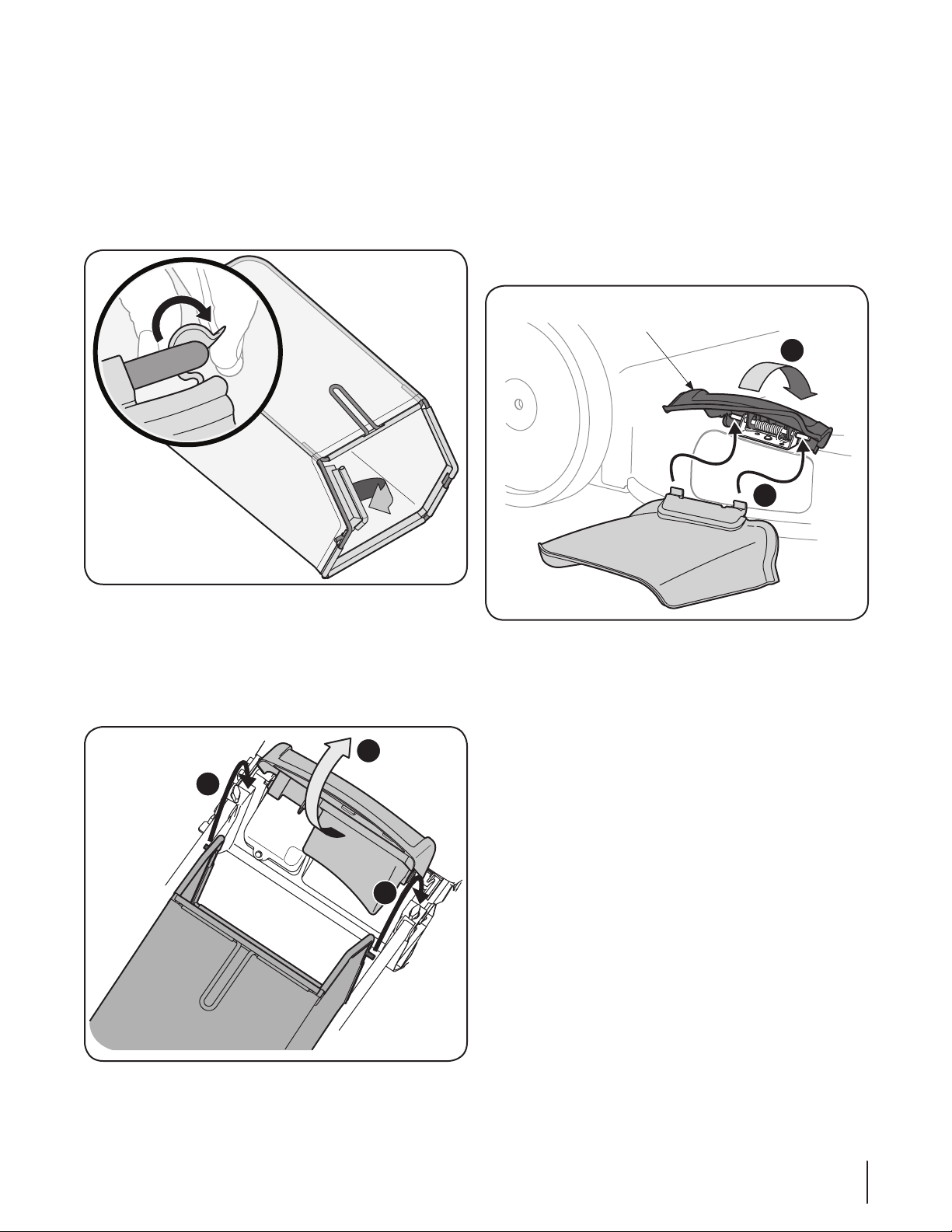
a. Place bag over frame so that its black plastic side is
at the bottom.
b. Slip plastic channel of grass bag over hooks on the
frame. See Figure 3-7.
Figure 3-7
2. Follow steps below to attach grass catcher:
a. Lift rear discharge door.
b. Place grass catcher into the slots in the handle
brackets as shown in Figure 3-8. Let go of discharge
door so that it rests on the grass catcher.
A
B
B
Figure 3-8
12 Section 3 — ASSembly & Set-Up
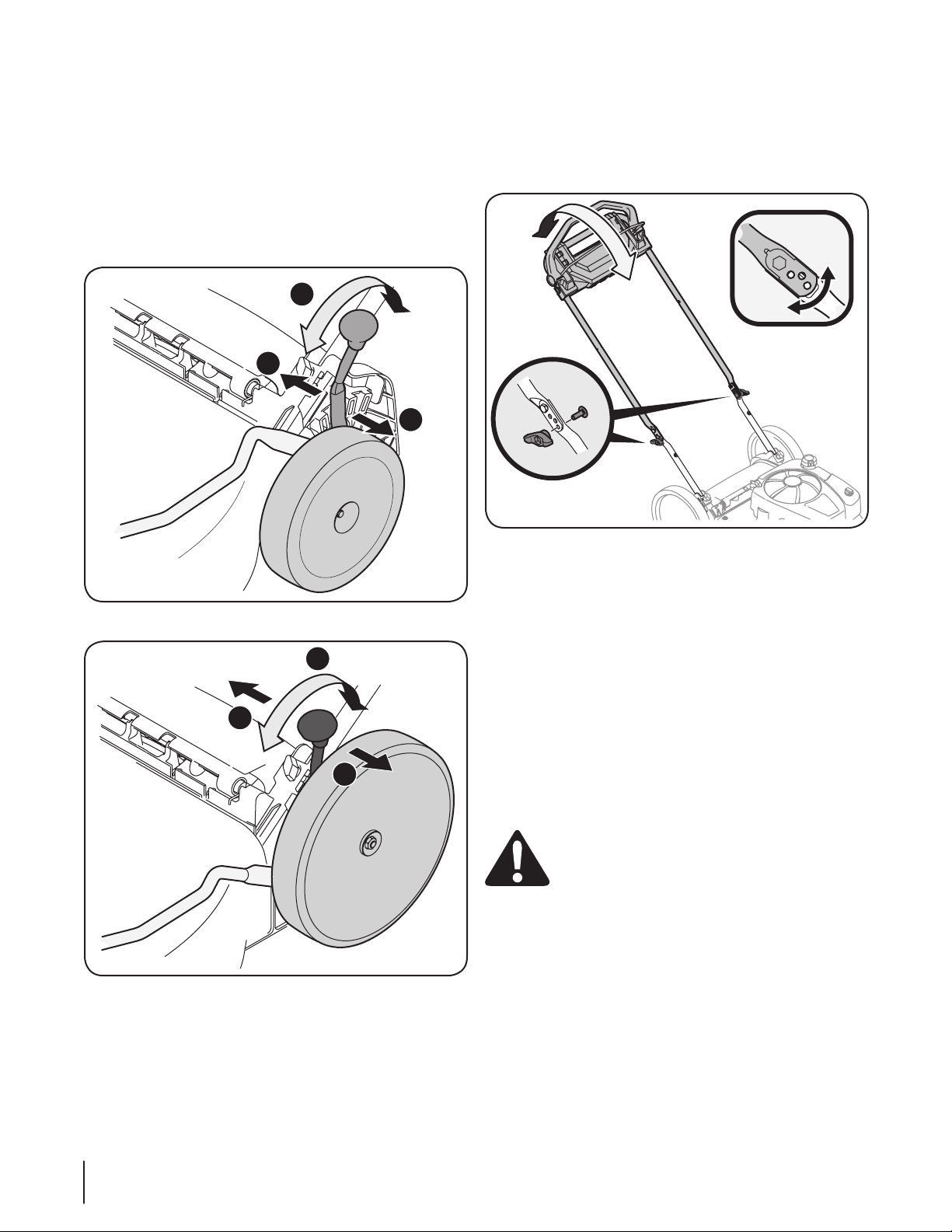
Adjustments
Cutting Height
The cutting height adjustment lever is located above the rear left
wheel.
1. Depress height adjustment lever towards wheel.
2. Slide lever to desired position for a change in cutting
height. Refer to Figure 3-10 for low wheel adjustment and
Figure 3-11 for high wheel.
1
2
3
Lower
Higher
Low Wheel
Figure 3-10
High Wheel
1
3
2
Lower
Higher
Figure 3-11
3. Release lever towards deck and place lever on one of the
six height adjustment teeth.
Handle Pitch
For convenience of operation, you may adjust the pitch of the
handle as follows:
1. Remove wing nuts and carriage bolts from handle. See
Figure 3-12.
Figure 3-12
2. Position the handle in one of the three positions that is
most comfortable. See Figure 3-12 inset.
3. Secure into position with wing nuts and carriage bolts
removed earlier.
Set-Up
Gas and Oil Fill-Up
Refer to the separate engine owner’s manual for additional
engine information.
1. Add oil provided before starting unit for the first time out
of the box.
2. Service the engine with gasoline as instructed in the
separate engine owner’s manual.
WARNING: Use extreme care when handling
gasoline. Gasoline is extremely flammable and the
vapors are explosive. Never fuel the machine
indoors or while the engine is hot or running.
Extinguish cigarettes, cigars, pipes and other
sources of ignition.
Controls and Features
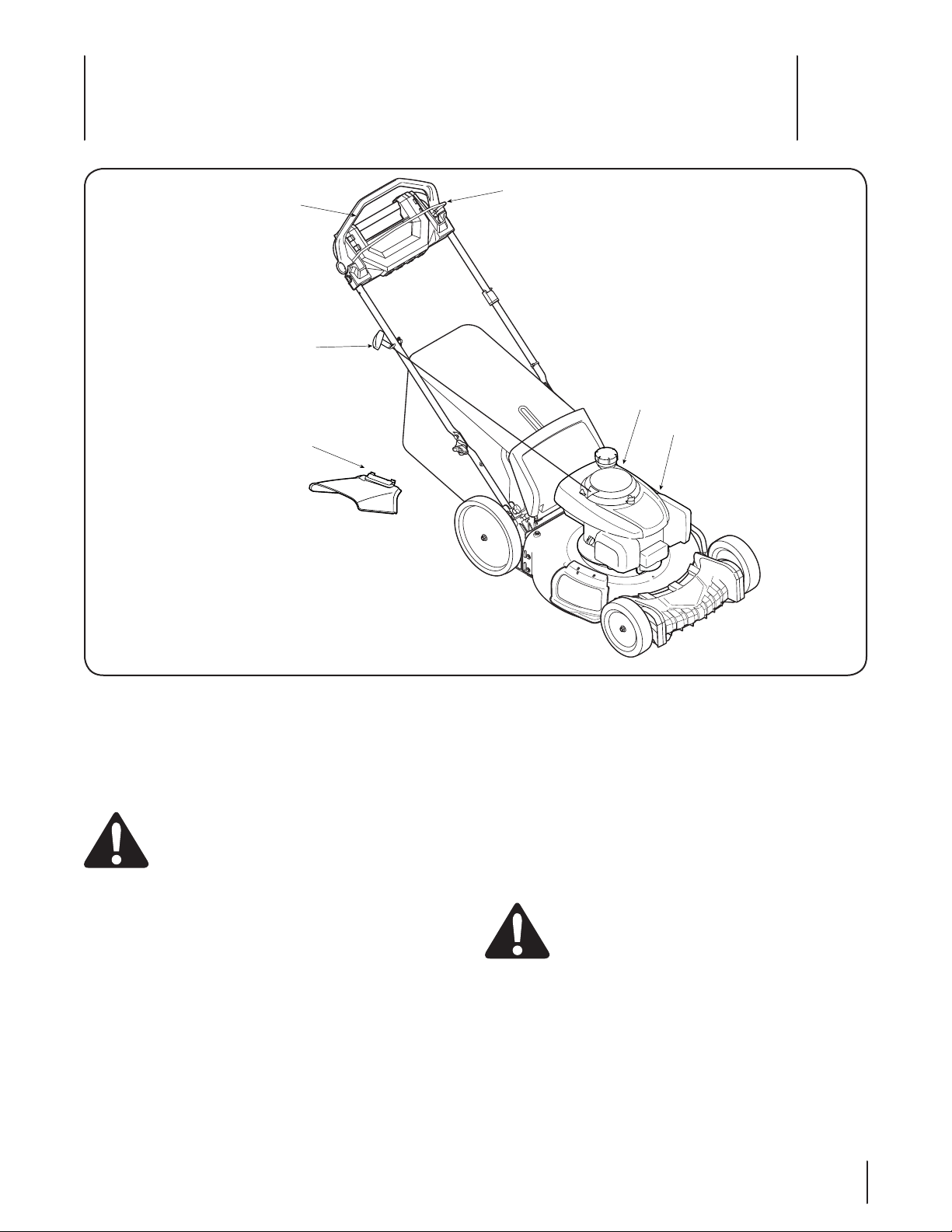
4
13
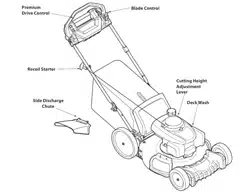
Deck Wash (If Equipped)
Your mower’s deck is equipped with a water port on its surface
as part of its deck wash system. Use the deck wash to rinse grass
clippings from the deck’s underside.
Side Discharge Chute
Your mower is shipped as a mulcher. To discharge the grass
clippings to the side instead, follow the instructions in the
“Assembly & Set-Up” section to attach the side discharge chute.
WARNING: Keep hands and feet away from the
chute area on cutting deck. Refer to warning label
on the unit.
Recoil Starter
The recoil starter is attached to the right upper handle. Stand
behind the unit and pull the recoil starter rope to start the unit.
Blade Control
The blade control is attached to the upper handle of the mower.
Depress and squeeze it against the drive control to operate the
unit. Release it to stop engine and blade.
WARNING: This blade control is a safety device.
Never attempt to bypass its operations.
Premium Drive Control
The premium drive control is located on the upper handle and
is used to engage the drive. Pushing the control forward will
engage the drive. The farther the control is pushed forward, the
faster the mower will propel. Once pressure is released from the
control it will return to the neutral position and the drive will be
disengaged.
Cutting Height Adjustment Lever
The cutting height adjustment lever is located above the left
rear wheel. To adjust the cutting height, refer to the “Assembly &
Set-Up” Section.
Figure 4-1
Blade Control
Deck Wash
Cutting Height
Adjustment
Lever
Side Discharge
Chute
Premium
Drive Control
Recoil Starter
Operation
5
14
Starting Engine
WARNING: Be sure no one other than the operator
is standing near the lawn mower while starting
engine or operating mower. Never run engine
indoors or in enclosed, poorly ventilated areas.
Engine exhaust contains carbon monoxide, an
odorless and deadly gas. Keep hands, feet, hair and
loose clothing away from any moving parts on
engine and lawn mower.
Refer to engine manual for help with the engine.
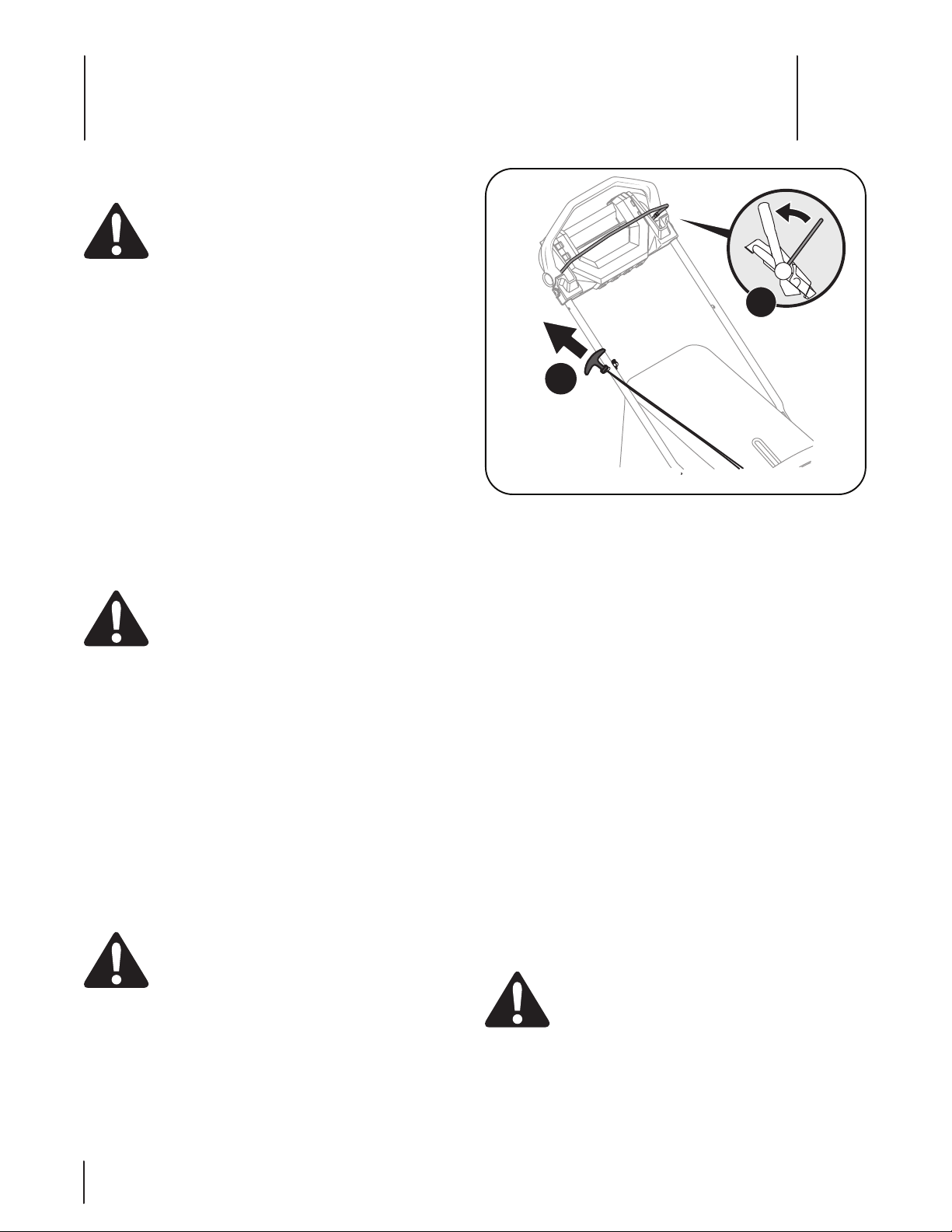
1. Standing behind the mower, pull the blade control back
against the drive control. See Figure 5-1.
2. While holding the blade and drive controls together firmly,
pull the recoil starter lightly until resistance is felt, then pull
rapidly to overcome compression, prevent kickback, and
start the engine. Repeat if necessary.
IMPORTANT: Do not allow the recoil starter to snap back
against the rope guide. Return it gently to prevent damage
to the starter.
Stopping Engine
1. Release blade control to stop the engine and blade.
WARNING: Wait for the blade to stop completely
before performing any work on the mower or to
remove the grass catcher.
Using Your Lawn Mower
Be sure lawn is clear of stones, sticks, wire, or other objects
which could damage lawn mower or engine. Such objects could
be accidently thrown by the mower in any direction and cause
serious personal injury to the operator and others.
1. Once the engine is running and while continuing to hold
the blade and drive controls together, push the drive
control forward to propel mower. The farther the control
is pushed forward, the faster the mower will propel. Once
pressure is released from the control it will return to the
neutral position and the drive will be disengaged.
NOTE: For ease of use, while gripping the controls,
simply lock your wrist and elbows and walk - the unit will
automatically adjust to your speed.
WARNING: The operation of any lawn mower can
result in foreign objects being thrown into the eyes,
which can damage your eyes severely. Always wear
safety glasses while operating the mower, or while
performing any adjustments or repairs on it.
1
2
Figure 5-1
Using as Mulcher
For mulching grass, remove the grass catcher and allow the rear
discharge door to close the rear opening of mower. For effective
mulching, do not cut wet grass. If the grass has been allowed to
grow in excess of four inches, mulching is not recommended. Use
the grass catcher to bag clippings instead.
Using Grass Catcher
You can use the grass catcher to collect clippings while you are
operating the mower.
1. Attach grass catcher following instructions in the
“Assembly & Set-Up” section. Grass clippings will
automatically collect in bag as you run mower. Operate
mower till grass bag is full.
2. Stop engine completely by releasing the blade control.
Make sure that the unit has come to a complete stop.
3. Lift discharge door and pull grass bag up and away from
the mower to remove the bag. Dispose of the grass
clippings and reinstall the bag when complete.
NOTE: Make sure to clean any excess grass from around
the rear opening of the mower, especially between the
transmission cover and sidewall on the left hand side and
along the bottom, to ensure tight fit of bag onto mower.
WARNING: If you strike a foreign object, stop the
engine. Remove wire from the spark plug,
thoroughly inspect mower for any damage, and
repair damage before restarting and operating.
Extensive vibration of mower during operation is an
indication of damage. The unit should be promptly
inspected and repaired.
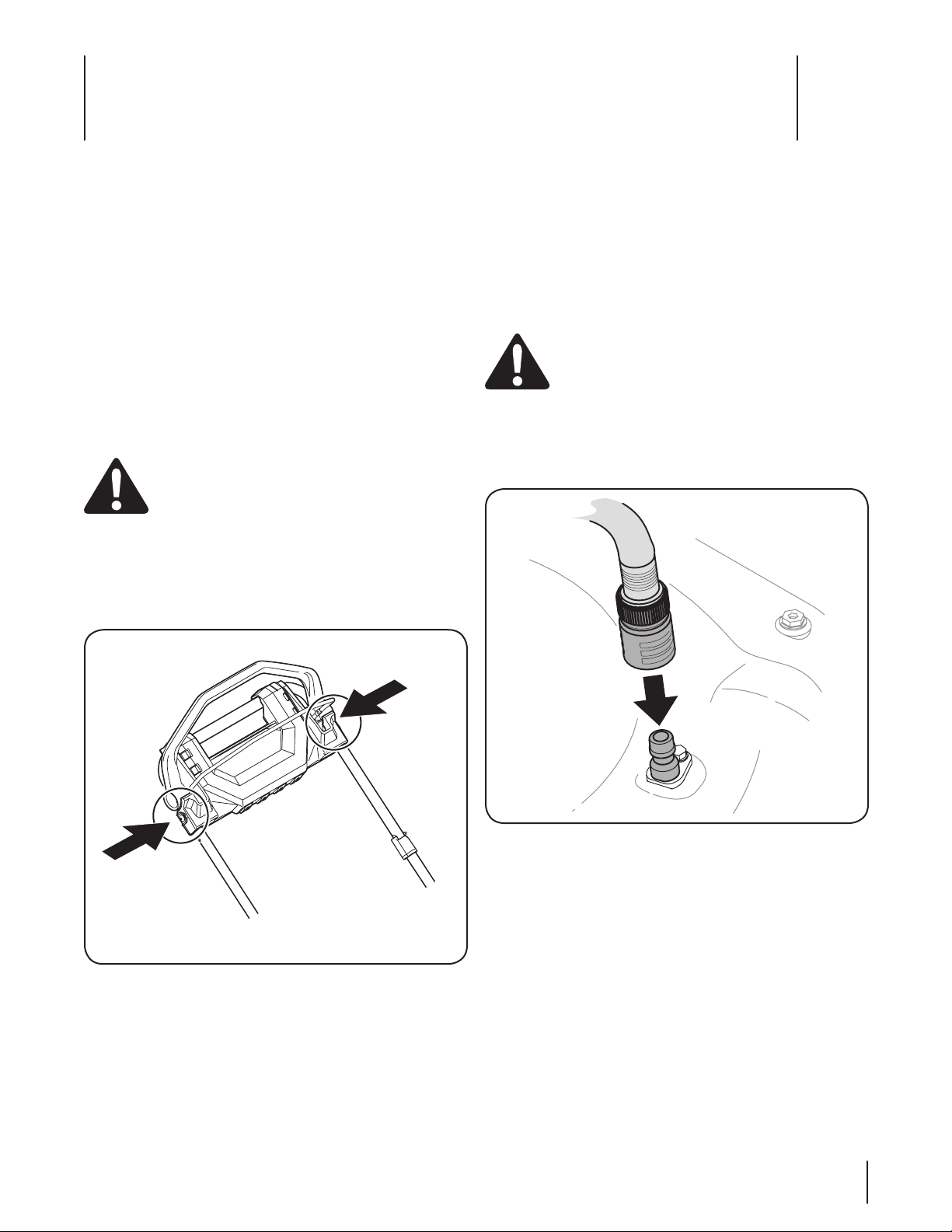
Maintenance & Adjustments
6
15
Maintenance
General Recommendations
• Always observe safety rules when performing any
maintenance.
• The warranty on this lawn mower does not cover items that
have been subjected to operator abuse or negligence. To
receive full value from warranty, operator must maintain
the lawn mower as instructed here.
• Changing of engine-governed speed will void engine
warranty.
• All adjustments should be checked at least once each
season.
• Periodically check all fasteners and make sure these are
tight.
WARNING: Always stop engine, allow engine to
cool, disconnect spark plug, and ground against
engine before performing any type of maintenance
on your machine.
Lubrication
1. Lubricate pivot points on the blade and drive control at
least once a season with light oil. This control must operate
freely in both directions. See Figure 6-1.
Figure 6-1
2. The transmission is pre-lubricated and sealed at the factory
and does not require lubrication.
3. Follow the accompanying engine manual for lubrication
schedule and instruction for engine lubrication.
Deck Wash
Your mower’s deck may be equipped with a water port on its
surface as part of its deck wash system.
Use the deck wash to rinse grass clippings from the deck’s
underside and prevent the buildup of corrosive chemicals.
Complete the following steps AFTER EACH MOWING:
1. Push the mower to a level, clear spot on your lawn, near
enough for your garden hose to reach.
CAUTION: Make certain the mower’s discharge
chute is directed AWAY from your house, garage,
parked cars, etc.
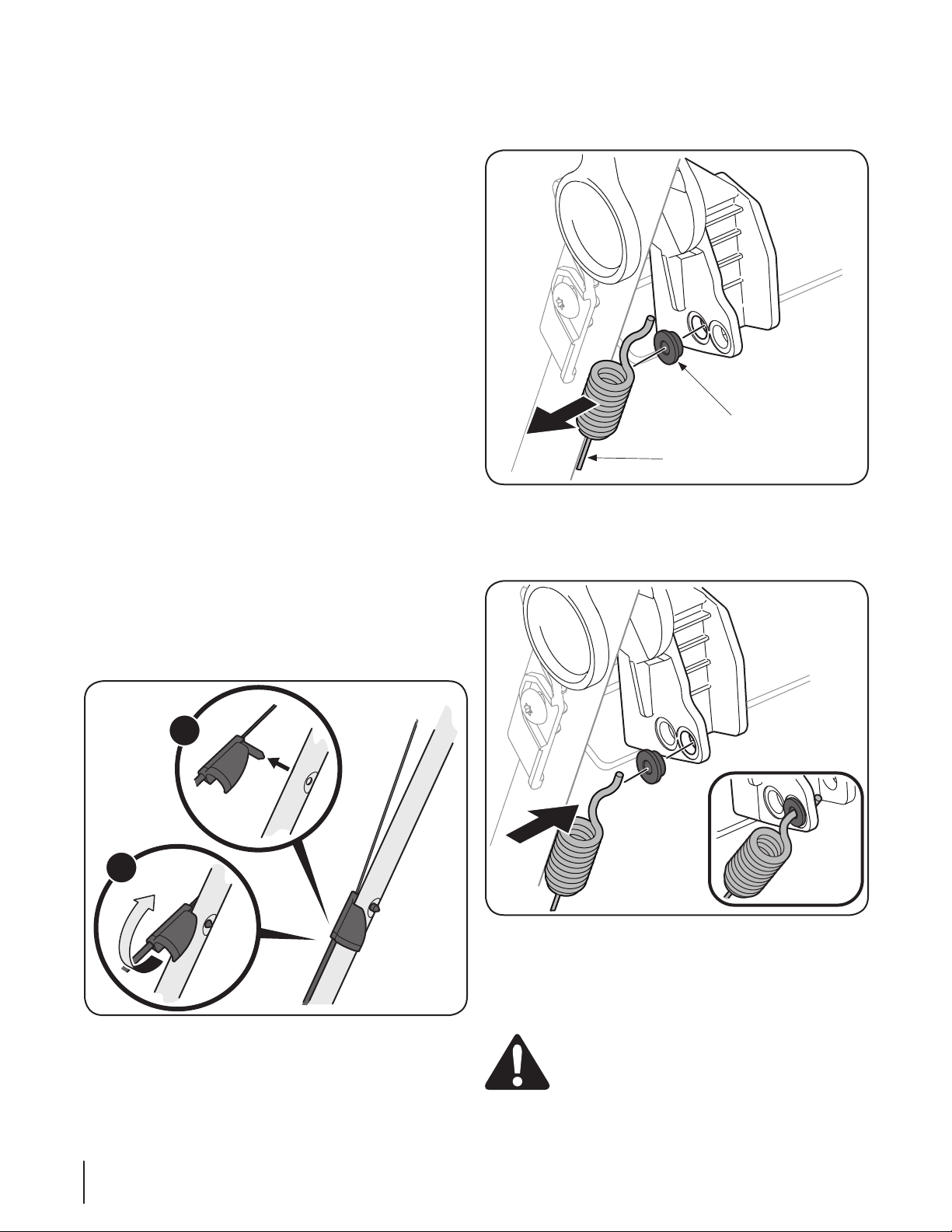
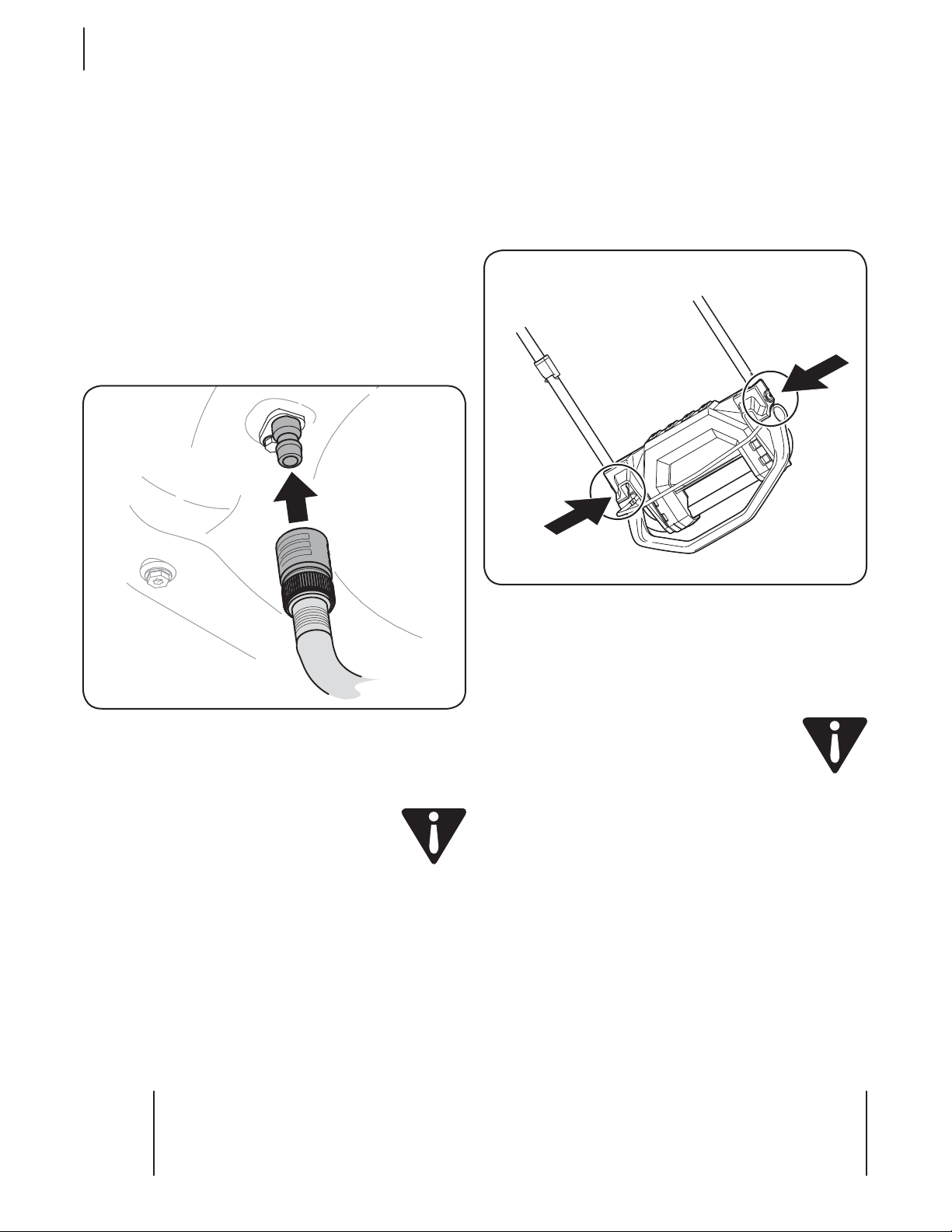
2. Thread the hose coupler (packaged with your mower’s
Operator’s Manual) onto the end of your garden hose.
3. Attach the hose coupler to the water port on your deck’s
surface. See Figure 6-2.
Figure 6-2
4. Turn the water on.
5. Start the engine as described in the Operation section.
6. Run the engine for a minimum of two minutes, allowing
the underside of the cutting deck to thoroughly rinse.
7. Release blade control to stop the engine and blade.
8. Turn the water off and detach the hose coupler from the
water port on your deck’s surface.
After cleaning your deck, restart the mower. Keep the engine
and blade running for a minimum of two minutes, allowing the
underside of the cutting deck to thoroughly dry.
16 Section 6— Maintenance & adjuStMentS
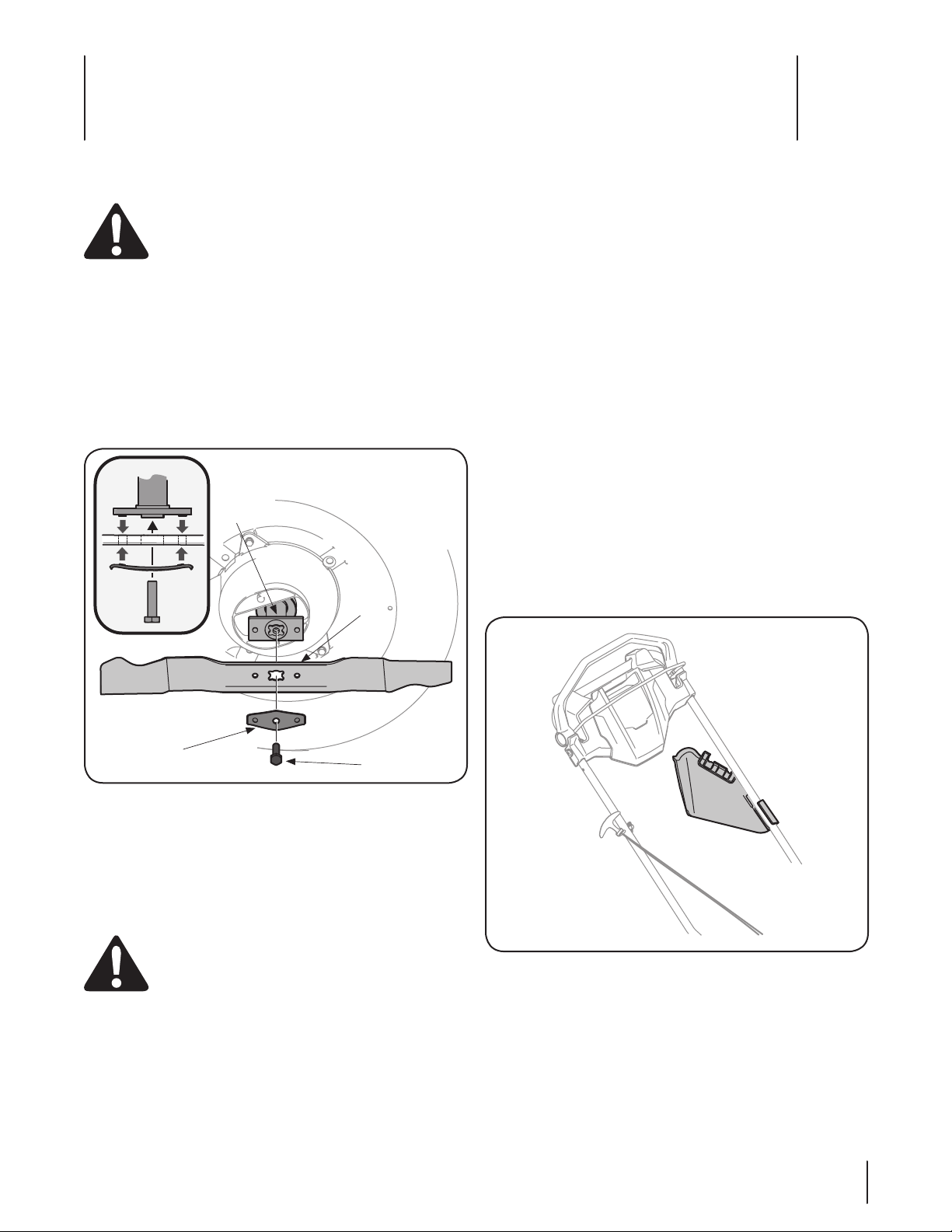
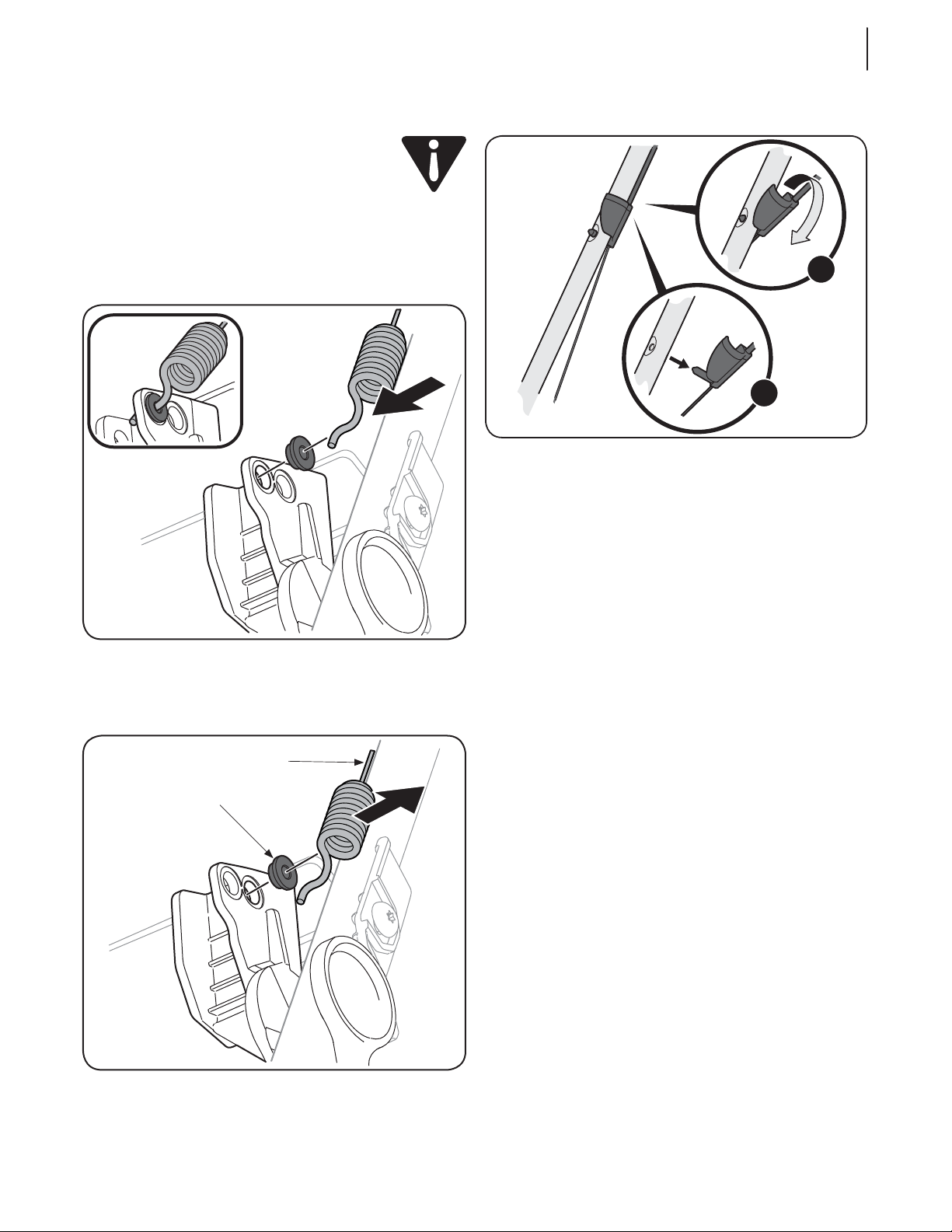
2. Pull the fitting away from the handle.
3. Unhook the cable and remove the metal bushing from the
plastic drive handle. See Figure 6-4.
Metal Bushing
Cable
Figure 6-4
4. Replace bushing in the lower hole and reattach the cable
through the bushing and lower hole in the handle. See
Figure 6-5.
Figure 6-5
5. Reinsert the drive cable fitting into the upper handle and
rotate it downward.
6. Start the mower and check the function of the drive
handle.
CAUTION: If the drive is engaged without pushing
on the handle after this adjustment is made return
the cable to its original position on the plastic drive
handle.
Engine Care
A list of key engine maintenance jobs required for good
performance by the mower is given below. Follow the
accompanying engine manual for a detailed list and instructions.
• Maintain oil level as instructed in engine manual.
• Service air cleaner every 25 hours under normal conditions.
Clean every few hours under extremely dusty conditions.
Poor engine performance and flooding usually indicates
that the air cleaner should be serviced. To service the air
cleaner, refer to the engine manual.
• Clean spark plug and reset the gap once a season. Spark
plug replacement is recommended at the start of each
mowing season. Check engine manual for correct plug
type and gap specifications.
• Clean engine regularly with a cloth or brush. Keep the
top of the engine clean to permit proper air circulation.
Remove all grass, dirt, and combustible debris from muffler
area.
• Engines stored between 30 and 90 days need to be treated
with a gasoline stabilizer such as STA-BIL® to prevent
deterioration and gum from forming in fuel system or on
essential carburetor parts.
Adjustments
Drive Adjustment
The drive system consists of pulleys, a belt , and a cable linking
the transmission to the drive handle. As these components wear
adjustment may be needed. To adjust the drive linkage perform
the following:
1. Rotate the drive cable fitting located on the left upper
handle upward. See Figure 6-3.
1
2
Figure 6-3
Se rvice
7
17
Blade Care
WARNING: When removing the cutting blade for
sharpening or replacement, protect your hands with
a pair of heavy gloves or use a heavy rag to hold the
blade.
Periodically inspect the blade adapter for cracks, especially if you
strike a foreign object. Replace when necessary. Follow the steps
below for blade service.
1. Disconnect spark plug boot from spark plug. Turn mower
on its side making sure that the air filter and the carburetor
are facing up.
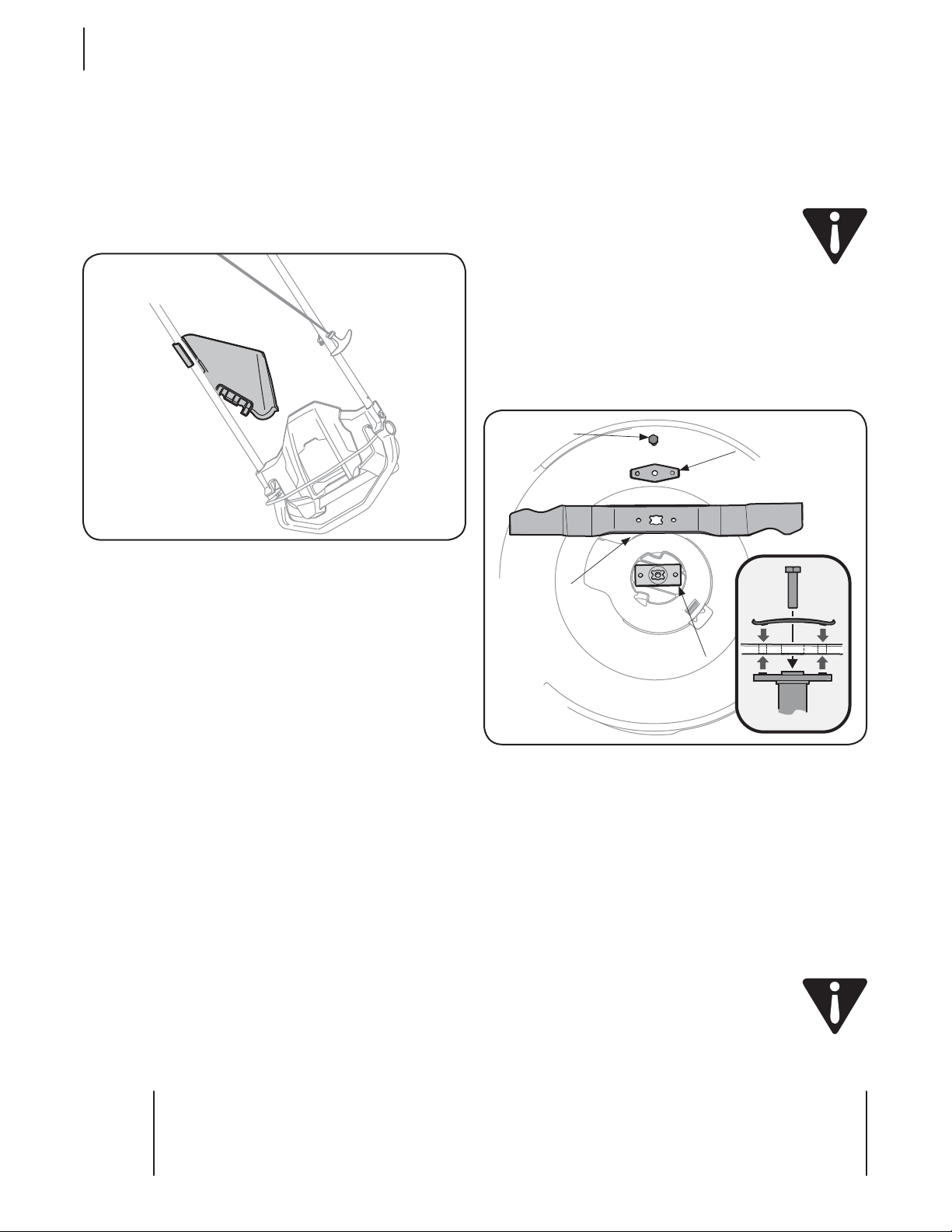
2. Remove the bolt and the blade bell support which hold the
blade and the blade adapter to the engine crankshaft. See
Figure 7-1.
Blade
Blade
Adapter
Bolt
Blade Bell
Support
Figure 7-1
3. Remove blade from the adapter for testing balance.
4. Balance the blade on a round shaft screwdriver to check.
Remove metal from the heavy side until it balances evenly.
When sharpening the blade, follow the original angle of
grind. Grind each cutting edge equally to keep the blade
balanced.
WARNING: An unbalanced blade will cause
excessive vibration when rotating at high speeds. It
may cause damage to mower and could break
causing personal injury.
5. Place the blade on the adapter such that the side of the
blade marked “Bottom” (or with part number) faces the
ground when the mower is in the operating position. Make
sure that the blade is aligned and seated on the blade
adapter flanges. See Figure 7-1 inset.
6. Place blade bell support on the blade. Align notches on the
blade bell support with small holes in blade.
7. Replace hex bolt and tighten hex bolt to torque: 450 in. lbs.
min., 600 in. lbs. max.
To ensure safe operation of your mower, periodically check the
blade bolt for correct torque.
Belt Care
NOTE: Several components must be removed in order to change
the mower’s belt. See an authorized Service Dealer to have your
belt replaced.
Off-Season Storage
The following steps should be taken to prepare your lawn mower
for storage.
• Clean and lubricate mower thoroughly as described in the
lubrication instructions.
• Coat mower’s cutting blade with chassis grease to prevent
rusting.
• Refer to engine manual for correct engine storage
instructions.
• Secure side discharge chute to handle as shown in Figure
7-2.
Figure 7-2
• Store mower in a dry, clean area. Do not store next to
corrosive materials, such as fertilizer.
When storing any type of power equipment in a poorly
ventilated or metal storage shed, care should be taken to
rust-proof the equipment. Using a light oil or silicone, coat the
equipment, especially cables and all moving parts of your lawn
mower before storage.

Troublesho oting
8
18
Problem Cause Remedy
Engine Fails to start 1. Blade control disengaged.
2. Spark plug boot disconnected.
3. Fuel tank empty or stale fuel.
4. Engine not primed (if equipped with primer).
5. Faulty spark plug.
6. Blocked fuel line.
7. Engine flooded.
8. Fuel valve (if equipped) closed.
9. Engine not choked (if equipped with choke).
10. Burnt fuse. (Electric Start only)
1. Engage blade control.
2. Connect wire to spark boot.
3. Fill tank with clean, fresh gasoline.
4. Prime engine as instructed in the Operation
section.
5. Clean, adjust gap, or replace.
6. Clean fuel line.
7. Wait a few minutes to restart, but do not
prime.
8. Open fuel valve. See engine manual.
9. Choke engine. See engine manual.
10. Replace fuse (see Service Section).
Engine runs erratic 1. Spark plug boot loose.
2. Blocked fuel line or stale fuel.
3. Vent in gas cap plugged.
4. Water or dirt in fuel system.
5. Dirty air cleaner.
6. Unit running with CHOKE (if equipped)
applied.
1. Connect and tighten spark plug boot.
2. Clean fuel line; fill tank with clean, fresh
gasoline.
3. Clear vent.
4. Drain fuel tank. Refill with fresh fuel.
5. Refer to engine manual.
6. Push CHOKE knob in.
Engine overheats 1. Engine oil level low.
2. Air flow restricted.
1. Fill crankcase with proper oil.
2. Clean area around and on top of engine.
Occasional skips
(hesitates) at
high speed
1. Spark plug gap too close. 1. Adjust gap to .030”.
Idles poorly 1. Spark plug fouled, faulty, or gap too wide.
2. Dirty air cleaner.
1. Reset gap to .030” or replace spark plug.
2. Refer to engine manual.
Excessive Vibration 1. Cutting blade loose or unbalanced.
2. Bent cutting blade.
1. Tighten blade and adapter. Balance blade.
2. See an authorized service dealer.
Mower will not
mulch grass
1. Wet grass.
2. Excessively high grass.
3. Dull blade.
1. Do not mow when grass is wet; wait until
later to cut.
2. Mow once at a high cutting height, then
mow again at desired height or make a
narrower cutting path.
3. Sharpen or replace blade.
Continued on next page

19Section 8 — troubleShooting
Problem Cause Remedy
Uneven cut 1. Dull blade. 1. Sharpen or replace blade.
Mower will not self propel 1. Belt not installed properly.
2. Debris clogging drive operation.
3. Damaged or worn belt.
4. Drive control out of adjustment.
1. Check belt for proper pulley installation and
movement.
2. Stop engine, disconnect spark plug boot,
and clean out debris.
3. Inspect and replace belt.
4. Adjust drive control. (See Assembly & Set-up
section).
5. Push unit forward a few inches before pulling
back. (See Operation section).
High pullback effort 1. Pulling mower backwards before
transmission disengages.
1. Allow the unit to roll forward slightly without
the drive lever(s) engaged before pulling
backwards.
Replacement Parts
9
20
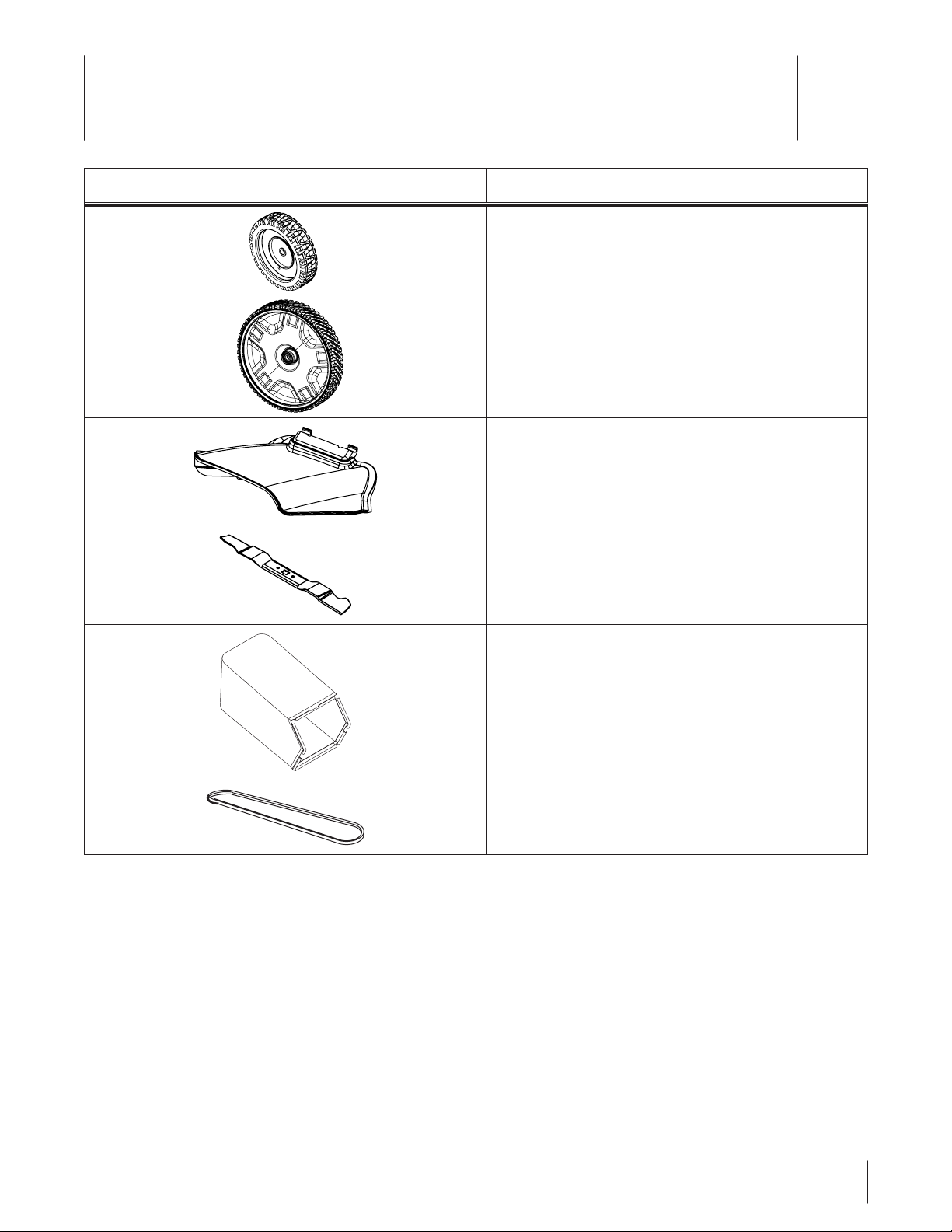
Component Part Number and Description
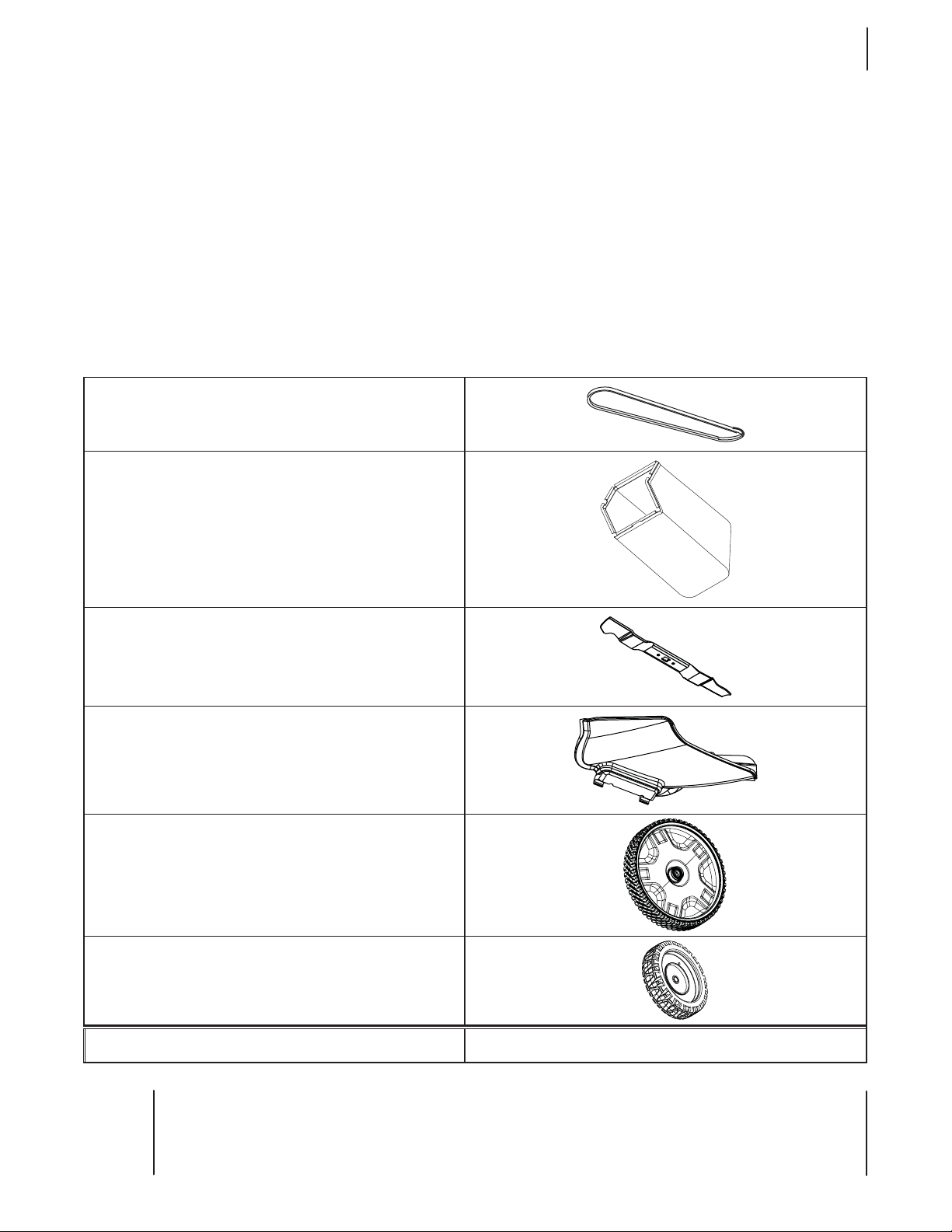
634-04660 Wheel (Front - 8” x 2”, SLV:S)
934-04666 Wheel (Rear - 11” x 2”, BB: S)
731- 07486† Discharge Chute
731-07131† Discharge Chute (w/clip)
942-0741A Mulching Blade
664-05027† Grass Bag (Troybilt)
954-04282 Belt
† If Equipped
NOTE: Download a complete Parts Manual, refer to customer support on page 2. Be sure to have your model number and serial
number ready. Refer to page 2 for more information regarding locating your model and serial numbers.

21
FOUR YEAR SUPREME WARRANTY:
For four years from date of retail purchase within Canada, MTD PRODUCTS LIMITED will, at its option,
repair or replace, for the original purchaser, free of charge, any part or parts found to be defective in
material or workmanship. This warranty covers units which have been operated and maintained in
accordance with the owner’s instructions furnished with the unit, and which have not been subject to
misuse, abuse, commercial use, neglect, accident improper maintenance or alteration. Normal wear
parts or components thereof are subject to special terms as noted below in the Ninety Day Consumer
Warranty clause.
The engine, starter motor or component parts thereof carry separate warranties from their manufac-
turers. Please refer to the applicable manufacturer’s warranty policy for these items.
Ninety Day Consumer Warranty on Normal Wear Parts: All normal wear part failures will be cov-
ered on this product for a period of 90 days. After 90 days but within the four year warranty period,
normal wear part failures will be covered if caused by defects in material or workmanship of other
component parts. Normal wear parts are defined as batteries, belts, blades, blade adaptors, grass
bags, rider deck wheels, seats, tires and clutch parts (friction wheels).
Full Ninety Day Warranty on Battery (if equipped): For ninety (90) days from the date of retail
purchase, if any battery included with this unit proves defective in material or workmanship and our
testing determines the battery will not hold a charge, MTD PRODUCTS LIMITED will replace the bat-
tery at no charge to the original purchaser.
Additional Limited Thirty Day Warranty on Battery (if equipped): After ninety (90) days but
within one hundred twenty (120) days from the date of purchase, MTD PRODUCTS LIMITED will replace
the defective battery, for the original purchaser, for a cost of one-half (½) of the current retail price of
the battery in effect at the date of return.
Personal use: THE FOREGOING PARAGRAPHS CONSTITUTE THE MANUFACTURER’S ENTIRE WARRAN-
TY WITH RESPECT TO ANY PRODUCT PURCHASED AND USED FOR PERSONAL FAMILY, HOUSEHOLD/
RESIDENTIAL PURPOSES, AS DISTINGUISHED FROM COMMERCIAL USAGE.
Commercial use: ALL APPLICATIONS OTHER THAN PERSONAL USE AS OUTLINED ABOVE, ARE CON-
SIDERED COMMERCIAL USAGE.
New products purchased for commercial usage are warranted in the same manner and to the same
extend EXCEPT the term of warranty will be 90 DAYS from date of purchase.
How to Obtain Service: Warranty service is available, with proof of purchase, through your local
MTD Authorized Service Dealer. If you do not know the dealer in your area, please write to the Service
Department of MTD PRODUCTS LIMITED, P.O. BOX 1386, KITCHENER, ONTARIO N2G 4J1. The return of
a complete unit will not be accepted by the factory unless prior written permission has been extended
by MTD PRODUCTS LIMITED.
Other Warranties: All other warranties, express or implied, including any implied warranty of mer-
chantability is limited in its duration to that set forth in this express limited warranty. The provisions
as set forth in this warranty provide the sole and exclusive remedy of MTD PRODUCTS LIMITED obliga-
tions arising from the sale of its products. MTD PRODUCTS LIMITED will not be liable for incidental or
consequential loss or damage.
12.08.06

22
05.25.13
The 2 Pull Promise™
Provisions of Your Limited Warranty
In addition to the other terms and conditions of the Limited
Warranty applicable to your new mower, MTD LLC (“MTD”)
hereby warrants that your mower’s engine will start on the
first or second attempt by an able-bodied adult (subject
to the limitations described below) for the duration of the
manufacturer’s limited warranty applicable to your product.
If the engine on your mower fails to conform to this limited
warranty, MTD will cover the cost of parts and labor associated
with any adjustments and/or repairs necessary to return your
engine to its warranted condition. In order to make a claim
under these provisions of your warranty, you must bring the
product and proof of purchase to an authorized MTD service
provider. In many cases, the retailer who sold you your mower is
not equipped to provide warranty service, so please locate the
authorized service dealer nearest you by either calling the phone
number provided in your Operators Manual or looking up an
authorized service dealer on-line at www.mtdcanada.ca.
Items and Conditions Not Covered
The 2 Pull Promise does not cover and/or apply to the following:
• Cost of regular maintenance service or parts, such as filters,
fuel, lubricants, oil changes, spark plugs, air filter, blade
sharpening, worn blades, cable/linkage adjustments, or
brake and clutch adjustments
• Transportation costs to and from an authorized MTD
service provider
• Any engine used for commercial, rental, institutional,
governmental, or non-residential applications
• Any product or part that has been altered or misused or
required replacement or repair due to misuse, accidents, or
lack of proper maintenance
• Repairs necessary due to improper battery care, electrical
supply irregularities, or failure to properly prepare the
mower prior to any period of non-use over three months
• Pickup and/or delivery charges
• Operational misuse, neglect, accidents, unauthorized
repairs or attempted repairs of the engine or its
components by anyone other than an authorized MTD
service provider.
• Repairs or adjustments to correct starting difficulties
due to any of the following: failure to follow proper
maintenance procedures — rotary mower blade striking
an object — contaminants in the fuel system — improper
fuel or fuel/oil mixture (consult your Operator’s Manual if
in doubt) — failure to drain the fuel system prior to any
period of non-use over three months
• Any starting problem which results from the use of
inappropriate fuels, lubricants, or additives
• Special conditions or circumstances that normally require
more than two pulls to start, specifically: 1) First start-up
following your initial purchase, 2) first time starts after
extended period(s) of non-use over one month or seasonal
storage, 3) cool temperature starts such as those found in
early spring and late autumn, and 4) difficult starting that
results from the operator’s failure to follow the proper
starting procedures identified in the Operator’s Manual. If
you are having difficulty starting your unit, please check
the Operator’s Manual to ensure that you are using the
correct starting procedures. This can save an unnecessary
visit to a Service Dealer.
Owner Responsibilities
You must maintain your mower (including its engine) by
following the maintenance procedures and starting instructions
described in the Operator’s Manual. Such routine maintenance,
whether performed by a dealer or by you, is at your expense.
In addition, please retain your proof of purchase and service
receipts as these may be required to validate a claim.
General Conditions
An authorized MTD service provider using approved
replacement parts must perform all repairs covered by the 2
Pull Promise. Repair by an MTD authorized service dealer is your
sole remedy under this warranty. MTD is not liable for indirect,
incidental, or consequential damages in connection with the
use of the products covered by these warranties, including any
cost or expense of providing substitute equipment or service
during reasonable periods of malfunction or non-use pending
completion of repairs under this warranty.
Some jurisdictions do not allow exclusions of incidental or
consequential damages, or limitations on how long an implied
warranty lasts, so certain exclusions and limitations may not
apply to you.

22
05.23.13
Termes de la garantie limitée
Démarrage garantie en 2 essais™
0VUSFMFTUFSNFTFUDPOEJUJPOTEFMBHBSBOUJFMJNJUÏFEFWPUSF
tondeuse neuve, MTD LLC (« MTD ») garantit par la présente
que le moteur de votre tondeuse démarrera dès le premier ou
EFVYJÒNFFTTBJEFEÏNBSSBHFQBSVOBEVMUFWBMJEFTPVTSÏTFSWF
des restrictions ci-dessous) pendant toute la durée de la garantie
limitée du fabricant qui s’applique à votre tondeuse. Si le moteur de
votre tondeuse ne fonctionne pas conformément à cette garantie
limitée, MTD s’engage à couvrir le coût des pièces détachées et de
la main-d’œuvre associés à tout ajustement et/ou à toute réparation
OÏDFTTBJSFQPVSMFSFOESFDPOGPSNFËDFUUFHBSBOUJF1PVSGBJSFVOF
SÏDMBNBUJPOBVYUFSNFTEFDFUUFHBSBOUJFWPVTEFWSF[QSÏTFOUFSMF
produit et une preuve d’achat à une station technique agréée par
MTD. Souvent, le détaillant qui vous a vendu la tondeuse n’est pas
équipé pour offrir les services de réparations sous garantie. Dans ce
cas, veuillez localiser la station technique agréée la plus proche de
votre domicile en composant le numéro qui apparaît dans la notice
d’utilisation de la tondeuse ou en cherchant une station technique
agréée en ligne, à www.mtdcanada.ca
1JÒDFTFUDPOEJUJPOTOPODPVWFSUFTQBSMBHBSBOUJF
-Bj1SPNFTTFEFEÏNBSSBHFHBSBOUJFFOFTTBJTxOFDPVWSFQBTFU
ou ne s’applique:
t "VDPßUEFTPQÏSBUJPOTPVQJÒDFTEFOUSFUJFODPVSBOUDPNNF
les filtres, le carburant, les lubrifiants, les vidanges d’huile, les
bougies, les filtres à air, l’aiguisage de lames, les lames usées,
l’ajustement des câbles/de la tringlerie, ou les réglages des
freins et de l’embrayage.
t "VYGSBJTEFUSBOTQPSUËMBTUBUJPOUFDIOJRVFBHSÏÏFFUGSBJTEF
retour à votre domicile.
t ®UPVUNPUFVSVUJMJTÏËEFTGJOTDPNNFSDJBMFTMPDBUJWFTEBOT
une collectivité, un département gouvernemental ou dans un
cadre non résidentiel.
t ®UPVUQSPEVJUPVQJÒDFRVJBGBJUMPCKFUEFNPEJGJDBUJPOT
de négligence ou qui a nécessité un remplacement ou des
réparations en raison d’une négligence, d’un accident ou d’un
manque d’entretien adéquat.
t "VYSÏQBSBUJPOTSFOEVFTOÏDFTTBJSFTFOSBJTPOEVOFOUSFUJFO
inadéquat de la batterie, à des irrégularités dans l’alimentation
électrique ou la préparation inadéquate de la tondeuse avant
une période de remisage supérieure à trois mois.
t "VYGSBJTEFQSJTFFODIBSHFFUEFMJWSBJTPOEFMBUPOEFVTF
t ®VOFVUJMJTBUJPOJOBEÏRVBUFVOFOÏHMJHFODFVOBDDJEFOUEFT
réparations non autorisées ou des tentatives de réparations
du moteur et de ses composants par quiconque autre que la
station technique agréée par MTD.
t "VYSÏQBSBUJPOTPVBKVTUFNFOUTBZBOUQPVSCVUEFDPSSJHFSEFT
difficultés de démarrage dues au non respect des procédures
EFOUSFUJFOSFDPNNBOEÏFToMBMBNFEVOFUPOEFVTFSPUBUJWF
BZBOUGSBQQÏVOPCKFUoËVOFDPOUBNJOBUJPOEVTZTUÒNF
EVDBSCVSBOUoËMFNQMPJEFDBSCVSBOUJOBQQSPQSJÏPV
d’un mélange incorrect d’essence et d’huile (dans le doute,
DPOTVMUF[MBOPUJDFEVUJMJTBUJPOoËMBCTFODFEFWJEBOHF
du système de carburant avant toute période de remisage
supérieure à trois mois.
t ®UPVUQSPCMÒNFEFEÏNBSSBHFEßËMFNQMPJEFDBSCVSBOU
lubrifiant ou d’additifs inappropriés.
t ®EFTDPOEJUJPOTFUDJSDPOTUBODFTTQÏDJBMFTRVJFYJHFOU
OPSNBMFNFOUQMVTEFEFVYFTTBJTQPVSEÏNBSSFSFOQBSUJDVMJFS
: 1) la première mise en route après l’achat initial, 2) la première
mise en route après une période de remisage prolongée,
3) des démarrages à basse température comme au début
EVQSJOUFNQTPVËMBGJOEFMBVUPNOFFUMFTEJGGJDVMUÏTEF
démarrage résultant du non respect, par l’utilisateur, des
QSPDÏEVSFTFYQMJRVÏFTEBOTMBOPUJDFEVUJMJTBUJPO7FVJMMF[
consulter la notice d’utilisation si vous avez des problèmes à
mettre la tondeuse en route. Ceci pourrait vous épargner une
visite inutile à la station technique agréée.
Responsabilités du propriétaire
Vous devez assurer l’entretien de la tondeuse (y compris de son
moteur) en respectant les procédures d’entretien et de démarrage,
FYQMJRVÏFTEBOTMBOPUJDFEVUJMJTBUJPO-FDPßUEFDFUFOUSFUJFO
vous incombe, qu’il soit effectué par vos soins ou par une station
technique agréée. Veuillez aussi conserver votre preuve d’achat et
autres reçus concernant les entretiens car ils pourraient vous être
demandés en cas de réclamation sous garantie.
Conditions d’ordre général
Une station technique agréée par MTD qui utilise les pièces détachées
homologuées par MTD doit effectuer toutes les réparations couvertes
BVYUFSNFTEFMBj1SPNFTTFEFEÏNBSSBHFHBSBOUJFFOFTTBJTx
Une réparation par une station technique agréée par MTD est votre
TFVMSFDPVSTBVYUFSNFTEFDFUUFHBSBOUJF.5%OFQFVUÐUSFUFOVF
responsable pour tout dommage indirect, accessoire ou immatériel
résultant de l’utilisation des produits couverts par ces garanties,
y compris le coût ou les frais pour obtenir un équipement ou un
service de remplacement pendant des périodes raisonnables au
cours desquelles l’équipement ne fonctionne pas ou fait l’objet de
réparations couvertes par cette garantie.
$FSUBJOFTKVSJEJDUJPOTOFQFSNFUUFOUQBTMFYDMVTJPOEFTEPNNBHFT
accessoires ou immatériels, ni une limite à la durée de la garantie
UBDJUF1BSDPOTÏRVFOUDFSUBJOFTFYDMVTJPOTFUSFTUSJDUJPOTQFVWFOU
ne pas s’appliquer dans votre situation.

21
GARANTIE SUPRÊME DE QUATRE ANS
.5%130%6$54-*.*5&%TFOHBHFËSÏQBSFSPVËSFNQMBDFSHSBUVJUFNFOUËTPODIPJYËMBDIFUFVSJOJUJBMMB
ou les pièces qui s’avèrent défectueuses en raison d’un vice de matière ou de fabrication dans les quatre ans
RVJTVJWFOUMBEBUFEBDIBUBVEÏUBJMBV$BOBEB$FUUFHBSBOUJFTBQQMJRVFTFVMFNFOUBVYNBDIJOFTRVJPOUÏUÏ
VUJMJTÏFTFUFOUSFUFOVFTDPOGPSNÏNFOUBVYJOTUSVDUJPOTQVCMJÏFTEBOTMBOPUJDFEVUJMJTBUJPOBDDPNQBHOBOUMB
machine, qui n’ont pas fait l’objet d’un emploi incorrect ou abusif, de négligence, d’un entretien inadéquat ou
de modification, qui n’ont pas été accidentées et qui n’ont pas été utilisées à des fins commerciales. Les pièces
DPVSBOUFTGPOUMPCKFUEFDPOEJUJPOTTQÏDJBMFTÏOVNÏSÏFTDJEFTTPVTEBOTMBDMBVTFj(BSBOUJFEFRVBUSFWJOHU
EJYKPVSTBVDPOTPNNBUFVSx
Le moteur, le moteur de démarrage ainsi que ses composants font l’objet d’une garantie séparée de leurs
fabricants respectifs. Veuillez consulter les conditions de garantie du fabricant en ce qui concerne ces pièces.
«Garantie de quatre-vingt-dix jours au consommateur» des pièces courantes: Toutes les pièces courantes
TPOUQSPUÏHÏFTQFOEBOUKPVST®MFYQJSBUJPOEVEÏMBJEFKPVSTNBJTBWBOUMBGJOEFMBQÏSJPEFEFHBSBOUJF
EFEFVYRVBUSFMFTQJÒDFTDPVSBOUFTTPOUQSPUÏHÏFTTJMFVSEÏGBJMMBODFSÏTVMUFEVWJDFEFNBUJÒSFPVEFGBCSJDB-
UJPOEVOFBVUSFQJÒDF1BSQJÒDFTDPVSBOUFTPOFOUFOEMFTCBUUFSJFTMFTDPVSSPJFTMFTMBNFTMFTBEBQUBUFVSTEF
lame, les sacs à herbe, les roues du plateau de coupe des tondeuses à siège, les sièges, les pneus et les pièces
de l’embrayage (roues de frottement).
Garantie complète de quatre-vingt-dix jours sur la batterie (le cas échéant): MTD s’engage à remplacer
HSBUVJUFNFOUËMBDIFUFVSJOJUJBMQPVSVOFQÏSJPEFEFRVBUSFWJOHUEJYKPVSTËDPNQUFSEFMBEBUFEBDIBU
au détail, toute batterie fournie avec cette machine qui s’avère défectueuse en raison d’un vice de matière ou
de fabrication et après que nos tests aient confirmé qu’elle ne peut maintenir une charge.
Garantie limitée supplémentaire de trente jours sur la batterie (le cas échéant): MTD s’engage, à
MFYQJSBUJPOEFMBQÏSJPEFEFRVBUSFWJOHUEJYKPVSTFUBWBOUMBGJOEVOFQÏSJPEFEFDFOUWJOHUKPVSTË
DPNQUFSEFMBEBUFEBDIBUËSFNQMBDFSMBCBUUFSJFEÏGFDUVFVTFËMBDIFUFVSJOJUJBMQPVSMBNPJUJÏEVQSJY
de détail en vigueur de la batterie à la date du retour de celle-ci.
Utilisation personnelle: -&41"3"(3"1)&413²$²%&/54$0/45*56&/5-"("3"/5*&$0.1-µ5&%6
'"#3*$"/5$0673"/55065&."$)*/&"$)&5²&&565*-*4²&®%&4'*/41&340//&--&4'".*-*"-&4
%0.&45*26&43²4*%&/5*&--&4&5/0/$0..&3$*"-&4
Utilisation commerciale: 5065&4-&465*-*4"5*0/4"653&426&-65*-*4"5*0/1&340//&--&5&--&26&
%²$3*5&$*%&446440/5$0/4*%²3²&4$0..&3$*"-&4
Les machines neuves achetées à des fins commerciales sont garanties de la même manière et dans les mêmes
DPOEJUJPOT."*4QPVSVOFEVSÏFEFKPVSTËDPNQUFSEFMBEBUFEBDIBU
Pour obtenir le service sous garantie: Tout concessionnaire-réparateur agréé par MTD est en mesure
d’assurer tout service sous garantie sur présentation d’une preuve d’achat. Si vous ne connaissez pas le
DPODFTTJPOOBJSFSÏQBSBUFVSEFWPUSFMPDBMJUÏBESFTTF[WPVTBVTFSWJDFBQSÒTWFOUF.5%130%6$54-*.*5&%
$1,*5$)&/&30/5"3*0/(+6OFNBDIJOFDPNQMÒUFOFQFVUÐUSFSFUPVSOÏFËMVTJOFRVFTJFMMF
FTUBDDPNQBHOÏFEVOFBVUPSJTBUJPOÏDSJUFQSÏBMBCMFEF.5%130%6$54-*.*5&%
Autres garanties:5PVUFTMFTBVUSFTHBSBOUJFTFYQSJNÏFTPVUBDJUFTZDPNQSJTMFTHBSBOUJFTUBDJUFTEFRVBMJUÏ
NBSDIBOEFTFMJNJUFOUËMBEVSÏFTUJQVMÏFEBOTMBHBSBOUJFMJNJUÏFFYQSJNÏF-FTDPOEJUJPOTTUJQVMÏFTEBOT
DFUUFHBSBOUJFSFQSÏTFOUFOUMFTTFVMFTPCMJHBUJPOTEF.5%130%6$54-*.*5&%EÏDPVMBOUEFMBWFOUFEFTFT
QSPEVJUT.5%130%6$54-*.*5&%OFTUQBTSFTQPOTBCMFEFUPVUFQFSUFOJEFUPVUEPNNBHFJOEJSFDUPV
accidentel.
12.0 8.06
Pièces de rechange
9
20
† les cas écheant
REMARQUE 7PVTQPVWF[UÏMÏDIBSHFSVOMJWSFUDPOUFOBOUMBMJTUFDPNQMÒUFEFTQJÒDFTEÏUBDIÏFT"ESFTTF[WPVTBV4FSWJDFBQSÒT
vente à la page 2. Soyez prêt à fournir les numéros de modèle et de série de votre machine ou voir les renseignements à la page 2
quant à leur emplacement.
Pièce No. de pièce et description
3PVFBWBOUQPYQP4-74
3PVFBSSJÒSFQPYQP##4
† (PVMPUUFEÏKFDUJPO
† (PVMPUUFEÏKFDUJPOBWFDBUUBDIF
"-BNFEFEÏDIJRVFUBHF
p4BDËIFSCF5SPZCJMU
$PVSSPJF

19SECTION 8 — DÉPANNAGE
Problème Cause Solution
La coupe est irrégulière 1. Les roues ne sont pas bien positionnées.
2. La lame est émoussée.
1. 1MBDF[MFTRVBUSFSPVFTËMB même hauteur.
2. "JHVJTF[PVSFNQMBDF[MBMBNF
Les roues ne font pas
avancer la tondeuse.
1. La courroie n’est pas bien installée.
2. Des débris gênent le fonctionnement de
la transmission.
3. Courroie endommagée ou usée
1. Vérifiez que la courroie est bien installée sur la poulie
et qu’elle trourne dans le bon sens.
2. Nettoyez la transmission.
3. &YBNJOF[MBDPVSSPJFFUSFNQMBDF[MB
Difficultés à tirer la
tondeuse en arrière.
1. La tondeuse est tirée en arrière alors que
la transmission est embrayée.
1. Laissez la tondeuse rouler vers l’avant, la transmission
étant débrayée,

Dépannage
8
18
Problème Cause Solution
Le moteur ne
démarre pas.
1. La poignée de commande de la lame n’est
pas embrayée.
2. Fil de la bougie débranché.
3. Le réservoir est vide ou l’essence est
éventée.
Moteur non amorcé.
5. La bougie est défectueuse.
6. Canalisation de carburant bouchée.
Le moteur est noyé.
8. La soupape de carburant (le cas échéant)
est fermée.
Le volet de départ (le cas échéant) n’a pas
été utilisé.
10. Un fusible a sauté (Démarrage électrique
seulement).
1. Embrayez la commande de la lame.
2. Branchez le fil à la bougie.
3. Faites le plein avec une essence propre et fraîche.
Consultez la notice d’utilisation du moteur.
5. Nettoyez, réglez l’écartement ou remplacez la bougie.
6. Nettoyez la canalisation.
"UUFOEF[RVFMRVFTNJOVUFTBWBOUEFTTBZFSEFGBJSF
démarrer le moteur sans l’amorcer.
8. 0VWSF[MBTPVQBQFEFDBSCVSBOU7PJSMBOPUJDF
d’utilisation du moteur.
Utilisez le volet de départ. Voir la notice d’utilisation
du moteur.
10. Remplacez le fusible (Voir le chapitre « Entretien ».)
Le moteur tourne
irrégulièrement.
1. Fil de la bougie desserré.
2. La canalisation de carburant est bouchée
ou l’essence est eventée.
3. L’évent du capuchon du réservoir est
bouché.
De l’eau ou une saleté est présente dans
le système.
5. Le filtre à air est sale.
6. Le volet de départ est fermé ou à la
QPTJUJPOj0/xMFDBTÏDIÏBOU
1. Branchez et serrez le fil de la bougie.
2. Nettoyez la canalisation. Faites le plein avec une
essence propre et fraîche.
3. Débouchez l’évent.
Videz le réservoir à carburant. Faites le plein avec une
essence fraîche.
5. Consultez la notice d’utilisation du moteur.
6. 1MBDF[MFWPMFUEFEÏQBSUËMBQPTJUJPOj0''x
Le moteur surchauffe. 1. Niveau d’huile trop bas.
2. La circulation d’air est gênée.
1. Faites le plein d’huile du carter.
2. Démontez l’habitacle du ventilateur et nettoyez-le.
Le moteur hésite parfois
à régime élevé.
1. L’écartement de la bougie est trop petit. 2. Réglez l’écartement à 0,030 po. Consultez la notice
d’utilisation du moteur.
Le moteur tourne
irrégulièrement.
3. La bougie est sale, défectueuse ou
l’écartement est trop grand.
Le filtre à air est sale.
1. Réglez l’écartement à 0,030 po ou remplacez la
bougie. Consultez la notice d’utilisation du moteur.
2. Consultez la notice d’utilisation du moteur.
7JCSBUJPOTFYDFTTJWFT 1. La lame est desserrée ou mal équilibrée.
2. La lame est déformée.
1. Serrez la lame et l’adaptateur. Équilibrez la lame.
2. Remplacez la lame.
La tondeuse ne
déchiquette pas l’herbe.
1. L’herbe est mouillée.
2. L’herbe est trop haute.
3. La lame est émoussée.
1. /FUPOEF[QBTRVBOEMIFSCFFTUNPVJMMÏF"UUFOEF[
qu’elle sèche.
2. Coupez l’herbe à un réglage élevé, puis tondez à
nouveau à la hauteur voulue ou sur une largeur plus
étroite.
3. "JHVJTF[PVSFNQMBDF[MBMBNF
Service
7
17
Entretien de la lame
AVERTISSEMENT : En enlevant la lame pour la
remplacer ou l’aiguiser, portez toujours des gants
épais ou utilisez un chiffon épais pour la tenir.
&YBNJOF[QÏSJPEJRVFNFOUMBEBQUBUFVSEFMBNFQPVSZEÏUFDUFS
tout fendillement éventuel, surtout après avoir heurté un objet.
3FNQMBDF[MFBVCFTPJO1SPDÏEF[DPNNFTVJUQPVSMFOUSFUJFO
de la lame:
1. %ÏCSBODIF[MFGJMEFMBCPVHJF*ODMJOF[MBUPOEFVTFQPVS
qu’elle repose sur le plateau de coupe. Le côté du filtre à air et
du carburateur doit se trouver sur le haut (et non vers le sol).
2. Enlevez le boulon et le support de la lame qui
maintiennent la lame et l’adaptateur sur le vilebrequin. Voir
MB'JH
3. %ÏHBHF[MBMBNFFUMBEBQUBUFVSEVWJMFCSFRVJO7PJSMB'JH
Lame
Adaptateur
de la lame
Boulon
Support de
la lame
Figure 7-1
Démontez toujours la lame de son adaptateur pour vérifier
son bon équilibre. Vérifiez l’équilibre de la lame sur un
tournevis à tige ronde. Limez le métal du côté le plus lourd
jusqu’à ce que la lame soit parfaitement équilibrée. Suivez
MBOHMFEBJHVJTBHFEPSJHJOF"JHVJTF[DIBRVFUSBODIBOUEF
façon égale pour que la lame reste équilibrée.
AVERTISSEMENT: Une lame déséquilibrée peut
DBVTFSEFTWJCSBUJPOTFYDFTTJWFTËWJUFTTFÏMFWÏF&MMF
risque aussi d’endommager la tondeuse et, si elle se
brise, elle peut causer des blessures corporelles.
5. Lubrifiez le vilebrequin et la surface intérieure de
MBEBQUBUFVSEFMBMBNFBWFDVOFIVJMFMÏHÒSF(MJTTF[
l’adaptateur de la lame sur le vilebrequin et positionnez la
lame sur l’adaptateur de façon que le côté « Bottom » (ou
le numéro de pièce) se trouve sur le dessous (vers le sol)
QFOEBOUMFGPODUJPOOFNFOU"TTVSF[WPVTRVFMBMBNFFTU
bien alignée et qu’elle repose sur les paliers de l’adaptateur.
7PJSMFEÏUBJMEFMB'JHVSF
6. 1MBDF[MFTVQQPSUDPVEÏTVSMBMBNF"MJHOF[MFTFODPDIFT
du support coudé avec les petits trous de la lame.
3FNFUUF[MFCPVMPOIFYFOQMBDFFUTFSSF[MFËVODPVQMF
EFQPMCNJOQPMCNBY
7ÏSJGJF[QÏSJPEJRVFNFOURVF5064MFTÏDSPVTFUCPVMPOTEFMB
machine sont bien serrés.
Démontage de la courroie d’une tondeuse
REMARQUE 1MVTJFVSTQJÒDFTEPJWFOUÐUSFSFUJSÏFTBGJOEF
SFNQMBDFSMBDPVSSPJFEFMBUPOEFVTF"ESFTTF[WPVTËVOF
station technique agréée pour faire remplacer la courroie.
Remisage hors saison
1SPDÏEF[EFMBNBOJÒSFTVJWBOUFQPVSQSÏQBSFSWPUSFUPOEFVTF
pour un entreposage prolongé.
t Nettoyez et lubrifiez soigneusement la tondeuse selon les
instructions de lubrification.
t Enduisez la lame de la tondeuse d’une graisse à châssis
pour l’empêcher de rouiller.
t $POTVMUF[MBOPUJDFEVUJMJTBUJPOEVNPUFVSRVBOUBVY
instructions d’entreposage du moteur.
t La goulotte d’éjection latérale peut être munie d’une
BUUBDIFTQÏDJBMF"UUBDIF[DFUZQFEFHPVMPUUFDPOUSFMF
HVJEPODPNNFËMB'JHVSF
Figure 7-2
t Entreposez la tondeuse dans un endroit sec et propre. Ne la
remisez pas près de produits corrosifs, comme des engrais.
*MFTUUSÒTJNQPSUBOUEFCJFOQSPUÏHFSMFNBUÏSJFMDPOUSFMBSPVJMMF
s’il doit être entreposé dans un abri métallique non ventilé.
Enduisez toute la machine, en particulier les câbles et toutes les
pièces mobiles, avec une huile légère ou de la silicone.
16 SECTION 6— ENTRETIEN & RÉGLAGES
2. Tirez le raccord hors de la poignée.
3. Décrochez le câble et retirez le coussinet en métal de la
poignée de commande d’entraînement en plastique. Voir
'JHVSF
Coussinet en métal
Câble
Figure 6-4
Remplacez le coussinet dans le trou inférieur. Rattachez le
câble en le passant à travers le coussinet et le trou inférieur
de la poignée. Voir Figure 6-5.
Figure 6-5
5. Replacez le raccord du câble d’entraînement dans la
poignée supérieure et faites-le pivoter vers le bas.
6. Démarrez la tondeuse et vérifiez que la poignée de
commande d’entraînement fonctionne bien.
AVERTISSEMENT : Si, après avoir effectué ce
réglage, l’entraînement s’engage sans que la
poignée soit poussée, replacez le câble dans sa
position initiale sur la poignée de commande
d’entraînement en plastique.
Entretien du moteur
1PVSBNÏMJPSFSMBQFSGPSNBODFEFMBUPOEFVTFDPOTVMUF[MB
MJTUFEFTUSBWBVYEFOUSFUJFOJNQPSUBOUTEVNPUFVSDJEFTTPVT
Consultez la notice d’utilisation du moteur pour les instructions
FUMBMJTUFEÏUBJMMÏFEFTUSBWBVYEFOUSFUJFOEVNPUFVS
t Utilisez l’huile à moteur recommandée dans la notice
d’utilisation du moteur fournie avec la machine.
t Nettoyez le filtre à air et filtre à cartouche à charbon
actif toutes les 25 heures dans des condition d’utilisation
normales. Nettoyez-le à intervalles plus rapprochés
dans des condition très poussiéreuses. Une mauvaise
performance du moteur et sa «noyade» sont des
indications que le filtre à air doit être nettoyé. Consultez
MBOPUJDFEVUJMJTBUJPOEVNPUFVSRVBOUBVYJOTUSVDUJPOT
d’entretien du filtre à air et cartouche à charbon actif.
t Nettoyez la bougie et ajustez l’écartement une fois par
TBJTPO*MFTUSFDPNNBOEÏEFSFNQMBDFSMBCPVHJFBVEÏCVU
de chaque saison. Vérifiez le type de bougie à utiliser et
l’écartement correct dans la notice d’utilisation du moteur.
t Nettoyez le moteur régulièrement avec un linge ou une
CSPTTF(BSEF[MFTZTUÒNFEFSFGSPJEJTTFNFOUËQSPYJNJUÏ
du ventilateur) propre pour assurer la bonne circulation
EBJSFTTFOUJFMMFBVYCPOOFTQFSGPSNBODFTFUËMBMPOHÏWJUÏ
du moteur. Enlevez tous les brins d’herbe, la saleté et autres
EÏCSJTDPNCVTUJCMFTTFUSPVWBOUËQSPYJNJUÏEVTJMFODJFVY
t Toute essence remisée plus de 30 jours doit être traitée
à l’achat avec un stabilisateur d’essence comme STA-BIL ®
pour empêcher toute détérioration et toute formation de
gomme dans l’essence et dans le système d’alimentation.
Réglage de l’entraînement
Le système d’entraînement est composé de poulies, d’une
courroie et d’un câble reliant la transmission à la poignée de
DPNNBOEFEFOUSBÔOFNFOU"KVTUF[MFTDPNQPTBOUTEVTZTUÒNF
d’entraînement mentionnés ci-dessus à mesure qu’ils s’usent.
1PVSBKVTUFSMBUSJOHMFSJFEFOUSBÔOFNFOUTVJWF[MFTÏUBQFT
suivantes :
1. Faites pivoter vers le haut le raccord du câble
d’entraînement situé sur la poignée supérieure gauche.
Voir Figure 6-3.
1
2
Figure 6-3
Entretien & Réglages
6
15
Entretien
Recommandations d’ordre général
t Suivez toujours les consignes de sécurité lors de tout
entretien.
t La garantie de cette tondeuse ne s’applique pas à toute
pièce qui a fait l’objet d’un emploi abusif ou d’une
OÏHMJHFODF1PVSCÏOÏGJDJFSBVNBYJNVNEFMBHBSBOUJF
MVUJMJTBUFVSEPJUFOUSFUFOJSMBUPOEFVTFDPOGPSNÏNFOUBVY
instructions de cette notice.
t La garantie sera nulle et non avenue si une modification est
apportée au régulateur du moteur.
t Vérifiez tous les réglages au moins une fois par saison.
t Vérifez régulièrement que toute la boulonnerie est bien
serrée.
AVERTISSEMENT: "SSÐUF[UPVKPVSTMFNPUFVSFU
débranchez le fil de la bougie et mettez-le à la
masse contre le moteur avant tout nettoyage, toute
lubrification ou autre entretien sur la machine.
Lubrification
1. Lubrifiez les points de pivot de la poignée de commande
de la lame au moins une fois par saison avec une huile
légère. La commande de la lame doit fonctionner
GBDJMFNFOUEBOTMFTEFVYTFOT7PJSMB'JHVSF
Figure 6-1
2. La transmission a été lubrifiée et scellée à l’usine et il n’est
pas néceesaire de la lubrifier.
3. Consultez la notice d’utilisation du moteur pour les
instructions de lubrification.
Système de nettoyage du plateau de coupe
Un orifice à eau peut être incorporé au plateau de coupe de cette
tondeuse et fait partie du système de nettoyage de celui-ci.
Servez-vous du système de nettoyage pour éliminer les brins
d’herbe du dessous du plateau de coupe et pour empêcher toute
BDDVNVMBUJPOEFQSPEVJUTDIJNJRVFTDPSSPTJGT1SPDÏEF[DPNNF
TVJU"13µ4$)"26&65*-*4"5*0/
1. Stationnez la tondeuse sur une surface plane et dégagée
sur la pelouse, suffisamment proche d’un robinet d’eau
pour pouvoir y brancher un boyau d’arrosage.
ATTENTION : Vérifiez que la goulotte d’éjection de
la tondeuse n’est pas dirigée vers un bâtiment, un
garage, des véhicules, etc.
2. Vissez le raccord pour boyau d’arrosage (fourni avec cette
OPUJDFEVUJMJTBUJPOTVSMFYUSÏNJUÏEVCPZBVEBSSPTBHF
3. "UUBDIF[MFSBDDPSEQPVSCPZBVEBSSPTBHFËMPSJGJDFJODPSQPSÏ
à la surface du plateau de coupe. Voir la Figure 6-2.
Figure 6-2
0VWSF[MFSPCJOFUEFBV
5. Faites démarrer le moteur selon les instructions dans le
chapitre «Utilisation».
6. -BJTTF[UPVSOFSMFNPUFVSQFOEBOUBVNPJOTEFVYNJOVUFT
pour que le dessous du plateau de coupe soit bien rincé.
Lâchez la commande de la lame pour arrêter le moteur et
la lame.
8. Fermez le robinet d’eau et débranchez le raccord du boyau
d’arrosage de l’orifice sur la surface du plateau de coupe.
J.1035"/56OFGPJTMFOFUUPZBHFEVQMBUFBVEFDPVQFUFSNJOÏ
faites à nouveau démarrer la tondeuse. Laissez tourner le moteur
FUMBMBNFQFOEBOUBVNPJOTEFVYNJOVUFTQPVSRVFMFEFTTPVT
du plateau de coupe puisse bien sécher.
Utilisation
5
14
Mise en marche du moteur
AVERTISSEMENT: "TTVSF[WPVTRVFTFVMMF
DPOEVDUFVSTFUSPVWFËQSPYJNJUÏEFMBUPOEFVTFBV
moment de sa mise en route ou pendant son
utilisation. Ne faites jamais fonctioner la machine
dans un local clos et mal aéré, car les gaz
d’échappement du moteur contiennent du
NPOPYZEFEFDBSCPOFVOHB[JOPEPSFUSÒT
EBOHFSFVY/BQQSPDIF[QBTMFTNBJOTQJFET
DIFWFVYFUWÐUFNFOUTMÉDIFTEFTQJÒDFTFO
mouvement du moteur et de la tondeuse.
Selon les instructions fournies dans la notice d’utilisation du
moteur qui accompagne l’équipment.
1. 1MBDF[WPVTEFSSJÒSFMBUPOEFVTFFUUJSF[TVSMBDPNNBOEFEF
la lame contre le contrôle d’entraînement. Voir Figure 5-1.
2. En tenant fermement la commande de la lame et la
commande d’entraînement ensemble, tirez sur la poignée
du démarreur jusqu’à ce que vous sentiez une légère
résistance, puis tirez plus rapidement pour surmonter
la compression, empêcher le recul et faire démarrer le
moteur. Répétez au besoin.
IMPORTANT: Ne laissez pas la poignée du démarreur
frapper le guide de la corde. Ramenez-la doucement pour
éviter d’endommager le démarreur.
Arrêt du moteur
1. Lâchez la poignée de commande de la lame pour arrêter le
moteur et la lame.
AVERTISSEMENT: "UUFOEF[RVFMBMBNFTFTPJU
complètement immobilisée avant de travailler sur la
tondeuse ou de retirer le sac à herbe.
Utilisation de la tondeuse
7ÏSJGJF[RVJMOZBQMVTEFQJFSSFTEFNPSDFBVYEFCPJTEF
fils métalliques ou autres objets sur la pelouse, qui risquent
d’endommager la tondeuse ou le moteur. Ces objets pourraient être
projetés par la tondeuse dans une direction ou une autre et blesser
grièvement le conducteur ou toute autre personne présente.
1. 2VBOEMFNPUFVSUPVSOFDPOUJOVF[ËBQQVZFSMBCBSSF
de commande contre le guidon et serrez une commande
EFOUSBÔOFNFOUQPVSGBJSFBWBODFSMBUPOEFVTF1MVT
vous poussez la commande vers l’avant, plus l’appareil
avancera rapidement. Lorsqu’elle est relâchée, la
commande d’entraînement revient à la position neutre et
l’entraînement est aussitôt débrayé.
NOTE 1PVSVOFVUJMJTBUJPOQMVTGBDJMFJNNPCJMJTF[WPTQPJHOÏFT
et vos coudes lorsque vous tenez les commandes et marchez:
l’appareil s’ajustera automatiquement à votre vitesse.
AVERTISSEMENT: Les objets projetés par une
UPOEFVTFQFVWFOUBUUFJOESFMFTZFVYFUDBVTFSEFT
CMFTTVSFTHSBWFT1PSUF[UPVKPVSTEFTMVOFUUFTEF
sécurité en utilisant la tondeuse, ou en effectuant
tout entretien ou toute réparation.
1
2
Figure 5-1
Fonction de déchiquetage
1PVSEÏDIJRVFUFSMIFSCFFOMFWF[MFTBDËIFSCFFUEÏNPOUF[
MBHPVMPUUFEÏKFDUJPOMBUÏSBMFEFMBUPOEFVTF1PVSEF
meilleurs résultats, ne déchiquetez pas une herbe mouillée. Le
EÏDIJRVFUBHFOFTUQBTSFDPNNBOEÏTJMIFSCFNFTVSFQMVTEF
po. Servez-vous du sac à herbe pour la ramasser.
Emploi du sac à herbe
Vous pouvez utiliser le sac à herbe pour ramasser l’herbe coupée
pendant que vous travaillez.
1. *OTUBMMF[MFTBDËIFSCFTFMPOMFTJOTUSVDUJPOTEVDIBQJUSFj
*OTUBMMBUJPOx-FTCSJOTEIFSCFTPOUBVUPNBUJRVFNFOUNJT
en sac pendant que vous travaillez. Tondez l’herbe jusqu’à
ce que le sac soit plein.
2. "SSÐUF[MFNPUFVSFOMÉDIBOUMBDPNNBOEFEFMBMBNFFU
assurez-vous que celle-ci est tout à fait immobile.
3. Relevez le clapet d’éjection et soulevez le sac à herbe en
l’éloignant de la tondeuse pour le retirer. Videz le sac et
remettez-le en place.
REMARQUE : N’oubliez pas de nettoyer toute accumulation
d’herbe autour de l’ouverture arrière de la tondeuse, surtout
entre l’habitacle de la transmission, sur la gauche et la base, pour
que le sac à herbe soit bien ajusté sur la tondeuse.
AVERTISSEMENT: "SSÐUF[MFNPUFVSTJWPVT
heurtez un objet quelconque. Débranchez le fil de la
bougie, cherchez soigneusement tout signe de
dégât à la tondeuse et réparez-la avant de la
remettre en marche et de vous en servir. Des
vibrations importantes de la tondeuse indiquent des
EÏHÉUT'BJUFTFYBNJOFSFUSÏQBSFSMBNBDIJOF
rapidement.
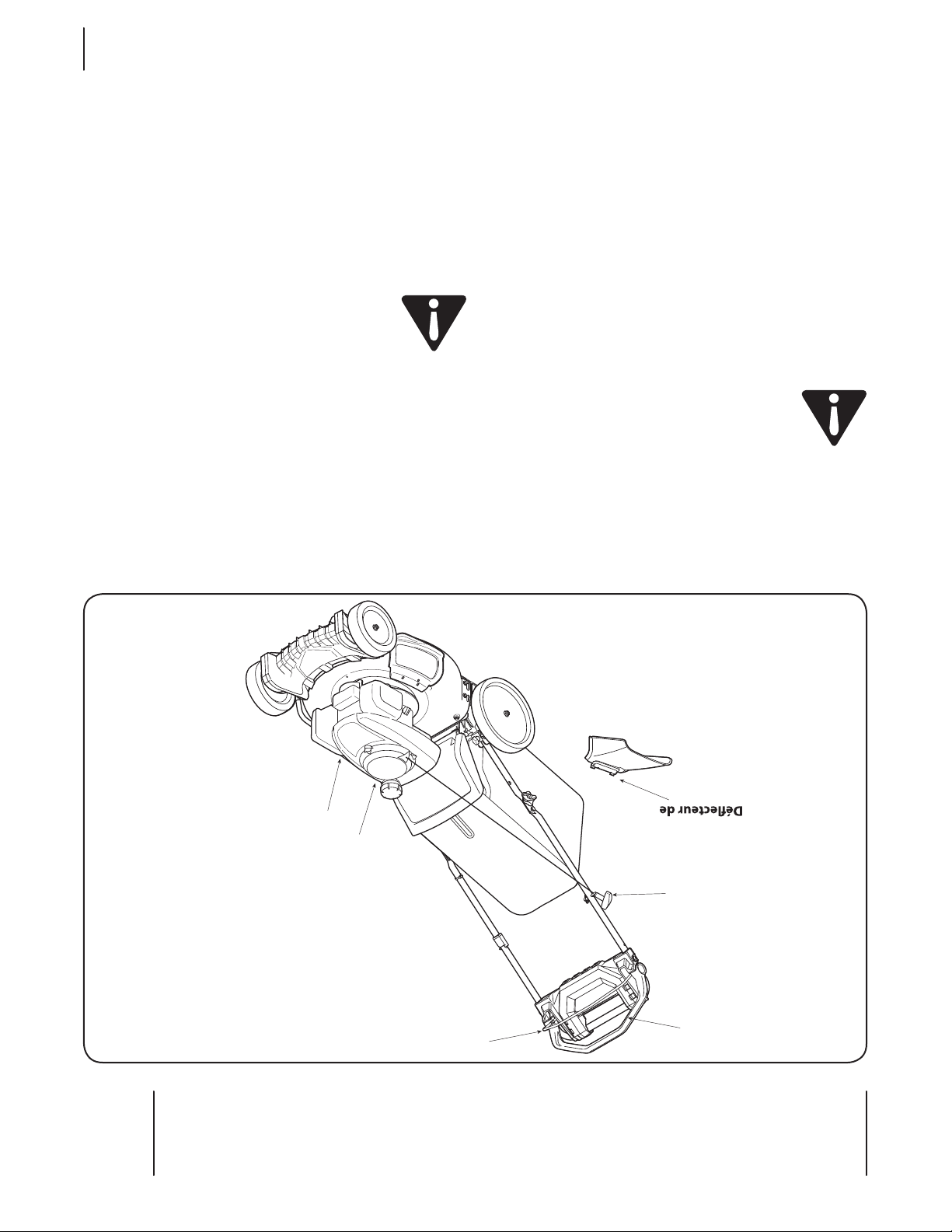
Commandes et caractéristiques
4
13
Figure 4-1
Commande de la lame
La commande de la lame se trouve sur le guidon supérieur de la
UPOEFVTF*MGBVUTFSSFSDFUUFDPNNBOEFDPOUSFMFHVJEPOQPVS
que la tondeuse fonctionne. Le fait de lâcher la commande de la
lame arrête le moteur et la lame.
AVERTISSEMENT: La commande de la lame est
un dispositif de sécurité. N’essayez jamais d’éviter
son emploi.
Commande d’entraînement de haute qualité
La commande d’entraînement est située sur la poignée
TVQÏSJFVSFFUTFSUËFOHBHFSMFTSPVFT1PVTTF[MBDPNNBOEF
d’entraînement vers l’avant pour engager les roues; plus
vous poussez la commande vers l’avant, plus l’appareil
avancera rapidement. Lorsqu’elle est relâchée, la commande
d’entraînement revient à la position neutre et l’entraînement est
aussitôt débrayé.
Leviers de réglage de la hauteur de coupe
Un levier de réglage se trouve sur la roue arrière gauche ainsi que
TVSMBSPVFBWBOUHBVDIF-FTEFVYMFWJFSTEPJWFOUÏUSFSÏHMÏËMB
NÐNFQPTJUJPOBGJOEPCUFOJSVOFDPVQFVOJGPSNF1PVSNPEJGJFSMB
IBVUFVSEFDPVQFDPOTVMUF[MFDIBQJUSFj"TTFNCMBHFFUNPOUBHFx
Système de nettoyage (Deck Wash System™ )
Un orifice à eau peut être aménagé sur la surface du plateau de
coupe de votre tracteur, fait partie du système de nettoyage du
plateau de coupe. Utilisez avec le système de nettoyage du plateau
pour éliminer les brins d’herbe du dessous du plateau de coupe.
Goulotte d’éjection latérale
-BUPOEFVTFFYQÏEJÏFFTUQSÐUFQPVSEÏDIJRVFUFSMIFSCF4J
vous préférez éjecter l’herbe sur le côté, suivez les instructions
EVDIBQJUSFj"TTFNCMBHFFUNPOUBHFxQPVSJOTUBMMFSMBHPVMPUUF
d’éjection latérale.
AVERTISSEMENT : Éloignez les pieds et les mains
EFMBQSPYJNJUÏEFMBHPVMPUUFTVSMFQMBUFBVEF
coupe. Lisez l’étiquette d’avertissement placée sur la
machine.
Démarreur à lanceur
*MFTUJOTUBMMÏTVSMBESPJUFEVHVJEPOTVQÏSJFVS5FOF[WPVT
derrière la tondeuse et tirez sur le démarreur à lanceur pour faire
démarrer la tondeuse.
Démarreur à
lanceur
Co
mmande de la lame
Commande
d’entraînement
de haute qualité
Système de nettoyage
Levier de réglage de
la hauteur de coupe
la goulotte
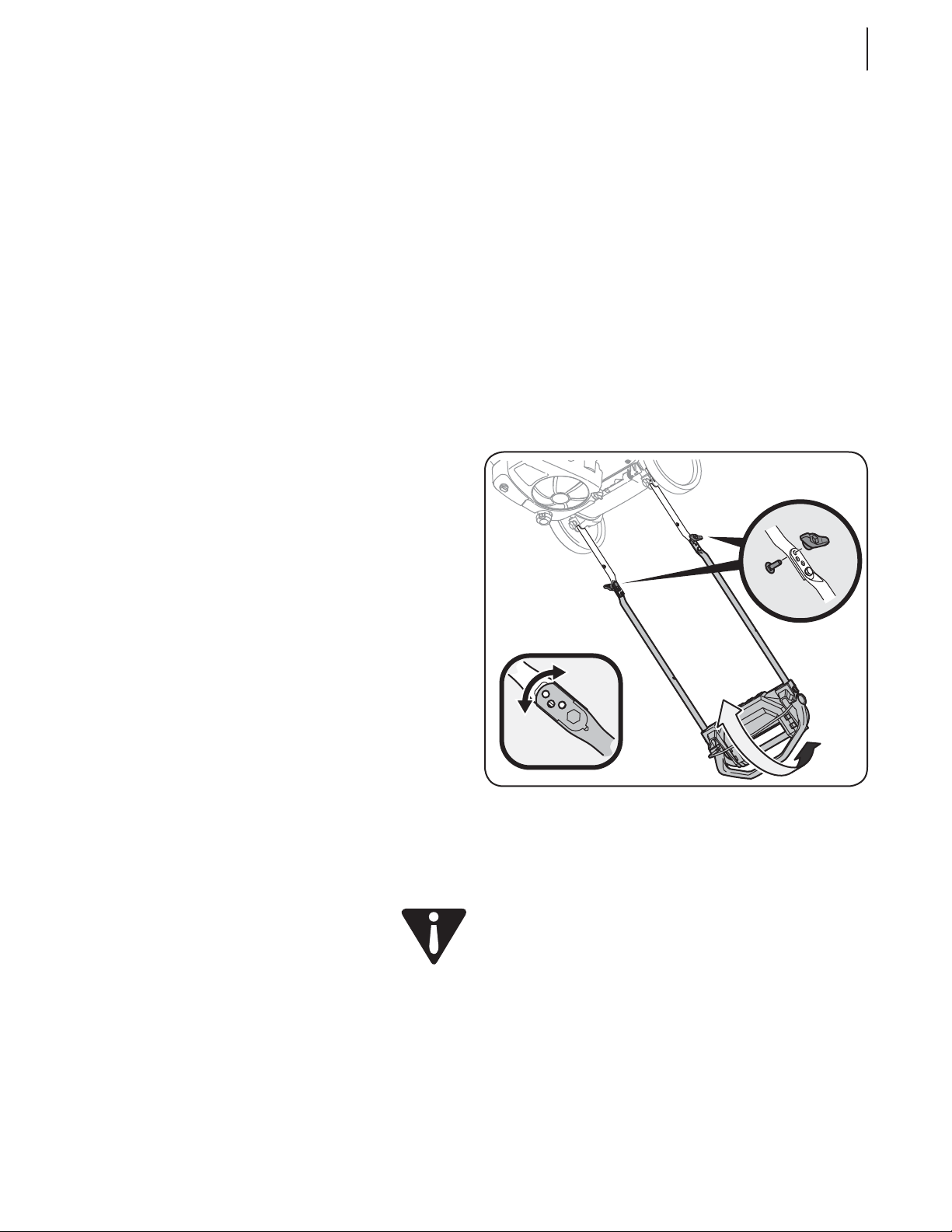
12 SECTION 3 — ASSEMBLAGE ET MONTAGE
Montage
Pleins d’essence et d’huile
Consultez la notice d’utilisation du moteur pour tout
renseignement supplémentaire concernant le moteur.
1. Faites le plein avec l’huile fournie la première fois que vous
utilisez la machine après son assemblage.
2. 'BJUFTMFQMFJOEFTTFODFDPOGPSNÏNFOUBVYJOTUSVDUJPOT
fournies dans la notice d’utilisation du moteur.
AVERTISSEMENT: Faites très attention en
NBOJQVMBOUEFMFTTFODF-FTTFODFFTUFYUSÐNFNFOU
JOGMBNNBCMFFUMFTWBQFVSTTPOUFYQMPTJWFT/FGBJUFT
jamais le plein d’essence à l’intérieur, pendant que le
moteur tourne ou quand le moteur est chaud.
Éteignez toute cigarette ou pipe, tout cigare ou
toute autre source incandescente.
3. $POTVMUF[MFDIBQJUSF&/53&5*&/EBOTDFUUFOPUJDF
d’utilisation quant à la méthode correcte de charge de la
batterie(Modèles avec démarreur électrique seulement).
REMARQUE : Les manettes de réglage de la hauteur
bougent dans la direction opposée sur les tondeuses à
petites roues. Les manettes de réglage bougent dans la
même direction sur les tondeuses à grandes roues.
3. Laissez la manette revenir vers le plateau de coupe.
IMPORTANT: Les roues avant et arrière doivent être réglées
ËMBNÐNFQPTJUJPOSFMBUJWF1PVSUSBWBJMMFSTVSVOUFSSBJO
accidenté, placez le levier à une hauteur plus élevée. Vous
éviterez ainsi d’arracher l’herbe.
Inclinaison du guidon
*MFTUQPTTJCMFEBKVTUFSMJODMJOBJTPOEVHVJEPOQPVSGBDJMJUFS
MVUJMJTBUJPOEFMBUPOEFVTF1SPDÏEF[DPNNFTVJU
1. Retirez les écrous à oreilles et les boulons ordinaires du
guidon. Voir lta Figure 3-12.
2. Choisissez la position la plus confortable parmi les trois
positions possibles. Voir le détail de la Figure 3-12.
3. Remettez en place les écrous à oreilles et les boulons
ordinaires retirés plus tôt.
Figure 3-12
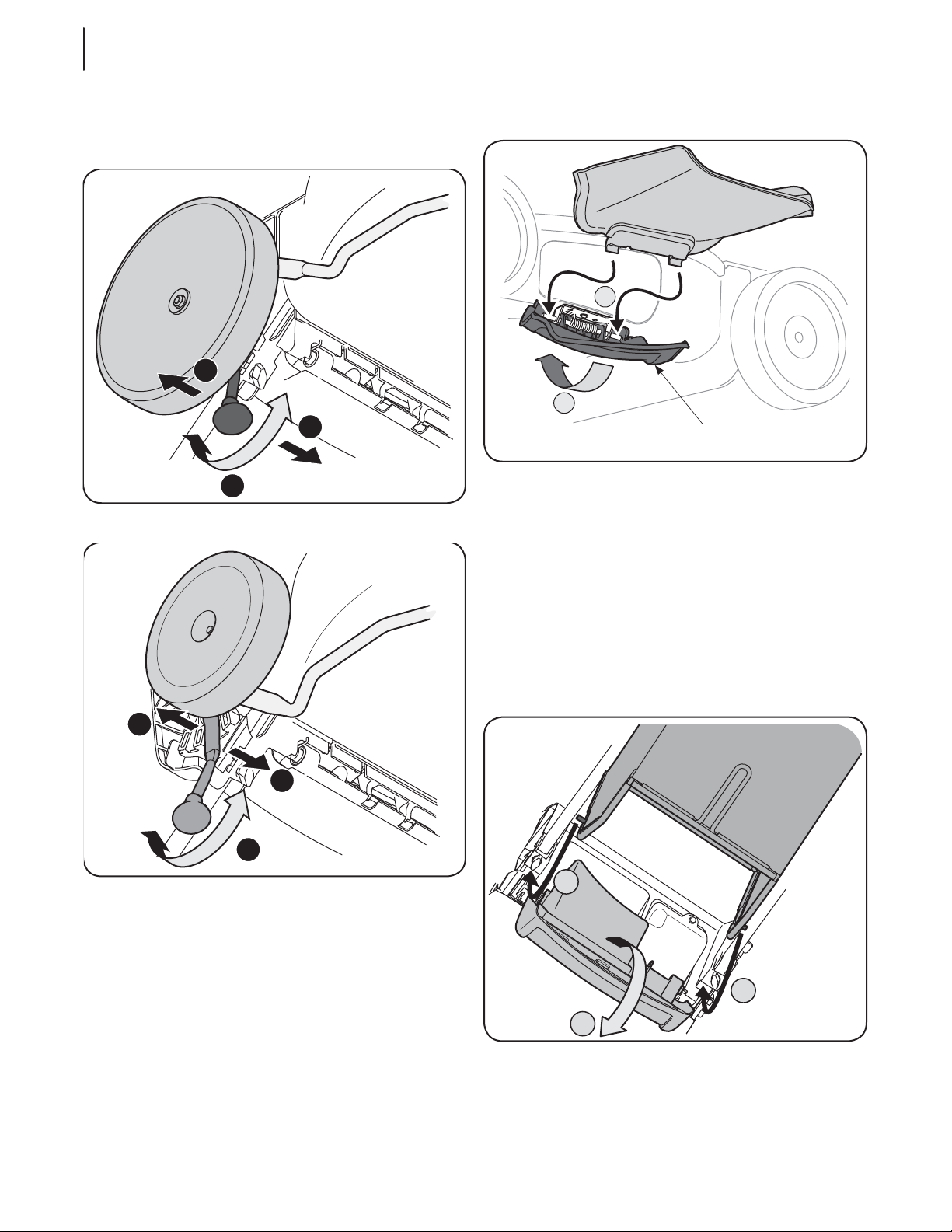
11SECTION 3 — ASSEMBLAGE ET MONTAGE
2. (MJTTF[MFTEFVYDSPDIFUTEVEÏGMFDUFVSEÏKFDUJPO
latérale sous la goupille de la charnière du bouchon
de déchiquetage à charnière. Rabaissez le bouchon de
déchiquetage à charnière. Ne retirez jamais le bouchon
de déchiquetage à charnière, même quand vous ne
déchiquetez pas.
Réglages
Hauteur de coupe
La manette de réglage de la hauteur de coupe se trouve au-
dessus des roues avant et arrière gauche.
1. Tirez la manette de réglage vers la roue.
2. 1MBDF[MBNBOFUUFËMBQPTJUJPOEÏTJSÏFQPVSDIBOHFSMB
hauteur de coupe. Voir les Figures 3-10 et 3-11.
1
2
3
Lever
Baisser
Petite roue
Figure 3-10
Grande roue
1
3
2
Lever
Baisser
Figure 3-11
1SPDÏEF[DPNNFTVJUQPVSJOTUBMMFSMFTBDËIFSCF
a. Relevez le clapet d’éjection arrière.
b. *OTUBMMF[MFTBDËIFSCFEBOTMFTGFOUFTBNÏOBHÏFT
dans les supports du guidon, comme à la Figure 3-8.
Lâchez le clapet pour qu’il repose sur le sac à herbe.
A
B
B
Figure 3-8
1PVSFOMFWFSMFTBDËIFSCFSFMFWF[MFDMBQFUEÏKFDUJPOBSSJÒSF
de la tondeuse. Relevez le sac à herbe et dégagez-le des fentes
des supports du guidon. Lâchez le clapet d’éjection arrière pour
fermer l’ouverture sur l’arrière de la tondeuse.
Déflecteur d’éjection latérale (les cas écheant)
-BUPOEFVTFBÏUÏFYQÏEJÏFQPVSGPODUJPOOFSDPNNFVOF
tondeuse déchiqueteuse. Si la tondeuse est adaptée pour éjecter
l’herbe sur le côté, assurez-vous que le sac à herbe a été démonté
de la tondeuse et que le clapet d’éjection arrière est fermé.
1. Relevez le bouchon de déchiquetage à charnière qui se
USPVWFTVSMFDÙUÏEVQMBUFBVEFDPVQF7PJSMB'JHVSF.
2
1
Bouchon de
déchiquetage
Figure 3-9
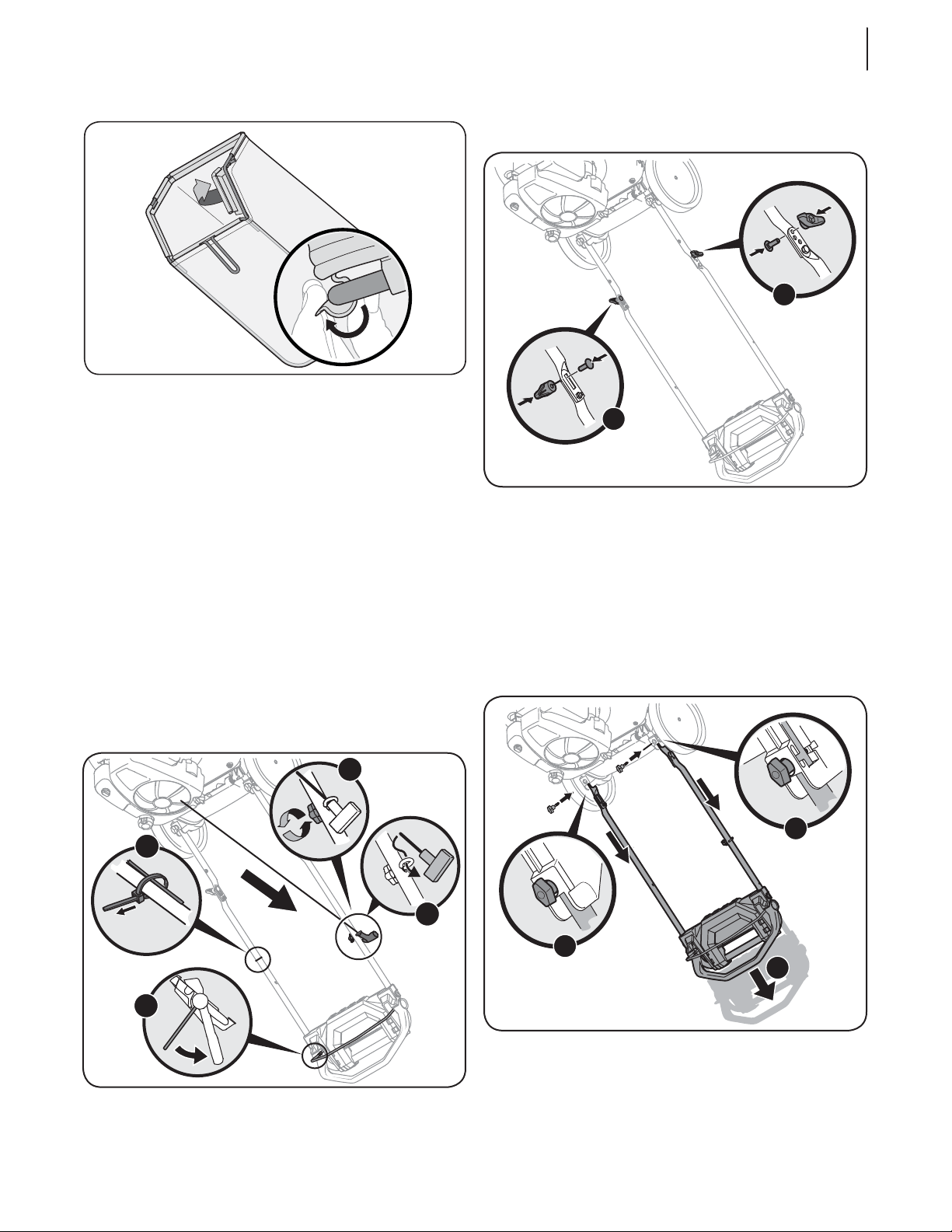
10 SECTION 3 — ASSEMBLAGE ET MONTAGE
3. Suivez les instructions ci-dessous pour terminer
l’assemblage du guidon .
a. Relevez le guidon 8 po jusqu’à ce que les trous
du guidon inférieur (voir l’éclaté de la Figure 3-3)
s’alignent avec les trous des supports du guidon.
7PJSMB'JHVSF
a
b
b
Figure 3-4
REMARQUE 2VBOEWPVTSFMFWF[MFHVJEPOBTTVSF[WPVTEFOF
pas le dégager complètement.
C *OTÏSF[MFTCPVMPOTËUÐUFFO5FOMFWÏTBV
paragraphe 1b, dans les supports du guidon et dans
le guidon inférieur et serrez à fond pour maintenir le
HVJEPOFOQMBDF7PJSMB'JHVSF
c. Remettez les écrous à oreilles et les boulons
ordinaires dans les trous inférieurs du guidon,
comme à la Fig. 3-5.
c
c
Figure 3-5
-FHVJEFEFMBDPSEFEVEÏNBSSFVSFTUJOTUBMMÏTVSMBESPJUF
du guidon supérieutr. Desserrez le boulon à oreilles qui
maintient le guide de la corde en place. Voir la Figure 3-6.
d
b
a
c
Figure 3-6
a. Tenez la commande de la lame contre le guidon
supérieur.
b. Dégagez lentement la poignée du démarreur à
lanceur du moteur et faites passer la corde dans son
guide. Voir la Figure 3-6.
c. Serrez le bouton à oreilles du guide.
d. Utilisez l’attache-câble pour maintenir les câbles
contre le guidon inférieur.
Sac à herbe (les cas écheant)
1. 1SPDÏEF[DPNNFTVJUQPVSJOTUBMMFSMFTBDËIFSCFTVSMB
tondeuse s’il n’est pas déjà installé. Vérifiez que le sac à
herbe est bien à l’endroit avant l’assemblage (l’étiquette
EBWFSUJTTFNFOUEPJUTFUSPVWFSTVSMFYUÏSJFVS
a. (MJTTF[MFTBDTVSMBSNBUVSFDÙUÏFOQMBTUJRVFOPJS
sur le dessous).
b. "UUBDIF[MFTBDTVSMBSNBUVSFFOBDDSPDIBOUMFT
HMJTTJÒSFTTVSMBSNBUVSFDPNNFËMB'JH
Figure 3-7
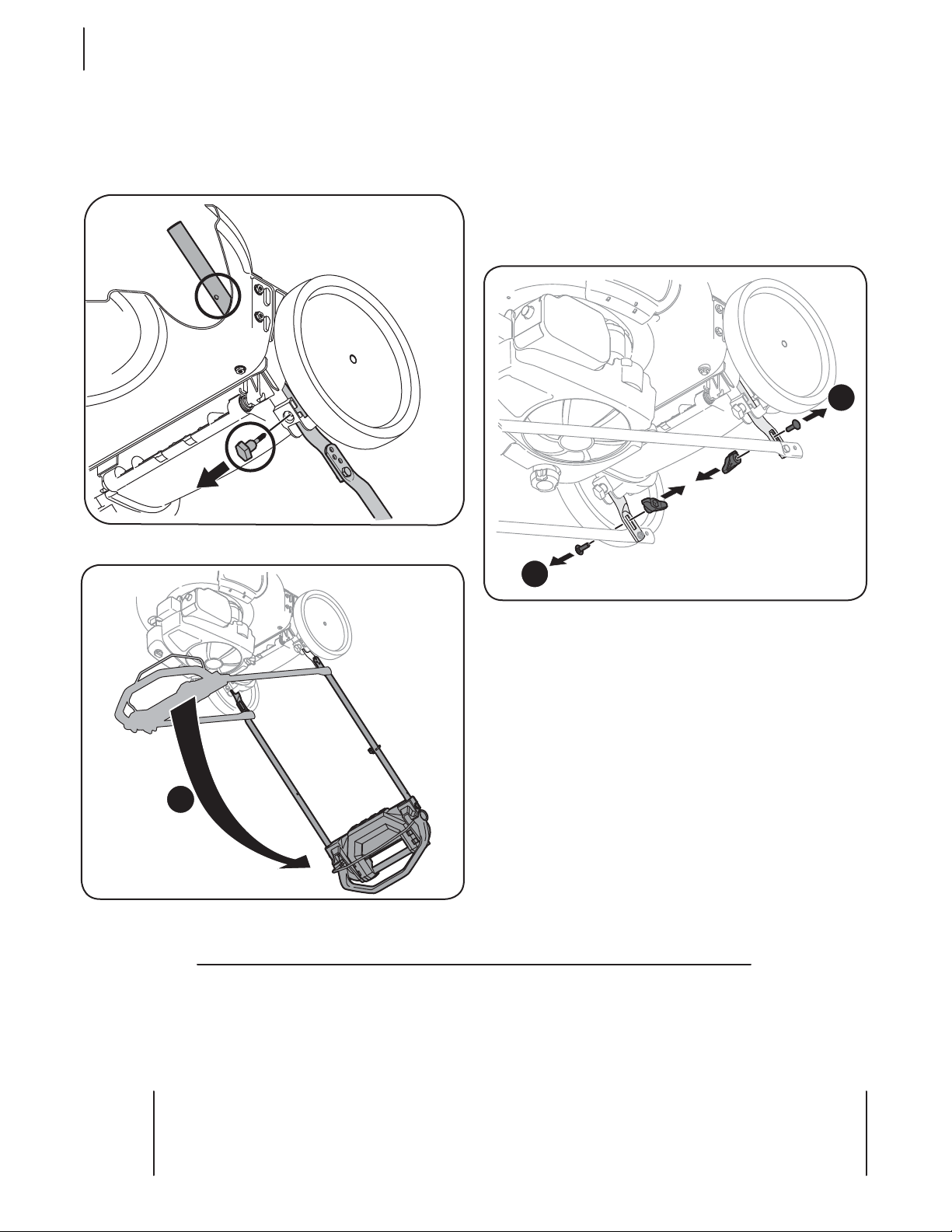
Assemblage et Montage
3
9
Pièces détachées dans le carton
t Un tondeuse t Un sac à herbe t Un bidon d’huile
t Une notice d’utilisation de la tondeuse t Une notice d’utilisation du moteur t Une goulotte d’éjection latérale
REMARQUE : Veuillez noter que cette notice d’utilisation
concerne les modèles de cette tondeuse équipés des grandes
et des petites roues. Les instructions et les caractéristiques
TBQQMJRVFOUBVUBOUBVYNPEÒMFTBWFDQFUJUFTSPVFTRVBVY
modèles avec grandes roues, à moins d’indications contraires.
Assemblage
NOTE: $FUUFNBDIJOFFTUFYQÏEJÏF4"/4)6*-&/*&44&/$&
"QSÒTMBTTFNCMBHFGBJUFTMFTQMFJOTEFTTFODFFUEIVJMF
DPOGPSNÏNFOUBVYJOTUSVDUJPOTEFMBOPUJDFEVUJMJTBUJPOEV
moteur fournie avec la machine.
Guidon
1. Retirez les pièces détachées et les garnitures d’emballage
qui peuvent se trouver entre les guidons supérieur et
inférieur.
a. Enlevez les écrous à oreilles et les boulons ordinaires
du guidon, comme à la Fig. 3-1. Ne desserrez pas ou
OFOMFWF[QBTMFTWJTËUÐUFIFYBEKBDFOUFT
Figure 3-1
b. Stabilisez la tondeuse pour qu’elle ne bouge pas,
puis relevez le guidon supérieur, comme à la Figure
3-2. Ne pincez pas le câble en redressant le guidon et
BTTVSF[WPVTRVJMTWPOUËMFYUÏSJFVSEFMBQPJHOÏF
2. Retirez les boulons à tête en T des supports du guidon,
comme la Figure 3-3.
b
Figure 3-2
Figure 3-3
a
a
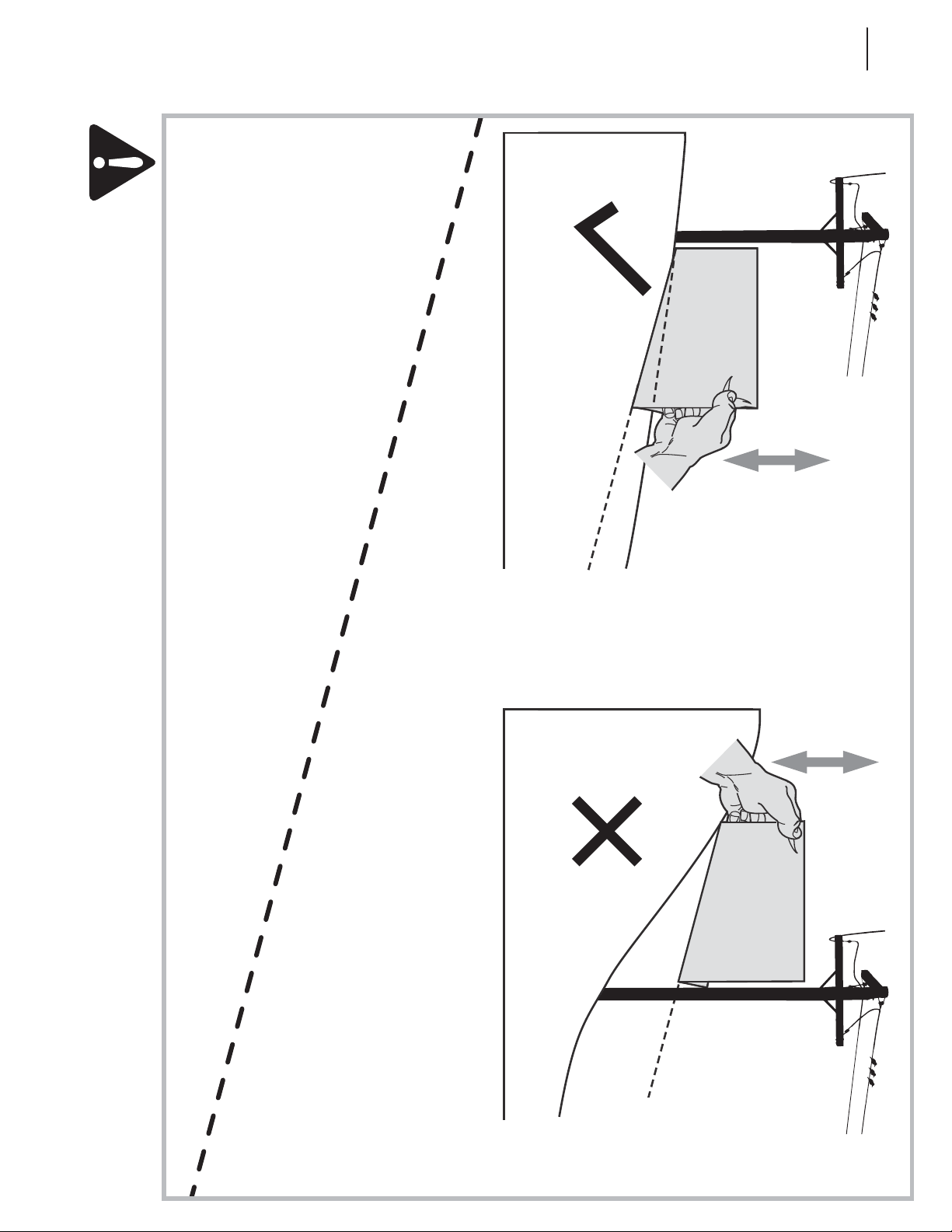
8 SECTION 2 — IMPORTANTES CONSIGNES DE SÉCURITÉ
(OK)
Ligne pointillée à 15°
Figure 2Figure 1
(TROP ABRUPTE)
Procédez comme suit pour vérier la pente :
1. Détachez cette page et pliez-la en suivant la ligne pointillée.
2. Trouvez un objet vertical sur ou derrière la pente (un poteau téléphonique, une clôture, un arbre, etc.).
3. Alignez un côté de cette page avec l’objet (Voir les Figures 1 et 2).
4. Remontez ou abaissez l’inclinomètre jusqu’à ce que le coin gauche touche la pente (Voir les Figures 1 et 2).
5. S’il y a un espace sous l’inclinomètre, la pente est trop abrupte pour y travailler en toute sécurité. (Voir la Figure 2 ci-dessus).
Pente à 15°
Inclinomètre
Pente à 15°
UTILISEZ CET INCLINOMÈTRE POUR DÉTERMINER SI UNE PENTE EST TROP
ABRUPTE POUR PERMETTRE L’UTILISATION SANS DANGER DE LA MACHINE.
AVERTISSEMENT: Les accidents provoqués par des chutes et des glissades, qui surviennent souvent sur des pentes,
peuvent causer des blessures graves. Ne travaillez pas sur des pentes supérieures à 15 degrés. Travailler sur un terrain en
pente demande des précautions supplémentaires.Travaillez toujours parallèlement à la pente, jamais perpendiculairement.
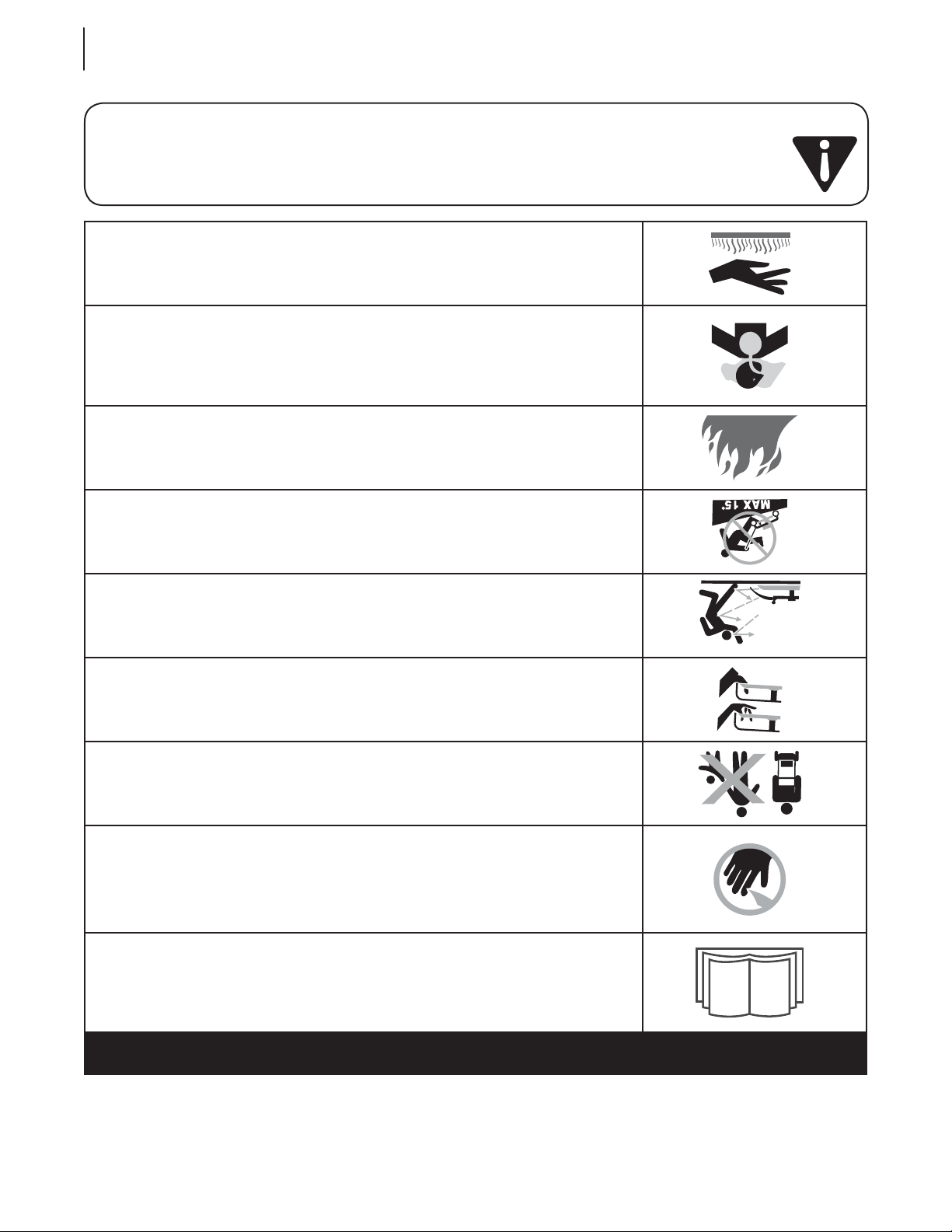
7SECTION 2 — IMPORTANTES CONSIGNES DE SÉCURITÉ
Symboles de sécurité
$FUUFQBHFJMMVTUSFFUFYQMJRVFMFTTZNCPMFTEFTÏDVSJUÏRVJQFVWFOUTFUSPVWFSTVSDFUUFNBDIJOF7FVJMMF[MJSFFUTVJWSFUPVUFTMFT
instructions sur la machine et vous assurer de bien les comprendre avant d’essayer d’assembler et d’utiliser la machine.
Symbol Description
7&6*--&;-*3&-"06-&4/05*$&4%65*-*4"5*0/
Veuillez lire et suivre toutes les instructions sur la machine et vous assurer de bien les
comprendre avant d’essayer d’assembler et d’utiliser la machine.
%"/(&3o-".&4&/.067&.&/5
1PVSÏWJUFSMFTSJTRVFTEFCMFTTVSFTOBQQSPDIF[KBNBJTMFTNBJOTOJMFTQJFETEFTQJÒDFTFO
mouvement. N’utilisez pas la machine si le déflecteur de la goulotte ou si le sac à herbe n’est
pas en place. S’ils sont endommagés, remplacez-les immédiatement.
%"/(&3o41&$5"5&634
/FUPOEF[QBTTJEFTFOGBOUTPVBVUSFTTQFDUBUFVSTTPOUËQSPYJNJUÏ
%"/(&3o".165"5*0/%&4."*/41*&%4
N’’approchez jamais les mains ni les pieds des pièces en mouvement.
%"/(&3o0#+&54130+&5²4
Enlevez tous les objets qui pourraient être projetés par les lames dans des directions dif-
GÏSFOUFT1PSUF[EFTMVOFUUFTEFTÏDVSJUÏ
%"/(&31&/5&4
Soyez très prudent sur des pentes. Ne tondez pas sur des pentes supérieures à 15°.
"7&35*44&.&/5o-&44&/$&&456/130%6*5*/'-".."#-&
-BJTTF[MFNPUFVSSFGSPJEJSQFOEBOUBVNPJOTEFVYNJOVUFTBWBOUEFSFGBJSFMFQMFJO
"7&35*44&.&/5o.0/09:%&%&$"3#0/&
Ne faites jamais fonctionner un moteur à l’intérieur ou dans un bâtiment mal ventilé. Les gaz
EÏDIBQQFNFOUDPOUJFOOFOUEVNPOPYZEFEFDBSCPOFVOHB[JOPEPSFFUNPSUFM
"7&35*44&.&/5ū463'"$&$)"6%&
-FTQJÒDFTEVNPUFVSFOQBSUJDVMJFSMFTJMFODJFVYPOUUFOEBODFËDIBVGGFSQFOEBOUMF
GPODUJPOOFNFOUEFMBNBDIJOF-BJTTF[MFNPUFVSFUMFTJMFODJFVYSFGSPJEJSBWBOUEFMFT
toucher.
AVERTISSEMENT: Votre responsabilité. Cette machine ne doit être utilisée que par des personnes qui peuvent
lire, comprendre et respecter les avertissements et instructions qui figurent dans cette notice et sur la machine
CONSERVEZ CES INSTRUCTIONS!

6 SECTION 2 — IMPORTANTES CONSIGNES DE SÉCURITÉ
%BQSÒTMB$POTVNFS1SPEVDUT4BGFUZ$PNNJTTJPO$14$
Commission sur la sécurité des produits de consommation)
FUMBi64&OWJSPONFOUBM1SPUFDUJPO"HFODZw&1""HFODF
américaine de protection de l’environnement), ce produit a
VOFEVSÏFEFWJFVUJMFNPZFOOFEFTFQUBOTPVIFV-
SFTEFGPODUJPOOFNFOU"VUFSNFEFDFUUFEVSÏFEFWJFVUJMF
moyenne, achetez une machine neuve ou faites inspecter
la machine chaque année par une station technique agréée
pour vous assurer que tous les dispositifs mécaniques et
de sécurité sont en bon état de marche et ne sont pas usés
EFGBÎPOFYDFTTJWF-FOPOSFTQFDUEFDFTSFDPNNBOEB-
tions peut causer des accidents et des blessures graves ou
mortelles.
Ne modifiez pas le moteur
1PVSÏWJUFSUPVUFCMFTTVSFHSBWFPVGBUBMFOFNPEJGJF[QBTEV
tout le moteur. Toute modification du réglage du régulateur
peut provoquer l’emballement du moteur et entraîner son
fonctionnement à des vitesses dangereuses. Ne modifiez
jamais le réglage de l’usine du régulateur.
Avis concernant les émissions de gaz
-FTNPUFVSTDFSUJGJÏTDPOGPSNFTBVYOPSNFTSÏHVMBUSJDFTEF
MB$BMJGPSOJFFUEFMBHFODF&1"GÏEÏSBMFTQPVS403&QFUJU
équipement hors route) sont certifiés pour fonctionner avec
de l’essence sans plomb ordinaire et peuvent être dotés des
systèmes de contrôle des émissions de gaz suivants : Engine
Modification (EM) et Three Way Catalyst (TWC) le cas échéant.
Pare-étincelles
AVERTISSEMENT: Cette machine est équipée
d’un moteur à combustion interne et elle ne doit pas
être utilisée sur un terrain non entretenu, recouvert
de broussailles ou d’herbe si le système
d’échappement du moteur n’est pas muni d’un
QBSFÏUJODFMMFTDPOGPSNÏNFOUBVYMPJTFU
SÒHMFNFOUTQSPWJODJBVYPVMPDBVYMFDBTÏDIÏBOU
Si un pare-étincelles est utilisé, il doit être maintenu en bon état
de marche par l’utilisateur de la machine.
La station technique agréée la plus proche peut vous fournir un
pare-étincelles pour le pot d’échappement de cette machine.

5SECTION 2 — IMPORTANTES CONSIGNES DE SÉCURITÉ
'BJUFTUSÒTBUUFOUJPOFOBQQSPDIBOUEBOHMFTNPSUTEFCVJT-
sons, d’autres objets qui peuvent gêner votre visibilité.
5. Éloignez les enfants des moteurs chauds ou en cours
d’utilisation. Les enfants peuvent subir des brûlures graves au
DPOUBDUEVOTJMFODJFVYDIBVE
/FQFSNFUUF[KBNBJTËEFTFOGBOUTEFNPJOTEFBOT
EVUJMJTFSMBUPOEFVTF%FTBEPMFTDFOUTÉHÏTEFBOTPV
plus doivent lire la notice d’utilisation, bien comprendre le
fonctionnement de la machine et respecter les consignes de
TÏDVSJUÏ*MTEPJWFOUBQQSFOESFËVUJMJTFSMBNBDIJOFFUTFO
servir sous la surveillance étroite d’un adulte.
ENTRETIEN
Manipulation de l’essence:
1PVSÏWJUFSUPVUFCMFTTVSFPVEÏHÉUNBUÏSJFMGBJUFTUSÒT
BUUFOUJPOFONBOJQVMBOUEFMFTTFODF*MTBHJUEVOQSPEVJU
FYUSÐNFNFOUJOGMBNNBCMFFUMFTWBQFVSTSJTRVFOUEFYQMPTFS
Vous pouvez être grièvement blessé si des éclaboussures
sur votre peau ou sur vos vêtements s’enflammaient. Rincez
votre peau et changez immédiatement de vêtements.
2. Remissez le carburant dans des bidons homologués seulement.
3. Ne faites jamais le plein dans un véhicule, ni à l’arrière d’une
camionnette dont le plancher est recouvert d’un revêtement
FOQMBTUJRVF1MBDF[UPVKPVSTMFTCJEPOTQBSUFSSFFUMPJOEF
votre véhicule avant de les remplir.
%BOTMBNFTVSFEVQPTTJCMFEÏDIBSHF[MÏRVJQFNFOU
motorisé de la remorque et faites le plein par terre. Si cela
n’est pas possible, faites le plein avec un bidon plutôt que
directement de la pompe à essence.
5. Maintenez le gicleur en contact avec le bord du réservoir
d’essence ou avec l’ouverture du bidon jusqu’à ce que le
plein soit terminé. N’utilisez pas un gicleur équipé d’un
dispositif de blocage en position ouverte.
6. Éteignez toute cigarette ou pipe, tout cigare ou toute autre
chaleur incandescente.
/FGBJUFTKBNBJTMFQMFJOËMJOUÏSJFVSDBSEFTWBQFVSTJOGMBN-
mables risquent de s’accumuler.
8. N’enlevez jamais le capuchon d’essence et n’ajoutez pas
d’essence pendant que le moteur tourne ou s’il est chaud.
-BJTTF[MFNPUFVSSFGSPJEJSQFOEBOUBVNPJOTEFVYNJOVUFT
avant de faire le plein.
/FGBJUFTKBNBJTEÏCPSEFSMFSÏTFSWPJS-BJTTF[VOFTQBDF
EVOEFNJQPVDFFOWJSPOQPVSQFSNFUUSFMFYQFOTJPOEV
carburant.
10. Resserrez bien le capuchon d’essence.
11. En cas de débordement, essuyez toute éclaboussure de
carburant ou d’huile et enlevez tous les débris imbibés
EFTTFODF%ÏQMBDF[MBNBDIJOFËVOBVUSFFOESPJU"UUFOEF[
5 (cinq) minutes avant de mettre en marche le moteur.
12. Ne remisez jamais la machine ou les bidons d’essence à
l’intérieur s’il y a une flamme, une étincelle (chauffe-eau à
gaz, radiateur, sèche-linge, etc.).
13. Limitez les risques d’incendie en débarrassant le moteur des
brins d’herbe, feuilles et autres saletés. Essuyez les éclabous-
sures de carburant ou d’huile et enlevez tous les débris
imbibés d’essence.
-BJTTF[MBNBDIJOFSFGSPJEJSQFOEBOUBVNPJOTNJOVUFT
avant de la remiser.
Entretien général:
1. Ne faites jamais fonctioner la machine dans un local clos car
MFTHB[EÏDIBQQFNFOUEVNPUFVSDPOUJFOOFOUEVNPOPYZEF
EFDBSCPOFVOHB[JOPEPSFUSÒTEBOHFSFVY
"WBOUEFOFUUPZFSEFSÏQBSFSPVEFYBNJOFSMBNBDIJOF
vérifiez que la lame et toutes les pièces mobiles se sont
immobilisées. Débranchez le fil de la bougie et mettez-le
à la terre contre le moteur pour empêcher tout démarrage
accidentel.
3. Vérifiez souvent que la lame et les boulons de montage du
NPUFVSTPOUCJFOTFSSÏT&YBNJOF[WJTVFMMFNFOUMBMBNF
QPVSEÏUFDUFSUPVUFVTVSFFYDFTTJWFUPVUGFOEJMMFNFOU
Remplacez-la avec une lame authentique seulement (de la
liste de pièces qui se trouve dans cette notice). «L’emploi de
QJÒDFTOPODPOGPSNFTBVYDBSBDUÏSJTUJRVFTEFMÏRVJQFNFOU
d’origine peut causer des performances inférieures et réduire
la sécurité.»
-BMBNFFTUDPVQBOUFFUQFVUDBVTFSEFTCMFTTVSFTHSBWFT
Enveloppez-la avec un chiffon ou portez des gants et faites
très attention en la manipulant.
"TTVSF[WPVTRVFUPVTMFTÏDSPVTCPVMPOTFUWJTTPOUCJFO
serrés pour que l’équipement soit toujours en bon état de
marche.
6. Ne modifiez jamais les dispositifs de sécurité. Vérifiez souvent
qu’ils fonctionnent bien.
4JWPVTIFVSUF[VOPCKFUBSSÐUF[JNNÏEJBUFNFOUMFNPUFVS
EÏCSBODIF[MFGJMEFMBCPVHJFFUFYBNJOF[TPJHOFVTFNFOUMB
machine. Réparez les dégâts éventuels avant de remettre la
machine en marche.
8. N’essayez jamais d’ajuster une roue ou de changer la hauteur
de coupe pendant que la moteur tourne.
-FTQJÒDFTEVTBDËIFSCFFUMFDMBQFUEFMBHPVMPUUF
d’éjection peuvent s’user et être endommagés et, par
DPOTÏRVFOUFYQPTFSMFTQJÒDFTNPCJMFTPVDBVTFSMB
QSPKFDUJPOEFEÏCSJT1BSNFTVSFEFTÏDVSJUÏWÏSJGJF[TPVWFOU
les pièces et remplacez-les immédiatement avec des pièces
authentiques seulement (de la liste de pièces qui se trouve
EBOTDFUUFOPUJDFj-FNQMPJEFQJÒDFTOPODPOGPSNFTBVY
caractéristiques de l’équipement d’origine peut causer des
performances inférieures et réduire la sécurité.»
10. Ne modifiez pas le réglage du régulateur et ne laissez pas le
moteur s’emballer. Le régulateur maintient le moteur à son
SÏHJNFNBYJNBMEFGPODUJPOOFNFOUTBOTEBOHFS
11. Vérifiez souvent l’état des conduites d’essence, du réservoir, du
bouchon d’essence et autres raccords. Remplacez-les si vous
détectez un fendillement ou une fuite.
12. Ne faites pas tourner le moteur si la bougie n’est pas installée.
1SFOF[TPJOEFTÏUJRVFUUFTEJOTUSVDUJPOTFUSFNQMBDF[MFTBV
besoin.
3FTQFDUF[MFTSÒHMFNFOUTDPODFSOBOUMÏMJNJOBUJPOEFT
déchets et liquides qui risquent de nuire à la nature et à
l’environnement.

4 SECTION 2 — IMPORTANTES CONSIGNES DE SÉCURITÉ
/FUJSF[KBNBJTMBUPOEFVTFWFSTWPVTFONBSDIBOU4JMGBVU
faire reculer la tondeuse près d’un mur d’un autre obstacle,
regardez d’abord par terre et derrière vous, puis procédez
comme suit:
a. Éloignez-vous de la tondeuse à bout de bras.
C "TTVSF[WPUSFTUBCJMJUÏ
c. Reculez la tondeuse lentement et d’une demi-
longueur de bras seulement.
d. Répétez selon les besoins.
15. N’utilisez jamais la tondeuse en état d’ébriété ou si vous
prenez des médicaments ralentissant les réactions.
16. Dégagez le dispositif d’auto-propulsion ou l’embrayage
d’entraînement, le cas échéant, avant de faire démarrer le
moteur.
-BQPJHOÏFEFDPNNBOEFEFMBMBNFFTUVOEJTQPTJUJGEF
sécurité. Ne tentez jamais de contourner son rôle. Ceci
empêche le dispositif de sécurité de fonctionner correcte-
ment et peut causer des blessures en cas de contact avec
la lame. La poignée de commande de la lame doit bouger
GBDJMFNFOUEBOTMFTEFVYTFOTFUSFWFOJSBVUPNBUJRVFNFOUË
la position non énclenchée quand on la lâche.
18. N’utilisez jamais la tondeuse si le gazon est mouillé. Soyez
toujours bien en équilibre. Faites attention de ne pas glisser
et de ne pas tomber pour éviter des blessures graves. Si vous
perdez votre équilibre, lâchez la poignée de commande de la
lame immédiatement et la lame arrêtera de tourner en trois
secondes.
6UJMJTF[MBUPOEFVTFTFVMFNFOUEBOTMBMVNJÒSFEVKPVSPV
dans la bonne lumière artificielle. Marchez, ne courrez pas.
"SSÐUF[MBMBNFBWBOUEFUSBWFSTFSEFTBMMÏFTUSPUUPJSTPV
chemins recouverts de gravier.
21. Si la machine commence à vibrer d’une manière anormale,
arrêtez le moteur et cherchez immédiatement la cause. En
général, toute vibration indique un problème.
"SSÐUF[MFNPUFVSFUBUUFOEF[RVFMBMBNFTFTPJUJNNPCJMJTÏF
avant de détacher le sac à herbe ou de déboucher la
goulotte. La lame continue à tourner pendant quelques
secondes après que le moteur s’est éteint. Ne placez jamais
une partie du corps dans le secteur de la lame avant d’être
certain que celle-ci est immobile.
23. N’utilisez jamais la tondeuse si l’abattant de protection
arrière, la goulotte d’éjection, un sac à herbe, la poignée de
commande de la lame ou tout autre dispositif de sécurité ap-
proprié n’est pas en place et qui en bon état de fonctionnent.
N’utilisez jamais la tondeuse avec des dispositifs de sécurité
endommagés. Le non-respect de ces consignes peut causer
des blessures graves.
-FTJMFODJFVYFUMFNPUFVSEFWJFOOFOUUSÒTDIBVETFUQFVWFOU
causer des brûlures. Ne les touchez pas.
25. N’essayez jamais d’ajuster une roue ou de changer la hauteur
de coupe pendant que la moteur tourne.
26. N’utilisez que des accessoires recommandés par le fabricant
de la machine. Le non-respect de ce consigne peut causer
des blessures graves.
1PVSNFUUSFMFNPUFVSFONBSDIFUJSF[MFOUFNFOUMBQPJHOÏF
du démarreur à lanceur jusqu’à ce que vous sentiez une
légère résistance, puis tirez-la rapidement. Le retour rapide
de la corde du démarreur (le recul) attirera votre main et
votre bras vers le moteur plus vite que vous ne pourrez lâcher
la poignée. Des fractures des os, hématomes ou foulures
peuvent en résulter.
28. En cas de situations non mentionnées dans cette notice,
soyez prudent et faites preuve de bon sens. Contactez le
service à la clientèle pour obtenir le nom du concessionaire
local.
Utilisation sur une pente
Les accidents provoqués par des chutes et des glissades,
qui surviennent souvent sur des pentes, peuvent causer des
blessures graves. Travailler sur un terrain en pente demande
des précautions supplémentaires. Si vous ne sentez pas à l’aise
TVSMBQFOUFOZUSBWBJMMF[QBT1BSNFTVSFEFTÏDVSJUÏVUJMJTF[
l’inclinomètre fourni dans la notice d’utilisation pour mesurer
la pente du terrain avant de commencer à travailler. Si selon
l’inclinomètre, la pente est supérieure à 15°, n’utilisez pas la
tondeuse pour éviter toute blessure grave.
À faire:
1. Travaillez parallèlement à la pente, jamais perpendiculaire-
ment, Faites très attention en changeant de direction sur une
pente.
'BJUFTBUUFOUJPOBVYUSPVTFUPSOJÒSFT-BNBDIJOFQFVU
se retourner sur un terrain accidenté. Des herbes hautes
peuvent cacher des obstacles.
3. Vérifiez toujours votre équilibre. Vous risquez de glisser,
de tomber et de vous blesser grièvement. Si vous sentez
que vous allez perdre l’équilibre, lâchez immédiatement le
guidon, et la lame arrêtera de tourner en trois secondes.
À ne pas faire:
1. Ne tondez pas près d’une falaise ou d’un talus. Le conducteur
peut facilement perdre l’équilibre.
2. Ne tondez pas sur une pente supérieure à 15° selon
l’inclinomètre.
3. Ne tondez pas de l’herbe mouillée. La traction réduite peut
provoquer un dérapage.
Enfant
Un accident grave risque de se produire si le conducteur n’est
pas toujours vigilant en présence d’enfants. Les enfants sont
TPVWFOUBUUJSÏTQBSMBNBDIJOFFUMBUPOUFEFMIFSCF*MTOF
comprennent pas les dangers. Ne supposez jamais qu’ils vont
rester là où vous les avez vus.
1. Éloignez les enfants de la zone de travail et placez-les sous
la surveillance d’un adulte autre que le conducteur de la
machine.
2. Restez vigilant et arrêtez la machine si des enfants
s’approchent de la zone de travail.
3. Regardez toujours derrière vous et par terre avant de reculer
et en reculant.
Importantes consignes de sécurité
2
3
Utilisation en général
1. Veuillez lire attentivement la notice d’utilisation avant
EFTTBZFSEBTTFNCMFSMBNBDIJOF"TTVSF[WPVTEFMJSFFUEF
bien comprendre toutes les instructions qui figurent sur la
machine et dans la notice d’utilisation avant de la mettre en
marche. Conservez cette notice d’utilisation à un endroit sûr
pour toute consultation ultérieure et pour commander des
pièces de rechange.
2. Familiarisez-vous avec les commandes et les conseils
d’utilisation de la machine avant de vous en servir.
3. Cette machine motorisée est un outil de précision, pas un jouet.
Soyez par conséquent toujours très prudent. Le seul rôle de
cette machine est de tondre le gazon. Ne l’utilisez jamais dans
un autre but.
/FQFSNFUUF[KBNBJTËEFTFOGBOUTEFNPJOTEFBOTEF
se servir de la machine. Des enfants plus âgés doivent lire et
comprendre le mode d’emploi de la machine et les consignes
de sécurité qui figurent dans cette notice d’utilisation. Un
adulte doit leur apprendre à se servir de cette machine et les
surveiller.
5. Seules des personnes mûres ayant pris connaissance des
consignes de sécurité doivent être autorisées à utiliser cette
machine.
&YBNJOF[TPJHOFVTFNFOUMB[POFEFUSBWBJM3BNBTTF[MFT
pierres, bâtons, fils métalliques, os, jouets et autres objets qui
pourraient vous faire trébucher ou qui risquent d’être ramas-
sés et projetés par la lame. Les objets projetés par la machine
peuvent causer des blessures graves.
1SÏWPZF[EFUSBWBJMMFSFOÏWJUBOUEFQSPKFUFSMIFSCFWFST
des rues, des trottoirs, des spectateurs, etc. Évitez d’éjecter
l’herbe en direction d’un mur ou d’un obstacle. De cette
façon, les débris éventuels ne risquent pas de ricocher et de
blesser quelqu’un.
1PVSÏWJUFSUPVUSJTRVFEFDPOUBDUBWFDMBMBNFPVEF
blessure par un projectile, éloignez les enfants, passants et
BOJNBVYËBVNPJOTQJFETEFMBUPOEFVTFQFOEBOURVFMMF
GPODUJPOOF"SSÐUF[MBNBDIJOFTJRVFMRVVOTBQQSPDIF
1PSUF[UPVKPVSTEFTMVOFUUFTEFTÏDVSJUÏFOVUJMJTBOUMB
machine ou en effectuant un réglage ou une réparation. Un
PCKFUQFVUFOFGGFUÐUSFQSPKFUÏSJDPDIFSFUWPVTCMFTTFSBVY
ZFVY
1PSUF[EFTDIBVTTVSFTSPCVTUFTËTFNFMMFÏQBJTTFFUEFTWÐUF-
ment bien ajustés. Une chemise et un pantalon qui protègent
les bras et les jambes et des chaussures à bout d’acier sont
recommandés. N’utilisez jamais la tondeuse si vous êtes pieds
nus ou si vous portez des sandales ou des tennis.
11. Ne placez jamais vos mains ou vos pieds près d’une pièce
en mouvement ou sous le plateau de coupe. La lame peut
amputer mains et pieds.
12. L’absence du clapet de la goulotte d’éjection ou un clapet
endommagé peut causer des blessures en cas de contact
avec la lame ou projeter des objets.
13. De nombreuses blessures se produisent lorsque la tondeuse
passe sur le pied à la suite d’une chute. Ne retenez pas la
tondeuse si vous tombez. Lâchez immédiatement le guidon.
AVERTISSEMENT: Ce symbole attire votre attention sur des consignes de sécurité importantes
qui, si elles ne sont pas respectées, peuvent mettre en danger non seulement votre personne et
WPTCJFOTNBJTBVTTJDFVYEBVUSVJ1SJÒSFEFMJSFUPVUFTMFTJOTUSVDUJPOTGJHVSBOUEBOTDFUUFOPUJDF
d’utilisation avant d’essayer de vous servir de cette machine. Le non-respect de ces instructions
QFVUFOUSBÔOFSEFTCMFTTVSFTDPSQPSFMMFT3&41&$5&;-"7&35*44&.&/526*"$$0.1"(/&$&
4:.#0-&
AVERTISSEMENT: Les gaz d’échappement de ce produit contiennent des produits chimiques
reconnus dans l’État de Californie comme causant le cancer, des anomalies congénitales ou
d’autres problèmes liés à la reproduction.
AVERTISSEMENT -FTCPSOFTFUDPTTFTEFCBUUFSJFFUEBVUSFTBDDFTTPJSFTBOOFYFTDPOUJFOOFOU
du plomb et des mélanges à base de plomb, soit des produits chimiques reconnus cancérigènes
FUSFTQPOTBCMFTEBOPNBMJFTDPOHÏOJUBMFTPVBVUSFTQBSM²UBUEF$BMJGPSOJF*MFTUJNQÏSBUJGEF
bien se laver les mains après toute manutention.
DANGER: $FUUFNBDIJOFEPJUÐUSFVUJMJTÏFDPOGPSNÏNFOUBVYDPOTJHOFTEFTÏDVSJUÏRVJGJHVSFOU
dans la notice d’utilisation. Comme avec tout appareil motorisé, une négligence ou une erreur
de la part de l’utilisateur peut entraîner des blessures graves. Cette machine peut amputer mains
FUQJFETFUQSPKFUFSEFTEÏCSJT1BSDPOTÏRVFOUMFOPOSFTQFDUEFDFTDPOTJHOFTQFVUDBVTFSEFT
blessures corporelles graves et même mortelles.

Service après-vente
Veuillez NE PAS retourner la machine au détaillant qui vous l’a vendue, sans vous adresser d’abord au service après vente.
Nos techniciens peuvent vous aider si vous avez des difficultés en assemblant cette machine ou si vous avez des questions concernant
ses commandes, son fonctionnement ou son entretien. Choisissez parmi les options ci-dessous :
◊ Visitez notre site web à www.troybilt.ca
◊ Rendez visite au concessionnaire le plus proche de chez vous en appelant le service après-vente au 1-800-668-1238.
◊ ²DSJWF[OPVTË5SPZ#JMUt10#PYt,FOU"WFOVFt,JUDIFOFS0OUBSJP$BOBEBt/(+
À l’intention du propriétaire
1
2
Consignes de sécurité ............................................. 3
Assemblage et Montage ......................................... 9
Commandes et caractéristiques ..........................13
Fonctionnement .....................................................14
Entretien et réglages ..............................................15
Service technique ...................................................17
Dépannage .............................................................18
Pièces de rechange ............................................... 20
Garantie ..................................................................21
Démarrage garantie en 2 essais™ ....................... 22
Merci d’avoir acheté votre nouvel équipement. Celui-ci véhicule
a été soigneusement conçu pour vous offrir des performances
remarquables s’il est correctement utilisé et entretenu.
Veuillez lire cette notice d’utilisation au complet avant d’utiliser
MÏRVJQFNFOU&MMFWPVTFYQMJRVFDPNNFOUQSÏQBSFSMBNBDIJOF
et comment l’utiliser et l’entretenir facilement et en toute
sécurité. Veuillez vous assurer que toute personne qui utilisera
la machine suivra soigneusement les consignes de sécurité
énoncées. Le non respect de ces consignes peut causer des
blessures corporelles ou des dégâts matériels.
Tous les renseignements fournis ici sont les plus récents
qui sont disponibles à propos de ce produit au moment de
l’impression de cette notice d’utilisation. Consultez souvent cette
notice d’utilisation pour vous familiariser avec la machine, ses
caractéristiques et son fonctionnement. Sachez que cette notice
peut mentionner une vaste gamme de spécifications techniques
concernant différents modèles. Les caractéristiques et les
avantages mentionnés et/ou illustrés dans cette notice peuvent
ne pas s’appliquer à tous les modèles. Le fabricant se réserve le
droit de modifier les caractéristiques techniques du produit, les
modèles et l’équipement sans préavis et sans obligation.
En cas de problème ou de question concernant cette machine,
adressez-vous au concessionnaire de service de votre localité ou
appelez-nous directement. Les numéros de téléphone du service
après-vente, l’adresse internet et l’adresse postale se trouvent
sur cette page. Nous voulons nous assurer que nos clients seront
toujours satisfaits.
Les mentions de droite et de gauche dans cette notice
d’utilisation s’entendent à partir du poste de conduite.
Le fabricant du moteur est responsable pour tous les
problèmes concernant la performance, la puissance, les
caractéristiques techniques, la garantie et l’entretien du
moteur. Veuillez consulter la notice d’utilisation du moteur,
fournie séparément avec la machine, pour obtenir de plus
amples renseignements.
Merci !
NUMÉRO DE MODÈLE
Table des matières
Enregistrez les renseignements concernant la
machine.
"WBOUEFQSÏQBSFSFUEVUJMJTFSWPUSFOPVWFMMFNBDIJOFWFVJMMF[
localiser la plaque signalétique et reporter les renseignements
GPVSOJTTVSMBESPJUF1PVSMPDBMJTFSMBQMBRVFTJHOBMÏUJRVFQMBDF[
vous derrière la machine au poste de conduite et regardez à
l’arrière de la machine. Ces renseignements seront nécessaires
si vous avez besoin d’une aide technique soit par l’intermédiaire
de notre site internet, soit auprès du concessionnaire
de votre
localité.
NUMÉRO DE SÉRIE
NOTICE D’UTILISATION
$POTJHOFTEFTÏDVSJUÏt.POUBHFt'PODUJPOOFNFOUt&OUSFUJFOt4FSWJDFt%ÏQBOOBHFt(BSBOUJF
IMPRIMÉ AUX ÉTATS-UNIS
AVERTISSEMENT
PRIÈRE DE LIRE TOUTES LES INSTRUCTIONS FIGURANT DANS CETTE NOTICE D’UTILISATION
AVANT D’ESSAYER DE VOUS SERVIR DE CETTE MACHINE. LE NONRESPECT DE CES
INSTRUCTIONS PEUT ENTRAÎNER DES BLESSURES CORPORELLES.
P. O. Box 1386, 97 Kent Avenue, KITCHENER, ONTARIO, CANADA N2G 4J1
Tondeuse rotative auto-motrice – Modèle/Séries DXX
769-09625
12.18.13