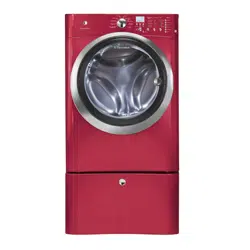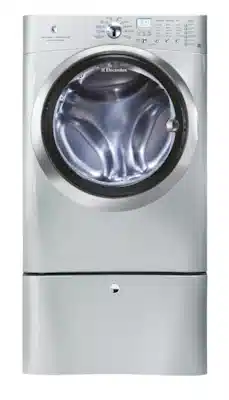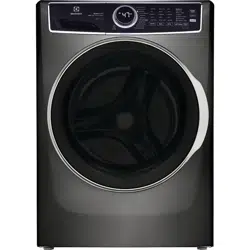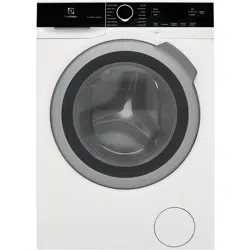
electroluxappliances.com\register
Use & Care Manual EN 2
Washing Machine
Manuel d’utilisation et d’entretien FR 52
Machine à laver
Manual de uso y cuidado SP 108
Lavadora
2
IMPORTANT SAFETY INFORMATION
Please read and save this
manual
Thank you for choosing Electrolux, our
premium brand in home appliances. This
Use
& Care Manual
is part of our commitment to
customer satisfaction and product quality
throughout the service life of your new
appliance.
Table of contents
Electrolux serial number
Electrolux model number
READ ALL INSTRUCTIONS BEFORE OPERATING THIS
WASHER.
SAVE THESE INSTRUCTIONS FOR FUTURE REFERENCE.
Electrolux model series*
* The series number can be found within the
Model number (example EFLW7637AW=
600 series).
For toll free telephone support or online
support in the US and Canada contact:
U.S.
1-877-4ELECTROLUX (1-877-435-3287)
www.electroluxappliances.com
Canada
1-800-265-8352
www.electroluxappliances.ca
Purchase date
Keep a record for quick
reference
Questions?
WARNING
For your safety the information in this manual must be followed to minimize the risk of fire
or explosion or to prevent property damage, personal injury or loss of life. Do not store
or use gasoline or other flammable vapors and liquids in the vicinity of this or any other
appliance.
Important Safety Information ...........................2
Features ..................................................................... 6
Pre-Installation Requirements .......................... 7
Installation ...............................................................12
Accessories and Replacement Parts ...........19
Controls and Settings ........................................20
Operating Instructions ......................................32
Normal Operating Sounds ..............................37
Stain Removal Guide ........................................ 38
Care and Cleaning ............................................ 40
Troubleshooting .................................................. 45
Limited Warranty .................................................. 51
NOTE
Registering your product with Electrolux
enhances our ability to serve you.
You can register online at www.
electroluxappliances.com, by sending
your Product Registration Card in the
mail, or PHOTOREGISTER
SM
using a smart
phone. See registration card for details.
NOTE
The instructions appearing in this
Use & Care Manual
are not meant to cover
every possible condition and situation
that may occur. Common sense and
caution must be practiced when installing,
operating and maintaining any appliance.
3
Important safety instructions
IMPORTANT SAFETY INFORMATION
Prevent fire
DO NOT wash items that have been
previously cleaned in, soaked in,
or spotted with gasoline, cleaning
solvents, kerosene, cooking oils,
waxes, or other flammable or explosive
substances. DO NOT store these
items on or near the washer. These
substances give off vapors or chemical
reactions that could ignite or explode.
DO NOT put oily or greasy rags or
clothing on top of the washer. These
substances give off vapors that could
ignite the materials.
DO NOT add gasoline, cleaning
solvents, or other flammable or
explosive substances to the wash water.
These substances give off vapors that
could ignite or explode.
• Under certain conditions, hydrogen gas
may be produced in a hot water system
that has not been used for 2 weeks or
more. HYDROGEN GAS IS EXPLOSIVE.
If the hot water system has not been
used for such a period, before using the
washer, turn on all hot water faucets
and let the water flow from each for
several minutes. This will release any
accumulated hydrogen gas. Hydrogen
gas is flammable; DO NOT smoke or use
an open flame during this time.
DO NOT store or use gasoline or other
flammable vapors or liquids in the
vicinity of this or any other appliance.
• Failure to comply with these warnings
could result in fire, explosion, serious
bodily injury and/or damage to the
rubber or plastic parts of the washer.
DO NOT continue to use the washer if
you hear squeaking, grinding, rubbing
or other unusual noises. This could be
a sign of mechanical breakdown and
lead to fire or serious injury. Contact a
qualified technician immediately.
Safety precautions
DO NOT attempt to install or operate your
unit until you have read the safety precautions
in this manual. Safety items throughout this
manual are labeled with a Danger, Warning,
or Caution based on the risk type.
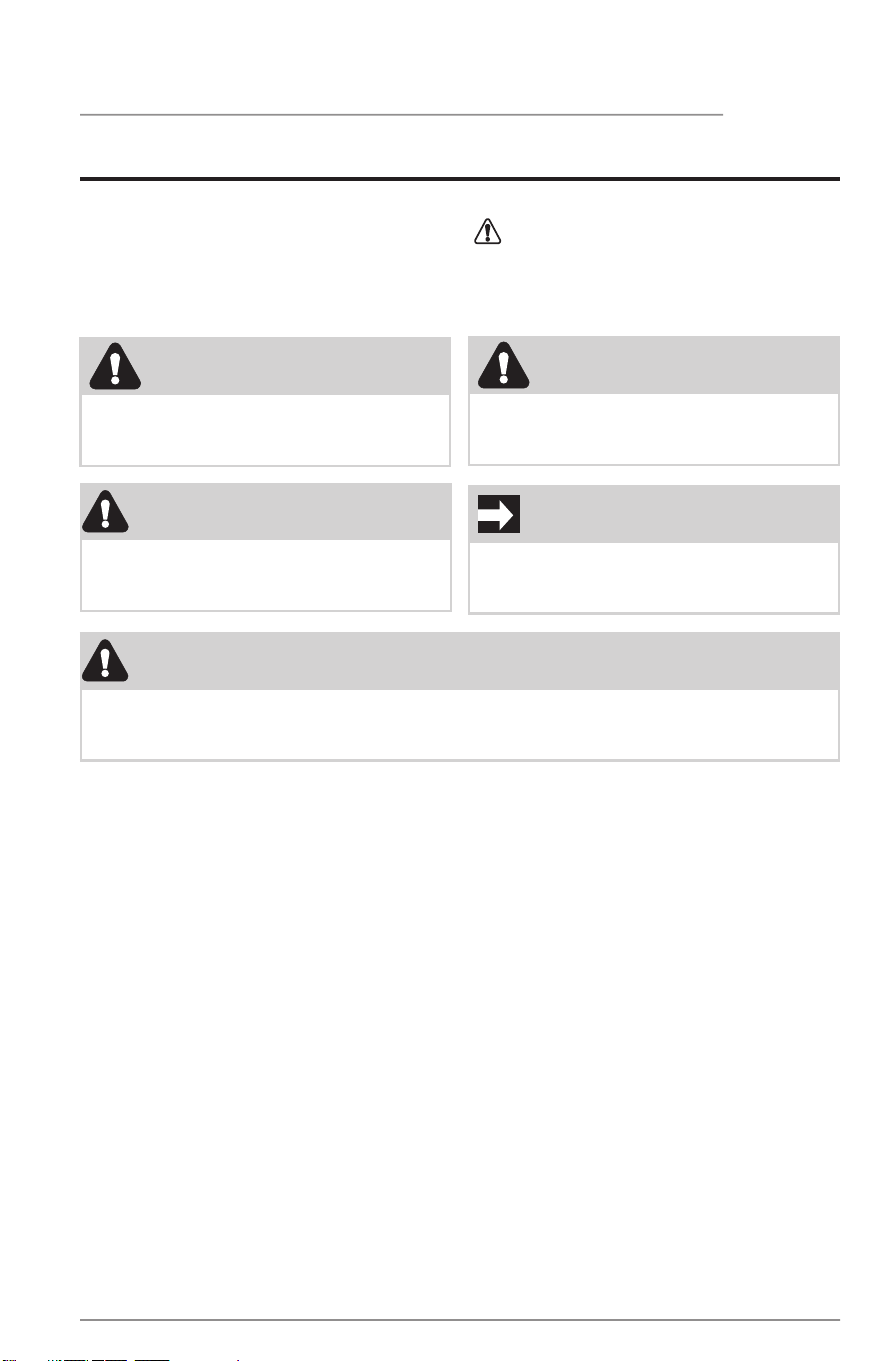
Definitions
This is the safety alert symbol. It is used
to alert you to potential personal injury
hazards. Obey all safety messages that
follow this symbol to avoid possible injury
or death.
IMPORTANT
IMPORTANT indicates installation, opera-
tion or maintenance information which is
important but not hazard-related.
CAUTION
CAUTION indicates a potentially
hazardous situation which, if not avoided,
may result in minor or moderate injury.
DANGER
DANGER indicates an imminently
hazardous situation which, if not avoided,
will result in death or serious injury.
WARNING
To reduce the risk of fire, electrical shock, or injury to persons when using this washer, comply
with the warnings listed below. Failure to comply with these Important Safety Information and
warnings could result in property damage, serious personal injury, or death.
WARNING
WARNING indicates a potentially
hazardous situation which, if not avoided,
could result in death or serious injury.
4
IMPORTANT SAFETY INFORMATION
Protect children
DO NOT allow children to play on or in
the washer. Close supervision of children
is necessary when the washer is used near
children. As children grow, teach them the
proper, safe use of all appliances.
• Destroy the carton, plastic bag and
other packing materials after the
washer is unpacked. Children might use
them for play. Cartons covered with
rugs, bedspreads or plastic sheets can
become airtight compartments.
• Keep laundry products out of children’s
reach. To prevent personal injury,
observe all warnings on product labels.
• Before the washer is removed from
service or discarded, remove the washer
door to prevent accidental entrapment.
• Failure to comply with these warnings
could result in serious personal injuries.
Risk of child entrapment
Child entrapment and suffocation are not
problems of the past. Junked or abandoned
washers and dryers are still dangerous – even if
they will sit for “just a few days”. If you are getting
rid of your old washer or dryer, please follow the
instructions below to help prevent accidents.
We strongly encourage responsible appliance
recycling/disposal methods. Contact your
State/Provence Energy Office, Local Electric
and Water Utilities or Conservation Program
Office or visit www.energystar.gov/recycle
for more information on recycling your old
washer or dryer.
Before you throw away your old
washer or dryer:
• Remove doors
• Remove the electric power cord
• Secure all hoses and drain pipes to
prevent water from leaking out and
creating a slip hazard.
Prevent injury
• To prevent shock hazard and assure
stability during operation, the washer
must be installed and electrically
grounded by a qualified service person
in accordance with local codes.
Installation instructions are packed
in the washer for installer’s reference.
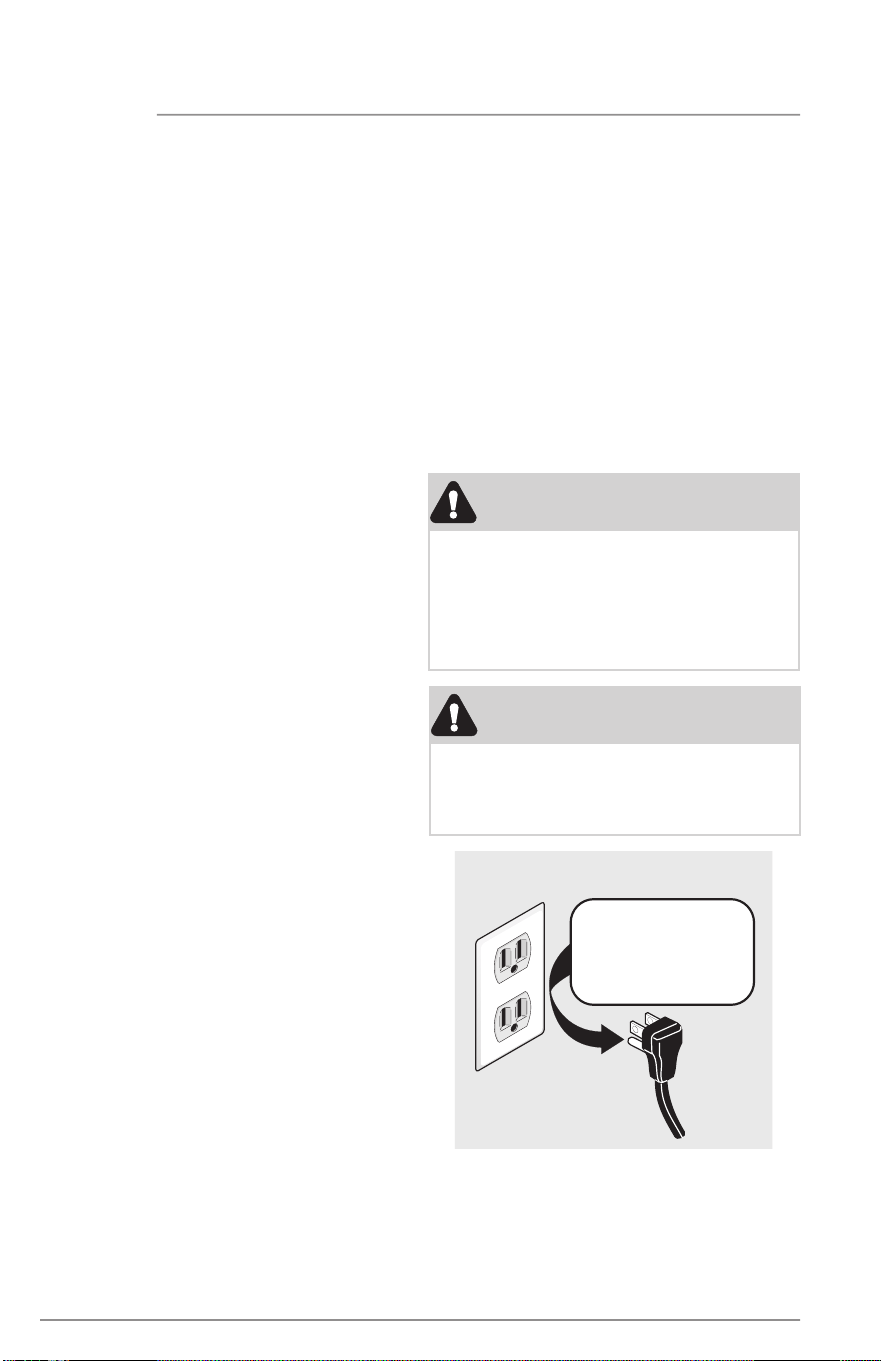
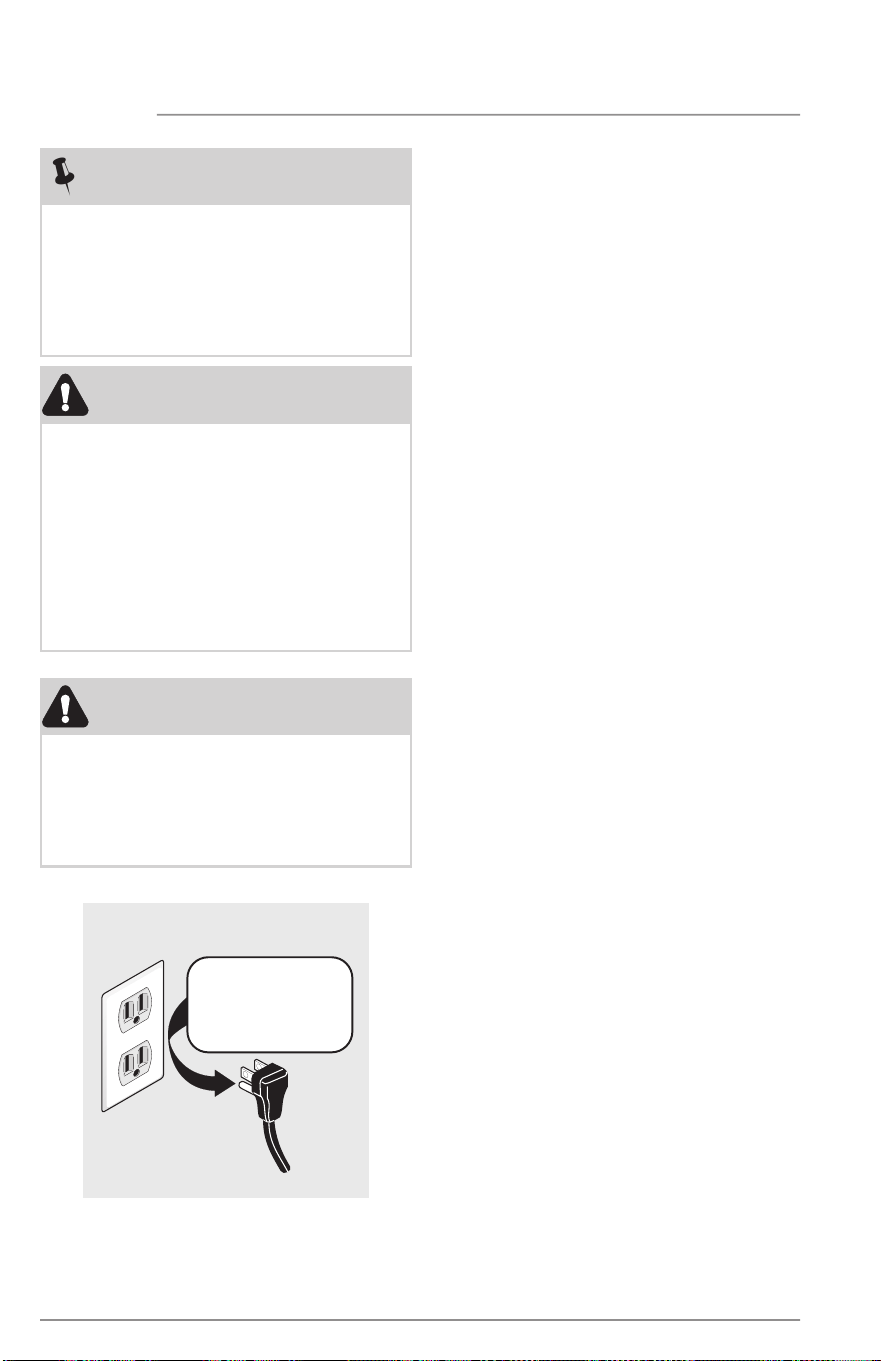
Grounding type wall receptacle
Power cord with
3-prong grounded plug
Do not, under
any circumstances,
cut, remove,
or bypass the
grounding prong.
• Follow package directions when using
laundry products. Incorrect usage can
produce poisonous gas - resulting in
serious injury or death.
DO NOT combine laundry products
for use in 1 load unless specified on
the label.
Refer to
the
Installation sections of
this manual for detailed grounding
procedures. If the washer is moved
to a new location, have it checked
and reinstalled by a qualified service
person.
• To prevent personal injury or damage
to the washer, the electrical power cord
of the washer must be plugged into
a properly grounded and polarized
3-prong outlet. The third grounding
prong must never be removed. Never
ground the washer to a gas pipe.
DO NOT use an extension cord or an
adaptor plug.
WARNING
FIRE/ELECTRICAL SHOCK HAZARD
Avoid fire hazard or electrical shock. DO
NOT use an adaptor plug or extension cord
or remove grounding prong from electrical
power cord. Failure to follow this warning
can cause serious injury, fire or death.
WARNING
Improper grounding of the washer may cause
serious injury or death. Check with a licensed
electrician if you are in doubt as to whether
the appliance is properly grounded.
5
IMPORTANT SAFETY INFORMATION
Prevent injury and damage to the
washer
To prevent serious personal injury and
damage to the washer:
• All repairs and servicing must
be performed by an authorized
service technician unless specifically
recommended in this
Use & Care
Manual
. Use only authorized factory
parts.
DO NOT tamper with controls.
DO NOT install or store the washer
where it will be exposed to the weather.
DO NOT install on carpet. Install washer
on a solid floor. It may be necessary to
reinforce the floor to prevent vibration
or movement.
• To reduce the risk of electric shock,
disconnect this appliance from the
power supply before attempting any
user maintenance. Turning the controls
to the OFF position does not disconnect
this appliance from the power supply.
• To prevent injury, DO NOT reach into
the washer while parts are moving.
• This washer is equipped with an
electrical overload protector. The motor
will stop if it becomes overheated.
• Failure to comply with these warnings
could result in serious personal injuries.
WARNING
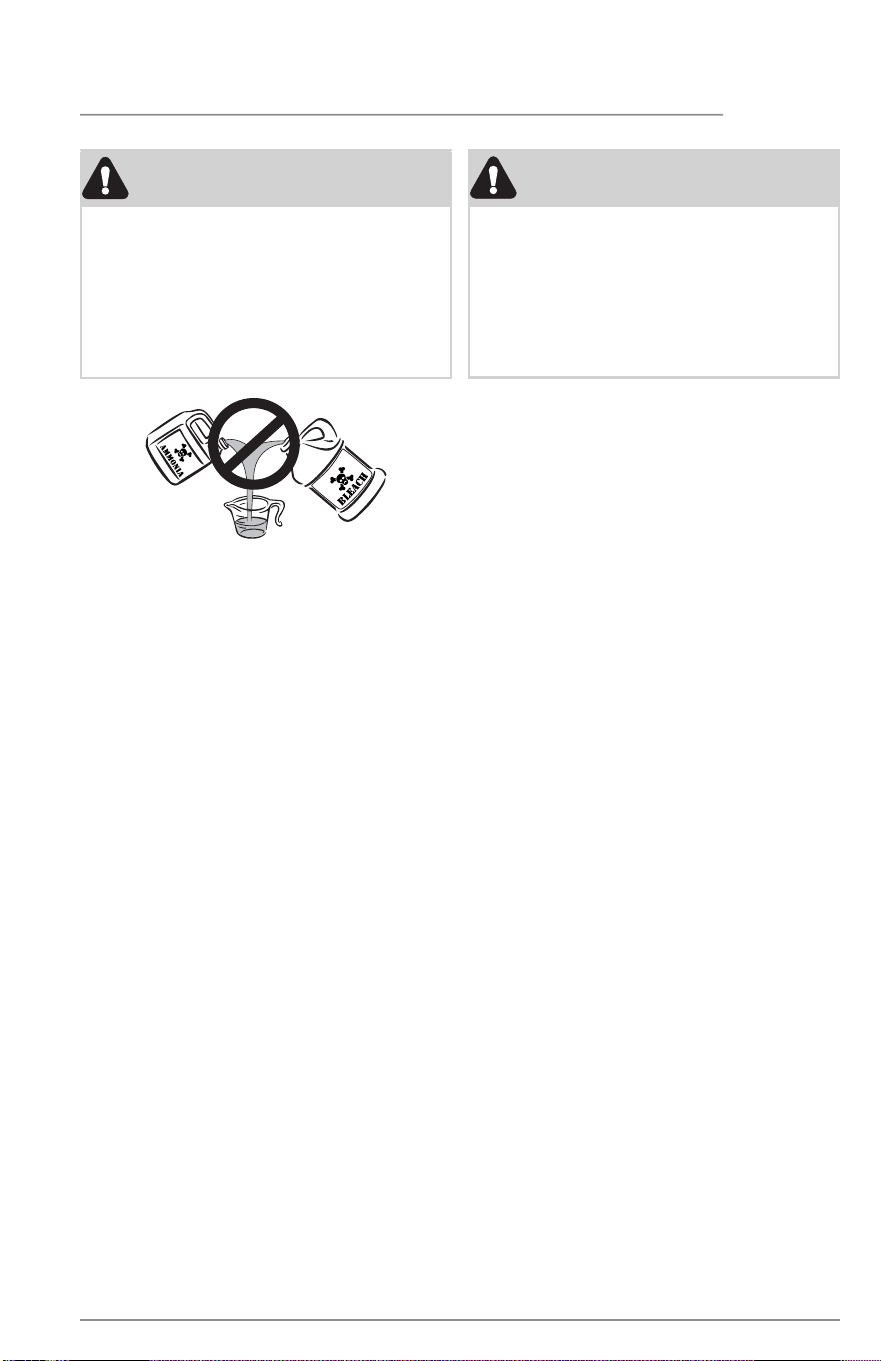
HARMFUL VAPOR HAZARD
DO NOT use or mix liquid chlorine bleach
with other household chemicals such
as toilet cleaners, rust removers, acids
such as vinegar, or products containing
ammonia. These mixtures can produce
dangerous fumes which can cause serious
injury or death.
WARNING
RISK OF INJURY
DO NOT WASH: Water resistant and water
repellent clothing or other materials.
Failure to follow these instructions may
result in an abnormal vibrating and out-
of-balance condition that could result in
physical injury, property damage, and/or
appliance damage.
6
FEATURES
drum light
door reversibility
3 compartment
dispenser
Adaptive Dispenser™
detergent pack
option
pure rinse
optic whites
hand wash
whitest whites
allergen
sanitize
stain treatment
perfect steam
fast wash
300 Series
no yes yes no no no no no no no no no no 20
min
400 Series
no yes no yes yes no no no yes no yes yes yes 18
min
500 Series
yes yes no yes yes yes no no yes yes yes yes yes 15
min
600 Series
yes yes no yes yes yes yes yes no yes yes yes yes 15
min
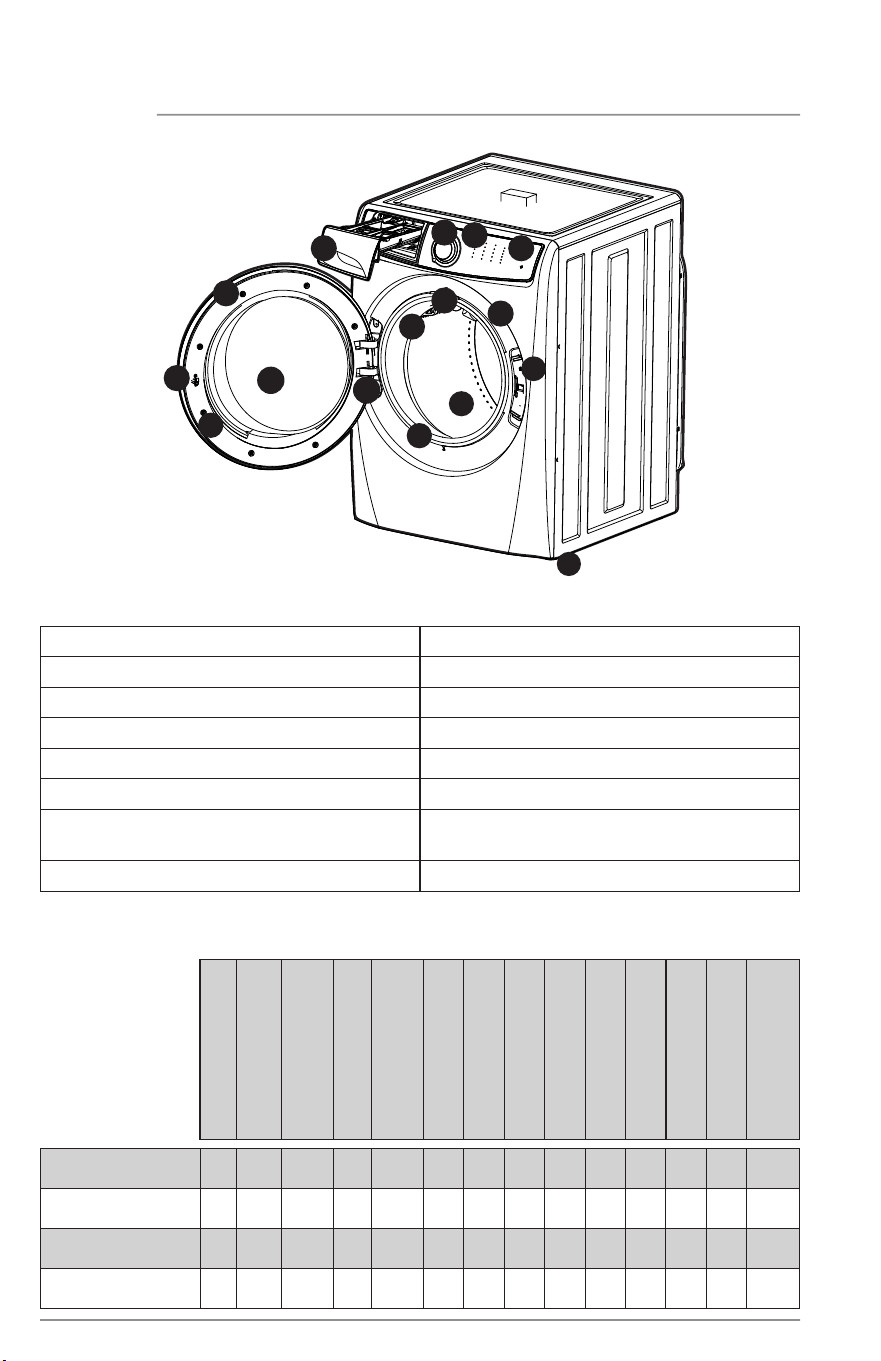
Refer to the table below for an overview of features available for each model series.
Not all cycles, options, or features listed are available on every model.
1
2
3
4
5
6
7
8
9
10
1. Door striker 9. Cascading wash vanes
2. Reversible door 10. Door latch with safety lock
3. Laundry products dispenser 11. Adjustable leveling legs
4. LED Display 12. Stainless steel wash drum
5. Cycle Display 13. Flexible door gasket
6. Drum light (select models) 14. Wide angle door hinge
7. Control lock 15. Inner bowl with small article redistribution
ramp
8. Serial and model # 16. Door stand ventilation
11
12
13
14
15
16
7
PREINSTALLATION REQUIREMENTS
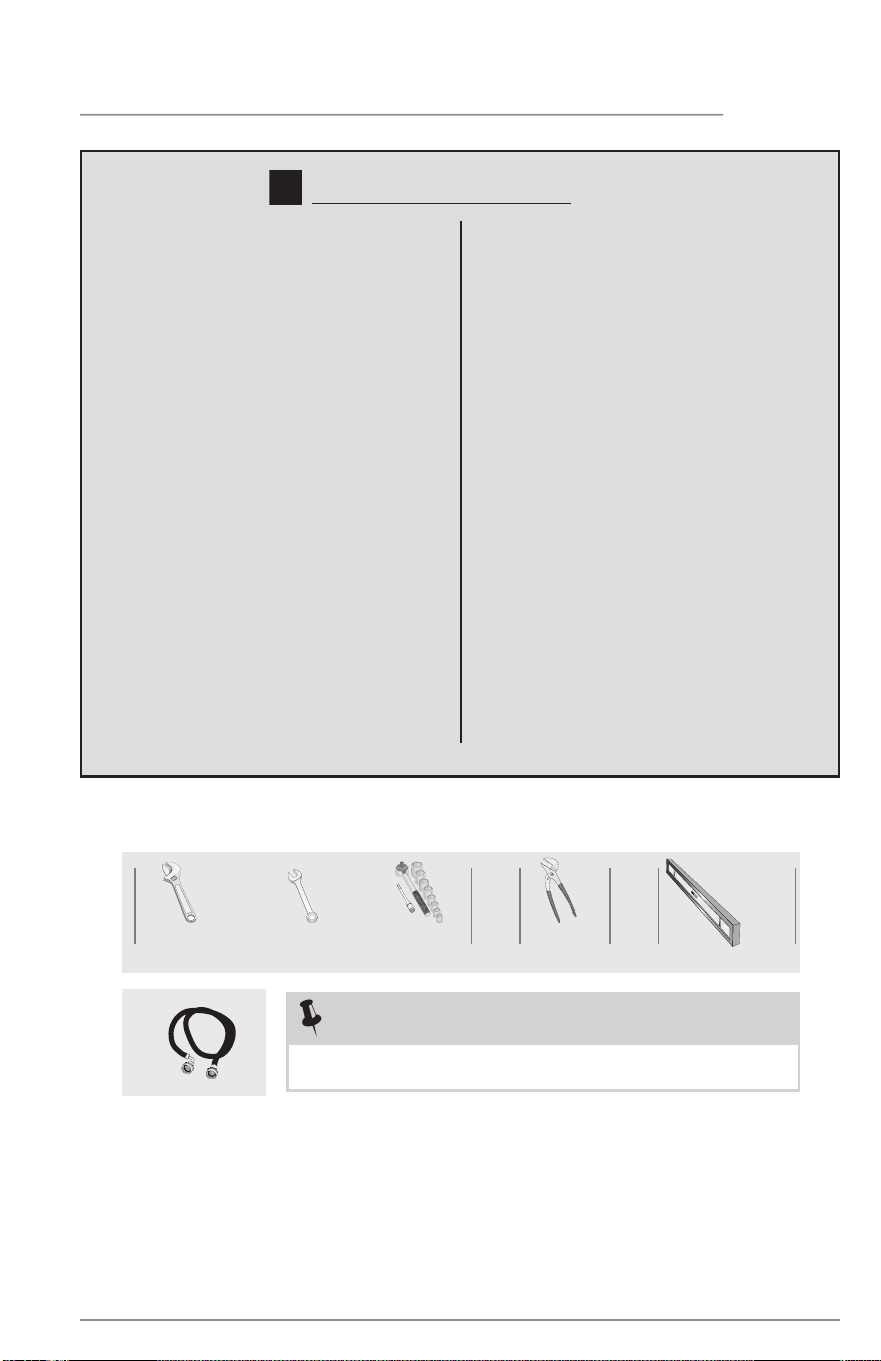
Tools and materials needed for installation:
Adjustable
pliers
Adjustable
wrench
OR OR AND AND
Carpenter’s level
Ratchet and
socket set
3/8" or
10 mm
box wrench
Shipping Hardware
Foam shipping support (under wash
tub) removed and stored
Shipping bolts and spacers removed
from rear of appliance and stored
Hole plugs (shipped in manual bag)
installed in holes in backsheet
Leveling
Washer is level, side-to-side and front-
to-back
Cabinet is sitting solid on all corners
Water Supply
Use only new hoses and verify rubber
sealing washers are installed
HOT supply is connected to HOT inlet
and COLD supply is connected to
COLD inlet
HOT and COLD water supply
turned on
No leaks present at water supply
connections or appliance inlet
connections - recheck in 24 hours
Drain
Stand pipe or wall drain height
minimum 24”
Verify anti-siphon disc is attached
toward end of drain hose
Drain hose secured in place with
cable tie (shipped in drum)
Door Reversal
Follow detailed instructions in
this manual
Test hinge and latch for function
Electrical Power
House power turned on
Washer plugged in
Final Checks
Installation instructions and Use
& Care Manual read thoroughly
Door locks and water enters drum
when cycle starts
Registration card sent in
Inlet Hose (x2)
Electrical system requirements
CIRCUIT - Individual, properly polarized
and grounded 15 amp. branch circuit
fused with 15 amp. time delay fuse or
circuit breaker.
POWER SUPPLY - 2 wire, with ground, 120
volt single phase, 60 Hz, Alternating
Current.
OUTLET RECEPTACLE - Properly grounded
3-prong receptacle to be located so
the power supply cord is accessible
when the washer is in an installed
position.
Installation Checklist
NOTE
Hoses are not included with washer purchase.
8
PREINSTALLATION REQUIREMENTS
Water supply requirements
Grounding requirements
Drain system requirements
Grounding type wall receptacle
Power cord with
3-prong grounded plug
Do not, under
any circumstances,
cut, remove,
or bypass the
grounding prong.
1. The washer MUST be grounded. In the
event of malfunction or breakdown,
grounding will reduce the risk of
electrical shock by a path of least
resistance for electrical current.
2. Since your washer is equipped with
a power supply cord having an
equipment-grounding conductor and
a grounding plug, the plug MUST be
plugged into an appropriate, copper
wired receptacle that is properly
installed and grounded in accordance
with all local codes and ordinances or
in the absence of local codes, with the
National Electrical Codes, ANSI/NFPA
70 (latest edition), or in Canada, the
Canadian electrical code C22.1 part 1.
If in doubt, call a licensed electrician.
DO NOT cut off or alter the grounding
prong on the power supply cord. In
situations where a two-slot receptacle
is present, it is the owner’s responsibility
to have a licensed electrician replace it
with a properly grounded three prong
grounding type receptacle.
Hot and cold water faucets MUST be
installed within hose length of your washer’s
water inlet. The faucets MUST be 3/4 inch
(1.9 cm) with threading for laundry hose
connection. Water pressure MUST be
between 20 and 120 psi. Pressure difference
between hot and cold cannot be more than
10 psi. Your water department can advise you
of your water pressure.
1. Drain capable of eliminating 17 gals
(64.3 L) per minute.
2. A standpipe diameter of 1-1/4 in. (3.18
cm) minimum.
3. The standpipe height above the floor :
Minimum height: 24 in. (61 cm)
Maximum height: 96 in. (244 cm).
WARNING
ELECTRIC SHOCK HAZARD
Certain internal parts are intentionally
not grounded and may present a risk
of electrical shock if contacted during
installation. Do not contact the following
parts while the appliance is energized
• Pump
• Drive motor
• Electrical control boards
• Water valves
WARNING
ELECTRICAL SHOCK HAZARD
Improper connection of the equipment
grounding conductor can result in a risk
of electrical shock. Check with a licensed
electrician if you are in doubt as to whether
the appliance is properly grounded.
NOTE
Because of potentially inconsistent
voltage capabilities, the use of this washer
with power created by gas powered
generators, solar powered generators,
wind powered generators or any other
generator other than the local utility
company is not recommended.
9
PREINSTALLATION REQUIREMENTS
Installation in a recess or
closet
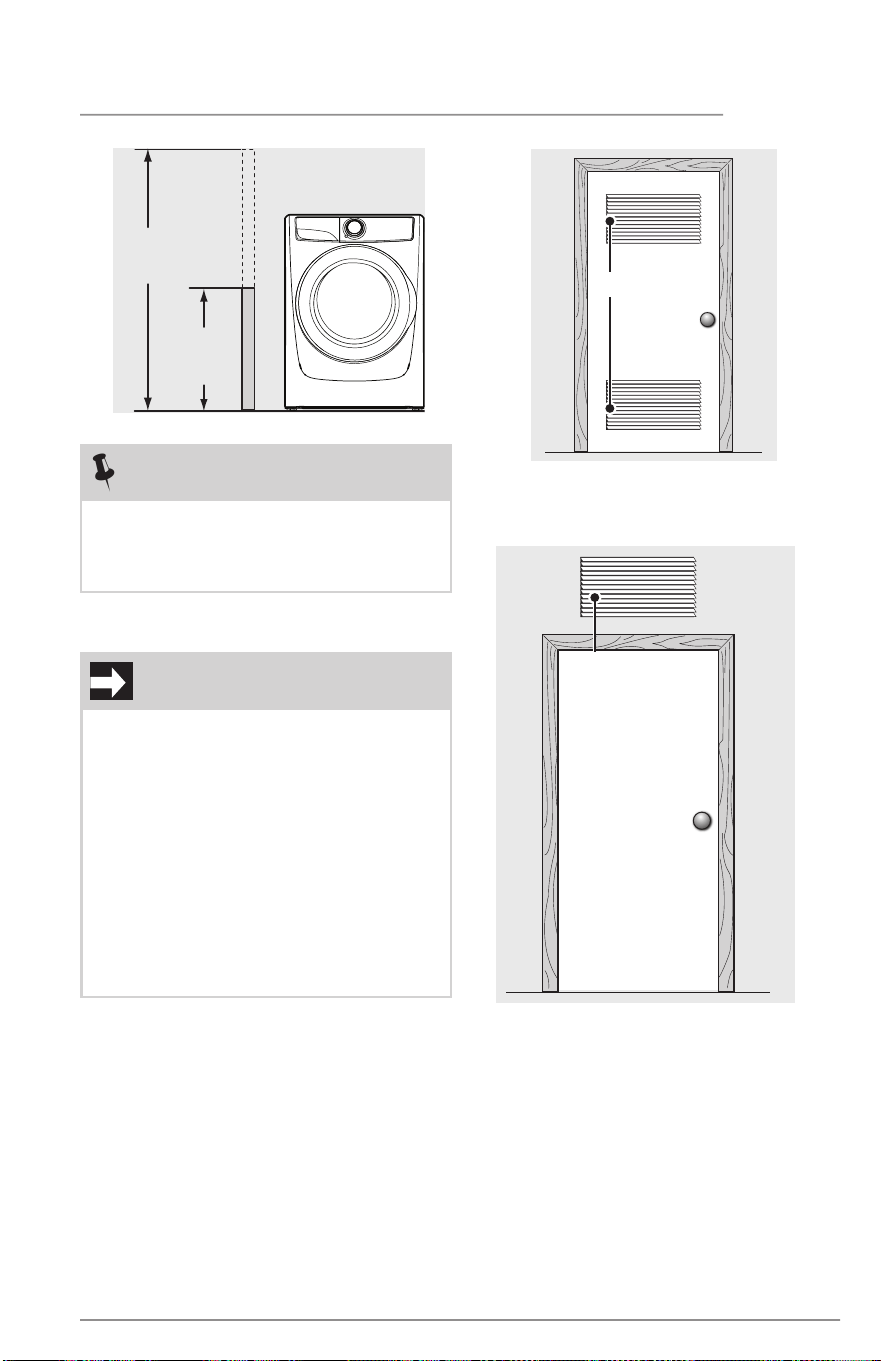
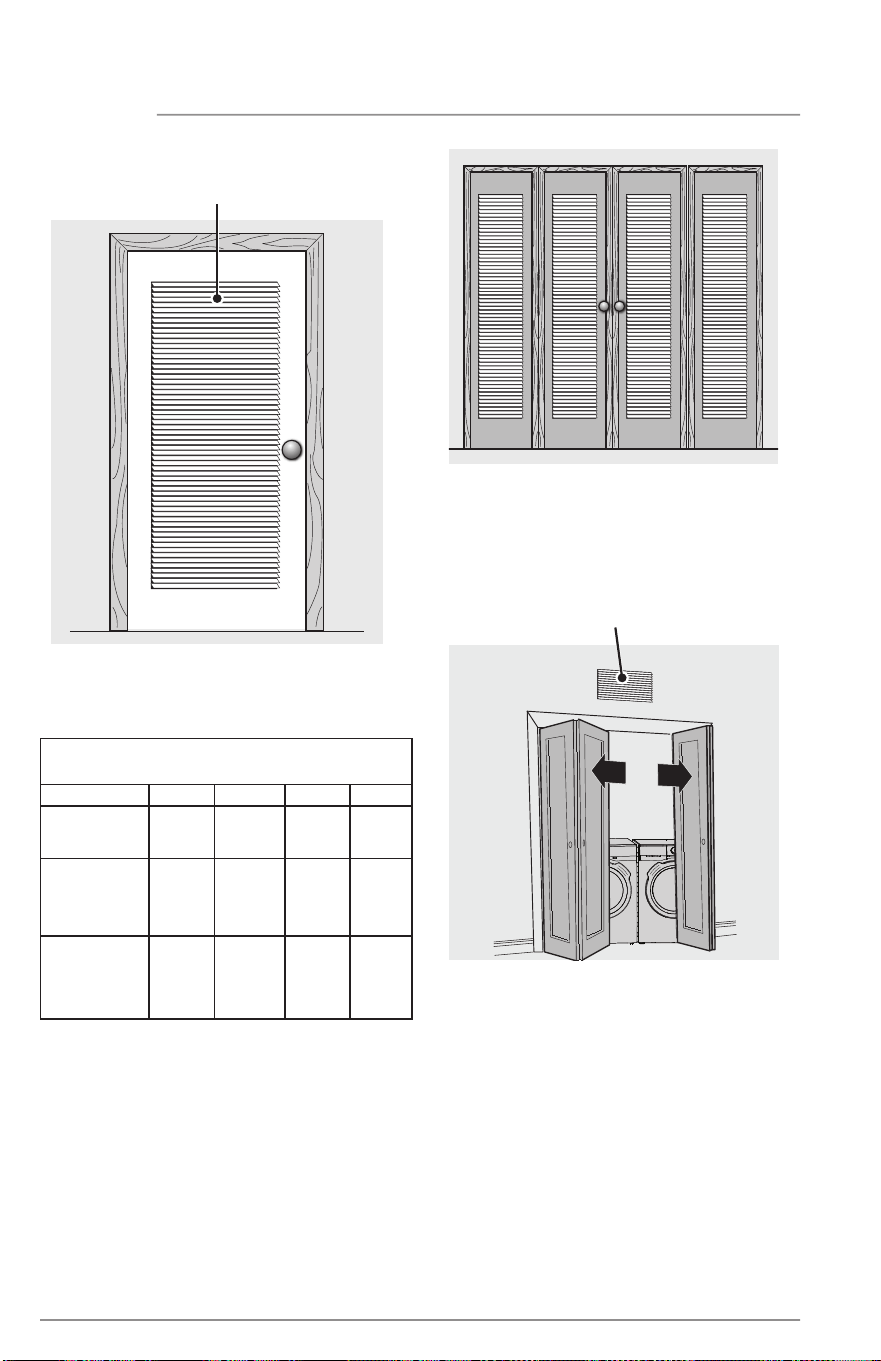
If washer and dryer are installed in the
same closet, door ventilation is required: A
minimum of 120 square inches (774.2 cm²)
of opening, equally divided at the top and
bottom of the door, is required. Louvered
openings should be located 3 inches (7.6 cm)
from bottom and top of door. Air openings
are required to be unobstructed when a door
is installed. A louvered door with equivalent
air openings for the full length of the door is
acceptable.
Clearance requirements
96"
(244 cm)
max.
24"
(61 cm)
min.
60 sq. Inches
Solid Door with Wall
Ventilation
120 sq. Inches
120 sq. Inches Equally Divided Split Vent
Door
IMPORTANT
DO NOT INSTALL YOUR WASHER:
1. In an area exposed to dripping water
or outside weather conditions.
2. In an area where gasoline or other
flammables are kept or stored.
3. On carpet. Floor MUST be solid with
a maximum slope of 1 inch (2.5 cm).
To minimize vibration or movement,
reinforcement of the floor may be
necessary.
4. On top of another washer or on top of
a dryer. Do not stack a dryer on top of
washer already installed on pedestal.
NOTE
Drain hose length is 59 in. (150 cm). For
installations requiring a longer drain hose,
use hose P/N 137098000, available from
an authorized parts distributor.
10
Louvered Door
120 sq. Inches min.
Louvered Opening
MIN. INSTALLATION CLEARANCES -
Inches (cm)
Sides Rear Top Front
Alcove/
recess
0"
(0 cm)
0"
(0 cm)
0"
(0 cm)
Open
Closet with
door vent
0"
(0 cm)
0"
(0 cm)
0"
(0 cm)
1"
(2.5 cm)
Closet with
wall vent
1"
(2.5 cm)
1"
(2.5 cm)
1"
(2.5 cm)
1"
(2.5 cm)
Bi-Fold louvered doors with
120 sq. in of ventilation
Solid Bi-Fold doors with no
ventilation
120 sq. Inches of
wall venting
PREINSTALLATION REQUIREMENTS
11
PREINSTALLATION REQUIREMENTS
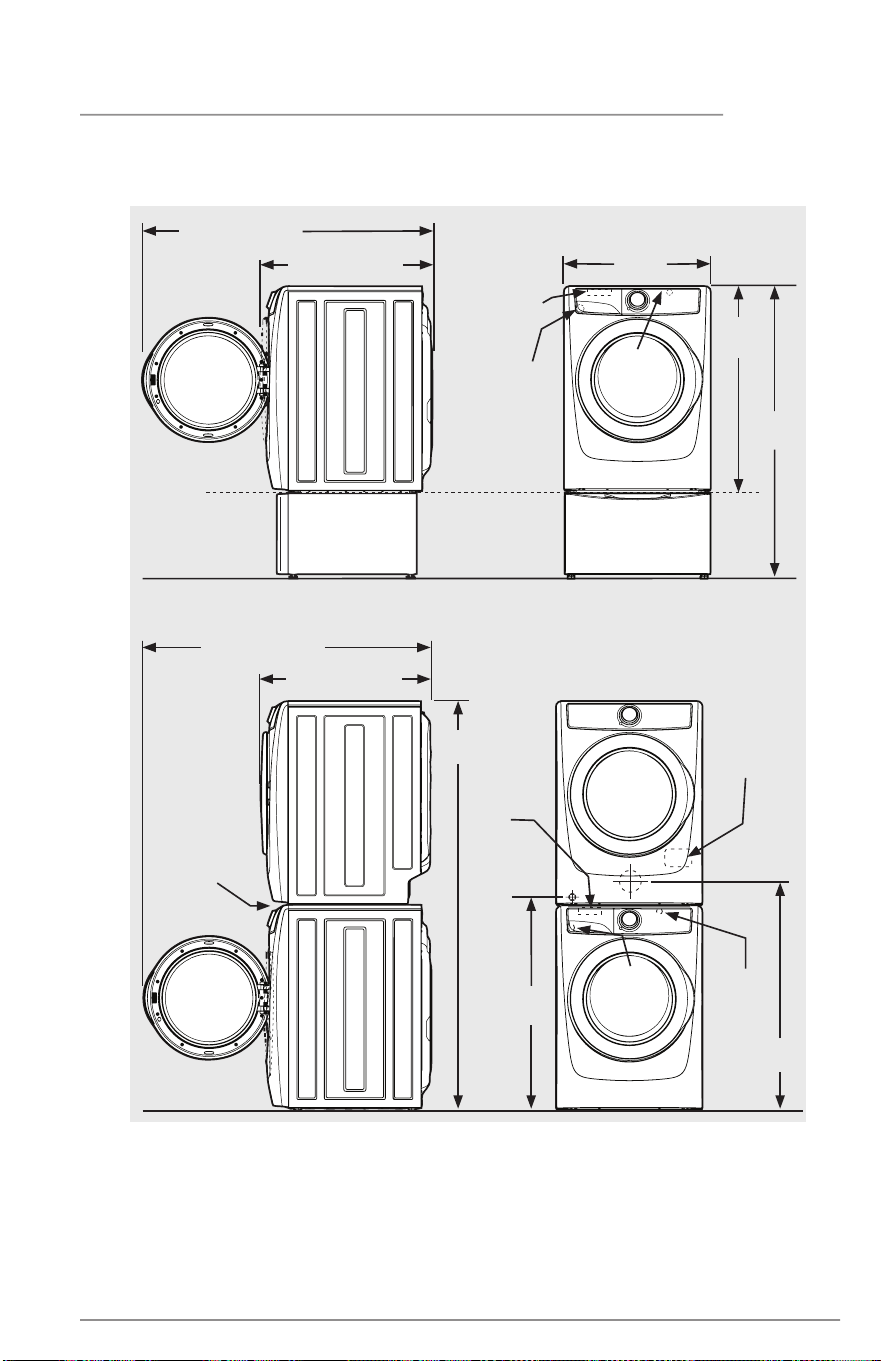
Washer dimensions
*
Connection of water inlet hose on steam dryer adds 3/4 in. (2 cm) to installation depth.
1
Power supply cord length on washer approximately 60 inches (152.5 cm).
2
Drain hose length on washer approximately 59 inches (150 cm).
3
Power supply cord length on gas dryer or electric Canadian dryer approximately 60 inches
(152.5 cm).
water supply
connection on
rear of unit
electrical
supply on
rear of unit
3
gas supply
pipe on rear
of gas unit
centerline
height for
rear vent
53.5"
(136 cm)*
to clear open door
32" (81.25 cm)*
to front of closed door
75.75"
(192.5 cm)
41.0"
(105 cm)
39.0"
(99 cm)
27.0"
(68.5 cm)
water supply
connection
on rear
of unit
drain
hose on
rear of
unit
2
drain hose on
rear of unit
3
power
cord on
rear of
unit
1
power
cord
on rear
of unit
1
floor line
floor line
floor line
freestand washer
on floor
washer mounted on
optional pedestal
38.0"
(96.5 cm)
approved
stacking kit
(STACKIT7X)
required for
stacked
installation
53.5" (136 cm)*
to clear open door
32" (81.25 cm)*
to front of closed door
53.25"
(135.5 cm)
12
INSTALLATION
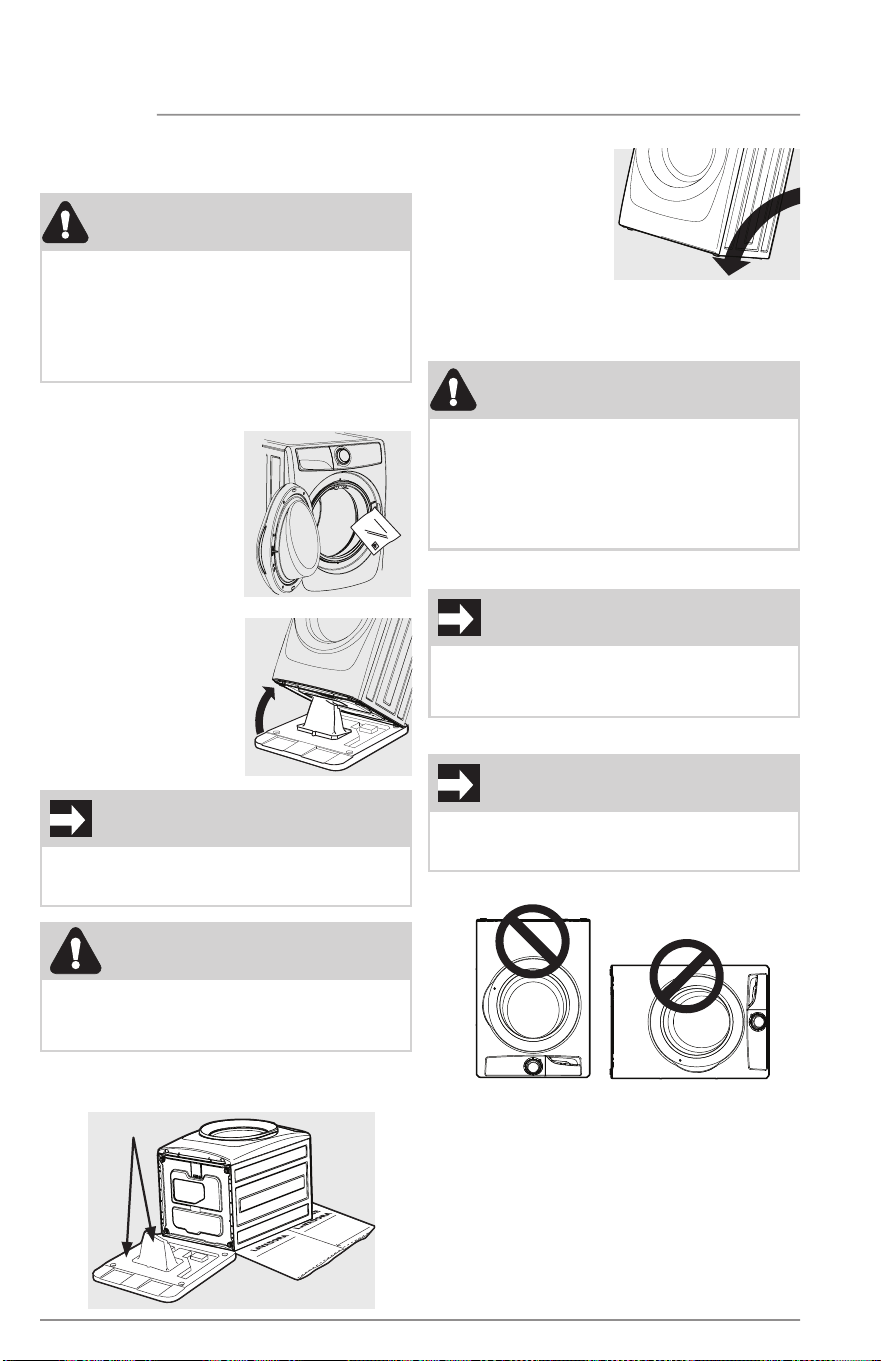
Unpacking the washer
1. Temporarily
remove door tape.
2. Close door and
reapply door tape.
3. Using a rug,
blanket or piece
of cardboard to
protect the floor,
carefully lay the
washer on its back.
4. Remove styrofoam base and shipping
plug and set them aside.
5. Carefully return
the washer
to an upright
position.
6. Carefully move the washer to within 4
feet (1 m) of its final location.
IMPORTANT
DO NOT place the washer onto its back
without the shipping bolts.
IMPORTANT
Save styrofoam base and shipping plug
for use to help prevent washer damage
during any future moves.
IMPORTANT
DO NOT tip washer upside down onto its
top or onto its right side for any reason.
CAUTION
EXCESSIVE WEIGHT HAZARD
To avoid back or other injury, have more
than one person move or lift the washer.
WARNING
ELECTRICAL SHOCK HAZARD
Improper connection of the equipment
grounding conductor can result in a risk
of electrical shock. Check with a licensed
electrician if you are in doubt as to whether
the appliance is properly grounded.
WARNING
ELECTRICAL SHOCK HAZARD
Improper connection of the equipment
grounding conductor can result in a risk
of electrical shock. Check with a licensed
electrician if you are in doubt as to whether
the appliance is properly grounded.
13
INSTALLATION
HOT Water Hose
CALIENTE
CHAUDE
COLD Water Hose
FRIA
FROIDE
x7
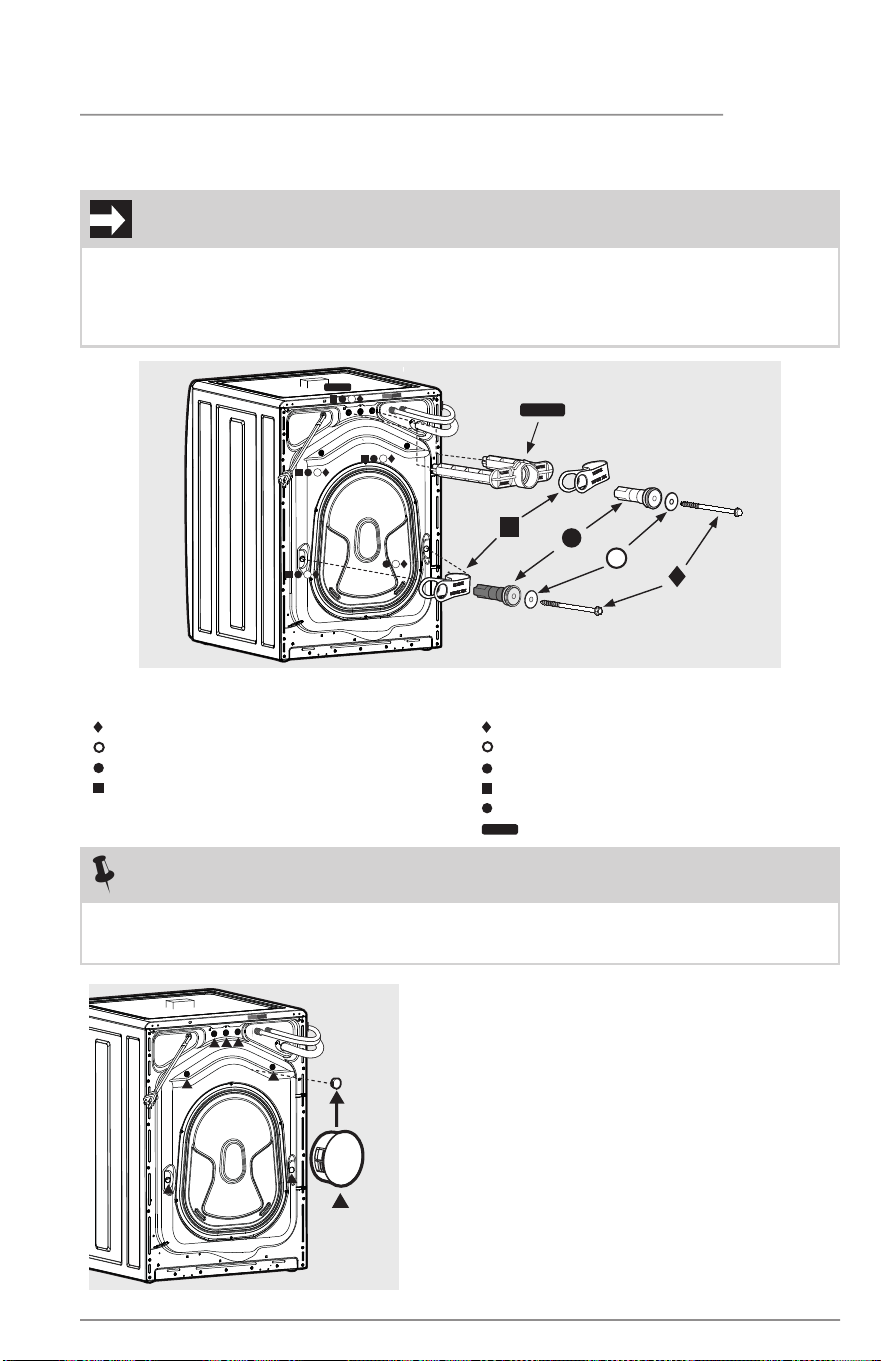
Removing shipping hardware
Installing hole plugs
For 300 Series:
Remove all of the following:
4 SHIMS
4 BLACK SPACERS
3 P CLAMPS
4 BOLTS
For 400, 500, and 600 Series:
Remove all of the following:
4 P CLAMPS
1 SHIPPING FORK*
5 SHIMS
4 BLACK SPACERS
1 WHITE SPACER*
5 BOLTS
HOT Water Hose
CALIENTE
CHAUDE
COLD Water Hose
FRIA
FROIDE
*
*
Locate hole plugs in the small bag supplied
with washer instruction manuals. Insert them
in the holes in the washer back panel where
the shipping hardware has been removed.
* on select models
IMPORTANT
Failure to remove shipping hardware completely could result in damage to the appliance,
damage to your home, or unexpected washing results.
Save all shipping bolts and spacers for future use. If the washer is to be transported at a
later date, the shipping hardware must be reinstalled to help prevent shipping damage
NOTE
Rubber expansion material on spacers may need time to relax before they can be easily
pulled through shipping hole.
14
Rubber Washers
Must Be Present
USE ONLY
NEW HOSES
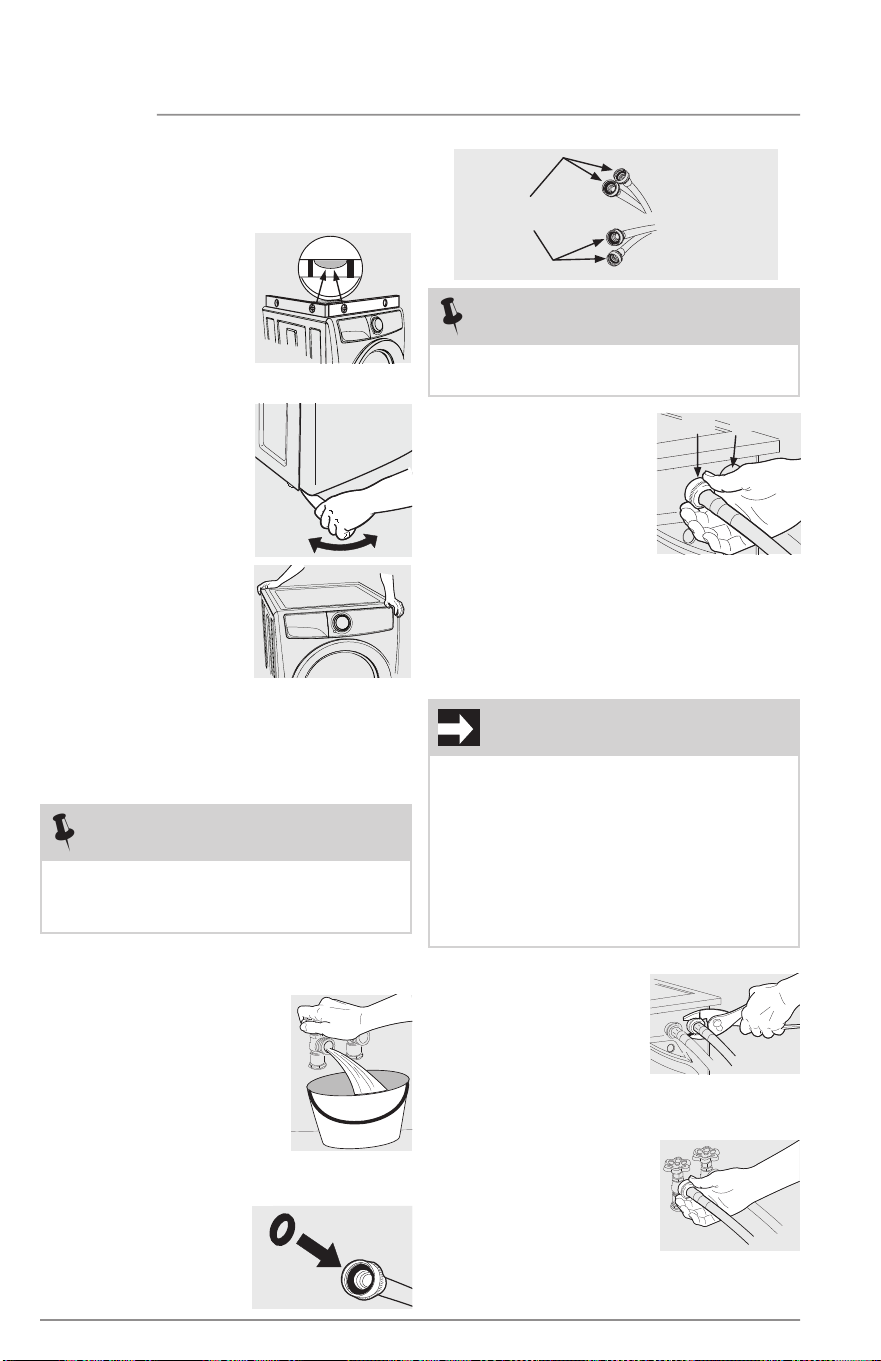
Leveling the washer
Connecting the water
1. Run some water
from the hot and
cold faucets to flush
the water lines and
remove particles that
might clog the water
valve screens and to
determine which faucet
is hot and which is cold
supply.
2. Check to ensure
that the inlet hoses
have the rubber
washer firmly in
place.
INSTALLATION
3. Connect the HOT
inlet hose (color:
red) to the HOT
inlet connection
on the washer and
the COLD inlet
hose to the COLD
inlet connection
(color: blue) on the
washer.
Excessive noise and vibration can be
prevented by properly leveling the washer.
1. For free standing
installation and
with the washer
within 4 feet
(1 m) of its final
location, place a
level on top of the
washer.
2. Use an adjustable
wrench to adjust
the leveling legs so
the washer is level
front-to-rear and
side-to-side, and
stable corner-to-
corner.
3. Press down on
alternate corners
and sides and feel
for the slightest
movement. Adjust
the appropriate
leg(s) so the
washer sits solidly on the floor on
ALL four legs. Keep the leveling leg
extension at a minimum for best
performance of the washer.
5. Connect the HOT
inlet hose to the HOT
water supply and
the COLD inlet hose
to the COLD water
supply.
Cold Hot
Cold inlet shown on
left side (400, 500,
600 models only).
On 300 series, the
cold inlet is on the
right side.
4. Tighten by hand
until snug. Then
tighten each supply
connection another
2/3 turn with pliers.
Do not cross thread
or over-tighten these connections.
IMPORTANT
The cold water inlet will have a blue cap
cover on the inlet connection and the
hot water inlet will have a red cap cover
on the inlet connection. Additionally,
depending on the model, the hot and
cold inlet connections will be marked
with either an adhesive label or markings
directly on the unit to indicate which side
is cold and which side is hot.
NOTE
For pedestal installations, see additional
installation instructions included with the
pedestal.
NOTE
Hoses are not included with washer
purchase.
15
6. Tighten by
hand until snug.
Then tighten
each supply
connection
another 2/3 turn
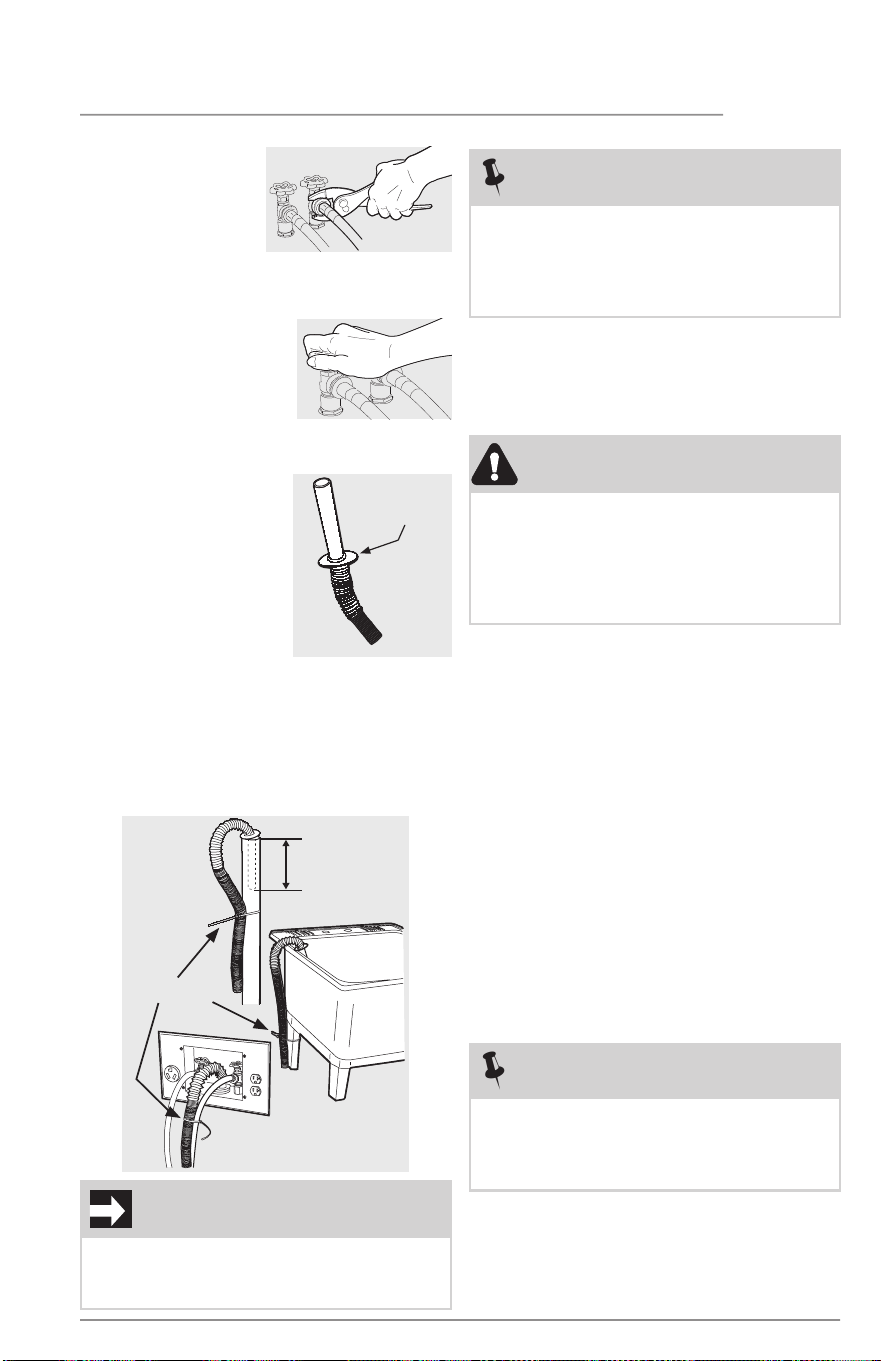
with pliers. Do not bend, kink or pinch
water inlet hoses.
7. Turn on the water
and check for leaks.
Anti-Siphon
Disc
1. Verify the anti-
siphon disc is in
place.
2. Form a “U” shape
on the end of the
drain hose with
the hose pointed
toward the drain.
Place the formed
end in a laundry
tub or a standpipe and secure the
drain hose with the cable tie (provided
in the manual bag) to the standpipe,
inlet hose, laundry tub, etc. so the hose
does not pull out from the force of the
water.
Connecting the drain
1. Plug the power cord into a grounded
outlet.
2. Turn on the power at a circuit breaker/
fuse box.
3. Carefully slide the washer to its final
position. Recheck for level and rock
corners for stability. See
Leveling the
washer.
Remove and discard door
tape.
4. Run the washer through a complete
cycle, checking for water leaks and
proper operation.
5. If you have any questions during
initial operation, please review the
Troubleshooting
section before calling
for service.
6. Place these instructions in a location
near the washer for future reference.
INSTALLATION
Insert Less
Than 8.5"
(21.5 cm)
Cable Tie
Completing the installation
IMPORTANT
Check to ensure the power is off at a
circuit breaker/fuse box before plugging
the power cord into an outlet.
WARNING
ELECTRICAL SHOCK HAZARD
Improper connection of the equipment
grounding conductor can result in a risk
of electrical shock. Check with a licensed
electrician if you are in doubt as to whether
the appliance is properly grounded.
NOTE
The standpipe inside diameter must be
1-1/4” (3.2 cm) minimum. There must be
an air gap around the drain hose in the
standpipe. A snug hose fit can cause a
siphoning action.
NOTE
A wiring diagram and technical data
sheet are located under the washer top
panel, on top of the detergent dispenser
housing.
16
INSTALLATION
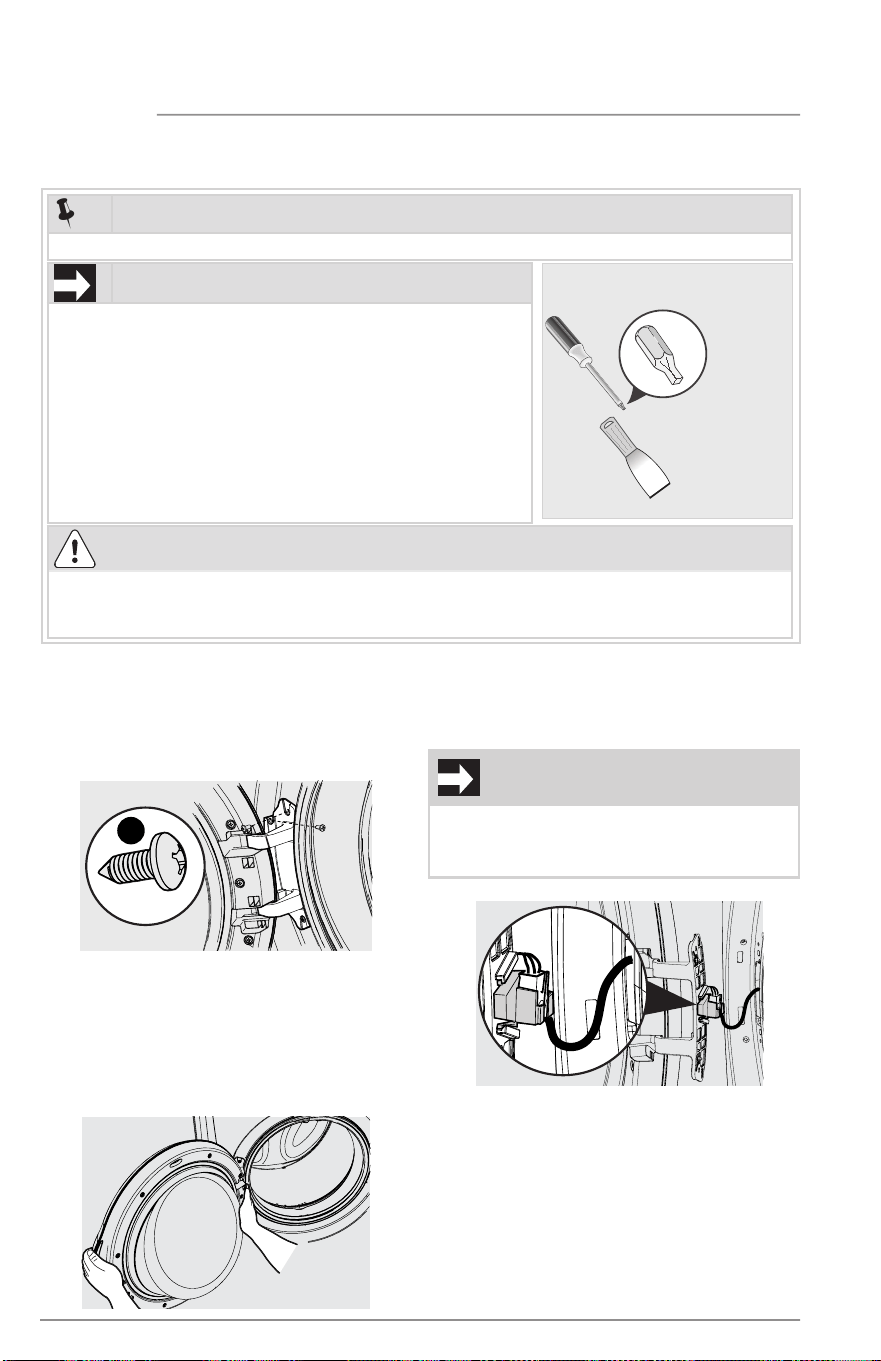
Removing door assembly
1. Completely open the door to expose
all four hinge screws.
2. Remove all four hinge screws with #2
square bit driver. Save for reinstalling later.
3. Hold the door with one hand
supporting the handle area and one
hand supporting the hinge. While
supporting the door at the hinge, press
firmly with the other hand until the
locating pins on the back of the hinge
plate dislocate from the front panel.
4. While supporting the door with one
hand, pinch the tabs to release the
plastic terminal cap from the hinge
plate.
5. Set the door face down on a flat
surface protected by soft cloth or
towel.
x4
Fine Thread
Plastic knife
Screwdriver
with #2
square bit
Tools needed for
reversal:
NOTE
Door reversibility is available on all models.
IMPORTANT
BEFORE YOU REVERSE WASHER DOOR:
1. Be sure you have adequate swing area before reversing
door.
2. Gather your tools - including a screw driver with a #2
square bit and plastic knife (or small, flat prying tool that
won’t damage paint).
3. Protect flat work surface, such as top of washer or floor
near washer, with a soft cloth or towel.
4. Be sure washer is unplugged from power source!
WARNING
ELECTRICAL SHOCK HAZARD
Failure to disconnect power source before servicing could result in personal injury or
even death.
Reversing the door
IMPORTANT
Take care not to pull the door away from
the washer until you remove the wiring
harness terminal cap.
17
INSTALLATION
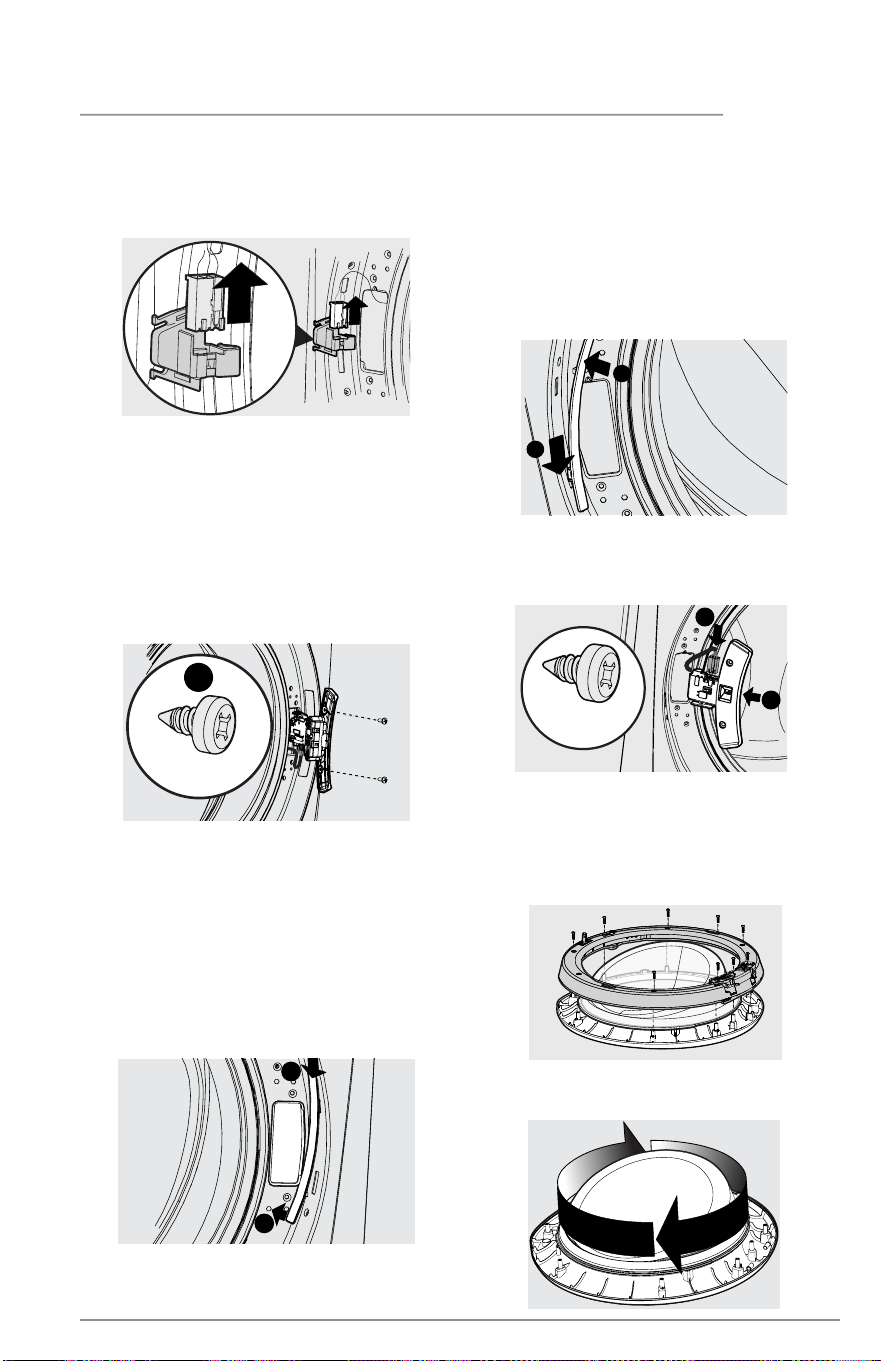
2
1
Reinstalling door lock and hole
cover
1. Move the plastic cover to the other side
of the front panel. Position the cover so
the “hook” is at the bottom. Insert hook
into lower slot, slide the cover down,
and press upper retention tabs into
opening until they snap into place.
2
1
2. Insert wiring harness into door lock.
3. Insert door lock into front panel and
reinstall door lock screws.
Reversing door assembly
1. Locate nine screws on inner door
ring. Remove each and save for
reinstallation later. Remove inner door
(with hinge) and carefully set aside.
2. Lift door bowl slightly and rotate 180
degrees, setting it back onto outer door.
Removing door lock and plastic
hole cover
1. Locate and remove both screws from
door lock. Save screws for later.
2. Rotate the lock as you pull it out
through the front panel. Take care not
to pull too hard or too far as the lock is
still attached to the wiring harness.
3. Disconnect the wiring harness
terminal from the door lock. Set the
door lock aside for reinstallation later.
4. Pry the bottom of the plastic hole
cover upward to release it from the
front panel. You may have to use a
non-scratching plastic knife if you are
unable to release it manually. Then,
slide the cover down slightly and
remove it from the front panel.
1
2
Coarse
Thread
2
1
x2
Coarse
Thread
6. Release wiring harness from retainer
on plastic terminal cap. Then release
terminal from terminal cap. Save the
cap to reinstall later.
18
INSTALLATION
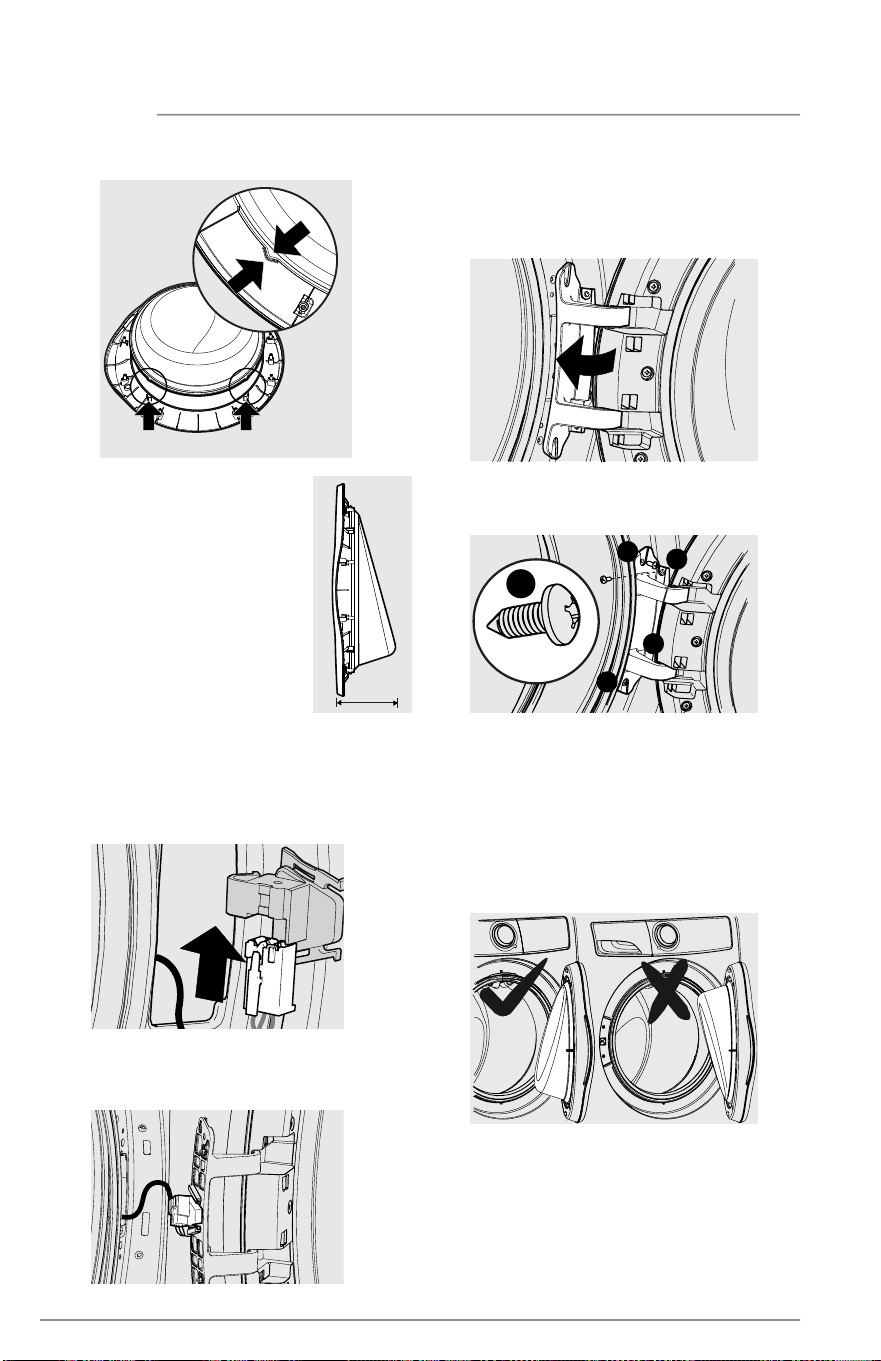
Fine Thread
x4
2
1
3
4
Connect to Notches
3. Make sure the alignment tabs reengage.
Reinstalling door assembly
1. Insert the wiring harness terminal into
the terminal cap and wrap the harness
into the harness retainer.
Verify reversed door operation
1. Test door for free, smooth swinging
operation and secure latching when
closed.
2. Verify inner door bowl is in the correct
orientation with the “scoop” at the
bottom.
2. Slide terminal cap onto back of hinge
plate until tabs snap into place.
3. Insert hinge locating pins into the hole
that were previously covered by the
plastic hole cover. Press on the face of
the hinge to snap the other locating
pins into place.
4. Reinstall all four screws removed earlier
- two front screws first, then two side
screws.
3. Plug in washer and close the door. Test
correct door lock operation by starting
a test cycle: lock should engage, and
door should not be able to be opened
until cycle is paused or canceled.
4. Reattach the inner door
to the outer door using
the nine screws removed
earlier. See illustration,
Step 1.
5. Check to verify that the
scoop (wider section) of
the door bowl is situated at
the BOTTOM of the door.
19
ACCESSORIES AND REPLACEMENT PARTS
Accessories
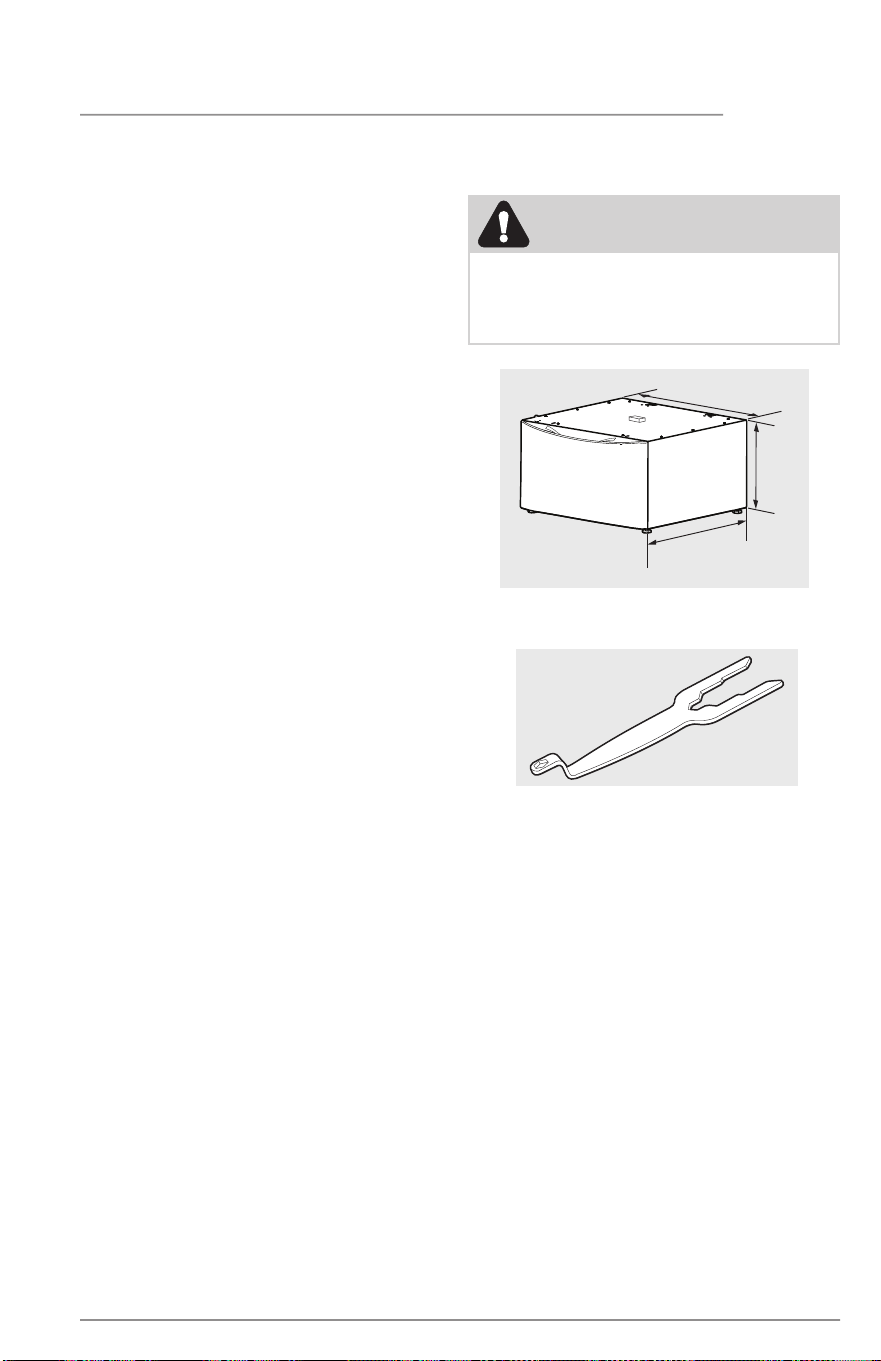
MATCHING STORAGE PEDESTAL*
White Pedestal - P/N EPWD257UIW
Titanium Pedestal - P/N EPWD257UTT
A storage pedestal accessory, specifically
designed for this washer may be used to
elevate the washer for ease of use. This
pedestal will add about 15” (38 cm) to the
height of your unit.
*Other colors may be available. Contact the
source where you purchased your washer.
DRYER STACKING KIT
P/N STACKIT7X
Depending on the model purchased, a
kit for stacking a matching dryer on top
of this washer may have been included in
the initial purchase of your dryer. If your
model did not include a stacking kit or
you desire another stacking kit, you may
order one.
INLET HOSE KITS
Please call 866-233-8353 (in Canada,
800-265-8352) to explore hose kit options
that will meet your specific installation
needs.
DRAIN HOSE EXTENSION KIT
P/N 137098000
In order to reach standpipe heights or
distances beyond the reach of the drain
hose supplied, order the Drain Hose
Extension Kit.
UNIVERSAL APPLIANCE WRENCH
P/N 137019200
A Universal Appliance Wrench is available
to aid in dryer/washer/pedestal feet
adjustment.
TOUCH UP PAINT PENS*
White - P/N 5304468812
Titanium - P/N 5304475700
*Other colors may be available. Contact the
source where you purchased your washer.
26.5”
(67 cm)
15”
(38 cm)
27”
(68.5 cm)
Replacement parts in U.S.
and Canada:
Universal Appliance Wrench
Storage Pedestal
If replacements parts are needed for
your washer, you can contact the source
where you purchased your washer, call
1-877-4ELECTROLUX (1-877-435-3287) in the
U.S. or 1-800-265-8352 in Canada, or visit
our website, www.electroluxappliances.com
in the U.S. or www.electroluxappliances.ca in
Canada for the Electrolux Authorized Parts
Distributor nearest you.
CAUTION
Failure to use accessories manufactured
by (or approved by) the manufacturer
could result in personal injury, property
damage or damage to the washer.
20
CONTROLS AND SETTINGS
This manual covers many models and not all cycles, options, or features listed are available
on every model. Consoles shown above for reference only. Your model may differ.
400 SERIES
HOT
WARM
COOL
ECO COLD
HEAVY
NORMAL
LIGHT
EXTRA L IGHT
HIGH
MEDIUM
LOW
NO SPIN
EXTENDED REFRESH
EXTRA RINSE
POWER
CYCL ES
TEMP SOIL SPIN
OPTIONS
DELAY TIME
CONTRO L LOCK
SANITIZE SOLI D SOIL MAX
SELECT
DE-SELECT
PERFECT S TEAM
STAI NTRE AT
HOLD ‘SELECT’
3s TO MUTE/UNMUTE
LUXCARE WA SH
NOR MAL
DELICATES
RINSE & SPIN
CLEAN WASHE R
HEAVY D UTY
WHIT EST WH ITES
18
MIN
FAST WAS H
PODS
CANCEL
STA R T
PAUS E
S
T
A
I
N
T
R
E
A
T
C
Y
C
L
E
S
MIN
CLOSE D OOR
CALL
SERVICE
O O RD
300 SERIES
600 SERIES
500 SERIES
ECO COLD
COOL
WARM
HOT
SANITIZE
EXTRA L IGHT
LIGHT
NORMAL
HE AVY
SOLID SO IL
ALLERGEN
PERFECT S TEAM
PURE RIN SE
STAI NTRE AT II
EXTENDED REFRESH
CONTROL LOCK
DE LAY TI ME
TEMP SOIL SPIN
OPTIONS
SELECT
DE-SELECT
HOLD ‘SELEC T’
3s TO MUTE/UNMUTE
NO SPIN
LOW
MEDIUM
HIGH
MAX
RINSE & SPIN
POWER
CLEAN WASHE R
LUXCARE PLUS WAS H
PODS
CANCEL
STA R T
PAUS E
DELICATES
15
MIN
FAST WASH
WHITEST WHITES
HEAVY DUTY
NORMAL
COLOR S
TOWELS
ACTIVEWEAR
S
T
A
I
N
T
R
E
A
T
I
I
C
Y
C
L
E
S
MIN
CLOSE DO OR
CALL
SERVICE
ANY STAIN BLOOD CHOCOLATE
O O RD
POWER
HOT
WARM
COOL
HEAVY
NORMAL
LIGHT
HIGH
MEDIUM
LOW
CYCL ES
NORMAL
20
MIN
FAST WAS H
DELICATES
RINSE & SPIN
CLEAN WASHE R
HEAVY DUTY
WHITES
CONTROL LOCK
DE LAY TI ME
EXTENDED REFRESH
EXTRA RINSE
ECO COLD EXTRA L IGHT NO SPIN
TEMP SOIL SPIN
LUXCARE WA SH
STA R T
PAUS E
OPTIONS
SELECT
DE-SELECT
HOLD ‘SELECT’
3s TO MUTE/UNMUTE
CANCEL
MIN
CLOSE D OOR
CALL
SERVICE
O O RD
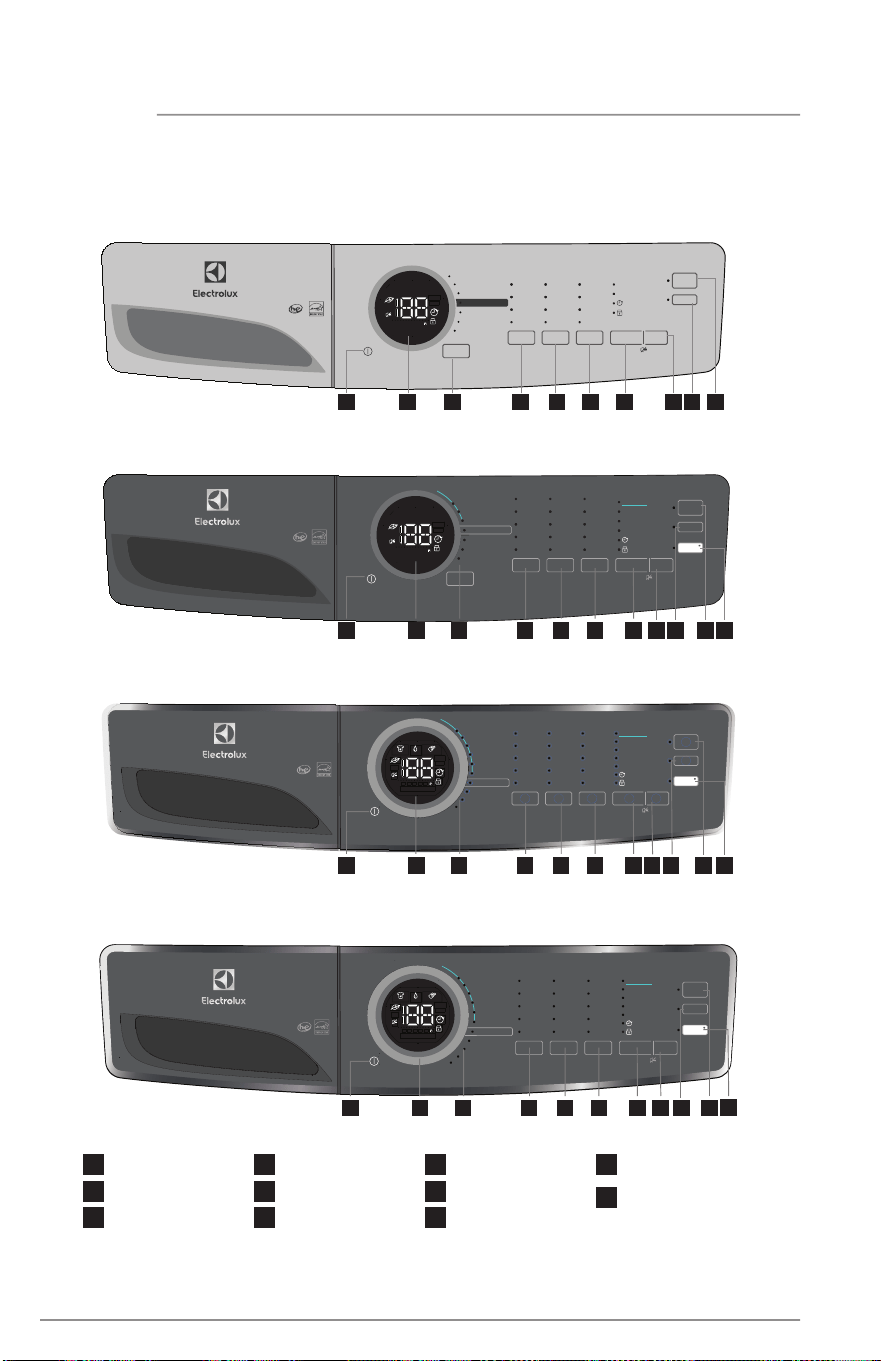
1
power
2
cycle selector
3
LED display
4
temperature
5
soil level
6
spin speed
7
options
8
set/select
9
cancel
10
start
11
PODS
®
(select models)
Model series
PODS
®
is a registered trademark of Procter & Gamble Company, Cincinnati OH, used under license by Electrolux.
S
T
A
I
N
S
O
A
K
C
Y
C
L
E
S
ECO COLD
COOL
WARM
HOT
SANITIZE
EXTRA L IGHT
LIGHT
NORMAL
HEAVY
SOLID SO IL
NO SPIN
LOW
MEDIUM
ALLERGEN
PERFECT S TEAM
PURE RINSE
STAI NSOAK
EXTENDED REFRESH
HIGH
MAX
TEMP SOIL SPIN
OPTIONS
SELECT
DE-SELECT
HOLD ‘SELECT’
3s TO MUTE/UNMUTE
CONTROL LOCK
DELAY TIME
SMARTBOOST
LUXCARE PLUS WAS H
PODS
CANCEL
STA R T
PAUS E
OPTIC W HITES
HEAVY DUTY
NORMAL
ACTIVEWEAR
COLORS
TOWELS
DELICATES
15
MIN
FAST WASH
HAND WASH
RINSE & S PIN
CLEAN WASHE R
MIN
CLOSE D OOR
CALL
SERVICE
ANY STAIN BLOOD CHOCOLATE
O O RD
POWER
2 71 63 954
10
8
11
2 71 63 954
10
8
11
2
2
7
7
1
1
6
6
3
3
9
9
5
5
4
4
10
8
8
11
10
21
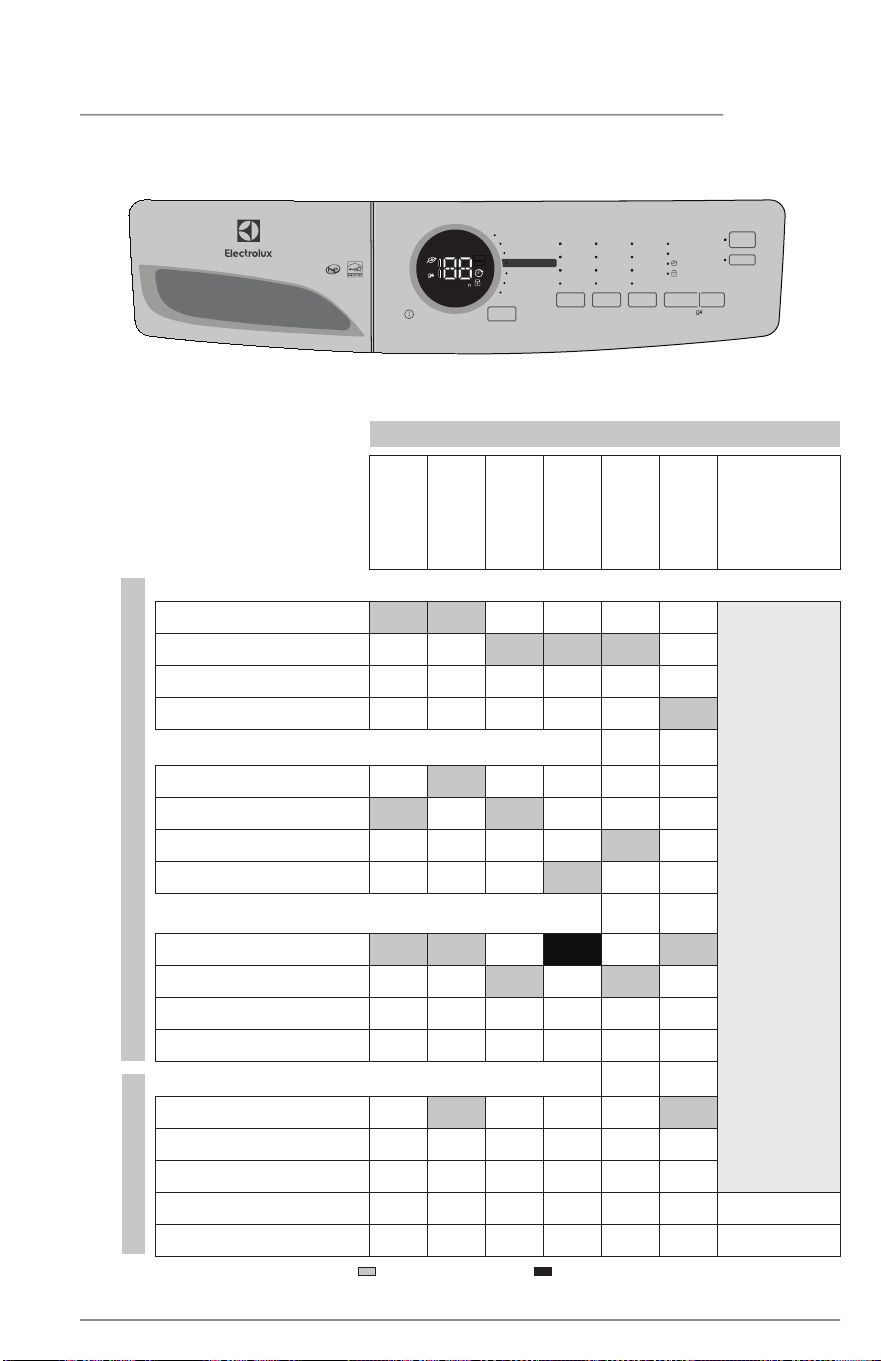
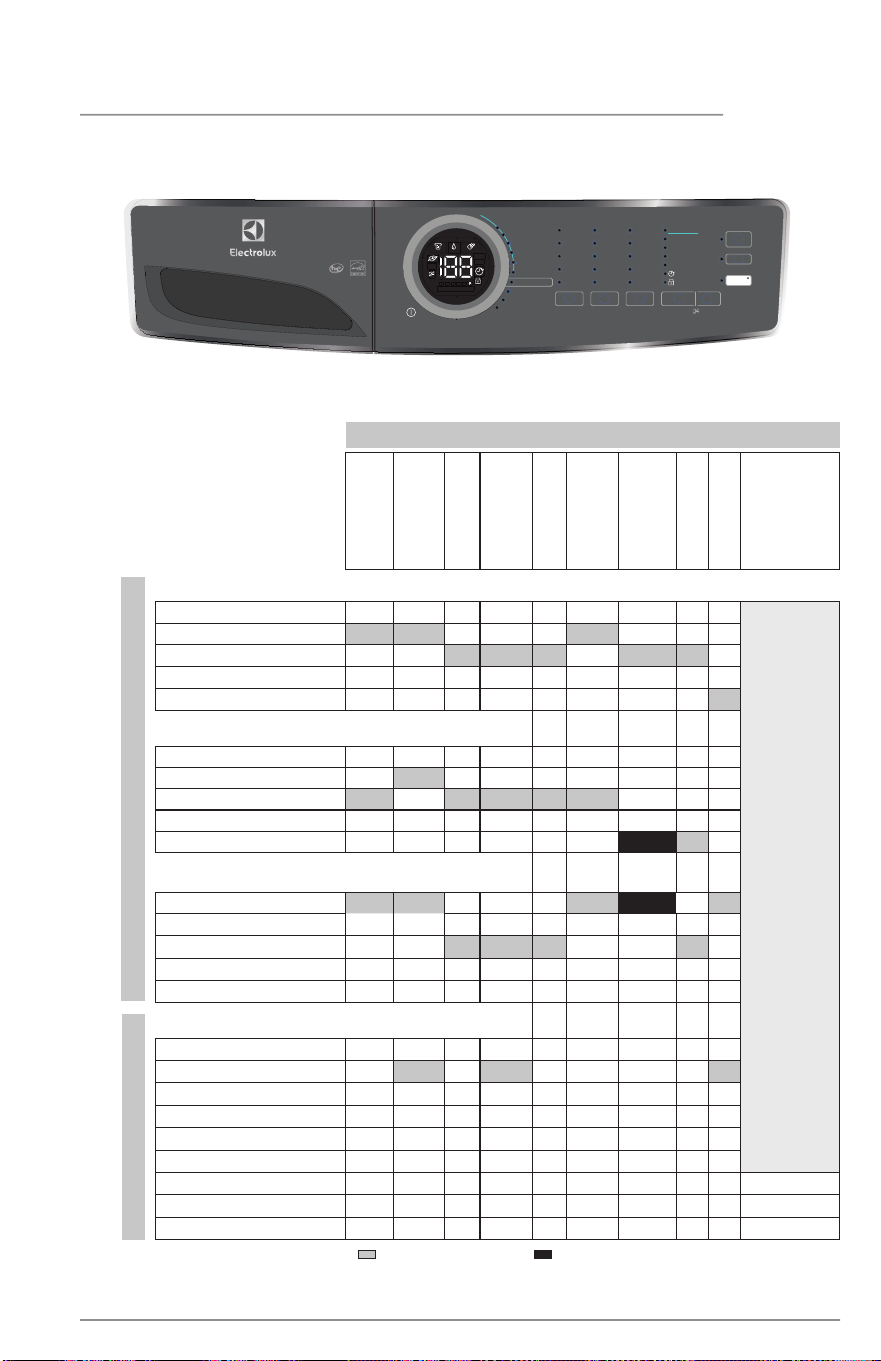
These temperature, spin speeds, soil levels and options are available with the following
cycles:
WHITES
HEAVY DUTY
NORMAL
20
MIN
FAST
WASH
DELICATES
RINSE & SPIN
CLEAN
WASHER
TEMP
HOT
NO OPTIONS AVAILABLE WITH THIS CYCLE.
DO NOT LOAD ANY ITEMS IN DRUM DURING SYSTEM CLEAN
CYCLE.
WARM
COOL
ECO COLD
SOIL
HEAVY
NORMAL
LIGHT
EXTRA LIGHT
SPIN
HIGH
MEDIUM
LOW
NO SPIN
OPTIONS
EXTRA RINSE
EXTENDED REFRESH
DELAY TIME
CONTROL LOCK
MUTE/UNMUTE
= Available selections.
= Factory presets. = Non-modifiable presets.
Settings chart - 300 series washer
POWER
HOT
WARM
COOL
HEAVY
NORMAL
LIGHT
HIGH
MEDIUM
LOW
CYCLES
NORMAL
20
MIN
FAST WAS H
DELICATES
RINSE & SPIN
CLEAN WASHE R
HEAVY DUTY
WHITES
CONTROL LOCK
DE LAY TI ME
EXTENDED REFRESH
EXTRA RINSE
ECO COLD E XTRA LIGHT NO SPIN
TEMP SOIL SPIN
LUXCARE WA SH
STA R T
PAUS E
OPTIONS
SELECT
DE-SELECT
HOLD ‘SELECT’
3s TO MUTE/UNMUTE
CANCEL
MIN
CLOSE D OOR
CALL
SERVICE
O O RD
CYCLE SELECTIONS
CYCLE SETTINGSCYCLE OPTIONS
CONTROLS AND SETTINGS
22
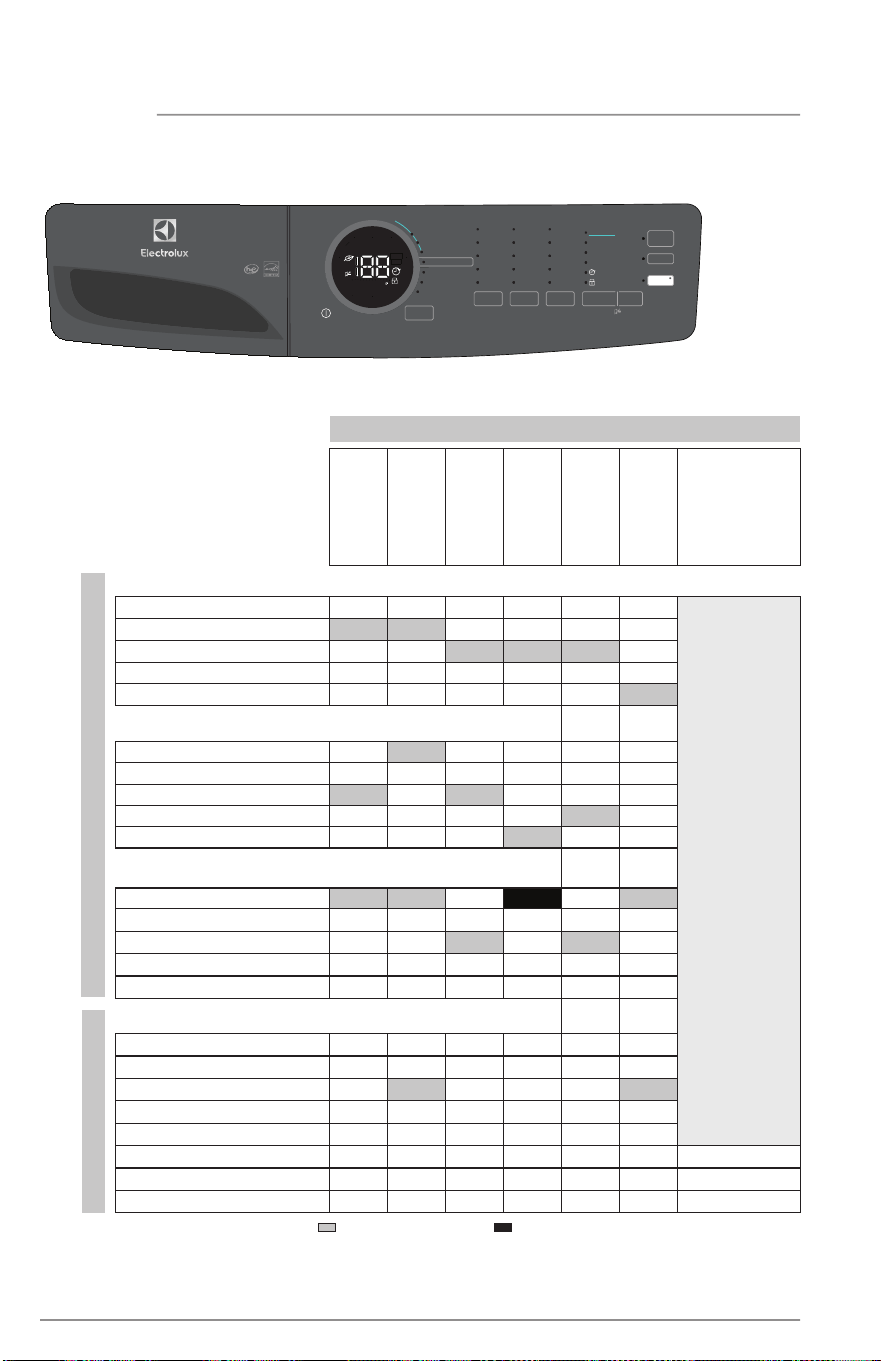
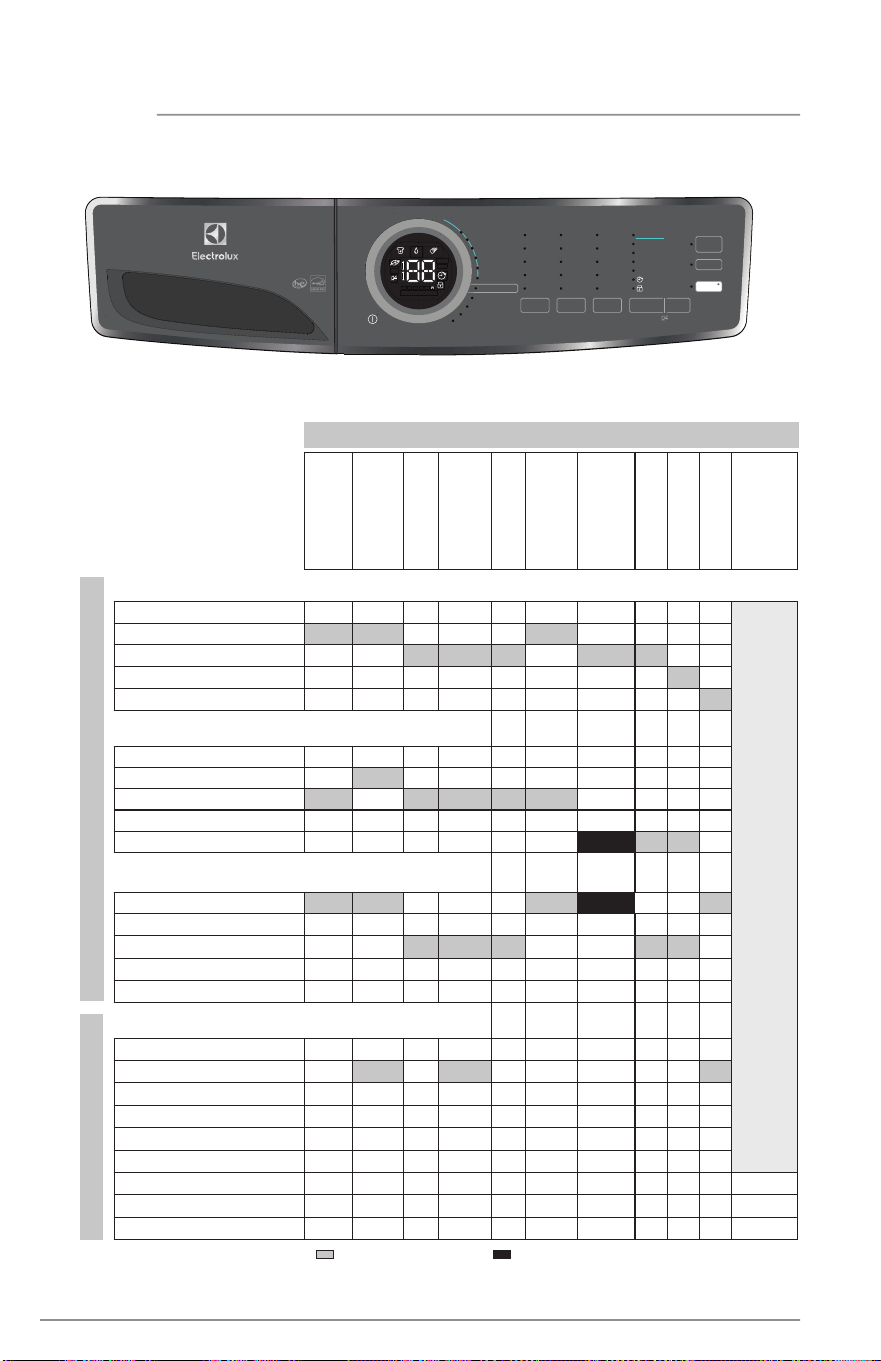
These temperature, spin speeds, soil levels and options are available with the following
cycles:
WHITEST
WHITES
HEAVY
DUTY
NORMAL
18
MIN
FAST
WASH
DELICATES
RINSE &
SPIN
CLEAN
WASHER
TEMP
SANITIZE
NO OPTIONS AVAILABLE WITH THIS CYCLE.
DO NOT LOAD ANY ITEMS IN DRUM DURING SYSTEM CLEAN
CYCLE.
HOT
WARM
COOL
ECO COLD
SOIL
SOLID SOIL
HEAVY
NORMAL
LIGHT
EXTRA LIGHT
SPIN
MAX
HIGH
MEDIUM
LOW
NO SPIN
OPTIONS
STAINTREAT
PERFECT STEAM
EXTRA RINSE
EXTENDED REFRESH
DELAY TIME
CONTROL LOCK
MUTE/UNMUTE
PODS
®
= Available selections.
= Factory presets. = Non-modifiable presets.
CYCLE SELECTIONS
CYCLE SETTINGSCYCLE OPTIONS
HOT
WARM
COOL
ECO COLD
HEAVY
NORMAL
LIGHT
EXTRA L IGHT
HIGH
MEDIUM
LOW
NO SPIN
EXTENDED REFRESH
EXTRA RINSE
POWER
CYCLES
TEMP SOIL SPIN
OPTIONS
DELAY TIME
CONTRO L LOCK
SANITIZE SOLI D SOIL MAX
SELECT
DE-SELECT
PERFECT S TEAM
STA INT REAT
HOLD ‘SELECT’
3s TO MUTE/UNMUTE
LUXCARE WA SH
NOR MAL
DELICATES
RINSE & SPIN
CLEAN WASH ER
HEAVY DUT Y
WHIT EST WH ITES
18
MIN
FAST WAS H
PODS
CANCEL
STA R T
PAUS E
S
T
A
I
N
T
R
E
A
T
C
Y
C
L
E
S
MIN
CLOSE D OOR
CALL
SERVICE
O O RD
Settings chart - 400 series washer
PODS
®
is a registered trademark of Procter & Gamble Company, Cincinnati OH, used under license by Electrolux.
CONTROLS AND SETTINGS
23
CONTROLS AND SETTINGS
ECO COLD
COOL
WARM
HOT
SANITIZE
EXTRA L IGHT
LIGHT
NORMAL
HE AVY
SOLID SO IL
ALLERGEN
PERFECT S TEAM
PURE RIN SE
STA INT REAT II
EXTENDED REFRESH
CONTROL LOCK
DE LAY TI ME
TEMP SOIL SPIN
OPTIONS
SELECT
DE-SELECT
HOLD ‘SELE CT’
3s TO MUTE/UNMUTE
NO SPIN
LOW
MEDIUM
HIGH
MAX
RINSE & SPIN
POWER
CLEAN WASHE R
LUXCARE PLUS WA SH
PODS
CANCEL
STA R T
PAUS E
DELICATES
15
MIN
FAST WASH
WHITEST WHITES
HEAVY DUTY
NORMAL
COLO RS
TOWELS
ACTIVEWEAR
S
T
A
I
N
T
R
E
A
T
I
I
C
Y
C
L
E
S
MIN
CLOSE D OOR
CALL
SERVICE
ANY STAIN BLOOD CHOCOLATE
O O RD
Settings chart - 500 series washer
These temperature, spin speeds, soil levels and options are available with the following
cycles:
WHITEST
WHITES
HEAVY
DUTY
NORMAL
ACTIVE
WEAR
COLORS
TOWELS
15
MIN
FAST
WASH
DELICATES
RINSE & SPIN
CLEAN
WASHER
TEMP
SANITIZE
NO OPTIONS AVAILABLE WITH THIS CYCLE.
DO NOT LOAD ANY ITEMS IN DRUM DURING SYSTEM CLEAN
CYCLE.
HOT
WARM
COOL
ECO COLD
SOIL
SOLID SOIL
HEAVY
NORMAL
LIGHT
EXTRA LIGHT
SPIN
MAX
HIGH
MEDIUM
LOW
NO SPIN
OPTIONS
STAINTREAT II
PURE RINSE
PERFECT STEAM
ALLERGEN
EXTENDED REFRESH
DELAY TIME
CONTROL LOCK
MUTE/UNMUTE
PODS
®
= Available selections.
= Factory presets. = Non-modifiable presets.
CYCLE SELECTIONS
CYCLE SETTINGSCYCLE OPTIONS
PODS
®
is a registered trademark of Procter & Gamble Company, Cincinnati OH, used under license by Electrolux.
24
S
T
A
I
N
S
O
A
K
C
Y
C
L
E
S
ECO COLD
COOL
WARM
HOT
SANITIZE
EXTRA L IGHT
LIGHT
NORMAL
HEAVY
SOLID SO IL
NO SPIN
LOW
MEDIUM
ALLERGEN
PERFEC T STEAM
PURE RINSE
STA IN SOAK
EXTENDED REFRESH
HIGH
MAX
TEMP SOIL SPIN
OPTIONS
SELECT
DE-SELECT
HOLD ‘SELECT’
3s TO MUTE/UNMUTE
CONTROL LOCK
DELAY TIME
SMARTBOOST
LUXCARE PLUS WA SH
PODS
CANCEL
STA R T
PAUS E
OPTIC W HITES
HEAVY DUTY
NORMAL
ACTIVEWEAR
COLORS
TOWELS
DELICATES
15
MIN
FAST WASH
HAND WASH
RINSE & S PIN
CLEAN WASH ER
MIN
CLOSE D OOR
CALL
SERVICE
ANY STAIN BLOOD CHOCOLATE
O O RD
POWER
Settings chart - 600 series washer
These temperature, spin speeds, soil levels and options are available with the following
cycles:
OPTIC
WHITES
HEAVY
DUTY
NORMAL
ACTIVEWEAR
COLORS
TOWELS
15
MIN
FAST
WASH
DELICATES
HAND WASH
RINSE & SPIN
CLEAN
WASHER
TEMP
SANITIZE
NO OPTIONS AVAILABLE WITH THIS CYCLE.
DO NOT LOAD ANY ITEMS IN DRUM DURING SYSTEM CLEAN
CYCLE.
HOT
WARM
COOL
ECO COLD
SOIL
SOLID SOIL
HEAVY
NORMAL
LIGHT
EXTRA LIGHT
SPIN
MAX
HIGH
MEDIUM
LOW
NO SPIN
OPTIONS
STAINSOAK
PURE RINSE
PERFECT STEAM
ALLERGEN
EXTENDED REFRESH
DELAY TIME
CONTROL LOCK
MUTE/UNMUTE
PODS
®
= Available selections.
= Factory presets. = Non-modifiable presets.
CYCLE SELECTIONS
CYCLE SETTINGSCYCLE OPTIONS
PODS
®
is a registered trademark of Procter & Gamble Company, Cincinnati OH, used under license by Electrolux.
CONTROLS AND SETTINGS
25
Cycle selection
Press the power button to turn on the
unit. Then, turn the cycle selector in either
direction or press the cycles button
(dependent on model) to scroll to the
desired cycle. The indicator light for that
cycle will be illuminated.
The estimated cycle time will appear on the
LED display and indicator lights adjacent
to the default settings (water temperature,
final spin speed, and soil level) will illuminate
for the cycle selected. See
Washer Settings
Chart
for default settings for each cycle.
Cycle settings and cycle options can
be changed using the temp, spin and
soil buttons. See
Cycle Settings
and
Cycle Options
for detailed directions and
descriptions of available settings.
To change the cycle once the cycle has
begun, press cancel, select a new cycle, and
press start again.
To stop the cycle, press cancel.
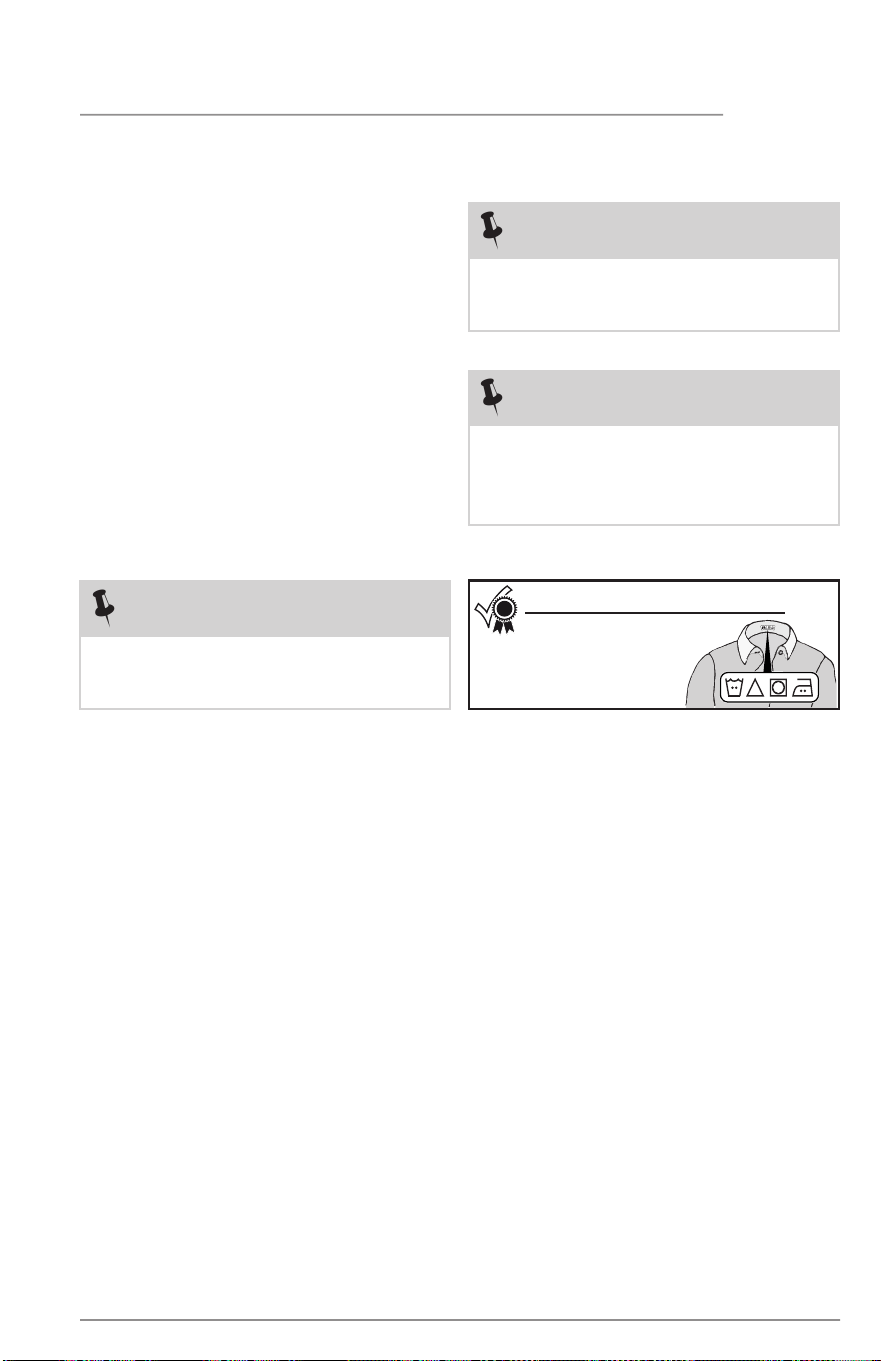
For best results
Follow the fabric care
label instructions
on items to be
washed.
CONTROLS AND SETTINGS
NOTE
Turning the cycle selector knob without
canceling the cycle first, will not change
the cycle.
NOTE
Using PODS
®
setting may increase fast
wash time by several minutes.
NOTE
For spin only cycle deselect extra rinse.
For drain only cycle select no spin.
See
Cycle Options
for rinse options and
Cycle Settings
for spin settings.
26
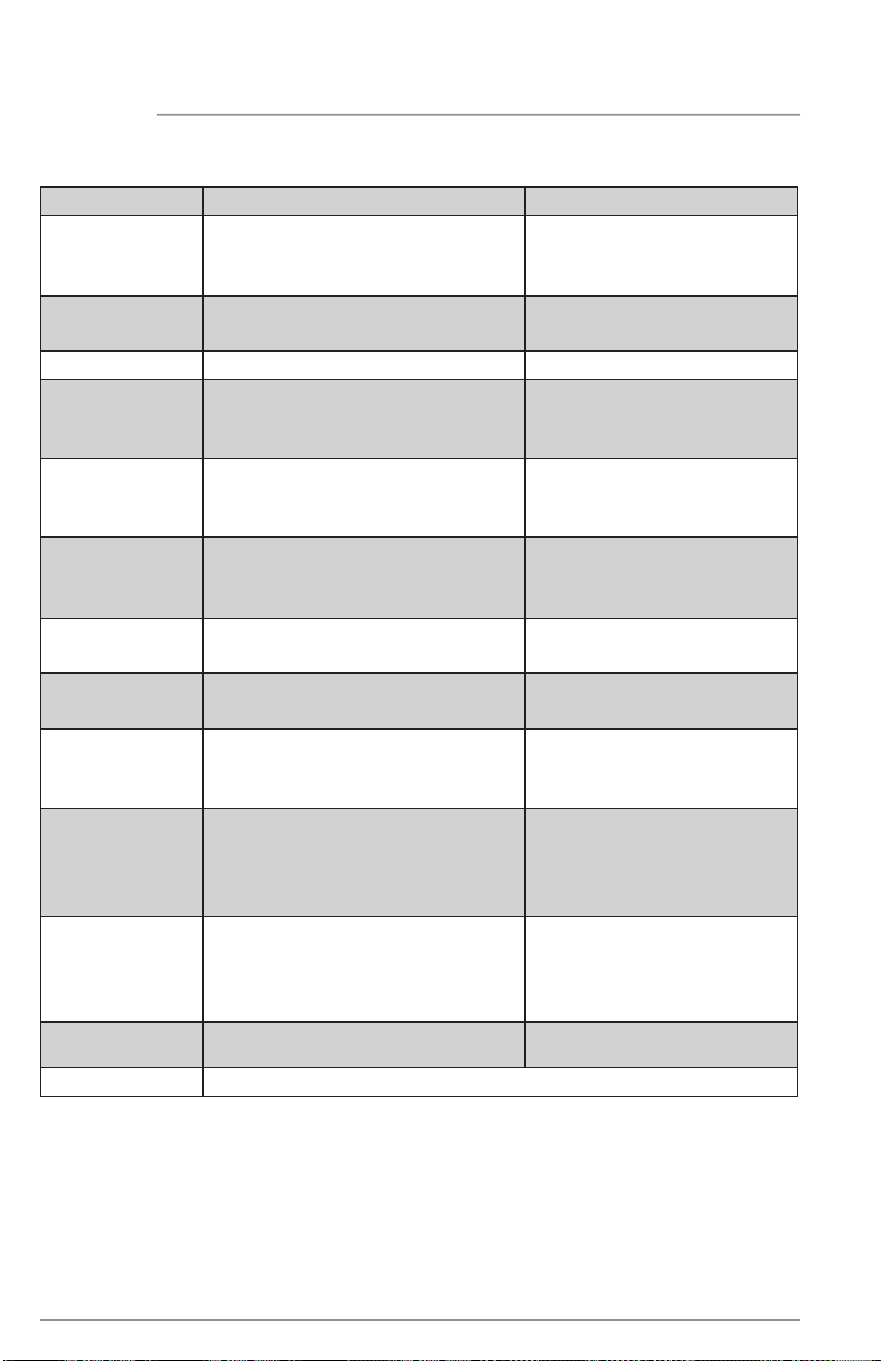
LOAD LOAD TYPE CYCLE DESCRIPTION
OPTIC WHITES White loads • SmartBoost action
• longer agitation
• optimized temperatures
WHITEST WHITES White loads • longer agitation
• higher temperatures
WHITES White loads • longer agitation
HEAVY DUTY Large heavily soiled loads • longer agitation
• aggressive cleaning motion
• higher temperatures
NORMAL Mixed loads, cotton • moderate agitation
• moderate cleaning motion
• most energy efficient
ACTIVEWEAR Highly solid lightweight synthetic
apparel
• longer agitation
• mild cleaning motion
• extra rinse
COLORS Lightly soiled dark or dyed fabrics • mild cleaning motion
• lower temperatures
TOWELS Towels • long agitation
• higher temperatures
FAST WASH
(varies by model)
15/18/20 min.
Small lightly soiled loads (3-5 pieces) • aggressive cleaning motion
• extra rinse
DELICATES Small lightly soiled loads (delicate
fabrics)
• shorter agitation
• gentle cleaning motion
• lower temperatures
• lower spin speeds
HAND WASH Small, lightly soiled loads and very
delicate fabrics
• very short agitation
• long soaking times
• lower temps
• lower spin speeds
RINSE & SPIN Rinse and spin only (cold rinse or
add fabric softener)
• cold temperature
CLEAN WASHER See “Care and Cleaning” section of the manual
Cycles
Cycle settings
Washing temperature
The appropriate washing temperature
will automatically be indicated for the
cycle selected. To change the preset
temperature, press the temp button to scroll
to the desired setting. Select a wash water
temperature according to fiber content,
colorfastness and soil level.
To protect your fabrics, not all temperatures
are available with every cycle. If a
temperature is not appropriate for the cycle,
it cannot be selected and will not be lit by
pressing the temp button.
*All cycles not available on every model. See Page 19.
CONTROLS AND SETTINGS
27
As a precaution, the washer door remains
locked when the water temperature reaches
130°F (55°C)
allergen (on select models)
Removes dust mites and dander from
household objects. The temperature does
increase on this setting.
PODS
®
is a registered trademark of Procter & Gamble Company, Cincinnati OH, used under license by Electrolux.
NSF Protocol P351
Allergen Reduction Performance
of Residential and Commercial,
Family-Sized Clothes Washers
NSF Protocol P172
Sanitization Performance of Residential
and Commercial, Family-Sized Clothes
Washers
The temperature selected for the cycle will
be remembered and recalled each time that
cycle is selected in the future.
All wash water temperatures are automatically
regulated to maximize detergent effectiveness
and improve washing performance. The
water heater setting and its distance from
the washer, water usage in other parts of
the home, and seasonally low ground water
temperature in some geographic areas can
affect water temperature.
sanitize (on select models)
Use the sanitize setting to clean and sanitize
heavily soiled, colorfast fabrics including towels,
bedding, cloth diapers, and children’s clothing.
It is recommended that you set your water
heater to 120°F (49°C) or higher to ensure
proper performance during this cycle. If the
setting is lower or the load is extra large, the
cycle time may be extended.
When used with the heavy duty, towels,
optic whites and whitest whites, cycles, the
sanitize setting will kill 99.9% of bacteria with
no carryover of bacteria between loads. No
bleach or harsh chemicals are needed, but
higher temperatures are required. Please
check fabric care labels to prevent damage.
CONTROLS AND SETTINGS
hot
Use this setting for heavily soiled white or
colorfast cottons and blends.
warm
Use this setting for normally soiled white or
colorfast cottons or blends.
cool
Some warm water will automatically blend
with cold tap supply to achieve a precise
cold. Use this setting for lightly soiled non-
colorfast items, knits, delicates, and hand
washables.
eco cold (on select models)
Wash and rinse temperatures are equivalent
to temperature of cold tap supply. Use this
selection for fabrics and colors that are
prone to dye transfer. For use with cold
water
detergents.
The wash water is heated by an internal boost
heater to a maximum of 152°F (67°C) as the
load tumbles. Cold water is added to cool
down the load prior to drain and spin.
NOTE
The heavy duty, towels, optic whites
and whitest whites with sanitize setting
cycles have been designed to meet the
requirements of NSF P172 protocol for
sanitization efficacy.
NOTE
If the voltage at your outlet is under 110v,
the internal heater may not adequately
heat the wash water. If the cycle is
interrupted while the water is heating, the
final temperature of the wash water may
be lower and sanitation may be reduced.
NOTE
If the wash cycle is paused or canceled
while the internal drum temperature is
above 130°F (55°C), the door will remain
locked until it cools. You may manually
perform a rinse & spin cycle to cool the
internal temperature sooner.
NOTE
The heavy duty, optic whites and
towels cycles with the allergen option
selected have been designed to meet the
requirements of the NSF P351 protocol
for allergen reduction efficacy. These
cycles and settings will kill dust mites
and eliminate at least 95% of pet dander.
Since higher temperatures are required,
please check fabric care labels to prevent
damage.
28
Cycle options
Max (on select models), high, medium and
low (on some models) spin speeds are
available for each cycle. The spin speed
and/or duration of final spin vary from model
to model and cycle to cycle.
Increasing the spin speed will extract more
water, decrease drying time and conserve
energy. Decreasing the spin speed will
reduce wrinkling.
Select low spin speed (on some models) to
gently spin items that should be line dried.
Use no spin to omit the final spin at the
end of the cycle. The load will be very wet.
Remove items from the wash drum to drip
dry or select a spin only cycle to remove
excess water at a more convenient time.
Spin speed
The default options for each cycle will
automatically be chosen when a cycle is
selected. To protect fabrics, not all options
are available for all cycles. If an option is
not available for a cycle, the indicator will
not light.
options
select
de-select
Selecting options
Press the option button to scroll though
the options until the indicator light for the
desired option flashes, then press select.
The indicator light will illuminate when
the option has been selected. Follow the
same steps to deselect an option. The
indicator light will turn off when the option is
deselected.
All settings or options selected for the cycle,
except sanitize (on select models), perfect
steam
TM
(on select models), and stain
treatment options, will be remembered and
recalled each time that cycle is selected
in the future. To return to factory settings,
press and hold soil and options buttons at
the same time and hold for 3 seconds until
the confirmation signal sounds. To prevent
unintentional and accidental exposure
of delicate material to excess heat or
unexpected steam, the sanitize, perfect
steam
TM
and all stain treatment options will
need to be reselected each time.
Stain treatment options
(on select models)
Your washer is equipped with powerful stain
treatment tools. Depending on your model,
use one of the options below to deal with
tough stains on your garments. See step 5
in the
Operating Your Washer
section in this
manual for details on adding stain additives
to the dispenser.
StainTreat (400 series washer)
Select this option to add a short initial wash
period to available cycles using the stain
treatment additives in the stain soak/treat
compartment. After the stain wash phase,
the load will automatically advance to the
main wash cycle.
StainTreatII (500 series washer)
Select this option when available and rotate
the cycle selector to rotate through the
stain types below. Stain treatment and main
detergent will recirculate in the agitating load
for approximately 20 minutes and then the
washer will advance to the main wash cycle.
• Any Stain
Recirculating wash solution will be
heated by boost heater.
• Blood
Recirculating wash solution will NOT
be heated by boost heater to prevent
setting blood stains.
CONTROLS AND SETTINGS
Adjust the wash time based on the soil level
of each load. Solid soil (on select models),
heavy, normal, light and extra light (on
some models) soil levels are available.
Soil level
NOTE
The washer will ALWAYS use a small
amount of HOT water to dissolve the pack
when the PODS
®
option has been selected.
NOTE
If changes to the settings or options are
attempted after the cycle starts, you will
hear several beeps when the buttons are
pressed. To change settings or options,
press start/pause, make the new selections
and press start/pause again.
29
CONTROLS AND SETTINGS
• Chocolate
Stain wash time is extended with
additional heating by boost heater.
StainSoak (600 series washer)
Similar to StainTreatII above with the added
feature of detergent/treatment
mixing with SmartBoost pump technology
before the Stain washing phase.
perfect steam
TM
(on select models)
Select this option to add approximately 20
minutes of tumbling in steam.
extra rinse (on select models)
Use this option when additional rinsing is
desired to remove excess dirt and detergent. It
is recommended for heavily soiled loads or if
household members have sensitive skin.
pure rinse (on select models)
Use this option to reduce detergent residues
and fragrances that can irritate skin which
rinses cleaner than the extra rinse cycle.
wrinkle release (on select models)
After the final spin, the washer will perform a
“dry” agitation to loosen the garments from
the side of the drum.
Wash cycle options
IMPORTANT
• If steam is selected, rinse temperatures
will be elevated.
• If the wash cycle is paused or
cancelled during a steam cycle, the
door will remain locked until it cools.
You may manually perform a rinse
& spin cycle to cool the internal
temperature sooner.
• During a steam cycle, steam exiting
from the rear vent of the washer is
normal and not cause for alarm.
extended refresh (on select models)
Select extended refresh if you will be unable
to remove the load right after the cycle is
complete. The washer recognizes the load
has sat too long and will do a rinse and spin
to keep the load fresh for up to 12 hours.
When you are ready to remove the load
during the extended refresh segment, you
must press cancel to end the cycle and
open the door.
PODS
®
(on select models)
Select this option when using a detergent
pack in a model equipped with a PODS
®
button (on select dispenser only). This option
will divert the flow of water to the detergent
pack compartment optimizing the detergent
pack performance.
Control options
control lock
To lock the controls between cycles, scroll to
the control lock option and press select. The
control lock icon will show on the LED display.
To unlock the controls scroll to the control
lock option again and press select. Use this
feature to reduce the likelihood of accidental
operation by children. Washer cycles will not
run when control lock is activated.
delay time
Use delay time
to delay the start of the
washing cycle from 30 minutes to 12 hours.
To turn on the delay time option, press
options to scroll to the delay time icon and
press select. Use the cycles button (300/400
models) or turn the cycle selector (500/600
models) to select the desired delay time and
press start. The delay time icon will illuminate
on the LED display to indicate the delay
time option is activated. The time will begin
counting down on the LED display once the
washer start/pause button has been pressed.
PODS
®
is a registered trademark of Procter & Gamble Company, Cincinnati OH, used under license by Electrolux.
NOTE
• Steam may not necessarily be visible
inside drum during a steam wash cycle.
• Steam may not be present during entire
steam wash cycle.
30
Chime
A signal will sound at the end of each cycle
(and periodically during extended refresh) if
option is activated.
To mute or unmute the chime, press and hold
the select button for 3 sec.
MIN
CLOSE DOOR
CALL
SERV ICE
ANY STAIN BLOOD CHO CO L ATE
O O RD
options
select
de-select
hold ‘select’ 3 s to mute/unmute
Other features
LED display
The estimated total cycle time will be
displayed when the cycle is selected. The
time may increase if water pressure is low,
oversudsing occurs or the load becomes
unbalanced. The approximate time
remaining will be displayed during the cycle.
The eco, control lock, close door, mute
(some models), and delay time will also
appear on this LED display.
Icons may vary according to model.
Eco indicator
The eco symbol will light up on the LED display
to indicate that the selected combination of
temperature, spin speed and options are eco
friendly.
(60 sec loop)
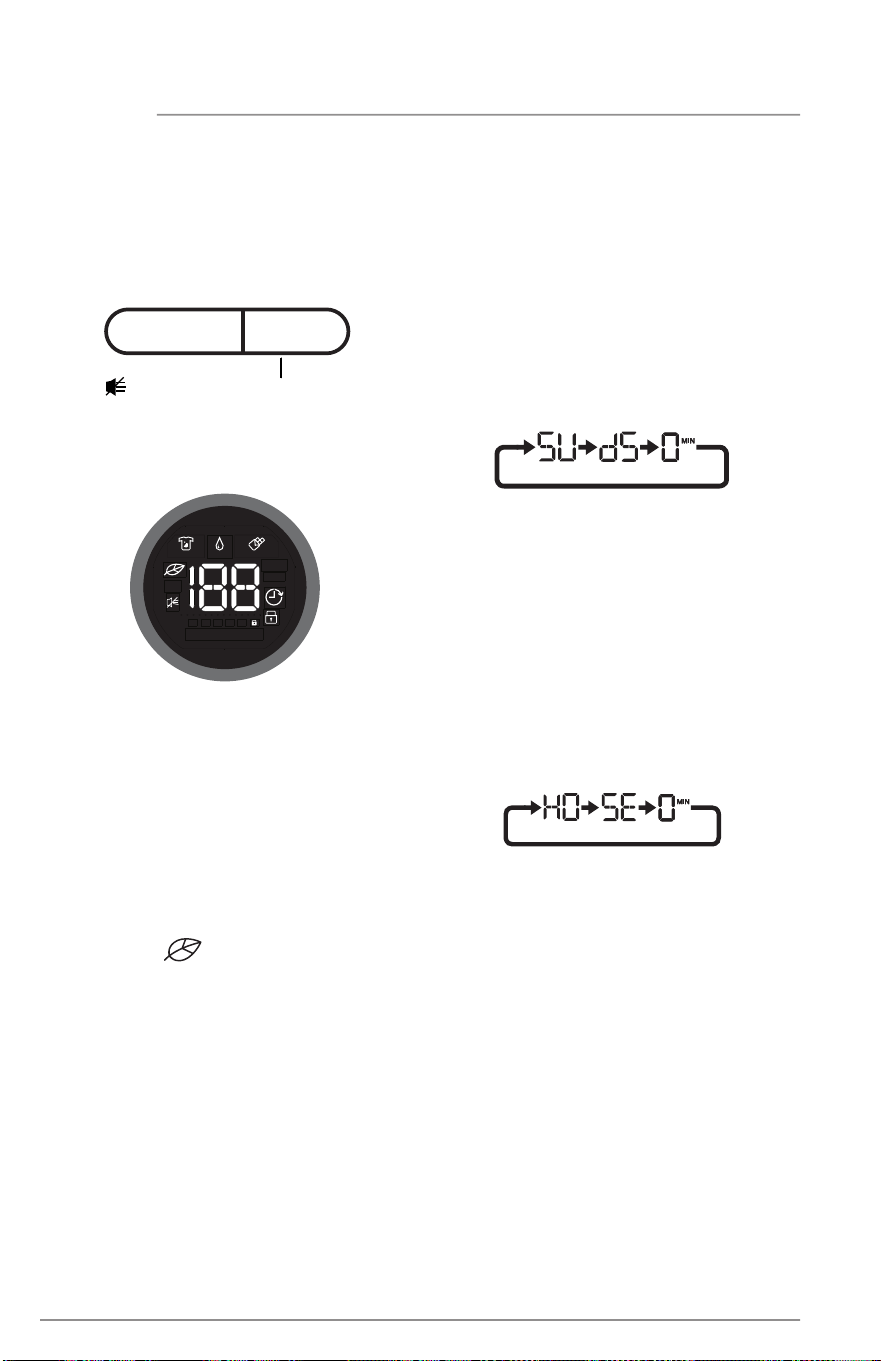
Reversed Hose Detection
If condition is detected where the inlet
hoses have been installed incorrectly (hot
supply to cold inlet and cold supply to hot
inlet), the washer will alert you. The LED will
display “HO” followed by “SE” and then the
remaining cycle time (0 min) for 60 seconds
and then repeat. Acknowledge the reversed
hose condition by pressing the cancel
button. Shut off each water supply valve and
attach each supply hose to the correct inlet
connection on the washer.
Drum light (on select models)
The drum light will come on whenever
the door is opened to illuminate the drum
during loading and unloading. Closing the
door turns off the light. The drum light will
automatically turn off if the door is left open
more than 3 minutes.
Reversible door (on select models)
Your washer may be equipped with a
reversible door. The door can be hinged on
the right or left side.
Oversuds protection
A situation where oversudsing has been
detected by the washer will result in the
washer requiring additional rinses until the
suds have been cleared. Each extra rinse
the washer performs to clear the suds will
add approximately 5 minutes to the cycle
duration. The LED will display “SU” followed
by “dS” and then the remaining cycle time (0
min) for 60 seconds and then repeat. Press
cancel to turn off the alert message. The
washer will continue to perform rinse cycles
until suds are removed.
(60 sec loop)
CONTROLS AND SETTINGS
31
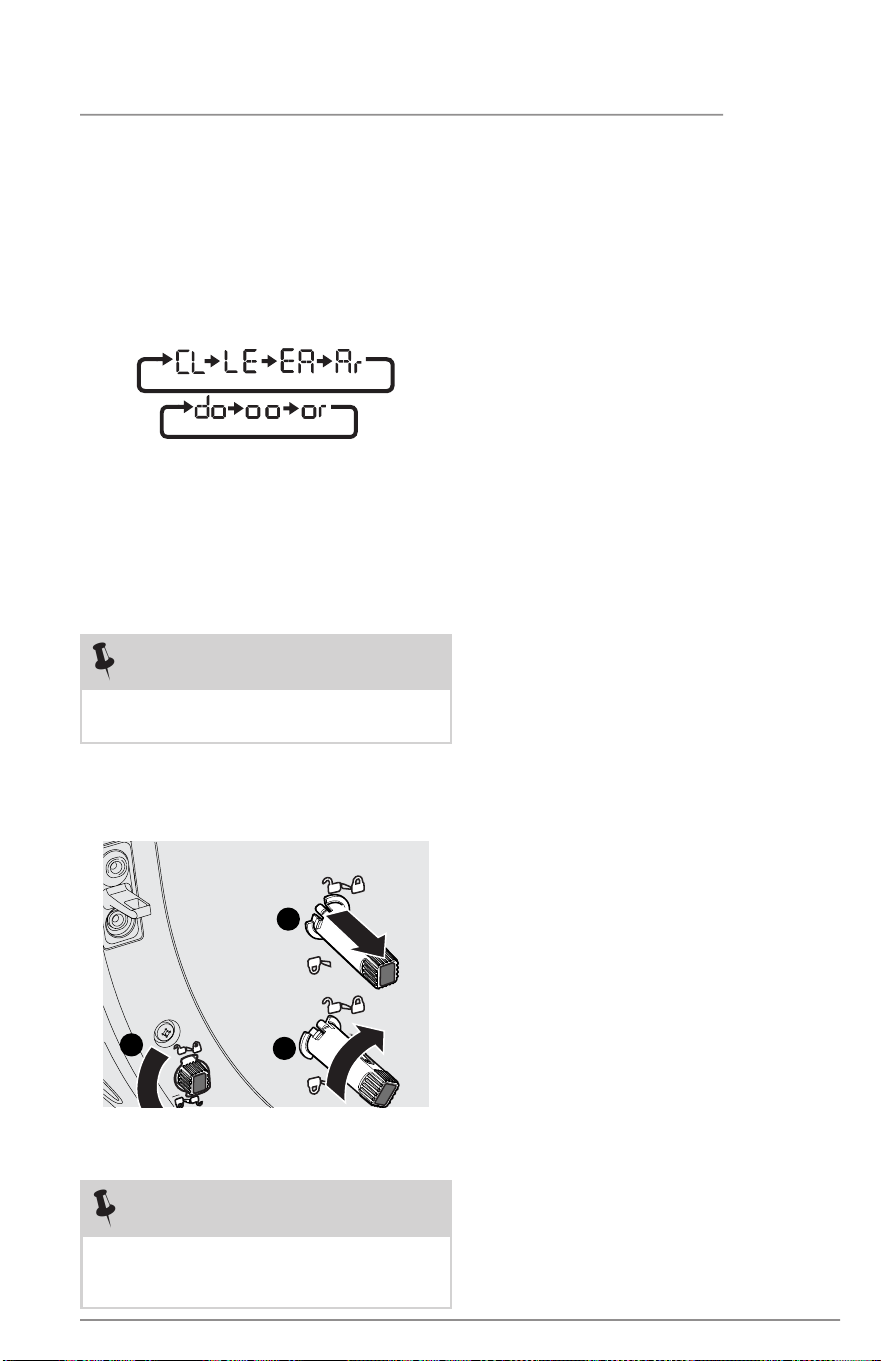
Door stand ventilation
Help prevent odor buildup and reduce
humidity between washes by utilizing your
washer’s door stand ventilation feature.
Open the door, locate the stand below the
door latch and rotate the stand counter-
clockwise to unlock it.
The stand is spring loaded and will extend.
Rotate it clockwise to lock in the extended
position.
2
3
1
Trapped item detection
If an item is detected to be trapped between
the door and the door gasket, the washer
will pause the cycle and play an alert chime.
The LED will display a loop of “CLEAr door”
as shown below until the cancel button is
pressed. Press the cancel button to unlock
the door and remove the trapped item, then
close the door and restart the cycle.
(60 sec loop)
(60 sec loop)
CONTROLS AND SETTINGS
To disengage the stand, rotate to unlock, push
the stand in and rotate to lock position.
NOTE
If unable to rotate the stand by hand, a coin
or flat blade screw driver can be used.
NOTE
If door stand will not turn to locked
position, fully turn it to unlock position and
try to lock again.
32
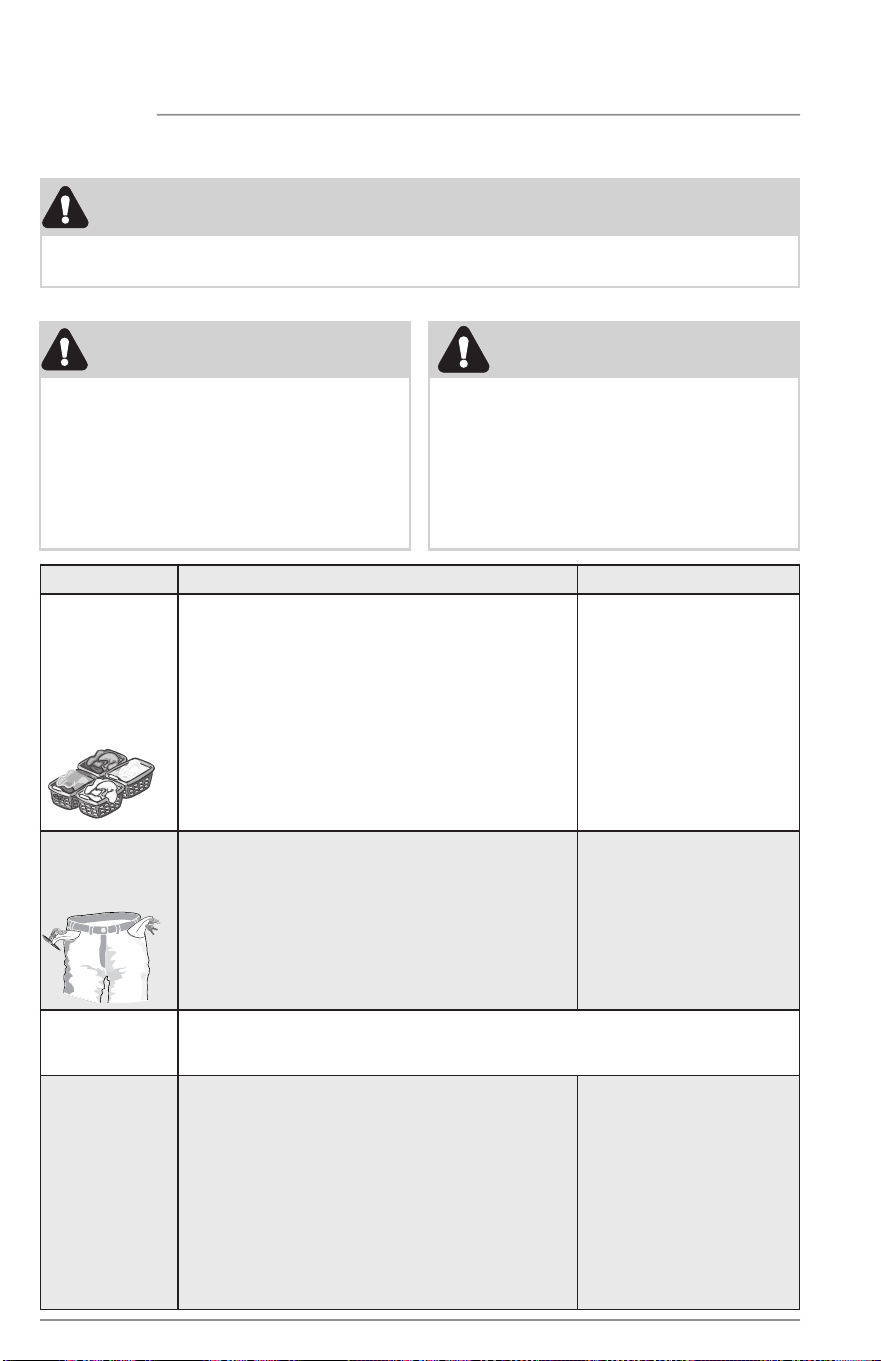
STEPS
TIPS IMPORTANT
1. Sort
laundry
into loads
that can
be washed
together.
• Sort by recommended cycle and water
temperature.
• Separate white, light, and colorfast items from
dark and non-colorfast items.
• Separate items that shed lint from items
that attract lint. Casual, synthetic, knit, and
corduroy items will pick up lint from towels,
rugs, and bedspreads.
• Separate heavily soiled items from lightly
soiled items.
• Separate lacy, sheer, loosely knit, or delicate
items from durable items.
DO NOT machine
wash items containing
fiberglass. Small particles
of fiberglass left in drum
may transfer to fabrics in
other loads and cause
skin irritation and/or
damage to fabrics.
DO NOT wash water
resistant and water
repellent type clothing or
other materials
2. Prepare
items for
washing.
• Empty pockets.
• Brush off lint and dirt. Shake out rugs and
beach towels.
• Close zippers, fasten hooks, button buttons,
and tie strings/sashes. Remove non-washable
trims and ornaments.
• Place delicate and small items (bras, hosiery,
etc.) in a mesh bag (not included).
Mend rips and tears to
prevent further damage
during washing.
Turn knit items inside out
to prevent pilling.
3. Pretreat
stains and
heavy soil.
See stain treatment function in
Cycle Options
for your particular model or
Stain Removal Guide
for more information.
4. Add
laundry
load to
wash tub.
• Combine large and small items in a load.
Load large items first.
• Large items should not be more than half the
total wash load.
• Washing single items is inefficient and may
cause an out-of-balance load. Add 1 or 2
similar items to help balance load.
• Wash single heavy items (comforter, sleeping
bag, etc.) separately.
• The washer can be fully loaded, but the
items should not be tightly packed. The door
should close easily.
DO NOT overload the
washer.
DO NOT WASH: Water
resistant and water
repellent clothing or other
materials.
Operating the washer
CAUTION
ENTRAPMENT and TIP-OVER HAZARD
DO NOT leave the door open if there are
small children or pets present. An open
door could entice children to hang on
the door or crawl inside the washer. If
there are no small children present, you
may leave the door ajar to prevent odor
build up.
WARNING
To reduce the risk of fire, electric shock or injury to persons, read the Important Safety
Instructions in this
Use & Care Manual
before operating your washer.
WARNING
RISK OF INJURY
DO NOT wash water resistant and water
repellent clothing or other materials.
Failure to follow these instructions may
result in an abnormal vibrating and out-
of-balance condition that could result in
physical injury, property damage, and/or
appliance damage.
OPERATING INSTRUCTIONS

33
STEPS
TIPS IMPORTANT
1. Add wash
products to
dispenser.
• Water conditioners, detergent boosters
and enzyme products may be added
with detergent.
• See
Adding Laundry Products
for de-
tailed information on the use of the prod-
uct dispensers.
• See
Adding Laundry Products
for
detailed information on the use of
various wash products (detergent,
bleach, stain treatment, fabric softener,
etc).
Follow manufacturer’s
instructions and
recommendations when
using wash products.
Open and close the
dispenser drawer slowly.
Closing the drawer too
quickly could result in early
dispensing of the bleach or
fabric softener.
2. Select the
cycle and
settings for the
load.
• See
Cycle Selection, Cycle Settings, and
Cycle Options
for detailed descriptions
of cycle controls.
• See
Cycle Setting Charts
to determine
which settings are available for each
cycle.
• To provide the best care, not every set-
ting or option is available with every cy-
cle. If a setting or option is not available
for the cycle selected, the indicator will
not light.
Follow fabric care label
instructions on items to
be washed.
Make sure that the PODS
®
option is selected when
using models that have a
separate detergent pack
compartment. See Adding
Laundry Detergent to the
Adaptive Dispenser™
3. Start the
washer.
• Close the door and press start/pause.
The washer will not operate with the
door open. “CLOSE DOOR” will be dis-
played as a reminder to close the door.
• To add a forgotten item to the washer
any time during the wash portion of the
cycle, press start/pause. When the door
unlocks, open the door, add the item,
close the door and press start/pause to
resume cycle.
• To change settings or options after the
cycle has begun, press start/pause,
change the settings, and then press start/
pause. If the cycle is not paused first, the
unit will emit several beeps when the but-
tons are pressed but no changes to the
cycle will be applied.
• To change the cycle once the cycle has
begun, press cancel to cancel the cycle,
select the new cycle, and press start/
pause to begin the new cycle. Changing
a cycle selection without cancelling the
current WILL NOT change the cycle.
• To cancel a cycle, press cancel.
• A signal will sound at the end of the cy-
cle if the chime option is not set to mute.
DO NOT force door open.
As a safety measure, the
door will automatically lock
during the entire wash cycle.
Pause or cancel the wash
load to unlock the door.
If the cycle is interrupted
during spin, the door lock
will not release until the tub
has stopped spinning.
If the water level is above
the bottom of the door
opening/flexible door gas-
ket, the lock will not release.
4. Remove items
from washer
when cycle
has ended.
• Remove items when the cycle ends and
place in dryer, line dry or dry flat as
directed on the fabric care label.
Excess wrinkling, color transfer
or odors may develop in items
left in the washer after the
cycle has ended.
PODS
®
is a registered trademark of Procter & Gamble Company, Cincinnati OH, used under license by Electrolux.
OPERATING INSTRUCTIONS
34
Use a low-sudsing, high efficiency
detergent to prevent oversudsing in
front load washers. Look for this
symbol on the detergent label:
For best results
Detergent, stain treatment (on select
models), liquid chlorine bleach and liquid
fabric softener will be dispensed at the
proper times in the cycle.
Use the cap or scoop provided by the
detergent manufacturer to measure the
amount recommended. Detergent dosage
may need to be adjusted for water
temperature, water hardness, load size and
soil level.
Adding laundry products
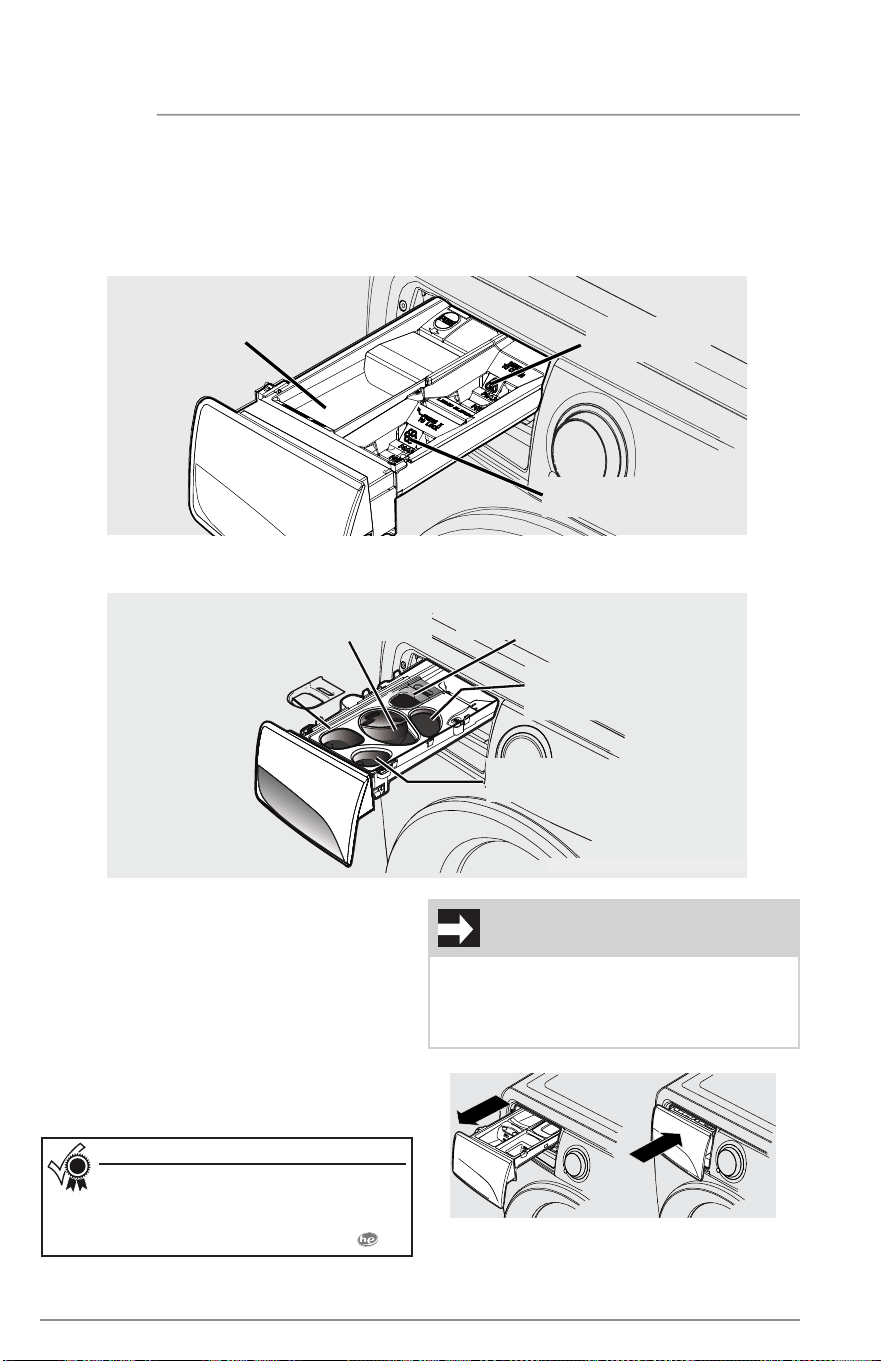
Product dispenser - Adaptive Dispenser™ (400, 500, and 600 Series)
Product dispenser - three compartment dispenser (300 Series)
FPO
Liquid
Bleach
Stain
Soak/Treat
Detergent Pack
Compartment*
Liquid Fabric
Softener
Detergent -
Liquid or Powder
Laundry product dispensers
*Max. 2 packs per load
Detergent -
Liquid or Powder
Liquid Bleach
Liquid Fabric Softener
IMPORTANT
Open and close the dispenser drawer
slowly. Closing the drawer too quickly
could result in early dispensing of the
bleach or fabric softener.
OPERATING INSTRUCTIONS
35
OPERATING INSTRUCTIONS
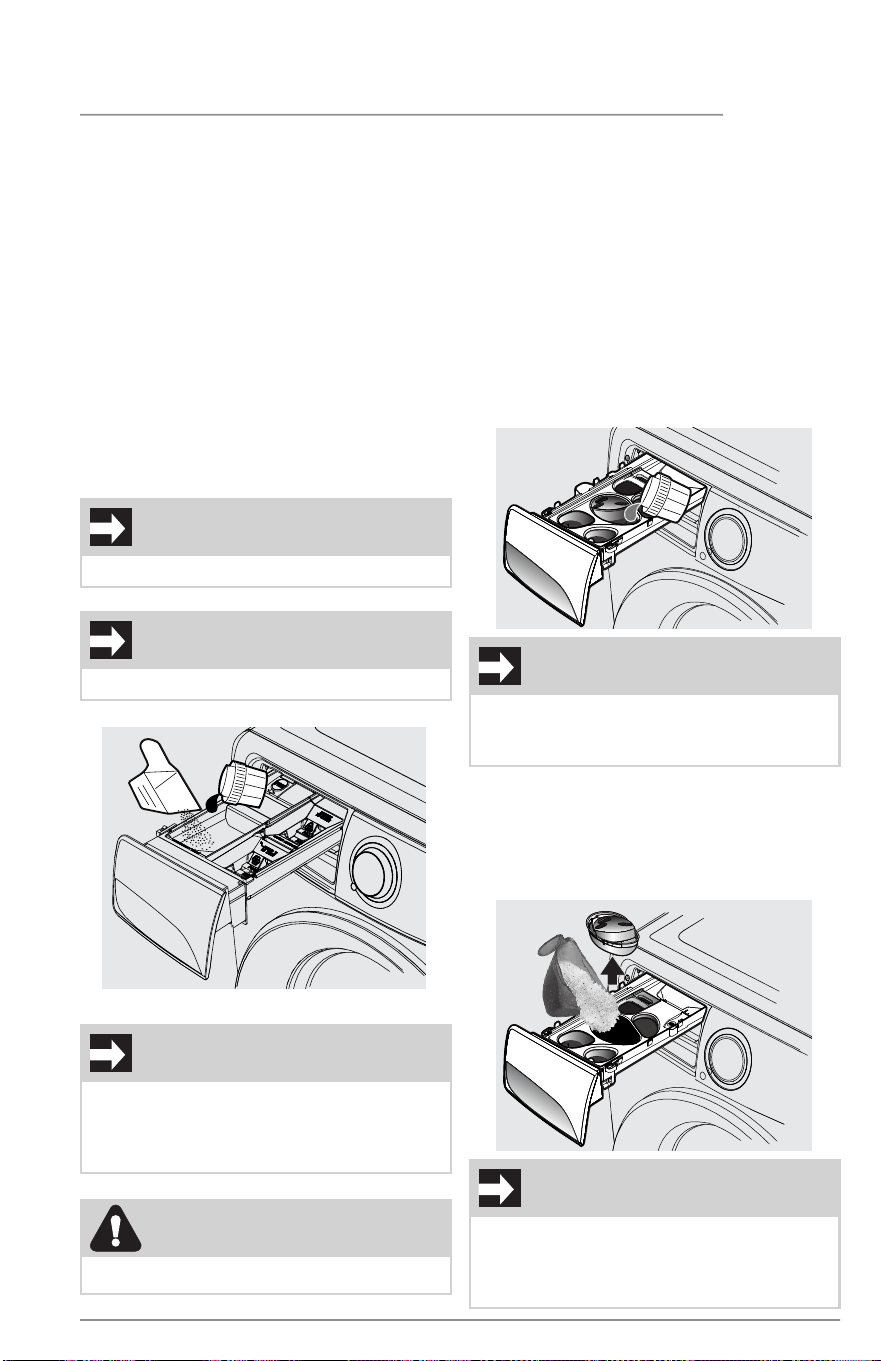
Adding laundry detergent to the
three compartment dispenser
Liquid or powder detergent
• Use the cap or scoop provided by
the detergent to add recommended
amount of detergent.
• Amount of detergent may need to be
adjusted for water temperature, water
hardness, load size, and soil level. Follow
manufacturer’s instruction.
In a three compartment dispenser use either
liquid or powder detergent. DO NOT mix
both.
Adding laundry detergent to the
adaptive dispenser™
Liquid detergent
• Use the cap or scoop provided by
the detergent to add recommended
amount of detergent to the detergent
compartment. Pour directly into the
detergent cup, not over the blue cover.
• Amount of detergent may need to
be adjusted for water temperature,
water hardness, and load size. Follow
manufacturers instructions.
Powder detergent
• Remove the liquid detergent cup and blue
cover before adding powder detergent.
• Add powder detergent directly to the
powder detergent compartment.
IMPORTANT
DO NOT mix liquids and powders.
IMPORTANT
DO NOT exceed MAX fill line.
IMPORTANT
DO NOT add detergent packs into the
three compartment dispenser. Detergent
packs should be added directly into the
drum.
CAUTION
Keep detergent packs away from children.
IMPORTANT
Pour liquid into the liquid detergent cup.
DO NOT pour over the blue cover. DO
NOT exceed MAX fill line.
IMPORTANT
Save the liquid detergent cup and blue
cover for future use. DO NOT discard it
while you are using powder detergent. DO
NOT exceed MAX fill line.
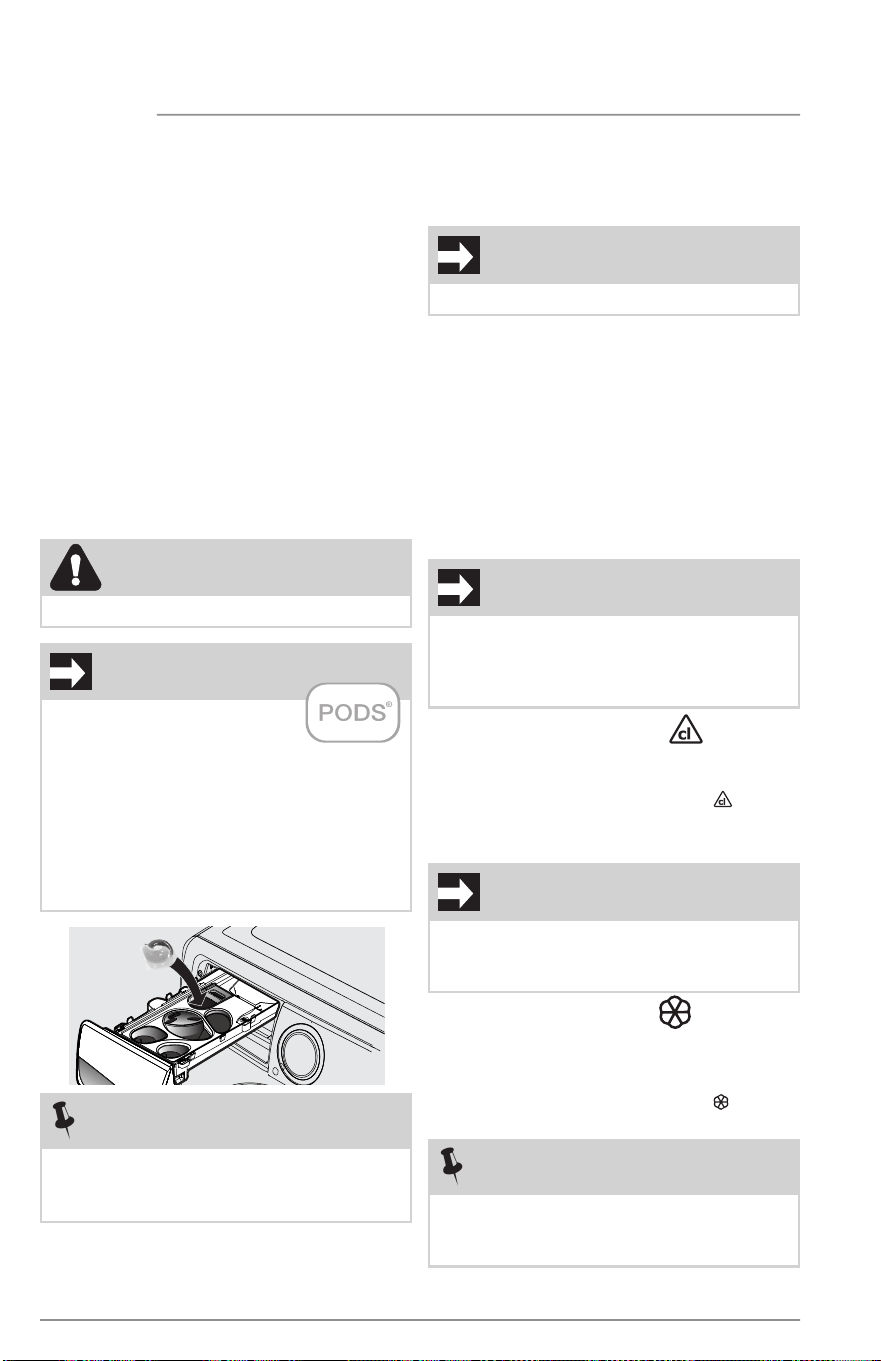
36
Adding other wash products
• Color-safe bleach, water conditioner,
detergent booster and enzyme
products may be added with detergent.
• Put liquid products in the Main Wash
- liquid detergent compartment or
powder products in the Main Wash -
powder detergent compartment.
Stain treatment (on select models)
• For heavily soiled or stained loads, select
the Stain option (on select models only
- StainTreat, StainTreatII, or StainSoak)
and add the recommended amount of
detergent or stain treatment to stain soak/
treat compartment (on select models).
• See
Cycle Options
for information about
Stain options for your model.
• See
Stain Removal Guide
in this
instruction for additional suggestions.
Detergent pack
For 300 series models
Add detergent pack directly to the empty
drum BEFORE placing laundry into the unit.
DO NOT
place detergent packs
directly into the detergent drawer. The
gel coating may cause the detergent
drawer to become clogged.
For 400, 500 and 600 series models
Add the recommended quantity of high
efficiency detergent packs to the detergent
pack compartment in the dispenser.
• DO NOT place more than two packs
into the dispenser.
• When using the fast wash cycle, only
one detergent pack should be used.
Liquid chlorine bleach
• If desired, add liquid chlorine bleach to
the compartment labeled Liquid Bleach
and marked with this symbol: .
DO NOT fill above the MAX fill line.
• Add color-safe bleach with detergent.
Liquid fabric softener
• If desired, pour the recommended
amount of liquid fabric softener into the
compartment labeled
Fabric Softener
and marked with this symbol: .
DO NOT fill above the MAX fill line.
PODS
®
is a registered trademark of Procter & Gamble Company, Cincinnati OH, used under license by Electrolux.
• Use of a fabric softener-dispensing ball is
not recommended in front load washers.
CAUTION
Keep detergent packs away from children.
IMPORTANT
• When using the detergent
pack compartment, make
sure to select the PODS
®
option before
starting the load.
• Once the PODS
®
option has been
chosen, the washer will retain the PODS
®
setting until manually changed.
• The washer will ALWAYS use a small
amount of HOT water to dissolve the pack
when the PODS
®
option has been selected.
IMPORTANT
DO NOT mix liquids and powders.
IMPORTANT
Use powder detergent in the stain soak/
stain treat compartment for the 400, 500
and 600 Series models with Adaptive
Dispenser™.
IMPORTANT
To prevent fabric damage, DO NOT overfill
the Liquid Bleach compartment or pour
bleach directly onto the load.
OPERATING INSTRUCTIONS
NOTE
From time to time you may see water in
the dispenser. This is part of the normal
operation of the washer.
NOTE
To prevent staining, DO NOT overfill Fabric
Softener compartment or pour liquid fabric
softener directly on wash load.
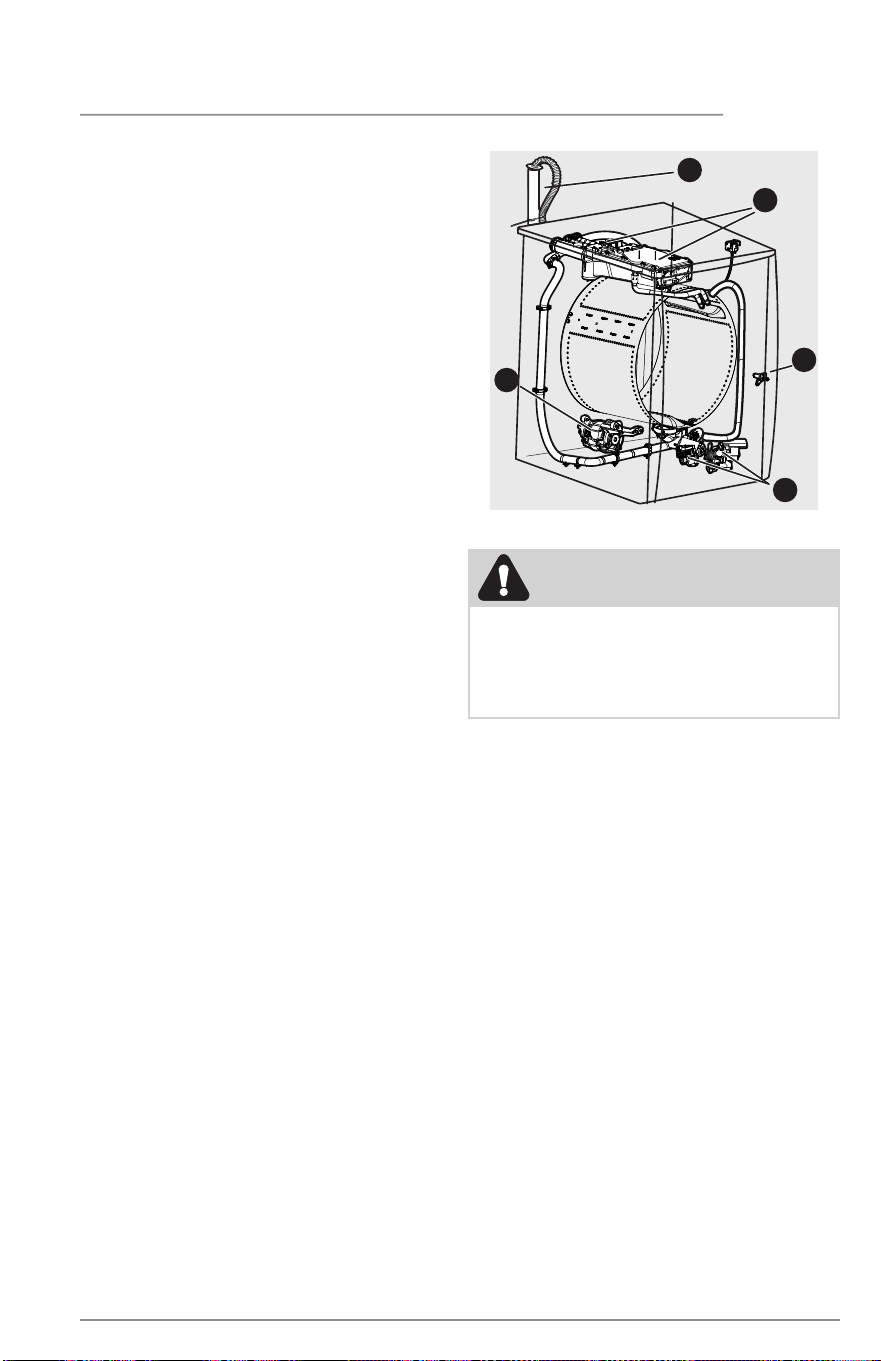
37
NORMAL OPERATING SOUNDS
Normal operating sounds
You may or may not hear the following
sounds from your new washer:
A. DRAIN HOSE The washer has a exible
drain hose to carry water from the washer
to the stand pipe of your home. You will
hear water owing into your stand pipe.
This is a normal part of the operation of the
washer.
B. WATER VALVES/DISPENSER As water
enters the dispenser system, it is common
to hear a water owing sound. This normal
sound will vary slightly based on the water
pressure in your home.
C. DOOR LOCK Your washer is equipped
with a door lock with an electric solenoid.
There will be a clicking sound as the
washer door is locked or unlocked.
D. DRAIN/RECIRCULATION PUMPS Your
washer is equipped with multiple high
velocity system pumps. It is normal to hear
humming and gurgling sounds as water
is either pumped from the washer during
the drain phase or recirculated during the
prewash and wash phases. Both of these
sounds are normal and indicate that your
pump is functioning correctly.
E. HIGH SPEED MOTOR A powerful motor
is used to drive the drum to high spin
speeds to extract water from your load.
You will hear a sound associated with
these higher spin speeds. This sound is
normal and will vary slightly as the spin
speed varies with load size and cycle
selected.
A
B
C
D
E
CAUTION
Abnormal, on-going sounds may be an
indication of a pending washer failure
and should be investigated by a qualified
technician. Refer to
NOISE
section of the
Troubleshooting section of this manual.
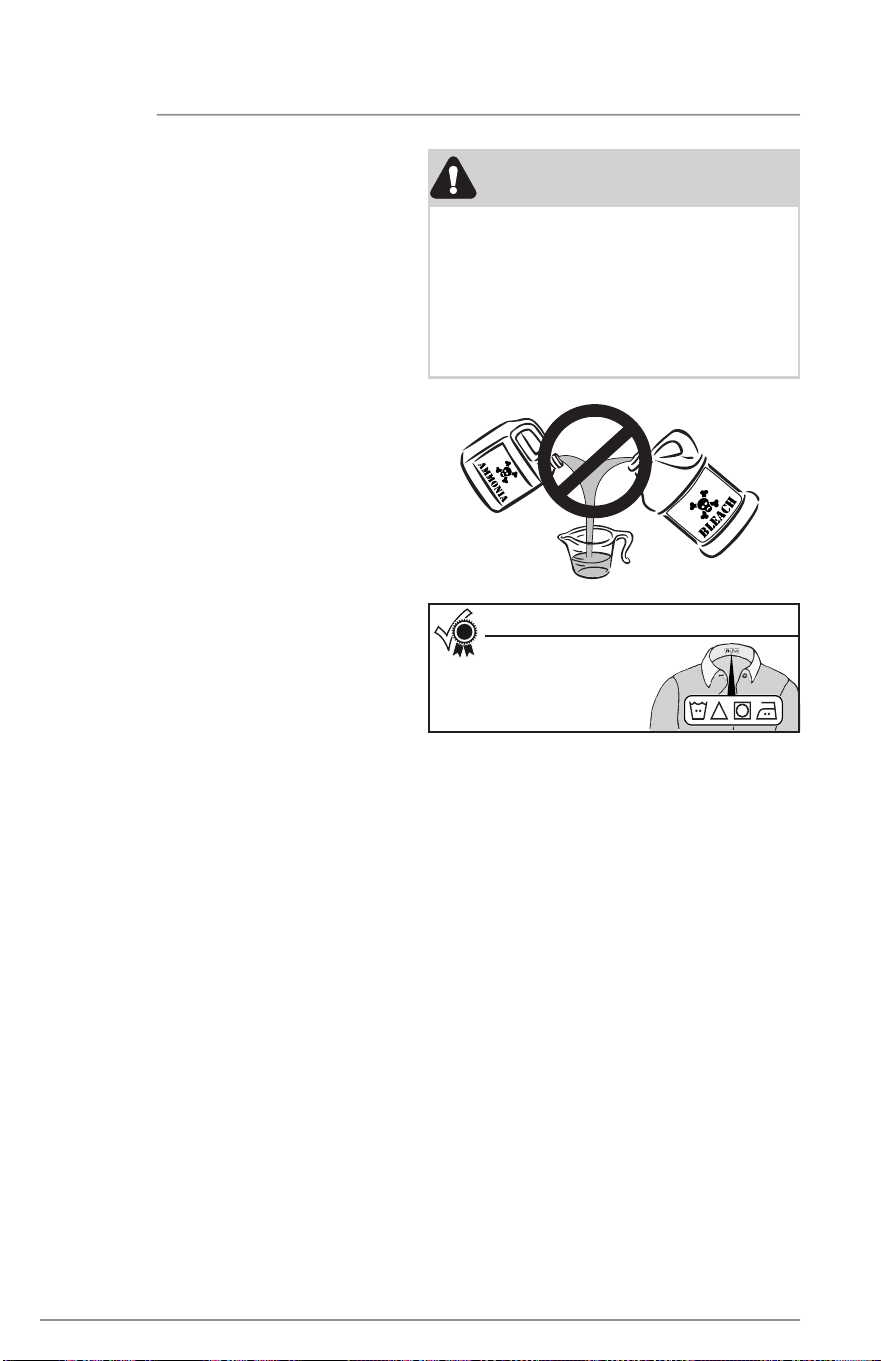
38
STAIN REMOVAL GUIDE
To reduce the risk of fire or serious injury to
persons or property, comply with the basic
warnings listed below:
• Read and comply with all instructions
on stain removal products.
• Keep stain removal products in their
original labeled containers and out of
children’s reach.
• Thoroughly wash any utensils used.
DO NOT combine stain removal
products, especially ammonia and
chlorine bleach. Dangerous fumes can
result.
• Never wash items which have been
previously cleaned in, washed in,
soaked in or spotted with gasoline, dry
cleaning solvents or other flammable
or explosive substances because they
give off vapors that could ignite or
explode.
• Never use highly flammable solvents,
such as gasoline, inside the home.
Vapors can explode on contact with
flames or sparks.
For successful stain removal:
• Remove stains promptly.
• Determine the kind of stain, then follow
the recommended treatment in the stain
removal chart on the next page.
• To pretreat stains, use a stain treatment
product, liquid detergent, or a paste
made from powder detergent and
water.
• Use cold water on unknown stains
as hot water can set stains.
• Consult care label instructions for
treatments to avoid on specific fabrics.
• Check for colorfastness by testing stain
remover products on an inside seam.
• Rinse and wash items after stain
removal.
Stain removal procedures
For best results
Follow the fabric care
label instructions on
items to be washed.
WARNING
HARMFUL VAPOR HAZARD
DO NOT use or mix liquid chlorine bleach
with other household chemicals such
as toilet cleaners, rust removers, acids
such as vinegar, or products containing
ammonia. These mixtures can produce
dangerous fumes which can cause serious
injury or death.
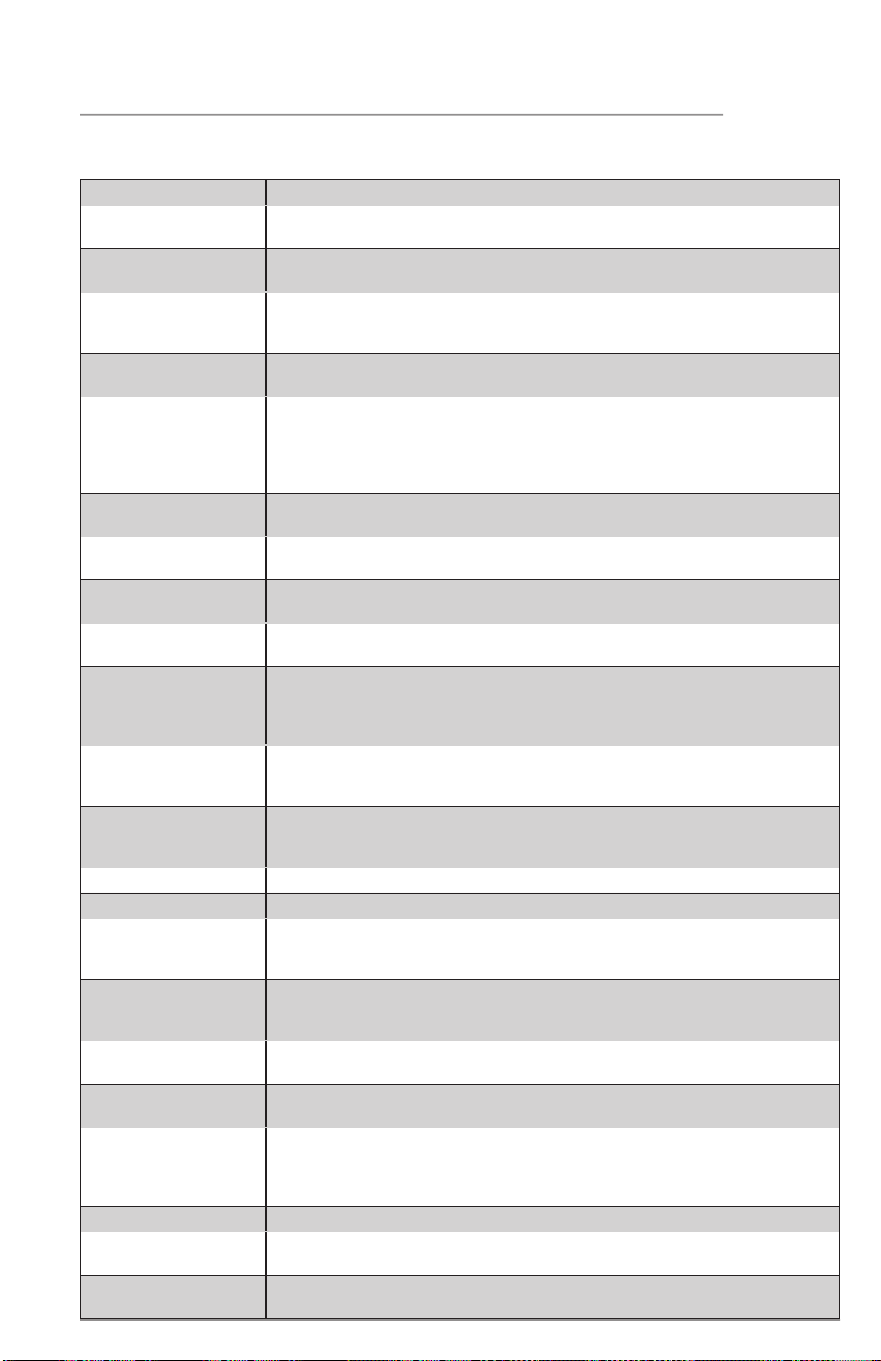
39
STAIN REMOVAL GUIDE
Stain removal suggestions
STAIN TREATMENT
Adhesive tape, gum,
rubber cement
Apply ice. Scrape off excess. Place stain down on paper towels. Saturate
with prewash stain remover or nonflammable dry cleaning fluid.
Baby formula, dairy
products, egg
Use product containing enzymes to pretreat or soak stains. Soak for
30 minutes or more. Wash.
Beverages (coffee,
tea, soda, juice,
alcoholic beverages)
Pretreat stain. Wash using cold water and bleach safe for fabric.
Blood Rinse with cold water. Rub with bar soap. Or, pretreat or soak with
product containing enzymes. Wash using bleach safe for fabric.
Candle wax, crayon Scrape off surface wax. Place stain face down between paper
towels. Press with warm iron until wax is absorbed. Replace paper
towels frequently. Treat remaining stain with prewash stain remover
or nonflammable dry cleaning fluid. Hand wash to remove solvent.
Wash using bleach safe for fabric.
Chocolate Pretreat or soak in warm water using product containing enzymes.
Wash using bleach safe for fabric.
Collar or cuff soil,
cosmetics
Pretreat with prewash stain remover or rub with bar soap.
Dye transfer on
white fabric
Use packaged color remover. Wash using bleach safe for fabric.
Grass Pretreat or soak in warm water using product containing enzymes.
Wash using bleach safe for fabric.
Grease, oil, tar (butter,
fats, salad dressing,
cooking oils, car
grease, motor oils)
Scrape residue from fabric. Pretreat. Wash using hottest water safe
for fabric. For heavy stains and tar, apply nonflammable dry cleaning
fluid to back of stain. Replace towels under stain frequently. Rinse
thoroughly. Wash using hottest water safe for fabric.
Ink Some inks may be impossible to remove. Washing may set
some inks. Use prewash stain remover, denatured alcohol or
nonflammable dry cleaning fluid.
Mildew, scorch Wash with chlorine bleach if safe for fabric or soak in oxygen
bleach and hot water before washing. Badly mildewed fabrics may
be permanently damaged.
Mud Brush off dry mud. Pretreat or soak with product containing enzymes.
Mustard, tomato Pretreat with prewash stain remover. Wash using bleach safe for fabric.
Nail polish May be impossible to remove. Place stain face down on paper
towels. Apply nail polish remover to back of stain. Repeat, replacing
paper towels frequently. DO NOT use on acetate fabrics.
Paint, varnish WATER BASED: Rinse fabric in cool water while stain is wet. Wash. Once
paint is dry, it can’t be removed. OIL BASED AND VARNISH: Use solvent
recommended on label. Rinse thoroughly before washing.
Perspiration Use prewash stain remover or rub with bar soap. Rinse. Wash using
non chlorine bleach in hottest water safe for fabric.
Rust, brown or
yellow discoloration
Use rust remover safe for fabric. DO NOT use chlorine bleach
because it may intensify discoloration.
Shoe polish LIQUID: Pretreat with a paste of powder detergent and water.
PASTE: Scrape residue from fabric. Pretreat with prewash stain
remover or nonflammable dry cleaning fluid. Rinse. Rub detergent
into dampened area. Wash using bleach safe for fabric.
Tomato Pretreat with prewash stain remover. Wash using fabric safe bleach.
Urine, vomit, mucus,
feces
Pretreat or soak in product containing enzymes. Wash using bleach
safe for fabric.
Wine Pretreat or soak in cold water. Wash in hottest water and bleach
safe for fabric
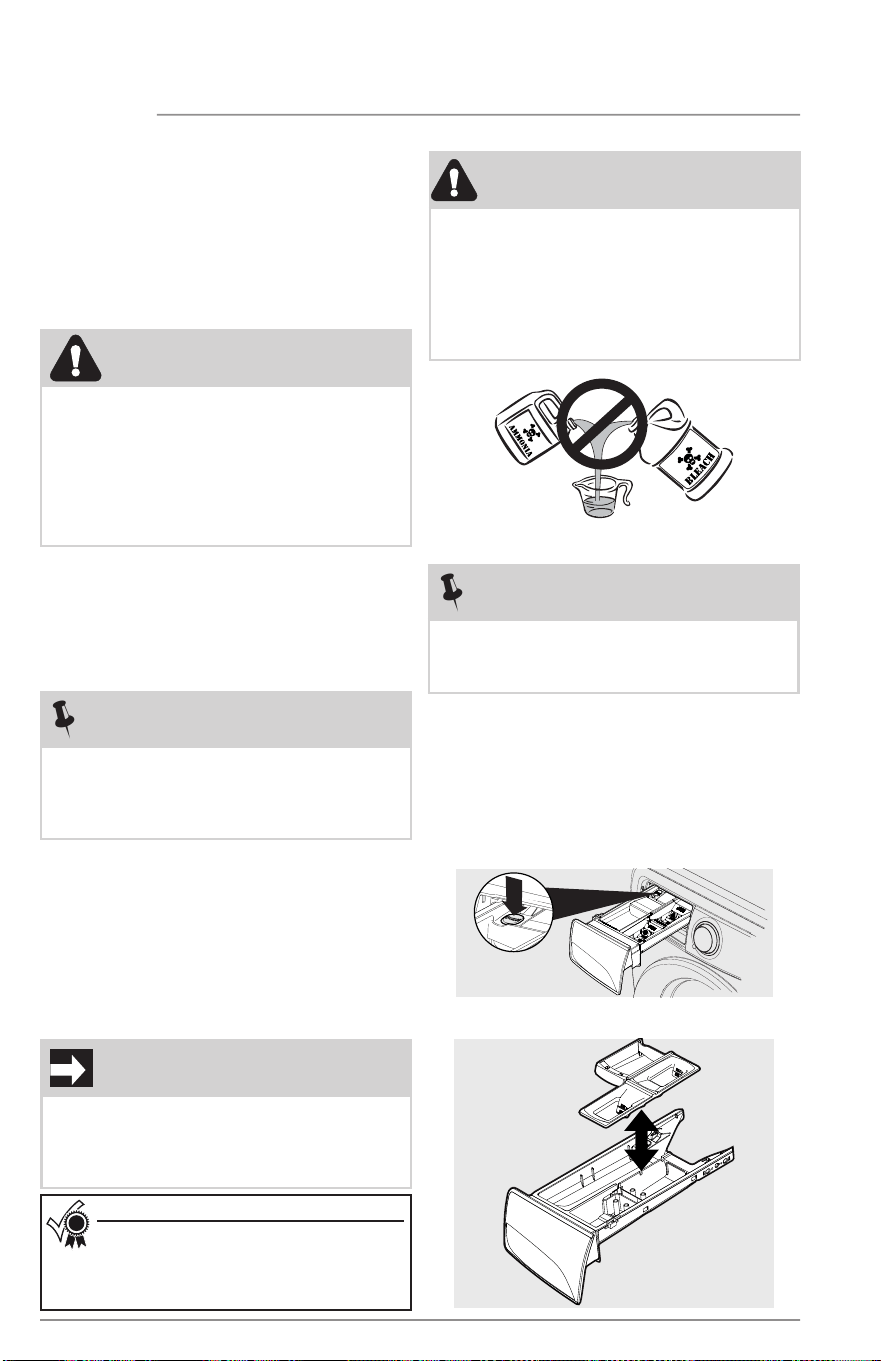
40
CARE AND CLEANING
To help prevent odors or humidity
accumulation leave the door open with
the door stand ventilation feature (on
select models) for a few hours after use or
whenever the washer is not in use.
Inside routine cleaning
(preventative)
To refresh or clean inside of
washer
To clean and freshen the washer, perform
the clean washer cycle. For best results
perform the cycle once a month.
Immediately follow up with a rinse &
spin cycle. Select max spin with no detergent
or bleach to help clear any residual bleach
left after the clean washer cycle.
For best results
To begin the cycle, select the clean washer
cycle. If installed, remove the LIQUID
DETERGENT cup from the dispenser.
REMOVE ALL ITEMS FROM WASH DRUM
before filling the detergent compartment
with one (1) cup of liquid chlorine bleach OR
one (1) pouch of Tide
TM
Washing Machine
Cleaner. DO NOT use both. Press start/
pause to begin.
To Clean the dispenser drawer
Cleaning the three compartment dispenser
1. Remove the drawer by pulling the
drawer out until it stops.
2. Reach back into the left rear corner
of the drawer cavity and press down
firmly on the lock tab. Pull out the
drawer.
3. Remove all inserts from the drawers.
Tide is a trademark of The Procter & Gamble Company, Cincinnati, Ohio.
CAUTION
ENTRAPMENT and TIP-OVER HAZARD
DO NOT leave the door open if there are
small children or pets present. An open
door could entice children to hang on the
door or crawl inside the washer. If there are
no small children present, you may leave
the door ajar to prevent odor build up.
IMPORTANT
Items left in washer while performing the
clean washer cycle will cause a severe
out-of-balance situation that could
damage the washing machine.
WARNING
HARMFUL VAPOR HAZARD
DO NOT use or mix liquid chlorine bleach
with other household chemicals such
as toilet cleaners, rust removers, acid
or products containing ammonia. These
mixtures can produce dangerous fumes
which can cause serious injury or death.
NOTE
Detergent and fabric softener may build up
in the dispenser drawer. Residue should be
removed once or twice a month.
NOTE
Every 50 cycles, your washer will remind
you to perform the clean washer cycle
by illuminating the clean washer cycle
indicator.
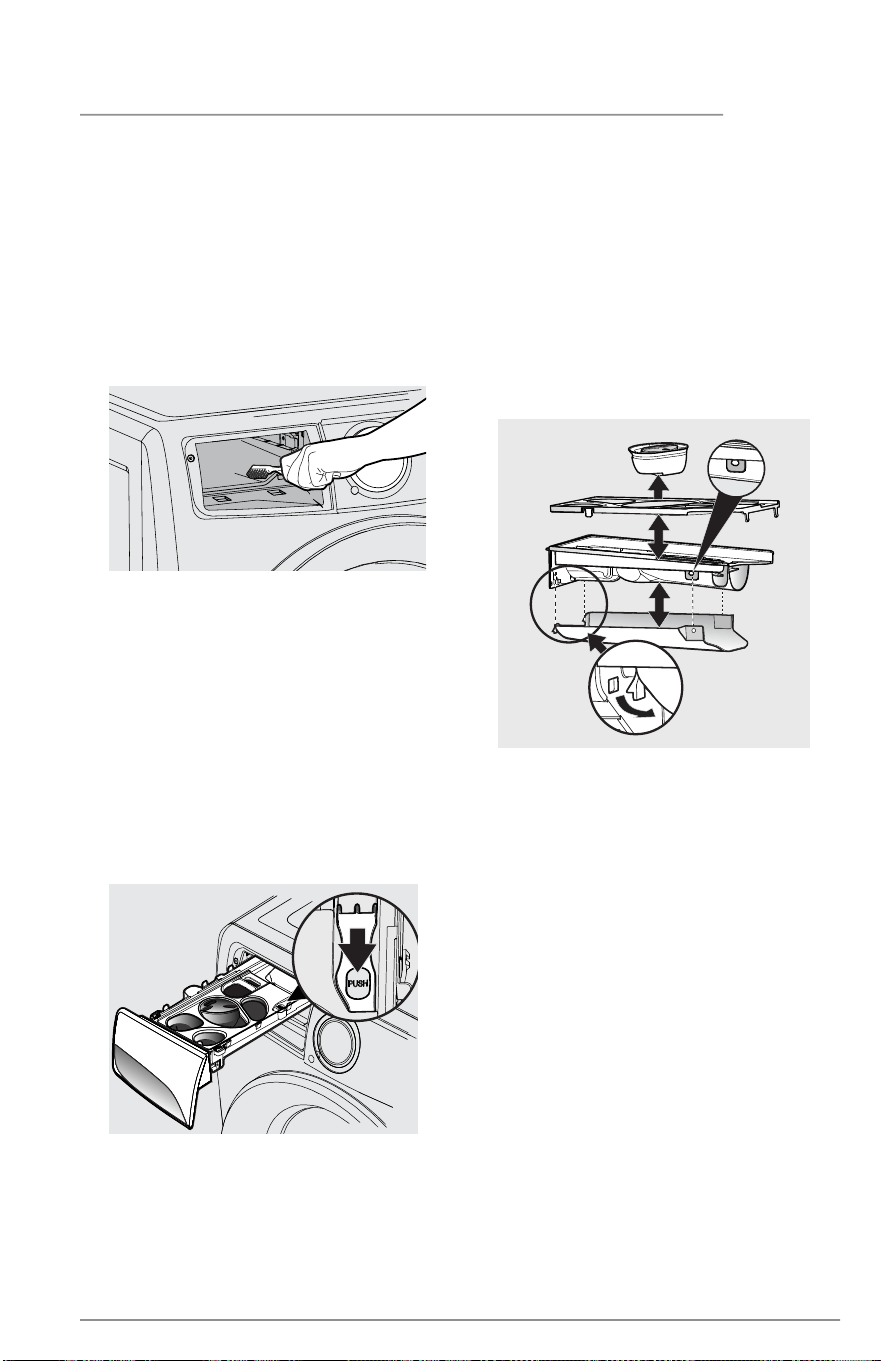
41
4. Rinse the drawer and inserts with
hot tap water to remove traces of
accumulated powders and liquids.
Large amounts of fabric softener
residue may indicate improper dilution
or more frequent cleaning is required.
5. To clean the drawer opening, use
a small brush to clean the recess.
Remove all residue from the upper and
lower parts of the recess.
6. Replace the insert by pressing it in
place until you hear a slight click.
7. Return the dispenser drawer to the unit.
Cleaning the Adaptive Dispenser™
1. Remove the drawer by pulling the
dispenser out until it stops.
2. Reach back into the right rear corner
of the dispenser cavity and press down
firmly on the lock tab. Pull out the
dispenser drawer.
3. Remove the detergent cup and top
cover from the dispenser drawer.
4. Remove the bottom cover from the
dispenser drawer.
a) First, pull the two lock tabs at the rear
of the dispenser drawer to unlatch the
back cover.
b) Then, gently pull back the two clips on
the front of the bottom cover to fully
release it from the dispenser drawer.
5. Rinse the dispenser drawer, covers, and
detergent cup with hot tap water to
remove traces of accumulated powders
and liquids. Large amounts of fabric
softener residue may indicate improper
dilution or more frequent cleaning is
required.
6. To clean the dispenser drawer
opening, use a small brush to clean
the recess. Remove all residue from the
upper and lower parts of the recess.
7. Reassemble dispenser drawer and
check to ensure that all pieces are
securely in place.
8. Return the dispenser drawer to the unit.
Front
Rear
CARE AND CLEANING
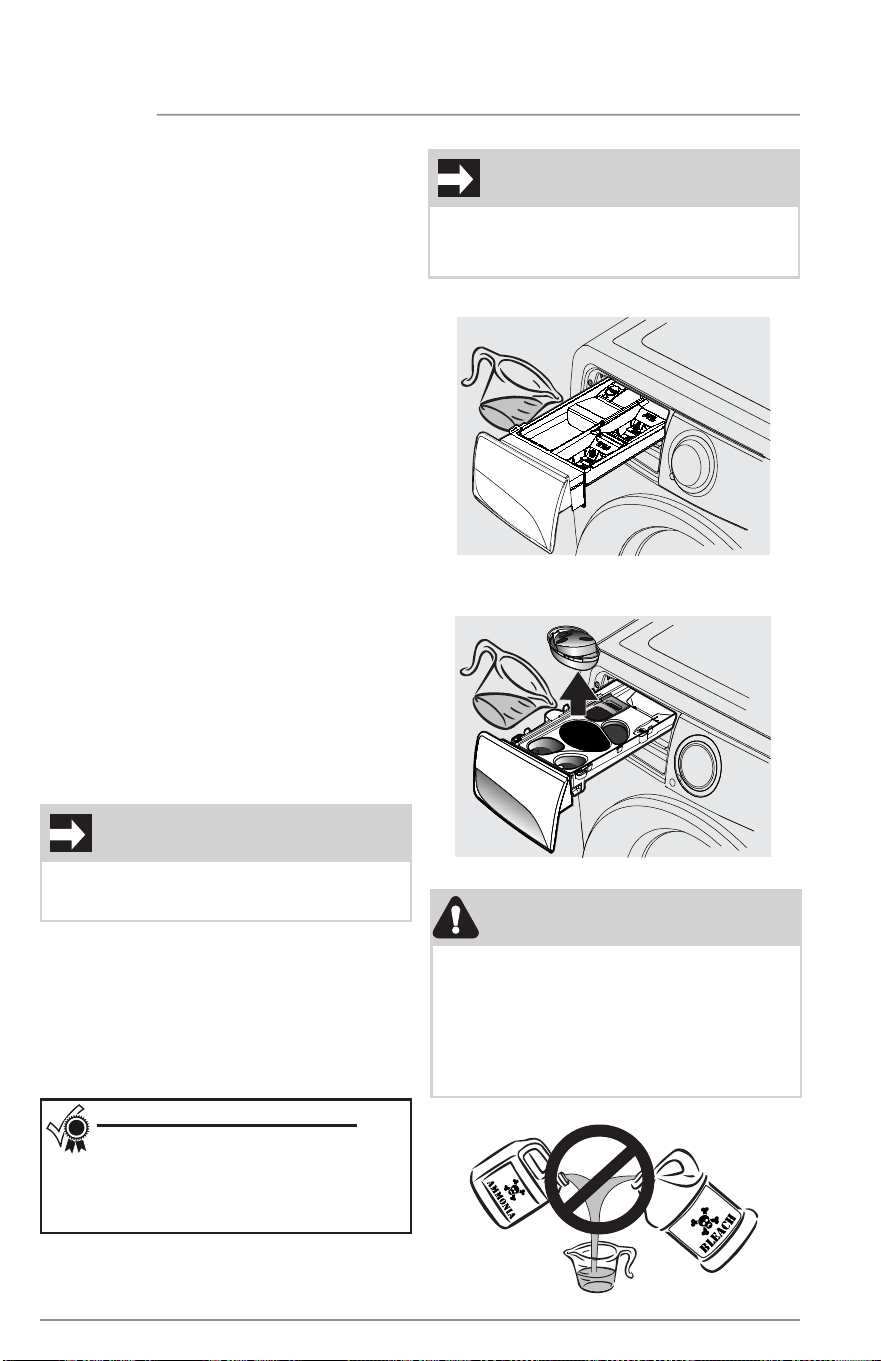
42
CARE AND CLEANING
Inside cleaning (aggressive)
In cases where clean washer cycle along
with care and cleaning of rubber gasket
folds isn’t done, and severe odor or residue
buildup have developed, follow the below
cleaning procedure to help alleviate the
problem.
Cleaning procedure-washer drum
Ensure the wash tub is empty. Open the
detergent drawer and pour eight cups
of bleach into the Main Wash detergent
compartment. Select clean washer cycle
as described previously in Inside Routine
Cleaning (Preventative).
Upon cycle completion inspect the interior
of the washer to see if the odor/residue has
been eliminated. If any additional cleaning
is required, repeat the above procedure.
This may take several cycles depending on
the severity of the odor/residue. You may
observe some remaining discoloration due
to the long term effects of this residue.
For especially contaminated areas visible
inside the drum (including the front rubber
seal), these areas might be more effectively
cleaned by spraying a bleach cleaner on
a scrub brush, soft sponge, or towel and
scrubbing.
If odor is still left after bleach cycle(s) and
bleach cleaner, open the detergent drawer
and pour one (1) pouch of Tide
TM
Washing
Machine Cleaner in detergent drawer. Select
clean washer cycle as above and start the
washer.
Immediately follow up with a rinse &
spin cycle. Select max spin with no
detergent or bleach to help clear any
residual bleach left after the clean
washer cycle.
For best results
Three Compartment Preventative Cleaning
Adaptive Dispenser™
Preventative Cleaning
IMPORTANT
Always wear rubber or latex gloves and
protect floor and clothing from damage.
IMPORTANT
See
Inside Routine Cleaning
for future
cleaning maintenance which is necessary
to avoid repeating issues.
WARNING
HARMFUL VAPOR HAZARD
DO NOT use or mix liquid chlorine bleach
with other household chemicals such
as toilet cleaners, rust removers, acid
or products containing ammonia. These
mixtures can produce dangerous fumes
which can cause serious injury or death.
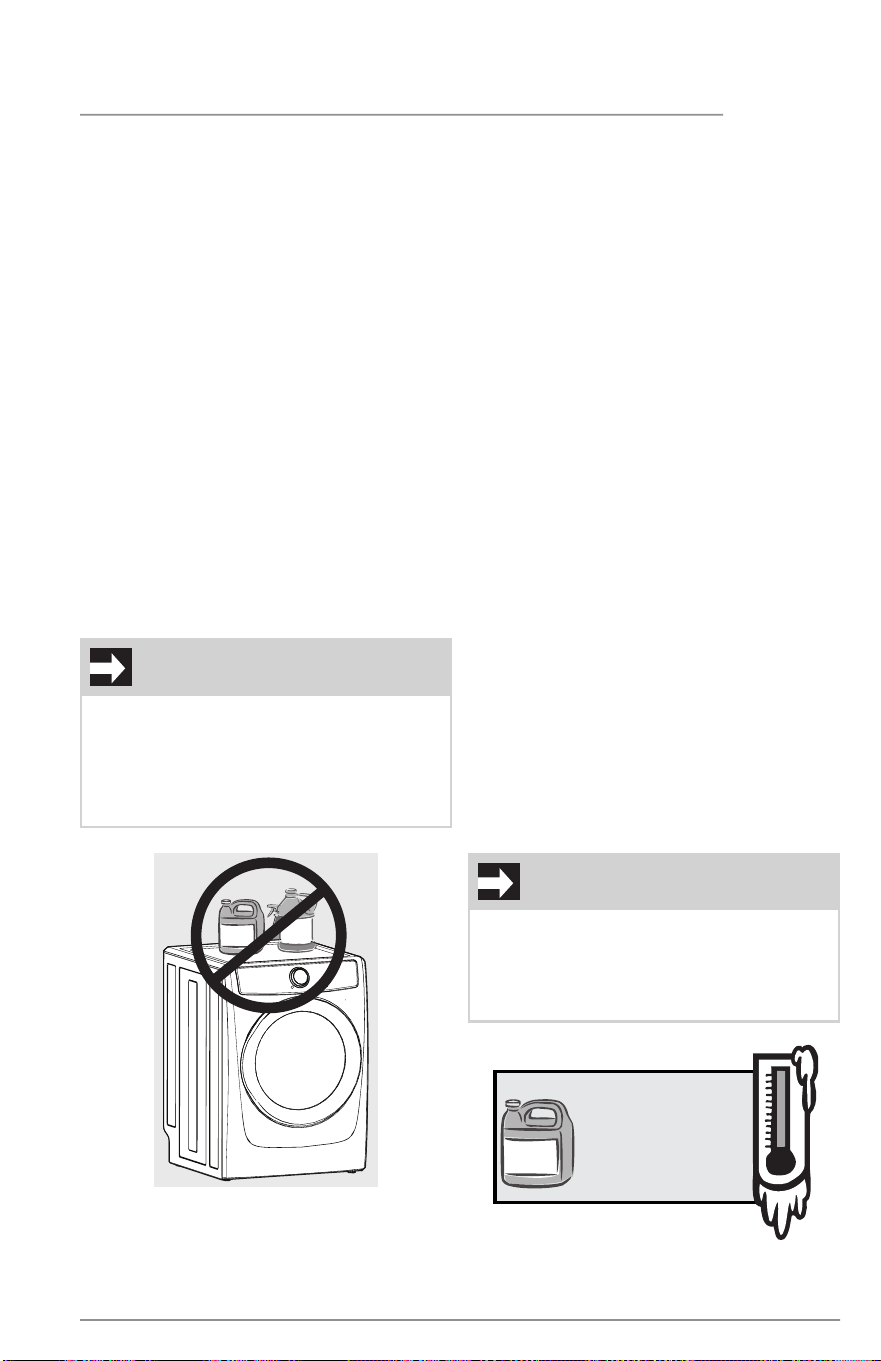
43
RV
ANTIFREEZE
Follow WINTERIZ-
ING INSTRUCTIONS
for cold weather
storage and care.
• When washing is completed, wipe top
and sides of washer with a damp cloth.
• Clean the cabinet with mild soap
and water. Never use harsh, gritty or
abrasive cleansers
• If the cabinet becomes stained, clean
with diluted chlorine bleach (1 part
bleach to 8 parts water). Rinse several
times with clear water.
• Remove glue residue from tape or
labels with a mixture of warm water and
mild detergent. Or, touch residue with
the sticky side of tape.
• When cleaning chrome parts, it is best
to use only a damp cloth.
• Before moving the washer, place a
strip of cardboard or thin fiberboard
under the front leveling legs to prevent
damage to the floor.
1. Turn off water supply faucets.
2. Disconnect hoses from water supply
and drain water from hoses. Vacuum
out each water supply inlet with
a waterproof utility vac to ensure
water valves are completely drained.
Damage will occur if water in water
inlet valves are allowed to freeze.
3. Plug electrical cord into a properly
grounded electrical outlet.
4. Add 1 gallon (3.8 L) nontoxic
recreational vehicle (RV) antifreeze to
empty wash drum. Close door.
5. Select any cycle. Press start/pause
and let the washer drain for 1 minute to
drain out all the water. Not all of the RV
antifreeze will be expelled.
6. Press cancel, unplug electrical power
cord, dry off drum interior and close
door.
7. Remove dispenser drawer. Drain
any water in compartments and dry
compartments. Replace drawer.
8. Store washer in an upright position.
9. To remove antifreeze from washer
after storage, run empty washer
through a complete cycle using
detergent. DO NOT add wash load.
Outside routine cleaning
Winterizing instructions
IMPORTANT
DO NOT store or place laundry products
on top of washer at any time. They
can damage the finish or controls. It is
recommended to keep laundry products
in the storage drawer between cycles if
installed on a pedestal.
IMPORTANT
If the washer is stored in an area where
freezing can occur or moved in freezing
temperatures, follow these winterizing
instructions to prevent damage to the
washer:
CARE AND CLEANING
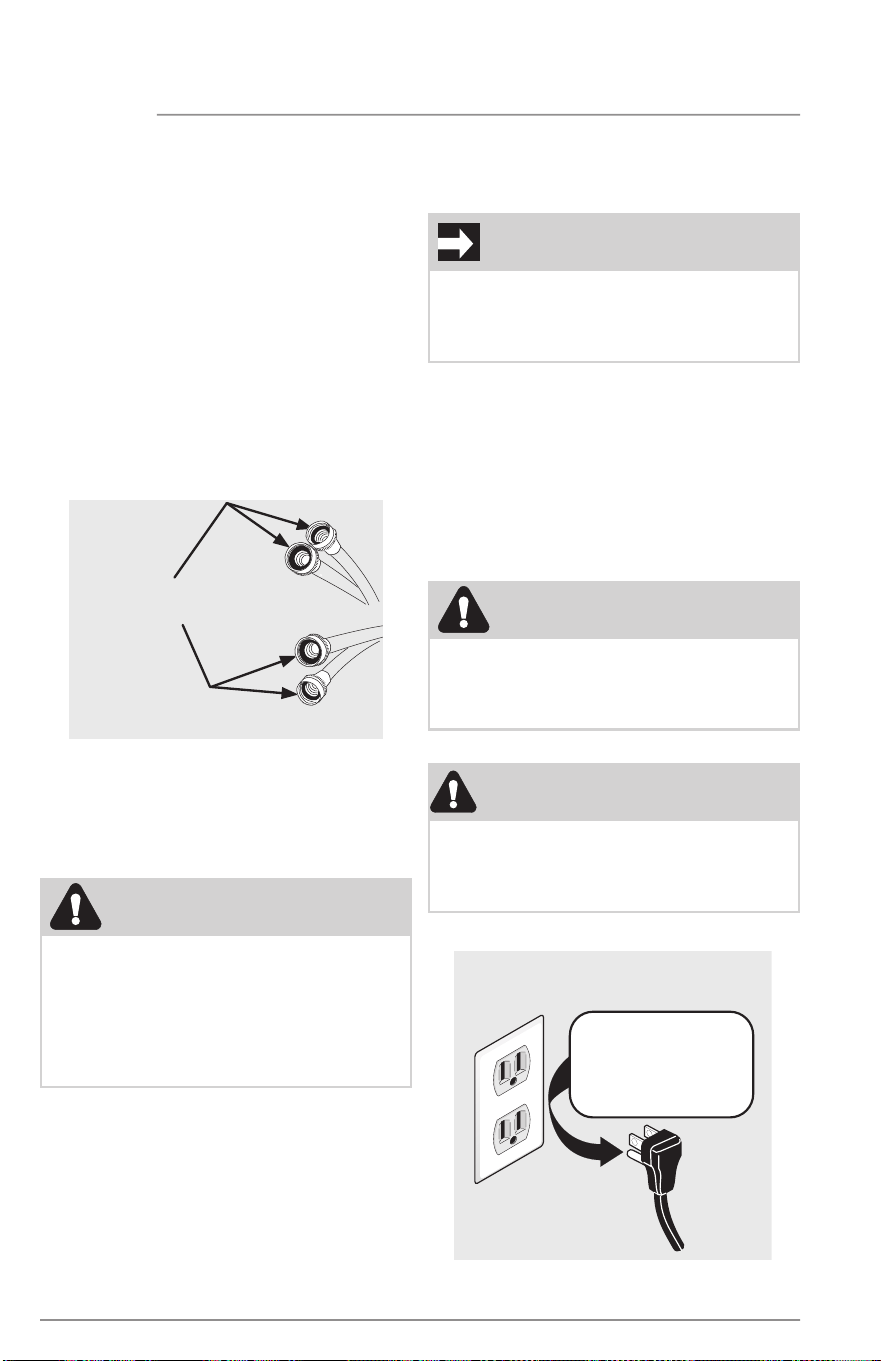
44
Rubber Washers
Must Be Present
Replace Hoses Every 5 Years
1. Turn off the water supply to washer
to avoid water leaks due to water
pressure surges and unforeseen
occurrences in the water supply.
2. Disconnect or unplug the electrical
power to the washer.
3. Remove excess water from the
dispenser, interior door and tub and
perform the Care and Cleaning steps.
1. Review the
Installation
section of this
manual to ensure the appliance is level
and the water and electrical power
supply is properly connected.
2. Ensure the water lines are flushed of
debris, prior to connecting the water
lines to the washer inlet.
3. Check for water leaks and replace
supply hoses if needed.
Instructions for limited use,
vacation and away from
home
Reconnecting water supply
and electrical
Water inlet hose inspection
Periodically inspect all water inlet hoses
for water leaks, wear, cuts, corrosion and
bulges. Replace all hoses, if any sign of
the above is visible. All hoses should be
replaced every 5 years to reduce the risk of
hose failures. When replacing hoses, refer to
the Installation sections of this Use & Care
Manual for proper installation instructions.
DO NOT overtighten or cross thread the
fittings. DO NOT allow the hose to rub
against sharp objects. Always ensure the
hose fitting rubber gasket is installed and
free from water leaks when water pressure is
applied.
Grounding type wall receptacle
Power cord with
3-prong grounded plug
Do not, under
any circumstances,
cut, remove,
or bypass the
grounding prong.
CAUTION
Your washer should be operated ONLY
when you are home. Water leakage is a
safety issue and can cause personal injury
or property damage. If you are away
from home or not using your washer for
extended periods of time, follow these
steps:
CAUTION
Damaged or improperly installed water lines
can cause the water lines or connections to
leak. Water leakage is a safety issue and can
cause personal injury or property damage.
IMPORTANT
When reinstalling the washer after
disconnecting the water supply lines and
electrical power, please follow the steps
below:
WARNING
Improper grounding of the washer may
cause serious injury or death. Check with a
licensed electrician if you are in doubt as to
whether the appliance is properly grounded.
CARE AND CLEANING

45
PROBLEM POSSIBLE CAUSES SOLUTIONS PREVENTIVE
MEASURES
Blue stains • Undiluted liquid
detergent or fabric
softener dispensed
directly onto fabric.
• If caused by
detergent, mix 1 cup
(240 ml) white vinegar
with 1 qt (.95 L) water
in plastic container.
Soak 1 hour. Rinse.
• If caused by fabric
softener, rub stains
with bar soap. Wash.
• Avoid overfilling
detergent and fabric
softener compartments
of dispenser.
Discoloration,
graying
• Not enough detergent.
• Wash water
temperature too low.
• Incorrect sorting.
• Rewash with correct
amount of detergent
and hottest water safe
for fabric.
• Add bleach safe for
fabric.
• Sort items by soil level
and color.
• Use correct amount
of detergent, hottest
water and bleach safe
for fabric.
Greasy,
oily stains
• Not enough detergent.
• Undiluted liquid fabric
softener poured
directly on fabric.
• Treat with prewash
stain remover or liquid
detergent.
• Increase detergent
and water
temperature. Rewash.
• Rub fabric softener
stains with bar soap.
• Use correct amount of
detergent and hottest
water safe for fabric.
DO NOT pour liquid
fabric softener directly
on fabric.
Holes, tears, or
snags
• Incorrect use of
chlorine bleach.
• Unfastened zippers,
hooks, buckles.
• Rips, tears and broken
threads.
• Overloading washer.
• Degradation of fabric.
• May be irreversible if
rips, tears and seams
cannot be mended.
• Never pour chlorine
bleach directly on
fabric.
• Check condition of
items before washing.
Lint • Incorrect sorting.
• Tissues left in pocket.
• Overloading washer.
• Not enough detergent.
• Undissolved detergent
has left a residue
resembling lint.
• Static cling is
attracting lint.
• Load washed too
long.
• Reduce load size.
Rewash using correct
water temperature,
water level, and
amount of detergent.
• Add nonprecipitating
water conditioner to
wash water to remove
detergent residue.
• Add liquid fabric
softener to final rinse.
• Dry load in dryer.
• Remove lint with lint
brush or roller.
• See
Operating Your
Washer
.
DO NOT overload
washer.
• Use correct
temperature and
amount of detergent,
water and wash time.
Common washing inquiries
Many washing problems involve poor soil and stain removal, residues of lint and scum, and
fabric damage. For satisfactory washing results, follow these suggestions provided by The
Soap and Detergent Association.
TROUBLESHOOTING

46
TROUBLESHOOTING
PROBLEM POSSIBLE CAUSES SOLUTIONS PREVENTIVE
MEASURES
Pilling
(Fibers ball up
and cling to
fabric.)
• Pilling is normal
with synthetic and
permanent press
fabrics. This is due to
abrasion from normal
wear.
• Use a lint brush or
shaver to remove pills.
• Use fabric softener in
washer to lubricate
fibers.
• When ironing, use
spray starch or fabric
finish on collars and
cuffs.
• Turn items inside out to
reduce abrasion.
Residue or
powder on dark
items;
Stiff, harsh
fabrics.
• Undissolved detergent.
• Some granular
detergents can
combine with hard
water minerals to form
a residue.
• Overloading washer.
• Rewash load. • Increase water
temperature using
hottest water safe for
fabric.
DO NOT overload
washer.
• Use liquid detergent
or nonprecipitating
water conditioner with
powder detergent.
Wrinkling • Overloading washer.
• Incorrect wash cycle
for wash load.
• Reduce load size.
• Rinse in cold water
with liquid fabric
softener using the
casual or delicate
cycle.
DO NOT overload
washer.
• Remove items from
washer as soon as
cycle is completed.
• Use liquid fabric
softener.
Yellow buildup
of body soil on
synthetic fabrics
• Agitation time too
short.
• Wash water
temperature too low.
• Not enough detergent.
• Soak in detergent
booster or product
containing enzymes.
• Wash in hottest water
safe for fabric using
casual cycle.
• Increase detergent.
• Add bleach safe for
fabric or treat with
color remover.
• Select correct cycle.
• Use correct amount of
detergent.
• Wash synthetics
frequently using hot or
warm water.
Yellow or brown
rust stains
• Iron or manganese in
water supply, water
pipes, or water heater.
• To restore discolored
load of whites, use rust
remover safe for fabric.
DO NOT use chlorine
bleach to remove rust
stains. It may intensify
discoloration.
• Use nonprecipitating
water softener.
• Before washing, run hot
water for a few minutes
to clear lines.
• Drain water heater
occasionally.
• For an ongoing
problem, install an
iron filter in your water
supply system.

47
PROBLEM POSSIBLE CAUSES SOLUTIONS PREVENTIVE
MEASURES
Residue stain
buildup in gasket
• Moisture in washer.
• Use of non-HE
detergent.
• Overdosing detergent.
• Overloading wash
drum.
• Leaving a wet load set
in washer.
• Cold water washes
which may not
completely dissolve
and remove
detergents.
• Perform clean
washer cycle
• Scrub gasket with
Comet™ Spray Gel
Mildew Stain Remover
- use brush to remove
stains.
• Use only HE
(high efficiency
detergent) along with
recommended dosage.
• Remove wash load
immediately upon cycle
completion.
• Run dehumidifier
in laundry room.
• Avoid overfilling
detergent and
fabric softener
compartments of
dispenser.
• Dry the inside
of washer and
gasket after every
run.
Residue stain
buildup in
dispenser drawer
or detergent pack
not dissolved.
• Moisture in the washer.
• Use of non-HE
detergent.
• Overdosing detergent.
• Adding more than
two detergent packs
to detergent pack
compartment.
• PODS
®
option not
selected when using
detergent pack (on
select models).
• Remove and clean
dispenser and inserts
with combination of
¾ cup liquid chlorine
bleach and one gallon
hot water. Rinse well,
and repeat if necessary.
NOTE: Wear rubber of
latex gloves. Protect
floor and clothing from
bleach damage.
• Use only HE
(high efficiency
detergent) along with
recommended dosage.
• Avoid overfilling
detergent and
fabric softener
compartments of
dispenser.
• Check that PODS
®
option is selected
and detergent
pack is placed in
PODS
®
dispenser
compartment
when using
detergent pack
(on select models).
Water in fold of
flexible gasket
• Result of washing
and part of normal
operation.
• At the end of each
wash, dry inside of
gasket fold with clean
dry towel all around
gasket.
Odor • Moisture in the washer.
• Use of non-HE
detergent.
• Overdosing detergent.
• Leaving a wet load
remain in washer.
• Cold water washes
which may not
completely dissolve
and remove
detergents.
• Perform clean
washer cycle.
• At the end of each
wash, dry inside of
gasket fold with clean,
dry towel all around
gasket.
• Use only HE
(high efficiency
detergent) along with
recommended dosage.
• Remove wash load
immediately upon cycle
completion.
• Pour one cup liquid
chlorine bleach in
standpipe; let remain
a day and flush with
water.
• Utilize the door
stand ventilation
feature for a few
hours after use or
whenever washer
is not in use.
PODS
®
is a registered trademark of Procter & Gamble Company, Cincinnati OH, used under license by Electrolux.
TROUBLESHOOTING
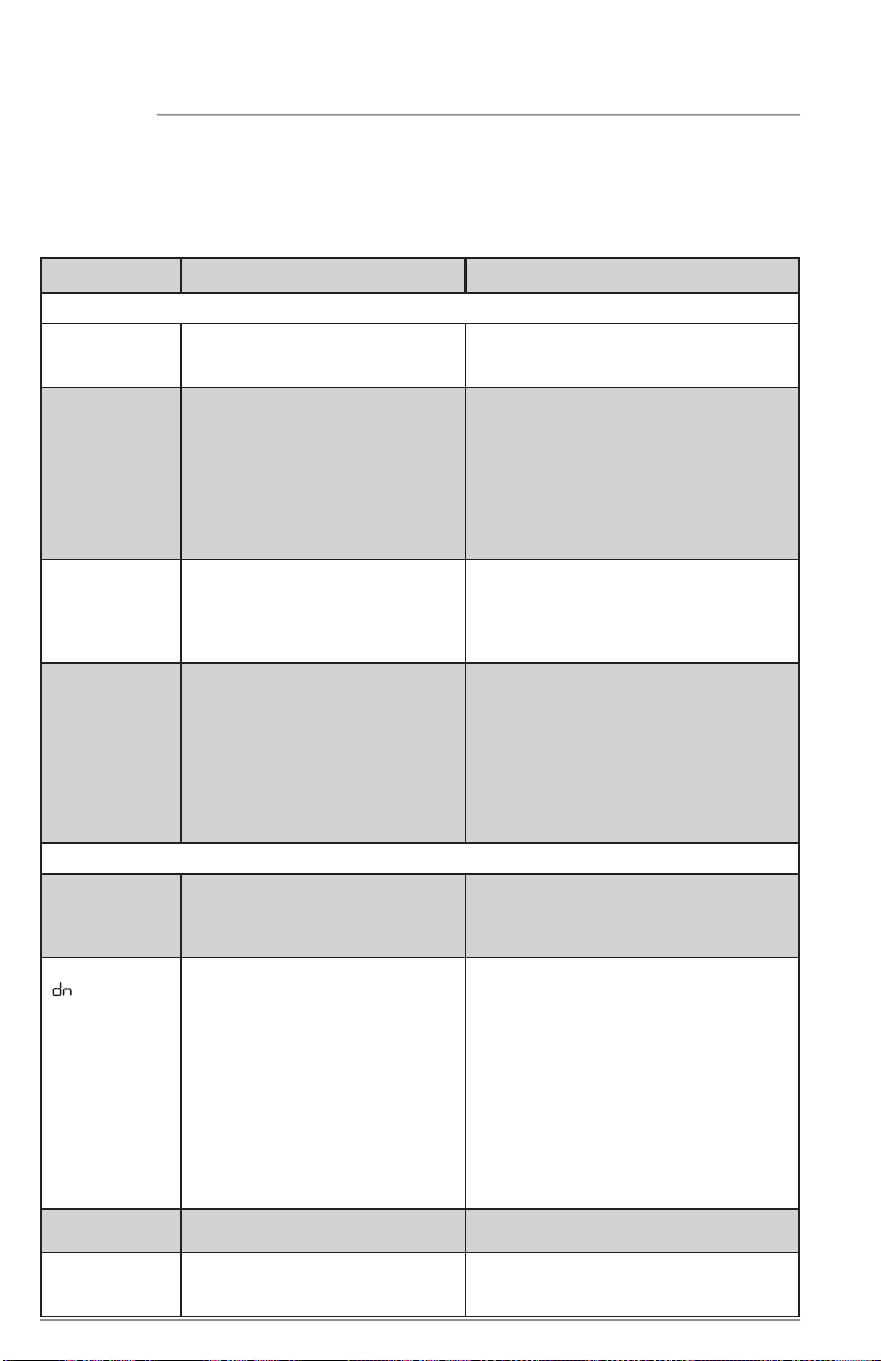
48
TROUBLESHOOTING
PROBLEM POSSIBLE CAUSES SOLUTIONS
NOISE (Please refer to
Normal Operating Sounds
)
High pitch “jet
engine” noise
• A certain amount of motor
whine is normal during the spin
cycle.
Rattling and
clanking noise
• Foreign objects such as coins
or safety pins may be in drum
or pump.
• Belt buckles and metal
fasteners are hitting wash drum.
• Stop washer and check drum. If no
objects are found, perform cycle
with empty drum. If noise continues,
item may be in pump. Call your
authorized service technician.
• To prevent unnecessary noise and
damage to drum, fasten fasteners
and turn items inside out.
Thumping
sound
• Heavy wash loads may
produce a thumping sound.
This is usually normal. If sound
continues, washer is probably
out of balance.
• Stop washer and redistribute wash
load.
Vibrating noise • Washer is not resting firmly on
floor.
• Shipping bolts and foam block
have not been removed during
installation.
• Wash load unevenly distributed
in drum.
• Move washer so it rests firmly on
floor. Adjust leveling legs. See
Leveling the washer
for details.
• See Installation
sections of this
manual for removing shipping bolts
and foam block.
• Stop washer and rearrange wash
load.
OPERATING
Residue left in
drum
• Heavily soiled items. • Wipe drum with a nonabrasive
household cleanser, then rinse. Shake
or brush excess dirt and sand from
items before washing.
LED displays
“
”
• Washer has been programmed
to temporarily perform a
repeating demo cycle.
• Reset the unit back to factory default
settings.
1. Press power to turn off unit. Press
power again to turn unit on. Look for
console to light up.
2. Wait at least 10 seconds, then
simultaneously press and hold soil
and options buttons for 3 secs.
3. Lights will turn OFF and ON,
indicating the unit has been reset to
factory default
Washer won’t
spin
• Load is too small. • Add 1 or 2 similar items to help
balance the load.
LED Displays
“CLEAr door”
• Washer has detected
something trapped between
the door and door gasket.
• Press the cancel button to unlock the
door, remove the trapped item, close
the door and restart the cycle.
Before calling
Before calling for service, review this list. It may save both time and expense. The list
includes common occurrences that are not the result of defective workmanship or materials
in this washer.
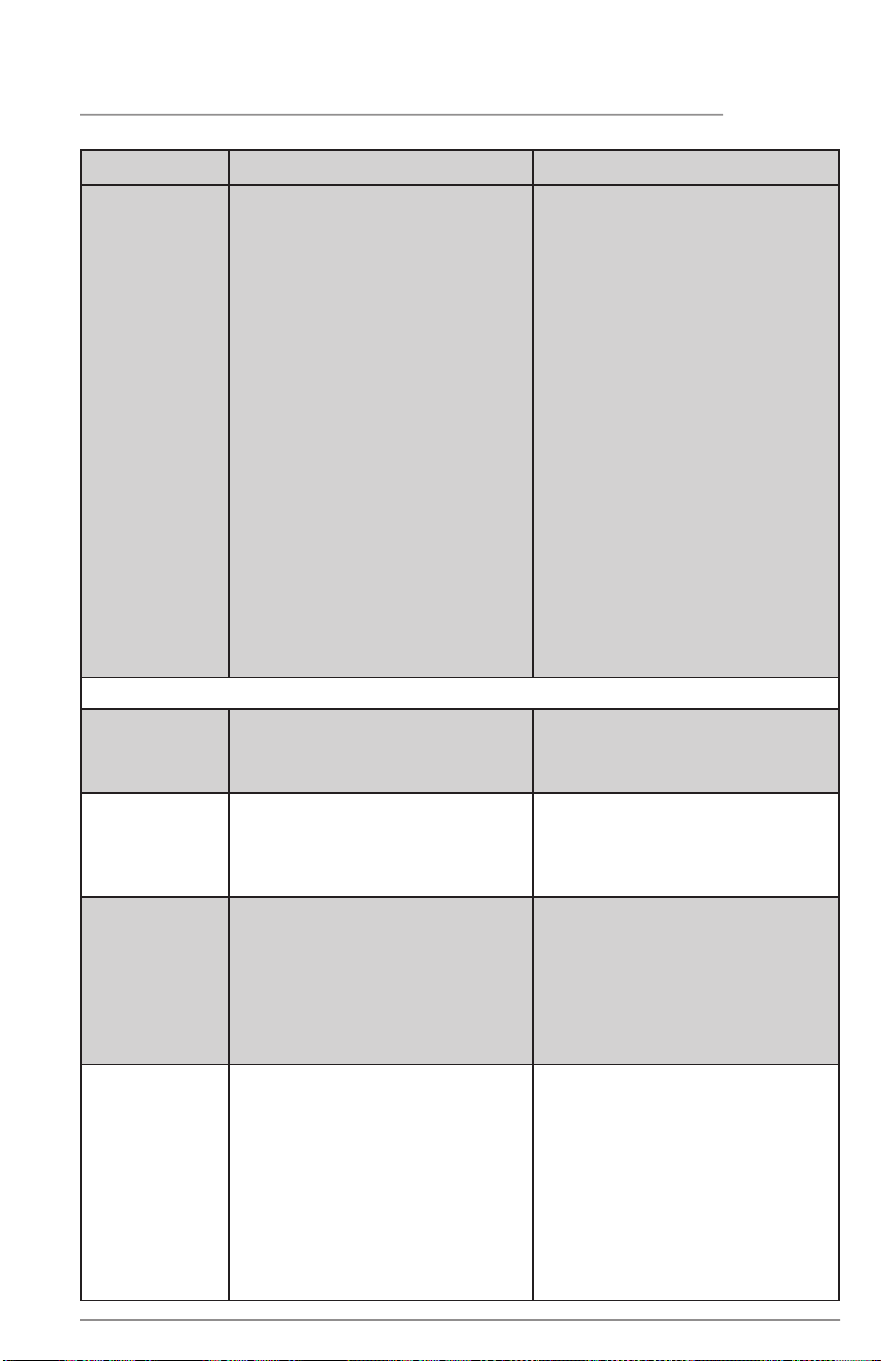
49
PROBLEM POSSIBLE CAUSES SOLUTIONS
Washer does
not start
• Electrical power cord may not be
plugged in or connection may be
loose.
• House fuse blown, circuit breaker
tripped, or a power outage has
occurred.
• Action of pressing start/pause
button on “touch screen” style
console not recognized.
• Water supply faucets are not
turned on.
• Motor is overheated. Washer
motor will stop if overheated.
• Door may be open. Unit will not
operate with door open.
• Light next to start/pause button is
flashing indicating unit is paused.
• Make sure plug fits tightly in wall
outlet.
• Reset circuit breaker or replace
fuse. DO NOT increase fuse
capacity. If problem is a circuit
overload, have it corrected by a
qualified electrician. If problem is
a power outage, call local electric
company.
• Press start/pause button with bare
fingertip.
• Turn on water supply faucets.
• It will automatically restart after
a cool down period of up to 30
minutes (if washer has not been
manually turned off).
• Ensure door is closed.
• Press start/pause button to
continue the cycle.
WATER
Water collects in
folds of the door
gasket at the
end of the cycle
• This is a result of the washing
action and is part of the normal
operation of the washer.
• Wipe and dry the gasket to
remove water and any debris
remaining in the gasket after use.
Water collects
in bleach and
fabric softener
compartments
• This is a result of the siphoning
action and is part of the normal
operation of the washer.
• Water may be removed by
removing the dispenser drawer
(see
Care and Cleaning
in this
manual) and draining water into
the empty drum or sink.
Wash load too
wet after spin
• Washer is overloaded.
• Load is too small.
• Load is out of balance.
• Drain hose is kinked.
DO NOT overload washer. See
Operating Your Washer.
• Add 1 or 2 similar items to help
balance load.
• Rearrange load to allow proper
spinning.
• Straighten drain hose.
Water does not
enter washer or
it enters slowly
• Water supply is not adequate in
area.
• Water supply faucets are not
completely open.
• Water is being used elsewhere in
the house. Water pressure must be
at least 30 psi (260 kPa).
• Water inlet hoses are kinked.
• Water inlet screens plugged.
• Check another faucet in the
house. Wait until water supply and
pressure increase.
• Fully open hot and cold faucets.
• Avoid running water elsewhere
while washer is filling.
• Straighten hoses.
• Remove hose from inlets and
clean screens.
TROUBLESHOOTING
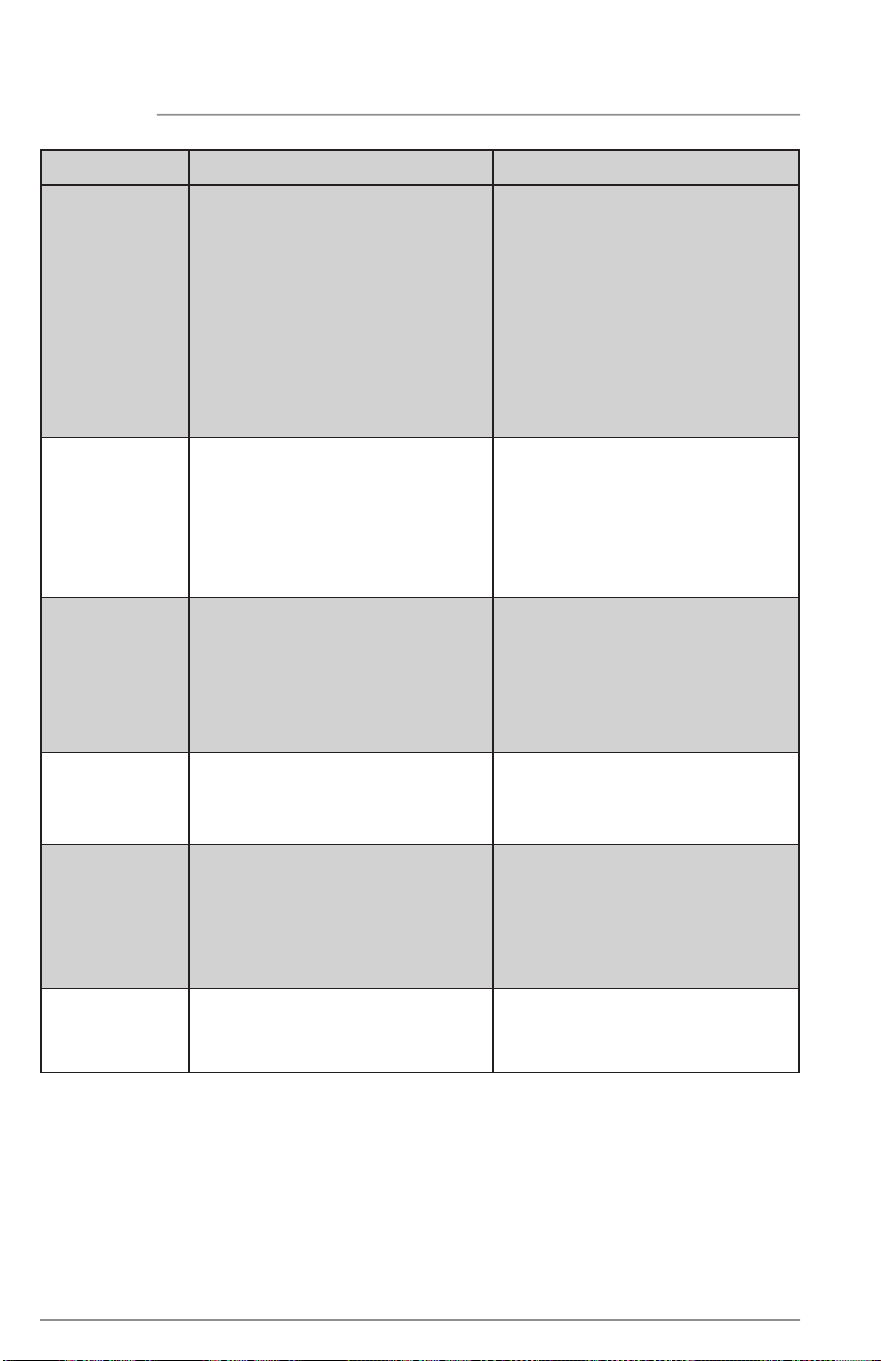
50
TROUBLESHOOTING
PROBLEM POSSIBLE CAUSES SOLUTIONS
Warm or hot
water is not hot
enough
• Hot water heater is set too low or
is a distance from washer.
• Hot water is being used
elsewhere in the house.
• Measure hot water temperature at
nearby faucet with candy or meat
thermometer. Water temperature
should be at least 120°F (49°C).
Adjust water heater as necessary.
• Avoid using hot water elsewhere
before or during washer use. There
may not be enough hot water
available for proper cleaning. If
problem persists, your hot water
system may be unable to support
more than 1 use at a time.
Water in washer
does not drain
or drains slowly
• Drain hose is kinked or clogged.
• Drain hose standpipe is too tall.
Maximum standpipe height is 8’
(2.4 m).
• House drain pipes are clogged.
• Clean and straighten the drain
hose.
• Reduce standpipe height to less
than 8’ (2.4 m). See Installation
sections of this manual.
• Unclog drain pipes. Contact
plumber if necessary.
Water leaks • Fill hose connection is loose at
faucet or washer.
• Dispenser drawer not completely
closed
• Water hoses have damage, cuts
or corrosion.
• Check and tighten hose
connections. Install rubber sealing
washers provided.
• Close dispenser drawer
completely.
• Replace hoses.
Oversudsing • HE detergent is not being used.
• Too much detergent.
• Run rinse cycle. Use a low-
sudsing, high efficiency detergent.
• Run rinse cycle. Use less detergent
in future loads.
Incorrect wash
and rinse tem-
peratures. The
LED display will
alert this condi-
tion with “HOSE”
alarm
• Hot and cold water hoses are
connected to wrong supply
faucets.
• Connect hot water hose to hot
water faucet and cold water hose
to cold water faucet.
Water is enter-
ing washer but
tub does not fill
• Drain hose standpipe is too low.
Standpipe must be a min of 23.6”
(60 cm) high to prevent siphoning.
• Increase standpipe height
to at least 23.6” (60 cm). See
Installation sections of this
manual.

51
LIMITED WARRANTY
For the applicable warranty period as set forth below, as measured from your original date of purchase, Electrolux
will repair or replace any parts of this appliance that prove to be defective in materials or workmanship when such
appliance is installed, used and maintained in accordance with the provided instructions.
Warranty Periods:
- All parts — One year including labor. In addition, your appliance is covered by a one year,
parts only, limited warranty. During the 2nd year from your original date of purchase, Electrolux
will pay for parts needed for this appliance that have proven to be defective in materials or
workmanship when your appliance is installed, used, and maintained in accordance with the
provided instructions.
- Inner wash tub (washer) — Functional life of the product (excluding labor)
- Wash tub drive motor (washer), non-cosmetic defects — Ten years (excluding labor)
Exclusions
This warranty does not cover the following:
1. Products with original serial numbers that have been removed, altered or cannot be readily determined.
2. Product that has been transferred from its original owner to another party or removed outside the USA or
Canada.
3. Rust on the interior or exterior of the unit.
4. Products purchased “as-is” are not covered by this warranty.
5. Products used in a commercial setting.
6. Service calls which DO NOT involve malfunction or defects in materials or workmanship, or for appliances not in
ordinary household use or used other than in accordance with the provided instructions.
7. Service calls to correct the installation of your appliance or to instruct you how to use your appliance.
8. Expenses for making the appliance accessible for servicing, such as removal of trim, cupboards, shelves, etc.,
which are not a part of the appliance when it is shipped from the factory.
9. Service calls to repair or replace appliance light bulbs, air filters, water filters, other consumables, or knobs,
handles, or other cosmetic parts.
10. Pickup and delivery costs; your appliance is designed to be repaired in the home.
11. Surcharges including, but not limited to, any after hour, weekend, or holiday service calls, tolls, ferry trip charges,
or mileage expense for service calls to remote areas, including the state of Alaska.
12. Damages to the finish of appliance or home incurred during transportation or installation, including but not
limited to floors, cabinets, walls, etc.
13. Damages caused by: services performed by unauthorized service companies; use of parts other than genuine
Electrolux parts or parts obtained from persons other than authorized service companies; or external causes such as
abuse, misuse, inadequate power supply, accidents, fires, or acts of God.
DISCLAIMER OF IMPLIED WARRANTIES; LIMITATION OF REMEDIES
CUSTOMER’S SOLE AND EXCLUSIVE REMEDY UNDER THIS LIMITED WARRANTY SHALL BE REPAIR OR
REPLACEMENT AS PROVIDED HEREIN. CLAIMS BASED ON IMPLIED WARRANTIES, INCLUDING
WARRANTIES OF MERCHANTABILITY OR FITNESS FOR A PARTICULAR PURPOSE, ARE LIMITED
TO ONE YEAR OR THE SHORTEST PERIOD ALLOWED BY LAW, BUT NOT LESS THAN ONE YEAR.
ELECTROLUX SHALL NOT BE LIABLE FOR CONSEQUENTIAL OR INCIDENTAL DAMAGES SUCH AS PROP-
ERTY DAMAGE AND INCIDENTAL EXPENSES RESULTING FROM ANY BREACH OF THIS WRITTEN LIMITED
WARRANTY OR ANY IMPLIED WARRANTY. SOME STATES AND PROVINCES DO NOT ALLOW THE EXCLU-
SION OR LIMITATION OF INCIDENTAL OR CONSEQUENTIAL DAMAGES, OR LIMITATIONS ON THE DURATION
OF IMPLIED WARRANTIES, SO THESE LIMITATIONS OR EXCLUSIONS MAY NOT APPLY TO YOU. THIS WRIT-
TEN WARRANTY GIVES YOU SPECIFIC LEGAL RIGHTS. YOU MAY ALSO HAVE OTHER RIGHTS THAT VARY
FROM STATE TO STATE.
If You Need Service
Keep your receipt, delivery slip, or some other appropriate payment record to establish the warranty period should
service be required. If service is performed, it is in your best interest to obtain and keep all receipts. Service under
this warranty must be obtained by contacting Electrolux at the addresses or phone numbers below.
This warranty only applies in the USA, Puerto Rico and Canada. In the USA and Puerto Rico, your appliance is
warranted by Electrolux Major Appliances North America, a division of Electrolux Home Products, Inc. In Canada,
your appliance is warranted by Electrolux Canada Corp. Electrolux authorizes no person to change or add to any
obligations under this warranty. Obligations for service and parts under this warranty must be performed by Elec-
trolux or an authorized service company. Product features or specifications as described or illustrated are subject
to change without notice.
USA
1-877-435-3287
Electrolux Home Products, Inc.,
North America
10200 David Taylor Drive
Charlotte, NC 28262
Canada
1-800-265-8352
Electrolux Canada Corp.
5855 Terry Fox Way
Mississauga, Ontario, Canada
L5V 3E4

electroluxappliances.com
A20448603 (November 2022)