Use & Care Guide
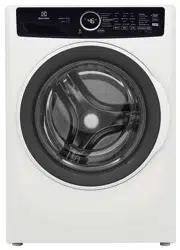
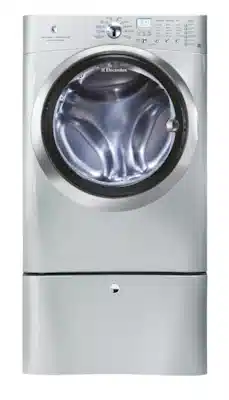
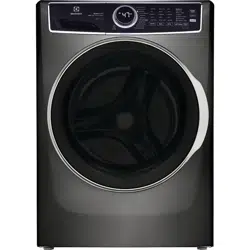
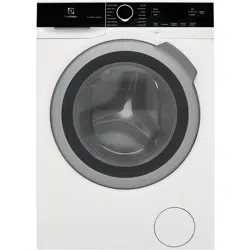
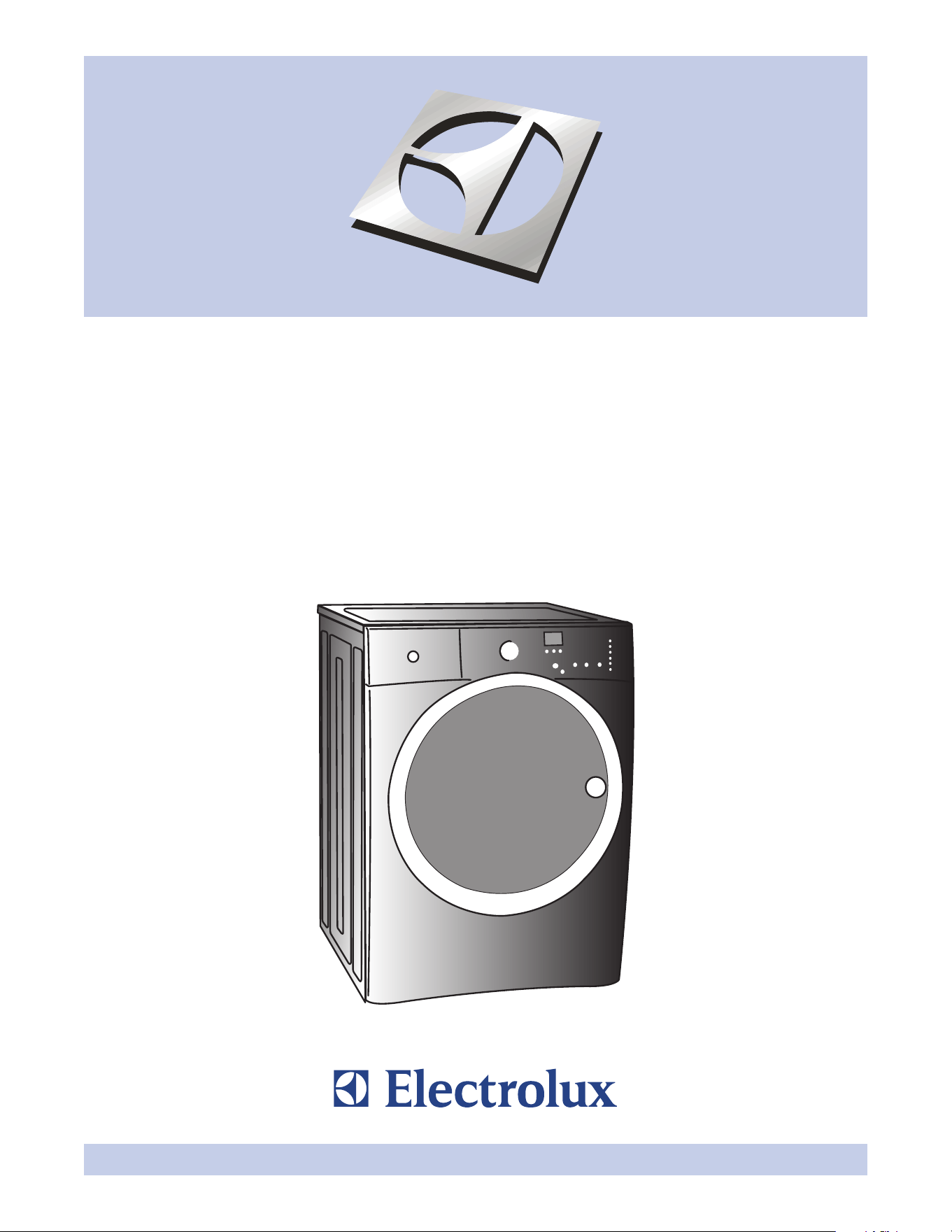
IQ-Touch™ Front-Load Washer
Guía de uso y cuidado
Lavadora de carga frontal IQ-Touch
MC
Guide d’utilisation et d’entretien
Laveuse à chargement frontal IQ-Touch
MC
137023500 A (0801))
2
Finding Information
Please read and save this guide
Thank you for choosing Electrolux, the new premium brand in home appliances. This Use & Care Guide
is part of our commitment to customer satisfaction and product quality throughout the service life of your
new appliance.
We view your purchase as the beginning of a relationship. To ensure our ability to continue serving you,
please use this page to record important product information.
Questions?
For toll-free telephone support in the U.S. and Canada: 1-877-4ELECTROLUX (1-877-435-3287)
For online support and product information visit http://www.electroluxappliances.com
Table of contents
©2008 Electrolux Major Aplliances
All rights reserved.
Purchase date
Electrolux model number
Electrolux serial number
Keep a record for quick reference
NOTE
Registering your product with Electrolux enhances
our ability to serve you. You can register online at
www.electroluxappliances.com or by dropping
your Product Registration Card in the mail.
Finding information ......................................................... 2
SAFETY ....... .............................................................. 3-5
Features .......................................................................... 6
Operating Instructions ............................................... 7-18
• GettingStarted ........................................................... 7
• NormalOperatingSounds .......................................... 7
• OperatingYourWasher ..........................................8-13
• CycleSelection ....................................................14-17
• Washing/RinsingTemperature ............................. 17-18
• SpinSpeed ...................................................................
18
• SoilLevel .................................................................. 18
• Options ..................................................................... 19
• WasherFeatures ....................................................... 20
Cycle Chart ................................................................... 21
StainRemovalGuide ............................................... 22-23
• StainRemovalProcedures ....................................... 22
• StainRemovalSuggestions ...................................... 23
Care & Cleaning .......................................................24-26
Solutions to Common Problems ............................. 27-30
• CommonWashingProblems ............................... 27-28
• ServicePreventionChecklist ...............................29-30
Warranty Information .................................................... 31
Notes ............................................................................ 32
3
Safety
NOTE
The instructions appearing in this Use and
Care Guide are not meant to cover every
possible condition and situation that may occur.
Common sense and caution must be practiced
when installing, operating and maintaining any
appliance.
Recognize safety symbols, words and
labels
Your safety and the safety of others is very
important.
We have provided many important safety messages
in the Use and Care Guide, Installation Instructions
and on your appliance. Always read and obey all
safety messages.
Safety items throughout this manual are labeled
withaWARNINGorCAUTIONbasedontherisk
type as described below:
This symbol alerts you to situa-
tions that may cause serious body
harm, death or property damage.
This symbol alerts you to situa-
tions that may cause bodily injury
or property damage.
Important Safety Instructions
Save these instructions for future reference.
WARNING
For your safety the following information in this
manual must be followed to minimize the risk of
fire or explosion or to prevent property damage,
personal injury or death.
Do not store or use gasoline or other
flammable vapors and liquids in the
vicinity of this or any other appliance.
WHATTODOIFYOUSMELLGAS:
Do not try to light any appliance.•
Do not touch any electrical switch; do •
not use any phone in your building.
Clear the room, building or area of all •
occupants.
Immediately call your gas supplier from •
a neighbor’s phone. Follow the gas
supplier’s instructions.
If you cannot reach your gas supplier, •
call the fire department.
Installation and service must be
performed by a qualified installer,
service agency or the gas supplier.

4
Safety
PREVENT FIRE
Do not wash items that have been previously •
cleaned in, soaked in, or spotted with gaso-
line, cleaning solvents, kerosene, cooking oils,
waxes, etc. Do not store these items on or near
the washer. These substances give off vapors or
chemical reactions that could ignite or explode.
Do not put oily or greasy rags or clothing on top •
of the washer. These substances give off vapors
that could ignite the materials.
Do not add gasoline, cleaning solvents, or other •
flammable or explosive substances to the wash
water. These substances give off vapors that
could ignite or explode.
Under certain conditions, hydrogen gas may •
be produced in a hot water system that has not
beenusedfor2weeksormore.HYDROGEN
GASISEXPLOSIVE.Ifthehotwatersystemhas
not been used for such a period, before using
the washer, turn on all hot water faucets and let
the water flow from each for several minutes.
This will release any accumulated hydrogen gas.
Hydrogen gas is flammable; do not smoke or
use an open flame during this time.
Do not store or use gasoline or other flammable •
vapors or liquids in the vicinity of this or any
other appliance.
Failure to comply with these warnings could •
resultinre,explosion,seriousbodilyinjuryand/
or damage to the rubber or plastic parts of the
washer.
PROTECT CHILDREN
Do not allow children to play on or in the washer. •
Close supervision of children is necessary when
the washer is used near children. As children
grow, teach them the proper, safe use of all ap-
pliances.
Destroy the carton, plastic bag and other pack-•
ing materials after the washer is unpacked. Chil-
dren might use them for play. Cartons covered
with rugs, bedspreads or plastic sheets can
become airtight chambers.
Keep laundry products out of children’s reach. •
To prevent personal injury, observe all warnings
on product labels.
Before the washer is removed from service or •
discarded, remove the washer door to prevent
accidental entrapment.
Failure to comply with these warnings could •
result in serious personal injuries.
WARNING
To reduce the risk of fire, electrical shock, or injury to persons when using this washer,
comply with the basic warnings listed below. Failure to comply with these warnings could
result in serious personal injuries.
You can be killed or seriously injured if you don’t follow these Important Safety Instructions:
5
Safety
Grounding type
wall receptacle
Power cord with
3-prong grounded plug
Do not, under
any circumstances,
cut, remove,
or bypass the
grounding prong.
WARNING
FIRE/ELECTRICALSHOCKHAZARD
Avoid fire hazard or electrical shock. Do not use
an adaptor plug or extension cord or remove
grounding prong from electrical power cord.
Failure to follow this warning can cause serious
injury, fire or death.
WARNING
HARMFULVAPORHAZARD
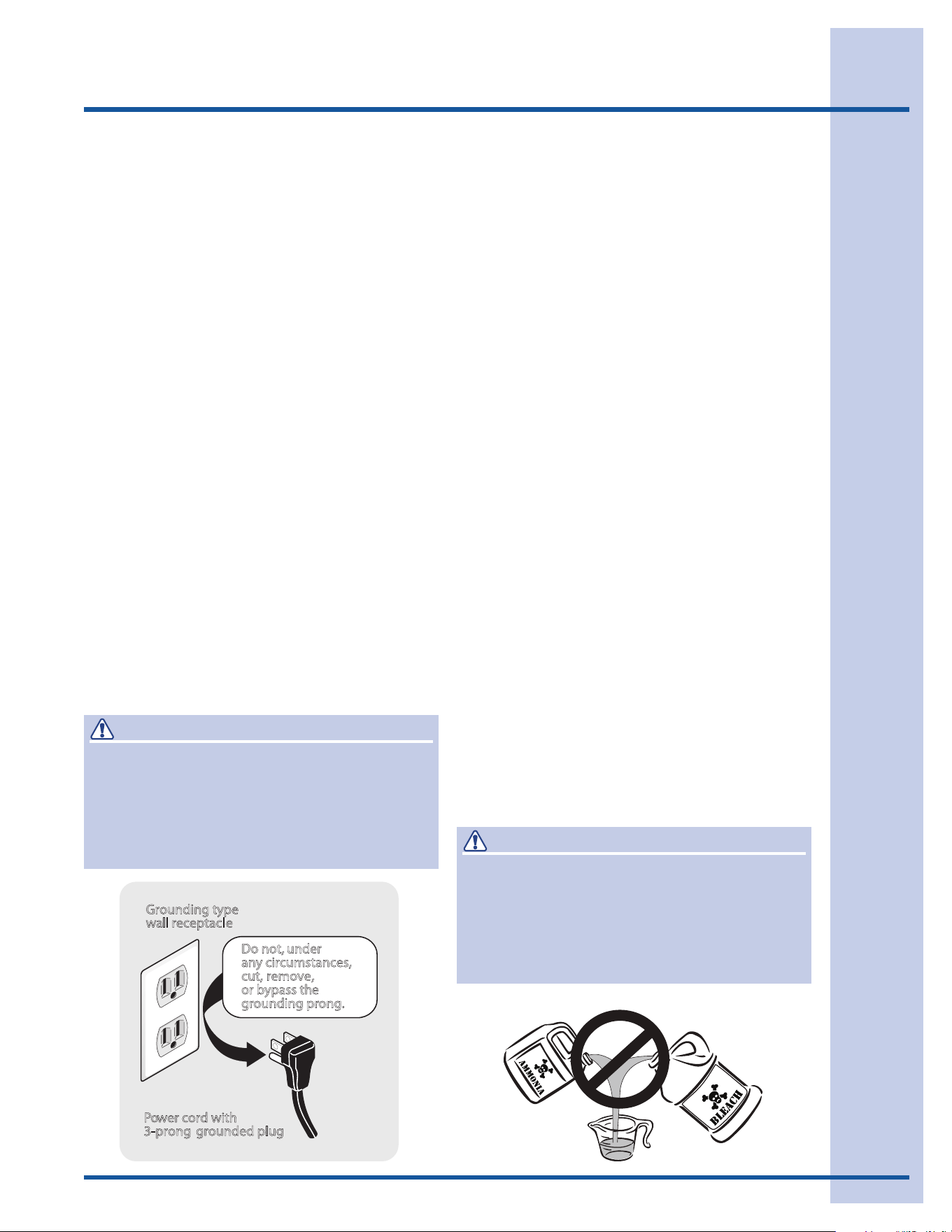
Do not use or mix liquid chlorine bleach with other
household chemicals such as toilet cleaners, rust
removers, acid or products containing ammonia.
These mixtures can produce dangerous fumes
which can cause serious injury or death.
PREVENT INJURY
To prevent shock hazard and assure stability •
during operation, the washer must be installed
and electrically grounded by a qualified service
person in accordance with local codes. Instal-
lation instructions are packed in the washer for
installer’s reference. Refer to INSTALLATION
INSTRUCTIONS for detailed grounding proce-
dures. If the washer is moved to a new location,
have it checked and reinstalled by a qualified
service person.
To prevent personal injury or damage to the •
washer, the electrical power cord of the washer
must be plugged into a properly grounded and
polarized 3-prong outlet. The third grounding
prongmustneverberemoved.Nevergroundthe
washer to a gas pipe. Do not use an extension
cord or an adaptor plug.
Follow package directions when using laundry •
products. Incorrect usage can produce poison-
ous gas - resulting in serious injury or death.
Do not combine laundry products for use in 1 •
load unless specified on the label.
Do not mix chlorine bleach with ammonia or •
acids such as vinegar.
PREVENT INJURY AND DAMAGE TO THE
WASHER
To prevent serious personal injury and damage to
the washer:
All repairs and servicing must be performed by •
an authorized servicer unless specifically rec-
ommended in this Use & Care Guide. Use only
authorized factory parts.
Do not tamper with controls.•
Do not install or store the washer where it will be •
exposed to the weather.
Do not install on carpet. Install washer on a solid •
floor. It may be necessary to reinforce the floor to
prevent vibration or movement.
To reduce the risk of electric shock, disconnect •
this appliance from the power supply before
attempting any user maintenance. Turning the
controls to the OFF position does not disconnect
this appliance from the power supply.
To prevent injury, do not reach into the washer •
while parts are moving. Before loading, unload-
ing or adding items, push in the cycle selector
knob and allow the drum to coast to a complete
stop before reaching inside.
This washer is equipped with an electrical over-•
load protector. The motor will stop if it becomes
overheated. The washer will automatically restart
after a cool down period of up to 30 minutes,
if the washer has not been manually turned off
during this time.
Failure to comply with these warnings could •
result in serious personal injuries.
Important Safety Instructions, con’t
6
Features
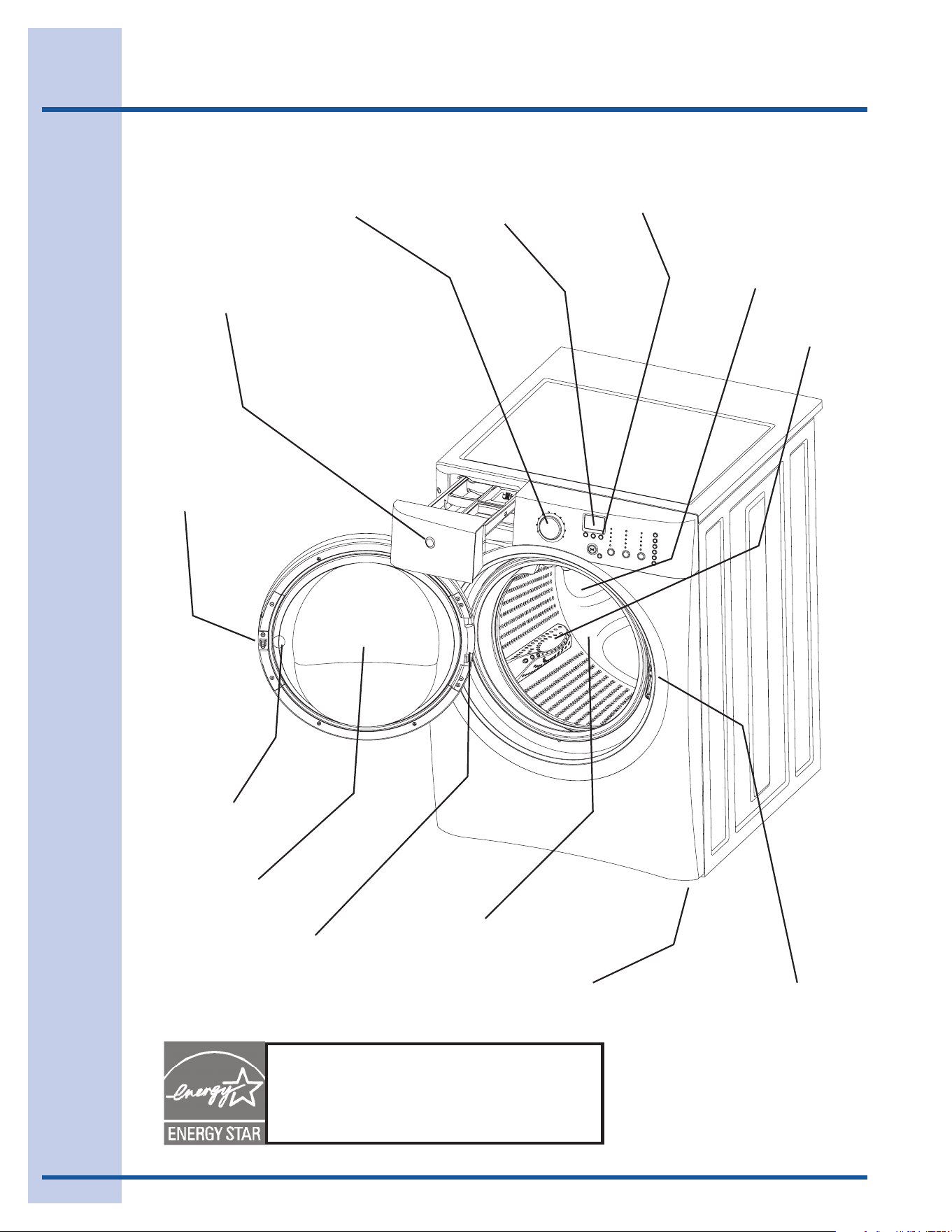
As an ENERGY STAR
®
Partner, Electrolux
Major Appliances has determined that this
product meets the ENERGY STAR
®
guidelines
for energy efficiency.
Control Lock
Theater-Style,
Luxury-Lighting™
System
Reversible,
Touch-2-Open™
Door System
Touch-2-Open™
Latch Indicator
Touch-2-Open™
Door Latch with
Safety Lock
Touch-2-Open™
Cycle Selector
Touch-2-Open™
Dispenser Drawer
with Luxury-Glide™
Door Striker
Cascading
Wash Vanes
Stainless Steel
Wash Drum
Adjustable
Leveling Legs
Dual Stage,
Wide-Angle
Door Hinge
LCD Display
7
Operating Instructions
Getting Started
Sort laundry into loads that can be washed 1.
together. (See page 8.)
Prepare items for washing. (See page 8.)2.
Pretreat stains and heavy soil. (See page 9.)3.
Add laundry load to the washer. (See page 9.)4.
To run your washer, follow these basic steps:
Add laundry products to the dispenser. (See 5.
page 10-11.)
Select the appropriate cycle and settings for the 6.
load. (See page 12.)
Start the washer. (See pages 12-13.)7.
Normal Operating Sounds
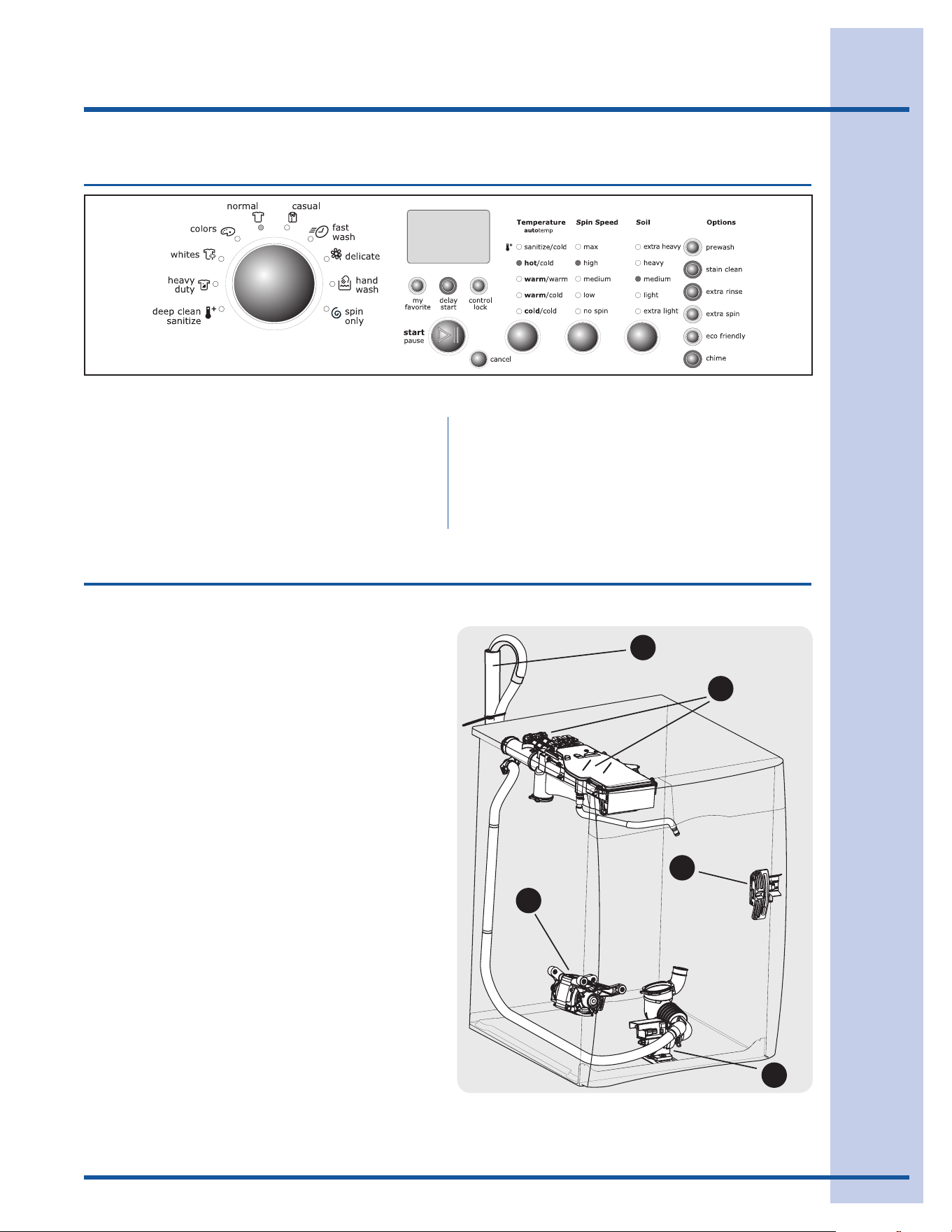
You may or may not hear the following sounds
from your new washer:
A. DRAIN HOSE The washer has a flexible drain
hose to carry water from the washer to the
stand pipe of your home. You will hear water
flowing into your stand pipe. This is a normal
part of the operation of the washer.
B. WATER VALVES/DISPENSER As water enters
the dispenser system, it is common to hear a
water flowing sound. This normal sound will
vary slightly based on the water pressure in
your home.
C. DOOR LOCK Your washer is equipped with a
door lock with an electric solenoid. There will be a
clicking sound as the washer door is being locked
or unlocked.
D. DRAIN PUMP Your washer is equipped with
a high velocity drain pump. It is normal to hear
humming and gurgling sounds as water is
pumped from the washer. Both of these sounds
are normal and indicate that your pump is
functioning correctly.
E. HIGH SPEED MOTOR A powerful motor is used
to drive the drum to high spin speeds to extract
water from your load. You will hear a sound
associated with these higher spin speeds. This
sound is normal and will vary slightly as the spin
speed varies with load size and cycle selected.
A
B
C
D
E
8
BEFORE USING YOUR WASHER
Read the important instructions in this section of
the Use and Care Guide before operating your
washer.
OPERATING YOUR WASHER
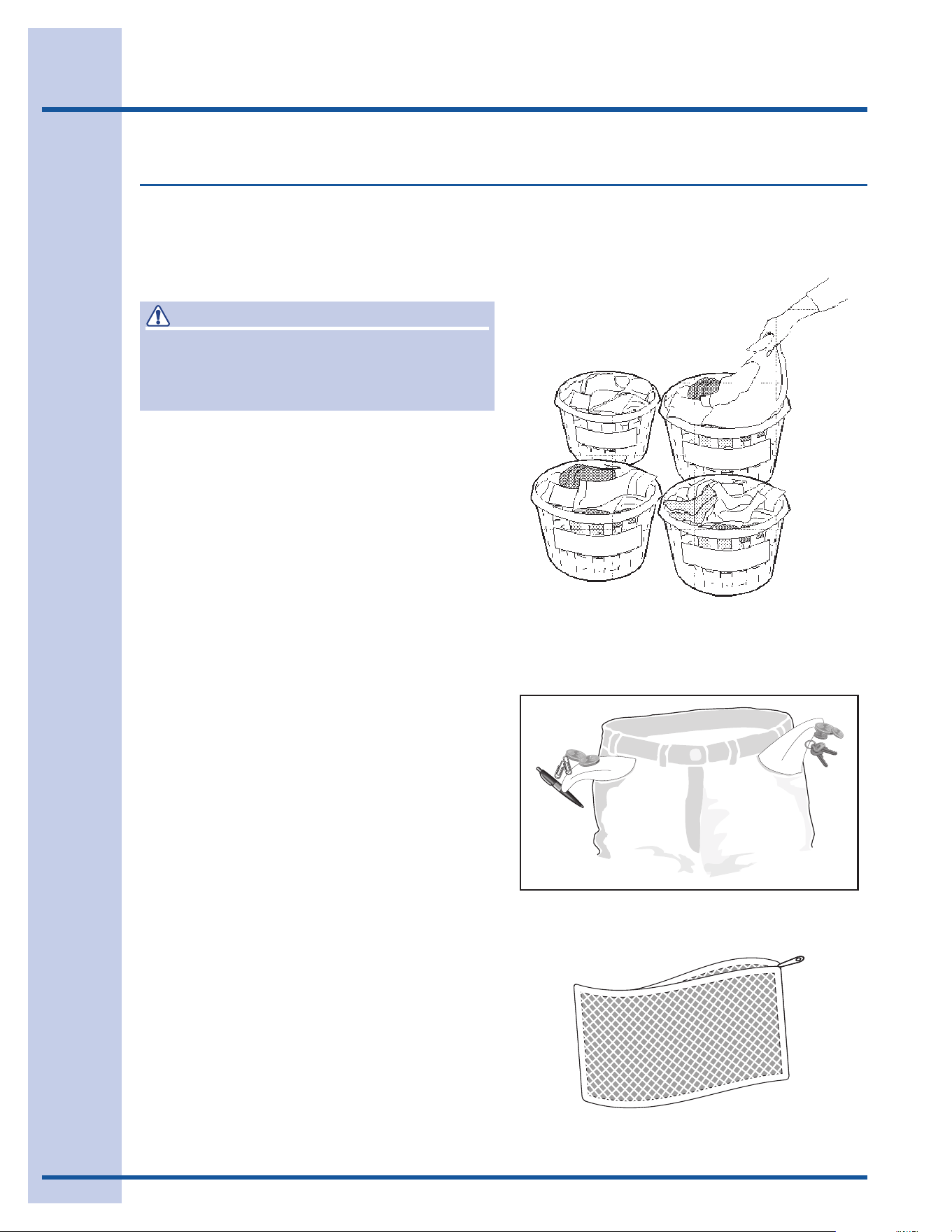
Sort laundry into loads that can be 1.
washed together.
Sort items by recommended cycle and water
temperature.
Separate white, light and colorfast items from
dark and non-colorfast items.
Separate items that shed lint from items that
attract lint. Casual, synthetic, knit, and cordu-
roy items will pick up lint from towels, rugs,
and chenille bedspreads.
Separate heavily soiled items from lightly
soiled items.
Separate lacy, sheer, loosely knit, or delicate
items from durable items.
Do not machine wash items containing fiber-
glass. Small particles of fiberglass left in the
drum may transfer to fabrics in other loads and
cause skin irritation.
Prepare items for washing.2.
Empty pockets.
Brush off lint and dirt. Shake out rugs and
beach towels.
Close zippers, fasten hooks, tie strings and
sashes, and remove non-washable trims and
ornaments.
Mend rips and tears to prevent further damage
during washing.
Turn knit items inside out to prevent pilling.
Place delicate and small items such as bras,
hosiery and baby socks in a mesh bag.
Operating Your Washer
WARNING
To reduce the risk of fire, electric shock or injury
topersons,readtheIMPORTANTSAFETY
INSTRUCTIONSinthisUse and Care Guide
before operating your washer.
Operating Instructions
(Mesh bag not included.)
W
H
I
T
E
S
C
A
S
U
A
L
C
O
L
O
R
S
T
O
W
E
L
S
9
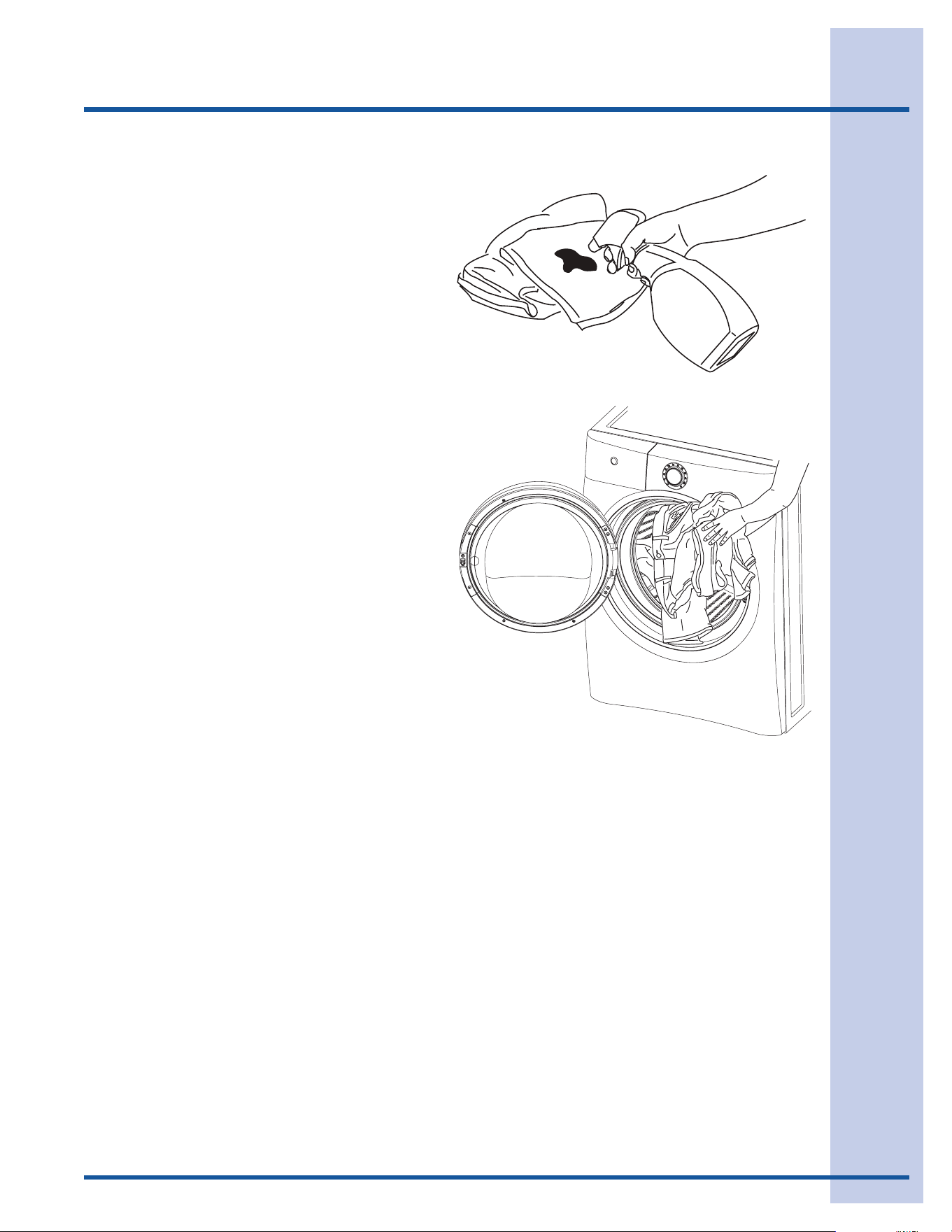
3. Pretreat stains and heavy soil.
See Stain Removal Guide in this guide for
safe, successful stain removal instructions.
4. Add laundry load to washer.
Combine large and small items in a load.
Loadlargeitemsrst.Largeitemsshouldnot
be more than half the total wash load.
Washing single items such as a sweater, towel
or jeans is inefficient and may cause an out-of-
balance load. Add 1 or 2 similar items to help
balance the load.
Wash a single heavy item such as a king-sized
comforter, bedspread or sleeping bag sepa-
rately.
The washer can be fully loaded, but the items
should not be tightly packed. The door should
close easily.
Operating Instructions
OPERATING YOUR WASHER, con’t
10
5. Add laundry products to the dispenser.
IMPORTANT
Open and close the dispenser drawer slowly.
Closing the drawer too quickly could result in
early dispensing of the bleach or fabric softener.
IMPORTANT
Savetheliquidcupinsertforfutureuse.DONOT
discard it while you are using powder detergent.
Use a low-sudsing, high efficiency
detergent to prevent oversudsing in front
loadwashers.Lookforthissymbolon
the detergent label:
For best results
Detergent, liquid chlorine bleach and liquid
fabric softener will be dispensed at the proper
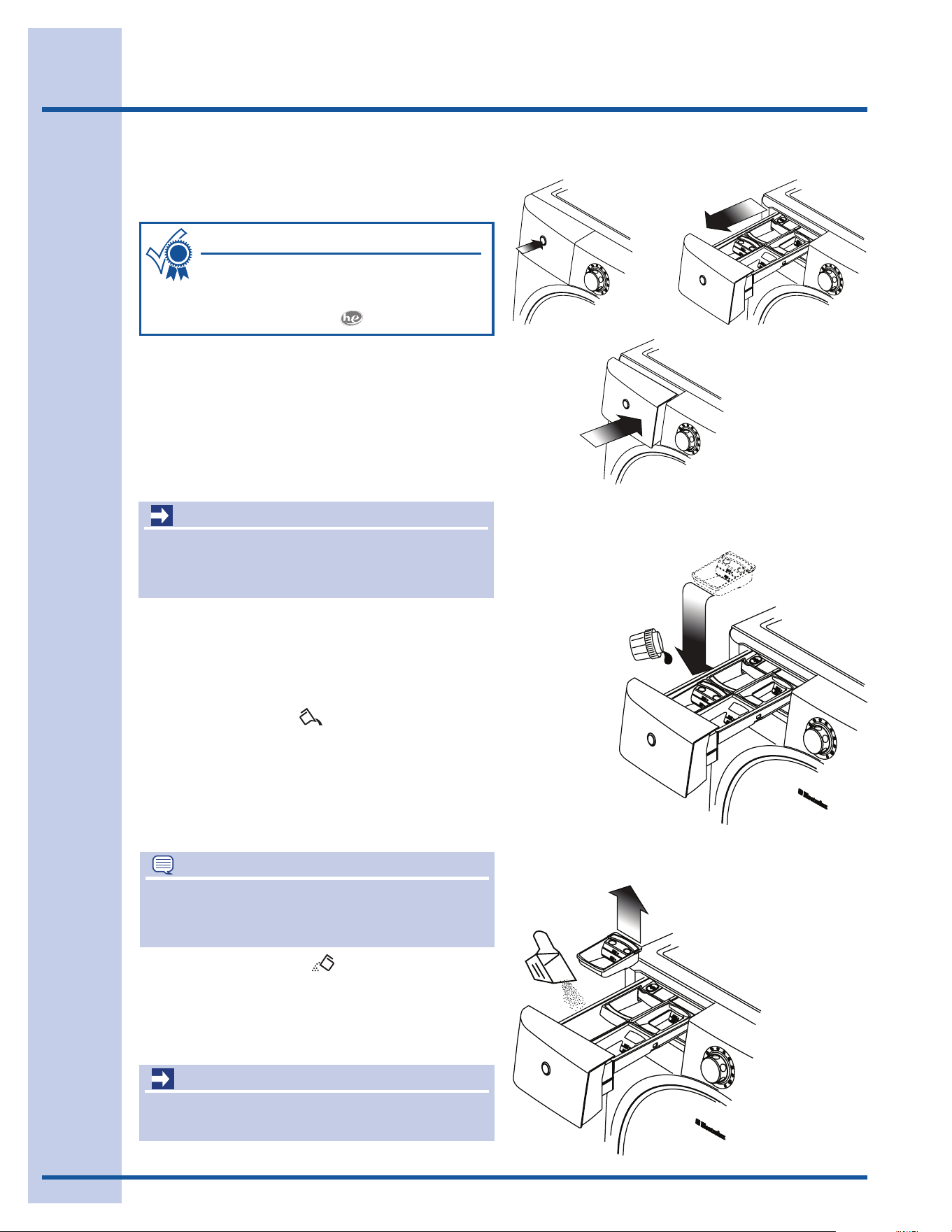
times in the cycle. To unlatch the dispenser
drawer push on the dispenser drawer latch
indicator. To close and latch the dispenser
drawer push the drawer in until you hear a
slight click with the drawer face flush to the
pane.
Use the cap or scoop provided by the deter-
gent manufacturer to measure the amount
recommended. Detergent dosage may need to
be adjusted for water temperature, water hard-
ness, load size and soil level.
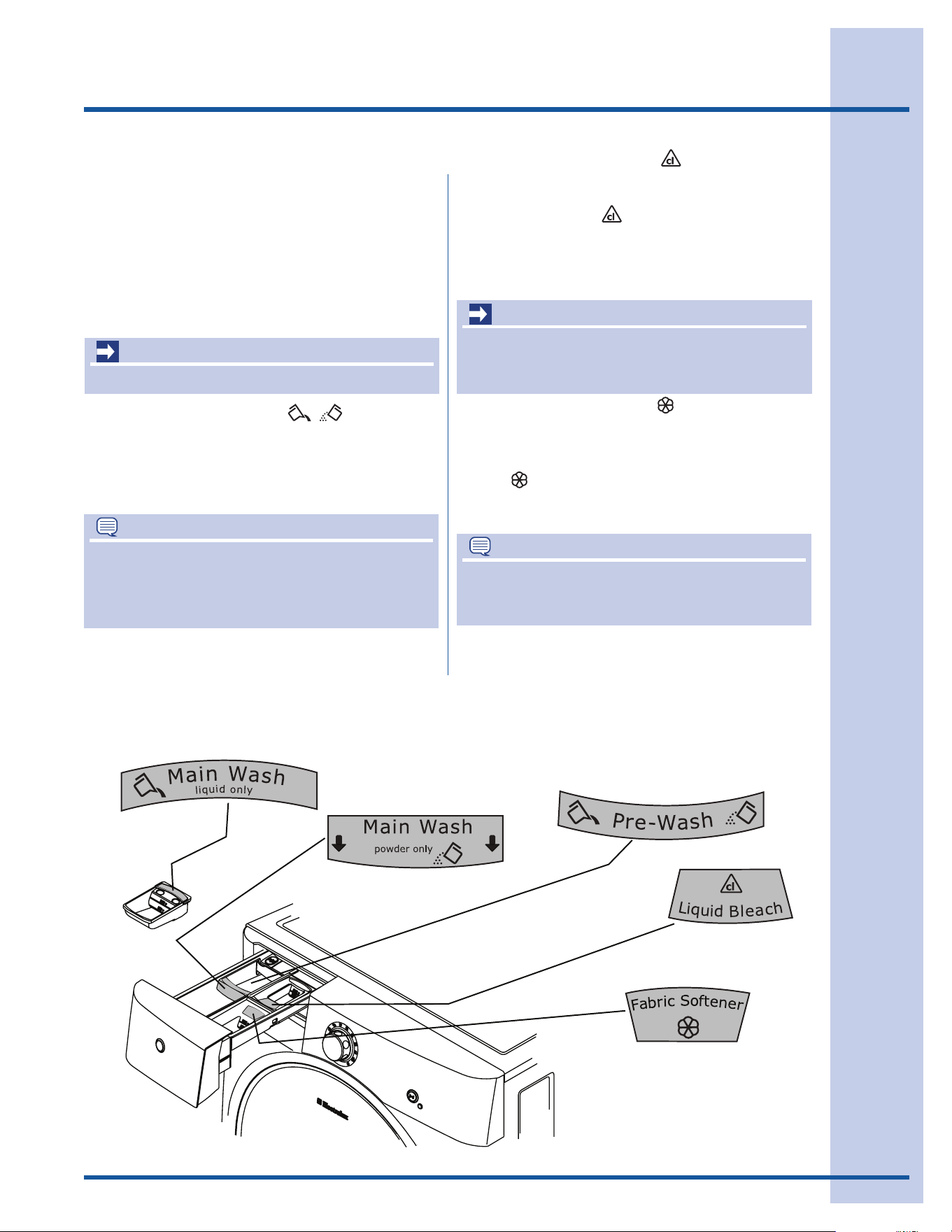
Liquid Detergent
Add the recommended amount of a high ef-
ficiency liquid detergent to the “Main Wash
- liquid only” cup. Do not exceed the MAX fill
line.
Liquiddetergentcanalsobeaddeddirect-
ly to the “Main Wash - powder only” chamber
when not using the “Pre-Wash” option.
Operating Instructions
OPERATING YOUR WASHER, con’t
Remove liquid cup when using
powderdetergent!DONOT
pour powder detergent into
liquid cup. It will not dis-
pense correctly!
Insert liquid cup when
using liquid detergent.
NOTE
From time to time you may see water in the
“Main Wash - liquid only” chamber. This is part
of the normal operation of the washer.
Powder Detergent
To use a high efficiency powder detergent, re-
move the “Main Wash - liquid only” cup and
add the powder directly to the “Main Wash -
powder only” detergent chamber.
11
IMPORTANT
Do not mix liquids and powders.
Other Wash Products
Color-safe bleach, water conditioner, detergent
booster and enzyme products may be added
with the detergent. Put liquid products with
liquid detergent in the “Main Wash - liquid
only” detergent cup or powder products with
powder detergent in the “Main Wash - pow-
der only” detergent chamber.
Detergent for Prewash
For heavily soiled or stained loads, select the
prewash option and add the recommended
amount of detergent to the “Pre-Wash” deter-
gent cup.
Operating Instructions
Liquid Chlorine Bleach
If desired, add liquid chlorine bleach to the
chamber labeled “Liquid Bleach” and marked
with this symbol . Fill to the MIN line for
small loads or the MAX line for large loads. DO
NOTllabovethemaximumllline.
Add color-safe bleach with the detergent.
Liquid Fabric Softener
If desired, pour the recommended amount of
liquid fabric softener into the chamber labeled
“Fabric Softener” and marked with this sym-
bol . Fill to the MIN line for small loads or
the MAXlineforlargeloads.DONOTllabove
the maximum fill line.
OPERATING YOUR WASHER, con’t
IMPORTANT
To prevent fabric damage, do not overfill the
“Liquid Bleach” chamber or pour liquid chlorine
bleach directly onto the load.
NOTE
From time to time you may see water in the
“Main Wash -liquid only”, “Liquid Bleach” and
“Fabric Softener” chambers. This is part of the
normal operation of the washer.
NOTE
To prevent staining, do not overfill the “Fabric
Softener” chamber or pour liquid fabric softener
directly on the wash load.
Use of a fabric softener-dispensing ball is not
recommended in tumble action washers.
12
Operating Instructions
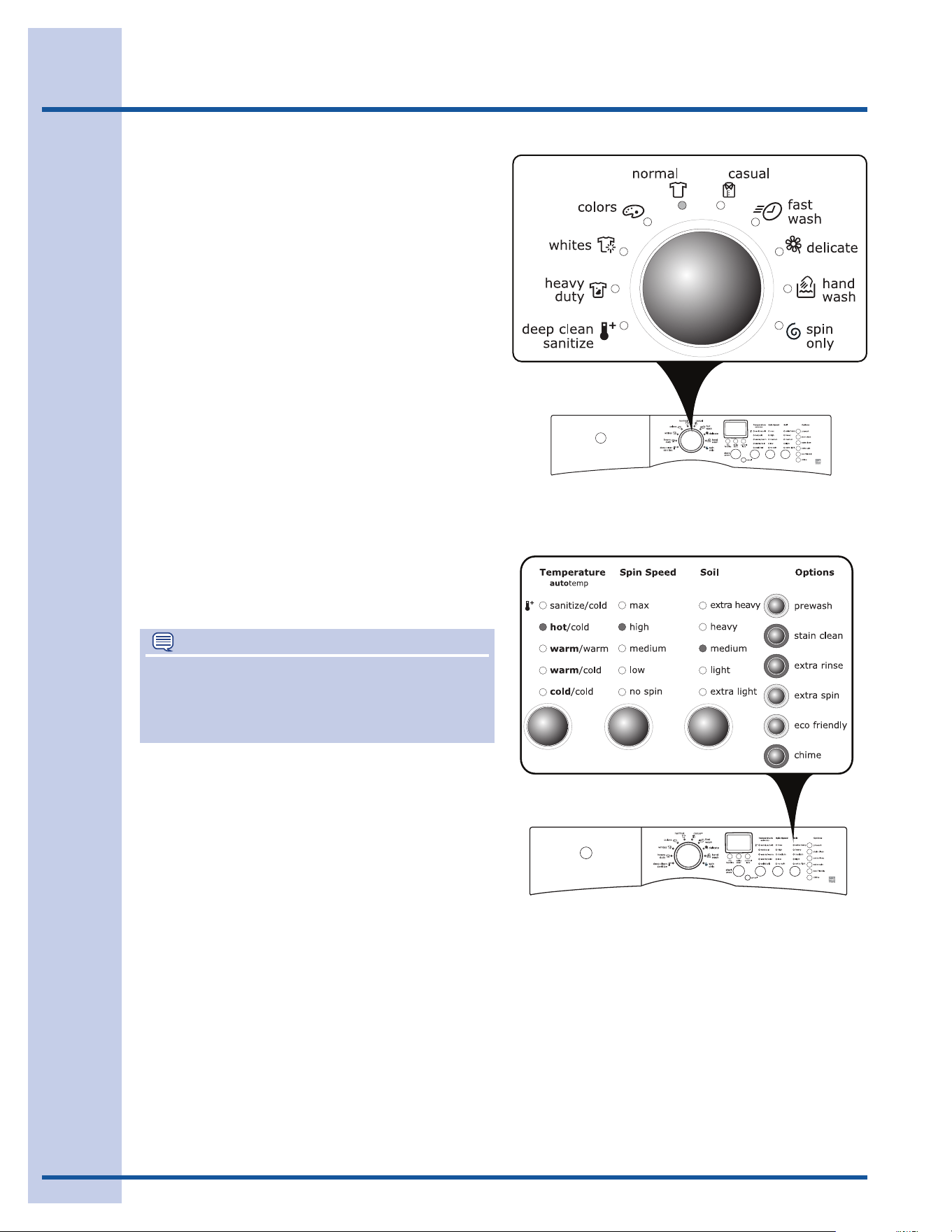
6. Select the appropriate cycle and
settings for the load.
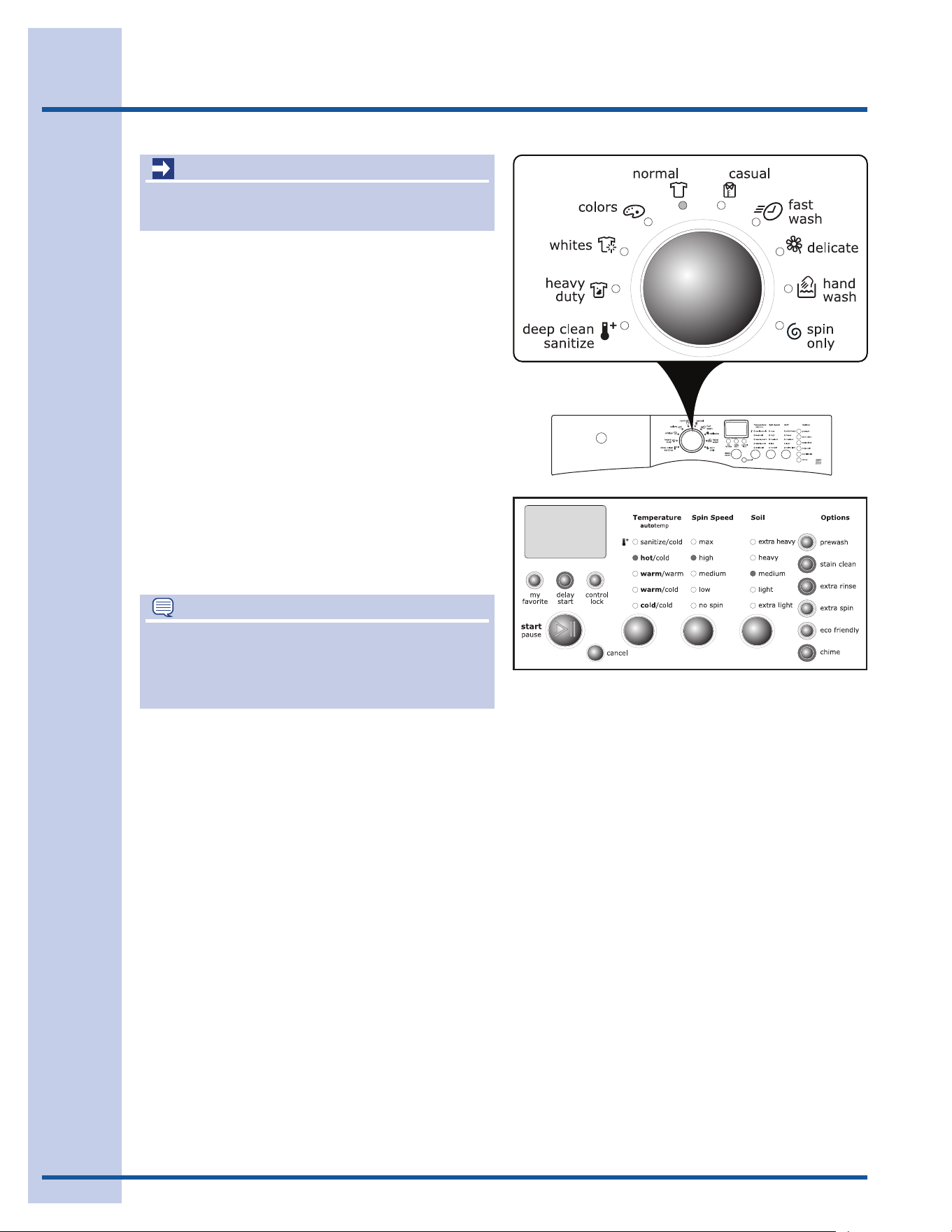
Turn the cycle selector knob in either direction
to select the cycle desired. The indicator for
that cycle will be illuminated. See the “Cycle
Selection” section in this guide for descrip-
tions of each cycle.
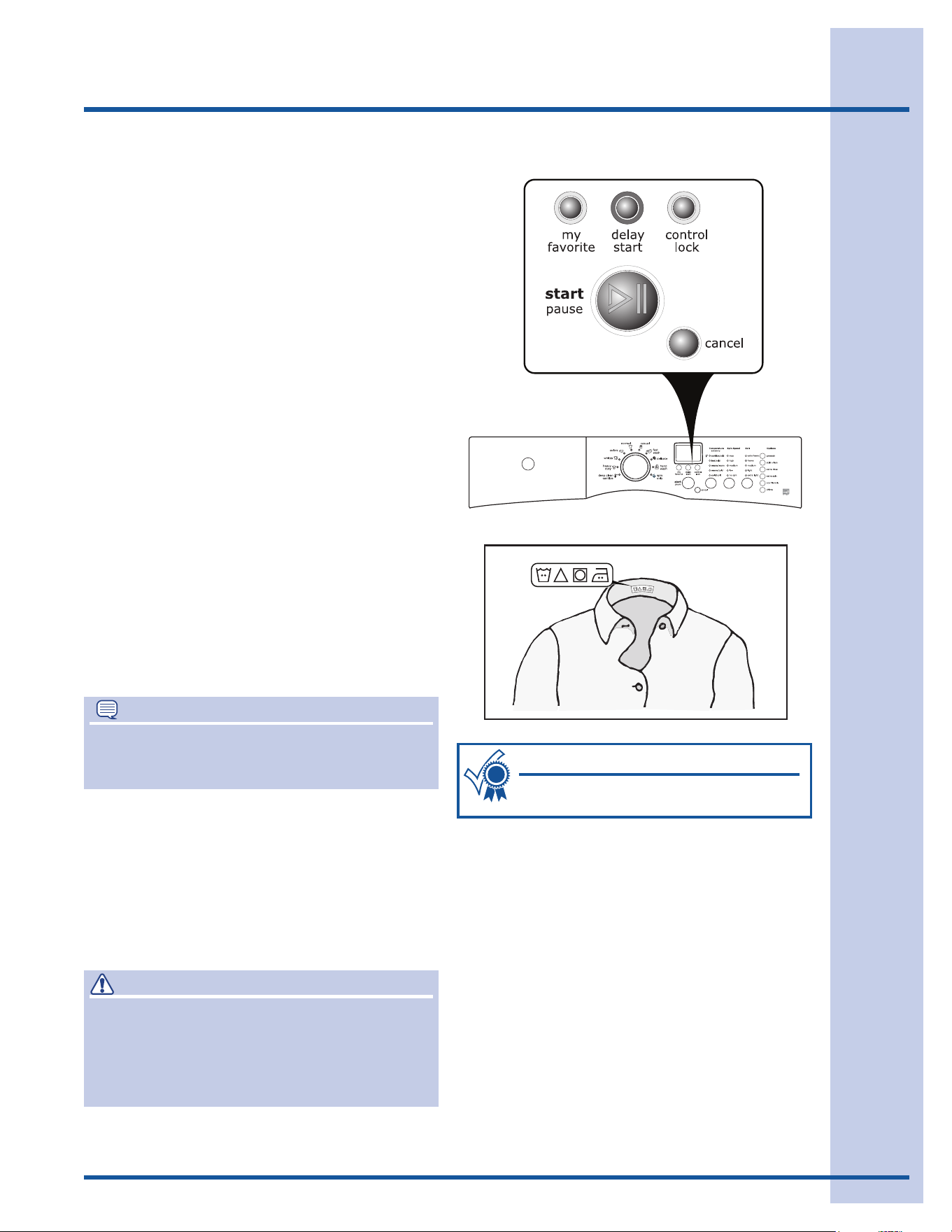
The estimated cycle time, suitable wash and
rinse water temperatures, final spin speed, soil
level, and options for each cycle will be indi-
cated for the cycle selected. See the “Cycle
Settings” and “Washer Settings Chart” in this
guide for descriptions and available settings
for each cycle.
To change the settings, press the tempera-
ture, spin speed, soil, and options buttons to
scroll to the desired settings.
To select or delete an option, press the button
for that option. The indicator will light when
the option has been selected. It will no longer
be lighted when the option has been deleted.
NOTE
To provide the best care for your laundry, not
every setting or option is available with every
cycle. If a setting or option is not available for the
cycle selected, the indicator will not light.
Adjustments to a cycle will be remembered
and recalled each time that cycle is selected in
the future.
To return to factory default settings, press and
hold the spin speed and soil buttons at the
same time for 5 seconds.
OPERATING YOUR WASHER, con’t
13
Operating Instructions
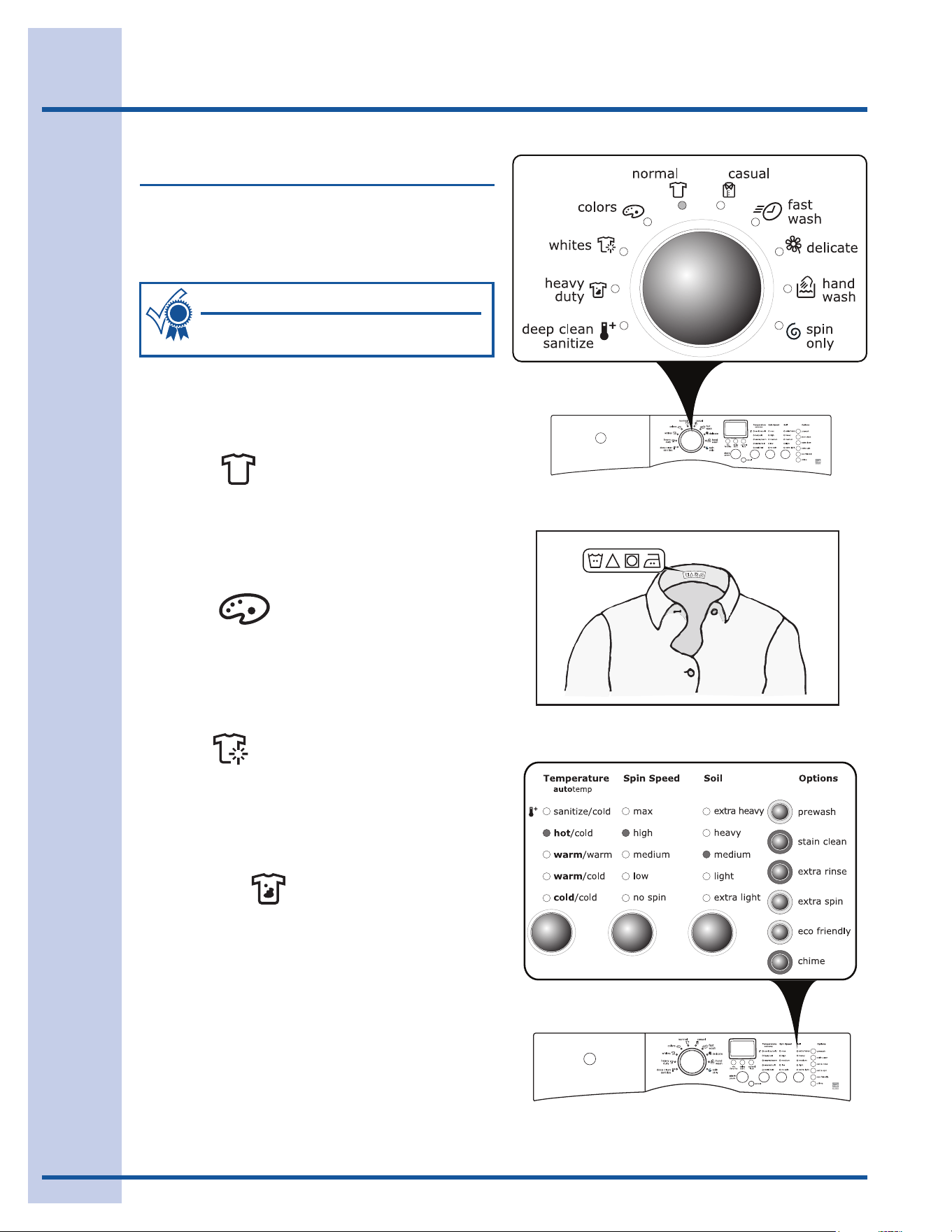
7. Start the washer.
Close the door and press start. The washer
will not operate with the door open and DOOR
OPEN will be displayed.
Select delay start to delay the beginning of
the cycle for up to 14 hours if desired.
As a safety measure, the door will automati-
cally lock during the entire wash cycle.
To add a forgotten item to the washer any time
during the wash portion of the cycle, press
pause. When the door unlocks, open the door,
add the item, close the door and press start to
resume the cycle.
If changes to the settings or options are at-
tempted after the cycle starts, you will hear
several beeps when the buttons are pressed.
To change the settings or options, press
pause, make the new selections and press
start again.
To change the cycle once the cycle has begun,
press cancel, select a new cycle, and press
start again. Just turning the cycle selector
knob will not change the cycle.
To stop the cycle, press cancel.
NOTE
If the cycle is interrupted during spin, the door
lock will not release until the tub has stopped
spinning.DONOTforceopenthedoor.
A signal will sound at the end of the cycle if the
chime option has been selected.
Remove items from the washer when the cycle
ends and place in dryer, line dry or dry flat as
directed on the fabric care label.
Excess wrinkling, color transfer or odors may
develop in items left in the washer after the
cycle has ended, if not removed promptly.
Follow the fabric care label instructions
on items to be washed.
For best results
OPERATING YOUR WASHER, con’t
CAUTION
ENTRAPMENTandTIP-OVERHAZARD
An open door could entice children to hang on
the door or crawl inside the washer. If there are
no small children present, you may leave the
door ajar to prevent mildew and odor build up.
14
Cycle Selection
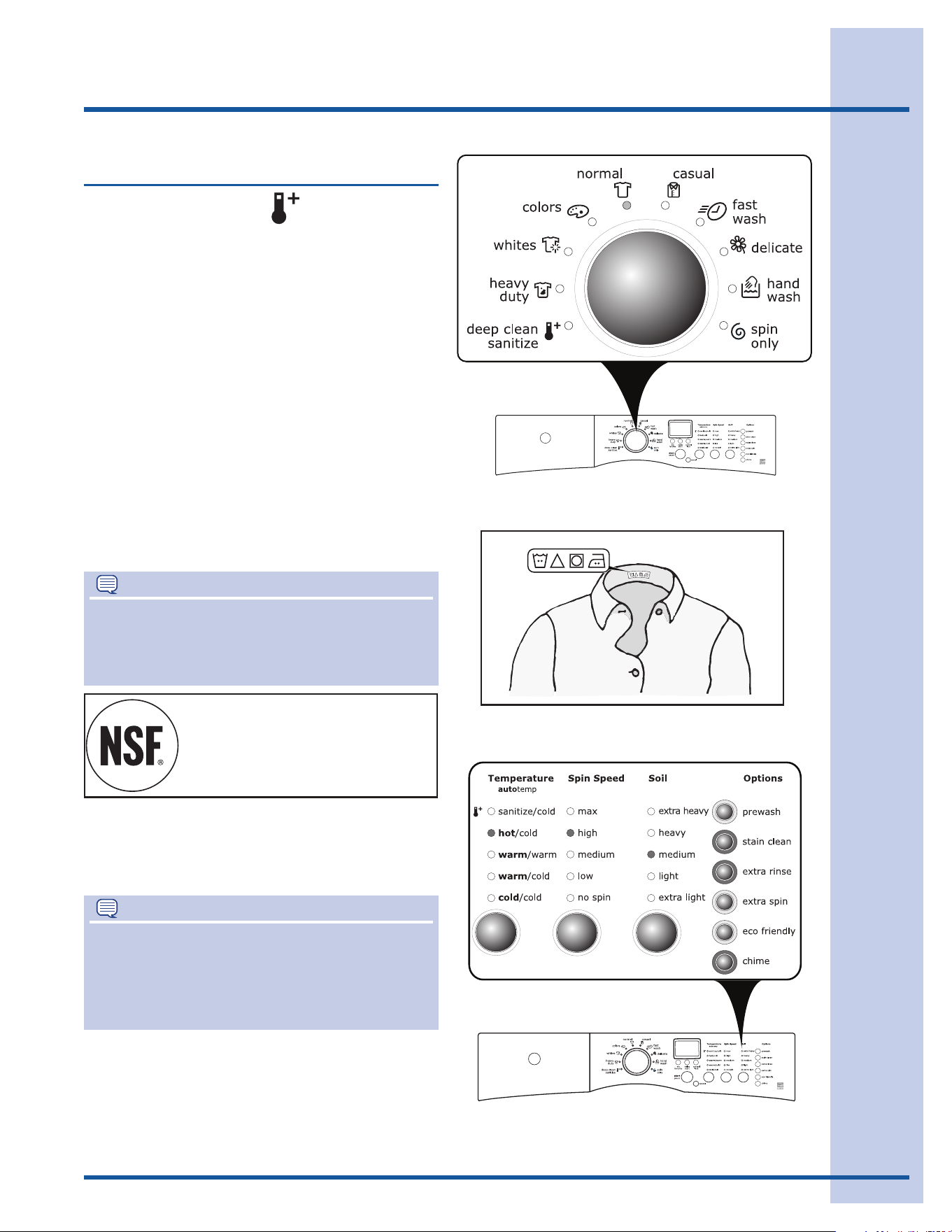
Turn the cycle selector in either direction to the
cycle desired. The indicator for that cycle will be
illuminated. Press on the cycle selector knob to
extend it or return it flush to the console.
Follow the fabric care label instructions
on items to be washed.
For best results
NORMAL
The normal cycle provides 9-21 minutes of revers-
ing tumble wash action for most loads. All water
temperatures except sanitize/cold, all spin
speeds, soil levels and options are available with
this cycle.
COLORS
The colors cycle provides 5-20 minutes of revers-
ing tumble wash action for mixed color loads.
Warm/cold or cold/cold water temperatures, all
spin speeds, soil levels and options are available
with this cycle.
WHITES
The whites cycle provides 9-21 minutes of revers-
ing tumble wash action for whiter cottons. The use
of liquid chlorine bleach is recommended. Hot/
cold water, all spin speeds, soil levels, and op-
tions are available with this cycle.
HEAVY DUTY
The heavy duty cycle provides 9-21 minutes of
reversing tumble wash action for heavily soiled
sturdy items such as jeans. For best soil and stain
removal, use the hottest water safe for the fabrics
being washed. All water temperatures except
sanitary/cold, all spin speeds and options, and
all soil levels except light and extra light are avail-
able with this cycle.
To change the selection after the cycle begins,
press cancel before making another choice. Just
turning the knob to another selection will not
change the cycle.
Operating Instructions
15
Cycle Selection, con’t
DEEP CLEAN SANITIZE
Use the deep clean sanitize cycle to clean and
sanitize heavily soiled, colorfast fabrics including
towels,bedding,andchildren’sclothing.Veryhot
water, all spin speeds, all soil levels except light
and extra light, and all options except prewash,
eco friendly and stain clean are available with
this cycle.
It is recommended that you set your water heater
to 120° F (49° C) or higher to ensure proper per-
formance during this cycle. If the setting is lower
or the load is extra large, the cycle time will be
extended by 30 minutes or more.
The deep clean sanitize cycle will kill 99.9% of
bacteria with no carryover of bacteria between
loads.Nobleachorharshchemicalsareneeded,
but higher temperatures are required. Please
check fabric care labels to prevent damage.
Operating Instructions
NSF Protolcol P172
Sanitization Performance of Residential
and Commercial, Family-Sized Clothes
Washers
NOTE
ThiscyclehasbeencertiedbyNSFInternational,
an independent third party testing and certification
organization dedicated to public health, safety and
environmental protection.
NOTE
If the voltage at your outlet is under 110 v, the
internal heater may not adequately heat the wash
water. If the cycle is interrupted while the water is
heating, the final temperature of the wash water
may be lower and sanitation may be reduced.
As a precaution, the washer door is locked once
the water temperature reaches 130° F (55° C). If
the cycle is cancelled during the wash phase and
the water temperature is greater than 150° F (66°
C), an automatic cool down and drain will occur
before the door can be opened.
The wash water is heated by an internal boost
heater to a maximum of 152° F (67° C) as the load
tumbles for up to 4 hours. Cold water is added to
cool down the load prior to drain and spin.
16
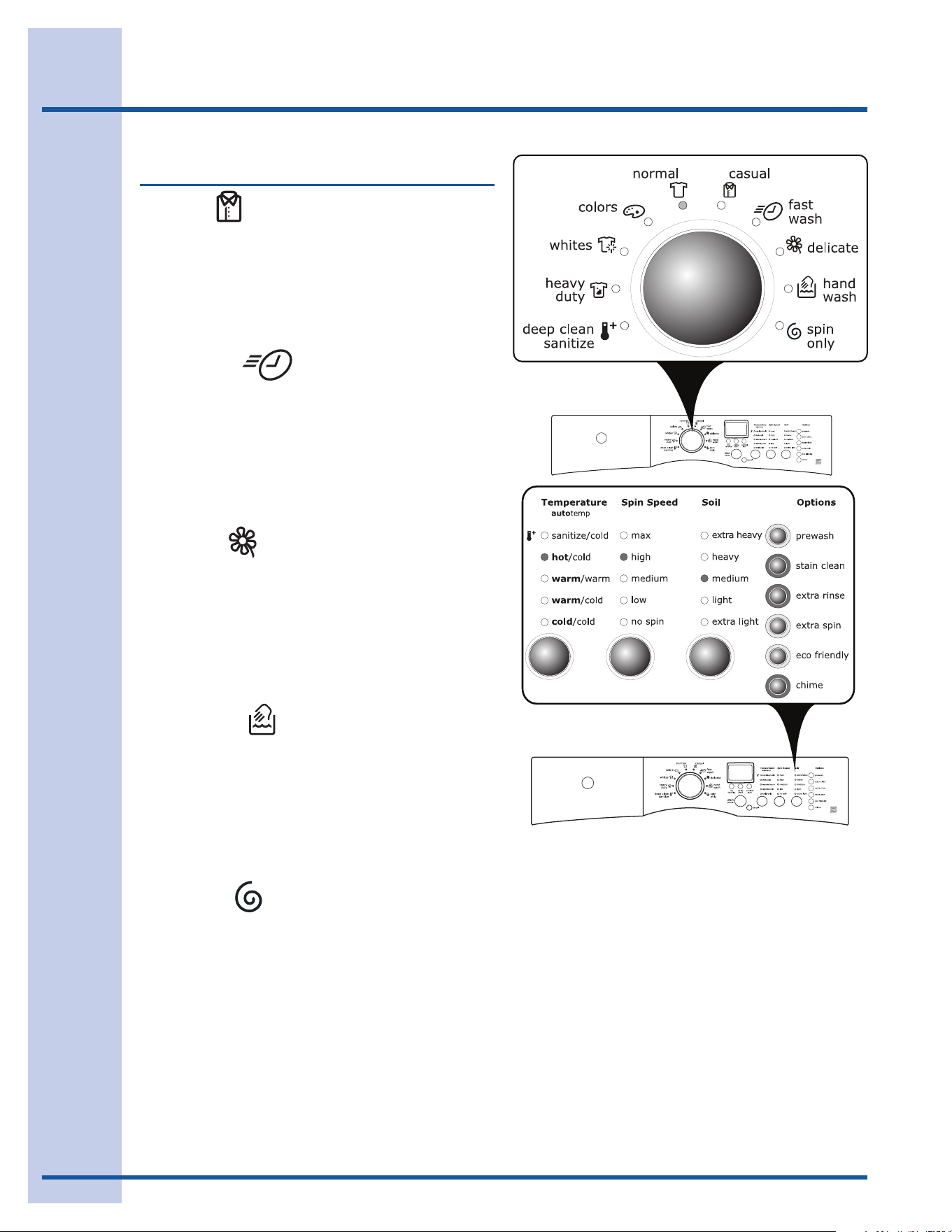
CASUAL
The casual cycle provides 5-20 minutes of revers-
ing tumble action for cottons and blends with a
permanent press or no-iron finish. To minimize
wrinkling, the warm/warm and sanitize/cold tem-
peratures are not available with this cycle. All spin
speeds, soil levels, and options are available.
FAST WASH
The fast wash cycle provides 5-11 minutes of re-
versing tumble action to quickly wash small, lightly
soiled loads in 18 minutes. All water temperatures
except sanitize/cold, all spin speeds, and all soil
levels except extra heavy and heavy are available
with this cycle. The eco friendly option is also
available.
DELICATE
The delicate cycle provides 6-12 minutes of gentle
reversing tumble action for knits and delicates. All
water temperatures except hot/cold and sani-
tize/cold, all spin speeds, all soil levels except
heavy and extra heavy, and the eco friendly,
stain clean, and extra rinse options are available
with this cycle.
HAND WASH
The hand wash cycle provides 5-11 minutes of in-
termittent gentle tumbling for items labeled “Hand
Washable”. All water temperatures except hot/
cold and sanitize/cold, all spin speeds, all soil
levels except heavy and extra heavy, and the eco
friendly and extra rinse options are available with
this cycle.
SPIN ONLY
Use the spin only cycle anytime you want to drain
water from the washer and spin out the load or as
a follow-up to the no spin selection. Select the
spin speed appropriate for the load.
To add a cold water rinse prior to the spin, select
the extra rinse option.
Cycle Selection, con’t
Operating Instructions
17
Cycle Selection, con’t
Washing/Rinsing Temperature
Operating Instructions
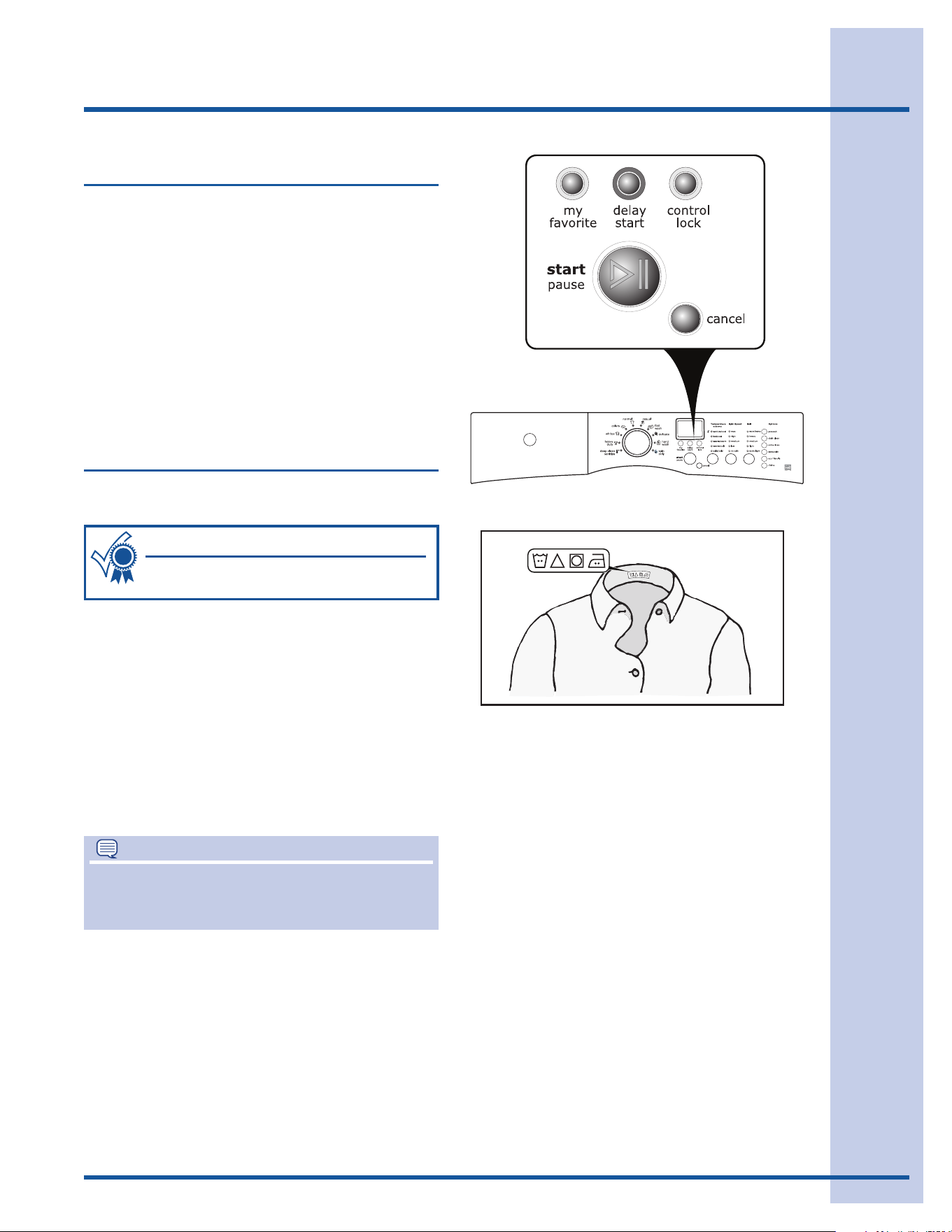
MY FAVORITE
To program a cycle with your preferred water
temperature, spin speed, soil level and options,
press and hold the my favorite button for 3 sec-
onds.
To use that customized cycle to wash future loads,
simply press the my favorite button and the se-
lected cycle, water temperature, spin speed, soil
level and options will be indicated.
Your personalized cycle can be changed by re-
peating the my favorite procedure.
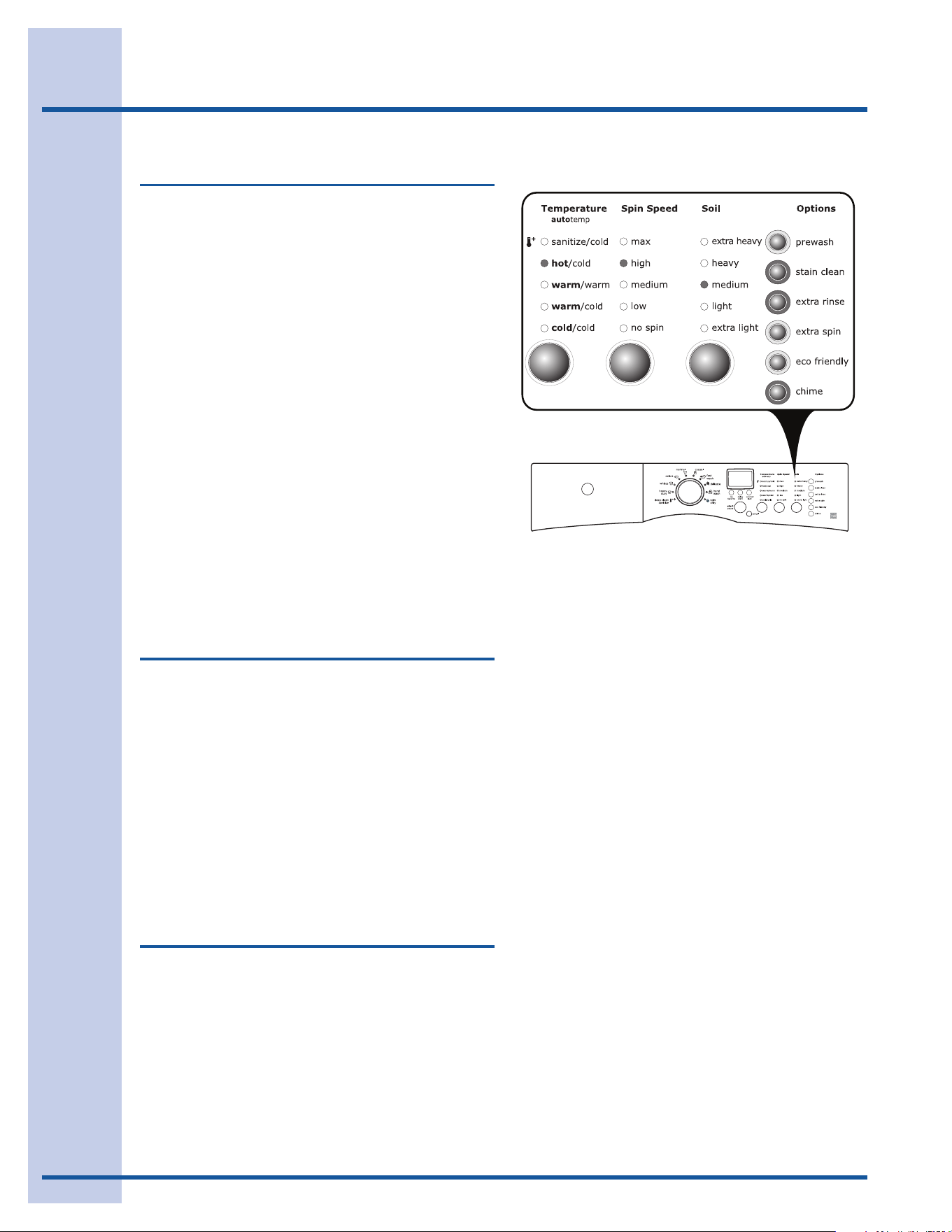
The appropriate washing temperature will auto-
matically be indicated for the cycle selected.
NOTE
To change the temperature once the cycle has
begun, press the pause button, make the new
selection and press start again.
To change the temperature, press the tempera-
ture button to scroll to the desired setting. Select a
wash water temperature according to fiber content,
colorfastness and soil level. A cold water rinse saves
energy and reduces wrinkling
To protect your fabrics, not all temperatures are
available with every cycle. The indicator will not light
if the setting is not available with that cycle.
The temperature selected for the cycle will be
remembered and recalled each time that cycle is
selected in the future.
Follow the fabric care label instructions
on items to be washed.
For best results
All wash water temperatures are automatically
regulated to maximize detergent effectiveness and
improve washing performance. The water heater
setting and its distance from the washer, water
usage in other parts of the home, and seasonally
low ground water temperature in some geographic
areas can affect water temperature.
18
Operating Instructions
SANITIZE/COLD
This setting sanitizes heavily soiled colorfast fabrics
such as towels, bedding, and children’s clothing by
killing 99.9% of bacteria using wash water heated
with a boost heater to 152° F (67° C). Cold water is
used to cool and rinse the load. This setting is only
available with the deep clean sanitize cycle.
HOT/COLD
Use this setting for heavily soiled white or colorfast
cottons and blends.
WARM/COLD
Use this setting for normally soiled white or colorfast
cottons or blends.
WARM/WARM
Use this setting for washable woolens or when a
warm water rinse is desired.
COLD/COLD
Use this setting for lightly soiled non-colorfast items,
knits, delicates, and hand washables.
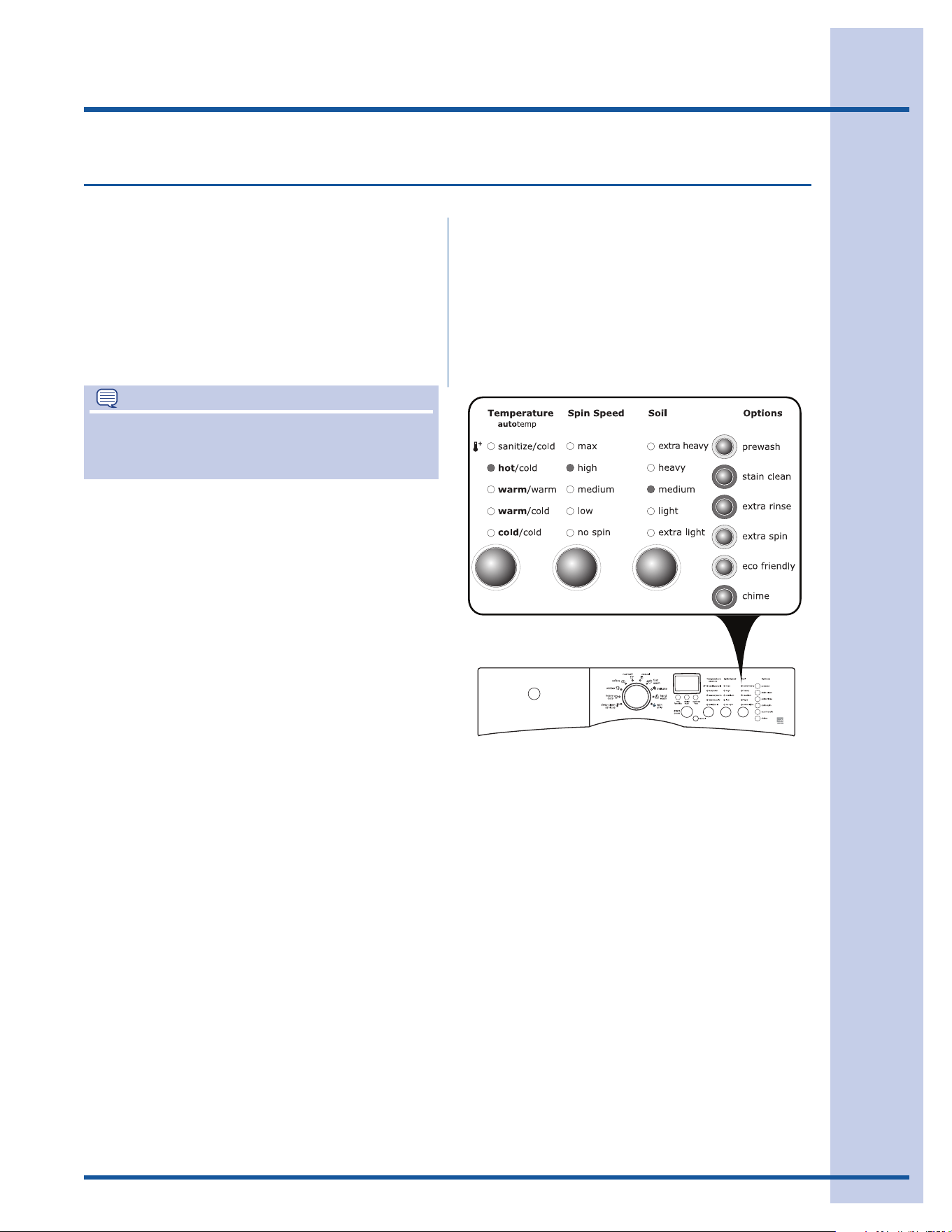
Max, high, medium, and low spin speeds are
available for each cycle. The spin speedand/or
duration of final spin vary from cycle to cycle.
Increasing the spin speed will extract more water,
decrease drying time and conserve energy. De-
creasing the spin speed will reduce wrinkling.
Use no spin to omit the final spin at the end of the
cycle. The load will be very wet. Remove items from
the wash drum to drip dry or select the spin only
cycle to remove excess water at a more convenient
time.
Adjust the wash time in 3-minute increments based
on the soil level of each load. Normal, heavy, extra
heavy, light and extra light Soil levels are available.
Temperature, con’t
Spin Speed
Soil Level
19
Operating Instructions
Suitable options will automatically be indicated
when the cycle is selected.
To add options, press the corresponding options
buttons to illuminate the selections desired. To de-
lete options, press the options buttons again and
the indicator lights will turn off.
Notalloptions are available with every cycle. The
indicator will not light if the option is not available
with that cycle.
Options
NOTE
To change the options once the cycle has
begun, press the pause button, make the new
selections and press start again.
The options selected for the cycle will be remem-
bered and recalled each time that cycle is selected
in the future.
PREWASH
Select this option to add a short initial wash peri-
od to a cycle. Heavily soiled and stained loads will
prewash for approximately 5 minutes. The water
will drain and the load will automatically advance
to the regular wash cycle.
See step 5 in “Operating Your Washer” section in this
guide for details on adding detergent to the dispenser.
STAIN CLEAN
Use the stain clean option to add a 5-minute soak
in the middle of the wash portion of the heavy duty,
whites, colors, normal, casual, and delicate cycles.
EXTRA RINSE
Use this option when additional rinsing is desired
to remove excess dirt and detergent. It is recom-
mended for heavily soiled loads or if household
members have sensitive skin. Extra rinse occurs
before the final rinse when the liquid fabric soft-
ener is dispensed.
EXTRA SPIN
Use this option to add minutes to the final spin at
the selected Spin Speed. This will improve water
extraction, decrease drying time and save energy.
ECO FRIENDLY
The eco friendly option reduces the hot and warm
water temperature a few degrees to save energy. It is
available with all cycles except deep clean sanitize
and spin only.
CHIME
A chime will sound at the end of the cycle when
this option is selected. The signal has an adjust-
able volume level or can be turned off.
20
Operating Instructions
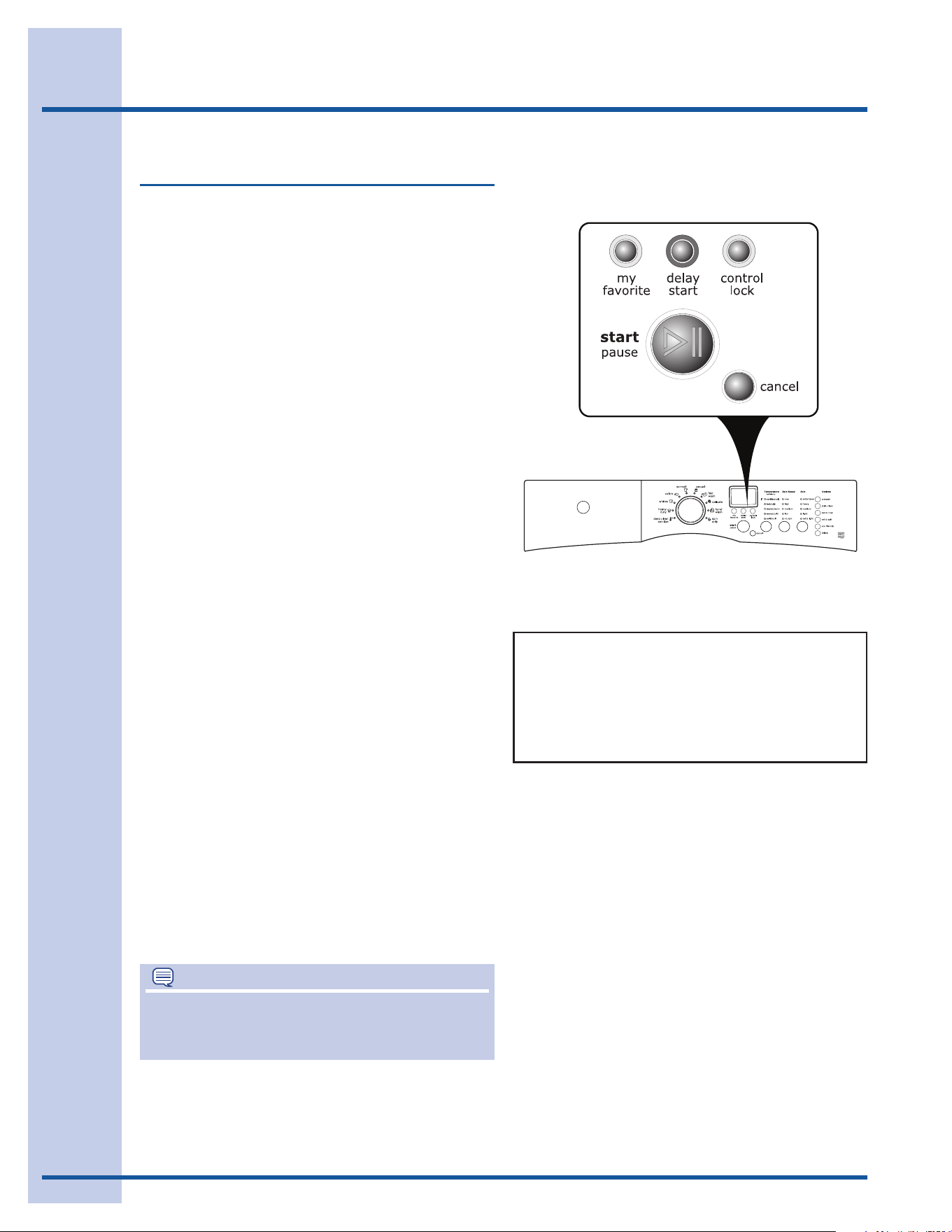
DELAY START
Use delay start with any cycle to select a wash
time convenient to your schedule or during off
peak energy hours. The start of the cycle can be
delayed for up to 14 hours. The delay time select-
ed will be displayed as 30, 60, or 90 minutes or 2
through 14 hours.
CONTROL LOCK
To lock the controls between cycles, press and
hold the control lock button for 5 seconds. Re-
peat to unlock the controls when you are ready to
operate the washer. Use this feature to reduce the
likelihood of accidental operation by children.
STATUS DISPLAY
The estimated total cycle time will be displayed
when the cycle is selected. The time may increase
if water pressure is low, oversudsing occurs or the
load becomes unbalanced. The approximate time
remaining will be displayed during the cycle.
A situation where oversudsing has been detected
by the washer will result in the washer automati-
cally adding up to 4 extra rinses to attempt to clear
the suds. Each extra rinse the washer performs
to clear the suds will add 5 minutes to the cycle
display time. If an excessive amount of detergent
has been added and additional rinsing has not cor-
rected the issue, TOO MUCH DETERGENT will be
displayed.
DRUM LIGHT
The drum light will come on whenever the door is
opened to illuminate the drum during loading and
unloading. Closing the door turns off the light. The
drum light will automatically turn off if the door is
left open more than 3 minutes.
REVERSIBLE DOOR
Your washer is equipped with a reversible door.
The door can be hinged on the right or left side.
NOTE
For step-by-step instructions on DOOR
REVERSAL,refertotheInstallation Instructions
supplied with this washer.
Washer Features
DOOR LOCK
PREWASHING
WASHING
RINSING
DRAINING
SPINNING
CYCLE COMPLETE
STATUS DISPLAY
The following will also be displayed at the
appropriate times during the cycle:
21
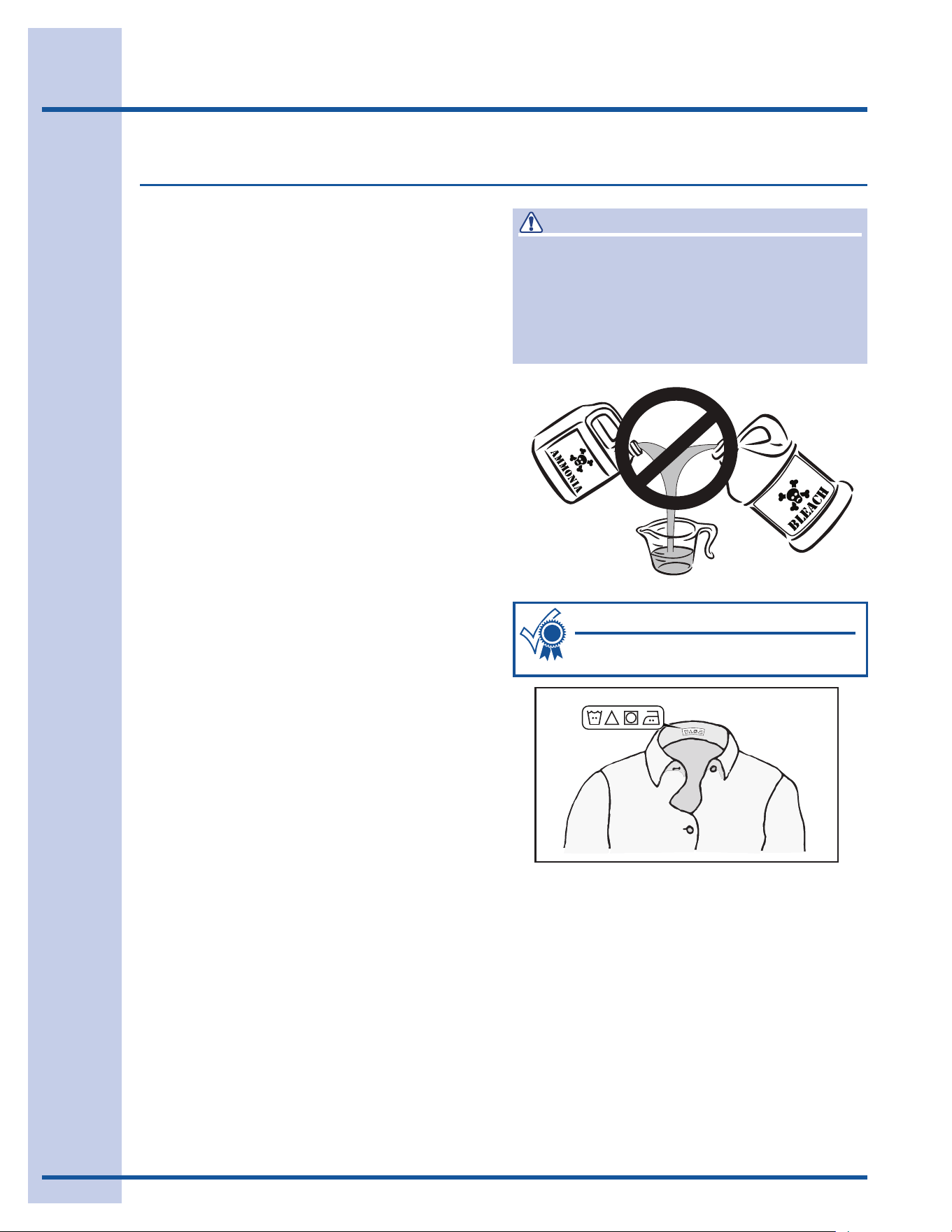
Cycle Chart
These Temperature, Spin Speeds, Soil levels and Options are available with the following cycles:
deep
clean
sanitize
heavy
duty
whites colors normal casual fast
wash
delicate hand
wash
spin
only
Estimated Cycle
Duration**
144 min 57 min 52 min 31 min 52 min 31 min 18 min 31 min 31 min 08 min
Temperature
sanitize/cold
*
hot/cold *
warm/warm
warm/cold * * * *
cold/cold * * *
Spin Speed
max * * * * * *
high * *
medium *
low *
no spin
Soil
extra heavy
heavy
medium * * * * * * * *
light
extra light *
Options
delay start
extra spin
extra rinse
prewash
eco friendly
stain clean
chime
* Factory presets
Available selections
**Estimated cycle duration is based on factory settings and does not include water fill times, out-of-balance, or
oversudsing conditions.
Washer Settings Chart
22
Stain Removal Guide
SAFE STAIN REMOVAL PROCEDURES
To reduce the risk of fire or serious injury to per-
sons or property, comply with the basic warnings
listed below:
Read and comply with all instructions on stain •
removal products.
Keep stain removal products in their original •
labeled containers and out of children’s reach.
Thoroughly wash any utensils used.•
Do not combine stain removal products, espe-•
cially ammonia and chlorine bleach. Dangerous
fumes can result.
Neverwashitemswhichhavebeenpreviously•
cleaned in, washed in, soaked in or spotted
with gasoline, dry cleaning solvents or other
flammable or explosive substances because
they give off vapors that could ignite or explode.
Neverusehighlyammablesolvents,suchas•
gasoline,insidethehome.Vaporscanexplode
on contact with flames or sparks.
FOR SUCCESSFUL STAIN REMOVAL:
Remove stains promptly.•
Determine the kind of stain, then follow the rec-•
ommended treatment in the stain removal chart
on the next page.
To pretreat stains, use a prewash product, liquid •
detergent, or a paste made from powder deter-
gent and water.
Use cold water on unknown stains because hot •
water can set stains.
Consult care label instructions for treatments to •
avoid on specific fabrics.
Check for colorfastness by testing stain remover •
products on an inside seam.
Rinse and wash items after stain removal.•
Stain Removal Procedures
WARNING
HARMFULVAPORHAZARD
Do not use or mix liquid chlorine bleach with other
household chemicals such as toilet cleaners, rust
removers, acid or products containing ammonia.
These mixtures can produce dangerous fumes
which can cause serious injury or death.
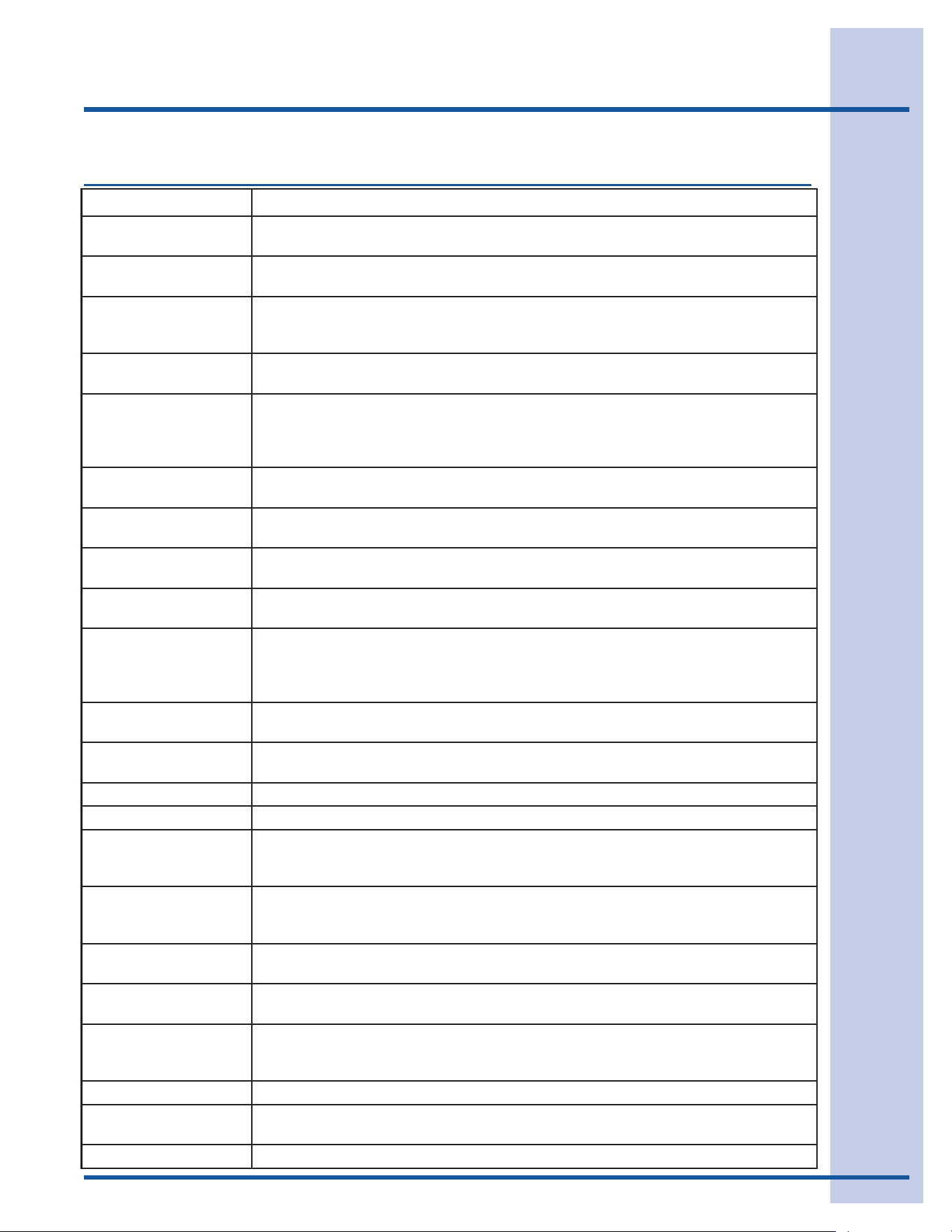
Follow the fabric care label instructions
on items to be washed.
For best results
23
Stain Removal Guide
Stain Removal Suggestions
STAIN
TREATMENT
Adhesive tape, chewing
gum, rubber cement
Apply ice. Scrape off excess. Place stain face down on paper towels. Saturate with
prewash stain remover or nonflammable dry cleaning fluid.
Baby formula, dairy
products, egg
Use product containing enzymes to pretreat or soak stains. Soak for 30 minutes or
more. Wash.
Beverages (coffee, tea,
soda, juice, alcoholic
beverages)
Pretreat stain. Wash using cold water and bleach safe for fabric.
Blood Rinse with cold water. Rub with bar soap. Or, pretreat or soak with product containing
enzymes. Wash using bleach safe for fabric.
Candle wax, crayon Scrape off surface wax. Place stain face down between paper towels. Press with warm
iron until wax is absorbed. Replace paper towels frequently. Treat remaining stain with
prewash stain remover or nonflammable dry cleaning fluid. Hand wash to remove sol-
vent. Wash using bleach safe for fabric.
Chocolate Pretreat or soak in warm water using product containing enzymes. Wash using bleach
safe for fabric.
Collar or cuff soil, cos-
metics
Pretreat with prewash stain remover or rub with bar soap.
Dye transfer on white
fabric
Use packaged color remover. Wash using bleach safe for fabric.
Grass Pretreat or soak in warm water using product containing enzymes. Wash using bleach
safe for fabric.
Grease,oil,tar(butter,
fats, salad dressing,
cooking oils, car grease,
motor oils)
Scrape residue from fabric. Pretreat. Wash using hottest water safe for fabric. For heavy
stains and tar, apply nonflammable dry cleaning fluid to back of stain. Replace towels
under stain frequently. Rinse thoroughly. Wash using hottest water safe for fabric.
Ink Some inks may be impossible to remove. Washing may set some inks. Use prewash
stain remover, denatured alcohol or nonflammable dry cleaning fluid.
Mildew, scorch Wash with chlorine bleach if safe for fabric. Or, soak in oxygen bleach and hot water
before washing. Badly mildewed fabrics may be permanently damaged.
Mud Brush off dry mud. Pretreat or soak with product containing enzymes.
Mustard, tomato Pretreat with prewash stain remover. Wash using bleach safe for fabric.
Nailpolish May be impossible to remove. Place stain face down on paper towels. Apply nail pol-
ish remover to back of stain. Repeat, replacing paper towels frequently. Do not use on
acetate fabrics.
Paint, varnish WATER BASED: Rinse fabric in cool water while stain is wet. Wash. Once paint is dry,
itcannotberemoved.OILBASEDANDVARNISH:Usesolventrecommendedoncan
label. Rinse thoroughly before washing.
Perspiration Use prewash stain remover or rub with bar soap. Rinse. Wash using nonchlorine bleach
in hottest water safe for fabric.
Rust, brown or yellow
discoloration
Use rust remover safe for fabric. Do not use chlorine bleach because it may intensify
discoloration.
Shoe polish LIQUID:Pretreatwithapasteofpowderdetergentandwater.PASTE:Scraperesidue
from fabric. Pretreat with prewash stain remover or nonflammable dry cleaning fluid.
Rinse. Rub detergent into dampened area. Wash using bleach safe for fabric.
Tomato Pretreat with prewash stain remover. Wash using bleach safe for fabric.
Urine, vomit, mucus,
feces
Pretreat or soak in product containing enzymes. Wash using bleach safe for fabric.
Wine Pretreat or soak in cold water. Wash in hottest water and bleach safe for fabric
24
NOTE
The washer will automatically prompt you to
run the SYSTEM CLEAN cycle every 50 cycles.
You may press the cancel button to manually
perform the cycle at another time.
Care & Cleaning
TO REFRESH WASH DRUM
Perform the SYSTEM CLEAN cycle to refresh the
wash drum follow these steps:
Wake up the washer by pressing any button, ro-1.
tate cycle knob to the hand wash cycle, press
the start button and then the cancel button.
Wake up the washer again by pressing any but-2.
ton, then immediately and simultaneously press
and hold both the eco friendly and control
lockbuttonsfor5seconds,oruntiltheLCD
display changes.
Remove all clothing from the drum, add 1 cup 3.
liquid chlorine bleach to the empty wash drum,
and press start.
This maintenance cycle uses hot water and two
rinses to remove residue that may cause odor.
IMPORTANT
DONOTloadgarmentsorotheritemsinthe
washer when cleaning the inside of the washer.
OTHER INSIDE CLEANING
Before cleaning the washer interior, unplug the •
electrical power cord to avoid electrical shock
hazards.
Dry around the washer door opening, flexible •
gasket, and door glass. These areas should
always be clean to ensure a water tight seal.
When extremely soiled items have been •
washed, a dirty residue may remain on the
drum. Remove this by wiping the drum with a
nonabrasive household cleanser. Rinse thor-
oughly with water.
Periodically, wipe dry the folds in the bottom •
of the flexible gasket to remove lint and other
debris.
The drum vanes may become stained from fab-•
ric dye. Clean these parts with a nonabrasive
household cleanser to prevent dye transfer to
future loads.
25
Care & Cleaning
NOTE
Detergent and fabric softener may build up in the
dispenser drawer. Residue should be removed
once or twice a month.
CLEANING DISPENSER DRAWER AREA
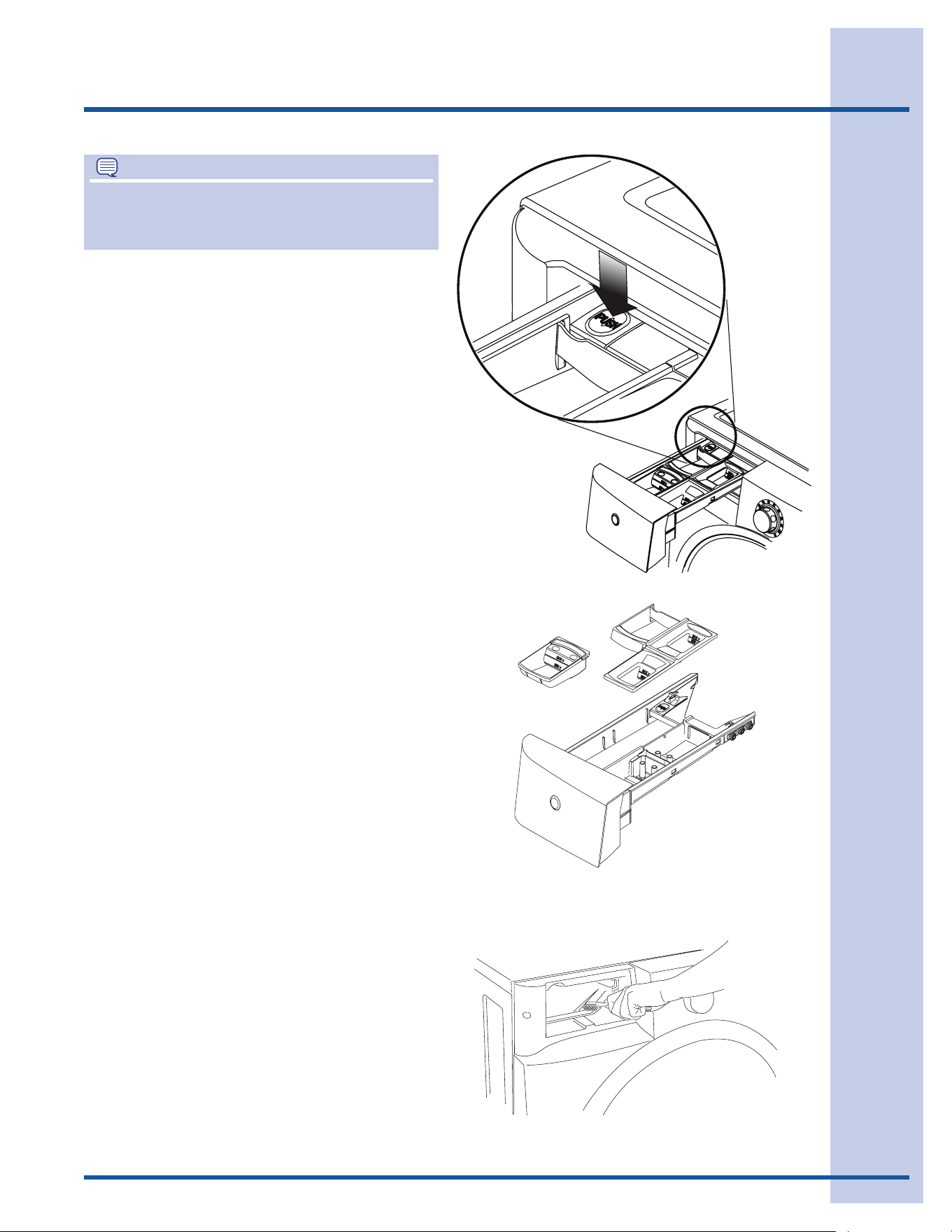
Remove the drawer by pulling the drawer out •
until it stops.
Reach back into the left rear corner of the •
drawer cavity and press down firmly on the lock
tab. Pull out the drawer.
Remove the insert from the prewash, bleach, •
and fabric softener compartments.
Rinse the drawer and inserts with hot tap water •
to remove traces of accumulated powders
andliquids.Largeamountsoffabricsoftener
residue may indicate improper dilution or more
frequent cleaning is required.
To clean the drawer opening, use a small brush •
to clean the recess. Remove all residue from
the upper and lower parts of the recess.
Replace the insert by pressing it in place until •
you hear a slight click. Return the dispenser
drawer.
26
Care & Cleaning
RV
ANTIFREEZE
Follow WINTERIZING
INSTRUCTIONS for
cold weather storage
and care.
OUTSIDE
When washing is completed, wipe top and •
sides of washer with a damp cloth. Turn water
faucets off to prevent pressure build-up in the
hoses.
Clean the cabinet with mild soap and water. •
Neveruseharsh,grittyorabrasivecleansers
If the cabinet becomes stained, clean with •
diluted chlorine bleach (1 part bleach to 8 parts
water). Rinse several times with clear water.
Remove glue residue from tape or labels with a •
mixture of warm water and mild detergent. Or,
touch residue with the sticky side of tape.
When cleaning chrome parts use a window •
cleaner with ammonia or mild soap and water.
Before moving the washer, place a strip of card-•
board or thin fiberboard under the front leveling
legs to prevent damage to the floor.
WINTERIZING INSTRUCTIONS
Turn off water supply faucets.1.
Disconnect hoses from water supply and drain 2.
water from hoses.
Plug electrical cord into a properly grounded 3.
electrical outlet.
Add1gallon(3.8L)nontoxicrecreationalve-4.
hicle(RV)antifreezetoemptywashdrum.Close
door.
Select the 5. spin only cycle. Press start and let
the washer drain for 1 minute to drain out all
thewater.NotalloftheRVantifreezewillbe
expelled.
Press 6. cancel, unplug electrical power cord, dry
off drum interior and close door.
Remove dispenser drawer. Drain any water in 7.
compartments and dry compartments. Replace
drawer.
Store washer in an upright position.8.
To remove antifreeze from washer after storage, 9.
run empty washer through a complete cycle us-
ing detergent. Do not add wash load.
IMPORTANT
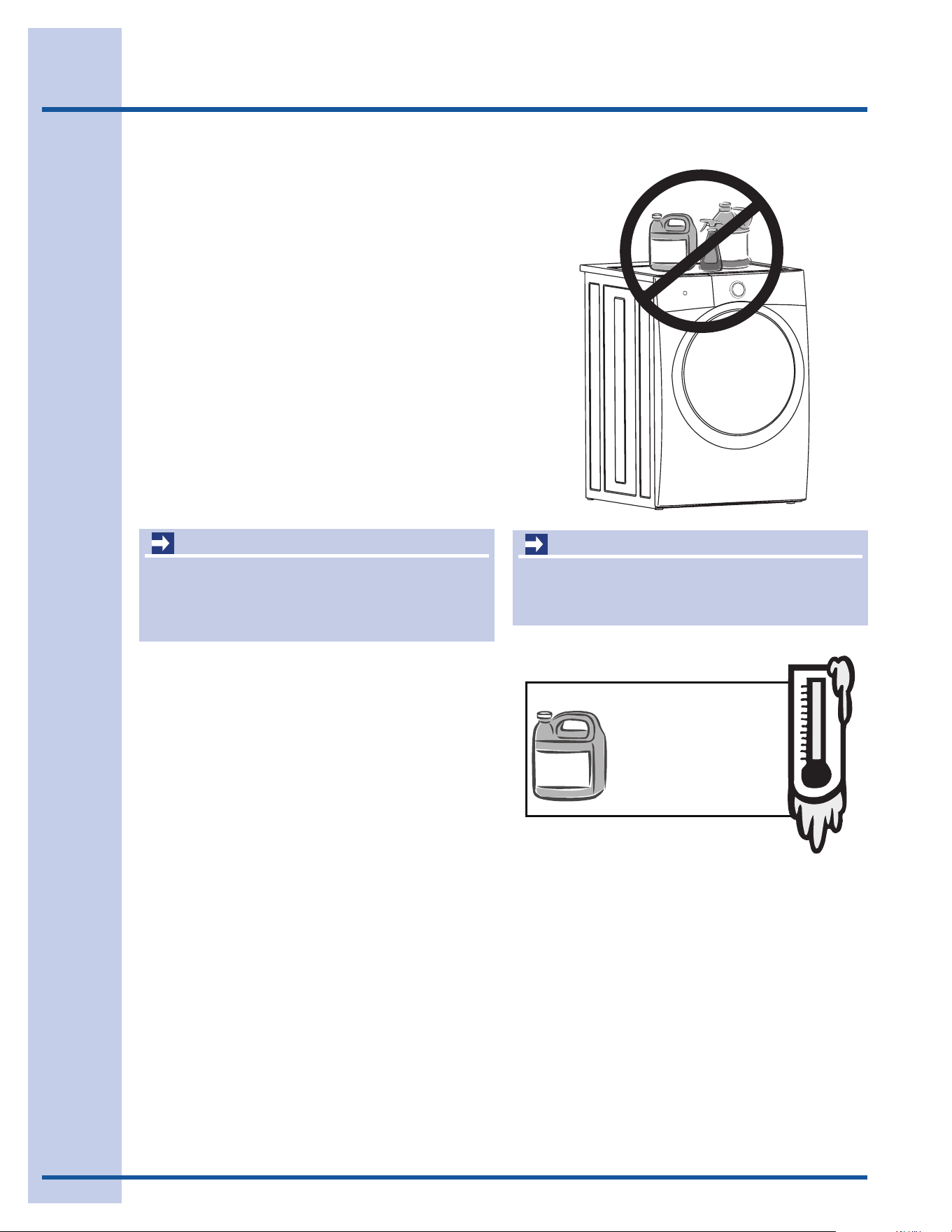
Do not store or place laundry products on top of
washer at any time. They can damage the finish
or controls.
IMPORTANT
If the washer is stored in an area where freezing
can occur or moved in freezing temperatures,
follow these winterizing instructions to prevent
damage to the washer:

27
Solutions to Common Problems
Common Washing Problems
Many washing problems involve poor soil and stain removal, residues of lint and scum, and fabric dam-
age. For satisfactory washing results, follow these suggestions provided by The Soap and Detergent
Association.
PROBLEM POSSIBLECAUSES SOLUTIONS PREVENTIVEMEASURES
Blue stains Undiluted liquid detergent •
or fabric softener dispensed
directly onto fabric.
If caused by detergent, mix •
1 cup (240 ml) white vinegar
with1quart(.95L)water
in a plastic container. Soak
item 1 hour. Rinse.
If caused by fabric softener, •
rub stains with bar soap.
Wash.
Avoid overfilling detergent •
and fabric softener com-
partments of dispenser.
Discoloration,
graying
Notenoughdetergent.•
Wash water temperature •
too low.
Incorrect sorting.•
Rewash with correct •
amount of detergent and
hottest water safe for fabric.
Add bleach safe for fabric.•
Sort items by soil level and •
color.
Use correct amount of de-•
tergent, hottest water and
bleach safe for fabric.
Greasy,oily
stains
Notenoughdetergent.•
Undiluted liquid fabric •
softener poured directly on
fabric.
Treat with prewash stain •
remover or liquid detergent.
Increase detergent and wa-•
ter temperature. Rewash.
Rub fabric softener stains •
with bar soap.
Use correct amount of •
detergent and hottest water
safe for fabric.
Do not pour liquid fabric •
softener directly on fabric.
See Operating Your, step 5.
Holes, tears, or
snags
Incorrect use of chlorine •
bleach.
Unfastened zippers, hooks, •
buckles.
Rips, tears and broken •
threads.
Overloading the washer.•
Degradation of fabric.•
May be irreversible if rips, •
tears and seams cannot be
mended.
Neverpourchlorinebleach•
directly on fabric.
Check condition of items •
before washing. See Oper-
ating Your, steps 2 and 5.
Lint Incorrect sorting.•
Tissues left in pocket.•
Overloading the washer.•
Notenoughdetergent.•
Undissolved detergent has •
left a residue resembling
lint.
Static cling is attracting lint.•
Loadwashedtoolong.•
Reduce load size. Rewash •
using correct water tem-
perature, water level, and
amount of detergent.
Add nonprecipitating water •
conditioner to wash water
to remove detergent resi-
due.
Add liquid fabric softener to •
final rinse.
Dry load in dryer.•
Remove lint with lint brush •
or roller.
See Operating Your, steps •
1 and 2.
Do not overload washer.•
Use correct temperature •
and amount of detergent,
water and wash time.

28
Common Washing Problems, con’t
PROBLEM POSSIBLECAUSES SOLUTIONS PREVENTIVEMEASURES
Pilling
(Fibers ball up
and cling to
fabric.)
Pilling is normal with syn-•
thetic and permanent press
fabrics. This is due to abra-
sion from normal wear.
Use a lint brush or shaver to •
remove pills.
Use fabric softener in the •
washer to lubricate fibers.
When ironing, use spray •
starch or fabric finish on
collars and cuffs.
Turn items inside out to •
reduce abrasion.
Residue or
powder on dark
items;
Stiff, harsh
fabrics.
Undissolved detergent.•
Some granular detergents •
can combine with hard
water minerals to form a
residue.
Overloading the washer.•
Rewash load.• Increase water temperature •
using hottest water safe for
fabric.
Do not overload washer.•
Use liquid detergent or •
use nonprecipitating water
conditioner with powder
detergent.
Wrinkling Overloading the washer.•
Incorrect wash cycle for •
wash load.
Reduce load size.•
Rinse in cold water with liq-•
uid fabric softener using the
casual or delicate cycle.
Do not overload washer.•
Remove items from washer •
as soon as cycle is com-
pleted.
Use liquid fabric softener.•
Yellow buildup
of body soil on
synthetic fabrics
Agitation time too short.•
Wash water temperature •
too low.
Notenoughdetergent.•
Soak in detergent booster •
or product containing
enzymes.
Wash in hottest water safe •
for fabric using casual
cycle.
Increase detergent.•
Add bleach safe for fabric •
or treat with color remover.
Select correct wash cycle.•
Use correct amount of •
detergent.
Wash synthetics frequently •
using hot or warm water.
Yellow or brown
rust stains
Iron or manganese in water •
supply, water pipes, or
water heater.
To restore discolored load •
of whites, use rust remover
safe for fabric.
Do not use chlorine bleach •
to remove rust stains. It
may intensify discoloration.
Use nonprecipitating water •
softener.
Before washing, run hot •
water for a few minutes to
clear lines.
Drain water heater occa-•
sionally.
For an ongoing problem, •
install an iron filter in your
water supply system.
Solutions to Common Problems
29
Service Prevention Checklist
Before calling for service, review this list. It may save both time and expense. The list includes common
occurrences that are not the result of defective workmanship or materials in this washer.
Solutions to Common Problems
OCCURRENCE POSSIBLECAUSE SOLUTION
NOISE
High pitch “jet engine”
noise.
A certain amount of motor whine is nor-
mal during the spin cycle.
Rattling and clanking
noise.
Foreign objects such as coins or safety
pins may be in drum or pump.
Stop washer and check drum. If noise continues after
washer is restarted, objects may be in pump. Call your
authorized servicer.
Belt buckles and metal fasteners are hit-
ting wash drum.
To prevent unnecessary noise and damage to drum,
fasten fasteners and turn items inside out.
Thumping sound. Heavy wash loads may produce a
thumping sound. This is usually normal. If
sound continues, washer is probably out
of balance.
Stop washer and redistribute wash load.
Vibratingnoise. Washer is not resting firmly on floor. Move washer so it rests firmly on floor. Adjust leveling
legs.SeeINSTALLATIONINSTRUCTIONSfordetails.
Shipping bolts and foam block have not
been removed during installation.
SeeINSTALLATIONINSTRUCTIONSforremovingship-
ping bolts and foam block.
Wash load unevenly distributed in drum. Stop washer and rearrange wash load.
OPERATING
Washer does not start. Electrical power cord may not be plugged
in or connection may be loose.
Make sure plug fits tightly in wall outlet.
House fuse blown, circuit breaker
tripped, or a power outage has occurred.
Reset circuit breaker or replace fuse. Do not increase
fuse capacity. If problem is a circuit overload, have
it corrected by a qualified electrician. If problem is a
power outage, call local electric company.
Water supply faucets are not turned on. Turn on water supply faucets.
Motor is overheated. Washer motor will
stop if it becomes overheated.
It will automatically restart after a cool down period
of up to 30 minutes (if washer has not been manually
turned off).
Washer door is not completely closed. Close door completely.
Washer won’t spin. Loadistoosmall. Add 1 or 2 similar items to help balance the load.
Residue left in drum. Heavily soiled items. Wipe drum with a nonabrasive household cleanser, then
rinse. Shake or brush excess dirt and sand from items
before washing
LCDdisplays
DEMO MODE. Washer has been programmed to tempo-
rarily perform a repeating demo cycle.
To return to the factory default settings, press and hold
the spin speed and soil buttons at the same for 5 sec.
30
Avoid Service Checklist, con’t
Solutions to Common Problems
OCCURRENCE POSSIBLECAUSE SOLUTION
WATER
Water collects in folds of
the bellows at the end of
the cycle.
This is a result of the washing action and
is part of the normal operation of the
washer.
Water collects in bleach
and fabric softener com-
partments.
This is a result of the siphoning action
and is part of the normal operation of the
washer.
Water may be removed by removing the dispenser
drawer (see Care and Cleaning in this guide) and draining
water into the empty drum or sink.
Wash load too wet after
spin.
Washer is overloaded. Do not overload washer. See Operating Your Washer,
step 4.
Loadistoosmall. Add 1 or 2 similar items to help balance the load.
Loadisoutofbalance. Rearrange load to allow proper spinning.
Drain hose is kinked. Straighten drain hose.
Water does not enter
washer or it enters slowly.
Water supply is not adequate in area. Check another faucet in the house. Wait until water supply
and pressure increase.
Water supply faucets are not completely
open.
Fully open hot and cold faucets.
Water is being used elsewhere in the
house. Water pressure must be at least
30 psi (260 kPa).
Avoid running water elsewhere while washer is filling.
Water inlet hoses are kinked. Straighten hoses.
Warm or hot water is not
hot enough.
Hot water heater is set too low or is a
distance from washer.
Measure hot water temperature at nearby faucet with
candy or meat thermometer. Water temperature should
be at least 120°F (49°C). Adjust water heater as neces-
sary.
Hot water is being used elsewhere in the
house.
Avoid using hot water elsewhere before or during
washer use. There may not be enough hot water avail-
able for proper cleaning. If problem persists, your hot
water system may be unable to support more than 1
use at a time.
Water in washer does not
drain or drains slowly.
Drain hose is kinked or clogged. Clean and straighten the drain hose.
Drain hose standpipe is too tall. Maxi-
mum standpipe height is 8’ (2.4 m).
Reduce standpipe height to less than 8’ (2.4 m). See
INSTALLATIONINSTRUCTIONS.
House drain pipes are clogged. Unclog drain pipes. Contact plumber if necessary.
Water leaks. Fill hose connection is loose at faucet or
washer.
Check and tighten hose connections. Install rubber
sealing washers provided.
Oversudsing. Wrong detergent. Run rinse cycle. Use a low-sudsing, high efficiency
detergent.
Too much detergent. Run rinse cycle. Use less detergent in future loads.
Incorrect wash and rinse
temperatures.
Hot and cold water hoses are connected
to wrong supply faucets.
Connect hot water hose to hot water faucet and cold
water hose to cold water faucet.
Water is entering washer
but tub does not fill.
Drain hose standpipe is too low. Stand-
pipe must be a minimum of 23.6” (60 cm)
high to prevent siphoning.
Increase standpipe height to at least 23.6” (60 cm). See
INSTALLATIONINSTRUCTIONS.

31
Warranty Information
Your appliance is covered by a one year limited warranty. For one year from your original date of purchase, Electrolux will
repair or replace any parts of this appliance that prove to be defective in materials or workmanship when such appliance is
installed, used, and maintained in accordance with the provided instructions. In addition, your appliance is covered by an
additional one year, parts only, limited warranty. During the 2nd year from your original date of purchase, Electrolux will pay
for parts needed for this appliance that have proven to be defective in materials or workmanship when your appliance is
installed, used, and maintained in accordance with the provided instructions.
Exclusions
This warranty does not cover the following:
Products with original serial numbers that have been removed, altered or cannot be readily determined.1.
Product that has been transferred from its original owner to another party or removed outside the USA or Canada.2.
Rust on the interior or exterior of the unit.3.
Products purchased “as-is” are not covered by this warranty.4.
Products used in a commercial setting.5.
Service calls which do not involve malfunction or defects in materials or workmanship, or for appliances not in ordinary 6.
household use or used other than in accordance with the provided instructions.
Service calls to correct the installation of your appliance or to instruct you how to use your appliance.7.
Expenses for making the appliance accessible for servicing, such as removal of trim, cupboards, shelves, etc., which 8.
are not a part of the appliance when it is shipped from the factory.
Service calls to repair or replace appliance light bulbs, air filters, water filters, other consumables, or knobs, handles, 9.
or other cosmetic parts.
Pickup and delivery costs; your appliance is designed to be repaired in the home.10.
Surcharges including, but not limited to, any after hour, weekend, or holiday service calls, tolls, ferry trip charges, or 11.
mileage expense for service calls to remote areas, including the state of Alaska.
Damages to the finish of appliance or home incurred during transportation or installation, including but not limited to 12.
floors, cabinets, walls, etc.
Damages caused by: services performed by unauthorized service companies; use of parts other than genuine Elec-13.
trolux parts or parts obtained from persons other than authorized service companies; or external causes such as
abuse,misuse,inadequatepowersupply,accidents,res,oractsofGod.
DISCLAIMER OF IMPLIED WARRANTIES; LIMITATION OF REMEDIES
CUSTOMER’SSOLEANDEXCLUSIVEREMEDYUNDERTHISLIMITEDWARRANTYSHALLBEREPAIRORREPLACE-
MENTASPROVIDEDHEREIN.CLAIMS BASED ON IMPLIED WARRANTIES, INCLUDING WARRANTIES OF MER-
CHANTABILITY OR FITNESS FOR A PARTICULAR PURPOSE, ARE LIMITED TO ONE YEAR OR THE SHORTEST
PERIOD ALLOWED BY LAW, BUT NOT LESS THAN ONE YEAR.ELECTROLUXSHALLNOTBELIABLEFORCONSE-
QUENTIALORINCIDENTALDAMAGESSUCHASPROPERTYDAMAGEANDINCIDENTALEXPENSESRESULTINGFROM
ANYBREACHOFTHISWRITTENLIMITEDWARRANTYORANYIMPLIEDWARRANTY.SOMESTATESANDPROVINCES
DONOTALLOWTHEEXCLUSIONORLIMITATIONOFINCIDENTALORCONSEQUENTIALDAMAGES,ORLIMITATIONS
ONTHEDURATIONOFIMPLIEDWARRANTIES,SOTHESELIMITATIONSOREXCLUSIONSMAYNOTAPPLYTOYOU.
THISWRITTENWARRANTYGIVESYOUSPECIFICLEGALRIGHTS.YOUMAYALSOHAVEOTHERRIGHTSTHATVARY
FROM STATE TO STATE.
If You Need Service
Keep your receipt, delivery slip, or some other appropriate payment record to establish the warranty period should service
be required. If service is performed, it is in your best interest to obtain and keep all receipts. Service under this warranty
must be obtained by contacting Electrolux at the addresses or phone numbers below.
This warranty only applies in the USA, Puerto Rico and Canada. In the USA and Puerto Rico, your appliance is warranted
byElectroluxMajorAppliancesNorthAmerica,adivisionofElectroluxHomeProducts,Inc.InCanada,yourappliance
is warranted by Electrolux Canada Corp. Electrolux authorizes no person to change or add to any obligations under this
warranty. Obligations for service and parts under this warranty must be performed by Electrolux or an authorized service
company. Product features or specifications as described or illustrated are subject to change without notice.
USA
1-877-435-3287
ElectroluxMajorAppliancesNorthAmerica
NorthAmerica
P.O. Box 212378
Augusta,GA30907
Canada
1-800-265-8352
Electrolux Canada Corp.
5855 Terry Fox Way
Mississauga, Ontario, Canada
L5V3E4

32
Notes