Important Safety Instructions
• Before use, ensure you have read and understood the microwave's instruction manual thoroughly.
• Specifically, review the section "Precautions to Avoid Possible Exposure to Excessive Microwave Energy" located on page 2 of the
manual.
• The microwave must be grounded. Connect it to a properly grounded electrical outlet as directed in the "Grounding Instructions" on
page 4.
• Place the microwave in a location recommended by the installation instructions.
• Do not heat items such as whole eggs or completely sealed containers within the microwave, as they can explode.
• Operate the microwave strictly according to the uses described in the manual, avoiding exposure to corrosive chemicals or vapor.
• Exercise close supervision when the microwave is used near children.
• If the microwave's cord or plug is damaged, or if the microwave is not working properly or has been damaged or dropped, refrain from
using it.
• Maintenance and servicing should only be performed by qualified service personnel. Contact the nearest authorized service facility for
examination, repair, or adjustment.
• Make sure not to cover or block any of the microwave's ventilation openings.
• Avoid storing the microwave in damp environments or near water, such as near a kitchen sink, in a wet basement, or close to a
swimming pool.
• Do not immerse the power cord or plug in water.
• Protect the power cord from contact with hot surfaces, and do not let it hang over the edge of a table or counter.
• When cleaning the microwave's door and other surfaces, do so with mild, nonabrasive soap, and wipe with a sponge or soft cloth.
• Reduce the risk of fire in the oven cavity by:
- a. Avoiding the overcooking of food.
- b. Supervising the appliance when cooking with materials that can catch fire.
- c. Removing wire twist-ties and metal objects before placing items in the oven.
- d. Keeping the oven door closed and unplugged if something inside catches fire.
- e. Not using the oven cavity for storage purposes, such as paper products or cooking utensils, or leaving food in the cavity when
not in use.
• Be aware that some cooking containers, like certain plastics, can catch fire or melt if they're not suitable for microwave use.
• Exercise caution when heating liquids. They can reach temperatures beyond their boiling points without the formation of visible
bubbles, posing a risk of sudden boiling or burns when handled.
• This could result in very hot liquid suddenly boiling over when the container is disturbed or a utensil is inserted into the liquid.
To reduce the risk of injury to persons:
Do not overheat the liquid.
Stir the liquid both before and halfway through heating it.
Do not use straight-sided containers with narrow necks.
After heating, allow the container to stand in the microwave oven for a short time before removing the container.
Use extreme care when inserting a spoon or other utensil into the container.
Do not operate any heating or cooking appliance beneath the appliance.
Do not mount unit over or near any portion of heating or cooking appliance.
Do not mount over sink.
Do not store anything directly on top of the appliance surface when the appliance is in operation.
GROUNDING INSTRUCTIONS
This appliance must be grounded. In the event of an electrical short circuit, grounding reduces the risk of electric shock by providing an
escape wire for the electric current. This appliance is equipped with a cord having a grounding wire with a grounding plug. The plug must
be plugged into an outlet that is properly installed and grounded.
WARNING - Improper use of the grounding can result in a risk of electric shock.
Consult a qualified electrician or serviceman if the grounding instructions are not completely understood, or if doubt exists as to whether
the appliance is properly grounded. If it is necessary to use an extension cord, use only a 3-wire extension cord that has a 3-blade ground)
ed plug, and 3-slot receptacle that will accept the plug on the appliance. The marked rating of the extension cord shall be equal to or
greater than the electrical rating of the appliance.
DANGER - Electric Shock Hazard
Touching some of the internal components can cause serious personal injury or death. Do not disassemble this appliance.
WARNING - Electric Shock Hazard
Improper use of the grounding can result in electric shock. Do not plug into an outlet until the appliance is properly installed and grounded.
A short power-supply cord is provided to reduce the risks resulting from becoming entangled in or tripping over a longer cord.
Longer cord sets or extension cords are available and may be used if care is exercised in their use.
If a long cord or extension cord is used:
The marked electrical rating of the cord set or extension cord should be at least as great as the electrical rating of the appliance.
The extension cord must be a grounding-type 3-wire cord.
The longer cord should be arranged so that it will not drape over the counter top or tabletop where it can be pulled on by children or tripped over unintention)
ally.
SAVE THESE INSTRUCTIONS
Grounding Instructions
For safety, this appliance requires proper grounding. Grounding minimizes the risk of electric shock by providing a path of least resistance
for electric current. This appliance comes with a power cord fitted with a grounding conductor and a grounding plug. The plug must be
connected to an appropriate outlet that is properly installed and grounded.
Warning: The incorrect application of the grounding can pose a risk of electric shock.
If you are unsure about the grounding methods or have any doubts, consult a qualified electrician or service technician. Should there be a
need to use an extension cord, ensure it is a three-wire cord with a grounding plug and a three-slot receptacle that matches the plug on the
appliance. The electrical rating of the extension cord must be at least as high as the appliance's rating.
Danger: Electric Shock Hazard
Direct contact with internal components can be hazardous. Avoid touching internal parts to prevent potential injury or death. Never attempt
to disassemble this appliance yourself.
Warning: Electric Shock Hazard!
To reduce the risk of electric shock, do not connect to power until the appliance has been correctly installed and grounded.
1. This appliance has a short power-supply cord to lessen the risk associated with longer cords, such as entanglement or tripping.
2. An extended power-supply cord or qualified extension cord may be used if proper care is taken.
3. If using a longer power-supply cord or extension:
a. The extension cord should match the electrical rating of the appliance.
b. Ensure the extension is a grounding-type three-wire cord.
c. Arrange the extension cord where it will not hang over the counter or table to avoid being pulled on by children or tripped over.
Radio Interference
1. Using your microwave oven could interfere with nearby radios, televisions, or similar devices.
2. Should interference occur, you might be able to lessen or resolve the issue by following these steps:
- Ensure the microwave oven's door and its seals are clean.
- Adjust the orientation of the receiving antenna on your radio or television.
- Change the location of the microwave oven relative to the affected receiver.
- Position the microwave oven further from the receiver.
- Connect the microwave oven to a separate electrical outlet to ensure it and the receiver are on different branch circuits.
Utensils
Caution: Risk of Personal Injury
Sealed containers can build up pressure and may explode if heated in a microwave oven. Always open containers or pierce plastic
pouches before microwaving.
Refer to the manual section titled "Materials suitable for microwave use" for guidance. Some non-metallic utensils may be unsuitable
for microwave use. If you are uncertain, perform the following test:
Utensil Test:
1. Place the utensil in question in a microwave-safe container filled with 1 cup (250ml) of cold water.
2. Microwave at full power for 1 minute.
3. Touch the utensil carefully. If it is warm, do not use it in the microwave.
4. Limit the test duration to 1 minute only.
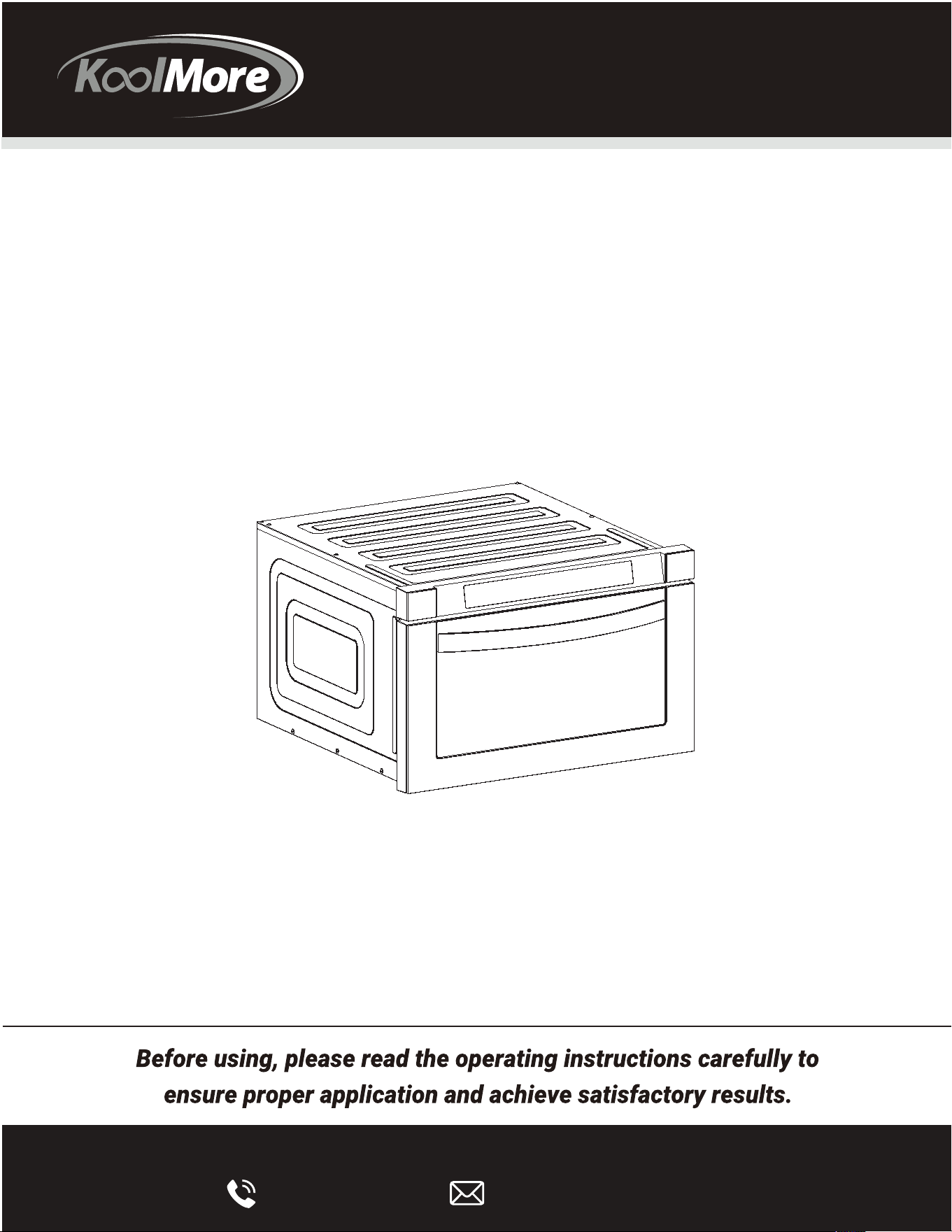
USER MANUAL
MICROWAVE DRAWER
Model: KM-MD-1SS
KoolMore Built-in Stainless Steel
Microwave Drawer

Important Safety Instructions
• Before use, ensure you have read and understood the microwave's instruction manual thoroughly.
• Specifically, review the section "Precautions to Avoid Possible Exposure to Excessive Microwave Energy" located on page 2 of the
manual.
• The microwave must be grounded. Connect it to a properly grounded electrical outlet as directed in the "Grounding Instructions" on
page 4.
• Place the microwave in a location recommended by the installation instructions.
• Do not heat items such as whole eggs or completely sealed containers within the microwave, as they can explode.
• Operate the microwave strictly according to the uses described in the manual, avoiding exposure to corrosive chemicals or vapor.
• Exercise close supervision when the microwave is used near children.
• If the microwave's cord or plug is damaged, or if the microwave is not working properly or has been damaged or dropped, refrain from
using it.
• Maintenance and servicing should only be performed by qualified service personnel. Contact the nearest authorized service facility for
examination, repair, or adjustment.
• Make sure not to cover or block any of the microwave's ventilation openings.
• Avoid storing the microwave in damp environments or near water, such as near a kitchen sink, in a wet basement, or close to a
swimming pool.
• Do not immerse the power cord or plug in water.
• Protect the power cord from contact with hot surfaces, and do not let it hang over the edge of a table or counter.
• When cleaning the microwave's door and other surfaces, do so with mild, nonabrasive soap, and wipe with a sponge or soft cloth.
• Reduce the risk of fire in the oven cavity by:
- a. Avoiding the overcooking of food.
- b. Supervising the appliance when cooking with materials that can catch fire.
- c. Removing wire twist-ties and metal objects before placing items in the oven.
- d. Keeping the oven door closed and unplugged if something inside catches fire.
- e. Not using the oven cavity for storage purposes, such as paper products or cooking utensils, or leaving food in the cavity when
not in use.
• Be aware that some cooking containers, like certain plastics, can catch fire or melt if they're not suitable for microwave use.
• Exercise caution when heating liquids. They can reach temperatures beyond their boiling points without the formation of visible
bubbles, posing a risk of sudden boiling or burns when handled.
• This could result in very hot liquid suddenly boiling over when the container is disturbed or a utensil is inserted into the liquid.
To reduce the risk of injury to persons:
Do not overheat the liquid.
Stir the liquid both before and halfway through heating it.
Do not use straight-sided containers with narrow necks.
After heating, allow the container to stand in the microwave oven for a short time before removing the container.
Use extreme care when inserting a spoon or other utensil into the container.
Do not operate any heating or cooking appliance beneath the appliance.
Do not mount unit over or near any portion of heating or cooking appliance.
Do not mount over sink.
Do not store anything directly on top of the appliance surface when the appliance is in operation.
GROUNDING INSTRUCTIONS
This appliance must be grounded. In the event of an electrical short circuit, grounding reduces the risk of electric shock by providing an
escape wire for the electric current. This appliance is equipped with a cord having a grounding wire with a grounding plug. The plug must
be plugged into an outlet that is properly installed and grounded.
WARNING - Improper use of the grounding can result in a risk of electric shock.
Consult a qualified electrician or serviceman if the grounding instructions are not completely understood, or if doubt exists as to whether
the appliance is properly grounded. If it is necessary to use an extension cord, use only a 3-wire extension cord that has a 3-blade ground)
ed plug, and 3-slot receptacle that will accept the plug on the appliance. The marked rating of the extension cord shall be equal to or
greater than the electrical rating of the appliance.
DANGER - Electric Shock Hazard
Touching some of the internal components can cause serious personal injury or death. Do not disassemble this appliance.
WARNING - Electric Shock Hazard
Improper use of the grounding can result in electric shock. Do not plug into an outlet until the appliance is properly installed and grounded.
A short power-supply cord is provided to reduce the risks resulting from becoming entangled in or tripping over a longer cord.
Longer cord sets or extension cords are available and may be used if care is exercised in their use.
If a long cord or extension cord is used:
The marked electrical rating of the cord set or extension cord should be at least as great as the electrical rating of the appliance.
The extension cord must be a grounding-type 3-wire cord.
The longer cord should be arranged so that it will not drape over the counter top or tabletop where it can be pulled on by children or tripped over unintention)
ally.
SAVE THESE INSTRUCTIONS
Grounding Instructions
For safety, this appliance requires proper grounding. Grounding minimizes the risk of electric shock by providing a path of least resistance
for electric current. This appliance comes with a power cord fitted with a grounding conductor and a grounding plug. The plug must be
connected to an appropriate outlet that is properly installed and grounded.
Warning: The incorrect application of the grounding can pose a risk of electric shock.
If you are unsure about the grounding methods or have any doubts, consult a qualified electrician or service technician. Should there be a
need to use an extension cord, ensure it is a three-wire cord with a grounding plug and a three-slot receptacle that matches the plug on the
appliance. The electrical rating of the extension cord must be at least as high as the appliance's rating.
Danger: Electric Shock Hazard
Direct contact with internal components can be hazardous. Avoid touching internal parts to prevent potential injury or death. Never attempt
to disassemble this appliance yourself.
Warning: Electric Shock Hazard!
To reduce the risk of electric shock, do not connect to power until the appliance has been correctly installed and grounded.
1. This appliance has a short power-supply cord to lessen the risk associated with longer cords, such as entanglement or tripping.
2. An extended power-supply cord or qualified extension cord may be used if proper care is taken.
3. If using a longer power-supply cord or extension:
a. The extension cord should match the electrical rating of the appliance.
b. Ensure the extension is a grounding-type three-wire cord.
c. Arrange the extension cord where it will not hang over the counter or table to avoid being pulled on by children or tripped over.
Radio Interference
1. Using your microwave oven could interfere with nearby radios, televisions, or similar devices.
2. Should interference occur, you might be able to lessen or resolve the issue by following these steps:
- Ensure the microwave oven's door and its seals are clean.
- Adjust the orientation of the receiving antenna on your radio or television.
- Change the location of the microwave oven relative to the affected receiver.
- Position the microwave oven further from the receiver.
- Connect the microwave oven to a separate electrical outlet to ensure it and the receiver are on different branch circuits.
Utensils
Caution: Risk of Personal Injury
Sealed containers can build up pressure and may explode if heated in a microwave oven. Always open containers or pierce plastic
pouches before microwaving.
Refer to the manual section titled "Materials suitable for microwave use" for guidance. Some non-metallic utensils may be unsuitable
for microwave use. If you are uncertain, perform the following test:
Utensil Test:
1. Place the utensil in question in a microwave-safe container filled with 1 cup (250ml) of cold water.
2. Microwave at full power for 1 minute.
3. Touch the utensil carefully. If it is warm, do not use it in the microwave.
4. Limit the test duration to 1 minute only.
Stay informed with the latest information
for your KoolMore Appliance.
If you need any assistance or have questions, our customer
support team is here to help.

TO ENSURE YOUR SAFETY AND PREVENT UNNECESSARY EXPOSURE TO
MICROWAVE RADIATION, FOLLOW THESE GUIDELINES:
Never operate the microwave with its door open, as this can lead to harmful
exposure. Always ensure the door is securely closed and the safety interlocks are
functional and not tampered with.
Keep the space between the microwave's front surface and the door clear of any
objects. Do not allow grease or cleaning product residue to build up on the sealing
surfaces of the door.
Inspect your microwave regularly for damage. Do not use it if you notice:
The door is bent.
The hinges and latches are broken or loose.
The door seals or sealing surfaces are compromised.
If your microwave needs adjustment or repair, it should only be performed by
qualified service personnel. Attempting to fix it yourself could be dangerous and
may result in exposure to microwave energy.
Important Safety Instructions
• Before use, ensure you have read and understood the microwave's instruction manual thoroughly.
• Specifically, review the section "Precautions to Avoid Possible Exposure to Excessive Microwave Energy" located on page 2 of the
manual.
• The microwave must be grounded. Connect it to a properly grounded electrical outlet as directed in the "Grounding Instructions" on
page 4.
• Place the microwave in a location recommended by the installation instructions.
• Do not heat items such as whole eggs or completely sealed containers within the microwave, as they can explode.
• Operate the microwave strictly according to the uses described in the manual, avoiding exposure to corrosive chemicals or vapor.
• Exercise close supervision when the microwave is used near children.
• If the microwave's cord or plug is damaged, or if the microwave is not working properly or has been damaged or dropped, refrain from
using it.
• Maintenance and servicing should only be performed by qualified service personnel. Contact the nearest authorized service facility for
examination, repair, or adjustment.
• Make sure not to cover or block any of the microwave's ventilation openings.
• Avoid storing the microwave in damp environments or near water, such as near a kitchen sink, in a wet basement, or close to a
swimming pool.
• Do not immerse the power cord or plug in water.
• Protect the power cord from contact with hot surfaces, and do not let it hang over the edge of a table or counter.
• When cleaning the microwave's door and other surfaces, do so with mild, nonabrasive soap, and wipe with a sponge or soft cloth.
• Reduce the risk of fire in the oven cavity by:
- a. Avoiding the overcooking of food.
- b. Supervising the appliance when cooking with materials that can catch fire.
- c. Removing wire twist-ties and metal objects before placing items in the oven.
- d. Keeping the oven door closed and unplugged if something inside catches fire.
- e. Not using the oven cavity for storage purposes, such as paper products or cooking utensils, or leaving food in the cavity when
not in use.
• Be aware that some cooking containers, like certain plastics, can catch fire or melt if they're not suitable for microwave use.
• Exercise caution when heating liquids. They can reach temperatures beyond their boiling points without the formation of visible
bubbles, posing a risk of sudden boiling or burns when handled.
• This could result in very hot liquid suddenly boiling over when the container is disturbed or a utensil is inserted into the liquid.
To reduce the risk of injury to persons:
Do not overheat the liquid.
Stir the liquid both before and halfway through heating it.
Do not use straight-sided containers with narrow necks.
After heating, allow the container to stand in the microwave oven for a short time before removing the container.
Use extreme care when inserting a spoon or other utensil into the container.
Do not operate any heating or cooking appliance beneath the appliance.
Do not mount unit over or near any portion of heating or cooking appliance.
Do not mount over sink.
Do not store anything directly on top of the appliance surface when the appliance is in operation.
GROUNDING INSTRUCTIONS
This appliance must be grounded. In the event of an electrical short circuit, grounding reduces the risk of electric shock by providing an
escape wire for the electric current. This appliance is equipped with a cord having a grounding wire with a grounding plug. The plug must
be plugged into an outlet that is properly installed and grounded.
WARNING - Improper use of the grounding can result in a risk of electric shock.
Consult a qualified electrician or serviceman if the grounding instructions are not completely understood, or if doubt exists as to whether
the appliance is properly grounded. If it is necessary to use an extension cord, use only a 3-wire extension cord that has a 3-blade ground)
ed plug, and 3-slot receptacle that will accept the plug on the appliance. The marked rating of the extension cord shall be equal to or
greater than the electrical rating of the appliance.
DANGER - Electric Shock Hazard
Touching some of the internal components can cause serious personal injury or death. Do not disassemble this appliance.
WARNING - Electric Shock Hazard
Improper use of the grounding can result in electric shock. Do not plug into an outlet until the appliance is properly installed and grounded.
A short power-supply cord is provided to reduce the risks resulting from becoming entangled in or tripping over a longer cord.
Longer cord sets or extension cords are available and may be used if care is exercised in their use.
If a long cord or extension cord is used:
The marked electrical rating of the cord set or extension cord should be at least as great as the electrical rating of the appliance.
The extension cord must be a grounding-type 3-wire cord.
The longer cord should be arranged so that it will not drape over the counter top or tabletop where it can be pulled on by children or tripped over unintention)
ally.
SAVE THESE INSTRUCTIONS
Grounding Instructions
For safety, this appliance requires proper grounding. Grounding minimizes the risk of electric shock by providing a path of least resistance
for electric current. This appliance comes with a power cord fitted with a grounding conductor and a grounding plug. The plug must be
connected to an appropriate outlet that is properly installed and grounded.
Warning: The incorrect application of the grounding can pose a risk of electric shock.
If you are unsure about the grounding methods or have any doubts, consult a qualified electrician or service technician. Should there be a
need to use an extension cord, ensure it is a three-wire cord with a grounding plug and a three-slot receptacle that matches the plug on the
appliance. The electrical rating of the extension cord must be at least as high as the appliance's rating.
Danger: Electric Shock Hazard
Direct contact with internal components can be hazardous. Avoid touching internal parts to prevent potential injury or death. Never attempt
to disassemble this appliance yourself.
Warning: Electric Shock Hazard!
To reduce the risk of electric shock, do not connect to power until the appliance has been correctly installed and grounded.
1. This appliance has a short power-supply cord to lessen the risk associated with longer cords, such as entanglement or tripping.
2. An extended power-supply cord or qualified extension cord may be used if proper care is taken.
3. If using a longer power-supply cord or extension:
a. The extension cord should match the electrical rating of the appliance.
b. Ensure the extension is a grounding-type three-wire cord.
c. Arrange the extension cord where it will not hang over the counter or table to avoid being pulled on by children or tripped over.
Radio Interference
1. Using your microwave oven could interfere with nearby radios, televisions, or similar devices.
2. Should interference occur, you might be able to lessen or resolve the issue by following these steps:
- Ensure the microwave oven's door and its seals are clean.
- Adjust the orientation of the receiving antenna on your radio or television.
- Change the location of the microwave oven relative to the affected receiver.
- Position the microwave oven further from the receiver.
- Connect the microwave oven to a separate electrical outlet to ensure it and the receiver are on different branch circuits.
Utensils
Caution: Risk of Personal Injury
Sealed containers can build up pressure and may explode if heated in a microwave oven. Always open containers or pierce plastic
pouches before microwaving.
Refer to the manual section titled "Materials suitable for microwave use" for guidance. Some non-metallic utensils may be unsuitable
for microwave use. If you are uncertain, perform the following test:
Utensil Test:
1. Place the utensil in question in a microwave-safe container filled with 1 cup (250ml) of cold water.
2. Microwave at full power for 1 minute.
3. Touch the utensil carefully. If it is warm, do not use it in the microwave.
4. Limit the test duration to 1 minute only.

Important Safety Instructions
• Before use, ensure you have read and understood the microwave's instruction manual thoroughly.
• Specifically, review the section "Precautions to Avoid Possible Exposure to Excessive Microwave Energy" located on page 2 of the
manual.
• The microwave must be grounded. Connect it to a properly grounded electrical outlet as directed in the "Grounding Instructions" on
page 4.
• Place the microwave in a location recommended by the installation instructions.
• Do not heat items such as whole eggs or completely sealed containers within the microwave, as they can explode.
• Operate the microwave strictly according to the uses described in the manual, avoiding exposure to corrosive chemicals or vapor.
• Exercise close supervision when the microwave is used near children.
• If the microwave's cord or plug is damaged, or if the microwave is not working properly or has been damaged or dropped, refrain from
using it.
• Maintenance and servicing should only be performed by qualified service personnel. Contact the nearest authorized service facility for
examination, repair, or adjustment.
• Make sure not to cover or block any of the microwave's ventilation openings.
• Avoid storing the microwave in damp environments or near water, such as near a kitchen sink, in a wet basement, or close to a
swimming pool.
• Do not immerse the power cord or plug in water.
• Protect the power cord from contact with hot surfaces, and do not let it hang over the edge of a table or counter.
• When cleaning the microwave's door and other surfaces, do so with mild, nonabrasive soap, and wipe with a sponge or soft cloth.
• Reduce the risk of fire in the oven cavity by:
- a. Avoiding the overcooking of food.
- b. Supervising the appliance when cooking with materials that can catch fire.
- c. Removing wire twist-ties and metal objects before placing items in the oven.
- d. Keeping the oven door closed and unplugged if something inside catches fire.
- e. Not using the oven cavity for storage purposes, such as paper products or cooking utensils, or leaving food in the cavity when
not in use.
• Be aware that some cooking containers, like certain plastics, can catch fire or melt if they're not suitable for microwave use.
• Exercise caution when heating liquids. They can reach temperatures beyond their boiling points without the formation of visible
bubbles, posing a risk of sudden boiling or burns when handled.
• This could result in very hot liquid suddenly boiling over when the container is disturbed or a utensil is inserted into the liquid.
To reduce the risk of injury to persons:
Do not overheat the liquid.
Stir the liquid both before and halfway through heating it.
Do not use straight-sided containers with narrow necks.
After heating, allow the container to stand in the microwave oven for a short time before removing the container.
Use extreme care when inserting a spoon or other utensil into the container.
Do not operate any heating or cooking appliance beneath the appliance.
Do not mount unit over or near any portion of heating or cooking appliance.
Do not mount over sink.
Do not store anything directly on top of the appliance surface when the appliance is in operation.
GROUNDING INSTRUCTIONS
This appliance must be grounded. In the event of an electrical short circuit, grounding reduces the risk of electric shock by providing an
escape wire for the electric current. This appliance is equipped with a cord having a grounding wire with a grounding plug. The plug must
be plugged into an outlet that is properly installed and grounded.
WARNING - Improper use of the grounding can result in a risk of electric shock.
Consult a qualified electrician or serviceman if the grounding instructions are not completely understood, or if doubt exists as to whether
the appliance is properly grounded. If it is necessary to use an extension cord, use only a 3-wire extension cord that has a 3-blade ground)
ed plug, and 3-slot receptacle that will accept the plug on the appliance. The marked rating of the extension cord shall be equal to or
greater than the electrical rating of the appliance.
DANGER - Electric Shock Hazard
Touching some of the internal components can cause serious personal injury or death. Do not disassemble this appliance.
WARNING - Electric Shock Hazard
Improper use of the grounding can result in electric shock. Do not plug into an outlet until the appliance is properly installed and grounded.
A short power-supply cord is provided to reduce the risks resulting from becoming entangled in or tripping over a longer cord.
Longer cord sets or extension cords are available and may be used if care is exercised in their use.
If a long cord or extension cord is used:
The marked electrical rating of the cord set or extension cord should be at least as great as the electrical rating of the appliance.
The extension cord must be a grounding-type 3-wire cord.
The longer cord should be arranged so that it will not drape over the counter top or tabletop where it can be pulled on by children or tripped over unintention)
ally.
SAVE THESE INSTRUCTIONS
Grounding Instructions
For safety, this appliance requires proper grounding. Grounding minimizes the risk of electric shock by providing a path of least resistance
for electric current. This appliance comes with a power cord fitted with a grounding conductor and a grounding plug. The plug must be
connected to an appropriate outlet that is properly installed and grounded.
Warning: The incorrect application of the grounding can pose a risk of electric shock.
If you are unsure about the grounding methods or have any doubts, consult a qualified electrician or service technician. Should there be a
need to use an extension cord, ensure it is a three-wire cord with a grounding plug and a three-slot receptacle that matches the plug on the
appliance. The electrical rating of the extension cord must be at least as high as the appliance's rating.
Danger: Electric Shock Hazard
Direct contact with internal components can be hazardous. Avoid touching internal parts to prevent potential injury or death. Never attempt
to disassemble this appliance yourself.
Warning: Electric Shock Hazard!
To reduce the risk of electric shock, do not connect to power until the appliance has been correctly installed and grounded.
1. This appliance has a short power-supply cord to lessen the risk associated with longer cords, such as entanglement or tripping.
2. An extended power-supply cord or qualified extension cord may be used if proper care is taken.
3. If using a longer power-supply cord or extension:
a. The extension cord should match the electrical rating of the appliance.
b. Ensure the extension is a grounding-type three-wire cord.
c. Arrange the extension cord where it will not hang over the counter or table to avoid being pulled on by children or tripped over.
Radio Interference
1. Using your microwave oven could interfere with nearby radios, televisions, or similar devices.
2. Should interference occur, you might be able to lessen or resolve the issue by following these steps:
- Ensure the microwave oven's door and its seals are clean.
- Adjust the orientation of the receiving antenna on your radio or television.
- Change the location of the microwave oven relative to the affected receiver.
- Position the microwave oven further from the receiver.
- Connect the microwave oven to a separate electrical outlet to ensure it and the receiver are on different branch circuits.
Utensils
Caution: Risk of Personal Injury
Sealed containers can build up pressure and may explode if heated in a microwave oven. Always open containers or pierce plastic
pouches before microwaving.
Refer to the manual section titled "Materials suitable for microwave use" for guidance. Some non-metallic utensils may be unsuitable
for microwave use. If you are uncertain, perform the following test:
Utensil Test:
1. Place the utensil in question in a microwave-safe container filled with 1 cup (250ml) of cold water.
2. Microwave at full power for 1 minute.
3. Touch the utensil carefully. If it is warm, do not use it in the microwave.
4. Limit the test duration to 1 minute only.
SAFETY

Important Safety Instructions
• Before use, ensure you have read and understood the microwave's instruction manual thoroughly.
• Specifically, review the section "Precautions to Avoid Possible Exposure to Excessive Microwave Energy" located on page 2 of the
manual.
• The microwave must be grounded. Connect it to a properly grounded electrical outlet as directed in the "Grounding Instructions" on
page 4.
• Place the microwave in a location recommended by the installation instructions.
• Do not heat items such as whole eggs or completely sealed containers within the microwave, as they can explode.
• Operate the microwave strictly according to the uses described in the manual, avoiding exposure to corrosive chemicals or vapor.
• Exercise close supervision when the microwave is used near children.
• If the microwave's cord or plug is damaged, or if the microwave is not working properly or has been damaged or dropped, refrain from
using it.
• Maintenance and servicing should only be performed by qualified service personnel. Contact the nearest authorized service facility for
examination, repair, or adjustment.
• Make sure not to cover or block any of the microwave's ventilation openings.
• Avoid storing the microwave in damp environments or near water, such as near a kitchen sink, in a wet basement, or close to a
swimming pool.
• Do not immerse the power cord or plug in water.
• Protect the power cord from contact with hot surfaces, and do not let it hang over the edge of a table or counter.
• When cleaning the microwave's door and other surfaces, do so with mild, nonabrasive soap, and wipe with a sponge or soft cloth.
• Reduce the risk of fire in the oven cavity by:
- a. Avoiding the overcooking of food.
- b. Supervising the appliance when cooking with materials that can catch fire.
- c. Removing wire twist-ties and metal objects before placing items in the oven.
- d. Keeping the oven door closed and unplugged if something inside catches fire.
- e. Not using the oven cavity for storage purposes, such as paper products or cooking utensils, or leaving food in the cavity when
not in use.
• Be aware that some cooking containers, like certain plastics, can catch fire or melt if they're not suitable for microwave use.
• Exercise caution when heating liquids. They can reach temperatures beyond their boiling points without the formation of visible
bubbles, posing a risk of sudden boiling or burns when handled.
• This could result in very hot liquid suddenly boiling over when the container is disturbed or a utensil is inserted into the liquid.
To reduce the risk of injury to persons:
Do not overheat the liquid.
Stir the liquid both before and halfway through heating it.
Do not use straight-sided containers with narrow necks.
After heating, allow the container to stand in the microwave oven for a short time before removing the container.
Use extreme care when inserting a spoon or other utensil into the container.
Do not operate any heating or cooking appliance beneath the appliance.
Do not mount unit over or near any portion of heating or cooking appliance.
Do not mount over sink.
Do not store anything directly on top of the appliance surface when the appliance is in operation.
GROUNDING INSTRUCTIONS
This appliance must be grounded. In the event of an electrical short circuit, grounding reduces the risk of electric shock by providing an
escape wire for the electric current. This appliance is equipped with a cord having a grounding wire with a grounding plug. The plug must
be plugged into an outlet that is properly installed and grounded.
WARNING - Improper use of the grounding can result in a risk of electric shock.
Consult a qualified electrician or serviceman if the grounding instructions are not completely understood, or if doubt exists as to whether
the appliance is properly grounded. If it is necessary to use an extension cord, use only a 3-wire extension cord that has a 3-blade ground)
ed plug, and 3-slot receptacle that will accept the plug on the appliance. The marked rating of the extension cord shall be equal to or
greater than the electrical rating of the appliance.
DANGER - Electric Shock Hazard
Touching some of the internal components can cause serious personal injury or death. Do not disassemble this appliance.
WARNING - Electric Shock Hazard
Improper use of the grounding can result in electric shock. Do not plug into an outlet until the appliance is properly installed and grounded.
A short power-supply cord is provided to reduce the risks resulting from becoming entangled in or tripping over a longer cord.
Longer cord sets or extension cords are available and may be used if care is exercised in their use.
If a long cord or extension cord is used:
The marked electrical rating of the cord set or extension cord should be at least as great as the electrical rating of the appliance.
The extension cord must be a grounding-type 3-wire cord.
The longer cord should be arranged so that it will not drape over the counter top or tabletop where it can be pulled on by children or tripped over unintention)
ally.
SAVE THESE INSTRUCTIONS
Grounding Instructions
For safety, this appliance requires proper grounding. Grounding minimizes the risk of electric shock by providing a path of least resistance
for electric current. This appliance comes with a power cord fitted with a grounding conductor and a grounding plug. The plug must be
connected to an appropriate outlet that is properly installed and grounded.
Warning: The incorrect application of the grounding can pose a risk of electric shock.
If you are unsure about the grounding methods or have any doubts, consult a qualified electrician or service technician. Should there be a
need to use an extension cord, ensure it is a three-wire cord with a grounding plug and a three-slot receptacle that matches the plug on the
appliance. The electrical rating of the extension cord must be at least as high as the appliance's rating.
Danger: Electric Shock Hazard
Direct contact with internal components can be hazardous. Avoid touching internal parts to prevent potential injury or death. Never attempt
to disassemble this appliance yourself.
Warning: Electric Shock Hazard!
To reduce the risk of electric shock, do not connect to power until the appliance has been correctly installed and grounded.
1. This appliance has a short power-supply cord to lessen the risk associated with longer cords, such as entanglement or tripping.
2. An extended power-supply cord or qualified extension cord may be used if proper care is taken.
3. If using a longer power-supply cord or extension:
a. The extension cord should match the electrical rating of the appliance.
b. Ensure the extension is a grounding-type three-wire cord.
c. Arrange the extension cord where it will not hang over the counter or table to avoid being pulled on by children or tripped over.
Radio Interference
1. Using your microwave oven could interfere with nearby radios, televisions, or similar devices.
2. Should interference occur, you might be able to lessen or resolve the issue by following these steps:
- Ensure the microwave oven's door and its seals are clean.
- Adjust the orientation of the receiving antenna on your radio or television.
- Change the location of the microwave oven relative to the affected receiver.
- Position the microwave oven further from the receiver.
- Connect the microwave oven to a separate electrical outlet to ensure it and the receiver are on different branch circuits.
Utensils
Caution: Risk of Personal Injury
Sealed containers can build up pressure and may explode if heated in a microwave oven. Always open containers or pierce plastic
pouches before microwaving.
Refer to the manual section titled "Materials suitable for microwave use" for guidance. Some non-metallic utensils may be unsuitable
for microwave use. If you are uncertain, perform the following test:
Utensil Test:
1. Place the utensil in question in a microwave-safe container filled with 1 cup (250ml) of cold water.
2. Microwave at full power for 1 minute.
3. Touch the utensil carefully. If it is warm, do not use it in the microwave.
4. Limit the test duration to 1 minute only.
Important Safety Instructions
• Before use, ensure you have read and understood the microwave's instruction manual thoroughly.
• Specifically, review the section "Precautions to Avoid Possible Exposure to Excessive Microwave Energy" located on page 2 of the
manual.
• The microwave must be grounded. Connect it to a properly grounded electrical outlet as directed in the "Grounding Instructions" on
page 4.
• Place the microwave in a location recommended by the installation instructions.
• Do not heat items such as whole eggs or completely sealed containers within the microwave, as they can explode.
• Operate the microwave strictly according to the uses described in the manual, avoiding exposure to corrosive chemicals or vapor.
• Exercise close supervision when the microwave is used near children.
• If the microwave's cord or plug is damaged, or if the microwave is not working properly or has been damaged or dropped, refrain from
using it.
• Maintenance and servicing should only be performed by qualified service personnel. Contact the nearest authorized service facility for
examination, repair, or adjustment.
• Make sure not to cover or block any of the microwave's ventilation openings.
• Avoid storing the microwave in damp environments or near water, such as near a kitchen sink, in a wet basement, or close to a
swimming pool.
• Do not immerse the power cord or plug in water.
• Protect the power cord from contact with hot surfaces, and do not let it hang over the edge of a table or counter.
• When cleaning the microwave's door and other surfaces, do so with mild, nonabrasive soap, and wipe with a sponge or soft cloth.
• Reduce the risk of fire in the oven cavity by:
- a. Avoiding the overcooking of food.
- b. Supervising the appliance when cooking with materials that can catch fire.
- c. Removing wire twist-ties and metal objects before placing items in the oven.
- d. Keeping the oven door closed and unplugged if something inside catches fire.
- e. Not using the oven cavity for storage purposes, such as paper products or cooking utensils, or leaving food in the cavity when
not in use.
• Be aware that some cooking containers, like certain plastics, can catch fire or melt if they're not suitable for microwave use.
• Exercise caution when heating liquids. They can reach temperatures beyond their boiling points without the formation of visible
bubbles, posing a risk of sudden boiling or burns when handled.
• This could result in very hot liquid suddenly boiling over when the container is disturbed or a utensil is inserted into the liquid.
To reduce the risk of injury to persons:
Do not overheat the liquid.
Stir the liquid both before and halfway through heating it.
Do not use straight-sided containers with narrow necks.
After heating, allow the container to stand in the microwave oven for a short time before removing the container.
Use extreme care when inserting a spoon or other utensil into the container.
Do not operate any heating or cooking appliance beneath the appliance.
Do not mount unit over or near any portion of heating or cooking appliance.
Do not mount over sink.
Do not store anything directly on top of the appliance surface when the appliance is in operation.
GROUNDING INSTRUCTIONS
This appliance must be grounded. In the event of an electrical short circuit, grounding reduces the risk of electric shock by providing an
escape wire for the electric current. This appliance is equipped with a cord having a grounding wire with a grounding plug. The plug must
be plugged into an outlet that is properly installed and grounded.
WARNING - Improper use of the grounding can result in a risk of electric shock.
Consult a qualified electrician or serviceman if the grounding instructions are not completely understood, or if doubt exists as to whether
the appliance is properly grounded. If it is necessary to use an extension cord, use only a 3-wire extension cord that has a 3-blade ground)
ed plug, and 3-slot receptacle that will accept the plug on the appliance. The marked rating of the extension cord shall be equal to or
greater than the electrical rating of the appliance.
DANGER - Electric Shock Hazard
Touching some of the internal components can cause serious personal injury or death. Do not disassemble this appliance.
WARNING - Electric Shock Hazard
Improper use of the grounding can result in electric shock. Do not plug into an outlet until the appliance is properly installed and grounded.
A short power-supply cord is provided to reduce the risks resulting from becoming entangled in or tripping over a longer cord.
Longer cord sets or extension cords are available and may be used if care is exercised in their use.
If a long cord or extension cord is used:
The marked electrical rating of the cord set or extension cord should be at least as great as the electrical rating of the appliance.
The extension cord must be a grounding-type 3-wire cord.
The longer cord should be arranged so that it will not drape over the counter top or tabletop where it can be pulled on by children or tripped over unintention)
ally.
SAVE THESE INSTRUCTIONS
Grounding Instructions
For safety, this appliance requires proper grounding. Grounding minimizes the risk of electric shock by providing a path of least resistance
for electric current. This appliance comes with a power cord fitted with a grounding conductor and a grounding plug. The plug must be
connected to an appropriate outlet that is properly installed and grounded.
Warning: The incorrect application of the grounding can pose a risk of electric shock.
If you are unsure about the grounding methods or have any doubts, consult a qualified electrician or service technician. Should there be a
need to use an extension cord, ensure it is a three-wire cord with a grounding plug and a three-slot receptacle that matches the plug on the
appliance. The electrical rating of the extension cord must be at least as high as the appliance's rating.
Danger: Electric Shock Hazard
Direct contact with internal components can be hazardous. Avoid touching internal parts to prevent potential injury or death. Never attempt
to disassemble this appliance yourself.
Warning: Electric Shock Hazard!
To reduce the risk of electric shock, do not connect to power until the appliance has been correctly installed and grounded.
1. This appliance has a short power-supply cord to lessen the risk associated with longer cords, such as entanglement or tripping.
2. An extended power-supply cord or qualified extension cord may be used if proper care is taken.
3. If using a longer power-supply cord or extension:
a. The extension cord should match the electrical rating of the appliance.
b. Ensure the extension is a grounding-type three-wire cord.
c. Arrange the extension cord where it will not hang over the counter or table to avoid being pulled on by children or tripped over.
Radio Interference
1. Using your microwave oven could interfere with nearby radios, televisions, or similar devices.
2. Should interference occur, you might be able to lessen or resolve the issue by following these steps:
- Ensure the microwave oven's door and its seals are clean.
- Adjust the orientation of the receiving antenna on your radio or television.
- Change the location of the microwave oven relative to the affected receiver.
- Position the microwave oven further from the receiver.
- Connect the microwave oven to a separate electrical outlet to ensure it and the receiver are on different branch circuits.
Utensils
Caution: Risk of Personal Injury
Sealed containers can build up pressure and may explode if heated in a microwave oven. Always open containers or pierce plastic
pouches before microwaving.
Refer to the manual section titled "Materials suitable for microwave use" for guidance. Some non-metallic utensils may be unsuitable
for microwave use. If you are uncertain, perform the following test:
Utensil Test:
1. Place the utensil in question in a microwave-safe container filled with 1 cup (250ml) of cold water.
2. Microwave at full power for 1 minute.
3. Touch the utensil carefully. If it is warm, do not use it in the microwave.
4. Limit the test duration to 1 minute only.
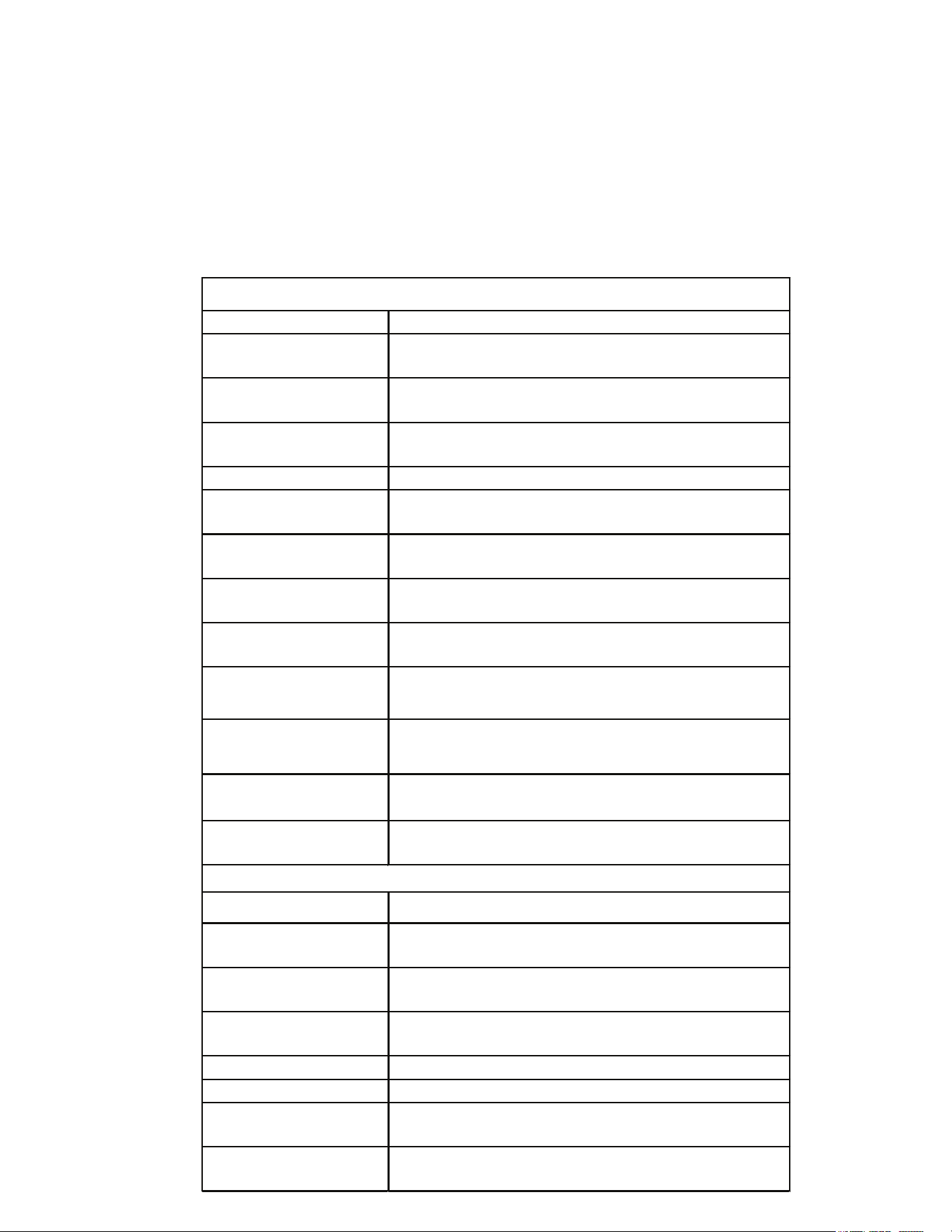
Utensils Remarks
Browning dish
Follow manufacturer's instructions. Must be at least 3/16
inch above the turntable.
Dinnerware
Microwave-safe only. Follow the manufacturer's
instructions. Do not use if cracked or chipped.
Glass jars
Remove the lid; use only to heat food until just warm. Not
heat-resistant and may break.
Glassware Heat-resistant oven glassware only. No metallic trim.
Oven cooking bags
Follow manufacturer's instructions. Do not close with
metal tie. Vent the bag.
Paper plates and cups
Use for short-term cooking/warming only. Attend while
cooking.
Paper towels
Use to cover food for reheating and to absorb fat.
Supervise during use.
Parchment paper
Use as a cover to prevent splattering or as a wrap for
steaming.
Plastic
Microwave-safe only. Should be labeled "Microwave
Safe."
Plastic wrap Microwave-safe only. Use as directed by packaging.
Thermometers Microwave-safe only (meat and candy thermometers).
Wax paper Use as a cover to prevent splattering and retain moisture.
Utensils Remarks
Aluminum tray
May cause arcing. Transfer food into microwave-safe
dish.
Food carton with metal
handle
May cause arcing. Transfer food into microwave-safe
dish.
Metal or metal-trimmed
utensils
Metal shields the food from microwave energy. Metal
trim may cause arcing.
Twist ties May cause arcing and could cause a fire in the oven.
Paper bags May cause a fire in the oven.
Plastic foam
Plastic foam may melt or contaminate the liquid inside
when exposed to high temperature.
Wood
Wood will dry out when used in the microwave oven and
may split or crack.
Materials You Can Use in Microwave Oven
Materials to be Avoided in Microwave Oven
Setting Up Your Oven
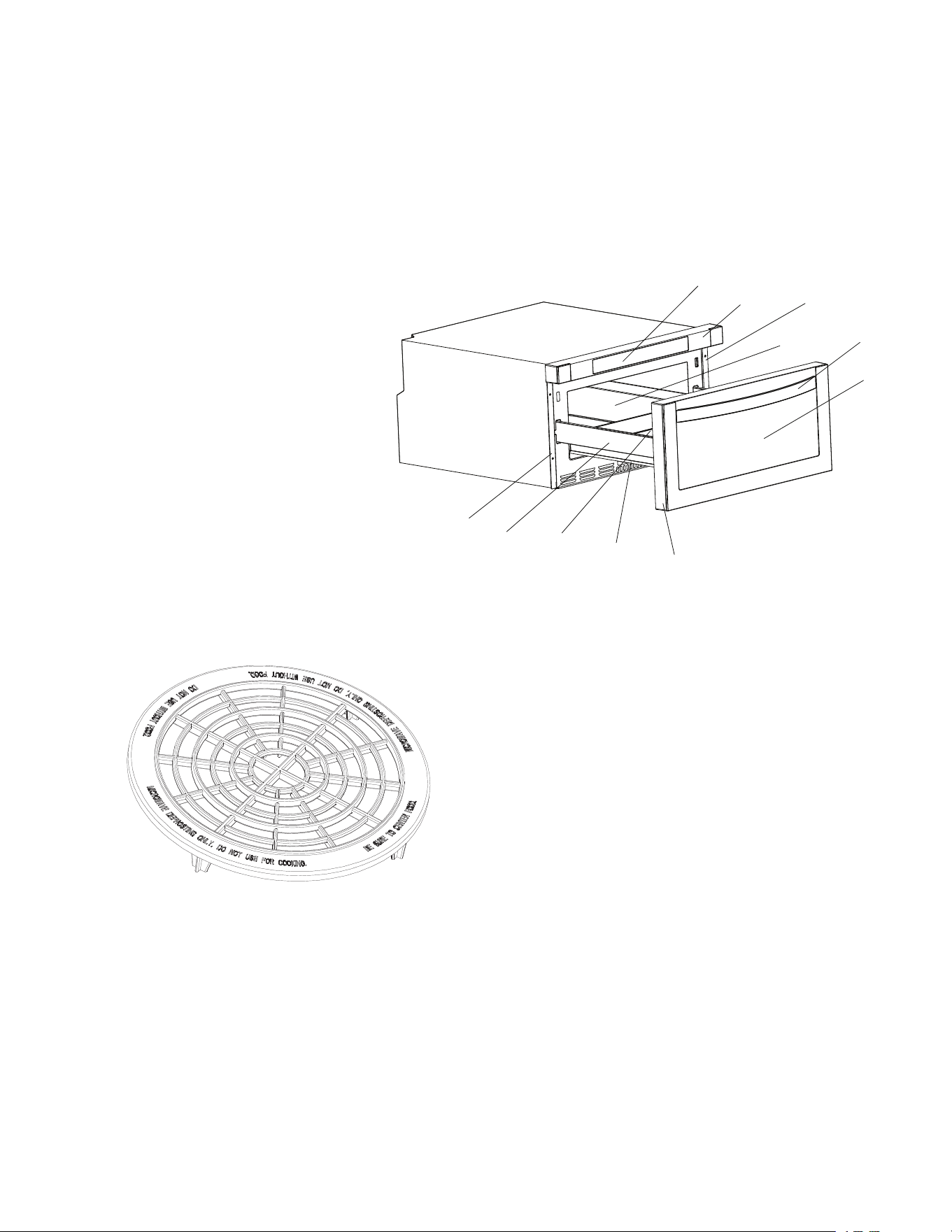
Names of Oven Parts and Accessories
Please remove all materials from the carton and oven cavity. Your oven comes with the following
accessories:
A) Control Panel
B) Control Box
C) Right Mounting Plate
D) Cavity
E) Handle
F) Windows
G) Door Frame
H) Door
I) Automatic Putter
J) Drawer
K) Hinge Joint Board
L) Left Mounting Plate
The Defrosting Rack (not labeled, likely to be the circular object at the bottom of the image) is only to be used in the
defrosting function and should not be used for cooking. Do not use without food.
Important Safety Instructions
• Before use, ensure you have read and understood the microwave's instruction manual thoroughly.
• Specifically, review the section "Precautions to Avoid Possible Exposure to Excessive Microwave Energy" located on page 2 of the
manual.
• The microwave must be grounded. Connect it to a properly grounded electrical outlet as directed in the "Grounding Instructions" on
page 4.
• Place the microwave in a location recommended by the installation instructions.
• Do not heat items such as whole eggs or completely sealed containers within the microwave, as they can explode.
• Operate the microwave strictly according to the uses described in the manual, avoiding exposure to corrosive chemicals or vapor.
• Exercise close supervision when the microwave is used near children.
• If the microwave's cord or plug is damaged, or if the microwave is not working properly or has been damaged or dropped, refrain from
using it.
• Maintenance and servicing should only be performed by qualified service personnel. Contact the nearest authorized service facility for
examination, repair, or adjustment.
• Make sure not to cover or block any of the microwave's ventilation openings.
• Avoid storing the microwave in damp environments or near water, such as near a kitchen sink, in a wet basement, or close to a
swimming pool.
• Do not immerse the power cord or plug in water.
• Protect the power cord from contact with hot surfaces, and do not let it hang over the edge of a table or counter.
• When cleaning the microwave's door and other surfaces, do so with mild, nonabrasive soap, and wipe with a sponge or soft cloth.
• Reduce the risk of fire in the oven cavity by:
- a. Avoiding the overcooking of food.
- b. Supervising the appliance when cooking with materials that can catch fire.
- c. Removing wire twist-ties and metal objects before placing items in the oven.
- d. Keeping the oven door closed and unplugged if something inside catches fire.
- e. Not using the oven cavity for storage purposes, such as paper products or cooking utensils, or leaving food in the cavity when
not in use.
• Be aware that some cooking containers, like certain plastics, can catch fire or melt if they're not suitable for microwave use.
• Exercise caution when heating liquids. They can reach temperatures beyond their boiling points without the formation of visible
bubbles, posing a risk of sudden boiling or burns when handled.
• This could result in very hot liquid suddenly boiling over when the container is disturbed or a utensil is inserted into the liquid.
To reduce the risk of injury to persons:
Do not overheat the liquid.
Stir the liquid both before and halfway through heating it.
Do not use straight-sided containers with narrow necks.
After heating, allow the container to stand in the microwave oven for a short time before removing the container.
Use extreme care when inserting a spoon or other utensil into the container.
Do not operate any heating or cooking appliance beneath the appliance.
Do not mount unit over or near any portion of heating or cooking appliance.
Do not mount over sink.
Do not store anything directly on top of the appliance surface when the appliance is in operation.
GROUNDING INSTRUCTIONS
This appliance must be grounded. In the event of an electrical short circuit, grounding reduces the risk of electric shock by providing an
escape wire for the electric current. This appliance is equipped with a cord having a grounding wire with a grounding plug. The plug must
be plugged into an outlet that is properly installed and grounded.
WARNING - Improper use of the grounding can result in a risk of electric shock.
Consult a qualified electrician or serviceman if the grounding instructions are not completely understood, or if doubt exists as to whether
the appliance is properly grounded. If it is necessary to use an extension cord, use only a 3-wire extension cord that has a 3-blade ground)
ed plug, and 3-slot receptacle that will accept the plug on the appliance. The marked rating of the extension cord shall be equal to or
greater than the electrical rating of the appliance.
DANGER - Electric Shock Hazard
Touching some of the internal components can cause serious personal injury or death. Do not disassemble this appliance.
WARNING - Electric Shock Hazard
Improper use of the grounding can result in electric shock. Do not plug into an outlet until the appliance is properly installed and grounded.
A short power-supply cord is provided to reduce the risks resulting from becoming entangled in or tripping over a longer cord.
Longer cord sets or extension cords are available and may be used if care is exercised in their use.
If a long cord or extension cord is used:
The marked electrical rating of the cord set or extension cord should be at least as great as the electrical rating of the appliance.
The extension cord must be a grounding-type 3-wire cord.
The longer cord should be arranged so that it will not drape over the counter top or tabletop where it can be pulled on by children or tripped over unintention)
ally.
SAVE THESE INSTRUCTIONS
Grounding Instructions
For safety, this appliance requires proper grounding. Grounding minimizes the risk of electric shock by providing a path of least resistance
for electric current. This appliance comes with a power cord fitted with a grounding conductor and a grounding plug. The plug must be
connected to an appropriate outlet that is properly installed and grounded.
Warning: The incorrect application of the grounding can pose a risk of electric shock.
If you are unsure about the grounding methods or have any doubts, consult a qualified electrician or service technician. Should there be a
need to use an extension cord, ensure it is a three-wire cord with a grounding plug and a three-slot receptacle that matches the plug on the
appliance. The electrical rating of the extension cord must be at least as high as the appliance's rating.
Danger: Electric Shock Hazard
Direct contact with internal components can be hazardous. Avoid touching internal parts to prevent potential injury or death. Never attempt
to disassemble this appliance yourself.
Warning: Electric Shock Hazard!
To reduce the risk of electric shock, do not connect to power until the appliance has been correctly installed and grounded.
1. This appliance has a short power-supply cord to lessen the risk associated with longer cords, such as entanglement or tripping.
2. An extended power-supply cord or qualified extension cord may be used if proper care is taken.
3. If using a longer power-supply cord or extension:
a. The extension cord should match the electrical rating of the appliance.
b. Ensure the extension is a grounding-type three-wire cord.
c. Arrange the extension cord where it will not hang over the counter or table to avoid being pulled on by children or tripped over.
Radio Interference
1. Using your microwave oven could interfere with nearby radios, televisions, or similar devices.
2. Should interference occur, you might be able to lessen or resolve the issue by following these steps:
- Ensure the microwave oven's door and its seals are clean.
- Adjust the orientation of the receiving antenna on your radio or television.
- Change the location of the microwave oven relative to the affected receiver.
- Position the microwave oven further from the receiver.
- Connect the microwave oven to a separate electrical outlet to ensure it and the receiver are on different branch circuits.
Utensils
Caution: Risk of Personal Injury
Sealed containers can build up pressure and may explode if heated in a microwave oven. Always open containers or pierce plastic
pouches before microwaving.
Refer to the manual section titled "Materials suitable for microwave use" for guidance. Some non-metallic utensils may be unsuitable
for microwave use. If you are uncertain, perform the following test:
Utensil Test:
1. Place the utensil in question in a microwave-safe container filled with 1 cup (250ml) of cold water.
2. Microwave at full power for 1 minute.
3. Touch the utensil carefully. If it is warm, do not use it in the microwave.
4. Limit the test duration to 1 minute only.
A
B
C
D
E
F
G
H
I
J
K
Important Safety Instructions
• Before use, ensure you have read and understood the microwave's instruction manual thoroughly.
• Specifically, review the section "Precautions to Avoid Possible Exposure to Excessive Microwave Energy" located on page 2 of the
manual.
• The microwave must be grounded. Connect it to a properly grounded electrical outlet as directed in the "Grounding Instructions" on
page 4.
• Place the microwave in a location recommended by the installation instructions.
• Do not heat items such as whole eggs or completely sealed containers within the microwave, as they can explode.
• Operate the microwave strictly according to the uses described in the manual, avoiding exposure to corrosive chemicals or vapor.
• Exercise close supervision when the microwave is used near children.
• If the microwave's cord or plug is damaged, or if the microwave is not working properly or has been damaged or dropped, refrain from
using it.
• Maintenance and servicing should only be performed by qualified service personnel. Contact the nearest authorized service facility for
examination, repair, or adjustment.
• Make sure not to cover or block any of the microwave's ventilation openings.
• Avoid storing the microwave in damp environments or near water, such as near a kitchen sink, in a wet basement, or close to a
swimming pool.
• Do not immerse the power cord or plug in water.
• Protect the power cord from contact with hot surfaces, and do not let it hang over the edge of a table or counter.
• When cleaning the microwave's door and other surfaces, do so with mild, nonabrasive soap, and wipe with a sponge or soft cloth.
• Reduce the risk of fire in the oven cavity by:
- a. Avoiding the overcooking of food.
- b. Supervising the appliance when cooking with materials that can catch fire.
- c. Removing wire twist-ties and metal objects before placing items in the oven.
- d. Keeping the oven door closed and unplugged if something inside catches fire.
- e. Not using the oven cavity for storage purposes, such as paper products or cooking utensils, or leaving food in the cavity when
not in use.
• Be aware that some cooking containers, like certain plastics, can catch fire or melt if they're not suitable for microwave use.
• Exercise caution when heating liquids. They can reach temperatures beyond their boiling points without the formation of visible
bubbles, posing a risk of sudden boiling or burns when handled.
• This could result in very hot liquid suddenly boiling over when the container is disturbed or a utensil is inserted into the liquid.
To reduce the risk of injury to persons:
Do not overheat the liquid.
Stir the liquid both before and halfway through heating it.
Do not use straight-sided containers with narrow necks.
After heating, allow the container to stand in the microwave oven for a short time before removing the container.
Use extreme care when inserting a spoon or other utensil into the container.
Do not operate any heating or cooking appliance beneath the appliance.
Do not mount unit over or near any portion of heating or cooking appliance.
Do not mount over sink.
Do not store anything directly on top of the appliance surface when the appliance is in operation.
GROUNDING INSTRUCTIONS
This appliance must be grounded. In the event of an electrical short circuit, grounding reduces the risk of electric shock by providing an
escape wire for the electric current. This appliance is equipped with a cord having a grounding wire with a grounding plug. The plug must
be plugged into an outlet that is properly installed and grounded.
WARNING - Improper use of the grounding can result in a risk of electric shock.
Consult a qualified electrician or serviceman if the grounding instructions are not completely understood, or if doubt exists as to whether
the appliance is properly grounded. If it is necessary to use an extension cord, use only a 3-wire extension cord that has a 3-blade ground)
ed plug, and 3-slot receptacle that will accept the plug on the appliance. The marked rating of the extension cord shall be equal to or
greater than the electrical rating of the appliance.
DANGER - Electric Shock Hazard
Touching some of the internal components can cause serious personal injury or death. Do not disassemble this appliance.
WARNING - Electric Shock Hazard
Improper use of the grounding can result in electric shock. Do not plug into an outlet until the appliance is properly installed and grounded.
A short power-supply cord is provided to reduce the risks resulting from becoming entangled in or tripping over a longer cord.
Longer cord sets or extension cords are available and may be used if care is exercised in their use.
If a long cord or extension cord is used:
The marked electrical rating of the cord set or extension cord should be at least as great as the electrical rating of the appliance.
The extension cord must be a grounding-type 3-wire cord.
The longer cord should be arranged so that it will not drape over the counter top or tabletop where it can be pulled on by children or tripped over unintention)
ally.
SAVE THESE INSTRUCTIONS
Grounding Instructions
For safety, this appliance requires proper grounding. Grounding minimizes the risk of electric shock by providing a path of least resistance
for electric current. This appliance comes with a power cord fitted with a grounding conductor and a grounding plug. The plug must be
connected to an appropriate outlet that is properly installed and grounded.
Warning: The incorrect application of the grounding can pose a risk of electric shock.
If you are unsure about the grounding methods or have any doubts, consult a qualified electrician or service technician. Should there be a
need to use an extension cord, ensure it is a three-wire cord with a grounding plug and a three-slot receptacle that matches the plug on the
appliance. The electrical rating of the extension cord must be at least as high as the appliance's rating.
Danger: Electric Shock Hazard
Direct contact with internal components can be hazardous. Avoid touching internal parts to prevent potential injury or death. Never attempt
to disassemble this appliance yourself.
Warning: Electric Shock Hazard!
To reduce the risk of electric shock, do not connect to power until the appliance has been correctly installed and grounded.
1. This appliance has a short power-supply cord to lessen the risk associated with longer cords, such as entanglement or tripping.
2. An extended power-supply cord or qualified extension cord may be used if proper care is taken.
3. If using a longer power-supply cord or extension:
a. The extension cord should match the electrical rating of the appliance.
b. Ensure the extension is a grounding-type three-wire cord.
c. Arrange the extension cord where it will not hang over the counter or table to avoid being pulled on by children or tripped over.
Radio Interference
1. Using your microwave oven could interfere with nearby radios, televisions, or similar devices.
2. Should interference occur, you might be able to lessen or resolve the issue by following these steps:
- Ensure the microwave oven's door and its seals are clean.
- Adjust the orientation of the receiving antenna on your radio or television.
- Change the location of the microwave oven relative to the affected receiver.
- Position the microwave oven further from the receiver.
- Connect the microwave oven to a separate electrical outlet to ensure it and the receiver are on different branch circuits.
Utensils
Caution: Risk of Personal Injury
Sealed containers can build up pressure and may explode if heated in a microwave oven. Always open containers or pierce plastic
pouches before microwaving.
Refer to the manual section titled "Materials suitable for microwave use" for guidance. Some non-metallic utensils may be unsuitable
for microwave use. If you are uncertain, perform the following test:
Utensil Test:
1. Place the utensil in question in a microwave-safe container filled with 1 cup (250ml) of cold water.
2. Microwave at full power for 1 minute.
3. Touch the utensil carefully. If it is warm, do not use it in the microwave.
4. Limit the test duration to 1 minute only.
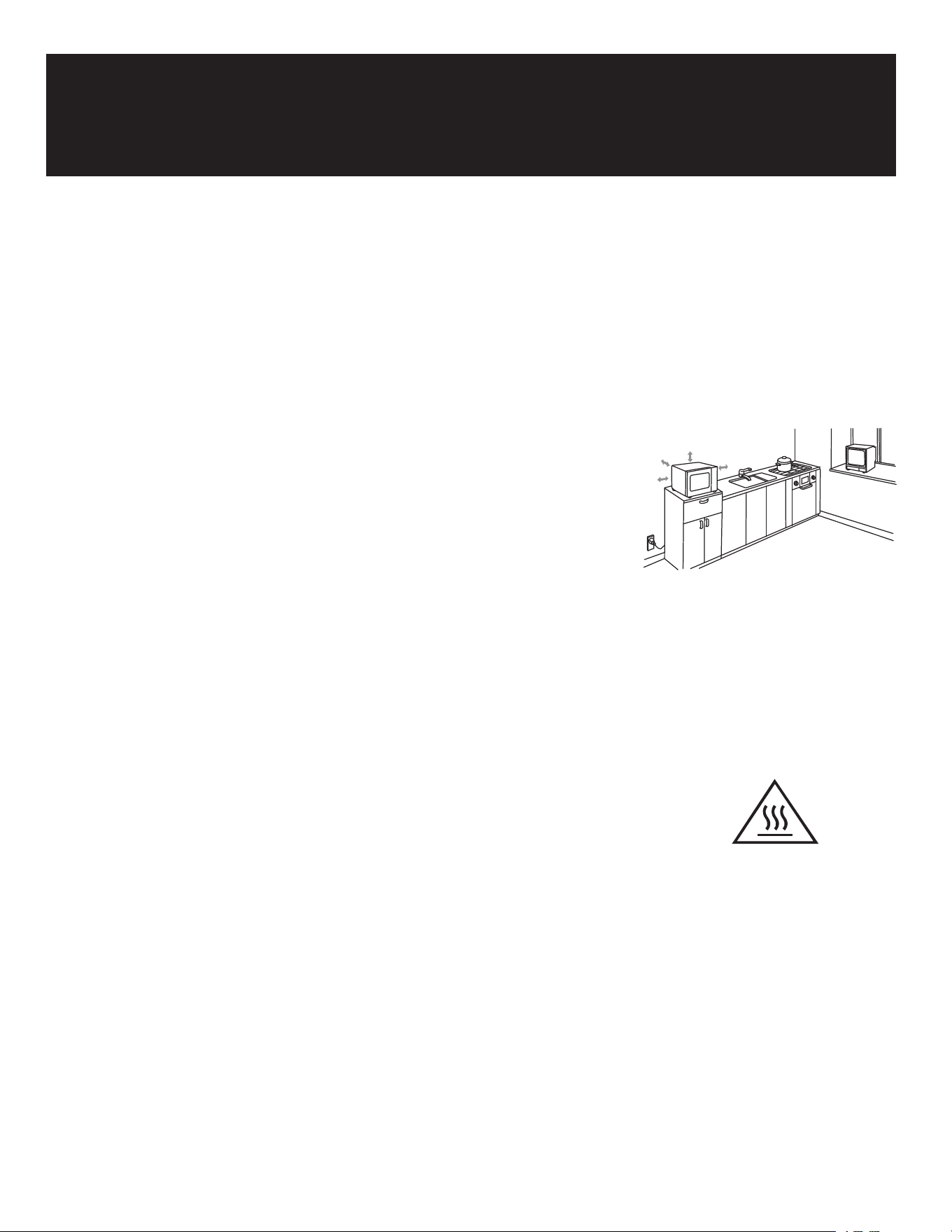
Countertop Installation
Before installing, remove all packaging materials and examine the oven for any damage, such as dents
or a broken door. Do not install if the oven is damaged.
For the cabinet, remove any protective film on the microwave oven's exterior. Do not remove the light
brown Mica cover that is attached to the oven cavity to protect the magnetron.
Installation Instructions:
1. Place the oven on a flat and level surface that allows enough
clearance for air intake and/or outlet vents.
2. Ensure a minimum clearance of 3 inches (7.5cm) between the
oven and any adjacent walls. One side must be open at least 12
inches (30cm) above the countertop to ensure proper ventilation.
3. Do not block the intake and/or outlet openings as this can damage the oven.
4. To prevent interference with household electronics, position the oven as far away from radios and
TVs as possible.
5. Connect the oven to a standard household outlet, ensuring that the voltage and frequency match
those listed on the oven's rating label.
Warning:
Do not install the microwave oven over a range cooktop or other
heat-producing appliances. Installing over a heat source could damage the
oven and void the warranty.
Be cautious during use, as the accessible surface may be hot.
INSTALLATION
3.0 inch(7.5cm)
3.0 inch(7.5cm)
12 inch(30cm)
OPEN
Important Safety Instructions
• Before use, ensure you have read and understood the microwave's instruction manual thoroughly.
• Specifically, review the section "Precautions to Avoid Possible Exposure to Excessive Microwave Energy" located on page 2 of the
manual.
• The microwave must be grounded. Connect it to a properly grounded electrical outlet as directed in the "Grounding Instructions" on
page 4.
• Place the microwave in a location recommended by the installation instructions.
• Do not heat items such as whole eggs or completely sealed containers within the microwave, as they can explode.
• Operate the microwave strictly according to the uses described in the manual, avoiding exposure to corrosive chemicals or vapor.
• Exercise close supervision when the microwave is used near children.
• If the microwave's cord or plug is damaged, or if the microwave is not working properly or has been damaged or dropped, refrain from
using it.
• Maintenance and servicing should only be performed by qualified service personnel. Contact the nearest authorized service facility for
examination, repair, or adjustment.
• Make sure not to cover or block any of the microwave's ventilation openings.
• Avoid storing the microwave in damp environments or near water, such as near a kitchen sink, in a wet basement, or close to a
swimming pool.
• Do not immerse the power cord or plug in water.
• Protect the power cord from contact with hot surfaces, and do not let it hang over the edge of a table or counter.
• When cleaning the microwave's door and other surfaces, do so with mild, nonabrasive soap, and wipe with a sponge or soft cloth.
• Reduce the risk of fire in the oven cavity by:
- a. Avoiding the overcooking of food.
- b. Supervising the appliance when cooking with materials that can catch fire.
- c. Removing wire twist-ties and metal objects before placing items in the oven.
- d. Keeping the oven door closed and unplugged if something inside catches fire.
- e. Not using the oven cavity for storage purposes, such as paper products or cooking utensils, or leaving food in the cavity when
not in use.
• Be aware that some cooking containers, like certain plastics, can catch fire or melt if they're not suitable for microwave use.
• Exercise caution when heating liquids. They can reach temperatures beyond their boiling points without the formation of visible
bubbles, posing a risk of sudden boiling or burns when handled.
• This could result in very hot liquid suddenly boiling over when the container is disturbed or a utensil is inserted into the liquid.
To reduce the risk of injury to persons:
Do not overheat the liquid.
Stir the liquid both before and halfway through heating it.
Do not use straight-sided containers with narrow necks.
After heating, allow the container to stand in the microwave oven for a short time before removing the container.
Use extreme care when inserting a spoon or other utensil into the container.
Do not operate any heating or cooking appliance beneath the appliance.
Do not mount unit over or near any portion of heating or cooking appliance.
Do not mount over sink.
Do not store anything directly on top of the appliance surface when the appliance is in operation.
GROUNDING INSTRUCTIONS
This appliance must be grounded. In the event of an electrical short circuit, grounding reduces the risk of electric shock by providing an
escape wire for the electric current. This appliance is equipped with a cord having a grounding wire with a grounding plug. The plug must
be plugged into an outlet that is properly installed and grounded.
WARNING - Improper use of the grounding can result in a risk of electric shock.
Consult a qualified electrician or serviceman if the grounding instructions are not completely understood, or if doubt exists as to whether
the appliance is properly grounded. If it is necessary to use an extension cord, use only a 3-wire extension cord that has a 3-blade ground)
ed plug, and 3-slot receptacle that will accept the plug on the appliance. The marked rating of the extension cord shall be equal to or
greater than the electrical rating of the appliance.
DANGER - Electric Shock Hazard
Touching some of the internal components can cause serious personal injury or death. Do not disassemble this appliance.
WARNING - Electric Shock Hazard
Improper use of the grounding can result in electric shock. Do not plug into an outlet until the appliance is properly installed and grounded.
A short power-supply cord is provided to reduce the risks resulting from becoming entangled in or tripping over a longer cord.
Longer cord sets or extension cords are available and may be used if care is exercised in their use.
If a long cord or extension cord is used:
The marked electrical rating of the cord set or extension cord should be at least as great as the electrical rating of the appliance.
The extension cord must be a grounding-type 3-wire cord.
The longer cord should be arranged so that it will not drape over the counter top or tabletop where it can be pulled on by children or tripped over unintention)
ally.
SAVE THESE INSTRUCTIONS
Grounding Instructions
For safety, this appliance requires proper grounding. Grounding minimizes the risk of electric shock by providing a path of least resistance
for electric current. This appliance comes with a power cord fitted with a grounding conductor and a grounding plug. The plug must be
connected to an appropriate outlet that is properly installed and grounded.
Warning: The incorrect application of the grounding can pose a risk of electric shock.
If you are unsure about the grounding methods or have any doubts, consult a qualified electrician or service technician. Should there be a
need to use an extension cord, ensure it is a three-wire cord with a grounding plug and a three-slot receptacle that matches the plug on the
appliance. The electrical rating of the extension cord must be at least as high as the appliance's rating.
Danger: Electric Shock Hazard
Direct contact with internal components can be hazardous. Avoid touching internal parts to prevent potential injury or death. Never attempt
to disassemble this appliance yourself.
Warning: Electric Shock Hazard!
To reduce the risk of electric shock, do not connect to power until the appliance has been correctly installed and grounded.
1. This appliance has a short power-supply cord to lessen the risk associated with longer cords, such as entanglement or tripping.
2. An extended power-supply cord or qualified extension cord may be used if proper care is taken.
3. If using a longer power-supply cord or extension:
a. The extension cord should match the electrical rating of the appliance.
b. Ensure the extension is a grounding-type three-wire cord.
c. Arrange the extension cord where it will not hang over the counter or table to avoid being pulled on by children or tripped over.
Radio Interference
1. Using your microwave oven could interfere with nearby radios, televisions, or similar devices.
2. Should interference occur, you might be able to lessen or resolve the issue by following these steps:
- Ensure the microwave oven's door and its seals are clean.
- Adjust the orientation of the receiving antenna on your radio or television.
- Change the location of the microwave oven relative to the affected receiver.
- Position the microwave oven further from the receiver.
- Connect the microwave oven to a separate electrical outlet to ensure it and the receiver are on different branch circuits.
Utensils
Caution: Risk of Personal Injury
Sealed containers can build up pressure and may explode if heated in a microwave oven. Always open containers or pierce plastic
pouches before microwaving.
Refer to the manual section titled "Materials suitable for microwave use" for guidance. Some non-metallic utensils may be unsuitable
for microwave use. If you are uncertain, perform the following test:
Utensil Test:
1. Place the utensil in question in a microwave-safe container filled with 1 cup (250ml) of cold water.
2. Microwave at full power for 1 minute.
3. Touch the utensil carefully. If it is warm, do not use it in the microwave.
4. Limit the test duration to 1 minute only.
OPERATION
(1) Open
(2) Setup
(3) Auto Menu
(4) Weight Defrost
(5) Close
(6) Clock/Kitchen timer
(7) Time Defrost
(8) Number keys
(9) Power
(10) Start/ +30sec.
(11) Time Cook
(12) Stop/Cancel
(5)
(2)
(3)
(4) (9) (10)
(6)
(7) (11) (12)
(1)
(8)
(3)
(8)
Control Panel and Features
Power On
• When the microwave oven is plugged into an outlet, buzzer sounds once. Screen displays
"WELCOME". Then the oven turns into waiting state. The screen displays "0:00".
• In waiting state, the screen will display the current time if the clock has been set. Otherwise, "0:00"
will display.
• Press "OPEN" button to open the drawer, and screen displays "OPEN". The screen will display
"PLEASE CLOSE" when the drawer is fully opened.
• Press "CLOSE" button to close the drawer, and the screen displays "CLOSE". The screen will display
the current time or "0:00" when the drawer is fully closed.
• If there are mistakes to open or close the drawer, buzzer will sound five times, and the screen will
display "OPEN OR CLOSE".
Clock Setting
• Press "CLOCK/KITCHEN TIMER" button once. The first hour figure will flash and other "0" will light.
• Press the number buttons to enter the correct time. The input time should be between 01:00-12:59.
• Press "CLOCK/KITCHEN TIMER" to finish the setting. "*" will flash.
• Note: In the process of clock setting, if the "STOP/CANCEL" button is pressed or if there is no
operation within 1 minute, the oven will go back to former setting automatically.
Kitchen Timer
• Press "CLOCK/KITCHEN TIMER" button twice, Screen will display 00:00. "FUNCTION" will light.
• Press the number buttons to enter the time. The maximum cooking time is 90 minutes (99
seconds).
• Press "START/+30SEC." to confirm the setting. The time begins to count down.
• When the kitchen time arrives, buzzer will ring 5 times. The oven turns into waiting state. Screen
will display the current time if the clock has been set. Otherwise, Screen will display "0:00".
Note: The kitchen timer is differ from 12-hour system. Kitchen Timer is a timer.
• In the process of Kitchen Timer operation, any cooking programme cannot be operated.
• "STOP/CANCEL" can be pressed to cancel the Kitchen Timer.
Microwave Cooking Function
11 power levels are available.
(1) Press "TIME COOK" button, Screen will display "00:00". "FUNCTION" will light. Press number buttons
to input the cooking time. The maximum cooking time is 99 minutes 99 seconds.
(2) Press "POWER" button to set the power. The default power level is "PL100". Press number buttons
to select different power levels.
(3) Press "START/+30SEC." to start cooking. Buzzer sounds once. The cooking time begins to count
down. When cooking finished, buzzer sounds five times and "FINISH" displays.
Note: In the process of setting, if the "STOP/CANCEL" button is pressed or if there is no operation
within 1 minute, the oven will go back to the former setting automatically.
Fast Cooking
(1) In waiting state, instant cooking at 100% power level with 30 seconds' cooking time can be started
by pressing "START/+30SEC". Each press on the same button will increase cooking time by 30
seconds.
(2) During microwave and defrost by time, "START/+30SEC." can be pressed to increase cooking time.
Each press will increase 30 seconds.
Note: "START/+30SEC." cannot be pressed to increase cooking time for defrost by weight and Auto
menu cooking.
Weight Defrost Function
(1) Press "DEFROST WEIGHT" button. Screen displays "WEIGHT DEFROST". And "FUNCTION" will light.
(2) Press number buttons to input the weight to be defrosted.
The input weight should be between 0.1-6.0 lbs.
(3) Press "START/+30SEC." to start defrosting. Buzzer sounds once. The defrosting time begins to
count down. When cooking finished, buzzer sounds five times and "FINISH" displays.

Important Safety Instructions
• Before use, ensure you have read and understood the microwave's instruction manual thoroughly.
• Specifically, review the section "Precautions to Avoid Possible Exposure to Excessive Microwave Energy" located on page 2 of the
manual.
• The microwave must be grounded. Connect it to a properly grounded electrical outlet as directed in the "Grounding Instructions" on
page 4.
• Place the microwave in a location recommended by the installation instructions.
• Do not heat items such as whole eggs or completely sealed containers within the microwave, as they can explode.
• Operate the microwave strictly according to the uses described in the manual, avoiding exposure to corrosive chemicals or vapor.
• Exercise close supervision when the microwave is used near children.
• If the microwave's cord or plug is damaged, or if the microwave is not working properly or has been damaged or dropped, refrain from
using it.
• Maintenance and servicing should only be performed by qualified service personnel. Contact the nearest authorized service facility for
examination, repair, or adjustment.
• Make sure not to cover or block any of the microwave's ventilation openings.
• Avoid storing the microwave in damp environments or near water, such as near a kitchen sink, in a wet basement, or close to a
swimming pool.
• Do not immerse the power cord or plug in water.
• Protect the power cord from contact with hot surfaces, and do not let it hang over the edge of a table or counter.
• When cleaning the microwave's door and other surfaces, do so with mild, nonabrasive soap, and wipe with a sponge or soft cloth.
• Reduce the risk of fire in the oven cavity by:
- a. Avoiding the overcooking of food.
- b. Supervising the appliance when cooking with materials that can catch fire.
- c. Removing wire twist-ties and metal objects before placing items in the oven.
- d. Keeping the oven door closed and unplugged if something inside catches fire.
- e. Not using the oven cavity for storage purposes, such as paper products or cooking utensils, or leaving food in the cavity when
not in use.
• Be aware that some cooking containers, like certain plastics, can catch fire or melt if they're not suitable for microwave use.
• Exercise caution when heating liquids. They can reach temperatures beyond their boiling points without the formation of visible
bubbles, posing a risk of sudden boiling or burns when handled.
• This could result in very hot liquid suddenly boiling over when the container is disturbed or a utensil is inserted into the liquid.
To reduce the risk of injury to persons:
Do not overheat the liquid.
Stir the liquid both before and halfway through heating it.
Do not use straight-sided containers with narrow necks.
After heating, allow the container to stand in the microwave oven for a short time before removing the container.
Use extreme care when inserting a spoon or other utensil into the container.
Do not operate any heating or cooking appliance beneath the appliance.
Do not mount unit over or near any portion of heating or cooking appliance.
Do not mount over sink.
Do not store anything directly on top of the appliance surface when the appliance is in operation.
GROUNDING INSTRUCTIONS
This appliance must be grounded. In the event of an electrical short circuit, grounding reduces the risk of electric shock by providing an
escape wire for the electric current. This appliance is equipped with a cord having a grounding wire with a grounding plug. The plug must
be plugged into an outlet that is properly installed and grounded.
WARNING - Improper use of the grounding can result in a risk of electric shock.
Consult a qualified electrician or serviceman if the grounding instructions are not completely understood, or if doubt exists as to whether
the appliance is properly grounded. If it is necessary to use an extension cord, use only a 3-wire extension cord that has a 3-blade ground)
ed plug, and 3-slot receptacle that will accept the plug on the appliance. The marked rating of the extension cord shall be equal to or
greater than the electrical rating of the appliance.
DANGER - Electric Shock Hazard
Touching some of the internal components can cause serious personal injury or death. Do not disassemble this appliance.
WARNING - Electric Shock Hazard
Improper use of the grounding can result in electric shock. Do not plug into an outlet until the appliance is properly installed and grounded.
A short power-supply cord is provided to reduce the risks resulting from becoming entangled in or tripping over a longer cord.
Longer cord sets or extension cords are available and may be used if care is exercised in their use.
If a long cord or extension cord is used:
The marked electrical rating of the cord set or extension cord should be at least as great as the electrical rating of the appliance.
The extension cord must be a grounding-type 3-wire cord.
The longer cord should be arranged so that it will not drape over the counter top or tabletop where it can be pulled on by children or tripped over unintention)
ally.
SAVE THESE INSTRUCTIONS
Grounding Instructions
For safety, this appliance requires proper grounding. Grounding minimizes the risk of electric shock by providing a path of least resistance
for electric current. This appliance comes with a power cord fitted with a grounding conductor and a grounding plug. The plug must be
connected to an appropriate outlet that is properly installed and grounded.
Warning: The incorrect application of the grounding can pose a risk of electric shock.
If you are unsure about the grounding methods or have any doubts, consult a qualified electrician or service technician. Should there be a
need to use an extension cord, ensure it is a three-wire cord with a grounding plug and a three-slot receptacle that matches the plug on the
appliance. The electrical rating of the extension cord must be at least as high as the appliance's rating.
Danger: Electric Shock Hazard
Direct contact with internal components can be hazardous. Avoid touching internal parts to prevent potential injury or death. Never attempt
to disassemble this appliance yourself.
Warning: Electric Shock Hazard!
To reduce the risk of electric shock, do not connect to power until the appliance has been correctly installed and grounded.
1. This appliance has a short power-supply cord to lessen the risk associated with longer cords, such as entanglement or tripping.
2. An extended power-supply cord or qualified extension cord may be used if proper care is taken.
3. If using a longer power-supply cord or extension:
a. The extension cord should match the electrical rating of the appliance.
b. Ensure the extension is a grounding-type three-wire cord.
c. Arrange the extension cord where it will not hang over the counter or table to avoid being pulled on by children or tripped over.
Radio Interference
1. Using your microwave oven could interfere with nearby radios, televisions, or similar devices.
2. Should interference occur, you might be able to lessen or resolve the issue by following these steps:
- Ensure the microwave oven's door and its seals are clean.
- Adjust the orientation of the receiving antenna on your radio or television.
- Change the location of the microwave oven relative to the affected receiver.
- Position the microwave oven further from the receiver.
- Connect the microwave oven to a separate electrical outlet to ensure it and the receiver are on different branch circuits.
Utensils
Caution: Risk of Personal Injury
Sealed containers can build up pressure and may explode if heated in a microwave oven. Always open containers or pierce plastic
pouches before microwaving.
Refer to the manual section titled "Materials suitable for microwave use" for guidance. Some non-metallic utensils may be unsuitable
for microwave use. If you are uncertain, perform the following test:
Utensil Test:
1. Place the utensil in question in a microwave-safe container filled with 1 cup (250ml) of cold water.
2. Microwave at full power for 1 minute.
3. Touch the utensil carefully. If it is warm, do not use it in the microwave.
4. Limit the test duration to 1 minute only.
Power On
• When the microwave oven is plugged into an outlet, buzzer sounds once. Screen displays
"WELCOME". Then the oven turns into waiting state. The screen displays "0:00".
• In waiting state, the screen will display the current time if the clock has been set. Otherwise, "0:00"
will display.
• Press "OPEN" button to open the drawer, and screen displays "OPEN". The screen will display
"PLEASE CLOSE" when the drawer is fully opened.
• Press "CLOSE" button to close the drawer, and the screen displays "CLOSE". The screen will display
the current time or "0:00" when the drawer is fully closed.
• If there are mistakes to open or close the drawer, buzzer will sound five times, and the screen will
display "OPEN OR CLOSE".
Clock Setting
• Press "CLOCK/KITCHEN TIMER" button once. The first hour figure will flash and other "0" will light.
• Press the number buttons to enter the correct time. The input time should be between 01:00-12:59.
• Press "CLOCK/KITCHEN TIMER" to finish the setting. "*" will flash.
• Note: In the process of clock setting, if the "STOP/CANCEL" button is pressed or if there is no
operation within 1 minute, the oven will go back to former setting automatically.
Kitchen Timer
• Press "CLOCK/KITCHEN TIMER" button twice, Screen will display 00:00. "FUNCTION" will light.
• Press the number buttons to enter the time. The maximum cooking time is 90 minutes (99
seconds).
• Press "START/+30SEC." to confirm the setting. The time begins to count down.
• When the kitchen time arrives, buzzer will ring 5 times. The oven turns into waiting state. Screen
will display the current time if the clock has been set. Otherwise, Screen will display "0:00".
Note: The kitchen timer is differ from 12-hour system. Kitchen Timer is a timer.
• In the process of Kitchen Timer operation, any cooking programme cannot be operated.
• "STOP/CANCEL" can be pressed to cancel the Kitchen Timer.
Microwave Cooking Function
11 power levels are available.
(1) Press "TIME COOK" button, Screen will display "00:00". "FUNCTION" will light. Press number buttons
to input the cooking time. The maximum cooking time is 99 minutes 99 seconds.
(2) Press "POWER" button to set the power. The default power level is "PL100". Press number buttons
to select different power levels.
(3) Press "START/+30SEC." to start cooking. Buzzer sounds once. The cooking time begins to count
down. When cooking finished, buzzer sounds five times and "FINISH" displays.
Note: In the process of setting, if the "STOP/CANCEL" button is pressed or if there is no operation
within 1 minute, the oven will go back to the former setting automatically.
Fast Cooking
(1) In waiting state, instant cooking at 100% power level with 30 seconds' cooking time can be started
by pressing "START/+30SEC". Each press on the same button will increase cooking time by 30
seconds.
(2) During microwave and defrost by time, "START/+30SEC." can be pressed to increase cooking time.
Each press will increase 30 seconds.
Note: "START/+30SEC." cannot be pressed to increase cooking time for defrost by weight and Auto
menu cooking.
Weight Defrost Function
(1) Press "DEFROST WEIGHT" button. Screen displays "WEIGHT DEFROST". And "FUNCTION" will light.
(2) Press number buttons to input the weight to be defrosted.
The input weight should be between 0.1-6.0 lbs.
(3) Press "START/+30SEC." to start defrosting. Buzzer sounds once. The defrosting time begins to
count down. When cooking finished, buzzer sounds five times and "FINISH" displays.
Level 10 9 8 7 6 5 4 3 2 1 0
Power 100% 90% 80% 70% 60% 50% 40% 30% 20% 10% 0%
Display PL10 PL90 PL80 PL70 PL60 PL50 PL40 PL30 PL20 PL10 PL00
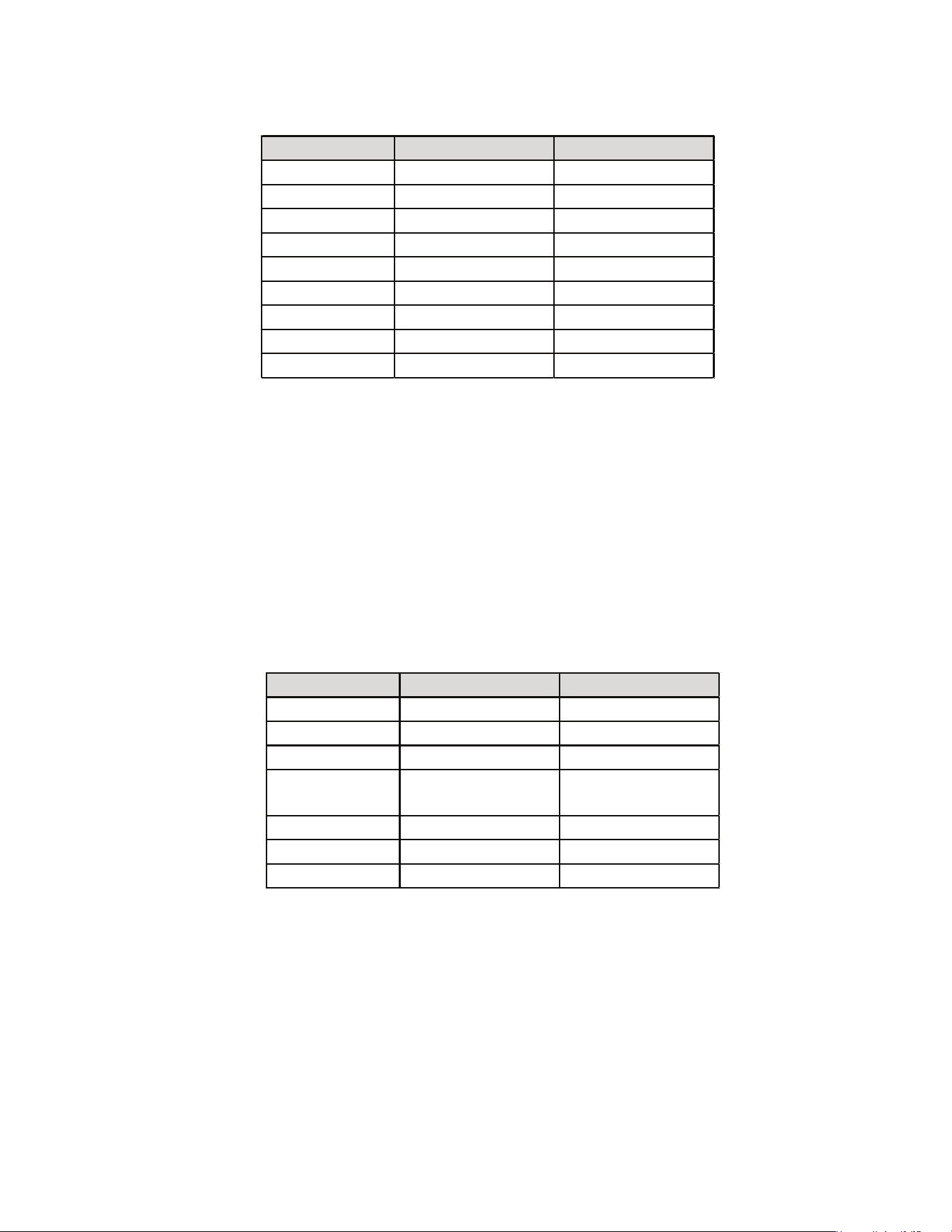
Menu Options for Auto Menu-Soften
11. Auto Menu-Soften
(1) Press "SOFTEN" button. Screen displays "BUTTER". "AUTO MENU" indicator will light.
(2) Continue to press "SOFTEN" button, "BUTTER", "ICE-CRE" or "CHEESE" will display in order.
(3) Press "START/+30SEC." to confirm the selection.
(4) Press "SOFTEN" button to select the weight. "OZ" will light except butter menu.
(5) Press "START/+30SEC." to start cooking. Buzzer sounds once. "OZ" will go out. The cooking
time begins to count down. When cooking finished, buzzer sounds five times and "FINISH" displays.
12. Buzzer On/Off
(1) Press "SETUP" button. Screen displays "BUZ OFF".
(2) Press "START/+30SEC." button. The oven will turn to waiting state. Buzzer is turned off. No beep
will sound.
(3) Press "SETUP" button. Screen displays "BUZ ON".
(4) Press "START/+30SEC." button. The oven will turn to waiting state. Buzzer is turned on. Buzzer
will sound normally.
13. LOCK FUNCTION FOR CHILDREN
Lock: In waiting state, press "STOP/CANCEL" for 3 seconds, the oven will enter into the
children-lock state. Screen will display the current time if the clock has been set. Otherwise, "00:00"
will display.
Menu Display Weight
Butter/Margarine BUTTER 1(STICK)
2(STICKS)
3(STICKS)
Chocolate CHOCOLA 4
8
Cheese CHEESE 8
16
Marshmallows MARSHMA 5
10
Menu Display Weight
Butter BUTTER 1(STICK)
2(STICKS)
3(STICKS)
Ice cream/Frozen
juice
ICE-CRE 8
16
32
Cream Cheese CHEESE 8
Lock quitting: In locked state, press "STOP/CANCEL" for 3 seconds to release the lock.
14. INQUIRING FUNCTION
(1) In cooking state, press "CLOCK/KITCHEN TIMER" button to check the clock. The current time
will display for 3 seconds.
(2) In the microwave cooking state, press "POWER" button to inquire
the microwave power. The current microwave power will display for 3 seconds.
15. OTHER SPECIFICATIONS
(1) The buzzer sounds once by efficient press, inefficient press will be no responce. (2) In cooking
state, "OPEN" cannot be pressed to open the drawer unless "STOP/CANCEL" button is pressed to
pause the cooking. Press "CLOSE" button to close the drawer. Then "START/+30SEC." button must
be pressed to continue cooking.
(3) If the cooking programme has been set, "START/+30SEC." is not pressed in 1 minute, The
current time will be displayed. The setting will be cancelled.
(4) If the oven door is open, the lamp will light until the oven is powered off.

Menu Options for Auto Menu-Soften
11. Auto Menu-Soften
(1) Press "SOFTEN" button. Screen displays "BUTTER". "AUTO MENU" indicator will light.
(2) Continue to press "SOFTEN" button, "BUTTER", "ICE-CRE" or "CHEESE" will display in order.
(3) Press "START/+30SEC." to confirm the selection.
(4) Press "SOFTEN" button to select the weight. "OZ" will light except butter menu.
(5) Press "START/+30SEC." to start cooking. Buzzer sounds once. "OZ" will go out. The cooking
time begins to count down. When cooking finished, buzzer sounds five times and "FINISH" displays.
12. Buzzer On/Off
(1) Press "SETUP" button. Screen displays "BUZ OFF".
(2) Press "START/+30SEC." button. The oven will turn to waiting state. Buzzer is turned off. No beep
will sound.
(3) Press "SETUP" button. Screen displays "BUZ ON".
(4) Press "START/+30SEC." button. The oven will turn to waiting state. Buzzer is turned on. Buzzer
will sound normally.
13. LOCK FUNCTION FOR CHILDREN
Lock: In waiting state, press "STOP/CANCEL" for 3 seconds, the oven will enter into the
children-lock state. Screen will display the current time if the clock has been set. Otherwise, "00:00"
will display.
Lock quitting: In locked state, press "STOP/CANCEL" for 3 seconds to release the lock.
14. INQUIRING FUNCTION
(1) In cooking state, press "CLOCK/KITCHEN TIMER" button to check the clock. The current time
will display for 3 seconds.
(2) In the microwave cooking state, press "POWER" button to inquire
the microwave power. The current microwave power will display for 3 seconds.
15. OTHER SPECIFICATIONS
(1) The buzzer sounds once by efficient press, inefficient press will be no responce. (2) In cooking
state, "OPEN" cannot be pressed to open the drawer unless "STOP/CANCEL" button is pressed to
pause the cooking. Press "CLOSE" button to close the drawer. Then "START/+30SEC." button must
be pressed to continue cooking.
(3) If the cooking programme has been set, "START/+30SEC." is not pressed in 1 minute, The
current time will be displayed. The setting will be cancelled.
(4) If the oven door is open, the lamp will light until the oven is powered off.
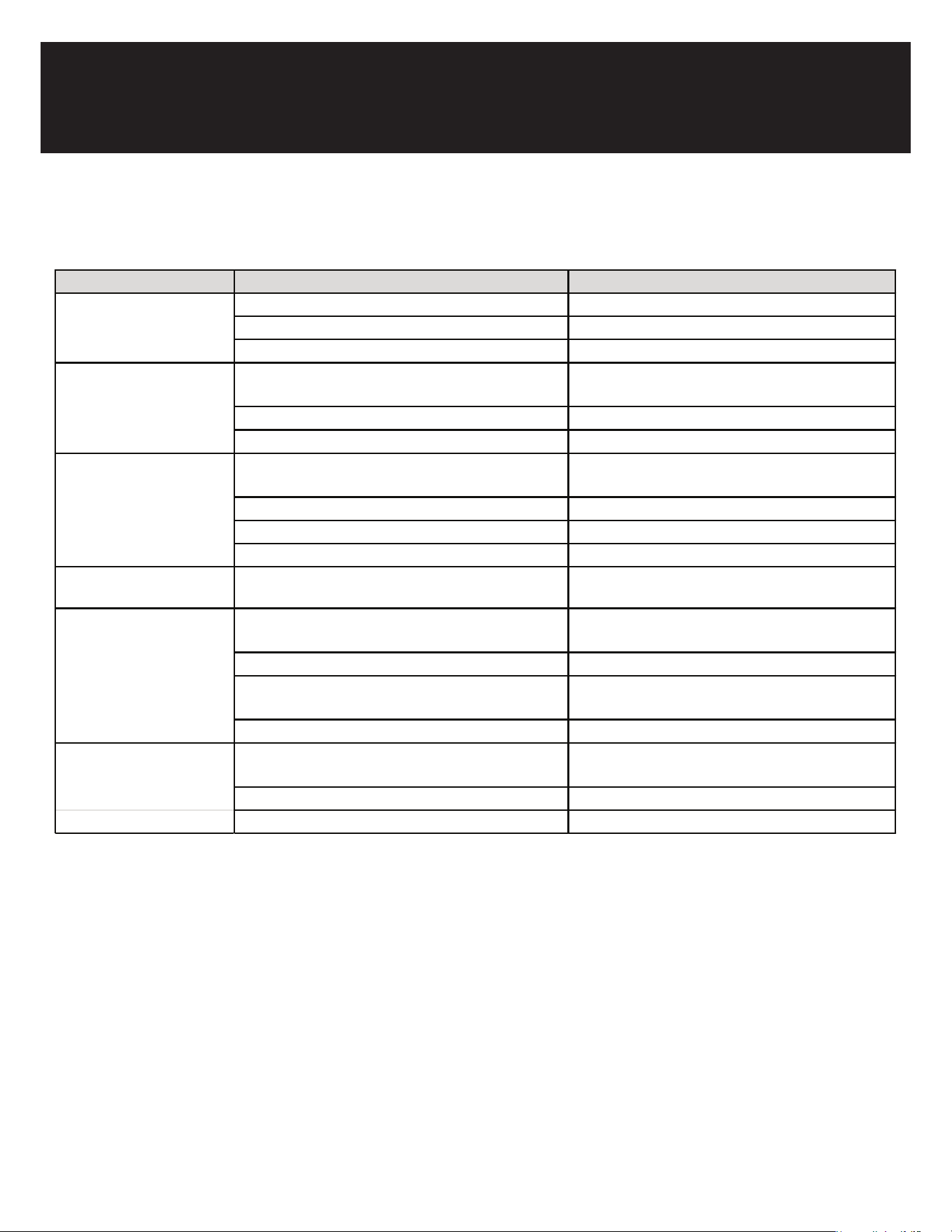
TROUBLESHOOTING
Check your problem by using the chart below and try the solutions for each problem. If the
microwave oven still does not work properly, contact the nearest authorized service center.
TROUBLE POSSIBLE CAUSE POSSIBLE REMEDY
Oven will not start Electrical cord for oven is not plugged in. Plug into the outlet.
Door is open. Close the door and try again.
Wrong operation is set. Check instructions.
Arcing or sparking
Materials to be avoided in microwave oven
were used.
Use microwave-safe cookware only.
The oven is operated when empty. Do not operate with oven empty.
Spilled food remains in the cavity. Clean cavity with wet towel.
Unevenly cooked
foods
Materials to be avoided in microwave oven
were used.
Use microwave-safe cookware only.
Food is not defrosted completely. Completely defrost food.
Cooking time, power level is not suitable. Use correct cooking time, power level.
Food is not turned or stirred. Turn or stir food.
Overcooked foods Cooking time, power level is not suitable. Use correct cooking time, power level.
Undercooked foods
Materials to be avoided in microwave oven
were used.
Use microwave-safe cookware only.
Food is not defrosted completely. Completely defrost food.
Oven ventilation ports are restricted.
Check to see that oven ventilation ports are not
restricted.
Cooking time, power level is not suitable. Use correct cooking time, power level.
Improper defrosting.
Materials to be avoided in microwave oven
were used.
Use microwave-safe cookware only.
Cooking time, power level is not suitable. Use correct cooking time, power level.
Food is not turned or stirred. Turn or stir food.
Koolmore Supply, Inc. extends a limited warranty to the original purchaser, guaranteeing that this
Koolmore
product is free from manufacturing defects in material or workmanship for one year from the date of
purchase.
Should you discover any such defect within the warranty period, Koolmore Supply, Inc., reserves the
right to
repair or replace the product without charge, or to cover the cost of replacement parts and repair labor
needed
to correct defects present at the time of purchase or resulting from regular usage, when the appliance
has been
installed, operated, and maintained as per the instructions provided.
At its sole discretion, Koolmore Supply Inc. may decide to replace the product. In such an event, your
replacement
appliance will carry the warranty for the remaining term of the original unit's warranty period.
This warranty is valid exclusively to the original purchaser of the product and only applicable within the
United
States. The warranty commences from the date of original consumer purchase. Proof of the original
purchase
date will be required to obtain service under this warranty.
Under this limited warranty, your sole and exclusive remedy will be product repair, as outlined above. All
services must be provided by a Koolmore-designated service company.
To claim warranty or request repair service:
Email support@koolmore.com. Please include your name, address, phone number, warranty repair
request,
and a copy of your proof of purchase receipt. Alternatively, visit koolmore.com and use the contact us
page. A
Koolmore customer service representative will promptly arrange service for your appliance.
We thank you for choosing Koolmore.
This limited warranty will not cover:
1. Failure of the product to perform during power failures or interruptions,
or due to inadequate electrical service.
2. Damage incurred during transportation or handling.
3. Damage caused by accidents, vermin, lightning, winds, re, oods, or acts of God.
4. Damage resulting from accidents, alterations, misuse, abuse, improper installation, repair, or mainte-
nance.
This includes using any external device that alters or converts the voltage or frequency of
electricity.
5. Unauthorized product modications, repairs by unauthorized centers, or use of non-approved
replacement parts.
6. Abnormal cleaning and maintenance not aligned with the user's manual.
7. Use of incompatible accessories or components.
8. Any costs associated with repairs or replacements under these excluded circumstances shall be the
responsibility of the consumer.