User Manual
for S6 Series Hybrid Inverter
Version 1.0, Release Date:06,2024
Applicable models
S6-EH3P8K02-NV-YD-L
S6-EH3P10K02-NV-YD-L
S6-EH3P12K02-NV-YD-L
S6-EH3P15K02-NV-YD-L
Applicable System
Three phase system

Important Notes
Due to the product development,the product specifications and functions are subject to
change.The latest manual can be acquired via https://www.ginlong.com/global.
Every attempt has been made to make this document complete, accurate and up-to-date.
Individuals reviewing this document and installers or service personnel are cautioned,
however, that Solis reserves the right to make changes without notice and shall not be
responsible for any damages, including indirect, incidental or consequential damages
caused by reliance on the material presented including, but not limited to, omissions,
typographical errors, arithmetical errors or listing errors in the material provided in this
document.
Solis accepts no liability for customers' failure to comply with the instructions for
correct installation and will not be held responsible for upstream or downstream systems
Solis equipment has supplied.
The customer is fully liable for any modifications made to the system; therefore, any
hardware or software modification, manipulation, or alteration not expressly approved
by the manufacturer shall result in the immediate cancellation of the warranty.
Given the countless possible system configurations and installation environments, it is
essential to verify adherence to the following:
● There is sufficient space suitable for housing the equipment.
● Airborne noise produced depending on the environment.
● Potential flammability hazards.
● Solis will not be held liable for defects or malfunctions arising from:
● Improper use of the equipment.
● Deterioration resulting from transportation or particular environmental conditions.
● Performing maintenance incorrectly or not at all.
● Tampering or unsafe repairs.
● Use or installation by unqualified persons.
● This product contains lethal voltages and should be installed by qualified electrical
or service personnel having experience with lethal voltages.

01-04
05
30
08
10
11
18
19
05
01
02
30-31
14
21
1.1 Product Overview
………………………………………………………………………………………………………………………………
…………………………………………………………………………………………………………
…………………………………………………………………………………………………………………………………………
……………………………………………………………………………………………
………………………………………………………………………………………………
…………………………………………………………………………………………………………………
………………………………………………………………………………………………………………………
………………………………………………………………………………………………………………
………………………………………………………………………………………………………………………………
…………………………………………………………………
…………………………………………………………………………………………………………………………………
1. Introduction
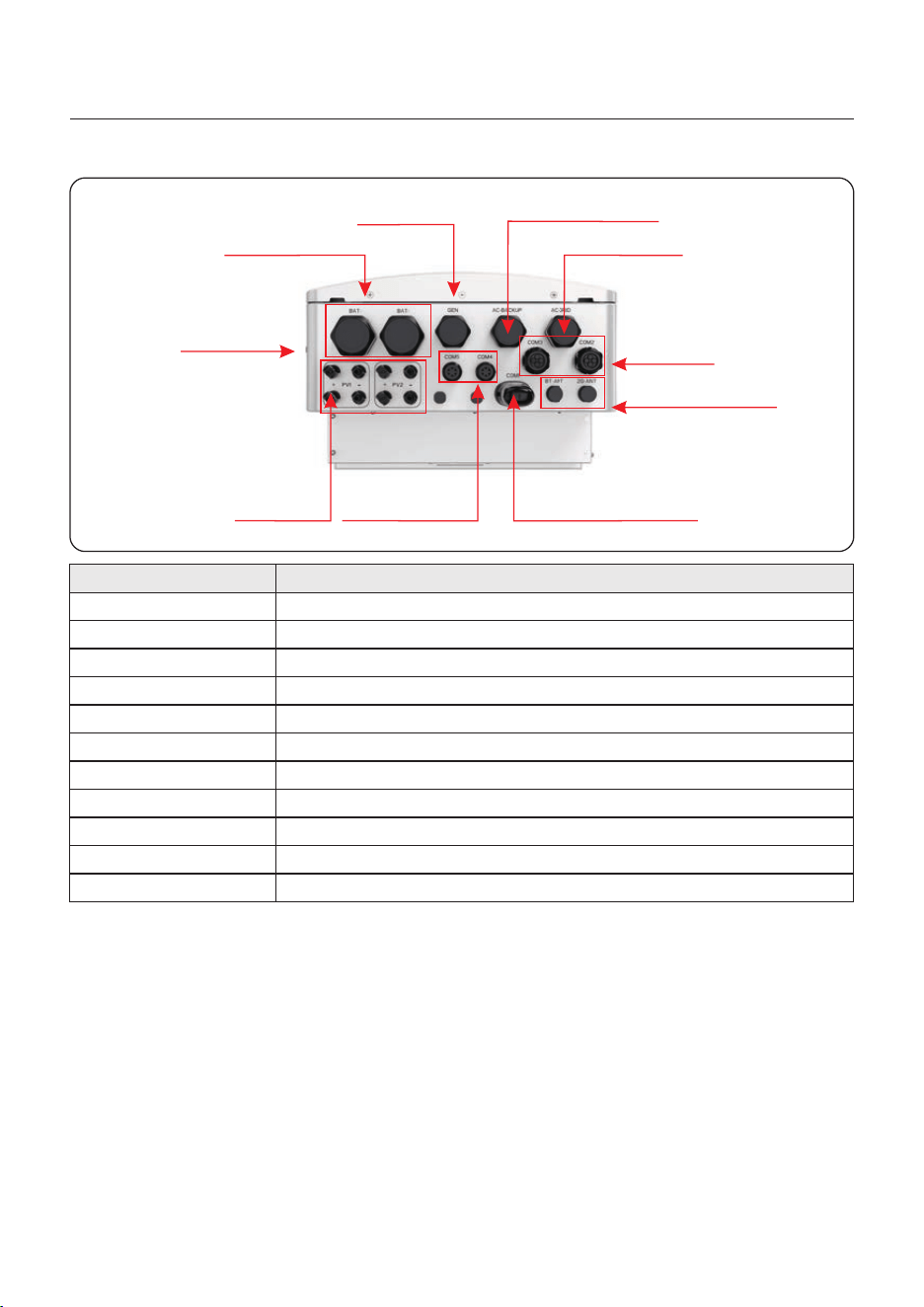
1.2 Inverter Wire Box and Connection Points
2. Safety & Warning
2.1 Safety
2.2 General Safety Instructions
4. Overview
4.1 Screen
3.9 CT Connection
3. Installation
3.1 Select a Location to Install the Inverter
3.2 Product Handling
3.4 Inverter Wiring Overview
3.6 PV Cable Installation
3.7 Battery Cable Installation
………………………………………………………………………………………………………………………………………
………………………………………………………………………
07
2.3 Notice for Use
07
………………………………………………………………………………………………………………
………………………………………………………………………………………………
………………………………………………………………………………………………
15
3.5 Ground Cable Installation
………………………………………………………………………………………………………
20
3.8 AC Wiring
…………………………………………………………………………………………………………………………
32
…………………………………………………………………………………………………………………………………
5. Commissioning
7. Troubleshooting
…………………………………………………………………………………………………………………
53
58
………………………………………………………………………………………………………………………
8. Specifications
13
3.3 Mounting the Inverter
…………………………………………………………………………………………………
32
5.1 Pre-Commissioning
………………………………………………………………………………………………………………………………
34
5.2 Power ON
……………………………………………………………………………………………………………………………
Contents
2.4 Notice for Disposal
08-29
………………………………………………………………………………………………………………………………
52
…………………………………………………………………………………………………………………………
6. Maintenance
52
6.1 Smart O&M
……………………………………………………………………………………………………………………………
03
…………………………………………………………………………………………………………………
1.3 Product Features
1.4 Packaging
1.5 Tools Required for Installation
3.10 Inverter Communication
3.11 Inverter Remote Monitoring Connection
30
………………………………………………………………………………………………………………………………………
4.2 Keypad
40
5.3 Power OFF
…………………………………………………………………………………………………………………………
5.5 Initial set up
5.6 APP Interface
64
……………………………………………………………………………………………………………
9. Appendix - FAQs
04
………………………………………………………………………………………………………………………………
32
……………………………………………………………………………………………………………
32-40
…………………………………………………………………………………………………………………
29
………………………………………………………………
05-07
……………………………………………………………………………………………………………
04
………………………………………………………………………………………
33
………………………………………………………………………………………………
5.4 Log in the APP via Bluetooth
30
…………………………………………………………………………………………………………………………
4.3 LED Indicators
31
……………………………………………………………………………
4.4 Inverter built-in Bluetooth description
1. Introduction
User Manual
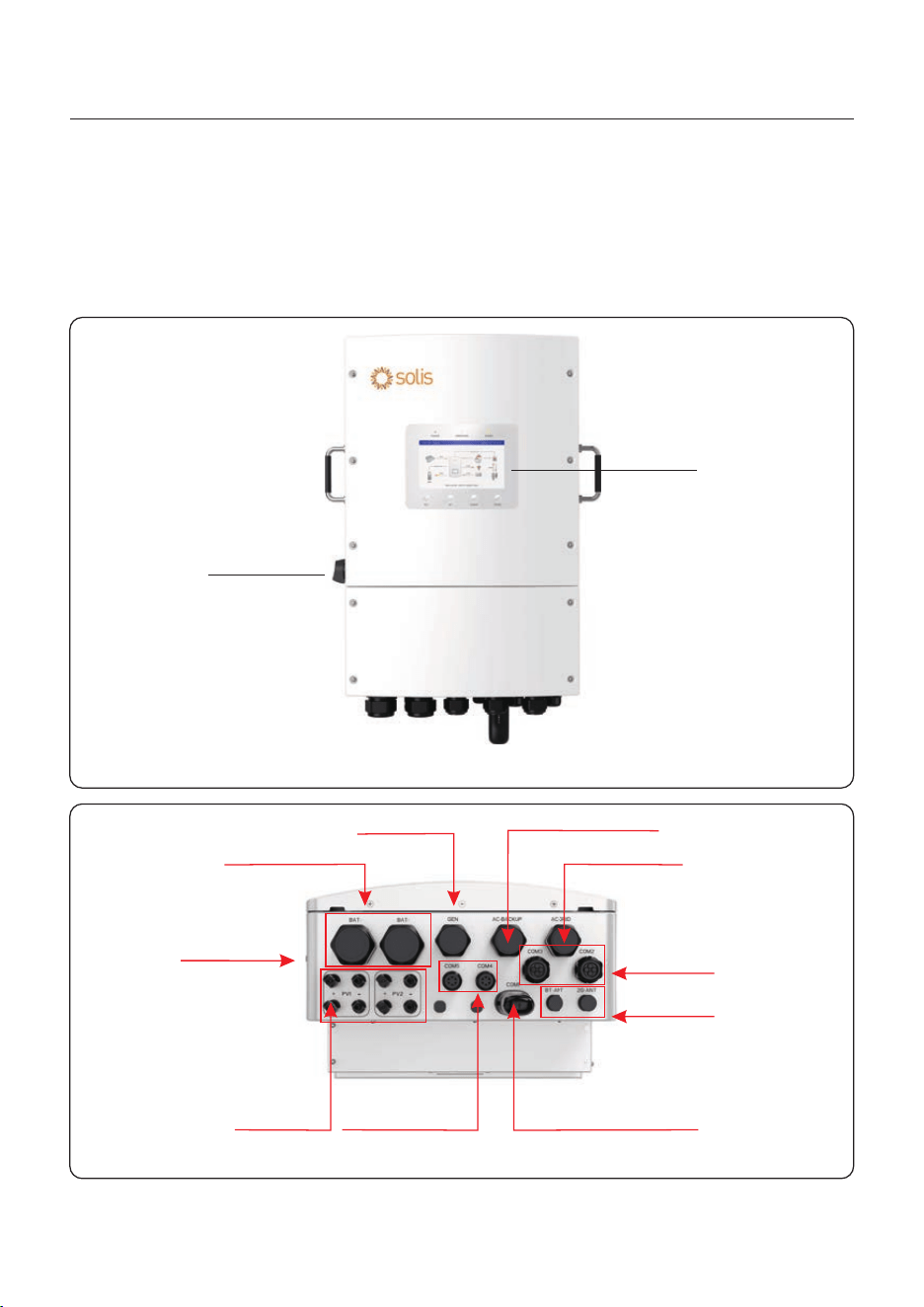
1.1 Product Overview
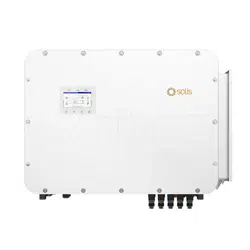
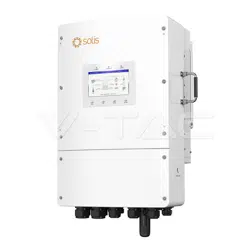
The Solis series is designed for commercial hybrid systems.
The inverter can work with maximize self-consumption and provide backup power if the grid
fails and there is not enough PV power to cover load demand.
The Solis S6 series consists of the following inverter models:
8kW,10kW,12kW,15kW
Figure 1.1
Front side view
Figure 1.2
Bottom side view
01
AC Grid Port
AC Backup Port
PV Input
Battery Input
DC Switch
LCD Screen
GEN Port
COM4/5
Datalogger Stick
Antenna
DC Switch
COM2/3
1.2 Inverter Wire Box and Connection Points
Name Description
3. GEN
1. DC Switch
6. PV Input
4. Backup
5. Grid
2. Battery Input
This is the DC disconnect switch for the PV
Conduit for AC conductors to backup loads panel should be connected here
Conduit for AC conductors to the main service panel should be connected here
1. Introduction
User Manual
Conduit for PV conductors should be connected here
Conduit for Battery conductors should be connected here
02
Conduit for AC conductors to generator should be connected here
AC Grid Port
AC Backup Port
PV Input
Battery Input
GEN Port
COM4/5
Datalogger Stick
DC Switch
COM2/3
7. COM4/5
Conduit for CT conductors should be connected here
9. Datalogger Stick Solis data logger gets connected here-only USB version of the loggers will work
Bluetooth Antenna/
2G Antenna
8. COM2/3
RS485 and CAN communication cables and parallel cables should go through these
10. Bluetooth Antenna
Extends the range of the inverter Bluetooth signal(for system commissiong)
11. 2G Antenna
Extends the range of the inverter 2G signal(for system commissiong)
User Manual
1.3 Product Features
Integrated 2 MPPTs with 3(8-12K)/4(15K) strings, suitable for residential rooftop
installations with multiple array orientations.
Compatible with multiple brands of battery models giving customers multiple battery
options.
Exquisite LED Indicators with built in Bluetooth to provide local operation without Internet.
Outstanding Performance
20A input current adapted to high current PV Panel.
2 backup function achieves intelligent energy use plan.
6 customizable charge/discharge periods.
Up to 180A/8K,220A/10K,250A/12K,290A/15K max charge/discharge current.
Seamless switching when the utility grid loses power.
Support start/stop control and status monitoring of genset.
AC coupling to upgrade existing PV plant.
Intelligent APP&7-inch colorful touch screen acheives visual and easy operation.
Battery friendly with a large selection of brands.
Intelligent Function
Safe&Reliable
Safety protection with integrated AFCI function, which actively detects arc faults in the
PV Array.
1. Introduction
03
Multiple battery protection function.
User Manual
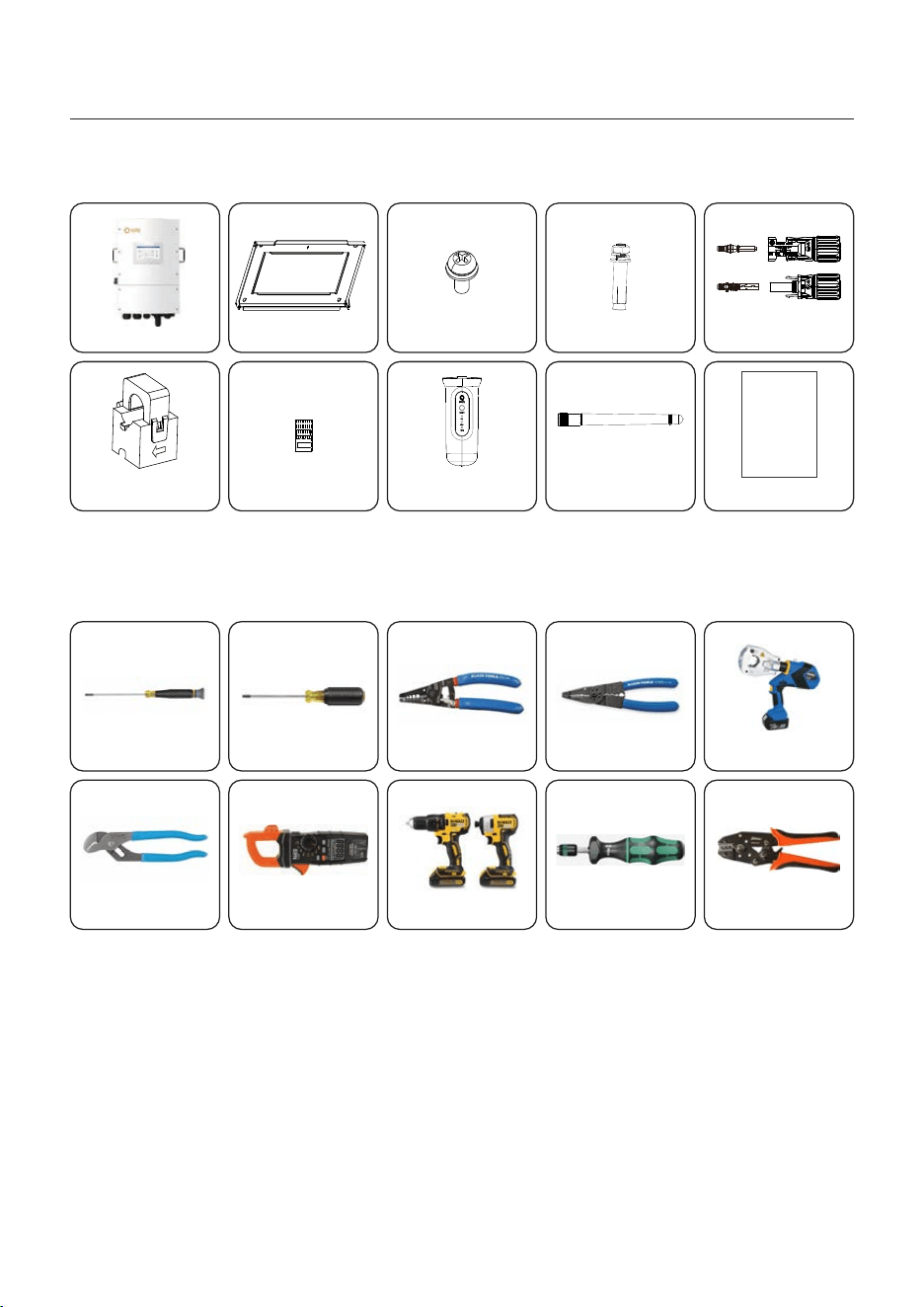
Back plate x1
Fastening screw x2
1.4 Packaging
Please ensure that the following items are included in the packaging with your machine:
If anything is missing, please contact your local Solis distributor.
Inverter x1
1. Introduction
1.5 Tools Required for Installation
Torqx T20 Screwdriver Wire Strippers 12AWG to 6AWG Wire Strippers 20AWG to 10AWG
Drill and Impact Driver
Multimeter (AC/DC amps)
Channel Locks
Technician Screwdriver
DC connector x 4
04
Expansion Bolt x4
RJ45 connector x6
CT 3x S2-WL-ST Stick x1
GPRS Antenna x1
Quick Installation Manual x1
Quick
Installation
Manual
LUG Crimping Tool
Torque Screwdriver
MC4 Crimping Tool
2. Safety & Warning
User Manual
2.1 Safety
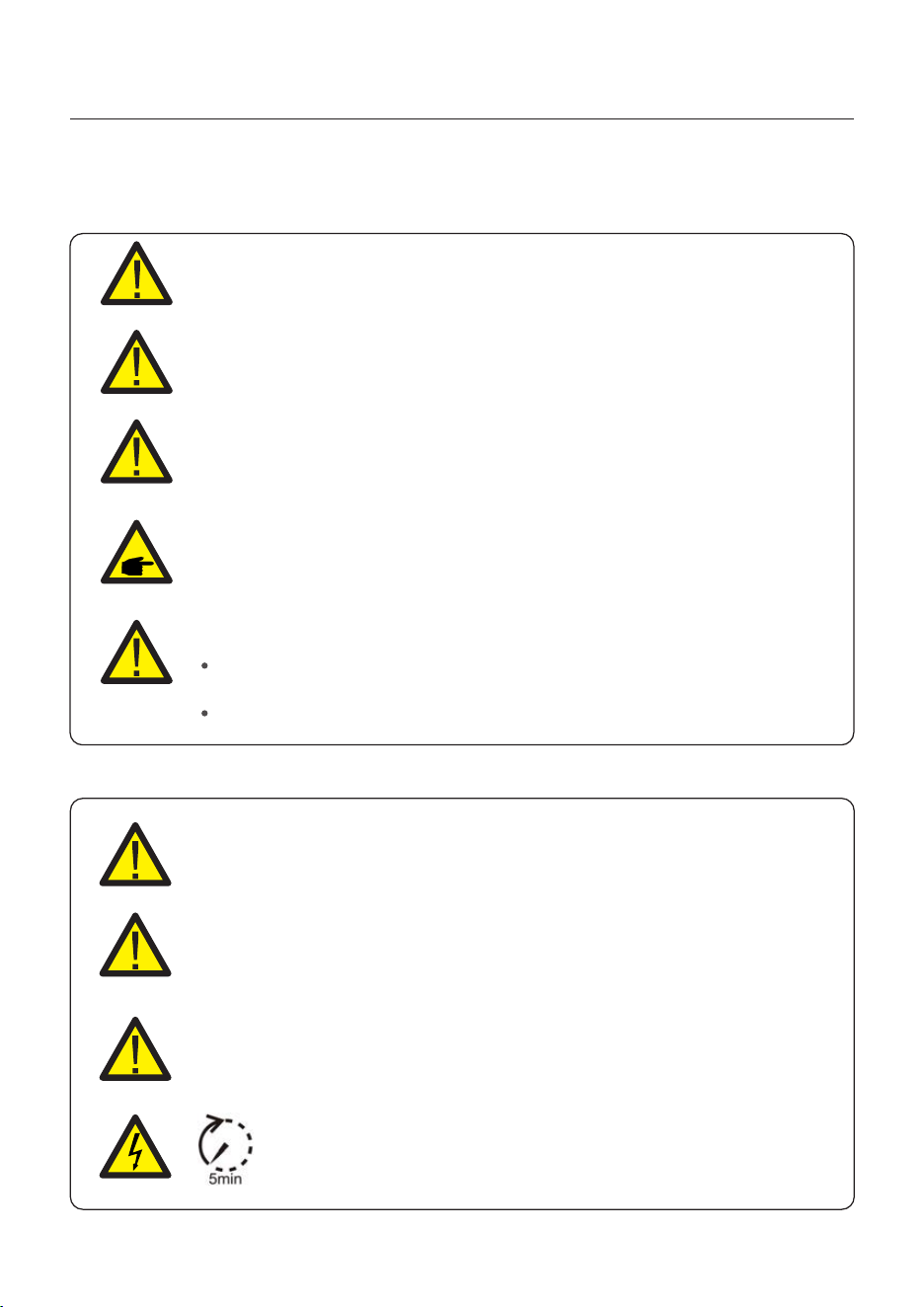
The following types of safety instructions and general information appear in this
document as described below:
CAUTION
“Caution” indicates a hazardous situation which if not avoided, could result
in minor or moderate injury.
WARNING
“Warning” indicates a hazardous situation which if not avoided, could result
in death or serious injury.
DANGER
“Danger” indicates a hazardous situation which if not avoided, will result in
death or serious injury.
NOTE
“Note” provides tips that are valuable for the optimal operation of your
product.
2.2 General Safety Instructions
WARNING
Electrical installations must be done in accordance with local and national
electrical safety standards.
WARNING
Do not connect PV array positive (+) or negative (-) to ground, doing so could
cause serious damage to the inverter.
WARNING
Only devices in compliance with SELV (EN 69050) may be connected to the
RS485 and USB interfaces.
WARNING
Do not touch any internal parts until 5 minutes after disconnection
from the utility grid, PV array, and battery.
WARNING: Risk of fire
Despite careful construction, electrical devices can cause fires.
Do not install the inverter in an area containing flammable materials
or gases.
Do not install the inverter in a potentially explosive atmosphere.
05
2. Safety & Warning
User Manual
CAUTION
The PV conductors are energized with high voltage DC when the PV
modules are exposed to sunlight.
CAUTION
The surface temperature of the inverter can reach up to 75℃ .
To avoid risk of burns, do not touch the surface of the inverter while it is
operating. The inverter must be installed out of direct sunlight exposure.
WARNING
To reduce the risk of fire, over-current protective devices (OCPD) are
required for all circuits connected to the inverter.
The DC OCPD shall be installed per local requirements. All photovoltaic
source and output circuit conductors shall have isolators that comply with
the NEC Article 690, Part II.
All Solis single phase inverters feature an integrated DC disconnect switch.
CAUTION
Risk of electric shock, do not remove the cover. There are no serviceable
parts inside, refer servicing to qualified and accredited service technicians.
NOTE
PV modules used with inverter must have an IEC 61730 Class A rating.
WARNING
Operations must be accomplished by a licensed electrician or a
person authorized by Solis.
WARNING
Installer must wear personal protective equipment during the
entire installation process in case of electrical hazards.
WARNING
The AC Backup Port of the inverter cannot be connected to the grid.
WARNING
Please refer to the product manual of the battery before installation
and configuration to the inverter.
Systems using this product shall be designed and built in
accordance with the NEC & local electrical codes & standards.
06
2. Safety & Warning
User Manual
2.3 Notice for Use
The inverter has been constructed according to the applicable safety and technical
guidelines, use the inverter in installations that meet the following specifications only:
1. Permanent installation is required.
2. The electrical installation must be compliant with all local and national regulations &
standards.
3. The inverter must be installed according to the instructions stated in this manual.
4. The inverter must be installed according to the inverter technical specifications.
2.4 Notice for Disposal
This product shall not be disposed as household waste.
It must be segregated and brought to an appropriate disposal facility
to ensure proper recycling.
This is to be done in order to avoid negative impacts on the environment
and human health.
Local waste management rules shall be observed and respected.
07
User Manual
WARNING: Risk of fire
Despite careful construction, electrical devices can cause fires.
Do not install the inverter in areas containing highly flammable materials
or gases.
Do not install the inverter in potentially explosive atmospheres.
The mounting structure where the inverter is installed must be fireproof.
3. Installation
3.1 Select a Location to Install the Inverter
When selecting a location for the inverter, the following criteria should be considered:
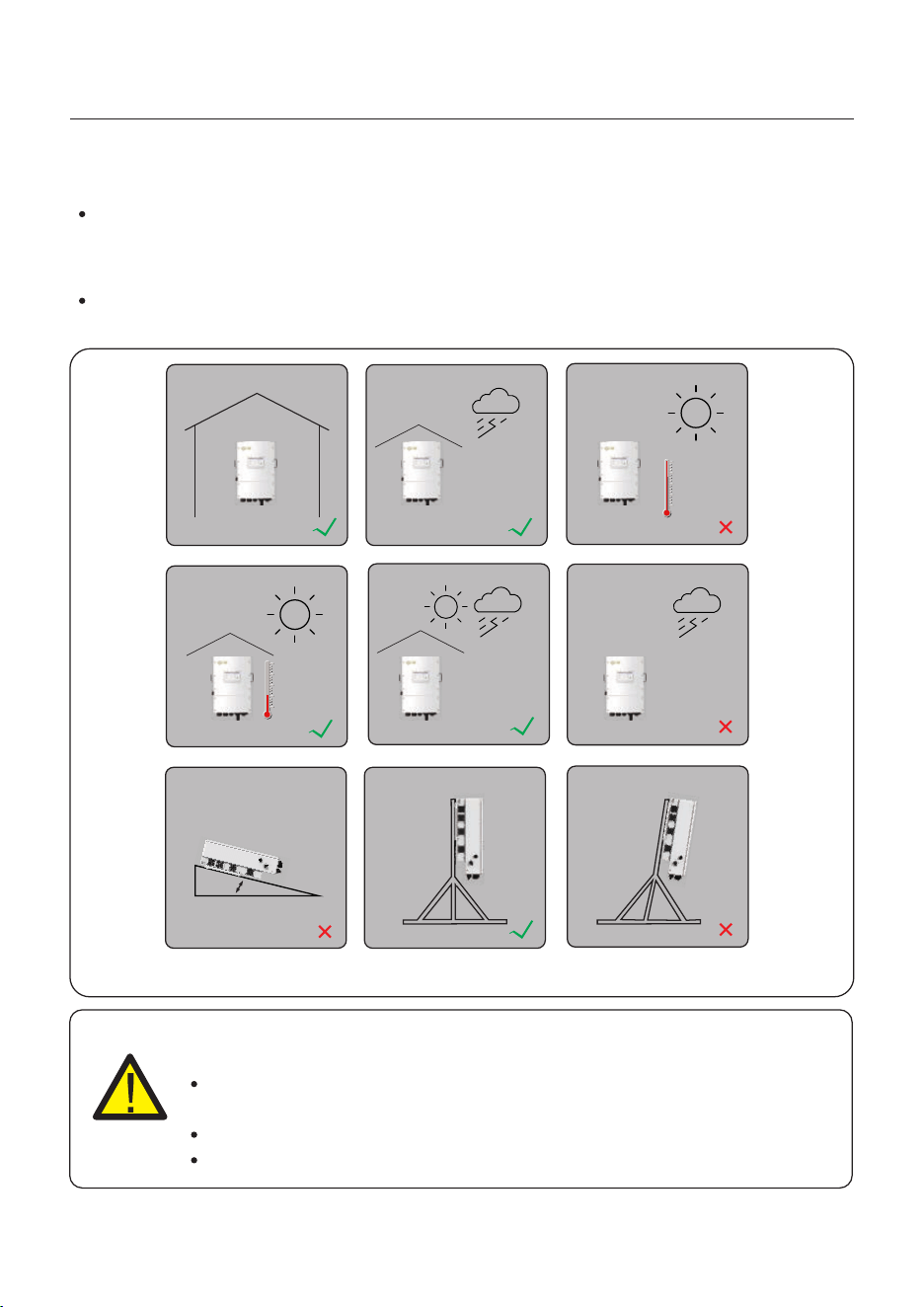
Exposure to direct sunlight may cause output power derating due to overheating
It is recommended to avoid installing the inverter in direct sunlight. The ideal location is
one where the ambient temperature does not exceed 40°C.
It is also recommended to install the inverter somewhere the rain and snow will not land
directly on it. The ideal installation location is on a north-facing wall under an eave.
Figure 3.1 Recommended Installation locations
≥15°
Indoor
Direct Sun
Shade Cover
Shade Cover
Direct Rain
Rating
NEMA 4X
08
User Manual
3. Installation
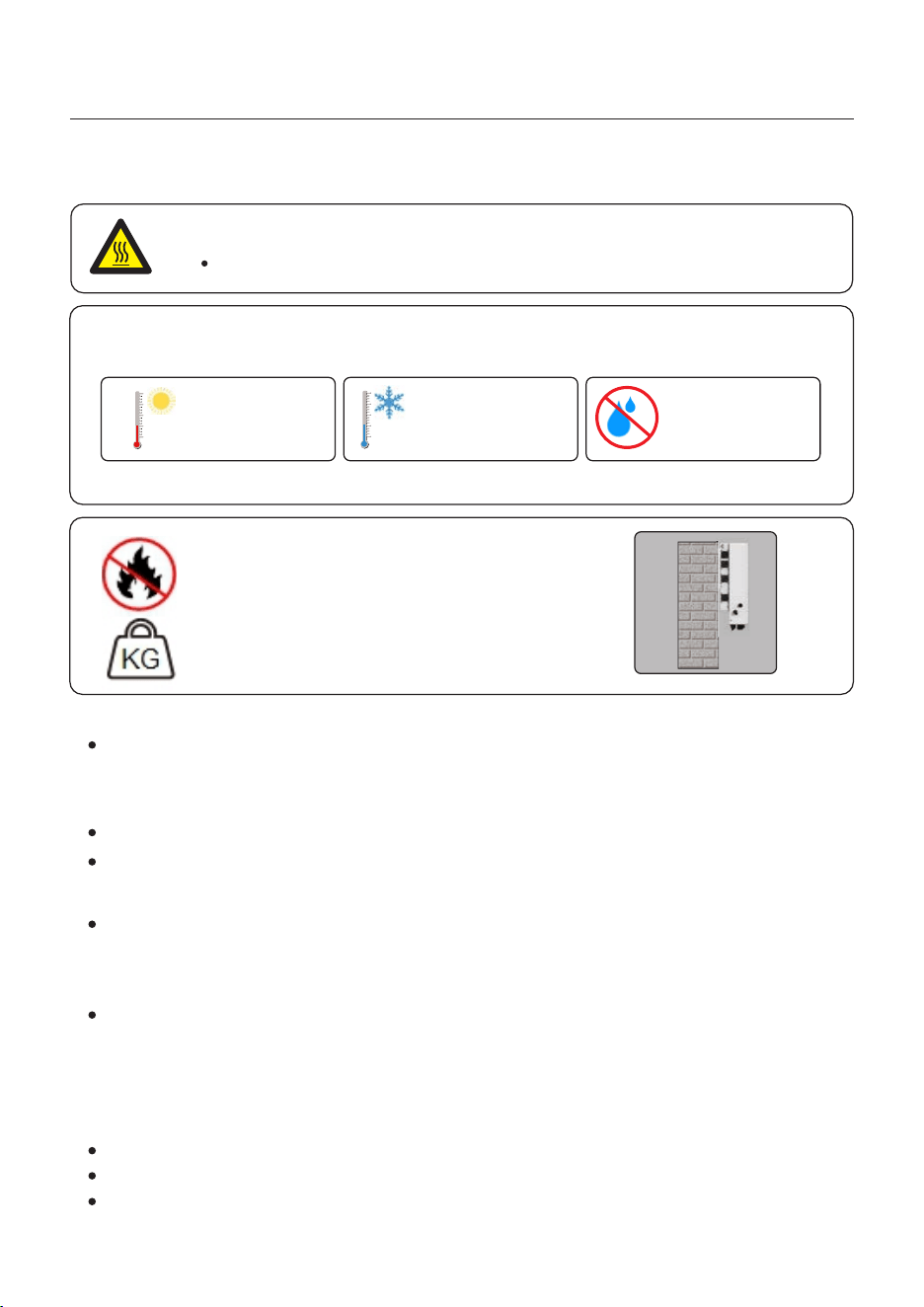
When selecting a location for the inverter, consider the following:
The temperature of the inverter heat-sink can reach 75℃.
The ambient temperature and relative humidity of the installation environment should
meet the following requirements:
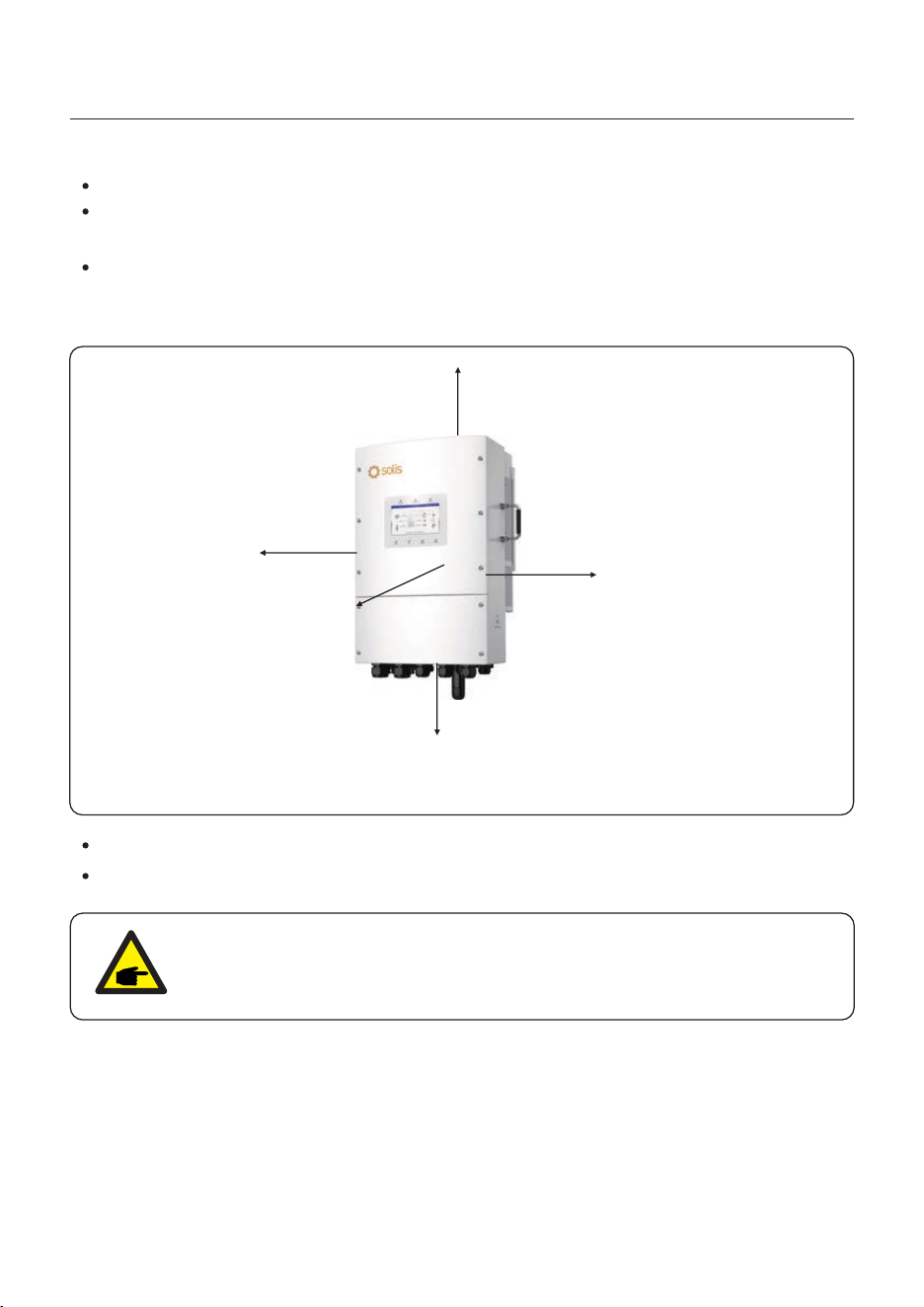
If multiple inverters are installed on site, a minimum clearance of 500mm should be kept
between each inverter and all other mounted equipment. The bottom of the inverter should be
at least 1000mm above of the ground or floor.
The LED status indicator lights located on the inverter's front panel should not be blocked
Adequate ventilation must be present if the inverter is to be installed in a confined space.
CAUTION: Hot Surface
Made of non-inflammable materials
Max. load bearing capacity ≥ 4 times of inverter weight
3.1.2 Consult technical data
Consult the technical specifications sections at the end of this manual for additional environmental
condition requirements (temperature range, altitude, etc.)
This model of Solis inverter must be mounted vertically (90 degrees or backwards less than or
equal to 15 degrees from 90 degrees straight up).
3.1.3 Angle of installation
3.1.1 Clearances
Load bearing surface:
Figure 3.2 Installation environment conditions
Max: +60℃ Max: -40℃ Max.RH : 95%
(non-condensing)
09
3.1.4 Avoiding direct sunlight
Installation of the inverter in a location exposed to direct sunlight should to be avoided.
Direct exposure to sunlight could cause:
Power output limitation (with a resulting decreased energy production by the system).
Premature wear of the electrical/electromechanical components.
Premature wear of the mechanical components (gaskets) and user interface.
3.1.6 Flammable substances
Do not install near flammable substances. Maintain a minimum distance of three meters
(10 feet) from such substances.
3.1.7 Living area
Do not install in a living area where the prolonged presence of people or animals is expected.
Depending on where the inverter is installed (for example: the type of surface around the
inverter, the general properties of the room, etc.) and the quality of the electricity supply, the
sound level from the inverter can be quite high.
3.2 Product Handling
Figure 3.3
3.1.5 Air circulation
Do not install in small, closed rooms where air cannot freely circulate.
To prevent overheating, always ensure that the air flow around the inverter is not blocked.
Please review the instruction below for handling the inverter:
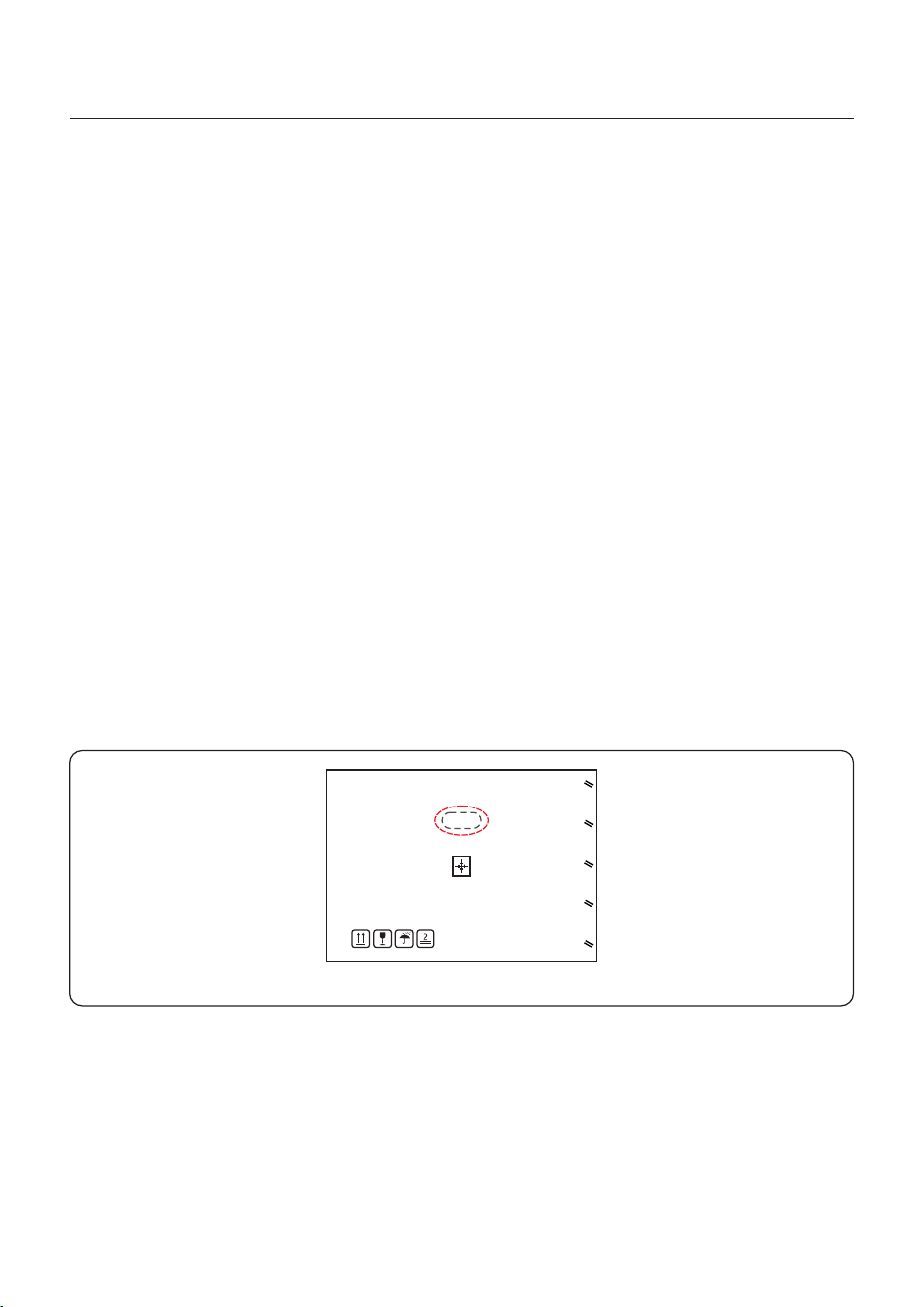
1. The red circles below denote cutouts on the product package - one per side.
Push in the cutouts to form handles for moving the inverter (see Figure 3.3).
2. Two people are required to remove the inverter from the shipping box. Use the handles
integrated into the heat sink to remove the inverter from the carton.
3. When setting the inverter down, do it slowly and gently. This ensures that the internal
components and the outer chassis do not take any damage.
User Manual
3. Installation
10
Visibility of the LED indicator lights should be considered.
Adequate ventilation around the inverter must be provided.
NOTE
Nothing should be stored on the top of or placed against the inverter.
The inverter must be mounted vertically with a maximum incline of +/- 5 degree.
Exceeding this may cause the output power to derate.
Figure 3.4 Inverter Mounting Clearances
Mount the inverter on a wall or structure capable of bearing the weight of the machine.
3.3 Mounting the Inverter
User Manual
3. Installation
To avoid overheating, always make sure the flow of air around the inverter is not
blocked. A minimum clearance of 500mm should be kept between inverters or
objects and 1000mm clearance between the bottom of the machine and the ground.
≥500mm
≥500mm
≥500mm
≥1000mm
≥1200mm
11
User Manual
3. Installation
12
The inverter shall be mounted vertically.
The steps to mount the inverter are listed as below:
1. Select the mounting height of the bracket and mark the mounting holes.
For brick walls, the position of the holes should be suitable for the expansion bolts.
WARNING:
The inverter must be mounted vertically.
Once a suitable location has be found according to 3.1 using figure 3.5 mount the wall
bracket to the wall.
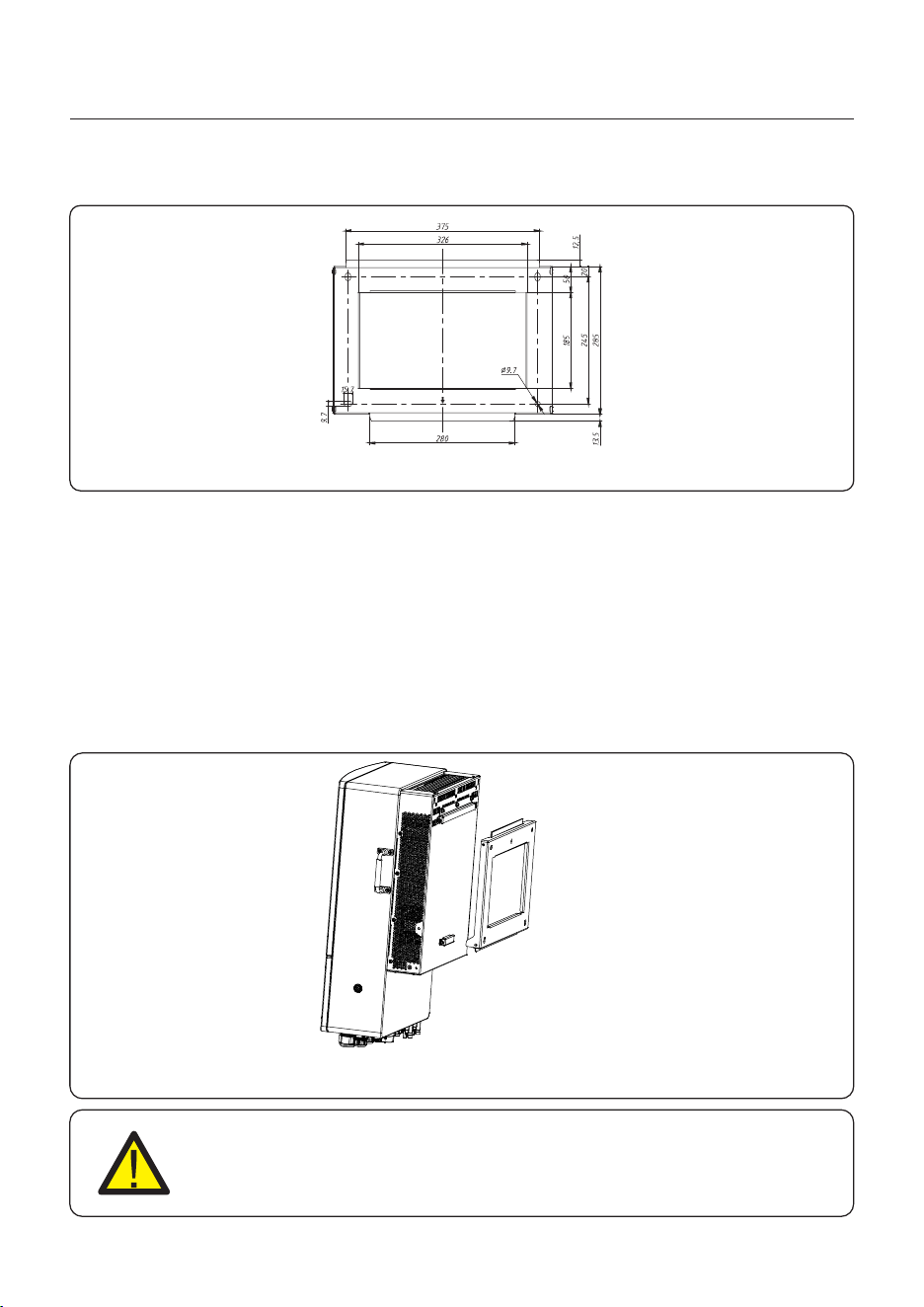
Dimensions of mounting bracket:
unit:mm
Figure 3.6 Wall mount bracket
2. Lift up the inverter (be careful to avoid body strain), and align the back bracket on the
inverter with the convex section of the mounting bracket. Hang the inverter on the
mounting bracket and make sure the inverter is secure (see Figure 3.6)
Figure 3.5 Inverter wall mounting
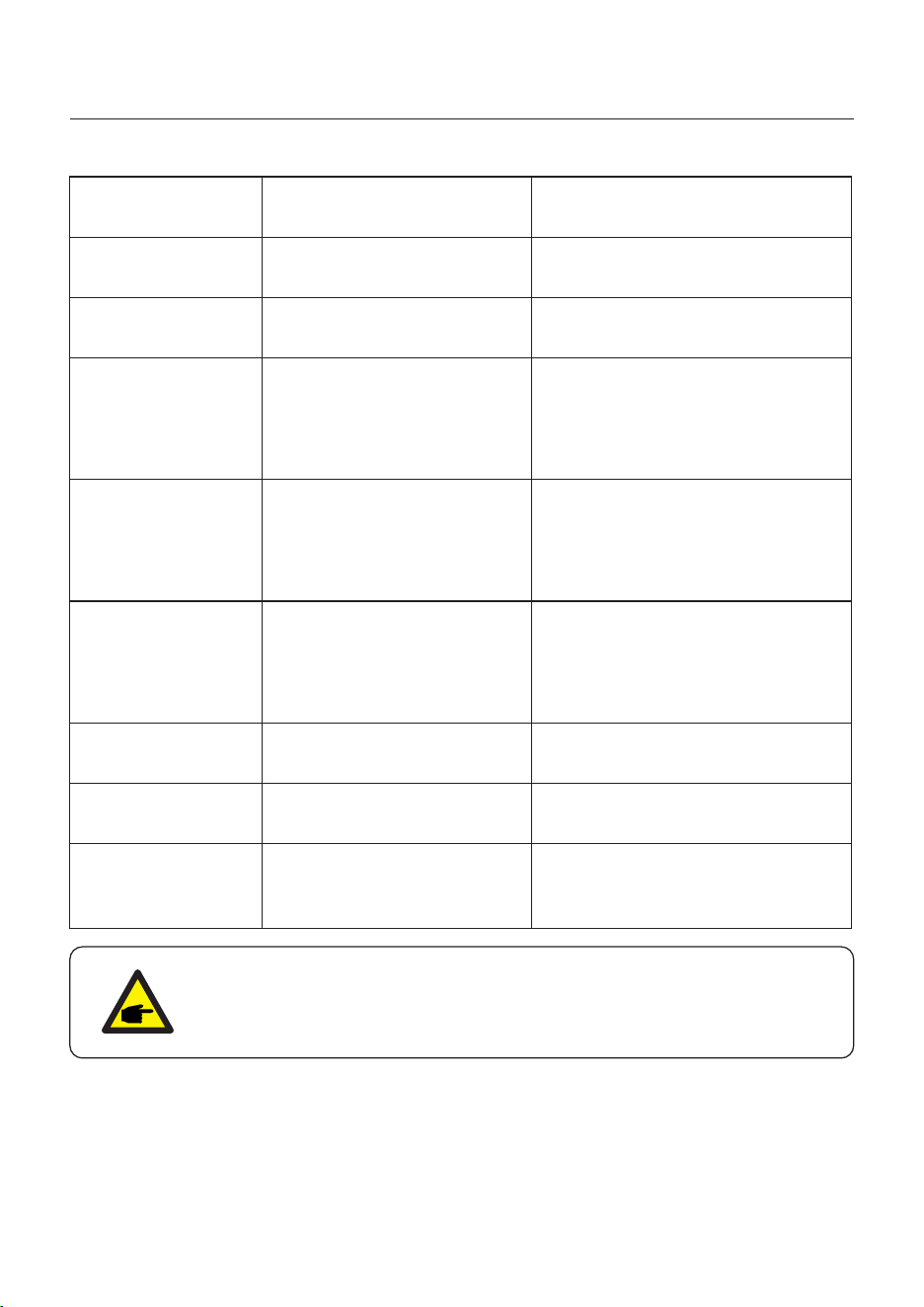
Connection Points
From the PV array to the DC+
and DC- terminals in the inverter
From the battery (+) and (-) terminals to
the inverter BAT+ and BAT- terminals
From the OCPD in the main service panel to
the AC-GRID L1, L2, L3 terminals
From the backup loads subpanel OCPD to
the inverter AC-BACKUP L1, L2, L3 terminals
From the main service panel ground bar to
the ground bar inside the inverter wire box
PV DC connection
to the inverter
Battery DC connection
to the inverter
Inverter AC connection
to the main service panel
Inverter AC connection
to the backup subpanel
PV Cables
Battery Cables
AC Grid Cables
AC Backup Cables
Ground Cables
From meter to terminal HM.
For more details, refer to figure
Installing the energy meter
From battery to terminal BMS.
For more details, refer to figure
Installing the battery
USB COM port at the bottom of the inverter
(For more details, please refer to the
Solis data logger product manual)
Communication
between inverter & CT
Communication between
the inverter & the battery
Monitoring of the system
on SolisCloud
CT cable
Battery
communication cable
Data Logger
(Optional)
Grounding conductors
for the system
Purpose
NOTE
Conductor dimensions and OCPD sizing to be determined in accordance
with the national electrical code (NEC) and local standards.
3.4 Inverter Wiring Overview
User Manual
3. Installation
13
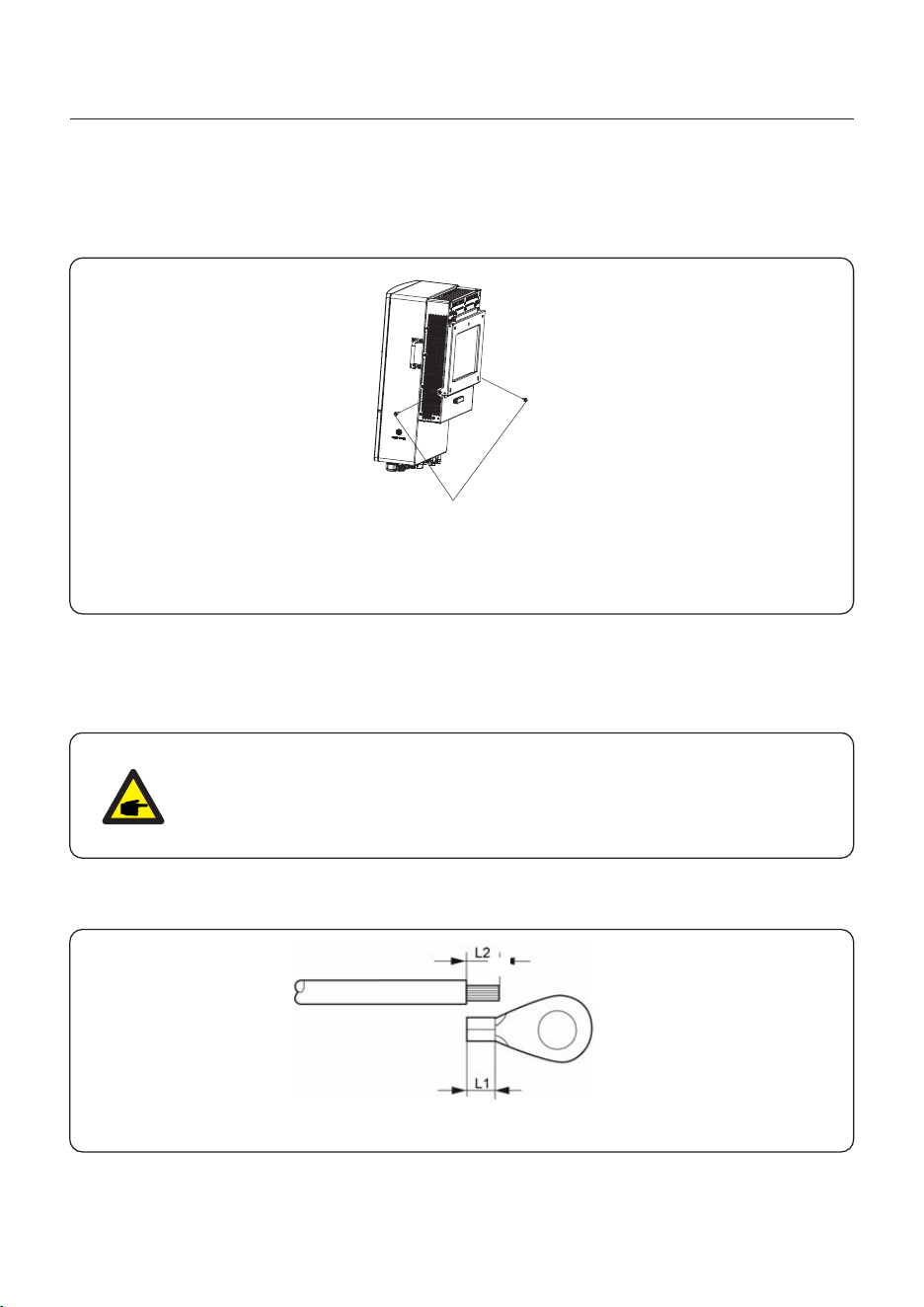
3.5 Ground Cable Installation
1. It is recommended to use copper wire for the chassis ground. Either solid conductor or
stranded wire is acceptable. Refer to local code standard for wire sizing.
2. Attach OT terminal: M5.
To connect the grounding terminal on the heat sink, please follow the steps below:
A
B
IMPORTANT
3. Strip the ground cable insulation to a suitable length.
4. Crimp a ring connector onto the cable and then connect it to the chassis ground terminal.
Figure 3.8 External Grounding Conductor Terminal
For multiple inverters in parallel , all inverters should be connected to the
same ground point to eliminate the possibility of a voltage potential existing
between inverter grounds.
User Manual
3. Installation
An external ground connection is provided at the both sides of inverter.
Prepare OT terminals: M5. Use proper tooling to crimp the lug to the terminal.
Connect the OT terminal with ground cable to the right side of inverter. The torque is 3.3N.m.
14
Figure 3.7 Connect the external grounding conductor
M5 Screw removed
Torque: 3.3N.m
Earth wire
Earth wire
User Manual
3. Installation
15
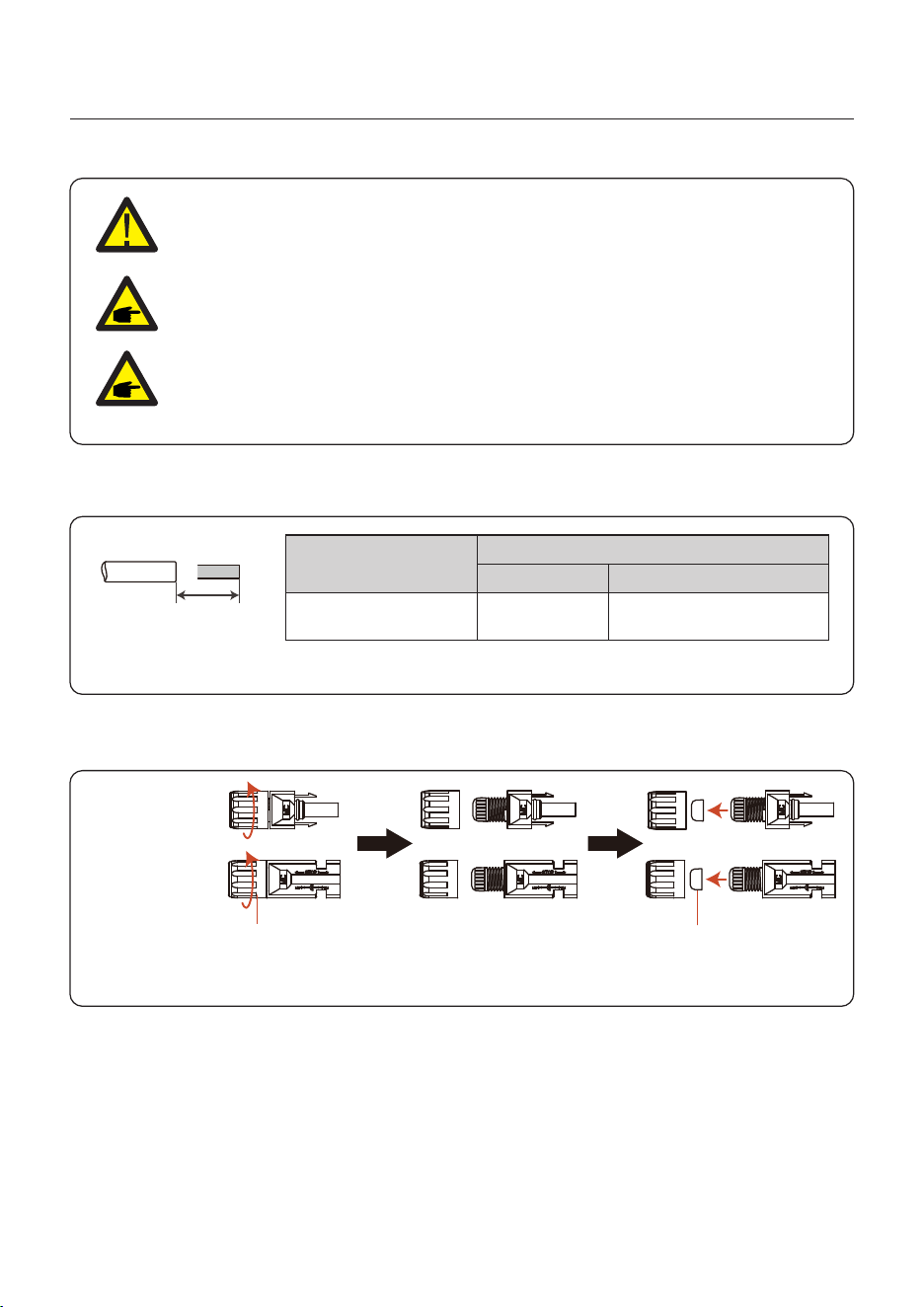
3.6 PV Cable Installation
Negative terminal
Positive terminal
Before connecting inverter, please make sure the PV array open circuit
voltage is within the limit of the inverter.
Please use approved DC cable for PV system.
4.0~6.0
4.0(12AWG)
(12~10AWG)
Cable type
Cross section(mm²)
Range
Industry generic P V cable
Recommended value
1. Select a suitable DC cable and strip the wires out by 7±0.5mm. Please refer to the table
below for specific specifications.
7±0.5mm
2. Take the DC terminal out of the accessory bag, turn the screw cap to disassemble it,
and take out the waterproof rubber ring.
Nut Waterproof collar
Figure 3.9
Figure 3.10
Before connection, please make sure the polarity of the output voltage of
PV array matches the“DC+”and“DC-”symbols.
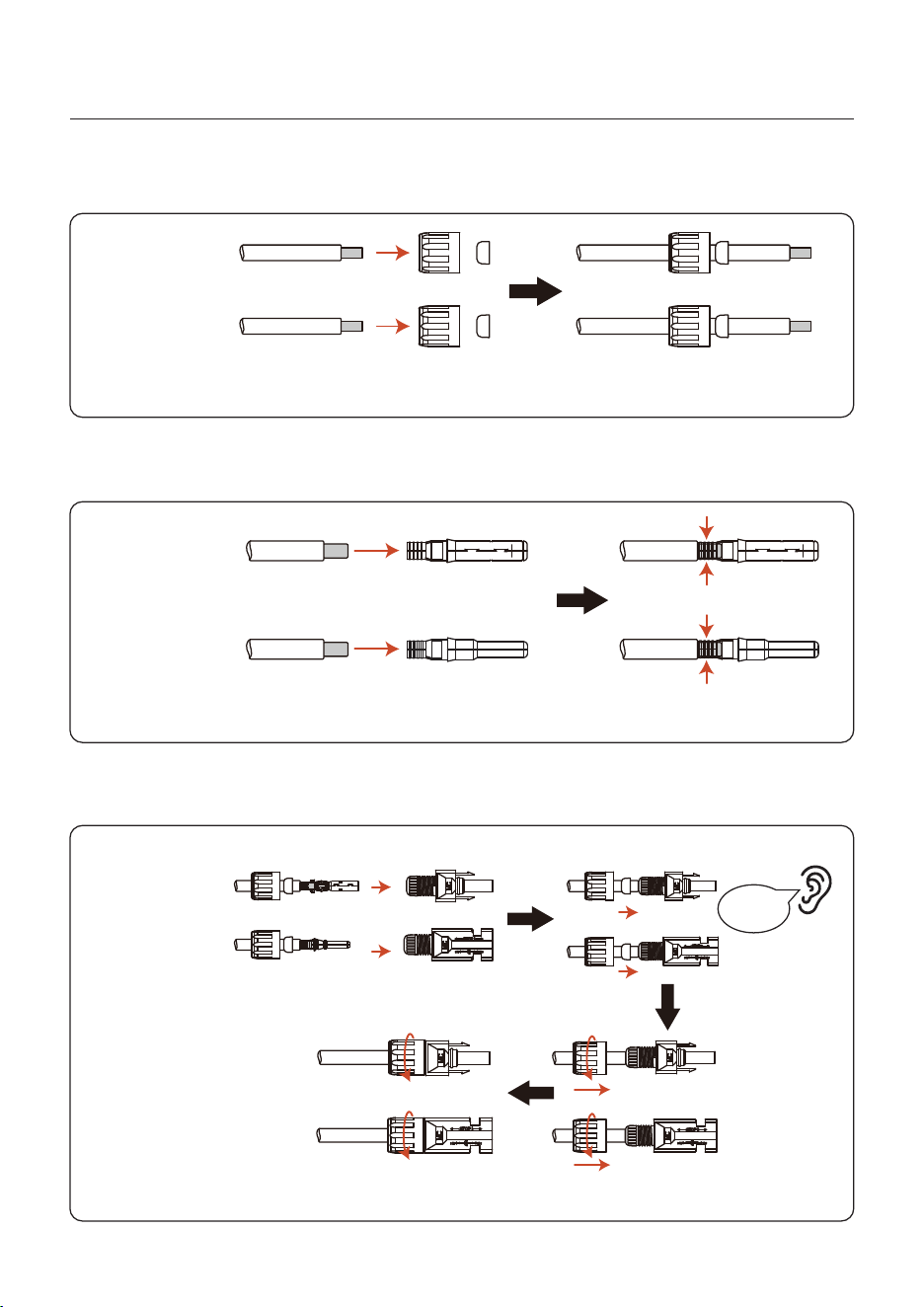
User Manual
3. Installation
16
Negative terminal
Positive terminal
3. Pass the stripped DC cable through the nut and waterproof rubber ring.
4. Connect the wire part of the DC cable to the metal DC terminal and crimp it with a special
DC terminal crimping tool.
Negative terminal
Positive terminal
Squeeze
5. Insert the crimped DC cable into the DC terminal firmly, then insert the waterproof rubber
ring into the DC terminal and tighten the nut.
Tighten
After you hear a "click", pull gently to check for a firm engagement.
Click
Negative terminal
Positive terminal
Figure 3.11
Figure 3.12
Figure 3.13
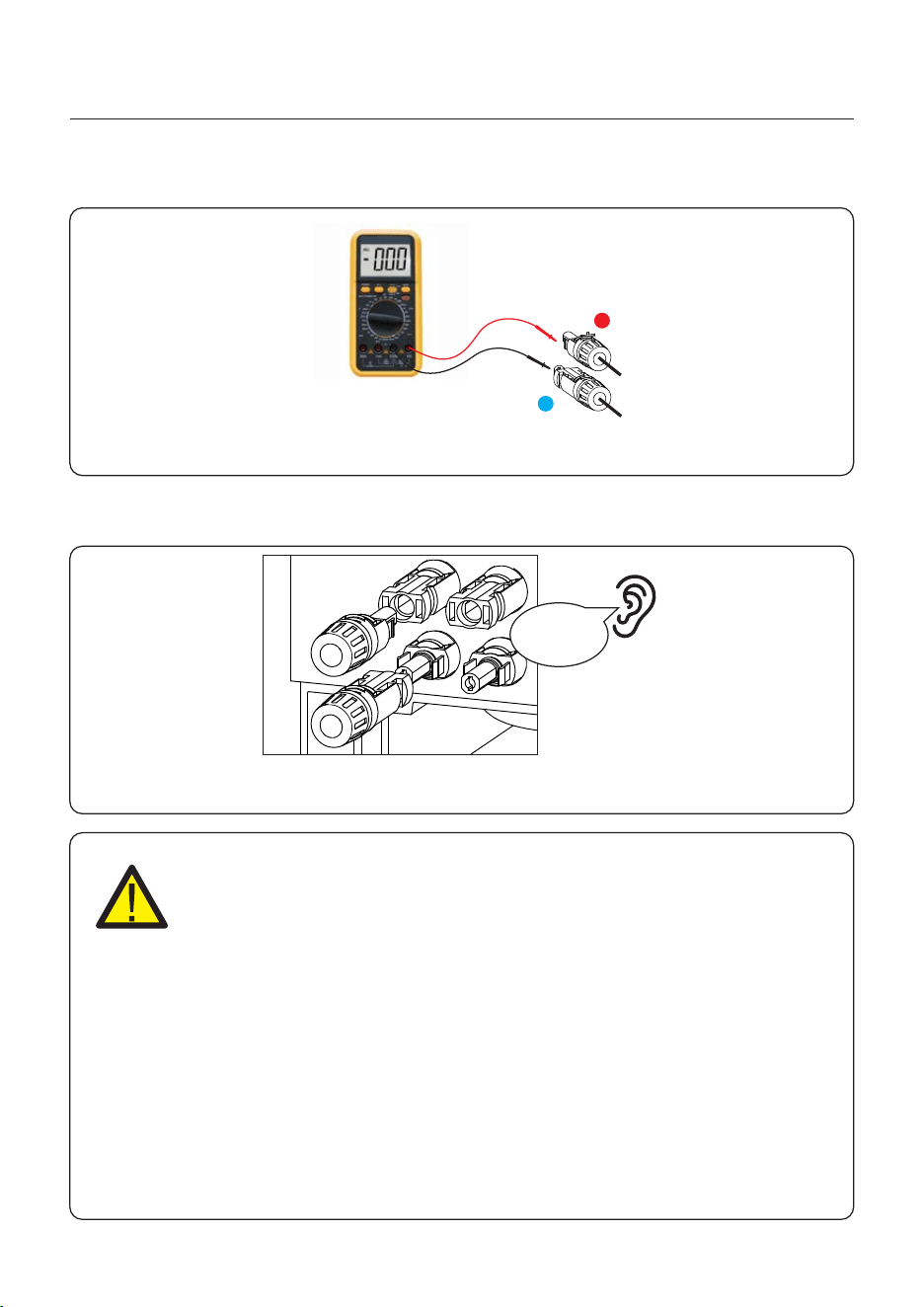
User Manual
3. Installation
17
6. Measure PV voltage of DC input with multimeter, verify DC input cable polarity.
7. Connect the wired DC terminal to the inverter as shown in the figure, and a slight
"click" is heard to prove the connection is correct.
+
-
CAUTION:
If DC inputs are accidently reversely connected or inverter is faulty or not
working properly, it is NOT allowed to turn off the DC switch. Otherwise it
may cause DC arc and damage the inverter or even lead to a fire disaster.
The correct actions are:
*Use a clip-on ammeter to measure the DC string current.
*If it is above 0.5A, please wait for the solar irradiance reduces until the
current decreases to below 0.5A.
*Only after the current is below 0.5A, you are allowed to turn off the DC
switches and disconnect the PV strings.
* In order to completely eliminate the possibility of failure, please disconnect
the PV strings after turning off the DC switch to aviod secondary failures due
to continuous PV energy on the next day.
Please note that any damages due to wrong operations are not covered in
the device warranty.
Figure 3.14
Figure 3.15
Click
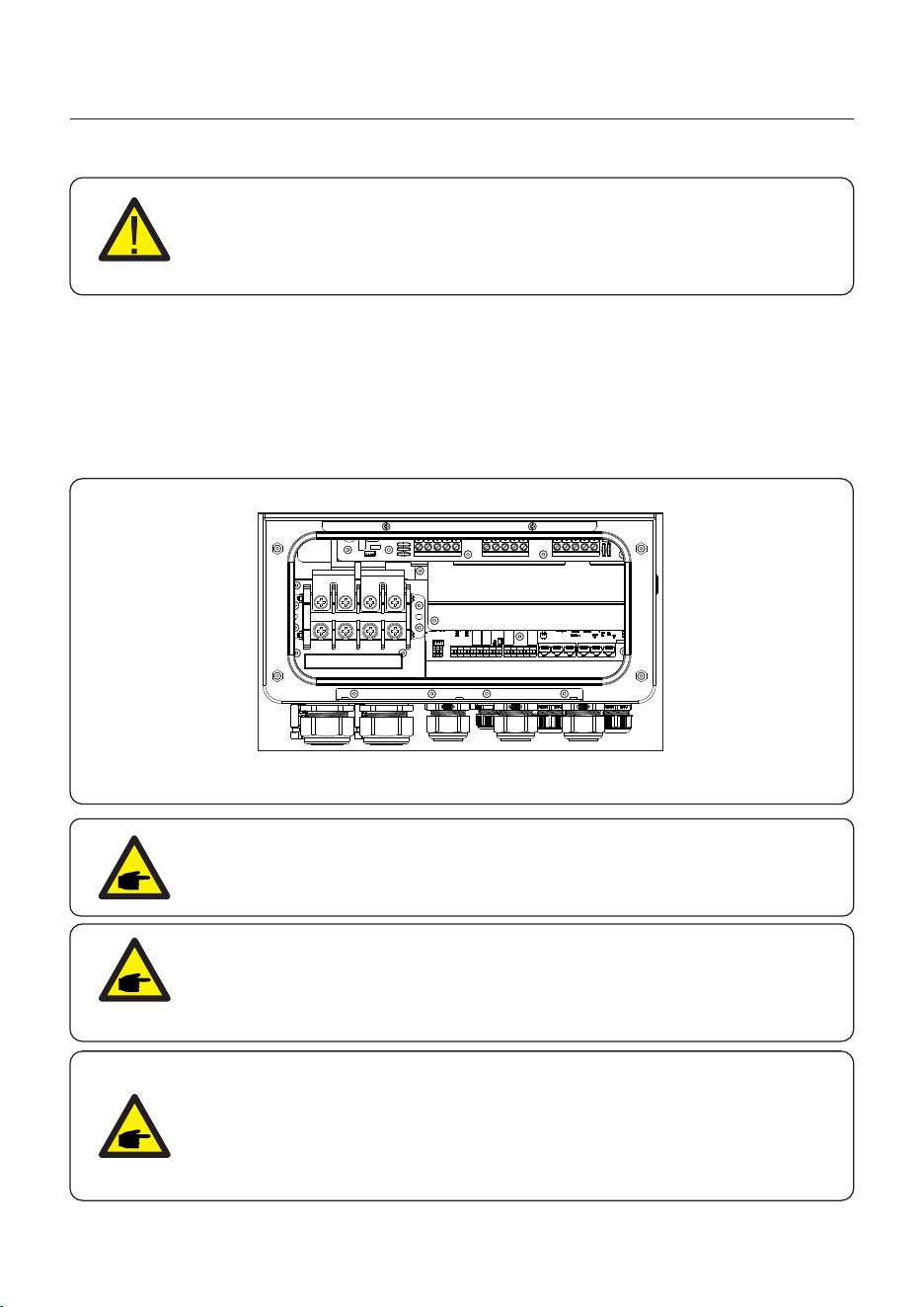
3.7 Battery Cable Installation
1. The battery (+) and (-) cables shall only be connected to the inverter BAT terminals.
2. Run the cables into the wire box. Strip 13mm off the ends of each cable.
3. Crimp the R-type connectors onto the cables. Do not over crimp the connectors.
4. Remove the terminal bolts and then insert them through the connector holes.
5. Put each bolt back into the proper place, be sure to not reverse the polarity.
6. Tighten the bolts with a torque wrench screwdriver following the torque specs.
Figure 3.16 Battery cable connection
DANGER
Before installing the battery cables, be sure that the battery is turned off.
Use a multimeter to verify that the battery voltage is 0Vdc before proceeding.
Consult the battery product manual for instructions on how to turn it off.
NOTE
Before connecting the battery, please carefully read the product manual of
the battery and perform the installation exactly as the battery manufacturer
specifies in the manual
NOTE
The battery fuse in the inverter wire box is replaceable.
The replacement can only be done by a technician authorized by Solis.
NOTE
Please use the battery that has been matched by Solis.
Please see the battery matching list on the Solis official website.
If the battery is not in the list, our company will not carry out after-sales
maintenance.
BAT+ BAT-
18
User Manual
3. Installation
User Manual
3. Installation
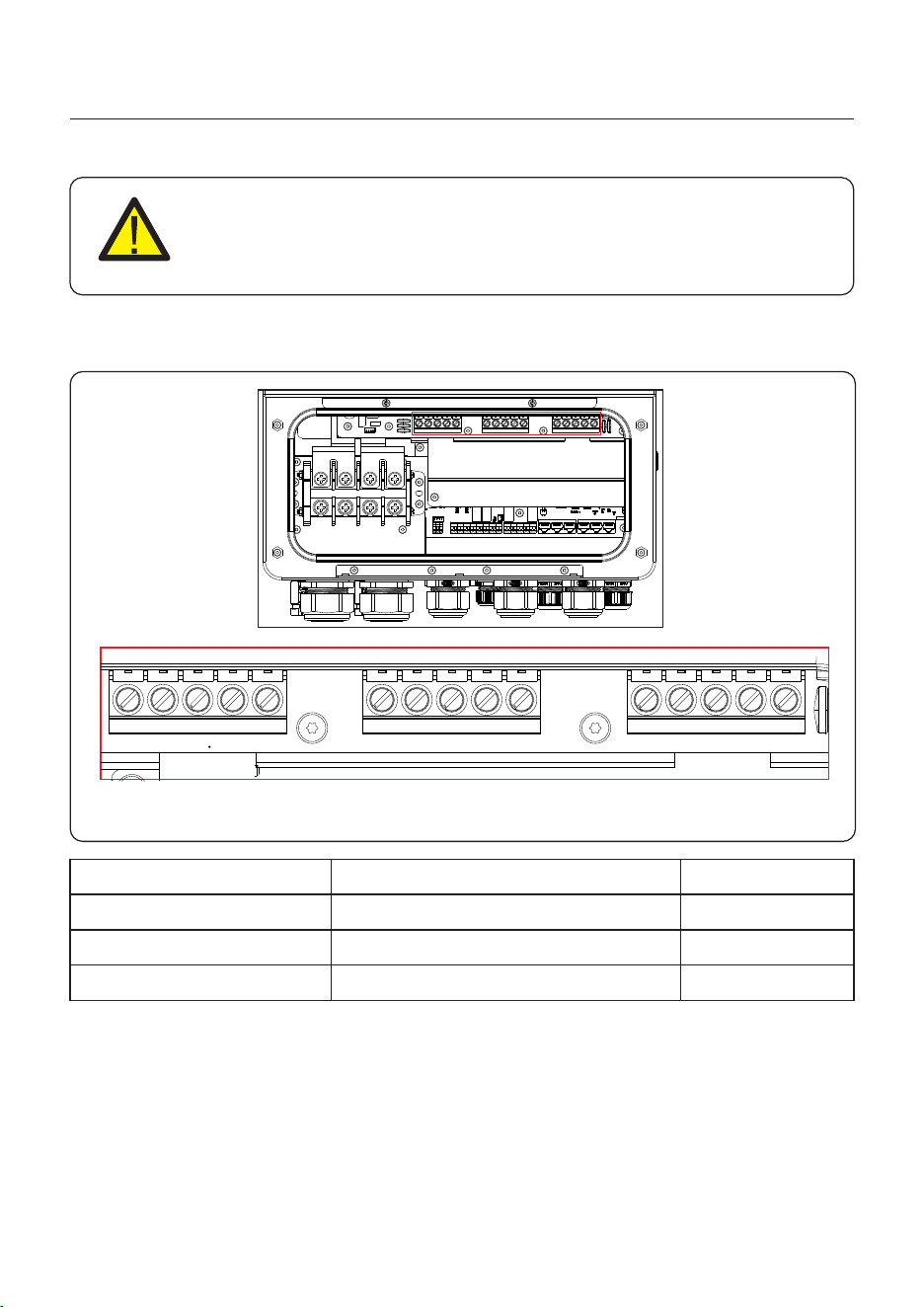
There are three sets of AC output terminals and the installation steps for both are the same.
The maximum temperature for connecting AC and battery terminals is 85°C.
3.8 AC Wiring
Figure 3.17 AC output terminals
DANGER
Before installing the AC cables, be sure that the OCPDs (breakers) are
turned off.
Use a multimeter to verify that the AC voltages are 0Vac before proceeding.
1. Bring the AC cables for the backup loads panel (backup) and the main service
panel (grid) into the inverter wire box. The backup loads panel should not be
electrically connected to the main service panel.
2. Strip 13mm from the ends of each cable. Crimp the R-type connectors onto the ends.
3. Remove the terminal bolts, insert them into the connectors, then use a torque wrench
to tighten the bolts down.
4. Please refer to the terminal labels to connect the AC wires to the correct terminals.
Model
Wire Size
Torque
Cable
6 AWG
18N.m
10 mm2
AC Gen/AC Backup/AC Grid
19
10 AWG
18N.m
4 mm2
GEN
VW
U
N PE VW
U
N PE VW
U
N PE
Backup Grid
Earth Bar
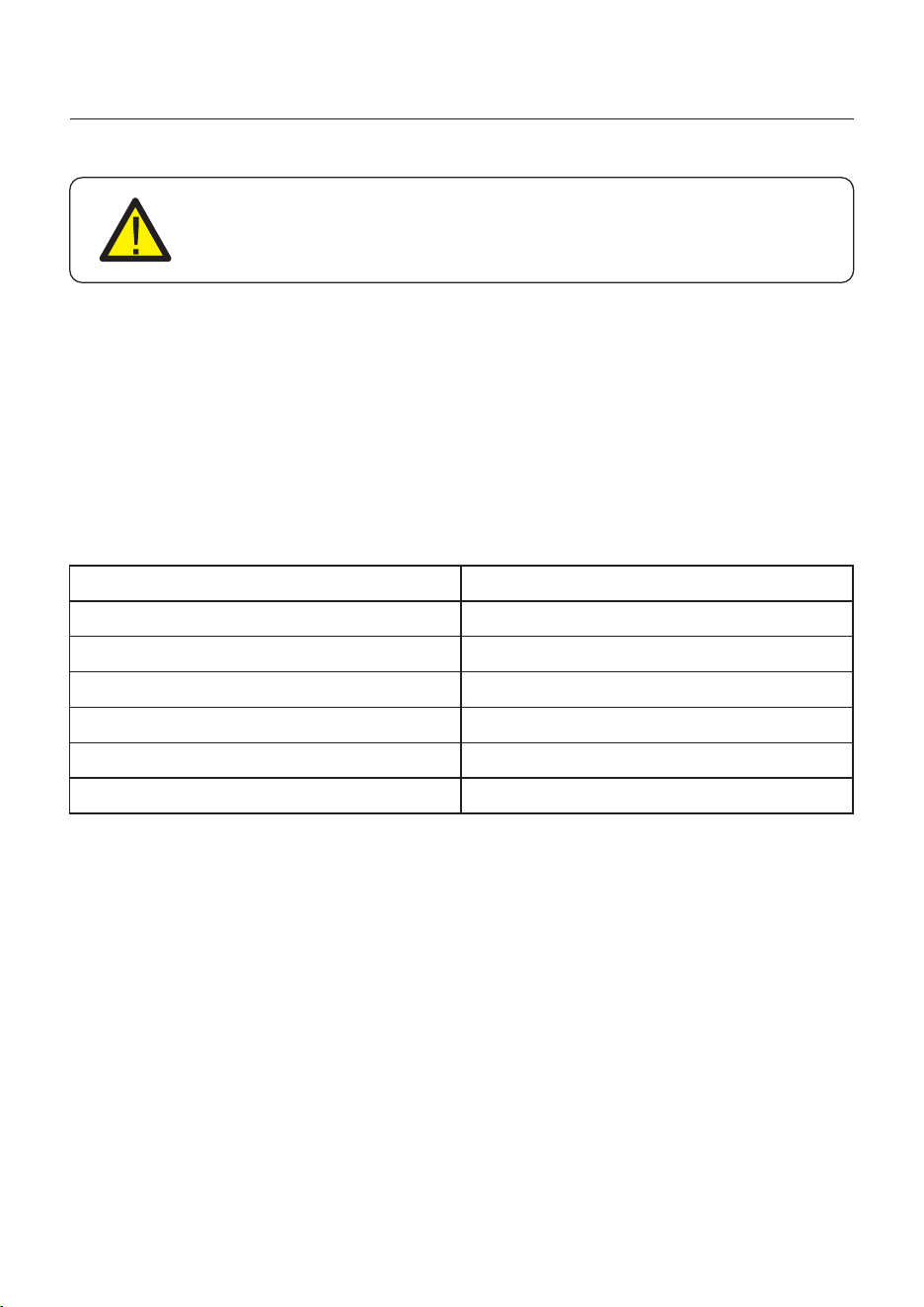
3.9 CT Connection
User Manual
3. Installation
CAUTION:
Make sure the AC cable is totally isolated from AC power before
connecting the or CT.
20
The CT provided in the product box is compulsory for hybrid system installation. It can be used
to detect the grid current direction and provide the system operating condition to hybrid inverter.
CT Model: ESCT-TA16-100A/50mA
CT Cable: Size – 2.3mm2, Length - 1m
Please install the CT on the hot line at the system grid connection point and the arrow on the
CT needs to point to the grid direction.
Lead the CT wires through the COM3 port at the bottom of the inverter and connect the CT
wires to the 16pin communication terminal block.
CT Wire
White
Pin 1 (From Left to Right)
Pin 2 (From Left to Right)
Pin 3 (From Left to Right)
Pin 4 (From Left to Right)
Pin 5 (From Left to Right)
Pin 6 (From Left to Right)
Black
Black
Black
16 PIN Communication Terminal Block
3.9.1 CT Installation
White
White
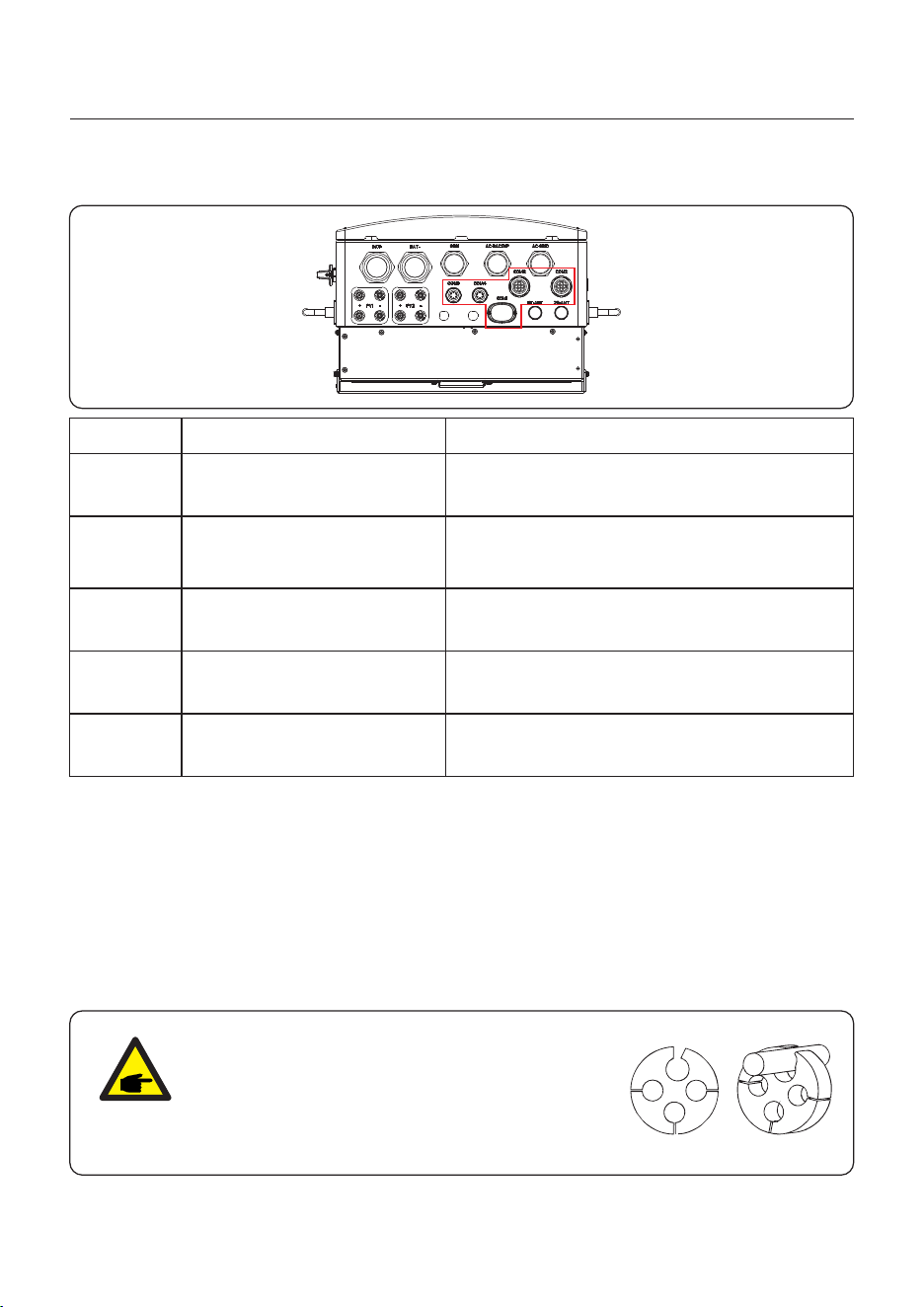
3.10 Inverter Communication
User Manual
3. Installation
3.10.1 Communication Ports
Port
COM1
COM2
COM3
COM4
DescriptionPort Type
USB
6 hole watertight cable gland
4 hole watertight cable gland
Used for Solis data logger connection
Used for 16 PIN terminal block connection
inside wiring box
Used for RJ45 connection inside wiring box
Wiring steps for COM2-COM5:
Step 1. Loose the cable gland and remove the watertight caps inside the cable gland based
on the number of the cables and keep the unused holes with watertight cap.
Step 2. Lead the cable into the holes in the cable gland.
(COM2-COM3 Hole Diameter: 6mm, COM4-COM5 Hole Diameter: 2mm)
Step 3. Connect the cable to the corresponding terminals inside the wiring box.
Step 4. Reassemble the cable gland and ensure there is no bending or stretching of the cables
inside the wiring box.
NOTE:
The 4-hole fastening rings inside the cable
gland for COM2 and COM3 are with openings
on the side.
Please separate the gap with hand and squeeze
the cables into the holes from the side openings.
21
COM5
4 hole watertight cable gland
Used for RJ45 connection inside wiring box
6 hole watertight cable gland
Used for 16 PIN terminal block connection
inside wiring box
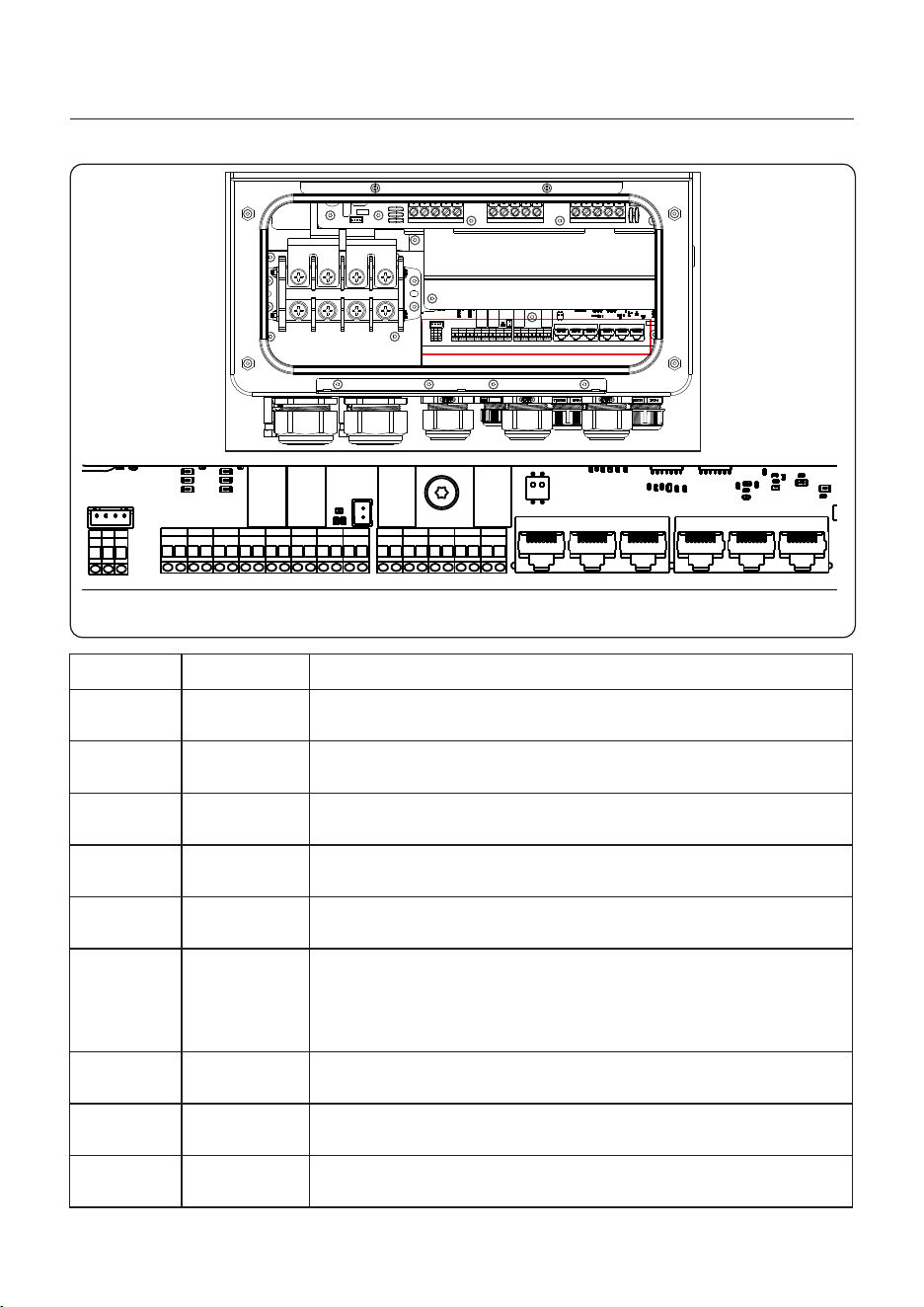
3.10.2 Communication Terminals
User Manual
3. Installation
Figure 3.18 Communication terminals
22
Terminal
BMS
Meter
DRM
P-A
P-B
DIP Switch
(2-1)
HM
G-V
G-S
DescriptionType
RJ45
Terminal
Block
Used for CAN communication between inverter and Lithium
battery BMS.
(Optional)Used for RS485 communication between inverter
and the smart meter.
(Optional) To realize Demand Response or Logic Interface
function, this function may be required in UK and Australia.
(Optional) Parallel operation communication port.
(Optional) Parallel operation communication port.
Pin 1 & Pin 6 (From Left to Right) Used for CT wire connection.
Pin 7 & Pin 8 (From Left to Right) Used for Generator start-
stop signal.
Pin 11 & Pin 12 (From Left to Right)Reserved.
RJ45
RJ45
RJ45
RJ45
-
Terminal
Block
Terminal
Block
If the parallel machine is connected to the first and last
consoles of the parallel connection, you need to put the
DIP switch on the ARM board to ON, and the middle machine
is all OFF.
L
N
ATS
HS-VCC
P-A P-B DRM RS485 BMS METER
1 2
ON
+
HS-A
HG-VCC
HG-A
L1CT
-+
L2CT
-+
L3CT
-
B
GEN-V
A B
GEN-S
A
GND-DI
GEN-DI+
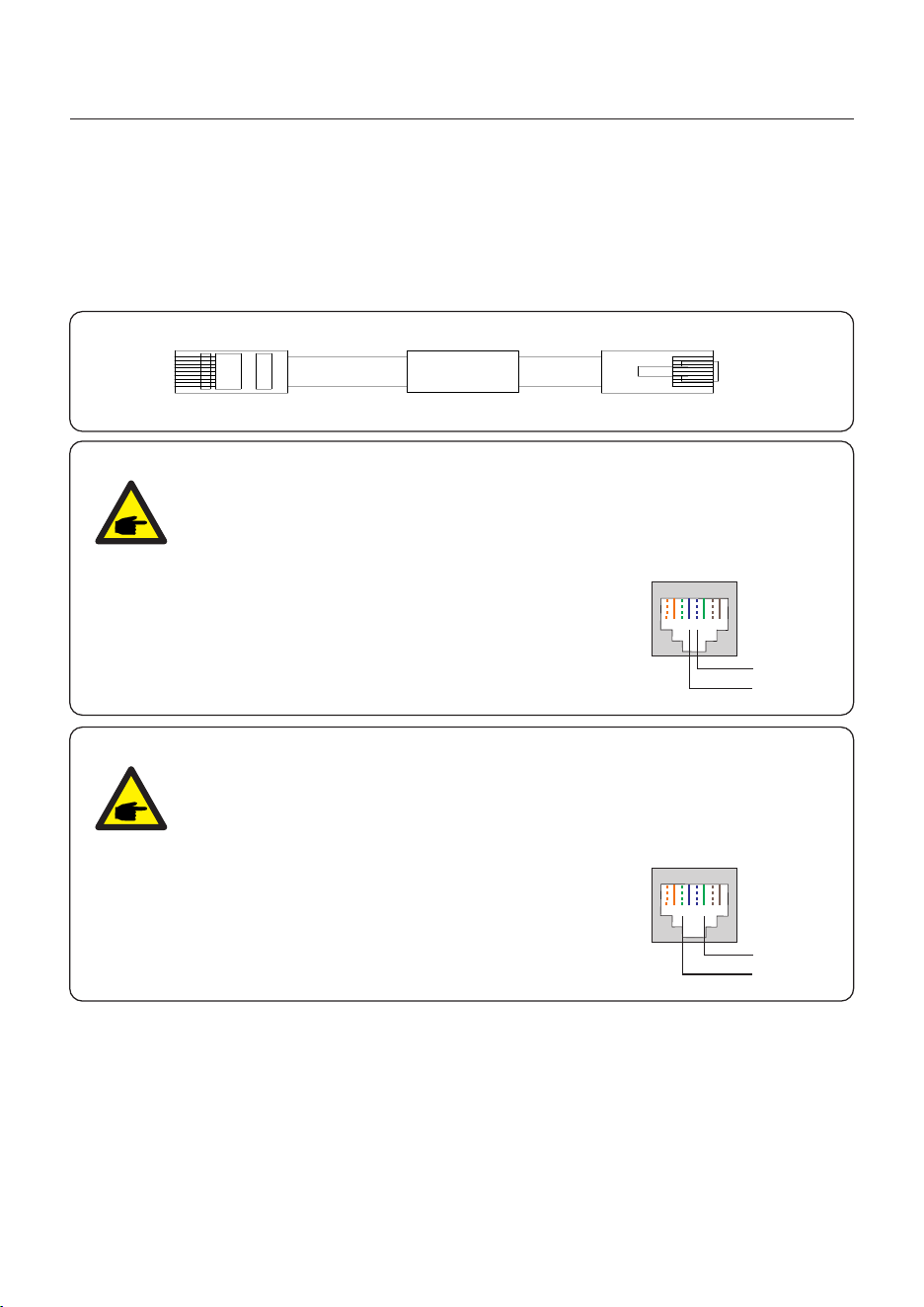
3.10.3 BMS Terminal Connection
User Manual
3. Installation
CAN communication is supported between inverter and compatible battery models.
Please lead the CAN cable through the COM1 or COM2 port of the inverter and connect to
the BMS terminal with RJ45 connector.
NOTE:
Before connecting CAN cable with the battery, please check whether the
communication pin sequence of the inverter and the battery match;
If it does not match, you need to cut off the RJ45 connector at one end of the
CAN cable and adjust the pin sequence according to the pin definitions of
both inverter and battery.
Pin definition of the inverter BMS Port is following
EIA/TIA 568B.
CAN-H on Pin 4: Blue
CAN-L on Pin 5: Blue/White
RJ45terminal
1 2 3 4 5 6 7 8
CAN-L
CAN-H
CAN
3.10.3.1 With Lithium Battery
23
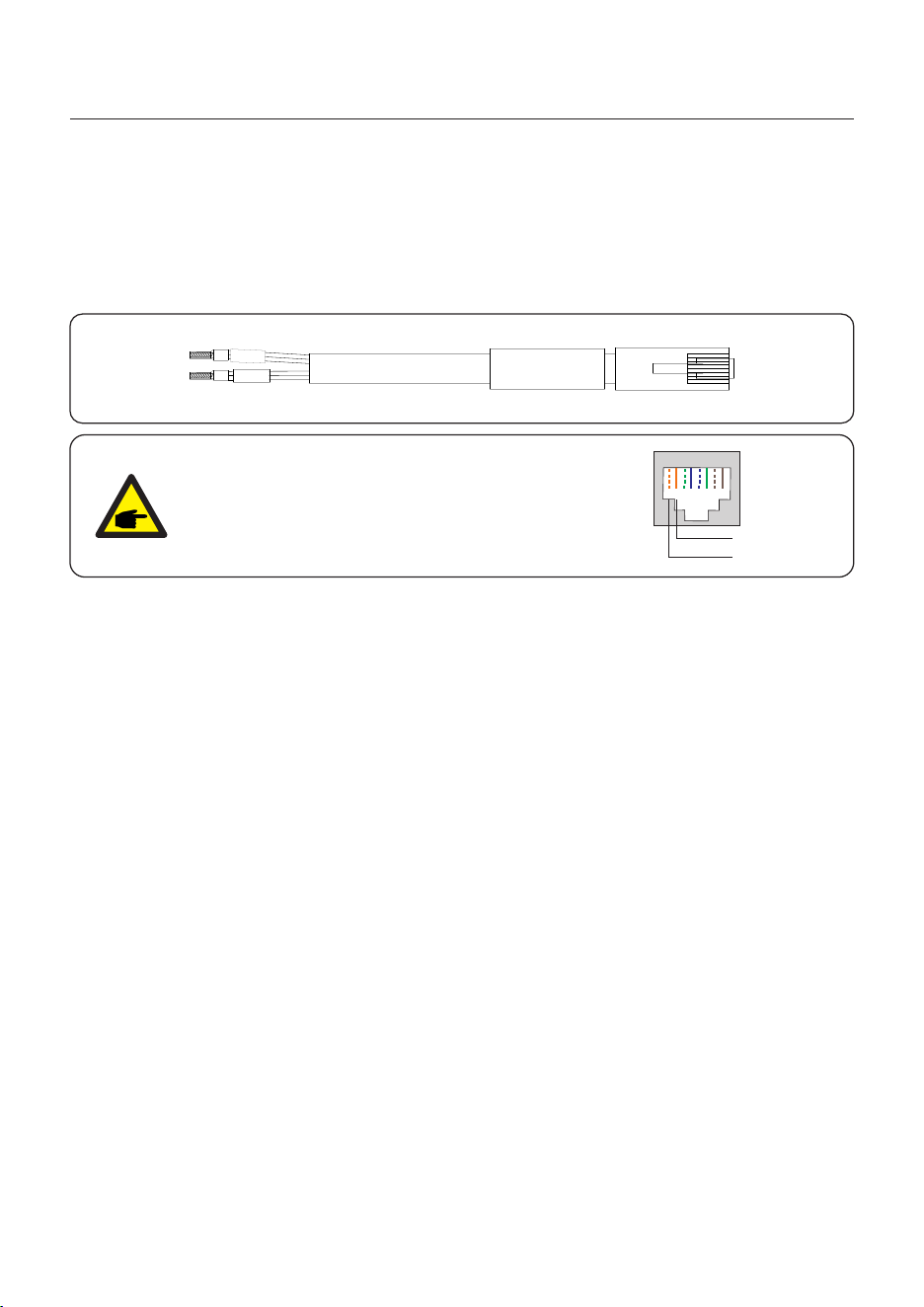
NOTE:
Before connecting RS485 cable with the battery, please check whether the
communication pin sequence of the inverter and the battery match;
If it does not match, you need to cut off the RJ45 connector at one end of the
RS485 cable and adjust the pin sequence according to the pin definitions of
both inverter and battery.
Pin definition of the inverter BMS Port is following
EIA/TIA 568B.
RS485A on Pin 6: Green
RS485B on Pin 3: Green/White
RJ45terminal
1 2 3 4 5 6 7 8
RS485A
RS485B
User Manual
3. Installation
3.10.4 Meter Terminal Connection (Optional)
If a smart meter is preferred to be installed other than the provided CT, please contact Solis
sales rep to order the smart meter and corresponding meter CT.
Please lead the Meter RS485 cable through the COM1 or COM2 port of the inverter and
connect to the Meter terminal with RJ45 connector.
NOTE:
Pin definition of the Meter Terminal is following
EIA/TIA 568B.
RS485A on Pin 1:Orange/white
RS485B on Pin 2:Orange
RJ45terminal
1 2 3 4 5 6 7 8
RS485B
RS485A
METER
A
B
24
25
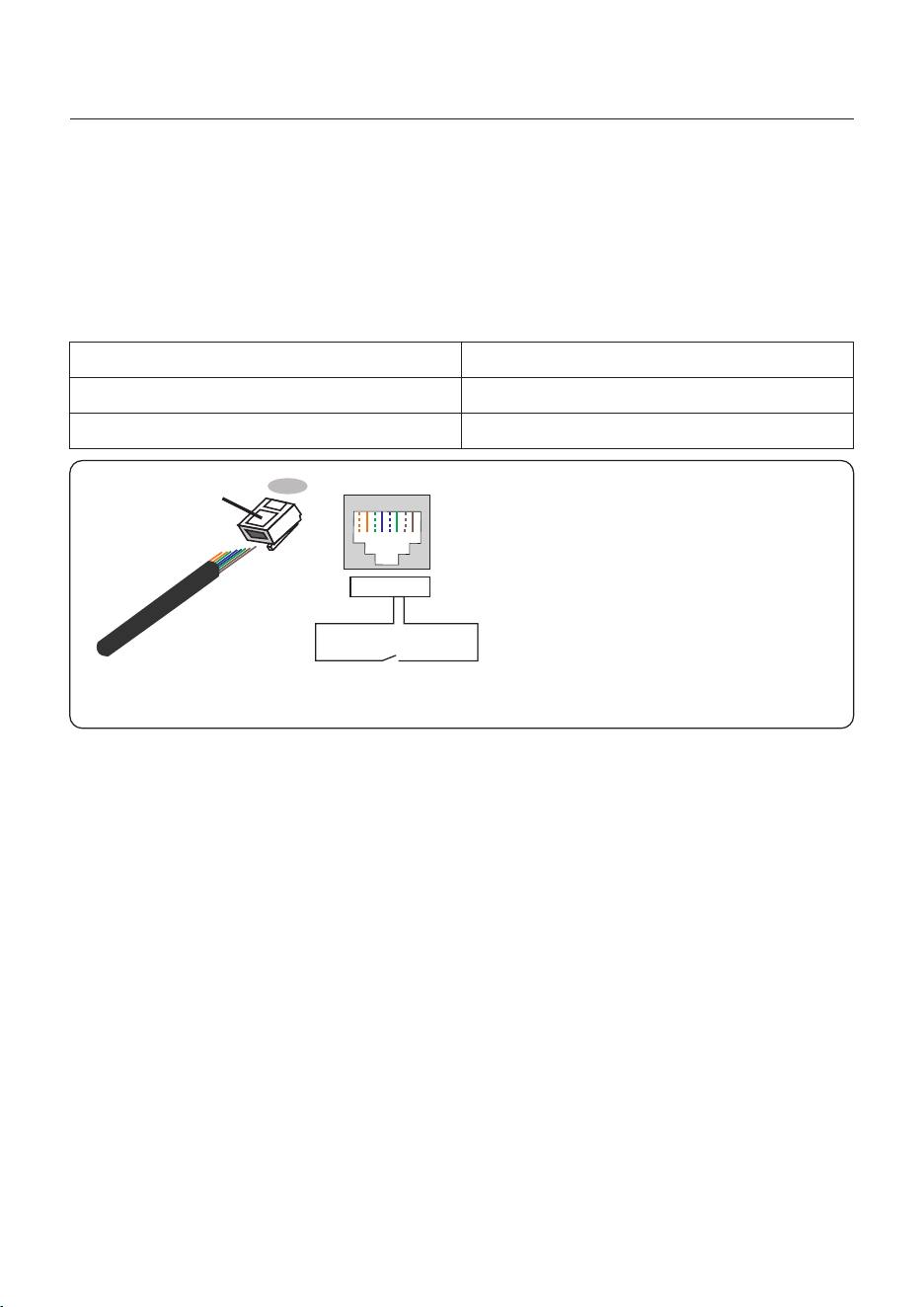
3.10.5.1 For Remote Shutdown Function
Solis inverters support remote shutdown function to remotely control the inverter to power on
and off through logic signals.
The DRM port is provided with an RJ45 terminal and its Pin5 and Pin6 can be used for remote
shutdown function.
Signal
Short Pin5 and Pin6 Inverter Generates
Inverter Shutdown in 5s
Open Pin5 and Pin6
Function
Correspondence between the cables
and the stitches of plug, Pin5 and Pin6
of RJ45 terminal is used for the logic
interface, other Pins are reserved.
Pin 1: Reserved; Pin 2: Reserved
Pin 3: Reserved; Pin 4: Reserved
Pin 5: Switch_input1; Pin 6: Switch_input2
Pin 7: Reserved; Pin 8: Reserved
1--8
Rj45 plug
RJ45terminal
1 2 3 4 5 6 7 8
1 2 3 4 5 6 7 8
DRM(logic interface)
Switch input1_ Switch input2_
Figure 3.19 Strip the insulation layer and connect to RJ45 plug
User Manual
3. Installation
3.10.5 DRM Port Connection (Optional)
26
3.10.6 RS485 Port Connection (Optional)
Figure 3.20 Strip the insulation layer and connect to RJ45 plug
Correspondence between the
cables and the stitches of plug
Pin 1: white and orange ; Pin 2: orange
Pin 3: white and green; Pin 4: blue
Pin 5: white and blue; Pin 6: green
Pin 7: white and brown; Pin 8: brown
1--8
RJ45 plug
RJ45terminal
1 2 3 4 5 6 7 8
1 2 3 4 5 6 7 8
If a 3rd party external device or controller needs to communicate with the inverter, the RS485
port can be used. Communication protocol is supported by Solis inverters.
To acquire latest protocol document, please contact Solis local service team or Solis sales.
NOTE:
Pin definition of the RS485 Port is following
EIA/TIA 568B.
RS485A on Pin 5: Blue/White
RS485B on Pin 4: Blue
RJ45terminal
1 2 3 4 5 6 7 8
RS485A
RS485B
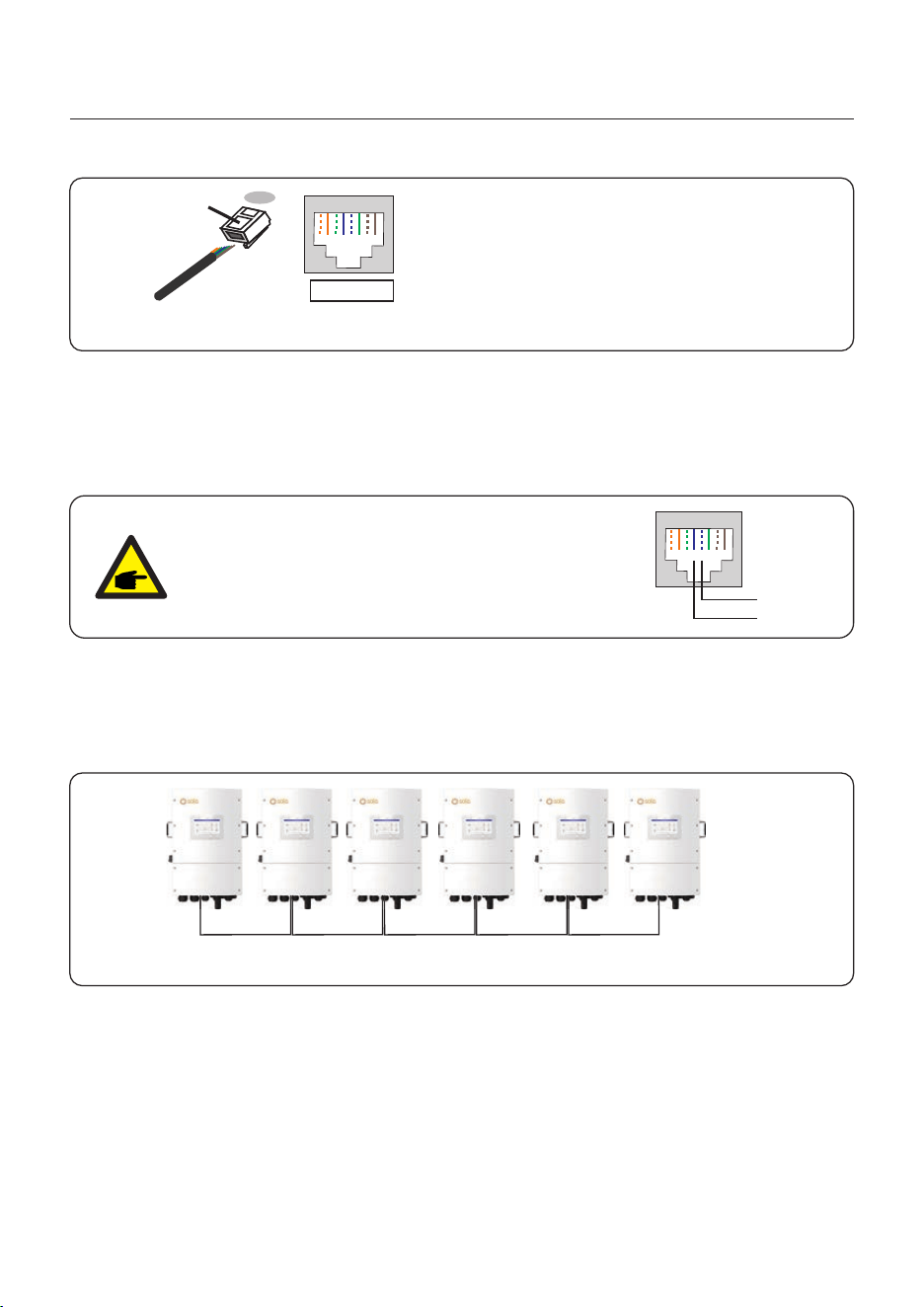
Up to 6 units of the inverter can be connected in parallel.
Please connect the paralleled inverters by using P-A and P-B terminals.
Standard CAT5 with shielding layers internet cable can be used.
P_B P_A P_B P_A P_B P_A P_B P_A P_B P_A
3.10.7 Parallel Inverter Connection (Optional)
User Manual
3. Installation
Figure 3.21 Parallel Terminal Connection
User Manual
3. Installation
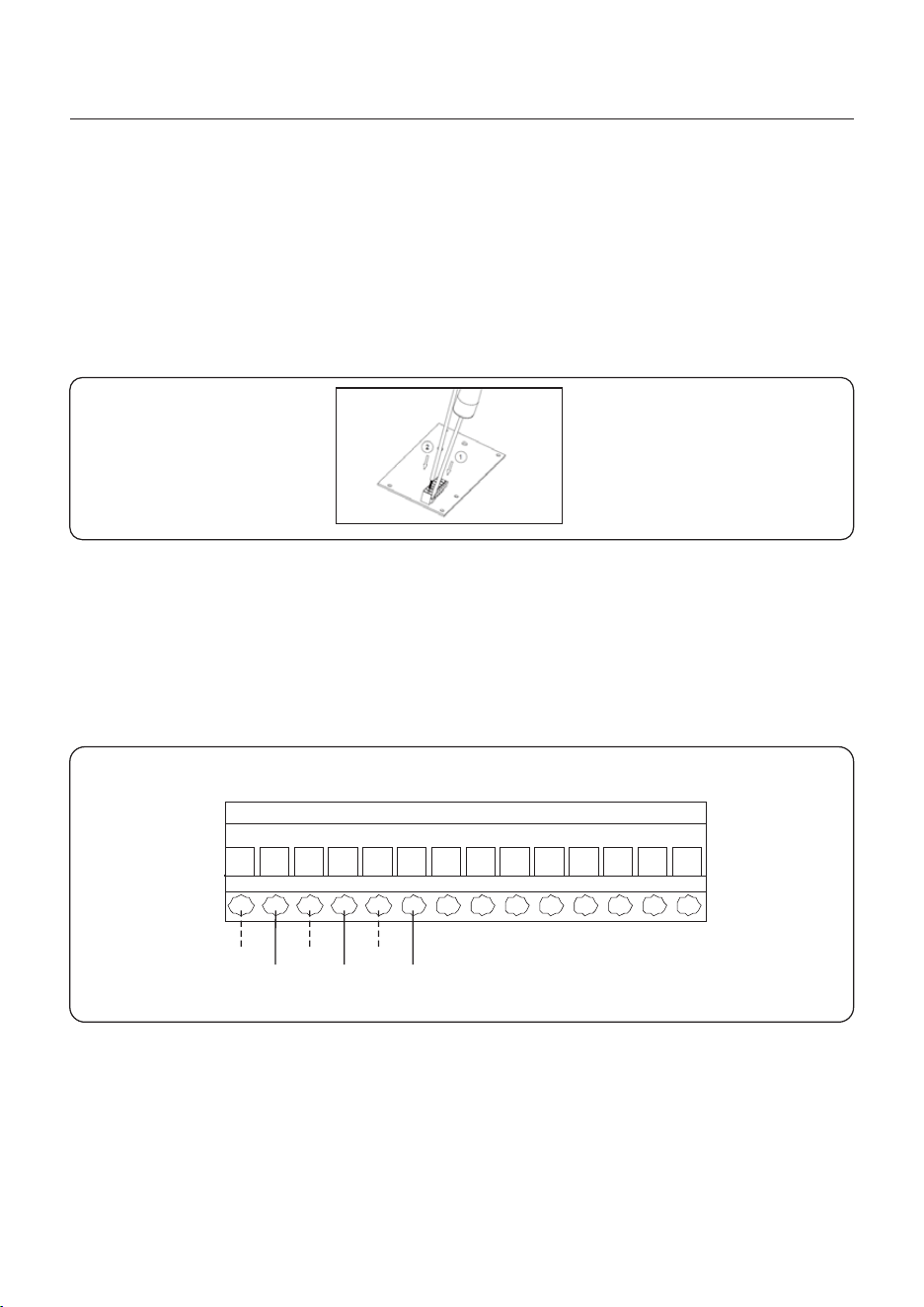
Terminal Block Connection Steps:
Step 1. Lead the wires through the hole in COM3 port (Hole Diameter: 2 mm)
Step 2. Strip the wires for 9mm length
Step 3. Use slot type screwdriver to press the block on the top
Step 4. Insert the exposed copper part of the cable into the terminal.
Step 5. Remove the screwdriver and the terminal will clamp down on the exposed copper part.
Step 6. Give the cable a gentle tug to ensure that it is firmly secured.
CT connection is necessary to realize the correct control logic of the hybrid inverter.
The CT provided in the inverter package has BLACK(S2) and WHITE(S1) wires. The BLACK
wire needs to connect to the Pin 2, Pin 4, Pin6 of the terminal block and the WHITE wire
needs to connect to the Pin 1, Pin3, Pin5 of the terminal block as in the following diagram.
16-Pin Communication
Terminal Block
3.10.8.1 HM Terminal Connection (CT Terminal Connection)
3.10.8 16-pin Communication Terminal Block
27
Figure 3.22
1 2
White
Black
3 4 5 6
User Manual
3. Installation
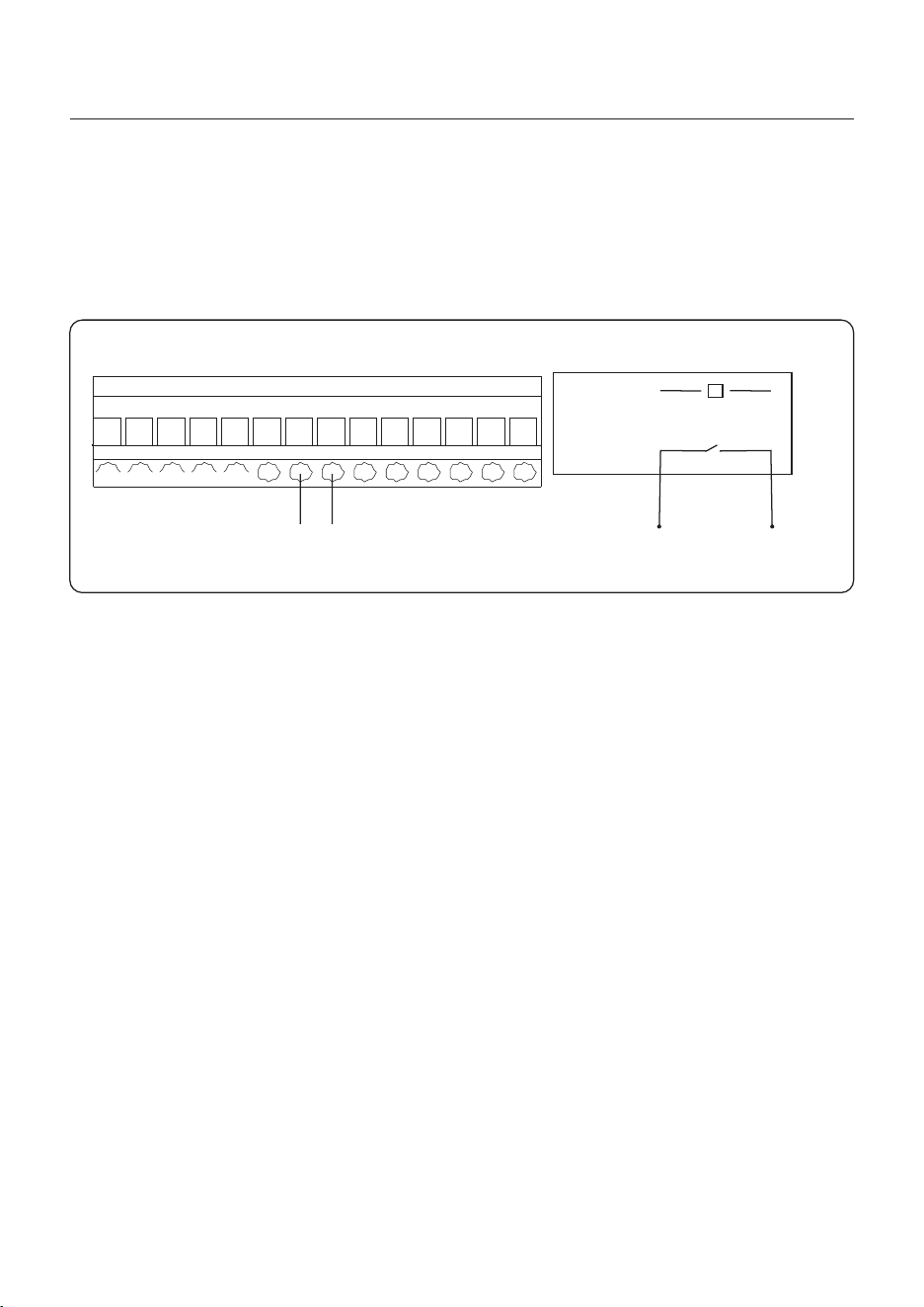
The G-V terminal is a voltage-free dry contact signal for connecting with generator's NO relay
to start up the generator when necessary.
When generator operation is not needed, Pin7 and Pin8 is in open circuit.
When generator operation is needed, Pin7 and Pin8 is in short circuit.
16-Pin Communication
Terminal Block
3.10.8.2 G-V Terminal Connection
28
Figure 3.23
coil
open contact
G V
relay
1 2 3 4 5 6 7 8
G V
User Manual
3. Installation
LAN monitoring
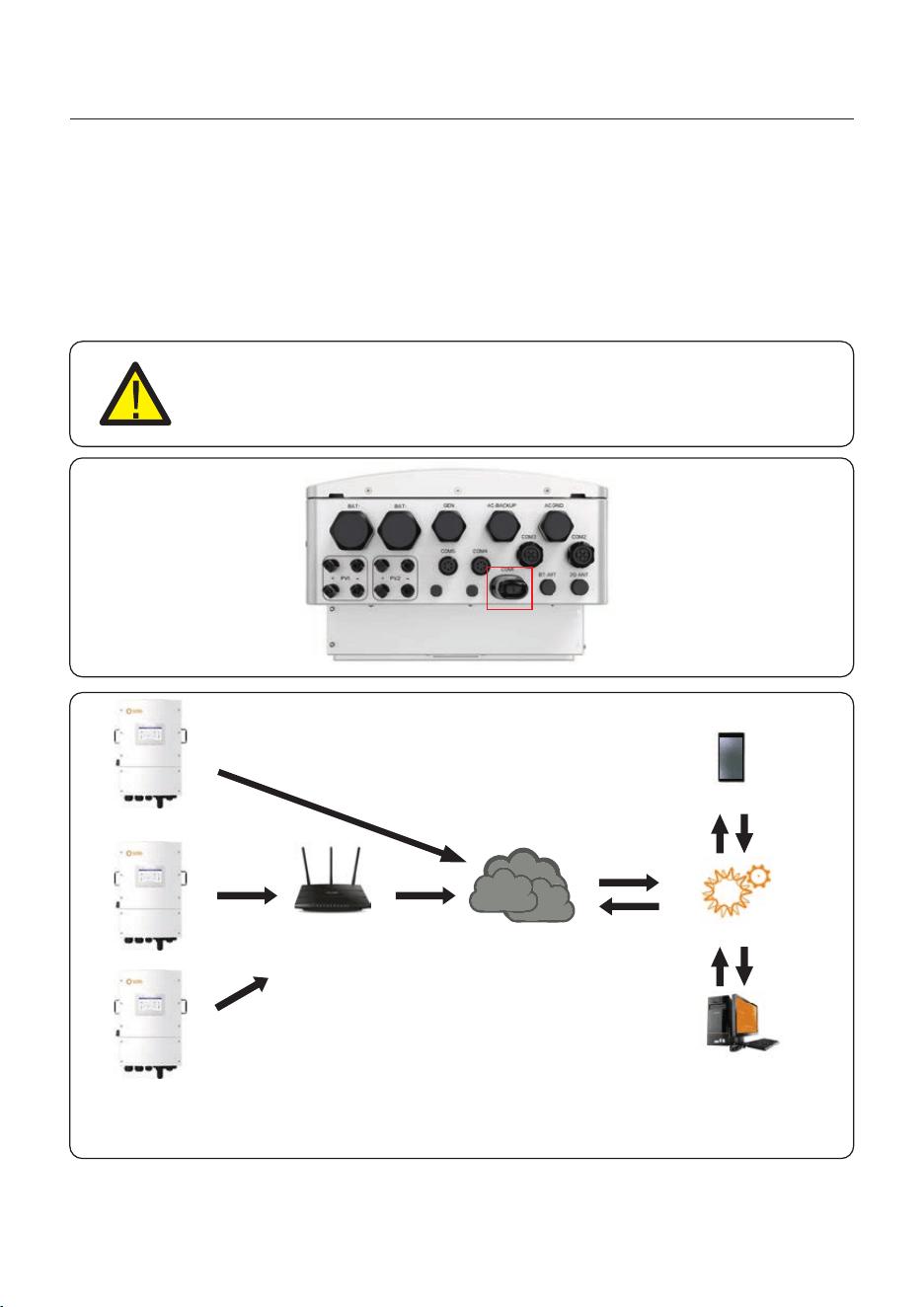
The inverter can be remotely monitored via WiFi, LAN or 4G.
The USB type COM port at the bottom of the inverter can connect to different kinds of Solis
data loggers to realize the remote monitoring on Soliscloud platform.
To install Solis data loggers, please refer to corresponding user manuals of Solis data loggers.
The Solis data loggers are optional and can be purchased separately.
Dust cover is provided the inverter package in case the port is not used.
WARNING:
The USB type COM port is only allowed to connect Solis data loggers.
It is forbidden to be used for other purposes.
4G monitoring
WiFi monitoring
Router
Internet
Web server
Figure 3.24 Wireless communication function
Soliscloud
APP
3.11 Inverter Remote Monitoring Connection
29
30
User Manual
4. Overview
4.1 Screen
Solis S6 Series adopts 7 inch color screen, it displays the status, operating information
and settings of the inverter.
4.2 Keypad
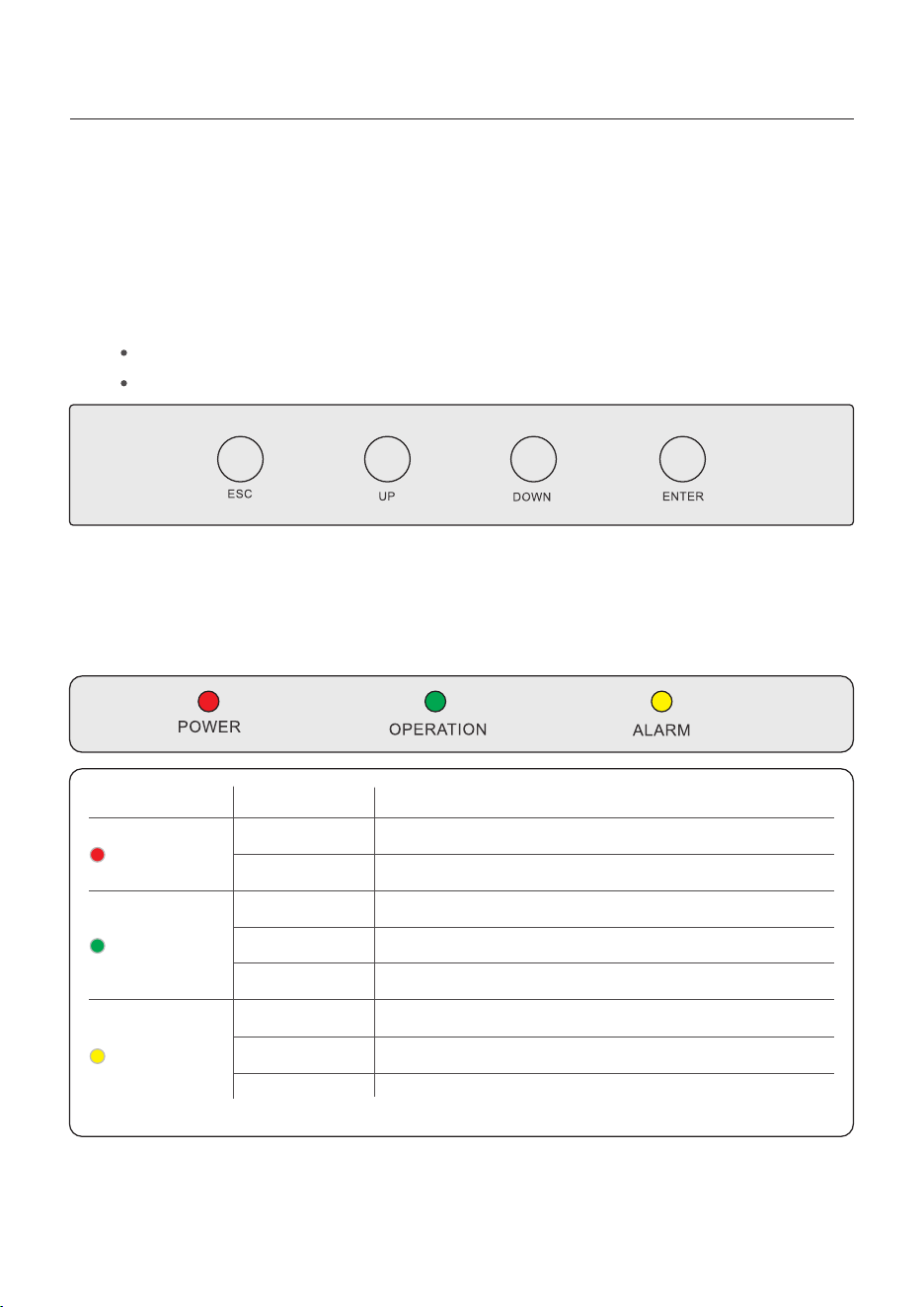
There are four keys in the front panel of the inverter (from left to right):
ESC, UP, DOWN and ENTER keys. The keypad is used for:
Scrolling through the displayed options (the UP and DOWN keys);
Access and modify the settings (the ESC and ENTER keys).
Figure 4.1 Keypad
Description
The inverter can detect DC power.
No DC power.
The inverter is fully operational.
The inverter has stopped operating.
The inverter is initializing.
Fault condition is detected.
No fault condition detected.
Status
ON
OFF
ON
OFF
OFF
ON
FLASHING
Light
POWER
OPERATION
ALARM
4.3 LED Indicators
There are three LED indicators on the RHI inverter (Red, Green, and Orange) which
indicate the working status of the inverter.
Table 4.1 Status Indicator Lights
FLASHING
Either the grid or solar cannot be detected.

31
User Manual
4. Overview
4.4 Inverter built-in Bluetooth description
Bluetooth: BLE
frequency band(s) in which the radio equipment operates:2.402-2.480GHZ
Maximum transmitting power: 8dBm
Hereby, Ginlong Technologies Co.,Ltd.declares that the radio equipment type hybrid
inverter is in compliance with Directive 2014/53/EU
32
5. Commissioning
User Manual
5.1 Pre-Commissioning
+
-
Measure DC voltage of
PV strings and battery
Measure AC voltage
and frequency
● Make sure that no high voltage conductors are energized.
● Check all conduit and cable connection points ensure they are tight.
● Verify that all system components have adequate space for ventilation.
● Follow each cable to ensure that they are all terminated in the proper places.
● Ensure that all warning signs and labels are affixed on the system equipment.
● Verify that the inverter is secured to the wall and is not loose or wobbly.
● Prepare a multimeter that can do both AC and DC amps.
● Have an Android or Apple mobile phone with Bluetooth capability.
● Install the Soliscloud APP on the mobile phone and register a new account.
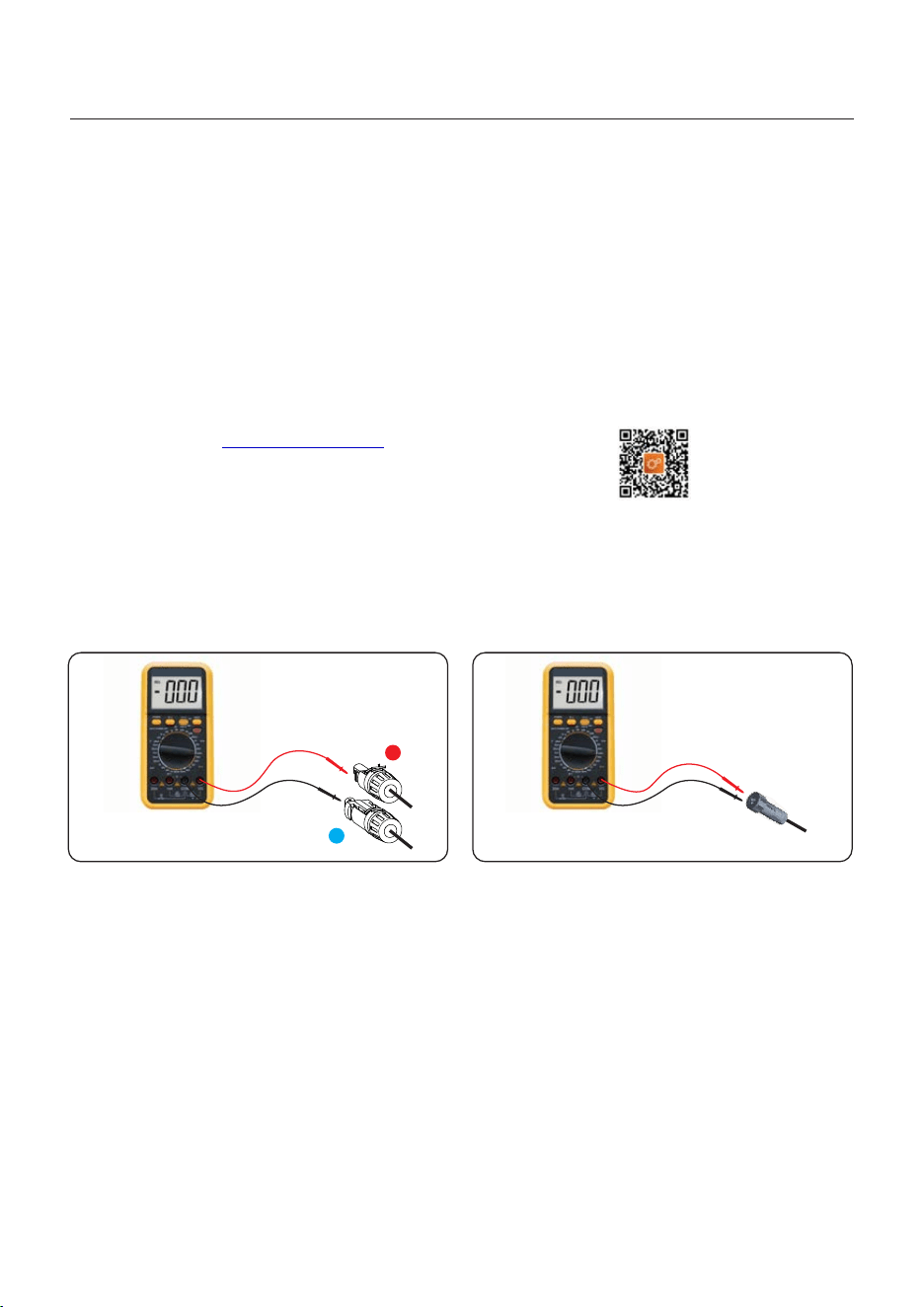
● There are three ways to download and install the latest APP.
1. You can visit www.soliscloud.com.
2. You can search”Soliscloud”in Google Play or APP Store.
3. You can scan this QR code to download Soliscloud.
5.2 Power ON
Step 1: With the DC switch off, energize the PV strings and then measure DC voltage of the
PV strings to verify that the voltage and polarity are correct. Turn on the battery and check
the battery voltage and polarity as well.
Step 2: Turn on the OCPD for the system and then measure the AC voltages line to line
and line to neutral. The backup side of the system will be off until commissioning is complete.
Turn the OCPD back off for now.
Step 3: Turn the DC switch on and then the OCPD(AC breaker) for the system.
This inverter can be powered on by PV only, battery only and Grid only.
When the inverter is pow
ered on,the five indicators will be lighted at once.
5.3 Power OFF
Step 1: Turn off the AC breaker or AC disconnect switch to disable AC power to the inverter.
Step 2: Turn off the DC switch of the inverter.
Step 3: Turn off the battery breaker.
Step 4: Use a multimeter to verify that the battery and AC voltages are 0V.
33
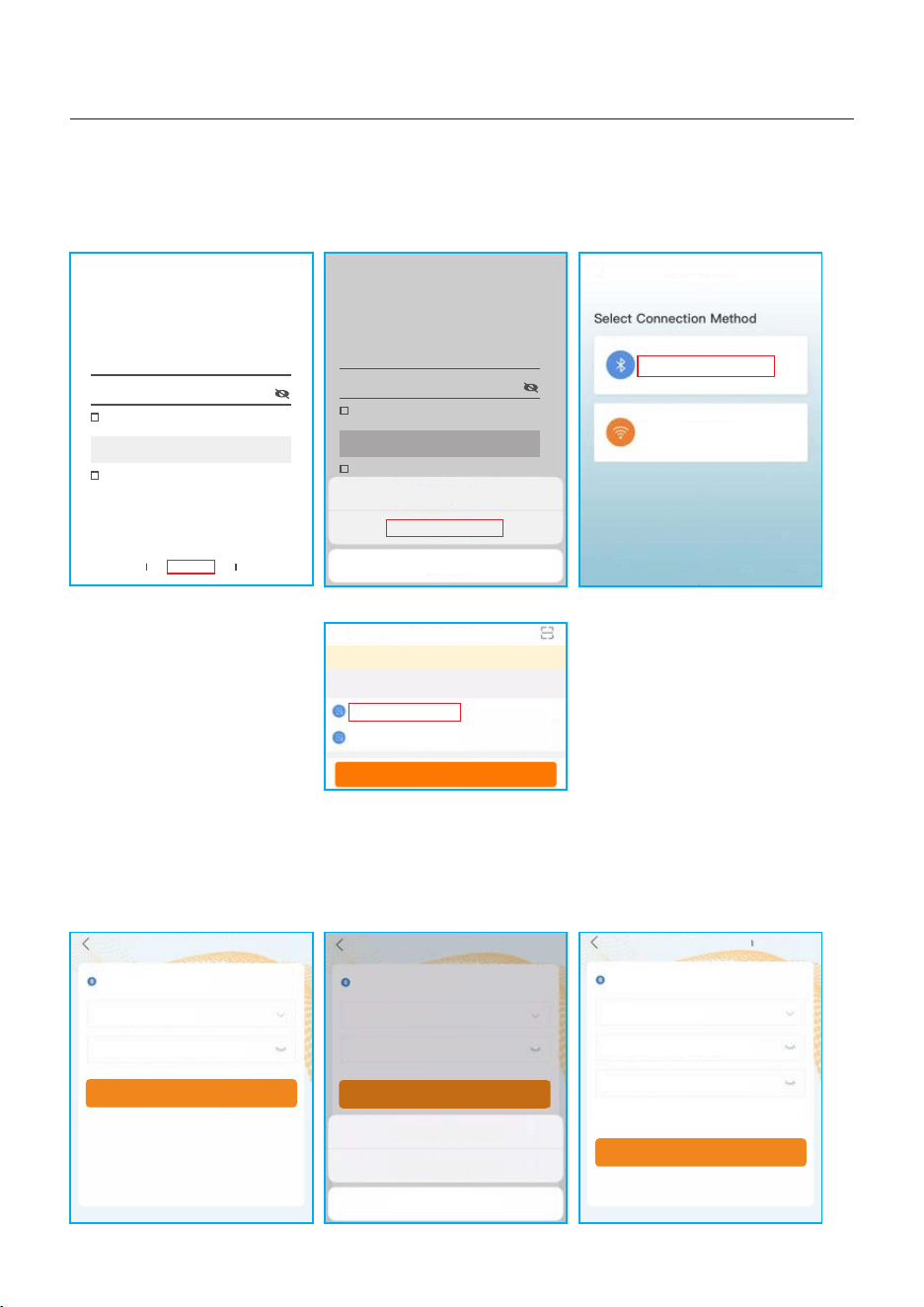
Step 1: Connect with Bluetooth.
Turn on Bluetooth switch on your mobile phone and then open the Soliscloud APP.
Click “More Tools”->”Local Operation”->”Connect with Bluetooth”
Step 2: Select the Bluetooth signal from the inverter. (Bluetooth Name: Inverter SN)
Step 3: Login account.
If you are the installer, please select the account type as Installer. If you are the
plant owner, please select the account type as owner. Then set your own initial password
for control verification. (The first log-in must be finished by installer in order to do the
initial set up)
Hello,
Welcome to SolisCloud
Register
Username/Email
Password
I have agreed Privacy Policy
Remember Forgot Password
Language More Tools Data Migration
Log in
Hello,
Welcome to SolisCloud
Register
Username/Email
Password
I have agreed Privacy Policy
Remember Forgot Password
Log in
Local Operation
Connect With Bluetooth
Connect With WiFi
<
xxxxxxxxxxxx
Nearby Device
<
vivo TWS 2
<
<
Search Device
If the dev ice is not in the list, ple as e click the “Search D ev ice”
butt on a t the bottom or drop-do wn t o refresh the page
Other Device
xxxxxxxxxxxx
xxxxxxxxxxxx
Control Verification
Select account type
Enter password (6-characters)
Verify
Control Verification
Installer
Enter password (6-characters)
Enter password again
Please set the password of the installer’s account
before continuing
Set Enable
<
xxxxxxxxxxxx
Control Verification
Select account type
Enter password (6-characters)
Verify
Installer
Owner
Cancel
<
<
WiFi Configuration
Local Operation
Cancel
5.4 Log in the APP via Bluetooth
5. Commissioning
User Manual
34
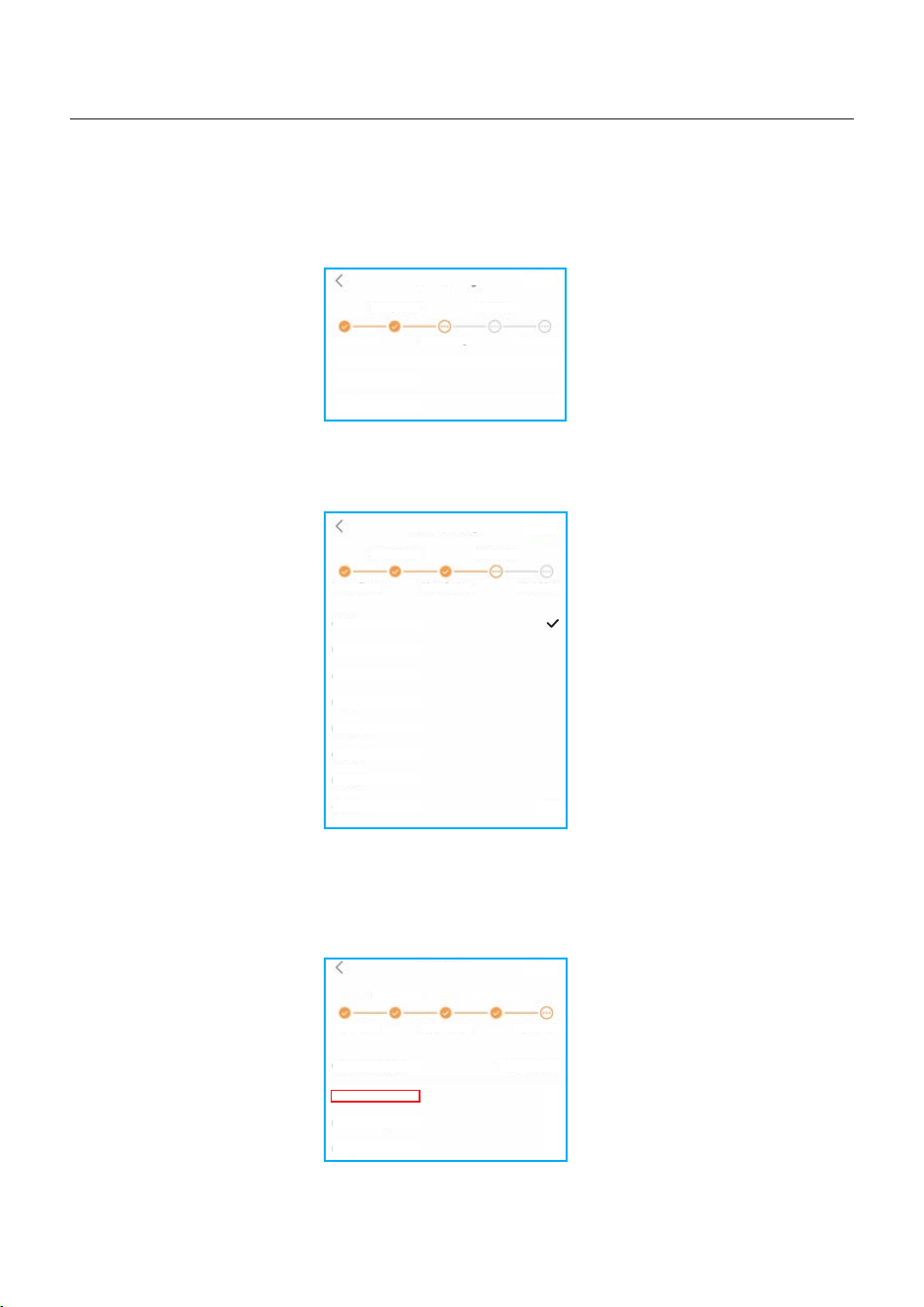
5.5 Initial set up
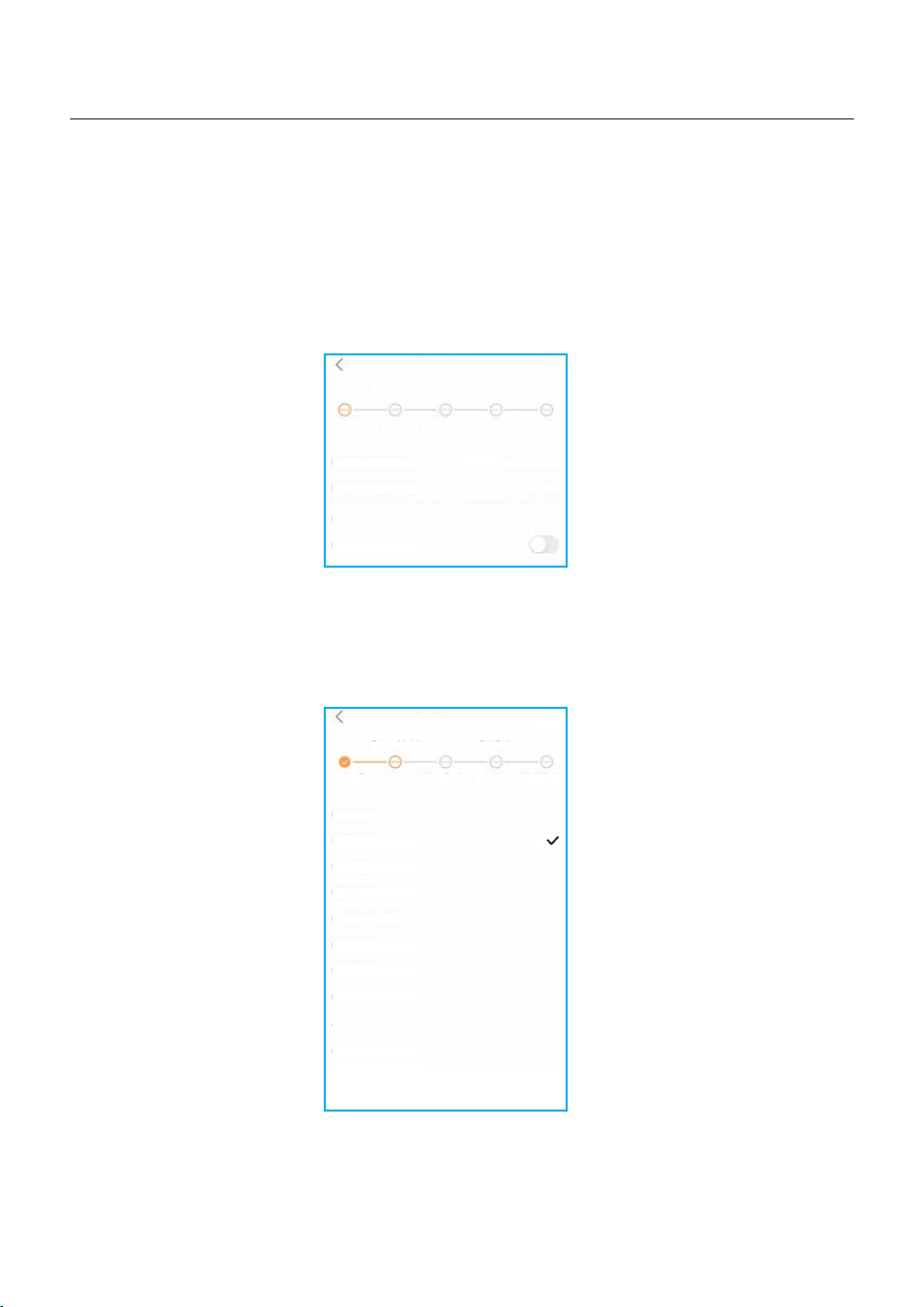
Inverter Time -> Battery Model -> Meter Setting -> Grid Code -> Work mode
A. Inverter Time: Set the Inverter Time and Date. It may be easier to tap the slider next to
“Follow Phone Time”.Then tap Next in the top right corner. This will set the inverter to
match your phone.
B. Battery Model: Now select the battery model connected to the inverter. This choice
must be based on the battery model that is actually connected to the inverter. If there is
no battery connected for the moment, select”No Battery”to avoid potential alarms codes.
Quick Setting
Next
Inverter Time Meter Type Working Mode
Battery Model Grid Code
Inverter Date Setting
Inverter Time Setting
Phone Time
Follow Phone Time
15:27
2023-04-11
2023-04-11 15:27:25
Quick Setting
Next
Inverter Time Meter Type Working Mode
Battery Model Grid Code
No Battery
PYLON_HV
B_BOX_HV BYD
Dyness LV
PureDrive-LV
LG Chem LV
AoBo-LV
JiaWei-LV
WECO-LV
FreedomWon-lv
Soluna-LV
>
>
5. Commissioning
User Manual
If this is the first time the inverter has been commissioned, you will need to first go
through the Quick Settings.Once this has been done,these settings can be changed later.
GSI-LV
35
C. Meter Setting: Set both the Meter Type and the Meter Location. It is suggested to
install the meter at the system grid connection point and select “Meter in Grid”.If there
is no meter connected for the moment, please select”No Meter” to avoid alarms.
Quick Setting
Next
Inverter Time Meter Type Working Mode
Battery Model Grid Code
D. Grid Code: Please select the grid code based on the local grid network requirements.
Quick Setting
Next
Inverter Time
Battery Model Grid Code
G59/3
User-define
EN50549FI
BRA-N220
EN50549TR
SI-1
LTU-1
VDE 4105
5. Commissioning
User Manual
Meter/CT Setting
Meter Setting
Meter >
>
Meter Type Working Mode
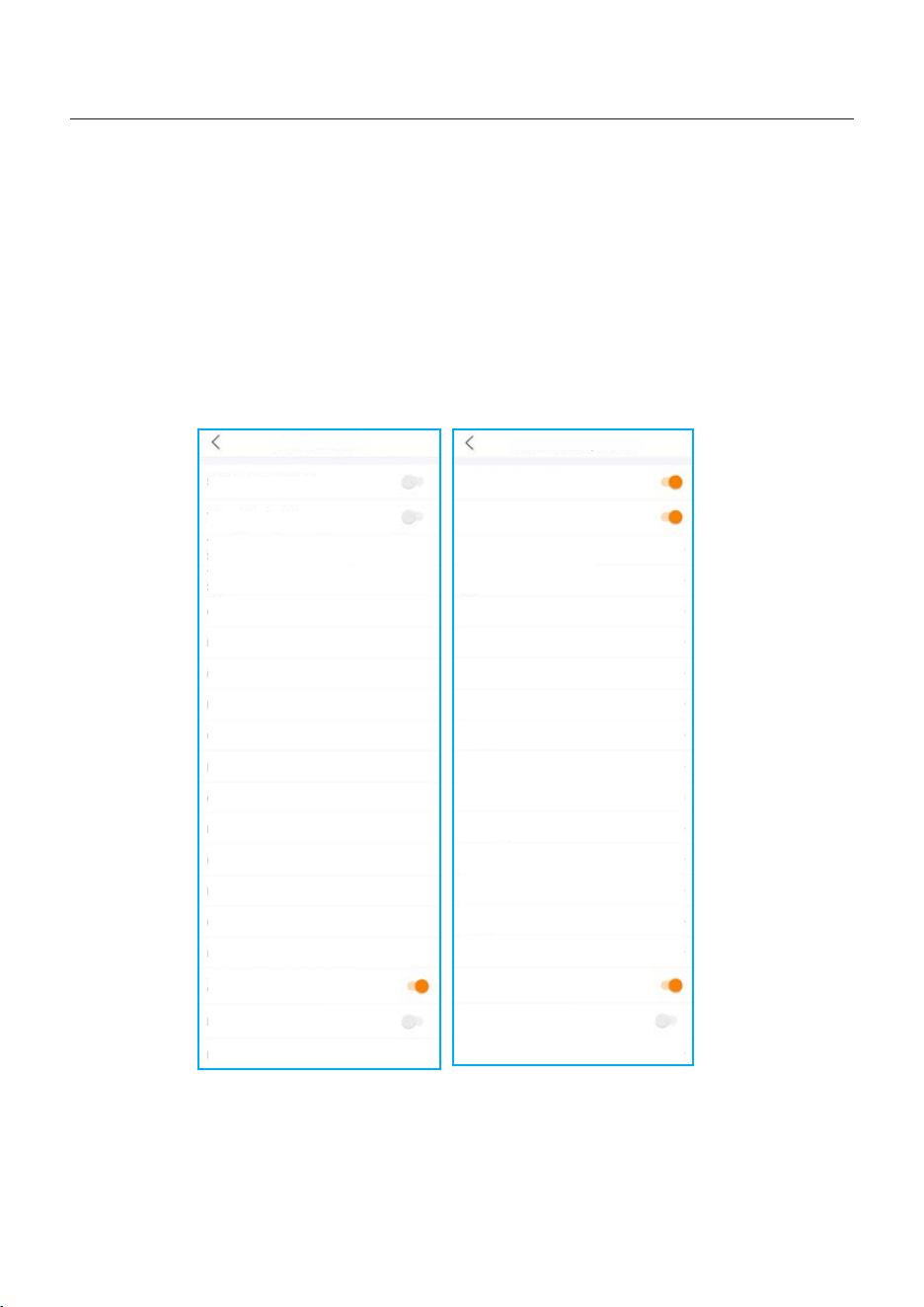
E. Work Mode: This is the energy storage operating mode. ALL modes first priority is to
use the available PV power to support the home loads. The different modes determine
what the second priority, or use of the excess PV power, will be. Select the desired mode,
then tap the slider switch to turn the mode on. The switch will appear orange if it is enabled.
Quick Setting
Done
Inverter Time
Battery Model Grid Code
Current Work Mode
Self-Use Mode
Feed in Priority Mode
Off-grid Mode
>
>
>
Meter Type Working Mode
36
Self-Use Mode stores the excess PV power into the battery. If the battery is charged, or there
is no battery, the excess PV power will be exported(sold)back to the utility company. If the
system is set to not export any power, then the inverter will curtail the PV power(derate the
inverter output power).
5. Commissioning
User Manual
Feed in Priority Mode will ensure that the system exports any excess PV power after the
home loads are supplied. If the export power quota has been met, then the remaining PV
power will be stored in the battery. This mode should not be used if export power is going to
be set to zero.
Self-Use Mode Switch
Time of Use Switch
Time of Use Charge Current Set
50.0A >
Time of Use Discharge Current Set
50.0A >
Charge Time Slot 1
Discharge Time Slot 1
Charge Time Slot 2
Discharge Time Slot 2
22:00 ~ 08:00 >
08:00 ~ 22:00 >
00:00 ~ 00:00 >
00:00 ~ 00:00 >
Charge Time Slot 3
00:00 ~ 00:00 >
Discharge Time Slot 3
00:00 ~ 00:00 >
Charge Time Slot 4
00:00 ~ 00:00 >
Discharge Time Slot 4
00:00 ~ 00:00 >
Charge Time Slot 5
00:00 ~ 00:00 >
Discharge Time Slot 5
00:00 ~ 00:00 >
Charge Time Slot 6
00:00 ~ 00:00 >
Discharge Time Slot 6
00:00 ~ 00:00 >
Allow Grid Charging
Backup Mode Switch
Reserved SOC
80% >
Self-Use Mode
Feed in Priority Mode
Feed in Priority Mode Switch
Time of Use Switch
Time of Use Charge Current Set
135.0A >
Time of Use Discharge Current Set
Charge Time Slot 1
Discharge Time Slot 1
Charge Time Slot 2
Discharge Time Slot 2
00:00 ~ 01:00 >
01:00 ~ 02:00 >
02:00 ~ 04:00 >
04:00 ~ 06:00 >
Charge Time Slot 3
06:00 ~ 10:00 >
Discharge Time Slot 3
10:00 ~ 11:00 >
11:00 ~ 14:00 >
14:00 ~ 17:00 >
17:30 ~ 18:00 >
18:00 ~ 22:55 >
23:00 ~ 23:30 >
23:30 ~ 00:00 >
Allow Grid Charging
Backup Mode Switch
Reserved SOC
80% >
135.0A >
Charge Time Slot 4
Discharge Time Slot 4
Charge Time Slot 5
Discharge Time Slot 5
Charge Time Slot 6
Discharge Time Slot 6
37
5. Commissioning
User Manual
Off-Grid Mode
Off-grid Mode Switch
Off-grid Overdischarge SOC
30%
>
Off-Grid Mode is only to be used by systems that are not electrically connected to the grid
at all. This mode is like Self-Use Mode, but the PV power will be curtailed if the battery is
charged and the home load demand is lower than the amount of available PV power.
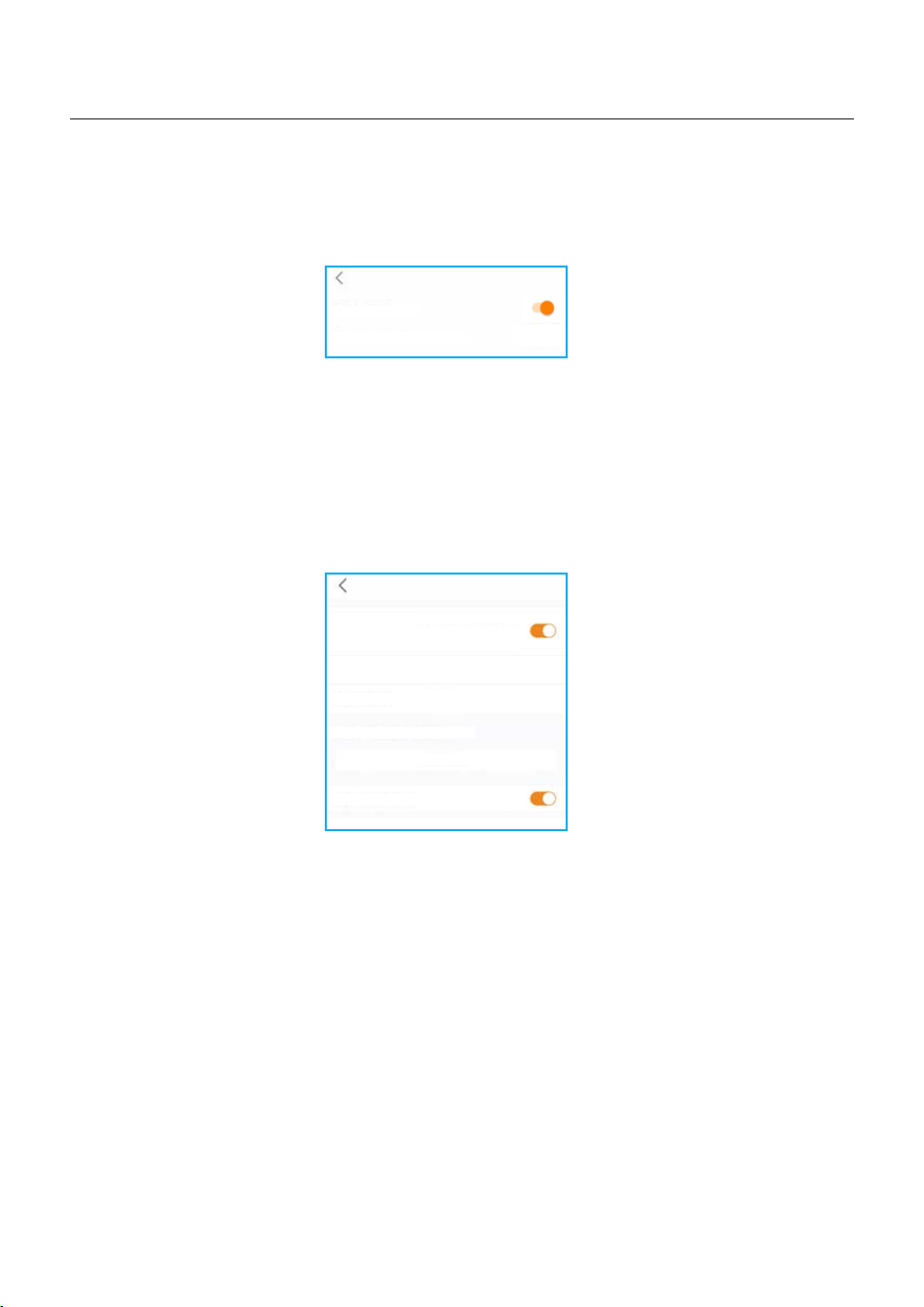
Backup Mode can be opened in the Self-Use or Feed in Priority Mode. What this mode does
is ensure that the battery does not drain past the Reserve SOC(state-of-charge) percentage.
The battery will cycle between 100% and the Reserve SOC, so if grid power is lost, the battery
will have the Reserve SOC at the very least to carry the home through the outage.
Peak-shaving Mode: Peak-shaving function is possible to set the maximum power (Pmax)
that the system obtains from the main grid. The power of the main grid charges batteries and
supplies power to the load, which is within (Pmax). When the load power exceeds the set
maximum power (Pmax), the insufficient part is provided by the battery. At the same time,
users can set the Peak SOC and charge the battery to this SOC as far as possible under the
premise of satisfying Pmeter.
(Tips: Only the lithium battery with CAN connection support the peak-shaving mode)
Peak-shaving Mode
Peak-shaving Mode
Note: This mode only support the use with lithium
batteries with communication
Max.useable Grid Power
Baseline SOC
Charging & Discharging Setting
Allow Grid Charging
+ Add Time
70%
>
3000W
>
38
5. Commissioning
User Manual
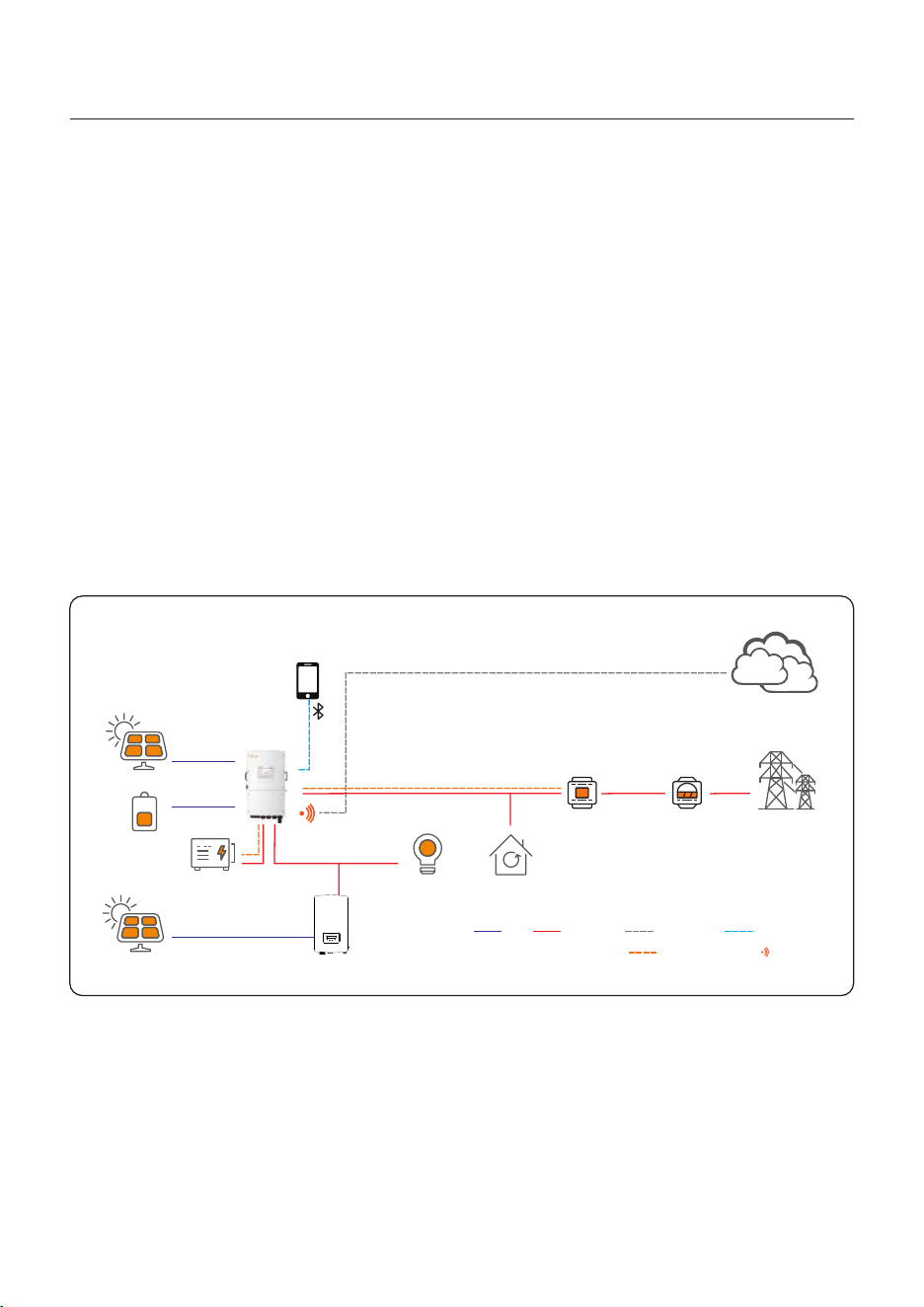
AC Coupling Scheme
Customers can integrate a new energy storage inverter (S6 Hybrid) to an existed Grid - tied
inverter system. Users can select two ways of AC Coupling connection modes. One is connect
the Grid –tied inverter to S6 inverter Gen port and another is on the backup Port.
(Tips: When the total system is at on-grid status, the grid-tied PV inverter MUST be connected
to the backup port of hybrid inverter. )
Time of Use Switch is for customizing when the battery is allowed to charge and discharge
power and at what rate, established by a current(amperage)setting.If this slid
er switch is
turned on, the inverter will only use this schedule to determine when to charge and discharge
the battery. If Allow Grid Charging is turned on, the inverter will use grid power to charge the
battery only under two circumstances:(1) the battery drains to the Force Charge SOC.
(2)Time of Use is enabled and there is not enough available PV power during the charge
window to meet the current rate that is established.
Time of Use is for manual control of the battery charging/discharging.If Time of Use is
turned off, charging/discharging is automatically regulated by the inve
rter.
AC Coupling on Backup port
PV Strings
Battery
PV Strings
Generator
Grid
APP
Data Stick
Back-UP Load Loads
Power MeterSmart Meter
Soliscloud
Hybrid Inverter
PV Inverter
DC
AC Internet Bluetooth
RS485 Communication Cable Communication
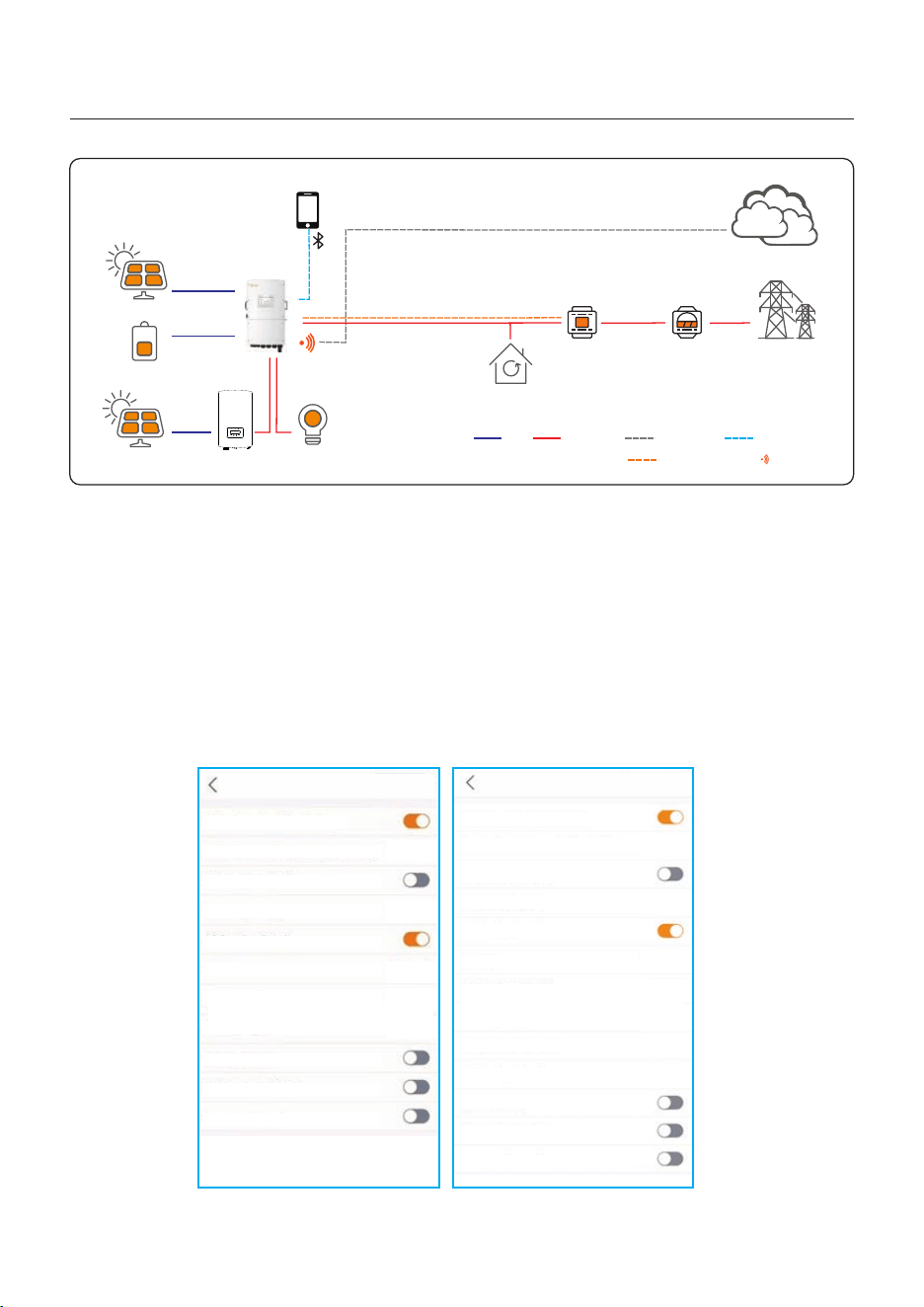
39
The settings about AC coupling under the smart port setting. When the AC Coupling switch
is turned on, customer should set the position is GEN port or Backup port. and set the
AC_Coupling _OFF_SOC and AC_Coupling _OFF_VOLT and AC_Coupling Max.fre.
AC_Coupling _OFF_SOC : When the lithium SOC rises to this set value, the grid-tied inverter
stops working through load reduction.
AC_Coupling _OFF_VOLT: When the lead acid Volt rises to this set value, the grid-tied inverter
stops working through load reduction.
AC_Coupling Max.fre: Default value 52Hz, when the sy
stem reaches the grid-tied inverter
shutdown condition, the system frequency changes to the set value and overfrequency load
reduction is carried out.
5. Commissioning
User Manual
For Lead-acid battery Type For Lithium Battery Type
AC Coupling on Gen port
Smart Port
Backup Port Enabling Setting
Backup Port Reference Voltage Setting
Voltage Droop Setting
Min.Droop Voltage
AC Coupling Switch
Position
AC Coupling_OFF_Bat_Volt
AC Coupling Max.fre
With Generator
Gen Port Load Open
Smart Load Switch
230.0V
>
180.0V
>
50.0V
>
51.60Hz
>
GEN Port
>
Backup Port Enabling Setting
Backup Port Reference Voltage Setting
Voltage Droop Setting
Min.Droop Voltage
AC Coupling Switch
Position
AC Coupling_ON_SOC
Start Frequency
With Generator
Gen Port Load Open
Smart Load Switch
AC Coupling_OFF_SOC
AC Coupling Max.fre
230.0V
>
180.0V
>
GEN Port
>
50%
>
60%
>
52.10Hz
>
50.00Hz
>
Smart Port
PV Strings
Battery
PV Strings
Grid
APP
Data Stick
Back-UP Load
Loads
Power MeterSmart Meter
Soliscloud
Hybrid Inverter
PV Inverter
DC
AC Internet Bluetooth
RS485 Communication Cable Communication
40
5.6.1 APP Interface Structure
5.6 APP Interface
5. Commissioning
User Manual
APP Inte rface
Info
Inverter
Battery
Grid
Load
GEN
Parallel
Basic Information
Advanced Informat io n
SOC
Charging&Discharg in g En er gy
SOH
Battery Type
Voltage
Current
Other Parameters
Energy Imported&E xp or te d
Meter Data
Grid Data
Historical Alarm
Current Alarm
Alarm
Setting
Home
Voltage
Temperature
Power
Communication Conne ct io n
Firmware Version
Model Number
Inverter Time
Grid Code
Inverter SN
PV Energy
GEN Energy
Today Consumption of Lo ad
Today Yield of PV
Today Charge&Discharge of B at te ry
Today Imported&Emport ed o f Gr id
Work Mode
Tim e
Indicator
Grid Code
Battery Setting
Meter/CT Se tt in g
Grid Power Setting
Backup Setting
Inverter Paramete r Se tt in g
Special Function
GEN Setting
Parallel Setting
Self-Use
Feed in Priority
Off-Grid
Tim e of U se
Backup Mode
Tim e of U se
Backup Mode
Forcecharge
ECO Function
Lithium
Lead-acid
Protection
Battery Wake Up
Protection
Meter
CT
CT Reserve
CT Ratio
Output Power Settin g
Power Factor
Advanced Setting of Gri d- ti ed S tandard
GEN Power Setting
GEN Signal
GEN Force/Stop
Address ID
Phase Setting
Parallel Sync
41
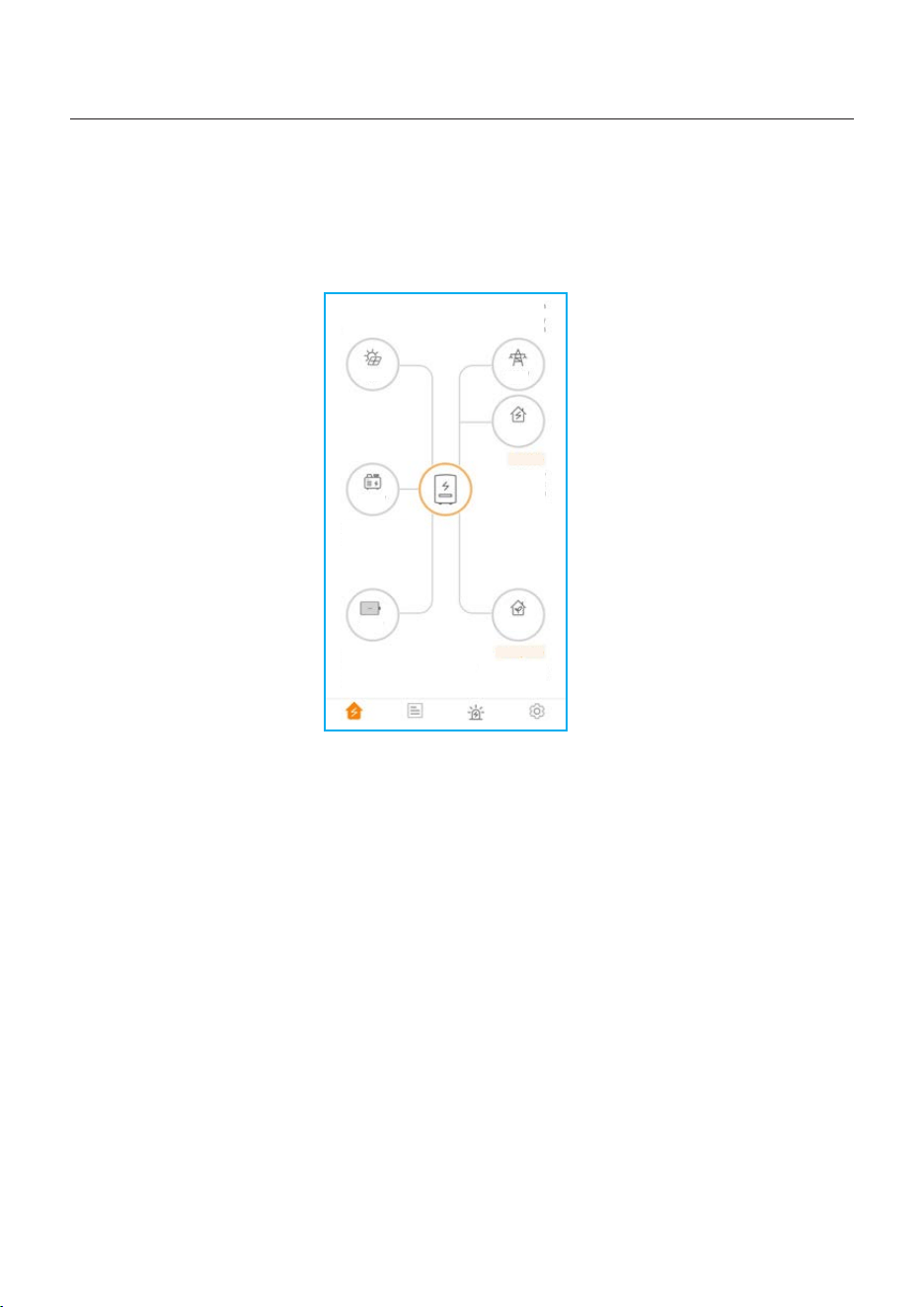
The home page can display the working state, Today Yield of PV, Today Imported/Exported of
Grid, Today Charged/Discharged of Battery ,Today Consumption of household electricity and
Today GEN yield. At the bottom of page are four submenus: Home, Info, Alarm and Settings.
5.6.2 Home
5. Commissioning
User Manual
Home
Info
Alarm
Settings
Today
Charged :0 .0KWh
Today
Dischar ge d:0.0KW h
Today Consumption
34.1KWh
Backup Side
Today GEN Yield:
0.0KWh
Today Consumption
0.0KWh
Grid Side
Today Yield:00.0KWh
Today imported:0.0K Wh
Today
Exported:0.0KWh
0W
0W
0.0W
0.0kW
0.0W
0W
42
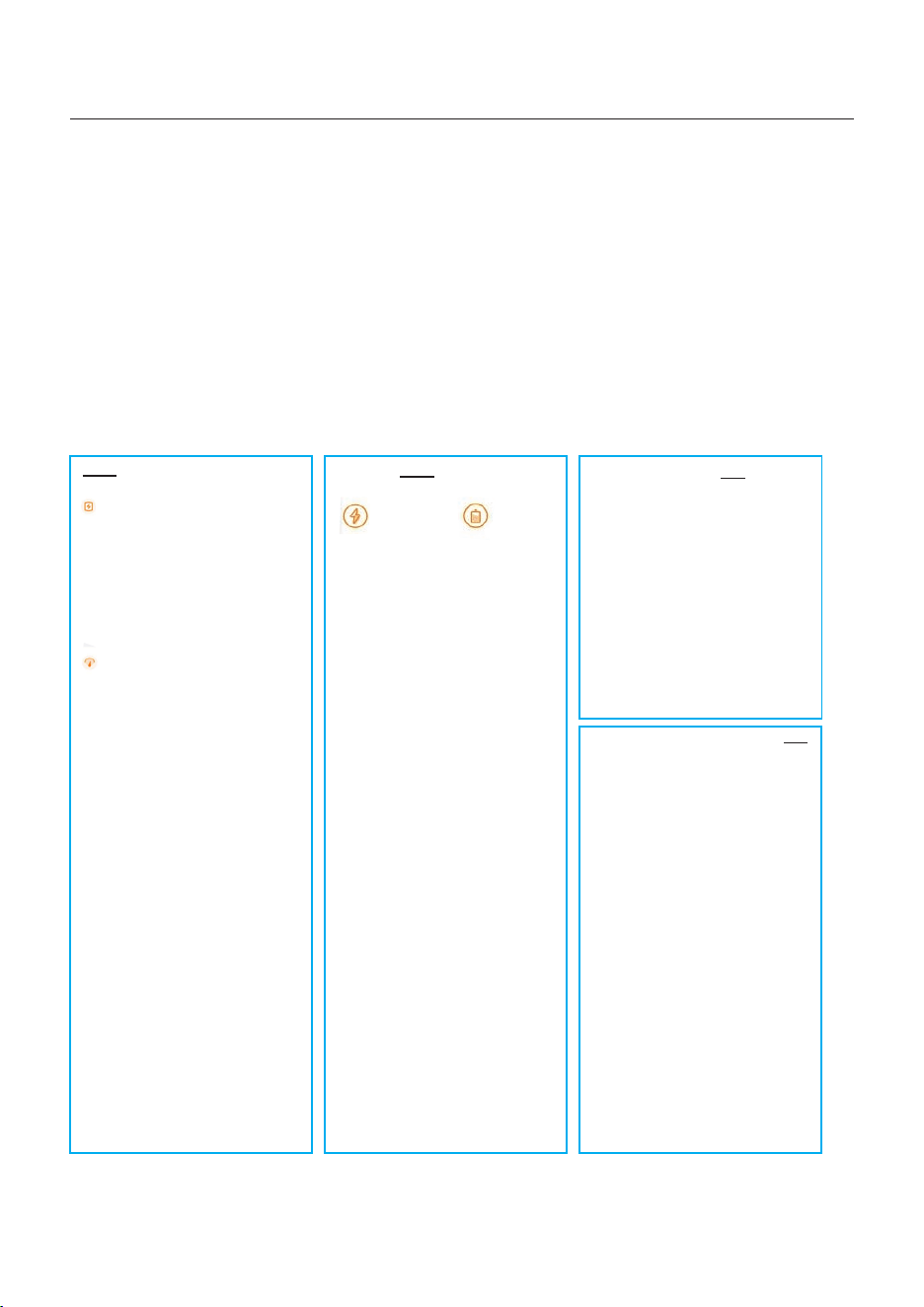
The Info page breaks down into four categories: Inverter, Battery, Grid, and Load.
Inverter: inverter power production history, PV voltages and currents, inverter information
(serial number, model number, and firmware version),grid code, and alarm code history.
There are two additional information in the inverter page:
GEN Information: generator power, today and total generator yield, and warning information.
Parallel Information: information includes inverter, battery, grid and load.
Battery: battery model and status, battery volt
age and current.
Grid:
power imported an exported, AC grid voltage, frequency, and amperage.
Load: power being consumed by the home loads and backup loads.
Inverter
Battery
Grid
Load
Total Yield
221kWh
14.2kWh
191kWh
221kWh
Today Yie ld
This M onth Yield
This Yea r Yield
Yesterday Yiel d
12.8kWh
30kWh 0kWh
Last M onth Yield
Last Yea r Yield
View His torical Yiel d
>
Total PV Input Power
865W
Volta ge
Curr ent
Powe r
Pv1
Pv2
432. 6V
0.0V
2.0A
0.0A
865. 20W
0.00 W
Inverter SN
103115022B100041
Inverter Time
2022-12-23 15:32:03
Rated Power
6kW
Model Number
3115
DSP Fi rmware Version
V2
HMI Firmware Versi on
V1
HMI Firmware Subversion
Vd
Grid Code
G59/3
Communication Connection
Advanced Information
>
>
T
5.6.3 Information
Inverter
Battery
Grid
Load
49W
Discharge Power
99%
Battery SOC
Char ged
Disc harged
Today
Total
6.8k Wh 0.2k Wh
1830 kWh
1536 kWh
Other Parameters(From BMS)
Battery SOH
100%
Battery Model
Dyness LV
BMS Status
Normal
Battery Voltage BMS
50.28V
Battery Current BMS
0.0A
BMS Charge Current Limit
10.0A
BMS Discharge Cur rent Limit
75.0A
Other Parameters(From inverter)
Battery Voltage
49.8V
Battery Current
1.0A
OverVoltage Protection Value
60.0V
UnderVoltage Pro tection Value
42.0V
Battery Equalization Voltage
53.5V
Inverter
Battery
Grid
Load
Exported Impor ted
Today
0.0kWh
0.0kWh
0.0kWh
0.0kWh
Yesterday
Total
1kWh
0kWh
Grid Data
Power
Voltage
Frequency
-1399W
220.8V
49.95Hz
Inverter
Battery
Grid
Load
Grid Side
Grid Load Power(Active)
0W
Total Grid Load Consumption
0kWh
Today Grid Load Consumption
0.0kWh
This Month Grid Load
Consumption
0kWh
0kWh
This Year Grid Load Consumption
Backup Side
Backup Load Power(Active)
2119W
Total Backup Load Consumption
1527kWh
Today Backup Load Consumption
34.2kWh
This Month Backup Load
Consumption
1202kWh
This Year Backup Load
Consumption
1527kWh
5. Commissioning
User Manual
43
The alarm page can display the current alarm and the historical alarm.
5.6.4 Alarm
<
<
Solis-3115022B100041
Solis-3115022B100041
Upda te :15:28:46
Upda te :15:28:46
Current Alarm
Historical Alarm
Alarm Message:
Alarm Code:
Alarm Grade:
Resolution Method:
HeartbeatLose
1065
EMGR
1.Check whether the
connection between the
parallel communication
wire is normal.
2. Restart the system and
confirm whether the fault
continues.
3. If it is not excluded,
please contact the
manufacturer’s customer
service.
Current Alarm
Historical Alarm
5. Commissioning
User Manual
Alarm Message:
Alarm Code:
Alarm Grade:
Resolution Method:
Alarm Time:
2023-04-01 16:27
HeartbeatLose
1065
EMGR
1.Check whether the
connection between the
parallel communication
wire is normal.
2. Restart the system and
confirm whether the fault
continues.
3. If it is not excluded,
please contact the
manufacturer’s customer
service.
The interface can display the current work mode, Self-Use/Feed in Priority/Off-Grid.
Mode Setting
5.6.5 Settings
Battery Setting
Battery Model: select the battery model to be connected.
Peak-shaving setting: If the switch is enable, the power of force charging will be
dynamically adjusted.
Few samples to be clear: (Forcecharge Limited Power Setting=4kW)
If the load=3kW,PV=0kW,P_forcecharge=P_Grid(4kW)-P_ Load(3kW)=1kW.
If the load=10kW,PV=0kW,P_forcecharge=0kW,P_Grid=P_Load=10kW.
ECO Function: If PV power is lower than 100W and SOC falls below overdischarge SOC,
the inverter will turn off the grid relays and IGBT switching. If forcecharge SOC is reached,
it will connect back to grid and charge battery back to overdischarge SOC, then turn off again.
Battery wake up: After Battery wake up command, the inverter powers the DC battery port
using Battery Wakeup Voltage and low AMP till BMS communication of battery will be restored
and within awaken time.
Over-discharge SOC: When the battery is discharged to the over-discharge soc, the battery
will nor discharge actively.(Due to the internal current, conduction, there is a small self-
consumption power, if not charged for a long time, the SOC will slowly continue to decline.)
44
5. Commissioning
User Manual
Force-charge SOC: Due to the battery power consumption, when the over-discharge SOC
drops to the force-charge SOC, the inverter will directly charge the battery according to the
maximum battery charging current until the battery SOC reaches the over-discharge SOC.
(The charging power is nor limited to sources, which may be from PV or from the grid.
If “Charging from grid”is set to “Not Allow”,the charging logic may not be implemented.)
It is not recommended to set the over-discharge&force-charge SOC to the same value,
which may cause frequent charging and discharging.
GEN_Start_SOC/Volt: If SOC/Volt reaches GEN_Start_SOC/Volt, the generator can be
started.
GEN_Exit_SOC/Vot: If SOC/Volt reaches GEN_Exit_SOC/Volt, the generator can be
stopped.
Battery Setting
Time of Use Charge Current Set
50.0A >
Battery Model
PYLON_LV >
Peak-shaving Setting
Max. grid power when Forcecharging
500W >
Max. grid power when Forcecharging (Parallel)
0W >
ECO Function
Overdischarge SOC
20% >
Forcecharge SOC
10% >
Battery Overvoltage Protection Setting
60.0V >
Battery Undervoltage Protection Setting
42.0V >
GEN_Start_SOC
25% >
GEN_Exit_SOC
80% >
Battery Wake Up
>
Awaken Voltage
40.0V >
Awaken Time
20s >
Battery Setting
Time of Use Charge Current Set
50.0A >
Battery Model
Lead Acid >
Peak-shaving Setting
Max. grid power when Forcecharging
500W >
Max. grid power when Forcecharging (Parallel)
0W >
ECO Function
Battery Capacity
200Ah >
Max Charging Current
100.0A >
Battery Overvoltage Protection Setting
60.0V >
Battery Undervoltage Protection Setting
42.0V >
Overdischarge Voltage
44.5V >
Force Voltage
43.8V >
48.5V >
Max Discharging Current
100.0A >
GEN_Start_Volt
GEN_Exit_Volt
52.0V >
Equalization Voltage
56.4V >
Lead Acid TEMP CO
72mV/°C >
Environment temperature
Normal temper... >
45
5. Commissioning
User Manual
The Grid power charging limit function under the battery reservation condition
When battery is set at a reserved SOC by the Reserved SOC setting, the Power from grid to
charge battery is limited. If the Battery Peak shaving function is not enabled, user can also
set Max grid power when Force charging. In this case, the Force charging power is charged
according to the fixed value. The function can be enabled in Self-Use Mode and Feed in Priority
Mode.
For Self-Use Mode For Feed in Priority Mode
Self-Use Mode
Feed in Priority Mode
Self-Use Mode Switch
Charging & Discharging Setting
08 : 00 - 22 : 00 Charging
SOC1
Charge Current 1
22 : 00 - (Next Day)08 : 00 Discharging
SOC1
Discharge Current 1
Allow Grid Charging
Battery Reserve switch
Reserved SOC
Grid charging power limit
3000W
>
80%
>
90.0A
>
50%
>
90.0A
>
50%
>
+ Add Time
Feed in priority Mode Switch
Charging & Discharging Setting
08 : 00 - 22 : 00 Charging
SOC1
Charge Current 1
22 : 00 - (Next Day)08 : 00 Discharging
SOC1
Discharge Current 1
Allow Grid Charging
Battery Reserve switch
Reserved SOC
Grid charging power limit
3000W
>
80%
>
90.0A
>
50%
>
90.0A
>
50%
>
+ Add Time
5. Commissioning
User Manual
Battery Discharge Hysteresis SOC
When the Force-charge SOC is reached, the battery will be force-charged to the Overdischarge
SOC + Overdischarge Hysteresis SOC. Overdischarge Hysteresis SOC range from 1% to 20%,
Overdischarge Hysteresis SOC default value is 1%.
For example: If customer set the Overdischarge SOC is 20%, Overdischarge Hysteresis SOC
is 5%.When the battery SOC is discharged to 10%( Forcecharge SOC set as 10%), Then the
lithium SOC will be forcecharged to 25%.
Battery Healing function
When the lithium battery is kept at low SOC for a long time, the measurement of lithium battery
SOC is not accurate. The Battery Healing function will allow the system to charge the battery to
the set Battery Healing SOC when the battery reaches the discharged SOC, so as to ensure the
healthy and stable operation of the lithium battery.
The Battery Equalization function of lead-acid battery
Pre-condition: When the days since last battery balancing exceed battery balancing Interval
days already set.Then the inverter will not enter the floating charge mode when the lead-acid
battery floating charge judgment is met for the first time on the same day when pre-condition
occur. But force charge battery at a balanced voltage on a constant voltage state, the charging
time is the time of balance, after finishing it, battery enter into float-charging state.
46
Battery Type
Battery Model
Max Charging Current
Max Discharging Current
Overdischarge SOC
Overdischarge Hysteresis SOC
Forcecharge SOC
Battery Healing Switch
Battery Healing SOC
Peak-shaving Setting
Max.grid power when Force charging
ECO Function
Battery Wakeup Switch
Auto Bat Awaken
Lithium Battery
>
Lithium Battery LV(RS485)
>
190.0A
>
190.0A
>
20%
>
1%
>
10%
>
100%
>
5000W
>
Battery Type
Battery Capacity
Max Charging Current
Max Discharging Current
Overdischarge Voltage
Forcecharge Voltage
Float Voltage
Temperature compensation coefficient
Battery Equalization
Equal Time
Equalized Interval
Peak-shaving Setting
Bulk Voltage
Equalization Voltage
Max.grid power when Force charging
ECO Function
Battery Wakeup Switch
Auto Bat Awaken
Lead-acid Battery
>
200Ah
>
50.0A
>
50.0A
>
44.5V
>
43.8V
>
57.6V
>
54.0V
>
0mV/°C
>
55.0V
>
180min
>
30day
>
1000W
>
Battery Setting
Battery Setting
5. Commissioning
User Manual
Meter/CT Setting
You can select meter or CT for system measurement.
Meter Type: Please select a correct type. The wrong option may cause the meter RS485
communication Failed. If the battery and meter are not connected, please select the
“NO Meter” to shield the alarm of meter communication fault.
CT Reverse: If the direction is wrong, the sampling current of CT will be reversed when
calculating the power.
CT Ratio: CT ratio is adjustable.
Meter/CT Setting
Meter/CT Setting
Meter >
Meter Setting
>
Meter/CT Setting
Meter/CT Setting
CT >
CT Reverse
Forward >
CT Ratio
10 >
Grid Power Setting
System Export Power/Current: This is the amount of power/current the inverter is permitted
to export(or sell) back to the utility company. If you do not want the system exporting power,
this setting must be configured.
Failsafe Switch: Enabling the Failsafe switch will mean that the inverter will not produce any
P power if the inverter loses communication with the meter.
Grid Power Setting
System Export Power Limit Switch
System Export Power Limit Value
0W >
System Export Current Limit Value
0.0A >
Failsafe Switch
Backup Setting
Backup Voltage Setting: This is the voltage designated to the backup loads in the event of
a grid power loss.
Backup Setting
Backup Port Enabling Setting
Backup Port Reference Voltage Setting
230.0V >
Voltage Droop Setting
47
5. Commissioning
User Manual
Generator Setting
With Generator: Please turn it on if the generator is ready to work.
GEN Power Setting: GEN Rated Power/GEN Max.Charge Power.
Generator Position: Grid Port/GEN Port.
Grid Port Powered By: If the generator is connected in Grid Port and the generator works ,
please select “Generator”.
GEN Signal: If the generator can automatic start-stop,turn on the switch, once the generator
start condition is reached,the inverter will start the generator automatically.
GEN Force: If GEN_Start_SOC<SOC<GEN_Exit_SOC/GEN_Start_Volt<Volt<GEN_Exit_Volt,
the generator can be forced to start.
GEN Stop: If GEN_Start_SOC<SOC<GEN_Exit_SOC/GEN_Start_Volt<Volt<GEN_Exit_Volt,
the generator can be forced to stop.
Generator Setting
With Generator
GEN Power Setting
0W >
Generator Position
0.0A >
GEN signal
GEN Force
>
GEN Stop
>
Generator Setting
Generator Position
Grid Port >
Grid Port Powered By
Generator >
Generator Setting
Generator Position
Generator Port >
Grid Port Powered By
Generator >
48
5. Commissioning
User Manual
The Second backup load and smart load
Second backup load: The GEN port can be set as the second Backup port(The setting name
on App: Gen Port Load Open), The Gen port has extended power, which can be used as a
second Backup port to pick up loads when the generator is not connected, thus expanding
backup capacity. In addition, in off-grid mode, the customer can remotely control, shut down
this port, so that some non-essential loads stop running, while keeping the necessary loads,
to achieve the purpose of energy saving.
Smart load: The smart load function means there is a load connected to GEN port can start
or stop smartly. When the PV energy and battery SOC/Volt meet the set value, the relay at the
generator port closes and outputs energy. When the PV energy is less than the set value or the
battery SOC/Volt drops to OFF SOC/Volt, the relay disconnects and stops supplying power to
the smart load.
Example: Set Start_Power=500W, Smart Load_ON_SOC=100%, Smart Load_OFF _SOC=95%.
When PV≥500W and SOC reaches 100%, Gen port supplies power to smart Load. If PV < 500W
or SOC≤95%, the relay is disconnected and power supply is stopped.
49
Smart Port
Backup Port Enabling Setting
Backup Port Reference Voltage Setting
Voltage Droop Setting
Min.Droop Voltage
AC Coupling Switch
230.0V
>
180.0V
>
With Generator
Gen Port Load Open
Smart Load Switch
Smart Port
Backup Port Enabling Setting
Backup Port Reference Voltage Setting
Voltage Droop Setting
Min.Droop Voltage
AC Coupling Switch
With Generator
GEN Port Load Open
Smart Load Switch
Min.Feed in Power
Load_ON_Batt SOC
Load_OFF_Batt SOC
Load_ON_Batt Volt
Load_OFF_Batt Volt
230.0V
>
180.0V
>
500W
>
90%
>
85%
>
55.0V
>
52.0V
>
5. Commissioning
User Manual
The start and stop signal control of generator
The setting GEN Signal on App is used for control the automatic start or automatic stop of
generator .When the switch turned on, representing the generator possess the start and stop
automatically function.
When the switch turned off, representing the generator don’t have the start and stop
automatically function. Customer need to start or stop it manually by other settings.
(Tips: this function only can be used for the generator with external communication interface)
50
Backup Port Enabling Setting
Backup Port Reference Voltage Setting
Voltage Droop Setting
Min.Droop Voltage
AC Coupling Switch
With Generator
GEN Rated Power
Gen Max.Charge Power
Generator Position
GEN_Start_SOC
GEN_Exit_SOC
GEN Start Volt
GEN Exit Volt
GEN Signal
GEN Force
GEN Stop
GEN Port Load Open
Smart Load Switch
230.0V
>
180.0V
>
2.0kW
>
0.0kW
>
Grid port
>
20%
>
80%
>
46.0V
>
55.0V
>
Disable
>
Disable
>
Smart Port
5. Commissioning
User Manual
Parallel Setting
Parallel Mode: Single/Parallel
Address ID: 1 to 6
Manual Set Master/Slave: Address ID 1 is Master, the others is Slave.
Inverter Connected Phase Setting: Single Phase(single phase system)/
Phase A(Three Phase)/Phase B(Three Phase)/Phase C(Three Phase)
Total number of hybrid inverters connected: 0-6
Parallel Sync: The parameters of the master will be synchronized to the slaves, and some
parameters of the slave cannot be set.
Parallel Setting
Parallel Mode
Single >
Address ID
2 >
Manual Set Master/Slave
Slave >
Inverter Connected Phase Setting
Single Ph... >
Battery Rated Energy Setting
3.0kWh >
Total number of hybrid inverters connected
2 >
Parallel Sync
The inverter commissioning process has now been completed. It is recommended to monitor
the system closely over the next week to ensure that everything is working as it should.
Please refer to the Solis data logger manual for assistance with registering a new plant on
SolisCloud.
NOTE:
A full factory reset can be done, if needed. This function can be found in the
Special Setting Function menu within the Settings tab.
51
NOTE:
Never use any solvents, abrasives, or corrosive materials to clean the inverter.
CAUTION:
Do not touch the surface when the inverter is operating. Some parts may be
hot and could cause burns. Turn OFF the inverter and let it cool down before
you do any maintenance or cleaning of inverter.
Solis S6 Series inverter does not require any regular maintenance. However, cleaning the
heatsink will help the inverter dissipate heat and increase the lifetime of inverter. The dirt on the
inverter can be cleaned with a soft brush.
The Screen and the LED status indicator lights can be cleaned with cloth if they are
too dirty to be read.
User Manual
6. Maintenance
6.1 Smart O&M
In order to improve our products and provide you with higher quality services, this device
has a built-in data logging module for collecting relevant information during operation
(such as power generation data, fault data)
Commitment:
1. We will only collect, use and process your device information for the purpose of
improving our products and services.
2. We will take all reasonable and feasible measures to ensure that no irrelevant
information is collected and we will protect your device information.
3. We will not share, transfer or disclose the collected device information with any
company, organization or individual.
4. When we stop operating products or services, we will stop collecting your device
information in a timely manner.
5. If you do not want to provide such information, you can notify our company to turn off
this function, which will not affect your normal use of other functions of the product.
52
7. Troubleshooting
User Manual
Message Name
Information Description
Troubleshooting Suggestion
1. Confirm whether the inverter is connected
to an external EPM/meter to prevent
reverse current.
2. Confirm whether the inverter is controlled
by an external third-party device.
3. Confirm whether the power setting of the
inverter power control is limited.
4. Verify settings in section 6.6.7 and check
your meter readings.
1. No need to deal with it.
1. No need to deal with it, the device is in
normal operation.
1. Due to the requirements of local safety
regulations, when the grid voltage is high,
the Volt-watt working mode is triggered,
which generally does not need to be dealt with.
2. Inverter factory test errors causing this
mode to open, if you need to close, you can
close this mode in LCD, set the process:
Main menu → Advanced Settings →
Password 0010 → STD mode settings →
Working Mode → Working mode: NULL →
Save and exit.
1. Due to the requirements of local safety
regulations, when the grid voltage is high,
the Volt-watt working mode is triggered,
which generally does not need to be dealt with.
2. Inverter factory test errors causing this
mode to open, if you need to close, you can
close this mode in LCD, set the process:
Main menu → Advanced Settings →
Password 0010 → STD mode settings →
Working Mode → Working mode: NULL →
Save and exit.
LmtByEPM
LmtByDRM
LmtByTemp
LmtByFreq
LmtByVg
LmtByVar
The device's output is under
controlled
DRM Function ON
Over temperature power
limited
Frequency power limited
The device is in the
Volt-Watt mode
The device is in the Volt-Var
mode of operation
Off Control device to shutdown
1. Turn on the device in the ON/OFF Setting.
LmtByUnFr
Under frequency limit
Standby
Bypass run
StandbySynoch
Off grid status to On grid
status
1. No need to deal with it.
GridToLoad Grid to load
53
User Manual
OV-G-F01
UN-G-F01
G-PHASE
G-F-GLU
NO-Grid
OV-G-V02
OV-G-V03
IGFO L-F
OV-G-V05
OV-G-V04
UN-G-V02
OV-G-F02
UN-G-F02
NO-Battery
Grid frequency exceeds the
upper frequency range
Grid frequency exceeds the
lower frequency range
Unbalanced grid voltage
Grid voltage frequency
fluctuation
Grid transient overvoltage
Grid transient overvoltage
Grid current tracking failure
Grid voltage RMS instanta-
neous overvoltage fault
Grid voltage exceeds the
upper voltage range
Grid voltage exceeds the
lower voltage range
Grid frequency exceeds the
upper frequency range
Grid frequency exceeds the
lower frequency range
Battery is not connected
UN-G-V01
Grid voltage exceeds the
lower voltage range
OV-G-V01
Grid voltage exceeds the
upper voltage range
Surge Alarm On-site grid surge
1. Grid side fault, restart the device.
If it is still not eliminated, please contact the
manufacturer's customer service.
1. Confirm whether the power grid is abnormal.
2. Confirm that the AC cable is properly
connected.
3. Restart the system and check if the fault
persists.
1. Restart the system, confirm if that the fault
continues.
1. Check on information page 1 – Verify the
battery voltage is within standards.
2. Measure battery voltage at plug.
No grid
1. Confirm whether the power grid is abnormal.
2. Confirm that the AC cable is properly
connected.
3. Restart the system and check if the fault
persists.
Message Name
Information Description
Troubleshooting Suggestion
OV-Vbackup
Over-Load
Inverting overvoltage
Load overload fault
1. Check whether the backup port wiring is
normal
2. Restart the system, confirm that the fault
continues.
1. Backup load power is too large, or some
inductive load startup power is too large,
need to remove some backup load, or remove
the inductive load on the backup.
7. Troubleshooting
54
User Manual
Message Name
Information Description
Troubleshooting Suggestion
BatName-FAIL
OV-Vbatt
UN-Vbatt
Fan Alarm
OV-DC01
(1020 DATA:0001)
OV-DC02
(1020 DATA:0002)
OV-BU S
(1021 DATA:0000)
UN-BUS01
(1023 DATA:0001)
UNB-BUS
(1022 DATA:0000)
UN-BUS02
(1023 DATA:0002)
DC-INTF.
(1027 DATA:0000)
OV-G-I
(1018 DATA:0000)
OV-DC A-I
(1025 DATA:0000)
OV-DC B-I
(1026 DATA:0000)
GRID-IN T F.
(1030 DATA:0000)
Wrong battery brand selection
Battery undervoltage detected
Fan alarm
DC 1 input overvoltage
DC 2 input overvoltage
DC bus overvoltage
DC bus undervoltage
DC bus unbalanced voltage
Abnormal detection of
DC bus voltage
DC hardware overcurrent
(1, 2, 3, 4)
A phase RMS value
overcurrent
DC 1 average overcurrent
DC 2 average overcurrent
AC hardware overcurrent
(abc phase)
Battery overvoltage detected
1. Confirm whether the battery model selection
is consistent with the actual one.
1. Restart the system and check if the fault
persists. If it is still not eliminated, please
contact the manufacturer's customer service.
1. Check if the internal fan is working correctly
or jammed.
1. Check if the PV voltage is abnormal
2. Restart the system, confirm that the fault
continues
1. Restart the system, confirm that the fault
continues.
1. Check if the DC wires are connected correctly
without loose connection.
1. Confirm that the grid is abnormal.
2. Confirm that the AC cable connection is not
abnormal.
3. Restart the system, confirm that the fault
continues.
1. Restart the system, confirm that the fault
continues.
1. Verify battery voltage is within standards.
Measure battery voltage at inverter connection
point. Contact your battery manufacturer for
further service.
CAN Fail CAN Fail
1. Can failure is a failure of communication
between inverter and battery. Check cable
conditions. Check to ensure you have it
plugged in on the CAN port of the battery and
inverter. Check that you are using the right
cable. Some batteries require a special
battery from the battery manufacturer.
7. Troubleshooting
55
User Manual
Message Name
Information Description
Troubleshooting Suggestion
1. Confirm that the grid is abnormal.
2. Confirm that the AC cable connection is not
abnormal.
3. Restart the system, confirm that the fault
continues.
DCInj-FAU LT
(1037 DATA:0000)
The current DC component
exceeds the limit
IGBT-OV-I
(1048 DATA:0000)
OV-TE M
(1032 DATA:0000)
UN-TEM
(103A DATA:0000)
PV I S O-PRO01
(1033 DATA:0001)
PV I S O-PRO02
(1033 DATA:0002)
12Power-FAULT
(1038 DATA:0000)
ILeak-PRO01
(1034 DATA:0001)
ILeak-PRO02
(1034 DATA:0002)
ILeak-PRO03
(1034 DATA:0003)
ILeak-PRO04
(1034 DATA:0004)
ILeak_Check
(1039 DATA:0000)
GRID-IN T F02
(1046 DATA:0000)
OV-Vbatt-H/
OV-BU S-H
(1051 DATA:0000)
IGBT overcurrent
Module over temperature
Low temperature protection
PV negative ground fault
PV positive ground fault
12V undervoltage failure
Leakage current failure 01
(30mA)
Leakage current failure 02
(60mA)
Leakage current failure 03
(150mA)
Leakage current failure 04
Leakage current sensor
failure
Power grid disturbance 02
Battery overvoltage hardware
failure / VBUS
1. Restart the system, confirm that the fault
continues.
1. Check whether the surrounding environment
of the inverter has poor heat dissipation.
2. Confirm whether the product installation
meets the requirements.
RelayChk-FAIL
(1035 DATA:0000)
Relay failure
1. Restart the system, confirm that the fault
continues.
1. Check the working environment temperature
of the inverter.
2. Restart the system to confirm if the fault
continues.
1. Check whether the PV strings have insulation
problems.
2. Check whether the PV cable is damaged.
1. Check current leakage to ground.
Verify your grounding.
Verify all wires are in good condition and not
leaking current to ground.
1. Confirm whether the grid is seriously distorted.
2. Check whether the AC cable is connected
reliably.
1. Check if the battery circuit breaker is tripping.
2. Check if the battery is damaged.
7. Troubleshooting
56
User Manual
OV-IL L C
(1052 DATA:0000)
LLC hardware overcurrent
1. Check whether the backup load is overloaded.
2. Restart the system, confirm that the fault
continues.
DSP-B-FAULT
(1036 DATA:0000)
AFCI-Check
(1040 DATA:0000)
ARC- FAULT
(1041 DATA:0000)
The master-slave DSP
communication is abnormal
AFCI self-test failure
AFCI failure
INI-FAULT
(1031 DATA:0000)
AD zero drift overlink
1. Restart the system, confirm that the fault
continues.
1. Verify connections are tight within your PV
system. Arc fault settings can be changed in
advanced settings if further adjustment is
necessary.
Table 7.1 Fault message and description
Message Name
Information Description
Troubleshooting Suggestion
NOTE:
If the inverter displays any alarm message as listed in Table 7.1; please
turn off the inverter and wait for 5 minutes before restarting it .
If the failure persists, please contact your local distributor or the service
center.
1. Serial number of Solis Singles Phase Inverter;
2. The distributor/dealer of Solis Singles Phase Inverter (if available);
3. Installation date.
4. The description of the problem together with necessary information, pictures,
attachment.
5. The PV array configuration (e.g. number of panels, capacity of panels, number of
strings, etc.);
6. Your contact details.
Please keep ready with you the following information before contacting us.
7. Troubleshooting
57
8. Specifications
User Manual
Max. input voltage
Start-up voltage
MPPT voltage range
MPPT number/Max input strings number
Max. input current
Battery Voltage range
Max Usable PV Input Power
Max. charge / discharge current
Communication
Technical Data
S6-EH3P8K02-NV-YD-L
160V
200-850V
2/3
20A/40A
180A
CAN/RS485
1000V
40-60V
Battery Type
Li-ion/Lead-acid
S6-EH3P10K02-NV-YD-L
Input DC (PV side)
Rated voltage
550V
Full load MPPT voltage range
213-850V
Max. short circuit current 30A/50A
Battery
220A
Rated output power
10kW8kW
Max. apparent output power
10kVA
8kVA
Output AC(Grid side)
Power Factor
>0.99 (0.8 leading - 0.8 lagging)
Max. output current
THDi
<3%
AC grid frequency range
Rated grid output current
12.2A/11.5A
45-55Hz/55-65Hz
15.2A/14.4A
The grid voltage range
Rated grid frequency
323-460V
50Hz/60Hz
Rated grid voltage
3/N/PE, 220V/380V
3/N/PE, 230V/400V
58
12.2A/11.5A 15.2A/14.4A
12.8kW 16kW
266-850V
Max. efficiency
EU efficiency
BAT charged by PV Max. efficiency
BAT charged/discharged to AC Max. efficiency
MPPT Effificiency
97.0%
95.0%/94.4%
94.5%
99.9%
Efficiency
97.6%
Technical Data
8. Specifications
User Manual
Rated output power
Max. apparent output power
Back-up switch time
Rated output voltage
Rated frequency
Rated output current
Max. Continuous output current
TH Dv(@linear load)
Max. allowable phase imbalance
Max. Continuous AC Passthrough current
8kW
2 times of rated power, 10 S
Output AC(Back-up)
Input AC (Grid side)
Input AC (Generator)
Max. input power
Input voltage range
Max. input power
Max. input power
Max. input current
Rated input frequency
Rated input frequency
8kW
323-460V
60A
Rated input voltage
<10ms
10kW
12.2A/11.5A
12.2A
15.2A/14.4A
15.2A
59
50Hz/60Hz
10kW8.8kW
50 Hz/60 Hz
<3%
50%
50A
10kW
3/N/PE, 220V/380V
3/N/PE, 230V/400V
12.2A 15.2A
3/N/PE, 220V/380V
3/N/PE, 230V/400V
S6-EH3P8K02-NV-YD-L S6-EH3P10K02-NV-YD-L
45-55Hz/55-65Hz
Features
Display
Communication
Warranty
LCD + Bluetooth + APP
CAN, R S485, Ethernet, Optional:Wi-Fi, Cellular, LAN
5 years (Extendable to 20 years)
AC connection
Screw terminal
Grid connection standard
NR S 097-2-1, IEC 62116, IEC 61727, IEC 60068,
IE C 61683, EN 50530, SriLanka,EN 50438L,Vietnam
Safty/EMC standard
IE C/EN 62109-1/-2, IEC/EN 61000-6-1/-3
4000m
Max.operation altitude
MC4 Quick connection plug
PV connnection
Dimensions(W/H/D)
660*430*295mm
-40℃~+60℃
Weight
Self consumption (Night)
Operation temperature range
General data
≤42KG
Non-isolated
Topology
IP66
<65 dB(A)
Smart Fan Cooling
Relative humidity
Ingress protection
Noise emission
Cooling concept
Technical Data
8. Specifications
User Manual
0-95%
60
<30W
Protection
Anti-islanding protection
Insulation Resistor detection
Output over current protection
Output short protection
Output over voltage protection
DC reverse polarity protection
AC Surge Protection
Yes
Yes
Yes
Yes
Yes
Yes
Type II (Type I+ II Optional)
S6-EH3P8K02-NV-YD-L S6-EH3P10K02-NV-YD-L
8. Specifications
User Manual
61
Max. input voltage
Start-up voltage
MPPT voltage range
MPPT number/Max input strings number
Max. input current
Battery Voltage range
Max Usable PV Input Power
Max. charge / discharge current
Communication
Technical Data
S6-EH3P12K02-NV-YD-L
160V
200-850V
2/3
20A/40A
250A
CAN/RS485
1000V
40-60V
Battery Type
S6-EH3P15K02-NV-YD-L
Input DC (PV side)
Rated voltage
550V
Full load MPPT voltage range
320-850V
Max. short circuit current 30A/50A
Battery
290A
Rated output power
15kW12kW
Max. apparent output power
15kVA
12kVA
Output AC(Grid side)
Power Factor
>0.99 (0.8 leading - 0.8 lagging)
Max. output current
THDi
<3%
AC grid frequency range
Rated grid output current
18.2A/17.3A
45-55Hz/55-65Hz
22.8A/21.7A
The grid voltage range
Rated grid frequency
323-460V
50Hz/60Hz
Rated grid voltage
3/N/PE, 220V/380V
3/N/PE, 230V/400V
18.2A/17.3A 22.8A/21.7A
19.2kW 24kW
300-850V
2/4
40A/40A
50A/50A
Li-ion/Lead-acid
8. Specifications
User Manual
62
Max. efficiency
EU efficiency
BAT charged by PV Max. efficiency
BAT charged/discharged to AC Max. efficiency
MPPT Effificiency
97.0%
95.0%/94.4%
94.5%
99.9%
Efficiency
97.6%
Technical Data
Rated output power
Max. apparent output power
Back-up switch time
Rated output voltage
Rated frequency
Rated output current
Max. Continuous output current
TH Dv(@linear load)
Max. allowable phase imbalance
Max. Continuous AC Passthrough current
12kW
2 times of rated power, 10 S
Output AC(Back-up)
Input AC (Grid side)
Input AC (Generator)
Max. input power
Input voltage range
Max. input power
Max. input power
Max. input current
Rated input frequency
Rated input frequency
18kW
323-460V
60A
Rated input voltage
<10ms
15kW
18.2A/17.3A
18.2A
22.8A/21.7A
22.8A
50Hz/60Hz
15kW12kW
50 Hz/60 Hz
<3%
50%
50A
22.5kW
3/N/PE, 220V/380V
3/N/PE, 230V/400V
18.2A 22.8A
3/N/PE, 220V/380V
3/N/PE, 230V/400V
45-55Hz/55-65Hz
S6-EH3P12K02-NV-YD-L S6-EH3P15K02-NV-YD-L
8. Specifications
User Manual
63
Features
Display
Communication
Warranty
LCD + Bluetooth + APP
CAN, R S485, Ethernet, Optional:Wi-Fi, Cellular, LAN
5 years (Extendable to 20 years)
AC connection
Screw terminal
Grid connection standard
NR S 097-2-1, IEC 62116, IEC 61727, IEC 60068,
IE C 61683, EN 50530, SriLanka,EN 50438L,Vietnam
Safty/EMC standard
IE C/EN 62109-1/-2, IEC/EN 61000-6-1/-3
4000m
Max.operation altitude
MC4 Quick connection plug
PV connnection
Dimensions(W/H/D)
660*430*295mm
-40℃~+60℃
Weight
Self consumption (Night)
Operation temperature range
General data
≤42KG
Non-isolated
Topology
IP66
<65 dB(A)
Smart Fan Cooling
Relative humidity
Ingress protection
Noise emission
Cooling concept
Technical Data
0-95%
<30W
Protection
Anti-islanding protection
Insulation Resistor detection
Output over current protection
Output short protection
Output over voltage protection
DC reverse polarity protection
AC Surge Protection
Yes
Yes
Yes
Yes
Yes
Yes
Type II (Type I+ II Optional)
S6-EH3P12K02-NV-YD-L S6-EH3P15K02-NV-YD-L

9. Appendix - FAQs
User Manual
Frequently Asked Questions
Q2: Why I have "BATName-Fail" Alarm on the inverter ?
A: Please check in the "Battery Setting->Battery Model" setting and confirm you selected the
correct battery option as the nameplate of your battery module.
Q3:Why I have "MET-SLT-Fail" Alarm on the inverter?
A: Please check in the "Meter Setting->Meter Type" setting and confirm you selected the
correct meter option corresponding to your smart meter.
Q4:Why the power values on the screen are fluctuating
very fast?
A: If your loads are changing drastically, the inverter will adjust its power accordingly. If you
confirm the loads are stable while the inverter power is changing very fast, please double
check your meter CT's direction and make sure the arrow is towards grid.
Q1: Why I have "CAN Fail" Alarm on the inverter?
A:"CAN Fail" indicates the CAN communication between inverter and battery is lost.
Please double check if your CAN cable is correctly connected and if your battery is power on.
Q5: Why I have "OV-ILLC" Alarm on the inverter ?
A: OV-ILLC indicates there is an overcurrent issue on the internal LLC circuit. It could be
transient status during extreme condition such as overload. If it happens constantly or too
frequent and the extreme conditions have been excluded, please contact Solis service team.
Q6: Why I have "OV-BATT-H" Alarm on the inverter ?
A: OV-BATT-H indicates over voltage issue on the hardware of battery circuit. It could be
caused by high battery voltage at full SOC, battery suddenly switching off, etc. If it happens
constantly or too frequent and the extreme conditions have been excluded, please contact
Solis service team.
Q7: Why I have "No-Battery" Alarm on the inverter?
A: Please double check if the battery power cables have been correctly connected and the
battery breaker (on battery or external) has been turn on. If you don't want to connect the
battery for now, please select the "No battery" option in "Battery Setting->Battery Model"
to prevent the alarm to show up.
64

Ginlong Technologies Co., Ltd.
No. 57 Jintong Road, Binhai Industrial Park, Xiangshan, Ningbo,
Zhejiang, 315712, P.R.China.
Tel: +86 (0)574 6578 1806
Fax: +86 (0)574 6578 1606
If you encounter any problem on the inverter, please find out the inverter S/N
and contact us, we will try to respond to your question ASAP.
Please adhere to the actual products in case of any discrepancies in this user manual.