

2
Contents
Contents .......................................................................... 2
Log in ................................................................................ 8
Introducing VAST2 .......................................................... 9
New Features ................................................................... 9
Key Features .................................................................. 10
Charged Add-on Features ............................................ 11
Installation Option - OpenVPN ........................................................... 16
Chapter 1 Basics: ......................................................... 19
Control and Elements ................................................... 19
Live view ............................................................................................19
Search Pane ......................................................................................20
Playback Control ................................................................................ 20
Top Tool Bar .......................................................................................20
View cell control .................................................................................21
Text overlay ........................................................................................ 21
Hot Keys ...........................................................................................37
View Cell Elements ............................................................................40
VAST Server and Client Components ................................................ 44
Multiple Server Applications ............................................................... 45
Minimum System Requirements ........................................................46
Chapter 2 Starting Up ................................................... 48
2-1. Selecting Devices ................................................... 49
2-2. Recording Options ................................................. 50
2-3. Storage .................................................................... 60
2-4. Starting Up - Main Page ......................................... 61
2-5. Saving a View ......................................................... 64
2-6. Add More Live Views .............................................65
2-7. Save Your Preferences .......................................... 66
2-8. Customizable Layout ............................................. 67
2-9. Dashboard .............................................................. 69
2-10. E-Map .................................................................... 71
Placing DI/DO Devices .......................................................................74
Conguring GIS or Google Map and GPS .........................................75
2-11. Event Search ......................................................... 81

3
2-12. PTZ Control ........................................................... 84
2-13. Playback ................................................................ 86
2-14. Alarm ..................................................................... 93
2-15. Search Panel ....................................................... 106
2-16. Smart search ...................................................... 109
2-17. Tour ..................................................................... 119
2-18. Thumbnail search .............................................. 121
Chapter 3 Applications: .............................................. 123
3-1. I/O DI/DO Devices ................................................. 123
IO Box and Related Conguration ...................................................123
Conguring I/O Box DI/DO as a Trigger or Action in Alarm .............. 125
3-2. Conguring Redundant Servers - Failover ........ 129
Failover Conguration Process ................................. 136
3-3. VCA (Video Content Analysis) ........................... 140
3-4. VAST Software License ....................................... 153
Updating Licenses for VAST on Virtual Machines ............................157
Reminders for VAST Software License ............................................ 163
Chapter 4 Settings: .................................................... 164
4-1. Settings > System > Preferences ....................... 164
4-2. Settings > Device > Cameras .............................. 170
4-3. Logical Folders ..................................................... 173
4-4. Settings > Recording > Recording Options ....... 176
4-5. Settings > Recording > Backup ......................... 178
Storage .............................................................................................181
4-6. Settings > Device > Sites ..................................... 182
Multicasting ......................................................................................185
4-7. Settings > Device > POS ...................................... 189
4-8. Settings > Device > Local DB .............................. 190
4-9. Settings > System > SMTP ..................................194
4-10. Settings > IO Box and Related Conguration .194
4-11. Settings > User Management ............................ 195
Appendix A: VAST Service Control Tool ................... 199
Appendix B: Fisheye Camera Dewarp Modes .......... 200
Appendix C: Matrix .................................................... 206
Appendix D: Joystick Support ................................. 2 11
Appendix E: Upload Device Pack ............................ 217
Appendix F: Using LPR Related Functions w/ Data Magnet 219
Appendix G: Enable Smart Tracking for Speed Dome Cameras 236

4
Rev. 1.3: (Nov., 2017)
* Added the description for the Go to E-Map option in Alarm setting.
* Added the information for updating MAC licenses for VAST on virtual machines.
* Modified the VAST architecture drawing. Added information for adding an NVR in a
VAST configuration.
* Modified the description for camera password authentication.
* Added Streaming URL as an optional method to add camera.
Revision History
Rev. 1.0:
* Initial release.
Rev. 1.1:
* Added DI/DO devices display on E-Map.
* Added the support for GPS-enbaled vehicle on Google Map.
* VCA report now supports a cross-day format
* Added Two Way Audio on camera view cell control.
Rev. 1.2: (July, 2017)
* Added the description for the Backup related function.
* Added the description for the Redundant server (Failover) functions.
* Modified the User section for allowing Windows AD users.
* Modified the description for some screen elements, such as the removal of the Replay
function, and the change of Playback tab from top tool bar to the individual camera
view cell, etc.
* Added the description for the Google map and GPS implementation.
* Added the Windows Active Directory integration in User Management.
Rev. 1.4: (Nov., 2017)
* Minor corrections for software rev. 5700.
Rev. 1.5: (Mar., 2018), software rev. 6647
* Implementations for mobile NVR:
- management access - VAST2 installation with VPN
- Live monitoring with GPS locations. - Query GPS path
- Emap with GPS information - Camera live view on Google map
- Mount local database: read GPS data or recordings from external USB devices
- Receives alarms from mobile NVR.
* Mount local database: (see page 190)
- Reading GPS data or recordings from external devices (USB).
- Mount scheduled backup recordings from VAST scheduled backup videos.

5
* VCA report supports customizable report intervals for CSV data.
* Supports ONVIF camera event recordings.
* Supports fisheye Regional view auto pan function.
* Smart search function applicable to the recordings on the NR and ND series NVRs.
* Supports VCA alarm prompts from Crowd detection and Smart Motion
detection.
* Supports installation with OpenVPN server. NAT-traversal connection with mobile NVR.
* Bookmarked clips are exempted from storage recycles. See page 87.
* Joystick support. See page 211.
* Log search is available with this release.
Rev. 1.6: (June, 2018), software rev. 7970
* Supports Matrix client. See Appendix C on page 206.
Rev. 1.7: (June, 2018), software rev. 8222
* Supports Log management. See page 23.
* Supports Alarm list. See page 30.
* Supports Alarm Acknowledgement
* Updated Hot keys.
Rev. 2.2: (July, 2018), software rev. 8222
* Coordinated document rev. no. with that of the software major release.
Rev. 2.3: (Sept., 2018), software rev. 2.3.0.205
System Settings:
* Added new User privilege options for operation, configuration, and
accessible devices. See page 195.
* Added and consolidated Top tool bar to implement related functions.
* VAST server port congurable in Settings > Device > Sites.
* Added the Import Device Pack function. See Appendix E at page 217.
* Alarm/log preservation time congurable. See page 164.
* NTP server congurable to be listening to a user-supplied NTP server.
By default, VAST synchronizes camera's time with its time. See page
172.
Alarm Management:
* Supports MOXA I/O box.
Integration:
* Supports speed dome wiper blade operation.
Enhancements:
* Supports dewarped snapshot for sheye cameras. See page 86.
* Supports Google map API key. See page 75.
* Supports Auto login to avoid repeatedly entering credentials. See page 6.
* Added event triggers to scheduled recording options. See page 51.
* View cell text overlay display options. See page 21.
* Dashboard for system status display. See page 69.
* Matrix now supports views, camera tour, Dashboard, E-map, and Alarm.
See page 206.

6
* New installer wizard.
* Supports congurable joystick button settings. See page 211.
* Updated hot keys table. Hot keys combinations for Macintosh machines
are also included. See page 37.
Rev. 2.4: (Dec., 2018), software rev. 2.4
* Added new hot keys for the Alarm search pane on page 39.
* Added the E-map in view cell feature. See page 63.
* Updated Settings > System > Preferences options. See page 164.
* Added VCA detection as Alarm triggers. See page 93.
* Added the Number of Remaining People as an alarm trigger. See page
94.
* Updated details about charged features. See page 11.
* Updated Smart Search description. See page 109.
* The Alarm Search window is replaced by the Alarm list accessed from the
tool bar. See page 30.
* Added the description for the Alarm tab window. See page 36.
* Added the audible alarm conguration on page 100.
* Added the regular VCA report option on page 118.
* Added the description for Smart search II function on page 116.
* Updated the calculation rules for the charged features on page 11.
Rev. 2.5: (Mar., 2019), software rev. 2.5
* Changed TCP Message parameters. See page 97.
- A trigger message does not need to match all
characters.
- Provides the options for: Letter Case sensitive, the text
messages containing or matching the preset text.
* Added the Add bookmark function in the Event > Action setting. See page
63. The alarm bookmarks (recorded video clips) will not be recycled.
* Allows a Google map to be placed into view cells.
* Added Alarm thumbnail view and alarm list with editable alarm status and
comments. Security personnel can evaluate the alarms and put handling
statuses with the alarm occurrences.

7
Rev. 2.6: (Aug., 2019), software rev. 2.6
* Added the Group alarm function. See page 102.
* Updated the VAST licensing feature for the installation on virtual
machines. See page 157.
* Updated the Google map related conguration. See page 80.
* Updated the NAS (Network Attached Storage) configuration. Multiple
network shares can be designated as recording paths. See page 56.
* Added Appendix F for using 3rd-party software via the Data Magnet
functionality. See page 219.
Rev. 2.7: (Feb., 2020), software rev. 2.7
* Added description for Smart Search II Plus (Line Crossing, Loitering,
Intrusion detection). See page 109.
* Added description for Smart Tracking. See page 236.
* Added description for Live Multicast for reduced use of network
bandwidth. See page 185.
* Added Failover server for the CMS server in a Failover conguration. This
provides redundancy for the Central Management server. See page 129.
* Highlight unusual data and data overlay on screen. See page 225.
* Added a complete list of event types on page 24.
* Added watermark for video feeds on client computers. See page 157.
Rev. 2.8: (May., 2020), software rev. 2.8
* Added support for Remote Focus control on view cells (for cameras that
come with a zoom lens). See page 42.
* Added a Trigger period (time span) for the DO status in the Alarm
management window. Users can determine how long a DO trigger is
effective. See page 98.
* Added the support for the GIS map as an alternative to Google map in the
Emap window. See page 129.
* Added the support for Playback Data magnet display data. See page 88.
Rev. 2.9: (Aug., 2020), software rev. 2.9
* Added the support for the limitations on user's privileges for camera audio
input. See page 195. Added a volume slide bar. See page 43.
* Added a watermark password, text overprint on the recorded/exported
video, and Digital watermark for Standalone player. (Previously available
on Live View only). See page 166.
* Added the support to temporarily disble all VAST2 and NVR alarms with a
congurable alarm disabled time period. See page 94.
8
Log in
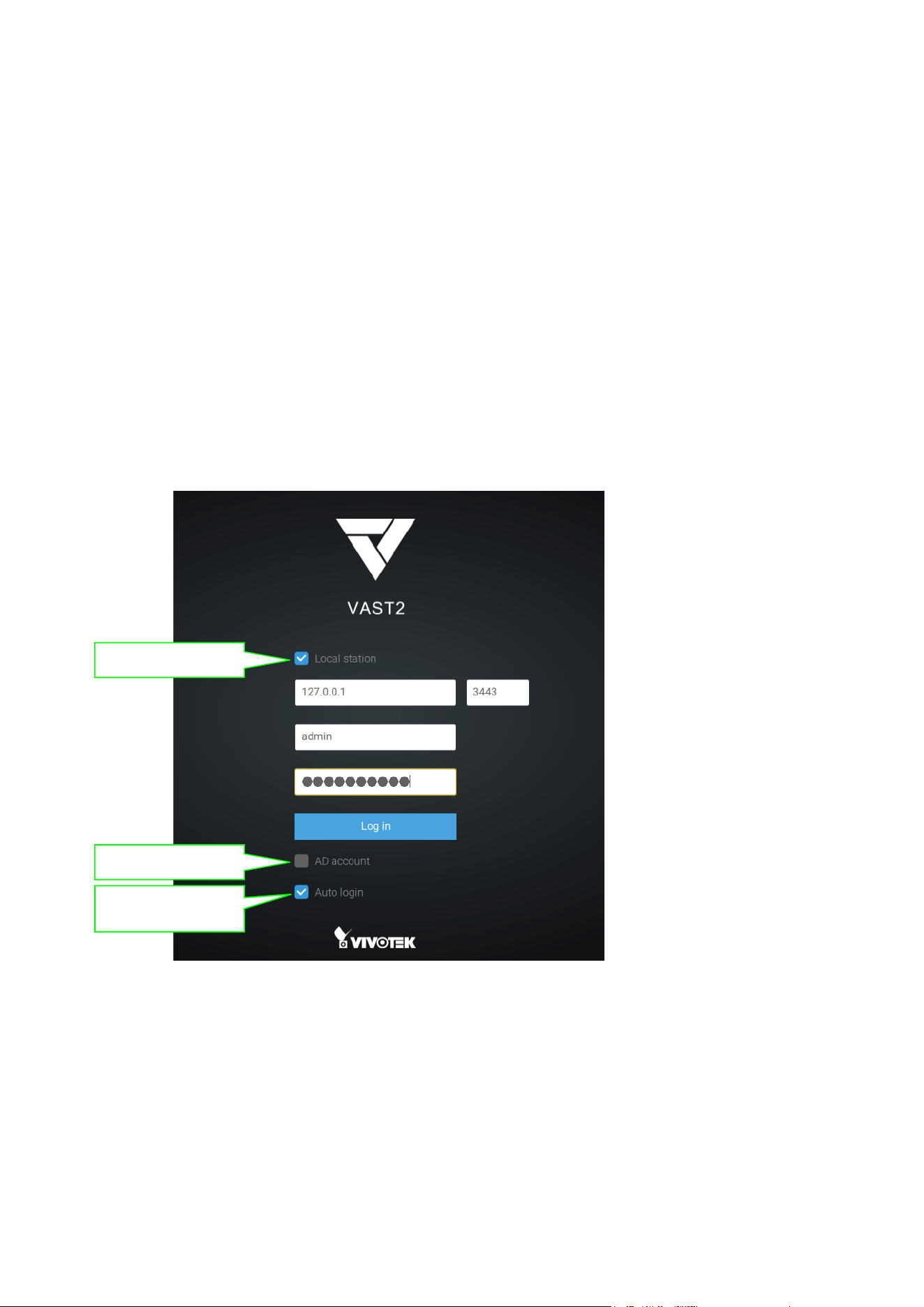
To log in,
1. Enter the server's IP address and TCP port number (3443 as the default). If logging in
from the server itself, you can select the Local station checkbox.
2. Enter the credentials for login. The credentials were created during the installation.
3. You can use an existing AD ccount for login. See page 197 for user management and AD
count configuration.
4. Auto login: After you enter the credentials for the first time, the server will not prompt for
credentials the next time you start the VAST software.
Login from the local machine
using a loop-back address
login using an existing AD
account
Automatically login after the
first time you entered the cre-
dentials

9
Introducing VAST2
VIVOTEK VAST2 is the professional video / central management software designed for
managing all VIVOTEK IP surveillance products with intuitive functions and numerous
features. It supports hundreds of cameras and stations in a hierarchical structure of
system for monitoring, recording, playback and event trigger management with ease-of-
use and efficient control.
VAST2 integrates VIVOTEK network cameras to provide diverse solutions and applications,
with the cameras for uninterrupted video recording, Smart Search II, Smart VCA, and
Cybersecurity management solution. VAST2 performs remote management with full range
of the server & client structure and constitutes a robust system for various applications,
such as stores, banking and the public space.
New Features
• Smart Search II Plus: Dynamic Forensic Search
- Line Crossing: Detection of crossing a user-defined line and direction
- Loitering: Detection of Loitering in an area for a configurable stay time.
- Intrusion: Detection of intrusion into a zone or leaving from a zone.
• Smart Tracking: Speed Dome's People Tracking.
• Live Multicast: Reduced network traffic and optimized bandwidth usage.
• CMS Failover: 1+1 redundancy for Central Management server.
• Data Overlay on screen.

10
* The number of linked devices will depend on the number of licenses you purchased.
* The ability to extend devices is also subject to the network bandwidth and computer performance.
Key Features
• License plate recognition solution and data magnet
• Cybersecurity Management Solution
• Smart VCA: AI Powered Video Analytics
• System Overview dashboard
• Multi-sensor display modes
• Evidence Lock: Automatically Bookmark Related Recordings When Alarm Triggered.
• Evidence Export: Manually Export Video Recordings or Alarm Clips.
• New Matrix for Video Wall Solution
• Automatic Problem Feedback Mechanism
• Multiple Fisheye Dewarp Modes
• Add-on Solutions: Failover, Transportation, Transaction and Data Magnet

11
Charged Add-on Features
The following are the charged add-on features. These features will not be available unless
you purchase and enable their individual licenses:
Transportation License:
• Users have the need to show their mobile server on the Google map.
• Users can use generic GPS device or VIVOTEK's mobile NVR (w/ a built-in GPS)
• We only support IP-based generic GPS.
POS Implementation:
• We provide the following for POS integration:
• Live view with transaction data.
• Playback with transaction data.
• Search using keyword.
• Highlights specific product item name.
Data Magnet License:
• Data Magnet is used for integration with 3rd party data source. For example, POS data,
access control, ATM data, LPR data, etc.
• We provide the following for Data Magnet integration:
• Map the data to specific cameras.
• Searching 3rd party data using keywords.
• Show data with live view.
• Set up alarms using 3rd party data.
• Highlight specific keyword or value.
Failover License (substations):
• We support M x N structure.
• The CMS station will be the main station for controlling and monitoring all of the active
and redundant servers.
• The Failover license (substations) needs to be imported on the CMS server.
Failover License (CMS):
• We support 1 x 1 redundancy for the CMS station.
• The failover license (CMS) needs to be imported on a CMS server.
12
Advanced Feature License:
• Advanced License list:
• Transportation package: Google map / GPS.
• POS terminal.
• Failover (Substations)
• Failover (CMS)
• TCP message
• Data Magnet license.
NOTE:
1. Failover license cannot be used on hardware dongle.
2. The related configuration pages/menus will still be available even the license has not
been activated.
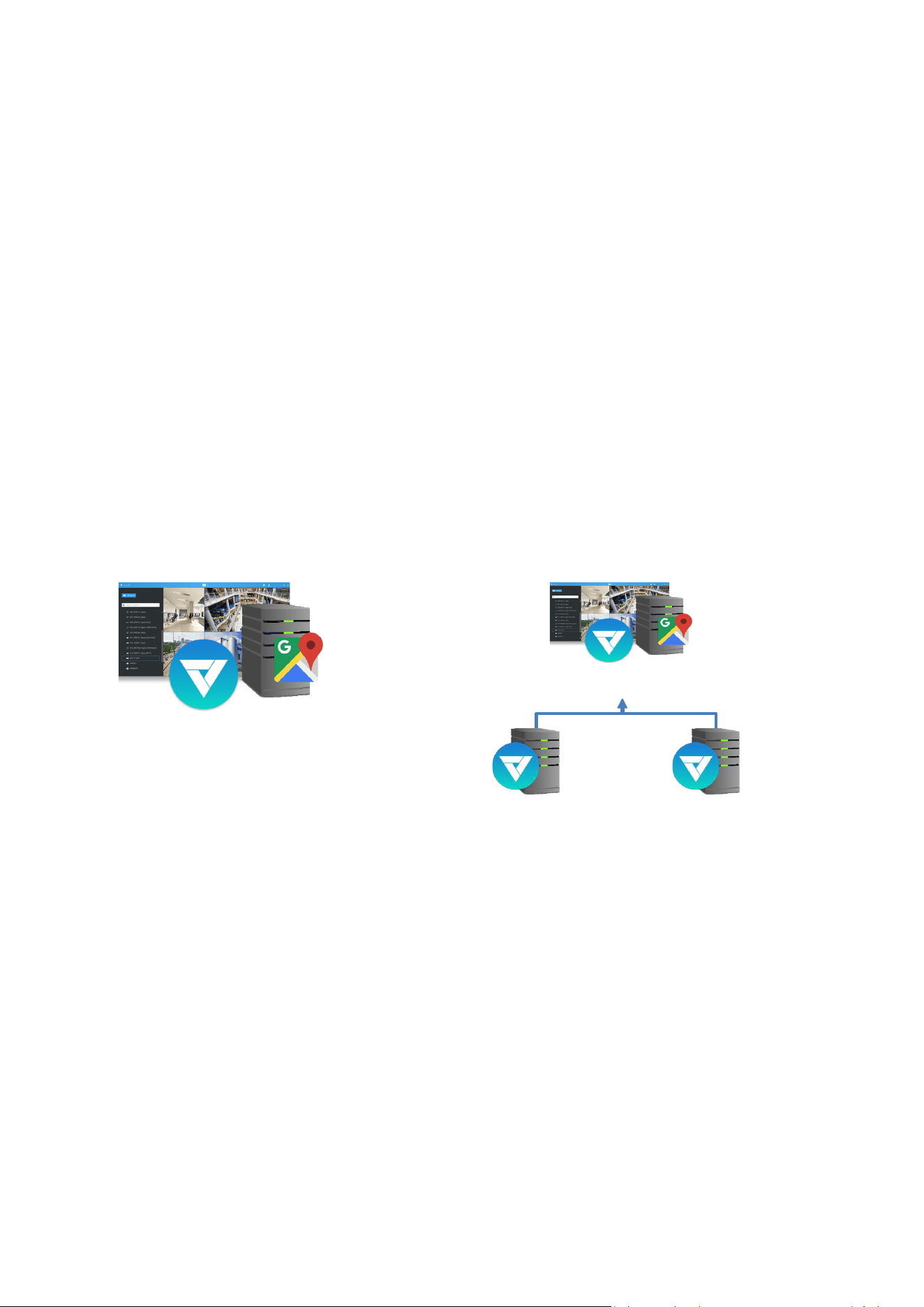
Calculation - Transportation Package: Google map + GPS
Single Server (50)
Substation
(46)
Substation
(32)
CMS
(50)
Total no. of cameras: 50
Needs 50 packages.
NOTE: camera normal usage
licenses are included.
Total no. of cameras: 50 + 32 + 46 = 128
Needs 128 packages.
NOTE: camera normal usage licenses are
included.
13
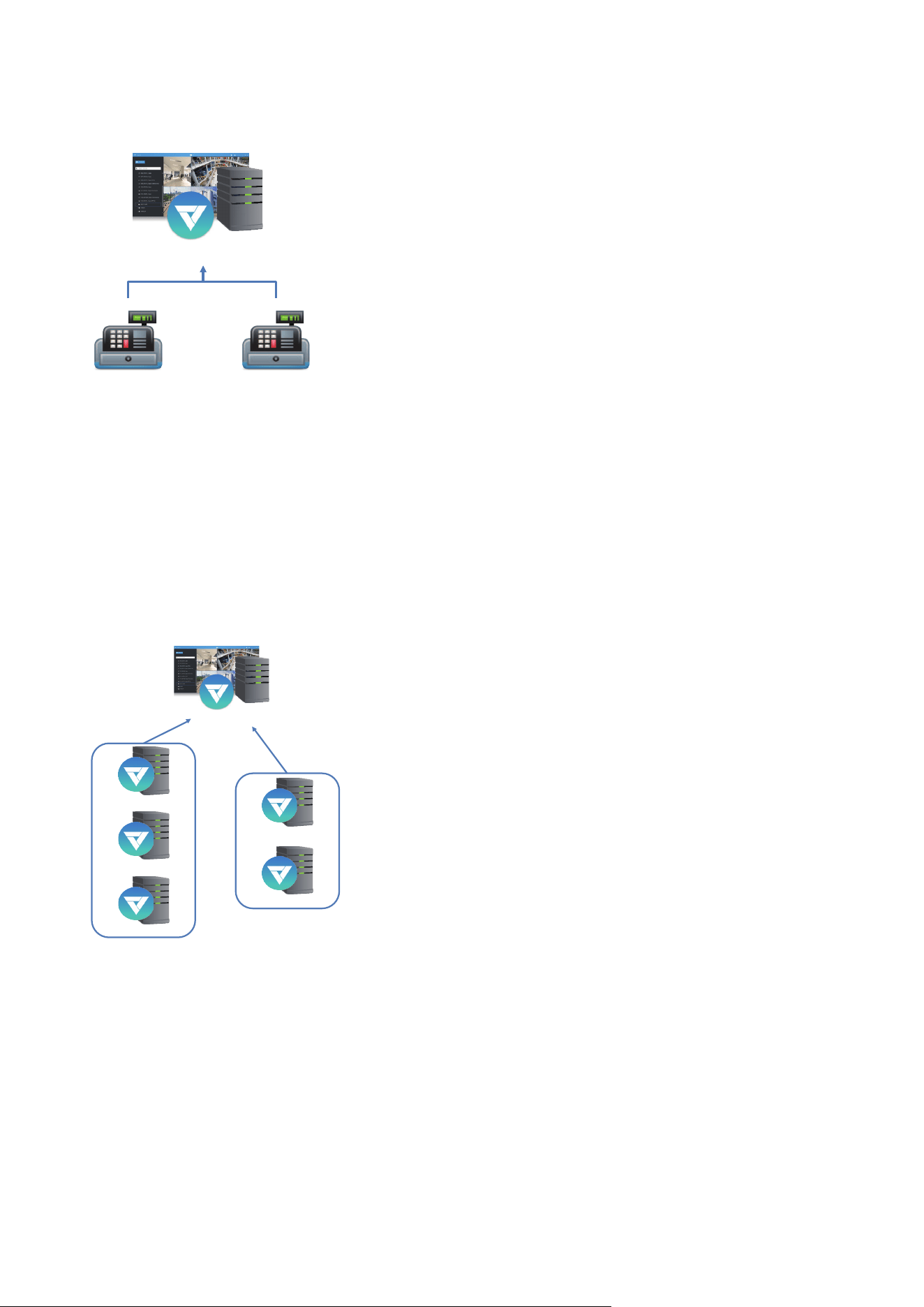
Calculation - POS License
Single Server (50)
POS 1 POS 2
Total no. of POS terminals: 2
Total no. of cameras: 50
Needs 2 POS licenses and 18 [50 - 32(free)] camera licenses.
NOTE: 32 camera channels are for free.
Calculation - Failover (Substations) License
CMS
Ac�ve Server
(32)
Ac�ve Server
(40)
Ac�ve Server
(50)
Redundant Server
Redundant Server
Channels on each active server: 32, 40, 50
No. of redundant servers: 2
Total no. of cameras: 122 (32 + 40 + 50)
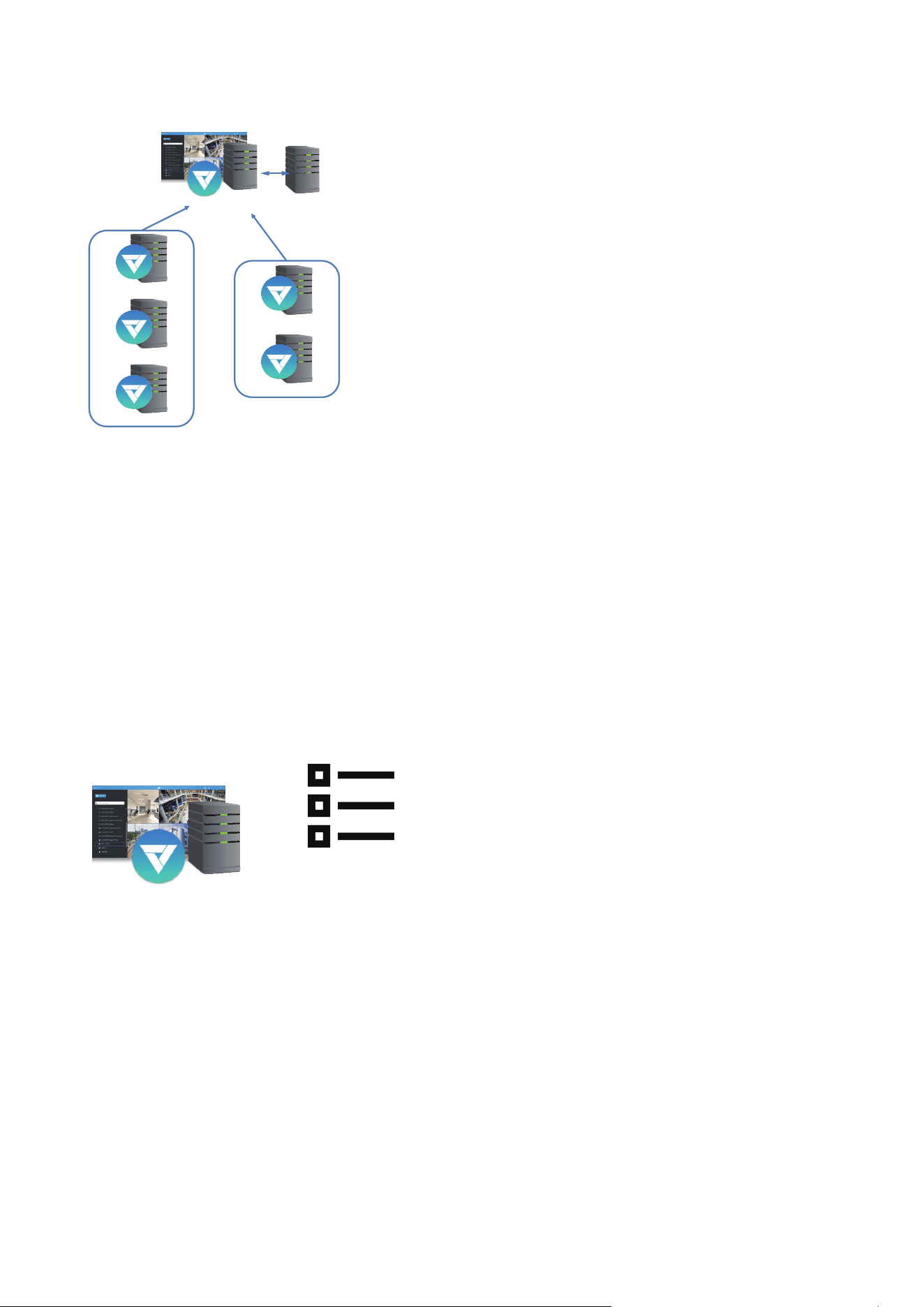
Needs 100 Failover (Substations) licenses (50 x 2), and 90 normal camera licenses (122
- 32).
NOTE: 32 camera channels are for free. These licenses do not come with hardware
dongle.
Rule:
No. of channels on the active server hosting the
largest no. of cameras x the no. of redundant
servers.
14
Calculation - TCP Message License
Single Server
(32)
Alarm list (50)
• 10 TCP messages
• 20 camera moon
• 20 DI trigger
Total no. of cameras: 32
Total instances of Alarm: 50
The no. of other triggering sources: 40
Needs 10 TCP Message licenses, and 0 for normal camera licenses (32 - 32).
NOTE: 32 camera channels are for free.
Rule:
The no. of licenses depends on how many
alarm rules are using TCP Message as the
triggering source.
Calculation - Failover (CMS) License
CMS
Ac�ve Server
(32)
Ac�ve Server
(40)
Ac�ve Server
(50)
Redundant Server
Redundant Server
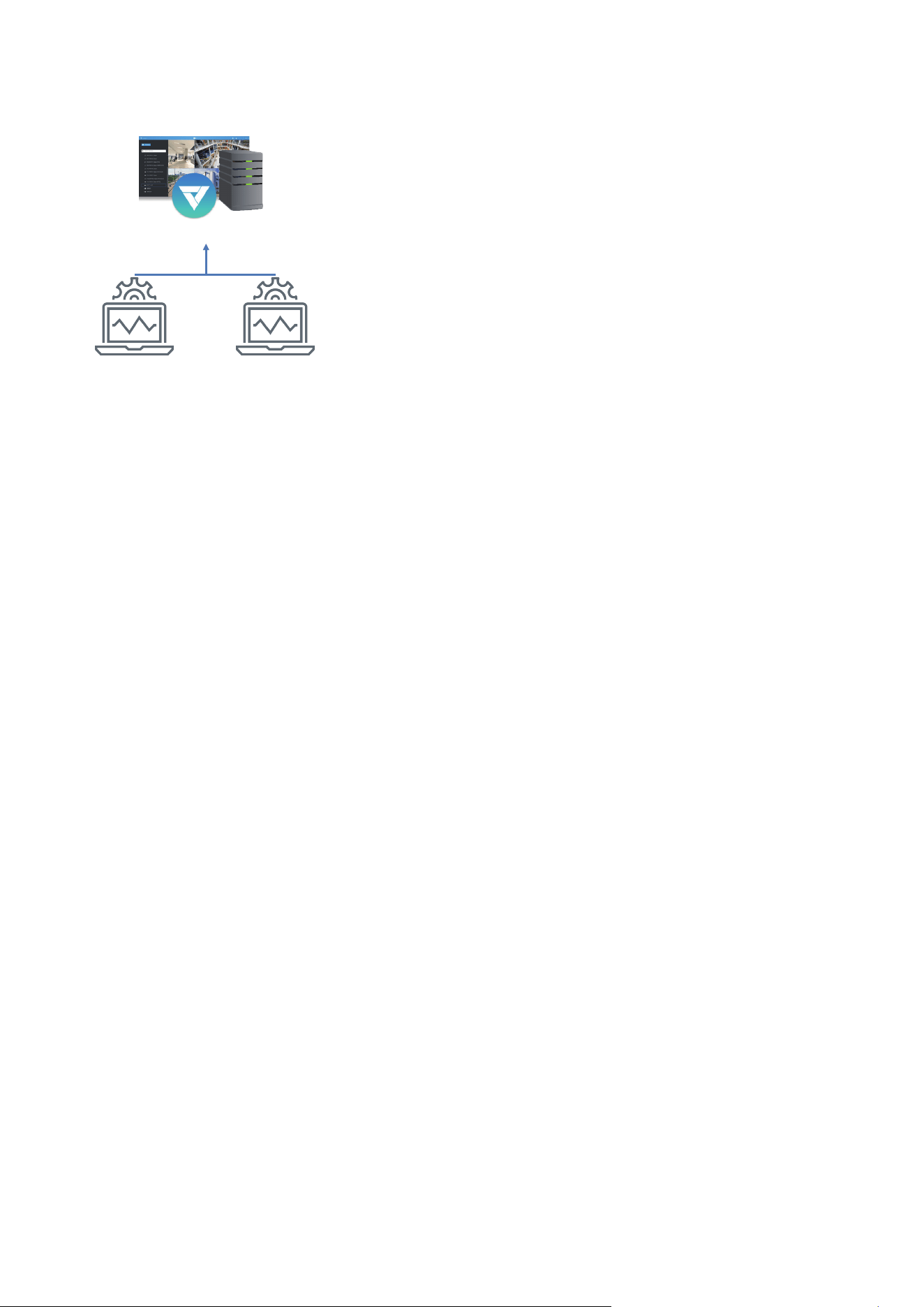
CMS redundant
Rule:
Adding a CMS redundant server requires a Failover
(CMS) license.
15
Calculation - Data Magnet License
Single Server
(50)
3
rd
party SW 3
rd
party SW
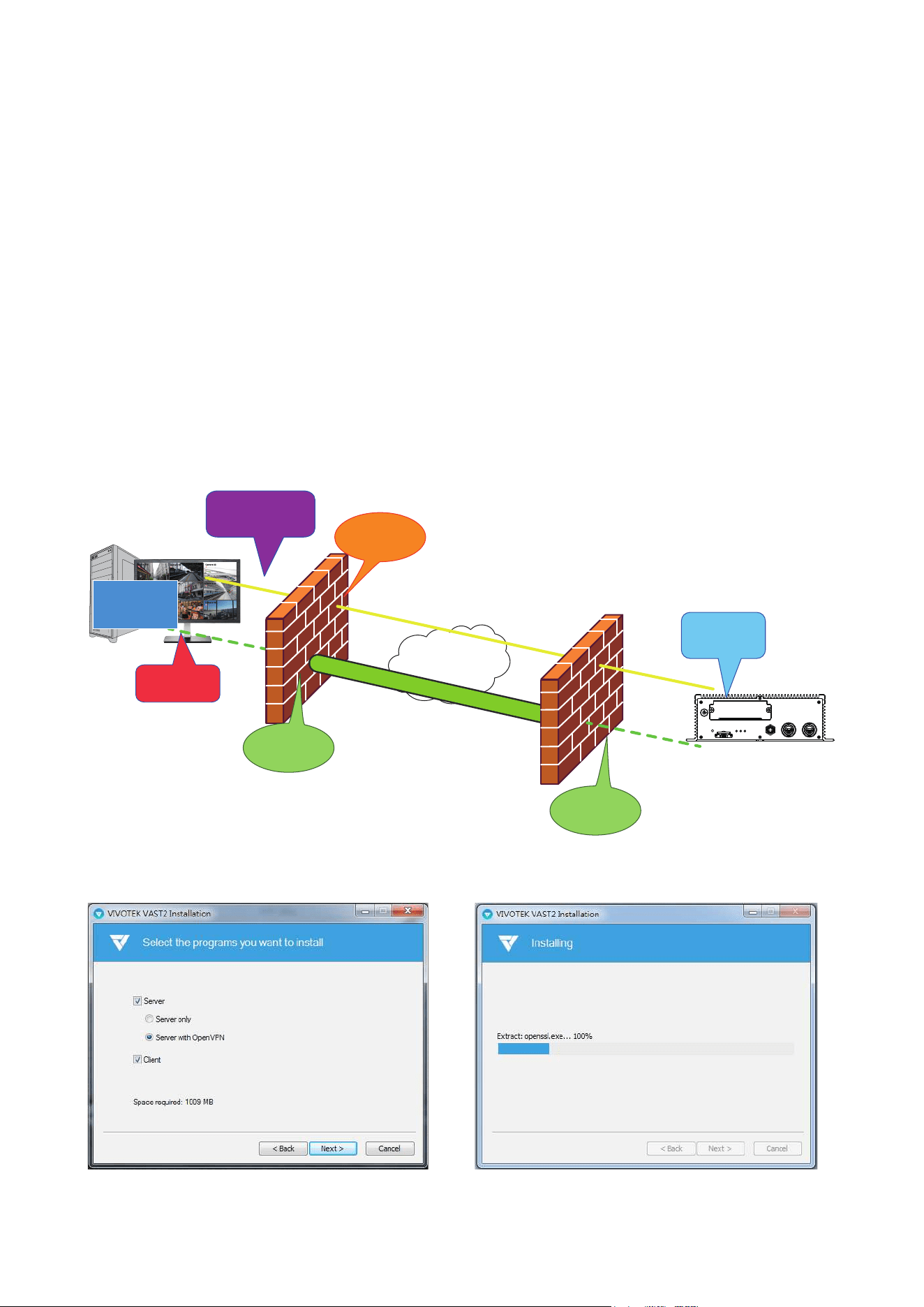
Total no. of Data Magnet sources: 2
Total no. of cameras: 50
Needs 2 Data Magnet licenses, and 18 normal camera licenses (50 - 32).
NOTE: 32 camera channels are for free.
Rule:
The no. of licenses depends on how many
Data Magnet sources are implemented.
16
Installation Option -
OpenVPN
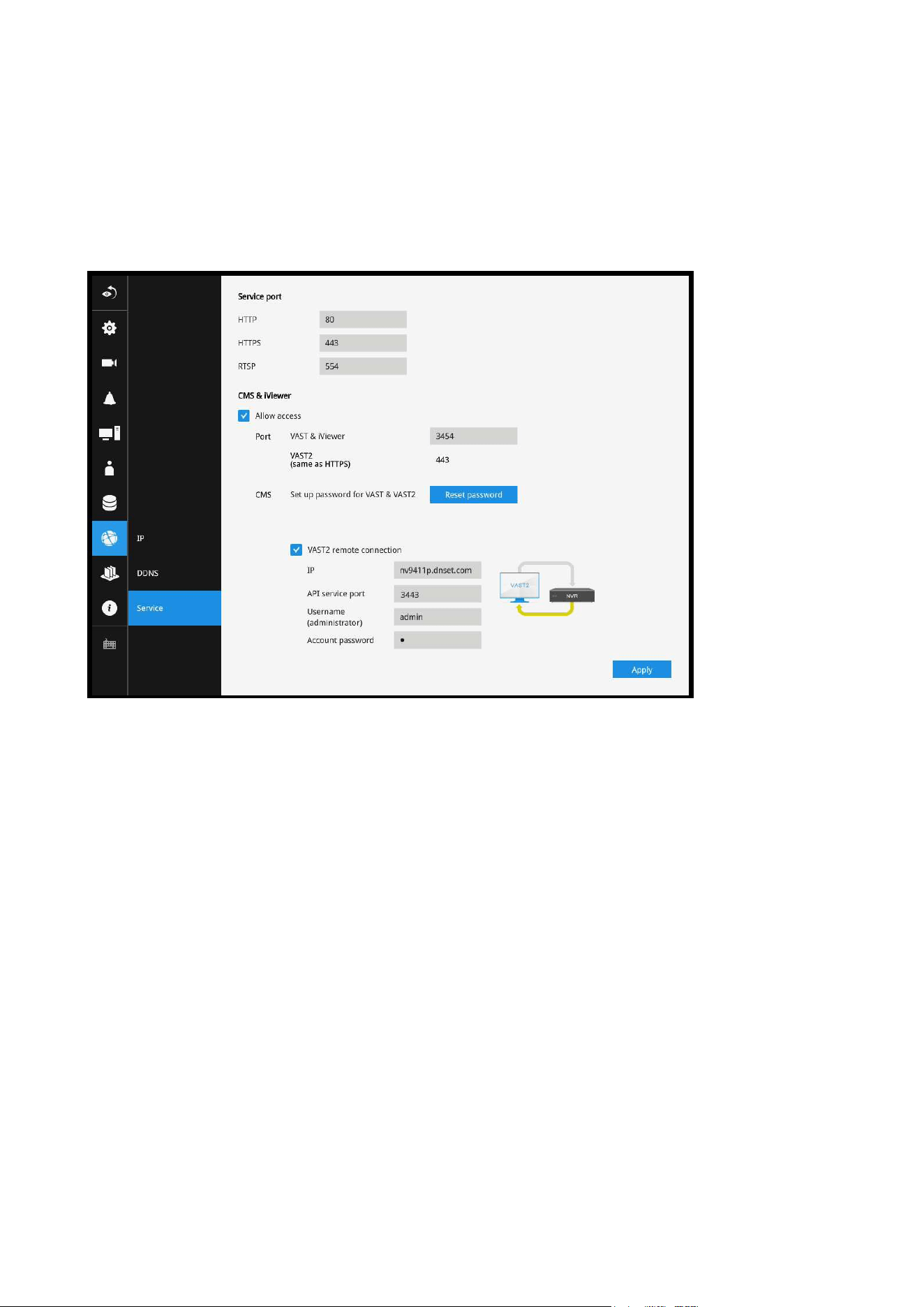
NAT-traversal with OpenVPN
You can select the "VAST Server with OpenVPN" option when installing the VAST server. A
remote connection from NVR via a 3G/4G/LTE network can be made through an OpenVPN
tunnel. When the OpenVPN option is selected, an OpenVPN server will be installed with the
VAST server.
HMAC authentication and TLS encryption over an encrypted UDP connection are made ef-
fortlessly using the traversal methodology.
The sample installation screens are shown below:
VAST
Camera 01
Camera 02
Camera 03
Camera 04
Camera 06
Camera 05
Camera 07
Camera 08
Camera 09
Internet
HTTPS connection
OpenVPN tunnel
Port
Forwarding
Establish
VPN tunnel
Port
Forwarding
Register
Substation
Fetch CA/
Cert/Key
RESTful
API Server
Tunnel
message
NVR
Default port:
3443
Default port: 3939

17
The NVR runs an OpenVPN client that makes remote connection via the RESTful
(Repretational State Transfer) API (Application Programming Interface) service to a VPN-
enabled VAST server running on the remote site. The applicable service port number
ranges from 1 to 65534. The default is port #3443. The NVR automatically registers with
CA cert key and becomes a VAST sub-station over a VPN tunnel. Once set, the VAST2 can
automatically connect the NVR.
Note that on the side of the VAST server making connection via the OpenVPN, the server/
client configuration should be properly configured. On the mobile NVR, a proper gateway
setting should be made for VPN connection.
For the server configuration, the configuration file is placed in:
C:\Program Files (x86)\VIVOTEK Inc\VAST\Server\OpenVPN\config\server\server.ovpn
You can edit your VPN IP subnet parameters according to your network configuration. The
contents of the editable text file looks like this:
port 3939
proto udp
dev tun
ca ca.crt
cert server.crt
key server.key
dh dh.pem
server 10.6.0.0 255.255.0.0
topology subnet
client-to-client
client-config-dir "C:\\Program Files (x86)\\VIVOTEK Inc\\VAST\\Server\\OpenVPN\\ccd"
keepalive 10 30
cipher AES-256-CBC
max-clients 50000
persist-key
persist-tun
status openvpn-status.log
log-append openvpn.log
verb 3
mute 20
sndbuf 262144
rcvbuf 262144
tls-server
Note that the NVR and VAST server should have a similar time setting when exchanging
certificate information. Otherwise, the mutual handshake authentication process may fail.
18
Enter the OpenVPN DNS domain name and the credentials on the NVR network service
configuration page.
A public IP or domain name must be configured on the VAST server for the access through
the Internet. The IP or domain name can contain alpha-numeric characters [0-9][a-z][A-Z][-].
[-] can not be the beginning or the ending character.
19
Chapter 1 Basics:
Control and Elements
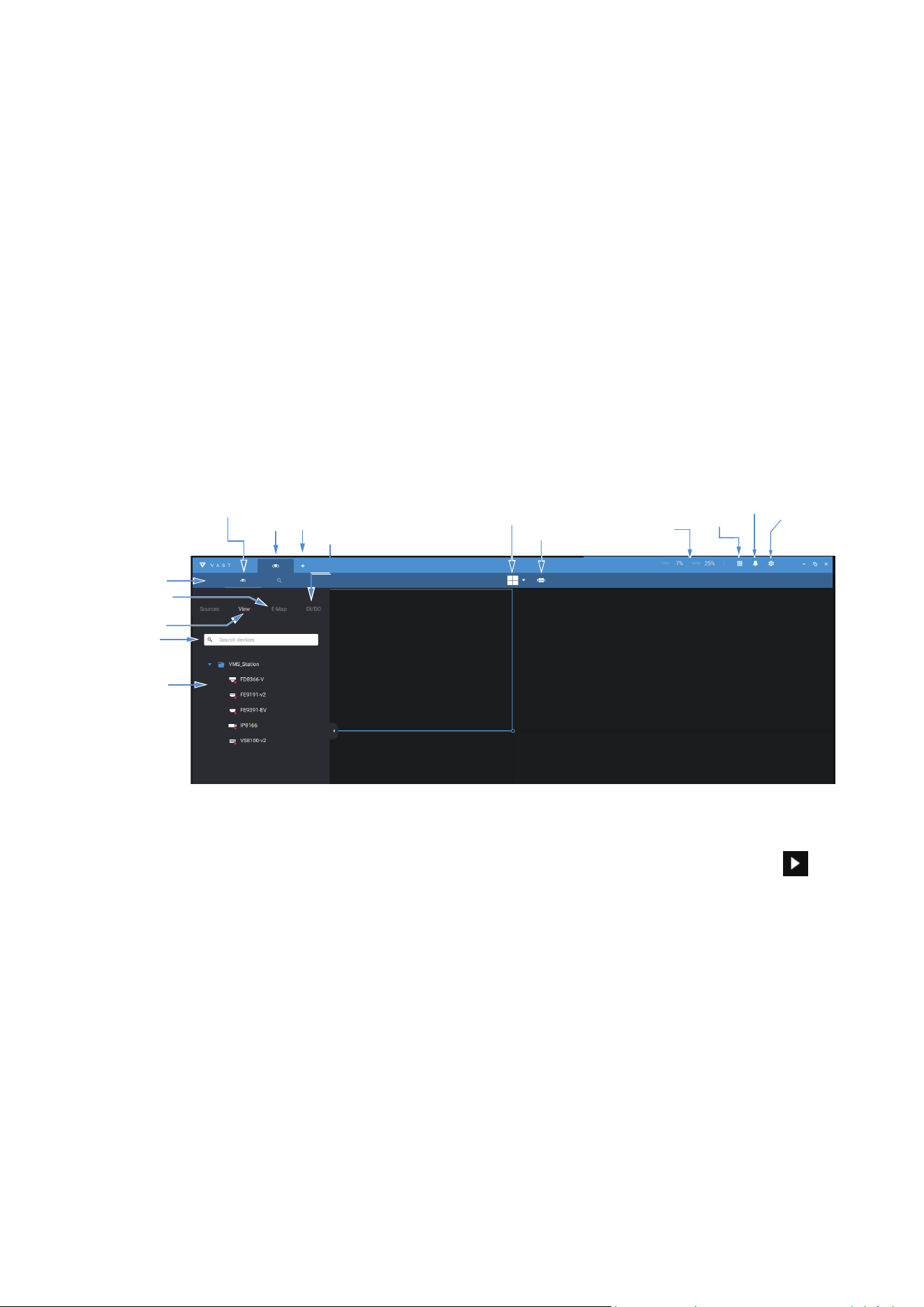
The basic screen elements of VAST live view, playback, and search pane are shown below:
Live view
DI/DO
LiveView
Layout
Tabs
Camera tour
Hide Pane
Bu�on
View
View Cell
Device Tree
Search
View
configura�on
Se�ngs
System
resources
Applica�ons
Alarm
list/search
New
Tab
E-Map
Playback is evoked when a view cell is selected, and you click the Playback button on
the upper right of the view cell.
20
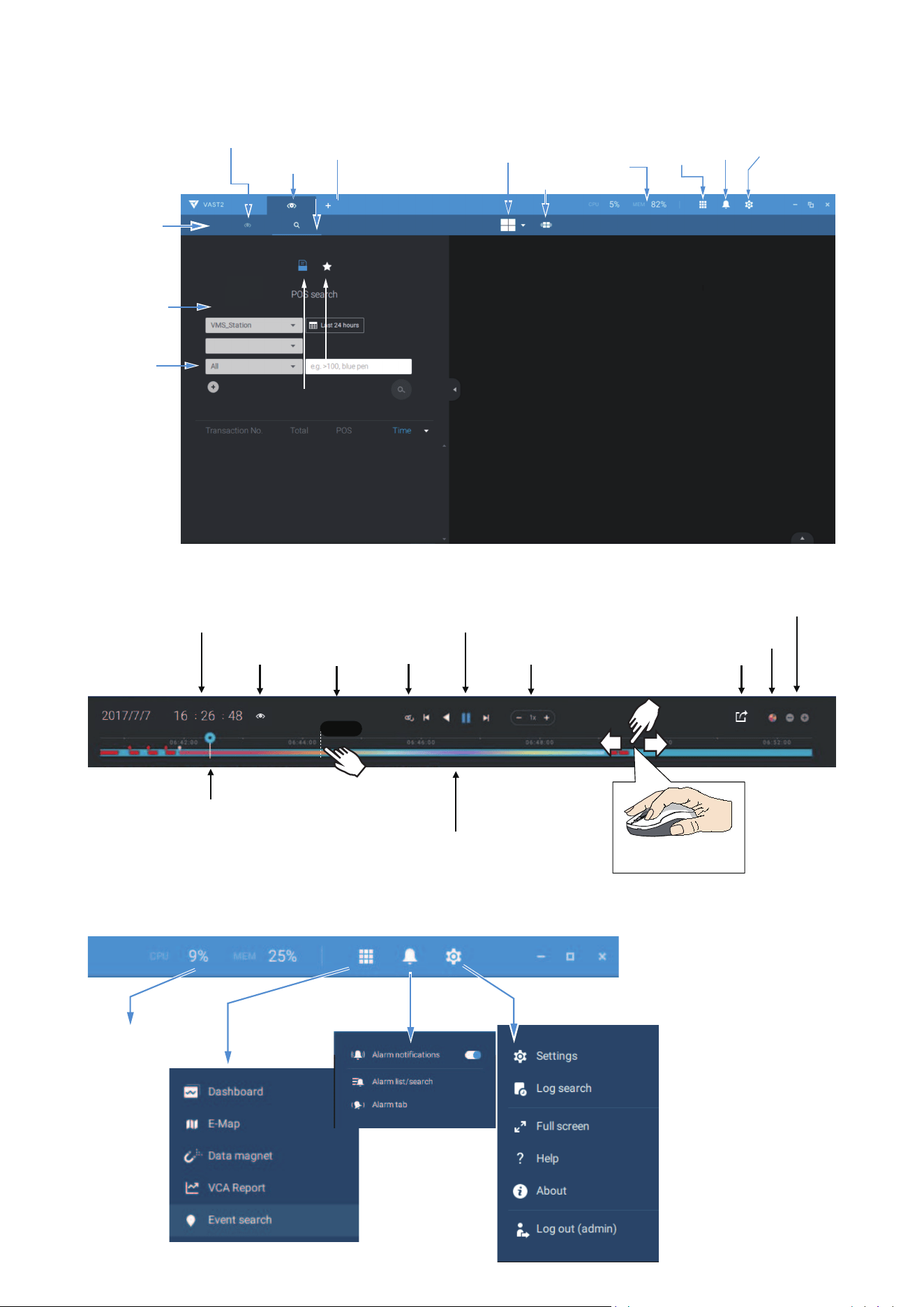
Search Pane
Playback Control
Hide Pane
Buon
Search pane
LiveView
Layout
Tabs
View
Search
POS
Bookmark
Camera tour
Time selector
Sengs
System
resources
Applicaons
Alarm
list
Histogram
Adjustment
Export
Speed Control
Playback Timeline & Histogram
Playhead
Synchronous
Playback Control Buon
Time Search
Events
Highlights
06:44:23
Mouse-over
indicator
Return to Live
Drag to move along
meline
Top Tool Bar
Se�ngs
Applica�ons
Alarm
System
Resources
21
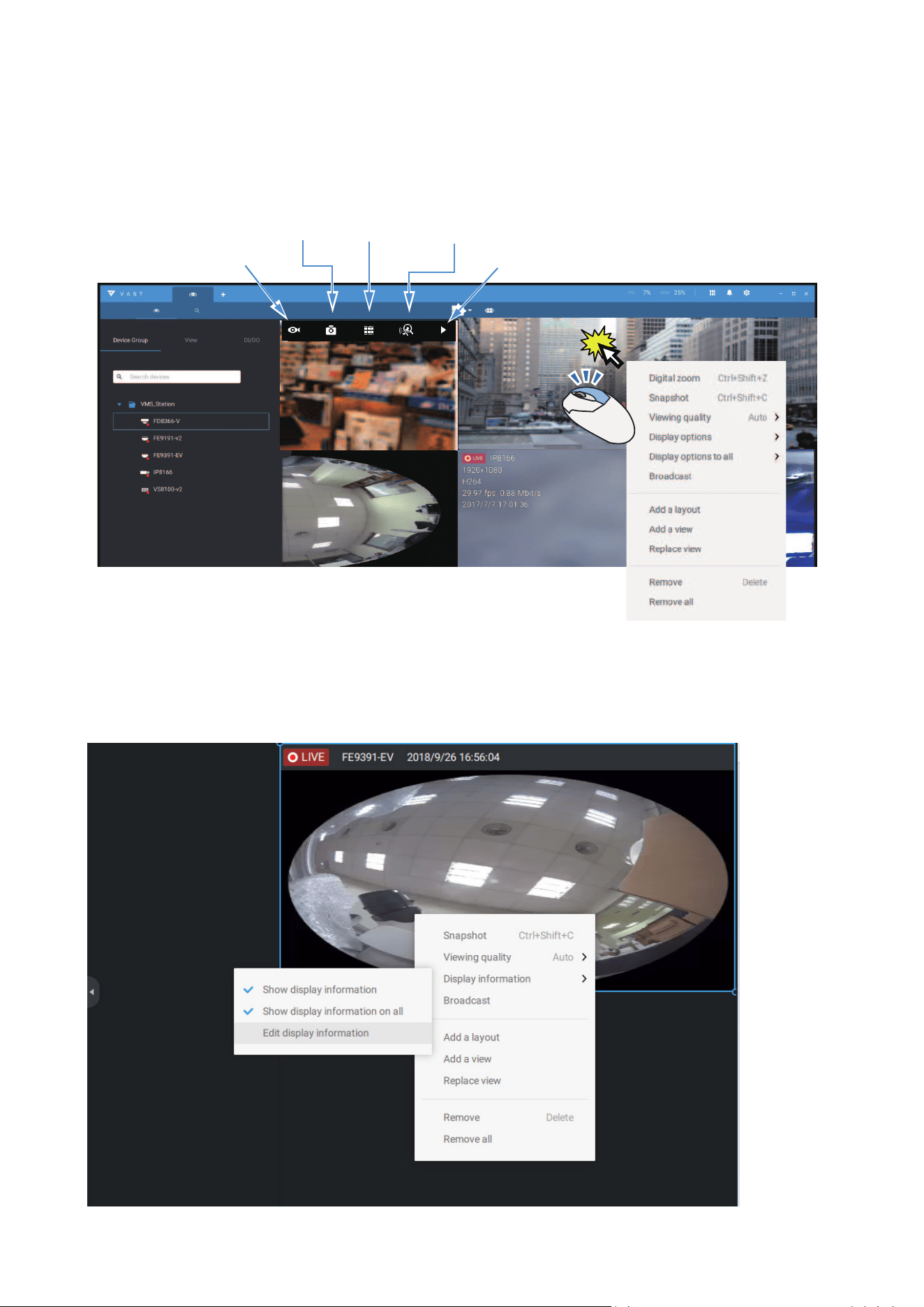
View cell control
Some controls and functions are available when a view cell is selected or via the right-click
menus.
Smart
Search II
Snapshot
Thumbnail
Search
Camera-specific
Playback
Text overlay
Single-click to select a view cell, right-click and select Display information. The Edit display
information tab will appear.
22
Two Way Audio
If your cameras support the Two Way Audio feature and the microphone and audio output to
an amplified speakers have been connected, you can right-click on the camera to display the
Broadcast function. Click on the Microphone icon in the middle to start speaking. Click again
to stop the Two Way Audio.
Note that the Broadcast option only appears when you select a camera that supports the
Two Way Audio feature. Currently the VAST2 software supports 1 to 1 broadcast.
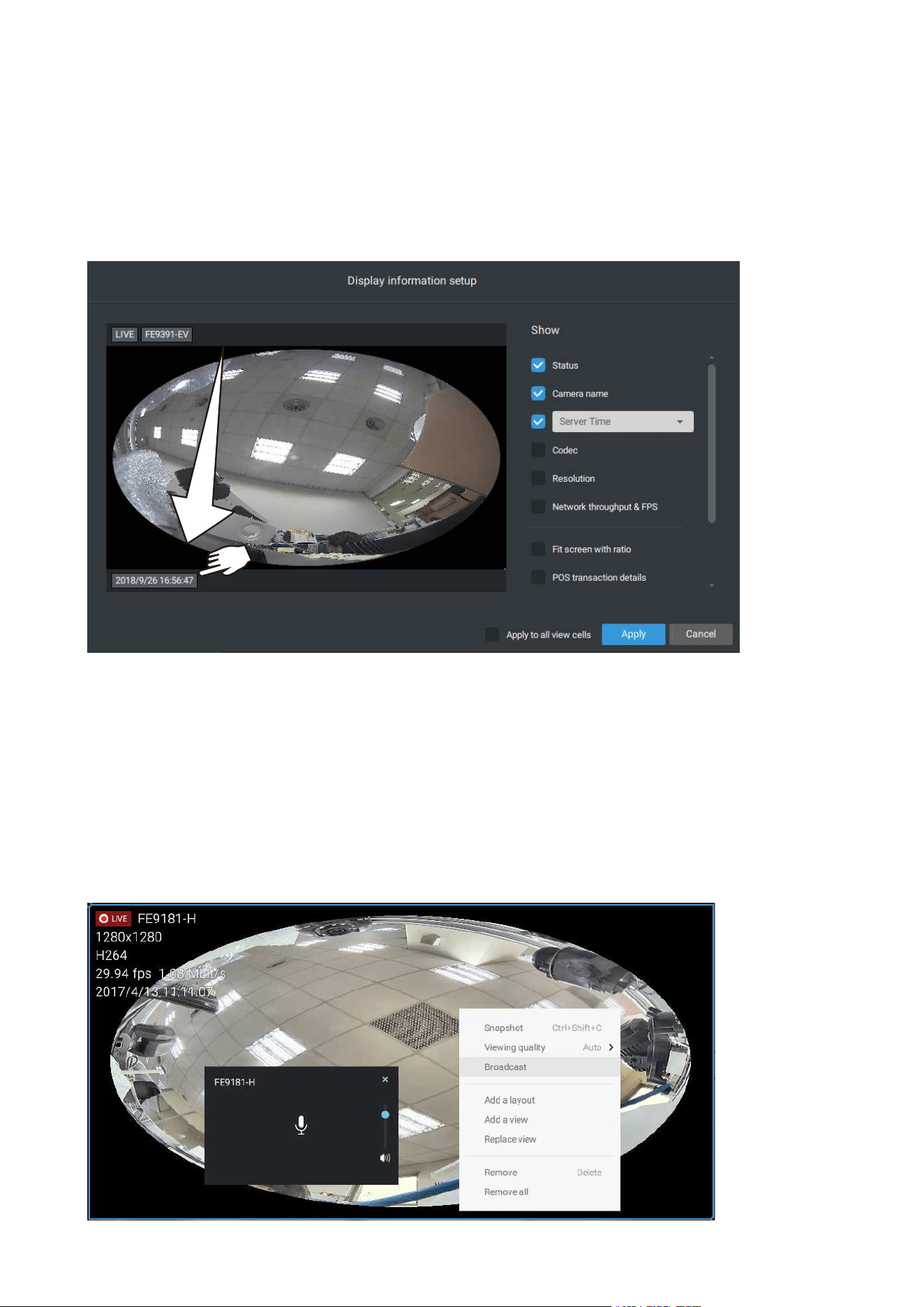
Select the checkboxes to determine what kind of text overlay will display on view cells.
Note that you can place the overlay either on top or at the lower screen. Simply click and
drag an overlay item to a preferred location. When done, click the Apply button.
You can apply your current configuration to all view cells by selecting the Apply to all view
cells checkbox. Note that you can also display the VCA rules and areas on screen.
23
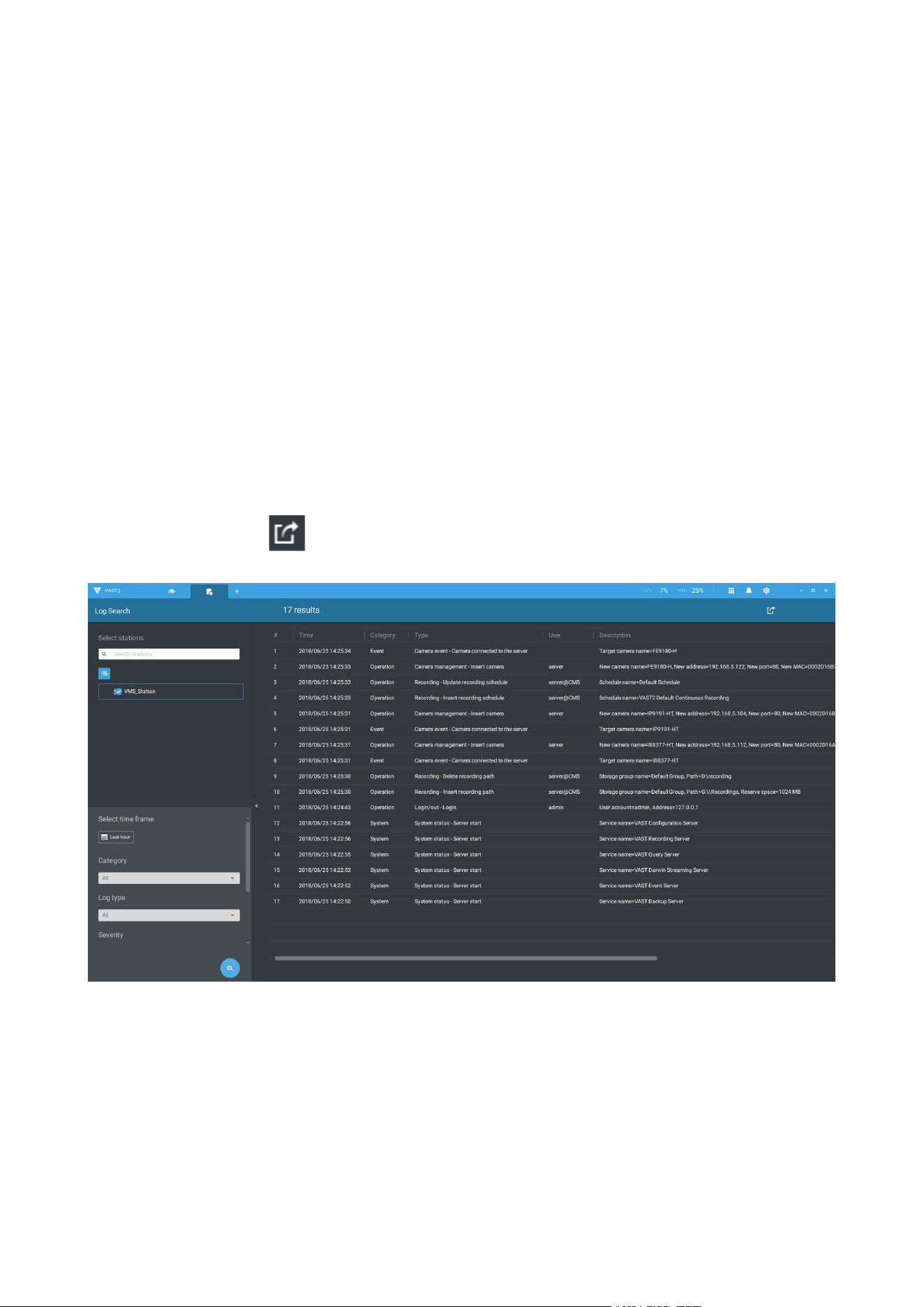
Log Search
System logs can be found via the tool bar tab. All system events will be listed in the Log
search panel. If you have multiple server, substations, select a server. You can search
specific events by the event types (All triggers, camera, system/site, external devices), or by
the time of occurrence using the calendar tool.
Use the Export button to export the system log as an individual log file.
Full Screen
The full screen function maximizes the display of view cells, concealing all other tool bar or
navigation panels. To return to the normal view, press the ESC key on keyboard.

24
Log Level
Minor:
:
Level 6~
~
8
Normal:
:
Level 3~
~
5
Major:
:
Level 1~
~
2
Operation
V
V
A
A
S
S
T
T
2
2
T
T
y
y
p
p
e
e
L
L
o
o
g
g
T
T
y
y
p
p
e
e
I
I
D
D
L
L
e
e
v
v
e
e
l
l
S
S
a
a
m
m
p
p
l
l
e
e
E
E
x
x
t
t
r
r
a
a
P
P
a
a
r
r
a
a
m
m
e
e
t
t
e
e
r
r
s
s
L
L
o
o
g
g
i
i
n
n
/
/
o
o
u
u
t
t
Login
1
3
User Account=admin, Address=127.0.0.1 User account Address
Logout
2
3
User Account=admin, Address=127.0.0.1 User account Address
U
U
s
s
e
e
r
r
Insert user 101
4
New User Name=guest, New Role=PowerUser, New
Permission=000F01013F0201070307FFF6F77EFD4E00
New User Name New Role New
Permission
Update user
password
104
5
Target User Name=guest Target User Name
Update user
privilege
105
5
Target User Name=guest, Target Role=PowerUser, Target
Permission=000F01013F0201070307FFF6F77EFD4E00,
New User Name=guest, New Role=PowerUser, New
Permission=000F01013F0201070307FFF6F77EFD4E00
Target User Name Target
Role
Target
Permission
New User
Name
New Role New
Permission
Delete user 106
3
Target User Name=guest Target User Name
Update user
expiration
107
5
Target User Name=guest Target User Name
S
S
i
i
t
t
e
e
Insert station 201
4
New Station Name=VMS_Station, New
Address=172.18.60.31, New Port=3454, New UseSSL=0,
New RTSP Port=3454, New Station
ID=S_{6312FAC9-FCF4-4573-964D-5F03D083BE54}
New Station Name New
Address
New Port New
UseSSL
New RTSP
Port
New Station
ID
Update
station
information
202
5
Target Station
Name={6312FAC9-FCF4-4573-964D-5F03D083BE54},
Target Address=172.18.60.31, Target Port=3454, Target
UseSSL=0, Target RTSP Port=3454, New Station
Name={6312FAC9-FCF4-4573-964D-5F03D083BE54},
New Address=172.18.60.31, New Port=3443, New
UseSSL=1, New RTSP Port=3443
Target Station
Name
Target
Address
Target Port Target
UseSSL
Target
RTSP Port
New Station
Name
New
Address
New Port
New
UseSS
L
New
RTSP
Port
Update
station name
203
5
Target Station Name=VMS_Station, New Station
Name=CMS
Target Station
Name
New
Station
Name
Delete station
204
3
Target Station Name=VMS_Station, Target Station
ID=S_{6312FAC9-FCF4-4573-964D-5F03D083BE54}
Target Station
Name
Target
Station ID
Set relay
settings
1716
5
Enable=true Enable
Station
enable
multicast
2416
5
Station name=VMS_Station Station name
Station
disable
multicast
2417
5
Station name=VMS_Station Station name
CC
a
a
m
m
e
e
r
r
a
a
Insert camera
205
4
New Camera Name=Door, New Address=172.18.1.129,
New Port=80, New MAC=0002D11CC24E, New HTTPS
Port=443, New Recording Stream=1
New Camera Name New
Address
New Port New MAC New
HTTPS
Port
New
Recording
Stream
Update
camera
information
206
5
Target Camera Name=Door, Target Address=172.18.1.129,
Target Port=80, Target MAC=0002D11CC24E, Target
HTTPS Port=443, Target Recording Stream=1, New Camera
Name=IP8362, New Address=172.18.1.129, New Port=80,
Target Camera
Name
Target
Address
Target Port Target
MAC
Target
HTTPS
Port
Target
Recording
Stream
New
Camera
Name
New
Address
New
Port
New
MAC
New
HTTP
S Port
New
Reco
rding
Strea

25
New MAC=0002D11CC24E, New HTTPS Port=443, New
Recording Stream=1
m
Delete
camera
208
3
Target Camera Name=IP8362 Target Camera
Name
Set digital
output
701
4
Target Camera Name=IP8362 Target Camera
Name
Set DI/DO
name
1715
5
Target Camera Name=IP8362, Target Device=, Reference
Name=Alarm
Target Camera
Name
Target
Device
Reference
Name
Enable
multicast
2414
5
Camera name=SD8362 Camera name
Disable
multicast
2415
5
Camera name=SD8362 Camera name
I
I
/
/
O
O
d
d
e
e
v
v
i
i
c
c
e
e
Insert
External
Device
1151
4
Device Name=ADAM-6052, Device Host=172.18.60.70,
Device Port=502
Device Name Device
Host
Device Port
Remove
External
Device
1152
3
Device Name=ADAM-6052, Device Host=172.18.60.70,
Device Port=502
Device Name Device
Host
Device Port
Update
External
Device
1153
5
Device Name=ADAM-6052, Device Host=172.18.60.70,
Device Port=502
Device Name Device
Host
Device Port
Set digital
output
1154
2
Device Name=ADAM-6052, DO Index=8, Status=Trigger Device Name DO Index Status
R
R
e
e
c
c
o
o
r
r
d
d
i
i
n
n
g
g
Manually
begin
recording
301
2
Target Camera Name=IP8362 Target Camera
Name
Manually
302
2
Target Camera Name=IP8362 Target Camera
stop
recording
Name
Set recording
storage
401
4
Storage Group Name=Office Storage Group
Name
Insert
recording
schedule
402
4
Schedule Name=Working Time Schedule Name
Update
recording
schedule
403
5
Schedule Name=Working Time Schedule Name
Delete
recording
schedule
404
3
Schedule Name=Working Time Schedule Name
Insert storage
group
411
4
Storage Group Name=Office, Cycle=True Storage Group
Name
Cycle
Update
storage group
412
5
Storage Group Name=Office, Cycle=True Storage Group
Name
Cycle
Delete
storage group
413
3
Storage Group Name=Office Storage Group
Name
Insert
recording
path
414
4
Storage Group Name=Office, Path=E:\recording, Reserve
Space=90112 MB
Storage Group
Name
Path Reserve
Space
Update
recording
path
415
5
Storage Group Name=Office, Path=E:\recording, Reserve
Space=102400 MB
Storage Group
Name
Path Reserve
Space
Delete
recording
416
3
Storage Group Name=Office, Path=E:\recording Storage Group
Name
Path

26
path
Insert camera
to the storage
group
417
4
Storage Group Name=Office, Camera Name=IP8362 Storage Group
Name
Camera
Name
Delete
camera from
the storage
group
419
3
Storage Group Name=Office, Camera Name=IP8371E Storage Group
Name
Camera
Name
NN
e
e
t
t
w
w
o
o
r
r
k
k
Update server
port
1701
5
Server Name=Web, Port=3455 Server Name Port
Set proxy
server
1702
5
Enable=True, Address=172.18.60.13, Port=80 Enable Address Port
Set UPnP 1703
5
UPnP Port Forwarding Enable=False, UPnP Presentation
Enable=True
UPnP Port
Forwarding Enable
UPnP
Presentatio
n Enable
Set DDNS
server
1704
5
Enable=True, Provider=Dyndns.org(Dynamic) Enable Provider
AA
l
l
a
a
r
r
m
m
Insert alarm
management
408
4
Alarm name=alarm, Trigger list=Motion detection - Motion
window 1 of Network Camera, Action list=Set DO status -
DO-1 of Network Camera
Alarm name Trigger list
Action list
Update alarm
management
409
5
Alarm name=alarm, Trigger list=Motion detection - Motion
window 1 of Network Camera, Action list=Set DO status -
DO-1 of Network Camera
Alarm name Trigger list
Action list
Delete alarm
management
410
3
Alarm name=alarm Alarm name
Stop alarm
sound
2408
7
Alarm name=alarm Alarm name
Close alarm
notification
panel
2409
7
Alarm name=alarm Alarm name
Mute alarm 2411
7
Alarm name=alarm, Duration=10mins, Alarm name
PP
T
T
Z
Z
Camera PTZ,
Iris, Focus,
Pan, Patrol
control
702
7
Target Camera Name=SD9361-EH Target Camera
Name
Click on
image
703
7
Target Camera Name=SD9361-EH Target Camera
Name
Select preset
location
704
7
Target Camera Name=SD9361-EH, Preset Name=Door Target Camera
Name
Preset
Name
BB
a
a
c
c
k
k
u
u
p
p
Update
scheduled
backup
1503
5
Enable=true Enable
LL
i
i
c
c
e
e
n
n
s
s
e
e
Update
license
information
1717
5
(Empty)
SS
y
y
s
s
t
t
e
e
m
m
Create
directory
1705
4
Target Path=E:\test Target Path
Rename
directory
1706
5
Source Path=E:\test, Target Path=E:\recording Source Path Target Path
Delete
directory
1707
3
Target Path=E:\recording Target Path
Update server
database path
3401
3
Old path=E:\clientlogs, Target Path=E:\test
Insert SMTP 1708
4
Target Address=mail.vivotek.tw, Target Port=25, Target Target Address Target Port
Target Order

27
server Order=0
Update
SMTP server
1709
5
Target Address=mail.vivotek.tw, Target Port=25, Target
Order=0, New Address=mail.vivotek.com, New Port=25,
New Order=0
Target Address Target Port
Target Order New
Address
New Port New Order
Delete SMTP
server
1710
3
Target Address=mail.vivotek.tw, Target Port=25, Target
Order=0
Target Address Target Port
Target Order
Insert
network
storage
1711
4
Target Host=rd2fs, Target Domain=vivotek Target Host Target
Domain
Update
network
storage
1712
5
New Host=rd2fs, New Domain=vivotek, Target Host=rd2fs,
Target Domain=vivotek
New Host New
Domain
Target Host Target
Domain
Delete
network
storage
1713
3
Target Host=rd2fs, Target Domain=vivotek Target Host Target
Domain
Watermark
settings
2418
5
Status=Disable
Status=Enable
Status
Import device
pack
1721
4
Original version=xxxx, New version=ooo Original version New
version
Import device
pack failed
1722
4
Reason=Invalid device pack
Reason=Failed to import device pack
Reason
L
L
i
i
v
v
e
e
Add camera 2402
7
New Camera(s) = C1, Total Camera(s) in View= C1,C2 New Camera(s) Total
Camera(s)
in View
Remove
camera
2403
7
Removed Camera(s) = C1, Total Camera(s) in View= C2 Removed
Camera(s)
Total
Camera(s)
in View
Replace
camera
2404
7
Removed Camera(s) = C1, New Camera(s) = C2,C3 Total
Camera(s) in View= C2,C3
Removed
Camera(s)
New
Camera(s)
Total
Camera(s) in
View
V
V
i
i
e
e
w
w
Add view 2401
5
View Name = View001, Add Camera(s) = C_1 View Name Add
Camera(s)
Delete view 2405
5
View Name = View001, Removed Camera(s) = C_1, C_3 View Name Removed
Camera(s)
Update view 2406
5
View Name = View001, Removed Camera(s) = C_3, Add
Camera(s) = C_1, Total Camera(s) in View= C_1, C_2
View Name Removed
Camera(s)
Add
Camera(s)
Total
Camera(s)
in View
Rename view
2407
5
Old View Name = View001, New View Name = View002,
Total Camera(s) in View= C1, C_2
Old View Name New View
Name
Total
Camera(s) in
View
D
D
a
a
t
t
a
a
m
m
a
a
g
g
n
n
e
e
t
t
Add data
source
2601
4
Name=Lane, Port=1234, Camera name=FE8173 Name Port Camera
name
Update data
source
2602
5
Target name=Lane, Targe port=1234, Target camera
name=FE8173, New name=Lane, New port=4321, New
camera name=IP8362
Target name Targer port
Target
camera name
New name New port New camera
name
Delete data
source
2603
3
Name=Lane Name
Show data 2604
7
Enable=True, Camera name=FE8173 Enable Camera
name
E
E
M
M
a
a
p
p
Add EMap 3201
7
New EMap(s) = /Dessert, Total EMap(s) in View=
/Dessert,/Penguin
New EMap(s) Total
EMap(s) in
View
Delete EMap 3202
7
Removed EMap(s) = /Dessert, Total EMap(s) in View= Removed EMap(s) Total

28
/Penguin EMap(s) i
n
View
Replace
EMap
3203
7
Removed EMaps(s) = /Dessert, New EMap(s) =
/Flower,/Lion Total EMap(s) in View= /Flower,/Lion
Removed EMap(s) New
EMap(s)
Total
EMap(s) in
View
VV
C
C
A
A
R
R
e
e
p
p
o
o
r
r
t
t
Auto update
report
2801
5
VCA Chart Auto Update=true VCA Chart Auto
Update
Auto update
frequency
2802
5
VCA Chart Update Frequency=999 VCA Chart Update
Frequency
MM
a
a
t
t
r
r
i
i
x
x
Assign
component
3001
7
User=admin, assign component=Google map, to
client=WIN-458HOD557IM, screen=1
User name Component
Client name Screen ID
Reset all 3002
7
User=admin, reset all screen to client=WIN-458HOD557IM User name Client
name
PP
P
P
T
T
Z
Z
PPTZ
Control
2410
7
Enable=True, Camera name=FE8173
Event
VV
A
A
S
S
T
T
2
2
T
T
y
y
p
p
e
e
L
L
o
o
g
g
T
T
y
y
p
p
e
e
I
I
D
D
LL
e
e
v
v
e
e
l
l
S
S
a
a
m
m
p
p
l
l
e
e
E
E
x
x
t
t
r
r
a
a
P
P
a
a
r
r
a
a
m
m
e
e
t
t
e
e
r
r
s
s
CC
a
a
m
m
e
e
r
r
a
a
Camera disconnected from
server
1101
2
Target Camera Name=SC8131 Target Camera Name
Camera connected to the
server
1102
2
Target Camera Name=SC8131 Target Camera Name
SS
y
y
s
s
t
t
e
e
m
m
Parent station disconnected 1201
2
Target Station Name=VMS_Station Target Station Name
Parent station connected 1202
2
Target Station Name=VMS_Station Target Station Name
Parent station connection lost 1203
2
Target Station Name=VMS_Station Target Station Name
Parent station connection
restored
1204
2
Target Station Name=VMS_Station Target Station Name
Substation disconnected 1205
2
Target Station Name=NV9411P Target Station Name
Substation connected 1206
2
Target Station Name=NV9411P Target Station Name
Substation connection lost 1207
2
Target Station Name=NV9411P Target Station Name
Substation connection restore 1208
2
Target Station Name=NV9411P Target Station Name
Start scheduled backup 1501
2
Backup Path=E:\backup, Backup
Interval=2018/02/05 00:00:01-2018/02/06
23:58:40
Backup Path Backup Interval
Stop scheduled backup 1502
2
Backup Result Desc=Backup Finish, Backup
Interval=2018/02/05 00:00:01-2018/02/06
23:58:40, Backup Latest End
Time=2018-02-06 23:58:40.506
Backup Result Desc Backup Interval Backup Latest End Time
Schedule backup error 1504
2
Media File Source
Path=D:\recording\2018-02-04\2-SC8131\1_
2018-02-04_000001.3gp, Backup
Destination Path=E:\backup, Reason=source
is not exist
Media File Source Path
Backup Destination
Path
Reason
A
A
l
l
a
a
r
r
m
m
Alarm trigger 1601
2
Alarm Name=Test, Trigger Type=DO,
Action Type=Start to record on
Alarm Name Trigger Type Action Type
System
V
V
A
A
S
S
T
T
2
2
T
T
y
y
p
p
e
e
L
L
o
o
g
g
T
T
y
y
p
p
e
e
I
I
D
D
L
L
e
e
v
v
e
e
l
l
S
S
a
a
m
m
p
p
l
l
e
e
E
E
x
x
t
t
r
r
a
a
P
P
a
a
r
r
a
a
m
m
e
e
t
t
e
e
r
r
s
s
S
S
y
y
s
s
t
t
e
e
m
m
Server start 1001
1
Service Name=VAST Configuration Server Service Name

29
Server stop 1002
1
Service Name=VAST Configuration Server Service Name
Trial expired 1003
1
(Empty)
Key dongle lost 1004
1
(Empty)
Virtual memory low 1005
1
(Empty)
Network lost 1006
1
(Empty)
Camera MAC invalid 1007
1
(Empty)
License invalid 1008
1
Invalid Item=Number of VIVOTEK camera(s) exceeded Invalid Item
Storage lost 1602
2
Path=Volume1 Path
Failover start 2301
1
Active Station Name=CMS, Active Station ID=S_{f2725102-d790-4bbb-9f27-ab10356b55bd},
Redundant Station Name=NVR, Redundant Station ID=S_{50ef2623-7143-50d2-9e09-7552798e0e2b}
Active Station Name Active Station ID
Failover stop 2302
1
Active Station Name=CMS, Active Station ID=S_{f2725102-d790-4bbb-9f27-ab10356b55bd},
Redundant Station Name=NVR, Redundant Station ID=S_{50ef2623-7143-50d2-9e09-7552798e0e2b}
Active Station Name Active Station ID
Start NVR backup 2412
2
Station name=NVR, Reason=Backup triggered Station name Reason
Stop NVR backup 2413
2
Station name=NVR, Reason=Backup Finished Station name Reason
30
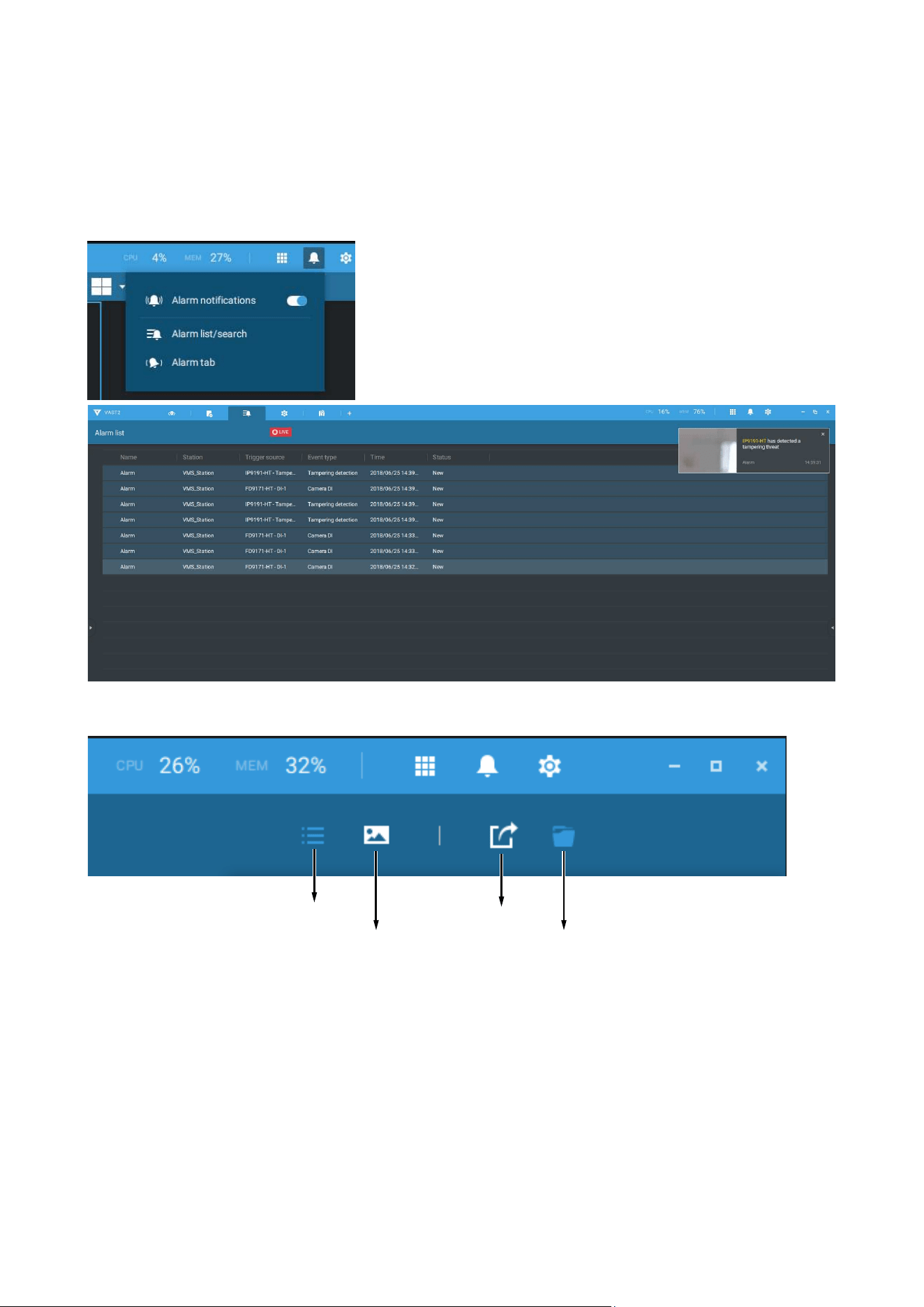
Alarm list
The Alarm list is accessed from the top tool bar. The Alarm list provides easy access to all
triggered alarms, such as tampering alarms, alarms reported by VCA analytics, external
devices connected via a camera's DI pin, etc.
The Alarm list can be displayed in either the List view or Thumbnail view.
List view
Thumbnail view
Export
Export target folder
31
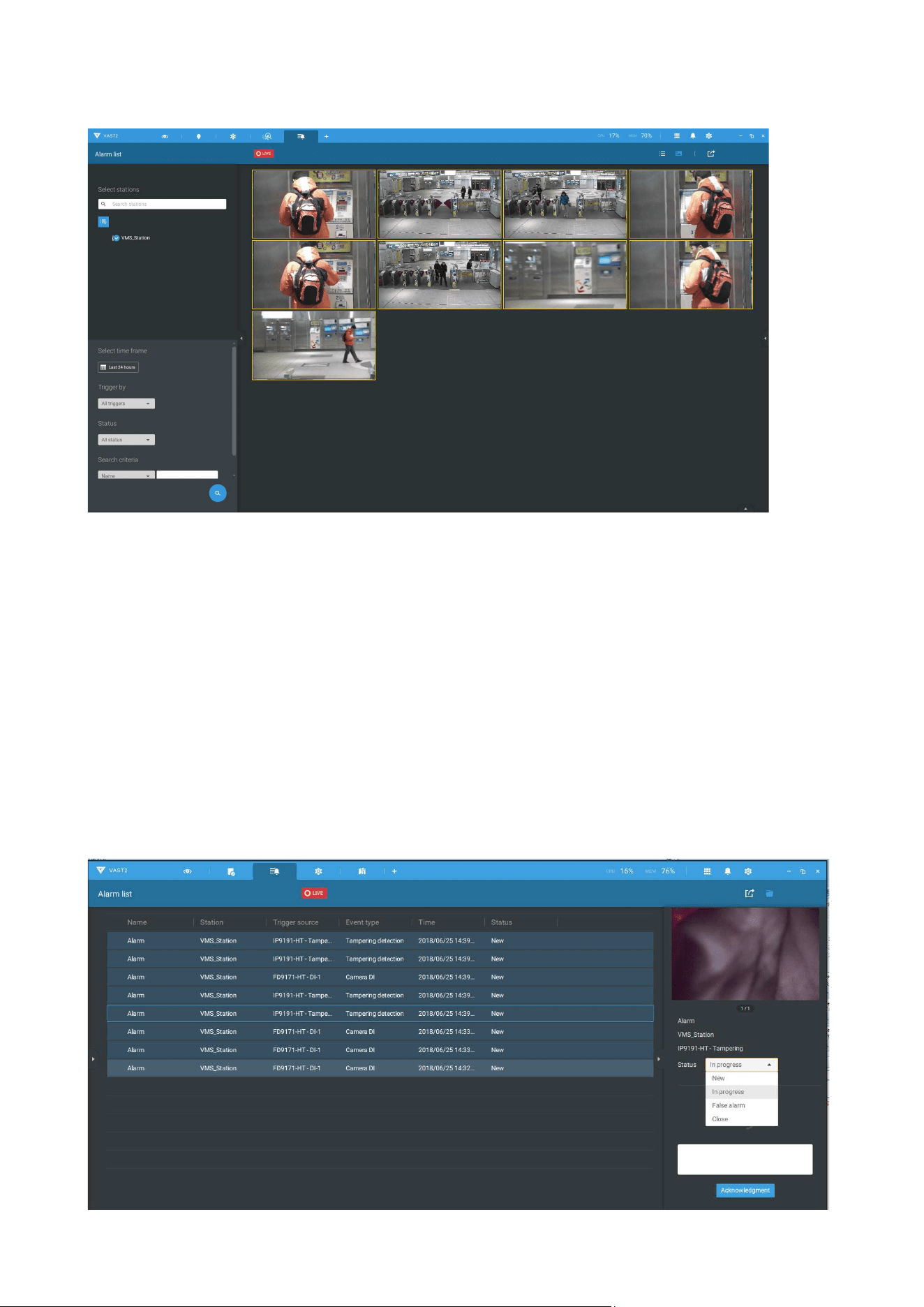
On the Alarm list, you can double-click to select a triggered alarm. A related snapshot and
configuration panel will appear. An operator can select the Status menu to change the event
management status. The configurable statuses can be:
1. New: An event that has not been handled.
2. In progress: Select to indicate that the event is being handled, e.g., a security personnel
has been sent to verify the cause of the event.
3. False alarm: Used to indicate the event has been verified as a false alarm.
4. Close: A closed case event will be erased from the event list.
When done with designating event status, click the Acknowledegment button.
Below is an example of a Thumbnail view.
32
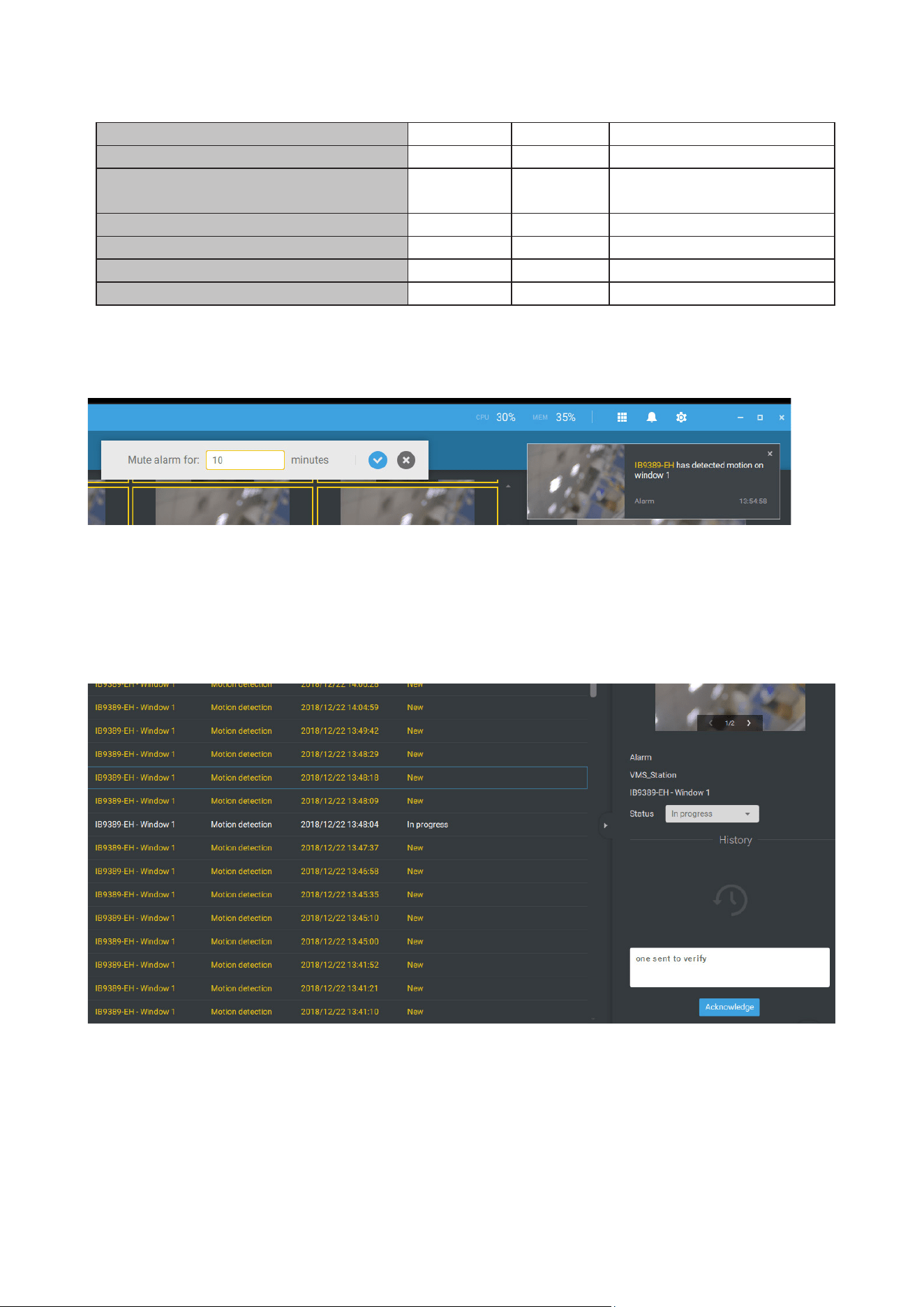
The Alarm list also supports Hot keys.
Alarm list window
Mute the current alarm Ctrl m
Designate the selected alarms as
false alarms
Ctrl f
Select all alarms Ctrl a
Select one or multiple alarms Ctrl left mouse button
Select multiple alarms Shift left mouse button
Select different alarms Up/Down/Left/Right
When an alarm is muted, a message will prompt asking for how long the alarm will be
muted. Enter a number, and the alarm will disappear from the list temporarily.
When an alarm is designated as a false alarm, it is immediately removed from the list.
When an alarm is designated as In progress, you can add a comment on the current
condition, and click Acknowledge to change its status.
33
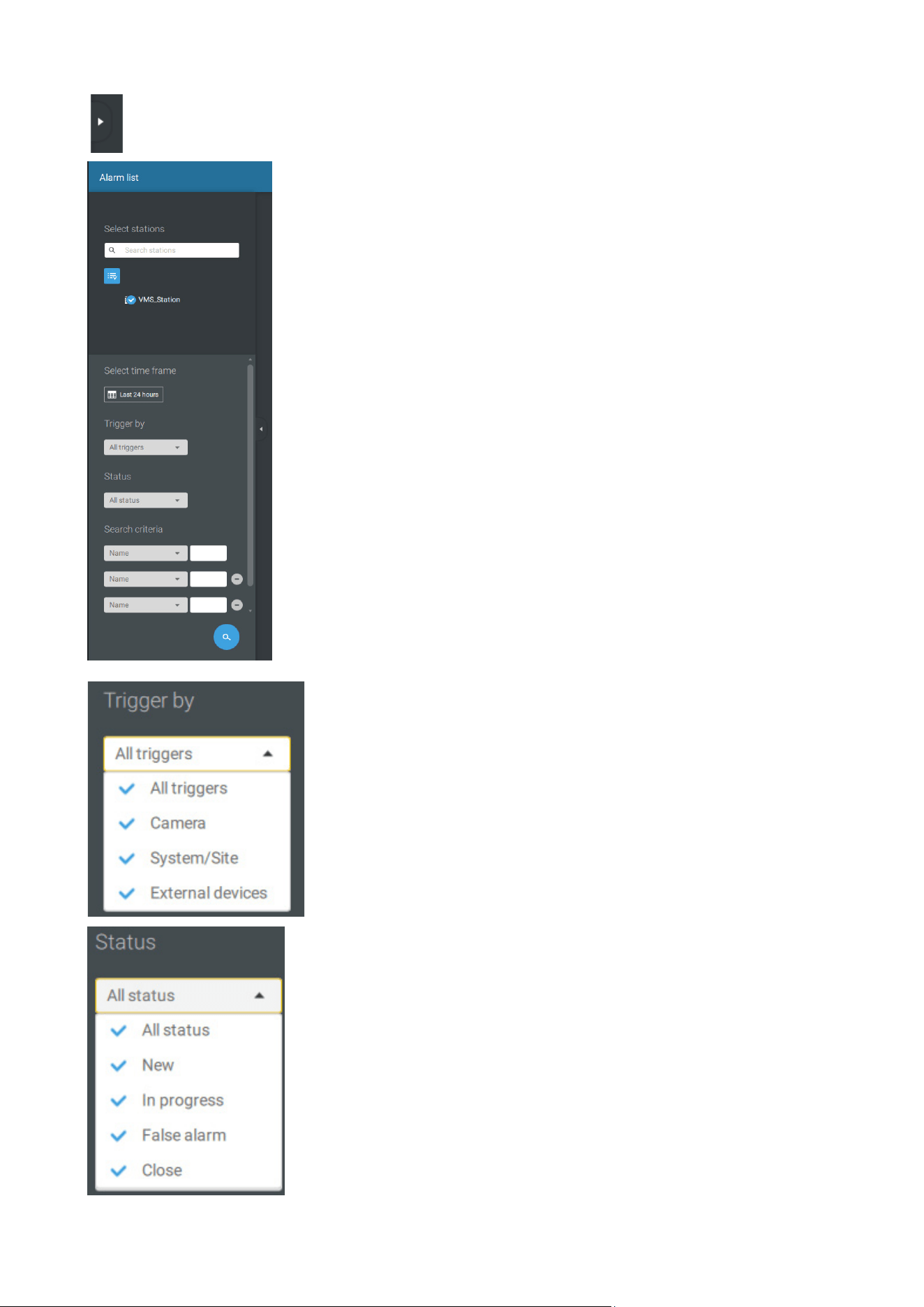
To find alarms of specific types, time of occurrences, and alarm
status, click the side tab to reveal the search panel.
You can select the trigger source, e.g., when you need to see
camera alarms only.
You can check to see alarms of a specific status. For example,
you can select to search for the "In progress" alarms only.
34
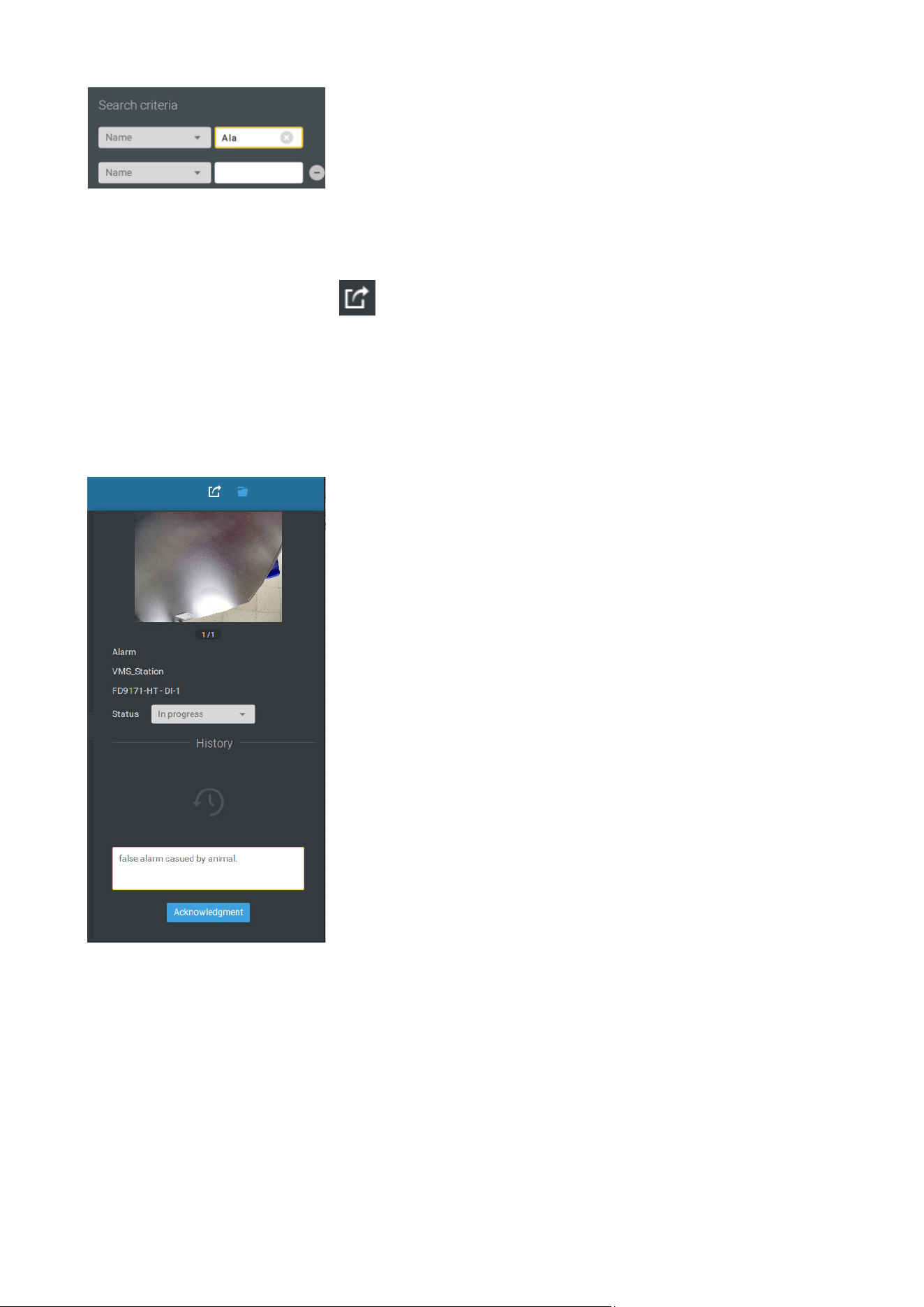
You can use the Export button to export a full list of all triggered events into a CSV file.
The event type, receiving station, triggering device, time of occurrence, and event status will
all be listed. You can also export alarm-triggered videos.
You can also add a comment for an event by entering the description in the comment entry
field.
You can enter one or multiple keywords as the search criteria.
For example, if you have an alarm named as "Alarm3-
sidewalk," use the name as the keyword to search for the
related alarms.
35
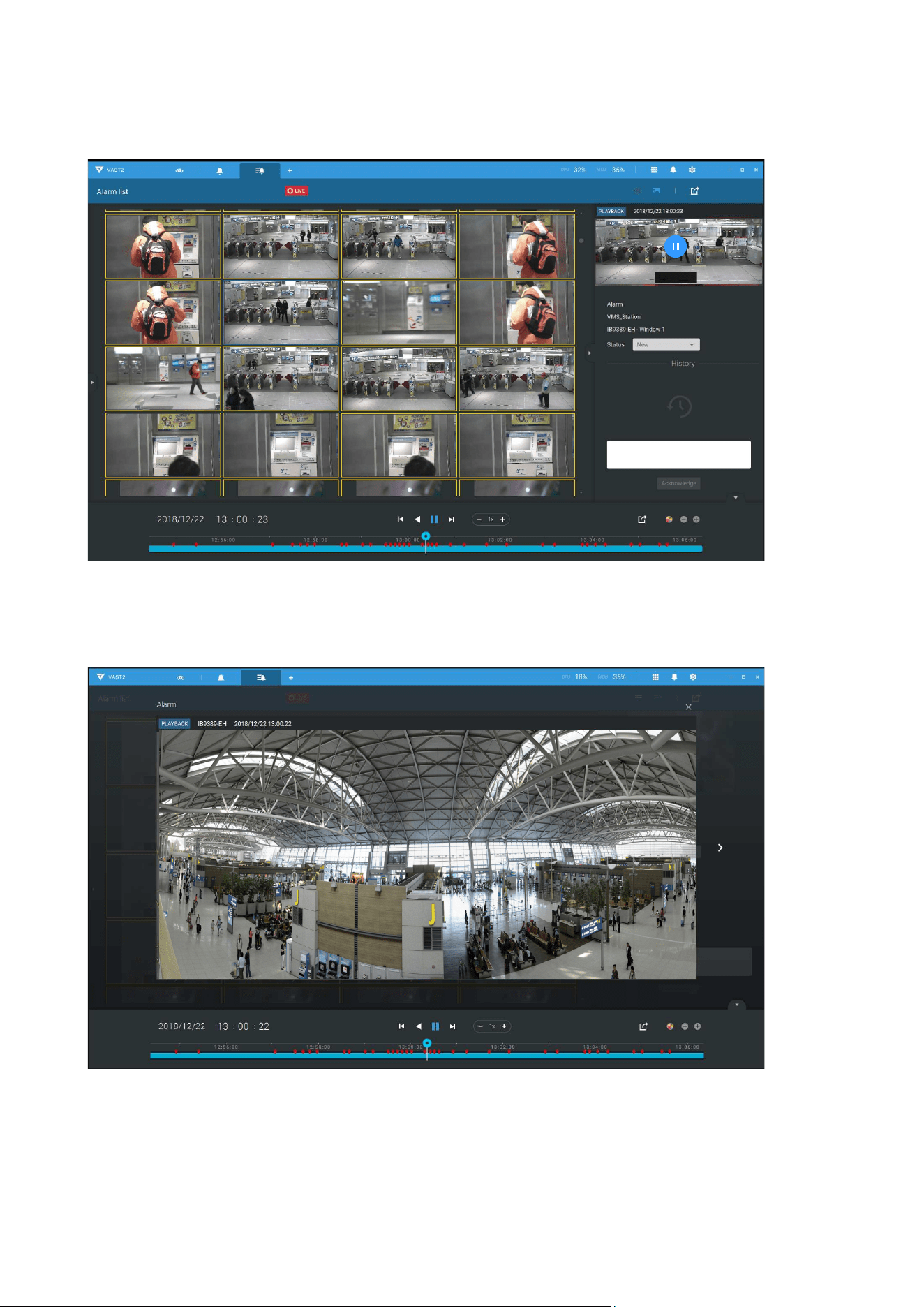
To review the alarm-related video, click to select an alarm, double-click to playback. The
Playback window will appear on the upper right of the screen.
< 1/2 >
Double-click on the small playback screen again to bring it to the full view. The playback
control, time line, export, and alarm tags will be available on screen.
36
Alarm tab
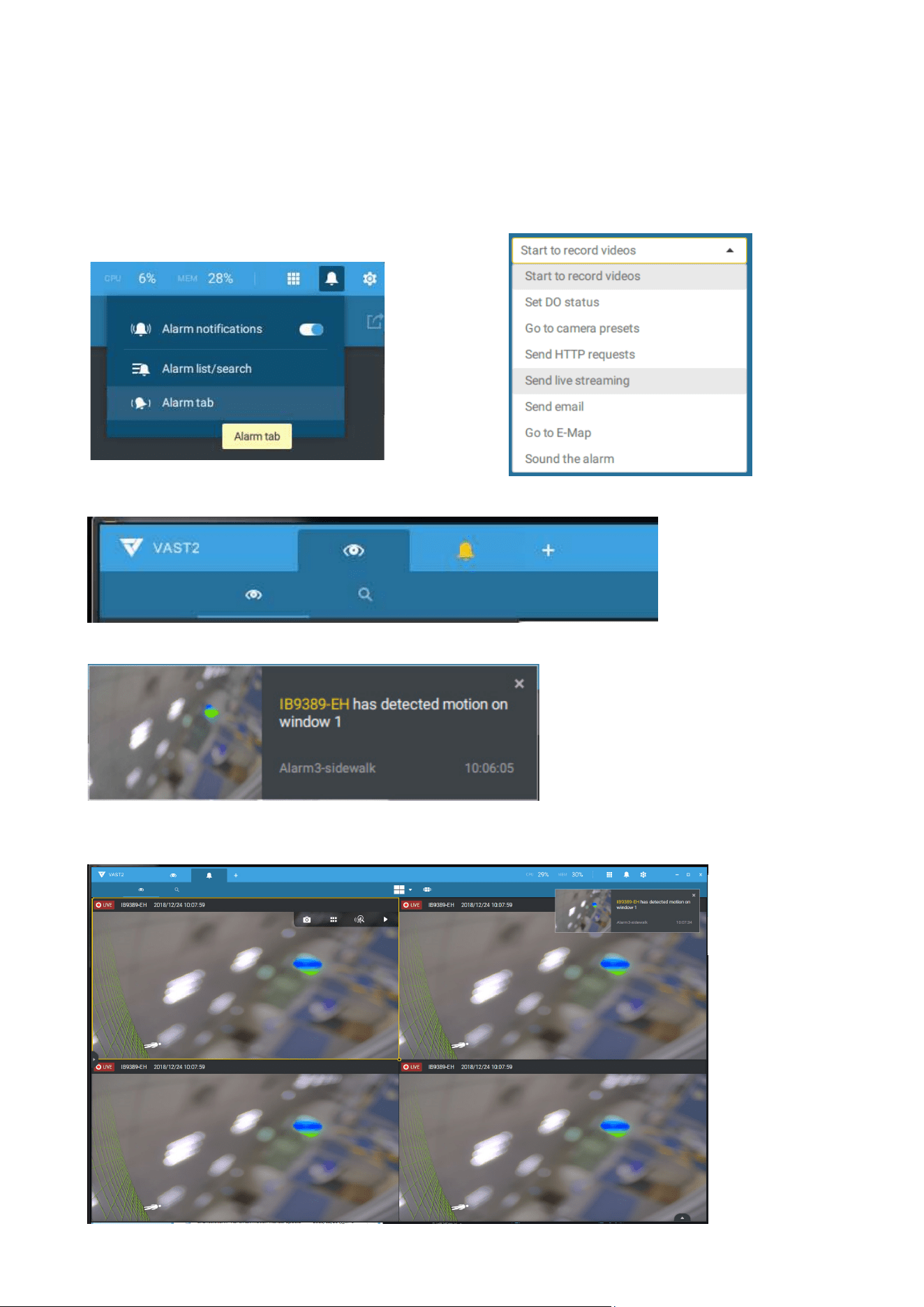
The Alarm tab is an automated streaming window displaying live videos brought by the
triggered alarms. If you configure an alarm action as "Send live streaming," the alarm
streaming will be displayed in this window. Note that this window does not display other
types of alarms.
When a live streaming is sent by an alarm, an orange ringing bell icon will display.
An alarm prompt will also display on the screen.
You can click on the ringing bell icon to open the Alarm tab window. The alarm-trigged
streamings will be available on screen.

37
Hot Keys
Open online document F1
Close current tab Ctrl (Win) /
Command (MacOS)
W
Open new Live / Playback tab Ctrl (Win) /
Command (MacOS)
T
Full screen
Ctrl (Win) /
Command (MacOS)
Shift F
Exit full screen Ctrl (Win) /
Command (MacOS)
Shift F
Exit full screen Esc
View cell
Select view cell Arrow keys
Digital zoom Ctrl (Win) /
Command (MacOS)
Shift Z
Snapshot Ctrl (Win) /
Command (MacOS)
Shift C
Instant bookmark Ctrl (Win) /
Command (MacOS)
Shift B
Remove camera from cell Del
Move to preset position Ctrl (Win) /
Command (MacOS)
Digits (1,2,3,...)
PTZ model up, down, left, right Arrow keys
Save current layout as a
customized layout
Ctrl (Win) /
Command (MacOS)
S
Undo layout modication Ctrl (Win) /
Command (MacOS)
Z
Redo layout modication Ctrl (Win) /
Command (MacOS)
Y
Timeline
Sync Playback mode Ctrl (Win) /
Command (MacOS)
Shift S
Pause (Play/Rewind) Space
Play Ctrl (Win) /
Command (MacOS)
Arrow right
Rewind Ctrl (Win) /
Command (MacOS)
Arrow left
Speed up Ctrl (Win) /
Command (MacOS)
Up
Speed down Ctrl (Win) /
Command (MacOS)
Down
Next frame Shift Arrow right
Previous frame Shift Arrow left
Reset speed to 1x Ctrl (Win) /
Command (MacOS)
1 (one)

38
Bookmark search
Select more bookmarks Ctrl (Win) /
Command (MacOS)
Click
Select more bookmarks Shift Click
Back to bookmark page Esc
Next bookmark Arrow right
Previous bookmark Arrow left
Thumbnail search
Select thumbnail Arrow keys
Play a selected thumnail Enter
Back to Thumbnail page Esc
Next Thumbnail Arrow right
Previous Thumbnail Arrow left
Emap Setup
- Google map
Remove selected GPS Del
DI/DO Device Settings
Remove selected external I/O
device
Del
SMTP Settings
Remove selected SMTP
server
Del
Camera Management
Rename selected camera F2
Rename selected folder F2
Remove selected camera
from system
Del
Sites Management
Rename selected site F2
Remove selected site from
system
Del
Users Settings
Remove selected user Del
Schedule Settings
Remove scheduled time frame Del
Smart search II
- Conguration page
Delete detection range Esc

39
Data Magnet
Move selected row Up / Down
Show detail of selected row Enter
View management
Rename selected view F2
Delete selected view Del
Alarm management
Delete selected alarm Del
Alarm list window
Mute the current alarm Ctrl (Win) /
Command (MacOS)
m
Designate the selected alarms
as false alarms
Ctrl (Win) /
Command (MacOS)
f
Select all alarms Ctrl (Win) /
Command (MacOS)
a
Select one or multiple alarms Ctrl (Win) /
Command (MacOS)
left mouse button
Select multiple alarms Shift left mouse button
Select different alarms Up/Down/Left/Right

40
View Cell Elements
On a view cell, the control elements are different with different types of network cameras.
3 major types are listed below with applicable screen elements:
1. Fixed cameras:
Snapshot - Thumbnail search - Smart
search - Replay.
2. Fisheye cameras:
Fisheye display mode - Snapshot -
Thumbnail search - Smart search - Replay.
Zoom In
Zoom Out
The Auto pan function applies only to the Regional views. Select a regional view, and
click the Auto pan button. The Regional view will pan from side to side to cover more
viewable regions. If a fisheye is mounted on wall, a regional view with auto pan can
cover a panoramic view region.
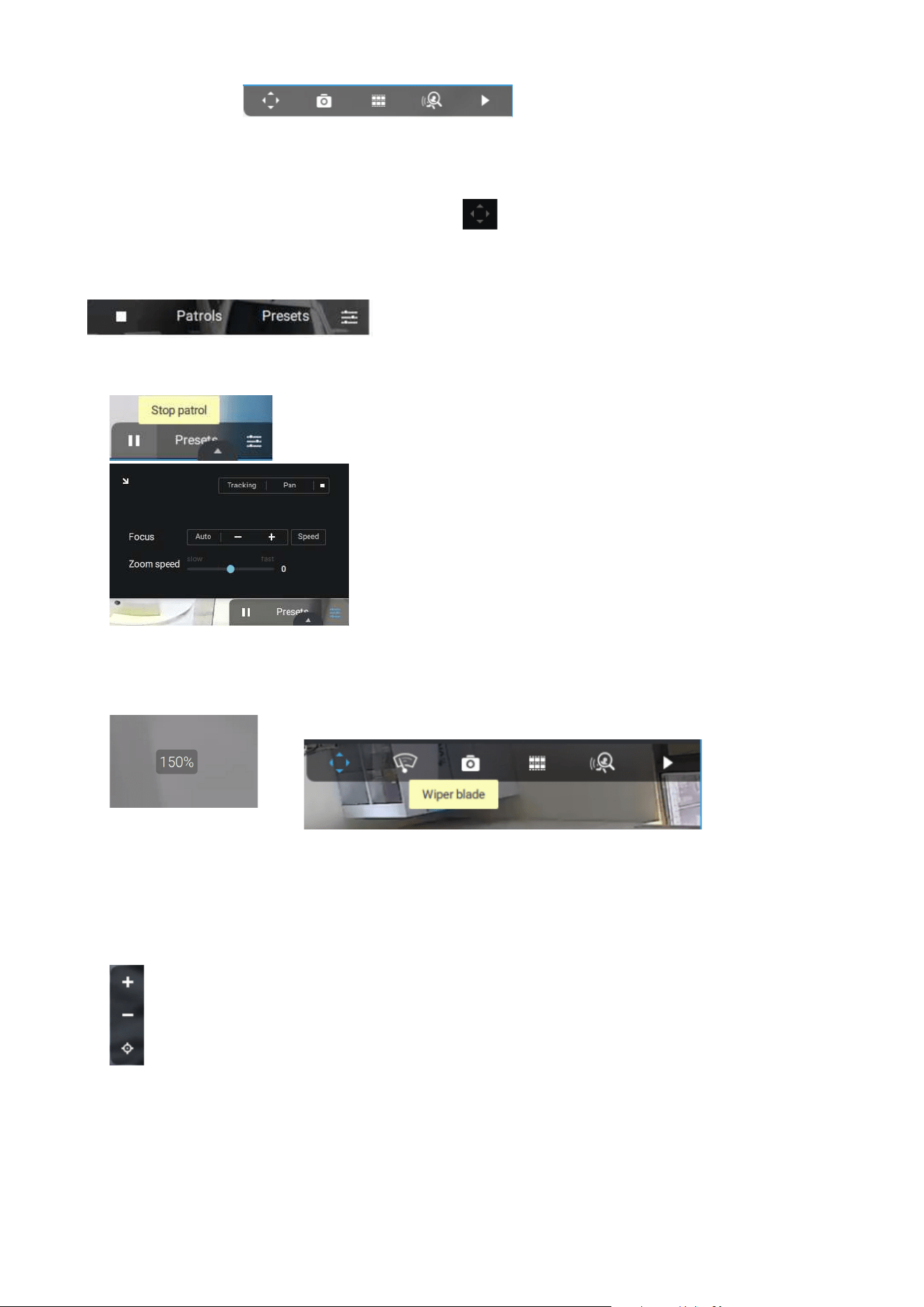
41
You can use the mouse wheel to zoom in or zoom out on the screen. The zoom ratio is
shown on screen for half a second.
When PTZ is enabled, the zoom buttons and a home button are displayed on the right hand
side of the view cell.
For more information about Snapshot, Thumbnail search, and the Replay functions, please
refer to their specific help pages.
3. PTZ cameras: PTZ - Snapshot - Thumbnail search -
Smart search - Replay. For information about PTZ control, refer to the discussion on PTZ
on page 84.
To exert PTZ control, first click on this button to enable PTZ control.
When PTZ control is enabled, the following controls are available on screen:
Click Patrols or Presets if these have been configured on the PTZ camera. You will need to
open a web console to the camera to configure preset positions.
The PTZ settings tab allows you to enable PTZ Tracking and the Pan functions. You can
also adjust the Zoom and Focus speed, or manually adjust the focus. Please refer to the
camera User Manual for more information about these functions.
For speed dome cameras that come with a wiper blade, the wiper blade control button will
be available on the tool bar.
42
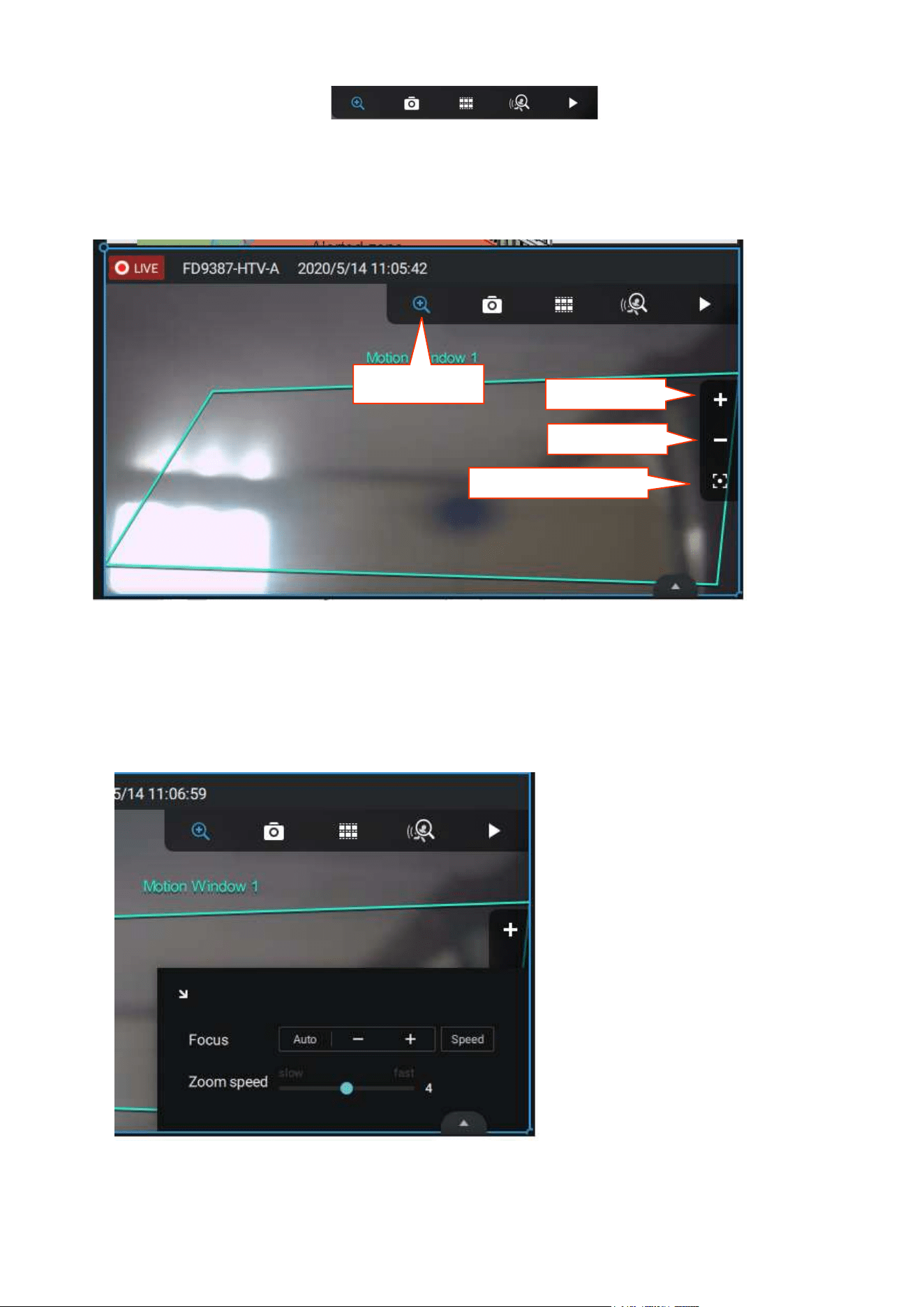
3. Motorized lens cameras: Enable Optical - Snapshot -
Thumbnail search - Smart search - Replay.
For cameras that come with motorized zoom lens, click on the Enable Optical button. You
can zoom in or zoom out on the scene.
Click on the Focus adjustment button to bring out the focus panel. If you find the image is
out of focus, you can use the +, -, or Auto buttons to regain the best image focus.
You can use the Auto scan function to let the camera automatically find the best focus.
The process may take up to 20 seconds.
Enable Optical
Zoom in
Zoom out
Focus adjustment
43
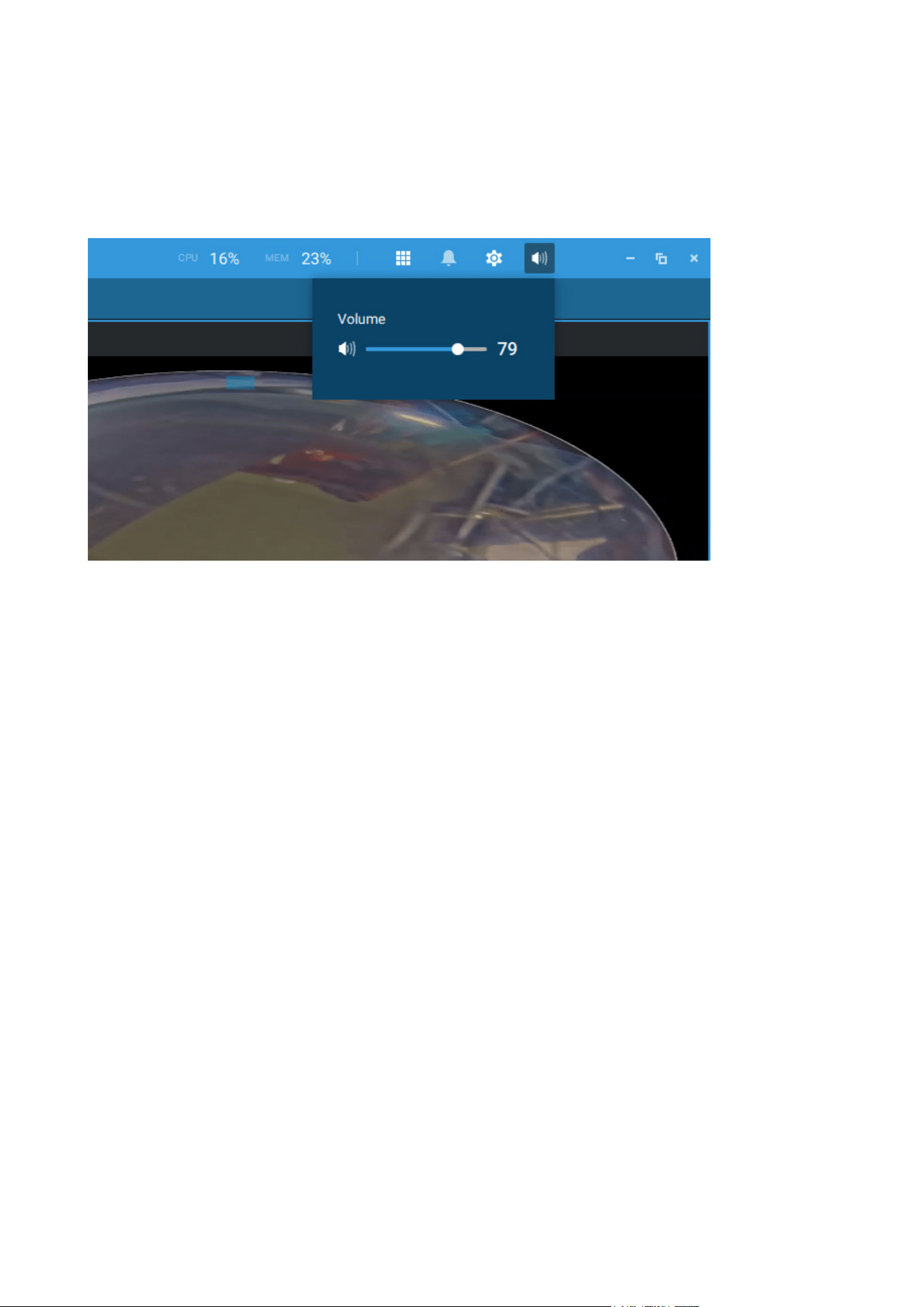
Audio
For a view cell housing a camera with an audio input, you can tune its volume using the
slide bar on the tab panel.
44
VAST Server and Client
Components
VAST2 Server provides a centralized management site for video recording. Users can
login and modify the server's configuration, edit the server's recording storage, configure
schedules and many other functions. You can browse the recorded video database and
video clips related to specific events on the server.
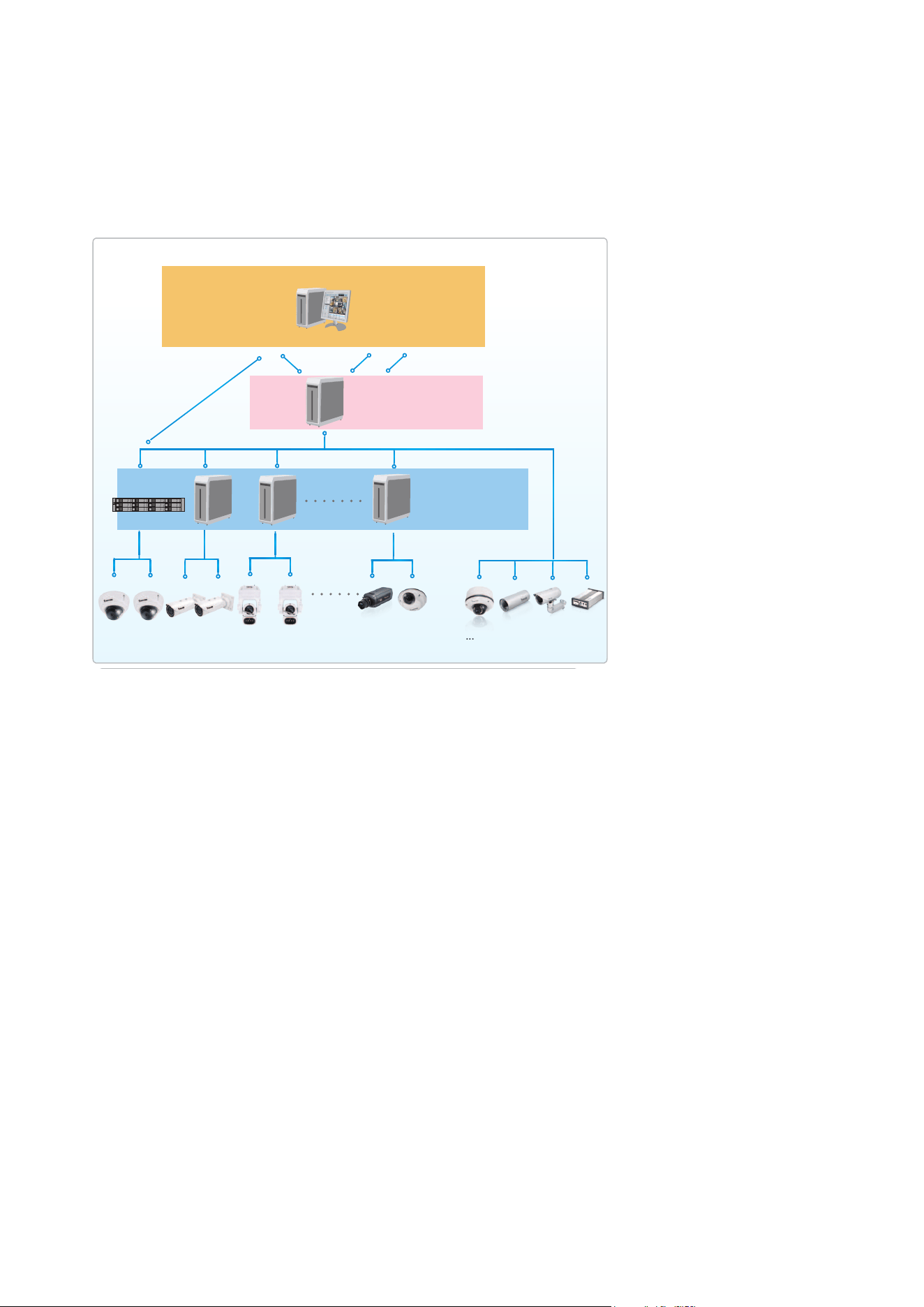
For users who manage large-scale surveillance deployments, please plan the hierarchical
structure first. Then you can start to add cameras to each station and connect these
sub-stations to the root station. The whole hierarchical management system is thus
constructed. VIVOTEK's NVR stations can also be included as sub-stations. The Logical
Tree view becomes the default.
45
Please refer to the Sites page for how to enlist VAST sub-stations.
Unlimited No. of Network Cameras , Video Servers...
Remote Server Structure
Login
Login
Client VAST
(Root station)
VAST CMS Server
VAST Server
(Sub-stations)
NVR
Multiple Server Applications
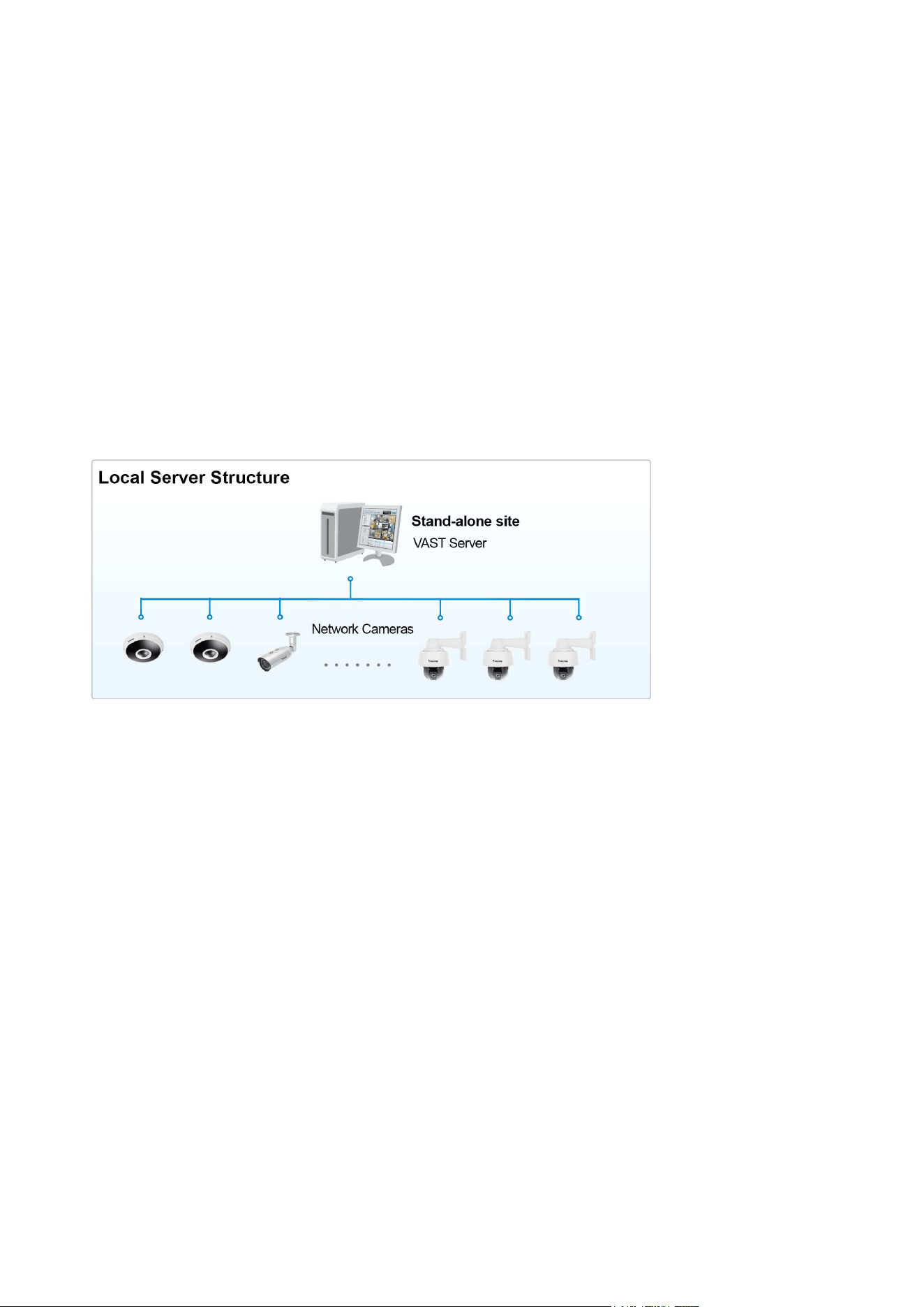
A host with the VAST2 installed is recognized as a stand-alone site. All the functions can
be simultaneously performed on one single site.
46
Minimum System
Requirements
Before installing the VAST software, please make sure your system meets the following
recommended minimum system requirements.
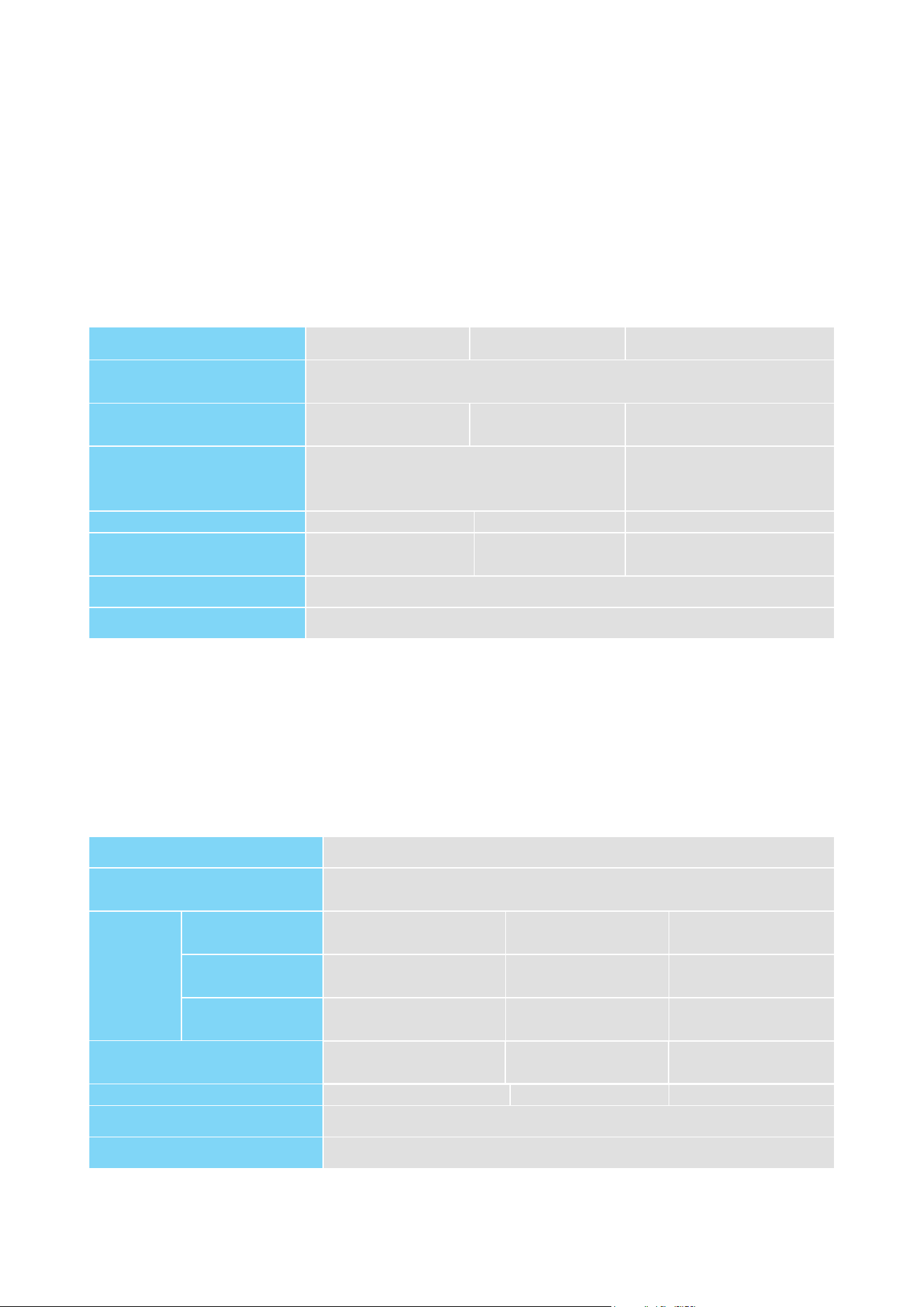
VAST 2 Liveview & Playback
Operating System
Windows Server 2012, 2016 / Windows 10, 7 / MacOS 10.15
Catalina (Server core installation type is not supported.)
Clients
(Display
Channels)
720P,2Mbps,
H.264,* each CH
8 CH 16 CH 32 CH
1080P,4Mbps,
H.264**, each CH
6 CH 10 CH 18 CH
1080P,4Mbps,
H.265, each CH
3 CH 5 CH 9 CH
CPU
6th Generation Intel
®
Core™ i3 Processors
6th Generation Intel
®
Core™ i5 Processors
6th Generation Intel
®
Core™ i7 Processors
RAM*** 8GB or above 8GB or above 16GB or above
Network Interface Card Ethernet, 1Gbit recommended
Graphics Card****
Direct3D acceleration with 1GB RAM graphics card
VAST2 Server
Operating System
Windows 10, 7, Windows Server 2012, 2016 (Server core installation
type is not supported.)
Server (Recording
Channels)
Up to 64 CH Up to 128 CH Up to 256 CH
CPU
6th Generation Intel
®
Core™ i3 Processors
or above
6th Generation Intel
®
Core™ i5 Processors or
above
RAM**** 4 GB or above 8GB or above 8GB or above
Hard Drive (Enterprise
model only), suggestion
1 Volume Group* 2 Volume Group* 4 Volume Group*
Recording throughput 1 Volume Group: Max. 200Mbps (Max.)**
Network Interface Card Ethernet, 1Gbit recommended***
* The size of volume group depends on the total recording server throughput.
** The maximum combined bit rate of cameras cannot exceed the total recording
throughput.
*** Please consider the combined throughput of viewing, recording, and server's network
bandwidth when designing your surveillance deployments.
**** Please use a dual-channel memory configuration.

47
The required hard disk space will depend on the video settings, the number of network
cameras and recording group settings. Please add more hard disks if you want to extend
the system.
Below are the approximate numbers for a week-long recording. The actual storage space
required also depends on imaging parameters, e.g., a complex retail environment that
involves many moving objects requires more pixel data to be transmitted over network
than a simple environment such as a parking lot. The following numbers are based on
H.264 recording.
32-CH, VGA, about 1 week recording: 750 GB
64-CH, VGA, about 1 week recording: 1TB x 2
32-CH, 2-megapixel, about 1 week recording: 2TB x 2
64-CH, 2-megapixel, about 1 week recording: 2TB x 4
**** Please update to the lastest GPU driver.
* Display requirements of the 3MP fisheye camera is equal to a 720P camera.
** Display requirements of the 5MP fisheye camera is equal to a 1080P camera.
*** Please use a dual-channel memory configuration.
* Each recording group can receive recordings for 60 channels.
If you plan to install both VAST2 server and client on the same computer, please remember
to consider the combined load on computing, encode/decode effort, and bandwidth.
The 60-day trial includes 256 channel license and all advanced license features.
48
Chapter 2 Starting Up
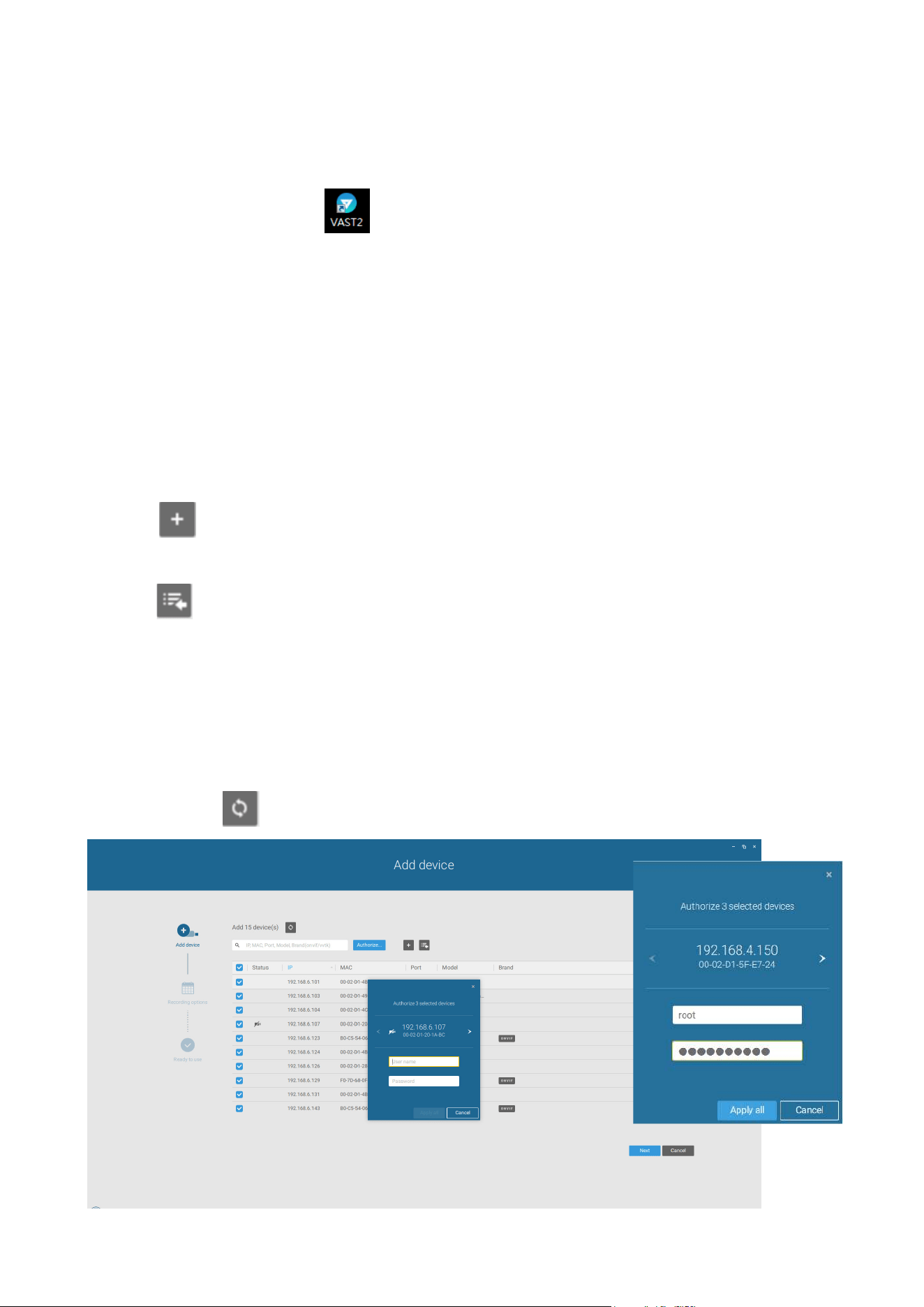
Double-click the VAST2 icon on the desktop to start the VAST2 main page.
When started the first time, the server automaticallly polls the local network for reacheable
network cameras. For cameras that come with pre-configured User Name and Passwords,
the server prompts for entering credentials for the access to cameras. Check out the
cameras' MAC addresses to identify the cameras.
The cameras found within the network will be listed. If the need should arise, you can use
the Search panel on top to locate specific cameras using their IP, MAC, Port, Model name,
or brand name (ONVIF/VIVOTEK).
Use the Add device button to manually add a camera with its known IP or domain
name.
Use the Import Device List button to recruit cameras in a previously-saved device list
(CSV files).
Use the Authorize button if the camera found in the Search panel needs credentials.
When search is done, delete the alpha-numeric characters in the search field to return to
the device list.
Use the Refresh button to search the local network again.
49
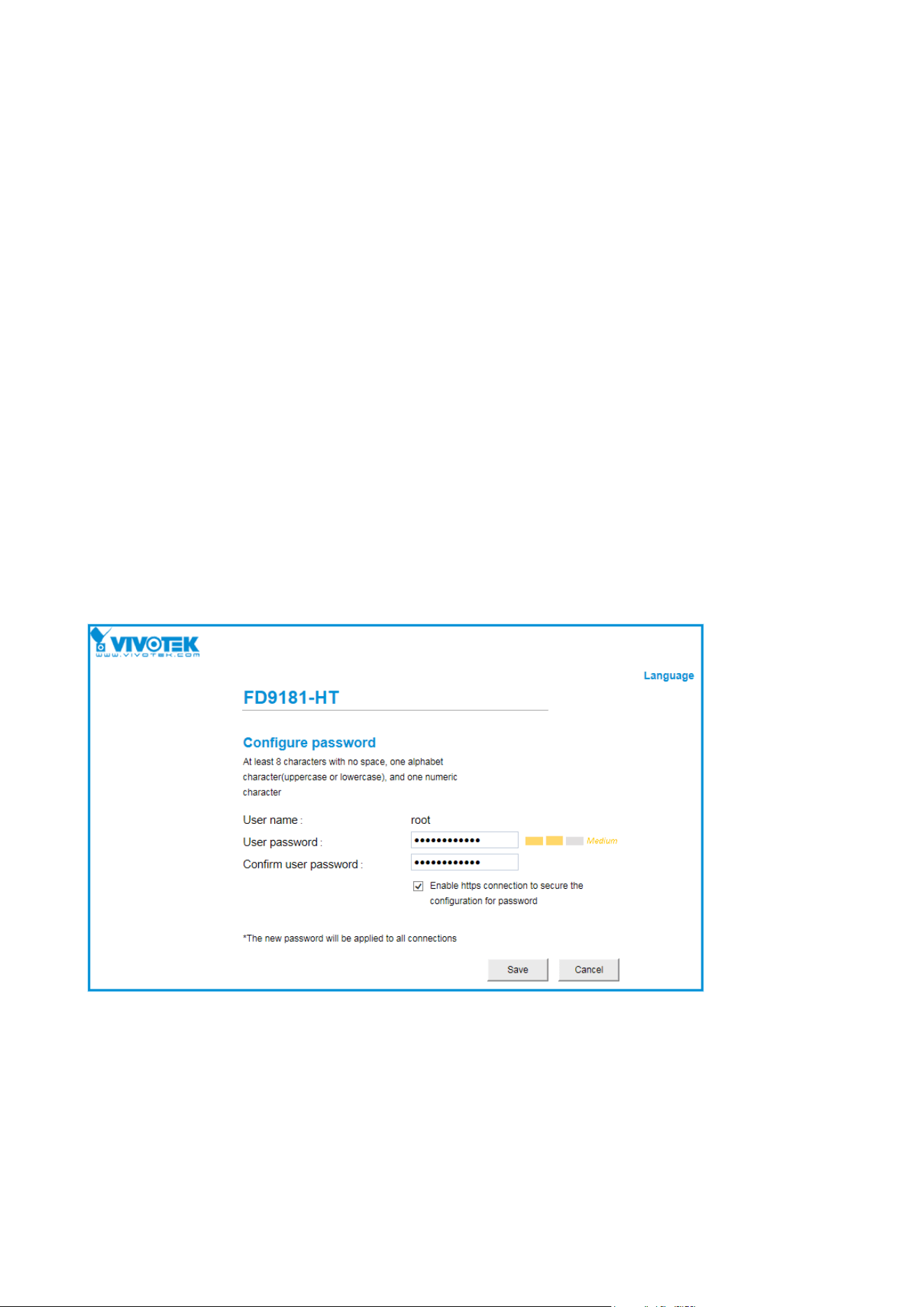
NOTE:
For cameras that come without a password protection, you should open the Shepherd
utility to locate and open a web console, and configure a password for protecting the
access to the camera. If a brand new camera (with no password) is selected for your VAST
configuration, it will join your configuration without the password protection.
2-1. Selecting Devices
Use the checkboxes in front of the listed devices to determine which devices will be
recruited to your configuration. By default, all cameras are selected. When the selection is
done, click on the Next button at the lower right screen.
If any of the selected devices requires credentials, the authorization window will prompt.
50
2-2. Recording Options
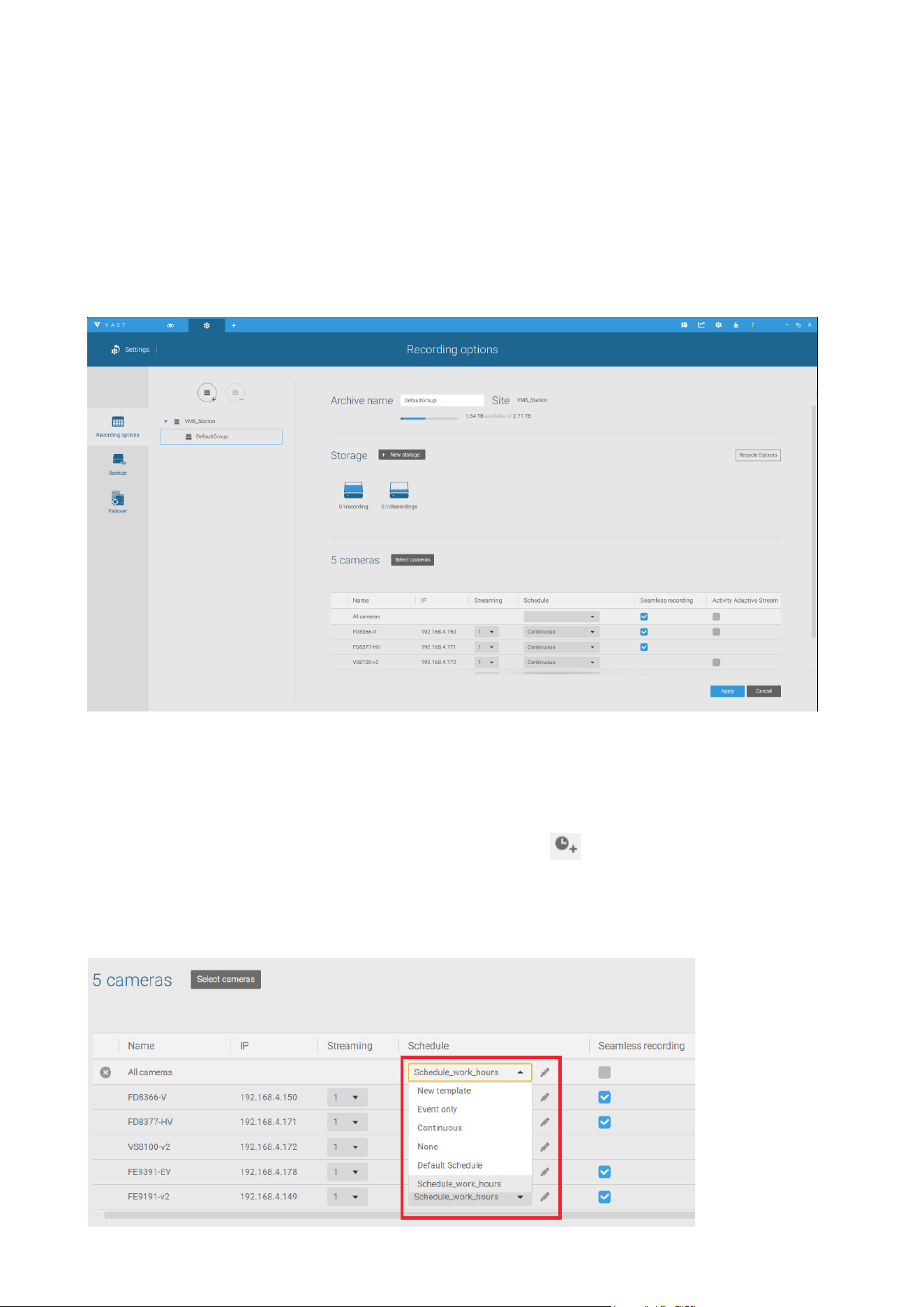
Click Settings > Recording > Recording options. The Recording options window will
prompt.
You can configure recording schedules or select the storage options, including the
configuration of an external NAS storage.
Click on the Schedule column on the Camera list for a recording option: Continuous
recordings, Events only, None, or Default Schedule, or New template. You can apply a
schedule template for all cameras or configure individual schedules for different cameras.
When using the Event-triggered recording, a pre-event and post-event time can be
configured. An Edit pane is available by clicking the Edit button.
You can manually create a recording template using the New template option. When done,
each configured template will be listed below.
51
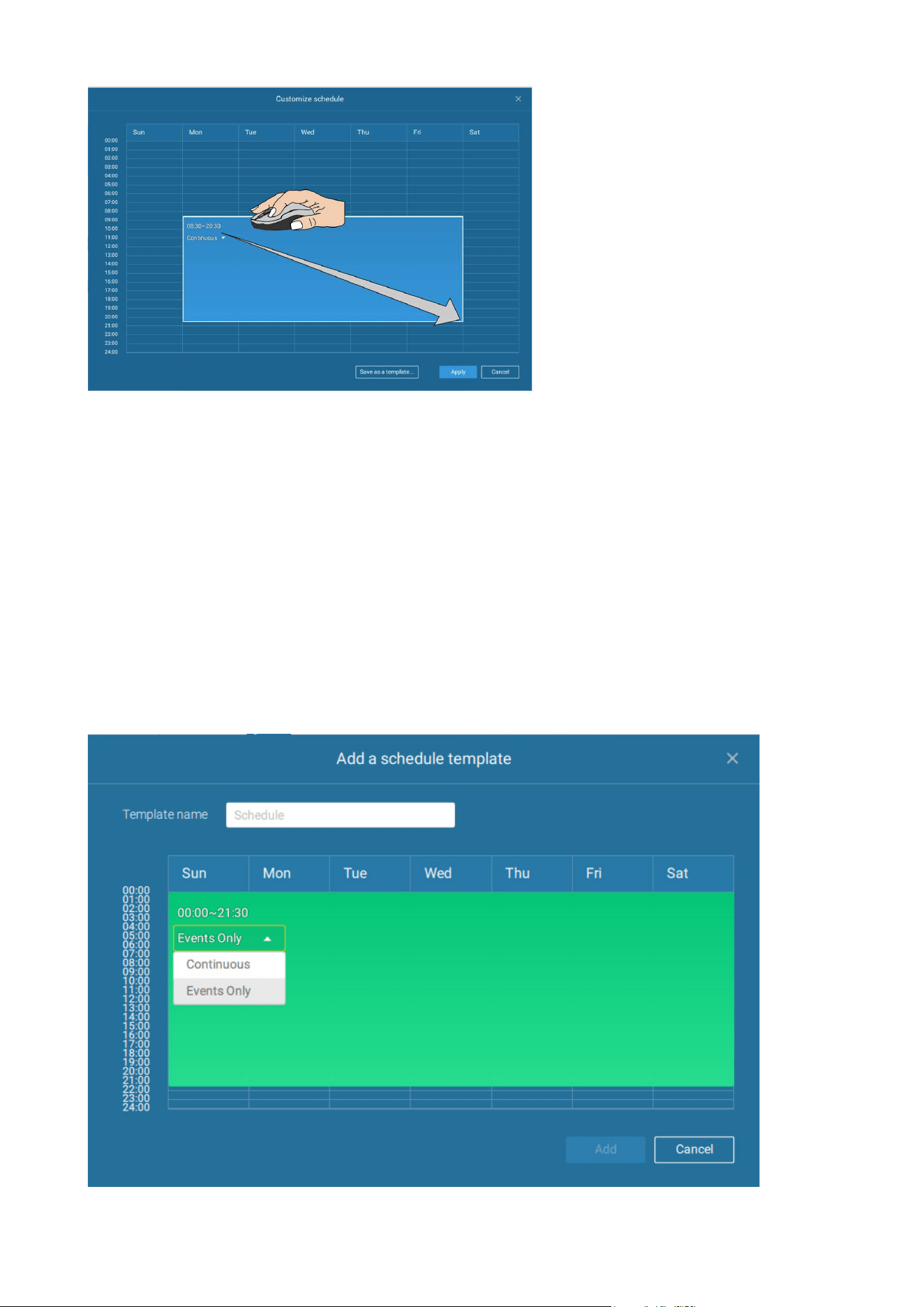
Click and hold down on the time cells, and drag the mouse to include the time span of your
preferrence. The minimum selectable unit is half an hour. You can select separate and
multiple time spans on the template.
Enter a name for the template, and click Add to save your template.
Event types can be selected when
The same configuration window apply to both the Schedule template and the customize
schedule windows.
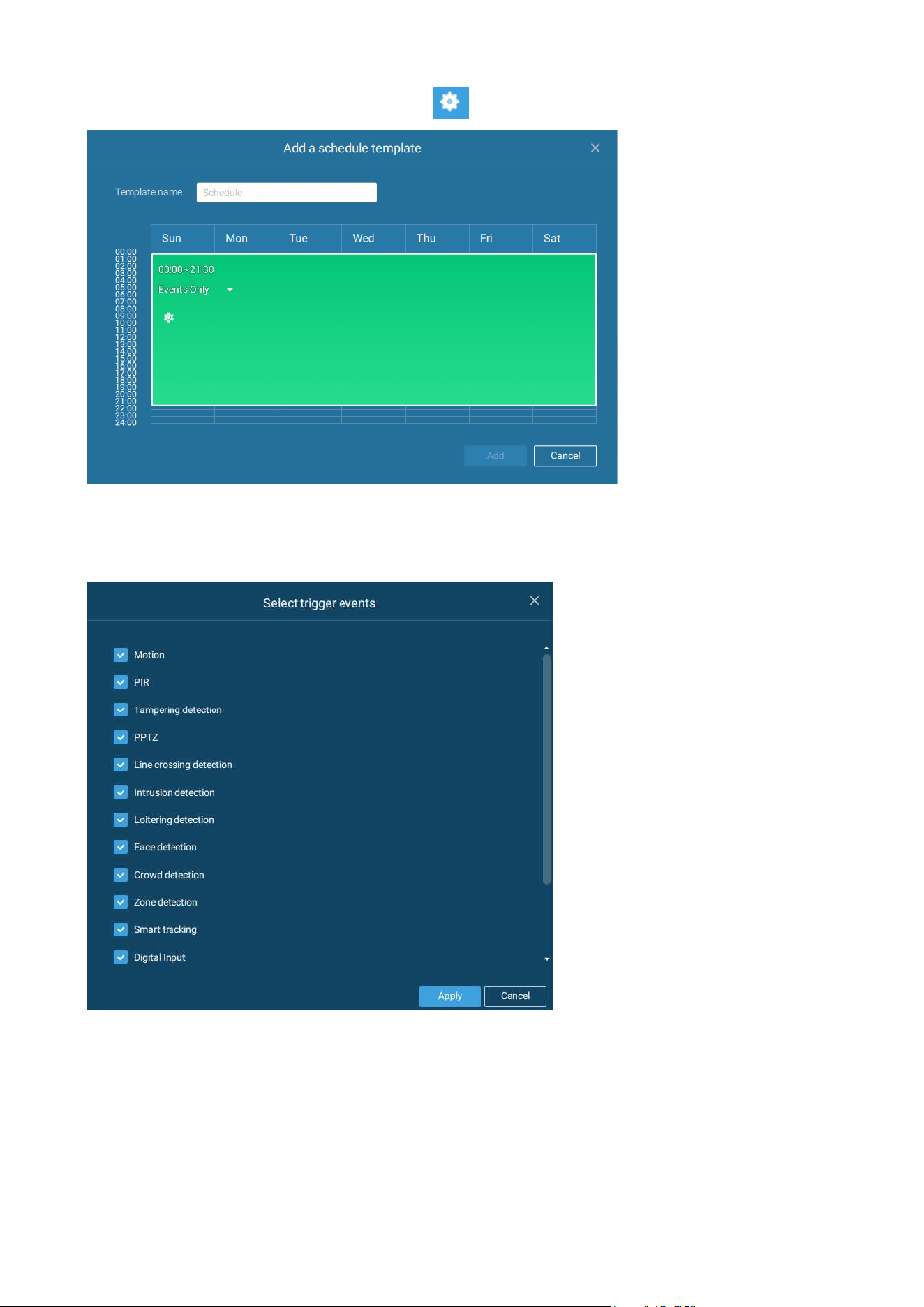
If the Events only option is selected for the new template, you can determine what kinds of
events will trigger the recording. Use the pull-down menu to select Events only.
52
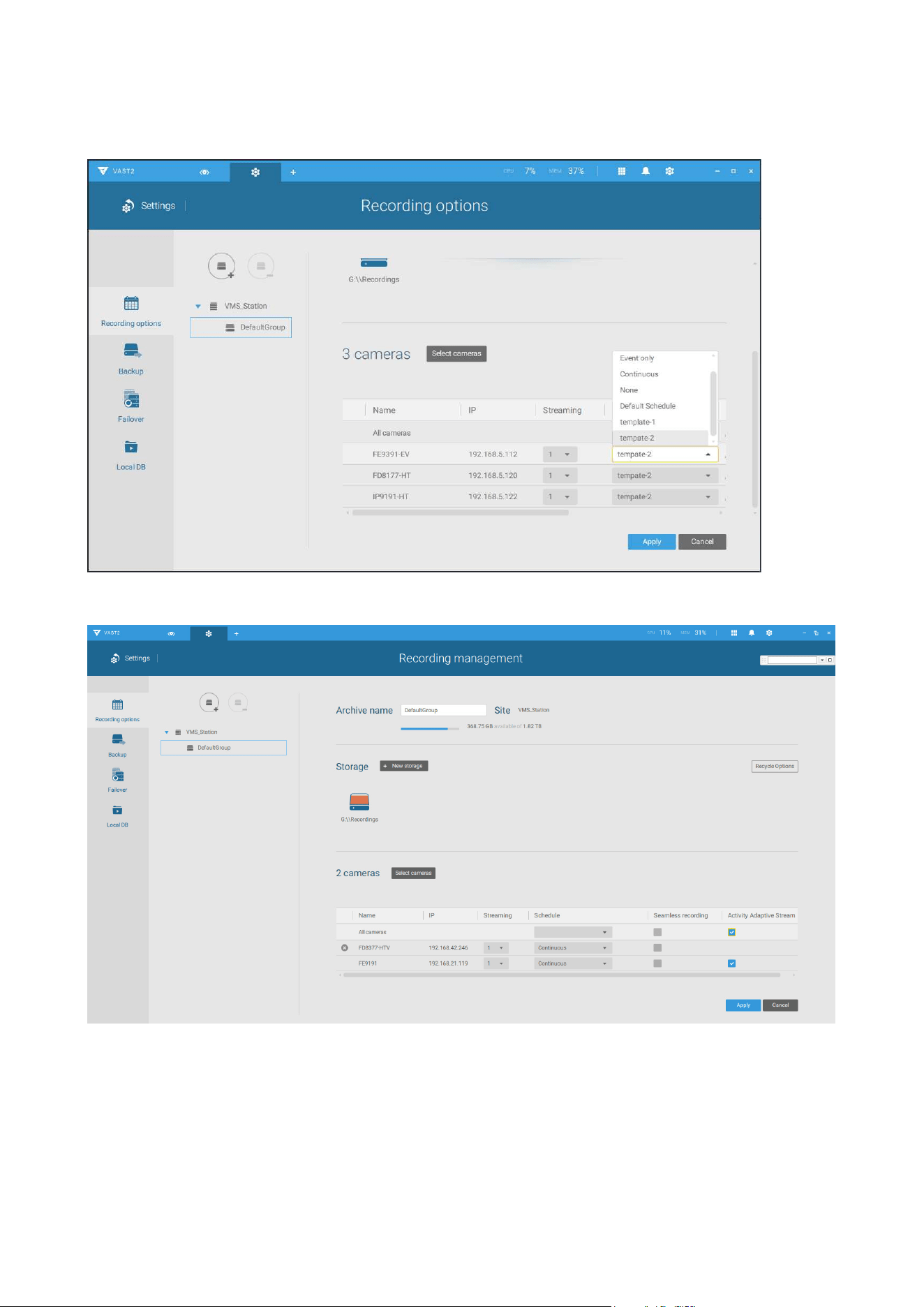
When Events only is selected, click on the Settings button to proceed.
The applicable event types will be listed. Select the types of event triggers that you prefer.
Click Apply to leave this page. By deault, all applicable event triggers will be selected.
53
Back on the Recording options page, select the new template as a scheduling option. Use
the menu on the top to select a scheduling template for all cameras.
Make sure a Schedule mode is selected when you leave this configuration step.
54
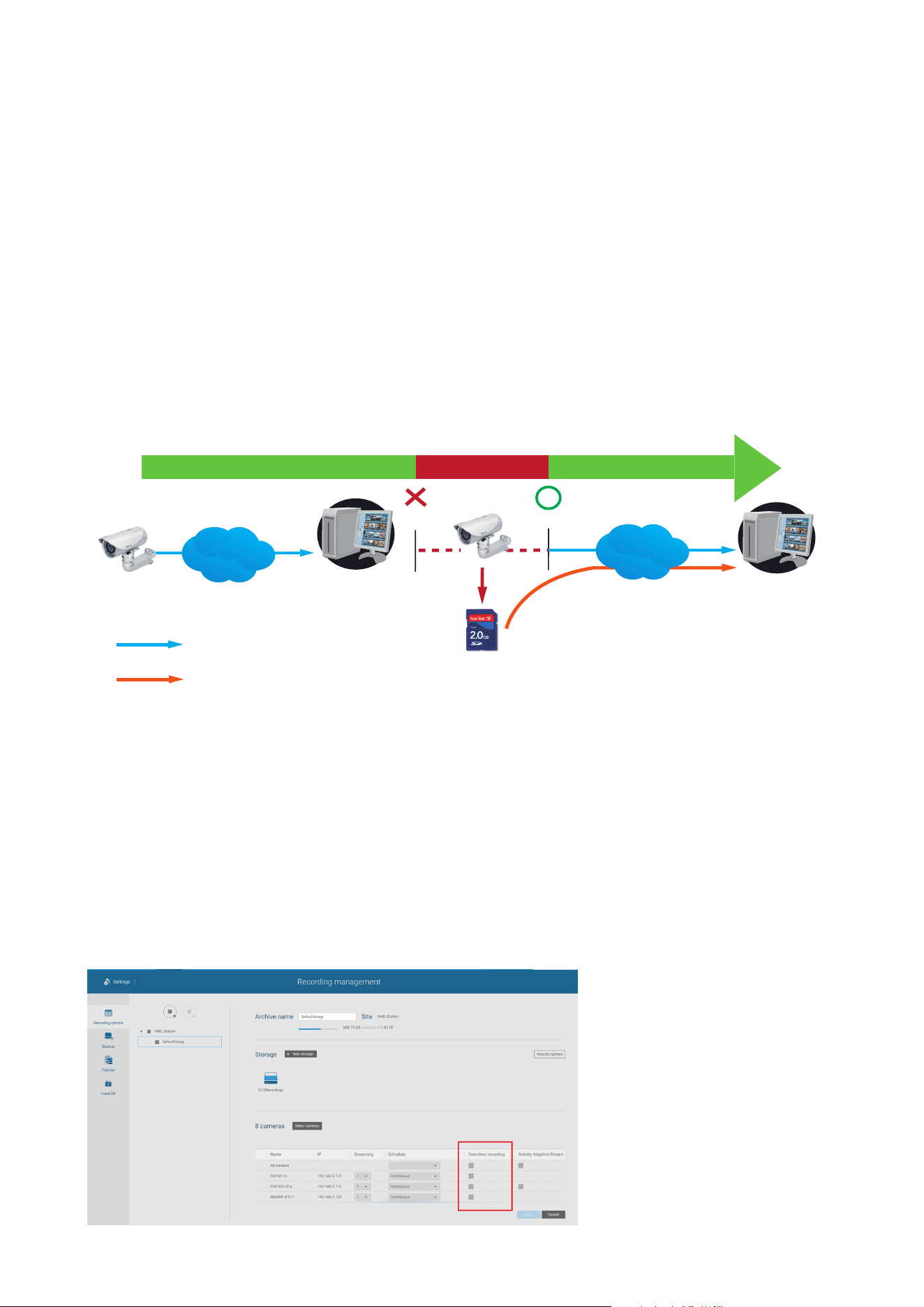
Seamless Recording
Seamless Recording safeguards critical videos in the occurences of network
disconnection. In the event of temporary disconnection, video is stored in individual
cameras' SD/SDHC/SDXC card; and once the connection is restored, a VAST server
can automatically resume the recording. More remarkable is that, a VAST server can
simultaneously retrieve the time-tagged videos that were temporarily stored on SD/SDHC/
SDXC cards. For information about the latest firmware/software revisions that support this
feature, please contact your sales representatives or technical support.
VAST
Server Station
14:30 14:50
Disconnect Restored
Timeline
LAN/WAN
VAST
Server Station
LAN/WAN
1
4
:
3
0
~
1
4
:
5
0
Seamless Recording
SD/SDHC/SDXC
Normal recording
Retrieval
The Seamless Recording feature is enabled when inserting, updating, or batch inserting
cameras in the Camera Management window. The firmware/hardware compatibility of this
feature is automatically detected, i.e., this feature is not available when a non-compliant
camera is attached. If a compatible camera is attached, a checkbox will be available as
shown below.
The video data retrieved from SD/SDHC/SDXC card also include event-triggered recordings
such as pre- or post-event footages, if events were detected during the network outage.
55
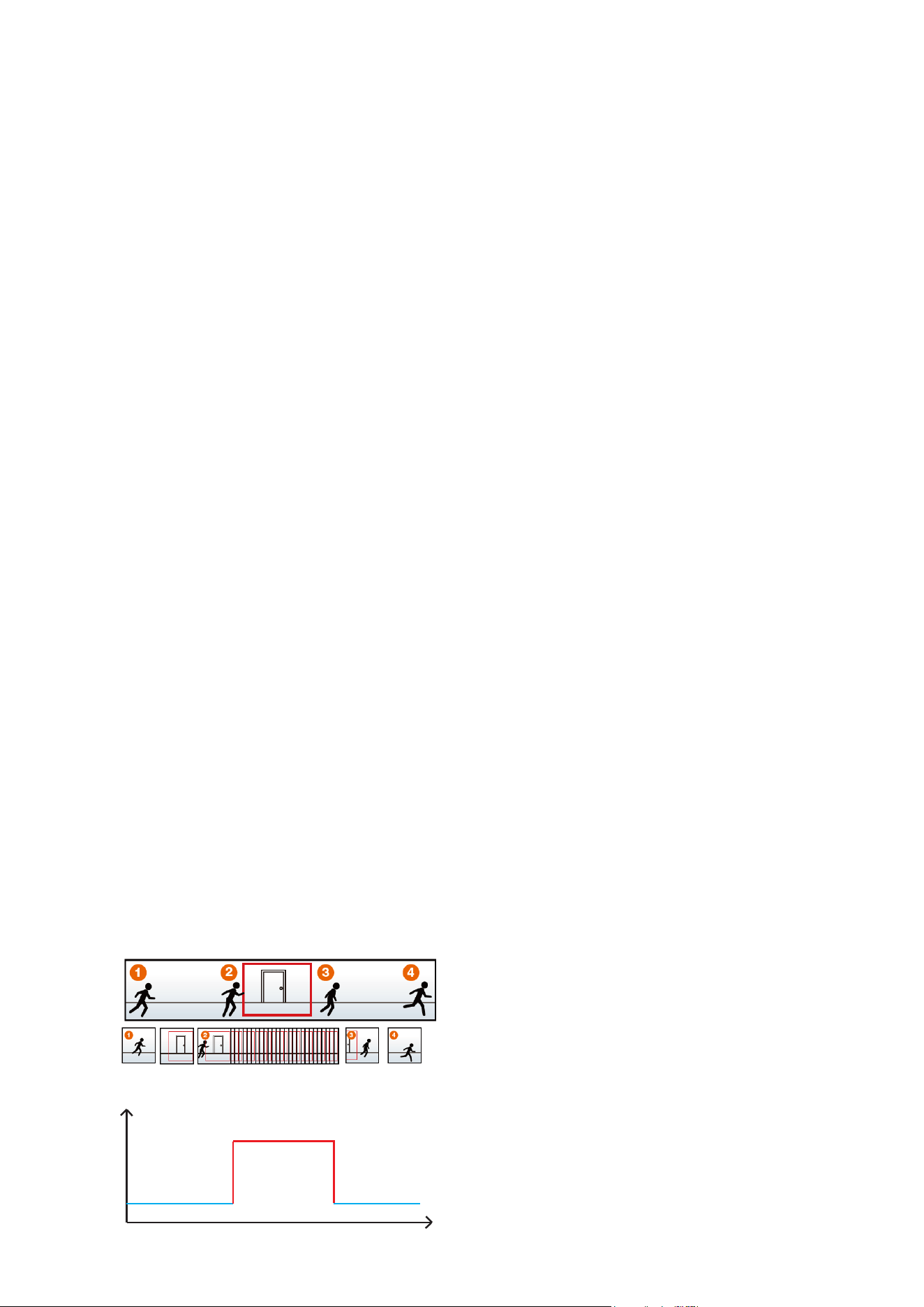
Activity Adaptive Stream
■
Activity Adaptive Stream: (Note that this feature may not be available for some older
models)
This option will activate the frame rate control according to alarm trigger.
The frame control means that when there is a triggered alarm, the frame rate will raise up
to the value you’ve congured on the Video quality page.
If you enable adaptive recording on a camera, only when an event is triggered on a camera
will the server record the full frame rate streaming data; otherwise, it will only request the I
frame data during normal monitoring, thus effectively saves bandwidth and storage space.
The alarm trigger includes: motion detection and DI detection. Please refer to Event
Settings.
On individual cameras, you can congure the following:
■
Pre-event recording and post-event recording
The Network Camera has a buffer that temporarily holds data for a period of time.
Therefore, when an event occurs, the camera can restrieve image frames taken several
seconds ago. Enter a number to define the duration of recording before and after a
trigger is activated.
■
Priority: Select the relative importance of this recording (High, Normal, or Low).
Recording with a higher priority setting will be executed rst.
■
Source: Select a video stream as the recording source.
Time
Bandwidth
Bandwidth
Activity Adaptive Streaming
for Dynamic Frame Rate Control
I frame ---> Full frame rate ---> I frame
Continuous recording
NOTE:
* To enable adaptive recording, please make sure you have configured the trigger sources
such as Motion Detection, DI input, or Manual trigger.
* When there is no alarm trigger:
- JPEG mode: record 1 frame per second.
- H.264 mode: record the I frame only.
* When the I frame period is > 1 second on the Video settings page, firmware will force
decrease the I frame period to 1 second when the Activity Adaptive Recording feature is
enabled.
56
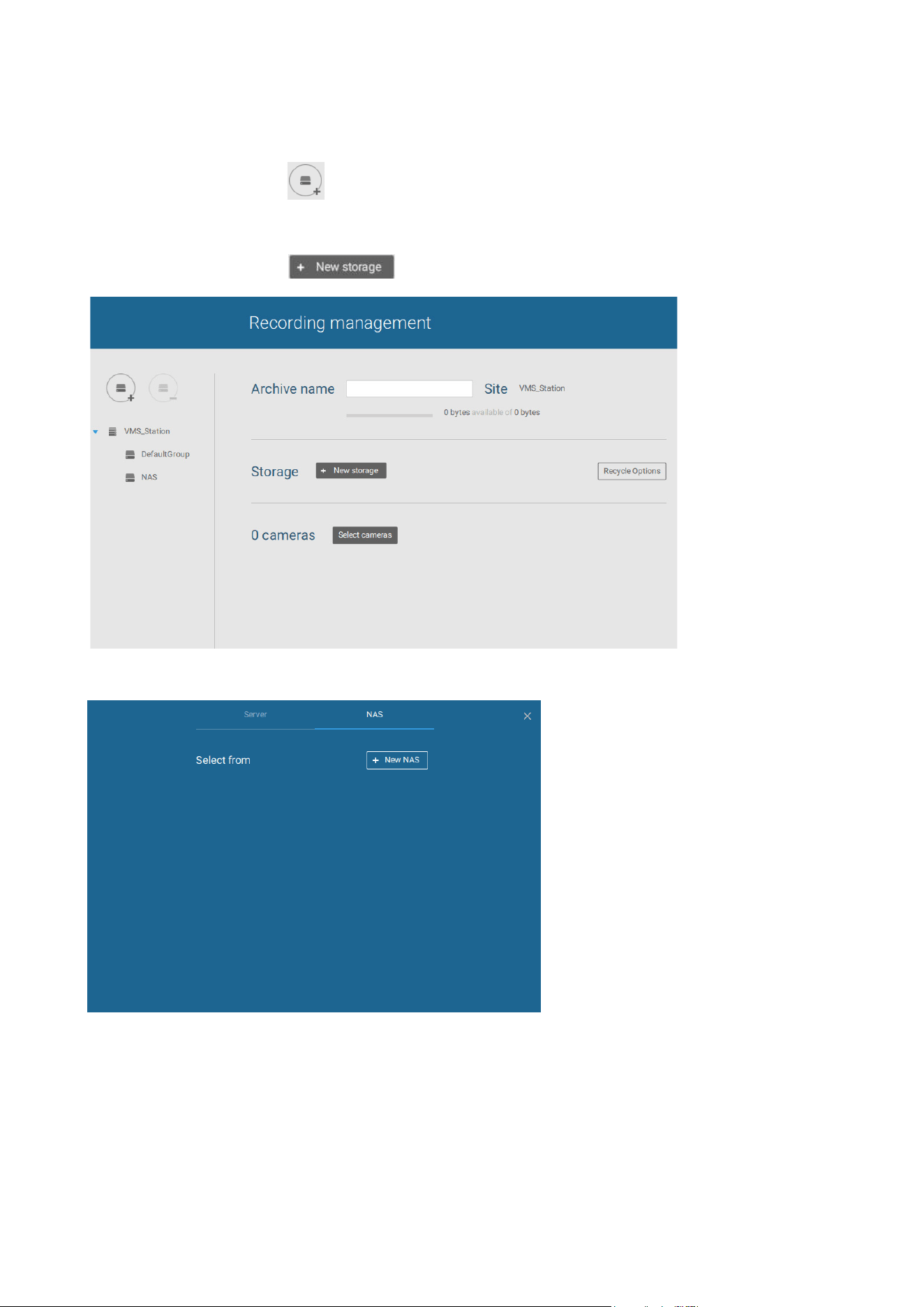
Adding NAS (Network Attached Storage) as a Storage Option
You can also record videos to a networked storage.
1. Click the Add archive
button.
2. Enter a name for the configuration.
3. Click the Add storage
button.
4. Click the + New NAS button.
57
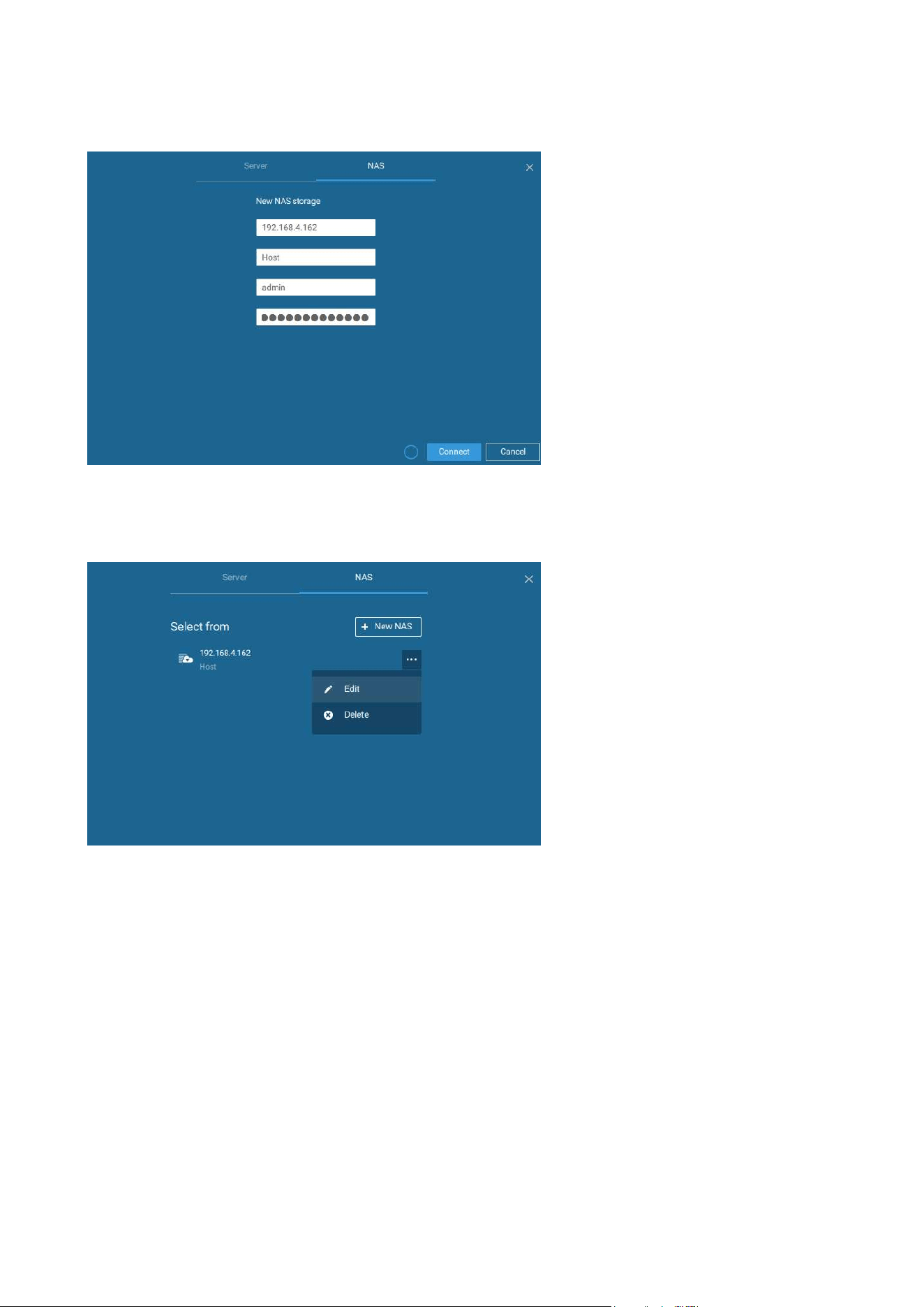
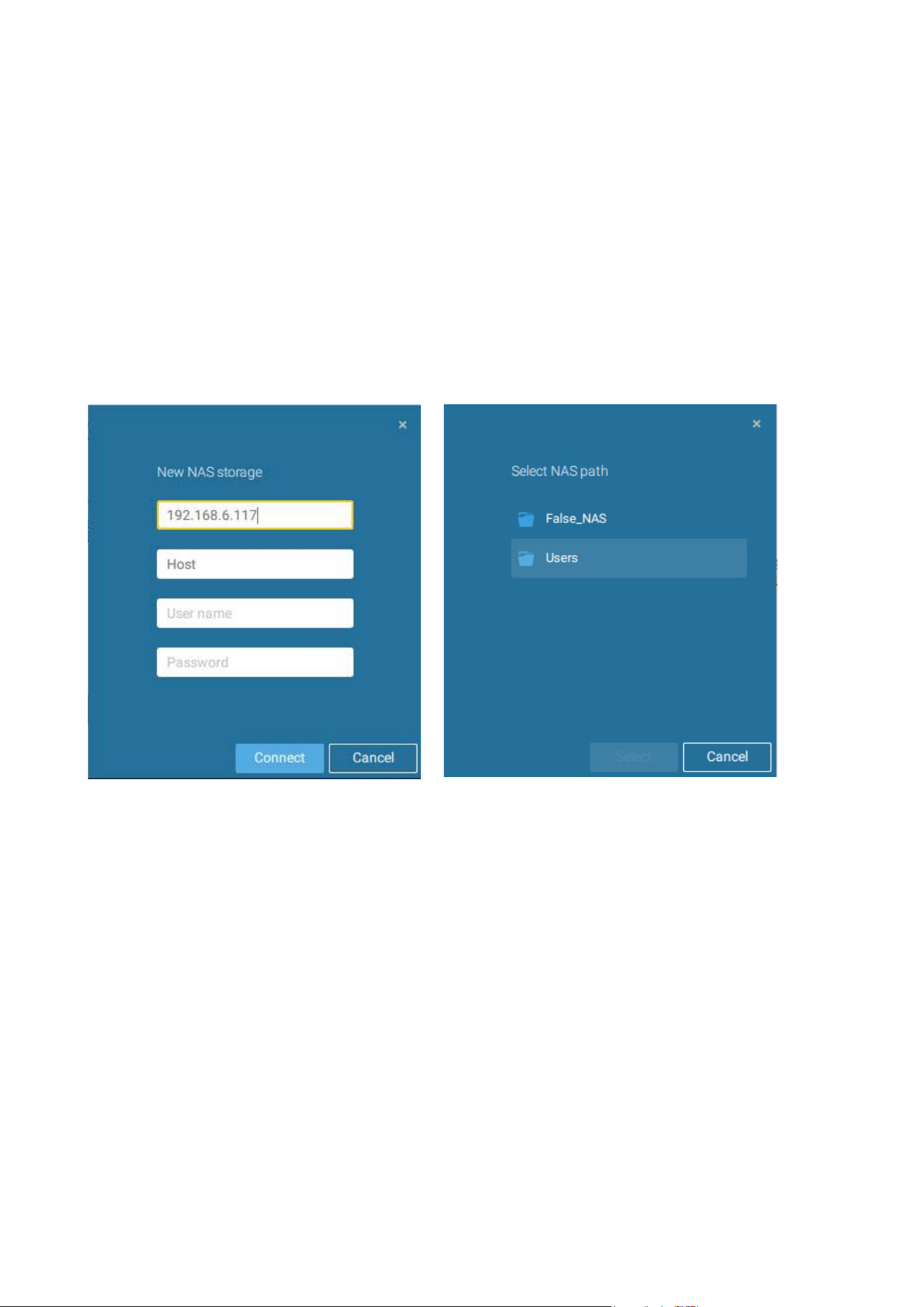
5. Enter the NAS storage's address and the credentials for access to the networked
storage. When done, click the Connect button.
6. The NAS storage should appear on screen. The connection may take several seconds.
Single-click on the NAS storage to select its network shares.
58
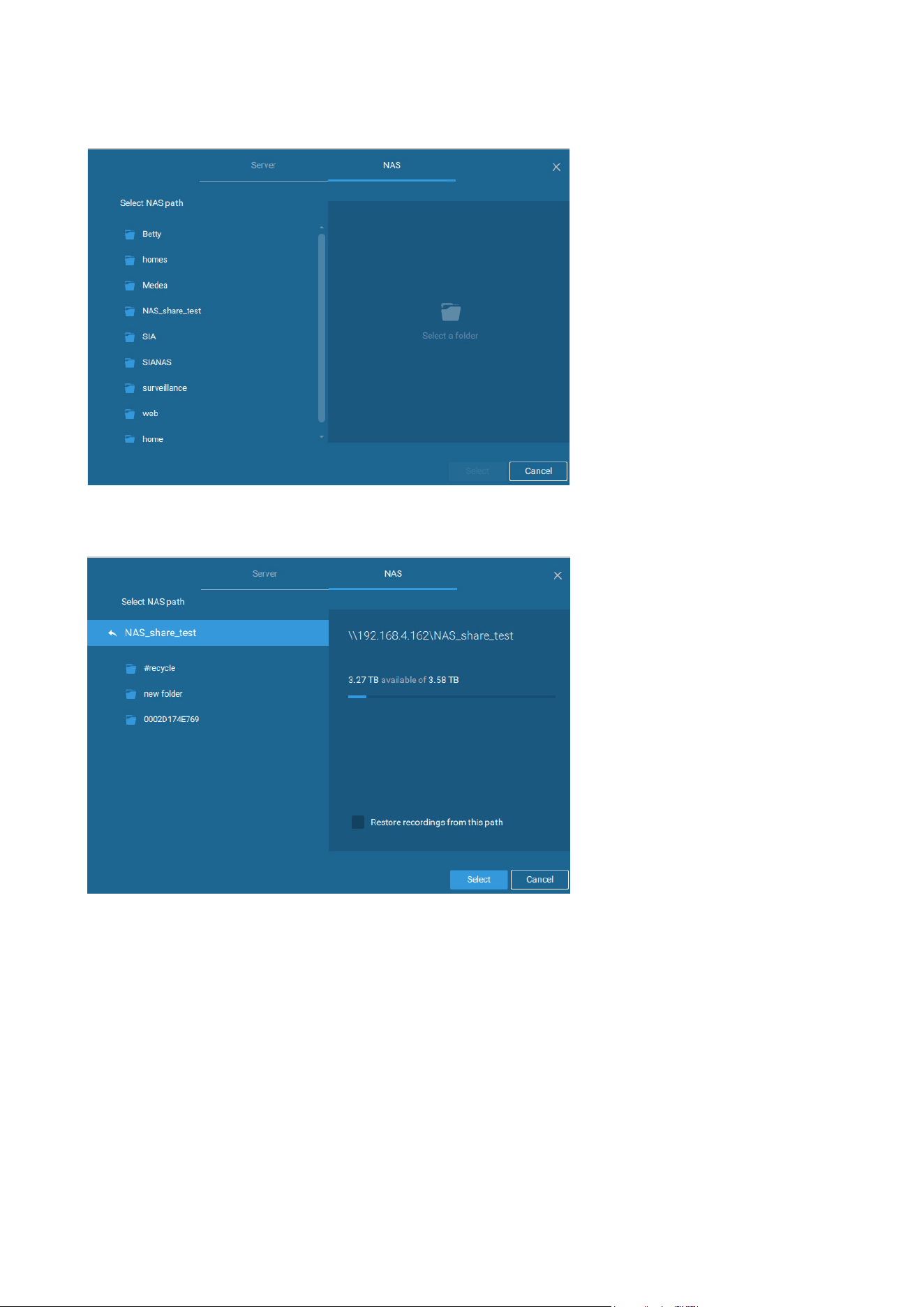
7. The NAS storage's network shares should be listed. Single-click to select a network
share.
8. Click Select when done. Note that you can repeat the previous process to select multiple
network shares from a single NAS storage.
59
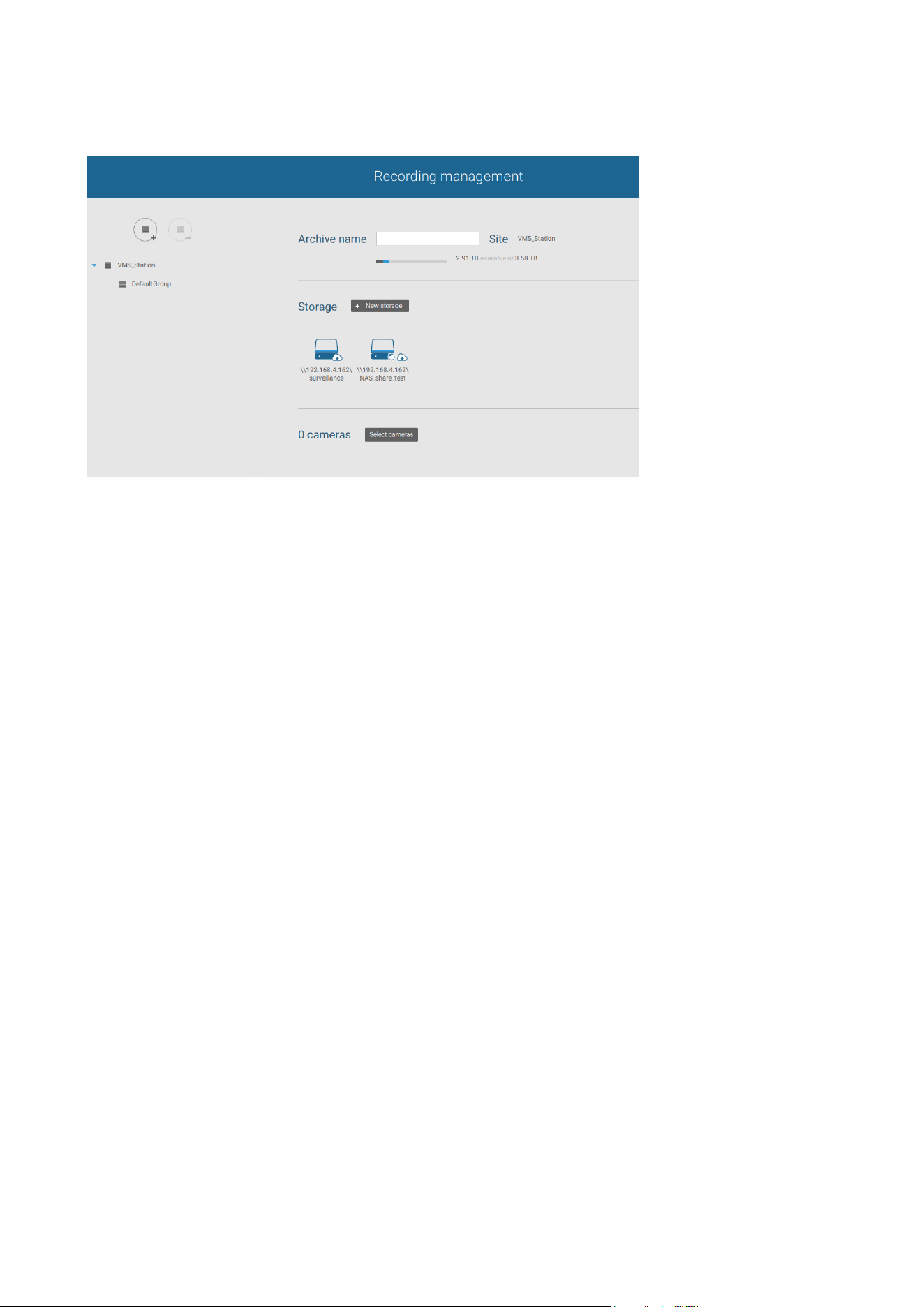
9. The selected shares should be listed. Enter a name and select cameras. When done,
click the Add button at the lower right to complete your configuration.
60
2-3. Storage
By default, VAST will check if the D: drive is available. If no other disk drives can be
specified, the system drive C: will still be defined as a storage option. Other disk drives in
the system, and the default storage volume (configured in the initial setup) will be listed.
You can add a NAS storage's share volume as the additional storage option. Enter the
necessary information for access to a network share. Enter and select a NAS path. The
share will then be available for video recording.
Select storage volumes each by a single click.
Click Ready to use to continue. The server will take several minutes synchronizing
configuration between server and cameras, and the time settings between them.
61
2-4. Starting Up - Main
Page
You will be defaulted to the Live view once the main page displays. Another tab window is
the Search panel where you can search recorded events and recorded videos.
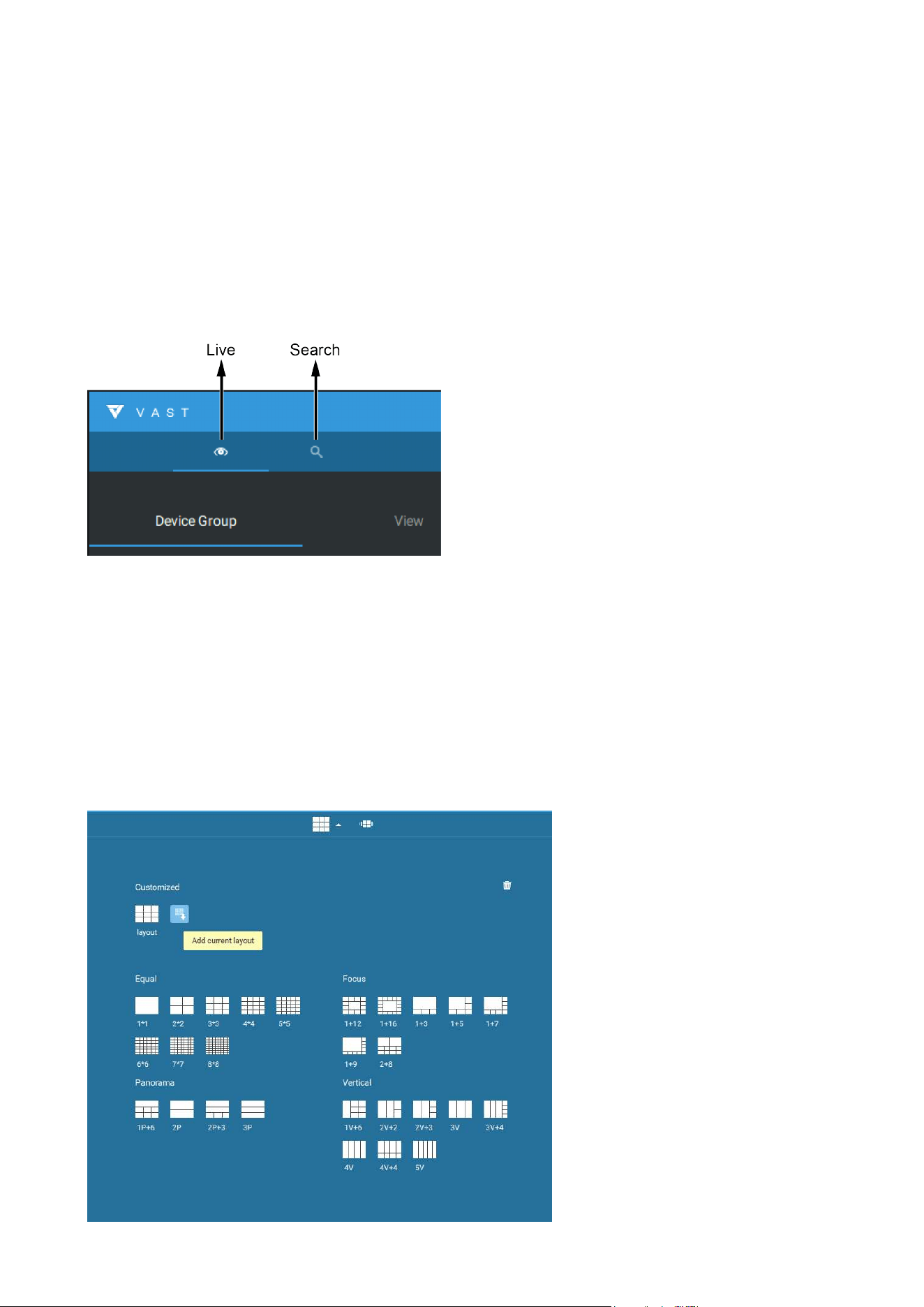
On the initial start up, the server should fill the live camera feed to the available 2x2 view
cells (4). You should then select a preferred layout, e.g., 3x3 or others, using the Layout
pull-down menu.
The available layouts are categorized into 4 types: Equal, Panorama, Focus, and Vertical.
Equal: 1x1, 2x2, 3x3, 4x4, 5x5, 6x6, 7x7, 8x8.
Panorama: 1P(Panoramic)+6, 2P, 2P+3, 3P. (applies to fisheye cameras)
Focus: 1+12, 1+16, 1+3, 1+5, 1+7, 1+9, 2+8.
Vertical: 1V+6, 2V+2, 2V+3, 3V, 3V+4, 4V, 4V+4, 5V. (applies to corridor view)
62
To design and customize a layout, please refer to the Customizable Layout page.
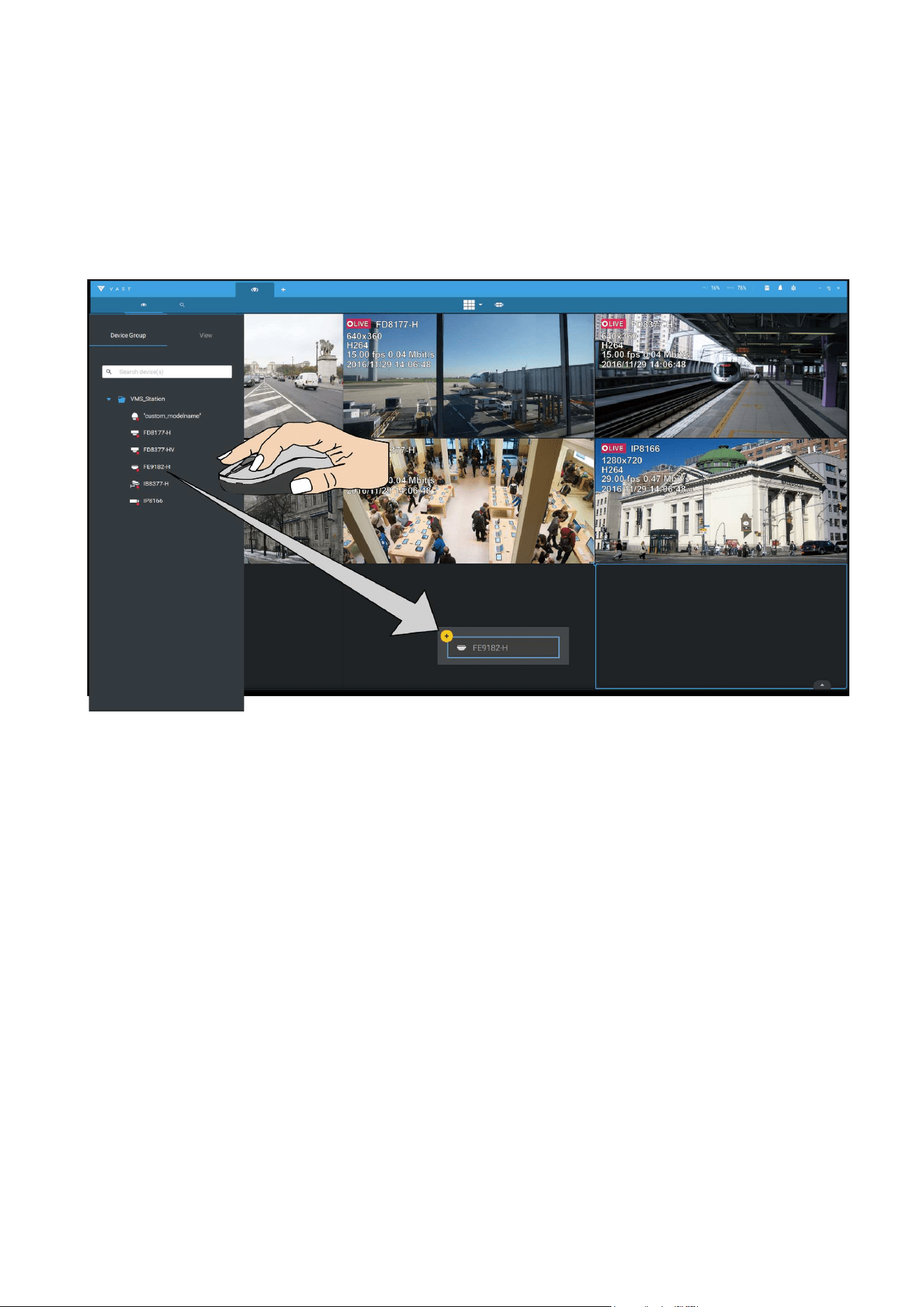
You can then fill in the view cells by dragging and dropping cameras into the view cells.
While dragging, a name tag displays. All cameras should be listed under the VMS_Station
Device Group.
You can swap two view cells by dragging one on top of another.
63
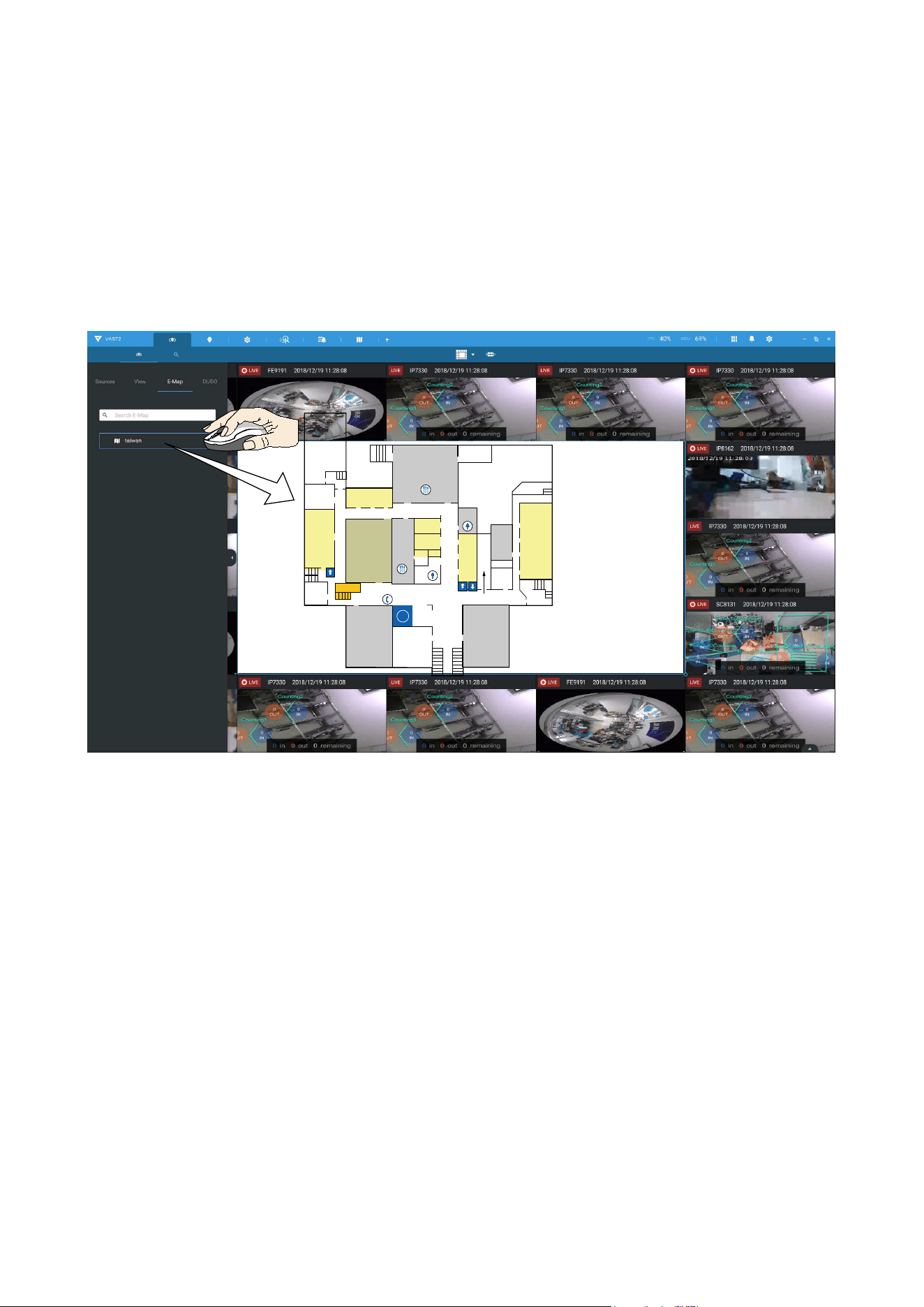
You can also fill in an Emap by dragging and dropping a pre-configured Emap into a
specific view cell. Click on the E-Map tab to select a pre-configured E-Map. Note that an
E-Map should be placed into a larger view cell.
Depending on the resolution of your monitor, a view cell can be too small for an E-Map.
For example, for an HD monitor (1920x1080), a single view cell from a 3x3 layout will
have a resolution of 640x360. View cells larger than 330 (width) x 300 (height) pixels can
contain an E-Map.
i
EXIT
EXIT
64
2-5. Saving a View
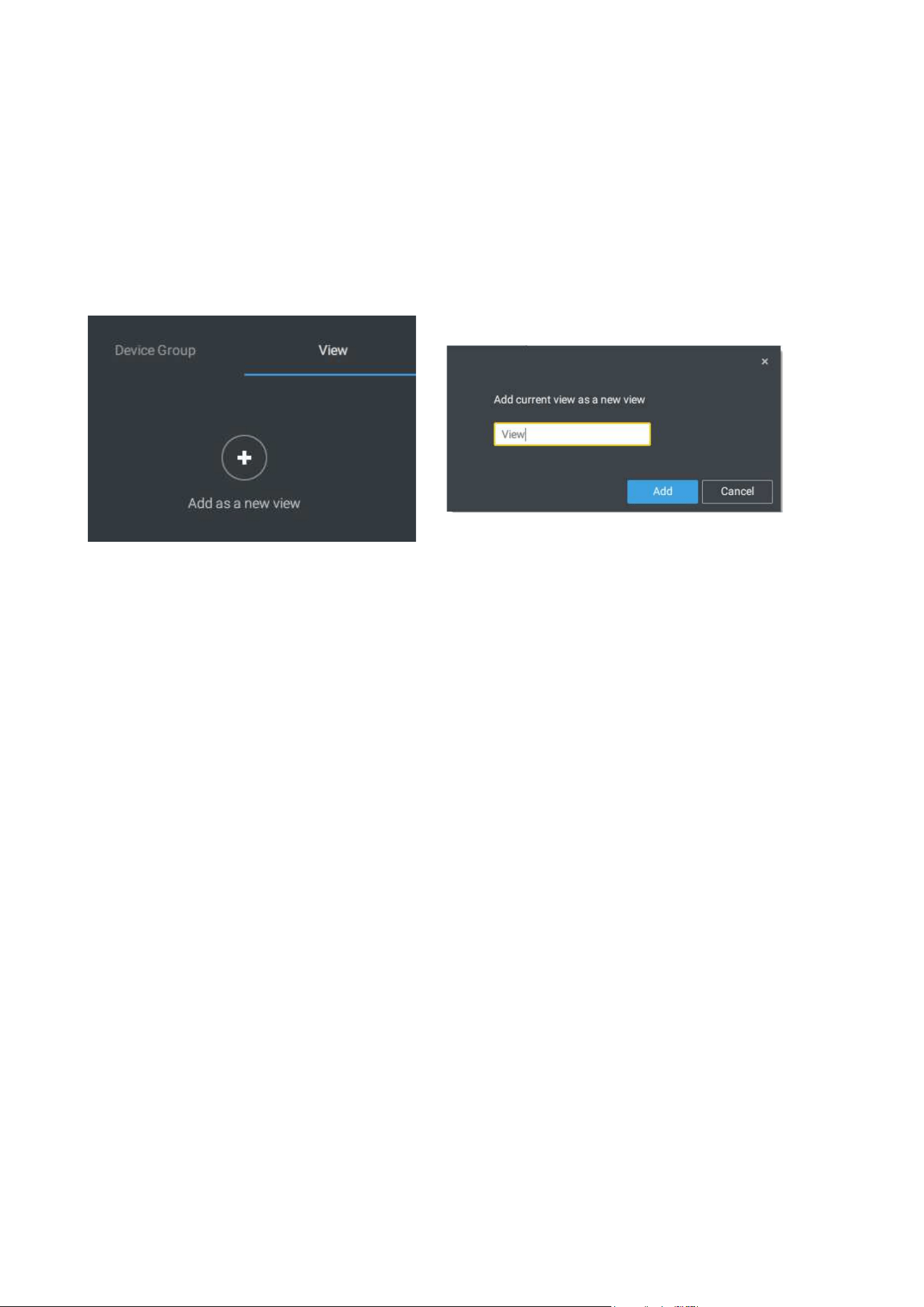
When done with arranging view cells, click the View tag.
Save your current layout and view cell arrangement as a new view.
65
2-6. Add More Live Views
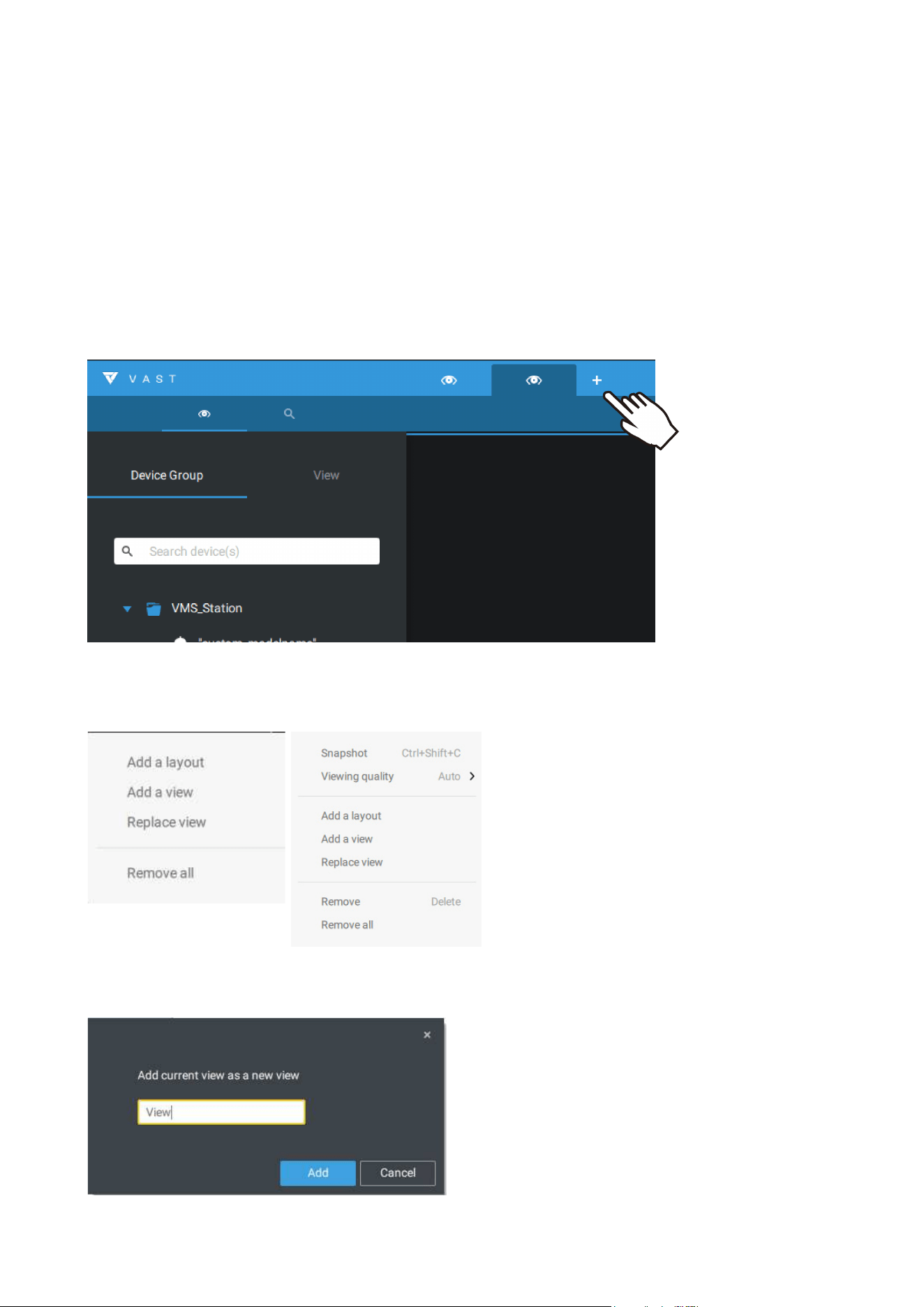
With many cameras in your deployments, you can click the New Tab "+" button to add more
Live views.
An empty live view will display, and you should repeat the above process to select a layout,
and fill in the view cells. When done, save the view.
Right-click on the screen to display the right-click menu. Select Add a view.
Enter a name for the new view and click Add to proceed. The new view will be listed in the
View panel.
66
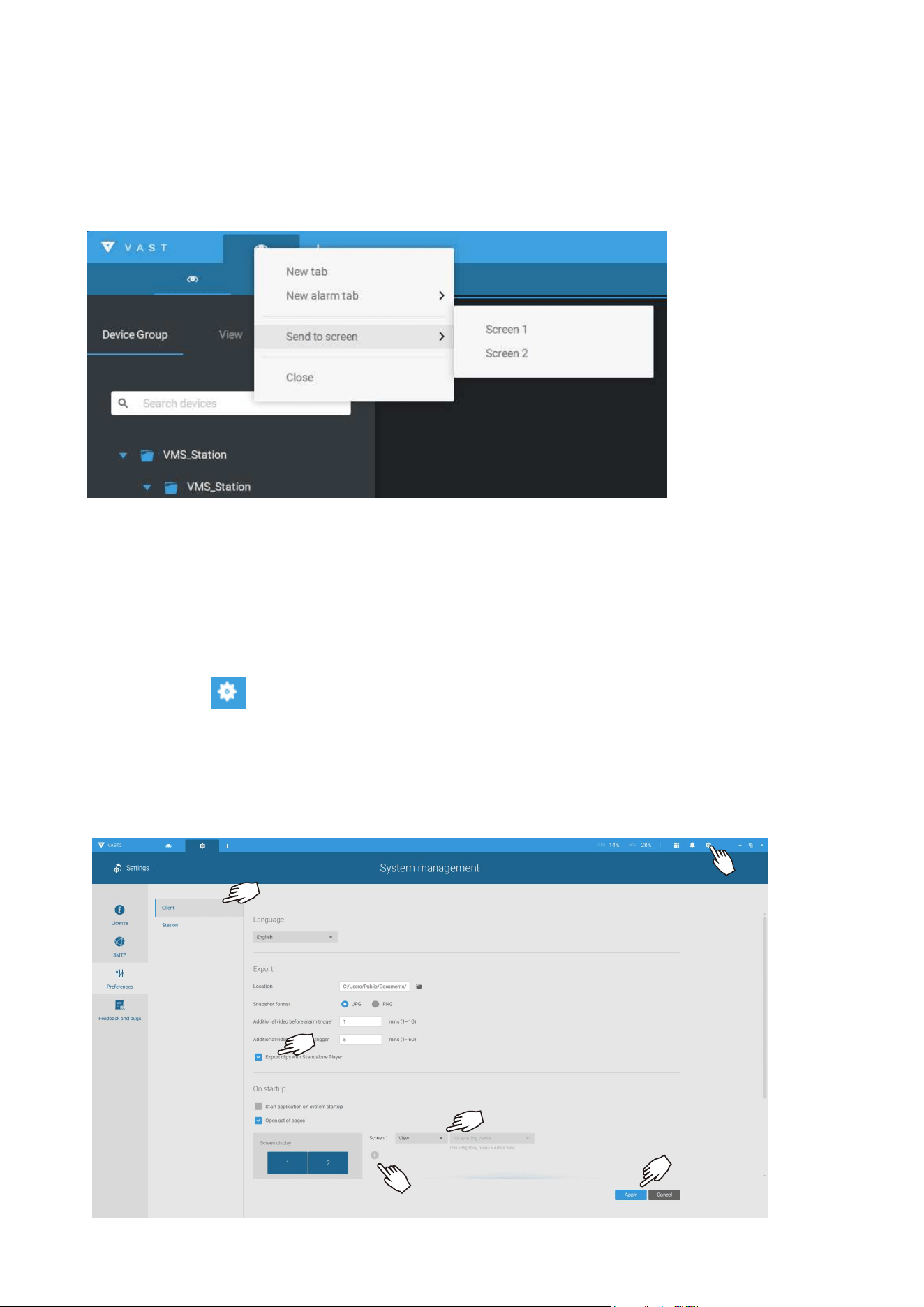
If you have multiple monitors attached to your server station, you can drag a live tab to a
different screen. In this way, you can display live views simultaneously on multiple screens.
Live views can be placed on multiple monitors. Please note that the number of monitors to
display live views is determined by the capability of your system.
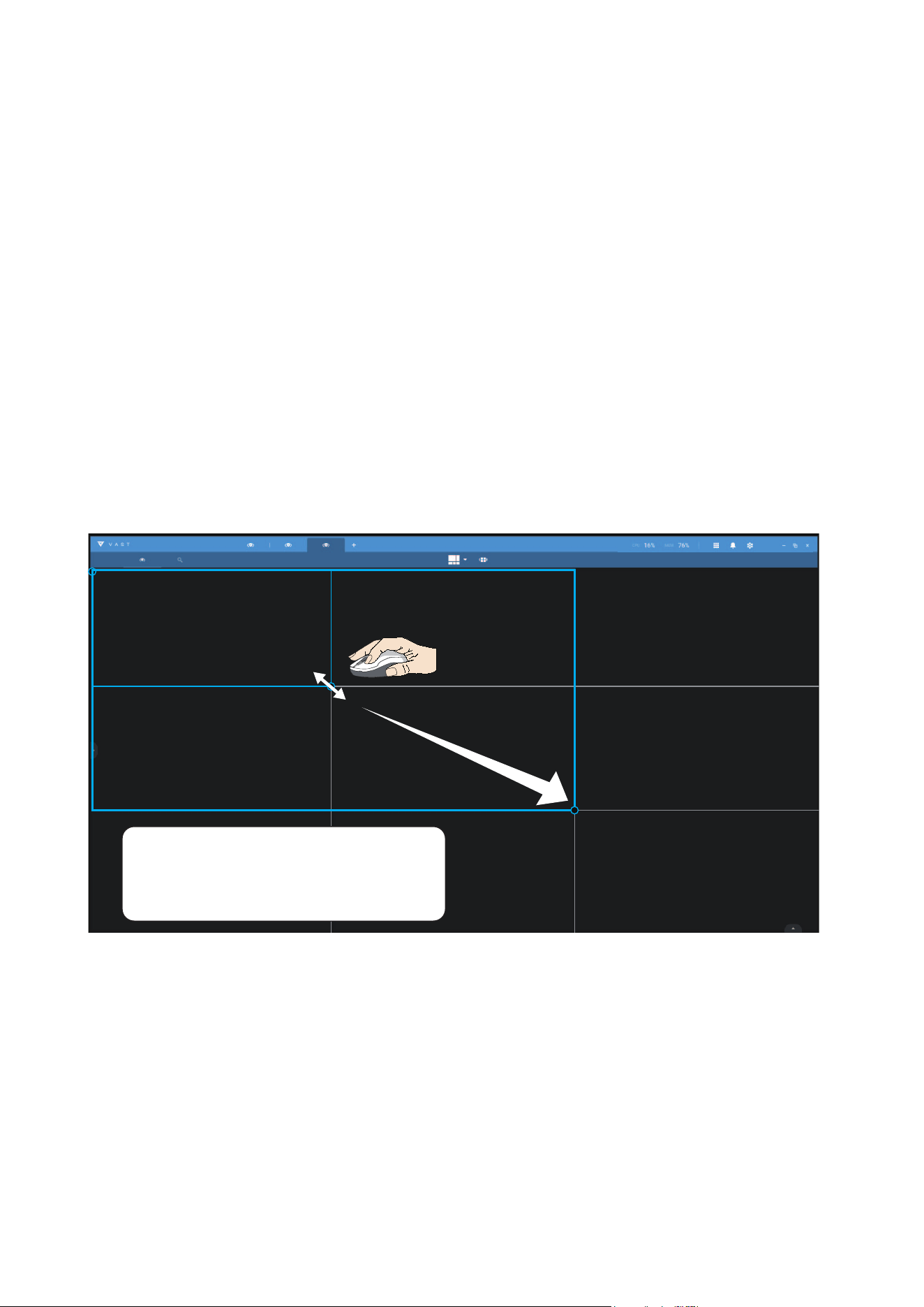
2-7. Save Your Preferences
Go to Settings > Preferences to save your current layout and display configurations.
Select the options in the startup choices menu to decide what to display whenever your
VAST2 client starts. You can display Live view, Tour, Dashboard, E-Map, or Alarm tab
simultaneously on multiple screens.
67
2-8. Customizable Layout
The standard layouts can be manually configured to form layouts of your choice.
Depending on the complexity of your design, you should start with a multi-cell layout.
Click and drag the corner mark on a view cell. Drag across the screen and release the
mouse button to enlarge the view cell. Choose a standard layout of many view cells, e.g.,
7x7 or 8x8, if you want to design a complex customized layout. You can create a special
layout, e.g., an especially wide view cell for a multi-sensor camera, such as the panoramic
MS-8392.
To abandon a customized layout, simply select a new layout from the layout window. You
can also use the Ctrl + Z keys to undo your changes on the layout.
Use “Ctrl + Z” to undo
layout change
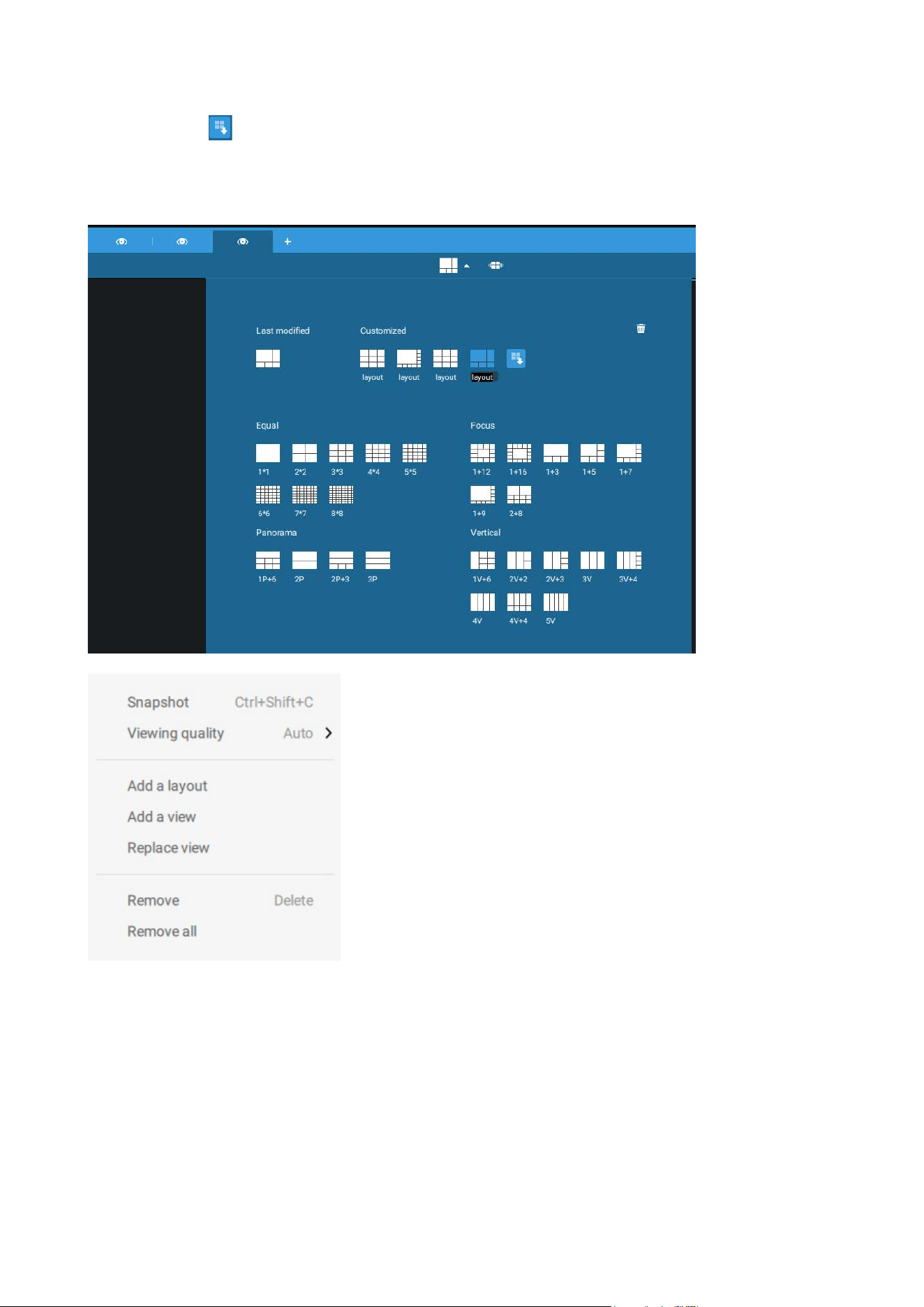
68
To preserve your customized layout, click to open the layout window. Click on the Add
current layout button. You may then change the name of your layout by a double-click
on its name.
To remove a configured layout, drag it to the garbage can icon on the upper right.
You can also right-click on the screen to display the Add layout option.
You can then click Device Group, and start filling your customized layout with camera
views. When done, click Add a view.
Also remember to save the current layout as a view, and save your configuration in Settings
> Preferences.
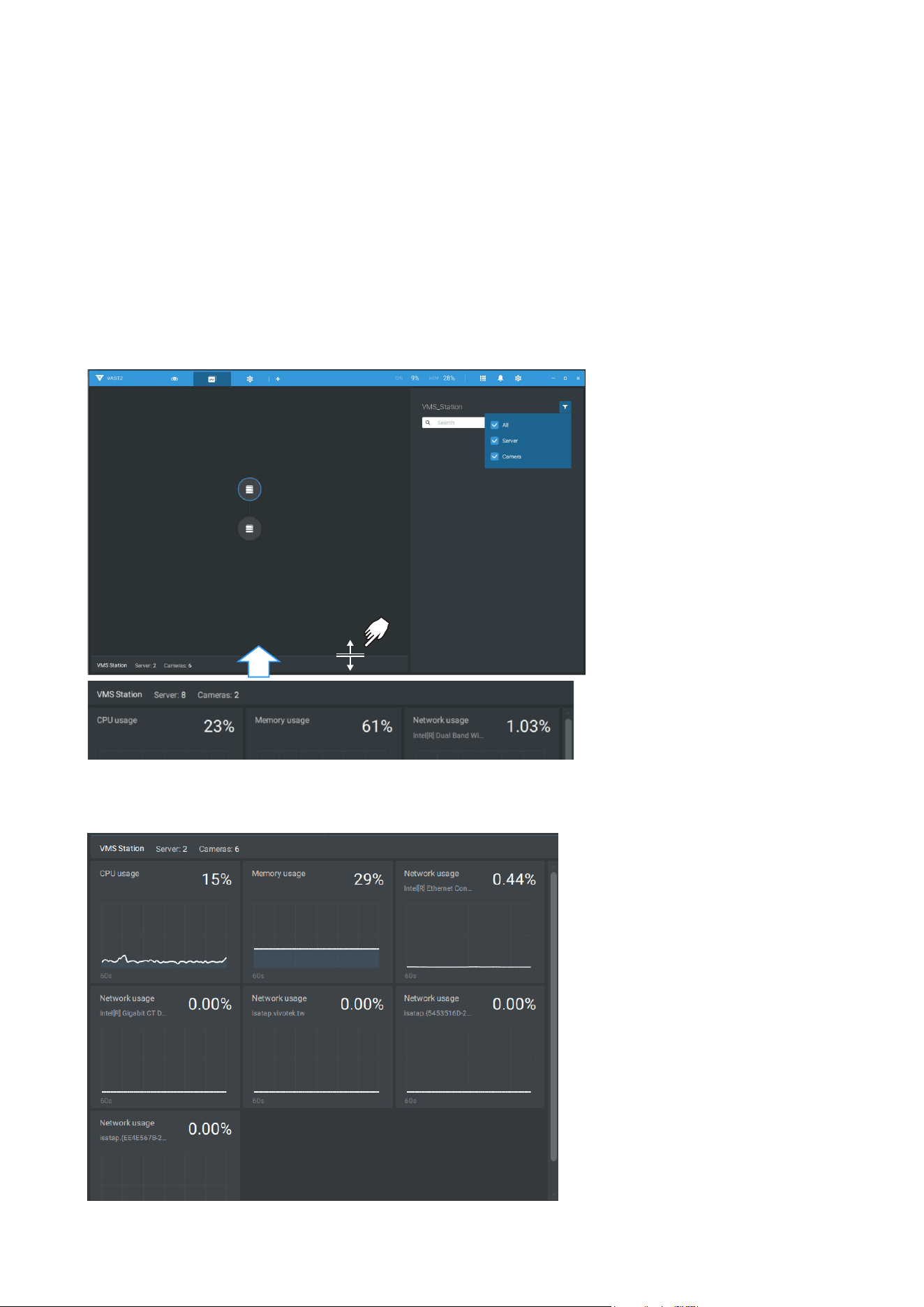
69
2-9. Dashboard
Select to open the Dashboard utility from the tool bar. The Dashboard displays the system
resources of a CMS server along with those of its sub-stations. This provides a glimpse of
the load on machines when performing the recording and monitoring tasks.
Mouse over the edge of the bottom row to reveal the expansion mark. Pull the status row
up to display the system resource statuses.
If you have multiple LAN cards or virtual HBAs, the status row can be pulled to reveal all of
their statuses.
The possible system abnormalities
can be:
CPU utilization over 90%
Memory usage over 90%
Network usage over 90%
Camera disconnected
Station disconnected
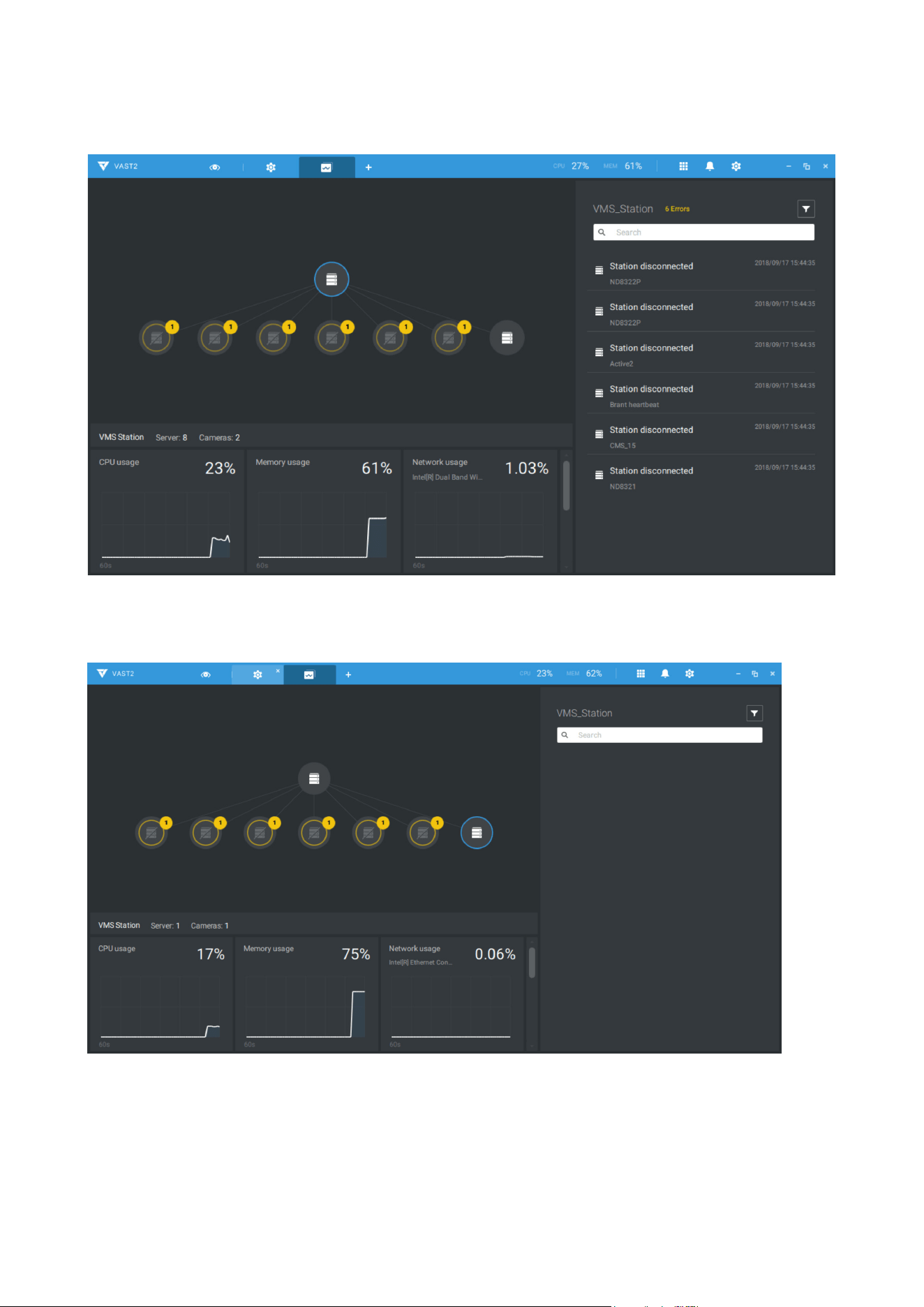
70
If you have multiple sub-stations, single-click to select and reveal their individual status,
including CPU usage, memory usage, and network usage.
Note that VAST servers of the earlier revisions and NVRs running older firmware do not
deliver their statuses to your Dashboard.
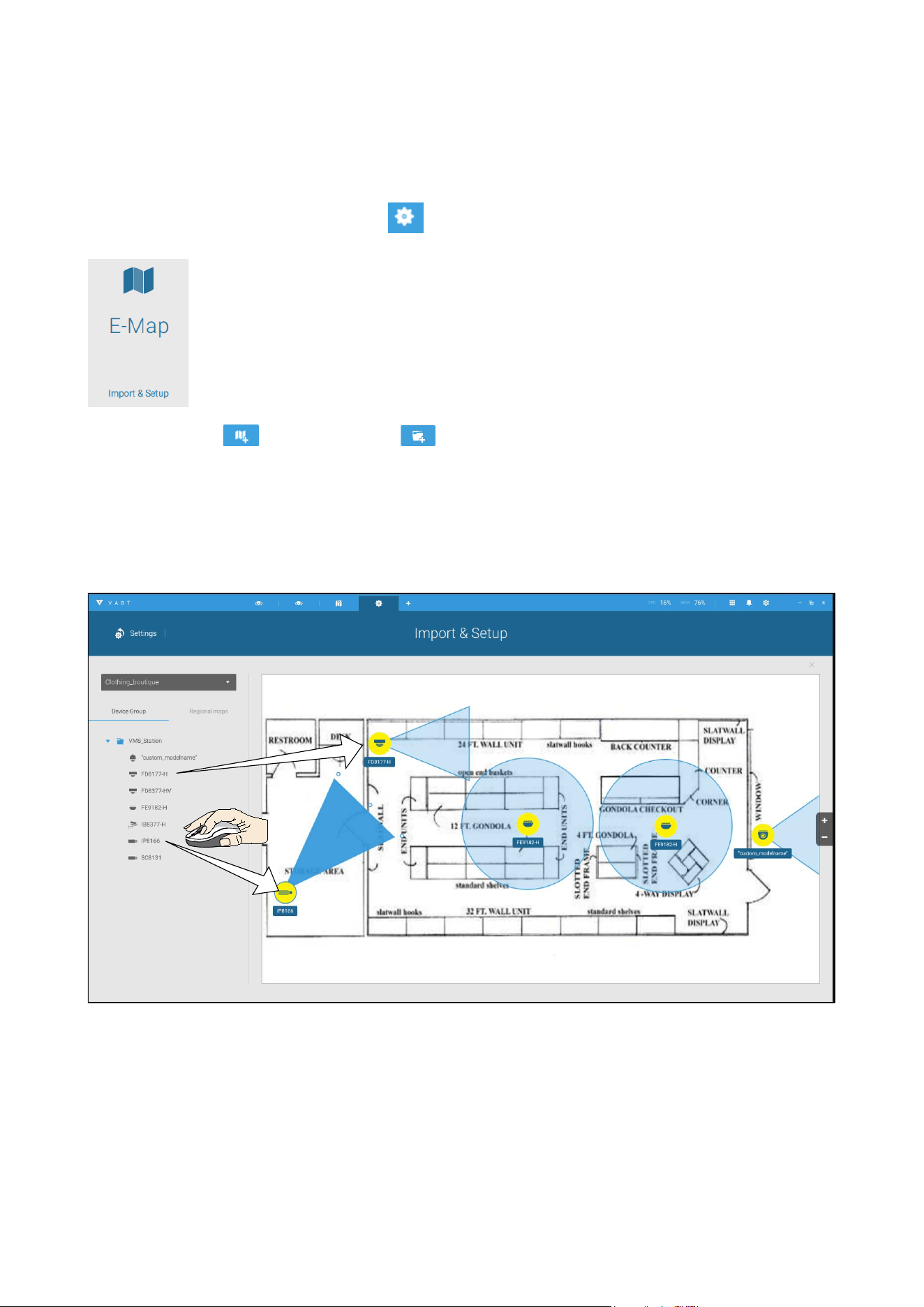
71
2-10. E-Map
To create your E-Map, click Settings . Click Import & Setup. Click E-Map.
Click Import file or Import folder . An entire folder can be imported.
When done, double-click on the snaphot of E-Map image to configure the E-Map.
Your cameras will be listed on the left. Drag and drop the cameras to the corresponding
locations on the map.
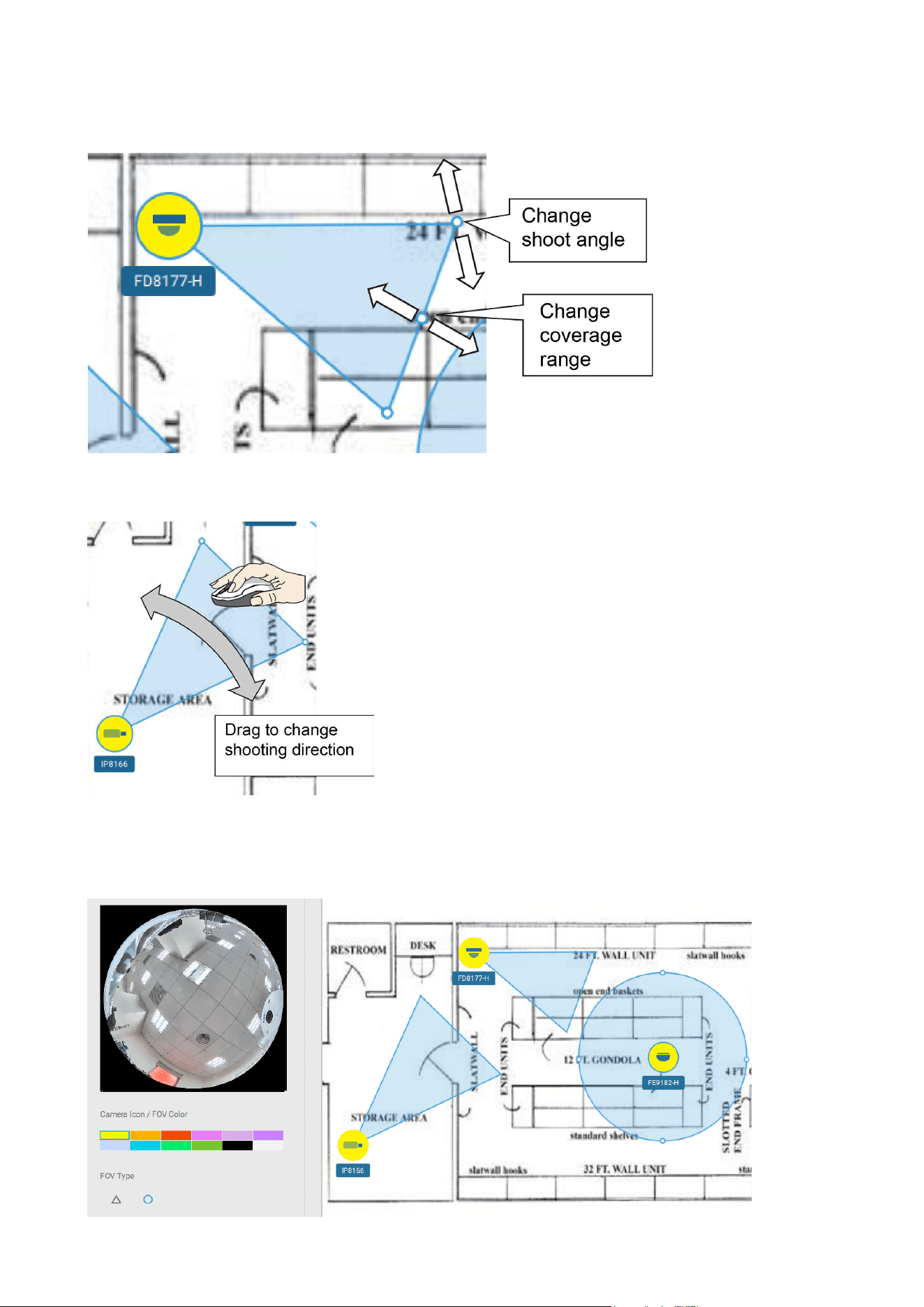
72
When the camera is in place, drag the FOV indicators on the edge to change the shooting
angle and the coverage range.
Drag the FOV to change the shooting direction to match the actual installation.
Click on the camera icon. You can also change the color of camera icon and the FOV type.
Fisheye cameras, when ceiling mounted, have a round shape coverage.
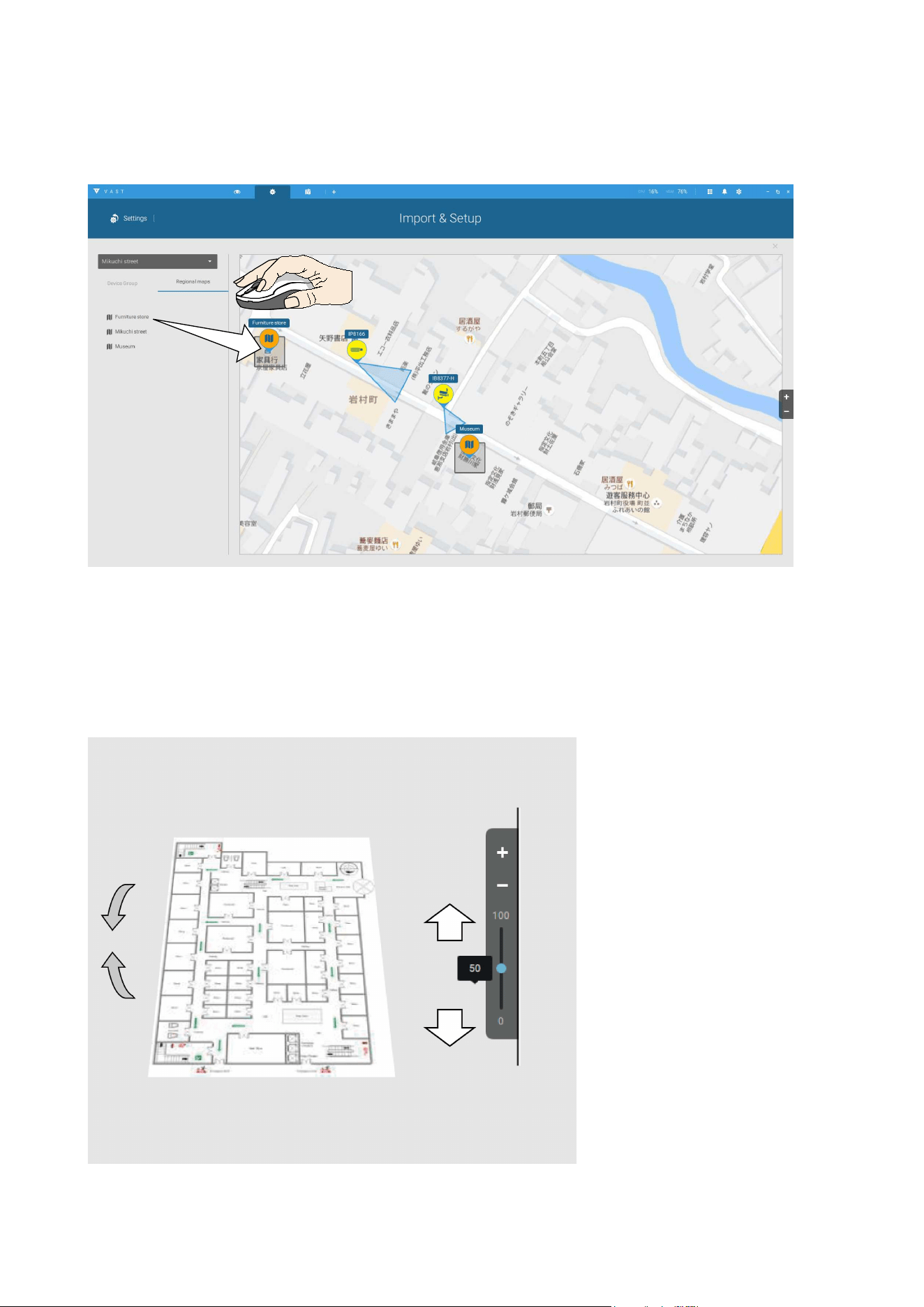
73
If you have a larger regional map that covers a geographical area, say, a street block, you
can drag one or many E-Maps into it. For example, you can place another E-Map that is
used to indicate the camera deployment inside a building that is located on the street.
To see live streams from cameras, click on the camera icons in the E-Map.
When configuring an E-Map, you can use the tilt bar on the right to tilt the E-Map image.
Doing so creates a sense of distance and depth of view.
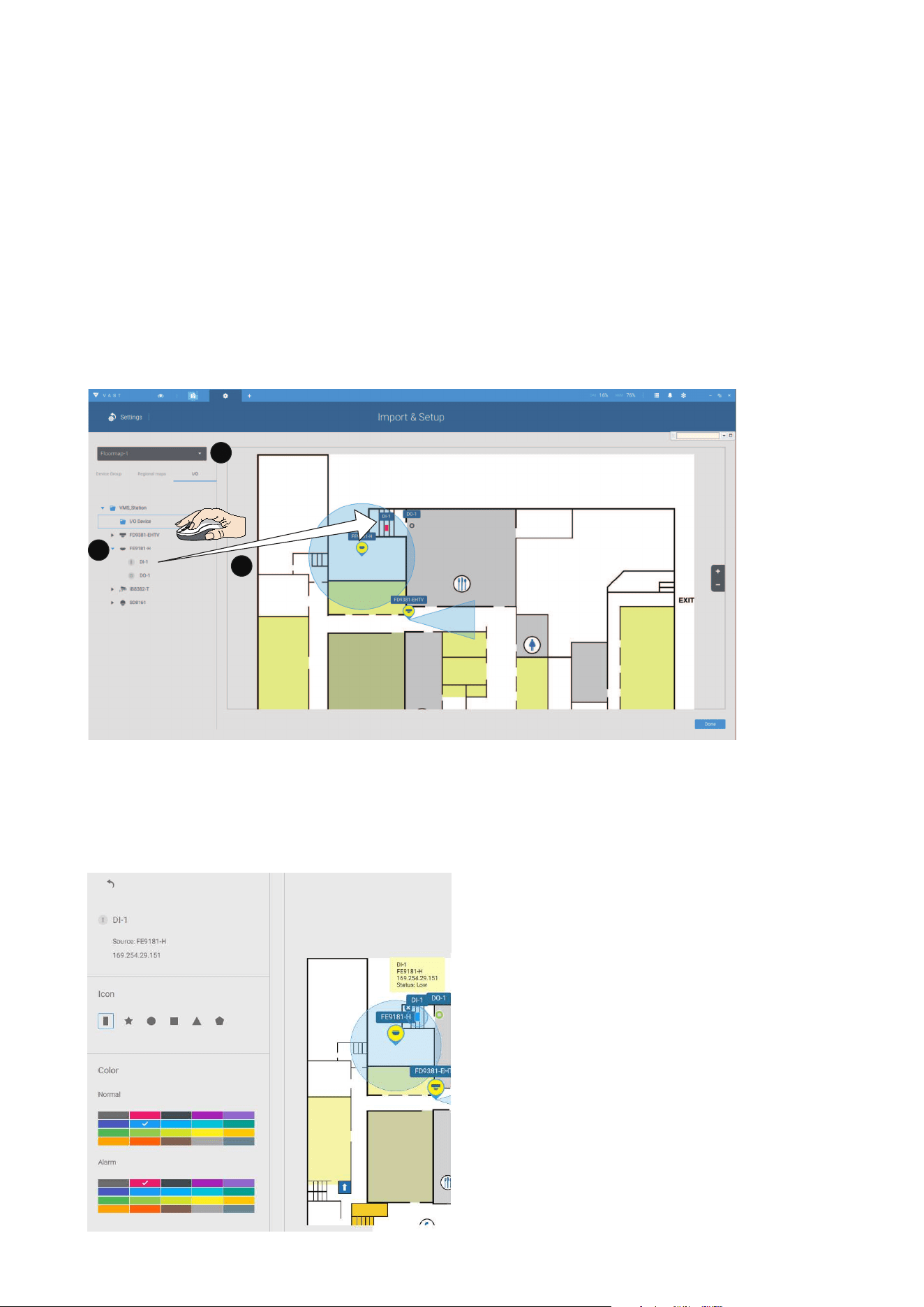
74
Placing DI/DO Devices
I/O devices can also be planted into an Emap, such as alarm or various kinds of detectors.
The I/O boxes (such as Advantech's Adam series) or the DI/DO connections on an NVR
also apply.
1. Select a floor map from the pull-down menu.
2. Unfold the sub-trees beneath the network camera, (taking camera DI/DO devices as an
example).
3. Select a DI/DO device. Click and drag to a preferred location on map.
2
1
3
4. When a DI/DO device is selected, you can select the display colors of its icons. Configure
different colors for the device status when it is normal or triggered.
5. When done with placing all DI/DO devices, click the Done button on the lower right of the
configuration screen.
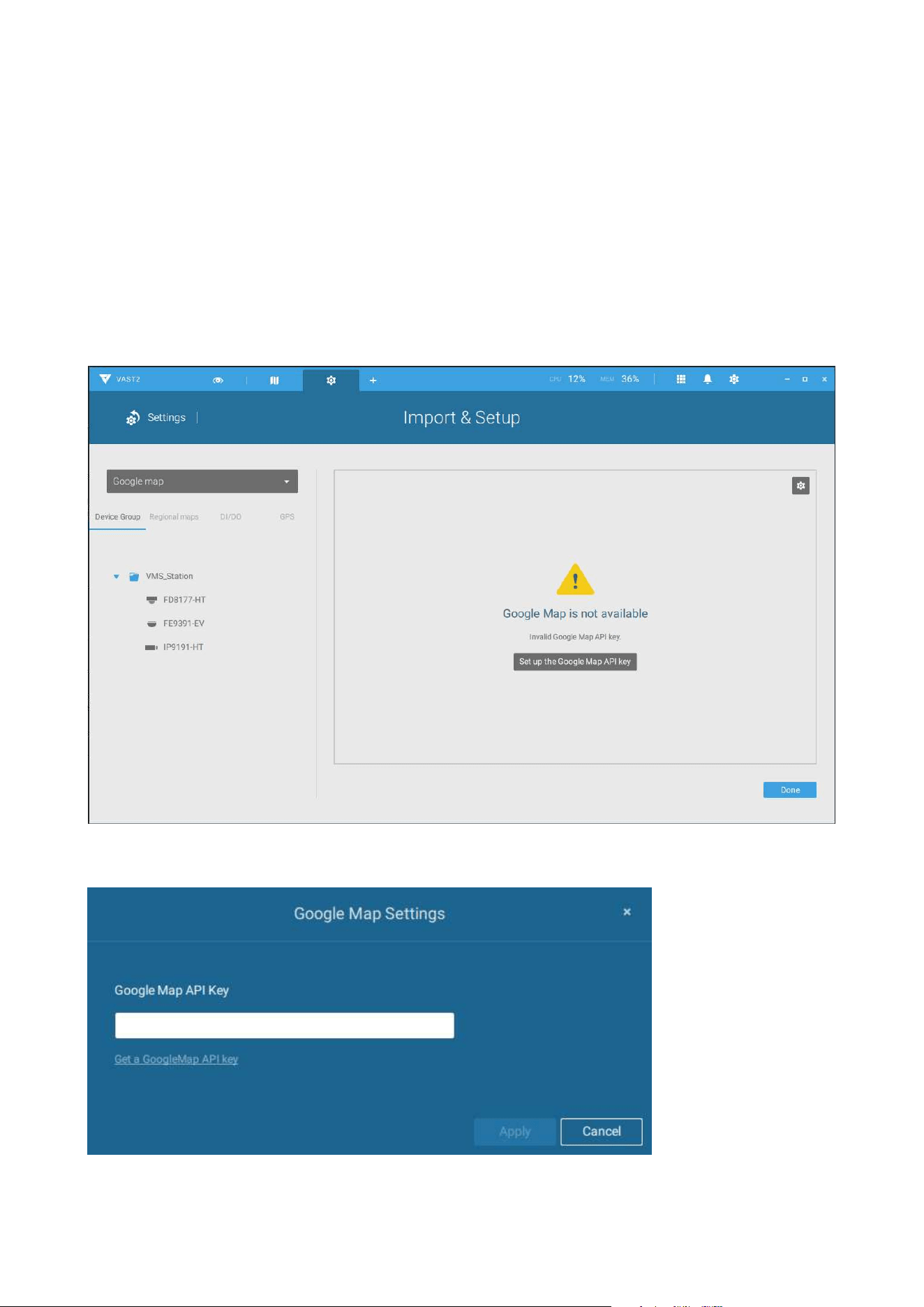
75
Conguring GIS or Google Map and GPS
Since Google Map changed its access policy, using the Google Maps feature requires user
entering a billing API key. Using Maps, Routes, and Places APIs requires an API key.
For applying a Google API key, https://cloud.google.com/maps-platform/maps/
Visit Settings > Emap > All Maps.
Enter the Google API key you previously registered (if using Google Map).
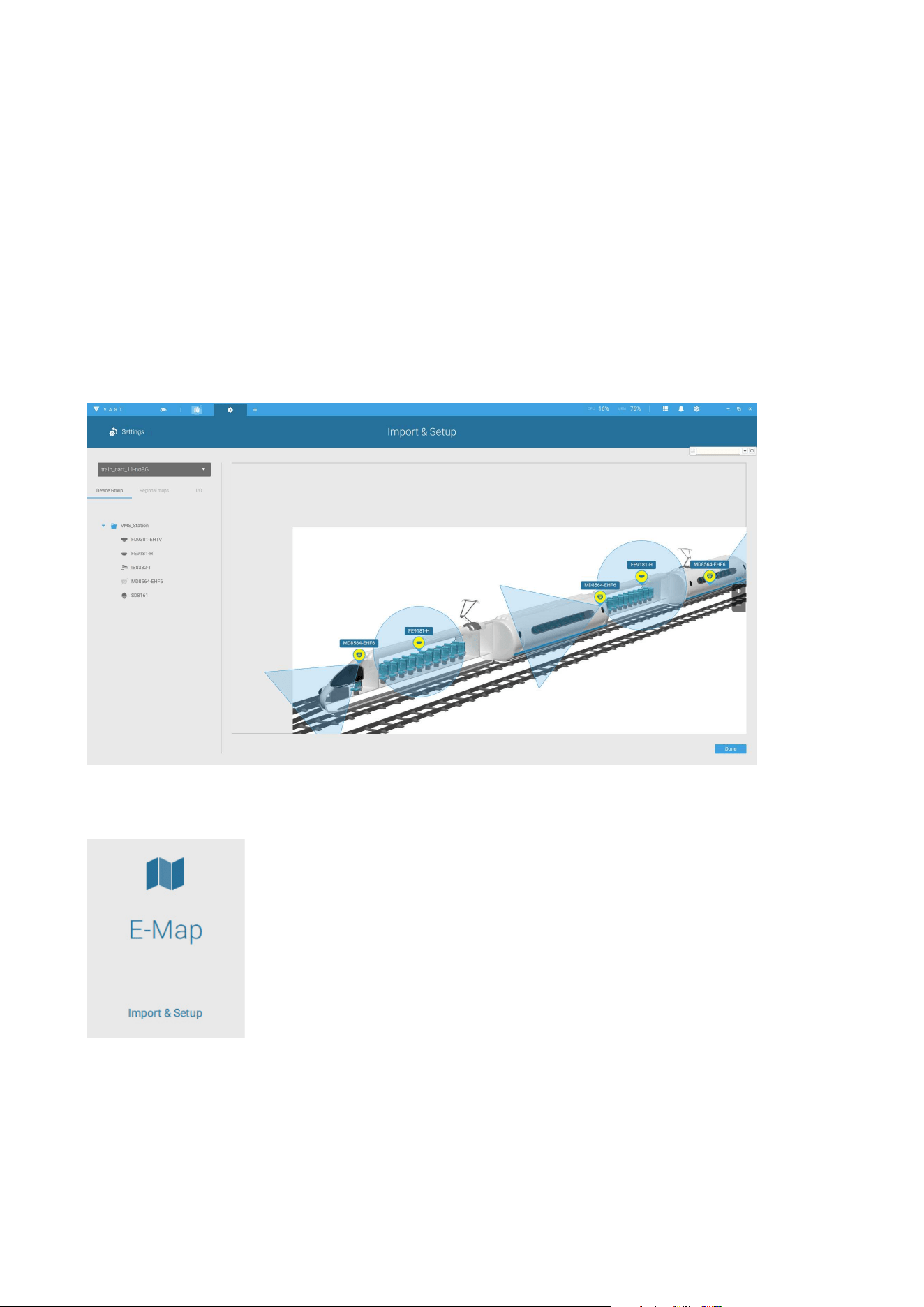
76
NOTE: In this revision, Google Map only supports installation on a GPS-enabled vehicles.
Placing cameras on a static location on Google Map is currently not supported.
Before configuration on a Google Map, you should prepare an E-map drawing for special
installations, such as that on a vehicle. The vehicle, e.g., a train, should come with a GPS-
GSM/GPRS module to collect the position information and pass this information to a web-
server. As new data is constantly inserted to the database, the VAST server will update the
location information containing coordinates, speed, distance, time, etc.; and when video
recording is required, the location information and time tags will be available.
This applies to a mobile NVR that comes with GPS functionality.
Open the E-Map Import & Setup window.
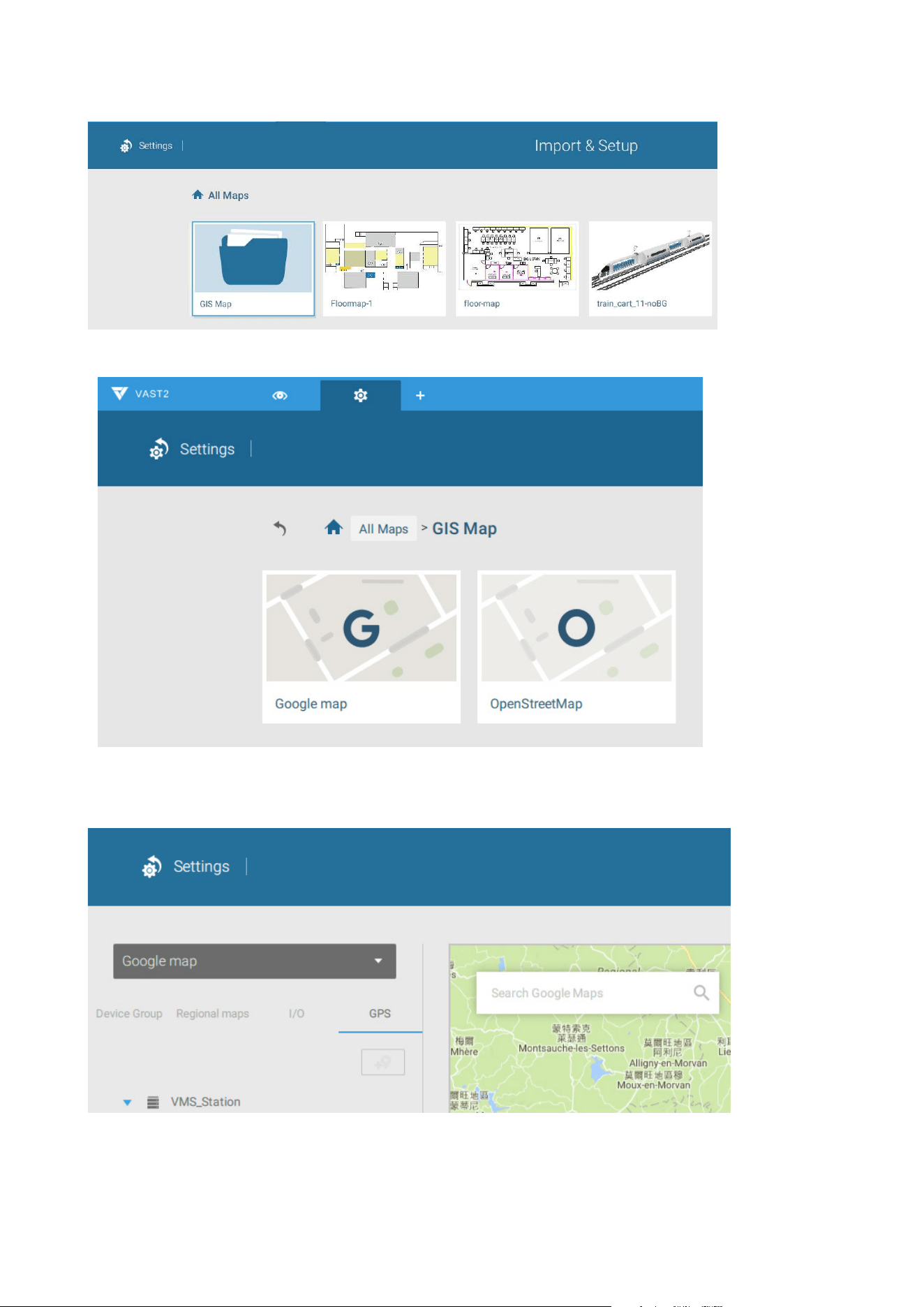
77
Click to enter the GIS (Geographic Information System) Map and then Google Map window.
Click on the GPS tab. Select a VMS station or mobile NVR to apply the configuration, and
then select the GPS Add button .
Click on either the Google map or the OpenStreetMap.
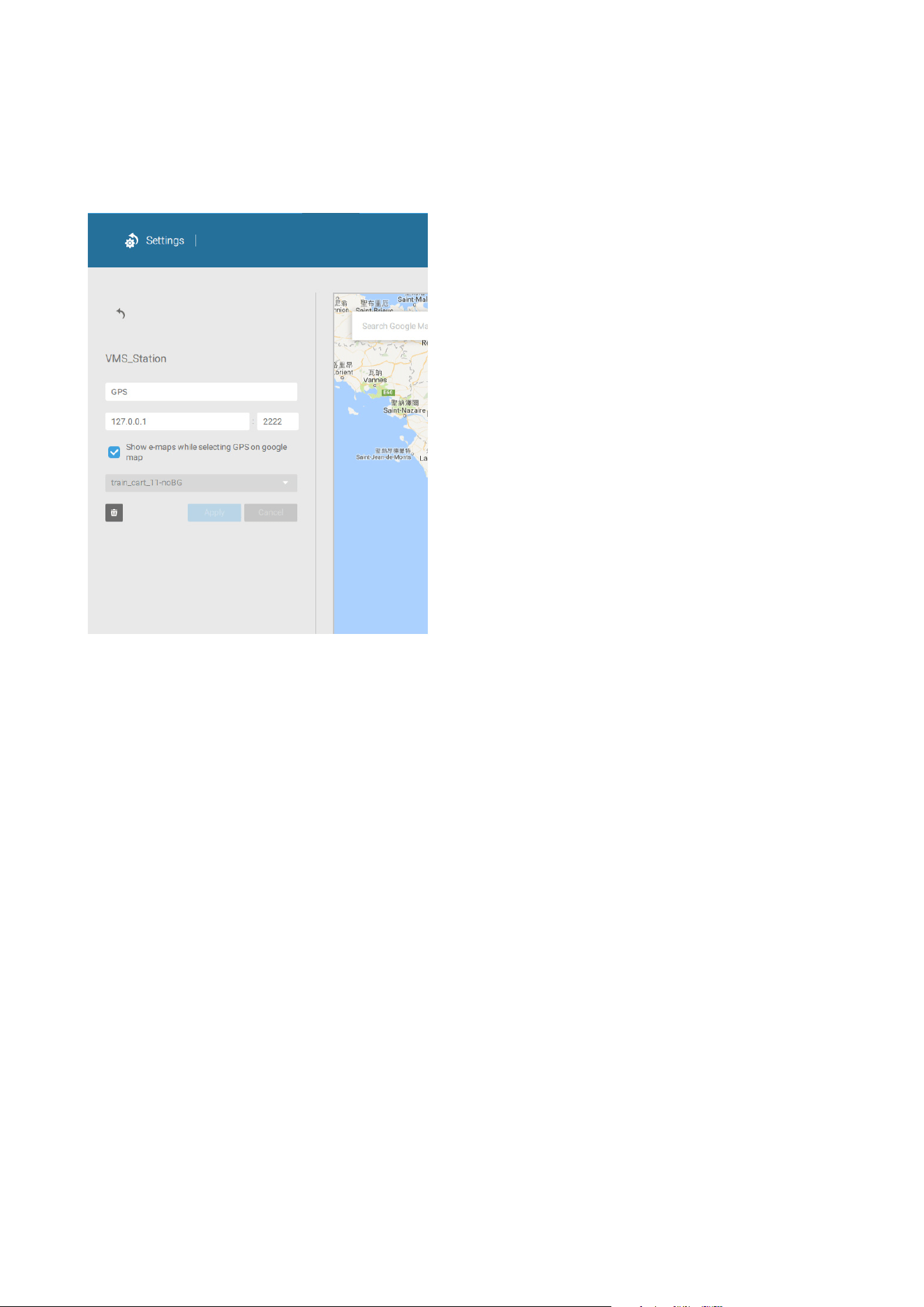
78
Enter a name for the GPS/GNSS server on the vehicle, its IP address, and server port
number. You can select an E-map that will display when you click on the GPS location icon.
Select the checkbox and an E-Map that corresponds to the deployment on the vehicle.
When done, click the Apply button.
You can skip this setting for the mobile NVR
that comes with a built-in GPS module.
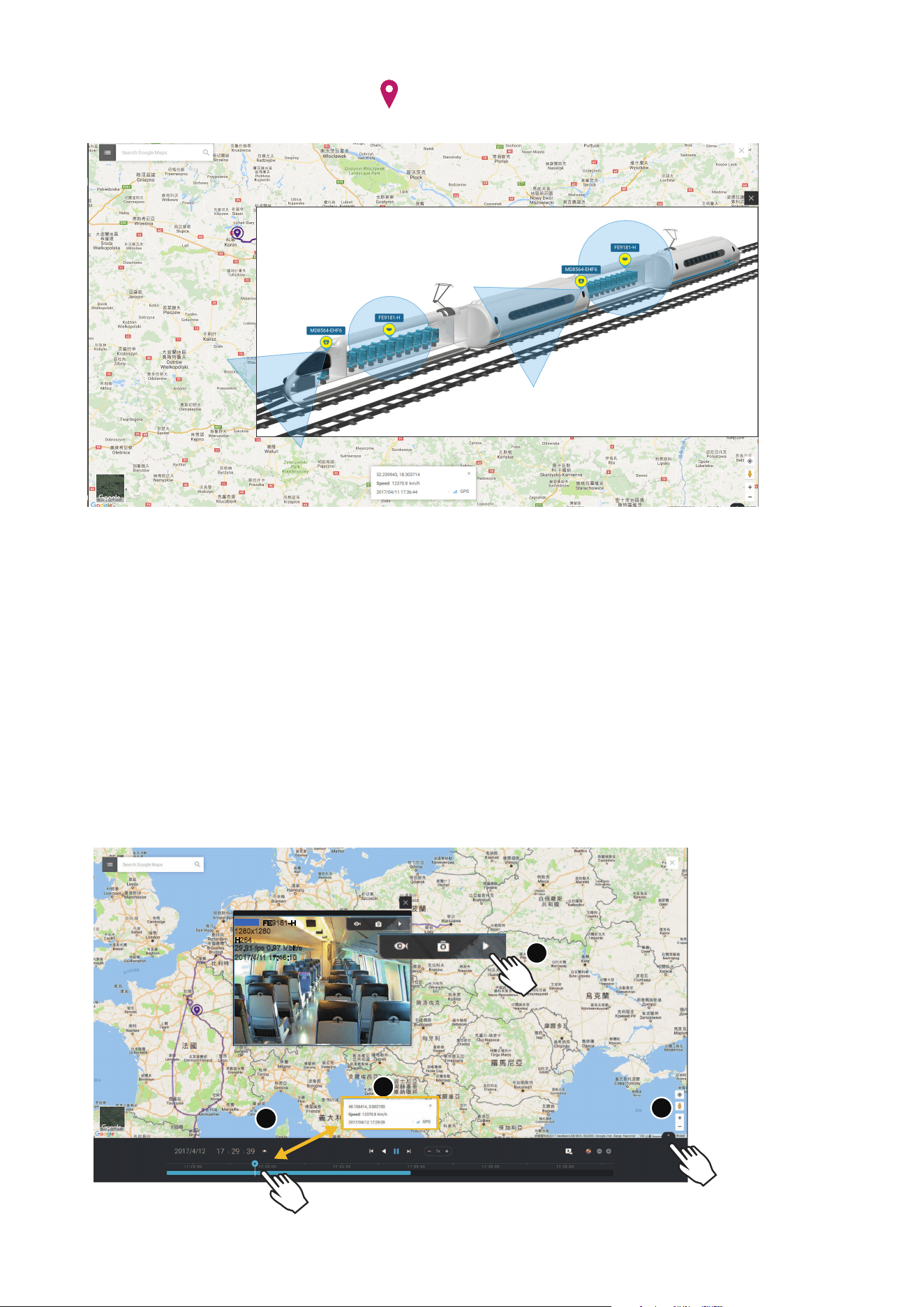
79
You can click on the location icon to bring up the E-Map. The coordinates, speed, and
time information also display on the map.
You can click on any cameras on the E-map to search through past recordings. One click
displays the live view. A live stream window will display.
To search and review recordings when an event occurs,
1. Click on the Playback button.
2. Click the Pane button to display the Playback control panel.
3. To search for the video of past events, pull the Playhead to a point in time on the
timeline.
4. The GPS coordinates and time will change to those corresponding to the time you
selected. You can then acquire the corresponding location information while tracing the
occurrence of an event.
29.91 fps 0.97 Mbit/s
2017/4/11 17:46:10
PLAYBACK
FE9181-H
1280x1280
H264
2
1
3
4
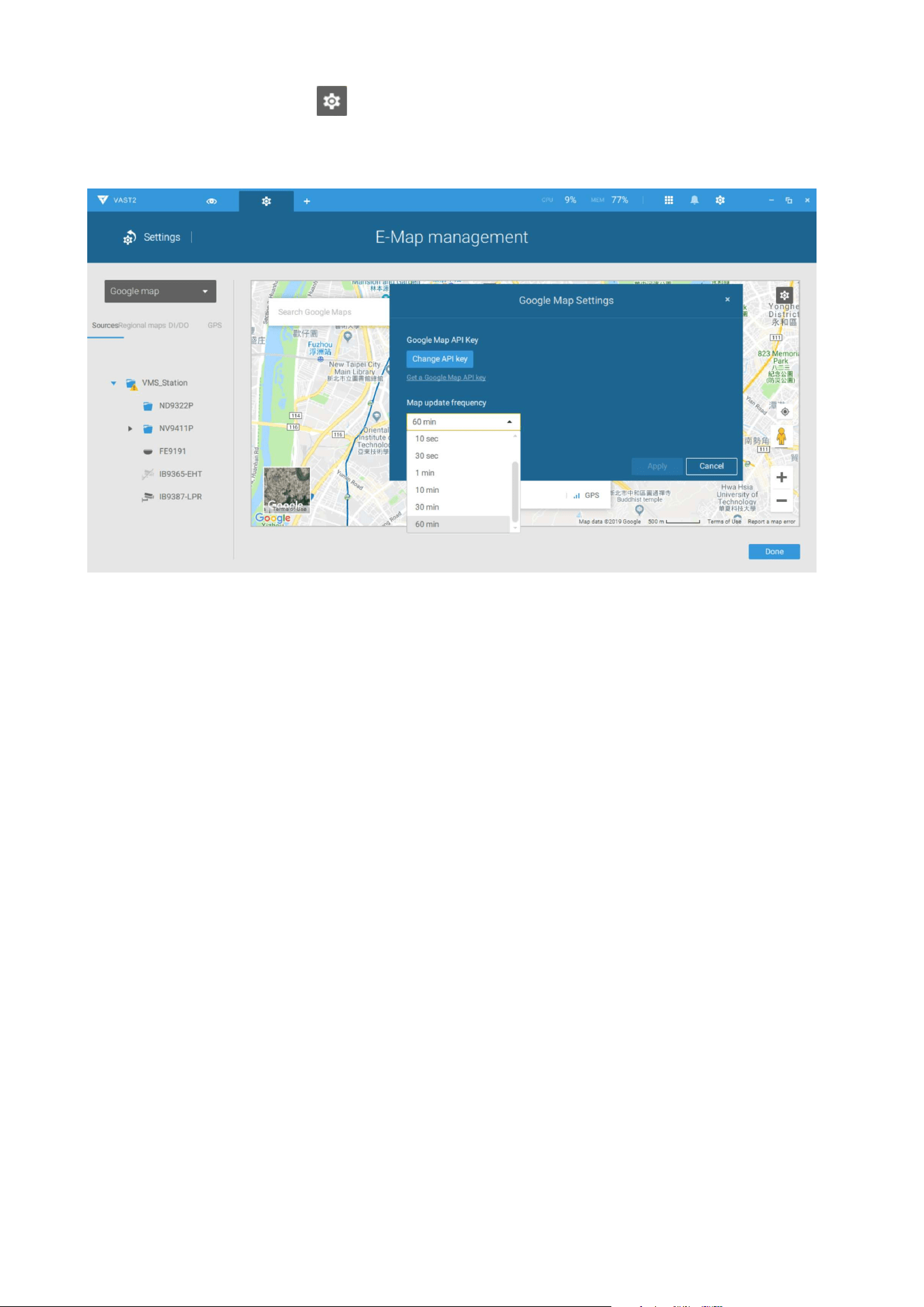
80
Click on the Setting button on the map to bring up the Map update frequency option.
Your GPS target may travel to the outside of the map through time without the map being
updated. The map will update by the interval you configure here.
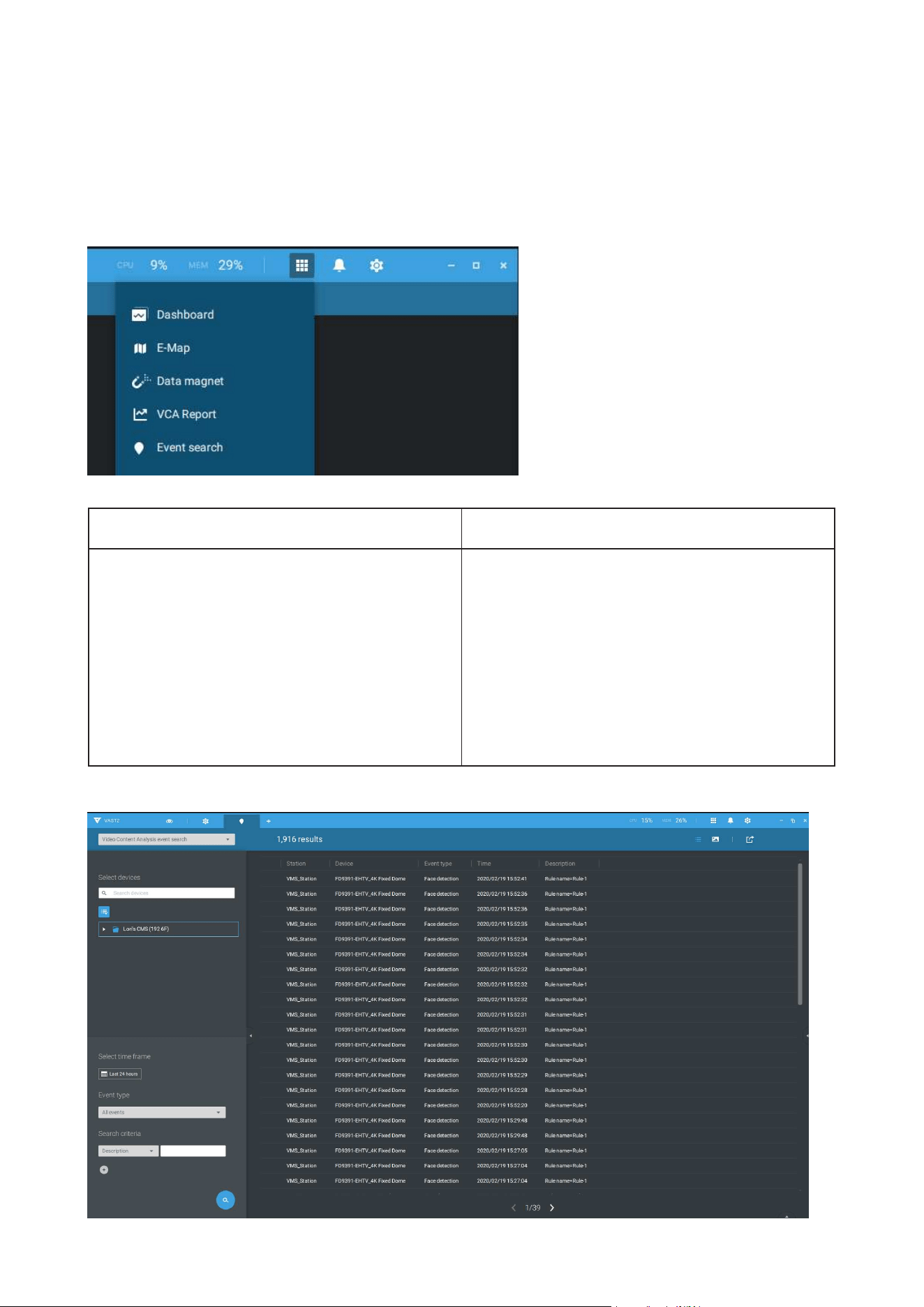
81
2-11. Event Search
The Event Search window is accessed from the top tool bar.
Below is the comparison between the Alarm list and the Event search windows:
Alarm List Event Search
Reports alarms triggered by user-
configurable events, such as DI/DOs,
Motion Detection, tampering, VCA analytics,
cybersecurity, and so on.
The events on the Event Search window
require no user configurations. The Event
Search window displays system events and
provides a glimpse of all general events.
The event types include: General events,
Video Content Analysis events, and Trend
Micro IoT Security events.
The sample screen for VCA-related events is shown below:
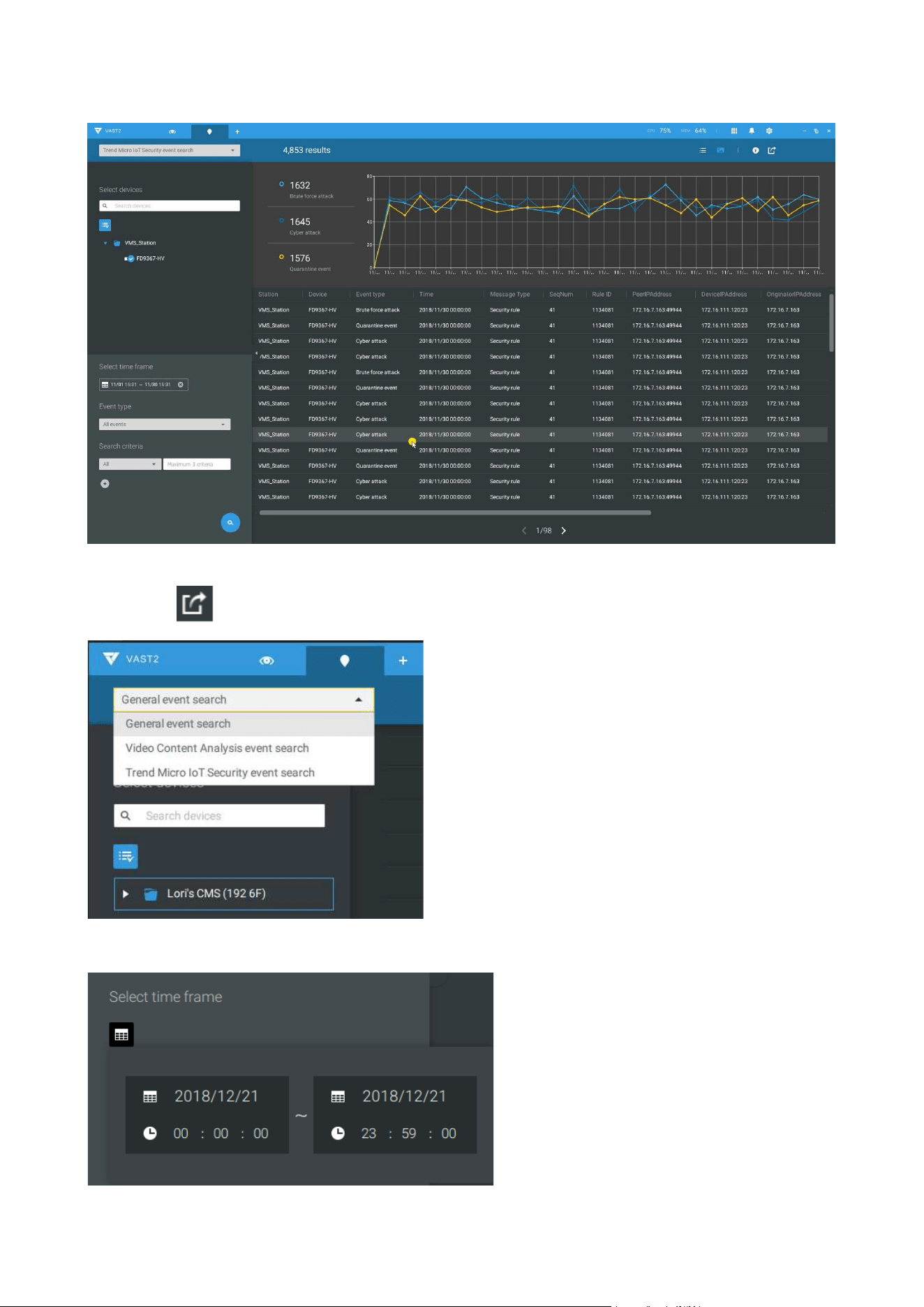
82
From the Search Event window, you can view and search events by its event types, and use
the Export button to save a record of these events (in the CSV format).
The sample screen for network security-related events is shown below:
Use the calendar tool to specify the span of time as the search range.
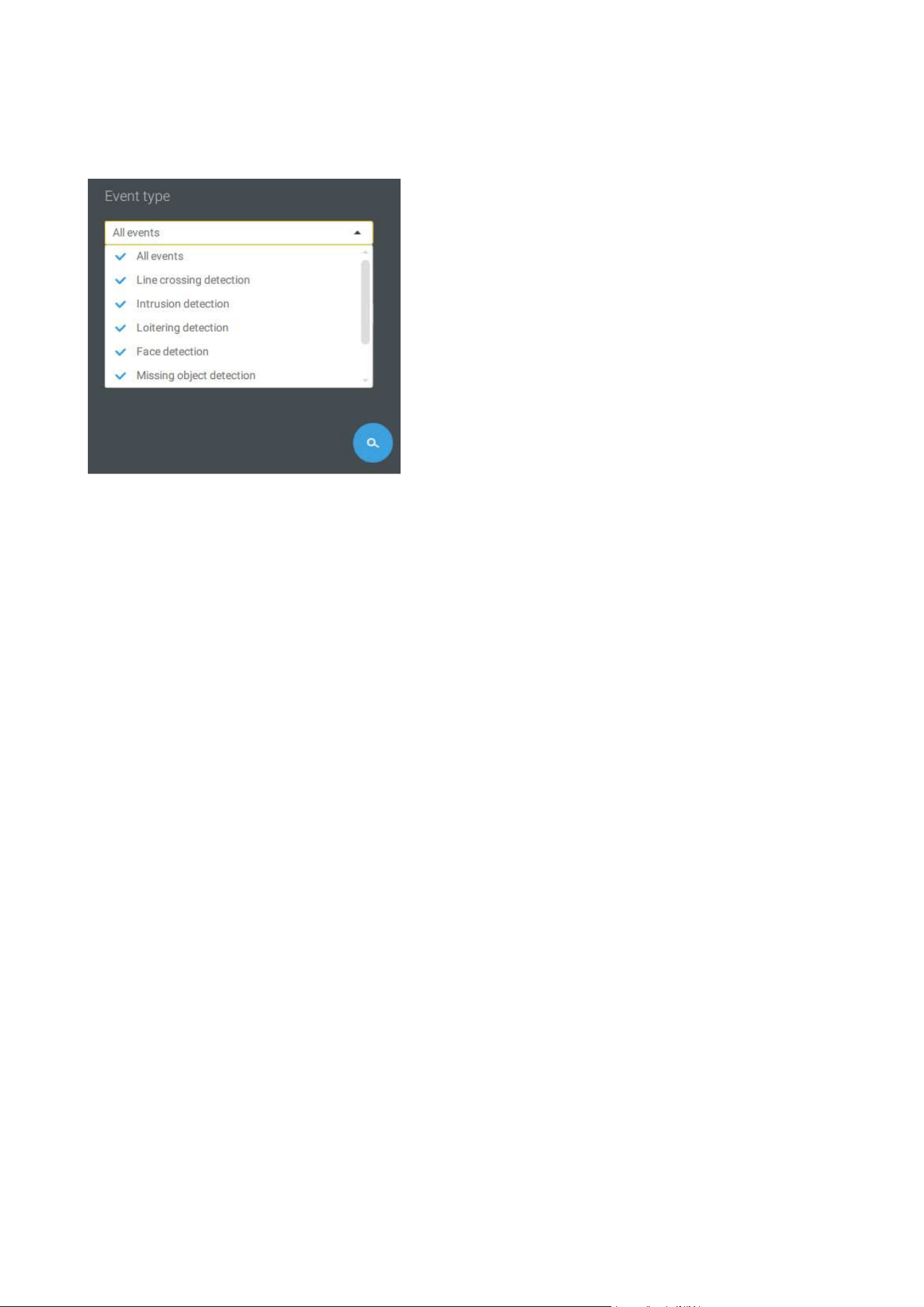
83
Use the Event type menu to narrow down the types of events. Select or deselect the event
types for search. You may also enter one or several keywords as the search criteria in the
following menus.
Click the search button to generate search results.
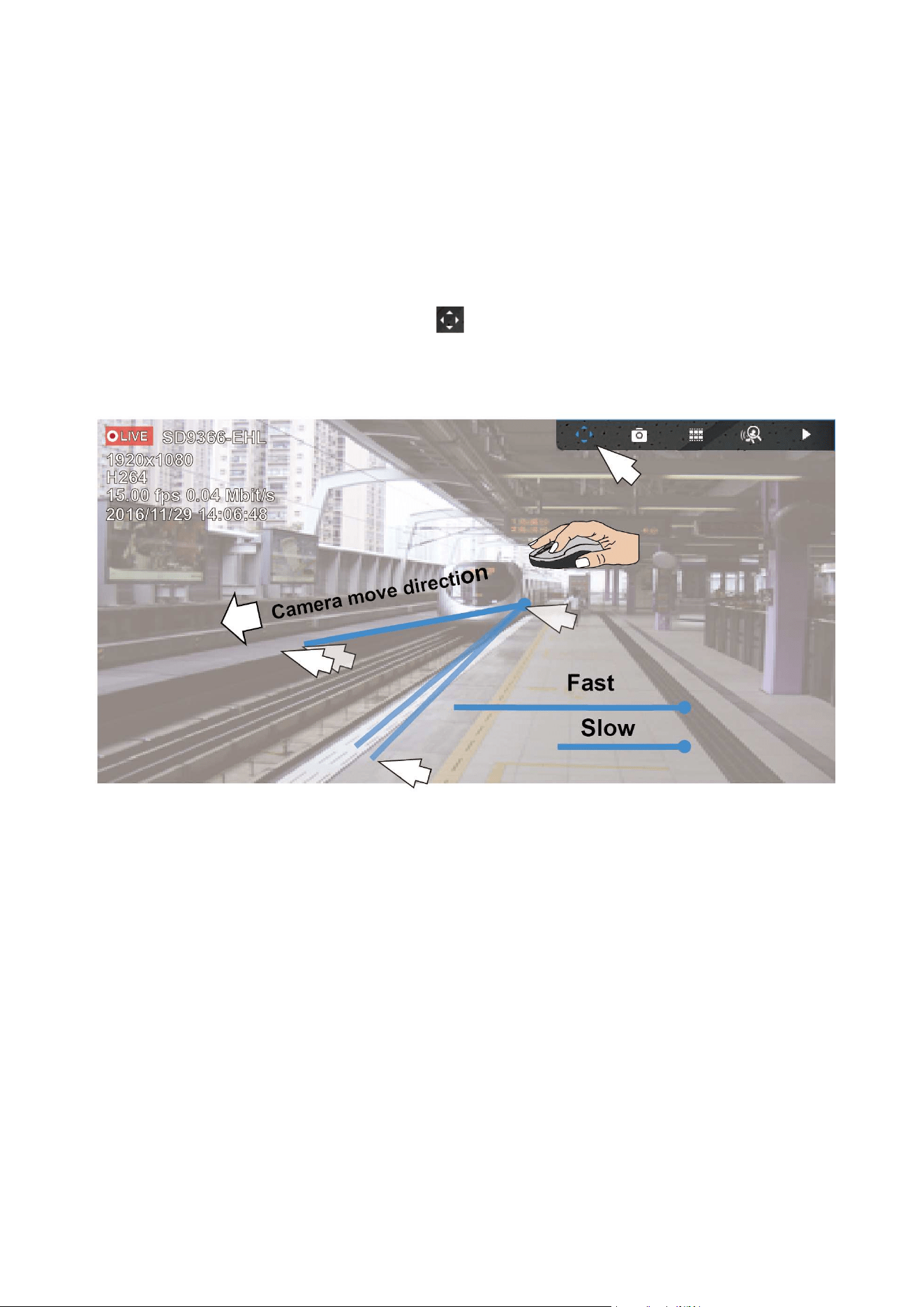
84
2-12. PTZ Control
PTZ on this page refers to the mechanical PTZ. The discussion on this page applies
to cameras that come with PTZ mechanisms that are capable of directional and zoom
control.
To begin the PTZ control, click on the PTZ
button.
Click and drag your left mouse button across the screen, towards the direction you wish to
move. A light blue trace will appear. The longer the trace, the faster the move.
Note that while the camera is moving, you can change the move direction keeping the
mouse button hold down. Release the button to stop moving.
See Appendix D Joystick support if you use VIVOTEK's joystick.
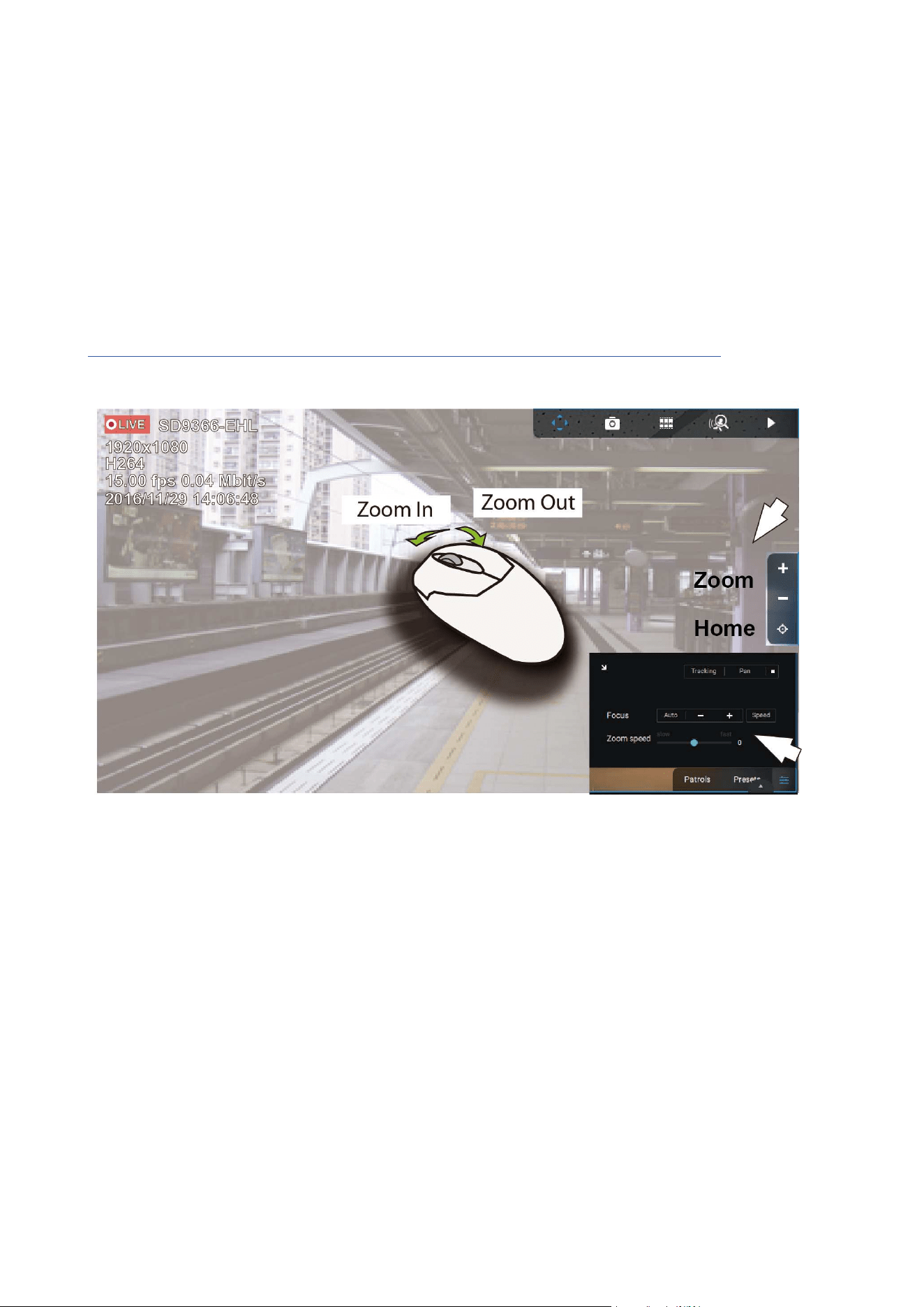
85
You can also use the mouse wheel to zoom in or zoom out. You can also mouse over the
right side of the screen to display the zoom button. A home button is also provided.
The Patrol, Presets, and PTZ control panel is located at the lower right of the screen. You
can click to begin a pre-configured patrol, preset points, or enable a Tracking or Pan action.
You can also adjust the Zoom speed, and/or manually adjust the Focus and the Focus
speed.
See Appendix G Smart Tracking for how to enable the Smart Tracking feature.
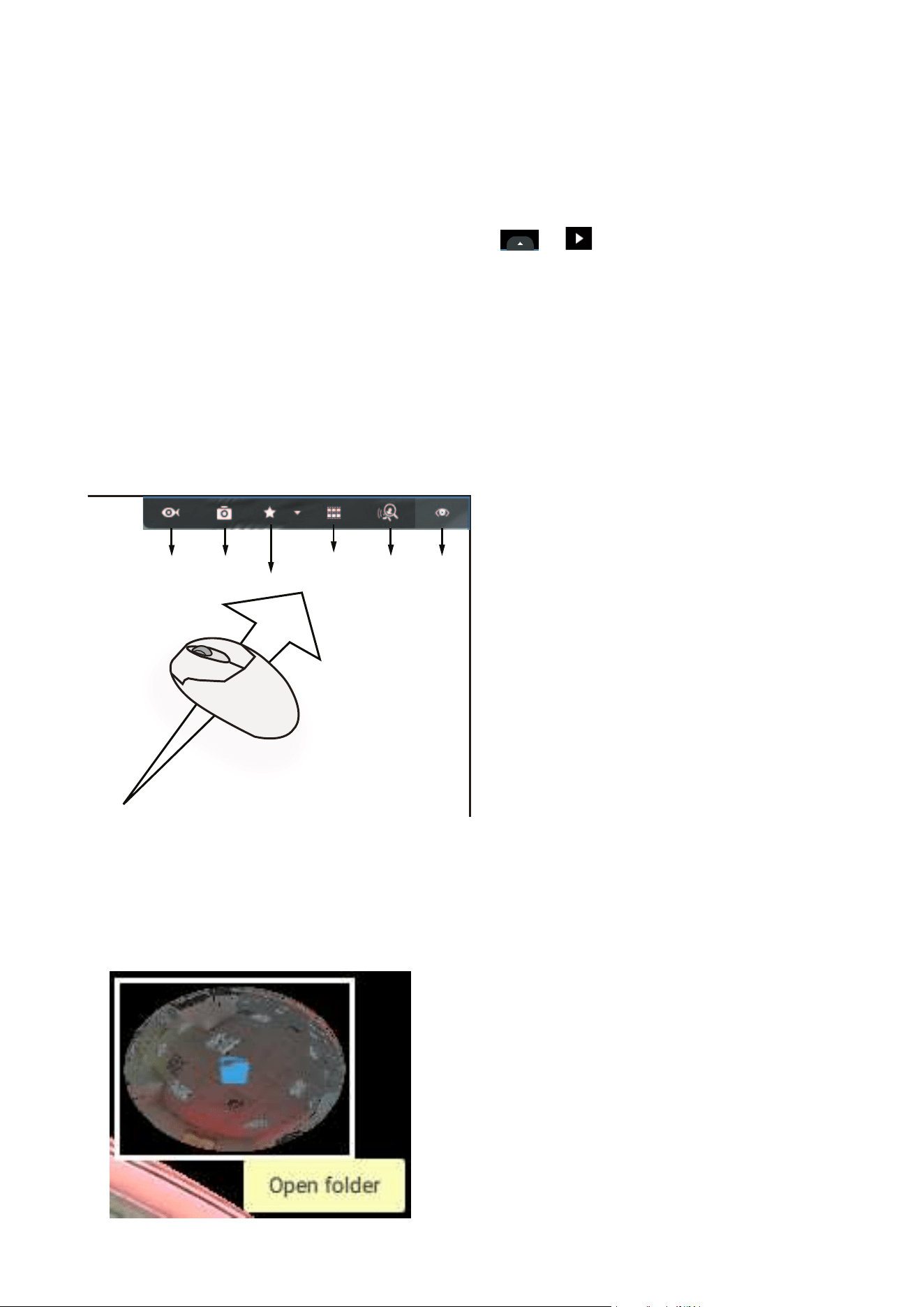
86
2-13. Playback
To start the playback function, select a camera's view cell (whether in full view or ordinary
cell size), then click the playback initiative button ( or ). The button can be found on
the upper right of the view cell or at the lower right corner of the view cell in the full view.
Default Time: When started, system normally rolls back to the start of the hour, e.g., your
current time is 10:30:00, and the default playback position on the timeline is 10:00:00.
Playback control can be found in 3 places:
1. Float Panel: When Playback is started, swipe your mouse to the upper-right of the view
cell to display the Playback float panel.
Fisheye
Dewarp
Snapshot
Bookmark
Thumbnail
search
Smart
search II
Liveview
Fisheye Dewarp: For a fisheye camera, you can select different dewarped views during a
playback. Click to select an option.
Snapshot: Click to take a snapshot. A small floating window will stay for 2 seconds. You
can click the folder icon to access the snapshot files.
Note that a dewarped, regional view allows producing a snapshot of the regional view.
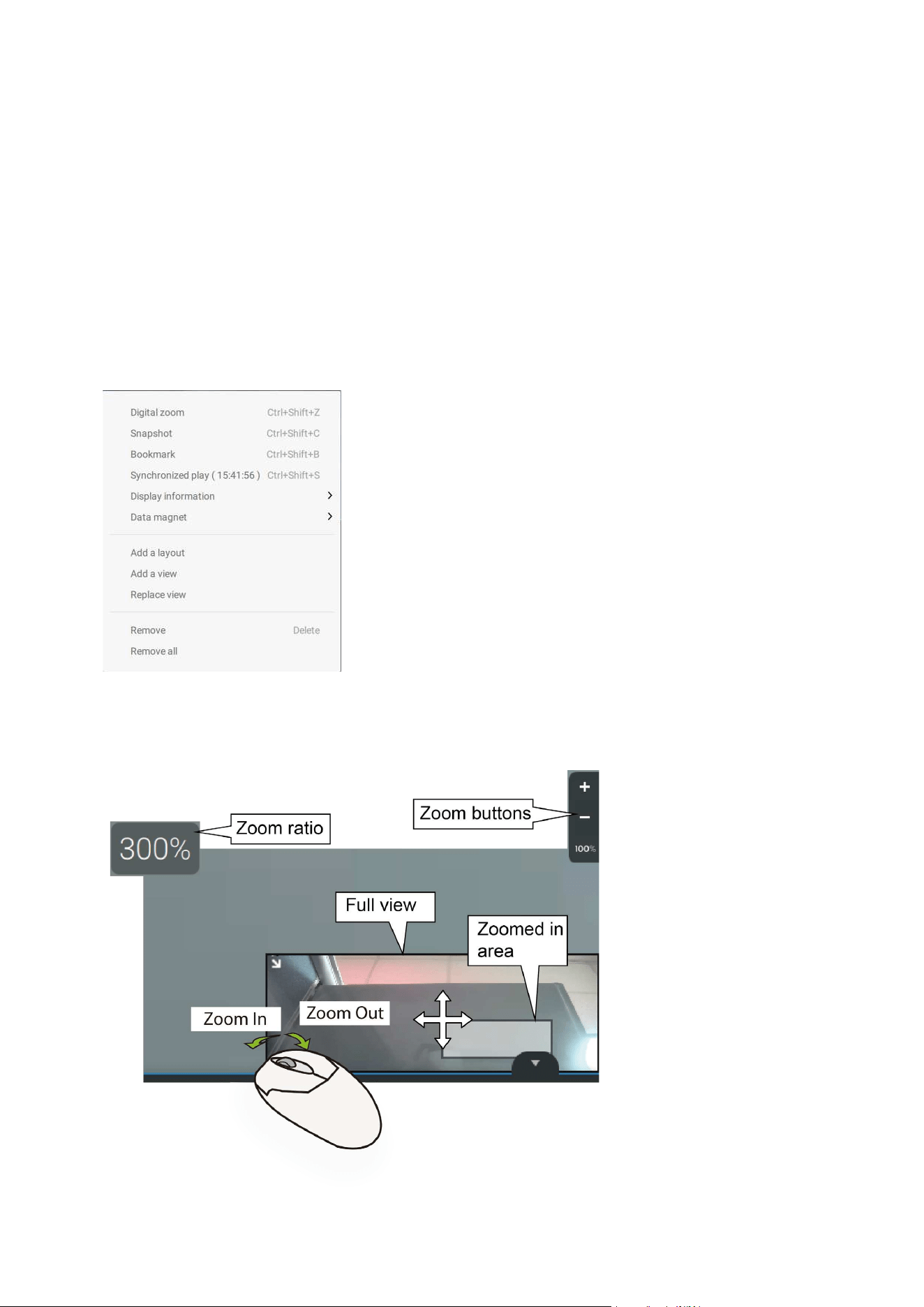
87
Bookmark: If you find anything of your interest when viewing the playback, click this
button to create a bookmark. It helps when you need to return to the point in time after
you review all through the recorded videos. Note that the bookmarked video clips are
free from storage recycles. They will not be erased when storage runs short and needs
to be recycled.
Smart search II: Smart search II is an independent function. See page 109 for details.
Liveview: Click to return to Live view.
2. Right-click Menu: Right-click on the Playback screen to display this menu.
Digital zoom: If you find anything of your interest when viewing the playback, click this
button to create a bookmark. It helps when you need to return to the point in time after
you review all through the recorded videos.
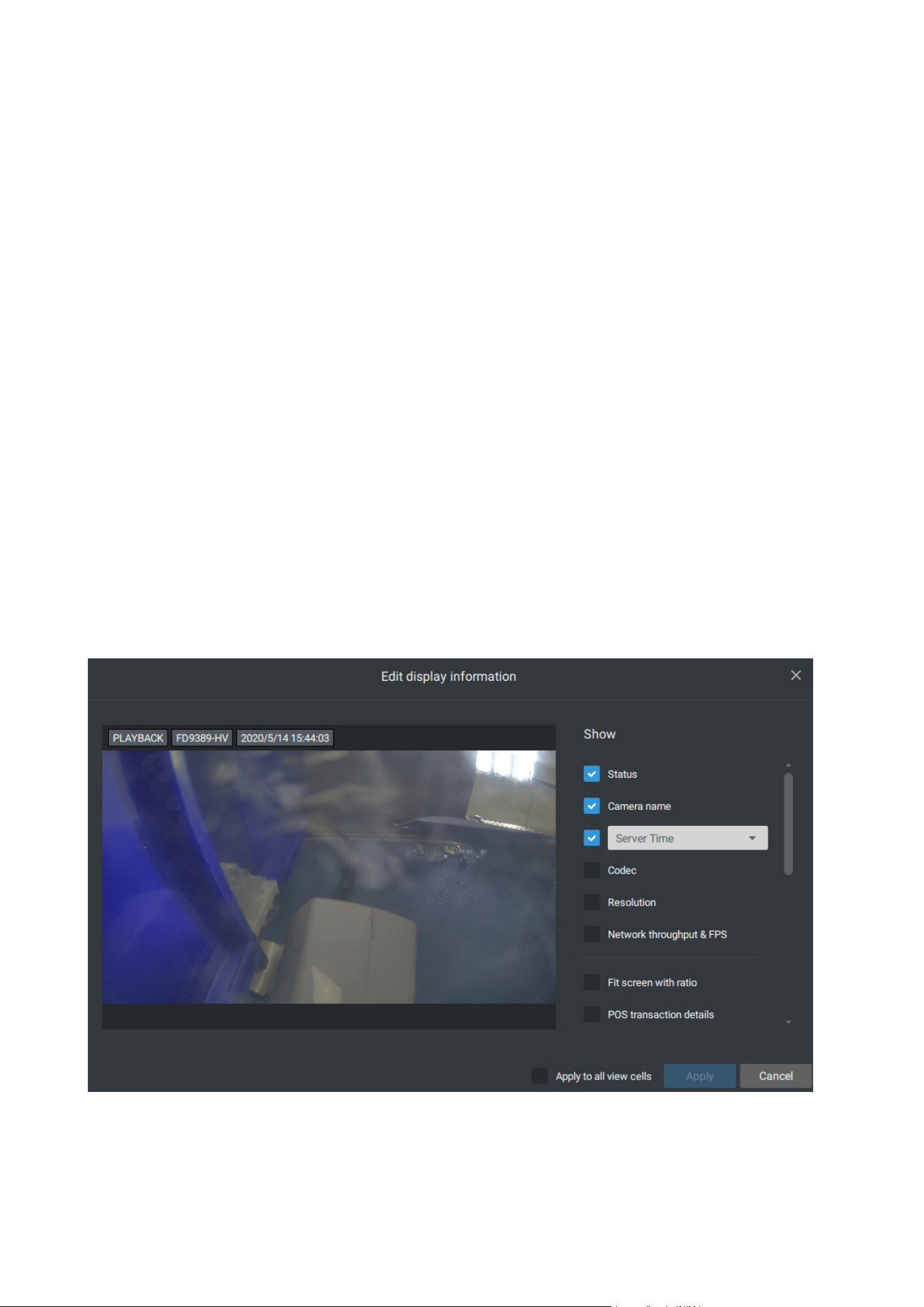
88
Synchronized play: When enabled, all cameras in the same view will be playing the video
of the same point in time.
The following commands are general purpose commands.
Snapshot: Click to take a snapshot. A small floating window will stay for 2 seconds. You
can click the folder icon to access the snapshot files.
Bookmark: If you find anything of your interest when viewing the playback, click this
button to create a bookmark. It helps when you need to return to the point in time after
you review all through the recorded videos.
Display information: By default, all display elements will appear on screen for all
playback windows. You can use the Edit display information to select more display
elements.
They include:
Status, Camera name, Server time, Codec, Resolution, Network throughput & FPS, Fit
screen with ratio, POS transaction details (for POS), Data magnet data (Data overlay on
screen / Hide data after idle), Motion detection, Rules (VCA), Rule name, Motion cells,
Tracking block, Tracking dot, Exclusive area, People detection area.
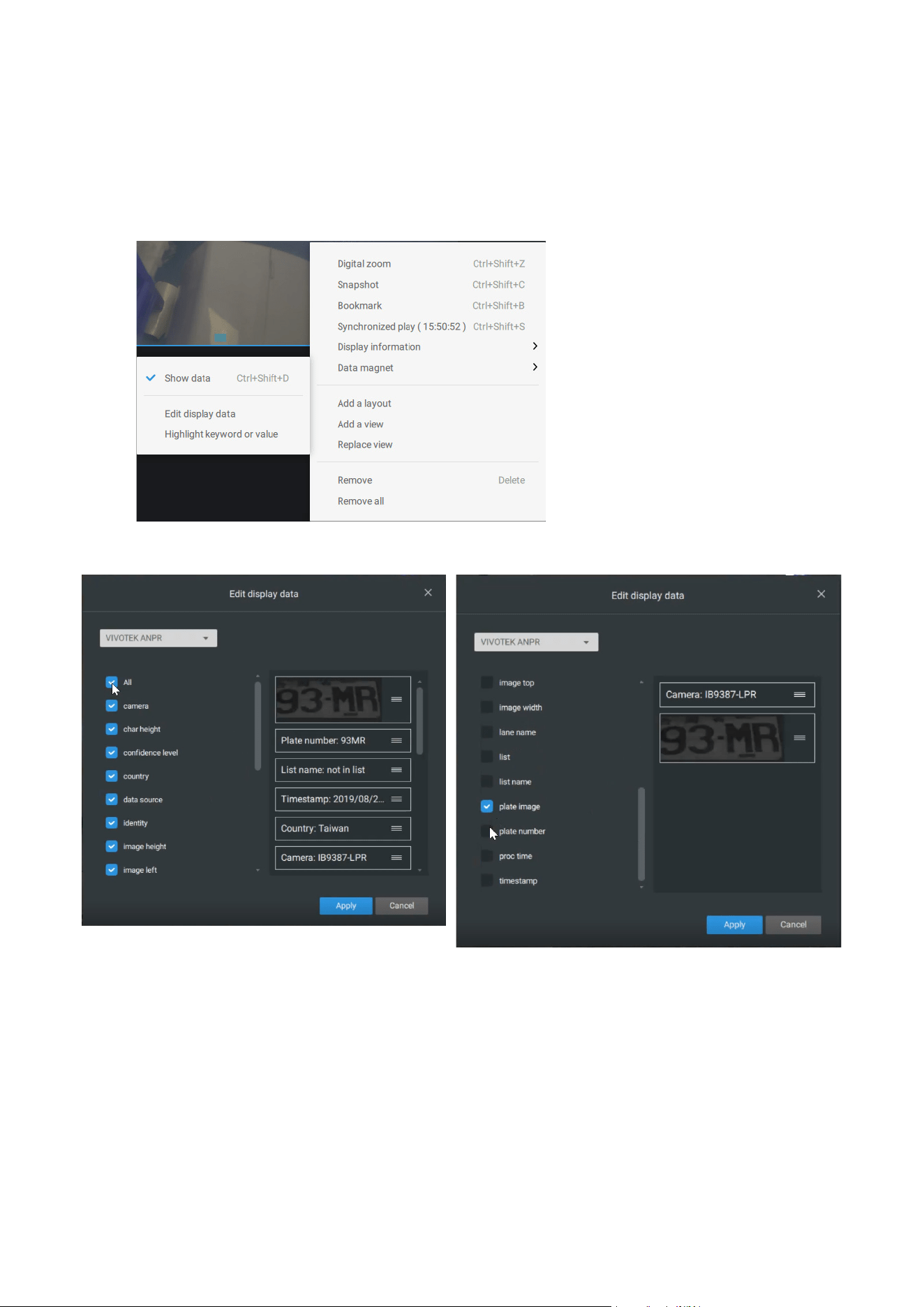
89
Data magnet: For 3rd-party applicatioins, such as VIVOTEK's license plate recognition
software, you can select to display different types of information. You can use the Edit
display data to select or deselect the display elements.
Please note that the display elements can vary for different applications.
Below are the sample screens for applications implemented via the Data magnet.
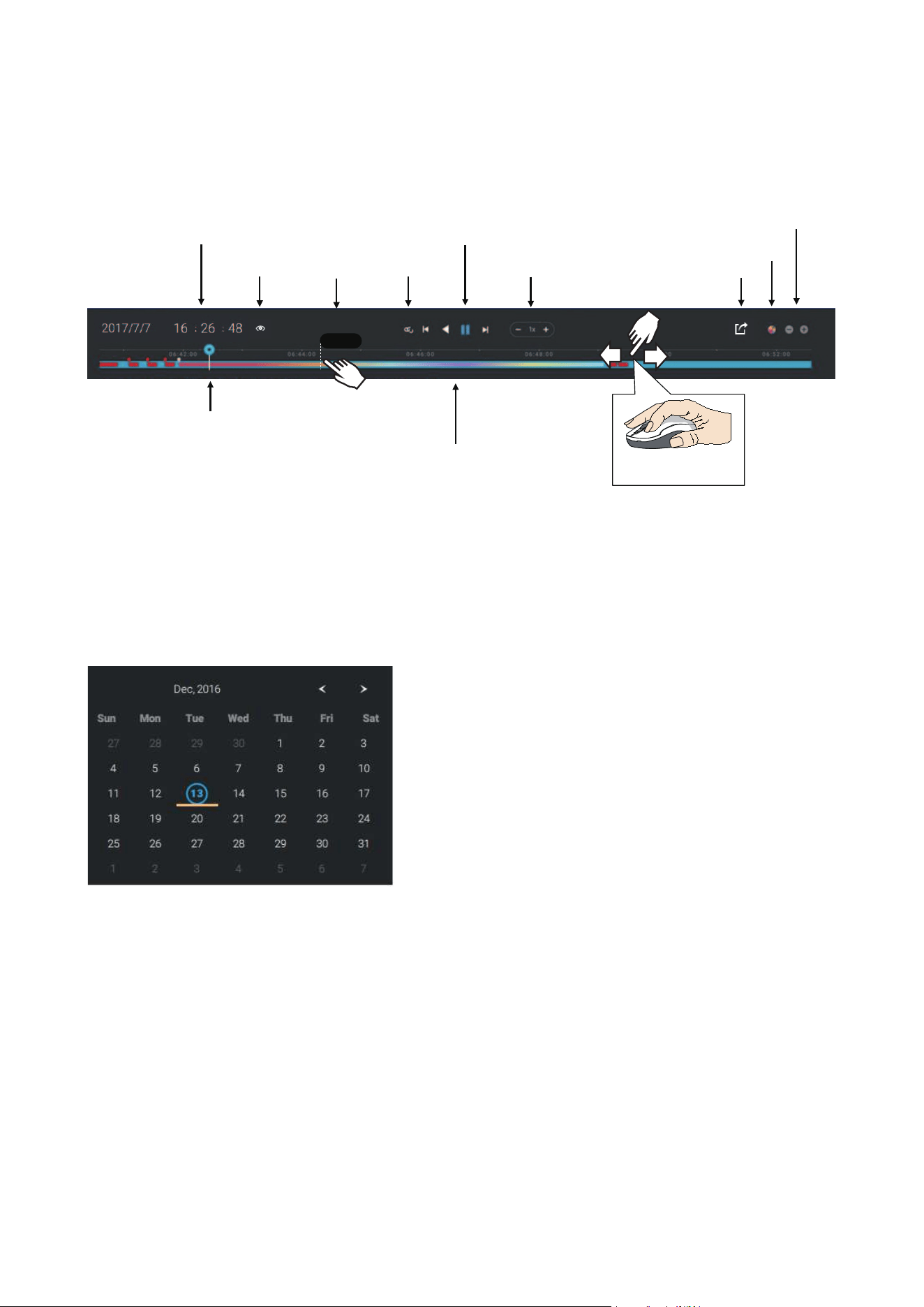
90
3. Timeline Panel: This panel appears when Playback is initiated.
Starting from left to right, timeline control functions will be described as follolws:
1. Time Search: Click on the current date to open a calendar. If you want to review videos
recorded in another day, select it from the calendar.
Timescale is adjustable (minutes, hours, days, to a max. of 3 days) so you can easily find
the required time period and begin playback from that point.
Histogram
Adjustment
Export
Speed Control
Playback Timeline & Histogram
Playhead
Synchronous
Playback Control Buon
Time Search
Events
Highlights
06:44:23
Mouse-over
indicator
Return to Live
Drag to move along
meline
Blue: days with recordings.
Orange bottom line: Today.
White: days with no recordings.
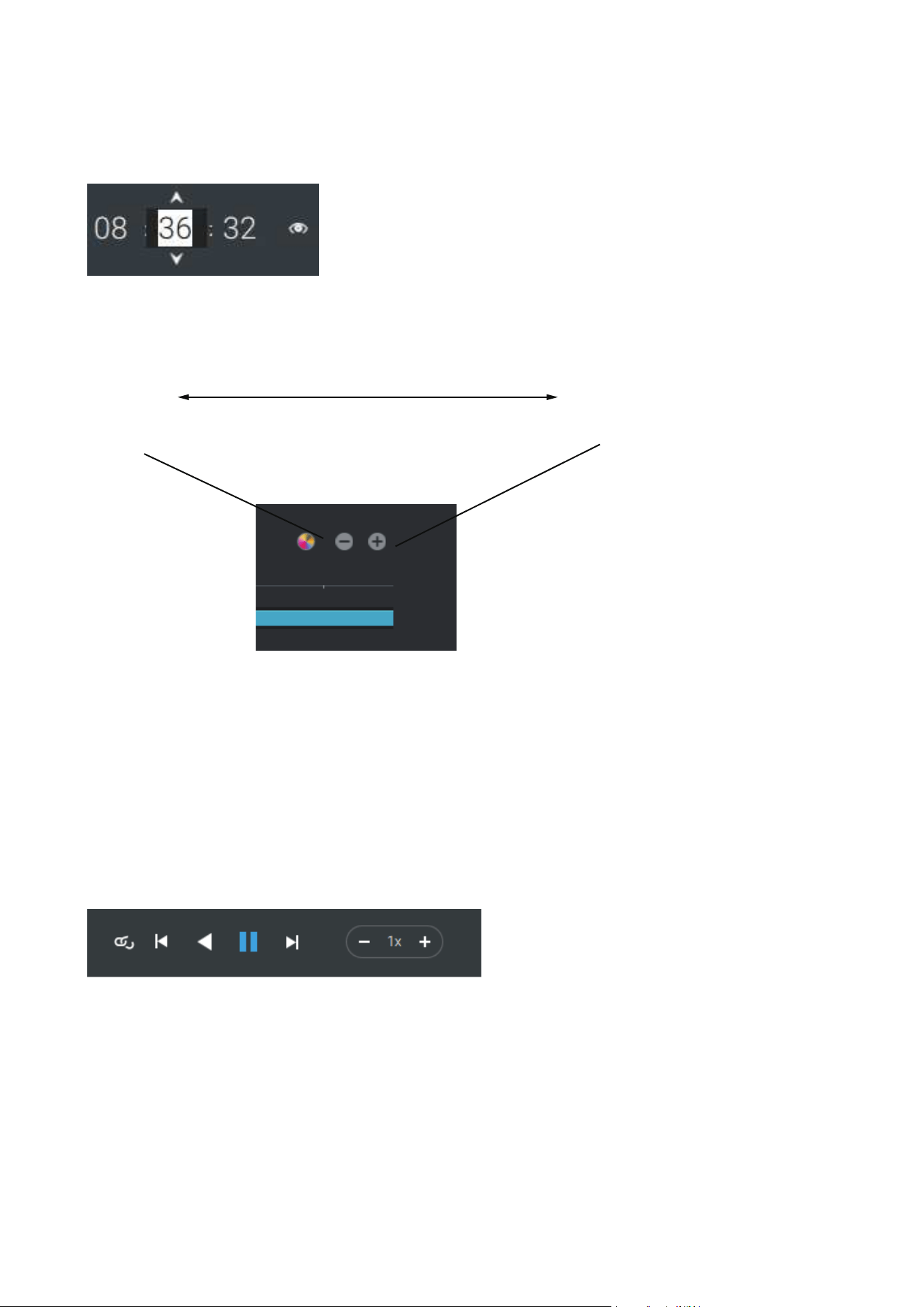
91
Click on the current time. You can use the arrow buttons to change the time you wish to
playback, or simply enter a preferred number. You can also pull the playhead along the
timeline.
Timeline magnification levels: The default time span is 6 hours. You can change the
magnification level for easier browsing. Click the Zoom in and Zoom out buttons to change
the timeline time span. The configurable time spans are shown below:
3 days, 1 day, 12hr, 6hr, 3hr, 1hr, 12mins, 1 min
2. Playback control:
From left to right,
2-1. Synchronous play: This lets all cameras in the same view to playback video of the
same point in time. If you perform synchronous playback on a multi-cell view, your
computer can be stressed. It is recommended you create a new view with a 2x2 layout,
select and insert camera views into it, and begin the Synchronous playback.
2-2. Frame by frame buttons: Click to move forward or backward to flick through the video
frames. This may only display the I-frames.
2-3. Forward playback and reverse playback: Click to view the video in the forward or
reverse playback manner.
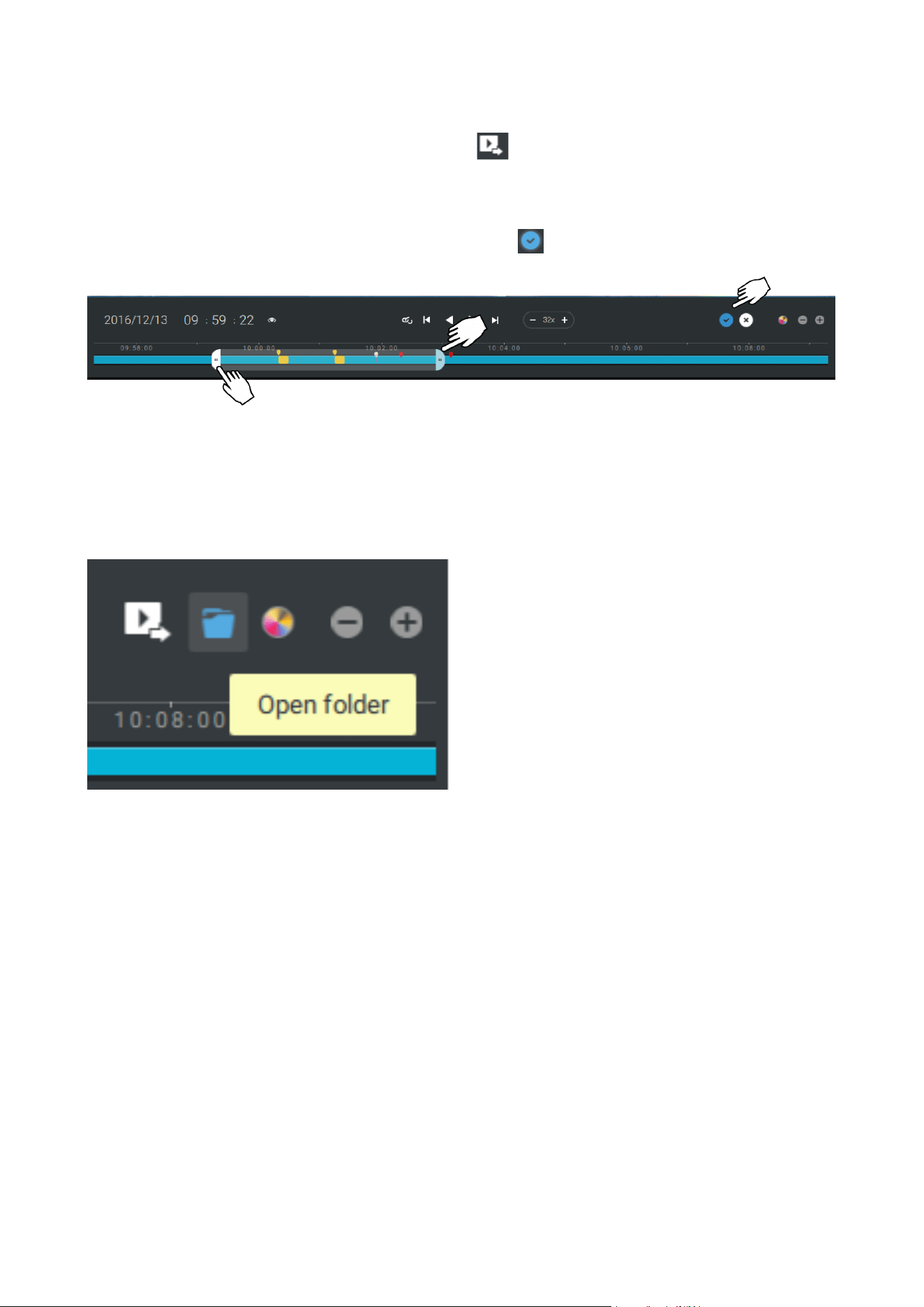
92
2-4. Speed selector: The selectable speed ranges from 1/64x to 64x.
3. Export Clips: Click the Export Clips button
. A range selector will appear. Pull the
ends to include the time span you want to export. Note that each end of the selector,
when clicked and selected, will turn white, and its location on the timescale is shown on
the time line. When done, click the Start to export
button.
Depending on the length of video clips to export, it may take minutes to export. When the
export is completed, a shortcut to the exported clips is shown. You may then open the
folder where the clips are located.
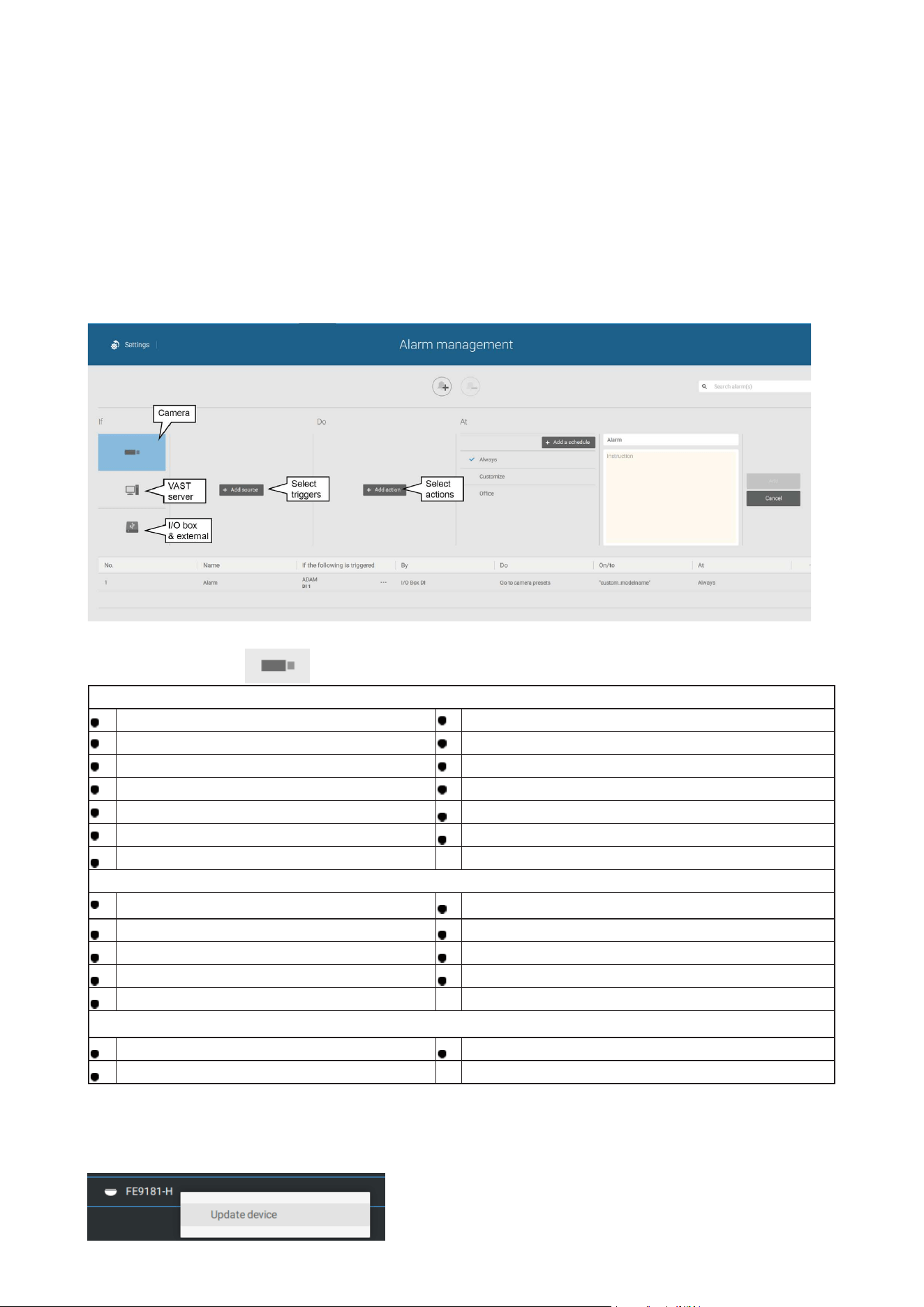
93
2-14. Alarm
The Alarms can be configured to perform a series of actions when different events
occur. Alarms can be used to automatically react to possible threats. For example, the
VAST server can start a recording or send an Email notification when Motion detection is
triggered.
A wide variety of triggering conditions can be applied, including:
1. Camera triggers
General
Motion detection IR (Infrared)
Camera DI PIR (Passive Infrared)
Camera DO Tampering detection
Temperature Stop recording
Recording error Audio detection
Video loss (Video server only) Shock detection
SD card life expectancy detection
Video Content Analysis
Line crossing (VCA) Intrusion detection
Loitering detection Face detection
Missing object detection Unattended object detection
Crowd detection Smart tracking
Zone detection
Trend Micro IoT Security
Brute force attack Cyber attack
Quarantine event
Note that some of the triggers require that you open a web console to individual cameras. For
example, VCA and Motion detection windows have to be manually configured on each camera
before they can be configured in the Alarm settings.
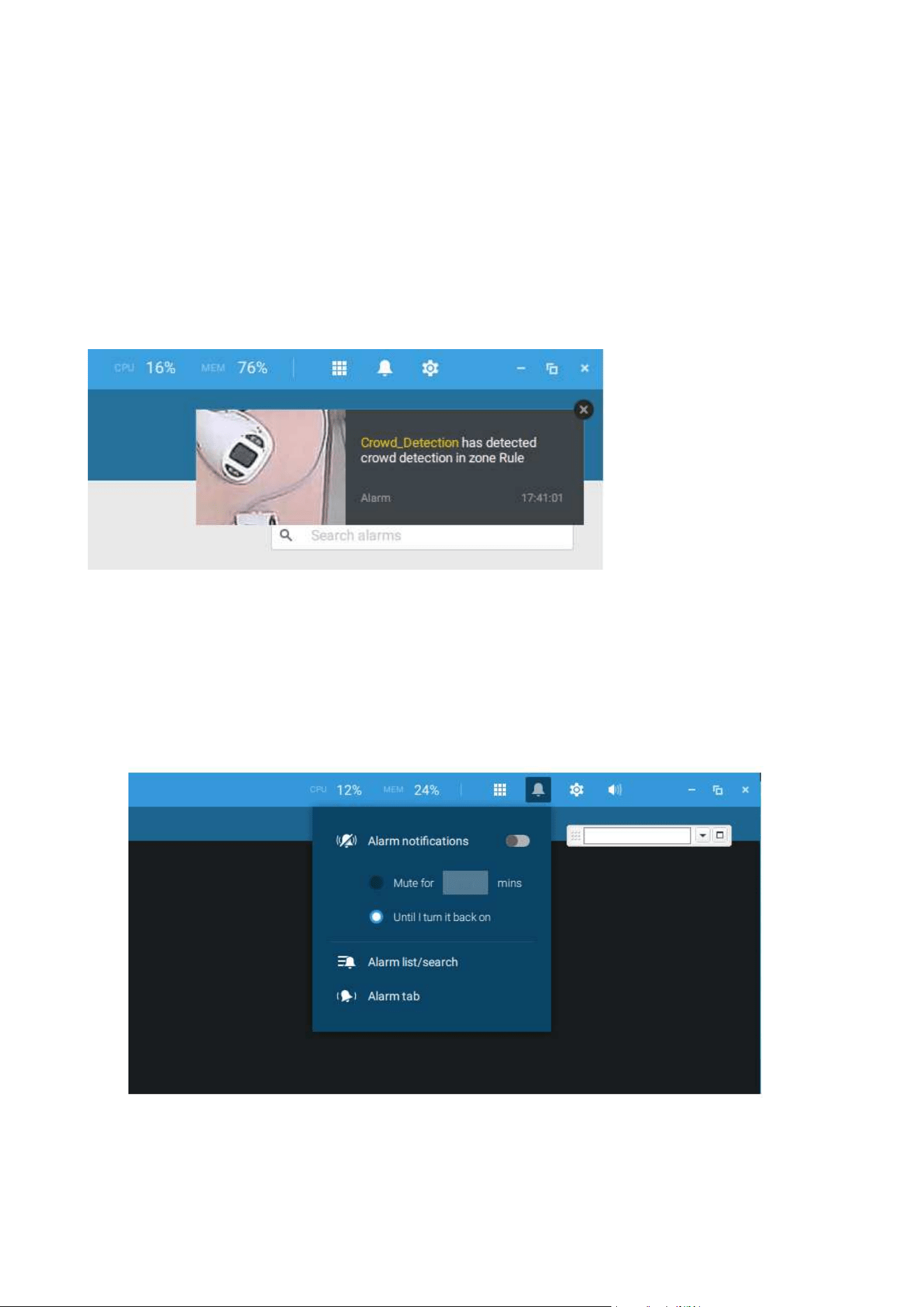
94
If a triggering condition is associated with event recording, an event prompt will pop up on
the screen when a triggering condition is met. For example, the number of people exceeds
a preset threshold in a Crowd Detection configuration. The sample prompt is shown below.
The related footage can be played back by clicking on the event entry.
If you select a trigger and you cannot find a corresponding device, you need to open a web
console to that device. Make sure the corresponding VADP is running. Open the VAST2
device tree, right-click on the device to perform a manual refresh "Update device" to acquire
the lastest configuration update.
On the Alarm tab, you can select to mute all alarms for a configurable period of time. Enter
the number of minutes or select to mute until you manually turn it back on.

95
2. VAST server and NVR triggers
Network disconnected These can be used to send maintenance notifications.
Storage failure
Storage full
Fan status
GPS disconnected
(Mobile NVR)
The GPS and G-sensor related options apply to the Mobile
NVR that comes with the GPS and G-sensor. GPS can be
used to track the speed and location of a vehicle, while the
G-sensor can be used to detect abnormal impact.
Abnormal G-sensor
motion (Mobile NVR)
Speeding (Mobile NVR)
Number of remaining
people
For VCA-capable cameras, the alarm can be triggered when
the number of people staying within a specific area has
exceeded the preset threshold. For example, when too many
people are waiting in line in front of a cashier.
This function requires appropriate configuration on the
counting camera(s).
Brute force attack (Trend
Micro IoT)
These can be configured as alarm triggers to notify the
administrator that malicious attacks have occurred. Note
that these triggers are available with NVRs that come with
the protection of Trend Micro IoT packages.
Cyber attack (Trend Micro
IoT)
Quarantine event (Trend
Micro IoT)
* Note that you should use the pull-down menu to select a triggering condition, and then
click to select a mobile NVR.
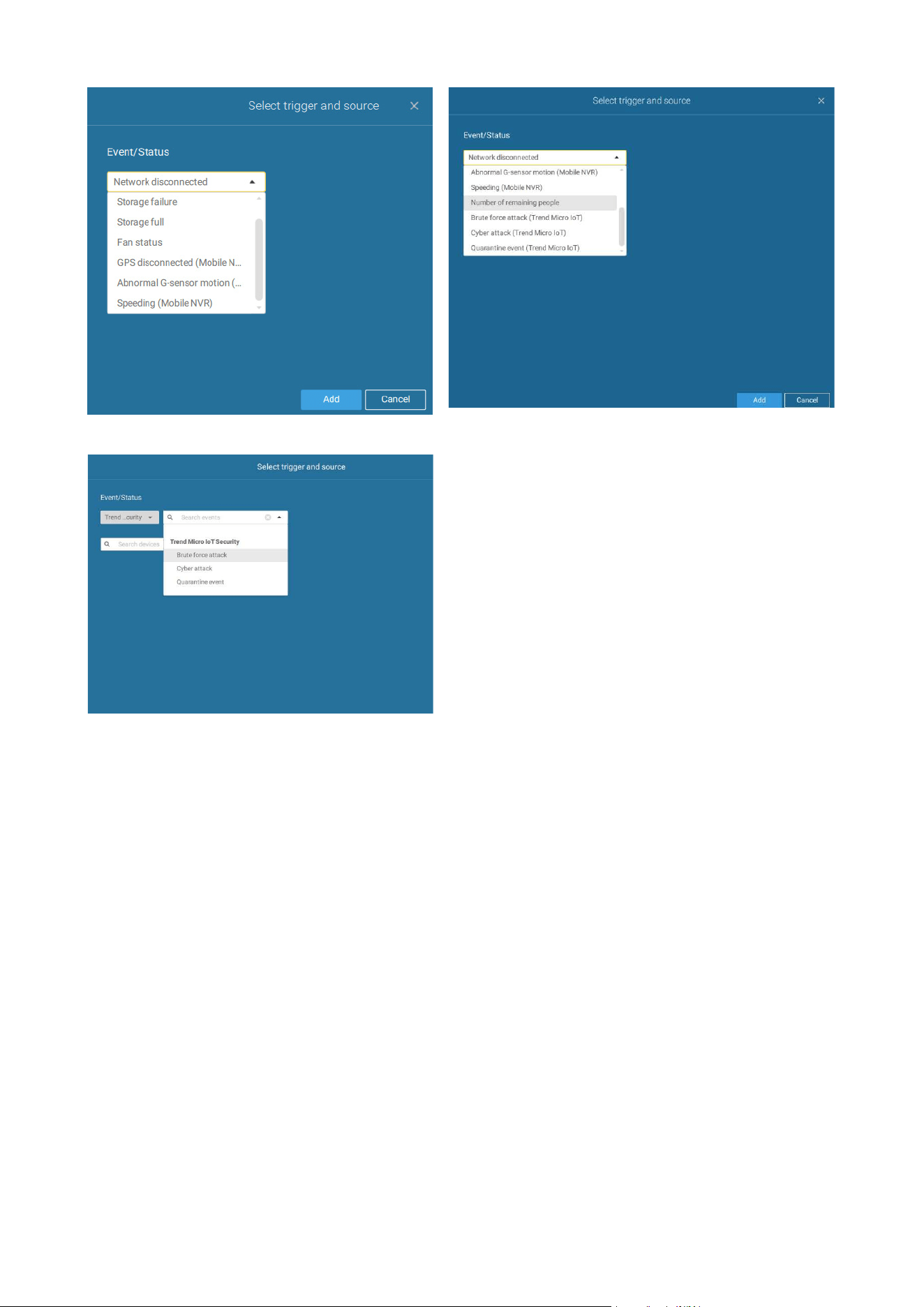
96
Note that the alarms will be received into the Alarm list window. The previous Alarm Search
window is replaced by the Alarm list function.
The Alarm tab window is used to display the live video stream when an alarm is triggered,
and its responding action is configured as "Send live streaming."
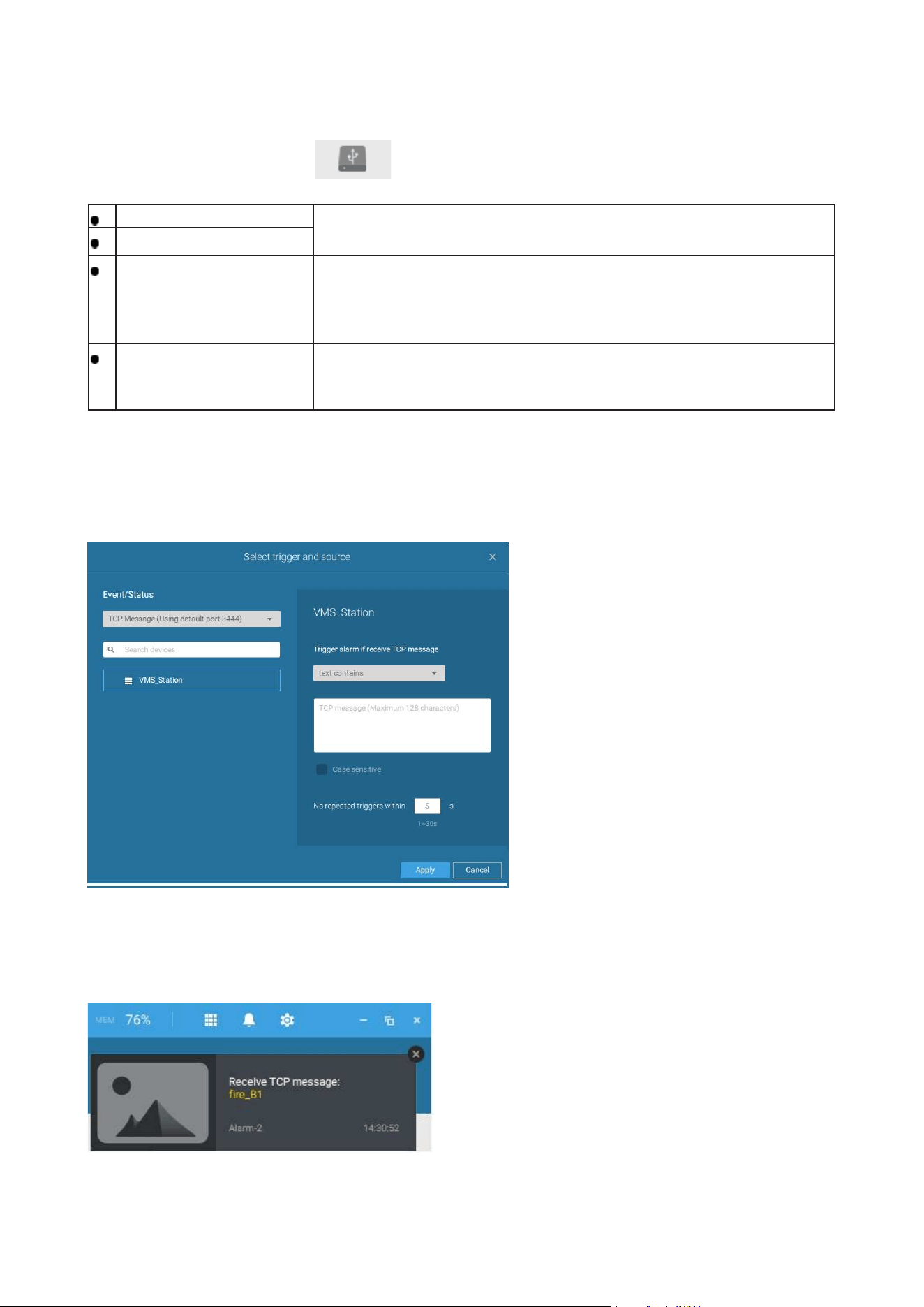
97
For I/O box configuration, please refer to the I/O Box page.
3. I/O box and TCP triggers
DI/DO Device DI This applies when an external I/O box is applied, e.g.,
Advantech's ADAM I/O box.
DI/DO Device DO
TCP Message TCP message comes from the peer VAST servers or external
sources (such as an access control system) via the analysis
of received TCP message over the 3444 port. This is a paid
feature.
Data Magnet Triggering conditions can be acquiring data from 3rd-party
software, such as the character height, image width, list, list
name, country, from an LPR software, etc.
To configure a TCP message trigger,
Select TCP message as a trigger type, and enter a description, such as a short term, for
VAST to listen and analyze data packages.
You can use Telnet to send a small amount of data matching the term you entered in the
TCP message configuration window. A TCP message event will be triggered, and you
should see the event prompt as follows.
Below are the messaging parameters:
1. text contains: Messages will be
received if some of the textual
messages match the keywords.
2. text matches: Textual messages
must be exactly identical.
3. Case sensitive: The upper or lower
cases letters used in the messages
must match within the messages.
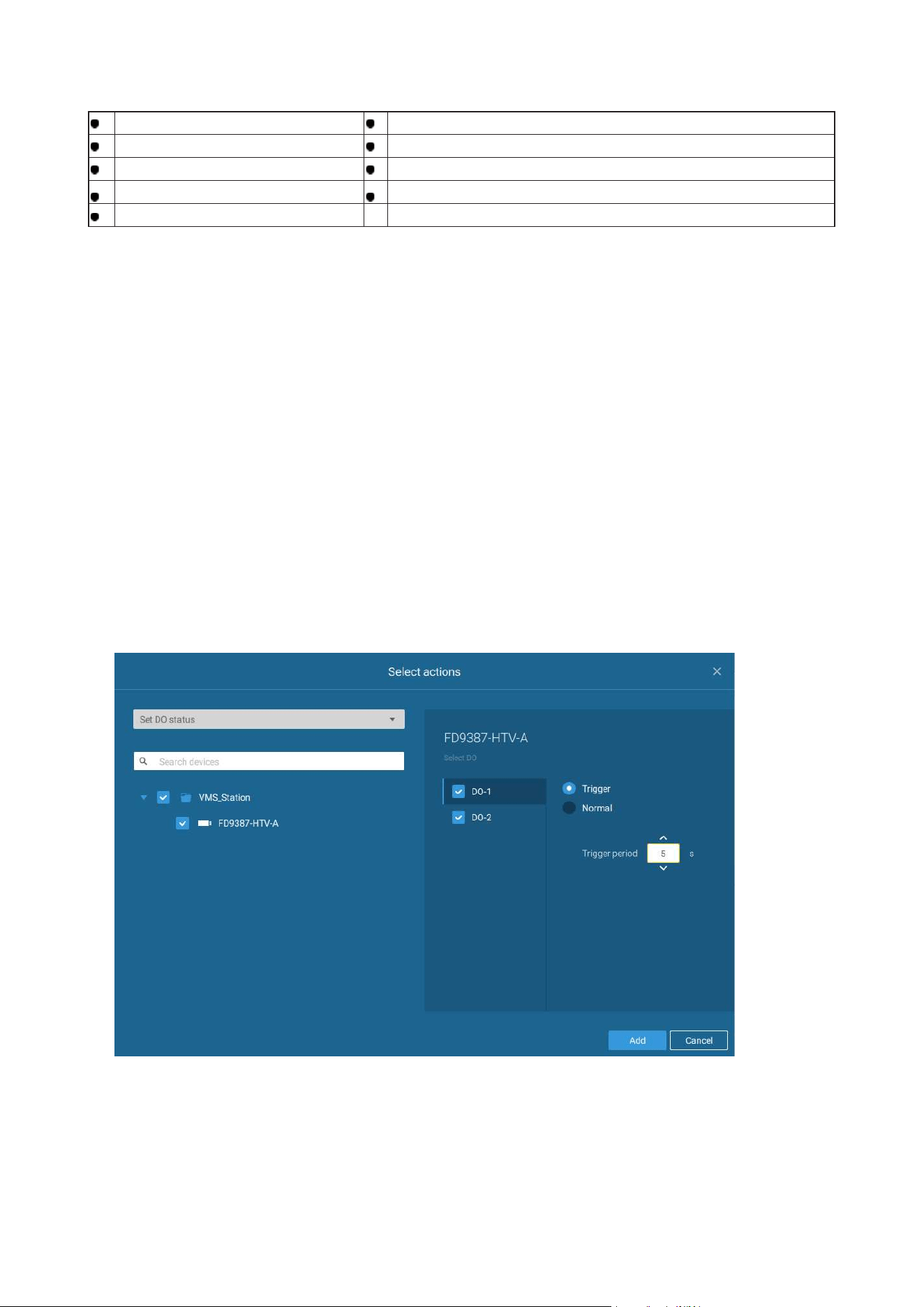
98
The available actions include:
Start to record video Send HTTP requests
Set DO status Send live streaming
Go to camera presets Send email
Go to E-map Sound the alarm
Add bookmark
The
Start to record video will record a video clip of the length of 10 seconds (default) on
the occurrence of an event. The event recording pre / post event time is configurable.
Except for Stop recording, all the other triggering conditions can be associated with this
action.
The Set DO status will activate a DO connection. For example, to light an illuminator or
sound an alarm.
You can select a camera, and its DO pins will appear on the right. You can configure the
duration of the DO trigger, e.g., 15 seconds.
If no Trigger period is configured and when there are multiple instances of DO trigger,
administration troubles may occur. Use the arrow marks to configure a trigger period. You
may also manually enter a number.
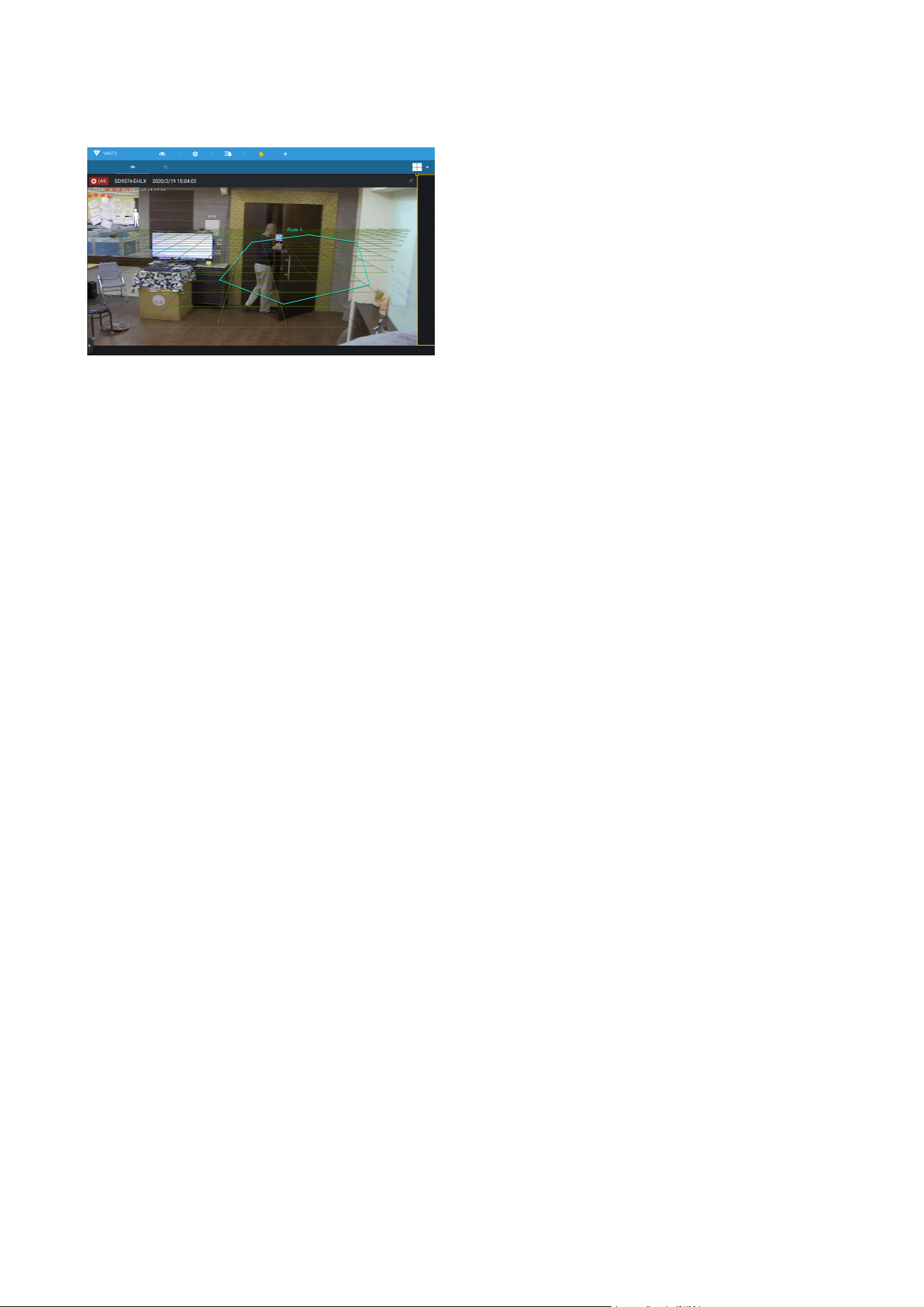
99
The Send live streaming action will bring up a video prompt to the Alarm tab window,
showing the realtime video feed from a specific camera.
The Go to camera presets requires you to configure preset points on a PTZ camera before
the Alarm configuration, such as a speed dome. Once triggered, the PTZ camera lens will
move to a preset position.
The VAST server automatically disables unavailable options. For example, when the DO
option is selected, the cameras that do not support DO connections will be hidden.
The Send email opens a configuration page where you should enter valid email addresses
as sender and recipients. It is required that you configure an SMTP server for mail delivery
in Settings > SMTP. Enter Subject and contents. Select the checkbox for including a
snapshot of the event. When done, click Add to enable the action.
The Go to E-map opens a pre-configured E-map of where the triggering condition occurs.
The user can then click on the camera icon on the E-map for an instant viewing.
The Add bookmark function saves a video clip of a 10-seconds length. Once triggered, you
can open a new view tab > Search > Bookmark search to find the existing bookmarks. The
bookmarked video clips will not be recycled during the storage cleaning cycles.
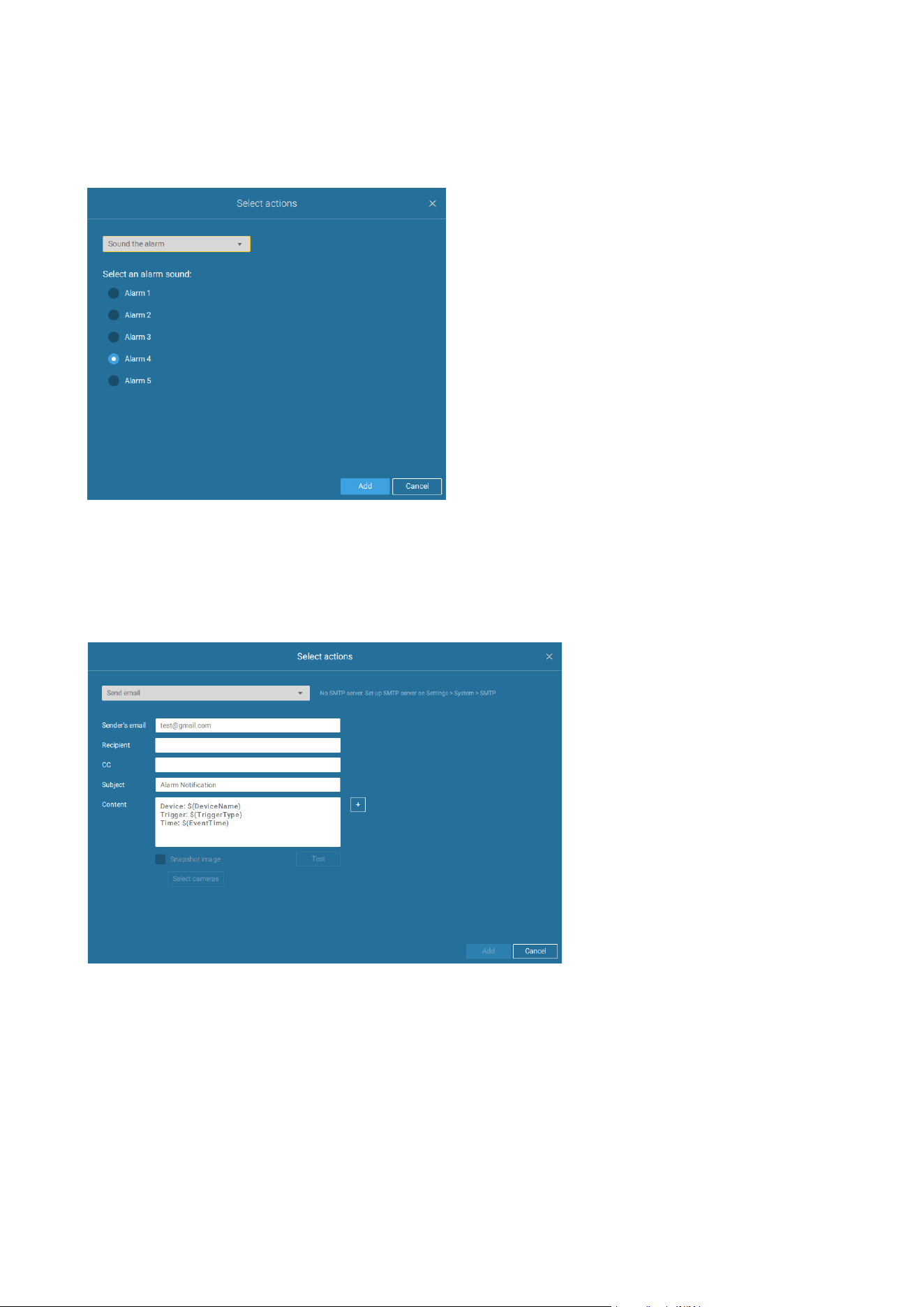
100
The Sound the alarm action provides 5 alarm sounds that will be sounded on the VAST
client or server. Your VAST client or server should have speakers for playing the audible
alarm.
A reacheable Mail server and Email accounts must be provided before you can apply the
settings.
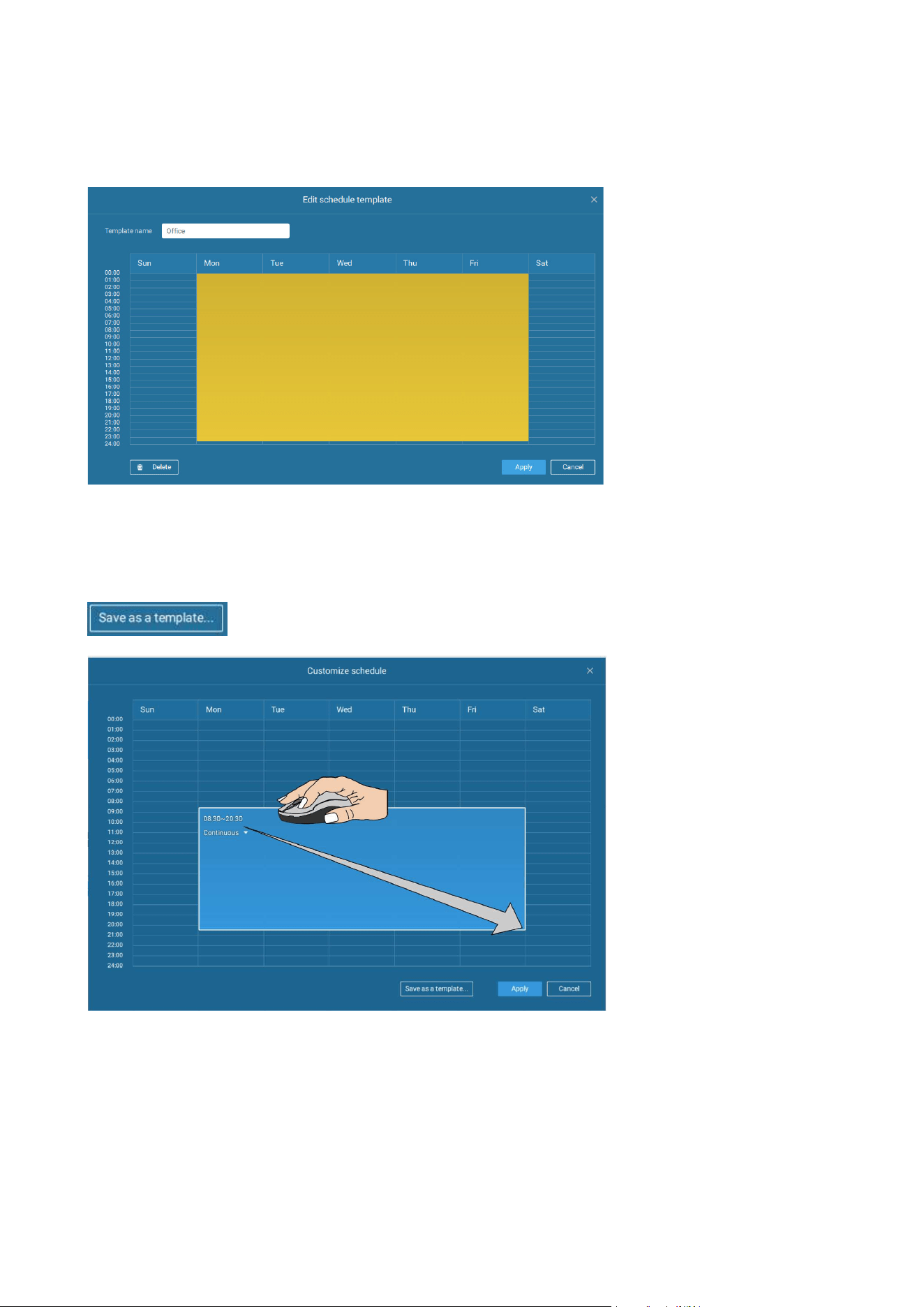
101
On the Schedule page, you can select to activate or de-activate alarm triggers throughout a
specific timeline. For example, in some situations you can disable the alarm triggers during
the office hours, and choose to enable the triggers only during the off-office hours.
Click on any of the options on the Schedule panel for the alarm to take effect: Customize,
Always, or Add a schedule.
You can manually create a effective time template using the New template
button.
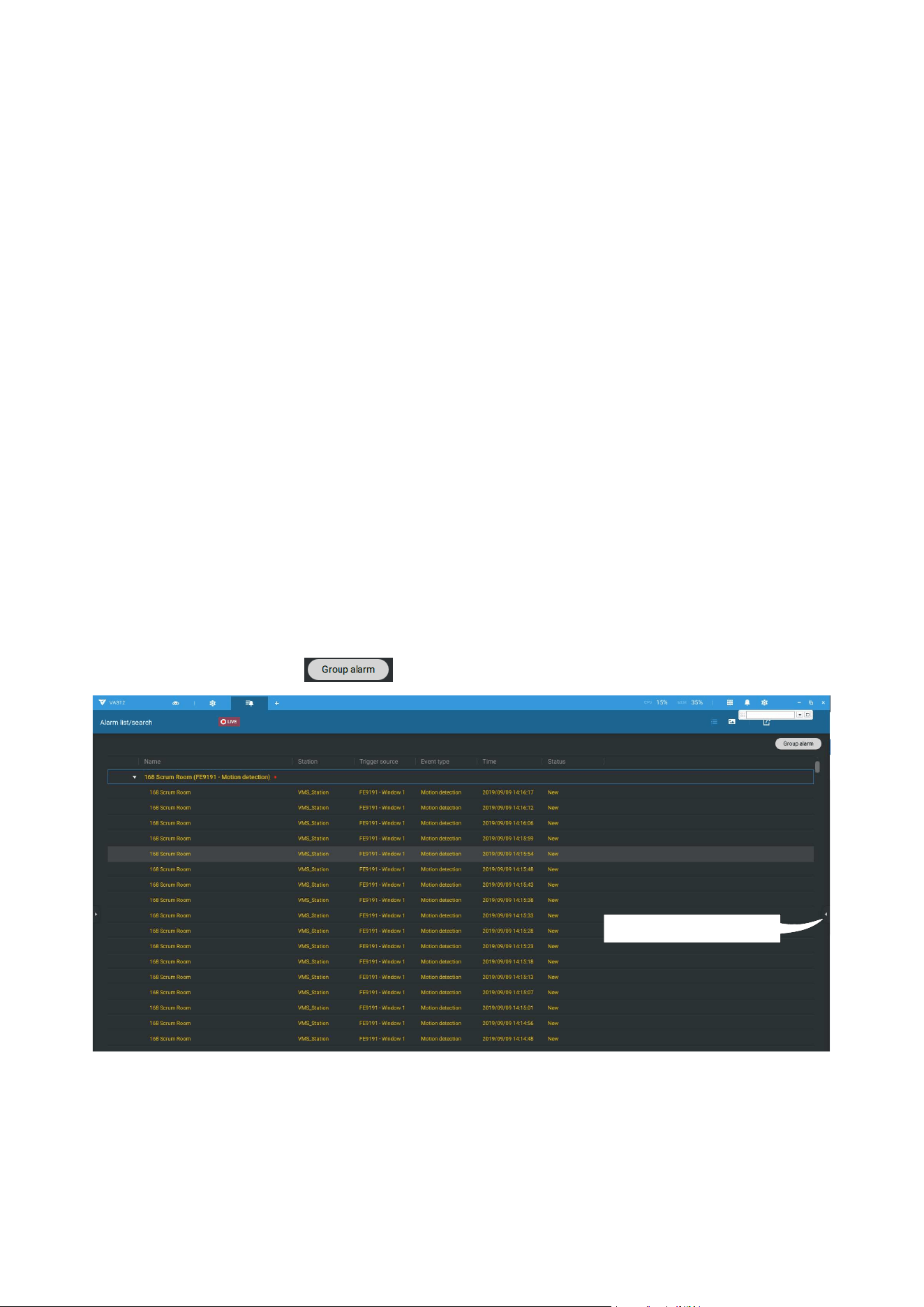
102
Click and hold down on the time cells, and drag the mouse to include the time span of your
preferrence. The minimum selectable unit is half an hour. You can select multiple time
spans on the template. Enter a name for the template, and click Add to save your template.
The same configuraion window apply to both the Schedule template and the customize
schedule windows.
Make sure a Schedule mode is selected when you leave this configuration step.
Enter a name and instructions for users to follow, and then click Add to complete the Alarm
setting.
All configured alarms will be listed on the Alarm settings page.
Group Alarm
Multiple triggered alarms can be presented as group alarms. Alarms triggered by the same
event type, and by the same camera can be grouped together. In this way, multiple similar
alarms can be listed under one entry.
On the alarm list, click the
button to display the alarm group.
Click to reveal the video viewing panel.
In the list mode, you can expand the right-hand-side panel. The video of the latest alarm
will display.
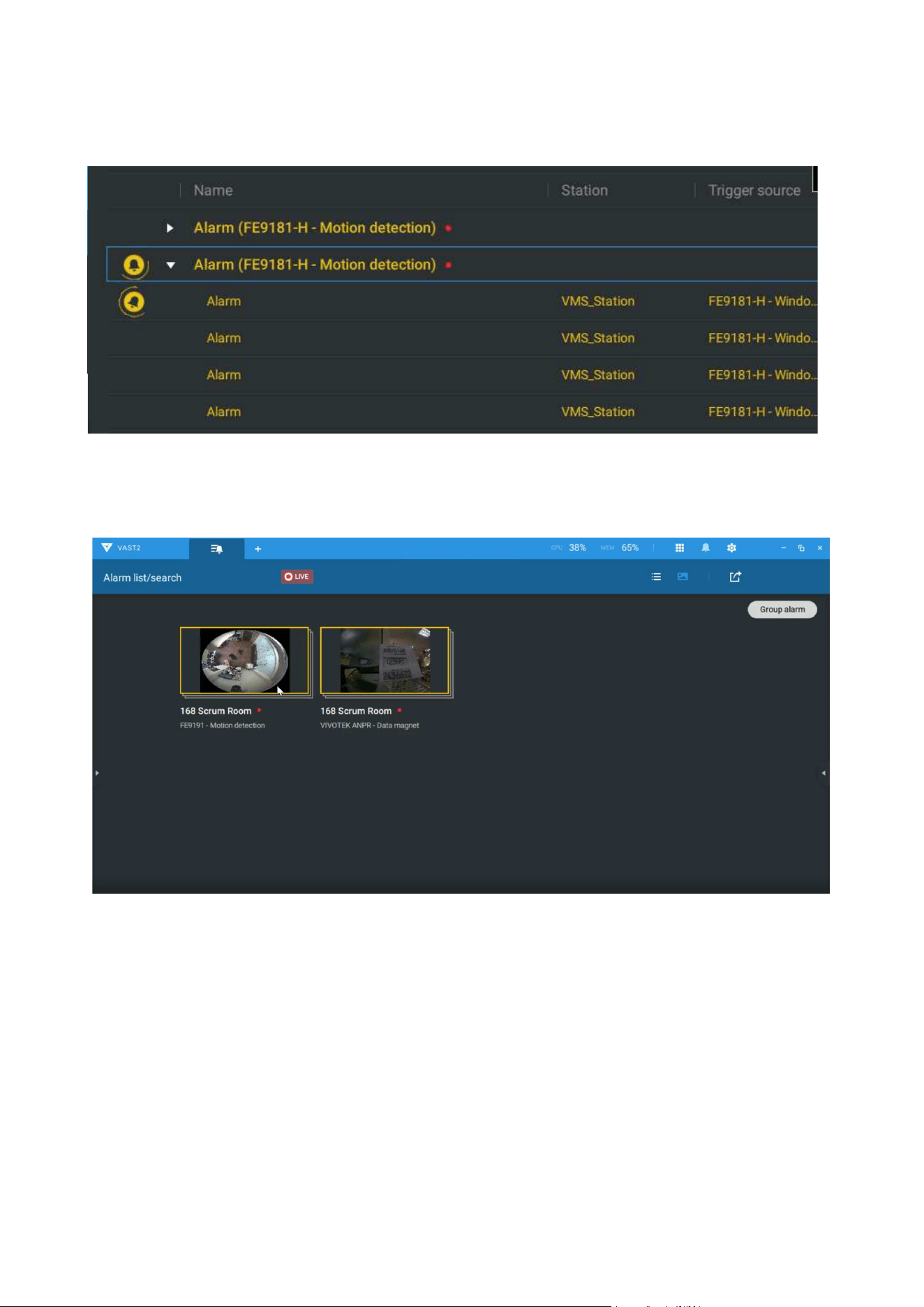
103
The same applies to the thumbnail view. To leave the group alarm view, click the Group
alarm button again.
When the alarm-triggered action is configured as sounded alarm, you can mute all alarms
in the group by clicking the alarm sound icon.
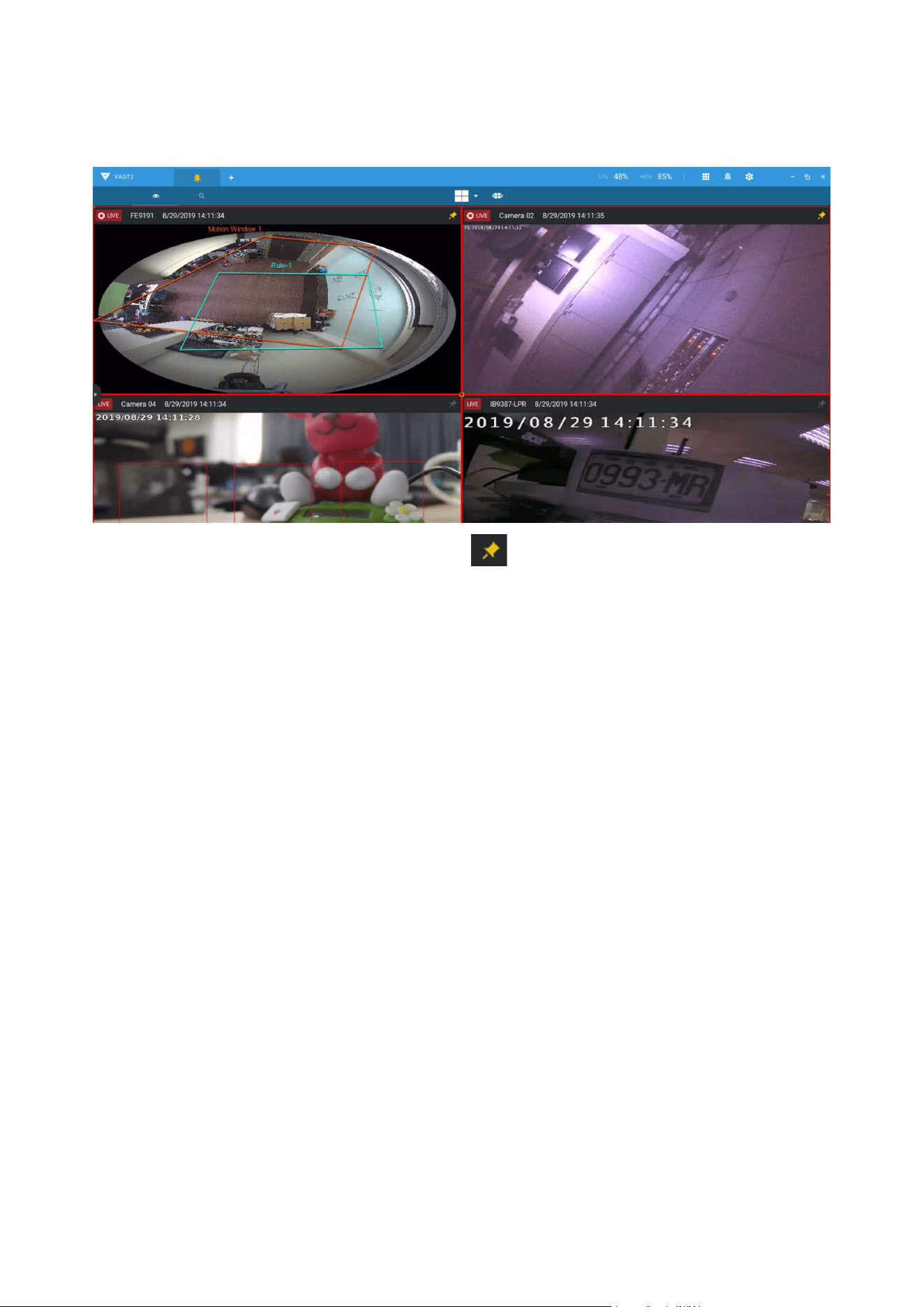
104
When the alarm action is set to "Send live streaming," the videos coming from the same
camera will occupy only one view cell.
In the Alarm tab window, use the thumbtack button to freeze the current screen. If
thumbtacked, the other incoming alarms will not affect the current screen.
On arrival, the latest alarm will display with a blinking red frame. A selected view cell will
display with a yellow frame.
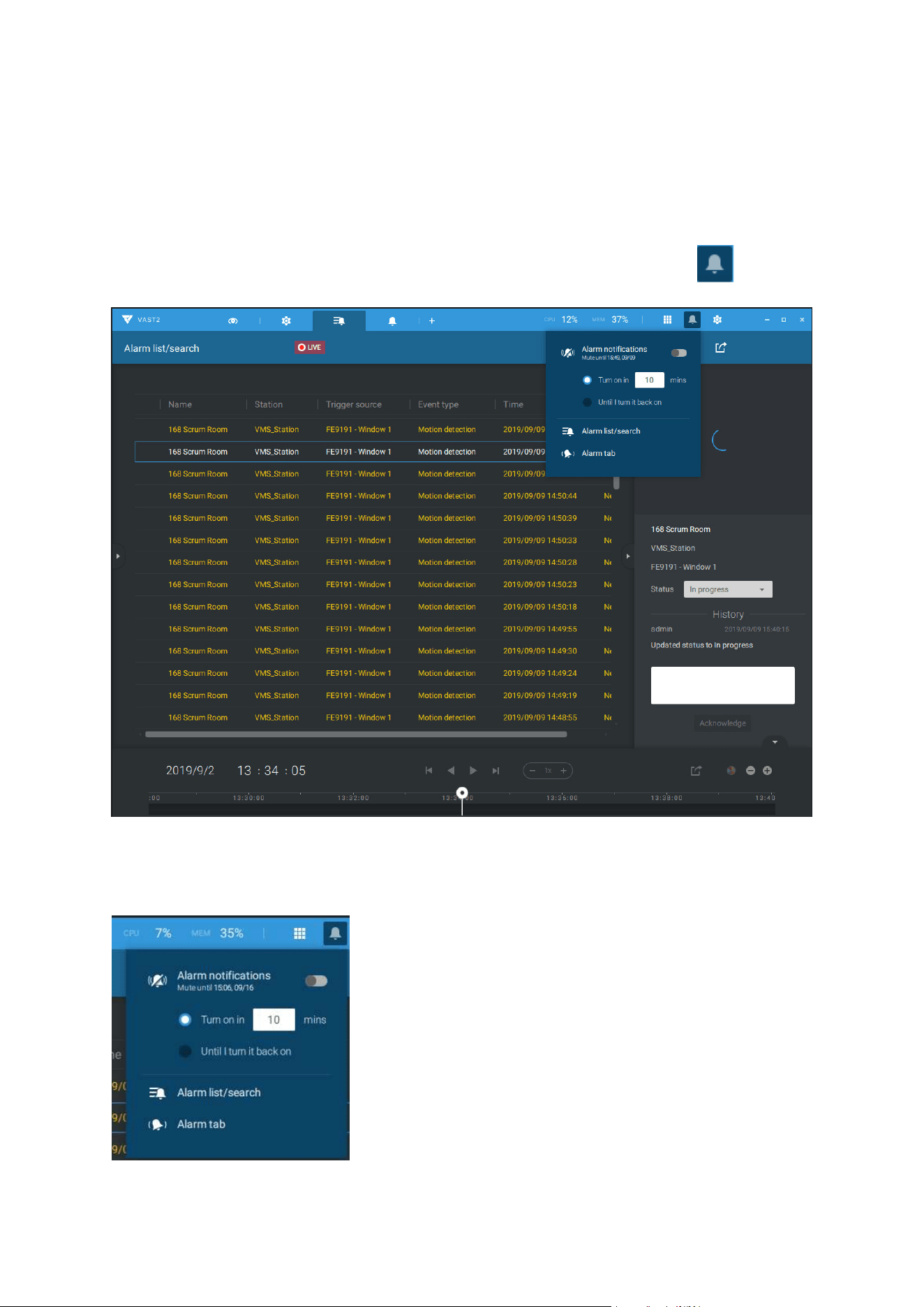
105
The alarm notification can be turned off by clicking on the Alarm tab. Use the slide
toggle to do so. You can also select to let the notification automatically turn on after a
configurable span of time. Enter the number in the mins field. The max. time span is 9,999
minutes.
The notification configuration is kept on the client computer.
When the Alarm notification is turned off, the Alarm tab icon is greyed out .
Note that the default for the alarm notification is "Until I turn it back on." If you turn off the
alarm notification, you need to re-activate it after you turn off the notification the first time.
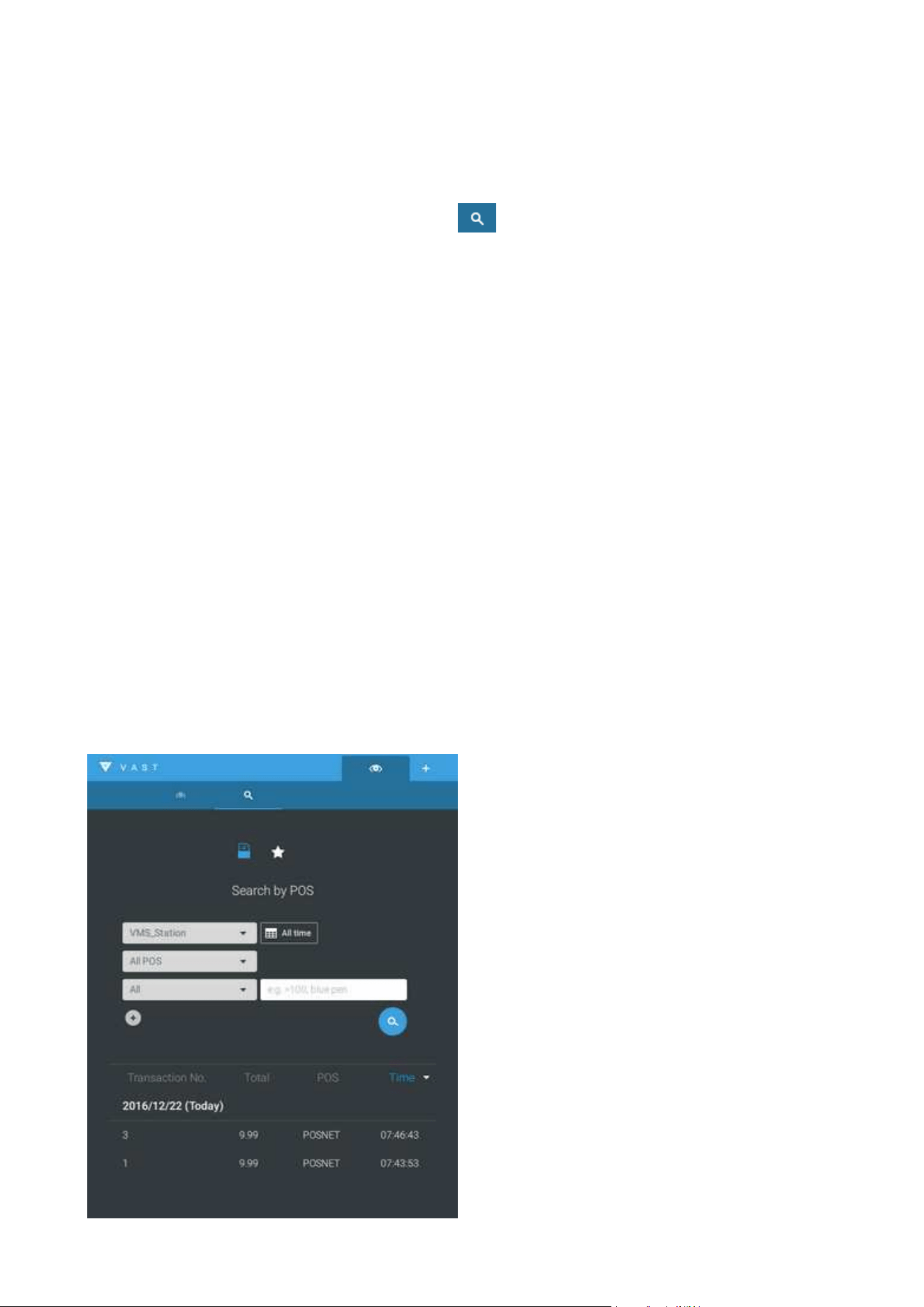
106
2-15. Search Panel
The Search panel is accessed via the Search button. 2 key functions are provided:
Search by POS transaction, and Search by Bookmark.
1. Search by POS transaction:
The VAST station can collect coordinated database
information from a POS machine. This function provides access to the video clips
associated with the sales record on the POS machine. Details of transaction can be
listed on screen so that a manager can see the live view when controversial events
occur.
2. To search the POS-related recordings,
2-1. Select the VAST station which the POS machine is connected to (via the Settings >
POS configuration).
2-2. If you know the approximate time of occurrence (bill void, content adjusted, shortage
of products, and other frauds), use the calendar to select a time span.
2-3. Select a POS machine, if there are many.
2-4. Select a search condition, such as item name, subtotal, or the transaction number.
You can use the >, <, or = signs to specify the amount you are searching for. For
example, key in >100 for the amounts larger than $100.
2-5. You can click the add button below to append more search conditions.
2-6. When done, click the search button.
NOTE:
The Alarm search panel is
replaced by the Alarm list function. The
Alarm list is accessed from the top tool
bar.
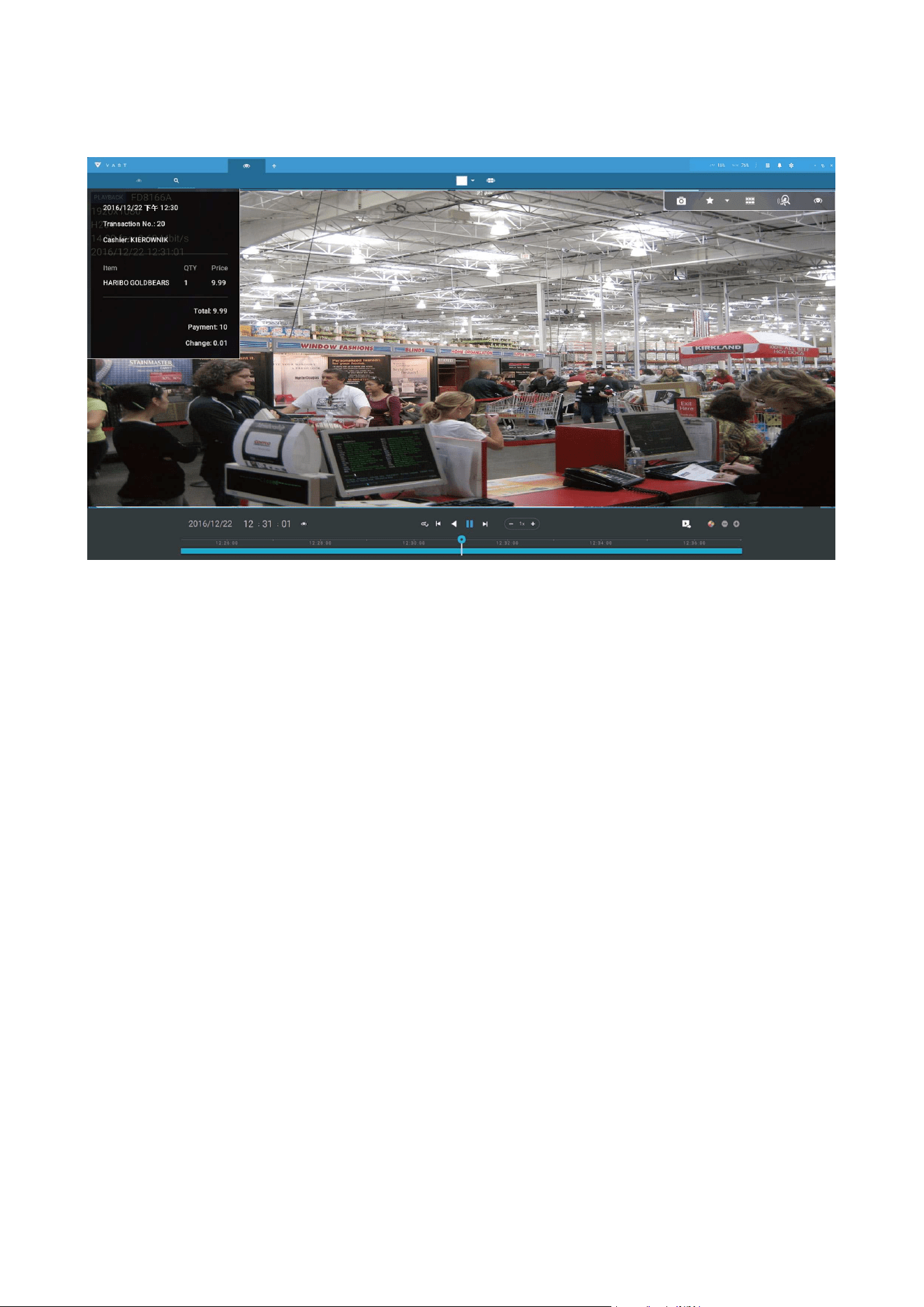
107
2-7. Click on any of the search results. Details of the transaction will display along with the
recording of the time of occurrence.
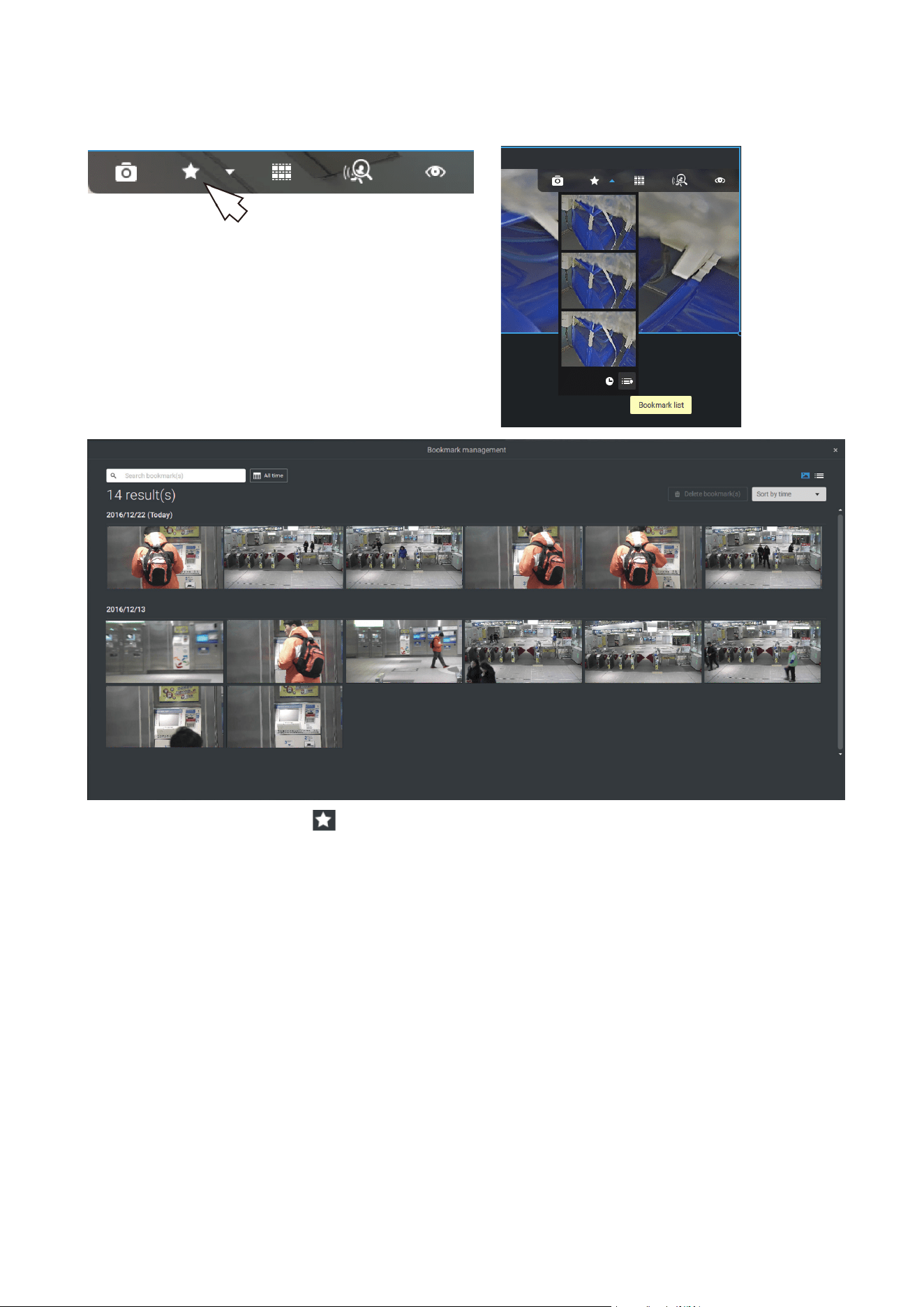
108
2. Search by Bookmark:
Bookmarks are manually created when users review recorded
videos in the Playback mode. Each bookmark comes as a 10-second video clip.
In the Bookmark search panel,
Click the Bookmark search
button. The Bookmark Management window will prompt.
All existing bookmarks will be listed with thumbnails.
a. On this window, you can specify a range of time during which the video streams were
recorded and its points in time when bookmarked.
b. You can then click on a bookmark to display the short video clip extracted from within
the recorded video. The default is 10 seconds.
c. To remove an existing bookmark, left-click to select an entry, and then click the Delete
bookmark(s) button. Bookmarks will be indicated as "Invalid" if the videos where the
bookmarks were appended were erased, e.g., when the original recording was erased by
cyclic recording.
d. Currently you can search for bookmarks using the name of the camera.
e. You can also select the display types for the bookmark search in either the thumbnails
or list mode.

109
2-16. Smart search
The Smart search function enables a quick glimpse of activities occurred within a user-
configurable detection area from the recorded videos. Smart search is available in both the
Liveview and Playback mode.
Click to select a camera view cell. Click on the Smart search button to enter the Smart
search window.
There are two Smart Search modes: Smart search II and Smart search I. The Smart search
II applies to the recordings of the cameras that come with the Smart Motion, and other
VCA capabilities. There are two kinds of metadata polled from camera VCA packages:
1. Motion cell: Pixel-based information. The search results will include all moving
objects in the scene.
2. Object information: Human-based information. If People detection is selected, only
objects detected as human will be displayed as the search results.
Please refer to VIVOTEK's website pages that are related to the Smart motion and Smart
VCA features for the supported cameras.
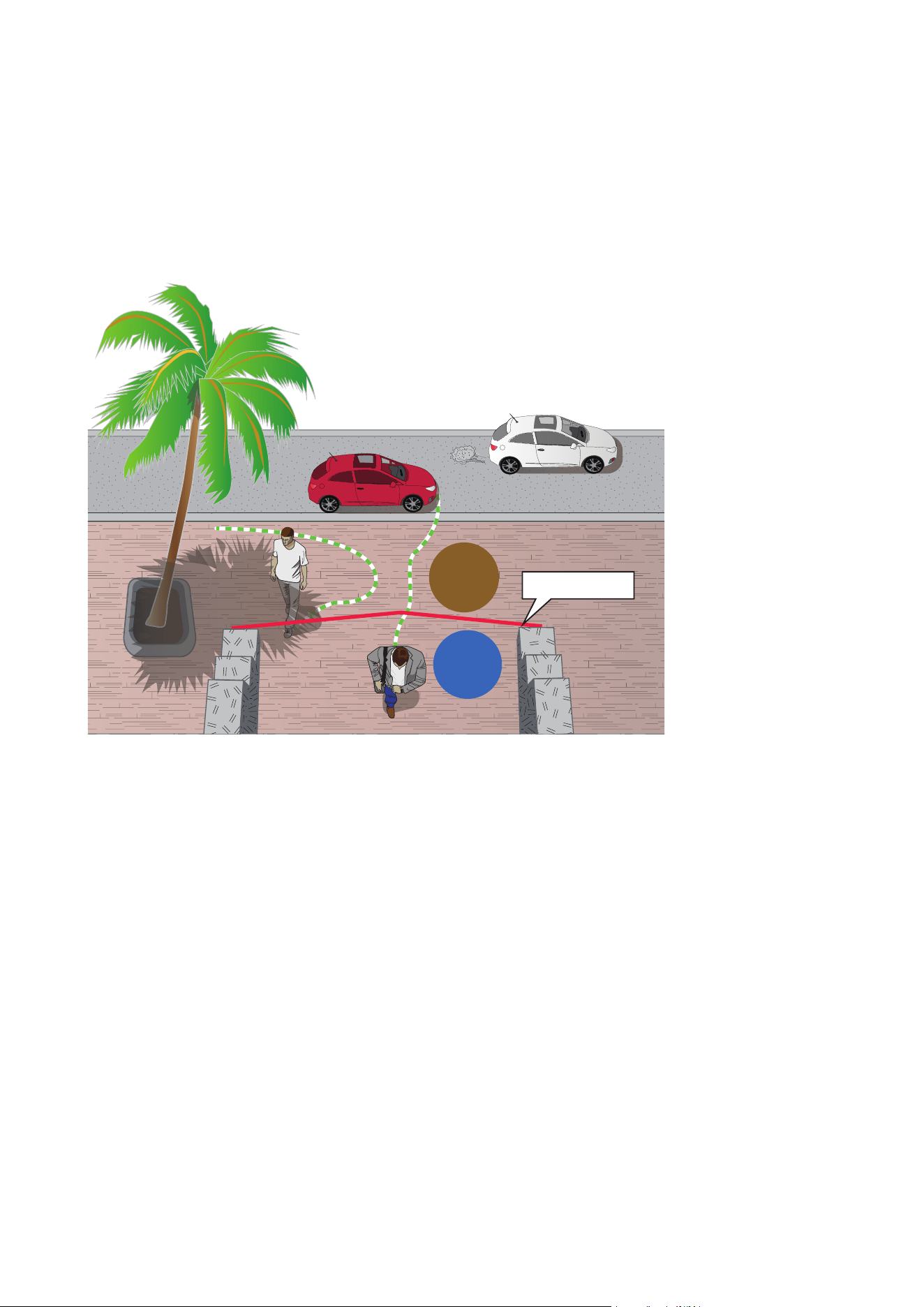
110
Line Crossing Detection
The Line Crossing detection detects one or multiple persons crossing a virtual trip-wire.
The trafc direction can be assigned on screen for persons passing the line in one specic
direction or in both directions.
Out
In
Detection line
The applicable scenarios of this feature can be:
* Detects someone who enters a drive way, entrance, or exit through the virtual line.
* Detects and triggers an alarm in a predetermined direction.
* The detection line can be used as a fence boundary to know if someone has crossed the
articulated line around a perimeter.
Below are short description for the Line Crossing, Loitering, and Intrusion detection
functionality:
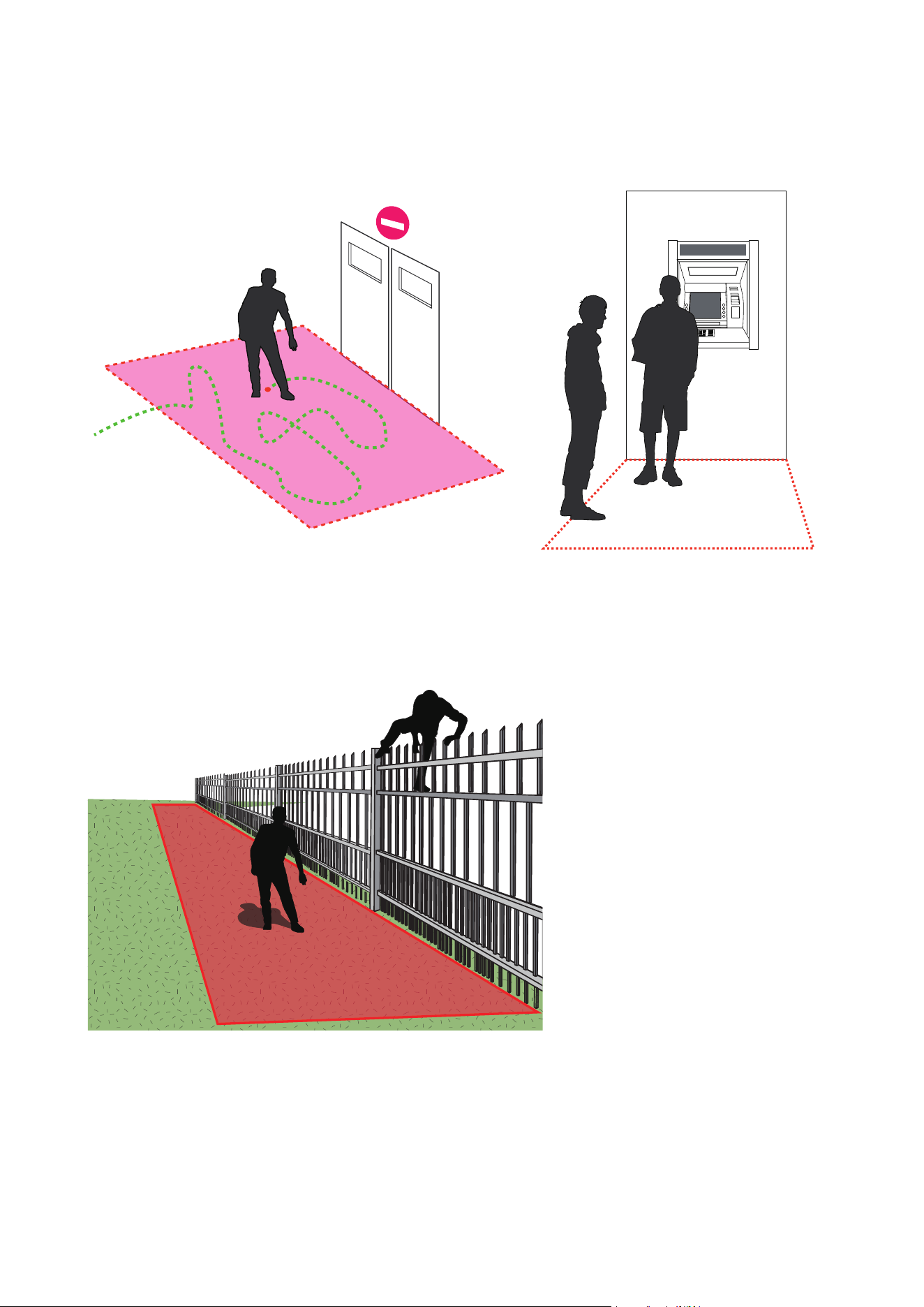
111
Loitering Detection
The Loitering detection can be used to detect a person or a group of people lingering in an
area for longer than a preset time threshold.
ATM
Intrusion Detection
VIVOTEK Intrusion Detection can be used to detect people entering or leaving a virtual
area in the camera eld of view.
Alerted zone
The applicable scenarios of this feature can be:
* Detects when a person enters a bank vault or school after the ofce hours.
* Detects when a person leaves an emergency exit or fire escape, or any place that is
normally forbidden from access.
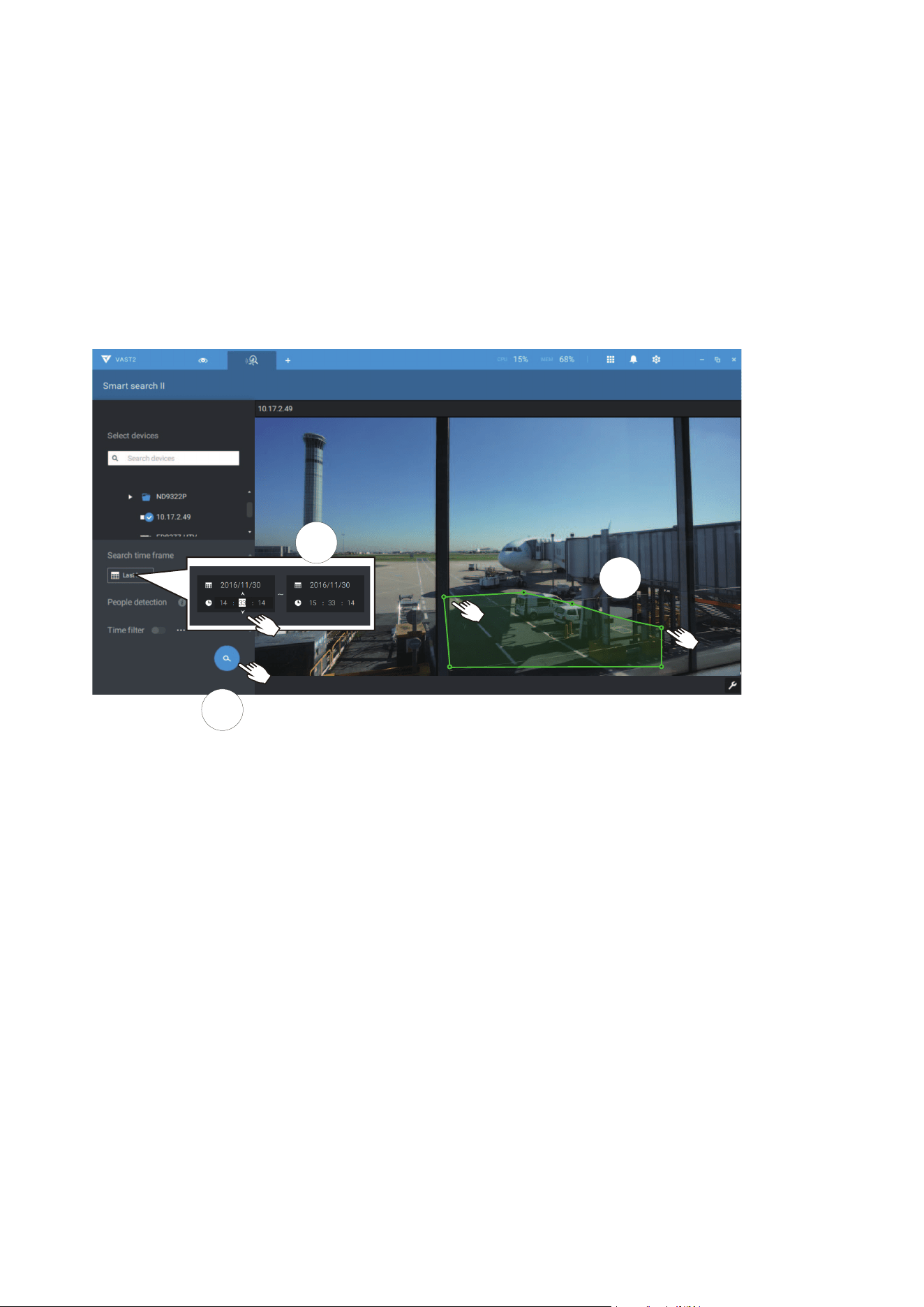
112
1
2
3
To use Smart search,
1. Use the date and time selectors to specify a time span on which to perform the Smart
search.
2. Select a Type (Smart motion, Line crossing, Loitering, or Intrusion). Selecting Line
crossing detection may require you to adjust the position of the detection line.
3. There are different parameters for each detection Type. Refer to each VCA feature's
documentation for details. You can tune the parameters for each VCA feature. See next
page for the configurable parameters.
4. You can draw one polygon with multiple mouse clicks to include areas where activities
of your interest have occurred. You can draw one or more cross lines for Cross line
detection. Double-click to close a polygon.
5. Click the Search button.
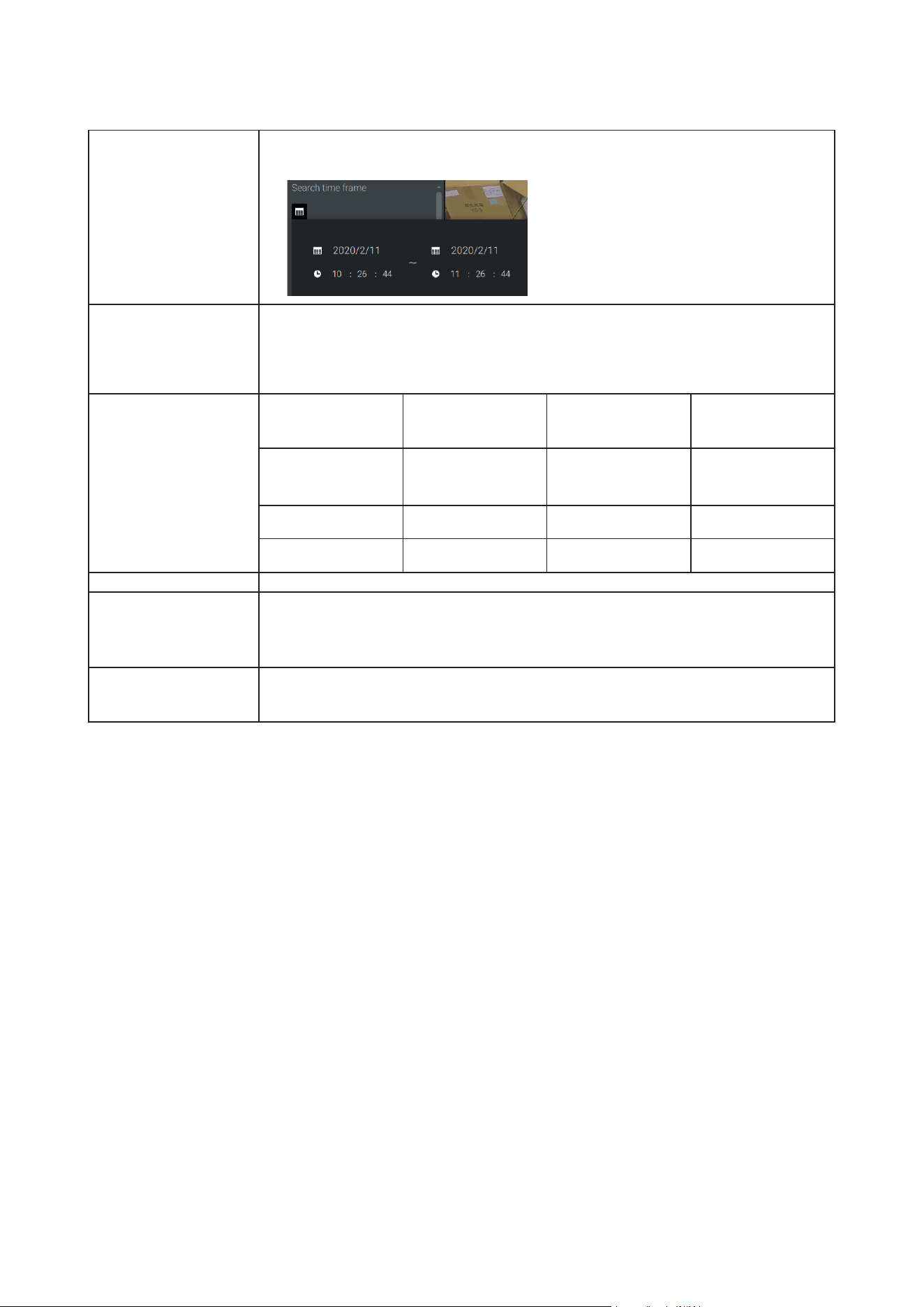
113
Search parameters:
Search time frame Use the calendar tool pane to specify the time span within which the
activities in scene will be searched.
Type If the selected camera supports multiple Smart VCA detection features, the
supported types will be listed:
Smart motion
,
Line crossing
,
Loitering
, or
Intrusion
.
Parameters
(determined by Type)
Smart motion Line crossing Loitering Intrusion
People detection* People walking
direction
Stay time Direction:
Into the zone /
Leaving the zone
Sensitivity**
Time lter
* People detection People detection enables the display of the alarms detected via the human
silhouettes algorithm. This can be used to lter out video analytics alarms that are
not related to human activities, such as swaying vegetation, or small animals.
** Sensitivity Congure the sensitivity for the detection of the activities in scene. Low for near
scene, high sensitivity for long distance scenes.
Note that different cameras support different VCA functions. Please refer to the
documentation for Smart VCA or Smart tracking features, such as the Smart VCA User
Guide.
IMPORTANT:
Running Smart Search II requires cameras that support the following:
1. Smart motion.
2. Firmware version above 0113d, 0117b or 0100i (Authwebsocket support is needed)
3. VCA package version above 6.1.3a.
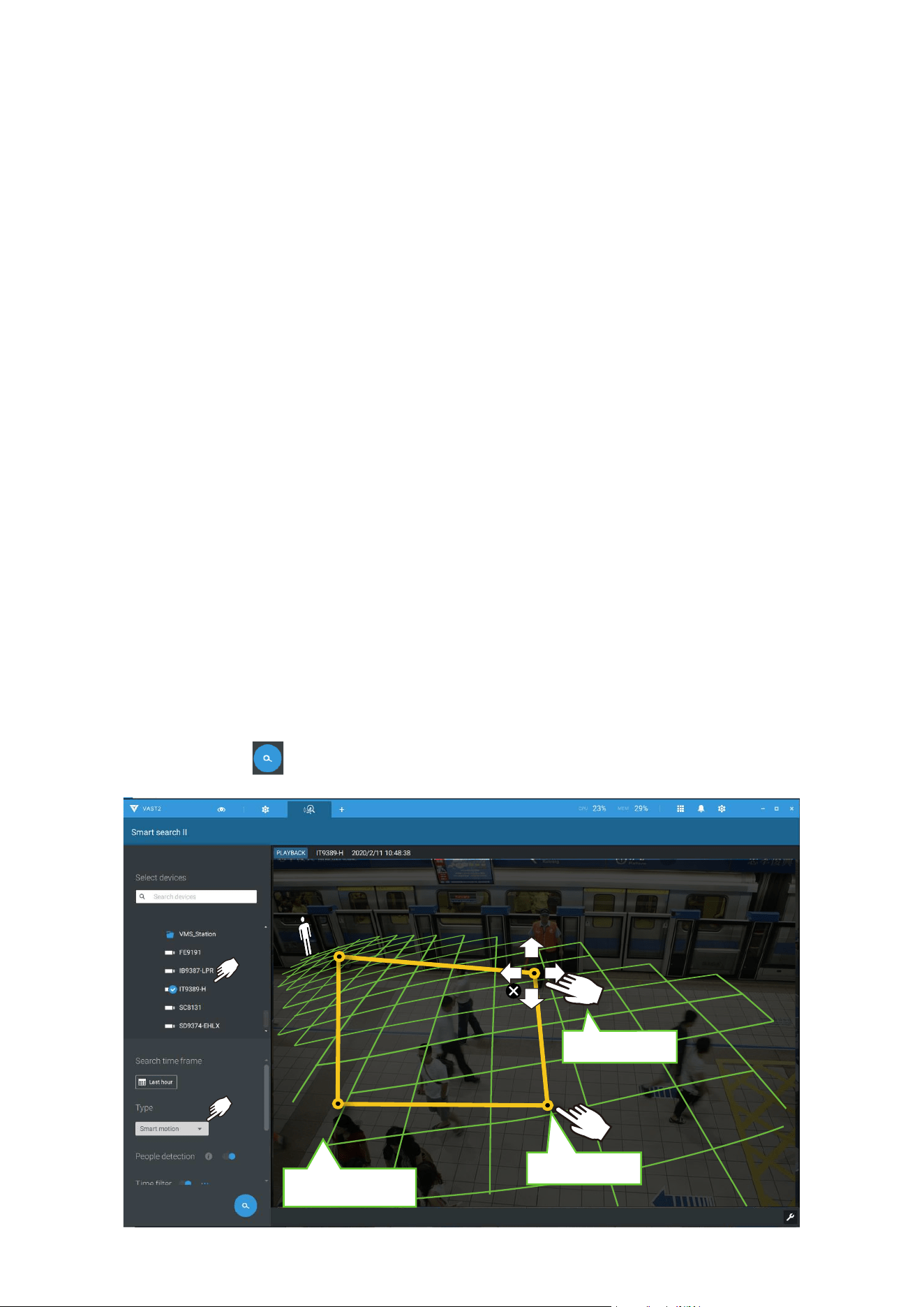
114
Green horizontal grid
as People detection area
Click to create.
Drag to change shape
If your camera supports Smart VCA features, you can manually create detection rules
on the configuration screen. Note that you may not need to do this if you have already
configured detection rules on the camera.
1. Select a VCA camera.
2. Select a VCA type from the pull-down list: Smart Motion, Line crossing, Loitering, or
Intrusion. For a camera that supports only one VCA feature, such as Smart tracking on a
speed dome, there is no "type" option.
3. You can then draw a detection zone, or detection line on the screen.
4. Select a time frame using the calendar tool.
5. Select to enable or disable the People detection feature and configure the Time filter, or
other parameters.
6. Click the Search button.
In most cases, it is presumed that you have configured VCA detection zones and detection
rules such as lines to detect people crossing. You can also configure a detection zone
or lines on the VAST server and then search for the detection results from the recorded
videos.
NOTE:
* Smart search II supports people detection whether the camera comes with a Smart
motion license or not. However, the Line crossing, Loitering, Intrusion features will not be
available.
* With a valid VCA package and license, the abovementioned features will be available in
the Smart search II.
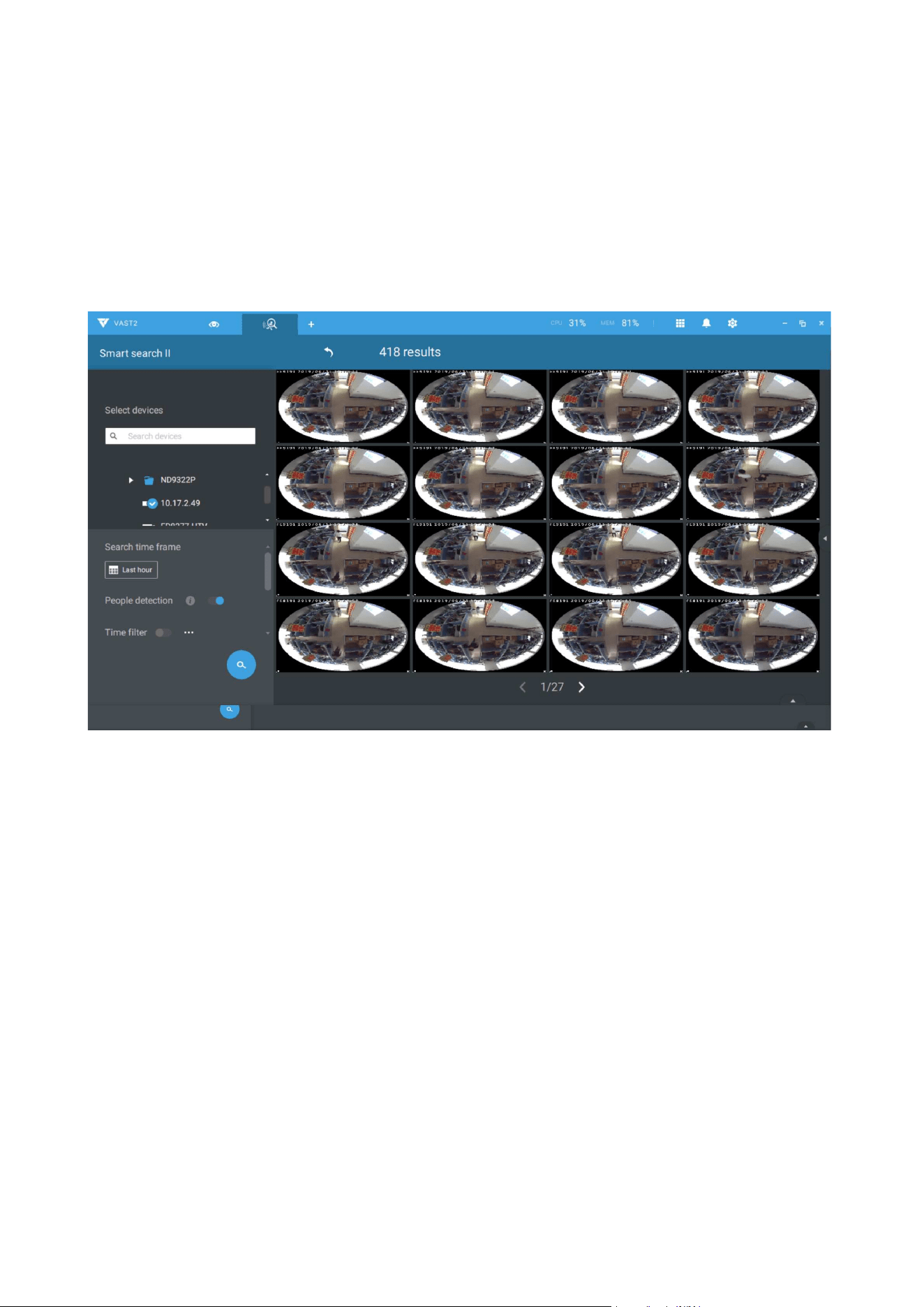
115
4. The search results display as the snapshots of the associated video clips. Click to
playback the video clips with activities in the detection zones.
Hover the screen with your mouse, and the length of each video clip is displayed.
Note that unless interrupted, the playback continues with all detection zone clips, by
continuing to the successive clips.
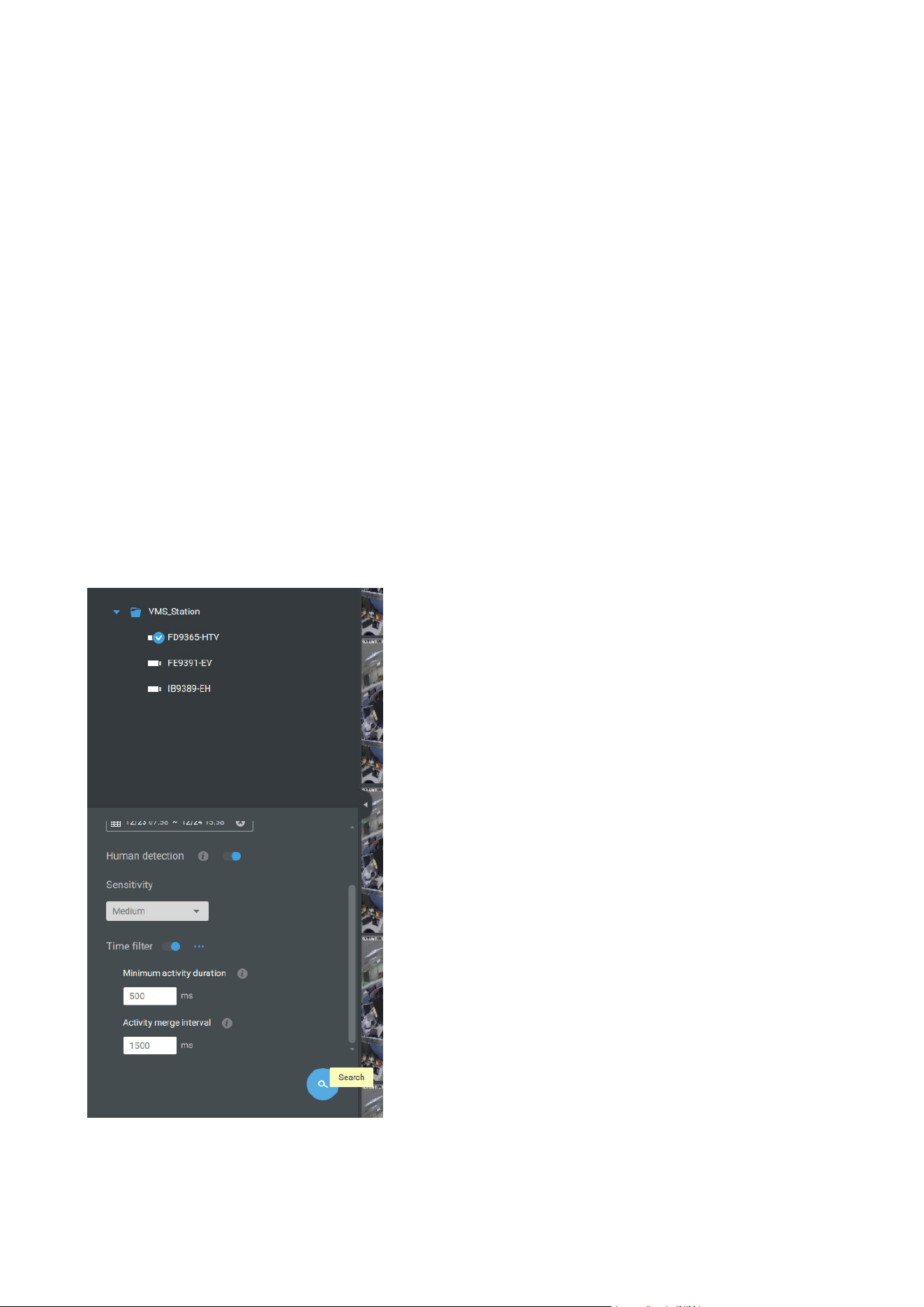
116
Smart search II is available only for newer line of cameras that come with Smart Motion
detection and other Smart VCA features. Smart search II has the following benefits:
1. Faster search: Metadata is saved with videos coming from the cameras running Smart
VCA detection. With the help of the metadata, the search focuses on the effective
alerted vectors and the adverse effects, e.g., headlights causing dramatic contrast
or small animals passing through, have already been eliminated by the camera. The
search can be more rapidly completed.
2. People detection: The search can be conducted for human activities only. Activities
matching the silhouettes of human will be considered as effective results.
3. Multiple-point polygon: Users can select a region of interest by drawing a easily-
configured polygon. In addition to the pre-configured detection rules on VCA cameras,
users can create their own Smart VCA Detection rules on the VAST search panel
screen.
You can specify the time span, People detection,
Sensitivity level, and time filter parameters in a
Smart Search II panel.
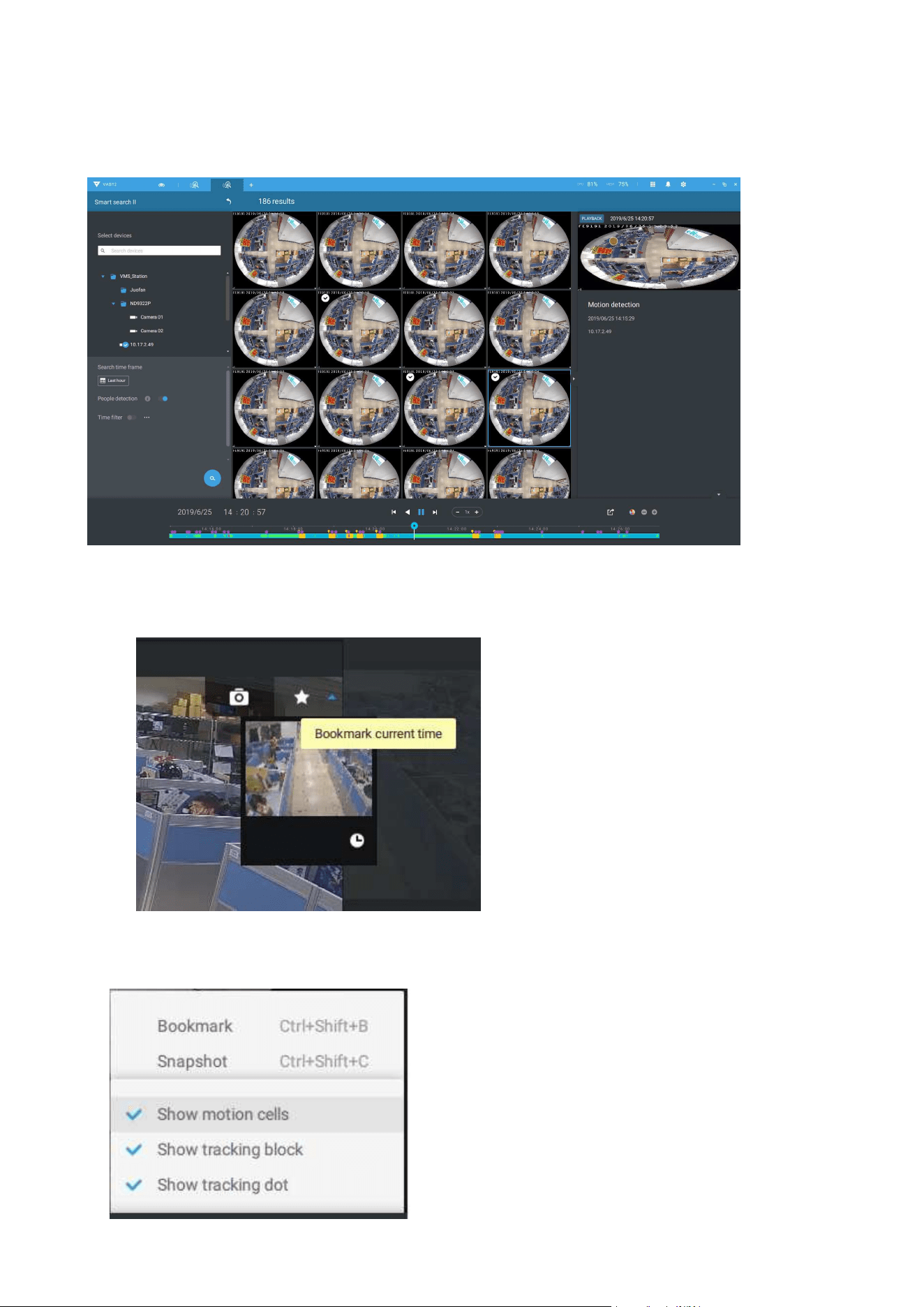
117
5. You can then click to open any clip of your interest. Each marked event clip will be
indicated by a lighter color on the time line. Select and double-click on a video clip, and
then right-click or select the bookmark or snapshot functions from the upper-right.
Move your cursor to the upper right corner of the playback window to display the
Snapshot and Bookmark buttons. Use them to configure the current play time as a
bookmark or take a snapshot.
While in the full-screen Playback window, you can right-click to select or deselect the
display elements including motion cells, tracking block, and tracking dot.
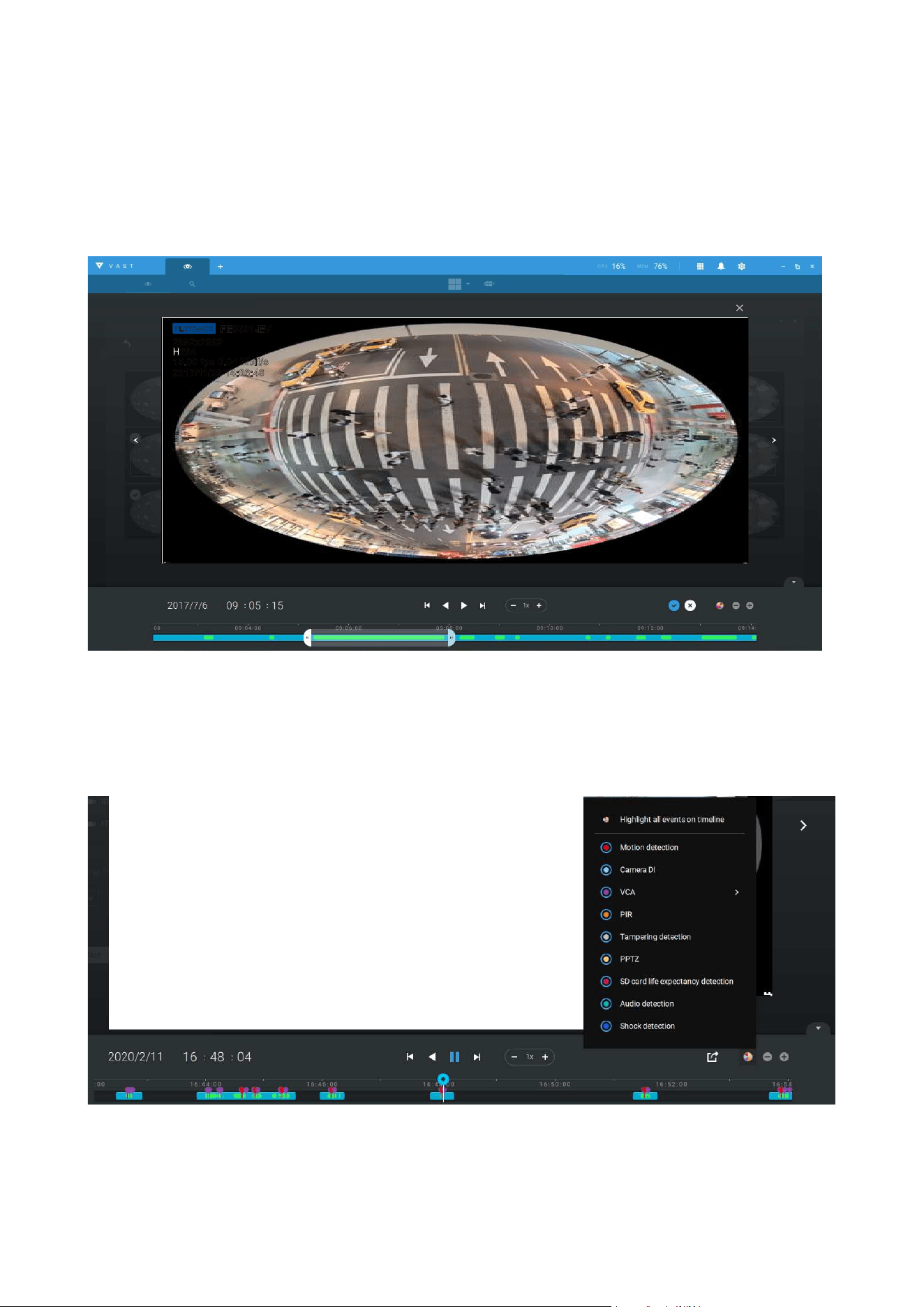
118
6. If you find important events, use the Export function to mark the start and end points on
the timeline to export a video clip. Use the pull tabs on time line to determine the export
length. By default, the export length is 2 minutes long.
The playback control in the Smart search window is identical to that on the Playback
window.
PLAYBACK
FE9391-EV
2992x2992
H264
15.00 fps 0.04 Mbit/s
2017/11/29 14:06:48
Different events on the timeline are indicated by tags of different colors. Click on the
event highlights button to verify their colors.
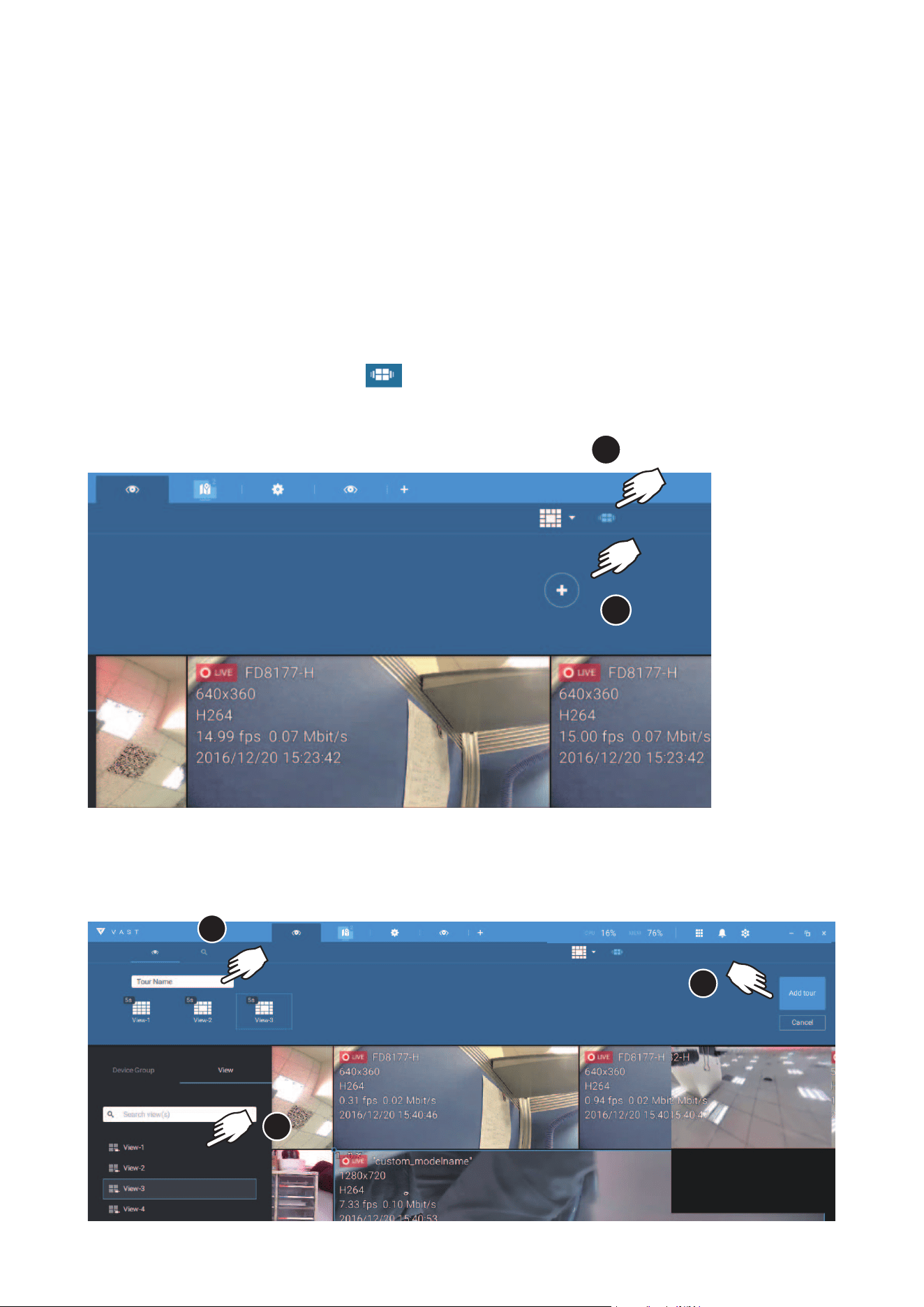
119
2-17. Tour
A tour can be configured to consecutively display multiple views. A tour allows users to
quickly glimpse through many view cells in a timed pattern. As a tour can contain multiple
views, you should design and configure camera views before configuring a tour.
To configure a tour,
1. Click on the Add a camera tour
button.
2. Click the Add button.
1
2
3. Enter a name for the tour.
4. Single-click to select a view. Select multiple views each by a single click.
5. Click the Add Tour button.
3
4
5
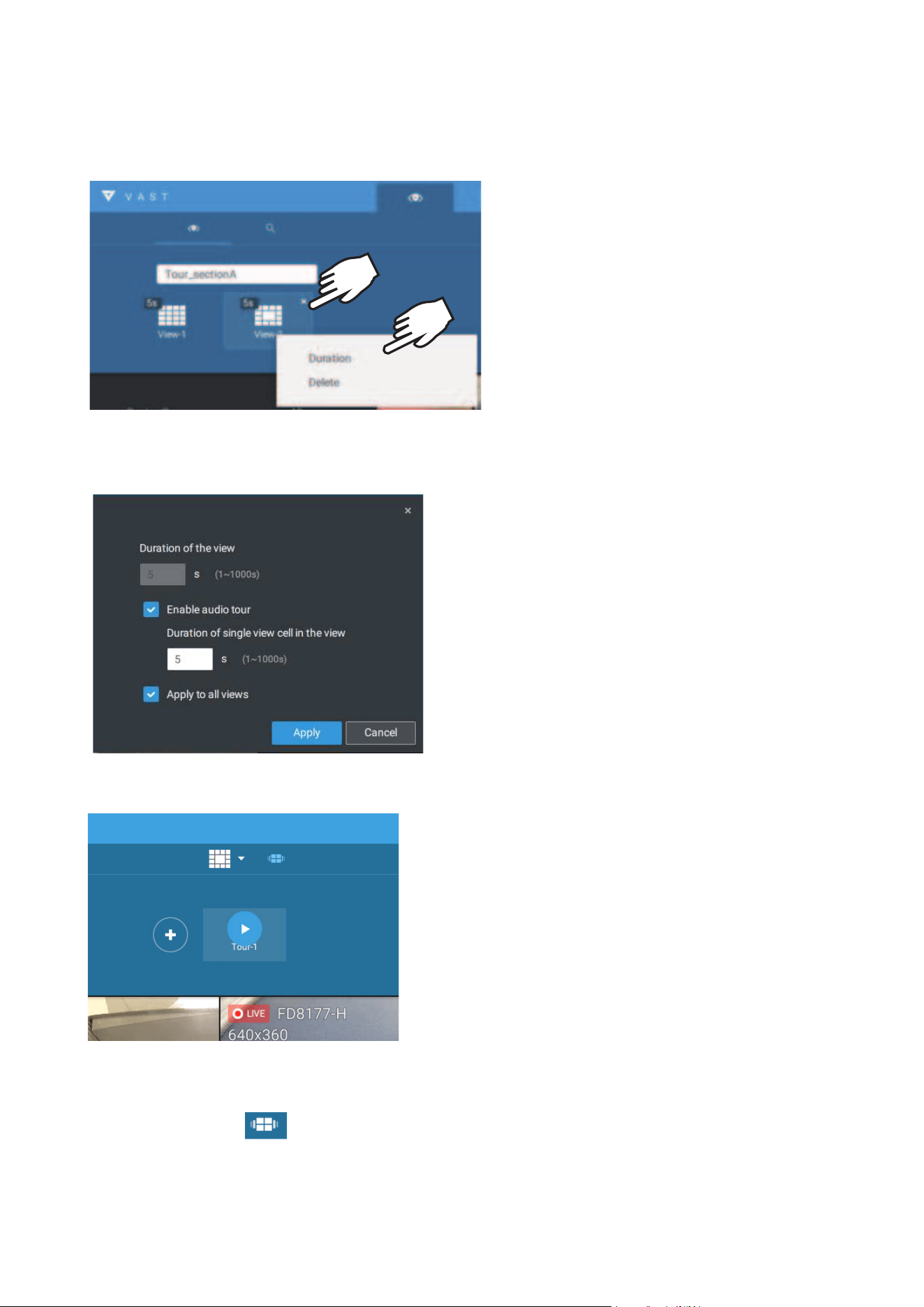
120
The default for the duration of the display of each view is 5 seconds. You can right-click
on each view to display the Duration of each view. You can apply the same duration of all
views, or allow each view to display on screen for a different span of time.
Mouse over a configured tour, and then click to start a tour.
When playing a tour, and you want to stop the tour, you can left-click or right-click on the
screen.
Click the Tour icon again to return to the singular live view.
You can enable the Audio tour option which plays the audio inputs from each view cell for
a specific period of time.
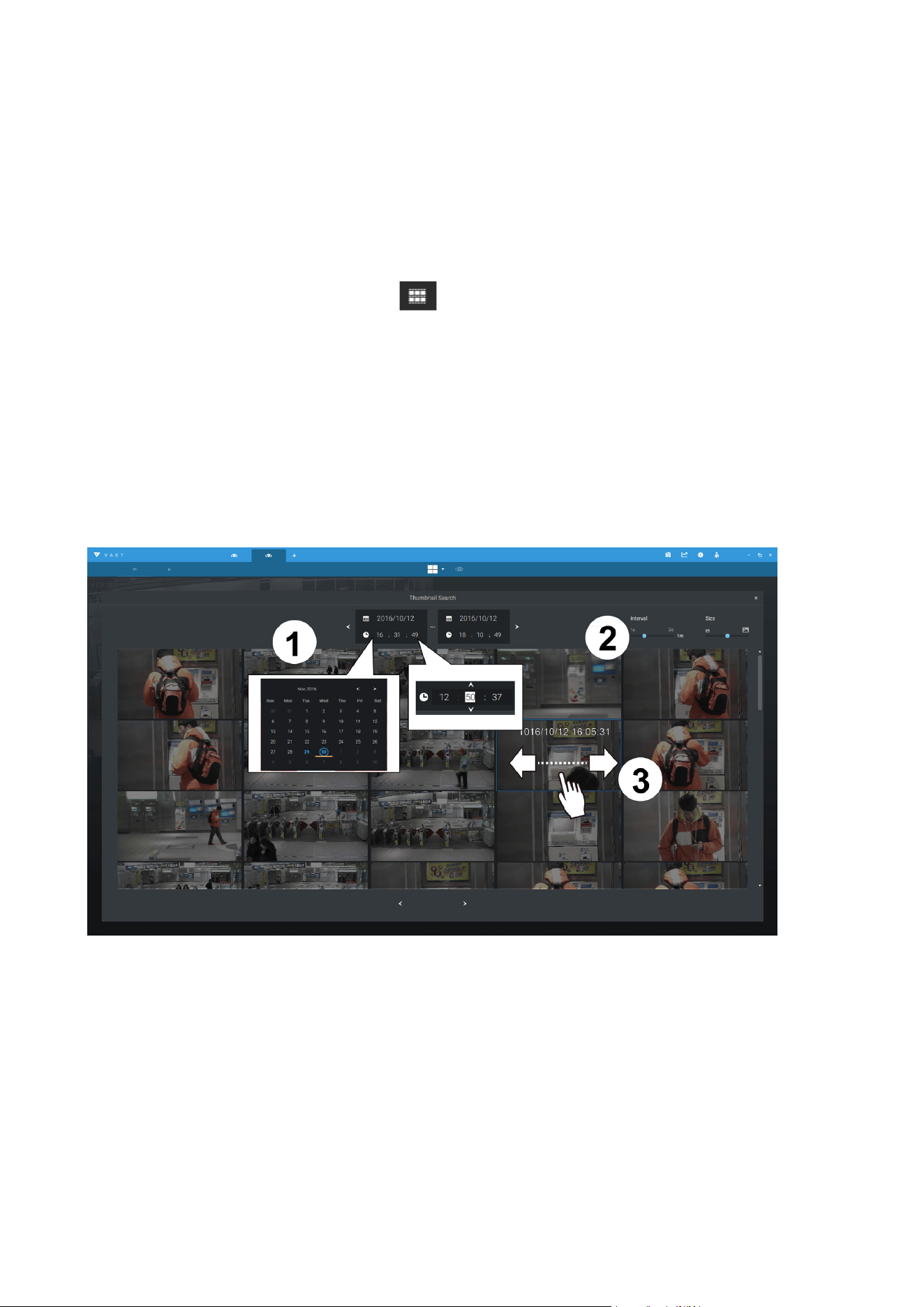
121
2-18. Thumbnail search
The Thumbnail search function is like doing a post-production editing in film making.
Screens from across different time spans are shown to facilitate the search for evidence.
Click on the Thumbnail search button to enter the Thumbnail search window.
The default time span is 100 minutes, starting an hour earlier of the current system time.
To use Thumbnail search,
1. Use the date and time selectors to specify a time span during which you suspect the
event of your interest has occurred.
2. If preferred, tune the interval and clip size. The default length for each clip is 10 seconds.
3. If you find a clip might contain an event of your interest, you can click to select, and then
slide left and right to watch the activities within.
4. Hover your cursor to the lower center of a clip to display the Play and the More
snapshots options. If you click More snapshots, another window will prompt to display
all frames within the clip.
When you select to display the clip details (specific time span), the time span and the
interval information will change accordingly.
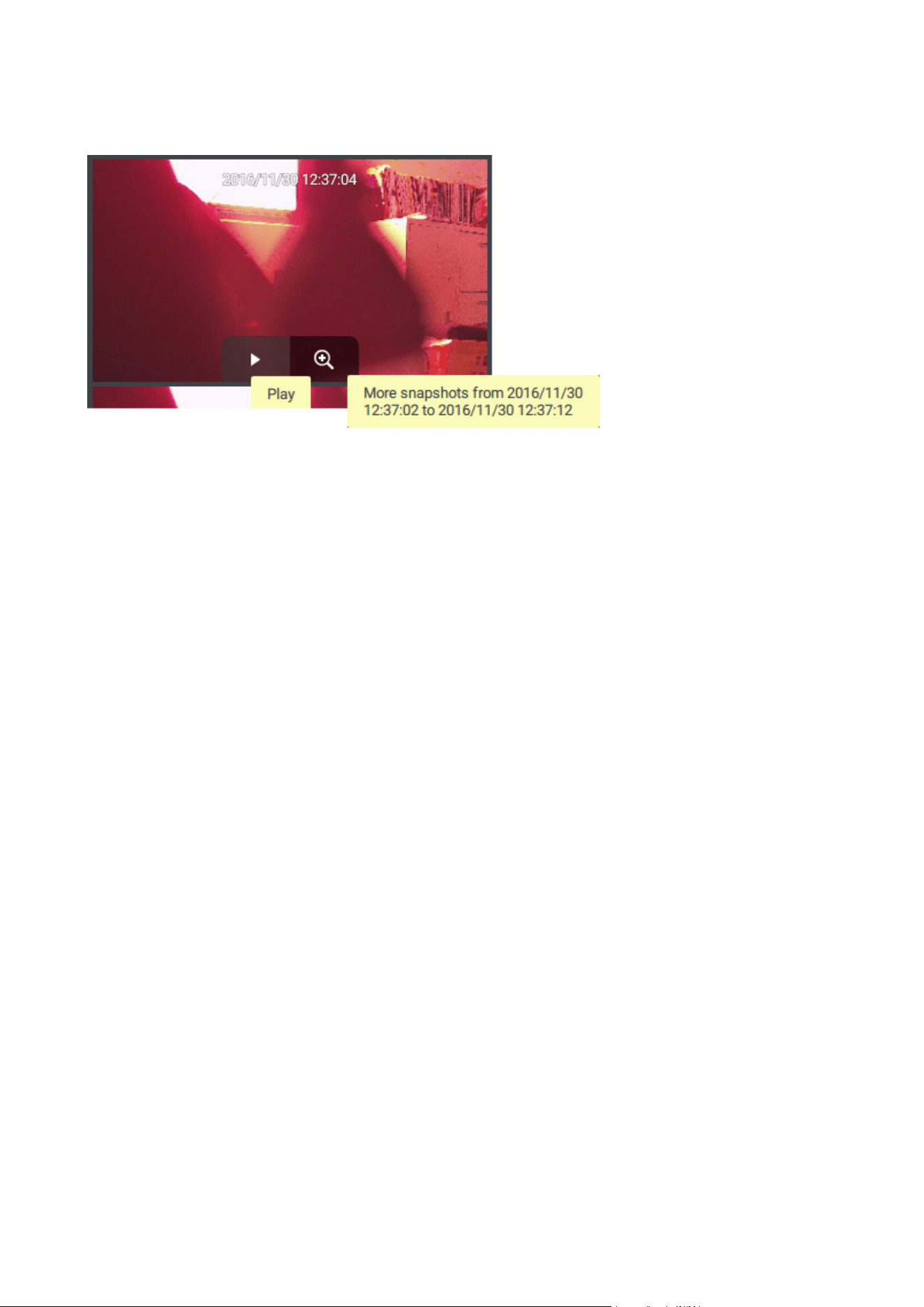
122
When you find an event of your interest, you can play that video clip and use the export
function on screen to output the evidence. You may also place a bookmark on the timeline.
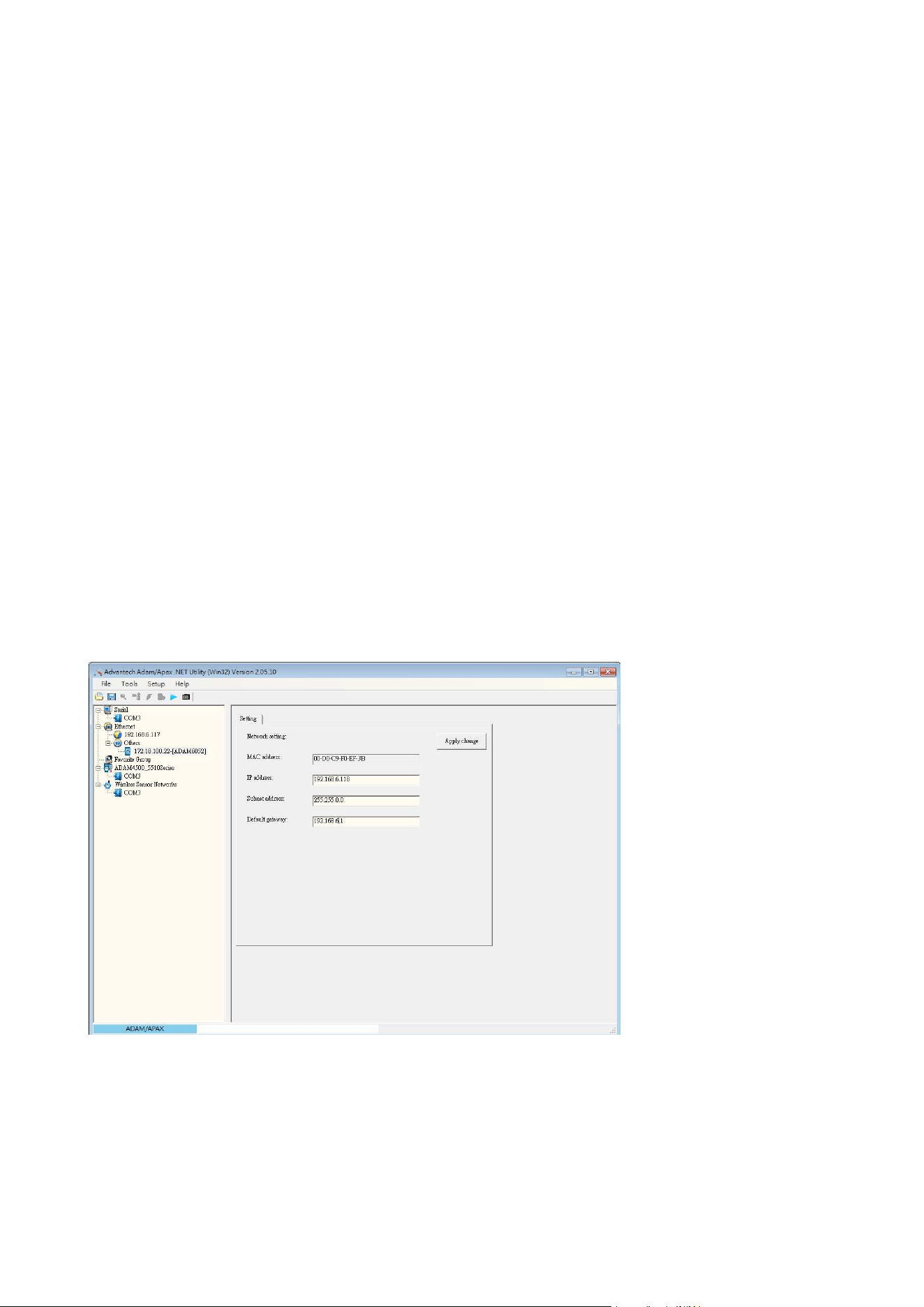
123
Chapter 3 Applications:
3-1. I/O DI/DO Devices
IO Box and Related
Configuration
Use the software utility that comes with the IO box, e.g., Advantech's Adam/Apax.NET
utility, to configure IP address, and test the DI/DO connectivity. The connections to external
devices should be completed before configuration on the software.
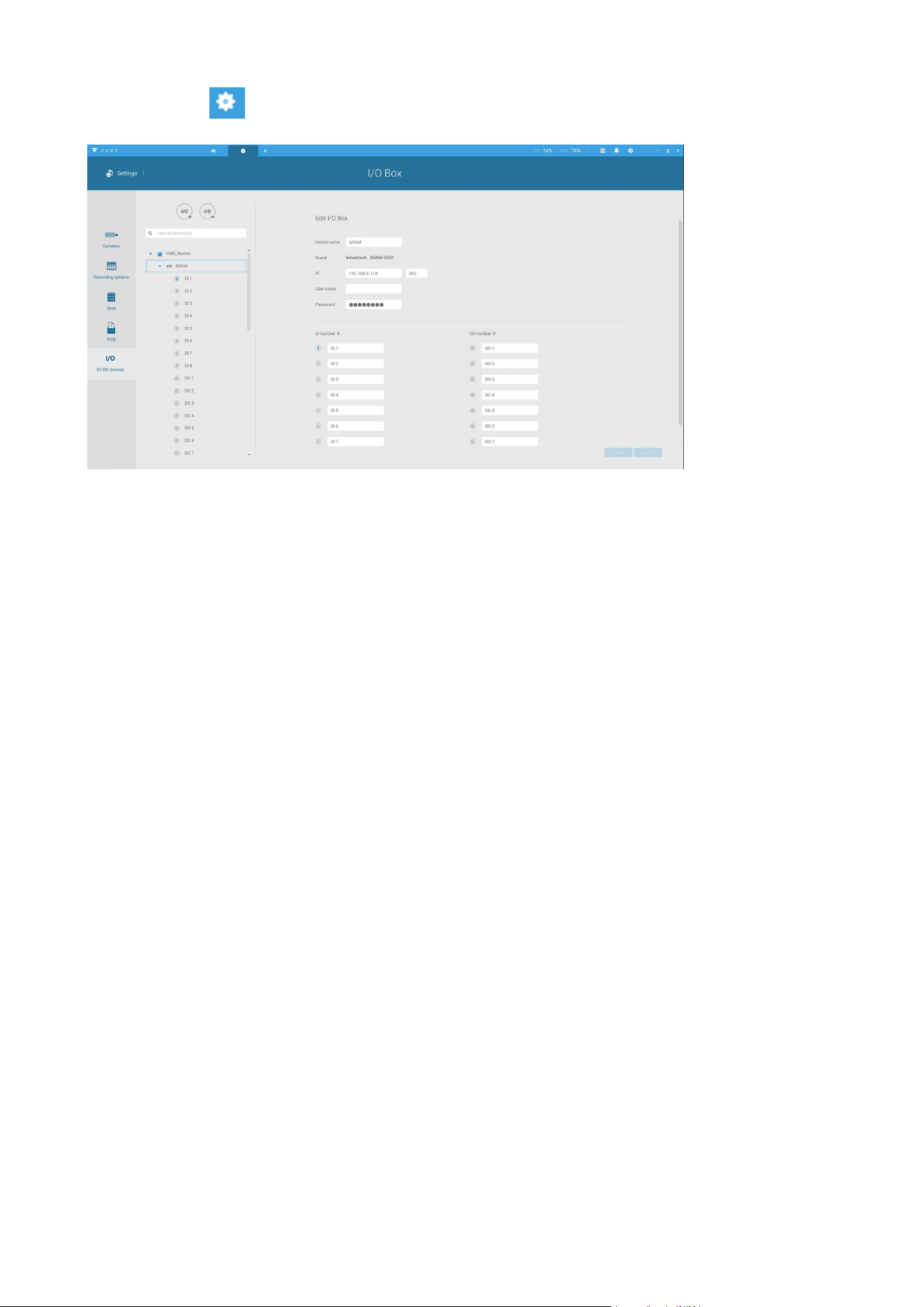
124
Enter the I/O box's IP addess and credentials, and select the correct model name from the
pull-down list on the right. Click the Apply button to proceed. The current I/O connections
are also displayed on screen, such that the status is displayed when DI pins are connected
to detection devices.
Enter Settings > Device > DI/DO Device. Click the add I/O button on top.
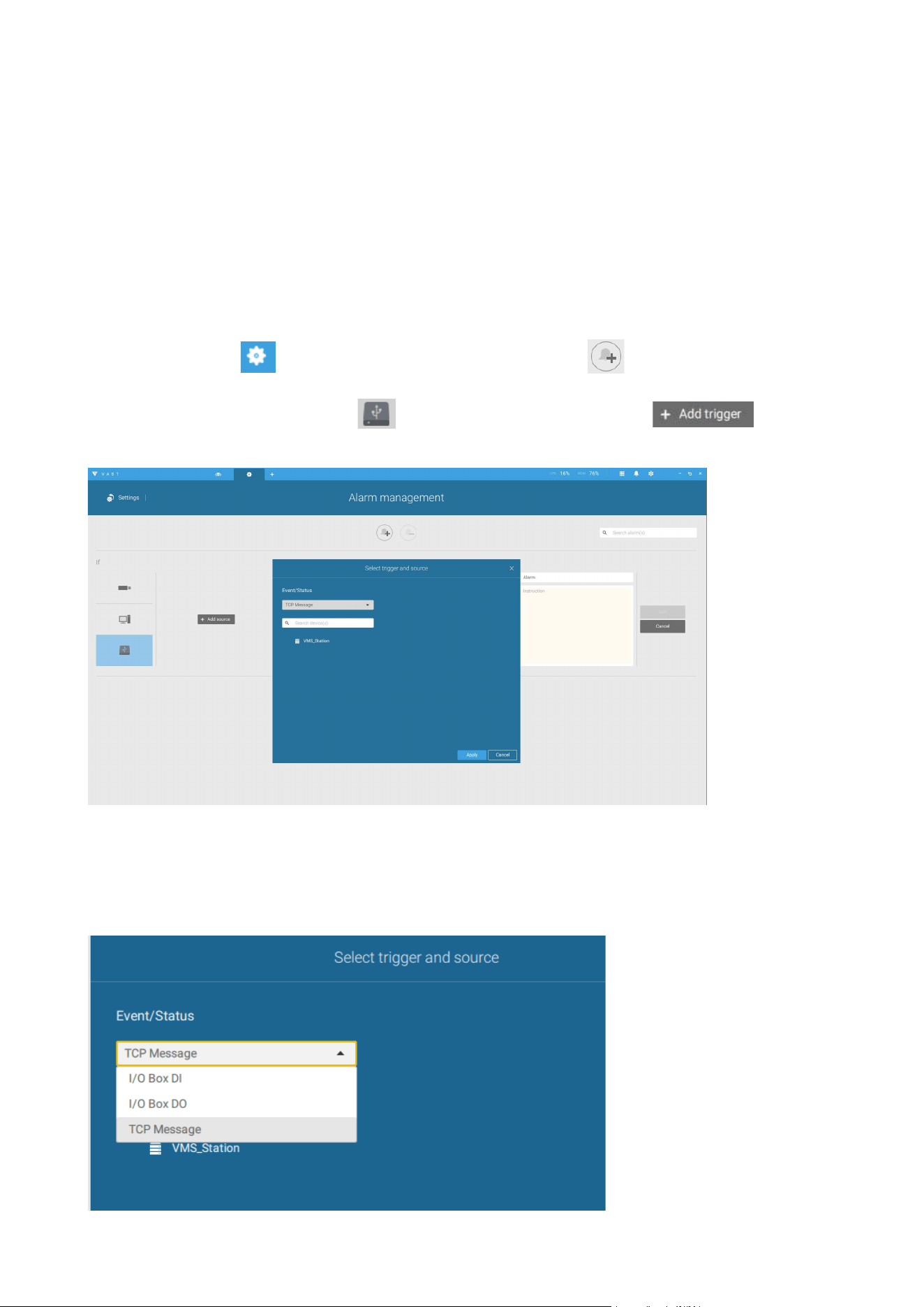
125
The Select trigger and source window will prompt.
Select either the I/O Box DI or DO as the triggering source.
Configuring I/O Box DI/DO
as a Trigger or Action in
Alarm
Enter the Settings > Alarm window. Click the Add alarm button on top.
Select the External Device event , and then click the Add trigger button.
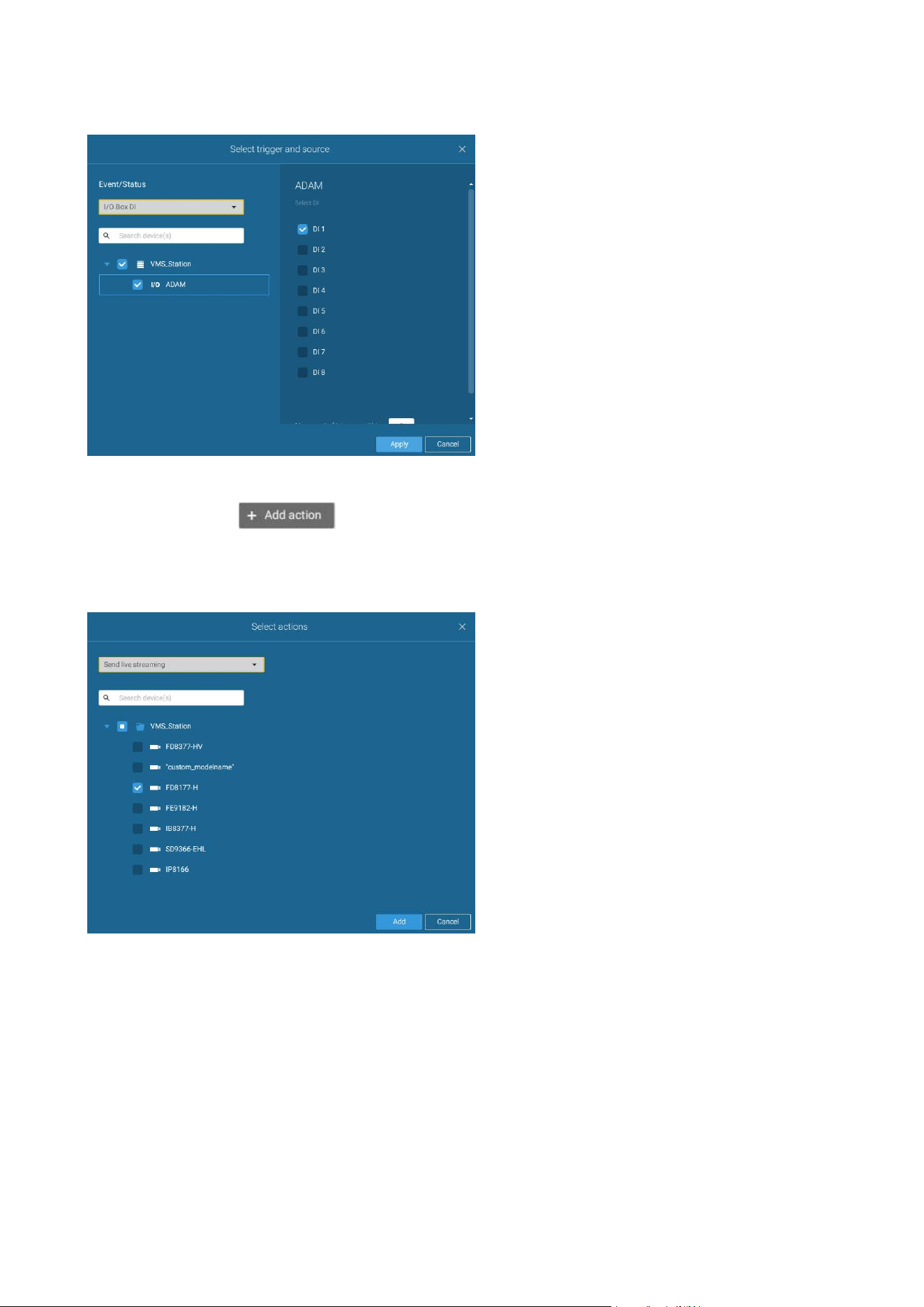
126
Select one or multiple DIs as the triggering source and click the Apply button.
Click Add action , and select a corresponding action, such as sending live
streaming, record videos, trigger a DO, sending an HTTP request, or sending an Email.
When done, click the Add button.
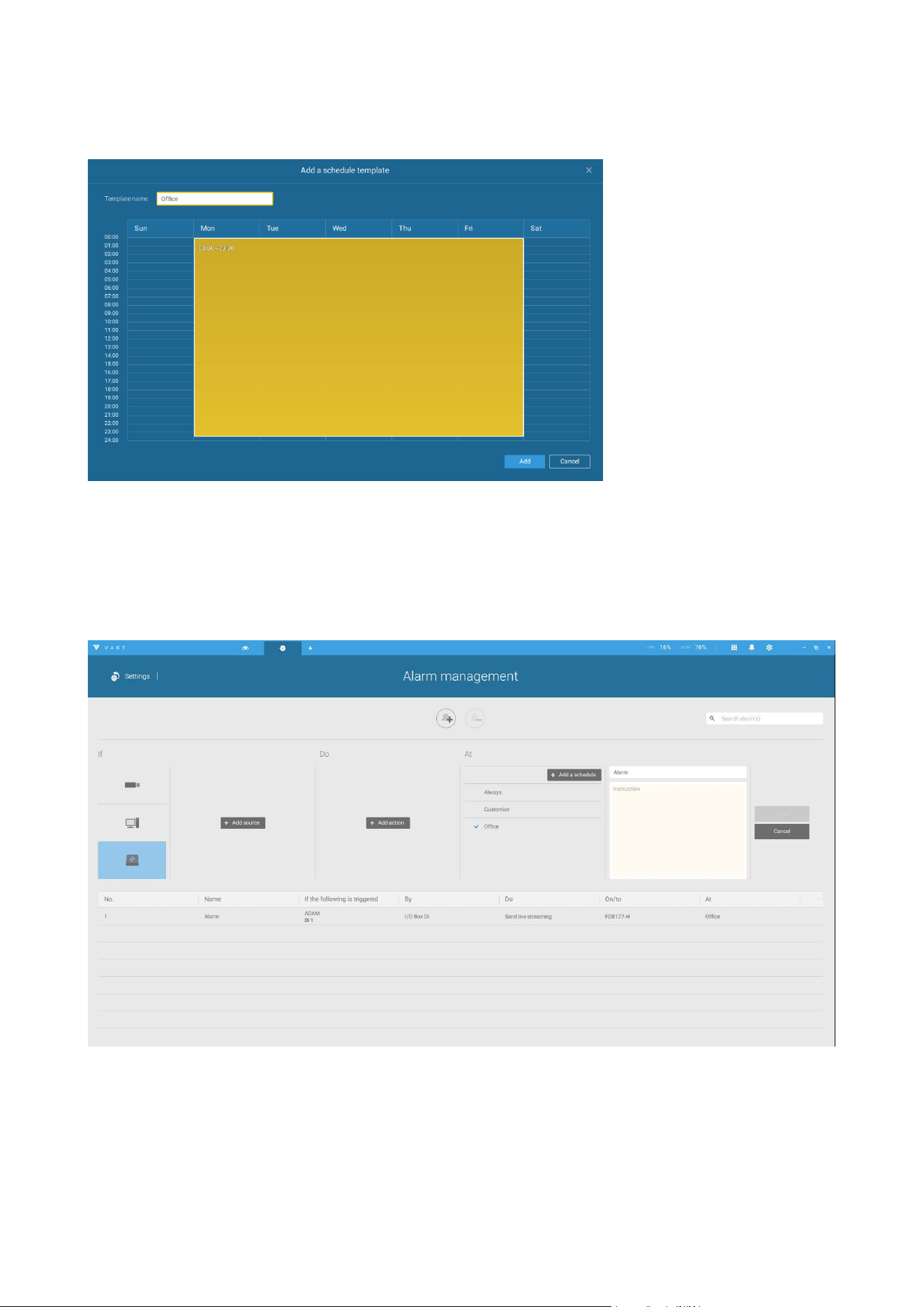
127
Enter a name for your Alarm, and add description for your configuration, e.g., "intrusion
detected on the front door." When done, click the Add button. The Alarm configuration
takes effect immediately.
Configure a schedule during which the Alarm configuration will take effect. If no special
time span is needed, you can simply select Always.
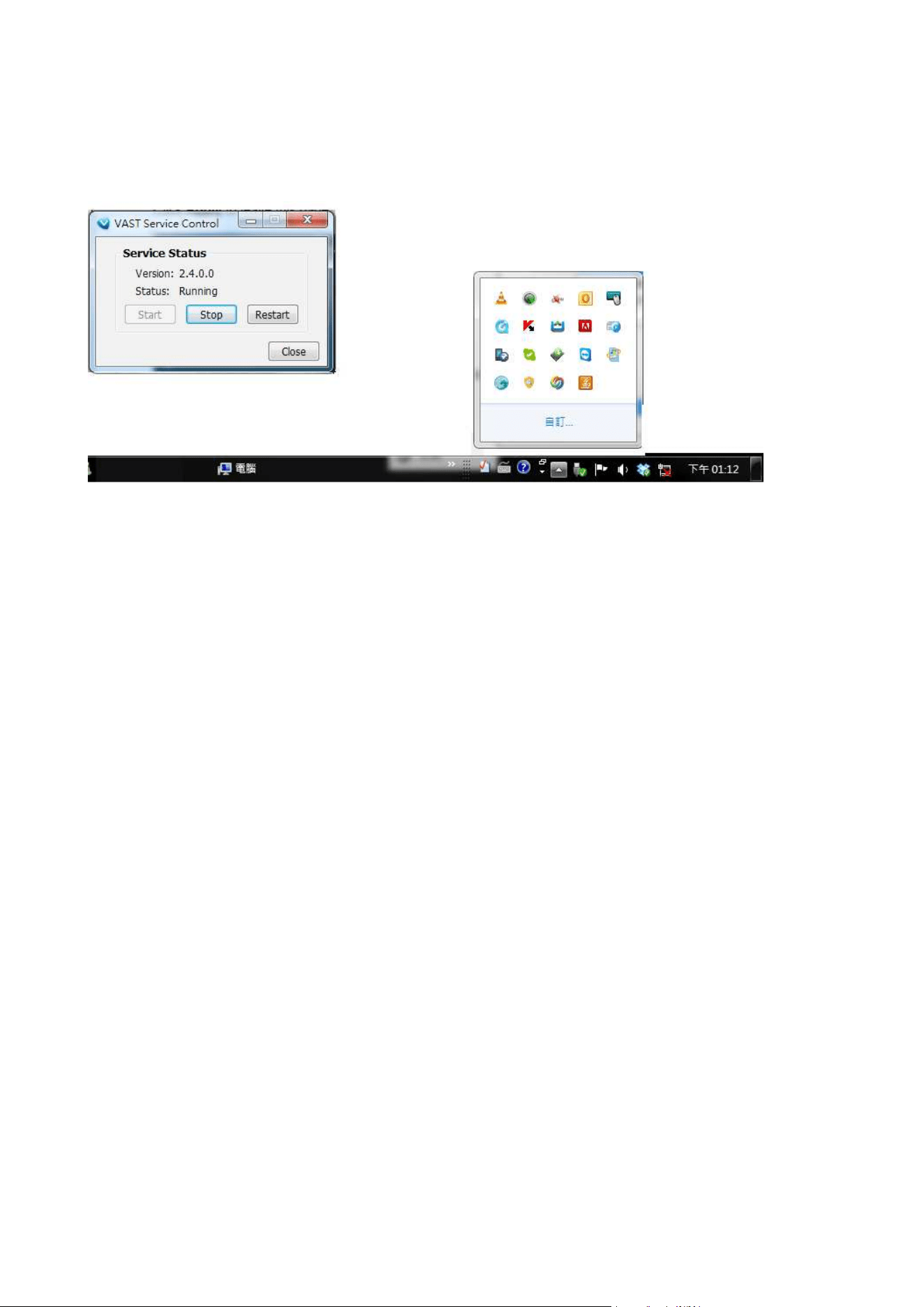
128
NOTE:
If an I/O module is started later than the VAST server, you may not be able to access the I/
O module. You should then re-start the VAST service.
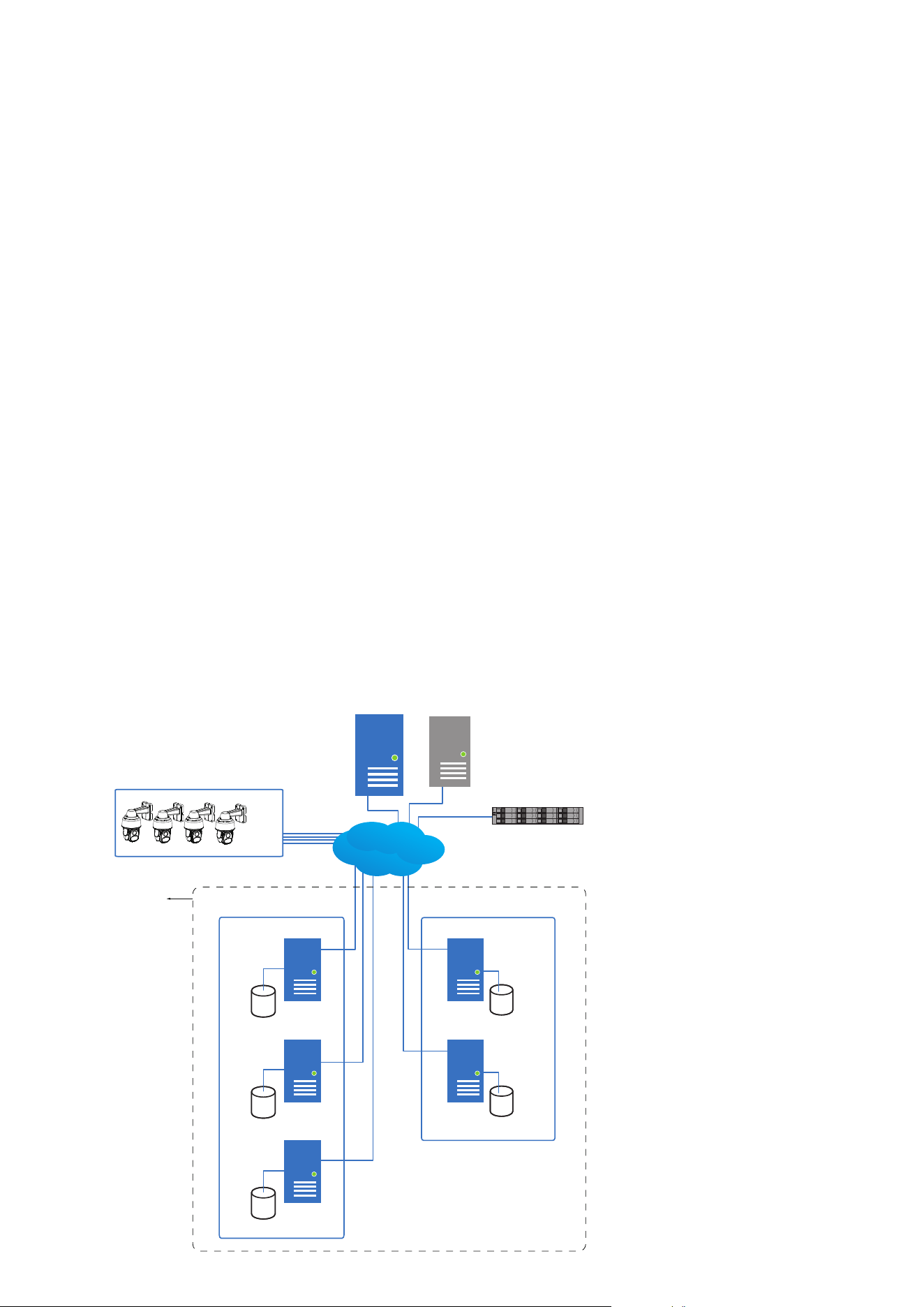
129
3-2. Configuring Redundant
Servers - Failover
VAST2 servers can be configured into two groups: Active and Redundant. The Active
group performs daily recording and monitoring tasks, while the Redundant group acts as
the standby servers. In the event of server failures, the Redundant group becomes active,
and takes over the recording task.
The Redundant server group conguration consists of the following:
1. One VAST2 server designated as the
CMS
(Central Management server) VAST central
management server. Another VAST server can serve as a CMS failover server.
2. At least one VAST2 server in the
Active
group.
3. At least one VAST2 server in the
Redundant
group.
4. Gb/s network or higher-speed connections among the servers. All Active and Redundant
groups can reside in different subnets, provided that static IPs are congured for these
servers.
Active VAST servers Redundant VAST servers
CMS VAST
Active Group Redundant Group
Node 1
Node 2
Node 1
Node 2
Node 3
External storage /
NAS
Network Cameras
. . . . .
Server Group
CMS Failover
LAN
IMPORTANT:
For a Redundant server conguration, you must rst enlist VAST servers in the
Sites
configuration page before configuring the Redundant server groups. See the
Sites
conguration page.
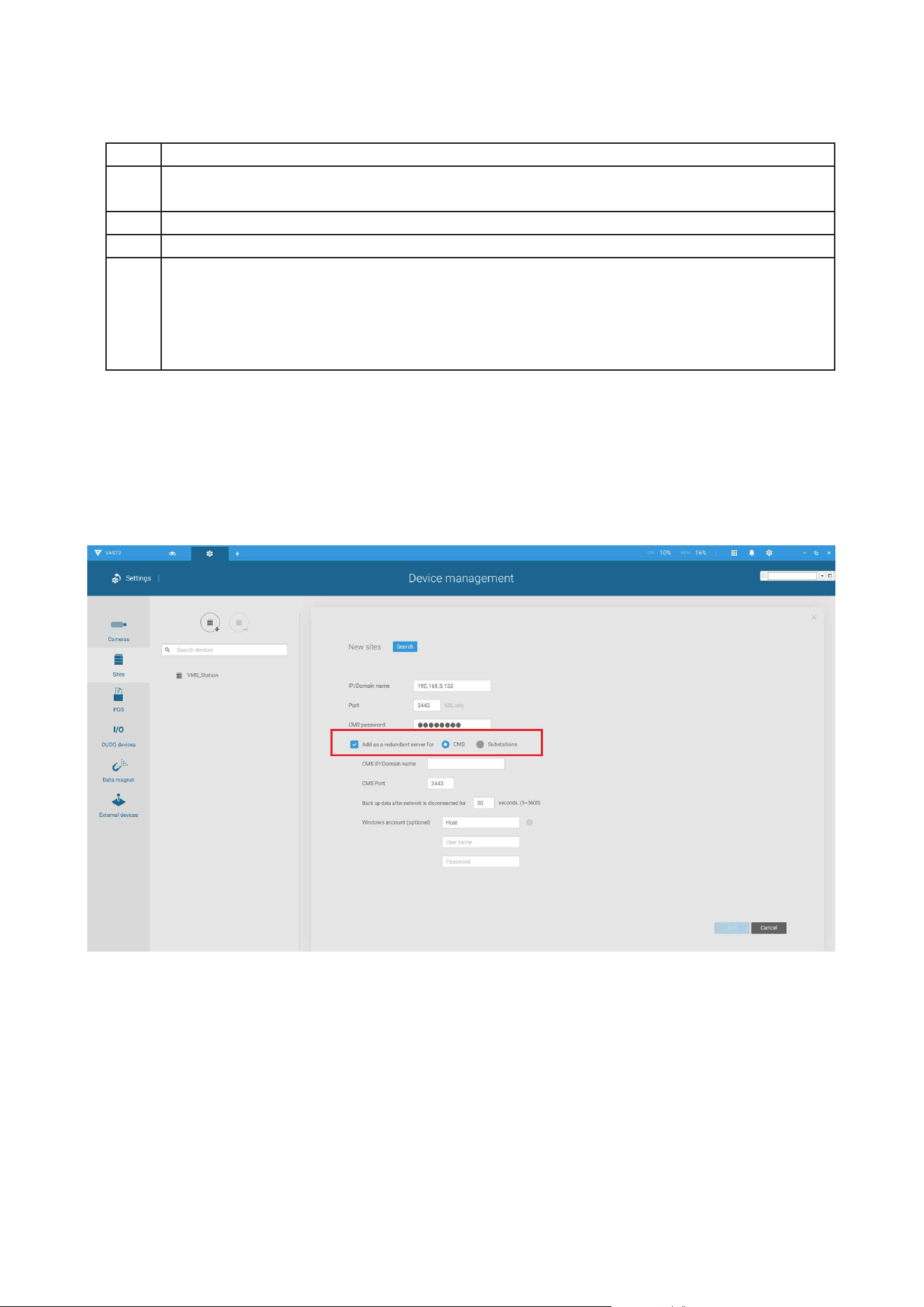
130
Below are the denitions of server roles:
1.
CMS
VAST server: The main access portal for the conguration.
1-1. CMS server is where the
Failover
conguration takes place.
1-2. CMS continuously polls to check the hearbeats to monitor the statuses of all
Active and Redundant servers.
1-3. CMS regularly backs up the congurations on Active servers.
1-4. CMS assigns redundant server(s) to the takeover of a failed Active server.
1-5. In a Redundant server conguration, the CMS is supposed to be up and running
at all time. If the CMS server fails, the server failover and failback operation will
not take place. It is therefore preferrable to congure a CMS redundant server,
and install the CMS server at a high up-time environment, such as on a VMWare
conguration.
3.
Active
servers: Active VAST servers are the work horses that perform recording and
monitoring tasks.
4.
Redundant
servers: The Redundant servers are actually active-standbys. They
participate to continue video recording in the event of active server failures. It is
recommended for the Redundant servers to have an equivalent or higher processing
power than the Active servers. The same applies to the size of storage volumes and the
disk drives' write performance.
Note that you cannot congure a Redundant server by opening a local console.
2.
CMS Redundant
server: This is a failover server that serves as the backup for the CMS
server.
Note that this redundant server is congured in
Settings
>
Devices
>
Sites
. Click
Add
Sites
, and select "
Add as a redundant server for
" "
CMS
." See next section for the
conguration procedure.
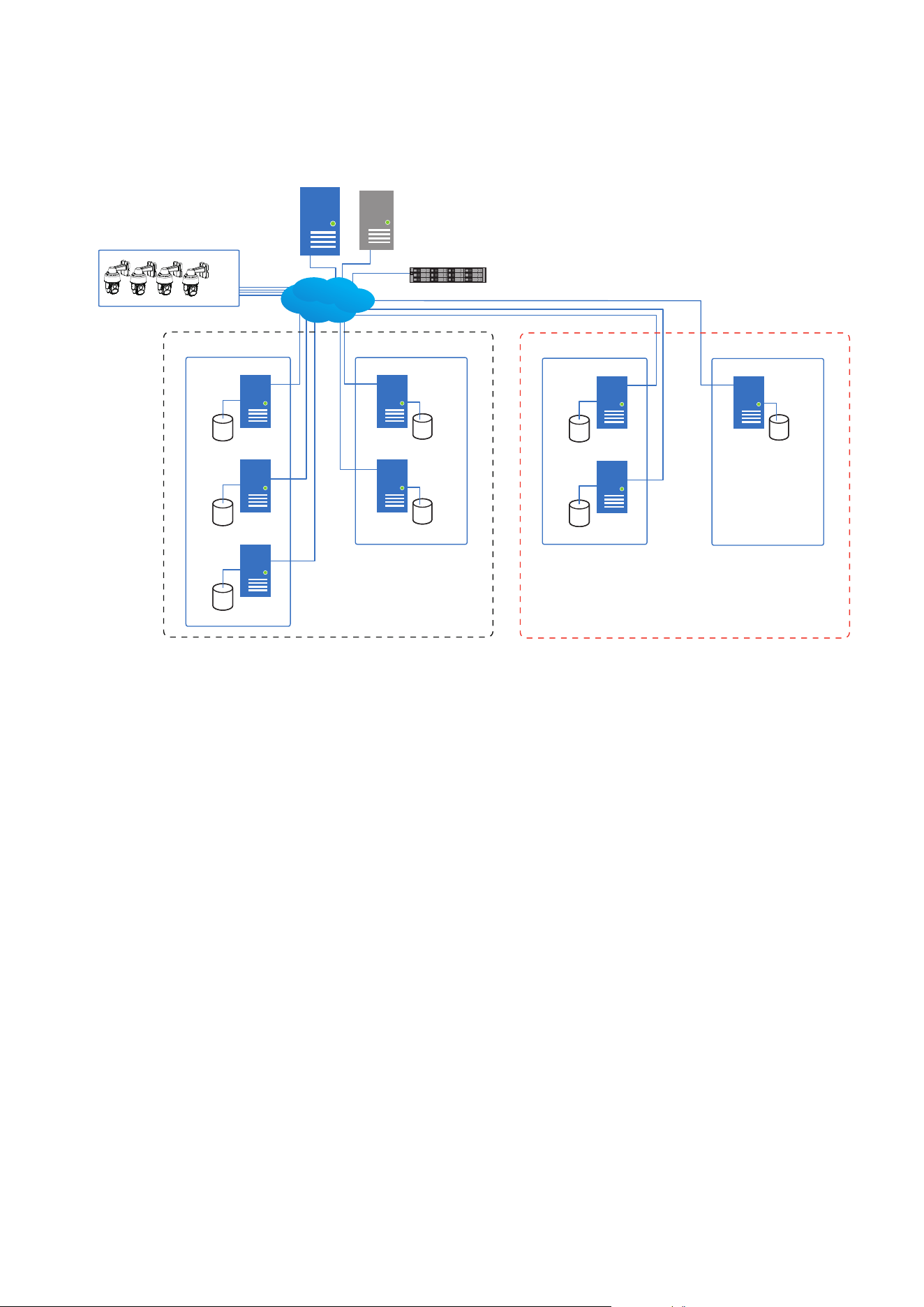
131
Multiple Active and Redundant groups can be created.
Active VAST servers Redundant VAST servers
CMS VAST
Active Group Redundant Group
Node 1
Node 2
Node 1
Node 2
Node 3
External storage /
NAS
Network Cameras
. . . . .
Server Group 1
Active VAST servers Redundant VAST servers
Active Group Redundant Group
Node 1
Node 1
Node 2
Server Group 2
CMS Failover
LAN
Each Redundant server can serve as the backup for ONE Active server. Depending
on the number of the Active and Redundant servers, if the number of failed servers
exceeds the number of Redundant servers, the failover will be abandoned. For example,
if 2 Active servers failed, and there is only 1 Redundant server available, the second
Active server that failed will be abandoned.
The conditions during the failover process are illustrated below:
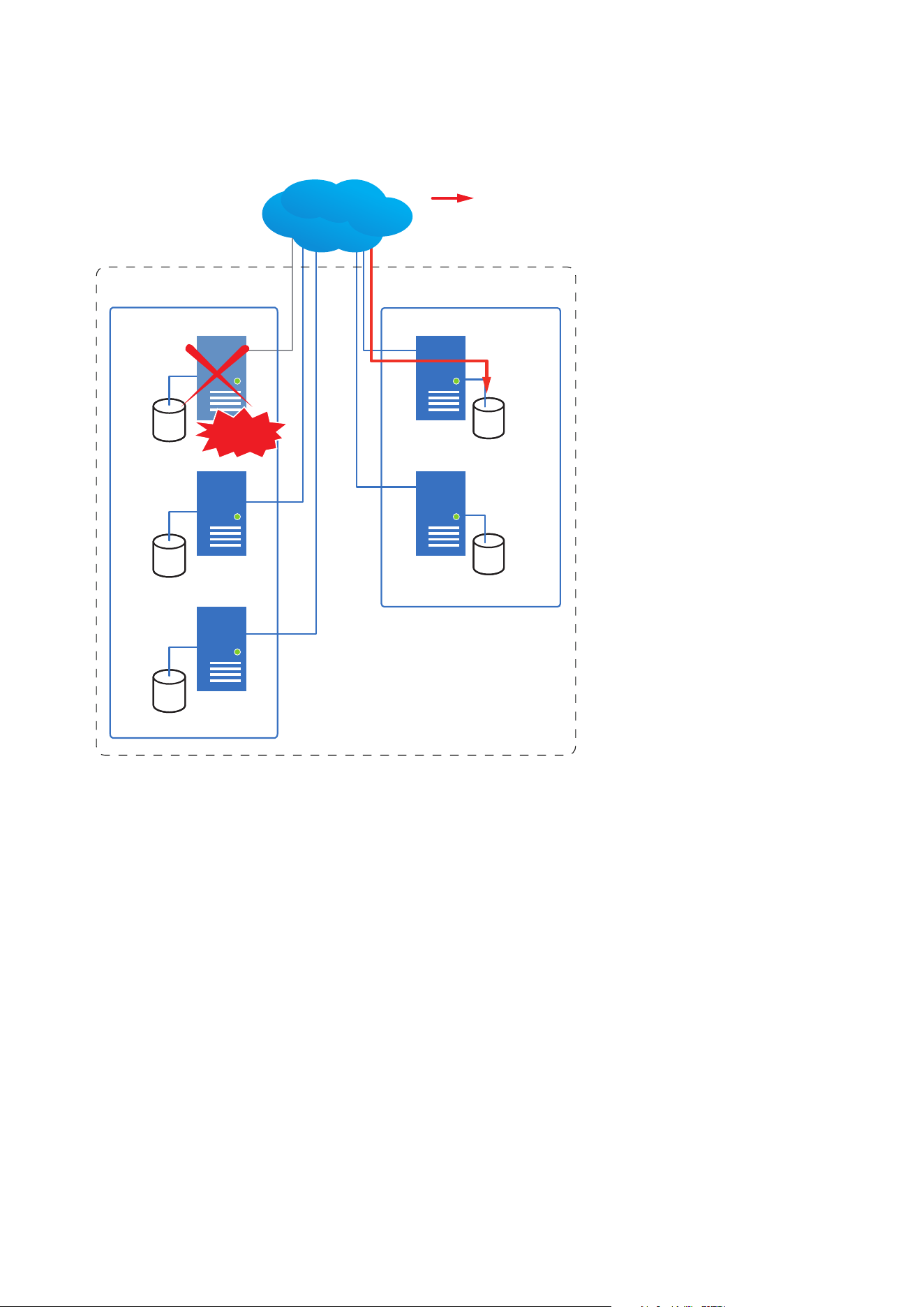
132
In the event of a server failover, a VAST2 server in the Redundant group takes over the
recording task. Note that depending on the network environment, the takeover can take up
to 5 minutes.
Active VAST servers Redundant VAST servers
Active Group Redundant Group
Node 1
Node 2
Node 1
Node 2
Node 3
Server Group
Recording
LAN
Failed!
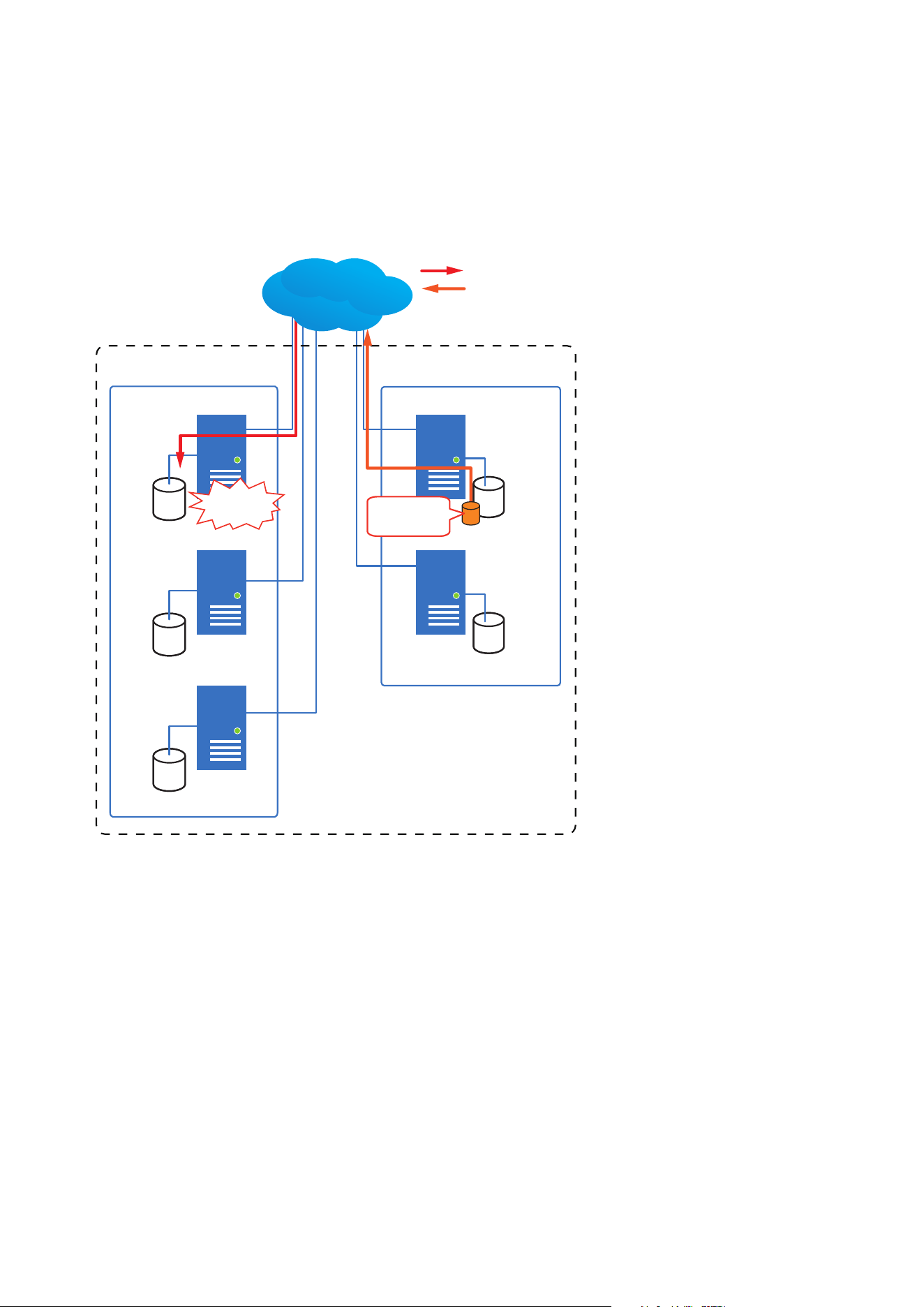
133
Once the server in the Active group is restored to normal operation, and a CMS server
requests for the recordings and data occurred during the time the active server failed,
the requests will be fulfilled by a shared volume on the redundant server. Due to the
concerns with network bandwidth and processing power, the restored active server does
not synchronize its recording pool with that on the redundant server after the failover and
failback process.
Active VAST servers Redundant VAST servers
Active Group Redundant Group
Node 1
Node 2
Node 1
Node 2
Node 3
Server Group
Recovered!
Shared
Volume
LAN
Recording
Playback & Search
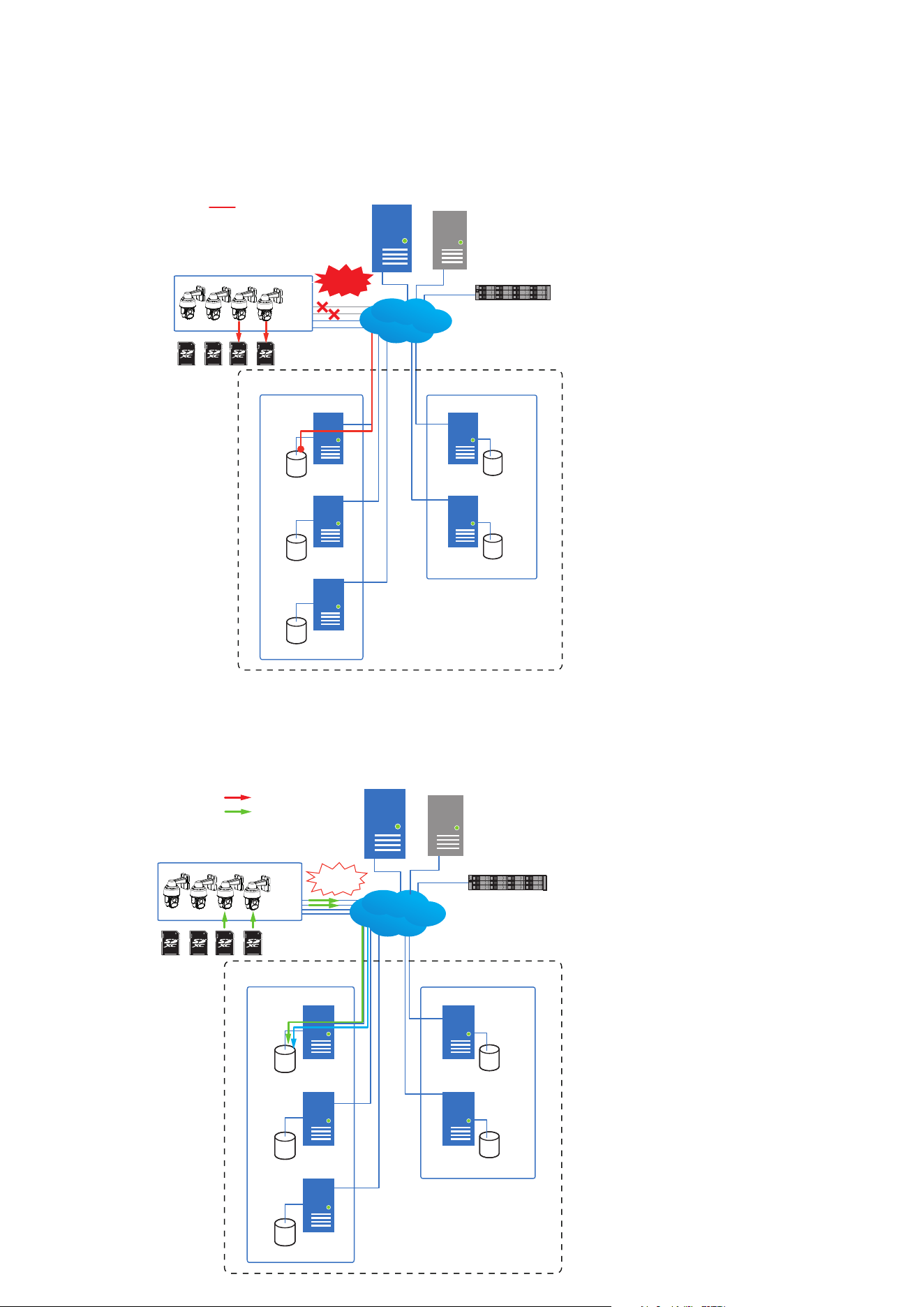
134
In terms of network failure, the VAST2 configuration supports Seamless Recording. For
cameras equipped with an SD card, video is recorded to the SD cards in the event of
network failure. Of course, the cameras must have a backup power source, such as a DC
12V input. In cases such as the only PoE switch or PoE mid-span fails, power is lost.
Active VAST servers Redundant VAST servers
CMS VAST
Active Group Redundant Group
Node 1
Node 2
Node 1
Node 2
Node 3
External storage /
NAS
Network Cameras
. . . . .
Server Group 1
Network
Failure
Recording
CMS Failover
LAN
Once the network connection is restored, the VAST2 servers resume the recording task
and also retrieve video segments from the SD cards. The video segments recorded during
the network failure will be stitched up with those occurred before and after the network
failure. The retrieval speed varies depending on the available network bandwidth and CPU
resources.
Active VAST servers Redundant VAST servers
CMS VAST
Active Group Redundant Group
Node 1
Node 2
Node 1
Node 2
Node 3
External storage /
NAS
Network Cameras
. . . . .
Server Group 1
Recording
Retrieval
LAN
Recovered!
CMS Failover
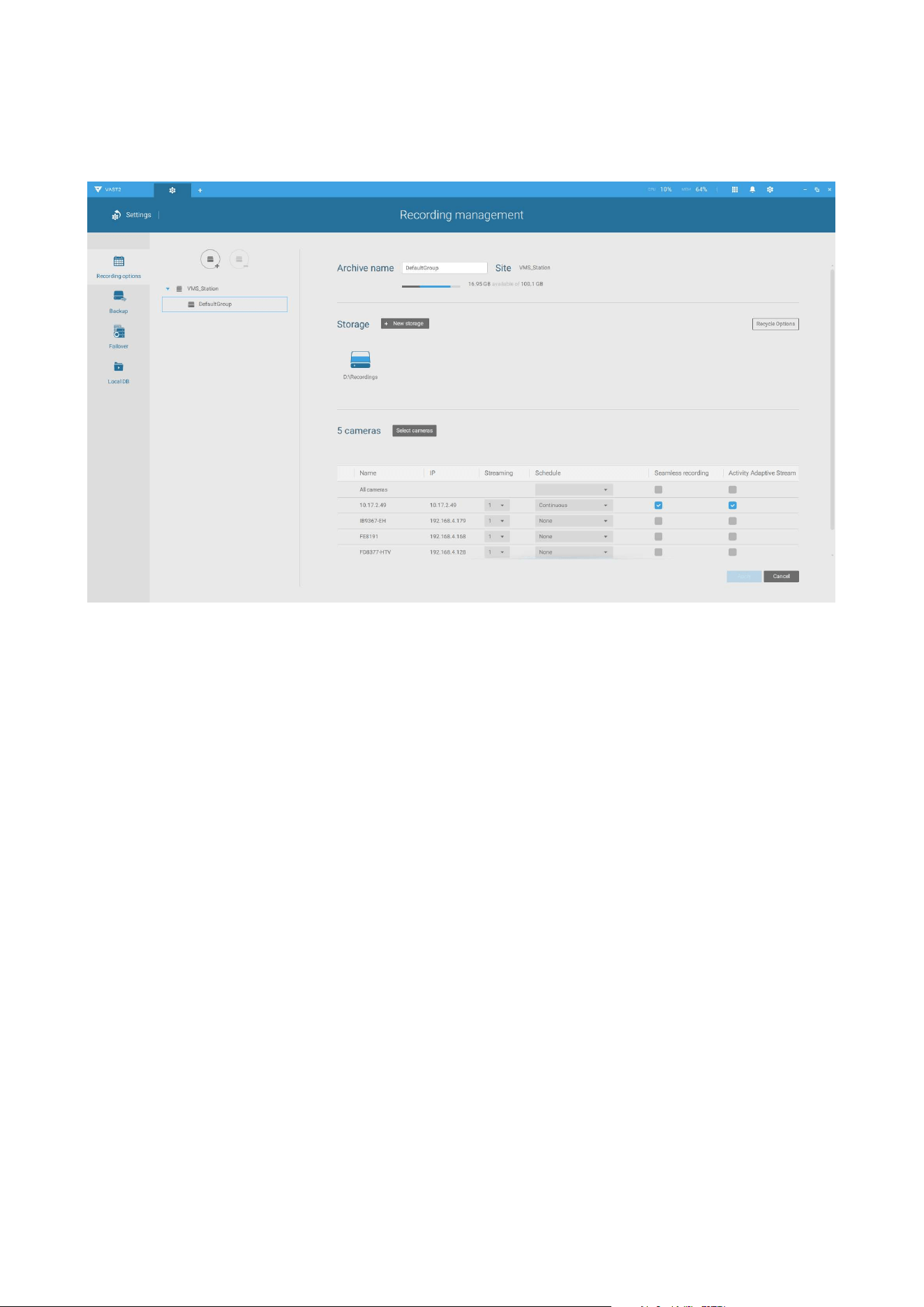
135
To enable Seamless recording, find the associated option in
Settings
>
Recording
options
, and select the Seamless recording checkboxes. Camera models that support the
Seamless recording option will have it listed.
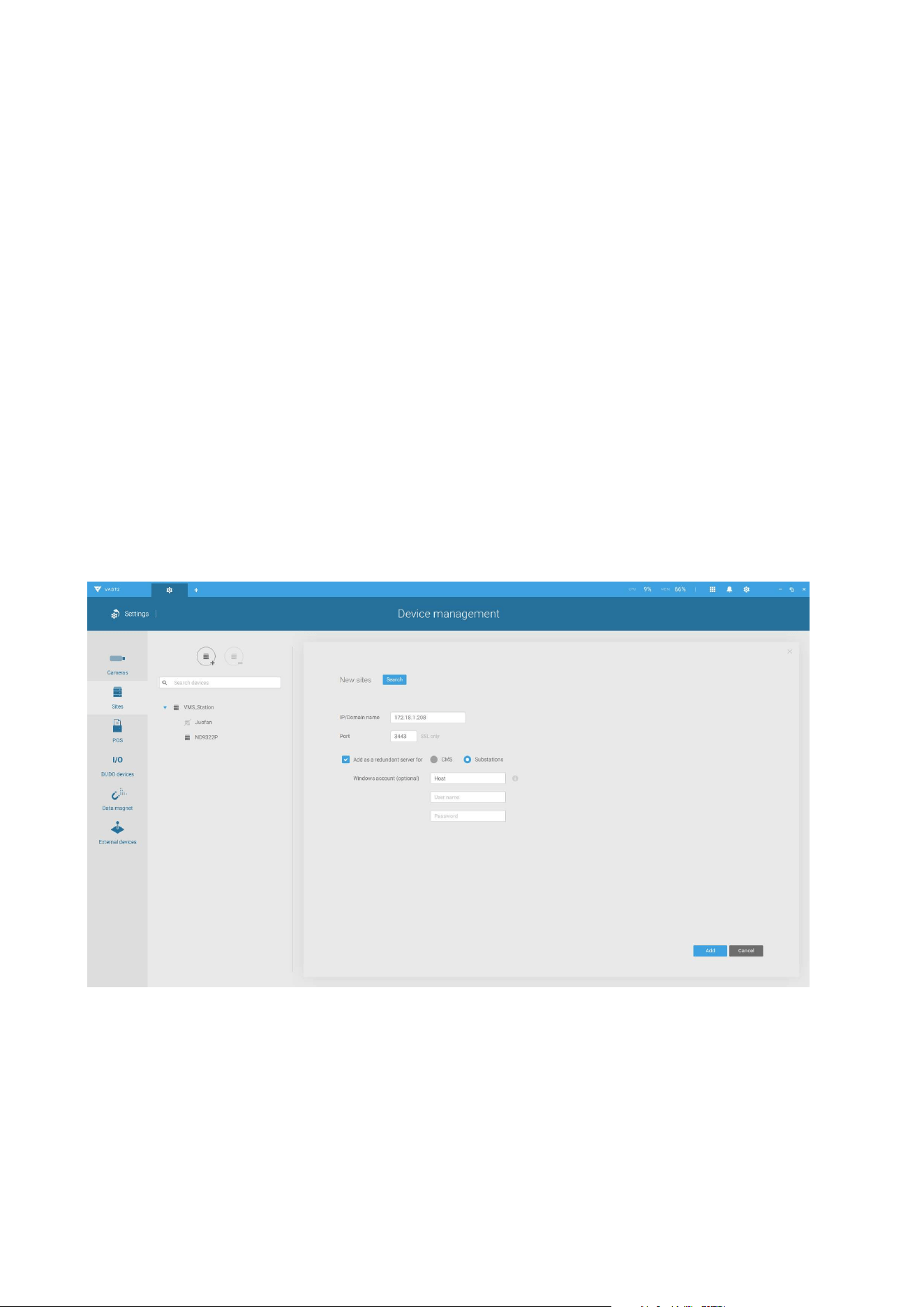
136
Before Failover conguration, you need to add other servers to your Failover conguration.
Below is a screen from the Sites management window.
• If you are adding a Redundant server, select the "
Add as a redundant server
"
checkbox, for either a
CMS
server or VAST
Substations
.
• If you are adding a server without selecting this checkbox, it will be considered as an
Active
server.
• When adding a Redundant server, you can provide a Windows account 802.1x domain
user name and password. A Redundant server requires this because a full access to
the recorded data is required during the failover and failback process.
Failover Configuration
Process
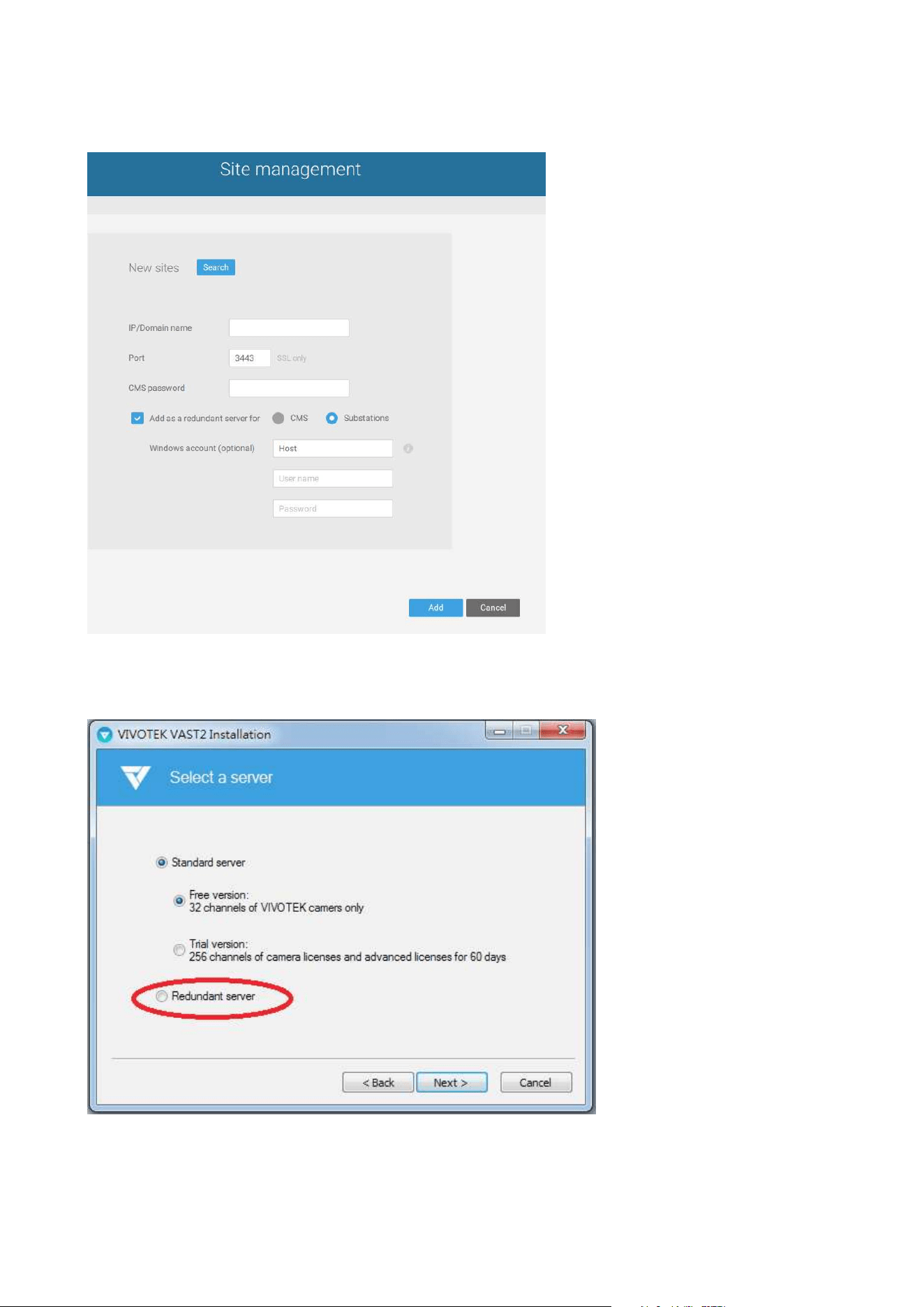
137
When the "
Add as a redundant server
" checkbox is selected, enter the name of your
Windows domain and the user credentials for a full access to the Redundant server.
Note that it is a must for the Redundant server to be installed differently by selecting a
"
Redundant server
" checkbox during the installation process.
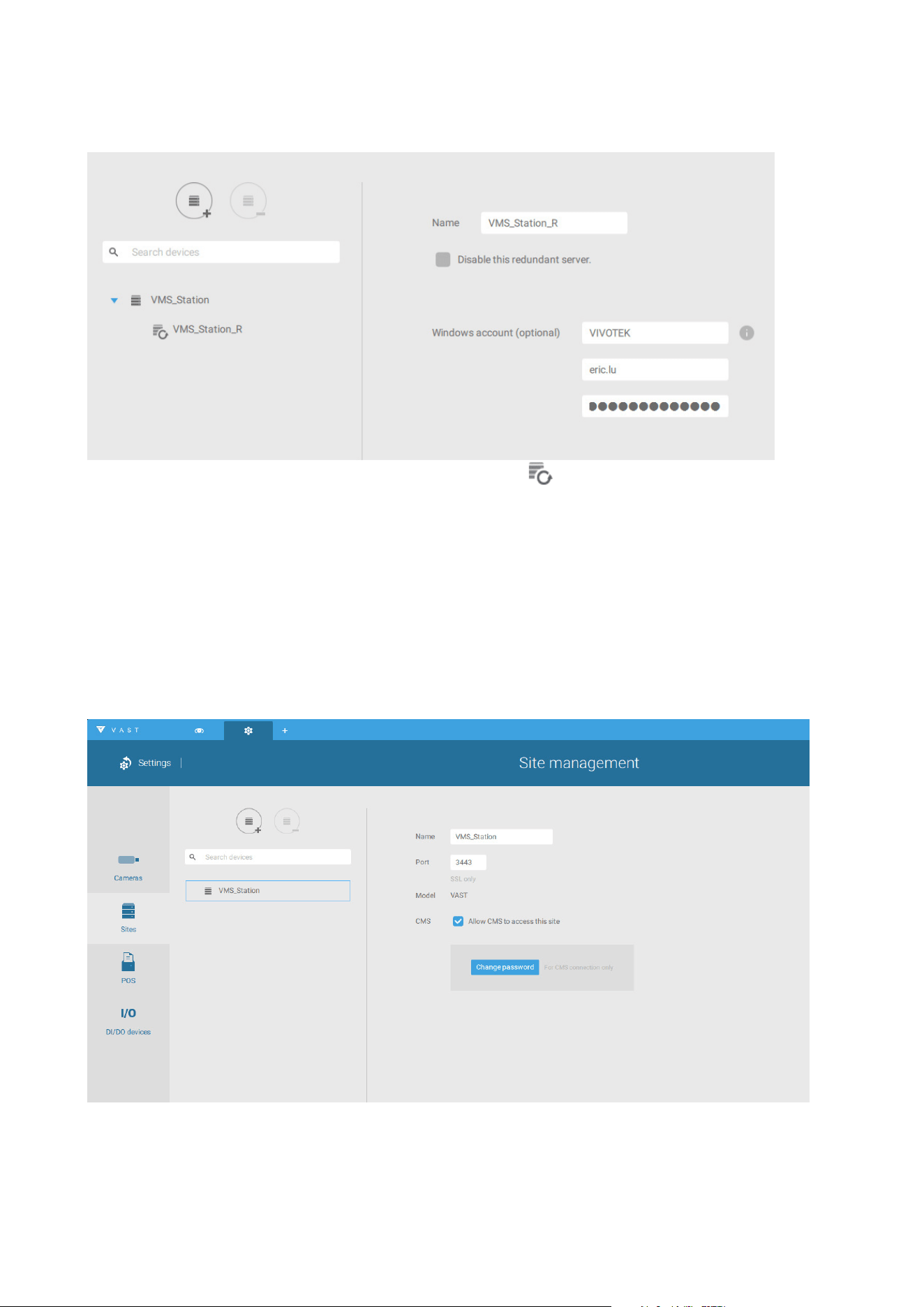
138
Note that on the
Active servers
, you should congure them as the subordinates to your
CMS VAST server. On a web console to these servers, open the Site management page,
and select "
Allow CMS to access this site
." Create a common password for the CMS
hierarchy.
When a Redundant server is successfully added, the server will be listed under your VMS
station.
A Redundant server comes with an associated icon, .
An Active server must have a CMS password congured for the hierarchical conguration.
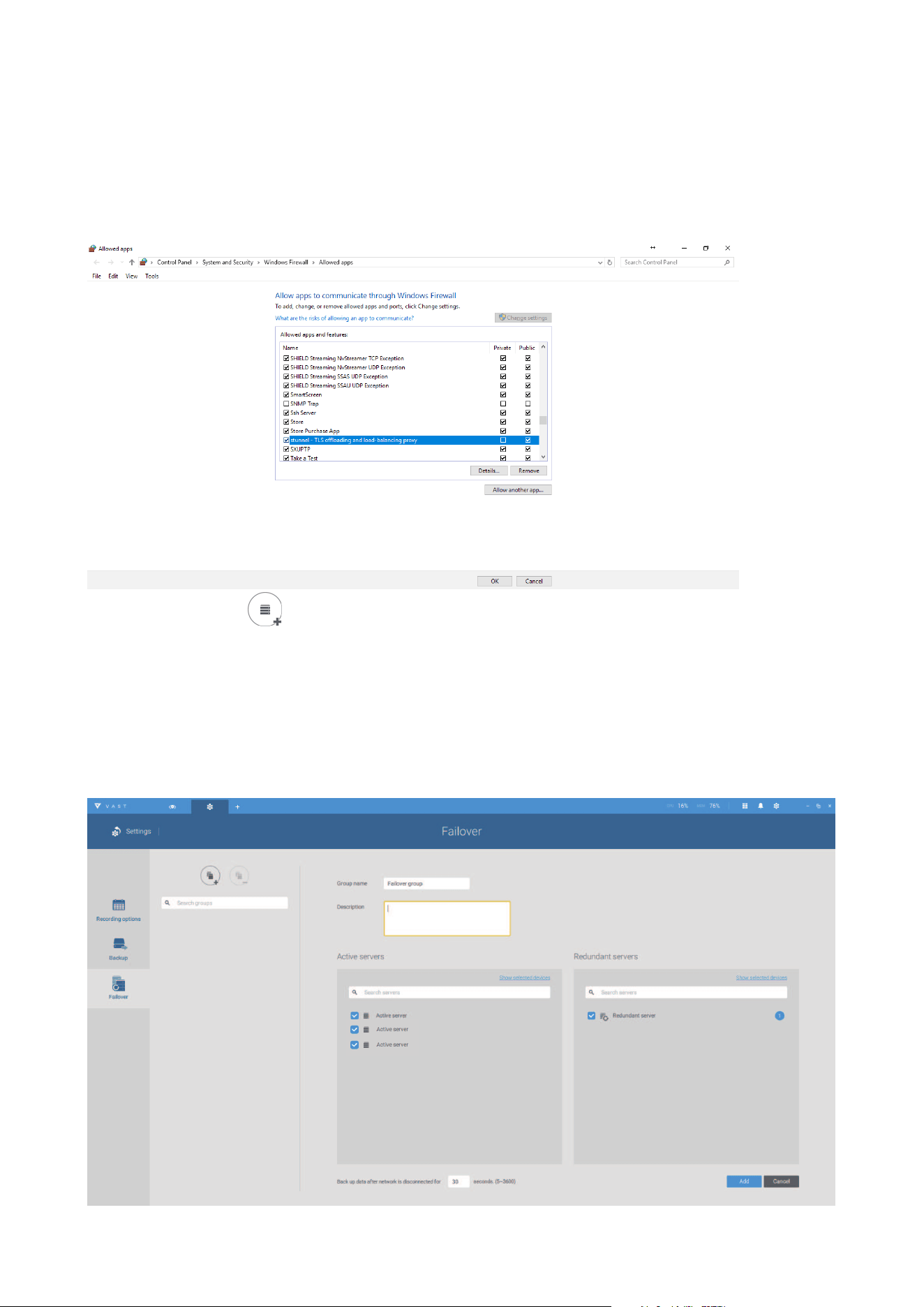
139
Two agents will be running on the Active and Redundant servers, "stunnel" and
"VMSWebServer." Make sure they are not blocked out by your firewall. These agents can be
found in the default folders below:
C:\Program Files (x86)\VIVOTEK Inc\sTunnel\stunnel.exe
C:\Program Files (x86)\VIVOTEK Inc\VAST\Server\VMSWebServer.exe
Click on the Add button to create a Redundant server group. The Active and
Redundant servers you enlisted on the Sites page should all be listed below. Select the
members of the Redundant group, and click Add to complete.
The default for the network disconnection timeout is 30 seconds. It is not recommended to
congure a very short timeout, e.g., 5 seconds, because if doing so, a temporary network
disorder can make servers consider the Active server(s) have failed.
1
2
3

140
3-3. VCA (Video Content
Analysis)
The VCA Report utility is started from the tool bar on top, . The VCA Report utility
provides comprehensive graphs and line charts for quick access to the data collected
through VIVOTEK's People Counting modules, such as the SC8131 stereo camera.
Statistical results is refreshed by hour or minutes, and you can compare the results
acquired through different time periods or among different surveillance areas. These
data help figuring the customer flow in retails so that shop owners can optimize the
arrangement of store layout, or mange queues more efficiently.
Note that the conguration of detection methods in People Counting still occur on a web
console to individual cameras. It is not congurable through the VAST LiveClient.
Prerequisites:
The prerequisites for using the VCA Report are:
1. The monitoring server running the VCA Report utility must be up and running during
the time the counting VCA is taking place. If you power off the server, the counting
metadata generated during the server down time will not be available for analysis.
The VAST2 server instance runs in the background. The VAST2 management console
needs not be started during the VCA Report data collection process.
2. Cameras running the VCA utilities have been configured and added into the VAST
deployment. The instances of available VCA rules will be listed in the Area panel.
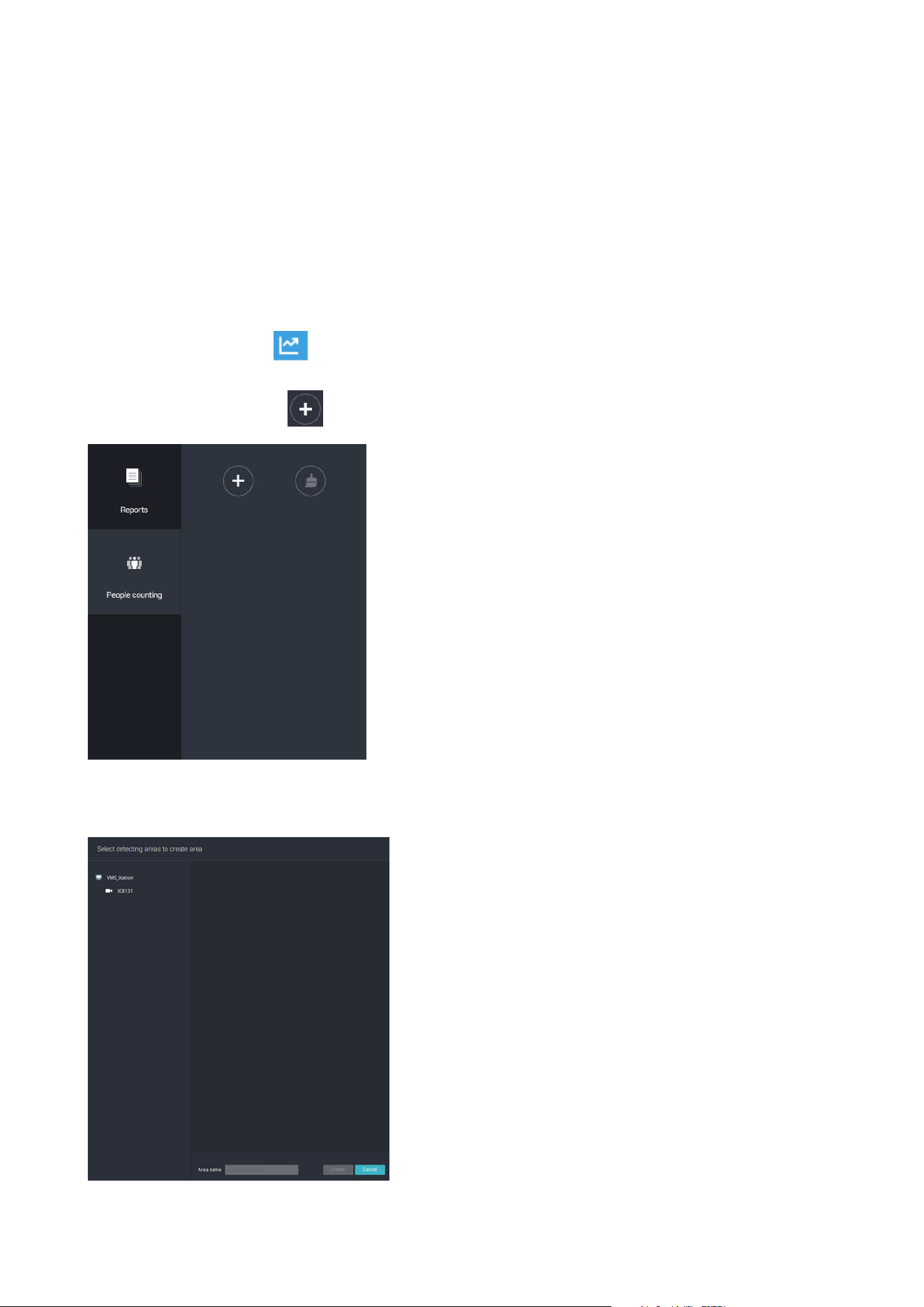
141
4. Select a camera that is VCA-enabled, and then click the Create button.
To start VCA report:
1. Click on VCA report button on the tool bar.
2. Select People Counting.
3. Click on the Add area button.
3. The life expectancy of VCA records is 5 years.
4. Currently the utility supports Windows XP, 7, 8, and 10.
5. The latest revision VAST supports Seamless Recording, in order to retrieve collected
data and recording during Ethernet disconnection. Provided that an SD card is installed
on the VCA-enabled cameras, the VAST station gradually retrieves data from the SD card
after the connection is restored.
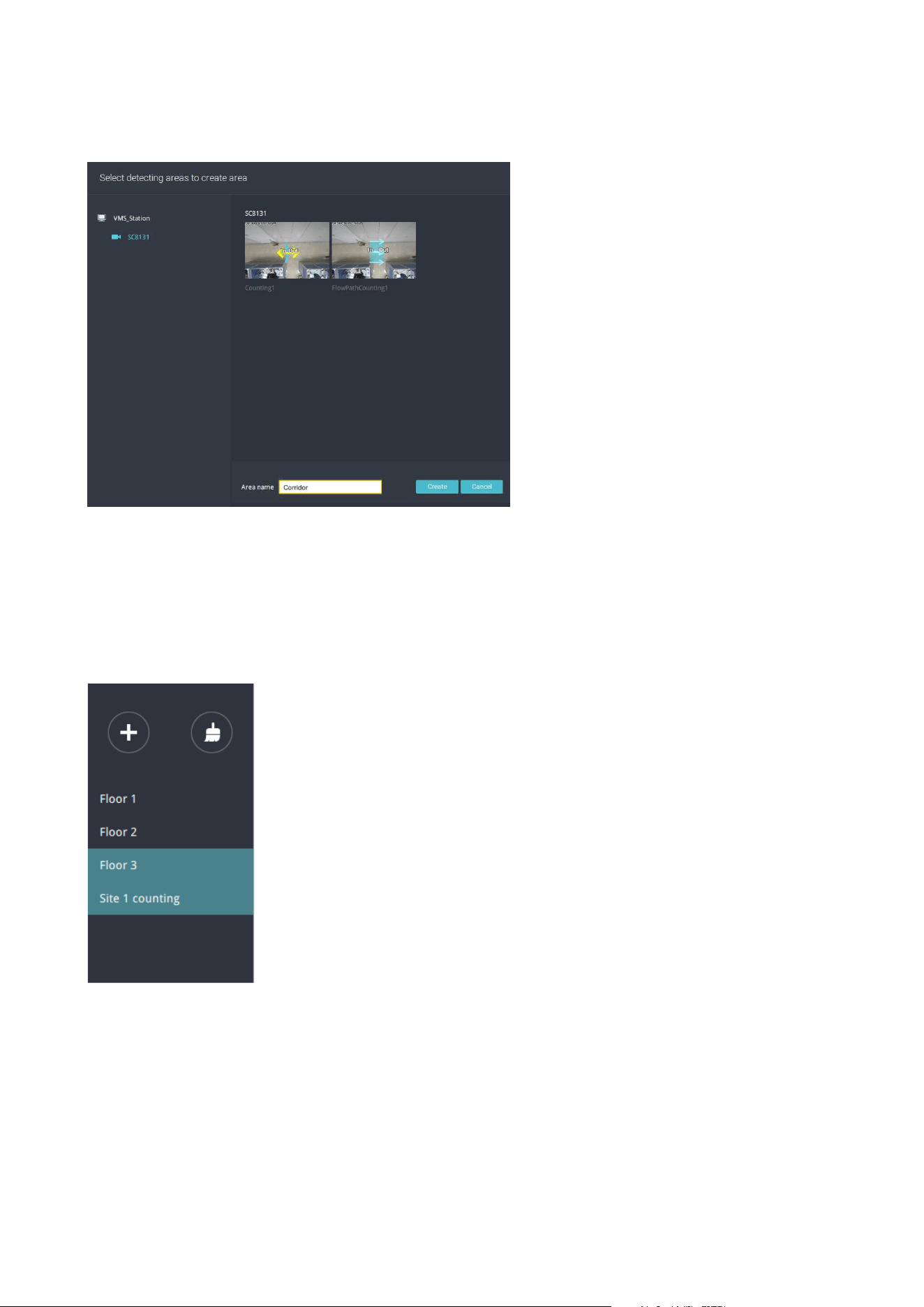
142
5. The pre-configured counting rules (areas) will automatically display. Select a counting
rule and enter a name for the area. When done, click the Create button.
If only one camera is selected, its name will apply as the Area name. If not, enter a name
for the area.
6. Click to select one or multiple areas. Those selected will be highlighted in a different
color.
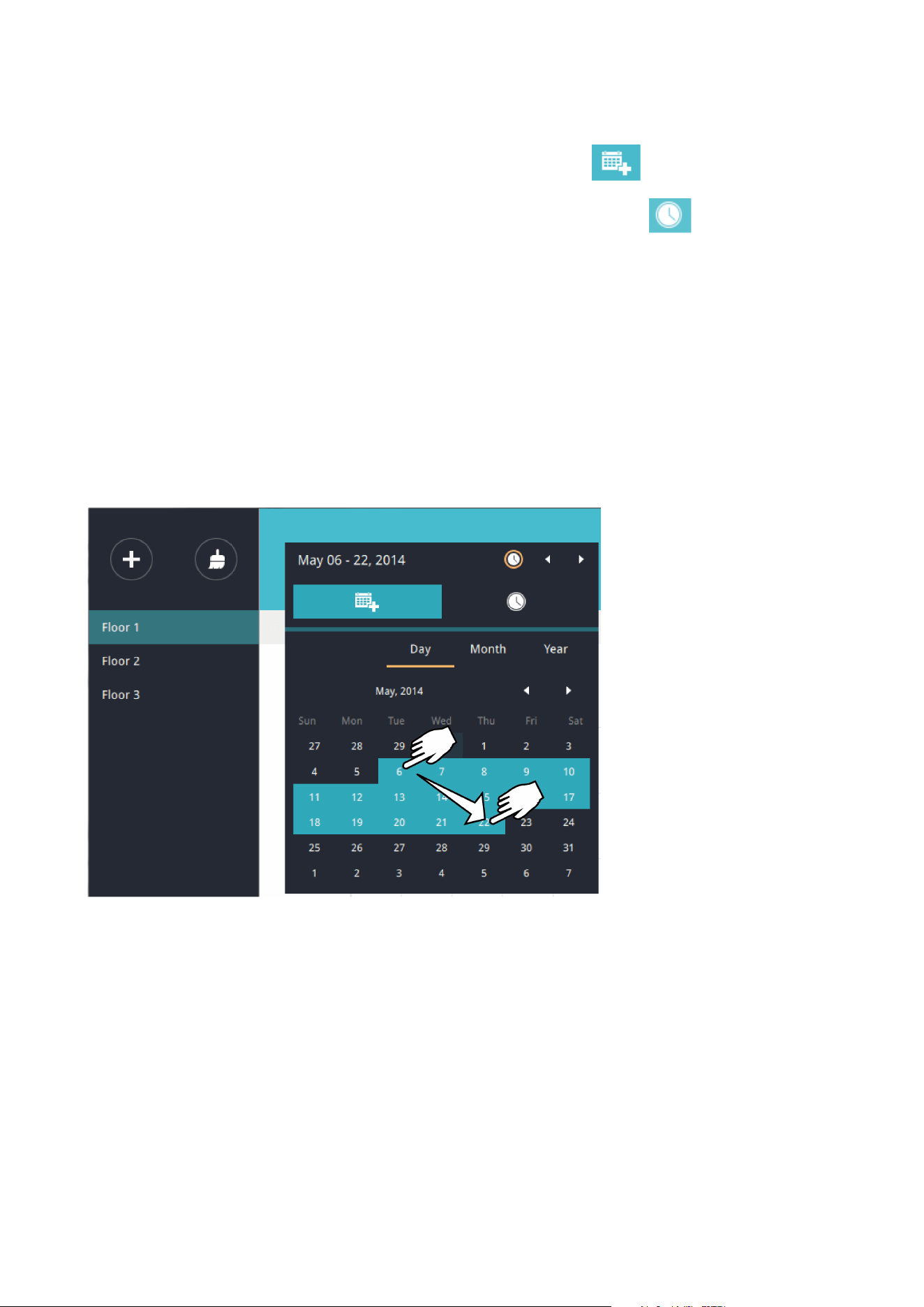
143
7. Select Date & Time
7-1. By default, the time displayed on the calendar is the current system time on the client
computer running the utility. Select from the Date selector on top.
7-2. Select a date or span of time from the calendar or use the Time
selector to select
a span of time.
> Single-click to select a date or click and drag to select multiple dates.
> You can select a month or a year using a single click. If you select a month, the timeline
unit will be days within the month. If you select a year, the timeline units will be the
months in a year.
> In the Month or Year panel, single click to select the entire month or an entire year.
Double-click to select sub-units, e.g., days within a month. If you double-click on a
Month panel, you will enter the Day panel.
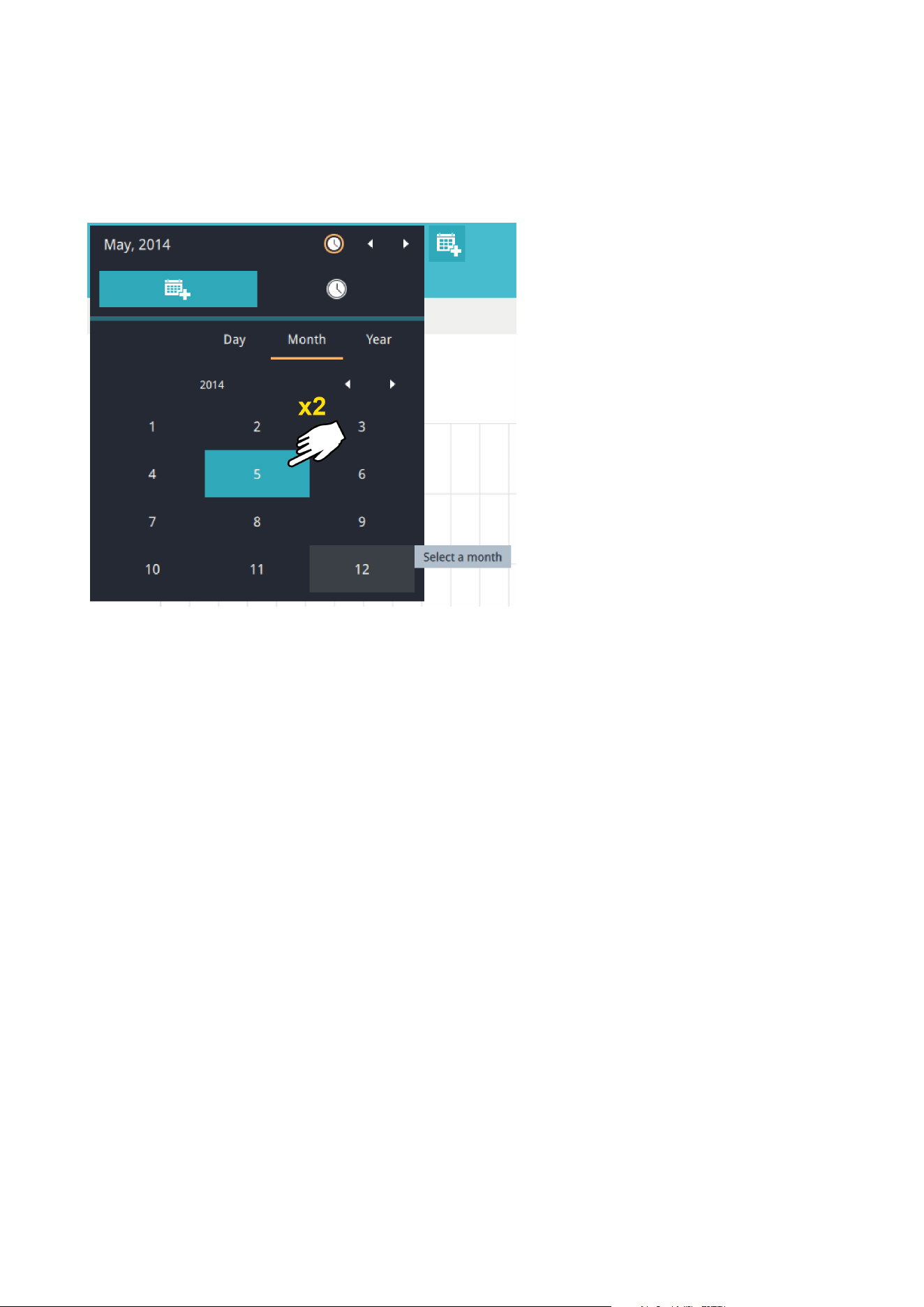
144
You can select a different month in the Month or Year panels. The Calendar panel
disappears if left unattended for 2 seconds.
On a Month panel, double-click to select a month, and the Day panel for that particular
month will display.
Note the following when making the configuration:
• When a date is selected, the Date and Time panel will not automatically close, and the
configuration changes will not take effect until it is closed. You can click on the outside
of the panel to leave the panel.
• You can select multiple days to form a span of time. Select one date with a single click
and select multiple dates by draging your cursor across the screen to an end date you
prefer.
• To select a year, click to open the Year panel. Single click to select a year. Multiple years
can be selected using the click and drag method.
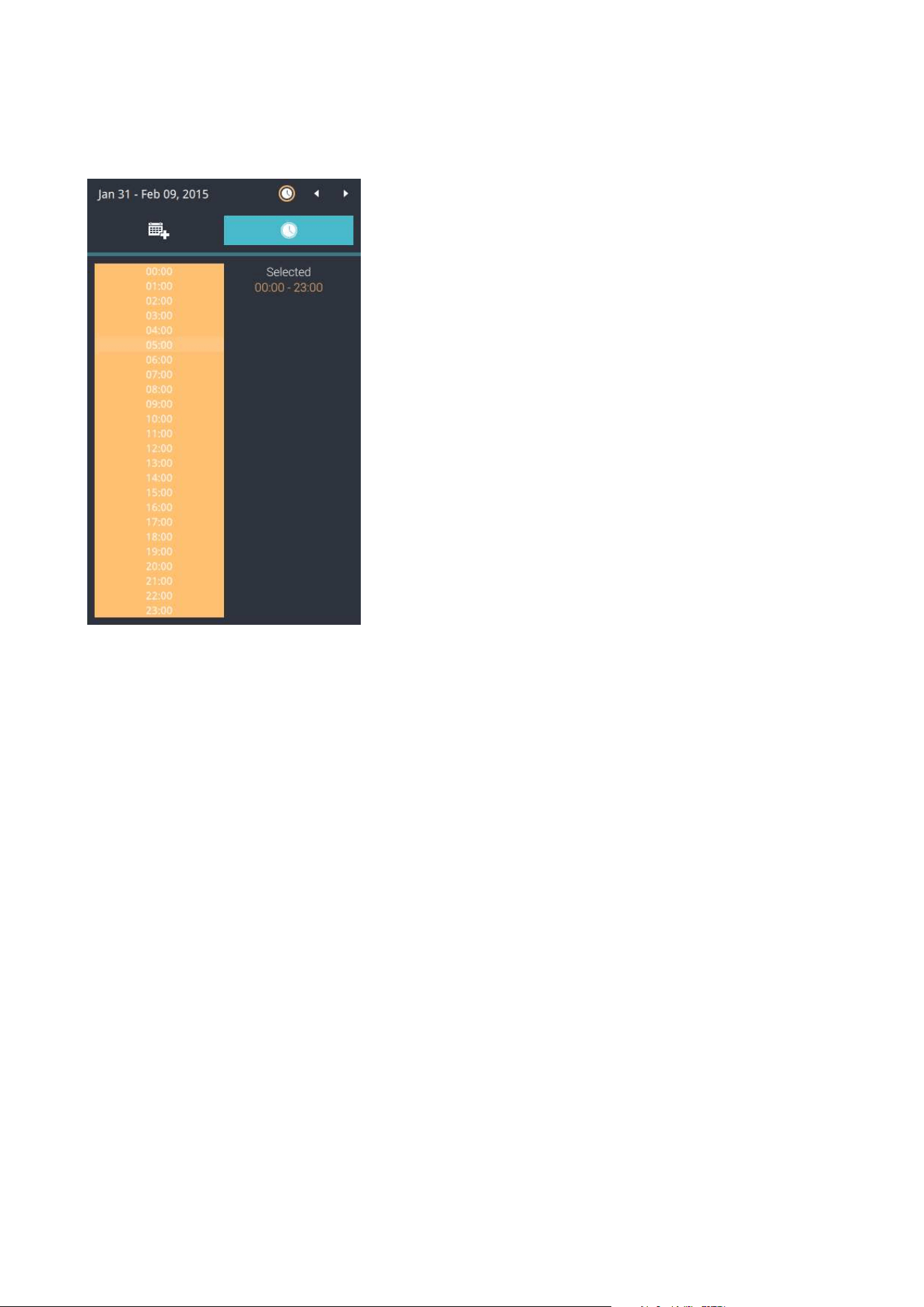
145
7-3. Select the hours to be included in the statistical poll using multiple clicks on the chart.
Single-click to select an hour or click and drag to select multiple hours.
Note that you can only compare the counting results from two spans of time if you select
only one Area. If you selected multiple Areas, you can not compare the results from
multiple time spans.
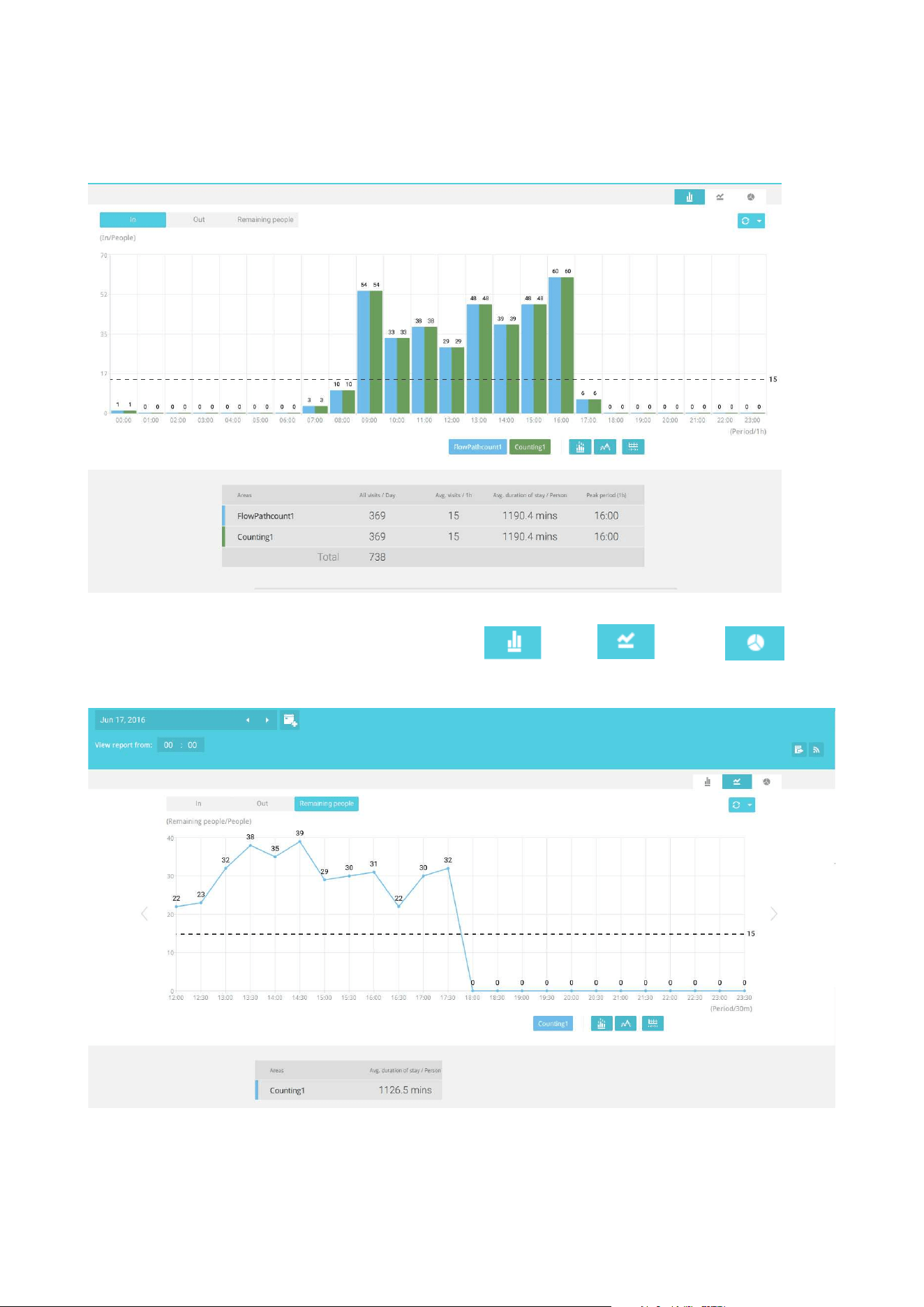
146
7-4. Click outside the Calendar panel. The statistical results will display. The default display
is the bar chart. Below is a sample screen showing the results polled from 3 areas. Up
to 8 areas can be selected in one view.
Select different display modes using the Bar , Line , or Pie chart
buttons.
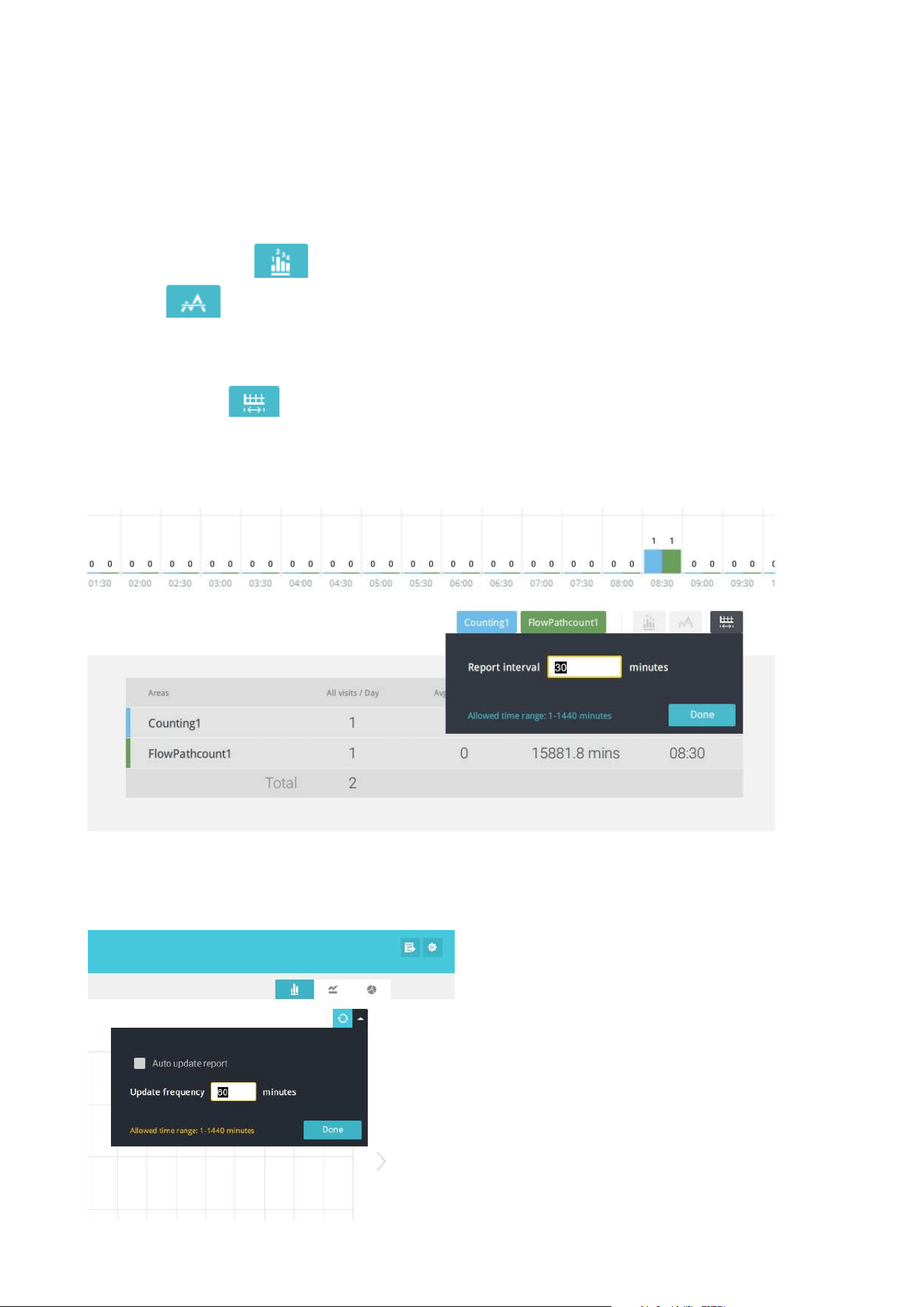
147
Note that the timeline units can vary depending on the span of time you selected on the
Calendar panel. If a date was selected, hourly data will display in chart. If a year was
selected, monthly data will display in chart.
Use the following functional buttons to change the display parameters
Show data on chart : Displays the collected numbers on chart.
Average : Displays the average number per time span unit (e.g., per hour). If the
interval is changed to 30 mins, the average number will be halved comparing to the number
acquired by every hour.
Report Interval : Configure the intervals for polling data from the camera. The
default for displaying results is by every hour. If you enter 30 minutes as the display
interval, all data will be listed on the basis of the 30 minutes time span. The configurable
range is 1 to 1440 mins.
You can use the update menu on the side of the Refresh button to determine an automatic
update schedule. You can let the statistic chart update itself by a regular interval.
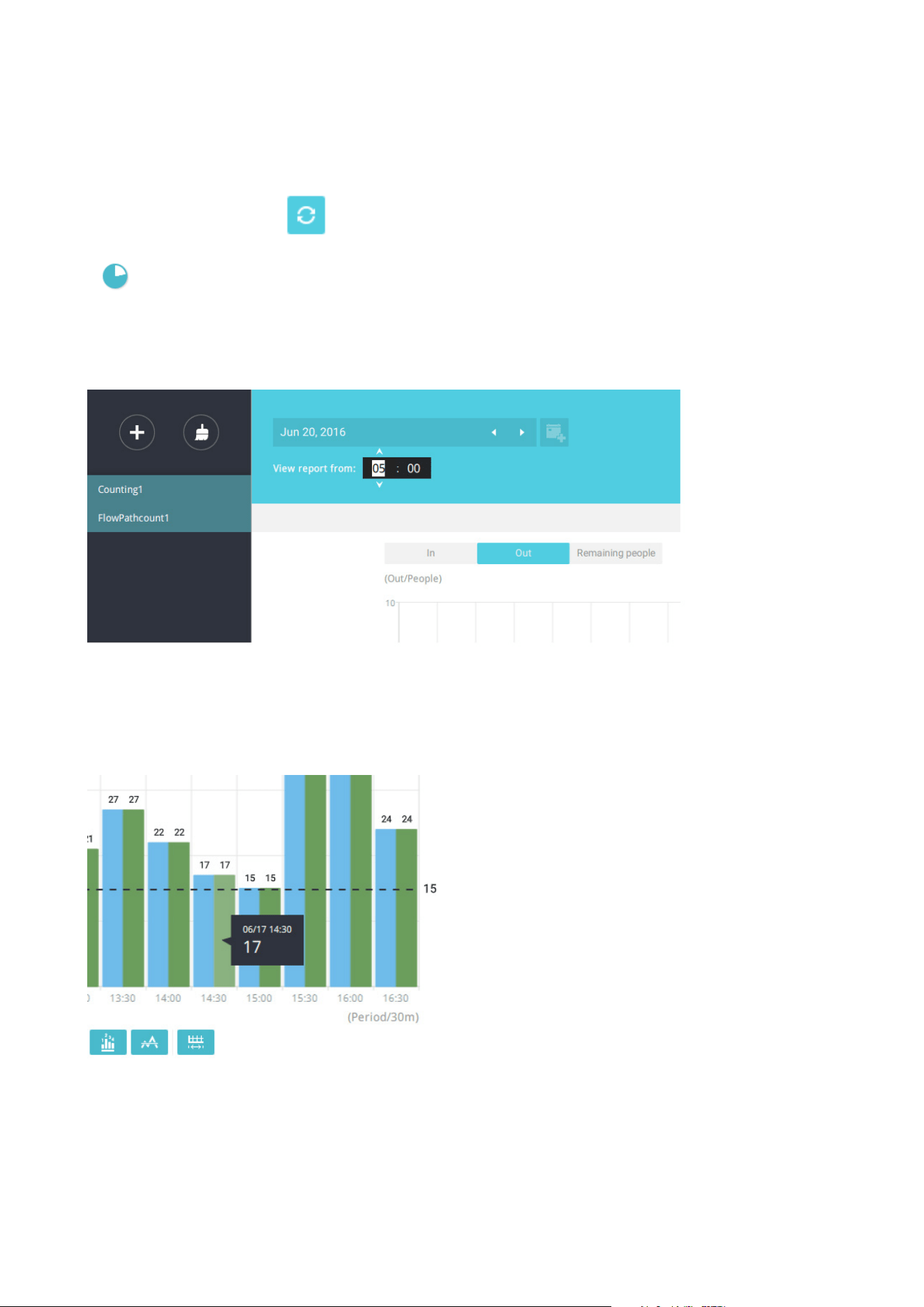
148
Use the Refresh button to poll the latest data from camera.
Use the time selector on the View Report from pane to select the start time of your
statistics view window. Data collected before that time will not be displayed.
A number is displayed when you mouse over an area on the chart. Move your cursor to an
area on chart, and the number is displayed.
If you selected only one area, you can use the Shift key to select multiple areas (or two
spans of time). You can select multiple dates in the Calendar panel.
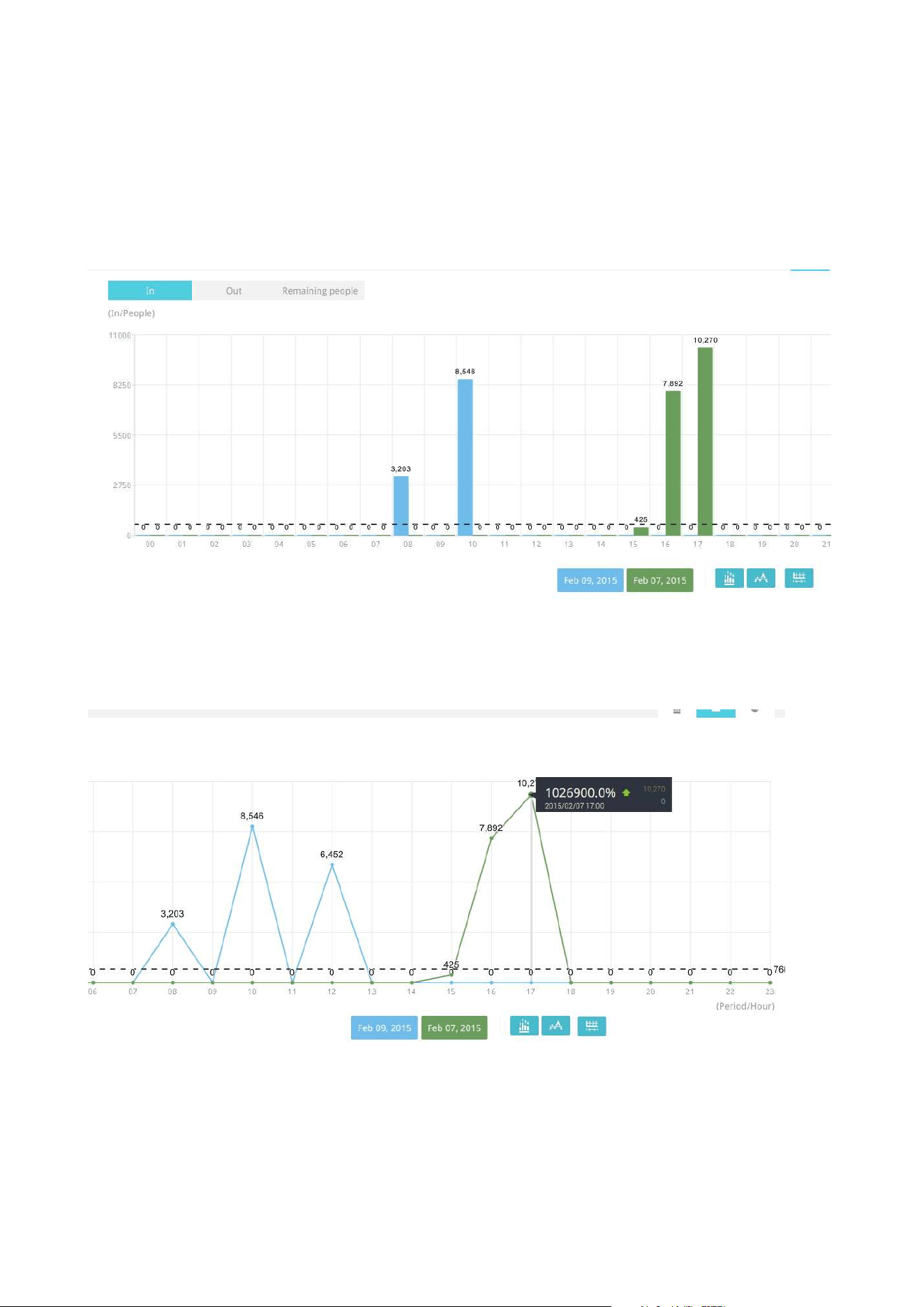
149
Data on a time line will be generated. To close the window, use the close button on the
second date information. Equivalent spans of time can also be used for comparison. For
example, you can compare the data in a span of 4 days against another span of 4 days.
Note that the Compare function only applies when you select to display only one area on
the screen.
In a comparison result displayed in a line chart, mouse over to the peak value to display the
percentage of an increase or decrease rate.
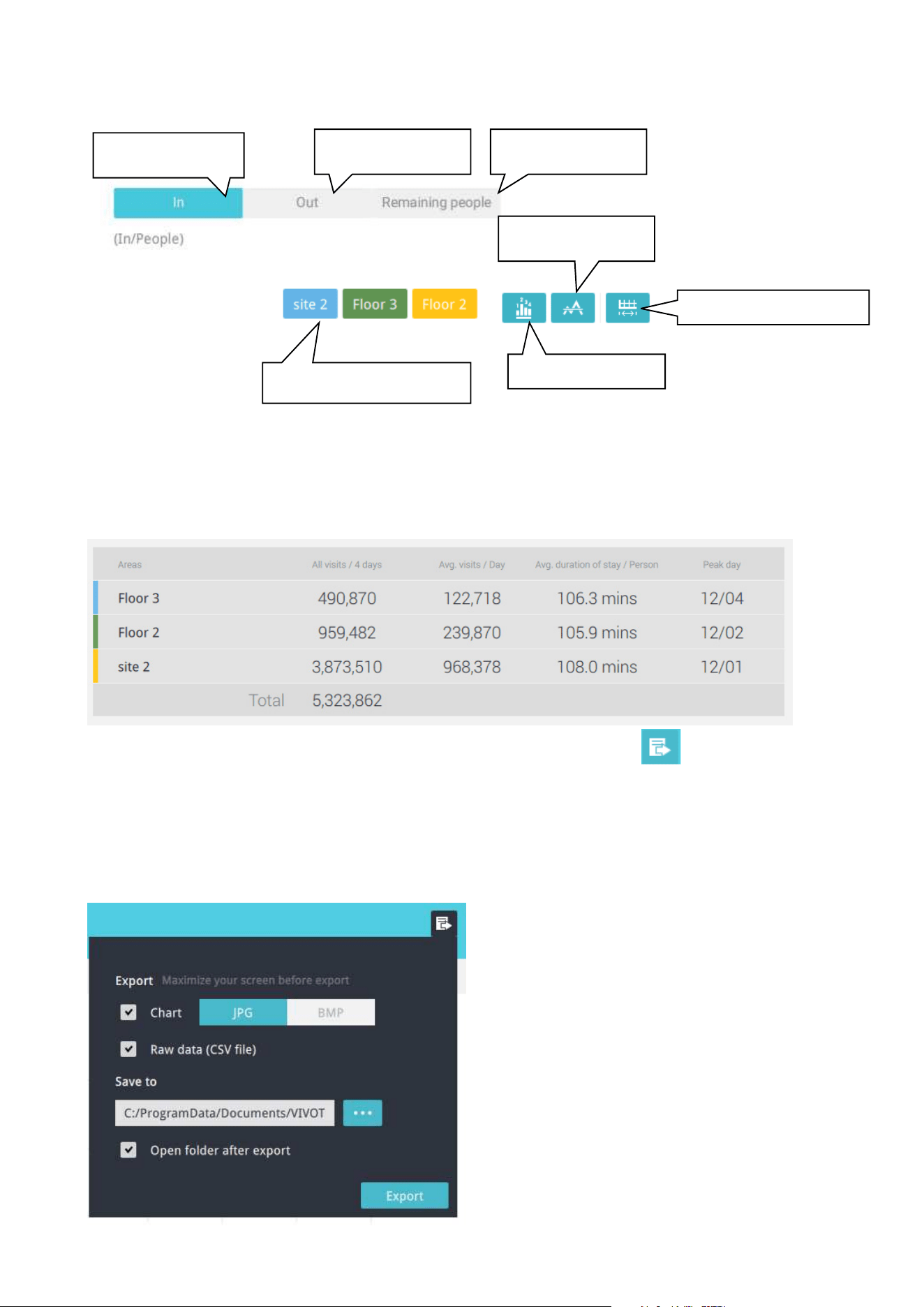
150
See below for the functions of buttons on screen.
Click to display or
hide the results for an area
No. of people who
entered the area
No. of people who
left the area
No. of people who
remain in the area
Show an average
number
Show data on chart
Change the report interval
In addition to the charts, a summary of displayed data will be listed below showing the
areas involved, visits/Day or Month, Average visits / Hours / Days, Average duration of stay
/ person, and the Peak hour.
8. When done with displaying the results, you can use the
Export
button to produce
an image le to preserve the current results. Both a spreadsheet and a graphic chart will
be produced.
By default, the exported report is placed in:
C:\ProgramData\Documents\VIVOTEK Inc\VAST\Client\VCAReport
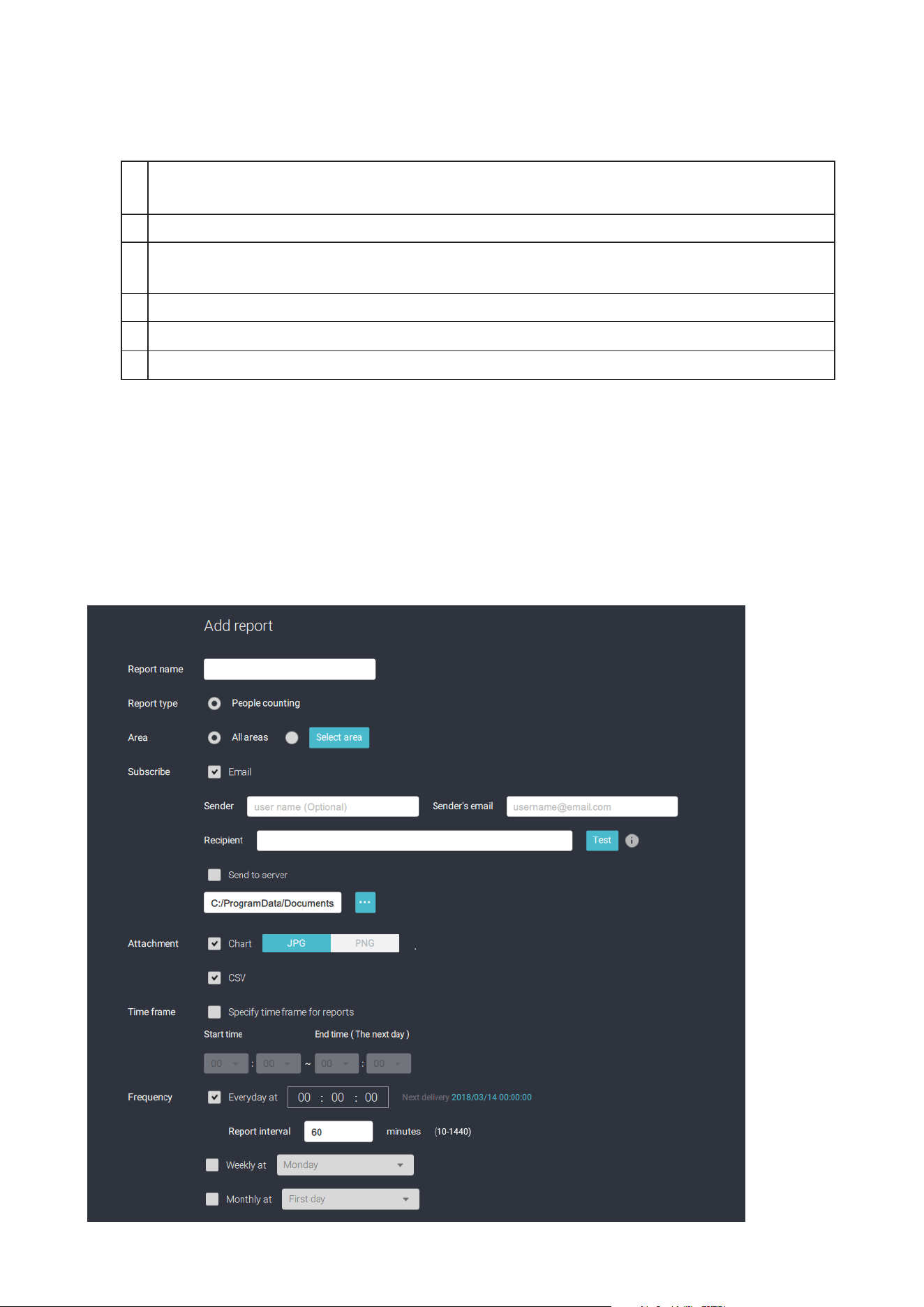
151
9. Click the Reports Subscription button to configure the regular report sent to your Email
account or a specific location on the server itself.
Select the following:
1.
Report type: People counting results, or Heatmap (Heatmap does not produce the
CSV file)
2.
Area: All areas or a preconfigured area.
3.
Subscribe: Enter the sender and recipient Email addresses. You can also configure
to send the report to a specific location on the server.
4. Attachment: Select to attach graph Charts in JPG or PNG, and the CSV
data files
.
5. Time frame: Select the time coverage of the report, during which data is collected.
6. Frequency: Species when and how frequently to deliver the reports.
Select the time to deliver your mail notification. Enter valid Email addresses as the
sender and receiver addresses and make sure the SMTP mail server configuration has
been properly configured on your VAST server. This VCA mail notification utilizes the
mail service on VAST for regular notification. You can then receive Email notification
every day on your Email account. You can enter up to 5 recipient addresses.
Select the report interval to determine how often you receive an aggregated report.
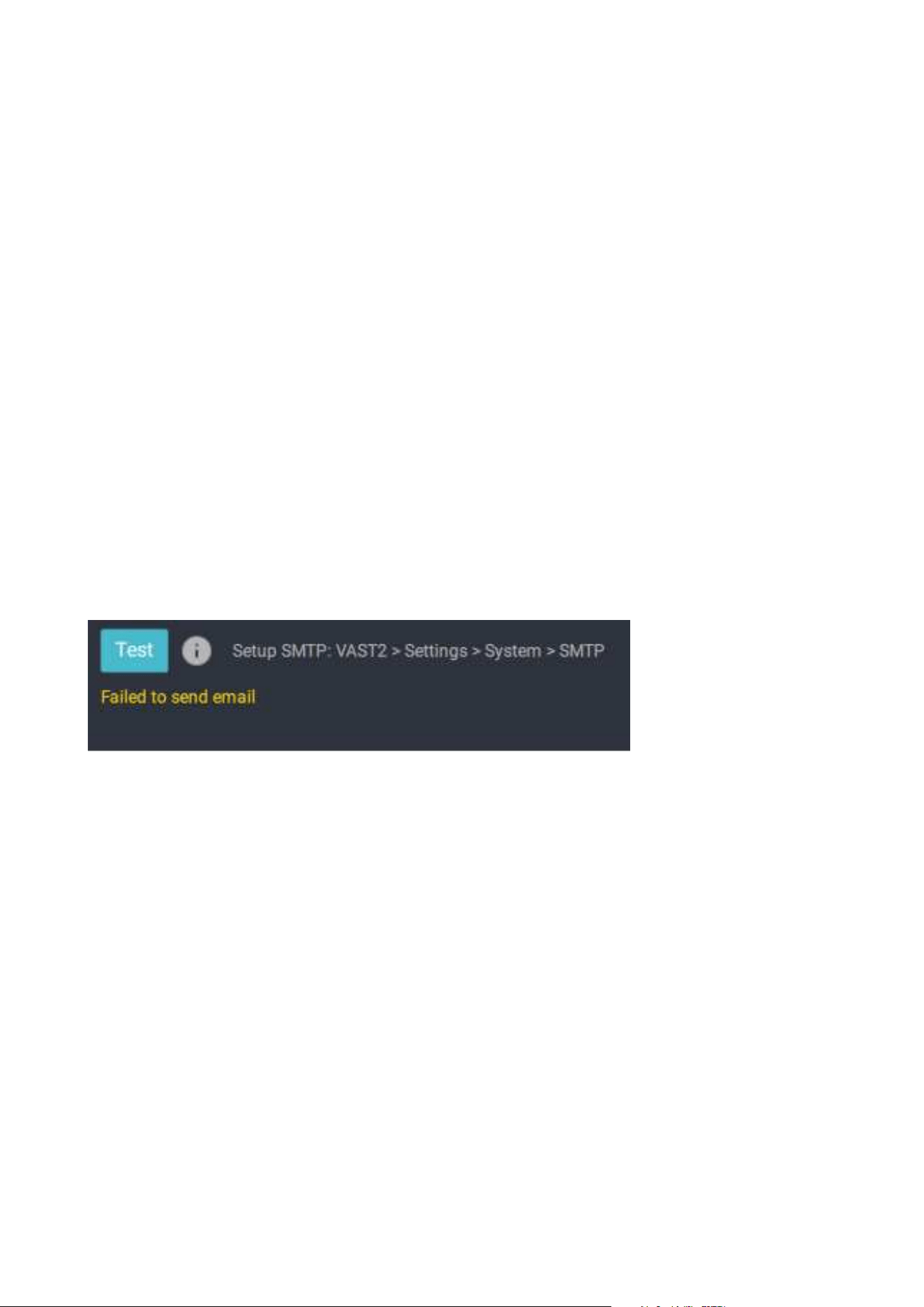
152
Note that the notification contents is your current field of view, including a Bar, Line, and
Pie chart combined into one image file. The In/Out/Remaining results will be generated
into 3 charts. Each Area will generate one CSV file, and each CSV data file will contain
In/Out/Remaining/Summary information.
The generated file names will look like this: 20160226_test02_Remain.jpg for charts
and 20160226_Summary.csv for CSV files. The Email subject will be "VCA Daily Report -
2016/02/26."
Note that if you manually export a report, the default is sending the data collected until
one hour before the manual export. For example, if you generate the report at 14:07, the
report will only cover the data collected until 13:59. You may use the Refresh button to
manually generate an immediate data inputs (those occurred between 14:00 and 14:07).
You may configure to receive regular VCA report as Weekly or Monthly using the
associated menus.
Below are the messages with the Email test function.
153
Dongle license users
Scenario Need Action
Need more CHs 1. Settings > System > License > Export license.
2. Send license file to VIVOTEK to
purchase more dongle license.
New users preferring
more than 32 CHs
Need more than
32 CHs.
1. Install the 256 CH trial VAST.
3. Send license request file (.req) to VIVOTEK to
purchase software license.
2. Settings > System > License > Export license.
New users fine with
32 CHs
Fine with less than
32 CHs.
1. Install the 32 CH free VAST.
3-4. VAST Software
License
To activate the software, refer to the flow chart below:
The VAST software provides 32 free channels. Since revision 1.11, the VAST software is
activated using a software license instead of the original hardware dongle.
For users running the previous dongle version, there is no need to upgrade their original
license. If they need the license for more channels, They can export their license file, and
purchase more dongle licenses.
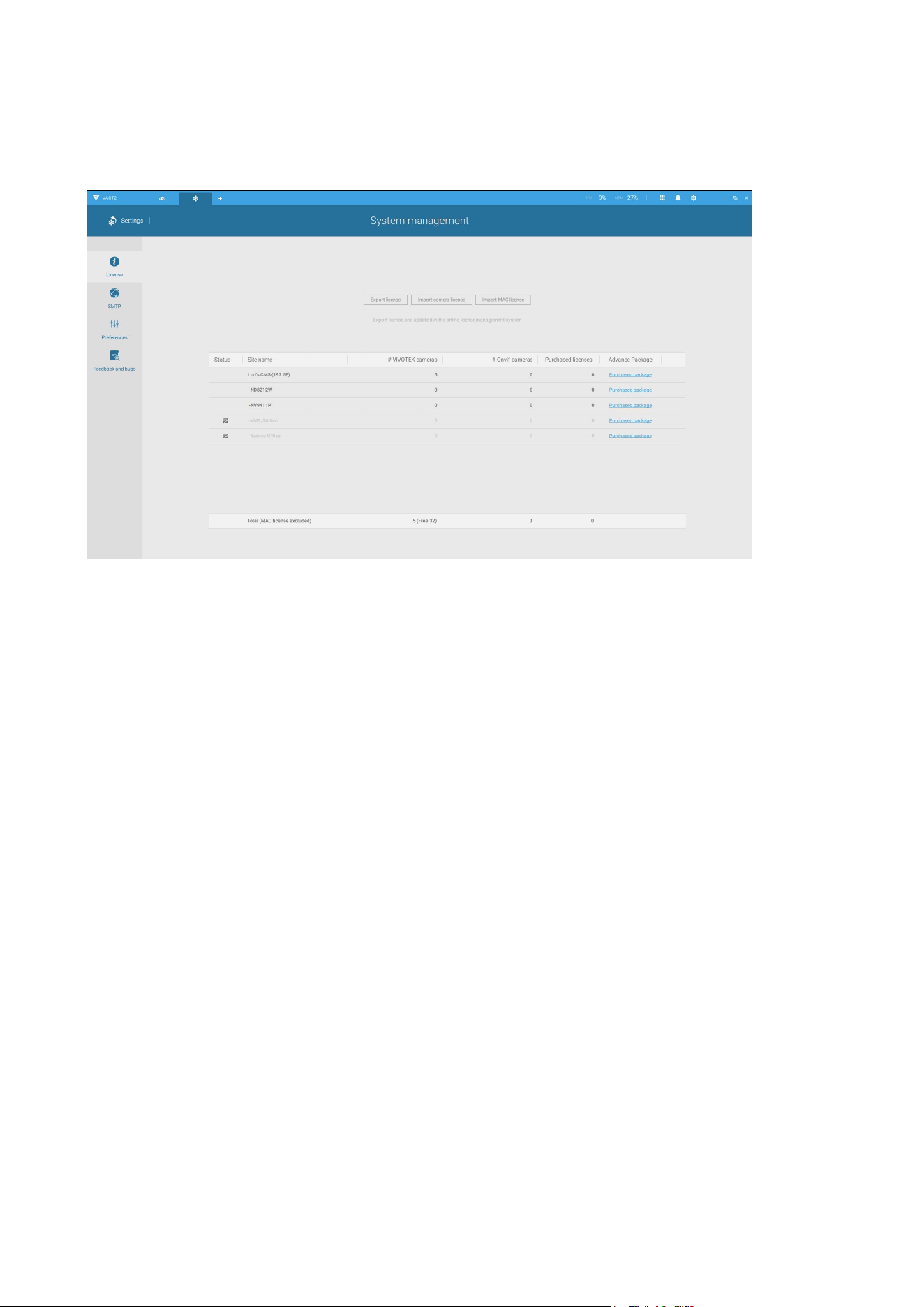
154
For users who require more than 32 channels, they can install the 256 channel trial version
first, and go to Settings > System > License page, and click on the Export License button.
Send the request back to VIVOTEK to purchase more channel licenses.
When you purchased and received the official software license, use the Import License
function to activate the official license.
When importing purchased licenses,
1. System will dispatch licenses to VAST stations according to hardware information,
2. If licenses do not match the VAST stations, you can manually select which license will
be dispatched to which station.
Since VAST rev. 2.6, there is an Import MAC license option. You can select a MAC license
file and manually deliver the file to one or multiple substations.
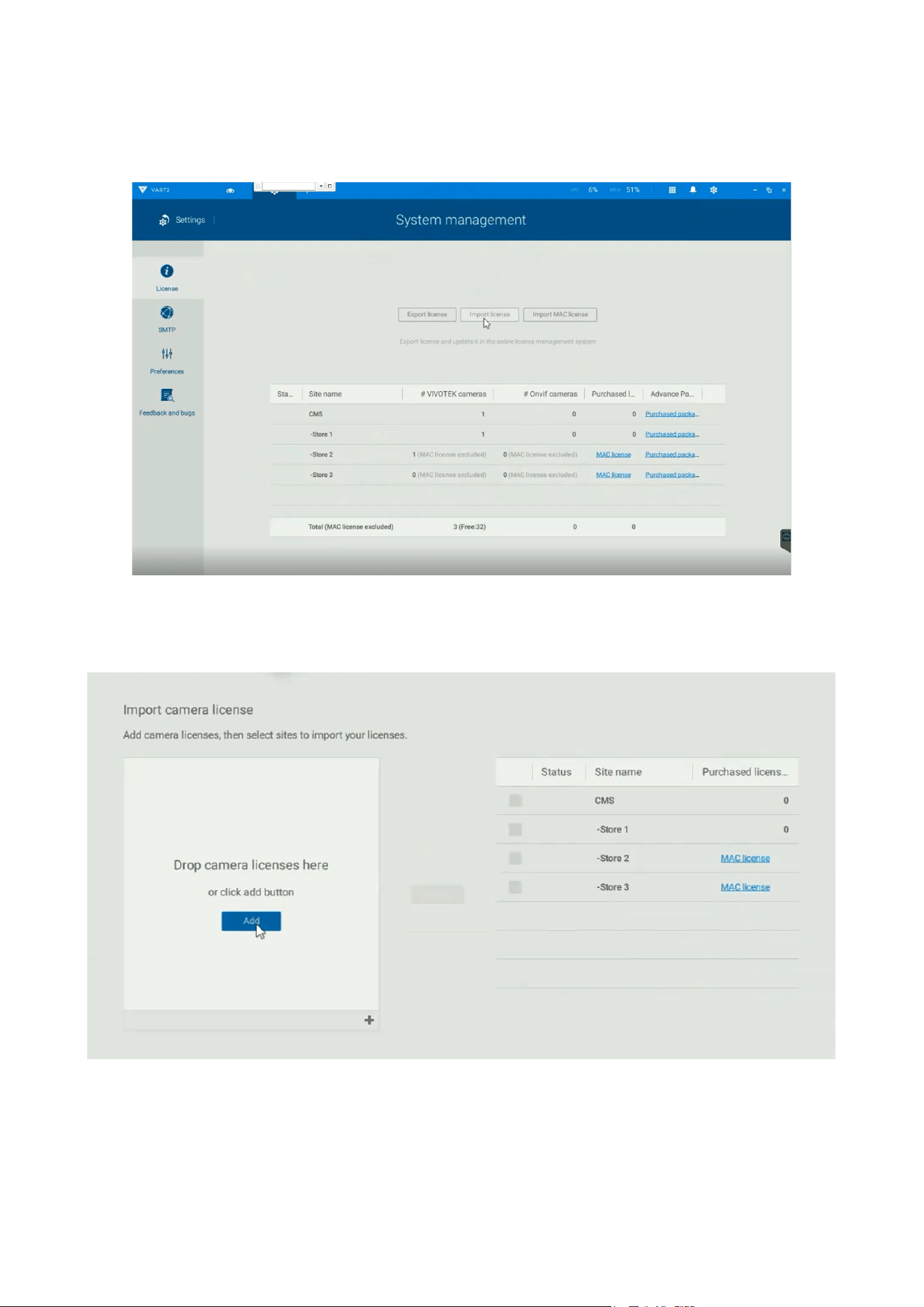
155
1. Continue to import the camera licenses.
2. When in the Import page, click the Add button to select camera licenses.
Below is a sample procedure for importing the camera licenses:
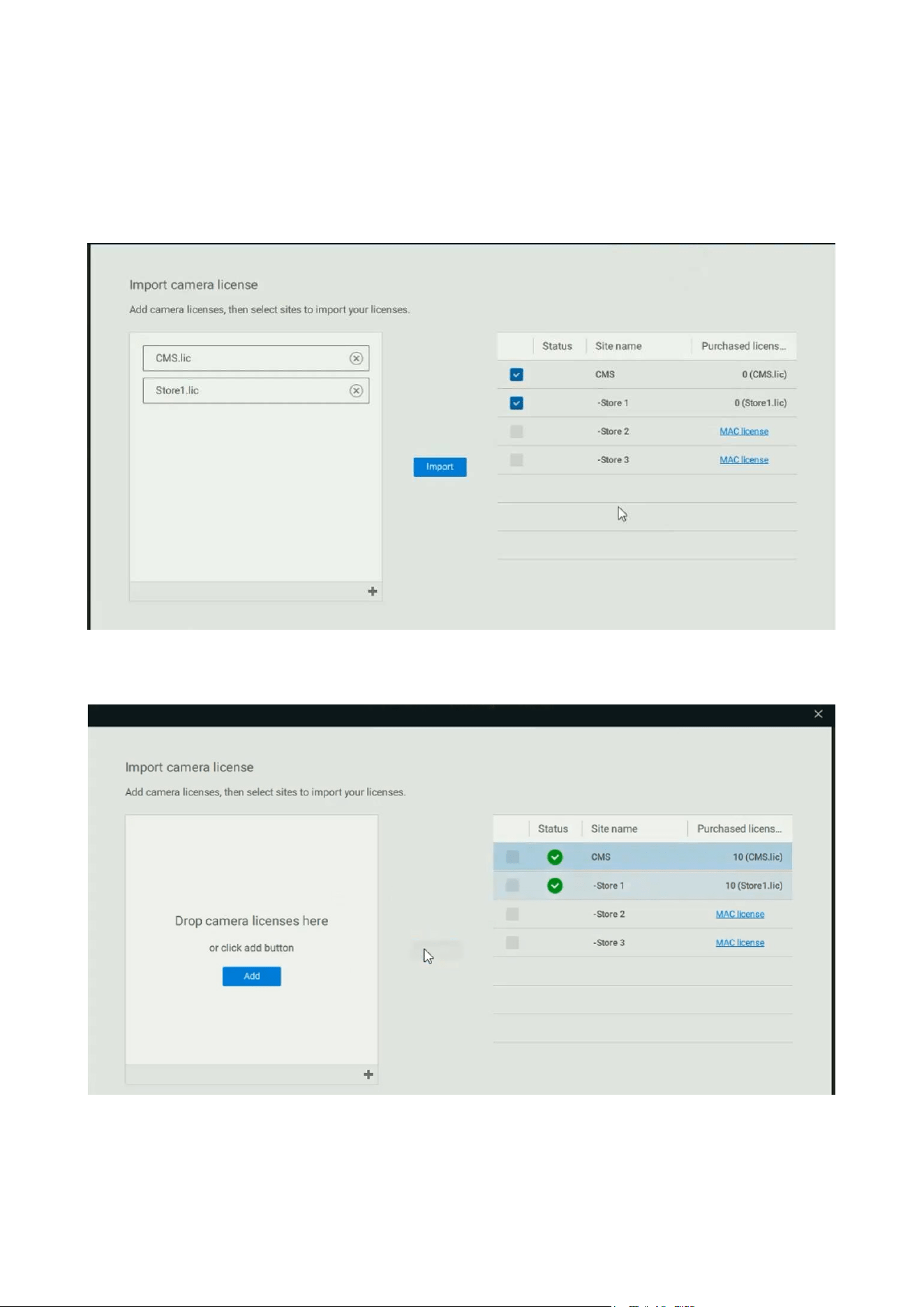
156
3. Select the target servers, click Import.
4. When done, a successful import will be indicated.
Camera licenses are bundled with hardware information. When import camera licenses,
the software will automatically match the licenses with corresponding servers.

157
Updating Licenses for
VAST on Virtual Machines
NOTE
:
1. The VAST server supports the installation on VMWare, Virtual Box, Parallel, and Hyper V.
2. A MAC address authentication mechanism is implemented for VAST running on virtual
machines.
3. The license requests have to be generated from the VAST2 installed on a Virtual
Machine. If your configuration consists of multiple VAST servers, and one of them is
installed on a virtual machine, exporting license information will generate a MAClist le.
The MAClist le will be used for the VAST instances running on virtual machines.
This instruction includes:
1.How to Export a license request from VAST2 on a virtual machine.
2.How to acquire the MAC addresses of the inserted or non-inserted cameras?
3.Send us request les & MAC addresses (If you have multiple sites, please remember to
designate grouping information, such as which MAC addresses belong to which camera
deployments).
4.How to Import MAC licenses to VAST2?
5.How to buy more MAC licenses for future distribution?
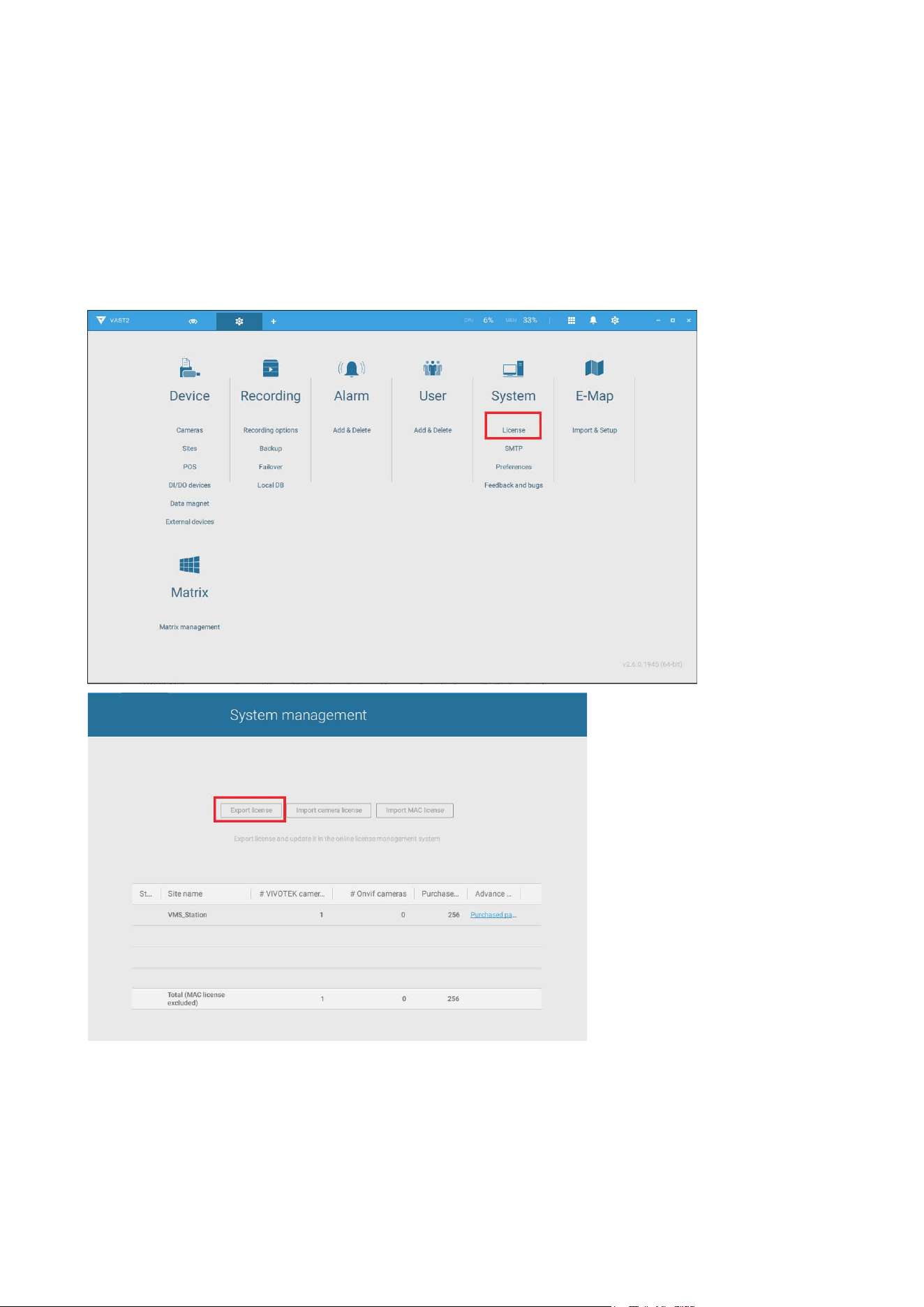
158
1.How to export request from VAST2 on VM?
1-1. Install VAST2 server on a Virtual machine (usually VMware workstation - full - 12.1.1),
or download VAST2 from VIVOTEK website.
1-2. Insert cameras for the VAST station(optional).
Go to virtual machine, Open VAST2 > Settings > Insert cameras (You may already
have more than 32 cameras inserted if you are using the trial version).
1-3. Go to VAST2 > Settings > License > Export license.
1-4. Click the Export license button and select your Windows desktop as the destination
folder. A VAST2 license folder will display on the desktop, zip the folder and send the
request le back to your sales representative, distributor, or VIVOTEK.
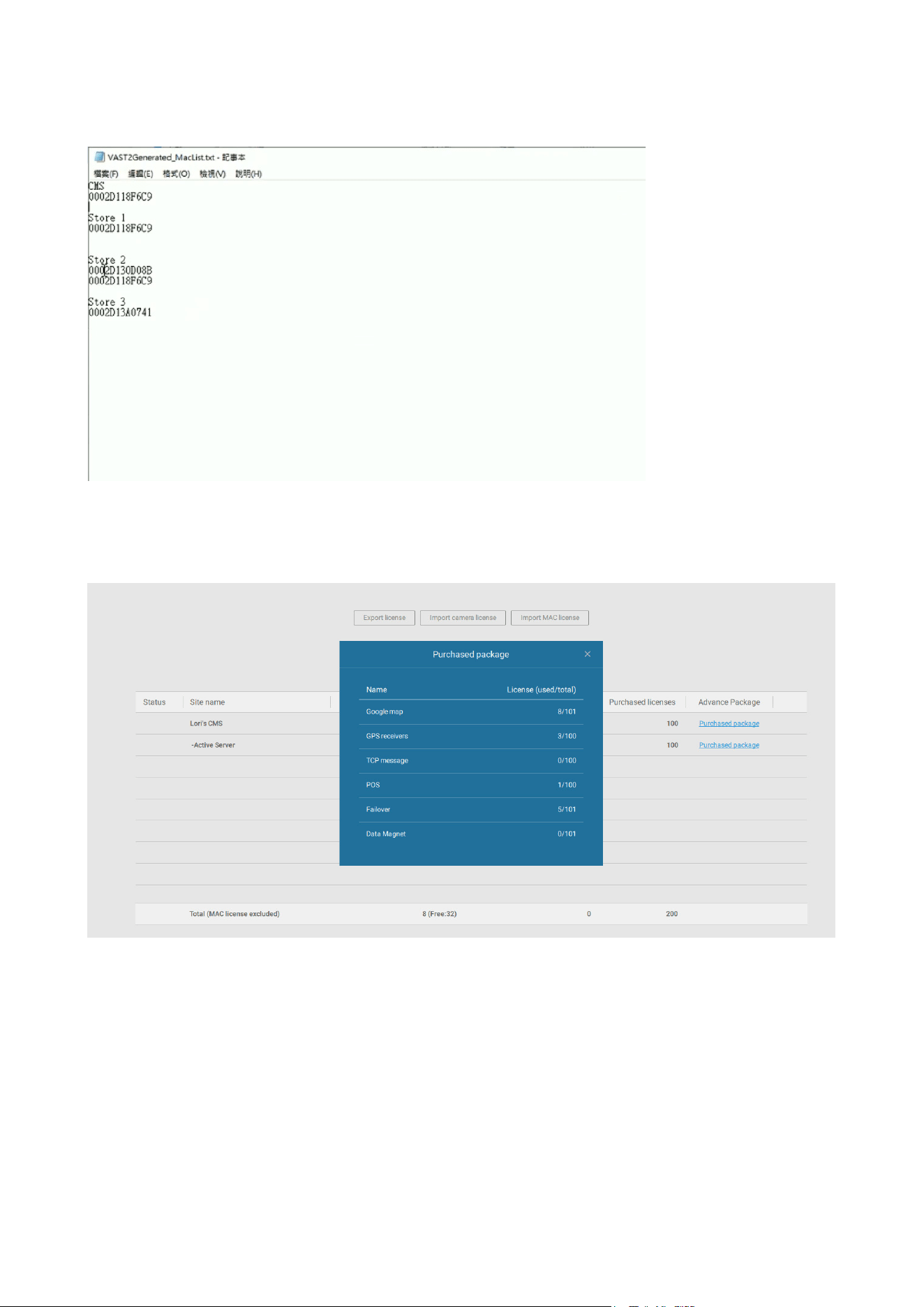
159
You can examine your current license status. Click on Purchased package. The licenses
currently in use will appear.
The generated MAC list should look like this.
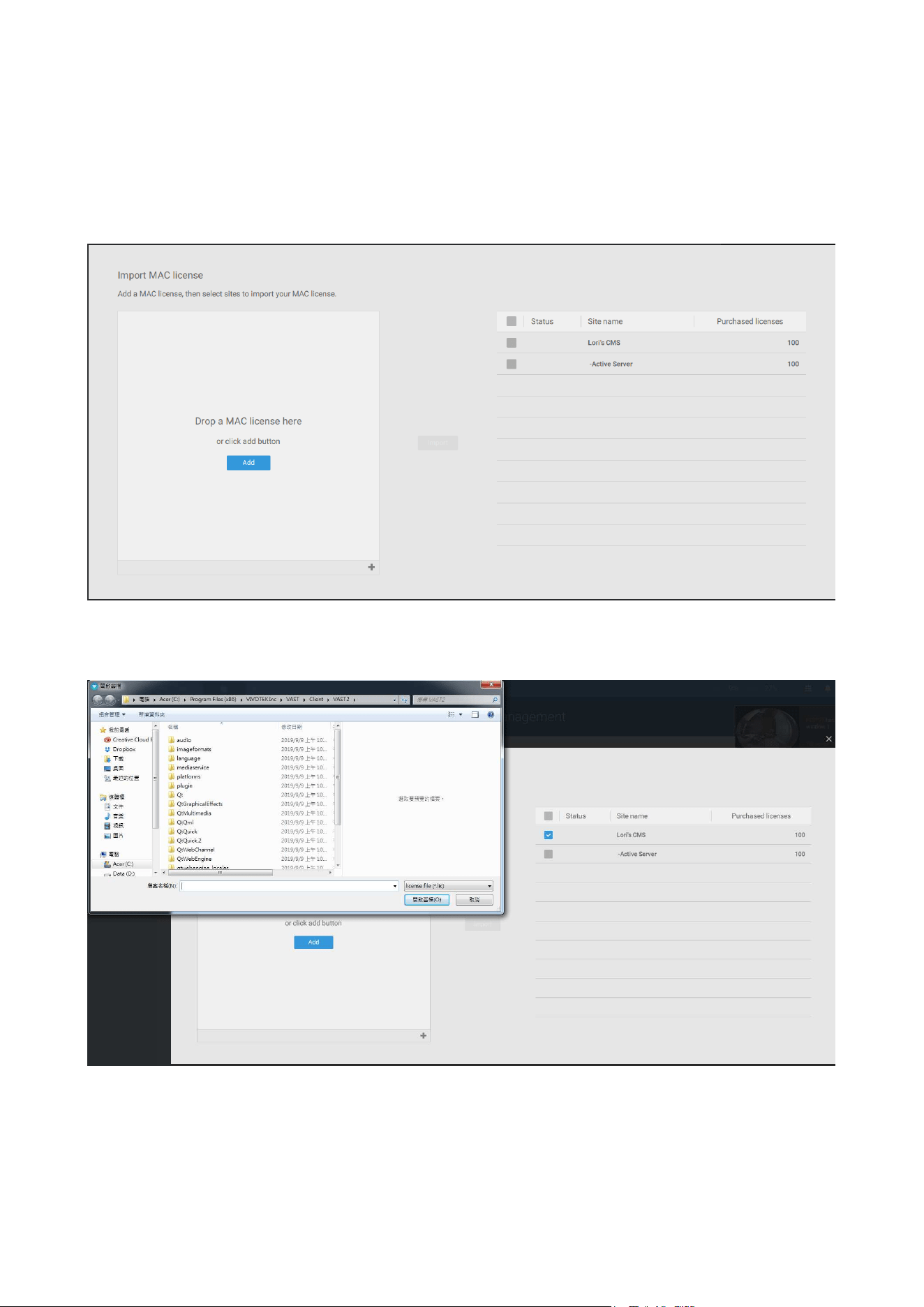
160
1-5. Once you acquired the MAC licenses from VIVOTEK, click Import MAC license button.
You will enter the import page. Use the Add button and locate your license les.
To use the MAC license import function, both the CMS and its substation servers should
both be running VAST revision 2.6 or above.
1-6. Select the license le.
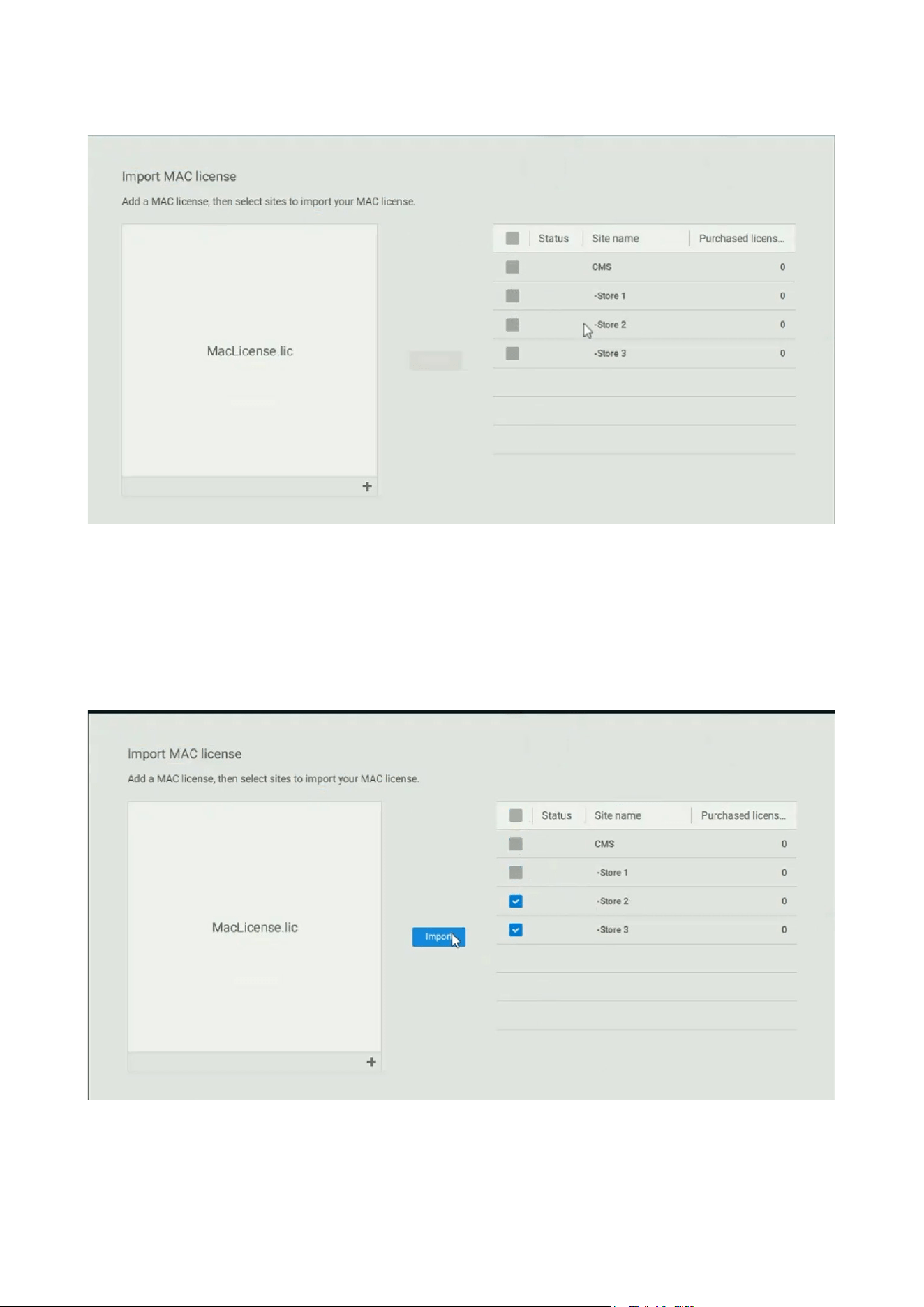
161
1-7. The selected le appears on screen.
1-8. Select the target server sites to import the license le. When done, click the Import
button.
MAC licenses are not bundled with server hardware. You can import licenses from the
CMS server to one or multiple virtual machines running the VAST software.
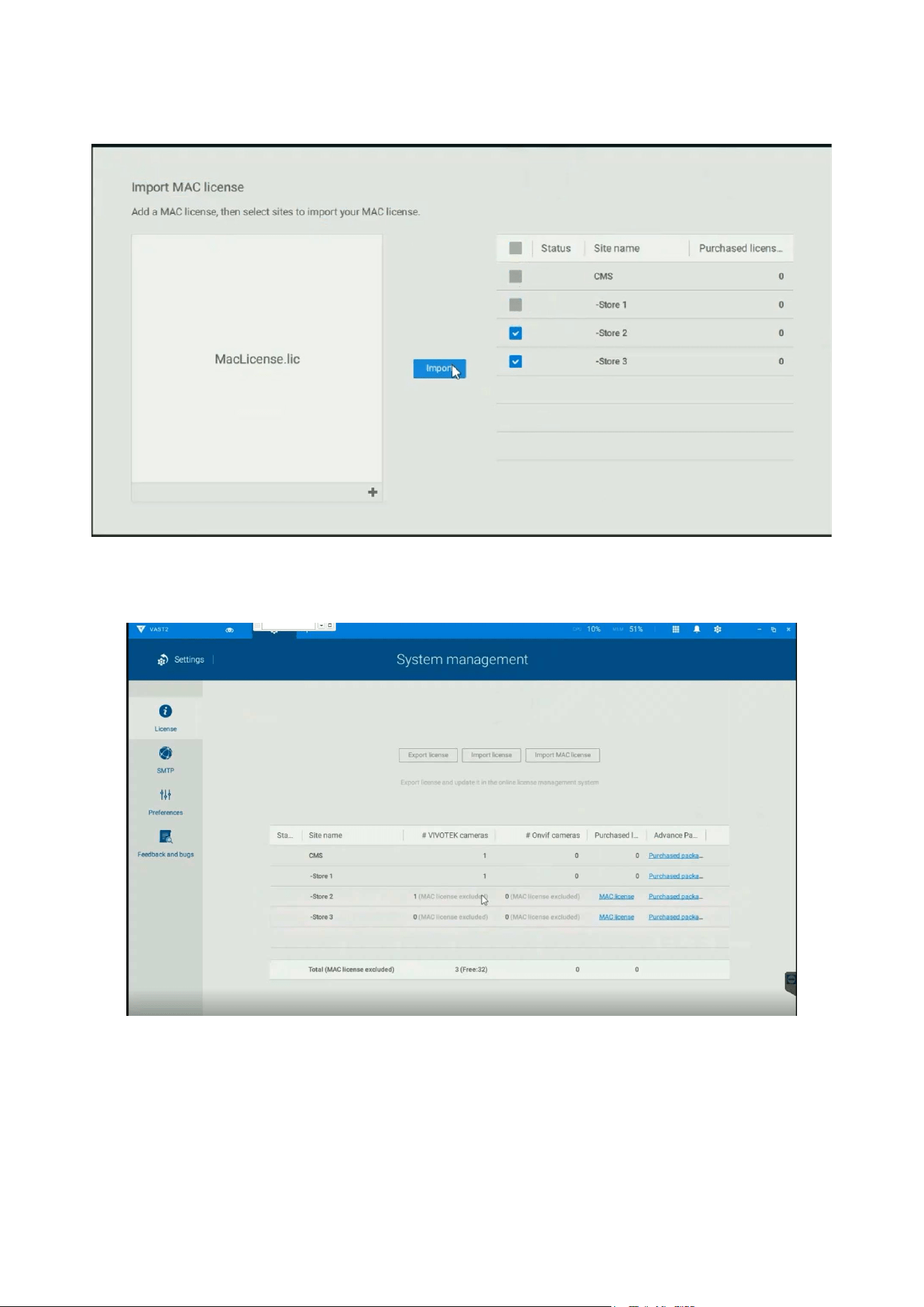
162
1-9. Select the virtual machines (sites) running the VAST server to import the license le.
When done, click the Import button.
1-10. When done, the MAC licenses display on the license page as shown below.

163
Limitations
:
1. The Batch import/export function applies when a managing VAST server needs to col-
lect and update the licensing information from subordinate VAST substations and itself.
An enterprise may have a central management server and several VAST instances run-
ning in branch offices. In that case, the substations will be listed on the device list, and
may not be displayed on a hierarchical structure.
Reminders for VAST
Software License
2. The batch download/import function only takes effect on a VAST instance running on
server, not on the Linux-based NVR.
3. The trial channels on VAST substations will not be available for use on a managing
VAST server (one that manages multiple substations).
4. If you access a VAST deployment via a web console, the license related information will
not be available.
5. In this revision, an identical software license applies to both VIVOTEK and other-brand
cameras (ONVIF). You do not need to activate two different kinds of software licenses.
6. The Batch export update of the current license profile is supported.
7. If the VAST server is removed and then re-installed, the number of licensed channels
remains intact.
8. If users plan to integrate the software licenses from previous dongle licenses, problems
may occur if users changed the exported license file name.
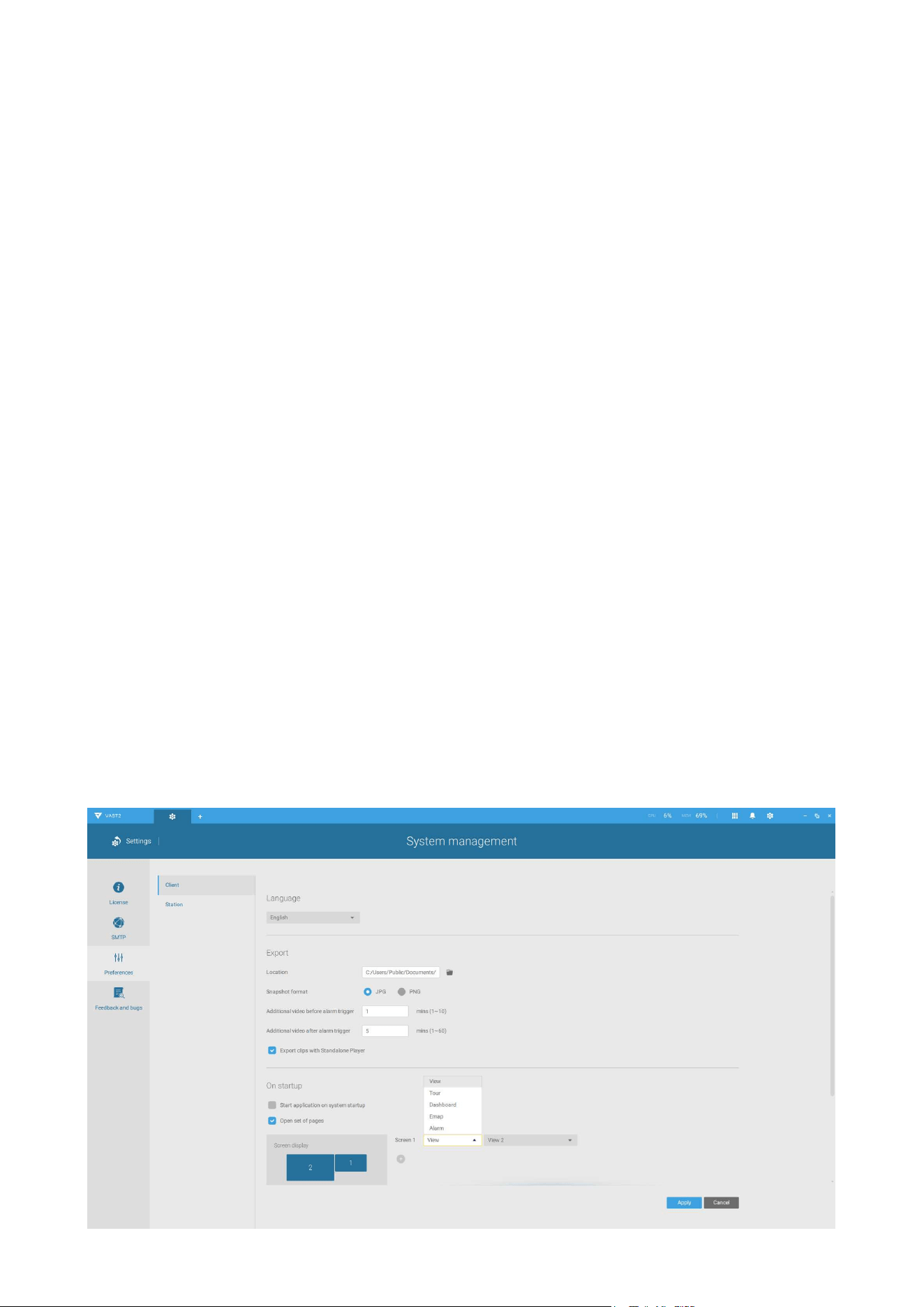
164
Chapter 4 Settings:
4-1. Settings > System >
Preferences
The Preferences page for VAST client and Station sides allows you to configure the
following:
Client Setting:
1. Select the UI text language.
2. Configure a default destination for exporting video, snapshots, or configuration backups.
The default is "C:\Users\Public\Documents\VIVOTEK Inc\VAST\Downloads". You can
change the media format via the checkboxes.
3. Select the format for the snapshot as either JPG or PNG.
4. You can select the length of the Alarm-triggered videos by specifying pre- and post-
alarm recordings.
5. You can designate the VAST client interface to automatically start once the client
computer is started.
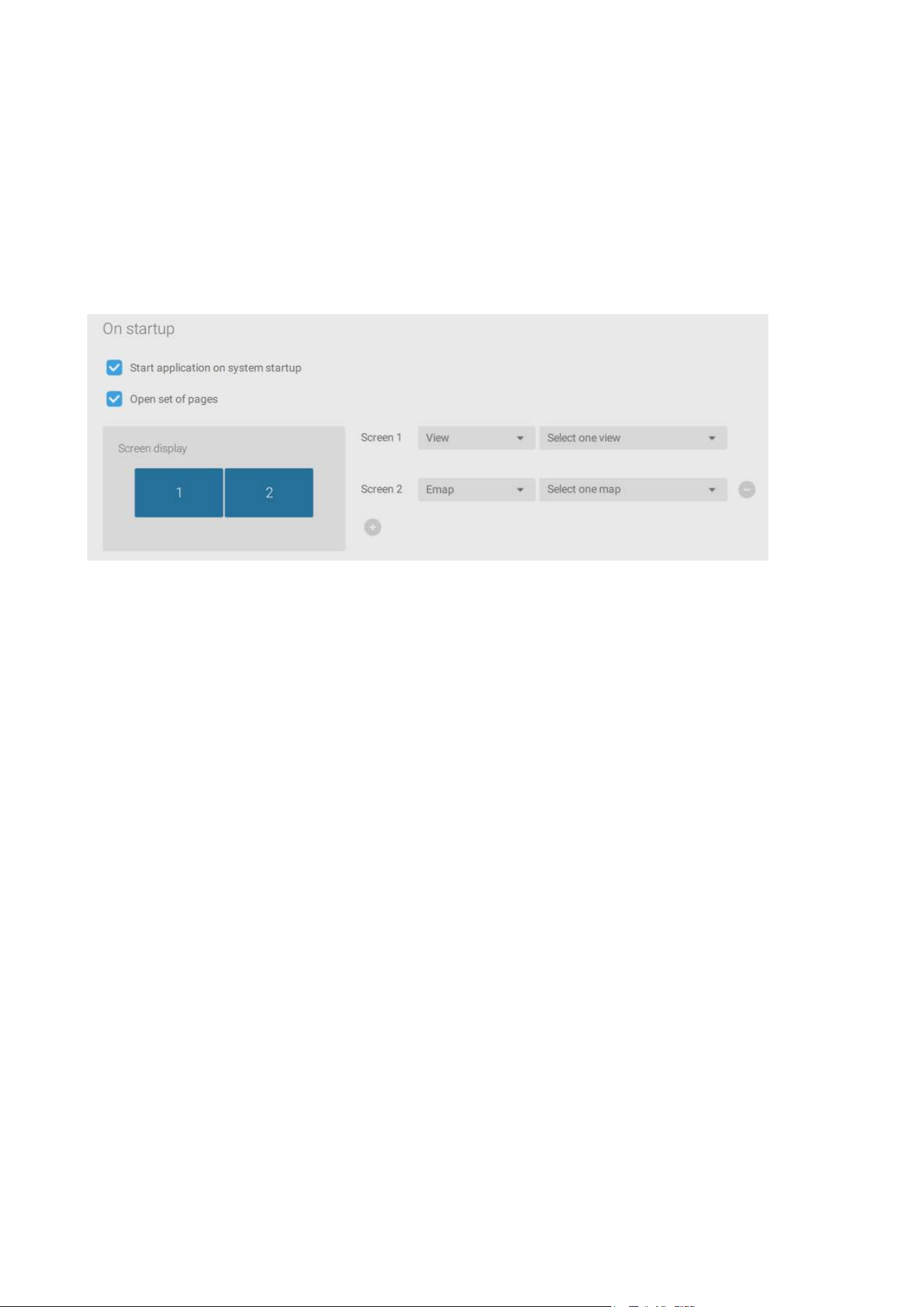
165
6. The default Live view, which may span across multiple monitor screens and display Live
view, Tour, Dashboard, E-Map, or Alarm prompts. The precondition is that you should
configure one or many views before making the Startup configuration.
Below is a server/client with dual monitors, you can select one view to be displayed on
one monitor, or place an E-Map on another.
Click the Apply button for the configuration to take effect.
Station Setting:
1. Display Watermark over video - Administrators can select to display watermarks on the
video feeds of the VAST clients. The opacity and display frequency can be adjusted.
Encrypted watermark for authentication:
To ensure your video is authentic and has not forgerized, adding an encrypted
watermark on the data stream can be achieved with a customized password. You
can use the Standalone Player to verify which frames in the video footage have been
tampered with.
If enabled, the following will be displayed:
camera name + substation name + VAST2
user name + user computer current time. The purpose of watermark is to preserve
evidence if the video screen is recorded using cell phones or other devices.
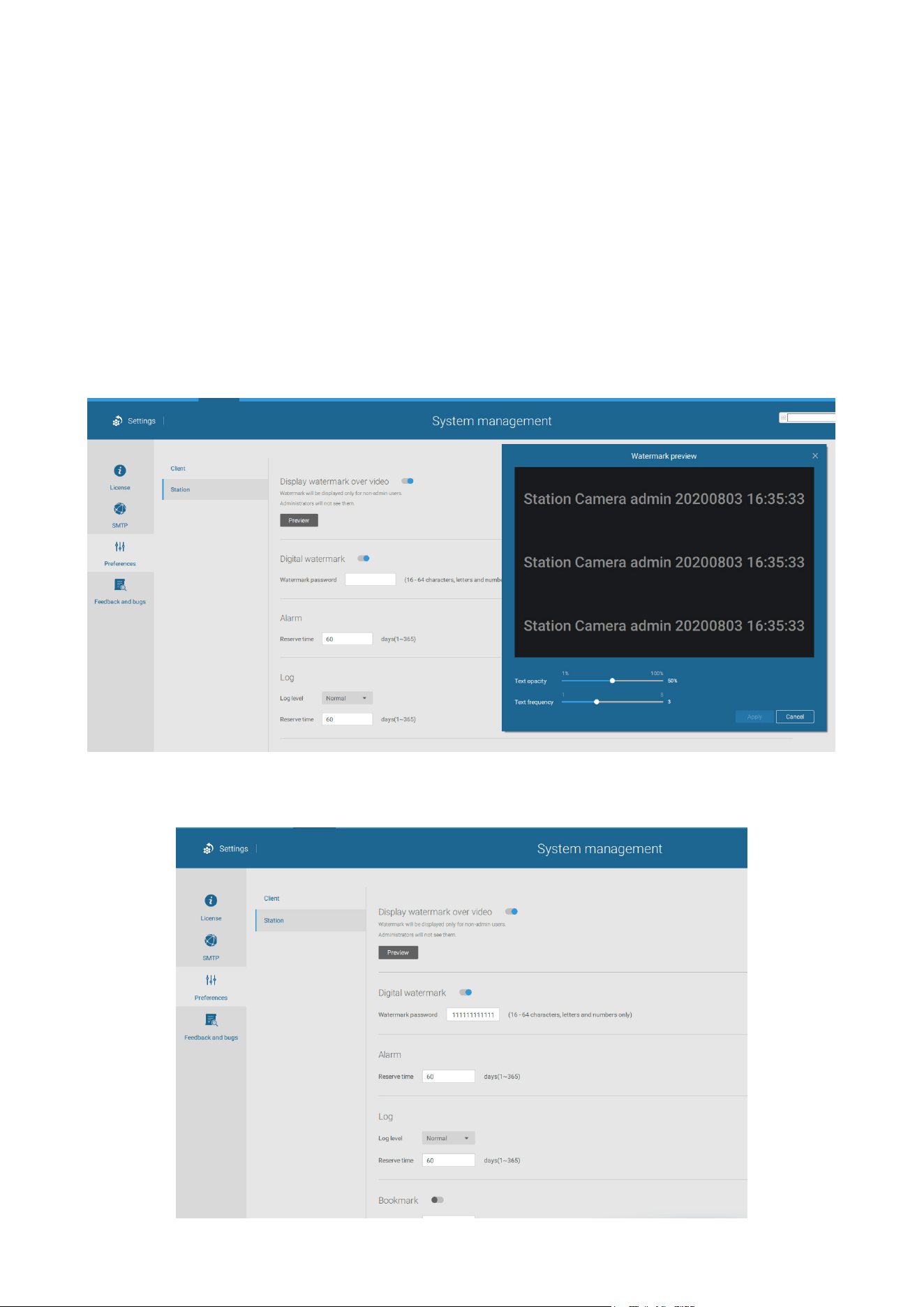
166
Station Setting:
2. Digital watermark - To prevent forgery of recorded or exported video clips, and to prove
the validity of surveillance evidence, digital watermark can be appened to recorded
video.
Note that only non-administrator users will see watermarks.
To enable text watermark, use the slide button. Use the Preview function to tune the text
opacity and text frequency display on screen.
To enable Digital watermark, enter a password that is at least 16 characters long. Once
a valid password is available, you can click the Apply button to preserve your setting.
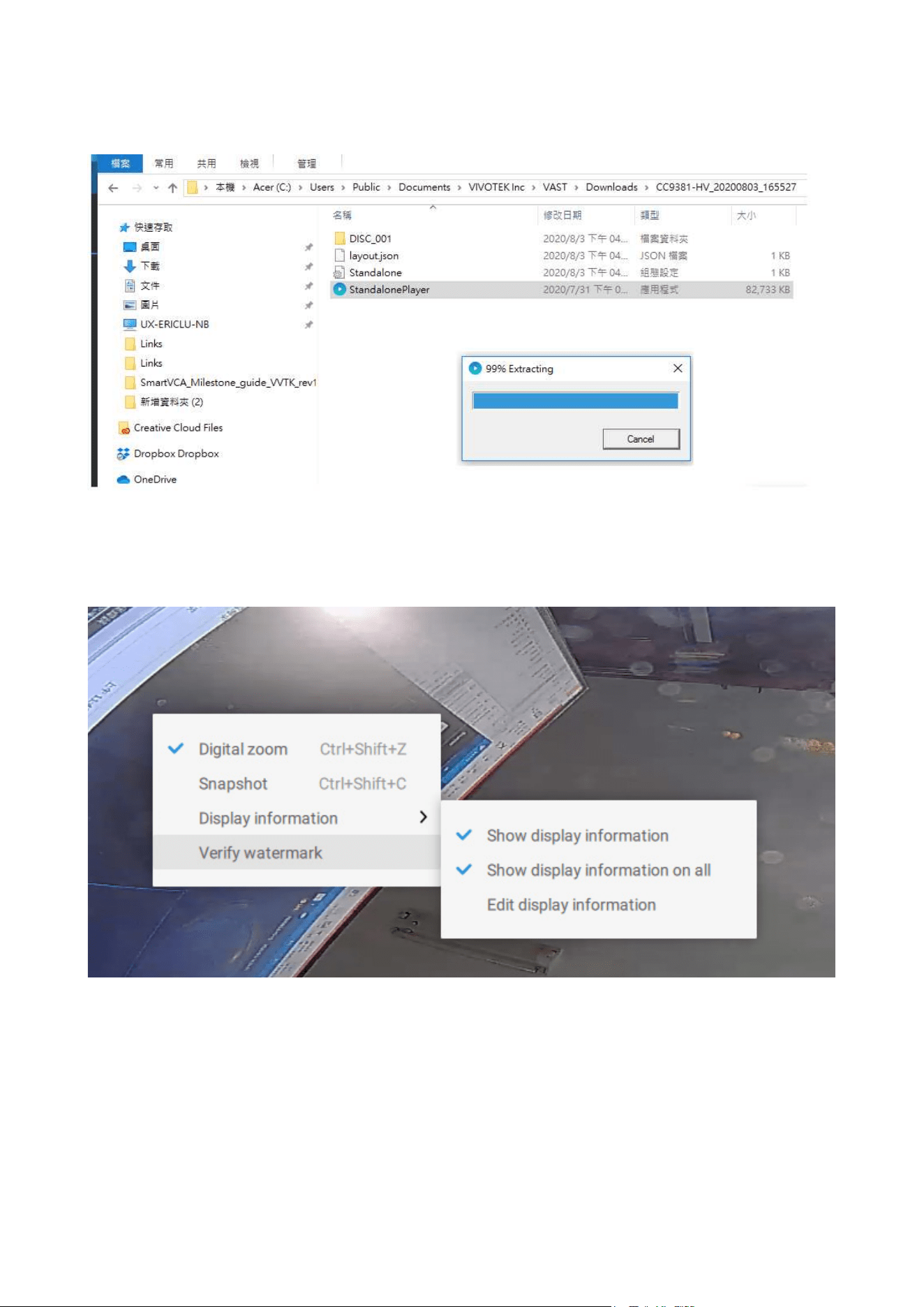
167
When you export a video clip, a StandalonePlayer is generated with the exported files.
Right-click on the StandalonePlayer screen to display the "Verify watermark" function.
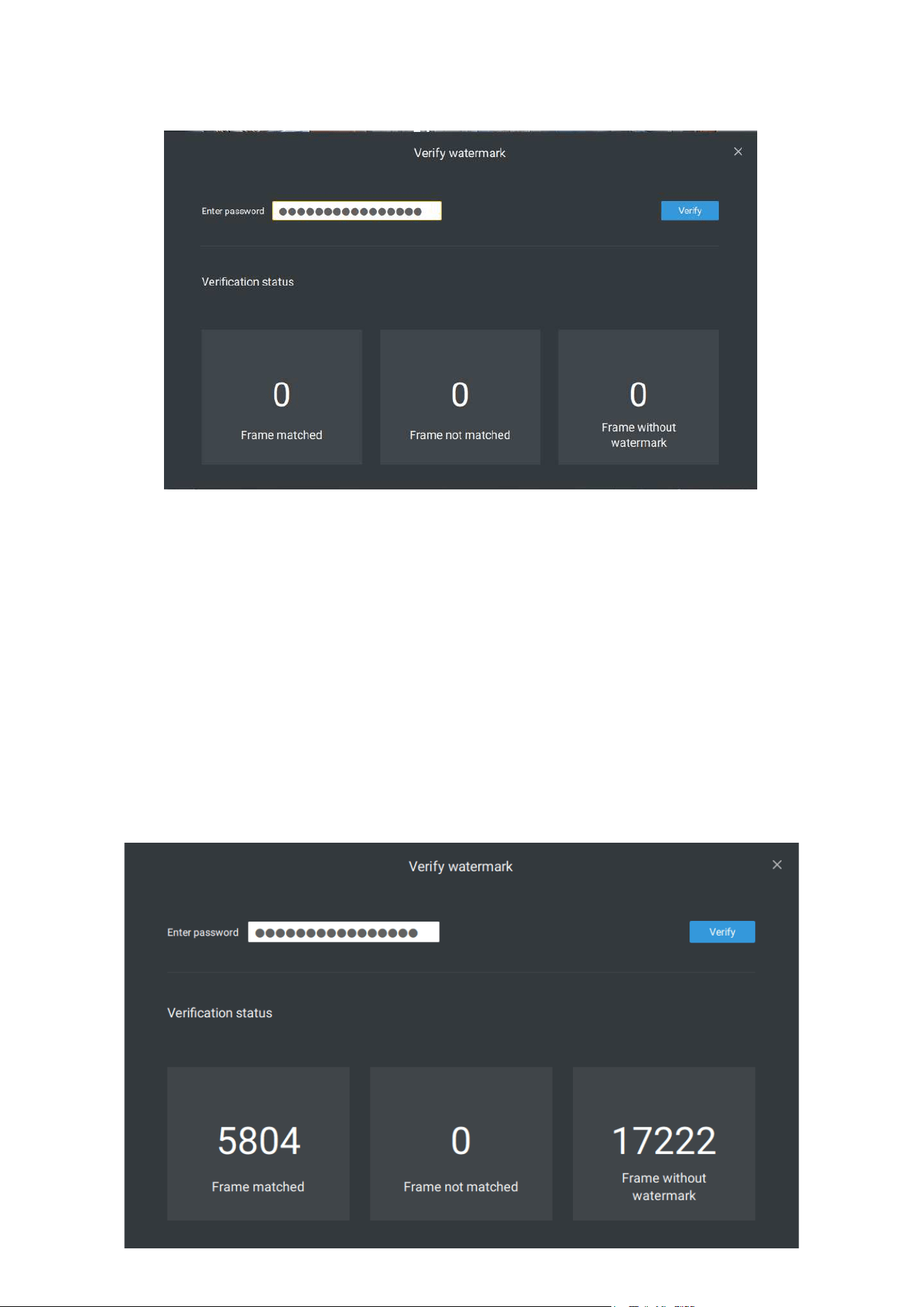
168
The Verify screen will display. Enter the pre-configured password. Click Verify.
The below result shows that the video is authentic and has not been forgerized.
Frame matched: Your video was exported with the digital password, and you entered the
correct password.
Frame not matched: Your video was exported with the digital password, and you entered
the incorrect password.
Frame without watermark: a. If your video wasn't exported with the digital password.
b. If your video was exported with the digital password, and your video has been
tampered.
If the numbers in the "Frame not matched" or "Frame without watermark" are not zero, it
means your video is probably not correct.

169
3. Alarm - Reservation time: Configure the preservation time of the alarms and logs. Note
that some alarms can be triggered with recorded videos. Configuring a preservation
time can help reduce the use of storage space on server.
4. Log: Use the menu to configure the preservation time of the Major, Normal, or Minor
logs.
5. Bookmark: Configure the days of preservation for bookmarks.
6. Data magnet: Configure the days of preservation for data related to Data Magnet.
7. Trend Micro events: Configure the days of preservation for events related to cyber
security.
8. Database: Configure the destination of the database folder. The database contains
information for system log, alarms, Bookmarks, data magnet, VCA reports, POS
transaction data, snapshots, and Trend Micro IoT security information.
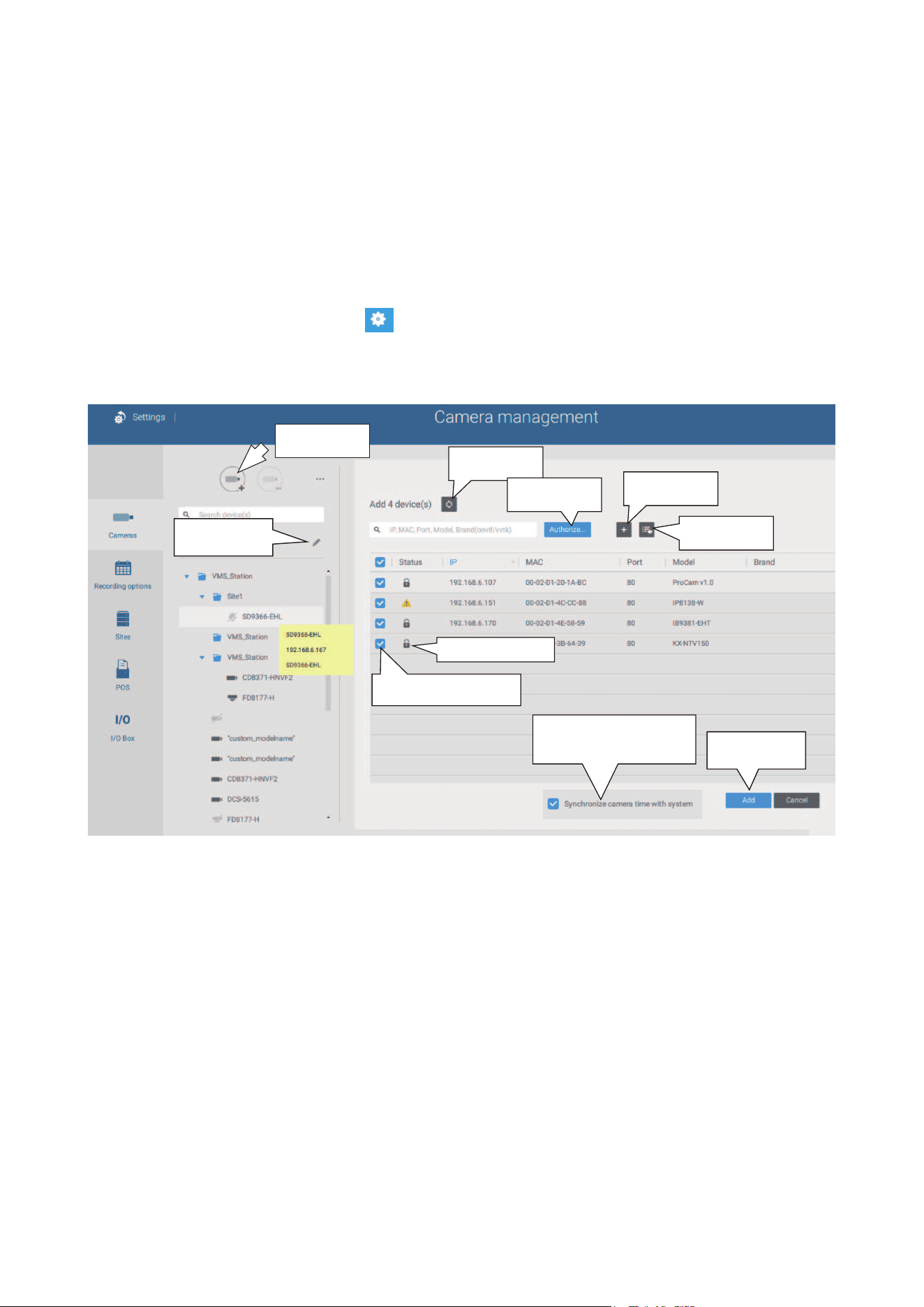
170
4-2. Settings > Device >
Cameras
In addition to the add device process during the initial setup, you can add more cameras or
arrange the device list in Settings > Cameras.
Below are the locations of the functions for adding devices to the VAST server.
Start Scanning
Import CSV
Manual Add
Refresh
Authorize...
Click to select or deselect
Password protected
Edit device list &
Logical folders
Final confirm
Sync time w/ VAST
- or -
Sync w/ another NTP server
Note that you must know the credentials for password-protected cameras. You will not be
allowed to enlist cameras that come with unknown credentials.
For cameras outside the local network, you can manually enter its IP address, or use a pre-
configured device list to automatically introduce new devices.
If all devices come with the same credentials, you can select these devices and click
Authorize to enter the credentials.
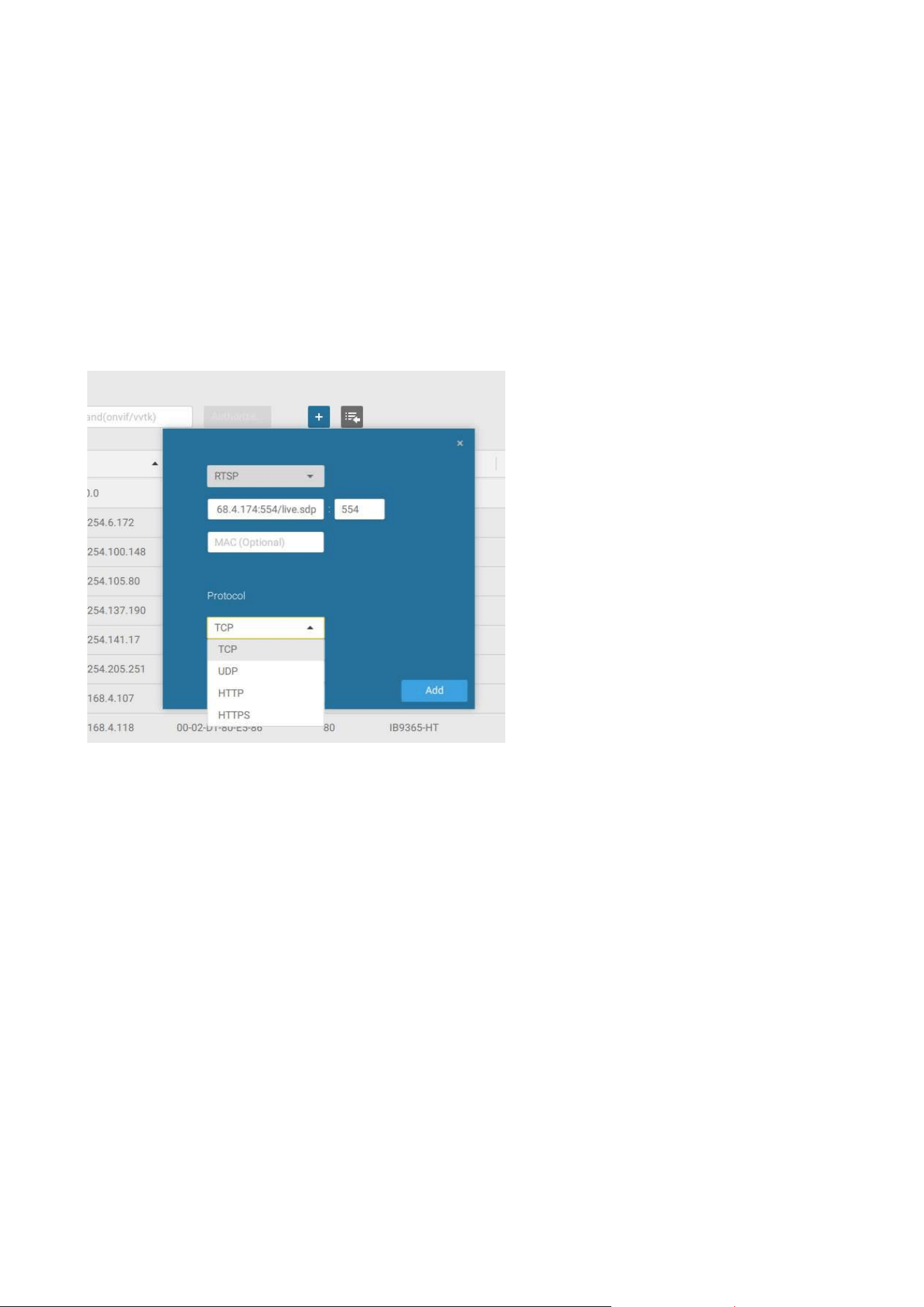
171
Streaming URL
This is an optional feature. You can enter a camera's IP address to add a camera's RTSP
streaming for live view and recording, and playback. The feature enables the support for
obsolete models.
To insert a camera using the URL-like command,
1. Select the camera Brand as "
RTSP
."
2. Enter the camera's IP address.
3. Enter the camera's MAC address as printed on the camera label, or one found by the
Shepherd utility.
4. Enter "554" in the Conguration port.
5. Enter "live.sdp" in the URL eld, as this is part of the original RTSP streaming command:
"
rtsp://172.18.204.58:554/live.sdp". If streaming stream #2, enter live2.sdp.
6. Select a preferred protocol.
Note that the free 32 channel licenses does not apply when inserting a camera using
the URL command. Only the live view, recording, and playback functions are supported
if thus connected. All other functions are not supported, such as auto streaming size or
changing to another video stream. Neither are camera DI/DO supported.
Retrieve RTSP streaming on specific port: The default port for RTSP streaming is 554.
If you want to change this port, please check this item and fill in a desired port number.
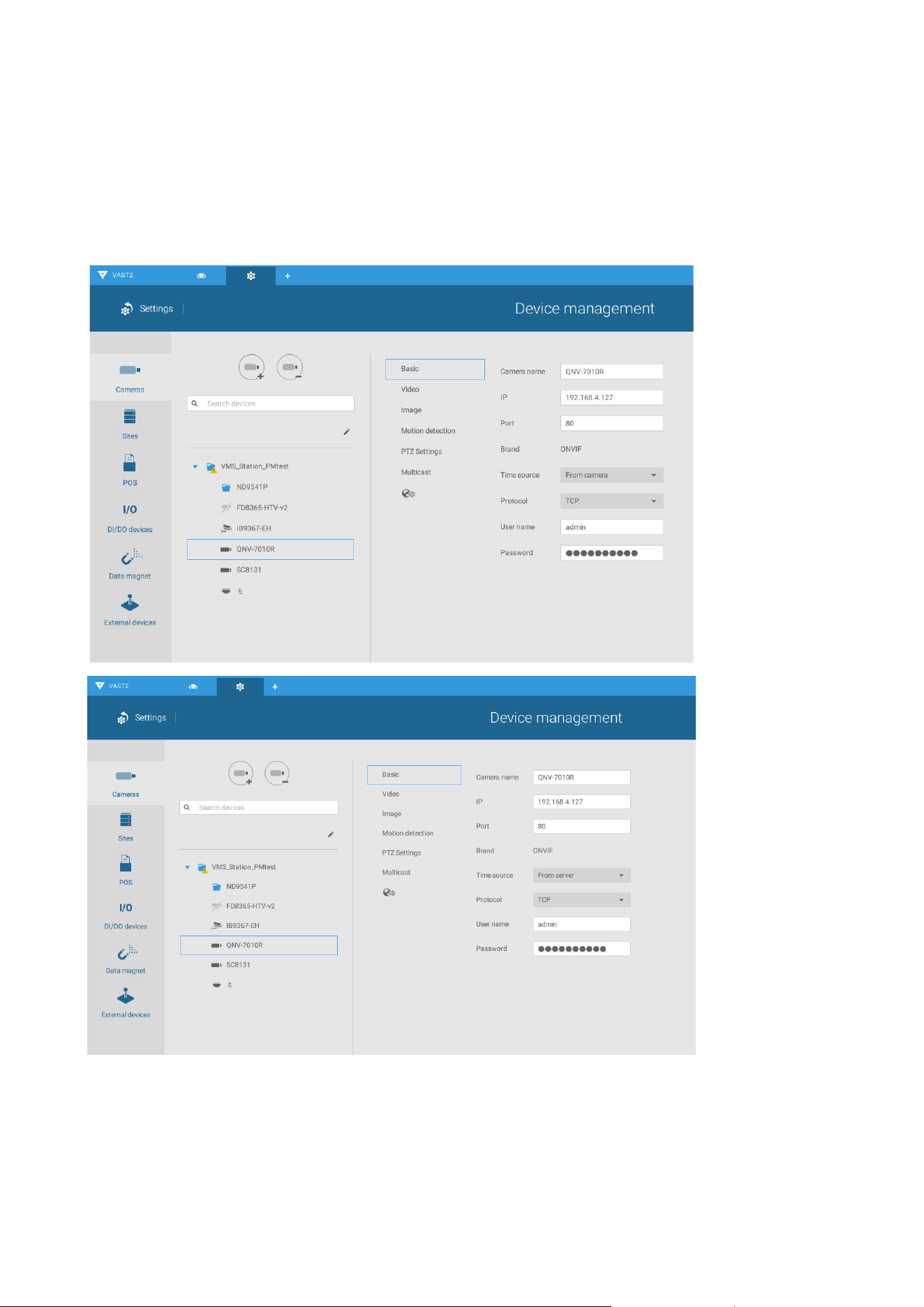
172
6. For administrators who need to synchronize device time with a NTP server, he can
deselect the "Synchronize camera time with system" checkbox.
When adding cameras via ONVIP or RTSP protocol, you can select to synchronize its
time setting with your VAST server or to keep the camera setting. The default is using
the camera time setting.
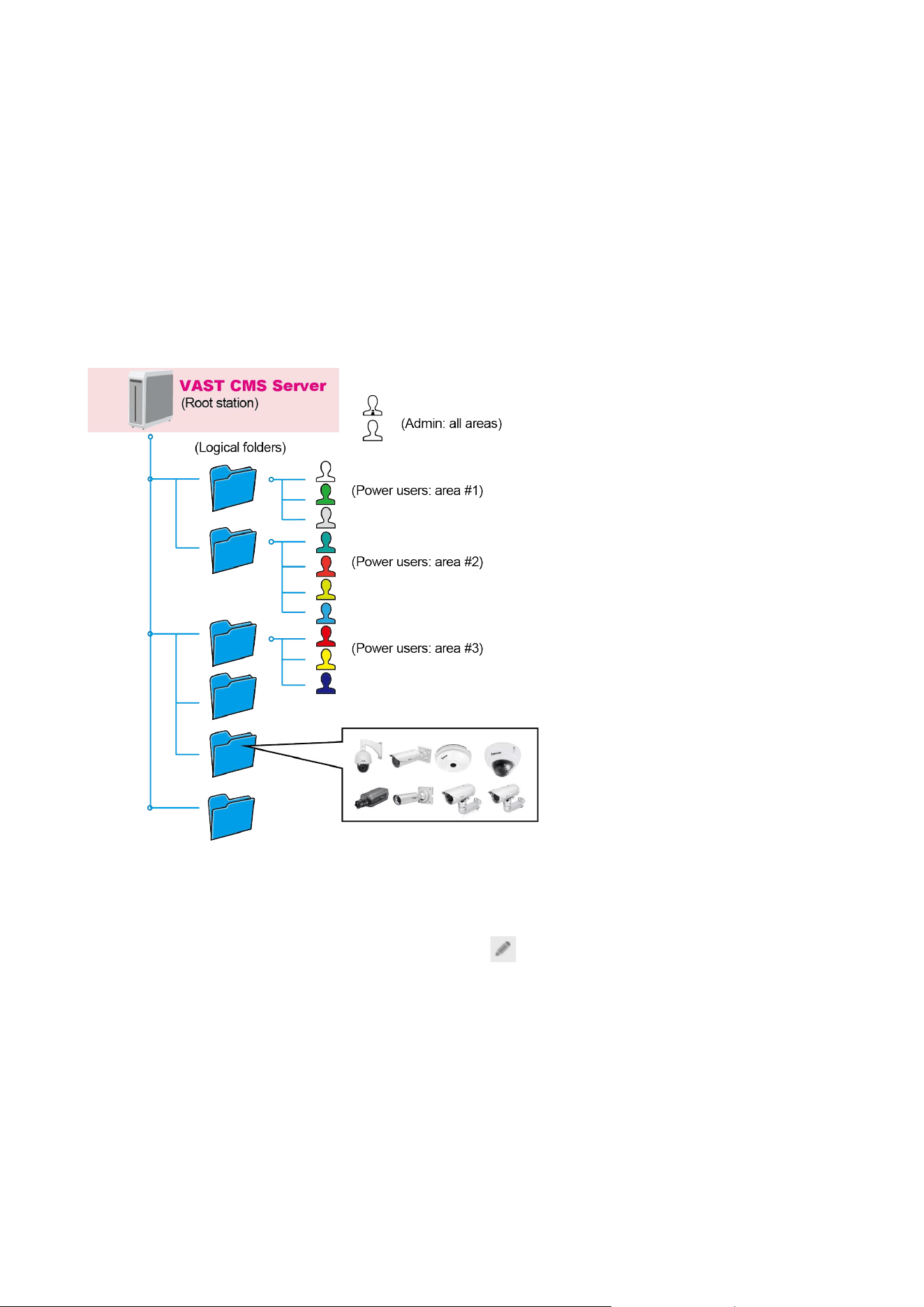
173
4-3. Logical Folders
The Logical Folders allow you to re-define the logical relationships between the real-
world deployment and the physical devices (cameras). For example, according to your
deployments, you can designate several cameras to be listed under a logical sub-directory
named as "Building A," and the other cameras into "Building B." In this way, you can re-
arrange your cameras and devices on a tree view that is geographically more accurate.
1. On the Settings > Cameras page, click the Edit button.
2. Click on the Add a folder button.
3. Enter a name for the folder, e.g., 1st floor, 2nd floor,... according to your needs as shown
below.
4. Repeat the process to create more folders.
5. Make sure you enlisted all cameras in your deployment. You can start moving cameras
to specific folders. Click on the Move Selected Items button.
To create logical folders,
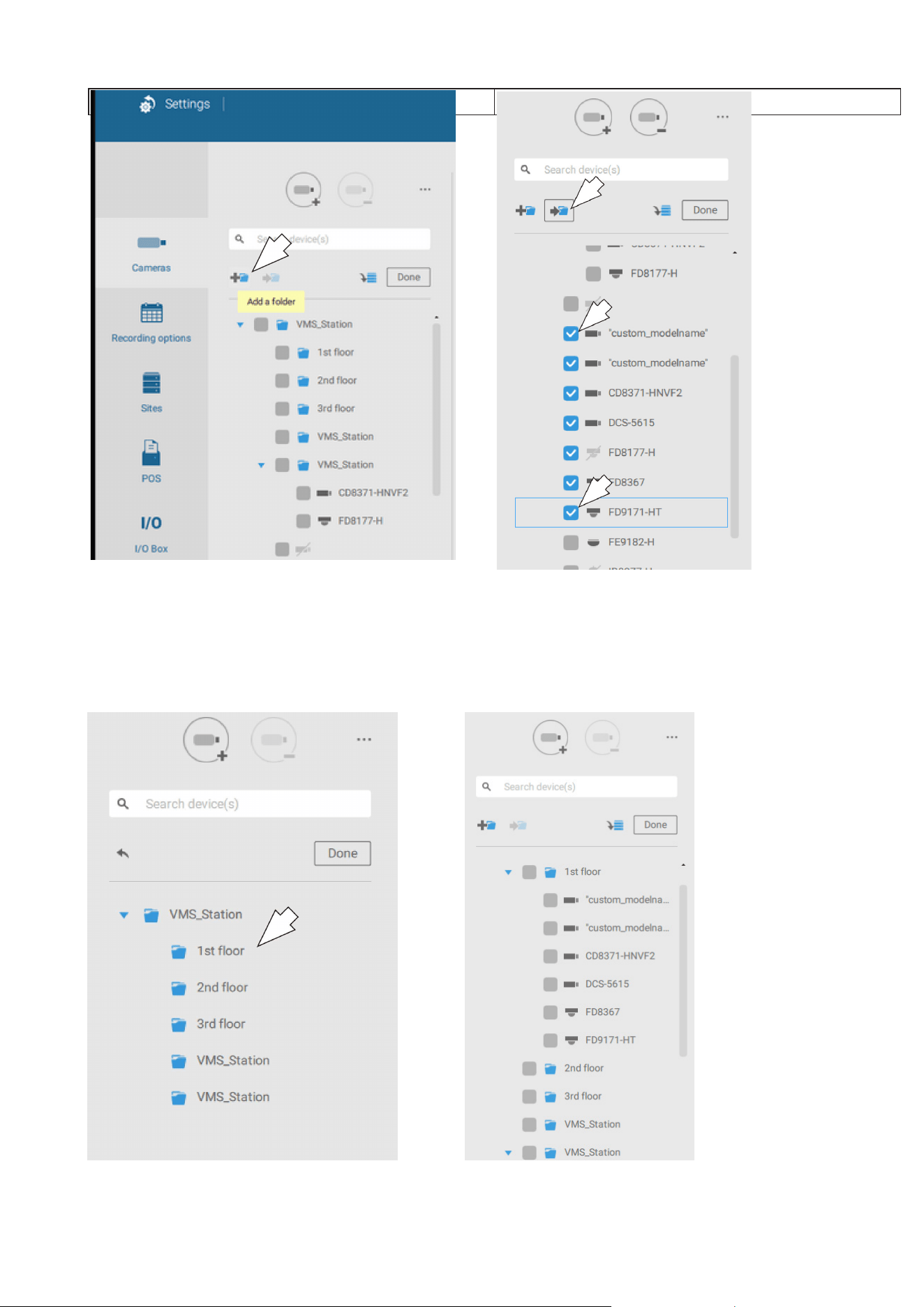
174
6. Select a logical folder to move the devices to. The selected devices will be listed under
the logical folder you selected. Repeat the process to move cameras to each logical
folder.
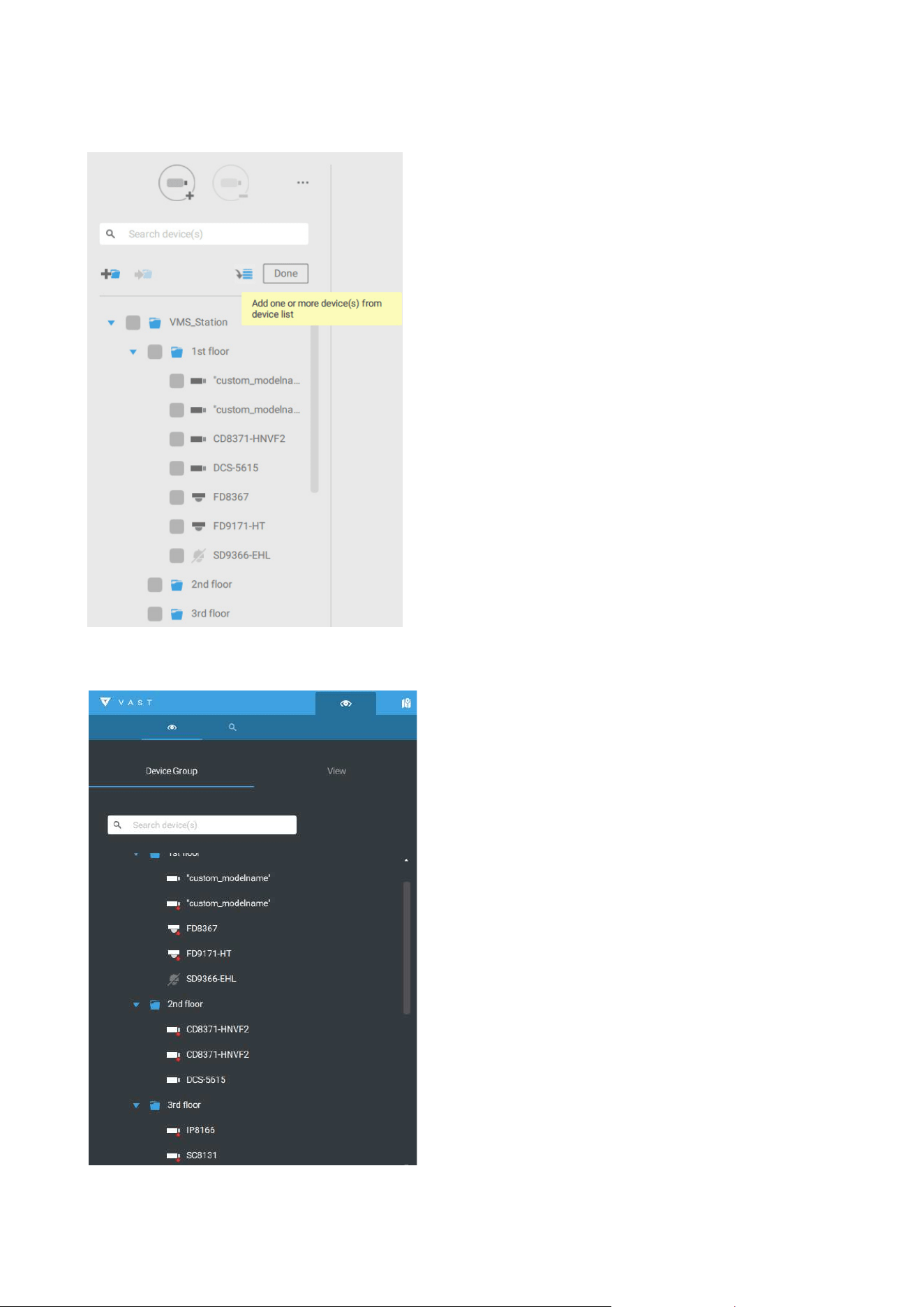
175
You can also use the add device button to select devices from the list and move them to
a specific folder.
Return to live view, and you can see the configuration change takes effect.
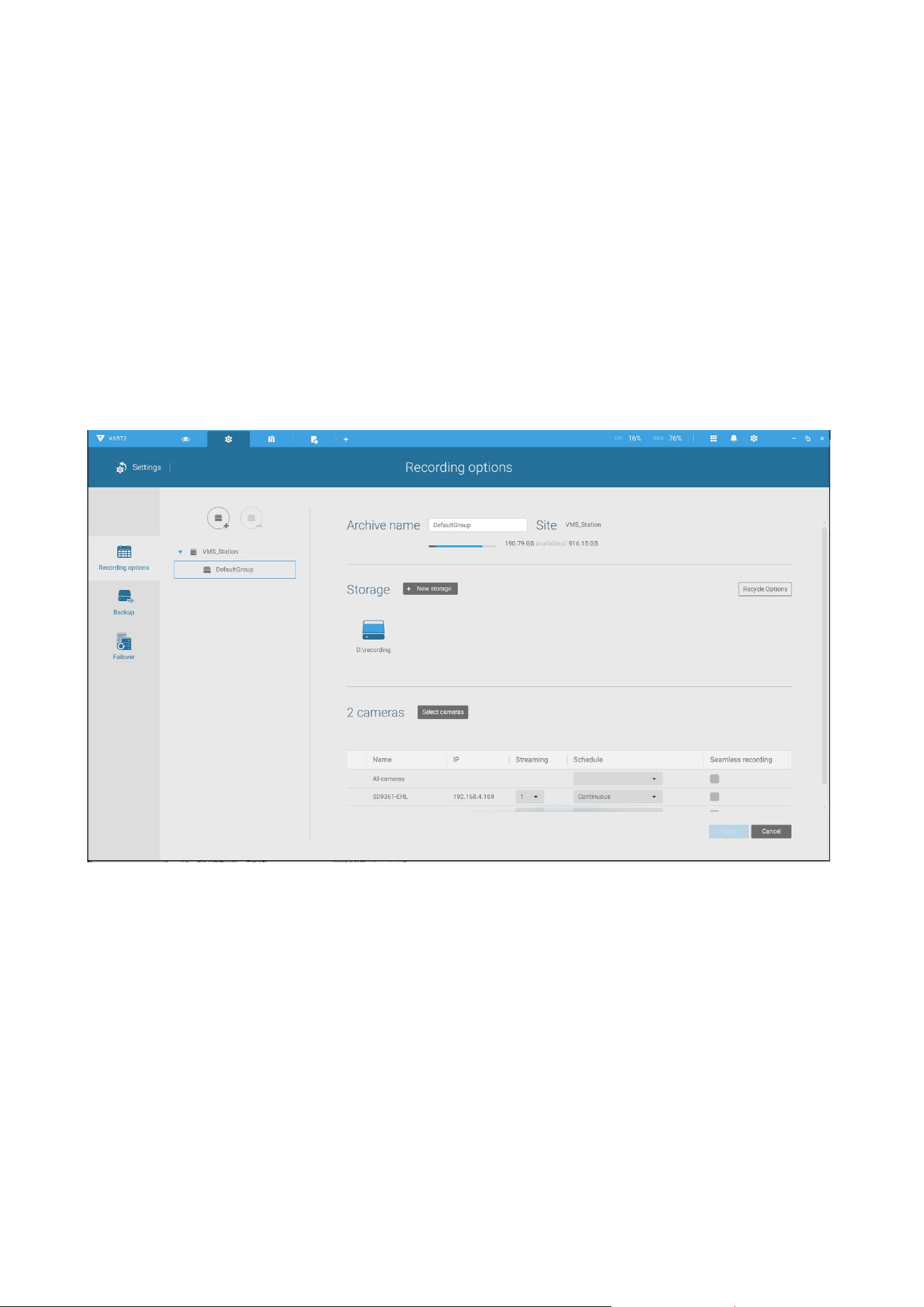
176
4-4. Settings > Recording >
Recording Options
Click Settings > Recording options. The Recording options window will prompt.
You can configure recording schedules or select the storage options, including the
configuration of an external NAS storage.
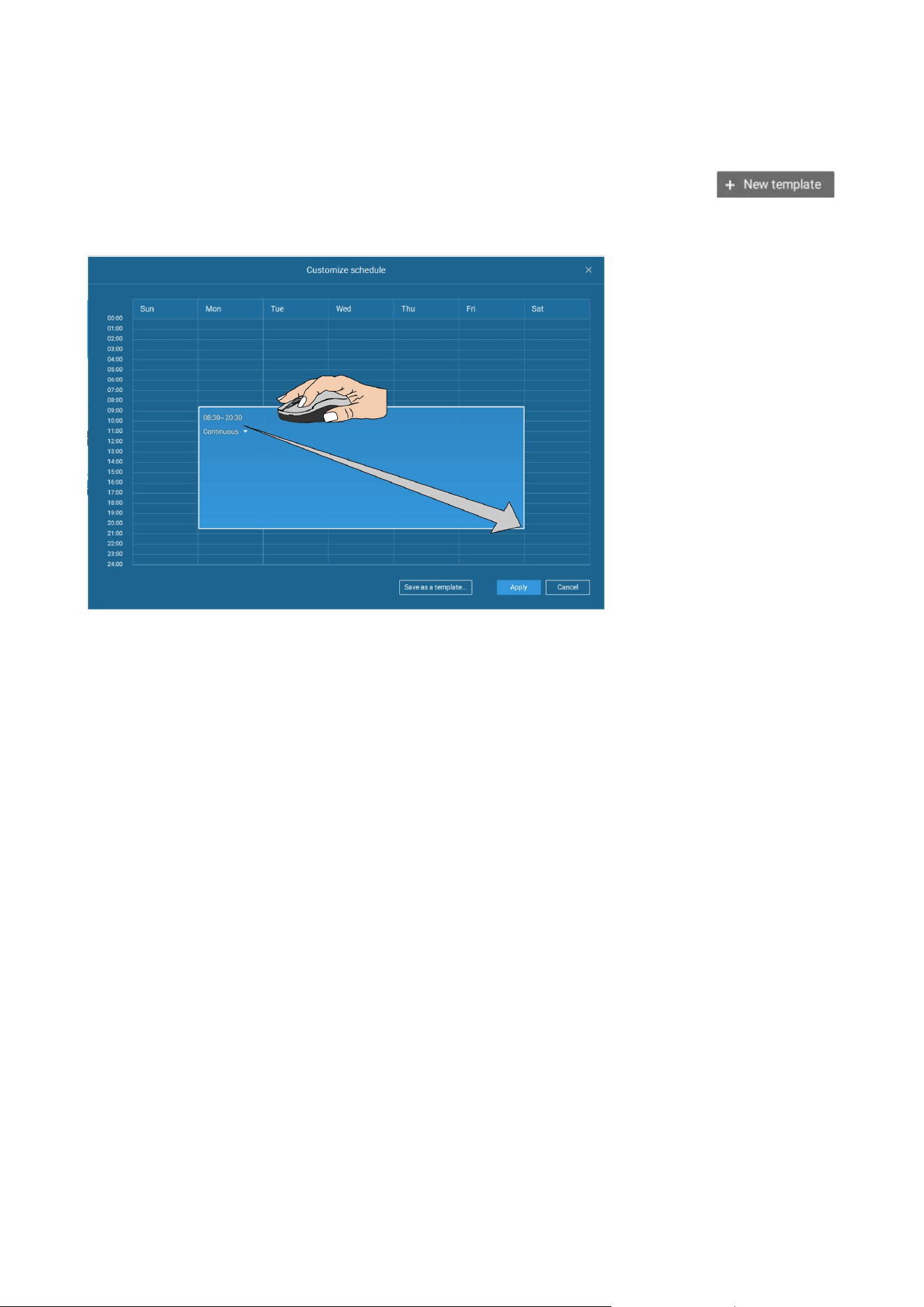
177
Click and hold down on the time cells, and drag the mouse to include the time span of your
preferrence. The minimum selectable unit is half an hour. You can select multiple time
spans on the template. Enter a name for the template, and click Add to save your template.
The same configuraion window apply to both the Schedule template and the customize
schedule windows.
Make sure a Schedule mode is selected when you leave this configuration step.
Click on any of the options on the Schedule panel for a recording option: Continuous
recordings, Events only, None, or Customize.
You can manually create a recording template using the New template
button.
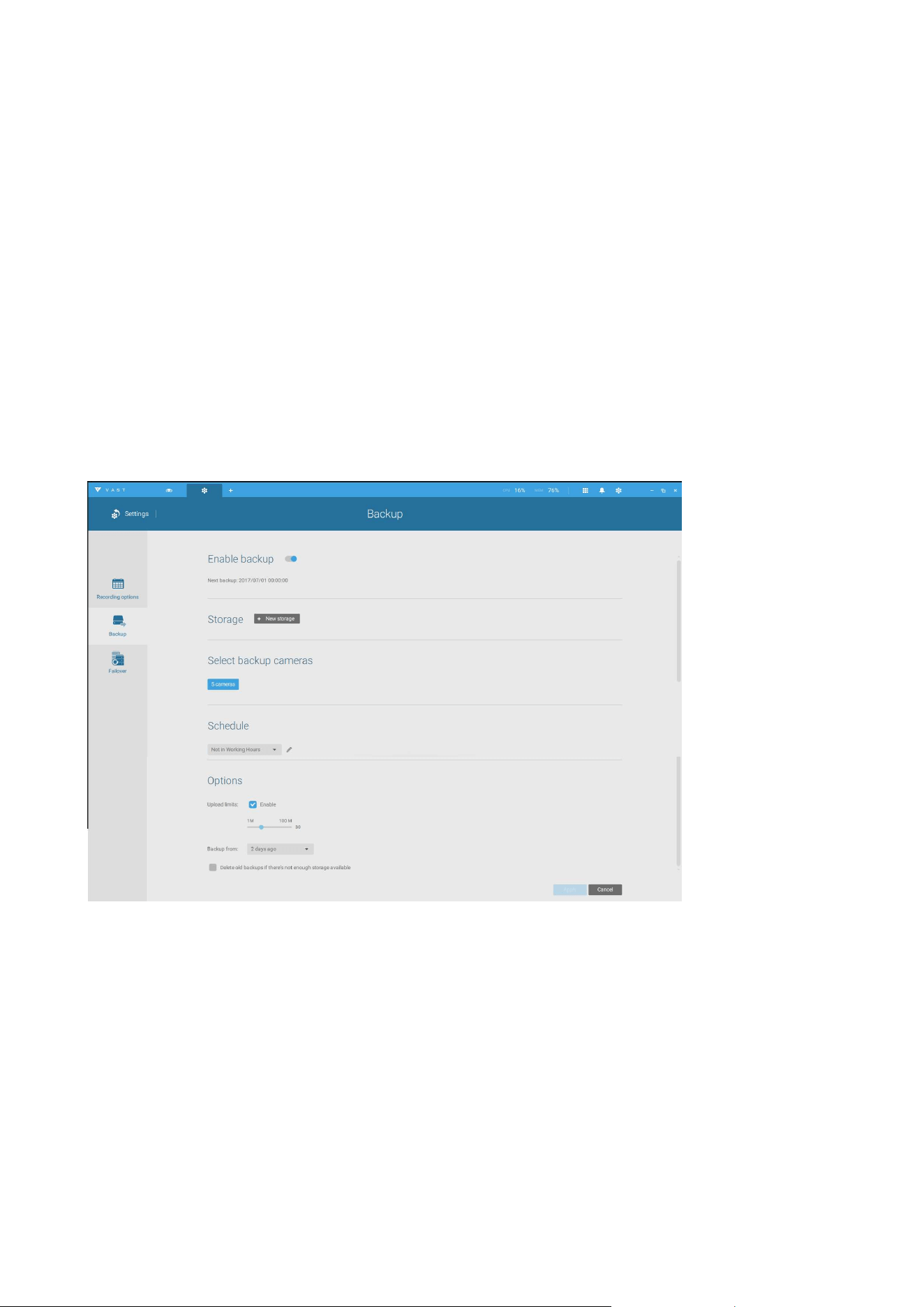
178
4-5. Settings > Recording >
Backup
The Backup function allows you to regularly back up the video recordings of one or multiple
cameras to local hard disks or a Network Attached Storage device. Currently, the VAST2
server does not support backup to external storage devices such as a storage devices
connected via Fibre Channel. VAST supports backup to an external storage attached
through a USB 3.0 connection.
Note that the alarms associated with individual cameras will not be backed up.
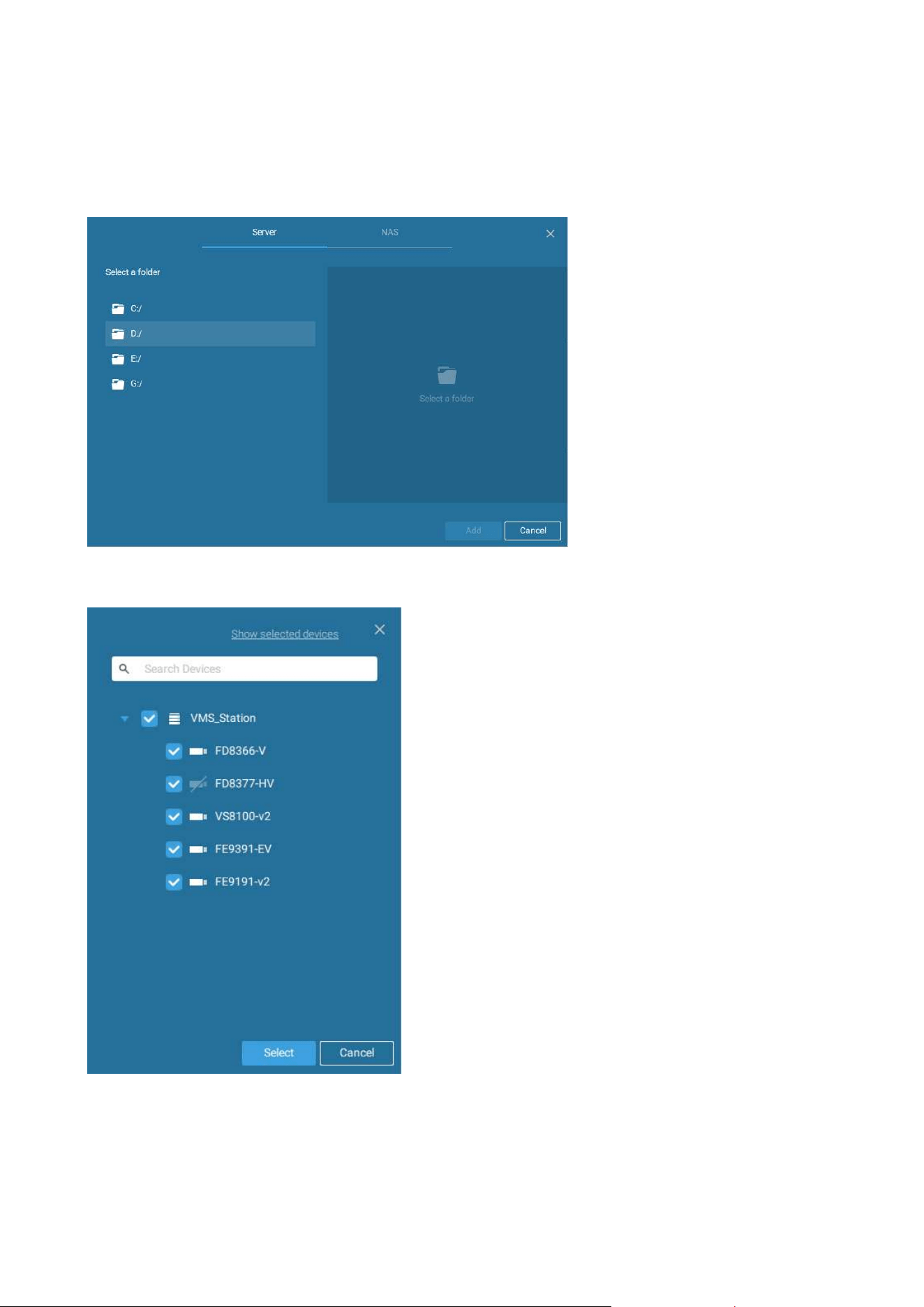
179
To enable a backup schedule,
1. Enable the backup by selecting the "Enable backup" slide switch.
2. Click to add New storage. A configuration window will prompt showing all accessible
storage. Click the NAS tab to enable access to a network share.
3. Select the cameras whose videos will be backed up.
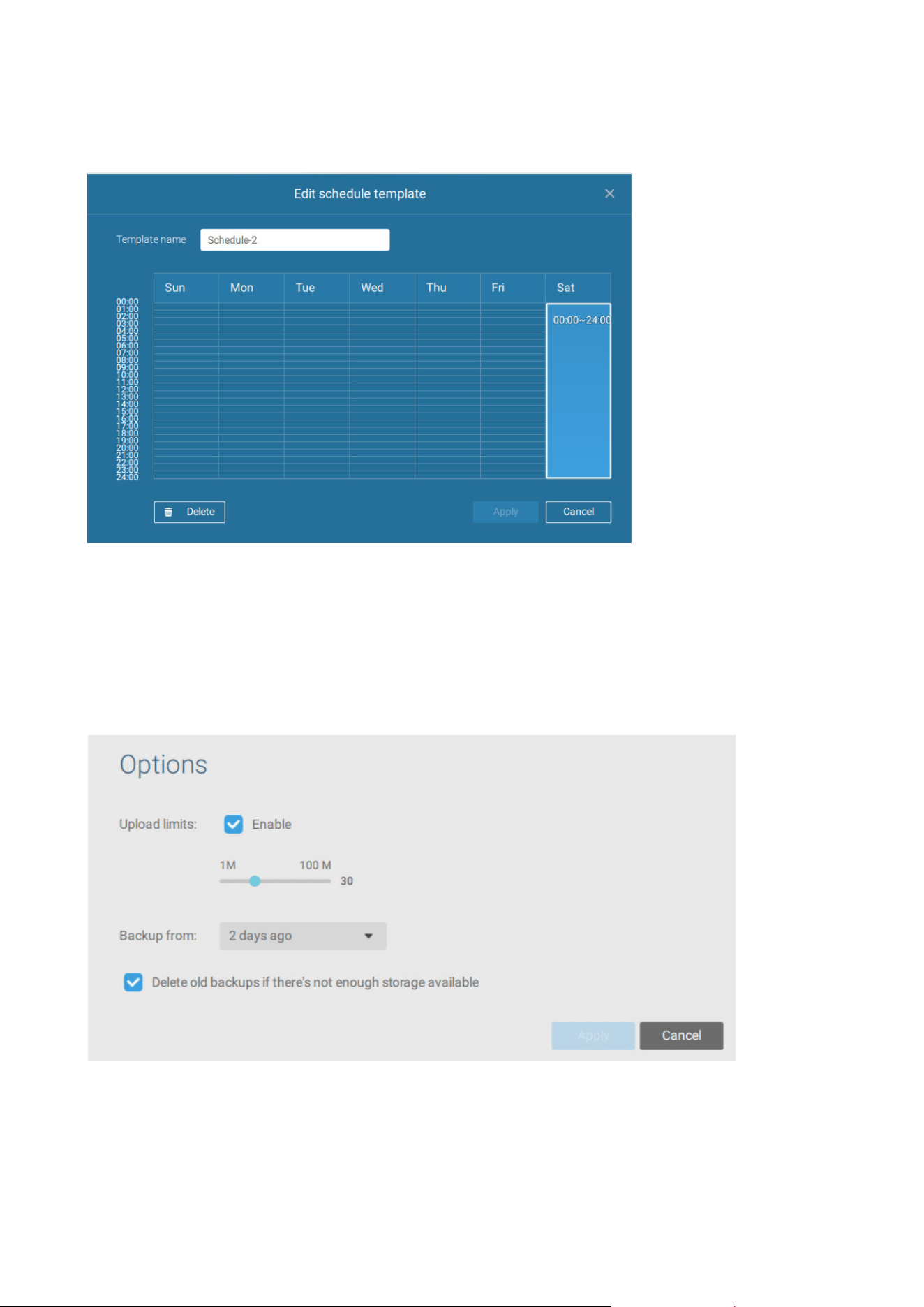
180
4. Select or congure a new schedule template for the backup process to take place. You
can select a time when the network load is low, such as the off-ofce hours, to avoid
network congestions.
5. On the Options pane, you can congure an upper bandwidth threshold (in Megabytes)
for the backup operation (for all selected cameras/channels).
You can select the extension of time, such as starting from how many days ago, of
your backup task. You can select to remove old backups when you run short of storage
volume.
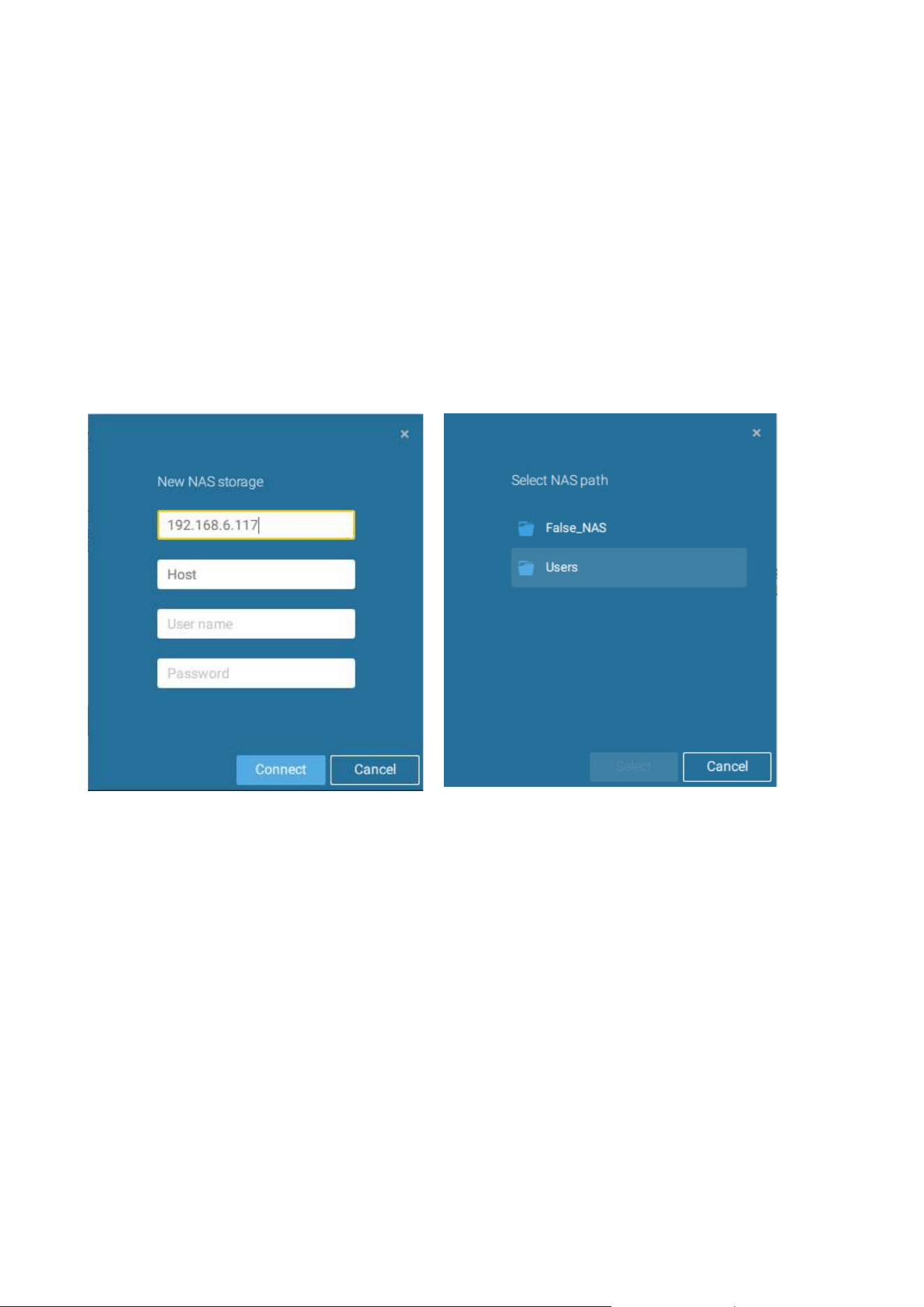
181
Storage
By default, VAST will check if there is a D: drive. If not, system drive C: will still be defined
as the first storage option. Other disk drives in the system and the default storage volume
(configured in the initial setup) will be listed.
You can add a NAS storage's shared volumes as the additional storage option. Enter the
necessary information for access to a network share. Enter and select a NAS path. The
share will then be available for video recording.
Select storage volumes each by a single click.
Click Ready to use to continue.
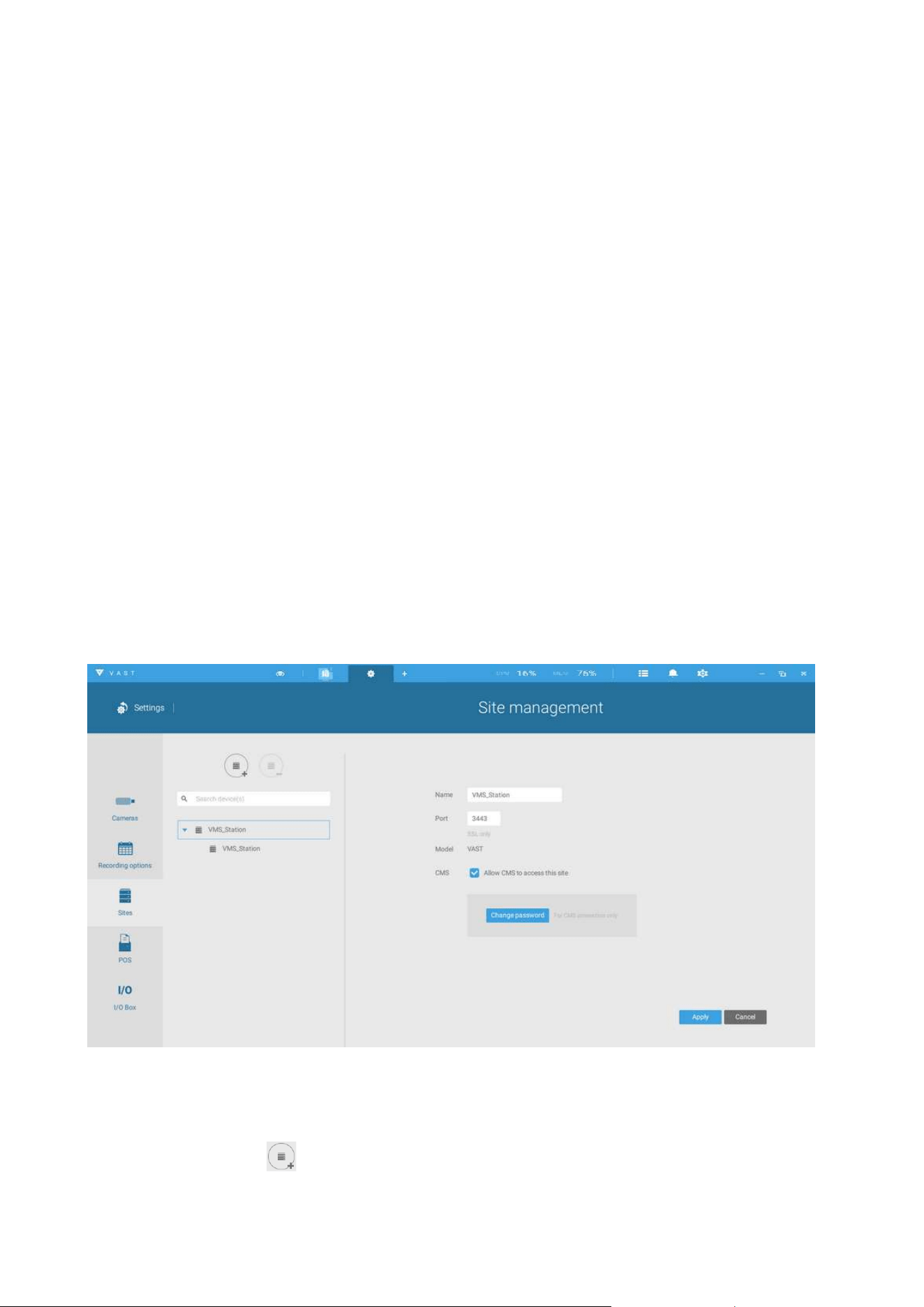
182
4-6. Settings > Device >
Sites
The VAST2 allows a deployment consisting of multiple VAST instances at different sites.
A VAST server can be selected as the CMS (Central Management Server) to manage sub-
stations in a hierarchical structure.
Each individual VAST station manages its own surveillance deployments. To build a
hierarchy, proceed with the following:
1. Open the VAST 2 client on a sub-station.
2. Enter Settings > Sites.
3. Enter a TCP Port number if your network configuration requires a different port.
4. Select Allow CMS to access this site.
5. Click Change password. This password will be used to authenticate the connection
between a CMS VAST server and sub-stations.
6. Click the Apply button.
7. Open the VAST 2 client on the server chosen as the CMS.
8. Click the Add sites
button.
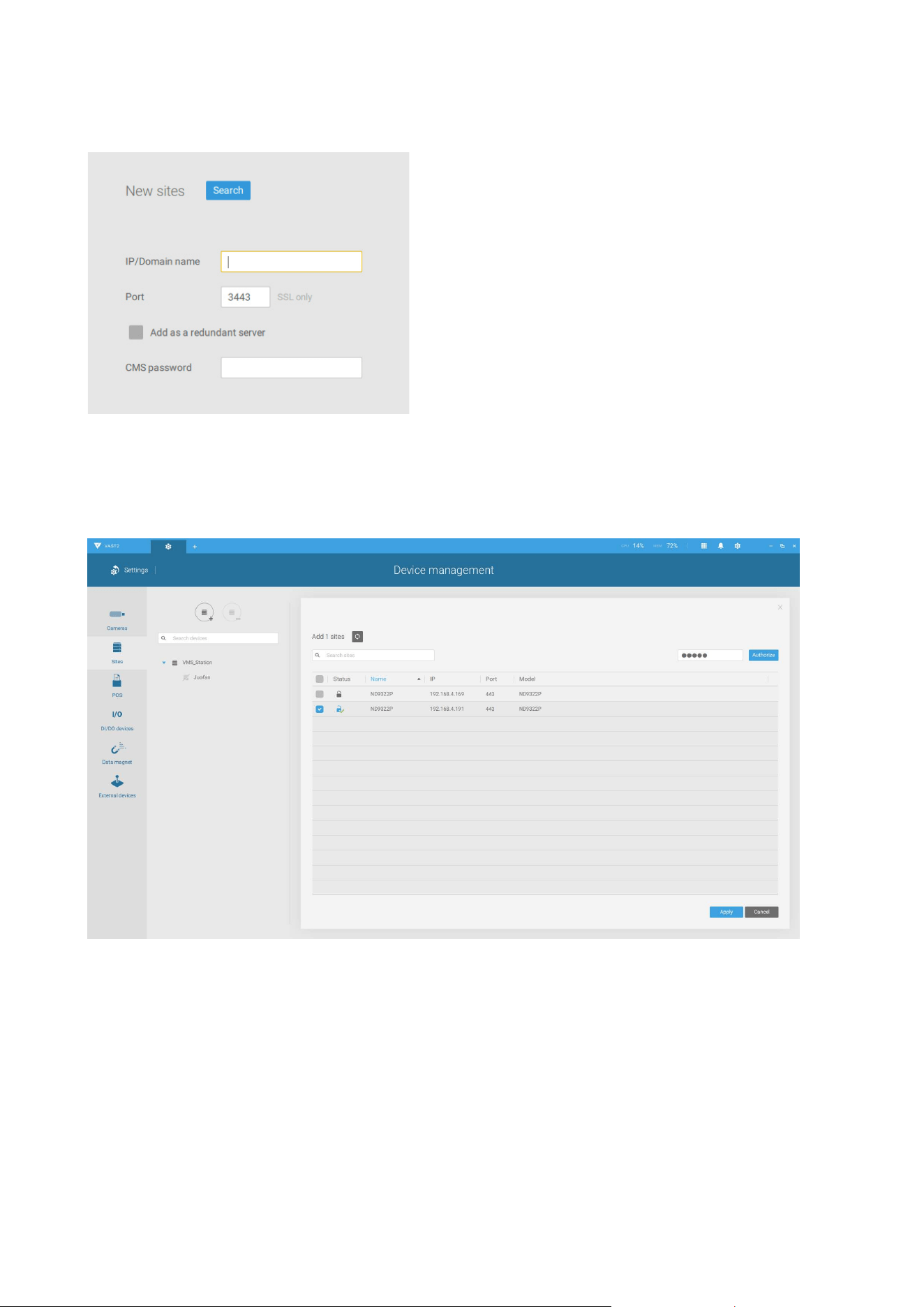
183
9. You can click the Search button if the sub-station is reacheable in a local network, or
manually enter the IP address and password for making the connection.
10. Enter the password you configured for the Sites configuration, and then click the
Authorize button.
Click the Apply button for the configuration to take effect.
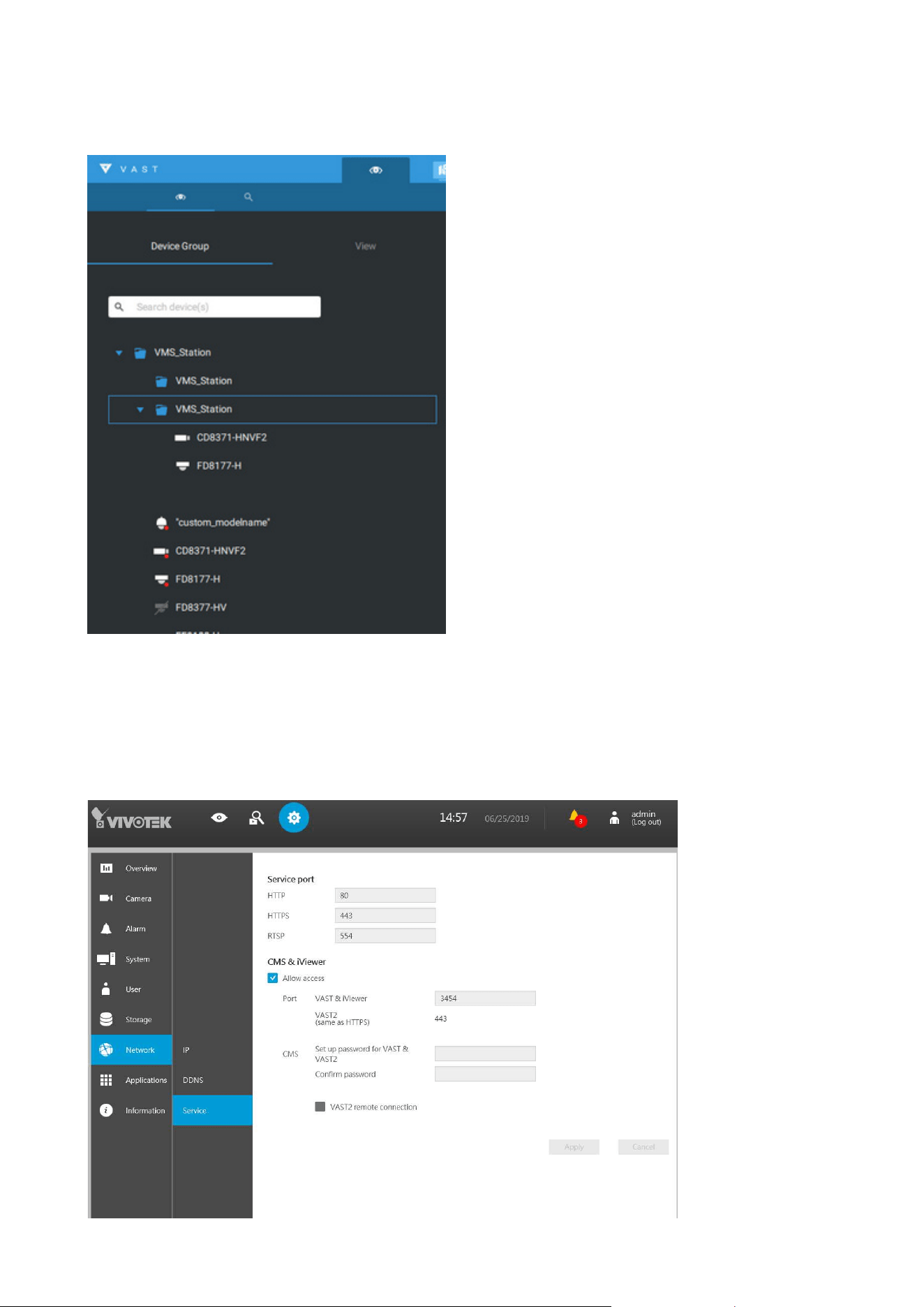
184
The sub-stations and its subordinate devices should be immediately listed under the CMS
station. You can create separate views to place the sub-stations' cameras.
When you want to enlist an NVR into your conguration, please remember to enable the
access from VAST server in the NVR's
Service
page.
The connection between VAST and NVR is made via encrypted https.
If the connection port is changed to a non-SSL port, the access from VAST to NVR will
fail. For adding the ND series NVR, use port
443
.
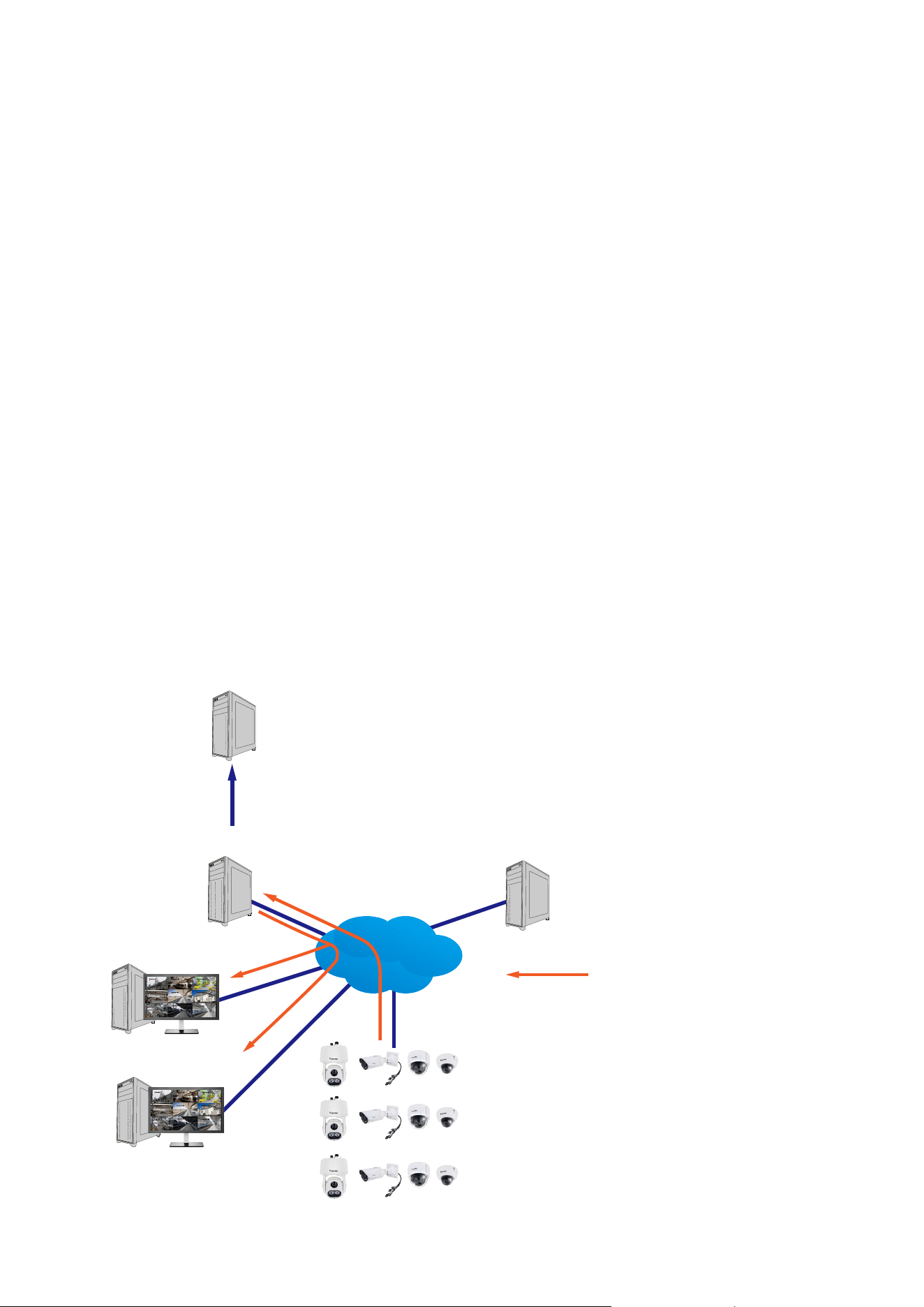
185
Multicasting
The VAST2 supports multicasting of live streams from server to clients. If multiple VAST2
clients demand live videos from the same camera, multicasting cna help save considerable
system resources.
Multicasting should be enabled on a VAST server and also on individual cameras.
There are prerequisites:
1. Both the VAST2 server and clients have to be revision 2.7 or above. If any of them is
running revisions before 2.7, client connections will crash.
2. Multicasting is not supported under the following conditions:
* A CMS local client can only access the live stream from the cameras managed by the
CMS server using unicast connections.
* If the need arises for access to cameras managed by VAST sub-stations, the
multicasting configuration should take place on the sub-stations instead of on the
CMS server.
CMS VAST2
LAN
Video streaming
Camera 01
Camera 02
Camera 03
Camera 04
Camera 06
Camera 05
Camera 07
Camera 08
Camera 09
VAST2 Client
Camera 01
Camera 02
Camera 03
Camera 04
Camera 06
Camera 05
Camera 07
Camera 08
Camera 09
VAST2 Client
VAST2 Substation
VAST2 Substation
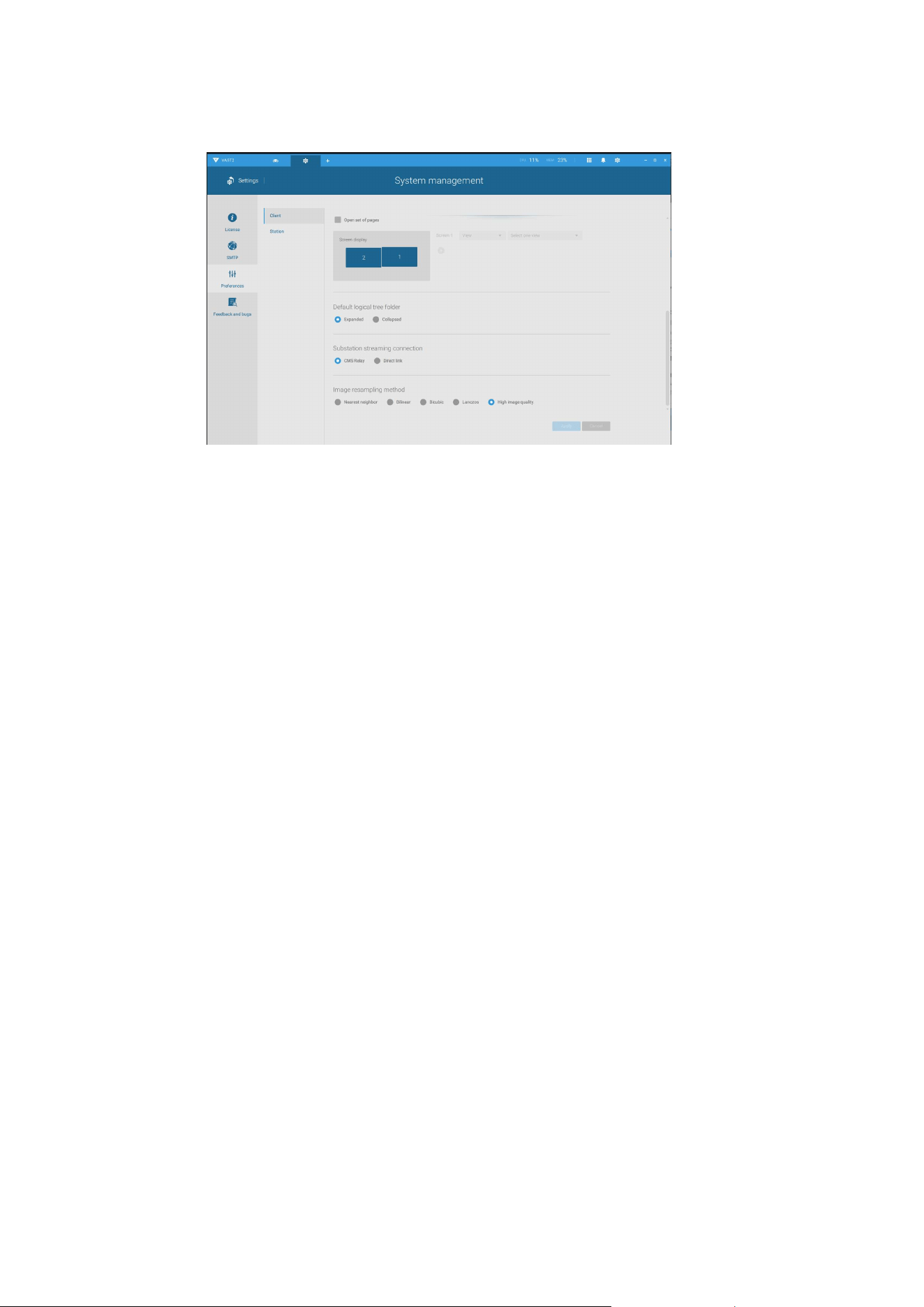
186
* To enable multicasting, your network infrastructure must support the IP multicasting
standard IGMP (Internet Group Management Protocol). Your server and clients should
be on the the same network segment.
* Multicasting is only possible for live streams, not applicable to the recorded video or
audio.
* Multicast streams are not encrypted, even if the the recording server uses encryption.
* The IPv4 multicast address range is: 224.0.0.0 to 239.255.255.255.
* A layer 2 network switch that supports IGMP is required in the configuration.
* If the streaming connection for a sub-station is configured as
CMS Relay, you should
configure the multicasting settings on the CMS server.
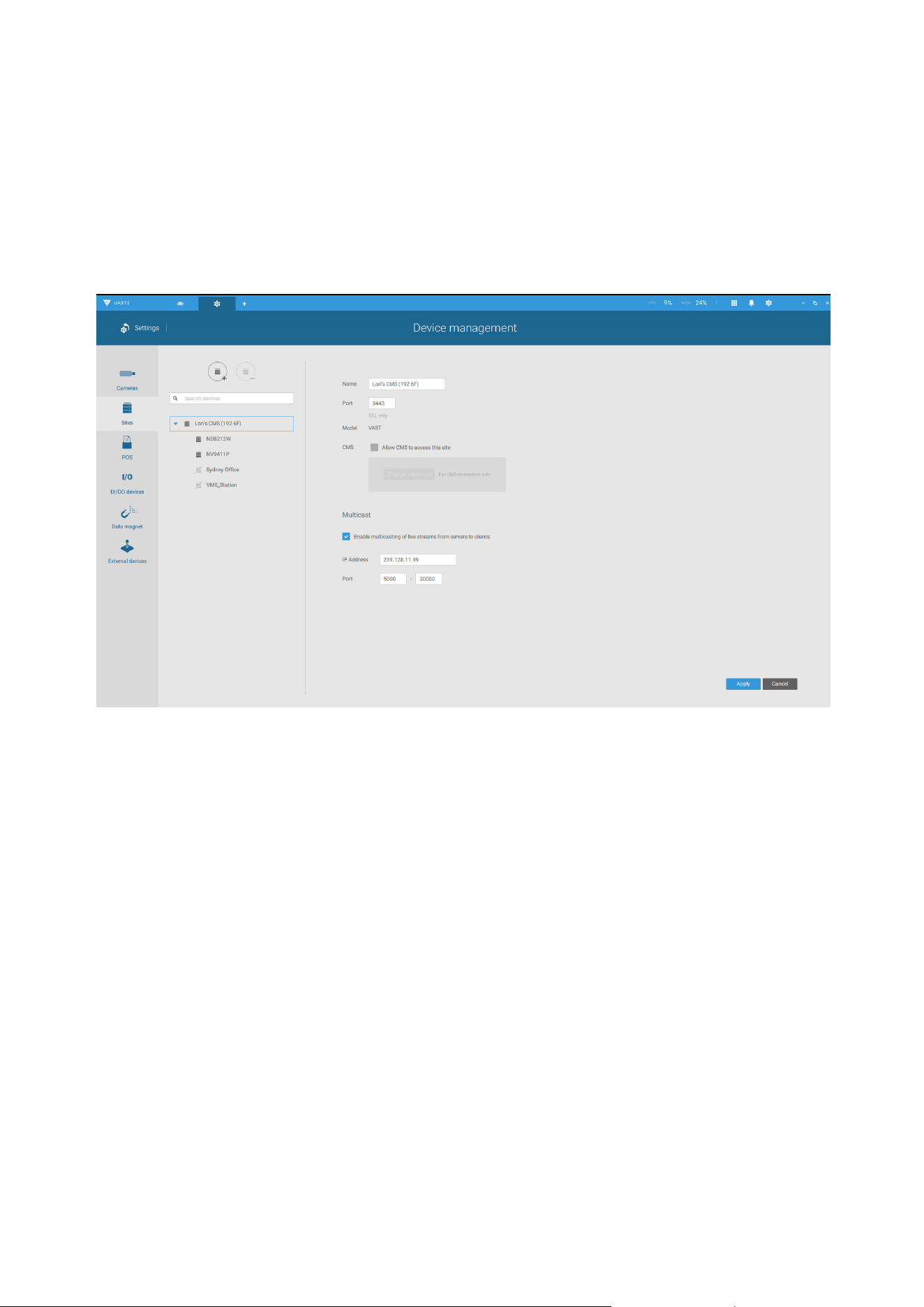
187
To enable Multicasting on a VAST server:
1. Enter Settings > Device > Sites.
2. Single-click to select a server for which you want to enable the Multicasting.
3. Click the checkbox to enable the configuration and enter the multicast address.
4. Click the Apply button.
Starting the Multicasting service will restart the VAST server.
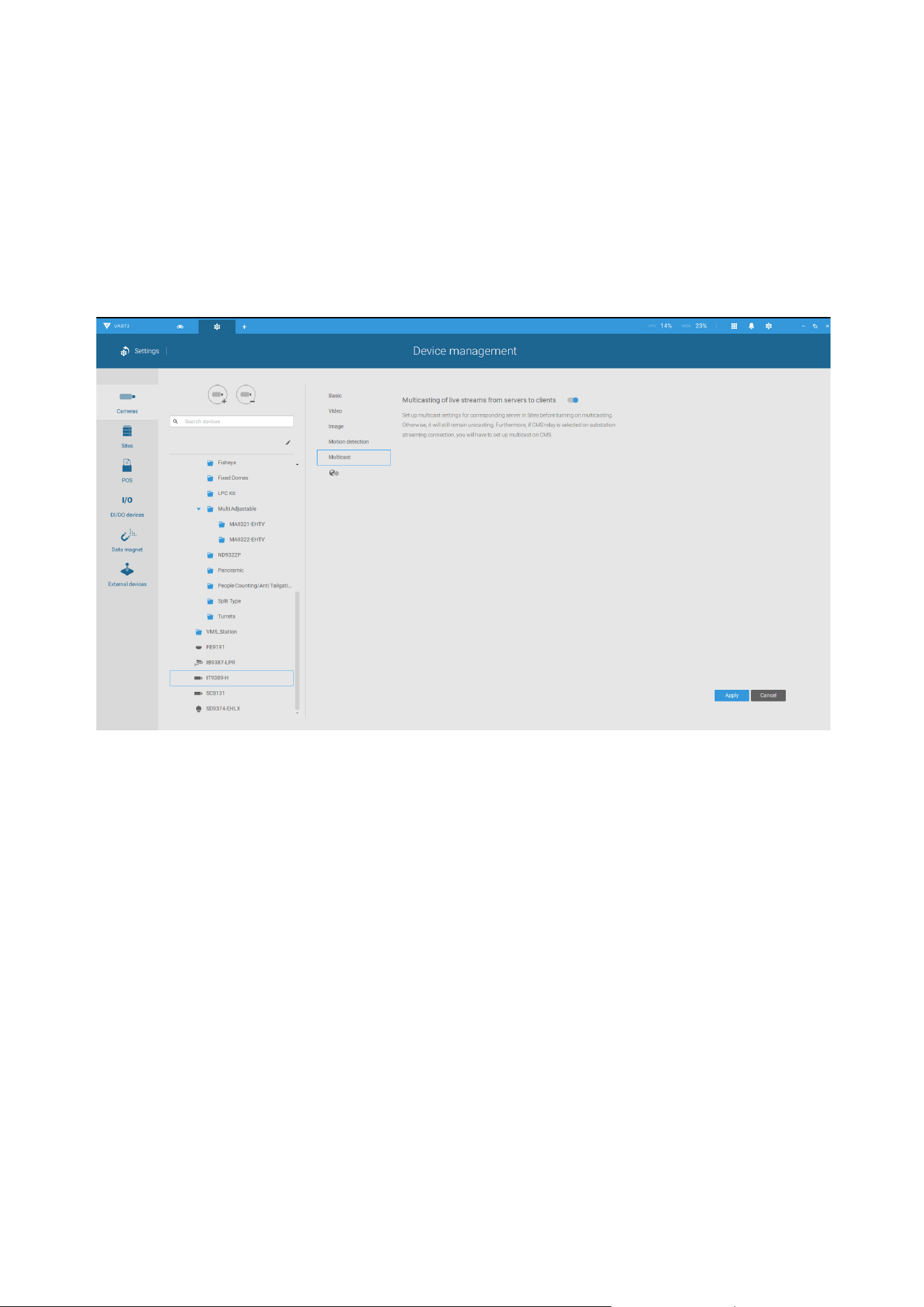
188
To enable Multicasting on a camera:
1. Enter Settings > Device > Cameras.
2. Single-click to select a camera for which you want to enable the Multicasting.
3. Click to select the Multicast tab.
4. Click the Multicasting slide button.
5. Click the Apply button.
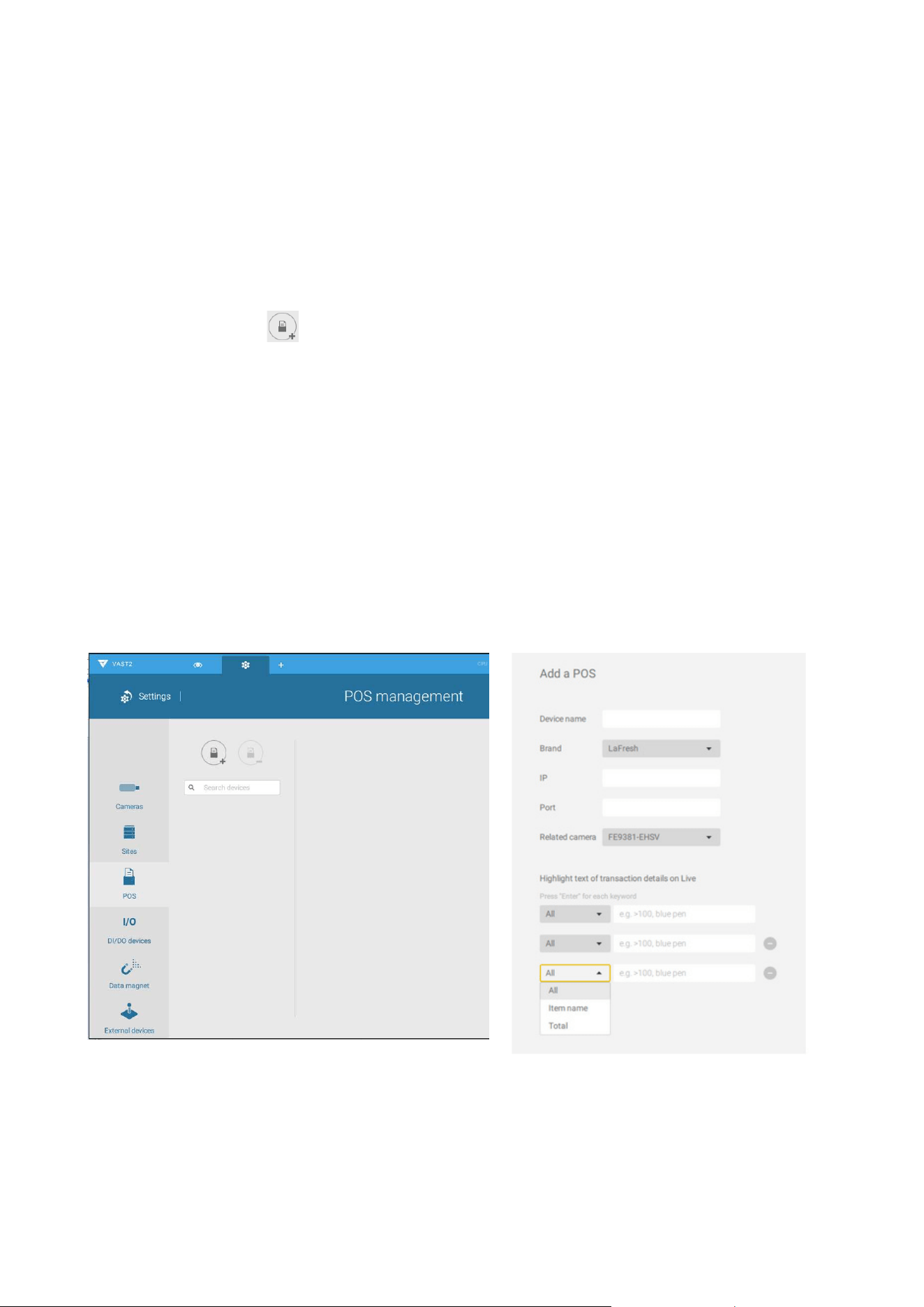
189
4-7. Settings > Device >
POS
To connect a POS machine, make sure the POS machine is connected to the local network.
Click on the Add POS
button.
1. Enter a device name, such as "POS on the 1st floor counter."
2. Select the POS brand name. Currently VAST2 supports Lafresh, POSNET, Gulfcoast(POS
Gateway).
3. Enter the IP address assigned to the machine.
4. Enter the TCP port number utilized by the POS machine for network connection.
5. Select a related camera whose video feed will be used to display POS transaction data.
This is the camera which covers the customers and cashier.
6. Enter specific item name or a total amount exceeding a high threshold, such as using
>100 as a threshold. You can enter multiple highlight conditions using the add button
below. The highlighted entries will be displayed in bright font colors on screen.
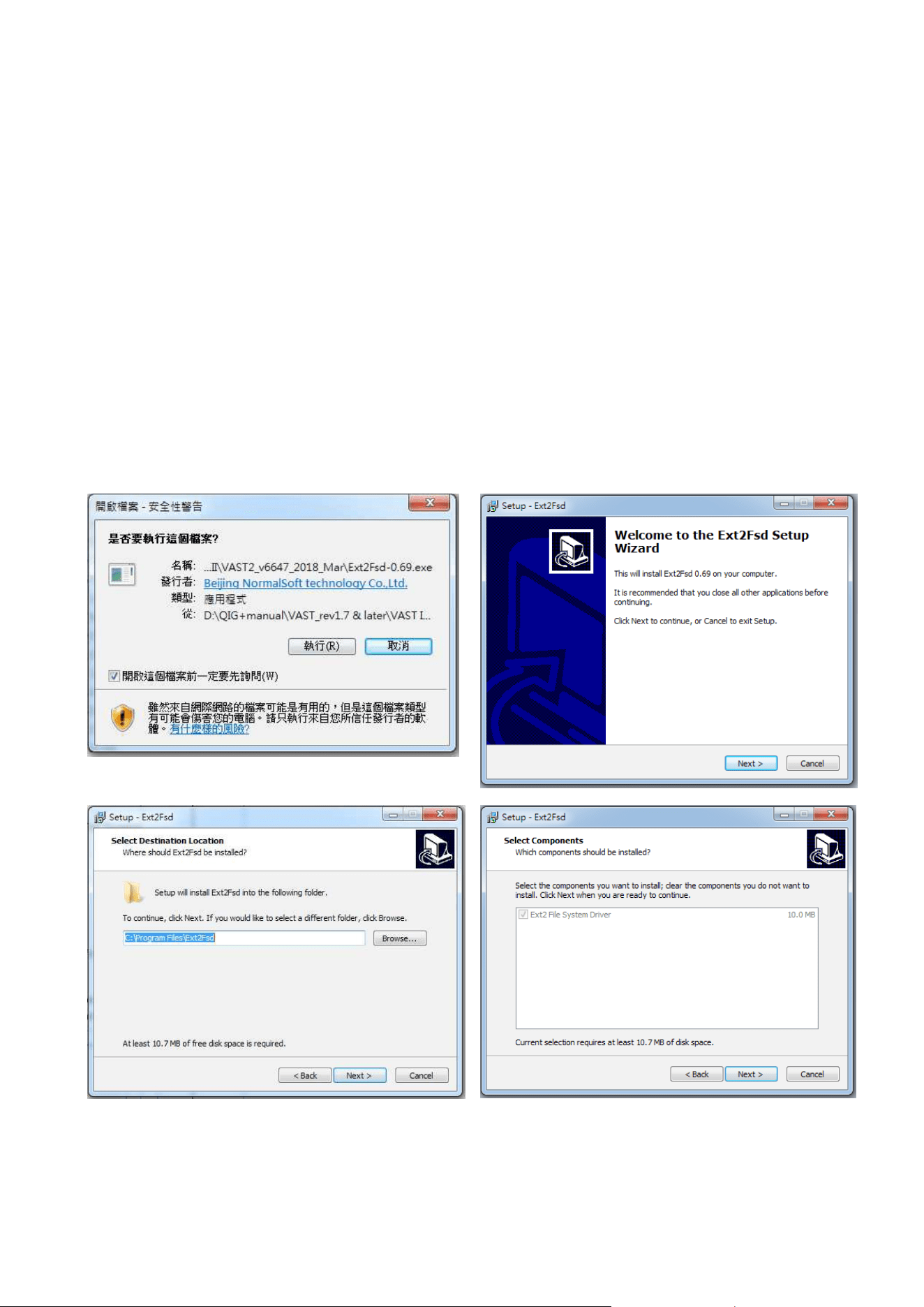
190
4-8. Settings > Device >
Local DB
Since some of VIVOTEK's NVRs run on Linux, you have to install the Ext2 File System Driver
for Windows to access the recording files from a NVR hard disk.
The file system driver can be found here: https://sourceforge.net/projects/
ext2fsd/?source=typ_redirect
Run and install the Ext2fsd-0.xx.exe. Follow the onscreen instructions to complete the
installation.
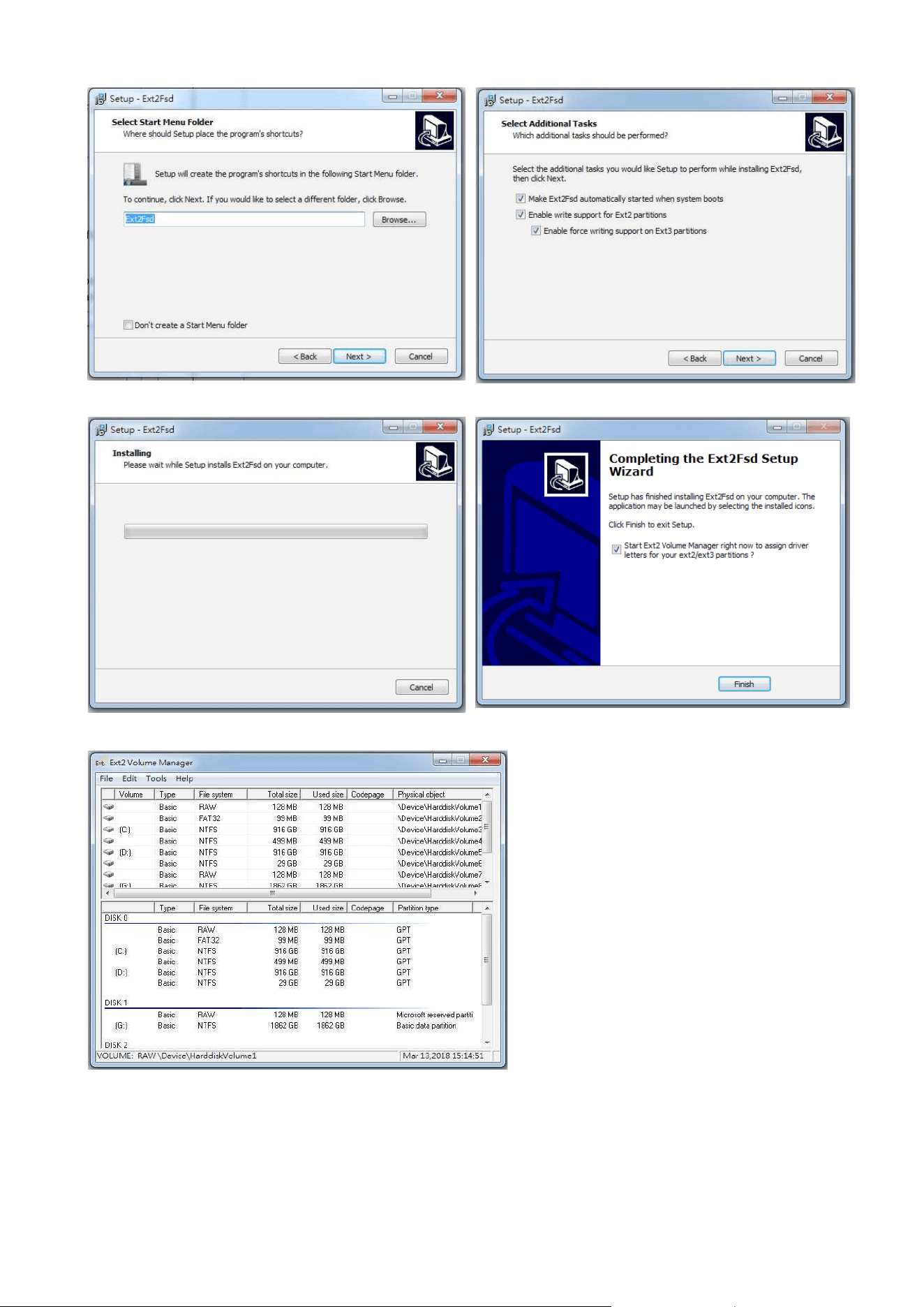
191
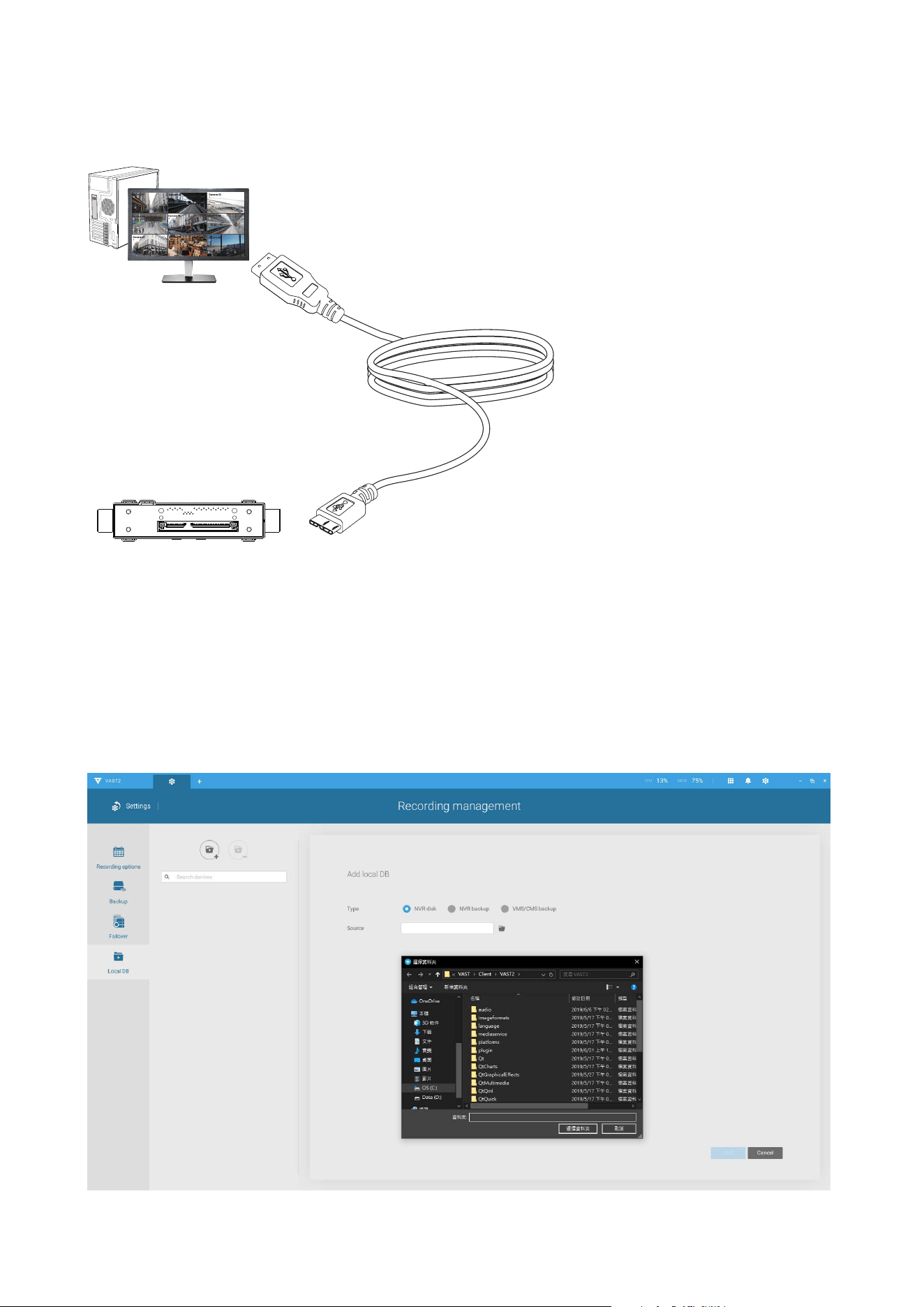
192
1. Remove the disk tray box from a mobile NVR.
2. Connect the disk tray box to your VAST server using a USB 3.0 type A to Micro B cable.
Camera 01
Camera 02
Camera 03
Camera 04
Camera 06
Camera 05
Camera 07
Camera 08
Camera 09
VAST
USB Micro BMobile NVR
Disk Tray
3. From VAST, enter Settings > Device > Locabl DB.
4. There are 3 import types:
1. NVR disk: the drive tray box removed from a mobile NVR.
2. NVR backup: the recorded videos exported from an NVR using a USB thumb disk or
portable drive.
3. VAST backup: scheduled backup from the local machine. They include: VAST
backups from previous software releases, and scheduled backups.
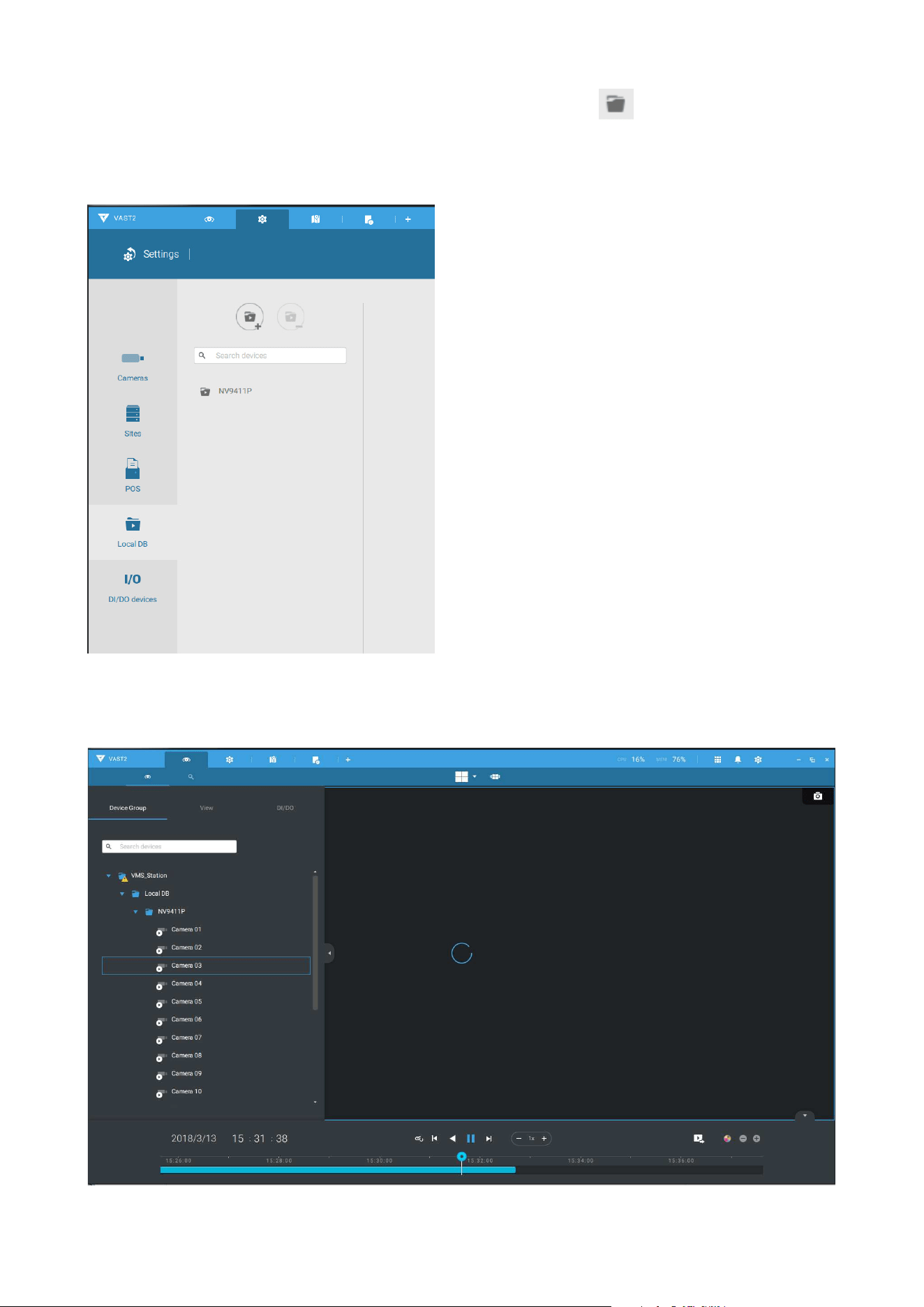
193
5. Taking a mobile NVR's disk drive as an example, click the Source select button to
locate the disk drive.
6. The NVR will be mounted as a local DB.
7. A Local DB sub-tree will be listed under your server, and you can view the existing
recordings on the NVR's disk drive.

194
4-9. Settings > System >
SMTP
Configure a mail server via which the system alarms or notifications can be delivered to a
receiver.
Enter the Settings page, select . Click on the Add SMTP button.
Enter your mail server's domain name or IP address. Enter credentials for access to the
mail service.
If SSL encrypted transmission is preferred, select its checkbox.
Click Add to complete the configuration.
4-10. Settings > IO Box and
Related Configuration
Please refer to page 123 for information.
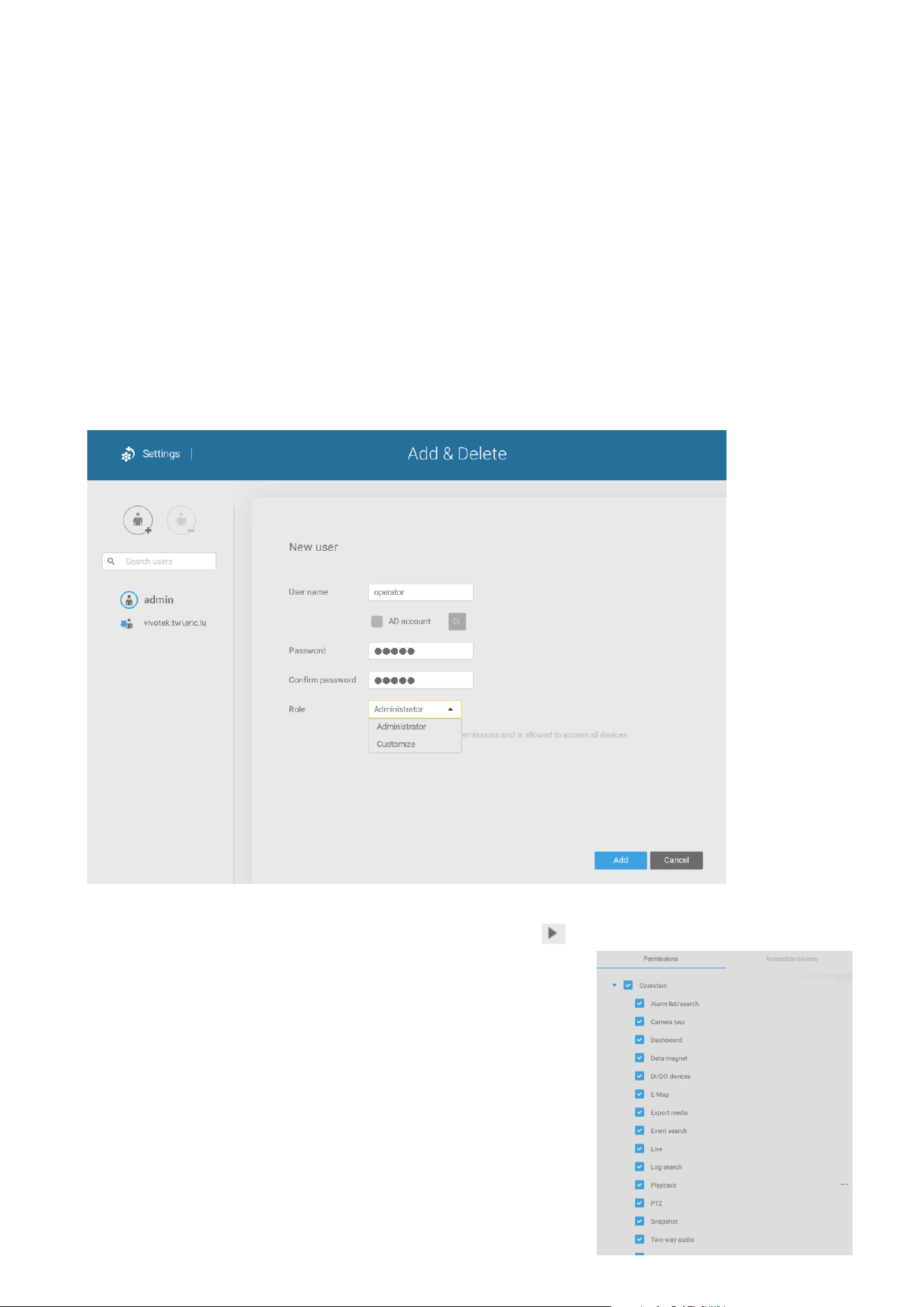
195
4-11. Settings > User
Management
The User Add & Delete page allows you to create users with the permissions for different
operational capabilities.
To specify the authorized privileges, select Customize in the Role menu, then select the
Permissions and/or the Accessible devices tabbed menus.
Use the Customize option to limit the authorized actions of a user.
In the Permissions tab, click the expand button
to unfold the Operation and
Configuration menus. Select or deselect the checkboxes to
configure the user privileges. For example, you may not want
a user to operate Alarm and E-Map. If so, deselect these
checkboxes.
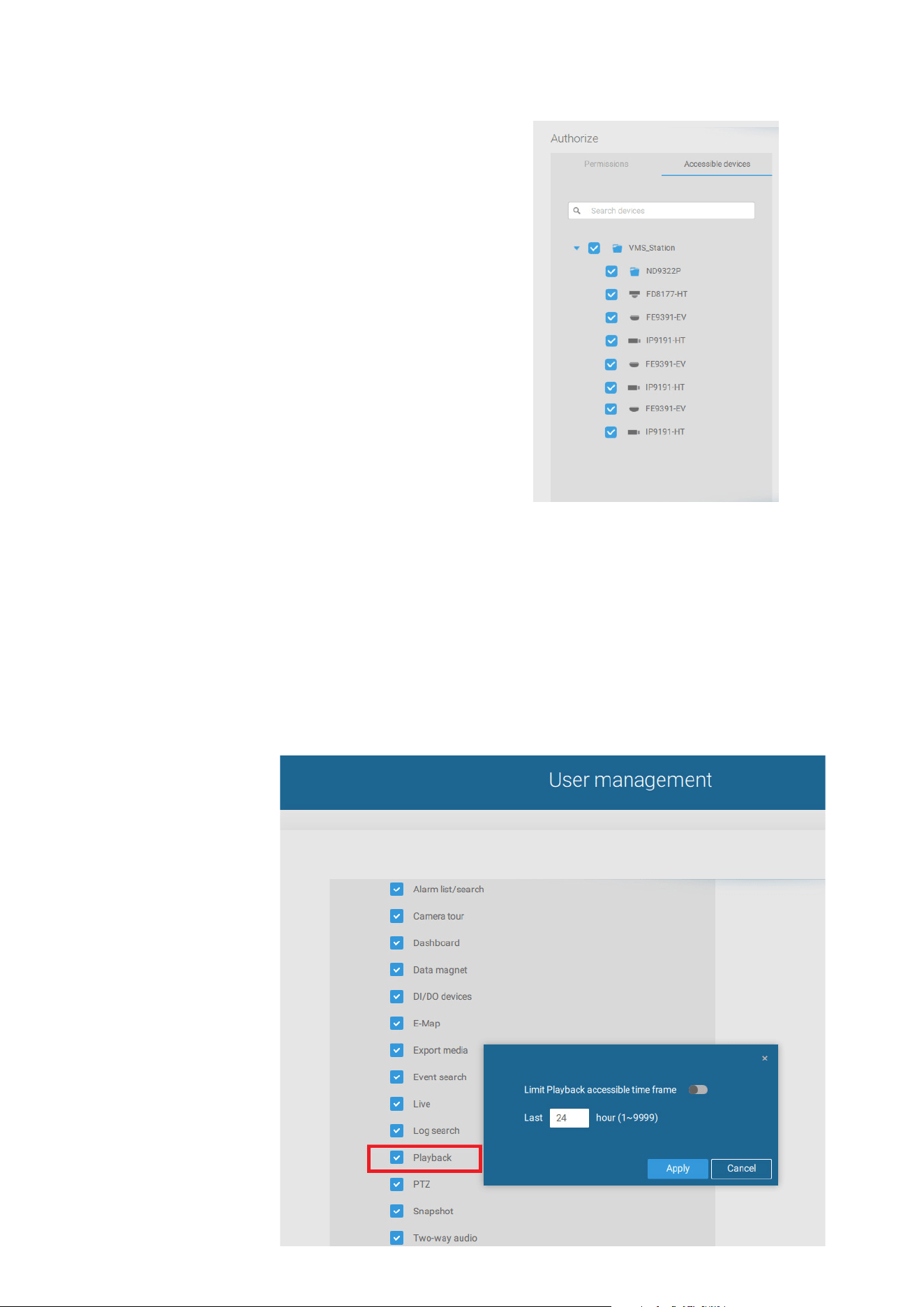
196
When done with the privilege settings, click Add to create a new user.
The new users will be listed under the Administrator's icon. Repeat the process to create
more users.
In the Accessible devices tab, click to select the cameras that a user can access. Some
users may only need to access specific devices.
Note that you can place a limitation on a user's access right to the recorded videos by
setting a barrier for access to the older recordings. Recordings older than a configurable
period of time will not be accessible.
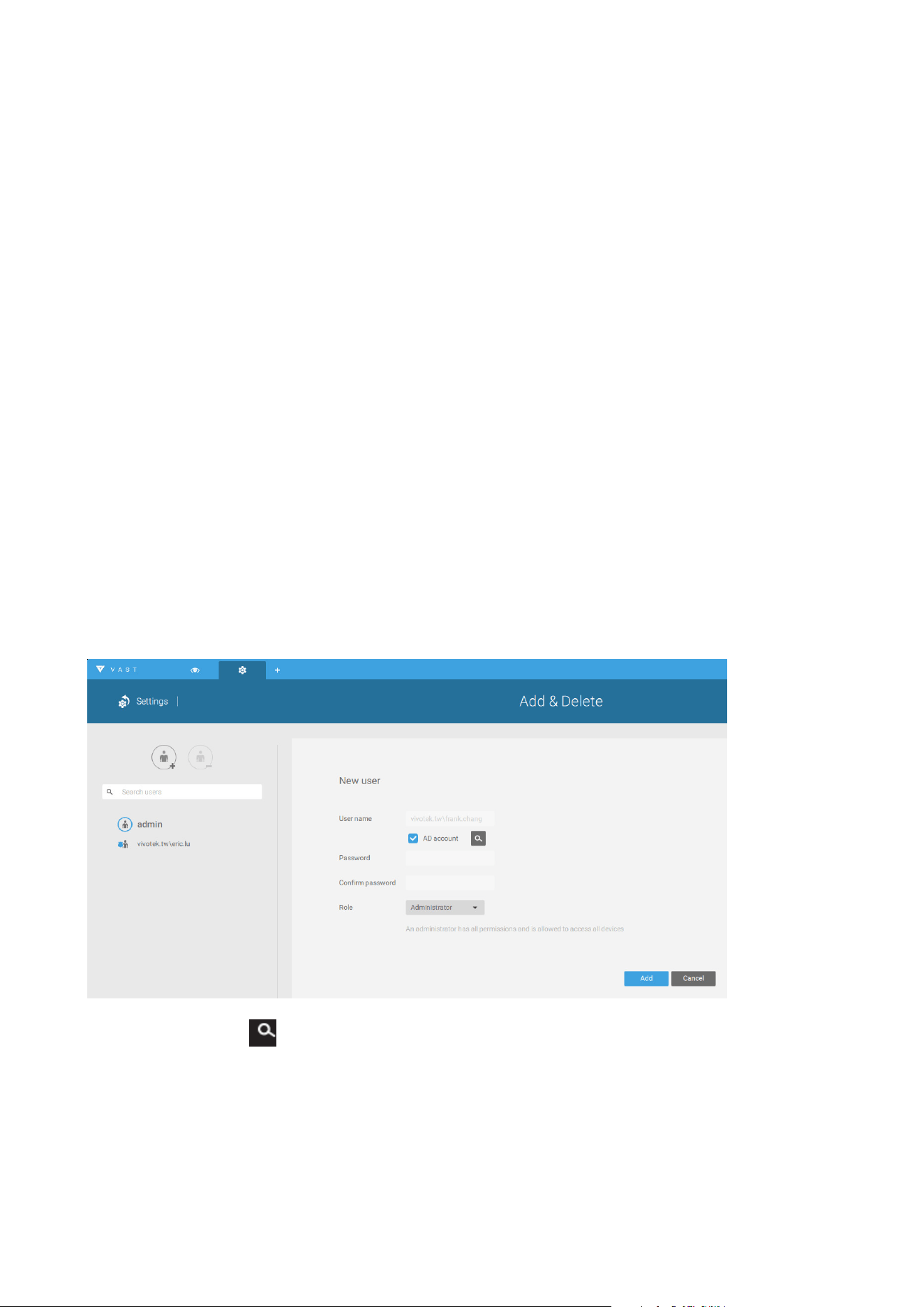
197
Add a New User Account - Windows AD Account
In an established, enterprise network environment, the support for Windows AD (Active
Directory) infrastructure enables ease of integration using the credentials of existing users.
Using the same AD authentication methodologies, you can configure the clients or users in
an established network to access the VAST server configuration.
Note the following with Windows AD support:
1. If you install VAST server on a Windows XP machine with Postqre SQL server, the login
using a Windows AD account will not work.
2. The VAST server must reside in a domain managed by the AD server.
3. This function does not support the environment that spans across multiple AD domains.
4. A user account hosted by an AD server cannot be modified in VAST.
5. A User Group and its members configured in AD cannot be managed in VAST.
6. You cannot add an account having the same name as one you used to log in VAST.
7. There are 3 types of account for VAST: VIVOTEK account, AD single user, AD group.
8.The userPrincipalName of your Windows AD account can be different from the
sAMAccountName. However, You can only use the sAMAccountName to login VAST 2.
9. The userPrincipalName field of your Windows AD account should not be empty.
To add an existing AD user,
1. Select the AD account checkbox.
2. Click the Search button.
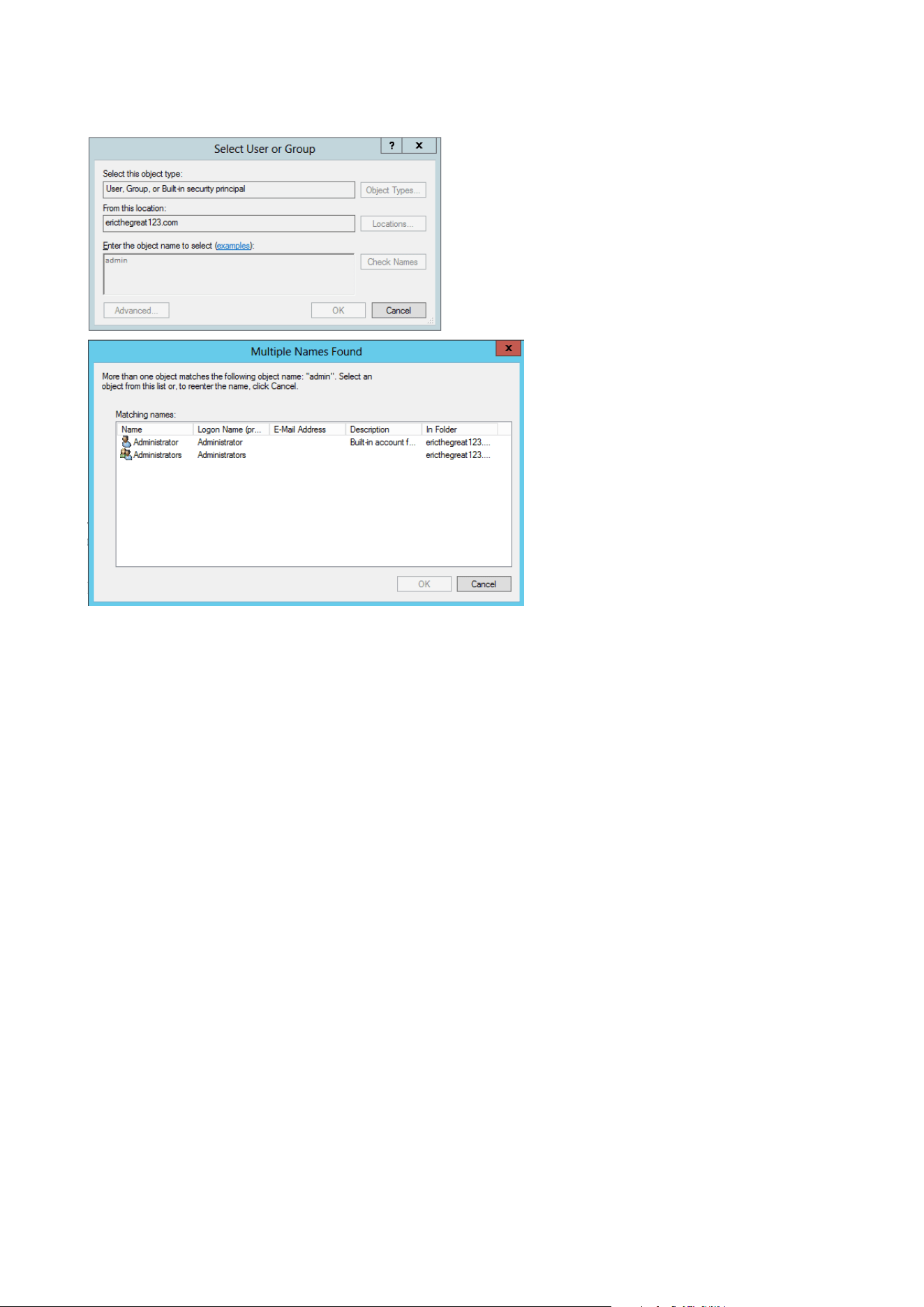
198
3. Enter a user name or group name to search, e.g., Frank. Click
OK
when done.
4. Enter the password twice for the AD user.
5. Select the privilege role for the user, congure his/her privilege settings as described
above and then click Add.
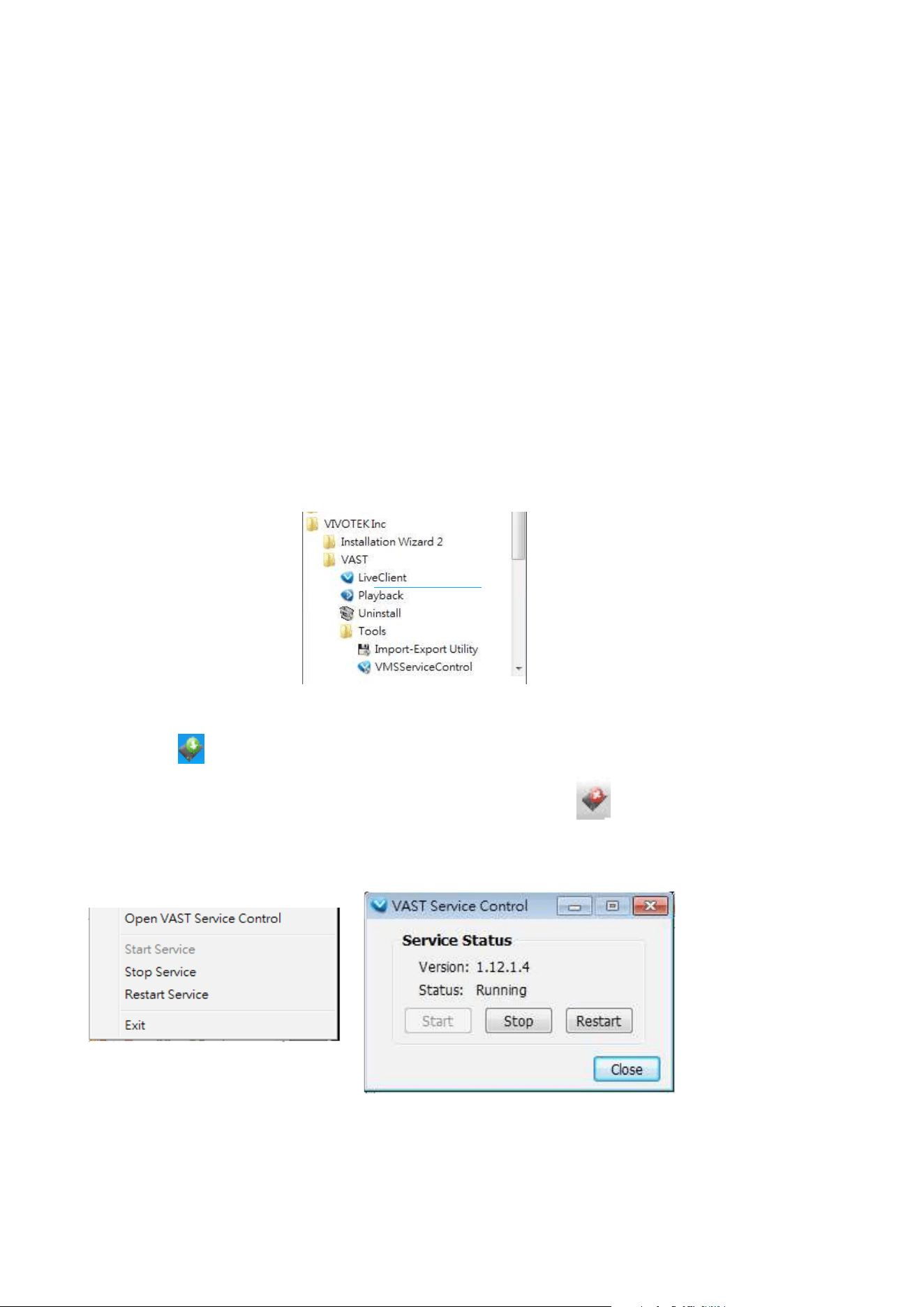
199
Appendix A: VAST Service
Control Tool
VAST service control tool is a tool for server control and for user to be aware of the VAST
Server status. It starts up as Windows OS startup.
Under Microsoft Windows, choose "Start > All Programs > VIVOTEK Inc > VAST > Tools >
VMServiceControl."
You may also find it in the system tray icon of the tool bar, which indicates that the service
is running:
It shows a disconnection icon when the service is stopped:
A menu for the service control tool will pop up when you right-click on the icon:
Here you can manually start, stop and restart the service.
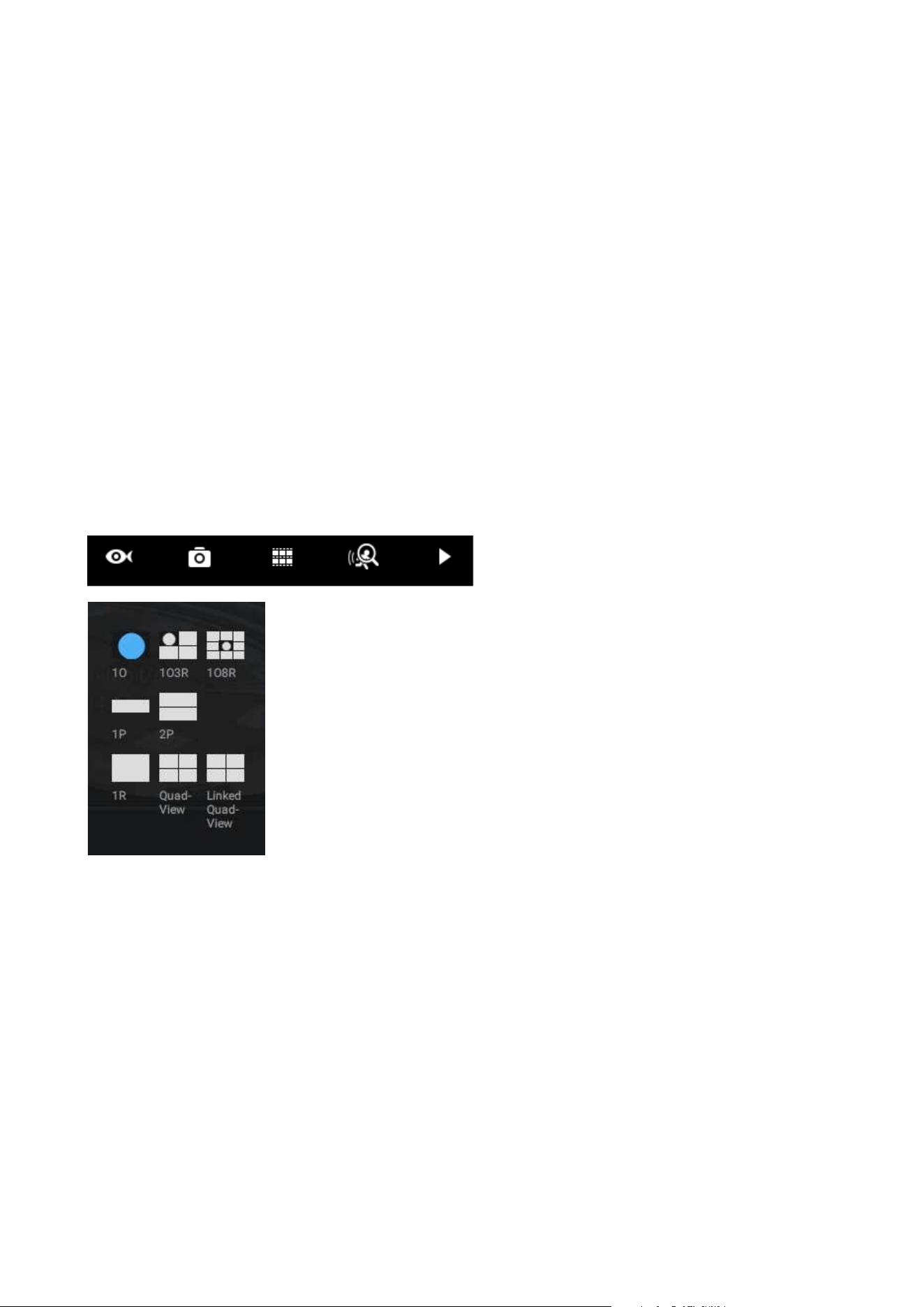
200
Appendix B: Fisheye
Camera Dewarp Modes
By default, a circular view is displayed when a fisheye camera is successfully connected.
To display Regional, Panoramic, or the combination of different views,
1. Mouse over the view cell of a fisheye camera.
2. The onscreen control panel will appear. Click on the Fisheye button.
3. The Dewarp mode pane will prompt. Select a dewarp mode.
The display modes available are: 1O (Original), 1P (Panoramic), 1R (Regional), 2P (2
Panoramic), 1O3R (1 Original & 3 Regional), 4R (Quad Regional), 1O8R (1 Original & 8
Regional), and 4R Pro (4 Proactive) modes.
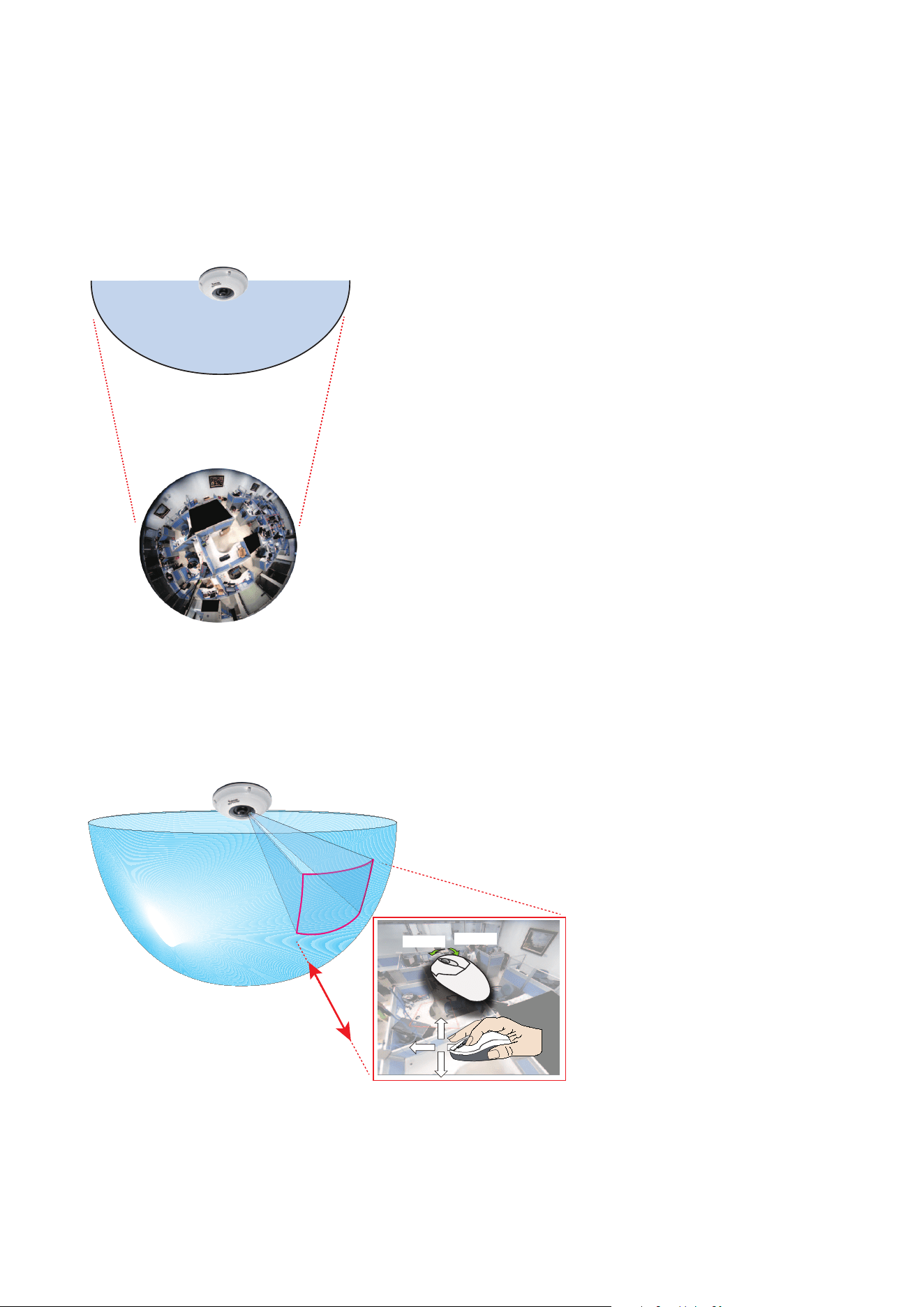
201
Fisheye Display Modes: below are conceptual drawings for different display modes.
1O View (Original View)
180° Hemispheric
1R View (Single Regional View)
Zoom in/out
&
all-direction
navigation control
Zoom In
Zoom Out
An Original oval view covers the hemisphere taken by the fisheye lens.
A Regional view crops a portion of the hemisphere as a region of interest. You can zoom in
or out or move the view area elsewhere from on the regional view.
A Regional view is dewarped, by correcting images from the distorted oval view to a
rectangular and visually proportional image.
1O (Single Original) Display mode:
1R (Single Regional) Display mode:
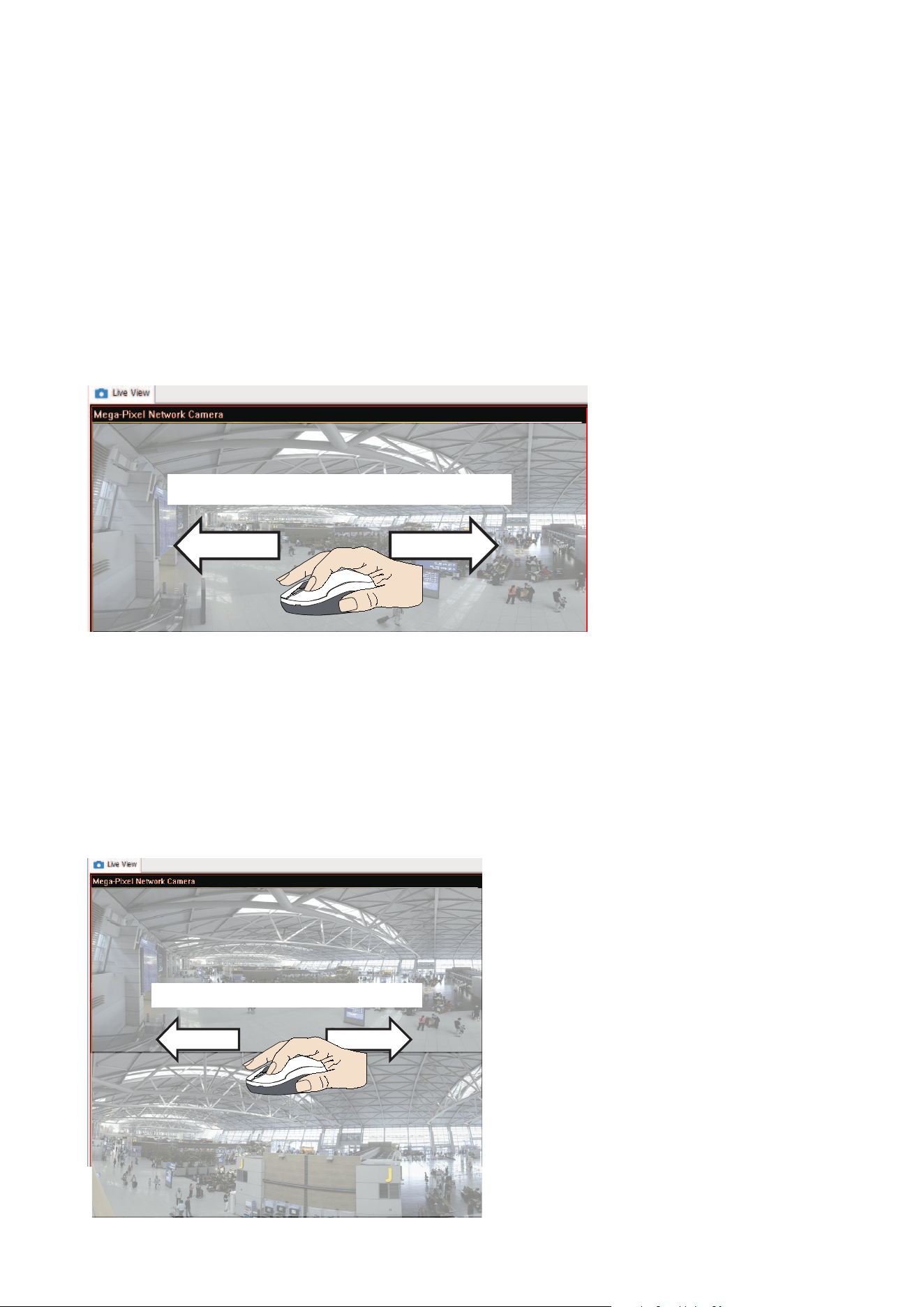
202
Swipe to scroll horizontally
1P (Single Panoramic) Display mode:
With image correction algorithms in firmware, the hemispheric image is transformed into
a rectilinear stripe in the 1P display mode. Viewers can use the PTZ panel or simply use
mouse control to quickly move through the 360º panoramic view.
Note that the 1P view is apt for an overview, the Zoom in/out function does not apply in
this mode.
1P (Panoramic) Mode Screen Control
Swipe to scroll horizontally
2P (2 Panoramic) Display mode:
Two dewarped rectangular views are placed one on top of another each showing 180
degree of panoramic view. The 2P view looks like the upper view shows the front of
hemisphere, and the lower view the rear half of the hemisphere.
2P (Panoramic) Mode Screen Control
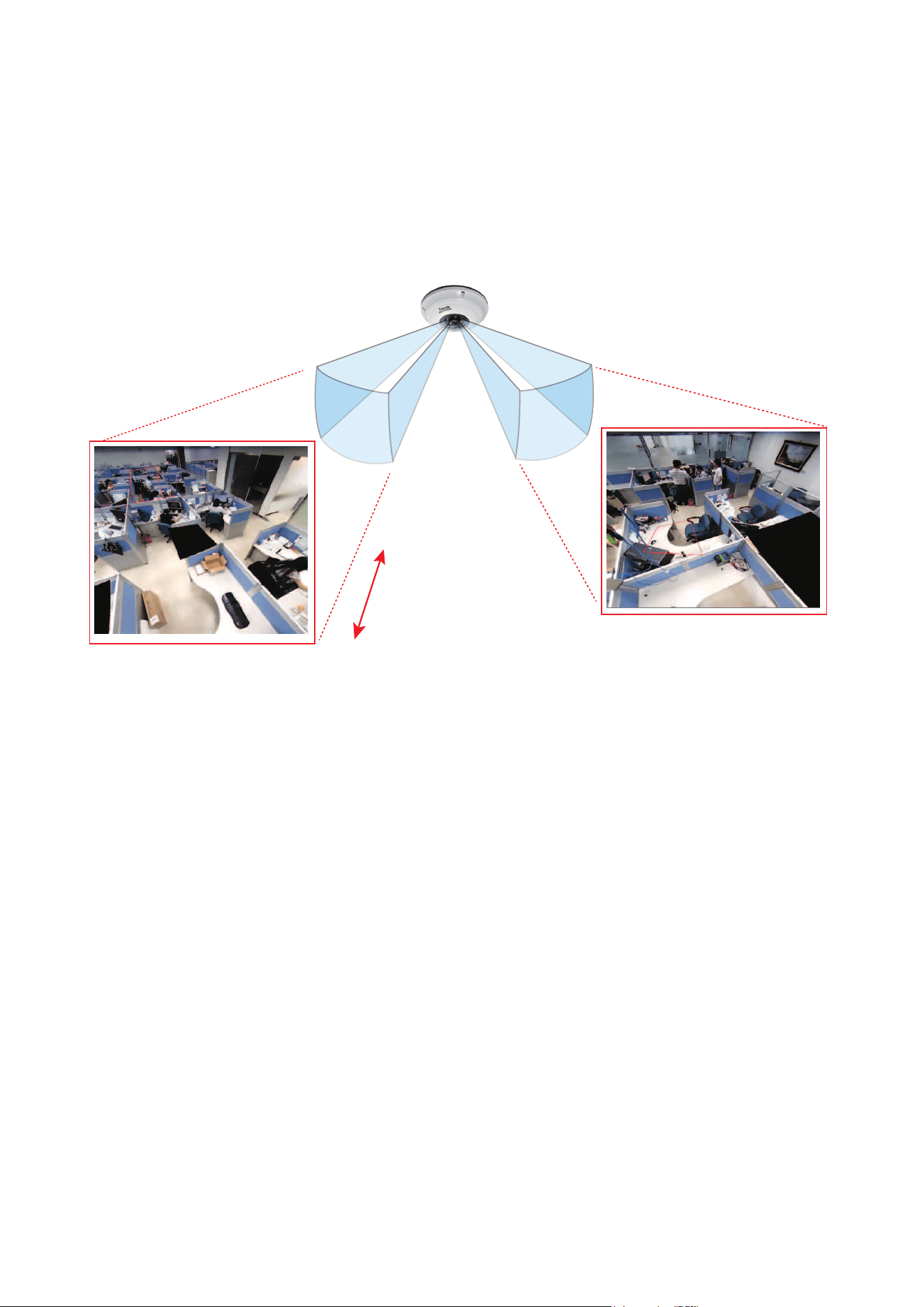
203
Zoom in/out
&
all-direction
navigation control
* Only two regional views are shown for simplicity reason
Fisheye cameras also support the display of multiple regional views taken from within the
same hemisphere, and they can be displayed with or without an Original view in its view
cell.
3R View (Regional View)
1O3R (One Original & 3 Regional) Display mode:
NOTE:
The various display modes require the support of D3D technologies by your display card
on the LiveClient or Playback station. Most off-the-shelf display cards today support this
feature.
The onscreen mouse control is very agile. Therefore, use the PTZ panel for more delicate
moves in a field of view. Pan and Patrol moves are also supported if you have configured
preset PTZ positions in the camera's firmware. Note that the Pan move takes place in the
Panoramic and Regional views, while the Patrol function through preset positions applies
only in the Regional views.
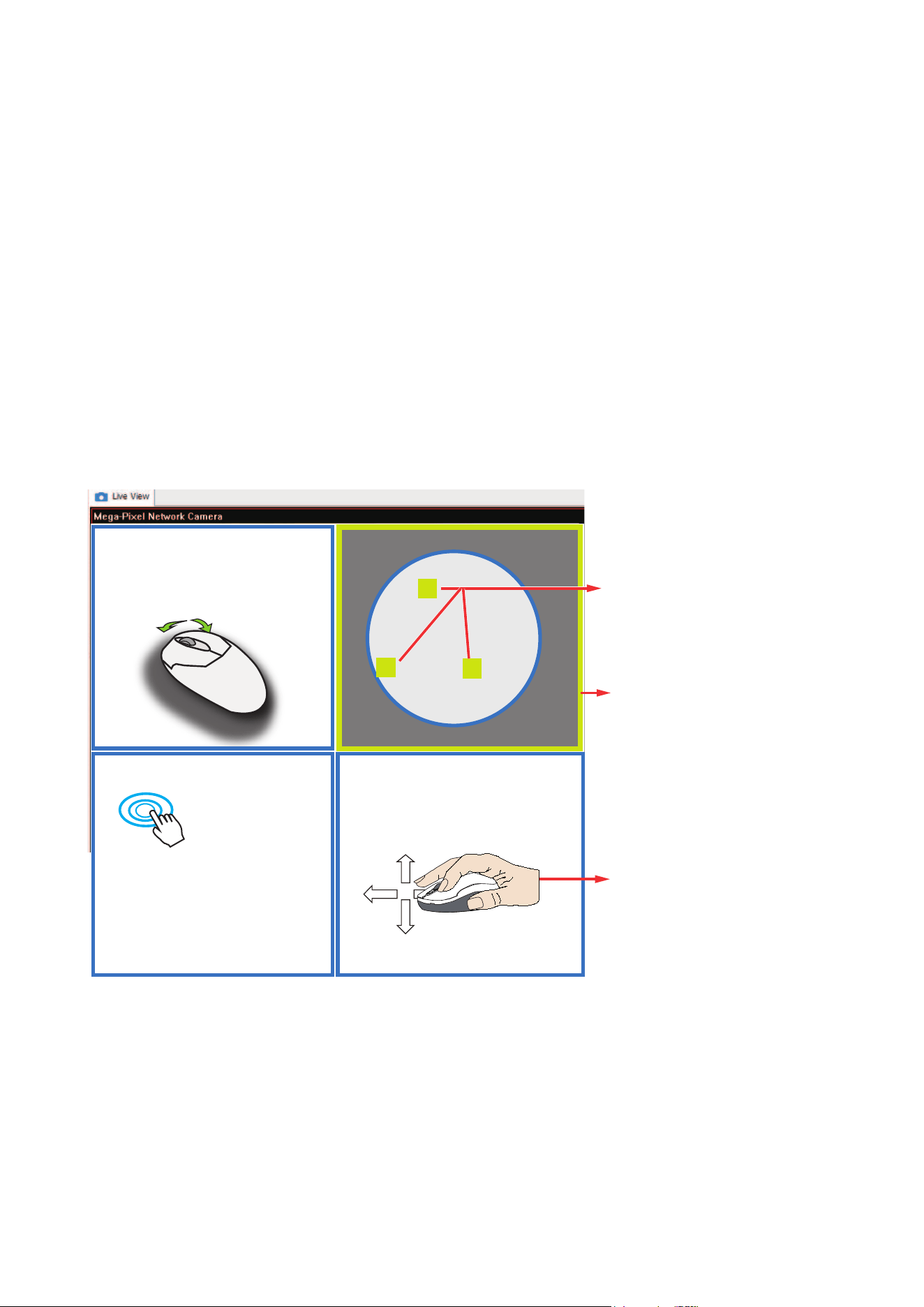
204
PTZ Mouse Control
The "Mount type" setting also determines the display modes available to your display
modes. Please refer to fisheye camera's User Manual for more information.
A highly versatile mouse control is implemented with fisheye cameras. The same control
takes effect on a browser management session, on the LiveClient utility, and even on a
video playback screen. See the drawing below for how it works.
You can click and hold down the left mouse button to quickly swipe through the field
of view, change the view angle, or use the mouse wheel to zoom in/out on a region of
interest. However, the PTZ mouse control is only available in the "R" (Regional) mode. In
the Panoramic mode, you can only scroll horizontally across the 180º or 360º panoramic
view.
Current screen selection
Zoom In
Zoom Out
Click to bring into
center of view
Pan or tilt
1
2
3
Interactive
regional FOV indicators
Click and hold down
the button
1O3R (Original & Regional) Mode Screen Control
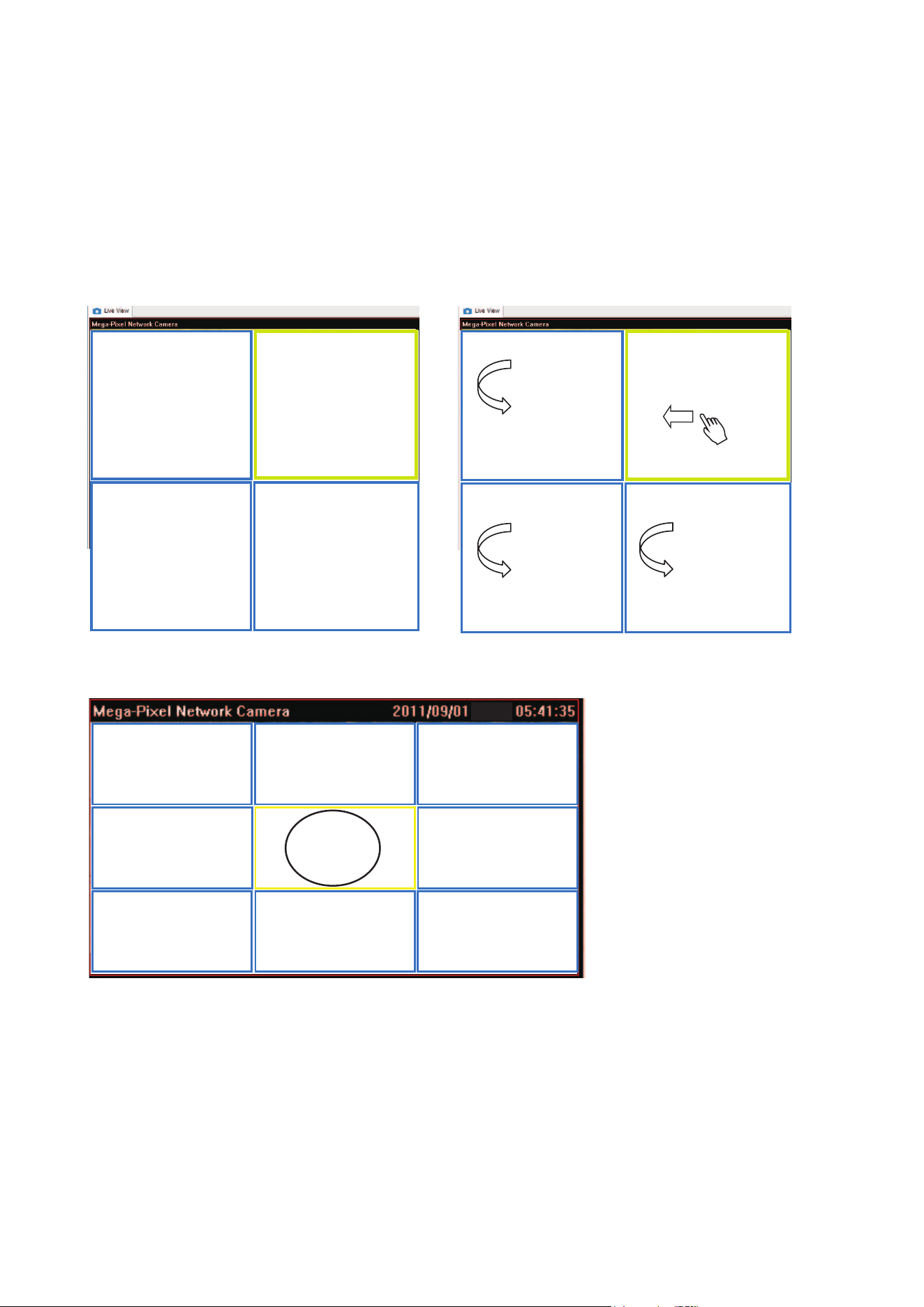
205
Regional View #1
Regional View #3
Regional View #2
Regional View #4
Regional View #1Regional View #2
Original View
Regional View #3
Regional View #6Regional View #5 Regional View #7
Regional View #4 Regional View #8
Regional View #1
Regional View #3
Regional View #2
Regional View #4
Below are the conceptual drawings for the other display modes. The available display
modes can differ with different mount types:
Regular: 1O, 1P, 1R, 1O3R, 4R.
Wall mount: 1P2R, 1P3R.
For more information, you can refer to fisheye camera's user documents.
4R (Quad Regional) Display mode:
1O8R (One Original & 8 Regional) Display mode:
4RPro (4 Regional Proactive) Display mode:
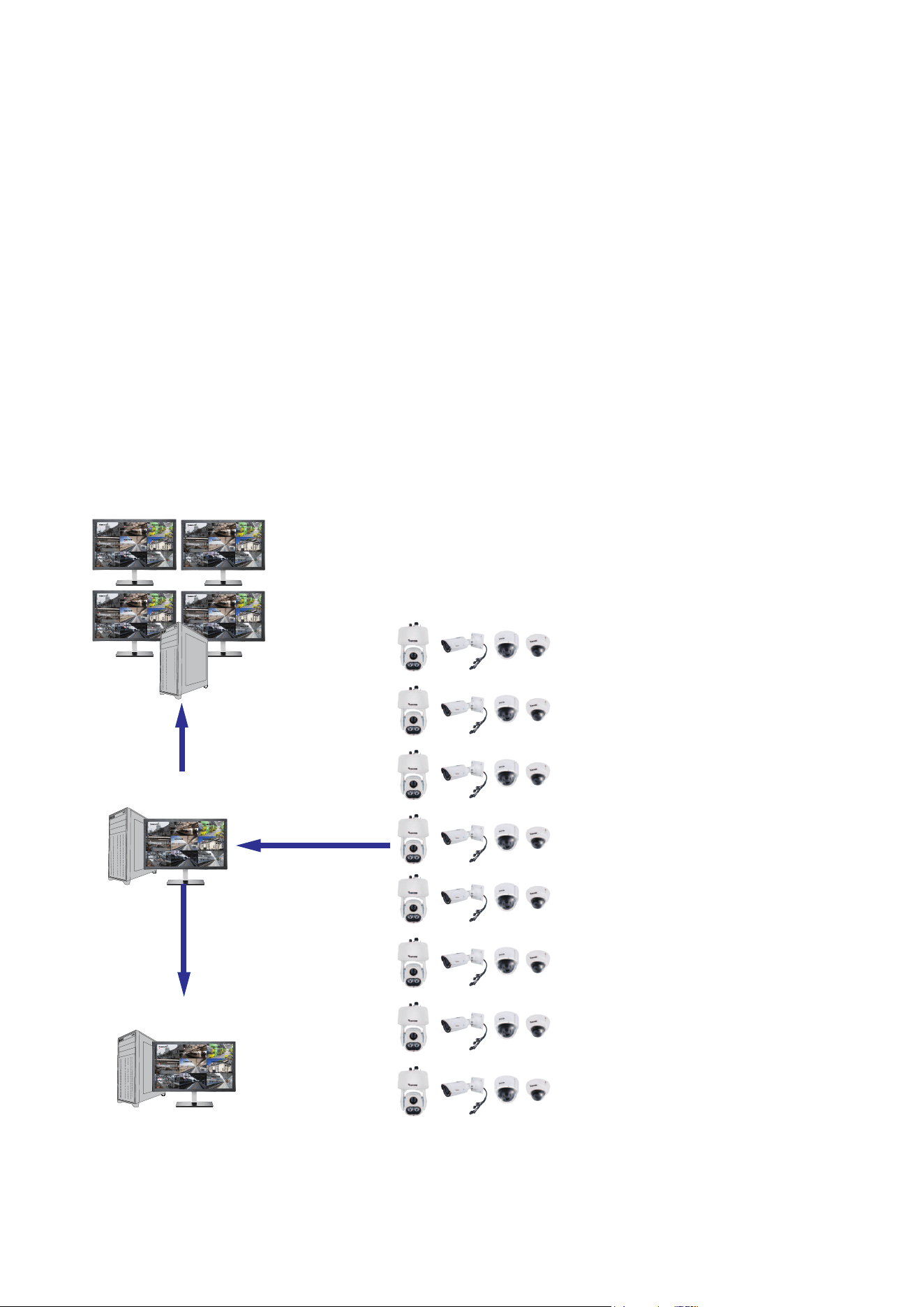
206
Appendix C: Matrix
Camera 01
Camera 02
Camera 03
Camera 04
Camera 06
Camera 05
Camera 07
Camera 08
Camera 09
VAST2 Server
Camera 01
Camera 02
Camera 03
Camera 04
Camera 06
Camera 05
Camera 07
Camera 08
Camera 09
Camera 01
Camera 02
Camera 03
Camera 04
Camera 06
Camera 05
Camera 07
Camera 08
Camera 09
Camera 01
Camera 02
Camera 03
Camera 04
Camera 06
Camera 05
Camera 07
Camera 08
Camera 09
Camera 01
Camera 02
Camera 03
Camera 04
Camera 06
Camera 05
Camera 07
Camera 08
Camera 09
VAST2 Matrix
Camera 01
Camera 02
Camera 03
Camera 04
Camera 06
Camera 05
Camera 07
Camera 08
Camera 09
VAST2 Client
The virtual matrix feature enables the display of any cameras on any monitors in an
IP surveillance network. Combinations of live or playback streams can be displayed
simultaneously. In addition of pre-configured live views, E-maps, Google maps, and Alarm
panes can all be placed on a remote matrix. Users gain realtime awareness of scenes and
access to past events.
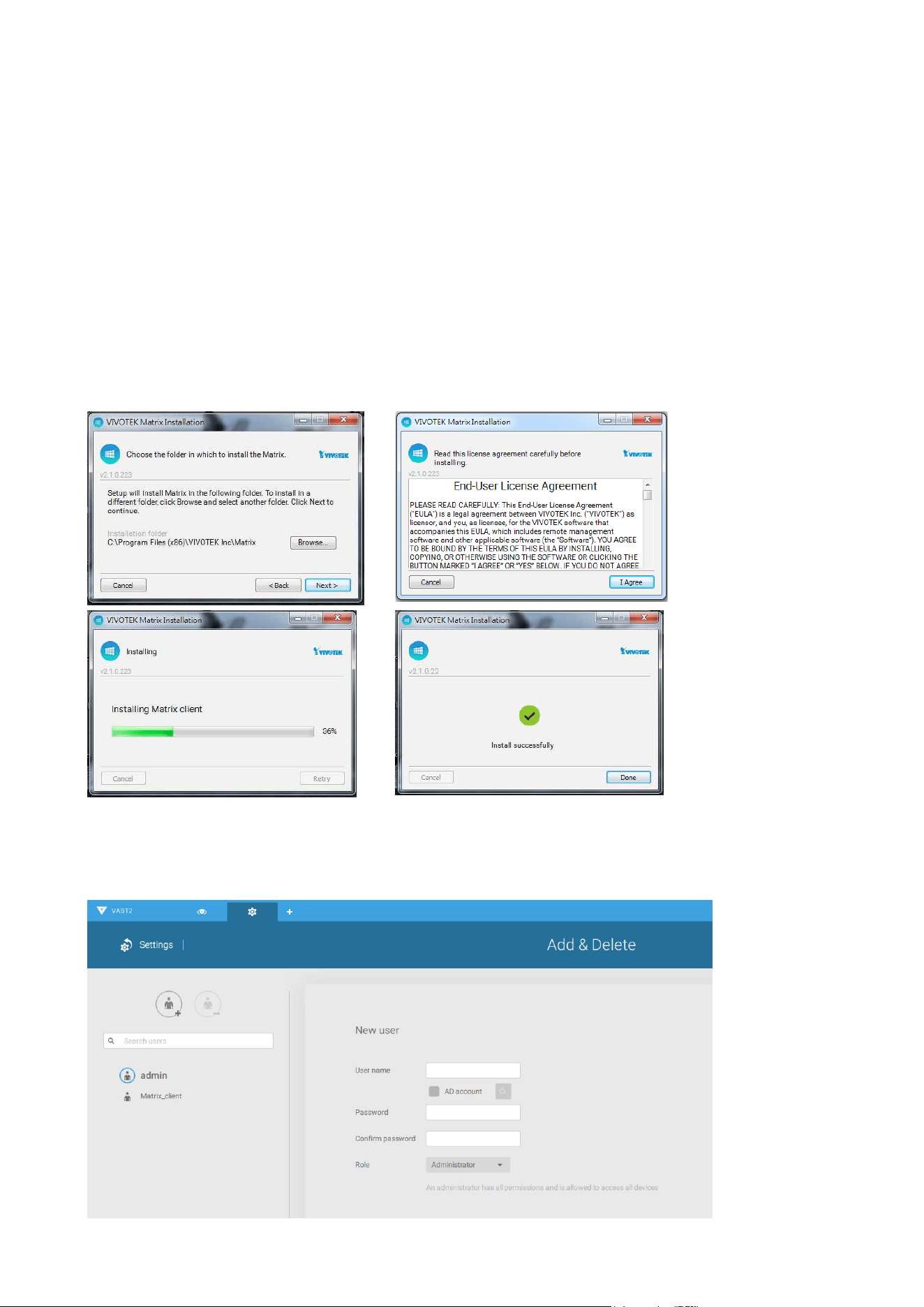
207
Prerequisites:
1. One VAST2 server and another computer running the Matrix client utility.
2. The first 2 digits of software revision numbers of VAST server and Matrix client must be
the same: e.g., 2.3.x.x and 2.3.x.x.
3. Sufficient network bandwidth among network cameras, VAST servers, and Matrix
clients.
Configuration procedure:
1. Install the Matrix client utility on a computer equipped with multiple monitors. Follow the
onscreen instructions to install the utility.
2. On the VAST server, create a user account for the Matrix client. Depending on the
operation on the client computer, assign the client user with adequate operation
privileges.
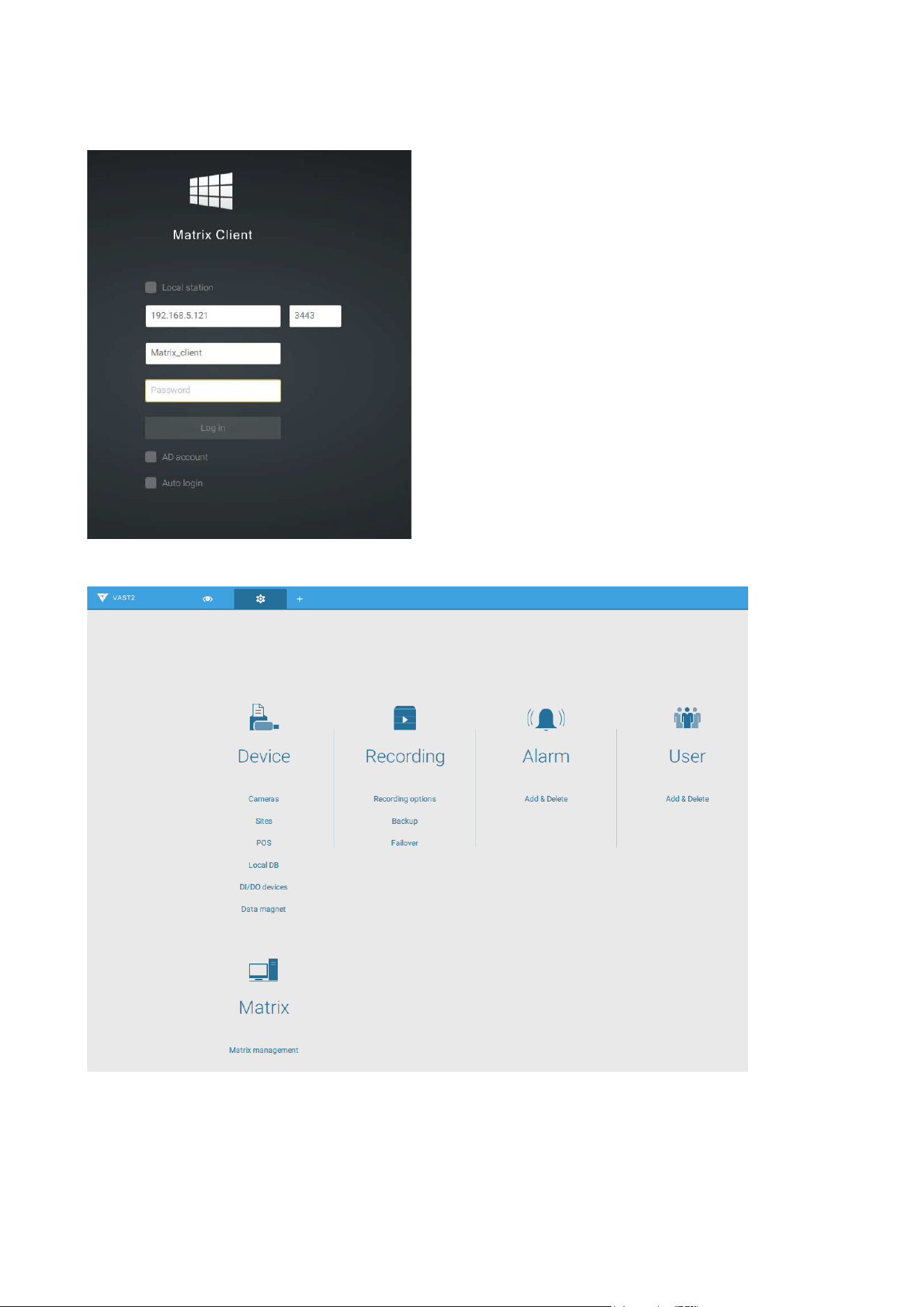
208
3. Open the Matrix utility, log in to the VAST server address, using the Matrix client account
credentials.
4. From the VAST server, open the Settings > Matrix Management window.
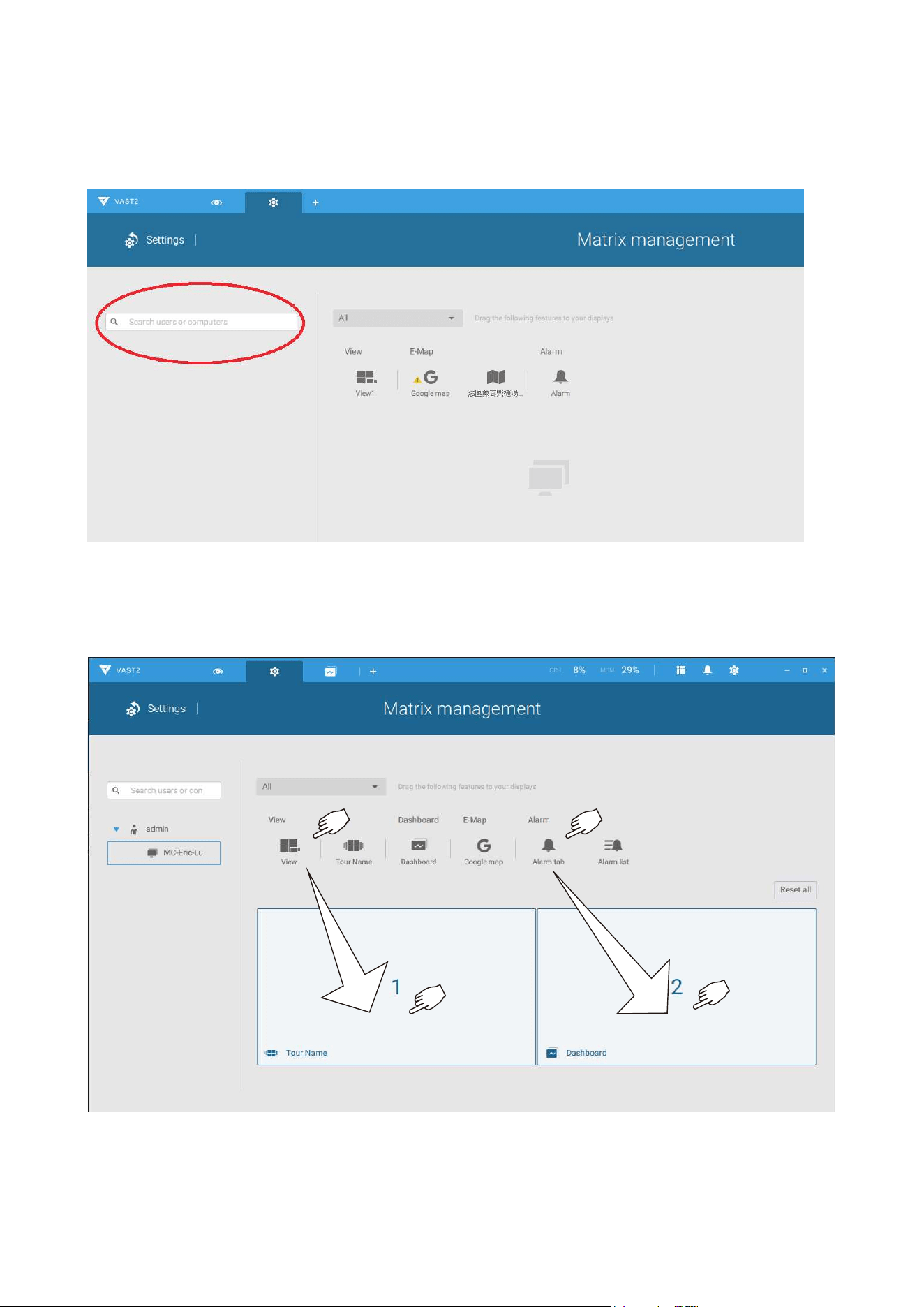
209
5. Enter the name of your Matrix client, e.g., Matrix_client in the search pane of the Matrix
Management window. Note that the Matrix client must have logged in to establish the
connection before the VAST server can find it (as previously described).
6. Once the VAST server finds the Matrix client, the available monitors will be listed. Click
and drag the pre-configured Views, Tour, Dashboard, E-maps, or Alarm panel to any of
the monitors.
7. The views should immediately appear on the Matrix monitors.
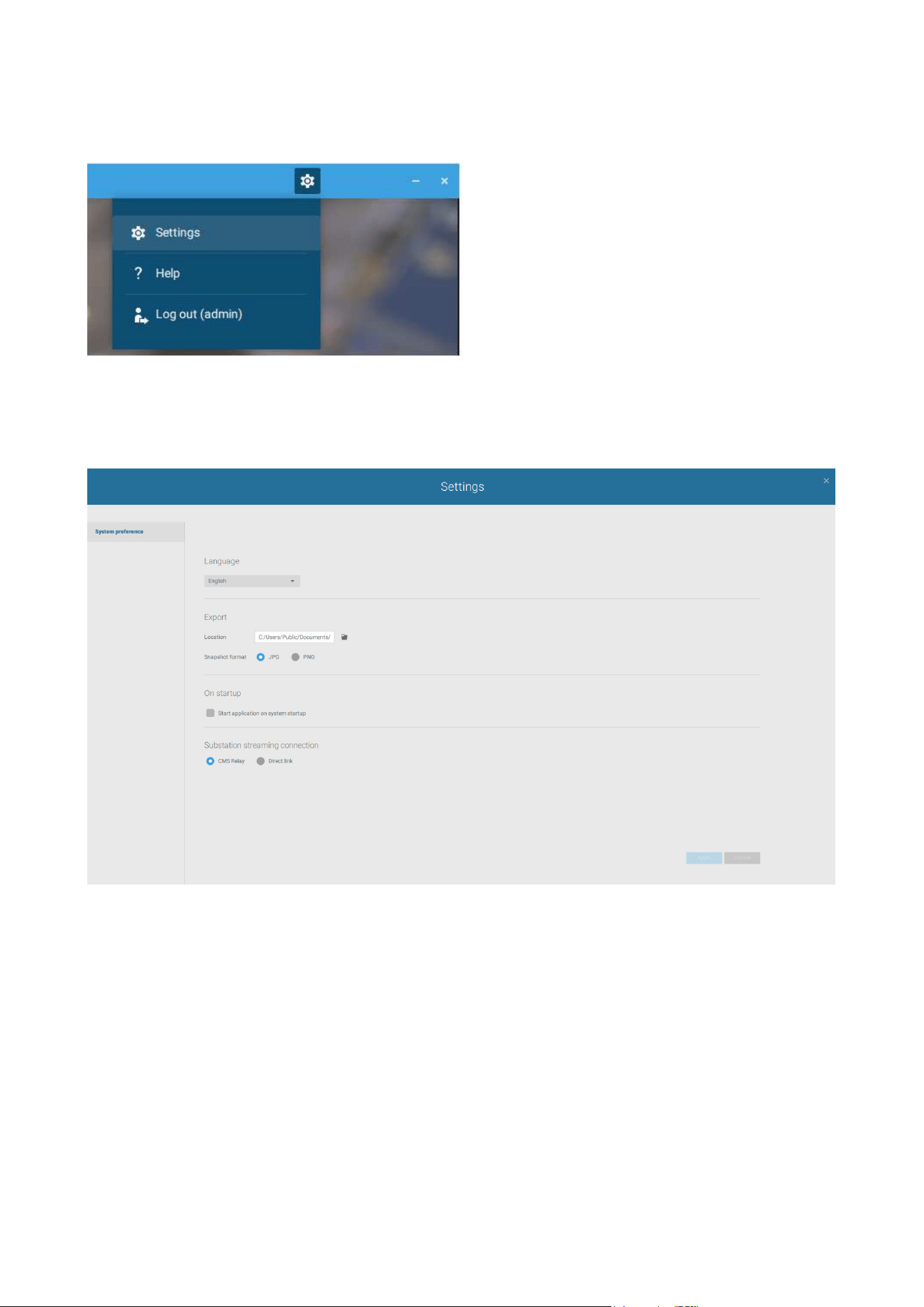
210
8. If you need to log out, move your mouse cursor to the top of the Matrix client screen to
end the session.
If necessary, change your client settings. Here you can change the displayed language,
Export target folder, Start-up option, and the streaming connection options.
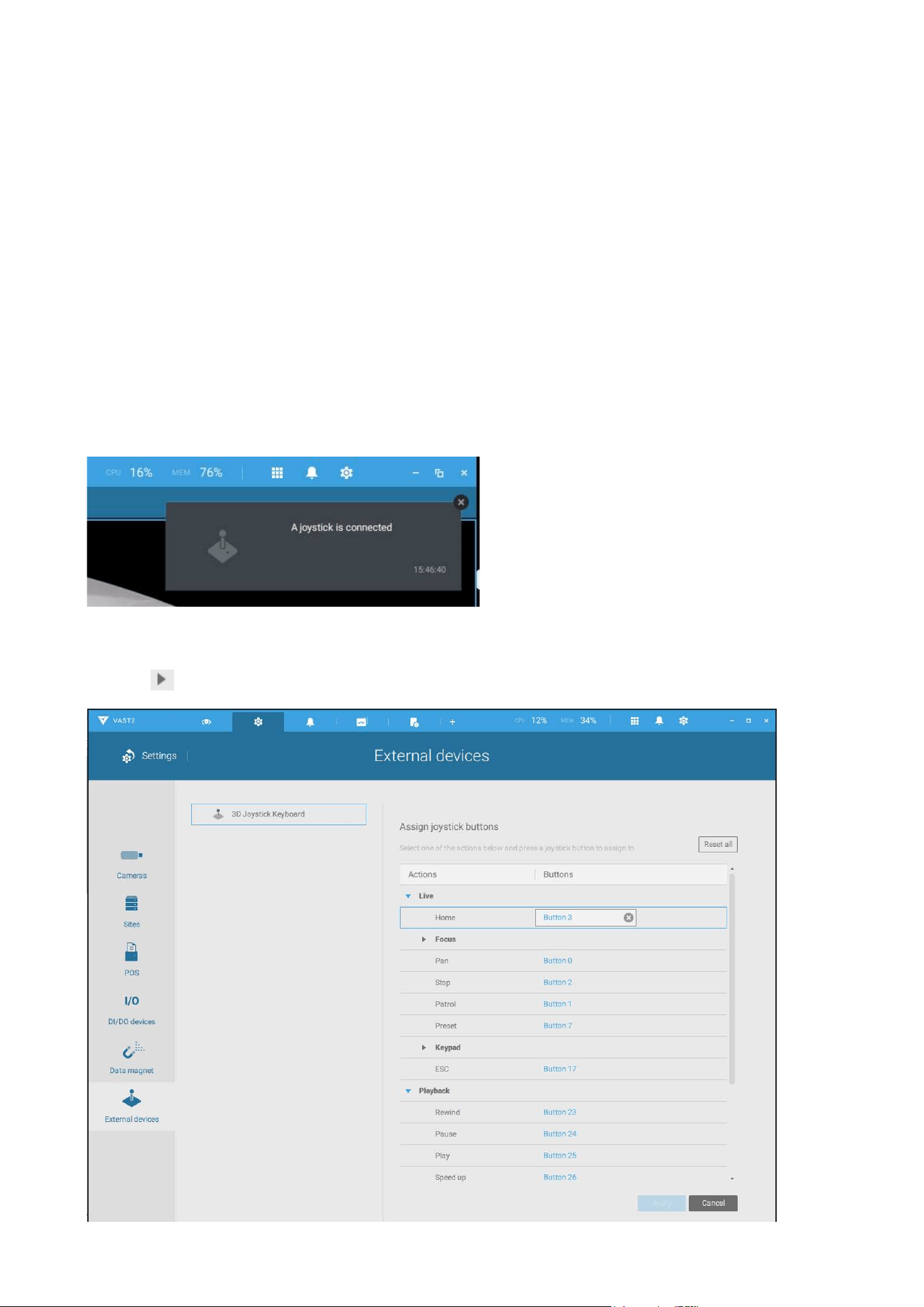
211
Appendix D: Joystick
Support
Configurable joystick buttons
1. Connect the joystick's USB cable between the USB ports on the joystick and a VAST
server/client.
2. Once connected, you should be prompted by a connection message.
3. Enter Settings > Device > External devices.
4. Single-click to select the detected joystick. The configurable buttons will be listed.
Click
to expand the Live, Playback and Common menus.
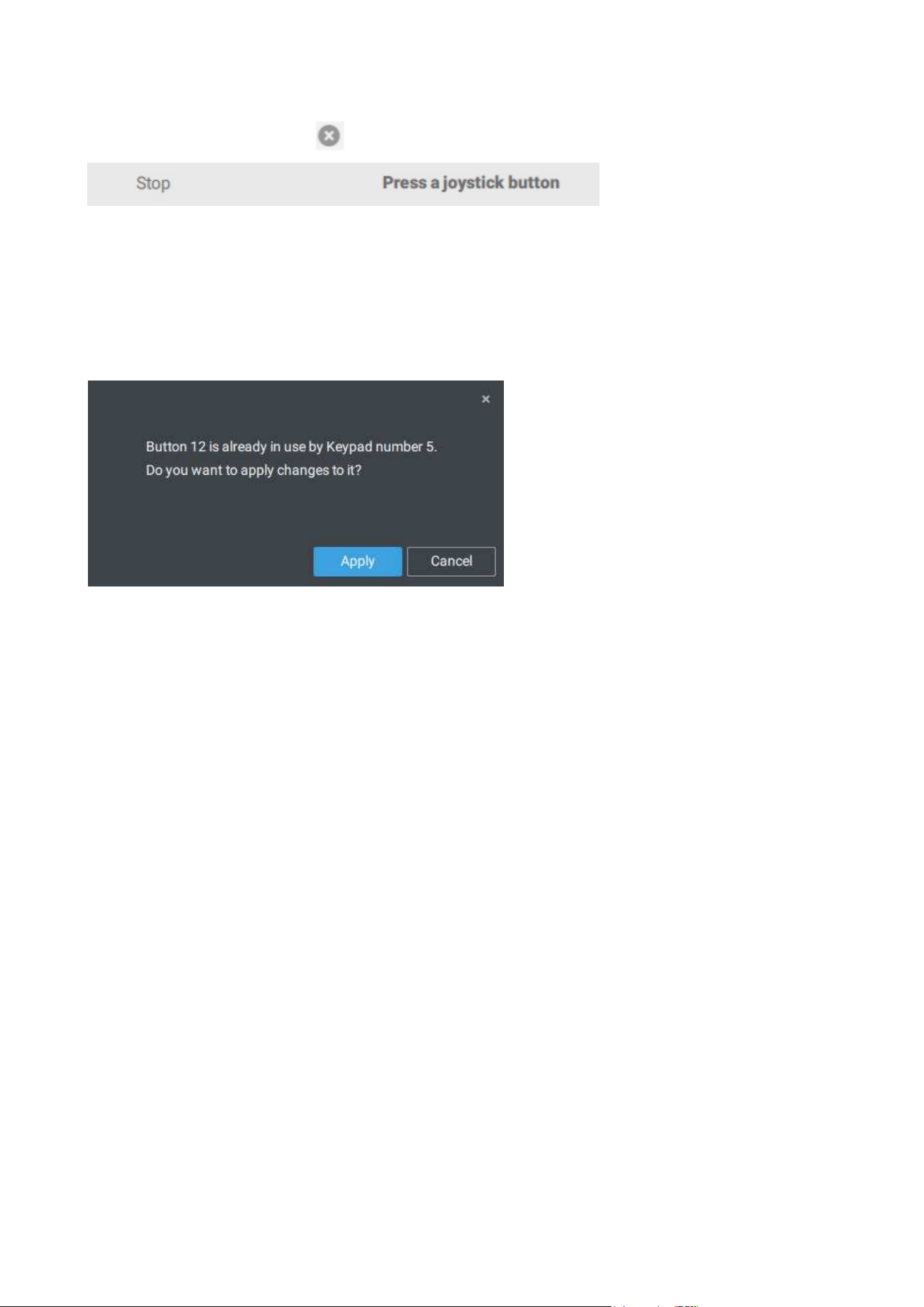
212
5. To assign or re-assign a button's function, single-click on the button number besides a
function. Click the Delete
button. The below message will display.
Press a preferred button on your joystick to complete the setting.
If a button conflict occurs, (another function has already been assigned to the same
button), the below message will prompt. You can Cancel or click Apply to change the
assignment.
Repeat the above process and click the Apply button to preserve your settings.
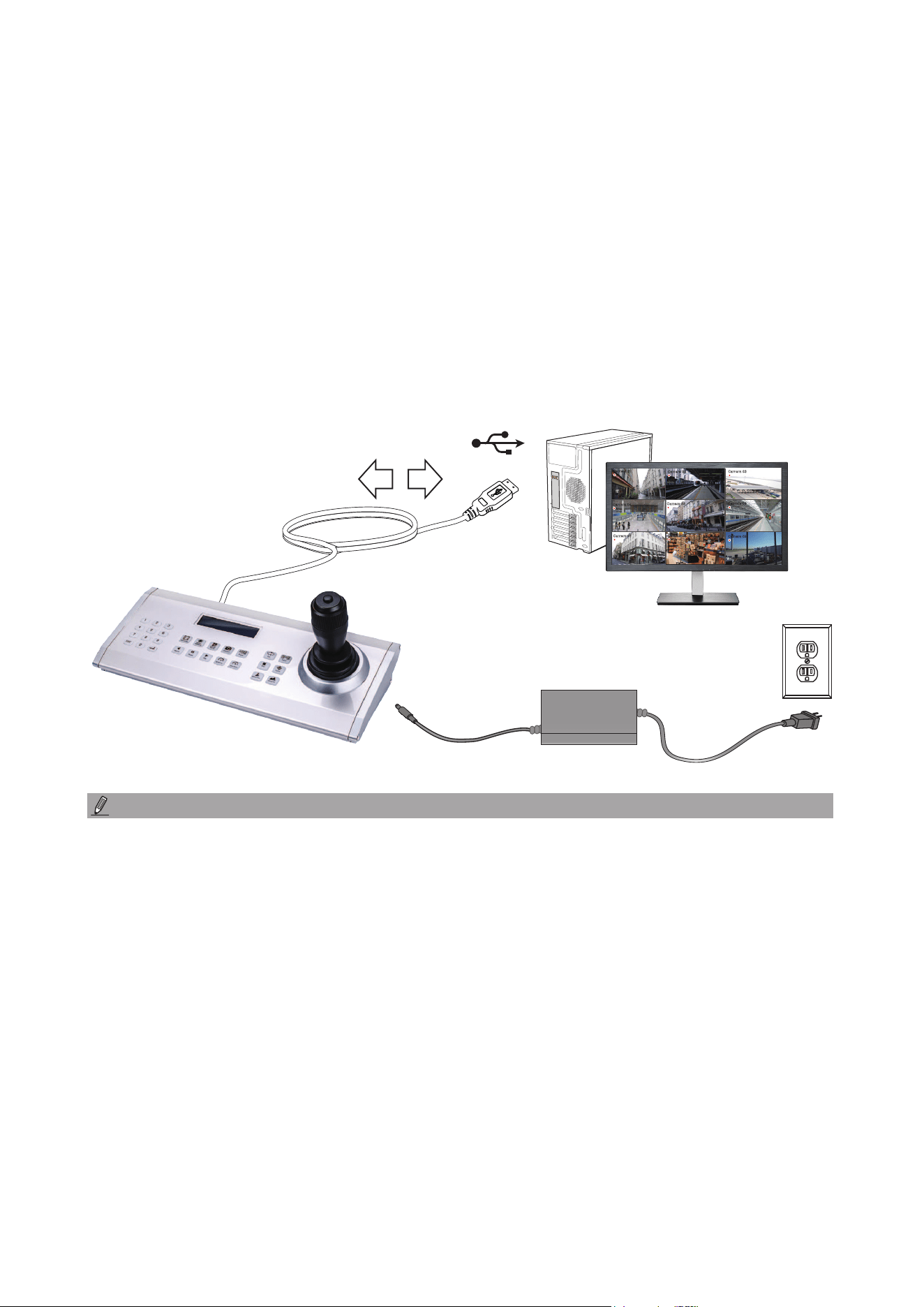
213
Camera 01
Camera 02
Camera 03
Camera 04
Camera 06
Camera 05
Camera 07
Camera 08
Camera 09
X2
VAST
12V DC
The AJ-002 is a USB joystick with HID 3-axis PTZ control, a twist wheel for zoom in/zoom
out, and 29 configurable function buttons for use on a VAST server station.
Following are the conditions for making the connection:
1. The joystick can either be powered by a DC 12V adaptor or via the USB. If powered by
USB, plug the USB cable twice to the USB port to enable USB power.
2. Connect the included USB cable between the USB ports on the joystick and a VAST
server.
1. Avoid spilling water onto the device. Avoid using this device in a high-moisture
environment.
2. This device should be operated in the indoor environment.
3. When the temperature is lower than -10ºC, the LCD panel may not function normally.
4. If the included power adapter should be replaced, use a 9-15V/1000mA alternative.
5. Avoid impact to the device.
6. This product is manufactured to comply with the requirements of the following
directives: 89/336/EEC, 92/31/EEC, 93/68/EEC.
NOTE
:
VIVOTEK's joysticks
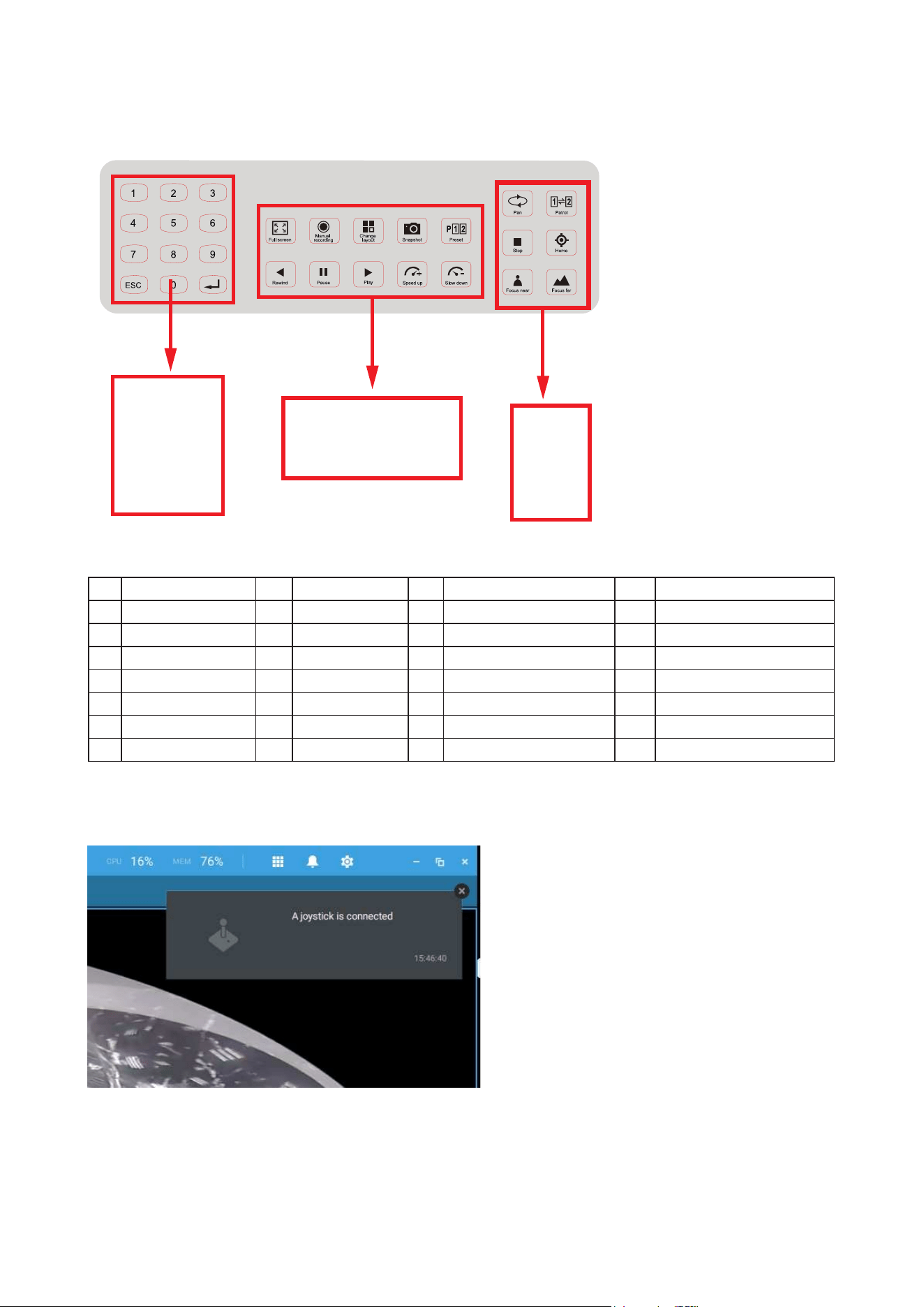
214
KEYPAD DEFINITION
1 2
3 4
5 6
8
28
21 22
24 25
23 7
26 27
9 10
12 13
11
14
15 16
18 19
17
20
Below is the keypad numbering sequence:
The following keypad functions will be available as the defaults for the joystick.
1 Pan 9 #1 17 #9 25 Pause
2 Patrol 10 #2 18 Cancel/Clear/Esc 26 Play (Playback)
3 Stop 11 #3 19 #0 27 Speed Up
4 Home 12 #4 20 Enter 28 Speed Down
5 Focus Near 13 #5 21 Full Screen
6 Focus Far 14 #6 22 Manual recording
7 Snapshot 15 #7 23 Change Layout
8 Preset 16 #8 24 Rewind
When a joystick is connected, the VAST server should automatically detect the connection.
The following controls are available:
* PTZ control – Basic PTZ control: Direction, Home, Zoom in/out, and Focus near/far.
* Playback control – Play, Pause, Stop, Rewind, Speed up and Slow down.
* View switch – Switch to existing View (Users need to create views first).
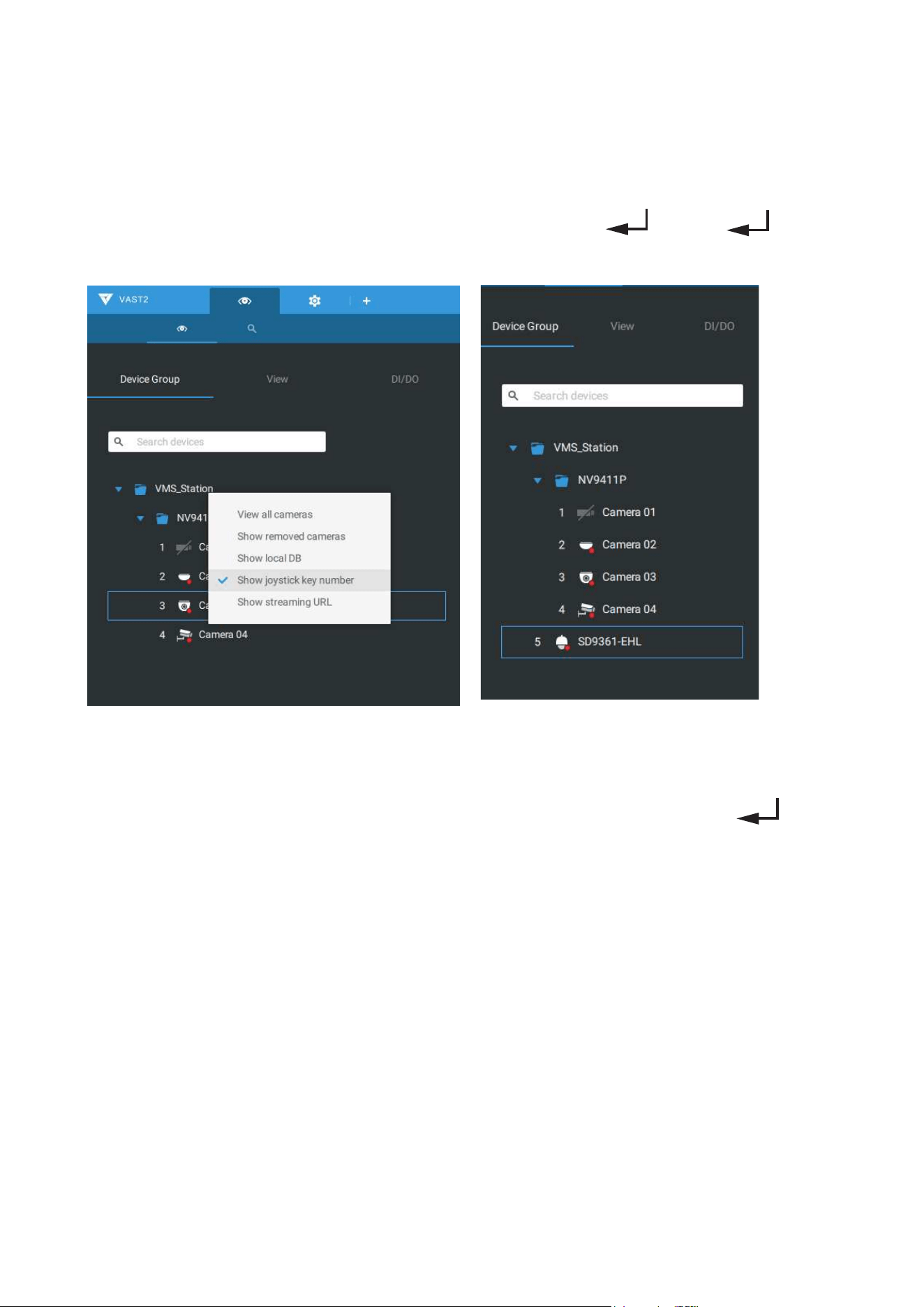
215
Left-click to select your server on the device tree, and right-click to display and select the
"Show joystick key number." The camera key numbers are determined by the sequence
when the cameras were added to the VAST configuration, and cannot be changed. By
default, the key numbers are not shown.
Press the key number on the joystick keypad and the Enter key
, e.g., 5 + . The
full view of the selected camera will display.
Press the ESC key to leave the full view.
To move to a preset position, press the number key + Preset, and the Enter key . The
number key corresponds to the sequence number for the preset position regardless of the
name of the preset.
Note that the RS232/485 terminal connection is currently not supported.
Note that the Manual Recording button is currently not effective.
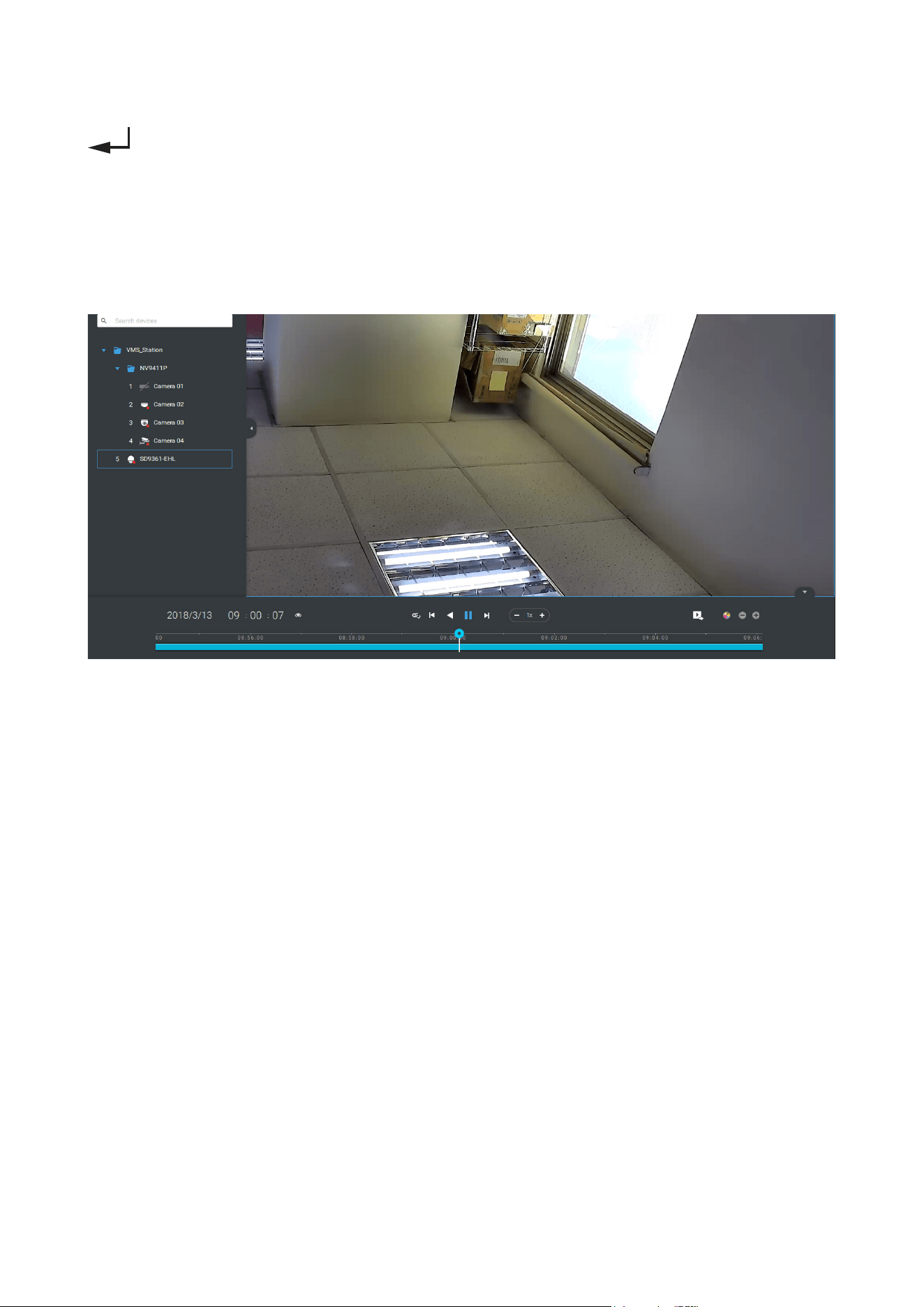
216
If you have multiple views, press the number key and the Change Layout, and the Enter key
to switch to a different view. The number key corresponds to the sequence number
for the view you configured regardless of the name of the view (layout).
The Play button toggles the playback window. From here you can trace back the past
recordings. You can use speed up, slow down, and rewind buttons here. Once the Playback
mode is toggled, the point-in-time defaults to the start of the current hour.
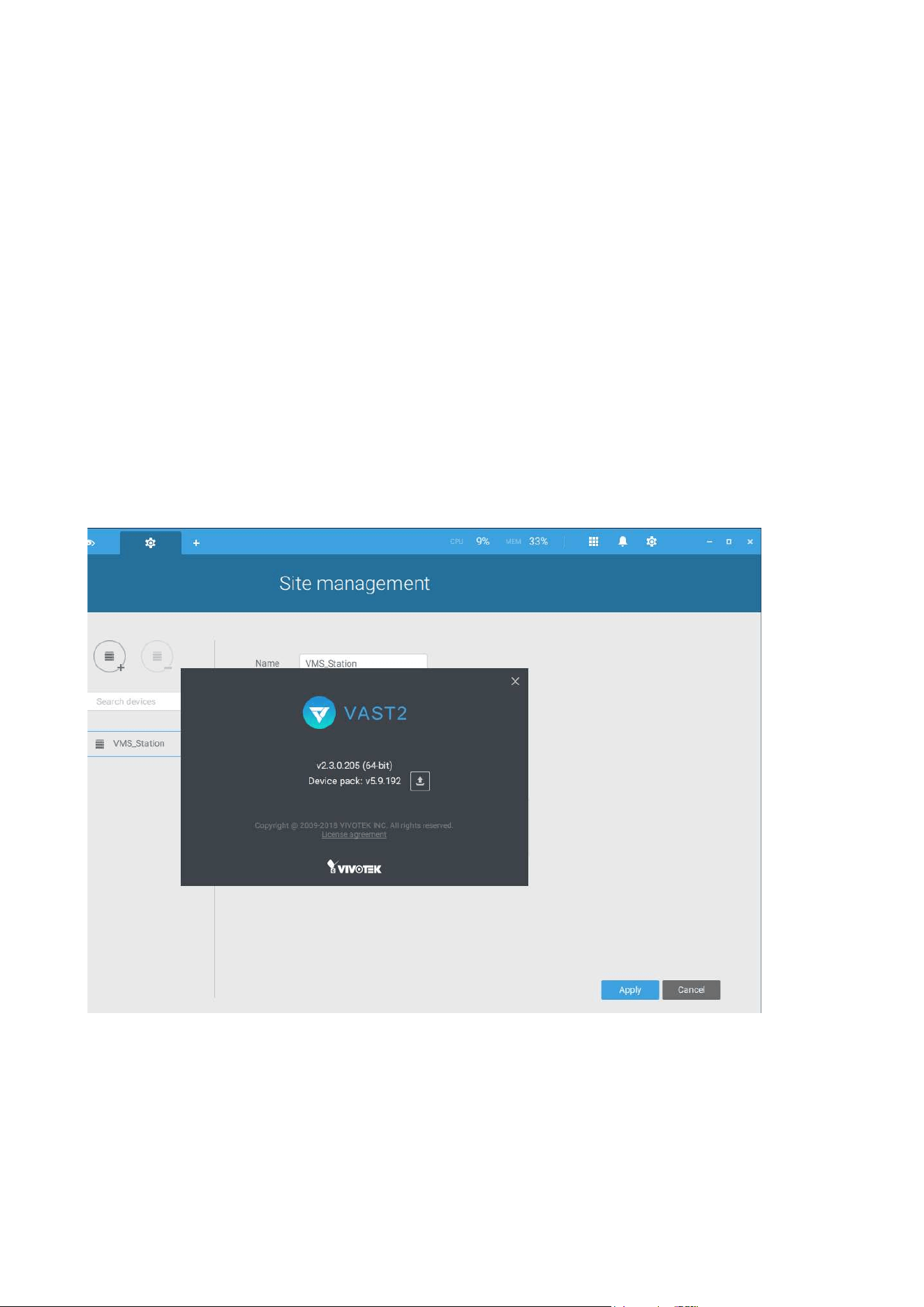
217
Appendix E: Upload Device
Pack
A device pack is contantly updated for the latest profiles of VIVOTEK's new camera/NVR
models. If you install new cameras/NVRs to your configuration, you can visit VIVOTEK's
website for the latest device pack updates, and upload the pack file to your VAST server.
New functional parameters and functions in the new cameras are available through the
device pack.
Enter Settings > About to see the upload button.
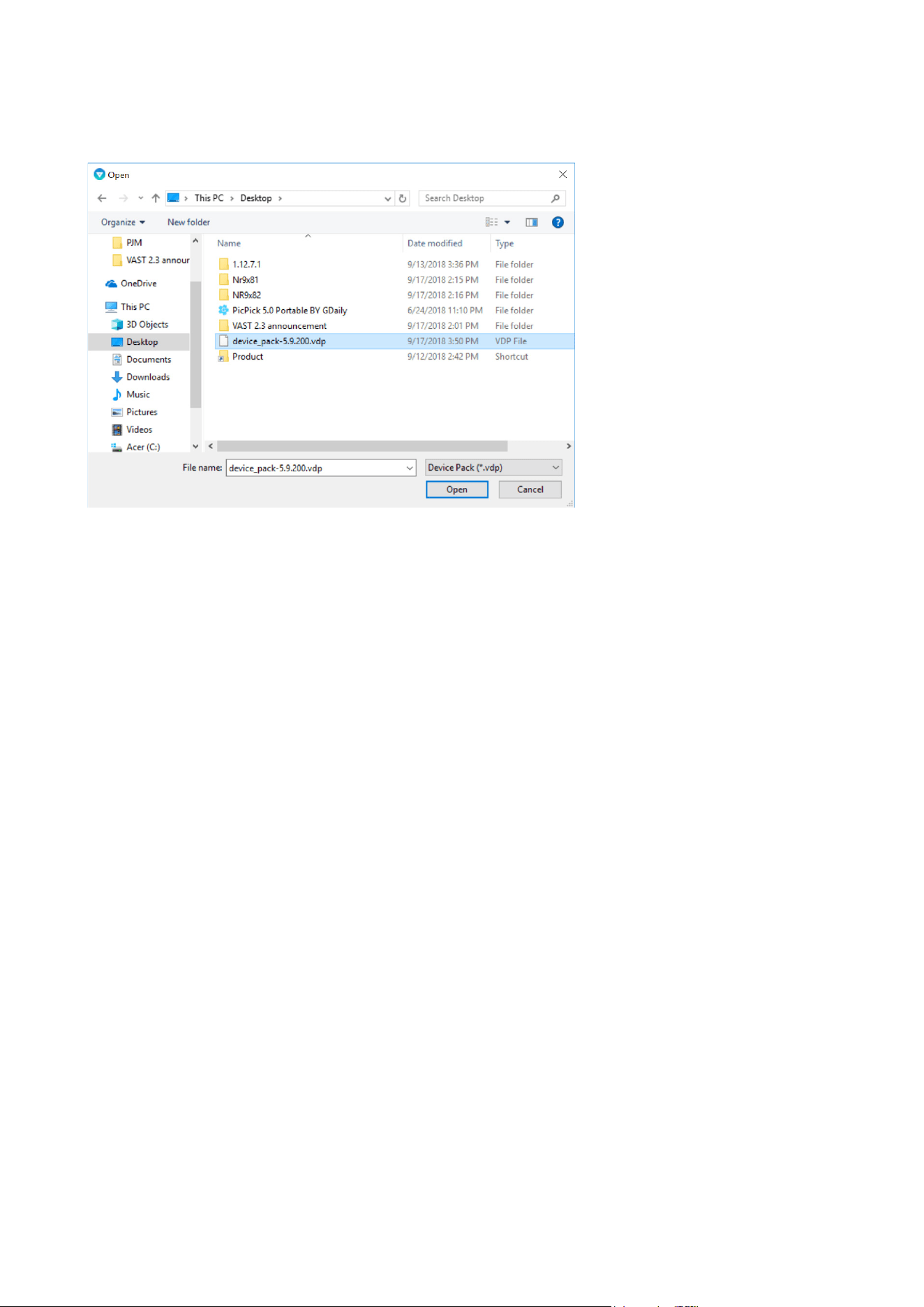
218
A device pack file looks like the following.
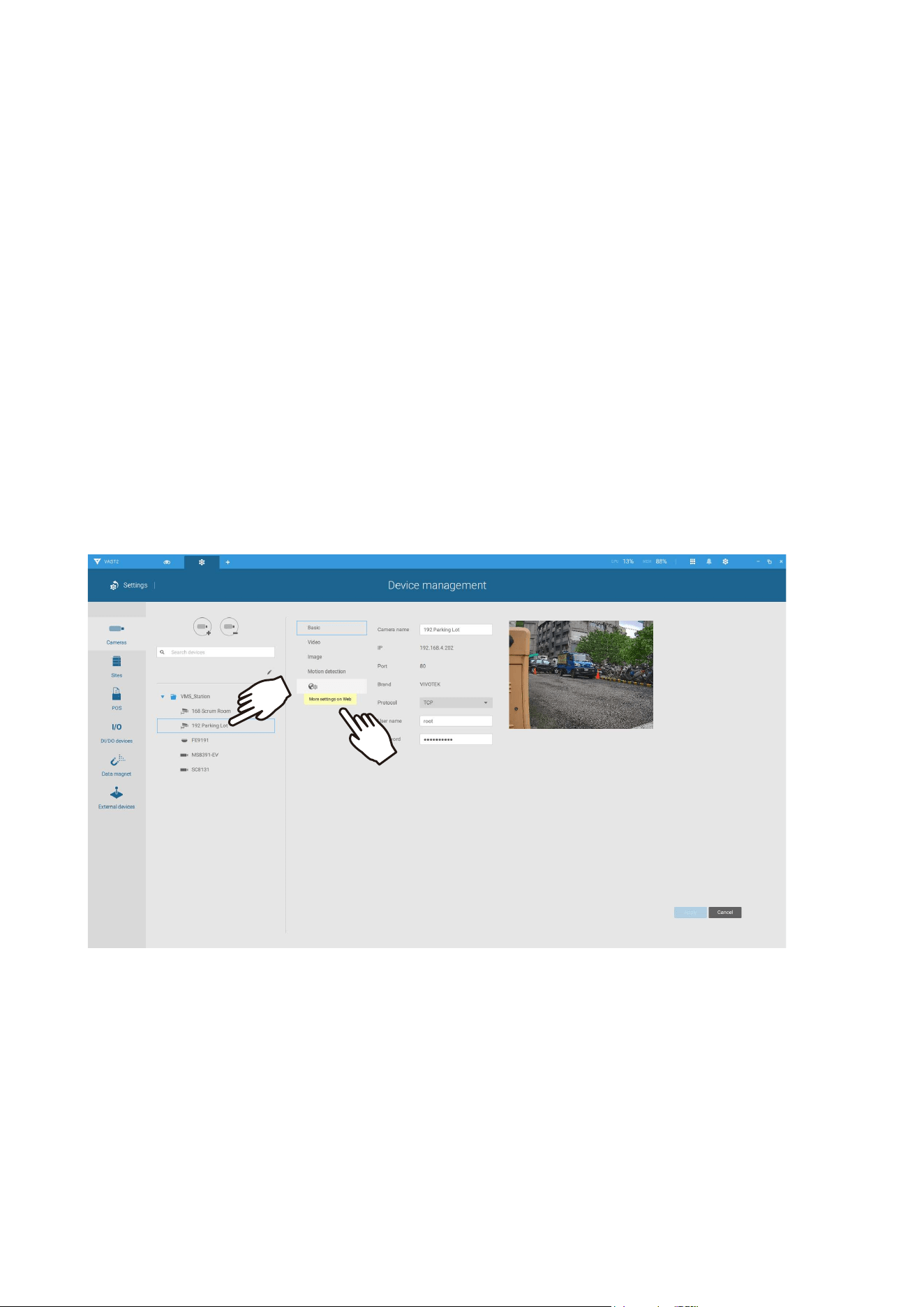
219
Appendix F: Using LPR
Related Functions w/ Data
Magnet
Acquiring data sources from 3rd-party software:
1. Select a camera that comes with the LPR (License Plate Recognition) functionality, e.g.,
IB9387-LPR as shown below. Click "More settings on Web" to open a web console to the
camera.
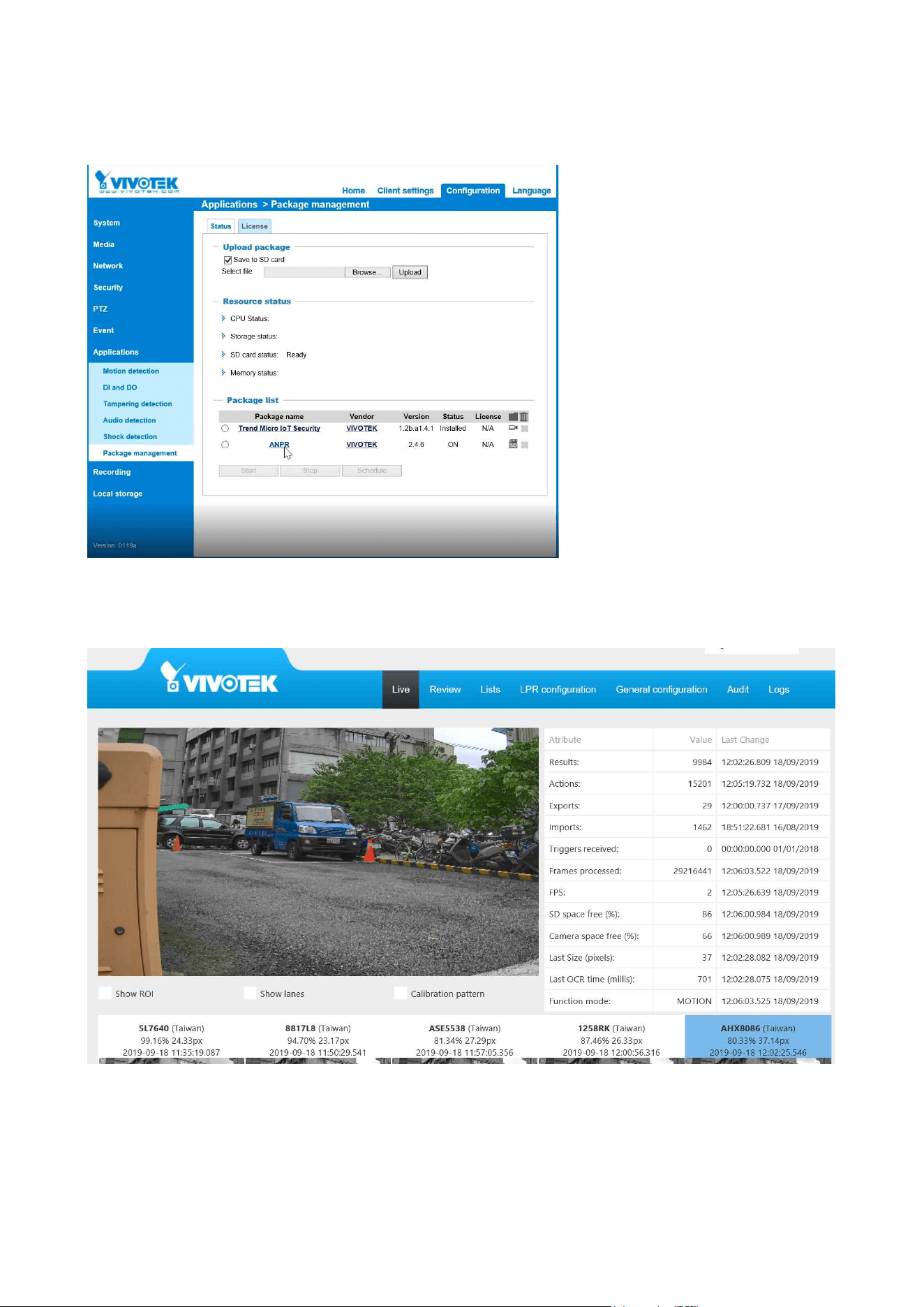
220
2. On the web console, enter Configuration > Applications > Package management. Click
on ANPR to open a web console to the license plate recognition software.
3. Click on the Lists tab.
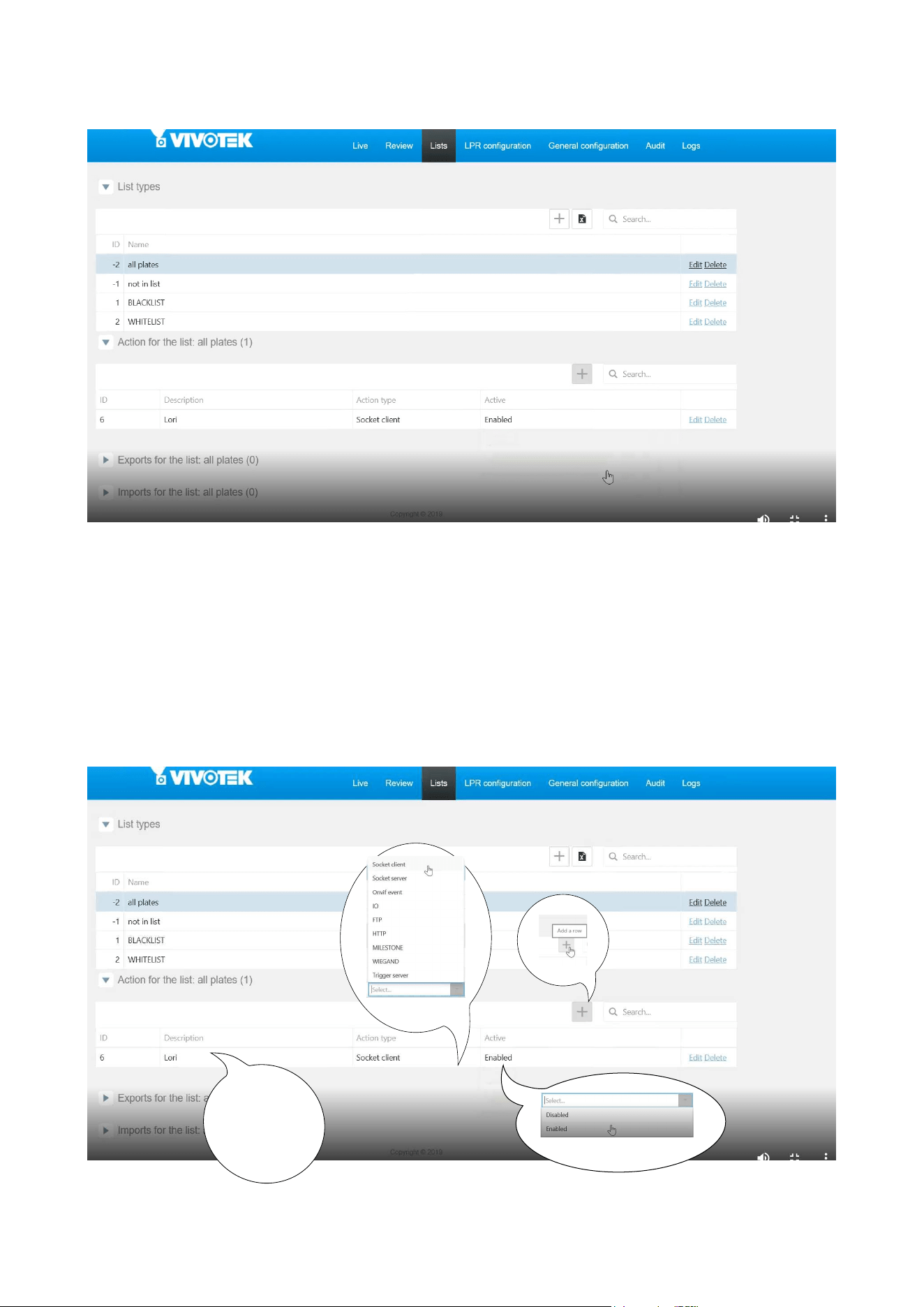
221
4. Select a list whose data will be transmitted to the VAST server.
5. 5-1. Find the "Action for the list" pane. Click the "+" Add a row button.
5-2. Enter a short description for the row.
5-3. Select "Socket client" as the action type.
5-4. Click to select Enabled.
5-5. Click the Save button.
1
2
enter a
short description
3
4
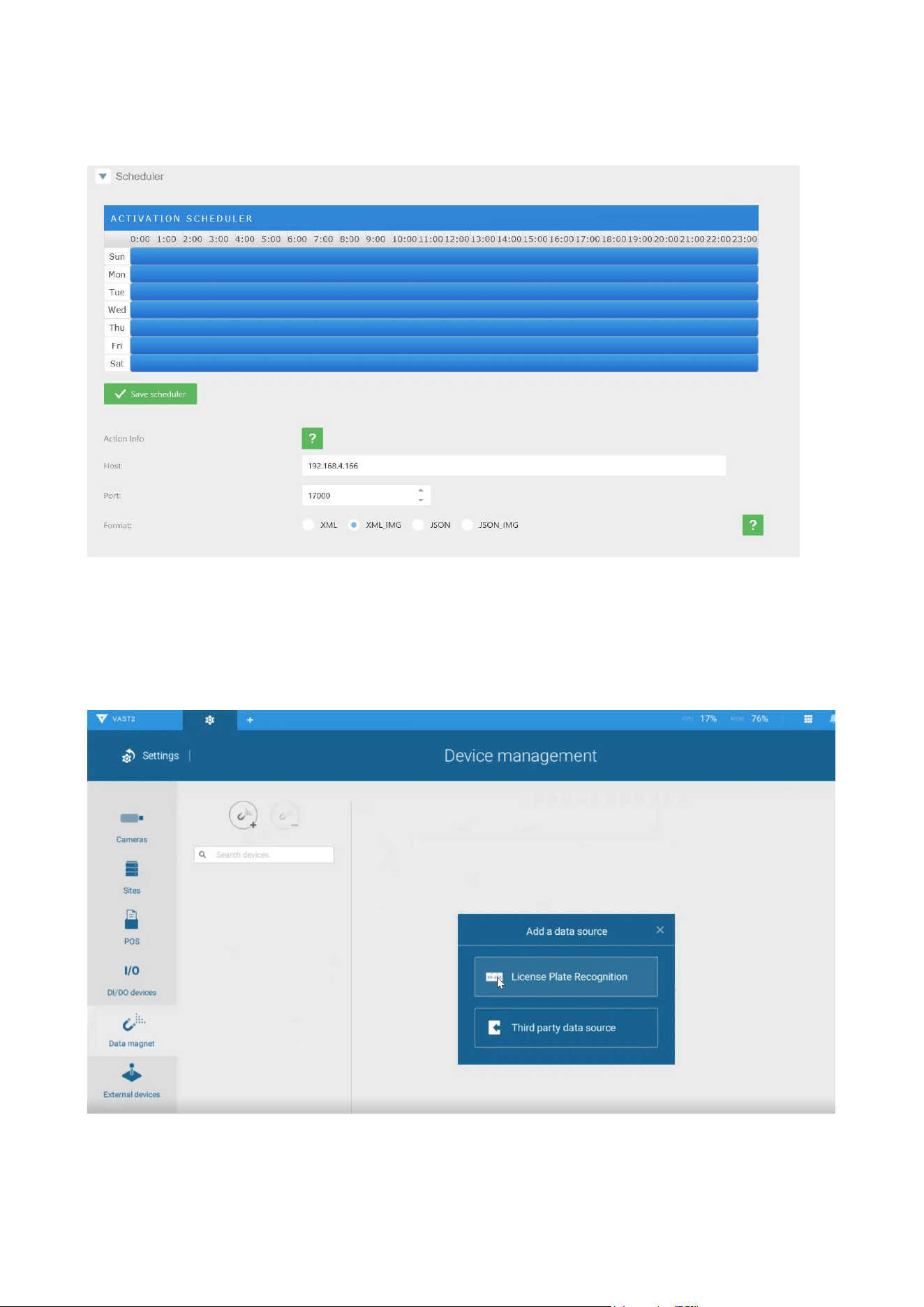
222
6. Roll down to enter your VAST server's IP address. If necessary, select XML_IMG as the
file format for your data that will be collected on VAST.
7. Close the web console and return to the VAST Settings > Device management > Data
magnet page.
Click the Add button, and click the License Plate Recognition button.
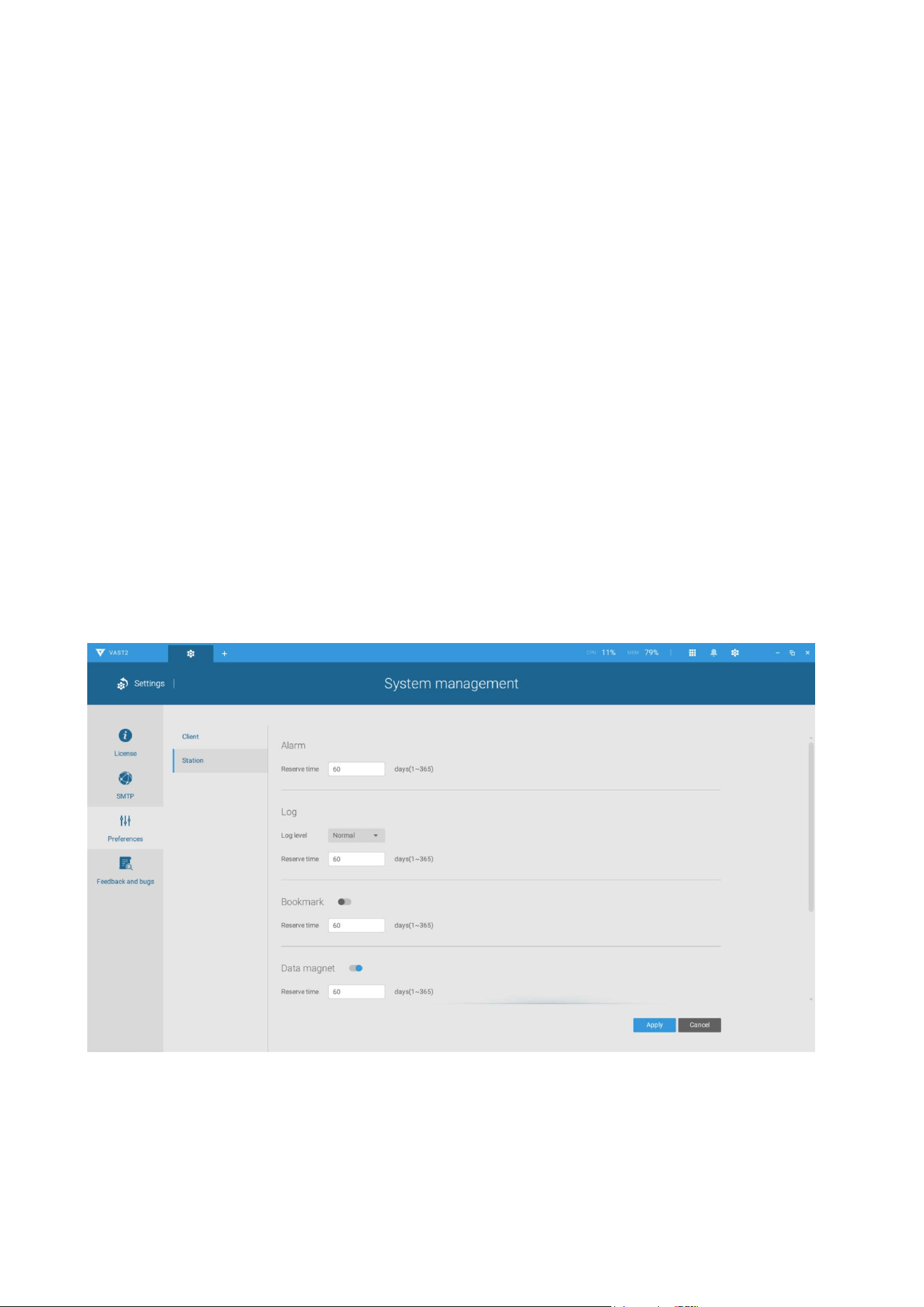
223
If you need the development document for integrating 3rd-party software, please contact
VIVOTEK's technical support.
You can designate how many days the data from the data sources is retained on server
in Settings > System management > Preferences.
NOTE
:
1. The License Plate Recognition data source will not be charged with a Data Magnet
license fee.
2. The VAST server port for License Plate Recognition data source can be customized; It is
not limited to 17000.
3. If you have more than one VIVOTEK LPR camera, you only need to (and can only) add a
License Plate Recognition data source.
4. If you add a 3rd-party data source but you name it as "VIVOTEK ANPR", it will be
recognized as a VIVOTEK ANPR (License Plate Recognition) data source.
5. Different Data sources cannot have the same name.
6. Different 3rd-party data sources can share the same server port, but they cannot use the
same port the License Plate Recognition is using.
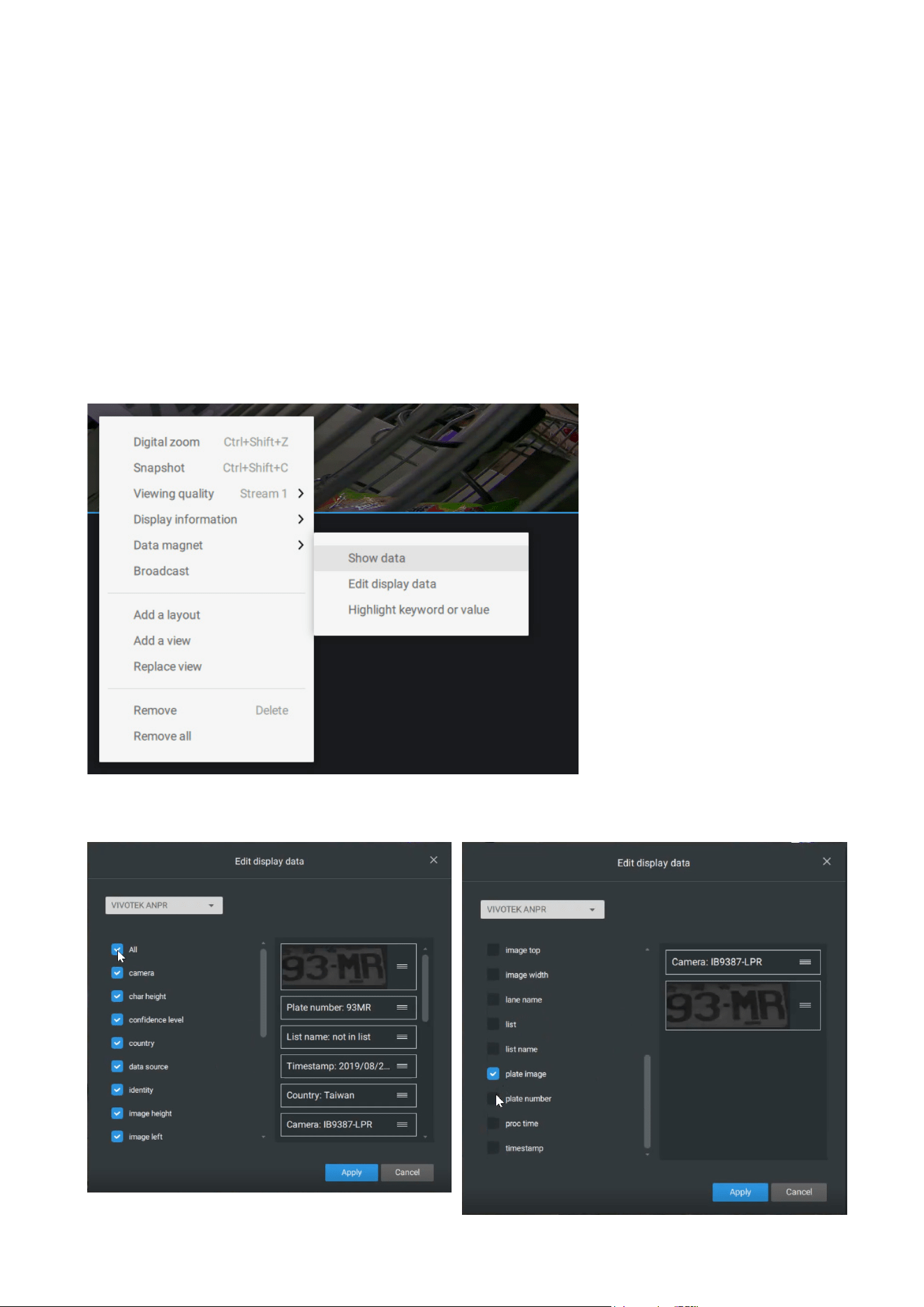
224
Selecting data display options:
1. On the VAST live view, right-click on screen to display Data Magnet > Edit display data.
If Show data is selected, a portion of the view cell will be used to display the captured
data.
2. On the Edit pane, select all or manually select multiple display elements.
There are two different ways to show data:
1. Right-click: Data Magnet > Show data.
2. Right-click: Display information > Edit display information > Data magnet data.
The display options are: with or without Data overlay on screen. If the overlay is not
enabled, the data will display on the right pane of the view cell.
The data on the overlay can
be configured to automatically
disappear after a configurable
time, when no new data is
received (Hide data after idle _
s).
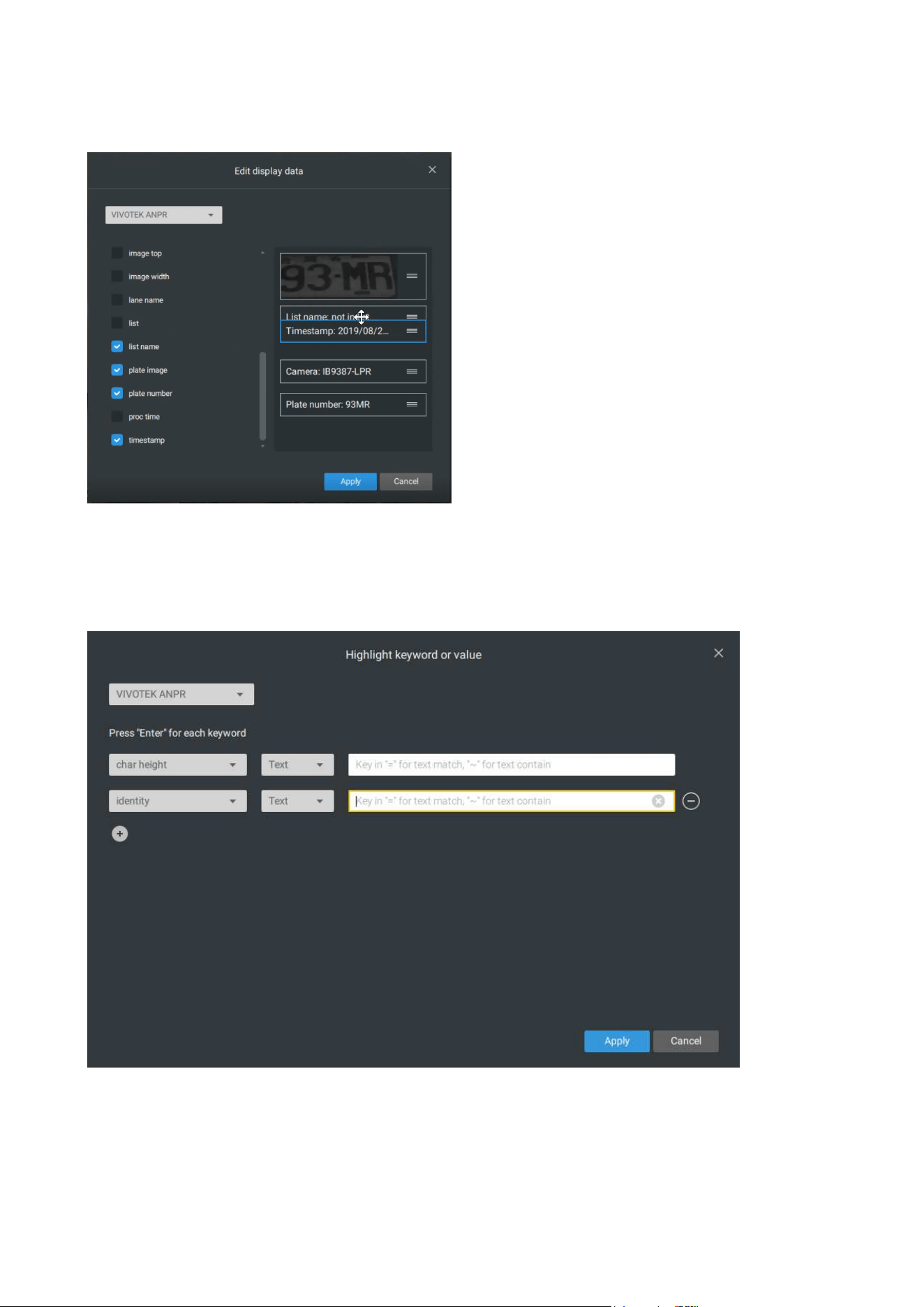
225
3. Click and drag individual elements to change their top-down positions on the screen.
When done, click the Apply button.
4. Click Highlight keyword or value. You can display information of unusual data, such as
the specific numbers or characters of forbidden license plates. When such data is met,
the occurrence will be highlighted in a bright yellow color.
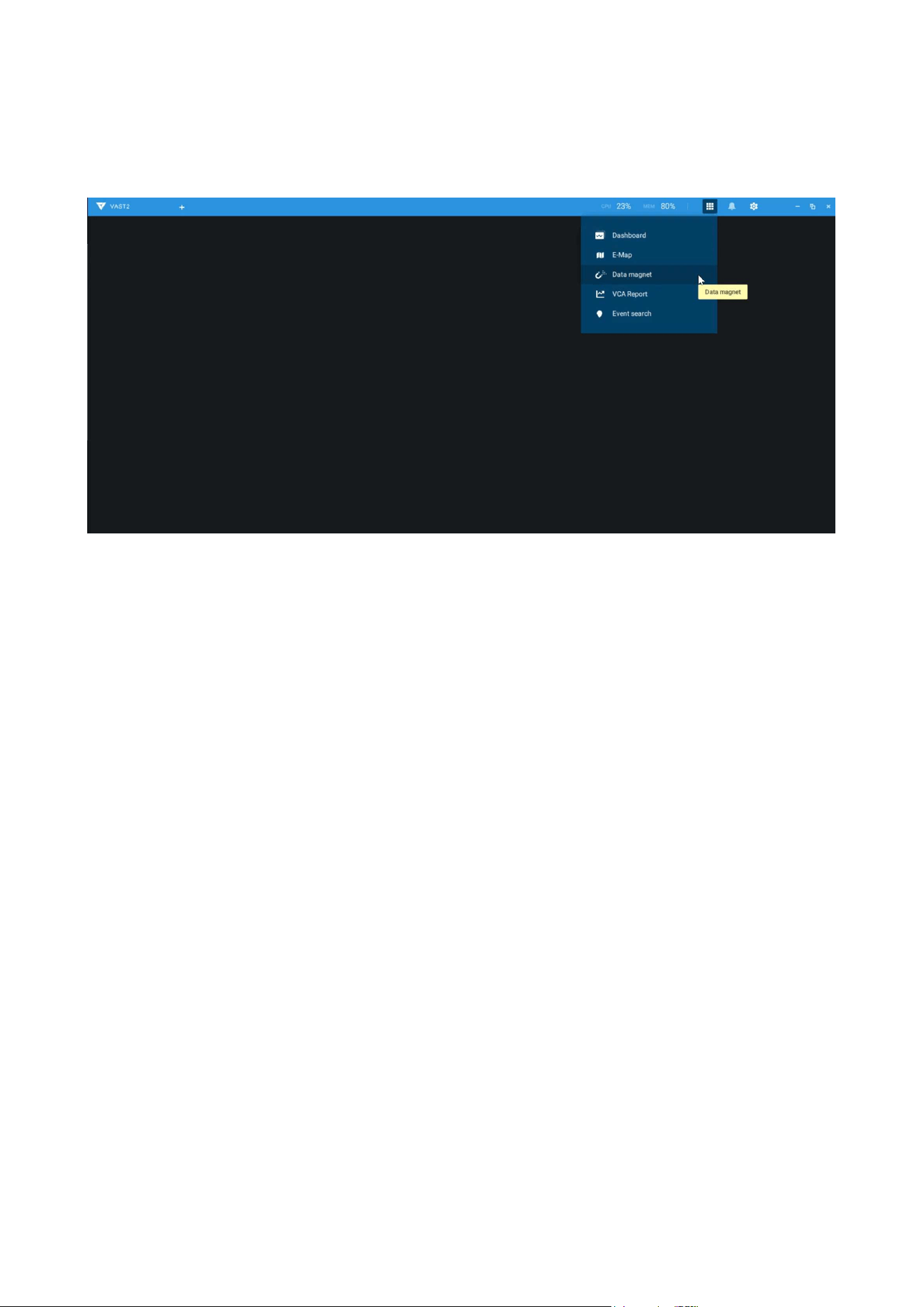
226
Searching for data and linked recordings:
1. On the VAST live view, click on the Applications tab.
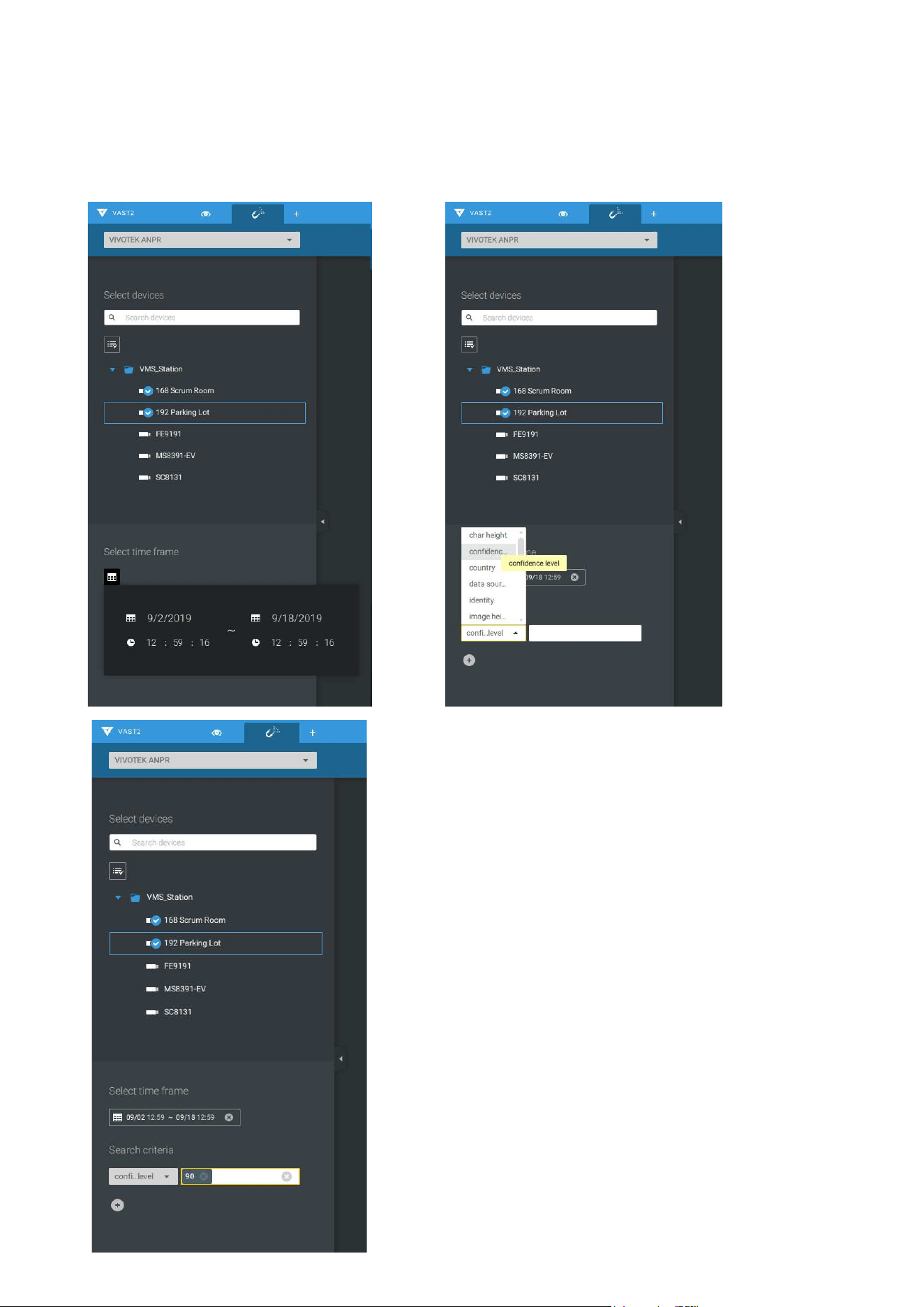
227
2. On the Data Magnet window, select the LPR camera, and then begin with configuring the
search conditions. Select the time span from the calendar. Select to display character
height, country, data source, identity, image height, lane name, list name, or enter a plate
number. You can select multiple filtering conditions.
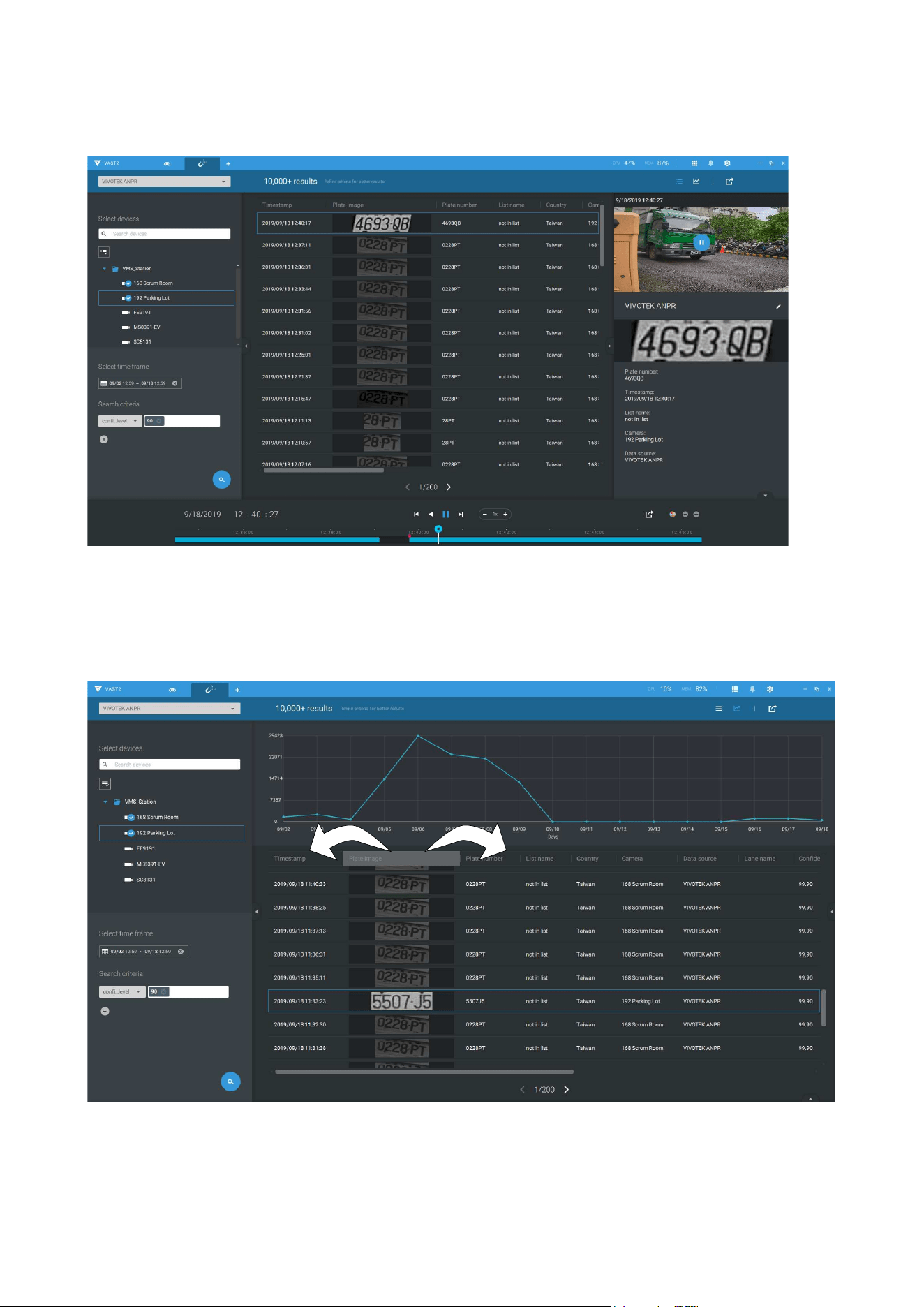
228
3. Click the Search button. The search results will display. Single-click to display the related
video. You can also review the video in a full-screen mode.
You can click and drag the display names of individual columns to switch their positions
on the screen. The changes to layout are stored on the client computer. After you re-
arrange the order of columns in search results, the display order will also be applied to
the exported CSV file.
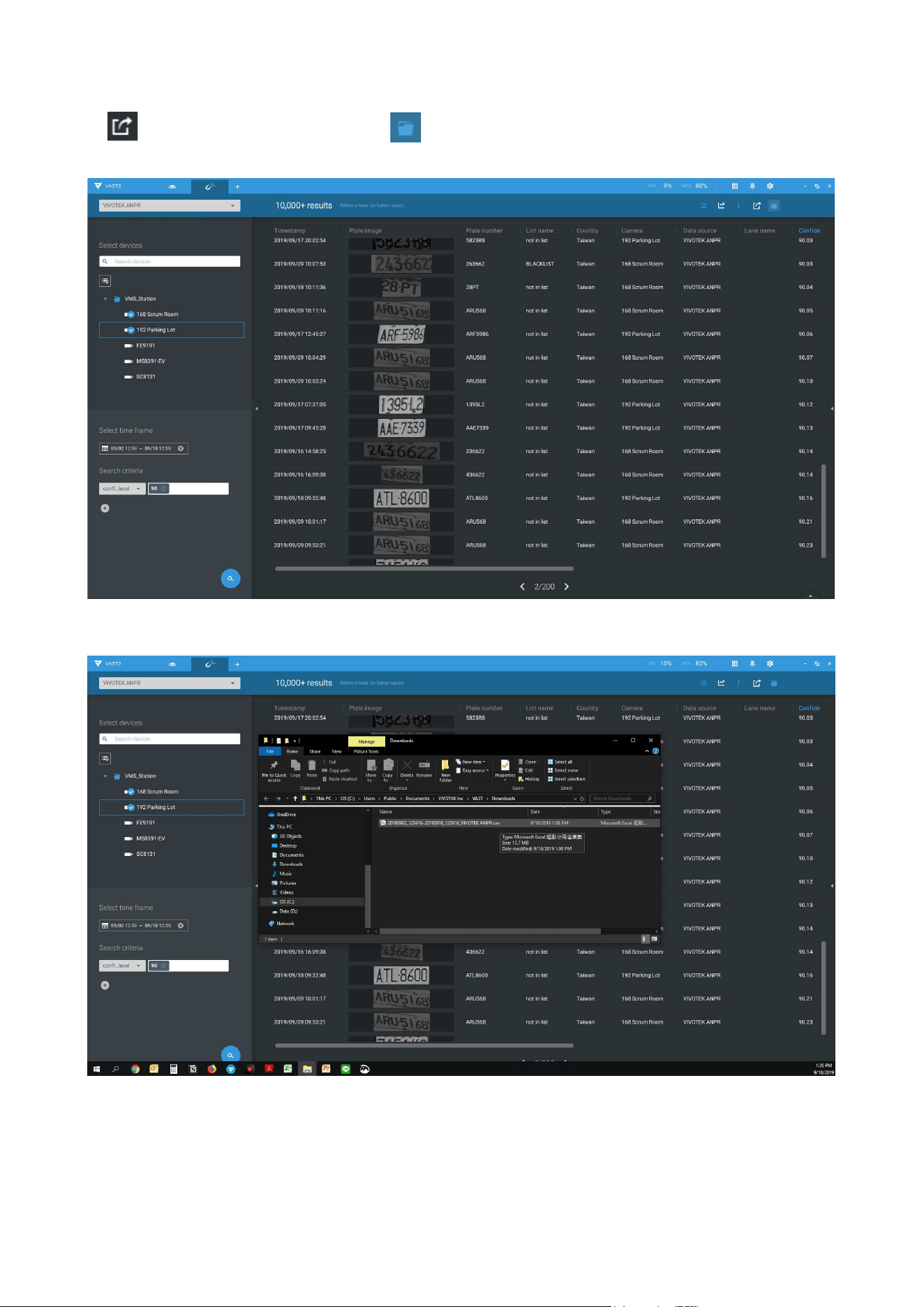
229
4. You can select and export a license plate capture using the Export function. Click on the
export button. A folder button will display. Click on it to access the exported file.
The target directory will open. Open the exported CSV file to view the search results.
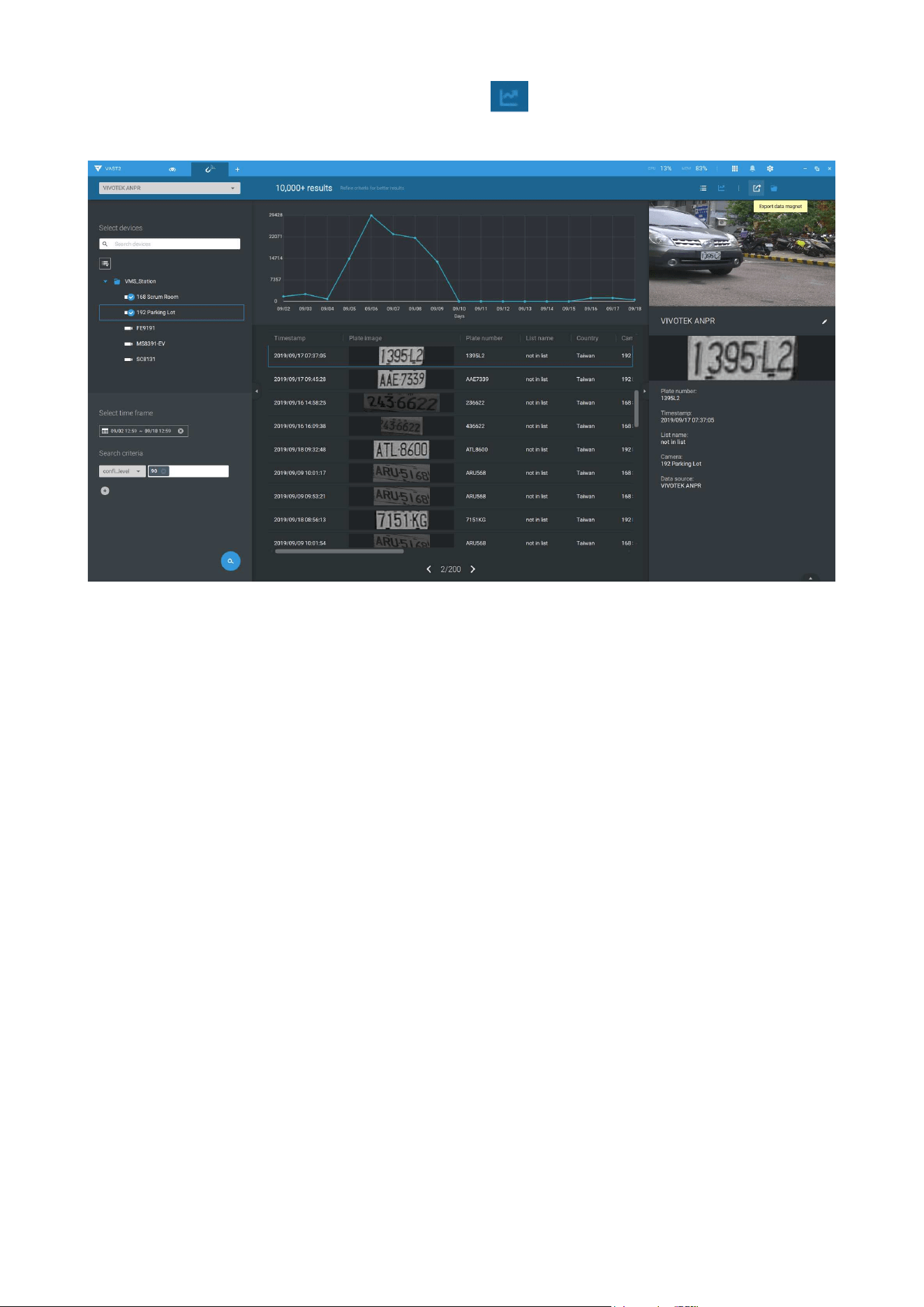
230
You can also open a chart view by clicking the Chart view button. The chart view
can also be exported as a png file.
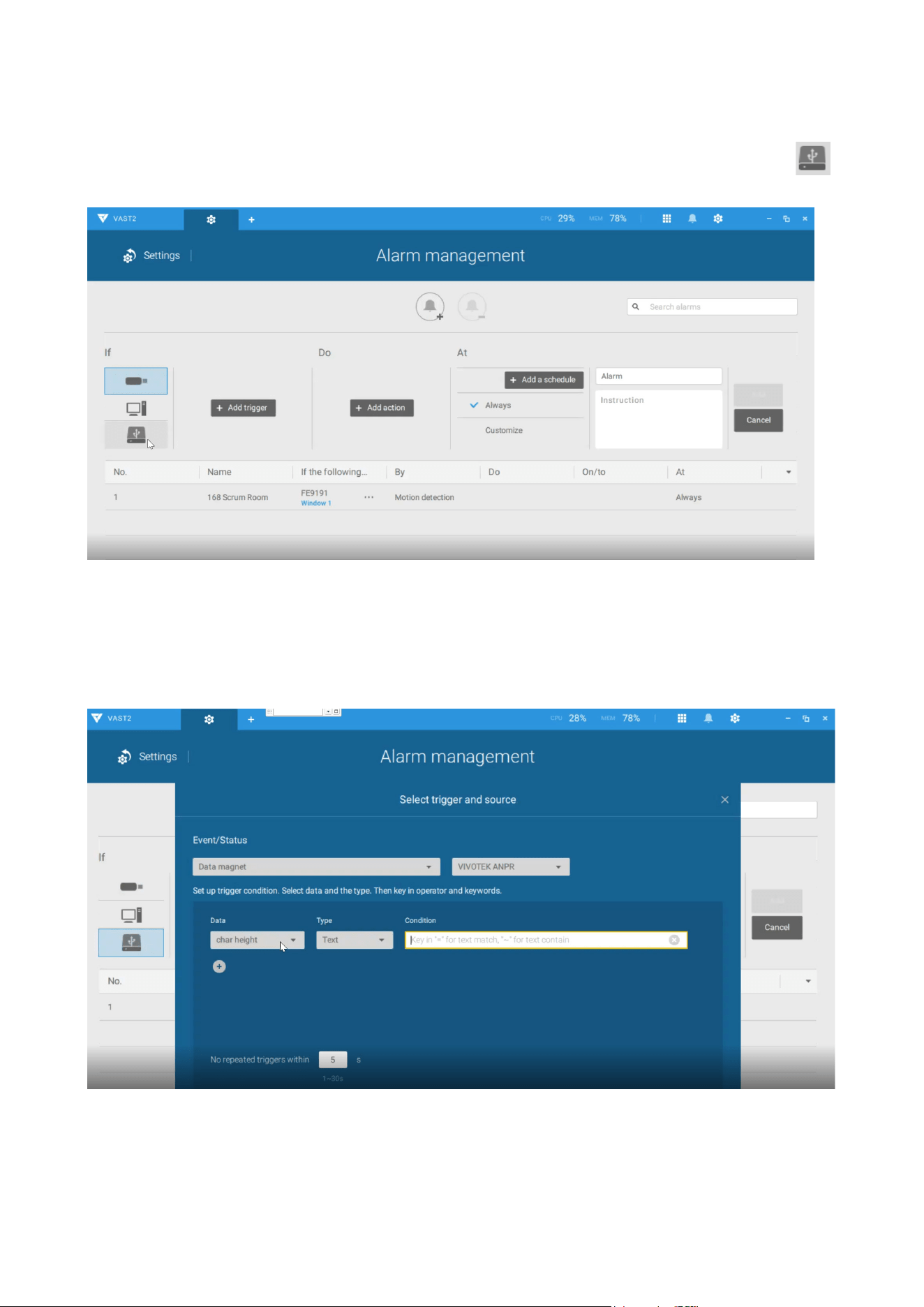
231
Configuring Data Magnet alarms:
1. Enter Settings > Alarm > Add & Delete to create a new alarm setting. Click to select
External devices.
2. Select VIVOTEK ANPR as your triggering source. Select and create triggering conditions
such as character height, image width, list, list name, country, etc. Use "=" for text
matching, "~" for text containing, or approximately matching specific characters, and
also ">," "<," ">=," "<=" for numbers larger or smaller than a preset value.
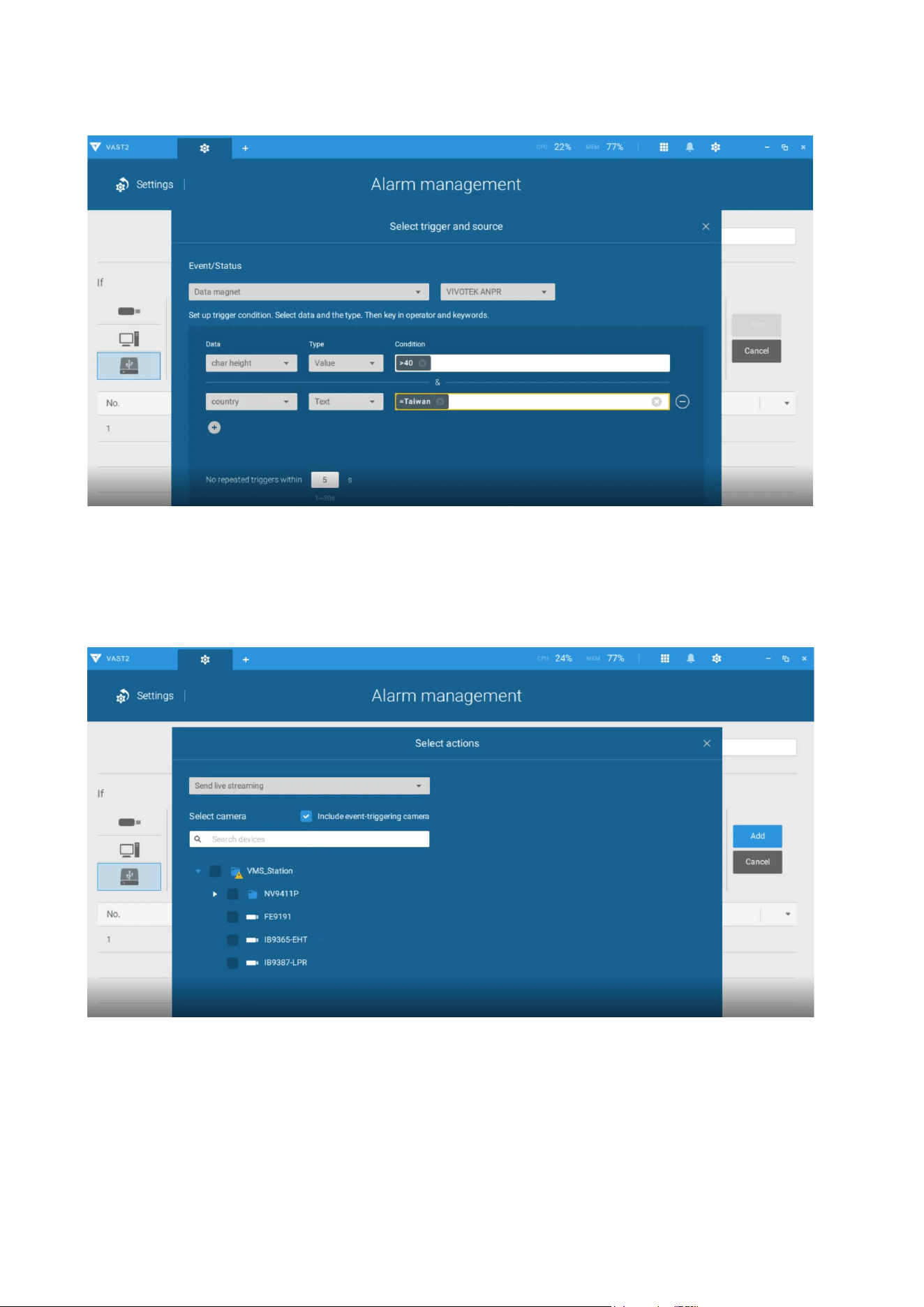
232
3. Continue to configure your triggering conditions. You can create multiple conditions.
4. Continue to configure the actions for a triggered alarm, such as sending live streaming.
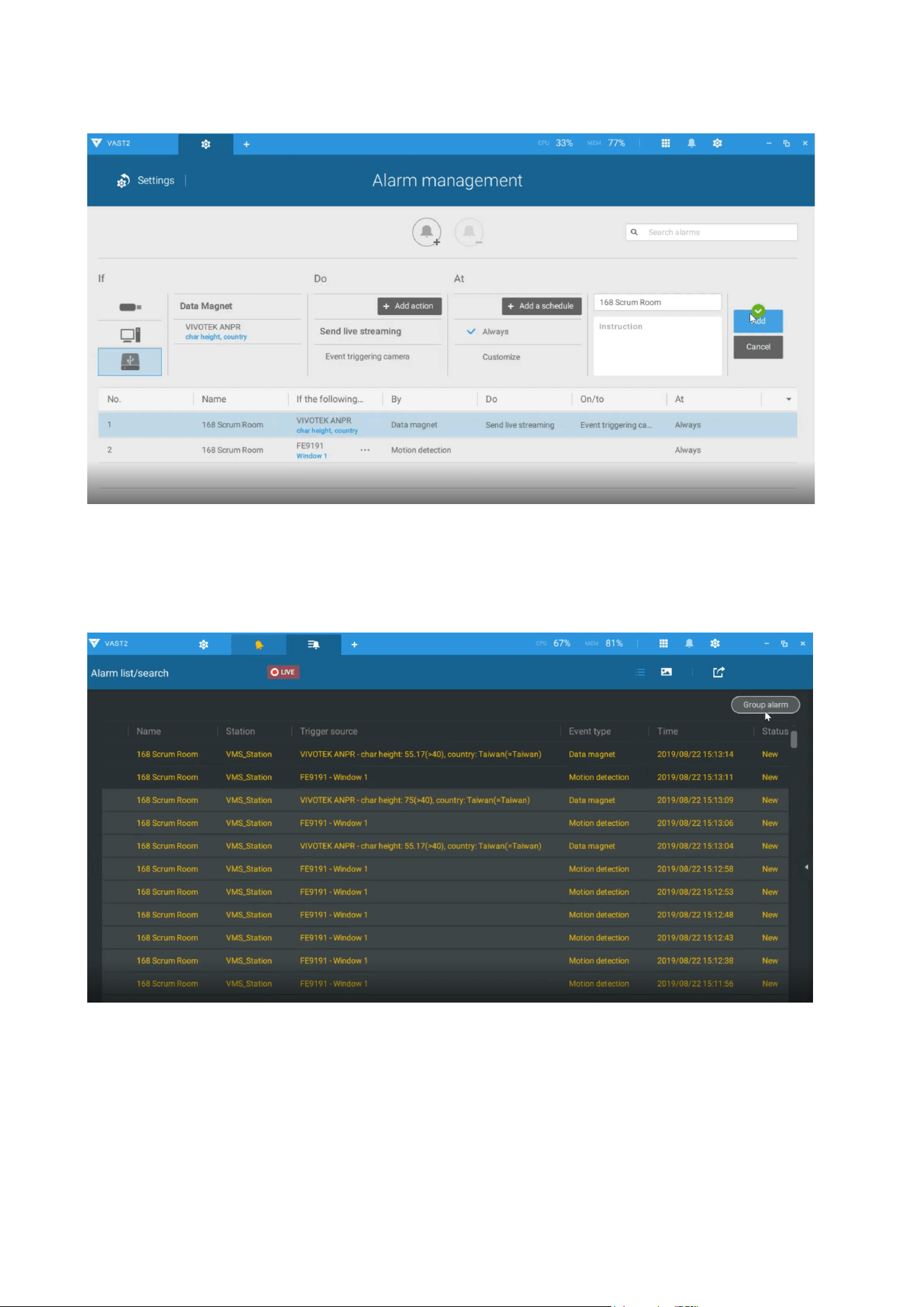
233
5. When done, enter a name for the alarm and click the Add button to complete.
6. You can now receive alarm notifications triggered by license plate recognition via the
Data Magnet.
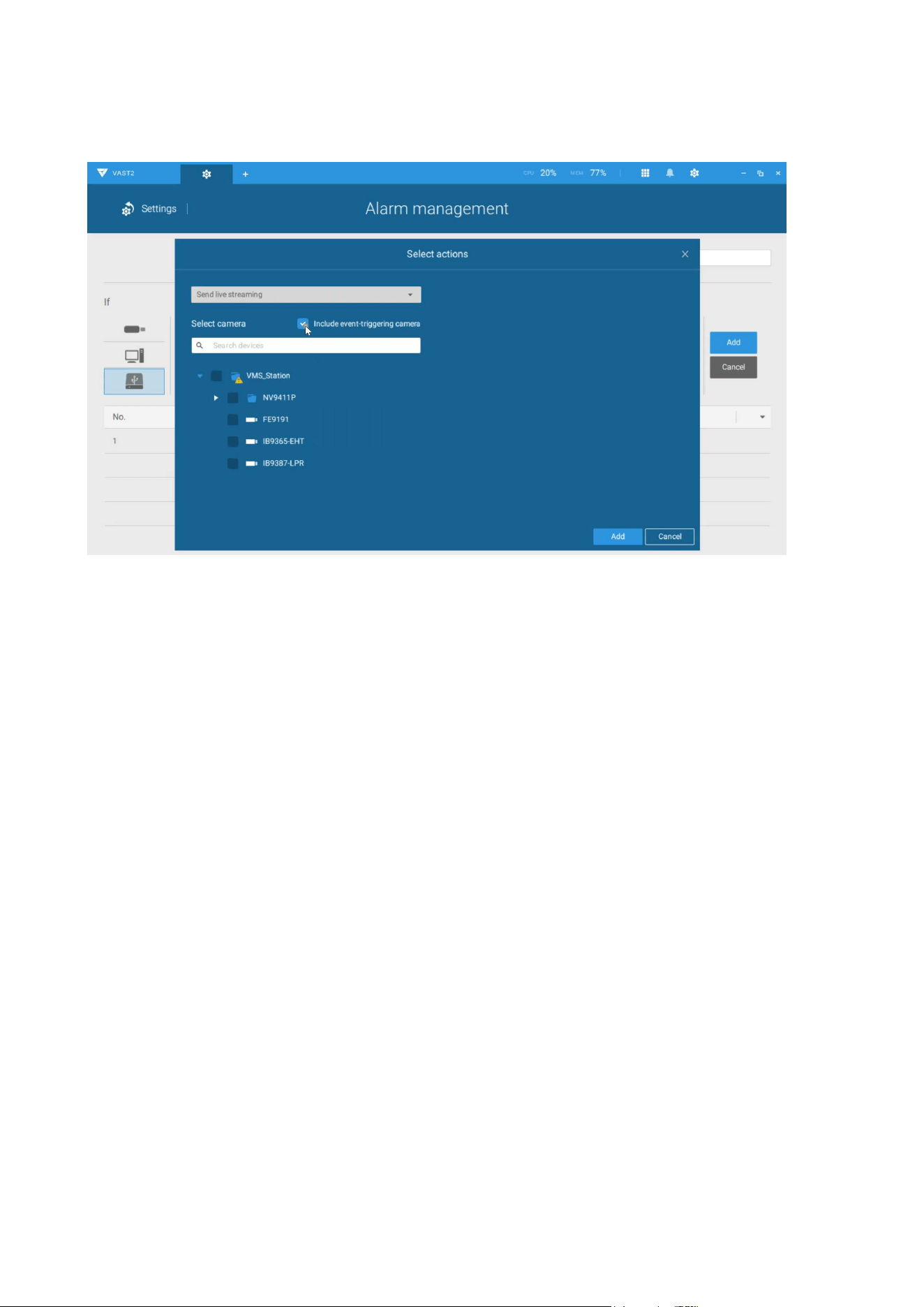
234
Note that if you select "Include event-triggering camera" during the alarm configuration
stage, the camera delivering the data source will be automatically selected.
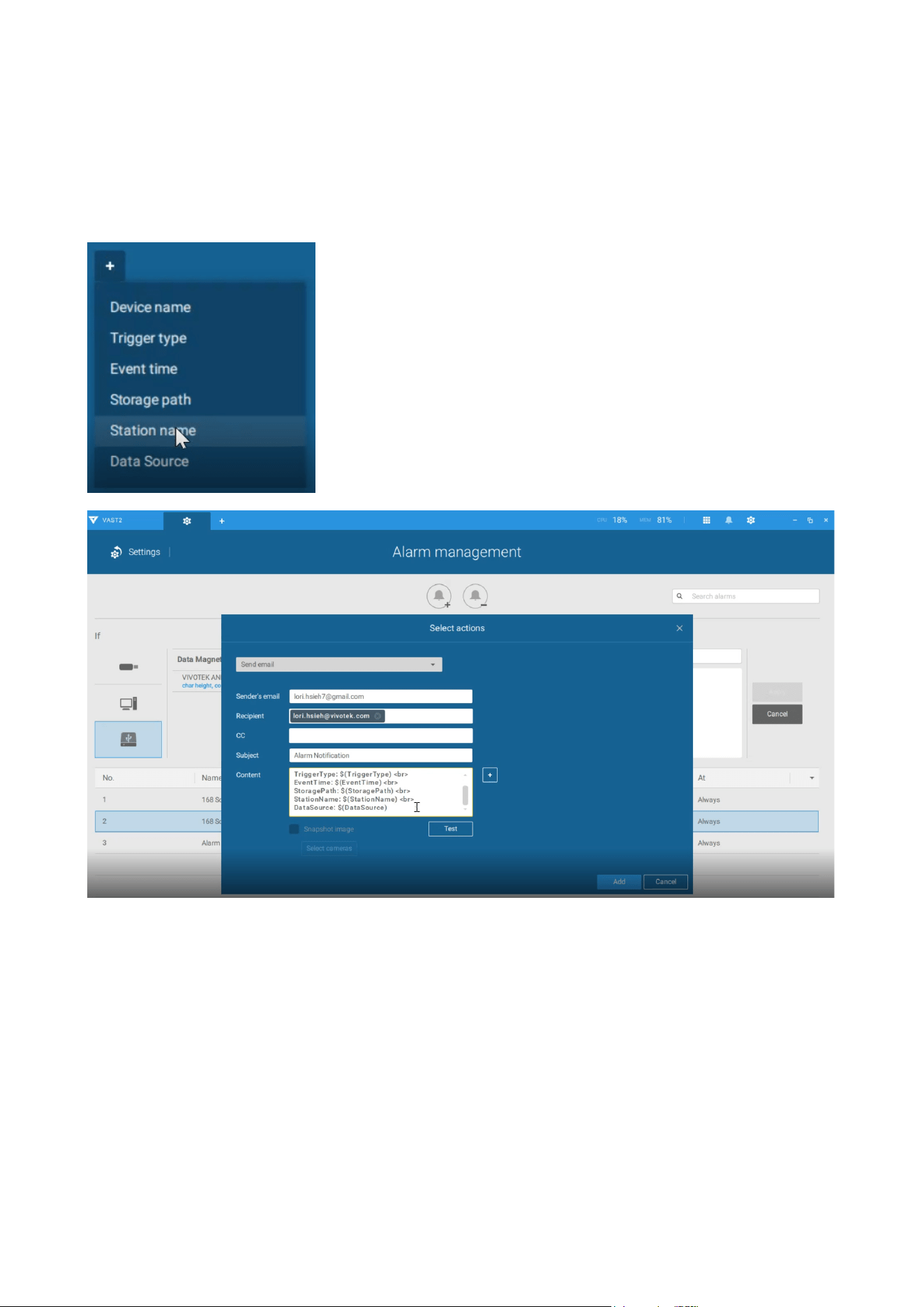
235
Configuring Data Source macro via Send email and Send HTTP requests:
In Settings > Alarm > Add & Delete, Email and HTTP requests can be used to send data
source macro to receivers. Use "<br>" as the line break command. Note that an SMTP
server should have been configured before the Email settings in Alarm.
You can specify multiple lines of information in your
alarm notification message.
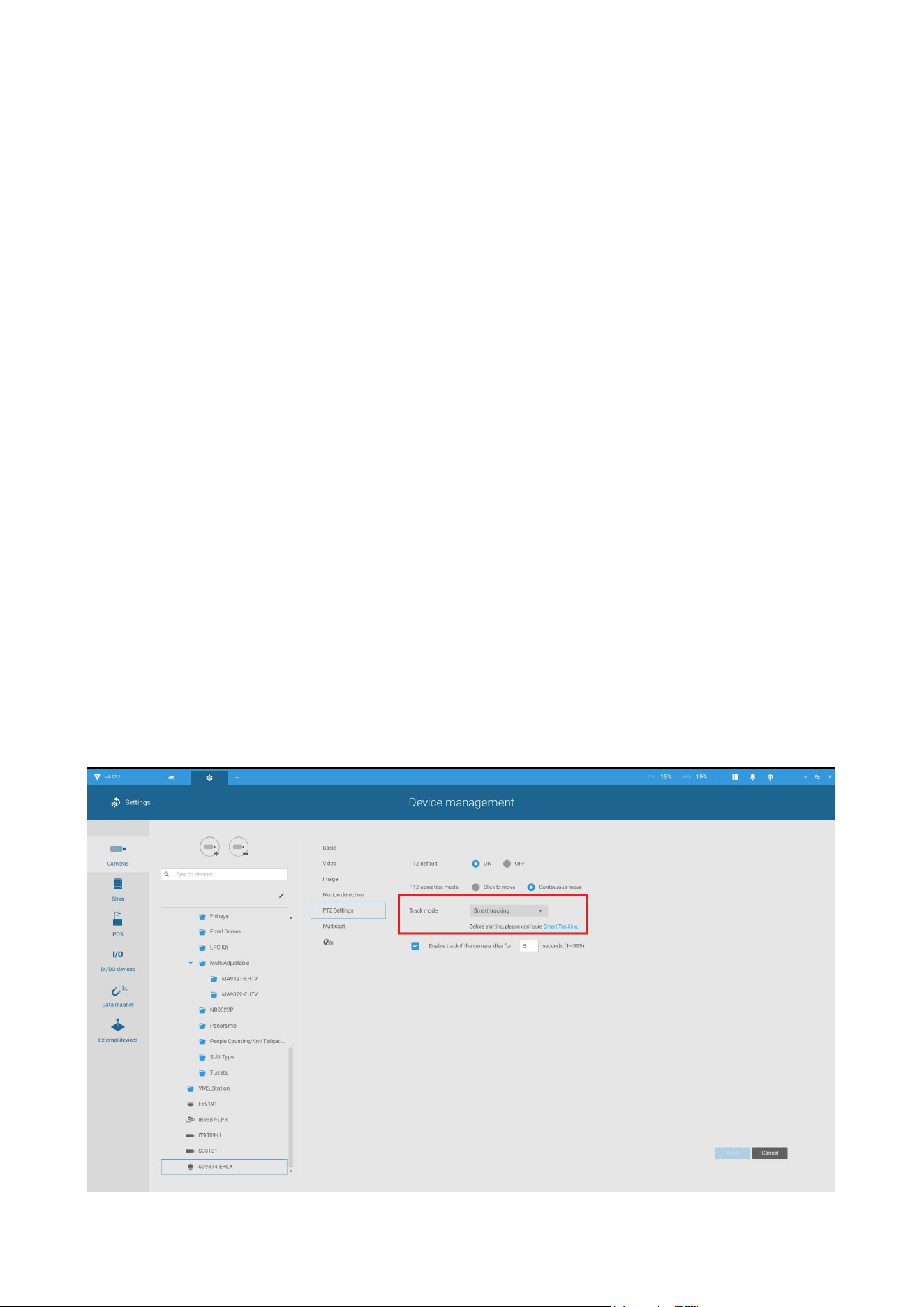
236
Appendix G: Enable Smart
Tracking for Speed Dome
Cameras
The Smart tracking function is available on speed dome cameras, such as SD9374-EHLX.
The Smart tracking feature is separately configured on the camera side. Please refer to
Smart Tracking User Guide for configuration details.
To display Smart tracking on VAST,
1. Enter Settings > Devices > Cameras.
2. Select the speed dome camera that supports this feature.
3. Select PTZ Settings, and the Track mode menu. Select Smart tracking as the tracking
display mode. A hyperlink is provided for the Smart tracking configuration page.
It is recommended to always enable "Enable track if the camera idles for xx seconds."
Manual PTZ control always has a higher priority and will interrupt tracking.
4. Click the Apply button.
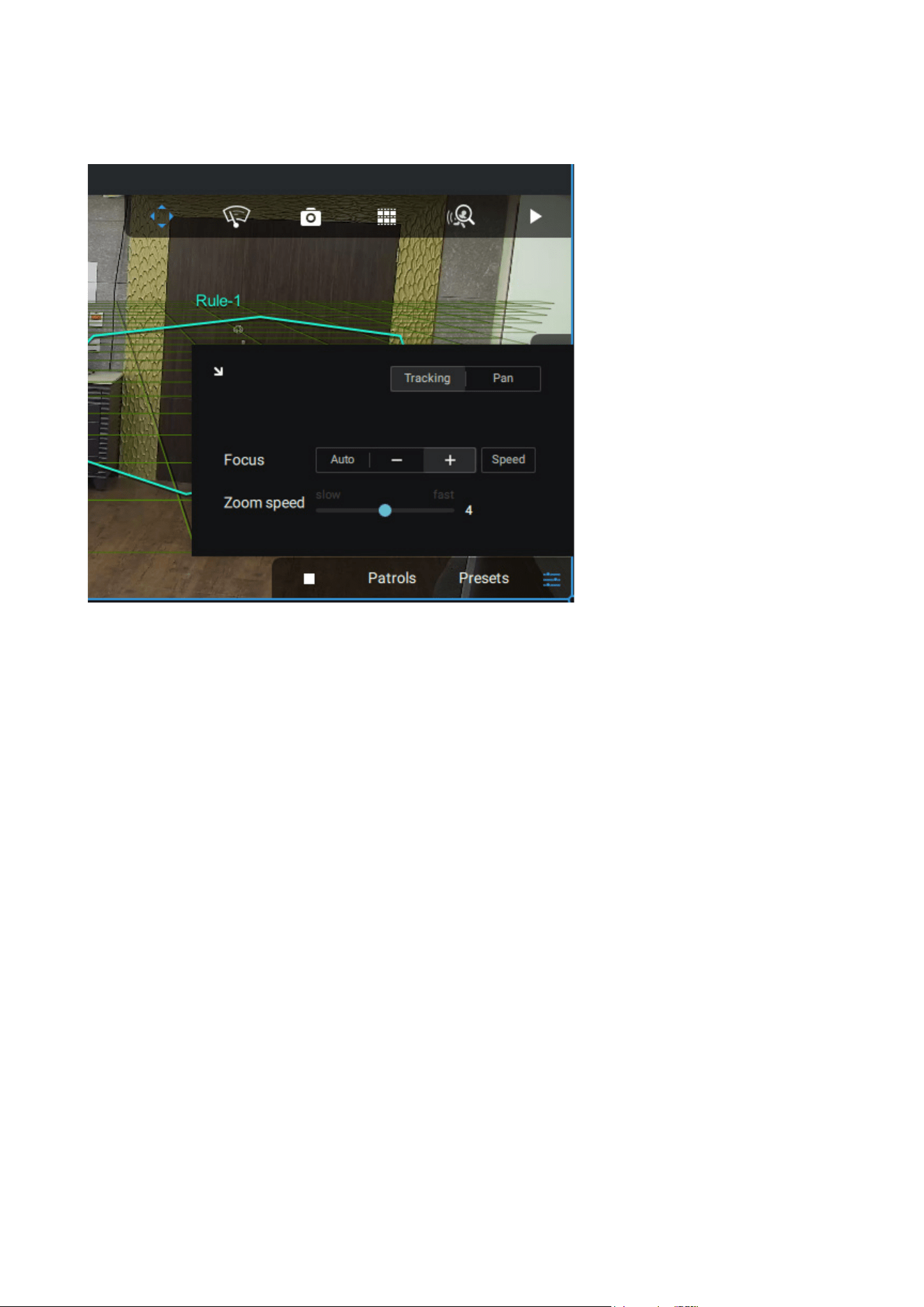
237
5. On the view cell of the speed dome, click PTZ settings, and then click the Tracking
button.