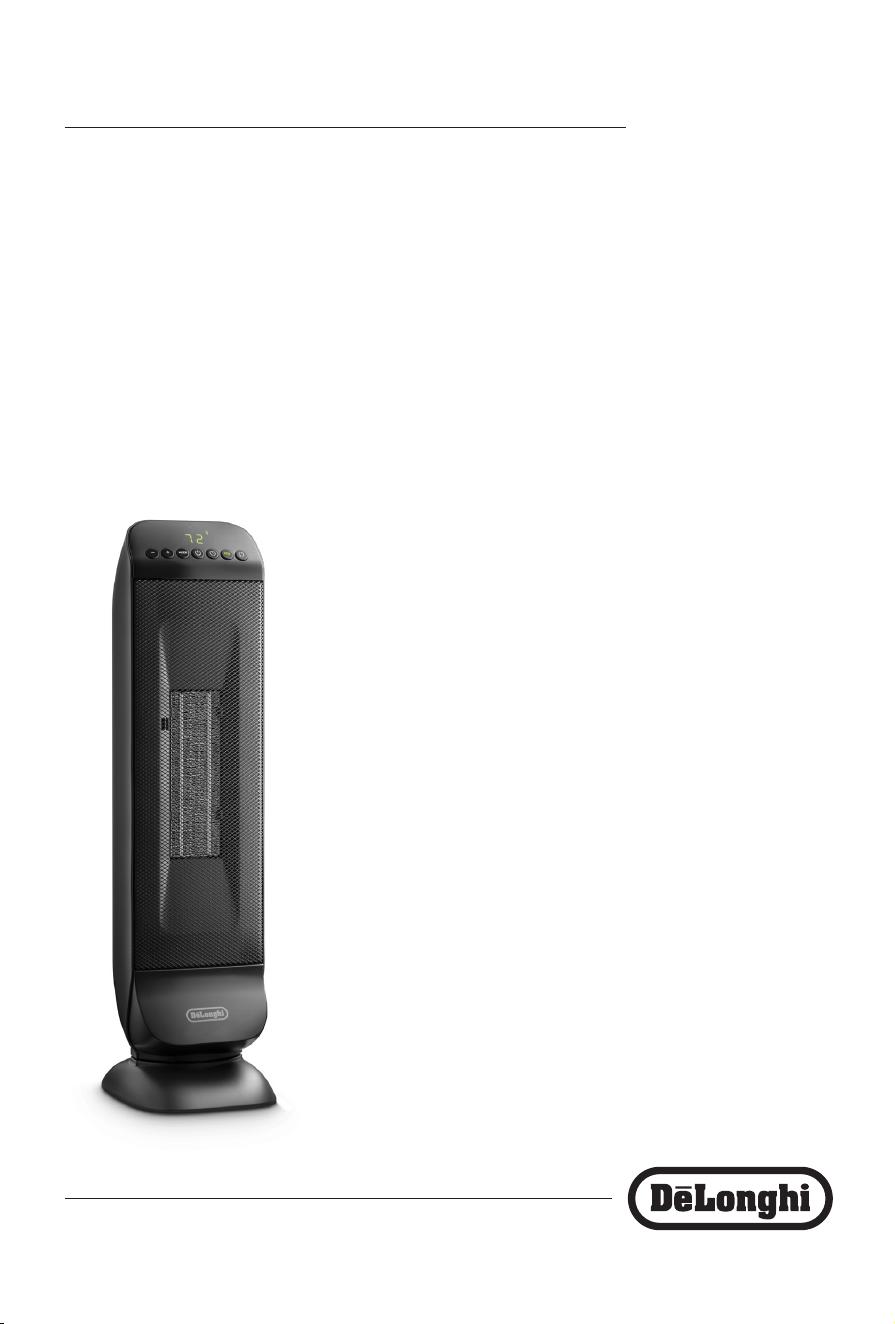
HFXR28S15W
CERAMIC TOWER HEATER
Instructions for use. Keep these instructions
Visit www.delonghi.com for a list of service centers near you.
ELECTRIC CHARACTERISTICS
120 V~ 60 Hz 1500 W
CALENTADOR DE TORRE CERAMICO
Repase y guarde estas instrucciones.
Lea cuidadosamente este instructivo antes de usar su aparato.
Visite www.delonghi.com para ver la lista de centros de servicios
cercanos a usted.
CARACTERISTICAS ELECTRICAS:
120 V~ 60 Hz 1500 W

2
EN
ES
page 4 pág. 9
3
A
G
BB
D F
CE
B B F A E D C
4
IMPORTANT
SAFEGUARDS
Use this heater only as described in this manual. Any other
use not recommended by the manufacturer may cause re,
electric shock, or injury to persons and hyperthermia, in-
cluding the following. Read all instructions before using this
heater. Specically:
Danger!
Failure to observe the warning may result in life threatening
injury by electric shock.
- Do not operate any heater with a dam-
aged cord or plug or after the heater
malfunctions, has been dropped or
damaged in any manner. Discard heat-
er, or return to authorized service facil-
ity for examination and/or repair.
- This heater is not intended for use in bath-
rooms, laundry areas and similar indoor loca-
tions. Never locate heater where it may fall
into a bathtub or other water container.
- Do not use this heater in the immediate sur-
roundings of a bath, a shower or a swimming
pool.
- Do not insert or allow foreign objects to en-
ter any ventilation or exhaust opening as this
may cause an electric shock or re, or damage
the heater.
- CAUTION: to prevent electric shock
match wide blade of plug to wide slot,
then fully insert.
- CAUTION: In order to avoid a hazard due to
inadvertent resetting of thermal cut-out, this
appliance must not be supplied through an
external switching device, such as a timer,
or connected to a circuit that is regularly
switched on and o by the utility.
- This heater may include an visual alarm to
warn that parts of the heater are getting
excessively hot. If the alarm ashes, imme-
diately turn the heater o and inspect for any
objects on or adjacent to the heater that may
cause high temperatures. DO NOT OPERATE
THE HEATER WITH THE ALARM FLASHING.
Important!
Failure to observe the warning could result in injury or dam-
age to the appliance.
- The appliance is not intended for use by
persons (including children) with reduced
physical, sensory or mental capabilities, or
lack of experience and knowledge, unless
they have been given supervision or instruc-
tion concerning use of the appliance by a
person responsible for their safety. Children
should be supervised to ensure that they do
not play with the appliance.
- Extreme caution is necessary when any heat-
er is used by or near children or invalids and
whenever the heater is left operating and un-
attended.
- Always unplug heater when not in use.
- The heater must not be located immediately
below a socket-outlet.
- To prevent overload and blown fuses, be
sure that no other appliance is plugged into
the same outlet (receptacle) or into another
outlet (receptacle) wired into the same cir-
cuit.
- Be sure that the plug is fully inserted into an
appropriate outlet. Please remember that
outlets also deteriorate due to aging and
continuous use: check periodically if signs of
overheating or deformations are evidenced
by the plug. Do not use the outlet and CALL
your electrician.
- Always plug heaters directly into a wall out-
let/receptacle. Never use with an extension
cord or relocatable power tap (outlet/power
strip).
Danger of burns!!
Failure to observe the warning could result in burns or scalds.
- This heater is hot when in use. To avoid burns,
do not let bare skin touch hot surfaces. If pro-
vided, use handles when moving this heater.
Keep combustible materials, such as furni-
ture, pillows, bedding, papers, clothes, and
curtains at least 3 feet ( 0.9 m) from the front

5
of the heater and keep them away from the
sides and rear.
- Do not run cord under carpeting. Do not cover
cord with throw rugs, runners, or similar cov-
erings. Do not route cord under furniture or
appliances. Arrange cord away from trac
area and where it will not be tripped over.
- To prevent a possible re, do not block air in-
takes or exhaust in any manner. Do not use on
soft surfaces, like a bed, where openings may
become blocked.
- A heater has hot and arcing or sparking parts
inside. Do not use it in areas where gaso-
line, paint, or ammable liquids are used or
stored.
- It is normal for the heater’s plug and cord to
feel warm to the touch.
A plug or cord which becomes hot tothe
touch or becomes distorted in shape may be
a result of a worn electrical outlet. Worn out-
lets or receptacles should be replaced prior
to further use of the heater. Plugging heater
into a worn outlet / receptacle/ may result in
overheating of the power cord or re.
- If the supply cord is damage, it must be re-
placed by the manufacturer, its service agent
or similarly qualied person in order to avoid
a hazard.
- WARNING: Do not cover the appliance while
it is functioning in order to avoid overheating
which may cause risk of re.
Please note:
This symbol indicates recommendations and important in-
formation for the user.
- Hyperthermia can result in death. Symptoms
of hyperthermia include high body tempera-
ture, headache, nausea, vomiting, tiredness,
dizziness, fainting, and rapid pulse. If you be-
gin to experience symptoms related to hyper-
thermia, turn o the heater and seek medical
attention.
- To avoid excessive room temperatures which
can cause hyperthermia: DO NOT leave prod-
uct running unattended in a conned space
around infants, or individuals with reduced
physical, sensory, or mental capabilities.
- If your appliance is equipped with a poly-
thene tape used as carry handle, remove it
before connecting appliance to the outlet.
- Do not use outdoors.
- To disconnect heater, turn controls to o,
then remove plug from outlet.
- Connect to properly polarized outlets only.
- This heater is not intended for use with an
extension cord or outlet strip. Plug the cord
directly into an appropriate wall receptable.
- Check that neither the appliance nor the
power cable have been damaged in any way
during transportation.
- Do not use the appliance in rooms with a
oor area of less than 43 square feet (4mq).
- Make sure that no pieces of polystyrene or
other packaging material have been left on
the appliance.
It may be necessary to pass over the appli-
ance with a vacuum cleaner.
- When switching on the appliance for the rst
time, allow it to run at full power for at least
two hours to get rid of the unpleasant smell.
Make sure that the room in which the appli-
ance is located is well ventilated during this
operation. It is normal for the appliance to
emit small cracking sounds when you turn it
on.
SAVE THESE INSTRUCTIONS
THIS PRODUCT IS FOR HOUSEHOLD USE
ONLY
6
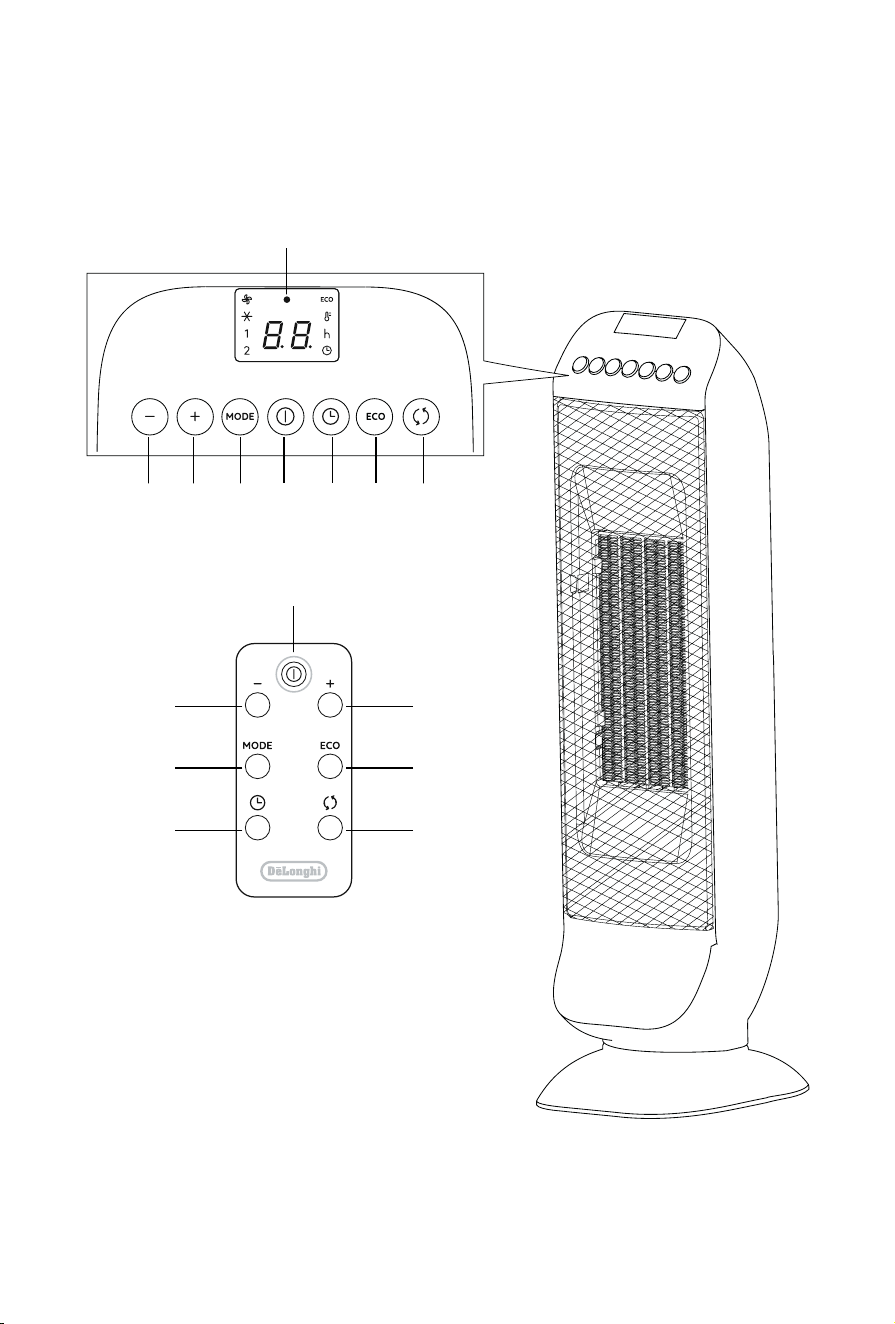
DESCRIPTION
A ON/OFF button
B +/- Adjustment buttons
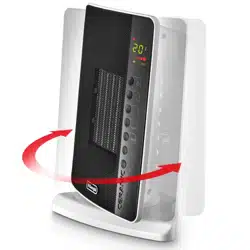
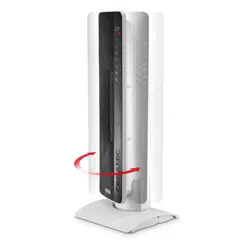
C Oscillation button
D ECO function button
E Timer button
F MODE button (for selecting the operating mode)
G Power indicator light
USE
Installation
The appliance can be used on any horizontal surface.
Do not overload the electrical circuit. Avoid using the same
socket for other appliances.
Electrical connection
- Before plugging the appliance into the outlet, check
that the power supply corresponds to the value indi-
cated on the rating plate and that the power supply is
adequate for the load.
Operation and use
- Connect the appliance to the power outlet.
- The appliance emits a beep and the power indicator
light (G) also comes on and remains lit while power to
the appliance is on. The appliance goes into STANDBY.
- Press the ON/OFF button (A) to turn on the appliance. It
will begin to heat with the predened settings.
- Press the MODE button (F) to select one of the following
functions available:
l
Ventilation
In this operating mode only the fan operates, so the ap-
pliance does not heat the room.
l
Anti-freeze
In this operating mode the appliance keeps the room
at a temperature of 45°F (7°C) to prevent freezing tem-
peratures.
l
Heating 1 and Heating 2
In this operating mode you can set the desired tem-
perature by pressing the + and - adjustment buttons
(B).
- Heating 1 (minimum power level):
The appliance operates at the minimum power, reduc-
ing noise and energy consumption to the minimum.
- Heating 2 (maximum power level):
The appliance operates at the maximum power for
rapid heating of the room.
ECO function
In this operating mode the appliance will automatically set
the power level to guarantee the best comfort reducing the
energy consumption.
In this operating mode the unit may switch the heating
power level from maximum to minimum and vice versa,
several times in an hour. When using the ECO function, the
maximum temperature setting is 79°F (26°C). To activate this
function, press the ECO button (D).
Oscillation button
If you want the appliance to distribute the airow over a
larger area, press the oscillation button (C) . The appli-
ance will then oscillate right and left. To stop the oscillation
in the desired position, just press oscillation button (C) again.
Turn the appliance o
To turn o the appliance press button ON/OFF (A). The dis-
play could show the count down for about 6 seconds. To
completely turn o the appliance, remove the plug from the
socket.
Please note: The display can show the temperature in
both °F and °C. To change the temperature scale, press and
hold the + key for approximately 10 seconds, then release.
Please be aware that the temperature shown may not cor-
respond exactly to the actual temperature.
24-HOUR DIGITAL TIMER
This function can be activated from any operating mode.
Delayed switch-on: with the appliance in the STANDBY
position, press the timer button (E) .
The display shows the symbol and the time remaining
before switch-on. To set the timer, use the + and - adjust-
ment buttons (B), then wait a few seconds for the program-
ming to be set.
The display returns in stand-by and the symbol to indi-
cate you have set the timer. When the programmed time has
been reached, the appliance turns on with the same settings
it had during the previous operation.
Delayed shut-o: With the appliance on, press the timer
button (E) . The display shows the symbol and the
time remaining before shut-o. To set the timer, use the +
and – adjustment buttons (B), then wait a few seconds for
the programming to be set. The display returns to show the
current settings and the symbol to indicate you have set
the timer. When the programmed time as been reached the
appliance shuts o automatically.
7
If you want to go back to operation without the timer, press
the timer button (E) twice. The timer symbol disappears
from the display.
NOTE: Timer can be set in 30 minutes intervals from 30 min-
utes to 10 hours, and in one hour increments thereafter.
Using the remote control
The remote control functions correspond to those on the
control panel.
See the section “Operation and Use" on the previous page for
a description of the functions.
NOTE: Before using remote control, you must remove plastic
tab from base of remote.
Important! This product contains a button battery.
If swallowed, it could cause severe injury or death in just 2
hours. Seek medical attention immediately.
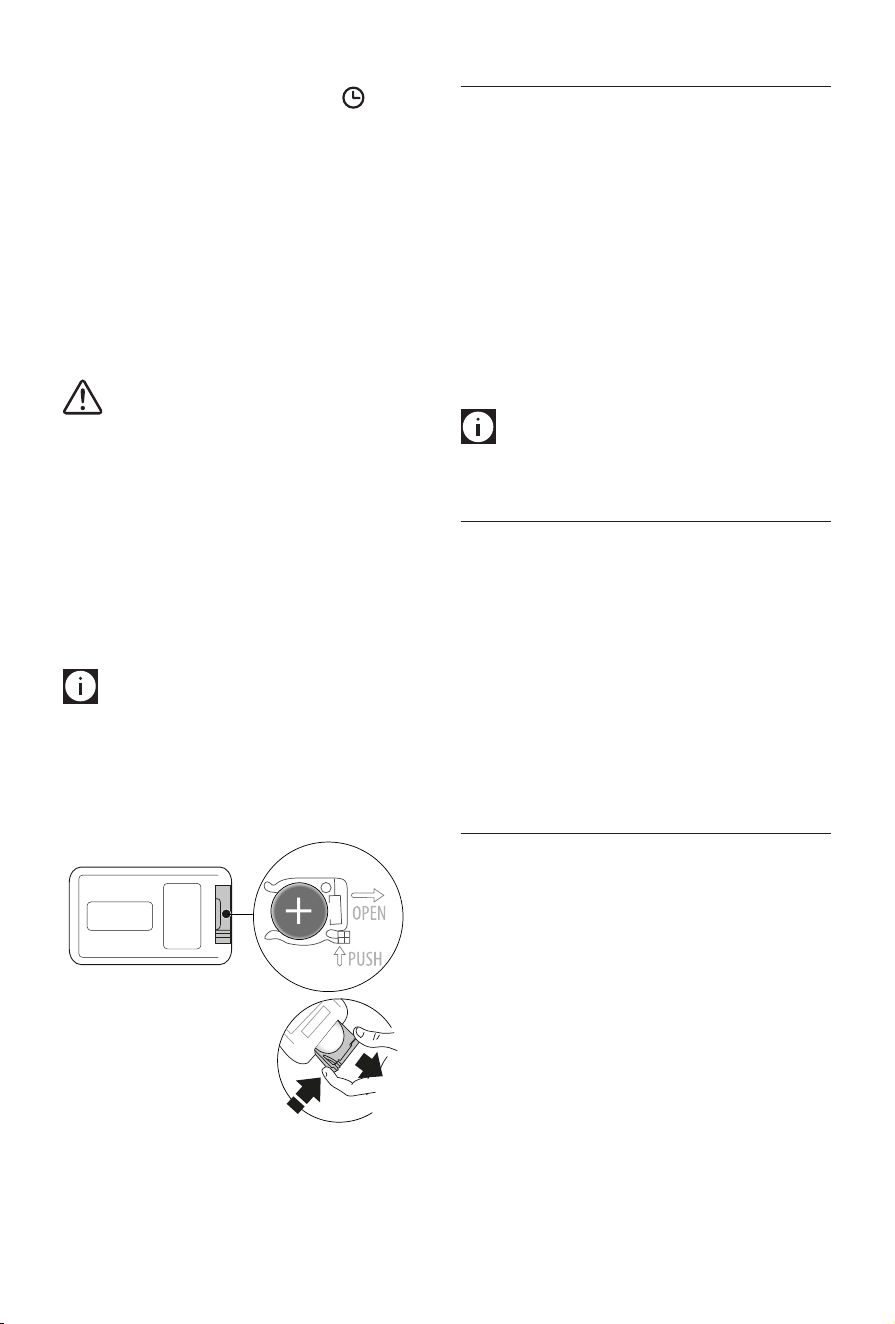
Replacing the remote control battery
- Extract the battery holder on the back of the remote
control (see gure below).
- Insert a battery type 3V CR2025 into the holder, making
sure the polarity is correct (+ and -), then reinsert the
holder into the back of the remote.
The remote control is ready for use.
Please note: If the remote control is disposed of or
replaced, the battery must be removed and disposed of in
accordance with local recycling regulations as batteries are
harmful to the environment.
Do not throw the battery into an open ame as it may ex-
plode or release hazardous liquids.
PUSH
REMOVE
ADDITIONAL SAFETY FEATURES
1. Overheating protection: a safety device switches
the heater o if it accidentally overheats (e.g.: air intake
and outlet grilles obstructed). In this case remove the
plug from the power outlet and leave it unplugged for a
few minutes, eliminate the cause of overheating, then
plug the fan heater back and turn it on again. If the ap-
pliance doesn't work please contact the De'Longhi Cus-
tomer Service.
2. Tip over safety switch: a safety tip-over switch turns
the heater o if it tips over or is positioned in an im-
proper way that could jeopardize safety.
After the appliance has been restored in the vertical
position, it will automatically go into STANDBY mode.
Please note: To avoid overheating the appliance, do
not cover it in any way.
TROUBLESHOOTING
In case “PF” is displayed and a warning sound is emitted,
there is a fault with the temperature sensor. If the problem
persists contact DeLonghi customer service.
If the appliance shuts o unexpectedly:
- Check that the appliance is receiving power.
- Check that the appliance is in the vertical position and
on a at surface, as the safety tip-over switch may have
been tripped.
- Check the temperature set and the timer: the appli-
ance may be o because the set temperature has been
reached or the time set on the timer has elapsed.
MAINTENANCE
- Before carrying out any maintenance, always unplug
from the outlet.
- During the season when the appliance is in use, clean
the air intake and outlet grilles regularly using a vacu-
um cleaner.
- Never use abrasive powders or solvents to clean the ap-
pliance.
8
PROBLEM CAUSE SOLUTION
PF display
Temperature sensor is not working
properly
The product needs to be serviced, contact
our toll free number for assistance
Product doesn’t turn on Check that the plug is connected to the
outlet
Delayed start timer is ON
Room temperature reaches the set
temperature
Plug in
Wait till set time elapses or press but-
ton (E) twice to cancel the delayed start
function and push button (A)
Use the “+” button to increase the set
temperature
The appliance shut OFF The tip-over switch has been activated Make sure the appliance is standing
upright on a at surface. If the problem
persists, contact our toll free number to
assist you
The display shows "Ht" blinking
The internal temperature is too high.
The air intake or outlet grille is
obstructed
Check the appliance is correctly
positioned respecting the minimum
distances from the wall, or objects, as
indicated in the instruction manual. If
not, position the appliance correctly
Remove the obstruction
Disconnect the plug from the outlet
and let the appliance cool down. After
a few minutes, plug the appliance in
again. If the appliance doesn't work
please contact the DeLonghi toll free
number
TROUBLESHOOTING
NOTE: This equipment has been tested and found to
comply with the limits for a Class B digital device, pursuant
to Part 15 of the FCC Rules. These limits are designed to
provide reasonable protection against harmful interference
in a residential installation.
This equipment generates, uses and can radiate radio
frequency energy and, if not installed and used in
accordance with the instructions, may cause harmful
interference to radio communications.
However, there is no guarantee that interference will not
occur in a particular installation. lf this equipment does
cause harmful interference to radio or television reception,
which can be determined by turning the equipment o and
on, the user is encouraged to try to correct the interference
by one or more of the following measures:
- Reorient or relocate the receiving antenna.
- Increase the separation between the equipment and
receiver.
- Connect the equipment into an outlet on a circuit dierent
from that to which the receiver is connected.
- Consult the dealer or an experienced radio/TV technician
for help. Modications not approved by the party
responsible for compliance could void user’s authority to
operate the equipment.
CAN ICES-3 (B) / NMB-3 (B)

9
INSTRUCCIONES
IMPORTANTES
Utilice este calentador únicamente según se describe en este
manual. Entre los usos no recomendados por el fabricante
que pueden ocasionar fuego, descargas eléctricas o daño
a personas e hipotermia, se encuentran los siguientes. Lea
atentamente todas las instrucciones antes de utilizar el
aparato. Especícamente:
¡Peligro!
El incumplimiento puede ser o es la causa de lesiones
provocadas por descargas eléctricas con peligro para la vida.
- No haga funcionar ningún calentador
con el cable o enchufe averiado o si
éste funcionara mal, por haberse
caído o averiado en algún modo. Lleve
el calentador a un centro de servicio
de asistencia autorizado para que lo
examinen, para los ajustes eléctricos o
mecánicos o para su reparación.
- EI calentador no se debe de usar en baños,
lavaderos y otros locales similares. Nunca
coloque el calentador en donde se pueda caer
en la bañera o en cualquier otro recipiente con
agua.
- No utilice este calefactor en el entorno
inmediato de un baño, una ducha o una
piscina.
- No introduzca ni permita que entre ningún
objeto extraño en la ventilación o salida de
aire, porque esto puede causar una descarga
eléctrica, incendio o avería del aparato.
- ATENCIÓN: para prevenir descargas
eléctricas haga coindicir la espiga plana
del enchufe con la entrada ancha e
introdúzcalo hasta el fondo.
- PRECAUCIÓN: Con el n de evitar situaciones
de peligro debido al reinicio accidental de
protección térmica, este aparato no debe
tener un dispositivo de conmutación externo,
como un temporizador, o conectarse a un
circuito que se encienda o apague desde
afuera.
- Este calefactor puede incluir una alarma visual
para advertir de que partes del calefactor
se están calentando excesivamente. Si la
alarma parpadea, apague inmediatamente
el calefactor y verique que no existan
objetos arriba o cerca del calefactor que
puedan causar altas temperaturas. NO HAGA
FUNCIONAR EL CALEFACTOR CON LA ALARMA
PARPADEANDO.
¡Atención!
El incumplimiento puede ser o es la causa de lesiones o de
desperfectos al aparato.
- No permita que personas (incluidos
niños) con capacidades psicofísicas
sensoriales disminuidas o con experiencia y
conocimientos insucientes usen el aparato
a no ser que estén vigilados atentamente o
instruidos por un responsable en relación a su
seguridad. Vigile a los niños para asegurarse
de que no jueguen con el aparato.
- Ponga extremo cuidado cuando use cualquier
calentador cerca de niños o inválidos y
cuando el calentador se deje funcionando sin
vigilancia.
- Siempre desconecte el calentador cuando no
lo esté usando.
- El calefactor no debe estar situado
inmediatamente debajo de un tomacorriente.
- Para prevenir una sobrecarga de corriente
y que se quemen los fusibles, verique que
no haya otros aparatos conectados en el
mismo tomacorriente o en otro tomacorriente
conectado en el mismo circuito.
- Controle que el enchufe esté bien conectado y
que el tomacorriente sea adecuado.
- Recuerde que los tomacorrientes se deterioran
con el tiempo y el uso continuo. Controle
periódicamente si el enchufe muestra signos
de recalentamiento o deformación.
- En tal caso, no utilice el tomacorriente y llame
inmediatamente a un electricista.
- Siempre enchufe el calentador directamente
al tomacorriente/receptáculo.
- Nunce utilice una extensión o supresor de
picos (fuente de poder/enchufe).

10
¡Peligro de ustiones!
El incumplimiento de las advertencias puede ser la causa de
quemaduras o ustiones.
-
El aparato se calienta cuando está en uso.
Para evitar quemaduras, no permita que la
piel desnuda toque las supercies calientes.
Use las asas al mover el calentador. Man-
tenga los materiales combustibles, como
paredes, muebles, almohadas, ropa de cama,
papeles, ropa y cortinas al menos a 3 pies
(0.9 m) de la parte delantera y superior del
calentador y al menos a 2 pies (0.6 m) de los
lados y de espalda.
- No pase el cable por debajo de la alfombra.
No cubra el cable con tapetes, alfombras o
similares.
No dirija el cable por debajo de los muebles o
demás electrodomésticos.
Ponga el cable lejos de zonas transitadas y
donde no pueda provocar tropezones.
- Para evitar incendios, no cubra las entradas
o salidas de aire de ninguna manera. No use
el calentador sobre supercies blandas, como
una cama, en donde las aberturas se podrían
bloquear.
- Un calentador tiene adentro partes calientes o
que causan chispas. No lo use en zonas donde
seuse o almacene gasolina, pintura o líquidos
inamables.
- Es normal que el enchufe y el cable de
alimentación del aparato se sientan calientes
al tacto.
Sin embargo, si el enchufe o el cable están
calientes o se deforman, puede ser debido a
un tomacorriente gastado. Los tomacorrientes
o enchufes gastados se deben sustituir antes
de seguir utilizando el aparato. Si se conecta
un aparato en un tomacorriente deteriorado,
el cable de alimentación podría llegar a
provocar un incendio.
- Si el cable de alimentación está dañado, debe
ser reemplazado por el fabricante, su agente
de servicio o persona calicada a n de evitar
un peligro.
- ADVERTENCIA: No cubra el aparato mientras
esté funcionando, a el n de evitar un
sobrecalentamiento, que puede provocar
riesgo de incendio.
Nota:
Este símbolo indica sugerencias e información importantes
para el usuario.
- La hipertermia puede ocasionar la muerte.
Entre los síntomas de la hipertermia están: tem-
peratura corporal elevada, cefalea, náusea, vómi-
to, cansancio, mareo, desmayo y taquicardia.
Si comienza a experimentar síntomas relaciona-
dos con la hipertermia, apague el calentador y
busque atención médica.
-Para evitar temperaturas ambientales excesivas
que pueden provocar hipertermia:
NO DEJE el dispositivo en funcionamiento y
desatendido en un espacio cerrado cerca de
los niños, o individuos con capacidades físicas,
sensoriales o mentales reducidas.
- Si el aparato tiene una cinta de
polietileno que se usa como manija para
trasladarlo, quítela antes deconectar el aparato a
un tomacorriente.
- No use el aparato a la intemperie.
- Para desconectar el calentador, apague los
mandos y luego desenchúfelo.
- Conecte el aparato solamente en
tomacorrientes debidamente polarizados.
- No use nunca el aparato conectándolo a una
extensión o a una tira de terminales. Conecte
el aparato directamente al tomacorriente en
el muro.
- Controle que el aparato y el cable de
alimentación no hayan sufrido daños durante
el transporte.
- No use este aparato en una habitación cuya
área de base sea inferior a 4m².
- Controle que en el aparato no hayan quedado
residuos de poliestireno u otras materiales
de embalaje. Podría ser necesario pasar el
aspirador sobre el aparato
- Al encender el aparato por primera vez, déjelo
11
funcionar durante alrededor de dos horas
a la potencia máxima, para eliminar el olor
desagradable. Ventile muy bien el local donde
se encuentra el aparato durante tal operación.
Es normal que el aparato produzca ligeros
crujidos cuando usted lo encienda.
GUARDE ESTAS
INSTRUCCIONES
ÚNICAMENTE PARA USO DOMÉSTICO
DESCRIPCIÓN
(véase la g. 1)
A Botón ON/OFF
B Botones de ajuste +/-
C Botón de oscilación
D Botón función ECO
E Botón Timer
F Botón MODE (selección del modo de funcionamiento)
G Piloto luminoso
H Receptor del mando a distancia
USO
Instalación
Puede utilizar el aparato sobre cualquier supercie de apoyo
horizontal.
No utilice el mismo enchufe para otros aparatos para no so-
brecargar el circuito eléctrico.
Conexión eléctrica
Antes de conectar la clavija al enchufe, compruebe que la
tensión de la red corresponda al valor indicado en la placa de
datos y que el enchufe y la red de alimentación sean adecua-
dos para la carga utilizada.
Funcionamiento y uso
- Enchufe el aparato a la corriente.
- El aparato emite una señal acústica y el piloto luminoso
(G) se enciende y permanece encendido mientras que el
aparato está funcionando. El aparato se pone en stand-
by.
- Presione el botón ON/OFF (A) para encender el
aparato. Empezará a calentar con las programaciones
predenidas.
- Presione el botón MODE (F) para seleccionar una de las
siguientes funciones disponibles:
l
Ventilación
En este modo funciona solamente el ventilador por lo
que el aparato no calienta el ambiente.
l
Antihielo
En este modo el aparato mantiene la temperatura
ambiente a 45°F (7°C) impidiendo la congelación.
l
Calefacción 1 y Calefacción 2
En este modo puede elegir la temperatura con los
botones de ajuste + y – (B).
- Calefacción 1 (nivel de potencia mínima)
El aparato funciona con la mínima potencia y reduce el
consumo energético al mínimo.
- Calefacción 2 (nivel de potencia máxima)
El aparato funciona con la máxima potencia para
calentar rápidamente el ambiente.
Función ECO
En este modo de funcionamiento el termoventilador ajustará
automáticamente el nivel de potencia para garantizar la
máxima comodidad reduciendo el consumo de energía. En
este modo de funcionamiento la unidad puede cambiar el
nivel de potencia de calentamiento de máximo a mínimo y
viceversa, varias veces en una hora. El ajuste de temperatura
máxima es 79 °F (26 °C). Para activar esta función, presione
el botón ECO (D).
Botón de oscilación
Presione el botón de oscilación (C) para que el aparato
distribuya el ujo de aire en una supercie más grande. El
aparato empezará a oscilar de derechas a izquierdas. Para
detener la oscilación en la posición elegida, solamente ha de
presionar de nuevo el botón de oscilación (C).
Apagar el aparato
Presione el botón ON/OFF (A) para apagar el aparato. En
la pantalla se puede ver la cuenta atrás durante unos 6
segundos.
Nota: La pantalla puede mostrar la temperatura tanto
en °F como en °C. Para cambiar la escala de temperaturas,
mantenga presionada la tecla + durante algunos segundos y
libere después. Tenga por favor en cuenta que dado que este
no es un dispositivo de precisión, la temperatura mostrada no
necesariamente corresponde con la verdadera.
TIMER DIGITAL DE 24H
Puede activar esta función en todos los modos de
funcionamiento.
Encendido retardado: presione el botón timer (E) con
el aparato en la posición de STAND-BY.
12
En la pantalla se ve el símbolo y el tiempo que falta
para que el aparato se encienda. Use los botones de ajuste
+ y – (B) para ajustar el timer y espere unos segundos para
memorizar la programación.
La pantalla vuelve el modo en STAND-BY y el símbolo
para indicar que el timer está programado.
El aparato se enciende a la hora programada con las mismas
programaciones utilizadas en el período de funcionamiento
precedente.
Apagado retardado. Presione el botón timer (E) con el
aparato encendido. En la pantalla se ve el símbolo y el
tiempo que falta para que el aparato se apague.
Use los botones de ajuste + y – (B) para ajustar el timer y
espere unos segundos para memorizar la programación.
En la pantalla se ven de nuevo las programaciones corrientes
y el símbolo para indicar que el timer está programado.
El aparato se apaga automáticamente a la hora programada.
Si quiere volver al modo de funcionamiento sin el timer,
presione dos veces el botón timer (E). El símbolo del timer
desaparece de la pantalla.
NOTA: El temporizador se puede congurar en incrementos
de 30 minutos, de 30 minutos a 10 horas y posteriormente
en incrementos de una hora.
Uso del mando a distancia
Las funciones del mando a distancia corresponden a las del
panel de mandos. Consulte la sección “Funcionamiento y uso”
en la página anterior para la descripción de las funciones.
NOTA: Antes de usar el control remoto, debe quitar la
pestaña de plástico de la base del control remoto.
¡Atención! Este producto contiene una pila de botón.
Si se ingiere, puede causar lesiones graves o la muerte en tan
solo 2 horas. Obtenga atención médica inmediata.
Reemplazo de las baterías del control remoto
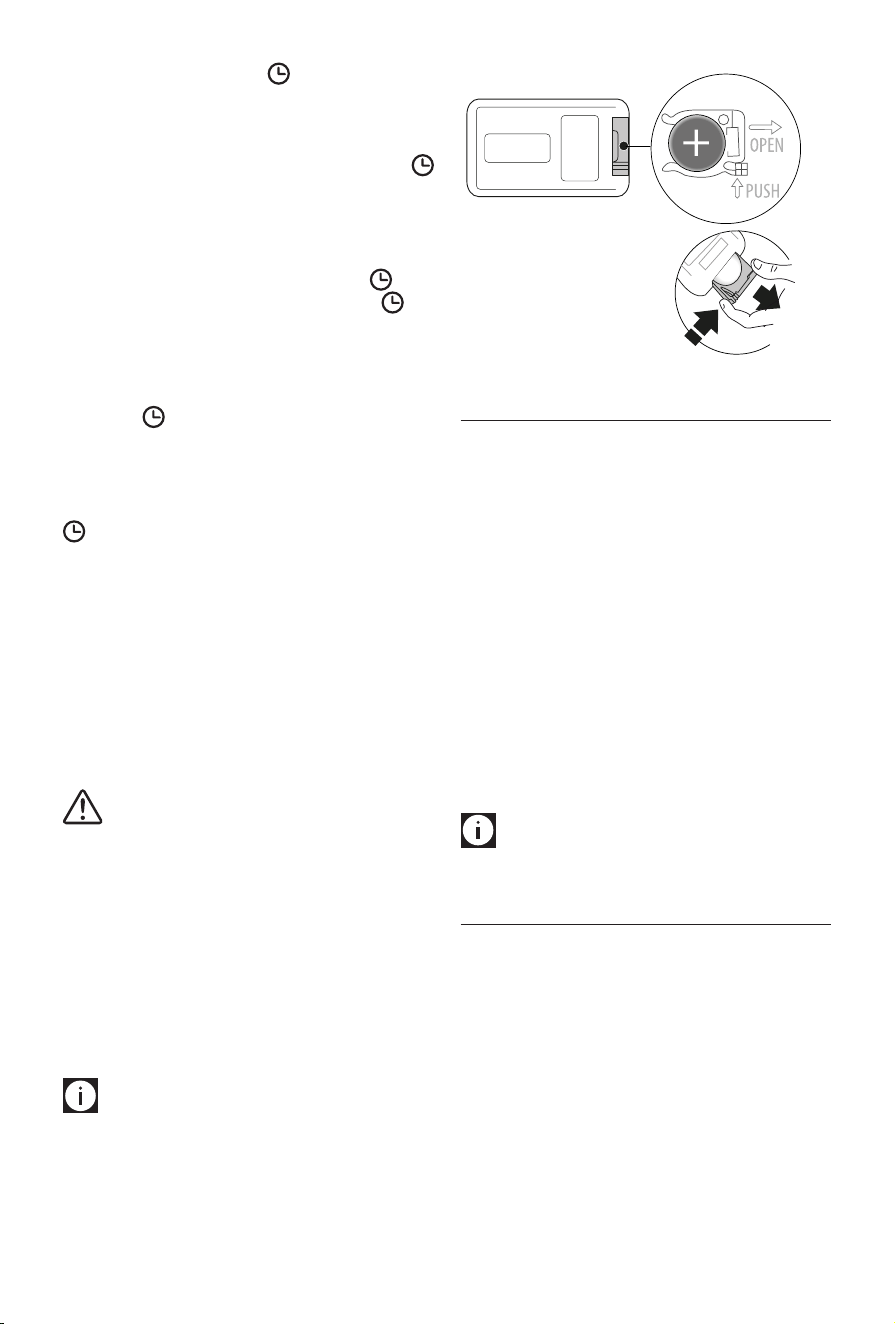
- Retire la cubierta de la batería en la parte posterior del
control remoto (vea la imagen).
- Coloque una batería tipo 3V CR2025 en el espacio, ase-
gurándose de que los polos coincidan correctamente (+
y -), luego vuelva a colocar la tapa.
El control remoto está listo para su uso.
Nota: Si el control remoto es desechado o reempla-
zado, la batería debe retirarse y desecharse de acuerdo con
las leyes vigentes, debido a que las baterías son perjudiciales
para el medio ambiente. No arroje la batería al fuego, ya que
podría explotar o liberar líquidos peligrosos.
PUSH
REMOVE
CARACTERÍSTICAS DE SEGURIDAD ADICIONALES
1. Protección contra sobrecalentamiento: un
dispositivo de seguridad apaga el termoventilador en
caso de sobrecalentamiento accidental (por ej., rejillas
de toma y descarga de aire obstruidas).
En este caso, extraiga la clavija del tomacorriente y
déjela desconectada durante algunos minutos, elimine
la causa del sobrecalentamiento y luego vuelva a
conectar el termoventilador y enciéndalo otra vez. Si el
aparato sigue sin funcionar, póngase en contacto con el
Centro de asistencia De’Longhi más cercano.
2. Interruptor de seguridad contra caídas: un
interruptor de seguridad contra caídas apaga el
termoventilador cerámico si se vuelca o se coloca en
una manera inapropiada tal que pone en riesgo su
seguridad. Después de que haya restablecido la posición
vertical del aparato, pasará al modo STAND-BY.
Nota: A n de evitar el sobrecalentamiento del
aparato, no lo cubra.
RESOLUCIÓN DE PROBLEMAS
En caso de que se despliegue “PF” y se emita un sonido de
advertencia, existe una falla en el sensor de temperatura.
Si persiste el problema, póngase en contacto con el Centro de
Servicio. Si el aparato se apaga inesperadamente:
- Verique que el aparato esté alimentado eléctricamente.
- Verique que el aparato esté colocado en posición
vertical y sobre una supercie plana, dado que pudo
haberse activado el interruptor de seguridad contra
caídas.
- Verique la temperatura ajustada y el temporizador:
el aparato puede estar apagado debido a que se
ha alcanzado la temperatura ajustada o a que ha
transcurrido el tiempo ajustado en el temporizador.

13
MANTENIMIENTO
- Antes de realizar cualquier operación de limpieza,
desenchufe siempre el aparato de la corriente.
- Limpie regularmente las rejillas de entrada y de salida
del aire cuando utilice el aparato, con un aspirador.
- No use nunca polvos abrasivos o disolventes para limpiar
el aparato.
NOTA: Tras realizar las pruebas correspondientes se encontró
que este equipo cumple con los límites establecidos para
considerarse un dispositivo digital de la Clase B, en aplicación
a lo dispuesto por la Parte 15 de las reglas del FCC. Estos
límites están establecidos para proporcionar una protección
razonable contra la interferencia nociva en una instalación
residencial. Este equipo genera, usa y puede radiar energía
de radiofrecuencia y si no se instala y usa de acuerdo con
las instrucciones puede causar interferencia nociva a las
comunicaciones de radio. Sin embargo, no hay garantía
de que la interferencia no ocurrirá en una instalación
especíca en particular. Si este equipo ocasiona interferencia
nociva para la recepción de radio o televisión, que se
puede determinar apagando y encendiendo el equipo, se
recomienda al usuario que trate de corregir la interferencia
aplicando una o más de las siguientes medidas:
- Oriente o reubique la antena receptora.
- Aumente la distancia entre el equipo y el receptor.
- Conecte el equipo a un tomacorriente conectado a un
circuito diferente al que está conectado el receptor.
- Pida ayuda al distribuidor o a un técnico de radio y
televisión experimentado. Las modicaciones no aprobadas
por la entidad responsable del cumplimiento a las normas
puede anular el derecho del usuario a operar el equipo.
CAN ICES-3 (B) / NMB-3 (B)

14
PROBLEMA CAUSA SOLUCIÓN
PF visualización
El sensor de temperatura no está
funcionando adecuadamente
El producto necesita recibir
mantenimiento, llame a nuestro número
gratuito de servicio técnico
El producto no se enciende Revise si el enchufe se encuentra
conectado al tomacorriente
El encendido automático está activo
La temperatura ambiente alcanza la
temperatura de ajuste
Enchufe
Espere hasta que haya transcurrido el
tiempo o presione dos veces el botón (E)
para cancelar el encendido automático y
presione el botón (A)
Utilice el botón “+” para incrementar la
temperatura de ajuste
El aparato se apaga El interruptor de seguridad contra
caídas se ha activado
Asegúrese de que el aparato se encuentre
en posición vertical sobre una supercie
plana, si el problema persiste llame a
nuestro número gratuito de servicio
técnico
La pantalla muestra "Ht"
parpadeando
La temperatura interna es demasiado
alta. La rejilla de entrada o salida de
aire está obstruida
Verique que el aparato está
correctamente colocado respetando
las distancias mínimas de la pared o
de los objetos, tal y como se indica en
el manual de instrucciones. En caso de
que no sea así coloque correctamente el
aparato.
Elimine la obstrucción
Desenchúfelo de la toma principal y deje
que el aparato se enfríe. Pasados unos
minutos vuelva a encender el aparato.
Si el aparato no funciona contacte el
número de teléfono gratuito Delonghi
RESOLUCIÓN DE LOS PROBLEMAS
www.delonghi.com
5711470213_00_0323
Printed in China
Register Now
www.delonghi.photo
100% recycled paper