Before attempting to connect or operate this product,
please read these instructions carefully and save this manual for future use.
User's Manual
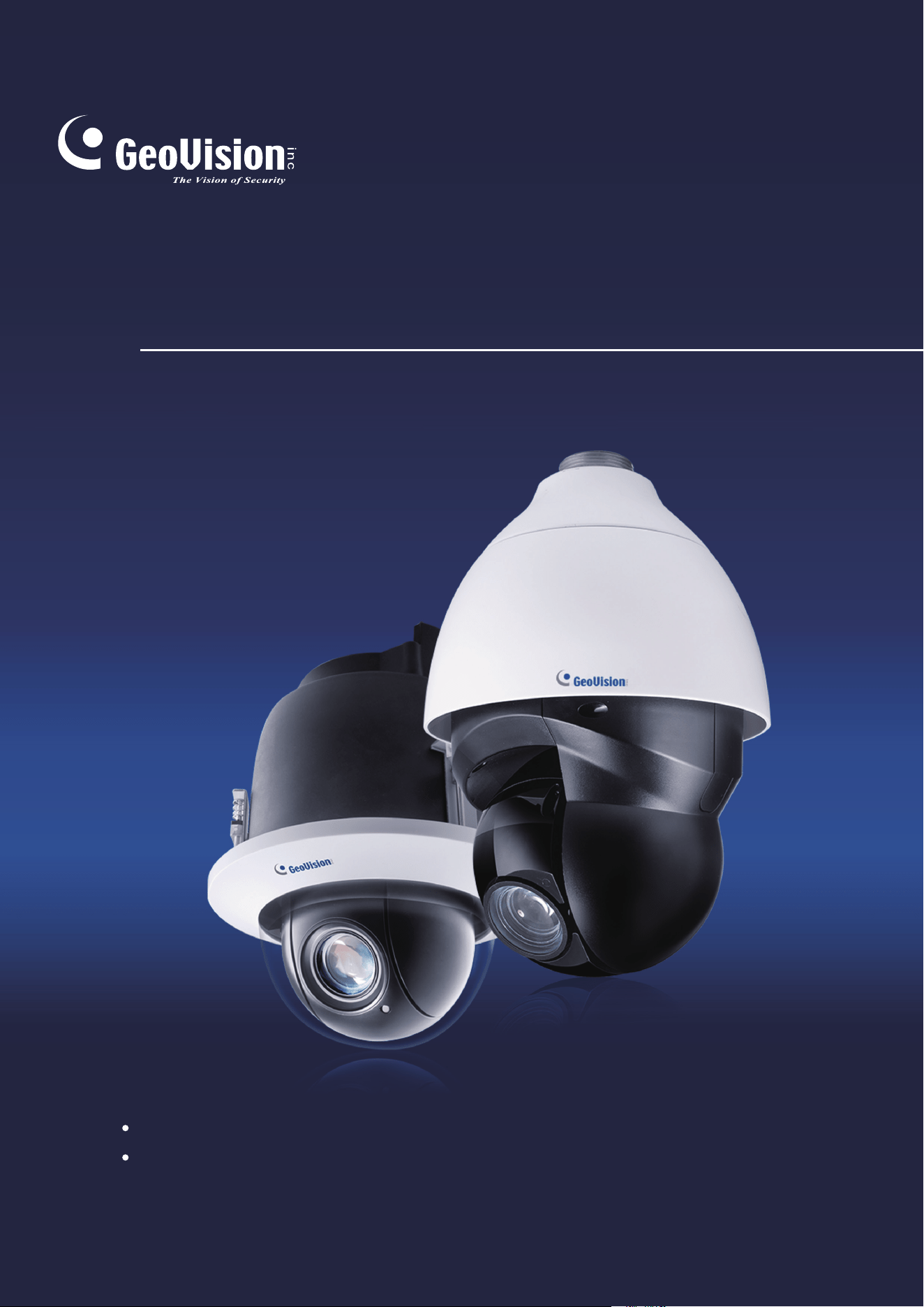
GV-IP Speed Dome
QSD-UM-A
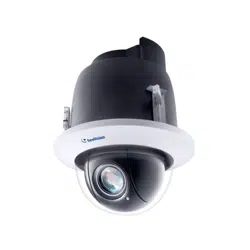
GV-QSD5730
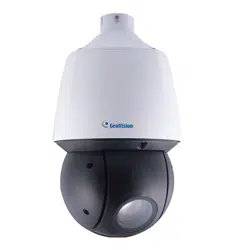
GV-QSD5731-IR
© 2020 GeoVision, Inc. All rights reserved.
Under the copyright laws, this manual may not be copied, in whole or in part,
without the written consent of GeoVision.
Every effort has been made to ensure that the information in this manual is
accurate. GeoVision, Inc. makes no expressed or implied warranty of any kind
and assumes no responsibility for errors or omissions. No liability is assumed
for incidental or consequential damages arising from the use of the information
or products contained herein. Features and specifications are subject to
change without notice.
Note: No memory card slot or local storage function for Argentina.
GeoVision, Inc.
9F, No. 246, Sec. 1, Neihu Rd.,
Neihu District, Taipei, Taiwan
Tel: +886-2-8797-8377
Fax: +886-2-8797-8335
http://www.geovision.com.tw
Trademarks used in this manual: GeoVision, the GeoVision logo and GV
series products are trademarks of GeoVision, Inc. Windows is the registered
trademark of Microsoft Corporation.
J
une 2020
1
Preface
Welcome to the GV-IP Speed Dome User’s Manual.
There are two types of GV-IP Speed Dome, Indoor and Outdoor, distinguished
by model:
This Manual provides an overview of GV-IP Speed Dome and its accessories.
The instructions herein will guide you through the installation and use of GV-IP
Speed Dome.
Application Model
Indoor GV-QSD5730
Outdoor GV-QSD5731-IR

2
Table of Contents
Table of Contents................................................................................................................. 2
Regulatory Notices..............................................................................................................4
Note for Connecting to GV-VMS / DVR / NVR.................................................................... 5
Note for Recording..............................................................................................................5
Optional Devices ................................................................................................................. 6
1. Overview ........................................................................................................................7
2. Main Tabs.......................................................................................................................8
2.1 Home Page ............................................................................................................... 9
2.2 System.................................................................................................................... 13
2.2.1
System............................................................................................................... 13
2.2.2
Security.............................................................................................................. 15
2.2.3
Network ............................................................................................................. 23
2.2.4
DDNS ................................................................................................................ 30
2.2.5
Mail.................................................................................................................... 30
2.2.6
FTP.................................................................................................................... 31
2.2.7
HTTP ................................................................................................................. 31
2.2.8
Events (Alarm Settings)...................................................................................... 32
2.2.9
Auto Tracking..................................................................................................... 56
2.2.10
Storage Management......................................................................................... 59
2.2.11
Recording .......................................................................................................... 64
2.2.12
Schedule............................................................................................................ 65
2.2.13
File Location (Snapshots and Web Recording)................................................... 66
2.2.14
View Information ................................................................................................ 67
2.2.15
Factory Default................................................................................................... 68
2.2.16
Software Version (Firmware Version)................................................................. 68
2.2.17
Software Upgrade (Firmware Upgrade) ............................................................. 69
2.2.18
Maintenance...................................................................................................... 70
2.3 S
treaming ............................................................................................................... 71
2.3.1
Video Configuration (Video Format & Resolution) .............................................. 72
2.3.2
Video Rotation.................................................................................................... 74
2.3.3
Video Text Overlay............................................................................................. 75
2.3.4
Video OCX Protocol........................................................................................... 77
2.3.5
Audio (Audio Mode and Bit Rate Settings) ......................................................... 77
2.4 Image ...................................................................................................................... 79
2.4.1
Exposure ........................................................................................................... 80
2.4.2
White Balance.................................................................................................... 81
2.4.3
Picture Adjustment ............................................................................................. 83
2.4.4
IR Function ........................................................................................................ 84
2.4.5
Noise Reduction................................................................................................. 86
2.4.6
WDR Function.................................................................................................... 87
2.4.7
Image Stabilizer.................................................................................................. 87
2.4.8
Digital Zoom....................................................................................................... 88
2.4.9
Backlight ............................................................................................................ 88
2.4.10
Profile ................................................................................................................ 88
2.4.11
TV System ......................................................................................................... 89

3
2.5 PTZ.......................................................................................................................... 90
2.5.1
Preset ................................................................................................................ 90
2.5.2
Cruise ................................................................................................................ 91
2.5.3
Auto Pan ............................................................................................................ 92
2.5.4
Sequence .......................................................................................................... 93
2.5.5
Home Function................................................................................................... 94
2.5.6
Tilt Range........................................................................................................... 95
2.5.7
Privacy Mask...................................................................................................... 95
2.5.8
PTZ Setting........................................................................................................ 97
2.5.9
RS485................................................................................................................ 99
2.6 Logout..................................................................................................................... 99
Appendix A: Install UPnP Components.......................................................................... 100
Appendix B: IP Addresses from Decimal to Binary ...................................................... 101
4
Regulatory Notices
FCC Notice
This equipment has been tested and found to comply with the limits of a Class A digital
device, pursuant to part 15 of the FCC Rules. These limits are designed to provide
reasonable protection against harmful interference when the equipment is operated in a
commercial environment.
Class A
This equipment generates, uses, and can radiate radio frequency energy and, if not installed
and used in accordance with the instruction manual, may cause harmful interference to radio
communications. Operation of this equipment in a residential area is likely to cause harmful
interference in which case the users will be required to correct the interference at their own
expense.
CE Notice
This is a Class A product. In a domestic environment, this product may cause radio
interference in which case the users may be required to take adequate measures.
RoHS Compliance
The Restriction of Hazardous Substances (RoHS) Directive is to forbid the use of hazardous
materials for production. To meet the RoHS Directive requirements, this product is made to
be RoHS compliant.
WEEE Compliance
This product is subject to the Waste Electrical and Electronic Equipment (WEEE) Directive
and made compliant with the WEEE requirements.

5
Note for Connecting to GV-VMS / DVR / NVR
The GV-IP Speed Dome is designed to work with and record on GV-VMS / DVR / NVR, a
video management system.
Once the camera is connected to the GV-VMS / DVR / NVR, the resolution set on the GV-
VMS / DVR / NVR will override the resolution set on the camera’s Web interface. You can
only change the resolution settings through the Web interface when the connection to the
GV-VMS / DVR / NVR is interrupted.
Note for Recording
1. By default, the images are recorded to the memory card inserted in the GV-IP Seed
Dome.
2. Mind the following when using a memory card for recording:
Recorded data on the memory card can be damaged or lost if the data are accessed
while the camera is under physical shock, power interruption, memory card
detachment or when the memory card reaches the end of its lifespan. No guarantee is
provided for such causes.
The stored data can be lost if the memory card is not accessed for a long period of
time. Back up your data periodically if you seldom access the memory card.
Memory cards are expendable and their durability varies according to the conditions
of the installed site and how they are used. Back up your data regularly and replace
the memory card annually.
To avoid power outage, it is highly recommended to apply a battery backup (UPS).
For better performance, it is highly recommended to use Micro-SD card or SD card of
MLC NAND flash, Class 10.
Replace the memory card when its read/write speed is lower than 6 MB/s or when the
memory card is frequently undetected by the camera.
6
Optional Devices
Optional devices can expand the capabilities and versatility of your GV-IP Speed Dome.
Contact your dealer for more information.
Device Description
GV-Mount Accessories
The GV-Mount Accessories provide a comprehensive
lineup of accessories for installing the GV-QSD5731-
IR on ceiling, wall corner and pole. For details, refer to
GV-Mount Accessories Installation Guide.
GV-PoE Power Adapter
GV-PoE Adapter is designed to provide power to the
IP device through a single Ethernet cable. Adopting
the PoE adapter enables you to mount an IP device
anywhere in a building where power outlets are not
available.
Note: GV-PA902BT Gigabit PoE Adapter is required
to power GV-QSD5731-IR.
GV-PoE Switch The GV-POE Switch is designed to provide power
along with network connection for IP devices. The GV-
POE Switch is available in various models with
different types and numbers of ports.
Power Adapter Contact our sales representatives for the countries
and areas supported.

Overview
7
1
1. Overview
GV-IP Speed Dome (GV-QSD5730 / GV-QSD5731-IR) offers 33x optical zoom
and 10x digital zoom, capable of showing smooth live view with great details.
Both models can simultaneously deliver four video streams in resolutions up to
2592 x 1944 at 30 fps and support H.265 video codec to achieve better
compression ratio while maintaining high quality pictures at reduced network
bandwidths.
GV-IP Speed Dome (GV-QSD5730 / GV-QSD5731-IR) also features Servo
Feedback technology and Electronic Image Stabilizer (EIS) technology. The
Servo Feedback technology ensures the camera view returns to the preset
position when encountering external force (e.g. human interference) or
environmental vibration. EIS technology can effectively produce stable images
by actively sensing directional movement of the images and compensating
accordingly; this is particularly useful for cameras installed at places where
environmental movement (e.g. strong wind, the passing-by heavy vehicles) is
constant, and when high optical zoom is executed.

8
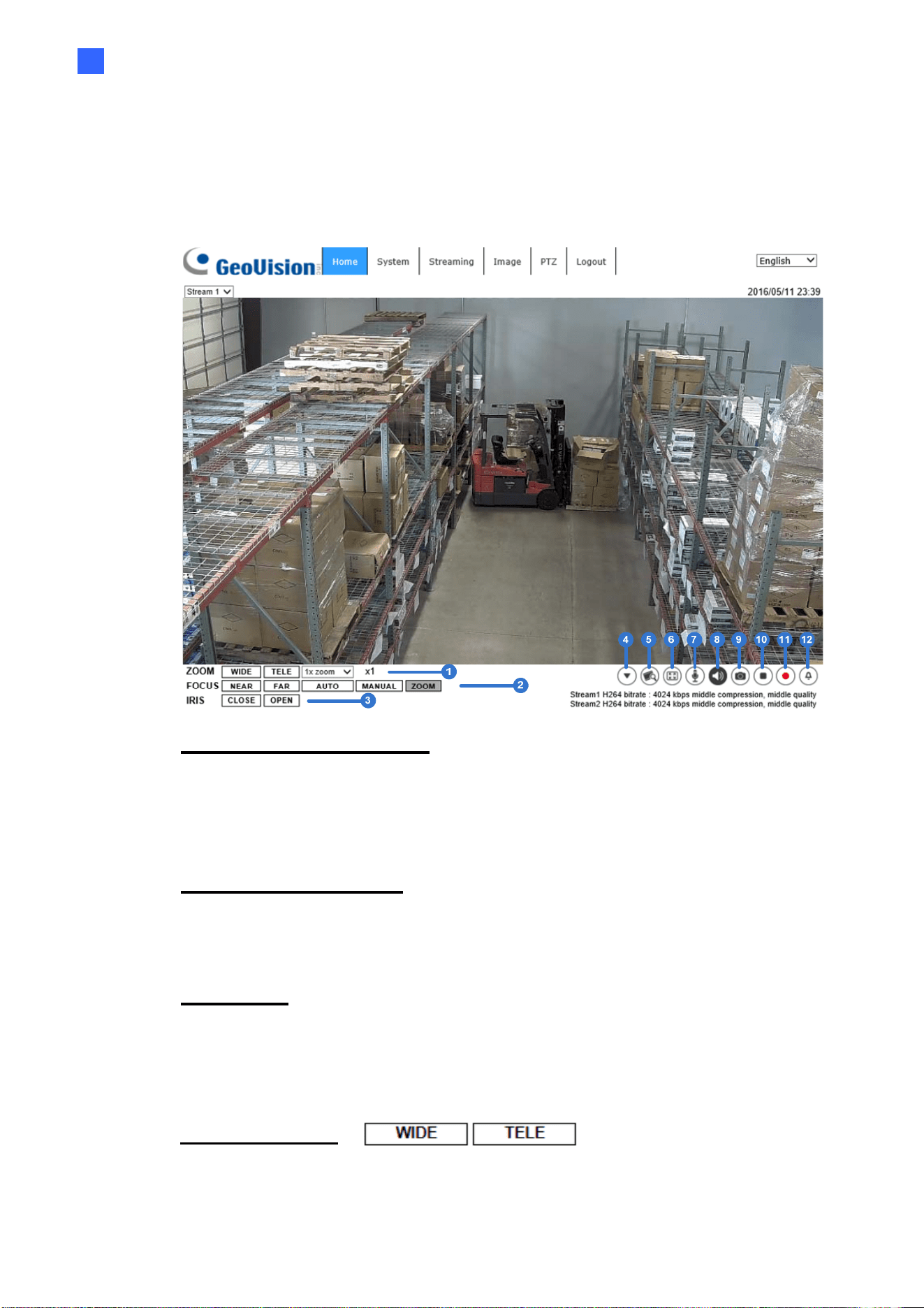
2. Main Tabs
There are six setting tabs, including <Home>, <System>, <Streaming>,
<Camera>, <PTZ> and <Logout> on the Home Page.
Home
Users can monitor the live video of the targeted area.
System Setting
The administrator can set system time, root password, network related
settings, etc. Further details will be interpreted in chapter System.
Streaming Setting
The administrator can configure video format, video compression, video OCX
protocol, video frame rate and audio compression in this page.
Image Setting
This setting page is only available for the administrator and user accounts that
have been granted the privilege of camera control. The administrator and users
can adjust various camera parameters including Exposure, White Balance,
Picture Adjustment, IR Function, Digital Zoom, WDR, etc.
PTZ Setting
This setting page is only available for the administrator and user accounts that
have been granted the privilege of camera control. The administrator and users
can program Preset Point(s), Cruise Line(s), Auto Pan Path(s) and Sequence
Line(s) via PTZ controls.
Logout
Click the tab to re-login the camera with another username and password.
Main Tabs
9
2
2.1 Home Page
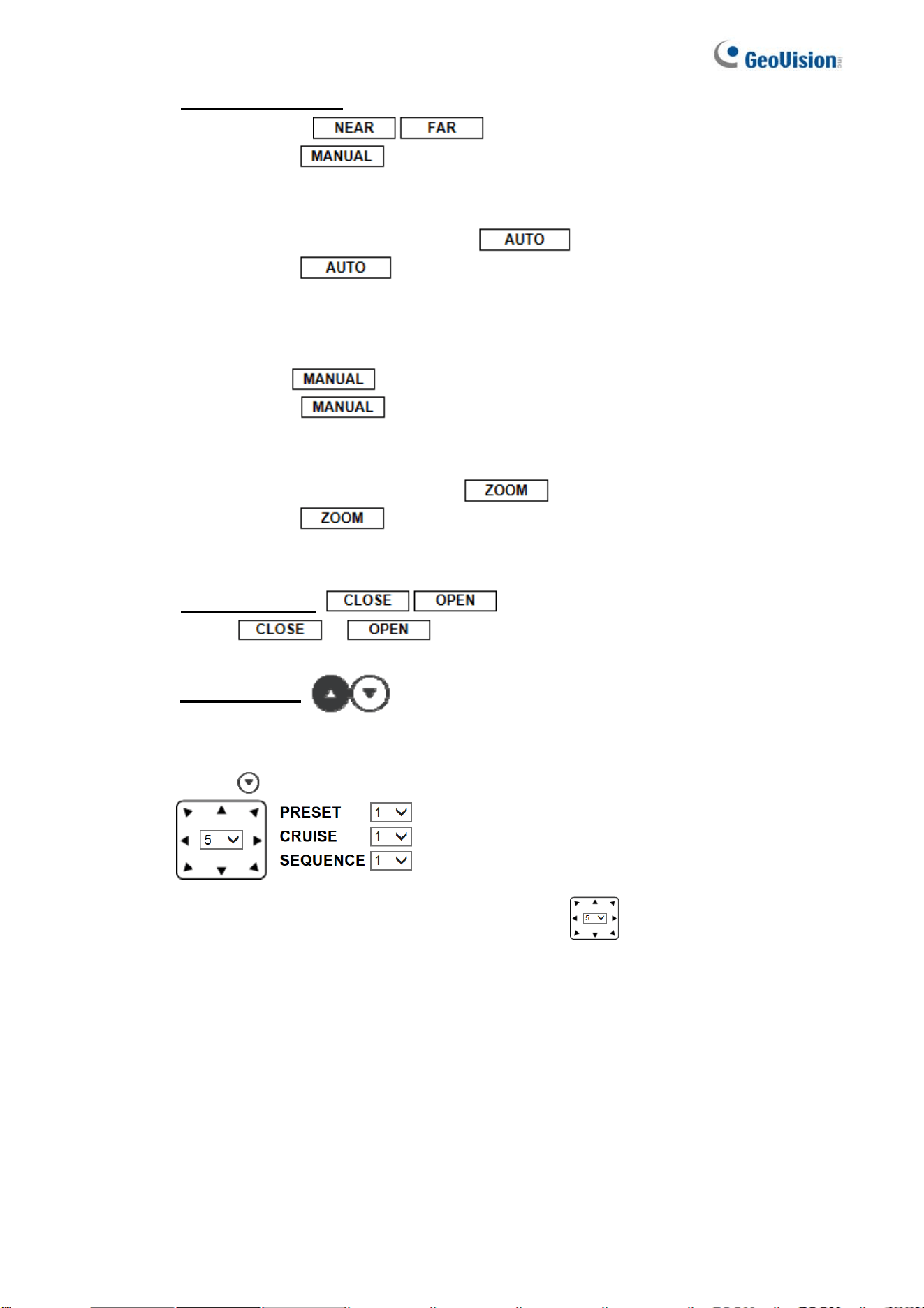
Click the tab <Home> to access the <Home> Page. There are several function
buttons on this page. See the detailed information of each item below.
Multiple Languages Support
Multiple languages are supported, including Czech, English, French, German,
Hungarian, Italian, Japanese, Portuguese, Russian, Spanish, Traditional
Chinese, and Simplified Chinese for the viewer window interface.
Display Stream Selection
According to the streaming setting, users can choose the one stream to display
from the drop-down list.
Camera Info
Double click the live view pane, and the camera info window will pop up. Users
can instantaneously check the basic information of the camera, such as IP
address, network status, video format, etc.
Zoom Adjustment
Click <WIDE / TELE> to control zoom in / out. Or select any zoom ratio from to
the zoom adjustment drop-down menu.
10
Focus Adjustment
Near / Far
Click < > first, and users can adjust focus manually via
<NEAR> and <FAR> buttons.
Auto Focus (Continuous AF)
Click <
> to enable AF mode. In this mode, the camera will
keep in focus automatically and continuously regardless of zoom
changes or any view changes.
Manual
Click <
>, and users can adjust focus manually via NEAR /
FAR buttons.
Zoom (Zoom Triggered AF)
Click <
>, and AF will be activated every time when zoom is
adjusted.
Iris Adjustment
Click <
/
> to control the brightness of the image.
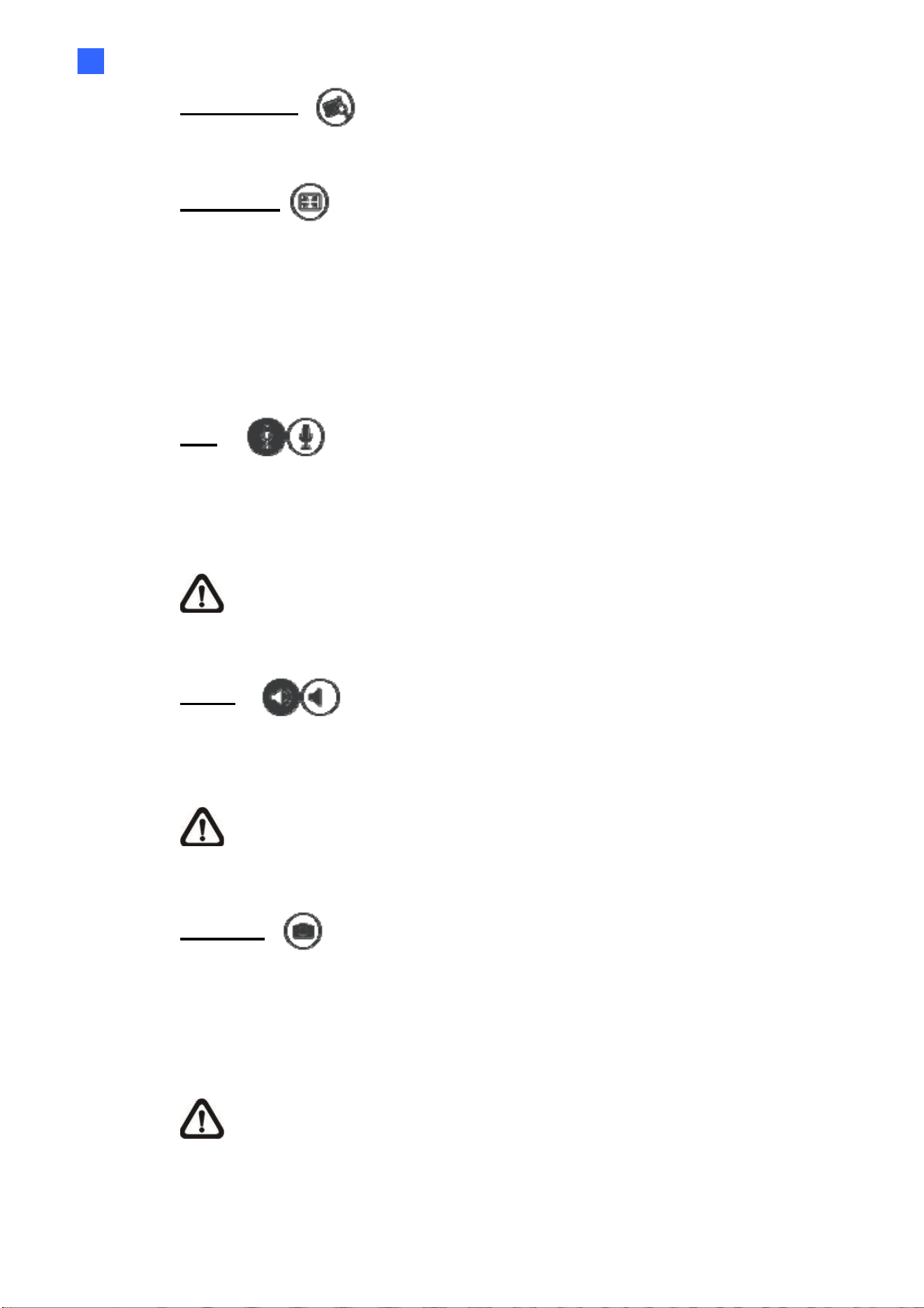
Control Panel (Close / Open)
Click the <Control Panel> button to open and close the control panel.
Click < >, and the control panel will be as shown below.
Pan & Tilt Direction and Speed Control
The <Pan & Tilt Direction Control> arrows allow users to control the
camera to intended direction. And users can set a number between 1
and 10 to determine the pan/tilt speed of the camera from the drop-down
list on the control panel. 1 is the slowest and 10 is the fastest.
Run Preset / Cruise / Sequence
Go to <PTZ> ・<Preset>/<Cruise>/<Sequence> to setup the relevant
settings beforehand. Select a Preset / Cruise / Sequence line from the
drop-down list and the camera will start running.
Main Tabs
11
2
Video Quality
Click to show/hide bitrate and compression of each stream.
Full Screen
Image display size can be adjusted to full screen. Alternatively, right click the
Live Video Pane and select <Fullscreen> to go full screen.
To exit full screen mode, users can (1) tap <Esc> on the keyboard; (2) double
click the Live Video Pane; (3) right click the Live Video Pane and select
<Normal view>.
Talk (On / Off)
Talk function allows the local site talks to the remote site. Click the button to
switch it to On / Off. Users must select the suitable transmission mode under this
path: Streaming> Audio to enable this function.
NOTE: This function is only available for user accounts that have been
granted this privilege by the administrator. Please refer to Security: Add
user> Talk/Listen for further details.
Listen (On / Off)
Click the <Listen> button to mute / activate the audio. Users must select the
suitable transmission mode under <Streaming> Audio to enable this function.
NOTE: This function is only available for user accounts that have been
granted this privilege by the administrator. Please refer to Security:
Add user> Talk/Listen for further details.
Snapshot
Click the button and the JPEG snapshots will automatically be saved in the
appointed place: C:\ProgramData\Geovision\. To change the storage
location, please refer to section File Location of the next chapter for further
details.
NOTE: With Windows 7 operating system or above, to implement the
Snapshot function, users must run IE as administrator. To run IE as
administrator, right click the IE browser icon and select “Run As
Administrator” to launch IE.
12
Live View Pause / Restart (Pause / Restart)
Click < > to disable video streaming, the live video will be displayed as black.
Press < > to show the live video.
Record (O
n / Off)
Click the <Record> button and the Live View through the web browsing will be
directly recorded to the specific location on the local hard drive, which could be
configured in the <File Location> page. The default storage location for the
web recording is: C:\ProgramData\Geovision\. Please refer to section File
Location of the next chapter for further details.
NOTE: With Windows 7 operating system or above, to implement the
Web Recording function, users must run IE as administrator. To run IE
as administrator, right click the IE browser icon and select “Run As
Administrator” to launch IE.
Manual Trigger (On / Off)
Click the <Manual Trigger > button to turn on and off the manual trigger. Please
refer to section Manual Trigger of the next chapter for further details.
Pan/Tilt Control
Users can implement pan/tilt control by moving the cursor to the live video pane,
then left click and drag the pointer in any direction.
Optical Zoom Control
In Full Screen display mode, users can implement zoom in / out by scrolling
up/down the mouse wheel.
Set Center Mode
Right click the Live Video Pane and select <Set Center Mode>. Then users can
position the interest area in the center of the Live Video Pane automatically by
clicking on the point of interest. In <Set Center Mode>, right click the Live Video
Pane again and select <Set Emulated Joystick Mode> to return to control the
camera direction by left clicking and dragging the pointer on the Live Video
Pane.
Main Tabs
13
2
2.2 System
Under the tab <System>, the categories are shown as the configure page
below.
NOTE: The <System> configuration page is only accessible by the
administrator.
2.2.1
System
The System setting can be found under the path: System> System.
Time Zone
Select the time zone from the drop-down menu according to the location of the
camera.
Enable Daylight Saving Time
To enable DST, please check the item and then specify the time offset and the
DST duration. The format for time offset is [hh:mm:ss]; for instance, if the
amount of time offset is one hour, please enter “01:00:00” into the field.

14
Time format
Choose a time format (yyyy/mm/dd or dd/mm/yyyy) from the drop-down menu.
The format of the date and time displayed above the live video window will be
changed according to the selected format.
Sync with Computer Time
Select the item, and video date and time display will synchronize with the PC’s.
NOTE: Users MUST click the <Save> button to confirm the setting.
Otherwise, the time will not be synced.
Manual
The administrator can set video date and time manually. Entry format should be
identical with the examples shown next to the enter fields.
Sync with NTP Server
Network Time Protocol (NTP) is an alternate way to synchronize the camera’s
clock with a NTP server. Please specify the server that is wished to synchronize
in the entry field. Then select an update interval from the drop-down menu.
For further information about NTP, please see the web site: www.ntp.org.
NOTE: The synchronization will be done every time the camera boots
up.
Click the <Save> button to confirm the setting.

Main Tabs
15
2
2.2.2
Security
The Security setting can be found under this path: System> Security.
Click the <Security> category, there will be a drop-down menu with tabs
including <User>, <HTTPS>, <IP Filter>, and <IEEE 802.1X>.
2.2.2.1 User
The User setting can be found under this path: System> Security> User.
Admin Password
This item is for the administrator to reset password. Enter the new password in
<Admin password> and <Confirm password>. The maximum length is 14
characters. The input characters / numbers will be displayed as dots for security
purposes. Click the <Save> button to confirm the changes. After the changes
are confirmed, the web browser will ask the administrator to re-login to the
camera with the new password.
NOTE: The following characters are valid: A-Z, a-z, 0-9, !#$%&’-.@^_~.
Add User
This item is for the administrator to add new users. Enter the new user’s name
in <User name> and the password in <User password>. Username can be up to
16 characters, and the maximum length of the password is 14 characters. Tick
the boxes below to give privileges for functions, including “Camera control”,
“Talk” and “Listen”. Click the <Add> button to add the new user. The name of
the new added user will be displayed in the <User name> drop-down list under
<Manage User>. There is a maximum of twenty user accounts.
I/O access
This item supports fundamental functions that enable users to view the
live video when accessing to the camera.
Camera control
This item allows the appointed user to change camera parameters on
the <Camera> and <PTZ> setting page.

16
Talk/Listen
This item allows the appointed user in the local site (PC site) to
communicate with, for instance, the administrator in the remote site.
Manage User
Delete user
Pull down the <User name> drop-down list and select the username that
is wished to be deleted. Click the <Delete> button to remove the
selected name.
Edit user
Pull down the <User name> drop-down list and select the username.
Click the <Edit> button and a popup window will appear. In the appeared
window, enter the new user password and reset the privileges. Click the
<Save> button to confirm the changes. Then click the <Close> button to
complete the editing.
HTTP Authentication Setting
This setting allows secured connections between the IP camera and web
browser by enforcing access controls to web resources. When users approach
to the web browser, it’ll ask for username and password, which protects the
camera settings or live streaming information from snooping. There are two
security models available: Basic and Digest. Refer to the descriptions below for
more details.
Basic
This mode can only provide basic protection for the connection security.
There will still be risks for the password being intercepted.
Digest
Digest mode is a safer option for protection. The password is sent in an
encrypted format to prevent it from being stolen.
NOTE: Users MUST click the <Save> button to apply the setting.

Main Tabs
17
2
Streaming Authentication Setting
This setting provides security against unauthorized users from getting streaming
via Real Time Streaming Protocol (RTSP). If the setting is enabled, users will be
requested to enter user name and password before viewing the live streams.
There are three security modes available: Disable, Basic and Digest. Refer to
the descriptions below for more details.
Disable
If disable mode is selected, there will be no security provided to against
unauthorized access. Users will not be asked to input user name and
password for authentication.
Basic
This mode can only provide basic protection for the live streams.
There will still be risks for the password being intercepted.
Digest
Digest mode is a safer option for protection. The password is sent in an
encrypted format to prevent it from being stolen.
NOTE: Users MUST click the <Save> button to apply the setting.
Enable Account Lockout Function
This setting provides extra security against unauthorized users who intend to log
in by guessing the username or password. If the setting is enabled, login will not
be allowed for the set duration once the maximum login failure is reached.
Threshold
Set the maximum number of login failure.
Duration
Set the duration for account lockout.
NOTE: Users MUST click the <Save> button to apply the setting.

18
2.2.2.2 HTTPS
The HTTPS setting can be found under this path: System> Security> HTTPS.
<HTTPS> allows secure connections between the camera and the web browser
using <Secure Socket Layer (SSL)> or <Transport Layer Security (TLS)>, which
ensure camera settings or Username / Password info from snooping. It is
required to install a self-signed certificate or a CA-signed certificate for
implementing HTTPS.
To use HTTPS on the camera, an HTTPS certificate must be installed. The
HTTPS certificate can be obtained by either creating and sending a certificate
request to a Certificate Authority (CA) or creating a self-signed HTTPS
certificate, as described below.
Create Self-signed Certificate
Before a CA-issued certificate is obtained, users can create and install a self-
signed certificate first.
Click the <Create> button under “Create self-signed certificate” and provide the
requested information to install a self-signed certificate for the camera.
Please refer to the last part of this section Provide the Certificate Information for
more details.
NOTE: The self-signed certificate does not provide the same high level
of security as when using a CA-issued certificate.
Install Signed Certificate
Click the <Create Certificate Request> button to create and submit a certificate
request in order to obtain a signed certificate from CA.
Provide the request information in the create dialog. Please refer to the
following section Provide the Certificate Information for more details.
When the request is complete, the subject of the Created Request will be shown
in the field. Click the <Properties> button below the Subject field, copy the
PEM-formatted request and send it to the selected CA.
When the signed certificate is returned, install it by uploading the signed
certificate.

Main Tabs
19
2
Provide the Certificate Information
To create a Self-signed HTTPS Certificate or a Certificate Request to CA,
please enter the information as requested.
Create Self Signed Certificate Create Certificate Request
Country
v v
State or Province
v v
Locality
v v
Organization
v v
Organizational Unit
v v
Common Name
v v
Valid Days
v -
Country
Enter a two-letter combination code to indicate the country the certificate
will be used in. For instance, type in “US” to indicate United States.
State or province
Enter the local administrative region.
Locality
Enter other geographical information.
Organization
Enter the name of the organization to which the entity identified in
“Common Name” belongs.
Organization Unit
Enter the name of the organizational unit to which the entity identified in
“Common Name” belongs.
Common Name
Indicate the name of the person or other entity that the certificate
identifies (often used to identify the website).
Valid days
Enter the period in days (1 to 9999) to indicate the valid period of
certificate.
Click the <OK> button to save the Certificate Information after completing the
setting.

20
2.2.2.3 IP Filter
The IP Filter setting can be found under this path: System> Security> IP Filter.
With IP Filter, users can allow or deny specific IP addresses from accessing the
camera.
Enable IP Filter
Check the box to enable the IP Filter function. Once enabled, the listed
IP addresses (IPv4) in the <Filtered IP Addresses> list box will be
allowed / denied to access the camera.
Select <Allow> or <Deny> from the drop-down list and click the <Apply>
button to determine the IP filter behavior.
Add IP Address
Input IP address at the blank space below the <Filtered IP Address> list
and click the <Add> button. The newly-added address will be shown in
the list. Up to 256 IP address entries can be specified.
In addition, to filter a group of IP addresses, enter an address at the
blank space followed with a slash and a number ranging from 1 to 31,
e.g. 192.168.2.81/30. The number after the slash can define how many
IP addresses will be filtered. For details, please refer to the following
example.
Example: Filtering a group of consecutive IP addresses
The steps below show what will be filtered when 192.168.2.81/30 is
entered.
Step 1: Convert 192.168.2.81 to binary numbers. The binary
numbers are 11000000.10101000.00000010.01010001. Users can
refer to Appendix B: IP Addresses from Decimal to Binary for
converting the IP addresses to binary numbers. The number “30”
after the slash is referring to the first 30 digits of the binary numbers.
Step 2: Convert a few IP addresses before and after 192.168.2.81
to binary numbers. Then compare their first 30 digits with the binary
numbers of 192.168.2.81.
Main Tabs
21
2
a. Convert 192.168.2.80 to binary numbers. The binary numbers
are 11000000.10101000.00000010.01010000. The first 30
digits are the same with the binary numbers of 192.168.2.81,
thus 192.168.2.80 will be filtered.
b. Convert 192.168.2.79 to binary numbers. The binary numbers
are 11000000.10101000.00000010.01001111. The first 30
digits are different with the binary numbers of 192.168.2.81,
thus 192.168.2.79 will not be filtered. This also means the IP
addresses before 192.168.2.79 will not be filtered. Therefore,
users can stop converting the IP addresses before
192.168.2.79 to binary numbers.
c. Repeat the same procedure in “a” with the IP addresses after
192.168.2.81. Stop when the situation occurs in “b” happened.
Namely, the 30th digit of the binary numbers of IP address
192.168.2.84 is different, and will not be filtered.
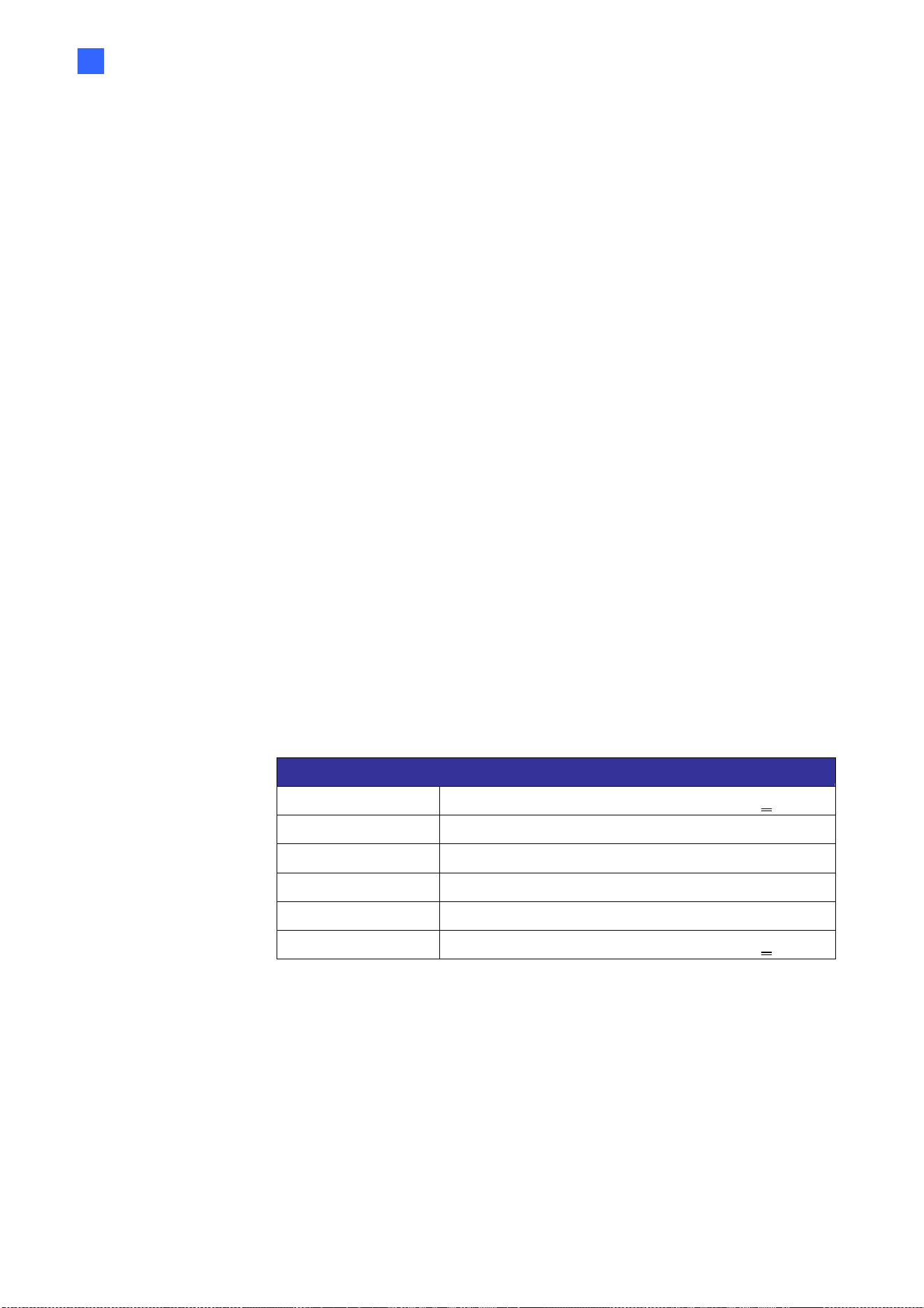
As a result, the IP addresses 192.168.2.80 to 192.168.2.83 will be
filtered when entering 192.168.2.81/30. The following table clearly
shows the 30
th
digit of the binary numbers of IP addresses
192.168.79 and 192.168.84 are different from the others. Therefore,
these two IP addresses will not be filtered.
IP Addresses Binary Numbers
192.168.2.79
11000000.10101000.00000010.01001111
192.168.2.80
11000000.10101000.00000010.01010000
192.168.2.81
11000000.10101000.00000010.01010001
192.168.2.82 11000000.10101000.00000010.01010010
192.168.2.83
11000000.10101000.00000010.01010011
192.168.2.84
11000000.10101000.00000010.01010100
Delete IP Address
To remove an IP address from the <Filtered IP Address> list, please
select the address and click the <Delete> button.

22
2.2.2.4 IEEE 802.1X
The IEEE 802.1X setting can be found under this path: System> Security>
IEEE 802.1X.
The camera is allowed to access a network protected by 802.1X/EAPOL
(Extensible Authentication Protocol over LAN).
Users need to contact with the network administrator for gaining certificates,
user IDs and passwords.
CA Certificate
The CA certificate is created by the Certification Authority for the purpose of
validating itself. Upload the certificate for checking the server’s identity.
Client Certificate / Private Key
Upload the Client Certificate and Private Key for authenticating the camera
itself.
Settings
Identity
Enter the user identity associated with the certificate. Up to 16
characters can be used.
Private Key Password
Enter the password (maximum 16 characters) for user identity.
Enable IEEE 802.1X
Check the box to enable IEEE 802.1X.
Click the <Save> button to save the IEEE 802.1X/EAP- TLS setting.
Main Tabs
23
2
2.2.3
Network
The Network setting can be found under this path: System> Network.
Click the <Network> category, there will be a drop-down menu with tabs
including <Basic>, <QoS>, <SNMP>, and <UPnP>.
2.2.3.1 Basic
The Basic setting can be found under this path: System> Network> Basic.
This setting page is for setting a new IP address for the camera, configuring
other network-related parameters and activating IPv6 address (if the network
supports it).
General
This setting menu is for configuring a new IP address for the camera. To setup
an IP address, please find out the network type first. Contact the network
provider for it. Then refer to the network type and follow the instructions to setup
the IP address.
NOTE: If the network type is Point-to-Point Protocol over Ethernet
(PPPoE), please obtain the PPPoE username and password from the
network provider.
Get IP address automatically
Select Get IP address automatically and click the <Save> button to
confirm the new setting.
A note for camera system restart will appear. Click the <OK> button
and the camera system will be restarted. The camera will be assigned
with a new IP address.

24
Use fixed IP address
Select the item and insert the new IP address, e.g. 192.168.7.123. Note that
the inserted IP address should be in the same LAN as the PC’s IP address.
Then go to the Default gateway (explained later) blank and change the
setting, e.g. 192.168.7.254. Click the <Save> button to confirm the new
setting. A note for system restart will appear, click the
<OK> button and the system will restart. Wait for 15 seconds. The
camera’s IP address in the URL bar will be changed, and users have to login
again.
IP address
This is necessary for network identification.
Subnet mask
It is used to determine if the destination is in the same subnet. The
default value is “255.255.255.0”.
Default gateway
This is the gateway used to forward frames to destinations in
different subnet. Invalid gateway setting will fail the transmission to
destinations in different subnet.
Primary DNS
Primary DNS is the primary domain name server that translates
hostnames into IP addresses.
Secondary DNS
Secondary DNS is a secondary domain name server that backs up
the primary DNS.
Use PPPoE
For the PPPoE users, enter the PPPoE username and password into
the enter fields, and click the <Save> button to complete the setting.
Main Tabs
25
2
Advanced
The following introduces the camera’s Web Server port, RTSP port, MJPEG over
HTTP port, and HTTPS port.
Web Server port
The default web server port is 80. With the default web server port ‘80’, users
can simply input the IP address of the camera in the URL bar of a web
browser to connect the camera. When the web server port is changed to
any number other than 80, users have to enter the camera’s IP address
followed by a colon and the port number. For instance, a camera whose
IP address as 192.168.0.100 and web server port as 8080 can be
connected by entering “http://192.168.0.100:8080
” in the URL bar.
RTSP port
The default setting of RTSP Port is 554; the RTSP Port should be set as 554
or from the range 1024 to 65535.
MJPEG over HTTP port
The default setting of MJPEG over HTTP Port is 8008; the MJPEG over
HTTP Port should be set as 8008 or from the range 1024 to 65535.
HTTPS port
The default setting of HTTPS Port is 443; the HTTPS Port should be set as
443 or from the range 1024 to 65535.
NOTE: Please make sure the port numbers set above are not the same
with each other; otherwise, network conflict may occur.
IPv6 Address Configuration
If the network supports IPv6, users can check the box beside <Enable IPv6> and
click the <Save> button. An IPv6 address will appear beside <Address>, and users
can use it to connect to the camera.

26
2.2.3.2 QoS
The QoS (Quality of Service) setting can be found under this path: System>
Network> QoS.
QoS allows providing differentiated service levels for different types of traffic
packets, which guarantees delivery of priority services especially when network
congestion occurs. Adapting the Differentiated Services (DiffServ) model, traffic
flows are classified and marked with DSCP (DiffServ Codepoint) values, and
thus receive the corresponding forwarding treatment from DiffServ capable
routers.
DSCP Settings
The DSCP value range is from 0 to 63. The default DSCP value is 0, which
means DSCP is disabled. The camera uses the following QoS Classes: Video,
Audio and Management.
Video DSCP
The class consists of applications such as MJPEG over HTTP,
RTP/RTSP and RTSP/HTTP.
Audio DSCP
This setting is only available for the cameras that support audio.
Management DSCP
The class consists of HTTP traffic: Web browsing.
NOTE: To enable this function, please make sure the switches / routers
in the network support QoS.

Main Tabs
27
2
2.2.3.3 SNMP
The SNMP (Simple Network Management Protocol) setting can be found under
this path: System> Network> SNMP.
With Simple Network Management Protocol (SNMP) support, the camera can
be monitored and managed remotely by the network management system.
SNMP v1 / v2
Enable SNMP v1 / v2
Select the version of SNMP to use by checking the box.
Read Community
Specify the community name that has read-only access to all supported
SNMP objects. The default value is “public”.
Write Community
Specify the community name that has read / write access to all
supported SNMP objects (except read-only objects). The default value is
“private”.
SNMP v3
SNMP v3 supports an enhanced security system that provides protection
against unauthorized users and ensures the privacy of the messages. Users will
be requested to enter security name, authentication password and encryption
password while setting the camera connections in the network management
system. With SNMP v3, the messages sent between the cameras and the
network management system will be encrypted to ensure privacy.
Enable SNMP v3
Enable SNMP v3 by checking the box.
Security Name
The maximum length of the security name is 32 characters.
NOTE: The valid characters are A-Z, a-z, 0-9 and !#$%&’-.@^_~.
Authentication Type
There are two authentication types available: MD5 and SHA. Select
<SHA> for a higher security level.
28
Authentication Password
The authentication password must be 8 characters or more. The input
characters / numbers will be displayed as dots for security purposes.
NOTE: The valid characters are A-Z, a-z, 0-9 and !#$%&’-.@^_~.
Encryption Type
There are two encryption types available: DES and AES. Select <AES>
for a higher security level.
Encryption Password
The minimum length of the encryption password is 8 characters and the
maximum length is 512 characters. The input characters / numbers will
be displayed as dots for security purposes. The encryption password
can also be left blank. However, the messages will not be encrypted to
protect privacy.
NOTE: The valid characters are A-Z, a-z, 0-9 and !#$%&’-.@^_~.
Traps for SNMP v1 / v2 / v3
Traps are used by the camera to send massages to a management system for
important events or status changes.
Enable Traps
Check the box to activate trap reporting.
Trap address
Enter the IP address of the management server.
Trap community
Enter the community to use when sending a trap message to the
management system.
Trap Option
Warm Start
A Warm Start SNMP trap signifies that the SNMP device, i.e. IP camera,
performs software reload.
Click the <Save> button when complete.
Main Tabs
29
2
2.2.3.4 UPnP
The UPnP setting can be found under this path: System> Network> UPnP.
UPnP Setting
Enable UPnP
When the UPnP is enabled, whenever the camera is presented to the
LAN, the icon of the connected cameras will appear in My Network
Places to allow for direct access.
NOTE: To enable this function, please make sure UPnP
component is installed on the computer. Please refer to
Appendix A: Install UPnP Components for UPnP component
installation procedure.
Enable UPnP port forwarding
When the UPnP port forwarding is enabled, the camera is allowed to
open the web server port on the router automatically.
NOTE: To enable this function, please make sure that the router
supports UPnP and it is activated.
Friendly name
Set a name for the camera for identity.
Click the <Save> button when finished.

30
2.2.4
DDNS
The DDNS setting can be found under this path: System> DDNS.
Dynamic Domain Name System (DDNS) allows a host name to be constantly
synchronized with a dynamic IP address. In other words, it allows those using a
dynamic IP address to be associated to a static domain name so others can
connect to it by name.
Enable DDNS
Check the item to enable DDNS.
Provider
Select one DDNS host from the provider list.
Host name
Enter the registered domain name in the field.
Username/E-Mail
Enter the username or E-mail required by the DDNS provider for authentication.
Password/Key
Enter the password or key required by the DDNS provider for authentication.
2.2.5
Mail
The Mail setting can be found under this path: System> Mail.
The administrator can send an E-mail via Simple Mail Transfer Protocol (SMTP)
when an alarm is triggered. SMTP is a protocol for sending E-mail messages
between servers. SMTP is a relatively simple, text-based protocol, where one or
more recipients of a message are specified and the message text is transferred.
Two sets of SMTP can be configured. Each set includes SMTP Server, Account
Name, Password and E-mail Address settings. For SMTP server, contact the
network service provider for more specific information.

Main Tabs
31
2
2.2.6
FTP
The FTP setting can be found under this path: System> FTP.
The administrator can set the camera to send the alarm messages to a specific
File Transfer Protocol (FTP) site when an alarm is triggered. Users can assign
alarm message to up to two FTP sites. Enter the FTP details, which include
server, server port, username, password and remote folder, in the fields.
Click the <Save> button when finished.
2.2.7
HTTP
The HTTP setting can be found under this path: System> HTTP.
An HTTP Notification server can listen for the notification messages from the
cameras by triggered events. Enter the HTTP details, which include server
name (for instance, http://192.168.0.1/admin.php), username, and password in
the fields. <Alarm> triggered and <Motion Detection> notifications can be sent
to the specified HTTP server.
Click the <Save> button when finished.
Please refer to Events> Application> Send HTTP notification for HTTP
Notification settings.

32
2.2.8
Events (Alarm Settings)
The Events setting can be found under this path: System> Events.
Click the <Events> category, there will be a drop-down menu with tabs including
<Application>, <Motion Detection>, <Network Failure Detection>, <Periodical
Event>, <Manual Trigger>, and <Audio Detection>.
2.2.8.1 Application
The Application setting can be found under this path: System> Events>
Application.
The camera equips four alarm inputs and two relay outputs for cooperating with
the alarm system to catch events’ images. Please refer to the GV-IP Speed
Dome Quick Start Guide for I/O pin definitions to connect the alarm devices.
Alarm Switch
Select an alarm pin which is to be configured from the drop-down menu. The
default setting for the Alarm Switch function is <Off>. Enable the function by
selecting <On>. Users can also activate the function according to the schedule
previously set in the <Schedule> setting page. Select <By schedule> and click
the <Please select…> button to choose the desired schedule from the drop-
down menu.
Alarm Type
Select an alarm type, <Normal close> or <Normal open>, that corresponds with
the alarm application.
Triggered Action (Multi-option)
The administrator can specify alarm actions that will take at an alarm
occurrence. All options are listed as follows.
Enable Alarm Output 1/2
Select these items to enable alarm relay outputs.
Send Message by FTP/E-Mail
The administrator can select whether to send an alarm message by FTP
and/or E-mail when an alarm is triggered.
Main Tabs
33
2
Upload Image by FTP
Select this item and the administrator can assign an FTP site and
configure various parameters. When the alarm is triggered, event images
will be uploaded to the appointed FTP site. Note that to implement this
function, one of the streaming MUST be set as MJPEG; otherwise, this
function will be grayed out and cannot be accessed.
<Pre-trigger buffer> function allows users to check what caused the
trigger. The <Pre-trigger buffer> frame rate could be pre-determined. On
the other hand, <Post-trigger buffer> is for users to upload certain amount
of images after the alarm input is triggered.
NOTE: <Pre-trigger buffer> generally ranges from 1 to 20
frames. However, the range will change accordingly if the
frame rate of MJPEG on Streaming> Video Configuration is 6
or smaller.
Check the box <Continue image upload> to upload the triggered images
during certain time or keep uploading until the trigger is off. Select
<Upload for sec> and enter the duration in the blank. The images of the
duration will be uploaded to FTP when the alarm input is triggered. The
setting range is from 1 sec. to 99999 sec. Select <Upload while the trigger is
active> to make the images keep being uploaded to FTP during the
trigger active until the alarm is released. Set the Image frequency as the
upload frame rate. The setting range is from 1 to 15 frames per second.
NOTE: Make sure the FTP configuration has been completed.
Refer to section FTP for further details.
34
Upload Image by E-Mail
Select this item and the administrator can assign an E-mail address and
configure various parameters. When the alarm is triggered, event
images will be sent to the appointed E-mail address. Note that to
implement this function, one of the streaming MUST be set as MJPEG;
otherwise, this function will be grayed out and cannot be accessed.
<Pre-trigger buffer> function allows users to check what caused the
trigger. The <Pre-trigger buffer> frame rate could be pre-determined.
On the other hand, <Post-trigger buffer> is for users to upload certain
amount of images after alarm input is triggered.
NOTE: <Pre-trigger buffer> generally ranges from 1 to 20 frames.
However, the range will change accordingly if the frame rate of
MJPEG on Streaming> Video Configuration is 6 or smaller.
Check the box <Continue image upload> to upload the triggered images
during certain time or keep uploading until the trigger is off. Select
<Upload for sec> and enter the duration in the blank. The images of
the duration will be uploaded and sent via E-mail when the alarm input is
triggered. The setting range is from 1 sec. to 99999 sec. Select <Upload
while the trigger is active> to make images keep being uploaded via
E-mail during the trigger active until the alarm is released. Set the Image
frequency as the upload frame rate. The setting range is from 1 to 15
frames per second.
NOTE: Make sure SMTP configuration has been completed.
Please refer to section Mail for further details.
Send HTTP Notification
Check this item, select the destination HTTP address, and specify the
parameters for event notifications by <Alarm> triggered. When an alarm
is triggered, the notification can be sent to the specified HTTP server.
For instance, if the custom parameter is set as “action=1&group=2”, and
the HTTP server name is “http://192.168.0.1/admin.php”, the notification
will be sent to HTTP server as “http://192.168.0.1/admin.php?
action=1&group=2” when alarm is triggered.
Main Tabs
35
2
Record Video Clip
Check this item and select a video recording storage type, <SD Card> or
<NAS> (Network-Attached Storage). The alarm-triggered recording will be
saved into the SD card or the NAS.
Pre-trigger buffer recording function allows users to check what happened
to cause the trigger. The pre-trigger buffer time range is from 1 sec. to 3 sec.
Select <Upload for sec> to set the recording duration after alarm is triggered.
The setting range is from 1 sec. to 99999 sec. Select <Upload while the
trigger is active> to record the triggered video until the trigger is off.
NOTE: Please make sure the local recording (with SD card)
or the remote recording (with NAS) is activated so that this
function can be implemented. Refer to section Recording for
further details.
PTZ Function
Assign a camera function: Preset, Sequence, Autopan or Cruise, and
specify a Function Line for the camera to perform when an alarm is
triggered.
NOTE: Please refer to the sections Preset, Cruise, Autopan,
and Sequence for details of Preset Point / Cruise Line / Autopan
Path / Sequence Line setups.
If the selected function is <Preset>, it is required to enter its dwell time (1 sec.
to 256 sec.) in the corresponding field. When the alarm is triggered, the
camera will go to the selected Preset Point and stay there for a user-
defined period of time. As for other function modes, the camera will keep
executing the specified function; to stop the performance, simply change the
camera’s status.
NOTE: The dwell time is only adjustable when <Preset> is
selected. When the dwell time is up, the camera will go back to
its trigger position and recheck the alarm pin status.

36
File Name
Enter a file name in the File name field, e.g. image.jpg. The uploaded image’s
file name format can be set in this section. Please select the one that meets the
requirements.
Add date/time suffix
File name: imageYYMMDD_HHNNSS_XX.jpg
Y: Year, M: Month, D: Day
H: Hour, N: Minute, S: Second
X: Sequence Number
Add sequence number suffix (no maximum value)
File name: imageXXXXXXX.jpg
X: Sequence Number
Add sequence number suffix up to # and then start over
File Name: imageXX.jpg
X: Sequence Number
The file name suffix will end at the number being set. For example, if the
setting is up to “10”, the file name will start from 00, end at 10, and then
start all over again.
Overwrite
The original image in the FTP site will be overwritten by the new
uploaded file with a static filename.
Save
Click the <Save> button to save the settings.
Main Tabs
37
2
2.2.8.2 Motion Detection
The Motion Detection setting can be found under this path: System> Events>
Motion Detection.
Motion Detection function allows the camera to detect suspicious motion and
trigger alarms by comparing sampling pixels in the detection area of two
consecutive live images. When motion volume in the detected area reaches /
exceeds the determined sensitivity threshold value, the alarm will be triggered.
The function supports up to 4 sets of Motion Detection Settings. Settings can be
chosen from the Motion Detection drop-down menu.
Motion Detection
By default, Motion Detection function for each Motion Detection Setting is <Off>.
Select <On> to enable Motion Detection. Users can also activate the function
according to the schedule previously set in the <Schedule> setting page. Select
<By schedule> and click the <Please select…> button to choose the desired
schedule from the drop-down menu.
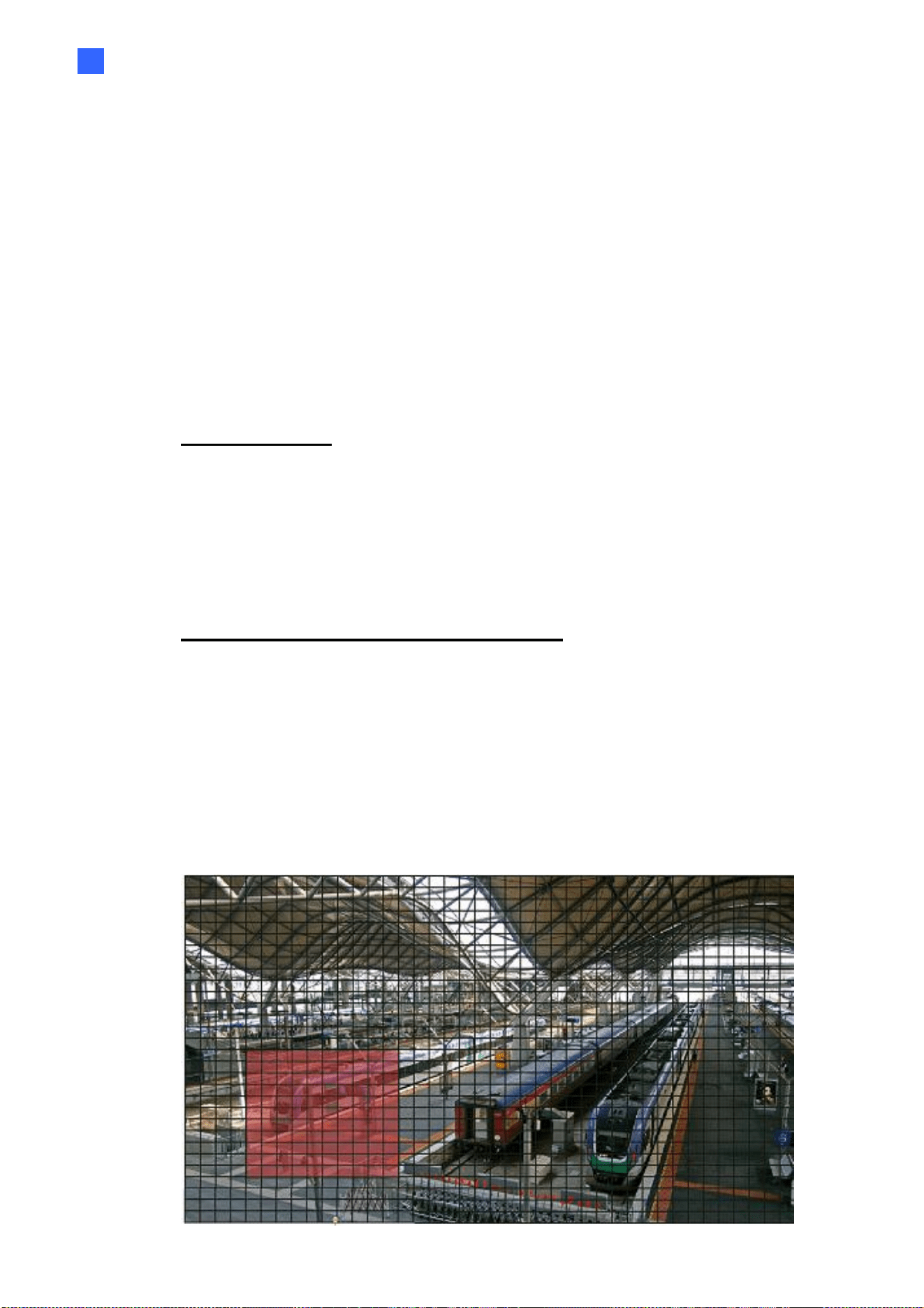
Motion Region Setup (Motion Region Paint)
The camera divides the detection area into 1200 (40x30) detection grids; users
can draw the motion detection region using the paintbrush.
Check the box <Enable brush> and select the brush size, 1x1, 3x3 or 5x5. Then,
left click and drag the mouse cursor to draw the preferred detection region. To
erase the drawn detection region, left click and drag the mouse cursor on the
colored grids.

38
Motion Detection Setting
Users could adjust various parameters of Motion Detection in this section.
Sampling pixel interval [1-10]:
This item is used to examine the differences between two frames. Users
can configure the interval of sampling pixel. The default value is 1. For
instance, if users set the interval as 3, IP camera system will take one
sampling pixel from every 3 pixels of each row and each column in
detection area (refer to the figure below). The alarm will be triggered
when differences are detected.
Detection level [1-100]:
Users can configure detection level for each sampling pixel. Detection
level is how much the camera can accept the differences between two
sampling pixels. The smaller the value is, the more minor motions it
detects. The default level is 10.
Sensitivity level [1-100]:
The default level is 80, which means if 20% or more sampling pixels are
detected differently, system will detect motion. The bigger the value,
the more sensitive it is. Meanwhile, when the value is bigger, the red
horizontal line in the motion indication window will be lower accordingly.
Time interval (sec) [0-7200]:
The value is the interval between each detected motion. The default
interval is 10.
Main Tabs
39
2
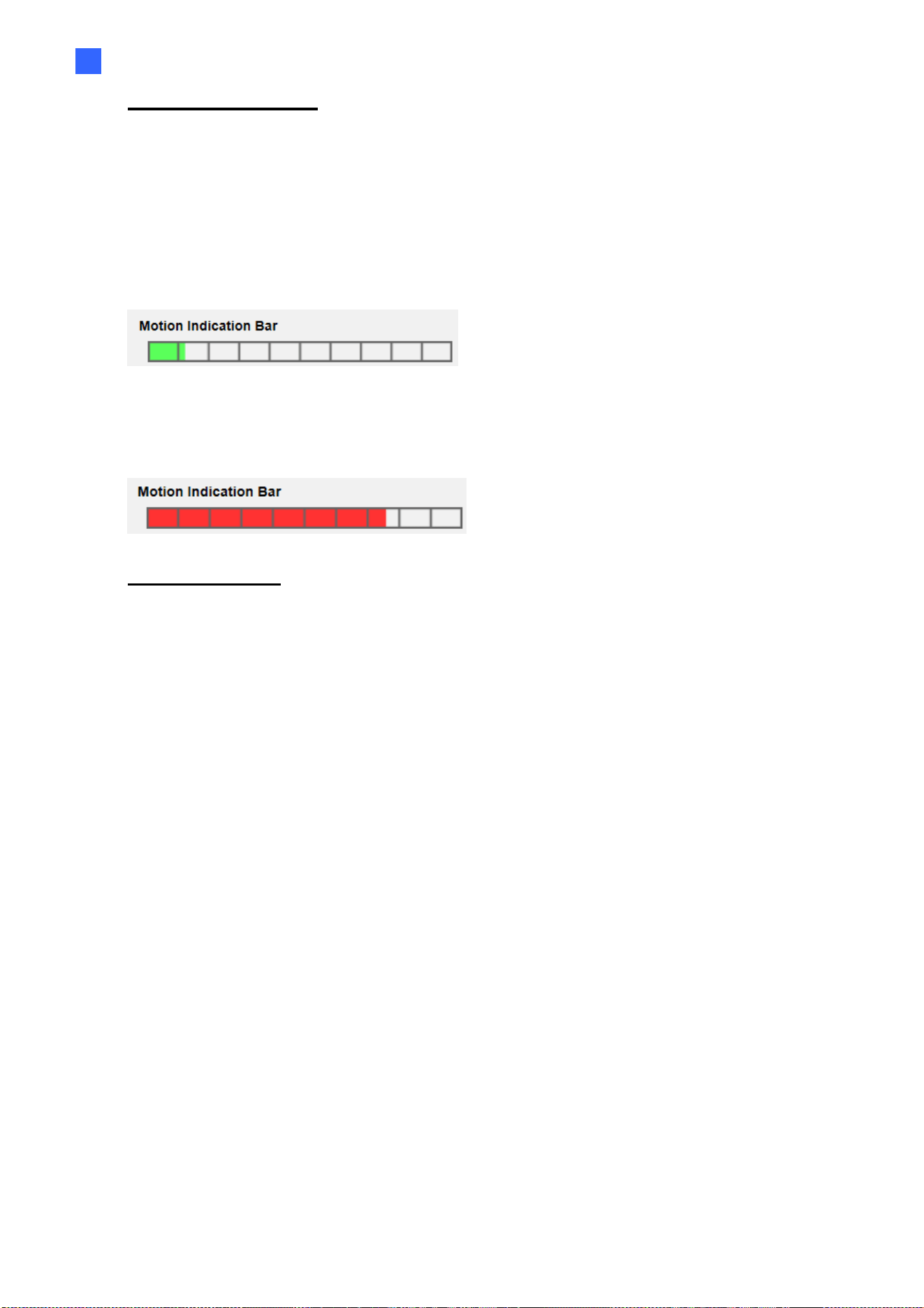
Motion Indication Bar
When Motion Detection function is activated and the motion is detected, the
signals will be displayed on the motion indication bar. The motion indication bar will go
green or red when there is any motion occurrence in the detection region.
Green suggests the occurring motion is detected and does not exceed the
threshold of detection level and sensitivity level. No alarms will be triggered.
Red suggests the ongoing motion exceeds the threshold of detection level and
sensitivity level. The alarm will be triggered.
Triggered Action (Multi-option)
The administrator can specify alarm actions that will take when motion is detected. All
options are listed as follows.
Enable Alarm Output 1/2 (high/low)
Check the item and select the predefined type of alarm output to enable alarm
relay output when motion is detected.
Send Alarm Message by FTP/E-Mail
The administrator can select whether to send an alarm message by FTP and/or
E-mail when motion is detected.
Upload Image by FTP
Select this item and the administrator can assign an FTP site and
configure various parameters. When motion is detected, event images will be
uploaded to the appointed FTP site. Note that to implement this function, one
of the streaming MUST be set as MJPEG; otherwise, this function will be
grayed out and cannot be accessed.
<Pre-trigger buffer> function allows users to check what caused the
trigger. The <Pre-trigger buffer> frame rate could be pre-determined. On
the other hand, <Post-trigger buffer> is for users to upload certain amount of
images after motion event occurs.
40
NOTE: <Pre-trigger buffer> generally ranges from 1 to 20 frames.
However, the range will change accordingly if the frame rate of
MJPEG on Streaming> Video Configuration is 6 or smaller.
Check the box <Continue image upload> to upload the triggered images
during certain time or keep uploading until the trigger is off. Select
<Upload for sec> and enter the duration in the blank. The images of
the duration will be uploaded to FTP when the motion event occurs. The
setting range is from 1 sec. to 99999 sec. Select <Upload during the
trigger active> to make the images keep being uploaded to FTP during
the trigger active until the event stops. Set the Image frequency as the
upload frame rate. The setting range is from 1 to 15 frames per second.
NOTE: Make sure FTP configuration has been completed. Refer
to section FTP for further details.
Upload Image by E-Mail
Select this item and the administrator can assign an E-mail address and
configure various parameters. When motion is detected, event images
will be sent to the appointed E-mail address. Note that to implement this
function, one of the streaming MUST be set as MJPEG; otherwise, this
function will be grayed out and cannot be accessed.
<Pre-trigger buffer> function allows users to check what caused the
trigger. The <Pre-trigger buffer> frame rate could be pre-determined.
On the other hand, <Post-trigger buffer> is for users to upload certain
amount of images after the motion event occurs.
NOTE: <Pre-trigger buffer> generally ranges from 1 to 20 frames.
However, the range will change accordingly if the frame rate of
MJPEG on Streaming> Video Configuration is 6 or smaller.
Check the box <Continue image upload> to upload the triggered images
during certain time or keep uploading until the trigger is off. Select
<Upload for sec> and enter the duration in the blank. The images of
the duration will be uploaded via E-mail when the motion event occurs.
The setting range is from 1 sec. to 99999 sec. Select <Upload during
the trigger active> to make images keep being uploaded via E-mail
during the trigger active until the event stops. Set the Image frequency

Main Tabs
41
2
as the upload frame rate. The setting range is from 1 to 15 frames per
second.
NOTE: Make sure SMTP configuration has been completed.
Refer to section Mail for further details.
Send HTTP Notification
Check this item, select the destination HTTP address, and specify the
parameters for event notifications by <Motion Detection> triggered. When an
alarm is triggered, the notification can be sent to the specified HTTP server.
For instance, if the custom parameter is set as “action=1&group=2”, and the
HTTP server name is “http://192.168.0.1/admin.php”, the notification will be
sent to HTTP server as “http://192.168.0.1/admin.php? action=1&group=2”
when alarm is triggered.
Record Video Clip
Check this item and select a video recording storage type, <SD Card> or
<NAS> (Network-Attached Storage>. The Motion Detection recording will
be stored in SD card or the NAS when motion is detected.
Pre-trigger buffer recording function allows users to check what happened
to cause the trigger. The pre-trigger buffer time range is from 1 sec. to 3 sec.
Select <Upload for sec> to set the recording duration after motion is
triggered. The setting range is from 1 sec. to 99999 sec. Select <Upload
during the trigger active> to record the triggered video until the trigger is off.
NOTE: Please make sure the local recording (with SD card) or
the remote recording (with NAS) is activated so that this function
can be implemented. Refer to section Recording for further
details.

42
File Name
Enter a file name in the blank, e.g. image.jpg. The uploaded image’s file name
format can be set in this section. Please select the one that meets the
requirements.
Add date/time suffix
File name: imageYYMMDD_HHNNSS_XX.jpg
Y: Year, M: Month, D: Day
H: Hour, N: Minute, S: Second
X: Sequence Number
Add sequence number suffix (no maximum value)
File name: imageXXXXXXX.jpg
X: Sequence Number
Add sequence number suffix up to # and then start over
File Name: imageXX.jpg
X: Sequence Number
The file name suffix will end at the number being set. For example, if the
setting is up to “10”, the file name will start from 00, end at 10, and then
start all over again.
Overwrite
The original image in the FTPsite will be overwritten by the new
uploaded file with a static filename.
Save
Click the <Save> button to save the settings.

Main Tabs
43
2
2.2.8.3 Network Failure Detection
The Network Failure Detection setting can be found under this path: System>
Events> Network Failure Detection.
Network Failure Detection allows the camera to ping another IP device (e.g.
NVR, VSS, Video Server, etc.) within the network periodically and generates
some actions in case of network failure occurs, for instance, a Video Server is
somehow disconnected.
Being capable of implementing local recording (through SD card) or remote
recording (via NAS) when network failure happens, the camera can be a backup
recording device for the surveillance system.
Detection Switch
The default setting for the Detection Switch function is <Off>. Enable the
function by selecting <On>. Users can also activate the function according to
the schedule time that is previously set in the <Schedule> setting page. Select
<By schedule> and click the <Please select…> button to choose the
desired schedule from the drop-down menu.
Detection Type
Input the IP device address and the period of ping time to ping. The camera will
ping the IP device every N minute(s). If it fails up to three times, the alarm will
be triggered automatically. The ping time setting range is from 1 to 99 minutes.
Triggered Action (Multi-option)
The administrator can specify alarm actions that will take when network failure
is detected. All options are listed as follows.
Enable Alarm Output 1 /2
Select the item to enable alarm relay output.
Send Alarm Message by FTP/E-Mail
The administrator can select whether to send an alarm message by FTP
and/or E-mail when an alarm is triggered.
Record Video Clip
Check the item and select a video recording storage type, <SD Card> or
<NAS> (Network-Attached Storage). The alarm-triggered recording will
be saved into the SD card.

44
Pre-trigger buffer recording function allows users to check what
happened to cause the trigger. The pre-trigger buffer time range is from
1 sec. to 3 sec. Select <Upload for sec> to set the recording duration
after alarm is triggered. The setting range is from 1 sec. to 99999 sec.
Select <Upload during the trigger active> to record the triggered video
until the trigger is off.
NOTE: Please make sure the local recording (with SD card) or
the remote recording (with NAS) is activated so that this function
can be implemented. Refer to section Recording for further
details.
Save
Click the <Save> button to save all the settings mentioned above.

Main Tabs
45
2
2.2.8.4 Periodical Event
The Periodical Event setting can be found under this path: System> Events>
Periodical Event.
With Periodical Event setting, users can set the camera to upload images
periodically to an FTP site or an E-mail address. For example, if the time interval
is set to 60 seconds, the camera will upload images to the FTP site or the E-mail
address every 60 seconds. The images to be uploaded are the images before
and after the triggered moment. Users can define how many images to be
uploaded in the <Triggered Action> section of this setting page.
Periodical Event
The default setting for the Periodical Event function is <Off>. Enable the
function by selecting <On>.
Time Interval
The default value of the time interval is 60 seconds. The setting range of the
time interval is from 60 to 3600 seconds.
Triggered Action
Upload Image by FTP
Select this item and the administrator can assign an FTP site and
configure various parameters. Images will be uploaded to the appointed
FTP site periodically. Note that to implement this function, one of the
streaming MUST be set as MJPEG; otherwise, this function will be
grayed out and cannot be accessed.
The <Pre-trigger buffer> function can define how many images to be
uploaded before the triggered moment. The <Post-trigger buffer>
function can define how many images to be uploaded after the triggered
moment.
NOTE: <Pre-trigger buffer> generally ranges from 1 to 20 frames.
However, the range will change accordingly if the frame rate of
MJPEG on Streaming> Video Configuration is 6 or smaller.
NOTE: Make sure FTP configuration has been completed.
Refer to section FTP of this chapter for further details.
46
Upload Image by E-Mail
Select this item and the administrator can assign an E-mail address and
configure various parameters. Images will be uploaded to the appointed
E-mail address periodically. Note that to implement this function, one of
the streaming MUST be set as MJPEG; otherwise, this function will be
grayed out and cannot be accessed.
The <Pre-trigger buffer> function can define how many images to be
uploaded before the triggered moment. The <Post-trigger buffer>
function can define how many images to be uploaded after the triggered
moment.
NOTE: <Pre-trigger buffer> generally ranges from 1 to 20 frames.
However, the range will change accordingly if the frame rate of
MJPEG on Streaming> Video Configuration is 6 or smaller.
NOTE: Make sure SMTP configuration has been completed.
Refer to section Mail of this chapter for further details.
File Name
Enter a file name in the blank, e.g. image.jpg. The uploaded image’s file name
format can be set in this section. Please select the one that meets the
requirements.
Add date/time suffix
File name: imageYYMMDD_HHNNSS_XX.jpg
Y: Year, M: Month, D: Day
H: Hour, N: Minute, S: Second
X: Sequence Number
Add sequence number suffix (no maximum value)
File name: imageXXXXXXX.jpg
X: Sequence Number
Add sequence number suffix up to # and then start over
File Name: imageXX.jpg
X: Sequence Number

Main Tabs
47
2
The file name suffix will end at the number being set. For example, if the
setting is up to “10”, the file name will start from 00, end at 10, and then start
all over again.
Overwrite
The original image in the FTP site will be overwritten by the new uploaded file
with a static filename.
Save
Click the <Save> button to save all the settings mentioned above.

48
2.2.8.5 Manual Trigger
The Manual Trigger setting can be found under this path: System> Events>
Manual Trigger.
With Manual Trigger setting, the current image(s) or video can be uploaded to
the appointed destination, such as an FTP site or an E-mail address. The
administrator can specify the triggered actions that will take when the users
switch the Manual Trigger button to ON. All options are listed as follows.
Manual Trigger
The default setting for the Manual Trigger function is <Off>. Enable the function
by selecting <On>. After the Manual Trigger function is enabled, click the
Manual Trigger button on the Home page to start uploading data. Click again to
stop uploading.
Triggered Action (Multi-option)
The administrator can specify alarm actions that will take at an alarm
occurrence. All options are listed as follows.
Enable Alarm Output 1/2
Select these items to enable alarm relay outputs.
Send Message by FTP/E-Mail
The administrator can select whether to send an alarm message by FTP
and/or E-mail when an alarm is triggered.
Upload Image by FTP
Select this item and the administrator can assign an FTP site and
configure various parameters. When the alarm is triggered, event
images will be uploaded to the appointed FTP site. Note that to
implement this function, one of the streaming MUST be set as MJPEG;
otherwise, this function will be grayed out and cannot be accessed.
<Pre-trigger buffer> function allows users to check what happened to
cause the trigger. The <Pre-trigger buffer> frame rate could be pre-
determined. On the other hand, <Post-trigger buffer> is for users to
upload certain amount of images after the alarm input is triggered.
Main Tabs
49
2
NOTE: <Pre-trigger buffer> generally ranges from 1 to 20
frames. However, the range will change accordingly if the
frame rate of MJPEG on Streaming> Video Configuration is 6
or smaller.
Check the box <Continue image upload> to upload the triggered images
during certain time or keep uploading until the trigger is off. Select
<Upload for sec> and enter the duration in the blank. The images of the
duration will be uploaded to FTP when the alarm input is triggered. The
setting range is from 1 sec. to 99999 sec. Select <Upload during the trigger
active> to make the images keep being uploaded to FTP during the trigger
active until the alarm is released. Set the Image frequency as the upload
frame rate. The setting range is from 1 to 15 frames per second.
NOTE: Make sure the FTP configuration has been completed.
Refer to section FTP for further details.
Upload Image by E-Mail
Select this item and the administrator can assign an E-mail address and
configure various parameters. When the alarm is triggered, event images
will be sent to the appointed E-mail address. Note that to implement this
function, one of the streaming MUST be set as MJPEG; otherwise, this
function will be grayed out and cannot be accessed.
<Pre-trigger buffer> function allows users to check what happened to
cause the trigger. The <Pre-trigger buffer> frame rate could be pre-
determined. On the other hand, <Post-trigger buffer> is for users to upload
certain amount of images after alarm input is triggered.
NOTE: <Pre-trigger buffer> generally ranges from 1 to 20
frames. However, the range will change accordingly if the
frame rate of MJPEG on Streaming> Video Configuration 6
or smaller.
Check the box <Continue image upload> to upload the triggered images during certain time
or keep uploading until the trigger is off. Select <Upload for sec> and enter the duration
in the blank. The images of the duration will be uploaded via E-mail when the alarm input
is triggered. The setting range is from 1 sec. to 99999 sec. Select <Upload> during the
<trigger active> to make the images keep being uploaded via E-mail during the trigger
active until the alarm is released. Set the Image frequency as the upload frame rate. The
setting range is from 1 to 15 frames per second.
50
NOTE: Make sure SMTP configuration has been completed.
Please refer to section Mail for further details.
PTZ Function
Assign a camera function: Preset, Sequence, Autopan or Cruise, and
specify a Preset Point / Sequence Line / Autopan Path / Cruise Line for
the camera to perform at an alarm occurrence.
NOTE: Please refer to the sections through Preset Programming
to Sequence Line Programming for details of Preset Point /
Cruise Line / Autopan Path / Sequence Line setups.
If the selected function is <Preset>, it is required to enter its dwell time (1
sec. to 256 sec.) in the corresponding field. When the alarm is triggered,
the camera will go to the selected Preset Point and stay there for a
user-defined period of time. As for other function modes, the camera will
keep executing the specified function; to stop the performance, simply
change the camera’s status.
NOTE: The dwell time is only adjustable when <Preset> is
selected. When the dwell time is up, the camera will go back to
its trigger position and recheck the alarm pin status.
Send HTTP notification
Check this item, select the destination HTTP address, and specify the
parameters for event notifications by <Alarm> triggered. When an alarm
is triggered, the notification can be sent to the specified HTTP server.
For instance, if the custom parameter is set as “action=1&group=2”, and
the HTTP server name is “http://192.168.0.1/admin.php”, the notification
will be sent to HTTP server as “http://192.168.0.1/admin.php?
action=1&group=2” when alarm is triggered.
Record Video Clip
Check the item and select a video recording storage type, <SD Card> or
<NAS> (Network-Attached Storage). The alarm-triggered recording will
be saved into the SD card or the NAS.

Main Tabs
51
2
Pre-trigger buffer recording function allows users to check what happened
to cause the trigger. The pre-trigger buffer time range is from 1 sec. to 3 sec.
Select <Upload for sec> to set the recording duration after alarm is triggered.
The setting range is from 1 sec. to 99999 sec. Select <Upload during the
trigger active> to record the triggered video until the trigger is off.
NOTE: Please make sure the local recording (with SD / SDHC
card) or the remote recording (with NAS) is activated so that this
function can be implemented. Refer to section Recording for
further details.
File Name
Enter a file name in the File name field, e.g. image.jpg. The uploaded image’s file
name format can be set in this section. Please select the one that meets the
requirements.
Add date/time suffix
File name: imageYYMMDD_HHNNSS_XX.jpg Y:
Year, M: Month, D: Day
H: Hour, N: Minute, S: Second X:
Sequence Number
Add sequence number suffix (no maximum value)
File name: imageXXXXXXX.jpg X:
Sequence Number
Add sequence number suffix up to # and then start over
File Name: imageXX.jpg X:
Sequence Number
The file name suffix will end at the number being set. For example, if the
setting is up to “10”, the file name will start from 00, end at 10, and then start
all over again.
Overwrite
The original image in the FTP site will be overwritten by the new uploaded file
with a static filename.
Save
Click the <Save> button to save all the settings mentioned above.

52
2.2.8.6 Audio Detection
The Audio Detection setting can be found under this path: System> Events>
Audio Detection.
Audio Detection function allows the camera to detect audio and trigger alarms
when audio volume in the detected area reaches / exceeds the determined
sensitivity threshold value.
NOTE: Audio Detection function is only available for models
equipped with Audio I/O function.
Audio Detection
In Audio Detection Setting, the default setting for the Audio Detection function is
<Off>. Enable the function by selecting <On>.
Audio Detection Setting
Users could adjust various parameters of Audio Detection in this section.
Detection level [1-100]:
The item is to set detection level for each sampling volume; the smaller
the value, the more sensitive it is. The default level is 10.
Time interval (sec) [0-7200]:
The value is the interval between each detected audio. The default
interval is 10.
Triggered Action (Multi-option)
The administrator can specify alarm actions that will take when audio is
detected. All options are listed as follows.
Enable Alarm Output 1/2
Select these items to enable alarm relay outputs.
Send Alarm Message by FTP/E-Mail
The administrator can select whether to send an alarm message by FTP
and/or E-mail when audio is detected.
Main Tabs
53
2
Upload Image by FTP
Select this item and the administrator can assign an FTP site and
configure various parameters. When audio is detected, event images will
be uploaded to the appointed FTP site. Note that to implement this function,
one of the streaming MUST be set as MJPEG; otherwise, this function will be
grayed out and cannot be accessed.
<Pre-trigger buffer> function allows users to check what happened to cause
the trigger. The <Pre-trigger buffer> frame rate could be pre-determined.
On the other hand, <Post-trigger buffer> is for users to upload certain amount
of images after audio event occurs.
NOTE: <Pre-trigger buffer> generally ranges from 1 to 20
frames. However, the range will change accordingly if the
frame rate of MJPEG on Streaming> Video Configuration 6 or
smaller.
Check the box <Continue image upload> to upload the triggered images
during certain time or keep uploading until the trigger is off. Select
<Upload for sec> and enter the duration in the blank. The images of the
duration will be uploaded to FTP when the audio event occurs. The setting
range is from 1 sec. to 99999 sec. Select <Upload during the trigger
active> to make the images keep being uploaded to FTP during the trigger
active until the event stops. Set the Image frequency as the upload frame
rate. The setting range is from 1 to 15 frames per second.
NOTE: Make sure FTP configuration has been completed. Refer
to section FTP for further details.
Upload Image by E-Mail
Select this item and the administrator can assign an E-mail address and
configure various parameters. When audio is detected, event images will
be sent to the appointed E-mail address. Note that to implement this function,
one of the streaming MUST be set as MJPEG; otherwise, this function will be
grayed out and cannot be accessed.
<Pre-trigger buffer> function allows users to check what happened to
cause the trigger. The <Pre-trigger buffer> frame rate could be pre-
determined. On the other hand, <Post-trigger buffer> is for users to upload
certain amount of images after the audio event occurs.

54
NOTE: <Pre-trigger buffer> generally ranges from 1 to 20 frames.
However, the range will change accordingly if the frame rate of
MJPEG on Streaming> Video Configuration 6 or smaller.
Check the box <Continue image upload> to upload the triggered images
during certain time or keep uploading until the trigger is off. Select
<Upload for sec> and enter the duration in the blank. The images of
the duration will be uploaded via E-mail when the audio event occurs.
The setting range is from 1 sec to 99999 sec. Select <Upload during the
trigger active> to make the images keep being uploaded via E-mail
during the trigger active until the event stops. Set the Image frequency
as the upload frame rate. The setting range is from 1 frame to 15 frames
per second.
NOTE: Make sure SMTP configuration has been completed.
Refer to section Mail for further details.
Send HTTP Notification
Check this item, select the destination HTTP address, and specify the
parameters for event notifications by <Audio Detection> triggered. When
an alarm is triggered, the notification can be sent to the specified HTTP
server.
For instance, if the custom parameter is set as “action=1&group=2”, and
the HTTP server name is “http://192.168.0.1/admin.php”, the notification
will be sent to HTTP server as “http://192.168.0.1/admin.php?
action=1&group=2” when alarm is triggered.
Record Video Clip
Check this item and select a video recording storage type, <SD Card> or
<NAS> (Network-Attached Storage>. The Audio Detection recording will
be stored in SD card or the NAS when audio is detected.
Pre-trigger buffer recording function allows users to check what
happened to cause the trigger. The pre-trigger buffer time range is from
1 sec. to 3 sec. Select <Upload for sec> to set the recording duration
after audio is triggered. The setting range is from 1 sec to 99999 sec.
Select <Upload during the trigger active> to record the triggered video
until the trigger is off.

Main Tabs
55
2
File Name
NOTE: Please make sure the local recording (with SD card) or
the remote recording (with NAS) is activated so that this function
can be implemented. Refer to section Recording for further
details.
Enter a file name in the blank, e.g. image.jpg. The uploaded image’s file name
format can be set in this section. Please select the one that meets the
requirements.
Add date/time suffix
File name: imageYYMMDD_HHNNSS_XX.jpg
Y: Year, M: Month, D: Day
H: Hour, N: Minute, S: Second
X: Sequence Number
Add sequence number suffix (no maximum value)
File name: imageXXXXXXX.jpg
X: Sequence Number
Add sequence number suffix up to # and then start over
File Name: imageXX.jpg
X: Sequence Number
The file name suffix will end at the number being set. For example, if the
setting is up to “10”, the file name will start from 00, end at 10, and then
start all over again.
Overwrite
The original image in the FTP site will be overwritten by the new
uploaded file with a static filename.
Save
Please click the <Save> button to save all the Audio Detection settings
mentioned above.
56
2.2.9
Auto Tracking
The Auto Tracking function will automatically detect a moving object in the
preset area and follow it according to the defined settings. Find the function
setting under this path: System> Autotracking.
Autotracking
The default setting of the Auto Tracking function is <Off>. Select <On> to
enable the function.
NOTE: Setting items will be available after <On> is selected.
MAX Limit Setting
The setting menu allows users to define a tracking area for the detection and
tracking movement of the camera.
Turn off
To avoid the setting process being disturbed by the camera’s tracking
movement, please click on the <Turn Off> button to switch off the tracking
function.
NOTE: The Auto Tracking function needs to be reactivated to take effect
after saving all the necessary settings. Please follow the steps below.
Select <Off> under <Autotracking> at the top.
Click the <Save> button for confirmation.
Select <On> under <Autotracking> at the top.
Click the <Save> button to confirm the settings.
Enable tilt limit
Select the box to enable tilt limit.
Get U Tilt / D Tilt
Click and drag the PTZ pointer in the view window to the desired up or down tilt

Main Tabs
57
2
position. Then click on the <Get U Tilt> / <Get D Tilt> button to get the
boundary values.
Enable pan limit
Select the box to enable pan limit.
Get L Pan / R Pan
Click and drag the PTZ pointer in the view window to the desired left or right
pan position. Then click on the <Get L Pan> / <Get R Pan> button to get the
boundary values.
Detection Range
Detection range can be set to detect motions around the center of the view
window. Please choose a value to define the detection area (in percentage)
around the center point. The available options are <L(60%)>, <M(50%)> and
<S(40%)>.
Preset Setting
In this setting menu, the Auto Tracking function and its related functions can be
activated for the first 10 preset points of each sequence line.
NOTE: When <Preset Setting> is activated, the <Home Setting> and the
<Guard Timer Setting> will be unavailable.
Off / On
The default setting of the Preset Setting is <Off>. Select <On> to enable the
function.
Sequence line
Select a desired sequence line from the drop-down menu to set its Auto
Tracking function.
Preset
Select a desired preset point from the drop-down menu to set its Auto
Tracking function. Please use the <Autotacking> drop-down menu
underneath to turn On / Off the tracking function for each chosen preset
point.
58
Ratio
Zoom ratio can be set for the camera to automatically zoom in / out when it
is tracking a moving object. Please type in the ratio number in the blank
space.
Guard Time
Guard time is for defining the maximum tracking time of the camera for each
chosen preset point. Please enter the time in seconds (range from 0 to 999)
in the blank space. Click the <Set> button on the right to finish setting up a
preset point.
NOTE: Repeat the steps from <Sequence line> to <Guard Time> for
setting other preset points.
Home Setting
This function allows users to set the main monitoring area as the home position
for the camera. In addition, maximum time can also be set for defining the time
for the camera to keep watching a stopped tracking object. The camera will
return to the home position according to the defined time setting.
NOTE: <Preset Setting> must be <Off> in order to configure the <Home
Setting> function.
Off / On
The default setting of Home Setting is <Off>. Select <On> to enable the
function.
Home Position
To set the home position, please click and drag the PTZ pointer in the view
window to the desired position. Click on <Set> to confirm the position.
Time
Please type in the time that the camera should keep watching a stopped
tracking object. The camera will return to the home position after the defined

Main Tabs
59
2
time period.
Go
Click on <Go> to move the camera to the home position.
Guard Timer Setting
This function allows users to set the main monitoring area as the guard position,
and set the duration of time for the camera to track an object.
NOTE: <Preset Setting> must be <Off> in order to configure the <Guard
Timer Setting> function.
Off / On
The default setting of the Guard Timer Setting is <Off>. Select <On> to
enable the function.
Guard Position
To set the guard position, please click and drag the PTZ pointer in the view
window to the desired position. Click on <Set> to confirm the position.
Time
Please type in the duration of time that the camera should track a moving
object.
Go
Click on <Go> to move the camera to the guard position.
Save
Click on <Save> to confirm the settings.
2.2.10
Storage Management
The Storage Management setting can be found under this path: System>
Storage Management.
60
Click the <Storage Management> category, there will be a drop-down menu
with tabs including <SD Card> and <Network Share>.
2.2.10.1 SD Card
The SD Card setting can be found under this path: System> Storage
Management> SD Card.
Users can implement local recording to the SD card up to 128GB. This page
shows the capacity information of the SD card and a recording list with all the
recording files saved on the memory card. Users can also format the SD card
and implement automatic recording cleanup through the setting page.
To implement SD card recording, please go to the <Recording> page (refer to
section Recording) for activation.
NOTE: Please format the SD card when using it for the first time.
Formatting will also be required when a memory card is being used on
one camera and later transferred to another camera with different
software platform.
NOTE: It is not recommended to record with the SD card for 24/7
continuously, as it may not be able to support long term continuous data
read/write. Please contact the manufacturer of the SD card for
information regarding the reliability and the life expectancy.
Device Information
When users insert the SD card, the card information such as the memory
capacity and status will be shown at the <Device Information> section.
Recording Source
Select a video stream to set as the recording source. The default format of the
video stream is <H.264-1>. Select a preferred stream from the drop-down list
and click the <Save> button to apply the setting.

Main Tabs
61
2
Device Setting
Click the <Format> button to format the memory card. Two filesystems are
provided, <vfat (default)> and <ext4 (recommended)>. It is recommended to select
<ext4> as the filesystem of the memory card for steady and better
performances.
Disk Cleanup Setting
Check <Enable automatic disk cleanup> and specify time <1~999 day(s) or 1~142
week(s)> and storage limits <1~99% full> to configure disk cleanup settings. Click
the <Save> button to save the settings.
Recording List
Each video file on the SD card will be listed in the Recording list. The maximum file
size is 60 MB/per file.
When the recording mode is set as <Always> (consecutive recording) and the SD
card recording is also allowed to be enabled by events triggered, once events
occur, the system will immediately implement events recording to the memory
card. After the recording of the events are finished, the camera will return to the
regular recording mode.
Remove
To remove a file, select the file first, and then click the <Remove> button.
Sort
Click the <Sort> button, and the files in the Recording list will be listed in name
and date order.
The capital letter A / M / N / R / V / U in the very beginning of name
denotes the sort of the recording as below.
Initial Recording Type Initial Recording Type
A
Alarm
R
Regular Recording
M
Motion
V
Manual Trigger
N
Network Failure
U
Audio Detection
Download
To open / download a video clip, select the file first, and then click the
<download> button below the Recording list field. The selected file window
will pop up. Click the AVI file to directly play the video in the player or
download it to a specified location.

62
2.2.10.2 Network Share (NAS)
The Network Share setting can be found under this path: System> Storage
Management> Network Share.
Users can store the recording videos to a network share folder, or NAS
(Network-Attached Storage). A NAS device is used for data storage and data
sharing via network. This page displays the capacity information of the network
device and a recording list with all the recording files saved on the network
device. Users can also format the NAS and implement automatic recording
cleanup through the setting page.
Device information
When a NAS is successfully installed, the device information such as the
memory capacity and status will be shown at the <Device Information> section.
Storage setting
The administrator can set the camera to send the alarm messages to a specific
NAS site when an alarm is triggered. Enter the network device details, which
include host (the IP of the NAS), share (the folder name of the NAS), user name,
and password, in the fields.
Click the <Save> button when finished.
Storage Tools
Click the <Format> button to format the NAS.
Recording Source
Select a video stream to set as the recording source. The default format of the
video stream is <Stream 1>. Select a preferred stream from the drop-down list
and click the <Save> button to apply the setting.
Disk cleanup setting
Check <Enable automatic disk cleanup> and specify the time <1~99 day(s) or
1~142 week(s)> and storage limits <1~99% full> to configure disk cleanup
settings. Click the <Save> button to confirm the settings.

Main Tabs
63
2
Recording List
Each video file on the Network Share will be listed in the Recording list. The
maximum file size is 60 MB/per file.
When the recording mode is set as <Always> (consecutive recording) and the
NAS recording is also allowed to be enabled by events triggered, once events
occur, the system will immediately implement events recording to the memory
card. After the recording of the events are finished, the camera will return to the
regular recording mode.
Remove
To remove a file, select the file first, and then click the <Remove> button.
Sort
Click the <Sort> button, and the files in the Recording list will be listed in
name and date order.
The capital letter A / M / N / R / V / U in the very beginning of name
denotes the sort of the recording as below.
Initial Recording Type Initial Recording Type
A
Alarm
R
Regular Recording
M
Motion
V
Manual Trigger
N
Network Failure
U
Audio Detection
Download
To open / download a video clip, select the file first, and then click the
<download> button below the Recording list field. The selected file
window will pop up. Click the AVI file to directly play the video in the
player or download it to a specified location.
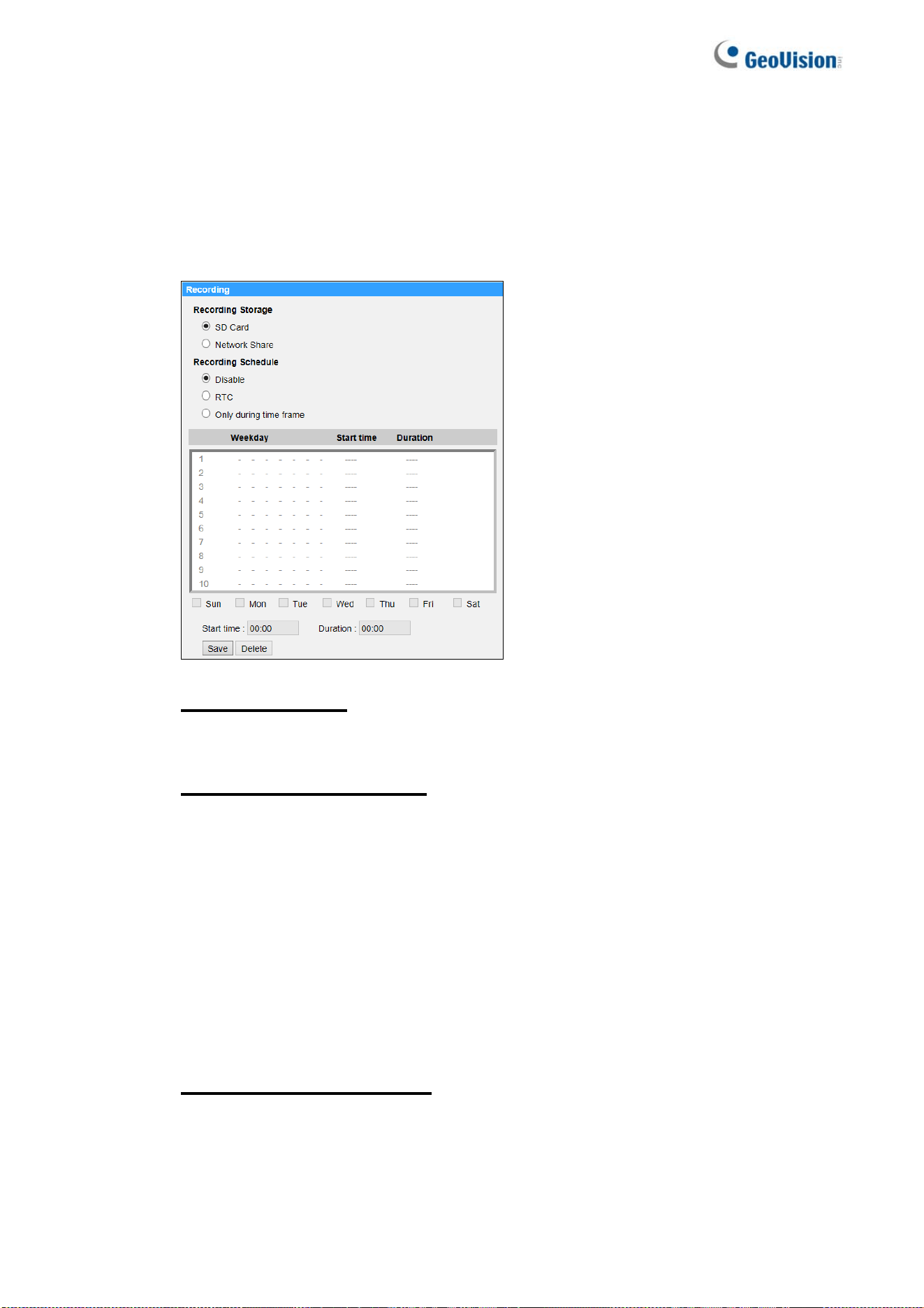
64
2.2.11
Recording
The Recording setting can be found under this path: System> Recording.
In the <Recording> setting page, users can specify the recording schedule that
fits the present surveillance requirement.
Recording Storage
Select a recording storage type, <SD Card> or <Network Share>.
Enable Recording Schedule
Two types of schedule mode are offered: <Always> and <Only during time
frame>. Users can select <Always> to activate SD Card or Network Share
Recording all the time. Or, select a set of schedule from the time frame blank,
check specific weekdays and setup the start time (hour:minute) and time period
(hour:minute) to activate the recording at certain time frames. The setting range
for the duration time is from 00:00 to 168:59. Click the <Save> button to save
the setup.
To delete a schedule, select one from the list, and click the <Delete> button.
Disable Recording Schedule
Select <Disable> to terminate the recording function.
Click the <Save> button when finished.
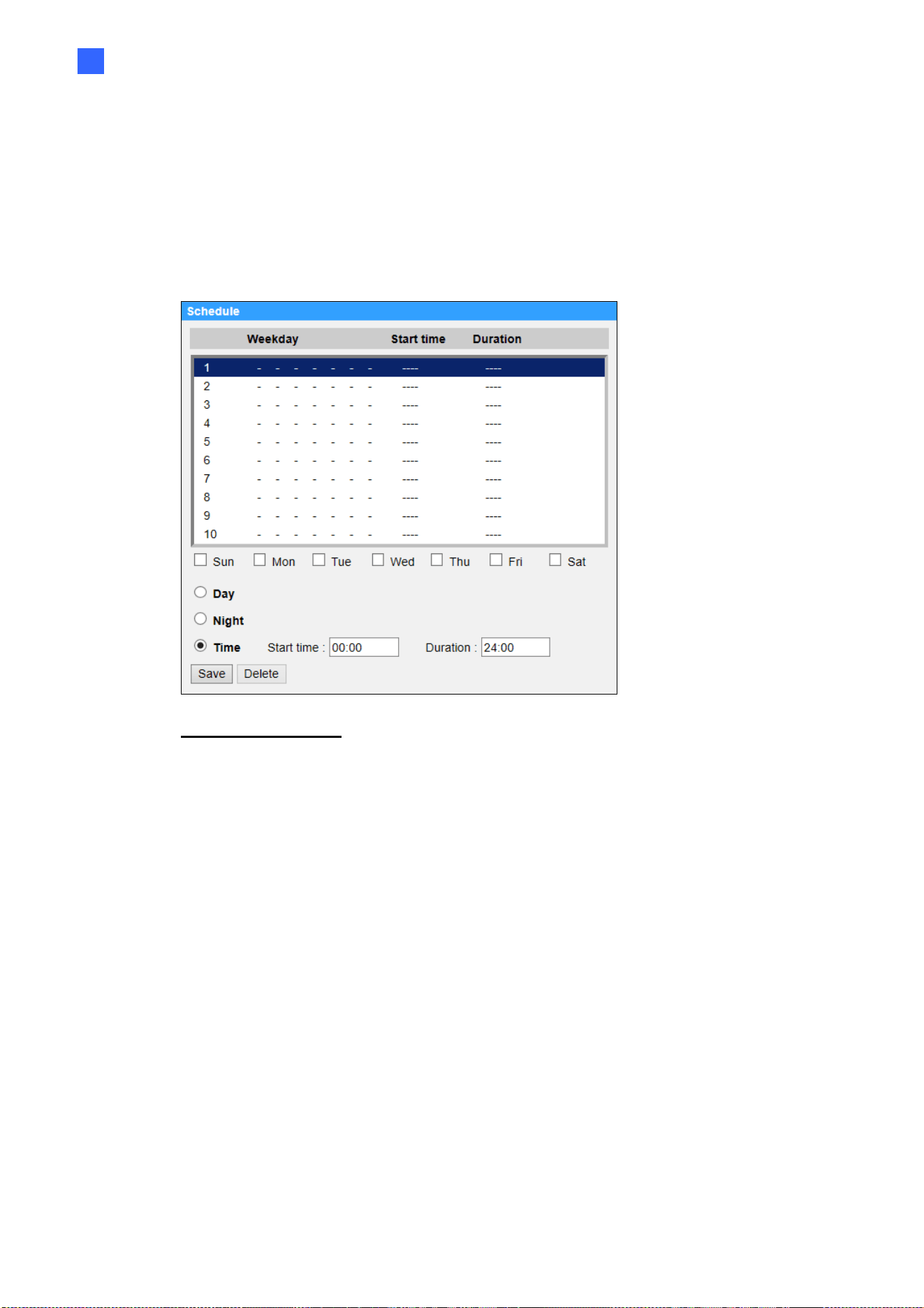
Main Tabs
65
2
2.2.12
Schedule
The Schedule setting can be found under this path: System> Schedule.
This function allows users to setup schedules for features including: <Alarm
Switch>, <Motion Detection> and <Network Failure Detection>. The function
supports up to 10 sets of time frames in the time frame list.
Setting Schedules
Step 1. Select a time frame from the time frame list.
Step 2. Check the weekday boxes below to choose the specific weekdays.
66
Step 3. Select a time mode, Day, Night or Time. Under Time mode, specify
the start time (hour:minute) and the time duration (hour:minute) to
activate the schedule triggered features. The setting range for the
time duration is from 00:00 to 168:59.
Step 4. Click the <Save> button to save the setup. Alternatively, click the
<Delete> button to delete a chosen time frame.
Time Mode
Day
The camera profile will be loaded when IR cut filter is on.
Night
The camera profile will be loaded when IR cut filter is off.
Time
This indicates the start time and the time duration for the schedule.
NOTE: Users MUST select <By schedule> under each feature setting
page to enable the schedule function.
2.2.13
File Location (Snapshots and Web Recording)
The File Location setting can be found under this path: System> File Location.
Users can specify a storage location on the PC or in the hard drive for the
snapshots and the live video recordings. The default setting is:
C:\ProgramData\Geovision\. Once the setting is confirmed, click the <Save>
button, and all the snapshots and the web recordings will be saved in the
designate location.
NOTE: Make sure the selected file path contains valid characters such
as letters and numbers.
NOTE: With Windows 7 operating system or above, to implement the
Snapshot and Web Recording functions, users must run IE as
administrator. To run IE as administrator, right click the IE browser icon
and select “Run As Administrator” to launch IE.

Main Tabs
67
2
2.2.14
View Information
The View Information function can be found under this path: System> View
Information.
Click the category: <View Information>, there will be a drop-down menu with
tabs including <Log File>, <User Information>, and <Parameters>.
2.2.14.1 Log File
The Log File function can be found under this path: System> View
Information> Log File.
Click the tab to view the system log file. The camera keeps a record of the
system’s behavior and information related to the camera. These log data can be
exported for future use. Click the <generate syslog> button and the Save File As
dialog window will pop up. The default file name is named after the model name
and the MAC address as “Model Name-MAC-log.tgz”. Select the file destination
and click the <Save> button to export the log data.
NOTE: “Save File As” dialog window may not show up immediately for
the camera needs some time to process the log data.
2.2.14.2 User Information
The User Information function can be found under this path: System> View
Information> User Information.
The administrator can view the login information and privileges of each added
user (refer to section Security).
User: 1:1:0:1
1:1:0:1= I/O access: Camera control: Talk: Listen (refer to section Security)
“1” denotes this user is allowed to access the function; whereas “0” suggest no
access for this user is allowed.
2.2.14.3 Parameters
The Parameters function can be found under this path: System> View
Information> Parameter.

68
Click this item to view the parameter settings of the entire system, such as
Camera Settings, Mask Information and Network Information.
2.2.14.4 Open Source Software Licenses
The Open Source Software Licenses function can be found under this path:
System> View Information> Open Source Software Licenses.
2.2.15
Factory Default
The Factory Default setting can be found under this path: System> Factory
Default.
Users can follow the instructions on this page to reset the camera to factory
default settings if needed.
Full Restore
Click the <Full Restore> button to recall the factory default settings. The camera
system will restart in 30 seconds. The IP address will be restored to default.
After the camera system is restarted, reconnect the camera using the default IP
address. The default IP address is 192.168.0.10.
Partial Restore
Click the <Partial Restore> button to recall the factory default settings
(excluding network settings/User settings). The camera system will restart in
30 seconds. Refresh the browser page after the camera system is restarted.
NOTE: The IP address will not be restored to default.
Reboot
Click the <Reboot> button and the camera system will restart without changing
the current settings. Refresh the browser page after the camera system is
restarted.
2.2.16
Software Version (Firmware Version)
The Software Version can be found under this path: System> Software
Version.
The software version page displays the current software version, and the
pan/tilt/zoom mcu version.
Main Tabs
69
2
2.2.17
Software Upgrade (Firmware Upgrade)
The Software Upgrade setting can be found under this path: System> Software
Upgrade.
NOTE: Make sure the upgrade software file is available before carrying
out software upgrade.
The procedure of software upgrade is as below.
Step 1. Click the <Start> button in Windows and locate the upgrade file, for
example, “ulmage_userland”.
NOTE: Do not change the name of the upgrade file, or the
system will fail to find the file.
Step 2. Pick a file type from the drop-down list. In this case, select
“ulmage+userland.img”.
Step 3. Click the <Upgrade> button. Then the system will prepare to start the
software upgrade. Subsequently, an upgrade status bar will be
displayed on the page to show the current upgrade process. After the
upgrade process is finished, the viewer will return to the <Home> page.
If the prompt to reinstall the GV-CameraViewer appears, follow the steps below.
Step 1. Click the <Start> button in Windows and activate the <Control Panel>.
In the appeared window, double click the <Add or Remove
Programs> button. A window with the <Currently install programs> list
will popup. In the list, select <Camera Viewer> and click the
<Remove> button to uninstall the existing Viewer.
Step 2. Open a new web browser and re-login the camera. Users will be
prompted to download the Camera Viewer. Once the Camera Viewer is
downloaded and installed, the live video will be available.

70
2.2.18
Maintenance
The Maintenance setting can be found under this path: System> Maintenance.
Users can export configuration files to a specified location and retrieve data by
uploading the configuration file to the camera.
Export Files
Users can save the system settings by exporting a configuration file (.bin) to a
specified location for future use. Click the <Export> button, and the popup File
Download window will come out. Click the <Save> button and specify a desired
location for saving the configuration file.
Upload Files
To upload a configuration file to the camera, click the <Browse> button to select
the configuration file and then click the <Upload> button for uploading.
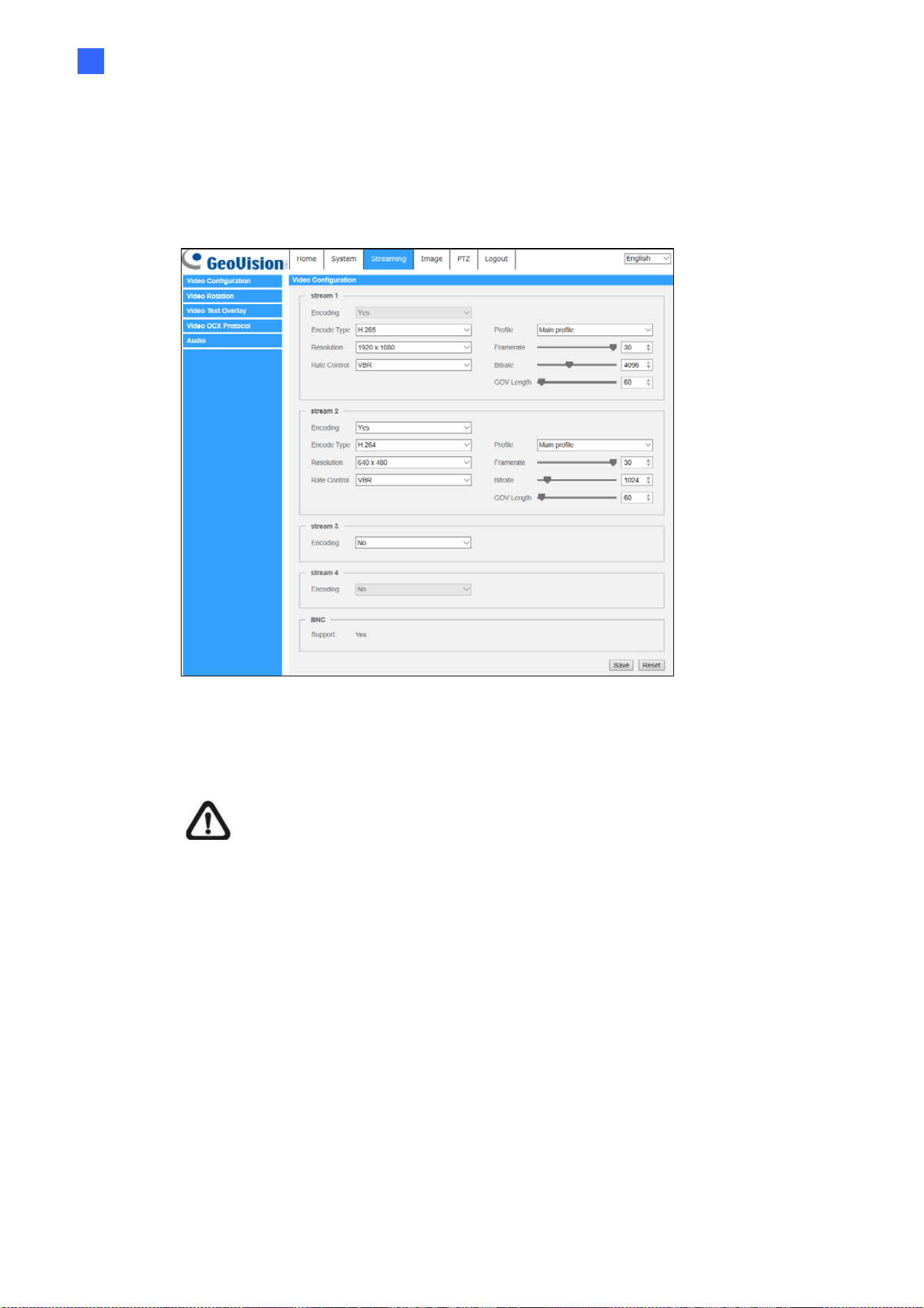
Main Tabs
71
2
2.3 Streaming
Under the tab <Streaming>, there are categories including: <Video Format>,
<Video Compression>, <Video OCX Protocol>, <Video Frame Rate>, and
<Audio>.
In the Streaming submenu, the administrator can configure specific video
resolution, video compression mode, video protocol, audio transmission mode,
etc. Further details of these settings will be specified in the following sections.
NOTE: Only administrator can access the <Streaming> setting page.

72
2.3.1
Video Configuration (Video Format & Resolution)
The Video Configuration setting can be found under this path: Streaming>
Video Configuration.
Encoding
Select <Yes> from the drop-down menu to enable Stream 2~Stream 4 encoding.
Or select <No> to disable the streaming encoding.
Encode Type
The available video resolution formats include H.265, H.264 and MJPEG. Users
can select the preferred encode type from the drop-down menu.
Resolution
Video format and resolution combination will vary by user’s configuration.
Rate Control
There are three kinds of H.265/H.264 bitrate modes provided: CBR (Constant
Bit Rate), VBR (Variable Bit Rate) and LBR (Low Bit Rate).
CBR
The sent-out video bitrate will be fixed and consistent to maintain the
bandwidth.
VBR
Video bitrate varies according to the activity of the monitoring
environment to achieve better image quality.

Main Tabs
73
2
LBR
LBR keeps low bitrate and ensures superior image quality. To implement LBR
control, setup the compression level and dynamic GOV for each streaming
accordingly beforehand.
- Compression
Based on the current application area and streaming bitrate, select the
most suitable compression level, high/mid/low.
Set <High>, and bitrate will vastly be reduced; however, image quality may
be degraded at the same time.
Set <Low>, and bitrate will stably keep low while image quality
remains high.
- Dynamic GOV
According to the amount of motion in the application area, the GOV
length of the video will be adjusted dynamically to reduce more
bitrate, especially for scenes with minor changes. The length of
Dynamic GOV is from <GOV Length> to <Max. GOV> (4094).
Select <Enabled> and set <Max. GOV>. Then, click the <Save>
button to activate the setting.
If there is small or zero activity in the scene, set <Max. GOV> larger, the
GOV length will be longer, resulting in lower bitrate and bandwidth.
If there are constant dynamic changes in the scene, it is suggested just
adjust <GOV Length> and disable <Dynamic GOV>.
Click the <Save> button to confirm the setting.
Profile
Users can set H.265/H.264 Profile to <High Profile> or <Main Profile> according to its
compression needs. With the same bit rate, the higher the compression ratio, the
better the image quality is. The default setting is <Main Profile>.
NOTE: Please make sure the higher compression ratio is supported by the
system before setup.

74
Framerate
Video framerate is for setting the frames per second (fps) if necessary. The
default setting of Stream 1 is 30 fps (NTSC) or 25 fps (PAL). The maximum
framerate range of each stream will change according to the selected video
resolution.
NOTE: Low framerate will decrease video smoothness.
Bitrate
The default H.265/H.264 bitrate for Stream 1 is 4096 kbit/s; for Stream 2 is
1024 kbit/s; for Stream 3/ Stream 4 is 2048 kbit/s. The setting range is from
64 to 10240 kbps, and the total bit rate should not exceed 26624 kbps.
GOV Length
Users can set the GOV length to determine the frame structure (I-frames and
P-frames) in a video stream to save bandwidth. Less bandwidth is needed if the
GOV length is set to a high value. However, the shorter the GOV length, the
better the video quality is. The default setting for Stream 1/2/3/4 is 60. The
setting range of the GOV length is from 1 to 4094.
Q (Quality) Factor (MJPEG Only)
The default setting of MJPEG Q factor is 35; the setting range is from 1 to 70.
Click the <Save> button to confirm the setting or click the <Reset> button to
return to the previous settings.
2.3.2
Video Rotation
Rotate Function
Users can change video display type if necessary. Selectable video rotate types
include Mirror video and 90/180/270 degree clockwise rotate. Refer to the
following descriptions for the different video rotate type.
Mirror
Select <yes> from the drop-down menu, and the image will be rotated
horizontally.
Rotate Type
Users can choose 0, 90, 180, or 270 degree from the drop-down menu
to rotate the image.
Click the <Save> button to confirm the setting.

Main Tabs
75
2
2.3.3
Video Text Overlay
Users can select the items to display data, including date / time / text string /
subtitle / image on the live video pane.
Overlay Type
Users can select at most three items out of four options including date & time /
text string / subtitle / image to display on the live video pane.
Include date & time
Check the box to enable date & time display on the Live Video Pane.
Users can choose to display date, time, or date & time from the drop-
down menu, and decide the string align position (left / right).
Include text string
Check the box to enable text string display on the Live Video Pane. Type
the text to display in the entry field and decide the string align position
(left / right). The maximum length of the text string is 25 alphanumeric
characters.
Include subtitle
Check the box to enable subtitle display on the Live Video Pane. Type
the text to display in the entry field and decide the string align position
(left / right). Users can set at most 5 subtitles, and the maximum length
of each subtitle is 16 alphanumeric characters.
Include Image
Check the box to enable image display on the Live Video Pane. Select
an alignment position (left /right) for the image from the drop-down list.
(To upload an image for display, see Image Overlay Setting below
Include azimuth
Check the box to enable azimuth display on the Live Video Pane and set
the azimuth alignment position. Azimuth shows the pan/tilt degree and
the shooting position of the camera, such as NE 050/00 (“NE”: the
shooting position of the camera; “050”: pan degree, “00”: tilt degree.)
Include Zoom Ratio
Check the box to enable zoom ratio display on the Live Video Pane. Select
an alignment position (left/right) for the ratio display from the drop-down list.

76
When any Overlay Type item is selected, a Video Text Overlay Window will show
up. Move the mouse cursor to the center of the window, click and drag the window
to change the display position. When it is done, click the <Set> button to confirm
the Text Overlay setting.
Text Overlay Setting
Users can choose the Text Overlay Color (black, white, yellow, red, green, blue,
cyan, or magenta) and Text Overlay Size (small, medium, or large) of the
display date & time / text string / subtitle.
Click the <Set> button to confirm the setting.
Image Overlay Setting
Users can upload an image and set its transparency to display on the live video
pane. The setting range of image transparency is from 0 to 255; the lower the
value, the more transparent it is. Users must save the image as an 8-bit BMP
file; the length should be the multiple of 32, and the width should be the multiple
of 4. The maximum resolution of the image should not exceed 32768 pixels.
Click the <Set> button and the <Upload> button to confirm the setting.

Main Tabs
77
2
2.3.4
Video OCX Protocol
The Video OCX Protocol setting can be found under this path: Streaming>
Video OCX Protocol.
In the <Video OCX protocol> setting page, the administrator can select RTP
over UDP, RTP over RTSP(TCP), RTSP over HTTP or MJPEG over HTTP, for
streaming media over the network. In the case of multicast networking, users
can select the Multicast mode. Click the <Save> button to confirm the setting.
Video OCX protocol setting options include:
RTP over UDP / RTP over RTSP(TCP) / RTSP over HTTP / MJPEG
over HTTP
Multicast Mode
Enter all required data, including <Multicast IP address>, <Multicast
H.264-1 / H.264-2 / H.264-3 / H.264-4 Video Port>, <Multicast MJPEG
Video Port>, <Multicast Audio Port> and <Multicast TTL> into each
blank.
Click the <Save> button to confirm the setting.
2.3.5
Audio (Audio Mode and Bit Rate Settings)
The Audio Mode setting can be found under this path: Streaming> Audio.
In this page, the administrator can adjust the sound transmission mode, the
audio gain levels and the audio bit rate. Setting for enabling sound recording to
the SD card is also available.
Transmission Mode
Full-duplex (Talk and Listen simultaneously)
In the Full-duplex mode, the local and remote sites can communicate
with each other simultaneously, i.e. both sites can speak and listen to
the other side at the same time.
Half-duplex (Talk or Listen, not at the same time)
In the Half-duplex mode, the local / remote site can only talk or listen to
the other site at a time.
78
Simplex (Talk only)
In the Talk only Simplex mode, the local / remote site can only talk to the
other site.
Simplex (Listen only)
In the Listen only Simplex mode, the local / remote site can only listen to
the other site.
Disable
Select the item to turn off the audio transmission function.
Server Gain Setting
Set the audio input / output gain levels for the sound amplification. The audio
input gain value is adjustable from 1 to 10. The audio output gain value is
adjustable from 1 to 6. To turn off the sound, set the audio gain to “Mute”.
Bit Rate
Be default, the Bit Rate is uLAW (64 kbps). Click the <Save> button to confirm
the setting.
Recording to Storage
Select <Enable> from the drop-down menu to enable audio recording with
videos into the SD card or the NAS.
NOTE: If the chosen bit rate is not compatible with the player, there
will only be noise instead of audio during playback.
Click the <Save> button to confirm the setting.
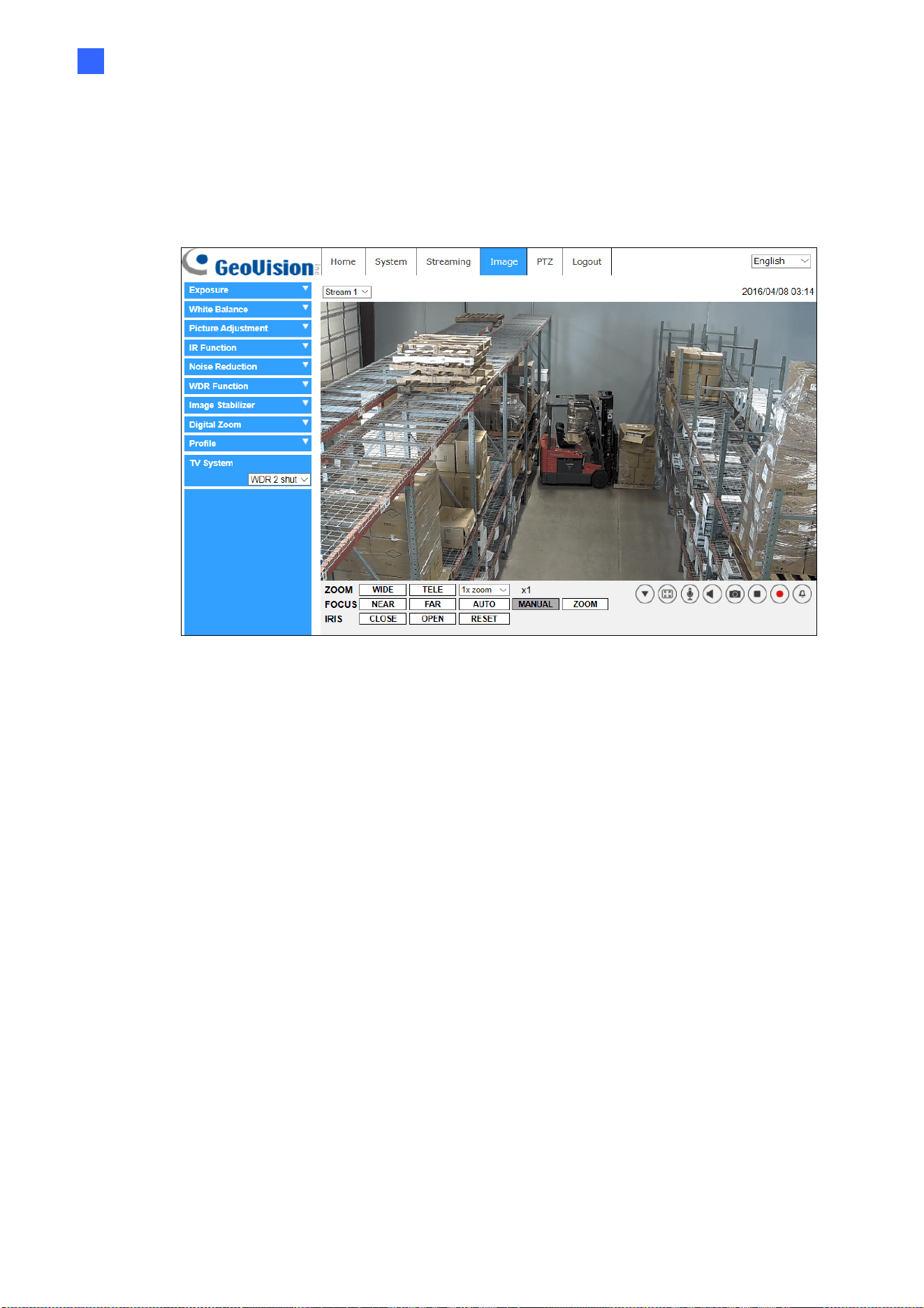
Main Tabs
79
2
2.4 Image
Under the tab <Image>, there are categories including: <Exposure>, <White
Balance>, <Picture Adjustment>, <IR Function>, <Noise Reduction>, <WDR
Function>, <Image Stabilizer>, <Digital Zoom>, <Profile> and <TV System>.

80
2.4.1
Exposure
The Exposure setting can be found under this path: Image> Exposure.
In the <Image-Exposure> setting page, users can select either the <Full Auto>
mode or adjust the parameter of the P-Iris Priority / Iris Priority / Shutter Priority
mode for optimized video output in accordance with the operating environment.
Auto Mode
Max Gain
This item is for users to set the maximum limit of gain. The Max Gain
ranges from 1 to 3, or select <Off> to disable the function. The default
setting is 3.
NOTE: Higher max gain may cause more image noises.
Auto Iris
In this mode, the camera will automatically adjust the iris to suit the
environment illumination.
The minimum shutter speed can be set from 1/30 to 1 sec. (NTSC) or
1/25 to 1/1.5 sec. (PAL). AGC (Auto Gain Control) will function
automatically according to the light conditions of the subject.
P-Iris Priority Mode
- Iris Size Setting
When users select <Auto Detect>, the camera will automatically
detect the best iris size for the environment. Alternatively, users can
manually adjust the iris size by selecting <Manual>. Click
and
to adjust the iris size.
- Minimum Shutter Speed
The minimum shutter speed can be set from 1/30 to 1 sec. (NTSC)
or 1/25 to 1/1.5 sec. (PAL).
Iris Priority Mode
In this mode, it is the iris that has the premier priority in control of the
exposure. The value of iris is adjustable from 0 to 10 (Full Open=10).
The minimum shutter speed range is configurable from 1/30 to 1 sec.
(NTSC) or 1/25 to 1/1.5 sec.(PAL).

Main Tabs
81
2
Auto Shutter Mode
In this mode, the camera will automatically adjust the shutter speed and
the iris size according to the light intensity. The minimum shutter speed
can be set from 1/500 to 1 sec. (NTSC) or 1/425 to 1/1.5 sec. (PAL).
Shutter Priority Mode
In this mode, it is the shutter speed that takes the main control of the
exposure. The range of the shutter speed is from 1/500 sec. to 1/30 sec.
(NTSC) or 1/425 sec. to 1/25 sec. (PAL).
Manual Mode
In this mode, users can change the Shutter Speed, Iris Size, and Gain manually.
The shutter speed range is from 1/10000 sec. to 1 sec. (NTSC) or from 1/10000
sec. to 1/1.5 sec. (PAL). The range of the iris size is from 0 to 10 (Full Open=10).
The gain value range is from 1dB to 9dB, or users can select <Off> to disable
the function.
2.4.2
White Balance
The White Balance setting can be found under this path: Image> White
Balance.
A camera needs to find reference color temperature, which is a way of
measuring the quality of a light source, for calculating all the other colors. The
unit for measuring this ratio is in degree Kelvin (K). Users can select one of the
White Balance Control modes according to the operating environment. The
following table shows the color temperature of some light sources for reference.
Light Sources Color Temperature in K
Cloudy Sky 6,000 to 8,000
Noon Sun and Clear Sky 6,500
Household Lighting 2,500 to 3,000
75-watt Bulb 2,820
Candle Flame 1,200 to 1,500
Auto Mode
The Auto Balance White mode is suitable for environment with light source
having color temperature in the range roughly from 2700K to 7500K.
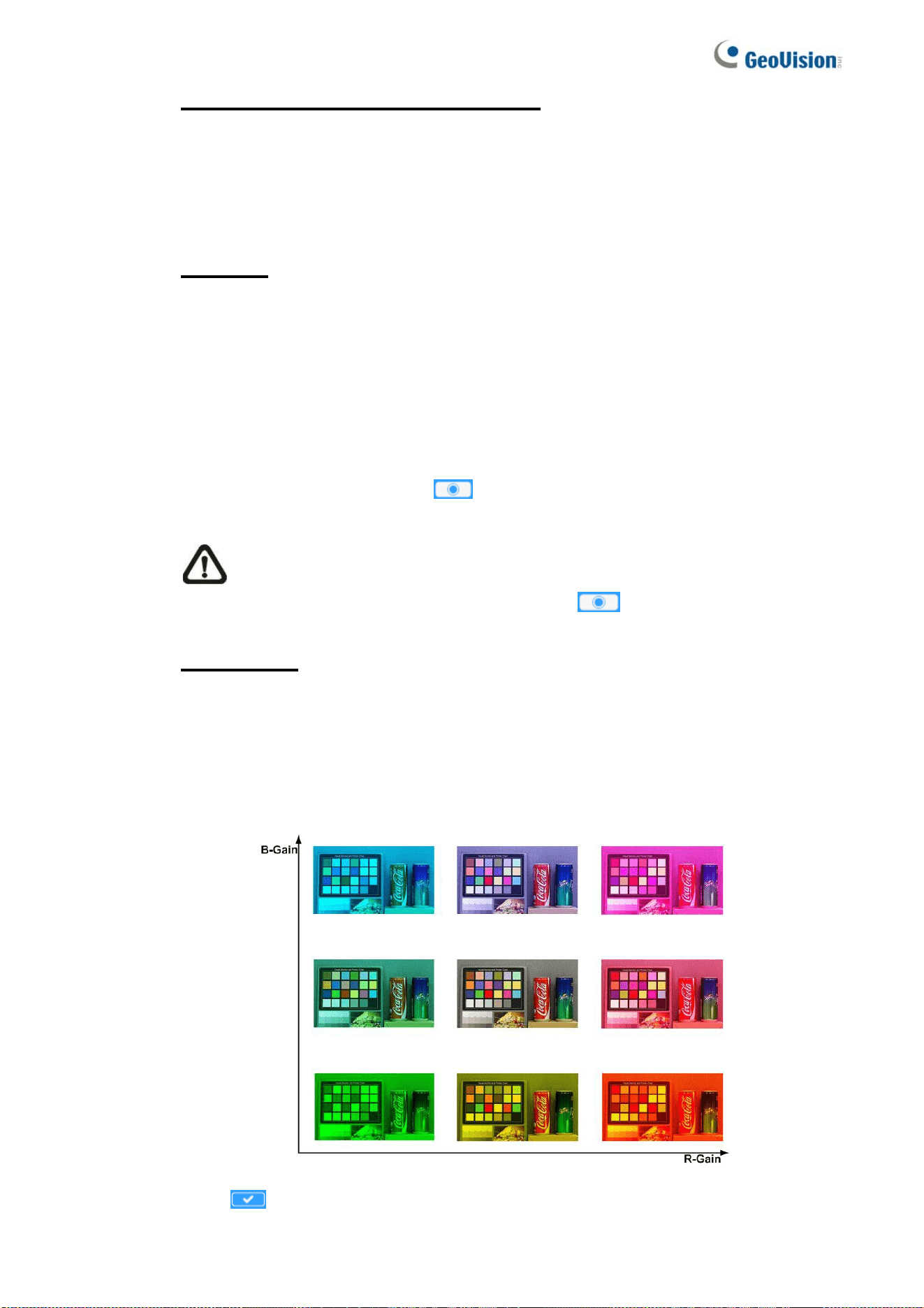
82
ATW Mode (Auto Tracing White Balance)
With Auto Tracking White Balance function, the white balance in a scene will be
automatically adjusted while temperature color is changing. The ATW Mode is
suitable for environments with light source having color temperature in the
range roughly from 2500K to 10000K.
One Push
With One Push function, white balance is adjusted and fixed according to the
scene the camera sees at the moment. This function is suitable for light sources
with any kind of color temperature and situations with minimal scene changes
and continuous lighting. Follow the steps below to set the white balance.
Point the camera to the monitoring area.
Select <One Push> in the White Balance setting menu.
Click the <Trigger> button
to adjust the white balance.
NOTE: In this mode, the value of white balance will not change as the
scene or the light source varies. Users might have to re-adjust the white
balance by clicking the <Trigger> button again when needed.
Manual Mode
In this mode, users can change the White Balance value manually via
specifying R gain and B gain; the range of R/B gain is from 0 to 127.
The following image displays the general color shifts of the scene when different
Rgain / Bgain combinations are applied.
Click to confirm the setting.

Main Tabs
83
2
2.4.3
Picture Adjustment
The Picture Adjustment setting can be found under this path: Image> Picture
Adjustment.
Brightness
The brightness level of the images is adjustable from -12 to +13.
Sharpness
The sharpness level of the images is adjustable from +0 to +15. The edge of the
objects is enhanced as the sharpness level increases.
Contrast
The contrast level of the images is adjustable from -6 to +19.
Saturation
The saturation level of the images is adjustable from -6 to +19.
Hue
The hue level of the images is adjustable from -12 to +13.

84
2.4.4
IR Function
The IR Function setting can be found under this path: Image> IR Function.
Day/Night Function
This item is for users to define the action of the IR cut filter and IR LED lights.
Refer to the descriptions of each option below to select a suitable mode.
Auto Mode
With this mode, the camera will decide the occasion to remove the IR
cut filter.
Night Mode
Use this mode when the environment light level is low. The IR cut filter
will be removed to allow the camera to deliver clear images in black and
white.
Day Mode
Select this mode to turn on the IR cut filter. The IR cut filter can filter out
the IR light and allows the camera to deliver high quality images in color.
Light Sensor Mode
IR LED lights will be turned on / off depending on the light sensor.
Light On Mode
In this mode, IR LED lights will always be on.
Light Off Mode
In this mode, IR LED lights will always be off.
Smart Mode
With Smart mode, the camera will decide the occasion to remove the IR
cut filter. The Smart mode mechanism can judge whether the main light
source is from IR illumination. If the main light source is from IR
illumination, the IR cut filter will be kept opened (i.e. monochrome/night
mode).
Main Tabs
85
2
Day/Night Threshold
This item is for users to set when the camera should switch from day mode to night
mode or vice versa. The camera will sense the surrounding brightness, and the
threshold value stands for the level of the light. Once the camera detects the
light level reaches the set threshold, the camera will automatically switch to
Day/Night Mode. The range of the level is from 0 to 10, (darker = 0; brighter = 10).
Night Mode to Day Mode
The lower the value, the earlier the camera switches to Day mode. The default
value is 7.
Day Mode to Night Mode
The higher the value, the earlier the camera switches to Night mode. The
default value is 3.
NOTE: This function can only be applied under “Auto Mode”.
IR Light Compensation
With the IR Light Compensation function, the camera can prevent the center
object close to the camera from being too bright when IR LED lights are turned on.
IR Heating
With the IR Heating function, the camera can automatically turn on the heater when
the camera temperature is between -10°C ~ 5°C (14°F ~ 41°F).

86
2.4.5
Noise Reduction
The Noise Reduction setting can be found under this path: Image> Noise
Reduction.
The camera provides multiple <Noise Reduction> options for delivering
optimized image quality especially in extra low-light conditions.
3DNR
With the 3D Noise Reduction function, the processor analyzes the differences
between successive frames to adjust pixels and improve image quality. 3DNR
generates better de-noising effects than 2DNR, but might create motion blur on
moving objects in the field of view.
Different levels of 3DNR are provided, including Low, Mid and High. Higher level
of 3DNR generates relatively enhanced noise reduction.
2DNR
With the 2D Noise Reduction function, the processor analyzes individual frames
of video to eliminate environmental noise signal so that the highest quality
image can be produced even in low light conditions
Select <On> to turn on 2DNR function; otherwise, select <Off> to turn off 2DNR
function.
ColorNR
In a dark or insufficient light environment and the camera is under color mode,
ColorNR (Color Noise Reduction) can eliminate color noise.
Three levels of ColorNR, including Low, Mid and High, are provided. The higher
level of ColorNR generates relatively enhanced noise reduction.

Main Tabs
87
2
2.4.6
WDR Function
The WDR setting can be found under this path: Image> WDR Function.
The Wide Dynamic Range (WDR) function is for solving high contrast or
changing light issues so that enhances better video display.
WDR function is designed to solve contrast or changing light issues and to
enhance the video display quality. Different level options for WDR function
include Low, Mid and Hi. The higher the level, the wider the dynamic range is.
Thus, the camera can catch a greater scale of brightness.
2.4.7
Image Stabilizer
The Image Stabilizer setting can be found under this path: Image> Image
Stabilizer. Image Stabilizer is only available when video format is set as “WDR
2 Shutter” under TV System.
With the Image Stabilizer function, the camera can keep the image steady and
suppress vibrating effects on images caused by external vibration. Follow the
instructions below to activate the function.
Step 1. Select <On> from the “Stabilizer” drop-down list to enable the Image
Stabilizer function.
Step 2. Select <On> from the “Auto Calibration” drop-down list to activate the
auto calibration function.
Step 3. Alternately, users can click the <Calibrate> button for manual
calibration. Be sure to keep the camera stand still for 3 seconds for
calibration accuracy.
To turn off the function, select <Off> from the “Stabilizer” drop-down list to
disable the Image Stabilizer function.
NOTE: Do NOT use PTZ functions when activating manual calibration.
NOTE: The Digital Zoom function and the Privacy Mask- Zoom Factor
function will be disabled when the Image Stabilizer function is activated.

88
2.4.8
Digital Zoom
The Digital Zoom setting can be found under this path: Image> Digital Zoom.
Select <On> to enable the Digital Zoom function; otherwise, select <Off> to turn
off the function.
2.4.9
Backlight
The Backlight setting can be found under this path: Image> Backlight.
Select On to enable Backlight. This function is used to adjust the color intensity
of scenes with strong light at the background.
2.4.10
Profile
The Profile setting can be found under this path: Image> Profile.
Camera Profile allows users to setup the desired image parameters for specific
environments with different time schedules. Users can setup at most 10 sets of
camera parameter configuration under the Camera tab. To enable this function,
users must setup the schedules in advance. Refer to section Schedule for
further details. Then, follow the steps below to setup a camera profile.
Camera Profile Setup
Step 1. In the “Camera” tab, setup the camera parameters, such as Exposure,
White Balance, etc., excluding TV System.
Step 2. Click Profile and its setting menu will be displayed. Select a number
from the Num drop-down list.
Step 3. Input a name for the profile in the Name field.
Step 4. Click the <Save> button below the Name field. The camera
configuration is saved and applied to the profile.
Step 5. Select a saved camera profile from the Num drop-down list.
Main Tabs
89
2
Step 6. Tick the By schedule box. Check the desired schedule(s) from the
Schedule drop-down list. Multiple schedules can be applied to one
profile.
Step 7. Click the <Save> button below <By schedule>.
Step 8. Follow the steps above to set the rest of the profiles.
Now, the camera will automatically switch profiles according to the schedule.
Alternatively, manually select a number from the Num drop-down list. Click the
<Load> button , and the camera will apply the setting of the profile.
NOTE: If users wish to set the camera parameters to factory default
setting, select <Normal> from the Num drop-down list. The camera will
start loading the default values.
2.4.11
TV System
Select the video format that matches the present TV system.
The following table shows the available video formats of the GV-IP Speed
Dome Camera.
Video Format
30 fps
NTSC
WDR 2 Shutter
25 fps
PAL
WDR 2 Shutter

90
2.5 PTZ
Under the tab <PTZ>, there are categories including: <Preset>, <Cruise>,
<Auto Pan>, <Sequence>, <Home Function>, <Tilt Range>, <Privacy Mask>,
<PTZ Setting> and <RS485>.
2.5.1
Preset
The camera supports up to 256 Preset Points. Please refer to the instructions
below to set a Preset Point.
Preset Setting
Follow the steps to setup a Preset Point
Step 1. Move the cursor to the live view pane.
Step 2. Left click and drag the red pointer with the PTZ controls to a desired
position and adjust the fine zoom / focus ratio.
Step 3. Assign a number for the current position from the drop-down Number
List (click <PrePage> or <NextPage> button to reach number 1 to 256),
and enter its descriptive name.
Step 4. Click the <Set> button to save the settings.
Preset Go
To have the camera move to a specified preset position, please select the
Preset Point from the drop-down Preset list (click <PrePage> or <NextPage>
button to reach preset number 1 to 256). Then the camera shall move to the
target position.

Main Tabs
91
2
2.5.2
Cruise
The Cruise Programming can be found under this path: PTZ> Cruise.
The camera supports up to 8 Cruise Paths. Please follow the instructions below
for Cruise Path setup.
Cruise Setting
Refer to the steps below to setup a Cruise Path.
Step 1. Select a path number from the drop-down list.
Step 2. Move the cursor to the live view pane, and move the camera to a
desired view (PTZ controls) as the start point of a Cruise Path.
Step 3. Click the <Set> button of <Record Start> and start programming the
Cruise Path via PTZ controls.
Step 4. When finishing programming, click the <Set> button of <Record End>
to complete recording the Cruise Path.
Cruise Run
Select the specified Cruise Path from the drop-down list, click the <Run> button,
and then the camera will start touring around as recorded.
To view the camera touring in full screen mode, please move the cursor onto the
live view pane, right-click and left-click to select “Fullscreen”. Then users can
view the camera navigation in full screen.
To stop running a Cruise Path, simply move the cursor to the live view pane and
move the camera in any direction.
92
2.5.3
Auto Pan
The Auto Pan Programming can be found under this path: PTZ> Auto Pan.
The camera supports 4 Auto Pan Paths. Please refer to the instructions below
to set an Auto Pan Path.
Auto Pan Setting
Follow the steps to setup an Auto Pan Path.
Step 1. Select a path number from the drop-down list.
Step 2. Select the speed ratio from the <Speed> drop-down list; the speed
ratio ranges from 0 (low) to 3 (fast).
Step 3. Choose to run the Auto Pan Path in right / left direction from the
<Direction> drop-down list.
Step 4. Move the cursor to the live view pane, and move the camera to a
desired view as the Start Point of an Auto Pan Path.
Step 5. Click the <Set> button of <Start Point> and the current view will be
automatically saved as the start point of the Auto Pan Path.
Step 6. Move the camera to another desired position as the end point of the
Auto Pan Path.
Step 7. Click the <Set> button of <End Point> to save the setting.
NOTE: The zoom ratio of an Auto Pan’s Start Point remains the same
throughout the path.
Auto Pan Run
Select the specified Auto Pan Path from the drop-down list, click the <Run>
button, and then the camera will start moving horizontally as recorded.
To view the camera panning in full screen mode, please move the cursor onto
the live view pane, right-click and left-click to select “Fullscreen”. Then users
can view the camera navigation in full screen.
To stop running an Auto Pan Path, simply move the cursor to the live view pane
and move the camera in any direction.

Main Tabs
93
2
2.5.4
Sequence
The Sequence Line Programming can be found under this path: PTZ>
Sequence.
The camera supports a total of 8 Sequence Lines; each Sequence Line consists
of up to 64 Preset Points. Please refer to the instructions below to program a
Sequence Line.
NOTE: Before setting this function, users must pre-define at least two
Preset Points.
Sequence Setting
Click the <Edit> button of <Sequence Setting> to enter the Sequence setting
menu.
Sequence Line
Select the number of Sequence Line to be set from the drop-down list in
the top of the Sequence setting menu.
Sequential Preset Points Setting
Setup each Preset Point of the programmed Sequence Line in order.
Select a Preset Point from the <Name> list for the specified number of
Preset Point and enter both Dwell Time (0 to 127) and Speed (0 to 14)
into the corresponding fields.
When finishing the sequential Preset Points setting, click the <Save> button in
the top of the Sequence setting menu.
Sequence Run
Select the specified Sequence Line from the drop-down list, click the <Go>
button, and then the camera will start moving forward each scene sequentially
as programmed.
To view the camera executing a Sequence Line in full screen mode, please
move the cursor onto the live view pane, right-click and left-click to select
“Fullscreen”. Then users can view the camera navigation in full screen.
To stop running the Sequence Line, simply move the cursor to the live view
pane and move the camera in any direction.

94
2.5.5
Home Function
The Home Function can be found under this path: PTZ> Home Function.
Users are able to set an operation mode to ensure constant monitoring. If the
camera idles for a period of time, the selected function will be activated
automatically; this is the HOME function. The Home function allows constant
and accurate monitoring to avoid the camera idling or missing events.
Home Setting
Switch
Select <On> or <Off> to activate or disable the Home function. Then
click the <Set> button to apply the setting.
Time
The time here represents the duration of camera idle time previous to
running a Preset Point / Cruise Line / Auto Pan Path / Sequence Line.
When the Home function is activated, the camera will start to count
down when it idles, and then execute the predefined action as time
expires. The time period ranges from 1 min. to 128 min.; specify it in the
field. Click the <Set> button to save the settings.
Type & Line
Select a Home action type (Preset Point / Cruise Line / Auto Pan Path /
Sequence Line) and specify the number of Preset Point / Cruise Line /
Auto Pan Path / Sequence Line from the drop-down <Type> and <Line>
lists. Click the <Set> button to save the Home settings.

Main Tabs
95
2
2.5.6
Tilt Range
The Tilt Range setting can be found under this path: PTZ> Tilt Range.
The camera’s tilt angle is adjustable from minimum −20° to maximum +100°.
Please enter the desired minimum and maximum tilt angle into the
corresponding fields respectively. Click the <Set> button to save the tilt angle
settings.
2.5.7
Privacy Mask
The Privacy Mask can be found under this path: PTZ> Privacy Mask.
The Privacy Mask function aims to avoid any intrusive monitoring. When setting
a mask, it is suggested to set it at least twice bigger (height and width) than the
masked object. The camera will assume the center of the selected view as the
starting point. Therefore, please keep the target object / region nearly
positioned in the center of the scene.
Mask Setting
Switch
Select <On> or <Off> to activate or disable the Privacy Mask function.
Click the <Set> button to apply the setting.
Color
Select a color from the <Color> drop-down list for the specified Privacy
Mask. Click the <Set> button to apply the setting.
Mask Number (1~20)
Specify the number of the programmed Privacy Mask in the entry field.
Zoom Factor
Normally, a privacy mask goes repositioned and resized to cover the
masked area whenever the camera is panned/tilted/zoomed. Zoom
Factor allows users to hide the mask when zoom ratio is set lower than
the original ratio.
For example, when the privacy mask is set at a certain zoom ratio (e.g.
5x), the privacy mask will be resized when the camera is zoomed in (e.g.
from 5x to 20x); however, when the camera zooms out (e.g. from 5x to
2x), the privacy mask will be hidden.
Select <On> or <Off> to activate or disable the Zoom Factor function.
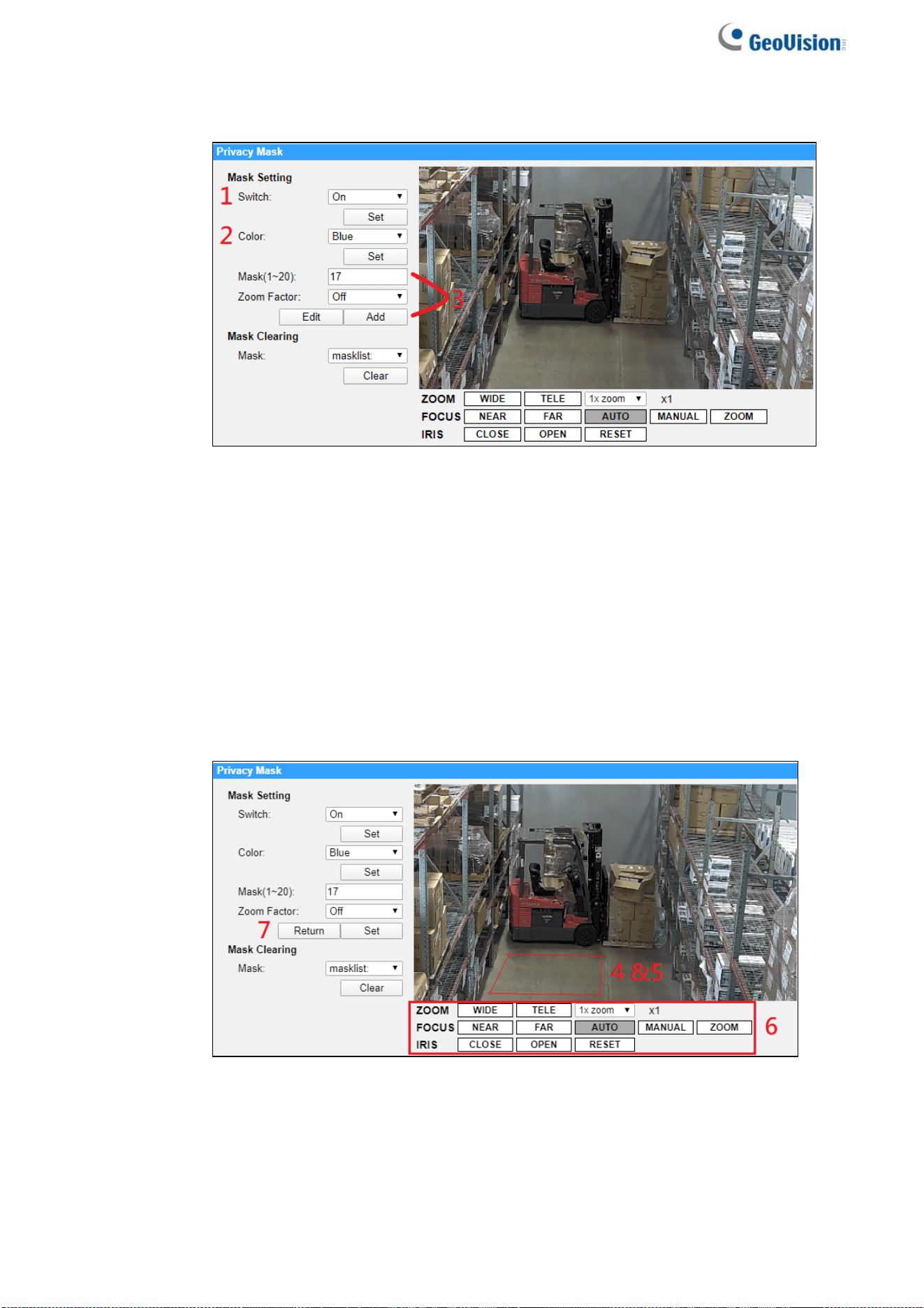
96
Follow the steps below to setup a privacy mask.
Step 1. Set Switch to <On> and click the <Set> button to turn on the Privacy
Mask function.
Step 2. Select a color for the mask from the <Color> drop-down list and click
the <Set> button to apply the color setting.
Step 3. Specify the mask a number, e.g. 17. If Zoom Factor is needed, select
<On> to enable this function. Then, click the <Add> button and a
privacy mask will be displayed on the Live Video Pane on the right.
Step 4. To shift the mask to the intended location, move the mouse cursor to
the center of the mask and click and drag.

Main Tabs
97
2
Step 5. To change the shape and the size of the mask, click any edge of the
mask and draw it outward/inward.
Step 6. If needed, set up Zoom/Focus/Iris.
Step 7. Click the <Set> button to save and apply the setting. The Privacy Mask
will be displayed in the color users set previously.
If users wish to edit the previously-set mask, input the Mask number in Mask
(1~20) entry field and click the <Edit> button, the camera will go to the set
location and display the mask. Then, users can follow Step 4 to Step 6 to edit
the mask. To cancel mask editing, just click the <Return> button to exit the
editing.
Mask Clearing
In this section, users can delete an existing Privacy Mask. Please select the
Privacy Mask to be removed from the drop-down list, and click the <Clear>
button. Then the selected Privacy Mask will readily disappear.
2.5.8
PTZ Setting
The PTZ Setting can be found under this path: PTZ> PTZ Setting.
Flip
Users can track an object continuously when it passes under the camera with
setting Flip to Mechanical (M.E.) mode.
NOTE: The Flip setting is manual-controlled only. If a Preset Position or
a point for other function (e.g. Sequence) is set in the position that can
only be reached through FLIP motion, when the Flip function is turned
off, the position cannot be reached anymore.
NOTE: To make the camera tilt between a specific range, such as -20°
to +100°, please go to the <Tilt Range> setting page to set the tilt angle
range. Otherwise, the camera will tilt 90° as the default setting.
M.E. Mode
M.E. is a standard mechanical operation. As the camera tilts to the
maximum angle, it will pan 180°, and then continue tilting to keep
tracking objects.

98
Speed by Zoom
This function allows the camera to adjust the pan/tilt speed automatically by the
internal algorithm when the zoom ratio is changed. The rotating speed will
become slower as the zoom ratio gets larger. Click the <Set> button to save the
setting.
Auto Calibration (Servo Feedback)
Integrating Servo Feedback technology, the camera would calibrate and
precisely return to the previous position without stalling when the deviation of
dome pivot is detected. Select <On> and click the <Set> button to activate the
setting.
Set Pan Zero
Click the <Set> button to set the camera’s currently shooting position as the
start point for panning (0 degree).

Main Tabs
99
2
2.5.9
RS485
The RS485 setting can be found under this path: PTZ> RS485.
This page is for users to activate the pan/tilt function and select the RS-485
protocol which the Joystick/Keyboard uses.
RS-485 Protocol Type
With the correct RS-485 protocol selected, users can remotely control the PTZ
function of the camera using Joystick/Keyboard. Check the RS-485 protocol
type of the Joystick/Keyboard. Then select the RS-485 protocol which the
Joystick/Keyboard uses from the drop-down list. The available types are DSCP /
PelcoD / PelcoP. Please refer to the following descriptions. After the protocol
type is selected, users can adjust the parameters from the drop-down lists on
the right. Click the <Save> button to confirm the setting.
2.6 Logout
Click the tab <Logout> on the top of the page, and the login window will pop up.
This enables login with another username.

100
Appendix A: Install UPnP Components
Please follow the instructions below to install UPnP components on Windows Vista /
Windows XP / Windows 7.
Step 1: In Windows, go to <Start>, click <Control Panel>, and then double click <Add or
Remove Programs>.
Step 2: Click <Add/Remove Windows Components> in the <Add or Remove Programs>
page.
Step 3: Select <Networking Services> from the Components list in Components Wizard
window of the Windows, and then click <Details>.
Step 4: Select <UPnP User Interface> in the Networking Services’ subcomponents list and
then click <OK>.
Step 5: Click <Next> in the Windows Components Wizard window.
Step 6: Click <Finish> to complete installation.
Appendix
101
Appendix B: IP Addresses from Decimal to Binary
Follow the example below to convert the IP addresses to binary numbers. Use the
calculator on the computer for conversion. The calculator can be found under this path:
Start> All Programs> Accessories> Calculator. For Windows XP and Windows Vista,
click <View> on the calculator and click <Scientific>. For Windows 7 or above, click <View>
on the calculator and click <Programmer>. Then follow the steps in the following example
to convert the IP addresses.
The example below shows how to convert 192.168.2.81 to binary numbers.
Step 1: On the left of the calculator, select <Dec>. Then enter the first decimal number of
the IP address, “192”. Select <Bin> and the number will be converted to binary
number. Repeat the same procedure with the rest of decimal numbers. Remember
to select <Dec> before entering the next decimal number. Otherwise a decimal
number cannot be entered. The table below shows the binary number of each
decimal number.
Decimal Numbers Binary Numbers
192 11000000
168 10101000
2 10
81 1010001
Step 2: Each binary number should have eight digits. If a binary number does not have
eight digits, please add 0 in front of it until it does. The binary number of each
decimal number should be as follow.
Decimal Numbers Binary Numbers
192 11000000
168 10101000
2 00000010
81 01010001
Step 3: Therefore, the binary numbers of IP address 192.168.2.81 is
11000000.10101000.00000010.01010001.