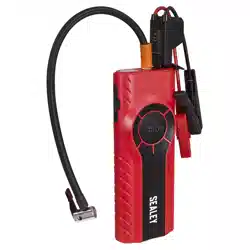
900A 12V ROADSTART® EMERGENCY JUMP STARTER
- HI-VIS GREEN
MODEL NO: RS1312HV
Thank you for purchasing a Sealey product. Manufactured to a high standard, this product will, if used according to these instructions,
and properly maintained, give you years of trouble free performance.
IMPORTANT: PLEASE READ THESE INSTRUCTIONS CAREFULLY. NOTE THE SAFE OPERATIONAL REQUIREMENTS, WARNINGS & CAUTIONS. USE
THE PRODUCT CORRECTLY AND WITH CARE FOR THE PURPOSE FOR WHICH IT IS INTENDED. FAILURE TO DO SO MAY CAUSE DAMAGE AND/OR
PERSONAL INJURY AND WILL INVALIDATE THE WARRANTY. KEEP THESE INSTRUCTIONS SAFE FOR FUTURE USE.
Original Language Version
© Jack Sealey Limited
1. SAFETY
IMPORTANT WARRANTY INFORMATION: KEEP YOUR ROADSTART HEALTHY
Read and understand the general safety and operating instructions before use. The following information is intended to help
you keep the product in top working order.
NOTE – The battery in this unit is a consumable item and its ability to accept charge will reduce over time. We will provide
warranty against mechanical and electrical defect for a period of one year - this does not cover fair wear and tear.
If the battery is not charged properly before first use, or regularly conditioned, its capacity will diminish. Under these circumstances we
will not replace the battery even if it is less than one year old.
You can help prolong the life of the battery by following a few simple guidelines.
Plug in your new Roadstart to the mains transformer and make an INITIAL charge lasting 38 hours.
Ensure the unit is fully charged before storage.
8 DO NOT leave the Roadstart for longer than 2 months without putting it on charge.
8 DO NOT attempt to start a vehicle when the Roadstart battery level lights show red.
8 DO NOT drop or roughly handle the Roadstart – this will break or disjoin the battery terminals rendering the battery useless and the
warranty void.
8 DO NOT use any other charger, other than the one supplied, to recharge the battery.
IMPORTANT: To reduce the risk of a battery explosion, follow these instructions and those published by the battery manufacturer
and the manufacturer of any equipment you intend to use in the vicinity of the battery. Remember to review warning marks on all
products and on engines. Modern vehicles contain extensive electronic systems. Check with the vehicle manufacturer for any specic
instructions regarding the use of this type of equipment on each vehicle. No liability will be accepted for damage/injury where this
product is not used in accordance with all instructions.
1.1. PERSONAL PRECAUTIONS
9 Ensure there is another person within hearing range, or close enough to come to your aid should a problem arise, when working
near a lead-acid battery.
9 Have fresh water and soap nearby in case battery acid contacts skin, clothing or eyes.
9 Wear safety eye protection and protective clothing. Avoid touching eyes while working with a battery.
9 Wash immediately with soap and water if battery acid contacts skin or clothing. If acid enters eye, ush eye immediately with cool,
clean running water for at least 15 minutes and seek immediate medical attention.
9 Remove personal metallic items such as rings, bracelets, necklaces and watches. A lead-acid battery can produce a short-circuit
current high enough to weld a ring or the like to metal, which may cause severe burns.
1.2. IMPORTANT SAFETY INSTRUCTIONS
9 Familiarise yourself with the applications, limitations and potential hazards of the RoadStart.
9 Keep the unit in good working order and condition. Replace damaged parts immediately.
9 Use only recommended parts. To use unapproved parts may be dangerous and will invalidate your warranty.
9 The RoadStart must only be opened and checked by qualied service personnel. DO NOT disassemble the unit for any reason.
9 Keep children and unauthorised persons away from the work area.
9 Keep work area clean and tidy and free from unrelated materials. Ensure that there is adequate lighting.
9 If the RoadStart receives a sharp knock or blow, it must be checked by a qualied service agent before being used.
9 When not in use re-charge every two months.
8 DO NOT smoke or allow a spark or ame in the vicinity of the battery or engine.
8 DO NOT drop any metal item onto the battery as it may spark or short circuit the battery, which could cause an explosion.
8 DO NOT use RoadStart to recharge dry cell batteries that are commonly used with home appliances. These batteries may explode
and cause personal injury and damage to property.
8 DO NOT charge or boost a frozen battery.
8 DO NOT use attachments other than those recommended. To do so may risk damage to the unit and other equipment and possible
personal injury.
8 DO NOT pull or carry the unit by its cables and DO NOT pull the negative and positive clamps from the battery terminals.
8 DO NOT operate in vicinity of ammable liquids or gases.
8 DO NOT recharge the unit with plugs, cables or attachments that are damaged. Replace such items immediately.
8 DO NOT use this product to perform a task for which it is not designed.
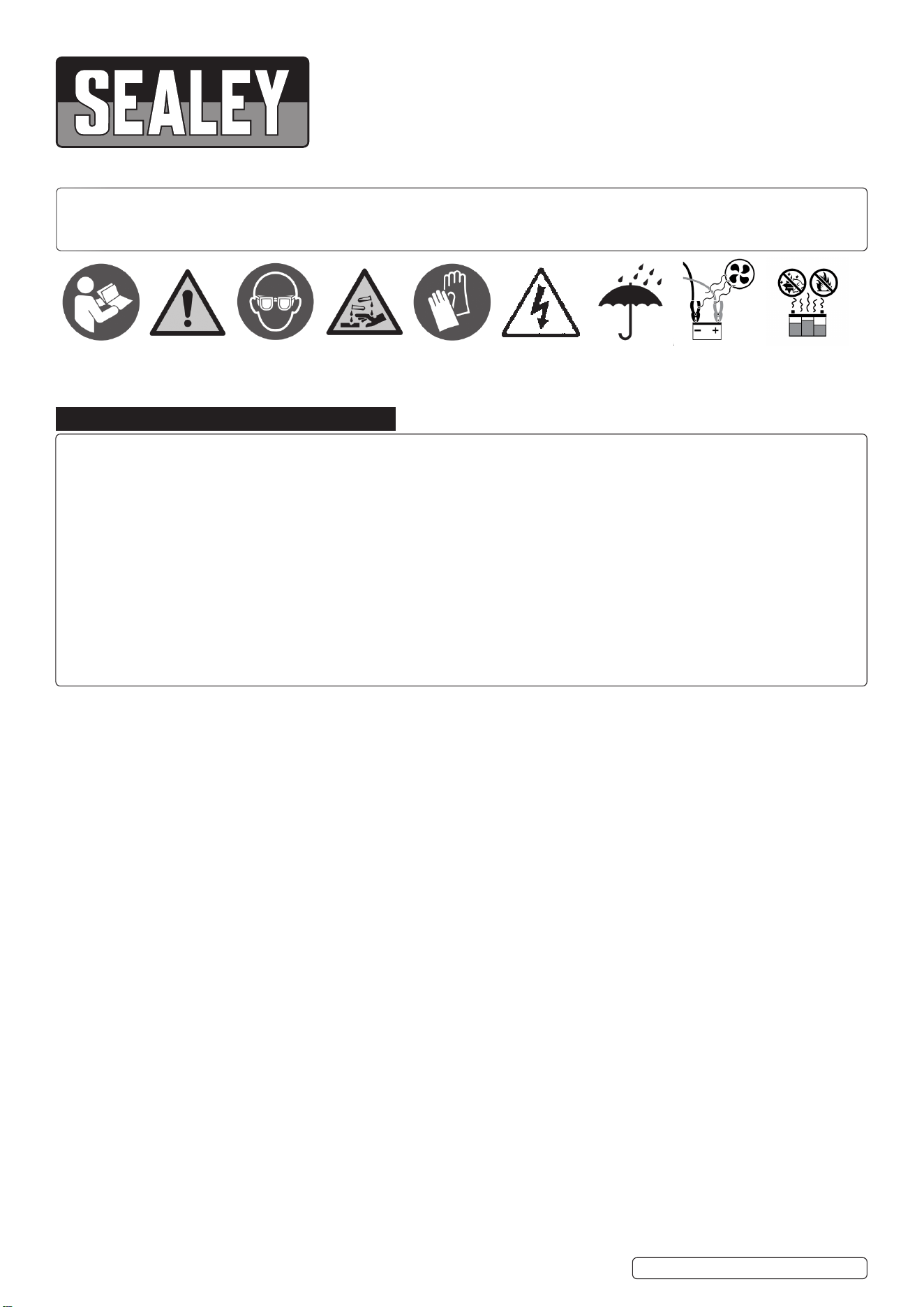
Warning:
corrosive
substance
Wear eye
protection
Wear
protective
gloves
Warning:
electricity
Protect
from
rain
Use in
well
ventilated
areas
Keep away
from sources
of ignition:
battery could
explode
Refer to
instruction
manual
Warning:
explosive
material
RS1312HV Issue:3 (3) 21/09/23
Original Language Version
© Jack Sealey Limited
8 DO NOT store the unit in damp or wet locations or where the temperature may exceed 50°C.
8 DO NOT submerge the unit in water.
8 DO NOT use whilst under the inuence of drugs, alcohol or intoxicating medication.
8 DO NOT leave the unit in a totally discharged state for an extended period of time as this may result in permanent damage.
8 DO NOT cross-connect the power leads from the RoadStart to the battery. Ensure that positive is to positive and negative is to
negative. Observe polarity indicator during connection.
9 Ensure that the unit is fully charged before storage.
1.3. ELECTRICAL SAFETY (with respect to mains chargers)
WARNING! It is the user’s responsibility to check the following:
Ou must check the AC adaptor to ensure that it is safe before using. You must inspect the power supply lead, plugs and all
Electrical connections for wear and damage. You must ensure the risk of electric shock is minimised by the installation of
Appropriate safety devices. An RCCB (Residual Current Circuit Breaker) should be incorporated in the main distribution board.
We recommend that an RCD (Residual Current Device) is used with all electrical products. It is particularly important to
use an RCD with portable products that plug into an electrical supply not protected by an RCCB. If in doubt consult a qualied
Electrician. You can obtain a Residual Current Device through your Sealey stockist. You must read and understand instructions
concerning electrical safety.
1.3.1. The Electricity At Work Act 1989 requires all portable electrical appliances, if used on business premises, to be tested by a qualied
person, using a Portable Appliance Tester (PAT) on a regular basis
1.3.2. The Health & Safety at Work Act 1974 makes owners of electrical appliances responsible for the safe condition of the appliance and
the safety of the appliance operator. If in any doubt about electrical safety, contact a qualied electrician.
9 DO ensure that the insulation on all cables and the product itself is safe before connecting to the mains power supply.
9 DO ensure that cables are always protected against short circuit and overload.
9 DO regularly inspect power supply, leads, plugs for wear and damage and power connections to ensure that none are loose.
9 DO check product voltage is the same as power supply to be used and check that all fused plugs are tted with the correct capacity
fuses.
2. INTRODUCTION
Composite hi-vis green case with moulded rubber protection, integral battery cable storage and carry handle. LED Battery condition,
polarity check, with audible warning if polarity is reversed, and charge indicators. Features independent on/off switch which allows the
positive clamp to be connected without the risk of sparking and an integral LED work light for use at night. Fitted with two 12V power
sockets that will accept any 12V device fitted with a vehicle accessory socket plug. Also features a USB outlet (5V/1A). Supplied with
mains charger.
3. SPECIFICATION
4. FEATURES
5. CHARGING
5.1. INITIAL CHARGING OF THE ROADSTART UNIT
NOTE: This product may arrive partially charged. The unit must be fully charged immediately after purchase and before using for
the rst time.
5.1.1. Initially, the unit should be charged using the AC charger supplied for a period of 38 hours. Charge subsequently until the green charge
RS1312HV Issue:3 (3) 21/09/23
g.1
g.2
Model no: RS1312HV
Cold cranking amps: 400A
Peak Amps: 900A
Voltage: 12V
Auxiliary output: USB - 5V/1A, 2 X 12V PORT
Cable & clamp length: 0.72m
Integral Air Compressor: No
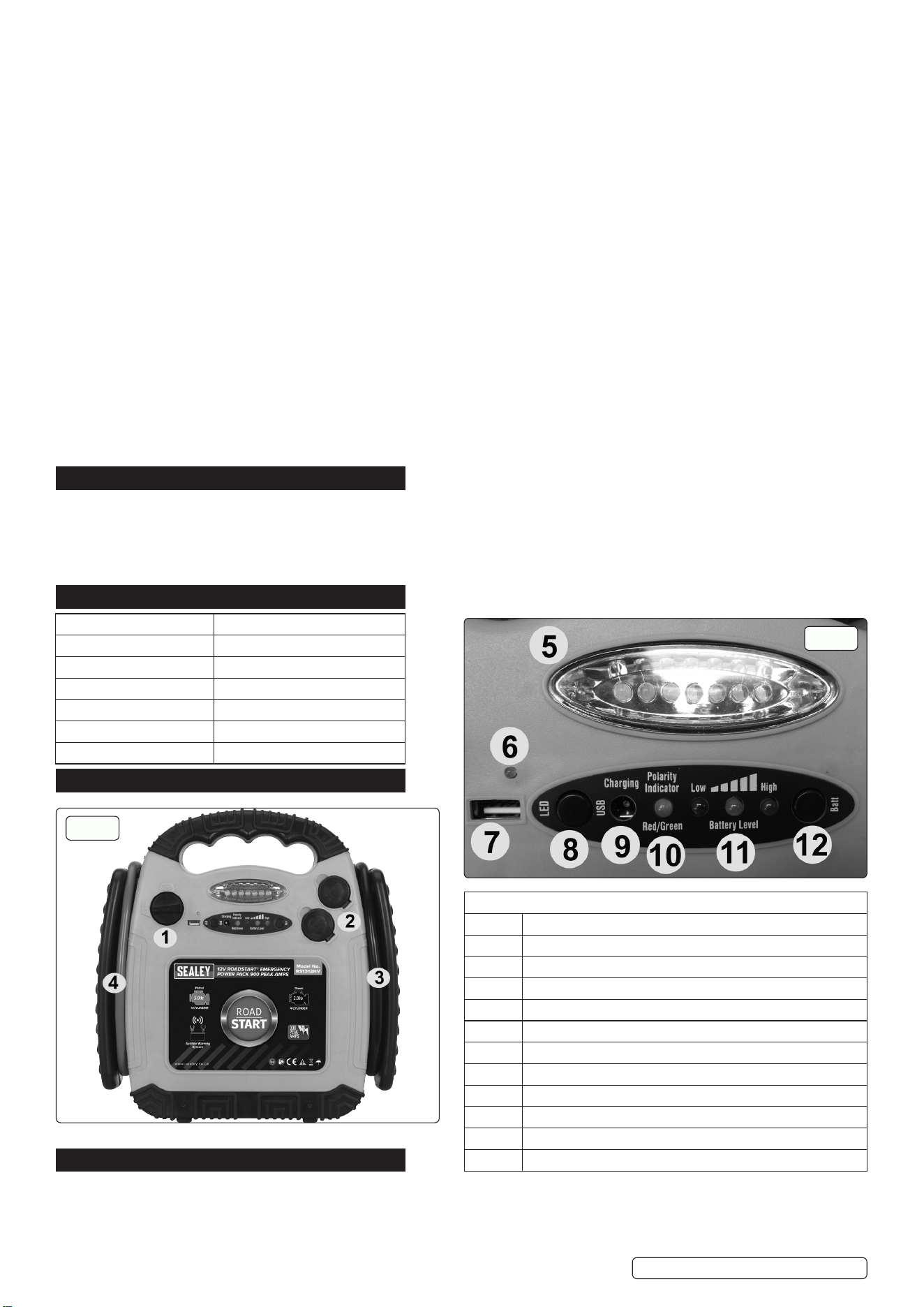
Key
1 On/off switch
2 12V output sockets
3 Negative lead
4 Positive lead
5 LED worklight
6 USB indicator
7 5V USB socket
8 Worklight/USB selector switch
9 Charging socket
10 Polarity indicator
11 Battery level indicator
12 Battery charge level check button

Original Language Version
© Jack Sealey Limited
light illuminates. Never charge the unit for more than 40 hours.
5.2. READING THE LED POWER LEVEL INDICATORS
The charge level of the unit during use can be seen at any time by pressing the battery level check button (g.2.11) and noting
which power level lights are illuminated. The lights will illuminate in combination to show the charge level.
5.2.1. When just the green LED is illuminated the unit is fully charged and is ready to be used for starting a vehicle.
5.2.2. If the amber LED is illuminated the unit is partially discharged but can be used to operate most 12 volt accessories.
5.2.3. If only the red LED is illuminated the power level is low and only a short operating time remains. The unit should be recharged
as soon as practical.
5.3. RECHARGING WITH THE AC CHARGING ADAPTOR
NOTE: Only charge with the adaptor supplied with your specic model. Charging adaptors are not interchangeable.
5.3.1. Ensure the battery clamps are securely attached to the clamping bars on the unit as shown in g.1.
5.3.2. Turn the on/o switch (g1.1.) to OFF.
5.3.3. Plug the AC charger cable into the charging socket (g.2.9) on the front control panel.
5.3.4. Plug the charger itself into any 230 Volt AC wall outlet. Charging will now commence but the charge level must be regularly
monitored to prevent overcharging. The battery level lights will display whilst the charger is plugged in.(g.1.14).
5.3.5. Charging a unit with a very low charge (i.e. showing red LED only) should take 34 to 36 hours. When just the green charge
indicator is illuminated the unit is fully charged and the charger should be disconnected from the unit and from the AC supply.
6. OPERATION
6.1. PREPARATION AND PRECAUTIONS
WARNING! Ensure that the Roadstart and vehicle voltages are the same.
6.1.1. Apply the vehicle hand brake and place in neutral gear (or “Park” if automatic transmission).
6.1.2. Turn ignition and electrical accessories o.
6.1.3. Use in a well ventilated area and wear eye protection and protective clothing.
WARNING! DO NOT allow the red and black clamps to touch each other. Ensure that the correct clamps are placed on the correct
battery terminals.
6.1.4. Press the battery level check button. If the green light does not illuminate the unit must be charged before it can be used for jump
starting.
NOTE: A defective battery may not accept a charge from the portable power source. Ensure that the engine is functioning
and that the vehicle battery is not damaged.
6.2. JUMP STARTING
WARNING! Vehicles equipped with on board computers may be aected if the engine battery is jump started. Read your vehicle
owner’s manual before attempting to start the vehicle to determine if external starting assistance can be used.
6.2.1. Failure to follow these instructions may cause damage or explosion.
NOTE: For optimum performance, the unit should not be stored below 10°C when using the unit as a jump starter.
6.2.2. Turn o the vehicle ignition.
6.2.3. Ensure on/o switch is in the o position.
WARNING! DO NOT place the unit where it will become unstable when the engine starts. Route power cables away from moving
parts such as fans and belts.
6.2.4. Attach the RED (positive +) clamp to the positive terminal of the battery.
NOTE: On vehicles with multiple batteries, connect positive clamp to positive battery terminal which is connected to vehicle electrical
system.
6.2.5. Attach the BLACK (negative -) clamp to the vehicle chassis, engine block or a non-moving metal part of the vehicle which is
veried to be grounded, as far away from the battery as possible. DO NOT clamp directly to the negative battery terminal,
carburettor, fuel lines, or sheet metal body parts.
6.2.6. Observe the polarity indicator on the control panel (g.2.10). If the dual colour LED is green the connection is correct. If the LED is red
and the alarm sounds do not proceed until the connections are correct.
6.2.7. Ensure that all cables are clear of moving belts and rotating fans.
6.2.8. Turn the on/o switch the ‘ON’ position.
6.2.9. Maintain a safe distance from the battery whilst jump starting.
6.2.10. Turn on the ignition to start the vehicle.
NOTE: If the vehicle does not start after 4 to 5 seconds, allow the RoadStart unit to cool for 3 to 4 minutes, before attempting to
jump start the vehicle again. If this is not done, the unit could sustain damage.
6.3. DISCONNECTING
VERY IMPORTANT! Failure to observe the following could result in the RoadStart battery exploding.
When the vehicle has started, remove the negative (black) clamp within 15 seconds.
6.3.1. Switch the on/o switch to ‘O’.
6.3.2. Remove the positive (red) clamp and return both clamps to their housings on the back of the unit.
6.4. 12V POWER SOCKETS
6.4.1. The Roadstart is tted with 2 x 12V power sockets (g.1.2). They will each accommodate a male 12V accessory plug up to a
combined total of 15A.
6.5. LED WORKLIGHT
6.5.1. The worklight may be switched on by pressing the worklight/USB selector once. A second press will switch the light o and energise
the USB socket (see section 6.6.)
6.6. 5V USB SOCKET
6.6.1. The RoadStart is tted with a 5V 1A USB socket (g.2.7). To turn on the socket, press the worklight/USB selector twice. The USB
Indicator (g.2.6) will light when the socket is live. A further press of the selector will switch the socket o.
6.7. STORAGE
6.7.1. This unit may be stored in any position. Ensure that the clamps are securely attached to the clamping posts at the rear of the unit.
Store at room temperature. It is recommended to recharge the unit every three months when not in use and more frequently in
warmer or colder storage conditions to keep the battery in peak operating condition.
RS1312HV Issue:3 (3) 21/09/23
6.8. BATTERY RECYCLING
NOTE: The RoadStart battery is a sealed, lead-acid type. At the end of the RoadStart’s service life it MUST be removed
and recycled, or disposed of properly, according to national and/or local regulations.
6.8.1. REMOVAL
6.8.1.1. Place the RoadStart unit front side down.
6.8.1.2. Remove the 10 screws holding the casing together and lift o the back half of the unit.
6.8.1.3. Undo and remove the nuts, bolts and washers on each battery terminal. The connecting wires will now be loose.
6.8.1.4. Move the wires away from the two battery terminals, taking care to avoid accidental arcing of the terminals.
6.8.1.5. Lift the battery out of the front half of the casing.
6.8.2. DISPOSAL
6.8.2.1. Take the battery to a recycling centre that handles sealed, lead-acid batteries. If there is no recycling centre in the area, contact the
local environmental agency for disposal instructions.
7. TROUBLESHOOTING
.
BATTERY REMOVAL SEE SECTION 6.8
Under the Waste Batteries and Accumulators Regulations 2009, Jack Sealey Ltd are required to inform potential purchasers of products
containing batteries (as defined within these regulations), that they are registered with Valpak’s registered compliance scheme. Jack
Sealey Ltd Batteries Producer Registration Number (BPRN) is BPRN00705.
RS1312HV Issue:3 (3) 21/09/23
Original Language Version
© Jack Sealey Limited
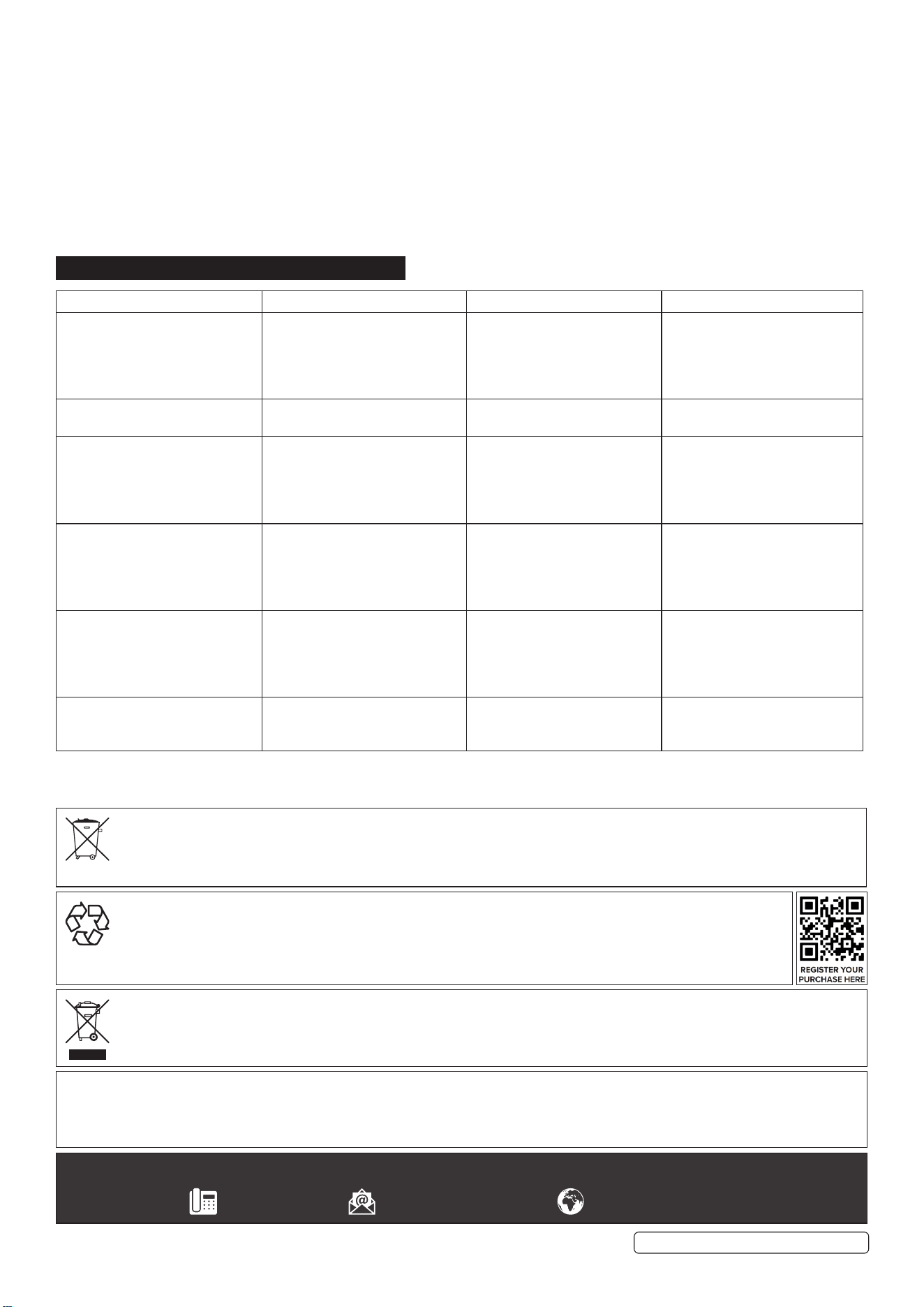
THE PROBLEM
THE SOLUTION
QUESTION ANSWER
Unit has been charged for 36
hours but there is no change in the
status of the LEDs.
Check charger to see that it is
charging. Charger should be
warm. Check all wire connections.
How many jump starts can a
fully charged RoadStart do
before needing to be recharged?
Between 1 and 20 depending
upon
operating factors such as
temperature, general condition of
the vehicle, engine type and size.
Charger works well but still no
change in LED status.
Possible defective internal battery.
Can the RoadStart be recycled?
Yes, in accordance with national
and local authority regulations.
No LEDs come on, but when the
AC adaptor is plugged into the unit
they do.
RoadStart unit battery defective
which could have been caused by
intense use without a cool-down
period.
What is the ideal in-use storage
temperature of the RoadStart?
Room temperature. The
RoadStart will also operate at
lower temperatures, its power
however will be lessened. Intense
heat will activate self-discharge.
Roadstart unit is fully charged but
delivers no power.
Check where the wire meets the
jaw on the unit clamps. Ensure
they are well crimped. Ensure
that the safety switch is in the ON
position.
I have a regular 10 amp battery
charger, can I use it to recharge
the RoadStart?
No. Only the supplied charger
can be used.
When connecting an accessory via
the dc outlet there is no power.
The accessory is drawing too
much current, resulting in the
internal circuit breaker operating.
Allow to cool and reset. Check
accessory current draw.
Is the RoadStart fool proof? No. All jump starting instructions
must be followed carefully.
Can I replace the internal
batteries?
Yes, but note that the batteries
are not covered by warranty as
they are consumable items.
Sealey Group, Kempson Way, Suffolk Business Park, Bury St Edmunds, Suffolk. IP32 7AR
01284 757500 sales@sealey.co.uk www.sealey.co.uk
WEEE REGULATIONS
Dispose of this product at the end of its working life in compliance with the EU Directive on Waste Electrical and Electronic
Equipment (WEEE). When the product is no longer required, it must be disposed of in an environmentally protective way. Contact
your local solid waste authority for recycling information.
NOTE: It is our policy to continually improve products and as such we reserve the right to alter data, specications and component parts
without prior notice.
IMPORTANT: No Liability is accepted for incorrect use of this product.
WARRANTY: Guarantee is 12 months from purchase date, proof of which is required for any claim.
ENVIRONMENT PROTECTION
Recycle unwanted materials instead of disposing of them as waste. All tools, accessories and packaging should be
sorted, taken to a recycling centre and disposed of in a manner which is compatible with the environment. When
the product becomes completely unserviceable and requires disposal, drain any uids (if applicable) into approved
containers and dispose of the product and uids according to local regulations.