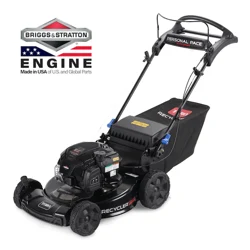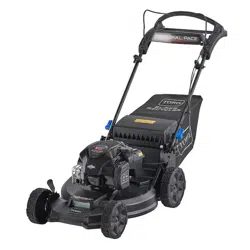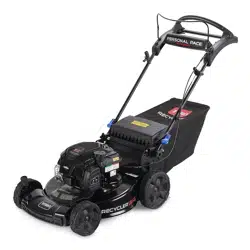

Form No. 3464-594 Rev A
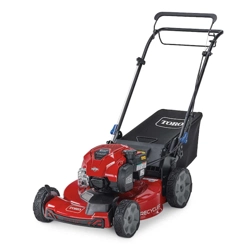
22in Recycler
®
Max Lawn Mower
Model No. 21485—Serial No. 400000000 and Up
Operator's Manual
Introduction
This rotary-blade, walk-behind lawn mower is intended
to be used by residential homeowners. It is designed
primarily for cutting grass on well-maintained lawns on
residential properties. Using this product for purposes
other than its intended use could prove dangerous to
you and bystanders.
Read this information carefully to learn how to operate
and maintain your product properly and to avoid
injury and product damage. You are responsible for
operating the product properly and safely.
Visit www.Toro.com for more information, including
safety tips, training materials, accessory information,
help nding a dealer, or to register your product.
Whenever you need service, genuine Toro parts, or
additional information, contact an Authorized Service
Dealer or Toro Customer Service and have the model
and serial numbers of your product ready.
Figure 1
identies the location of the model and serial numbers
on the product. Write the numbers in the space
provided.
Important: With your mobile device, you can
scan the QR code on the serial number decal (if
equipped) to access warranty, parts, and other
product information.
g282707
Figure 1
1. Model and serial number location
Model No.
Serial No.
Safety-Alert Symbol
The safety-alert symbol (
Figure 2) shown in this
manual and on the machine identies important safety
messages that you must follow to prevent accidents.
g000502
Figure 2
Safety-alert symbol
The safety-alert symbol appears above information
that alerts you to unsafe actions or situations and
is followed by the word DANGER, WARNING, or
CAUTION.
DANGER indicates an imminently hazardous situation
which, if not avoided, will result in death or serious
injury.
WARNING indicates a potentially hazardous situation
which, if not avoided, could result in death or serious
injury.
CAUTION indicates a potentially hazardous situation
which, if not avoided, may result in minor or moderate
injury.
This manual uses two other words to highlight
information. Important calls attention to special
mechanical information and Note emphasizes general
information worthy of special attention.
Be sure to register your machine at
www.Toro.com/register. Registration ensures
that you are notied should there be a product recall.
Your registration information is never sold or shared
with third party companies. To avoid waste and
help the environment, a discharge chute does not
come with your purchase (most customers prefer to
recycle or bag their grass clippings). You can request
a discharge chute when you register your product
at www.Toro.com/register. Simply check the box in
the online registration form and Toro will send you a
discharge chute at no additional charge. Please allow
1 to 2 weeks for delivery.
It is a violation of California Public Resource Code
Section 4442 or 4443 to use or operate the engine on
any forest-covered, brush-covered, or grass-covered
land unless the engine is equipped with a spark
arrester, as dened in Section 4442, maintained in
effective working order or the engine is constructed,
equipped, and maintained for the prevention of re.
The enclosed engine owner's manual is supplied
for information regarding the US Environmental
© 2023—The Toro® Company
8111 Lyndale Avenue South
Bloomington, MN 55420 Register at www.Toro.com.
Original Instructions (EN)
Printed in Mexico
All Rights Reserved
*3464-594*

Protection Agency (EPA) and the California Emission
Control Regulation of emission systems, maintenance,
and warranty. Replacements may be ordered through
the engine manufacturer.
Gross or Net Torque: The gross or net torque
of this engine was laboratory rated by the engine
manufacturer in accordance with the Society of
Automotive Engineers (SAE) J1940 or J2723. As
congured to meet safety, emission, and operating
requirements, the actual engine torque on this class
of mower will be signicantly lower. Please refer to
the engine manufacturer’s information included with
the machine.
WARNING
CALIFORNIA
Proposition 65 Warning
The engine exhaust from this product
contains chemicals known to the State of
California to cause cancer, birth defects,
or other reproductive harm.
Use of this product may cause exposure
to chemicals known to the State of
California to cause cancer, birth defects,
or other reproductive harm.
Contents
Introduction ............................................................... 1
Safety-Alert Symbol............................................ 1
........................................................................... 1
Safety ....................................................................... 3
General Safety ................................................... 3
Safety and Instructional Decals .......................... 4
Setup ........................................................................ 5
1 Unfolding the Handle ....................................... 5
2 Installing the Blade-Control Bar........................ 5
3 Installing the Recoil-Starter Rope in the
Rope Guide..................................................... 6
4 Adding Oil to the Engine................................... 7
5 Assembling the Grass Bag............................... 7
Product Overview ..................................................... 9
Specications .................................................... 9
Attachments/Accessories ................................... 9
Operation ................................................................ 10
Before Operation ................................................. 10
Before Operation Safety ................................... 10
Filling the Fuel Tank .......................................... 10
Checking the Engine-Oil Level...........................11
Adjusting the Handle Height ..............................11
Adjusting the Cutting Height ............................. 12
During Operation ................................................. 13
During Operation Safety ................................... 13
Starting the Engine ........................................... 13
Using the Self-Propel Drive............................... 13
Shutting Off the Engine..................................... 14
Recycling the Clippings .................................... 14
Bagging the Clippings....................................... 14
Operating the Bag-on-Demand Lever ............... 15
Operating Tips ................................................. 15
After Operation .................................................... 16
After Operation Safety ...................................... 16
Cleaning Under the Machine ............................ 16
Folding the Handle ........................................... 17
Storing the Machine in the Vertical-Stow
Position......................................................... 18
Maintenance ........................................................... 19
Recommended Maintenance Schedule(s) ........... 19
Maintenance Safety.......................................... 19
Preparing for Maintenance ............................... 19
Servicing the Air Filter....................................... 20
Changing the Engine Oil ................................... 20
Replacing the Blade.......................................... 21
Adjusting the Self-Propel Drive ......................... 22
Storage ................................................................... 22
Storage Safety.................................................. 22
Preparing the Machine for Storage ................... 22
Removing the Machine from Storage ................ 22
2

Safety
General Safety
This product is capable of amputating hands and
feet and of throwing objects. Always follow all safety
instructions to avoid serious personal injury or death.
• Read, understand, and follow the instructions
and warnings in this Operator’s Manual and on
the machine and attachments before starting the
engine.
• Do not put your hands or feet near moving parts or
under the machine. Keep clear of any discharge
opening.
• Do not operate the machine without all guards
and other safety protective devices in place and
functioning properly on the machine.
• Keep bystanders and children out of the operating
area. Do not allow children to operate the machine.
Allow only people who are responsible, trained,
familiar with the instructions, and physically
capable to operate the machine.
• Stop the machine, shut off the engine, and wait for
all moving parts to stop before servicing, fueling,
or unclogging the machine.
Improperly using or maintaining this machine can
result in injury. To reduce the potential for injury,
comply with these safety instructions and always
pay attention to the safety-alert symbol
, which
means Caution, Warning, or Danger—personal safety
instruction. Failure to comply with these instructions
may result in personal injury or death.
3
Safety and Instructional Decals
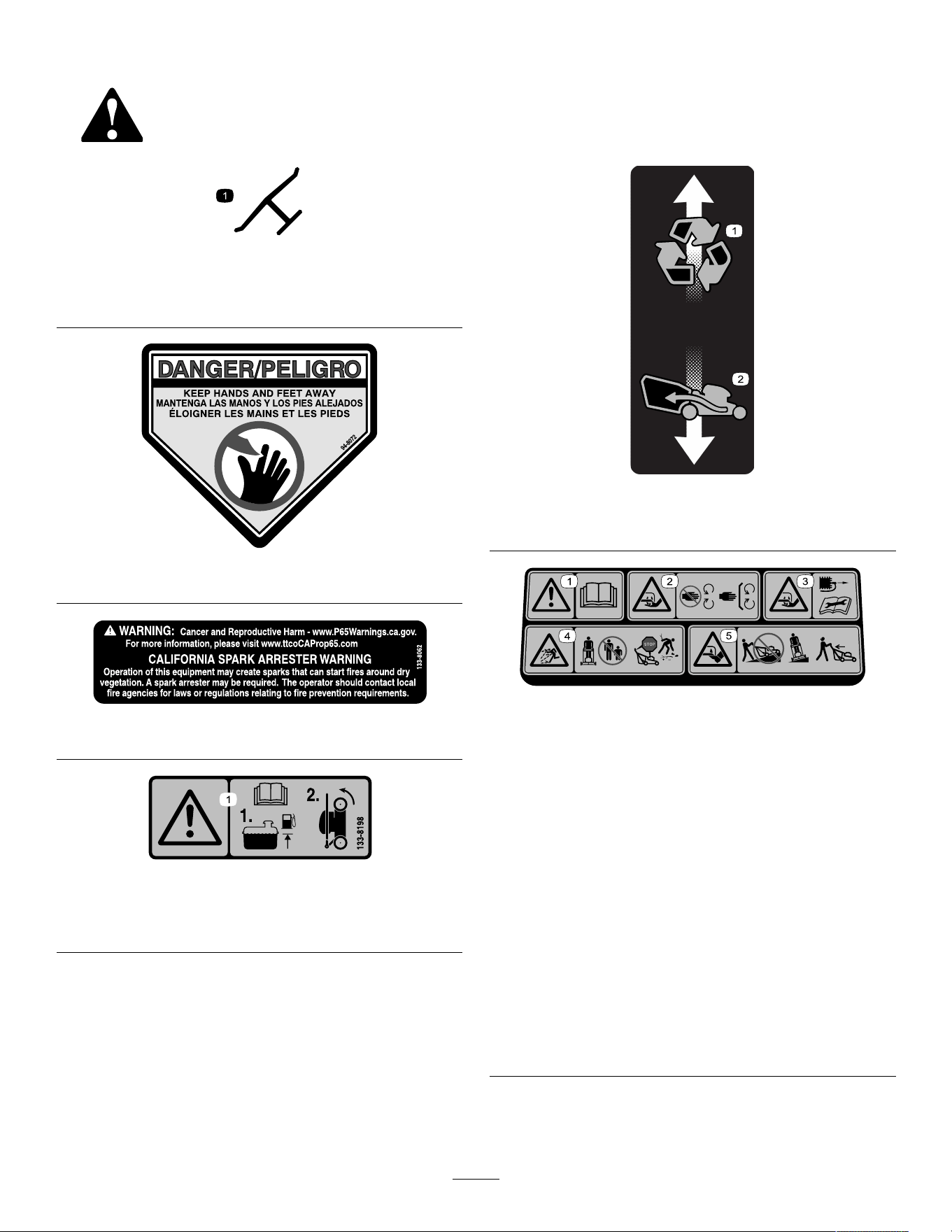
Safety decals and instructions are easily visible to the operator and are located near any area
of potential danger. Replace any decal that is damaged or missing.
decaloemmarkt
Manufacturer's Mark
1. This mark indicates that the blade is identied as a part
from the original machine manufacturer.
decal94-8072
94-8072
decal133-8062
133-8062
decal133-8198
133-8198
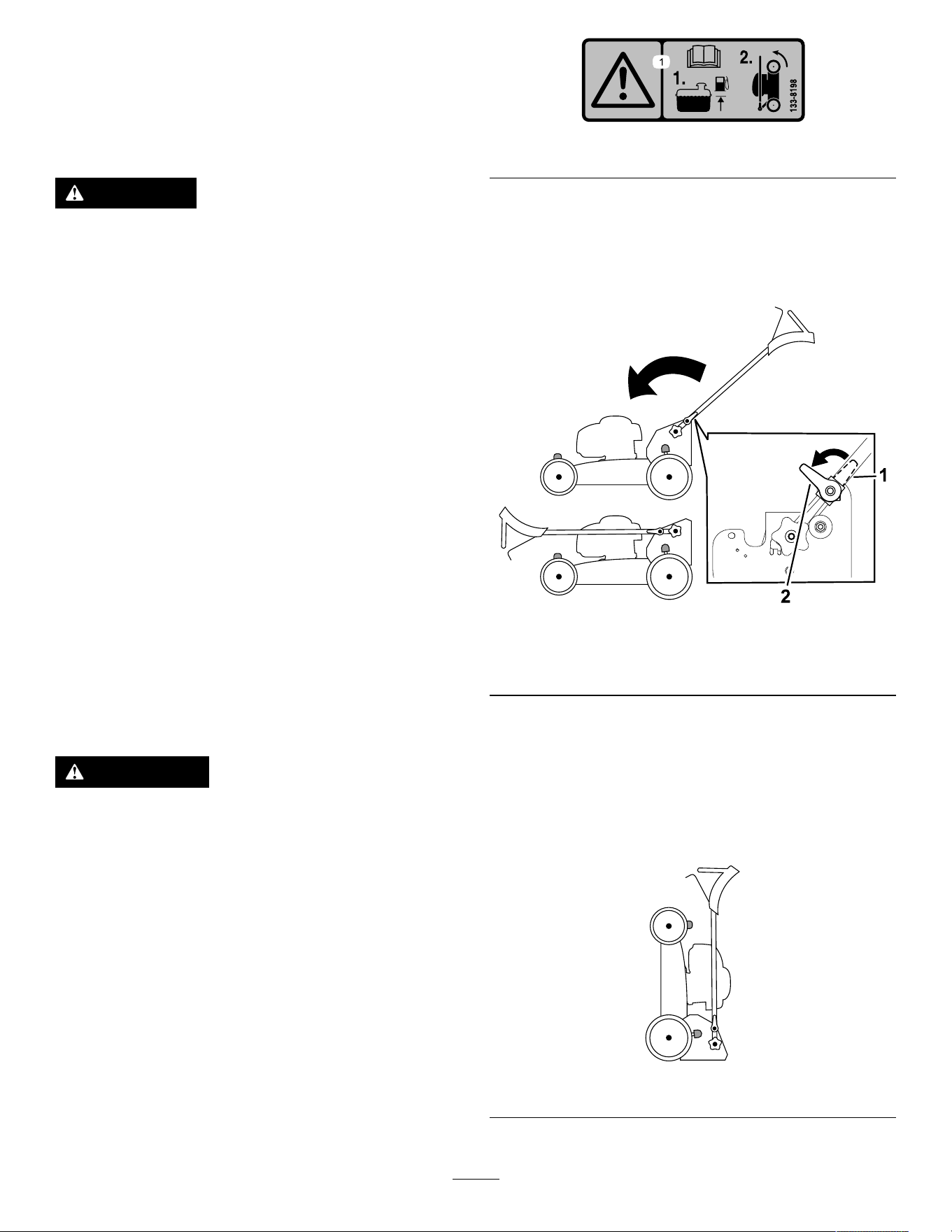
1. Warning—read the Operator's Manual; 1) Add fuel up to the
indicated level. 2) Tip the machine forward for storage.
decal139-6557
139-6557
1. Recycling mode 2. Bagging mode
decal140-2394
140-2394
1. Warning—read the
Operator’s Manual.
4. Thrown object
hazard—keep bystanders
away; shut off the engine
and wait for all moving
parts to stop before
leaving the machine; pick
up debris before mowing.
2. Cutting/dismemberment
hazard of the hand, mower
blade—stay away from
moving parts; keep all
guards and shields in
place.
5. Cutting/dismemberment
hazard of the foot, mower
blade—do not mow up
or down slopes; only
mow across slopes; look
behind you when mowing
in reverse.
3. Cutting/dismemberment
hazard of hand or foot,
mower blade—disconnect
the spark-plug wire and
read the Operator's
Manual before performing
maintenance.
4
Setup
Important: Remove and discard the protective plastic sheet that covers the engine and any other
plastic or wrapping on the machine.
1
Unfolding the Handle
No Parts Required
Procedure
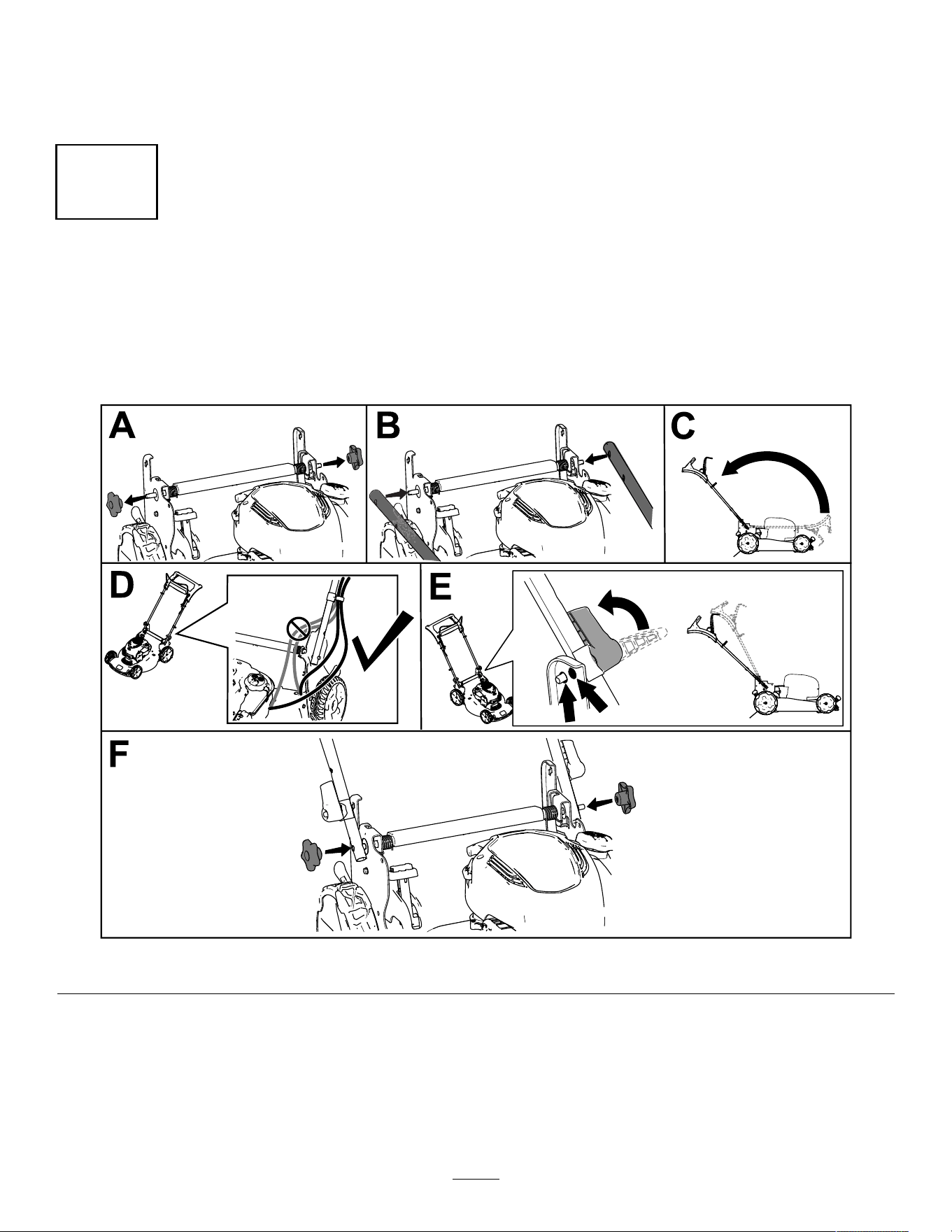
Note: Ensure that the cables are routed on the outside of the handle and are not pinched (D of
Figure 3).
g334364
Figure 3
5
2
Installing the Blade-Control Bar
No Parts Required
Procedure
g344378
Figure 4
3
Installing the Recoil-Starter Rope in the Rope Guide
No Parts Required
Procedure
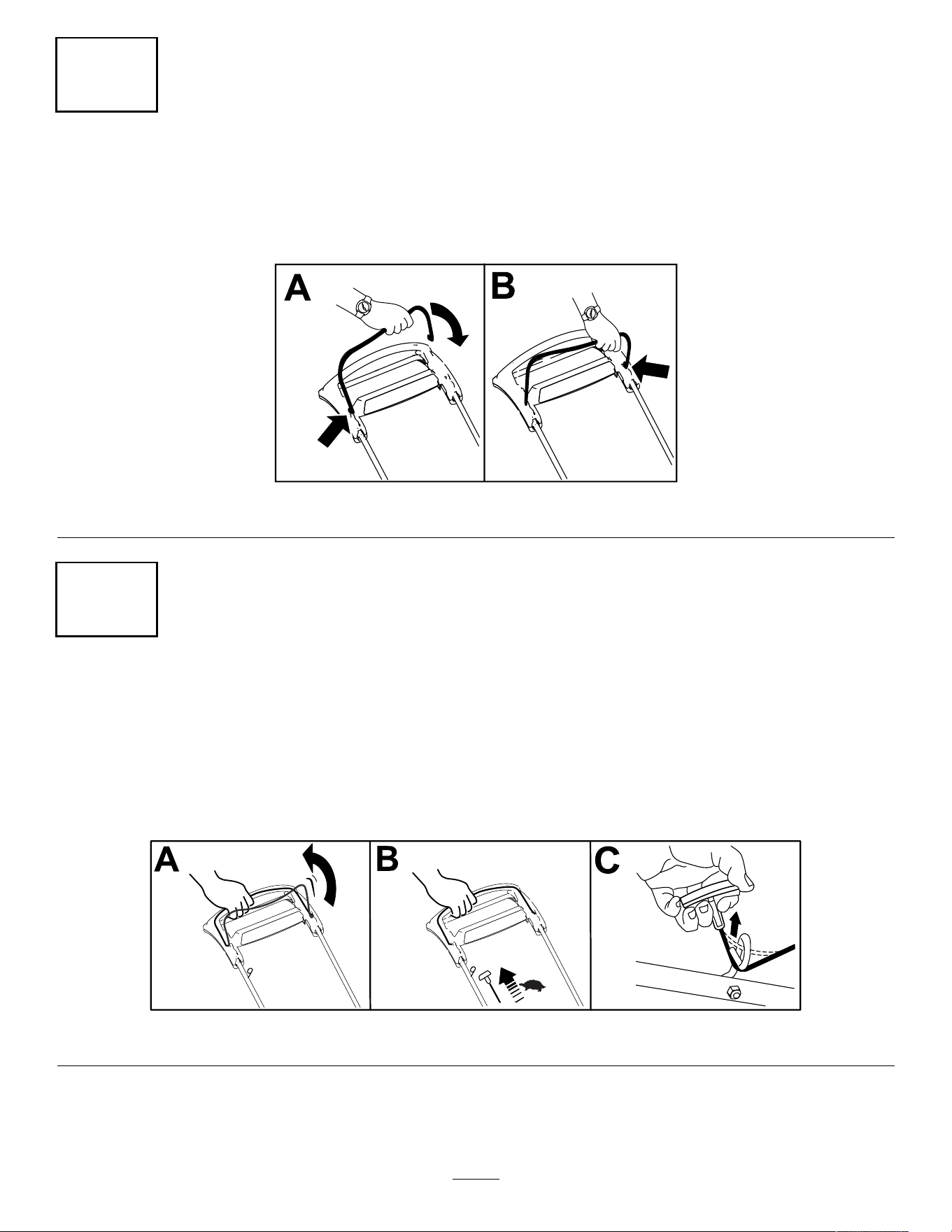
Important: To start the engine safely and easily whenever you use the machine, install the recoil-starter
rope in the rope guide.
g334093
Figure 5
6
4
Adding Oil to the Engine
No Parts Required
Procedure
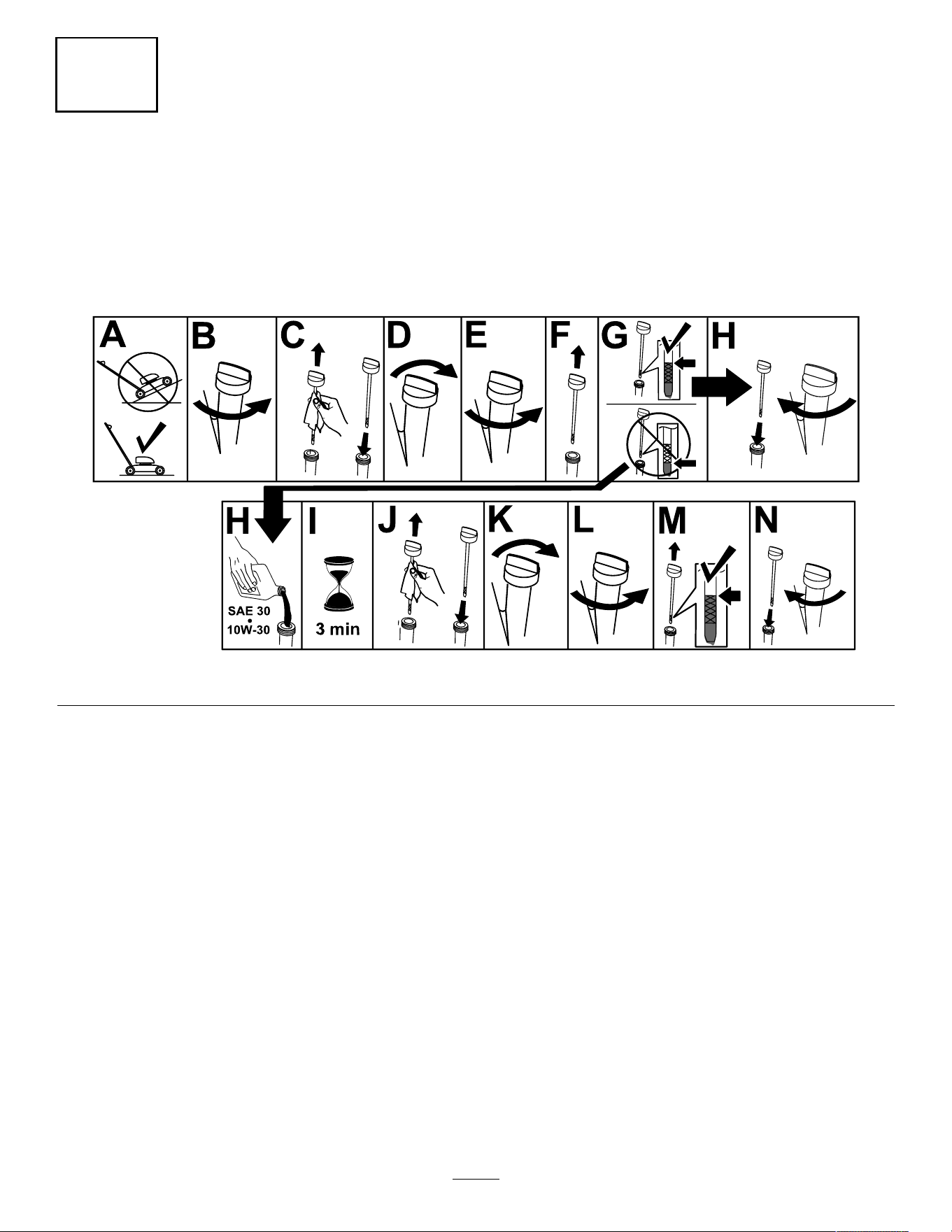
Important: If the oil level in the engine is too low or too high and you run the engine, you may damage
the engine.
g222533
Figure 6
7
5
Assembling the Grass Bag
No Parts Required
Procedure
g334351
Figure 7
8
Product Overview
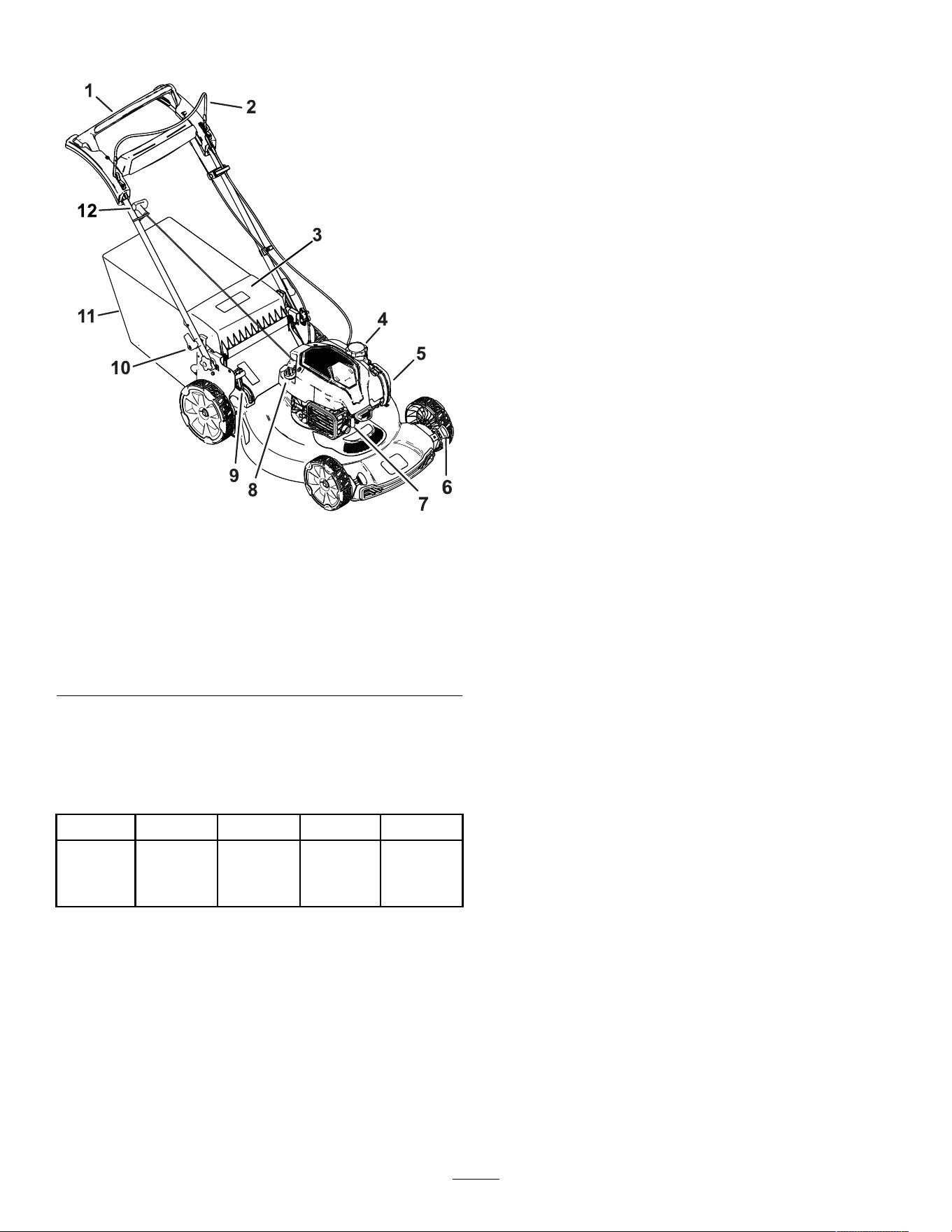
g334208
Figure 8
1. Handle
7. Spark-plug wire
2. Blade-control bar
8. Oil ll/dipstick
3. Rear deector
9. Bag-on-demand lever
4. Fuel-tank cap
10. Handle lock (2)
5. Air lter 11. Grass bag
6. Cutting-height lever (4)
12. Recoil-start handle
Specications
Note: Specications and design are subject to
change without notice.
Model Weight Length Width Height
36 kg 151 cm 59 cm 109 cm
21485
(80 lb) (59
inches)
(23
inches)
(43
inches)
Attachments/Accessories
A selection of Toro approved attachments and
accessories is available for use with the machine
to enhance and expand its capabilities. Contact
your Authorized Service Dealer or authorized Toro
distributor or go to www.Toro.com for a list of all
approved attachments and accessories.
To ensure optimum performance and continued safety
certication of the machine, use only genuine Toro
replacement parts and accessories. Replacement
parts and accessories made by other manufacturers
could be dangerous, and such use could void the
product warranty.
9
Operation
Note: Determine the left and right sides of the
machine from the normal operating position.
Before Operation
Before Operation Safety
General Safety
• Always shut off the machine, wait for all moving
parts to stop, and allow the machine to cool before
adjusting, servicing, cleaning, or storing it.
• Become familiar with the safe operation of the
equipment, operator controls, and safety signs.
• Check that all guards and safety devices, such as
deectors and/or grass catcher, are in place and
functioning properly.
• Always inspect the machine to ensure that the
blades and blade bolts are not worn or damaged.
• Inspect the area where you will use the machine,
and remove all objects that could interfere with
the operation of the machine or that the machine
could throw.
• Contact with the moving blade will cause serious
injury. Do not put your ngers under the housing.
Fuel Safety
• Fuel is extremely ammable and highly explosive.
A re or explosion from fuel can burn you and
others and can damage property.
– To prevent a static charge from igniting the fuel,
place the container and/or machine directly on
the ground before lling, not in a vehicle or on
an object.
– Fill the fuel tank outdoors, in an open area,
when the engine is cold. Wipe up any fuel that
spills.
– Do not handle fuel when smoking or around an
open ame or sparks.
– Do not remove the fuel cap or add fuel to the
tank while the engine is running or hot.
– If you spill fuel, do not attempt to start the
engine. Avoid creating a source of ignition until
the fuel vapors have dissipated.
– Store fuel in an approved container and keep
it out of the reach of children.
• Fuel is harmful or fatal if swallowed. Long-term
exposure to vapors can cause serious injury and
illness.
– Avoid prolonged breathing of vapors.
– Keep your hands and face away from the
nozzle and the fuel-tank opening.
– Keep fuel away from your eyes and skin.
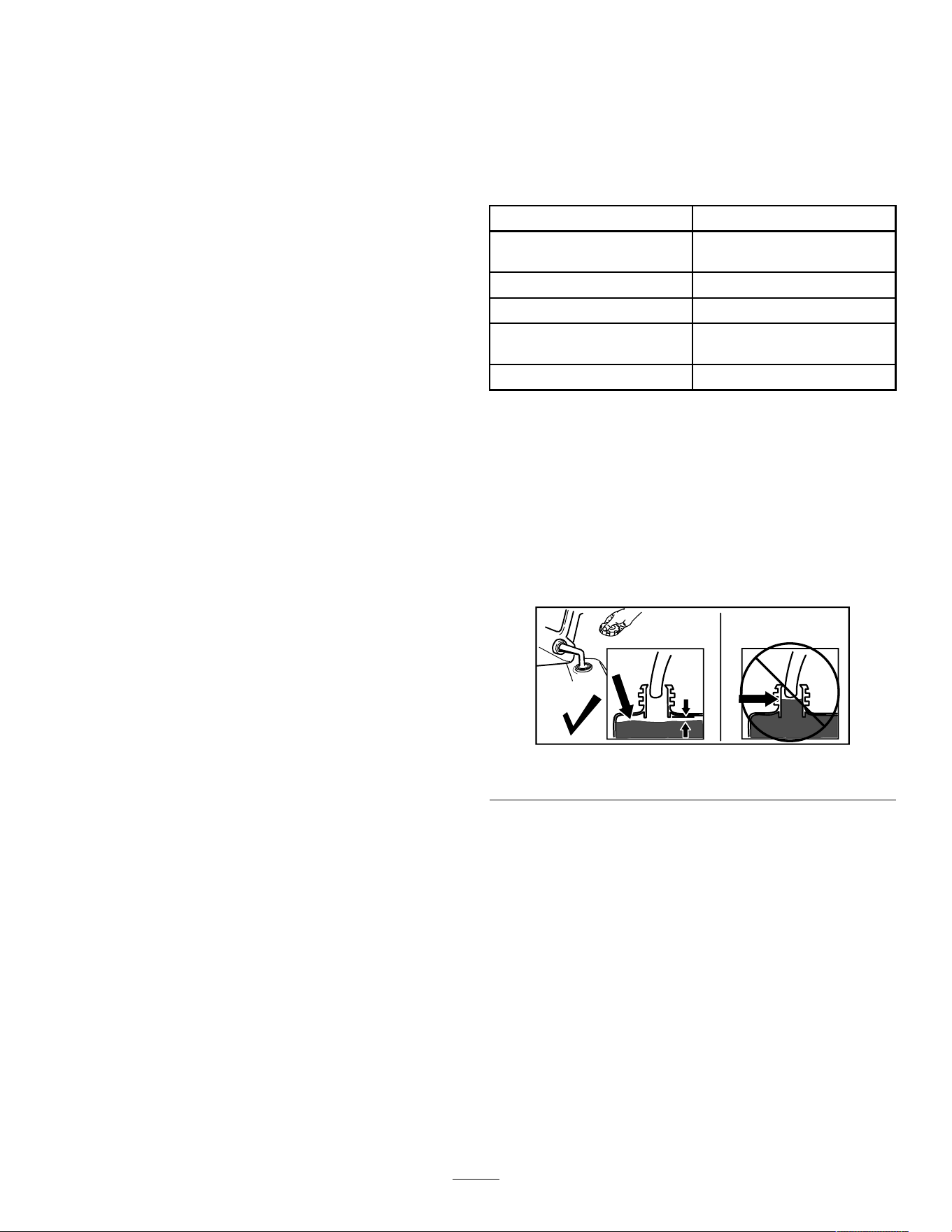
Filling the Fuel Tank
Type Unleaded gasoline
Minimum octane rating
87 (US) or 91 (research
octane; outside the US)
Ethanol
No more than 10% by volume
Methanol None
MTBE (methyl tertiary butyl
ether)
Less than 15% by volume
Oil Do not add to the fuel
Use only clean, fresh (no more than 30 days old), fuel
from a reputable source.
Important: To reduce starting problems, add fuel
stabilizer/conditioner to fresh fuel as directed by
the fuel-stabilizer/conditioner manufacturer.
Refer to your engine owner’s manual for additional
information.
Fill the fuel tank as shown in
Figure 9.
g230458
Figure 9
10
Checking the Engine-Oil Level
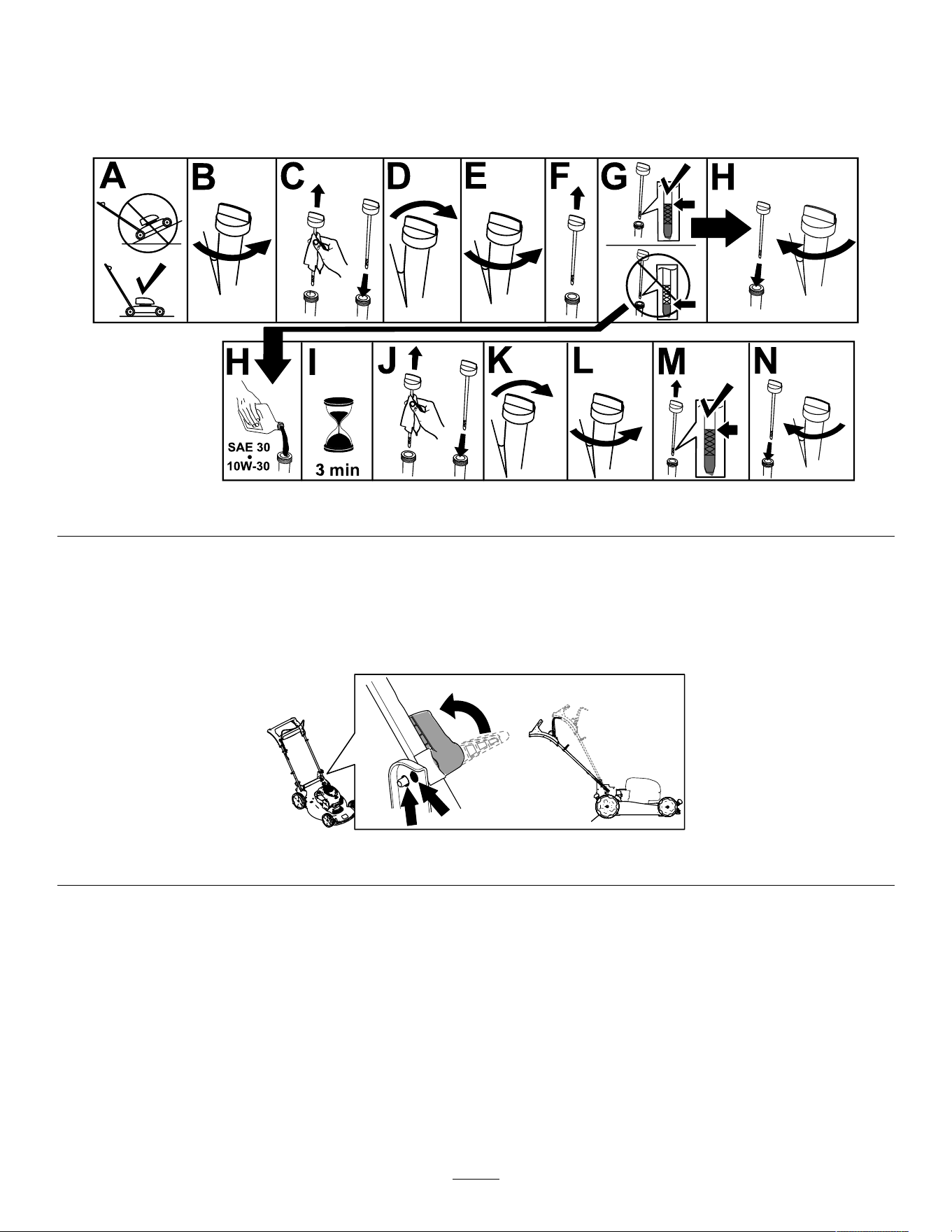
Service Interval: Before each use or daily
Important: If the oil level in the crankcase is too low or too high and you run the engine, you may
damage the engine.
g231765
Figure 10
Adjusting the Handle Height
You may raise or lower the handle to a position comfortable for you.
Rotate the handle lock, move the handle to 1 of 2 positions, and lock the handle into position (
Figure 11).
g334366
Figure 11
11
Adjusting the Cutting Height
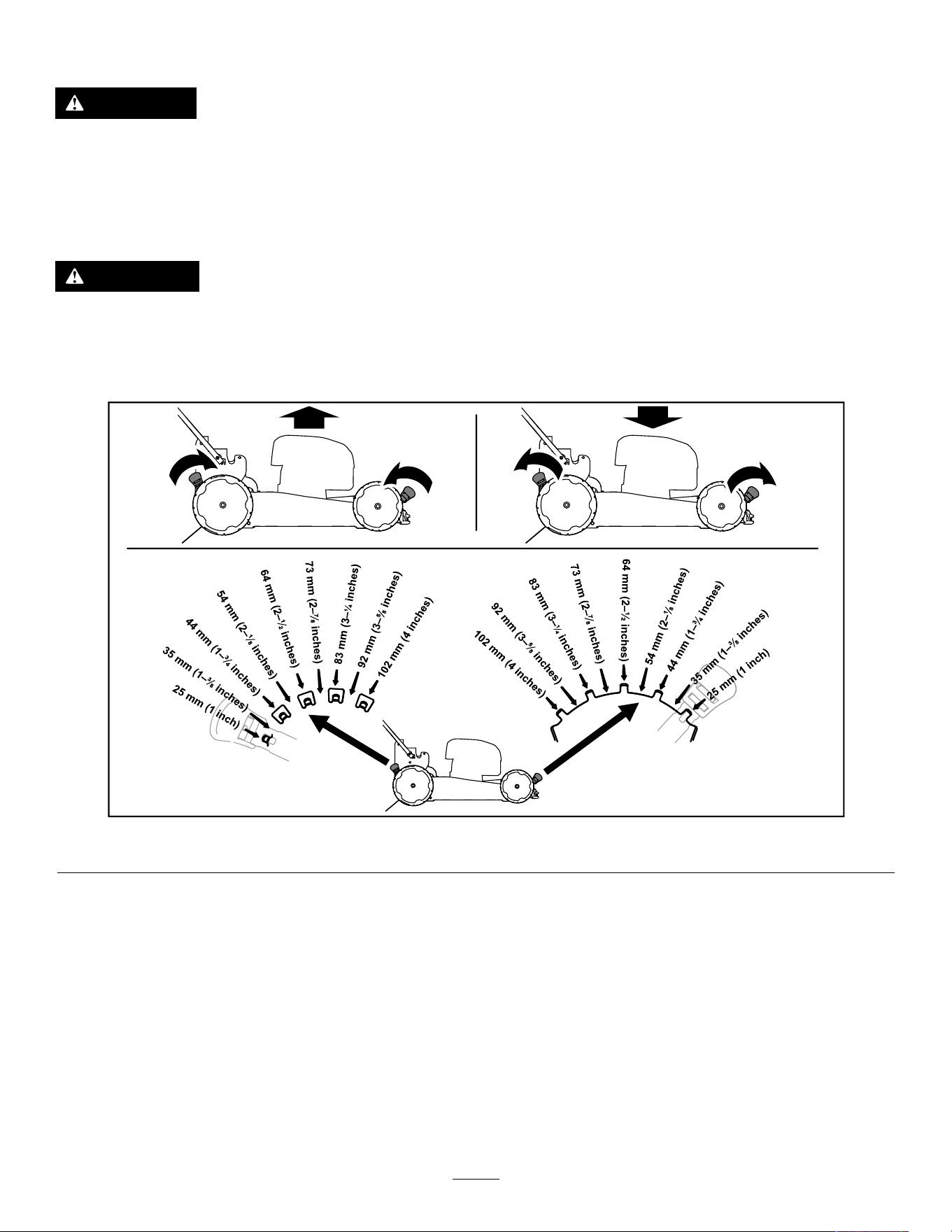
DANGER
Adjusting the cutting-height levers could bring your hands into contact with a moving blade
and result in serious injury.
• Shut off the engine and wait for all moving parts to stop before adjusting the cutting height.
• Do not put your ngers under the housing when adjusting the cutting height.
CAUTION
If the engine has been running, the mufer will be hot and can burn you.
Keep away from the hot mufer.
Adjust the cutting height as desired. Set all wheels to the same cutting height (
Figure 12).
g451640
Figure 12
12
During Operation
During Operation Safety
General Safety
• Wear appropriate clothing, including eye
protection; long pants; substantial, slip-resistant
footwear; and hearing protection. Tie back long
hair and do not wear loose clothing or loose
jewelry.
• Use your full attention while operating the
machine. Do not engage in any activity that
causes distractions; otherwise, injury or property
damage may occur.
• Do not operate the machine while ill, tired, or
under the inuence of alcohol or drugs.
• The blade is sharp; contacting the blade can result
in serious personal injury. Shut off the engine and
wait for all moving parts to stop before leaving the
operating position.
• When you release the blade-control bar, the
engine should shut off and the blade should stop
within 3 seconds. If not, stop using your machine
immediately and contact an Authorized Service
Dealer.
• Keep bystanders out of the operating area. Keep
small children out of the operating area and under
the watchful care of a responsible adult who is
not operating the machine. Stop the machine if
anyone enters the area.
• Always look down and behind you before moving
the machine in reverse.
• Operate the machine only in good visibility and
appropriate weather conditions. Do not operate
the machine when there is the risk of lightning.
• Wet grass or leaves can cause serious injury if
you slip and contact the blade. Avoid mowing in
wet conditions.
• Use extreme care when approaching blind
corners, shrubs, trees, or other objects that may
block your view.
• Do not direct the discharge material toward
anyone. Avoid discharging material against a wall
or obstruction; material may ricochet toward you.
Stop the blade(s) when crossing gravel surfaces.
• Watch for holes, ruts, bumps, rocks, or other
hidden objects. Uneven terrain could cause you
to lose your balance or footing.
• If the machine strikes an object or starts to
vibrate, immediately shut off the engine, wait for
all moving parts to stop, and disconnect the wire
from the spark plug before examining the machine
for damage. Make all necessary repairs before
resuming operation.
• Before leaving the operating position, shut off the
engine and wait for all moving parts to stop.
• If the engine has been running, it will be hot and
can severely burn you. Keep away from the hot
engine.
• Operate the engine only in well-ventilated areas.
Exhaust gases contain carbon monoxide, which is
an odorless, deadly poison.
• Check the grass catcher components and the
discharge chute frequently for any wear or
deterioration and replace them with genuine Toro
parts when necessary.
Slope Safety
• Mow across the face of slopes; never up and
down. Use extreme caution when changing
direction on slopes.
• Do not mow on excessively steep slopes. Poor
footing could cause a slip-and-fall accident.
• Mow with caution near drop-offs, ditches, or
embankments.
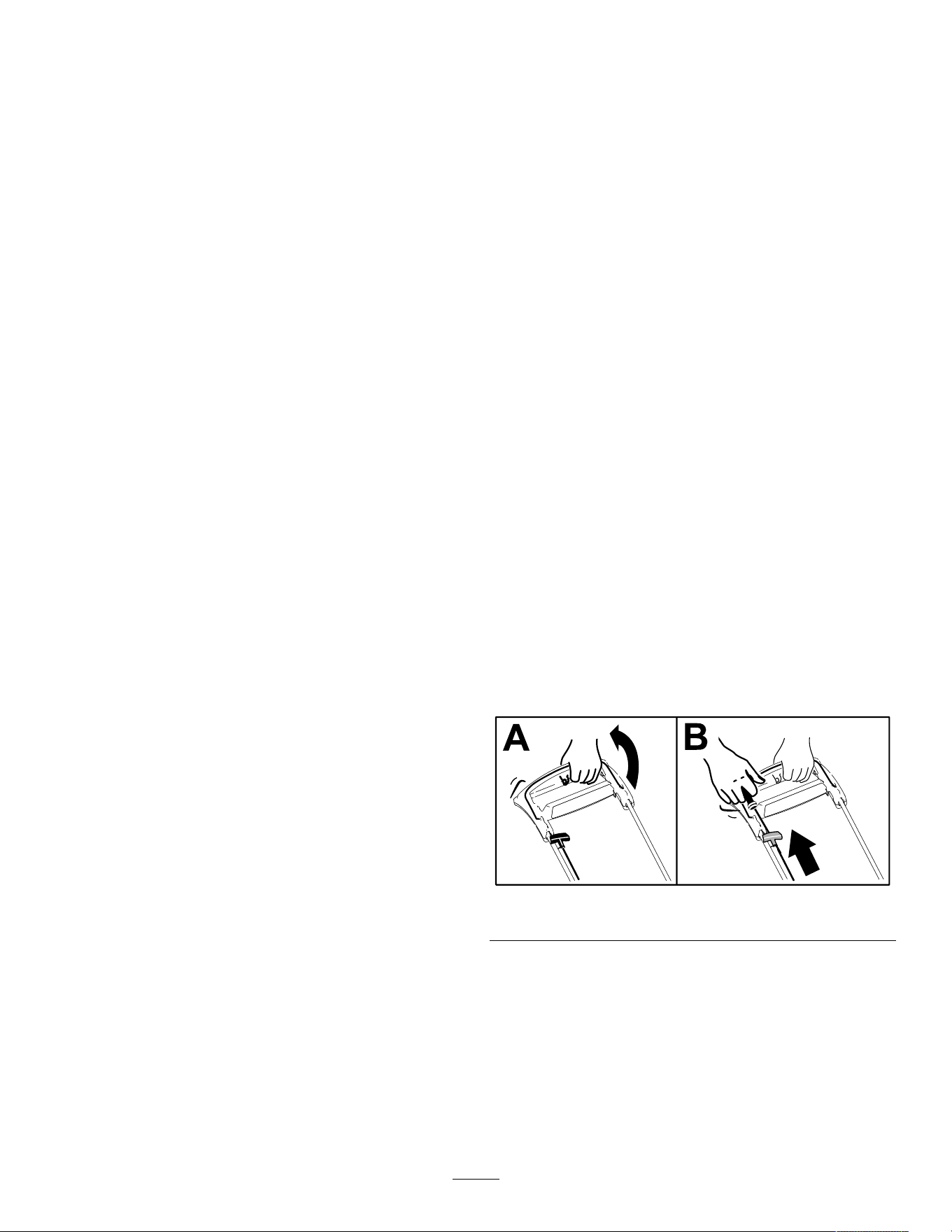
Starting the Engine
1. Hold the blade-control bar against the handle
(A of
Figure 13).
2. Pull the recoil-start handle lightly until you feel
resistance, then pull it sharply, and allow it to
return to the rope guide on the handle slowly (B
of
Figure 13).
g334135
Figure 13
Note: If the machine does not start after several
attempts, contact an Authorized Service Dealer.
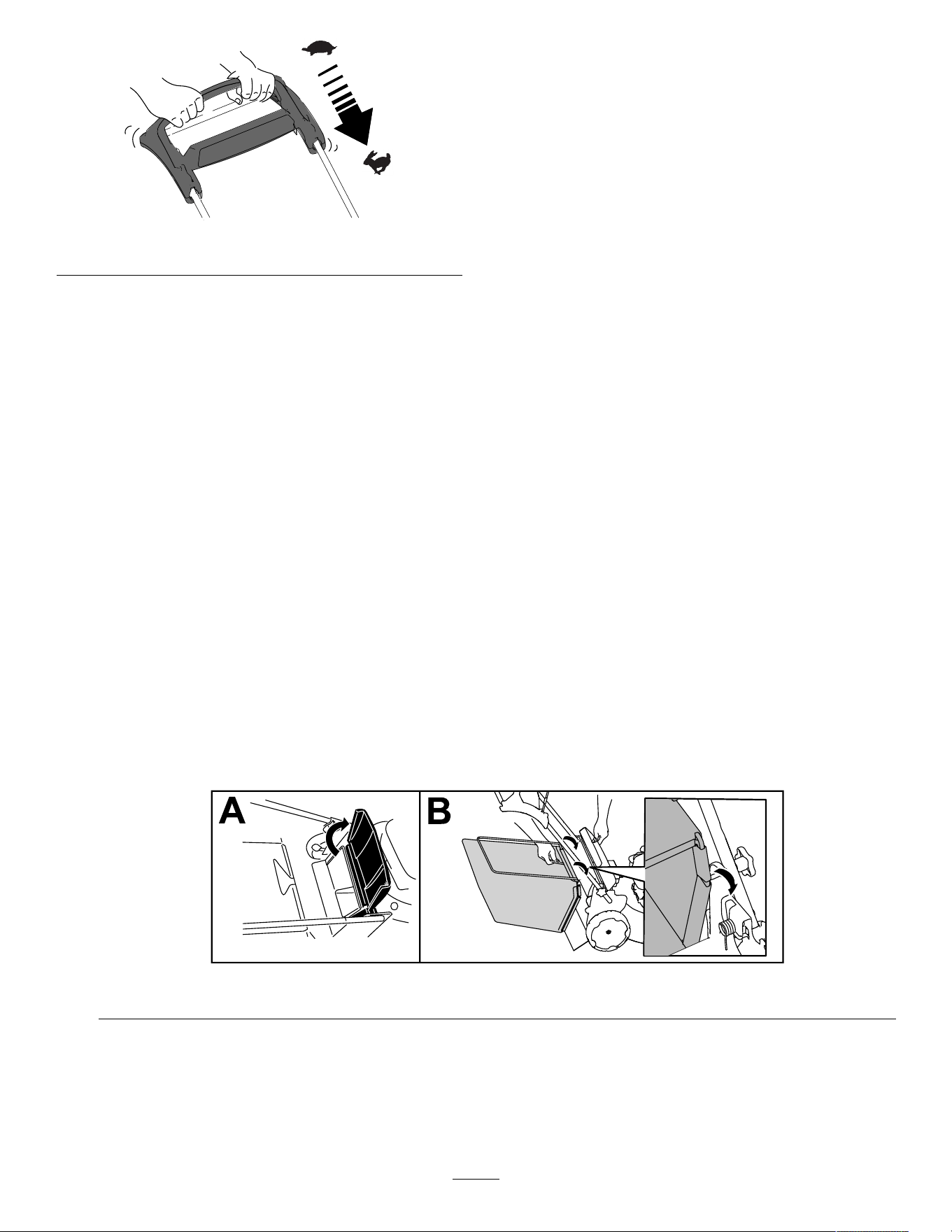
Using the Self-Propel Drive
To operate the self-propel drive, simply walk with your
hands on the upper handle and your elbows at your
sides, and the machine will automatically keep pace
with you (
Figure 14).
13
g334136
Figure 14
Note: If the machine does not freely roll backward
after self-propelling, stop walking, hold your hands
in place, and allow the machine to roll a couple of
centimeters (inches) forward to disengage the wheel
drive. You can also try reaching just under the upper
handle to the metal handle and pushing the machine
forward a couple of centimeters (inches). If the
machine still does not roll backward easily, contact an
Authorized Service Dealer.
Shutting Off the Engine
Service Interval: Before each use or daily—Ensure
that the engine shuts off within
3 seconds after releasing the
blade-control bar.
To shut off the engine, release the blade-control bar.
Important: When you release the blade-control
bar, both the engine and blade should stop within
3 seconds. If they do not stop properly, stop
using your machine immediately and contact an
Authorized Service Dealer.
Recycling the Clippings
Your machine comes from the factory ready to recycle
the grass and leaf clippings back into the lawn.
If the grass bag is on the machine and the
bag-on-demand lever is in the bagging position, move
the lever to the recycling position; refer to
Operating
the Bag-on-Demand Lever (page 15)
.
Bagging the Clippings
Use the grass bag when you want to collect grass and leaf clippings from the lawn.
If the bag-on-demand lever is in the recycling position, move it to the bagging position; refer to Operating the
Bag-on-Demand Lever (page 15)
.
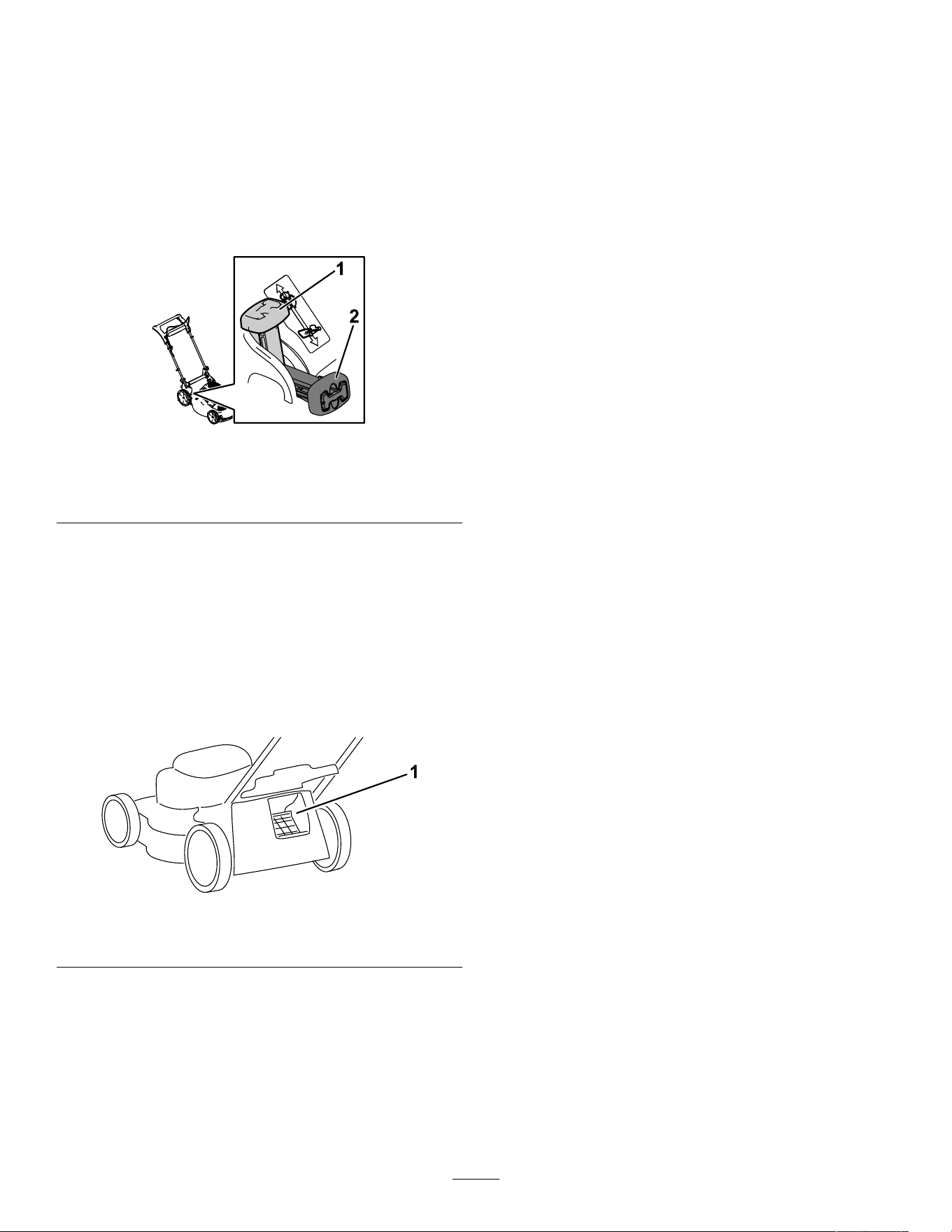
Installing the Grass Bag
1. Raise and hold up the rear deector (A of
Figure 15).
2. Install the grass bag, ensuring that the pins on the bag rest in the slots on the handle bracket (B of
Figure 15).
3. Lower the rear deector.
g334207
Figure 15
Removing the Grass Bag
To remove the bag, reverse the steps in
Installing the Grass Bag (page 14).
14
Operating the
Bag-on-Demand Lever
The bag-on-demand feature allows you to either
collect or recycle grass and leaf clippings while the
grass bag is attached to the machine.
• To bag the grass and leaf clippings, press the
button on the bag-on-demand lever and move the
lever forward until the button on the lever pops up
(
Figure 16).
g452115
Figure 16
1. Bag-on-demand lever (in the recycling position)
2. Bag-on-demand lever (in the bagging position)
• To recycle the grass and leaf clippings, press
the button on the lever and move the lever
rearward until the button on the lever pops up.
Important: For proper operation, shut off
the engine, wait for all moving parts to stop,
and then remove any grass clippings and
debris from the bag-on-demand door and the
surrounding opening (
Figure 17) before you
move the bag-on-demand lever from 1 position
to another.
g452105
Figure 17
1. Clean here
Operating Tips
General Mowing Tips
• Inspect the area where you will use the machine
and remove all objects that the machine could
throw.
• Avoid striking solid objects with the blade. Never
deliberately mow over any object.
• If the machine strikes an object or starts to vibrate,
immediately shut off the engine, wait for all moving
parts to stop, disconnect the wire from the spark
plug, and examine the machine for damage.
• For best performance, install a new Toro blade
before the cutting season begins or when
necessary.
Cutting Grass
• Cut only about a third of the grass blade at a time.
Do not cut below 51 mm (2 inches) unless the
grass is sparse or it is late fall when grass growth
begins to slow down.
• When cutting grass over 15 cm (6 inches) tall,
mow at the highest cutting height setting and walk
slower; then mow again at a lower setting for the
best lawn appearance. If the grass is too long, the
machine may plug and cause the engine to stall.
• Wet grass and leaves tend to clump on the yard
and can cause the machine to plug or the engine
to stall. Avoid mowing in wet conditions.
• Be aware of a potential re hazard in very dry
conditions, follow all local re warnings, and keep
the machine free of dry grass and leaf debris.
• Alternate the mowing direction. This helps
disperse the clippings over the lawn for even
fertilization.
• If the nished lawn appearance is unsatisfactory,
try 1 or more of the following:
– Replace the blade or have it sharpened.
– Walk at a slower pace while mowing.
– Raise the cutting height on your machine.
– Cut the grass more frequently.
– Overlap cutting swaths instead of cutting a full
swath with each pass.
Cutting Leaves
• After cutting the lawn, ensure that half of the lawn
shows through the cut leaf cover. You may need
to make more than a single pass over the leaves.
• If there are more than 13 cm (5 inches) of leaves
on the lawn, mow at a higher cutting height and
then again at the desired cutting height.
• Slow down your mowing speed if the machine
does not cut the leaves nely enough.
15

After Operation
After Operation Safety
General Safety
• Always shut off the machine, wait for all moving
parts to stop, and allow the machine to cool before
adjusting, servicing, cleaning, or storing it.
• Clean grass and debris from the machine to help
prevent res. Clean up oil or fuel spills.
• Never store the machine or fuel container where
there is an open ame, spark, or pilot light, such
as on a water heater or on other appliances.
Hauling Safety
• Use care when loading or unloading the machine.
• Secure the machine from rolling.
Cleaning Under the
Machine
Service Interval: After each use
For best results, clean under the machine shortly after
you have completed mowing.
Cleaning Under the Machine in the
Operating Position
1. Lower the machine to its lowest cutting-height
setting.
2. Move the machine onto a paved level surface.
3. With the engine running and the blade engaged,
spray a stream of water in front of the right, rear
wheel (
Figure 18).
Note: The water will splash into the path of the
blade, cleaning out the clippings.
g002600
Figure 18
4. When no more clippings come out, stop the
water and move the machine to a dry area.
5. Start the engine and run it for a few minutes to
dry the underside of the machine to prevent it
from rusting.
6. Shut off the engine, remove the electric-start
button (if equipped), and allow the machine to
cool before storing it in an enclosed area.
Cleaning under the Machine in the
Vertical-stow Position
1. Set the machine in the vertical-stow position;
refer to
Storing the Machine in the Vertical-Stow
Position (page 18)
.
2. Wash out the clippings from under the machine.
16
Folding the Handle
WARNING
Folding or unfolding the handle improperly can damage the cables, causing an unsafe
operating condition.
• Do not damage the cables when folding or unfolding the handle.
• If a cable is damaged, contact an Authorized Service Dealer.
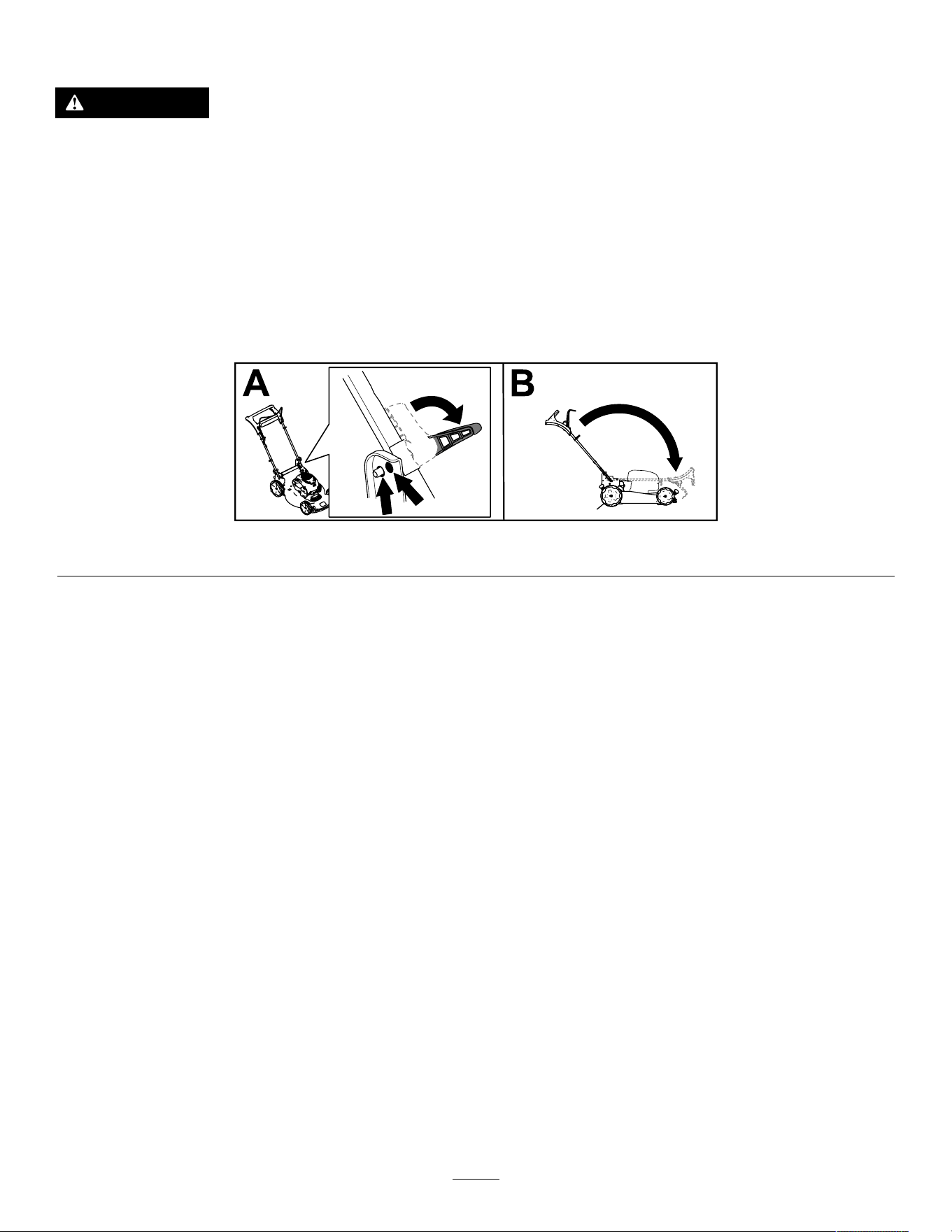
1. Hold the handle while disengaging the handle locks to avoid pinching your hands.
2. Disengage the handle locks until you can move the upper handle freely (A of
Figure 19)
3. Fold the handle forward to the fully forward position (B of
Figure 19).
Important: Route the cables to the outside of the handle locks as you fold the handle.
g334367
Figure 19
4. To unfold the handle, refer to 1 Unfolding the Handle (page 5).
17
Storing the Machine in the
Vertical-Stow Position
During the mowing season or in the off-season, you
can store your machine in the vertical position to
minimize storage space.
DANGER
Fuel is extremely ammable and explosive. A
re or explosion from fuel can burn you and
others.
• Storing the machine in the vertical position
when there is too much fuel in the fuel tank
may cause fuel to leak from the fuel tank.
Fuel is extremely ammable and explosive.
A re or explosion from fuel can burn you
and others.
• Store the machine in the vertical position
only when the level of fuel in the fuel tank
is no higher than what is recommended in
this Operator’s Manual.
• Do not store the machine in a position
that is beyond the vertical (90°) position;
otherwise, fuel may escape from the fuel
tank.
• Do not transport the machine in the
vertical-stow position.
• Do not attempt to start the machine in the
vertical-stow position.
• Do not attempt to store any machine with
fuel and oil in the vertical-stow position
that is not designed for that purpose.
WARNING
Folding or unfolding the handle improperly
can damage the cables, causing an unsafe
operating condition.
• Do not damage the cables when folding or
unfolding the handle.
• If a cable is damaged, contact an
Authorized Service Dealer.
1. Ensure that the level of fuel in the fuel tank is no
higher than what is recommended by the engine
manufacturer; refer to the engine manufacturer’s
decal on the engine (
Figure 20).
Note: If there is the level of fuel in the fuel
tank is too high, drain the fuel from the fuel tank
into an approved fuel container until it is at or
below the level recommended by the engine
manufacturer.
decal133-8198
Figure 20
2. Ensure that the cutting-height setting on the
machine is 92 mm (3-5/8 inches) or lower. If
it is not, lower it; refer to
Adjusting the Cutting
Height (page 12)
.
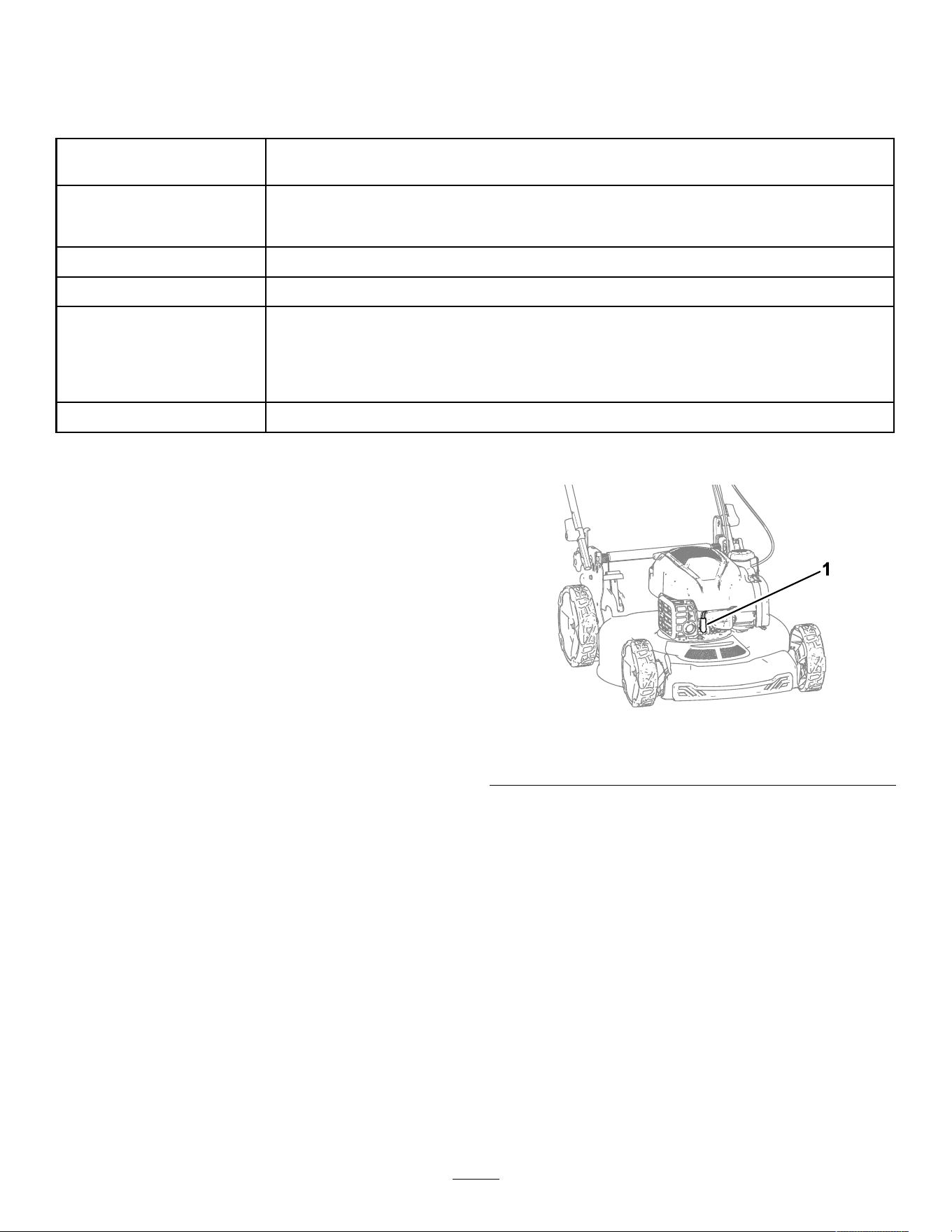
3. Disengage the handle locks (
Figure 21).
g452111
Figure 21
1. Handle lock disengaged
positions
2. Handle lock engaged
position
4. Fold the handle fully forward (Figure 21).
Important: Route the cables to the outside
of the handle knobs as you fold the handle.
5. Engage the handle locks.
6. Lift the front of the machine by the handle and
move it into a storage space (
Figure 22).
g452112
Figure 22
18
Maintenance
Recommended Maintenance Schedule(s)
Maintenance Service
Interval
Maintenance Procedure
Before each use or daily
• Check the engine-oil level and add oil as needed.
• Ensure that the engine shuts off within 3 seconds after releasing the blade-control
bar.
After each use
• Clean grass clippings and dirt from under the machine.
Every 25 hours
• Service the air lter; service it more frequently in dusty operating conditions.
Yearly
• Replace the air lter; replace it more frequently in dusty operating conditions.
• Change the engine oil (if desired).
• Replace the blade or have it sharpened (more frequently if the edge dulls quickly).
• Clean the engine by removing dirt and debris from its top and sides; clean it more
frequently in dusty operating conditions.
Yearly or before storage
• Empty the fuel tank before repairs as directed and before yearly storage.
Important: Refer to your engine owner’s manual for additional maintenance procedures.
Maintenance Safety
• Always shut off the machine, wait for all moving
parts to stop, and allow the machine to cool before
adjusting, servicing, cleaning, or storing it.
• Disconnect the spark-plug wire from the spark plug
before performing any maintenance procedure.
• Wear gloves and eye protection when servicing
the machine.
• The blade is sharp; contacting the blade can result
in serious personal injury. Wear gloves when
servicing the blade. Do not repair or alter the
blade(s).
• Never tamper with safety devices. Check their
proper operation regularly.
• Tipping the machine may cause the fuel to leak.
Fuel is ammable and explosive, and can cause
personal injury. Run the engine dry or remove the
fuel with a hand pump; never siphon the fuel.
• To ensure optimum performance of the machine,
use only genuine Toro replacement parts and
accessories. Replacement parts and accessories
made by other manufacturers could be dangerous,
and such use could void the product warranty.
Preparing for Maintenance
1. Shut off the engine and wait for all moving parts
to stop.
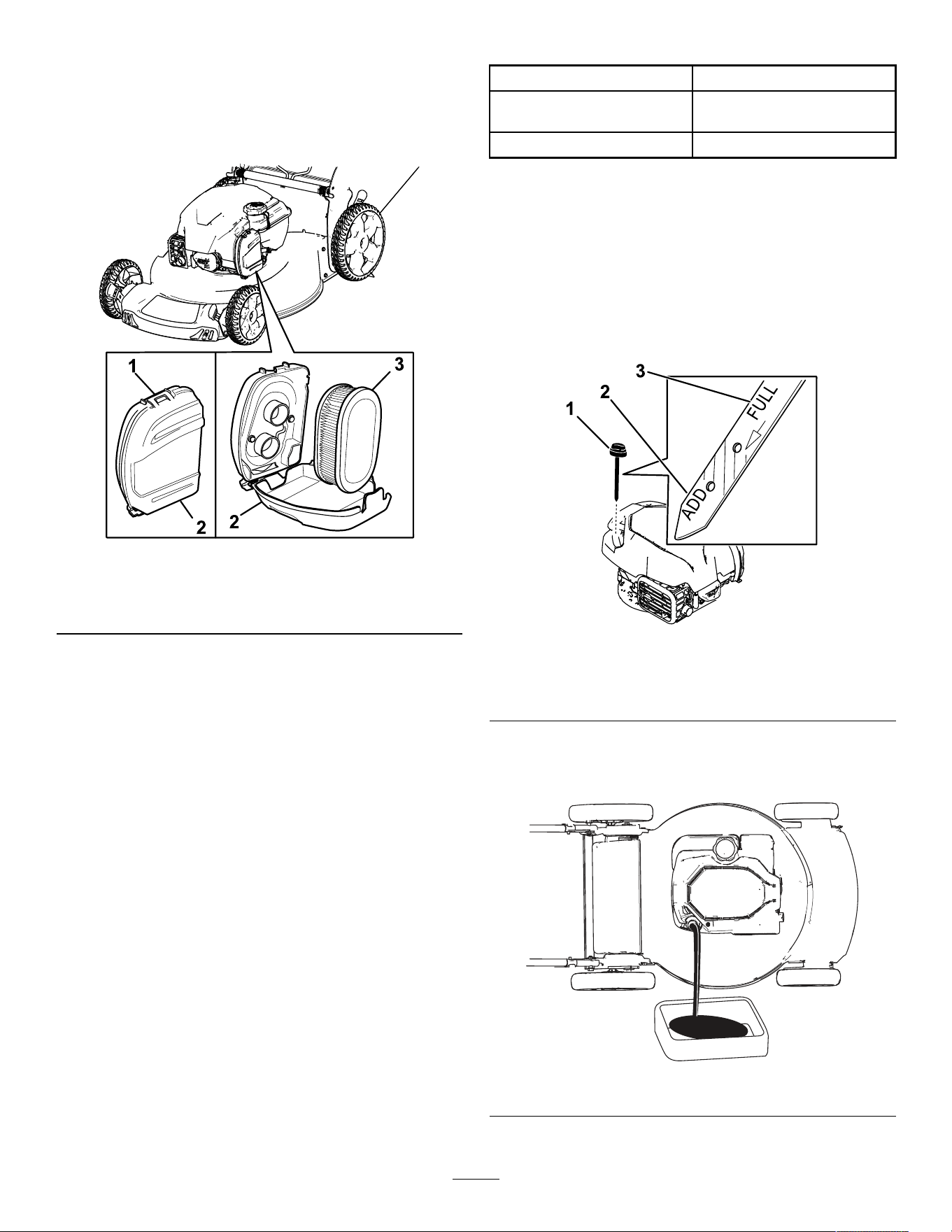
2. Disconnect the spark-plug wire from the spark
plug (
Figure 23).
g452113
Figure 23
1. Spark-plug wire
3. After performing the maintenance procedure(s),
connect the spark-plug wire to the spark plug.
Important: Before tipping the machine to
change the oil or replace the blade, allow the
fuel tank to run dry through normal usage. If
you must tip the machine prior to running
out of fuel, use a hand fuel pump to remove
the fuel. Always tip the machine onto its
side, with the dipstick down.
19
Servicing the Air Filter
Service Interval: Every 25 hours
Yearly
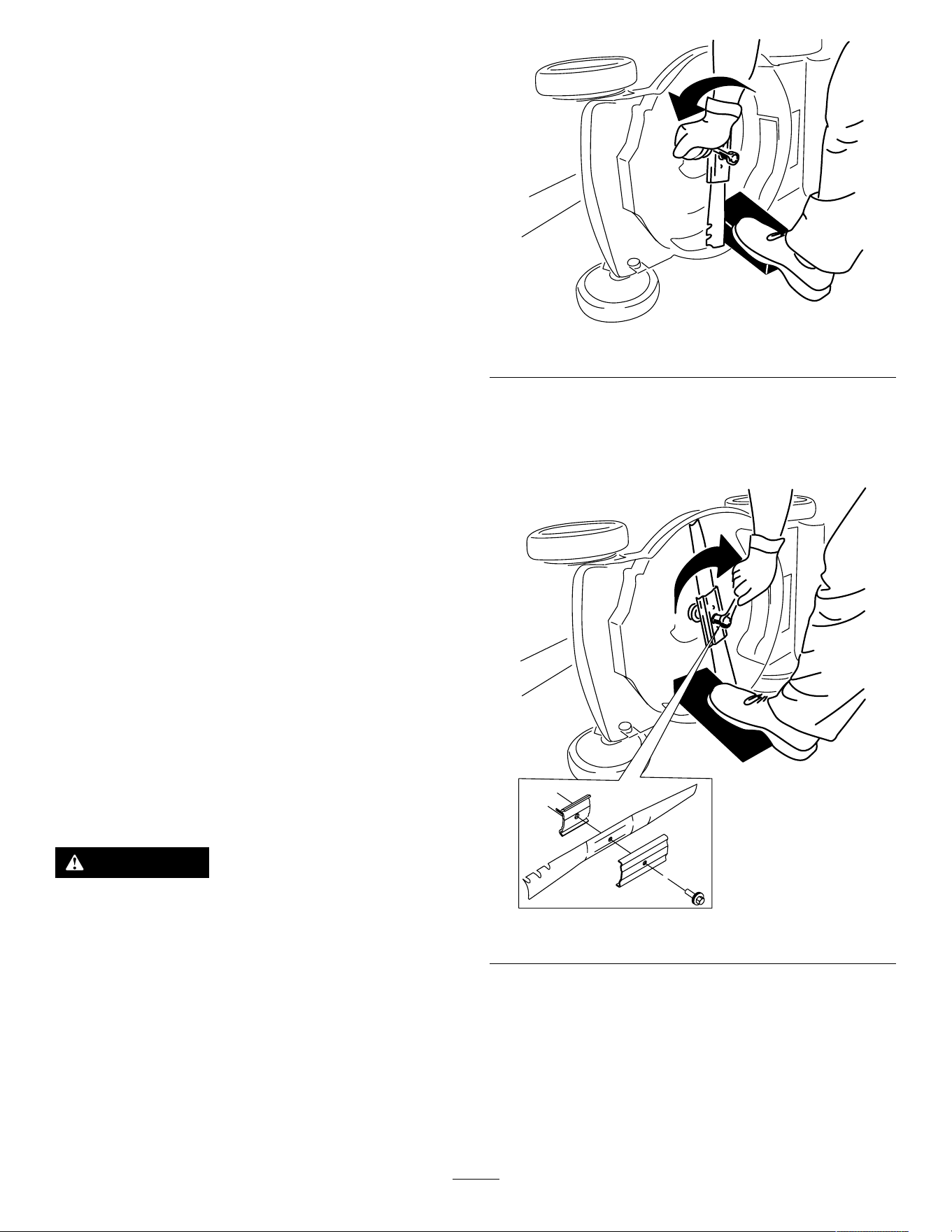
1. Unclip the top of the air-lter cover (
Figure 24).
g334162
Figure 24
1. Clip 3. Air lter
2. Air-lter cover
2. Remove the air lter (Figure 24).
3. Inspect the air lter.
Note: If the air lter is excessively dirty, replace
it with a new lter. Otherwise, gently tap the air
lter on a hard surface to loosen debris.
4. Install the air lter.
5. Use the clip to install the air-lter cover.
Changing the Engine Oil
Service Interval: Yearly
Changing the engine oil is not required, but if
you want to change the oil, use the following
procedure.
Note: Run the engine a few minutes before changing
the oil to warm it. Warm oil ows better and carries
more contaminants.
Engine Oil Specications
Engine oil capacity
0.44 L (15 oz)*
Oil viscosity SAE 30 or SAE 10W-30
detergent oil
API service classication SJ or higher
*There is residual oil in the crankcase after you drain
the oil. Do not pour the entire capacity of oil into the
crankcase. Fill the crankcase with oil as directed in
the following steps.
1. Move the machine to a level surface.
2. Refer to
Preparing for Maintenance (page 19).
3. Remove the dipstick by rotating the cap
counterclockwise and pulling it out (
Figure 25).
g452114
Figure 25
1. Full 3. Low
2. High
4. Tip the machine onto its side (so that the air
lter is up) to drain the used oil from the oil-ll
tube (
Figure 26).
g361896
Figure 26
20
5. After draining the used oil, return the machine to
the operating position.
6. Carefully pour about 3/4 of the engine capacity
of oil into the oil-ll tube.
7. Wait 3 minutes for the oil to settle in the engine.
8. Wipe the dipstick clean with a clean cloth.
9. Insert the dipstick into the oil-ll tube, screw it in,
then remove the dipstick.
10. Read the oil level on the dipstick (
Figure 25).
• If the oil level on the dipstick is too low,
carefully pour a small amount of oil into the
oil-ll tube, wait 3 minutes, and repeat steps
8 through 10 until the oil level on the dipstick
is correct.
• If the oil level on the dipstick is too high,
drain the excess oil until the oil level on the
dipstick is correct.
Important: If the oil level in the engine is too
low or too high and you run the engine, you
may damage the engine.
11. Install the dipstick into the oil-ll tube securely.
12. Recycle the used oil properly.
Replacing the Blade
Service Interval: Yearly
Important: You will need a torque wrench to
install the blade properly. If you do not have a
torque wrench or are uncomfortable performing
this procedure, contact an Authorized Service
Dealer.
Examine the blade whenever you run out of fuel. If the
blade is damaged or cracked, replace it immediately.
If the blade edge is dull or nicked, have it sharpened
and balanced, or replace it.
WARNING
The blade is sharp; contacting the blade can
result in serious personal injury.
Wear gloves when servicing the blade.
1. Refer to
Preparing for Maintenance (page 19).
2. Tip the machine onto its side with the air lter up.
3. Use a block of wood to hold the blade steady
(
Figure 27).
g231389
Figure 27
4. Remove the blade, saving all mounting hardware
(
Figure 27).
5. Install the new blade and all mounting hardware
(
Figure 28).
g231390
Figure 28
Important: Position the curved ends of the
blade to point toward the machine housing.
6. Use a torque wrench to tighten the blade bolt
to 82 N∙m (60 ft-lb).
21
Adjusting the Self-Propel
Drive
For Self-Propel-Drive Models Only
Whenever you install a new self-propel cable or if
the self-propel drive is out of adjustment, adjust the
self-propel drive.
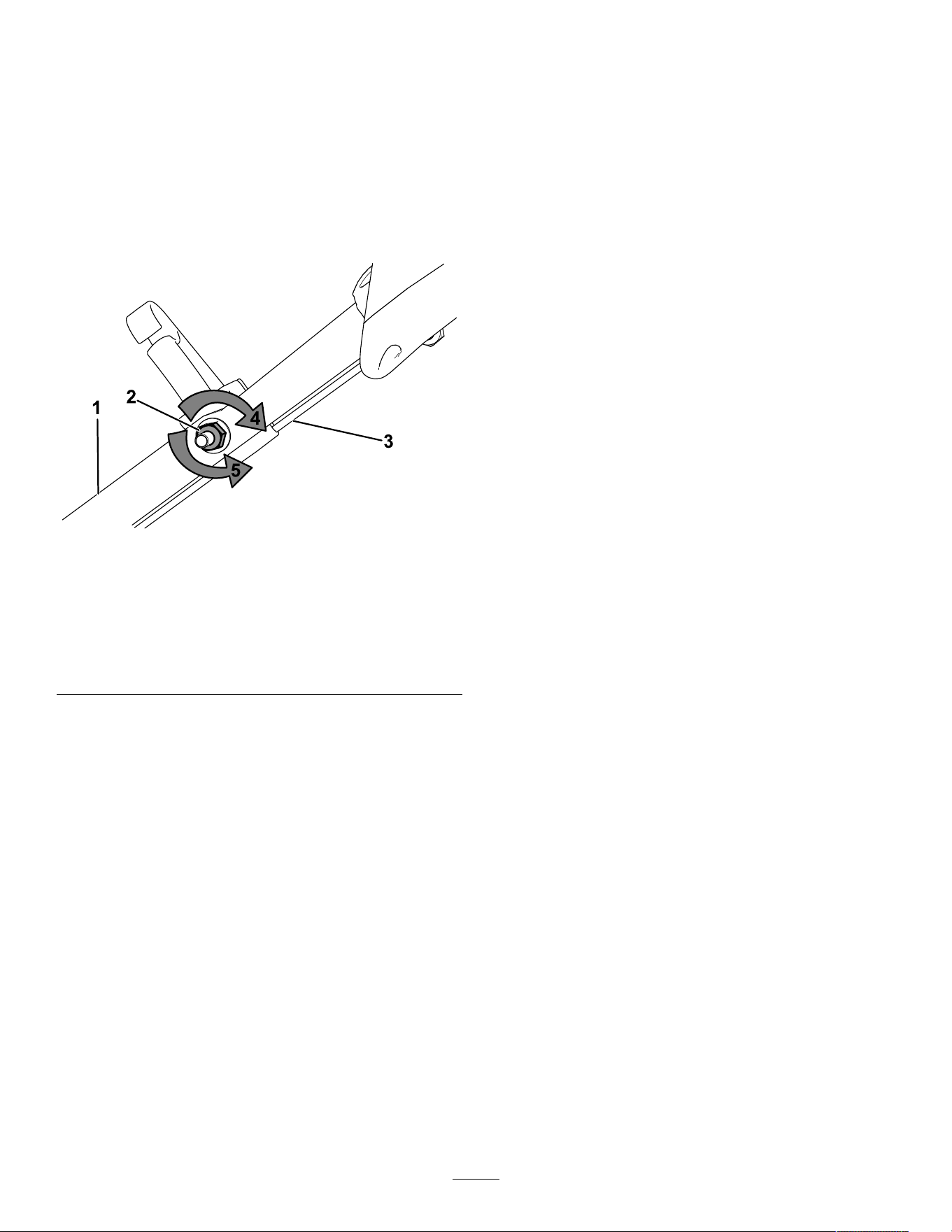
1. Turn the adjustment nut counterclockwise to
loosen the cable adjustment (
Figure 29).
g334884
Figure 29
1. Handle (left side)
4. Turn the nut clockwise to
tighten the adjustment.
2. Adjustment nut 5. Turn the nut
counterclockwise to
loosen the adjustment.
3. Self-propel-drive cable
2. Adjust the tension on the cable (Figure 29) by
pulling it back or pushing it forward and holding
that position.
Note: Push the cable toward the engine to
increase the traction; pull the cable away from
the engine to decrease the traction.
3. Turn the adjustment nut clockwise to tighten the
cable adjustment.
Note: Tighten the nut rmly with a socket or
wrench.
Storage
Store the machine in a cool, clean, dry place.
Storage Safety
Always shut off the machine, wait for all moving
parts to stop, and allow the machine to cool before
adjusting, servicing, cleaning, or storing it.
Preparing the Machine for
Storage
1. On the last refueling of the year, add fuel
stabilizer (such as Toro Premium Fuel
Treatment) to the fuel as directed on the label.
2. Dispose of any unused fuel properly. Recycle
it according to local codes or use it in your
automobile.
Important: Old fuel in the fuel tank is the
leading cause of hard starting. Do not store
the fuel without fuel stabilizer more than
30 days, and do not store stabilized fuel
beyond the duration recommended by the
fuel-stabilizer manufacturer.
3. Run the machine until the engine shuts off from
running out of fuel.
4. Start the engine again and allow it to run until
it shuts off. When you can no longer start the
engine, it is sufciently dry.
5. Disconnect the wire from the spark plug and
connect the wire to the retaining post (if
equipped).
6. Remove the spark plug, add 30 ml (1 oz) of
engine oil through the spark-plug hole, and pull
the starter rope slowly several times to distribute
oil throughout the cylinder to prevent cylinder
corrosion during the off-season.
7. Loosely install the spark plug.
8. Tighten all nuts, bolts, and screws.
Removing the Machine
from Storage
1. Check and tighten all fasteners.
2. Remove the spark plug and spin the engine
rapidly by pulling the recoil-start handle to blow
the excess oil from the cylinder.
3. Install the spark plug and tighten it with a torque
wrench to 20 N∙m (15 ft-lb).
22


California Proposition 65 Warning Information
What is this warning?
You may see a product for sale that has a warning label like the following:
WARNING: Cancer and Reproductive Harm—www.p65Warnings.ca.gov.
What is Prop 65?
Prop 65 applies to any company operating in California, selling products in California, or manufacturing products that may be sold in or brought into
California. It mandates that the Governor of California maintain and publish a list of chemicals known to cause cancer, birth defects, and/or other
reproductive harm. The list, which is updated annually, includes hundreds of chemicals found in many everyday items. The purpose of Prop 65 is to
inform the public about exposure to these chemicals.
Prop 65 does not ban the sale of products containing these chemicals but instead requires warnings on any product, product packaging, or literature with
the product. Moreover, a Prop 65 warning does not mean that a product is in violation of any product safety standards or requirements. In fact, the
California government has claried that a Prop 65 warning “is not the same as a regulatory decision that a product is ‘safe’ or ‘unsafe.’” Many of these
chemicals have been used in everyday products for years without documented harm. For more information, go to
https://oag.ca.gov/prop65/faqs-view-all.
A Prop 65 warning means that a company has either (1) evaluated the exposure and has concluded that it exceeds the “no signicant risk level”; or (2)
has chosen to provide a warning based on its understanding about the presence of a listed chemical without attempting to evaluate the exposure.
Does this law apply everywhere?
Prop 65 warnings are required under California law only. These warnings are seen throughout California in a wide range of settings, including but not
limited to restaurants, grocery stores, hotels, schools, and hospitals, and on a wide variety of products. Additionally, some online and mail order
retailers provide Prop 65 warnings on their websites or in catalogs.
How do the California warnings compare to federal limits?
Prop 65 standards are often more stringent than federal and international standards. There are various substances that require a Prop 65 warning
at levels that are far lower than federal action limits. For example, the Prop 65 standard for warnings for lead is 0.5 μg/day, which is well below
the federal and international standards.
Why don’t all similar products carry the warning?
• Products sold in California require Prop 65 labelling while similar products sold elsewhere do not.
• A company involved in a Prop 65 lawsuit reaching a settlement may be required to use Prop 65 warnings for its products, but other companies
making similar products may have no such requirement.
• The enforcement of Prop 65 is inconsistent.
• Companies may elect not to provide warnings because they conclude that they are not required to do so under Prop 65; a lack of warnings for a
product does not mean that the product is free of listed chemicals at similar levels.
Why does Toro include this warning?
Toro has chosen to provide consumers with as much information as possible so that they can make informed decisions about the products they buy and
use. Toro provides warnings in certain cases based on its knowledge of the presence of one or more listed chemicals without evaluating the level of
exposure, as not all the listed chemicals provide exposure limit requirements. While the exposure from Toro products may be negligible or well within the
“no signicant risk” range, out of an abundance of caution, Toro has elected to provide the Prop 65 warnings. Moreover, if Toro does not provide these
warnings, it could be sued by the State of California or by private parties seeking to enforce Prop 65 and subject to substantial penalties.
Rev A