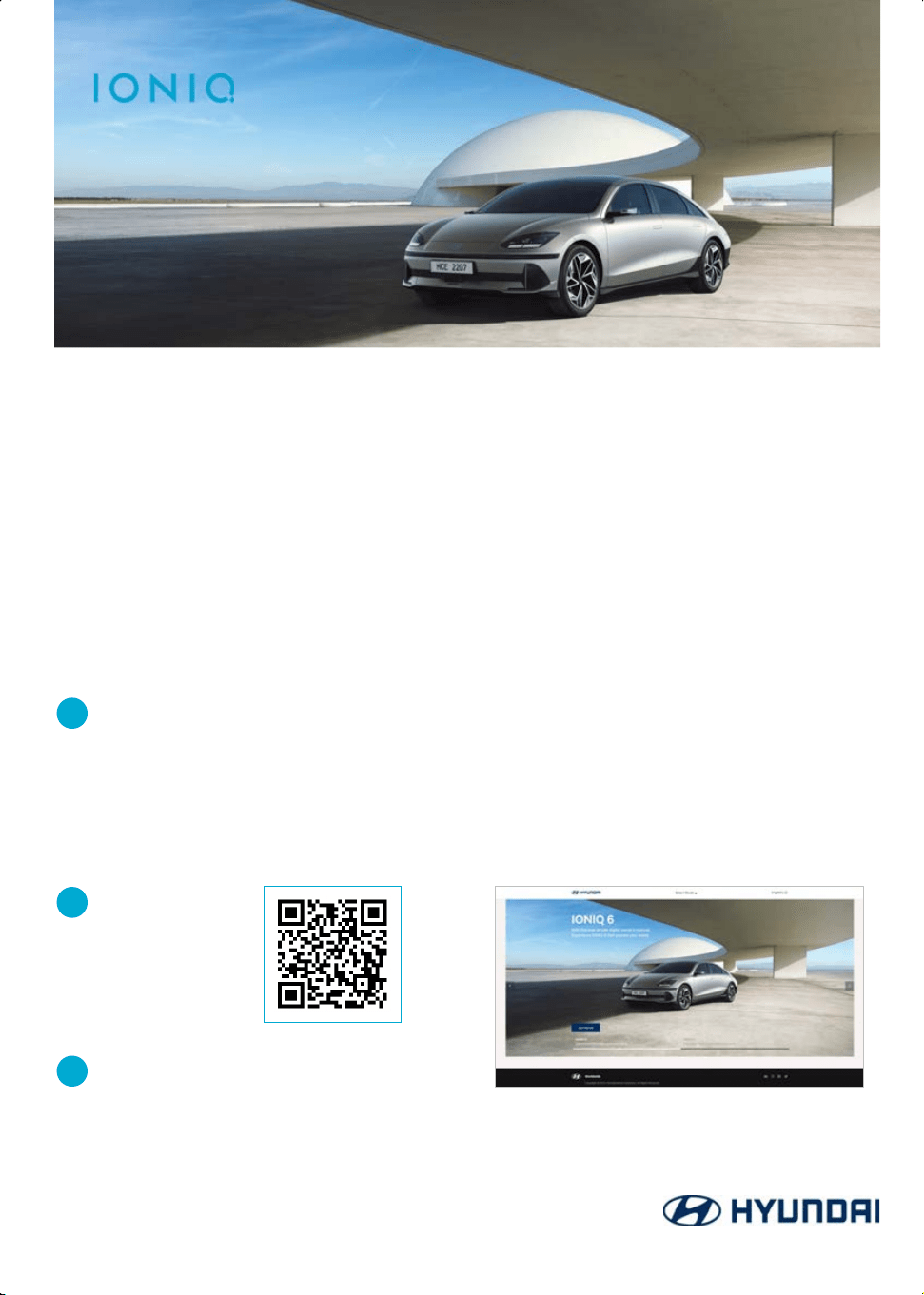
%JHJUBM0XOFSsT.BOVBM
'PSBCFUUFSFYQFSJFODFXJUIZPVS*0/*2
XFQSPWJEFIPXUPJOGPSNBUJPOPOZPVSWFIJDMFsTGFBUVSFT
)PXUPBDDFTT
"DDFTTUISPVHI)ZVOEBJ64"XFCTJUF
XXXIZVOEBJVTBDPN
"DDFTTUISPVHI63-
IUUQTEJHJUBMPXOFSTNBOVBMIZVOEBJDPN
23DPEFTDBO
$POUFOU
&7UJQTGPSDIBSHJOH7-FUD
,FZJOUFSJPSFYUFSJPSGFBUVSFT
8BSOJOHJOEJDBUPSJOGPSNBUJPO
,FZXPSETFBSDIBOETIBSFUPTPDJBMNFEJB
0XOFST.BOVBMTBOEXBSSBOUJFT
*0/*2%JHJUBM0XOFSsT.BOVBM
CE_USA.book Page 1

CE_USA.book Page 2

OWNER’S MANUAL
Operation
Maintenance
Specifications
All information in this Owner’s Manual is current at the time of
publication. However, HYUNDAI reserves the right to make
changes at any time so that our policy of continual product
improvement may be carried out.
This manual applies to all models of this vehicle and includes
descriptions and explanations of optional as well as standard
equipment.
As a result, you may find material in this manual that does not
apply to your specific vehicle.
CE_USA.book Page 3

Introduction
F4
CAUTION: MODIFICATIONS TO YOUR
HYUNDAI
Your HYUNDAI should not be modified in any way. Such modifications may adversely
affect the performance, safety or durability of your HYUNDAI and may, in addition,
violate conditions of the limited warranties covering the vehicle. Certain modifications
may also be in violation of regulations established by the Department of Transportation
and other government agencies in your country.
TWO-WAY RADIO INSTALLATION
Your vehicle is equipped with a Tire Pressure Monitoring System, Passenger Occupant
Classification System and other CAN bus systems. It is possible for an improperly
installed/adjusted high powered two-way radio to adversely affect electronic systems.
For this reason, we recommend that you carefully follow the radio manufacturer’s
instructions if you choose to install one of these devices.
CE_USA.book Page 4
01
F5
SAFETY AND VEHICLE DAMAGE WARNING
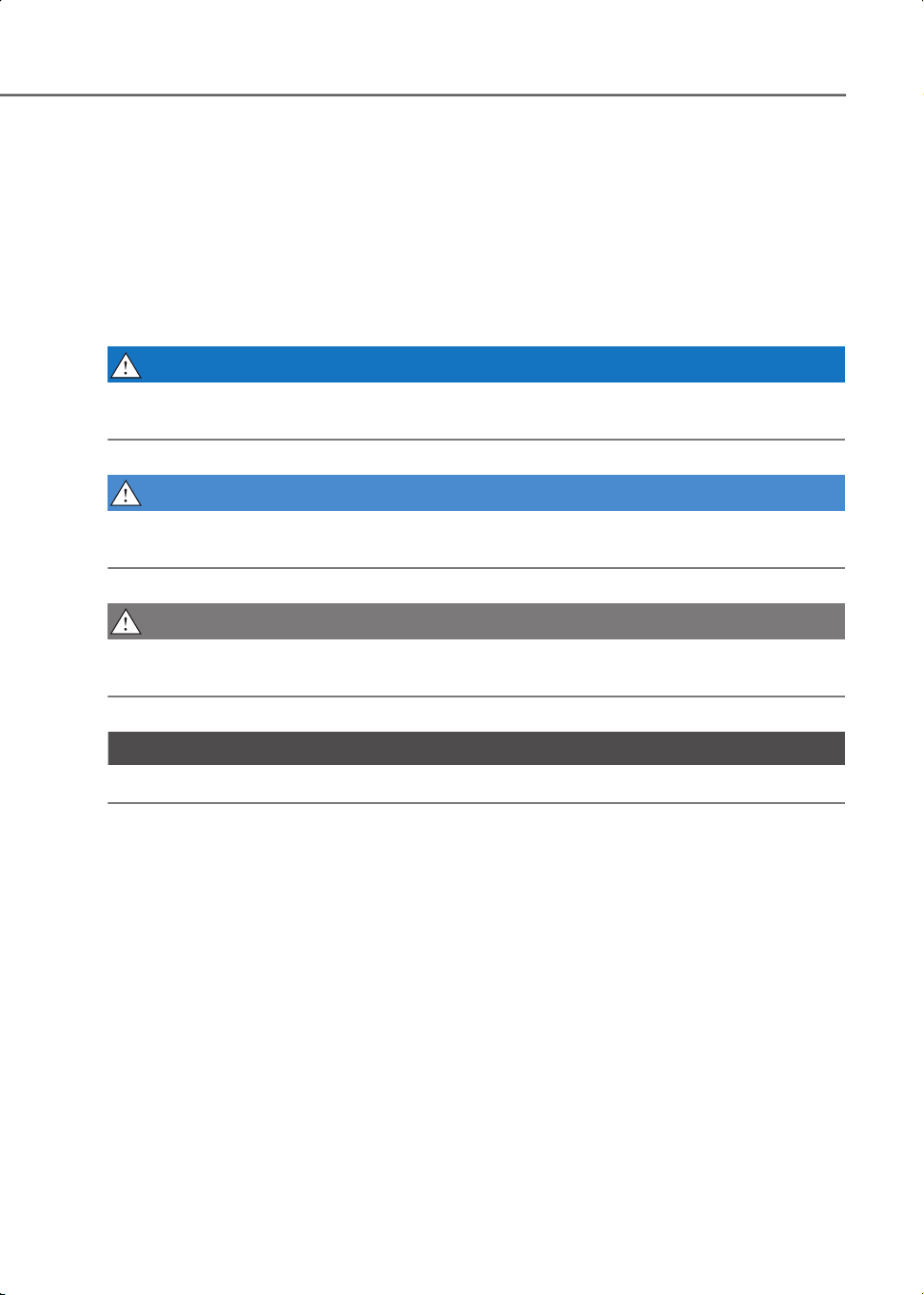
This manual includes information titled as DANGER, WARNING, CAUTION and NOTICE.
These titles indicate the following:
DANGER
DANGER indicates a hazardous situation which, if not avoided, will result in death or
serious injury.
WARNING
WARNING indicates a hazardous situation which, if not avoided, could result in death or
serious injury.
CAUTION
CAUTION indicates a hazardous situation which, if not avoided, could result in minor or
moderate injury.
NOTICE
NOTICE indicates a situation which, if not avoided, could result in vehicle damage.
CE_USA.book Page 5

Introduction
F6
HYUNDAI VEHICLE OWNER PRIVACY POLICY
Your Hyundai vehicle may be equipped with technologies and services that use
information collected, generated, recorded or stored by the vehicle. Hyundai has created
a Vehicle Owner Privacy Policy to explain how these technologies and services collect
use and share this information.
You may read our Vehicle Owner Privacy Policy on the Hyundaiusa.com website at:
https://www.hyundaiusa.com/owner-privacy-policy.aspx
If you would like to receive a hard copy of our Vehicle Owner Privacy Policy, please
contact the Hyundai Customer Care Center at:
Hyundai Customer Care
P.O. Box 20850
Fountain Valley, CA 92728
800-633-5151
consumeraffairs@hmausa.com
Hyundai’s Customer Care representatives are available Monday through Friday, between
the hours of 6:00 AM and 5:00 PM PST and Saturday between 6:30 AM and 3:00 PM PST
(English).
For Customer Care assistance in Spanish or Korean, representatives are available
Monday through Friday between 6:30 AM and 3:00 PM PST.
CE_USA.book Page 6
Table of contents
1
1
2
3
4
5
6
7
8
9
I
Introduction/Getting started with Your
Electric Vehicle
Vehicle Information, Consumer
Information, and Reporting Safety Defects
Seats & Safety System
Instrument Cluster
Convenience Features
Driving Your Vehicle
Driver Assistance System
Emergency Situations
Maintenance
Index
CE_USA.book Page i

CE_USA.book Page ii

1
1. Introduction/Getting started
with Your Electric Vehicle
Introduction ......................................................................................................................1-3
HYUNDAI Motor America.................................................................................................1-3
Guide to HYUNDAI Genuine Parts ...................................................................................1-4
How to Use This Manual ..................................................................................................1-5
Safety Messages...............................................................................................................1-6
Vehicle Modifications.......................................................................................................1-7
Vehicle Data Collection and Event Data Recorders.......................................................1-7
About "Getting Started With Your Electric Vehicle"...................................................... 1-8
Understanding Your Electric Vehicle ..............................................................................1-9
Characteristics of Your Electric Vehicle ......................................................................1-9
Precautions When Using the High Voltage Battery.................................................. 1-10
Other Precautions for Electric Vehicle Management................................................1-11
Charging Your Electric Vehicle...................................................................................... 1-13
Safety Precautions for Charging Your Electric Vehicle............................................ 1-13
Checking Basic Information on Charging Your Electric Vehicle ............................. 1-16
Using an AC Charger...................................................................................................1-22
Using a DC Charger.....................................................................................................1-25
Using a Portable Charger (ICCB) ...............................................................................1-27
Using EV Mode Functions..............................................................................................1-34
Checking the EV Mode Screen Configuration ..........................................................1-34
Checking Energy Information ....................................................................................1-35
Setting the Next Departure Time...............................................................................1-37
Setting Scheduled Charging and Climate................................................................ 1-38
Setting a Battery Discharging Limit When Using Vehicle to Load (V2L)................ 1-40
Setting Electric Vehicle Specialized Functions......................................................... 1-41
Using V2L Function........................................................................................................ 1-46
Safety Precautions When Using the V2L Function .................................................. 1-46
Using Electricity Outside the Vehicle ....................................................................... 1-48
Using Electricity Inside the Vehicle .......................................................................... 1-49
Solving V2L Problems ................................................................................................. 1-51
CE_USA.book Page 1

1
Aux. Battery Saver+........................................................................................................ 1-52
Driving Your Electric Vehicle......................................................................................... 1-53
Starting and Stopping the Vehicle ............................................................................ 1-53
Checking Electric Vehicle Driving Information ........................................................ 1-54
Countermeasures For Accidents Or Fire...................................................................... 1-65
If the Electric Vehicle Catches Fire ........................................................................... 1-65
If the Electric Vehicle Is Submerged......................................................................... 1-65
If the Electric Vehicle Needs Towing ........................................................................1-66
Other Precautions for Electric Vehicle Accidents .................................................... 1-67
CE_USA.book Page 2

1
1-3
Introduction
Congratulations, and thank you for choosing HYUNDAI. We are pleased to welcome you
to the growing number of discerning people who drive HYUNDAIs. We are very proud of
the advanced engineering and high-quality construction of each HYUNDAI we build.
Your Owner’s Manual will introduce you to the features and operation of your new
HYUNDAI. To become familiar with your new HYUNDAI, so that you can fully enjoy it,
read this Owner’s Manual carefully before driving your new vehicle.
This manual contains important safety information and instructions intended to
familiarize you with your vehicle’s controls and safety features so you can safely operate
your vehicle.
This manual also contains information on maintenance designed to enhance safe
operation of the vehicle. It is recommended that all service and maintenance on your car
be performed by an authorized HYUNDAI dealer. HYUNDAI dealers are prepared to
provide high-quality service, maintenance and any other assistance that may be
required.
This Owner’s Manual should be considered a permanent part of your vehicle, and should
be kept in the vehicle so you can refer to it at any time. The manual should stay with the
vehicle if you sell it to provide the next owner with important operating, safety and
maintenance information.
HYUNDAI MOTOR AMERICA
CAUTION
Severe vehicle damage may result from the use of poor quality lubricants that do not
meet HYUNDAI specifications. You must always use high quality lubricants that meet the
specifications listed in the Vehicle Specifications section of the Owner’s Manual.
Copyright 2023 HYUNDAI Motor America. All rights reserved. No part of this publication
may be reproduced, stored in any retrieval system or transmitted in any form or by any
means without the prior written permission of HYUNDAI Motor America.
CE_USA.book Page 3
Introduction/Getting started with Your Electric Vehicle
1-4
GUIDE TO HYUNDAI GENUINE PARTS
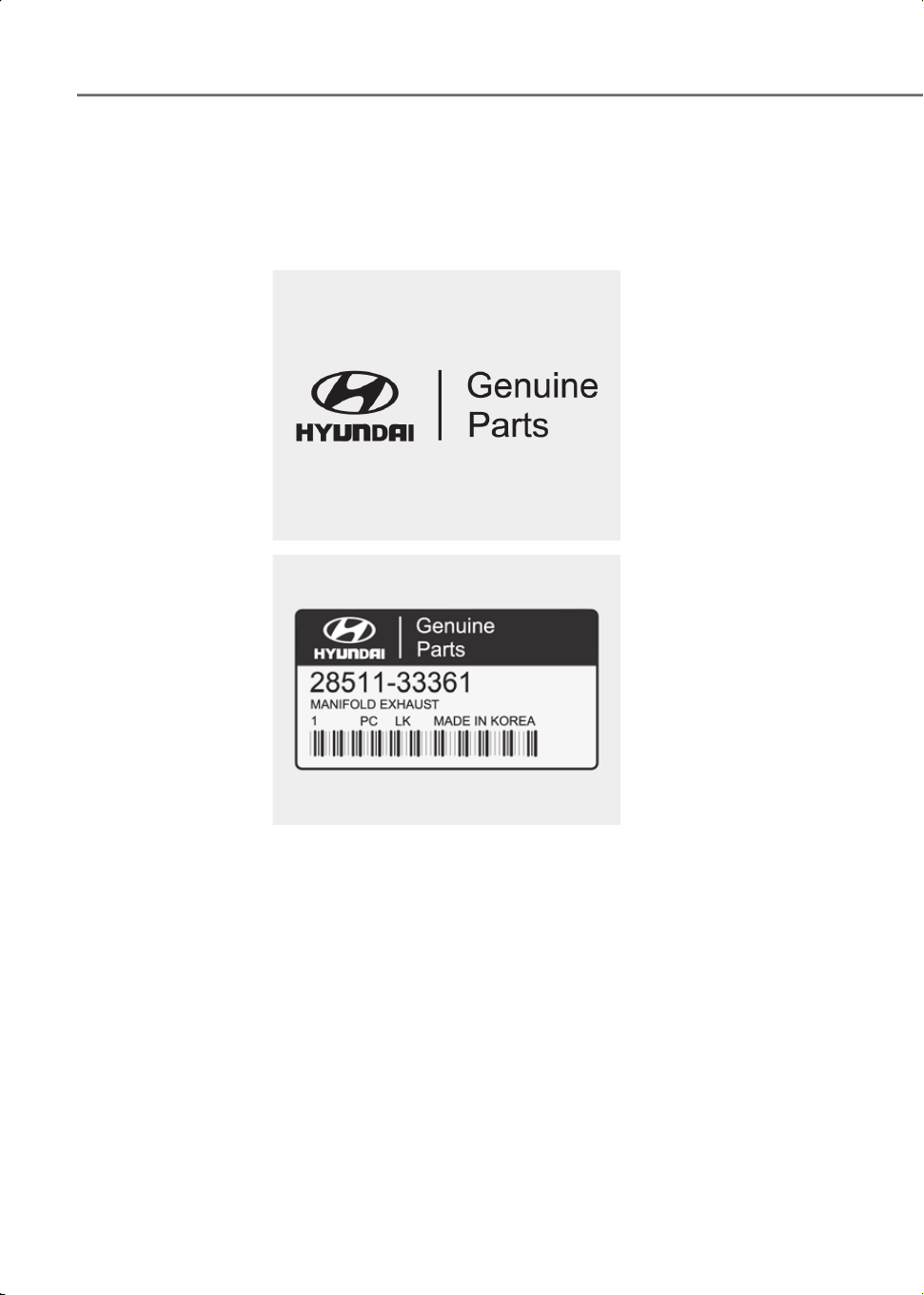
1. What are HYUNDAI Genuine Parts?
HYUNDAI Genuine Parts are the same parts used by HYUNDAI Motor Company to
manufacture vehicles. They are designed and tested for the optimum safety,
performance, and reliability for our customers.
A100A01L
A100A02L
2. Why HYUNDAI Genuine Parts?
HYUNDAI Genuine Parts are engineered and built to meet rigid manufacturing
requirements.
Damage caused by using imitation, counterfeit or used salvage parts is not covered
under the HYUNDAI New Vehicle Limited Warranty or any other HYUNDAI warranty.
In addition, any damage to or failure of HYUNDAI Genuine Parts caused by the
installation or failure of an imitation, counterfeit or used salvage part is not covered by
any HYUNDAI Warranty.
CE_USA.book Page 4
1
1-5
A100A04L
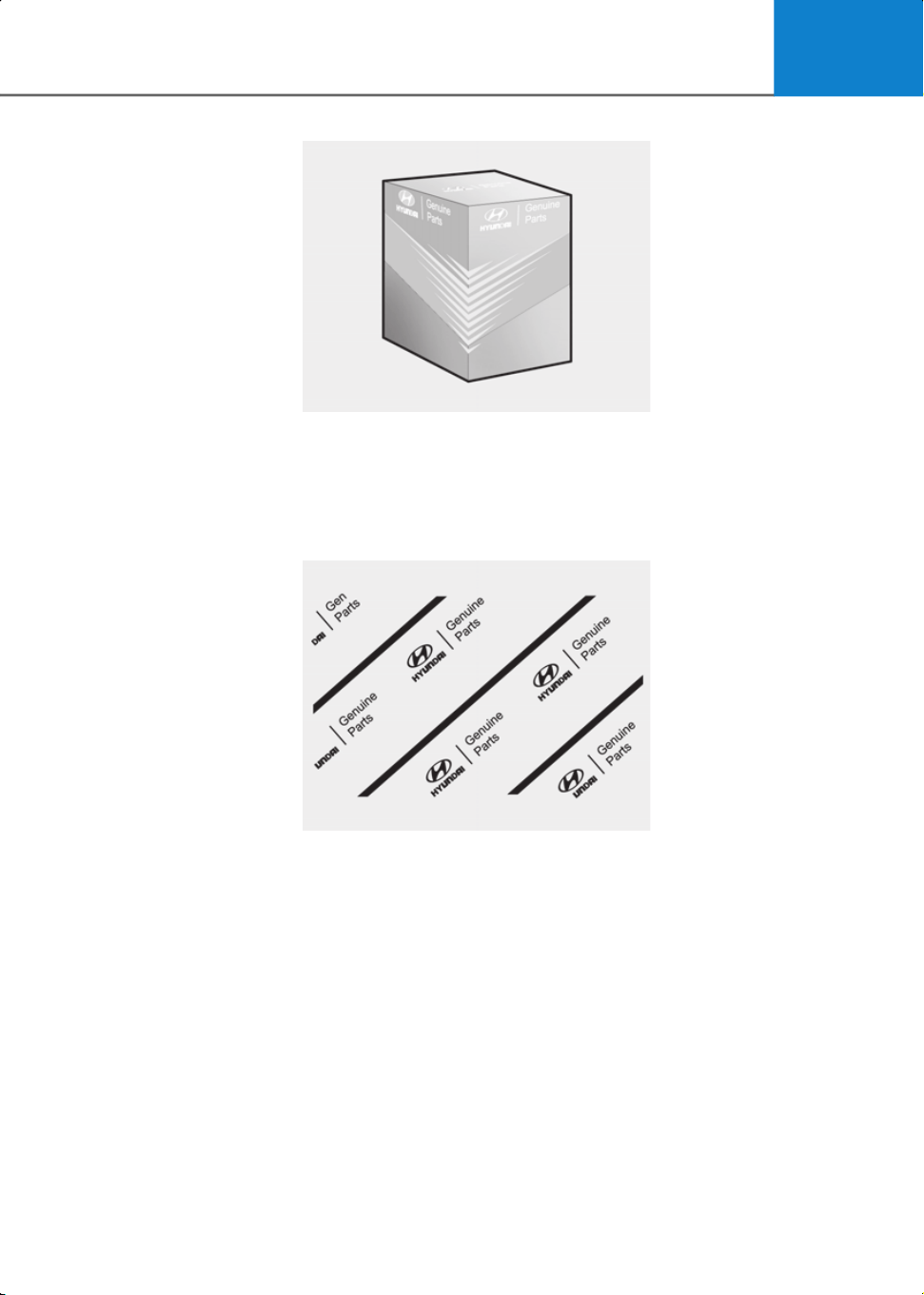
3. How can you tell if you are purchasing HYUNDAI Genuine Parts?
Look for the HYUNDAI Genuine Parts Logo on the package (see below).
HYUNDAI Genuine Parts exported to the U.S. are packaged with labels written only in
English.
HYUNDAI Genuine Parts are only sold through authorized HYUNDAI Dealerships.
A100A03L
HOW TO USE THIS MANUAL
We want to help you get the greatest possible driving pleasure from your vehicle. Your
Owner’s Manual can assist you in many ways. We strongly recommend that you read the
entire manual. In order to minimize the chance of death or injury, you must read the
WARNING and CAUTION sections in the manual.
Illustrations complement the words in this manual to best explain how to enjoy your
vehicle. By reading your manual, you will learn about features, important safety
information, and driving tips under various road conditions.
The general layout of the manual is provided in the Table of Contents. Use the index when
looking for a specific area or subject; it has an alphabetical listing of all information in
your manual.
Sections: This manual has nine chapters plus an index. Each section begins with a brief
list of contents so you can tell at a glance if that section has the information you want.
CE_USA.book Page 5
Introduction/Getting started with Your Electric Vehicle
1-6
SAFETY MESSAGES
Your safety, and the safety of others, is very important. This Owner’s Manual provides you
with many safety precautions and operating procedures. This information alerts you to
potential hazards that may hurt you or others, as well as damage your vehicle.
Safety messages found on vehicle labels and in this manual describe these hazards and
what to do to avoid or reduce the risks.
Warnings and instructions contained in this manual are for your safety. Failure to follow
safety warnings and instructions can lead to serious injury or death.
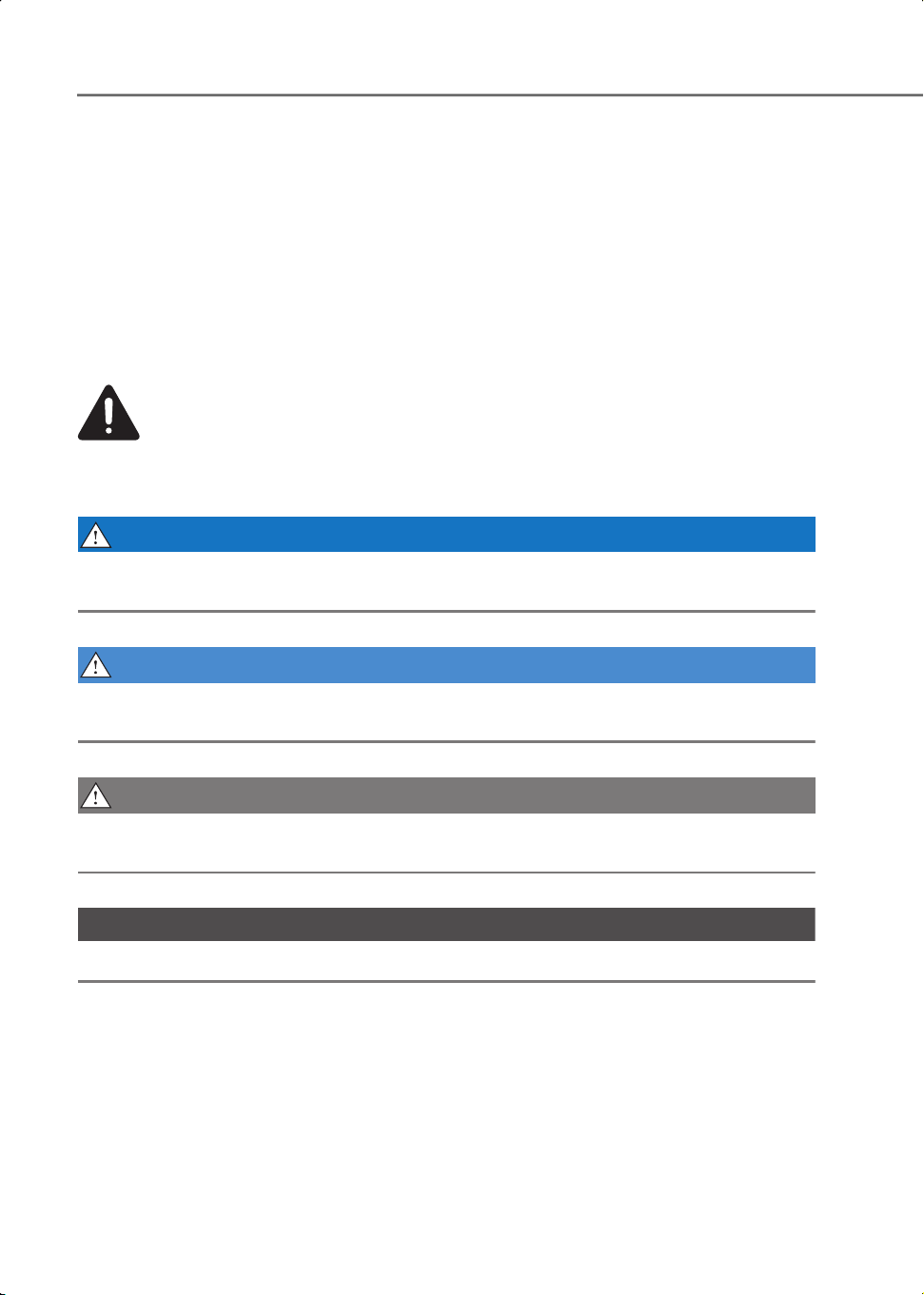
Throughout this manual DANGER, WARNING, CAUTION, NOTICE and the SAFETY ALERT
SYMBOL will be used.
This is the safety alert symbol. It is used to alert you to potential physical injury hazards.
Obey all safety messages that follow this symbol to avoid possible injury or death. The
safety alert symbol precedes the signal words DANGER, WARNING and CAUTION.
DANGER
DANGER indicates a hazardous situation that, if not avoided, will result in death or serious
injury.
WARNING
WARNING indicates a hazardous situation that, if not avoided, could result in death or
serious injury.
CAUTION
CAUTION indicates a hazardous situation that, if not avoided, could result in minor or
moderate injury.
NOTICE
NOTICE indicates a situation that, if not avoided, could result in vehicle damage.
CE_USA.book Page 6

1
1-7
VEHICLE MODIFICATIONS
• This vehicle should not be modified. Modification of your vehicle could affect its
performance, safety or durability and may even violate governmental safety and
emissions regulations.
In addition, damage or performance problems resulting from any modification may not
be covered under warranty.
• If you use unauthorized electronic devices, it may cause the vehicle to operate
abnormally, wire damage, battery discharge and fire. For your safety, do not use
unauthorized electronic devices.
NOTICE
Some vehicle interior sounds (including welcome sound, navigation alerts, or warning
sound) may be generated from the interior speakers and amplifier. Do not replace these
components with anything other than the original HYUNDAI factory parts. Any
unauthorized product may cause a malfunction of the vehicle interior sounds that may
affect the intended operation of the vehicle.
VEHICLE DATA COLLECTION AND EVENT DATA
RECORDERS
This vehicle is equipped with an event data recorder (EDR). The main purpose of an EDR
is to record, in certain crash or near crash-like situations, such as an airbag deployment
or hitting a road obstacle, data that will assist in understanding how a vehicle’s systems
performed. The EDR is designed to record data related to vehicle dynamics and safety
systems for a short period of time, typically 30 seconds or less.
The EDR in this vehicle is designed to record such data as:
• How various systems in your vehicle were operating;
• Whether or not the driver and passenger safety belts were buckled/ fastened;
• How far (if at all) the driver was depressing the accelerator and/or brake pedal; and,
• How fast the vehicle was traveling.
These data can help provide a better understanding of the circumstances in which
crashes and injuries occur.
NOTE: EDR data are recorded by your vehicle only if a nontrivial crash situation occurs;
no data are recorded by the EDR under normal driving conditions and no personal data
(for example, name, gender, age, and crash location) are recorded. However, other
parties, such as law enforcement, could combine the EDR data with the type of
personally identifying data routinely acquired during a crash investigation.
To read data recorded by an EDR, special equipment is required, and access to the
vehicle or the EDR is needed. In addition to the vehicle manufacturer, other parties, such
as law enforcement, that have the special equipment, can read the information if they
have access to the vehicle or the EDR.
CE_USA.book Page 7

Introduction/Getting started with Your Electric Vehicle
1-8
About "Getting Started With Your Electric Vehicle"
"Getting started with your electric vehicle" provides information about new technologies
applied to the vehicle and explains how to use the main features. "Getting started with
your electric vehicle" allows you to quickly and easily understand new vehicle features
and how to operate them conveniently.
• Before driving, carefully read the manual provided with the vehicle and follow all safety
information and precautions for every vehicle feature.
• "Getting started with your electric vehicle" covers all optional specifications. It may
include descriptions for features that are not equipped in the vehicle.
• Images of the exterior and interior of the vehicle in "Getting started with your electric
vehicle" may differ from the actual vehicle.
CE_USA.book Page 8

1
1-9
Understanding Your Electric Vehicle
Electric vehicles are driven using a battery and an electric motor. Understand the
characteristics of your electric vehicle and check the features that you must know before
driving it.
Characteristics of Your Electric Vehicle
The characteristics that differentiate electric vehicles from gasoline vehicles are as
follows:
• Electric vehicles are eco-friendly because they do not use fossil fuels for driving.
Additionally, unlike gasoline vehicles, noise and vibration are minimal, and the
vehicle’s lifespan is relatively long.
• When slowing down or driving downhill, regenerative braking is used. Regenerative
braking charges the high voltage battery and minimizes energy loss.
• If the high voltage battery is running low, you can charge the vehicle using the AC
charger, DC charger, or portable charging cables. For more information, refer to the
"Charging Your Electric Vehicle" section in this chapter.
Information
Regenerative braking uses an electric motor when decelerating and braking, and it
transforms kinetic energy to electrical energy in order to charge the high voltage battery.
Battery information
The batteries used in the electric vehicle are as follows:
• High voltage battery (high capacity): Drives the motor and operates the air
conditioner and heater. It can be charged via an AC charger, DC charger, or portable
charger.
• 12 V battery: Operates all lights, wipers, and audio system. The 12 V battery charge can
also be maintained by the high voltage battery at parked condition at certain
conditions.
Main components of your electric vehicle
The main components of your electric vehicle and their functions are as follows:
• On-Board Charger (OBC): Charges the high voltage battery by converting the power
grid’s AC power to DC power.
• Inverter: Converts power from direct current (DC) to alternating current (AC) and
supplies power to the motor, and converts power from AC to DC to charge the high
voltage battery during deceleration and braking.
• Low Voltage DC-DC Converter (LDC): Converts the high voltage battery’s power
source to a low voltage (12 V) power source for supply of power to the electrical devices
on the vehicle.
• Vehicle Control Unit (VCU): Controls the various controllers and sensors on the
vehicle.
CE_USA.book Page 9
Introduction/Getting started with Your Electric Vehicle
1-10
• Motor: Uses electricity accumulated on the high voltage battery to drive the vehicle
(same role as an engine in gasoline vehicles).
• Gear: Delivers the rotational force of the motor to the tires at appropriate speeds and
torque.
• High voltage battery (Lithium-ion battery): Stores and supplies power necessary for
the electric vehicle to operate. (The separately installed 12 V battery provides power to
the vehicle when the vehicle is in ACC or OFF.)
WARNING
• Do not remove or disassemble any high voltage battery’s connectors and wires. Doing
so may lead to accidents, such as electric shock, and result in serious injury and
significantly degrade the vehicle’s performance and durability.
• When the high voltage battery or its related components require inspection and
maintenance, contact an authorized HYUNDAI dealer.
Precautions When Using the High Voltage Battery
Precautions for high voltage battery when driving and storing the vehicle are as follows:
CAUTION
• Keep the gauge of the high voltage battery from going below 10 %. Storing the vehicle
while the battery level is too low for a long time may damage the battery or reduce the
battery’s capacity.
• If a collision occurs and the vehicle is impacted, have the vehicle inspected by an
authorized HYUNDAI dealer and check the battery connection status.
• Using the V2L function may reduce the driving distance due to the use of high voltage
battery energy, and repeated use of the V2L function may impact battery life.
• Frequent use of DC charging may impact battery life.
• The high voltage battery level may reduce naturally even if the vehicle is not driven.
• Storing the vehicle in temperatures that are too hot or cold may degrade the battery
performance.
• The distance to empty or power output may vary depending on the driving conditions,
such as the outside temperature. Driving on highway at high speeds or uphill will
increase battery consumption, resulting in a shorter distance to empty.
• If you use the air conditioner or heater, which is powered by the high voltage battery,
the distance to empty will be reduced. Maintain reasonable temperature when using
the air conditioner or heater to maximize distance to empty.
• Depending on the vehicle’s period of use, natural degradation of the battery may occur
that reduces distance to empty over long period of vehicle life. When the charge
capacity and distance to empty keep failing, have the vehicle inspected by an
authorized HYUNDAI dealer.
CE_USA.book Page 10
1
1-11
• If you do not use the vehicle for a long time, charge the vehicle at least once every three
months to prevent both the high voltage and the 12 V battery from fully discharging.
When the battery level has low level, immediately charge the vehicle.
• Using AC charging as much as possible can help keep the battery in optimal condition.
Fully charging the battery when it is 20 % or lower helps to keep the battery in optimal
condition. (Charging once a month or more is recommended.)
• The charging level value displayed on the instrument cluster may decrease according
to the charging conditions (charger status, outside temperature, battery temperature,
etc.). For longer battery life and safety, after a certain charging level is reached, the
charging current is gradually lowered to fully charge the battery.
Other Precautions for Electric Vehicle Management
CAUTION
• When heat treatment after repairs or painting is applied to the vehicle due to an
accident, the high voltage battery’s performance may be degraded. If heat treatment
is required, contact an authorized HYUNDAI dealer.
• When cleaning the motor compartment, do not use a high pressure washer. Doing so
may result in electric shock, due to a discharge in high voltage electricity, or damage
the vehicle’s electric system.
• Do not install third-party parts or modified parts on the vehicle. Doing so may damage
the electric power system. Only use or install genuine parts.
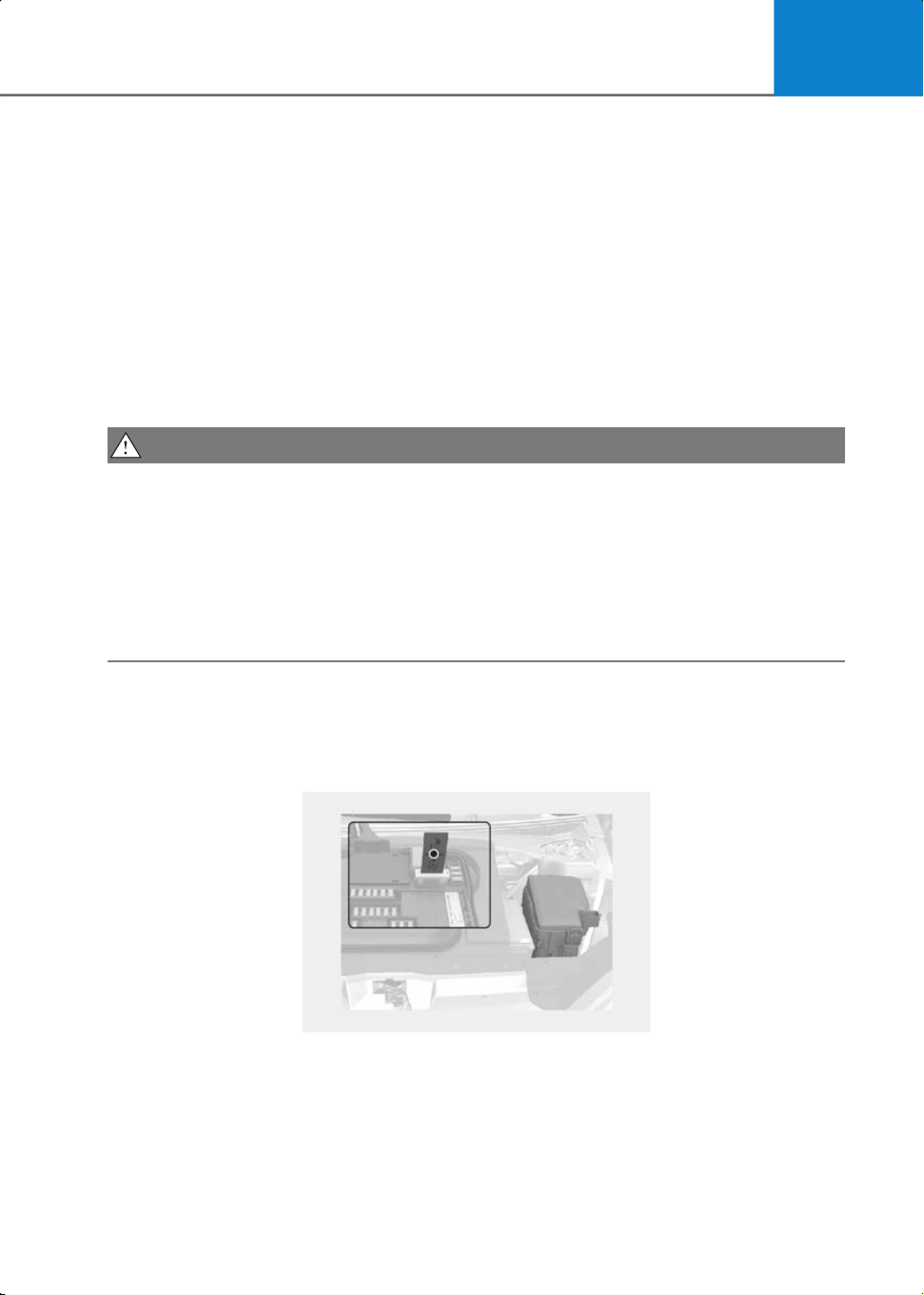
High voltage cut-off switch
High voltage cut-off switch is a device located inside the motor compartment to block
the battery’s high voltage when your vehicle is inspected at an authorized HYUNDAI
dealer.
B0003101
CE_USA.book Page 11

Introduction/Getting started with Your Electric Vehicle
1-12
WARNING
• Never touch the high voltage cut-off switch. This could result in serious injury or death
in a collision or electric shock.
• If the high voltage cut-off switch requires an inspection or repair, contact an
authorized HYUNDAI dealer.
• Never disconnect or cut the high voltage cut-off switch except in an emergency
situation. Serious problems may occur, such as the vehicle may not start.
CE_USA.book Page 12
1
1-13
Charging Your Electric Vehicle
Check the detailed information about charging an electric vehicle and charge your
vehicle.
Electric vehicles can be charged via an AC charger or DC charger installed at public
charging stations. If the vehicle cannot be moved to a public charging station in the event
of an emergency, you can charge the vehicle via the In-Cable Control Box (ICCB) with a
power source (AC 120 V).
To find a nearby public charging station, refer to the “Searching for nearby charging
stations” in this chapter.
Safety Precautions for Charging Your Electric Vehicle
Before charging your electric vehicle, read and comply with all the safety information
below. Failure to do so may cause electric shock or fire and result in a serious injury,
death, vehicle malfunction, or property damage.
Precautions for electric medical devices
WARNING
Electromagnetic waves that are generated from the charger can seriously impact electric
medical devices, such as an implantable cardiac pacemaker. When using such devices,
make sure to consult with your doctor and the manufacturer to find out whether charging
your electric vehicle will impact the operation of your device.
Basic safety precautions for charging
WARNING
• Before charging, apply the Electronic Parking Brake (EPB) with the brake pedal
pressed, shift to P (Park) and turn off the vehicle. Movement of the vehicle while
charging may result in death, serious injury, or property damage.
• Use specified electric vehicle charger only. Failure to do so may damage the charger,
charging cable, or vehicle. Also, it may lead to safety hazards, such as fire, explosion,
etc.
• To avoid death, serious injury, or property damage electric shock and fire, follow the
instructions below:
- Do not touch the interior of the charging connector, charging plug, or the vehicle
charging inlet when connecting the cable to the charger and the charging inlet on
the vehicle.
- Do not touch the charging connector and charging plug with wet hands, or when
standing in water or snow while connecting the charging cable.
- When connecting or removing the charging cable, you must hold the charging
connector handle and charging plug.
CE_USA.book Page 13
Introduction/Getting started with Your Electric Vehicle
1-14
- Use a waterproof charger. Do not charge the vehicle in a place where rainwater may
come in contact with the joints of the charging cable connector and the charging
plug.
- Ensure there is no water, dust, or other contaminants on the charging cable
connector and the charging plug.
- Immediately stop charging if you feel abnormal conditions, such as odor or smoke.
- Do not charge the vehicle if there is a risk of lightning.
Information
• While charging, the gear cannot be shifted from P (Park) to any other gear.
• Ensure the vehicle door is unlocked before disconnecting the charging connector. The
release button on the charging connector does not work when the vehicle door is
locked.
• To control the temperature of the high voltage battery while charging or when the
battery temperature is high, the air conditioning is used to cool down the battery. It
may generate noise or vibration from operation of the air conditioning compressor and
cooling fan, but this is a normal condition when charging the high voltage battery.
• The cooling system may be operated when using the air conditioner during charging.
This may degrade the air conditioner’s performance temporarily.
• Depending on the condition and durability of the high voltage battery, charger
specifications and condition, and ambient temperature, the time required for charging
the battery and distance to empty may vary.
• In rare cases, you might hear high-frequency noise (a small beeping sound) outside the
vehicle when charging with a 400 V DC charger that has deteriorated or has long
communication delay. The high-frequency noise can be generated only when the
vehicle tries to reduce its own electromagnetic waves to keep DC charging as stable as
possible. This beep sound does not affect the charging performance or the vehicle
itself.
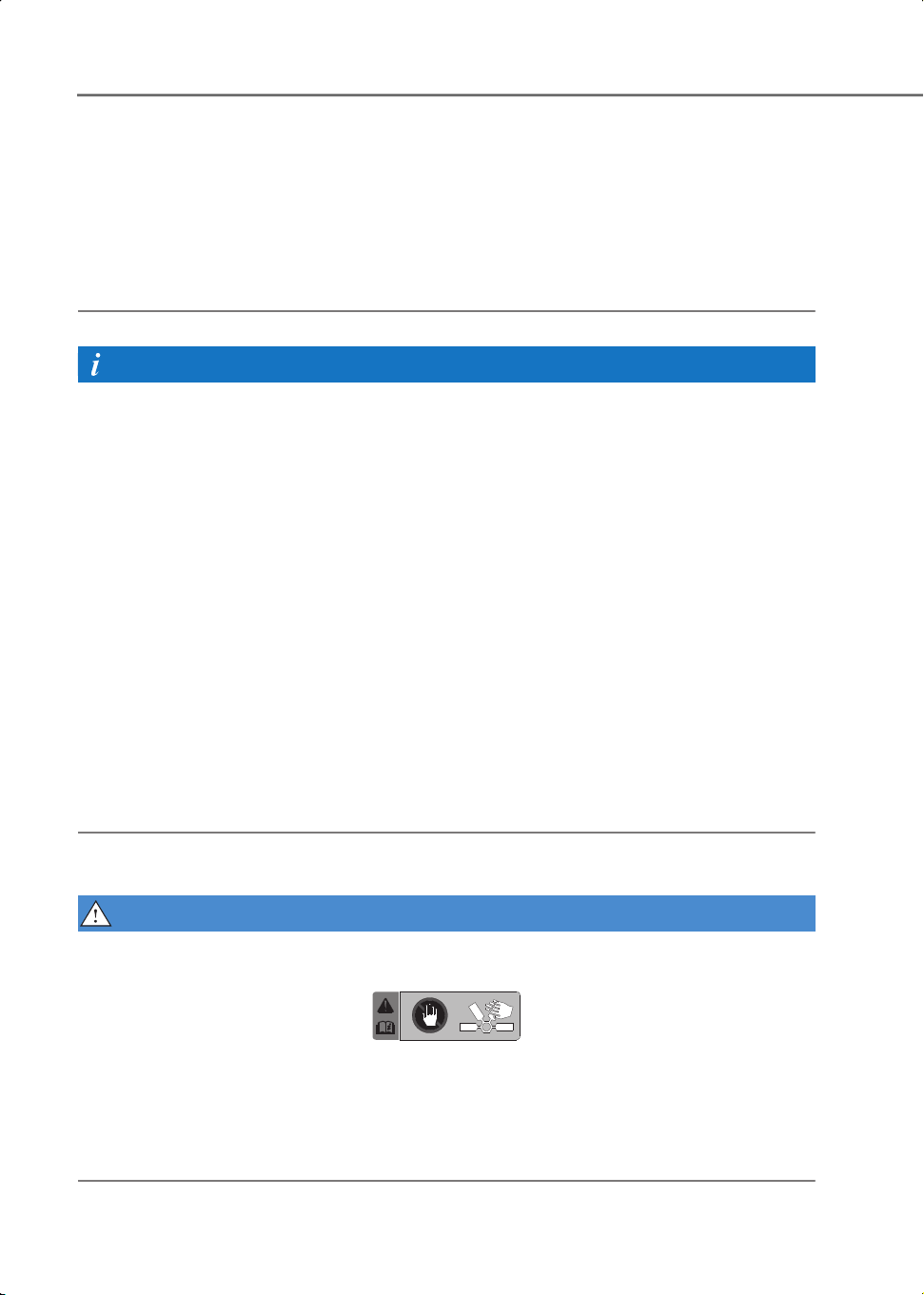
Precautions for operating the cooling fan
WARNING
WL_MotorRoomHotCaution
Do not put your hand near the cooling fan in the motor compartment while charging. It
may operate automatically to control the battery temperature, even if the vehicle is
turned off.
CE_USA.book Page 14
1
1-15
Precautions for operating the charging door
Before operating the charging door, carefully read and follow all the safety information
below.
CAUTION
• Before opening the charging door in the opening direction, ensure that there is no
interference with nearby objects.
• When opening and closing the charging door, be careful not to get your hands or other
body parts caught in the door.
• If you cannot open the charging door due to freezing weather, lightly tap or remove any
ice near the charging door.
• Do not try to forcibly open the charging door. It may cause damage to the charging
door or cause a malfunction.
• Do not hold the parts that support the charging door. Damage to parts or deformation
of parts may cause vehicle damage and accidents.
Precautions for using, handling, and storing the charging cable
Precautions when using the charging cable
CAUTION
• To prevent electric shock, replace the charging cable if the coating or the connector is
damaged.
• Do not modify or disassemble the charging cable. Doing so may result in fire, electric
shock, or injury.
• Do not pull or twist the charging cable excessively, and ensure that the cable is not
twisted. Power cuts or damage to the cable's insulation sheath may result in electric
shock or fire.
• Do not drag the charging cable on the floor or place objects on it. Damage to the
insulation of the cable may result in electric shock or fire.
• Do not use the charging cable near a heat source or heating appliance.
• Do not drop or subject the charging cable to a strong impact. Also, ensure no water or
liquid comes into contact with the cable.
• Use the charging cable only when there are no children around.
• If there is any sign of damage, corrosion, or rust on the charging connector and plug,
or if the connection of the charging connector and plug feels loose, do not use the
cable. Have the vehicle inspected by an authorized HYUNDAI dealer.
CE_USA.book Page 15

Introduction/Getting started with Your Electric Vehicle
1-16
Precautions when handling and storing the charging cable
CAUTION
• Always keep the charging connector and plug dry and clean.
• Ensure that the connectors, plugs, and control box (portable charger) of the charging
cable are not submerged or in contact with water.
• Keep the charging cable free from water or moisture, and keep it in the cargo storage
compartment.
• Do not keep the charging cable near heat source or heating appliances.
• Keep the charging cable away from children.
• If there is dust or contaminants inside the charging connector or plug, remove it using
the air gun.
• If the charging cable is contaminated, completely disconnect the cable from the
charger or power, and remove the contaminants.
- Wipe the charging cable lightly with the soft cloth soaked with a 3 % neutral
detergent aqueous solution, then use a clean cloth to completely remove moisture
and dry the cable in a well-ventilated shade.
- When removing contaminants, ensure the charging connector and charging plug are
not in contact with water.
- Do not use organic solvents, such as benzene, paint thinner, or detergent. Doing so
may cause deformation, discoloration, or malfunction of charging cable.
- When using a vehicle decontamination agent, ensure that the product does not
contain organic solvents, such as benzene, paint thinner, or detergent.
Checking Basic Information on Charging Your Electric Vehicle
Before charging your vehicle, check and understand the information such as the
expected charging time according to the charge type, checking the State of Charge
(SOC), and setting the charger lock mode.
Checking charging type and charging time
The charge types for electric vehicle are as follows:
• AC charge: The electric vehicle is charged via a Level 2 AC public charger or
professionally installed home charger.
• DC charge: You can charge at high speeds at public charging stations. Refer to the
respective company’s charger app or online information that is provided for each DC
charger type.
• Portable charge: If the vehicle cannot be moved to a public charging station due to a
lack of battery power, the vehicle can be charged with household electricity, using the
120 V ICCB portable charger included with the vehicle.
CE_USA.book Page 16
1
1-17
Information
Type 3R enclosure satisfies the requirements of UL 50E standard when the charging
connector is connected to the vehicle side charging inlet. An additional Type 3R
enclosure should be provided in the end installation of the vehicle side charging inlet. The
"Type 3R" marking can be found on the charging inlet.
• What is type 3R?: Performance requirement for enclosures intended for outdoor use
that provides a degree of protection against falling dirt, rain, sleet, and/or snow.
CAUTION
• Risk of electric shock. Do not disconnect under load.
• Suitable for use on a circuit capable of delivering not more than 5,000 rms symmetrical
Amperes, 120 V AC Maximum.
• Suitable for use on a circuit capable of delivering not more than 30,000 rms
symmetrical Amperes, 1,000 V DC Maximum.
CAUTION
• Battery performance and life may deteriorate if the DC charger is used constantly. It is
best to occasionally use AC charger to optimize battery life.
• The electrical outlet at home must comply with regulations and can safely
accommodate the Voltage, Current (Amps), and Power (Watts) ratings specified on the
portable charger. If not, the vehicle may not be charged or safety hazards, such as fire,
may occur.
• If the power distributor exceeds its capacity while charging the vehicle with a portable
charger at home, the power to home may be cut off or a fire may occur.
• If you use a portable charger to charge your electric vehicle with household electricity,
you will be charged on your household electricity bill.
CE_USA.book Page 17

Introduction/Getting started with Your Electric Vehicle
1-18
The estimated charging time for each charging type is as follows:
Information
• The DC charging time may be longer at cold temperature below 20 ? (-17 ?).
• Depending on the condition and durability of the high voltage battery, charger
specifications, and ambient temperature, the time required for charging the high
voltage battery may vary.
• If the charger is worn out, exposed, or there exists any type of damage, charging may
stop for your safety. Use another charger that works normally.
• When charging the battery, an additional 3 minutes may be required to check battery
condition.
Charging Type
Charging Time
Charge Level
(Minimum-Maxim
um)
Charging
Condition
(Temperature)
Standard
Battery
Type
Extended
Battery Type
AC charge
About 5
hours 20
minutes
About 7
hours 10
minutes
10-100 %
Room
temperature(77 °F)
DC
charge
350 kW
About 18
minutes
About 18
minutes
10-80 %
50 kW
About 58
minutes
About 66
minutes
10-80 %
Portable charge
(ICCB: In-Cable
Control Box)
About 46
hours 40
minutes
About 68
hours
10-100 %
CE_USA.book Page 18
1
1-19
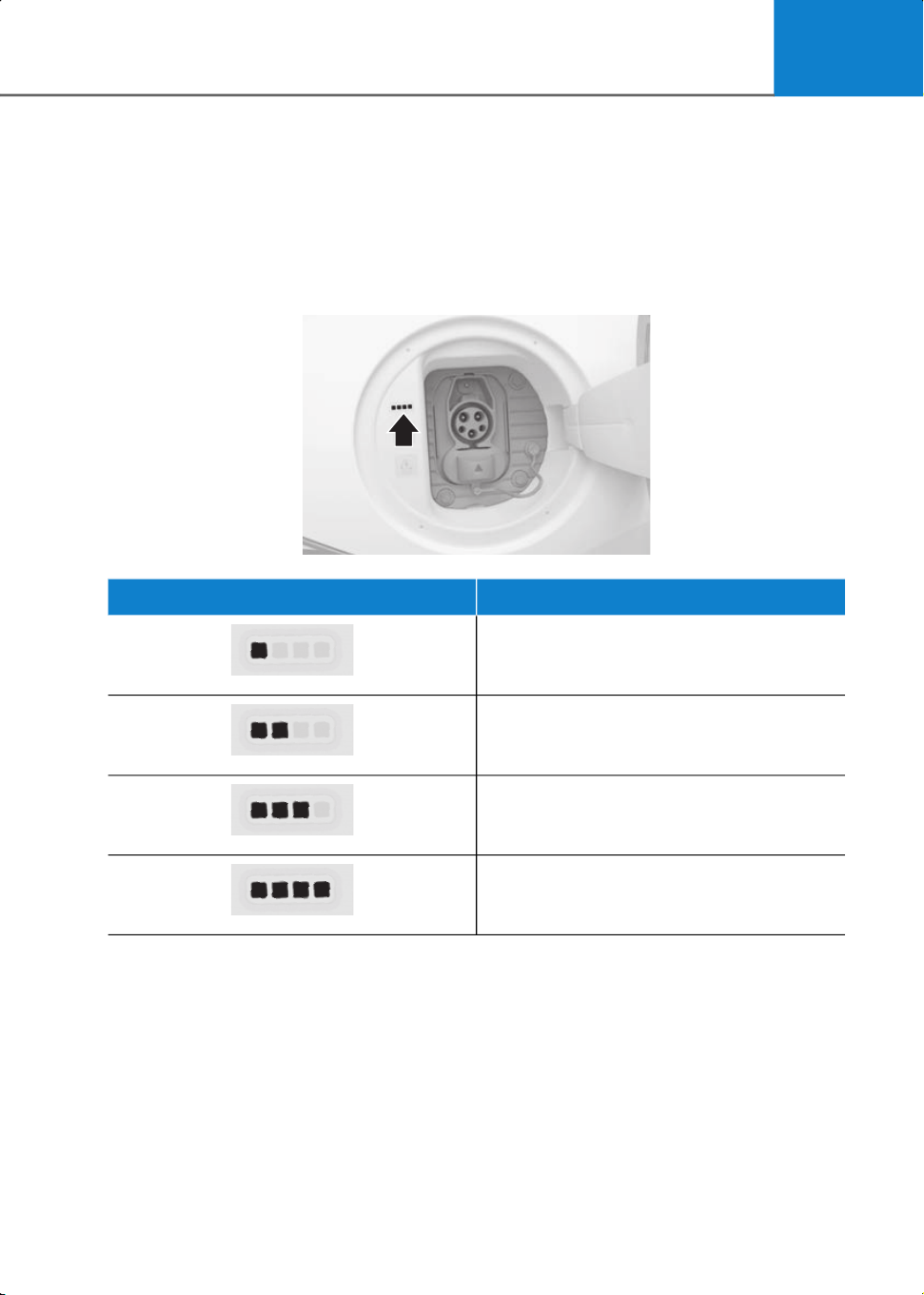
Checking the charging status
Check the State of Charge (SOC) of the high voltage battery via the charge indicator light
inside the charging door.
1. With the vehicle door unlocked, press the open indicator on the charging door to open
the charging door.
2. Check the SOC referring to the charge indicator light inside the charging door.
• SOC is indicated in 4 levels.
B0000901
Charge indicator light SOC [%]
Quick_Guide_01_1
0-24 %
Quick_Guide_01_2
25-49 %
Quick_Guide_01_3
50-74 %
Quick_Guide_01_4
75-100 %
CE_USA.book Page 19
Introduction/Getting started with Your Electric Vehicle
1-20
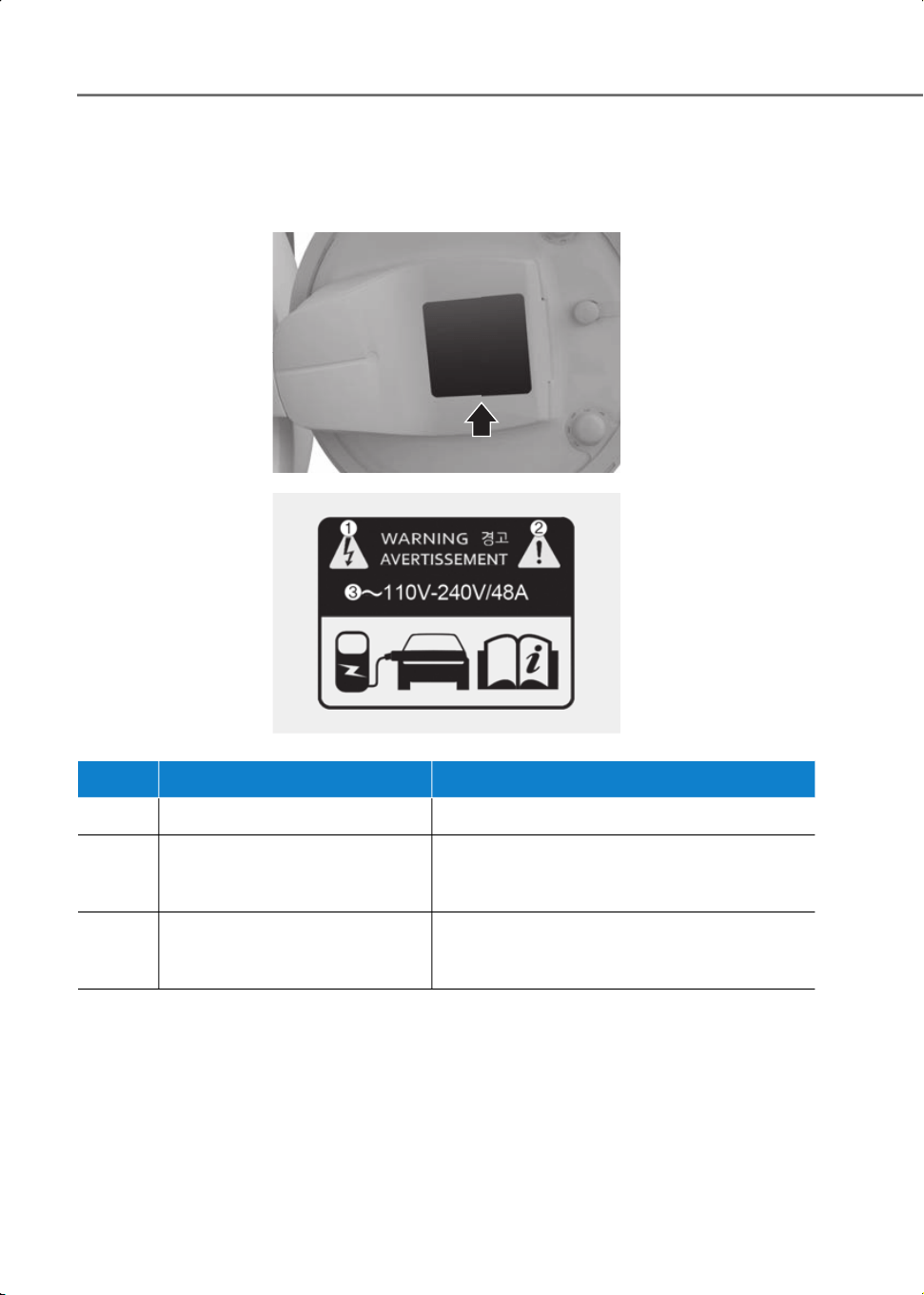
Checking information on the charging label
Open the charging door and check the information on the charging label on the right side
of the charging connector. The charging label shows safety symbols and the rated input
specifications for charging.
B0000902
B0000903
No. Name Description
(1) Warning for high voltage Indicates a device with a risk of electric shock.
(2) Warning/Caution symbol
Indicates a device that may cause property
damage, serious injury or death if not
operated carefully.
(3)
Rated voltage and maximum
charging current
Indicates the type of input current (~, AC) and
the rated voltage range (V) and charging
current (A) when AC charging.
CE_USA.book Page 20
1
1-21
if equipped
When the electric charging door closes automatically
The electric charging door closes automatically after certain time in the following
conditions. Check the operation conditions and reset the charging door if it does not
open under normal use conditions.
• When the charging connector is disconnected.
• When the charging door is opened and charging has not started.
• When the gear is shifted to D (Drive), N (Neutral), or R (Reverse).
Resetting the electric charging door
If the electric charging door malfunctions or if the 12 V battery has been replaced, reset
the charging door by turning the vehicle on and off once.
• If the charging door malfunctions continuously after resetting the charging door, have
the vehicle inspected by an authorized HYUNDAI dealer.
Setting charging connector locking mode
You can lock the charging connector during AC charging to prevent unintended
detachment of the charging connector from the vehicle.
Information
The connector is automatically locked during DC charging or while using the V2L
function, regardless of the settings of charging connector locking mode applied to the
vehicle.
• When DC charging is complete, the charging connector will be unlocked
automatically.
• After using electricity, you can unlock the charging connector by pressing the switch
on the V2L connector to turn off the power and unlock the vehicle door.
On the infotainment system, select EV > (EV Setting) > Charging Connector Locking
Mode to set the locking mode of the charging connector.
The available locking mode options are as follows:
• Always: Locks the connector automatically whenever the charging connector is
plugged into the charging inlet.
• While Charging: Locks the connector automatically only while charging is in progress
after the charging connector is properly connected to the vehicle. This is the preferred
setting when using public stations to allow for other customers to use charger after
your vehicle is done charging.
• Do Not Lock: Unlocks the connector regardless of the charging state. Be careful of
portable charging cable theft.
CE_USA.book Page 21
Introduction/Getting started with Your Electric Vehicle
1-22
Disconnecting the charging connector in an emergency
If the unlock button is not functioning properly due to a discharged battery or abnormal
electrical wiring, the charging connector cannot be disconnected from the vehicle.
CAUTION
Do not disconnect the charging connector forcibly. Doing so may damage the charging
connector or the charging inlet on the vehicle.
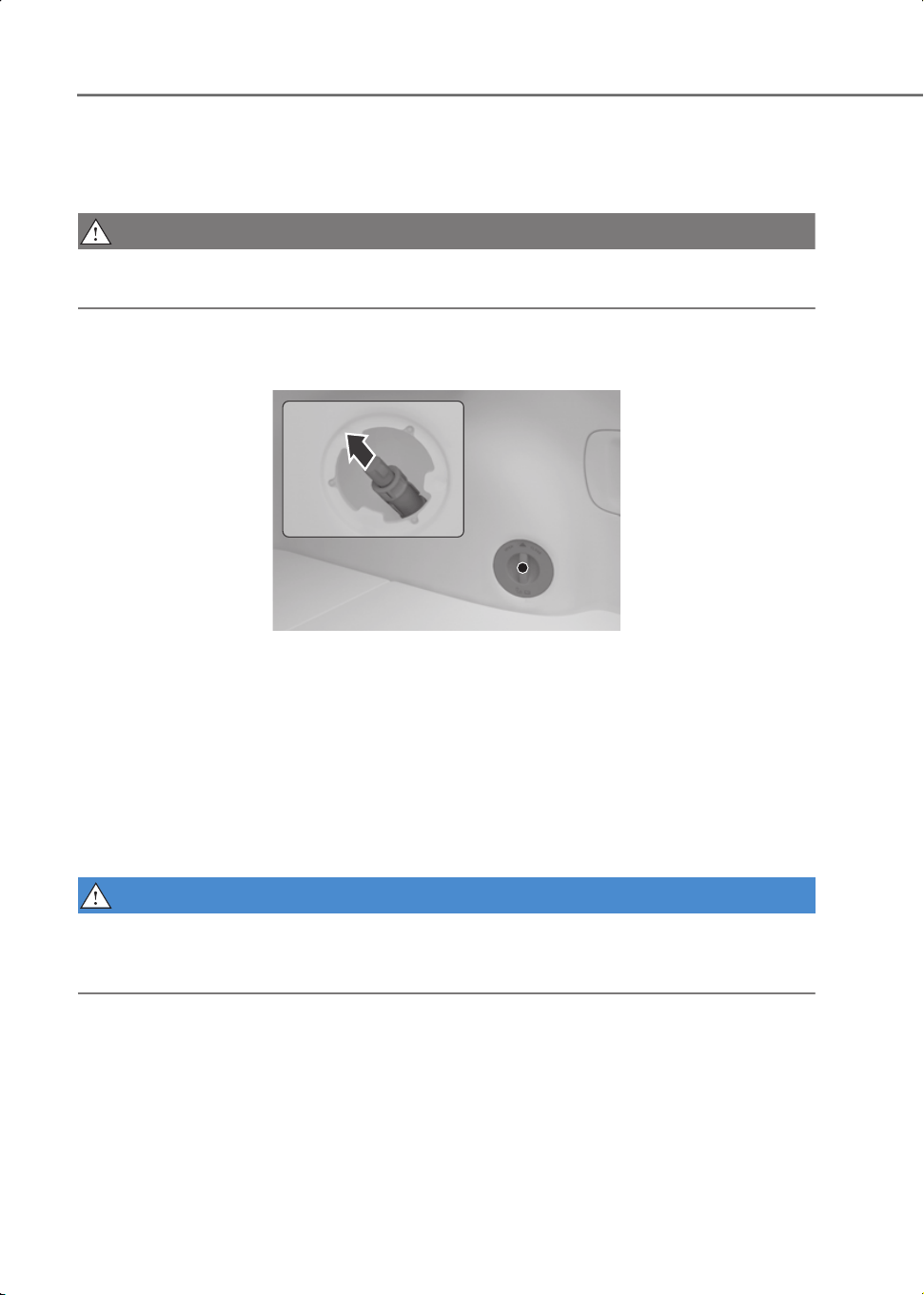
If the charging door does not open due to battery being fully discharged or a wiring
failure, open the trunk and pull the emergency cable on the trunk’s right wall.
B0000904
• If the unlock button still does not operate after pulling the emergency cable, have the
vehicle inspected by an authorized HYUNDAI dealer.
Using an AC Charger
AC charging is the most common charging method for electric vehicles. Charge your
electric vehicle using an AC charging cable installed in public charging stations or at your
professionally installed Level 2 AC home charger.
• To find a nearby public charging station, refer to the "Searching for nearby charging
stations" section in this chapter.
WARNING
Before charging the vehicle, carefully read and follow the instructions in “Safety
Precautions for Charging Your Electric Vehicle” to prevent property damage or injury due
to electric shock, fire, explosion, etc.
CE_USA.book Page 22
1
1-23
CAUTION
To prevent property damage or injury due to fire or explosion, follow the instructions
below.
• Only use the genuine AC charging cable provided by the manufacturer (if equipped).
• Try to avoid using an extension cord, but if you must use to reach a 120 V outlet, ensure
it is a medium to heavy duty grounded extension cord rated at 15 A minimum.
• Check the rated voltage and maximum charging current required for charging, and
ensure that the charger power you are using meets the requirements.
• Immediately stop charging if you discover abnormal conditions, such as odor or
smoke.
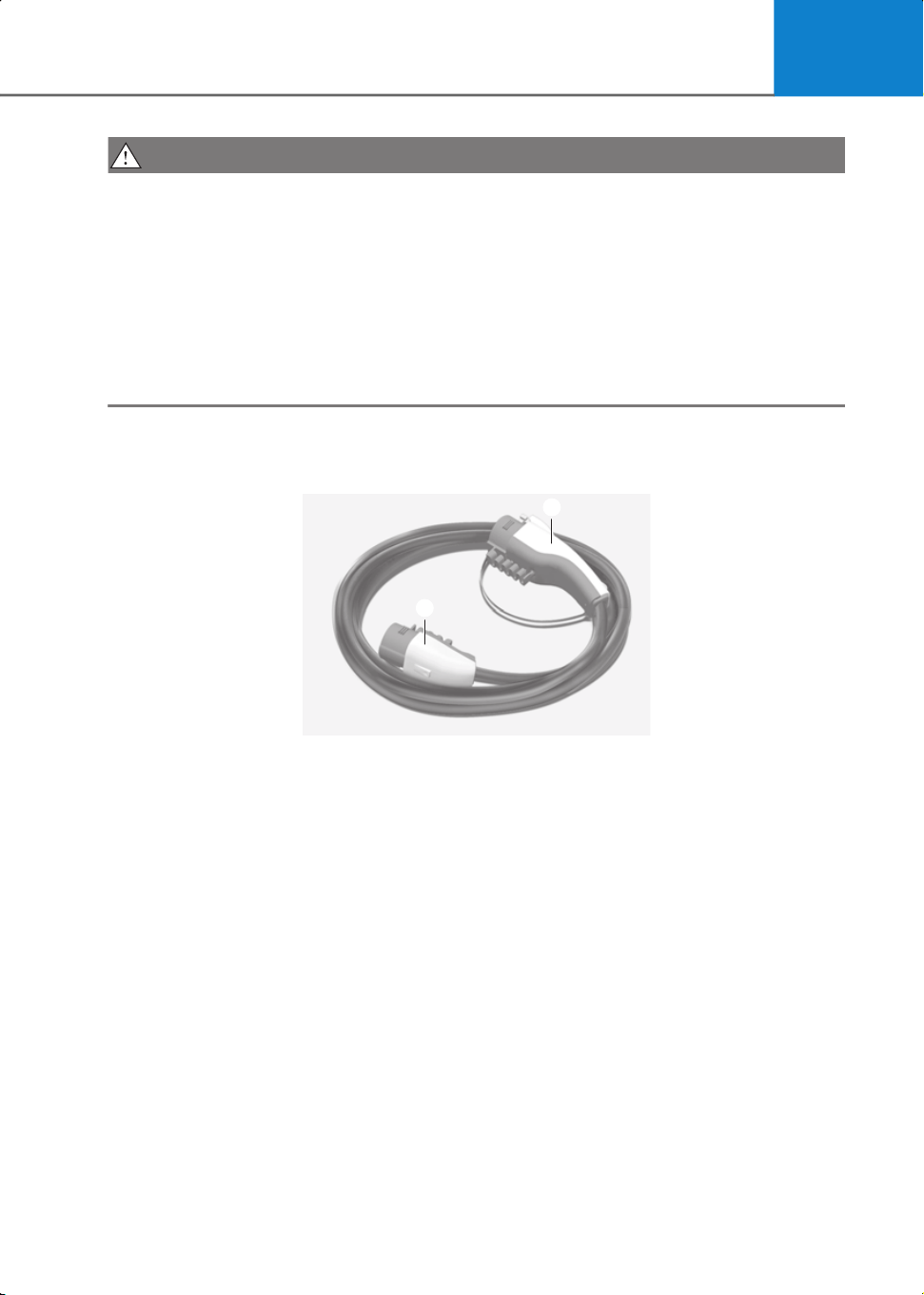
Understanding the AC charging cable
The exterior and configuration of the AC charging cable are as follows:
B0001001
(1) Charging connector (Vehicle side)
(2) Charging plug (Charger side)
Charging with an AC charger
Follow the instructions below to charge the vehicle with an AC charger.
1. With the vehicle started, apply the Electronic Parking Brake (EPB) while pressing the
brake pedal.
2. Turn all switches off, shift to P (Park), and stop the vehicle.
3. With the vehicle door unlocked, press the open indicator on the charging door to open
the charging door.
4. Open the charging inlet cover and check the charging connector and charging inlet for
dust or other contaminants
• If there is any dirt or contaminants, remove it using the air gun.
1
2
CE_USA.book Page 23
Introduction/Getting started with Your Electric Vehicle
1-24
WARNING
Do not touch the charging connector of the charging cable or the charging inlet on the
vehicle.
5. Remove the charging connector protection cap of the AC charging cable, hold the
charging connector handle, and connect it to the AC charging inlet on the vehicle. Push
it until you hear a click.
6.[If using separately purchased charging cable] Remove the charging plug protection
cap of the AC charging cable, hold the charging plug handle, and connect it to the
electric outlet (120 V) of the AC charger.
• This process is required only when using a separately purchased AC charging cable.
If you use a charging cable installed in an AC charger, a separate charging plug
connection is not required.
• When charging starts, the estimated charging time will be displayed on the
instrument cluster for about one minute.
Information
• If you open the driver’s door while charging, the estimated charging time will also be
displayed on the instrument cluster for about one minute.
• When scheduled charging is set, a message saying "Waiting to charge at scheduled
time" will be displayed.
• When scheduled air conditioner or heater operates while waiting for the scheduled
charging, the estimated charging time will be displayed as “-”.
7. [If using a separately purchased charging cable] When charging is complete, hold the
charging plug handle, disconnect the charging plug from the electric outlet (120 V) of
the AC charger, and close the protection cap of the charging plug.
• This process is required only when using an AC charging cable purchased separately.
If you use a charging cable installed in an AC charger, a separate charging plug
disconnection is not required.
8.Hold the charging connector handle with the unlock button pressed, and pull the
charging connector to disconnect it from the charging inlet.
CAUTION
Do not forcibly disconnect the charging connector without pressing the unlock button
on the charging connector. It may damage the charging connector or the charging
inlet on the vehicle.
9.Close the charging inlet cover and press the charging door to completely close it.
CE_USA.book Page 24
1
1-25
Information
• If the charging connector locking mode is set to Always or While Charging, unlock
the door by pressing the button on the smart key or the button on the driver’s door,
and disconnect the charging connector from the charging inlet.
- For more information, refer to the "Setting charging connector locking mode"
section in this chapter.
• During AC charging, the quality of radio reception may degrade in some areas.
Using a DC Charger
If you need to charge the vehicle in a shorter time, you can charge at high speeds using
a DC charger installed in public charging stations.
• To find a nearby charging station, refer to the "Searching for nearby charging stations"
section in this chapter.
WARNING
Before charging the vehicle, carefully read and follow the instructions in “Setting
charging connector locking mode” to prevent property damage or injury due to electric
shock, fire, explosion, etc.
CAUTION
Battery performance and life may deteriorate if the DC charger is used constantly. Use
AC charging unless DC charging is necessary.
CE_USA.book Page 25
Introduction/Getting started with Your Electric Vehicle
1-26
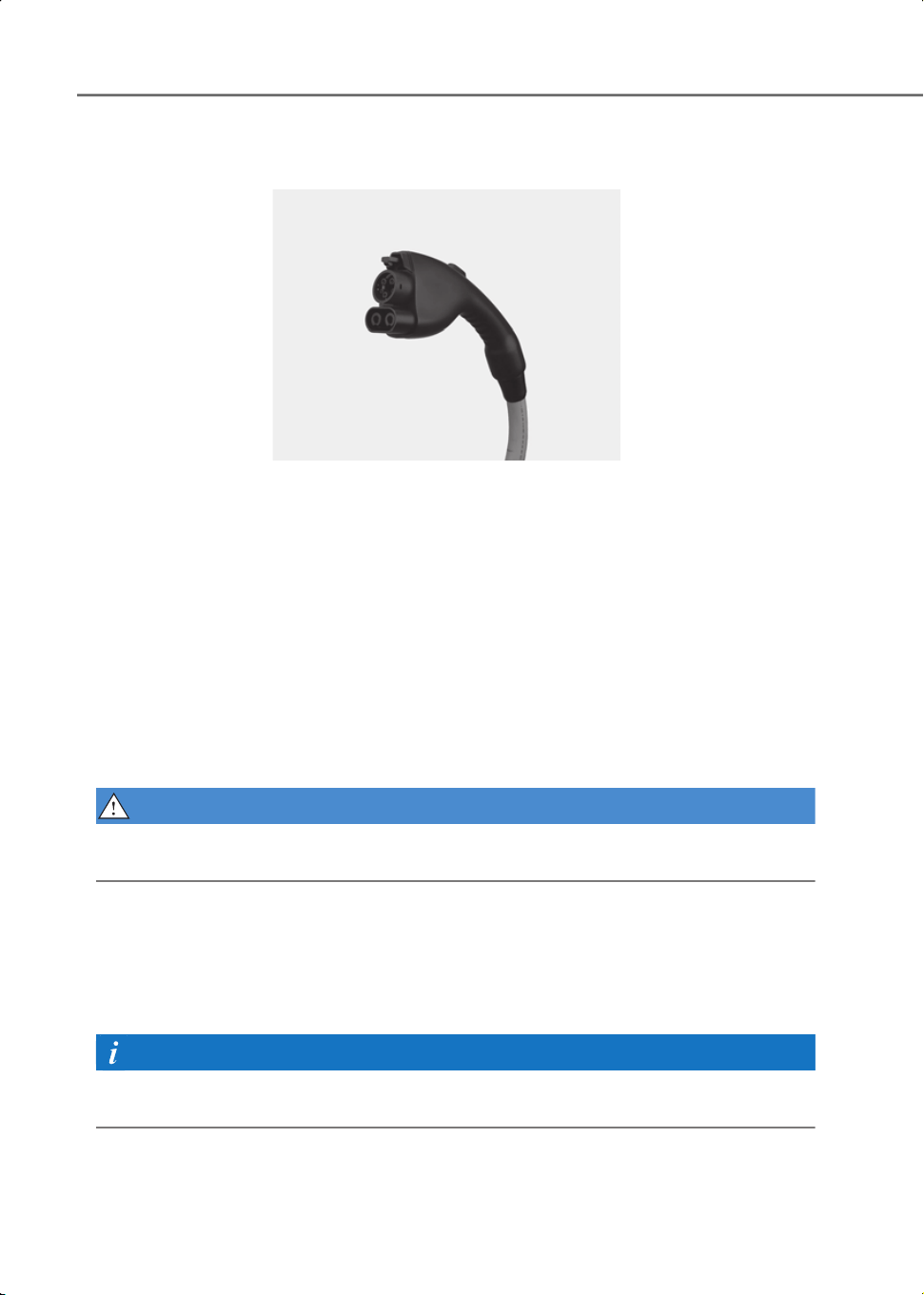
Understanding the DC charging connector
The exterior of the DC charging cable is as follows:
B0001101
(1) DC charging connector (Vehicle side)
Charging with a DC charger
Follow the instructions below to charge the vehicle with a DC charger.
1. With the vehicle started, apply the Electronic Parking Brake (EPB) while pressing the
brake pedal.
2. Turn all switches off, shift to P (Park), and stop the vehicle.
3. With the vehicle door unlocked, press the open indicator on the charging door to open
the charging door.
4. Open the charging inlet cover and check the charging connector and charging inlet for
dust or other contaminants.
• If there is any dirt or contaminants, remove it using the air gun.
WARNING
Do not touch the interior of the charging connector of the charging cable or the
charging inlet on the vehicle.
5. Remove the charging connector protection cap of the DC charging cable, hold the
charging connector handle, and connect it to the DC charging inlet on the vehicle. Push
it until you hear a click.
• When charging starts, the estimated charging time will be displayed on the
instrument cluster for a minute.
Information
If you open the driver’s door while charging, the estimated charging time will also be
displayed on the instrument cluster for a minute.
CE_USA.book Page 26
1
1-27
6.When charging is complete, hold the charging connector handle with the unlock
button pressed and pull on the charging connector to disconnect it from the charging
inlet.
• Depending on the DC charger types, some DC chargers may not have a charger
connector unlock button so it may be necessary to stop at the DC charger control
panel or by charger company's app.
CAUTION
Before disconnecting the charging connector, check if there is an unlock button on the
connector handle. If the connector handle is equipped with an unlock button, forcibly
disconnecting the connector without pressing the button may damage the charging
connector or charging inlet on the vehicle.
NOTICE
• For more information, refer to the “Setting charging connector locking mode”
section in this chapter.
7. Close the charging inlet cover.
8.Press the charging door to completely close it.
Using a Portable Charger (ICCB)
If the vehicle cannot be moved to a public charging station, you can charge the vehicle
using a separately purchased In-Cable Control Box (ICCB) in places where general power
(AC 120 V) is supplied.
WARNING
Before charging the vehicle, carefully read and follow the instructions in “Setting
charging connector locking mode” to prevent property damage or injury due to electric
shock, fire, explosion, etc.
CAUTION
To prevent property damage or injury due to fire or explosion, follow the instructions
below.
• Only use a genuine HYUNDAI portable charger (if equipped).
• Do not let children operate or touch the portable charger. Doing so may lead to
unexpected accidents.
• Try to avoid using an extension cord, but if you must use to reach a 120 V outlet, ensure
it is a medium to heavy duty grounded extension cord rated at 15 A minimum.
• The charger power you are using must comply with regulations and safely
accommodate the Voltage, Current (Amps), and Power (Watts) ratings. If not, the
vehicle may not be charged or safety hazards, such as fire, may occur.
CE_USA.book Page 27
Introduction/Getting started with Your Electric Vehicle
1-28
• If the power distributor exceeds its capacity while charging the vehicle with a portable
charger at home, the power to the home may be cut off or a fire may occur.
• Immediately stop charging if you discover abnormal conditions, such as odor or
smoke.
• Use a portable charger only in emergencies, and do not use it to fully charge the
battery.
• If you charge the vehicle with household electricity, you will be charged electricity bill
according to the home rate system, not the electric vehicle rate system.
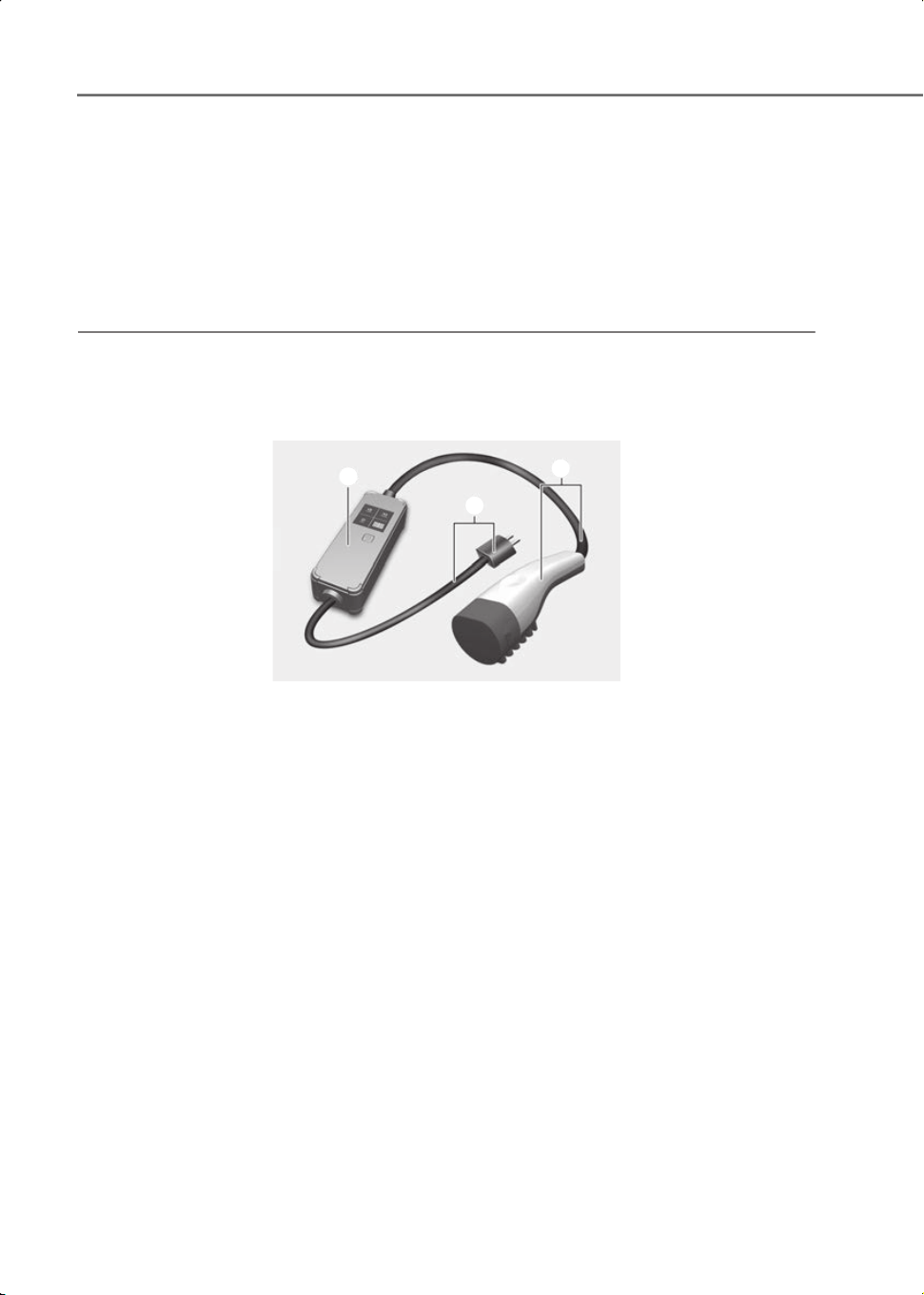
Understanding portable chargers
The configuration of a portable charger and the display of the operation indicator are as
follows:
B0001201
(1) Control box
(2) Power plug and cord (cord set)
(3) Charging cable and charging connector
1
2
3
CE_USA.book Page 28
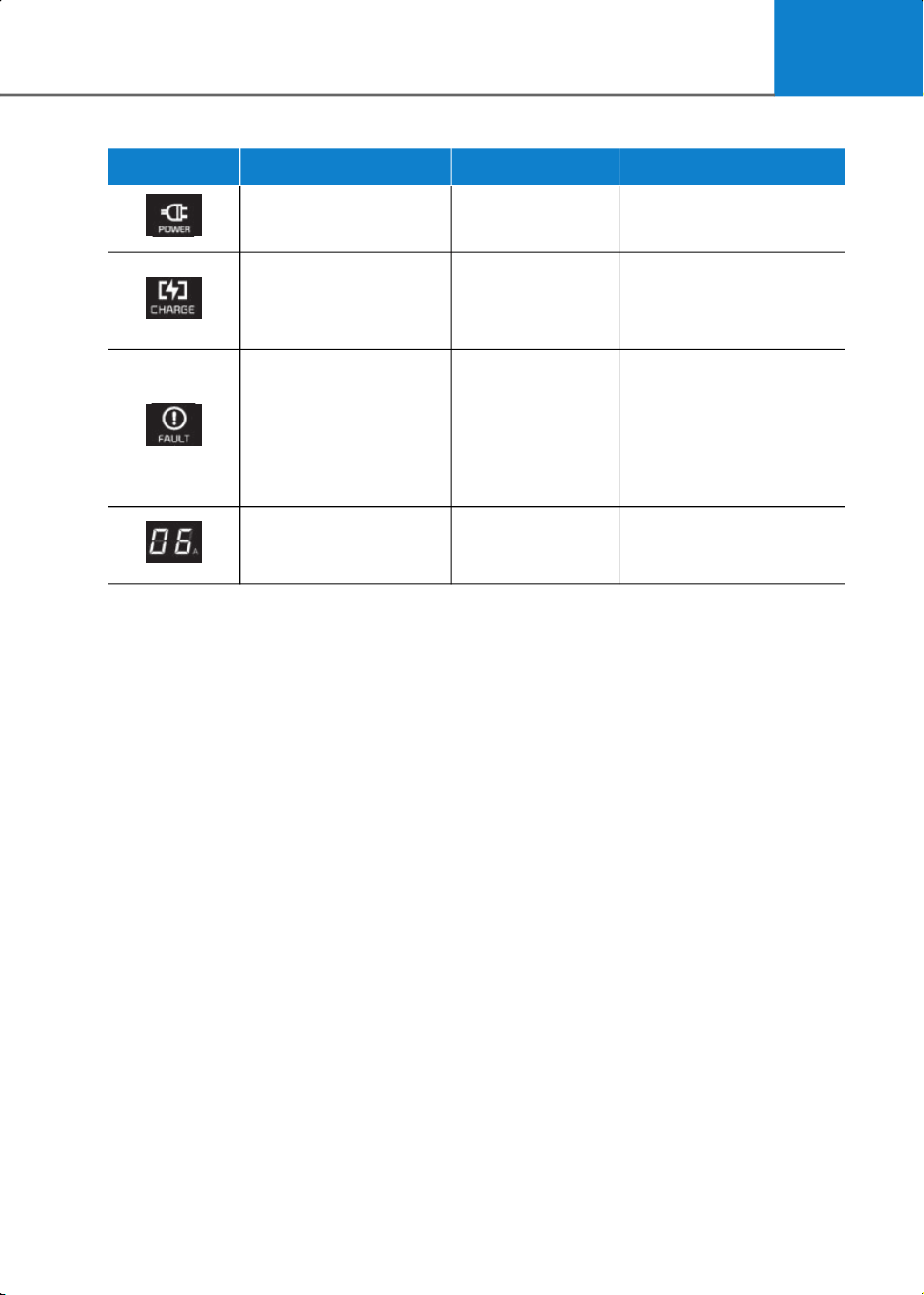
1
1-29
Icon Name Color Description
POWER Green
Turns on when the power
is on.
CHARGE Blue
Turns on while charging
and blinks when current is
limited (Forcibly switched
to 6 A).
FAULT Red
Blinks when a leakage
current, communication
error, or overcurrent error
occurs, or when the
high-temperature
protection inside the plug
and charger is activated.
CHARGE LEVEL -
Displays the present
charging current setting
(6 A, 8 A, 10 A, or 12 A).
CE_USA.book Page 29
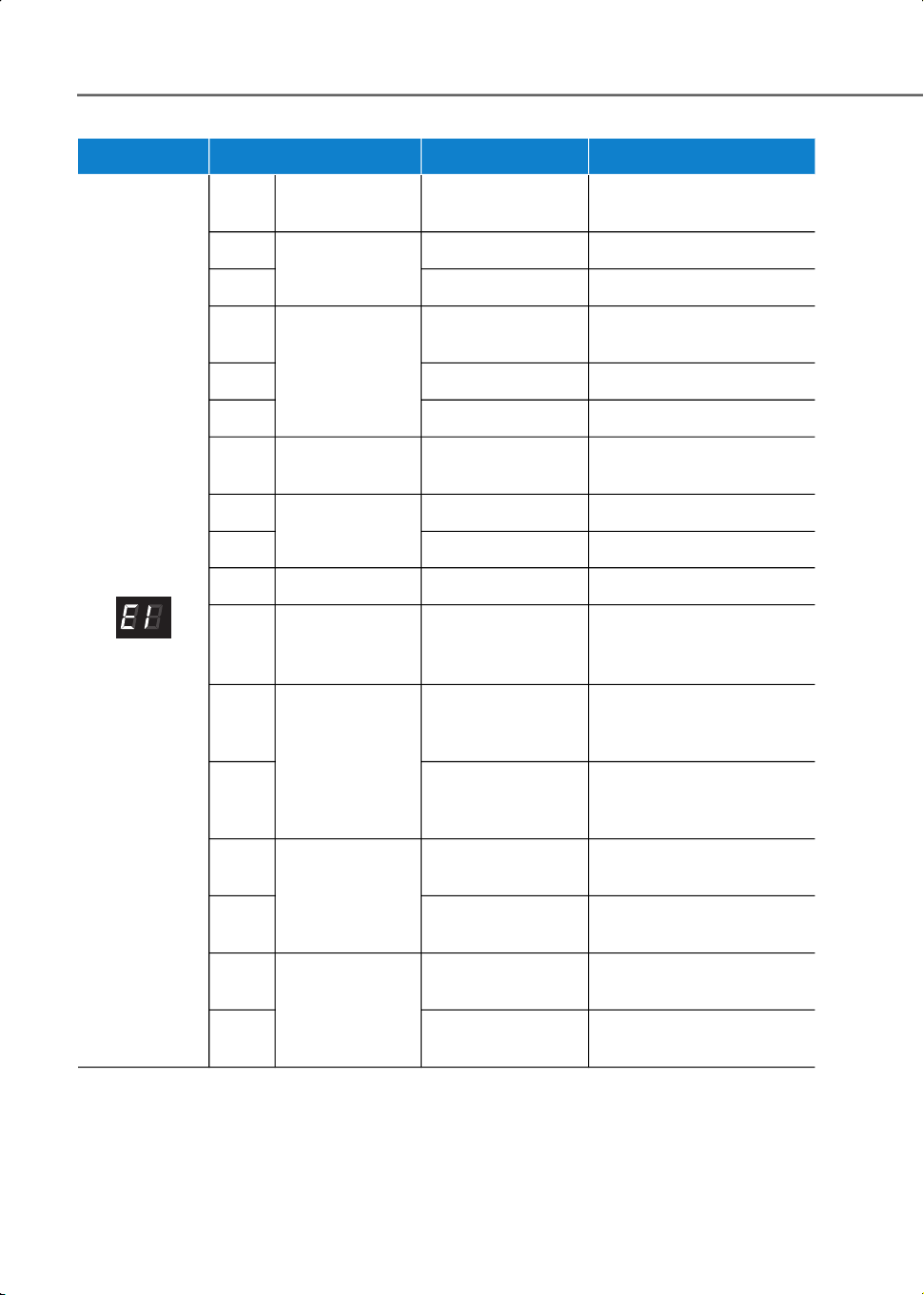
Introduction/Getting started with Your Electric Vehicle
1-30
E1
Control pilot
communication
-
Vehicle communication
error
E2
Leakage
- Current leakage
E3 - Charger error
E4
Plug
temperature
-
Plug overtemperature
warning
E5 - Plug temperature failure
E6 - Charger error
E7 Overcurrent -
Charging overcurrent
warning
E8
Internal
temperature
- Charger overheating
E9 - Charger error
F1 Relay fusion - Charger error
F2
Ground
Monitoring/
Interrupt
- Poor grounding of outlet
F3
Switched mode
power supply
power failure
-
Switched mode power
supply error (voltage
failure)
F4 -
Switched mode power
supply error (abnormal
voltage)
F5
Control Pilot
voltage error
-
Control Pilot (-) voltage
error
F6 -
Control Pilot (+) voltage
error
F7
Temperature
sensor error
-
Plug temperature sensor
error
F8 -
PCB internal temperature
sensor error
Icon Name Color Description
A
CE_USA.book Page 30
1
1-31
• If an error occurs, you can reset the portable charger by disconnecting and
reconnecting the power plug, and then pressing the button on the control box for more
than two seconds.
• If the same symptom repeats after resetting the portable charger, have the vehicle
inspected by an authorized HYUNDAI dealer.
• If there is no status change for more than one minute, the portable charger will be
switched to power saving mode, and the display light will be turned off.
Charging with a portable charger
Follow the instructions below to charge the vehicle with a portable charger.
1. Connect the power plug of the portable charger to the electrical outlet at tour home.
• The power indicator light on the control box will turn green.
2. Set the charging current by pressing the button on the back of the control box for more
than two seconds until the number on the charging current indicator blinks.
NOTICE
An example of a portable charger charging current setting suitable for the rated current
of the power supplied is as follows. However, the appropriate charging current may
vary depending on the environment, such as the power usage inside the building.
• The charging current is changed each time the button is pressed, in the order of "6 A
- 8 A - 10 A - 12 A."
• If 10 seconds have passed without pressing any button, the blinking will stop and the
charging current will be finished.
3. With the vehicle started, apply the Electronic Parking Brake (EPB) while pressing the
brake pedal.
4. Turn all switches off, shift to P (Park), and stop the vehicle.
5. With the vehicle door unlocked, press the open indicator on the charging door to open
the charging door.
6.Open the charging inlet cover and check the charging connector and charging inlet for
dust or other contaminants.
• If there is any dirt or contaminants, remove it using the air gun.
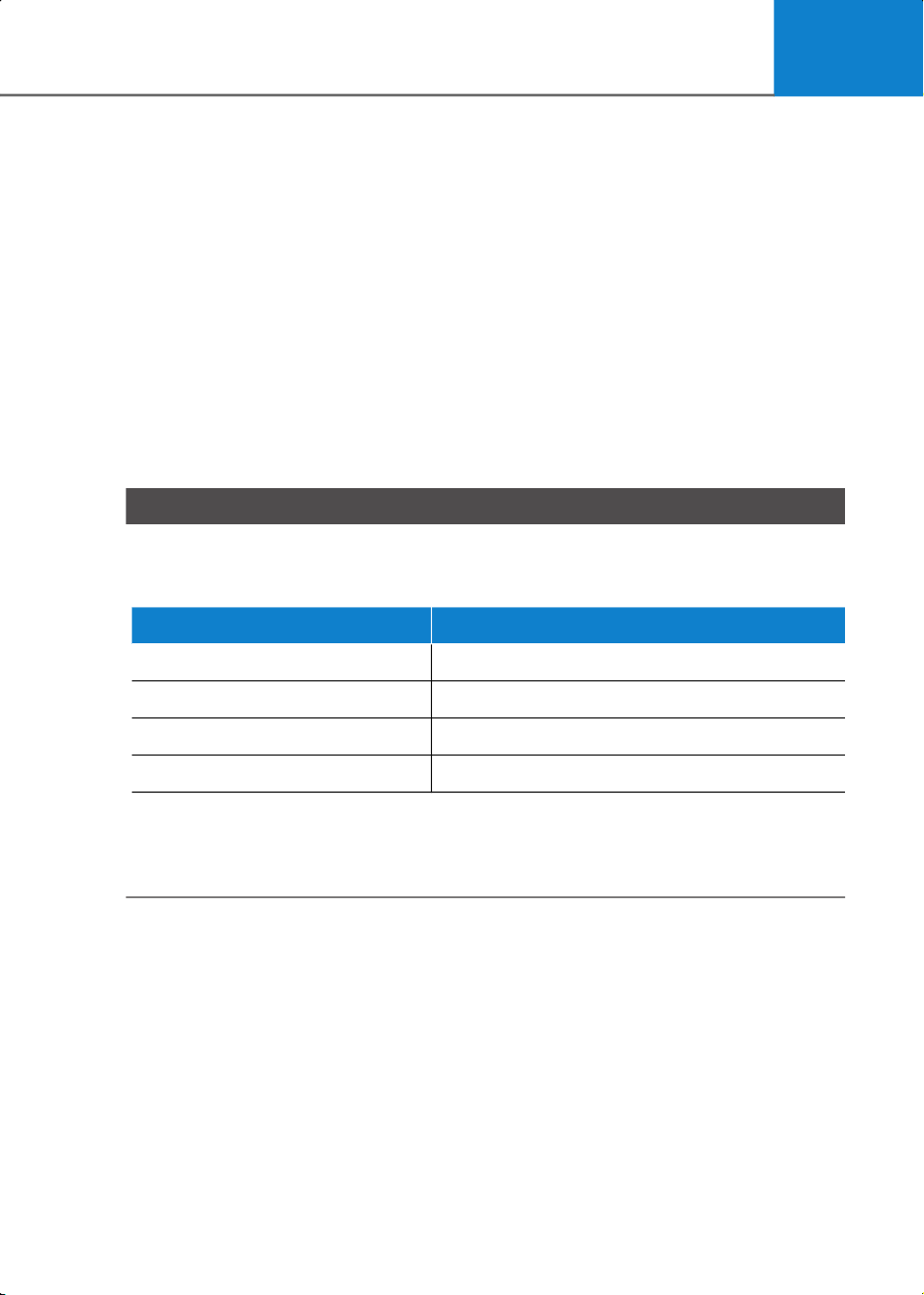
Outlet Current ICCB Charge level
14-16 A 12 A
12-13 A 10 A
10-11 A 8 A
8-9 A 6 A
CE_USA.book Page 31
Introduction/Getting started with Your Electric Vehicle
1-32
WARNING
Do not touch interior of the charging connector of the charging cable or the charging
inlet of the vehicle.
7. Remove the charging connector protection cap of the portable charging cable, hold
the charging connector handle, and connect it to the AC charging inlet of the vehicle.
Push it until you hear a click.
• When charging starts, the estimated charging time will be displayed on the
instrument cluster for about one minute.
Information
• If you open the driver’s door while charging, the estimated charging time will also be
displayed on the instrument cluster for about one minute.
• When scheduled charging is set, a message saying “Waiting to charge at scheduled
time” will be displayed.
• When scheduled air conditioner or heater operates while waiting for the scheduled
charging, the estimated charging time will be displayed as ‘-’.
8.When charging is complete, hold the charging connector handle with the unlock
button pressed and pull on the charging connector to disconnect it from the charging
inlet.
Information
If you have set the charging connector locking mode as Alwaysor While Charging,
unlock the door by pressing the button on the smart key or the button on the driver’s
door, and disconnect the charging connector from the charging inlet.
• For more information, refer to the “Setting charging connector locking mode”
section in this chapter.
9.Close the charging inlet cover.
10.Press the charging door to completely close it.
CE_USA.book Page 32

1
1-33
Using the scheduled charging function
The scheduled charging function allows you to charge your vehicle using low cost, late
night power until the next departure time.
Information
You can use the scheduled charging function only when using an AC charger or the
portable charger (ICCB: In-Cable Control Box). For more information about connecting
an AC charger and portable charger, refer to the “Using an AC Charger”and “Using a
Portable Charger (ICCB)” section in this chapter.
On the infotainment system, select EV > Scheduled Charging and Climate > Scheduled
Charging, set the date and time of when to charge the battery, and select an option.
• For more information, refer to the “Setting Scheduled Charging and Climate” section
in this chapter.
• When scheduled charging is set and the AC charger or the portable charger (ICCB) is
connected for charging, the indicator light gradually illuminates for three minutes to
indicate that scheduled charging is set.
• When scheduled charging is set, charging is not started immediately when the AC
charger or portable charger (ICCB) is connected. To charge the vehicle immediately,
select EV > Scheduled Charging and Climate > Scheduled Charging on the screen and
deactivate the scheduled charge setting.
Information
• You can set up or cancel scheduled charging using the HYUNDAI BlueLink app on your
smartphone. For more information, refer to the user's manual provided in the
infotainment system and the quick reference guide.
• Charging may start immediately after a charger is connected to the vehicle, depending
on the charging time calculated when setting up the scheduled charging.
CE_USA.book Page 33
Introduction/Getting started with Your Electric Vehicle
1-34
Using EV Mode Functions
EV mode provides driving information and high voltage battery information. You can set
various electric vehicle functions in EV mode.
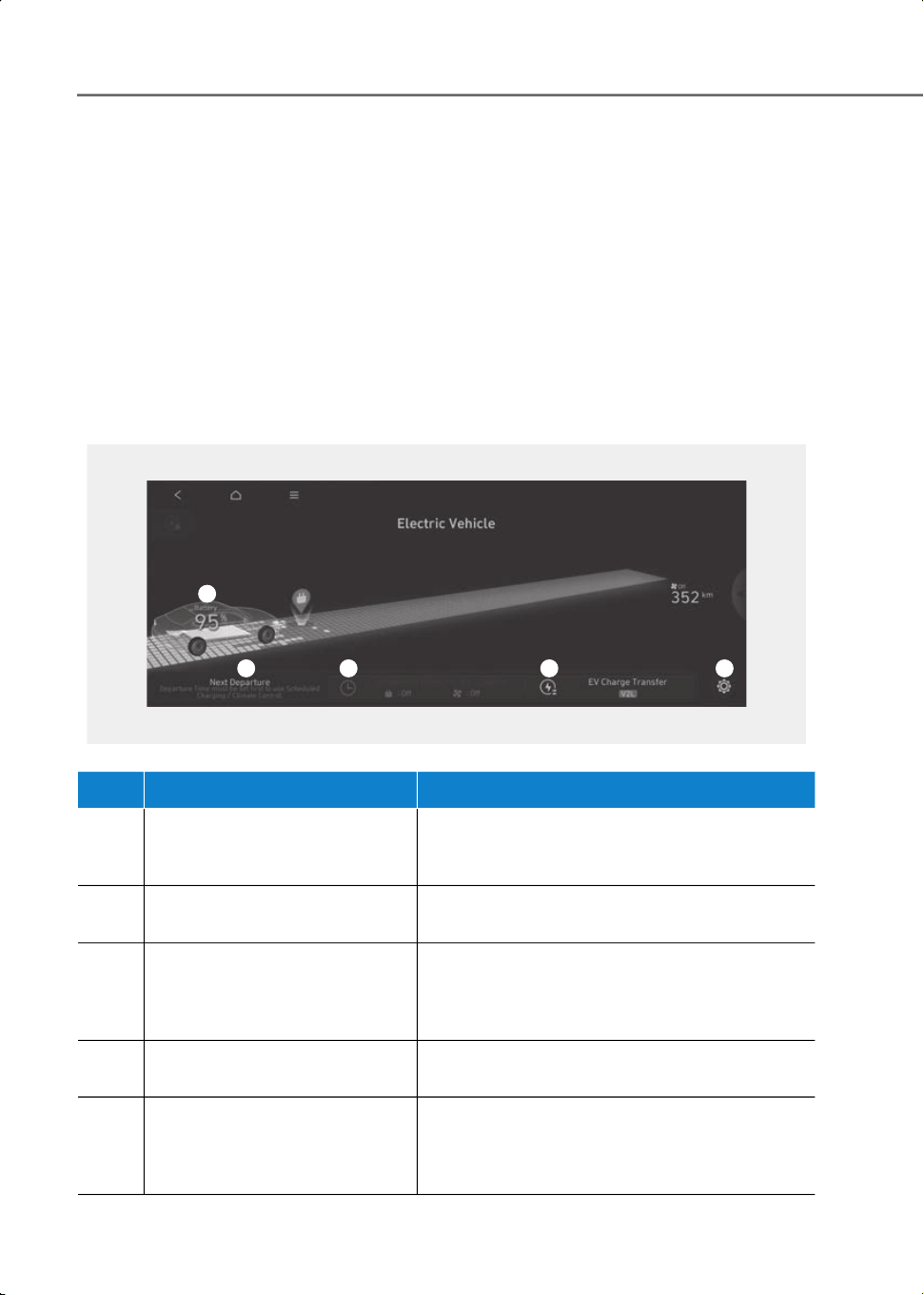
Checking the EV Mode Screen Configuration
Follow the instruction below to enter EV mode and check the screen configuration.
1. On the infotainment system, swipe the Home screen to the left to display the All menus
screen.
2. On the All menus screen, select EV.
• The EV mode screen appears.
The details of the EV mode screen is as follows:
A0001601
No. Name Description
(1) Energy information
You can check the distance to empty, total
battery power remaining, and expected
charging time for each charge type.
(2) Next departure time
You can set anticipated departure time for
scheduled charging and target temperature.
(3)
Scheduled charging and climate
control
You can set the date and time of when to charge
the battery and the climate control
temperature. Also, you may select the time to
start charging using the off-peak time setting.
(4) Vehicle to Load (V2L) setting
You can set the battery discharging limit (%) for
the high voltage battery for driving.
(5) EV setting
You can set various electric vehicle specialized
functions. For more information, refer to the
“Setting Electric Vehicle Specialized Functions”
section in this chapter.
1
2 3 4 5
CE_USA.book Page 34
1
1-35
Checking Energy Information
Check the distance to empty, State of Charge (SOC), and expected charging time and
charge the vehicle if necessary.
• For more information about charging the vehicle, refer to the “Charging Your Electric
Vehicle” section in this chapter.
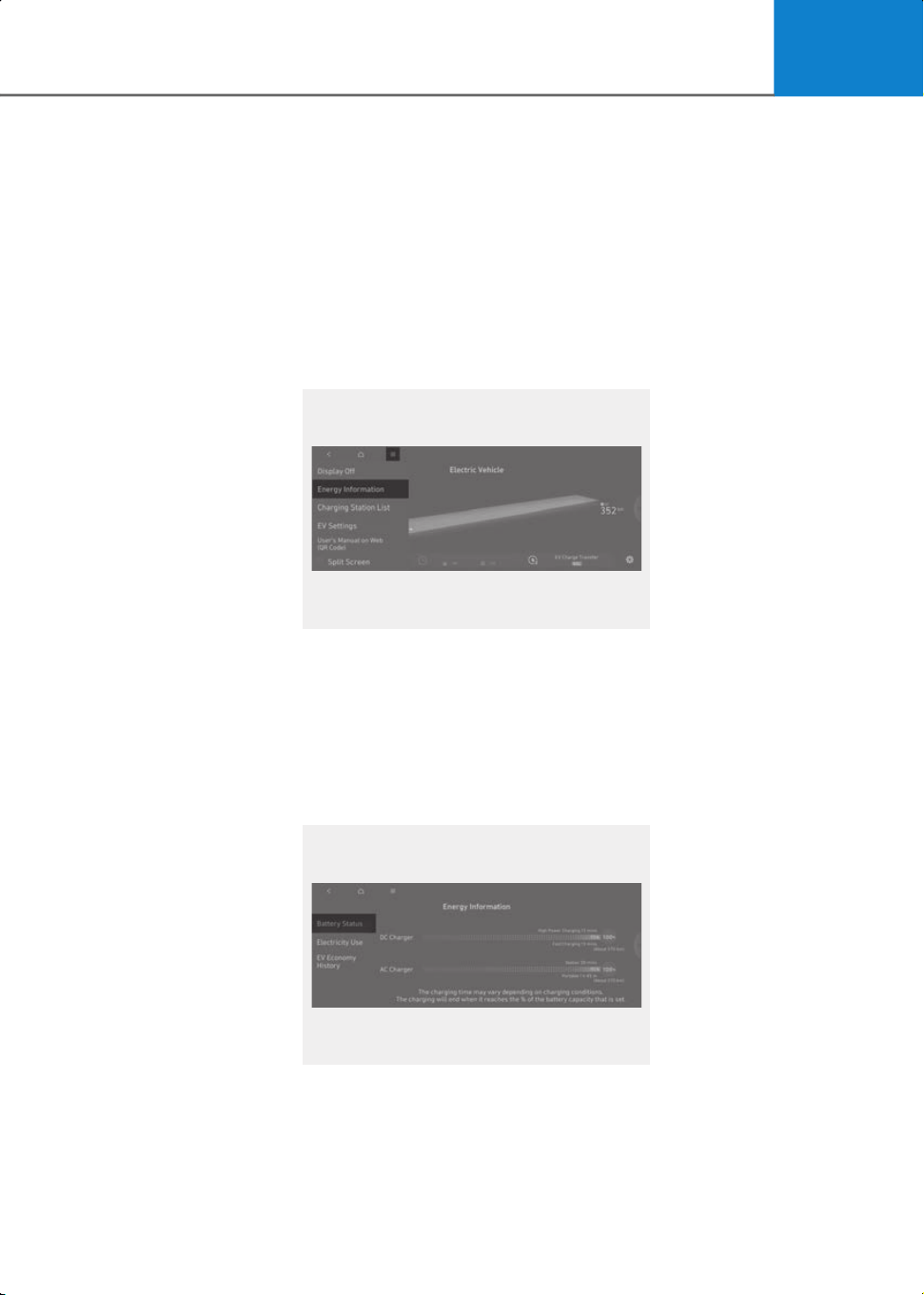
1. On the infotainment system, swipe the Home screen to the left to display the All menus
screen.
2. On the All menus screen, select EV and select the vehicle image.
3. On the Energy Information screen, select each item to check the vehicle energy
information.
B0001701
Checking the battery status
On the Energy Information screen, select Battery Status.
• You can check the current charge level, expected distance to empty, and charging
time for each charge type.
• For more information about setting target battery charge level, refer to the “Setting the
target battery charge level” section in this chapter.
B0001702
CE_USA.book Page 35
Introduction/Getting started with Your Electric Vehicle
1-36
Information
• The distance to empty is calculated based on the electric energy economy history and
outside temperature while driving. The distance may change if the driving pattern
changes.
• The distance to empty may vary depending on the change of the driving pattern even
if the same target battery charge level is set.
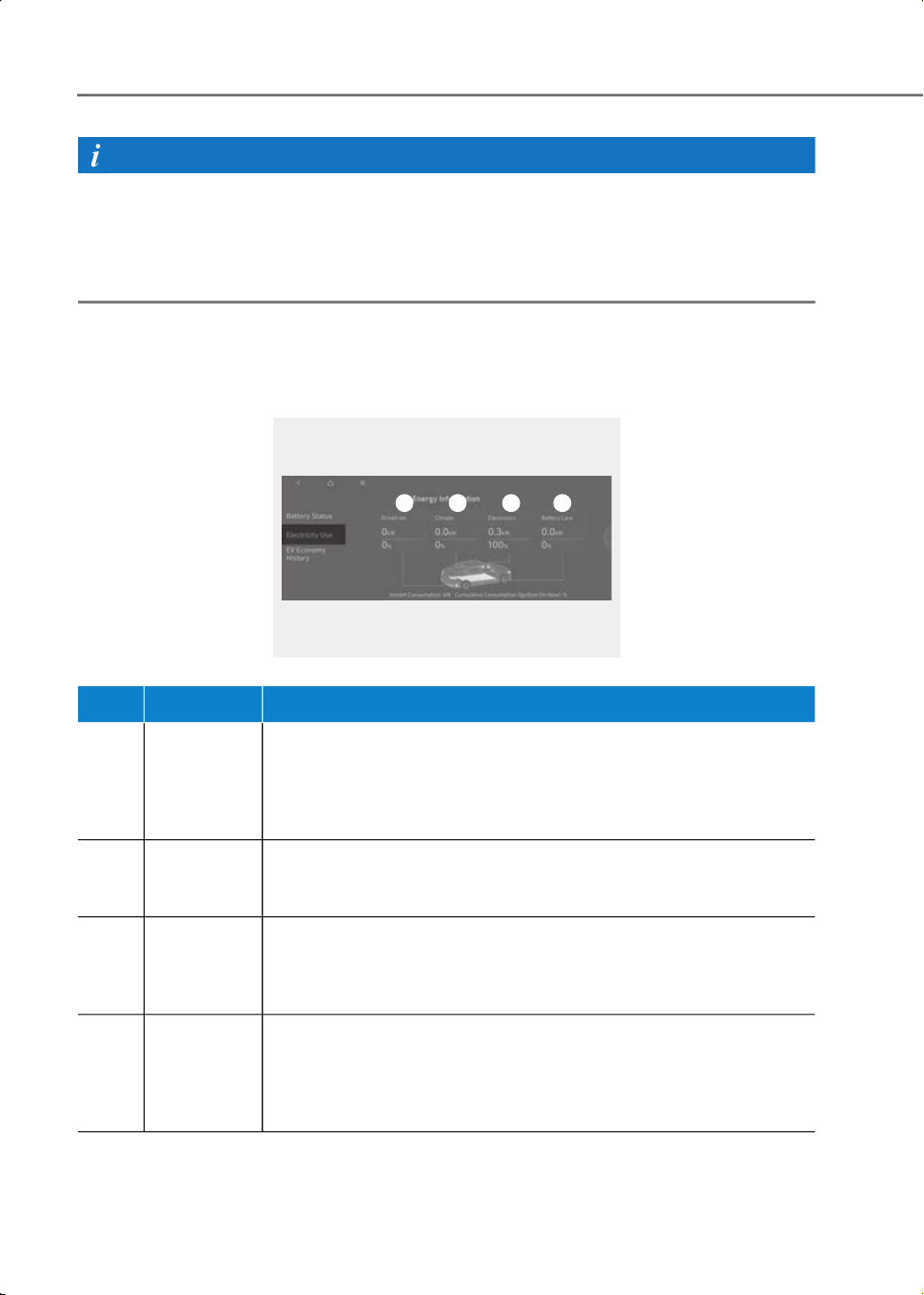
Checking electricity use
On the Energy Information screen, select Electricity Use.
• You can check the current energy consumption for each vehicle system.
B0001703
No. Name Description
(1) Electronics
Shows the power and energy consumption used by the vehicle
system, including the instrument cluster, infotainment system
(speaker and navigation), headlight, vehicle control unit, etc., and
the percentage of the power vehicle system used in total power
used since starting the vehicle.
(2) Climate
Shows the power and energy consumption used by the air
conditioner or heater and the percentage of the power climate
system used in total power used since starting the vehicle.
(3) Drive train
Shows the percentage of instantaneous and regenerative energy
consumed by the motor to drive the vehicle and the percentage of
the power driving system used in total power used since starting
the vehicle.
(4) Battery Care
Shows the momentary power and energy consumption used when
increasing and cooling down the battery temperature to maintain
optimal battery performance and the percentage of battery
temperature control mode (Battery Care mode) used in the total
power used since starting the vehicle.
1 2 3 4
CE_USA.book Page 36

1
1-37
Checking the electric energy economy history
On the Energy Information screen, select EV Electricity History.
• You can check the history of electric energy economy with the date and distance of
previous driving.
B0001704
Setting the Next Departure Time
You can set an anticipated departure time for scheduled charging and target
temperature.
Information
• Scheduled charging and climate will be activated based on the departure time.
• To use scheduled charging and climate function, the vehicle must be connected to the
charger at the scheduled time.
• The scheduled climate function directly uses the power of the connected charger. It
can maintain a pleasant environment and enhance vehicle performance by controlling
the temperature of the vehicle and the battery without using the high voltage battery
power.
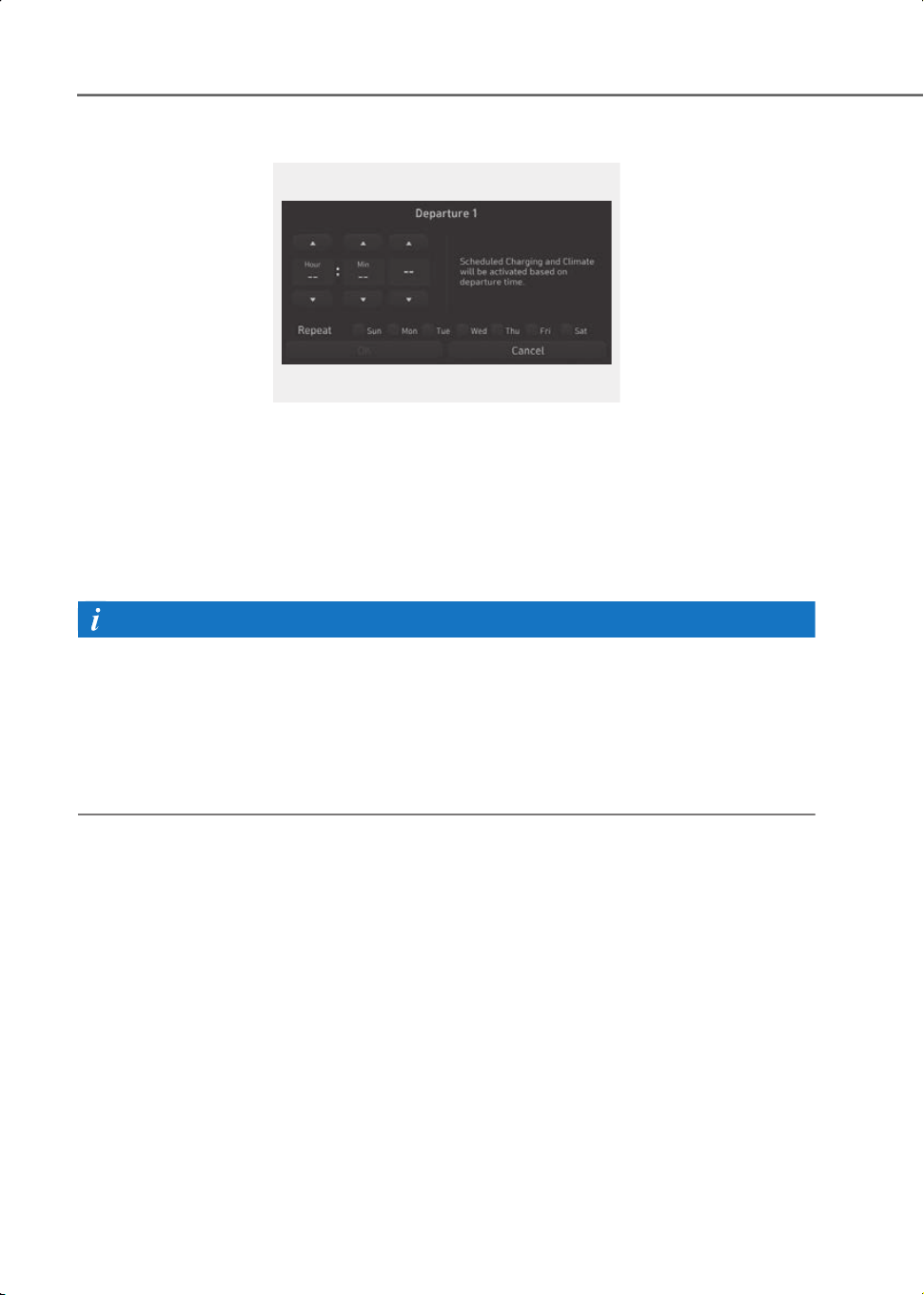
1. On the infotainment system, swipe the Home screen to the left to display the All menus
screen.
2. On the All menus screen, select EV > Next Departure Time.
3. Set the anticipated departure schedule.
B0001801
CE_USA.book Page 37
Introduction/Getting started with Your Electric Vehicle
1-38
4. Set anticipated time the vehicle will departure after charging.
B0001802
5. At Repeat option, select the day of the week to activate scheduled charging and target
temperature for the departure time.
Setting Scheduled Charging and Climate
You can set the date and time of when to charge the battery and the climate control
temperature. Also, you may select the time to start charging using the off-peak time
setting.
Information
• Scheduled charging and climate can be activated based on the departure time.
• To use scheduled charging and climate function, the vehicle must be connected to the
charger at the scheduled time.
• The scheduled climate function directly uses the power of the connected charger. It
can maintain a pleasant environment and enhance vehicle performance by controlling
the temperature of the vehicle and the battery without using the high voltage battery
power.
CE_USA.book Page 38
1
1-39
Setting scheduled charging
Follow the instructions below to set the off-peak time and scheduled charging option.
1. On the infotainment system, swipe the Home screen to the left to display the All menus
screen.
2. On the All menus screen, EV > Scheduled Charging and Climate > Scheduled
Charging.
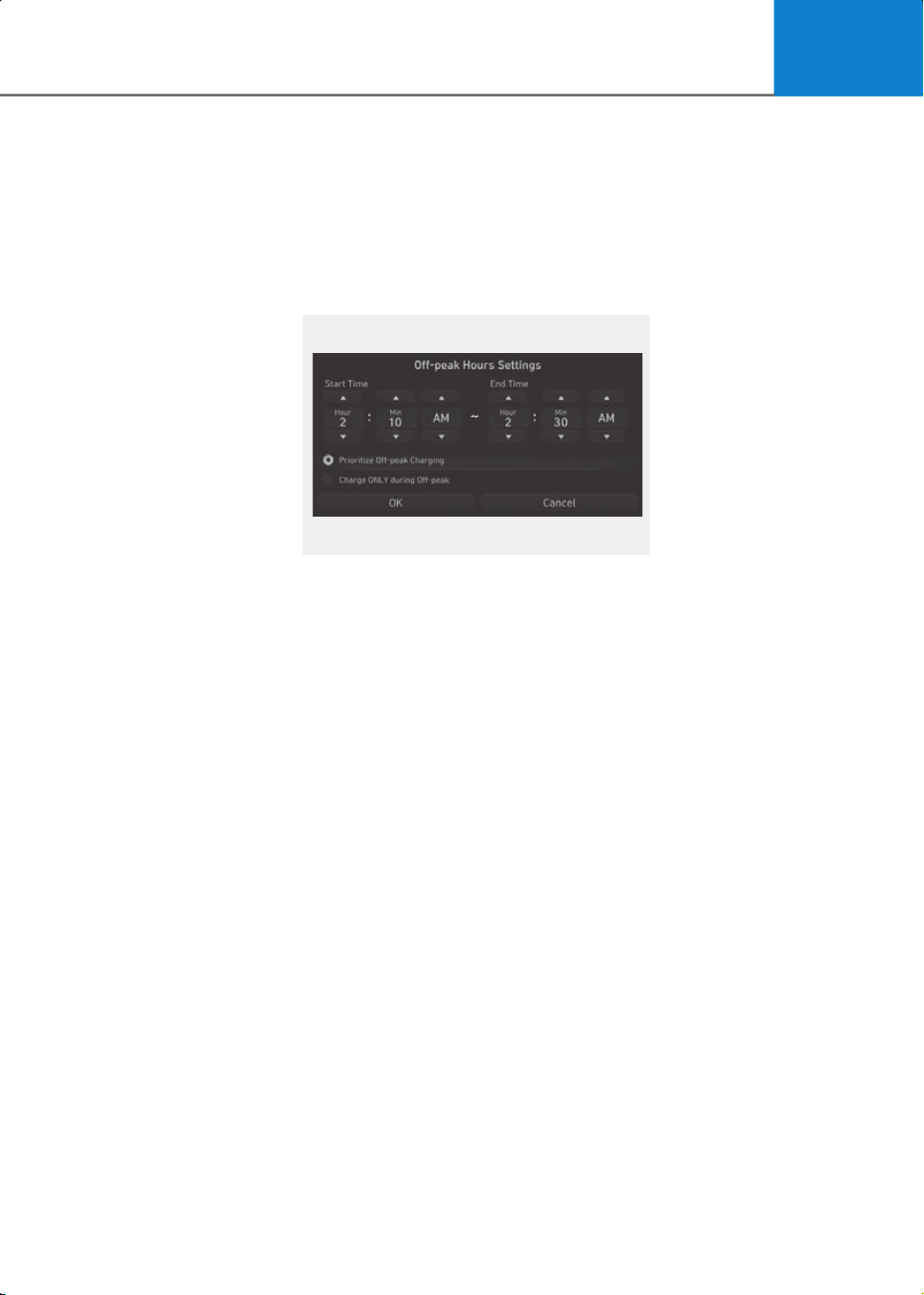
3. Set the off-peak hours at Start Time and End Time.
B0001901
4. Select the charging option.
• Prioritize Off-peak Charging: Charging is activated during the off-peak time. It may
keep on charging past off-peak time to reach the target battery charge level.
• Charge ONLY during Off-peak: Charging is activated only during the off-peak time.
It may not be able to reach the target battery charge level.
• For more information about setting the target battery charge level, refer to the
“Setting the target battery charge level” section in this chapter.
CE_USA.book Page 39
Introduction/Getting started with Your Electric Vehicle
1-40
Setting a scheduled climate
Follow the instructions below to set the scheduled climate control temperature.
1. On the infotainment system, swipe the Home screen to the left to display the All menus
screen.
2. On the All menus screen, select EV > Scheduled Charging and Climate > Scheduled
Charging.
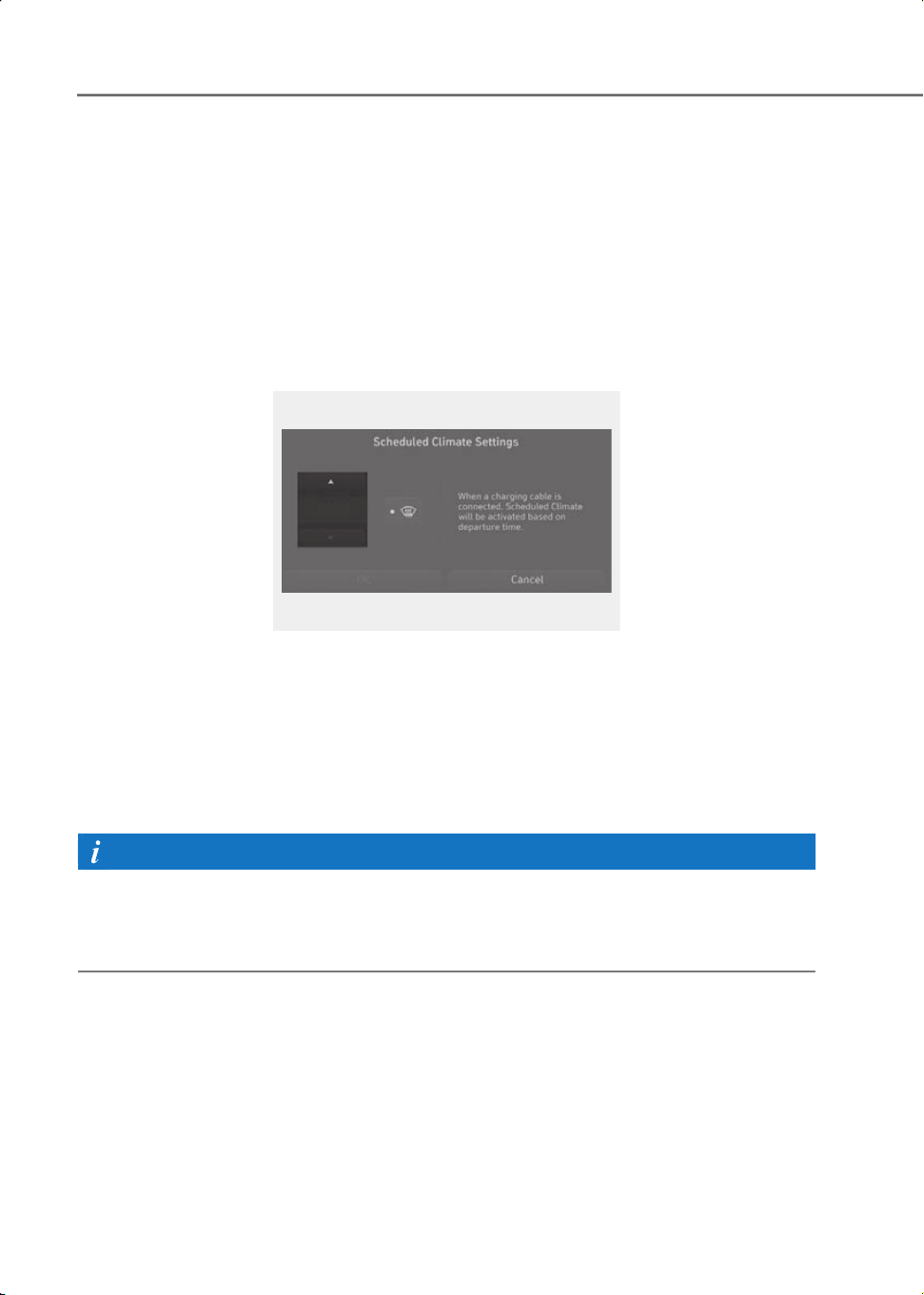
3. Set the desired temperature.
• The air conditioning system is activated at the departure time.
• For more information about setting the departure time, refer to the “Setting the Next
Departure Time” section in this chapter.
B0001902
Setting a Battery Discharging Limit When Using Vehicle to Load
(V2L)
Setting battery discharging limit (%) can prevent the battery from discharging when
operating home appliances or electronic devices using the high voltage battery.
• For more information about V2L function, refer to the “Setting the Next Departure
Time” section in this chapter.
Information
V2L is the system provides AC power using the high voltage battery for driving to operate
several electronic devices. You can operate home appliances and electronic devices, or
charge another electric vehicle in emergency using the charged electricity from the
vehicle’s battery while camping or doing other outdoor activities.
1. On the infotainment system, swipe the Home screen to the left to display the All menus
screen.
2. On the All menus screen, select EV > Electricity Use.
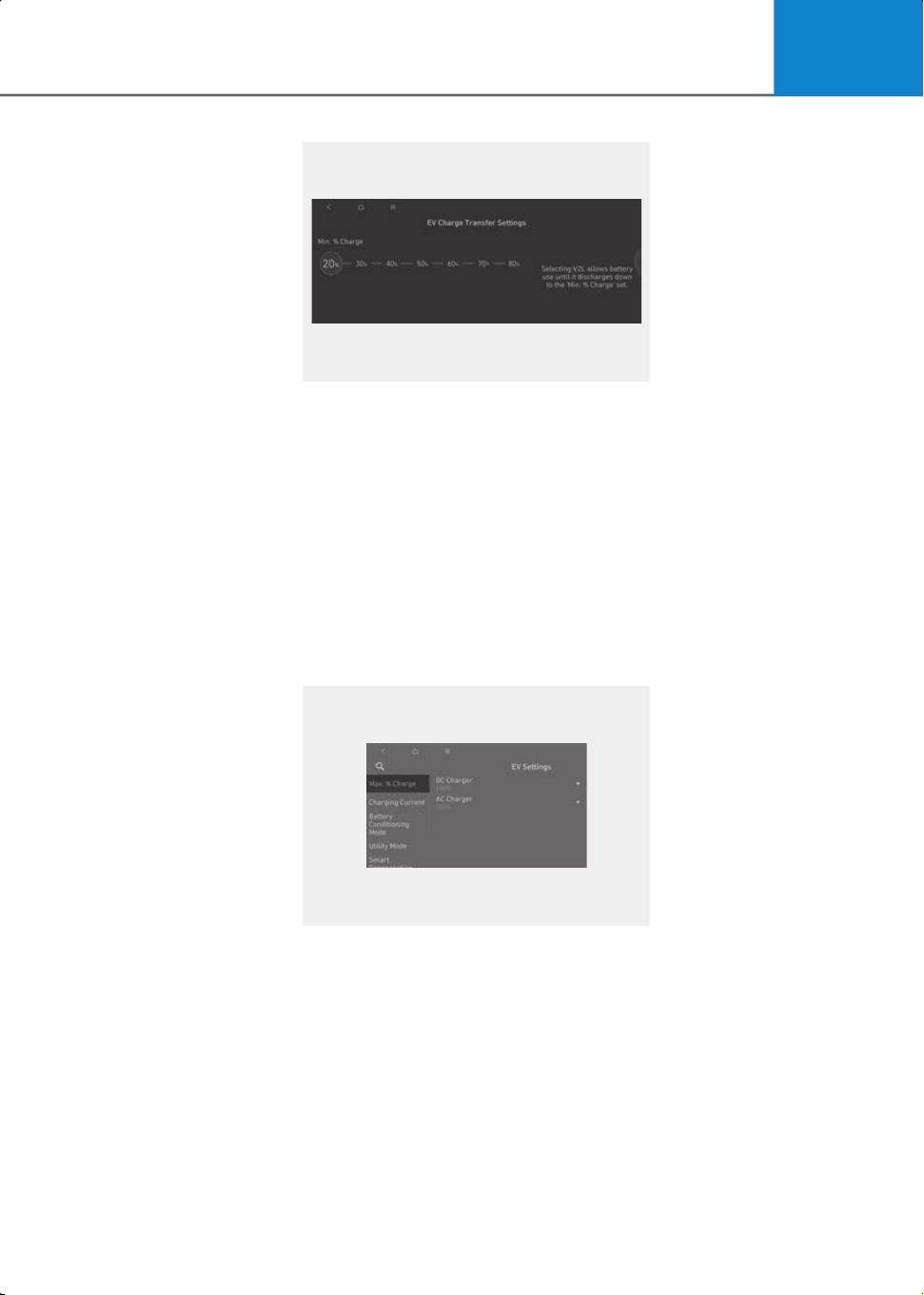
3. Set the desired battery discharging limit (%).
• The battery discharging limit can only be set below the current high voltage battery
level.
• When the high voltage battery level reaches the set battery discharging limit, V2L
function automatically cuts off electrical supply.
10×
CE_USA.book Page 40
1
1-41
B0002001
Setting Electric Vehicle Specialized Functions
You can set various EV specialized functions such as target battery charge level, charging
current, battery conditioning mode, and utility mode from the EV Settings screen.
Setting the target battery charge level
Follow the instructions below to set the target battery charge level when charged with an
AC charger or a DC charger.
1. On the infotainment system, swipe the Home screen to the left to display the All menus
screen.
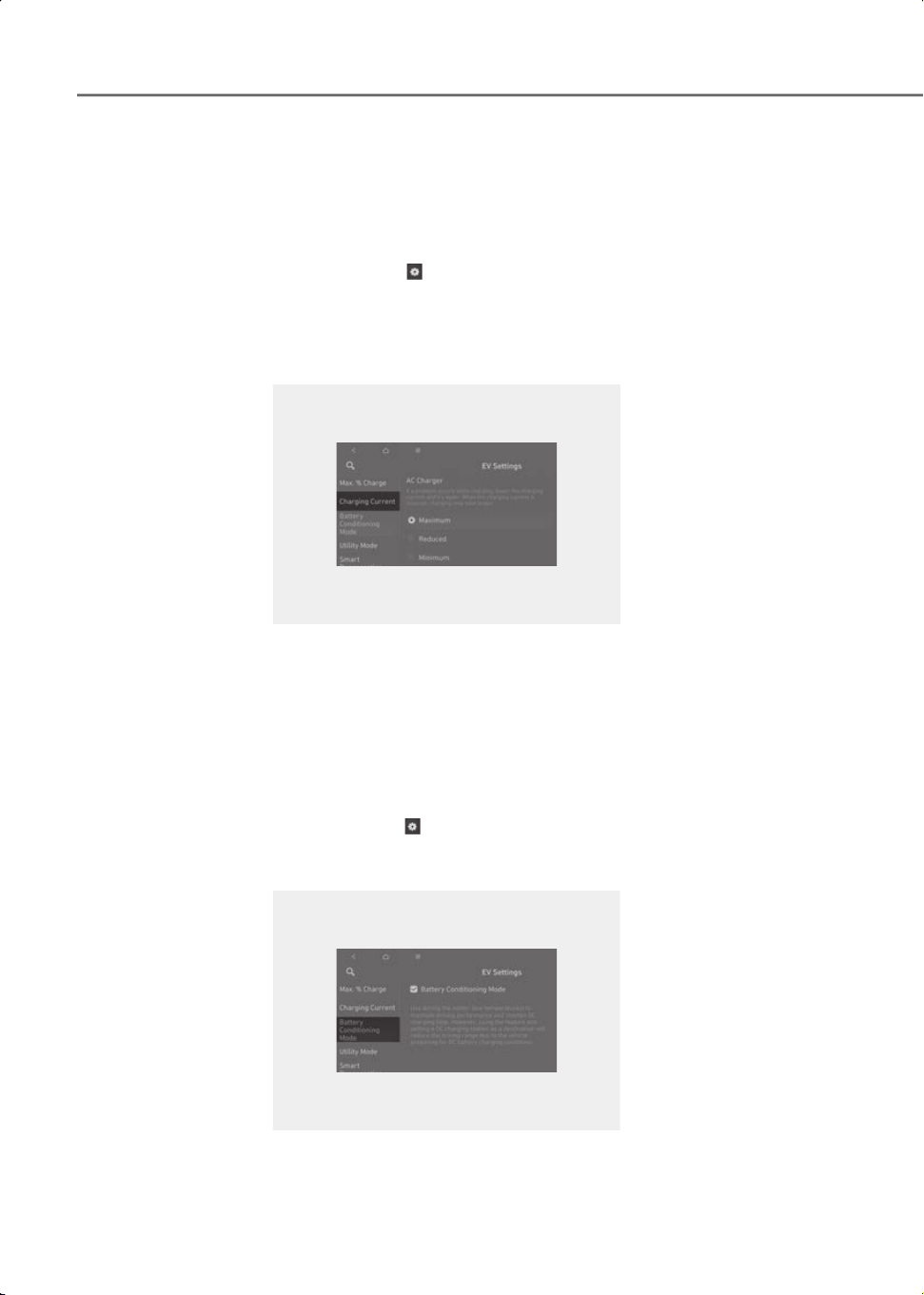
2. On the All menus screen, select EV > EV Settings > Max. % Charge.
B0002101
3. Set each of the target battery charge level for AC charging and DC charging.
• The charging level can be changed by 10 %.
• If the target battery charge level is lower than the current high voltage battery
charge level, the battery will not be charged.
CE_USA.book Page 41
Introduction/Getting started with Your Electric Vehicle
1-42
Setting the charging current
Follow the instructions below to set the charging current when using an AC charger or a
portable charger.
1. On the infotainment system, swipe the Home screen to the left to display the All menus
screen.
2. On the All menus screen, select EV > (EV Settings) > Charging Current
• If the charging stops before reaching the target battery charge level while charging
with an AC charger or a portable charger, reduce the size of the input current and
retry charging.
• The charging time may differ depending on which charging current is selected.
B0002102
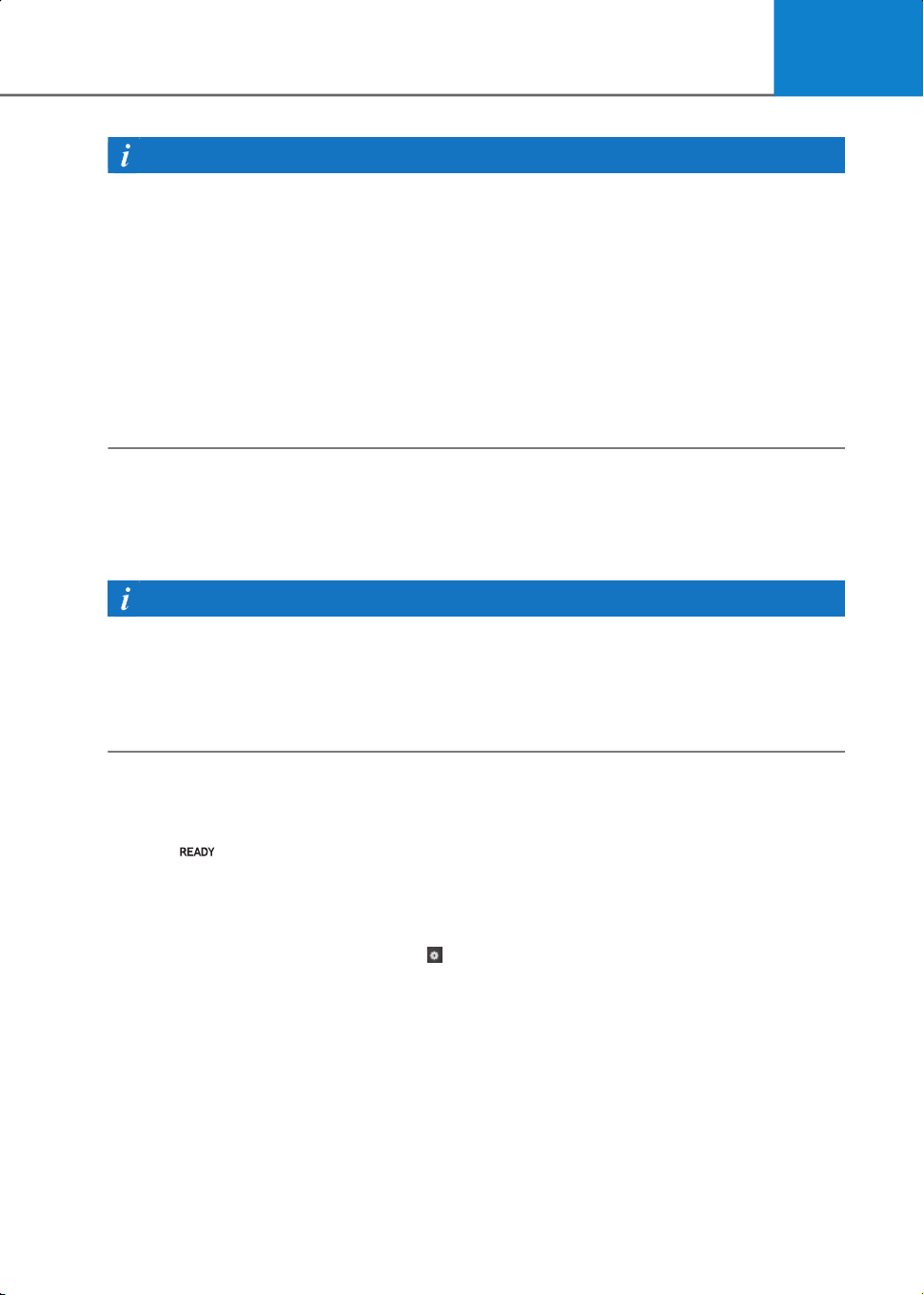
Setting battery conditioning mode
You can raise the battery temperature to maintain optimal driving performance and DC
charging performance at conditions when the low temperature of the high voltage
battery temperature may degrade the battery performance.
1. On the infotainment system, swipe the Home screen to the left to display the All menus
screen.
2. On the All menus screen, select EV > (EV Settings) and select Battery Conditioning
Mode.
• The battery temperature while driving will be maintained adequately.
B0002103
CE_USA.book Page 42
1
1-43
Information
Be aware of the followings when using battery conditioning mode.
• The driving distance may be reduced as energy is required to increase the battery
temperature.
• If the battery temperature is low during driving or when the scheduled air
conditioner/heater is activated, the battery conditioning mode is operated to improve
driving performance. To ensure driving distance the battery conditioning mode will not
be operated when the battery level is too low.
• If you set the DC charging station as your destination while using the battery
conditioning mode, the battery temperature is optimized for charging and you can
shorten the charging time after you arrive and start charging.
• Battery conditioning mode is available for vehicles equipped with the battery heater.
Setting Utility Mode
Utility mode allows the high voltage battery to be used instead of the 12 V auxiliary
battery for purposes other than driving. You can use the audio and lights of the vehicle
without discharging the 12 V auxiliary battery and even use the indoor V2L feature.
Information
• You cannot drive the vehicle while the utility mode is activated, and the gear can only
be shifted to P (Park).
• You can use every electric device in the vehicle while the utility mode is activated.
• When the utility mode is activated, the Electronic Parking Brake (EPB) is applied
automatically.
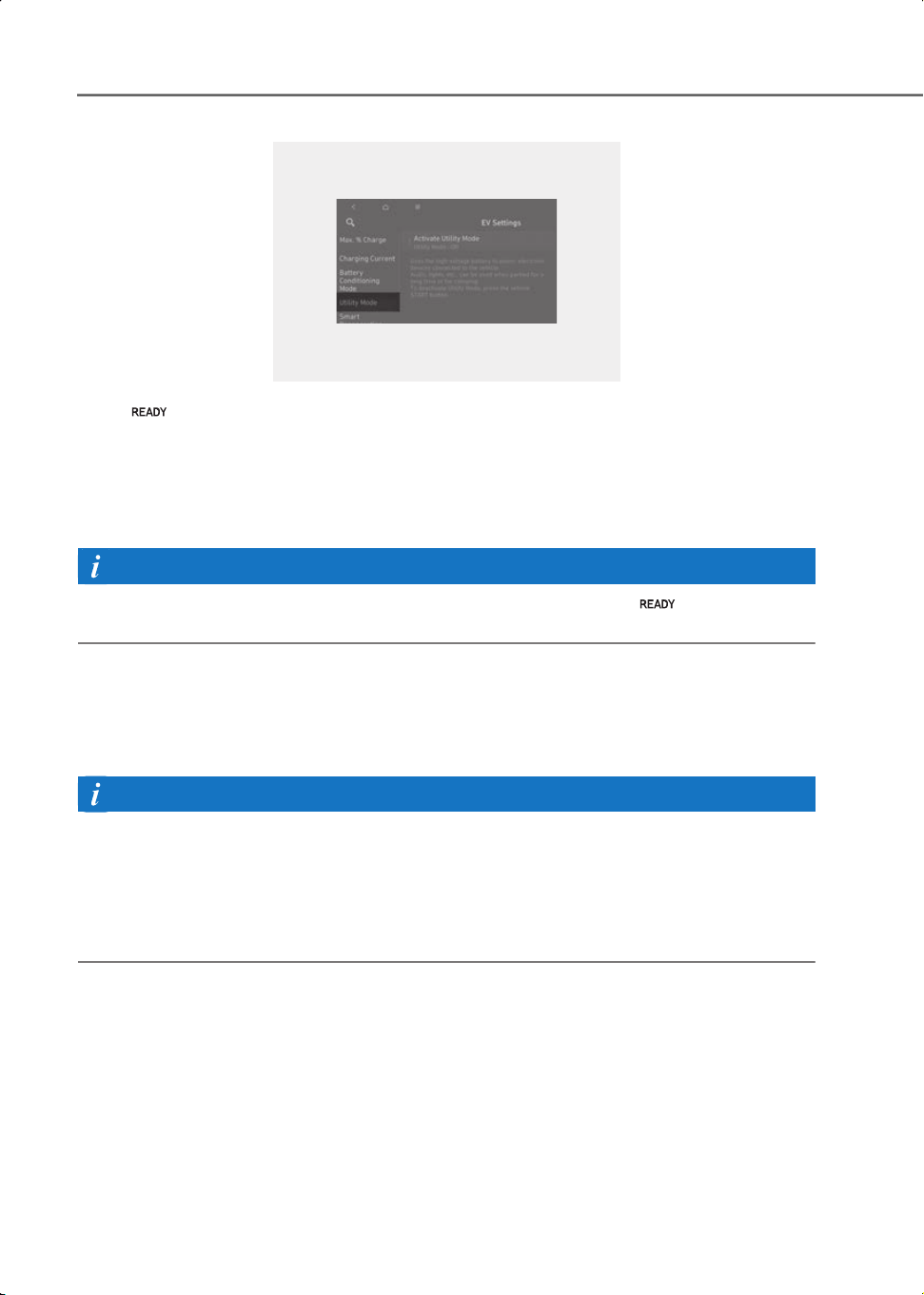
Follow the instructions below to set the utility mode.
1. Check the operation conditions of the utility mode.
• The (ready indicator) is displayed on the instrument cluster.
• The gear is shifted to P (Park).
2. On the infotainment system, swipe the Home screen to the left to display the All menus
screen.
3. On the All menus screen, select EV > (EV Settings) > Utility mode and select Activate
Utility mode to activate the function (Utility Mode: ON).
CE_USA.book Page 43
Introduction/Getting started with Your Electric Vehicle
1-44
B0002104
• The (ready indicator) turns off and the UTIL (utility indicator) illuminates on the
instrument cluster and the EPB is applied.
• The utility mode can be deactivated by pressing the Start/Stop button to the OFF
position.
• If you want to utilize V2L function in the vehicle while the utility mode is activated, refer
to the “Using Electricity Inside the Vehicle” section in this chapter.
Information
If the utility mode is not activated when the vehicle is in the ready ( ) mode and the
gear is shifted to P (Park), inspect the operation status of EPB.
Searching for nearby charging stations
Around the course, around the current site, around the selected destination or charging
stations of interest can be searched. If you choose the charging station, the detailed
information is provided.
Information
• When you sign up HYUNDAI BlueLink service, the available chargers at each charging
station are displayed.
• The HYUNDAI Carpay function in the in-vehicle payment app allows for convenient
payments to affiliated charging stations and parking lots without using physical cards.
For more information, refer to the user's manual provided in the infotainment system
and the quick reference guide.
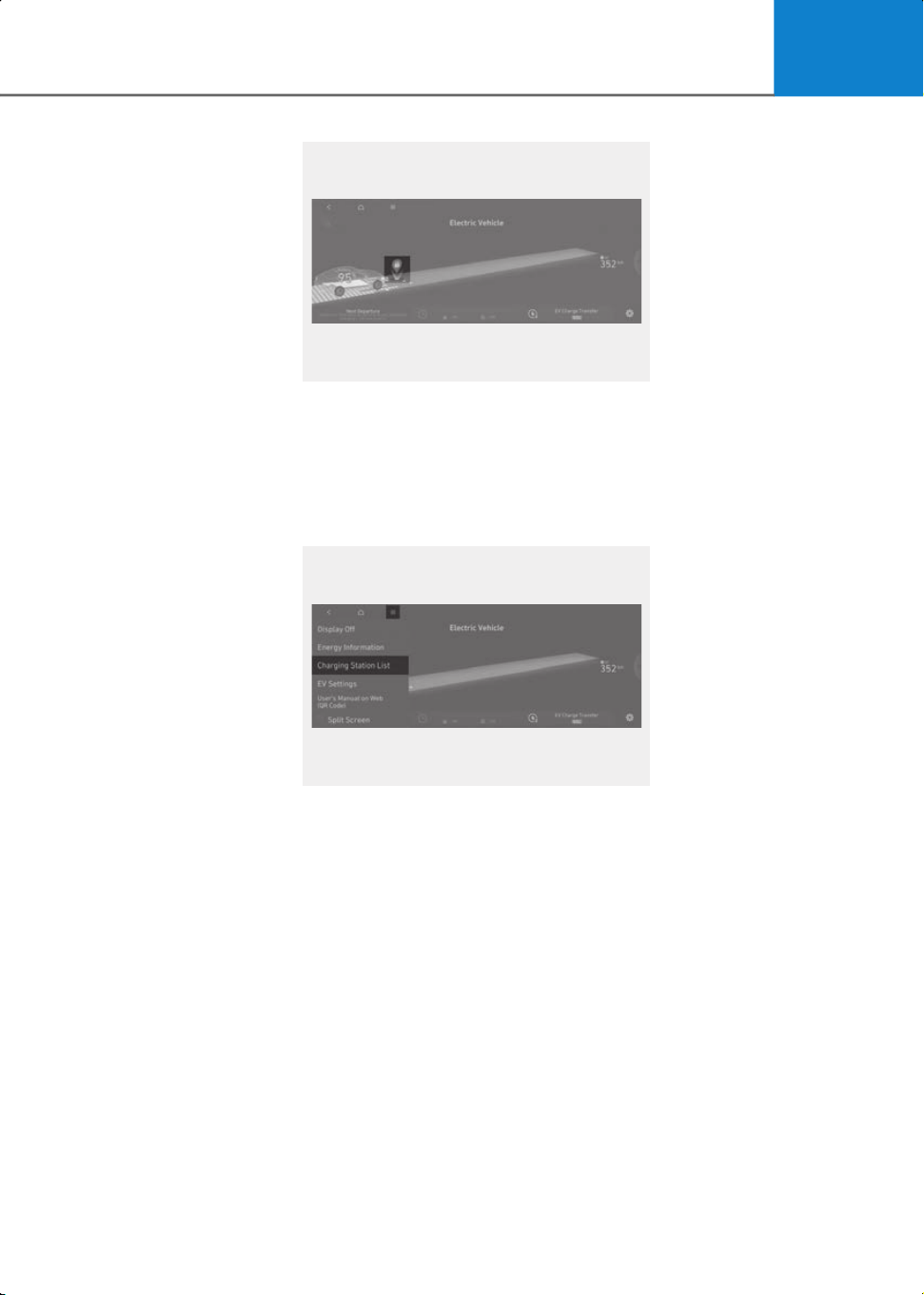
1. On the infotainment system, swipe the Home screen to the left to display the All menus
screen.
2. On the All menus screen, select EV and select the charging station icon next to the
vehicle
CE_USA.book Page 44
1
1-45
B0002105
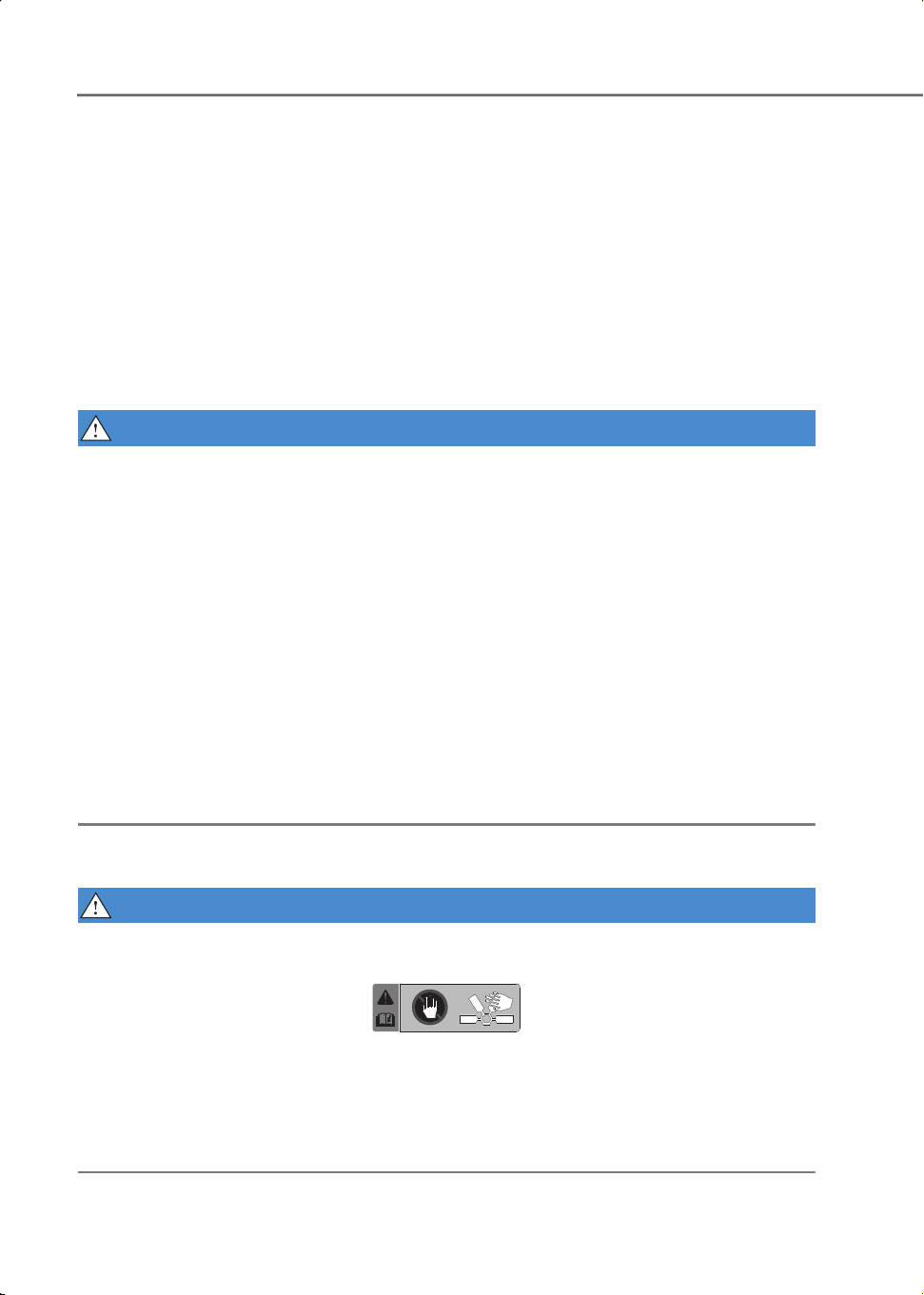
3. Choose a searching option from the list on the left side of the screen.
• You can choose among Along Route, Near My Location, Near Destination, Near
Center of Map and Favorite Station.
• The direction (arrow) and distance, charger type, address, and location on the map
of the charging stations corresponding to the selected option are displayed on the
right side of the screen.
B0002106
4. Select the charging station on the list and check the detailed information.
CE_USA.book Page 45
Introduction/Getting started with Your Electric Vehicle
1-46
Using V2L Function
Using the Vehicle to Load (V2L) feature, you can turn on electronic devices by connecting
them to the high voltage battery.
Safety Precautions When Using the V2L Function
Before using the V2L function, read and comply with all the safety information below.
Failure to do so may cause electric shock or fire and result in serious injury, death, vehicle
malfunction, or property damage.
Precautions when using the V2L function
WARNING
• Do not use the V2L function if the V2L connector, charging inlet, power plug, or cable
is damaged, corroded, or rusted.
• Do not touch the V2L connector, charging inlet, or power plug with wet hands.
• Do not use the V2L function if the connection part of the V2L connector and the
charging inlet is loose.
• Check if there is no water, dust, or other contaminants before connecting the
connector and the power plug. They may cause electric shock or fire.
• Do not put metal objects or touch the V2L connector or charging inlet with bare hands.
• For electric devices used outdoors in a vehicle, use a product that is waterproof or use
it in a waterproof environment. If rain or humidity intrude into electric devices,
multi-outlets, extension cords, etc., it may cause electric shock or damage the vehicle
or devices.
• If there is a risk of lightning, do not use the V2L function outside the vehicle.
• Do not use electric heating appliances such as an electric kettle, toaster, or iron in the
vehicle. Doing so may result in a fire and injury.
Precautions when the cooling fan operates
WARNING
WL_MotorRoomHotCaution
When using the V2L, the cooling fan in the vehicle motor compartment can operate
automatically even if the vehicle is turned off. Do not put your hand near the cooling fan
when the V2L is operating.
CE_USA.book Page 46

1
1-47
Precautions for handling and using the V2L connector
CAUTION
• Do not modify or disassemble the V2L connector. It may cause fire, electric shock, or
injury. Damage to your vehicle caused by modification and disassembling is not
covered by warranty.
• Be careful when connecting or disconnecting the power plug to the V2L connector or
when opening or closing the V2L connector cover. You may scratch your hand.
• Be sure to disconnect the V2L connector from the vehicle when you are finished using
V2L.
• Do not charge the vehicle using the V2L connector. If you charge the vehicle arbitrarily
by remodeling the power cable of the connector, etc., it may damage the vehicle.
• Do not place objects on the V2L connector. It may damage the cable and cause electric
shock or fire.
• Do not drop the V2L connector or apply any impact on it. Keep it clean in a dry place
without water or humidity.
NOTICE
• Be sure to disconnect the V2L connector from the vehicle when you are finished using
the V2L function.
• Do not charge the vehicle using the V2L connector. If you charge the vehicle by
modifying the power cable of the connector, etc., it may damage the vehicle.
Precautions when using electric/electronic products
CAUTION
• Before using the product, check the precautions and how to use the product referring
to the product manual.
• Only use products that have obtained national safety certification.
• Only use an electric device that does not exceed the maximum power capacity that the
vehicle can supply. However, some of the electric devices may not operate normally
even if the product has power consumption less than the maximum power capacity
provided by the vehicle.
- Electric devices that require high power during initial operation.
- Measuring devices that need to process accurate data.
- Electric devices that are sensitive to inverter type AC charger.
• Do not use products that require a continuous power supply, such as medical
equipment. The power supply may be interrupted depending on the vehicle’s
condition.
• The V2L discharging mode is blocked automatically in the event of overheating. When
the discharging mode is blocked, check whether the V2L connector or power plug is
contaminated, worn, corroded or broken.
CE_USA.book Page 47

Introduction/Getting started with Your Electric Vehicle
1-48
- If the temperature falls to a proper level after it is left unattended, you can use it
again.
- If overheating repeats when using a certain electric device, do not use the electric
device.
• Do not connect more than two extension cords or multi-outlet. Also, when using the
extension cable, ensure that the cable is not twisted. Heat from the overlapped cable
may cause fire.
• Do not hang home appliances on the wire.
• Do not use if the sheath of home appliance cables is damaged or broken.
• Fully insert the power plug when connecting it to the power.
• Only use qualified power plug with ground connection that meets the standard. Do not
use worn, corroded, or broken power plug or improper power plug that does not meet
the standard.
Using Electricity Outside the Vehicle
Before using V2L function, carefully read all the safety information and precautions on
the “Safety Precautions When Using the V2L Function” section and follow the
instructions.
Follow the instructions below to connect the V2L connector to the charging inlet on the
vehicle and supply power to an electronic product.
1. Open the cover of the V2L connector.
2. Close the cover after connecting the plug of an electronic product to the power outlet
of the connector.
WARNING
Some types of plugs may not fit into the outlet cover of the V2L connector, causing
incomplete closing of the cover. Do not use the V2L connector on a rainy or snowy day
if the outlet cover is not completely closed. There is a risk of fire and/or injury.
3. Open the connection terminal protection cap of the connector with the open switch
pressed.
4. Open the charging door and connect the V2L connector to the charging inlet on the
vehicle.
• Connect the V2L connector to the charging inlet within 60 seconds after opening the
charging door.
5. Press the power switch of the V2L connector.
CE_USA.book Page 48
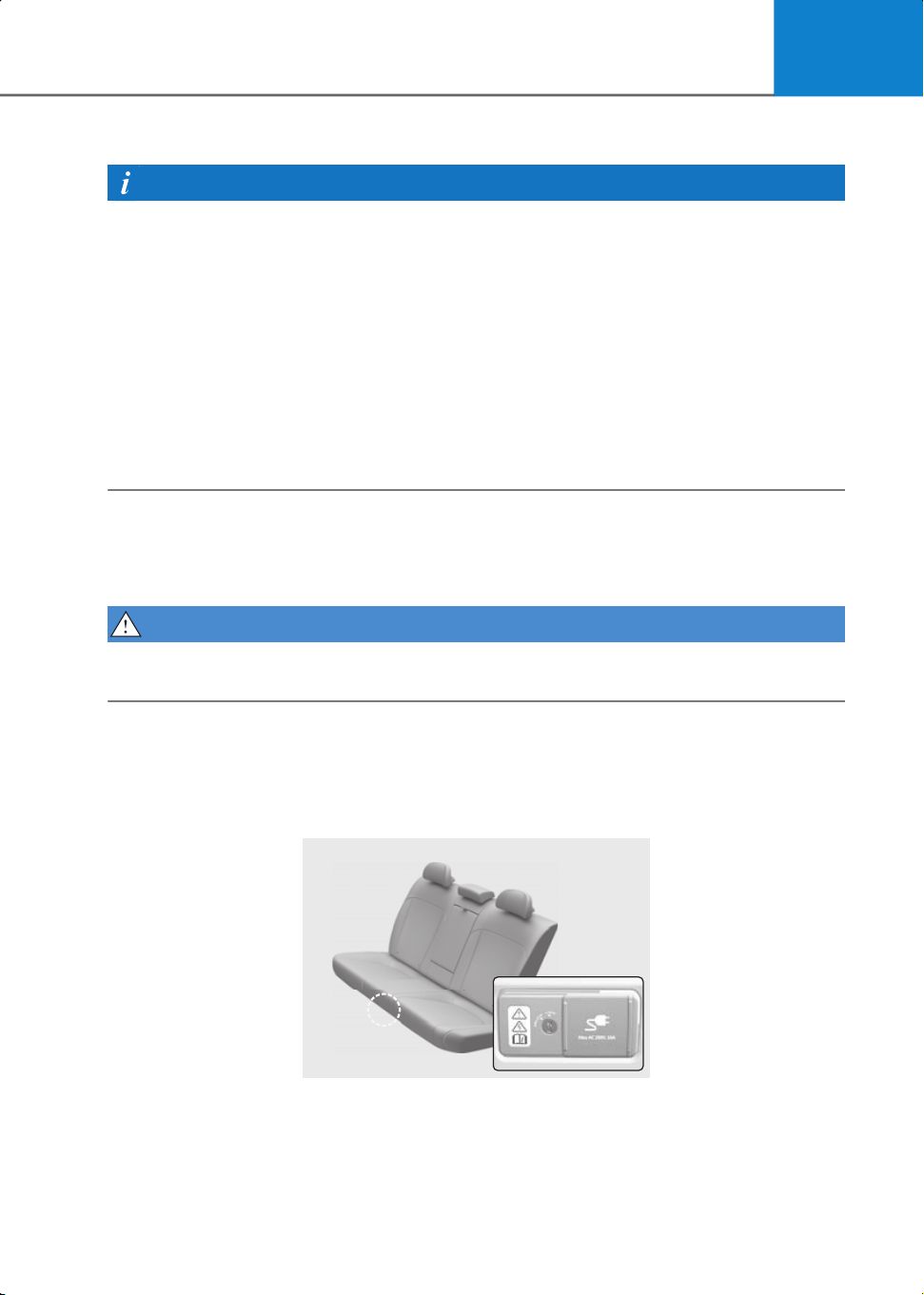
1
1-49
• The power is supplied and the indicator on the V2L connector is turned on.
Information
• When the V2L connector is connected to the charging inlet of the vehicle, all doors and
connectors will be automatically locked to prevent theft and separation. To disconnect
the V2L connector, unlock the door and pull the connector with the open switch
pressed.
• Before using the V2L function, deactivate the scheduled climate setting referring to the
“Setting Scheduled Charging and Climate”. The V2L function may be cut off depending
on the scheduled climate setting.
• To check and change the V2L setting, refer to the “Setting a Battery Discharging Limit
When Using Vehicle to Load (V2L)”.
• If an electric device that exceeds the maximum power capacity is connected, a
warning message appears on the instrument cluster and the power supply shuts off
immediately.
Using Electricity Inside the Vehicle
You can connect home appliances or electric devices to the power outlet inside the
vehicle.
WARNING
Do not use an electric heating appliances like electric kettle, toaster, or iron in the vehicle.
It may cause a fire or injury.
1. Press the Start/Stop button to the ON position or activate the utility mode.
• For more information about the utility mode, refer to the “Setting Utility Mode”
section in this chapter.
2. Use the smart key to unlock the power outlet cover.
B0002501
CE_USA.book Page 49
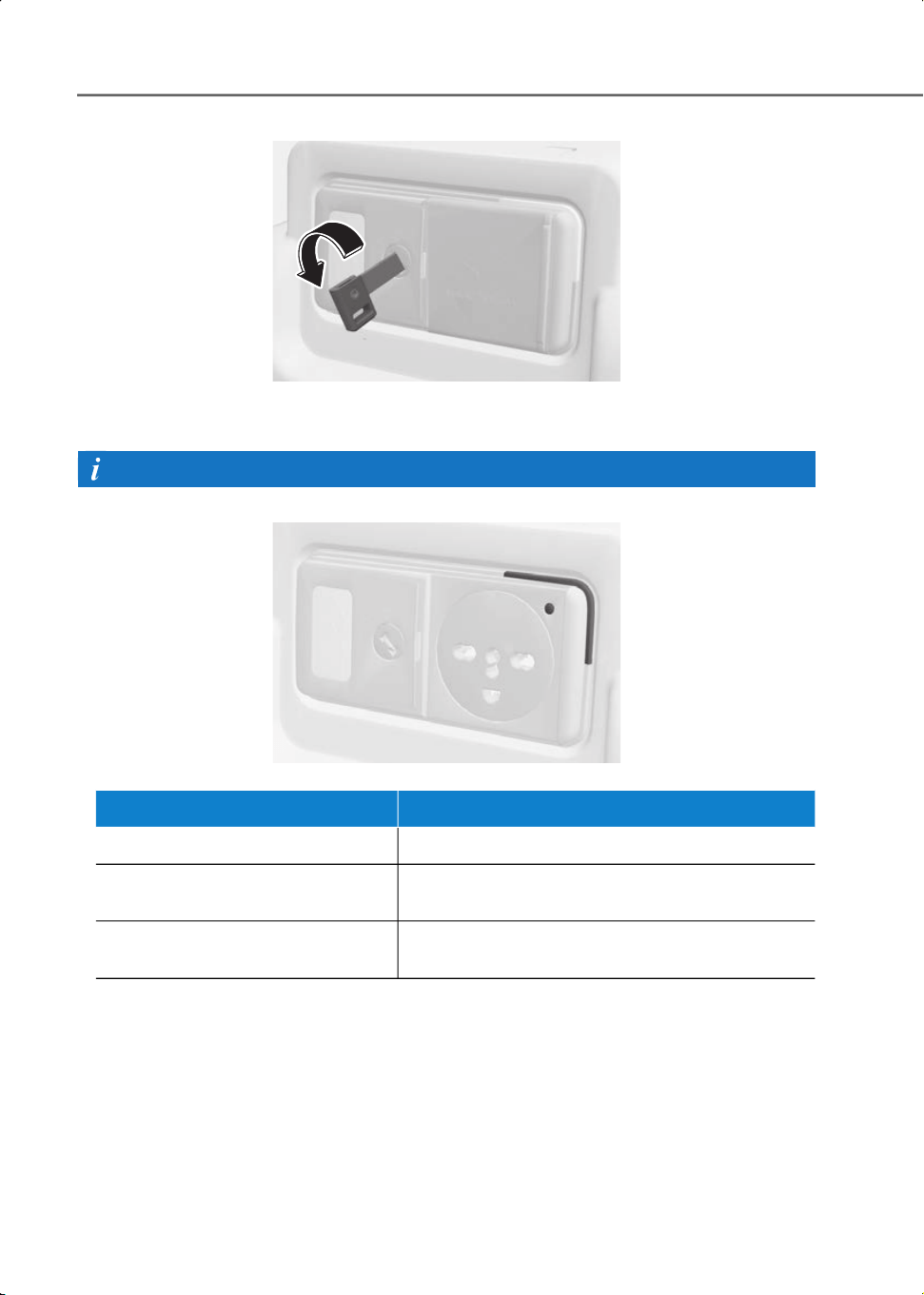
Introduction/Getting started with Your Electric Vehicle
1-50
B0002502
3. Open the power outlet cover by sliding it to the left, and connect the power plug of the
electric device to the power socket.
Information
• The indicator on the power outlet indicates the operation status.
B0002503
• V2L discharging mode shuts off if the vehicle turns off while using indoor V2L when the
vehicle is ON.
• Opening the charging door or connecting the V2L connector to the charging inlet, the
V2L discharging mode shuts off.
• If you want to use the indoor and outdoor V2L simultaneously, first connect the V2L
connector to the charging inlet and then use the indoor V2L.
• When the high voltage battery charge level reaches the set discharging limit (%), the
operation stops, and a warning message appears on the instrument cluster. If you want
V2L operation, set the discharging limit (%) lower than the current battery charge.
Indicator Status Description
Blue Standby
Red
The power outlet is connected but no power is
supplied.
Green
The power outlet is connected, and the power is
supplied normally.
CE_USA.book Page 50

1
1-51
- For more information about the discharging limit, refer to the “Setting a Battery
Discharging Limit When Using Vehicle to Load (V2L)” section in this chapter.
- For more information about warnings, refer to the “Checking the warning and
indicator lights” section in this chapter.
Solving V2L Problems
If a problem occurs while using the V2L function, the V2L stops and a related messages
appears on the instrument cluster.
Check the cause of the message and take an appropriate measure referring to the table
below.
Message Cause Measure
V2L finished. Defined
charge level reached
B0002601
The high voltage battery level
reaches the discharging limit
set level.
To use the V2L continuously,
make the discharging limit set
level lower than the present
battery level. (For more
information, refer to the
“Setting a Battery Discharging
Limit When Using Vehicle to
Load (V2L)”.)
Energy consumption
too high. V2L
cancelled
B0002602
An electrical appliance that
exceeds the maximum power
output the vehicle can supply is
connected.
Check the total power
consumption of the electrical
appliance and replace it a
product within the V2L
maximum power output.
V2L conditions not
met
B0002603
V2L is stopped for the following
reasons:
• V2L connector switch off
• V2L connector overheating
• Opening the charging door
while using the V2L indoor
outlet
Make sure there are no
problems with the V2L
connector and the vehicle
indoor outlet.
7-GJOJTIFE
%FGJOFEDIBSHF
MFWFMSFBDIFE
&OFSHZ
DPOTVNQUJPOUPP
IJHI
7-DBODFMMFE
7-DPOEJUJPOT
OPUNFU
CE_USA.book Page 51
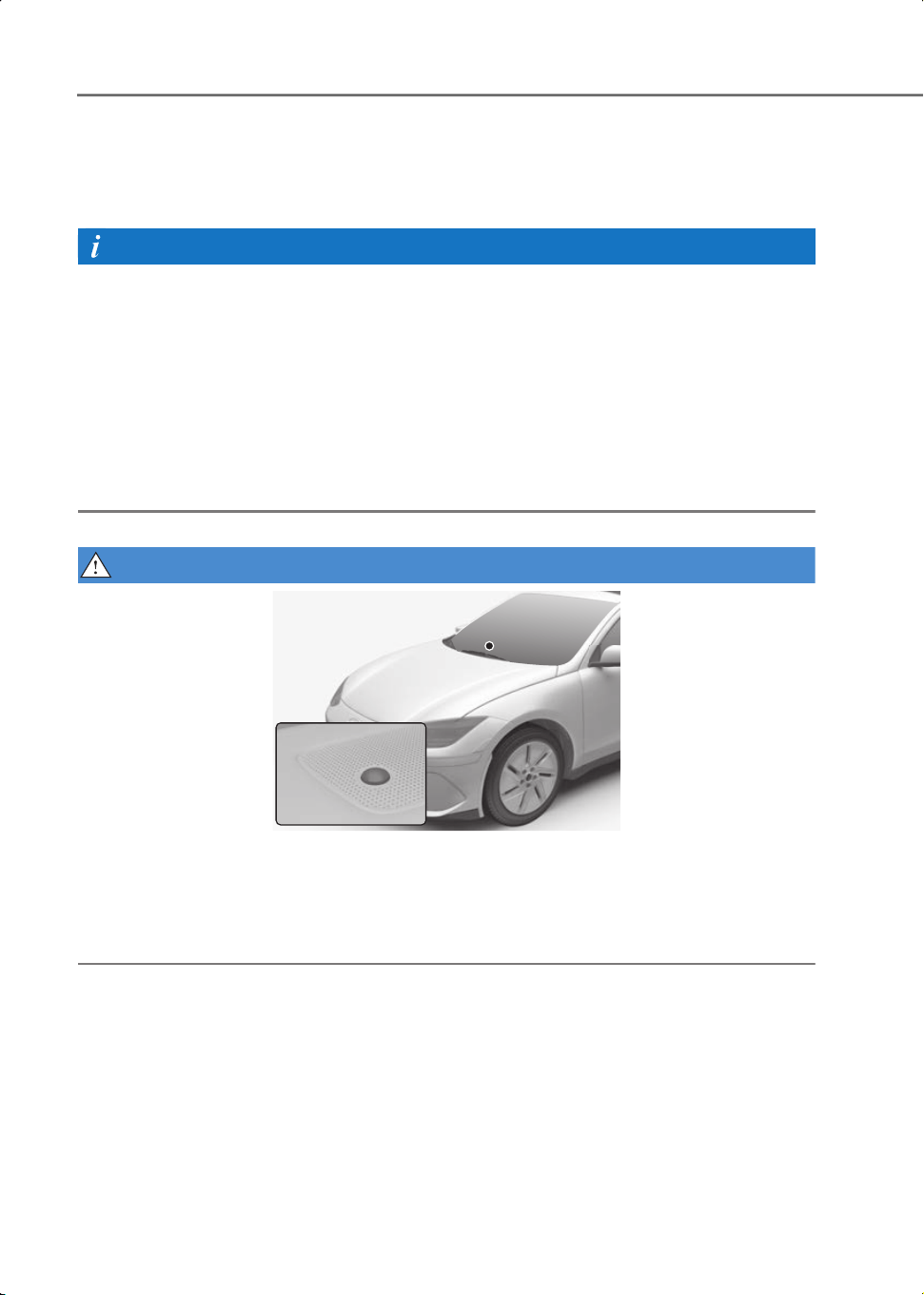
Introduction/Getting started with Your Electric Vehicle
1-52
Aux. Battery Saver+
The Aux. Battery Saver+ is a function that monitors the charging status of the 12 V battery.
If the 12 V battery level is low, the main high voltage battery charges the 12 V battery.
Information
• The Aux. Battery Saver+ activates maximum of 20 minutes. If the Aux. Battery Saver+
function activates more than 10 times consecutively, in the Automatic Mode the
function will stop activating, judging that there is a problem with the auxiliary battery.
In this case, drive the vehicle for some period of time. The function will start activating
if the auxiliary battery returns to normal.
• The Aux. Battery Saver+ function cannot prevent battery discharge if the auxiliary
battery is damaged, worn out, used as a power supply or unauthorized electronic
devices are used.
• If the Aux. Battery Saver+ function was activated the high voltage battery level may
have decreased.
WARNING
B5019903_1
When the function is activating the indicator light illuminates and high voltage electricity
flows into the vehicle. Do not touch the high voltage electric wire (orange), connector,
and all electric components and devices. This may cause electric shock and lead to
injuries. Also, do not modify your vehicle in any way. This may affect your vehicle
performance and lead to an accident.
CE_USA.book Page 52
1
1-53
Driving Your Electric Vehicle
Check how to use the devices inside the vehicle that you must know for driving, such as
starting, braking, and shifting the electric vehicle.
Starting and Stopping the Vehicle
Follow the instructions below to start or stop the vehicle.
CAUTION
• Always fasten the seat belt before starting the vehicle for safety.
• Check if the EBP is applied before starting the vehicle.
Starting the vehicle
1. Holding the smart key, sit in the driver’s seat.
2. Press the Start/Stop button while pressing the brake pedal.
• On the instrument cluster, (ready indicator) is displayed.
Information
While the (ready indicator) is displayed, press the brake pedal, shift to D (Drive) or R
(Reverse), and release the EBP and the brake pedal to start moving the vehicle forward
or backward. You can start driving by pressing the accelerator pedal slowly and
decelerate or stop by pressing the brake pedal.
Stopping the vehicle
1. Stop the vehicle completely by pressing the brake pedal.
2. Apply the EPB while pressing the brake pedal, and press the gear’s P button to shift to
P (Park).
3. Press the Start/Stop button.
• The (ready indicator) on the instrument cluster turns off.
Information
There are other Start/Stop button positions besides the ON/OFF. Use it appropriately
paying attention to the discharging of the 12 V battery.
• ACC: The 12 V battery power is turned on, allowing some devices, such as infotainment
system and air conditioning system to operate. Press the Start/Stop button when it is
in the OFF position to turn on ACC.
• ON: The 12 V battery power is turned on, allowing to check the instrument cluster and
use all the electric devices inside the vehicle. Press the Start/Stop button when it is in
the ACC position to turn it ON.
CE_USA.book Page 53
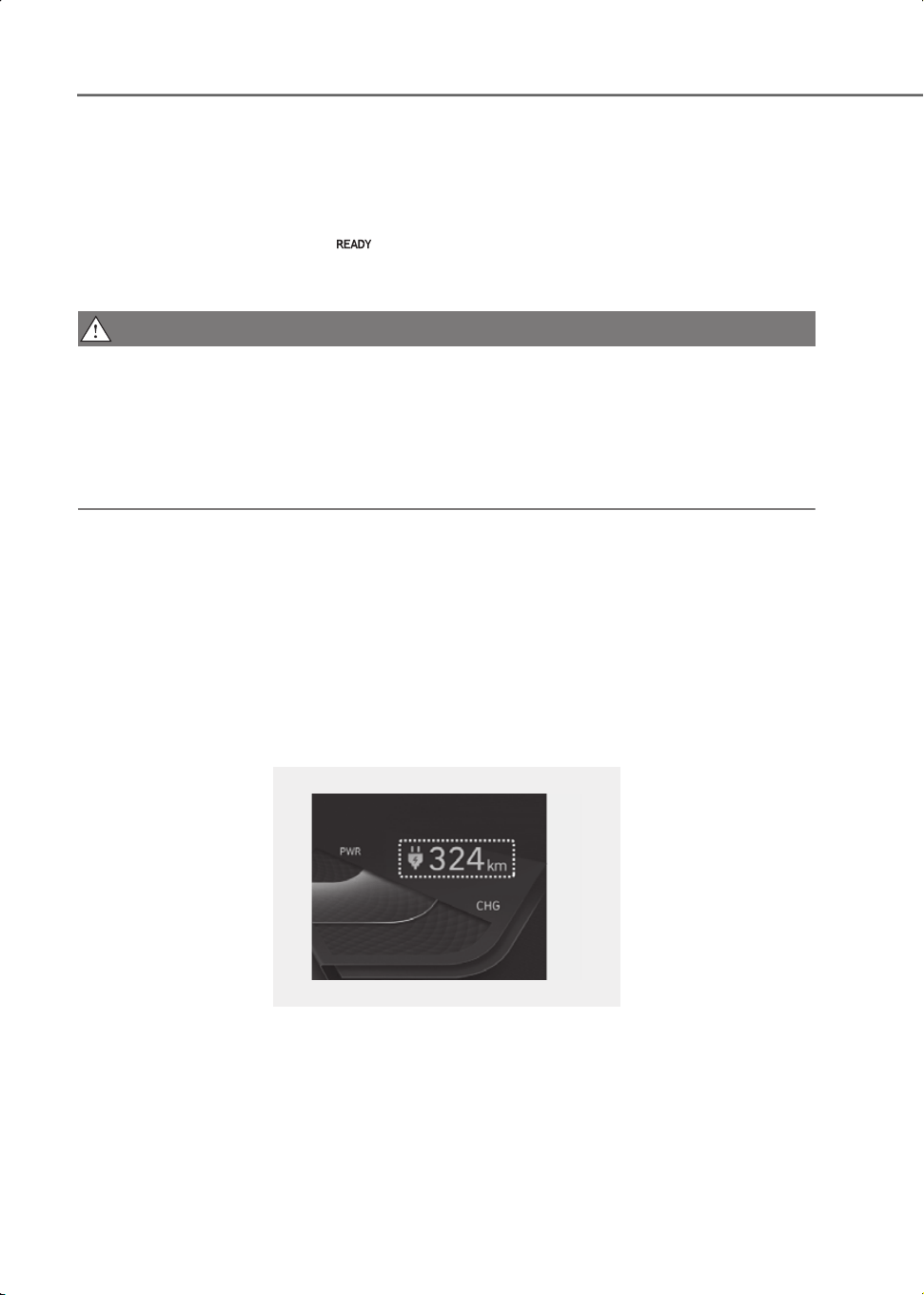
Introduction/Getting started with Your Electric Vehicle
1-54
Understanding virtual engine sound system
Electric vehicles do not use an internal combustion engine, so there is no engine noise
while driving. The Virtual Engine Sound System (VESS) generates engine sound to make
pedestrians aware of the approaching vehicle when driving.
• If the vehicle is in the ready ( ) mode and the gear is not in P (Park), the VESS is
operated.
• When the gear is shifted to R (Reverse), an additional warning sound will be heard.
CAUTION
• Be aware that the vehicle does not make engine noise while driving.
• Pay attention to the surrounding environment and drive carefully.
• After parking or waiting for a traffic light, please check around for children, or other
obstacles before departure.
• When reversing, check directly behind you before driving. Pedestrians may not be able
to recognize vehicle sounds.
Checking Electric Vehicle Driving Information
During vehicle operation, the instrument cluster displays the main information, such as
distance to empty, real-time energy status, battery charge level, and warning messages,
via the user interface and indicators.
Factors affecting the distance to empty
The distance to empty refers to the distance that can be driven by the current charged
battery level and is displayed on the bottom of the instrument cluster while driving the
electric vehicle.
B0002901
The distance to empty vary depending on many factors such as driving habits, power
usage, driving conditions, and high voltage battery. The distance to empty may be
increased or decreased from the certified figures as it reflects all the factors
comprehensively. Check the distance to empty considering the following:
CE_USA.book Page 54

1
1-55
• The driving habits: The driving speed and tendency of accelerating and decelerating.
High speed driving or frequent accelerating and decelerating reduces the distance to
empty.
• The power usage: Additional power use, such as the air conditioner, heater, lights, etc.
As the power usage increases, the distance to empty reduces.
• The driving conditions: The weather, temperature, and terrain. If you drive in
snow/rain/strong wind or low temperature, the distance to empty will be reduced. The
distance to empty will also be reduced when driving uphill or on slippery or rough
roads.
• The high voltage battery energy: Proportional to the State of Charge (SOC), but may
vary depending on the battery temperature and the State of Health (SOH) of a battery.
Change in the distance to empty when 100 % charged
In case the distance to empty has been reduced due to learning of the driving habit or the
driving conditions, you can increase the distance to empty again by continuously driving
following the “Tips for enhancing the distance to empty”.
• Resetting the previously learned driving patterns at the service center may increase
the distance to empty displayed on the bottom of the instrument cluster, but it does
not increase the actual distance to empty. The distance to empty may not be accurate
until the learning proceeds.
• If the high voltage battery temperature is low in winter, the distance to empty reduces
but it is not a permanent change. The distance to empty will increase again once the
temperature rises.
• If you reduce the power usage, the distance to empty will increase.
• Natural degradation may occur with the high voltage battery depending on the
number of years the vehicle is used. This may reduce the distance to empty.
When setting a destination
When the destination is set, the distance to empty may change because the distance to
empty is recalculated using the information of the destination instead of the learned
electric energy economy history.
Information
The distance to empty may vary significantly based on traffic conditions or driving speed.
CE_USA.book Page 55

Introduction/Getting started with Your Electric Vehicle
1-56
Tips for enhancing the distance to empty
The distance to empty vary depending on the charge level of the high voltage battery,
weather, temperature, duration of the battery use, terrain, driving habits, etc.
You can increase the distance to empty by driving the vehicle following the instructions
below.
• The air resistance increases rapidly as the electric vehicle drives faster, so avoid
speeding to increase the distance to empty and the electric energy economy.
• Rapid acceleration consumes a lot of driving energy and rapid deceleration limits the
regenerative braking. Gradually depress and release the accelerator pedal when
accelerating or decelerating to maintain speed.
• If you operate the air conditioner or heater too much, the high voltage battery uses
excessive electricity. This may reduce the distance to empty. Therefore, set the cabin
temperature to 72 °F (22 °C) AUTO level 2. Various assessment tests have been used to
verify that this setting maintains optimal energy consumption rates. Especially in
winter, reducing heating and using heated seats instead can significantly increase the
distance to empty. Turn off the air conditioner or heater if you do not need them.
• When using the air conditioner or heater, the energy consumption is reduced if
recirculation mode is selected instead of fresh mode. Fresh mode requires a large
amount of energy consumption as the outside air has to be reheated or cooled.
• Close the windows while driving. Driving with the windows open increases air
resistance and the usage of the air conditioner or heater.
• When using the air conditioner or heater while driving alone, use the DRIVER ONLY
function.
• Always maintain specified tire pressures and use tires for electric vehicles.
• Do not use unnecessary electrical components while driving.
• Do not load unnecessary items in the vehicle.
• Do not mount parts that may increase air resistance.
When the distance to empty is insufficient
• When the High voltage battery level warning light is displayed, immediately charge the
vehicle at a nearby charging station.
• Drive energy efficiently following the “Tips for enhancing the distance to empty.”
• When the battery level is 0 %, do not try to drive. Move to a safe place and call for help.
CE_USA.book Page 56
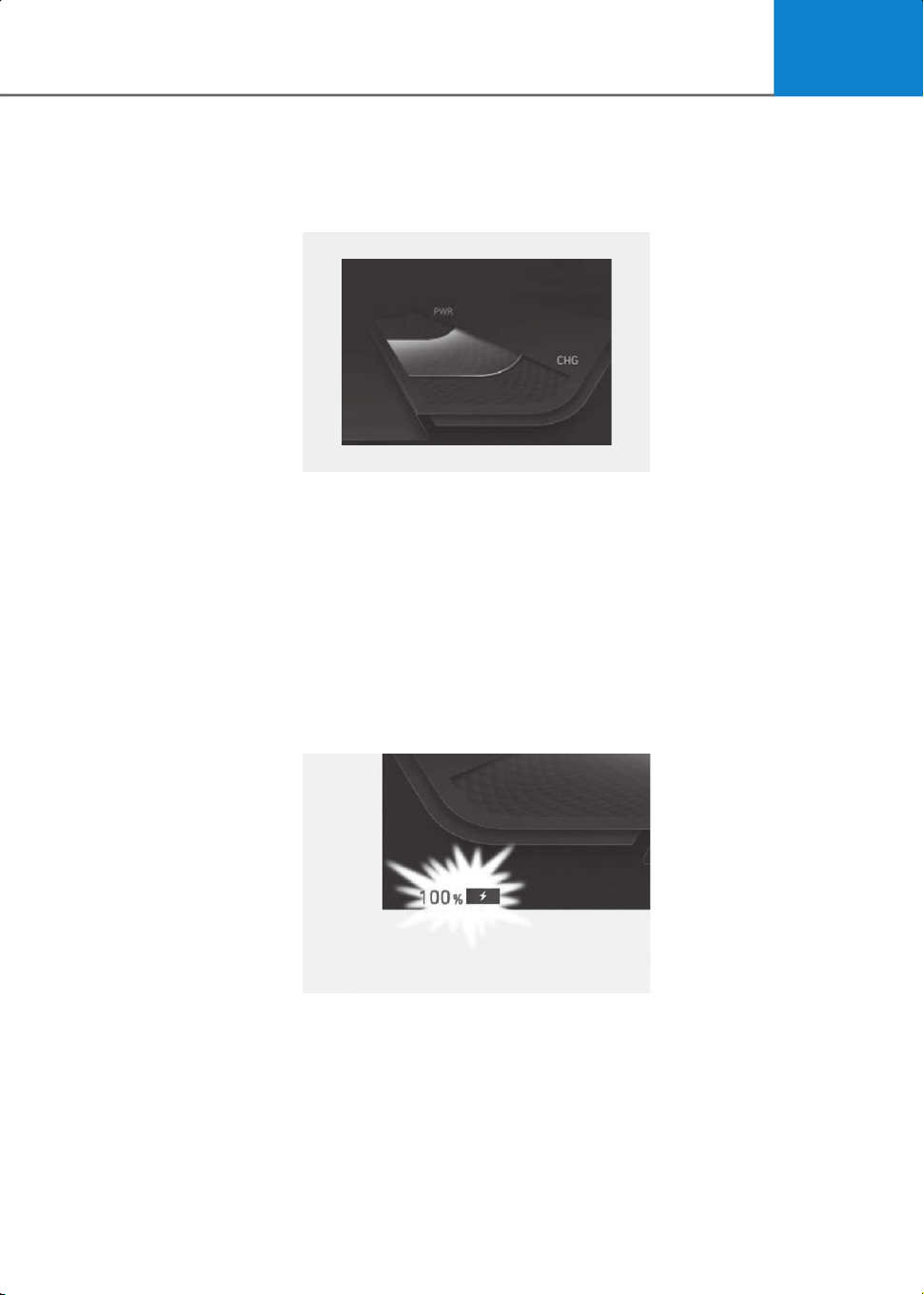
1
1-57
Checking the real time energy status (CHARGE/POWER gauge)
The CHARGE/POWER gauge displays the charging and discharging status of the electric
energy produced by the regenerative braking and the energy consumption of the electric
motor.
B0002902
• CHARGE: Shows the charging status of the electric motor when vehicle is decelerating
or driving on a downhill road (being charged by the regenerative brakes). The more
electric energy is charged, the lower the gauge level.
• POWER: Shows discharging status of the electric motor when vehicle is accelerating or
driving on an uphill road. The more electric energy is discharged (used), the higher the
gauge level.
Checking the State of Charge (SOC)
The SOC indicator is displayed at the bottom of the CHARGE/POWER gauge and shows
the charge level of the high voltage battery as a percentage. The lower the number, the
more the vehicle needs to be charged, and 100 % indicates a full charge.
B0002903
CE_USA.book Page 57
Introduction/Getting started with Your Electric Vehicle
1-58
B0002904
• When the remaining battery of the high voltage battery is lower than 10 %, the warning
light will be displayed.
• When the warning light is displayed, charge the vehicle.
Information
• To find a nearby charging station, refer to the “Searching for nearby charging stations”
in this chapter.
• Check if the SOC is enough before driving on highways.
• After the warning light is displayed, immediately charge the vehicle at a nearby
charging station. The vehicle may not operate properly depending on the driving
speed, weather, and other driving conditions.
Checking the warning and indicator lights
The warning and indicator lights are displayed in the middle of the instrument cluster
before or while driving, depending on the status of the electric vehicle. Understand the
meaning of the warning and indicator lights referring to the instructions below and drive
safely.
CAUTION
If the warning light illuminates while driving or does not go off, have the vehicle
inspected by an authorized HYUNDAI dealer.
CE_USA.book Page 58
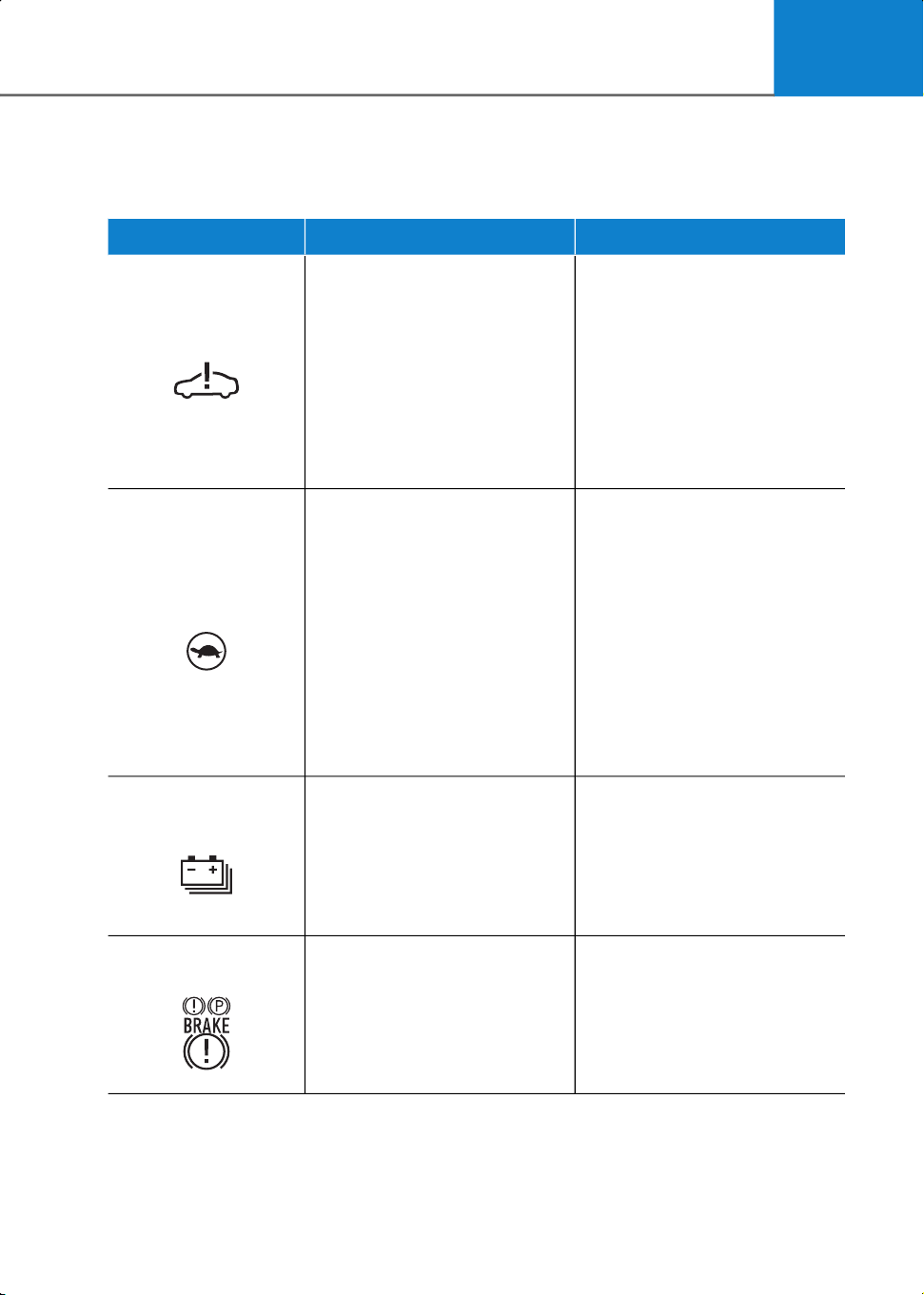
1
1-59
Checking the warning lights
Check the cause of the warning lights referring to the table below and take appropriate
measures.
Warning Light Cause Measure
Service warning light
This warning light illuminates:
• When there is a problem with
related parts of the electric
vehicle control system, such
as sensors, etc.
• When an actuator, electric
compressor for air
conditioning, etc.
malfunctions.
In a normal condition, it
illuminates for about 3 seconds
when the Start/Stop button is in
the ON position and then goes
off.
• When the warning light
illuminates while driving, or
does not go off after starting
the vehicle, have your vehicle
inspected by an authorized
HYUNDAI dealer.
Power down indicator
light
This warning light illuminates:
• When the high voltage
battery level is too low or
voltage is decreasing.
(Output limit occurs when the
charge level is insufficient.)
• When the temperature of the
high voltage battery is too
high or too low.
• When the driving system
temperature is overheated
and requires protection.
If it illuminates alone, it is not
failure.
• If both Power down indicator
light and Service warning
light illuminate at the same
time, have the vehicle
inspected by an authorized
HYUNDAI dealer.
• When the indicator is
illuminating, immediately
charge the vehicle. The
driving speed may be limited
and the vehicle may not
properly drive uphill.
High voltage battery
level warning light
This warning light illuminates
when the high voltage battery
level is low.
Immediately charge the
vehicle. The vehicle can drive
an additional 18-31 mi. (30-50
km).
• The actual distance to empty
depends on the driving
conditions.
Regenerative brake
warning light
This warning light illuminates
when the regenerative brake
does not operate and the brake
does not perform well due to
the malfunction of the brake
system.
Drive safely and have your
vehicle inspected by an
authorized HYUNDAI dealer.
• The operation of the brake
pedal may feel deeper than
normal or the braking
distance may increase.
CE_USA.book Page 59
Introduction/Getting started with Your Electric Vehicle
1-60
Checking the indicator lights
Check the meaning of the indicator lights referring to the table below and take
appropriate measures if necessary.
Indicator Light Meaning
Charging connector indicator light
Indicates the charging connector is connected to
the high voltage battery.
• When the charging connector is connected, it
turns green.
Ready indicator light
Illuminates when the electric vehicle is ready to be
driven, and indicates that the vehicle is operable.
• When the vehicle malfunctions, the indicator goes
off or blinks.
• If the indicator is turned off or blinks, have the
vehicle inspected and repaired by an authorized
HYUNDAI dealer.
CE_USA.book Page 60
1
1-61
Checking warning messages
Check the meaning of the warning messages referring to the table below and take
appropriate measures.
WARNING
• Do not drive with a warning message displayed.
• If a warning message does not go off after taking measures, have the vehicle
immediately inspected and repaired by an authorized HYUNDAI dealer.
Warning Message Cause Measure
Low EV battery
TM_WarningLCDMessageInfo
The high voltage battery level
reaches below 20 %.
• The warning light on the
instrument cluster turns on
simultaneously.
Charge the vehicle
immediately.
Charge immediately.
Power limited
TM_WarningLCDMessageInfo_2
The high voltage battery level
reaches below 10 %.
• The warning light on the
instrument cluster turns on
simultaneously.
• The vehicle’s power may be
reduced to minimize the
energy consumption of the
high voltage battery.
Charge the battery
immediately.
Check electric vehicle
system
TM_WarningLCDMessageInfo_3
There is a problem with the
electric vehicle control system.
• Do not drive when the warning
message is displayed.
• Have the vehicle inspected by
an authorized HYUNDAI
dealer.
-PXCBUUFSZ
$IBSHF
JNNFEJBUFMZ
1PXFSMJNJUFE
$IFDLFMFDUSJD
WFIJDMFTZTUFN
CE_USA.book Page 61
Introduction/Getting started with Your Electric Vehicle
1-62
Power limited
TM_WarningLCDMessageInfo_4
This warning message is
displayed when the power of
the vehicle is limited to ensure
the safety of high-powered
components for the reasons
below:
• The high voltage battery level
is too low or voltage is
decreasing.
• The temperature of the high
voltage battery is too high or
too low.
• When the driving system is
overheated and requires
protection.
If it illuminates alone, it did not
fail.
• Charge the vehicle is the
charge level is low.
• If both Power down indicator
light and Service warning
light illuminate at the same
time, have the vehicle
inspected by an authorized
HYUNDAI dealer.
• Do not accelerate or start the
vehicle suddenly when the
warning message is
displayed.
• Be careful when the Power
down indicator light is
displayed. The vehicle may
not properly drive uphill and
roll back on a slope.
Low EV battery
temperature. Power
limited
TM_WarningLCDMessageInfo_5
If you start or turn off the
vehicle when the outside
temperature is low, both
warning messages appear to
protect electric vehicle system.
• If the high voltage battery
charge level is low and parked
outside for a long time,
vehicle power could be
limited due to the low battery
temperature.
• Charging the battery before
driving helps increase power.
• If these warning messages are
still displayed even after the
ambient temperature has
increased, have the vehicle
inspected and repaired by an
authorized HYUNDAI dealer.
EV Battery
Overheated! Stop
vehicle
TM_WarningLCDMessageInfo_6
The high voltage battery
temperature is too high.
• Stop the vehicle in a safe place
and turn off the Start/Stop
button and wait until the
battery temperature
decreases.
• If these warning messages are
still displayed even after
turning off the engine and
waiting for a sufficient time,
immediately have the vehicle
inspected by an authorized
HYUNDAI dealer.
Warning Message Cause Measure
1PXFSMJNJUFE
-PXCBUUFSZ
UFNQFSBUVSF
1PXFSMJNJUFE
#BUUFSZ
PWFSIFBUFE
4UPQTBGFMZ
CE_USA.book Page 62
1
1-63
Stop vehicle and
check power supply
TM_WarningLCDMessageInfo_7
A failure occurs in the power
supply system.
Immediately stop the vehicle in
a safe place. Have the vehicle
towed to an authorized
HYUNDAI dealer for inspection
and maintenance.
Unplug vehicle to
start
TM_WarningLCDMessageInfo_8
You have started the vehicle
with the charging connector
plugged in.
Unplug the charging cable and
start the vehicle.
Charging Door Open
TM_WarningLCDMessageInfo_9
You have started the vehicle
with the charging door opened.
Check if the charging door is
completely closed after
charging the vehicle.
Charging Stopped.
Check the AC charger
TM_WarningLCDMessageInfo_1
0
These warning messages are
displayed when charging is
stopped for the reasons below:
• There is a problem with the
external AC charger or DC
charger.
• The external AC charger
stopped the charging.
• The charging cable is
damaged.
• Check whether there is any
problem with the external AC
or DC charger and charging
cable.
• Charge the vehicle with an AC
charger that has been
approved for proper operation
or a genuine HYUNDAI
portable charger.
• If the same problem occurs,
have the vehicle inspected by
an authorized HYUNDAI
dealer.
Warning Message Cause Measure
4UPQTBGFMZBOE
DIFDLQPXFS
TVQQMZ
6OQMVHWFIJDMF
UPTUBSU
$IBSHJOHEPPS
PQFO
$IBSHJOHTUPQQFE
1MFBTFDIFDL
UIF"$DIBSHFS
CE_USA.book Page 63
Introduction/Getting started with Your Electric Vehicle
1-64
Charging Stopped.
Check the cable
connection
TM_WarningLCDMessageInfo_1
1
These warning messages are
displayed when charging is
stopped for the reasons below:
• The charging connector is not
correctly connected to the
charging inlet.
• The unlock button on the
charging connector is
pressed.
• Separate the charging
connector from the vehicle
and reconnect it.
• Check whether there is any
problem, such as external
damage, foreign substances,
etc., with the charging
connector and charging inlet.
• Charge the vehicle with a
charger that has been
approved for proper operation
or a genuine HYUNDAI
portable charger.
• If the same problem occurs,
have the vehicle inspected by
an authorized HYUNDAI
dealer.
Warning Message Cause Measure
$IBSHJOH
JOUFSSVQUFE
1MFBTFDIFDLUIF
DBCMFDPOOFDUJPO
CE_USA.book Page 64
1
1-65
Countermeasures For Accidents Or Fire
When an accident occurs while driving the electric vehicle, turn on the hazard warning
flasher, move the vehicle to a safe place, and do not let other people approach the site.
WARNING
When an accident occurs, and the high voltage battery is damaged, harmful gas and
electrolytes may leak.
• Be careful not to touch the leaked liquid.
• When you suspect leakage of inflammable gas and other harmful gases, open the
windows and immediately evacuate to a safe location.
• If any leaked fluid comes in contact with your eyes or skin, immediately clean the
affected area thoroughly with tap water or saline solution and have doctors inspect it
as soon as possible.
If the Electric Vehicle Catches Fire
If a fire occurs, evacuate to a safe place and do not let other people approach the site.
•
• Contact the fire department, report an electric vehicle fire, and then follow its
instructions.
CAUTION
• If a fire occurs, evacuate to a safe place and wait until the firefighters arrive.
• If the lower part of the vehicle where the high voltage battery is located catches fire,
large amount of water must be supplied continuously for a long time to completely
extinguish the fire. It is hard to extinguish the fire without sufficient water and
appropriate fire extinguishers. If you approach the vehicle carelessly, it may cause
accidents, such as electric shock, and result in serious injury.
If the Electric Vehicle Is Submerged
If the electric vehicle is submerged while driving, follow the instructions below:
• Immediately turn off the vehicle and evacuate to a safe place with your key.
• Contact the emergency rescue service such as a fire department, or an authorized
HYUNDAI dealer.
WARNING
Never touch the submerged electric vehicle. This may lead to an accident such as an
electric shock or fire.
CE_USA.book Page 65
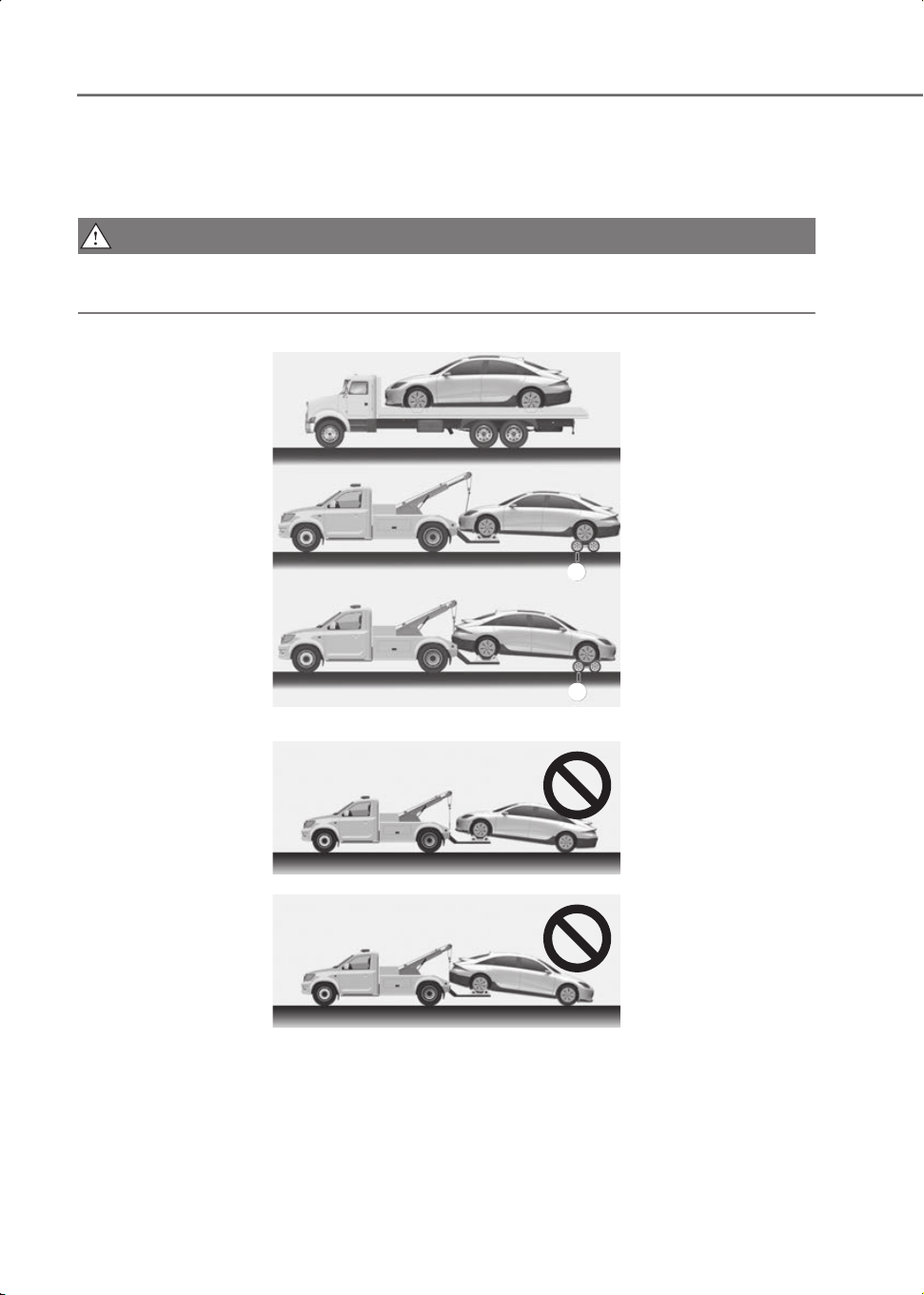
Introduction/Getting started with Your Electric Vehicle
1-66
If the Electric Vehicle Needs Towing
If towing is required, lift all wheels to tow. Towing with the wheels on the ground may
damage the vehicle’s motor components.
CAUTION
When a vehicle fire occurs due to the battery, there is a risk of a second fire. Contact the
fire department when towing the vehicle.
B0003401
[A] Dollies
B0003402
B0003403
A
A
CE_USA.book Page 66

1
1-67
Other Precautions for Electric Vehicle Accidents
CAUTION
• Be extremely cautious for electricity safety. An electric shock accident may occur due
to a short circuit in high voltage power.
• When you paint or apply heat treatment to the vehicle as a result of an accident, the
performance of the high voltage battery can be reduced. If heat treatment is required,
contact an authorized HYUNDAI dealer.
• Use or install only genuine parts. Third-party parts or modified parts may damage the
electric power system
CE_USA.book Page 67

CE_USA.book Page 68

2
2. Vehicle Information,
Consumer Information, and
Reporting Safety Defects
Exterior Overview (Front View)....................................................................................... 2-2
Exterior Overview (Rear View)........................................................................................ 2-3
Interior Overview.............................................................................................................2-4
Center Console Overview ............................................................................................... 2-5
Steering Wheel Control Overview.................................................................................. 2-7
Motor Compartment Overview ......................................................................................2-8
Dimensions ......................................................................................................................2-9
Electric Vehicle Specifications .......................................................................................2-9
Bulb Wattage ................................................................................................................. 2-10
Tires And Wheels ............................................................................................................ 2-11
Air Conditioning System ................................................................................................2-12
Vehicle Weight And Luggage Volume ..........................................................................2-12
Available Front Trunk Weight ........................................................................................2-12
Recommended Lubricants And Capacities ..................................................................2-13
Vehicle Identification Number (VIN).............................................................................2-14
Vehicle Certification Label.............................................................................................2-14
Tire Specification And Pressure Label...........................................................................2-14
Motor Number ................................................................................................................2-15
Air Conditioner Compressor Label ................................................................................2-15
Refrigerant Label ............................................................................................................2-15
Consumer Information...................................................................................................2-16
Reporting Safety Defects............................................................................................... 2-17
Open Source Software Notice.......................................................................................2-18
CE_USA.book Page 1
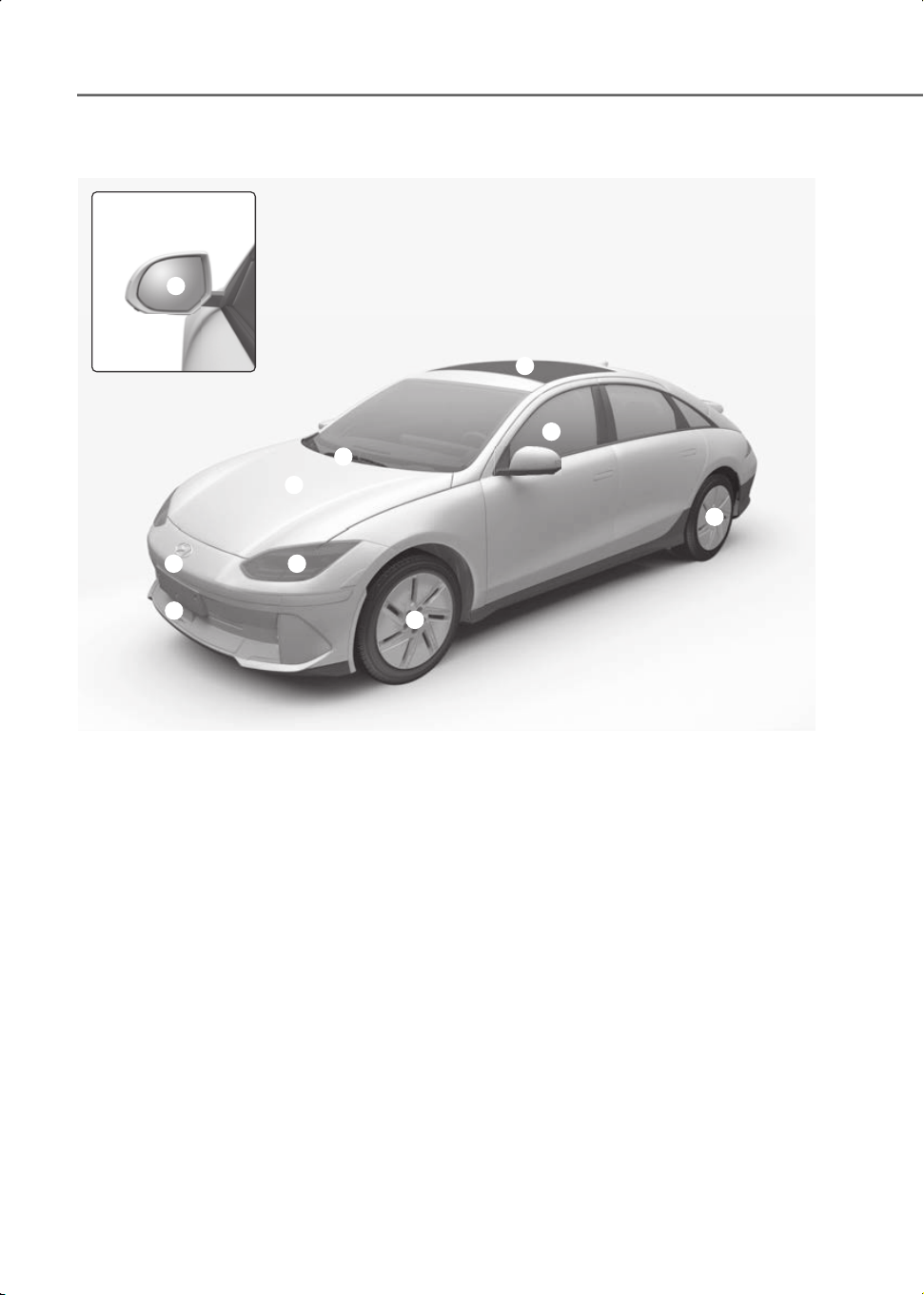
Vehicle Information, Consumer Information, and Reporting Safety Defects
2-2
Exterior Overview (Front View)
A1000201
The actual shape may differ from the illustration.
(1) Hood ......................................................................................................................... 5-57
(2) Headlight..................................................................................................................9-47
(3) Tires and wheels ......................................................................................................9-23
(4) Side view mirror....................................................................................................... 5-47
(5) Wide sunroof............................................................................................................5-54
(6) Front windshield wiper blades ................................................................................9-17
(7) Window ....................................................................................................................5-50
(8) Wide-front view camera ........................................................................................7-132
(9) Front radar ................................................................................................................. 7-7
1
2
3
3
5
6
7
8
9
4
CE_USA.book Page 2
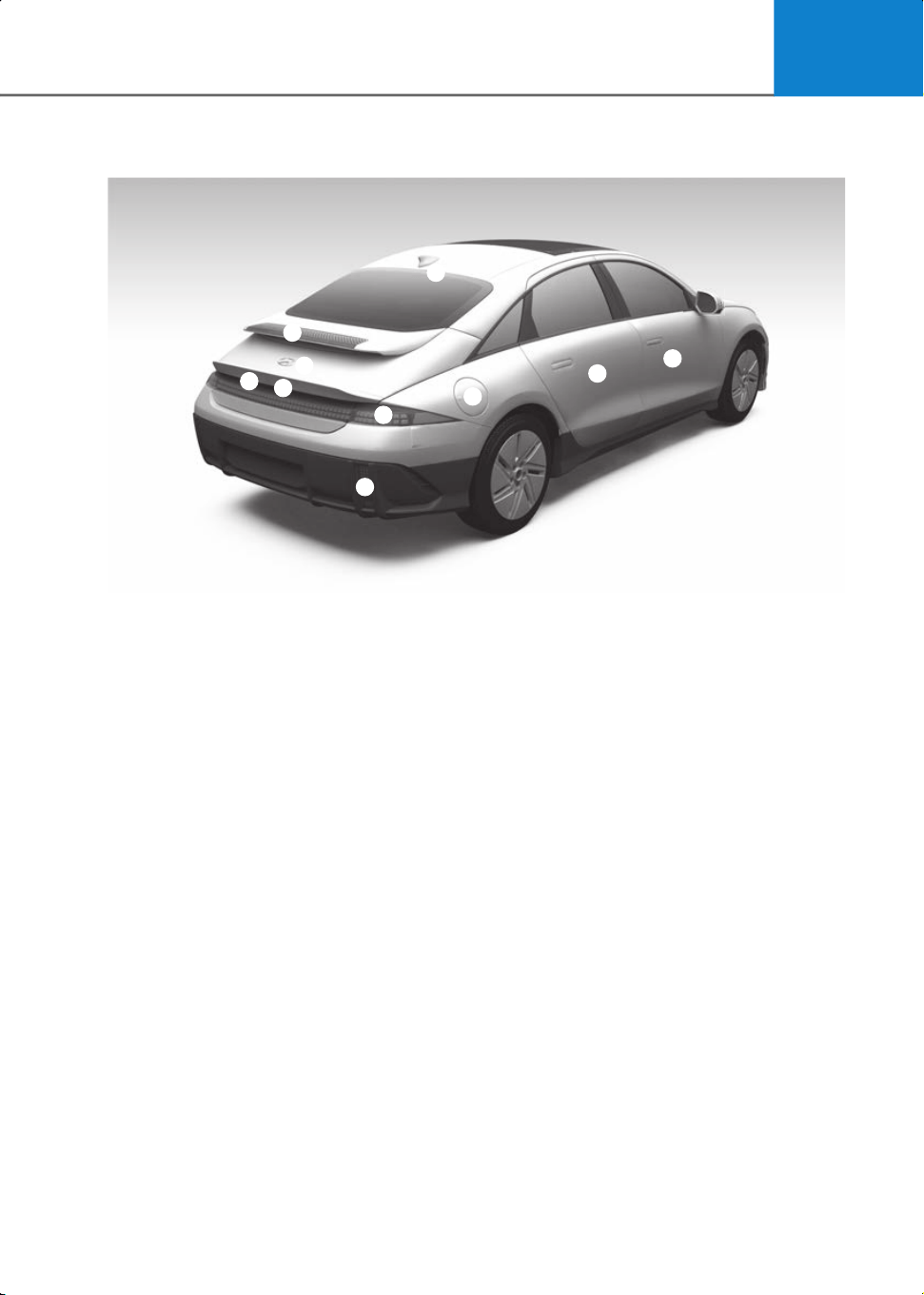
2
2-3
Exterior Overview (Rear View)
A1000301
The actual shape may differ from the illustration.
(1) Door.......................................................................................................................... 5-22
(2) Electric charging door.............................................................................................5-66
(3) Rear combination light........................................................................................... 9-48
(4) Trunk.........................................................................................................................5-59
(5) Trunk open/close button ........................................................................................ 5-61
(6) High mounted stop light ........................................................................................ 9-48
(7) Antenna ................................................................................................................... 5-114
(8) Wide-rear view camera..........................................................................................7-105
(9) Reverse light ........................................................................................................... 9-48
4
5
1
1
2
3
9
8
6
7
CE_USA.book Page 3
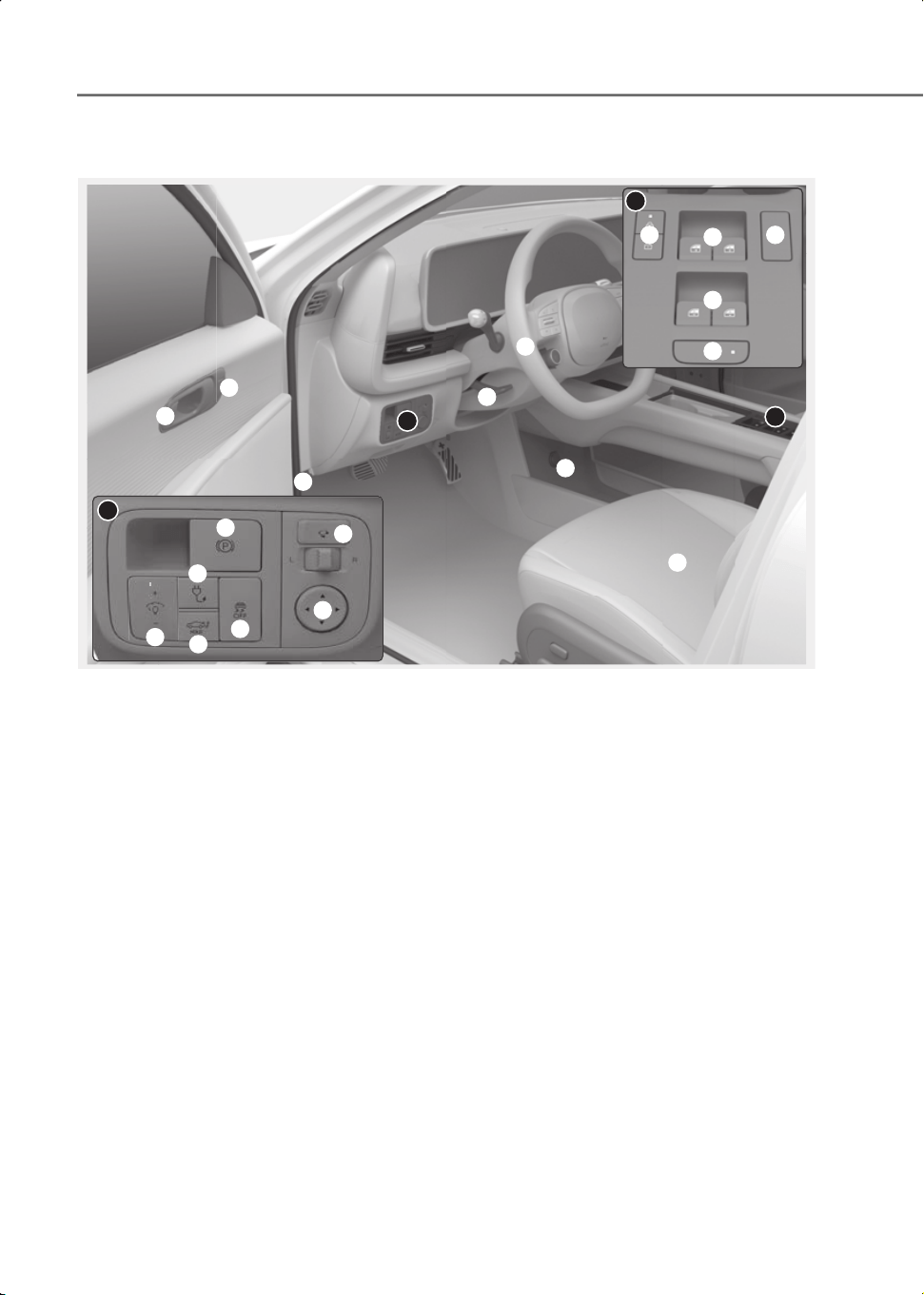
Vehicle Information, Consumer Information, and Reporting Safety Defects
2-4
Interior Overview
A1000501
The actual shape may differ from the illustration.
(1) Inside door handle................................................................................................... 5-27
(2) Integrated memory system .................................................................................... 5-32
(3) Seat............................................................................................................................. 3-3
(4) EPB (Electronic Parking Brake) switch...................................................................6-24
(5) Instrument panel illumination ..................................................................................4-3
(6) Charging door open/close button..........................................................................5-66
(7) Power trunk open/close button ............................................................................ 5-60
(8) ESC (Electronic Stability Control) OFF button.......................................................6-32
(9) Side view mirror folding button.............................................................................. 5-47
(10)Side view mirror control switch.............................................................................. 5-47
(11) Steering wheel ......................................................................................................... 5-35
(12)Steering wheel tilt/telescopic lever .......................................................................5-35
(13)Power outlet........................................................................................................... 5-108
(14)Hood release lever................................................................................................... 5-57
(15)Central door lock switch ......................................................................................... 5-27
(16)Power window switches .........................................................................................5-50
(17)Power window lock button ......................................................................................5-51
(18)AUTO Hold button ...................................................................................................6-28
1
12
13
14
16
16
17
15
18
11
2
3
B
B
A
10
7
6
4
9
8
A
5
CE_USA.book Page 4
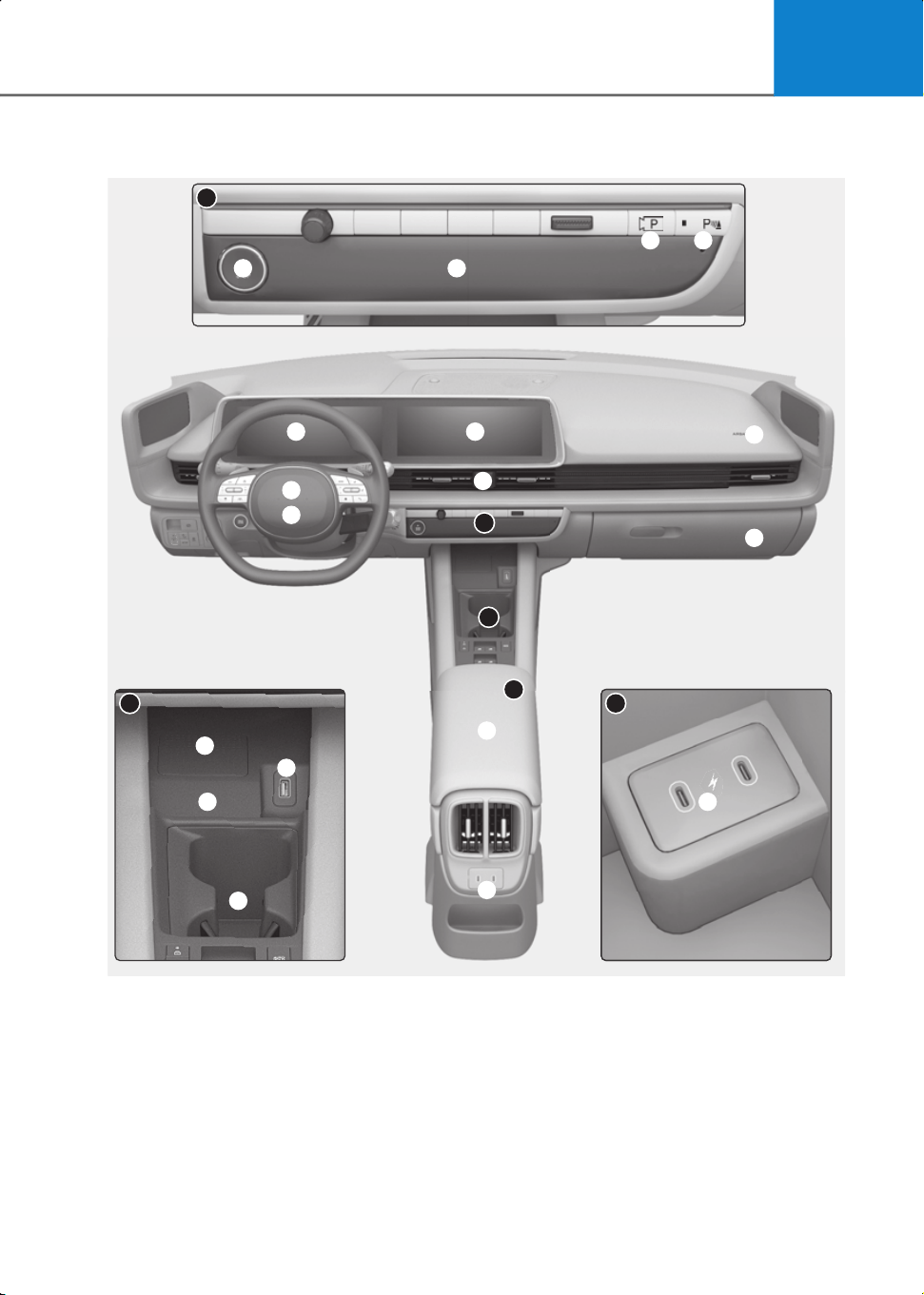
2
2-5
Center Console Overview
A1000601
The actual shape may differ from the illustration.
(1) Instrument cluster ..................................................................................................... 4-2
(2) Horn..........................................................................................................................5-36
(3) Driver’s front airbag.................................................................................................3-40
(4) Infotainment system .............................................................................................. 5-113
(5) Hazard warning flasher button.................................................................................8-2
(6) Start/Stop button ......................................................................................................6-4
(7) Automatic climate control system .........................................................................5-85
1 4
5
6 7
12
13
14
18
15
10
11
16
2
3
A
A
B
B
C
C
17
8 9
CE_USA.book Page 5

Vehicle Information, Consumer Information, and Reporting Safety Defects
2-6
(8) Parking/View button ............................................................................................. 7-106
(9) Parking Safety button.............................................................................................7-123
(10)Passenger’s front airbag .........................................................................................3-40
(11) Glove box ............................................................................................................... 5-106
(12)Wireless charging system pad...............................................................................5-110
(13)Wireless charging system ...................................................................................... 5-110
(14)USB port .................................................................................................................. 5-113
(15)Cup holder...............................................................................................................5-107
(16)Center console....................................................................................................... 5-106
(17)USB charger ........................................................................................................... 5-109
(18)Rear seat USB charger .......................................................................................... 5-109
CE_USA.book Page 6
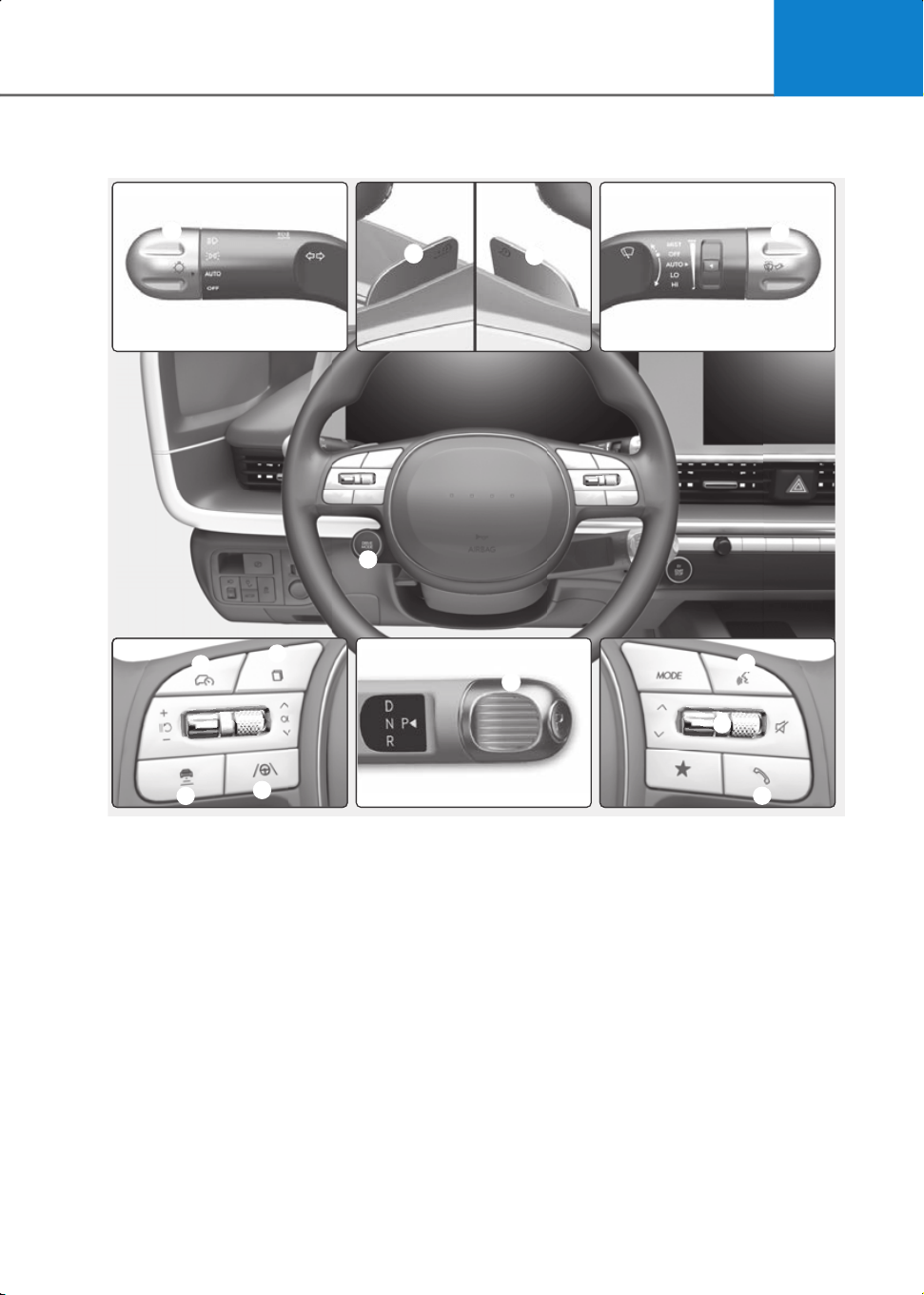
2
2-7
Steering Wheel Control Overview
A1000701
The actual shape may differ from the illustration.
(1) Lighting control lever .............................................................................................. 5-72
(2) Wiper and washer control lever..............................................................................5-82
(3) Rotary shifter(Rotary gearshift dial).........................................................................6-8
(4) Paddle shifter........................................................................................................... 6-14
(5) Voice recognition button ....................................................................................... 5-115
(6) Steering wheel audio controls............................................................................... 5-114
(7) Bluetooth® wireless technology hands-free button ............................................ 5-116
(8) Cluster display control ............................................................................................4-24
(9) Lane Driving Assist button .......................................................................................7-31
(10)Driving Assist button................................................................................................ 7-71
(11) Vehicle Distance button........................................................................................... 7-71
(12)Drive mode button ..................................................................................................6-42
5
7
10
8
11
12
9
1
2
4
4
3
6
CE_USA.book Page 7
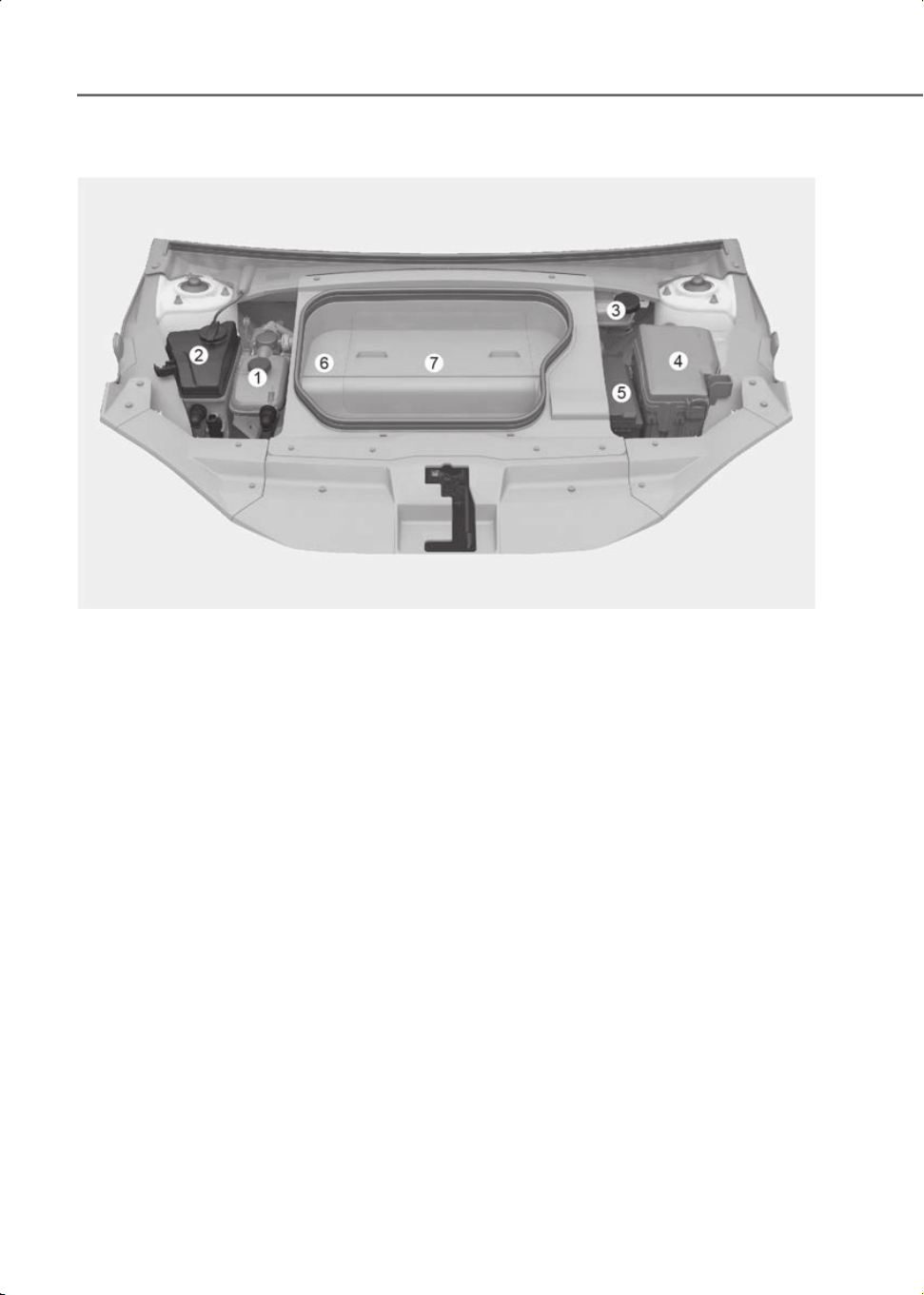
Vehicle Information, Consumer Information, and Reporting Safety Defects
2-8
Motor Compartment Overview
A1000901
The actual motor compartment in the vehicle may differ from the illustration.
(1) Coolant reservoir ..................................................................................................... 9-13
(2) Windshield washer fluid reservoir.......................................................................... 9-16
(3) Brake fluid reservoir ................................................................................................ 9-14
(4) Fuse box ...................................................................................................................9-36
(5) Battery (12 V) .............................................................................................................9-21
(6) Front trunk ...............................................................................................................5-58
(7) Cabin air filter........................................................................................................... 9-16
CE_USA.book Page 8
2
2-9
Dimensions
Electric Vehicle Specifications
Items in. (mm)
Overall length 191.14 (4,855)
Overall width 74.02 (1,880)
Overall height 58.86 (1,495)
Tread
Tire size Front Rear
18 in. 64.37 (1,635) 64.72 (1,644)
20 in. 64.17 (1,630) 64.53 (1,639)
Wheelbase 116.14 (2,950)
Items
Standard type Extended type
2WD 2WD AWD
Motor
Max. output (kW) 111.4 168.1
73.9+165.
4
Max. torque (Nm) 350 350 255 + 350
Battery
(Lithium-ion)
Capacity (kWh) 53 77.4 77.4
Power output (kW) 173 277 277
Voltage (V) 480 697 697
Charger (On-Board
Battery Chargers)
Max. output (kW) 10.9 10.9 10.9
CE_USA.book Page 9

Vehicle Information, Consumer Information, and Reporting Safety Defects
2-10
Bulb Wattage
Light Bulb Bulb Type Wattage
Front
Headlight
Low LED LED
High LED LED
Turn signal light LED LED
Parking light LED LED
Daytime Running light (DRL) LED LED
Side marker LED LED
Front trunk light LED LED
Side repeater light LED LED
Rear
Stop light LED LED
Tail light LED LED
Turn signal light LED LED
Reverse light LED LED
Side marker LED LED
License plate light LED LED
High mounted stop light LED LED
Interior
Front seat map and room lamp LED LED
Rear seat room lamp LED LED
Vanity mirror lamp LED LED
Glove box lamp LED LED
Door mood lamp LED LED
Luggage compartment lamp LED LED
CE_USA.book Page 10
2
2-11
Tires And Wheels
NOTICE
• It is permissible to add 3 psi (20 kPa) to the standard tire pressure specification if colder
temperatures are expected soon. Tires typically lose 1 psi (7 kPa) for every 12 °F (7 °C)
temperature drop. If extreme temperature variations are expected, recheck your tire
pressure as necessary to keep them properly inflated.
• Tire inflation pressures may vary depending on changes in elevation. If driving in areas
of higher or lower elevation, be sure to check and adjust for proper tire inflation.
• Do not exceed the maximum inflation pressure, as found on the sidewall of the tire(s).
CAUTION
When replacing tires, ALWAYS use the same size, type, brand, construction and tread
pattern supplied with the vehicle. If not, it can damage the related parts or make it work
irregularly.
Items Tire Size
Wheel
Size
Battery
Type
Inflation Pressure psi (kPa)
Wheel Lug
Nut Torque
lbf-ft (kgf-m,
N-m)
Normal Load
Maximum
Load
Front Rear Front Rear
Full
Size
Tire
225/55R18 7.5J X 18
2WD
Standard
38
(260)
38
(260)
38
(260)
38
(260)
79-94 (11-13,
108-127)
225/55R18 7.5J X 18
2WD
Extended
38
(260)
38
(260)
38
(260)
38
(260)
225/55R18 7.5J X 18
AWD
Extended
36
(250)
36
(250)
36
(250)
36
(250)
245/40R20 8.5J X 20
2WD
Extended
36
(250)
37
(255)
36
(250)
37
(255)
245/40R20 8.5J X 20
AWD
Extended
36
(250)
37
(255)
36
(250)
37
(255)
CE_USA.book Page 11

Vehicle Information, Consumer Information, and Reporting Safety Defects
2-12
Air Conditioning System
Contact an authorized HYUNDAI dealer for more information.
Vehicle Weight And Luggage Volume
Available Front Trunk Weight
Item Weight of Volume Classification
Refrigerant
With heat pump 32±0.9 oz. (900±25 g)
R-1234yf
Without heat
pump
25±0.9 oz. (700±25 g)
Compressor lubricant
With heat pump 6.11±0.35 oz. (190±10 g)
POE
Without heat
pump
5.29±0.35 oz. (150±10 g)
Gross Vehicle Weight
Luggage Volume
Standard Type Extended Type
2WD: 4,894 lbs. (2220 kg)
2WD: 5,313 lbs. (2410 kg)
AWD: 5,556 lbs. (2520 kg)
14.2 cu.ft (401 ℓ)
2WD / AWD
25 lbs. (10 kg)
CE_USA.book Page 12

2
2-13
Recommended Lubricants And Capacities
To help achieve proper vehicle performance and durability, use only lubricants of the
proper quality.
These lubricants and fluids are recommended for use in your vehicle.
Lubricant Volume Classification
Gear fluid
2WD Rear
3.6-3.7 US qt.
(3.4-3.5 ℓ)
HK ATF 65 SP4M-1
AWD
Front
3.4-3.5 US qt.
(3.2-3.3 ℓ)
Rear
3.6-3.7 US qt.
(3.4-3.5 ℓ)
Coolant
Standard
type
with heat
pump
2WD 18.51 US qt. (17.52 ℓ)
Mixture of antifreeze
and water
(Phosphate-based
Ethylene glycol coolant
Battery for aluminum
radiator)
AWD
18.74 US qt.
(17.73 ℓ)
without
heat pump
2WD
17.85 US qt.
(16.89 ℓ)
AWD
18.20 US qt.
(17.22 ℓ)
Extended
type
with heat
pump
2WD
20.63 US qt.
(19.52 ℓ)
AWD
20.90 US qt.
(19.78 ℓ)
without
heat pump
2WD
19.96 US qt.
(18.89 ℓ)
AWD
20.36 US qt.
(19.27 ℓ)
Brake fluid
about 24 oz.
(700 cc)
SAE J1704 DOT-4 LV,
FMVSS 116 DOT-4, ISO
4925 CLASS-6
CE_USA.book Page 13
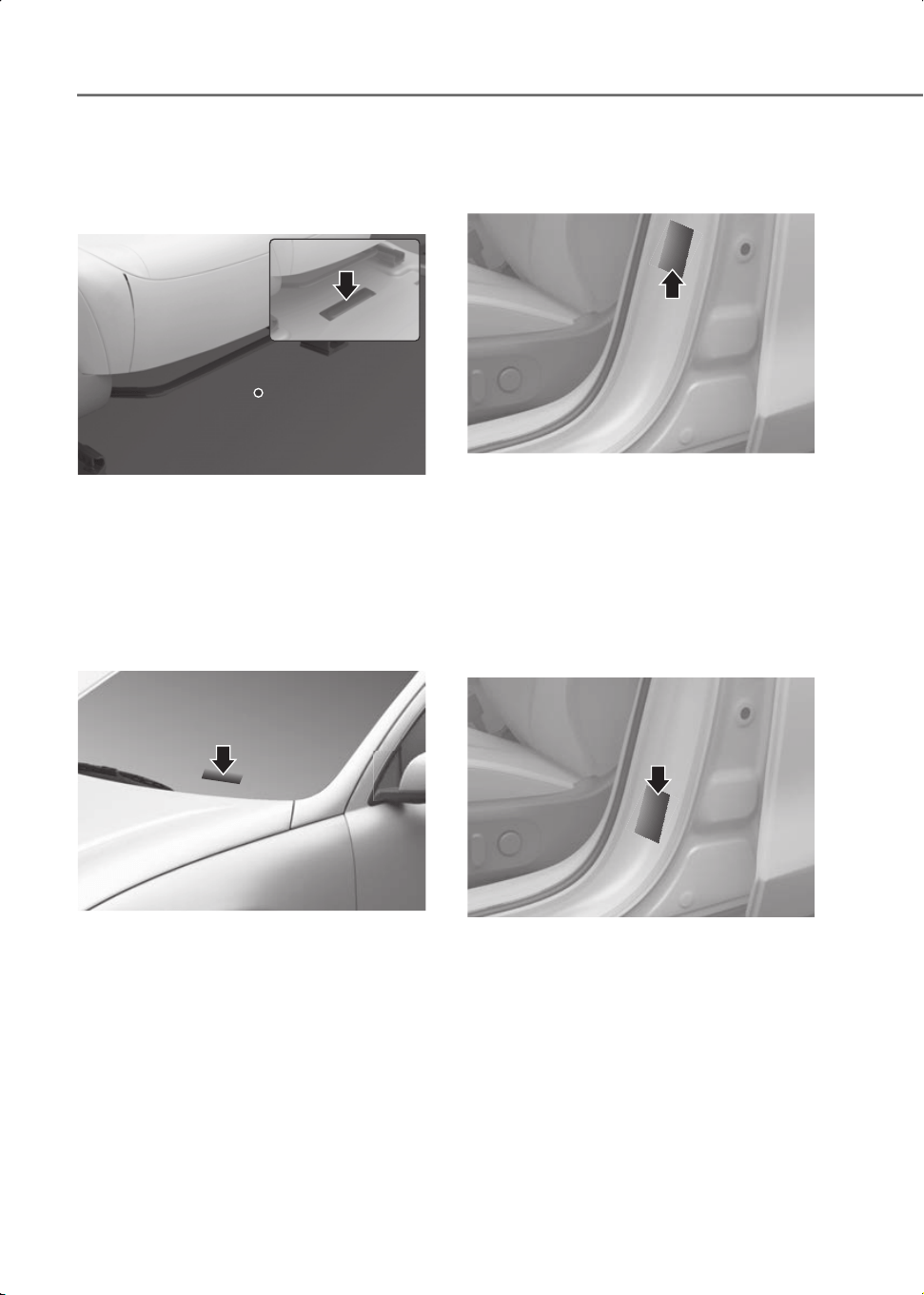
Vehicle Information, Consumer Information, and Reporting Safety Defects
2-14
Vehicle Identification
Number (VIN)
Frame number
B1002101
The vehicle identification number (VIN) is
the number used in registering your
vehicle and in all legal matters pertaining
to its ownership, etc.
The number is punched on the floor under
the right front seat. To check the number,
open the cover.
VIN label (if equipped)
ONE1011021
The VIN is also on a plate attached to the
top of the left side dashboard. The
number on the plate can easily be seen
through the windshield from outside.
Vehicle Certification
Label
ONE1011022
The vehicle certification label attached on
the driver’s (or front passenger’s) side
center pillar gives the vehicle
identification number (VIN).
Tire Specification And
Pressure Label
ONE1011025L
The tires supplied on your new vehicle are
chosen to provide the best performance
for normal driving.
The tire label located on the driver’s side
center pillar gives the tire pressures
recommended for your vehicle.
CE_USA.book Page 14
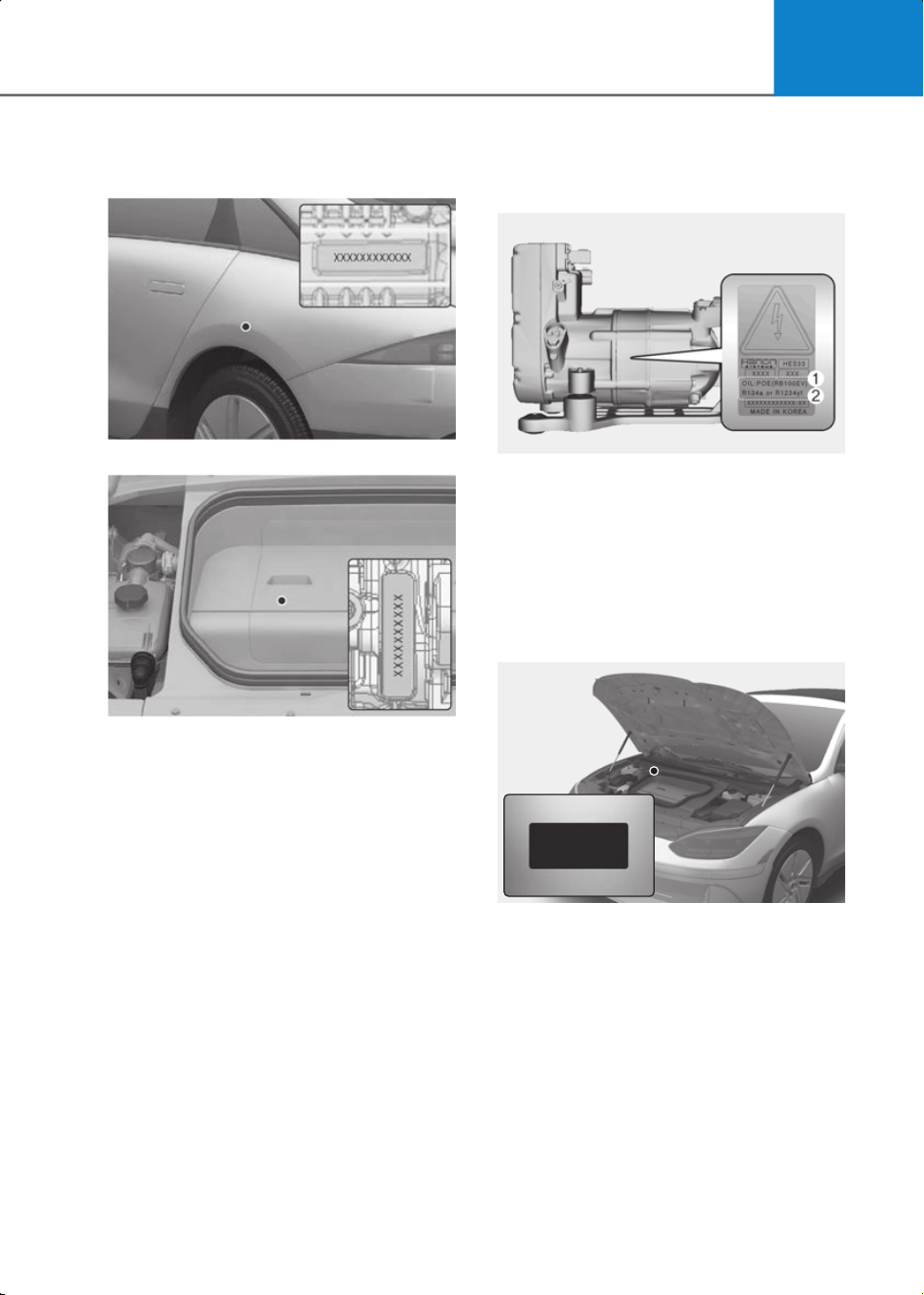
2
2-15
Motor Number
2WD/AWD
B1002401
AWD
B1002402
The motor numbers can be checked at
the bottom of the vehicle.
Air Conditioner
Compressor Label
ONE1011026L
A compressor label informs you the type
of compressor your vehicle is equipped
with such as model, supplier part number,
production number, refrigerant oil (1) and
refrigerant (2).
Refrigerant Label
B5020201
The refrigerant label provides information
such as refrigerant type and amount.
(R-1234yf)
CE_USA.book Page 15

Vehicle Information, Consumer Information, and Reporting Safety Defects
2-16
Consumer Information
This consumer information has been prepared in accordance with regulations issued by
the National Highway Traffic Safety Administration of the U.S. Department of
Transportation. Your HYUNDAI dealer will help answer any questions you may have as
you read this information.
HYUNDAI motor vehicles are designed and manufactured to meet or exceed all
applicable safety standards.
For your safety, however, we strongly urge you to read and follow all directions in this
Owner’s Manual, particularly the information under the headings “NOTICE”, “CAUTION”
and “WARNING”.
If, after reading this manual, you have any questions regarding the operation of your
vehicle, please contact the Hyundai Customer Care Center.
Hyundai Customer Care
P.O. Box 20850
Fountain Valley, CA 92728
800-633-5151
consumeraffairs@hmausa.com
Hyundai’s Customer Care representatives are available Monday through Friday,
between the hours of 6:00 AM and 5:00 PM PST
and Saturday between 6:30 AM and 3:00 PM PST (English).
For Customer Care assistance in Spanish or Korean, representatives are available
Monday through Friday between 6:30 AM and 3:00 PM PST.
CE_USA.book Page 16

2
2-17
Reporting Safety Defects
If you believe that your vehicle has a defect which could cause a crash or could
cause injury or death, you should immediately inform the National Highway
Traffic Safety Administration (NHTSA) in addition to notifying HYUNDAI MOTOR
AMERICA.
To contact NHTSA, you may call the Vehicle Safety Hotline toll-free at
1-888-327-4236 (TTY: 1-800-424-9153);
go to http://www.safercar.gov;
download the SaferCar mobile application;
or write to:
Administrator, NHTSA1200 New Jersey Ave, SE,West Building Washington, D.C.
20590.
You can also obtain other information about motor vehicle safety from
http://www.safercar.gov.
If NHTSA receives similar complaints, it may open an investigation, and if it finds
that a safety defect exists in a group of vehicles, it may order a recall and remedy
campaign. However, NHTSA cannot become involved in individual problems
between you, your dealer, or HYUNDAI MOTOR AMERICA.
CE_USA.book Page 17

Vehicle Information, Consumer Information, and Reporting Safety Defects
2-18
Open Source Software Notice
This vehicle contains software with open source licenses. Open source software
information including the source code, copyright notices and referred license terms may
be obtained on the website
https://www.hyundai.com/worldwide/opensource
HYUNDAI Motor Company will provide the open source code to you in storage medium
such as CD-ROM for minimum charge covering the cost of performing source
distribution upon email request to opensource@hyundai.com within a period of 3 years
from the date of product purchase.
CE_USA.book Page 18

3
3. Seats & Safety System
Important Safety Precautions......................................................................................... 3-2
Always Wear Your Seat Belt ........................................................................................ 3-2
Restrain All Children .................................................................................................... 3-2
Airbag Hazards ............................................................................................................. 3-2
Driver Distraction......................................................................................................... 3-2
Control Your Speed...................................................................................................... 3-2
Keep Your Vehicle In Safe Condition.......................................................................... 3-2
Seats .................................................................................................................................3-3
Safety Precautions ....................................................................................................... 3-5
Front Seats....................................................................................................................3-5
Rear Seats.....................................................................................................................3-9
Head Restraint ............................................................................................................ 3-11
Seat Warmers..............................................................................................................3-15
Air Ventilation Seats................................................................................................... 3-18
Seat Belts ....................................................................................................................... 3-19
Seat Belt Safety Precautions..................................................................................... 3-19
Seat Belt Warning Light.............................................................................................3-20
Seat Belt Restraint System........................................................................................ 3-22
Additional Seat Belt Safety Precautions................................................................... 3-27
Care of Seat Belts.......................................................................................................3-29
Child Restraint System (CRS) .......................................................................................3-29
Children Always in the Rear ......................................................................................3-29
Selecting a Child Restraint System (CRS) ................................................................3-30
Installing a Child Restraint System (CRS) ................................................................ 3-32
Airbag - Supplemental Restraint System.....................................................................3-38
Where are the Airbags? .............................................................................................3-40
How does the Airbags System Operate?..................................................................3-43
What to Expect After an Airbag Inflates...................................................................3-46
Occupant Classification System (OCS) ....................................................................3-46
Why didn’t My Airbag Go Off in a Collision? ............................................................ 3-52
SRS Care .....................................................................................................................3-56
Additional Safety Precautions................................................................................... 3-57
Airbag Warning Labels............................................................................................... 3-57
CE_USA.book Page 1

Seats & Safety System
3-2
Important Safety
Precautions
You will find many safety precautions and
recommendations throughout this
section, and throughout this manual. The
safety precautions in this section are
among the most important.
Always Wear Your Seat Belt
A seat belt is your best protection in all
types of accidents. Airbags are designed
to supplement seat belts, not to replace
them. So even though your vehicle is
equipped with airbags, always make sure
you and your passengers wear your seat
belts, and wear them properly.
Restrain All Children
All children under age 13 should ride in
your vehicle properly restrained in a rear
seat, not the front seat. Infants and small
children should be restrained in an
appropriate child restraint system. Larger
children should use a booster seat with
the lap/shoulder belt until they can use
the seat belt properly without a booster
seat.
Airbag Hazards
While airbags can save lives, they can also
cause serious or fatal injuries to
occupants who sit too close to them, or
who are not properly restrained. Infants,
young children, and short adults are at the
greatest risk of being injured by an
inflating airbag. Follow all instructions
and warnings in this manual.
Driver Distraction
Driver distraction presents a serious and
potentially deadly danger, especially for
inexperienced drivers. Safety should be
the primary concern when behind the
wheel and drivers need to be aware of the
wide array of potential distractions, such
as drowsiness, reaching for objects,
eating, personal grooming, other
passengers, and using mobile phones.
Drivers can become distracted when they
take their eyes and attention off the road
or their hands off the wheel to focus on
activities other than driving. To reduce
your risk of distraction and an accident:
• Set up your mobile devices (for
example, mp3 players, phones,
navigation units, etc.) only when your
vehicle is parked or safely stopped.
• Only use your mobile device when
allowed by laws and conditions permit
safe use. Never text or email while
driving. Most countries have laws
prohibiting drivers from texting. Some
countries and cities also prohibit
drivers from using handheld phones.
• Never let the use of a mobile device
distract you from driving. You have a
responsibility to your passengers and
others on the road to always drive
safely with your hands on the wheel as
well as your eyes and attention on the
road.
Control Your Speed
Excessive speed is a major factor in crash
injuries and deaths. Generally, the higher
the speed the greater the risk, but serious
injuries can also occur at lower speeds.
Never drive faster than is safe for current
conditions regardless of the maximum
speed posted.
Keep Your Vehicle In Safe
Condition
Having a tire blowout or a mechanical
failure can be extremely hazardous. To
reduce the possibility of such problems,
check your tire pressures and condition
frequently and perform all regularly
scheduled maintenance.
CE_USA.book Page 2
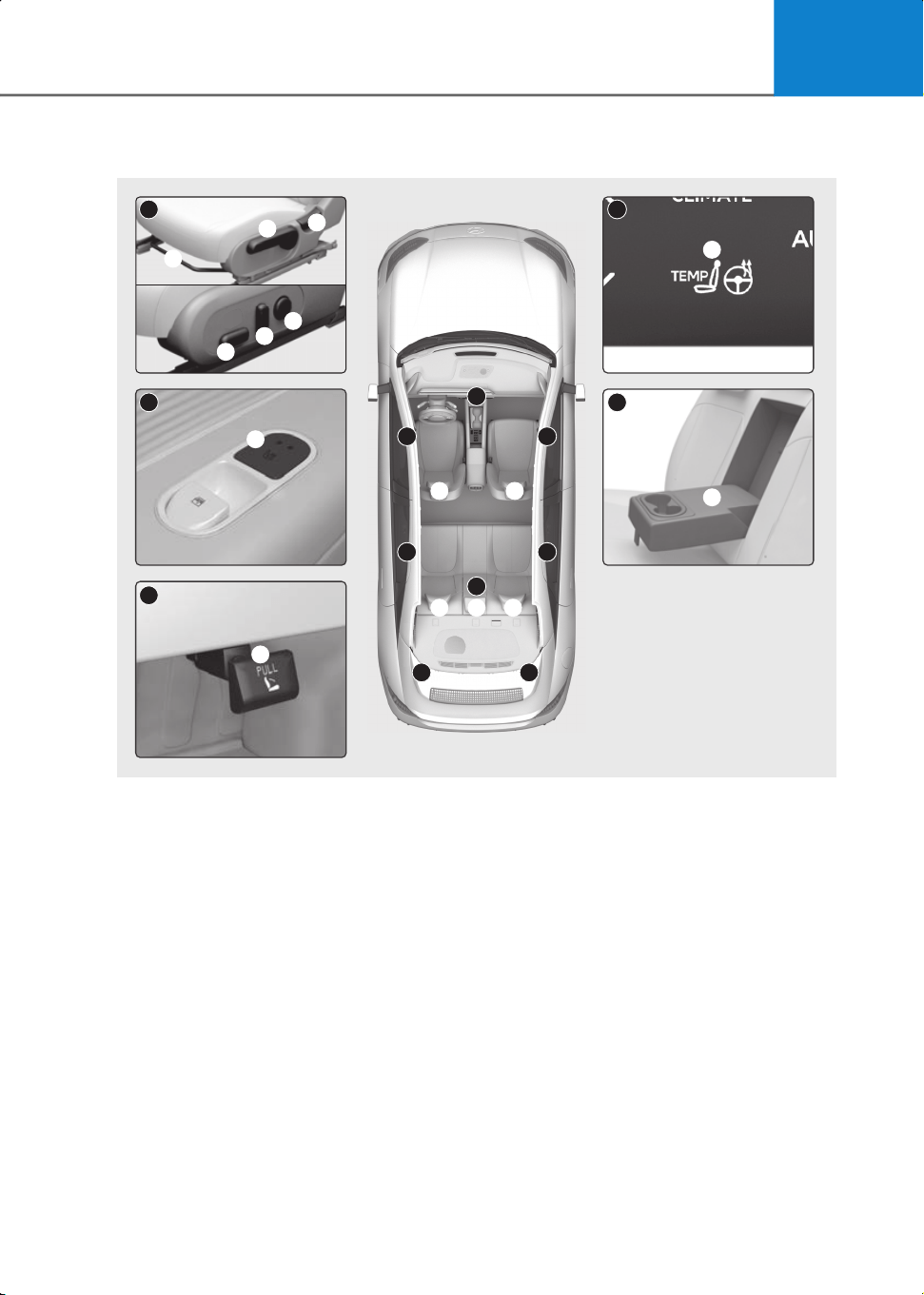
3
3-3
Seats
A3000101
The actual shape may differ from the illustration.
(1) Front seat sliding forward or rearward/Cushion height/Seat cushion angle
(2) Front seatback angle
(3) Front seat lumbar support
(4) Front seat warmer/Air ventilation seat
(5) Front head restraints
(6) Rear seat warmer
(7) Rear armrest
(8) Rear seatback folding lever
(9) Rear head restraints
1
1
1
2
2
3
8
A
A A
C C
C
B
B
D
E
E E
D
6
5
9 9 9
5
4
7
CE_USA.book Page 3
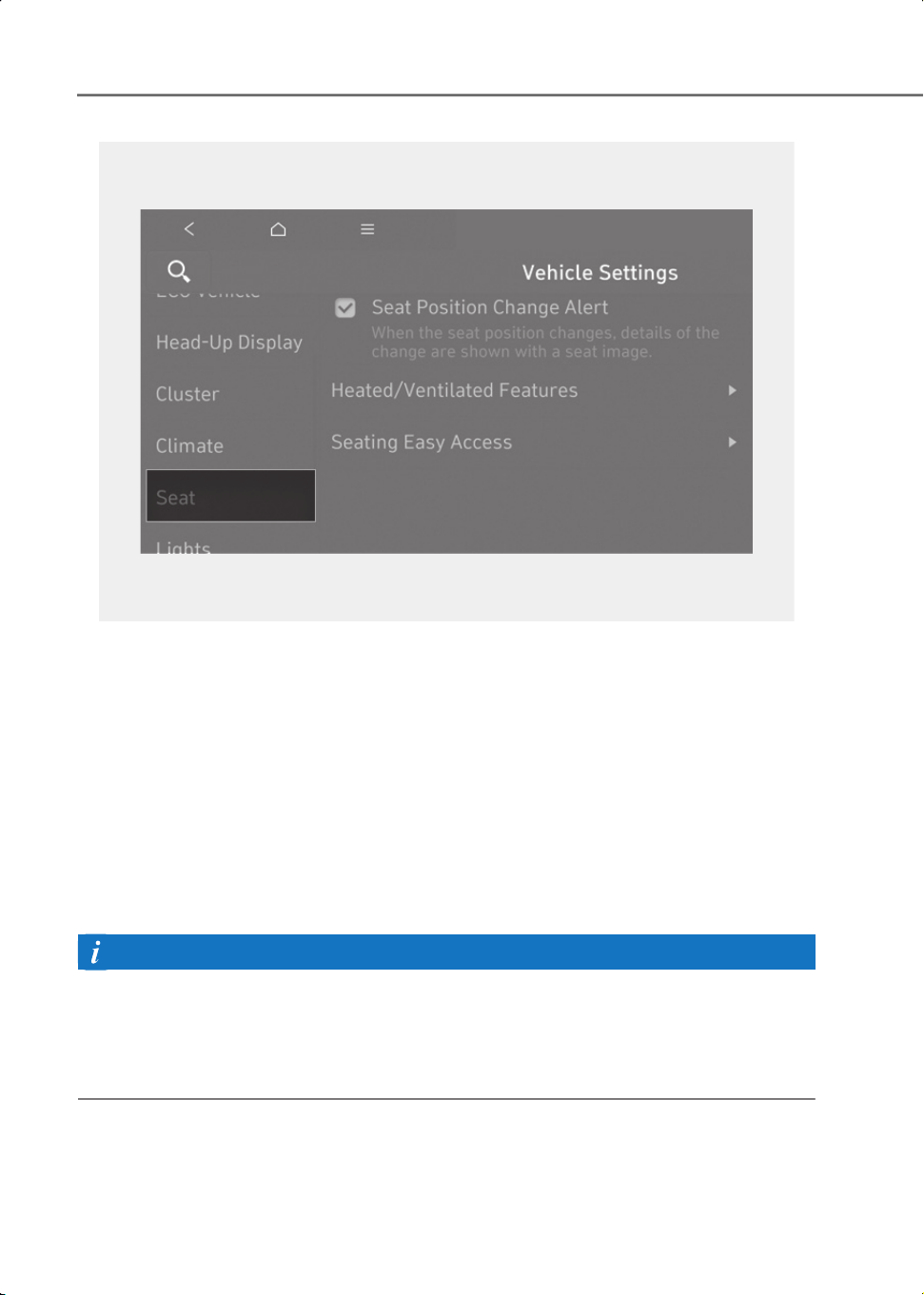
Seats & Safety System
3-4
ONE1031077L
Infotainment system
Select Setup > Vehicle > Seat from the Settings menu in the infotainment system, you
may use various convenience functions.
• Seat Position Change Alert: When the seat position changes, details of the change are
shown with a seat image.
• Heated/Ventilated Features
- Auto. Controls That Use Climate Control Settings (for driver’s seat): The seat
temperature is automatically controlled.
• Seating Easy Access
- Driver Seat Easy Access: The distance (Normal/Extended/Off) the seat automatically
moves when the driver enters or leaves the vehicle may be selected.
Information
• The information provided may differ depending on which functions are applicable to
your vehicle.
• The infotainment system may change after software updates. For more information,
refer to the user's manual provided in the infotainment system and the quick reference
guide.
CE_USA.book Page 4

3
3-5
Safety Precautions
Adjusting the seats so that you are sitting
in a safe and comfortable position plays
an important role for the safety of the
driver and passengers as much as seat
belts and airbags when in an accident.
WARNING
Do not use a cushion that reduces friction
between the seat and the passenger. The
passenger’s hips may slide under the lap
portion of the seat belt during an accident
or a sudden stop.
Serious or fatal internal injuries could
result because the seat belt cannot
operate properly.
Airbags
You can take steps to reduce the risk of
being injured by an inflating airbag.
Sitting too close to an airbag greatly
increases the risk of injury in the event the
airbag inflates. Move your seat as far back
as possible from front airbags while still
maintaining control of the vehicle.
WARNING
To reduce the risk of serious injury or
death from an inflating airbag, take the
following precautions:
• Adjust the driver’s seat as far to the rear
as possible while maintaining the ability
to control the vehicle.
• Adjust the front passenger seat as far to
the rear as possible.
• Hold the steering wheel by the rim with
your hands at the 9 o’clock and 3
o’clock positions to minimize the risk of
injuries to your hands and arms.
• NEVER place anything or anyone
between you and the airbag.
• Do not allow the front passenger to
place feet or legs on the dashboard to
minimize the risk of leg injuries.
Seat belts
Always fasten your seat belt before
starting any trip. At all times, passengers
should sit upright and be properly
restrained. Infants and small children
must be restrained in appropriate Child
Restraint Systems. Children who have
outgrown a booster seat and adults must
be restrained using the seat belts.
WARNING
Take the following precautions when
adjusting your seat belt:
• NEVER use one seat belt for more than
one occupant.
• Always position the seatback upright
with the lap portion of the seat belt
snug and low across the hips.
• NEVER allow children or small infants,
or pets to ride on a passenger’s lap.
• Do not route the seat belt across your
neck, across sharp edges, or reroute
the shoulder strap away from your
body.
• Do not allow the seat belt to become
caught or jammed.
Front Seats
WARNING
Take the following precautions when
adjusting your seat:
• NEVER attempt to adjust the seat while
the vehicle is moving. The seat could
respond with unexpected movement
and may cause loss of vehicle control
resulting in an accident.
• Do not place anything under the front
seats. Loose objects in the driver’s foot
area could interfere with the operation
of the foot pedals, causing an accident.
• Do not allow anything to interfere with
the normal position and proper locking
of the seatback.
CE_USA.book Page 5
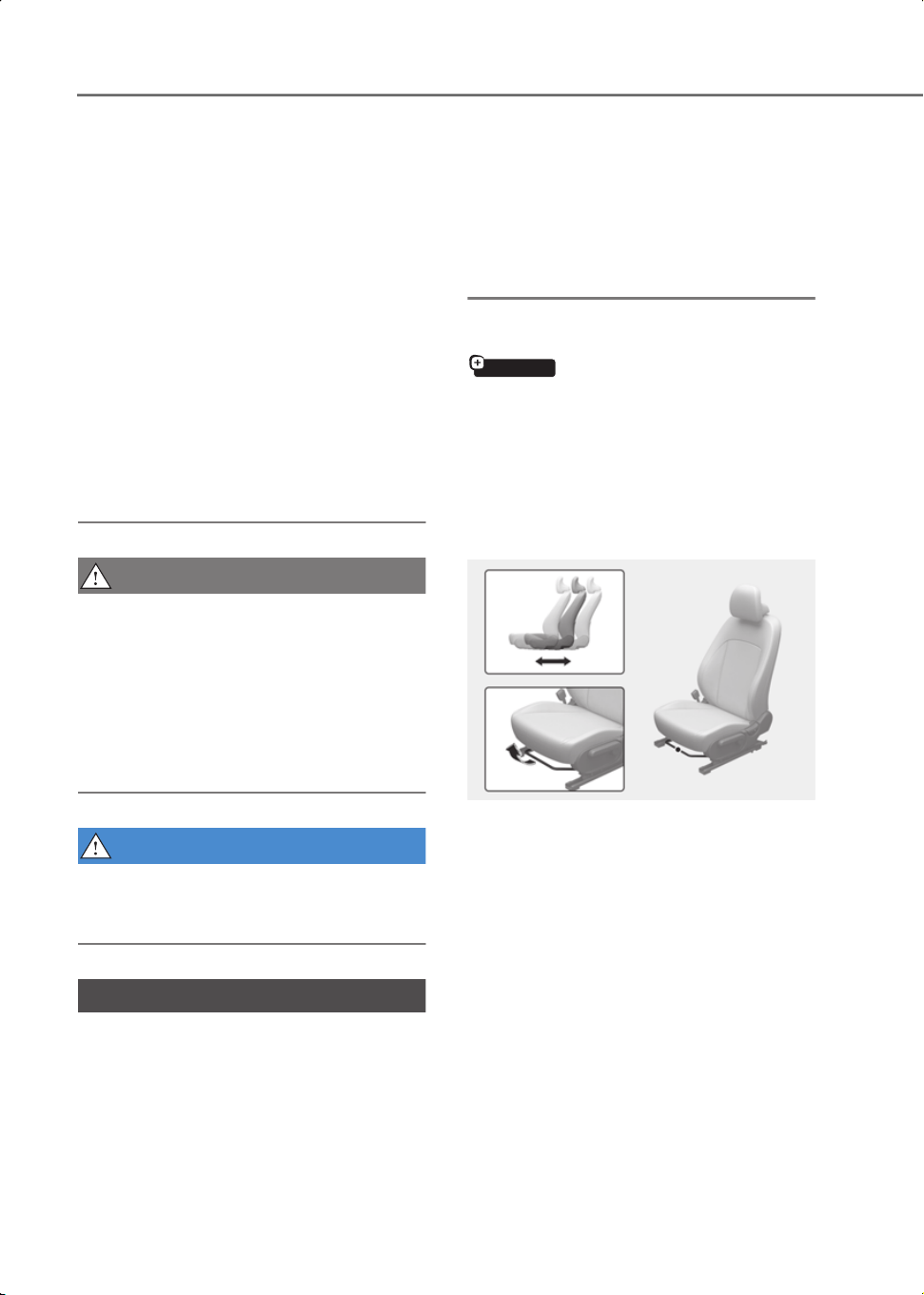
Seats & Safety System
3-6
• Do not place a cigarette lighter on the
floor or seat. When you operate the
seat, gas may exit out of the lighter
causing a fire.
• Use extreme caution when picking up
small objects trapped under the seats
or between the seat and the center
console. Your hands might be cut or
injured by the sharp edges of the seat
mechanism.
• If there are occupants in the rear seats,
be careful while adjusting the front seat
position.
• Make sure that the seat is locked in
place after the adjustment. If not, the
seat might move unexpectedly
resulting in an accident.
CAUTION
To prevent injury:
• Do not adjust your seat while wearing
your seat belt. Moving the seat cushion
forward may cause strong pressure on
your abdomen.
• Do not allow your hands or fingers to
get caught in the seat mechanisms
while the seat is moving.
WARNING
NEVER allow children in the vehicle
unattended. The power seats are
operable when the vehicle is turned off.
NOTICE
To prevent damage to the seats:
• Always stop adjusting the seats when
the seat has been adjusted as far
forward or rearward as possible.
• Do not adjust the seats longer than
necessary when the vehicle is turned
off. This may result in unnecessary
battery drain.
• Do not operate two or more seats at the
same time. This may result in an
electrical malfunction.
if equipped
Manual adjustment
The front seat can be adjusted by using
the levers located underneath the seat
cushion. Before driving, adjust the seat to
the proper position so that you can easily
control the steering wheel, foot pedals
and controls on the instrument panel.
Forward and rearward adjustment
B3000201
To move the seat forward or rearward:
1. Pull up the seat slide adjustment lever
and hold it.
2. Slide the seat to the position you desire.
3. Release the lever and make sure the
seat is locked in place. Move forward
and rearward without using the lever. If
the seat moves, it is not locked
properly.
CE_USA.book Page 6
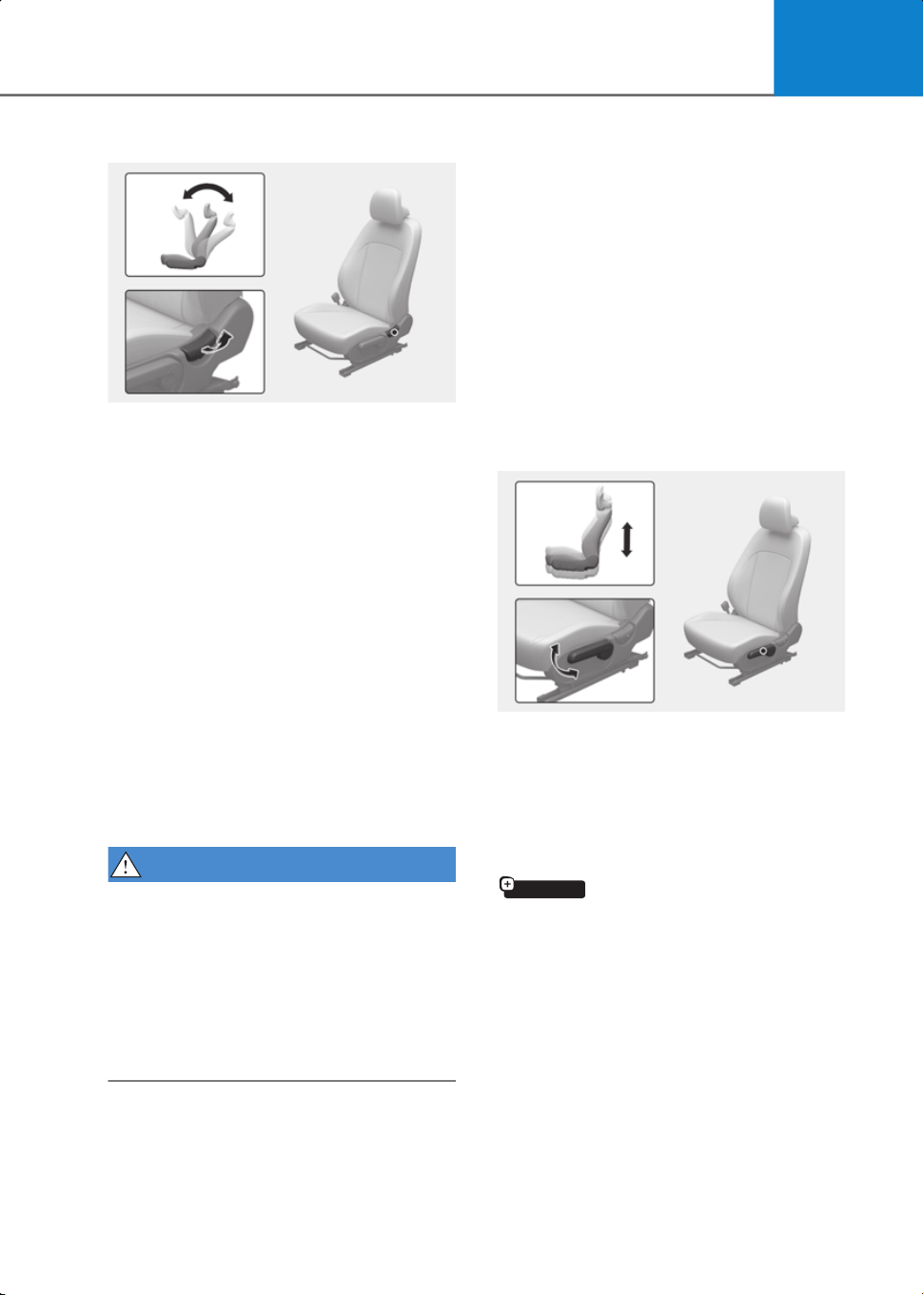
3
3-7
Seatback angle
B3000202
To recline the seatback:
1. Lean forward slightly and lift up the
seatback lever.
2. Carefully lean back on the seat and
adjust the seatback to the position you
desire.
3. Release the lever and make sure the
seatback is locked in place. (The lever
MUST return to its original position for
the seatback to lock.)
Reclining seatback
Sitting in a reclined position when the
vehicle is in motion can be dangerous.
Even when buckled up, the protections of
your restraint system (seat belts and/or
airbags) is greatly reduced by reclining
your seatback.
WARNING
NEVER ride with a reclined seatback
when the vehicle is moving.
Riding with a reclined seatback increases
your chance of serious or fatal injuries in
the event of a collision or sudden stop.
Drivers and passengers should ALWAYS
sit well back in their seats, properly
belted, and with the seatbacks upright.
Seat belts must be snug against your hips
and chest to work properly. When the
seatback is reclined, the shoulder belt
cannot do its job because it will not be
snug against your chest. Instead, it will be
in front of you. During an accident, you
could be thrown into the seat belt,
causing neck or other injuries.
The more the seatback is reclined, the
greater chance the passenger’s hips will
slide under the lap belt or the passenger’s
neck will strike the shoulder belt.
Seat height
To change the height of the seat cushion:
B3000203
• Push down the lever several times, to
lower the seat cushion.
• Pull up the lever several times, to raise
the seat cushion.
if equipped
Power adjustment
The front seat can be adjusted by using
the control switches located on the
outside of the seat cushion. Before
driving, adjust the seat to the proper
position so that you can easily control the
steering wheel, foot pedals and controls
on the instrument panel.
CE_USA.book Page 7
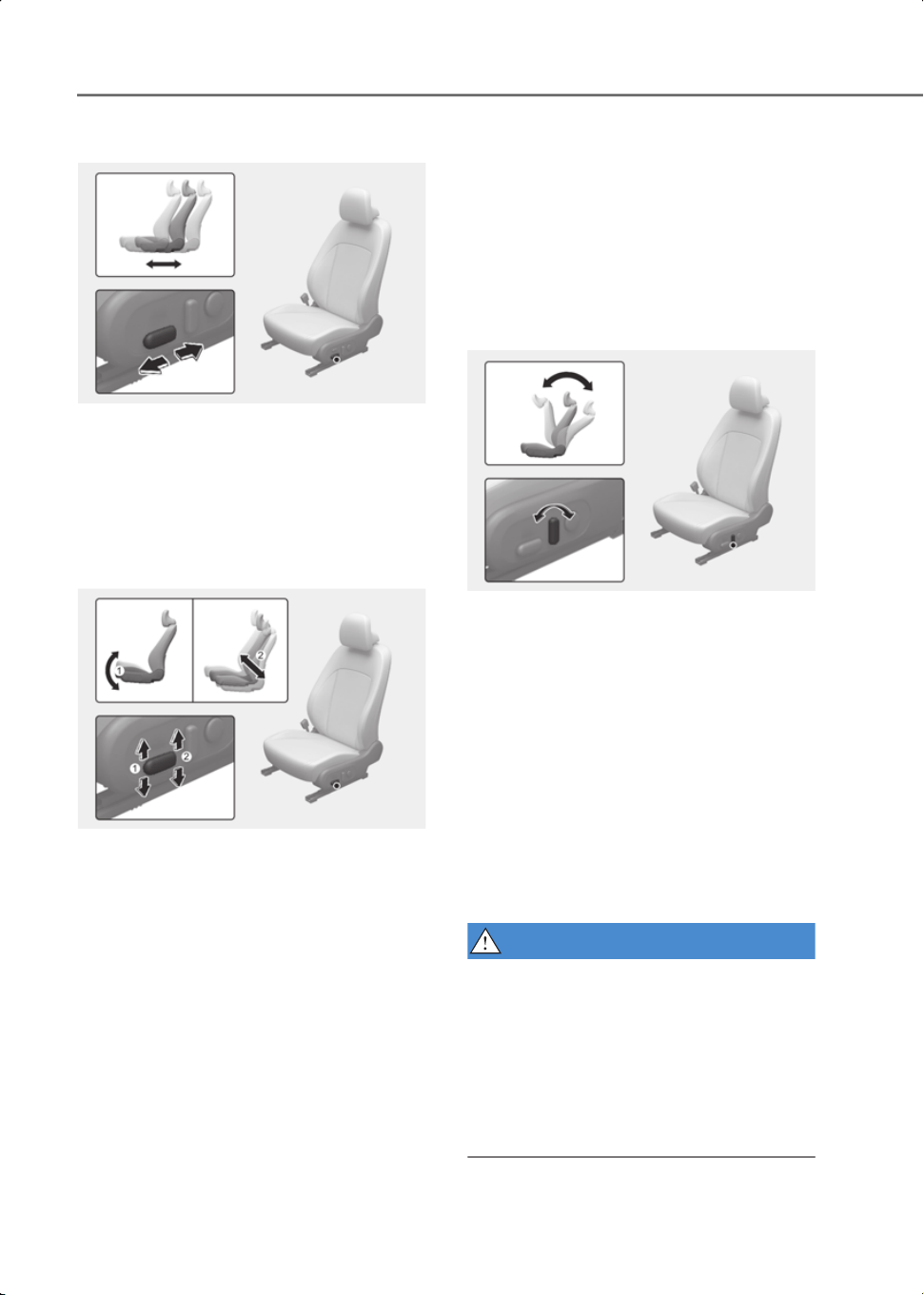
Seats & Safety System
3-8
Forward and rearward adjustment
B3000204
To move the seat forward or rearward:
1. Push the control switch forward or
rearward.
2. Release the switch once the seat
reaches the desired position.
Seat cushion tilt/height adjustment
B3000206
• Seat cushion tilt (1)
To change the angle of the front part of
the seat cushion:
Push the front portion of the control
switch up to raise or down to lower the
front part of the seat cushion.
Release the switch once the seat reaches
the desired position.
• Seat height (2)
To change the height of the seat cushion:
Push the rear portion of the control switch
up to raise or down to lower the height of
the seat cushion.
Release the switch once the seat reaches
the desired position.
Seatback angle adjustment
B3000205
To recline the seatback:
1. Push the control switch forward or
rearward.
2. Release the switch once the seatback
reaches the desired position.
Reclining seatback
Sitting in a reclined position when the
vehicle is in motion can be dangerous.
Even when buckled up, the protections of
your restraint system (seat belts and
airbags) is greatly reduced by reclining
your seatback.
WARNING
NEVER ride with a reclined seatback
when the vehicle is moving.
Riding with a reclined seatback increases
your chance of serious or fatal injuries in
the event of a collision or sudden stop.
Driver and passengers should ALWAYS sit
well back in their seats, properly belted,
and with the seatbacks upright.
CE_USA.book Page 8
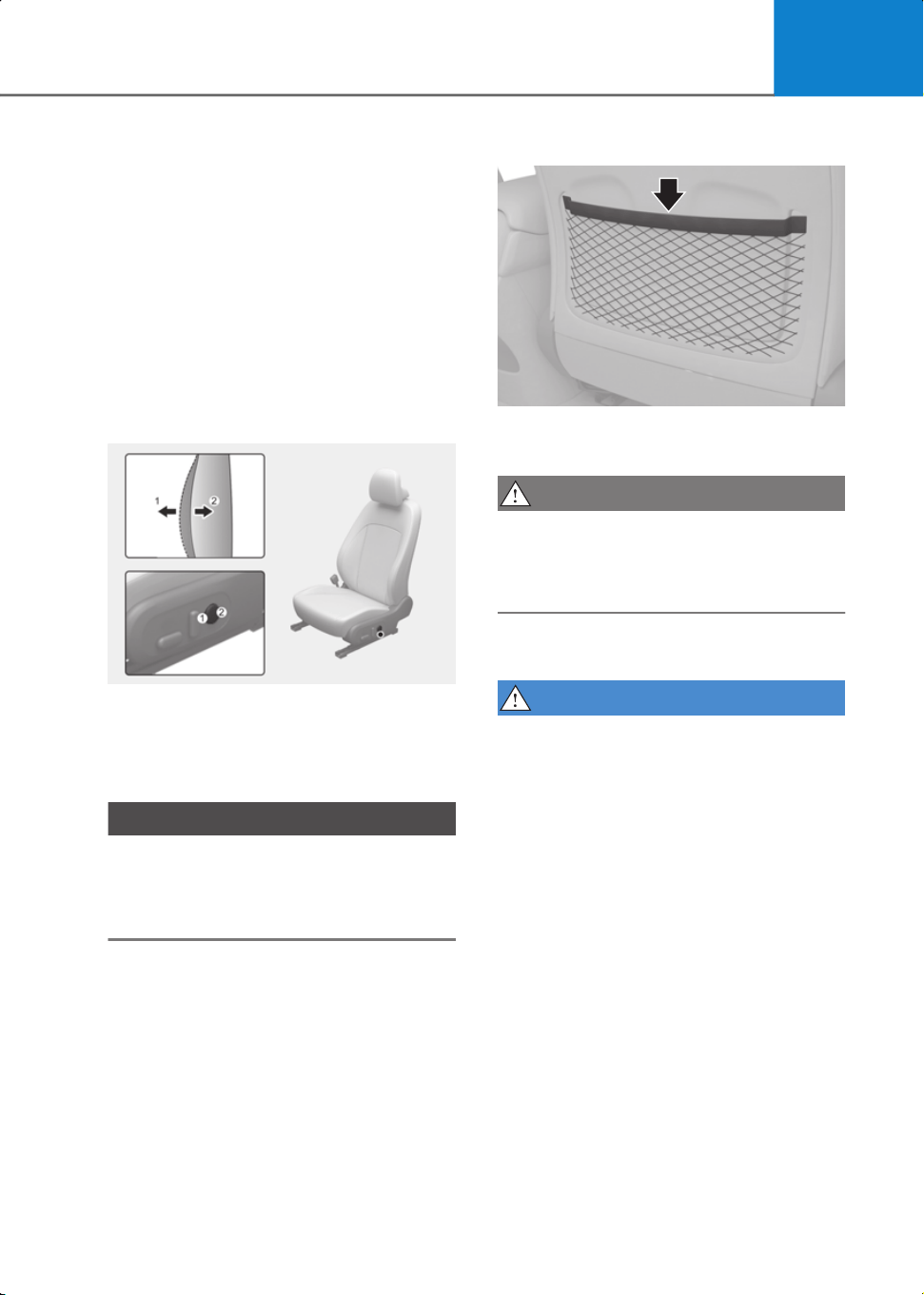
3
3-9
Seat belts must be snug against your hips
and chest to work properly. When the
seatback is reclined, the shoulder belt
cannot do its job because it will not be
snug against your chest. Instead, it will be
in front of you. During an accident, you
could be thrown into the seat belt,
causing neck or other injuries.
The more the seatback is reclined, the
greater chance the passenger’s hips will
slide under the lap belt or the passenger’s
neck will strike the shoulder belt.
Lumbar support
B3000207
To adjust the lumbar support:
• Press the front portion of the switch (1)
to increase support or the rear portion
of the switch (2) to decrease support.
NOTICE
Do not continue to operate the lumbar
support when the lumbar support
provides its maximum support. Damage
to the lumbar support motor could occur.
Seatback pocket
B3000222
The seatback pocket is provided on the
back of the front seatbacks.
CAUTION
Do not put heavy or sharp objects in the
seatback pockets. In an accident they
could come loose from the pocket and
injure occupants.
Rear Seats
WARNING
Take the following precautions:
• Folding the seats
- Do not fold the seatback when the
seat is occupied (for example,
passenger, pets or luggage). It may
injure the passenger or pet, or
damage the luggage.
- Never allow passengers to sit on top
of the folded down seatback while
the vehicle is moving. This is not a
proper seating position and no seat
belts are available for use. This could
result in serious injury or death in
case of an accident or sudden stop.
- Objects carried on the folded down
seatback should not extend higher
than the top of the front seatbacks.
This could allow cargo to slide
forward and cause injury or damage
during sudden stops.
CE_USA.book Page 9
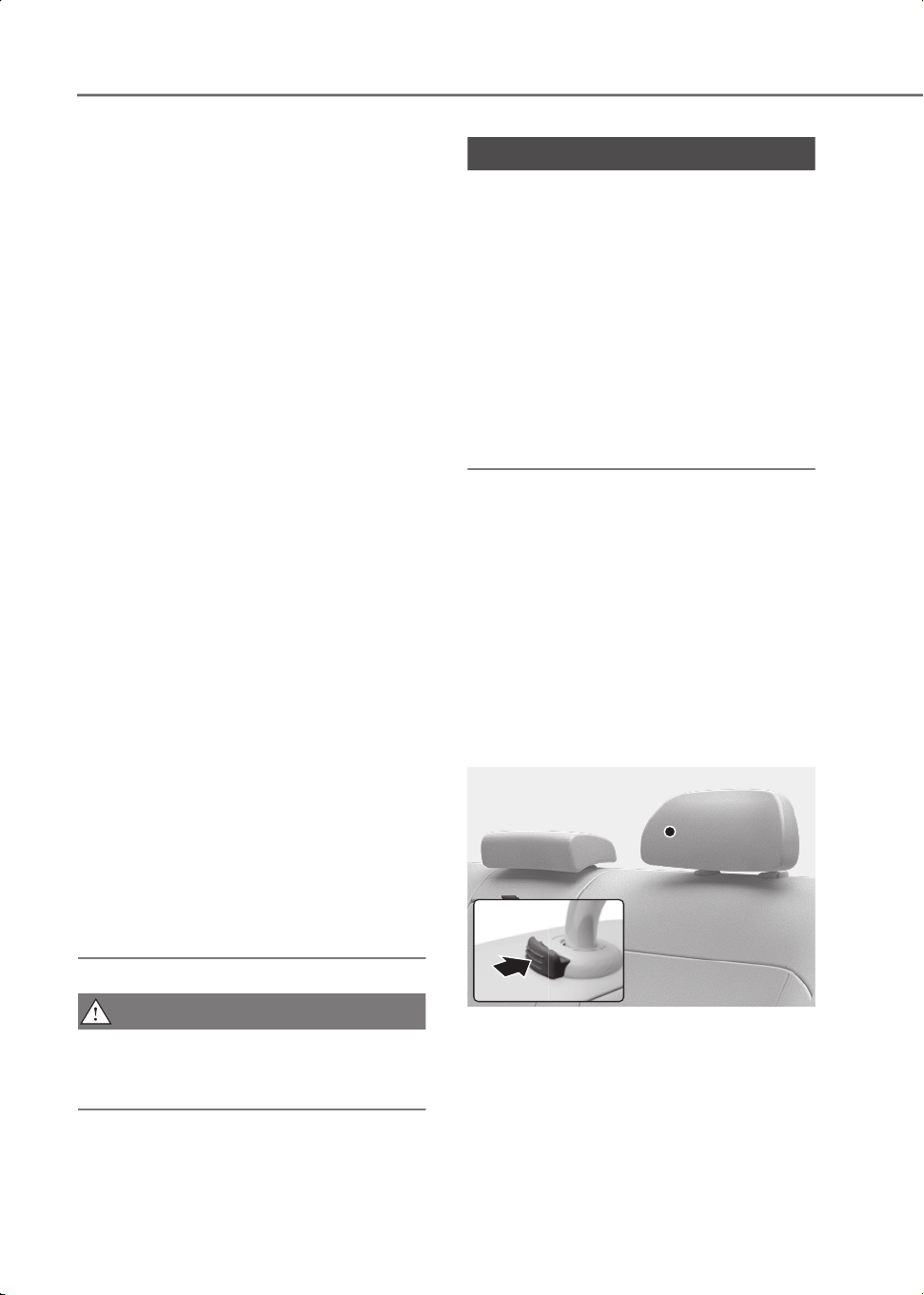
Seats & Safety System
3-10
- When returning the rear seatback
from a folded to an upright position,
hold the seatback and return it
slowly. Ensure that the seatback is
completely locked into its upright
position by pushing on the top of the
seatback. In an accident or sudden
stop, the unlocked seatback could
allow cargo to move forward with
great force and enter the passenger
compartment, which could result in
serious injury or death.
- When folding the seatback, slightly
push the seatback or head restraint
against the folding direction to
control the folding speed. Without
the push, the seatback may abruptly
fold down and cause injuries when
the lever is pulled.
• Loading cargo
- Make sure the vehicle is off, the gear
shifted to P (Park), and the parking
brake is securely applied whenever
loading or unloading cargo. Failure to
take these steps may allow the
vehicle to move if the shift button or
shift dial is inadvertently pressed or
rotated to another position.
- When cargo is loaded through the
rear passenger seats, ensure the
cargo is properly secured to prevent
it from moving while driving.
• Do not place objects in the rear seats
since they cannot be properly secured
and may hit vehicle occupants in a
collision causing serious injury or
death.
CAUTION
Do not allow your hands or fingers to get
caught in the seat mechanisms while
adjusting the seats.
NOTICE
To prevent damage to the vehicle:
• Rear seat belts
Before folding the seatback, insert the
seat belt buckle in the holder between
the seatback and cushion. And insert
the seat belt webbing in the guide to
prevent the seat belt from being
damaged.
• Cargo
Be careful when loading cargo through
the rear passenger seats to prevent
damage to the vehicle interior.
Folding the rear seats
The rear seatbacks can be folded to
facilitate carrying long items or to
increase the luggage capacity of the
vehicle.
To fold down the rear seatback:
1. Set the front seatback to the upright
position and if necessary, slide the front
seat forward.
2. Lower the rear head restraints to the
lowest position.
B3000301
CE_USA.book Page 10
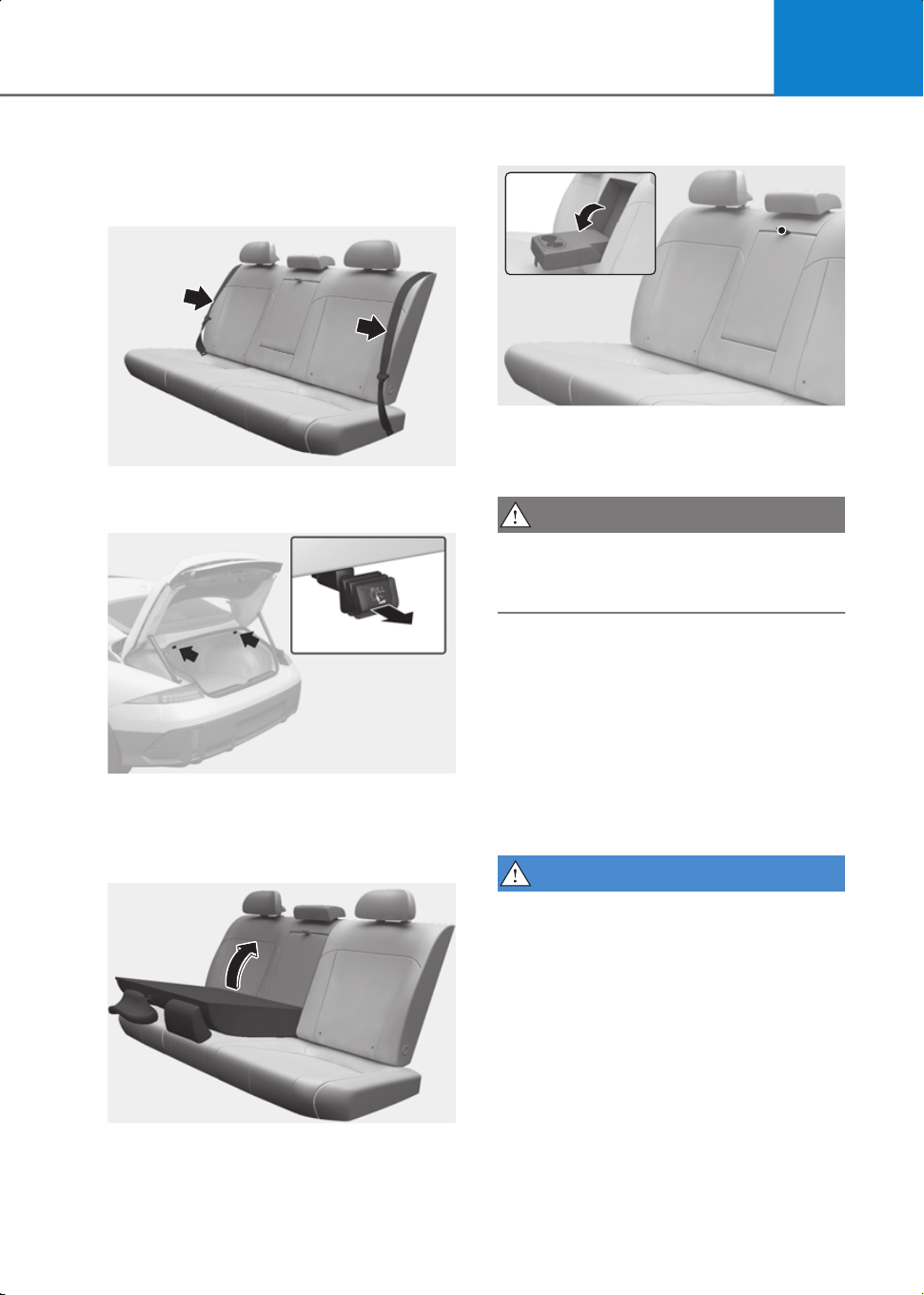
3
3-11
3. Route the seat belt webbing to the
outward of the rear seat to prevent the
belts from being trapped behind or
under the seats.
B3000302
4. Fold the seatback toward the front of
the vehicle.
B3000303
5. To use the rear seat, lift and pull the
seatback rearward. Pull the seatback
firmly until it clicks in to place. Make
sure the seatback is locked in place.
B3000305
Armrest
B3000311
The armrest is located in the center of the
rear seat. Pull the armrest down from the
seatback to use it.
CAUTION
The armrest handle may be pressed when
folding the rear seatback, but it will be
restored after a certain period of time.
Head Restraint
The vehicle’s front and rear seats have
adjustable head restraints. The head
restraints provide comfort for
passengers, but more importantly they
are designed to help protect passengers
from whiplash and other neck and spinal
injuries during an accident, especially in a
rear impact collision.
WARNING
To help reduce the risk of serious injury or
death in an accident, take the following
precautions when adjusting your head
restraints:
• Always properly adjust the head
restraints for all passengers BEFORE
starting the vehicle.
• NEVER let anyone ride in a seat with the
head restraint removed or reversed.
CE_USA.book Page 11
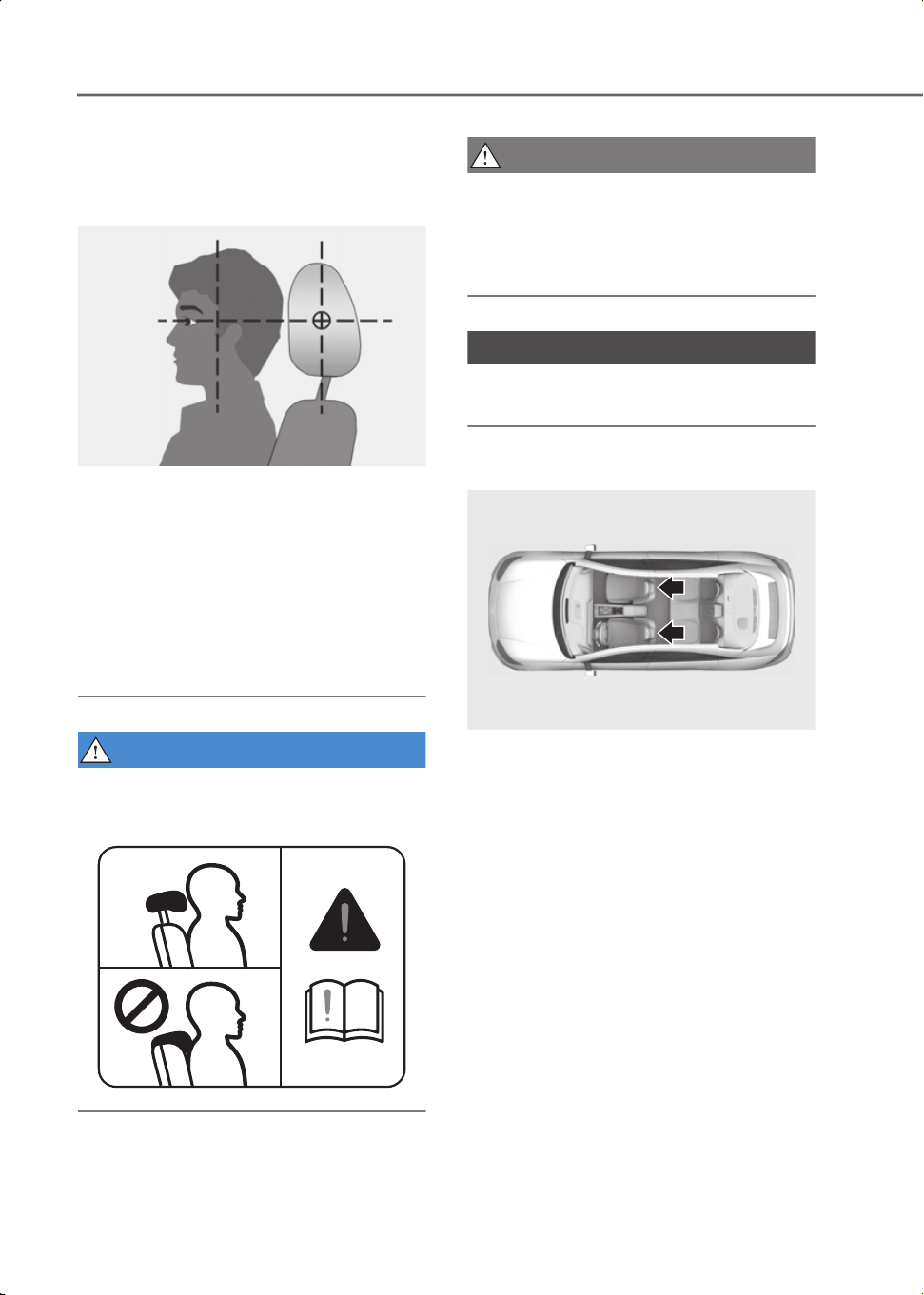
Seats & Safety System
3-12
• Adjust the head restraints so the middle
of the head restraint is at the same
height as the height of the top of the
eyes.
OHI039190N
• NEVER adjust the head restraint
position of the driver’s seat when the
vehicle is in motion.
• Adjust the head restraint as close to the
passenger’s head as possible. Do not
use a seat cushion that holds the body
away from the seatback.
• Make sure the head restraint locks into
position after adjusting it.
WARNING
When sitting in the rear seat, do not adjust
the height of the head restraint to the
lowest position.
B3000310
CAUTION
When there is no occupant in the rear
seats, adjust the height of the head
restraint to the lowest position. The rear
seat head restraint can reduce the
visibility of the rear area.
NOTICE
To prevent damage, NEVER hit or pull on
the head restraints.
Front seat head restraints
B3000213
The driver’s and front passenger’s seats
are equipped with adjustable head
restraints for the passengers safety and
comfort.
CE_USA.book Page 12
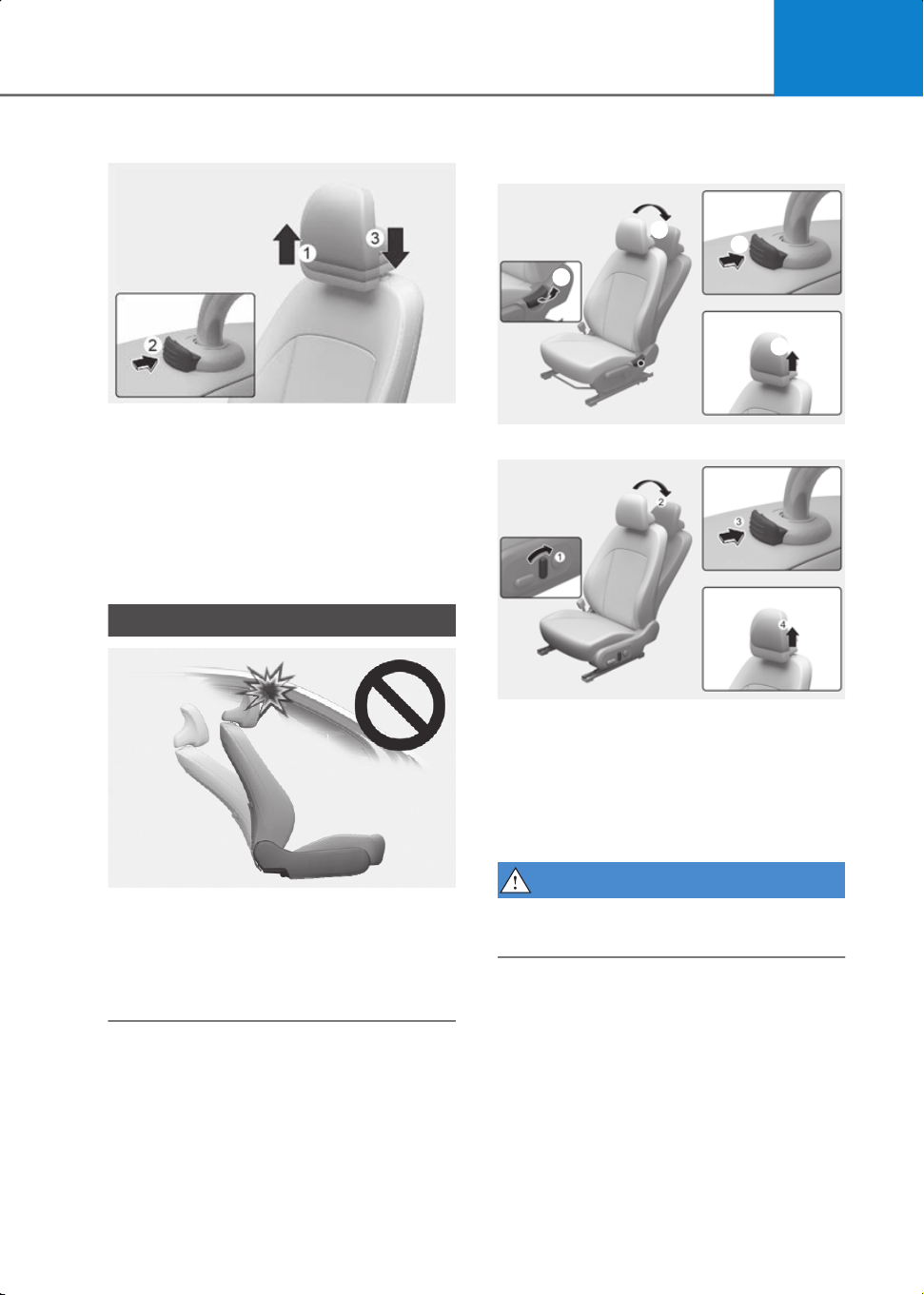
3
3-13
Adjusting the height up and down
B3000216
To raise the head restraint:
1. Pull it up to the desired position (1).
To lower the head restraint:
1. Push and hold the release button (2) on
the head restraint support.
2. Lower the head restraint to the desired
position (3).
NOTICE
B3000215
If you recline the seatback towards the
front with the head restraint and seat
cushion raised, the head restraint may
come in contact with the sunvisor or
other parts of the vehicle.
Removal/Reinstallation
Manual adjustment seat
B3000217
Power adjustment seat
B3000218
To remove the head restraint:
1. Recline the seatback (2) with the
seatback angle switch (1).
2. Pull up the head restraint to the upmost
position and press the release button
(3) to remove the head restraint (4).
WARNING
NEVER allow anyone to travel in a seat
with the head restraint removed.
1
2
3
4
CE_USA.book Page 13
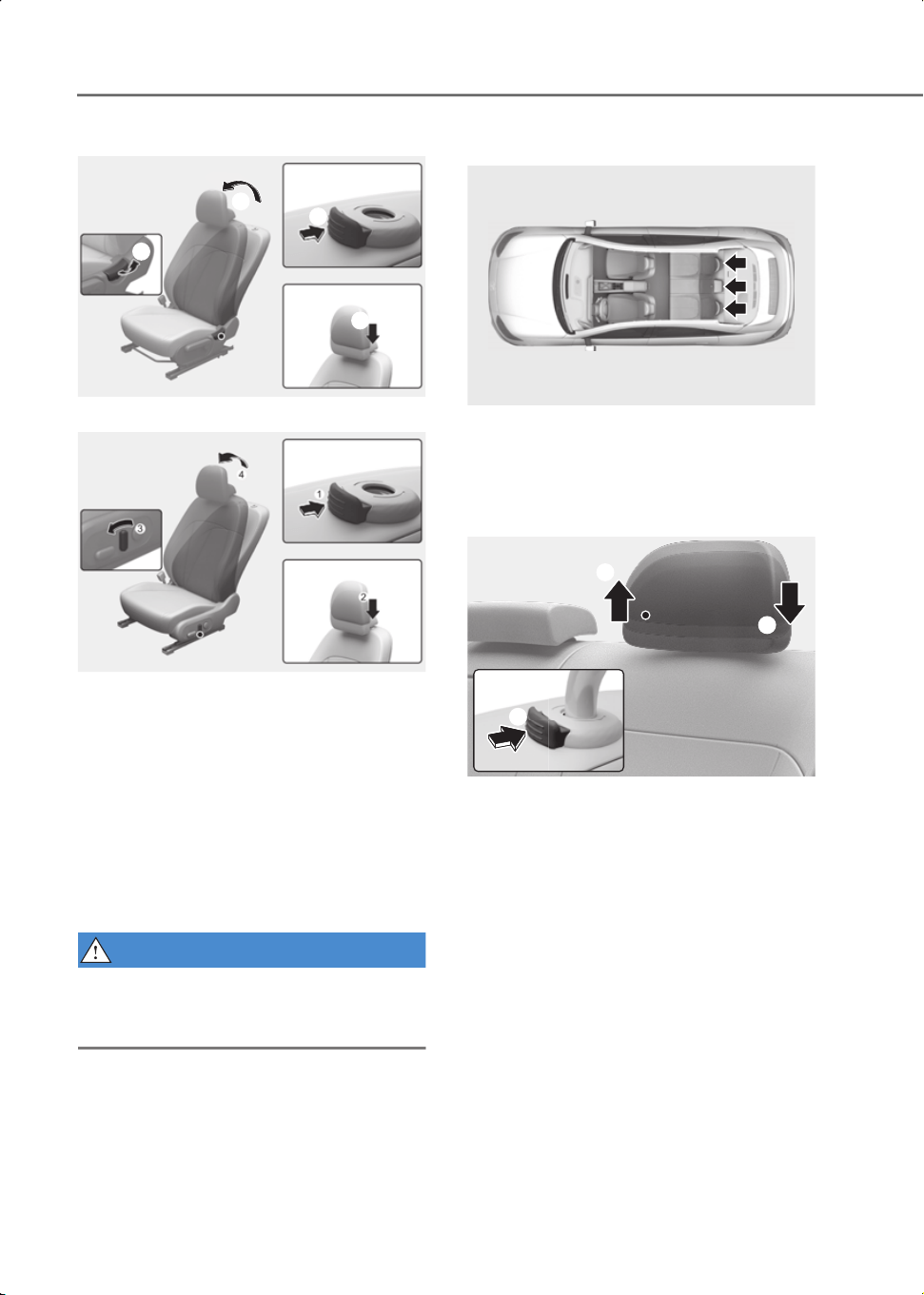
Seats & Safety System
3-14
Manual adjustment seat
B3000219
Power adjustment seat
B3000218_1
To reinstall the head restraint :
1. Recline the seat back by pressing
seatback angle lever or switch (3).
2. Put the head restraint poles (2) into the
holes while pressing the release button
(1).
3. Adjust the head restraint to the
appropriate height.
4. Adjust the seatback angle (4) with the
seatback angle switch (3).
WARNING
Always make sure the head restraint locks
into position after reinstalling and
adjusting it properly.
Rear seat head restraints
B3000306
The rear seats are equipped with head
restraints in all the seating positions for
the passenger’s safety and comfort.
Adjusting the height up and down
B3000307
To raise the head restraint:
1. Pull it up to the desired position (1).
To lower the head restraint:
1. Push and hold the release button (2) on
the head restraint support.
2. Lower the head restraint to the desired
position (3).
3
1
2
4
2
3
1
CE_USA.book Page 14
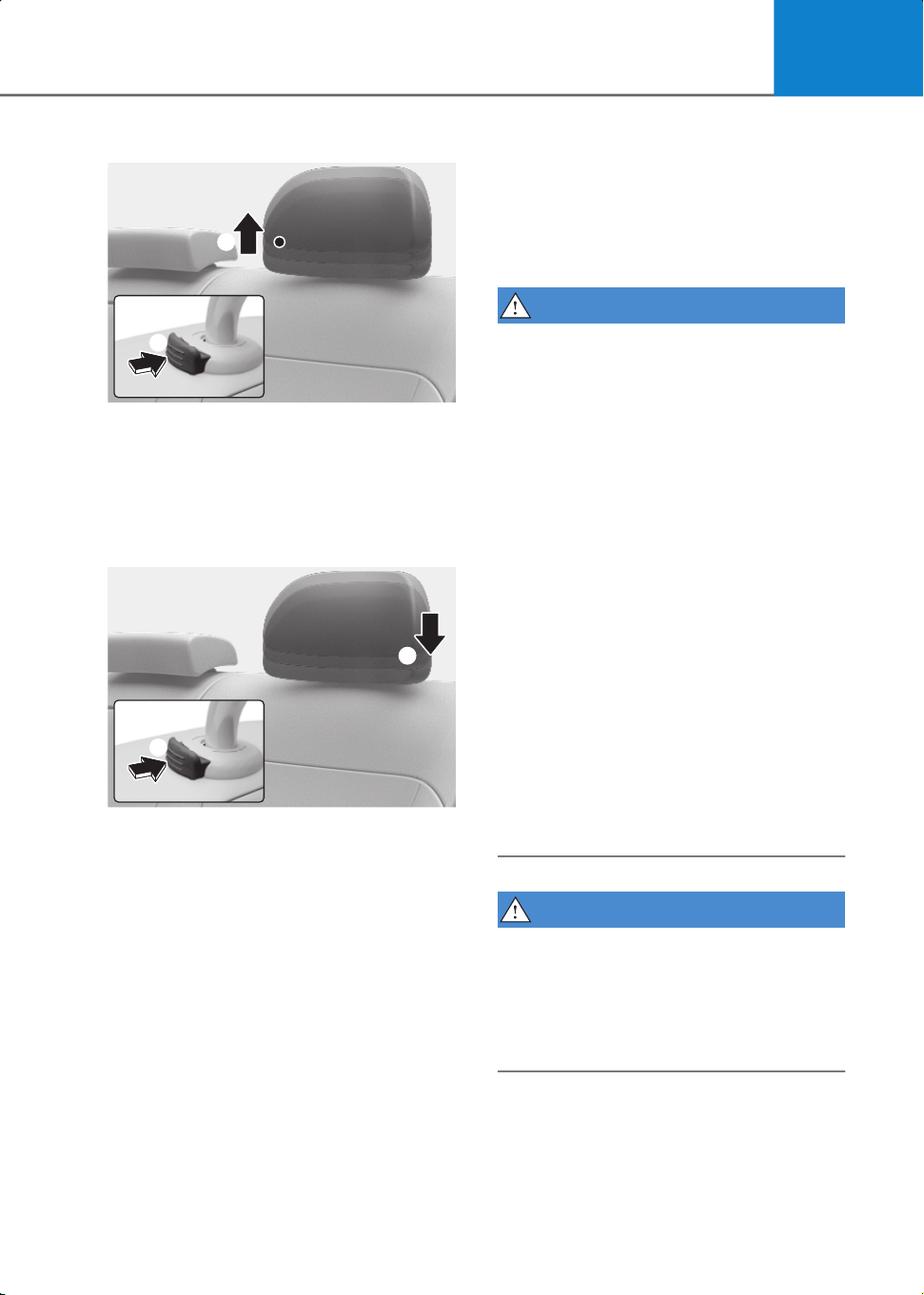
3
3-15
Removal/Reinstallation
B3000308
To remove the head restraint:
1. Raise the head restraint as far as it can
go.
2. Press the head restraint release button
(1) while pulling the head restraint up
(2).
B3000309
To reinstall the head restraint:
1. Put the head restraint poles into the
holes (2) while pressing the release
button (1).
2. Adjust the head restraint to the
appropriate height.
Seat Warmers
Seat warmers are provided to warm the
seats during cold weather.
During mild weather or under conditions
where the operation of the seat warmer is
not needed, keep the seat warmers off.
WARNING
The seat warmers can cause a SERIOUS
BURN, even at low temperatures and
especially if used for long periods of time.
Passengers must be able to feel if the seat
is becoming too warm so they can turn it
off, if needed.
Seat warmer consume large amounts of
electricity. Please avoid using seat
warmers while the vehicle is off in order
to prevent battery discharge.
People who cannot detect temperature
change or pain to the skin should use
extreme caution, especially the following
types of passengers:
• Infants, children, elderly or disabled
persons, or hospital outpatients.
• People with sensitive skin or who burn
easily.
• Fatigued individuals.
• Intoxicated individuals.
• People taking medication that can
cause drowsiness or sleepiness.
WARNING
NEVER place anything on the seat that
insulates against heat when the seat
warmer is in operation, such as a blanket
or seat cushion. This may cause the seat
warmer to overheat, causing a burn or
damage to the seat.
1
2
1
2
CE_USA.book Page 15
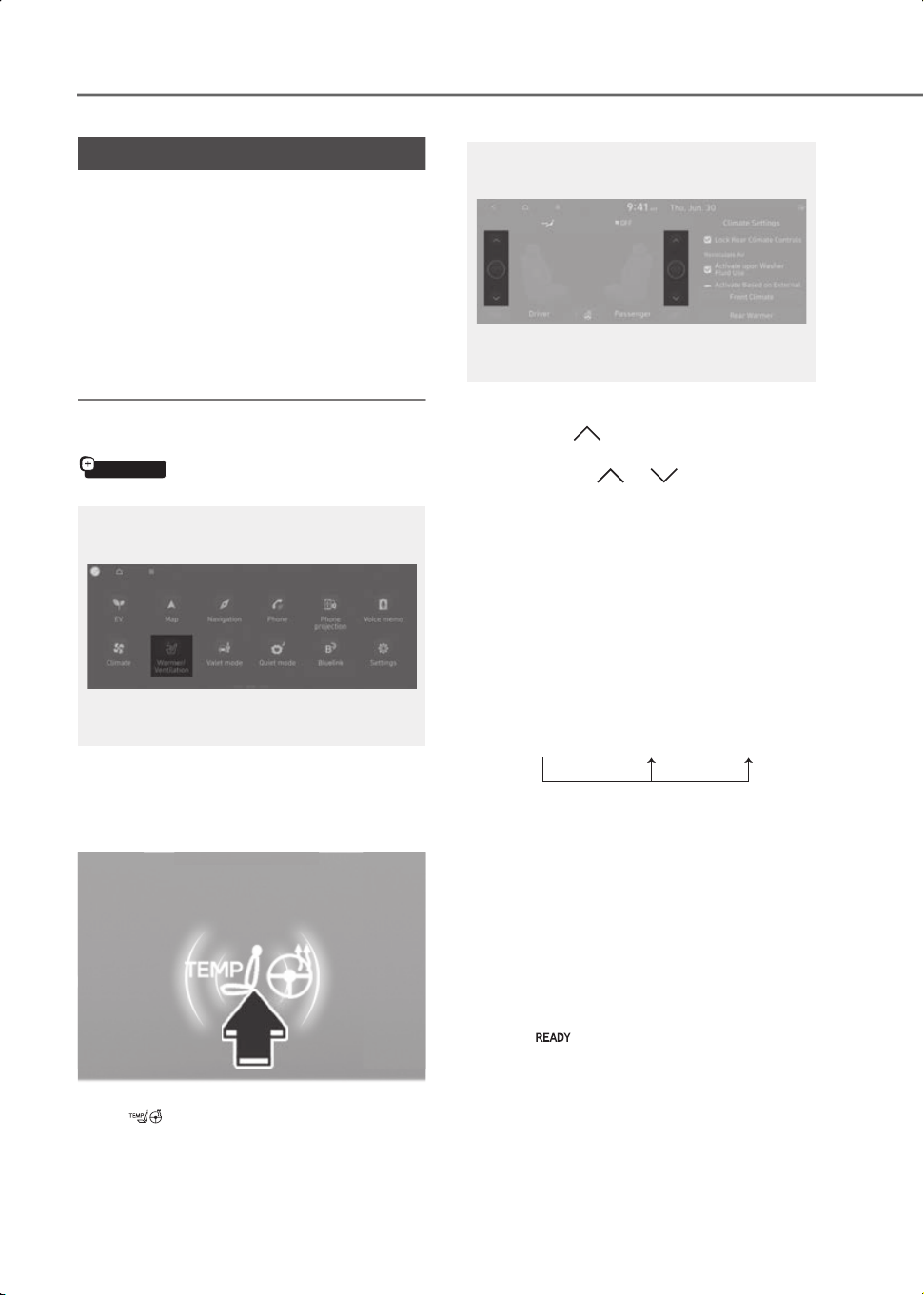
Seats & Safety System
3-16
NOTICE
To prevent damage to the seat warmers
and seats:
• Never use a solvent such as paint
thinner, benzene, alcohol or gasoline to
clean the seats.
• Do not place heavy or sharp objects on
seats equipped with seat warmers.
• Do not change the seat cover. It may
damage the seat warmer.
if equipped
Front seat warmers
Infotainment system
ONE1031085L
While the vehicle is running, touch
Heating/Ventilation icon in the
infotainment system.
Climate control panel
B3000602
Press in the front climate control
panel.
ONE1031080L
To activate seat warmer of each front
seats, touch icon on the infotainment
system. Adjust the temperature by
pressing either or icons.
The seat warmer will automatically stop
when the seat temperature reaches
certain level and will automatically
reactivate when the seat temperature
drops below certain temperature.
• Automatic temperature control
The seat warmer starts to automatically
control the seat temperature in order to
prevent low temperature burns after
being manually turned on.
Table_text_Arrow_3-25-2
You may manually touch the icon to
increase seat temperature. However,
the seat temperature is automatically
adjusted again.
• Auto. Controls That Use Climate
Control Settings (for driver’s seat)
The seat warmer automatically controls
the seat temperature depending on the
ambient temperature when the vehicle
is on ( indicator on).
To use this function, it can be enabled
from the Settings menu in the
infotainment system. Select: Setup >
Vehicle > Seat > Heated/Ventilated
Features > Auto. Controls That Use
Climate Control Settings > Seat
Warmer/Ventilation
OFF → HIGH ( 3 ) → MEDIUM ( 2 ) → LOW ( 1 )
30 min 60 min
CE_USA.book Page 16
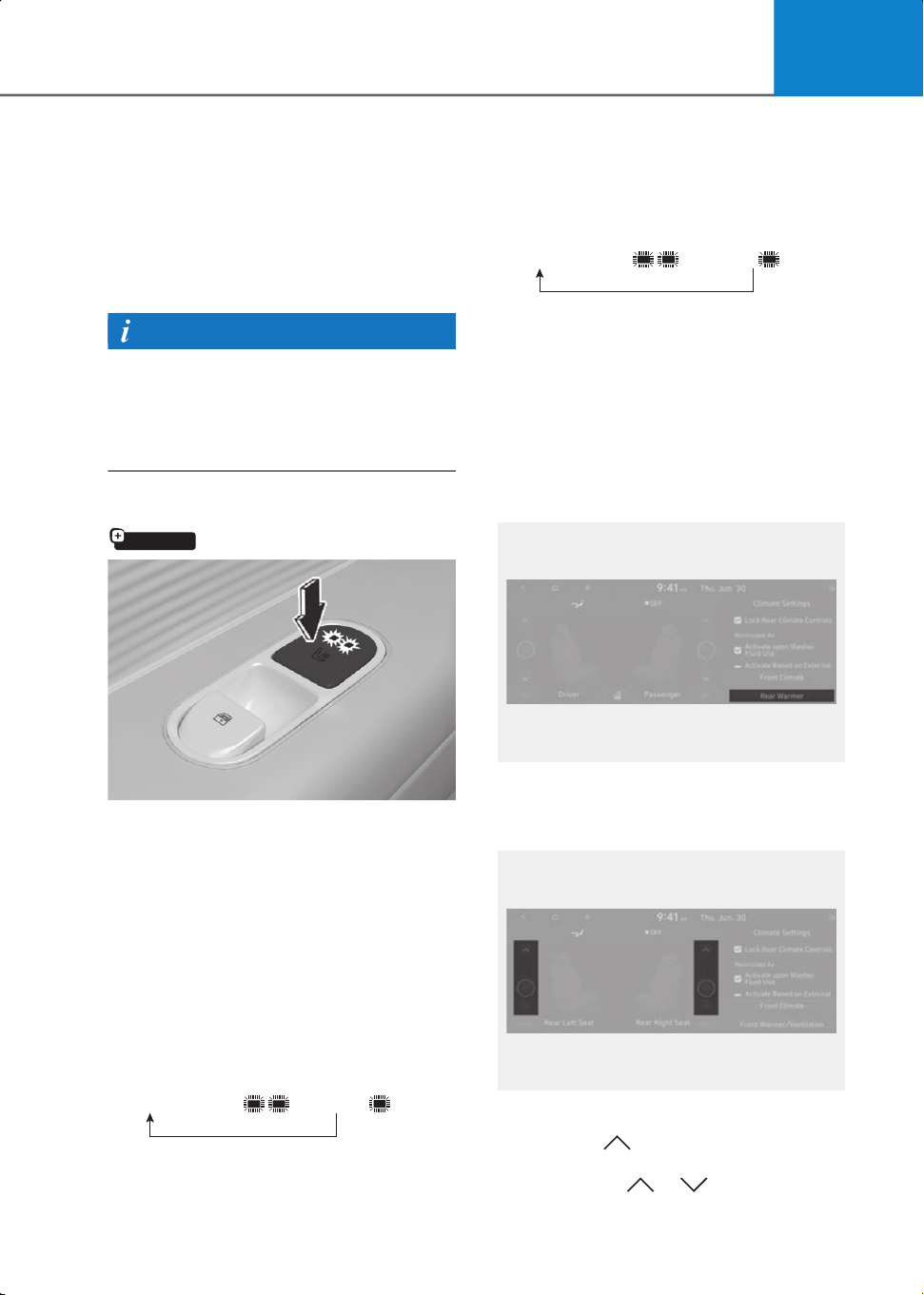
3
3-17
• The seat warmer defaults to the OFF
position whenever the Start/Stop
button is pressed to the ON position.
However, if the Auto. Controls That Use
Climate Control Settings function is on,
the driver’s seat warmer turns on and
off depending on the ambient
temperature.
Information
The infotainment system may change
after software updates. For more
information, refer to the user's manual
provided in the infotainment system and
the quick reference guide.
if equipped
Rear seat warmers
B3000604
• While the vehicle is running, press seat
warmer switches located in each seats
to warm the rear seat.
• The seat warmer will automatically stop
when the seat temperature reaches
certain level and will automatically
reactivate when the seat temperature
drops below certain temperature.
• Manual temperature control
Each time you press the switch, the
temperature setting of the seat is
changed as follows :
NEW_NE_1
• Automatic temperature control
The seat warmer starts to automatically
control the seat temperature in order to
prevent low temperature burns after
being manually turned on.
NEW_NE_10
You may manually push the switch to
increase seat temperature. However,
the seat temperature is automatically
adjusted again.
• The seat warmer defaults to the OFF
position whenever the Start/Stop
button is pressed to the ON position.
• The rear seat warmers can be adjusted
from the infotainment system.
ONE1031082L
• Touch rear heat icon in the
Heating/Ventilation infotainment
system.
ONE1031078L
To activate seat warmer of each rear
seats, touch icon on the infotainment
system. Adjust the temperature by
pressing either or icons.
OFF → HIGH ( ) → LOW ( )
OFF → HIGH ( ) → LOW ( )
NJO
CE_USA.book Page 17
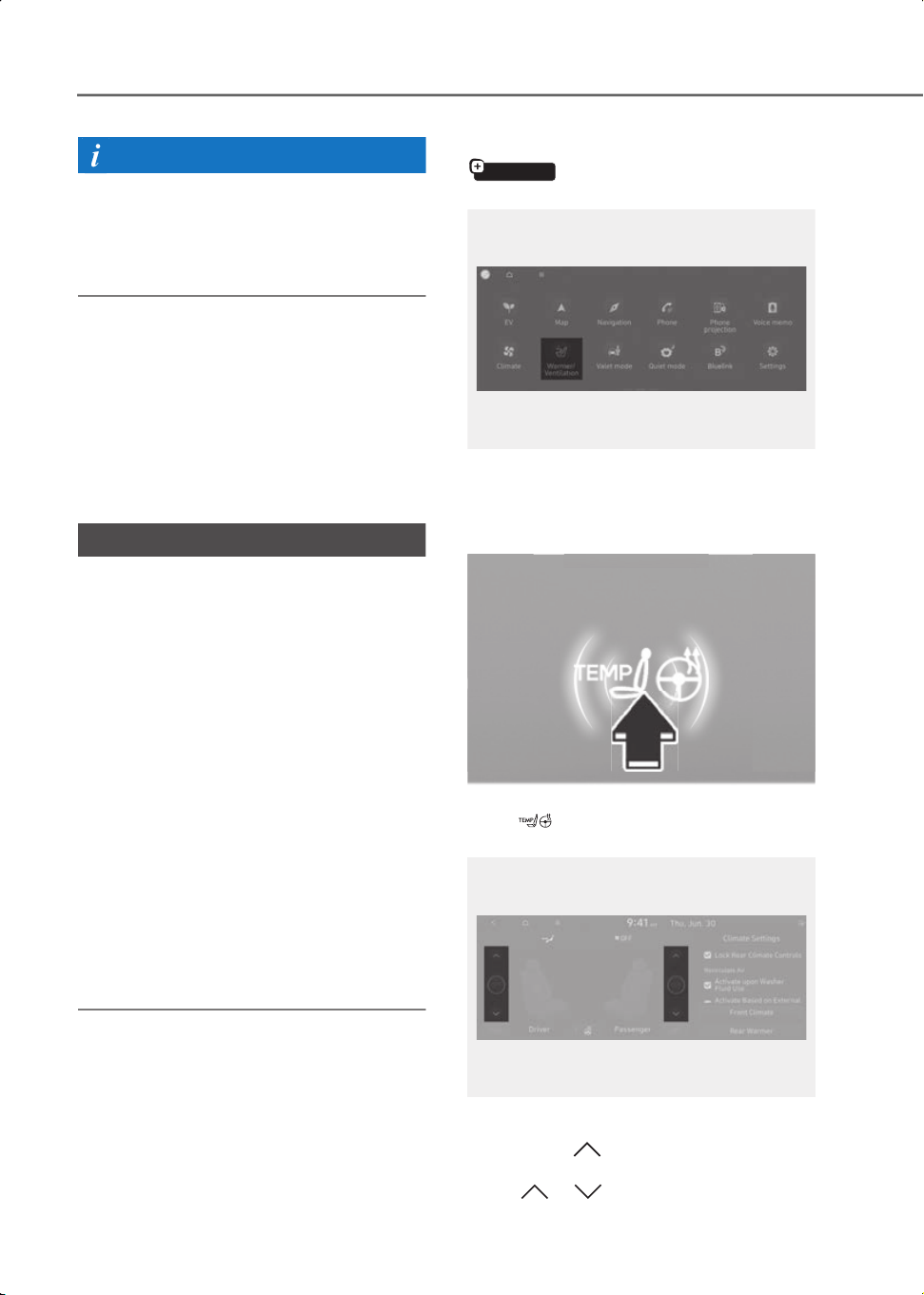
Seats & Safety System
3-18
Information
The infotainment system may change
after software updates. For more
information, refer to the user's manual
provided in the infotainment system and
the quick reference guide.
Air Ventilation Seats
The air ventilation seats are provided to
cool the front seats by blowing air
through small vent holes on the surface of
the seat cushions and seatbacks.
When the operation of the air ventilation
seat is not needed, keep the air
ventilation seats off.
NOTICE
To prevent damage to the air ventilation
seats:
• Never use a solvent such as paint
thinner, benzene, alcohol or gasoline to
clean the seats.
• Avoid spilling liquids on the surface of
the front seats and seatbacks; this may
cause the air vent holes to block and
not work properly.
• Do not place materials such as plastic
bags or newspapers under the seats.
They may block the air intake causing
malfunction of the air vent.
• Do not change the seat covers. It may
damage the air ventilation seat.
• If the air vents do not operate, restart
the vehicle. If there is no change, have
the vehicle inspected by an authorized
HYUNDAI dealer.
if equipped
Front air ventilation seats
Infotainment system
ONE1031085L
While the vehicle is running, touch
Heating/Ventilation icon in the
infotainment system.
Climate control panel
B3000602
Press in the front climate control
panel.
ONE1031080L
To activate air ventilation of each front
seats, touch icon on the infotainment
system. Adjust the airflow by pressing
either or icons.
CE_USA.book Page 18
3
3-19
• If the air ventilation seat is position to
'HIGH', fan speed increases depending
on the vehicle speed and driving time.
• Use the air ventilation seat with the air
conditioning on for more effective
ventilation.
• It may take 3-5 minutes after switch
operation to feel the temperature
change.
• Auto. Controls That Use Climate
Control Settings (for driver’s seat)
The air ventilation seat automatically
controls the seat temperature
depending on the ambient temperature
when the vehicle is on ( indicator
on).
To use this function, it can be enabled
from the Settings menu in the
infotainment system. Select: Setup >
Vehicle > Seat > Heated/Ventilated
Features > Auto. Controls That Use
Climate Control Settings > Seat
Warmer/Ventilation
• The air ventilation seats defaults to the
OFF position whenever the Start/Stop
button is pressed to the ON position.
However, if the Auto. Controls That Use
Climate Control Settings function is on,
the driver’s air ventilation seat turns on
and off depending on the ambient
temperature.
Information
The infotainment system may change
after software updates. For more
information, refer to the user's manual
provided in the infotainment system and
the quick reference guide.
Seat Belts
This section describes how to use the seat
belts properly. It also describes some of
the things not to do when using seat belts.
Seat Belt Safety Precautions
Always fasten your seat belt and make
sure all passengers have fastened their
seat belts before starting any trip. Airbags
are designed to supplement the seat belt
as an additional safety device, not a
replacement. Most states require all
occupants of a vehicle to wear seat belts.
WARNING
Seat belts must be used by ALL
passengers whenever the vehicle is
moving. Take the following precautions
when adjusting and wearing seat belts:
• Children under the age of 13 should be
properly restrained in the rear seats.
• Never allow children to ride in the front
passenger seat, unless the airbag is
deactivated. If a child is seated in the
front passenger seat, move the seat as
far back as possible. And the child must
always be restrained in the seat
properly.
• NEVER allow an infant or child to be
carried on an occupant’s lap.
• NEVER ride with the seatback reclined
when the vehicle is moving.
• Do not allow children to share a seat or
seat belt.
• Do not wear the shoulder belt under
your arm or behind your back.
• NEVER place a seat belt over fragile
objects. If there is a sudden stop or
impact, the seat belt can damage it.
• Do not use the seat belt if it is twisted. A
twisted seat belt will not protect you
properly in an accident.
• Do not use a seat belt if the webbing or
hardware is damaged.
CE_USA.book Page 19
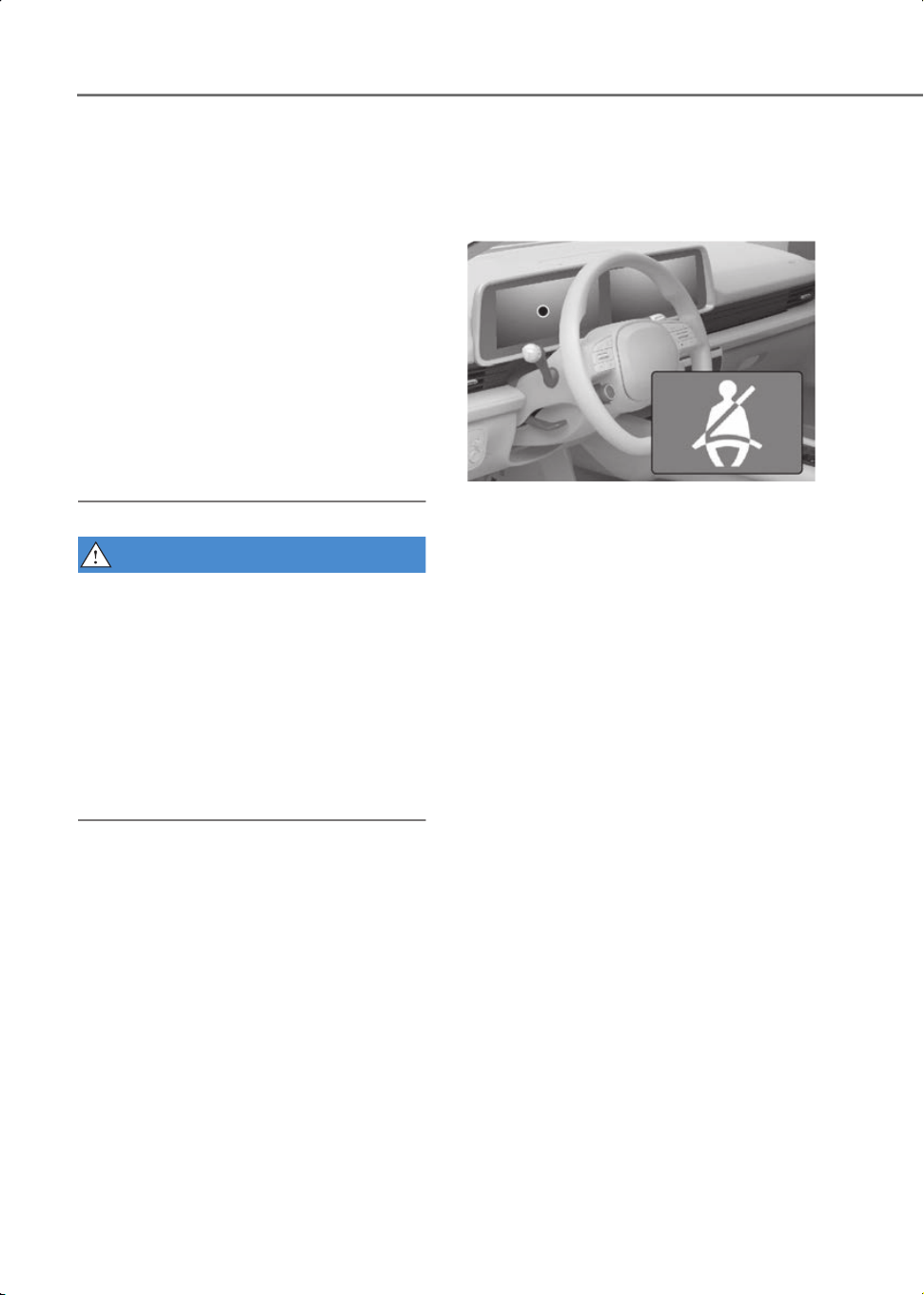
Seats & Safety System
3-20
• Do not latch the seat belt into the
buckles of other seats.
• NEVER unfasten the seat belt while
driving. This may cause loss of vehicle
control resulting in an accident.
• Make sure there is nothing in the buckle
interfering with the seat belt latch
mechanism, because any materials in
the buckle can cause the seat belt not
to be fastened securely.
• No modifications or additions should
be made by the user which will either
prohibit the seat belt adjusting devices
from operating to remove slack, or
prohibit the seat belt assembly from
being adjusted to remove slack.
WARNING
Damaged seat belts and seat belt
assemblies will not operate properly.
Always replace:
• Frayed, contaminated, or damaged
webbing.
• Damaged hardware.
• The entire seat belt assembly after it
has been worn in an accident, even if
damage to webbing or assembly is not
apparent.
Seat Belt Warning Light
Driver’s seat belt warning
Instrument cluster
B3001502
As a reminder to the driver, the driver’s
seat belt warning lights will illuminate for
about 6 seconds each time the Start/Stop
button is in the ON position regardless of
belt fastening. If the seatbelt is not
fastened, the warning chime will sound
for about 6 seconds.
If you start to drive without the seat belt
fastened or you unfasten the seat belt
when you drive under 12 mph (20 km/h) or
stop, the corresponding warning light will
illuminate.
If you start to drive without the seat belt
fastened or you unfasten the seat belt
when you drive 12 mph (20 km/h) and
faster, the warning light will blink and
warning chime will sound for about 100
seconds.
When the seat belt is unfastened during
driving, the warning light will illuminate
when the speed is under 12 mph (20
km/h).
When the speed is 12 mph (20 km/h) and
faster, the warning light will blink and
warning chime will sound for about 100
seconds.
CE_USA.book Page 20
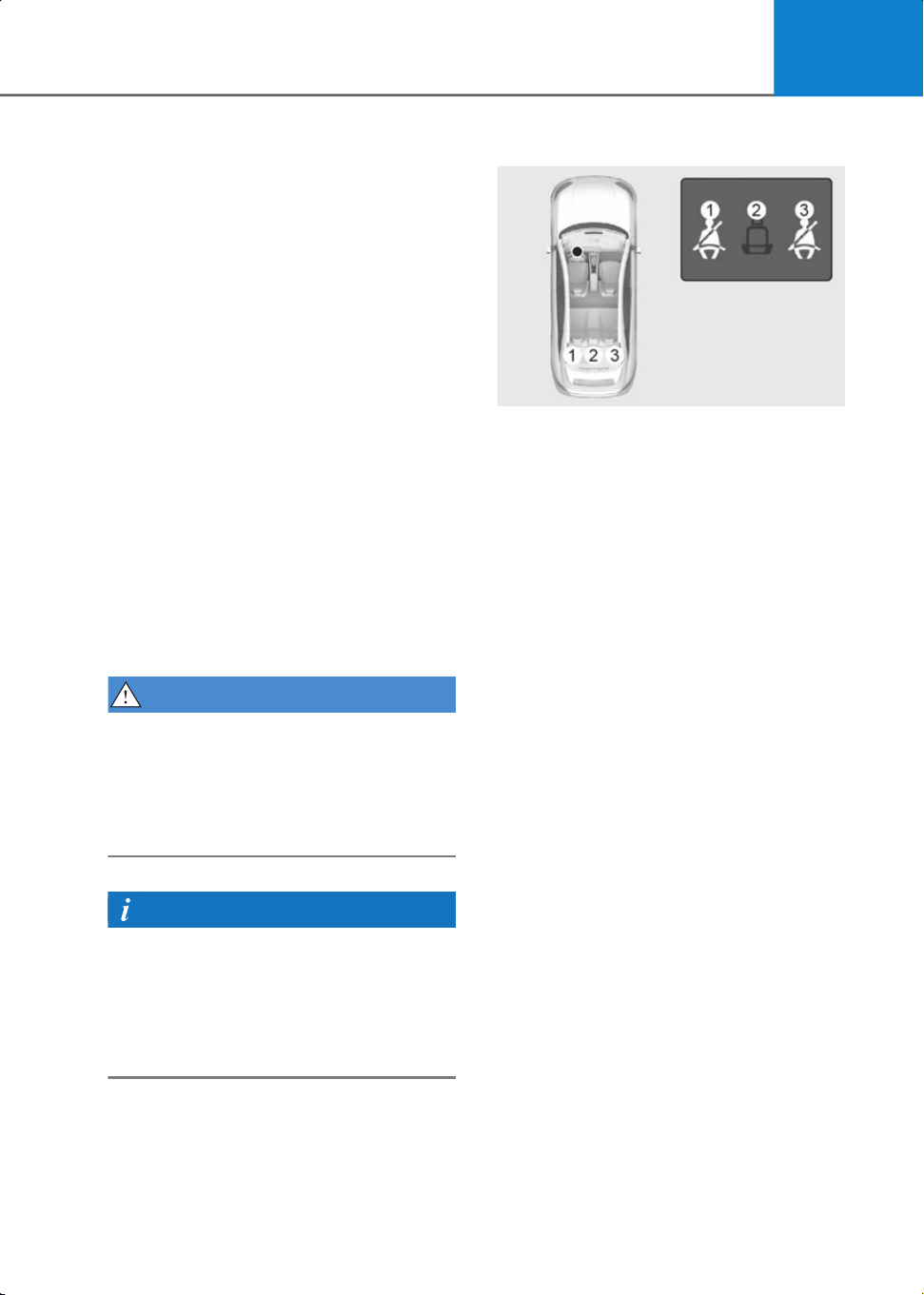
3
3-21
Front passenger’s seat belt warning
As a reminder to the front passenger, the
front passenger’s seat belt warning lights
will illuminate for about 6 seconds each
time the Start/Stop button is in the ON
position regardless of belt fastening.
If you start to drive without the seat belt
fastened or you unfasten the seat belt
when you drive under 12 mph (20 km/h) or
stop, the corresponding warning light will
illuminate.
If you start to drive without the seat belt
fastened or you unfasten the seat belt
when you drive 12 mph (20 km/h) and
faster, the warning light will blink and
warning chime will sound for about 100
seconds.
When the seat belt is unfastened during
driving, the warning light will illuminate
when the speed is under 12 mph (20
km/h). When the speed is 12 mph (20
km/h) and faster, the warning light will
blink and warning chime will sound for
about 100 seconds.
WARNING
Riding in an improper position adversely
affects the front passenger’s seat belt
warning system. It is important for the
driver to instruct the passenger to
properly be seated as instructed in this
manual.
Information
• Although the front passenger seat is not
occupied, the seat belt warning light
will blink or illuminate for 6 seconds.
• The front passenger’s seat belt warning
may operate when luggage is placed on
the front passenger seat.
Rear passenger’s seat belt warning
B3001503
For rear left and right side seat
• As a reminder to the rear passenger, the
rear passenger’s seat belt warning
lights will illuminate for about 6
seconds each time the Start/Stop
button is in the ON position regardless
of belt fastening.
• If you unfasten the seat belt when you
drive under 12 mph (20 km/h), the
corresponding warning light will
continue to illuminate until you fasten
the seat belt.
• If you unfasten the seat belt when you
drive 12 mph (20 km/h) and faster, the
seat belt warning chime will sound for
about 35 seconds and the
corresponding warning light will blink.
• When the seat belt is unfastened during
driving, the warning lights will
illuminate when the speed is under 12
mph (20 km/h).
• When the speed is 12 mph (20 km/h)
and faster, the warning light will blink
and warning chime will sound for about
35 seconds.
CE_USA.book Page 21
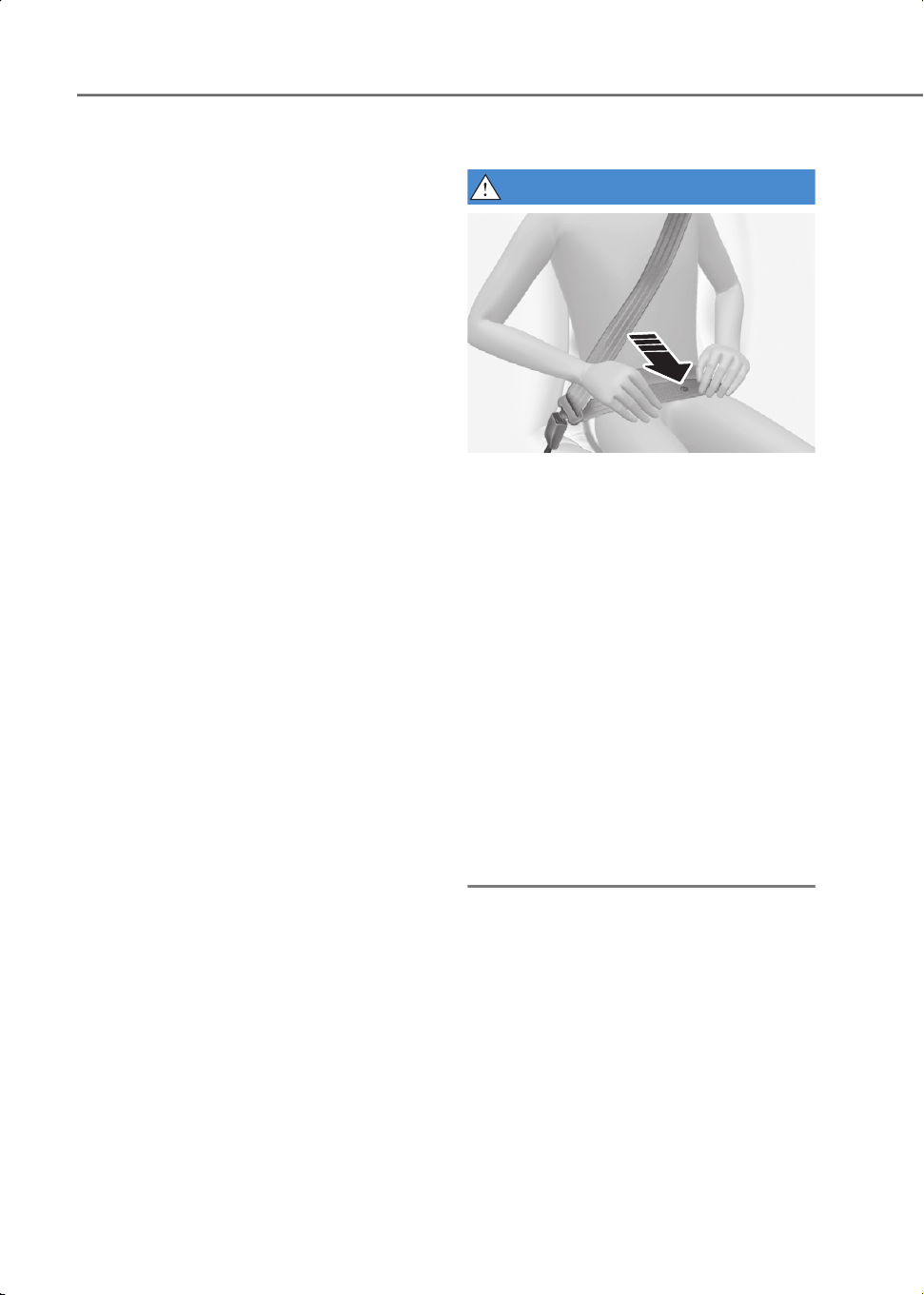
Seats & Safety System
3-22
For rear center seat
• As a reminder to the rear passenger, the
rear passenger’s seat belt warning
lights will illuminate for about 6
seconds each time the Start/Stop
button is in the ON position regardless
of belt fastening.
• If you unfasten the seat belt when you
drive under 12 mph (20 km/h), the
corresponding warning light will
continue to illuminate for about 70
seconds.
• If you unfasten the seat belt when you
drive over 12 mph (20 km/h), the seat
belt warning chime will sound for about
35 seconds and the corresponding
warning light will blink.
• If the rear door is opened under 6 mph
(10 km/h), warning light and warning
sound does not work even if driving
over 12 mph (20 km/h).
Seat Belt Restraint System
WARNING
B3001505
Improperly positioned seat belts may
increase the risk of serious injury in an
accident. Take the following precautions
when adjusting the seat belt:
• Position the lap portion of the seat belt
as low as possible across your hips, not
on your waist, so that it fits snugly. This
allows your strong pelvic bones to
absorb the force of the crash, reducing
the chance of internal injuries.
• Position one arm under the shoulder
belt and the other over the belt, as
shown in the illustration.
• Always position the shoulder belt
anchor into the locked position at the
appropriate height.
• Never position the shoulder belt across
your neck or face.
CE_USA.book Page 22
3
3-23
Driver's Seat Belt – 3-point system
with emergency locking retractor
To fasten your seat belt:
B3001504
Pull it out of the retractor and insert the
metal tab (1) into the buckle (2). An
audible “click” sounds when the tab locks
into the buckle. Make sure the seat belt is
not twisted.
B3001501
Place the lap belt (1) portion across your
hips and the shoulder belt (2) portion
across your chest.
The seat belt automatically adjusts to the
proper length after the lap belt portion is
adjusted manually so that it fits snugly
around your hips.
If you lean forward in a slow, easy motion,
the belt extends and moves with you. If
there is a sudden stop or collision, the belt
is locked in place. It also locks if you try to
lean forward too quickly.
Information
If you cannot smoothly pull the seat belt
out from the retractor, firmly pull the seat
belt out and release it. After release, the
belt may be pulled out smoothly.
Height adjustment
You can adjust the height of the shoulder
belt anchor to one of the four different
positions for maximum comfort and
safety.
The shoulder portion should be adjusted
so it lies across your chest and midway
over your shoulder nearest the door, not
over your neck.
Front seat
B3001506
To adjust the height of the seat belt
anchor, lower or raise the height adjuster
into an appropriate position.
To raise the height adjuster, pull it up (1).
To lower it, push it down (3) while
pressing the height adjuster button (2).
Release the button to lock the anchor into
position. Try sliding the height adjuster to
make sure that it has locked into position.
2
1
2
1
1
2
3
CE_USA.book Page 23
Seats & Safety System
3-24
To release your seat belt:
B3001507
Press the release button (1) in the locking
buckle.
The belt should automatically draw back
into the retractor. If this does not happen,
check the belt is not twisted, then try
again.
Rear Seat Belts – 3-point system
with convertible locking retractor
This type of seat belt combines both an
emergency locking retractor and an
automatic locking retractor. Convertible
retractor type seat belts are installed in
the rear seat positions to help
accommodate the installation of child
restraint systems.
A convertible retractor is also installed in
the front passenger seat position,
children should always be seated in the
rear and never place any infant/child
restraint system in the front seat.
To fasten your seat belt:
Pull the seat belt out of the retractor and
insert the metal tab into the buckle. An
audible “click” sounds when the tab locks
into the buckle. Pull the shoulder portion
of the belt to snug the belt across your
hips and remove slack. Make sure the seat
belt is not twisted. When not securing a
child restraint, the seat belt automatically
adjusts to the proper length only after the
lap belt portion of the seat belt is adjusted
manually so that it fits snugly across your
hips.
When the seat belt has been fully
extended from the retractor to allow for
the installation of a child restraint system,
the seat belt operation changes to allow
the belt to retract, but not to extend
(Automatic Locking Retractor Type). For
more information, refer to the “Child
Restraint System (CRS)” section in this
chapter.
To release your seat belt:
B3001507_1
Press the release button (1) in the locking
buckle.
The belt should automatically draw back
into the retractor. If this does not happen,
check the belt is not twisted, then try
again.
Information
• The emergency locking mode allows
seated passengers to move freely in
their seats while keeping some tension
on the belt. During a collision or sudden
stop, the retractor automatically locks
the belt to help restrain the passengers.
• To deactivate the automatic locking
mode, unbuckle the seat belt and allow
the belt to fully retract.
1
1
CE_USA.book Page 24
3
3-25
Rear center seatbelt (3-point rear
center seat belt)
ONE1031087L
Insert the tongue plate (1) into the buckle
until an audible “click" is heard, indicating
the latch is locked. Pull the shoulder
portion of the belt to snug the belt across
your hips and remove slack.
Make sure the seat belt is not twisted.
When using the rear center seat belt, use
the buckle with the “CENTER” mark.
Information
If you cannot pull out the safety belt from
the retractor, firmly pull the belt out and
release it. After release, pull out the belt
smoothly.
WARNING
Make sure that the seatback is locked in
place when using the rear center seat
belt.
If not, the seatback may move when there
is a sudden stop or collision, which could
result in serious injury.
Pretensioner seat belt
B3001601
(1) Retractor Pretensioner
Your vehicle is equipped with driver’s and
front passenger’s and rear passengers
Pretensioner Seat Belts (Retractor
Pretensioner). The purpose of the
pretensioner is to make sure the seat
belts fit tightly against the occupant’s
body in certain frontal or side collision(s).
The Retractor Pretensioner may be
activated in certain crashes where the
frontal collision(s) is severe enough.
When the vehicle stops suddenly, or if the
occupant tries to lean forward too
quickly, the seat belt retractor will lock
into position. In certain frontal or side
collision(s), the pretensioner will activate
and pull the seat belt into tighter contact
against the occupant’s body.
If the system senses excessive tension on
the driver or passenger’s seat belt when
the pretensioner system activates, the
load limiter inside the retractor
pretensioner will release some of the
pressure on the affected seat belt.
WARNING
• Always wear your seat belt and sit
properly in your seat.
• Do not use the seat belt if it is loose or
twisted. A loose or twisted seat belt will
not protect you properly in an accident.
• Do not place anything near the buckle.
This may adversely affect the buckle
and cause it to function improperly.
1
1
1
CE_USA.book Page 25
Seats & Safety System
3-26
• Always replace your pretensioners after
activation or an accident.
• NEVER inspect, service, repair or
replace the pretensioners yourself.
Have the pretensioners inspected,
serviced, repaired or replaced by an
authorized HYUNDAI dealer.
• Do not hit the seat belt assemblies.
WARNING
Do not touch the pretensioner seat belt
assemblies for several minutes after they
have been activated. When the
pretensioner seat belt mechanism
deploys during a collision, the
pretensioner can become hot and can
burn you.
CAUTION
Body work on the front area of the vehicle
may damage the pretensioner seat belt
system. Therefore, have the system
serviced by an authorized HYUNDAI
dealer.
OHL038175L
ONE1031086L
The Pretensioner Seat Belt System
consists mainly of the following
components. Their locations are shown in
the illustration above:
(1) SRS airbag warning light
(2) Retractor pretensioner
(3) SRS control module
(4) Rear retractor pretensioner
NOTICE
The sensor that activates the SRS control
module is connected with the
pretensioner seat belts. The SRS airbag
warning light on the instrument cluster
will illuminate for about 3-6 seconds after
the Start/Stop button is in the ON
position, and then it should turn off.
If the pretensioner is not working
properly, the warning light will illuminate
even if the SRS airbag is not
malfunctioning. If the warning light does
not illuminate, stays illuminated or
illuminates when the vehicle is being
driven, have the pretensioner seat belts
and/or SRS control module inspected by
an authorized HYUNDAI dealer as soon as
possible.
1
2 3
4
4
CE_USA.book Page 26

3
3-27
Information
• Pretensioner seat belts may be
activated in certain frontal or side
collisions or rollover situations.
• When the pretensioner seat belts are
activated, a loud noise may be heard
and fine dust, which may appear to be
smoke, may be visible in the passenger
compartment. These are normal
operating conditions and are not
hazardous.
• Although it is non-toxic, the fine dust
may cause skin irritation and should not
be inhaled for prolonged periods. Wash
all exposed skin areas thoroughly after
an accident in which the pretensioner
seat belts were activated.
Additional Seat Belt Safety
Precautions
Seat belt use during pregnancy
The seat belt should always be used
during pregnancy. The best way to
protect your unborn child is to protect
yourself by always wearing the seat belt.
Pregnant women should always wear a
lap-shoulder seat belt. Place the shoulder
belt across your chest, routed between
your breasts and away from your neck.
Place the lap belt below your belly so that
it fits SNUGLY across your hips and pelvic
bone, under the rounded part of the belly.
WARNING
To reduce the risk of serious injury or
death to an unborn child during an
accident, pregnant women should NEVER
place the lap portion of the seat belt
above or over the area of the abdomen
where the unborn child is located.
Seat belt use and children
Infant and small children
Most states have Child Restraint System
laws which require children to travel in
approved Child Restraint System devices,
including booster seats. The age at which
seat belts can be used instead of Child
Restraint System differs among states, so
you should be aware of the specific
requirements in your state, and where
you are travelling. Infant and Child
Restraint System must be properly placed
and installed in a rear seat.
For more information refer to the “Child
Restraint System (CRS)” section in this
chapter.
WARNING
ALWAYS properly restrain infants and
small children in a Child Restraint System
appropriate for the child’s height and
weight.
To reduce the risk of serious injury or
death to a child and other passengers,
NEVER hold a child in your lap or arms
when the vehicle is moving. The violent
forces created during an accident will tear
the child from your arms and throw the
child against the interior of the vehicle.
Small children are best protected from
injury in an accident when properly
restrained in the rear seat by a child
restraint system that meets the
requirements of the Federal Motor
Vehicle Safety Standards. Before buying
any child restraint system, make sure that
it has a label certifying that it meets
Federal Motor Vehicle Safety Standard
FMVSS 213. The restraint must be
appropriate for your child’s height and
weight. Check the label on the child
restraint for this information. For more
information, refer to the “Child Restraint
System (CRS)” section in this chapter.
CE_USA.book Page 27

Seats & Safety System
3-28
Larger children
Children under age 13 and who are too
large for a booster seat should always
occupy the rear seat and use the available
lap/shoulder belts. A seat belt should lie
across the upper thighs and be snug
across the shoulder and chest to restrain
the child safely. Check belt fit
periodically. A child’s squirming could put
the belt out of position. In the event of an
accident, children are afforded the best
safety restrained by a proper Child
Restraint System in the rear seats.
If a larger child over age 13 must be seated
in the front seat, the child must be
securely restrained by the available
lap/shoulder belt and the seat should be
placed in the rearmost position.
If the shoulder belt portion slightly
touches the child’s neck or face, try
placing the child closer to the center of
the vehicle. If the shoulder belt still
touches their face or neck, they need to
be returned to an appropriate booster
seat in the rear seat.
WARNING
• Always make sure larger children’s seat
belts are worn and properly adjusted.
• NEVER allow the shoulder belt to
contact the child’s neck or face.
• Do not allow more than one child to use
a single seat belt.
Seat belt use and injured people
A seat belt should be used when an
injured person is being transported.
Consult a physician for specific
recommendations.
One person per belt
Two people (including children) should
never attempt to use a single seat belt.
This could increase the severity of injuries
in case of an accident.
Do not lie down
Sitting in a reclined position when the
vehicle is in motion can be dangerous.
Even when buckled up, the protections of
your restraint system (seat belts and/or
airbags) is greatly reduced by reclining
your seatback.
Seat belts must be snug against your hips
and chest to work properly.
During an accident, you could be thrown
into the seat belt, causing neck or other
injuries.
The more the seat back is reclined, the
greater the chance for the passenger’s
hips to slide under the lap belt or the
passenger’s neck to strike the shoulder
belt.
WARNING
• NEVER ride with a reclined seatback
when the vehicle is moving.
• Riding with a reclined seatback
increases your chance of serious or
fatal injuries in the event of a collision or
sudden stop.
• Driver and passengers should always sit
well back in their seats with the
seatbacks upright and should be belted
properly.
CE_USA.book Page 28

3
3-29
Care of Seat Belts
Seat belt systems should never be
disassembled or modified. In addition,
care should be taken to assure that seat
belts and belt hardware are not damaged
by seat hinges, doors or other abuse.
Periodic inspection
All seat belts should be inspected
periodically for wear or damage of any
kind. Any damaged parts should be
replaced as soon as possible.
Keep belts clean and dry
Seat belts should be kept clean and dry. If
belts become dirty, they can be cleaned
by using a mild soap solution and warm
water. Bleach, dye, strong detergents or
abrasives should not be used because
they may damage and weaken the fabric.
When to replace seat belts
The entire seat belt assembly or
assemblies should be replaced if the
vehicle has been involved in an accident.
This should be done even if no damage is
visible. Consult an authorized HYUNDAI
dealer.
Child Restraint System
(CRS)
Children Always in the Rear
WARNING
Always properly restrain children in the
rear seats of the vehicle. Children of all
ages are safer when restrained in the rear
seat. A child riding in the front passenger
seat can be forcefully struck by an
inflating airbag resulting in SERIOUS
INJURY or DEATH.
Children under age 13 should always ride
in the rear seats and must always be
properly restrained to minimize the risk of
injury in an accident, sudden stop or
sudden maneuver.
According to accident statistics, children
are safer when properly restrained in the
rear seats than in the front seat. Even with
airbags, children can be seriously injured
or killed. Children too large for a Child
Restraint System must use the seat belts
provided.
All 50 states have child restraint laws
which require children to travel in
approved Child Restraint Systems.
The laws governing the age or
height/weight restrictions at which seat
belts can be used instead of Child
Restraint System differ among states, so
you should be aware of the specific
requirements in your state, and where
you are travelling.
Child Restraint Systems must be properly
placed and installed in the rear seat. You
must use a commercially available Child
Restraint System that meets the
requirements of the Federal Motor
Vehicle Safety Standards (FMVSS 213).
CE_USA.book Page 29

Seats & Safety System
3-30
Child Restraint Systems are generally
designed to be secured in a vehicle seat
by lap belt portion of a lap/shoulder belt,
or by a LATCH system in the rear seats of
the vehicle.
Child Restraint System (CRS)
Infants and younger children must be
restrained in an appropriate
rearward-facing or forward-facing CRS
that has first been properly secured to the
seat of the vehicle. Read and comply with
the instructions for installation and use
provided by the manufacturer of the Child
Restraint System.
WARNING
An improperly secured child restraint can
increase the risk of SERIOUS INJURY or
DEATH in an accident. Always take the
following precautions when using a Child
Restraint System:
• NEVER install a child or infant restraint
in the front passenger's seat.
• Always properly secure the child
restraint to a rear seat of the vehicle.
• Always follow the child restraint system
manufacturer's instructions for
installation and use.
• Always properly restrain your child in
the child restraint.
• If the vehicle head restraint prevents
proper installation of a child seat (as
described in the child restraint system
manual), the head restraint of the
respective seating position shall be
readjusted or entirely removed.
• Do not use an infant carrier or a child
safety seat that "hooks" over a
seatback, it may not provide adequate
protection in an accident.
• After an accident, have an authorized
HYUNDAI dealer check the child
restraint system, seat belts, tether
anchors and lower anchors.
Selecting a Child Restraint
System (CRS)
When selecting a Child Restraint System
for your child, always:
• Make sure the Child Restraint System
has a label certifying that it meets
applicable Federal Motor Vehicle
Safety Standards (FMVSS 213).
• Select a Child Restraint System based
on your child’s height and weight. The
required label or the instructions for use
typically provide this information.
• Select a Child Restraint System that fits
the vehicle seating position where it will
be used.
• Read and comply with the warnings
and instructions for installation and use
provided with the Child Restraint
System.
Child Restraint System types
There are three main types of Child
Restraint Systems: rearward-facing,
forward-facing and booster Child
Restraint Systems.
They are classified according to the
child’s age, height and weight.
CE_USA.book Page 30
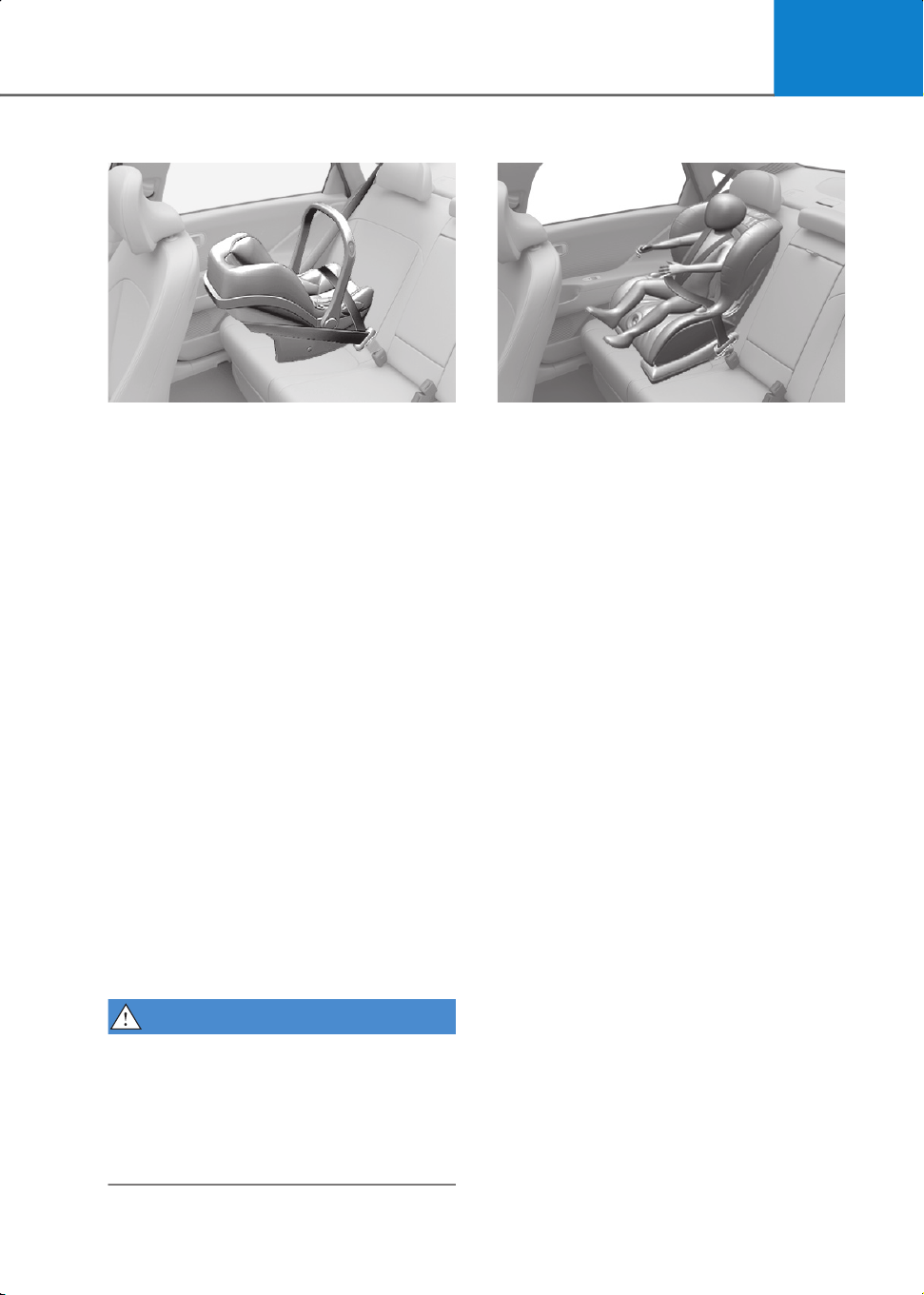
3
3-31
Rearward-facing Child Restraint System
B3002201
A rearward-facing Child Restraint System
provides restraint with the seating
surface against the back of the child. The
harness system holds the child in place,
and in an accident, acts to keep the child
positioned in the Child Restraint Systems
and reduce the stress to the fragile neck
and spinal cord.
All children under the age of one year
must always ride in a rearward-facing
Child Restraint System. Convertible and
3-in-1 Child Restraint Systems typically
have higher height and weight limits for
the rearward-facing position, allowing
you to keep your child rearward-facing
for a longer period of time.
Keep using Child Restraint Systems in the
rearward-facing position as long as
children fit within the height and weight
limits allowed by the Child Restraint
System’s manufacturer. It’s the best way
to keep them safe.
Once your child has outgrown the
rearward-facing Child Restraint System,
your child is ready for a forward-facing
Child Restraint System with a harness.
WARNING
NEVER install a child or infant restraint in
the front passenger's seat.
Placing a rearward-facing child restraint
in the front seat can result in SERIOUS
INJURY or DEATH if the child restraint is
struck by an inflating airbag.
Forward-facing Child Restraint System
B3002202
A forward-facing Child Restraint System
provides restraint for the child’s body
with a harness. Keep children in a
forward-facing Child Restraint System
with a harness until they reach the top
height or weight limit allowed by your
Child Restraint System’s manufacturer.
Once your child outgrows the
forward-facing Child Restraint System,
your child is ready for a booster seat.
Booster seats
A booster seat is a Child Restraint System
designed to improve the fit of the
vehicle’s seat belt system. A booster seat
positions the seat belt so that it fits
properly over the stronger parts of your
child’s body. Keep your children in
booster seats until they are big enough to
fit in a seat belt properly.
For a seat belt to fit properly, the lap belt
must lie comfortable across the upper
thighs, not the stomach. The shoulder
belt should lie comfortable across the
shoulder and chest and not across the
neck or face. Children under age 13 must
always be properly restrained to minimize
the risk of injury in an accident, sudden
stop or sudden maneuver.
CE_USA.book Page 31
Seats & Safety System
3-32
Installing a Child Restraint
System (CRS)
WARNING
Before installing your Child Restraint
System always:
Read and follow the instructions provided
by the manufacturer of the Child
Restraint System.
Failure to follow all warnings and
instructions could increase the risk of the
SERIOUS INJURY or DEATH if an accident
occurs.
WARNING
If the vehicle head restraint prevents
proper installation of a Child Restraint
System, the head restraint of the
respective seating position shall be
readjusted or entirely removed.
After selecting a proper Child Restraint
System for your child and checking that
the Child Restraint System fits properly
on the seating position, there are three
general steps for a proper installation:
• Properly secure the Child Restraint
System to the vehicle. All Child
Restraint Systems must be secured to
the vehicle with the lap belt or lap part
of a lap/shoulder belt or with the lower
anchor and/or tether anchor and/or
with the support leg.
• Make sure the Child Restraint System
is firmly secured. After installing a
Child Restraint System to the vehicle,
push and pull the seat forward and from
side-to-side to verify that it is securely
attached to the seat. A Child Restraint
System secured with a seat belt should
be installed as firmly as possible.
However, some side-to-side
movement can be expected. When
installing a Child Restraint System,
adjust the vehicle seat and seatback
(up and down, forward and rearward)
so that your child fits in the Child
Restraint System in a comfortable
manner.
• Secure the child in the Child Restraint
System. Make sure the child is properly
strapped in the Child Restraint System
according to the Child Restraint System
manufacturer’s instructions.
CAUTION
A Child Restraint System in a closed
vehicle can become very hot. To prevent
burns, check the seating surface and
buckles before placing your child in the
Child Restraint System.
CE_USA.book Page 32
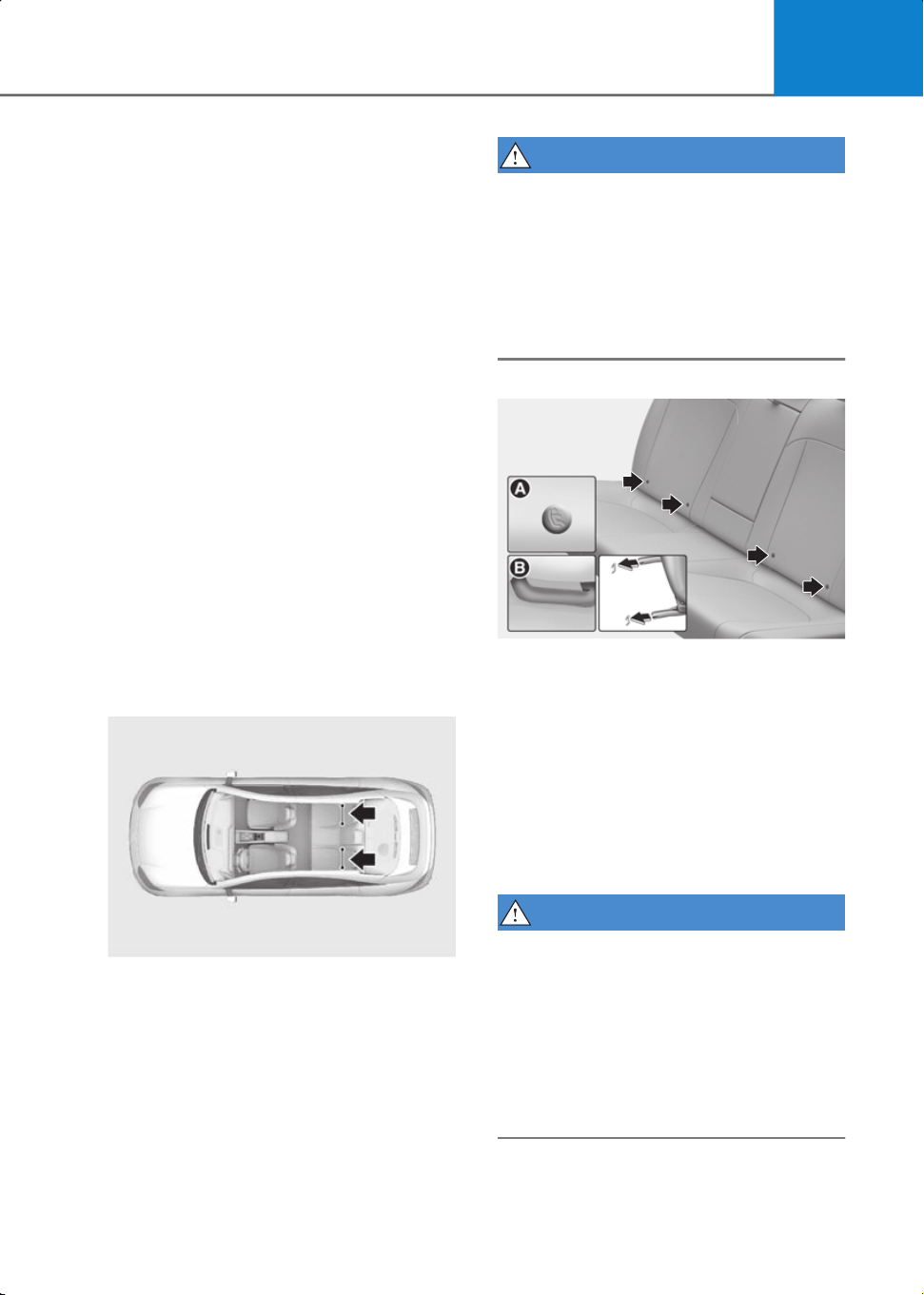
3
3-33
Lower Anchors and Tether for
Children (LATCH System)
The LATCH system holds a Child Restraint
System during driving and in an accident.
This system is designed to make
installation of the Child Restraint System
easier and reduce the possibility of
improperly installing your Child Restraint
System. The LATCH system uses anchors
in the vehicle and attachments on the
Child Restraint System. The LATCH
system eliminates the need to use seat
belts to secure the Child Restraint System
to the rear seats.
Lower anchors are metal bars built into
the vehicle. There are two lower anchors
for each LATCH seating position that will
accommodate a Child Restraint System
with lower attachments.
To use the LATCH system in your vehicle,
you must have a Child Restraint System
with LATCH attachments.
The Child Restraint System manufacturer
will provide you with instructions on how
to use the Child Restraint System with its
attachments for the LATCH anchorages.
B3002210
LATCH anchors have been provided in the
left and right outboard rear seating
positions. Their locations are shown in the
illustration. There are no LATCH anchors
provided for the center rear seating
position.
WARNING
Do not attempt to install a Child Restraint
System using LATCH anchors in the rear
center seating position. There are no
LATCH anchors provided for this seat.
Using the outboard seat anchors can
damage the anchors which may break or
fail in a collision resulting in serious injury
or death.
B3002211
[A] Lower Anchor Position Indicator
[B] Lower Anchor
The lower anchor position indicator
symbols are located on the left and right
rear seat backs to identify the position of
the lower anchors in your vehicle (see
arrows in illustration).
The LATCH anchors are located between
the seatback and the seat cushion of the
rear seat left and right outboard seating
positions.
WARNING
Before installing the Child Restraint
System, make sure that there are no
objects (for example, toy, pen, wire)
around the lower anchor area. Those
objects may damage either the seat belt
system or the Child Restraint System
during the installment procedure. If
necessary, have the vehicle inspected by
an authorized HYUNDAI dealer.
CE_USA.book Page 33
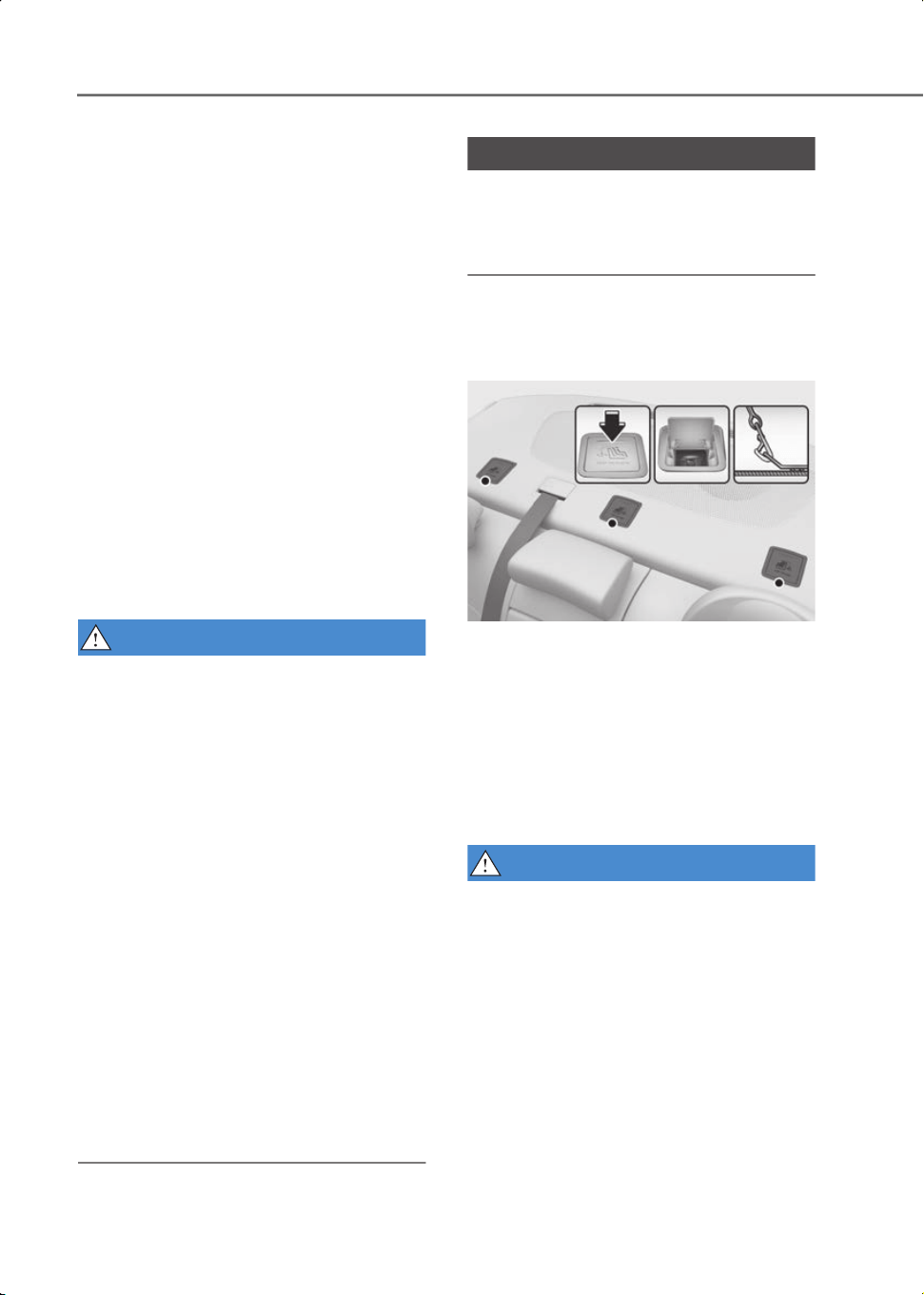
Seats & Safety System
3-34
Securing a Child Restraint System
with the “LATCH Anchors System”
To install a LATCH-compatible Child
Restraint System in either of the rear
outboard seating positions:
1. Move the seat belt buckle away from
the lower anchors.
2. Move any other objects away from the
anchorages that could prevent a secure
connection between the Child Restraint
System and the lower anchors.
3. Place the Child Restraint System on the
vehicle seat, then attach the seat to the
lower anchors according to the
instructions provided by the Child
Restraint System manufacturer.
4. Follow the instructions of the Child
Restraint System’s manufacturer for
proper installation and connection of
the lower attachments on the Child
Restraint System to the lower anchors.
WARNING
Take the following precautions when
using the LATCH system:
• Read and follow all installation
instructions provided with your Child
Restraint System.
• To prevent the child from reaching and
taking hold of unretracted seat belts,
buckle all unused rear seat belts and
retract the seat belt webbing behind
the child. Children can be strangled if a
shoulder belt becomes wrapped
around their neck and the seat belt
tightens.
• NEVER attach more than one Child
Restraint System to a single anchorage.
This could cause the anchor or
attachment to come loose or break.
• Always have the LATCH system
inspected by your dealer after an
accident. An accident can damage the
LATCH system and may not properly
secure the Child Restraint System.
NOTICE
Make sure that the combined weight of
the child and the child restraint system is
less than 65 lbs. (30 kg) for each LATCH
system.
Securing a Child Restraint System
seat with “Top-tether Anchorage”
system
B3002208
First secure the child restraint with the
LATCH lower anchors or the seat belt. If
the child restraint manufacturer
recommends that the top tether strap be
attached, attach and tighten the top
tether strap to the top tether strap
anchor.
Child restraint hook holders are located
on the rear of the seatbacks.
WARNING
Take the following precautions when
installing the top-tether:
• Read and follow all installation
instructions provided with your Child
Restraint System.
• NEVER attach more than one Child
Restraint System to a single tether
anchor. This could cause the anchorage
or attachment to come loose or break.
• Do not attach the tether strap to
anything other than the correct
top-tether anchor. It may not work
properly if attached to something else.
CE_USA.book Page 34
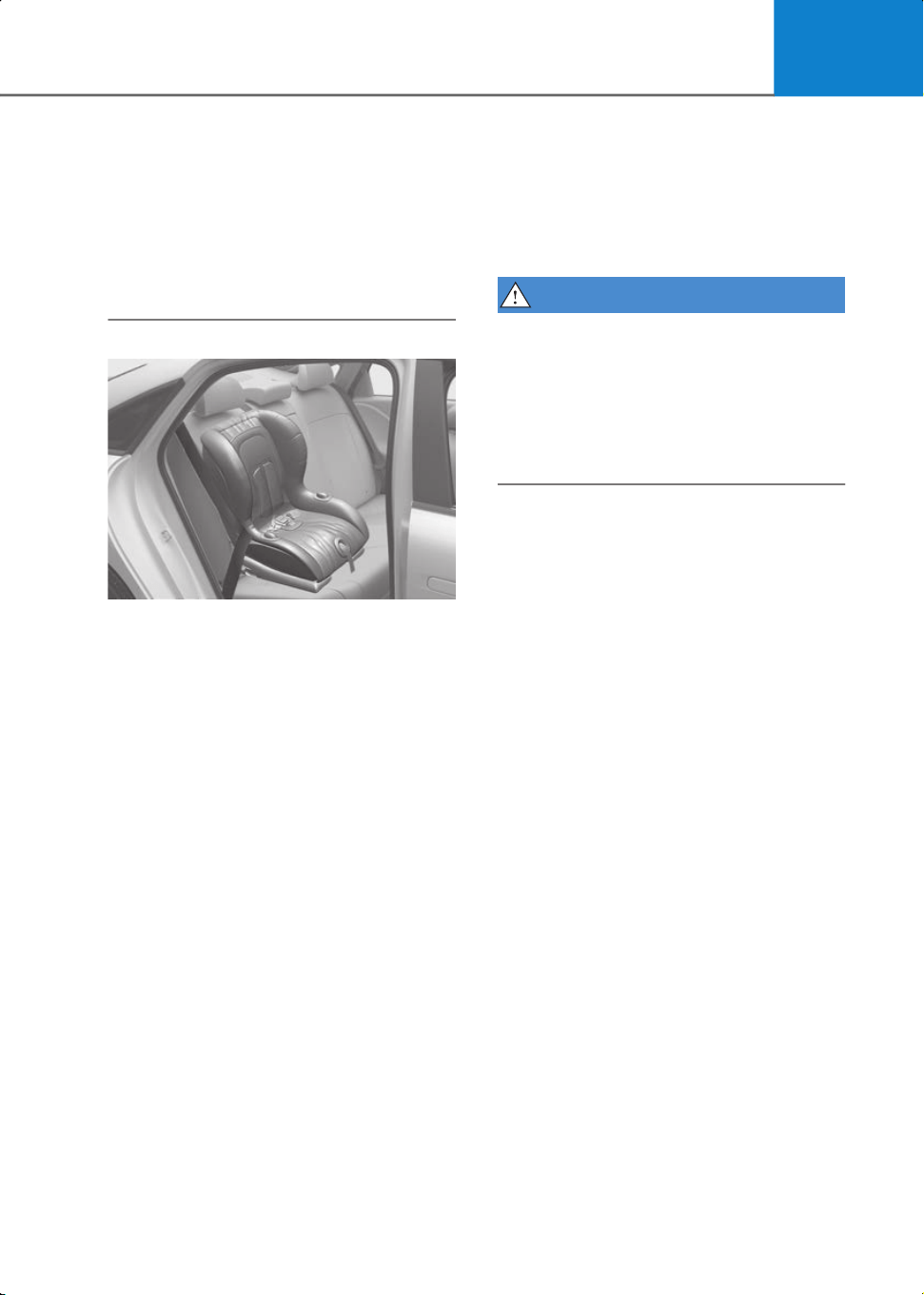
3
3-35
• Child Restraint System anchors are
designed to withstand only those loads
imposed by correctly fitted Child
Restraint System.
Under no circumstances are the
anchors to be used for adult seat belts
or harnesses or for attaching other
items or equipment to the vehicle.
B3002209
To install the tether anchor:
1. Route the Child Restraint System
top-tether strap over the seatback.
Route the tether strap under the head
restraint and between the head
restraint posts, or route the tether strap
over the top of the vehicle seatback.
Make sure the strap is not twisted.
2. Connect the tether strap hook to the
tether anchor, then tighten the
top-tether strap according to the
instructions of your Child Restraint
System’s manufacturer to firmly attach
the Child Restraint System to the seat.
3. Check that the Child Restraint System
is securely attached to the seat by
pushing and pulling the seat
forward-and-back and side-to-side.
Securing a Child Restraint System with a
lap/shoulder belt
When not using the LATCH system, all
Child Restraint Systems must be secured
to a rear seat with the lap part of a
lap/shoulder belt.
WARNING
ALWAYS place a rearward-facing Child
Restraint System in the rear seat of the
vehicle.
Placing a rearward-facing child restraint
in the front seat can result in serious injury
or death if the Child Restraint System is
struck by an inflating airbag.
Automatic locking mode
Since all passenger seat belts move freely
under normal conditions and only lock
under extreme or emergency conditions
(emergency locking mode), you must
manually pull the seat belt all the way out
to shift the retractor to the "Automatic
Locking" mode to secure a Child Restraint
System.
The "Automatic Locking" mode will help
prevent the normal movement of the
child in the vehicle from causing the seat
belt to loosen and compromise the Child
Restraint System. To secure a Child
Restraint System, use the following
procedure.
CE_USA.book Page 35
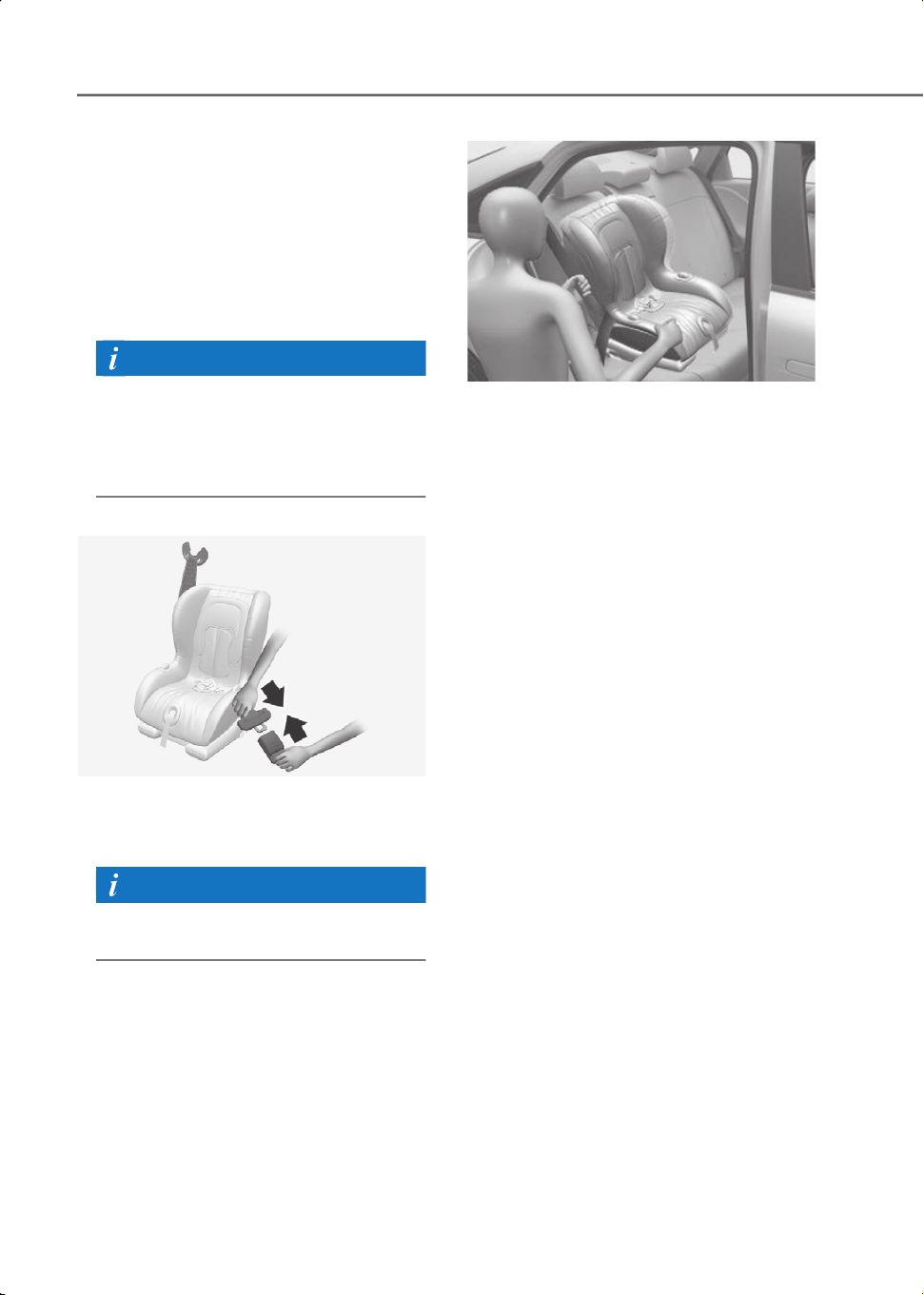
Seats & Safety System
3-36
To install a Child Restraint System on the
rear seats, do the following:
1. Place the Child Restraint System on a
rear seat and route the lap/shoulder
belt around or through the Child
Restraint System, following the Child
Restraint System manufacturer’s
instructions. Make sure the seat belt
webbing is not twisted.
Information
When using the rear center seat belt,
you should also refer to the "Rear Seat
Belts – 3-point system with convertible
locking retractor" section in this
chapter.
B3002204
2. Fasten the lap/shoulder belt latch into
the buckle. Listen for the distinct “click”
sound.
Information
Position the release button so that it is
easy to access in case of an emergency.
B3002207
3. Pull the shoulder portion of the seat belt
all the way out. When the shoulder
portion of the seat belt is fully
extended, it will shift the retractor to
the "Automatic Locking" (child
restraint) mode.
4. Slowly allow the shoulder portion of the
seat belt to retract and listen for an
audible "clicking" or "ratcheting"
sound. This indicates that the retractor
is in the "Automatic Locking" mode. If
no distinct sound is heard, repeat steps
3 and 4.
5. Remove as much slack from the belt as
possible by pushing down on the Child
Restraint System while feeding the
shoulder belt back into the retractor.
6.Push and pull on the Child Restraint
System to confirm that the seat belt is
holding it firmly in place. If it is not,
release the seat belt and repeat steps 2
through 6.
7. Double check that the retractor is in the
"Automatic Locking" mode by
attempting to pull more of the seat belt
out of the retractor. If you cannot, the
retractor is in the "Automatic Locking"
mode.
If your Child Restraint System
manufacturer instructs or recommends
you to use a tether anchor with the lap/
shoulder belt, refer to the "Installing a
Child Restraint System (CRS)" section in
this chapter.
CE_USA.book Page 36

3
3-37
Information
When the seat belt is allowed to retract to
its fully stowed position, the retractor will
automatically switch from the “Automatic
Locking” mode to the emergency lock
mode for normal adult usage.
WARNING
If the retractor is not in the “Automatic
Locking” mode, the child restraint can
move when your vehicle turns or stops
suddenly. A child can be seriously injured
or killed if the child restraint is not
properly anchored in the car, including
manually pulling the seat belt all the way
out to shift the retractor to the
“Automatic Locking” mode.
To remove the Child Restraint System,
press the release button on the buckle
and then pull the lap/shoulder belt out of
the Child Restraint System and allow the
seat belt to retract fully.
CE_USA.book Page 37
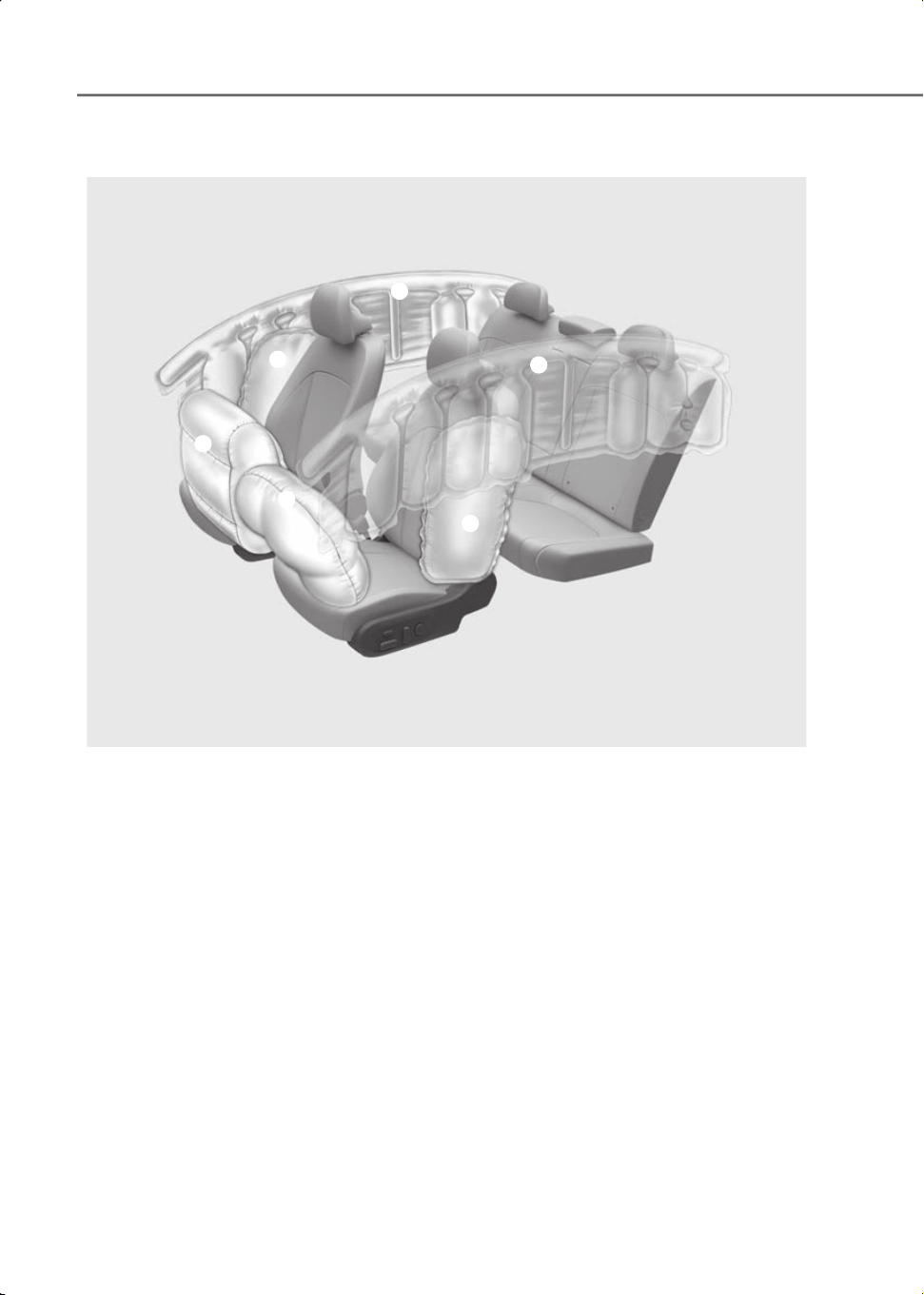
Seats & Safety System
3-38
Airbag - Supplemental Restraint System
A3002301
The actual airbags in the vehicle may differ from the illustration.
(1) Driver’s front airbag
(2) Passenger’s front airbag
(3) Side airbag
(4) Curtain airbag
1
2
3
3
4
4
CE_USA.book Page 38

3
3-39
Your vehicle is equipped with a Supplemental Airbag System for the driver’s seat and
front passenger’s seats.
The front airbags are designed to supplement the three-point seat belts. For these
airbags to provide protection, the seat belts must be worn at all times when driving.
You can be severely injured or killed in an accident if you are not wearing a seat belt.
Airbags are designed to supplement seat belts, but do not replace them. Also, airbags are
not designed to deploy in every collision. In some accidents, the seat belts are the only
restraint protecting you.
WARNING
AIRBAG SAFETY PRECAUTIONS
ALWAYS use seat belts and Child Restraint Systems - every trip, every time, everyone!
Even with airbags, you can be seriously injured or killed in a collision if you are improperly
belted or not wearing your seat belt when the airbag inflates.
NEVER place a child in any Child Restraint System or booster seat in the front passenger
seat, unless the airbag is deactivated.
An inflating airbag could forcefully strike the infant or child causing serious or fatal
injuries.
ABC - Always Buckle Children under age 13 in the back seat. It is the safest place for
children of any age to ride. If a child age 13 or older must be seated in the front seat, he
or she must be properly belted and the seat should be moved as far back as possible.
All occupants should sit upright with the seatback in an upright position, centered on the
seat cushion with their seat belt on, legs comfortably extended and their feet on the floor
until the vehicle is parked and the vehicle is turned off. If an occupant is out of position
during an accident, the rapidly deploying airbag may forcefully contact the occupant
causing serious or fatal injuries.
You and your passengers should never sit or lean unnecessarily close to the airbags or
lean against the door or center console.
Move your seat as far back as possible from front airbags, while still maintaining control
of the vehicle. The U.S. National Highway Traffic Safety Administration (NHTSA)
recommends that drivers allow at least 10 in. (25 cm) between the center of the steering
wheel and the chest.
CE_USA.book Page 39
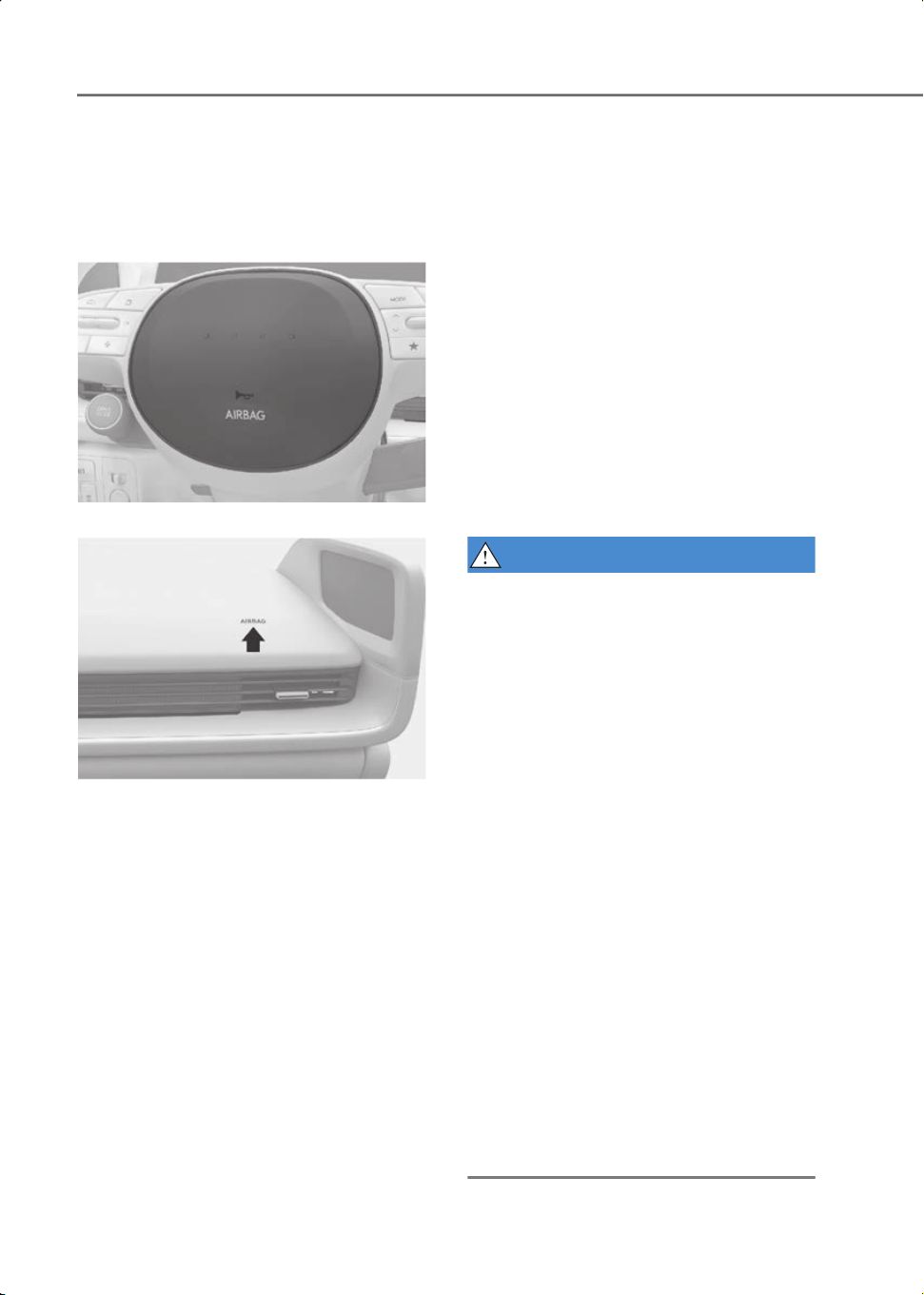
Seats & Safety System
3-40
Where are the Airbags?
Driver’s and passenger’s front
airbags
Driver’s front airbag
B3002801
Passenger’s front airbag
B3003001
Your vehicle is equipped with a
Supplemental Restraint System (SRS) and
lap/shoulder belts at both the driver and
passenger seating positions.
The SRS consists of airbags which are
located in the center of the steering
wheel and the passenger’s side front
panel pad above the glove box.
The airbags are labeled with the letters
“AIRBAG” embossed on the pad covers.
The purpose of the SRS is to provide the
vehicle’s driver and front passengers with
additional protection than that offered by
the seat belt system alone in case of a
frontal impact of sufficient severity.
The seat belt buckle sensors determine if
the driver and front passenger's seat belts
are fastened. These sensors provide the
ability to control the SRS deployment
based on whether or not the seat belts are
fastened, and how severe the impact is.
The advanced SRS offers the ability to
control the airbag inflation within two
levels. A first stage level is provided for
moderate-severity impacts. A second
stage level is provided for more severe
impacts.
According to the impact severity, and
seat belt usage, the SRS Control Module
(SRSCM) controls the airbag inflation.
Failure to properly wear seat belts can
increase the risk or severity of injury in an
accident.
WARNING
To reduce the risk of serious injury or
death from inflating front airbags, take
the following precautions:
• Seat belts must be worn at all times to
help keep occupants positioned
properly.
• Move your seat as far back as possible
from front airbags, while still
maintaining control of the vehicle.
• Never lean against the door or center
console.
• Do not allow the front passenger to
place their feet or legs on the
dashboard.
• Never place any objects (such as
dashboard cover, mobile phone holder,
cup holder, perfume or stickers) over or
near the airbag modules on the steering
wheel, instrument panel, windshield
glass, and the front passenger’s panel
above the glove box. Such objects may
cause harm if the vehicle is in a collision
severe enough to cause the airbags to
deploy.
• Do not attach any objects on the front
windshield and inside mirror.
CE_USA.book Page 40
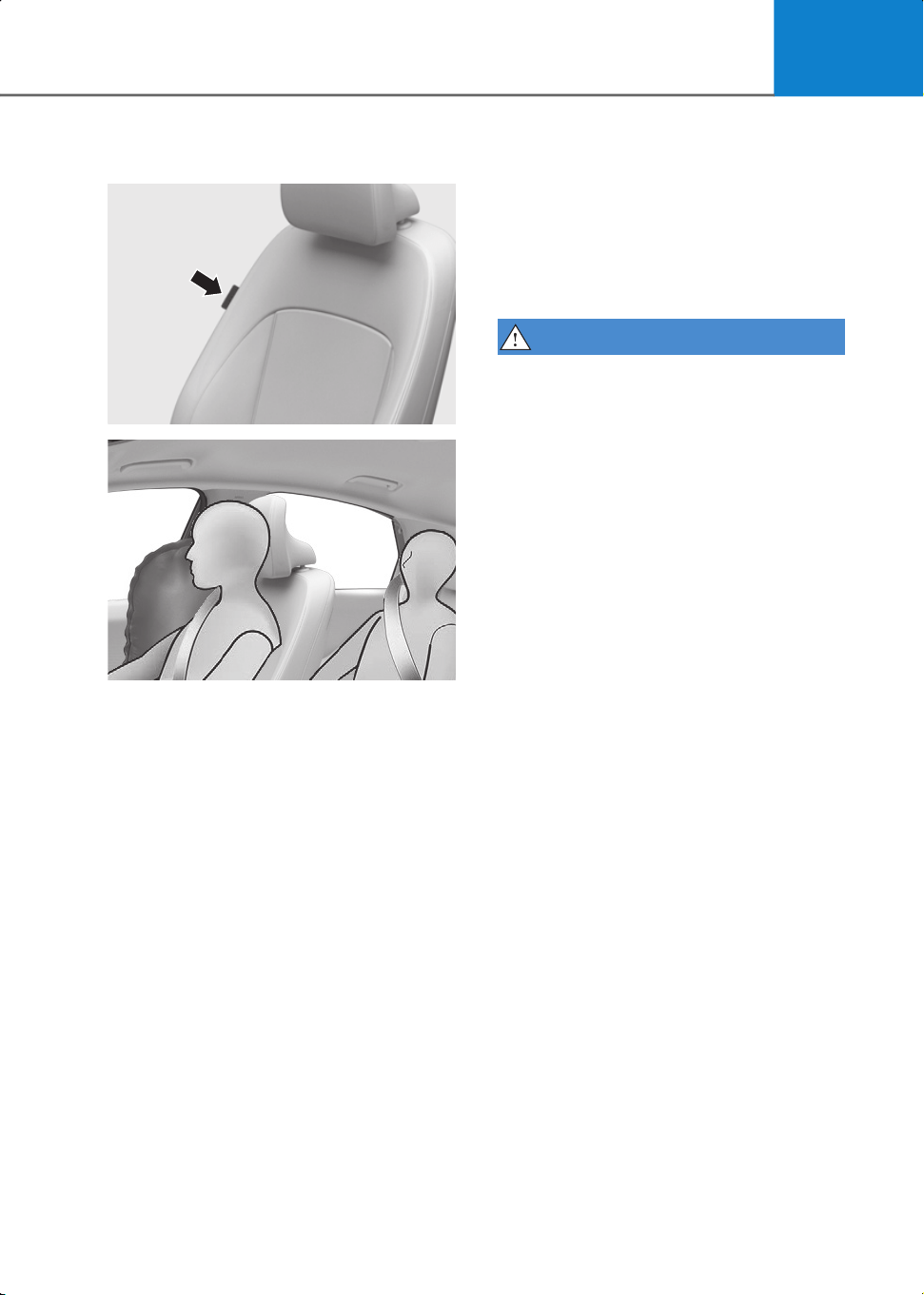
3
3-41
Side airbags
Side airbag
B3003202
B3003203
Your vehicle is equipped with a side
airbag in each front seat. The purpose of
the airbag is to provide the vehicle’s
driver and the front passenger with
additional protection than that offered by
the seat belt alone.
The side airbags are designed to deploy
during certain side impact collisions,
depending on the crash severity, angle,
speed and point of impact.
The side airbags on both sides of the
vehicle are designed to deploy when a
rollover is detected by a rollover sensor.
(if equipped with rollover sensor)
The side airbags are not designed to
deploy in all side impact or rollover
situations.
The side airbags are designed to deploy
during certain side impact collisions,
depending on the crash severity.
For vehicles equipped with a rollover
sensor the side and/or curtain airbags and
pretensioners on both sides of the vehicle
may deploy if a rollover or possible
rollover is detected.
The side airbags are not designed to
deploy in all side impact or rollover
situations.
WARNING
To reduce the risk of serious injury or
death from an inflating side airbag, take
the following precautions:
• Seat belts must be worn at all times to
help keep occupants positioned
properly.
• Do not allow passengers to lean their
heads or bodies onto doors, put their
arms on the doors, stretch their arms
out of the window, or place objects
between the doors and seats.
• Hold the steering wheel at the 9 o’clock
and 3 o’clock positions, to minimize the
risk of injuries to your hands and arms.
• Do not use any accessory seat covers.
This could reduce or prevent the
effectiveness of the system.
• Do not hang other objects except
clothes. In an accident it may cause
vehicle damage or personal injury
especially when airbag is inflated.
• Do not place any objects over the
airbag or between the airbag and
yourself. Also, do not attach any objects
around the area the airbag inflates such
as the door, side door glass, front and
rear pillar.
• Do not place any objects between the
door and the seat. They may become
dangerous projectiles if the side airbag
inflates.
• Do not install any accessories on the
side or near the side airbags.
• Do not impact the doors when the
Start/Stop button is in the ON or START
position as this may cause the side
airbags to inflate.
CE_USA.book Page 41
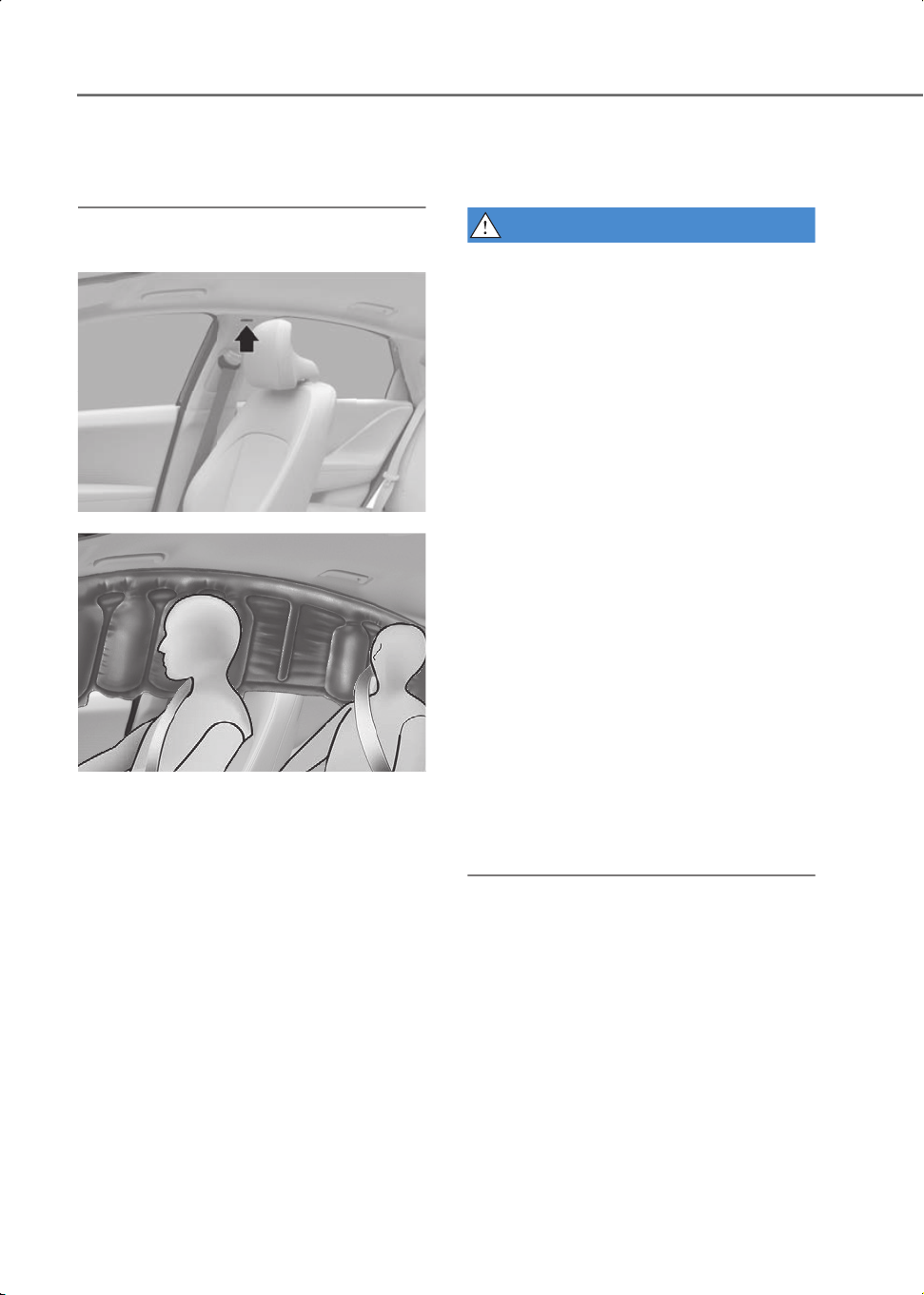
Seats & Safety System
3-42
• If the seat or seat cover is damaged,
have the system serviced by an
authorized HYUNDAI dealer.
Curtain airbags
B3003301
B3003302
Curtain airbags are located along both
sides of the roof rails above the front and
rear doors.
They are designed to help protect the
heads of the front seat occupants and the
rear outboard seat occupants in certain
side impact collisions.
The curtain airbags are designed to
deploy during certain side impact
collisions, depending on the crash
severity.
For vehicles equipped with a rollover
sensor the side and/or curtain airbags and
pretensioners on both sides of the vehicle
may deploy if a rollover or possible
rollover is detected.
The curtain airbags are not designed to
deploy in all side impact or rollover
situations.
WARNING
To reduce the risk of serious injury or
death from an inflating curtain airbag,
take the following precautions:
• All occupants must wear seat belts at all
times to help keep occupants
positioned properly.
• Properly secure Child Restraint System
as far away from the door as possible.
• Do not place any objects over the
airbag. Also, do not attach any objects
around the area the airbag inflates such
as the door, side door glass, front and
rear pillar, roof side rail.
• Do not hang other objects except
clothes, especially hard or breakable
objects.
In an accident, it may cause vehicle
damage or personal injury.
• Do not allow passengers to lean their
heads or bodies onto doors, put their
arms on the doors, stretch their arms
out of the window, or place objects
between the doors and seats.
• Do not attempt to open or repair the
side curtain airbags yourself. If
necessary, have the airbag inspected
by an authorized HYUNDAI dealer.
CE_USA.book Page 42
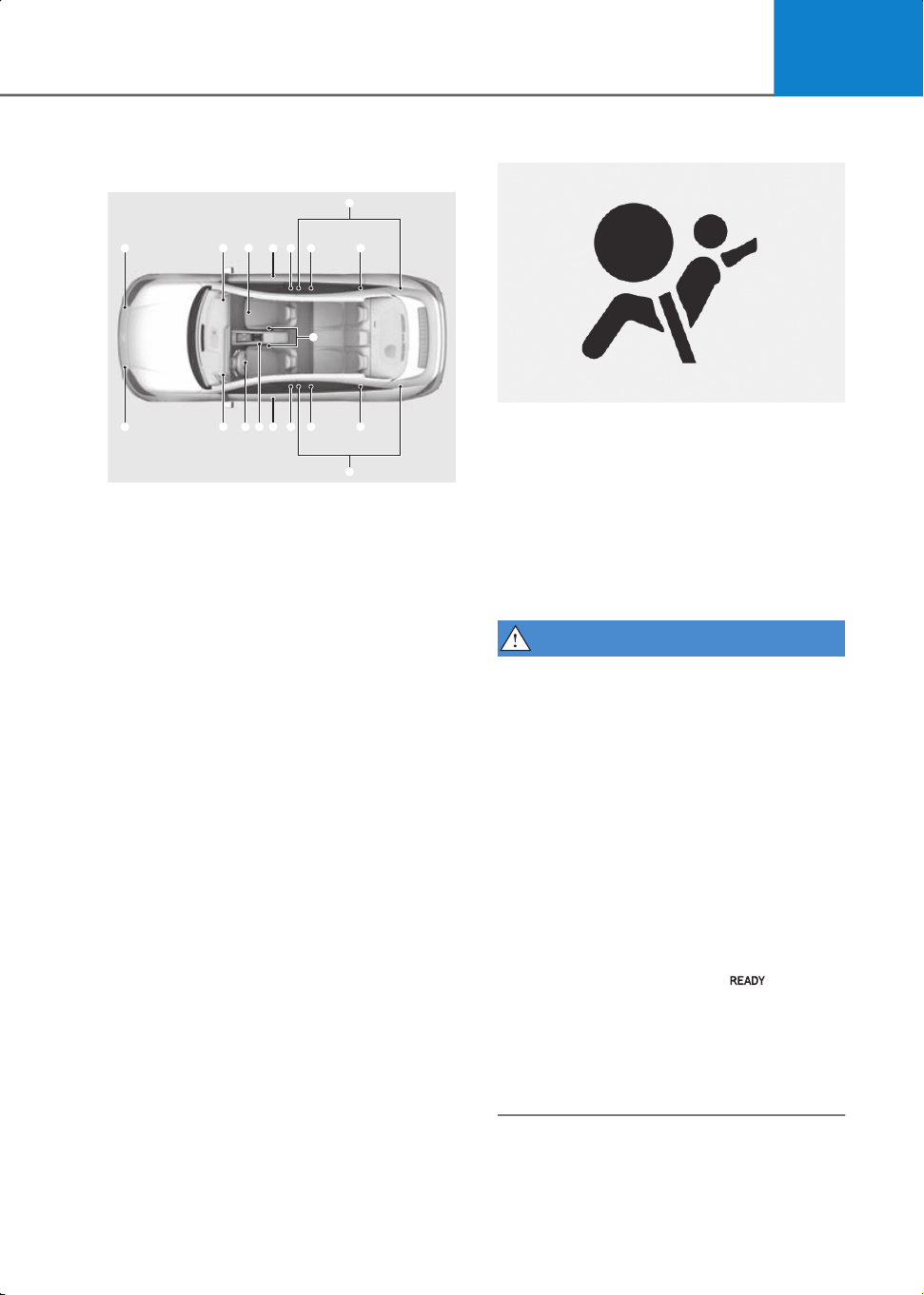
3
3-43
How does the Airbags System
Operate?
A3002401
The SRS consists of the following
components:
(1) Driver’s front airbag module
(2) Passenger’s front airbag module
(3) Side airbag modules
(4) Curtain airbag modules
(5) Retractor pretensioner
(6) Airbag warning light
(7) SRS control module
(SRSCM)/Rollover sensor
(8) Front impact sensors
(9) Side impact sensors (acceleration)
(10)Side impact sensors (pressure)
(11) Occupant classification system
(12)Driver’s and front passenger’s seat
belt buckle sensors.
The SRSCM (Supplemental Restraint
System Control Module) continually
monitors all SRS components while the
Start/Stop button is ON to determine if a
crash impact is severe enough to require
airbag deployment or pretensioner seat
belt deployment.
SRS warning light
B3002501
The SRS (Supplemental Restraint System)
airbag warning light on the instrument
cluster the airbag symbol depicted in the
illustration. The system checks the airbag
electrical system for malfunctions. The
light indicates that there is a potential
problem with your airbag system, which
could include your side and/or curtain
airbags used for rollover protection.
WARNING
If your SRS malfunctions, the airbag may
not inflate properly during an accident
increasing the risk of serious injury or
death.
If any of the following conditions occur,
your SRS is malfunctioning:
• The light does not turn on for about 3-6
seconds when the Start/Stop button is
in the ON position.
• The light stays on after illuminating for
about three to 6 seconds.
• The light comes on while the vehicle is
in motion.
• The light blinks when the (ready
indicator) is displayed on the
instrument cluster.
Have an authorized HYUNDAI dealer
inspect the SRS as soon as possible if any
of these conditions occur.
4
5
5
11
1
2 3
37
8
8 6
9
49
10
10
12
CE_USA.book Page 43

Seats & Safety System
3-44
During a moderate to severe frontal
collision, sensors will detect the vehicle’s
rapid deceleration. If the rate of
deceleration is high enough, the control
unit will inflate the front airbags, at the
time and with the force needed.
The front airbags help protect the driver
and front passenger by responding to
frontal impacts in which seat belts alone
cannot provide adequate restraint. When
needed, the side airbags help provide
protection in the event of a side impact or
rollover by supporting the side upper
body area.
• Airbags are activated (able to inflate if
necessary) only when the Start/Stop
button is in the ON or START position,
and it can be activated within about 3
minutes after the vehicle is turned off.
• Airbags inflate in the event of certain
frontal or side collisions to help protect
the occupants from serious physical
injury.
• Generally, airbags are designed to
inflate based upon the severity of a
collision, its direction, or etc. These two
factors determine whether the sensors
produce an electronic
deployment/inflation signal.
• The front airbags will completely inflate
and deflate in an instant. It is virtually
impossible for you to see the airbags
inflate during an accident. It is much
more likely that you will simply see the
deflated airbags hanging out of their
storage compartments after the
collision.
• In addition to inflating in serious side
collisions, vehicles equipped with a
rollover sensor, side and/or curtain
airbags will inflate if the sensing system
detects a rollover.
When a rollover is detected, curtain
airbags will remain inflated longer to
help provide protection from ejection,
especially when used in conjunction
with the seat belts. (if equipped with a
rollover sensor)
• To help provide protection, the airbags
must inflate rapidly. The speed of
airbag inflation is a consequence of
extremely short time in which to inflate
the airbag between the occupant and
the vehicle structures before the
occupant impacts those structures.
This speed of inflation reduces the risk
of serious or life-threatening injuries
and is thus a necessary part of airbag
design.
However, the rapid airbag inflation can
also cause injuries which can include
facial abrasions, bruises and broken
bones because the inflation speed also
causes the airbags to expand with a
great deal of force.
• There are even circumstances under
which contact with the airbag can
cause fatal injuries, especially if the
occupant is positioned excessively
close to the airbag.
You can take steps to reduce the risk of
being injured by an inflating airbag. The
greatest risk is sitting too close to the
airbag. An airbag needs about 10 in. (25
cm) of space to inflate. NHTSA
recommends that drivers allow at least 10
in. (25 cm) between the center of the
steering wheel and the chest.
WARNING
To reduce the risk of serious injury or
death from an inflating airbag, take the
following precautions:
• NEVER place a child restraint in the
front passenger seat.
Always properly restrain children under
age 13 in the rear seats of the vehicle.
• Adjust the front passenger’s and
driver's seats as far to the rear as
possible while allowing you to maintain
full control of the vehicle.
• Hold the steering wheel with hands at
the 9 o'clock and 3 o'clock positions.
CE_USA.book Page 44
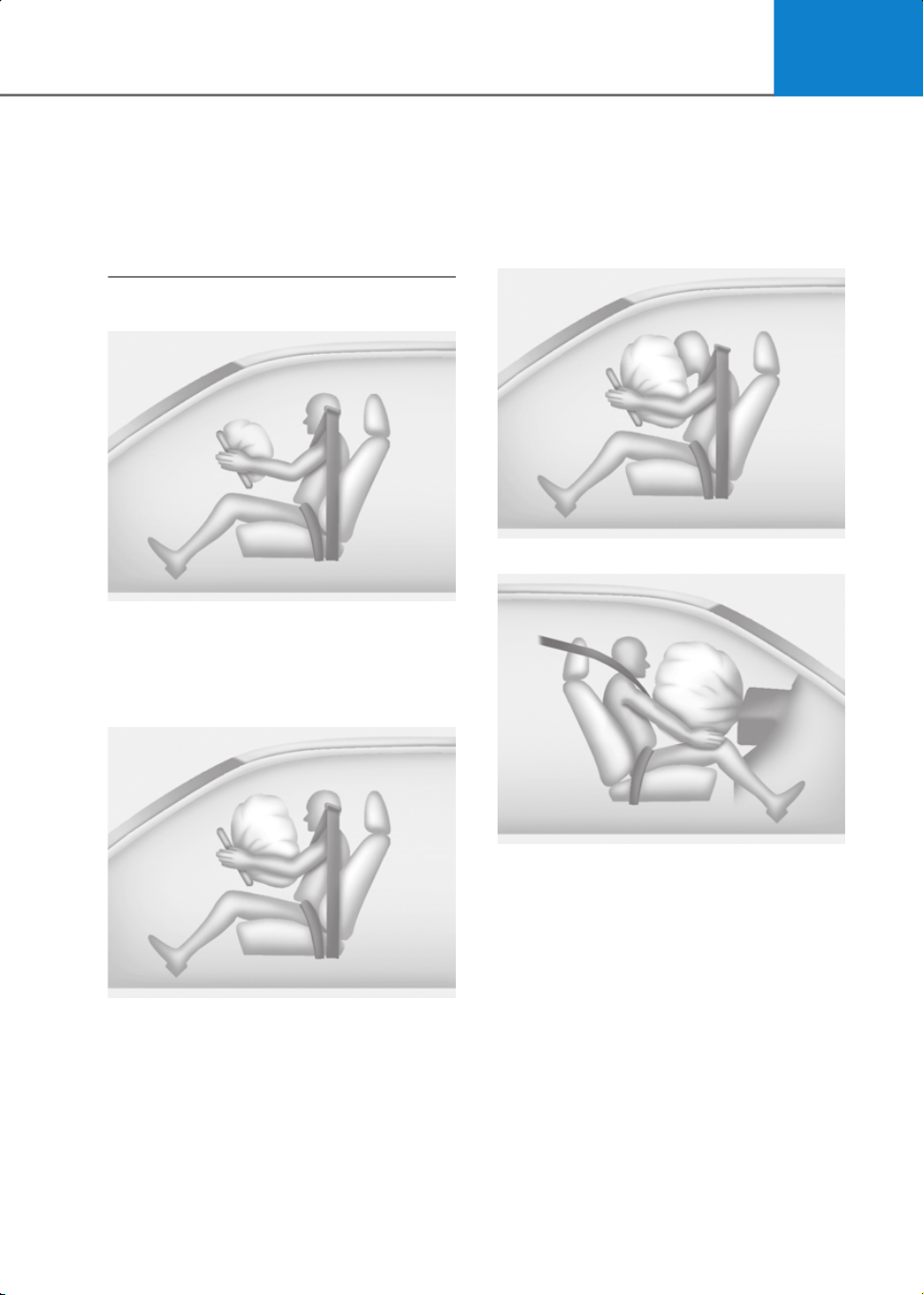
3
3-45
• Never place anything or anyone
between the airbag and the seat
occupant.
• Do not allow the front passenger to
place their feet or legs on the
dashboard.
Driver’s front airbag (1)
OLMB033054
When the SRSCM detects a sufficiently
severe impact to the front of the vehicle,
it will automatically deploy the front
airbags.
Driver’s front airbag (2)
OLMB033055
Upon deployment, tear seam molded
directly into the pad cover will separate
under pressure from the expansion of the
airbags. Further opening of the covers
allows full inflation of the airbags.
A fully inflated airbag, in combination
with a properly worn seat belt, slows the
driver’s or the front passenger’s forward
motion, reducing the risk of head and
chest injury.
Driver’s front airbag (3)
OLMB033056
Passenger’s front airbag
OLMB033057
After complete inflation, the airbag
immediately starts deflating, enabling the
driver to maintain forward visibility and
the ability to steer or operate other
controls.
CE_USA.book Page 45
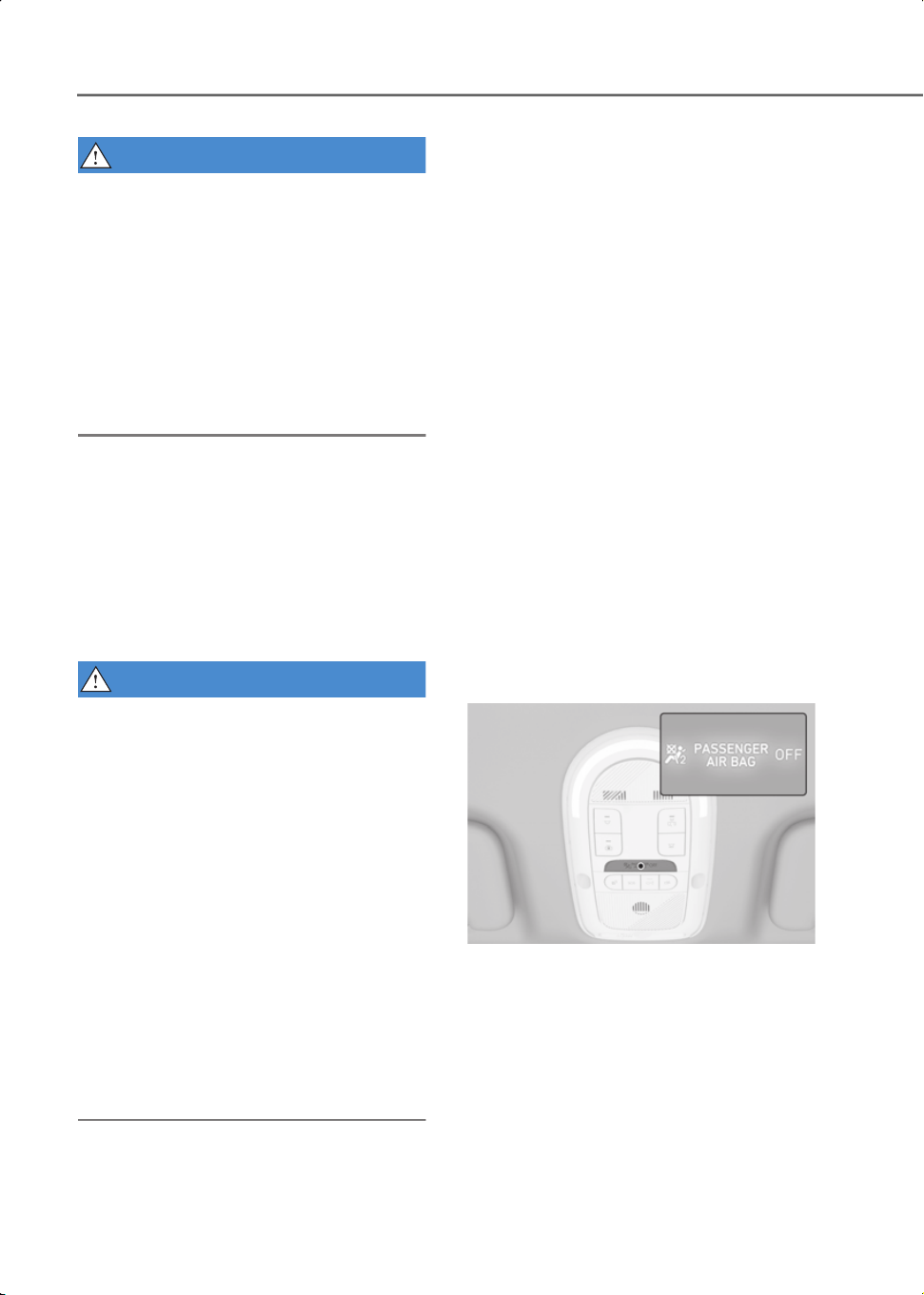
Seats & Safety System
3-46
WARNING
To prevent objects from becoming
dangerous projectiles when the
passenger’s airbag inflates:
• Do not install or place any objects (drink
holder, CD holder, stickers, etc.) on the
front passenger’s panel above the
glove box where the passenger’s airbag
is located.
• Do not install a container of liquid air
freshener near the instrument cluster or
on the instrument panel surface.
What to Expect After an
Airbag Inflates
After a frontal or side airbag inflates, it will
deflate very quickly. Airbag inflation will
not prevent the driver from seeing out of
the windshield or being able to steer.
Curtain airbags may remain partially
inflated for some time after they deploy.
WARNING
After an airbag inflates, take the following
precautions:
• Open your windows and doors as soon
as possible after impact to reduce
prolonged exposure to the smoke and
powder released by the inflating airbag.
• Do not touch the airbag storage area’s
internal components immediately after
an airbag has inflated. The parts that
come into contact with an inflating
airbag may be very hot.
• Always wash exposed skin areas
thoroughly with cold water and mild
soap.
• Have an authorized HYUNDAI dealer
replaced the airbag immediately after
deployment. Airbags are designed to
be used only once.
Noise and smoke from inflating
airbag
When the airbags inflate, they make a
loud noise and may produce smoke and
powder in the air inside of the vehicle.
This is normal and is a result of the
ignition of the airbag inflator. After the
airbag inflates, you may feel substantial
discomfort in breathing because of the
contact of your chest with both the seat
belt and the airbag, as well as from
breathing the smoke and powder. The
powder may aggravate asthma for some
people. If you experience breathing
problems after an airbag deployment,
seek medical attention immediately.
Though the smoke and powder are
nontoxic, they may cause irritation to the
skin, eyes, nose, throat, etc. If this is the
case, wash and rinse with cold water
immediately and seek medical attention if
the symptoms persist.
Occupant Classification
System (OCS)
B3003102
Your vehicle is equipped with an
Occupant Classification System (OCS) in
the front passenger’s seat.
CE_USA.book Page 46

3
3-47
Main components of the Occupant
Classification System
• A detection device located within the
front passenger seat cushion.
• Electronic system to help determine
whether the passenger airbag systems
should be activated or deactivated.
• An indicator light located on the
overhead console which illuminates the
words “PASSENGER AIRBAG OFF”
indicating the front passenger airbag
system is deactivated.
• The instrument cluster airbag indicator
light is interconnected with the OCS.
The OCS is designed to help detect the
presence of a properly-seated front
passenger and determine if the
passenger’s front airbag should be
enabled (may inflate) or not.
The purpose is to help reduce the risk of
injury or death from an inflating airbag to
certain front passenger seat occupants,
such as children, by requiring the airbag
to be automatically turned off.
For example, if a child restraint of the type
specified in the regulations is on the seat,
the occupant classification sensor can
detect it and cause the airbag to turn off.
Front passenger seat adult occupants
who are properly seated and wearing the
seat belt properly, should not cause the
passenger airbag to be automatically
turned off. For smaller adults it may turn
off, however, if the occupant does not sit
in the seat properly (for example, by not
sitting upright, by sitting on the edge of
the seat, or by otherwise being out of
position), this could cause the sensor to
turn the airbag off.
You will find the “PASSENGER AIRBAG
OFF” indicator on the overhead console
panel. This system detects the conditions
1-4 in the following table and activates or
deactivates the front passenger airbag
based on these conditions.
Always be sure that you and all vehicle
occupants are seated properly and
wearing the seat belt properly for the
most effective protection by the airbag
and the seat belt.
The OCS may not function properly if the
passenger takes actions which can affect
the classification system. These include:
• Failing to sit in an upright position.
• Leaning against the door or center
console.
• Sitting towards the sides of the front of
the seat.
• Putting their legs on the dashboard or
resting them on other locations which
reduce the passenger weight on the
front seat.
• Wearing the seat belt improperly.
• Reclining the seatback.
• Wearing thick clothing like ski wear or
hip protection wear.
• Putting an additional thick cushion on
the seat.
• Putting electrical devices (for example,
notebook, satellite radio) on the seat
with inverter charging.
CE_USA.book Page 47

Seats & Safety System
3-48
Condition and operation in the front passenger Occupant Classification System
*1 The system judges a person of adult size as an adult. When a smaller adult sits in the front passenger seat, the
system may recognize him/her as a child depending on his/her physique and posture.
*2 Do not allow children to ride in the front passenger seat. When a larger child who has outgrown a child restraint
system sits in the front passenger seat, the system may recognize him/her as an adult depending upon his/her
physique or sitting position.
*3 Never install a child restraint system on the front passenger seat.
*4 The PASSENGER AIRBAG “OFF” indicator may turn on or off when a child above 12 months to 12 years old (with
or without child restraint system) sits in the front passenger seat. This is a normal condition.
Condition Detected by the
Occupant Classification System
Indicator/Warning Light Devices
“PASSENGER
AIRBAG OFF”
Indicator Light
SRS Warning
Light
Front Passenger
Airbag
Adult
*1
Off Off Activated
Infant
*2
or child restraint system
with 12 months old
*3*4
On Off Deactivated
Unoccupied On Off Deactivated
Malfunction in the system Off On Activated
CE_USA.book Page 48
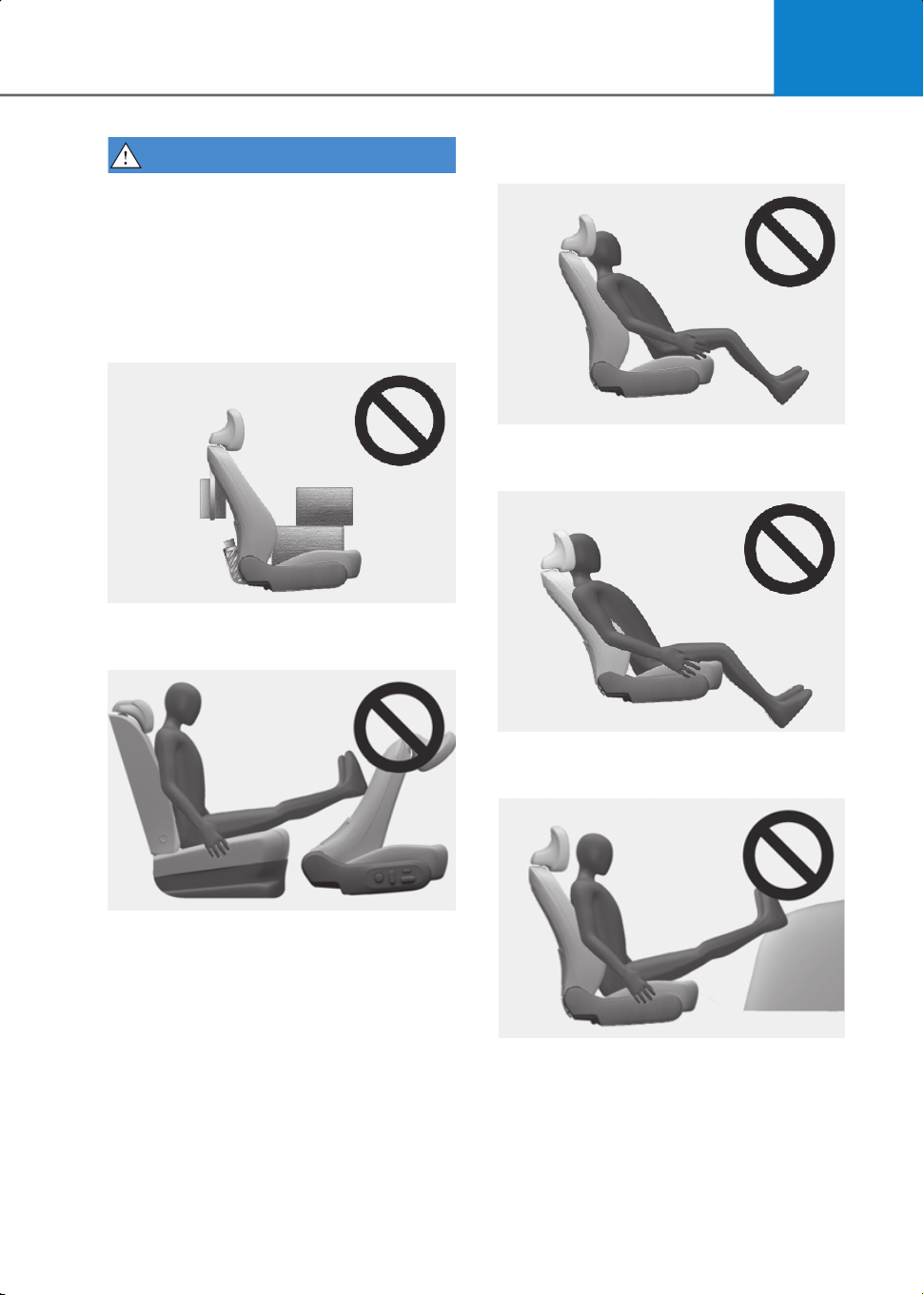
3
3-49
WARNING
Riding in an improper position or placing
weight on the front passenger’s seat
when it is unoccupied by a passenger
adversely affects the OCS. To reduce the
risk of serious injury or death:
• NEVER put a heavy load in the front
seat or seatback pocket, or hang any
items on the front passenger seat.
B3003104
• NEVER place your feet on the front
passenger seatback.
B3003107
• NEVER sit with your hips shifted
towards the front of the seat.
B3003105
• NEVER ride with the seatback reclined
when the vehicle is moving.
B3003108
• NEVER place your feet or legs on the
dashboard.
B3003106
CE_USA.book Page 49
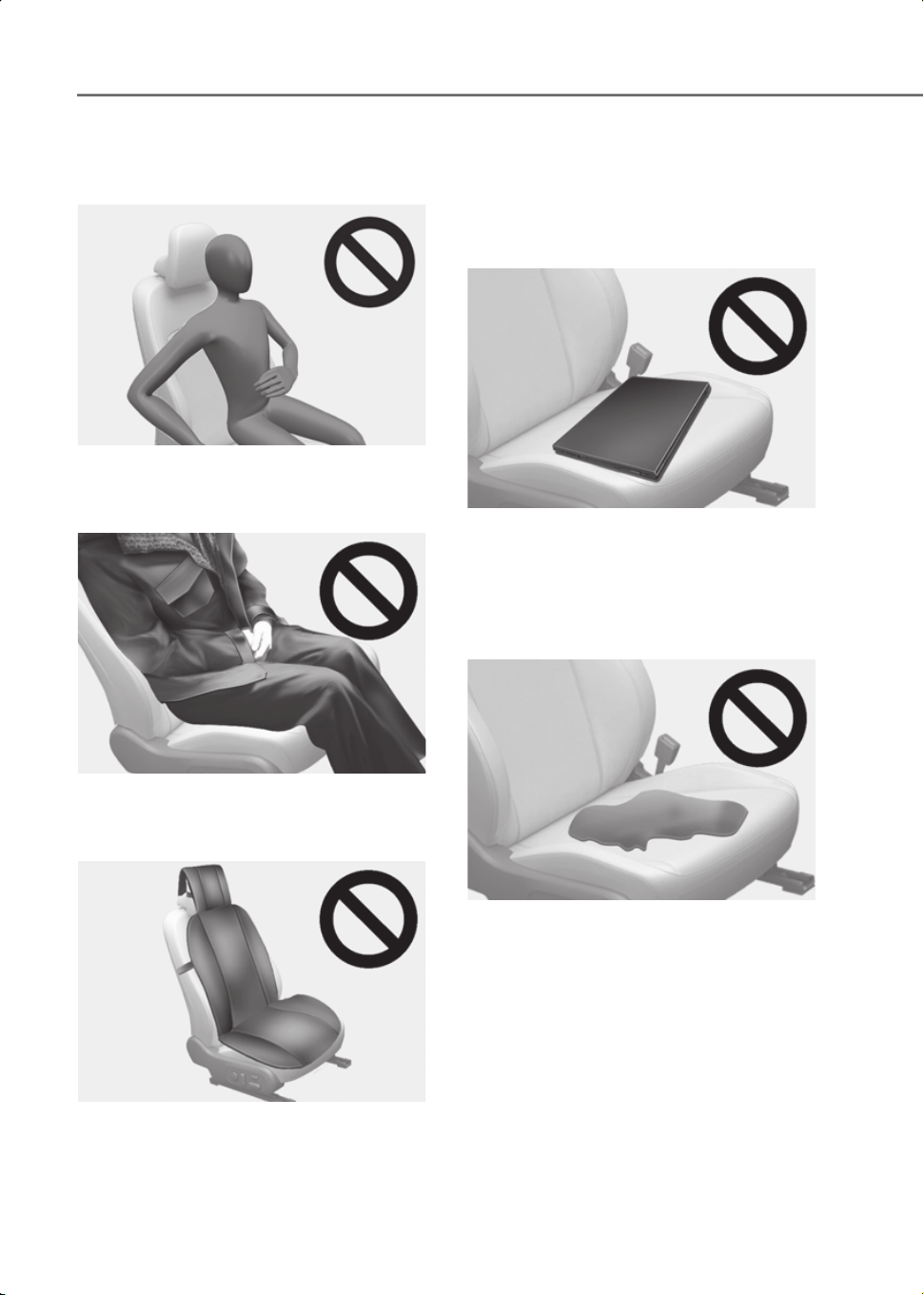
Seats & Safety System
3-50
• NEVER lean on the door or center
console or sit on one side of the front
passenger seat.
B3003109
• Do not sit on the passenger seat
wearing heavily padded clothes such as
ski wear or hip protector.
B3003110
• Do not use car seat accessories such as
thick blankets and cushions which
cover up the car seat surface.
B3003112
• Do not place electronic devices such as
laptops, DVD player, or conductive
materials such as water bottles on the
passenger seat. Do not use electronic
devices such as laptops and satellite
radios which use inverter chargers.
B3003111
• If large quantity of liquid has been
spilled on the passenger seat, the
airbag warning light may illuminate or
malfunction. Therefore, make sure the
seat has been completely dried before
driving the vehicle.
B3003113
• Do not place sharp objects on the front
passenger seat. These may damage the
occupant detection system, if they
puncture the seat cushion.
• Do not place any items under the front
passenger seat.
CE_USA.book Page 50
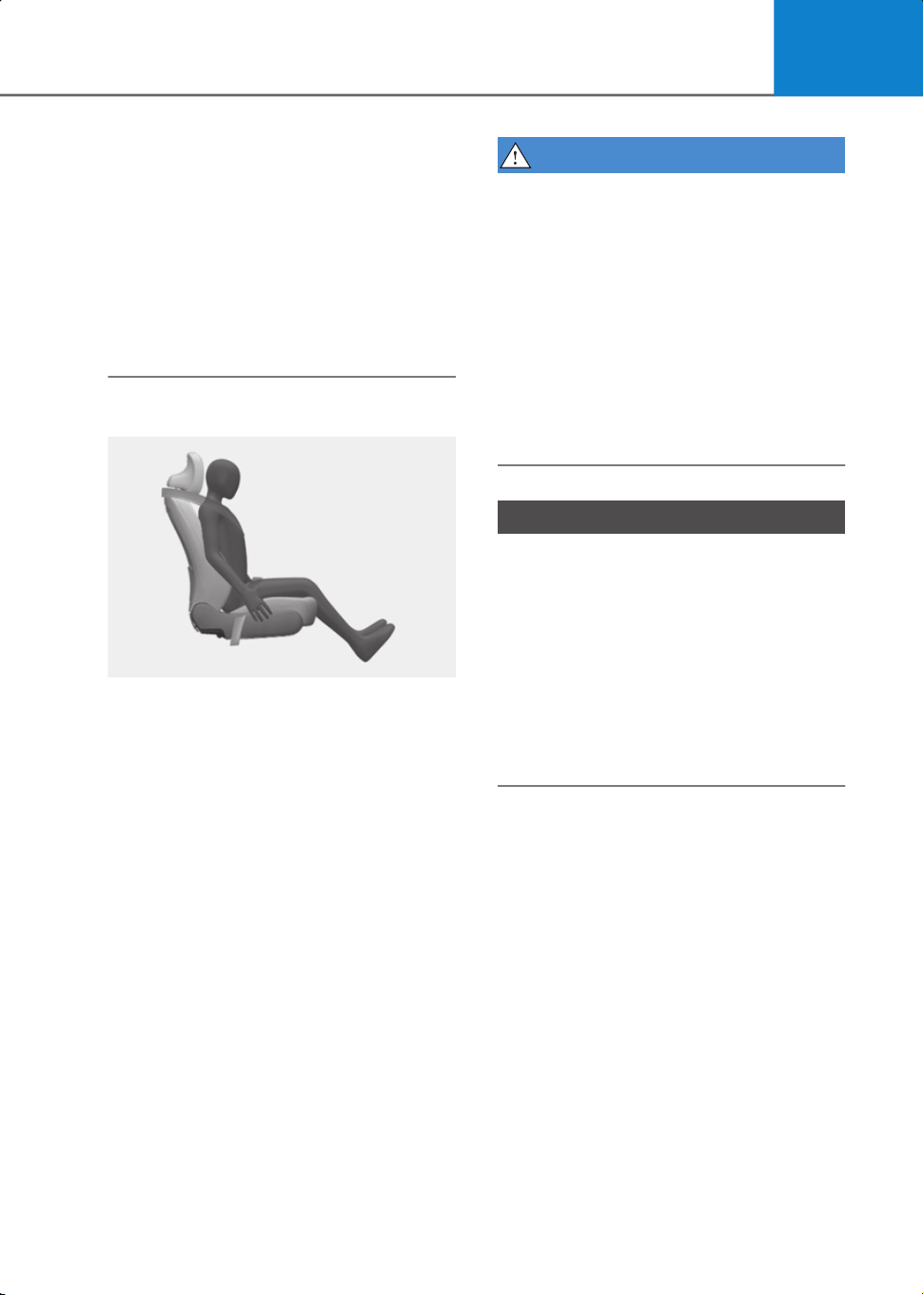
3
3-51
• When changing or replacing the seat
only use Genuine Hyundai Parts. The
OCS has been developed based on
using original HYUNDAI car seats only.
Altering or changing the authentic parts
may result in system malfunction and
increase risk of injury when in collision.
Any of the above could interfere with
the proper operation of the OCS sensor
thereby increasing the risk of an injury
in an accident.
Proper seated position for OCS
B3003103
If the “PASSENGER AIRBAG OFF”
indicator is on when an adult is seated in
the front passenger seat, place the
Start/Stop button in the OFF position and
ask the passenger to sit properly (sitting
upright with the seat back in an upright
position, centered on the seat cushion
with their seat belt on, legs comfortably
extended and their feet on the floor).
Restart the vehicle and have the person
remain in that position. This will allow the
system to detect the person and to enable
the passenger airbag. If the “PASSENGER
AIRBAG OFF” indicator is still on, ask the
passenger to move to the rear seat.
WARNING
NEVER allow an adult passenger to ride in
the front passenger seat when the
“PASSENGER AIRBAG OFF” indicator is
illuminated. During a collision, the airbag
will not inflate if the indicator is
illuminated. Have your passenger
reposition themselves in the seat. If the
“PASSENGER AIRBAG OFF” indicator
remains illuminated after the passenger
repositions themselves properly and the
vehicle is restarted, have the passenger
move to the rear seat because the airbag
will not inflate.
NOTICE
The “PASSENGER AIRBAG OFF” indicator
generally illuminates for about 4 seconds
after the Start/Stop button is in the ON or
START position. But, if the Start/Stop
button is pressed to the ON or START
position within 3 minutes after the vehicle
is turned OFF, the indicator does not
illuminate. If the front passenger seat is
occupied, the OCS will then classify the
front passenger after several more
seconds.
CE_USA.book Page 51
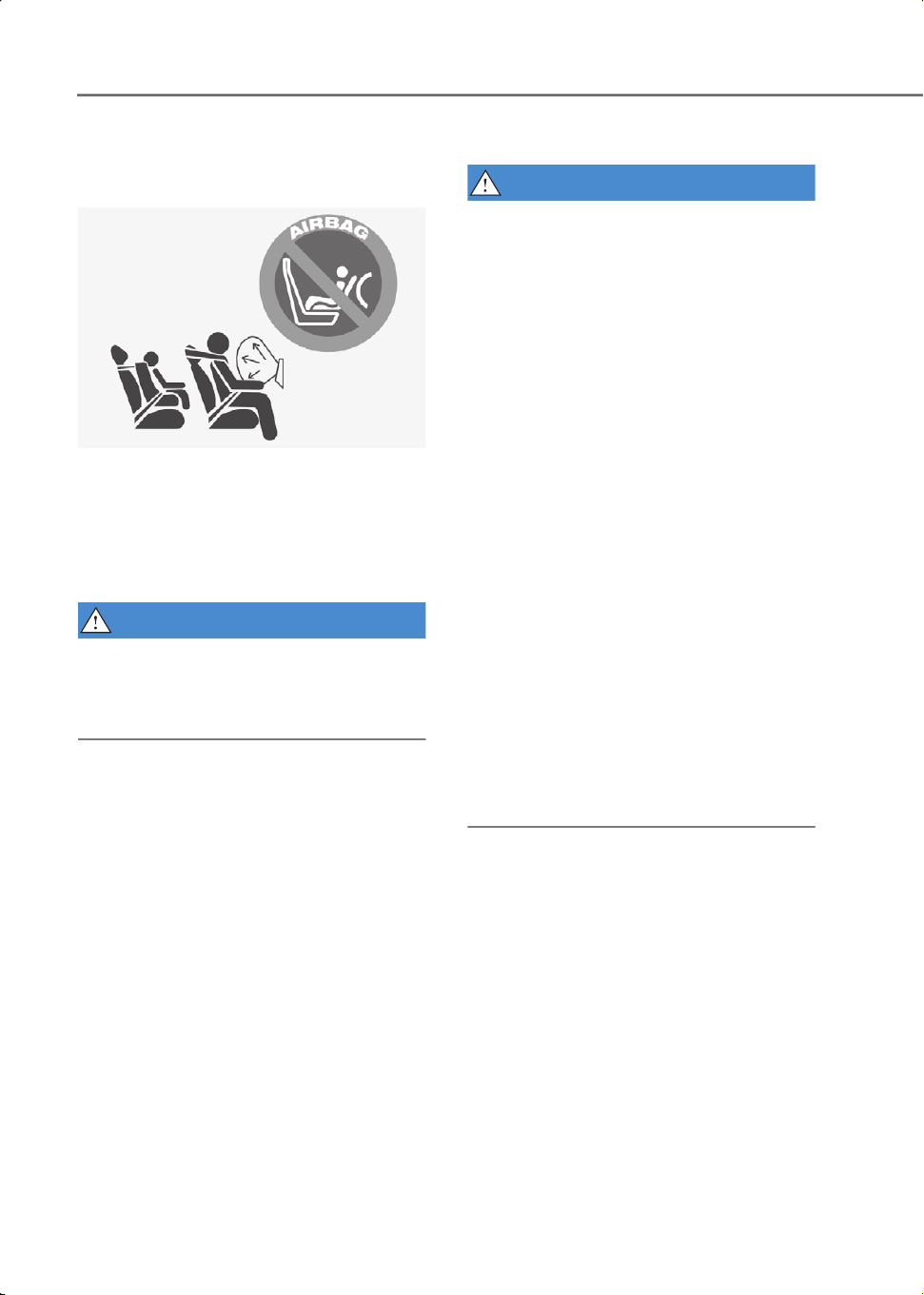
Seats & Safety System
3-52
Do not install a Child Restraint
System on the Front Passenger’s
Seat
B3002401
Even though your vehicle is equipped
with the OCS, never install a child
restraint in the front passenger’s seat. An
inflating airbag can forcefully strike a
child or child restraint resulting in serious
or fatal injury.
WARNING
NEVER use a rearward facing Child
Restraint on a seat protected by an
ACTIVE AIRBAG in front of it, DEATH or
SERIOUS INJURY to the CHILD can occur.
Why didn’t My Airbag Go Off in
a Collision?
There are certain types of accidents in
which the airbag would not be expected
to provide additional protection. These
include rear impacts, second or third
collisions in multiple impact accidents, as
well as low speed impacts. Damage to the
vehicle indicates collision energy
absorption, and is not an indicator of
whether or not an airbag should have
inflated.
Airbag collision sensors
WARNING
To reduce the risk of an airbag deploying
unexpectedly and causing serious injury
or death:
• Do not hit or allow any objects to
impact the locations where airbags or
sensors are installed.
• Do not perform maintenance on or
around the airbag sensors. If the
location or angle of the sensors is
altered, the airbags may deploy when
they should not or may not deploy
when they should.
• Installing bumper guards with
non-genuine Hyundai parts may
adversely affect the collision and airbag
deployment performance.
To ensure correct function of the airbag
system, have the bumper replaced with
genuine Hyundai part specified for your
vehicle.
• Press the Start/Stop button to the OFF
or ACC position and wait for 3 minutes
when the vehicle is being towed to
prevent inadvertent airbag
deployment.
• Have all airbag repairs conducted by an
authorized HYUNDAI dealer.
CE_USA.book Page 52
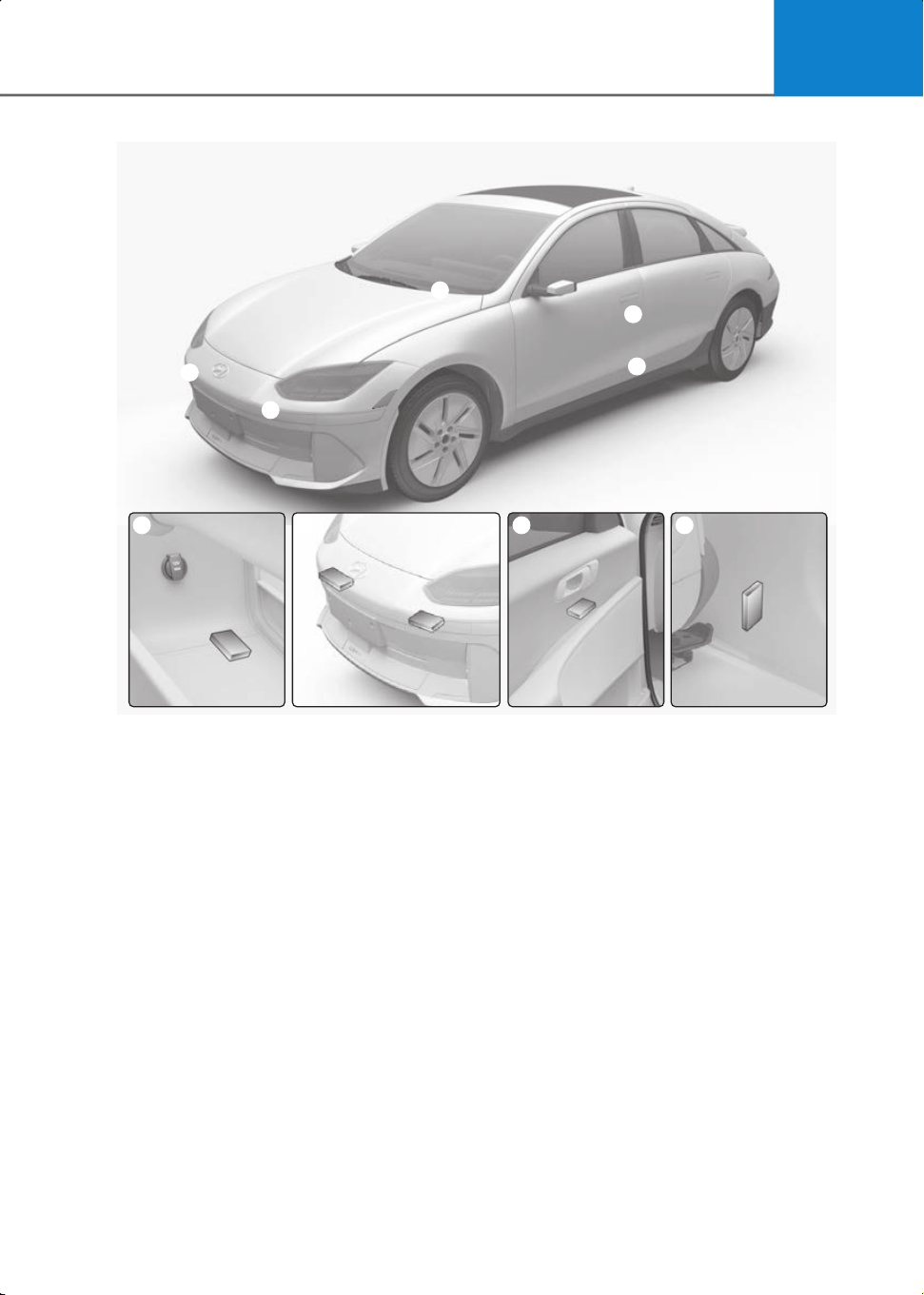
3
3-53
A3003401
(1) SRS control module/Rollover sensor
(2) Front impact sensor
(3) Side impact sensor (Pressure)
(4) Side impact sensor (Acceleration)
2
2
3
4
1
2 3 41
CE_USA.book Page 53
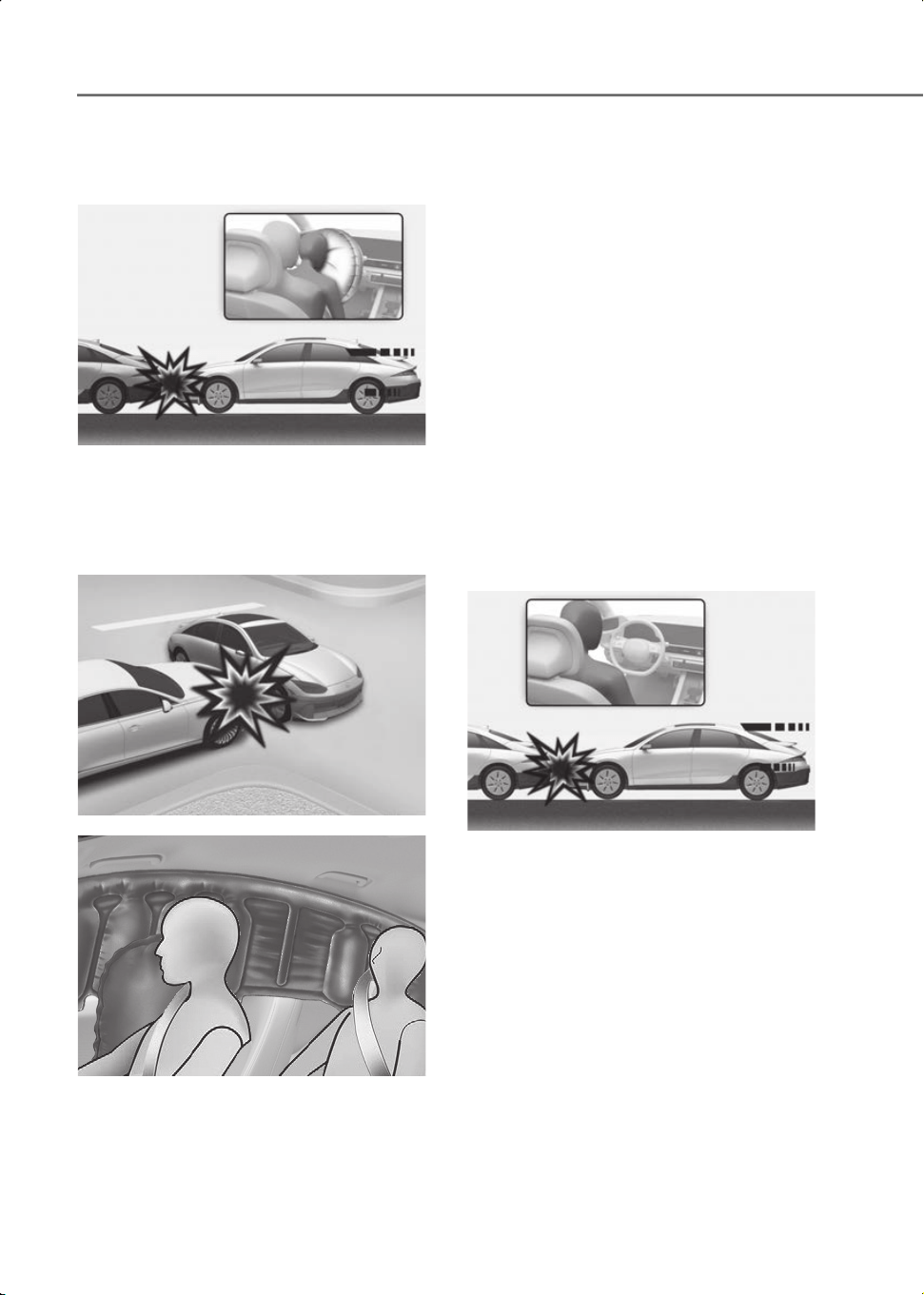
Seats & Safety System
3-54
Airbag inflation conditions
Front airbags
B3003401
Front airbags are designed to inflate in a
frontal collision depending on the
severity of impact of the front collision.
Side and curtain airbags
B3003402
B3003403
Side and curtain airbags are designed to
inflate when an impact is detected by side
collision sensors depending on the
severity of impact resulting from a side
collision.
Although the driver and front passenger
airbags are designed to inflate in frontal
collisions, they also may inflate in other
types of collisions if the front impact
sensors detect a sufficient impact. Side
and curtain airbags are designed to inflate
in side impact collisions, but they may
inflate in other collisions if the side impact
sensors detect a sufficient impact.
Also, the side and curtain airbags are
designed to inflate when a rollover is
detected by a rollover sensor.
If the vehicle chassis is impacted by
bumps or objects on unimproved roads,
the airbags may deploy. Drive carefully on
unimproved roads or on surfaces not
designed for vehicle traffic to prevent
unintended airbag deployment.
Airbag non-inflation conditions
B3003404
In certain low-speed collisions the
airbags may not deploy. The airbags are
designed not to deploy in such cases
because they may not provide benefits
beyond the protection of the seat belts.
CE_USA.book Page 54
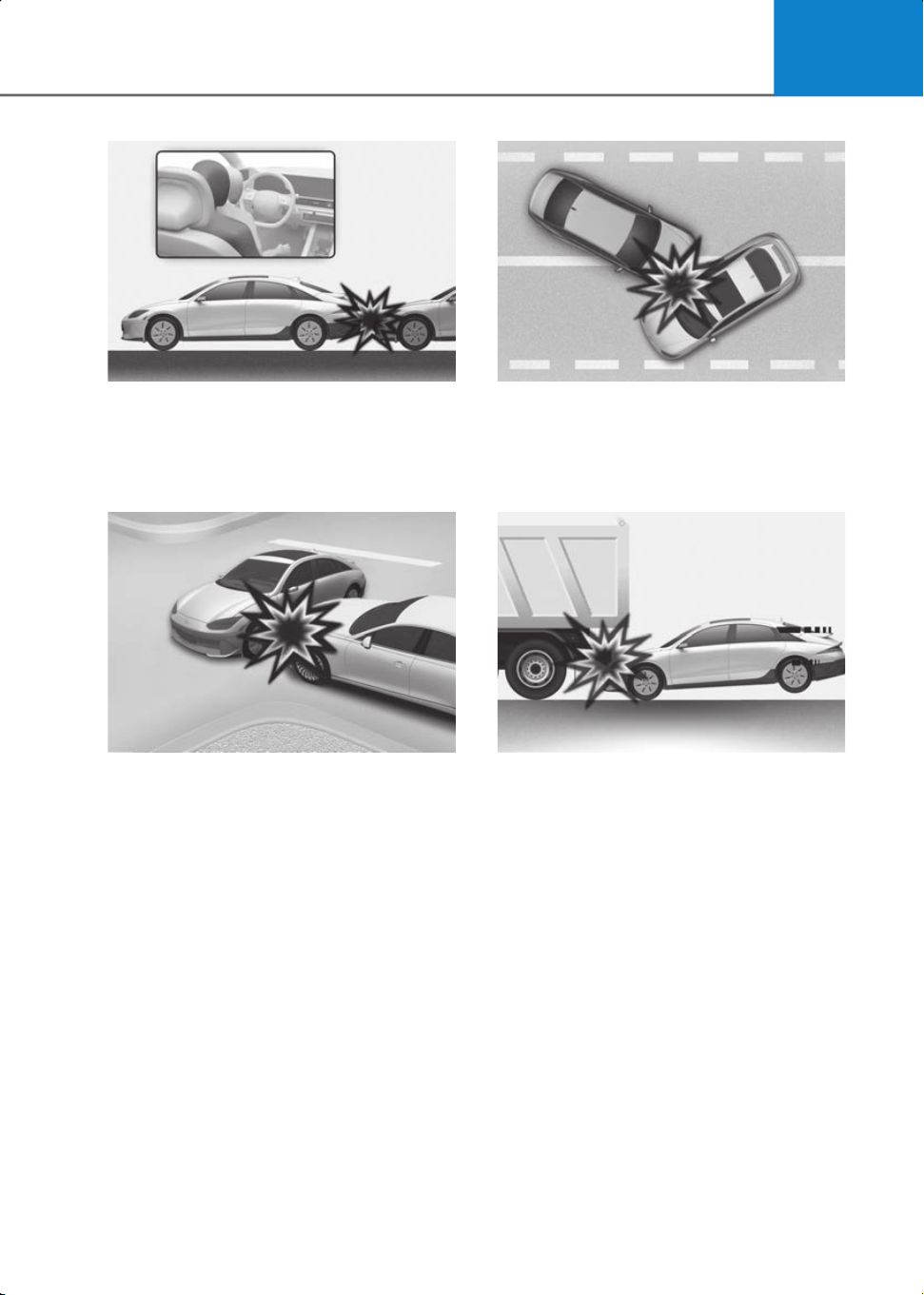
3
3-55
B3003405
Front airbags are not designed to inflate
in rear collisions, because occupants are
moved backward by the force of the
impact. In this case, inflated airbags
would not provide any additional benefit.
B3003406
Front airbags may not inflate in side
impact collisions, because occupants
move in the direction of the collision, and
thus in side impacts, front airbag
deployment would not provide additional
occupant protection.
However, side and curtain airbags may
inflate depending on the severity of
impact.
B3003407
In an angled collision, the force of impact
may direct the occupants in a direction
where the airbags would not be able to
provide any additional benefit, and thus
the sensors may not deploy any airbags.
B3003408
Just before impact, drivers often brake
heavily. Such heavy braking lowers the
front portion of the vehicle causing it to
“ride” under a vehicle with a higher
ground clearance. Airbags may not inflate
in this “underride” situation because
deceleration forces that are detected by
sensors may be significantly reduced by
such “underride” collisions.
CE_USA.book Page 55
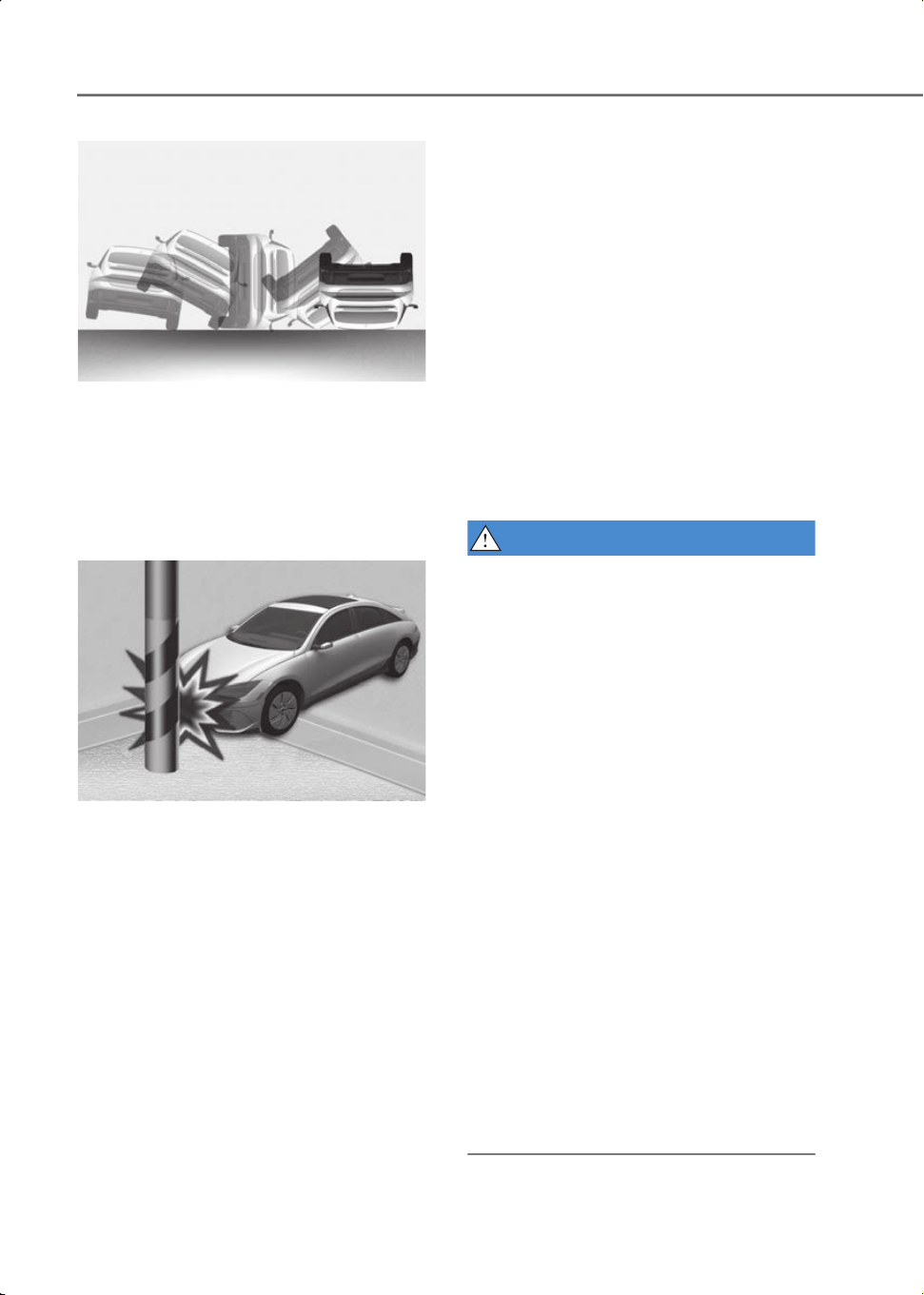
Seats & Safety System
3-56
B3003409
Front airbags may not inflate in rollover
accidents because front airbag
deployment would not provide additional
occupant protection.
The side and curtain airbags may inflate in
a rollover situation, when it is detected by
the rollover sensor.
B3003410
Airbags may not inflate if the vehicle
collides with objects such as utility poles
or trees, where the point of impact is
concentrated and the collision energy is
absorbed by the vehicle structure.
SRS Care
The SRS is virtually maintenance-free and
there are no parts you can safely service
by yourself. If the SRS airbag warning
light does not illuminate when the
Start/Stop button is in the ON position, or
continuously remains on, have the
system be immediately inspected by an
authorized HYUNDAI dealer.
Any work on the SRS system, such as
removing, installing, repairing, or any
work on the steering wheel, the front
passenger’s panel, front seats and roof
rails be performed by an authorized
HYUNDAI dealer. Improper handling of
the SRS system may result in serious
personal injury.
WARNING
To reduce the risk of serious injury or
death take the following precautions:
• Do not attempt to modify or disconnect
the SRS components or wiring,
including the addition of any kind of
badges to the pad covers or
modifications to the body structure.
• Do not place objects over or near the
airbag modules on the steering wheel,
instrument panel, and the front
passenger’s panel above the glove box.
• Clean the airbag pad covers with a soft
cloth moistened with plain water.
Solvents or cleaners could adversely
affect the airbag covers and proper
deployment of the system.
• Have the inflated airbags replaced by
an authorized HYUNDAI dealer.
• If components of the airbag system
must be discarded, or if the vehicle
must be scrapped, certain safety
precautions must be observed. Consult
an authorized HYUNDAI dealer for the
necessary information. Failure to follow
these precautions could increase the
risk of personal injury.
CE_USA.book Page 56

3
3-57
Additional Safety Precautions
Passengers should not move out of or
change seats while the vehicle is
moving. A passenger who is not wearing
a seat belt during a crash or emergency
stop can be thrown against the inside of
the vehicle, against other occupants, or
be ejected from the vehicle.
Do not use any accessories on seat belts.
Devices claiming to improve occupant
comfort or reposition the seat belt can
reduce the protection provided by the
seat belt and increase the chance of
serious injury in a crash.
Do not modify the front seats.
Modification of the front seats could
interfere with the operation of the
supplemental restraint system sensing
components or side airbags.
Do not place items under the front seats.
Placing items under the front seats could
interfere with the operation of the
supplemental restraint system sensing
components and wiring harnesses.
Do not cause impact to the doors.
Impact to the doors when the Start/Stop
button is in the ON or START position may
cause the airbags to inflate.
Modifications to accommodate
disabilities. If you require modification to
your vehicle to accommodate a disability,
contact the HYUNDAI Customer Connect
Center at 800-633-5151.
Adding equipment to or modifying
your airbag equipped vehicle
If you modify your vehicle by changing
your vehicle’s frame, bumper system,
front end or side sheet metal or ride
height, this may affect the operation of
your vehicle’s airbag system.
Airbag Warning Labels
B3003601
Airbag warning labels, required by the
U.S. National Highway Traffic Safety
Administration (NHTSA), are attached to
alert the driver and passengers of
potential risks of the airbag system. Be
sure to read all of the information about
the airbags that are installed on your
vehicle in this Owners Manual.
CE_USA.book Page 57

CE_USA.book Page 58

4
4. Instrument Cluster
Instrument Cluster...........................................................................................................4-2
Instrument Cluster Control .........................................................................................4-3
Gauges and Meters......................................................................................................4-3
Power/Charge Gauge ..................................................................................................4-3
State of Charge (SOC) Gauge for High Voltage Battery............................................4-4
Gear Shift Indicator......................................................................................................4-6
Warning and Indicator Lights......................................................................................4-6
Cluster Display Messages...........................................................................................4-17
Cluster Display...............................................................................................................4-24
Cluster Display Control..............................................................................................4-24
View Modes ................................................................................................................4-24
Vehicle Settings (Infotainment System) ...................................................................... 4-27
Setting Your Vehicle ..................................................................................................4-28
CE_USA.book Page 1
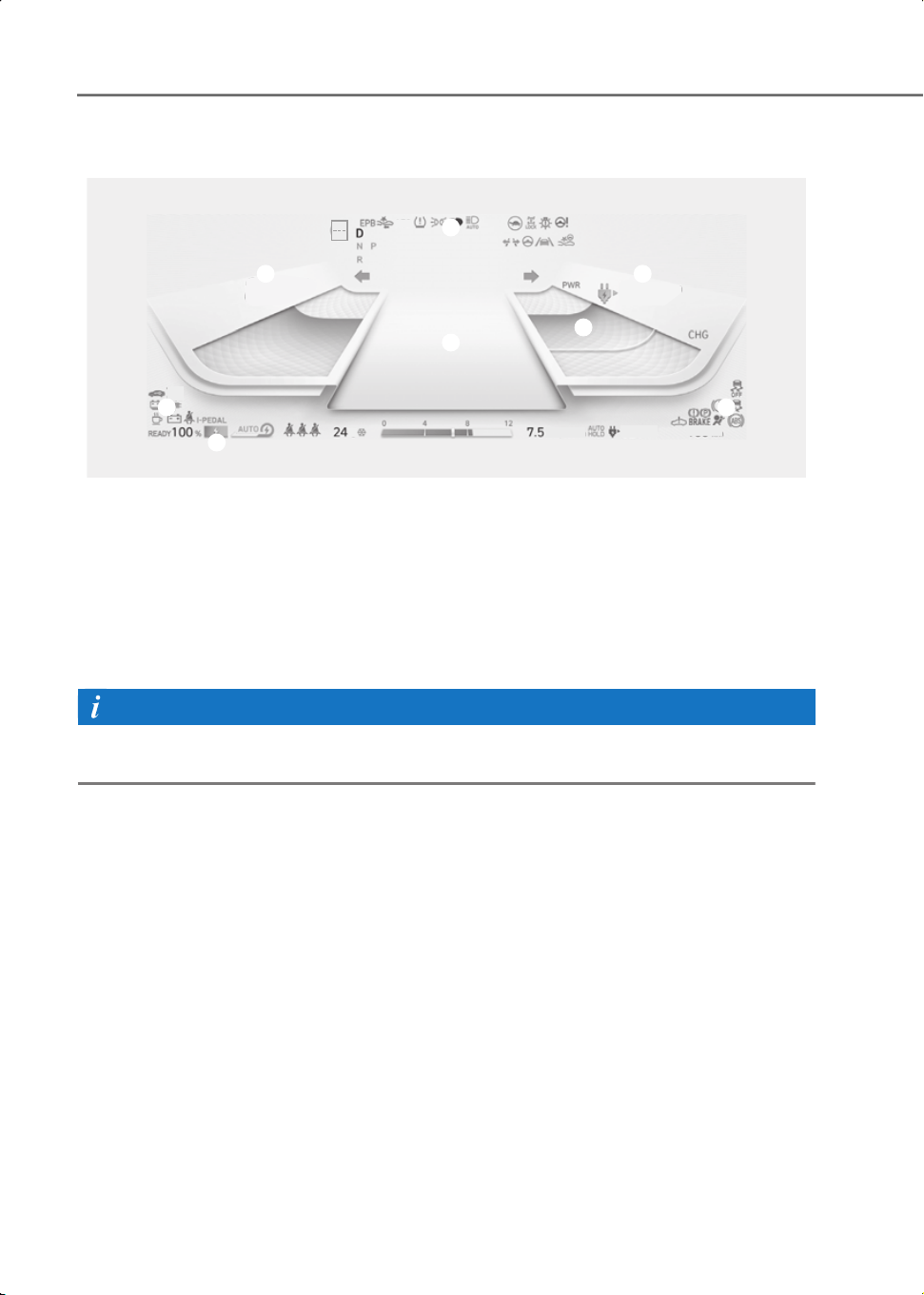
Instrument Cluster
4-2
Instrument Cluster
A4000101
The actual cluster in the vehicle may differ from the illustration. For more information,
refer to the “Gauges and Meters” section in this chapter.
(1) Speedometer
(2) Power/Charge gauge
(3) Distance to empty
(4) Warning and indicator lights
(5) Cluster display
(6) Battery SOC (State of Charge) gauge
Information
SNOW/NORMAL/ECO/SPORT mode by pressing the drive mode button will change the
main theme of the instrument cluster.
.1)
NJL8I
'
201
NJ
NJ
324
NJ
1
4
6
4
4
5
2
3
CE_USA.book Page 2
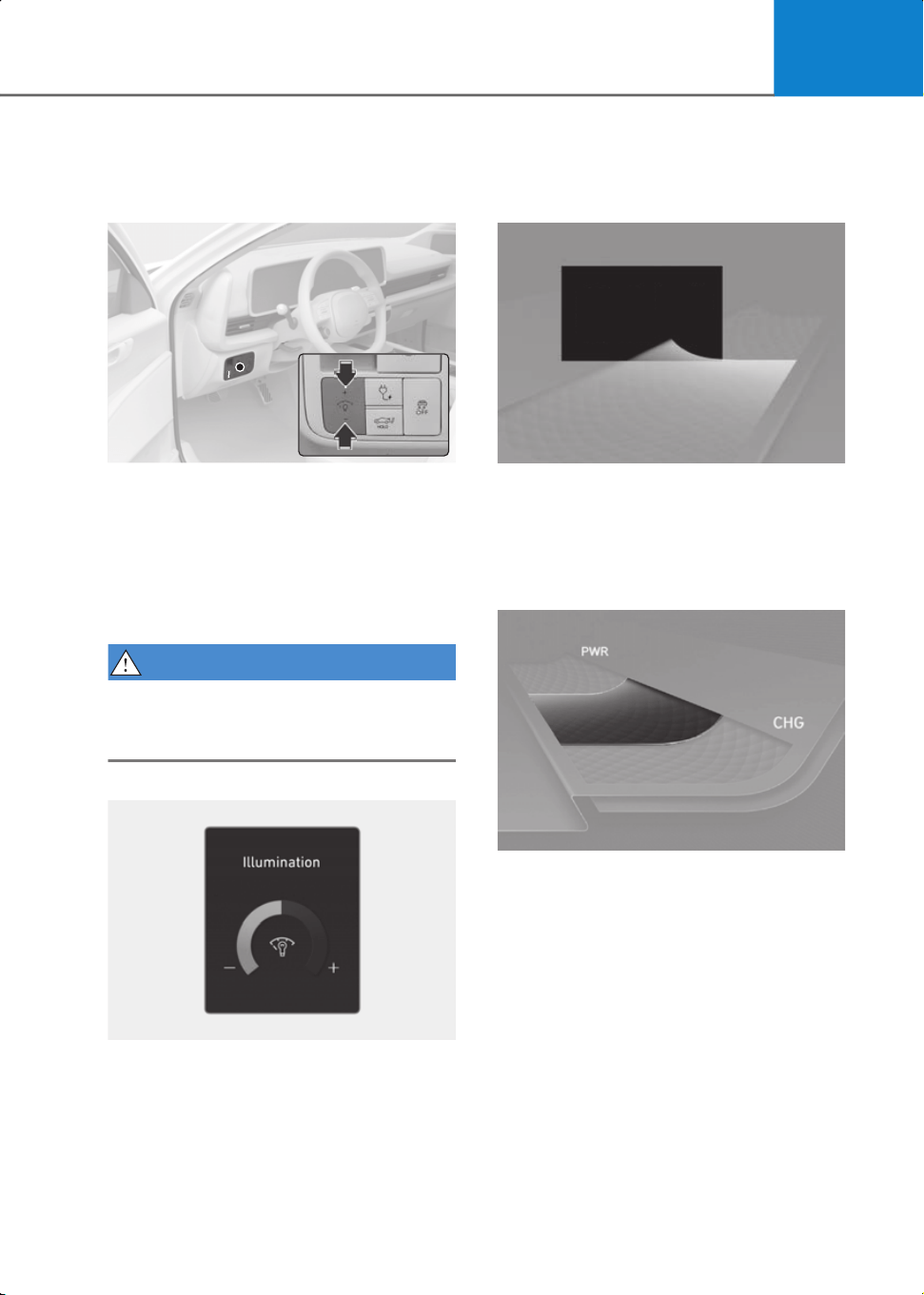
4
4-3
Instrument Cluster Control
Instrument panel illumination
ONE1041044L
When the vehicle’s parking lights or
headlights are on, press the illumination
control switch to adjust the brightness of
the instrument panel illumination.
When pressing the illumination control
switch, the interior switch illumination
intensity is also adjusted.
WARNING
Never adjust the instrument panel
illumination while driving to prevent
death, serious injury, or vehicle damage.
ONE1041056N
• The brightness of the instrument panel
illumination is displayed.
• When the brightness setting reaches
either the minimum or maximum level,
a chime sounds.
Gauges and Meters
Speedometer
B4000301
The speedometer indicates the speed of
the vehicle and is calibrated in mi. per
hour (MPH).
Power/Charge Gauge
B4000306
The Power/Charge gauge shows the
energy consumption rate of the vehicle
and the charge/discharge status of the
regenerative brakes.
• POWER :
The discharging status of the electric
motor is shown when the vehicle is
accelerating or driving on an uphill
road. As the electric energy discharged
increases, the gauge level also
increases.
.1)
CE_USA.book Page 3
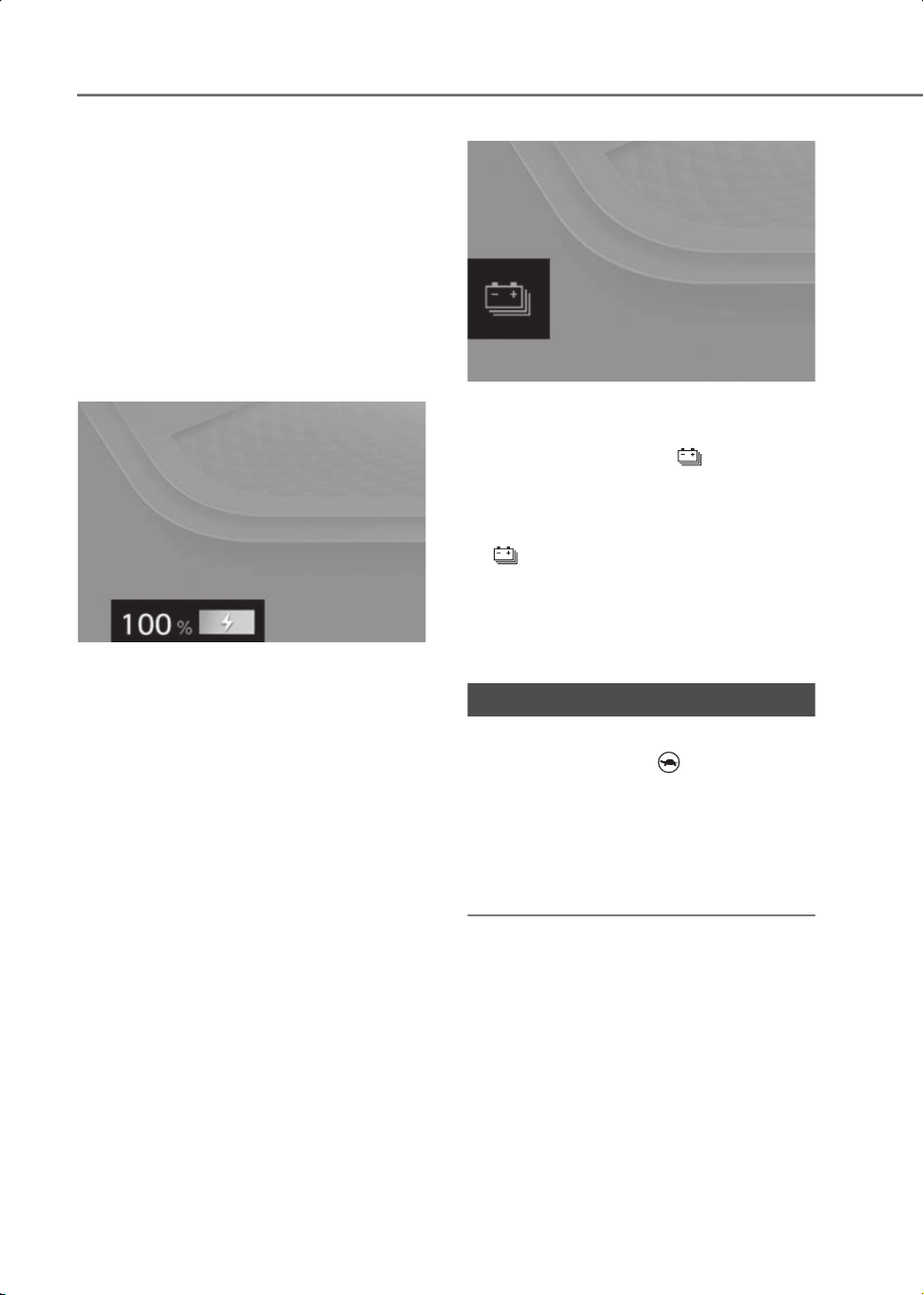
Instrument Cluster
4-4
• CHARGE :
The charging status of the electric
motor is shown when the vehicle is
decelerating or driving on a downhill
road (being charged by the
regenerative brakes). As more electric
energy charges, the lower the gauge
level.
State of Charge (SOC) Gauge
for High Voltage Battery
B4000307
• The SOC gauge shows the charging
status of the high voltage battery.
• The low percentage number on the
indicator indicates that there is not
enough energy in the high voltage
battery. 100 % indicates that the high
voltage battery is fully charged.
• When driving on highways, make sure
to check in advance if the high voltage
battery is charged enough.
B4000308
1. When the remaining battery is lower
than 10 % on the SOC gauge, the High
Voltage Battery Level ( ) warning
light Illuminates, to alert you of the
battery level.
2. When the High Voltage Battery Level
( ) warning light Illuminates, the
vehicle can drive an additional 18-25 mi.
(30-40 km) depending on the driving
speed, heater/air conditioner, weather,
driving style, and other factors.
Charging is required.
NOTICE
When the high voltage battery level is
low, the Power Down ( ) indicator light
illuminates and the vehicle power is
limited.
Charge the battery immediately since
your vehicle may not be driven, or may
roll back on a slope with the indicator light
illuminated.
CE_USA.book Page 4
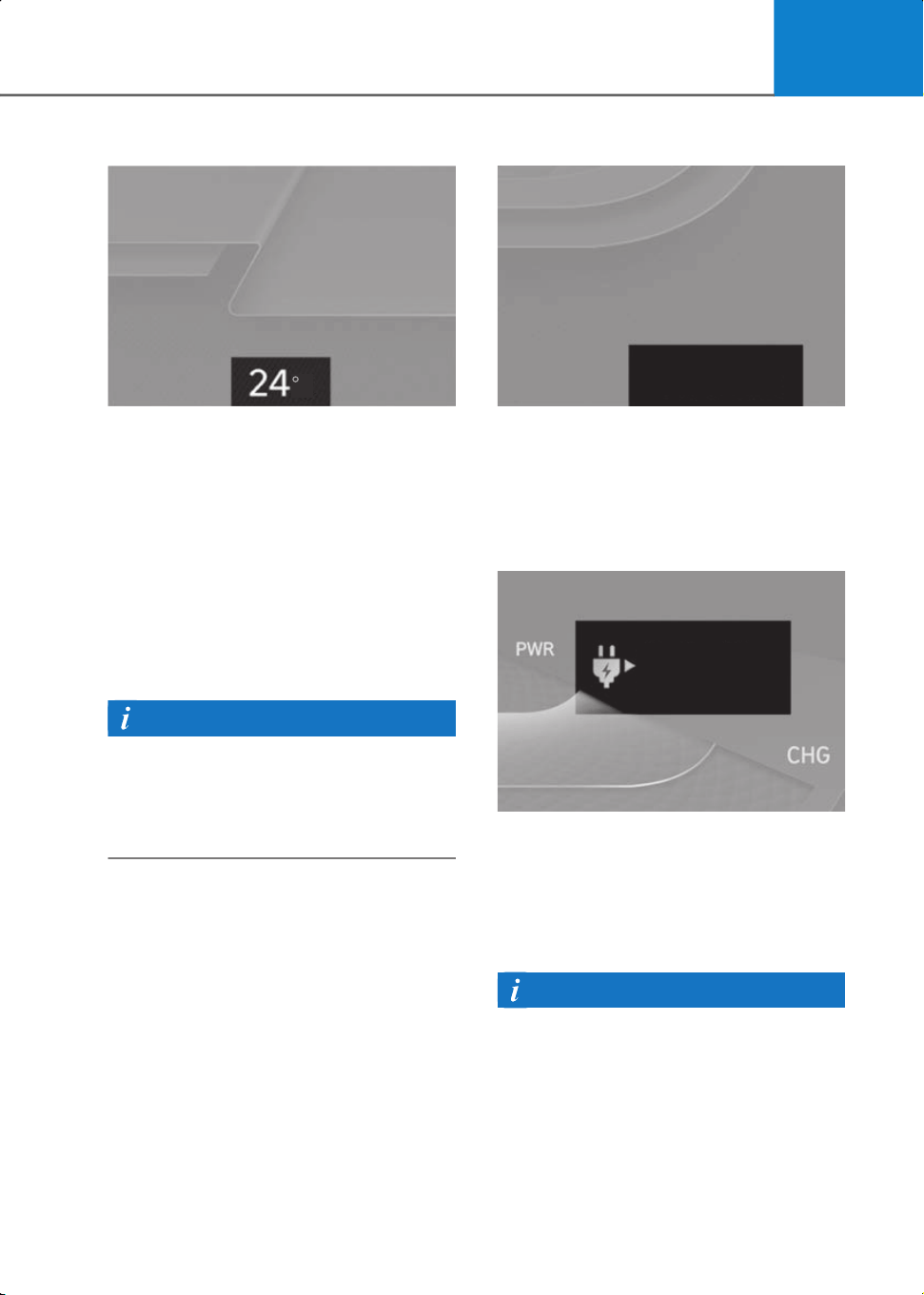
4
4-5
Outside temperature gauge
B4000304
The temperature reads in Fahrenheit or
Celsius depending on the units selected
from the Settings menu in the
infotainment system. The temperature
indicated on the instrument cluster may
not change as quickly as the outside
temperature.
Select: Setup > General > Units >
Temperature Unit > °F/°C
Both the temperature unit on the
instrument cluster and climate control
screen is changed.
Information
The infotainment system may change
after software updates. For more
information, refer to the user's manual
provided in the infotainment system and
the quick reference guide.
Odometer
B4000302
The odometer indicates the total distance
that the vehicle has been driven and
should be used to determine when
periodic maintenance is required.
Distance to empty
B4000303
The distance to empty is the estimated
distance the vehicle can be driven with
the remaining electric energy.
For more information, refer to the
"Factors affecting the distance to empty"
section in chapter 1.
Information
• The distance to empty may differ from
the actual driving distance because it is
only an estimate as it is an estimate of
the available driving distance.
• The distance to empty may differ
significantly based on driving
conditions, driving habits, and
condition of the vehicle.
'
NJ
NJ
CE_USA.book Page 5
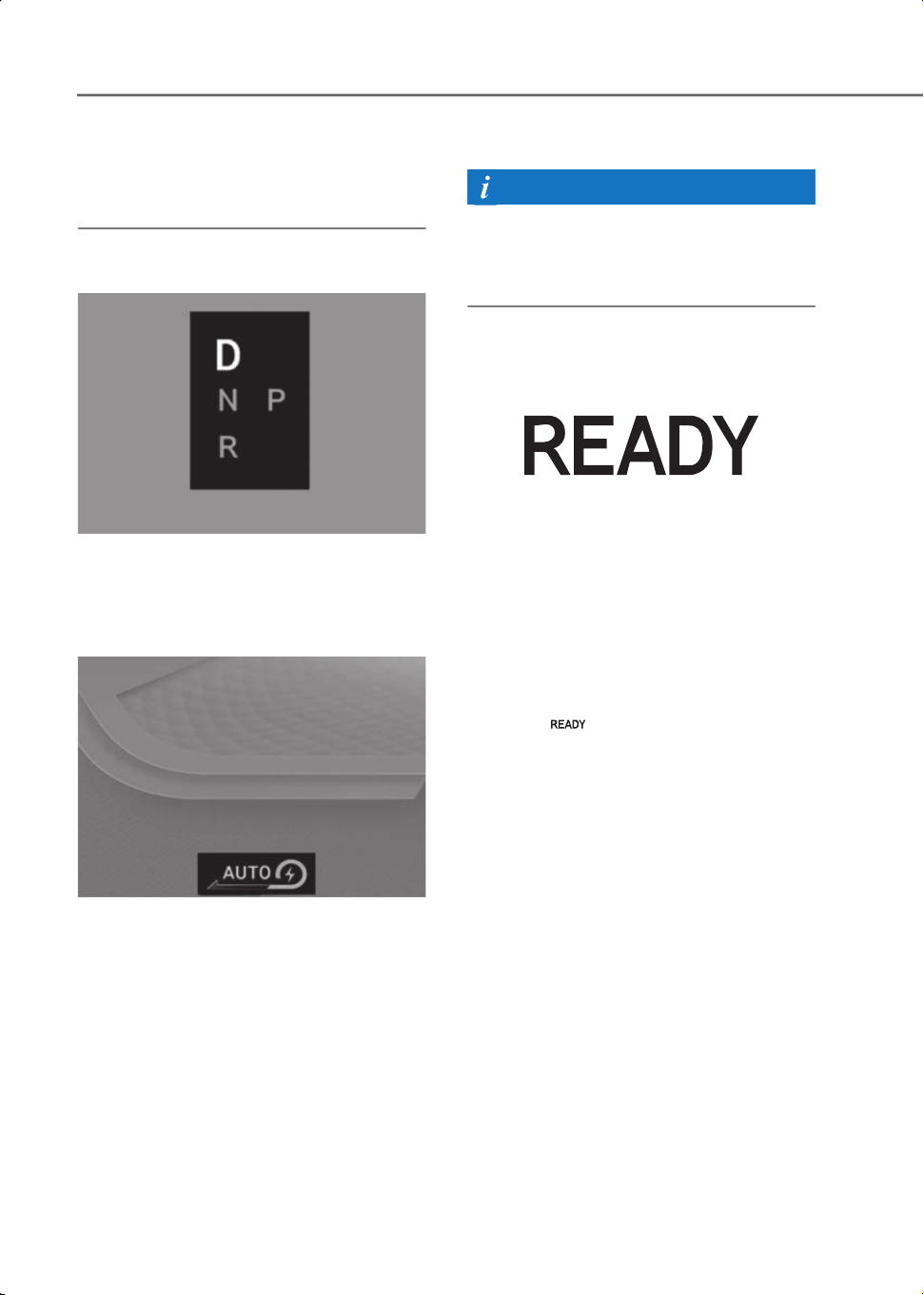
Instrument Cluster
4-6
• If the vehicle is not on level ground or
the battery power has been
interrupted, the distance to empty
function may not operate correctly.
Gear Shift Indicator
B4000305
The Gear Shift Indicator indicates the
current gear or P (Park).
Regenerative braking level indicator
B4000309
The selected regenerative braking level is
displayed on the instrument cluster. Also,
the Smart Regenerative System’s
operation status is displayed.
For more information, refer to the
"Regenerative Braking System (Paddle
Shifter)" section in chapter 6.
Warning and Indicator Lights
Information
Make sure that all warning lights are OFF
after starting the vehicle. If any light is still
ON, this indicates a situation that needs
attention.
Ready Indicator Light
WL_ReadyLamp
This indicator illuminates:
When the vehicle is ready to be driven.
• ON: Normal driving is possible.
• OFF: Normal driving is not possible, or a
problem has occurred.
• Blinking: Emergency driving.
When the indicator goes off or blinks,
there is a problem with the system. In this
case, have your vehicle inspected by an
authorized HYUNDAI dealer.
CE_USA.book Page 6
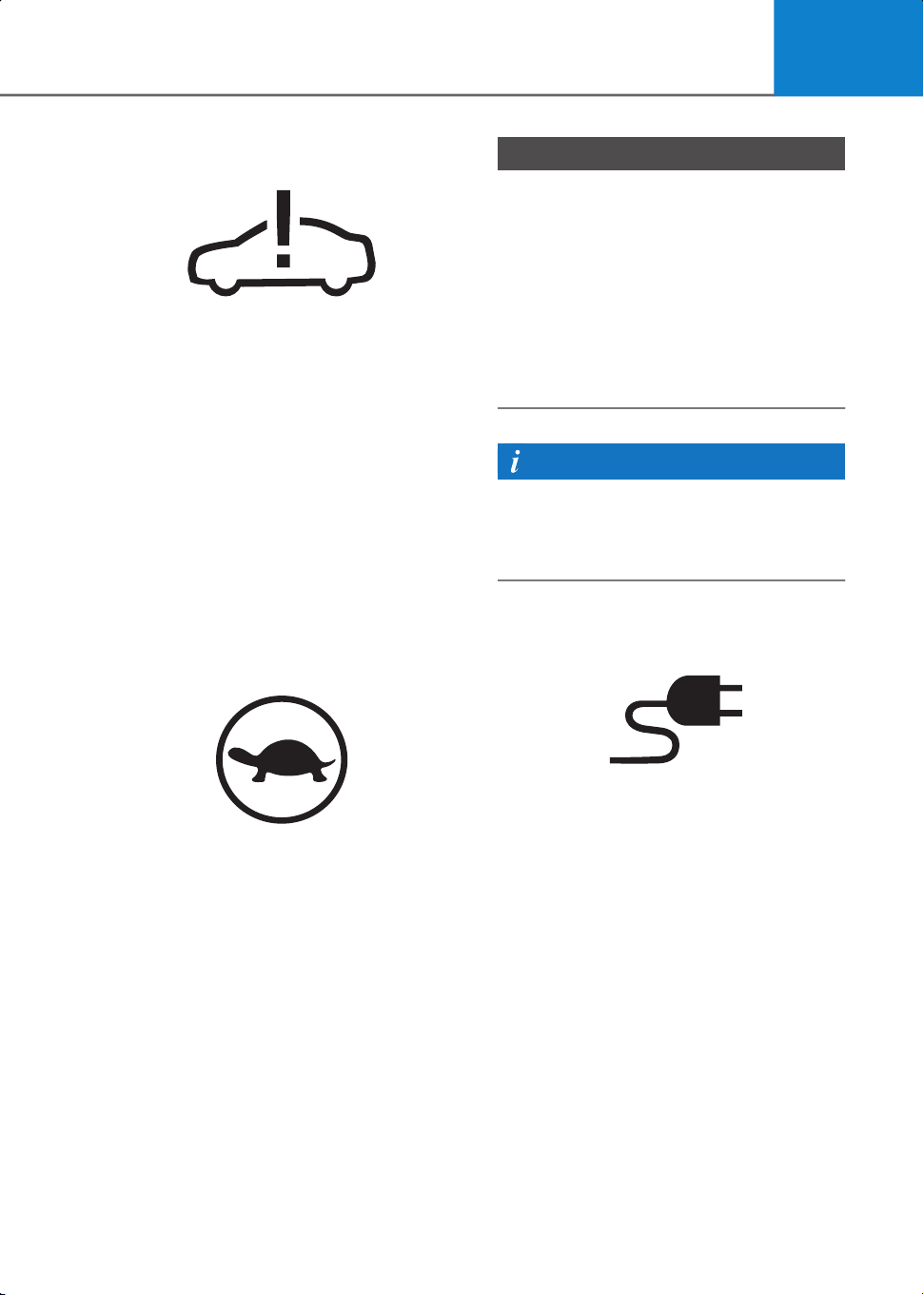
4
4-7
Service Warning Light
WL_ServiceWarningLamp
This warning light illuminates:
• When the Start/Stop button is in the ON
position. The Service warning light
illuminates for 3 seconds and then goes
off.
• When there is a problem with related
parts of the electric vehicle control
system, such as sensors, etc.
When the warning light illuminates while
driving, or does not go off after starting
the vehicle, have your vehicle inspected
by an authorized HYUNDAI dealer.
Power Down Indicator Light
WL_PowerDownLamp
This indicator light illuminates:
When the power is limited for the safety
of the high-powered parts of an electric
vehicle. The power is limited for the
following reasons:
• The high voltage battery level is too low
or voltage is decreasing
• The temperature of the high voltage
battery is too high or too low
• The temperature of the motor is high
NOTICE
• Do not accelerate or start the vehicle
suddenly when the power down
indicator light is illuminated.
• When the power is limited for the safety
of high-powered parts of an electric
vehicle, the power down indicator light
illuminates. Your vehicle may not be
driven, or may roll back on a slope with
the indicator light illuminated due to
the limitation of vehicle power.
Information
Unless both the Service Warning Light
and Power Down Indicator Light
illuminate at the same time, it is not a
failure.
Charging Connector Indicator Light
WL_ChargingConnectLamp
This warning light indicates the
connection status of the charging
connector. When the charging connector
is connected to the vehicle, the green
light illuminates for about 1 minute.
CE_USA.book Page 7
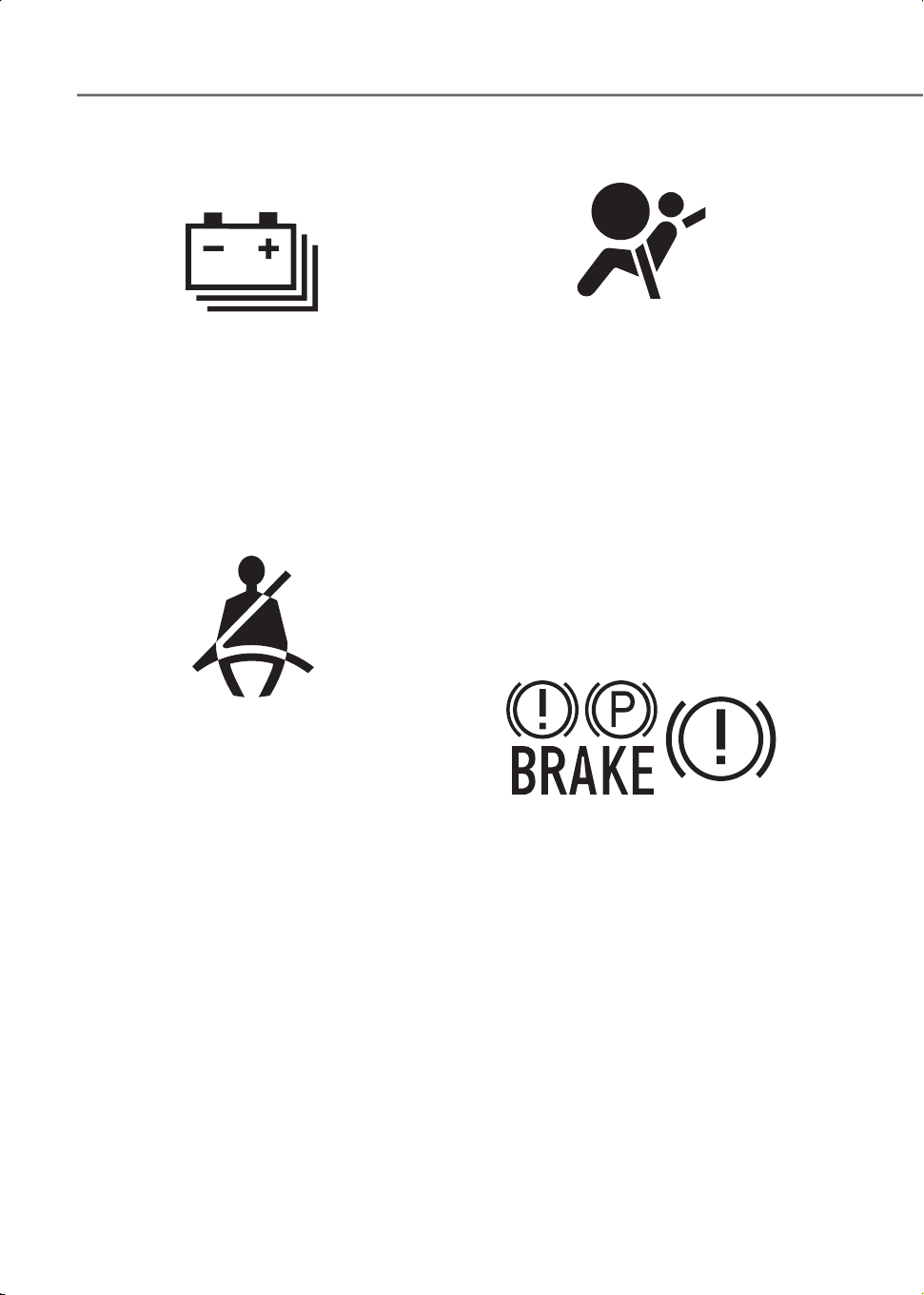
Instrument Cluster
4-8
High Voltage Battery Level Warning
Light
WL_BatteryLovelLowWarningLamp
This warning light illuminates:
When the high voltage battery level is
low.
Charge the high voltage battery as soon
as possible.
Seat Belt Warning Light
WL_SeatBeltWarningLamp
This warning light informs the driver that
the seat belt is not fastened.
For more information, refer to the “Seat
Belts” section in chapter 3.
Airbag Warning Light
WL_AirbagWarningLamp
This warning light illuminates:
• When the Start/Stop button is in the ON
position. The Airbag warning light
illuminates for 3-6 seconds and then
goes off.
• When there is a malfunction with the
SRS.
If the Airbag warning light remains
illuminated while driving, have the
vehicle inspected by an authorized
HYUNDAI dealer.
Regenerative Brake Warning Light
WL_RegenerativeBreakWarningLamp
This warning light illuminates:
When the regenerative brake does not
operate and the brake does not perform
well. This causes the Brake Warning light
(red) and Regenerative Parking Brake
Warning Light (yellow) to illuminate
simultaneously.
In this case, drive safely and have your
vehicle inspected by an authorized
HYUNDAI dealer.
The operation of the brake pedal may be
more difficult than normal and the
braking distance can increase.
CE_USA.book Page 8
4
4-9
Parking Brake and Brake Fluid
Warning Light
WL_BreakWarningLamp
This warning light illuminates:
When the Start/Stop button is in the ON
position. The Parking Brake warning light
illuminates for about 3 seconds and then
goes off once the parking brake is
released.
• Whenever the parking brake is applied.
• Whenever the brake fluid level in the
reservoir is low.
- If the warning light illuminates with
the parking brake released, it
indicates the brake fluid level in the
reservoir is low.
• When the regenerative brake does not
operate.
If the brake fluid level in the reservoir is
low:
1. Drive carefully to the nearest safe
location and stop your vehicle.
2. With the motor stopped, check the
brake fluid level immediately and add
fluid as required (For more information,
refer to the “Brake Fluid” section in
chapter 9). After adding brake fluid,
check all brake components for fluid
leaks. If a brake fluid leak is found, or if
the warning light remains on, or if the
brakes do not operate properly, do not
drive the vehicle. Have the vehicle
inspected by an authorized HYUNDAI
dealer.
Dual-diagonal braking system
Your vehicle is equipped with the
dual-diagonal braking system. This
means you still have braking on two
wheels even if one of the dual systems
fails.
With only one of the dual systems
working, more than normal pedal travel
and greater pedal force are required to
stop the vehicle.
Also, the vehicle does not stop in a short
distance if only a portion of the braking
system is working.
WARNING
If the Parking Brake and Brake Fluid
warning light illuminates with the parking
brake released, it indicates that the brake
fluid level is low.
Have the vehicle inspected by an
authorized HYUNDAI dealer.
Anti-lock Brake System (ABS)
Warning Light
WL_ABSWarningLamp
This warning light illuminates:
• When the Start/Stop button is in the ON
position. The ABS warning light
illuminates for about 3 seconds and
then goes off.
• Whenever there is a malfunction with
the ABS.
The hydraulic braking system still
operates even if there is a malfunction
with the ABS.
If the ABS warning light remains
illuminated while driving, have the
vehicle inspected by an authorized
HYUNDAI dealer.
CE_USA.book Page 9
Instrument Cluster
4-10
Electronic Brake Force Distribution
(EBD) System Warning Light
WL_EBDWarningLamp
When the ABS warning and Parking Brake
warning lights are on simultaneously, it
may indicate a problem with the
Electronic Brake Force Distribution
system.
If both the ABS warning light and the
Parking Brake warning light remain
illuminated while driving, have the
vehicle inspected by an authorized
HYUNDAI dealer.
WARNING
When both ABS and Parking Brake and
Brake Fluid warning lights are on, the
braking system does not work normally
and you may experience an unexpected
and dangerous situation during sudden
braking. Avoid high speed driving and
abrupt braking.
Have the vehicle inspected by an
authorized HYUNDAI dealer as soon as
possible.
Information
When the ABS warning light is on or both
ABS and Parking Brake and Brake Fluid
warning lights are on, the speedometer,
odometer, or tripmeter may not work.
Also, the MDPS warning light may
illuminate and the steering effort may
increase or decrease.
Motor Driven Power Steering
(MDPS) Warning Light
WL_PowerStreeringWarningLamp
This warning light illuminates:
• When the Start/Stop button is in the ON
position. The Motor Driven Power
Steering warning light illuminates for
about 3 seconds and then goes off.
• Whenever there is a malfunction with
Motor Driven Power Steering.
If the MDPS warning light remains
illuminated while driving, have the
vehicle inspected by an authorized
HYUNDAI dealer.
Master Warning Light
WL_MasterWarningLamp
This warning light illuminates:
If a malfunction is detected in any of the
following:
• Forward Collision-Avoidance Assist
malfunction
• Forward Collision-Avoidance Assist
radar blocked
• Blind-Spot Collision-Avoidance Assist
malfunction
• Blind-Spot Collision-Avoidance Assist
radar blocked
• LED headlight malfunction
• High Beam Assist malfunction
• Smart Cruise Control malfunction
• Smart Cruise Control radar blocked
CE_USA.book Page 10
4
4-11
• Tire Pressure Monitoring System
(TPMS) malfunction
If the issue is resolved, the Master
Warning Light turns off.
Electronic Parking Brake (EPB)
Warning Light
WL_EPBWarningLamp
This warning light illuminates:
• When the Start/Stop button is in the ON
position. The EPB warning light
illuminates for about 3 seconds and
then goes off.
• Whenever there is a malfunction with
EPB.
If the EPB warning light remains
illuminated while driving, have the
vehicle inspected by an authorized
HYUNDAI dealer.
Information
The Electronic Parking Brake (EPB)
warning light may illuminate when the
Electronic Stability Control (ESC)
indicator light comes on to indicate that
ESC is not working properly. This does not
indicate malfunction of EPB.
Low Tire Pressure Warning Light
WL_TPMSWarningLamp
This warning light illuminates:
• When the Start/Stop button is in the ON
position. The low tire pressure warning
light illuminates for about 3 seconds
and then goes off.
• When one or more tires are significantly
underinflated. (The location of the
underinflated tire appears on the
instrument cluster.)
For more information, refer to the “Tire
Pressure Monitoring System (TPMS)”
section in chapter 8.
This warning light remains ON after
blinking for about 60 seconds, or
repeatedly blinks ON and OFF in 3 second
intervals:
When there is a malfunction with the
TPMS.
If this occurs, have the vehicle inspected
by an authorized HYUNDAI dealer as soon
as possible.
For more information, refer to the “Tire
Pressure Monitoring System (TPMS)”
section in chapter 8.
WARNING
• The TPMS cannot alert you to severe
and sudden tire damage caused by
external factors.
• If you notice any vehicle instability,
immediately take your foot off the
accelerator pedal, apply the brakes
gradually with light force, and slowly
move to a safe position off the road.
CE_USA.book Page 11

Instrument Cluster
4-12
Driver Attention Warning Light
WL_DriverAttentionWarningLamp
This warning light illuminates:
• When you set the ignition switch to the
ON position, the yellow indicator light
illuminates for about 3 seconds and
then goes off
• [Continuously Yellow] When the front
view camera is blocked or Driver
Attention Warning is
disable/malfunction
• [Blinking Yellow] When the function
suggest that the driver take a break
If the yellow warning light is still on even
after removing foreign material from the
front of the sensor, have the vehicle
inspected by an authorized HYUNDAI
dealer as soon as possible
For more information, refer to the “Driver
Attention Warning (DAW)” section in
chapter 7
Forward Safety Warning Light
WL_FrontSafetyWarningLamp
This warning light illuminates:
• When the Start/Stop button is in the ON
position. The Forward Safety warning
light illuminates for about 3 seconds
and then goes off.
• [Yellow] When Forward Safety is
deselected or Forward
Collision-Avoidance Assist
disable/malfunction
• [Blinking Red] When Forward
Safety/Forward Cross-Traffic Safety of
Forward Collision-Avoidance Assist is
operating
If the yellow warning light is still on even
after removing foreign material from the
front of the sensors after Forward Safety
select in settings, have the vehicle
inspected by an authorized HYUNDAI
dealer as soon as possible.
For more information, refer to the
“Forward Collision-Avoidance Assist
(FCA)” section in chapter 7.
CE_USA.book Page 12

4
4-13
if equipped
Emergency Steering Warning Light
WL_EmergencySteeringWarningLamp
This indicator light illuminates:
• When you set the Start/Stop button to
the ON position, the yellow warning
light illuminates for about 3 seconds
and then goes off
• [Continuously Yellow] When
Forward/Side Safety is deselected or
Forward Collision-Avoidance Assist
disable/malfunction
• [Blinking Red] When Forward/Side
Safety of Forward Collision-Avoidance
Assist is operating
If the yellow warning light is still on even
after removing foreign material from the
front of the sensors after Forward Safety
select in settings, have the vehicle
inspected by an authorized HYUNDAI
dealer as soon as possible.
For more information, refer to the
“Forward Collision-Avoidance Assist
(FCA)” section in chapter 7.
Lane Safety Indicator Light
WL_LaneSafetyWarningLamp
This indicator light illuminates:
• When you set the ignition switch to the
ON position, the yellow indicator light
illuminates for about 3 seconds and
then goes off
• [Gray] When Lane Keeping Assist
operational conditions are not met
• [Continuously Green] When Lane
Keeping Assist operational conditions
are met
• [Blinking Green] When Lane Keeping
Assist is operating
• [Yellow] When Lane Safety is
deselected or Lane Keeping Assist
disable/malfunction
If the yellow warning light is still on even
after removing foreign material from the
front of the sensor after Lane Safety
select in settings, have the vehicle
inspected by an authorized HYUNDAI
dealer as soon as possible.
For more information, refer to the “Lane
Keeping Assist (LKA)” section in chapter
7.
CE_USA.book Page 13
Instrument Cluster
4-14
if equipped
All Wheel Drive (AWD) Warning Light
WL_4WDWarningLamp
This warning light illuminates:
Whenever a malfunction with the AWD
system is detected.
If this occurs frequently, have the vehicle
inspected by an authorized HYUNDAI
dealer.
For more information, refer to the "All
Wheel Drive (AWD)" section in chapter 6.
LED Headlight Warning Light
WL_LEDHeadlampWarningLamp
This warning light illuminates:
• When the Start/Stop button is in the ON
position. The LED headlight warning
light illuminates for about 3 seconds
and then goes off.
• Whenever there is a malfunction with
the LED headlight.
If the LED headlight warning light
remains illuminated while driving, have
the vehicle inspected by an authorized
HYUNDAI dealer.
This warning light blinks:
Whenever there is a malfunction with a
LED headlight related part.
If this occurs, have the vehicle inspected
by an authorized HYUNDAI dealer.
NOTICE
Continuous driving with the LED
Headlight warning light on or blinking can
reduce LED headlight life.
if equipped
Icy Road Warning Light
WL_IcyLoadWarningLamp
This indicator light illuminates:
To warn the driver the road may be icy.
When the outside temperature on the
temperature gauge is below 40 °F (4 °C),
a single chime sounds, both the outside
temperature gauge and Icy Road Warning
indicator blink several times, and then
they remain illuminated.
You can activate or deactivate Icy Road
Warning function from the Settings menu
in the infotainment system.
Select: Setup > Vehicle > Cluster >
Content Selection > Icy Road Warning
Information
• If the Icy Road warning light appears
while driving, avoid speeding, rapid
acceleration, sudden braking, or sharp
turning.
• The infotainment system may change
after software updates. For more
information, refer to the user's manual
provided in the infotainment system
and the quick reference guide.
CE_USA.book Page 14
4
4-15
Door open indicator light
WL_DoorOpenWarning
This indicator light illuminates:
When any door or trunk is left open.
WARNING
Before driving the vehicle, confirm the
door and trunk are fully closed.
CAUTION
The 12 V battery may discharge if you
leave the vehicle with the Door Open
indicator light illuminated.
Electronic Stability Control (ESC)
Indicator Light
WL_ESCOnLamp
This indicator light illuminates:
• When the Start/Stop button is in the ON
position. The Electronic Stability
Control indicator light illuminates for
about 3 seconds and then goes off.
• Whenever a malfunction with ESC
system is detected.
If this occurs, have the vehicle
inspected by an authorized HYUNDAI
dealer.
This indicator light blinks:
While ESC is operating.
For more information, refer to the
“Electronic Stability Control (ESC)”
section in chapter 6.
Electronic Stability Control (ESC)
OFF Indicator Light
WL_ESCOffLamp
This indicator light illuminates:
• When the Start/Stop button is in the ON
position. The Electronic Stability
Control indicator light illuminates for
about 3 seconds and then goes off.
• When you deactivate ESC system by
pressing the ESC OFF button.
For more information, refer to the
“Electronic Stability Control (ESC)”
section in chapter 6.
Immobilizer Indicator Light
WL_ImmobilizerLamp
This indicator light illuminates for up to 30
seconds:
When the vehicle detects the smart key in
the vehicle with the Start/Stop button in
the ACC or ON position.
• At this time, you can start the vehicle.
• The indicator light goes off after
starting the vehicle.
CE_USA.book Page 15
Instrument Cluster
4-16
This indicator light blinks for a few
seconds:
When the smart key is not in the vehicle,
you cannot start the vehicle.
This indicator light illuminates for 2
seconds and goes off:
If the smart key is in the vehicle and the
Start/Stop button is ON, but the vehicle
cannot detect the smart key, have the
vehicle inspected by an authorized
HYUNDAI dealer.
This indicator light blinks:
Whenever there is a malfunction with the
immobilizer system, have the vehicle
inspected by an authorized HYUNDAI
dealer.
Turn Signal Indicator Light
WL_TurnSignalLamp
This indicator light blinks:
When you operate the turn signal lever.
If any of the following occur, there may be
a malfunction with the turn signal system.
• The turn signal indicator light
illuminates but does not blink.
• The turn signal indicator light blinks
rapidly.
• The turn signal indicator light does not
illuminate at all.
If any of these occur, have the vehicle
inspected by an authorized HYUNDAI
dealer.
High Beam Indicator Light
WL_HighBeamLamp
This indicator light illuminates:
• When the headlights are on and in the
high beam position.
• When the turn signal lever is pulled into
the Flash-to-Pass position.
Light ON Indicator Light
WL_LightOnLamp
This indicator light illuminates:
When the Parking lights or headlights are
on.
CE_USA.book Page 16
4
4-17
High Beam Assist Indicator Light
WL_HBALamp
This indicator light illuminates:
When the high beam is on with the light
switch in the AUTO position.
• [White] When High Beam Assist is ready
to operate.
• [Green] When High Beam Assist is
operating.
If your vehicle detects oncoming vehicles
in front of you, High Beam Assist switches
the high beam to low beam automatically.
For more information, refer to the “High
Beam Assist (HBA)” section in chapter 5.
AUTO HOLD Indicator Light
WL_AutoHoldWarningLamp
This indicator light illuminates:
• [White] When you activate Auto Hold by
pressing the AUTO HOLD switch.
• [Green] When you stop the vehicle
completely by depressing the brake
pedal with Auto Hold activated.
• [Yellow] Whenever a malfunction with
the Auto Hold is detected. If the AUTO
HOLD indicator light remains YELLOW
while driving, have the vehicle
inspected by an authorized HYNDAI
dealer.
For more information, refer to the
“Electronic Parking Brake (EPB)” section
in chapter 6.
Cluster Display Messages
Shift to P
This message is displayed if you try to turn
off the vehicle without the gear in the P
(Park) position.
If this occurs, the Start/Stop button turns
to the ACC position.
Low key battery
When the Start/Stop button is pressed to
the OFF position, a message may appear,
indicating the internal battery of the
Smart Key is low.
Replace the Smart Key battery.
Press START button while turning
if equipped
wheel
This message is displayed if the steering
wheel does not unlock normally when the
Start/Stop button is pressed.
You should press the Start/Stop button
while turning the steering wheel right and
left.
Press brake pedal to start vehicle
This message is displayed if the
Start/Stop button changes to the ACC
position twice by pressing the button
repeatedly without depressing the brake
pedal.
You can start the vehicle by depressing
the brake pedal and then pressing the
Start/Stop button.
CE_USA.book Page 17
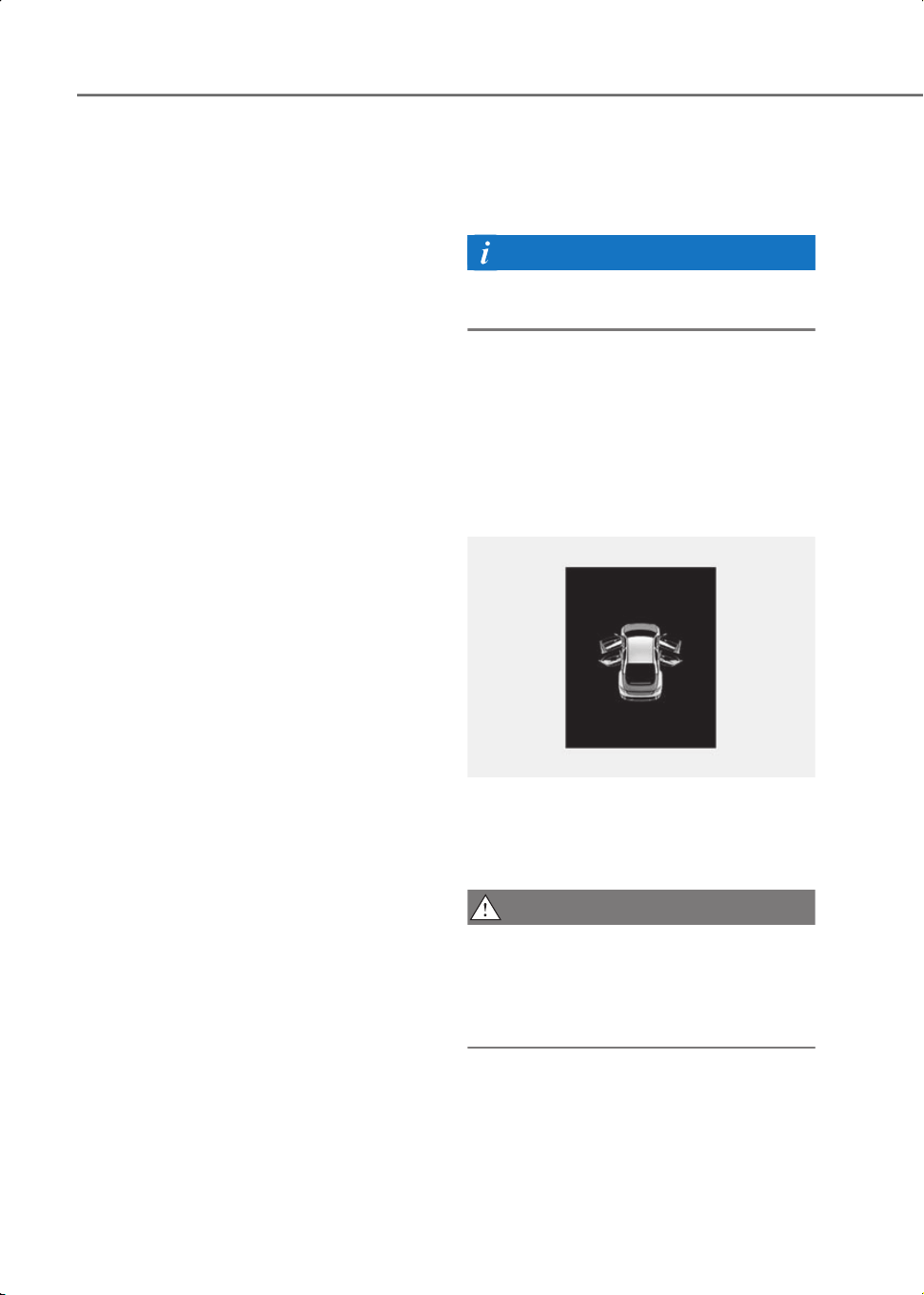
Instrument Cluster
4-18
Key not in vehicle
This message is displayed if the smart key
is not in the vehicle when you leave the
vehicle with the Start/Stop button in the
ON or Start position.
Always turn off the vehicle before leaving
your vehicle.
Key not detected
This message is displayed if the smart key
is not detected when you press the
Start/Stop button.
Press START button again
If you cannot start the vehicle after the
Start/Stop button is pressed, attempt to
start the vehicle by pressing the
Start/Stop button again.
If the warning message appears each
time you press the Start/Stop button,
have the vehicle inspected by an
authorized HYUNDAI dealer.
Press START button with key
This message is displayed and the
immobilizer indicator blinks if you press
the Start/Stop button while the warning
message, “Key not detected” appears.
At this time, the immobilizer indicator
light blinks.
Check BRAKE SWITCH fuse
This message is displayed if the brake
switch fuse is disconnected.
Replace the fuse with a new one before
starting the vehicle.
If that is not possible, start the vehicle by
pressing the Start/Stop button for 10
seconds in the ACC position.
Shift to P to start vehicle
This message is displayed if you try to
start the vehicle in any other position
except P (Park).
Information
For your safety, You start the vehicle with
the gear shifted to P (Park).
Check smart key system
This message is displayed when there is a
problem with the smart key system. Have
the vehicle inspected by an authorized
HYUNDAI dealer.
Door, Hood, Trunk open indicator
B4000521
This warning is displayed if any door or
hood or trunk is left open. The warning
indicates which door is on the cluster
display.
CAUTION
Before driving the vehicle, confirm the
door, hood, and trunk are fully closed.
Also, check there are no door, hood, and
trunk open warning lights or messages
displayed on the instrument cluster.
CE_USA.book Page 18
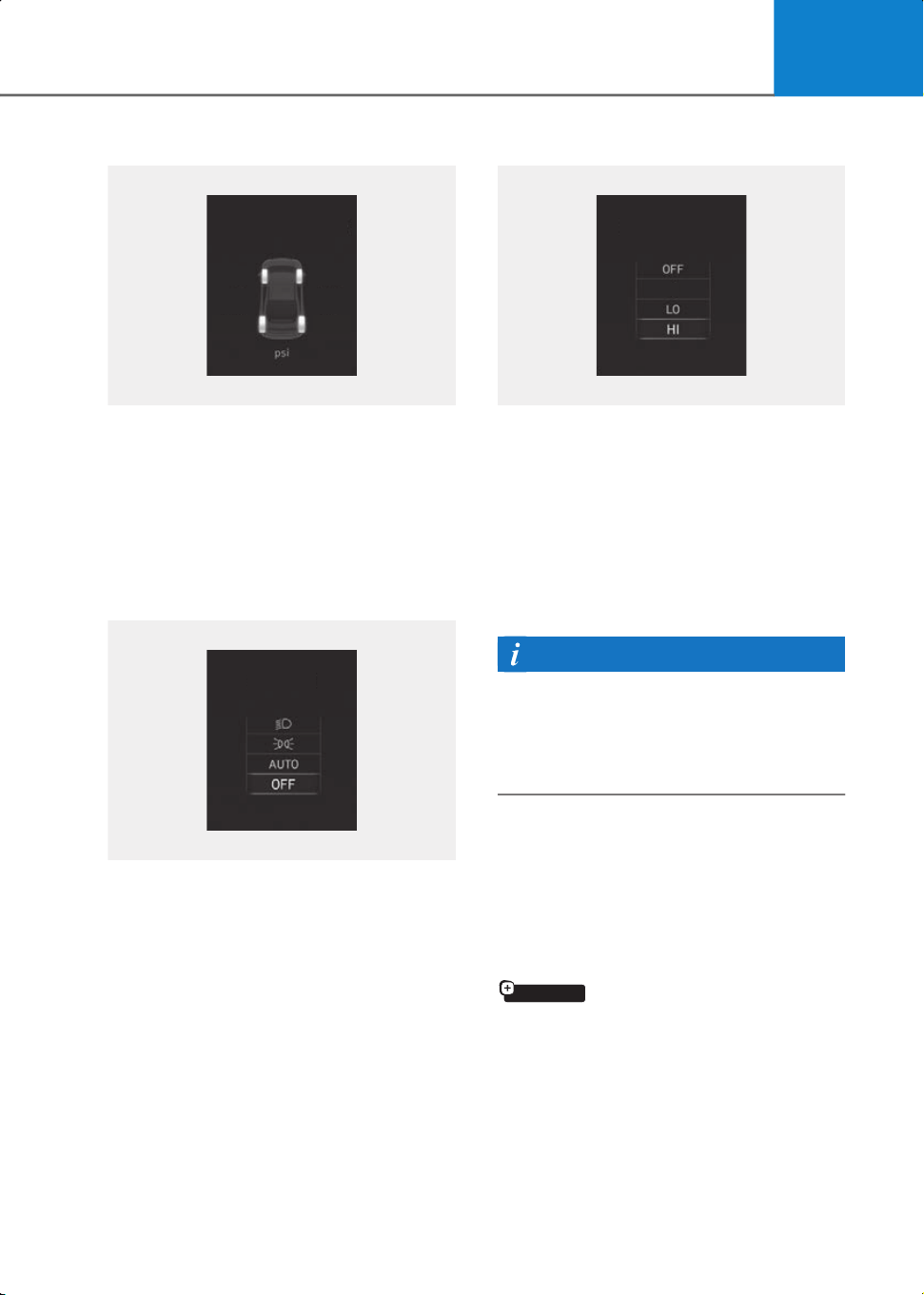
4
4-19
Low tire pressure
ONE1081021L
This warning message is displayed if the
tire pressure is low. The corresponding
tire on the vehicle illuminates.
For more information, refer to the “Tire
Pressure Monitoring System (TPMS)”
section in chapter 8.
Lights
ONE1041032L
This indicator displays which exterior light
is selected using the lighting control.
You can activate or deactivate
Wiper/Lights display function from the
Settings menu in the infotainment
system.
Select: Setup > Vehicle > Cluster >
Content Selection > Wiper/Lights
Display
Wiper
ONE1041004L
This indicator displays which wiper speed
is selected using the wiper control.
You can activate or deactivate
Wiper/Lights display function from the
Settings menu in the infotainment
system.
Select: Setup > Vehicle > Cluster >
Content Selection > Wiper/Lights
Display
Information
The infotainment system may change
after software updates. For more
information, refer to the user's manual
provided in the infotainment system and
the quick reference guide.
Low washer fluid
This message is displayed if the washer
fluid level in the reservoir is nearly empty.
Have the washer fluid reservoir refilled.
if equipped
Check haptic steering wheel system
This message is displayed if there is a
problem with the haptic steering wheel
system. Have the vehicle inspected by an
authorized HYUNDAI dealer.
-PXUJSFQSFTTVSF
-PX
-PX
-PX
-PX
-JHIUT
'SPOU8JQFS
"650
CE_USA.book Page 19
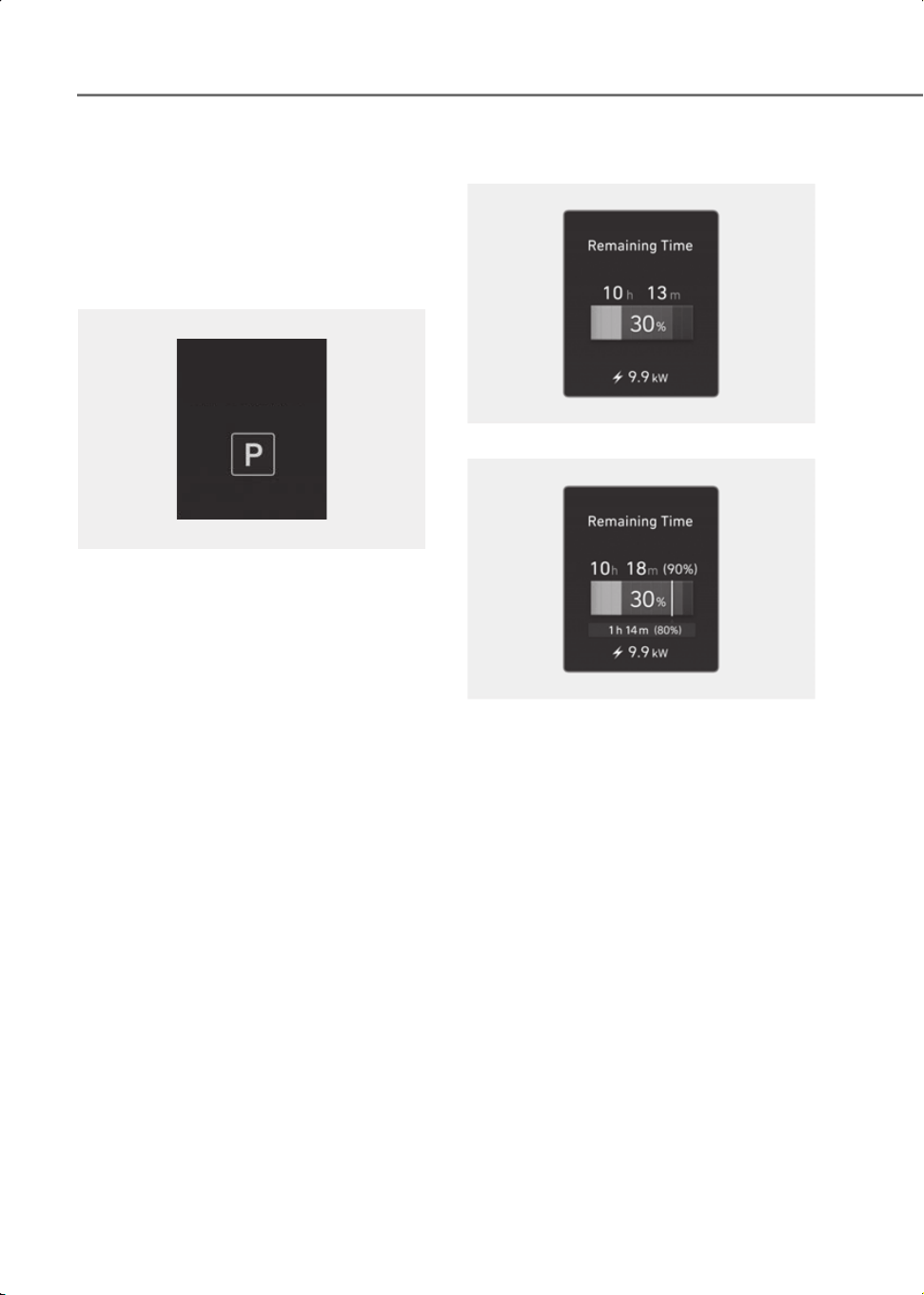
Instrument Cluster
4-20
Check headlight LED
This message is displayed if there is a
problem with the LED headlight. Have the
vehicle inspected by an authorized
HYUNDAI dealer.
Shift to P to charge
OOSEV040497L
This message is displayed if you connect
the charging cable without the gear in the
P (Park) position.
Shift to P (Park) before connecting the
charging cable.
Remaining time
AC charge
ONE1Q011058E
DC charge
ONE1Q011059E
This message is displayed to notify the
remaining time to charge the battery to
the selected target battery charge level.
Unplug vehicle to start
This message is displayed when you start
the vehicle without unplugging the
charging cable. Unplug the charging
cable, and then turn on the vehicle.
Charging door open
This message is displayed when the
vehicle is driven with the charging door
opened. Close the charging door and then
start driving.
4IJGUUP1UPDIBSHF
CE_USA.book Page 20

4
4-21
Charging stopped. Check the AC/DC
charger
This warning message is displayed when
charging is stopped for the following
reasons:
• There is a problem with the external AC
charger or DC charger charger
• The external AC charger stops charging
• The charging cable is damaged
In this case, check whether there is any
problem with the external AC or DC
charger and charging cable.
If the same problem occurs when
charging the vehicle with a normally
operating AC charger or genuine
HYUNDAI portable charger, have your
vehicle inspected by an authorized
HYUNDAI dealer.
Charging stopped. Check the cable
connection
This warning message is displayed when
charging is stopped because the charging
connector is not correctly connected to
the charging inlet
In this case, separate the charging
connector and reconnect it and check
whether there is any problem (external
damage, foreign substances, etc.) with
the charging connector and charging
inlet.
If the same problem occurs when
charging the vehicle with a replaced
charging cable or genuine HYUNDAI
portable charger, have your vehicle
inspected by an authorized HYUNDAI
dealer.
Check regenerative brakes
OOSEV040503E
These warning messages are displayed
when the regenerative brake system does
not work properly.
In this case, have the vehicle inspected by
an authorized HYUNDAI dealer.
Low EV battery
When the high voltage battery level
reaches below about 20 %, this warning
message is displayed.
The High Voltage Battery Level ( )
warning light illuminates simultaneously.
Charge the high voltage battery
immediately.
Charge immediately. Power limited
When the high voltage battery level
reaches below about 10 %, this warning
message is displayed.
The High Voltage Battery Level ( )
warning light illuminates simultaneously.
The vehicle’s power will be reduced to
minimize the energy consumption of the
high voltage battery. Charge the battery
immediately.
$IFDL
SFHFOFSBUJWFCSBLFT
CE_USA.book Page 21

Instrument Cluster
4-22
Battery discharging due to external
electrical devices
ONE1041054L
This warning message is displayed when
a battery discharge due to excessive
current is detected by mounting an
unauthorized electrical device such as a
black box.
Be careful as it may cause battery
discharge problems.
If the warning message is not
disappeared after the external electrical
device is removed, have the vehicle
inspected by an authorized HYUNDAI
dealer.
Power limited due to low EV battery
temperature. Charge battery
OOSEV040507L
Both warning messages are displayed to
protect electric vehicle system when
outside temperature is low. If the high
voltage battery charging level is low and
parked outside in low temperature for a
long time, vehicle power may be limited.
Charging the battery before driving helps
increase power.
NOTICE
If these warning messages are still
displayed even after the ambient
temperature has increased, have the
vehicle inspected by an authorized
HYUNDAI dealer.
Power limited
This Indicator light illuminates:
• This warning message is displayed to
ensure the safety of high-powered
components of electric vehicles. The
power is limited for the following
reasons:
- The high voltage battery level is too
low or voltage is decreasing
- The temperature of the high voltage
battery is too high or too low
- The temperature of the motor is high
NOTICE
• When this warning message is
displayed, do not accelerate or start the
vehicle suddenly.
• When the power is limited for the safety
of high-powered parts of an electric
vehicle, the warning message is
displayed. Your vehicle may not be
driven, or may roll back on a slope with
the warning message displayed due to
the limitation of vehicle power.
Information
Unless both the Service Warning Light
and Power Down Indicator Light
illuminate at the same time, it is not a
failure.
#BUUFSZEJTDIBSHJOH
EVFUPFYUFSOBM
FMFDUSJDBMEFWJDFT
1PXFSMJNJUFE
EVFUPMPX&7
CBUUFSZ
UFNQFSBUVSF
$IBSHFCBUUFSZ
CE_USA.book Page 22

4
4-23
Stop vehicle and check power
supply
This warning message is displayed when
a failure occurs in the power supply
system.
In this case, park the vehicle in a safe
location and tow your vehicle to the
nearest authorized HYUNDAI dealer and
have the vehicle inspected.
Check electric vehicle system
This warning message is displayed when
there is a problem with the electric
vehicle control system.
Refrain from driving when the warning
message is displayed.
In this case, have the vehicle inspected by
an authorized HYUNDAI dealer.
Check active air flap system
OOSEV040510L
This warning message is displayed in the
following situations:
• There is a malfunction with the actuator
flap
• There is a malfunction with the actuator
air flap controller
• The air flap does not open
When all of the above conditions are
fixed, the warning will disappear.
Check virtual engine sound system
OOSEV040512L
This message is displayed when there is a
problem with the Virtual Engine Sound
System (VESS).
In this case, have the vehicle inspected by
an authorized HYUNDAI dealer.
$IFDL"DUJWF
"JS'MBQ4ZTUFN
$IFDL7JSUVBM&OHJOF
4PVOE4ZTUFN
CE_USA.book Page 23
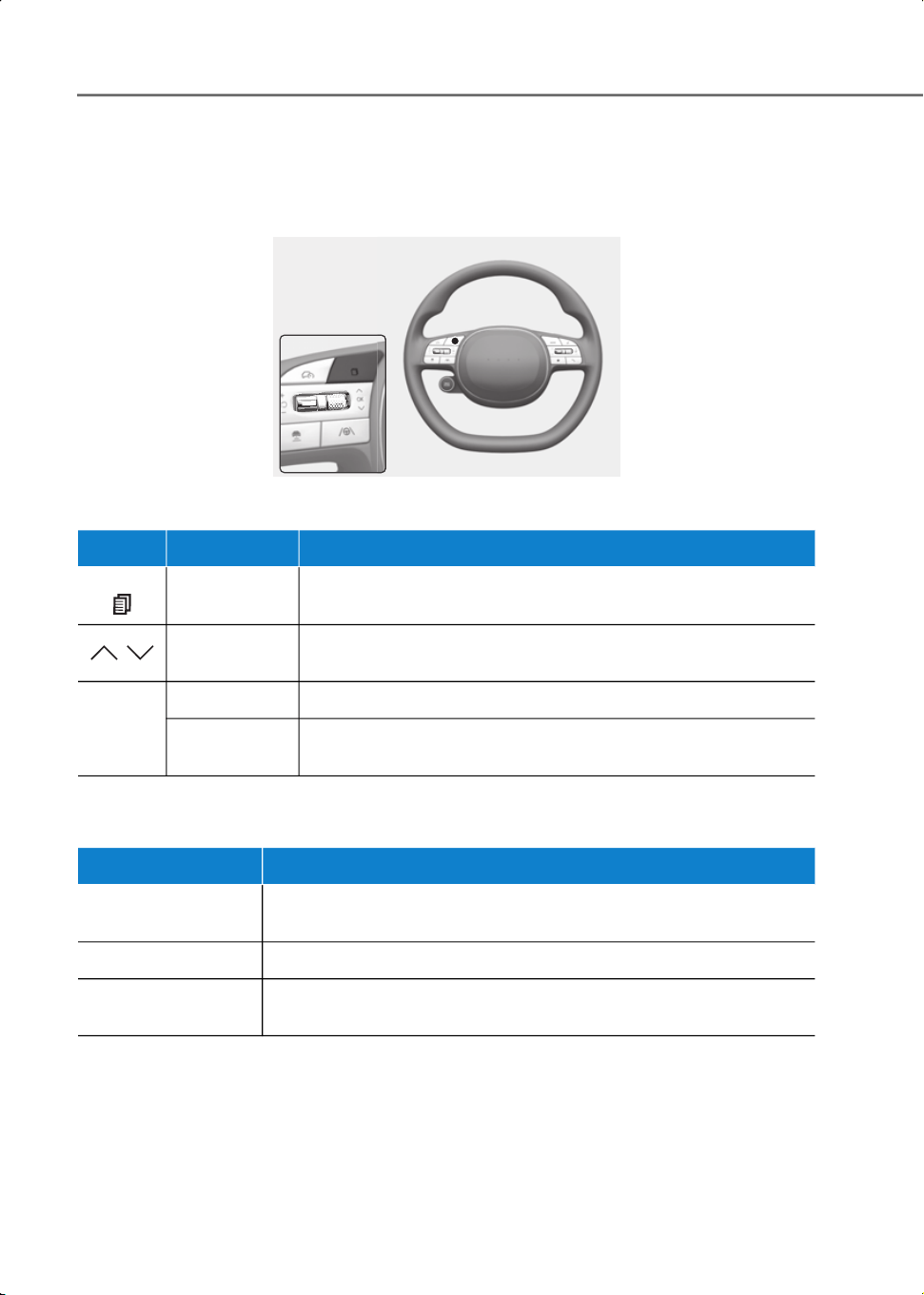
Instrument Cluster
4-24
Cluster Display
Cluster Display Control
B4000701
The cluster display modes can be changed by using the control switches.
View Modes
The information provided may differ depending on which features are available to your
vehicle.
Switch Operation Function
Press MODE button for changing View modes
, Press
UP, DOWN switch for changing items in Utility view and Option
menu
OK
Press SELECT/RESET switch for entering Option menu
Press and hold
SELECT/RESET switch for retrieving assist information or
resetting the selected item
View modes Explanation
Driving Assist
Driving Assist view displays the status of the vehicle’s Driver
Assistance systems.
Turn by Turn Turn By Turn view displays the state of the navigation.
Utility
Utility view displays driving information such as the trip distance,
electric energy economy and etc.
CE_USA.book Page 24
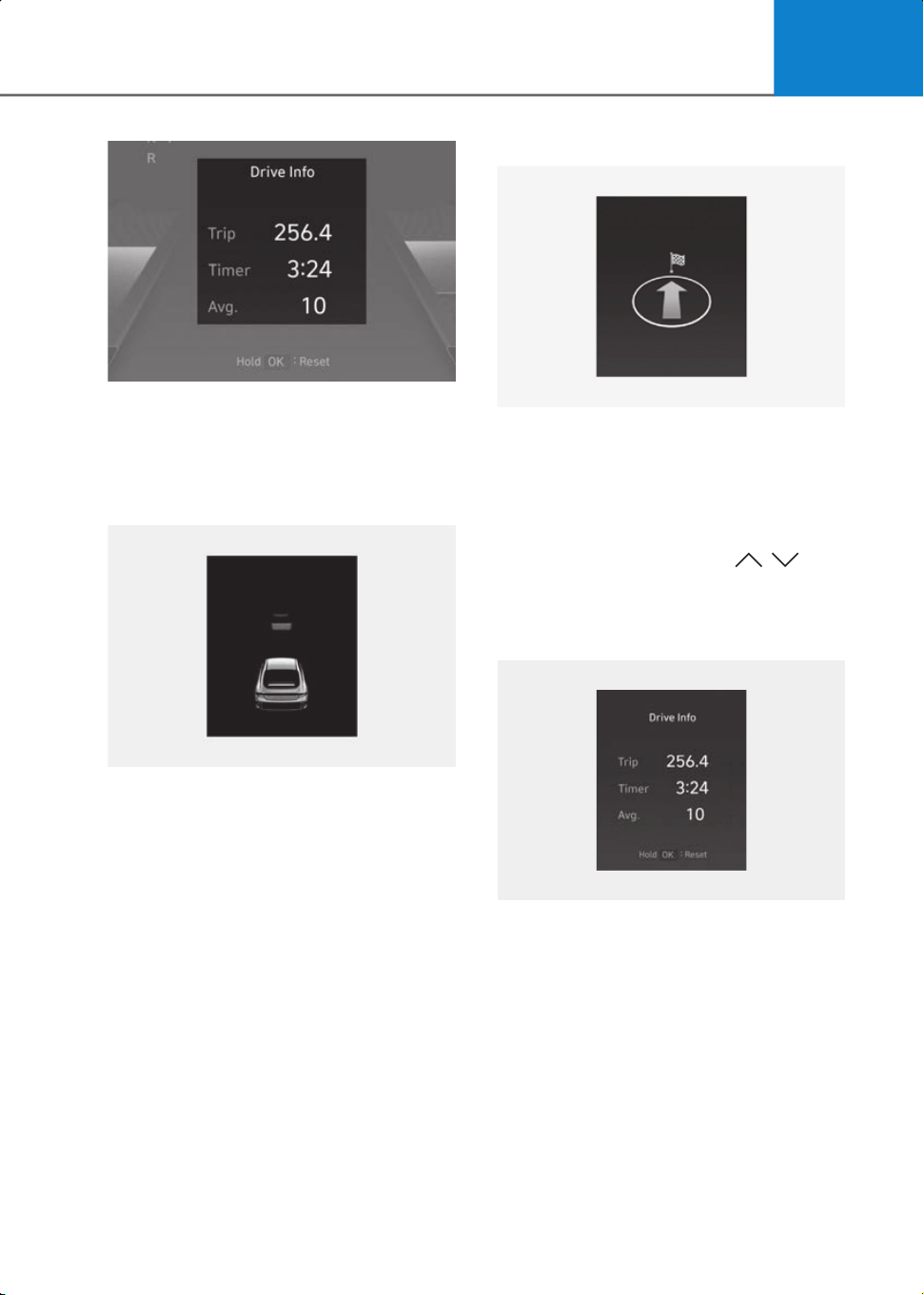
4
4-25
ONE1041019L
Driving Assist, Turn by Turn, Utility view
modes are displayed in the center of the
instrument cluster.
Driving Assist view
B4000902
The status of Smart Cruise Control, Lane
Following Assist, Highway Driving Assist,
etc., is displayed when Driving Assist view
is selected.
For more information, refer to each
function information section in chapter 7.
Turn By Turn (TBT) view
B4000903
Turn-by-turn navigation, distance/time to
destination information is displayed when
Turn by Turn view is selected.
Utility view
In the Utility view, using the , (UP,
DOWN) switch, you may change through
items in the following order.
Drive info
ONE1041047L_1
Trip distance, average electric energy
economy and total driving time are
displayed.
The driver’s door is opened after turning
off the vehicle or the vehicle is turned on
after 3 minutes have passed, the Drive
Info screen will reset.
NJ
I
NJL8I
NJ
I
NJL8I
CE_USA.book Page 25
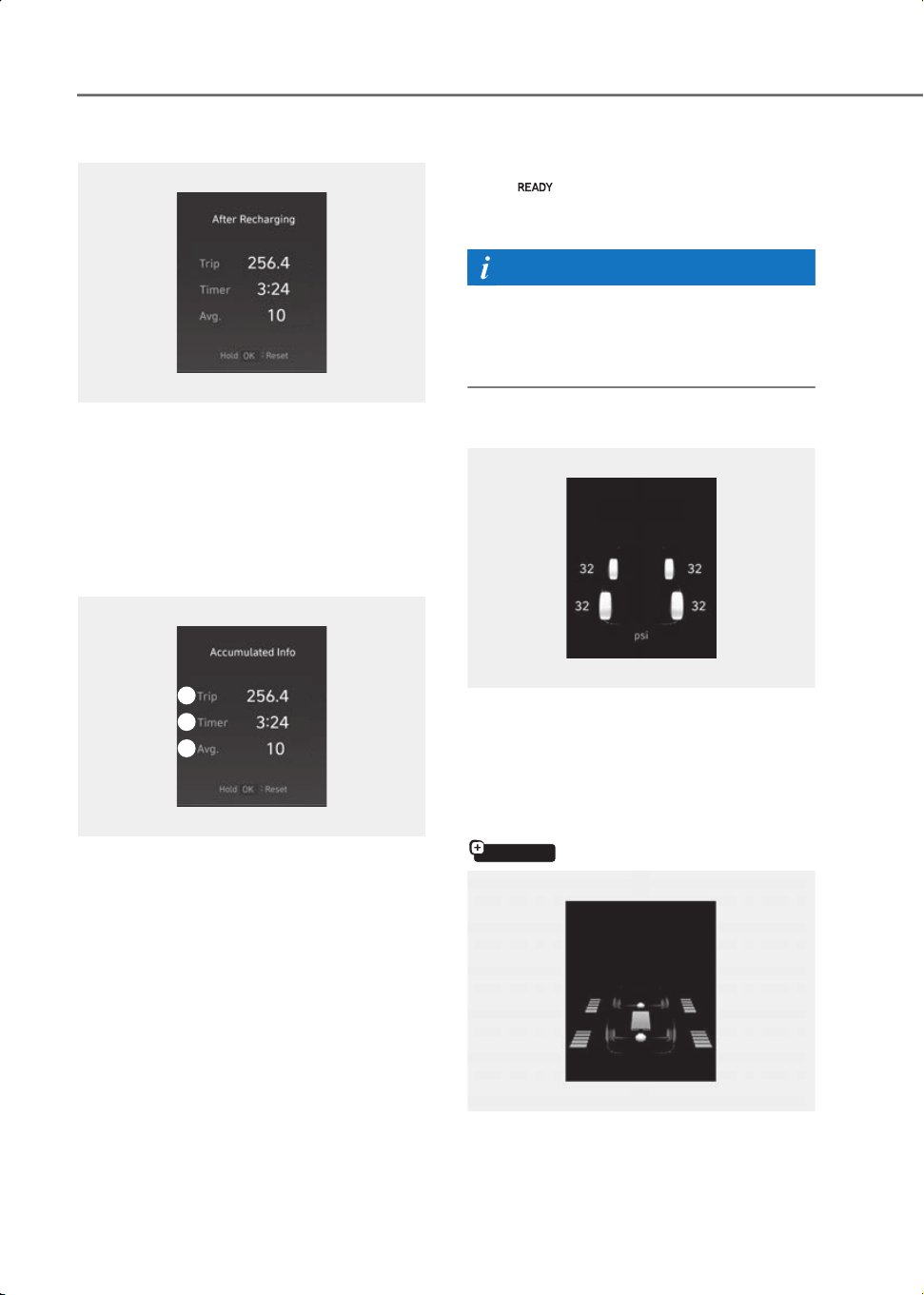
Instrument Cluster
4-26
After Recharging
ONE1041062L
Trip distance, total driving time and
average energy consumption after the
vehicle has been recharged are displayed.
To reset manually, press the OK button on
the steering wheel for more than 1 second
when ‘After Recharging’ is displayed.
Accumulated info
ONE1041046L
This display shows the accumulated trip
distance (1), the average energy
consumption (2), and the total driving
time (3).
The information is accumulated starting
from the last reset.
To manually reset the information, press
and hold the OK button when viewing the
Accumulated driving info. The trip
distance, the average energy
consumption, and total driving time will
reset simultaneously.
The accumulated driving information will
continue to be counted while the vehicle
is on ( indicator is on) (for example,
when the vehicle is in traffic or stopped at
a stop light).
Information
The vehicle must be driven for a minimum
of 0.19 mi. (300 m) since the last ignition
key cycle before the accumulated driving
information is recalculated.
Tire pressure
ONE1041010L
The tire pressure of each tire is displayed.
For more information, refer to the “Tire
Pressure Monitoring System (TPMS)”
section in chapter 8.
if equipped
Energy flow/Driving force distribution
B4000909
• The electric vehicle system informs the
drivers its energy flow in various
operating modes.
NJ
I
NJL8I
1
2
3
NJ
I
NJL8I
5JSF1SFTTVSF
CE_USA.book Page 26
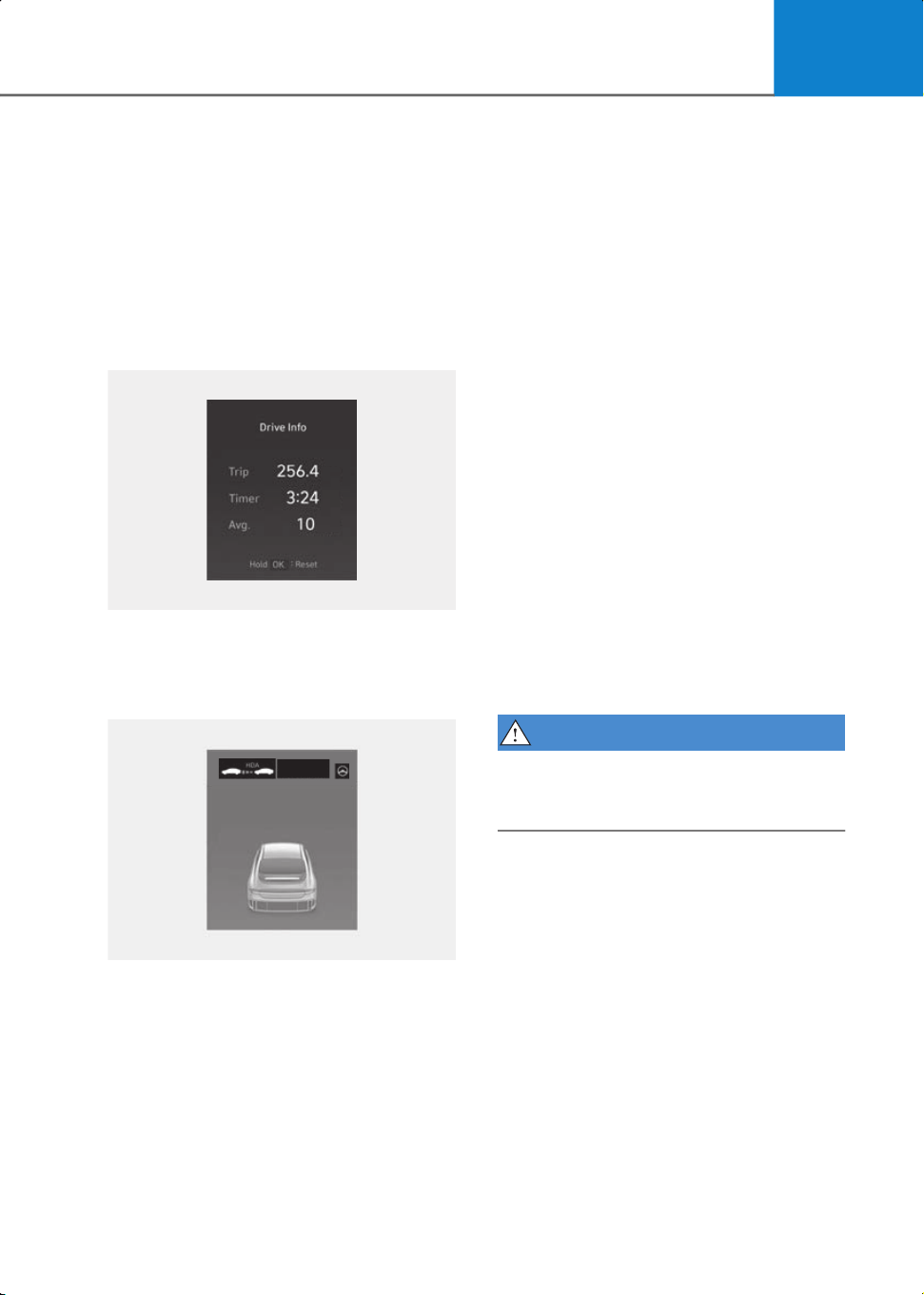
4
4-27
• The distribution status of the driving
power of the front and rear wheels are
displayed when Auto AWD mode is
activated.
For more information, refer to the "All
Wheel Drive (AWD)" section in chapter 6.
Additional information display
Drive info
ONE1041047L_1
Drive information is displayed for 4
seconds after the vehicle is turned off.
Driving assist information
B4000911
The current operation conditions of Smart
Cruise Control, Lane Following Assist,
Highway Driving Assist, etc., is displayed.
Vehicle Settings
(Infotainment System)
Vehicle Settings in the infotainment
system provides user options for the
settings including door lock/unlock
features, convenience features, driver
assistance settings, etc.
Vehicle Settings menu
• Driver Assistance
• Drive Mode
• EV
• Head-Up Display
• Cluster
• Climate
• Seat
• Lights
• Door
• Convenience
The information provided may differ
depending on which functions are
available to your vehicle.
WARNING
Do not adjust the Vehicle Settings while
driving. You may be distracted from the
driving task and could crash.
NJ
I
NJL8I
80
NQI
CE_USA.book Page 27
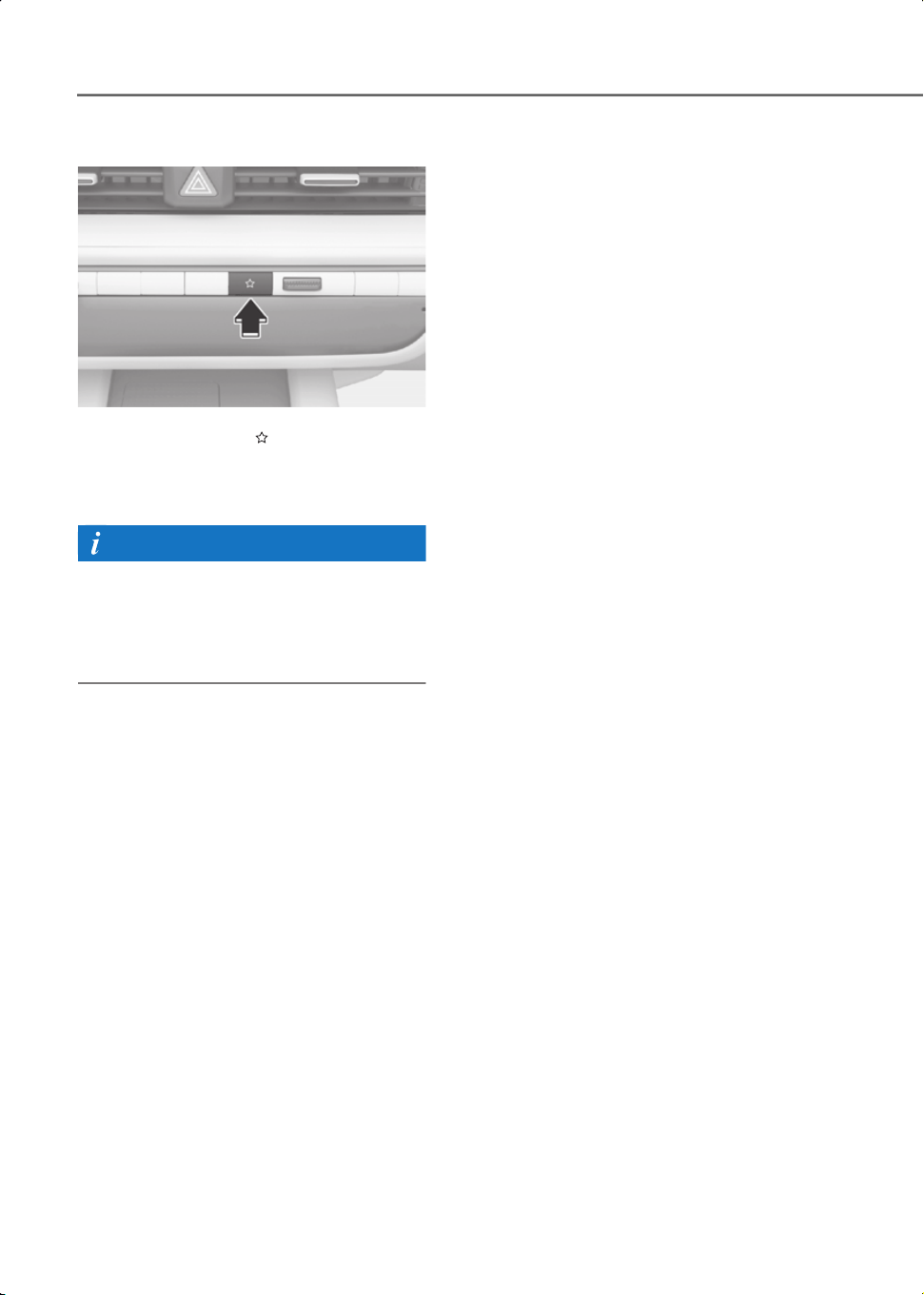
Instrument Cluster
4-28
Setting Your Vehicle
B4001701
1. Press the Custom ( ) button on the
main keyboard.
2. Select Vehicle to change the Vehicle
Settings.
Information
The infotainment system may change
after software updates. For more
information, refer to the user’s manual
provided in the infotainment system and
the quick reference guide.
CE_USA.book Page 28

5
5. Convenience Features
Accessing Your Vehicle ................................................................................................... 5-5
Smart Key ..................................................................................................................... 5-5
Immobilizer System .................................................................................................... 5-11
Hyundai Digital Key ........................................................................................................5-12
Digital key (smartphone)............................................................................................5-12
Digital key (Card key)................................................................................................. 5-16
Used vehicle/Digital key maintenance......................................................................5-21
Limitations of the System...........................................................................................5-21
Door Locks ..................................................................................................................... 5-22
Operating Door Unlocks from Outside the Vehicle (Manual type) ........................ 5-22
Operating Door Unlocks from Outside the Vehicle (Electric type) ........................ 5-22
Operating Door Locks from Outside the Vehicle (Manual type) ............................5-24
Operating Door Locks from Outside the Vehicle (Electric type) ............................5-24
Operating Door Lock/Unlock from Inside the Vehicle ............................................ 5-27
Automatic Door Lock and Unlock Features ............................................................. 5-27
Child-Protector Rear Door Locks..............................................................................5-28
Theft-Alarm System ...................................................................................................... 5-29
Rear Occupant Alert (ROA) ...........................................................................................5-30
System Setting ...........................................................................................................5-30
System Operation ......................................................................................................5-30
Declaration of Conformity......................................................................................... 5-32
Integrated Memory System.......................................................................................... 5-32
Storing Memory Positions .........................................................................................5-33
Recalling Memory Positions...................................................................................... 5-33
Resetting the System................................................................................................. 5-33
Seat Easy Access........................................................................................................5-34
Steering Wheel .............................................................................................................. 5-35
Motor Driven Power Steering (MDPS)...................................................................... 5-35
Tilt/Telescopic Steering............................................................................................. 5-35
Horn ............................................................................................................................5-36
Heated Steering Wheel..............................................................................................5-36
Mirrors ............................................................................................................................5-38
Inside Rearview Mirror...............................................................................................5-38
Side View Mirrors ....................................................................................................... 5-47
Reverse Parking Aid ...................................................................................................5-49
CE_USA.book Page 1

5
Windows ........................................................................................................................ 5-50
Power Windows.......................................................................................................... 5-51
Wide Sunroof................................................................................................................. 5-54
Hood ...............................................................................................................................5-57
Opening the Hood......................................................................................................5-57
Closing the Hood....................................................................................................... 5-58
Front Trunk .................................................................................................................... 5-58
Opening the Front Trunk........................................................................................... 5-58
Power Trunk .................................................................................................................. 5-59
Power Trunk Operating Conditions.......................................................................... 5-59
Operating the Power Trunk ...................................................................................... 5-60
Resetting the Power Trunk ....................................................................................... 5-62
Emergency Trunk Safety Release............................................................................. 5-63
Smart Trunk ................................................................................................................... 5-64
Using Smart Trunk..................................................................................................... 5-64
Deactivating smart trunk .......................................................................................... 5-65
Detecting area ........................................................................................................... 5-65
Electric Charging Door ................................................................................................. 5-66
Head-up Display ............................................................................................................5-67
Head-up Display Settings ..........................................................................................5-67
Head-up Display Information................................................................................... 5-68
Precautions while Using the Head-up Display........................................................ 5-68
Over-The-Air Software Update .................................................................................... 5-69
Downloading Software ............................................................................................. 5-69
Approving Software Update ..................................................................................... 5-69
Preparing Software Update .......................................................................................5-70
Updating Software .....................................................................................................5-70
Lighting...........................................................................................................................5-72
Exterior Lights.............................................................................................................5-72
Welcome system ........................................................................................................ 5-75
CE_USA.book Page 2

5
5. Convenience Features
Interior Lights................................................................................................................. 5-76
Interior Light AUTO cut.............................................................................................. 5-76
Front lamps................................................................................................................. 5-76
Rear lamps.................................................................................................................. 5-76
Vanity Mirror Lamp .................................................................................................... 5-77
Glove Box Lamp ......................................................................................................... 5-77
Mood Lamp ................................................................................................................ 5-77
Front Trunk Lamp....................................................................................................... 5-78
Luggage Compartment Lamp................................................................................... 5-79
High Beam Assist (HBA)................................................................................................ 5-79
High Beam Assist Settings ........................................................................................5-80
High Beam Assist Operation .....................................................................................5-80
High Beam Assist Malfunction and Limitations....................................................... 5-81
Wipers And Washers .....................................................................................................5-82
Front Windshield Wipers ...........................................................................................5-83
Front Windshield Washers ........................................................................................5-84
Automatic Climate Control System..............................................................................5-85
Climate........................................................................................................................ 5-87
Automatic Temperature Control Mode.................................................................... 5-87
Manual Temperature Control Mode.........................................................................5-88
System Operation ......................................................................................................5-96
System Maintenance ................................................................................................. 5-97
Windshield Defrosting And Defogging ........................................................................5-99
To Defog Inside Windshield .................................................................................... 5-100
To Defrost Outside Windshield ............................................................................... 5-100
Defogging Logic........................................................................................................ 5-101
Rear Window Defroster ............................................................................................ 5-101
Climate Control Additional Features.......................................................................... 5-102
A/C Automatic Drying.............................................................................................. 5-102
Auto Defogging System .......................................................................................... 5-102
Auto Dehumidify ...................................................................................................... 5-104
Sunroof Inside Air recirculation .............................................................................. 5-104
Recirculating Air When Washer Fluid Is Used........................................................ 5-104
Recirculation Mode Plus.......................................................................................... 5-105
Automatic Controls Linked to Climate Control Settings (for driver’s seat) ......... 5-105
Smart Ventilation ..................................................................................................... 5-105
CE_USA.book Page 3

5
Storage Compartment.................................................................................................5-106
Center Console Storage...........................................................................................5-106
Glove Box ..................................................................................................................5-106
Interior Features........................................................................................................... 5-107
Cup Holder................................................................................................................ 5-107
Sunvisor.....................................................................................................................5-108
Power Outlet.............................................................................................................5-108
USB Charger .............................................................................................................5-109
Wireless Smartphone Charging System ..................................................................5-110
Vehicle to Load (V2L) ................................................................................................5-112
Clock...........................................................................................................................5-112
Coat Hook ..................................................................................................................5-112
Floor Mat Anchor(s)...................................................................................................5-113
Infotainment System ....................................................................................................5-113
USB Port .....................................................................................................................5-113
Antenna......................................................................................................................5-114
Steering Wheel Remote Controls.............................................................................5-114
Infotainment System.................................................................................................5-115
Voice Recognition .....................................................................................................5-115
Bluetooth® Wireless Technology..............................................................................5-116
CE_USA.book Page 4
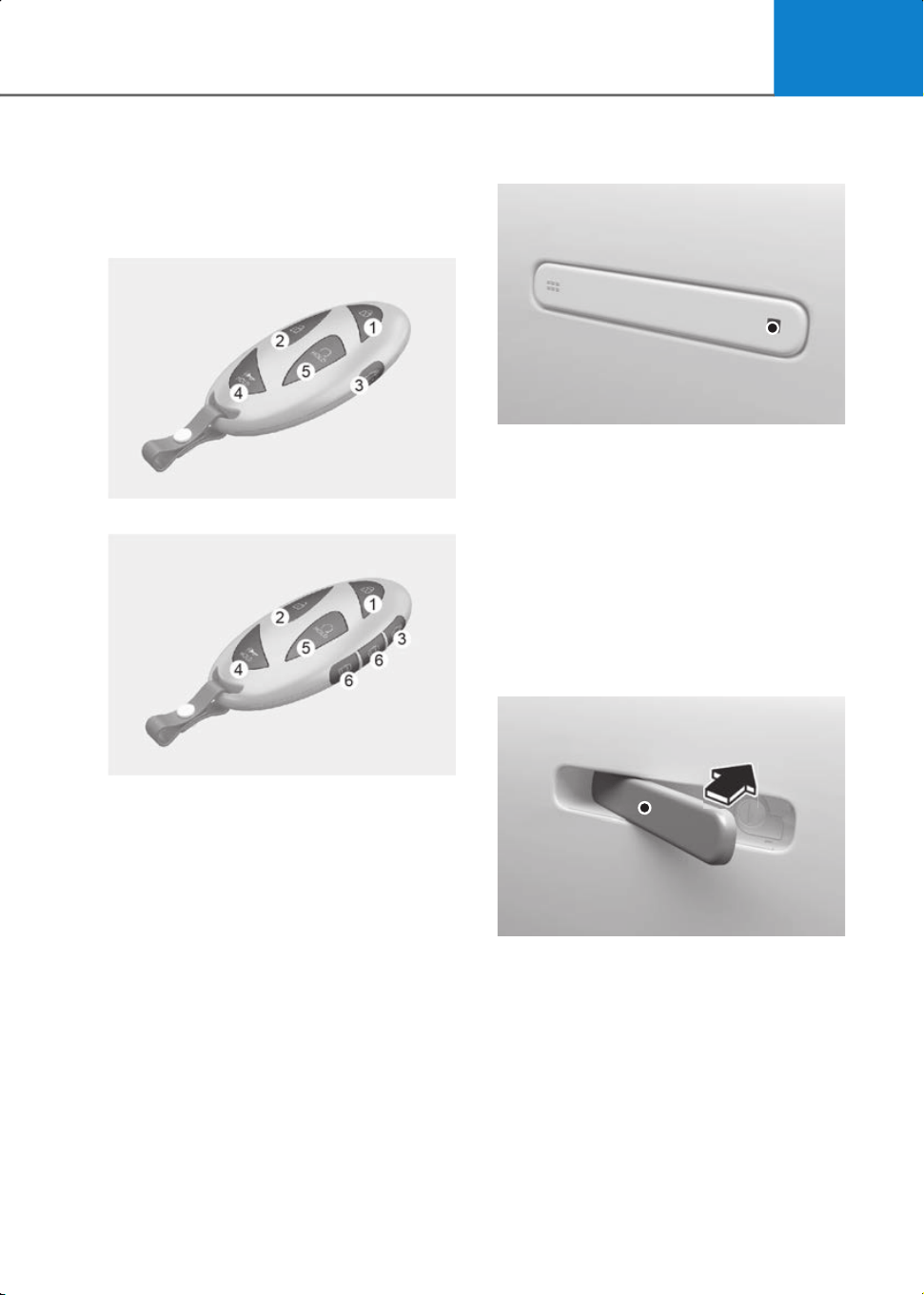
5
5-5
Accessing Your Vehicle
Smart Key
Type A
B5000201
Type B
B5000202
Your electric vehicle uses a smart key that
can be used to lock or unlock the doors,
trunk, and start the vehicle.
(1) Door lock
(2) Door unlock
(3) Trunk open
(4) Panic
(5) Remote Start
(6) Forward / Backward (if equipped)
Locking your vehicle
Manual type
B5000203
To lock your vehicle using the door handle
button or the smart key:
1. Close all doors, hood, and trunk.
2. Press the Door Lock button (1) on the
smart key. The hazard warning lights
blink with an alarm, and the doors lock.
3. In addition, touching the outer part of
the door handle on or near the handle
detent while having the smart key with
you locks all doors.
Electric type (if equipped)
B5000203_1
To lock your vehicle using the door handle
touch sensor or the smart key:
1. Close all doors, hood, and trunk.
2. Press the Door Lock button (1) on the
smart key. The hazard warning lights
blink with an alarm, and the handles
retract back.
CE_USA.book Page 5
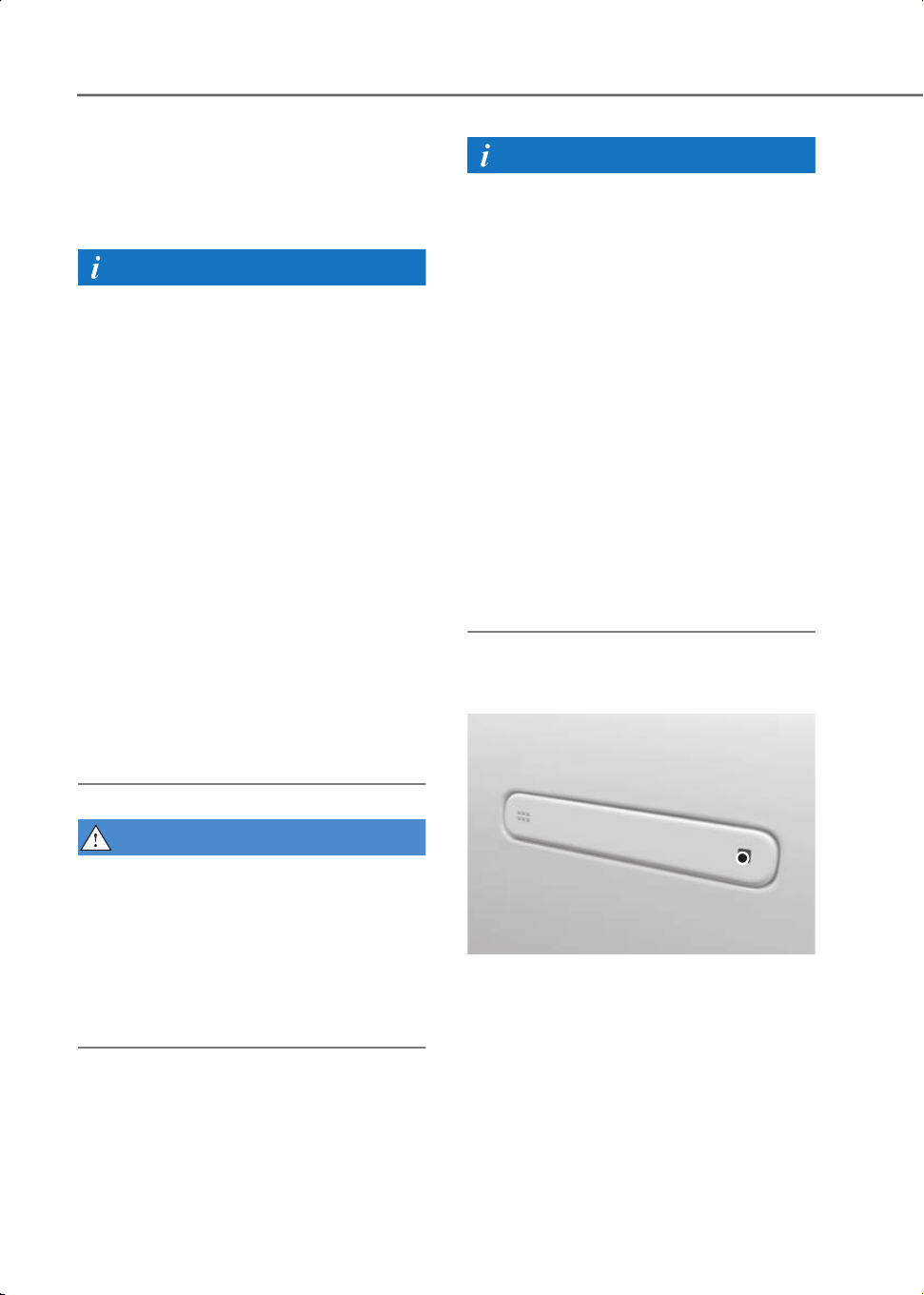
Convenience Features
5-6
• In addition, touching the outer part of
the door handle on or near the handle
detent for about 1 second while having
smart key with you locks all doors and
let the door handle to retract back.
Information
• The side view mirror will fold if ‘Enable
on Door Unlock’ is selected from the
Settings menu in the infotainment
system. Select Setup > Vehicle > Lights
> Welcome Mirror/Light > Enable on
Door Unlock.
• The door handle touch sensor operates
when the smart key is within 28-40 in.
(0.7-1 m) from the outside door handle.
• If you lock the doors using the door
handle touch sensor, the doors are not
locked under the following
circumstances:
- The smart key is in the vehicle.
- The Start/Stop button is from ACC or
ON position.
- Any door is open (except for the
trunk).
• If this occurs, a chime sounds for a few
seconds. Check the vehicle before
attempting to lock the vehicle again.
WARNING
Do not leave the smart key in your vehicle
with children that are unattended or
unsupervised.
Children could unintentionally press the
Start/Stop button or could operate the
power windows or other vehicle controls
or even cause the vehicle to move. This
may result in serious injury or death.
Information
• To fold/unfold the side view mirror
simultaneously when the door is
locked/unlocked, select Setup >
Vehicle > Lights > Welcome
Mirror/Light > Enable on Door Unlock
in the infotainment system.
• The door handle button will only
operate when the smart key is within
28-40 in. (0.7-1 m) from the outside
door handle. Other people can also
open the doors without the smart key in
possession.
• After unlocking the doors, the doors will
lock automatically after 30 seconds
unless a door is opened.
The infotainment system may change
after software updates. For more
information, refer to the user’s manual
provided in the infotainment system and
the quick reference guide.
Unlocking your vehicle
Manual type
B5000204
To unlock your vehicle using the door
handle button or the smart key:
1. Have the smart key with you.
2. Pushing the button on the door
handle(engraved part) or press the
Door Unlock button (2) on the smart
key. All doors handles will be unlocked
and the hazard warning lights will blink
twice.
CE_USA.book Page 6
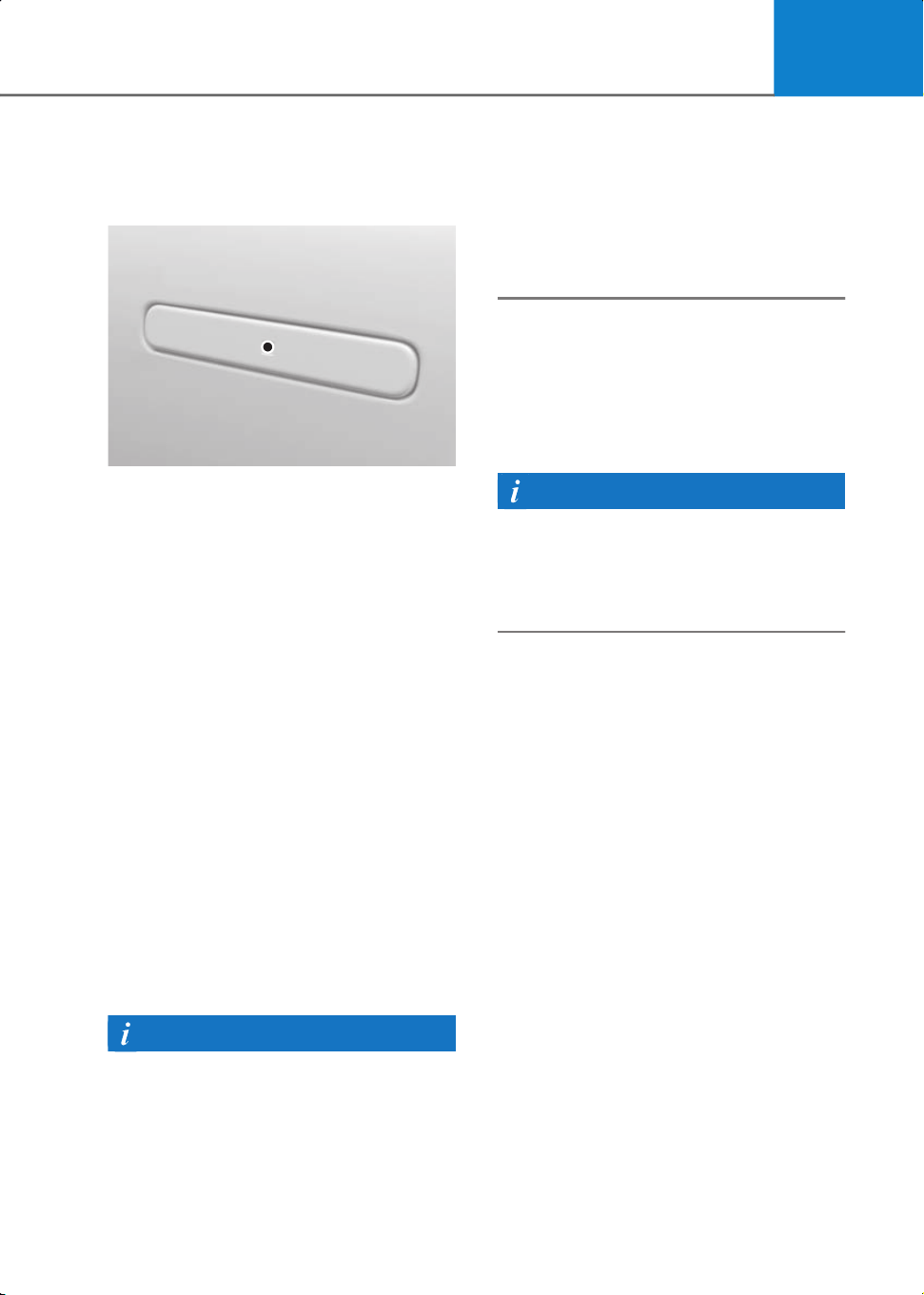
5
5-7
3. After unlocking the doors, the doors will
automatically re-lock after 30 seconds
unless a door is opened.
Electric type (if equipped)
B5002804
When you release the Two Press Unlock
function
To unlock your vehicle using the door
handle touch sensor or the smart key:
1. Have the smart key with you.
2. Touch the touch sensor on the door
handle(engraved part) or press the
Door Unlock button (2) on the smart
key. All door handles will pop out and
the doors will be unlocked and the
hazard warning lights will blink and the
chime will sound.
• If you unlock the doors using the
passenger side door handle, all the
doors are unlocked. If you unlock the
doors using the driver side door
handle, either the driver’s side door is
unlocked or all the doors are
unlocked depending on the setting
for the Two Press Unlock feature.
Change the Driver Door unlock mode
by referring to “Setting the Two Press
Unlock feature”.
Information
• The side view mirror will unfold if
‘Enable on Door Unlock’ is selected
from the Settings menu in the
infotainment system. Select Setup >
Vehicle > Lights > Welcome
Mirror/Light > Enable on Door Unlock.
• The door handle button or touch sensor
only operates when the smart key is
within 28-40 in. (0.7-1 m) from the
outside door handle.
• If you do not open the door after
unlocking within 30 seconds, it returns
to the lock mode.
Setting the Two Press Unlock feature
You can activate or deactivate the Two
Press Unlock feature from the Settings
menu in the infotainment system.
SelectSetup > Vehicle > Door > Two
Press Unlock.
Information
The infotainment system may change
after software updates. For more
information, refer to the user’s manual
provided in the infotainment system and
the quick reference guide.
Setting the door lock/unlock prevention
feature
The doors may lock or unlock if the touch
sensor of the outside door handle is
recognized while washing your vehicle or
due to heavy rain.
To prevent unintentional door lock or
unlock:
Press the lock button on the smart key
and immediately press the unlock button
along with the lock button for more than
4 seconds. The hazard warning lights
blink four times. At this time, the doors do
not lock or unlock even though the touch
sensor is touched on the outside door
handle. To deactivate the function, press
the door lock or unlock button on the
smart key.
CE_USA.book Page 7
Convenience Features
5-8
Information
During a vehicle wash or rain, in order to
minimize unintentional operation of the
touch sensor, the touch sensor may
become insensitive. This is not a
malfunction.
Opening the trunk
To open the trunk:
1. Have the smart key with you.
2. Press the trunk handle switch on the
vehicle or press and hold smart key
button(3) on the smart key for more
than one second. The hazard warning
lights blink twice and the trunk is
opened. If you release the button while
the trunk is being closed, it will stop
working and the chime will sound for
about 5 seconds.
Information
The trunk open button only operates
when the smart key is within 28 in. (0.7 m)
from the trunk.
Remotely starting vehicle
1. Press the door lock button on the smart
key. You must be within about 32 ft. (10
m) from the vehicle.
2. Press and hold the Remote Start button
(5) on your smart key. You must press
the button within 4 seconds from when
you have pressed the door lock button.
The hazard warning lights blink and the
vehicle starts ( indicator on).
3. To turn off the vehicle, press the
Remote Start button (5) once.
Information
• The vehicle must be in P (Park) for the
remote start function to start.
• The vehicle turns off ( indicator off)
if you get inside the vehicle without a
registered smart key.
• The vehicle turns off if you do not get on
the vehicle within 10 minutes after
remotely starting the vehicle.
• The Remote Start button may not
operate if the smart key is not within 32
ft. (10 m) from the vehicle.
• The vehicle does not remotely start if
the hood or trunk is open.
Remotely moving vehicle forward or
if equipped
backward
Some models are equipped with the
Remote Smart Parking Assist feature.
With the smart key, the vehicle can be
moved forward or backward remotely to
enter or exit a tight parking space.
For more information, refer to the
“Remote Smart Parking Assist 2 (RSPA 2)”
section in chapter 7.
Using panic alarm
The horn sounds and the hazard warning
lights blink for about 30 seconds if this
button (4) is pressed for more than 1
second. To stop the horn and lights, press
any button on the smart key.
Starting the vehicle
Your vehicle is equipped with a Start/Stop
button instead of a key cylinder. You can
leave your smart key in your pocket or
purse when you start your vehicle.
For more information, refer to the
“Start/Stop Button” section in chapter 6.
Information
If the smart key is not moved for some
time, the detection function for smart key
operation will pause. Lift the smart key to
activate the detection again.
CE_USA.book Page 8
5
5-9
NOTICE
To prevent damaging the smart key:
• Keep the smart key in a cool, dry place
to avoid damage or malfunction.
Exposure to moisture or high
temperature may cause the internal
circuit of the smart key to malfunction
which may not be covered under
warranty.
• Avoid dropping or throwing the smart
key.
• Protect the smart key from extreme
temperatures.
Loss of a smart key
A maximum of three smart keys can be
registered to a single vehicle. If you
happen to lose your smart key, it is
recommended that you should
immediately take the vehicle and
remaining keys to your authorized
HYUNDAI dealer or tow the vehicle, if
necessary.
Smart key precautions
The smart key may not work if any of the
following occur:
• The smart key is close to a radio
transmitter such as a radio station or an
airport which can interfere with normal
operation of the transmitter.
• The smart key is near a mobile two way
radio system or a mobile phone.
• Another vehicle’s smart key is being
operated close to your vehicle.
• The smart key is near any normal
electronic devices or credit cards.
If the smart key does not work correctly,
open and close the door with the
mechanical key. If you have a problem
with the smart key, contact an authorized
HYUNDAI dealer.
If the smart key is in close proximity to
your mobile phone, the signal could be
blocked by your mobile phone’s normal
operational signals. This is specifically
relevant when the phone is active such as
making and receiving calls, text
messaging, and/or sending/receiving
emails. When possible, avoid keeping the
smart key and your mobile phone in the
same location such as pants or jacket
pocket in order to avoid interference
between the two devices.
If your windows are tinted, especially with
metallic window tint, it may cause
frequency interference, reducing the
smart key operating range.
Information
Changes or modifications not expressly
approved by the party responsible for
compliance could void the user’s
authority to operate the equipment. If the
keyless entry system is inoperative due to
changes or modifications not expressly
approved by the party responsible for
compliance, it will not be covered by your
manufacturer’s vehicle warranty.
Information
This device complies with Part 15 of the
FCC rules.
Operation is subject to the following three
conditions:
1. This device may not cause harmful
interference, and
2. This device must accept any
interference received, including
interference that may cause undesired
operation.
3. Changes or modifications not expressly
approved by the party responsible for
compliance could void the user’s
authority to operate the device.
CE_USA.book Page 9
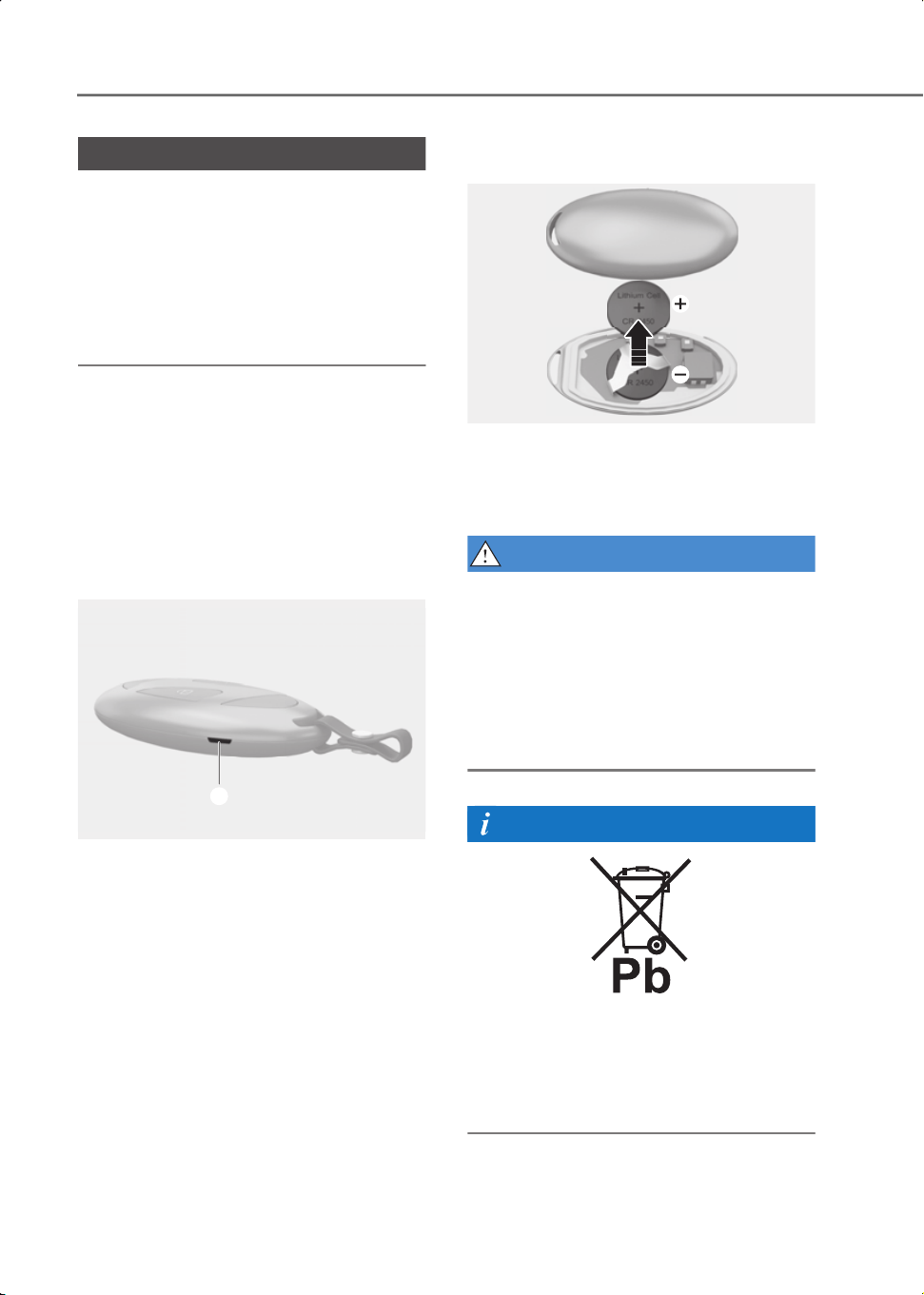
Convenience Features
5-10
NOTICE
• Keep the smart key away from
electromagnetic materials that blocks
electromagnetic waves to the key
surface.
• Always have the smart key with you
when leaving the vehicle. If the smart
key is left near the vehicle, the vehicle
battery may be discharged.
Battery replacement
If the smart key is not working properly,
try replacing the battery with a new one.
Battery Type: CR2450
To replace the battery:
1. Put the slim tool into the key hole (1) to
pry open the rear cover of the smart
key.
B5000401
2. Remove the old battery and insert the
new battery. Make sure the battery
position is correct.
3. Reinstall the battery cover and smart
key cover.
B5000402
If you suspect your smart key might have
sustained some damage, or you feel your
smart key is not working correctly,
contact an authorized HYUNDAI dealer.
WARNING
This product contains a button battery.
If swallowed, a lithium button battery can
cause severe or fatal injuries within 2
hours. Keep batteries out of reach of
children.
If you think batteries may have been
swallowed or placed inside any part of the
body, seek immediate medical attention.
Information
WL_TakingCareOfBatteryWarning_7
An inappropriately disposed battery can
be harmful to the environment and
human health. Dispose of the battery
according to your local law(s) or
regulations.
1
CE_USA.book Page 10

5
5-11
Immobilizer System
The immobilizer system helps protect
your vehicle from theft. If an improperly
coded key (or other device) is used, the
vehicle is disabled.
When the Start/Stop button is pressed to
the ON position, the immobilizer system
indicator should come on briefly, then go
off. If the indicator starts to blink, the
system does not recognize the coding of
the key.
Press the Start/Stop button to the OFF
position, then press the Start/Stop button
to the ON position again.
In some circumstances, the vehicle may
not recognize your smart key if another
smart key device is nearby or a metal
object such as a key chain is causing
interference with the smart key.
If this occurs, your vehicle may not start.
Remove any metal objects or additional
keys near the smart key before
attempting to start the vehicle again.
If the system repeatedly does not
recognize the coding of the key, contact
an authorized HYUNDAI dealer.
Do not attempt to alter this system or add
other devices to it. Electrical problems
could result that may make your vehicle
inoperable.
WARNING
In order to prevent theft of your vehicle,
do not leave spare keys anywhere in your
vehicle. Your immobilizer password is a
customer unique password and should be
kept confidential.
NOTICE
The transponder in your key is an
important part of the immobilizer system.
It is designed to give years of trouble-free
service, however you should avoid
exposure to moisture, static electricity
and rough handling. Immobilizer system
malfunction could occur.
Information
This device complies with Part 15 of the
FCC rules.
Operation is subject to the following three
conditions:
1. This device may not cause harmful
interference.
2. This device must accept any
interference received, including
interference that may cause undesired
operation.
3. Changes or modifications not expressly
approved by the party responsible for
compliance could void the user’s
authority to operate the device
CE_USA.book Page 11
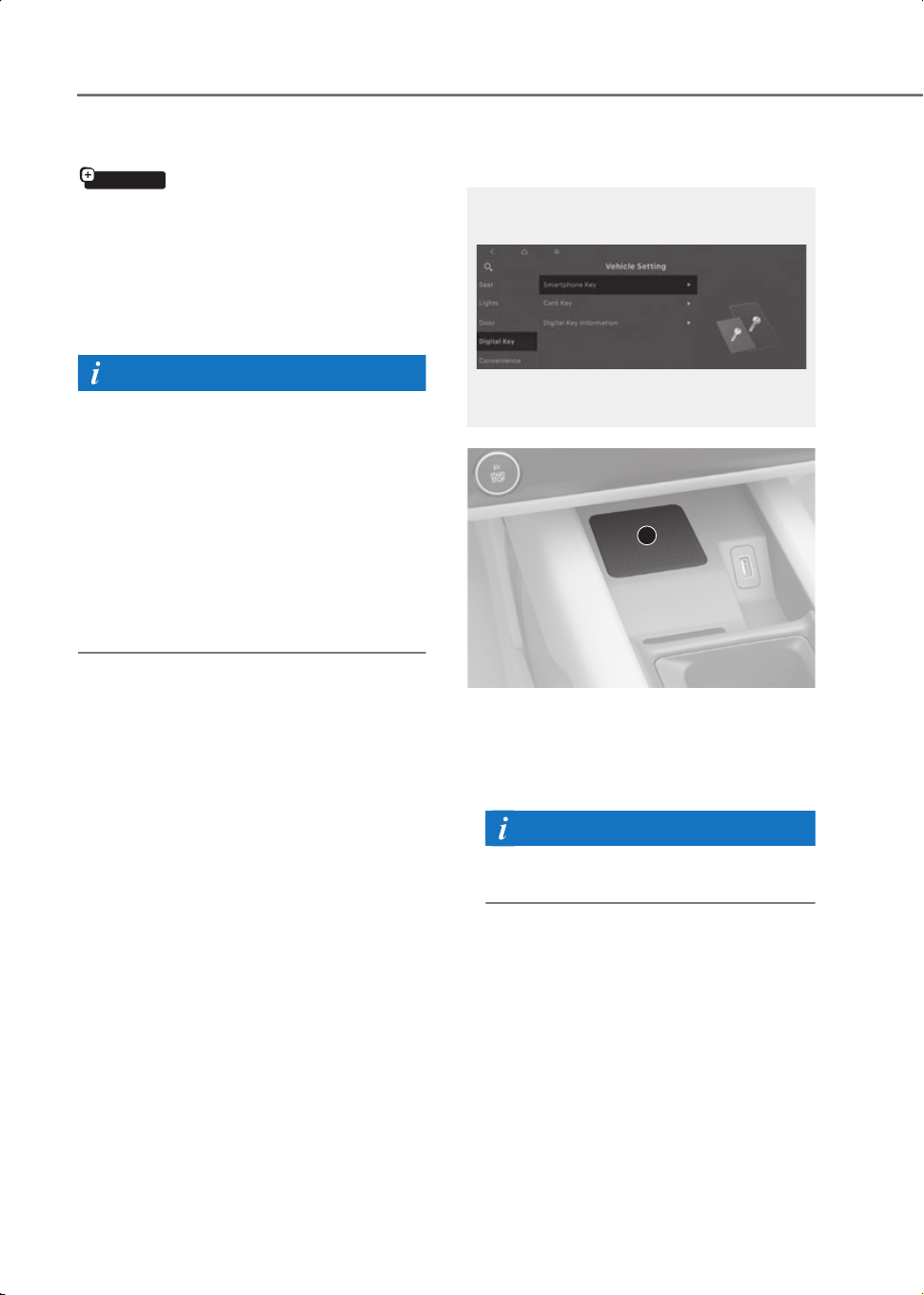
Convenience Features
5-12
if equipped
Hyundai Digital Key
Hyundai digital key provides convenience
to the driver, which the driver can use to
lock or unlock the driver and passenger
doors or the trunk and turn of the vehicle.
Digital key (smartphone)
Information
• Hyundai digital keys are only available
on smartphone that support digital key
functions, and digital key functions of
smartphones are provide by
smartphone manufacturers.
• Available smartphone models can be
found on smartphone manufactures’
website or HYUNDAI website.
• Depending on the availability of service
on the vehicle, some functions may not
operated.
Setting your smartphone
To use the digital key (smartphone),
download the BlueLink App and sign up
Hyundai account and service.
For more information about BlueLink,
refer to the infotainment system guide.
Registering your digital key
(smartphone)
B0901EU04
B5026502
[A] Vehicle authentication pad (Wireless charging
pad)
1. Turn on the vehicle with a smart key
and have your smart key with you in the
vehicle.
Information
For Europe, both smart keys must be in
the vehicle to register the digital key.
A
CE_USA.book Page 12
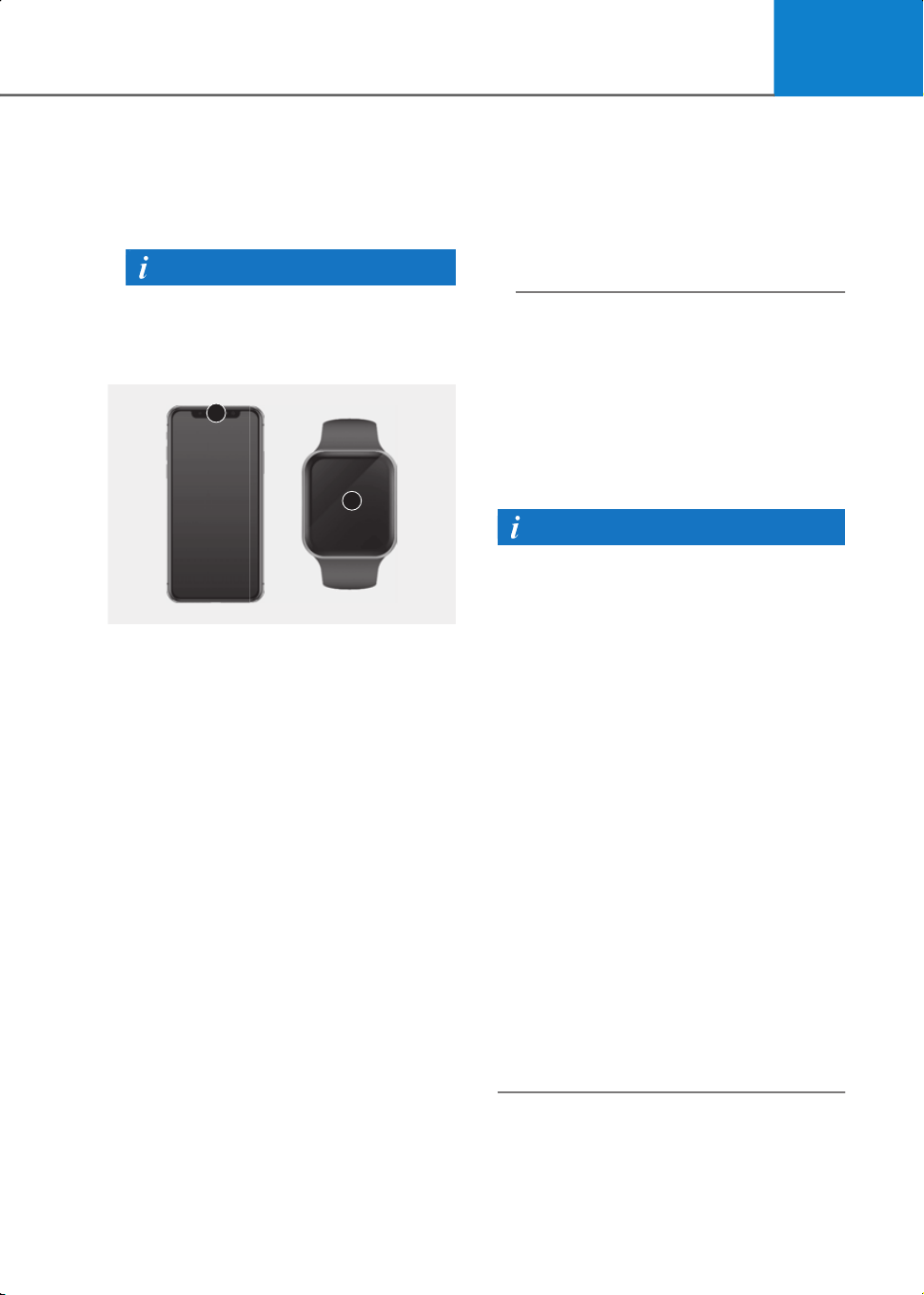
5
5-13
2. After selecting Digital Key > Set Up
Digital Key from the My Hyundai App in
the smartphone, register the digital key
according to the guidance in the
smartphone screen.
Information
• The NFC Antenna position on
Samsung device can be found in the
following path: Setup > Connections
> NFC and contactless payments.
B5026403
• The NFC Antenna position on Apple
iPhone is located at the top of the
rear and Apple WATCH is located at
the center of the screen.
• Place your smartphone on the vehicle
authentication pad (wireless
charging pad) with the screen facing
up. (In case of Apple WATCH, need to
touch the pad with WATCH screen
face).
• Ensure that the NFC Antenna position
on the smartphone is in contact with
the vehicle authentication pad
(wireless charging pad).
• The location of the NFC Antenna on
the smartphone may vary by phone
model, so please contact the
smartphone manufacturer for
details.
• NFC communication may not work
for some smartphones depending on
the internal structure of the
smartphone. Move the smartphone
to the left or right of the indoor
authentication pad (wireless
charging pad) to operate.
3. From the infotainment system Settings
menu, select Setup > Vehicle > Digital
key > Smartphone key and press the
Save button from the infotainment
system screen.
• When the digital key (smartphone) is
saved, a message appears on the
infotainment system screen.
Information
• If you want to register a digital key
(smartphone) again, refer to "Deleting
your digital key (smartphone)" and
delete the digital key (smartphone)
before re-registering.
• During the digital key saving process,
the process may cancel when:
- The smartphone is removed from the
vehicle authentication pad (wireless
charging pad)
- The infotainment system screen is
changed
- The vehicle is turned off
- The gear is shifted
• The registering process does not start if
a smart key is not in the vehicle.
• Some smartphones may not start the
registering process depending on the
internal structure. Move the
smartphone to the left or right on the
vehicle authentication pad (wireless
charger pad) and try registering the
smartphone.
A
B
CE_USA.book Page 13
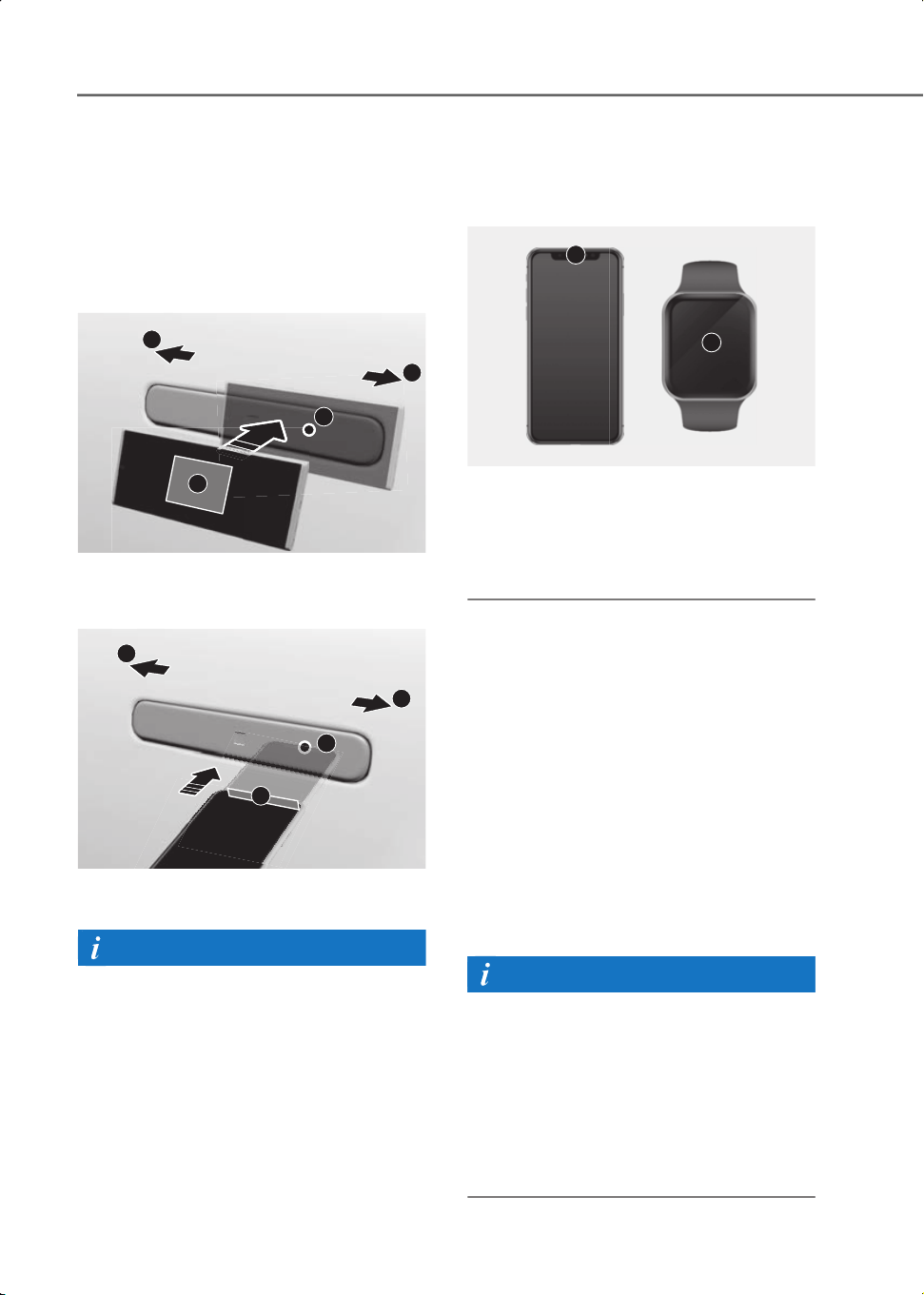
Convenience Features
5-14
Using the digital key (smartphone)
The driver can lock or unlock the door by
placing the smartphone on the outside
door handle, and the vehicle can be
started by placing the smartphone on the
vehicle authentication pad (wireless
charging pad).
Samsung smartphone
B5026404
[A] Door handle authentication pad
[B] NFC Antenna
Apple iPhone
B5026405
[A] Door handle authentication pad
[B] NFC Antenna
Information
• The location of the NFC Antenna on the
smartphone may vary by phone model,
so please contact the smartphone
manufacturer for details.
• The NFC Antenna position on Samsung
device can be found in the following
path: Setup > Connections > NFC and
contactless payments.
• The NFC Antenna position on Apple
iPhone is located at the top of the rear
(B) and Apple WATCH is located at the
center of the screen (C).
B5026403
• Touch the Door handle NFC Antenna
position with the back of your
smartphone. (In case of Apple WATCH,
need to touch the pad with WATCH
screen face).
Locking/Unlocking the doors
• If the driver places the digital key
(smartphone) NFC antenna to the
driver’s or passenger’s door handle
authentication pad (A) for more than 2
seconds, the door locks or unlocks.
• After unlocking the doors, the doors are
automatically re-lock after 30 seconds
unless a door is opened.
• If the smartphone digital key does not
operate, try again after moving the
smartphone away from the door handle
authentication pad (more than 0.1 m (4
in.)).
Information
You cannot lock your vehicle using the
digital key (smartphone) if any of the
following occurs:
• The smart key is in the vehicle.
• The Start/Stop button is in the ACC or
ON position.
• Any of the doors, hood, or trunk are
open.
A
B
C
D
A
C
D
B
A
B
CE_USA.book Page 14
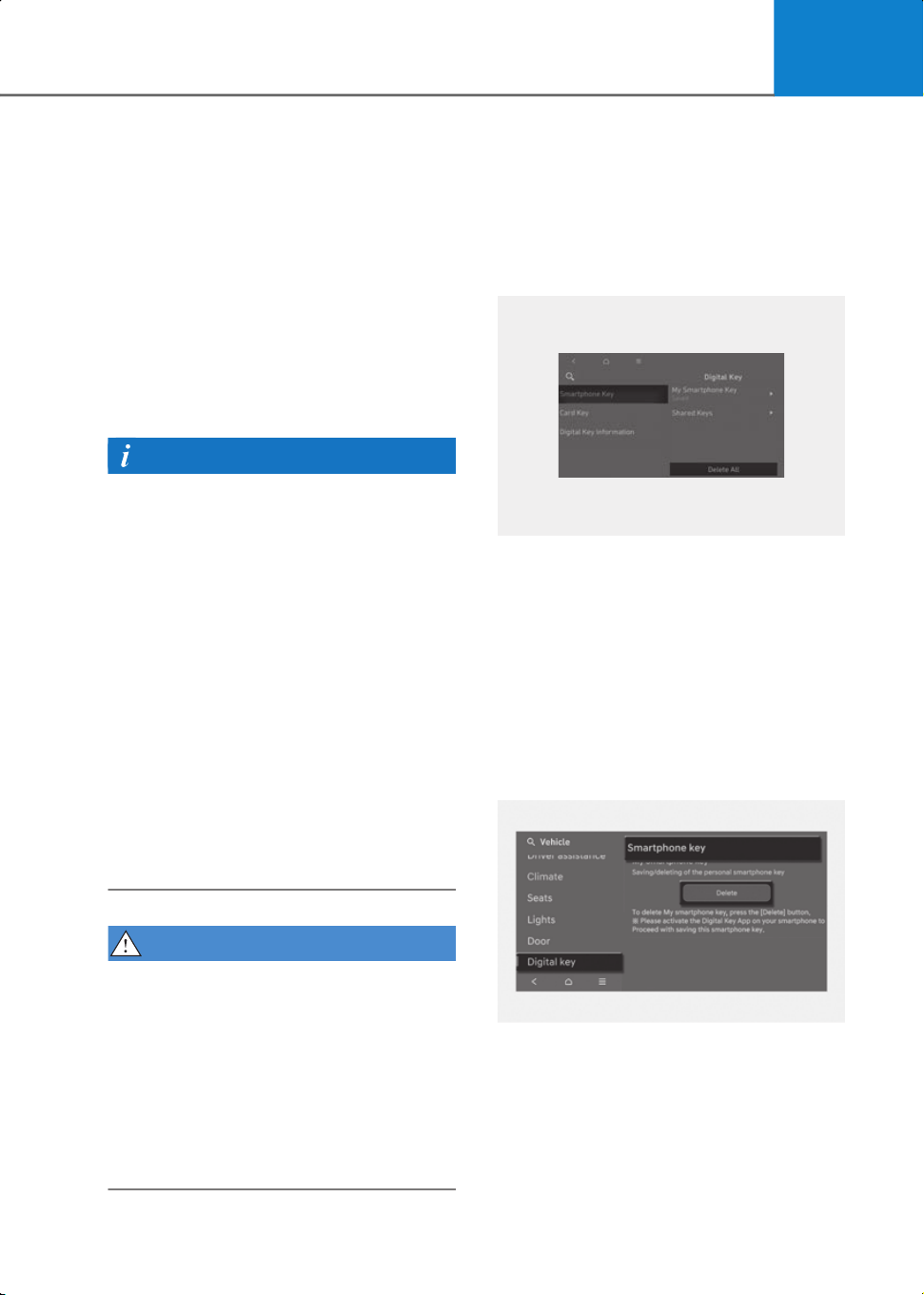
5
5-15
Starting the vehicle
After placing your registered digital key
(smartphone) on the vehicle
authentication pad (wireless charging
pad), depress the brake pedal and press
the Start/Stop button.
After starting the vehicle, the digital key
(smartphone) may be removed from the
vehicle authentication pad (wireless
charging pad).
For more details on the basic way to start
the vehicle, refer to the “Start/Stop
Button” section in chapter 6.
Information
If a shared digital key (smartphone) is
used for the first time, the activating time
may take longer.
• Place the shared digital key
(smartphone) on the door handle
authentication pad until the vehicle
door lock/unlock activates.
• If a shared digital key (smartphone) is
first used on the vehicle authentication
pad (wireless charger pad), the initial
start of the vehicle may fail.
• If the door lock/unlock is activated
once with the shared digital key
(smartphone) or the vehicle is started
with the digital key (smartphone) on the
vehicle authentication pad, the digital
key (smartphone) is registered in the
vehicle.
WARNING
The vehicle can be started when the
registered smartphone is placed on the
vehicle authentication pad (wireless
charging pad). Therefore, do not leave
unsupervised children or people who are
not aware of the system since it can result
in serious injury or death. In addition,
always have the registered smartphone
with you to prevent vehicle theft when
leaving the vehicle.
Deleting your digital key
(smartphone)
Turn on the vehicle with a smart key. Have
your smart key with you in the vehicle.
Deleting all registered digital key
(smartphone)
B0901EU05
To delete all the registered digital key
(smartphone), from the Settings menu
select Setup > Vehicle > Digital key >
Smartphone Key > Delete all in the
infotainment system.
• The "Delete all" button is disabled if
there is no registered digital key
(smartphone).
Deleting my registered digital key
(smartphone)
2C_AVNDeleteMySmartPhone
To delete only my registered digital key
(smartphone), from the Settings menu
select Setup > Vehicle > Digital key >
Smartphone Key > My Smartphone Key
> Deletein the infotainment system.
• If a shared digital key (smartphone) is
registered, it cannot be deleted.
CE_USA.book Page 15
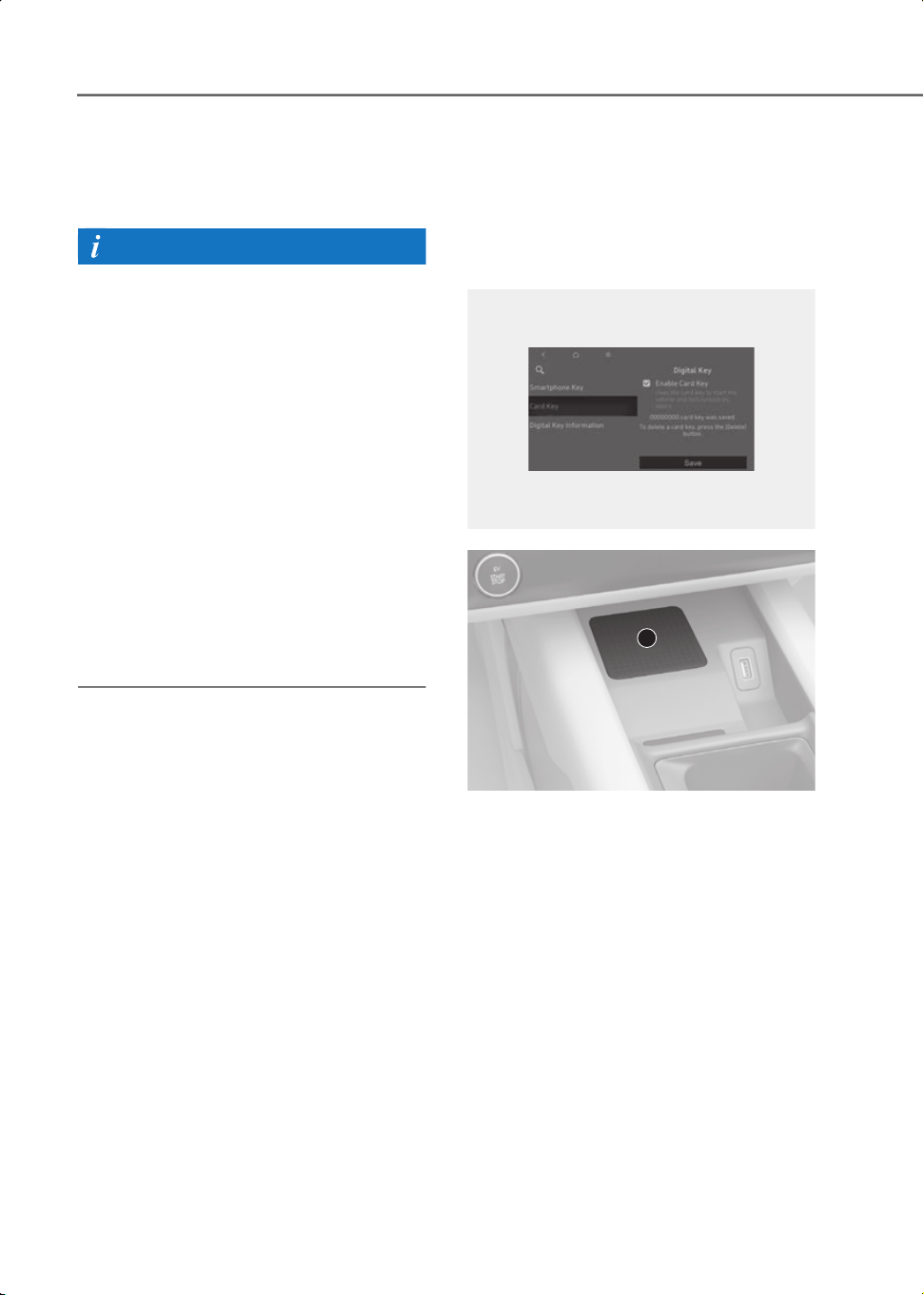
Convenience Features
5-16
• A new smartphone can be registered
after deleting the existing digital key
(smartphone) from "My Smartphone
Key" menu.
Information
• If the registered digital key
(smartphone) is deleted, the digital key
saved in the smartphone is also
deleted.
• If the digital key is deleted from the
smartphone, the digital key
(smartphone) registered in the vehicle
is also deleted.
• The shared digital key registered in the
vehicle cannot be deleted individually.
• Even though the BlueLink® App is
deleted from the smartphone, the
digital key saved in the smartphone is
not deleted.
• Management of the digital key saved in
the smartphone is available from the
Digital Key App provided by the
smartphone manufacturer.
Digital key (Card key)
How to register Digital key (Card
Key)
To use the card key as a digital key, follow
the following procedure.
B0902EU01
B5026502
[A] Vehicle authentication pad (Wireless charging
pad)
1. Have both of your smart keys with you
in the vehicle.
2. Select Setup > Vehicle > Digital Key >
Card Key from the Settings menu, and
check whether "Enabled card key" is
selected in the infotainment system.
3. Place your card key on the vehicle
authentication pad (wireless charging
pad) while the engine is on.
4. Register your card key by selecting
Setup > Vehicle > Digital Key > Card
Key > Save from the Settings menu in
the infotainment system.
A
CE_USA.book Page 16
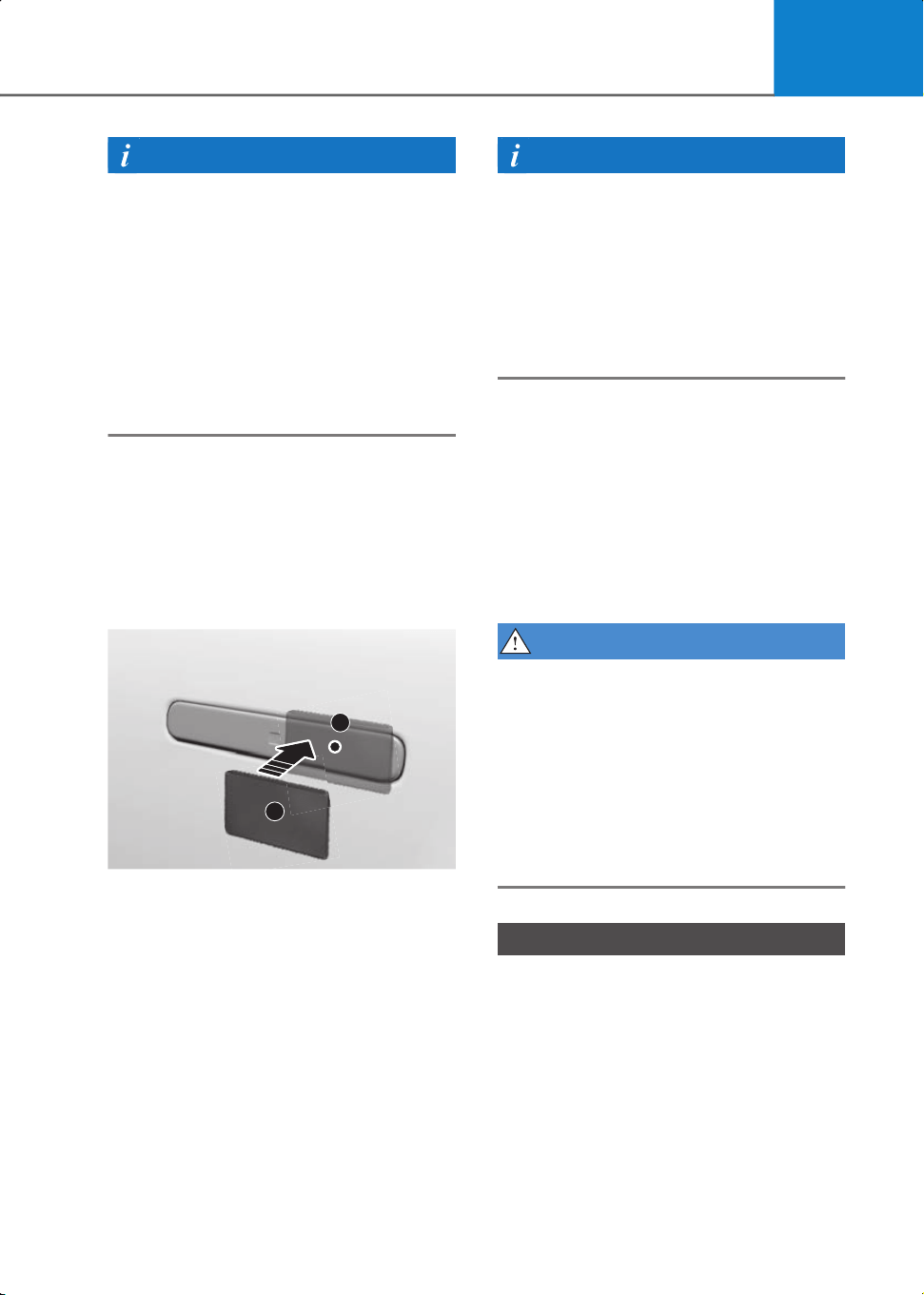
5
5-17
Information
• When there is a digital key (card key)
already registered in the vehicle, a new
digital key (card key) cannot be
registered. Re-register a new digital key
(card key) after deleting the exiting
digital key (card key).
• To register a digital key (card key), both
of your smart keys must be in the
vehicle.
• A registered digital key (card key)
cannot be registered in other vehicles.
Using the digital key (card key)
The driver can lock or unlock the door by
placing the card key on the outside door
handle, and the vehicle can be started by
placing the card key on the vehicle
authentication pad (wireless charging
pad).
B5026503
[A] Door handle authentication pad
[B] Card key NFC Antenna
• Locking/Unlocking the doors
- If the driver places the digital key
(card key) to the driver’s or
passenger’s door handle
authentication pad (A) for more than
2 seconds, the door locks or unlocks.
- After unlocking the doors, the doors
are automatically re-lock after 30
seconds unless a door is opened.
Information
You cannot lock your vehicle using the
digital key (card key) if any of the
following occurs:
• The smart key is in the vehicle.
• The Start/Stop button is in the ACC or
ON position.
• Any of the doors, hood, or trunk are
open.
• Starting the vehicle
After placing your registered digital key
(card key) on the vehicle authentication
pad (wireless charging pad), depress
the brake pedal and press the
Start/Stop button.
For more details on the basic way to
start the vehicle, refer to "Start/Stop
Button" section in chapter 6.
WARNING
The vehicle can be started when the
registered card key is placed on the
vehicle authentication pad (wireless
charging pad). Therefore, do not leave
unsupervised children or people who are
not aware of the system since it can result
in serious injury or death. In addition,
always have the registered card key with
you to prevent vehicle theft when leaving
the vehicle.
NOTICE
• The digital key (card key) may not work
under the following conditions:
- The digital key (card key) is not
placed on the door handle
authentication pad or vehicle
authentication pad (wireless
charging pad) correctly.
A
B
CE_USA.book Page 17

Convenience Features
5-18
- The digital key (card key) is near
NFC-enabled cards such as credit
cards or smartphones.
If the digital key (card key) does not
work, try again after moving the
digital key (card key) away from the
door handle authentication pad
(more than (0.1 m (4 in.)).
• The digital key (card key) can be
damaged by impacts. If the digital key
(card key) is damaged, replace the
digital key (card key) with a new one
and register it again.
• Long-time exposure to high
temperature may cause the digital key
(card key) to malfunction. Be careful
not to expose the digital key (card key)
to direct sunlight or high temperature.
• Leaving the digital key (card key) on the
in-vehicle authentication pad (wireless
charging pad) while driving may cause
the digital key (card key) to
malfunction. Remove the digital key
(card key) from the in-vehicle
authentication pad (wireless charging
pad) after starting the vehicle.
• Remove the digital key (card key) from
the smartphone before charging the
smartphone. If the digital key (card key)
is placed between the smartphone and
the in-vehicle authentication pad
(wireless charging pad) while the
smartphone is being charged, the
digital key (card key) may malfunction.
For example, when charging
smartphone while the digital key (card
key) is attached to the back of the
smartphone case.
Deleting your digital key (card key)
B0902EU03
1. Turn on the vehicle with a smart key.
Have your smart key with you in the
vehicle.
2. From the infotainment system Settings
menu, select Setup > Vehicle > Digital
Key > Card Key > Delete.
• The "Delete" button is disabled if
there is no digital key (card key)
registered.
Personalized profile and vehicle
settings
You can set the registered digital key
(smartphone) profiles for Driver 1 and
Driver 2. When you use the digital key
(smartphone), the vehicle can be set to
the user-defined personalized profile
(includes items such as vehicle settings
and audio preferences).
Linking/Unlinking profile
How to link user profile
1. Select Setup > User Profile > Profile
Settings > Link Digital Key
(Smartphone) from the Settings menu
in the infotainment system.
2. Select "Link" to connect the registered
smartphone’s digital key and the user’s
profile.
3. Follow the instructions according to the
message on the infotainment system
screen.
CE_USA.book Page 18
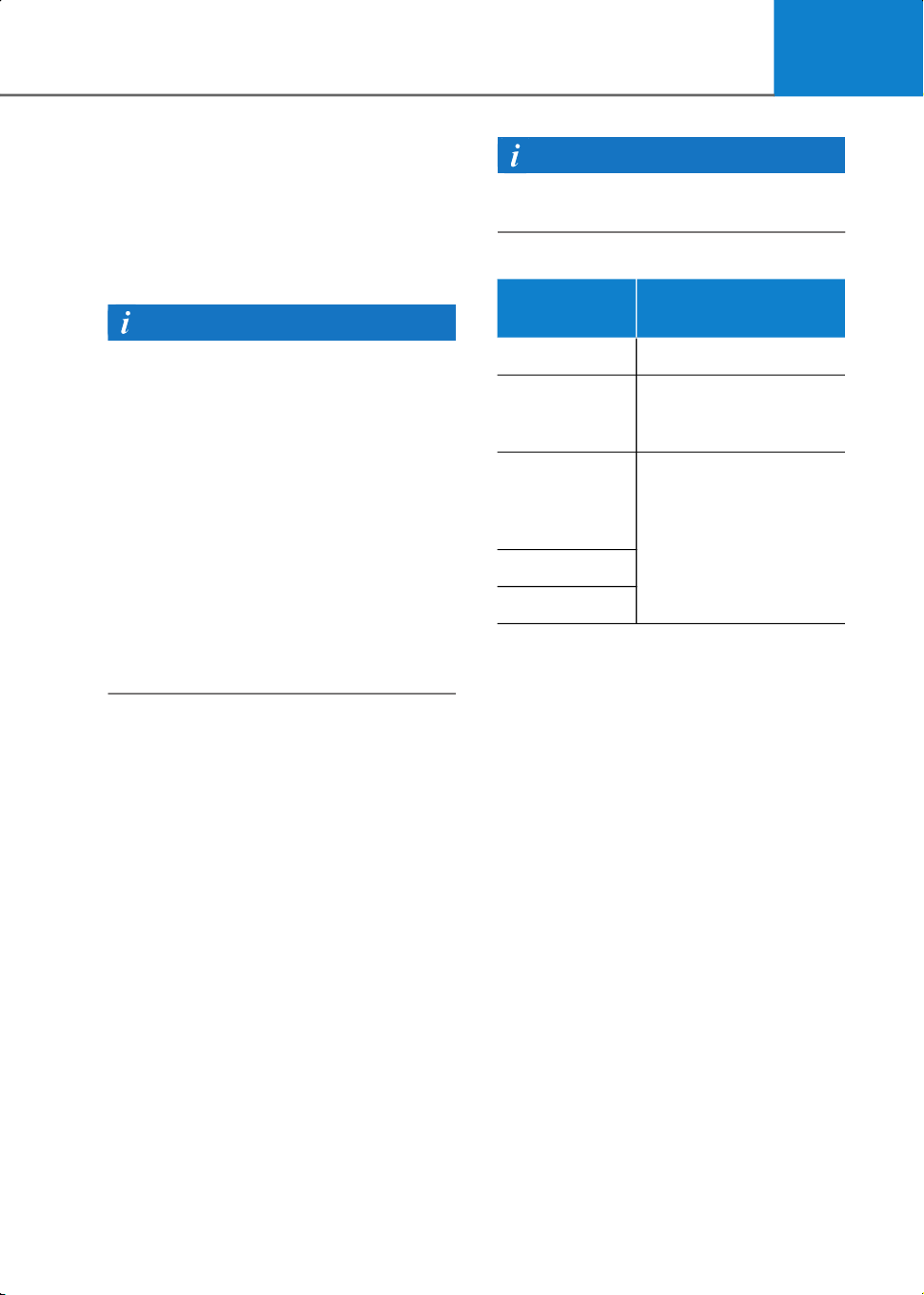
5
5-19
How to unlink user profile
Select Setup > User Profile > Profile
Settings, and then deselect "Link Digital
Key (Smartphone)" from Settings menu
in the infotainment system.
• Unlinking is possible only when user
profile is linked.
Information
• User profile cannot be linked to both
Driver 1 and Driver 2 that are connected
to single smartphone. Personalization
operates with the recently linked user
profile, and the previously linked user
profile will be automatically canceled.
• User profile link works only when the
digital key is registered to the vehicle.
• Digital key (card key) cannot be linked
with a user profile.
• If the user profile linked digital key in
the smartphone is deleted, the digital
key should be re-registered and
personalized by linking the user profile
again.
Vehicle personalization operation
• The personalization function linked
with digital key works when the profile
linked smartphone is placed on the
outside door handle authentication pad
to lock or unlock the doors.
• The profile set by the digital key can be
changed manually from the
infotainment system.
• The personalization function using the
digital key can be operated after linking
the digital key in the infotainment
system profile menu.
• The personalization function works only
when the vehicle is OFF or when the
vehicle is started remotely. If the
vehicle is not started remotely, the
personalization function does not work
with the digital key.
Information
User profile operation according to door
lock/unlock system is as follows:
Item
Personalization
Operation
Initial value Guest
Profile linked
smartphone
key
Linked profile
Profile
unlinked
smartphone
key
Recently activated
profile
NFC card key
Smart key
CE_USA.book Page 19
Convenience Features
5-20
Vehicle personalization with digital key
The available personalization function in the vehicle is as follows:
CAUTION
If you leave the digital key after locking or unlocking the doors or starting up the vehicle
with the smart key, the doors can be locked by the central door lock. Please carry around
the digital key all the time.
Information
The infotainment system may change after software updates. For more information,
refer to the user's manual provided in the infotainment system and the quick reference
guide.
System Personalization Item
Infotainment
system vehicle
settings
Lamp Blink number of one-touch signal lamps
Cluster
Information display on the cluster, Voice volume,
Welcome sound
Seat/Mirror
Seat position, Rearview mirror position, Easy Access
Intelligent driving posture assist (IMS)
Door Automatic door lock/unlock
Infotainment
system
Navigation
Preferred volume of the navigation system, Recent
destination
User preset My menu list settings, Radio preset
Phone
connectivity
Bluetooth preferential connect
CarPlay/Android Auto On/Off
Air conditioning
Operating
condition
Latest operation setup of the following functions:
Temperature, AUTO, air flow direction, air volume, air
conditioner, air intake control, SYNC, Front
windshield defroster, OFF
CE_USA.book Page 20

5
5-21
Used vehicle/Digital key
maintenance
Purchasing used vehicle
If any of the digital key devices
(smartphone key, card key) are registered
in the vehicle, the "Digital key registered"
message appears once on the
infotainment system screen or
instrument cluster when the Start/Stop
button is in the ON position after
unlocking the doors. When purchasing a
used vehicle, make sure to check the
message and delete the smartphone key
and card key registered by the previous
user and inform the purchase of a used
vehicle through Hyundai Customer Care
Center.
If the card key comes with the vehicle,
check whether it operates properly.
Digital Key maintenance
If you need to repaired or replaced your
Digital Key system, make sure your
smartphone key is still active. You may
have to pair your phone again using the
HYUNDAI Digital Key app.
Limitations of the System
HYUNDAI Digital Key app on the
smartphone and card key may not work if:
• HYUNDAI Digital Key app is deleted.
• Account login information for HYUNDAI
Digital Key app has expired.
• Logged in with another smartphone
instead of the registered smartphone
with the same user account.
• Smartphone rooting or app hacking is
detected.
• Smartphone battery or the vehicle
battery is discharged.
• Smartphone screen is off or locked.
• NFC or Bluetooth is turned off on the
smartphone Setup.
• Smartphone’s mobile network setting is
off or airplane mode is activated.
• The card key is in a wallet or card
holder, or overlapped with other cards.
• If you use a smartphone cover that uses
wireless communication or is made of
metal, remove the smartphone cover.
The vehicle may not be controlled by the
smartphone if any of the following
occurs:
• Other smartphone functions
(calls,urgent call, audio or NFC
payment), apps, or wireless earphones
are operating.
• The digital key app function such as
basic setting or app launching is limited
by the prior policy according to the
manufacturer.
• If you have changed the smartphone
number, modify the user account
information on the HYUNDAI customer
web site.
• If the vehicle owner has changed the
smartphone, register the new
smartphone in the vehicle after
deleting the registered digital key
(smartphone).
• If a sharer have changed or reset the
smartphone, share the key again.
CE_USA.book Page 21
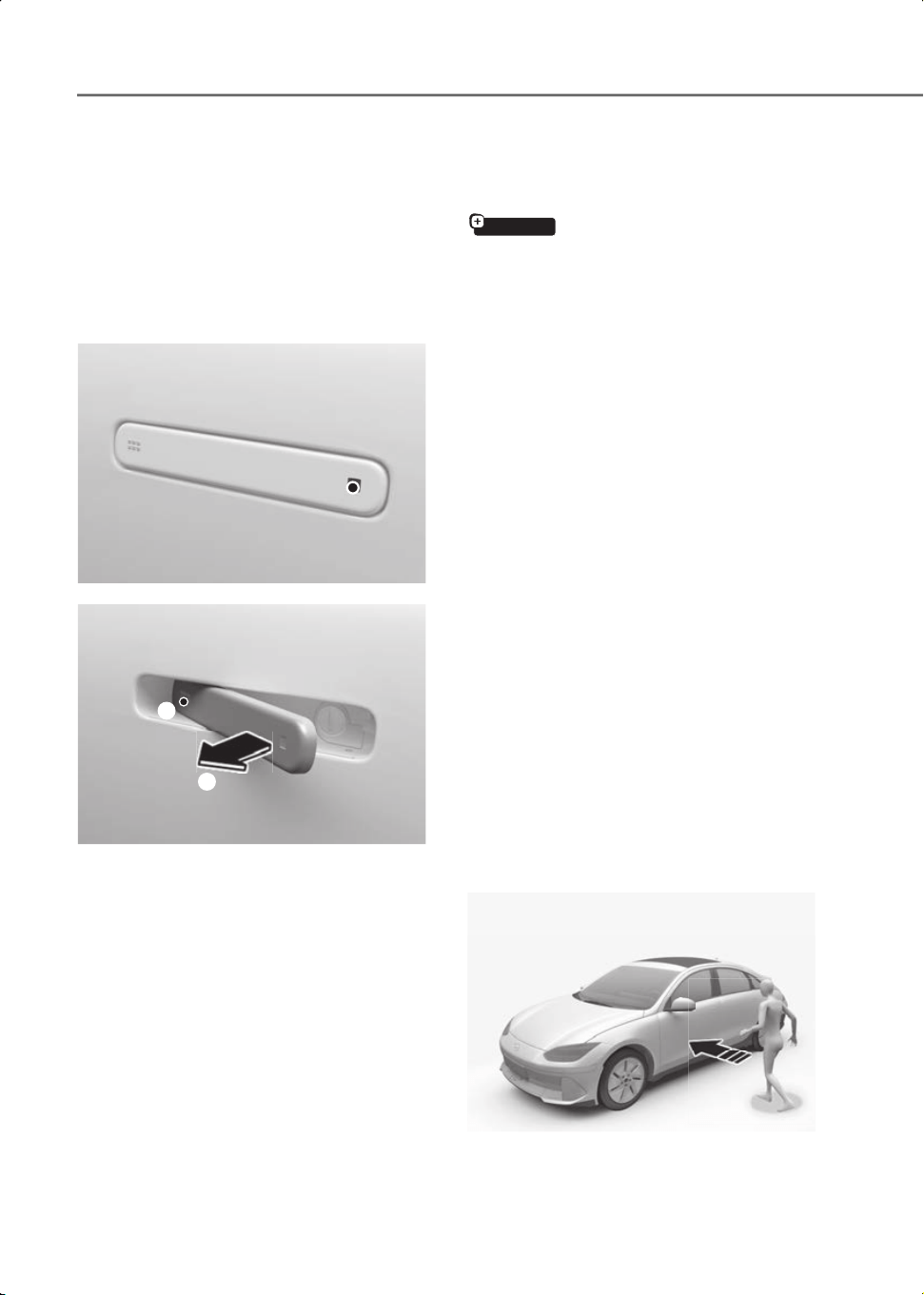
Convenience Features
5-22
Door Locks
Operating Door Unlocks from
Outside the Vehicle (Manual
type)
Smart key
B5002803
B5002802
Push the button on the front outside door
handle (the engraved part) while carrying
the smart key with you, all doors will
unlock.
The hazard warning lights will blink twice
and chime also sounds twice.
Once the doors are unlocked, when press
the front of the door handle (1) then rear
of the door handle will pop out (2).
Pull the outside door handle to open the
door.
Operating Door Unlocks from
Outside the Vehicle (Electric
if equipped
type)
Smart key
Approach unlock system
The outside door handle will slide out and
the doors will unlock when the driver
approaches the vehicle possessing the
smart key.
The driver can activate/deactivate the
“Approach unlock” system on the
infotainment system.
To activate Approach unlock system for
only the driver’s seat, select Settings >
Vehicle > Door > Unlock all doors in the
infotainment system.
To activate Approach unlock system,
select Settings > Vehicle > Door >
Activate approach unlock in the
infotainment system. The outside door
handle will slide out and the door will
unlock when the driver approaches the
vehicle possessing the smart key. If
Approaching unlock system is
deactivated, the door handle will not slide
out even when the driver approaches to
the vehicle with the smart key. To unlock
doors when Approach unlock system is
deactivated, touch the lock/unlock
sensor(engraved part) on the handle.
B5002801
1
2
CE_USA.book Page 22
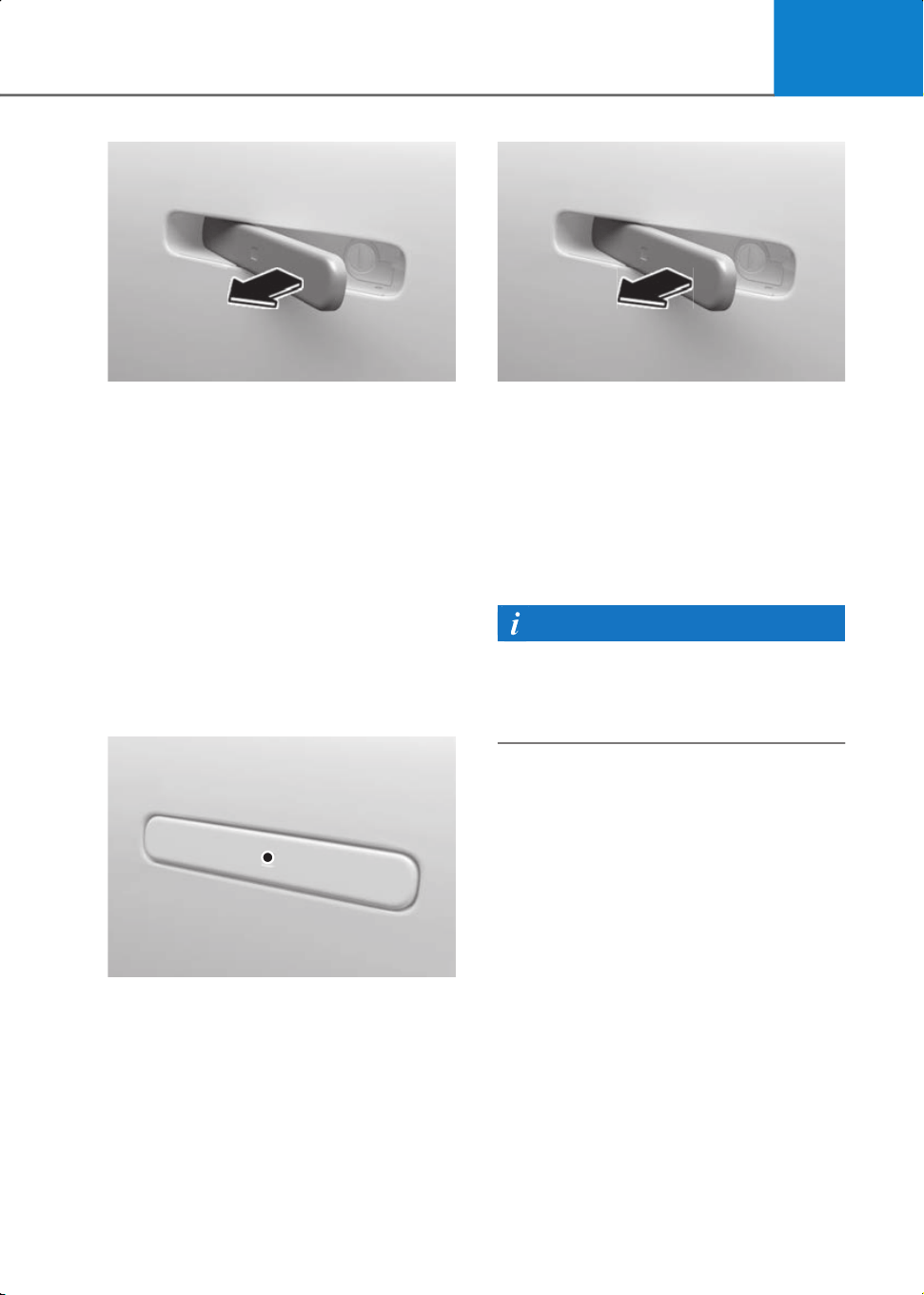
5
5-23
B5002802_1
• When the 'Approach unlock' is
activated:
- If you approach (within 40 in. (1 m))
the driver or front passenger’s door
handle possessing the smart key, the
outside door handles slide out and
the doors are unlocked. In this case,
Hazard Warning Flasher blinks twice
and chime also sounds twice.
- After first approach, the vehicle tries
detecting the smart key every 5
seconds and if the key is not
detected, the doors will lock
automatically and the handles will
slide in.
B5002804
B5002802_2
• When the 'Approach unlock' is
deactivated: The handle does not slide
out even when you approach with the
smart key in possession. The doors are
unlocked if you press the outside
handle as the handles slide out.
• The doors will lock automatically and
the handles will slide in after 30
seconds unless a door is opened.
Information
In emergency situations, such as battery
is dead, the outside electric door handle
can still be operated in a way that the
outside manual door handle operate.
CE_USA.book Page 23
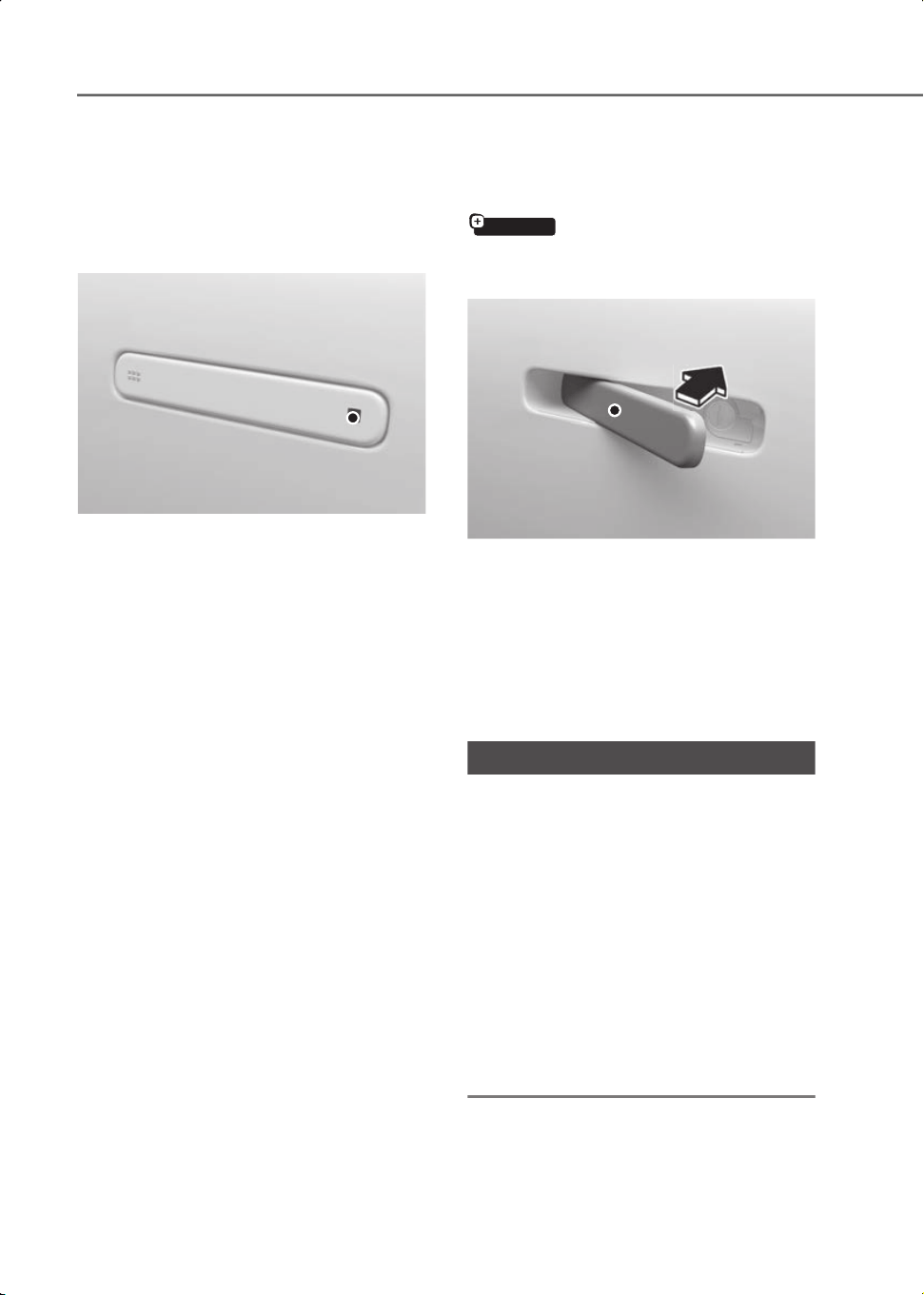
Convenience Features
5-24
Operating Door Locks from
Outside the Vehicle (Manual
type)
Smart key
B5000204
Push the button on the front outside door
handle (the engraved part) while carrying
the smart key with you, all doors will lock.
The hazard warning lights will blink and
chime also sounds once.
Push the door to close.
Operating Door Locks from
Outside the Vehicle (Electric
if equipped
type)
Smart key
ONE1051013
When all doors are closed, touch the
touch sensor on the front outside door
handle (the engraved part) while carrying
the smart key with you, outside door
handle will return and doors will be
locked.
The hazard warning lights will blink and
chime also sounds once.
NOTICE
• If the door is locked/unlocked multiple
times in rapid succession with the
smart key, door lock button or door lock
switch, the system may stop operating
temporarily in order to protect the
circuit. Also, the “Approach unlock”
system may not operate. Try operation
after a sufficient time in case the
system does not operate due to
multiple operations.
• “Approach unlock” system is not
operated continuously. Retry after a
certain period of time when all the
doors are closed.
CE_USA.book Page 24
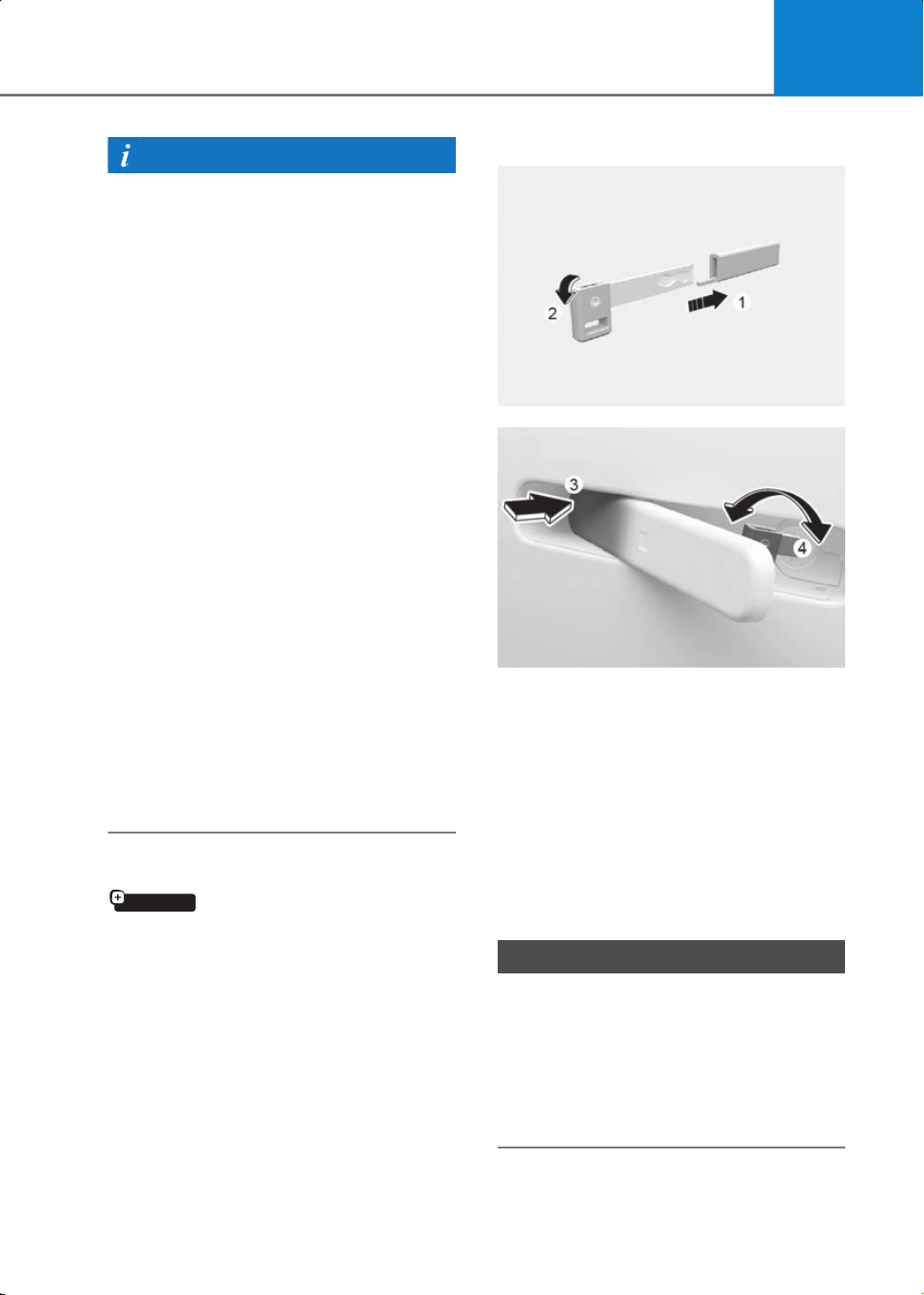
5
5-25
Information
• In cold and wet climates, door lock and
door mechanisms may not work
properly due to freezing conditions.
• If the door is locked/unlocked multiple
times in rapid succession with either
the vehicle key or door lock switch, the
system may stop operating temporarily
in order to protect the circuit and
prevent damage to system
components.
• When washing the vehicle
- Self vehicle wash
Keep the door locked with the
outside door handle closed.
To keep the door unlocked, push
back the outside door handle by
hand. This function prevents the door
handle from being damaged, and the
door handle pops out again when the
unlock button is pressed.
- Auto vehicle wash
Keep the door locked with the
outside door handle closed.
If the smart key is not in the vehicle,
turn off the vehicle and stay the smart
key away at least 78 in. (2 m) from the
vehicle to prevent the outside door
handle operates.
if equipped
Digital key
For more information, refer to the
"Hyundai Digital Key" section in this
chapter to lock or unlock the door from
outside vehicle with digital key.
Pull the outside door handle to open the
door after unlocking the door. Push the
door to close.
Mechanical key
B5002903
B5002904
Turn the knob (2) of the mechanical key
after removing the key protector (1).
Press the front part (3) of the door handle
to pull out the rear part of the door
handle. While keep pressing the front part
of the door handle, insert the mechanical
key (4) to the lock.
To lock the door, turn the key toward the
front (left side) of the vehicle. To unlock,
turn the key toward the rear (right side) of
the vehicle.
NOTICE
Do not apply excessive force on the door
and door handle. It may damage the door
and door handle.
The mechanical key only locks/unlocks
the driver’s door handle. For more
information, refer to the "In case of an
emergency" section in this chapter.
CE_USA.book Page 25
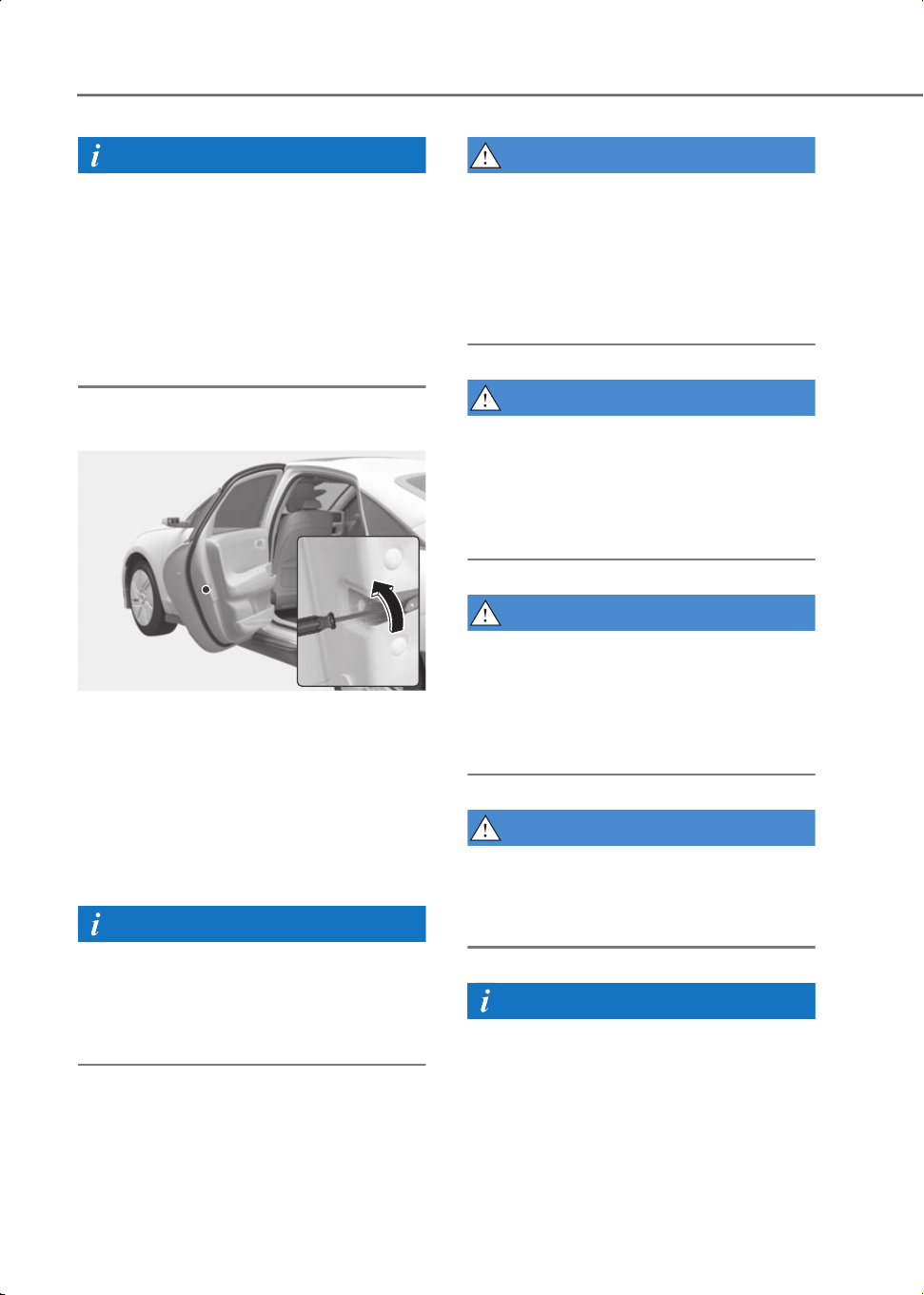
Convenience Features
5-26
Information
When the door handle or the keyhole
freeze and do not open, lightly tap or
indirectly warm (for example, hand
temperature) the keyhole.
Since the smart key and the mechanical
key are separated, always carry the
mechanical key in case the vehicle
battery and the smart key battery are
discharged.
In case of an emergency
B5003103
Doors without an outside key hole can be
locked as follows:
1. Open the door.
2. The using a small flat blade tool (like a
screwdriver or similar), insert into the
emergency door lock hole and turn to
the lock position.
3. Close the door securely.
Information
If the electrical power to door lock switch
is not operating (for example, discharged
vehicle battery) and the trunk is closed,
you cannot open the trunk until power is
restored.
WARNING
• Always close and lock the doors while
the vehicle is moving. If the doors are
unlocked, the risk of being thrown from
the vehicle in a collision increases.
• Do not pull the inner door handle of the
driver’s or passenger’s door while the
vehicle is moving.
WARNING
Do not leave the elderly, children, or
animals unattended in your vehicle. An
enclosed vehicle can become extremely
hot and the elderly, unattended children
or animals who cannot escape the vehicle
may be seriously injured or killed.
WARNING
Always park your vehicle properly.
Depress the brake pedal, change the gear
to P (Park), apply the parking brake, press
the Start/Stop button to the OFF position,
close all windows, lock all doors, and
always take the keys with you.
WARNING
Be careful when opening doors and
watch for vehicles, motorcycles, bicycles,
or pedestrians approaching the vehicle to
prevent serious injury or death.
Information
To exit the vehicle if the power door lock
does not function:
• Operate the door unlock feature
repeatedly (both electronic and
manual) while simultaneously pulling
on the door handle.
CE_USA.book Page 26
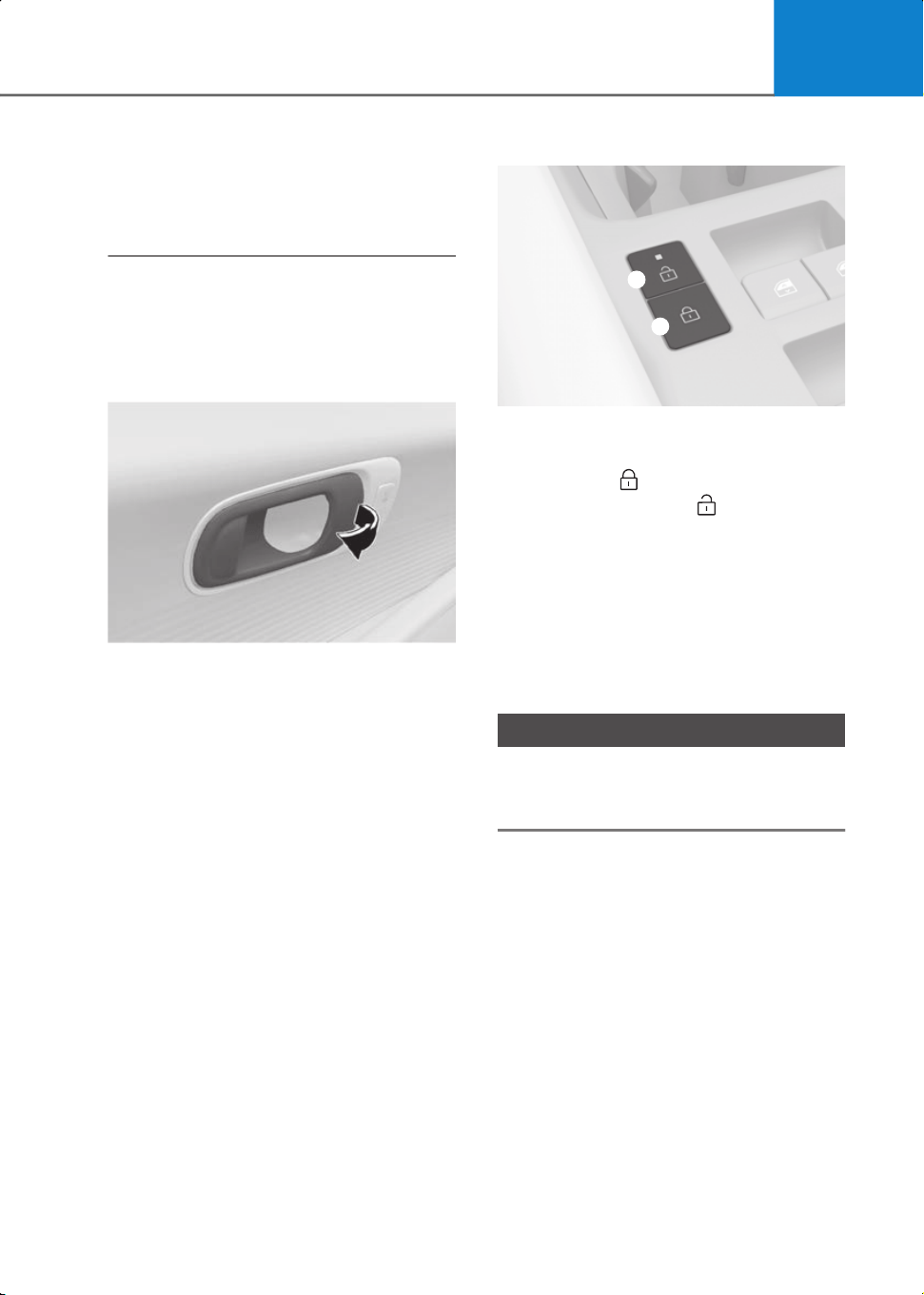
5
5-27
• Operate the other door locks and
handles.
• Lower the driver’s front window and
use the mechanical key to unlock the
door from outside.
Operating Door Lock/Unlock
from Inside the Vehicle
With the inside door handle
B5003101
Front door
If the inner door handle is pulled when the
door is locked, the door is unlocked and
opened.
Rear door - Two pull operation
If the inner door handle is pulled once
when the door is locked, the door is
unlocked. If the inner door handle is
pulled once more, the door is opened.
With the central door lock switch
B5003102
The central door lock switch is located on
the center console. The lock switch is
indicated by a symbol. The unlock
switch is indicated by a symbol.
When the lock switch (1) is pressed, all the
vehicle doors will lock.
When the unlock switch (2) is pressed
(door indicator light ON), all the vehicle
doors will unlock.
If any door is opened, the doors will not
lock even though the central door lock
button (1) is pressed.
NOTICE
If the smart key is in the vehicle and the
front door is opened, the central door lock
button (1) cannot lock the doors.
Automatic Door Lock and
Unlock Features
Your vehicle is equipped with features
that will automatically lock or unlock your
vehicle based on settings you select in the
infotainment system.
Auto Lock Enable on speed
When this feature is set in the
infotainment system, all the doors will be
locked automatically when the vehicle
exceeds 9 mph (15 km/h).
1
2
CE_USA.book Page 27
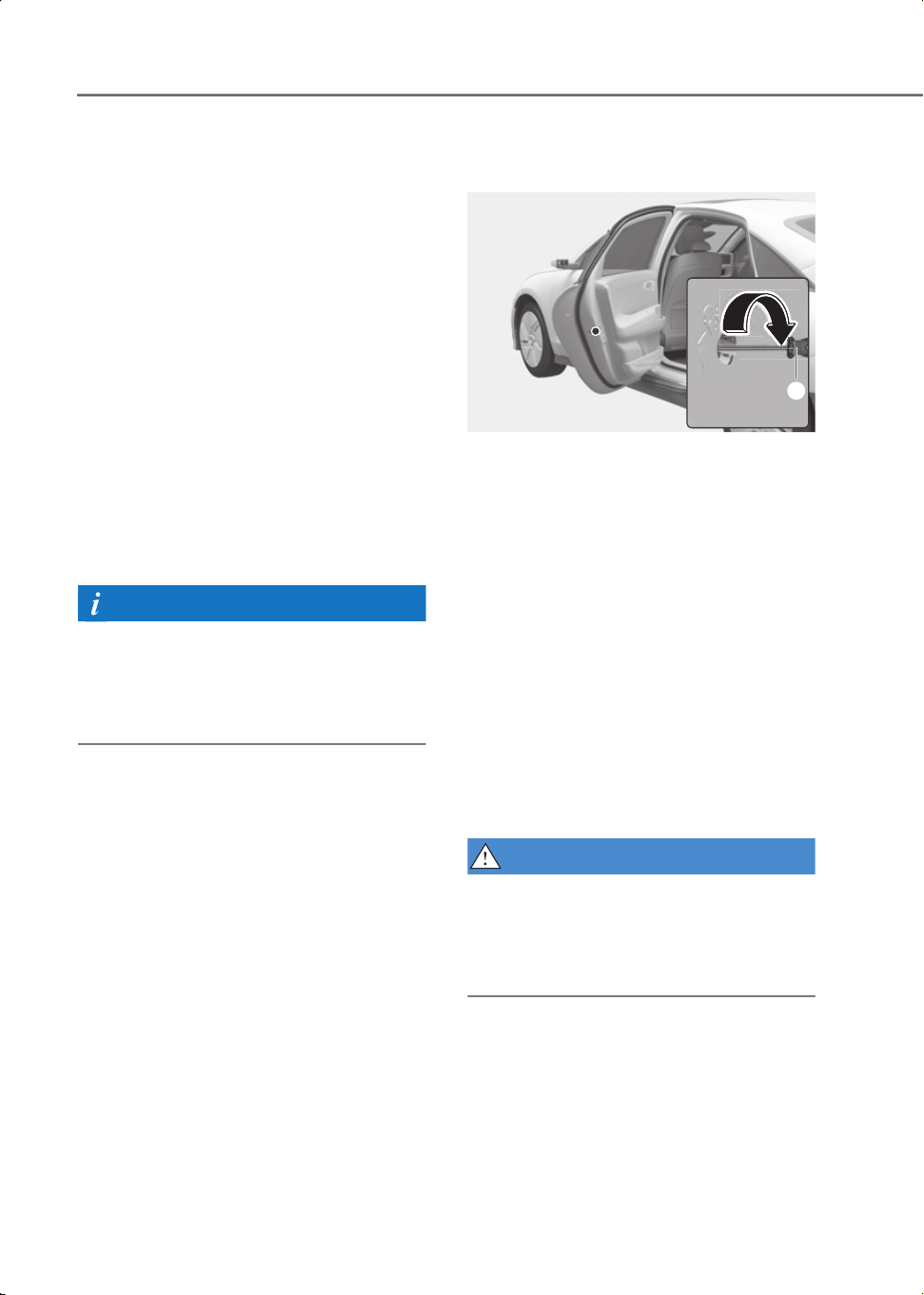
Convenience Features
5-28
Auto Lock Enable on shift
When this feature is set in the
infotainment system, all the doors will be
locked automatically when the vehicle is
shifted out of P (Park) while the vehicle is
running.
Auto Unlock Enable on shift to P
When this feature is set in the
infotainment system, all the doors will be
unlocked automatically when the vehicle
is shifted back into P (Park) while the
vehicle is running.
Auto Unlock Enable at Vehicle Off
When this feature is set in the
infotainment system, all the doors will be
unlocked automatically when the vehicle
is turned off.
Information
The infotainment system may change
after software updates. For more
information, refer to the user's manual
provided in the infotainment system and
the quick reference guide.
Additional unlock safety feature
airbag deployment
As an additional safety feature, all doors
will be automatically unlocked when an
impact causes the airbags to deploy.
Child-Protector Rear Door
Locks
B5003601
The child safety lock is provided to help
prevent children seated in the rear from
accidentally opening the rear doors. The
rear door safety locks should be used
whenever children are in the vehicle.
The child safety lock is located on the
edge of each rear door. When the child
safety lock is in the lock position, the rear
door will not open if the inner door handle
is pulled.
To lock the child safety lock, insert a small
flat blade tool (like a screwdriver or
similar) (1) into the slot and turn it to the
lock position as shown.
To allow a rear door to be opened from
inside the vehicle, unlock the child safety
lock.
WARNING
Never allow children to open the rear
doors while the vehicle is moving. They
may fall out of the vehicle. Be sure to use
the rear door safety locks whenever
children are in the vehicle.
1
CE_USA.book Page 28

5
5-29
Theft-Alarm System
This system helps to protect your vehicle
and valuables. The horn will sound and
the hazard warning lights will blink
continuously if any of the following occur:
• A door is opened without using the
smart key.
• The trunk is opened without using the
smart key.
• The vehicle hood is opened.
The alarm continues for 30 seconds, then
the system resets. To turn off the alarm,
unlock the doors with the smart key.
The Theft Alarm System automatically
sets 30 seconds after you lock the doors
and the trunk. For the system to activate,
you must lock the doors and the trunk
from outside the vehicle with the smart
key or by touching the touch sensor or
pressing the button on the outside door
handle with the smart key in your
possession.
The hazard warning lights will blink and
the chime will sound once to indicate the
system is armed.
Once the security system is set, opening
any door, the trunk, or the hood without
using the smart key will cause the alarm
to activate.
The Theft Alarm System will not set if the
hood, the trunk, or any door is not fully
closed. If the system will not set, check
the hood, the trunk, or the doors are fully
closed.
Do not attempt to alter this system or add
other devices to it.
Information
• Do not lock the doors until all
passengers have left the vehicle. If the
remaining passenger leaves the vehicle
when the system is armed, the alarm
will be activated.
• If the vehicle is not disarmed with the
smart key, open the doors by using the
mechanical key and start the vehicle by
directly pressing the Start/Stop button
with the smart key.
• If the system is disarmed by unlocking
the vehicle, but neither a door or the
trunk is opened within 30 seconds, the
doors will relock and the system will
rearm automatically.
CE_USA.book Page 29
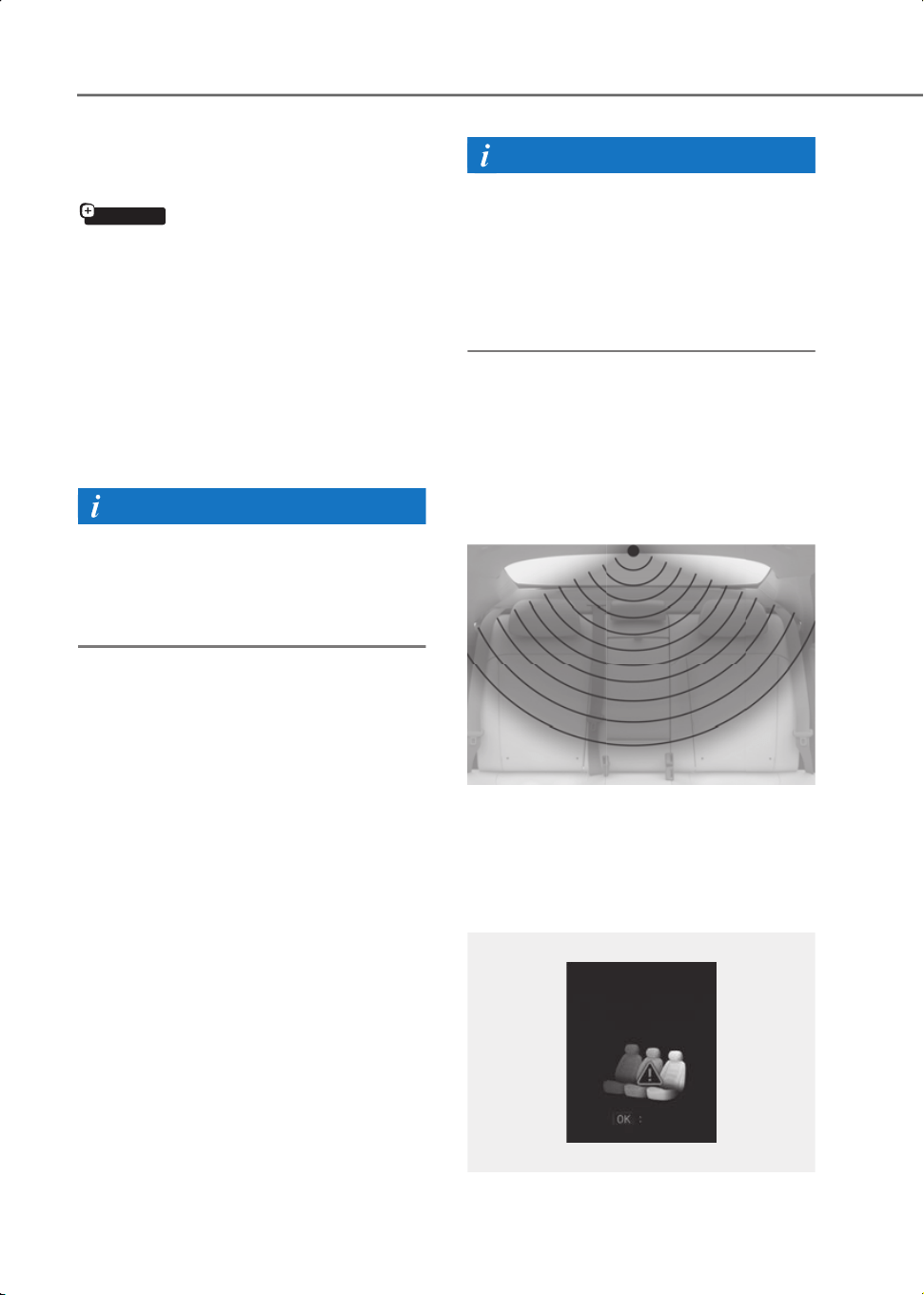
Convenience Features
5-30
Rear Occupant Alert
if equipped
(ROA)
Rear Occupant Alert is provided to
prevent a driver from leaving a vehicle
with the rear passenger left in the vehicle.
System Setting
To use Rear Occupant Alert, it can be
enabled from the Settings menu in the
infotainment system.
Select Setup > Vehicle > Convenience >
Rear Occupant Alert.
Information
The infotainment system may change
after software updates. For more
information, refer to the user’s manual
provided in the infotainment system and
the quick reference guide.
System Operation
• First alert
When you turn off the vehicle and open
the driver’s door after opening and
closing the rear door or trunk, the
"Check rear seats for passengers and
belongings" warning message appears
on the instrument cluster.
• Second alert (if the sensor equipped)
After the first alert, the second alert
operates when any movement is
detected in the vehicle after the driver’s
door is closed and all the doors are
locked. The horn sounds about 25
seconds. If the system continues to
detect a movement, the alert operates
up to 8 times.
Unlock the doors with the smart key to
stop the alert.
• The system detects movement in the
vehicle for 10 minutes after the door is
locked.
Information
• The second alert is activated only after
the prior activation of the first alert.
• Rear Occupant Alert also activates
when movement is detected in the
cargo area.
• The second alert activates only when
the sensor is equipped in the vehicle.
System precautions
• Make sure that all the windows are
closed. If the window is open, the alert
may occur when the sensor has
detected any movement (for example,
wind or bugs).
Sensor
B5003803
• If you do not want to use Rear
Occupant Alert, press the 'OK' switch
on the steering wheel when the first
alert appears and the second alert is
deactivated once.
Instrument cluster
OJX1059019L
$IFDLSFBSTFBUT
GPSQBTTFOHFST
PSCFMPOHJOHT
"MBSN0GG
CE_USA.book Page 30
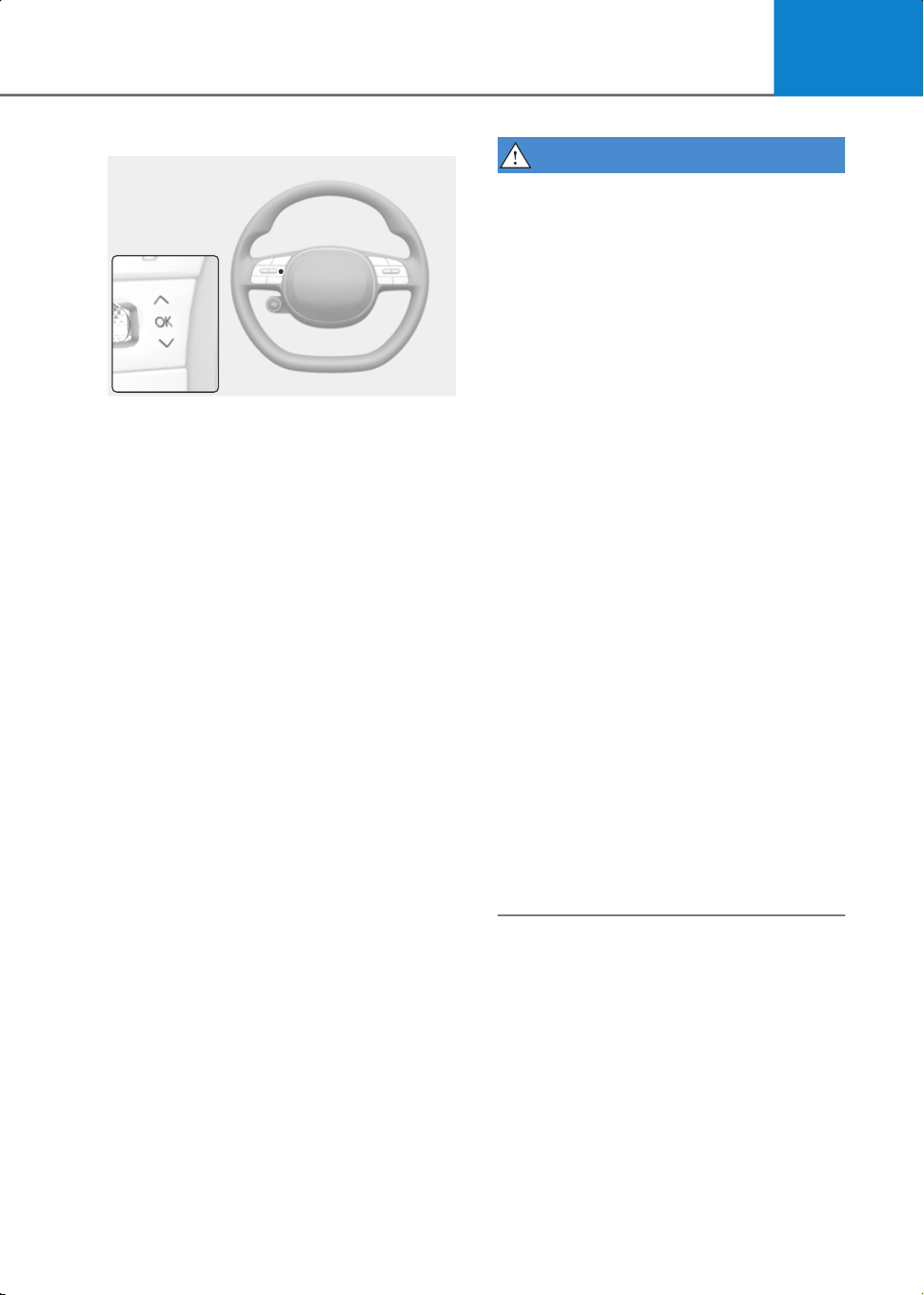
5
5-31
Steering wheel
B5003802
• If the vehicle is started remotely (if
equipped with Remote Start), inside
movement detection stops.
• The alert may occur if any movement is
detected in the driver's or passenger's
seat.
• If all doors are locked with a passenger
in the vehicle, the alert may occur.
• The alert may occur if there is an impact
on the vehicle.
• If boxes or objects are stacked in the
vehicle, the system may not detect
passengers. The alert may occur if the
boxes or objects fall off or move
• The alert may occur with the doors
locked if the vehicle is pushed or
shaken, or washed, or if there is
sufficient external vibration or noise.
• The alert may occur when there are
metallic or liquid objects in the vehicle.
WARNING
Even if your vehicle is equipped with Rear
Occupant Alert (ROA), always check the
rear seat before you leave the vehicle.
Rear Occupant Alert (ROA) may not
operate when:
• Movement does not continue for a
certain period of time or the movement
is small.
• The detection signal is weak because
the signal is obscured by seat or CRS
(for example, child is restrained in the
forward-facing CRS).
• A child is not seated in a child restraint
system.
• Movement is detected in areas other
than the rear seats.
• The rear passenger is covered with a
fabric made of metallic substance such
as a blanket.
• The sensor is dirty or blocked with
foreign substances.
• An animal at the rear seat is not large
enough to be detected by the sensor or
there is hardly any movement.
• Attaching objects or modifying the
interior ceiling, or the interior ceiling is
deformed or damaged.
• There are electronic interference
around the vehicle.
• The external environment and other
conditions are detected.
CE_USA.book Page 31
Convenience Features
5-32
Declaration of Conformity
The radio frequency components (ROA
Radar Sensor) complies:
• For USA
OANATEL323
• For Canada
OANATEL324
Integrated Memory
if equipped
System
B5005201
Integrated Memory System for the
driver’s seat is provided to store and recall
the following memory settings with a
simple button operation.
• Driver’s seat position
• Side view mirror position
• Head-up display position
WARNING
Never attempt to operate the integrated
memory system while the vehicle is
moving.
Information
• If the battery is disconnected, the
memory settings will be erased.
• If integrated memory system does not
operate normally, have the system
inspected by an authorized HYUNDAI
dealer.
CE_USA.book Page 32

5
5-33
Storing Memory Positions
1. Shift to P (Park) while the Start/Stop
button is in the ON position.
2. Adjust the driver’s seat position, side
view mirror position, and head-up
display height to the desired position.
3. Hold the button (1 or 2). The system will
beep once and notify you ‘Driver 1 (or 2)
settings saved’ will appear on the
infotainment system.
Recalling Memory Positions
1. Shift to P (Park) while the Start/Stop
button is in the ON position.
2. Press the desired memory button (1 or
2). The system will beep once, and then
the driver’s seat position, side view
mirror position, and head-up display
height will automatically adjust to the
stored positions.
3. ‘Driver 1 (or 2) settings applied’ will
appear on the infotainment system.
Information
• In order to adjust the memory button
(2) while adjusting the memory button
(1), press the memory button (1) to
pause the adjustment of (1), then press
memory button (2).
• If you adjust the seat, side view mirror,
head-up display while recalling the
stored positions, the manually adjusted
settings will be applied.
Resetting the System
Take the following procedures to reset
integrated memory system, when it does
not operate properly.
Resetting integrated memory
system
1. Stop the vehicle and open the driver’s
door with the Start/Stop button in the
ON position and the vehicle shifted to P
(Park).
2. Adjust the driver’s seat and seatback to
the foremost position.
3. Press the memory button 1 and push
forward the driver’s seat switch
simultaneously (about two seconds).
4. Release the memory button and the
driver's seat switch when a beep
sounds.
While resetting integrated memory
system
1. Resetting starts with a notification
sound.
2. The driver’s seat and seatback is
adjusted to the rearward position with
the notification sound.
3. The driver’s seat and seatback is
re-adjusted to the default position
(central position) with the notification
sound.
However, in the following cases, the
resetting procedure and the notification
sound may stop.
• The memory button is pressed.
• The seat control switch is operated.
• The gear is shifted out of P (Park).
• The driving speed exceeds 2 mph (3
km/h).
• The driver’s door is closed.
CE_USA.book Page 33

Convenience Features
5-34
NOTICE
• While integrated memory system is
being reset, if the resetting and
notification sound stops incompletely,
restart the resetting procedure again.
• Make sure that there is no objects
around the driver’s seat in advance of
resetting the integrated memory
system.
• After resetting the integrated memory
system, the adjustment for the driver
seat must be stored again to recall the
memory position.
Seat Easy Access
Seat easy access will move the driver’s
seat automatically as follows:
• Exiting the vehicle:
The driver’s seat will move as follows
when the Start/Stop button is in the
OFF position with the gear in P (Park)
and the driver’s door open.
- Driver seat: Moves rearward
depending on the distance selected
from the Settings menu in the
infotainment system.
However, the driver’s seat may not
move rearward if there is not enough
space between the driver’s seat and the
rear seats.
• Entering the vehicle:
The driver’s seat will move as follows
when the Start/Stop button is pressed
to the ACC, ON or START position or
while carrying the smart key, the
driver’s door is closed with the
Start/Stop button in the OFF position.
- Driver seat: Moves back to its original
position.
• You can set the 'Seat Easy Access'
function from the Settings menu in the
infotainment system. Select:
- Driver seat
Setup > Vehicle > Seat > Seating
Easy Access > Driver Seat Easy
Access > Extended/Normal/Off
Information
The infotainment system may change
after software updates. For more
information, refer to the user's manual
provided in the infotainment system and
the quick reference guide.
CE_USA.book Page 34
5
5-35
Steering Wheel
Motor Driven Power Steering
(MDPS)
The system assists you with steering the
vehicle. If the vehicle is turned off or if the
power steering system becomes
inoperative, you may still steer the
vehicle, but it will require increased
steering effort.
If you notice any change in the effort
required to steer during normal vehicle
operation, have the system inspected by
an authorized HYUNDAI dealer.
CAUTION
If Motor Driven Power Steering does not
operate normally, the warning light and
the message 'Check motor driven power
steering' will illuminate on the instrument
cluster. You may steer the vehicle, but it
will require increased steering efforts.
Take the vehicle to an authorized
HYUNDAI dealer and have the system
inspected as soon as possible.
Information
During normal vehicle operation:
• The steering effort may be high
immediately after pressing the
Start/Stop button to the ON position.
This happens as the system performs
the MDPS system diagnostics. When
the diagnostics are completed, the
steering wheel effort will return to its
normal condition.
• When the 12 V battery voltage is low,
you might have to put more steering
effort. However, it is a temporary
condition so that it will return to normal
condition after charging the battery.
• A click noise may be heard from the
MDPS relay after the Start/Stop button
is in the ON or OFF position.
• Motor noise may be heard when the
vehicle is at a stop or at a low driving
speed.
• When you operate the steering wheel in
low temperatures, abnormal noise may
occur. If the temperature rises, the
noise will disappear. This is a normal
condition.
• When an error is detected from MDPS,
the steering effort assist function will
not be activated in order to prevent
fatal accidents. Instrument cluster
warning lights may be on or the
steering effort may be high. If these
symptoms occur, drive the vehicle to a
safe area as soon as it is safe to do so.
Have the system inspected by an
authorized HYUNDAI dealer as soon as
possible.
Tilt/Telescopic Steering
When adjusting the steering wheel to a
comfortable position, adjust the steering
wheel so that it points toward your chest,
not toward your face. Make sure you can
see the instrument cluster warning lights
and gauges. After adjusting, push the
steering wheel both up and down to be
certain it is locked in position.
Always adjust the position of the steering
wheel before driving.
WARNING
NEVER adjust the steering wheel while
driving. This may cause loss of vehicle
control resulting in an accident.
NOTICE
While adjusting the steering wheel
height, please do not push or pull it hard
since the fixture can be damaged.
CE_USA.book Page 35
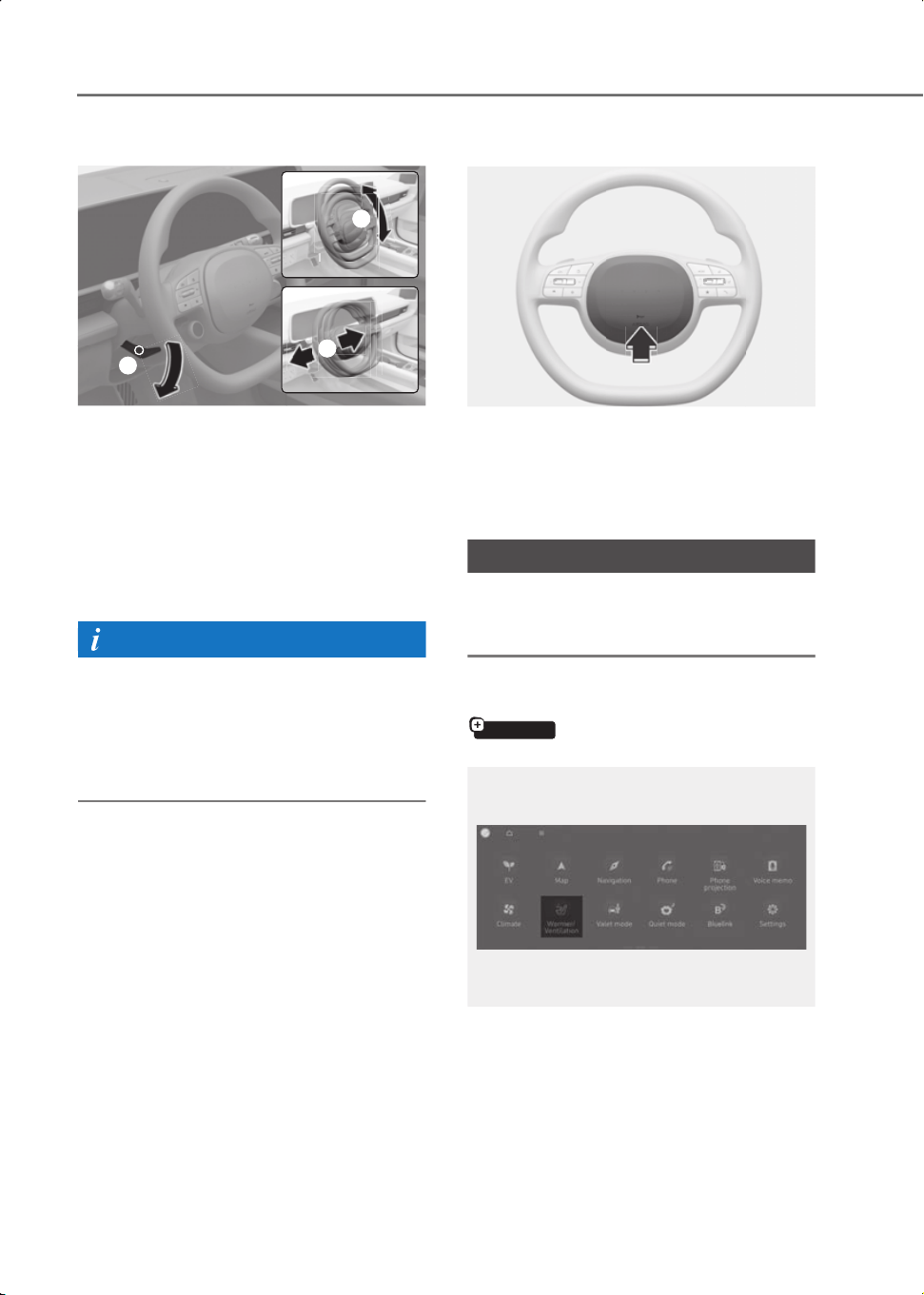
Convenience Features
5-36
Manual adjustment
B5006301
To adjust the steering wheel angle and
height:
1. Pull down the lock-release lever (1).
2. Adjust the steering wheel to the desired
angle (2) and distance forward/back
(3).
3. Pull up the lock-release lever to lock the
steering wheel in place.
Information
Sometimes the lock-release lever may
not engage completely. Pull down on the
lock-release lever, readjust the steering
wheel again, and then pull back up on the
lock-release lever to lock the steering
wheel in place.
Horn
B5006501
To sound the horn, press the area
indicated by the horn symbol on your
steering wheel (see illustration). The horn
will operate only when this area is
pressed.
NOTICE
Do not strike the horn severely or hit it
with your fist. Do not press on the horn
with a sharp-pointed object.
if equipped
Heated Steering Wheel
Infotainment system
ONE1031085L
While the vehicle is running, touch
Heating/Ventilation icon in the
infotainment system.
2
1
3
2
CE_USA.book Page 36
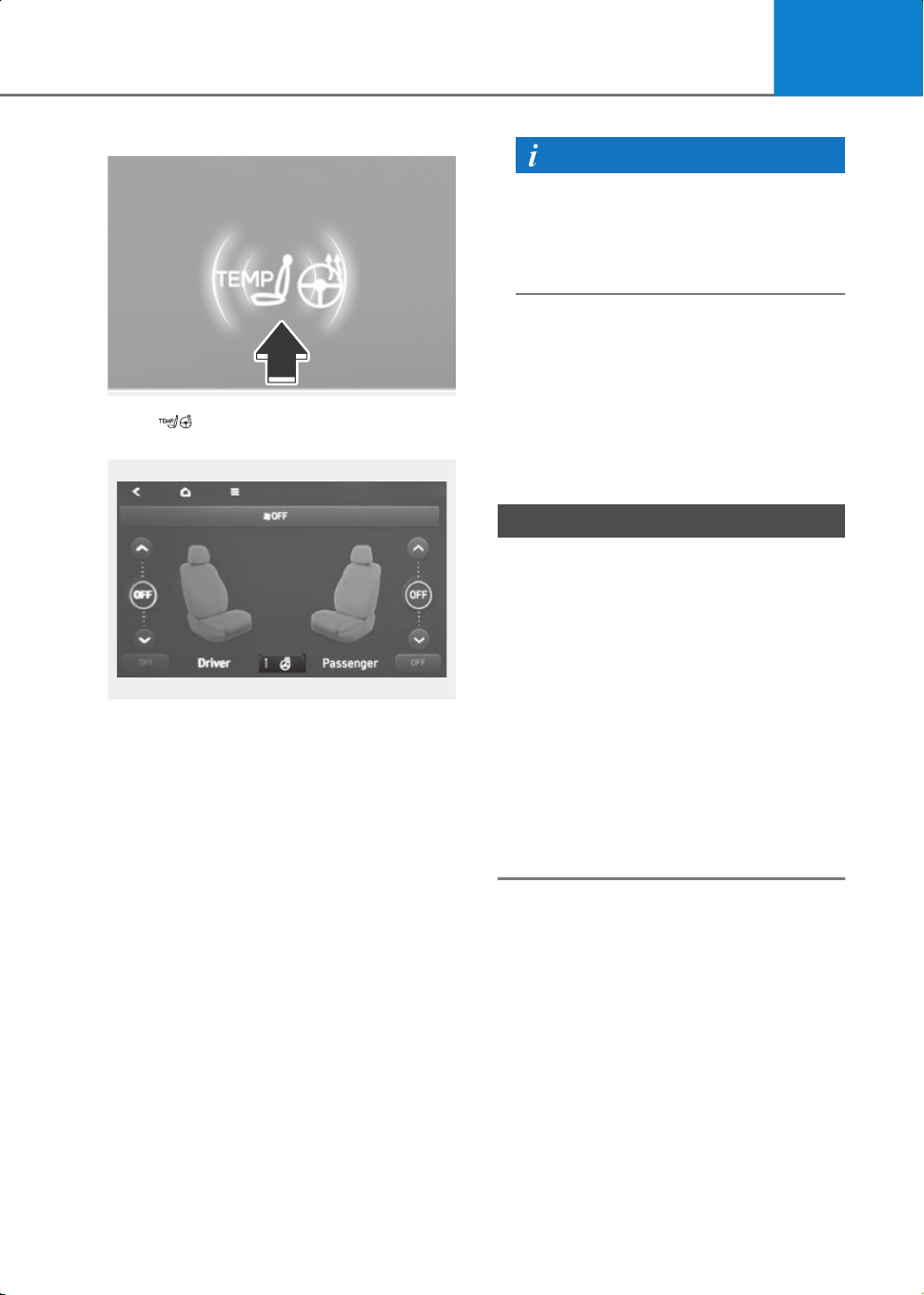
5
5-37
Climate control panel
B5006402
Press in the front climate control
panel.
ONE1051216L
While the vehicle is running, touch the
heated steering wheel icon to warm the
steering wheel.
• To warm the steering wheel, touch the
heated steering wheel icon in the
Heating/Ventilation seats.
• Auto. Controls That Use Climate
Control Settings (for driver’s seat)
The heated steering wheel
automatically controls the steering
wheel temperature depending on the
ambient temperature when the vehicle
is running.
To use this function, it must be enabled
from the Settings menu in the
infotainment system.
Select Setup > Vehicle > Seat >
Warmer/Ventilation Features > Link to
Climate Settings for Auto-Adjustment
> Steering Wheel Warmer.
Information
The infotainment system may change
after software updates. For more
information, refer to the user's manual
provided in the infotainment system
and the quick reference guide.
• The heated steering wheel defaults to
the OFF position whenever the
Start/Stop button is pressed to the ON
position. However, if the Auto. Controls
That Use Climate Control Settings
function is ON, the heated steering
wheel will turn on and off depending on
the outside temperature.
NOTICE
• Do not install any cover or accessories
on the steering wheel to prevent
damage to the steering wheel heater
system.
• Do not strike the steering wheel surface
with a sharp-pointed object. This may
damage the heating element in the
steering wheel.
• Do not clean the steering wheel surface
using the following products.
- Organic solvents such as thinner,
alcohol and gasoline
- Chemical products such as leather
cleaner, coating agent, and wax
CE_USA.book Page 37
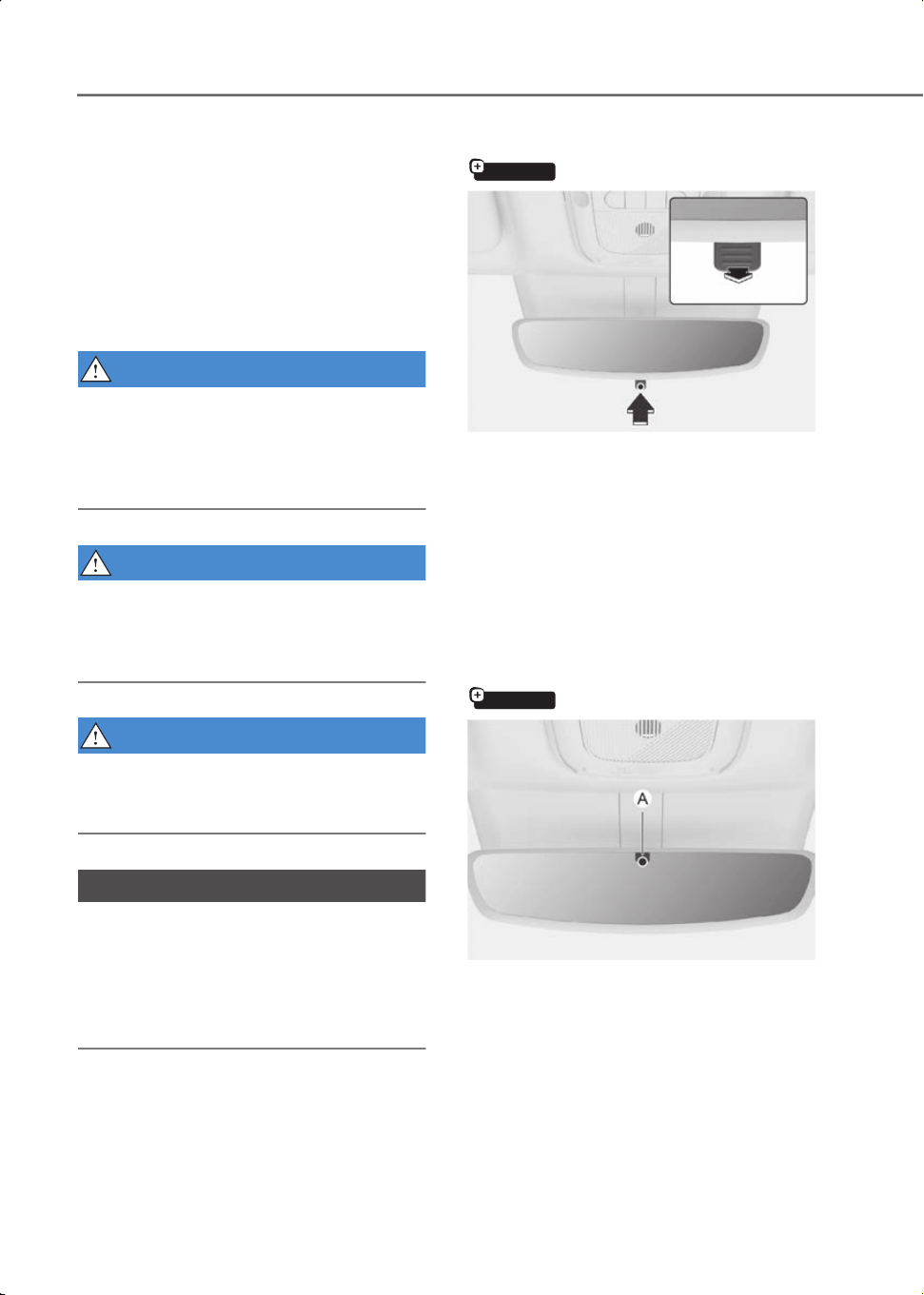
Convenience Features
5-38
Mirrors
Inside Rearview Mirror
Before driving your vehicle, check to see
that your inside rearview mirror is
properly positioned. Adjust the rearview
mirror so that the view through the rear
window is properly centered.
WARNING
Make sure your line of sight is not
obstructed. Do not place objects on the
rear seat or in the cargo area that may
interfere with your vision through the rear
window.
WARNING
To prevent serious injury during an
accident or deployment of the airbag, do
not modify the rearview mirror and do not
install a wide mirror.
WARNING
NEVER adjust the mirror while driving.
This may cause loss of vehicle control
resulting in an accident.
NOTICE
When cleaning the mirror, use a paper
towel or similar material dampened with
glass cleaner. Do not spray glass cleaner
directly on the mirror as this may cause
the liquid cleaner to enter the mirror
housing.
if equipped
Day/night rearview mirror
B5006901
Make this adjustment before you start
driving and while the day/night lever is in
the day position.
Pull the day/night lever towards you to
reduce glare from the headlights of the
vehicles behind you during night driving.
Remember that you lose some rearview
clarity in the night position.
if equipped
Electric Chromic Mirror (ECM)
B5006902
[A] Indicator
Some vehicles come equipped with an
electrochromic mirror that helps control
glare while driving at night or under low
light driving conditions.
CE_USA.book Page 38
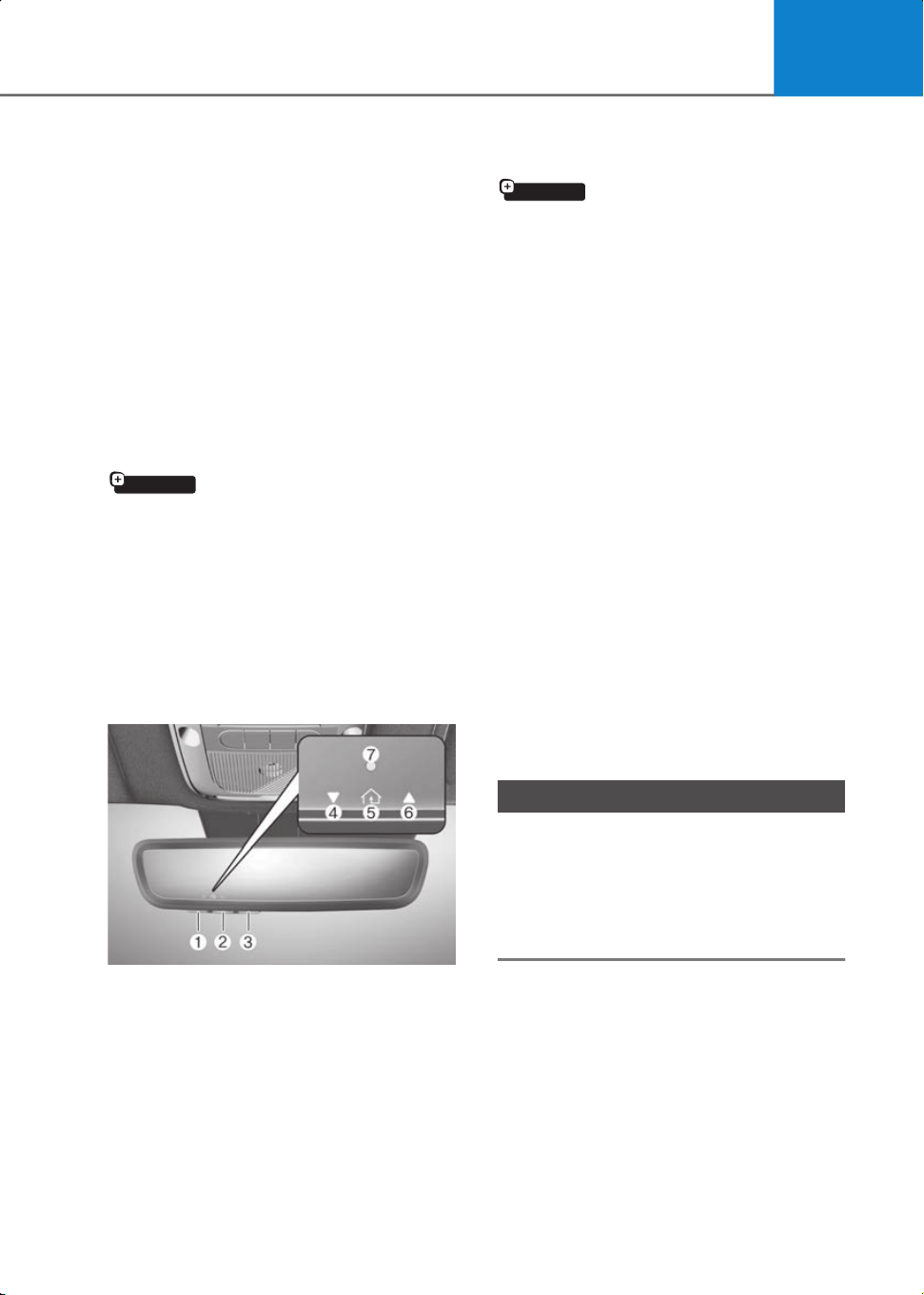
5
5-39
When the vehicle is running, the glare is
automatically controlled by the sensor
mounted in the rearview mirror. The
sensor detects the light level around the
vehicle, and automatically adjusts to
control the headlight glare from vehicles
behind you.
Whenever the gear is shifted to R
(Reverse), the mirror will automatically go
to the brightest setting in order to
improve the driver’s view behind the
vehicle.
Electrochromic mirror (ECM) with
if equipped
HomeLink® system
Your vehicle may be equipped with a
Gentex Automatic-Dimming Mirror with
an Integrated HomeLink® Wireless
Control System.
During nighttime driving, this feature will
automatically detect and reduce rearview
mirror glare. The HomeLink® Universal
Transceiver allows you to activate your
garage door(s), electric gate, home
lighting, etc.
ONE1051261N
(1) HomeLink Channel 1
(2) HomeLink Channel 2
(3) HomeLink Channel 3
(4) Garage Door Opener Status Indicator:
Closing or Closed
(5) HomeLink Operation Indicator
(6) Garage Door Opener Status Indicator:
Opening or Opened
(7) HomeLink User Interface Indicator
Automatic-Dimming Night Vision Safety™
if equipped
(NVS
®
) Mirror
The NVS® Mirror automatically reduces
glare by monitoring light levels in the
front and the rear of the vehicle. Any
object that obstructs either light sensor
will degrade the automatic dimming
control feature.
For more information regarding NVS®
mirrors and other applications, please
refer to the Gentex website:
www.gentex.com
Your mirror will automatically dim upon
detecting glare from the vehicles
traveling behind you.
The mirror defaults to the ON position
each time the vehicle is started.
Integrated HomeLink
®
Wireless Control
System
The HomeLink® Wireless Control System
provides a convenient way to replace up
to three hand-held radio-frequency
transmitters used to activate compatible
devices such as gate operators, garage
door openers, entry door locks, security
systems, and home lighting.
NOTICE
HomeLink® operates while the Start/Stop
button is in the ACC or ON position for
safety reasons. It is to prevent
unintentional security problems from
happening when the vehicle is parked
outside the garage.
CE_USA.book Page 39
Convenience Features
5-40
WARNING
Before programming HomeLink® to a
garage door opener or gate operator,
make sure people and objects are out of
the way of the device to prevent potential
harm or damage. Do not use the
HomeLink® with any garage door opener
that lacks the safety stop and reverse
features required by U.S. federal safety
standards (this includes any garage door
opener model manufactured before April
1, 1982). A garage door that cannot detect
an object-signaling the door to stop and
reverse-does not meet current U.S.
federal safety standards. Using a garage
door opener without these features
increases the risk of serious injury or
death.
For more information, contact
HomeLink® at www.homelink.com, or call
Home-Link customer support at
1-800-355-3515.
It is also recommended that a new battery
be replaced in the hand-held transmitter
of the device being trained to HomeLink®
for quicker training and accurate
transmission of the radio frequency.
1. Programming HomeLink
®
The following steps show how to program
HomeLink. If you have any questions or
are having difficulty programming your
HomeLink buttons, refer to the HomeLink
website or call the HomeLink customer
support toll-free number. Do this, before
going back to the dealer who sold you the
vehicle.
• Visit the HomeLink website at:
www.homelink.com. Then at the top of
the page, choose your vehicle make.
Then watch the You Tube video, and/or
access additional website information.
• If you choose to access the website via
your cell phone, scan the QR code.
• Or, call HomeLink customer support at
1-800-355-3515 (Please have the
vehicle make/model AND the opener
device make/model readily available.)
1) Programming Preparation
ONE1051262N
1. When programming a garage door
opener, it is advised to park the vehicle
outside of the garage.
2. It is recommended that a new battery
be placed in the hand-held transmitter
of the device being programmed to
HomeLink for quicker training and
accurate transmission of the
radio-frequency signal.
3. Press the Start/Stop button to the ACC
(Accessory) position for programming
of HomeLink.
2) Programming a New HomeLink®
ONE1051263N
1. Press and release the HomeLink button
(1), (2) or (3), you would like to program.
The HomeLink indicator light (7) will
flash orange slowly (if not, perform the
steps of “Erasing HomeLink Buttons”
section, and start over).
CE_USA.book Page 40
5
5-41
ONE1051264N
2. Position the garage door opener
remote 1-3 in. (2-8 cm) away from the
HomeLink buttons.
3. While the HomeLink indicator light (7) is
flashing orange, press and hold the
hand-held remote button. Continue
pressing the hand-held remote button
until the HomeLink indicator light (7)
light changes from orange to green.
You may now release the hand-held
remote button.
4. Wait until your garage door comes to a
complete stop, regardless of position,
before proceeding to the next steps.
5. Press and release the HomeLink button
you are programming and observe the
indicator light.
• If the indicator light remains solid
green, your device should operate
when the HomeLink button is
pressed. At this point, if your device
operates, programming is complete.
• If the indicator light rapidly flashes
green, firmly press, hold for two
seconds and release the HomeLink
button up to three times in a row
slowly to complete the programming
process. Do not press the HomeLink
button rapidly. At this point if your
device operates, programming is
complete. If the device does not
operate, continue with step 6.
6.At the garage door opener motor,
(security gate motor, etc.) locate the
'Learn', 'Smart', 'Set' or 'Program'
button. This can usually be found where
the hanging antenna wire is attached to
the motor-head unit (see the device’s
manual to identify this button). The
name and color of the button may vary
by manufacturer.
ODL3A040504
• A ladder and/or second person may
simplify the following steps.
7. Firmly press and release the 'Learn',
'Smart', 'Set' or 'Program' button. You
now have up to 30 seconds in which to
complete the next step.
8.Return to the vehicle and firmly press,
hold for two seconds and release, the
HomeLink button up to three times in a
row slowly. Do not press the HomeLink
button rapidly. As soon as you see the
garage door start to move, stop
pressing any buttons until a few
seconds after the garage door has
come to a complete stop, regardless of
position. At this point, programming is
complete and your device should
operate when the HomeLink button is
pressed and released.
CE_USA.book Page 41

Convenience Features
5-42
3) Two-Way Communication
Programming (For select garage door
openers)
If your garage door opener has the ‘myQ’
logo on its side, your opener likely has
Two-Way Communication capability.
HomeLink has the capability to establish
Two-Way Communication with your
garage door opener. HomeLink can
receive and display “closing” or
“opening” status messages from
compatible garage door openers. At any
time, Home-Link can also recall and
display the last recorded status
communicated by the garage door
opener to indicate your garage door
being “closed” or “opened”.
To check if your garage door opener is
compatible with this feature, refer to
www.homelink.com/compatible/Two-w
ay-Communication. If your garage door
opener has this functionality, AND the
Two-Way Communication indicators (4),
(6) in the mirror appear while the garage
door is opening/closing, then no further
steps are needed. Two-Way
Communication Programming is already
complete. However, if your garage door
opener has this functionality, AND the
Two-Way Communication indicators (4),
(6) in the mirror DO NOT appear while the
garage door is opening/closing, use the
following instructions to enable this
functionality.
1. In your vehicle, press and hold the
programmed HomeLink button for 2
seconds, then release. Confirm that the
garage door is moving. AFTER it stops,
you will have one minute to complete
the following steps:
• A ladder and/or second person may
simplify the following steps.
2. On your garage door opener in your
garage, locate the 'Learn' button
(usually near where the hanging
antenna wire is attached to the garage
door opener). If there is difficulty
locating this button, reference the
device’s owner’s manual.
3. Press and release the 'Learn' button.
4. A light on your garage door opener may
flash, and your Two-Way
Communication indicators (4), (6) in
your vehicle may flash, confirming
completion of the process.
5. Return to the vehicle and firmly press
and release the programmed
HomeLink button to activate your
garage door. The Two-Way
Communication indicators (4), (6) flash
in orange when the door is moving. Do
not make any additional button presses
until AFTER the garage door has come
to a complete stop.
6.Your Two-Way Communication
programming is now complete.
Information
If your garage door opener has Two-Way
Communication functionality, it is
possible for HomeLink to stop functioning
the garage door shortly after initial
programming, IF the Two-Way
Communication Programming wasn’t
properly completed. This usually happens
after the first 10 times a programmed
HomeLink button is pressed. If you
experience this, completing the
“Programming a New HomeLink Button”
and “Two-Way Communication
Programming” will restore door
operation.
CE_USA.book Page 42
5
5-43
4) Canadian Programming
Canadian radio-frequency laws require
transmitter remote signals to “time-out”
(or quit) after a couple seconds of
transmission, which may not be long
enough for HomeLink to pick up the
signal during programming.
If you live in Canada or you are having
difficulties programming a gate operator
or garage door opener by using the
programming procedures, replace
“Programming a New HomeLink Button”
step 3 with the following:
While the HomeLink indicator light (7) is
flashing orange, press and release
(“cycle”) your device’s hand-held remote
every two seconds until the HomeLink
indicator light (7) changes from orange to
green. You may now release the
hand-held remote button. Then proceed
with “Programming a New HomeLink
Button” step 4.
2. Operating HomeLink
®
1) Operating HomeLink®
ONE1051263N
1. Press and release the desired
programmed HomeLink button (1, 2 or
3).
Information
The HomeLink indicator (7) should light
green, solid or flashing, and your
programmed device should operate.
If your device does not operate, the
HomeLink programming was not
successful, and you’ll need to reprogram
the button.
2) Two-Way Communication Display
Behavior
ONE1051265N
1. Press and release one of the
programmed HomeLink buttons (1, 2 or
3).
ONE1051266N
2. The indicator (4) and (6) operates as
below, if your garage door opener has
Two-Way Communication
functionality.
• If the indicator (4) flashes in Orange,
it indicates that the garage door is
“Closing”.
CE_USA.book Page 43
Convenience Features
5-44
• The indicator (4) turns solid green
once the garage door has closed.
• If the indicator (6) flashes in Orange,
it indicates that the garage door is
“Opening”.
• The indicator (6) turns solid green
once the garage door has fully
opened.
• If the indicator (4) or (6) does not turn
to green, it indicates that the last
status of garage door was not
received properly. The HomeLink
mirror tries to receive the last known
status of the garage door for a few
seconds.
3) Recalling Garage Door Status
HomeLink mirror with Two-Way
Communication provides a way to view
the last stored message from the garage
door opener. In order to recall the last
known status of the last activated device,
press the buttons “1 and 2” or “2 and 3”
simultaneously.
• If the indicator (4) appears solid Green,
it indicates that the last activated
device was “closed” properly.
• If the indicator (6) appears solid Green,
it indicates that the last activated
device was “open” properly.
3. Erasing HomeLink® Buttons
1) Erasing and Reprogramming a Single
HomeLink® Button:
1. Press and hold the desired HomeLink
button you want to re-program. DO
NOT release the button.
2. The HomeLink indicator light (7) will
illuminate solid green. Release the
button as soon as the HomeLink
indicator light (7) begins to flash
orange, usually about 20 seconds.
3. Proceed with the steps in the
“Programming a New HomeLink
Button” section.
Information
If you do not complete the
re-programming of a new device to the
button, it will revert to the previously
stored programming.
2) The following instructions will erase
ALL HomeLink® programming from ALL
buttons:
ONE1051267N
1. Press and hold the buttons (1) and (3)
simultaneously
2. The HomeLink indicator light (7) will
illuminate solid Orange for about 10
seconds
3. Release the buttons once the
HomeLink indicator light (7) changes to
Green and flashes rapidly
4. Now all three HomeLink buttons (1), (2)
and (3) are cleared of any programming
Information
HomeLink® and the HomeLink® House
logo are registered trademarks of Gentex
Corporation.
The myQ logo is a registered trademark of
The Chamberlain Group, Inc.
CE_USA.book Page 44

5
5-45
FCC (USA) and ISED (Canada)
This device complies with FCC rules part
15 and Innovation, Science, and
Economic Development Canada RSS-210.
Operation is subject to the following two
conditions: (1) This device may not cause
harmful interference, and (2) This device
must accept any interference that may be
received including interference that may
cause undesired operation. WARNING:
The transmitter has been tested and
complies with FCC and ISED rules.
Changes or modifications not expressly
approved by the party responsible for
compliance could void the user’s
authority to operate the device.
This equipment complies with FCC and
ISED radiation exposure limits set forth
for an uncontrolled environment. End
Users must follow the specific operating
instructions for satisfying RF exposure
compliance. This transmitter must be at
least 20cm from the user and must not be
co-located or operating in conjunction
with any other antenna or transmitter.
Cet appareil est conforme aux reglements
de la FCC, section 15, et au CNR-210
d’Innovation, Sciences et
Dhveloppement economique Canada. Le
fonctionnement est assujetti aux deux
conditions suivantes: (1) cet appareil ne
doit pas causer d’interferences nuisibles
et (2) cet appareil doit accepter toute
interference recue, y compris celle qui
pourrait entrainer un dysfonctionnement.
MISE EN GARDE: L’emetteur a subi des
tests et est conforme aux reglements de
la FCC et d’ISDE. Les changements ou
modifications non approuves
explicitement par la partie responsable de
la conformite pourraient rendre caduque
l’autorisation de l’utilisateur de se servir
du dispositif.
Cet appareil est conforme aux limites
d’exposition aux radiations de la FCC et
d’ISDE etablies pour un environnement
non controle. Les utilisateurs finaux
doivent respecter les instructions
d’utilisation specifiques pour satisfaire
aux exigences de conformite aux
expositions de RF. L’emetteur doit se
trouver a 20 cm au minimum de
l’utilisateur et ne doit pas etre situe au
meme endroit que tout autre emetteur ou
antenne ni fonctionner avec un autre
emetteur ou antenne.
CE_USA.book Page 45
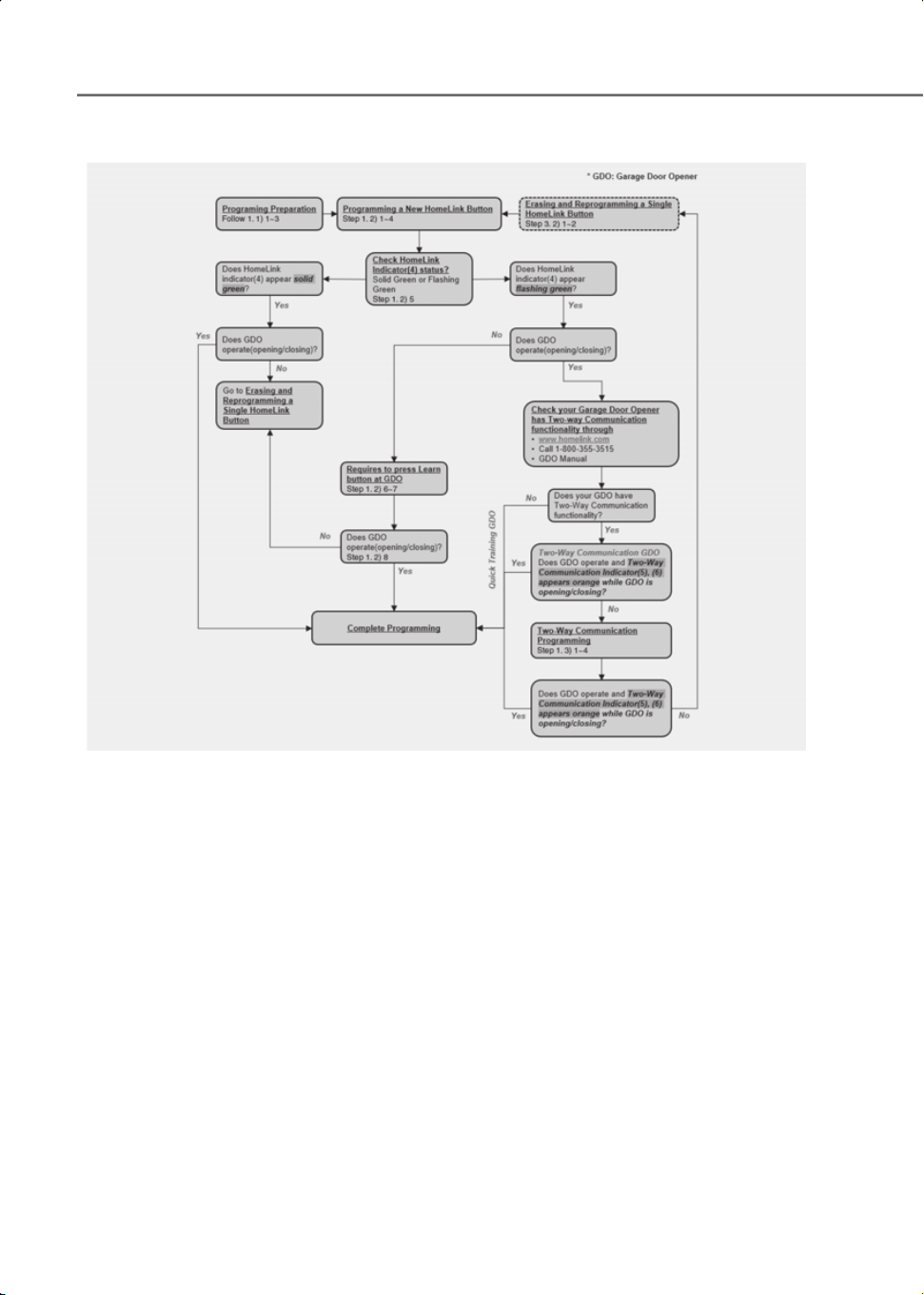
Convenience Features
5-46
HomeLink 5 Programing Flow Chart
OOS040475N
CE_USA.book Page 46
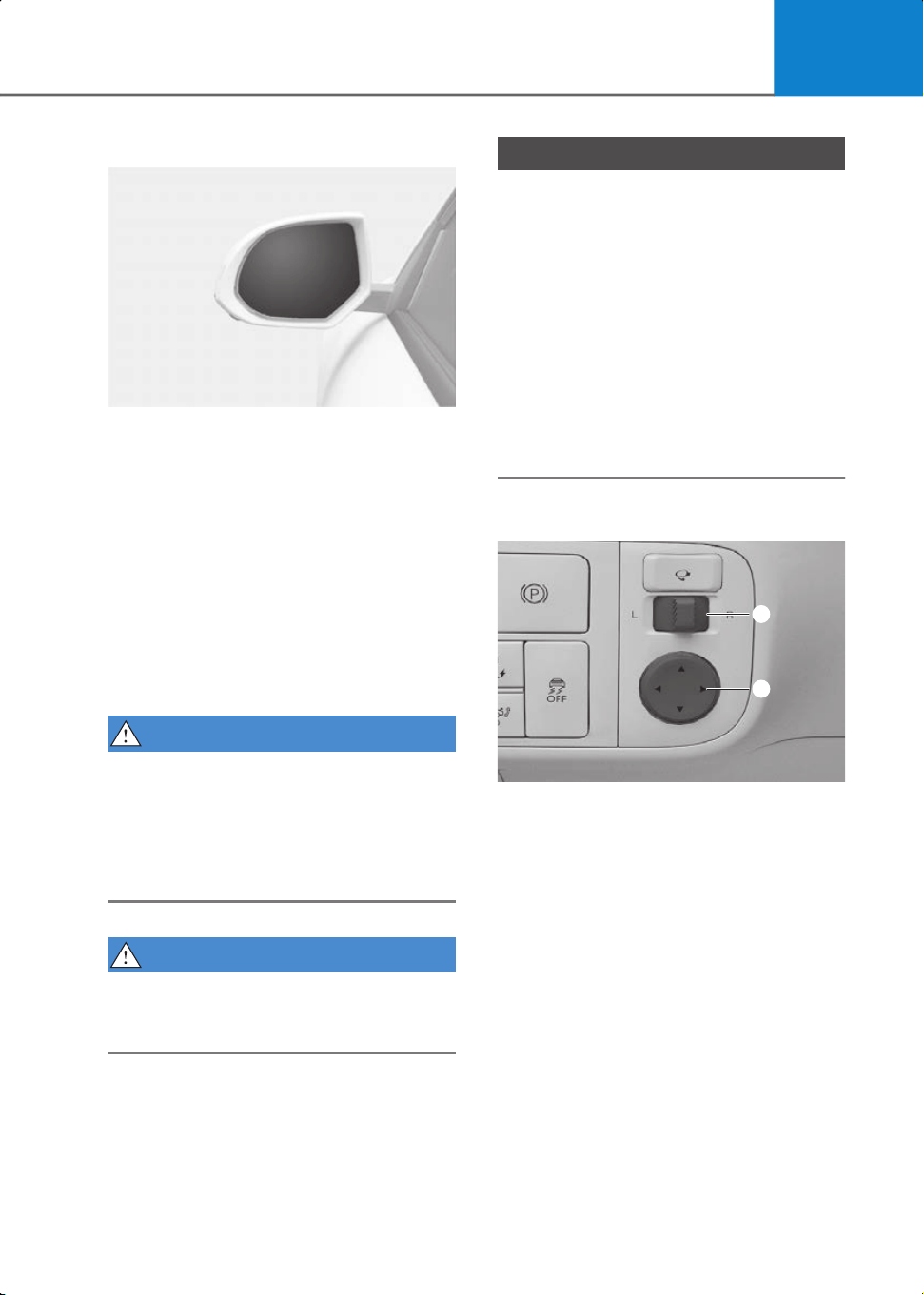
5
5-47
Side View Mirrors
B5007001
Your vehicle is equipped with both
left-hand and right-hand side view
mirrors. The mirrors can be adjusted
remotely with mirror adjustment control
switch. Adjust the side view mirrors to
your desired position before driving. The
side view mirrors can be folded manually
to help prevent damage when going
through an automatic car wash or when
passing through a narrow street.
Make sure to adjust the side view mirrors
to your desired position before you begin
driving.
WARNING
The right side view mirror is convex.
Objects seen in the mirror are closer than
they appear.
Use the side view mirror or turn your head
and look to determine the actual distance
of other vehicles prior to changing lanes.
WARNING
Do not adjust or fold the side view mirrors
while driving. This may cause loss of
vehicle control resulting in a collision.
NOTICE
• Do not scrape ice off the mirror face.
This may damage the surface of the
glass.
• If the mirror is jammed with ice, do not
adjust the mirror by force. Use an
approved de-icer (not radiator
antifreeze) spray, or a sponge or soft
cloth with very warm water, or move
the vehicle to a warm place and allow
the ice to melt.
• Do not clean the mirror with harsh
abrasives, fuel, or other petroleum
based cleaning products.
Adjusting the side view mirrors
B5007002
Adjusting the side view mirrors:
1. When the Start/Stop button is in the
ACC, ON or START position, move
either the L (Left side) or R (Right side)
button (1) to select the side view mirror
you would like to adjust.
2. Use the mirror adjustment control
switch (2) to position the selected
mirror up, down, left or right.
3. After adjustment, move the lever (1) to
the middle to prevent unintended
adjustment.
1
2
CE_USA.book Page 47
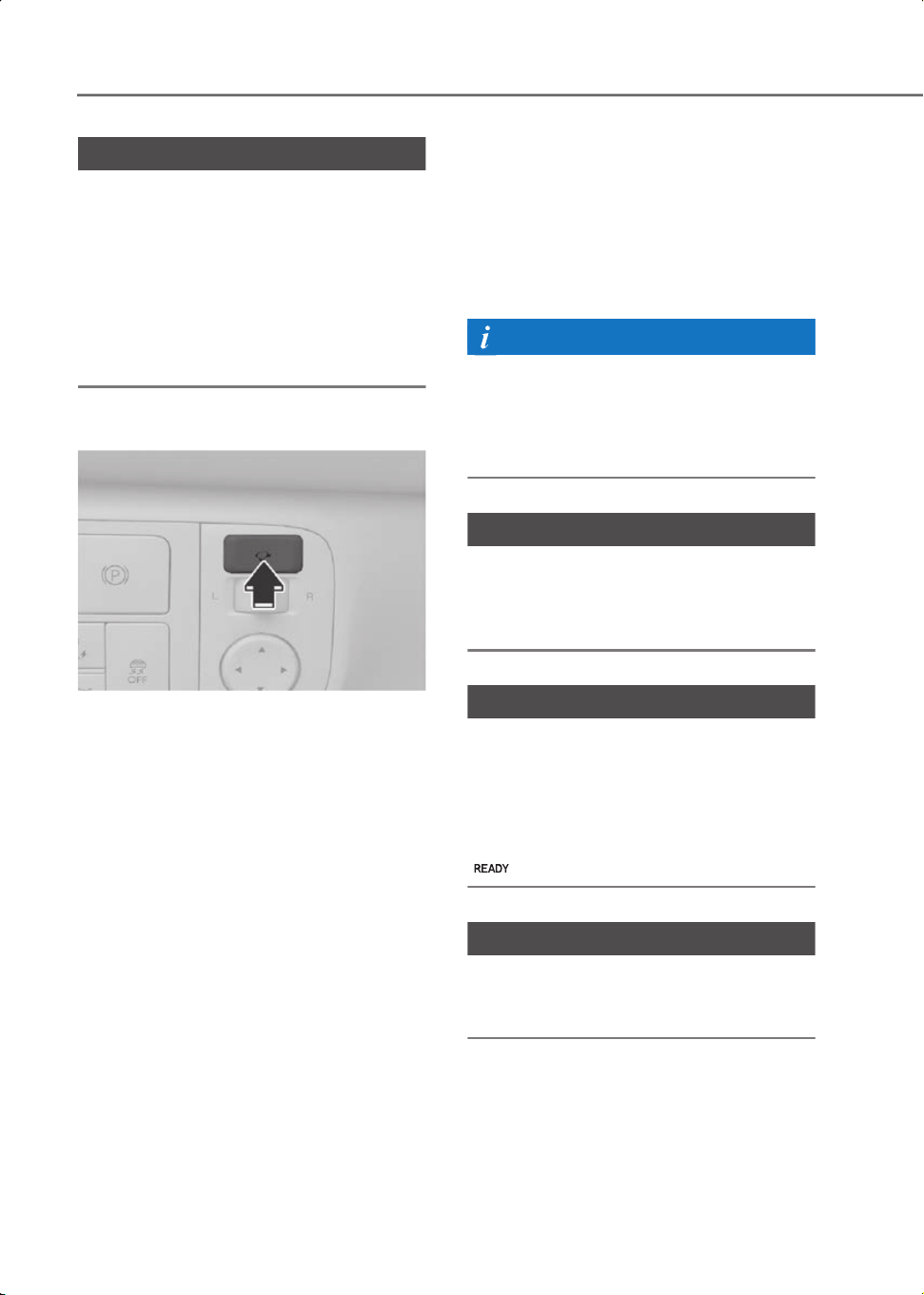
Convenience Features
5-48
NOTICE
• The mirrors stop moving when they
reach the maximum adjusting angles,
but the motor continues to operate
while the switch is pressed. Do not
press the switch longer than necessary,
because this can damage the motor.
• Do not attempt to adjust the side view
mirrors by hand, because this can
damage the motor.
Folding the side view mirrors
B5007003
Folding button
Press the button to fold or unfold the side
view mirrors.
Infotainment system setting
• Enable on door unlock
If Setup > Vehicle > Lights > Welcome
Mirror/Light > Enable on Door Unlock
is selected from the Settings menu in
the infotainment system,
• The mirror will fold or unfold when the
door is locked or unlocked by the smart
key.
• The mirror will fold or unfold when the
door is locked or unlocked by the touch
sensor or button on the outside door
handle.
• Enable on driver approach
If Setup > Vehicle > Lights > Welcome
Mirror/Light > Enable on Driver
Approach is selected from the Settings
menu in the infotainment system, the
mirror will unfold when the vehicle is
approached with the smart key in
possession.
Information
The infotainment system may change
after software updates. For more
information, refer to the user's manual
provided in the infotainment system and
the quick reference guide.
NOTICE
For your safety, the side view mirrors
cannot be folded automatically when
driving at a speed of 9 mph (15 km/h) or
faster.
NOTICE
The electric type side view mirror
operates even though the Start/Stop
button is in the OFF position. However, to
prevent unnecessary battery discharge,
do not adjust the mirrors longer than
necessary while the vehicle is turned off
( indicator off).
NOTICE
Do not fold the electric type side view
mirror by hand. It could cause motor
failure.
CE_USA.book Page 48
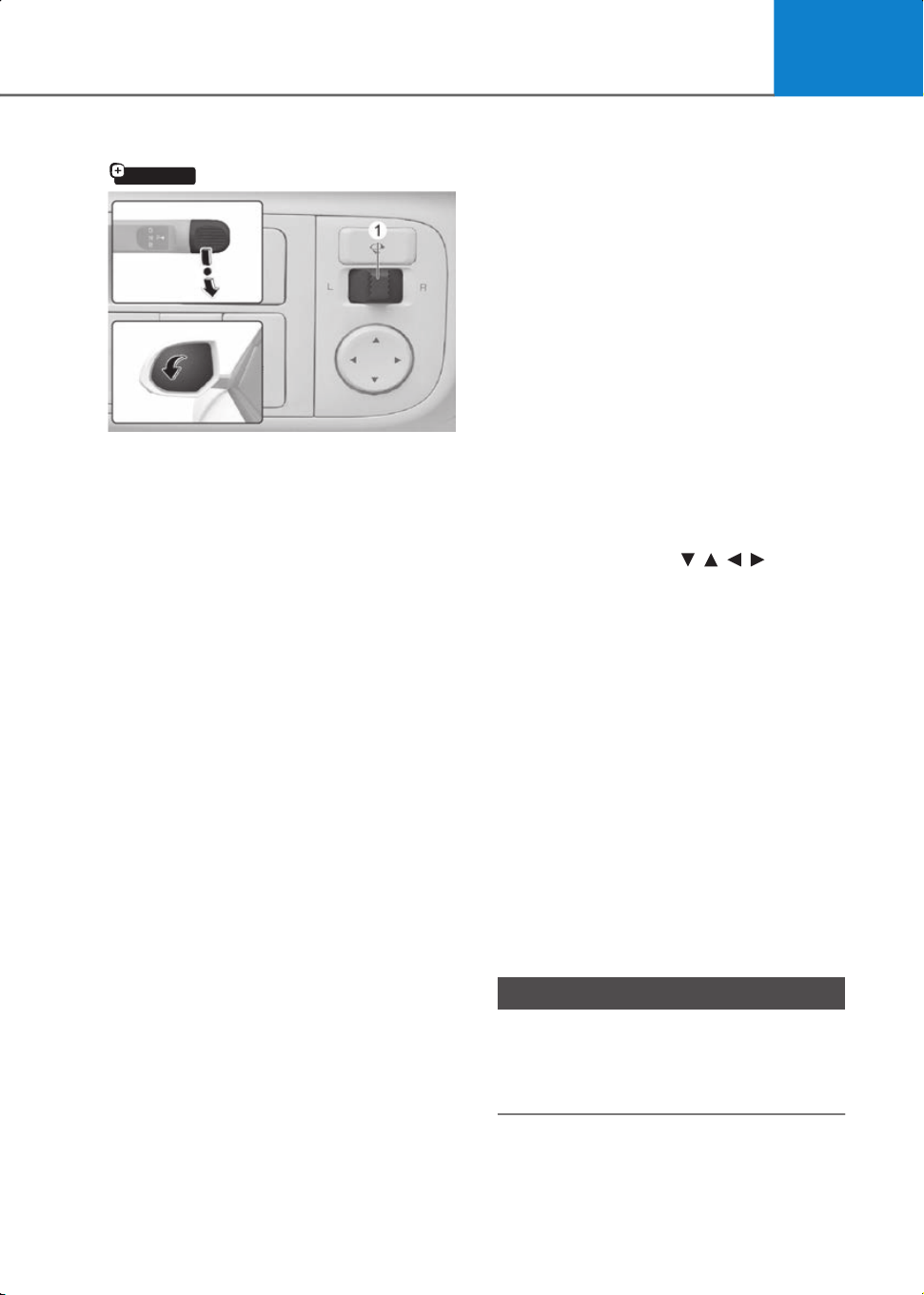
5
5-49
if equipped
Reverse Parking Aid
B5007004
When the gear is shifted to the R
(Reverse) position, the side view lever(s)
will rotate downwards to aid with driving
in reverse.
The state of the side view mirror lever (1)
determines whether or not the mirrors
will move:
How it works
• Left/Right: When either the L (Left) or R
(Right) lever is selected, both side view
mirrors will move.
• Neutral: When neither switch is
selected, the side view mirrors will not
move.
The side view mirrors will automatically
revert to their original positions if any of
the following occur:
• The Start/Stop button is pressed to
either the OFF position or the ACC
position.
• The gear is shifted to any position
except R (Reverse).
• The side view mirror adjustment button
is not selected.
Reverse parking aid user settings
mode
You may change the angle of the side
view mirror if it is difficult to see the rear
view with the basic downward mirror
angle provided when reversing.
When the vehicle is first delivered, the set
downward angle of the left and right side
view mirror are different to ensure driver
visibility.
1. Make sure the vehicle is stopped.
2. Depress the brake pedal and shift the
gear to R (Reverse). When L (Left) or R
(Right) lever is selected, both side view
mirror angle will move downward to the
basic set position.
3. Move either L or R lever to select the
side view mirror you would like to
adjust. Then press “ , , , ” switch
to adjust the side view mirror to the
desired angle.
4. After adjusting the angle to save the
adjusted side view mirror angle, shift
the gear to another position other than
R (Reverse), or change the L and R
levers to the neutral position (L and R
levers are not selected).
5. Set the other side view mirror following
the above procedure 1 to 4.
Resetting reverse parking aid user settings
mode
To change the side view mirror angle back
to the basic angle, shift the gear to R
(Reverse), and adjust the mirror angle
higher than when the gear is in P (Park), N
(Neutral) and D (Drive).
NOTICE
When changing the angle of both side
view mirrors, it is recommended to
change the angle one side at a time
following the procedure 1 to 4.
CE_USA.book Page 49
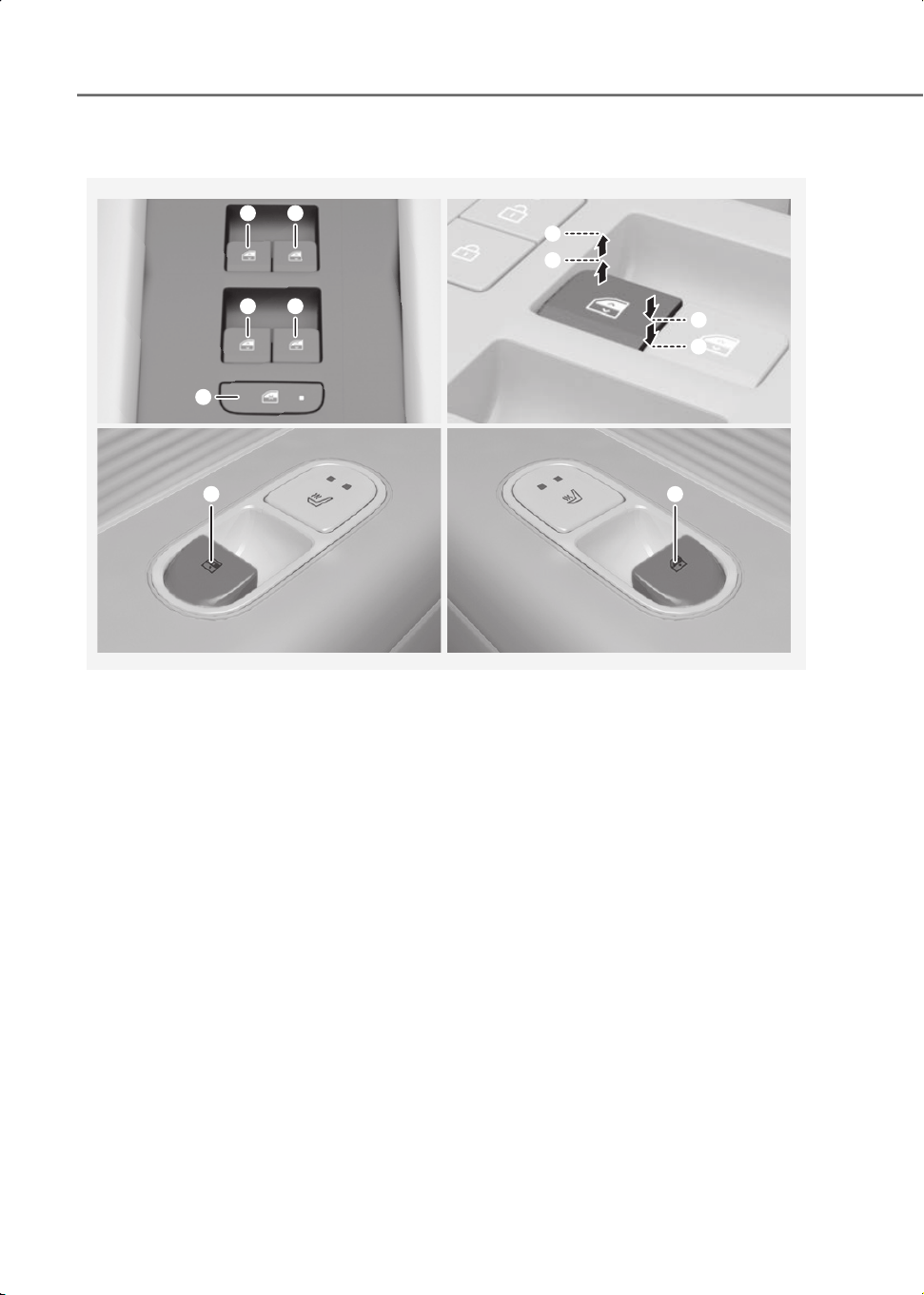
Convenience Features
5-50
Windows
A5008101
(1) Driver’s door power window switch
(2) Front passenger’s door power window switch
(3) Rear door (left) power window switch
(4) Rear door (right) power window switch
(5) Window opening and closing
(6) Automatic power window
(7) Power window lock switch
1 2
3
3
7
6
5
5
6
4
4
CE_USA.book Page 50
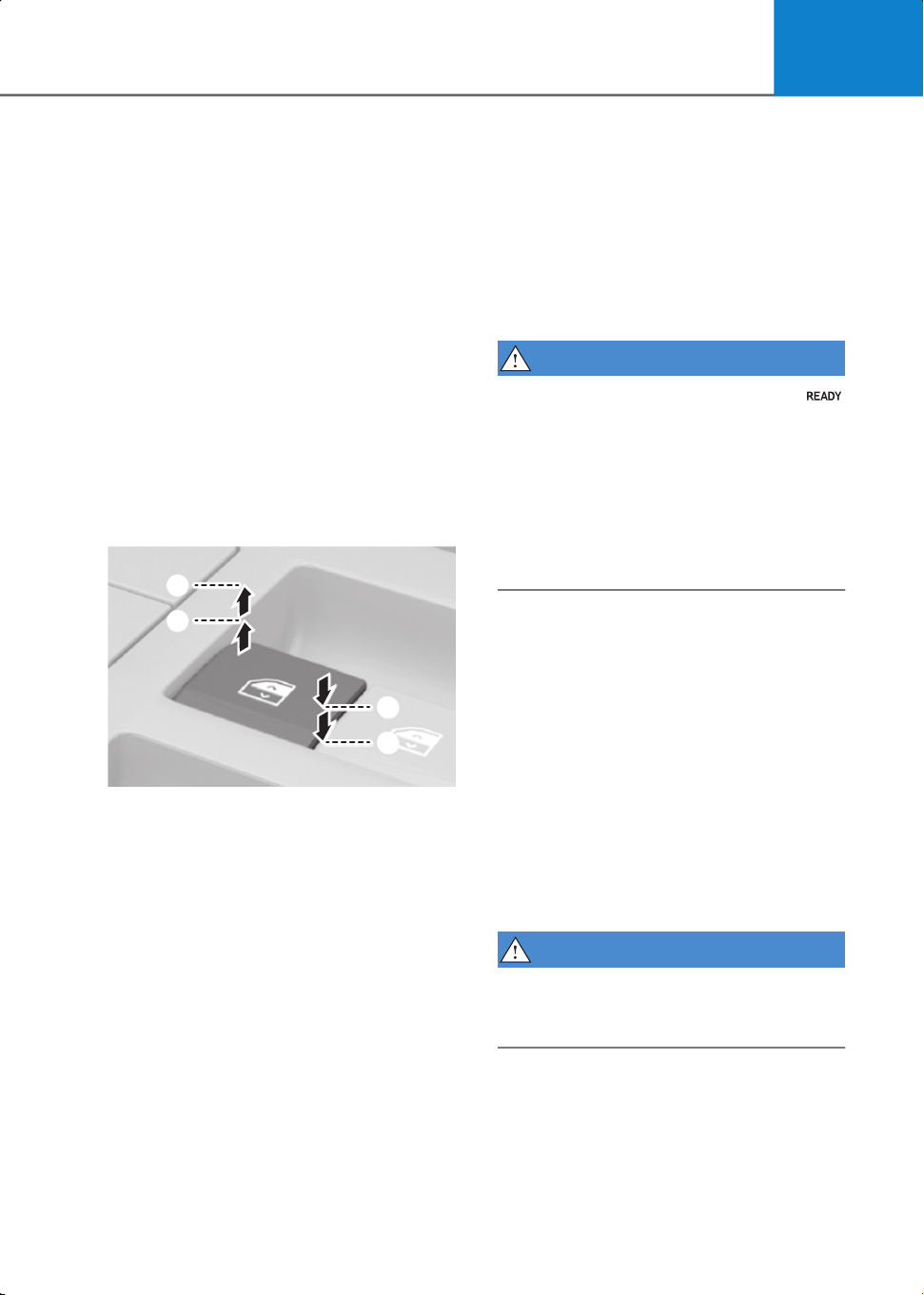
5
5-51
Power Windows
The Start/Stop button must be in the ON
position to be able to raise or lower the
windows. The front door window power
window switch is located on the center
console along with the power window
lock button which can block the
operation of rear passenger windows. The
power window switch for the rear door
windows are on the rear doors. The power
windows will operate for about 3 minutes
after the Start/Stop button is in the ACC
or OFF position. However, if the front
doors are opened, the power windows
will not operate even within the 3 minute
period.
Window opening and closing
B5008201
To open:
Press the window switch down to the first
detent position (5). Release the switch
when you want the window to stop.
To close:
Pull the window switch up to the first
detent position (5). Release the window
switch when you want the window to
stop.
Auto up/down window
Pressing the power window switch
momentarily to the second detent
position (6) completely lowers or lifts the
window even when the switch is released.
To stop the window at the desired
position while the window is in operation,
pull up or press down and release the
switch.
WARNING
• Do not leave the vehicle turned on (
indicator on) and the key in your vehicle
with unsupervised children.
Unattended children could operate the
window, which could result in serious
injury.
• Do not extend your head, arms, body
parts or objects outside the window
while driving.
Resetting the power windows
If the power windows do not operate
normally, the automatic power window
system must be reset as follows:
1. Press the Start/Stop button to the ON
position.
2. Close the window and continue pulling
up on the power window switch for at
least one second.
If the power windows do not operate
properly after resetting, have the system
inspected by an authorized HYUNDAI
dealer.
WARNING
The automatic reverse feature doesn’t
activate while resetting the power
window system.
6
5
5
6
CE_USA.book Page 51
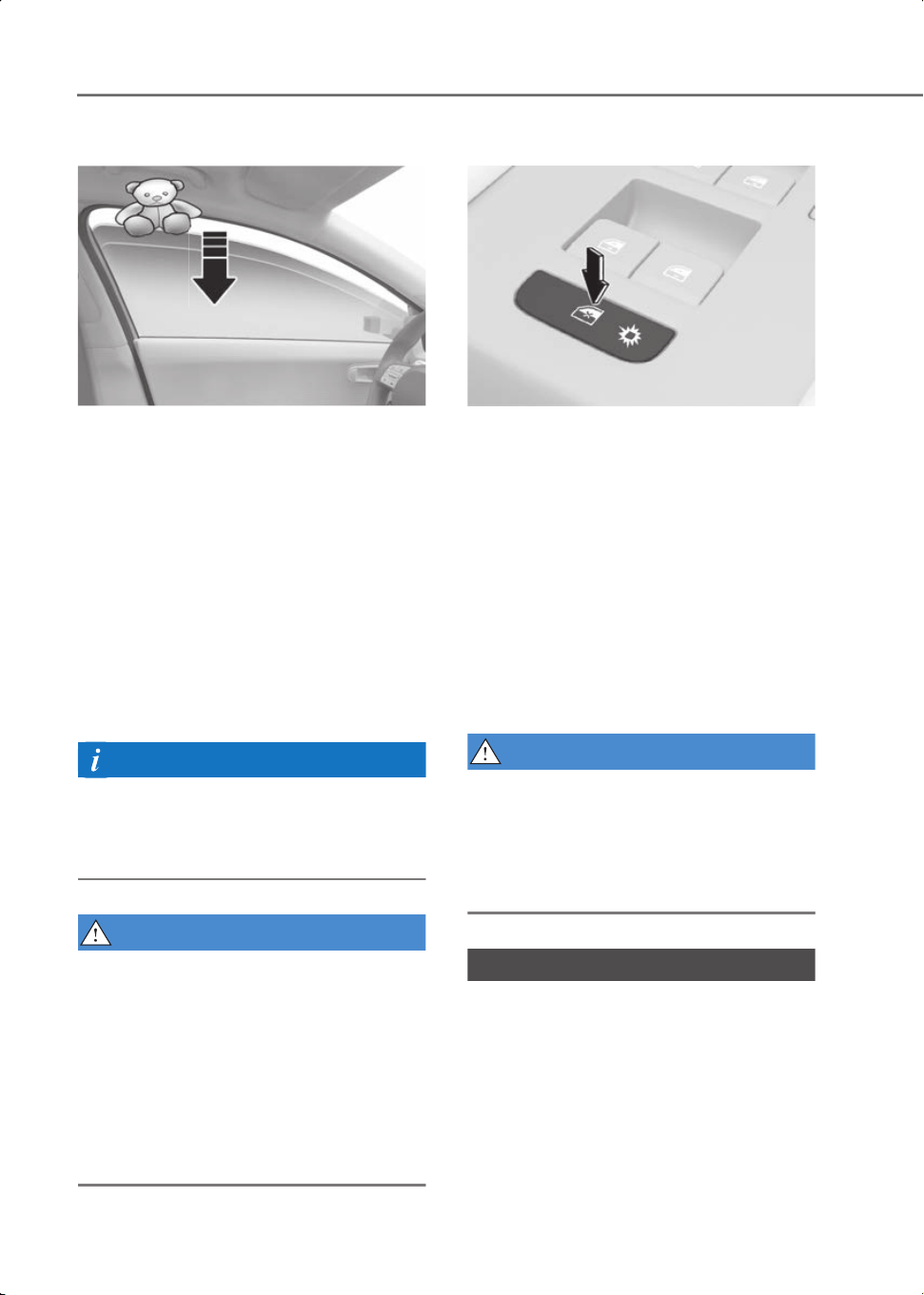
Convenience Features
5-52
Automatic reverse
B5008202
If a window senses any obstacle while it is
closing automatically, it will stop and
lower about 12 in. (30 cm) to allow the
object to be cleared.
If the window detects the resistance
while the power window switch is pulled
up continuously, the window will stop
upward movement then lower about 1 in.
(2.5 cm).
If the power window switch is pulled up
continuously again within 5 seconds after
the window is lowered by the automatic
window reverse feature, the automatic
window reverse will not operate.
Information
The automatic reverse feature is only
active when the “Auto Up” feature is used
by fully pulling up the switch to the
second detent.
WARNING
Make sure body parts or other objects are
safely out of the way before closing the
windows to avoid injuries or vehicle
damage.
Objects less than 0.16 in. (4 mm) in
diameter caught between the window
glass and the upper window channel may
not be detected by the automatic reverse
window and the window will not stop and
reverse direction.
Power window lock button
B5008203
The driver can disable the power window
switches on the rear passenger doors by
pressing the power window lock button.
When the power window lock button is
pressed:
• The driver’s master control can operate
all the power windows.
• The front passenger’s control can
operate the front passenger’s power
window.
• The rear passenger’s control cannot
operate the rear passengers’ power
window.
WARNING
Do not allow children to play with the
power windows. Keep the driver’s door
power window lock button in the LOCK
position. Serious injury or death can result
from unintentional window operation by
a child.
NOTICE
• To prevent possible damage to the
power window system, do not open or
close two windows or more at the same
time. This will also ensure the longevity
of the fuse.
CE_USA.book Page 52
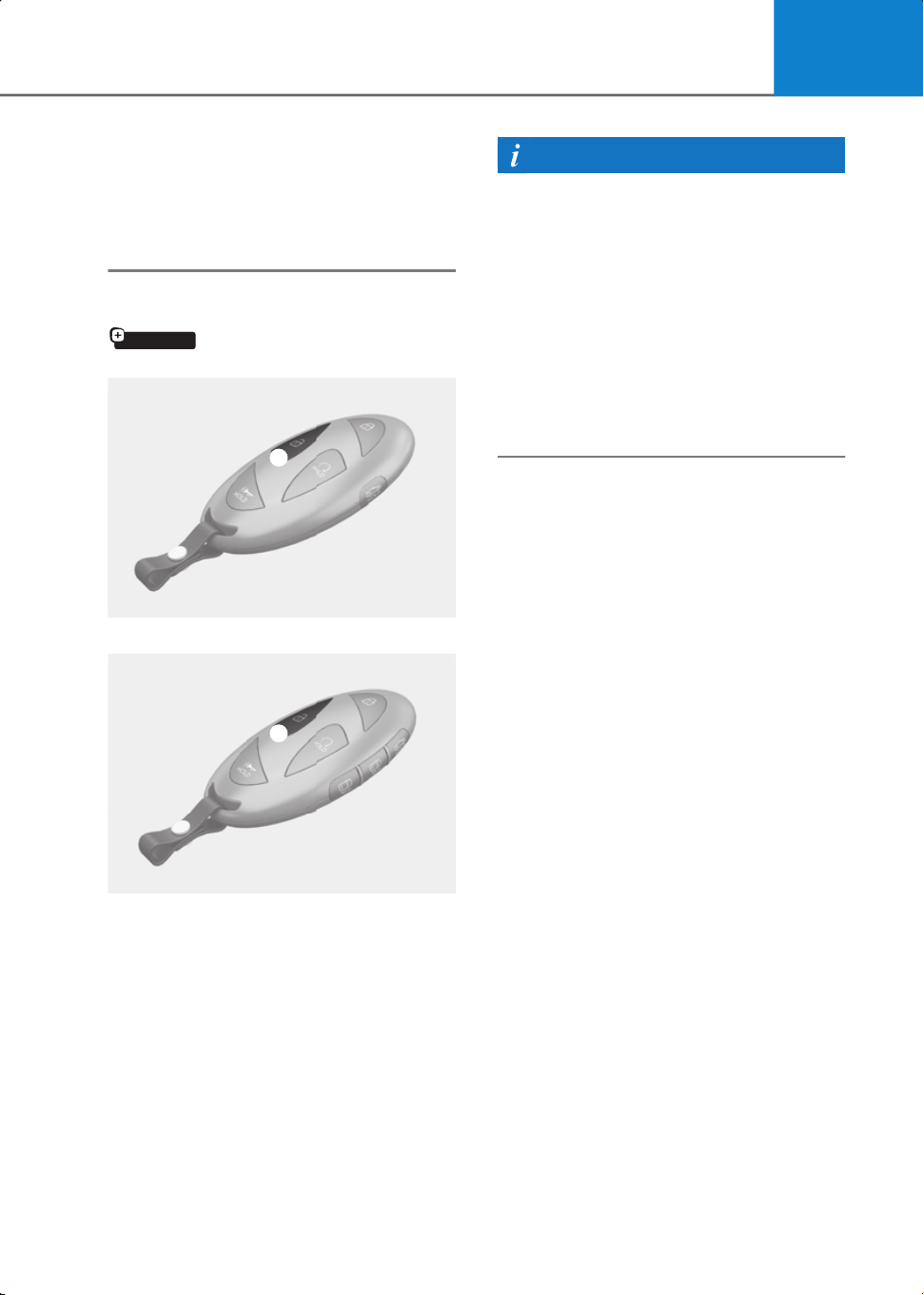
5
5-53
• Never try to operate the main switch on
the driver’s door and the individual
door window switch in opposite
directions at the same time. If this is
done, the window will stop and cannot
be opened or closed.
if equipped
Remote window opening function
Type A
B5008301
Type B
B5008302
Press and hold the Door Unlock (1) button
on the smart key for more than 3 seconds
and the windows move down after the
doors are unlocked. Window movement
stops when you release the door unlock
button.
Information
• The remote window opening function
will be operated only with the Safety
Power Windows equipped.
• The remote window opening function
may abruptly stop when you move
away from your vehicle during
operation. Stay in close proximity from
your vehicle, while monitoring the
window movement.
• Please be aware that the doors unlock
when the windows are opened using
the remote window open function.
1
1
CE_USA.book Page 53
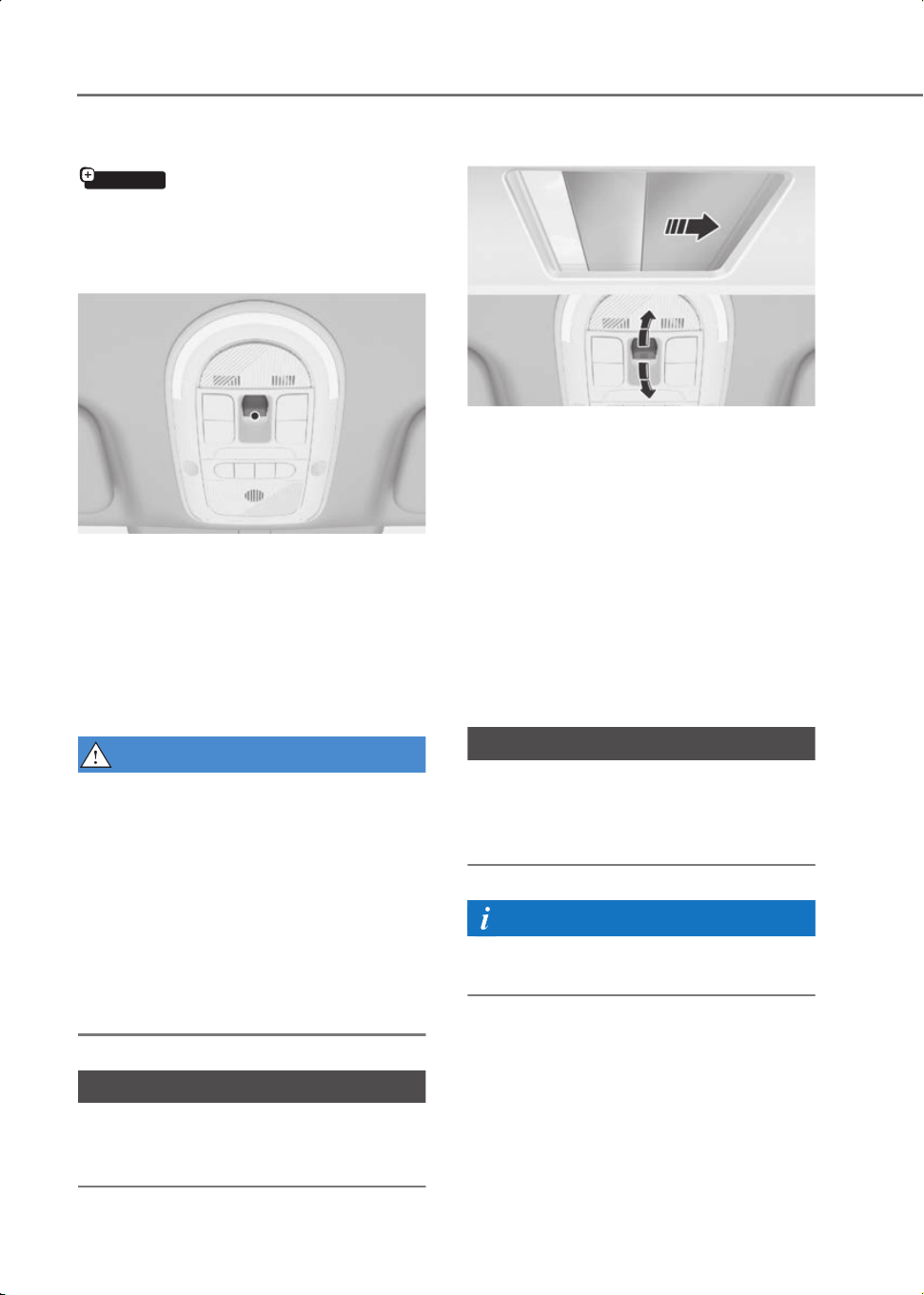
Convenience Features
5-54
if equipped
Wide Sunroof
If your vehicle is equipped with a sunroof,
you can slide or tilt your sunroof with the
sunroof switch located on the overhead
console.
B5027301
The sunroof can only be operated when
the Start/Stop button is in the ON or
START position.
The sunroof can be operated for about 3
minutes after the Start/Stop button is in
the ACC or OFF position. However, if the
front door is open, the sunroof cannot be
operated even within the 3 minute period.
WARNING
• Adjust the sunroof or sunshade when
your vehicle stops. This could result in
loss of control and an accident that may
cause injury, or property damage.
• Do not leave the vehicle running and
the key in your vehicle with
unsupervised children. Unattended
children could operate the sunroof,
which could result in serious injury.
• Do not sit on the top of the vehicle. It
may cause injury or vehicle damage.
NOTICE
Do not operate the sunroof when roof
bars are installed on the vehicle or when
there is luggage on the roof.
Power sunshade
B5027401
Use the power sunshade to block direct
sunlight coming through the sunroof
glass.
• Push the sunroof switch rearward to the
first detent position, the power
sunshade automatically slides open.
• Push the sunroof switch forward to the
first detent position, the power
sunshade automatically closes.
However, if the sunroof glass is open,
the glass will close first.
To stop the power sunshade at any point,
push the sunroof switch in any direction.
NOTICE
Do not pull or push the power sunshade
by hand as such action may damage the
power sunshade or cause it to
malfunction.
Information
Wrinkles formed on the power sunshade
are normal due to material characteristic.
CE_USA.book Page 54
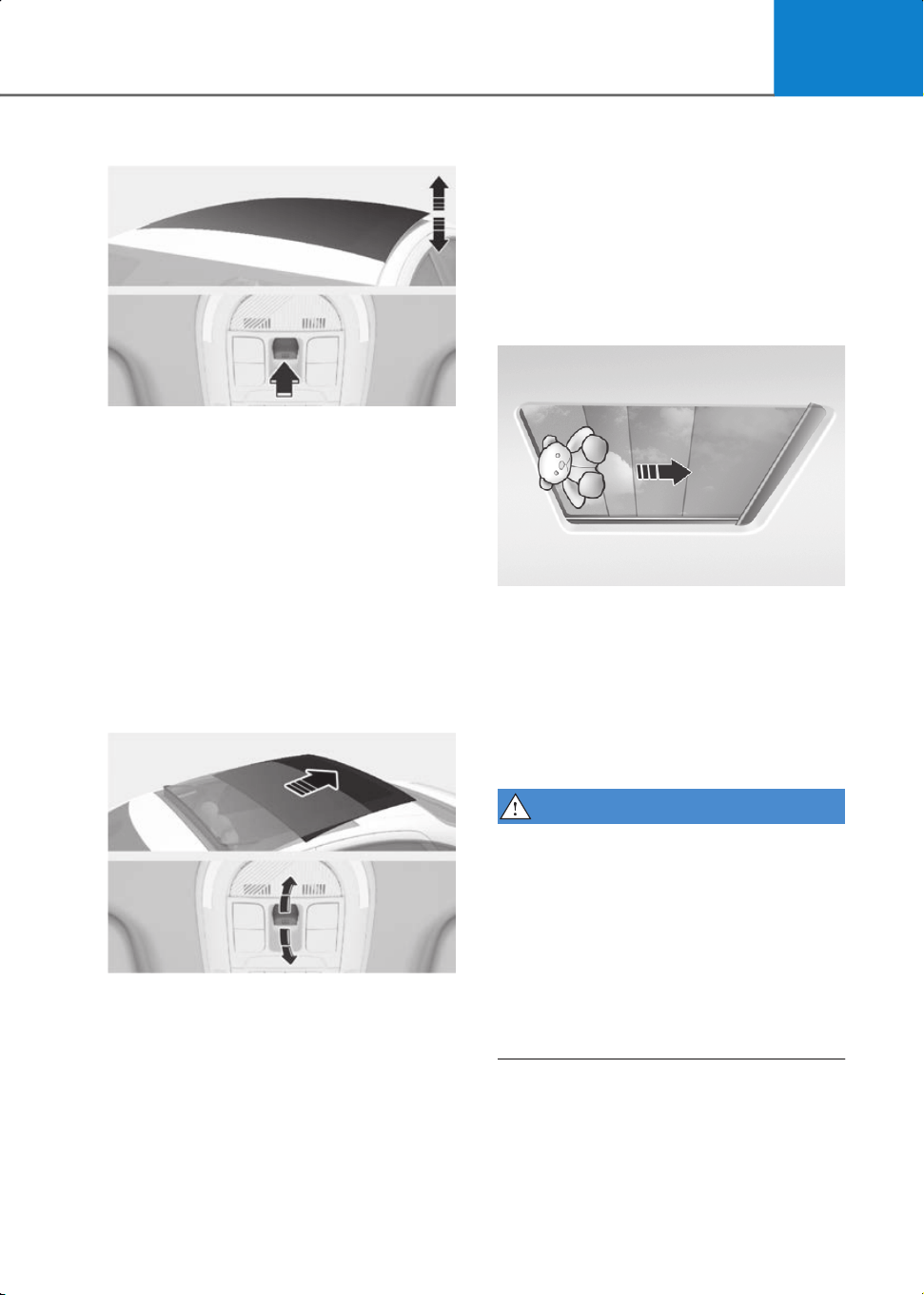
5
5-55
Tilt open/close
B5027501
• Push the sunroof switch upward, the
sunroof glass tilts open. However, if the
power sunshade is closed, the
sunshade will open first.
• Push the sunroof switch upward or
forward when the sunroof glass is tilt
opened, the sunroof glass
automatically closes.
To stop the sunroof movement at any
point, push the sunroof switch in any
direction.
Slide open/close
B5027601
• Push the sunroof switch rearward to the
first detent position, the sunroof glass
opens. However, if the power sunshade
is closed, the power sunshade will open
first.
Push the sunroof switch forward to the
first detent position, the sunroof glass
closes. However, if the sunroof glass is
closed, the power sunshade will close.
• Push the sunroof switch forward or
rearward to the second detent position,
the power sunshade and sunroof glass
operate automatically (auto slide
feature). To stop the sunroof
movement at any point, push the
sunroof switch in any direction.
Automatic reversal
B5027701
If the power sunshade or sunroof glass
senses any obstacle while it is closing
automatically, it will reverse direction
then stop at a certain position.
The auto reverse function may not work if
an object thin or soft is caught between
the sliding power sunshade or sunroof
glass and sunroof sash.
WARNING
• Make sure heads, hands, arms or any
other body parts or objects are out of
the way before operating the sunroof.
Body parts or objects may get caught
causing injuries or vehicle damage.
• Never deliberately use your body parts
to test the automatic reversal function.
The power sunshade or sunroof glass
may reverse direction, but there is a risk
of injury.
CE_USA.book Page 55
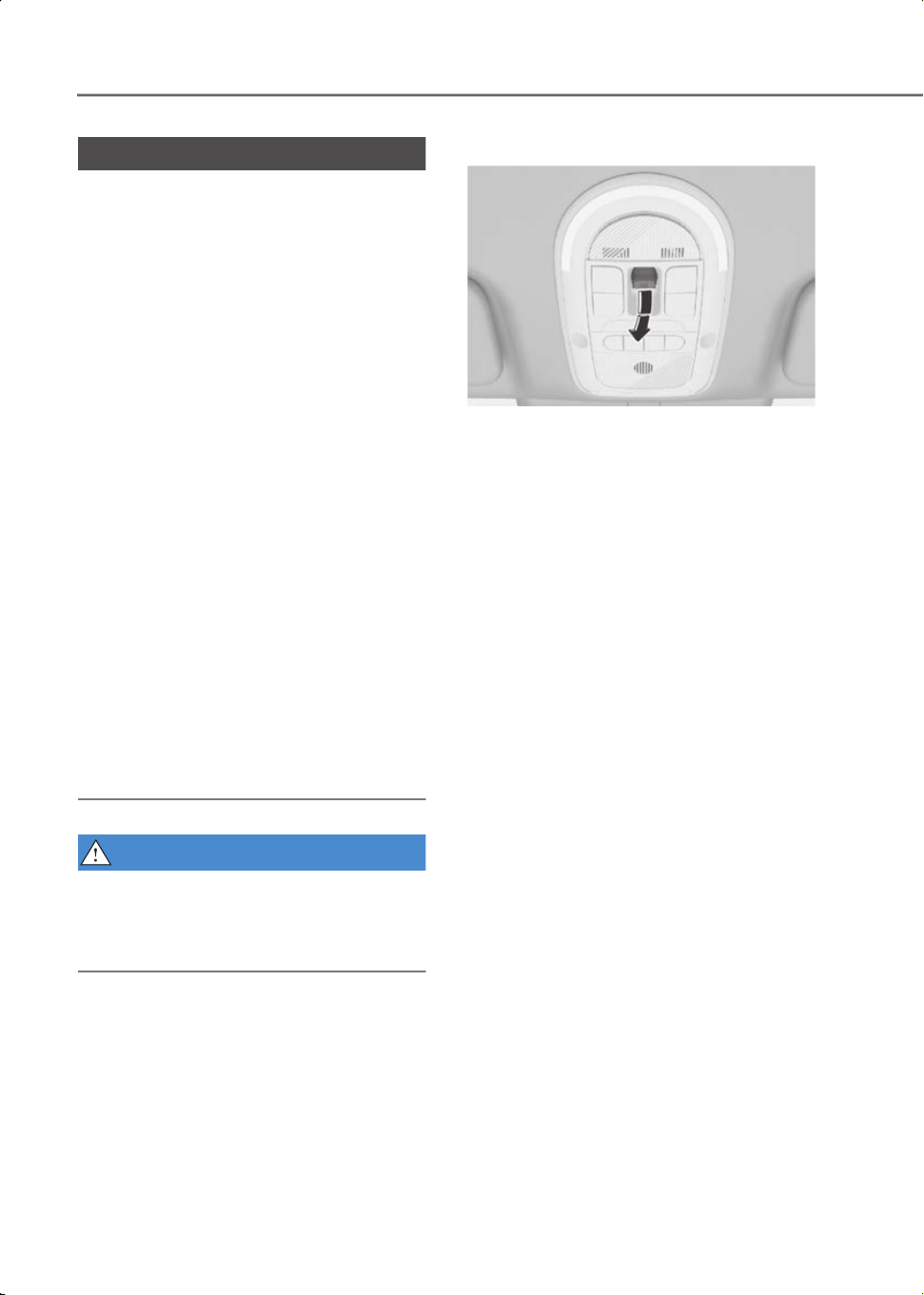
Convenience Features
5-56
NOTICE
• Do not continue to push the sunroof
switch after the sunroof is fully opened,
closed, or tilted. Damage to the sunroof
motor could occur.
• Continuous operations such as slide
open/close, tilt open/close, etc., may
cause the motor or sunroof system to
malfunction.
• Regularly remove any accumulated
dust on the sunroof rail.
• Dust accumulated between the sunroof
and roof panel can make noise Open
the sunroof and remove dust regularly
using a clean cloth.
• Do not try to open the sunroof when the
temperature is below freezing or when
the sunroof is covered with snow or ice.
The sunroof may not work properly and
may break if opened by force.
• Do not open or drive with the sunroof
glass open immediately after rain or
washing the vehicle. Water may wet the
interior of the vehicle.
• Do not extend any luggage outside the
sunroof while driving. Vehicle damage
may occur if the vehicle suddenly
stops.
WARNING
Do not extend your head, arms, body
parts or objects outside the sunroof while
driving. Injuries may occur if the vehicle
suddenly stops.
Resetting the sunroof
B5027801
In some circumstances resetting the
sunroof operation may need to be
performed. Some instances where
resetting the sunroof may be required
include:
• When the 12 V battery is either
disconnected or discharged
• When the sunroof fuse is replaced
• If the sunroof one-touch AUTO
OPEN/CLOSE operation is not
functioning properly
Sunroof resetting procedure:
1. It is recommended to perform the reset
procedure with the vehicle running.
Start the vehicle in P (Park).
2. Make sure the power sunshade and
sunroof glass are in the fully closed
position. If the power sunshade and
sunroof glass are open, push the switch
forward until the power sunshade and
sunroof glass are fully closed.
3. Release the switch when the power
sunshade and sunroof glass are fully
closed.
4. Push the switch forward until the power
sunshade and sunroof glass move
slightly. Then release the switch.
5. Once again push and hold the sunroof
switch forward until the power
sunshade and sunroof glass slide open
and close. Do not release the switch
until the operation is completed.
CE_USA.book Page 56
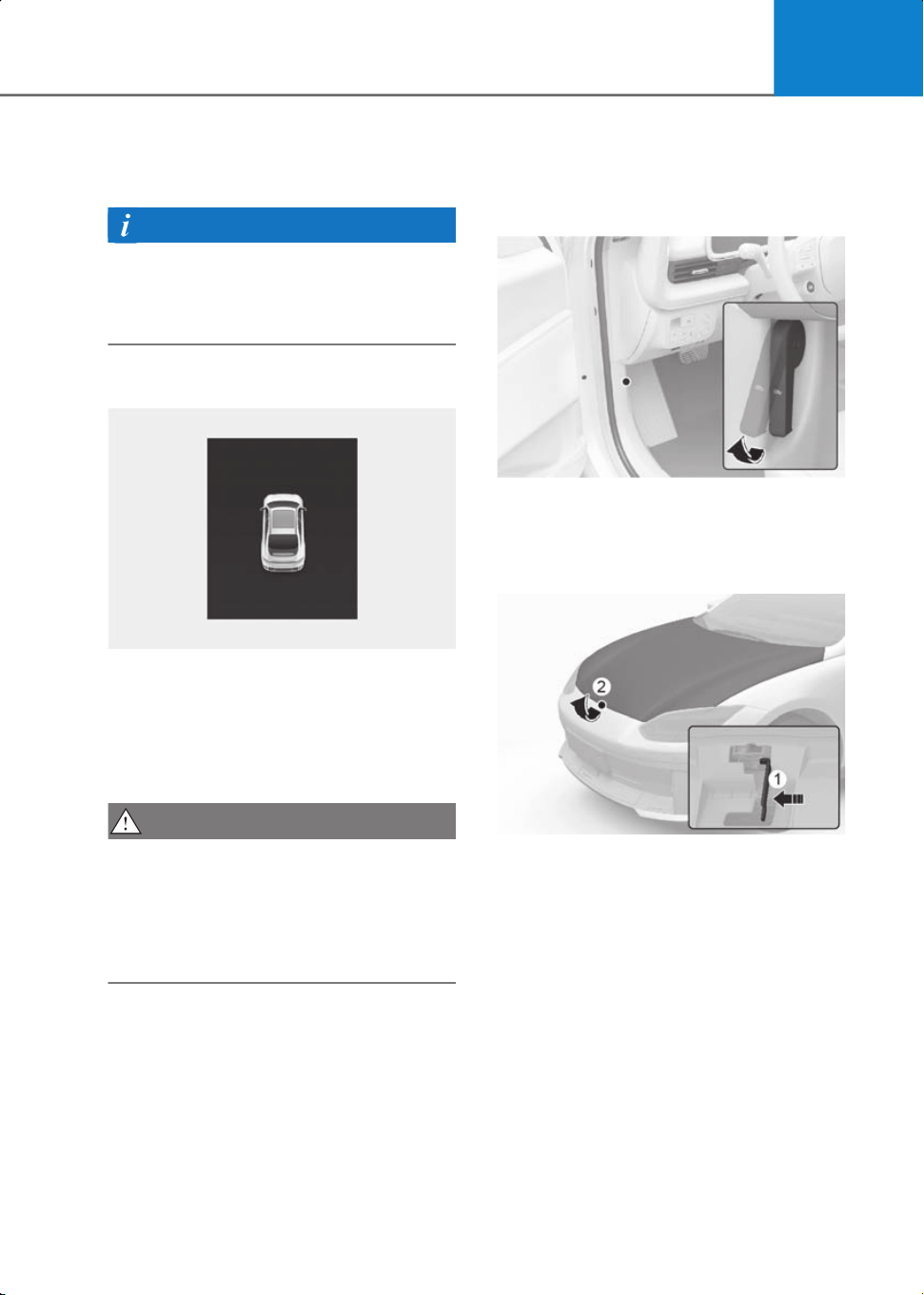
5
5-57
If you release the switch during
operation, start the procedure again
from step 2.
Information
If the sunroof is not reset after the vehicle
battery is disconnected or discharged, or
the sunroof fuse is blown, the sunroof
may not operate normally.
Sunroof open warning
B5027901
If the driver turns off the vehicle when the
sunroof is not fully closed, the warning
chime will sound for several seconds and
the sunroof open warning will appear on
the cluster display. Close the sunroof
securely when leaving your vehicle.
CAUTION
Make sure the sunroof is closed fully
when leaving your vehicle. If the sunroof
is left open, rain or snow may wet the
interior of the vehicle. Also, leaving the
sunroof open when the vehicle is
unattended may invite theft.
Hood
Opening the Hood
B5010001
1. Park the vehicle and apply the parking
brake.
2. Pull the release lever to unlatch the
hood. The hood pops open slightly.
B5010002
3. Go to the front of the vehicle, raise the
hood slightly, push to the left the
secondary hood release lever (1) inside
of the hood center and lift the hood (2).
CE_USA.book Page 57
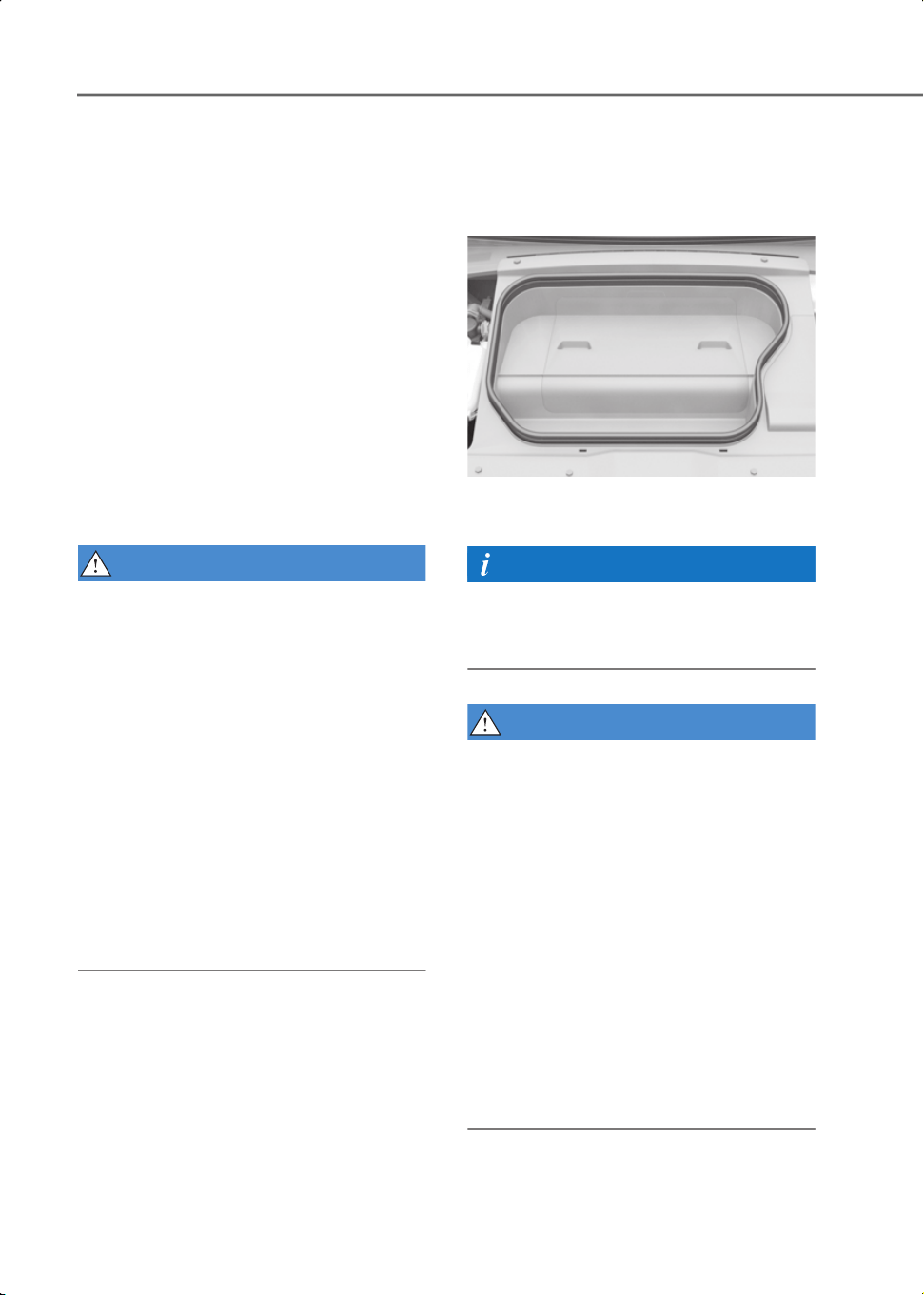
Convenience Features
5-58
Closing the Hood
1. Before closing the hood, check in and
around the motor compartment to
ensure the following:
• Any tools or other loose objects have
been removed.
• All glove, rags, or other combustible
material have been removed.
• All filler caps are tightly and correctly
installed
2. Lower the hood until it is about 12 in. (30
cm) above the closed position and then
let it drop.
3. Check the hood has locked properly. If
the hood is raised slightly, open it again
and drop it from a little higher. Check
again.
WARNING
• Before closing the hood, ensure all
obstructions are removed from around
the hood opening. The hood will rise up
or move down automatically if the
height is not firmly adjusted. Be aware
of the damage caused by the
unintended hood movements.
• Always double check to make sure that
the hood is firmly latched before driving
away. Check there is no hood open
warning light or message displayed on
the instrument cluster. Driving with the
hood open may cause a total loss of
visibility, resulting in a collision.
• Do not move the vehicle with the hood
raised. It may block your vision and may
result in a collision.
Front Trunk
Opening the Front Trunk
B5010702
Opening the hood reveals the front trunk
and you can store your belongings.
Information
Front trunk weight limit: 25 lbs. (10 kg)
The front trunk’s weight limit depends on
the specifications.
WARNING
• NEVER make an attempt to get inside
the front trunk. It will cause a fatal
injury.
• Before closing the hood, ensure all
obstructions are removed from around
the hood opening. The hood will rise up
or move down automatically if the
height is not firmly adjusted. Be aware
of the damage caused by the
unintended hood movements.
• Never store cigarette lighters, propane
cylinders, or other
flammable/explosive materials in the
vehicle. These items may catch fire
and/or explode if the vehicle is exposed
to hot temperatures for extended
periods.
CE_USA.book Page 58

5
5-59
CAUTION
• Do not exceed the luggage volume
capacity of the front trunk. The
overweighted front trunk can be
severely damaged.
• Do not store the fragile objects in the
front trunk.
• ALWAYS keep the front trunk cover
closed securely while driving. Items
inside your vehicle are moving as fast
as the vehicle. If you have to stop or
turn quickly, or if there is a crash, the
items can be damaged.
• Do not spray water in the front trunk.
Vehicle driving system may get
damaged since the front trunk is
located at the center of motor
compartment.
• Be careful when you store any liquid in
the front trunk. If liquid leak outside the
front trunk, it will cause damage to the
electric devices in the motor
compartment.
• Do not press the front trunk cover or
place the objects on the front trunk
cover. It may be deformed or damaged.
• When closing the front trunk cover, be
careful not to touch objects inside the
trunk. Loaded objects or the front trunk
may be deformed or damaged and the
front trunk cover may be opened during
driving due to poor closing, resulting in
joints and damage.
NOTICE
To avoid possible theft, do not leave
valuables in the storage compartments.
Power Trunk
Power Trunk Operating
Conditions
The power trunk operates when vehicle
speed is below 1.8 mph (3 km/h).
WARNING
• Never leave children or animals
unattended in your vehicle. Children
may operate the power trunk. Doing so
can result in injury to themselves or
others and can damage the vehicle.
• Make sure there are no people or
objects and enough space around the
trunk before operating the power trunk
or smart trunk prior to use. Serious
injury, damage to the vehicle or
damage to surrounding objects (for
example, walls, ceilings, vehicles, etc.)
may result if contact with the trunk
occurs.
• Make sure there are no people or
objects around the trunk before
operating the power trunk. Wait until
the trunk is opened fully and stopped
before loading or unloading cargo from
the vehicle.
NOTICE
• Do not close or open the power trunk
manually. This may cause damage to
the power trunk. If it is necessary to
close or open the power trunk manually
when the battery is discharged or
disconnected, do not apply excessive
force.
• Do not operate the power trunk more
than 10 times continuously when the
vehicle is turned off ( indicator off)
is off. Use the power trunk with the
vehicle turned on ( indicator on)
when the power trunk is used
repeatedly to prevent battery
discharge.
CE_USA.book Page 59
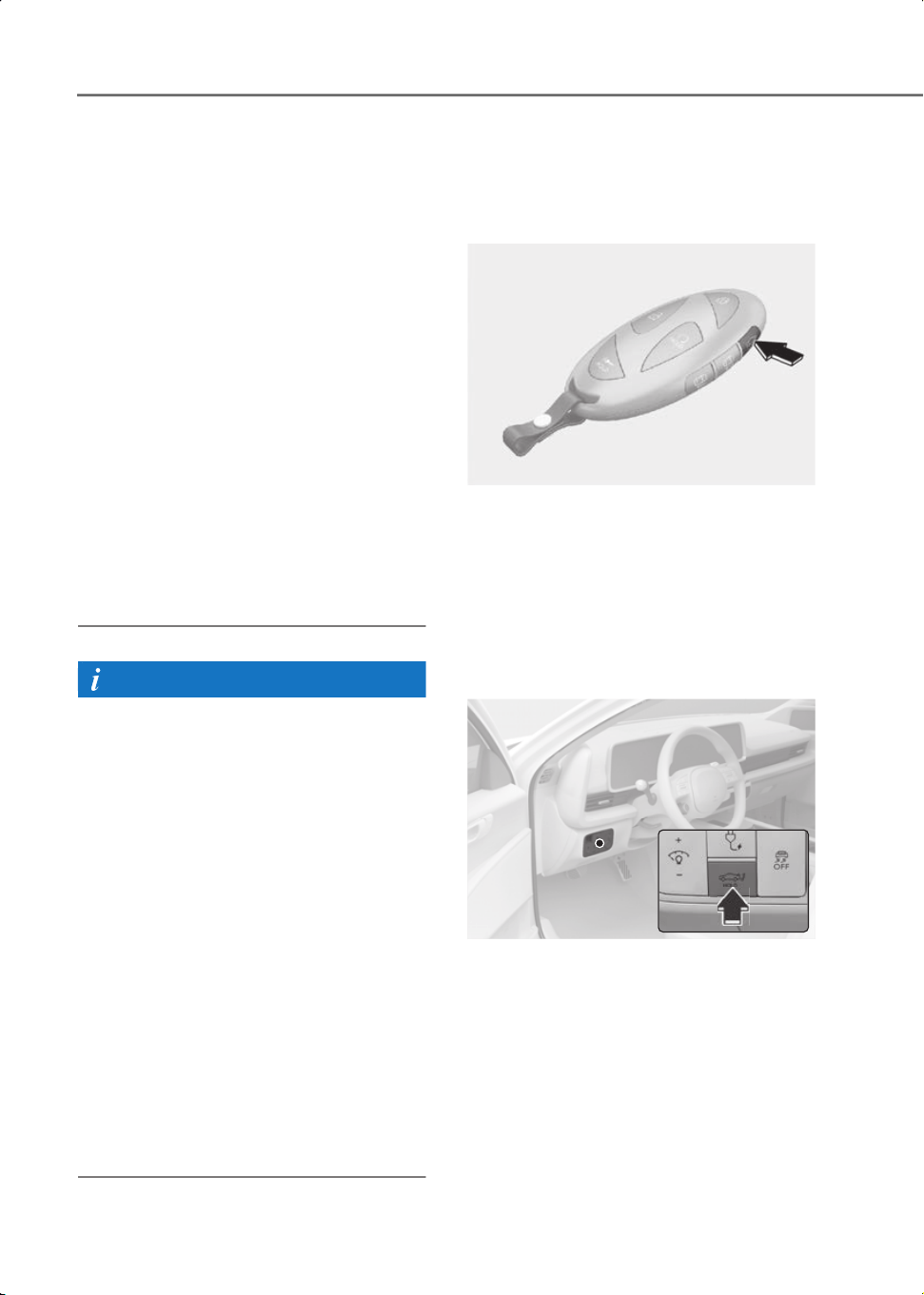
Convenience Features
5-60
• Do not leave the trunk open for a long
period of time. This may drain the
battery.
• Do not modify or repair any part of the
power trunk by yourself. Contact an
authorized HYUNDAI dealer.
• Do not operate the power trunk under
the following conditions. The power
trunk may not operate properly.
- One side of the vehicle is lifted to
inspect the vehicle or change a tire
- Parking on an uneven road such as a
slope, etc.
• Close the trunk completely and lock all
doors and trunk using the central door
lock button before using an automatic
car wash.
• Do not spray high pressure water
directly on the power trunk outside
open/close button. The trunk may open
unintentionally.
Information
• In cold and wet climates, the outside
power trunk open button may not work
properly due to freezing conditions. If
this occurs, remove the ice before
using the outside power trunk
open/close button or use the power
trunk open/close button on the smart
key or the instrument panel.
• If you leave the smart key in the trunk
and close the trunk, a warning will
sound for about 5 seconds. If this
occurs, open the trunk by pressing the
power trunk open button on the outside
of the trunk.
• If there are obstacles such as snow on
the trunk, the trunk may not open
automatically. After removing the
obstacle, try to open it again.
• Be careful where there is an incline, as
the trunk lid may drop slightly when it is
stopped before it fully opens.
Operating the Power Trunk
Power trunk open button (Smart
key)
B5011101
When the trunk is closed, press the power
trunk open button for 1.5 second. The
trunk will open with a warning sound.
While the trunk is opening, press the
button to stop power trunk operation.
Power trunk open/close button
(Instrument panel)
B5011102
When the trunk is closed, press the power
trunk open/close button. The power trunk
will open with a warning sound.
While the trunk is opening, press the
button to stop power trunk operation.
When the trunk is opened, press and hold
the trunk open/close button to close the
power trunk. If you release the button
while the trunk is closing, power trunk
operation will stop with a warning sound
for 5 seconds.
CE_USA.book Page 60
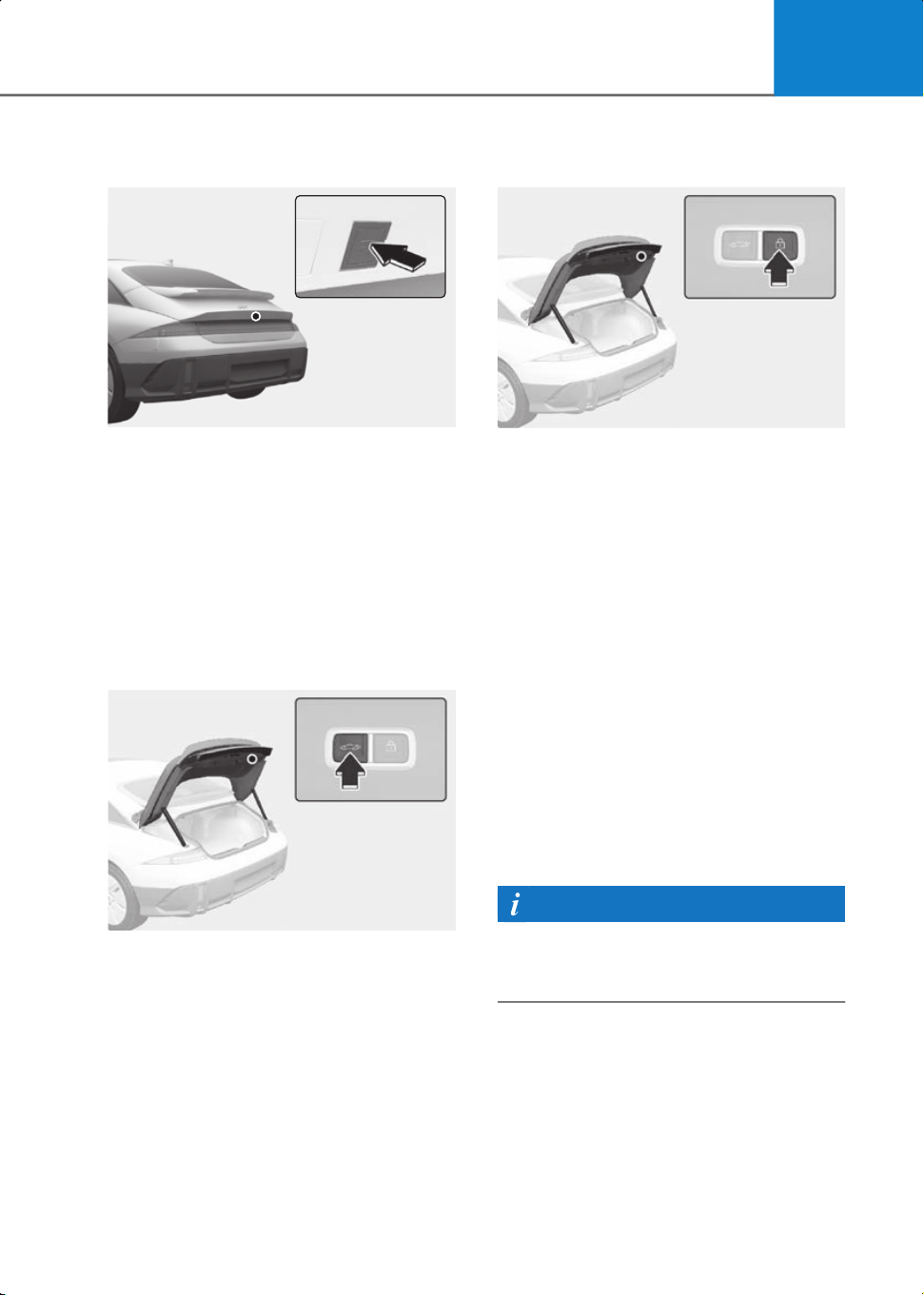
5
5-61
Power trunk open button (Outside
the power trunk)
B5011103
When the trunk is closed, press the power
trunk open button to open the trunk.
If the vehicle is locked, press the power
trunk open button with the smart key in
your possession.
While the trunk is opening, press the
button to stop power trunk operation.
Power trunk close button (Inside the
power trunk)
B5011104
Press the power trunk close button. The
trunk will close with a warning sound.
While the trunk is closing, press the
button to stop power trunk operation.
Power trunk lock button (Inside the
power trunk)
B5011105
Press the power trunk lock button while
carrying the smart key. The power trunk
will close and lock with a warning sound.
Additionally, all doors will lock. The trunk
will close and lock, and all doors will lock
only when the vehicle is off or all doors
are closed.
Switching the power trunk from
manual to automatic
If you apply over a certain amount of
power manually when the trunk is
opened, the power trunk system detects
the direction and closes or opens
automatically.
• The power trunk fully opens when the
trunk is raised.
• The power trunk closes completely
when the trunk is lowered.
Information
The power trunk may not operate
properly if the trunk is not opened above
a certain height.
CE_USA.book Page 61
Convenience Features
5-62
Automatic reverse
During power trunk operation if the
power trunk senses any obstacle, the
trunk will stop or will fully open. The
automatic reverse feature may not
operate properly, or it may operate
unexpectedly under the following
circumstances:
• The automatic reverse feature may not
detect the resistance if the detected
resistance is below a certain level, or if
the trunk is almost fully closed near the
latched position.
• The automatic reverse feature may
operate if a strong impact is applied
with no obstructions placed.
WARNING
Never intentionally place any object or
part of your body in the path of the power
trunk to make sure the automatic reverse
feature operates. Serious injury, or
damage to the vehicle or object may
occur.
Information
The power trunk may stop operating if the
automatic reverse feature operates more
than two times while attempting to open
or close the trunk. If this occurs, carefully
open or close the trunk manually, and
then after 30 seconds try to operate the
power trunk automatically again.
Resetting the Power Trunk
To reset the power trunk:
1. With the vehicle is turned off or on (
indicator off or on), put the gear in P
(Park).
2. While Pressing the power trunk close
inner button, press the power trunk
open outer button for more than 3
seconds. A chime will sound.
3. Slowly close the trunk manually.
4. Press the power trunk open outer
button. The trunk will open with a
chime sound.
Wait until the trunk fully opens to
complete resetting. If the trunk stops
before it is fully open, resetting cannot
be completed.
Information
• If the power trunk is not reset after the
vehicle battery is disconnected or
discharged, or the power trunk fuse is
blown, the power trunk may not
operate normally.
• If the power trunk does not operate
properly after the above procedure,
have the system inspected by an
authorized HYUNDAI dealer.
CE_USA.book Page 62
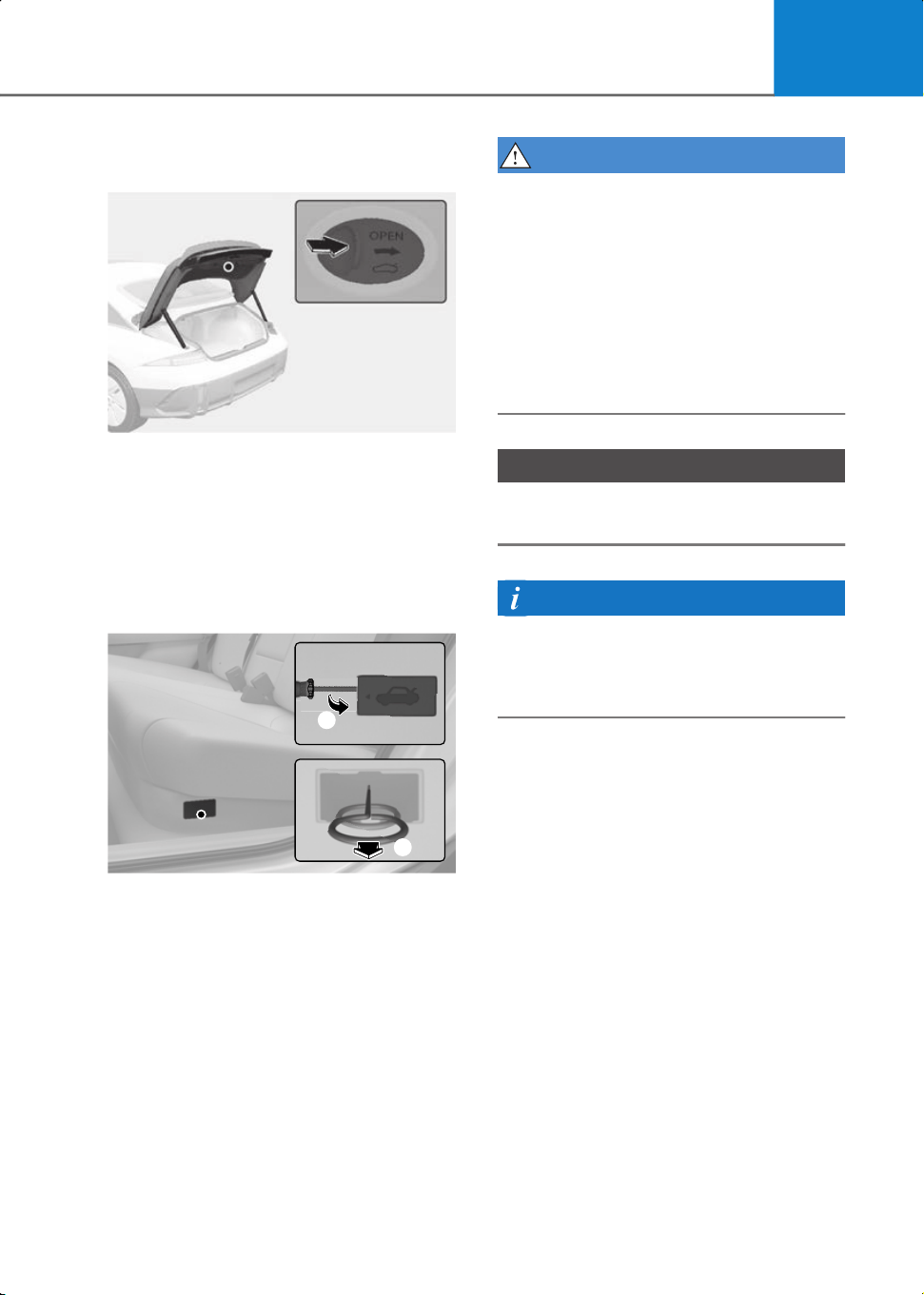
5
5-63
Emergency Trunk Safety
Release
B5011701
• Inside the trunk
Your vehicle is equipped with an
emergency trunk safety release lever
located inside the trunk. When
someone is inadvertently locked in the
trunk, the trunk can be opened by
moving the lever in the direction of the
arrow and pushing the trunk lid to open.
B5011702
• Inside the vehicle
Follow the below procedure to open
the power trunk manually when the
battery is discharged or when there is a
problem with the vehicle:
1. Remove the cable cover (1) under the
rear seat using a small flat blade tool
(like a screwdriver or similar).
2. Pull the cable loop (2) all the way out.
The power trunk unlocks.
3. Push the trunk lid to open.
WARNING
• You and your passengers must be
aware of the location of the Emergency
Trunk Safety Release lever in this
vehicle and how to open the trunk in
case you are accidentally locked in the
trunk.
• NEVER allow anyone to occupy the
trunk of the vehicle at any time.
• Use the release lever for emergencies
only.
NOTICE
Be careful not to scratch or lose the cover
when removing it.
Information
The cable is firmly fixed so it may hard to
pull. Therefore, please use a tool such as a
screwdriver to assist in pulling the loop
for the emergency release.
2
1
CE_USA.book Page 63
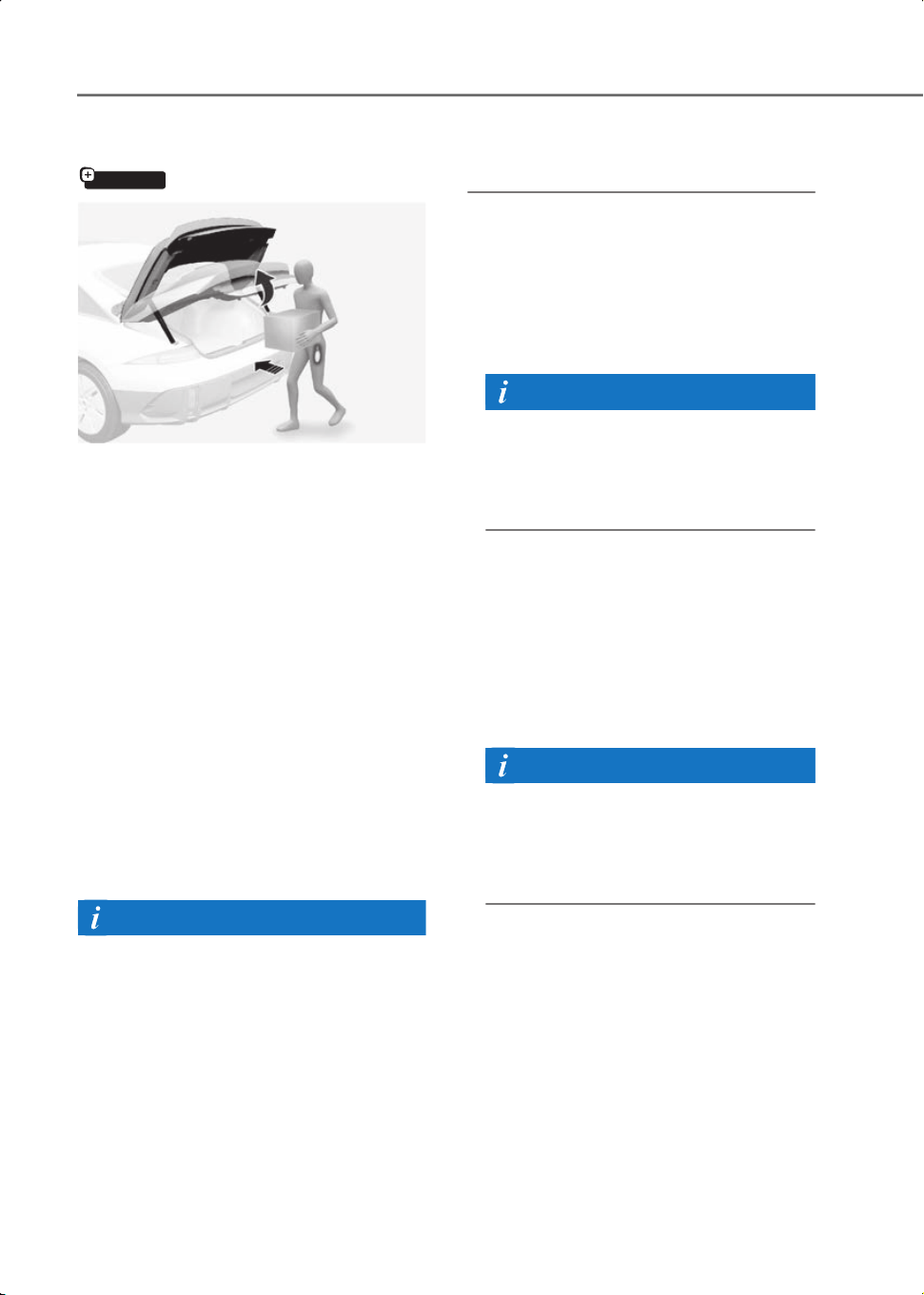
Convenience Features
5-64
if equipped
Smart Trunk
B5012501
On a vehicle equipped with a smart key,
the trunk can be opened with hands-free
activation using the smart trunk system.
Using Smart Trunk
The hands-free smart trunk system can
used when:
• The smart trunk option is enabled in the
Settings menu in the infotainment
system.
• The smart trunk is activated 15 seconds
after all the doors are closed and
locked.
• The smart trunk opens when the smart
key is detected in the area behind the
vehicle for 3 seconds.
• When disconnecting the charging
connector, the smart trunk is activated.
Information
The smart trunk does not operate when:
• A door is not locked or closed.
• The smart key is detected within 15
seconds from when the doors were
closed and locked.
• The smart key is detected within 15
seconds after the doors are closed and
locked, and within 60 in. (1.5 m) from
the front door handles. (for vehicles
equipped with Welcome Mirror).
• The smart key is in the vehicle.
• The vehicle is on charge.
1. Settings
To use smart trunk, it must be enabled
from the Settings menu in the
infotainment system.
Select Setup > Vehicle > Door > Smart
Trunk.
Information
The infotainment system may change
after software updates. For more
information, refer to the user's manual
provided in the infotainment system
and the quick reference guide.
2. Detect and Alert
The smart trunk detecting area extends
about 20-40 in. (50-100 cm) behind the
vehicle. If you are positioned in the
detecting area and are carrying the
smart key, the hazard warning lights
blink and the chime sounds before
opening.
Information
If you unintentionally enter the
detecting area and the hazard warning
lights and chime starts, move away
from the vehicle with the smart key.
The trunk remains closed.
3. Automatic opening
After the hazard warning lights blink
and the chime sounds 6 times, the
smart trunk opens.
CE_USA.book Page 64
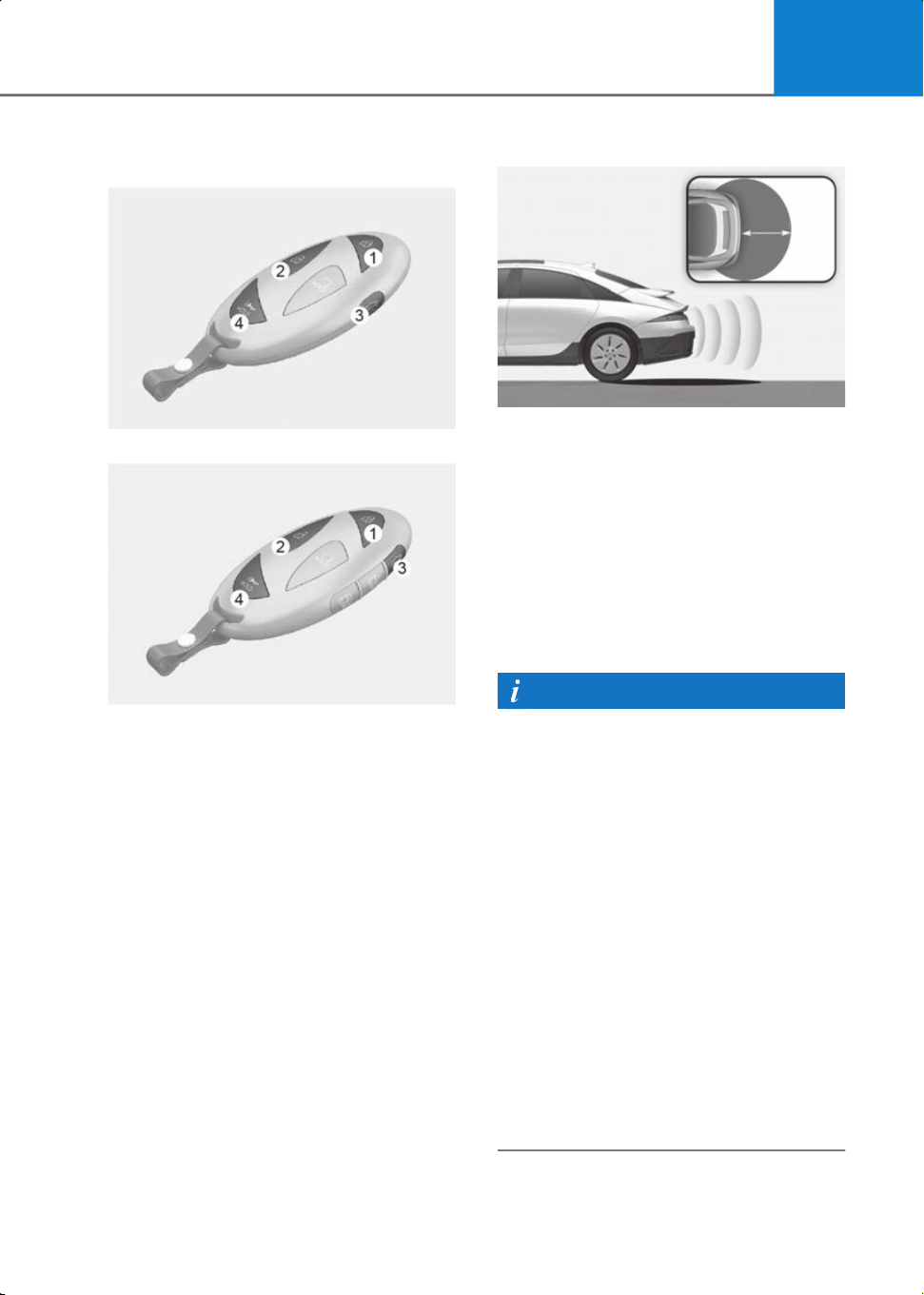
5
5-65
Deactivating smart trunk
Type A
B5012801
Type B
B5012802
1. Door lock
2. Door unlock
3. Trunk open/close
4. Panic
If you press any button on the smart key
during the Detect and Alert stage, the
smart trunk is deactivated.
Using the smart key:
• If you press the door unlock button, the
smart trunk is deactivated temporarily.
If you do not open any door for 30
seconds, the smart trunk is activated
again.
• If you press the trunk open button for
more than 1 second, the trunk opens.
• The smart trunk is still activated if you
press the door lock button or trunk
open/close button as long as the smart
trunk is not in the Detect and Alert
stage.
Detecting area
B5012901
• The smart trunk detecting area extends
about 20-40 in. (50-100 cm) behind the
vehicle. If you are positioned in the
detecting area and are carrying the
smart key, the hazard warning lights
will blink and the chime will sound for
about 3 seconds to alert you that the
trunk will open.
• The alert stops once the smart key is
moved outside of the detecting area
within the 3 second period.
Information
• Smart trunk may not operate properly if
any of the following occur:
- The smart key is close to a radio
transmitter such as a radio station or
an airport which can interfere with
normal operation of the transmitter.
- The smart key is near a mobile two
way radio system or a mobile phone.
- Another vehicle’s smart key is being
operated close to your vehicle.
- The temperature drops below zero
degree.
• Smart trunk detecting area may change
when:
- The vehicle is parked on an incline or
slope.
- One side of the vehicle is raised or
lowered relative to the opposite side.
_JO
CE_USA.book Page 65
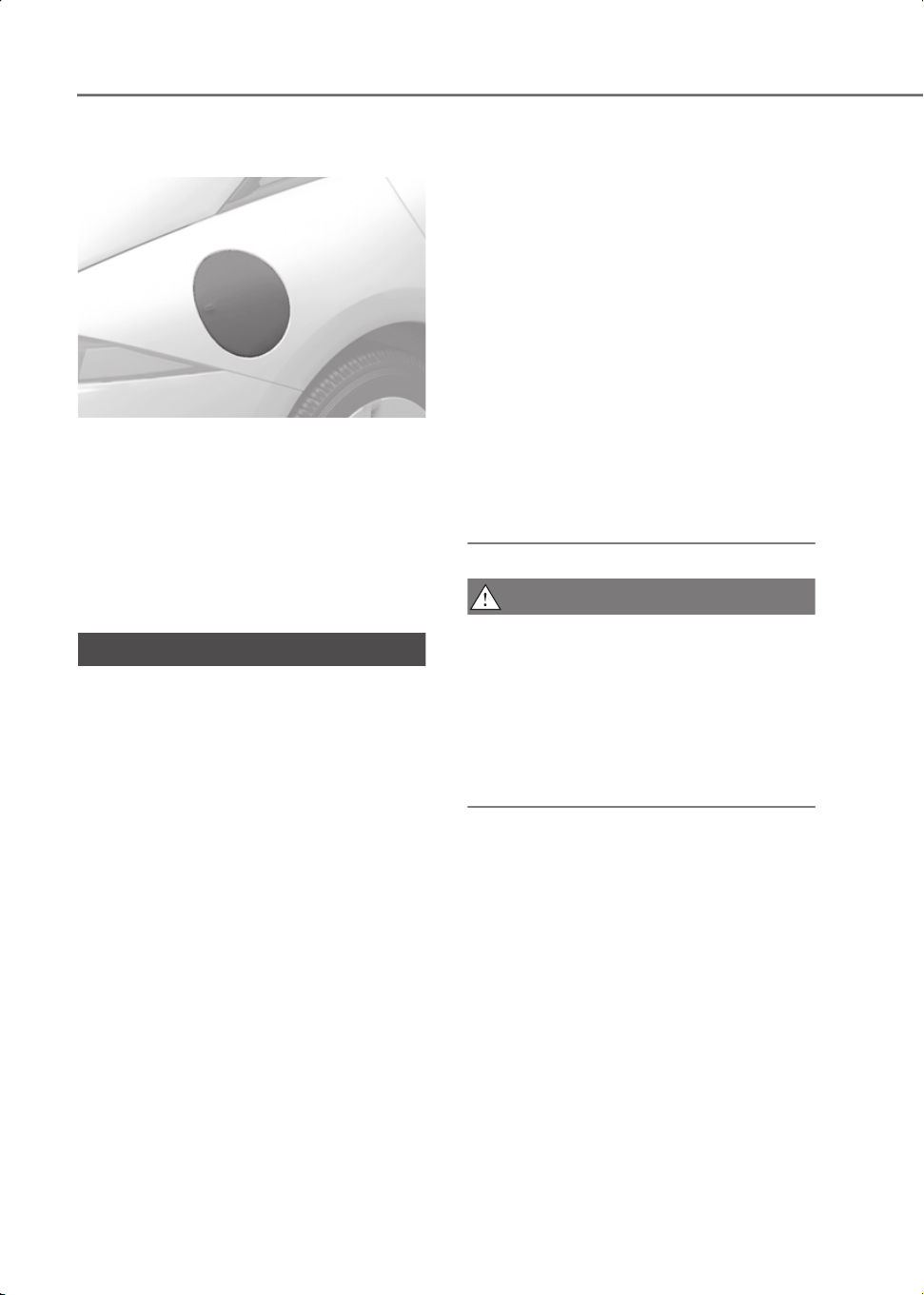
Convenience Features
5-66
Electric Charging Door
B5013501
The driver can open and close the
charging door with the following
methods:
• When the shift gear is in P (Park), push
the charging door to open/close
• Push the Close button located inner
part of the charging door
• Use the Voice Recognition
NOTICE
• If the charging door does not open
because ice has formed around it, tap
lightly or push on the door to break the
ice and release the door. If necessary,
use hand temperature to melt down the
ice or move the vehicle to a warm place
and allow the ice to melt. Do not pry on
the charging door or use unauthorized
tools to open the charging door.
• After closing the charging door, push
the door again to ensure that the
charging door is completely closed.
• Make sure that the charging door is
closed before driving the vehicle. If the
charging door is opened, mechanical
parts of the charging door can be
damaged.
• After closed the charging door, be sure
to check the warning light is off.
• After charging the vehicle, close the
charging inlet by the charging inlet
cover properly. If the charging inlet
cover is closed improperly, the
charging inlet and the charging door
can be damaged.
• Do not pry on the charging door while
the charging door is opening. The
charging door may stop moving. Also,
the electrical mechanism of the
charging door and its related parts can
be severely damaged.
• While washing the vehicle, do not spray
a high pressure water to the charging
door directly. The high pressure can
damage the charging door.
CAUTION
• The charging door opens sideways.
Check the surrounding while the
charging door is open or close. Be
aware of your head or limbs from being
hit or stuck to the charging door.
• Do not hold the hinge to prevent
damaging the charging door and
causing other accidents.
CE_USA.book Page 66
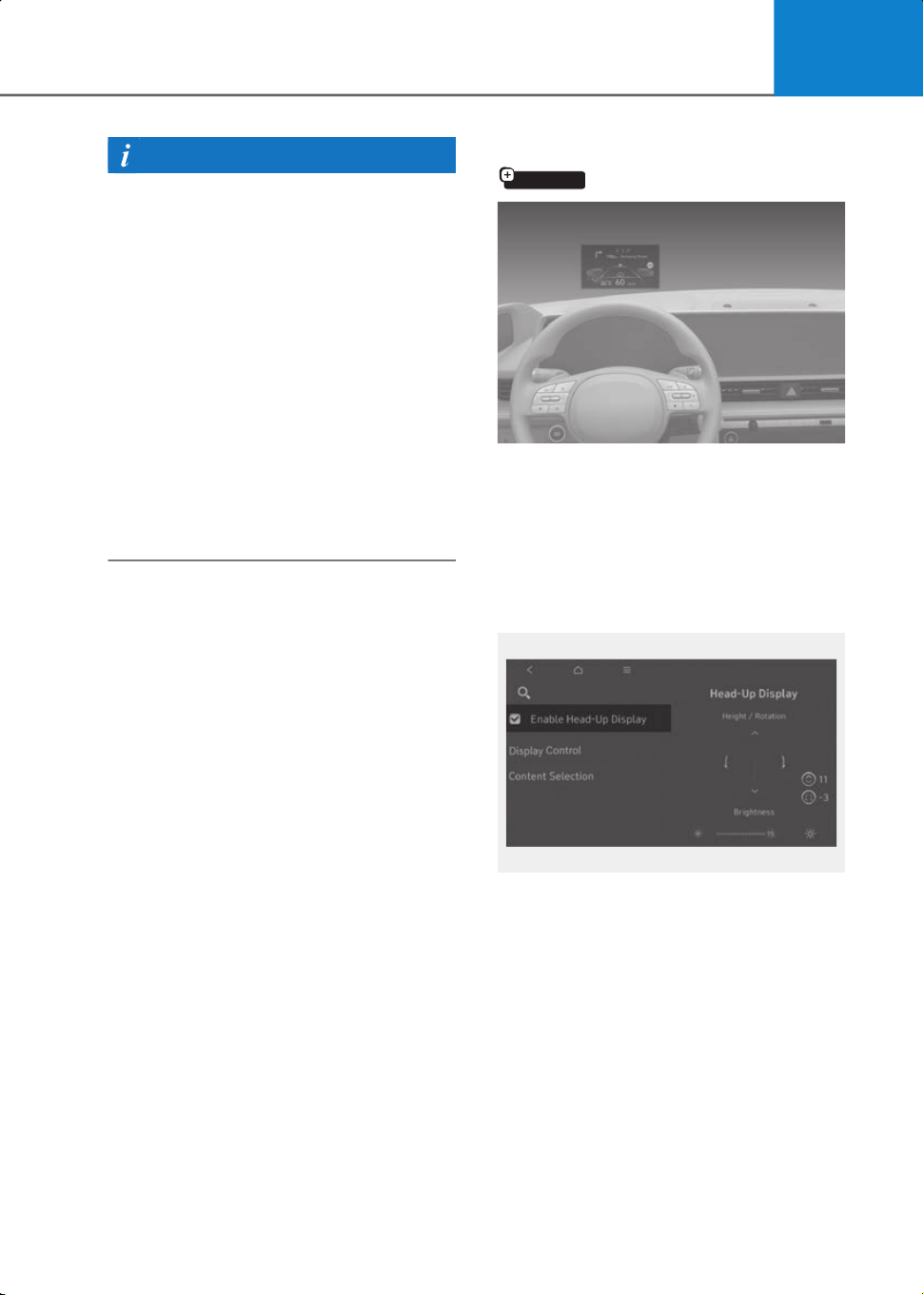
5
5-67
Information
• The charging door automatically closes
when:
- The charging connector is
disconnected
- The door is opened and the charging
connector is not connected for a
certain period of time
- The gear is not in P (Park)
• After replacing battery (12 V), open and
close the charging door once to check
that the charging door automatic
opening mechanism is functioning
properly.
For more information, refer to the
“Charging Your Electric Vehicle” section
in chapter 1.
if equipped
Head-up Display
B5014101
The Head-up display is an optional
feature that allows the driver to view
information projected onto a transparent
screen while still keeping your eyes safely
on the road ahead while driving.
Head-up Display Settings
B5014201
• Head-up display can be enabled from
the Settings menu in the infotainment
system.
Select Setup > Vehicle > Head-Up
Display > Enable Head-Up Display.
• After turning on the Head-up display,
you can change the settings of ‘Display
Control’ and ‘Content Selection’ of the
Head-Up Display.
CE_USA.book Page 67
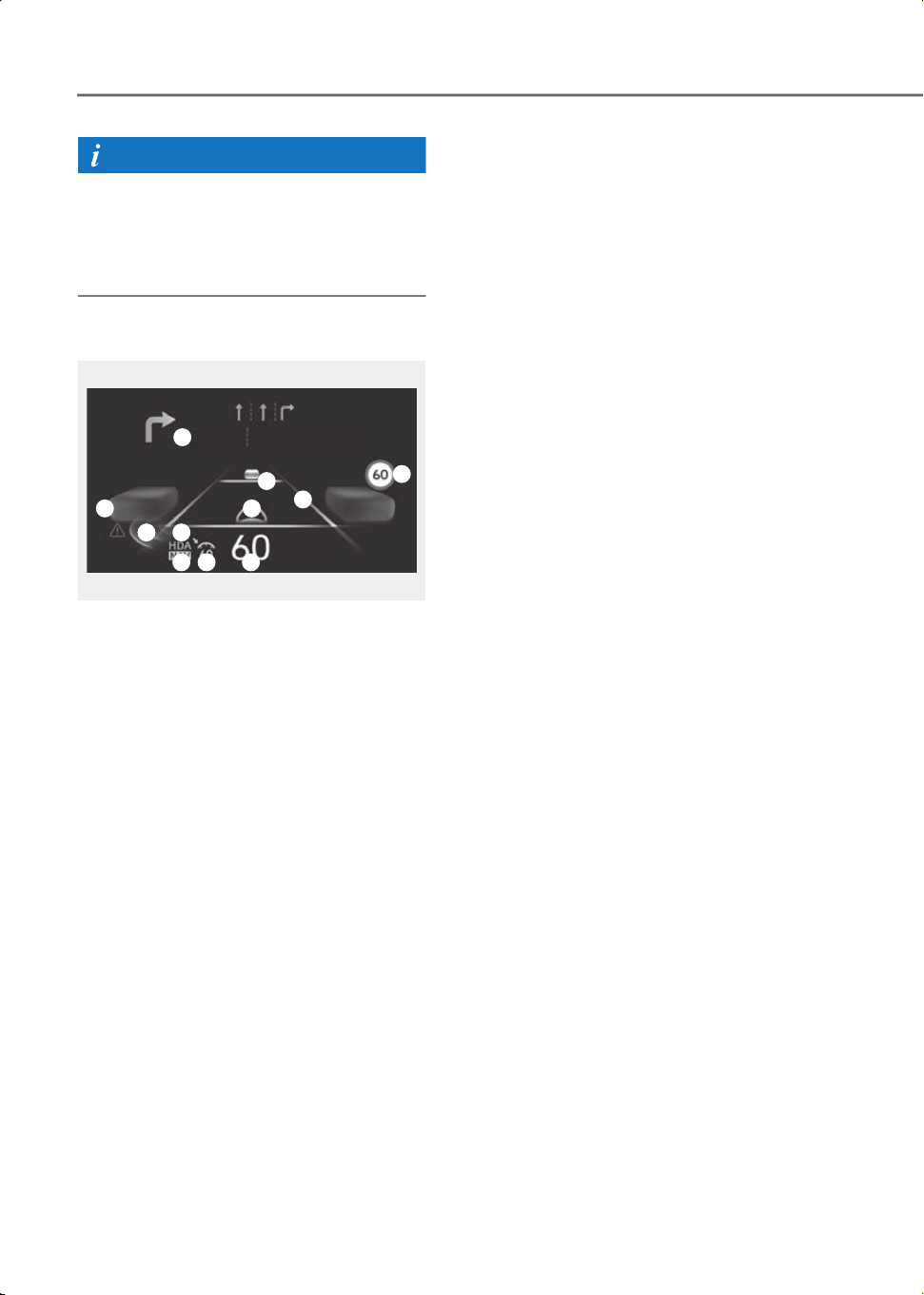
Convenience Features
5-68
Information
The infotainment system may change
after software updates. For more
information, refer to the user's manual
provided in the infotainment system and
the quick reference guide.
Head-up Display Information
B5014301
1. Turn by Turn (TBT) navigation
2. Traffic
3. Speedometer
4. SCC set speed
5. SCC vehicle distance
6.Lane Following Assist
7. Lane Safety
8.Blind-Spot Safety
9.Highway Auto Speed Change
10.Highway Driving Assist
11.Surrounding vehicle (if equipped)
Precautions while Using the
Head-up Display
• It may sometimes be difficult to read
information on the Head-up display in
the following situations.
- The driver is improperly positioned in
the driver’s seat
- The driver wears polarizing-filter
sunglasses
- An object is located above the
head-up display cover
- The vehicle is driven on a wet road
- Any improper lighting accessory is
installed inside the vehicle, or there is
incoming light from outside of the
vehicle
- The driver wears glasses
- The driver wears contact lenses
When it is difficult to read the head-up
display information, adjust the image
position or brightness level from the
Settings menu in the infotainment
system.
• Since the information displayed on the
head-up display partially overlaps with
the road ahead, you may feel fatigue
and discomfort while driving. If you feel
tired or uncomfortable, adjust the
image, and if the symptoms persist,
turn off the head-up display before
driving.
• For your safety, make sure to stop the
vehicle before adjusting the settings.
• Do not tint the front windshield glass or
add other types of metallic coating.
Otherwise, the head-up display image
may be invisible.
• Do not place any accessories on the
dashboard or attach any objects on the
windshield glass.
2
11
10
5
6
7
1
349
8
/BNZBOH4USFFU
GU
NQI
CE_USA.book Page 68
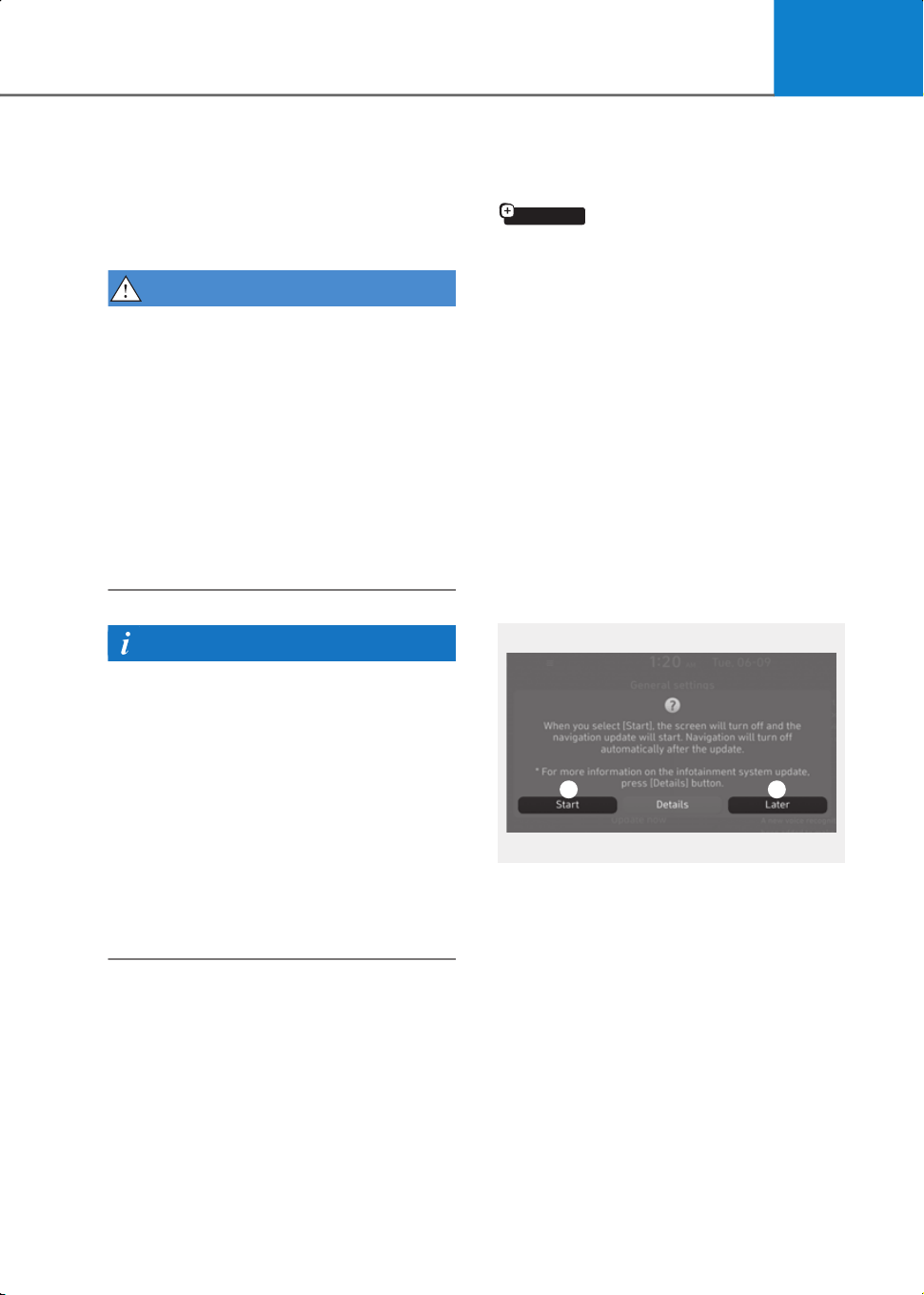
5
5-69
• When replacing the front windshield
glass, replace it with a windshield glass
designed for head-up display
operation. Otherwise, duplicated
images may be displayed on the
windshield glass.
WARNING
• The warning information of Blind-Spot
Safety on the Head-Up Display are
supplemental. Do not solely depend on
them to change lanes. Always take a
look around before changing lanes.
The driving route guidance display in
the augmented reality mode is an
auxiliary function. Be sure to check the
navigation screen together.
• ALWAYS pay attention on the road
while driving when the Head-up display
is on.
Information
Head-up display includes GPL, LGPL, MPL
and other open source license software.
All license notices including related
source code are provided at
http://www.mobis.co.kr/opensource/list.
do.
If the driver requests on-board software
open source code via
[email protected].kr within
3 years after buying this product, a
CD-ROM or other storage device will be
sent with the minimum cost covering
storage device cost and delivery cost.
Over-The-Air Software
if equipped
Update
The Over-The-Air software update
feature allows you to wirelessly update
software to the latest version. Using this
feature, you can keep your vehicle system
up to date with the latest software.
Downloading Software
The latest software can be downloaded
automatically while driving. After the
latest software has been successfully
downloaded, you will receive a
notification on your phone or the vehicle
screen that the software update and
ready to install.
Approving Software Update
B5015301
After the vehicle is turned off, the vehicle
system will allow you to start the update.
• To start the update, press 'Start' (1).
• To postpone the update, press 'Later'
(2).
1 2
CE_USA.book Page 69
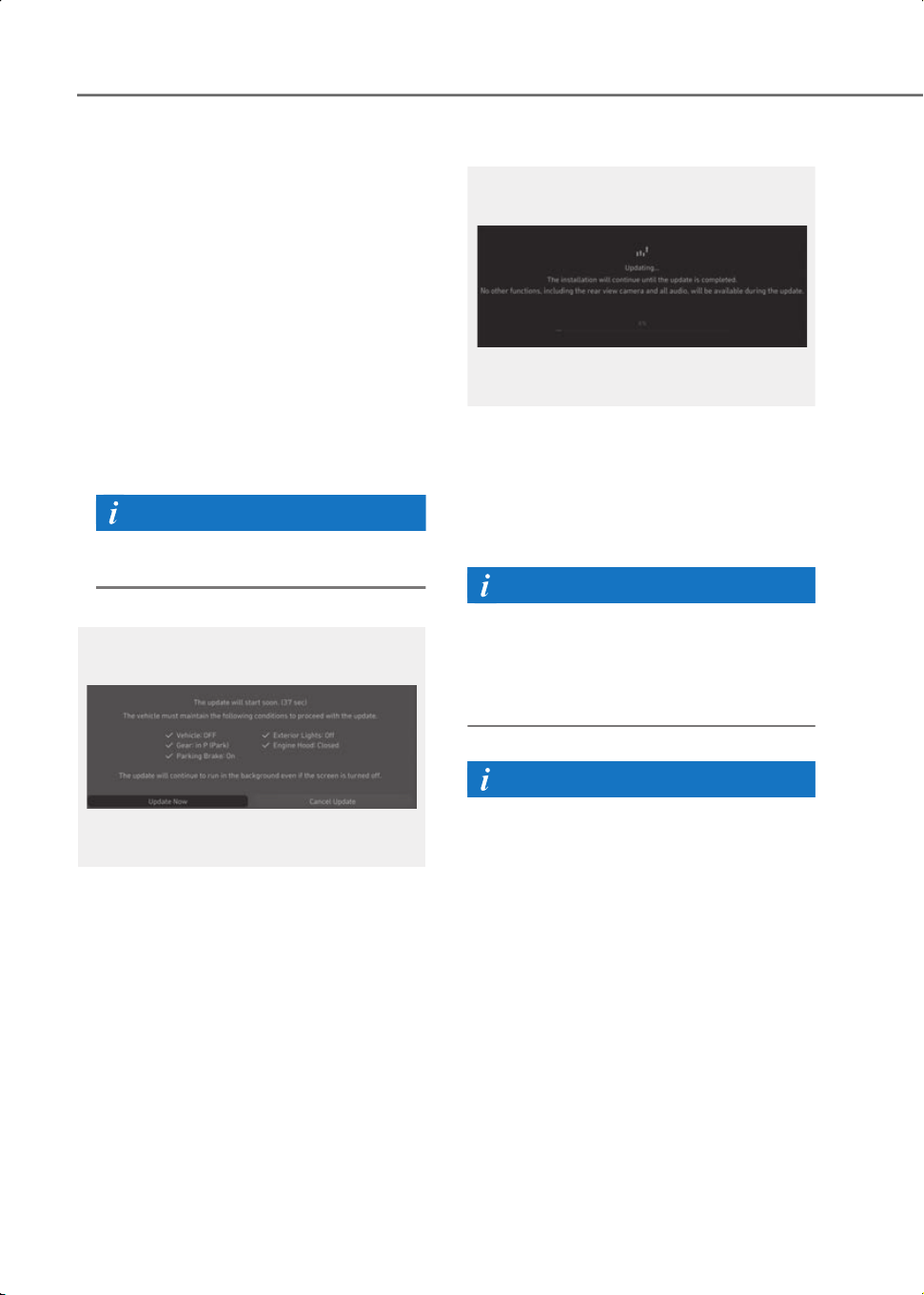
Convenience Features
5-70
Preparing Software Update
If you press the 'Start' button on the
screen, the vehicle will begin installing
the update automatically. The following
conditions must be satisfied:
• The vehicle must be off.
• The gear must be in P (Park).
• The Electronic Parking Brake (EPB)
must be applied.
• The exterior lights must be turned off.
• The hood must be closed.
• The battery must be sufficient.
• The systems to be updated must not be
running.
Information
The battery and system status are
automatically checked by the vehicle.
B5015302
• To update immediately, press 'Update
Now'.
• To cancel the update, press 'Cancel
Update'.
Updating Software
B5015401
You can see the progress of the update on
the screen.
After the update is complete, you will
receive a notification on your phone or
the vehicle screen that the software
update is complete.
Information
The screen turns off automatically after 3
minutes to save the battery. If the screen
turns off automatically, you can check the
update progress by pressing the
Start/Stop button.
Information
• After the update starts, you can exit the
vehicle.
• The OTA software update feature is
only available for HYUNDAI Connected
Services users.
• The update details may vary depending
on the installed software version.
• Check the notice for the OTA software
update on the HYUNDAI brand web.
• If the update fails, the update recovery
will automatically proceed. If you want
to retry the software update, even after
a successful recovery, contact an
authorized HYUNDAI Call Center.
• If the update or recovery fails, contact
an authorized HYUNDAI Call Center.
CE_USA.book Page 70

5
5-71
• After the update is complete, it may
provide new functions or
improvements. For more information,
see the “Over-The-Air Software
Update” page on the HYUNDAI web or
scan the QR code on the screen.
NOTICE
• Observe the following restrictions
during the update.
- You cannot use the vehicle during the
update. Be sure to have enough time
for the update, and safely park the
vehicle before starting the update
process.
- You cannot use remote features,
including remote start.
- Vehicle charging is not available. For
electrified vehicles, charge the
vehicle after the update is
completed.
- Parking video is not recorded.
(vehicle with built-in cam)
- If the update includes the digital key
function, the door lock/unlock
function via the digital key may not
work. If the digital key function is
updated by checking the notice, use
the button on the smart key to lock or
unlock the door.
- The Rear Occupant Alert feature may
not work. Check if there are any
occupant in the rear seat. (vehicles
with that function)
• The update will be automatically
canceled if any vehicle conditions
required for the update are changed
before starting the update.
• Once the update has started, you
cannot cancel the update.
• Note that the high-voltage-related
modules for charging the 12 V battery
may work during the update. (EV
vehicle)
• You cannot use the Over-The-Air
software update feature if you modify
or replace any vehicle software.
• Do not open the hood or replace the
battery in the vehicle during the
update. The update may fail.
• If a diagnostic tool of any kind is
connected to the vehicle OBD
(On-board Diagnostic) terminal, the
vehicle cannot be updated. The vehicle
can be updated by removing the
diagnostic tool connected to the OBD
terminal and then restarting the
vehicle.
• If the update is not complete
successfully, contact HYUNDAI.
• Vehicle reception must be identified as
Verizon to safely install any
downloaded software.
• Vehicle signal strength, must be strong
(above -82 dBm) to safely install any
downloaded software.
CE_USA.book Page 71
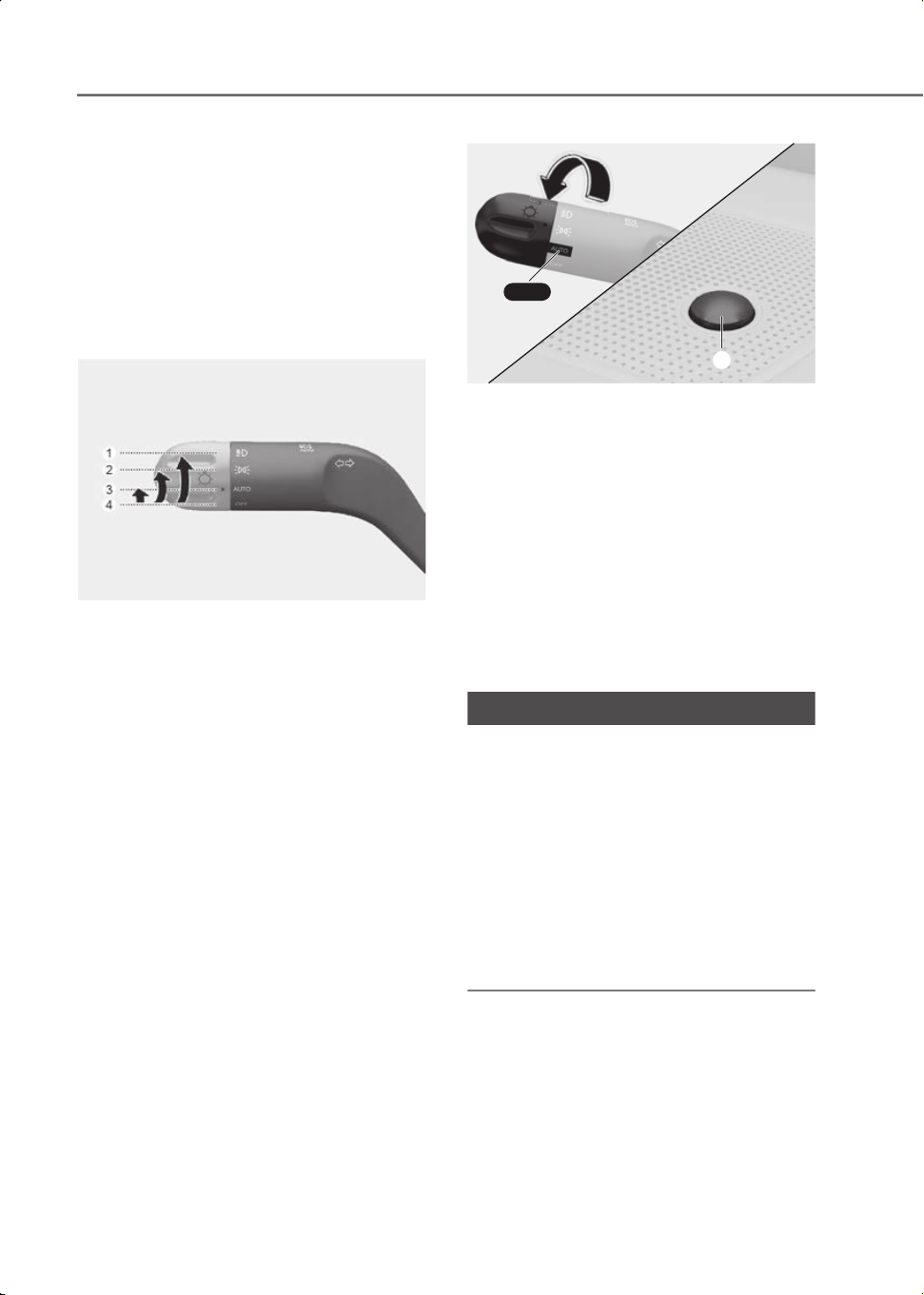
Convenience Features
5-72
Lighting
Exterior Lights
Lighting control
To operate the lights, turn the knob at the
end of the control lever to one of the
following positions:
B5015601
1. OFF
2. AUTO headlight
3. Parking light
4. Headlight
Daytime Running Light (DRL)
The Daytime Running Lights (DRL) can
make it easier for others to see the front
of your vehicle during the day, especially
after dawn and before sunset.
The DRL system will turn the dedicated
light OFF when:
• The headlights are ON.
• The parking brake is applied.
• The vehicle is turned off.
B5015602
AUTO headlight
The parking light and headlight will be
turned ON or OFF automatically
depending on the amount of daylight as
measured by the ambient light sensor (1)
at the upper end of the windshield glass.
Even with the AUTO headlight feature in
operation, it is recommended to manually
turn ON the headlights when driving at
night or in a fog, driving in the rain, or
when you enter dark areas, such as
tunnels and parking facilities.
NOTICE
• Do not cover or spill anything on the
sensor (1) located at the upper end of
the windshield glass.
• Do not clean the sensor using a window
cleaner, the cleanser may leave a light
film which could interfere with sensor
operation.
• If your vehicle window is tinted or other
types of metallic coating are on the
front windshield, the AUTO headlight
system may not work properly.
AUTO
1
CE_USA.book Page 72
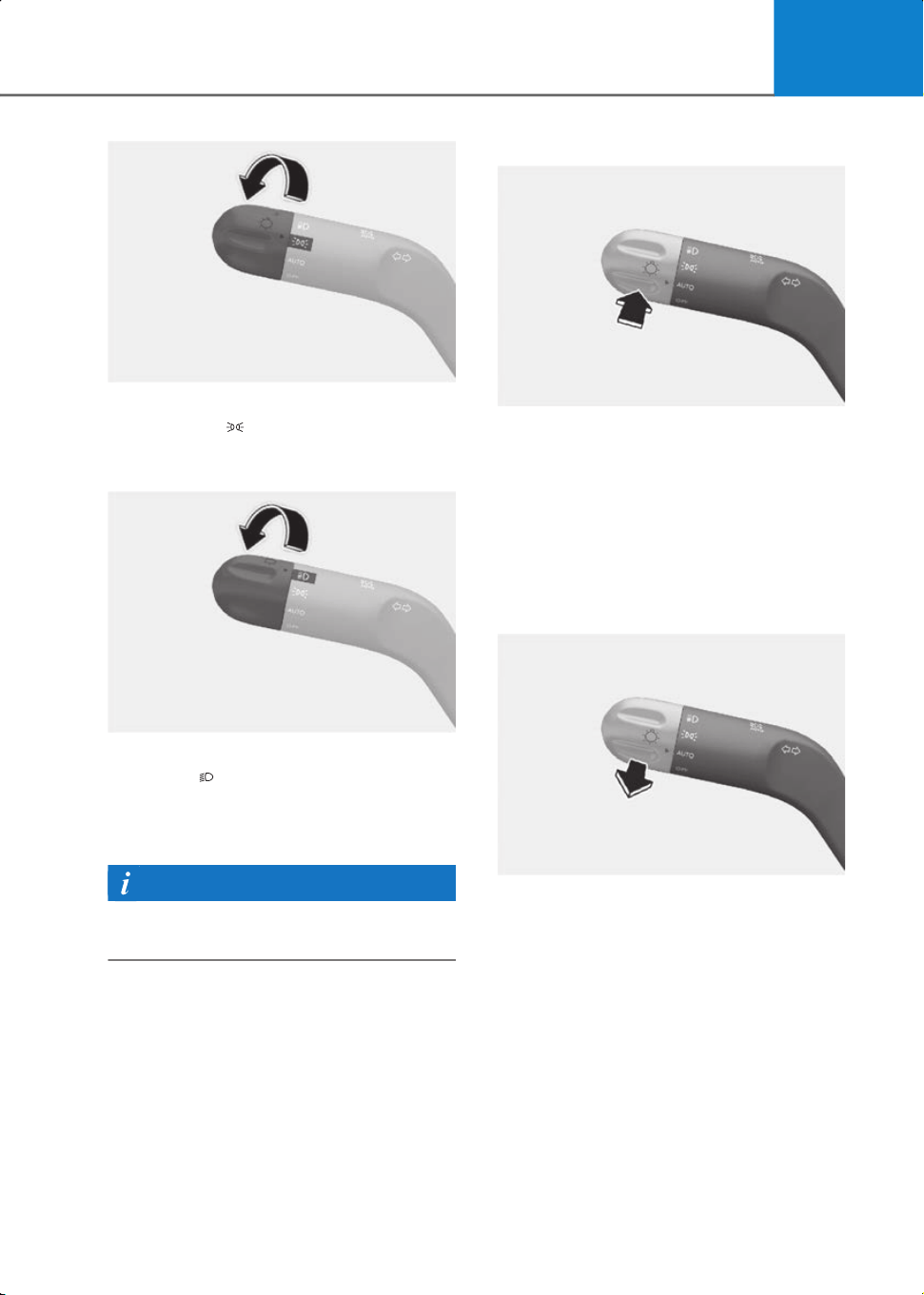
5
5-73
B5015603
Parking light ( )
The parking light, license plate light and
instrument panel lamp are turned ON.
B5015604
Headlight ( )
The headlight, parking light, license plate
light and instrument panel lamp are
turned ON.
Information
The Start/Stop button must be in the ON
position to turn on the headlight.
High beam operation
B5015702
To turn on the high beam headlight, push
the lever away from you. The lever will
return to its original position.
The high beam indicator will light when
the headlight high beams are switched
on.
To turn off the high beam headlight, pull
the lever towards you. The low beams will
turn on.
B5015701
To flash the high beam headlight, pull the
lever towards you, then release the lever.
The high beams will remain ON as long as
you hold the lever towards you.
CE_USA.book Page 73
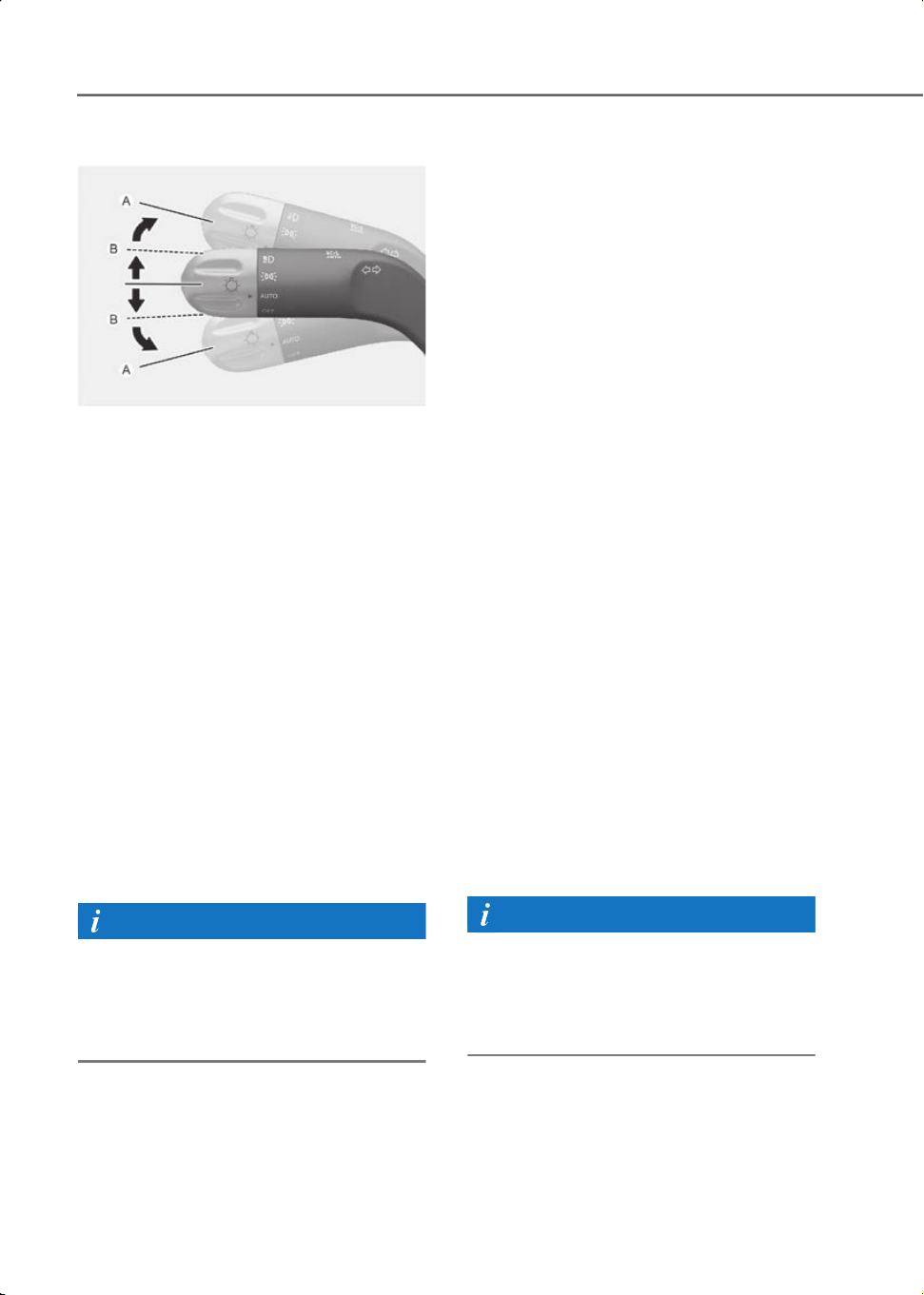
Convenience Features
5-74
Turn signals and lane change signals
B5015801
To signal a turn, push down on the lever
for a left turn or up for a right turn in
position (A).
If an indicator stays on and does not flash
or if it flashes abnormally, one of the turn
signal bulbs may be burned out and will
require replacement.
One touch turn signal
To use One Touch Turn Signal push the
turn signal lever up or down to position
(B) and then release it.
The lane change signals will blink 3, 5 or 7
times.
You can enable the One Touch Turn
Signal function or choose the number of
blinking by selecting Setup > Vehicle >
Lights> One Touch Turn Signal (or
One-touch indicator) > 3 flashes/5
flashes/7 flashes/Off in the infotainment
system.
Information
The infotainment system may change
after software updates. For more
information, refer to the user's manual
provided in the infotainment system and
the quick reference guide.
Battery saver function
To prevent the battery from being
discharging, the system automatically
turns off the parking lights when the
driver turns the vehicle off and opens the
driver’s door.
To keep the lights on when the vehicle is
turned off:
1. Open the driver’s door.
2. Turn the parking lights OFF and ON
again using the headlight switch.
Headlight delay function
If the Start/Stop button is in the ACC
position or the OFF position with the
headlights ON, the headlights (and/or
Parking lights) remain on for about 5
minutes. However, if the driver’s door is
opened and closed, the headlights are
turned off after 15 seconds. Also, with the
vehicle off if the driver’s door is opened
and closed, the headlights (and/or
Parking lights) are turned off after 15
seconds.
The headlights (and/or Parking lights) can
be turned off by pressing the lock button
on the smart key twice or turning the
headlight switch to the OFF or AUTO
position.
You can enable the headlight delay
function by selecting Setup > Vehicle >
Lights > Headlight Delay (or Headlight
time-out) in the infotainment system.
Information
The infotainment system may change
after software updates. For more
information, refer to the user's manual
provided in the infotainment system and
the quick reference guide.
CE_USA.book Page 74
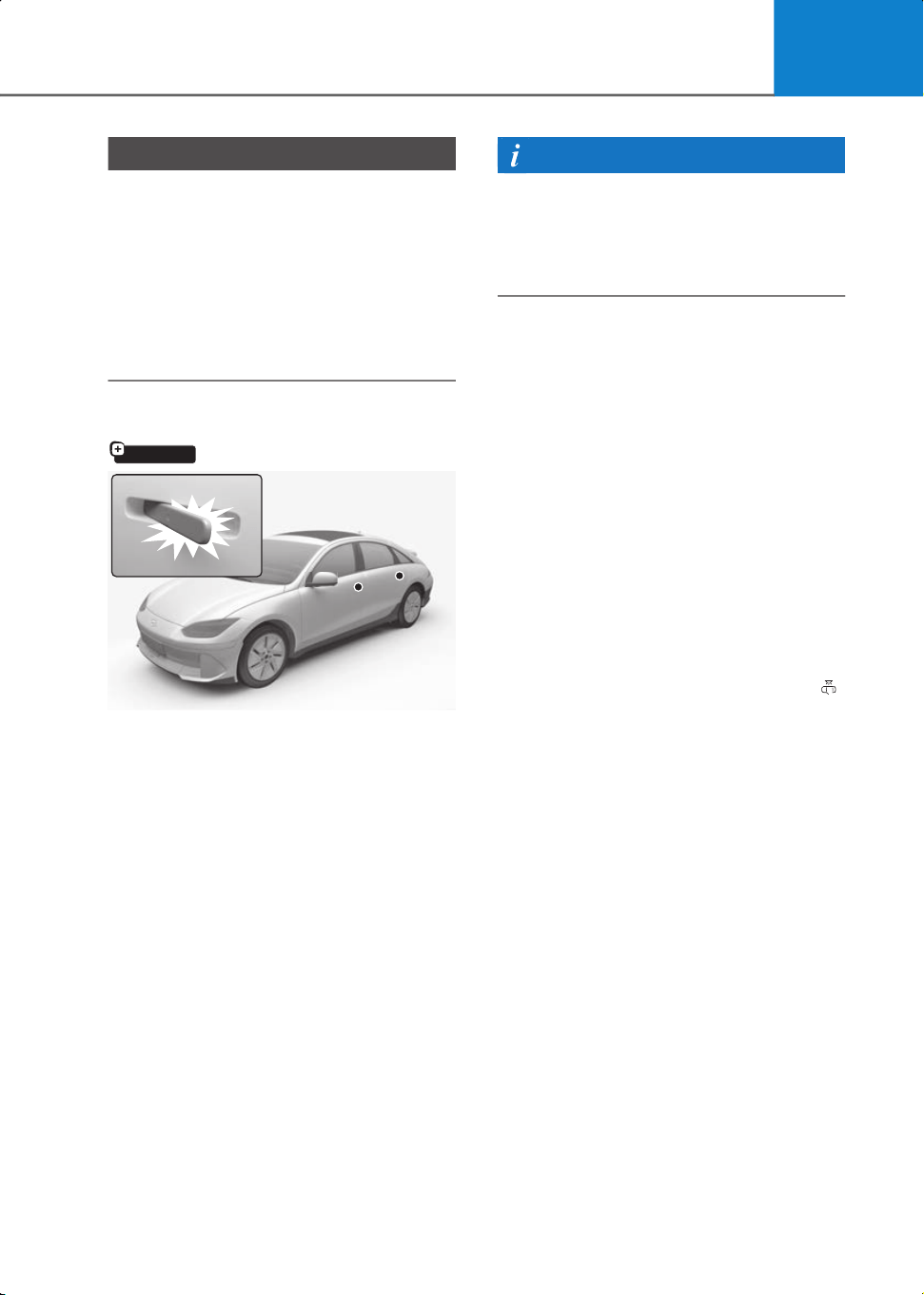
5
5-75
NOTICE
If the driver exits the vehicle through
another door besides the driver door, the
battery saver function does not operate
and the headlight delay function does not
turn OFF automatically. This may cause
the battery to discharge. To avoid battery
discharge, turn OFF the headlights
manually from the headlight switch
before exiting the vehicle.
if equipped
Welcome system
B5016301
Welcome system helps keep the driver
visible by turning on vehicle lights when
the driver approaches the vehicle.
Door handle light
When all the doors (and trunk) are closed
and locked, the door handle light will turn
on for about 15 seconds if any of the
below is performed.
When the door unlock button is pressed
on the smart key.
When you put your hand in the outside
door handle with the smart key in
possession. If Setup > Vehicle > Lights >
Welcome Mirror/ Light > Enable on
Driver Approach is selected from the
Settings menu in the infotainment
system, the lights will turn on when the
vehicle is approached with the smart key
in possession.
Information
The infotainment system may change
after software updates. For more
information, refer to the user's manual
provided in the infotainment system and
the quick reference guide.
Headlight and parking light
When the light switch is ON, and all the
doors (and trunk) are closed and locked,
the headlight and parking light will turn
on for about 15 seconds if the door unlock
button is pressed on the smart key. Note
that if the light switch is in the AUTO
position, the headlight and parking light
will turn on only when it is dark outside.
Select Setup > Vehicle > Lights >
Headlight Delay (or Headlight time-out)
from the Settings menu to turn on this
function.
Interior light
When the interior light switch is in the
position and all doors (and trunk) are
closed and locked, the room lamp will
come on for 30 seconds if any of the
below is performed.
• When the door unlock button is pressed
on the smart key.
• When you put your hand in the outside
door handle while carrying the Smart
key.
At this time, if you press the door lock
button on the smart key the lights will turn
off immediately.
CE_USA.book Page 75
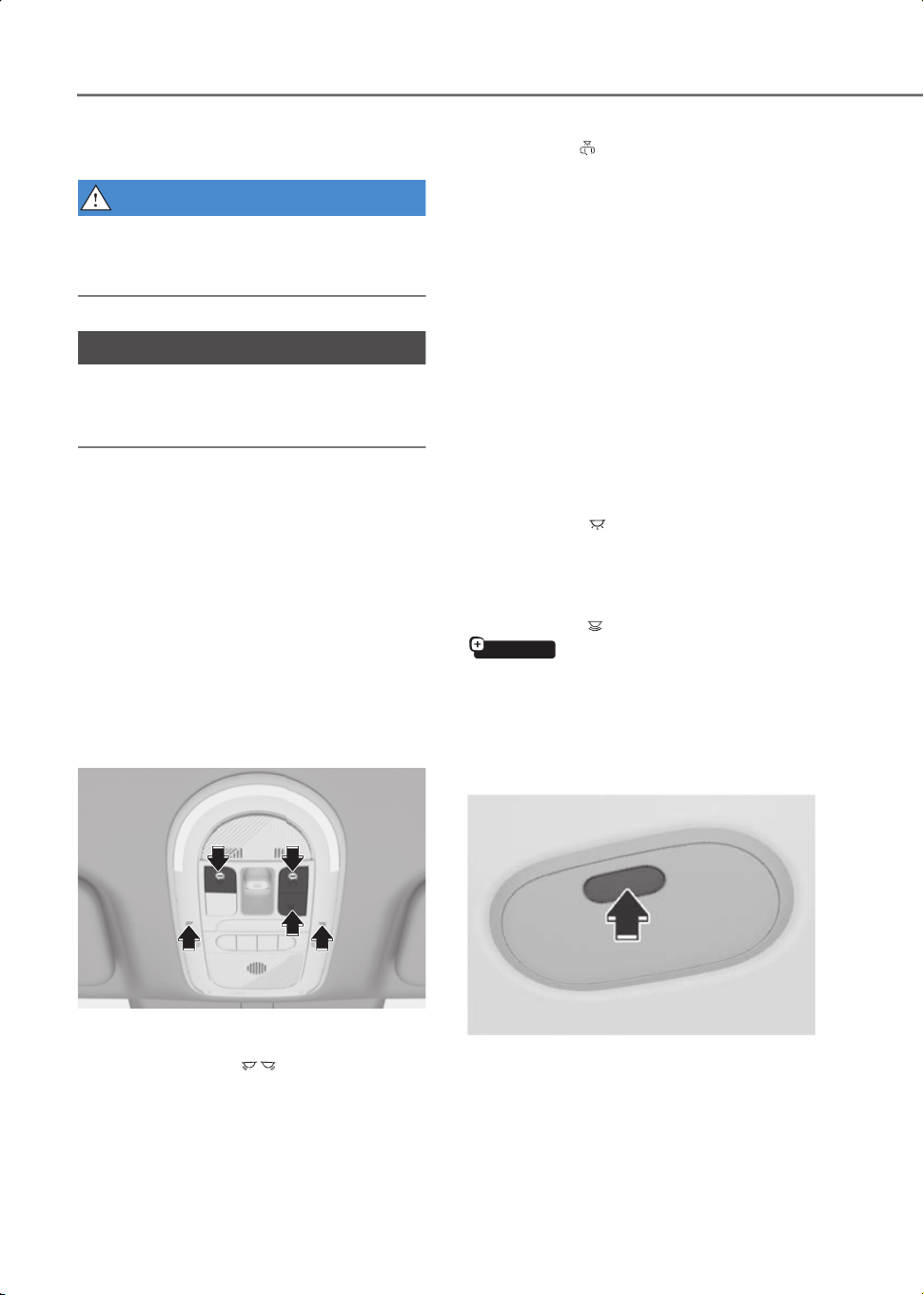
Convenience Features
5-76
Interior Lights
WARNING
Do not use the interior lights when driving
in the dark. The interior lights may
obscure your view and cause an accident.
NOTICE
Do not use the interior lights for extended
periods when the vehicle is turned off or
the battery will discharge.
Interior Light AUTO cut
The interior lights will automatically go off
about 20 minutes after the vehicle is
turned off and the doors are closed. If a
door is opened, the light will go off 25
minutes after the vehicle is turned off. If
the doors are locked by the smart key and
the vehicle enters the armed stage of the
theft alarm system, the lights will go off
five seconds later.
Front lamps
B5017701
Front map lamp ( ):
Touch either icons to turn the map lamp
on or off. This light produces a spot beam
for convenient use as a map lamp at night
or as a personal light for the driver and the
front passenger.
Door lamp ( ):
The front or rear room lamps come on
when the front or rear doors are opened.
When doors are unlocked by the smart
key, the front and rear lights come on for
about 30 seconds as long as any door is
not opened. The front and rear room
lamps go out gradually after about 30
seconds when the door is closed.
However, if the Start/Stop button is in the
ON position or all doors are locked, the
front and rear lights will turn off. If a door
is opened with the Start/Stop button in
the ACC position or the OFF position, the
front and rear lights will stay on for about
10 minutes.
Room lamp ( ):
Press the button to turn ON the room
lamp for the front/rear seats.
if equipped
Mood lamp ( ):
Press the button to turn On the mood
lamp. Press again to turn the lamp off.
Rear lamps
Room lamp
B5017801
Press the button to turn the lamp on or
off.
CE_USA.book Page 76
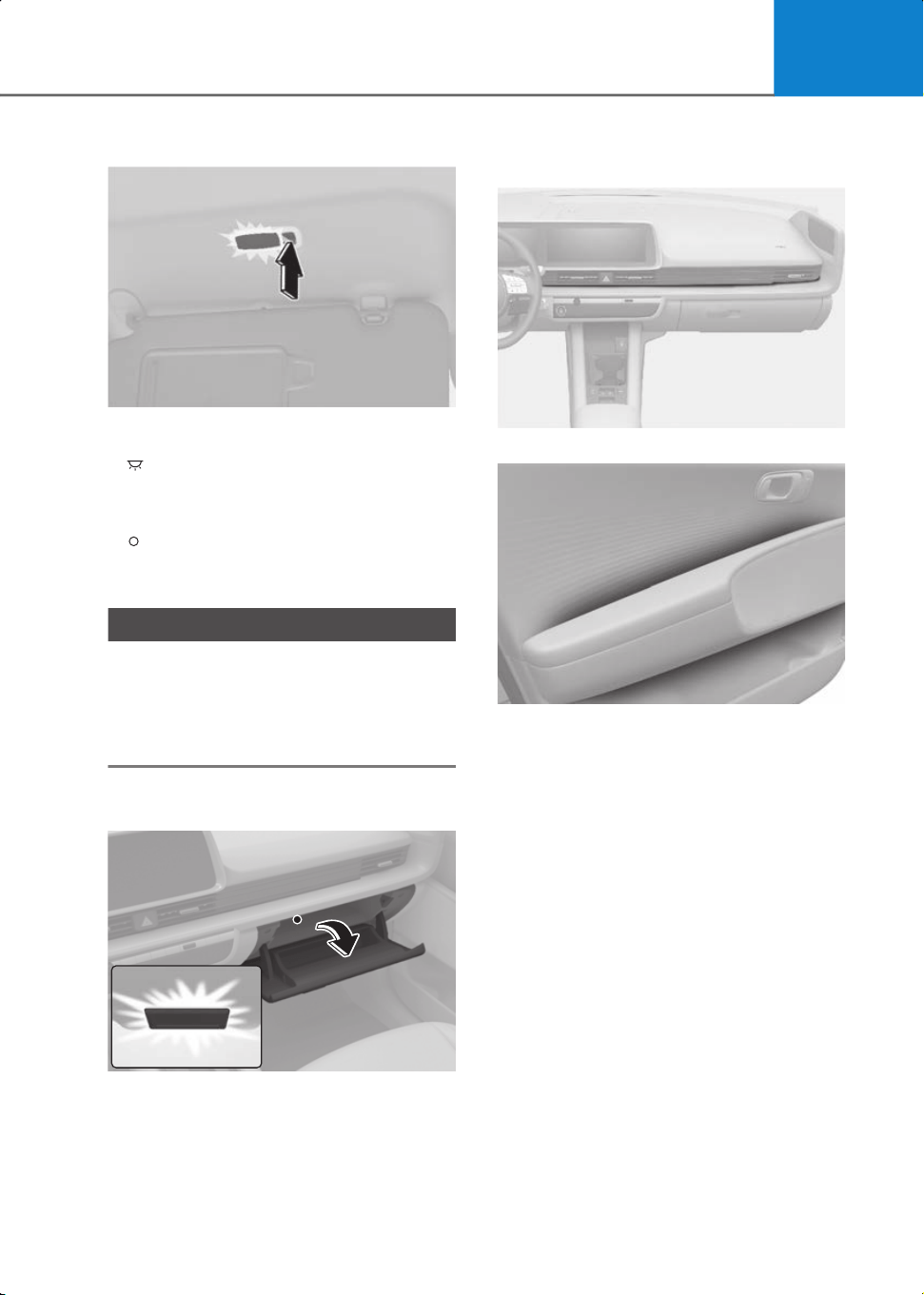
5
5-77
Vanity Mirror Lamp
B5018501
Push the switch to turn the lamp on or off.
• :
The lamp will turn on if this button is
pressed.
• :
The lamp will turn off if this button is
pressed.
NOTICE
Always have the switch in the off position
when the vanity mirror lamp is not in use.
If the sunvisor is closed without the light
off, it may discharge the battery or
damage the sunvisor.
Glove Box Lamp
B5018601
Opening the glove box comes on the
lamp.
When the glove box is not closed
completely, the lamp may keep coming
on.
Mood Lamp
Dashboard mood lamp
B5018701
Door mood lamp
B5018702
• To set the brightness and color of the
mood lamp, select Setup > Vehicle >
Lights > Ambient Light in the
infotainment system.
• When driving at night or under low light
driving conditions, the sensors detect
the light level around the vehicle and
automatically adjust the brightness of
the mood light. To set the automatic
brightness adjustment turn on/off,
select Setup > Vehicle > Lights >
Ambient Light > Dimmed in Dark.
CE_USA.book Page 77
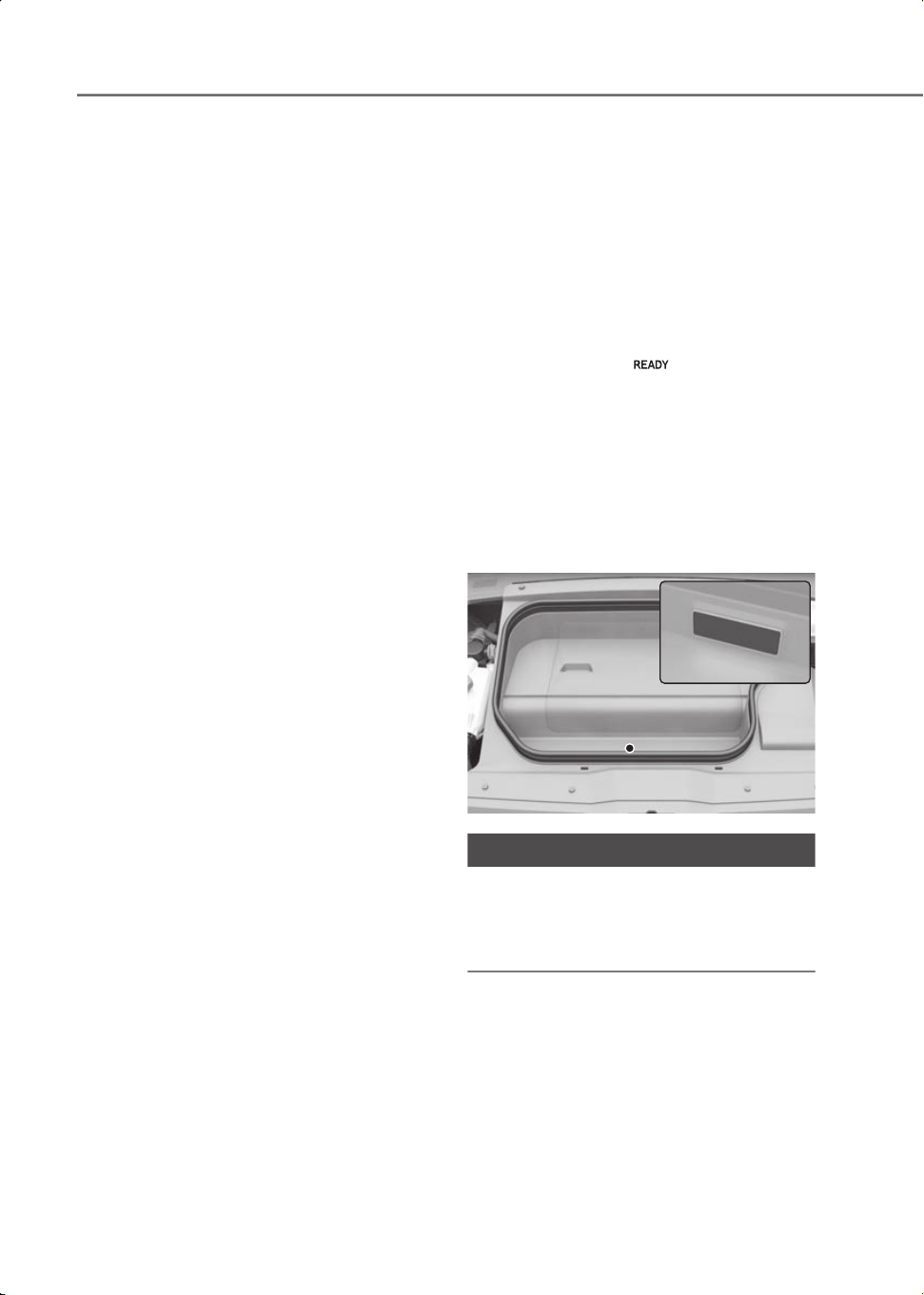
Convenience Features
5-78
• When you select Setup > Vehicle >
Lights > Ambient Light > Link to Drive
Mode in the infotainment system, the
driver's and front passenger’s mood
lamps are set in color in conjunction
with the drive mode. In the case of the
rear seat, if the 'Link to Drive Mode'
function is selected while the
speed-linked interior lighting is not
selected, the rear seat mood lamp
changes color in conjunction with the
drive mode.
• When you select Setup > Vehicle >
Lights > Ambient Light > Link to Speed
Alert in the infotainment system, the
driver's and front passenger's mood
lamps change to red and blink when the
vehicle speed exceeds the speed limit.
In the case of the rear seat, when the
'Sync Lighting with Speed' function is
set, the mood lamp does not turn on
even if the Link to Speed Alert function
is set, but the mood lamp changes to
red and blink when the vehicle speed
exceeds the speed limit.
• When you select Setup > Vehicle >
Lights > Ambient Light > Sync Lighting
with Speed in the infotainment system,
the brightness of the driver's and front
passenger's mood lamps changes
according to the speed. In the case of
the rear seat, when the 'Sync Lighting
with Speed' function is selected, the
mood lamp is turned on only in the ‘P’
(park). However, if the 'Link to Speed
Alert' function is selected, the rear seat
mood lamp will also blink in red when
the vehicle speed exceeds the speed
limit.
• After selecting Setup > Vehicle > Lights
> Ambient Light > Link to Voice
Recognition in the infotainment
system, when the voice recognition
button on the steering wheel is
pressed, the length of the dashboard's
mood lamp lighting changes according
to the volume of the user's voice and
the pitch of the vehicle guidance voice.
• When the driver gets into the vehicle,
the mood lamp on the dashboard turns
on in sequence in conjunction with the
welcome animation on the instrument
panel. When getting off, the mood lamp
on the dashboard turns off one after
another in conjunction with the
good-bye animation on the instrument
panel.
• When the vehicle is drivable (the
instrument panel indicator is on),
the dashboard mood lamp turns on.
However, the mood lamp does not turn
on when using the utility mode.
Front Trunk Lamp
The lamp illuminates when the hood
opens. The lamp keeps coming on when
the hood is not completely closed.
B5019401
NOTICE
Make sure it is fully closed after closing
the hood. If it is left open without starting
vehicle, the lamp comes on and the
battery may be discharged.
CE_USA.book Page 78
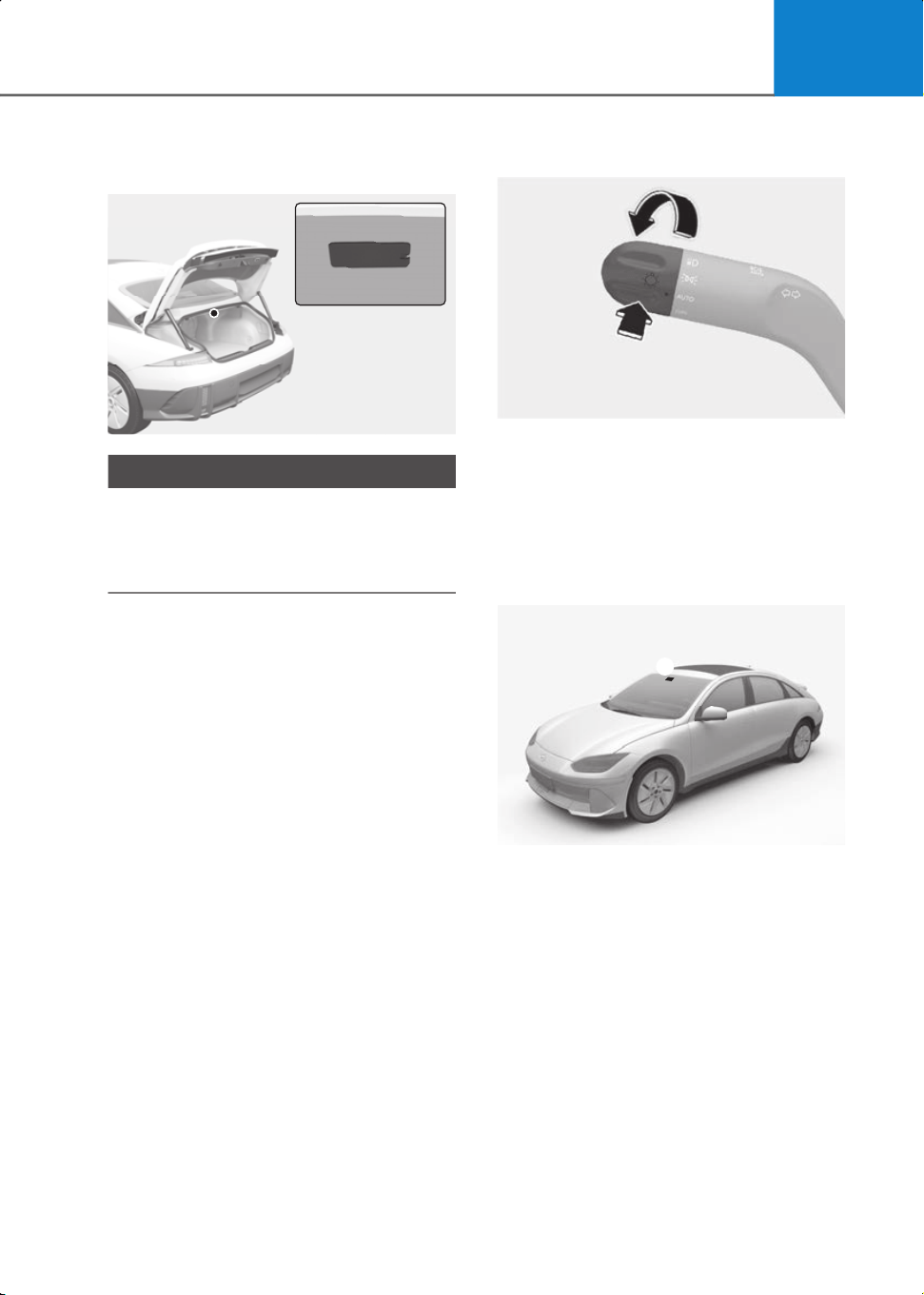
5
5-79
Luggage Compartment Lamp
The lamp turns on when the trunk is open.
B5019402
NOTICE
Make sure it is fully closed after closing
the trunk. If it is left open without starting
vehicle, the lamp comes on and the
battery may be discharged.
High Beam Assist (HBA)
B5016701
High Beam Assist automatically controls
the headlights between high beam and
low beam depending on the detected
ambient light, such as an oncoming
vehicle or leading vehicle.
Detecting sensor
B5016702
(1) front view camera
The front view camera is used as a
detecting sensor to detect ambient light
and brightness while driving.
Refer to the illustration above for the
detailed location of the detecting sensor.
1
CE_USA.book Page 79
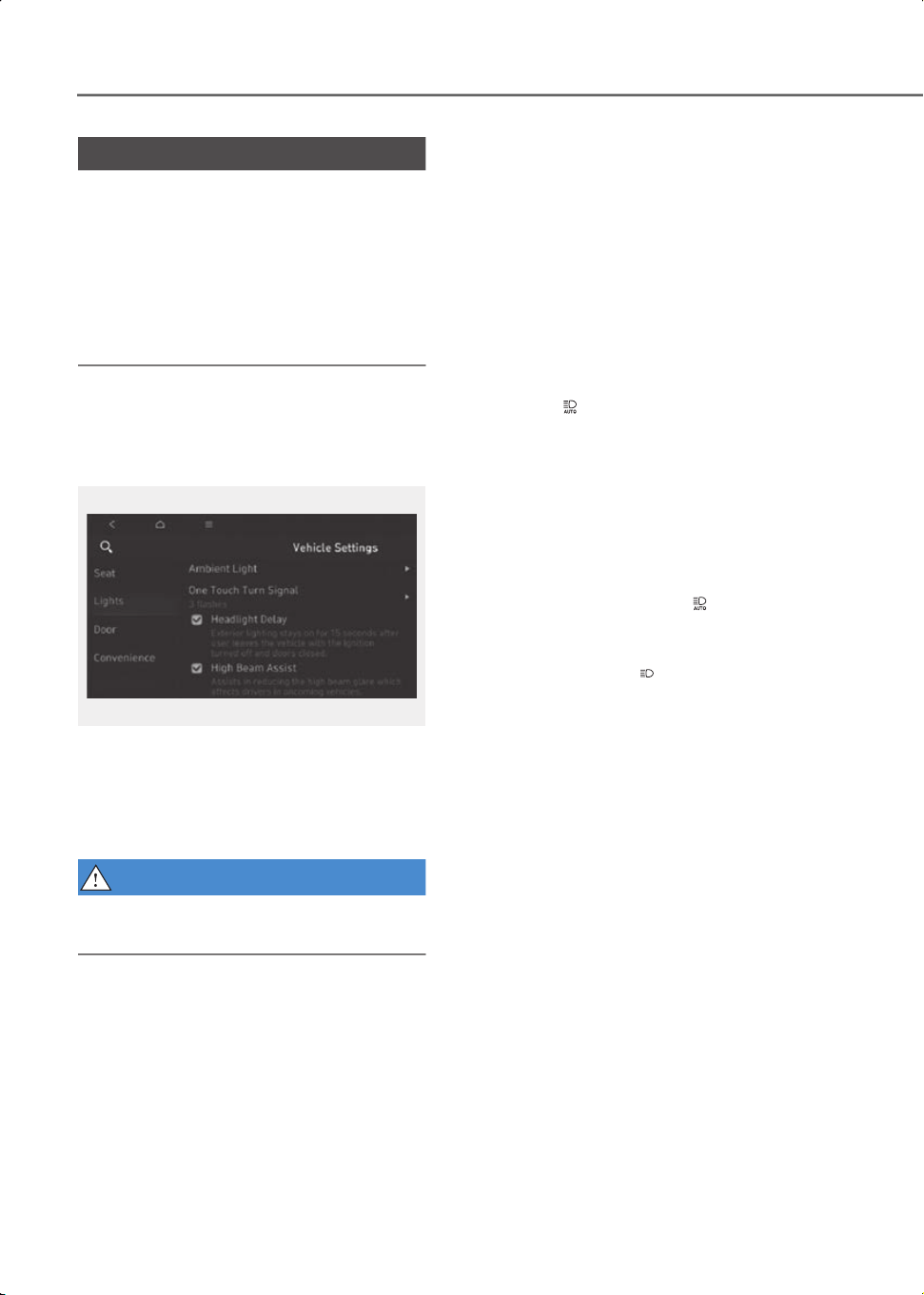
Convenience Features
5-80
NOTICE
• Always keep the front view camera in
good condition to maintain optimal
performance of High Beam Assist.
• For more information on the
precautions of the front view camera,
refer to the “Forward
Collision-Avoidance Assist (FCA)”
section in chapter 7.
High Beam Assist Settings
Setting features
ONE1051248L
With the Start/Stop button in the ON
position, select Setup > Vehicle > High
Beam Assist from the Settings menu to
turn on High Beam Assist and deselect to
turn off the function.
WARNING
For your safety, change the Settings after
parking the vehicle at a safe location.
High Beam Assist Operation
Display and control
• After selecting 'High Beam Assist' in
the Settings menu, High Beam Assist
will operate by following the procedure
below.
- Place the headlight switch in the
AUTO position and push the
headlight lever towards the
instrument cluster. The High Beam
Assist ( ) indicator light will
illuminate on the instrument cluster
and High Beam Assist will be
enabled.
- When High Beam Assist is enabled,
high beam will turn on when vehicle
speed is above 25 mph (40 km/h).
When vehicle speed is below 15 mph
(25 km/h), high beam will turn off and
the High Beam Assist ( ) indicator
will be displayed in white on the
instrument cluster.
- The High Beam ( ) indicator light will
illuminate on the instrument cluster
when high beam is on.
• When High Beam Assist is operating, if
the headlight lever or switch is used,
High Beam Assist operates as follow:
- If the headlight lever is pulled
towards you when the high beam is
off, the high beam will turn on
without High Beam Assist canceled.
When you let go of the headlight
lever, the lever will move to the
middle and the high beam will turn
off.
- If the headlight lever is pulled
towards you when the high beam is
on by High Beam Assist, low beam
will turn on and the function will turn
off.
- If the headlight switch is placed from
AUTO to another position
(headlight/position/off), High Beam
Assist will turn off and the
corresponding light will turn on.
CE_USA.book Page 80
5
5-81
• When High Beam Assist is operating,
high beam switches to low beam if any
of the following conditions occur:
- When the headlight of an oncoming
vehicle is detected.
- When the tail light of a vehicle in front
is detected.
- When the headlight or tail light of a
motorcycle or a bicycle is detected.
- When the surrounding ambient light
is bright enough that high beams are
not required.
- When streetlights or other lights are
detected.
Information
The images and colors in the instrument
cluster may differ depending on the
cluster type or theme selected from the
settings menu.
High Beam Assist Malfunction
and Limitations
High Beam Assist malfunction
OJK050059L
When High Beam Assist is not working
properly, the ‘Check High Beam Assist
system’ warning message will appear and
warning light will illuminate on the
instrument cluster. Have the function
inspected by an authorized HYUNDAI
dealer.
Limitations of High Beam Assist
High Beam Assist may not work properly
in the following situations:
• Light from an oncoming or front vehicle
is not detected because of light
damage, or because it is hidden from
sight, etc.
• Headlight of an oncoming or front
vehicle is covered with dust, snow or
water.
• A front vehicle’s headlights are off, but
the fog lights are on, etc.
• There is a light that has a similar shape
as a vehicle’s light.
• Headlights have been damaged or not
repaired properly.
• Headlights are not aimed properly.
• Driving on a narrow curved road, rough
road, uphill or downhill.
• Vehicle in front is partially visible on a
crossroad or curved road.
• There is a traffic light, reflecting sign,
flashing sign or mirror ahead.
• There is a temporary reflector or flash
ahead (construction area).
• The road conditions are bad such as
being wet, iced or covered with snow.
• A vehicle suddenly appears from a
curve.
• The vehicle is tilted from a flat tire or is
being towed.
• Light from an oncoming or front vehicle
is not detected due to obstacles in the
air such as exhaust fume, smoke, fog,
snow, or water spay or blizzard on the
road, or fogging in the light, etc.
Information
For more information on the limitations of
the Front View Camera, refer to the
“Forward Collision-Avoidance Assist
(FCA)” section in chapter 7.
$IFDL
)JHI#FBN"TTJTU
TZTUFN
CE_USA.book Page 81
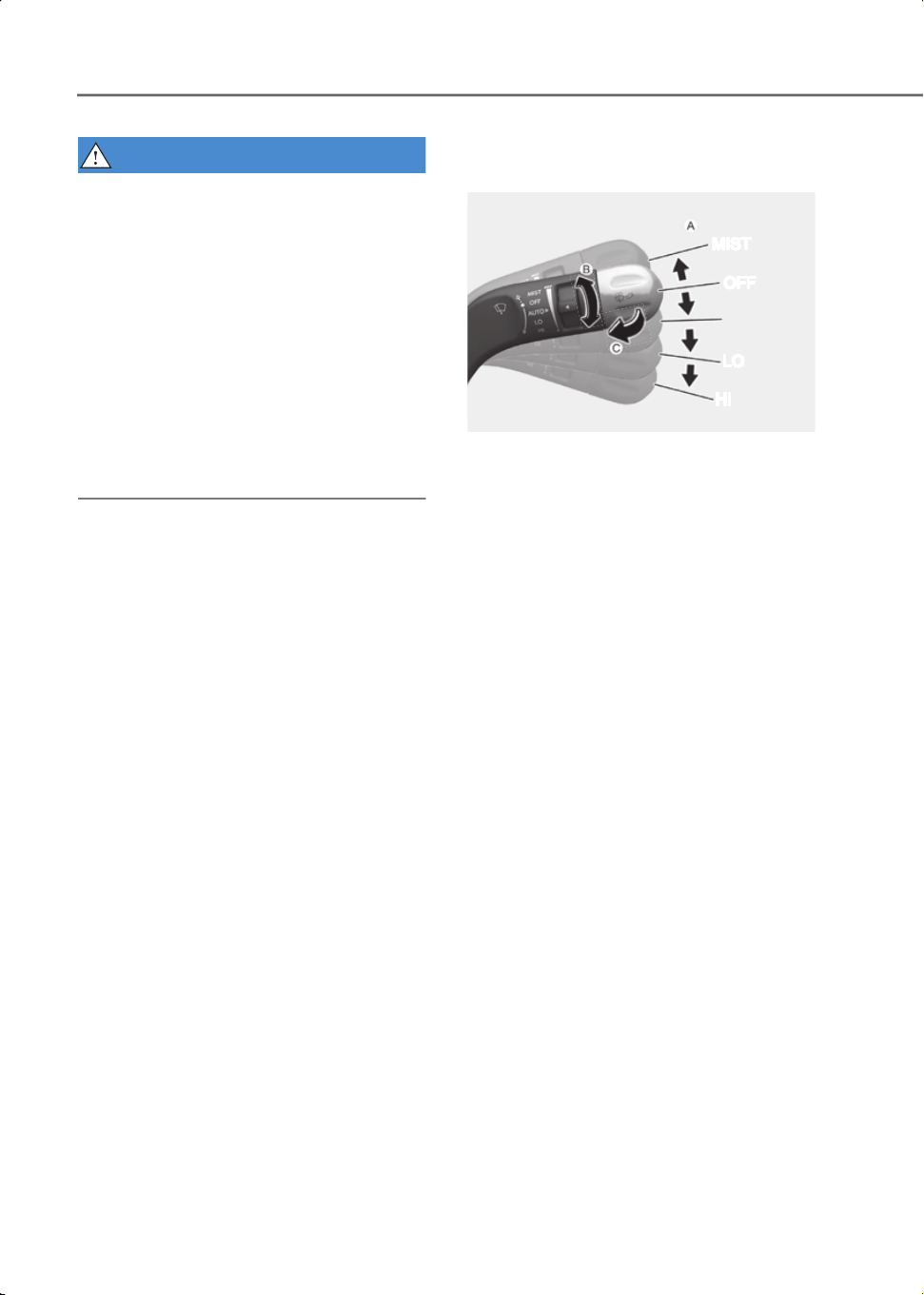
Convenience Features
5-82
WARNING
• At times, High Beam Assist may not
work properly. High Beam Assist is for
your convenience only. It is the
responsibility of the driver for safe
driving practices and always check the
road conditions for your safety.
• When High Beam Assist does not
operate properly, change the headlight
position manually between high beam
and low beam.
• When starting up or initializing the front
camera (rebooting, etc.), the High
Beam Assist function may not work for
about 15 seconds.
Wipers And Washers
B5019601
A. Wiper speed control
• MIST - Single wipe
• OFF - Off
• INT - Intermittent wipe
AUTO* - Auto control wipe
• LO - Low wiper speed
• HI - High wiper speed
B. Intermittent wipe time
adjustment/Auto control wipe time
adjustment*
C. Wash with brief wipes
*: if equipped
MIST
OFFOFF
INT/AUTO*
INT/AUTO*
LO
HI
CE_USA.book Page 82
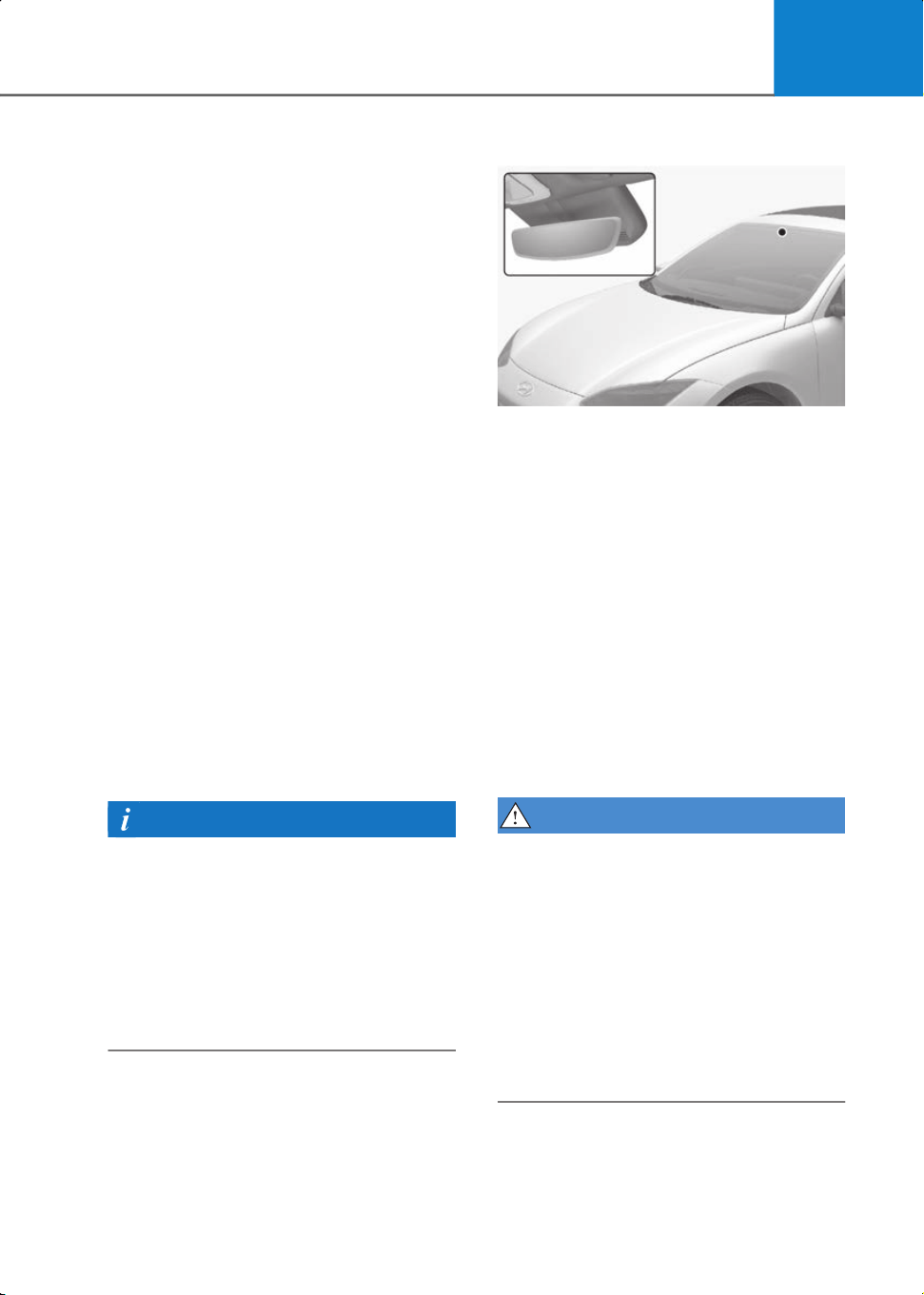
5
5-83
Front Windshield Wipers
Operates as follows when the Start/Stop
button is in the ON position.
MIST:
For a single wiping cycle, push the lever
upward (or downward) and release. The
wipers will operate continuously if the
lever is held in this position.
OFF:
Wiper is not in operation.
INT:
Wiper operates intermittently at the same
wiping intervals. To vary the speed
setting, turn the speed control knob (B).
AUTO:
The rain sensor located on the upper end
of the windshield glass senses the
amount of rainfall and controls the wiping
cycle for the proper interval. The more it
rains, the faster the wiper operates. When
the rain stops, the wiper stops. To vary the
speed setting, turn the speed control
knob.
LO:
The wiper runs at a lower speed.
HI:
The wiper runs at a higher speed.
Information
If there is heavy accumulation of snow or
ice on the windshield, defrost the
windshield for about 10 minutes, or until
the snow and/or ice is removed before
using the windshield wipers to ensure
proper operation.
If you do not remove the snow and/or ice
before using the wiper and washer, it may
damage the wiper and washer system.
AUTO (Automatic) control
B5019603
The rain sensor located on the upper end
of the windshield glass senses the
amount of rainfall and controls the wiping
cycle for the proper interval.
The wiper operation time will be
automatically controlled depends on
rainfall.
When the rain stops, the wiper stops.
To vary the sensitivity setting, turn the
sensitivity control knob.
If the wiper switch is set in AUTO mode
when the Start/Stop button is in the ON
position, the wiper will operate once to
perform a self-check of the system. Set
the wiper to the OFF position when the
wiper is not in use.
WARNING
To avoid personal injury from the
windshield wipers, when the vehicle is
running and the windshield wiper switch
is placed in the AUTO mode:
• Do not touch the upper end of the
windshield glass facing the rain sensor.
• Do not wipe the upper end of the
windshield glass with a damp or wet
cloth.
• Do not put pressure on the windshield
glass.
CE_USA.book Page 83
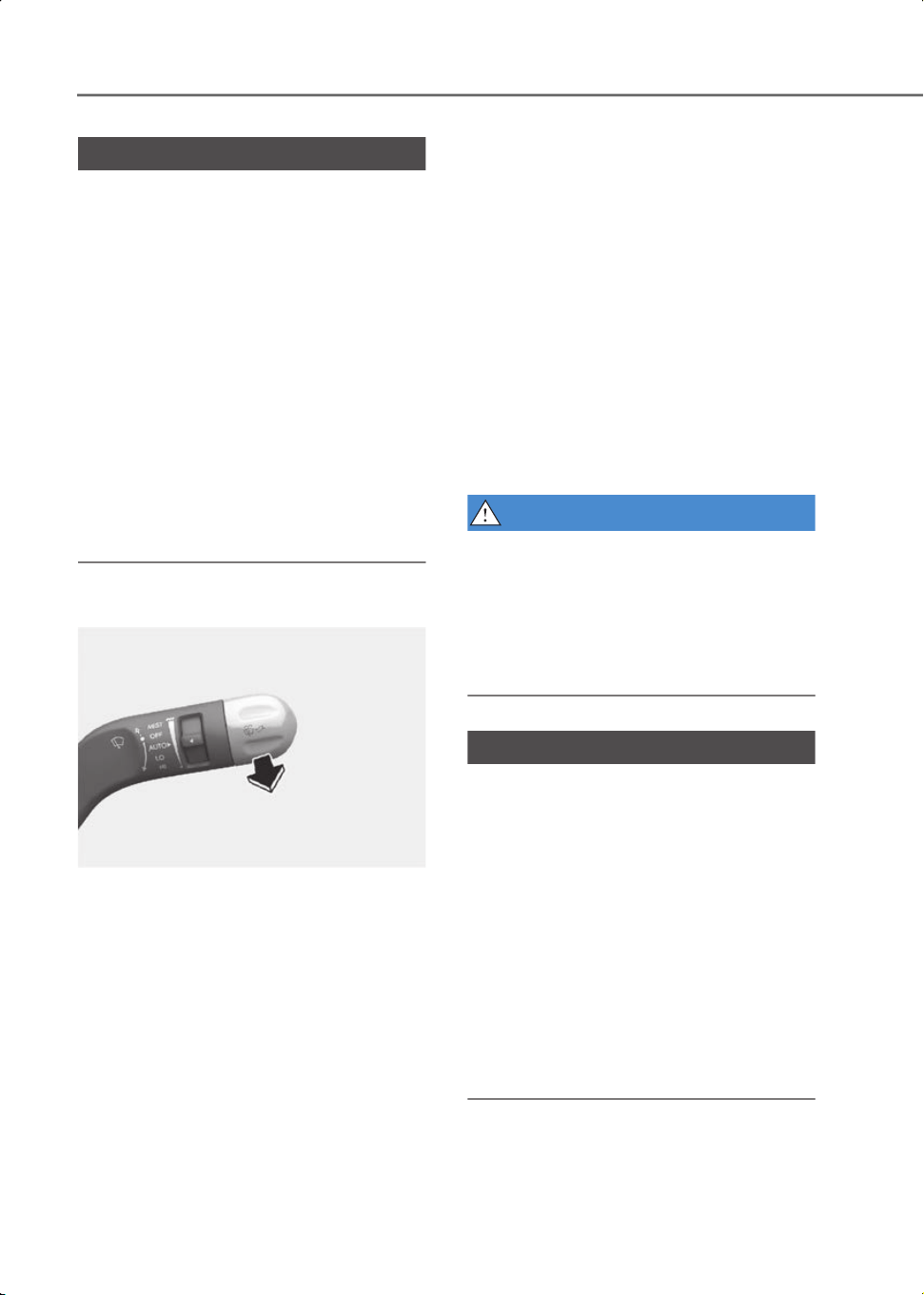
Convenience Features
5-84
NOTICE
• When washing the vehicle, set the
wiper switch in the OFF position to stop
the auto wiper operation. The wiper
may operate and be damaged if the
switch is set in the AUTO mode while
washing the vehicle.
• Do not remove the sensor cover
located on the upper end of the
passenger side windshield glass.
Damage to system components could
occur and may not be covered by your
vehicle warranty.
• Because of using a photo sensor,
temporary malfunction could occur
according to sudden ambient light
change made by stone and dust while
driving.
Front Windshield Washers
B5019701
In the OFF position, pull the lever gently
toward you to spray washer fluid on the
windshield and to run the wipers 1-3
cycles. The spray and wiper operation will
continue until you release the lever. If the
washer does not work, you may need to
add washer fluid to the washer fluid
reservoir.
Recirculating air when washer fluid
is used
When washer fluid is used, in order to
reduce any objectionable scent of the
washer fluid from entering the cabin,
recirculation mode and air conditioning
are automatically activated depending on
the outside temperature. If you select
fresh mode while the function is
operating, the function will resume after a
certain amount of time. It may not work in
some conditions such as cold weather or
vehicle off.
For more information, refer to the
“Climate Control Additional Features”
section in this chapter.
WARNING
When the outside temperature is below
freezing, ALWAYS warm the windshield
using the defroster to help prevent the
washer fluid from freezing on the
windshield and obscuring your vision
which could result in an accident and
serious injury or death.
NOTICE
• To prevent possible damage to the
washer pump, do not operate the
washer when the fluid reservoir is
empty.
• To prevent possible damage to the
wipers or windshield, do not operate
the wipers when the windshield is dry.
• To prevent damage to the wiper arms
and other components, do not attempt
to move the wipers manually.
• To prevent possible damage to the
wipers and washer system, use
anti-freezing washer fluids in the winter
season or cold weather.
CE_USA.book Page 84
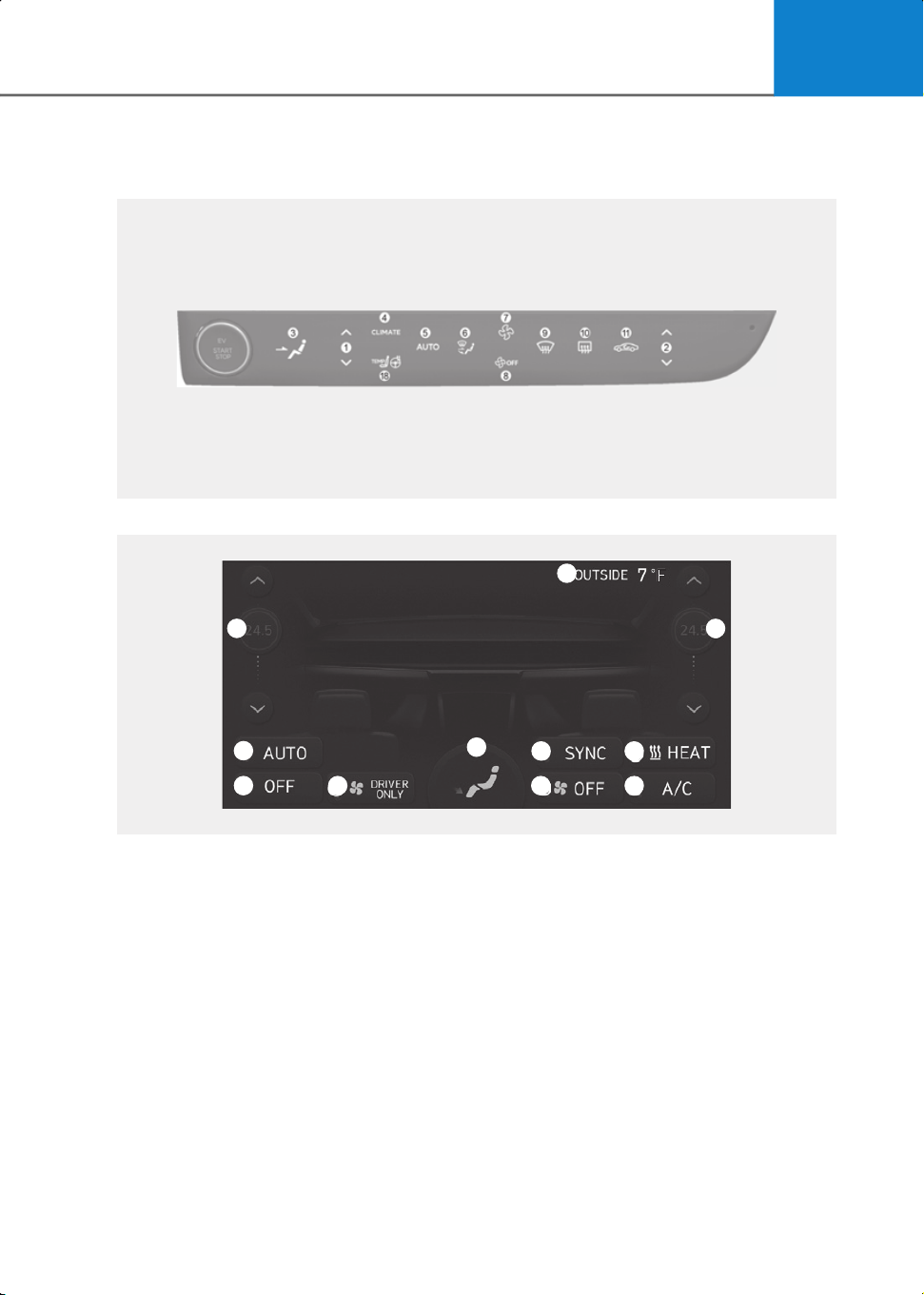
5
5-85
Automatic Climate Control System
Climate control panel
A5019801
Infotainment System (Climate)
A5019802
The actual shape for the climate control panel and infotainment system may differ from the illustration.
(1) Driver’s temperature control
(2) Passenger’s temperature control
(3) Display the air flow direction
(4) View climate infotainment system
(5) AUTO (automatic control)
(6) Mode selection button
(7) Fan speed up
(8) Fan speed down/OFF
(9) Front windshield defroster
(10)Rear windshield defroster
(11) Air intake control
(12)Driver only mode
(13)A/C (air conditioning) ON/OFF
(14)Heating ON/OFF
1
5
6
8
2
16
17 12 13
1415
CE_USA.book Page 85

Convenience Features
5-86
(15)SYNC
(16)Ambient temperature display
(17)System OFF
(18)Seat warmer/air ventilation infotainment system
Information
Use a clean soft microfiber cloth to gently wipe any finger prints off the touch screen.
CE_USA.book Page 86
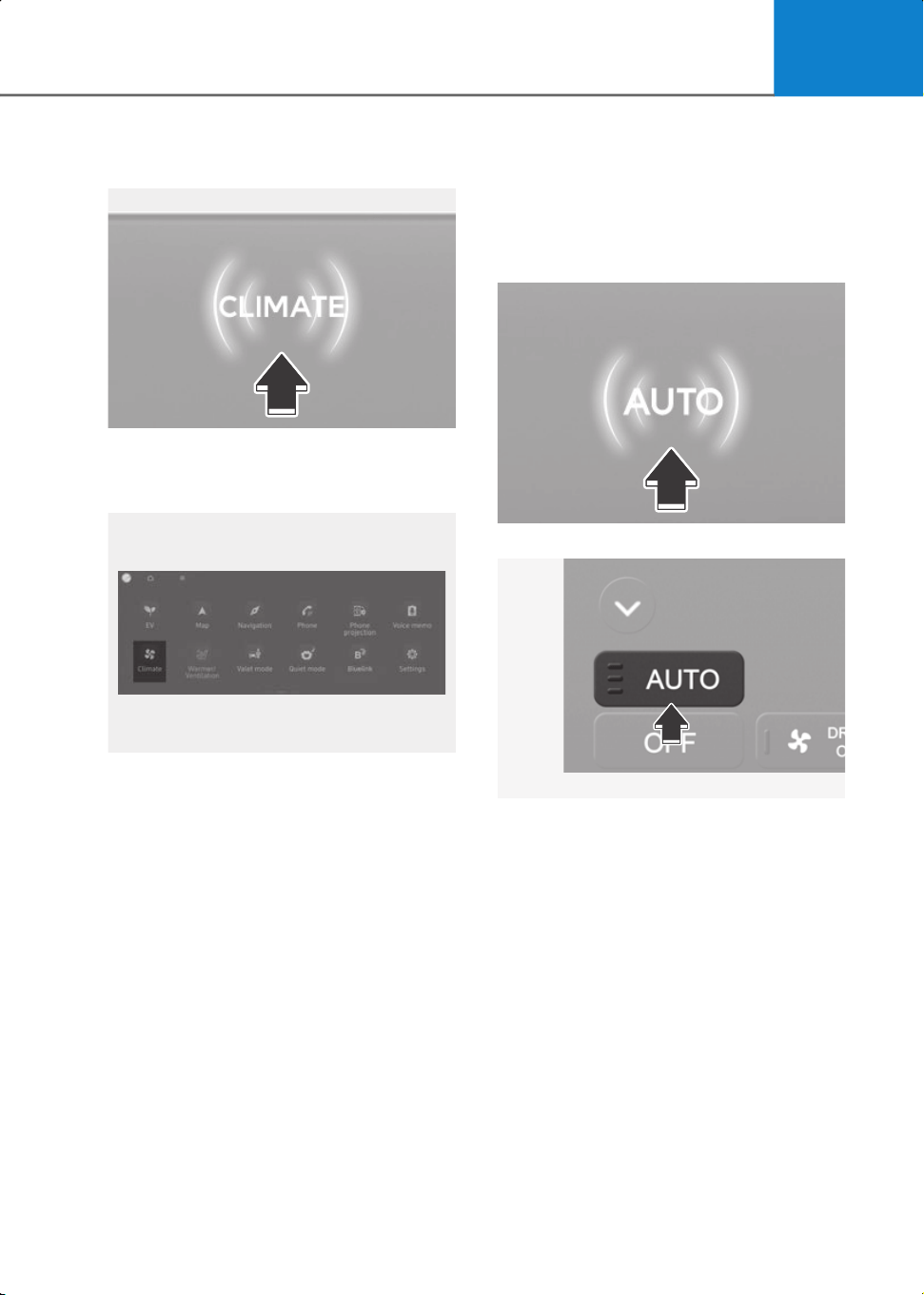
5
5-87
Climate
Climate control panel
B5019802
Touch 'CLIMATE' icon to view the climate
information in the infotainment system.
Infotainment System
ONE1051249L
To view the climate information screen,
select 'Climate' in the main infotainment
system when the vehicle is ON.
Automatic Temperature
Control Mode
1. Press 'AUTO' icon or touch the 'AUTO'
icon in the infotainment system to
select the fan speed (level 1-3).
Climate control panel
B5019901
Infotainment system
B5019902
CE_USA.book Page 87
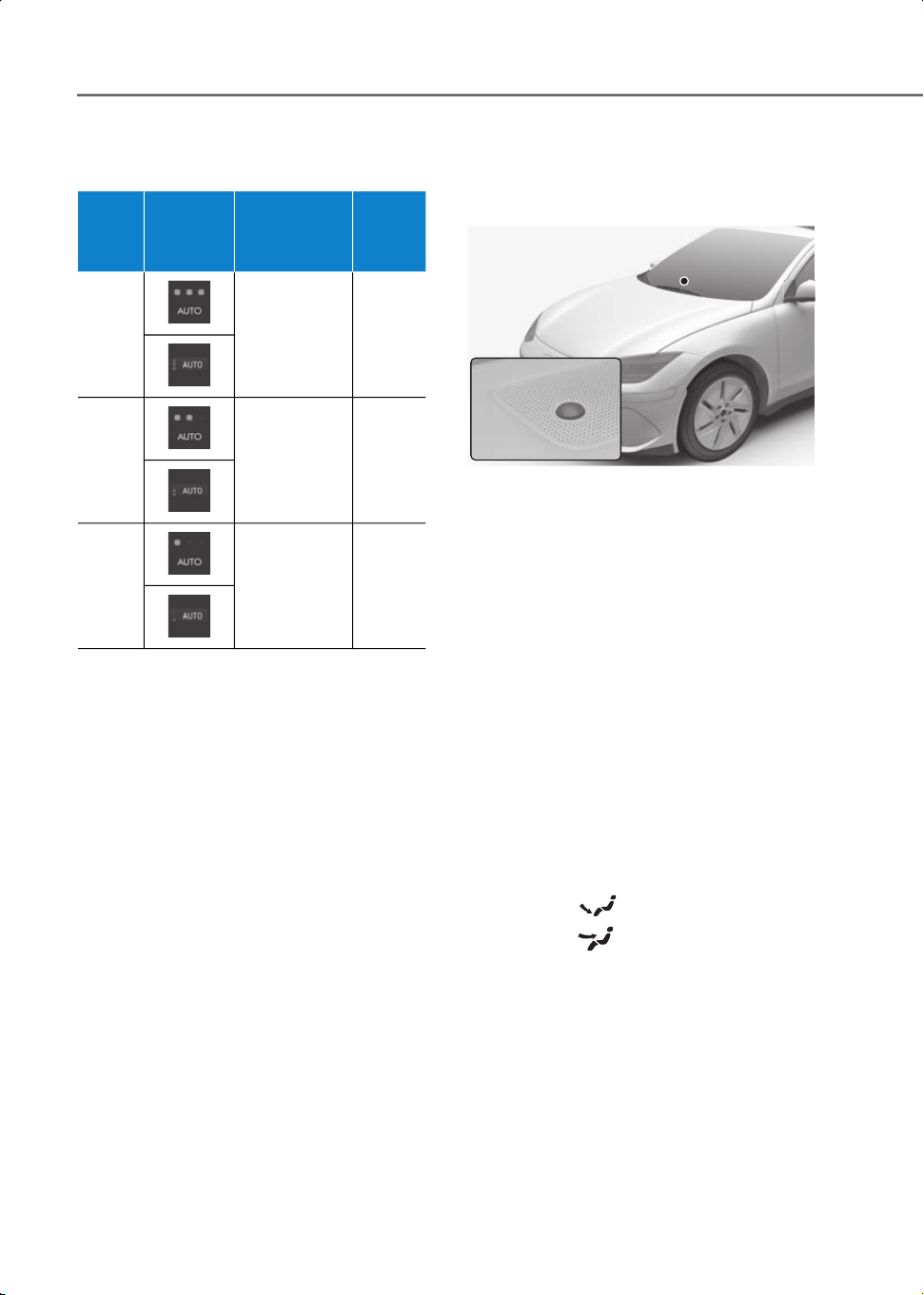
Convenience Features
5-88
2. Adjust the temperature with the
temperature control icon.
The fan speed level only can be changed
manually.
The following systems can be
respectively adjusted while the AUTO
climate control is on. When those systems
are adjusted, AUTO indicator lights will
turn off.
• Fan speed level
• A/C (Air condition)
• Mode selection
• Front windshield defroster (When
defroster is turned off, AUTO indicator
light will illuminate)
For your convenience and to improve the
efficiency of the climate control, use the
AUTO button and set the temperature to
72 °F (22 °C).
To change the temperature unit from °C
to °F or °F to °C:
Select Setup > General > Unit >
Temperature Unit > °C/°F from the
Settings menu in the infotainment
system.
B5019903
Manual Temperature Control
Mode
The heating and cooling system can be
controlled manually by selecting
functions other than 'AUTO'. In this case,
the system works sequentially according
to the order of the functions selected.
When selecting any other functions
except 'AUTO' while using automatic
operation, the functions not selected will
be controlled automatically.
1. Start the vehicle.
2. Set the mode to the desired position.
To improve the effectiveness of heating
and cooling, select the mode according
to the following:
• Heating:
• Cooling:
3. Set the temperature control to the
desired value.
4. Set the air intake control to Fresh or
Recirculation mode.
5. Set the fan speed control to the desired
speed.
6.If air conditioning is desired, turn the air
conditioning system on.
7. Select 'AUTO' to revert back to full
automatic control of the system.
Level
AUTO
Indicator
Climate
Information
Fan
Speed
Level
3 HIGH 1-8
2 MEDIUM 1-6
1 LOW 1-4
CE_USA.book Page 88
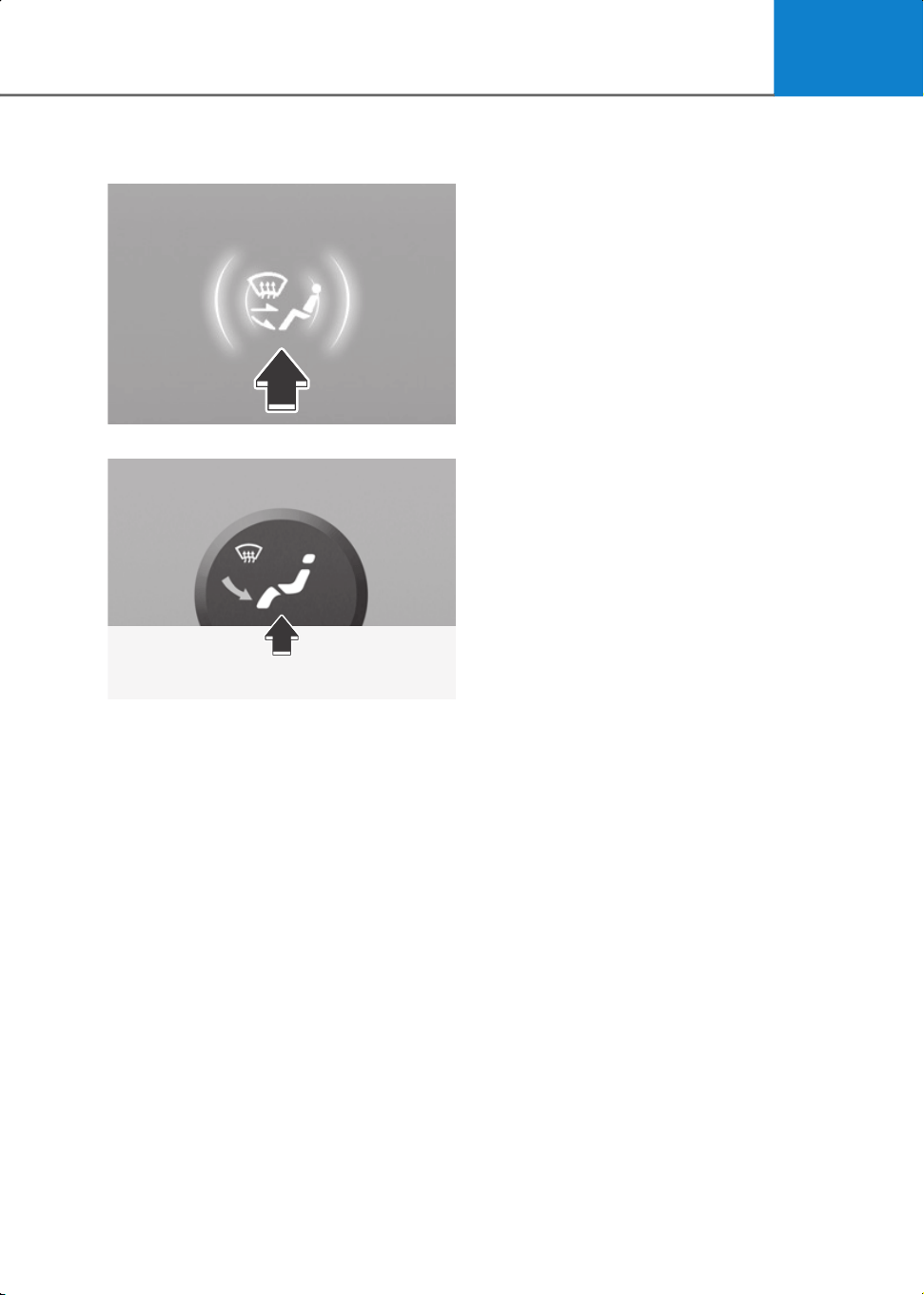
5
5-89
Mode selection
Climate control panel
B5020001
Infotainment system
B5020002
Air flow direction
Touch the air flow direction icon in the
infotainment system to select the desired
air flow direction. The selected air flow
direction will be displayed on the
infotainment system.
CE_USA.book Page 89
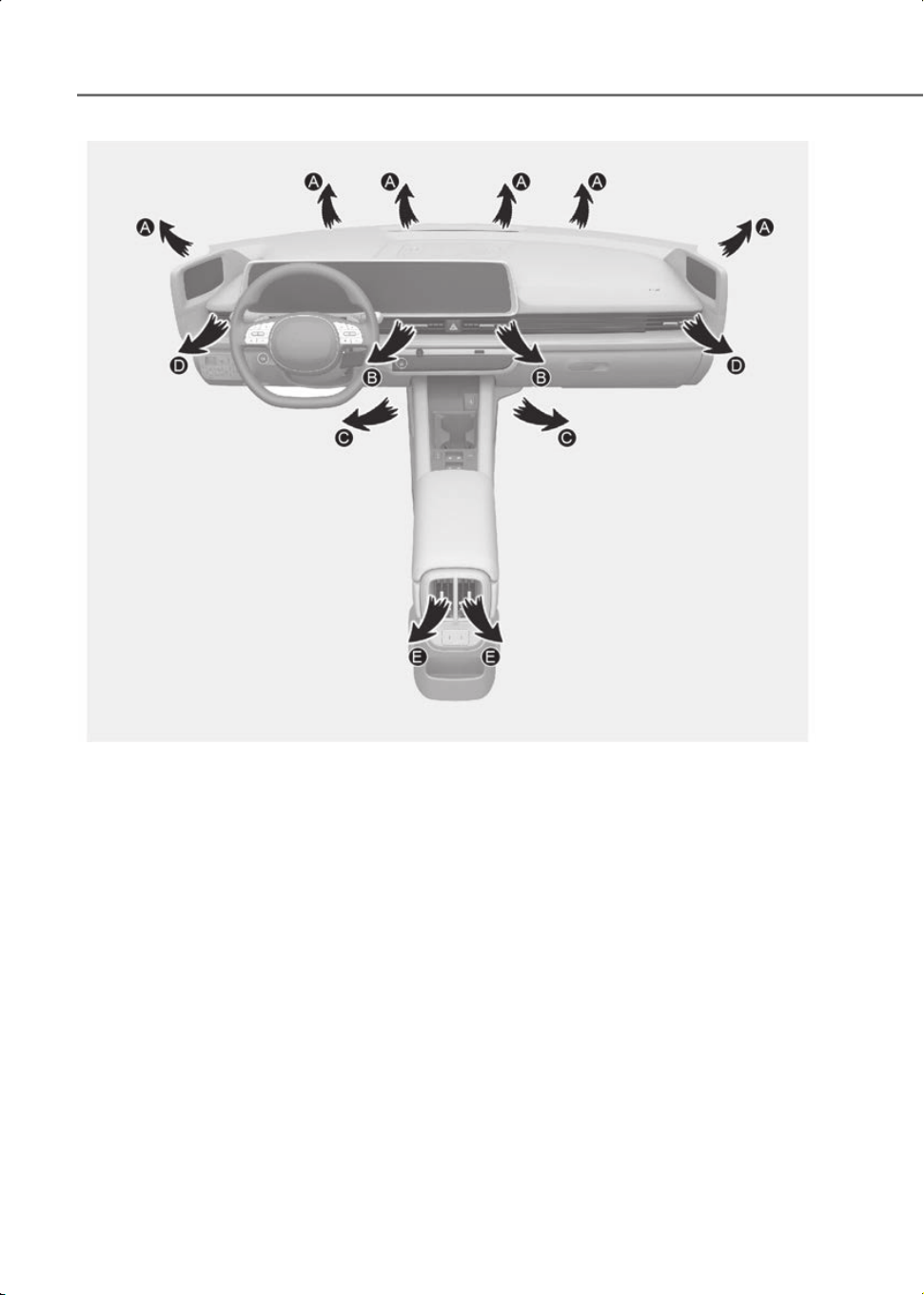
Convenience Features
5-90
A5020001
Air flow direction
The mode selection Icon or button controls the direction of the air flow through the
ventilation system.
CE_USA.book Page 90
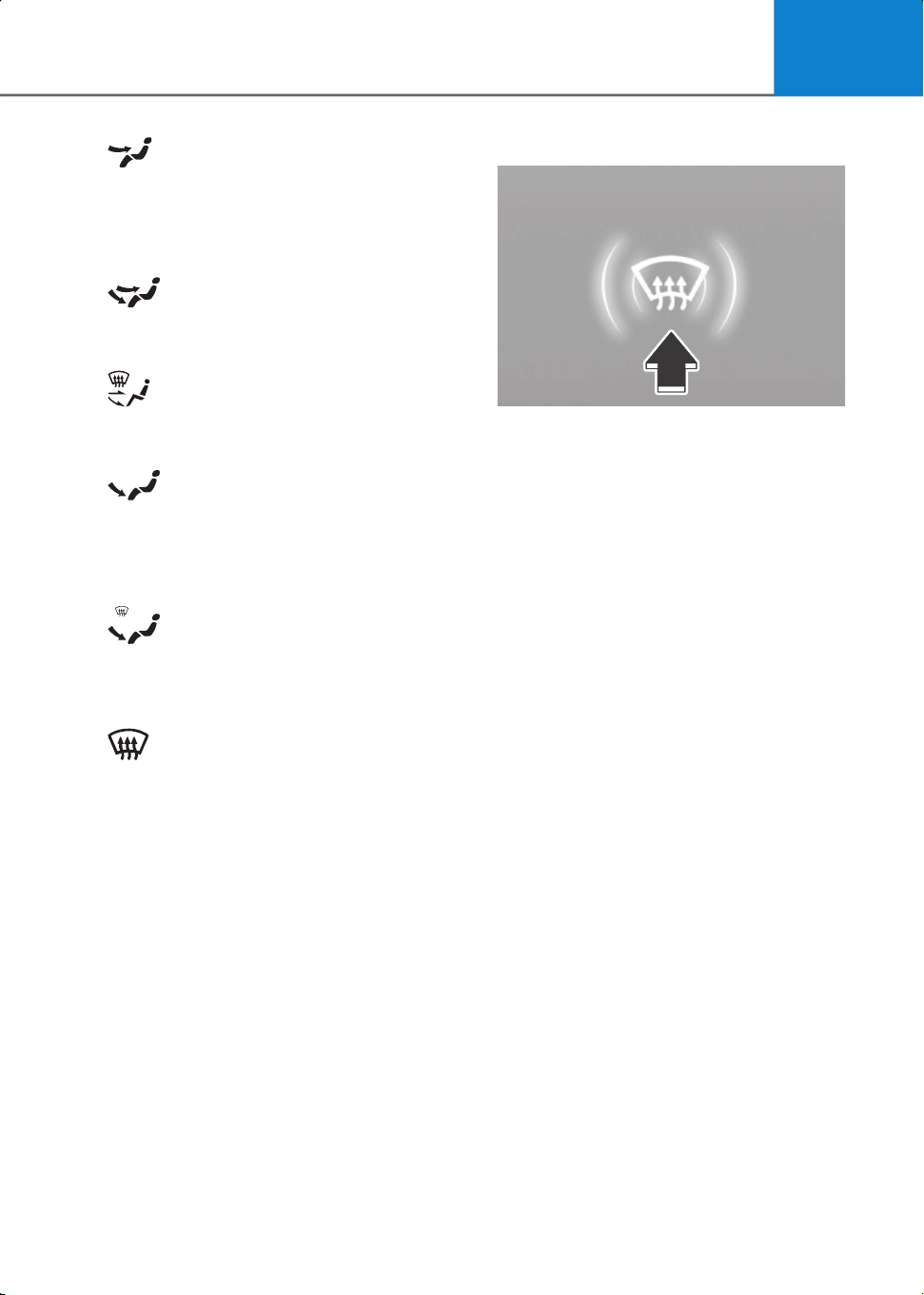
5
5-91
Face-Level (B, D)
Air flow is directed toward the upper body
and face. Additionally, each outlet can be
controlled to direct the air discharged
from the outlet.
Bi-Level (B, C, D, E)
Air flow is directed towards the face and
the floor.
All Level (A, B, C, D, E, F)
Air flow is directed toward the face, the
floor and the windshield.
Floor-Level (A, C, D, E)
Most of the air flow is directed to the
floor, with a small amount of the air being
directed to the windshield and side
window defrosters.
Floor/Defrost-Level (A, C, D, E)
Most of the air flow is directed to the floor
and the windshield with a small amount
directed to the side window defrosters.
Defroster-Level (A, D)
Most of the air flow is directed to the
windshield with a small amount of air
directed to the side window defrosters.
Front windshield defroster
B5020003
Defrost-level (A, D)
Press the icon, and the indicator light will
illuminate and the windshield defroster
indicator will appear on the climate
control panel.
Most of the air flow is directed to the
windshield with a small amount of air
directed to the side window defrosters.
When Defogging logic is enabled, Fresh
mode is selected and air conditioning is
selected according to outside
temperature.
If the icon is pressed again, the indicator
light will turn off and the previous settings
will be selected.
CE_USA.book Page 91
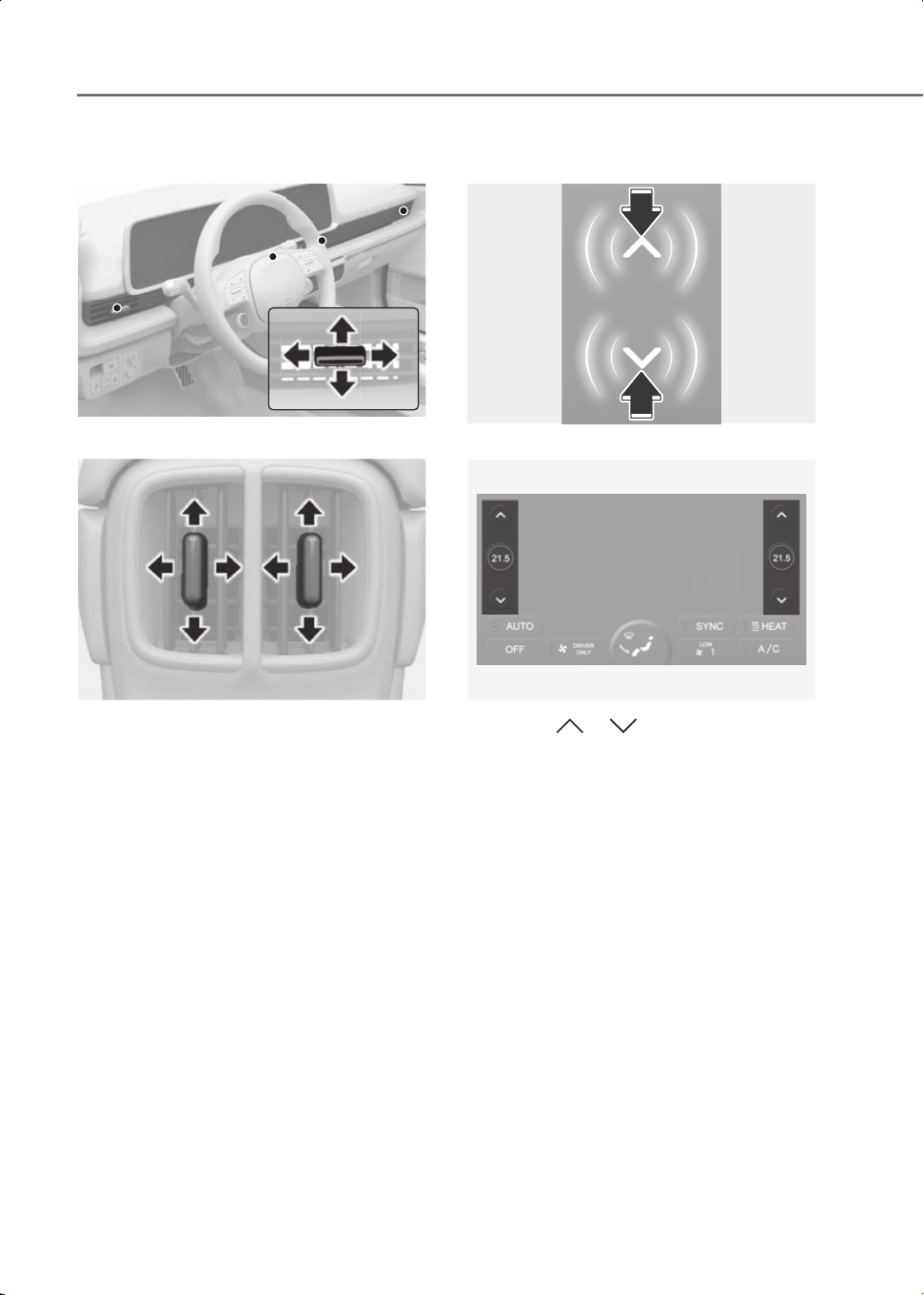
Convenience Features
5-92
Instrument panel vents
Front seat
B5020004
Rear seat
B5020005
The instrument panel vent air flow can be
directed up/down or left/right using the
vent adjustment lever.
The air flow can also be CLOSED using the
vent adjustment lever.
Front seat
Move the lever away horizontally from the
seat to close until the levers click and
lock. Slightly move the lever toward the
seating position to unlock and open.
Rear seat
Move the lever downward to close the air
flow. Move the lever upward to open the
air flow.
Temperature control
Climate control panel
B5020006
Infotainment system
B5020007
Touch the or icon to select the
temperature.
The temperature can be increased or
decreased by increments of 1 °F (0.5 °C)
for each incremental location. When set
to the lowest temperature setting, the air
conditioning will operate continuously to
quickly cool the interior of the vehicle
initially. After interior temperature has
been cooled down sufficiently, select
'AUTO' and set the temperature to 72 °F
(22 °C).
CE_USA.book Page 92
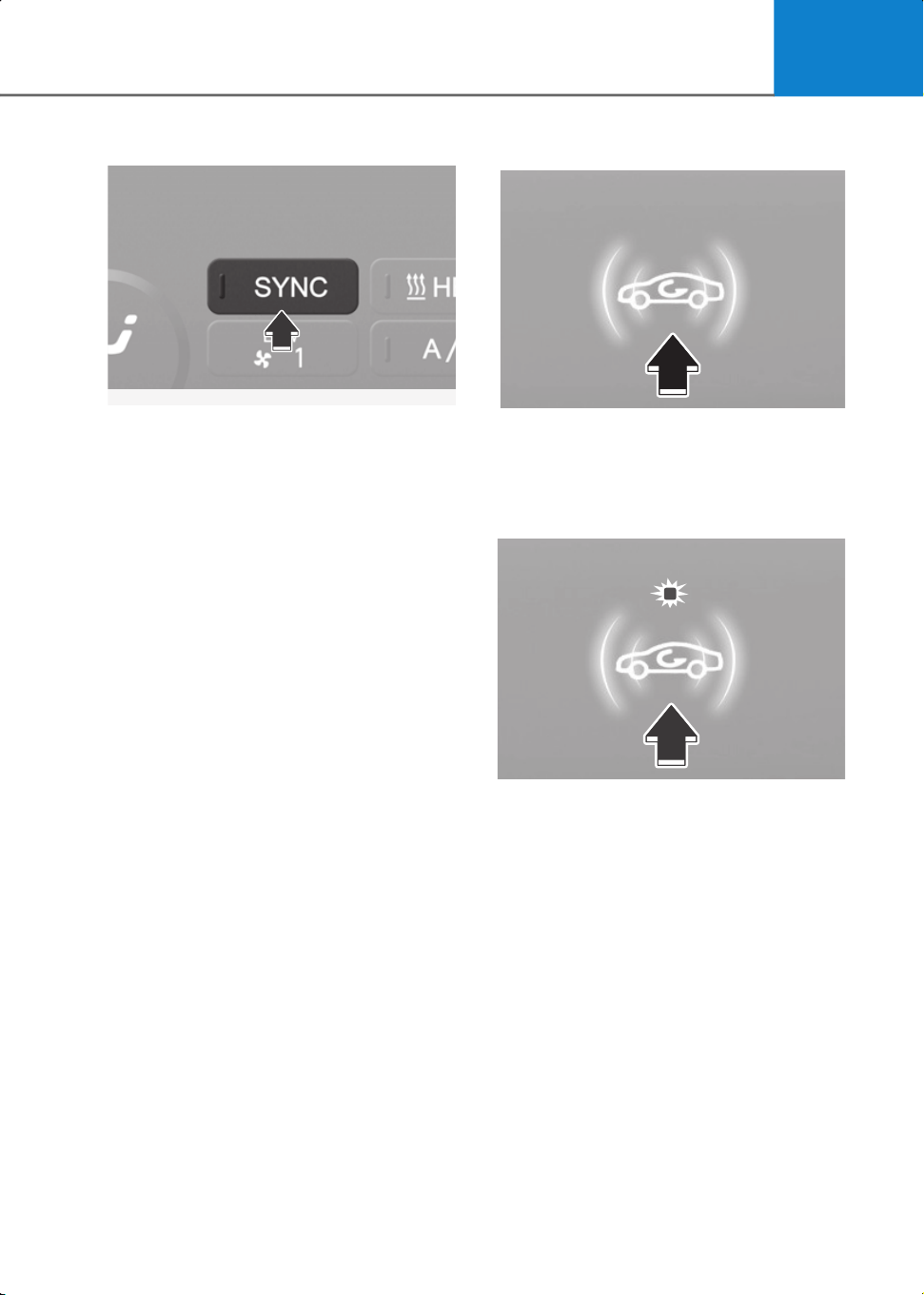
5
5-93
SYNC
B5020008
Adjusting the temperature and air flow
direction equally
Press 'SYNC' (indicator light ON), the
passenger’s temperature and air flow
direction will be adjusted same as the
driver’s control.
Adjusting the temperature and air flow
direction individually
Press 'SYNC' (indicator light OFF), all
seats temperature and air flow direction
will be adjusted individually.
Air intake control
B5020009
Air intake control is used to select either
Fresh mode (outside air) or Recirculation
mode (cabin air).
Recirculation mode
B5020010
When Recirculation mode is selected, air
from the passenger compartment will be
recirculated through the system and
heated or cooled according to the
function selected.
CE_USA.book Page 93
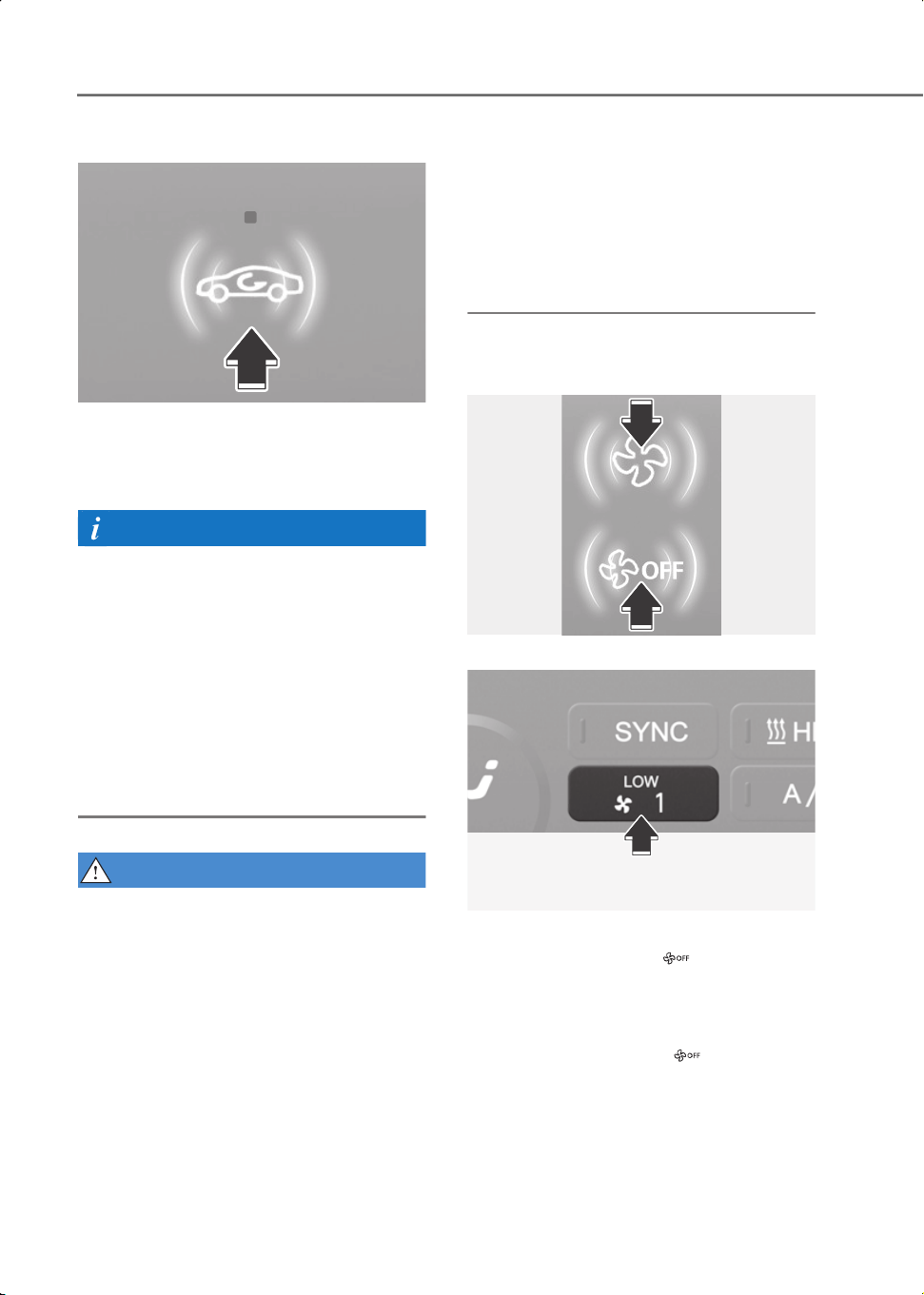
Convenience Features
5-94
Fresh mode
B5020011
When Fresh mode is selected, air enters
the vehicle from outside and is heated or
cooled according to the function
selected.
Information
Operating the system primarily in Fresh
mode is recommended. Use
Recirculation mode temporarily only
when needed. Prolonged operation of the
heater in Recirculation mode and without
the air conditioning ON can cause
fogging of the windshield. In addition,
prolonged use of the air conditioning ON
in Recirculation mode may result in
excessively dry, dehumidified air in the
cabin and may promote formation of
musty vent odor due to stagnant air.
WARNING
• Continued use of the climate control
system operation in Recirculation
mode for a prolonged period of time
may cause drowsiness to the
occupants in the cabin. This may lead to
loss of vehicle control which may lead
to an accident.
• Continued use of the climate control
system operation in Recirculation
mode with the air conditioning OFF
may allow humidity to increase inside
the cabin. This may cause
condensation to accumulate on the
windshield and obscure visibility.
• Do not sleep in your vehicle or remain
parked in your vehicle with the
windows up and either the heater or the
air conditioning ON for prolonged
periods of time. Doing so may increase
the levels of carbon dioxide in the cabin
which may lead to serious injury or
death.
Fan speed control
Climate control panel
B5020012
Infotainment system
B5020013
The fan speed can be set to the desired
speed by adjusting the icon in the
climate control panel.
More air is delivered with higher fan
speeds.
Pressing and holding the icon turns off
the fan.
CE_USA.book Page 94
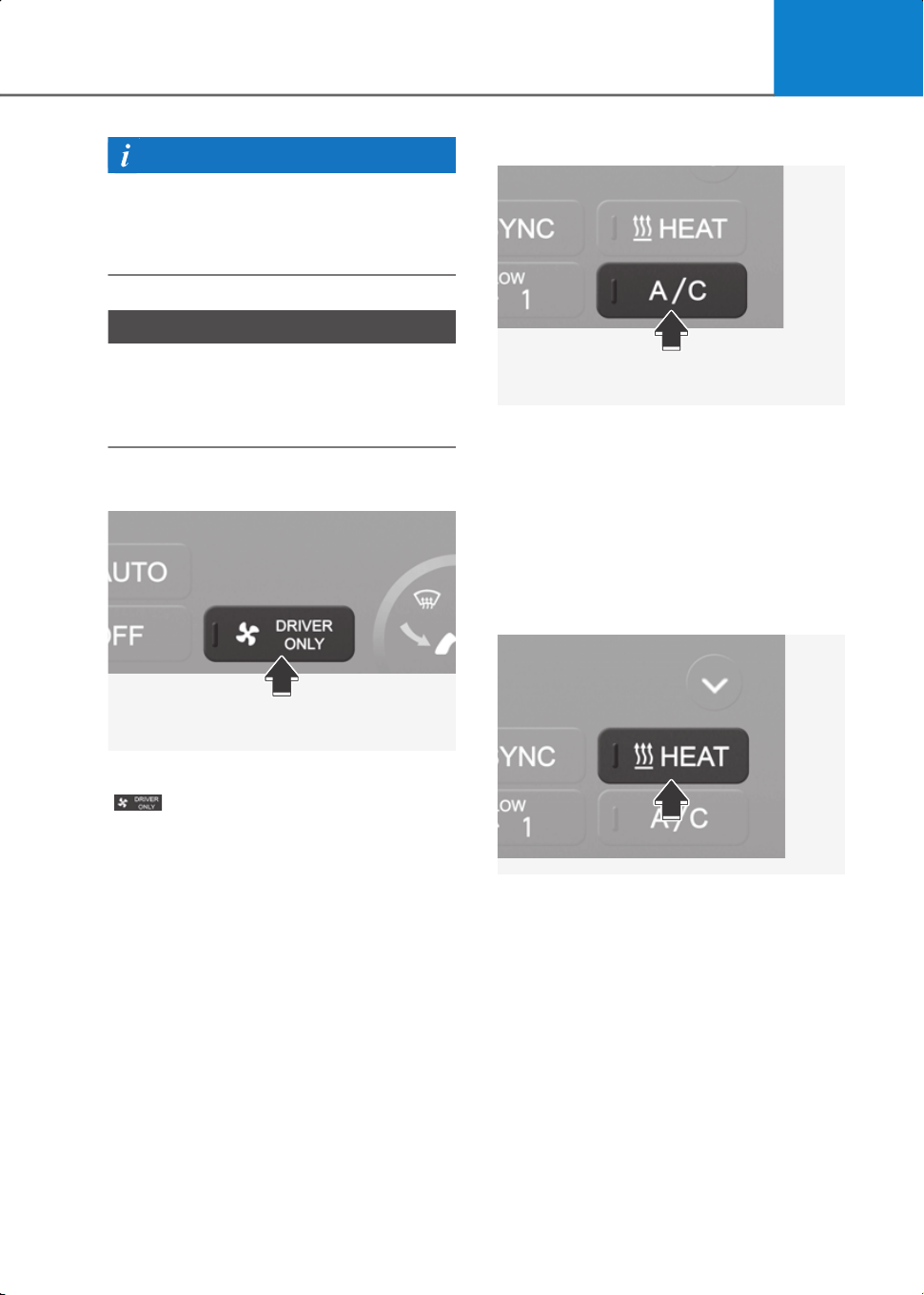
5
5-95
Information
To help improve microphone voice input
sound, fan speed may automatically slow
down for a couple of minutes when you
activate voice recognition or hands free.
NOTICE
Operating the fan when the Start/Stop
button is in the OFF position could cause
the battery to discharge. Operate the fan
when the vehicle is running.
Driver only
B5020014
If you touch the 'DRIVER ONLY' icon
( ) and the indicator light illuminates
in the infotainment climate control
screen, cold air mostly blows in the
driver’s seat. However, some of the cold
air may come out of other seating
position ducts to keep indoor air pleasant.
If you use the icon with no passenger in
the front passenger seat, energy
consumption will be reduced.
'DRIVER ONLY' icon will be turned off
under the following conditions:
1. Defrost on
2. DRIVER ONLY button re-touch
Air conditioning
B5020015
Touch the 'CLIMATE' icon in the climate
control screen. The climate information
screen will appear on the infotainment
system. Touch the A/C icon in the
infotainment system to turn the air
conditioning on (indicator light ON) and
off.
HEAT icon
B5020016
Touch 'CLIMATE' icon in the climate
control screen. The climate information
screen will appear on the infotainment
system. Touch the HEAT icon in the
infotainment system to turn the heater on
(indicator light will illuminate).
Touch the button again to turn the heater
off.
CE_USA.book Page 95
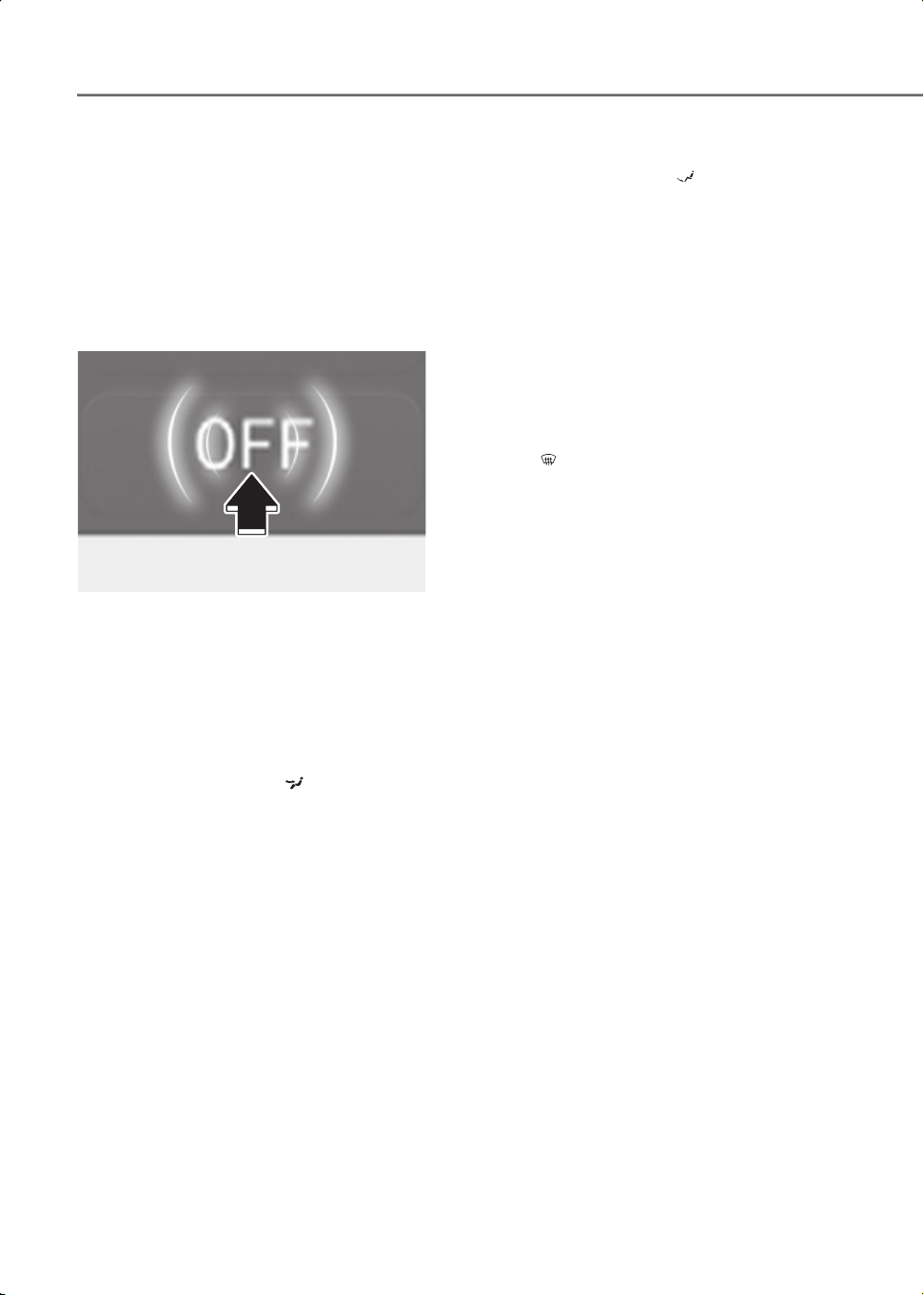
Convenience Features
5-96
The air conditioner and heater uses
energy from the battery. If you use the
heater or air conditioner for too long,
distance to empty can be reduced due to
too much power consumption.
Turn off the heater and air conditioner if
you do not need them.
OFF mode
B5020017
Touch the 'OFF' icon to turn the climate
control system off.
System Operation
Cooling/Ventilation
1. Select the Face Level ( ) mode in the
infotainment system.
2. Set the air intake control to fresh or
recirculation mode.
3. Set the temperature to the desired
position.
4. Set the fan speed to the desired speed.
Heating
1. Select the Floor Level ( ) mode in the
infotainment system.
2. Set the air intake control to fresh or
recirculation mode.
3. Set the temperature to the desired
position.
4. Set the fan speed to the desired speed.
5. If desired, turn the air conditioning ON
with the temperature set high in order
to dehumidify the air before it enters
into the cabin.
If the windshield fogs up, select the Front
Defrost ( ) mode.
Operation Tips
• To keep dust or unpleasant fumes from
entering the vehicle through the
ventilation system, temporarily set the
air intake control to the recirculation
mode. Return the control to the
Recirculation mode to the Fresh mode
when the unpleasant air outside has
diminished. This will help keep the
driver alert and comfortable.
• To help prevent the inside of the
windshield from fogging, set the air
intake control to fresh mode and the
fan speed to the desired position, turn
on the air conditioning system, and
adjust the temperature control to the
desired temperature.
CE_USA.book Page 96
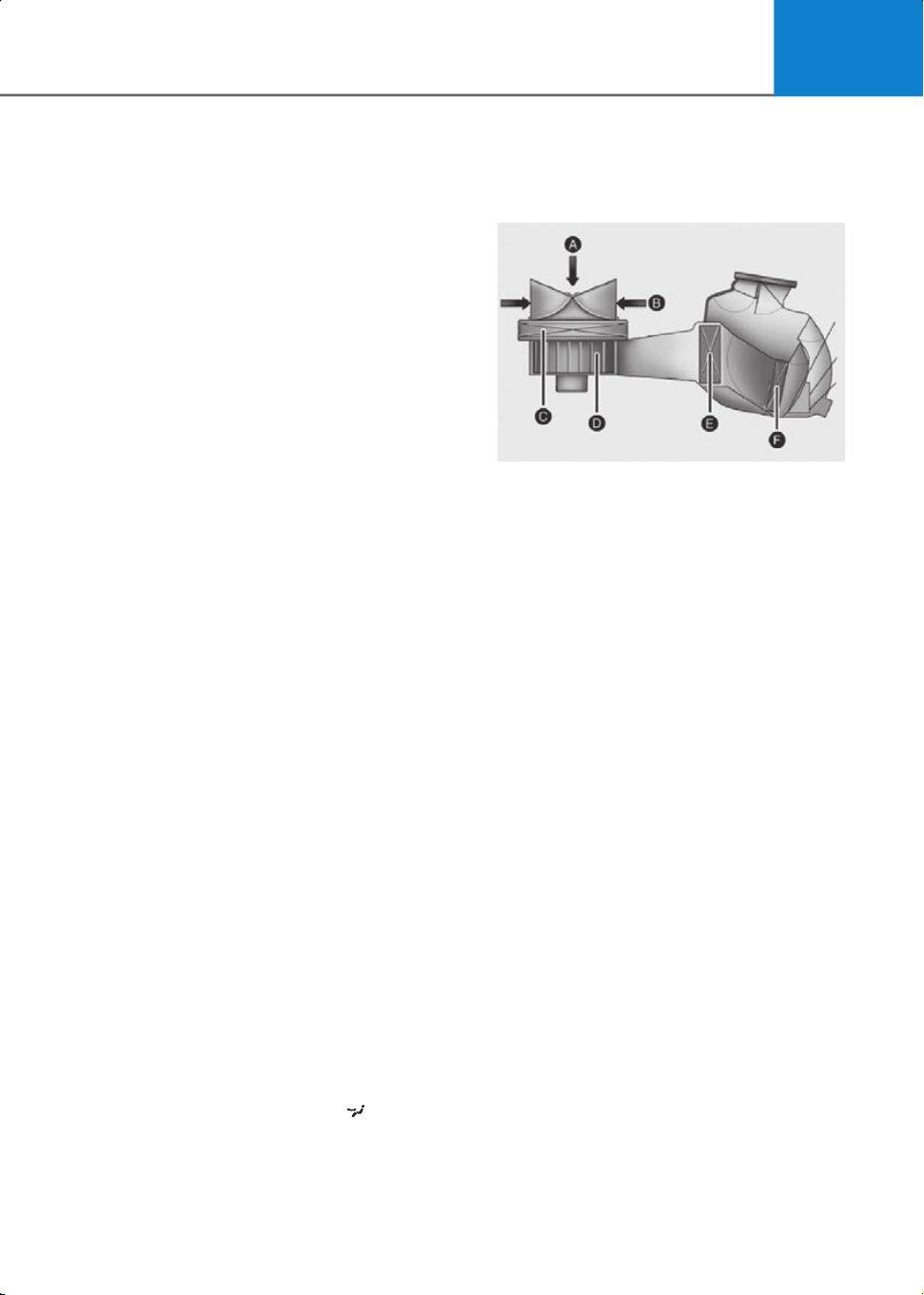
5
5-97
Air conditioning
Your HYUNDAI Vehicle air conditioning
system is filled with R-1234yf refrigerant.
1. Touch the'CLIMATE' icon to display
climate information the infotainment
system.
2. Select 'A/C' icon (indicator light ON) in
the climate information screen to
activate the air-condition.
3. Set the temperature low.
4. Set the direction of air flow by touching
the mode selection icon.
5. Touch the 'HEAT' icon (indicator light
OFF) to turn on the air-condition.
When maximum cooling is desired, set
the temperature to the lowest position,
then set the fan speed control to the
highest setting.
Air conditioning system operation tips
• If the vehicle has been parked in direct
sunlight during hot weather, open the
windows for a short time to let the hot
air inside the vehicle escape.
• After sufficient cooling has been
achieved, switch back from
recirculation mode to fresh mode.
• To help reduce moisture inside of the
windows on rainy or humid days,
decrease the humidity inside the
vehicle by operating the air
conditioning system with the windows
and vision roof closed.
• Use the air conditioning system every
month only for a few minutes to ensure
maximum system performance.
• If you operate air conditioner
excessively, the difference between the
temperature of the outside air and that
of the windshield could cause the outer
surface of the windshield to fog up,
causing loss of visibility. In this case, set
the mode selection to the position
and fan speed control to the lowest
speed.
System Maintenance
Cabin air filter
OHI048581L
[A] Outside air
[B] Recirculated air
[C] Cabin air filter
[D] Blower
[E] Evaporator core
[F] PTC & Inner condenser
The cabin air filter is installed behind the
front trunk. It filters the dust or other
pollutants that enter the vehicle through
the heating and air conditioning system.
Have the cabin air filter replaced by an
authorized HYUNDAI dealer according to
the maintenance schedule. If the vehicle
is being driven in severe conditions such
as dusty or rough roads, more frequent
cabin air filter inspections and changes
are required.
If the air flow rate suddenly decreases,
have the system inspected at an
authorized HYUNDAI dealer.
CE_USA.book Page 97
Convenience Features
5-98
Checking the amount of air
conditioner refrigerant and
compressor lubricant
When the amount of refrigerant is low,
the performance of the air conditioning is
reduced. Overfilling also reduces the
performance of the air conditioning
system.
Therefore, if abnormal operation is found,
have the system inspected by an
authorized HYUNDAI dealer.
NOTICE
It is important that the correct type and
amount of oil and refrigerant is used.
Otherwise, damage to the compressor
and abnormal system operation may
occur. To prevent damage, the air
conditioning system in your vehicle
should only be serviced by trained and
certified technicians.
NOTICE
The refrigerant system should only be
serviced by trained and certified
technicians to insure proper and safe
operation.
The refrigerant system should be serviced
in a well-ventilated place.
The air conditioning evaporator (cooling
coil) shall never be repaired or replaced
with one removed from a used or
salvaged vehicle and new replacement
MAC evaporators shall be certified (and
labeled) as meeting SAE Standard J2842.
WARNING
Vehicles equipped with R-1234yf
WL_RefrigerantWarning
WL_RefrigerantWarning_2
Since the refrigerant is mildly flammable
and operated at high pressure, the air
conditioning system should only be
serviced by trained and certified
technicians. It is important that the
correct type and amount of oil and
refrigerant are used.
All refrigerants should be reclaimed with
proper equipment.
Venting refrigerants directly to the
atmosphere is harmful to individuals and
environment. Failure to heed these
warnings can lead to serious injuries.
CE_USA.book Page 98
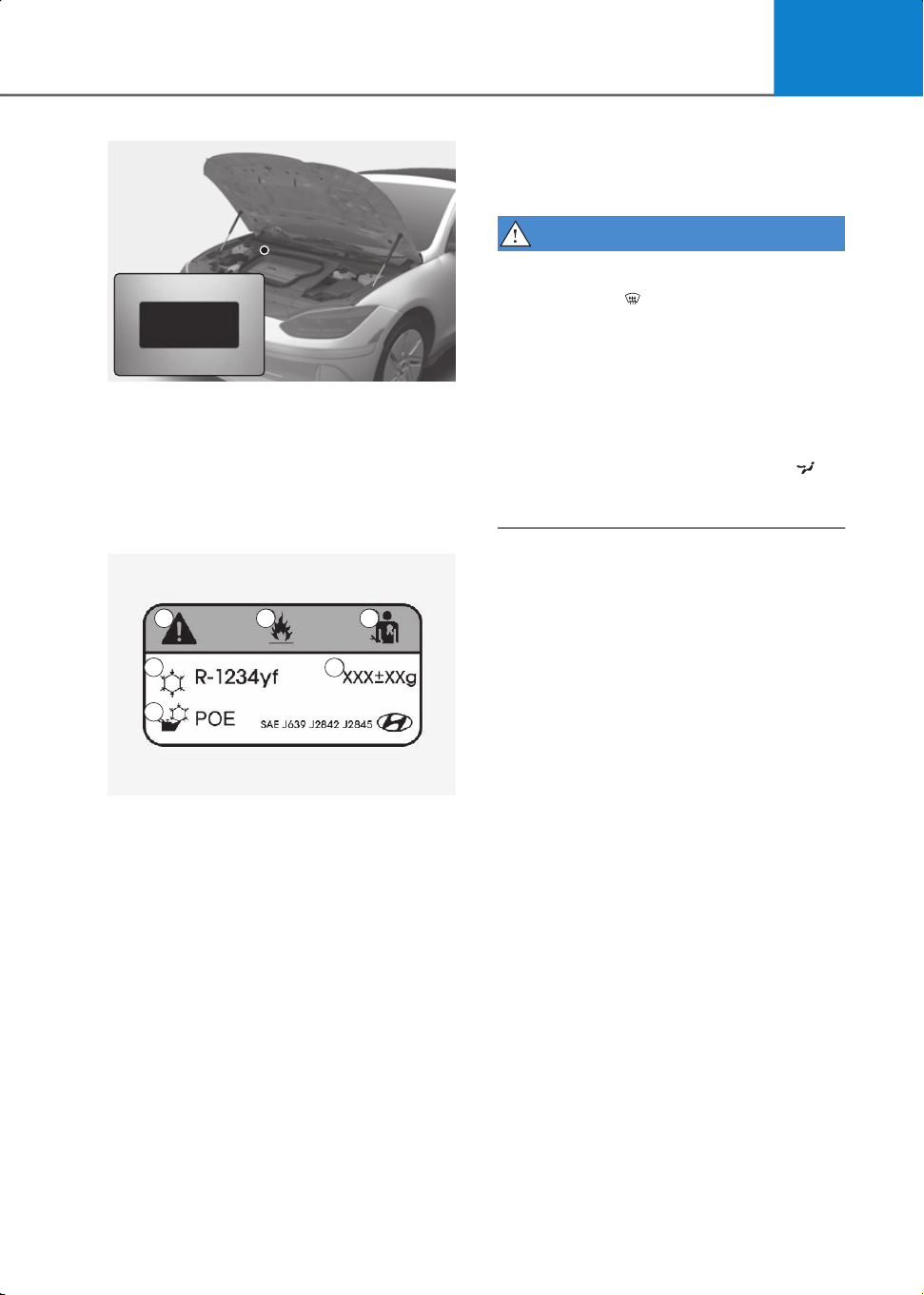
5
5-99
B5020201
Air Conditioning refrigerant label
You can find out which air conditioning
refrigerant is applied to your vehicle on
the label located in the left side of the
cowl top cover.
Example
B5020202
Each symbol and specification on the air
conditioning refrigerant label is
represented as below:
1. Classification of refrigerant
2. Amount of refrigerant
3. Classification of compressor lubricant
4. Caution
5. Flammable refrigerant
6.To require registered technician to
service air conditioning system
Windshield Defrosting
And Defogging
WARNING
Windshield heating
Do not use the position during cooling
operation in extremely humid weather.
The difference between the temperature
of the outside air and that of the
windshield could cause the outer surface
of the windshield to fog up, causing loss
of visibility could cause an accident
resulting in serious injury or death. In this
case, set the mode selection to the
position and fan speed control to a lower
speed.
• For maximum defrost performance, set
the temperature control to the highest
temperature setting and the fan speed
control to the highest setting.
• If warm air to the floor is desired while
defrosting or defogging, set the mode
to the floor-defrost position.
• Before driving, clear all snow and ice
from the windshield, rear window, side
view mirrors, and all side windows.
• Clear all snow and ice from the hood
and air inlet in the cowl grill to improve
heater and defroster efficiency and to
reduce the probability of fogging up the
inside of the windshield.
4 5 6
2
1
3
CE_USA.book Page 99
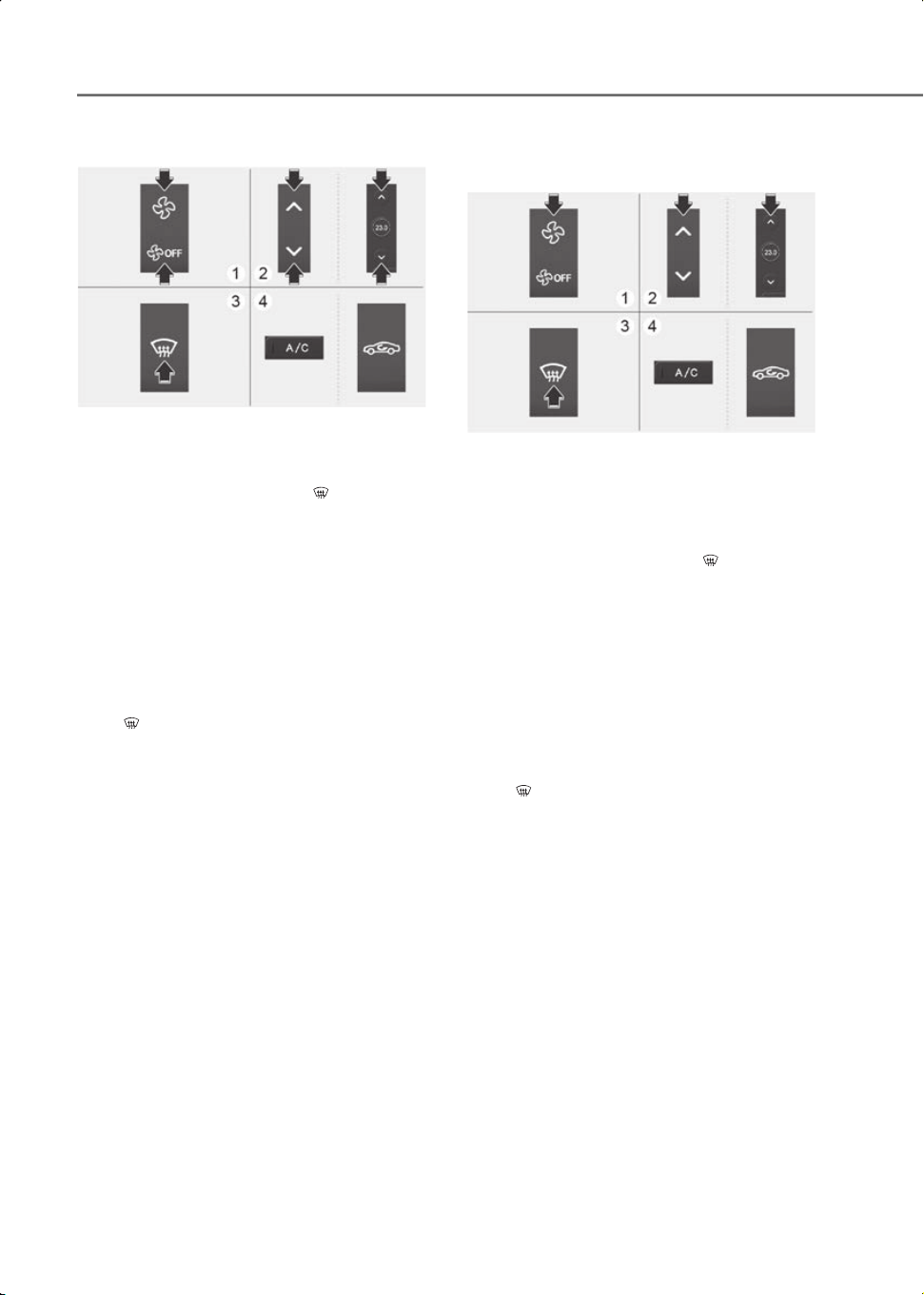
Convenience Features
5-100
To Defog Inside Windshield
B5020401
1. Select the desired fan speed.
2. Select the desired temperature.
3. Touch the defroster icon ( ).
4. When the defogging logic is enabled,
Fresh mode is selected and air
conditioning is selected according to
outside temperature.
Check to make sure the air intake control
is in Fresh mode. If the air intake control
indicator light is illuminated, touch the
icon once to enable Fresh mode
(indicator light OFF).
If the position is selected, the fan speed
is automatically increased.
To Defrost Outside
Windshield
B5020501
1. Set the fan speed to the highest
position.
2. Set the temperature to the extreme hot
position.
3. Touch the defroster icon ( ).
4. When Defogging logic is enabled, Fresh
mode is selected and air conditioning is
selected according to outside
temperature.
Check to make sure the air intake control
is in Fresh mode. If the air intake control
indicator light is illuminated, touch the
icon once to enable Fresh mode
(indicator light OFF).
If the position is selected, lower fan
speed is adjusted to a higher fan speed.
CE_USA.book Page 100
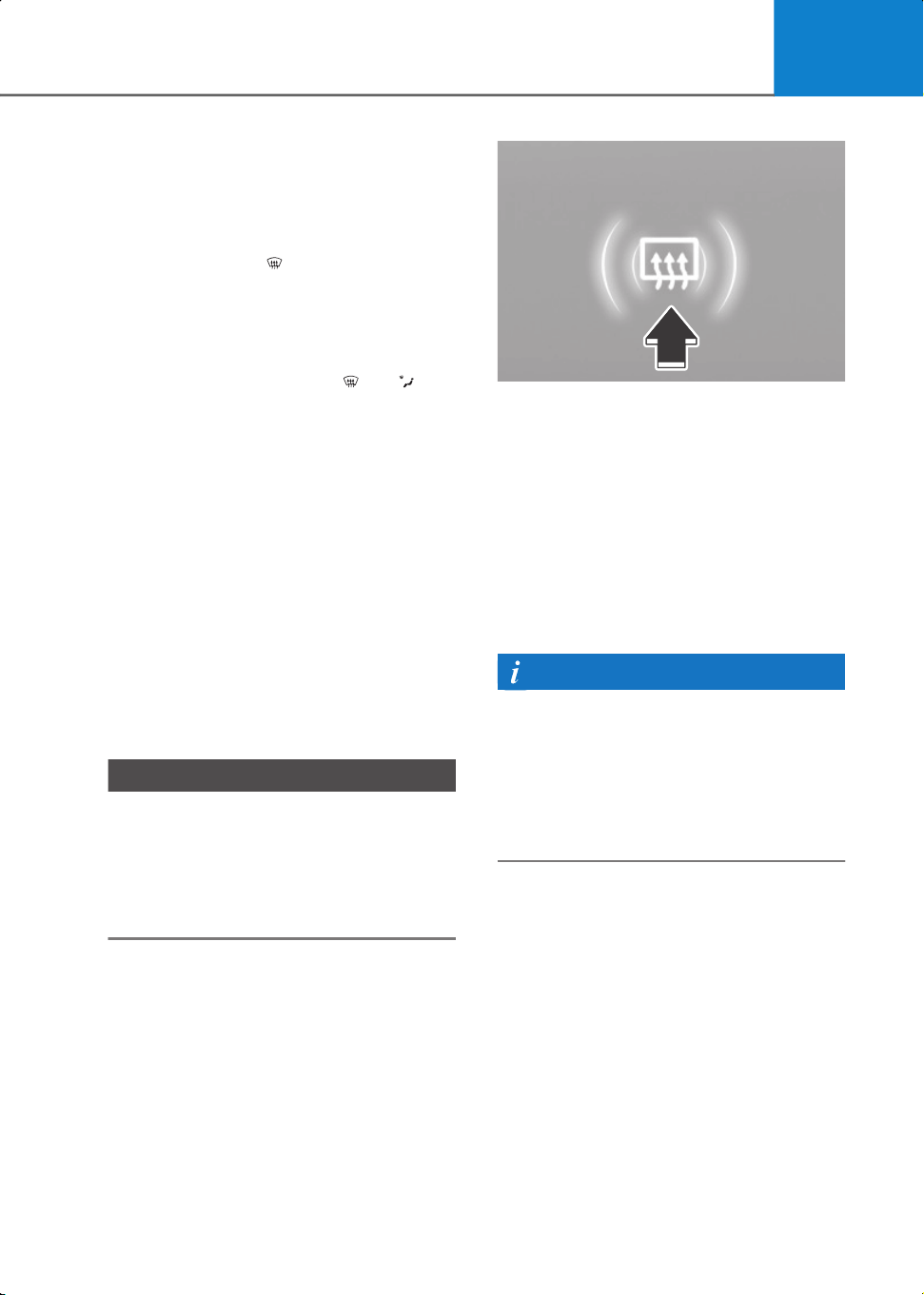
5
5-101
Defogging Logic
To reduce the probability of fogging up
the inside of the windshield, the air intake
or air conditioning are controlled
automatically according to certain
conditions such as positions. To cancel
or reset the defogging logic, do the
following.
1. Press the Start/Stop button to the ON
position.
2. Touch the defroster icon ( ) or ( ).
3. While touching the A/C icon, touch the
air intake control icon at least 5 times
within 3 seconds.
The air intake control indicator will blink 3
times to indicate that the defogging logic
has been disabled. Repeat the steps again
to re-enable the defogging logic.
The air intake control indicator will blink 6
times to indicate that the defogging logic
has been enabled.
If the battery has been discharged or
disconnected, it resets to the defog logic
status.
Rear Window Defroster
NOTICE
To prevent damage to the rear window
defroster conducting elements bonded to
the inside surface of the rear window,
never use sharp instruments or window
cleaners containing abrasives to clean the
window.
B5020801
The defroster heats the window to
remove frost, fog and thin ice from the
interior and exterior of the rear window,
while the vehicle is running.
• To activate the rear window defroster,
touch the rear window icon located in
the center control panel. The indicator
on the rear window defroster
illuminates when the defroster is on.
• To turn off the defroster, touch the rear
window defroster button again.
Information
• If there is heavy accumulation of snow
on the rear window, brush it off before
operating the rear defroster.
• The rear window defroster
automatically turns off after about 20
minutes or when the Start/Stop button
is in the OFF position.
Side view mirror defroster
If your vehicle is equipped with the
rearview mirror defrosters, they will
operate at the same time you turn on the
rear window defroster.
CE_USA.book Page 101
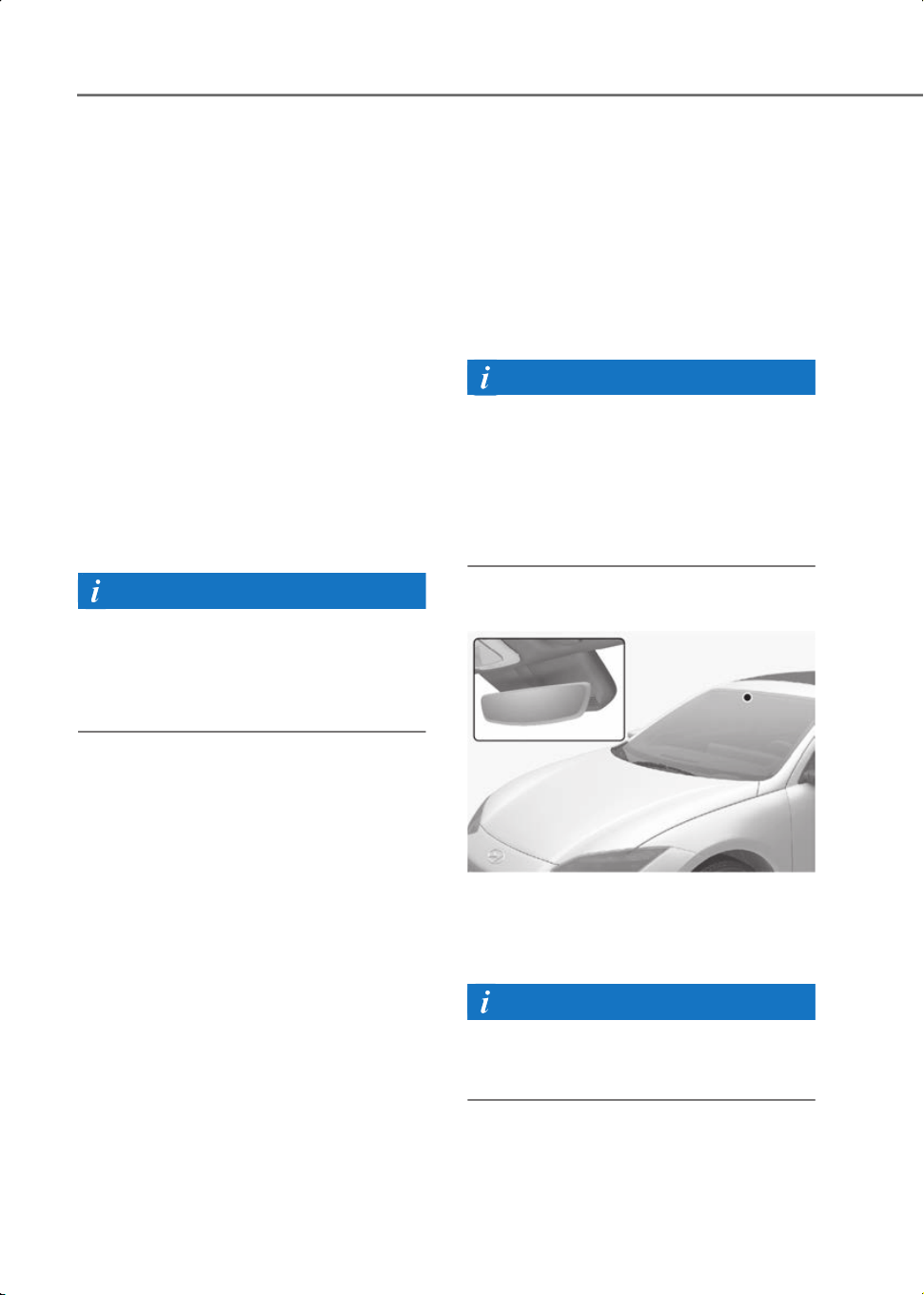
Convenience Features
5-102
Climate Control
Additional Features
A/C Automatic Drying
A/C Automatic Drying feature dries the
moisture in the air conditioner and
reduces air conditioner odor. The blower
motor automatically operates after 30
minutes the vehicle is turned off.
Turning A/C Automatic Drying On or
off
The A/C Automatic Drying feature can be
turned on and off by selecting Setup >
Vehicle Settings > Climate > Climate
Features > A/C Automatic Drying from
the infotainment system.
Information
The infotainment system may change
after software updates. For more
information, refer to the user's manual
provided in the infotainment system and
the quick reference guide.
If the operating condition is satisfied after
setting the feature, the operating
condition is displayed on the
infotainment system and the blower
motor automatically operates.
When the A/C Automatic Drying feature is
activated, the air conditioner sets the fan
speed to the third level, selects Fresh
mode, and directs the air flow to the floor.
Operating conditions
The A/C Automatic Drying feature
operates under the following conditions:
• The vehicle is turned off after operating
the air conditioner for a certain period
• The 12 V battery level is sufficient
• The outside temperature is above a
certain level
Non-operating conditions
The A/C Automatic Drying feature stops
operating under the following conditions:
• The A/C Automatic Drying feature has
operated for 3 minutes
• The Start/Stop button is pressed, or the
vehicle is on
• The climate control system is operated
remotely
Information
• The A/C Automatic Drying feature
reduces air conditioner odors but may
not remove all odors.
• The A/C Automatic Drying feature does
not operate if the remaining battery
level is insufficient to prevent battery
discharge.
Auto Defogging System
B5021201
Auto defogging helps reduce the
possibility of fogging up the inside of the
windshield by automatically sensing the
moisture on inside the windshield.
Information
The auto defogging system may not
operate normally, when the outside
temperature is below 14 °F (-10 °C).
CE_USA.book Page 102
5
5-103
btn_WDH7-69
When the Auto Defogging System
operates, the indicator will illuminate.
If a high amount of humidity is detected in
the vehicle, the Auto Defogging System
will be enabled. The following steps will
be performed automatically:
Step 1)
Air conditioning will turn ON.
Step 2)
Air intake control will change to Fresh
mode.
Step 3)
Mode will change to defrost to direct
airflow to the windshield.
Step 4)
Fan speed will be set to MAX.
If the air conditioning is off or
recirculation mode is manually selected
while Auto Defogging System is ON, the
Auto Defogging System indicator will
blink 3 times to signal that the manual
operation has been canceled.
Turning the Auto Defogging System
ON or OFF
Climate control system
Touch the front windshield defroster icon
for 3 seconds when the Start/Stop button
is in the ON position. When the Auto
Defogging System is turned off, the ADS
OFF symbol will blink 3 times and ADS
OFF will be displayed on the climate
control information system.
When the Auto Defogging System is
turned on, the ADS OFF symbol will blink
6 times without a signal.
Infotainment system
Auto Defogging System can be turned on
and off by selecting Setup > Vehicle >
Climate > Defog/Defrost Options > Auto
Defog from the infotainment system.
Information
The infotainment system may change
after software updates. For more
information, refer to the user's manual
provided in the infotainment system and
the quick reference guide.
Information
• When the air conditioning is turned on
by Auto Defogging System, if you try to
turn off the air conditioning, the
indicator will blink 3 times and the air
conditioning will not be turned off.
• To maintain the effectiveness and
efficiency of the Auto Defogging
System, do not select Recirculation
mode while the system is operating.
• When Auto Defogging System is
operating, fan speed adjustment,
temperature adjustment, and air intake
control selection are all disabled.
NOTICE
Do not remove the sensor cover located
on the upper end of the windshield glass.
Damage to system parts could occur and
may not be covered by your vehicle
warranty.
CE_USA.book Page 103

Convenience Features
5-104
if equipped
Auto Dehumidify
To increase cabin air quality and reduce
windshield misting, recirculation mode
switches off automatically after about 5
minutes, depending on the outside
temperature, and the air intake will
change to fresh mode.
Turning Auto Dehumidify ON or OFF
Climate control system
To turn the Auto Dehumidify feature on or
off, select Face level ( ) mode and touch
the air intake control icon at least five
times within three seconds. When Auto
Dehumidify is turned on, the air intake
control button indicator will blink 6 times.
When turned off, the indicator will blink 3
times.
Infotainment system
Auto Dehumidify can be turned on and off
by selecting Setup > Vehicle > Climate >
Automatic Ventilation > Auto
Dehumidify from the infotainment
system.
Information
If the battery (12 V) is discharged or
disconnected, Auto dehumidify settings
will be reset. Readjust the settings to
turning Auto dehumidify option ON or
OFF.
NOTICE
The infotainment system may change
after software updates. For more
information, refer to the user's manual
provided in the infotainment system and
the quick reference guide.
Sunroof Inside Air
if equipped
recirculation
When the is sunroof opened, fresh mode
will be automatically selected. At this
time, if you press the air intake control
button, recirculation mode will be
selected but will change back to fresh
mode after 3 minutes. When the sunroof
is closed, the air intake position will return
to the original position that was selected.
Recirculating Air When
Washer Fluid Is Used
Recirculation mode automatically
activates to reduce any objectionable
scent of the washer fluid from entering
the cabin when the windshield washer is
used.
Turning Activate upon Washer Fluid
Use ON or OFF
Activate upon Washer Fluid Use can be
turned on and off by selecting Setup >
Vehicle > Climate > Internal air
circulation > Activation on washer fluid
use from the infotainment system.
Information
The infotainment system may change
after software updates. For more
information, refer to the user's manual
provided in the infotainment system and
the quick reference guide.
CE_USA.book Page 104

5
5-105
if equipped
Recirculation Mode Plus
• To prevent the inflow of polluted air
into the vehicle when passing through a
tunnel, this function automatically
closes the windows and switches the
climate control system to Recirculation
mode for about 7 seconds before
entering a tunnel based on the map
information of the navigation and the
speed of the vehicle.
• The windows automatically closes
before entering a tunnel and area
requiring air recirculation. The windows
open to the previous position after
passing the area. If the power window
switch is operated before the window
opens, the window does not open to
the previous position.
• Tunnel linkage automatic control is
available only for models with
one-touch automatic window function
for all seats. To use this feature, it must
be enabled from the Settings menu in
the infotainment system. Select Setup
> Vehicle > Climate > Recirculate air >
Others.
Information
The infotainment system may change
after software updates. For more
information, refer to the user's manual
provided in the infotainment system and
the quick reference guide.
Automatic Controls Linked to
Climate Control Settings (for
driver’s seat)
The temperature of the driver’s seat
warmer, air ventilated seat and heated
steering wheel is automatically controlled
depending on the inside and outside
temperature of the vehicle when the
vehicle is running.
To use these features, it must be enabled
from the Settings menu in the
infotainment system.
Select Setup > Vehicle > Seat>
Warmer/Ventilation Features > Link to
Climate Settings for Auto-Adjustment >
Driver Seat Warmer/Ventilation.
For more information on Auto Comfort
Control, refer to the "Seat Warmers" and
"Air Ventilation Seats" section in chapter 3
and "Heated Steering Wheel" section in
this chapter.
Smart Ventilation
The smart ventilation system maintains
pleasant/fresh air condition inside the
passenger compartment by
automatically detecting/controlling the
temperature and humidity, when you
drive the vehicle with the climate control
system in the OFF position. When the
smart ventilation system starts to
operate, the message 'SMART
VENTILATION ON' appears for 5 seconds.
• The smart ventilation system stops
operating, when the BLOWER DOWN
OFF button of the climate control
system is selected.
• The smart ventilation system stops
operating, when any button of the
climate control system is selected for
operation.
• The smart ventilation system may not
operate, when the vehicle is driven at
low speed.
CE_USA.book Page 105
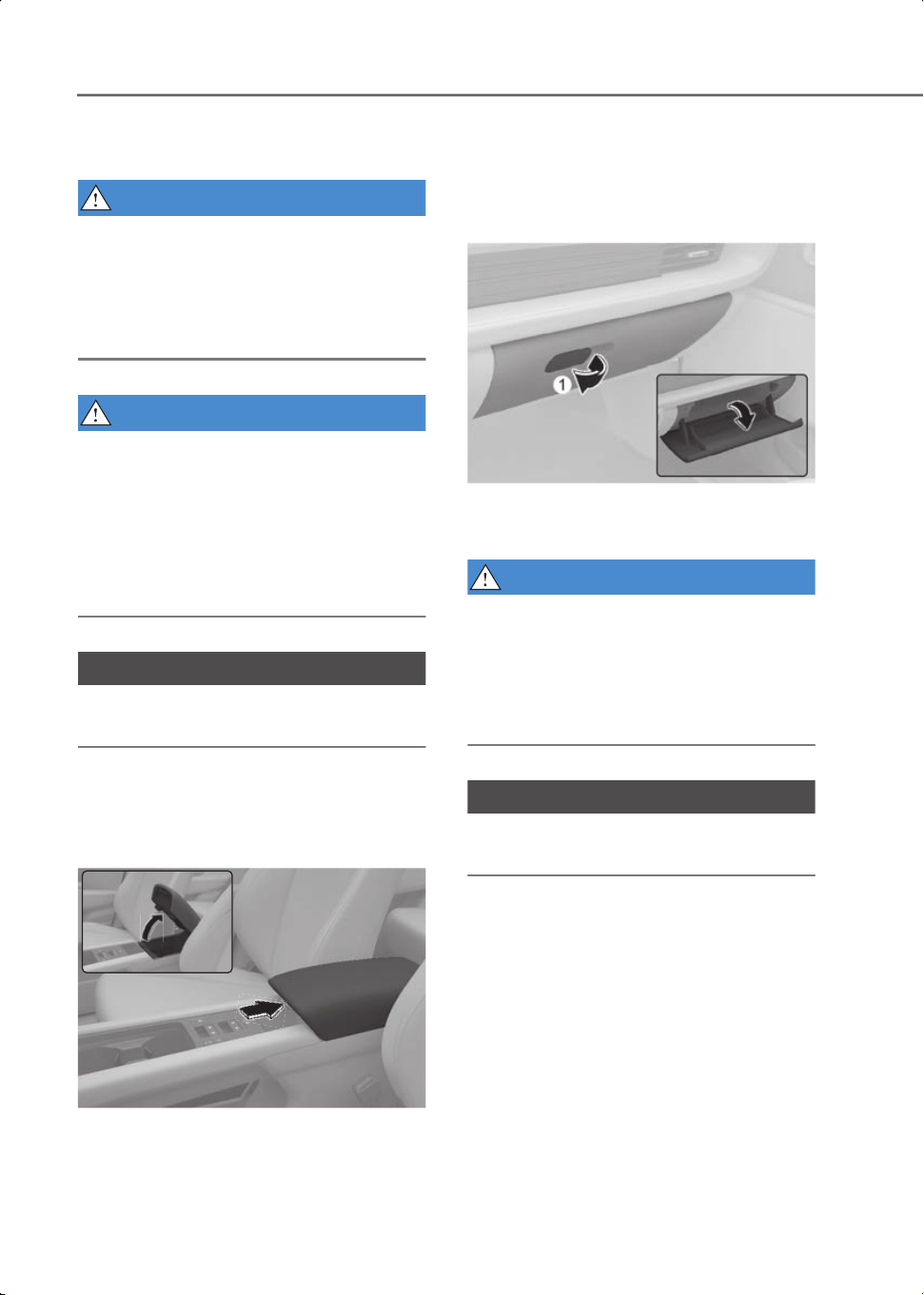
Convenience Features
5-106
Storage Compartment
WARNING
Never store cigarette lighters, propane
cylinders, or other flammable/explosive
materials in the vehicle. These items may
catch fire and/or explode if the vehicle is
exposed to hot temperatures for
extended periods.
WARNING
ALWAYS keep the storage compartment
covers closed securely while driving.
Items inside your vehicle are moving as
fast as the vehicle. If you have to stop or
turn quickly, or if there is a crash, the
items may fly out of the compartment and
may cause an injury if they strike the
driver or a passenger.
NOTICE
To avoid possible theft, do not leave
valuables in the storage compartments.
Center Console Storage
Console Box
B5022101
To open:
Grab and hold the latch on the arm rest
then lift the lid.
• This space provides objects storing
compartment.
Glove Box
B5022201
To open:
Pull the lever (1).
WARNING
ALWAYS close the glove box door after
use.
An open glove box door can cause serious
injury to the passenger in an accident,
even if the passenger is wearing a seat
belt.
NOTICE
Use of excessive force to the glove box
may damage the sliding rail or the lever.
CE_USA.book Page 106
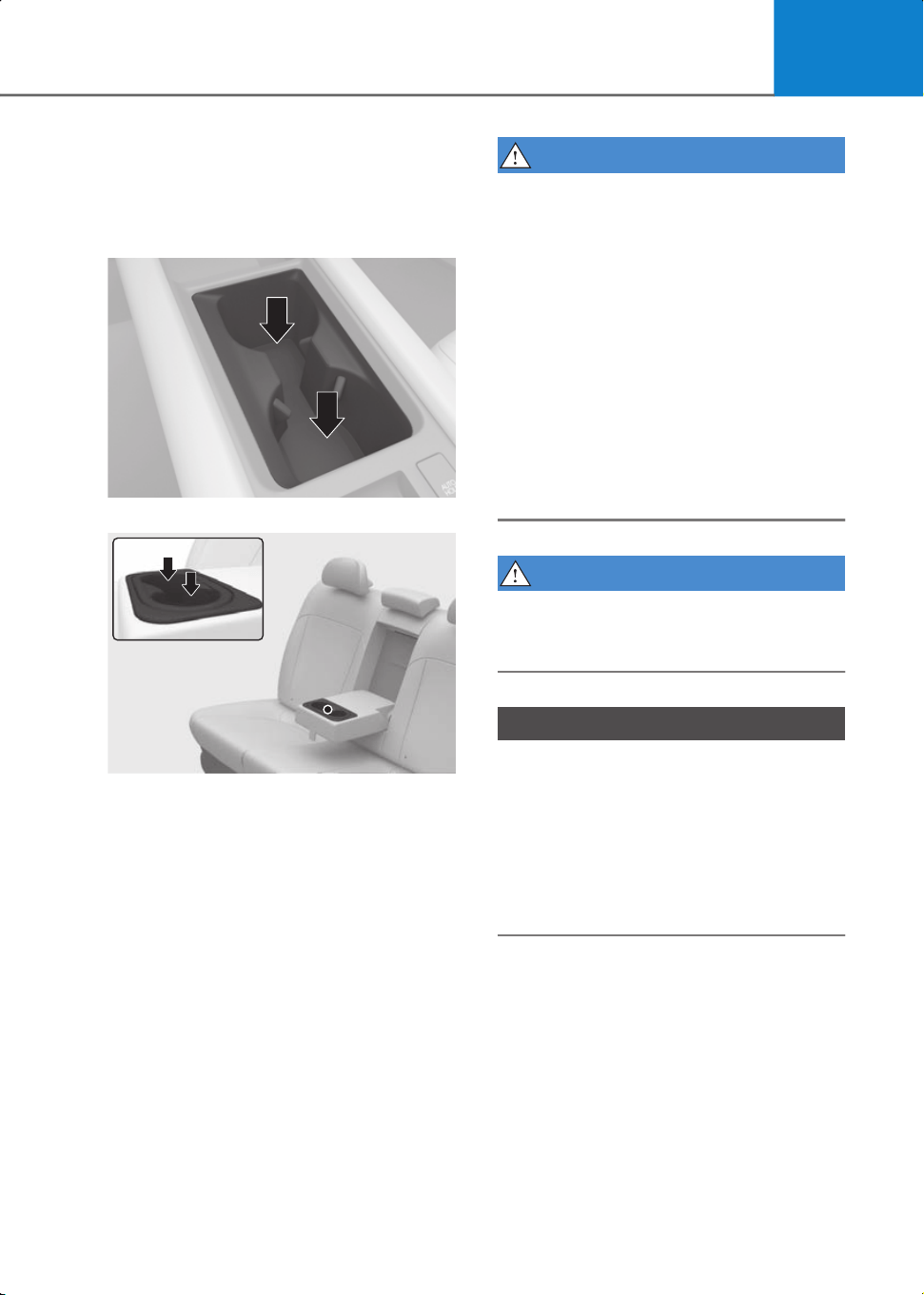
5
5-107
Interior Features
Cup Holder
Front
B5023101
Rear
B5023102
Cups or small beverages cups may be
placed in the cup holders.
WARNING
• Avoid abrupt starting and braking when
the cup holder is in use to prevent
spilling your drink. If hot liquid spills,
you could be burned. Such a burn to the
driver could cause loss of vehicle
control resulting in an accident.
• Do not place uncovered or unsecured
cups, bottles, cans, etc., in the cup
holder containing hot liquid while the
vehicle is in motion. Injuries may result
in the event of a sudden stop or
collision.
• Only use soft cups in the cup holders.
Hard objects can injure you in an
accident.
WARNING
Keep cans or bottles out of direct sun light
and do not put them in a hot vehicle. It
may explode.
NOTICE
• Keep your drinks sealed while driving to
prevent spilling your drink. If liquid
spills, it may get into the vehicle’s
electrical/electronic system and
damage electrical/electronic parts.
• When cleaning spilled liquids do not
use hot air to blow out or dry the cup
holder. This may damage the interior.
CE_USA.book Page 107
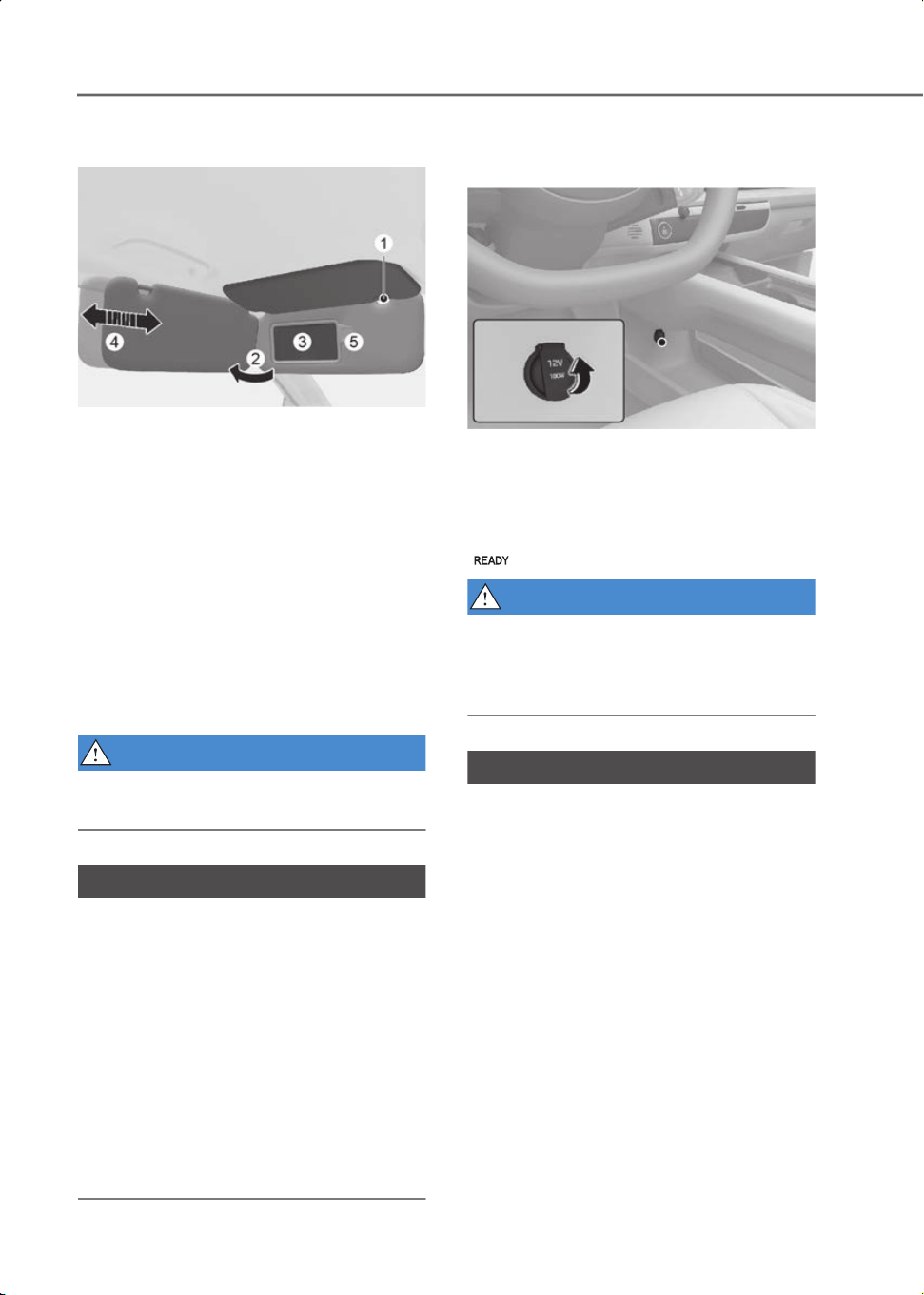
Convenience Features
5-108
Sunvisor
B5023401
To use the sunvisor, pull it downward.
To use the sunvisor to block the sun from
the side window, pull it downward,
release it from the bracket (1) and swing it
to the side (2) towards the window.
To use the vanity mirror, pull down the
sunvisor and slide the mirror cover (3).
Adjust the sunvisor forward or backward
(4) as needed (if equipped). Use the ticket
holder (5) to hold tickets.
Close the vanity mirror cover securely and
return the sunvisor to its original position
after use.
WARNING
For your safety, do not block your view
when using the sunvisor.
NOTICE
• The tab (5) adjacent to the vanity mirror
on the sunvisor can be used for toll road
tickets or self parking tickets. Use
caution when inserting tickets into the
ticket holder to avoid damage. Refrain
from putting several tickets in the ticket
holder as this could also damage the
retaining tab.
• Always have the switch in the off
position when the vanity mirror light is
not in use. If the sunvisor is closed
without the light off, it may discharge
the battery or damage the sunvisor.
Power Outlet
Front
B5023601
The power outlet is designed to provide
power for mobile telephones or other
devices designed to operate with vehicle
electrical systems. The devices should
draw less than 180 W with the vehicle on
( indicator on).
WARNING
Avoid electrical shocks. Do not place your
fingers or foreign objects (pin, etc.) into a
power outlet or touch the power outlet
with a wet hand.
NOTICE
To prevent damage to the power outlets:
• Use the power outlet only when the
vehicle is running and remove the
accessory plug after use. Using the
accessory plug for prolonged periods of
time with the vehicle off could cause
the battery to discharge.
• Only use 12 V electric accessories which
are less than 180 W in electric capacity.
• Adjust the air-conditioner or heater to
the lowest operating level when using
the power outlet.
• Close the cover when not in use.
CE_USA.book Page 108
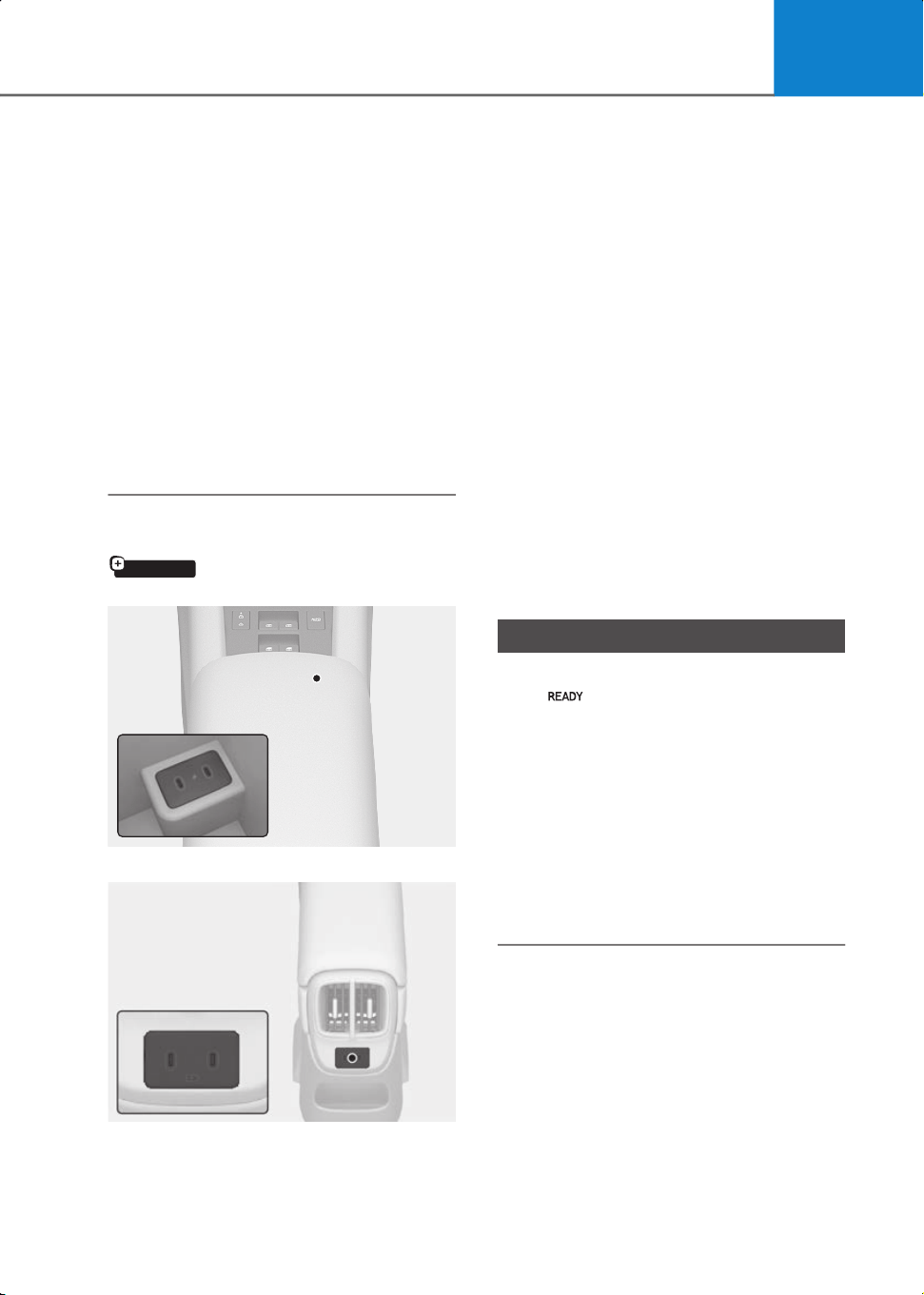
5
5-109
• Some electronic devices can cause
electronic interference when plugged
into a vehicle’s power outlet. These
devices may cause excessive audio
static and malfunctions in other
electronic systems or devices used in
your vehicle.
• Push the plug in as far as it will go. If
good contact is not made, the plug may
overheat and the fuse may open.
• Plug in battery equipped
electrical/electronic devices with
reverse current protection. The current
from the battery may flow into the
vehicle’s electrical/electronic system
and cause system malfunction.
if equipped
USB Charger
Front
B5023701
Rear
B5023702
The USB charger is designed to recharge
batteries of small size electrical devices
using a USB cable.
The electrical devices can be recharged
when the Start/Stop button is in the ON or
START position.
The battery charging state may be
monitored on the electrical device.
Disconnect the USB cable from the USB
port after use.
• A smartphone or a tablet PC may get
warmer during the recharging process.
It does not indicate any malfunction
with the charging system.
• A smartphone or a tablet PC, which
adopts a different recharging method,
may not be properly recharged. In this
case, use an exclusive charger of your
device.
• The charging terminal is only to
recharge a device. Do not use the
charging terminal either to turn ON an
audio or to play media In the
infotainment system.
NOTICE
• Use the USB charger when the vehicle
on ( indicator on). Using the USB
charger for prolonged periods of time
with the vehicle off could cause the
battery to discharge.
• To prevent damage to the USB charger:
- Do not insert foreign objects or spill
liquid into the outlet. The USB
charging terminal may be damaged.
- Do not use devices with current
consumption exceeding 2,100 mA
(2.1 A).
CE_USA.book Page 109
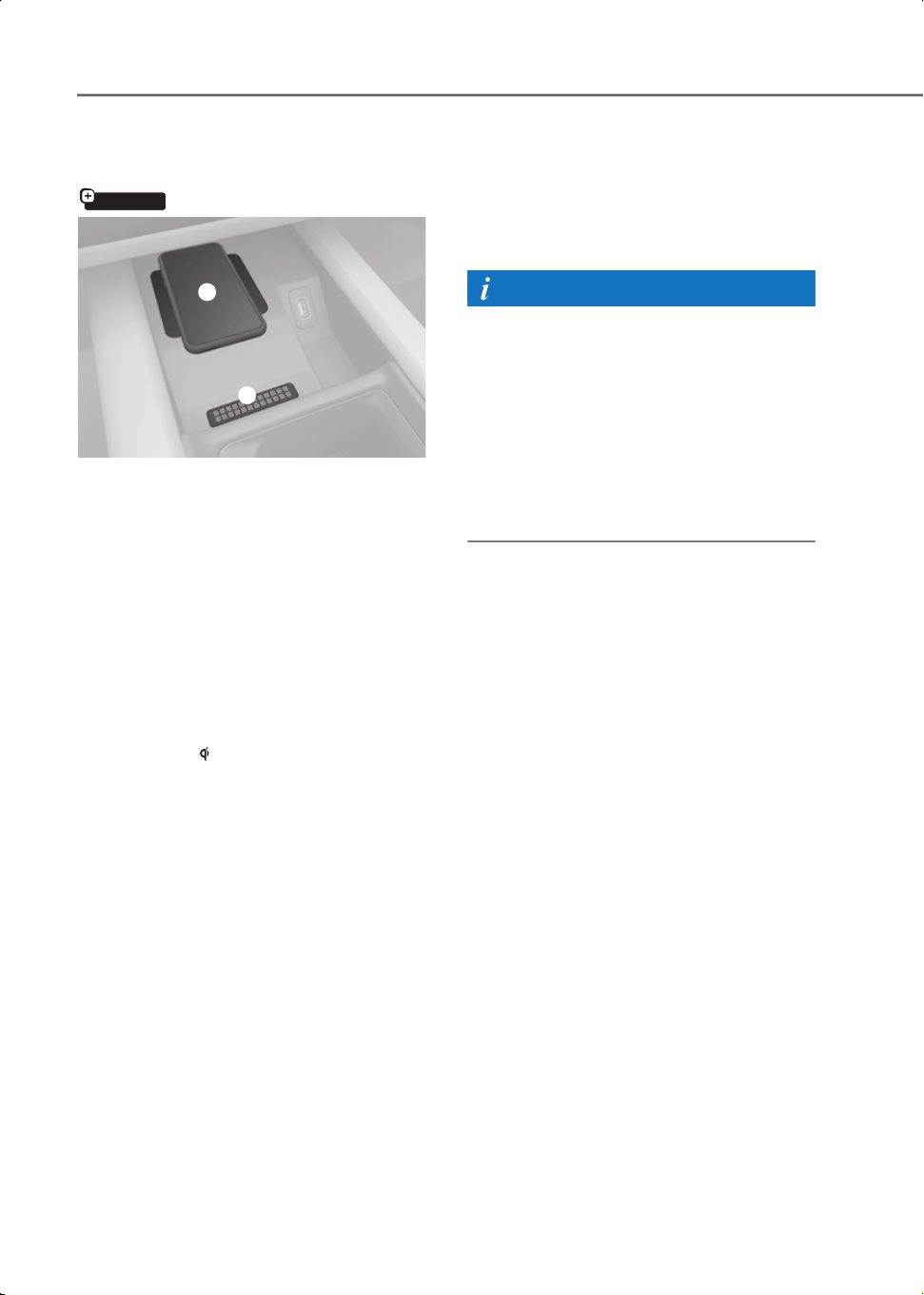
Convenience Features
5-110
Wireless Smartphone
if equipped
Charging System
B5023901
[A] Indicator light
[B] Charging pad
On certain models, the vehicle comes
equipped with a wireless smartphone
charger.
The system is available when all doors are
closed, and when the Start/Stop button is
in the ON or START position.
Charging smartphone
The wireless smartphone charging
system charges only the Qi-enabled
smartphones ( ). Read the label on the
smartphone accessory cover or visit your
smartphone manufacturer’s website to
check whether your smartphone supports
the Qi technology.
The wireless charging process starts
when you put a Qi-enabled smartphone
on the wireless charging unit.
1. Remove other items, including the
smart key, from the wireless charging
unit. If not, the wireless charging
process may be interrupted. Place the
smartphone on the center of the
charging pad.
2. The indicator light is orange when the
smartphone is charging. The indicator
light will turn green when phone
charging is complete.
3. You can turn ON or OFF the wireless
charging function from the Settings
menu in the infotainment system.
Select Setup > Vehicle > Convenience
> Wireless Charging System for Mobile
Devices
Information
• The infotainment system may change
after software updates. For more
information, refer to the user's manual
provided in the infotainment system
and the quick reference guide.
• For flip type smartphones, when using
wireless charging, place the
smartphone folded with the device’s
back placed on the center of the
wireless charging unit.
If your smartphone is not charging:
• Slightly change the position of the
smartphone on the charging pad.
• Make sure the indicator light is orange.
The indicator light will blink orange for 10
seconds if there is a malfunction in the
wireless charging system.
In this case, temporarily stop the charging
process, and re-attempt to charge your
smartphone again.
The system warns you with a message on
the cluster display if the smartphone is
still on the wireless charging unit after the
vehicle is turned OFF and the front door is
opened.
For some manufacturer’s smartphones,
the system may not warn you even
though the smartphone is left on the
wireless charging unit. This is due to the
particular characteristic of the
smartphone and not a malfunction of the
wireless charging.
B
A
CE_USA.book Page 110
5
5-111
NOTICE
• Smartphones that do not have wireless
charging standard ( ) certification,
such as iPhones, may not charge
normally.
• When placing your smartphone on the
charging pad, position the phone in the
middle of the mat for optimal charging
performance. If your smartphone is off
to the side, the charging rate may be
less and in some cases the smartphone
may experience higher heat
conduction.
• In some cases, the wireless charging
may stop temporarily when the smart
key is used, either when starting the
vehicle or locking/unlocking the doors,
etc.
• When charging certain smartphones,
the charging indicator may not change
to blue when the smartphone is fully
charged.
• The wireless charging process may
temporarily stop, when temperature
abnormally increases inside the
wireless smartphone charging system.
The wireless charging process restarts,
when temperature falls to a certain
level.
• The wireless charging process may
temporarily stop when there is any
metallic item, such as a coin, between
the wireless smartphone charging
system and smartphone.
• When charging some smartphones
with a self-protection feature, the
wireless charging speed may decrease
and the wireless charging may stop.
• If the smartphone has a thick cover, the
wireless charging may not be possible.
• If the smartphone is not completely
contacting the charging pad, wireless
charging may not operate properly.
• Some magnetic items like credit cards,
phone cards or rail tickets may be
damaged if left with the smartphone
during the charging process.
• When any smartphone without a
wireless charging function or a metallic
object is placed on the charging pad, a
small noise may sound. This small
sound is due to the vehicle discerning
compatibility of the object placed on
the charging pad. It does not affect
your vehicle or the smartphone in any
way.
Information
If the Start/Stop button is in the OFF
position, the charging also stops.
Information
This device complies with Part 15 of the
FCC rules.
Operation is subject to the following three
conditions:
1. This device may not cause harmful
interference.
2. This device must accept any
interference received, including
interference that may cause undesired
operation.
3. Changes or modifications not expressly
approved by the party responsible for
compliance could void the user’s
authority to operate the device
CE_USA.book Page 111
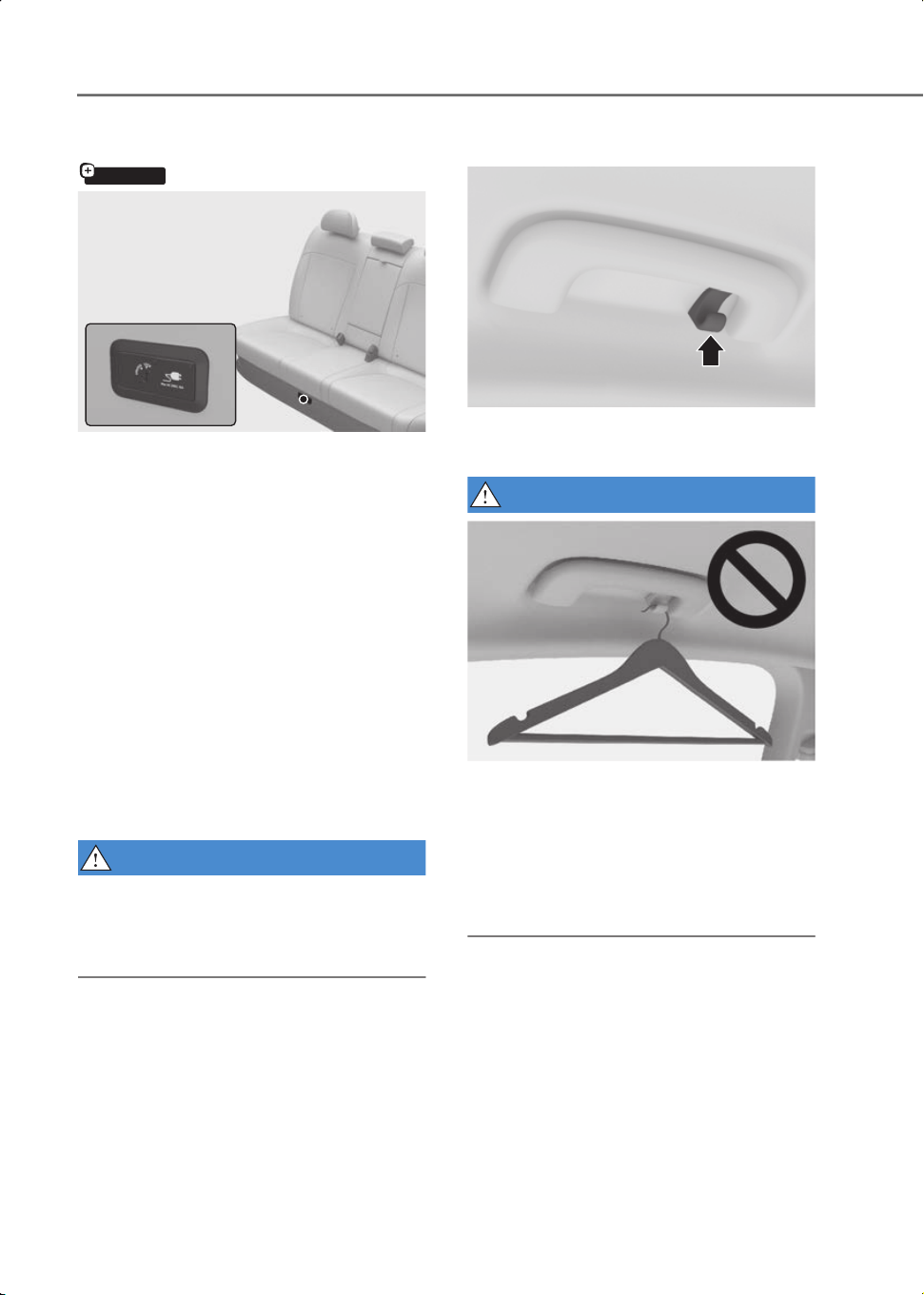
Convenience Features
5-112
if equipped
Vehicle to Load (V2L)
B5024001
V2L(Vehicle to Load) is installed at the
central rear seat. V2L is a convenient
feature which provides enough electricity
to use diverse household electrical
appliances in the vehicle.
V2L is installed at the central rear seat
bottom.
For more information, refer to the "Using
V2L Function" section in chapter 1.
Clock
The clock can be set from the
infotainment system.
For more information, refer to the user’s
manual provided in the infotainment
system and the quick reference guide.
WARNING
Do not attempt to adjust the clock while
driving. Doing so may result in distracted
driving which may lead to an accident
involving personal injury or death.
Coat Hook
B5024201
These hooks are not designed to hold
large or heavy items.
WARNING
B5024202
Do not hang other objects such as
hangers or hard objects except clothes.
Also, do not put heavy, sharp or breakable
objects in the clothes pockets. In an
accident or when the curtain airbag is
inflated, it may cause vehicle damage or
personal injury.
CE_USA.book Page 112
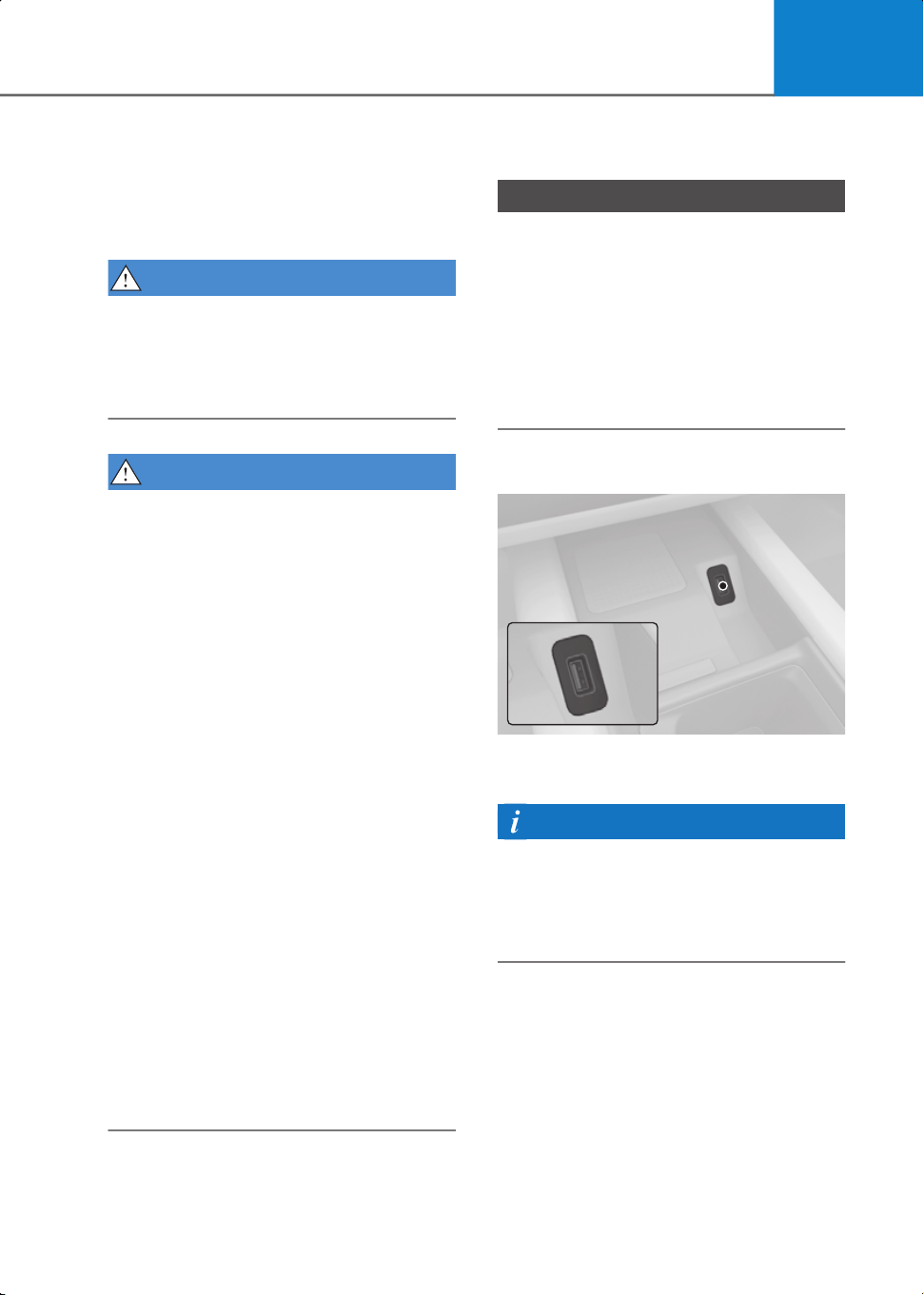
5
5-113
Floor Mat Anchor(s)
ALWAYS use the Floor Mat Anchors to
attach the front floor mats to the vehicle.
The anchors on the front floor carpet keep
the floor mats from sliding forward.
WARNING
Do not overlay additional mats or liners
over the floor mats. If using All Weather
mats, remove the carpeted floor mats
before installing them. Only use floor
mats designed to connect to the anchors.
WARNING
The following must be observed when
installing ANY floor mat to the vehicle.
• Ensure to remove a protective film
attached on the carpet before
attaching a floor mat on the front floor
carpet. Otherwise, the floor mat may
move freely on the protective film and it
could result in unintentional braking or
accelerating.
• Ensure that the floor mats are securely
attached to the vehicle’s floor mat
anchor(s) before driving the vehicle.
• Do not use ANY floor mat that cannot
be firmly attached to the vehicle’s floor
mat anchors.
• Do not stack floor mats on top of one
another (for example, all-weather
rubber mat on top of a carpeted floor
mat). Only a single floor mat should be
installed in each position.
IMPORTANT Your vehicle was
manufactured with driver’s side floor mat
anchors that are designed to securely
hold the floor mat in place. To avoid any
interference with pedal operation,
HYUNDAI Vehicle recommends that the
HYUNDAI floor mat designed for use in
your vehicle be installed.
Infotainment System
NOTICE
• If you install an aftermarket HID head
light, your vehicle’s audio and
electronic devices may not function
properly.
• Prevent chemicals such as perfume,
cosmetic oil, sun cream, hand cleaner,
and air freshener from contacting the
interior parts because they may cause
damage or discoloration.
USB Port
B5025901
You can use an USB cable to connect
audio devices to the vehicle USB port.
Information
When using a portable audio device
connected to the power outlet, noise may
occur during playback. If this happens,
use the portable audio device’s power
source.
CE_USA.book Page 113
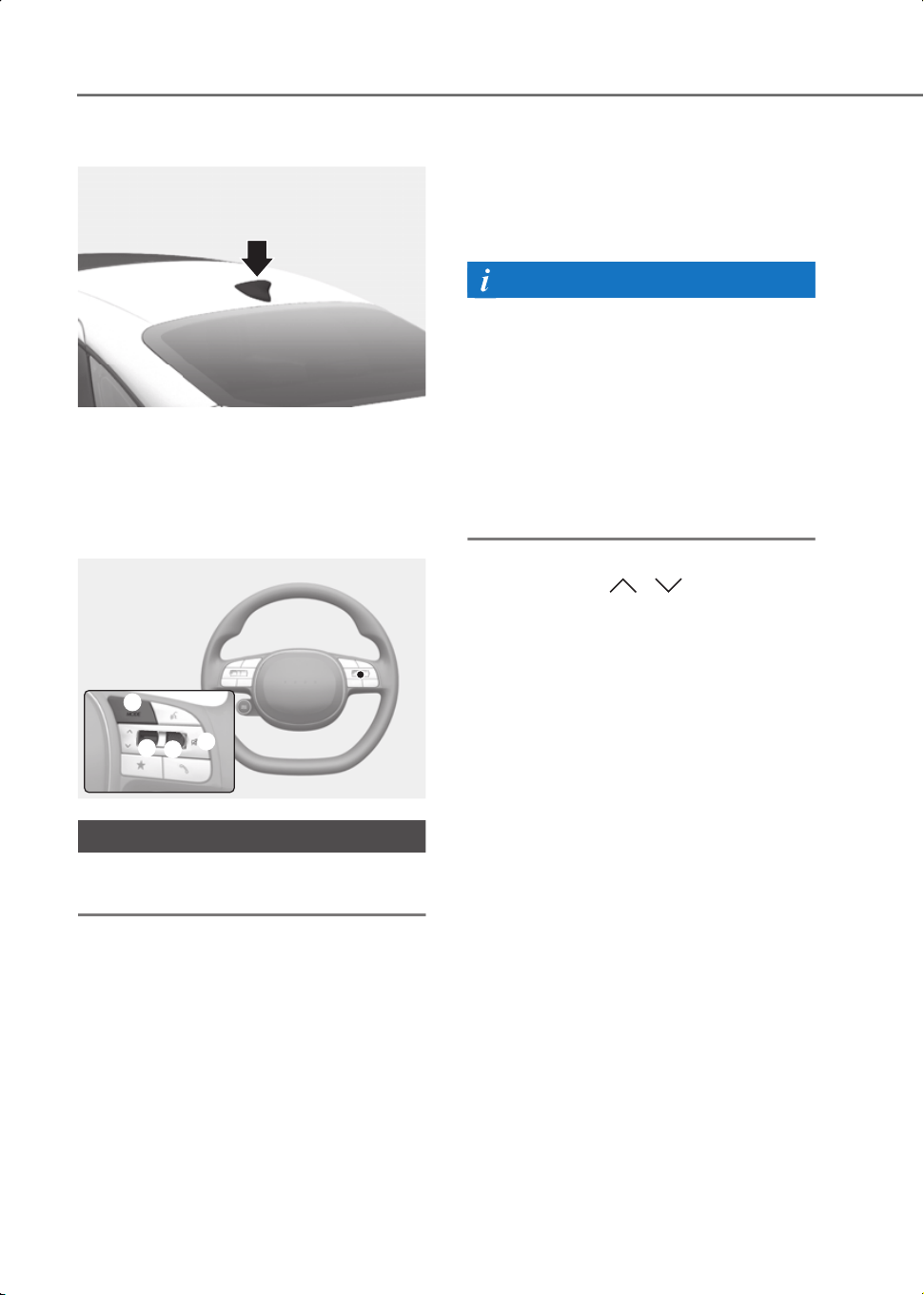
Convenience Features
5-114
Antenna
B5025101
The shark fin antenna will receive AM, FM
broadcast signals and transmit data.
Steering Wheel Remote
Controls
B5025401
NOTICE
Do not operate multiple audio remote
control buttons simultaneously.
VOLUME (VOL + / VOL -) (1)
• Rotate the VOLUME scroll up to
increase volume.
• Rotate the VOLUME scroll down to
decrease volume.
Information
You can set the volume level of each
source (FM, AM, SXM, USB, BT, etc.)
individually by adjusting the VOLUME
scroll.
Then the infotainment system saves the
last volume level of each source in the
system sound settings.
If you change the source, the volume will
revert to the previously set volume for
that source.
SEEK/PRESET ( / ) (2)
If the SEEK/PRESET switch is pressed up
or down and held for 0.8 second or more,
it will function in the following modes:
RADIO mode
It will function as the AUTO SEEK select
button. It will SEEK until you release the
button.
MEDIA mode
It will function as the FF/RW button.
If the SEEK/PRESET switch is pressed up
or down, it will function in the following
modes:
RADIO mode
It will function as the PRESET STATION
UP/DOWN button.
MEDIA mode
It will function as the TRACK UP/ DOWN
button.
MODE (3)
Press the MODE button to toggle through
Radio or AUX modes.
1
2
3
4
CE_USA.book Page 114
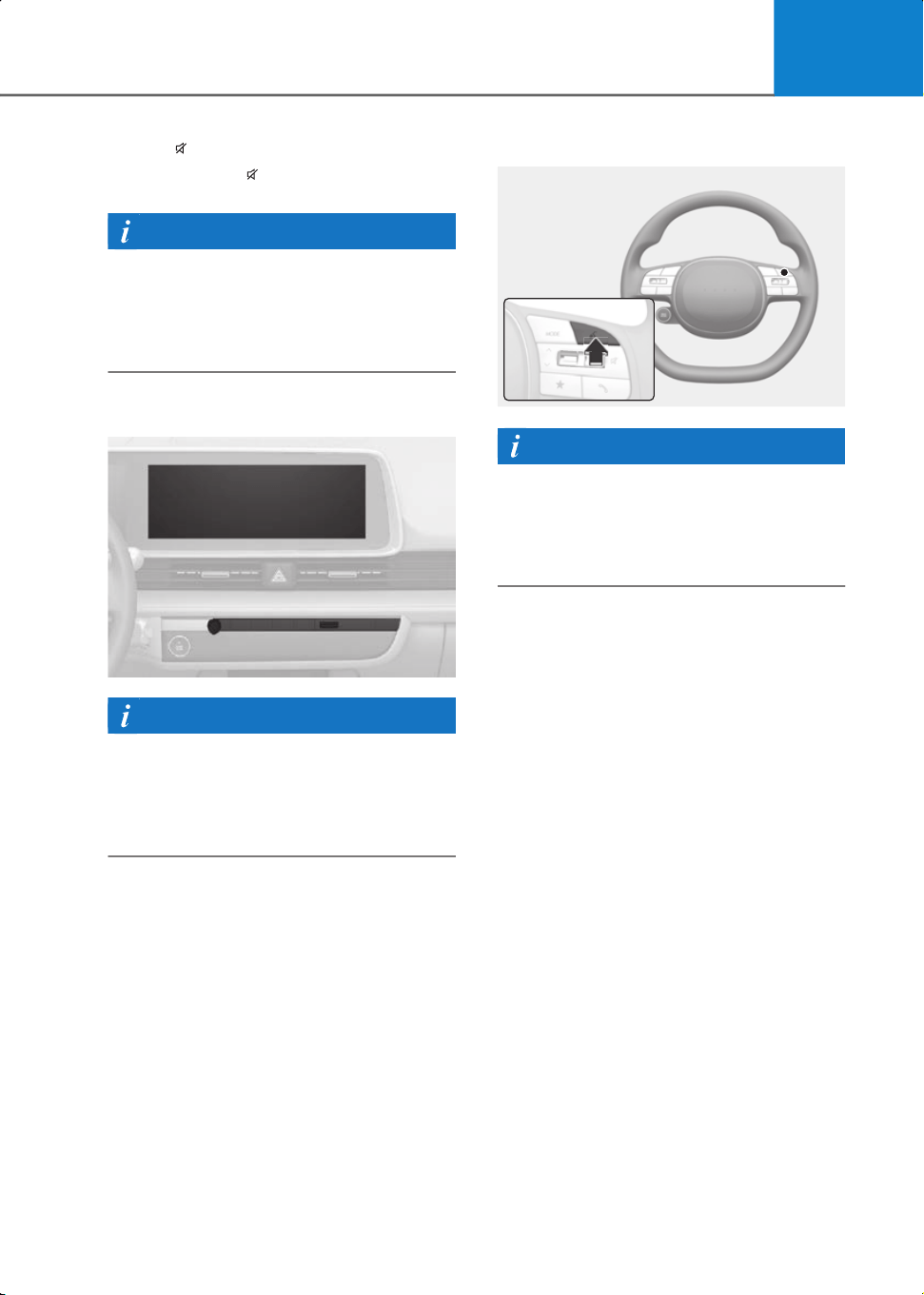
5
5-115
MUTE ( ) (4)
Press the MUTE( )button to mute or
activate the sound.
Information
The infotainment system may change
after software updates. For more
information, refer to the user's manual
provided in the infotainment system and
the quick reference guide.
Infotainment System
B5025501
Information
The infotainment system may change
after software updates. For more
information, refer to the user's manual
provided in the infotainment system and
the quick reference guide.
Voice Recognition
B5026101
Information
The infotainment system may change
after software updates. For more
information, refer to the user's manual
provided in the infotainment system and
the quick reference guide.
CE_USA.book Page 115
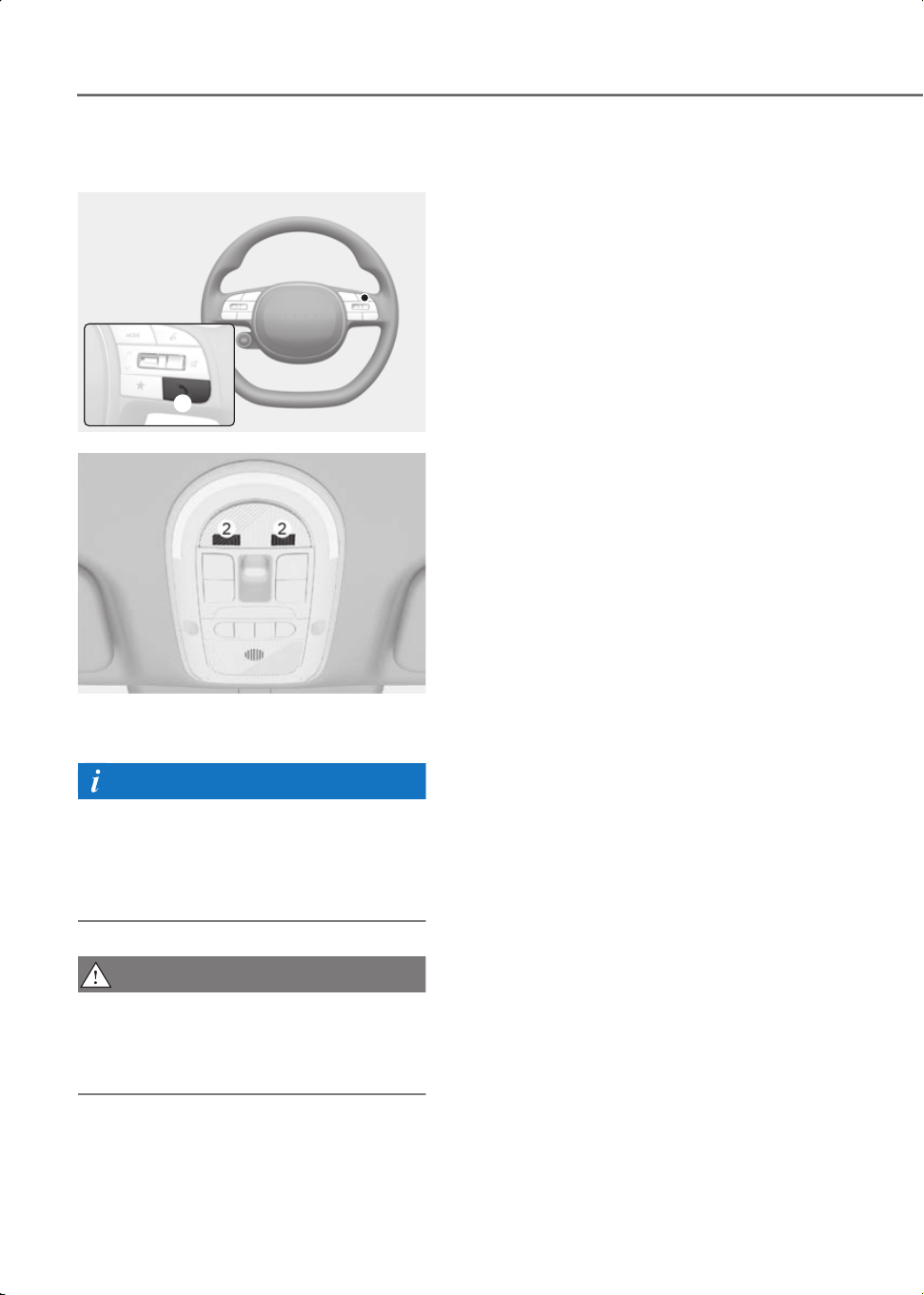
Convenience Features
5-116
Bluetooth® Wireless
Technology
B5026001
B5026002
(1) Call / Answer / Call end button
(2) Microphone
Information
The infotainment system may change
after software updates. For more
information, refer to the user's manual
provided in the infotainment system and
the quick reference guide.
CAUTION
To avoid driver distractions, do not
excessively operate the device while
driving the vehicle which may lead to an
accident.
1
CE_USA.book Page 116

6
6. Driving Your Vehicle
Before Driving..................................................................................................................6-3
Before Entering the Vehicle ........................................................................................6-3
Before Starting .............................................................................................................6-3
Start/Stop Button ............................................................................................................6-4
Start/Stop Button Positions ........................................................................................6-5
Starting the Vehicle .....................................................................................................6-6
Turning Off the Vehicle................................................................................................ 6-7
Remote Start ................................................................................................................ 6-7
Shift By Wire.....................................................................................................................6-8
Shift By Wire Operation...............................................................................................6-8
Cluster Display Messages Information......................................................................6-12
Good Driving Practices.............................................................................................. 6-13
Regenerative Braking System (Paddle Shifter) ........................................................... 6-14
Using Regenerative Braking System ........................................................................ 6-14
Regenerative Braking System Limitations............................................................... 6-15
One Pedal Driving ...................................................................................................... 6-15
Using i-PEDAL ............................................................................................................ 6-16
Smart Regeneration System..........................................................................................6-17
Smart Regeneration System On/Off..........................................................................6-17
Smart Regeneration System Operating Condition.................................................. 6-18
Smart Regeneration Level Settings .......................................................................... 6-18
Pausing Smart Regeneration System....................................................................... 6-19
Front Sensors ............................................................................................................. 6-19
System Check Message.............................................................................................6-20
Smart Regeneration System Precautions ................................................................6-20
Braking System..............................................................................................................6-23
Power-Assist Brakes ..................................................................................................6-23
Disc Brakes Wear Indicator .......................................................................................6-24
Electronic Parking Brake (EPB) .................................................................................6-24
Auto Hold....................................................................................................................6-28
Brake Disc Cleaning...................................................................................................6-30
Anti-Lock Brake System (ABS)..................................................................................6-30
Electronic Stability Control (ESC) .............................................................................6-32
Vehicle Stability Management (VSM).......................................................................6-34
Hill-Start Assist Control (HAC) ..................................................................................6-35
Brake Assistant System (BAS) ...................................................................................6-35
CE_USA.book Page 1

6
Good Braking Practices............................................................................................. 6-36
All Wheel Drive (AWD) ...................................................................................................6-37
Emergency Precautions............................................................................................ 6-39
Drive Mode Integrated Control System (2WD)...........................................................6-40
Drive Mode.................................................................................................................6-40
Drive Mode Integrated Control System (AWD) .......................................................... 6-42
Drive Mode................................................................................................................. 6-42
Drive Modes Characteristic ...................................................................................... 6-44
Active Air Flap................................................................................................................ 6-45
Malfunction................................................................................................................ 6-45
Active Sound Design..................................................................................................... 6-46
Special Driving Conditions ........................................................................................... 6-46
Hazardous Driving Conditions.................................................................................. 6-46
Rocking the Vehicle .................................................................................................. 6-46
Smooth Cornering..................................................................................................... 6-47
Driving at Night ......................................................................................................... 6-47
Driving in the Rain ..................................................................................................... 6-47
Hydroplaning ............................................................................................................. 6-48
Driving in Flooded Areas........................................................................................... 6-48
Highway Driving ........................................................................................................ 6-48
Winter Driving ............................................................................................................... 6-49
Snow or Icy Conditions ............................................................................................. 6-49
Winter Precautions..................................................................................................... 6-51
Vehicle Load Limit......................................................................................................... 6-53
The Loading Information Label ................................................................................ 6-53
Trailer Towing.................................................................................................................6-57
CE_USA.book Page 2

6
6-3
Before Driving
Before Entering the Vehicle
• Make sure all windows, outer side
mirror(s), and outside lights are clean
and unobstructed.
• Remove frost, snow, or ice from both
the front and rear windshield as well as
the front side windows.
• Visually check the tires for uneven wear
and damage.
• Check under the vehicle for any sign of
leaks.
• Make sure there are no obstacles
behind you if you intend to back up.
Before Starting
• Make sure the hood, the trunk, and the
doors are securely closed and locked.
• Adjust the position of the seat and
steering wheel.
• Adjust the inside rearview mirror and
outer side view mirrors.
• Verify all the lights work.
• Fasten your seat belt. Check that all
passengers have fastened their seat
belts.
• Check the gauges and indicators in the
instrument panel and the messages on
the cluster display when the vehicle is
in the ON position.
• Check that any items you are carrying
are stored properly or fastened down
securely.
WARNING
To reduce the risk of SERIOUS INJURY or
DEATH, take the following precautions:
• ALWAYS wear your seat belt. All
passengers must be properly belted
whenever the vehicle is moving. For
more information, refer to the “Seat
Belts” section in chapter 3.
• Always drive defensively. Assume other
drivers or pedestrians may be careless
and make mistakes.
• Stay focused on the task of driving.
Driver distraction can cause accidents.
• Leave plenty of space between you and
the vehicle in front of you.
WARNING
NEVER drink or take drugs and drive.
Drinking or taking drugs and driving is
dangerous and may result in an accident
and SERIOUS INJURY or DEATH.
Drunk driving is the number one
contributor to the highway death toll each
year. Even a small amount of alcohol will
affect your reflexes, perceptions and
judgment. Just one drink can reduce your
ability to respond to changing conditions
and emergencies. Your reaction time gets
worse with each additional drink.
Driving while under the influence of drugs
is as dangerous or more dangerous than
driving under the influence of alcohol.
You are much more likely to have a
serious accident if you drink or take drugs
and drive. If you are drinking or taking
drugs, don’t drive. Do not ride with a
driver who has been drinking or taking
drugs. Choose a designated driver or call
a taxi.
CE_USA.book Page 3
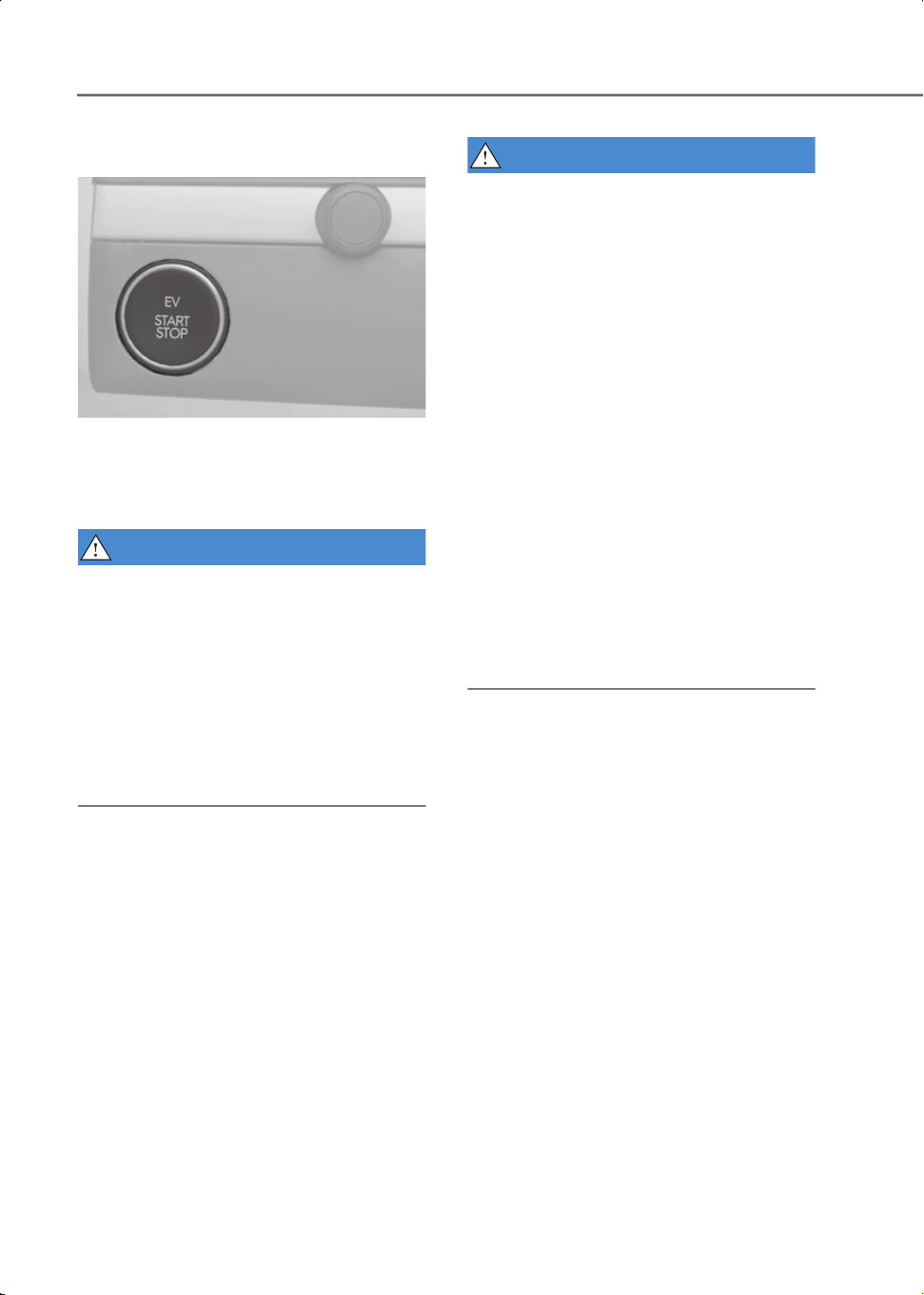
Driving Your Vehicle
6-4
Start/Stop Button
B6000301
Whenever the front door is opened, the
Start/Stop button will illuminate and will
go off for a few seconds after the door is
closed.
WARNING
To turn the vehicle off in an emergency:
Press and hold the Start/Stop button for
more than two seconds OR Rapidly press
and release the Start/Stop button three
times (within three seconds).
If the vehicle is still moving, you can
restart the vehicle without depressing the
brake pedal by pressing the Start/Stop
button with the gear in the N (Neutral)
position.
WARNING
• NEVER press the Start/Stop button
while the vehicle is in motion except in
an emergency. This will result in the
vehicle turning off and loss of power
assist for the steering and brake
systems. This may lead to loss of
directional control and braking
function, which could cause an
accident.
• Before leaving the driver’s seat, always
make sure the gear is in the P (Park)
position, set the parking brake, press
the Start/Stop button to the OFF
position, and take the Smart Key with
you. Unexpected vehicle movement
may occur if these precautions are not
followed.
• NEVER reach through the steering
wheel for the Start/Stop button or any
other control while the vehicle is in
motion. The presence of your hand or
arm in this area may cause a loss of
vehicle control resulting in an accident.
CE_USA.book Page 4

6
6-5
Start/Stop Button Positions
Information
To prevent vehicle battery discharge, the Start/Stop button changes to the OFF position
when the Start/Stop button is in the ACC or ON position with the gear in P (Park) for a
certain period of time. When the function operates, the tail lights will turn off. To use the
tail lights again, turn the headlight switch located on the steering column to the OFF and
ON position again.
Button
Position
Action Notes
OFF
To turn off the vehicle, press the
Start/Stop button with the vehicle
shifted to P (Park). If the Start/Stop
button is pressed with the vehicle
shifted to D (Drive), R (Reverse) or N
(Neutral), the gear automatically
shifts to P (Park).
If the steering wheel is not locked
properly when you open the driver’s
door, the warning chime sounds.
ACC
Press the Start/Stop button when the
button is in the OFF position without
depressing the brake pedal. Some of
the electrical accessories are usable.
The steering wheel unlocks.
If you leave the Start/Stop button in
the ACC position for more than one
hour, the battery power turns off
automatically to prevent the battery
from discharging. If the steering
wheel does not unlock properly, the
Start/Stop button does not work.
Press the Start/Stop button while
turning the steering wheel right and
left to release.
ON
Press the Start/Stop button while it is
in the ACC position without
depressing the brake pedal. The
warning lights can be inspected
before the vehicle is started.
Do not leave the Start/Stop button in
the ON position when the vehicle is
not running to prevent the battery
from discharging.
START
To start the vehicle, depress the brake
pedal and press the Start/Stop button
with the gear shifted to the P (Park)
position.
If you press the Start/Stop button
without changes as follows:
OFF >
ACC > ON > OFF or ACC
CE_USA.book Page 5
Driving Your Vehicle
6-6
Starting the Vehicle
WARNING
• Always wear appropriate shoes when
operating your vehicle. Unsuitable
shoes, such as high heels, ski boots,
sandals, flipflops, etc., may interfere
with your ability to use the brake and
accelerator pedals.
• Do not start the vehicle with the
accelerator pedal depressed.
The vehicle can move which can lead to
an accident.
Information
• The vehicle will start by pressing the
Start/Stop button, only when the smart
key is in the vehicle.
• The vehicle may not start even if the
smart key is in the vehicle but it is not
near you (for example, in the cargo
area).
• When the Start/Stop button is in the
ACC or ON position, if any door is open,
the system checks for the smart key.
When the smart key is not in the
vehicle, the indicator will blink and
the warning 'Key not in vehicle' will
come on. When all doors are closed, the
chime will also sound for a few
seconds. Keep the smart key in the
vehicle when in the ACC position or if
the vehicle is in the ready mode (
indicator on).
1. Always carry the smart key with you.
2. Make sure the parking brake is applied.
3. Make sure the gear is in P (Park).
4. Depress the brake pedal.
5. Press the Start/Stop button. If the
vehicle starts, the indicator
illuminates.
Information
• Always start the vehicle with your foot
on the brake pedal. Do not depress the
accelerator while starting the vehicle.
Do not race the motor while warming it
up.
• If ambient temperature is low, the
indicator may remain illuminated
longer than the normal amount of time.
NOTICE
To prevent damage to the vehicle:
• If the vehicle turns off while you are in
motion, do not attempt to shift the gear
to the P (Park) position.
If traffic and road conditions permit,
you may put the gear in N (Neutral)
while the vehicle is still moving and
press the Start/Stop button in an
attempt to restart the vehicle.
• Do not push or tow your vehicle to start
the vehicle.
NOTICE
To prevent damage to the vehicle:
Do not press the Start/Stop button for
more than 10 seconds except when the
stop light fuse is blown.
When the stop light fuse is blown, you
cannot normally start the vehicle.
Replace the fuse with a new one. If you
are not able to replace the fuse, you can
start the vehicle by pressing and holding
the Start/Stop button for 10 seconds with
the Start/Stop button in the ACC position.
Pressing the brake pedal many times
when the vehicle is not in the ready mode
( indicator off) increases the
possibility of discharging the 12 V battery.
For your safety always depress the brake
pedal before starting the vehicle.
CE_USA.book Page 6
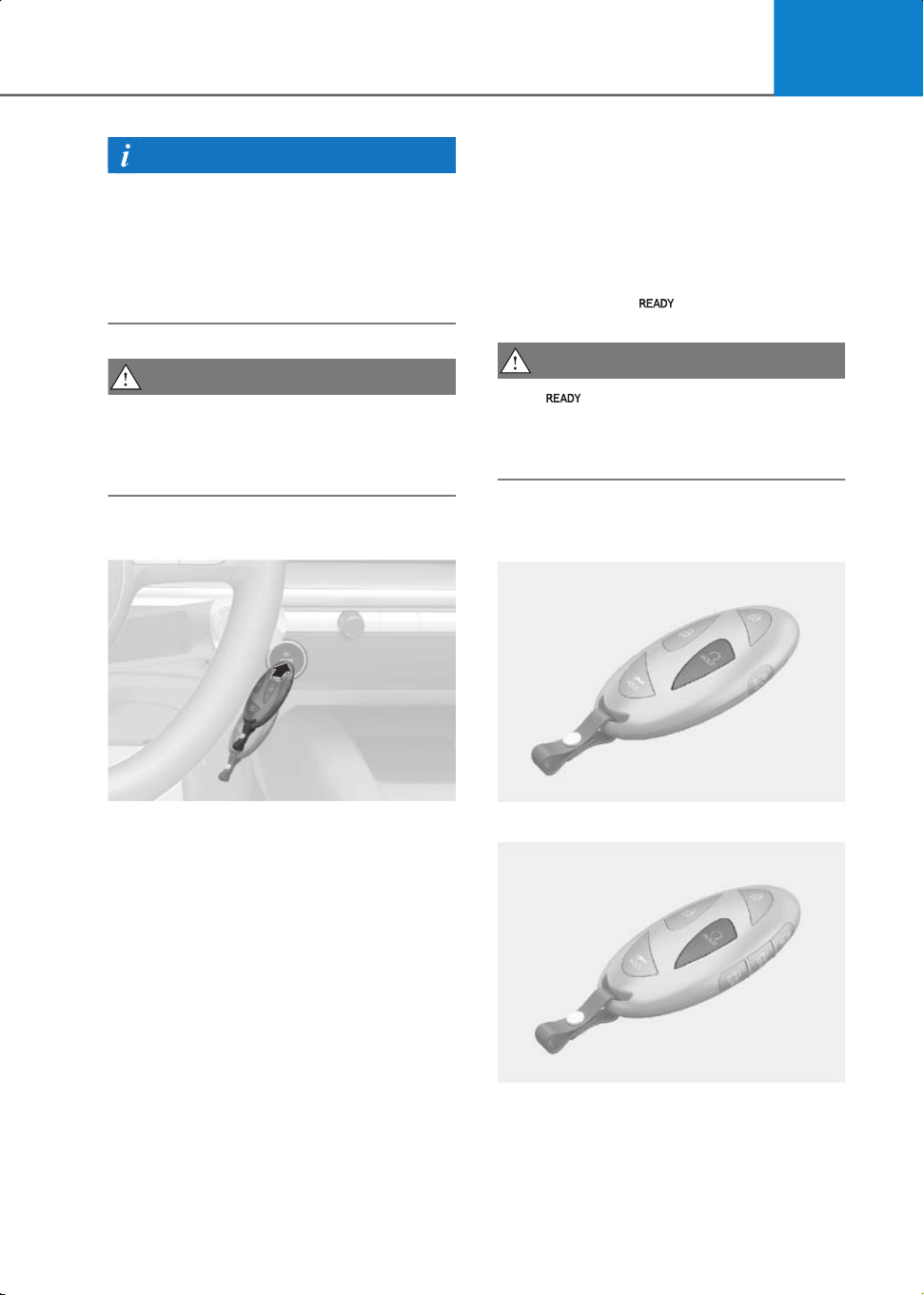
6
6-7
Information
Virtual Engine Sound System (VESS)
VESS generates virtual engine sound to
make pedestrians to aware. VESS
operates when the vehicle can be driven.
When the vehicle in P (parking) gear
status, VESS doesn't work.
CAUTION
Always check your surroundings while
driving, backing up, or before driving
from a stop because your electric vehicle
does not make vehicle sounds.
Emergency starting
B6000501
If the smart key battery is weak or the
smart key does not work correctly, press
the Start/Stop button with the smart key
in the direction of the illustration shown
above.
Turning Off the Vehicle
1. Stop the vehicle and depress the brake
pedal fully.
2. Shift to P (Park).
3. Press the Start/Stop button to the OFF
position and apply the parking brake.
4. Make sure the indicator is turned
off on the instrument cluster.
CAUTION
If the indicator on the instrument
cluster is still on, the vehicle is not turned
off and can move when the gear is in any
position except P (Park).
Remote Start
Type A
B6000701
Type B
B6000702
You can start the vehicle using the
Remote Start button of the smart key.
CE_USA.book Page 7
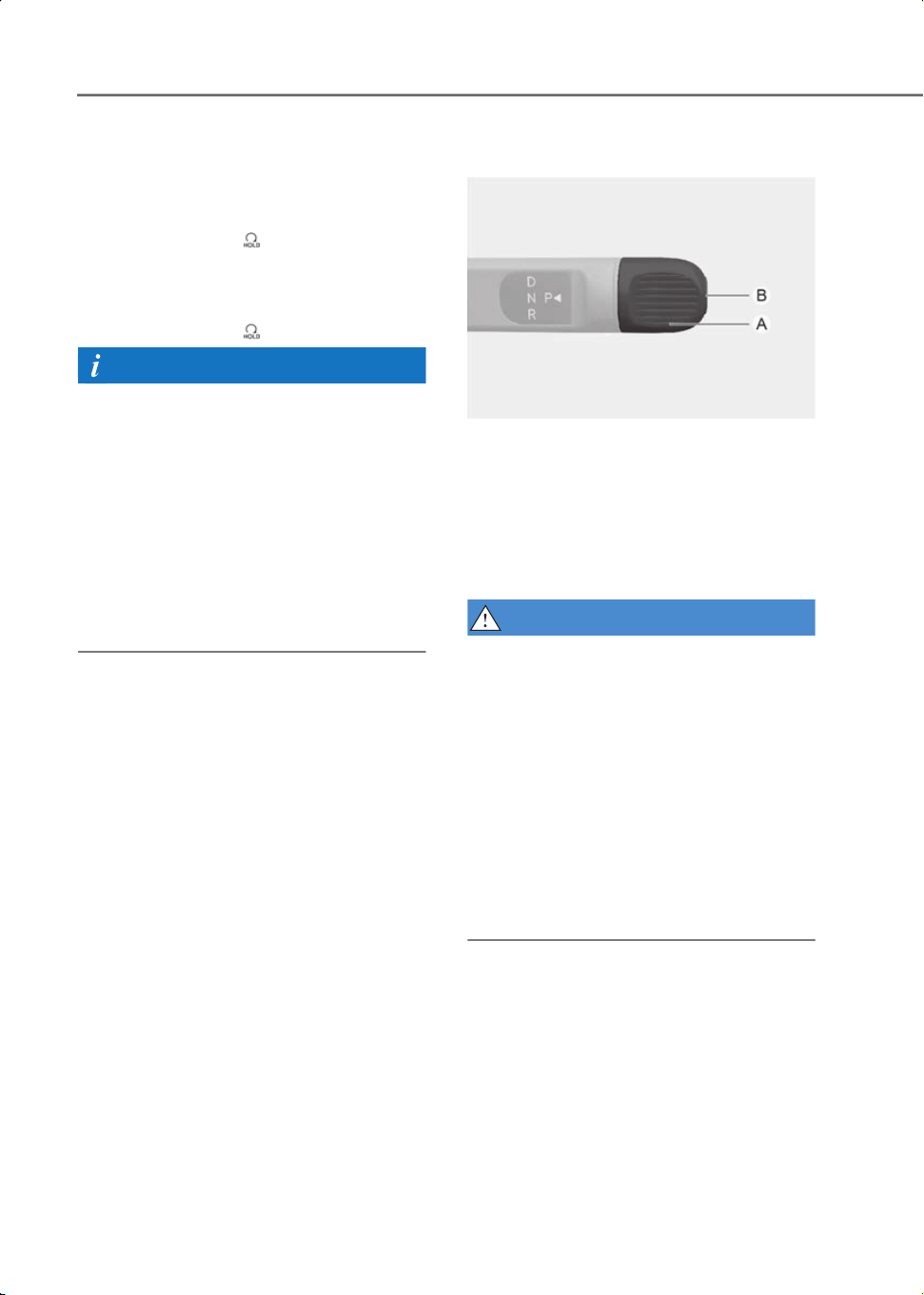
Driving Your Vehicle
6-8
To start the vehicle remotely:
1. Press the door lock button within 32 ft.
(10 m) from the vehicle.
2. Press and hold the remote start ()
button within 4 seconds.
To turn off the vehicle:
Press the remote start button () once.
Information
• The vehicle does not remotely start if
the hood or trunk is opened.
• The vehicle must be in P (Park) for the
remote start function to start.
• The vehicle displays "Smart Key must
be present to keep the vehicle
running" if you get in the vehicle
without a registered smart key.
• The vehicle turns off if you do not get in
the vehicle within 10 minutes after
remotely starting the vehicle.
Shift By Wire
B6013601
[A] Rotary shifter
[B] P button
Shift By Wire Operation
Depress the brake pedal whenever
rotating the rotary shifter to change gear
or selecting P.
WARNING
To reduce the risk of serious injury or
death:
• ALWAYS check the surrounding areas
near your vehicle for people, especially
children, before shifting a vehicle into D
(Drive) or R (Reverse).
• Before leaving the driver's seat, always
make sure the vehicle is shifted to the P
(Park) position, then apply the parking
brake, then press the Start/Stop button
to the OFF position. Unexpected and
sudden vehicle movement can occur if
these precautions are not followed.
CE_USA.book Page 8
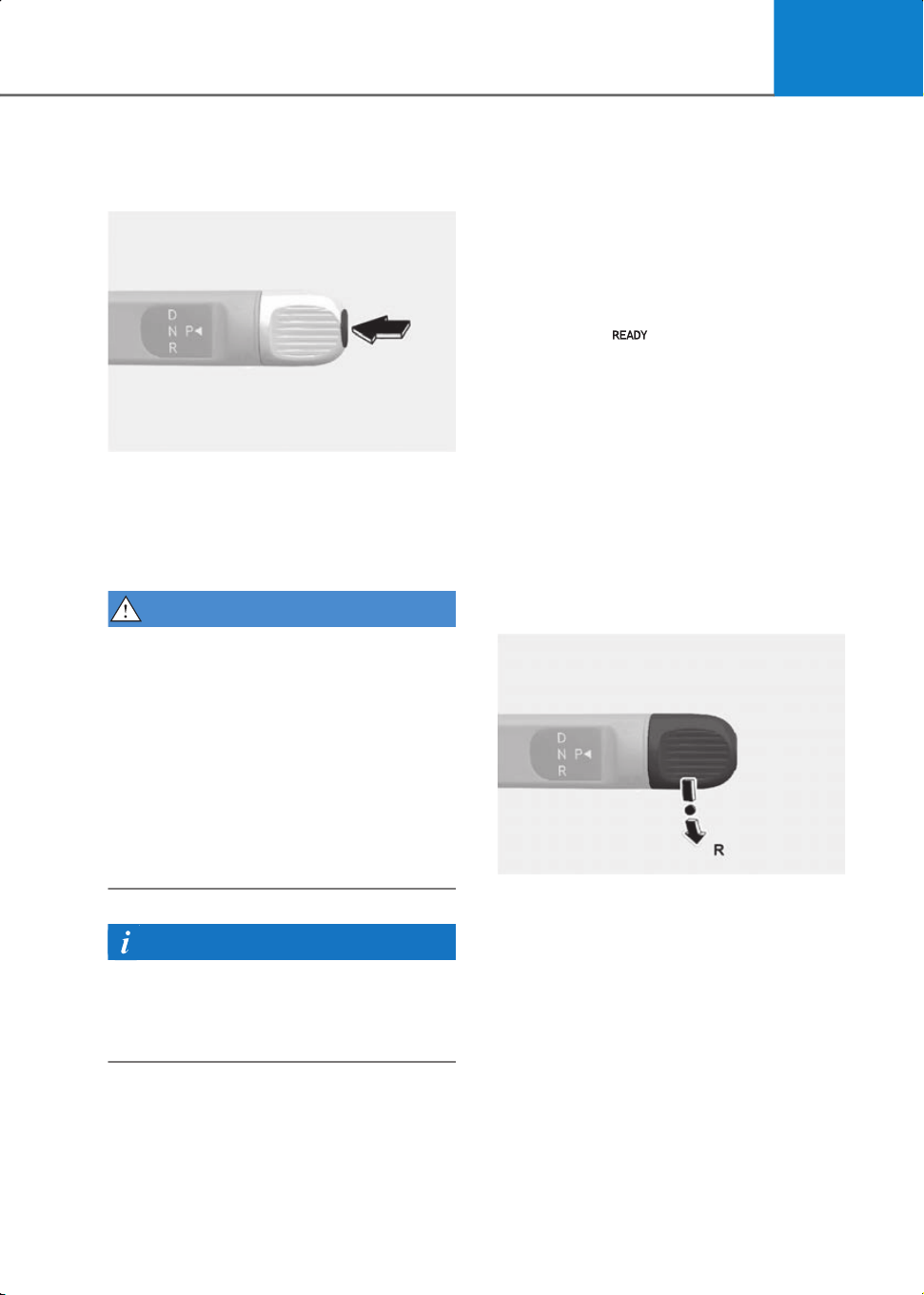
6
6-9
P (Park)
Always come to a complete stop before
shifting into P (Park).
B6013701
To shift the gear to P (Park), press the P
button while depressing the brake pedal.
If you turn the vehicle off in R (Reverse), N
(Neutral) or D (Drive), the gear will
automatically shift to P (Park).
WARNING
• Shifting into P (Park) while the vehicle is
in motion may cause you to lose control
of the vehicle.
• After the vehicle has stopped, always
make sure the vehicle is in P (Park),
apply the parking brake, and turn the
vehicle off.
• When parking on an incline, shift the
gear to P (Park) and apply the parking
brake to prevent the vehicle from
rolling downhill.
Information
For vehicles equipped with the Electronic
Parking Brake (EPB), EPB is applied
automatically when the gear is shifted to
P (Park).
Automatic gear shift to P (Park)
The gear is shifted to P (Park)
automatically for safety reasons under
the following conditions:
• When the vehicle is turned off with the
gear in R (Reverse), D (Drive) or N
(Neutral).
• When the driver’s door is open with the
vehicle on ( indicator on), the gear
in R (Reverse), D (Drive) or N (Neutral),
and the vehicle at a standstill.
• When the driver’s door is open with the
gear in N (Neutral) and the vehicle is
off.
In situations the gear must be in P (Park),
always check if the gear is shifted to P
(Park) by checking the instrument cluster.
R (Reverse)
Use this position to drive the vehicle
rearward.
B6013702
To shift the gear to R (Reverse), rotate the
rotary shifter to R (Reverse) while
depressing the brake pedal.
When the vehicle is stopped in the R
(Reverse) position, if you open the
driver’s door, the gear may automatically
shift to P (Park).
However, if the vehicle is in motion, the
gear may not automatically shift to P
(Park) to prevent gear damage.
CE_USA.book Page 9
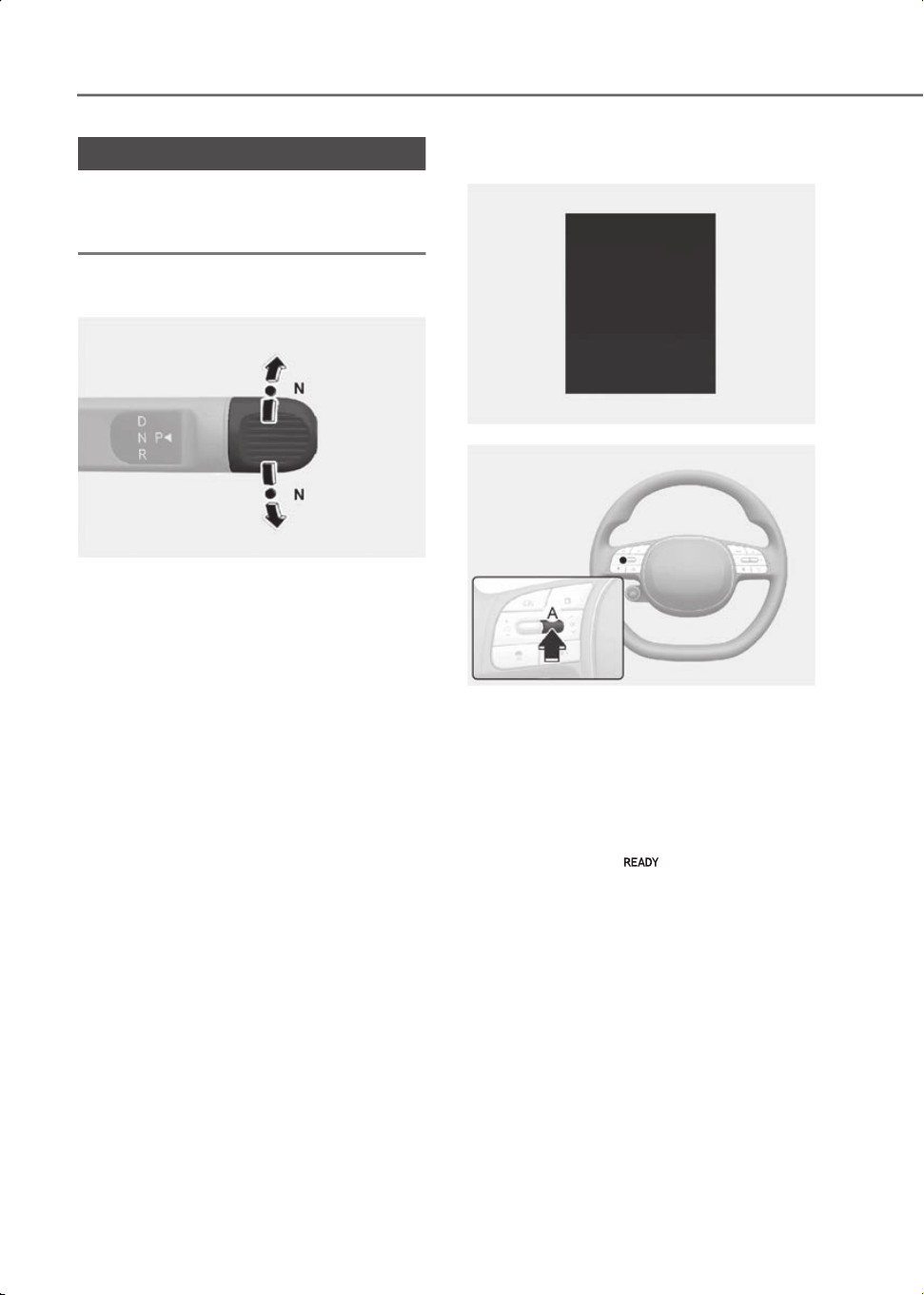
Driving Your Vehicle
6-10
NOTICE
Always come to a complete stop before
shifting into or out of R (Reverse) to
prevent damaging the gear.
N (Neutral)
B6013703
To shift the gear to N (Neutral), rotate the
rotary shifter to N (Neutral) while
depressing the brake pedal.
Always depress the brake pedal when you
are shifting from N (Neutral) to another
gear.
If you turn the vehicle off in N (Neutral),
the gear will automatically shift to P
(Park).
However, if you need to stay in N
(Neutral) with the vehicle off, refer to the
“To stay in N (Neutral) when vehicle is
OFF” in the following description.
To rotate the rotary shifter to N (Neutral),
rotate the rotary shifter once clockwise or
counterclockwise.
If the current gear position is in D (Drive),
rotate the rotary shifter
counterclockwise. When the gear
position is in R (Reverse), rotate the rotary
shifter clockwise.
To stay in N (Neutral) when vehicle is
OFF
B6013705
B6013706
[A] OK button
If you want to stay in N (Neutral) after the
vehicle is in the ACC state, do the
following:
1. Turn off Auto Hold and release
Electronic Parking Brake when the
vehicle is on ( indicator on).
2. Rotate the rotary shifter to N (Neutral)
while depressing the brake pedal.
3. Take your foot off the brake pedal. The
message "Press and hold OK button on
the steering wheel to stay in Neutral"
appears on the cluster display.
4. Press and hold the OK button on the
steering wheel for more than 1 second.
5. When the message "Vehicle will stay in
(N). Change gear to cancel appears on
the cluster display, press the Start/Stop
button while depressing the brake
pedal.
1SFTTBOEIPMEUIF0,
CVUUPOPOUIFTUFFSJOH
XIFFMUPTUBZJO/FVUSBM
CE_USA.book Page 10
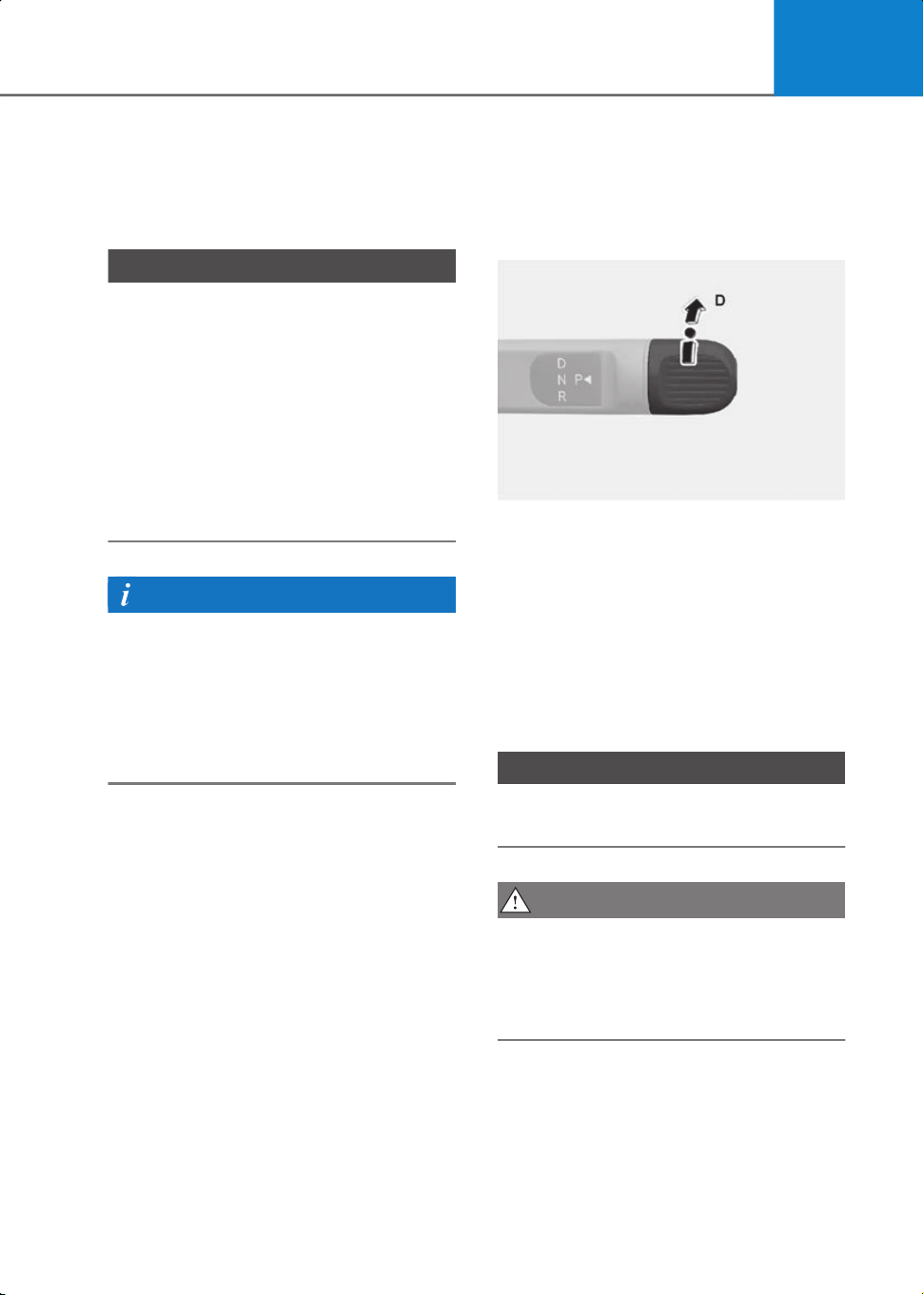
6
6-11
However, if you open the driver’s door
within 3 minutes in the ACC state, the
gear automatically shifts to P (Park) and
the Start/Stop button changes to the OFF
position.
NOTICE
• With the gear in N (Neutral) the
Start/Stop button will be in the ACC
position. Note that the doors cannot be
locked in the ACC position or the
battery (12 V) may discharge if left in the
ACC position for a long period.
• Before entering an automatic car wash,
release the Electronic Parking Brake
(EPB) manually. If EPB is applied, it may
damage the vehicle or automatic car
wash.
Information
When the Electronic Parking Brake (EPB)
is applied, press the EPB switch while
depressing the brake pedal.
The Electronic Parking Brake (EPB) must
be released manually because EPB does
not release automatically even though
the gear is shifted to N (Neutral).
D (Drive)
This is the normal driving position.
The regenerative braking system
automatically activates according to the
road conditions.
B6013707
To shift the gear to D (Drive), rotate the
rotary shifter to D (Drive) while
depressing the brake pedal.
When the vehicle is stopped in the D
(Drive) position, if you open the driver's
door, the gear may automatically shift to
P (Park).
However, if the vehicle is in motion, the
gear may not automatically shift to P
(Park) to prevent gear damage.
NOTICE
Always come to a complete stop before
shifting into D (Drive).
CAUTION
When you drive after stopping on a steep
incline, if you do not depress the
accelerator pedal or brake pedal, the
vehicle may roll backwards resulting in a
collision.
CE_USA.book Page 11

Driving Your Vehicle
6-12
Shift-lock system
For your safety, your vehicle has a
shift-lock system which prevents shifting
the gear from P (Park) or N (Neutral) into
R (Reverse) or D (Drive) unless the brake
pedal is depressed.
To shift from P (Park) or N (Neutral) into R
(Reverse) or D (Drive), from R (Reverse)
into D (Drive) or from D (Drive) into R
(Reverse):
1. Depress and hold the brake pedal.
2. Start the vehicle.
3. Shift the gear in R (Reverse) or D
(Drive).
Information
The gear cannot be shifted while the
charging cable is connected.
When the battery (12 V) is discharged
You cannot shift gears when the battery is
discharged.
Jump start your vehicle (refer to the
"Jump Starting (12 V Battery)" section in
chapter 8) or contact an authorized
HYUNDAI dealer.
Parking
Always come to a complete stop and
continue to depress the brake pedal. Shift
the gear to P (Park), apply the parking
brake, and press the Start/Stop button to
the OFF position. Take the key with you
when leaving the vehicle.
Cluster Display Messages
Information
Press brake pedal to change gear
This message is displayed when the brake
pedal is not depressed while shifting out
of P (Park).
Depress the brake pedal and then shift
the gear.
Shift to P after stopping
This message is displayed when the gear
is shifted to P (Park) while the vehicle is
moving.
Stop the vehicle before shifting to P
(Park).
Shifter system malfunction
This message is displayed when the shift
gear does not properly operate in the P
(Park) position.
Have the vehicle inspected by an
authorized HYUNDAI dealer.
Check shifter dial
This message is displayed when there is a
malfunction with the rotary shifter.
Have the vehicle inspected by an
authorized HYUNDAI dealer.
Check P button
This message is displayed when there is a
problem with the P button.
Have the vehicle inspected by an
authorized HYUNDAI dealer.
Rotary shifter stuck
This message is displayed when the rotary
shifter does not return back to it’s normal
position.
Have the vehicle inspected by an
authorized HYUNDAI dealer.
CE_USA.book Page 12

6
6-13
Good Driving Practices
• Never shift the gear from P (Park) or N
(Neutral) to any other position with the
accelerator pedal depressed.
• Never shift the gear into P (Park) when
the vehicle is in moving. Completely
stop before shifting into R (Reverse) or
D (Drive).
• Do not shift the gear to N (Neutral)
when driving. If the gear is shifted to N
(Neutral) while driving. Doing so may
increase the risk of an accident.
Also, shift the gear back to D (Drive)
while the vehicle is moving may
severely damage the gear.
• Never attempt to select a gear that is
opposite the direction of the vehicle
motion. Check the gear position before
driving. Stop the vehicle before shifting
to the desired gear. The vehicle may
turn off, causing a collision.
• Do not drive with your foot resting on
the brake pedal. Even light, but
consistent pedal pressure can result in
the brakes overheating, brake wear and
possibly even brake failure.
• Always apply the parking brake when
leaving the vehicle. Do not depend on
placing the shift gear in P (Park) to keep
the vehicle from moving.
• Exercise extreme caution when driving
on a slippery surface. Be especially
careful when braking, accelerating, or
shifting gears. On a slippery surface, an
abrupt change in vehicle speed can
cause the drive wheels to lose traction
and may cause loss of vehicle control
resulting in an accident.
• Optimum vehicle performance and
economy is obtained by smoothly
depressing and releasing the
accelerator pedal.
WARNING
To reduce the risk of SERIOUS INJURY or
DEATH:
• ALWAYS wear your seat belt. In a
collision, an unbelted occupant is
significantly more likely to be seriously
injured or killed than a properly belted
occupant.
• Avoid high speeds when cornering or
turning.
• Do not make quick steering wheel
movements, such as sharp lane
changes or fast, sharp turns.
• The risk of rollover is greatly increased
if you lose control of your vehicle at
highway speeds.
• Loss of control often occurs if two or
more wheels drop off the roadway and
the driver over steers to reenter the
roadway.
• In the event your vehicle leaves the
roadway, do not steer sharply. Instead,
slow down before pulling back into the
travel lanes.
• HYUNDAI Vehicle recommends you to
follow all posted speed limits.
CE_USA.book Page 13
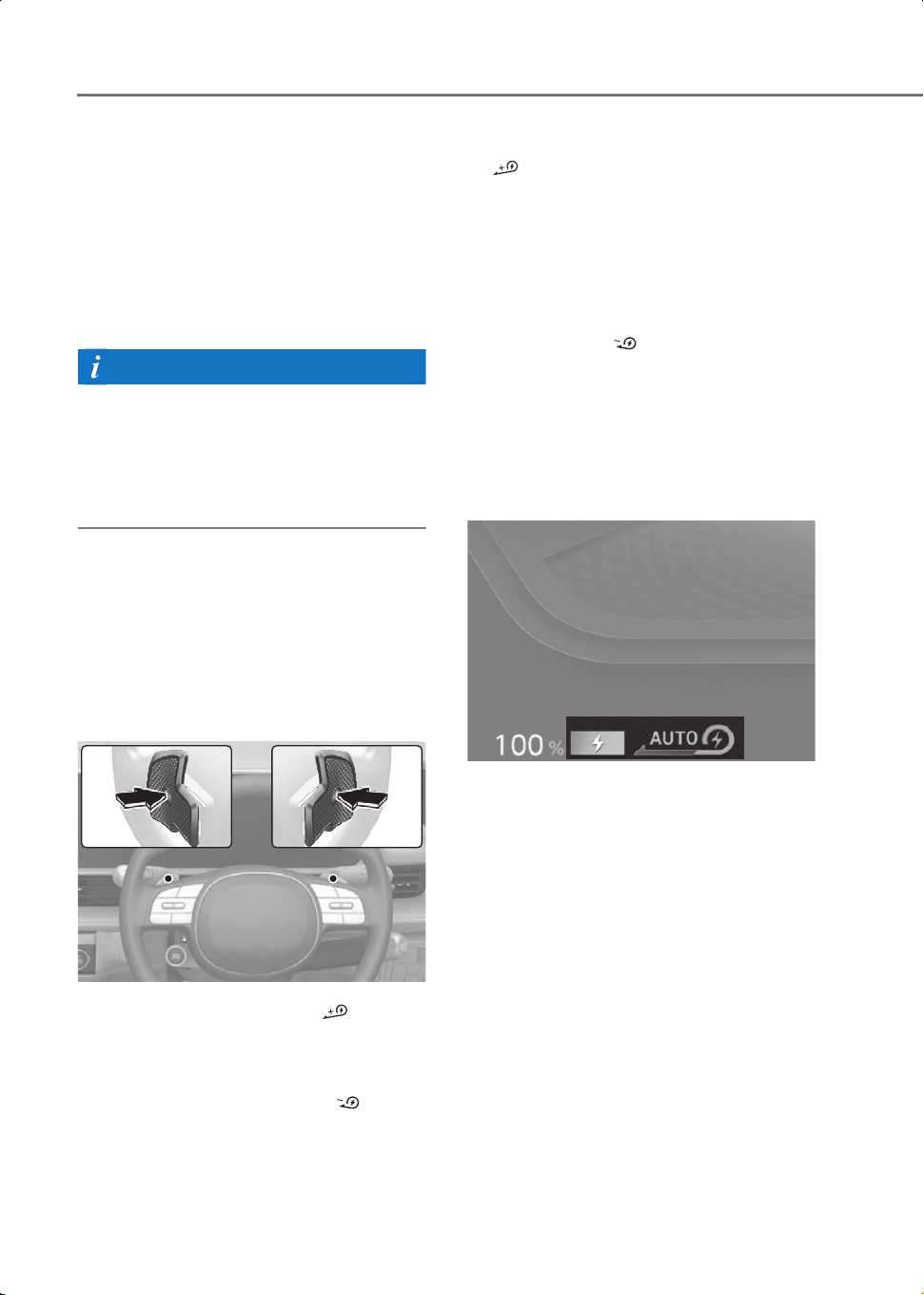
Driving Your Vehicle
6-14
Regenerative Braking
System (Paddle Shifter)
Regenerative braking system operates
the paddle shifter to control the
regenerative braking intensity of the
vehicle. It improves the energy efficiency
of the vehicle and helps the driver to have
a better driving experience.
Information
The regenerative braking system uses the
electric motor to engage the brake. The
electric motor converts the kinetic energy
generated from decelerating the vehicle
to electricity and charges the high voltage
battery.
Using Regenerative Braking
System
Operating paddle shifter
Operate the paddle shifter as shown
below to use the regenerative braking
system.
B6001901
• Pull the left paddle shifter ( ) once to
raise the regenerative braking intensity
level by 1. It will increase decelerating
intensity.
• Pull the right paddle shifter ( ) once
to lower the regenerative braking
intensity level by 1. It will decrease
decelerating intensity.
• Pull and hold the left paddle shifter
( ) for over 0.5 seconds to keep
raising the regenerative braking
intensity level. Holding the paddle
shifter brings the vehicle to stop. (For
more information, refer to the "One
Pedal Driving" section in this chapter.)
• While the smart regeneration system is
turned on, pull and hold the right
paddle shifter ( ) for over 1 second to
turn off the smart regeneration system.
(For more information, refer to the
"Smart Regeneration System" section
in this chapter.)
Checking the amount of
regenerative braking
B6001902
The selected regenerative braking level
appears on the instrument cluster.
• When the vehicle is turned off and on
again after the regenerative braking
level is in 0, the braking level is changed
to 1.
• When the vehicle is turned off and on
again after the i-PEDAL is on, the
braking level is changed to 3.
CE_USA.book Page 14
6
6-15
Regenerative Braking System
Limitations
Regenerative braking intensity cannot be
changed using the paddle shifter in the
following situations when:
• The ( ) and ( ) paddle shifters are
pulled at the same time.
• The vehicle is decelerating by
depressing the brake pedal.
• Smart Cruise Control is activated.
• The regenerative braking is
continuously operated with the battery
fully charged
• The SNOW mode is activated
Initial setting of the regenerative braking
level and adjustable range may vary
according to the selected Drive mode.
For more information, refer to the "All
Wheel Drive (AWD)" section in this
chapter.
One Pedal Driving
One pedal driving operates the paddle
shifter while coasting to control the
intensity of regenerative braking. It
assists the driver to stop the vehicle
without depressing the brake.
Information
Coasting is the process of driving a
vehicle without the brake pedal and the
accelerator pedal depressed. Coasting
uses the inertia of driving energy instead
of the vehicle power.
Using one pedal driving
Pull and hold the left paddle shifter ( )
for over 0.5 seconds while coasting to
enable the one pedal driving mode.
• Release the paddle shifter when the
vehicle speed is above 1.8 mph (3 km/h)
to return to the previously set
regenerative braking level.
• If the vehicle speed is below 1.8 mph (3
km/h), the vehicle will keep engaging
the brake although the driver releases
the paddle shifter.
• Releasing the paddle shifter after the
vehicle comes to a stop will maintain
the vehicle stationary.
CAUTION
• The vehicle may not come to a stop
although the one pedal driving function
is active, depending on the condition of
the vehicle and the road. Check the
surroundings and depress the brake
pedal to decelerate.
• If the driver depresses the accelerator
pedal while pulling and holding the left
paddle shifter ( ) to increase the
braking level, one pedal driving
function operates same as i-PEDAL
function. In this case, the vehicle speed
is no longer controllable through the
paddle shifter.
Drive Mode Adjustable Range
SNOW 0 to 1
ECO 0 to 3
NORMAL 0 to 3
SPORT 0 to 3
CE_USA.book Page 15

Driving Your Vehicle
6-16
One pedal driving limitations
In the following conditions, the vehicle
may not come to a stop although the one
pedal driving function is active. Depress
the brake pedal to stop the vehicle when:
• Driving on a slope, or when the vehicle
is repeatedly driven and stopped.
• The vehicle is driving through the end
of the slope.
• Driving on a slippery surface such as an
icy, rainy, or muddy road.
• The wheels are not properly aligned.
• A wheel slip or wheel spin occurs.
• The weight on board is heavy.
• The vehicle is tilted to one side.
• The tire is worn out.
Automatic engagement of EPB
Use one pedal driving function to bring
the vehicle to a stop and automatically
engage the Electronic Parking Brake
(EPB).
After the vehicle is stopped, EPB is
automatically applied when any of the
following conditions are satisfied:
• The driver’s seatbelt is unfastened and
the driver’s door is open.
• The gear shifts to N (Neutral).
• The hood is open.
• The trunk is open.
• 5 minutes have passed after the vehicle
has stopped.
• One pedal driving is limited due to
other reasons.
Using i-PEDAL
i-PEDAL assists the driver to accelerate,
decelerate, and stop the vehicle with only
the accelerator pedal.
Turning on/off the i-PEDAL
• Turning on i-PEDAL:
Pull the left paddle shifter ( ) once
when the regenerative braking level is
at 3. i-PEDAL is turned on and the
instrument cluster displays the
‘i-PEDAL’ message. i-PEDAL is not
available while the smart regeneration
system is on. Turn off the smart
regeneration system first before using
i-PEDAL.
• Turning off i-PEDAL:
Pull the right paddle shifter ( ) once
while the function is on. Otherwise,
shift the gear to R (Reverse) then to D
(Drive) while the function is on. i-PEDAL
is disabled and regenerative braking
level is set to 3.
CAUTION
• Depending on the vehicle and road
condition, the vehicle may not come to
a stop although the i-PEDAL function is
active. Check surroundings and
depress the brake pedal to control the
vehicle speed.
• Do not use i-PEDAL on slippery roads.
i-PEDAL limitations
In the following conditions, the vehicle
may not come to a stop although the
i-PEDAL is properly activated. Depress
the brake to stop the vehicle when:
• Driving on a slope, or when the vehicle
is repeatedly driven and stopped.
• The vehicle is driving through the end
of the slope.
• Driving on a slippery surface such as an
icy, rainy, or muddy road.
• The wheels are not properly aligned.
• A wheel slip or wheel spin occurs.
• The weight on board is heavy.
• The vehicle is tilted to the side.
• The tire is worn out.
CE_USA.book Page 16
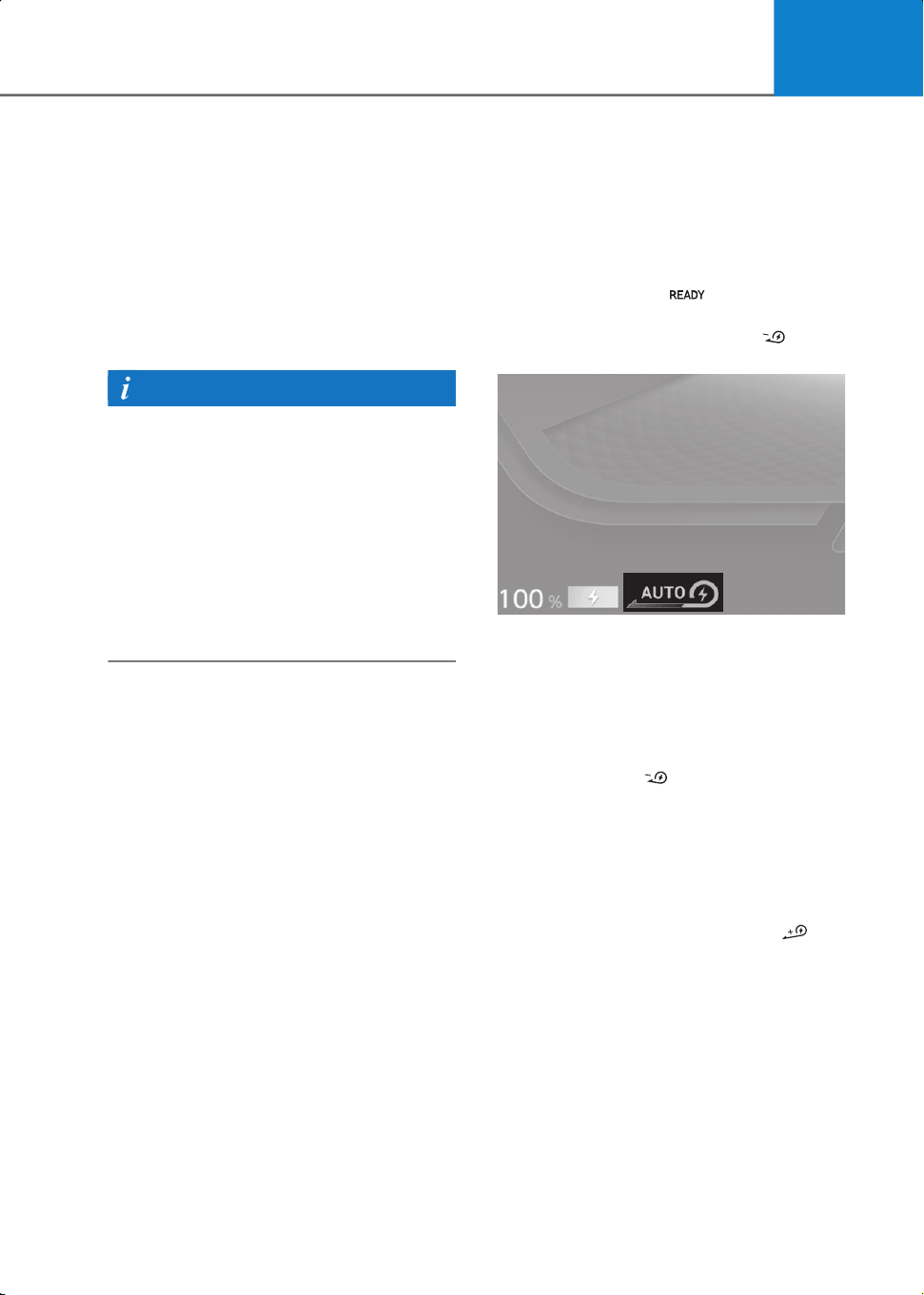
6
6-17
Smart Regeneration
System
The smart regeneration system
recognizes vehicle-to-vehicle distance,
road gradient, and speed cameras and
controls the regenerative braking level
while coasting. It reduces unnecessary
depressing of pedals to improve energy
efficiency and driver convenience.
Information
• Coasting is the process of driving a
vehicle without the brake pedal and the
accelerator depressed. Coasting uses
the inertia of driving energy instead of
the vehicle power.
• The regenerative braking system uses
the electric motor to engage the brake.
The electric motor converts the kinetic
energy generated from decelerating
the vehicle to electricity and charges
the high voltage battery.
Smart Regeneration System
On/Off
Operate the paddle shifter as shown
below to use the smart regeneration
system.
• Turning on the smart regeneration
system: While the indicator is on,
shift the gear to D (Drive), and pull and
hold the right paddle shifter ( ) for
over a second.
B6002301
The smart regeneration system turns on
and the regenerative braking level is
displayed as 'AUTO'.
• Turning off the smart regeneration
system: While the smart regeneration
system is on, pull and hold the right
paddle shifter ( ) for over a second.
The instrument cluster displays the
regenerative braking level instead of
‘AUTO’, and the smart regeneration
system turns off.
• Using one pedal driving: While the
smart regeneration system is on, pull
and hold the left paddle shifter ( ) for
over 0.5 seconds (For more
information, refer to the "One Pedal
Driving" section in this chapter.)
i-PEDAL is not available while the smart
regeneration system is on. Turn off the
smart regeneration system first before
using i-PEDAL.
CE_USA.book Page 17
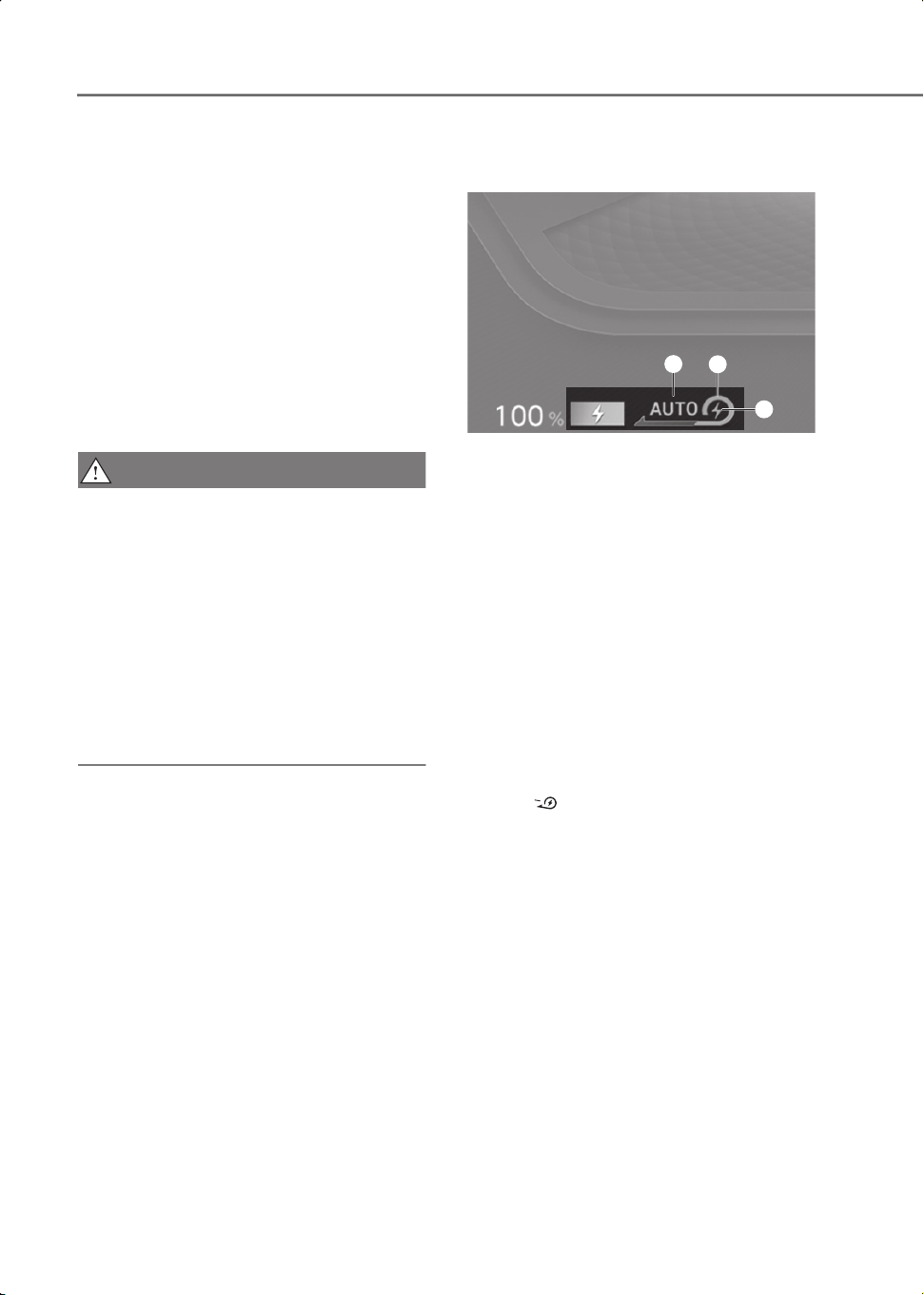
Driving Your Vehicle
6-18
Smart Regeneration System
Operating Condition
When the regenerative braking level is
displayed as AUTO and the vehicle speed
is above 6 mph (10 km/h), the system
automatically controls the regenerative
braking level under the following
conditions:
• The road gradient changes
• Distance from the vehicle ahead
reduces or increases
• Speed of the vehicle ahead reduces or
increases
CAUTION
• When the forward safety warning light
is ON, the smart regeneration system
does not work properly. Depress the
brake pedal for deceleration.
• The function that adjusts the
regenerative braking intensity
depending on the road gradient is only
effective when the regenerative
braking level is 0. Braking intensity
does not significantly change
depending on the road gradient if the
regenerative braking level is 1 or above.
Smart Regeneration Level
Settings
B6002501
The instrument cluster displays ‘AUTO’ (1)
when the smart regeneration system is
on. Depending on the conditions, the
system adjusts the regenerative braking
level (2). The indicator light (3) illuminates
when the vehicle recognizes a vehicle.
Smart regeneration default setting
The default braking level of the smart
regeneration system can be changed. Set
the default braking level to the lowest and
let the system adjust the braking intensity
automatically.
To change the default level of the smart
regeneration system, pull the right paddle
shifter ( ) once while the system is on.
3
2
1
CE_USA.book Page 18
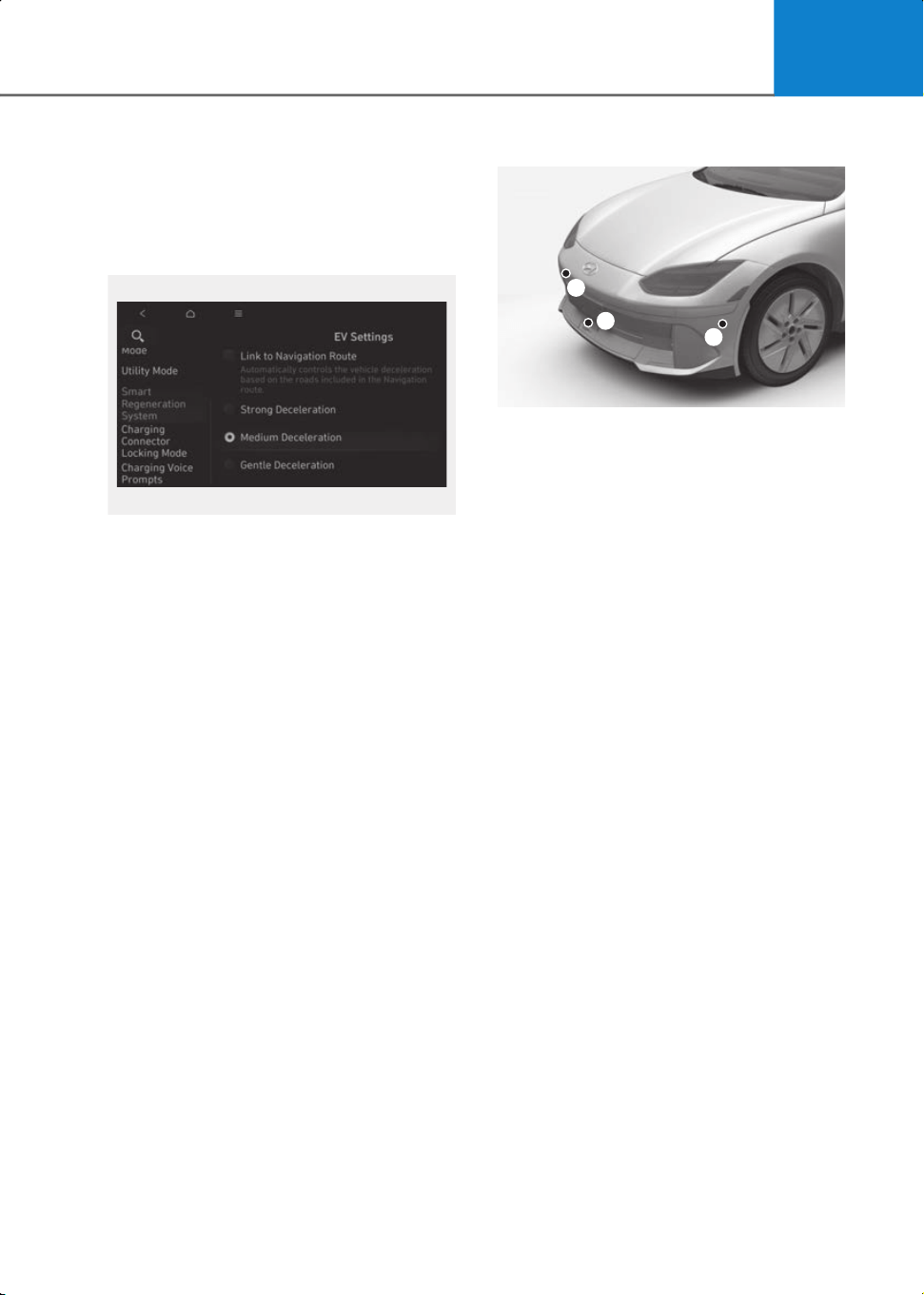
6
6-19
Smart regeneration intensity setting
Regenerative braking intensity of the
smart regeneration system can be
adjusted to match the driver’s
preference. Adjust the braking intensity
makes the decelerating faster or slower.
B6001903
To adjust the regenerative braking level of
the smart regeneration system, go to
Setup > EV > Smart Regeneration
System from the infotainment system.
Pausing Smart Regeneration
System
The smart regeneration system is
temporarily turned off in the following
conditions. While the system is turned off,
the driver must keep eyes on the road and
depress the brake pedal to decelerate.
• The gear is shifted to N (Neutral), R
(Reverse) or P (Park)
• Smart Cruise Control is ON
• ESC (Electronic Stability Control) is
operating
• ABS is operating
Front Sensors
B6003001
(1) Front radar
(2) Front corner radar
Front sensors recognize the distance
from the vehicle ahead to control the
regenerative braking intensity. If the
sensor is covered with snow, rain, or other
foreign substances, the performance of
the sensors may deteriorate, and the
smart regeneration system may turn off.
Always keep the sensors clean.
2
2
1
CE_USA.book Page 19

Driving Your Vehicle
6-20
System Check Message
B6003101
When the front radar is covered or
blocked, the smart regeneration system
may be temporarily disabled. The 'Check
Smart Regeneration System' warning
message may appear, and the
regenerative braking level is displayed on
the instrument cluster.
The system operates normally when such
foreign material is removed, and the
system is turned on by pulling and
holding the right paddle shifter ( ) for
over one second.
If the smart regeneration system does not
operate normally after the sensor has
been uncovered or unblocked, have the
vehicle inspected by an authorized
HYUNDAI dealer.
Smart Regeneration System
Precautions
• Always monitor the distance to vehicles
ahead on the road. The smart
regeneration system is not a substitute
for safe driving practices, but a
supplemental function only.
• Always maintain a safe distance from
the vehicles ahead and adjust your
vehicle speed to the road conditions.
The smart regeneration system may not
recognize unexpected and sudden
situations or complex driving
situations.
General precautions
• Always maintain a safe distance from
the vehicles ahead and adjust your
vehicle speed depending on the road
conditions.
• Always prepare for unexpected
situations and depress the brake pedal
to decelerate when necessary. The
smart regeneration system cannot
react to pedestrians, vehicles making a
sudden stop and vehicles coming from
the opposite lane.
• If the vehicle ahead frequently changes
the lane, keep your eyes forward to be
prepared for hazardous situations. In
this case, the smart regeneration
system may respond late and may
inappropriately respond to vehicle
movements from the side lanes.
• The driver must depress the brake
pedal when stopping the vehicle.
• Depress the brake pedal to decelerate
in the following conditions when:
- The front part of the vehicle is lifted
up because of the cargo loaded on
the rear part of the vehicle.
- You are operating the steering wheel.
- You are not driving in the center of
the lane.
- You are driving on a narrow or curved
road.
• The smart regeneration system may be
temporarily turn off when exposed to
strong electromagnetic waves.
• If the vehicle starts coasting near the
speed camera and engages the brake
with the smart regeneration system,
the vehicle may not be able to keep the
speed limit. Always comply with the
road and traffic law.
$IFDL4NBSU
3FHFOFSBUJPO4ZTUFN
CE_USA.book Page 20
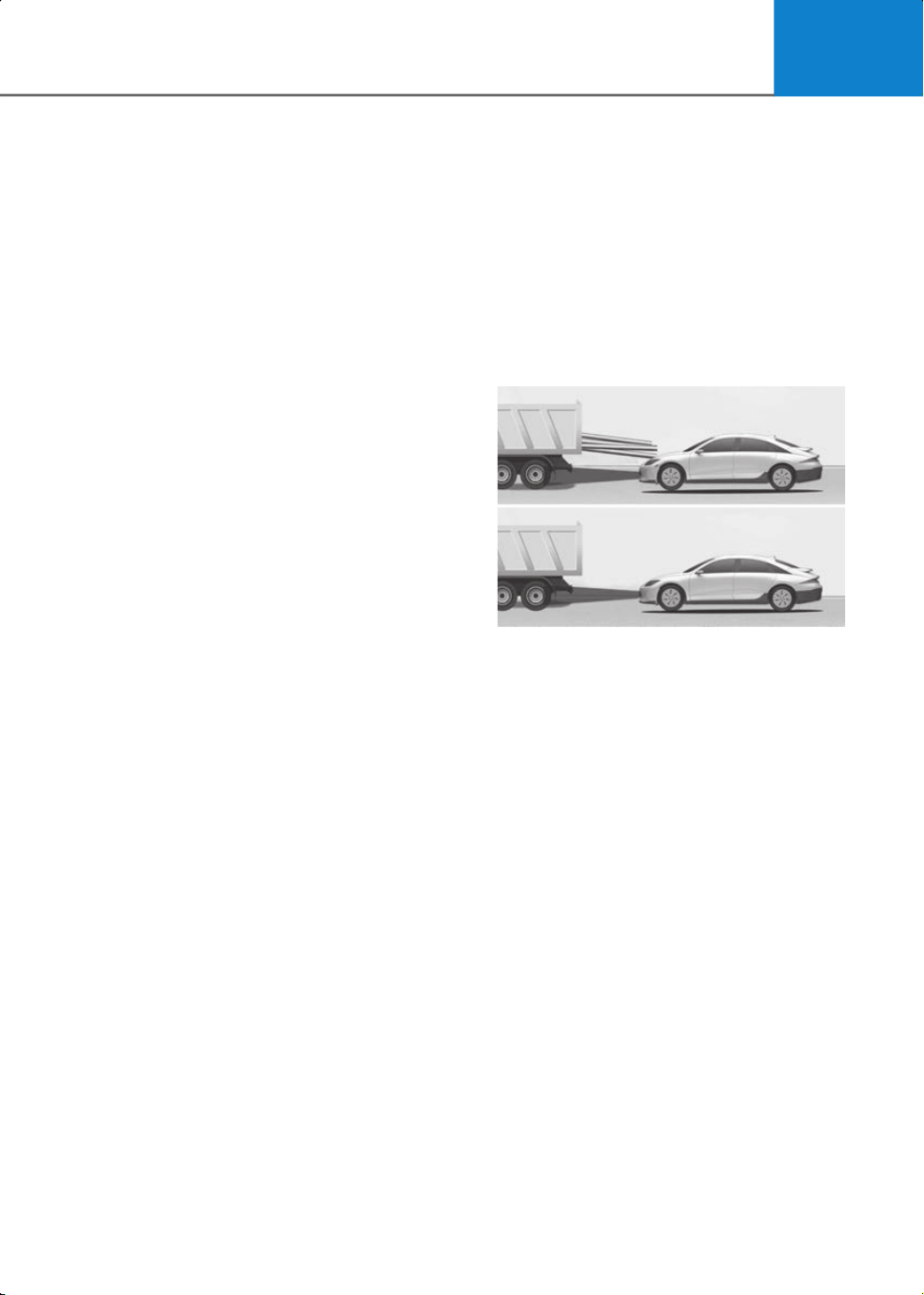
6
6-21
Sensor precautions
• Never disassemble the radar or radar
assembly, and never apply any impact
on it.
• If there is impact on or near the radar,
the sensors may be damaged or not be
properly aligned near the radar, even
though a warning message does not
appear on the instrument cluster, the
Smart Regeneration System may not
operate properly. Have the vehicle
inspected by an authorized HYUNDAI
dealer.
• If the radars have been replaced or
repaired, have the vehicle inspected by
an authorized HYUNDAI dealer.
• Use only genuine parts to repair the
bumper where the radar is located.
• Do not install a license plate frame or
other objects such as bumper sticker,
film, bumper guard, or bumper wrap
near the radar.
• The Smart Regeneration System may
not work properly if the bumper has
been replaced, or the surroundings of
the radar has been damaged or
painted.
• Do not spray the sensors or the
surrounding area directly with high
pressure water.
Detecting vehicle
• The front sensors may not detect the
vehicle ahead or may suddenly detect
the vehicle ahead, such as when the
smart regeneration system responds
slowly, when driving on a hill ends, or
when driving through a curve. The
regenerative braking intensity may
increase and decelerate your vehicle.
• Some vehicles in your lane may not be
detected by the sensors:
B6003201
- Narrow vehicles such as motorcycles
or bicycles
- Vehicles offset to one side
- Slow-moving vehicles or sudden
decelerating vehicles
- Vehicles with small rear profile such
as trailers with no loads
• When a vehicle in front of you merges
out of the lane, the front sensors may
not detect the new stopped vehicle that
is now in front of your vehicle.
CE_USA.book Page 21
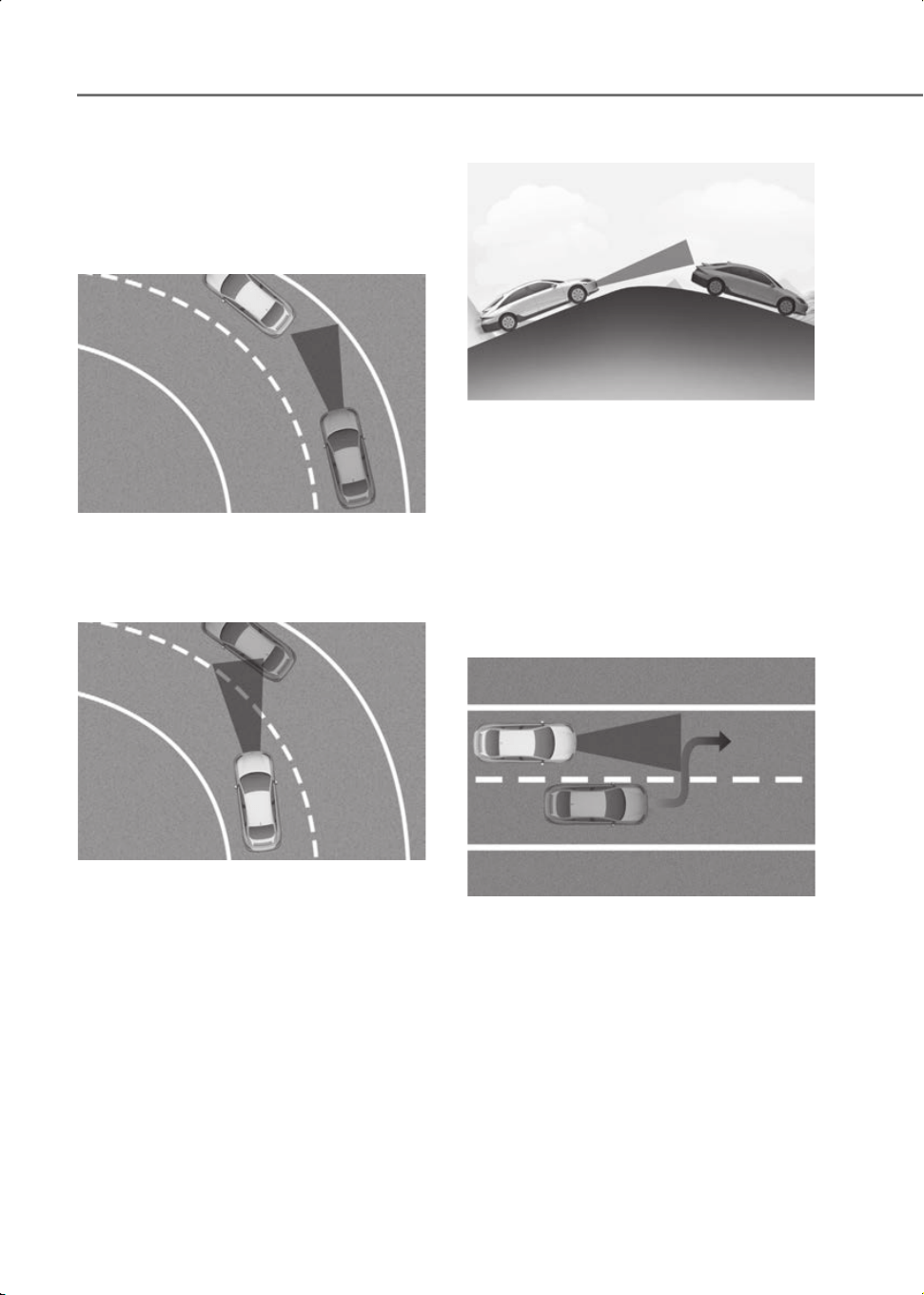
Driving Your Vehicle
6-22
Driving on curves
• The front sensors may not detect the
vehicle ahead if you are coasting on a
curve. The regenerative braking
intensity may automatically decrease
and accelerate the vehicle.
B6003202
• On curves, if a vehicle is detected in an
adjacent lane, the regenerative braking
intensity may increase and decelerate
your vehicle.
B6003203
• If the front sensors suddenly detect the
vehicle ahead, the regenerative braking
intensity may increase and decelerate
your vehicle.
Driving on hills
B6003204
When coasting uphill or downhill, the
front sensors may not detect the vehicle
ahead or suddenly detect the vehicle
ahead at the end of the incline or at the
point where the incline changes. The
regenerative braking intensity is adjusted
automatically changing your vehicle
speed. Brake as needed to reduce your
driving speed.
Changing lanes
B6003205
• When a vehicle moves into your lane
from an adjacent lane, it cannot be
detected by the sensors until it is in the
sensor's detection range.
• The smart regeneration system may not
immediately detect the vehicle when
your vehicle changes lanes abruptly.
CE_USA.book Page 22
6
6-23
Braking System
Power-Assist Brakes
Your vehicle has power-assisted brakes
that adjust automatically through normal
usage.
In the event of a vehicle power failure, the
power assist for the brakes will not work.
You can still stop your vehicle, but it will
require greater force and increased pedal
travel than normal. The stopping
distance, however, will be longer than
with power brakes.
Information
• When the brake pedal is depressed
under certain driving conditions or
weather conditions, you may
temporarily hear a noise. This is normal
and does not indicate a problem with
your brakes.
• While driving on a road with deicing
chemicals, brake noise or abnormal tire
wear may occur due to deicing
chemicals. In a safe traffic condition,
additionally apply the brakes to remove
deicing chemicals on the brake discs
and pads.
WARNING
Take the following precautions:
• Do not drive with your foot resting on
the brake pedal. This will create
abnormal high brake temperatures,
excessive brake lining and pad wear,
and increased stopping distances. So
increase the regeneration braking level
with the left paddle shifter( ) to
decrease the speed.
• When descending down a long or steep
hill, use the paddle shifter to increase
the regeneration braking level in order
to decrease your speed without using
the brake pedal excessively. Applying
the brakes continuously will cause the
brakes to overheat and could result in a
temporary loss of braking performance.
• Wet brakes may impair the vehicle's
ability to safely decelerate. Because
wet brakes increase braking distance
and cause noise troubles, select 0 step
of the regenerative braking system and
depress the brake pedal around 10
times, with keeping the safe distance
from other vehicles, lightly in order to
dry the braking system. Such
procedure may decrease the driving
distance by restraining the
regenerative braking system, which is
not a system malfunction. Inspect the
braking system after car wash or
driving over wet road conditions.
NOTICE
• Do not continue depressing the brake
pedal if the vehicle is off ( indicator
off). The battery may be discharged.
• Noise and vibration generated during
braking is normal.
• Under normal operation, electric brake
pump noise and motor vibration may
occur temporarily in below cases.
- When the pedal is depressed
suddenly.
- When the pedal is repeatedly
depressed in short intervals.
- When the ABS function is activated
while braking.
CE_USA.book Page 23
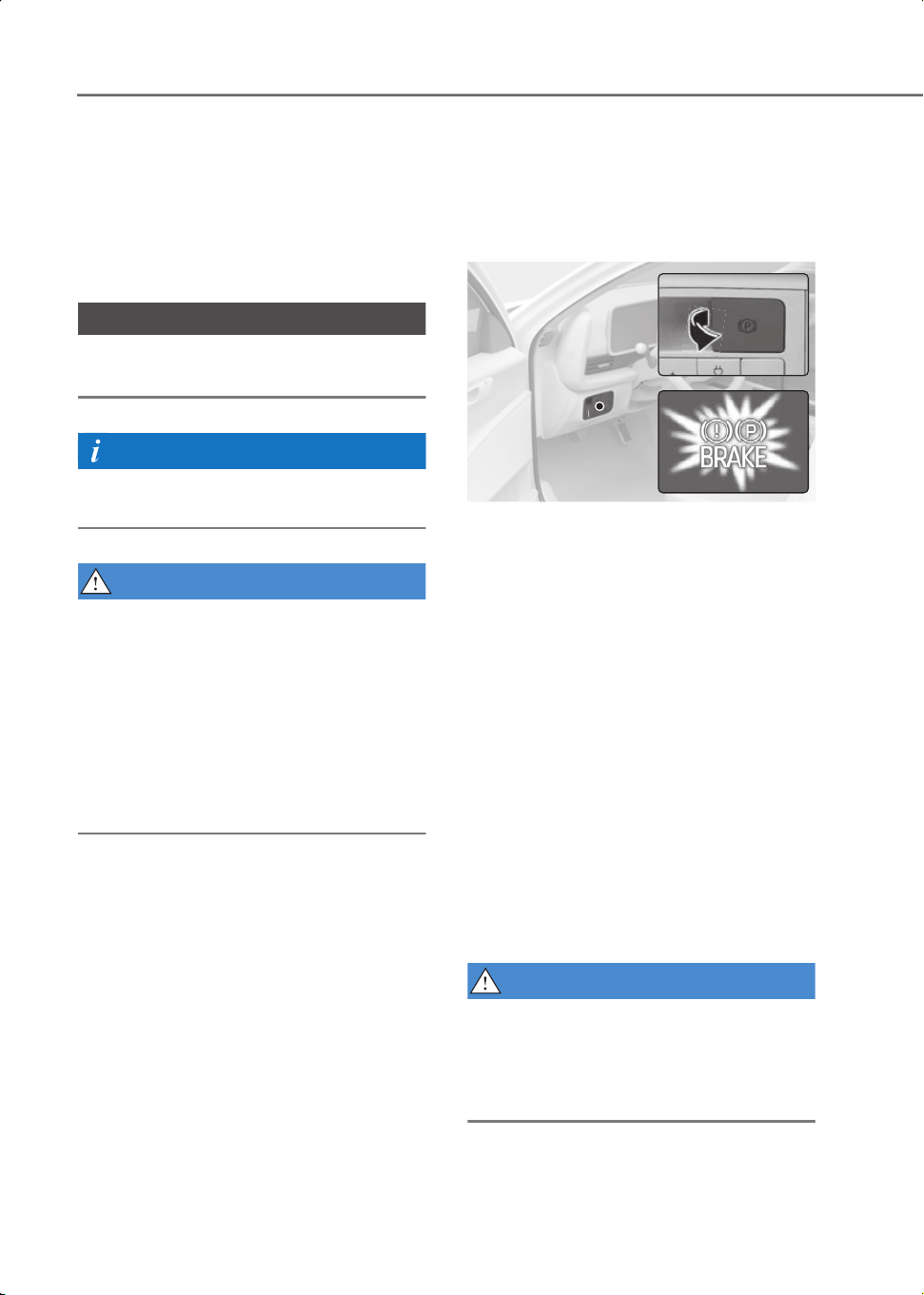
Driving Your Vehicle
6-24
Disc Brakes Wear Indicator
When your brake pads are worn and new
pads are required, you will hear a high
pitched warning sound from your front or
rear brakes. You may hear this sound
come and go or it may occur whenever
you depress the brake pedal.
NOTICE
To avoid costly brake repairs, do not
continue to drive with worn brake pads.
Information
Always replace brake pads as complete
front or rear axle sets.
WARNING
Frequent braking may deform
components and worn the disc brake
causing vibration when braking. Observe
the speed limit to prevent brake damage
from excessive braking.
Brake wear, noise, vibration from
excessive braking or deformation of the
brakes caused by repeatedly braking in
high speed, racing on tracks, etc. can be
excluded from warranty coverage.
Electronic Parking Brake (EPB)
Applying the parking brake
To apply EPB (Electronic Parking Brake):
B6003801
1. Depress and hold the brake pedal.
2. Pull up the EPB switch.
Make sure the Parking Brake warning light
comes on.
EPB (Electronic Parking Brake) may be
automatically applied when:
• Requested by other systems.
• The driver turns the vehicle off while
Auto Hold is operating.
Emergency braking
If there is a problem with the brake pedal
while driving, emergency braking is
possible by pulling up and holding the
EPB switch. Braking is possible only while
you are holding the EPB switch. However,
braking distance will be longer than
normal.
WARNING
To reduce the risk of SERIOUS INJURY or
DEATH, do not operate the EPB while the
vehicle is moving except in an emergency
situation. It could damage the brake
system and lead to an accident.
CE_USA.book Page 24
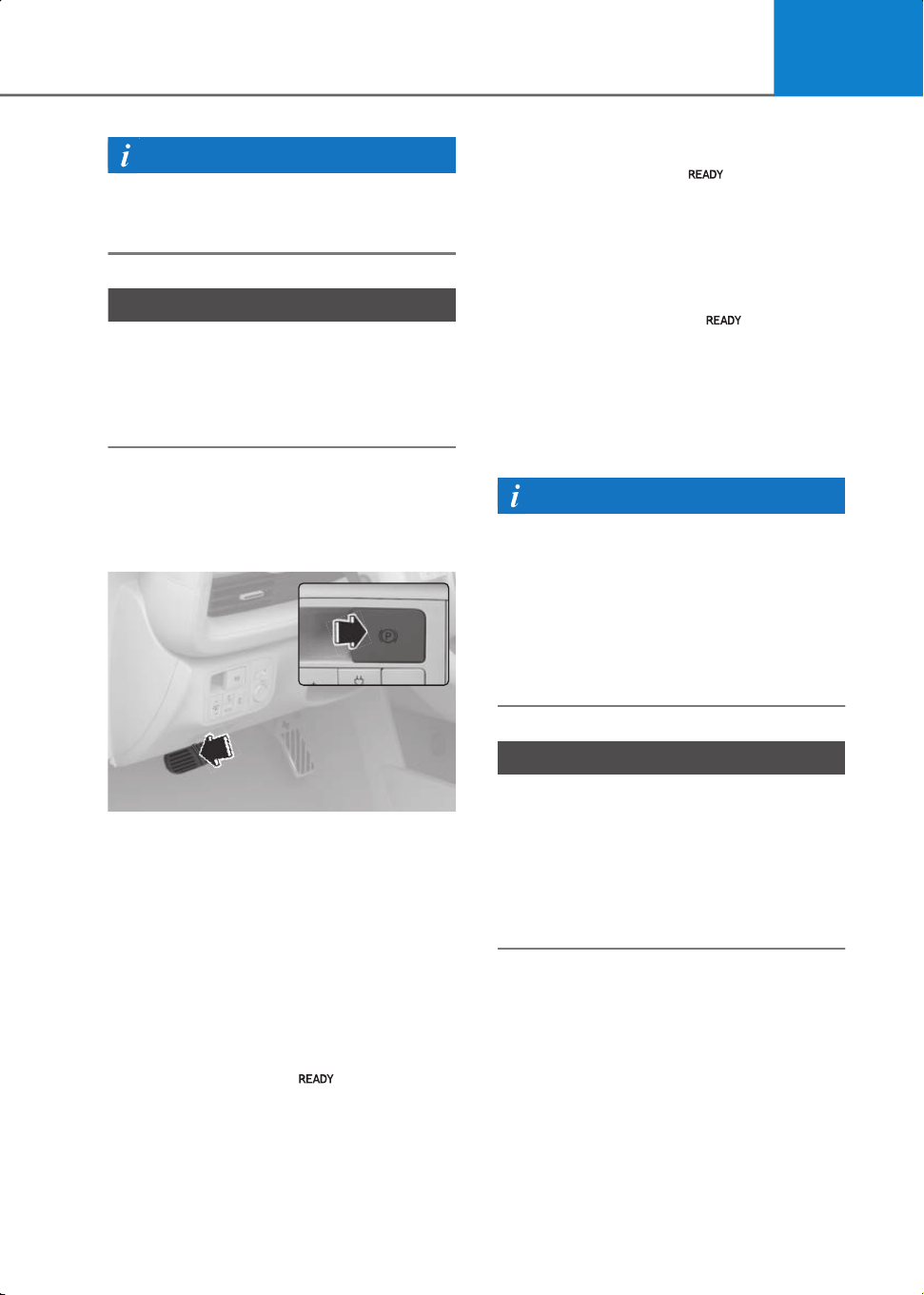
6
6-25
Information
During emergency braking, the Parking
Brake warning light will illuminate to
indicate that the system is operating.
NOTICE
If you continuously notice a noise or
burning smell when the EPB is used for
emergency braking, have the system
inspected by an authorized HYUNDAI
dealer.
Releasing the parking brake
To release EPB (Electronic Parking
Brake):
B6003803
1. Press the Start/Stop button to the ON
or START position.
2. Press the EPB switch while depressing
the brake pedal.
Make sure the Parking Brake warning light
goes off.
To release EPB (Electronic Parking Brake)
automatically:
• Gear in P (Park)
With the vehicle on ( indicator on)
depress the brake pedal and shift out of
P (Park) to R (Reverse) or D (Drive).
• Gear in N (Neutral)
With the vehicle on ( indicator on)
depress the brake pedal and shift out of
N (Neutral) to R (Reverse) or D (Drive).
• Satisfy the following conditions
1. Ensure seat belts are fastened and
the doors, hood and trunk are closed.
2. With the vehicle on ( indicator
on), depress the brake pedal and shift
out of P (Park) to R (Reverse), D
(Drive) or Manual shift mode.
3. Depress the accelerator pedal.
Make sure the Parking Brake warning light
goes off.
Information
• You can engage EPB even though the
Start/Stop button is in the OFF position
(only if battery power is available), but
you cannot release it.
• Depress the brake pedal and release
the parking brake manually with the
EPB switch before you drive downhill or
when backing up.
NOTICE
• If the Parking Brake warning light is still
on even though the EPB has been
released, have the system inspected by
an authorized HYUNDAI dealer.
• Do not drive your vehicle with EPB
applied. It may cause excessive brake
pad and brake rotor wear.
CE_USA.book Page 25
Driving Your Vehicle
6-26
Warning messages
To release EPB, close the doors, hood and
trunk and fasten the seatbelt
B6003804
If the driver's seat belt is unfastened, or
the hood, trunk, doors are open, and you
try to drive with EPB applied, a warning
sounds and a message appears.
WARNING
To prevent serious injury or death from
unintended vehicle movement:
• Always come to a complete stop and
continue to depress the brake pedal
before parking, shift the gear into P
(Park), pull up the EPB switch, and press
the Start/Stop button to the OFF
position. Take the key with you when
leaving the vehicle.
• Never allow anyone who is unfamiliar
with the vehicle to touch the EPB
switch.
• Only release EPB when you are seated
inside the vehicle with your foot firmly
on the brake pedal.
NOTICE
Driving with the parking brake on may
overheat the braking system and cause
premature wear or damage to brake
parts.
Information
• In winter, the EPB related device may
freeze and cannot be released. Do not
use the EPB but park on a flat surface
with the gear in P (Park). Use wheel
chocks under the wheels if necessary.
If the EPB applies automatically when
the gear is shifted to P (Park), turn off
the Auto Hold, and press the EPB switch
to release the parking brake.
• A clicking sound may be heard while
operating or releasing the EPB. These
conditions are normal and indicate that
EPB is functioning properly.
• When leaving your keys with a parking
attendant or assistant, be sure to
inform him/her how to operate the EPB.
AUTO HOLD turning Off! Press brake
pedal
OIK060067L
When the conversion from Auto Hold to
EPB is not working properly a warning will
sound and a message will appear.
5PSFMFBTF&1#
GBTUFOTFBUCFMUBOE
DMPTFEPPSIPPE
BOEUSVOL
CE_USA.book Page 26
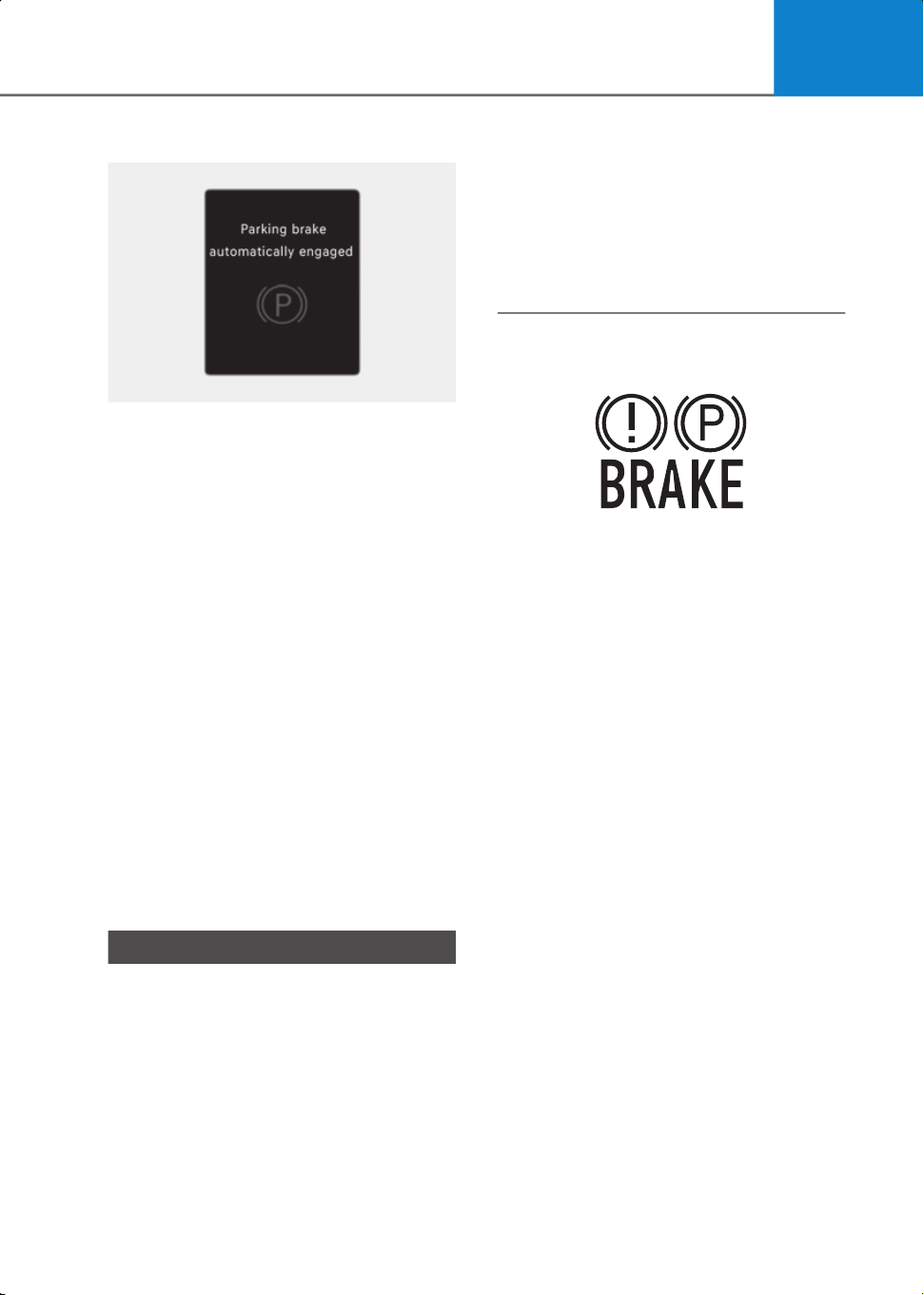
6
6-27
Parking brake automatically engaged
OIK060069L
When EPB is applied while Auto Hold is
activated, a warning will sound and a
message will appear.
EPB malfunction
Electronic Parking Brake (EPB) warning
light illuminates if the Start/Stop button is
pressed to the ON position and goes off in
about 3 seconds if the system is operating
normally.
If the EPB warning light remains on,
comes on while driving, or does not come
on when the Start/Stop button is pressed
to the ON position, this indicates that the
EPB may have malfunctioned.
If this occurs, have the system inspected
by an authorized HYUNDAI dealer.
The EPB warning light may illuminate
when the ESC indicator comes on to
indicate that ESC is not working properly,
but it does not indicate a malfunction of
EPB.
NOTICE
• If the Parking Brake warning light does
not illuminate or blinks after the EPB
switch has been pulled, the EPB may
not be applied.
• If the EPB warning light is still on or the
Parking Brake warning light blinks
when the EPB warning light is on, press
the switch, and then pull it up. Repeat
this one more time. If the EPB warning
does not go off, have the system
inspected by an authorized HYUNDAI
dealer.
Parking brake warning light
WL_BreakWarningLamp
Check the Parking Brake warning light by
pressing the Start/Stop button to the ON
position.
This light will be illuminated when the
parking brake is applied with the
Start/Stop button in the START or ON
position.
Before driving, be sure the parking brake
is released and the Parking Brake warning
light is OFF.
If the Parking Brake warning light remains
on after the parking brake is released
while the motor is running, there may be
a malfunction in the brake system.
Immediate attention is necessary.
If at all possible, cease driving the vehicle
immediately. If that is not possible, use
extreme caution while operating the
vehicle and only continue to drive the
vehicle until you can reach a safe
location.
When the EPB (Electronic Parking
Brake) does not release
If the EPB does not release normally,
contact an authorized HYUNDAI dealer by
loading the vehicle on a flatbed tow truck
and have the system inspected.
CE_USA.book Page 27
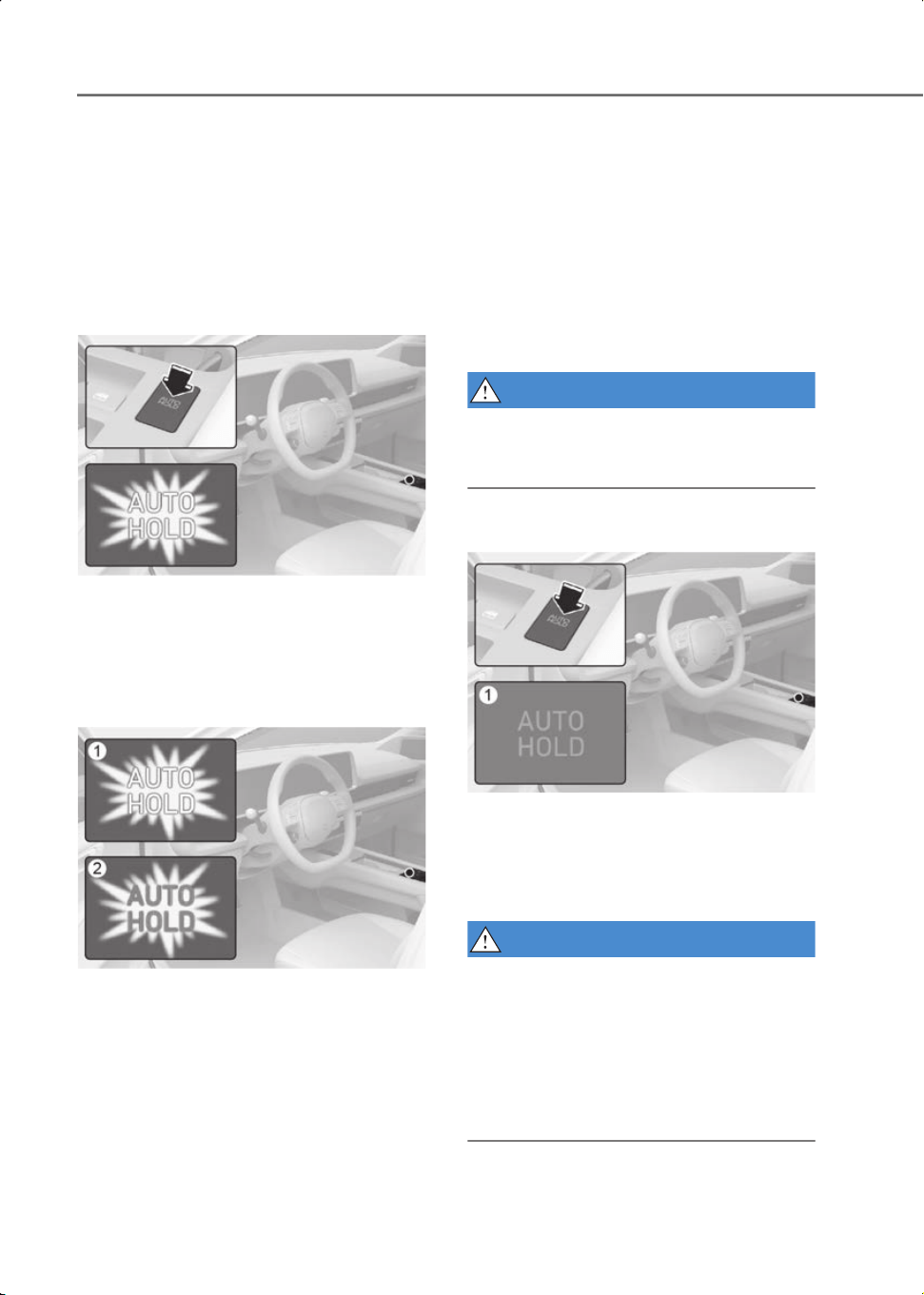
Driving Your Vehicle
6-28
Auto Hold
Auto Hold maintains the vehicle in a
standstill even though the brake pedal is
not depressed after the driver brings the
vehicle to a complete stop by depressing
the brake pedal.
To apply:
B6003901
1. With the driver's door and hood closed,
depress the brake pedal and then press
the AUTO HOLD switch. The white
AUTO HOLD indicator will come on and
the system will be in the standby
position.
B6003902
(1) White
(2) Green
2. When you stop the vehicle completely
by depressing the brake pedal, Auto
Hold maintains the brake pressure to
hold the vehicle stationary. The
indicator changes from white to green.
3. The vehicle will remain stationary even
if you release the brake pedal.
4. If EPB is applied, Auto Hold will be
released.
To release:
If you depress the accelerator pedal with
the gear in D (Drive) or Manual shift
mode, the Auto Hold will be released
automatically and the vehicle will start to
move. The AUTO HOLD indicator changes
from green to white.
WARNING
Always look around your vehicle before
depressing the accelerator pedal to
release Auto Hold.
To cancel:
B6003903
(1) Off
1. Depress and hold the brake pedal.
2. Press the AUTO HOLD switch.
The AUTO HOLD indicator will turn off.
WARNING
To prevent unintended vehicle
movement, always depress your foot on
the brake pedal to cancel the Auto Hold
before you:
• Drive downhill.
• Drive the vehicle in R (Reverse).
• Park the vehicle.
CE_USA.book Page 28
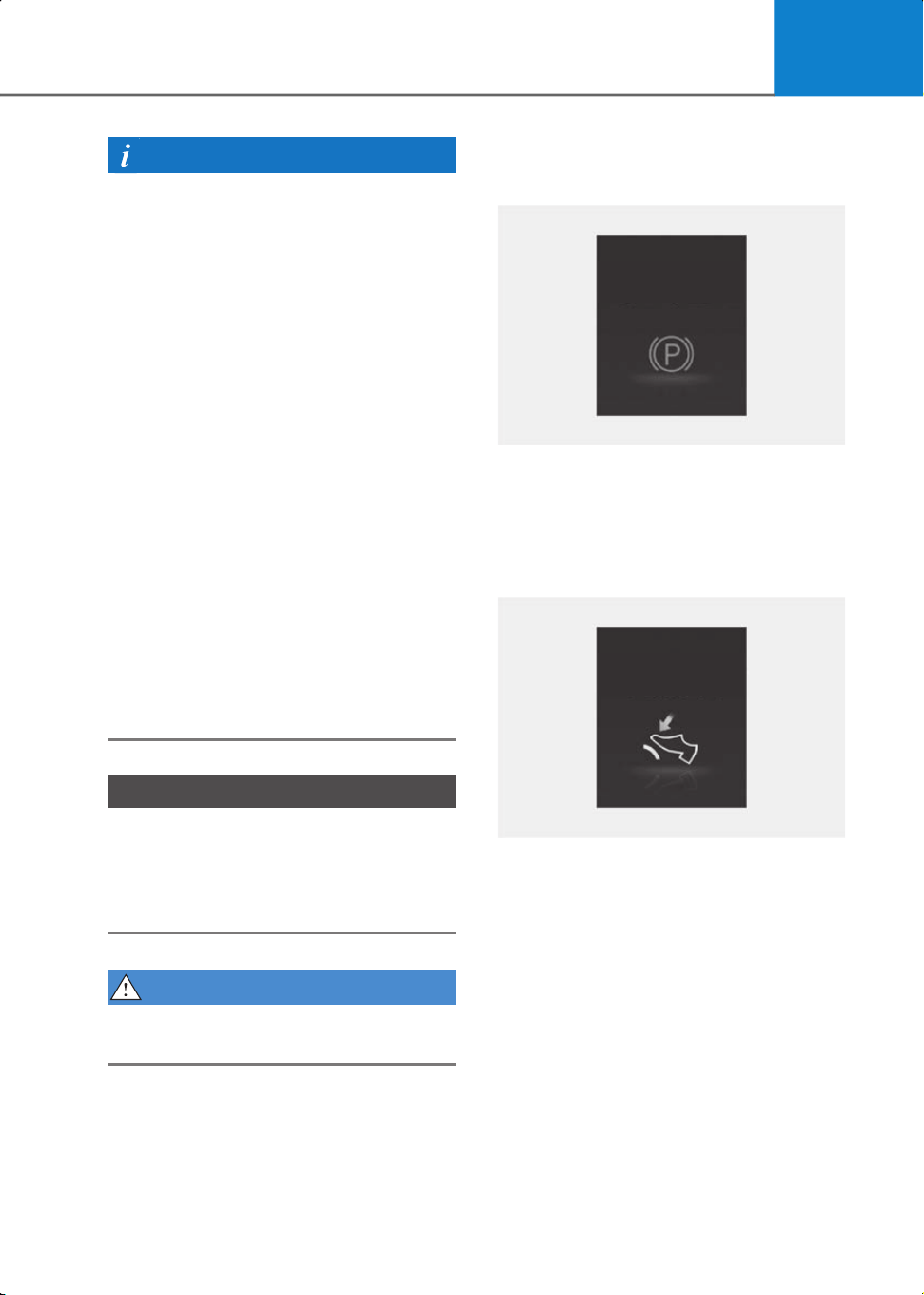
6
6-29
Information
• The Auto Hold does not operate when:
- The gear is in P (Park)
- EPB is applied
• For your safety, the Auto Hold
automatically switches to EPB when:
- The driver's door is opened
- The tail gate is opened
- The hood is opened
- The vehicle is in a standstill for more
than 10 minutes
- The vehicle is standing on a steep
slope
- The vehicle moved several times
The Parking Brake warning light comes
on, the AUTO HOLD indicator changes
from green to white, and a warning
sounds and a message appears to
inform you that EPB has been
automatically engaged. Before driving,
depress the brake pedal, check the
surrounding area and release the
parking brake manually with the EPB
switch.
NOTICE
If the AUTO HOLD indicator changes to
yellow, or the driver's door, hood, or trunk
open detection system malfunctions,
Auto Hold does not work properly.
Contact an authorized HYUNDAI dealer.
WARNING
Depress the accelerator pedal slowly
when you start the vehicle.
Warning messages
Parking brake automatically engaged
B6003802
When EPB is applied while Auto Hold is
activated, a warning will sound and a
message will appear.
AUTO HOLD turning Off! Press brake
pedal
B6003904
When the conversion from Auto Hold to
EPB is not working properly a warning will
sound and a message will appear.
When this message is displayed, Auto
Hold and EPB may not operate. For your
safety, depress the brake pedal.
1BSLJOHCSBLF
BVUPNBUJDBMMZFOHBHFE
"650)0-%UVSOJOH0GG
1SFTTCSBLFQFEBM
CE_USA.book Page 29
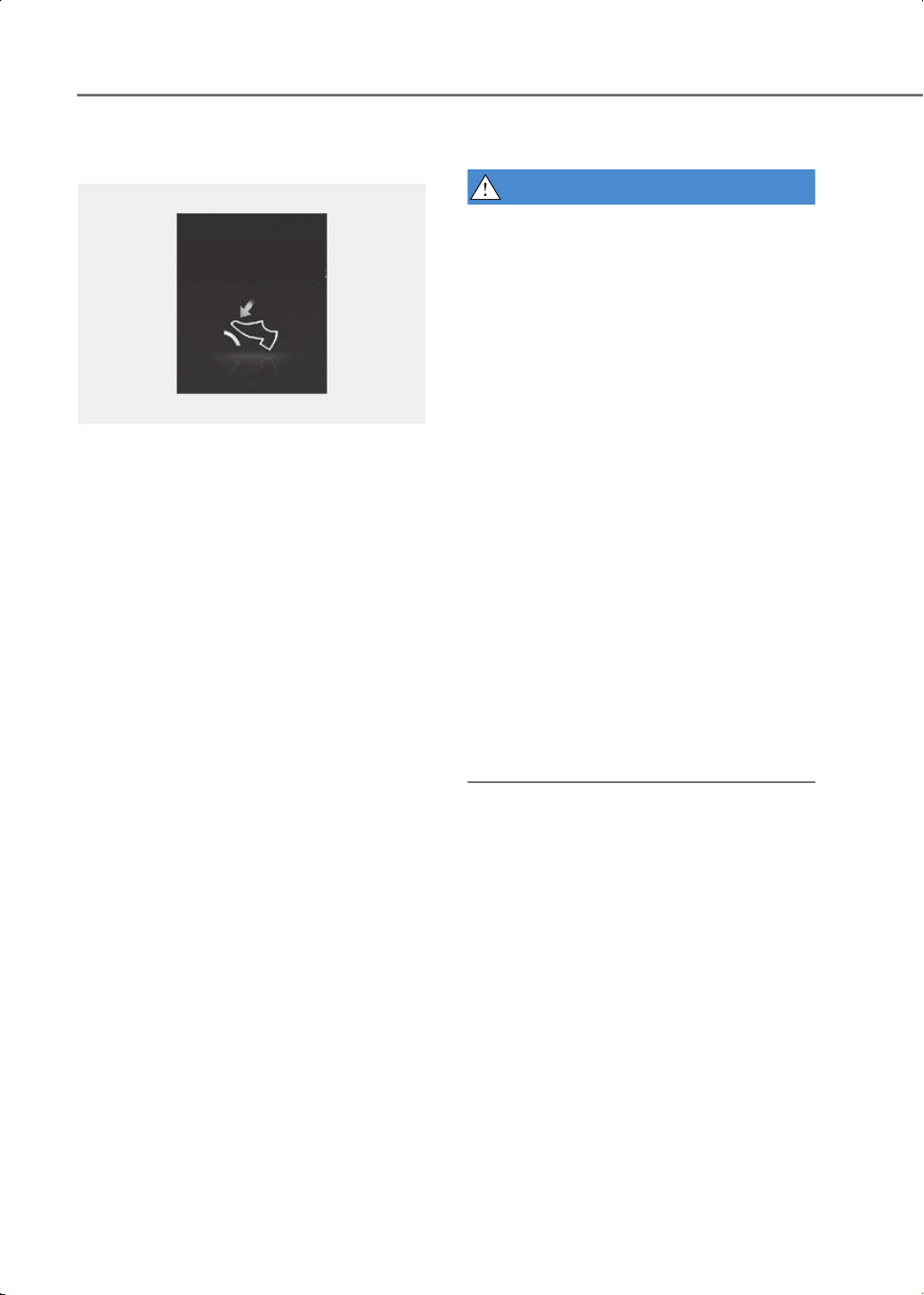
Driving Your Vehicle
6-30
Press brake pedal to deactivate AUTO
HOLD
B6003905
If you did not apply the brake pedal when
you release Auto Hold by pressing the
AUTO HOLD switch, a warning will sound
and a message will appear.
Brake Disc Cleaning
Use the Brake Disc Cleaning function if
noise is generated when depressing the
brake while driving or if the brake disc
gets rusty. It helps reduce the noise and
rust. Regenerative braking is restrained
while Brake Disc Cleaning is operated,
which may lower the electric energy
efficiency. Press and hold the AUTO
HOLD button for over 3 seconds.
• Brake Disc Cleaning starts operating
when the message "Brake disc
cleaning" is displayed on the
instrument cluster.
• Regenerative braking is restrained
while the brake is depressed about 10
times while driving (it may differ
depending on driving conditions). It
helps reduce the noise and rust.
• Brake Disc Cleaning function will turn
off automatically when the operation is
completed. It can also be turned off
before operation is completed by
turning off the vehicle or pressing the
AUTO HOLD button for over 3 seconds.
Anti-Lock Brake System (ABS)
WARNING
Anti-Lock Braking System (ABS) or
Electronic Stability Control (ESC) system
will not prevent accidents due to
improper or dangerous driving
maneuvers. Even though vehicle control
is improved during emergency braking,
always maintain a safe distance between
you and objects ahead of you. Vehicle
speeds should always be reduced during
extreme road conditions. The braking
distance for vehicles equipped with ABS
or ESC may be longer than for those
without these systems in the following
road conditions.
Drive your vehicle at reduced speeds
during the following conditions:
• Rough, gravel or snow-covered roads.
• On roads where the road surface is
pitted or has different surface height.
• Tire chains are installed on your vehicle.
The safety features of ABS or ESC
equipped vehicle should not be tested by
high speed driving or cornering. This
could endanger the safety of yourself or
others.
ABS is an electronic braking system that
helps prevent a braking skid. ABS allows
the driver to steer and brake at the same
time.
1SFTTCSBLFQFEBMUP
EFBDUJWBUF"650)0-%
CE_USA.book Page 30
6
6-31
Using ABS
To obtain the maximum benefit from your
ABS in an emergency situation, do not
attempt to modulate your brake pressure
and do not try to pump your brakes.
Depress your brake pedal as hard as
possible.
When you apply your brakes under
conditions which may lock the wheels,
you may hear sounds from the brakes, or
feel a corresponding sensation in the
brake pedal. This is normal and it means
your ABS is active.
ABS does not reduce the time or distance
it takes to stop the vehicle.
Always maintain a safe distance from the
vehicle in front of you.
ABS will not prevent a skid that results
from sudden changes in direction, such
as trying to take a corner too fast or
making a sudden lane change. Always
drive at a safe speed for the road and
weather conditions.
ABS cannot prevent a loss of stability.
Always steer moderately when braking
hard. Severe or sharp steering wheel
movement can still cause your vehicle to
veer into oncoming traffic or off the road.
On loose or uneven road surfaces,
operation of the anti-lock brake system
may result in a longer stopping distance
than for vehicles equipped with a
conventional brake system.
The ABS ( ) warning light will stay on for
several seconds after the Start/Stop
button is in the ON position.
During that time, ABS will go through
self-diagnosis and the light will go off if
everything is normal. If the light stays on,
you may have a problem with your ABS.
Contact an authorized HYUNDAI dealer as
soon as possible.
WARNING
If the ABS ( ) warning light is on and
stays on, you may have a problem with
the ABS. Your power brakes will work
normally. To reduce the risk of serious
injury or death, contact your authorized
HYUNDAI dealer as soon as possible.
NOTICE
When you drive on a road having poor
traction, such as an icy road, and apply
your brakes continuously, ABS will be
active continuously and the ABS ( )
warning light may illuminate. Pull your
vehicle over to a safe place and turn the
vehicle off.
Restart the vehicle. If the ABS warning
light is off, then your ABS system is
normal.
Otherwise, you may have a problem with
your ABS system. Contact an authorized
HYUNDAI dealer as soon as possible.
Information
When you jump start your vehicle
because of a drained battery, the ABS
( ) warning light may turn on at the
same time. This happens because of the
low battery voltage. It does not mean
your ABS is malfunctioning. Have the
battery recharged before driving the
vehicle.
CE_USA.book Page 31
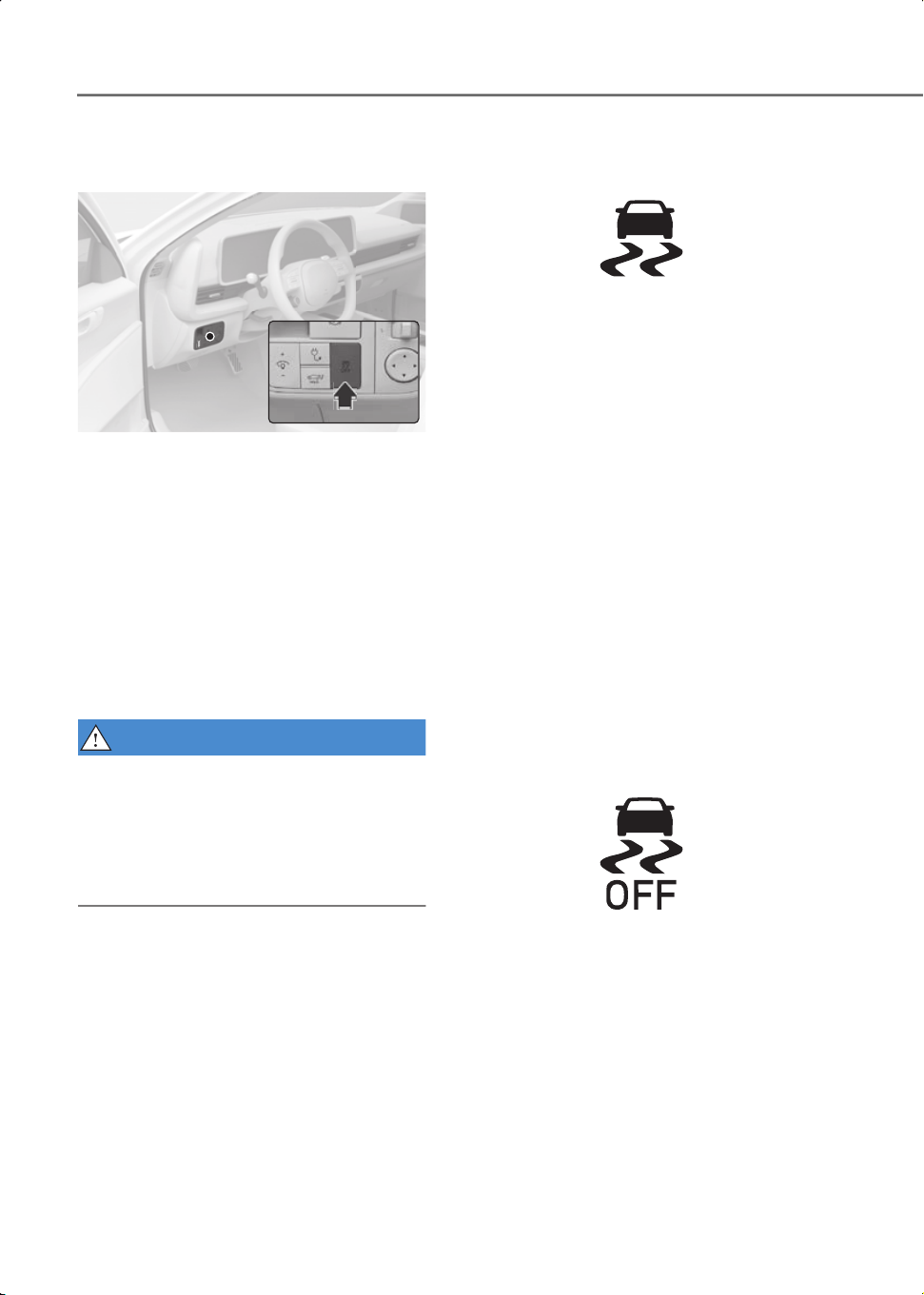
Driving Your Vehicle
6-32
Electronic Stability Control
(ESC)
B6004101
Electronic Stability Control helps to
stabilize the vehicle during cornering
maneuvers.
ESC checks where you are steering and
where the vehicle is actually going. ESC
applies braking pressure to any one of the
vehicle's brakes and intervenes in the
electric vehicle control system to assist
the driver with keeping the vehicle on the
intended path. It is not a substitute for
safe driving practices. Always adjust your
speed and driving to the road conditions.
WARNING
Never drive too fast for the road
conditions when cornering. ESC will not
prevent accidents.
Excessive speed in turns, abrupt
maneuvers, and hydroplaning on wet
surfaces can result in severe accidents.
ESC operation
ESC ON condition
When the Start/Stop button is in the ON
position, ESC and the ESC OFF indicator
lights illuminate for about 3 seconds.
After both lights go off, ESC is enabled.
When operating
WL_ESCOnLamp
When ESC is in operation, the ESC
indicator light blinks:
• When you apply your brakes under
conditions which may lock the wheels,
you may hear sounds from the brakes,
or feel a corresponding sensation in the
brake pedal. This is normal and it means
your ESC is active.
• When ESC activates, the vehicle may
not respond to the accelerator as it
does under routine conditions.
• If Smart Cruise Control was in use when
ESC activates, Smart Cruise Control
automatically disengages. Smart Cruise
Control can be reengaged when the
road conditions allow. For more
information, refer to the “Smart Cruise
Control (SCC)” section in chapter 7.
ESC OFF condition
WL_ESCOffLamp
To cancel ESC operation:
• State 1
Press the ESC OFF button briefly. The
ESC OFF indicator light and/or message
'Traction Control disabled' will
illuminate. In this state, the traction
control function of ESC (electric vehicle
control management) is disabled, but
the brake control function of ESC
(braking management) still operates.
CE_USA.book Page 32
6
6-33
• State 2
Press and hold the ESC OFF button
continuously for more than 3 seconds.
The ESC OFF indicator light and/or
message 'Traction & Stability Control
disabled' illuminates and a warning
chime sounds. In this state, both the
traction control function of ESC
(electric vehicle control management)
and the brake control function of ESC
(braking management) are disabled.
If the Start/Stop button is pressed to
the OFF position when ESC is off, ESC
remains off. Upon restarting the
vehicle, ESC will automatically turn on
again.
When ESC (electric vehicle control) is
deactivated, the vehicle will lose the
traction and stability if the vehicle is
driven by abrupt steering wheel
control. It is possible that the tire may
make a collision with the connected
parts of the tire. Do not turn off ESC
while driving the vehicle for your safety.
Indicator lights
ESC indicator light (blinks)
WL_ESCOnLamp
ESC OFF indicator light (comes on)
WL_ESCOffLamp
When the Start/Stop button is pressed to
the ON position, the ESC indicator light
illuminates, then goes off if the ESC
system is operating normally.
The ESC indicator light blinks whenever
ESC is operating.
If the ESC indicator light stays on, your
vehicle may have a malfunction with the
ESC system. When this warning light
illuminates, have the vehicle inspected by
an authorized HYUNDAI dealer as soon as
possible.
The ESC OFF indicator light comes on
when ESC is turned off.
WARNING
When ESC is blinking, this indicates ESC is
active:
Drive slowly and NEVER attempt to
accelerate. NEVER turn ESC off while the
ESC indicator light is blinking or you may
lose control of the vehicle resulting in an
accident.
NOTICE
Driving with wheels and tires with
different sizes may cause the ESC system
to malfunction. Before replacing tires,
make sure all four tires and wheels are the
same size. Never drive the vehicle with
different sized wheels and tires installed.
CE_USA.book Page 33
Driving Your Vehicle
6-34
ESC OFF usage
When Driving
The ESC OFF mode should only be used
briefly to help free the vehicle if stuck in
snow or mud, by temporarily stopping
operation of ESC, to maintain wheel
torque.
To turn ESC off while driving, press the
ESC OFF button while driving on a flat
road surface.
NOTICE
To prevent damage to the gear:
• Do not allow wheel(s) of one axle to
spin excessively while the ESC, ABS,
and Parking Brake warning lights are
displayed. The repairs would not be
covered by the vehicle warranty.
Reduce motor power and do not spin
the wheel(s) excessively while these
lights are displayed.
• When operating the vehicle on a
dynamometer, make sure ESC is turned
off (ESC OFF light illuminated).
Information
• Turning ESC off does not affect ABS or
standard brake system operation.
• Select 0 step of the regenerative
braking system and depress the brake
pedal around 10 times to efficiently
apply brake disc cleaning.
Brake disc cleaning may decrease the
driving distance by restraining the
regenerative braking system. After
brake disc cleaning, the regenerative
braking system may be restored.
If the regenerative braking system is
not restored after the brake disc
cleaning, have the vehicle inspected by
an authorized HYUNDAI dealer.
Vehicle Stability Management
(VSM)
Vehicle Stability Management is a
function of the Electronic Stability
Control (ESC) system. It helps the vehicle
stay stable when accelerating or braking
suddenly on wet, slippery and rough
roads where traction over the four tires
can suddenly become uneven.
WARNING
Take the following precautions when
using Vehicle Stability Management:
• ALWAYS check the speed and the
distance to the vehicle ahead. VSM is
not a substitute for safe driving
practices.
• Never drive too fast for the road
conditions. VSM will not prevent
accidents. Excessive speed in bad
weather, on slippery and uneven roads
can result in severe accidents.
VSM operation
When operating
When you apply your brakes under
conditions which may activate ESC, you
may hear sounds from the brakes, or feel
a corresponding sensation in the brake
pedal. This is normal and it means your
VSM is active.
Information
VSM does not operate when:
• Driving on a banked road such as
gradient or incline.
• Driving in reverse.
• The ESC OFF indicator light is on.
• The MDPS (Motor Driven Power
Steering) warning light ( ) is on or
blinks.
CE_USA.book Page 34
6
6-35
VSM OFF condition
To cancel VSM operation, press the ESC
OFF button. ESC OFF ( ) indicator light
will illuminate.
To turn on VSM, press the ESC OFF button
again. The ESC OFF indicator light will go
out.
WARNING
If the ESC ( ) indicator light or MDPS ( )
warning light stays illuminated or blinks,
your vehicle may have a malfunction with
the VSM system. When the warning light
illuminates have the vehicle inspected by
an authorized HYUNDAI dealer as soon as
possible.
NOTICE
Driving with wheels and tires with
different sizes may cause the VSM system
to malfunction. Before replacing tires,
make sure all four tires and wheels are the
same size. Never drive the vehicle with
different sized tires and wheels installed.
Hill-Start Assist Control (HAC)
Hill-Start Assist Control helps prevent the
vehicle from rolling backwards when
starting a vehicle from a stop on a hill. The
system operates the brakes automatically
for about 2 seconds (maximum of 5
seconds when the accelerator pedal is
slightly depressed during HAC operation)
and releases the brake after 2 seconds or
when the accelerator pedal is depressed.
WARNING
Always be ready to depress the
accelerator pedal when starting off an
incline. Hill-Start Assist Control activates
only for about 2 seconds (maximum of 5
seconds when the accelerator pedal is
slightly depressed during HAC operation).
Information
• Hill-Start Assist Control does not
operate when the gear is shifted to P
(Park) or N (Neutral).
• Hill-Start Assist Control activates even
when the ESC (Electronic Stability
Control) is off. However, it does not
activate, when ESC does not operate
normally.
Brake Assistant System (BAS)
The Brake Assistant System provides
additional pressure when the brake pedal
is momentarily and strongly depressed in
a situation sudden braking is required
while driving.
The Brake Assistant System reduces the
time for ABS(Anti-Lock Brake System)
control to enter and consequently
reduces the braking distance, by
providing additional pressure up to the
point of ABS intervention.
BAS operation
• When the vehicle speed is more than 18
mph (30 km/h) and the ABS control is
not entered.
• When the brake pedal is depressed
strongly over a certain level.
• When the friction of the road surface is
above a certain level.
CE_USA.book Page 35
Driving Your Vehicle
6-36
BAS operation off
• The vehicle speed is below 6 mph (10
km/h).
• The brake pedal is depressed over a
certain conditions.
• The friction of the road surface is below
a certain level.
WARNING
The system may not operate depending
on driver's driving habit, the degree to
which the brake pedal is depressed and
the road surface condition.
Good Braking Practices
WARNING
Whenever leaving the vehicle or parking,
always come to a complete stop and
continue to depress the brake pedal. Shift
the gear to the P (Park) position, then
apply the parking brake, and press the
Start/Stop button to the OFF position.
Vehicles parked with the parking brake
not applied or not fully engaged may roll
inadvertently and may cause injury to the
driver and others. ALWAYS apply the
parking brake before exiting the vehicle.
Be aware of wet brakes. The brakes may
get wet if the vehicle is driven through
standing water or if it is washed. Your
vehicle will not stop as quickly if the
brakes are wet. Wet brakes may cause the
vehicle to pull to one side.
To dry the brakes, apply the brakes lightly
until the braking action returns to normal.
If the braking action does not return to
normal, stop as soon as it is safe to do so
and call an authorized HYUNDAI dealer
for assistance.
DO NOT drive with your foot resting on
the brake pedal. Even light, but constant
pedal pressure can result in the brakes
overheating, brake wear, and possibly
even brake failure.
If a tire goes flat while you are driving,
apply the brakes gently and keep the
vehicle pointed straight ahead while you
slow down. When you are moving slowly
enough for it to be safe to do so, pull off
the road and stop in a safe location.
Keep your foot firmly on the brake pedal
when the vehicle is stopped to prevent
the vehicle from rolling forward.
CE_USA.book Page 36
6
6-37
if equipped
All Wheel Drive (AWD)
When All Wheel Drive(AWD) is activated,
driving forces are distributed
appropriately to front and rear wheels. It
could improve driving performance by
maximizing the driving force of vehicles
on severe road conditions such as steep
hills, unpaved, slippery, etc.
Advantage of electronic AWD
1. Improvement of straight stability
2. Improvement of driving performance
on curve
3. Secure stability on severe condition
such as wet and sandy roads.
4. Improvement of energy efficiency from
driving mode automatic control.
Information
AWD vehicles could change the
engagement status of the motor
according to the situation required. Auto
changing the driving
mode(2WD/AWD)helps improve energy
efficiency and driving stability.
WARNING
To reduce the risk of SERIOUS INJURY or
DEATH:
• Avoid high speeds when cornering or
turning.
• Do not make quick steering wheel
movements, such as sharp lane
changes or fast, sharp turns.
• The risk of a rollover is greatly increased
if you lose control of your vehicle at
highway speeds.
• Loss of control often occurs if two or
more wheels drop off the roadway and
the driver over steers to reenter the
roadway.
• In the event your vehicle leaves the
roadway, do not steer sharply. Instead,
slow down before pulling back into the
travel lanes.
NOTICE
• Do not drive in water if the level is
higher than the bottom of the vehicle.
• Check your brake condition once you
are out of mud or water. Depress the
brake pedal several times as you move
slowly until you feel normal braking
return.
• Shorten your scheduled maintenance
interval if you drive in off-road
conditions such as sand, mud or water
(For more information, refer to the
"Maintenance Under Severe Usage and
Low Mileage Conditions" section in
chapter 9.)
• Always wash your vehicle thoroughly
after off road use, especially the
bottom of the vehicle.
• Be sure to equip the vehicle with four
tires of the same size and type.
• Make sure that a full time AWD vehicle
is towed by a flat bed tow truck.
For safe AWD operation
Before driving
• Make sure all passengers are wearing
seat belts.
• Sit upright and closer to the steering
wheel than usual. Adjust the steering
wheel to a position comfortable for you
to drive.
CE_USA.book Page 37
Driving Your Vehicle
6-38
Driving on snow-covered or icy roads
• Start off slowly by applying the
accelerator pedal gently.
• Use snow tires or tire chains.
• Keep sufficient distance between your
vehicle and the vehicle in front of you.
• Using regenerative braking helps the
steering on the downhill. However, it
may be difficult to adjust the vehicle
while coasting using regenerative
braking, so avoid using the third level of
regenerative braking as much as
possible.
• Avoid speeding, rapid acceleration,
sudden brake applications, and sharp
turns to prevent skids.
• It is difficult to start again if the vehicle
stops on an uphill road. Keep your
distance from other vehicles and drive
slowly.
Information
When using Snow Tires, mount them on
all four wheels.
When using tire chains, install them on
the rear tires.
However, driving speed must be below 18
mph (30 km/h) and minimize the driving
distance. High-speed or long-term
driving with tire chains installed may
malfunction or damage the AWD system.
For more information on Snow Tires and
Tire Chains, refer to the "Winter Driving"
section later in this chapter.
Driving in sand or mud
• Maintain slow and constant speed.
• Use tire chains driving in mud if
necessary.
• Keep sufficient distance between your
vehicle and the vehicle in front of you.
• Reduce vehicle speed and always
check the road condition.
• Avoid speeding, rapid acceleration,
sudden brake applications, and sharp
turns to prevent getting stuck.
NOTICE
When the vehicle is stuck in snow, sand or
mud, place a nonslip material under the
drive wheels to provide traction OR slowly
spin the wheels in forward and reverse
directions which causes a rocking motion
that may free the vehicle.
Driving up or down hills
• Driving uphill
- Before starting off, check if it is
possible to drive uphill.
- Drive as straight as possible.
• Driving downhill
- Do not change gear while driving
downhill. Select gear before driving
downhill.
- Drive straight as possible.
WARNING
Exercise extreme caution driving up or
down steep hills. The vehicle may flip over
depending on the grade, terrain, water
and mud conditions.
WARNING
Do not drive across the contour of steep
hills. A slight change in the wheel angle
can destabilize the vehicle, or a stable
vehicle may lose stability if the vehicle
stops its forward motion. Your vehicle
may roll over and lead to a serious injury
or death.
CE_USA.book Page 38
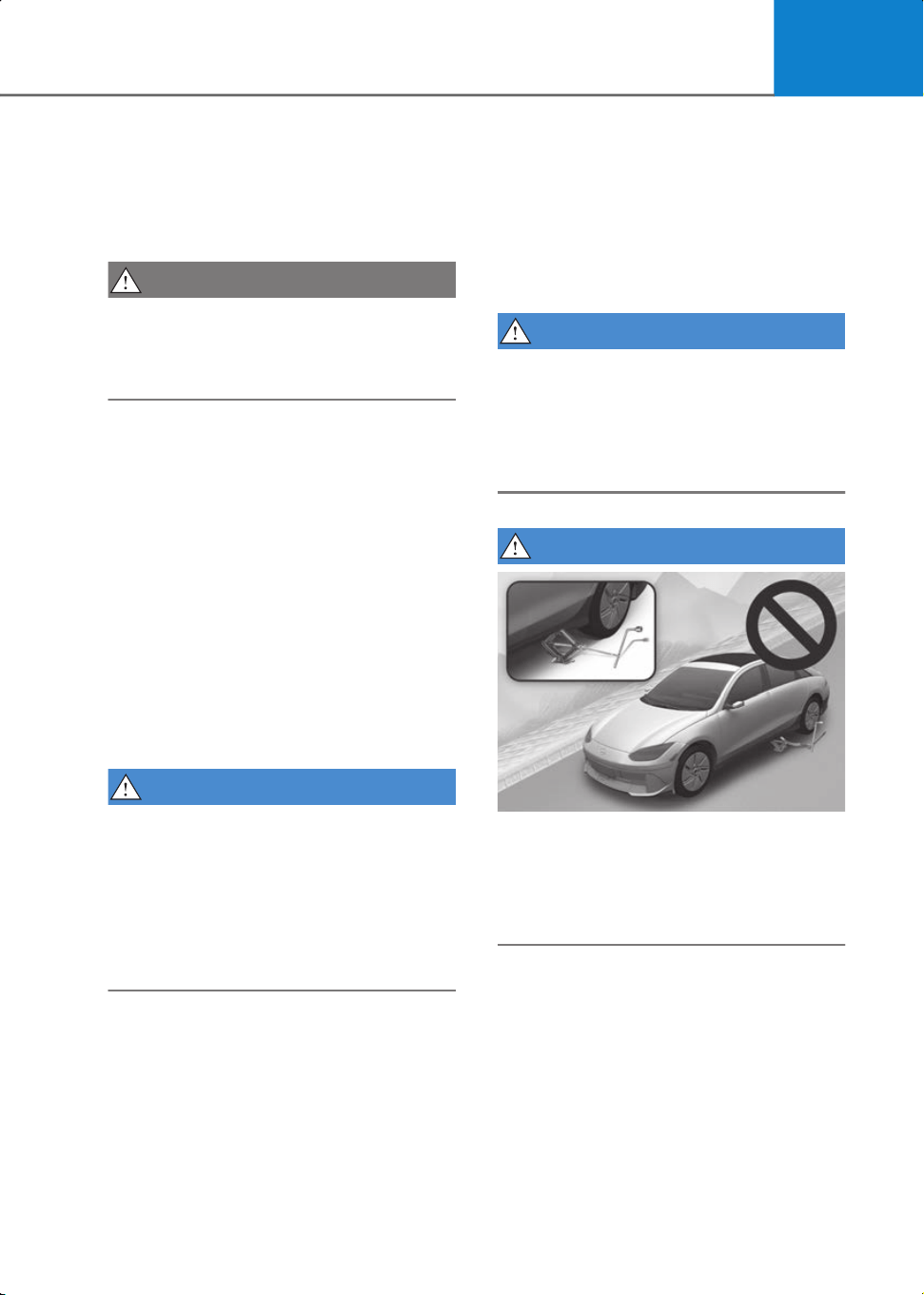
6
6-39
Driving through water
• Try to avoid driving in deep standing
water.
• Do not change gear while driving in
water.
CAUTION
Always drive slowly in water. If you drive
too fast, water may get into the motor
compartment, causing your vehicle to
suddenly stop.
Additional driving conditions
• Become familiar with the off-road
conditions before driving.
• Always pay attention when driving
off-road and avoid dangerous areas.
• Drive slowly when driving in heavy
wind.
• Reduce vehicle speed when cornering.
The center of gravity of AWD vehicles is
higher than conventional 2WD vehicles,
making them more likely to roll over
when you rapidly turn corners.
• Always hold the steering wheel firmly
when you are driving off-road.
WARNING
Do not grab the inside of the steering
wheel when you are driving off-road. You
may hurt your arm by a sudden steering
maneuver or from steering wheel
rebound due to an impact with objects on
the ground. You could lose control of the
steering wheel which may lead to serious
injury or death.
Emergency Precautions
Tires
When replacing tires, be sure to equip all
four tires with the same size, type, tread
patterns, brand and load-carrying
capacity.
WARNING
Do not use tire and wheel with different
size and type from the one originally
installed on your vehicle. It can affect the
safety and performance of your vehicle,
which could lead to steering failure or
rollover causing serious injury.
WARNING
B6005201
Never start or run the vehicle while an
AWD vehicle is raised on a jack. The
vehicle can slip or roll off of a jack causing
serious injury or death to you or those
nearby.
Towing
AWD vehicles must be towed with a
wheel lift and dollies or flatbed
equipment with all the wheels off the
ground. For more information, refer to the
"Towing" section in chapter 8.
CE_USA.book Page 39
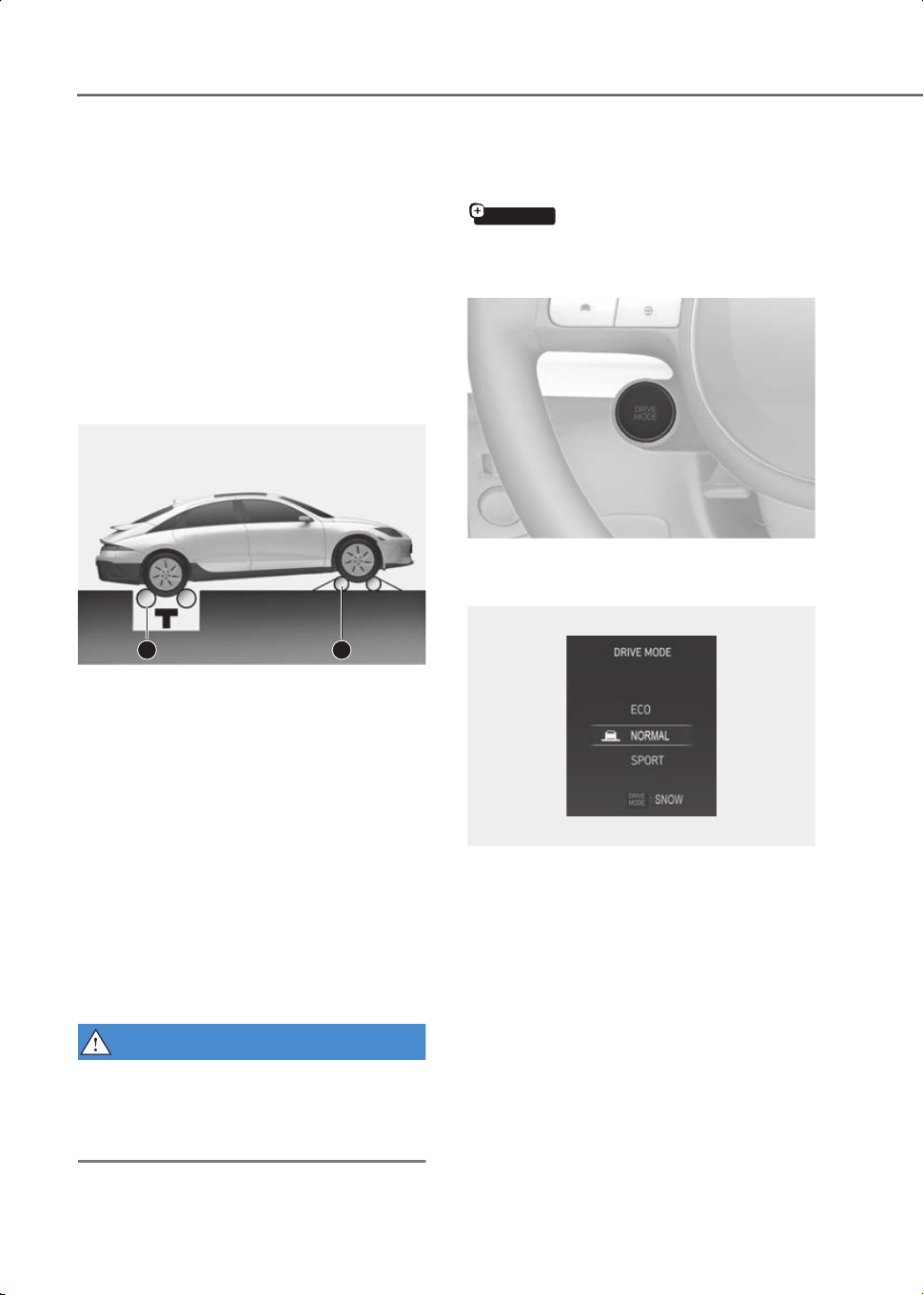
Driving Your Vehicle
6-40
Vehicle inspection
• If the vehicle needs to be operated on a
vehicle lift do not attempt to stop any of
the four wheels from turning. This could
damage the AWD system.
• Never engage the parking brake while
running the vehicle on a car lift. This
may damage the AWD system.
Dynamometer testing
An AWD vehicle must be tested on a
special four wheel chassis dynamometer.
B6005501
[A] Roll tester (Speedometer)
[B] Temporary free roller
An AWD vehicle should not be tested on a
2WD roll tester. If a 2WD roll tester must
be used, perform the following
procedure:
1. Check the tire pressures recommended
for your vehicle.
2. Place the rear wheels on the roll tester
for a speedometer test as shown in the
illustration.
3. Release the parking brake.
4. Place the front wheels on the
temporary free roller as shown in the
illustration.
WARNING
Keep away from the front of the vehicle
while the vehicle is in gear on the
dynamometer. The vehicle can jump
forward and cause serious injury or death.
Drive Mode Integrated
if equipped
Control System (2WD)
Drive Mode
B6009701
Drive mode may be selected according to
the driver's preference or road condition.
B6009702
The mode changes whenever the driver
pushes the DRIVE MODE button.
NORMAL mode
Normal mode is a driving mode used
when driving on general roads, city center
and highways.
ECO mode
ECO mode is a driving mode improving
energy efficiency by controlling motors
and gear.
A B
)PME
CE_USA.book Page 40
6
6-41
Electric energy efficiency varies
according to the driver's driving habit and
road condition.
• When ECO mode is selected, the ECO
indicator illuminates on the instrument
cluster and the color of the mood lamp
is changed.
• When ECO mode is activated:
- The acceleration response may be
slightly reduced if the accelerator
pedal is depressed moderately.
- The air conditioner performance may
be limited.
The above situations are normal
conditions when ECO mode is
activated to help improve electric
energy efficiency.
Limitations of ECO mode
If the following conditions occur while
ECO mode is operating, the system
operation is limited even though there is
no change in the ECO indicator.
• When coolant temperature is low:
The system will be limited until motor
performance becomes normal.
• When driving up a hill:
The system will be limited to gain
power when driving uphill because
motor torque is restricted.
SPORT mode
SPORT mode is a driving mode improving
driving performance by controlling
motors and gear.
In SPORT mode, the electric energy
efficiency may decrease.
• When SPORT mode is selected, the
SPORT indicator illuminates on the
instrument cluster and the color of the
mood lamp is changed.
• Whenever the vehicle is restarted, the
drive mode reverts back to NORMAL
mode. If SPORT mode is desired,
re-select SPORT mode.
SNOW mode
SNOW mode provides safe driving on the
snowy roads.
• Press and hold the drive mode button
to select SNOW mode.
• When SNOW mode is selected, the
SNOW indicator will illuminate on the
instrument cluster and the color of the
mood lamp will change.
NOTICE
• Depress the accelerator pedal softly on
the snow and the ice.
• Keep the distance from the vehicle in
the front.
• Prevent rapid acceleration,
deceleration and steering control.
Abrupt driving on the snow may cause
the accident.
MY DRIVE MODE
In MY DRIVE MODE, you can adjust the
vehicle performance for each function. To
set MY DRIVE MODE, go to Setup >
Vehicle > Drive mode > CUSTOM > MY
DRIVE MODE in the infotainment system.
Press and hold the drive mode button to
select MY DRIVE MODE. The MY DRIVE
MODE indicator will illuminate on the
instrument cluster.
• If the controller is replaced or the
controller software is updated, the
setting of MY DRIVE MODE may be
initialized.
MY DRIVE MODE
Power output
Maximized/Normal
/Minimized
Acceleration
sensitivity
High/Moderate/Lo
w
Steering NORMAL/SPORT
CE_USA.book Page 41
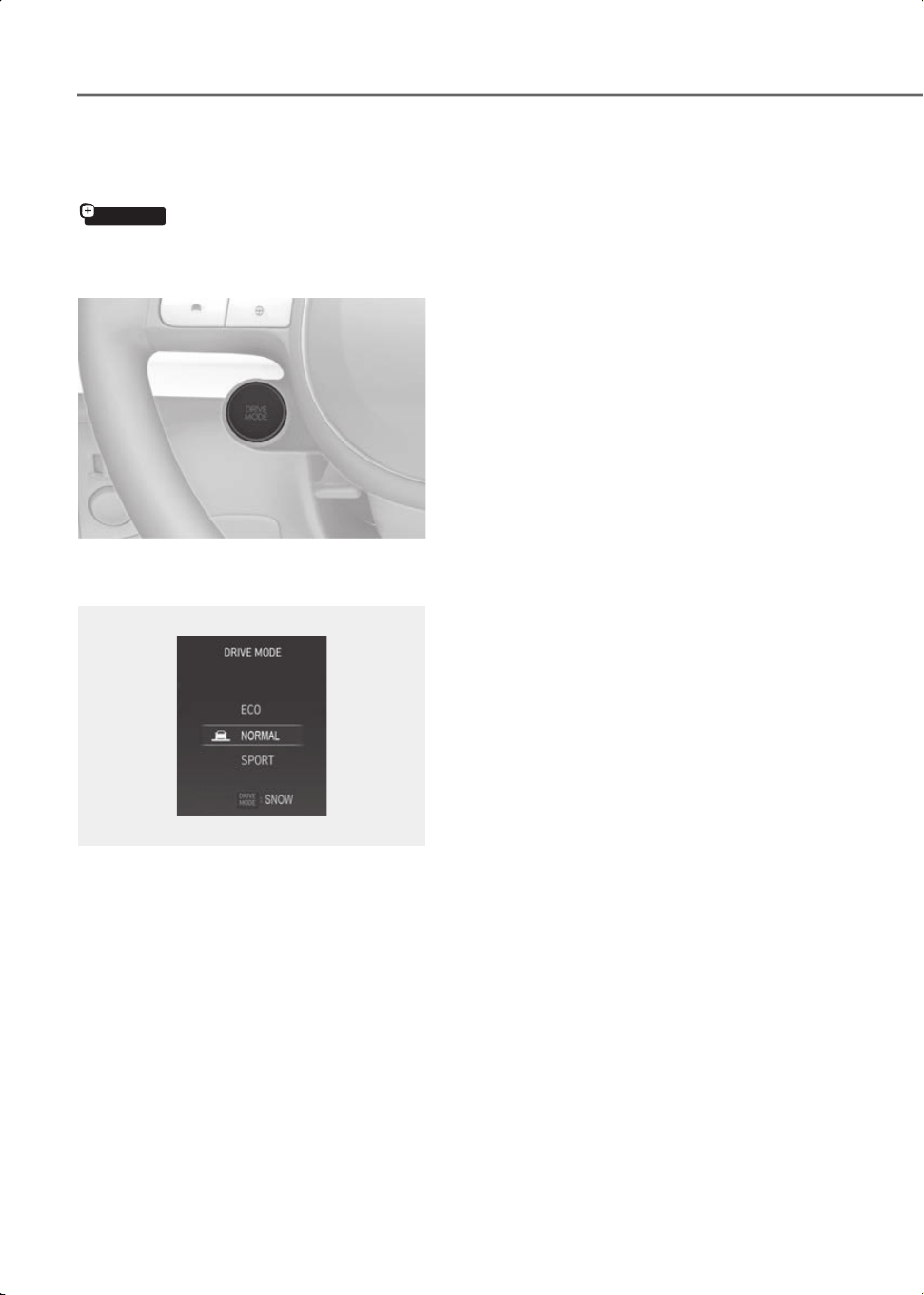
Driving Your Vehicle
6-42
Drive Mode Integrated
if equipped
Control System (AWD)
Drive Mode
B6009701
Drive mode may be selected according to
the driver's preference or road condition.
B6009702
The mode changes whenever the driver
pushes the DRIVE mode button.
NORMAL mode
Normal mode is a driving that provides
comfortable driving with normal motor
response. The vehicle is driven mainly
with the rear wheels (2WD), and
automatically converts to AWD according
to the road and driving conditions.
ECO mode
ECO mode is a driving mode vehicles
could change the engagement status of
the motor according to the situation
required. Auto changing the driving
mode(2WD/AWD)helps improve energy
efficiency.
Electric energy efficiency varies
according to the driver's driving habit and
road condition.
• When ECO mode is selected, the ECO
indicator illuminates on the instrument
cluster and the color of the mood lamp
is changed.
• When ECO mode is activated:
- The acceleration response may be
slightly reduced if the accelerator
pedal is depressed moderately.
- The air conditioner performance may
be limited.
- The shift pattern of the gear may
change.
The above situations are normal
conditions when ECO mode is
activated to help improve electric
energy efficiency.
Limitations of ECO mode
If the following conditions occur while
ECO mode is operating, the system
operation is limited even though there is
no change in the ECO indicator.
• When coolant temperature is low:
The system will be limited until motor
performance becomes normal.
• When driving up a hill:
The system will be limited to gain
power when driving uphill because
motor torque is restricted.
)PME
CE_USA.book Page 42

6
6-43
SPORT mode
SPORT mode is a driving mode improving
driving performance by fixing AWD
system and controlling gear.
In SPORT mode, the electric energy
efficiency may decrease.
• When SPORT mode is selected, the
SPORT indicator illuminates on the
instrument cluster and the color of the
mood lamp is changed.
• Whenever the vehicle is restarted, the
drive mode reverts back to NORMAL
mode. If SPORT mode is desired,
re-select SPORT mode.
SNOW mode
SNOW mode is a driving mode improving
driving performance by changing the
engagement status of the motor
according to the situation required. Auto
changing the driving
mode(2WD/AWD)helps improve driving
stability.
• Press and hold the drive mode button
to select SNOW mode.
• When SNOW mode is selected, the
SNOW indicator will illuminate on the
instrument cluster and the color of the
mood lamp will change.
• When SNOW mode is activated, the
driving power is distributed to four
wheels automatically, increasing the
stability of the vehicle.
NOTICE
• Depress the accelerator pedal softly on
the snow and the ice.
• Keep the distance from the vehicle in
the front.
• Prevent rapid acceleration,
deceleration and steering control.
Abrupt driving on the snow may cause
the accident.
MY DRIVE MODE
In MY DRIVE MODE, you can adjust the
vehicle performance for each function. To
set MY DRIVE MODE, go to Setup >
Vehicle > Drive mode > CUSTOM > MY
DRIVE MODE in the infotainment system.
Press and hold the drive mode button to
select MY DRIVE MODE. The MY DRIVE
MODE indicator will illuminate on the
instrument cluster.
• When driving in 2WD, AWD will operate
under following conditions:
- Driving at low speed or stopping
- Driving on an uphill or slippery road
- Malfunction of the rear-wheel motor
• If the controller is replaced or the
controller software is updated, the
setting of MY DRIVE MODE may be
initialized.
MY DRIVE MODE
Power output
Maximized/Normal
/Minimized
Acceleration
sensitivity
High/Moderate/Lo
w
Steering NORMAL/SPORT
Driveline
AWD/AUTO
AWD/2WD
CE_USA.book Page 43
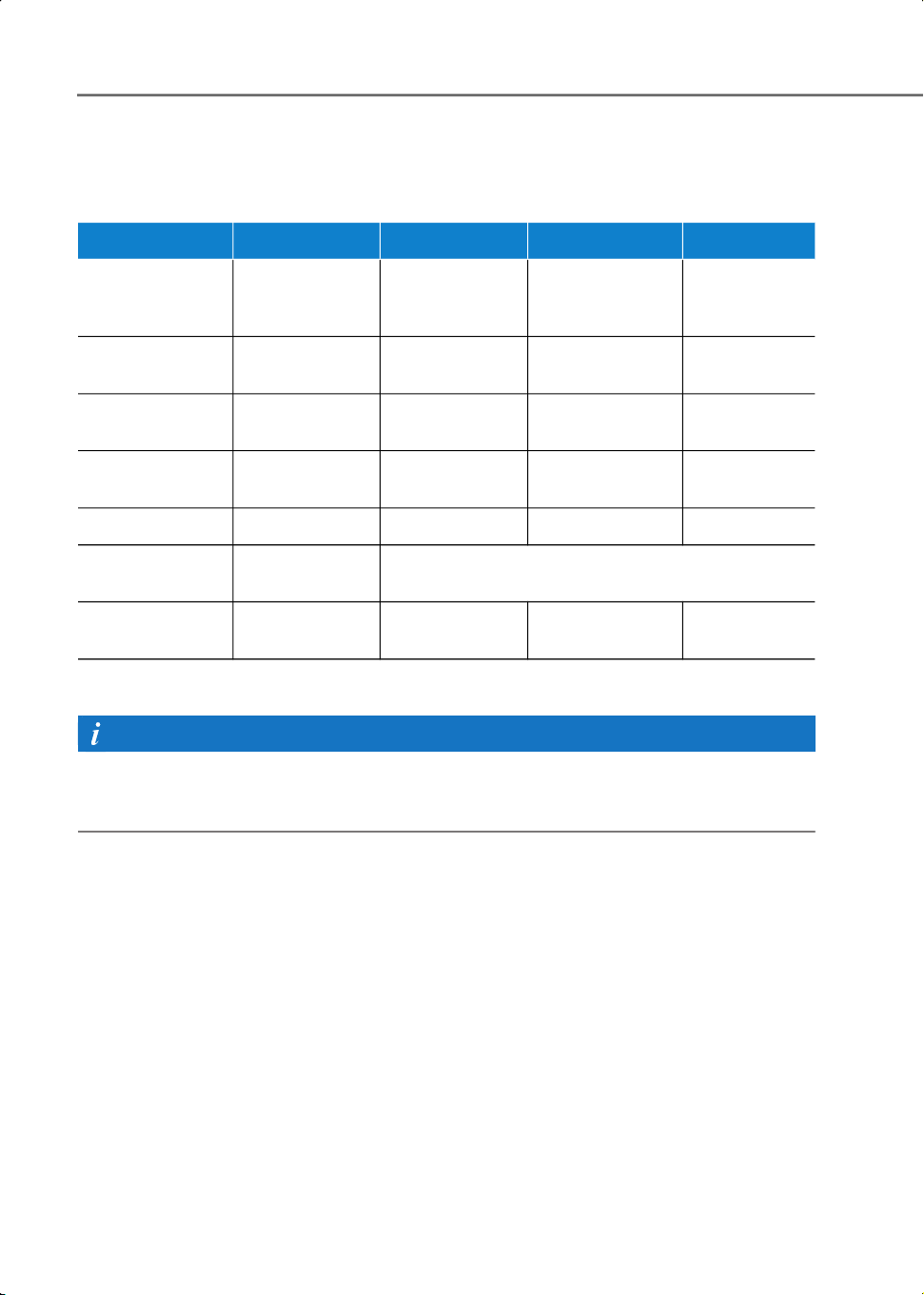
Driving Your Vehicle
6-44
Drive Modes Characteristic
The characteristic of each components varies depending on which drive mode is
selected.
*1 It is possible to set the driving condition for each drive mode, at the drive mode setting in Infotainment system.
Information
The infotainment system may change after software updates. For more information,
refer to the user`s manual provided in the infotainment system and the quick reference
guide.
Drive Mode SNOW NORMAL ECO SPORT
Characteristics Snow driving
Normal driving
mode
High electric
energy efficiency
mode
Sporty driving
mode
Button activation
Press more than
1 sec.
Press Press Press
Indicator on the
cluster
SNOW NORMAL ECO SPORT
Climate system
control
NORMAL NORMAL
ECO(ECO/NORM
AL)
*1
NORMAL
Speed Limit - - - -
Regenerative
braking level
0-1 0-3
Brake mode NORMAL
NORMAL/SPOR
T
*1
NORMAL
NORMAL/SPO
RT
*1
CE_USA.book Page 44
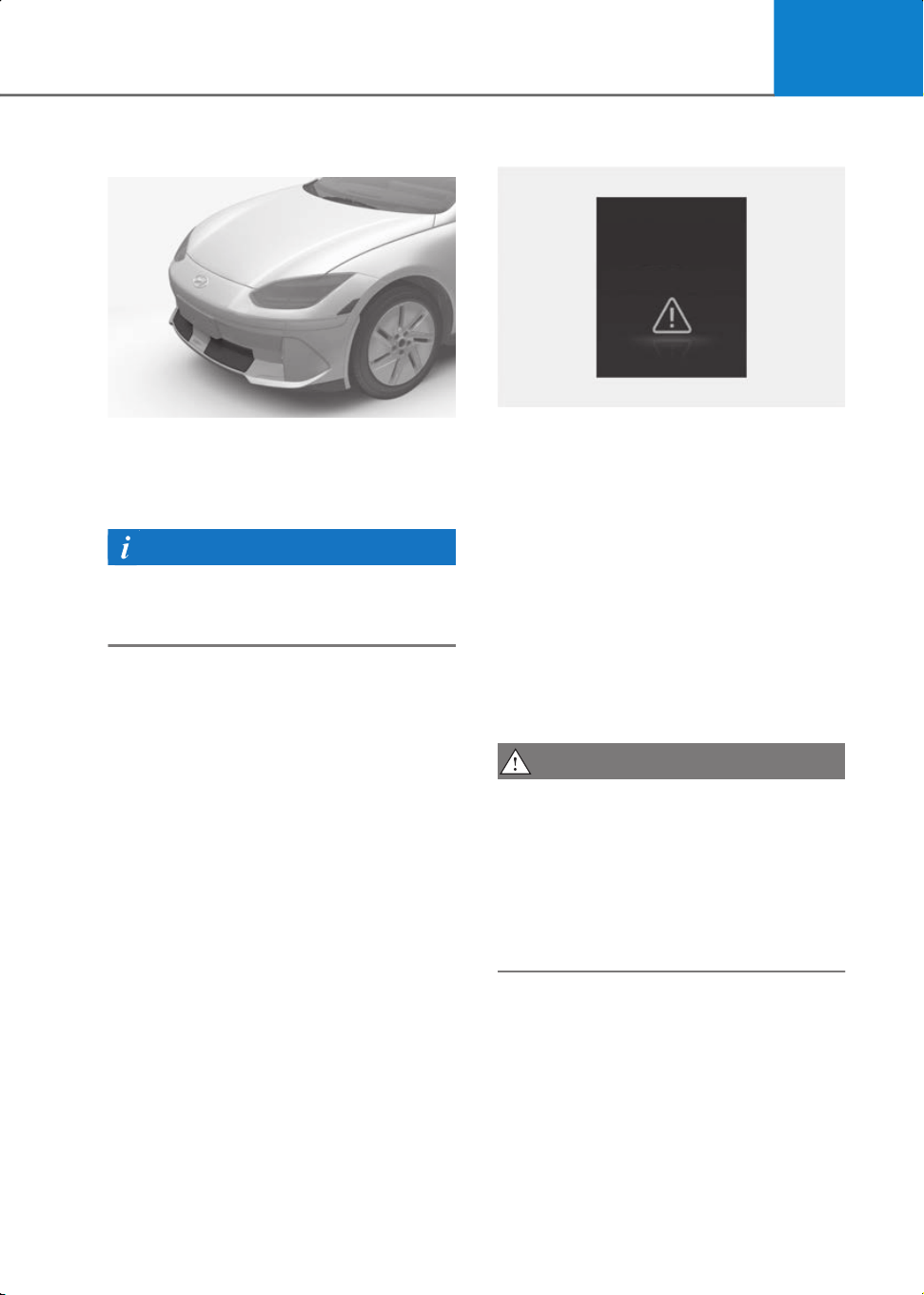
6
6-45
Active Air Flap
B6014001
Active air flap system controls the air flap
below the front bumper to cool the
vehicle parts and improve energy
efficiency.
Information
Active air flap system could be activate
regardless of the vehicle condition.
(Parking, driving, charging, etc.)
Malfunction
B6014101
The active air flap system may not
operate normally if the air flap is
temporarily opened due to foreign factors
or if the controller is contaminated by
snow or rain, etc.
When "Check the active air flap system"
is popped up on cluster display, stop the
vehicle in a safe place and check the
status of the air flap.
Start the vehicle after performing the
necessary work like foreign matter
removal and waiting 10 minutes. If the
pop-up remains up, contact an
authorized HYUNDAI dealer.
CAUTION
• Regardless of the pop-up, if the air flaps
aren't in the same position, stop the
vehicle and wait for 10 minutes and
start the vehicle and inspect the air flap.
• The active air flap system is actuated by
motors. Do not disturb actuation or
apply force excessively. It may cause
failure.
$IFDL"DUJWF
"JS'MBQ4ZTUFN
CE_USA.book Page 45
Driving Your Vehicle
6-46
if equipped
Active Sound Design
• Active Sound Design provides various
virtual driving sounds based on the
driving mode, vehicle speed, and
accelerator pedal. You can adjust the
volume and change the settings for
acceleration pedal response and sound
style.
• To change the volume of the Active
Sound Design in the infotainment
system, select: Setup > Vehicle >
Active Sound Design, or Setup >
Sound > Active Sound Design.
• The volume of the Active Sound Design
is adjusted according to the drive mode
(Eco, Normal, Sport) selected.
• Any unauthorized replacement of the
vehicle’s speaker and amplifier may
cause Active Sound Design to
malfunction.
Information
The infotainment system may change
after software updates. For more
information, refer to the user's manual
provided in the infotainment system and
the quick reference guide.
Special Driving
Conditions
Hazardous Driving Conditions
When hazardous driving elements are
encountered such as water, snow, ice,
mud and sand, take the following
precautions:
• Drive cautiously and maintain a longer
braking distance.
• Avoid abrupt braking or steering.
• When your vehicle is stuck in snow,
mud, or sand, accelerate slowly to
avoid unnecessary wheel spin.
• Put sand, rock salt, tire chains or other
non-slip materials under the wheels to
provide additional traction while the
vehicle becomes stuck in ice, snow, or
mud.
WARNING
Changing the tire speed suddenly could
cause the tires to skid while driving on
slippery surface. Be careful when driving
on slippery surfaces.
Rocking the Vehicle
If it is necessary to rock the vehicle to free
it from snow, sand, or mud, first turn the
steering wheel right and left to clear the
area around your front wheels. Then, shift
back and forth between R (Reverse) and a
forward gear.
Try to avoid spinning the wheels, and do
not race the vehicle.
To prevent gear wear, wait until the
wheels stop spinning before shifting
gears. Release the accelerator pedal
while shifting, and press lightly on the
accelerator pedal while the vehicle is in
gear. Slowly spinning the wheels in
forward and reverse directions causes a
rocking motion that may free the vehicle.
CE_USA.book Page 46

6
6-47
WARNING
Always turn off the ESC system before
rocking the vehicle. If the vehicle is stuck
and excessive wheel spin occurs, the
temperature in the tires may increase
very quickly. If the tires become
damaged, a tire blow out or tire explosion
may occur - you and others may be
injured. Do not attempt this procedure if
people or objects are near the vehicle.
If you attempt to free the vehicle, the
vehicle may overheat quickly, possibly
causing a motor compartment fire or
other damage. Try to avoid spinning the
wheels as much as possible to prevent
overheating of the tires or the motor. DO
NOT allow the vehicle to spin the wheels
above 35 mph (56 km/h).
If you are still stuck after rocking the
vehicle a few times, have the vehicle
pulled out by a tow vehicle to avoid motor
overheating, possible damage to the
transmission, and tire damage. Refer to
the “Towing” section in chapter 8.
Smooth Cornering
Avoid braking or gear changing in
corners, especially when roads are wet.
Ideally, cornering should be taken under
gentle acceleration.
Driving at Night
Night driving presents more hazards than
driving in the daylight. Here are some
important tips to remember:
• Slow down and keep more distance
between you and other vehicles, as it
may be more difficult to see at night,
especially in areas where there may not
be any street lights.
• Adjust your mirrors to reduce the glare
from other drivers’ headlights.
• Keep your headlights clean and
properly aimed. Dirty or improperly
aimed headlights will make it much
more difficult to see at night.
• Avoid staring directly at the headlights
of oncoming vehicles. You could be
temporarily blinded, and it will take
several seconds for your eyes to
readjust to the darkness.
Driving in the Rain
Rain and wet roads can make driving
dangerous. When driving in the rain or on
slick pavement:
• Slow down and allow extra following
distance. A heavy rainfall makes it
harder to see and increases the
distance needed to stop your vehicle.
• Turn OFF your Smart Cruise Control.
• Replace your windshield wiper blades
when they show signs of streaking or
missing areas on the windshield.
• Make sure your tires have enough
tread. If your tires do not have enough
tread, making a quick stop on wet
pavement may cause a skid and
possibly lead to a collision. Refer to the
“Tire Replacement” section in Chapter
9.
• Turn on your headlights to make it
easier for others to see you. Using your
headlights when using your windshield
wipers is required in some jurisdictions.
• Driving too fast through large puddles
may affect your brakes. If you must go
through puddles, try to drive through
them slowly.
• If you believe your brakes are wet,
apply them several times while the
vehicle is moving slowly.
CE_USA.book Page 47

Driving Your Vehicle
6-48
Hydroplaning
If the road is wet enough and you are
going fast enough, your vehicle may have
little or no contact with the road surface
and actually ride on the water. The best
advice is SLOW DOWN when the road is
wet.
The risk of hydroplaning increases as the
depth of tire tread decreases, For more
information, refer to the “Tire
Replacement” section in chapter 9.
Driving in Flooded Areas
Avoid driving through flooded areas
unless you are sure the water is not
deeper than the bottom of the wheel hub.
If you are not sure, turn around and find a
different route. Drive through any water
slowly. Allow adequate stopping distance
because the brake performance can be
reduced.
After driving through water, dry the
brakes by gently applying them several
times while the vehicle is moving slowly.
Highway Driving
Tires
Adjust the tire inflation pressure, as
specified. Under-inflation may overheat
or damage the tires.
Do not install worn-out or damaged tires,
which may reduce traction or fail.
Information
Never over-inflate your tires above the
maximum inflation pressure, as specified
on your tires.
Coolant and high voltage battery
Driving at higher speeds on the highway
consumes more electric energy and is
less efficient than driving at a slower,
more moderate speed. Maintain a
moderate speed in order to conserve
electric energy when driving on the
highway.
Be sure to check both the coolant level
and the electric energy level before
driving.
CE_USA.book Page 48

6
6-49
Winter Driving
The severe weather conditions of winter
quickly wear out tires and cause other
problems. To minimize winter driving
problems, you should take the following
suggestions:
Snow or Icy Conditions
You need to keep sufficient distance
between your vehicle and the vehicle in
front of you.
Apply the brakes gently. Speeding, rapid
acceleration, sudden brake applications,
and sharp turns are potentially very
hazardous practices. Sudden brake
applications on snowy or icy roads may
cause the vehicle to skid.
To drive your vehicle in deep snow, it may
be necessary to install tire chains on your
tires.
Always carry emergency equipment.
Some of the items you may want to carry
include tire chains, tow straps or chains, a
flashlight, emergency flares, sand, a
shovel, jumper cables, a window scraper,
gloves, ground cloth, coveralls, a blanket,
etc.
Snow tires
WARNING
Snow tires should be equivalent in size
and type to the vehicle’s standard tires.
Otherwise, the safety and handling of
your vehicle may be adversely affected.
If you mount snow tires on your vehicle,
make sure to use radial tires of the same
size and load range as the original tires.
Mount snow tires on all four wheels to
balance your vehicle’s handling in all
weather conditions. The traction
provided by snow tires on dry roads may
not be as high as your vehicle’s original
equipment tires. Check with the tire
dealer for maximum speed
recommendations.
Information
Do not install studded tires without first
checking local and municipal regulations
for possible restrictions against their use.
Summer tires
• Summer tires are used to maximize the
driving performance on dry roads.
• If the temperature is below 45 °F (7 °C)
or you are driving on snowy or icy
roads, the summer tires lose their brake
performance and traction as the tire
grip weakens significantly.
• If the temperature is below 45 °F (7 °C)
or you are driving on snowy or icy
roads, mount snow tires or all-season
tires of the same size with your
vehicle’s standard tire for safe driving.
Both snow and all-season tires have
M+S markings.
• When using the M+S tires, use tires with
the same tread produced by the same
manufacturer for safe driving.
• When driving with the M+S tires with
the lower maximum allowable speed
than that of the vehicle’s standard
summer tire, be careful not to exceed
the speed allowed for the M+S tires.
CE_USA.book Page 49
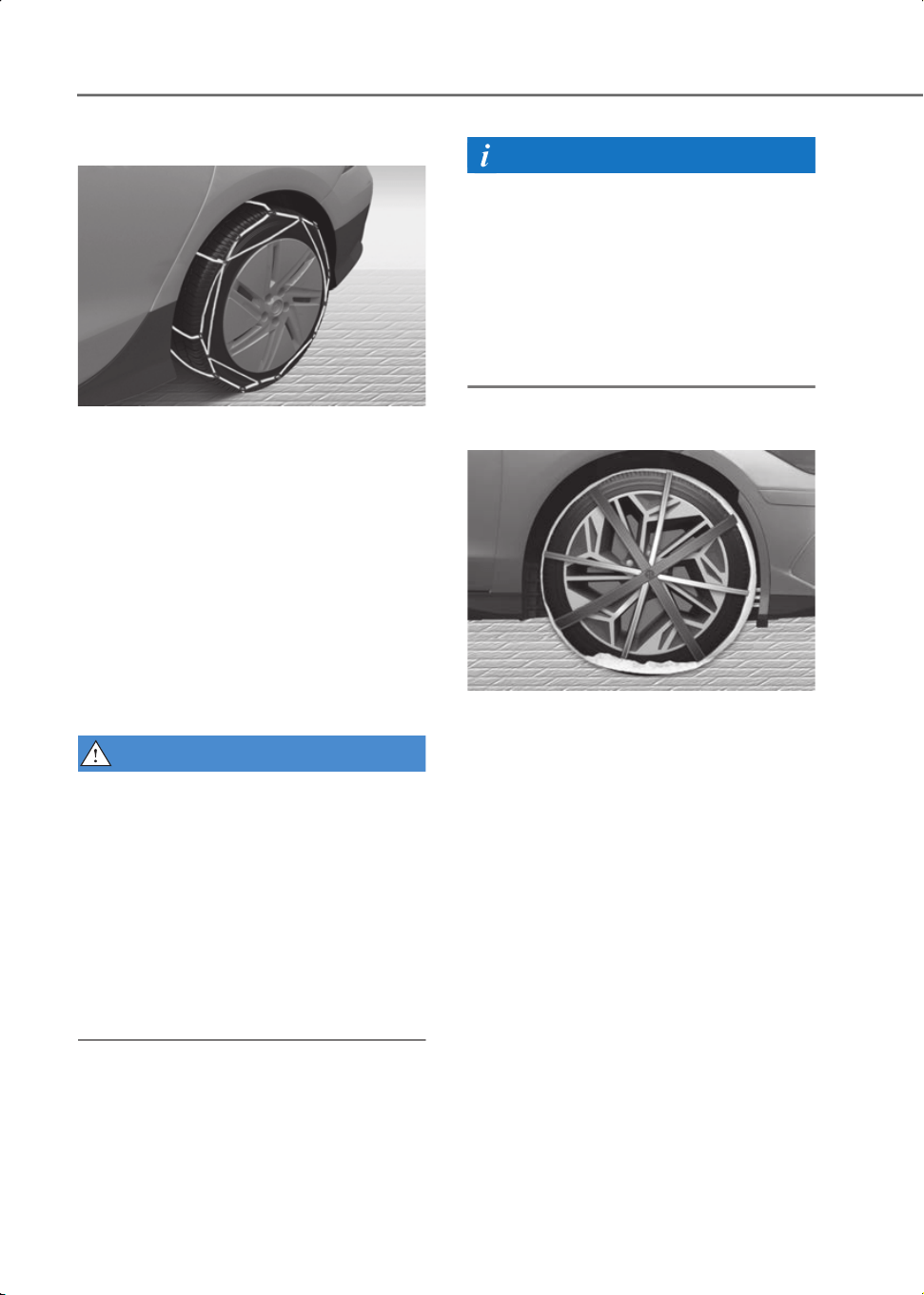
Driving Your Vehicle
6-50
Tire chains (Wire chains)
B6015201
Since the sidewalls of radial tires are
thinner than other types of tires, they may
be damaged by mounting some types of
tire chains on them. Therefore, the use of
snow tires is recommended instead of tire
chains. If tire chains must be used, use
genuine Hyundai parts and install the tire
chain after reviewing the instructions
provided with the tire chains. Damage to
your vehicle caused by improper tire
chain use is not covered by your vehicle
manufacturer’s warranty.
When using tire chains, install tire chains
only on the rear tires.
WARNING
The use of tire chains may adversely
affect vehicle handling:
• Drive less than 20 mph (30 km/h) or the
chain manufacturer’s recommended
speed limit, whichever is lower.
• Drive carefully and avoid bumps, holes,
sharp turns, and other road hazards,
which may cause the vehicle to
bounce.
• Avoid sharp turns or locked wheel
braking.
Information
• Install tire chains only in pairs and on
the rear tires. It should be noted that
installing tire chains on the tires will
provide a greater driving force, but will
not prevent side skids.
• Do not install studded tires without first
checking local and municipal
regulations for possible restrictions
against their use.
Tire chains (Auto sock)
B6015202
Since the sidewalls of radial tires are
thinner, they can be damaged by
mounting some types of snow chains on
them. Therefore, the use of snow tires is
recommended instead of snow chains.
Do not mount tire chains on vehicle
equipped with aluminum wheels; snow
chains may cause damage to the wheels.
If snow chains must be used, use
AutoSock (fabric snow chain). Damage to
your vehicle caused by improper snow
chain use is not covered by your vehicle
manufacturer’s warranty.
When using tire chains, install tire chains
only on the rear tires.
CE_USA.book Page 50

6
6-51
CAUTION
Always check chain installation for proper
mounting after driving about 0.3-0.6 mi.
(0.5-1 km) to ensure safe mounting.
Retighten or remount the chains if they
are loose.
Chain installation
When installing tire chains, follow the
manufacturer’s instructions and mount
them as tightly possible. Drive slowly (less
than 20 mph (30 km/h)) with chains
installed. If you hear the chains
contacting the body or chassis, stop and
tighten them. If they still make contact,
slow down until the noise stops. Remove
the tire chains as soon as you begin
driving on cleared roads.
When mounting snow chains, park the
vehicle on level ground away from traffic.
Turn on the vehicle Hazard Warning
Flasher and place a triangular emergency
warning device behind the vehicle (if
available). Always place the vehicle in P
(Park), apply the parking brake and turn
off the vehicle before installing snow
chains.
NOTICE
When using tire chains:
• Wrong size chains or improperly
installed chains can damage your
vehicle’s brake lines, suspension, body
and wheels.
• Use SAE “S” class or wire chains.
• If you hear noise caused by chains
contacting the body, retighten the
chain to prevent contact with the
vehicle body.
• To prevent body damage, retighten the
chains after driving 0.3-0.6 mi. (0.5-1
km).
• Do not use tire chains on vehicles
equipped with aluminum wheels. If
unavoidable, use a wire type chain.
• Install tire chains that meet the
specifications of each tire size to
prevent damage your vehicle.
• 18 in. tires use wire chains less than 0.59
in. (15 mm).
• 20 in. tires use AutoSock (fabric snow
chain).
Winter Precautions
Use high quality ethylene glycol coolant
Your vehicle is delivered with high quality
ethylene glycol coolant in the cooling
system. It is the only type of coolant that
should be used because it helps prevent
corrosion in the cooling system,
lubricates the water pump, and prevents
freezing. Be sure to replace or replenish
your coolant in accordance with the
"Scheduled Maintenance Services"
section in chapter 9.
Before winter, have your coolant tested to
make sure that its freezing point is
sufficient for the temperatures
anticipated during the winter.
Check battery and cables
Winter temperatures affect battery
performance. Inspect the battery and
cables, as specified in chapter 9. The
battery charging level can be inspected
by an authorized HYUNDAI dealer or in a
service station.
To prevent locks from freezing
Spray approved de-icing fluid or glycerin
into key holes. When a lock opening is
already covered with ice, spray approved
de-icing fluid over the ice to remove it.
When an internal part of a lock freezes, try
to thaw it with a heated key. Carefully use
the heated key to avoid an injury.
CE_USA.book Page 51

Driving Your Vehicle
6-52
Use approved window washer anti-freeze
solution
Add authorized window washer
anti-freeze solution, as specified on the
window washer container. Window
washer anti-freeze solution is available
from an authorized HYUNDAI dealer, and
most vehicle accessory outlets. Do not
use coolant or other types of anti-freeze
solution, to prevent any damage to the
vehicle paint.
Do not let your parking brake freeze
Under some conditions, your parking
brake may freeze in the engaged position.
This is most likely to happen when there is
an accumulation of snow or ice around or
near the rear brakes or the brakes are wet.
When there is the risk that your parking
brake may freeze: temporarily apply the
parking brake with the gear in P (Park),
then block the rear wheels, and then
release the parking brake.
Do not let ice and snow accumulate
underneath
Under some conditions, snow and ice
may build up under the fenders and
interfere with the steering. When driving
in such conditions during the severe
winter, check underneath the vehicle on a
regular basis, to make sure that the front
wheels and the steering components are
not blocked.
Carry emergency equipment
In accordance with weather conditions,
carry appropriate emergency equipment,
while driving. Some of the items you may
want to carry include tire chains, tow
straps or chains, flashlight, emergency
flares, sand, shovel, jumper cables,
window scraper, gloves, ground cloth,
coveralls, blanket, etc.
Do not place objects or materials in the
motor compartment
Putting objects or materials in the motor
compartment may cause a motor failure.
Such damage is not be covered by the
manufacturer’s warranty.
CE_USA.book Page 52
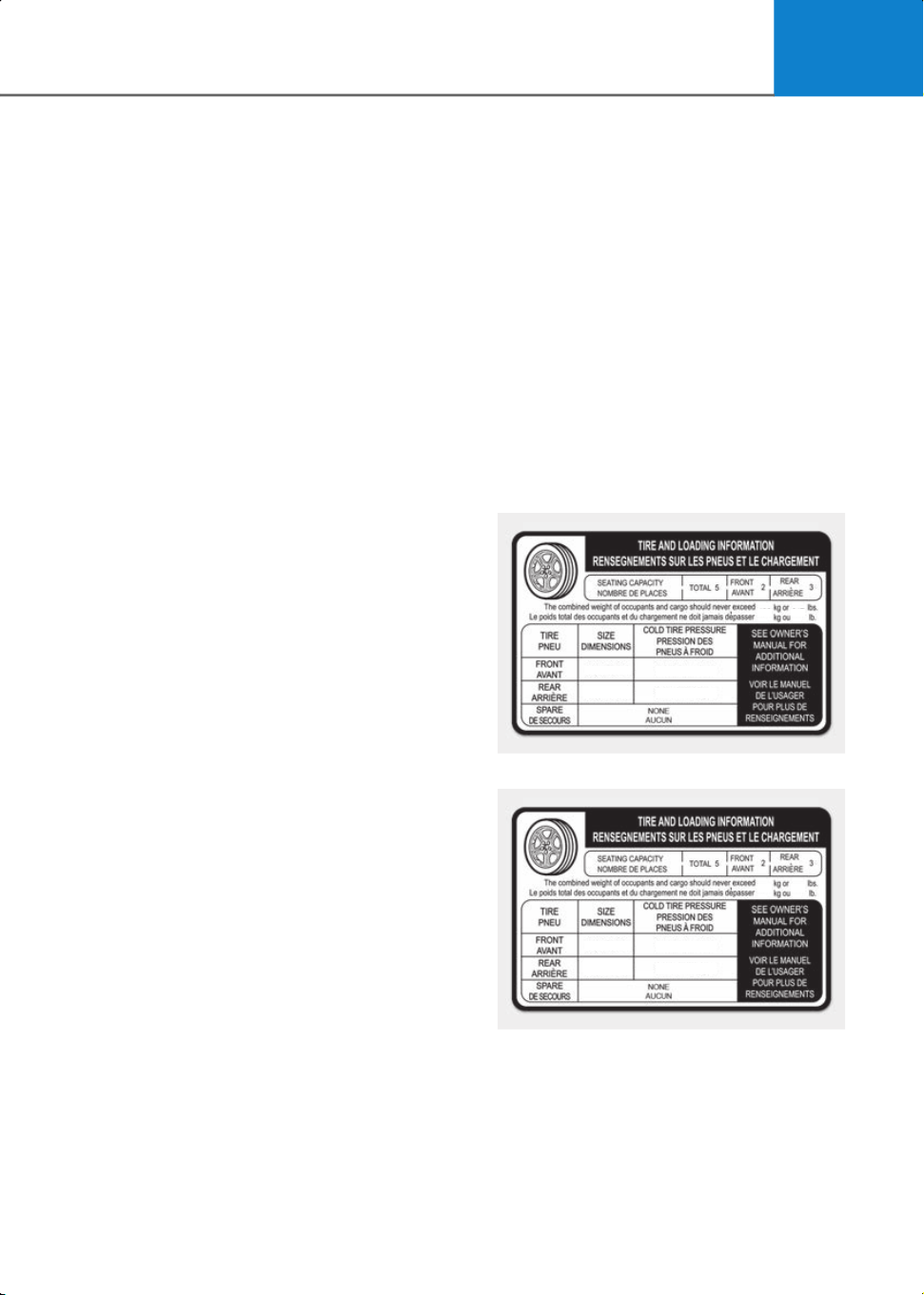
6
6-53
Vehicle Load Limit
Two labels on your driver’s door sill
show how much weight your vehicle
was designed to carry: the Tire and
Loading Information Label and the
Certification Label.
Before loading your vehicle,
familiarize yourself with the following
terms for determining your vehicle’s
weight ratings, from the vehicle’s
specifications and the Certification
Label:
Base Curb Weight
This is the weight of the vehicle
including a full tank of fuel and all
standard equipment. It does not
include passengers, cargo, or
optional equipment.
Vehicle Curb Weight
This is the weight of your new vehicle
when you picked it up from your
dealer plus any aftermarket
equipment.
Cargo Weight
This figure includes all weight added
to the Base Curb Weight, including
cargo and optional equipment.
GAW (Gross Axle Weight)
This is the total weight placed on
each axle (front and rear) - including
vehicle curb weight and all payload.
GAWR (Gross Axle Weight Rating)
This is the maximum allowable
weight that can be carried by a single
axle (front or rear). These numbers
are shown on the Certification Label.
The total load on each axle must
never exceed its GAWR.
GVW (Gross Vehicle Weight)
This is the Base Curb Weight plus
actual Cargo Weight plus passengers.
GVWR (Gross Vehicle Weight Rating)
This is the maximum allowable
weight of the fully loaded vehicle
(including all options, equipment,
passengers and cargo). The GVWR is
shown on the Certification Label
located on the driver’s door sill.
The Loading Information
Label
Type A
ONE1061056N
Type B
ONE1061057N
3
3
L1BQTJ
L1BQTJ
3
3
L1BQTJ
L1BQTJ
CE_USA.book Page 53
Driving Your Vehicle
6-54
Type C
ONE1061058N
Vehicle capacity weight
5 persons: 860 lbs. (390 kg)
Vehicle capacity weight is the
maximum combined weight of
occupants and cargo. If your vehicle
is equipped with a trailer, the
combined weight includes the
tongue load.
Seating capacity
Total : 5 persons (Front seat : 2
persons, Rear seat : 3 persons)
Seating capacity is the maximum
number of occupants including a
driver, your vehicle may carry.
However, the seating capacity may
be reduced based upon the weight of
all of the occupants, and the weight
of the cargo being carried or towed.
Do not overload the vehicle as there
is a limit to the total weight, or load
limit including occupants and cargo,
the vehicle can carry.
Cargo capacity
The cargo capacity of your vehicle
will increase or decrease depending
on the weight and the number of
occupants and the tongue load, if
your vehicle is equipped with a trailer.
Steps for determining correct load
limit
1. Locate the statement "The
combined weight of occupants and
cargo should never exceed XXX kg
or XXX lbs." on your vehicle's
placard.
2.Determine the combined weight of
the driver and passengers that will
be riding in your vehicle.
3.Subtract the combined weight of
the driver and passengers from XXX
kg or XXX lbs.
4.The resulting figure equals the
available amount of cargo and
luggage load capacity. For
example, if the "XXX" amount
equals 1400 lbs. and there will be
five 150 lbs. passengers in your
vehicle, the amount of available
cargo and luggage load capacity is
650 lbs. (1400 - 750 (5 x 150) = 650
lbs.)
5.Determine the combined weight of
luggage and cargo being loaded on
the vehicle. That weight may not
safely exceed the available cargo
and luggage load capacity
calculated in Step 4.
6.If your vehicle will be towing a
trailer, load from your trailer will be
transferred to your vehicle. Consult
this manual to determine how this
reduces the available cargo and
luggage load capacity of your
vehicle.
3
3
L1BQTJ
L1BQTJ
CE_USA.book Page 54
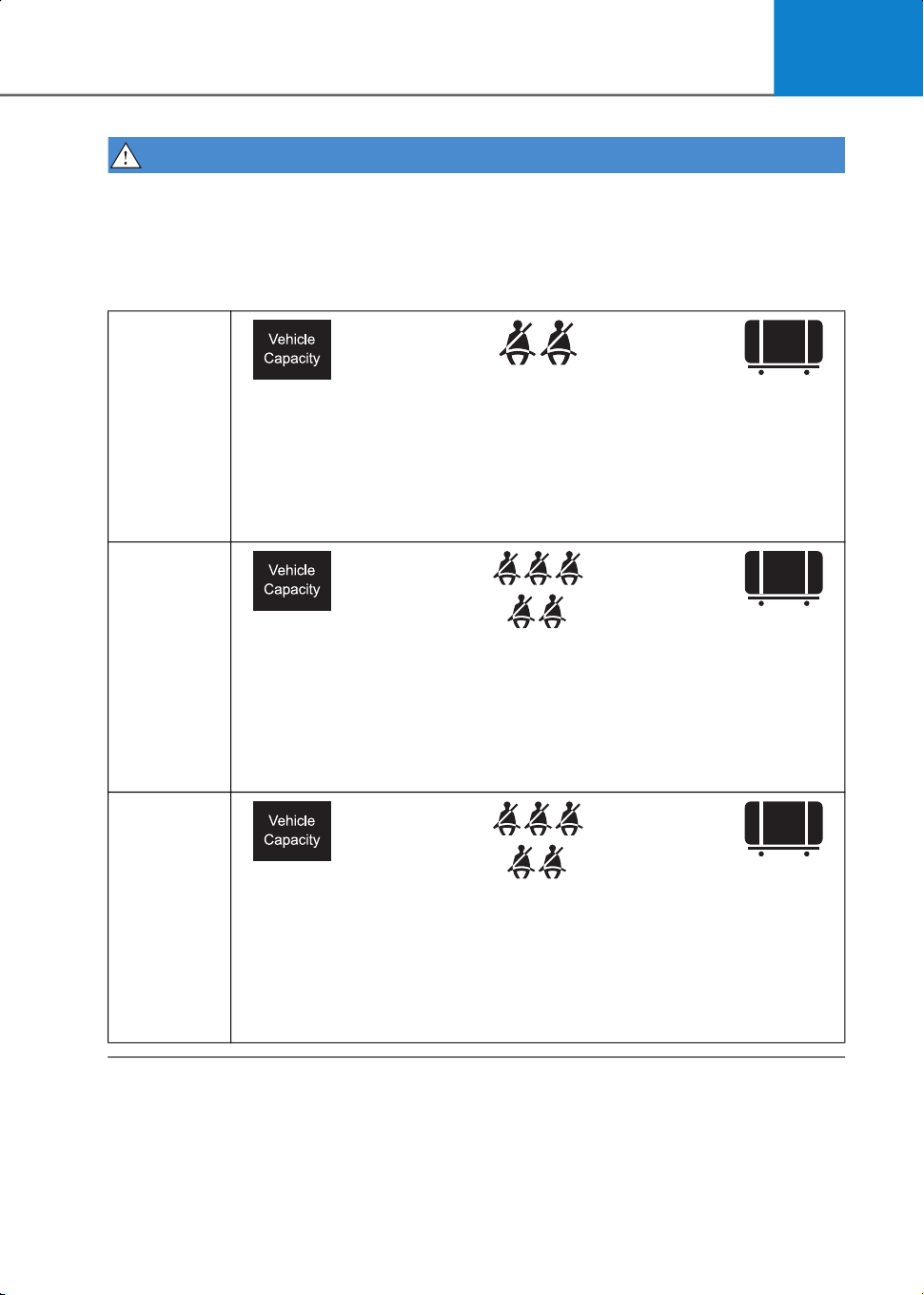
6
6-55
WARNING
Do not overload the vehicle as there is a limit to the total weight, or load limit,
including occupants and cargo, the vehicle can carry. Overloading can shorten
the life of the vehicle. If the GVWR or the GAWR is exceeded, parts on the vehicle
can break, and it can change the handling of your vehicle. These could cause
you to lose control and result in an accident.
Example 1
mark_Vehicle_Capa
city
Maximum
Load
(1400 lbs.)
(635 kg)
≥
mark_OLMB083010
_2
Passenger
Weight
(150 lbs. × 2
= 300 lbs.)
(68 kg × 2 =
136 kg)
+
mark_Weight
Cargo
Weight
(1100 lbs.)
(499 kg)
Example 2
mark_Vehicle_Capa
city
Maximum
Load
(1400 lbs.)
(635 kg)
≥
mark_OLMB083010
Passenger
Weight
(150 lbs. × 5
= 750 lbs.)
(68 kg × 5 =
340 kg)
+
mark_Weight
Cargo
Weight
(650 lbs.)
(295 kg)
Example 3
mark_Vehicle_Capa
city
Maximum
Load
(1400 lbs.)
(635 kg)
≥
mark_OLMB083010
Passenger
Weight
(172 lbs. × 5
= 860 lbs.)
(78 kg × 5 =
390 kg)
+
mark_Weight
Cargo
Weight
(540 lbs.)
(245 kg)
CE_USA.book Page 55
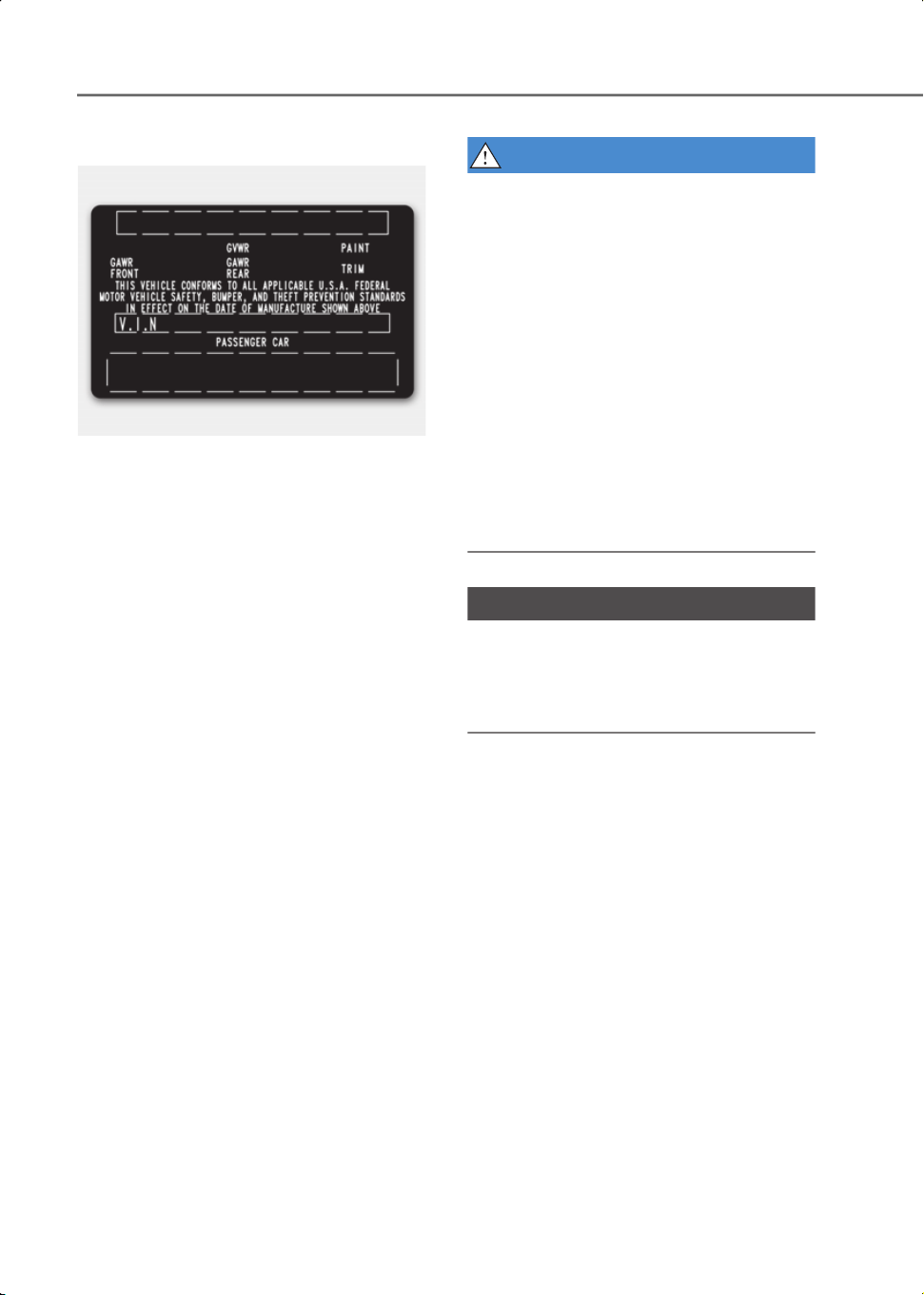
Driving Your Vehicle
6-56
Certification label
OBH059070
The certification label is located on
the driver's door sill at the center
pillar and shows the maximum
allowable weight of the fully loaded
vehicle. This is called the GVWR
(Gross Vehicle Weight Rating). The
GVWR includes the weight of the
vehicle, all occupants, fuel and cargo.
This label also tells you the maximum
weight that can be supported by the
front and rear axles, called Gross Axle
Weight Rating (GAWR).
The total weight of the vehicle,
including all occupants, accessories,
cargo, and trailer tongue load must
not exceed the Gross Vehicle Weight
Rating (GVWR) or the Gross Axle
Weight Rating (GAWR). To find out
the actual loads on your front and
rear axles, you need to go to a weigh
station and weigh your vehicle. Be
sure to spread out your load equally
on both sides of the centerline.
WARNING
Overloading
• Never exceed the GVWR for your
vehicle, the GAWR for either the
front or rear axle and vehicle
capacity weight. Exceeding these
ratings can affect your vehicle's
handling and braking ability, and
cause an accident.
• Do not overload your vehicle.
Overloading your vehicle can cause
heat buildup in your vehicle's tires
and possible tire failure, increased
stopping distances and poor
vehicle handling-all of which may
result in a collision.
NOTICE
Overloading your vehicle may cause
damage. Repairs would not be
covered by your warranty. Do not
overload your vehicle.
CE_USA.book Page 56

6
6-57
WARNING
If you carry items inside your vehicle
(for example, suitcases, tools,
packages, or anything else), they are
moving as fast as the vehicle. If you
have to stop or turn quickly, or if there
is a crash, the items will keep going
and can cause an injury if they strike
the driver or a passenger.
• Put items in the cargo area of your
vehicle. Try to spread the weight
evenly.
• Do not stack items, like suitcases,
inside the vehicle above the tops of
the seats.
• Do not leave an unsecured child
restraint in your vehicle.
• When you carry something inside
the vehicle, secure it.
Trailer Towing
We do not recommend using this vehicle
for trailer towing.
CE_USA.book Page 57

CE_USA.book Page 58

7
7. Driver Assistance System
Driver Assistance System Notice ................................................................................... 7-4
Forward Collision-Avoidance Assist (FCA) .................................................................... 7-4
Forward Collision-Avoidance Assist Settings ............................................................ 7-8
Forward Collision-Avoidance Assist Operation .........................................................7-11
Forward Collision-Avoidance Assist Malfunction and Limitations......................... 7-22
Lane Keeping Assist (LKA).............................................................................................7-30
Lane Keeping Assist Settings ....................................................................................7-30
Lane Keeping Assist Operation..................................................................................7-31
Lane Keeping Assist Malfunction and Limitations .................................................. 7-34
Blind-Spot Collision-Avoidance Assist (BCA) .............................................................. 7-36
Blind-Spot Collision-Avoidance Assist settings.......................................................7-38
Blind-Spot Collision-Avoidance Assist Operation ................................................... 7-39
Blind-Spot Collision-Avoidance Assist Malfunction and Limitations..................... 7-42
Safe Exit Warning (SEW) ...............................................................................................7-46
Safe Exit Warning Settings ........................................................................................ 7-47
Safe Exit Warning Operation.....................................................................................7-48
Safe Exit Warning Malfunction and Limitations ...................................................... 7-49
Manual Speed Limit Assist (MSLA)................................................................................7-51
Manual Speed Limit Assist Operation ....................................................................... 7-51
Intelligent Speed Limit Assist (ISLA) ............................................................................ 7-53
Intelligent Speed Limit Assist Settings..................................................................... 7-54
Intelligent Speed Limit Assist Operation.................................................................. 7-55
Intelligent Speed Limit Assist Malfunction and Limitations ................................... 7-57
Driver Attention Warning (DAW) .................................................................................. 7-59
Driver Attention Warning Settings............................................................................7-60
Driver Attention Warning Operation..........................................................................7-61
Driver Attention Warning Malfunction and Limitations .......................................... 7-62
Blind-Spot View Monitor (BVM) ...................................................................................7-65
Blind-Spot View Monitor Settings ............................................................................7-66
Blind-Spot View Monitor Operation .........................................................................7-66
Blind-Spot View Monitor Malfunction...................................................................... 7-67
Smart Cruise Control (SCC) .......................................................................................... 7-67
Smart Cruise Control Settings ..................................................................................7-68
Smart Cruise Control Operation ............................................................................... 7-70
Smart Cruise Control Malfunction and Limitations................................................. 7-79
CE_USA.book Page 1

7
Navigation-based Smart Cruise Control (NSCC).........................................................7-85
Navigation-based Smart Cruise Control Settings....................................................7-85
Navigation-based Smart Cruise Control Operation................................................ 7-86
Limitations of Navigation-based Smart Cruise Control ..........................................7-87
Lane Following Assist (LFA).......................................................................................... 7-90
Lane Following Assist Settings .................................................................................. 7-91
Lane Following Assist Operation............................................................................... 7-91
Lane Following Assist Malfunction and Limitations ............................................... 7-94
Highway Driving Assist (HDA)...................................................................................... 7-94
Highway Driving Assist Settings............................................................................... 7-96
Highway Driving Assist Operation ............................................................................7-97
Highway Driving Assist Malfunction and Limitations ............................................ 7-103
Rear View Monitor (RVM)............................................................................................ 7-105
Rear View Monitor Settings ..................................................................................... 7-105
Rear View Monitor Operation.................................................................................. 7-106
Rear View Monitor Malfunction and Limitations ...................................................7-108
Surround View Monitor (SVM) ....................................................................................7-108
Surround View Monitor Settings .............................................................................7-109
Surround View Monitor Operation ...........................................................................7-110
Surround View Monitor Malfunction and Limitations ............................................ 7-112
Rear Cross-Traffic Collision-Avoidance Assist (RCCA) .............................................. 7-113
Rear Cross-Traffic Collision-Avoidance Assist Settings ......................................... 7-114
Rear Cross-Traffic Collision-Avoidance Assist Operation ...................................... 7-114
Rear Cross-Traffic Collision-Avoidance Assist Malfunction and Limitations .......7-118
Forward/Reverse Parking Distance Warning (PDW) ..................................................7-122
Forward/Reverse Parking Distance Warning Settings ...........................................7-122
Forward/Reverse Parking Distance Warning Operation ....................................... 7-123
Forward/Reverse Parking Distance Warning Malfunction and Limitations..........7-125
Forward/Side/Reverse Parking Distance Warning (PDW) .........................................7-127
Parking Distance Warning Settings..........................................................................7-127
Parking Distance Warning Operation ..................................................................... 7-128
Parking Distance Warning Malfunction and Limitations....................................... 7-130
Forward/Side/Reverse Parking Collision-Avoidance Assist (PCA)........................... 7-132
Parking Collision-Avoidance Assist Settings .......................................................... 7-133
Parking Collision-Avoidance Assist Operation....................................................... 7-134
CE_USA.book Page 2

7
7. Driver Assistance System
Parking Collision-Avoidance Assist Malfunction and Limitations.........................7-136
Remote Smart Parking Assist 2 (RSPA 2) ................................................................... 7-140
Remote Smart Parking Assist Settings ....................................................................7-142
Remote Smart Parking Assist Operation.................................................................7-143
Remote Smart Parking Assist Malfunction and Limitations ..................................7-159
Declaration Of Conformity...........................................................................................7-165
Front Radar................................................................................................................7-165
Front Corner Radar/Rear Corner Radar ................................................................. 7-166
CE_USA.book Page 3
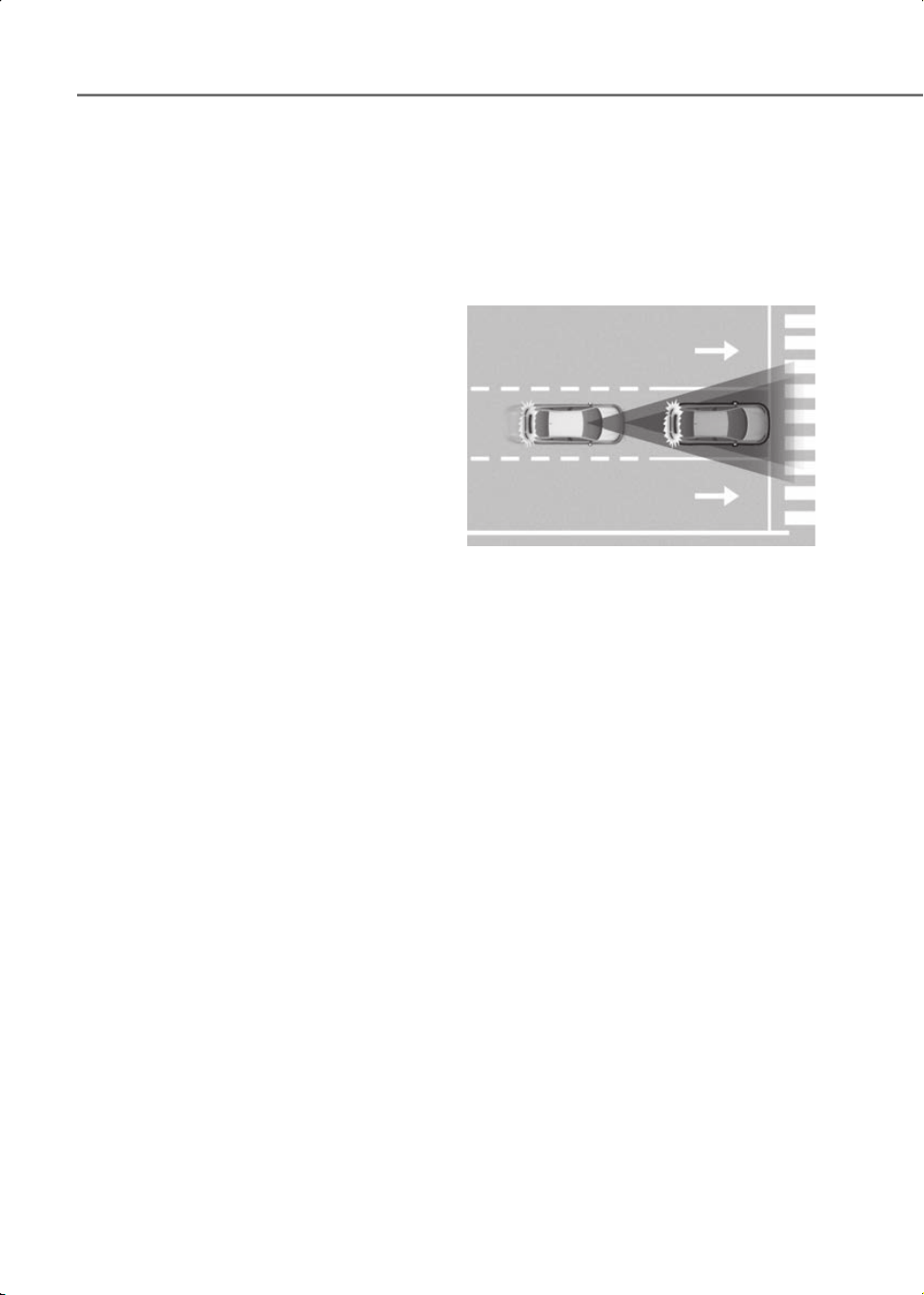
Driver Assistance System
7-4
Driver Assistance System
Notice
Due to the software update, the
description of each function of the driver
assistance system may differ from the
owner's manual.
Forward
Collision-Avoidance
Assist (FCA)
Basic function
B7000101
Forward Collision-Avoidance Assist helps
detect a vehicle, a powered-two wheeler,
a pedestrian, or a cyclist ahead on the
road and may warn you of a possible
collision with a warning message on the
instrument cluster and a warning sound.
Also, Forward Collision-Avoidance Assist
may assist with braking your vehicle to
help reduce collision speed or avoid a
collision.
In addition, when driving at high speeds,
Forward Collision-Avoidance Assist will
help detect vehicles in front and adjacent
lanes. If a collision is imminent when
changing lanes, Forward
Collision-Avoidance Assist will apply
emergency braking to help prevent a
collision. (if equipped)
CE_USA.book Page 4
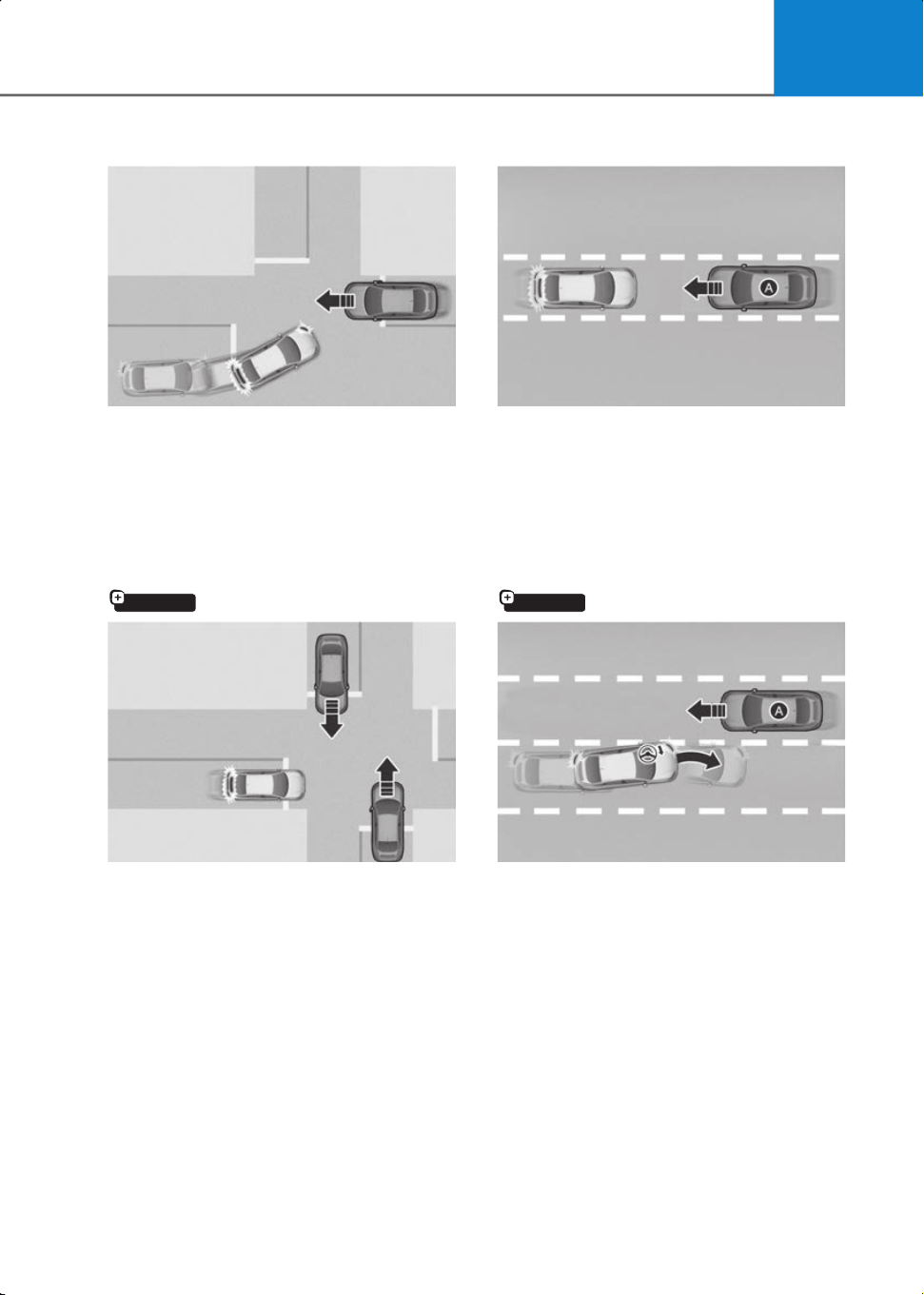
7
7-5
Junction Turning function
B7000102
Junction Turning function can help avoid
a collision with an oncoming vehicle in an
adjacent lane when turning left at a
crossroad with the turn signal on by
applying emergency braking.
if equipped
Junction Crossing function
B7000103
Junction Crossing function can help
avoid a collision with oncoming vehicles
on the left or right side when crossing an
intersection by applying emergency
braking.
Direct Oncoming function
B7000104
[A] Oncoming vehicle
Direct Oncoming function helps reduce
the speed at the collision when a vehicle
approaching from the opposite side is
detected.
if equipped
Lane-Change Oncoming function
B7000105
[A] Oncoming vehicle
Lane-Change Oncoming function helps
avoid a collision with an oncoming
vehicle when changing lanes by assisting
the driver’s steering.
CE_USA.book Page 5
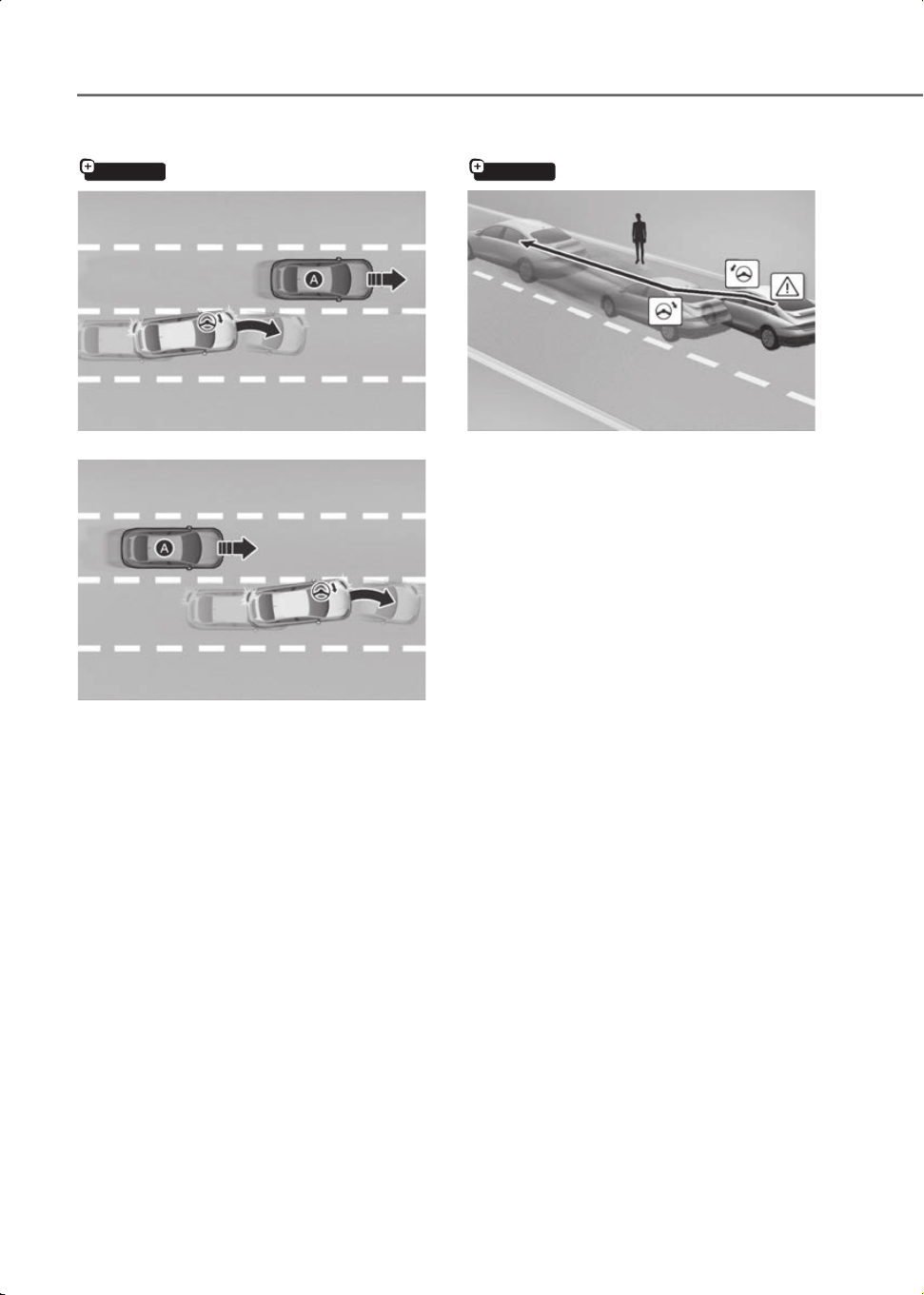
Driver Assistance System
7-6
if equipped
Lane-Change Side function
B7000106
B7000106_1
[A] Side vehicle
Lane-Change Side function helps avoid a
collision with the vehicle in the next lane
when changing lanes by assisting the
driver’s steering.
if equipped
Evasive Steering Assist function
B7000107
• Driver steering assist
Evasive Steering Assist function helps
avoid a collision with a vehicle,
pedestrian or cyclist ahead in the same
lane. When a risk of collision is
detected, Evasive Steering Assist
function will warn the driver and if the
driver steers to avoid collision it will
assist the driver’s steering.
• Evasive steering assist
Evasive Steering Assist function helps
avoid a collision with a pedestrian or
cyclist ahead in the same lane. When a
risk of collision is detected, Evasive
Steering Assist function will warn the
driver and if there is space to avoid
collision in the lane, it will assist the
driver’s steering.
CE_USA.book Page 6
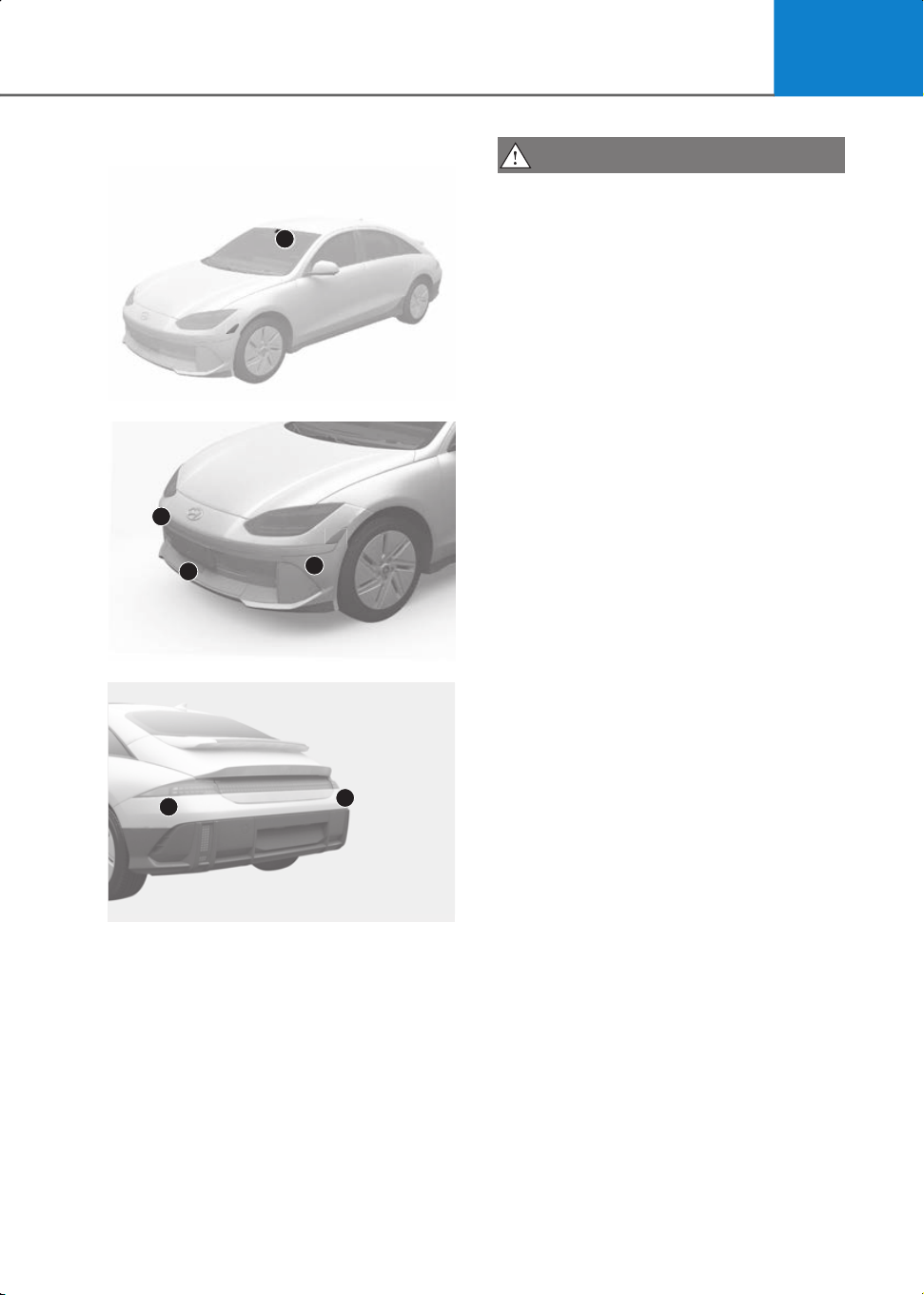
7
7-7
Detecting sensor
B7000108
B7000109
B7000110
(1) Front view camera
(2) Front radar
(3) Front corner radar (if equipped)
(4) Rear corner radar (if equipped)
Refer to the picture above for the detailed
location of the detecting sensors.
CAUTION
Take the following precautions to
maintain optimal performance of the
detecting sensor:
• Never disassemble the detecting
sensor or sensor assembly, or cause
any damage to it.
• If the detecting sensors have been
replaced or repaired, have the vehicle
inspected by an authorized HYUNDAI
dealer.
• Never install any accessories or stickers
on the front windshield, or tint the front
windshield.
• Exercise extreme caution to keep the
front view camera dry.
• Never place any reflective objects (for
example, white paper, mirror) over the
dashboard.
• Do not place any objects near the front
windshield or install any accessories on
the front windshield. It can affect the
performance of the defogging and
defrosting function of the climate
control system, which may prevent the
Driver Assistance systems from
operating.
• Do not apply license plate frame or
objects, such as a bumper sticker, film
or a bumper guard, near the front radar
cover.
• Do not change the position of the
license plate. The front radar’s
detection and control performance
may be affected.
• Always keep the front radar and cover
clean and free of dirt and debris.
Use only a soft cloth to wash the
vehicle. Do not spray pressurized water
directly on the sensor or sensor cover.
1
3
3
2
4
4
CE_USA.book Page 7
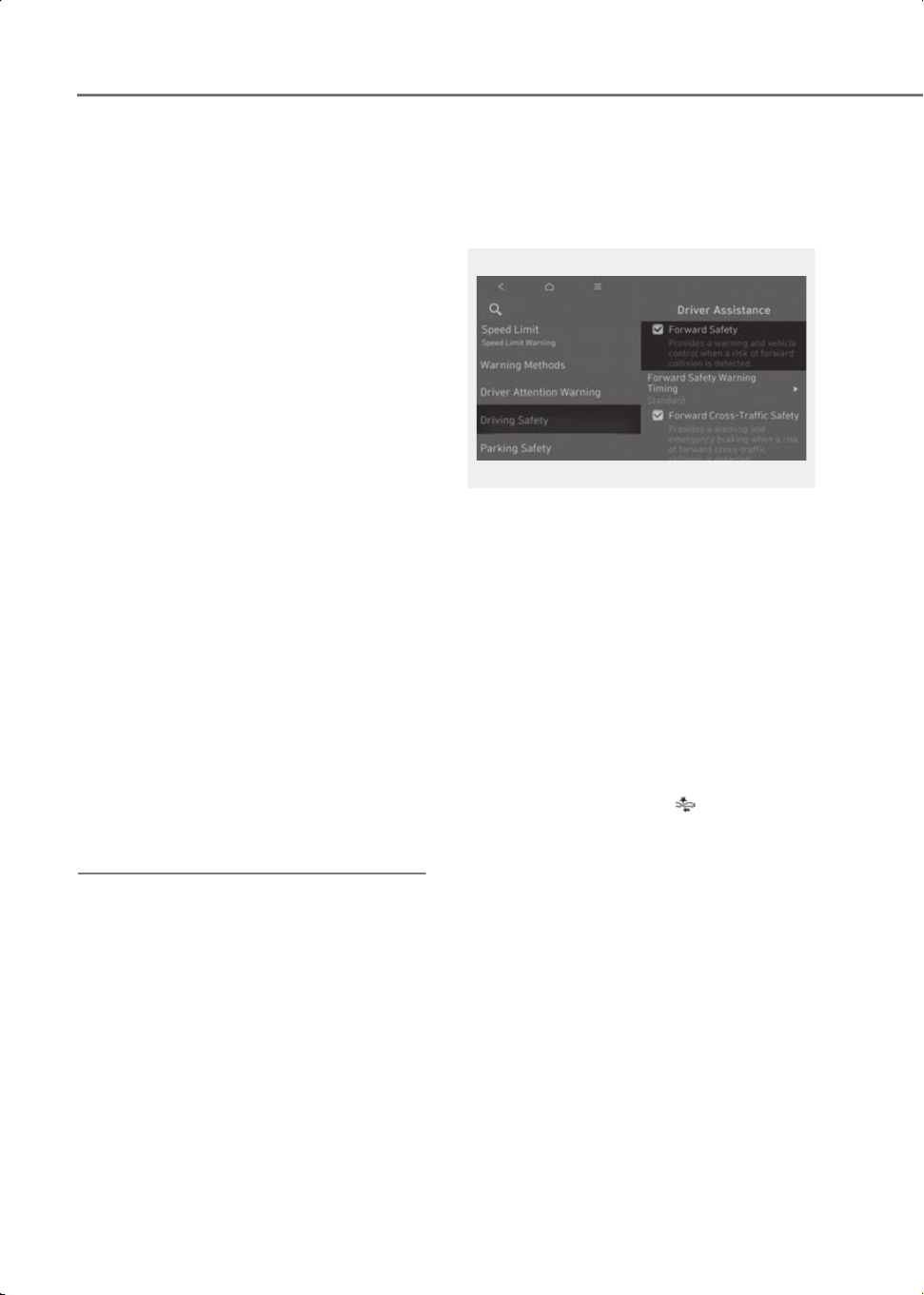
Driver Assistance System
7-8
• If the radar or around the radar has
been damaged or impacted in any way,
Forward Collision-Avoidance Assist
may not properly operate even though
a warning message does not appear on
the instrument cluster. Have the
vehicle inspected by an authorized
HYUNDAI dealer.
• The performance of the front radar
cover genuine parts have been proven.
Replacing or painting the front radar
cover may result in poor performance
of Forward Collision-Avoidance Assist.
When the parts need to be replaced or
modified, make sure to use genuine
HYUNDAI parts.
• Vehicles equipped with front corner
radar and/or rear corner radar
- Do not apply license plate frame or
objects, such as a bumper sticker,
film or a bumper guard, near the front
corner radar or rear corner radar.
- The function may not work properly
when the bumper has been replaced,
or the surroundings of the front
corner radar or rear corner radar has
been damaged or paint has been
applied.
- If a trailer, carrier, etc., is installed, it
may adversely affect the
performance of the rear corner radar
or Forward Collision-Avoidance
Assist may not operate properly.
Forward Collision-Avoidance
Assist Settings
Forward Safety
B7000201_1
With the vehicle on, select or deselect
Setup > Vehicle > Driver Assistance >
Driving Safety > Forward Safety from the
Settings menu to set whether to use each
function.
• If Forward Safety is selected, Forward
Collision-Avoidance Assist will warn the
driver with a warning message, an
audible warning depending on the
collision risk levels. Braking assist will
be applied depending on the collision
risk levels. If Forward Safety is
deselected, Forward Safety will turn
off. The warning light ( ) will
illuminate on the instrument cluster.
CE_USA.book Page 8
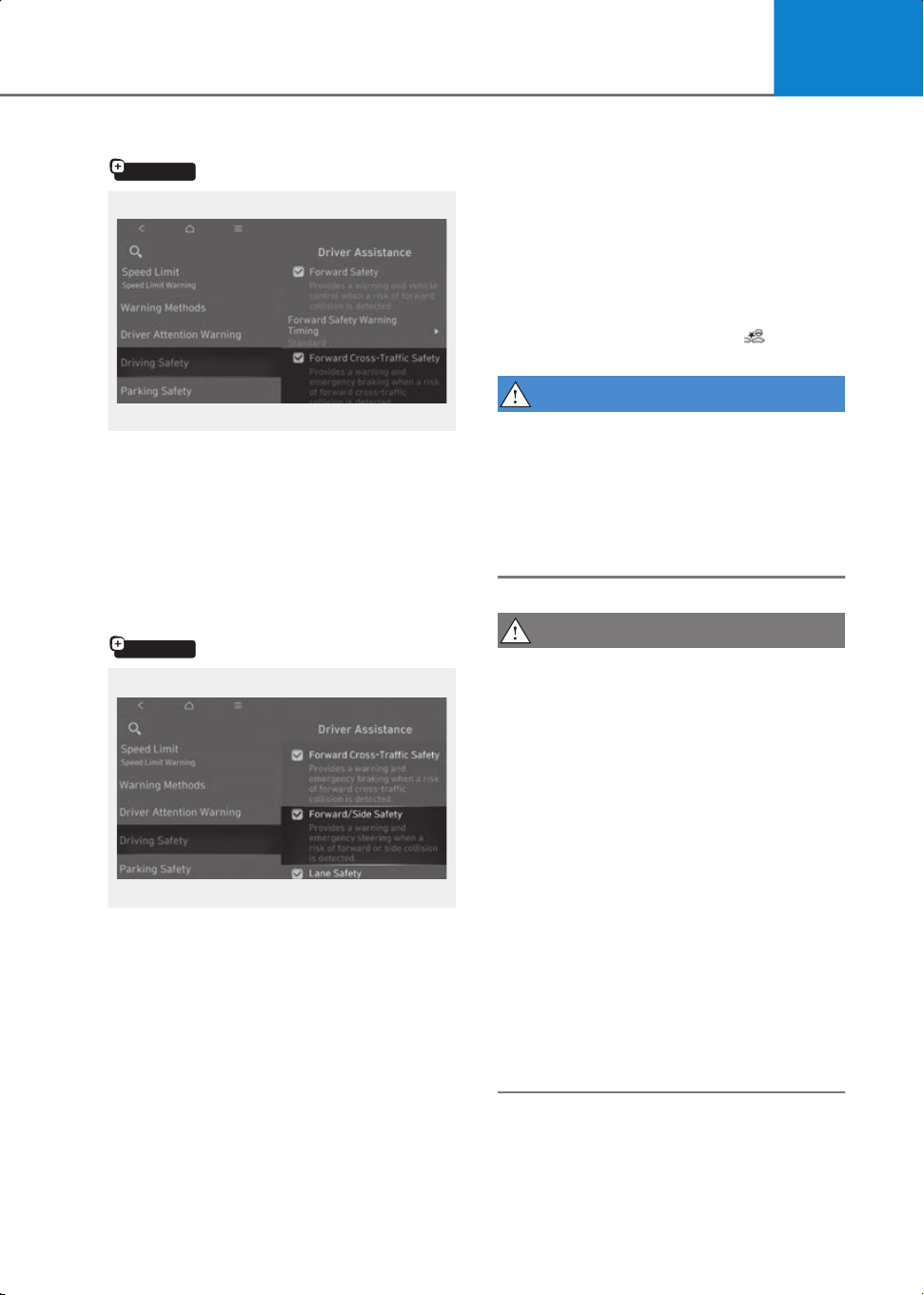
7
7-9
if equipped
Forward Cross-Traffic Safety
B7000201_2
With the vehicle on, select Setup >
Vehicle > Driver Assistance > Driving
Safety > Forward Cross-Traffic Safety
from the Settings menu to turn on
Junction crossing function and deselect
to turn off the function.
if equipped
Forward/Side Safety
B7000203
With the vehicle on, select Setup >
Vehicle > Driver Assistance > Driving
Safety > Forward/Side Safety from the
Settings menu to turn on Lane-Change
Oncoming function, Lane-Change Side
function, Evasive Steering Assist function
and deselect to turn off the functions.
• If Forward/Side Safety is selected,
Forward Collision-Avoidance Assist will
warn the driver, steering wheel
vibration, a warning message, an
audible warning depending on the
collision risk levels. Steering assist will
be applied depending on the collision
risk levels. If Forward/Side Safety is
deselected, Forward/Side Safety will
turn off. The warning light ( ) will
illuminate on the instrument cluster.
WARNING
When the vehicle is restarted, Forward
Collision-Avoidance Assist will always
turn on. However, at all times, and
especially if Forward Safety is
deselected, the driver should always be
aware of the surroundings and drive
safely.
CAUTION
• The setting for Forward Safety include
‘Basic function’ and ‘Junction Turning’,
and 'Direct Oncoming’.
• The setting for Forward-Cross Traffic
Safety includes ‘Junction Crossing’.
• The setting for Forward/Side Safety
includes ‘Lane Change Oncoming’,
‘Lane-Change Side’ and ‘Evasive
Steering Assist’ (if equipped).
• If Forward Safety is deselected,
Junction Crossing function will not
operate even when Forward
Cross-Traffic Safety and Forward/Side
Safety is selected. (if equipped)
• Steering wheel vibration can be turned
on or off. Select or deselect Driver
Assistance > Warning Methods >
Haptic Warning from the Settings
menu.
CE_USA.book Page 9
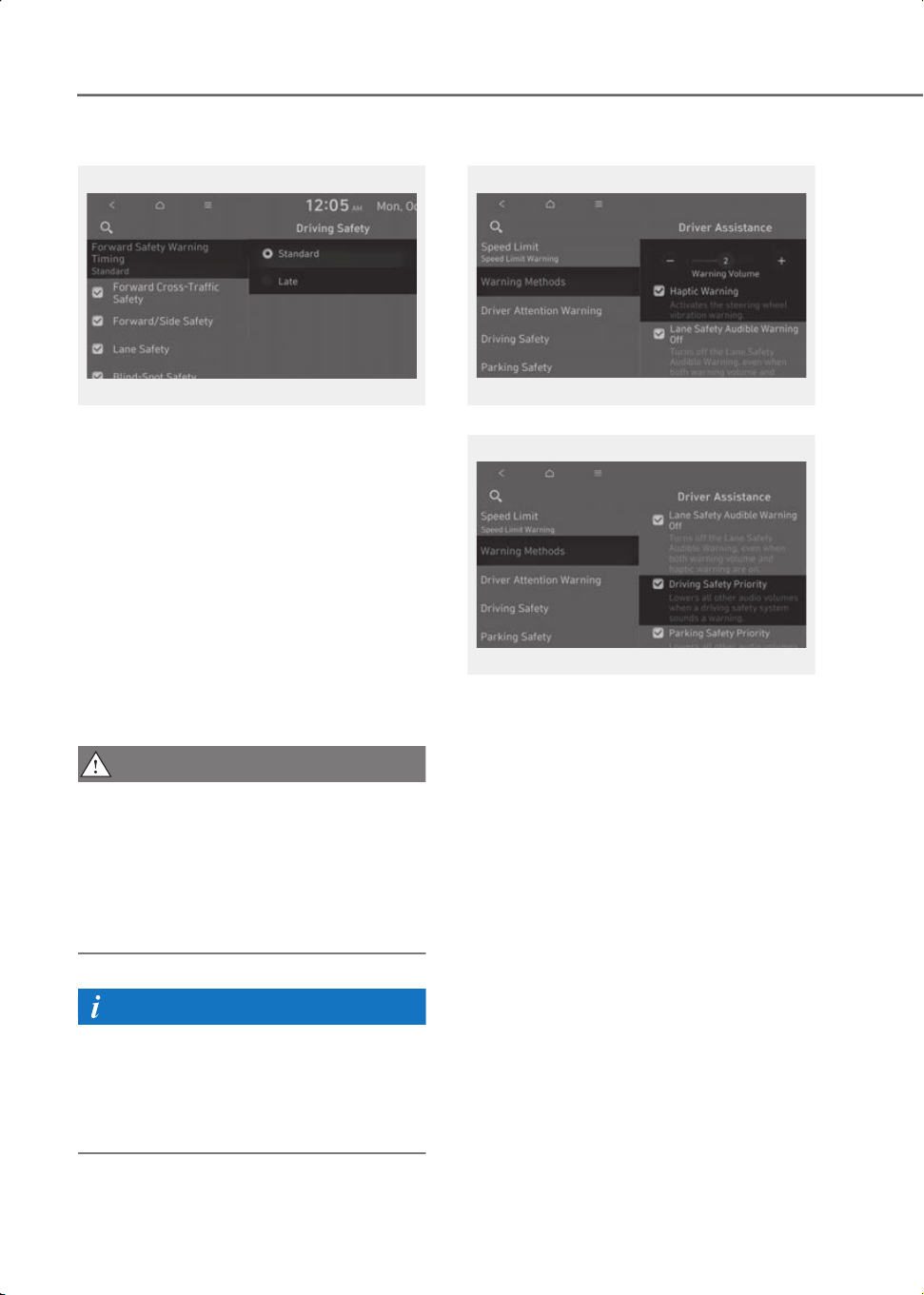
Driver Assistance System
7-10
Forward Safety Warning Timing
B7000204
With the vehicle on, select Setup >
Vehicle > Driver Assistance > Driving
Safety > Forward Safety Warning Timing
from the Settings menu to change the
initial warning activation time for Forward
Collision-Avoidance Assist. The warning
time can be set to either Standard or
Late.
• Use Standard in normal driving
conditions. If the Warning Timing
seems sensitive, change it to Late.
• If Late is selected, Forward
Collision-Avoidance Assist, warns the
driver more slowly.
CAUTION
• Even though Standard is selected for
Warning Timing, if a detected vehicle in
front suddenly stops, the warning may
seem late.
• Select Late for Warning Timing when
traffic is light and when driving speed is
slow.
Information
• If you change the Warning timing, the
Warning timing of other Driver
assistance systems may change.
• If the vehicle is restarted, Warning
timing will maintain the last setting.
Warning Methods
B7000205
B7000205_1
With the vehicle on, go to Setup > Vehicle
> Driver Assistance > Warning Methods
from the Settings in the infotainment
system to select the following:
• Warning Volume: The Warning Volume
can be adjusted.
If you turn off the Warning Volume, for
your safety, the function may warn you
with a low volume.
• Haptic Warning: The steering wheel
vibration can be set.
• Driving Safety Priority: Your vehicle
lowers all other audio volumes when
the Driver Assistance system warning
sounds.
CE_USA.book Page 10
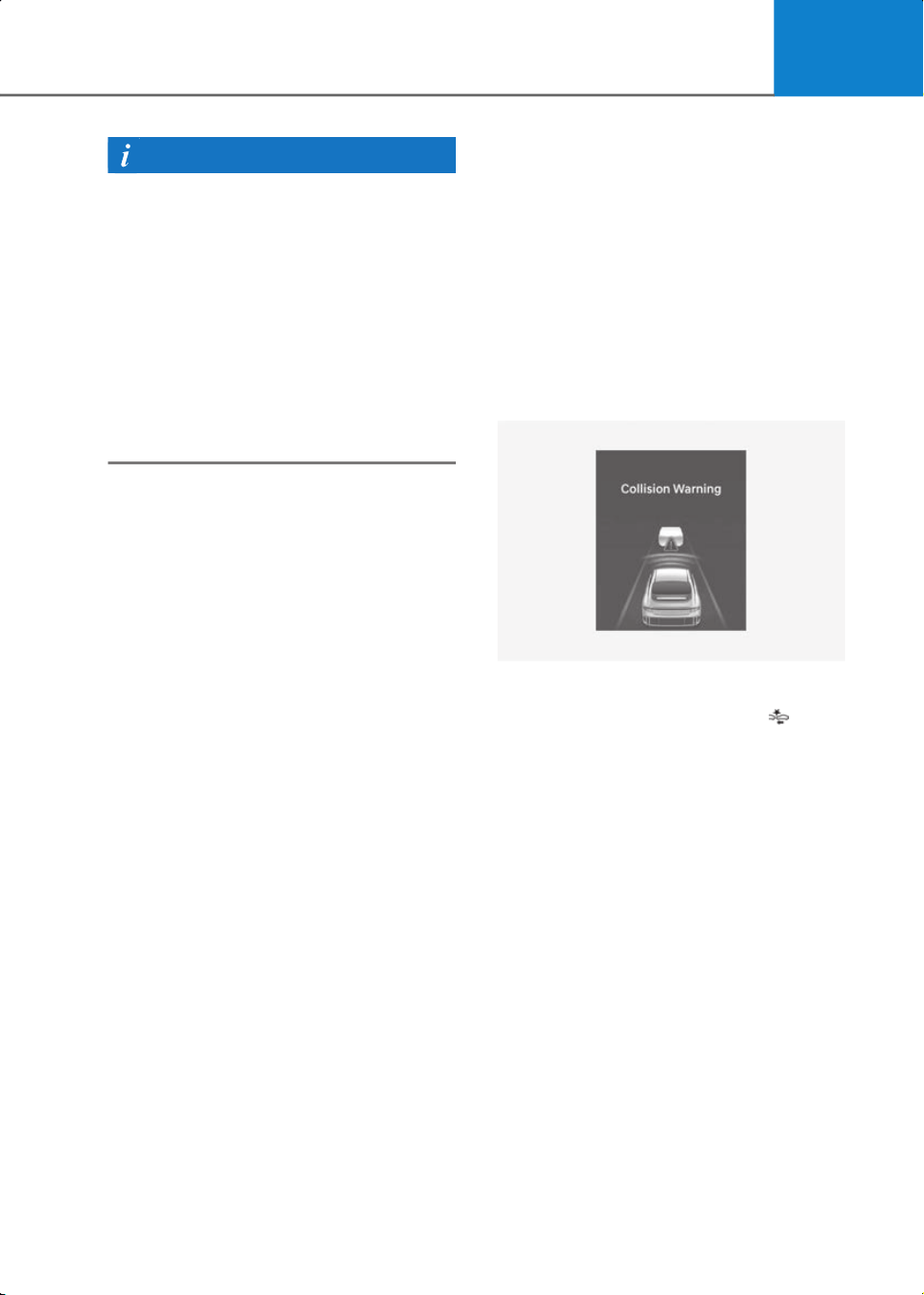
7
7-11
Information
• If you change the Warning Methods,
Warning Methods of other Driver
Assistance systems may change.
• If the vehicle is restarted, Warning
Methods will maintain the last setting.
• There may be no Settings menu
depending on the feature applied to
your vehicle.
• The Warning Volume and Haptic
Warning cannot be turned off at the
same time. When one of the warning is
turned off, the other is activated.
Forward Collision-Avoidance
Assist Operation
Basic function
The basic function for Forward
Collision-Avoidance Assist is to warn and
help control the vehicle depending on the
collision risk level: ‘Collision Warning’,
‘Emergency Braking’ and ‘Stopping
vehicle and ending brake control’.
Collision Warning
B7000301
• To warn the driver of a collision,
Forward Safety warning light ( )
blinking, the ‘Collision Warning’
warning message will appear on the
instrument cluster, an audible warning
will sound and the steering wheel will
vibrate.
• If a vehicle or powered two-wheeler is
detected in front, the function will
operate when your vehicle speed is
between about 6-124 mph (10-200
km/h).
• If a pedestrian or cyclist is detected in
front, the function will operate when
your vehicle speed is between about
6-53 mph (10-85 km/h).
CE_USA.book Page 11
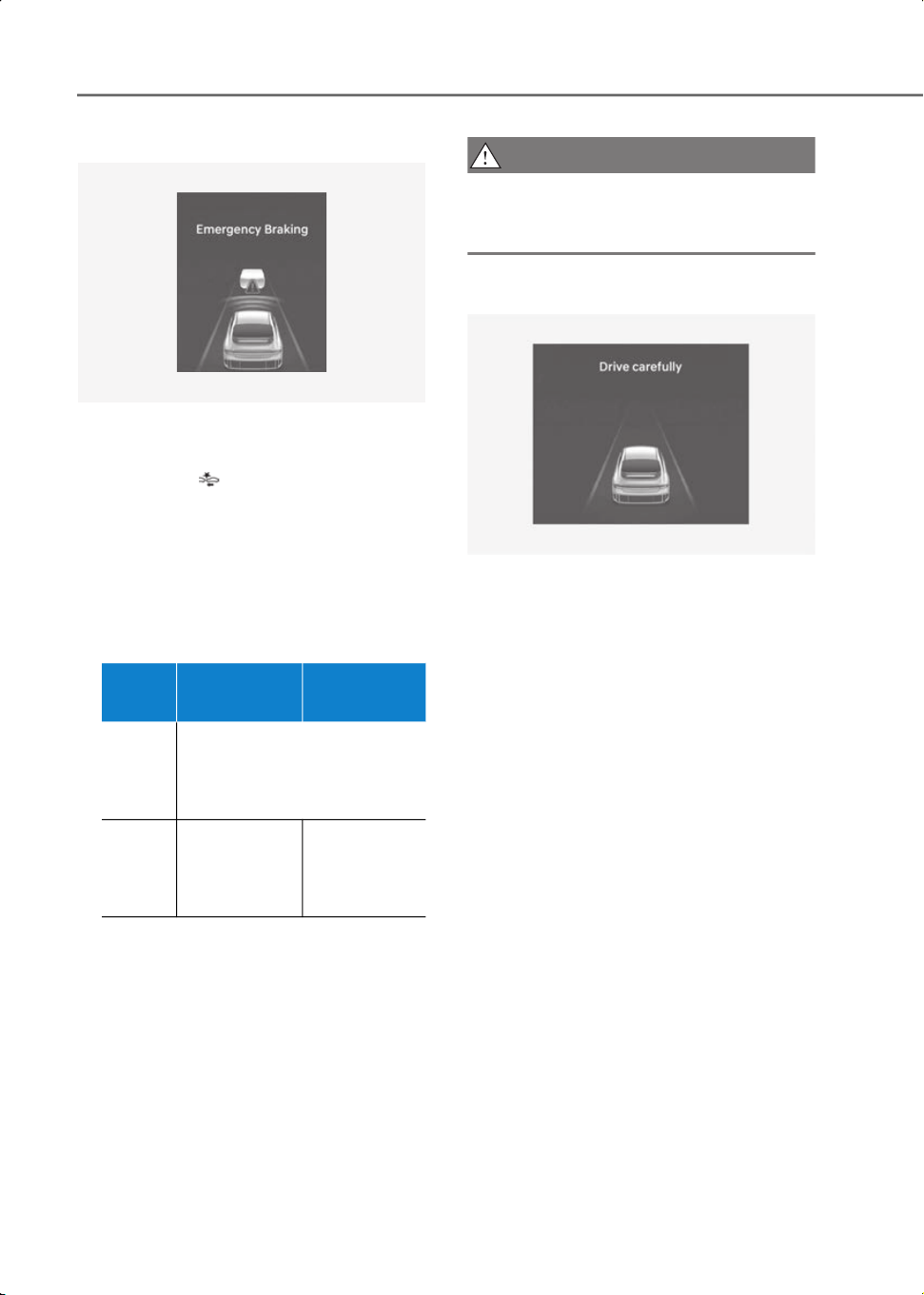
Driver Assistance System
7-12
Emergency Braking
B7000302
To warn the driver that emergency
braking will be assisted, Forward Safety
warning light ( ) blinking, the
‘Emergency Braking’ warning message
will appear on the instrument cluster, an
audible warning will sound and the
steering wheel will vibrate.
Emergency braking will operate under the
following conditions:
• Vehicle or powered two-wheeler:
*: If Forward Collision-Avoidance Assist
judges that avoiding a collision is
difficult even by changing the driving
lane. The function operation range may
decrease due to surroundings of the
vehicle. (if equipped)
• Pedestrian or cyclist:
The function will operate when your
vehicle speed is between about 6-40
mph (10-65 km/h).
CAUTION
The function operation range may
decrease due to the front traffic condition
or the surroundings of the vehicle.
Stopping vehicle and ending brake control
B7000303
• When the vehicle is stopped due to
emergency braking, the ‘Drive
carefully’ warning message will appear
on the instrument cluster.
For your safety, the driver should
depress the brake pedal immediately
and check the surroundings.
• Brake control will end after the vehicle
is stopped by emergency braking for
about 2 seconds.
Junction Turning function
Junction Turning function will warn and
help control the vehicle depending on the
collision risk level: ‘Collision Warning’,
‘Emergency Braking’ and ‘Stopping
vehicle and ending brake control’
Driving
vehicle
Stopped
vehicle
Weak
brakin
g
power
About 6-124 mph (10-200
km/h)
Strong
brakin
g
power
About 6-80
mph (10-130
km/h)
About 6-47
mph (10-75
km/h)*
CE_USA.book Page 12
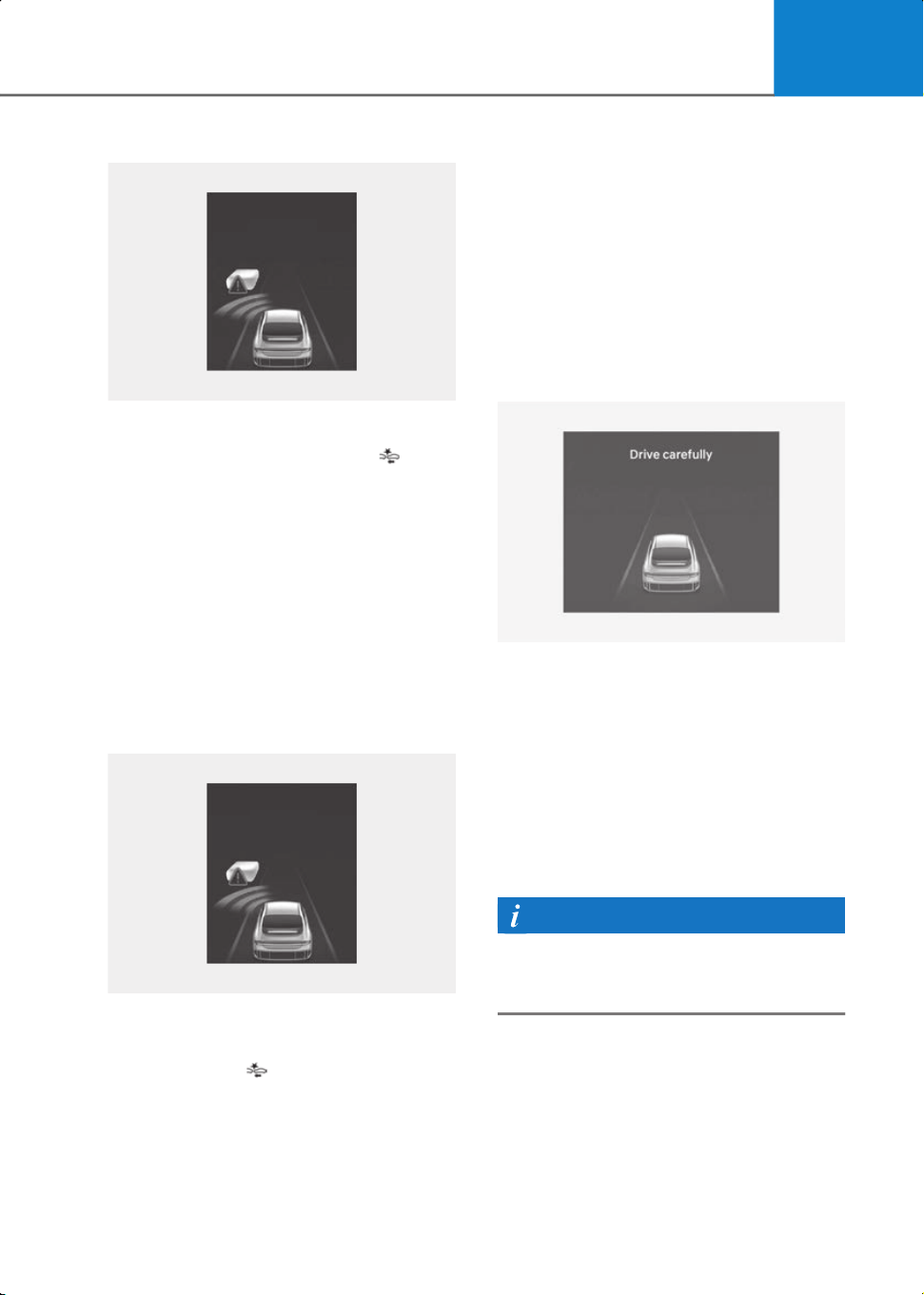
7
7-13
Collision Warning
B7000315_3
• To warn the driver of a collision,
Forward Safety warning light ( )
blinking, the ‘Collision Warning’
warning message will appear on the
instrument cluster, an audible warning
will sound and the steering wheel will
vibrate.
• The function will operate when your
vehicle speed is between about 6-19
mph (10-30 km/h) and the oncoming
vehicle or powered two-wheeler speed
is between about 19-44 mph (30-70
km/h).
Emergency Braking
B7000315_1
• To warn the driver that emergency
braking will be assisted, Forward Safety
warning light ( ) blinking, the
‘Emergency Braking’ warning message
will appear on the instrument cluster,
an audible warning will sound and the
steering wheel will vibrate.
• In emergency braking situation,
braking is assisted with strong braking
power by the function to help prevent
collision with the oncoming vehicle.
• The function will operate when your
vehicle speed is between about 6-19
mph (10-30 km/h) and the oncoming
vehicle or powered two-wheeler speed
is between about 19-44 mph (30-70
km/h).
Stopping vehicle and ending brake control
B7000303
• When the vehicle is stopped due to
emergency braking, the ‘Drive
carefully’ warning message will appear
on the instrument cluster.
For your safety, the driver should
depress the brake pedal immediately
and check the surroundings.
• Brake control will end after the vehicle
is stopped by emergency braking for
about 2 seconds.
Information
Press the hazard warning flasher to turn
off the audible warning of the collision
warning or emergency braking system.
$PMMJTJPO8BSOJOH
&NFSHFODZ#SBLJOH
CE_USA.book Page 13
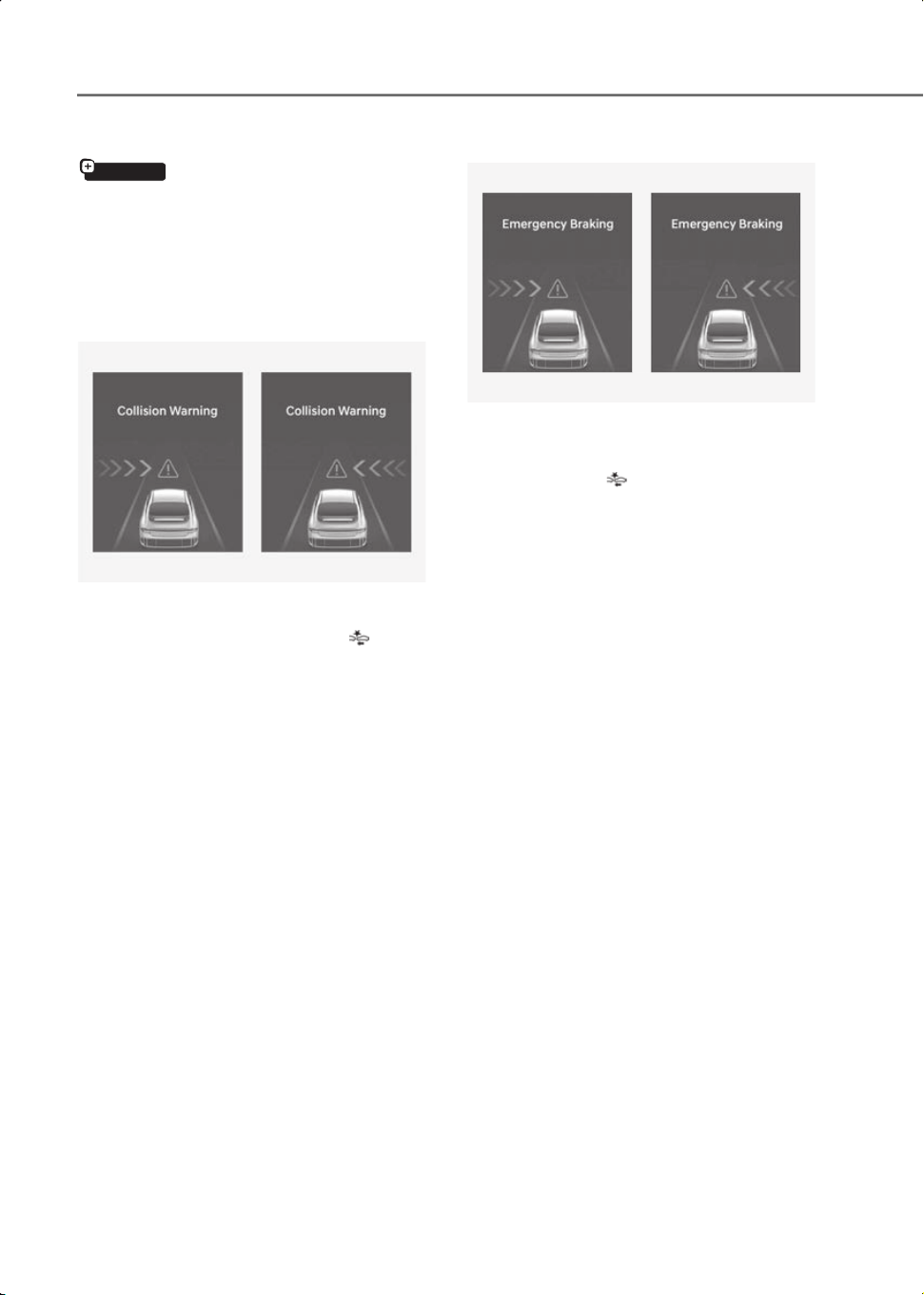
Driver Assistance System
7-14
if equipped
Junction Crossing function
Junction Crossing function will warn and
control the vehicle depending on collision
risk level: ‘Collision Warning’, ‘Emergency
Braking’ and ‘Stopping vehicle and
ending brake control’
Collision Warning
B7000307
• To warn the driver of a collision,
Forward Safety warning light ( )
blinking, the ‘Collision Warning’
warning message will appear on the
instrument cluster, an audible warning
will sound and the steering wheel will
vibrate.
• The function will operate when your
vehicle speed is between about 6-34
mph (10-55 km/h) and the crossing
vehicle speed is between about 6-37
mph (10-60 km/h).
Emergency Braking
B7000308
• To warn the driver that emergency
braking will be assisted, Forward Safety
warning light ( ) blinking, the
‘Emergency Braking’ warning message
will appear on the instrument cluster,
an audible warning will sound and the
steering wheel will vibrate.
• In emergency braking situation,
braking is assisted with strong braking
power by the function to help prevent
collision with the crossing vehicle.
• The function will operate when your
vehicle speed is between about 6-34
mph (10-55 km/h) and the crossing
vehicle speed is between about 6-25
mph (10-40 km/h).
CE_USA.book Page 14
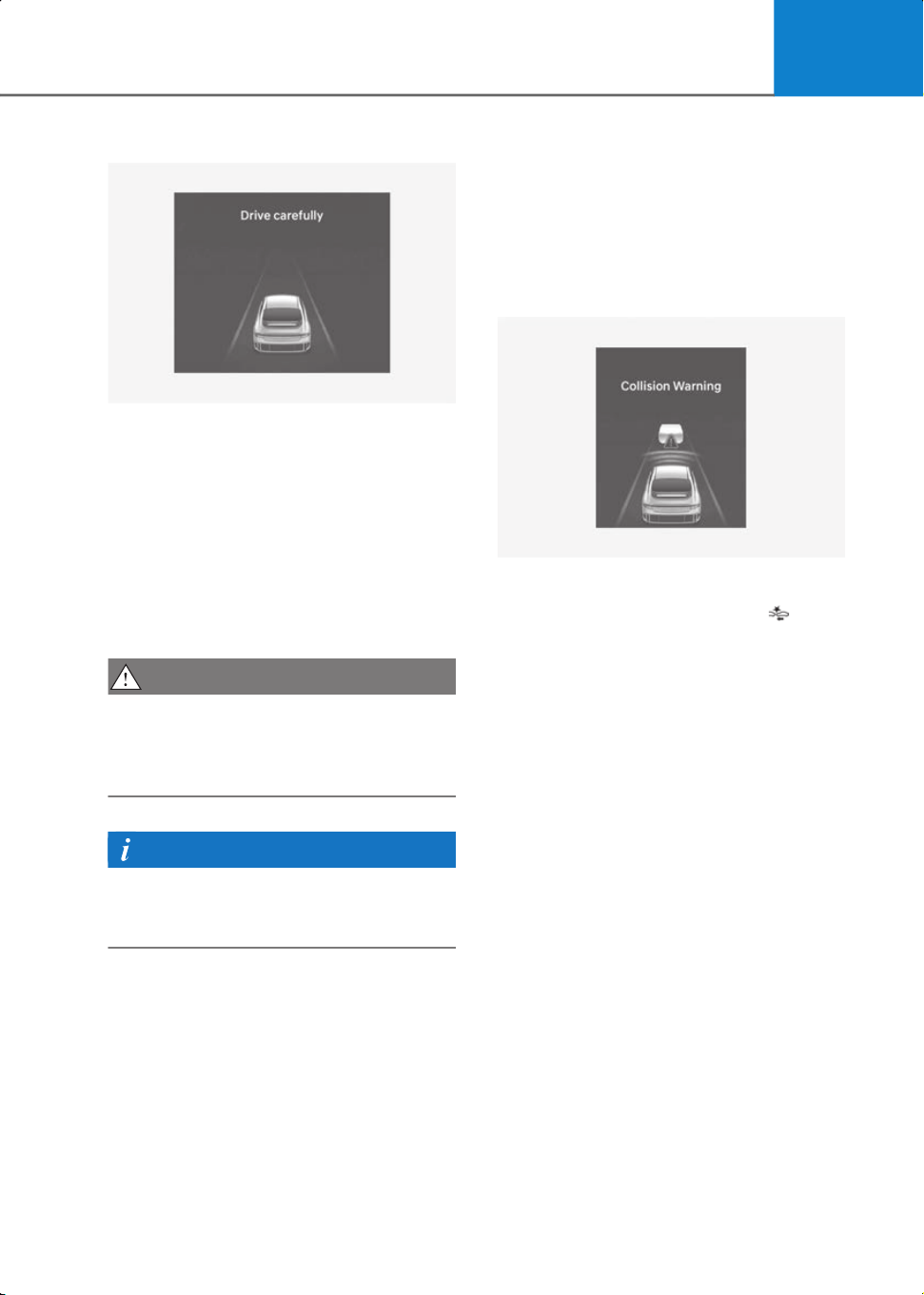
7
7-15
Stopping vehicle and ending brake control
B7000303
• When the vehicle is stopped due to
emergency braking, the ‘Drive
carefully’ warning message will appear
on the instrument cluster.
For your safety, the driver should
depress the brake pedal immediately
and check the surroundings.
• Brake control will end after the vehicle
is stopped by emergency braking for
about 2 seconds.
CAUTION
If the collision angle with the crossing
vehicle is beyond a certain range,
Junction Crossing function warning and
control may be late or may not operate.
Information
Press the hazard warning flasher to turn
off the audible warning of the collision
warning or emergency braking system.
Direct Oncoming function
Direct Oncoming function will warn and
control the vehicle depending on the
collision risk level: ‘Collision Warning’,
‘Emergency Braking’ and ‘Stopping
vehicle and ending brake control’.
Collision Warning
B7000301
• To warn the driver of a collision,
Forward Safety warning light ( )
blinking, the ‘Collision Warning’
warning message will appear on the
instrument cluster, an audible warning
will sound and the steering wheel will
vibrate.
• The function will operate when your
vehicle speed is between about 6-80
mph (10-130 km/h) and the detected
oncoming vehicle speed is about above
6 mph (10 km/h) and the oncoming
motorcycle speed is about above 16
mph (25 km/h).
CE_USA.book Page 15
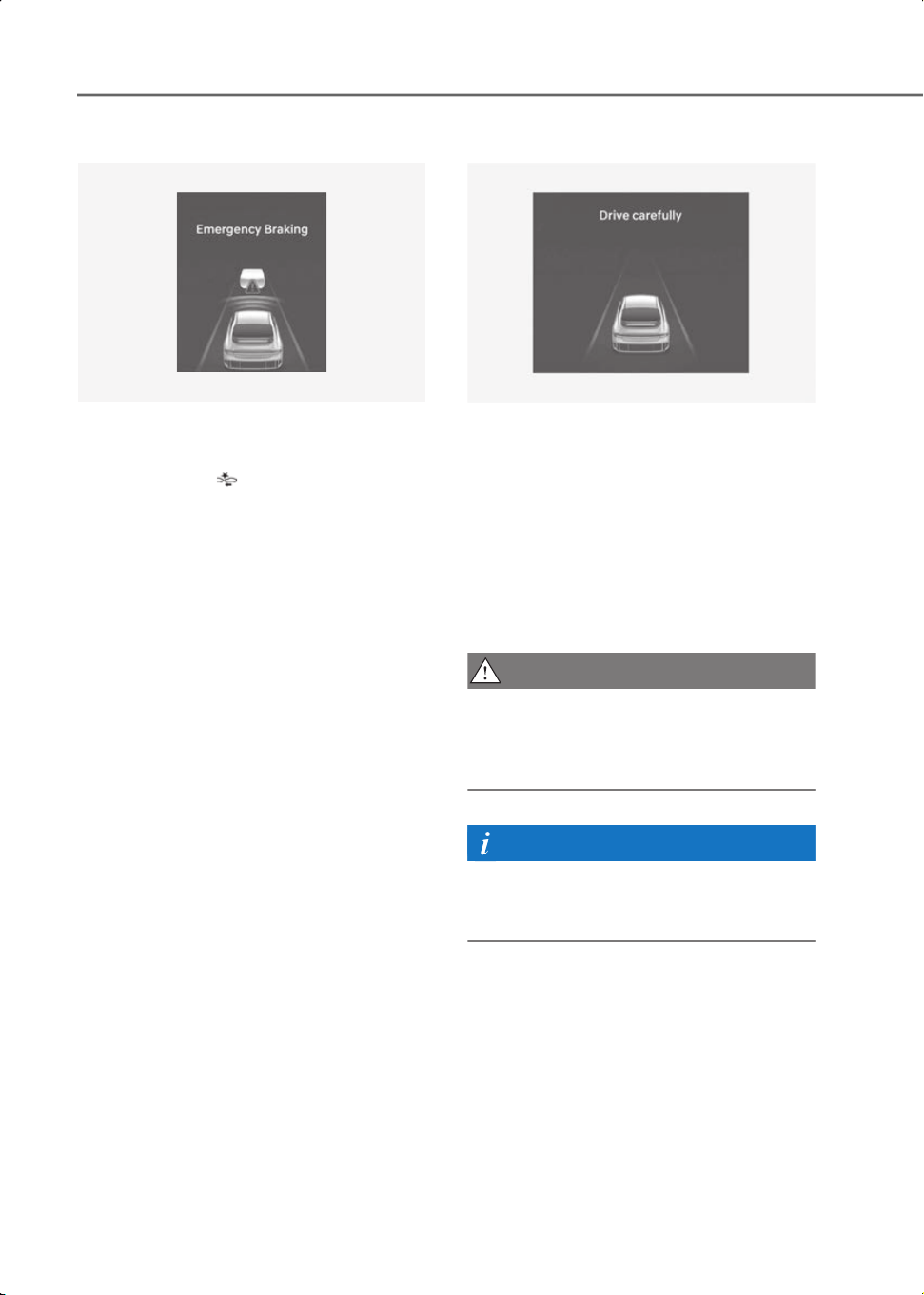
Driver Assistance System
7-16
Emergency Braking
B7000302
• To warn the driver that emergency
braking will be assisted, Forward Safety
warning light ( ) blinking, the
‘Emergency Braking’ warning message
will appear on the instrument cluster,
an audible warning will sound and the
steering wheel will vibrate.
• In emergency braking situation,
braking is assisted with strong braking
power by the function to help prevent
collision with the oncoming vehicle.
• The function will operate when your
vehicle speed is between about 19-80
mph (30-130 km/h) and the detected
oncoming vehicle speed is about above
6 mph (10 km/h).
Stopping vehicle and ending brake control
B7000303
• When the vehicle is stopped due to
emergency braking, the ‘Drive
carefully’ warning message will appear
on the instrument cluster. For your
safety, the driver should depress the
brake pedal immediately and check the
surroundings.
• Brake control will end after the vehicle
is stopped by emergency braking for
about 2 seconds.
CAUTION
If your vehicle or the oncoming vehicle is
not driving straight, Direct Oncoming
function warning and control may be late
or may not operate.
Information
Press the hazard warning flasher to turn
off the audible warning of the collision
warning or emergency braking system.
CE_USA.book Page 16
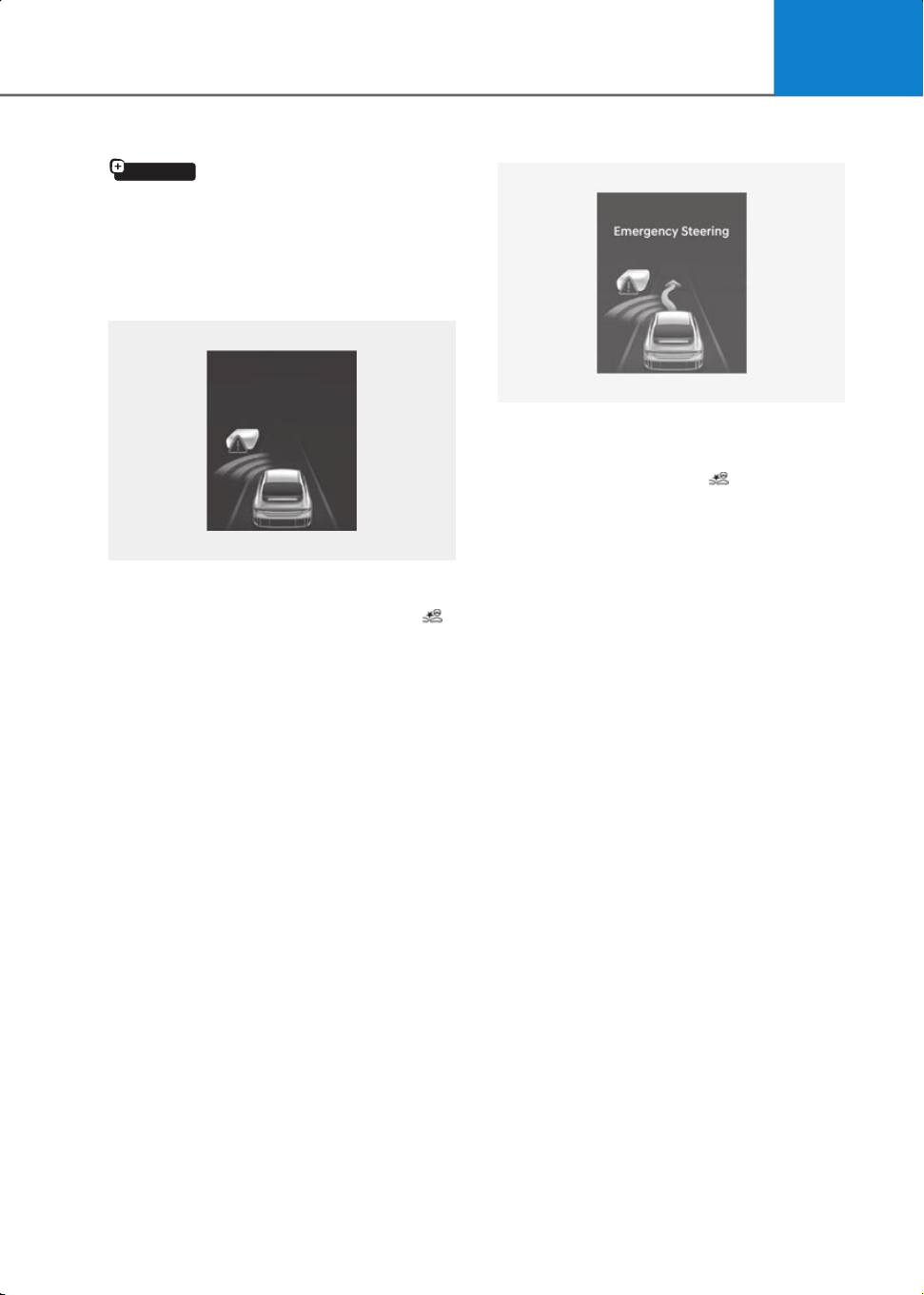
7
7-17
if equipped
Lane-Change Oncoming function
Lane-Change Oncoming function will
warn and control the vehicle depending
on collision risk level: ‘Collision Warning’
and ‘Emergency Steering’
Collision Warning
B7000315_3
• To warn the driver of a collision,
Emergency Steering warning light ( )
blinking, the ‘Collision Warning’
warning message will appear on the
instrument cluster, an audible warning
will sound and the steering wheel will
vibrate.
• The function will operate when your
vehicle speed is between about 25-90
mph (40-145 km/h) and the oncoming
vehicle or powered two-wheeler speed
is about above 6 mph (10 km/h) and the
relative speed with your vehicle is
about below 124 mph (200 km/h).
Emergency Steering
B7000314
• To warn the driver that emergency
steering will be assisted, Emergency
Steering warning light ( ) blinking, the
‘Emergency Steering’ warning
message will appear on the instrument
cluster, an audible warning will sound
and the steering wheel will vibrate.
• In emergency steering situation,
steering is assisted by the function to
help prevent collision with the
oncoming vehicle.
• The function will operate when your
vehicle speed is between about 25-90
mph (40-145 km/h) and the oncoming
vehicle or powered two-wheeler speed
is about above 6 mph (10 km/h) and the
relative speed with your vehicle is
about below 124 mph (200 km/h).
$PMMJTJPO8BSOJOH
CE_USA.book Page 17
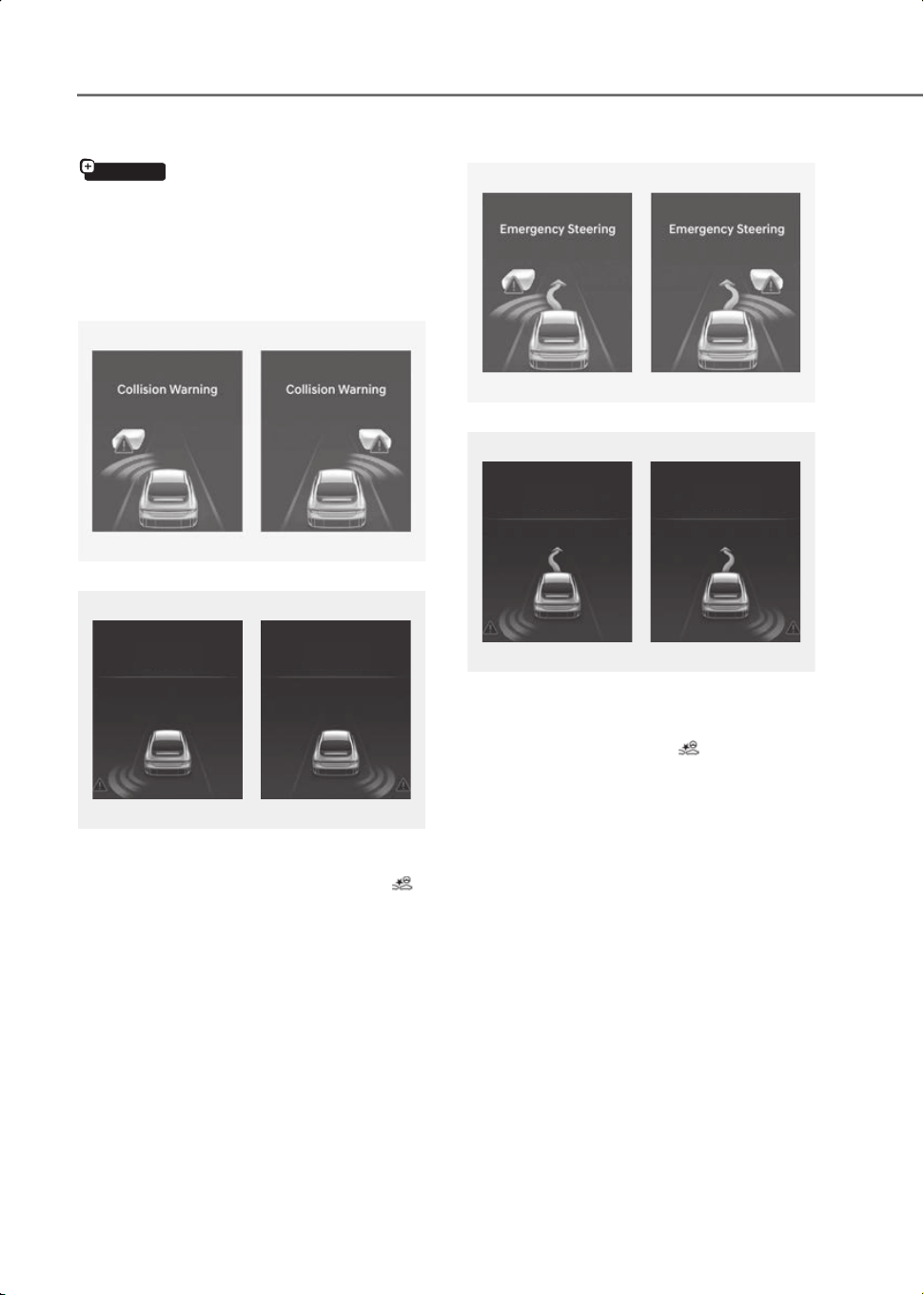
Driver Assistance System
7-18
if equipped
Lane-Change Side function
Lane-Change Side function will warn and
control the vehicle depending on collision
risk level: ‘Collision Warning’ and
‘Emergency Steering’
Collision Warning
B7000315
B7000315_2
• To warn the driver of a collision,
Emergency Steering warning light ( )
blinking, the ‘Collision Warning’
warning message will appear on the
instrument cluster, an audible warning
will sound and the steering wheel will
vibrate.
• The function will operate when your
vehicle speed is between about 25-90
mph (40-145 km/h).
Emergency Steering
B7000316
B7000316_1
• To warn the driver that emergency
steering will be assisted, Emergency
Steering warning light ( ) blinking, the
‘Emergency Steering’ warning
message will appear on the instrument
cluster, an audible warning will sound
and the steering wheel will vibrate.
• In emergency steering situation,
steering is assisted by the function to
help prevent collision with the
front-side vehicle.
• The function will operate when your
vehicle speed is between about 25-90
mph (40-145 km/h) and front-side
vehicle and powered two-wheeler is
driving.
$PMMJTJPO8BSOJOH $PMMJTJPO8BSOJOH
&NFSHFODZ4UFFSJOH &NFSHFODZ4UFFSJOH
CE_USA.book Page 18
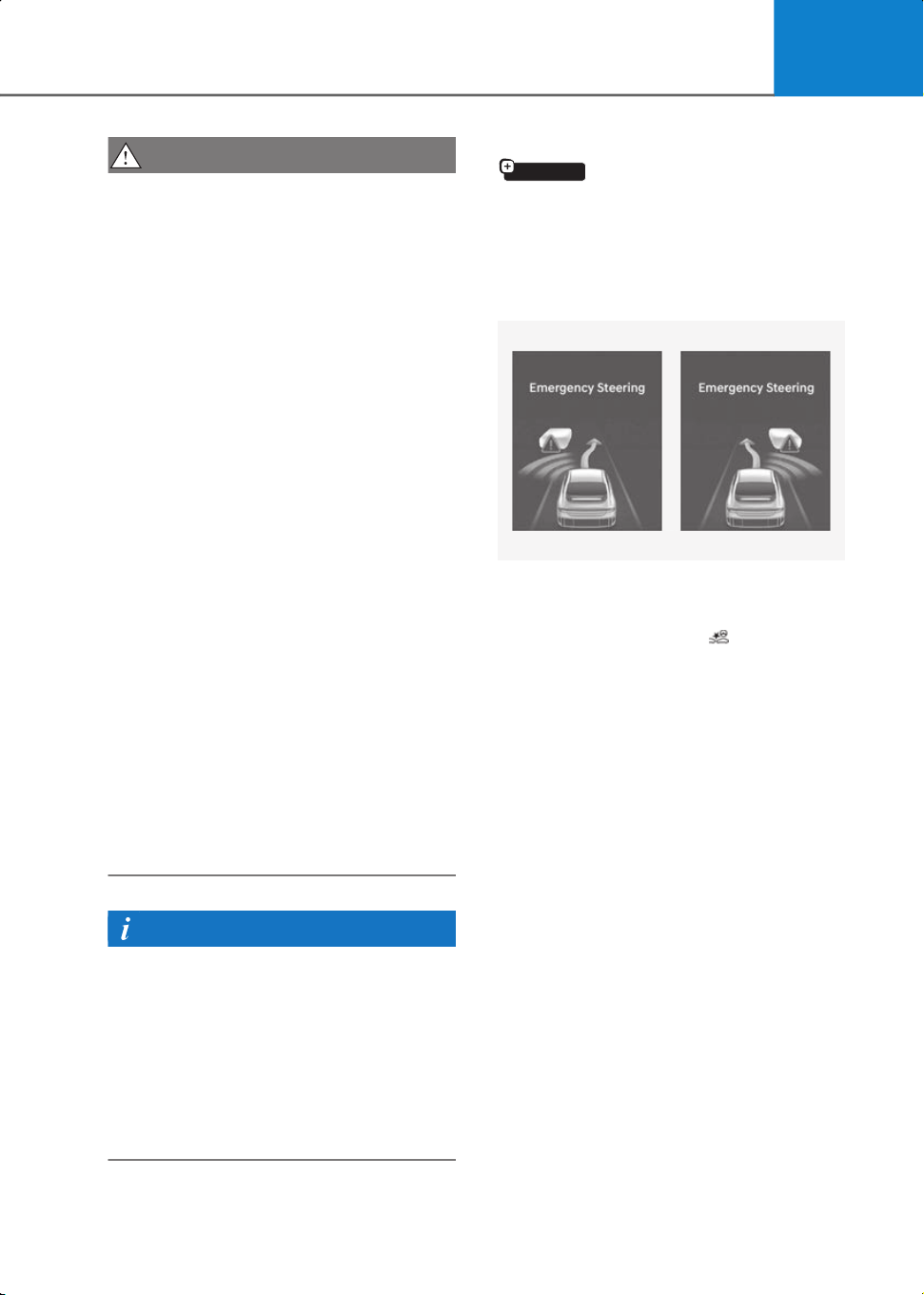
7
7-19
CAUTION
• Lane-Change Side function does not
operate if the speed of the side vehicle
from the front side is 0 mph (0 km/h).
• The detecting range of the front corner
radar and the rear corner radar is
determined by a standard road width,
therefore, on a narrow road,
Lane-Change Side function may detect
other vehicles two lanes over and warn
you. In contrast, on a wide road,
Lane-Change Side function may not be
able to detect a vehicle driving in the
next lane and may not warn you.
• Collision-avoidance assist will be
canceled under the following
circumstances:
- Your vehicle enters the next lane by a
certain distance
- Your vehicle is away from the
collision risk
- The steering wheel is sharply steered
- The brake pedal is depressed
- Forward Collision-Avoidance Assist is
operating
• After Lane-Change Side function
operation or lane change, you must
drive to the center of the lane.
Lane-Change Side function will not
operate if the vehicle is not driven in the
center of the lane.
Information
• When an additional accident is
expected, Lane-Change Side function
will not assist with steering and only
warn the driver of a collision.
• If the driver’s seat is on the left side,
collision warning will operate when you
turn left, and when it is on the right side,
the system will operate when you turn
right.
if equipped
Evasive Steering Assist function
Evasive Steering Assist function will warn
and control the vehicle with ‘Emergency
steering’.
Emergency Steering (Driver steering
assist)
B7000317
• To warn the driver that emergency
steering will be assisted, Emergency
Steering warning light ( ) blinking, the
‘Emergency Steering’ message will
appear on the instrument cluster, an
audible warning will sound and the
steering wheel will vibrate.
• If there is a risk of collision with a
vehicle, powered two-wheeler,
pedestrian and cyclist in front, the
steering will be assisted to help prevent
collision when the driver steers the
vehicle to avoid collision.
• The function will operate when your
vehicle speed is between about 25-53
mph (40-85 km/h).
CE_USA.book Page 19
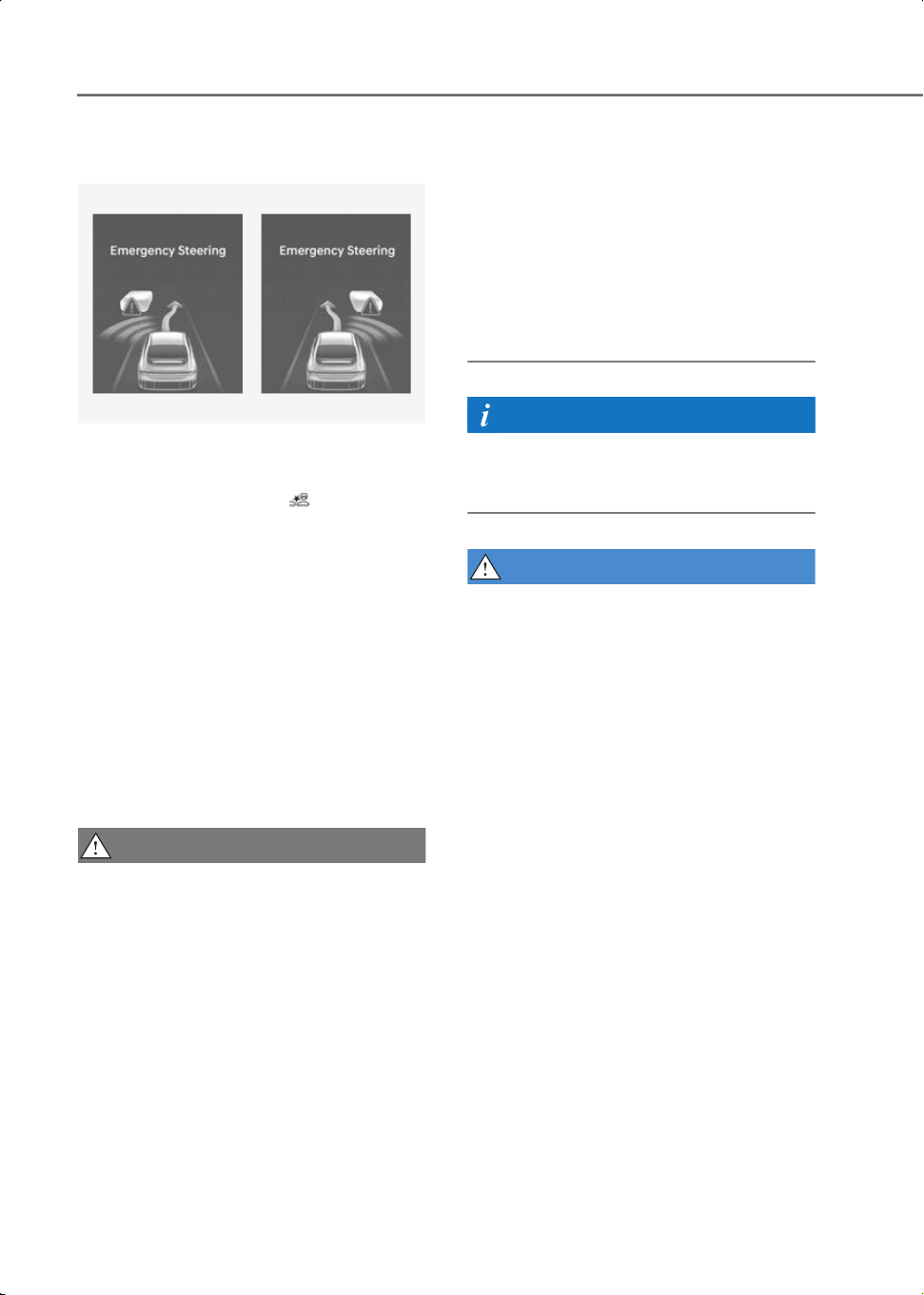
Driver Assistance System
7-20
Emergency Steering (Evasive steering
assist)
B7000317
• To warn the driver that emergency
steering will be assisted, Emergency
Steering warning light ( ) blinking, the
‘Emergency Steering’ message will
appear on the instrument cluster, an
audible warning will sound and the
steering wheel will vibrate.
• If there is high risk of collision with a
pedestrian and cyclist in front, and the
vehicle speed to operate emergency
braking is within the operation range,
the steering will be assisted to help
prevent collision when there is space to
avoid collision in the driving lane.
• The function will operate when your
vehicle speed is between about 40-47
mph (65-75 km/h).
CAUTION
• The steering wheel may turn
automatically when emergency
steering is operating.
• Emergency steering will automatically
cancel when risk factors disappear. The
driver must steer the vehicle.
• Emergency steering may not operate or
may cancel during operation if the
steering wheel is held tight or steered in
the opposite direction.
• When steering is assisted to avoid
collision with a vehicle, powered
two-wheeler, pedestrian and cyclist,
Evasive steering assist will be canceled
if collisions with other objects (vehicles,
powered two-wheeler, pedestrians, or
cyclists) are expected.
• Evasive steering assist may not operate
if space to avoid collision in the driving
lane is insufficient.
Information
For more information on warning
messages, refer to the Collision Warning
in “Basic function”.
WARNING
Take the following precautions when
using Forward Collision-Avoidance
Assist:
• For your safety, only change the
Settings after parking the vehicle at a
safe location.
• Forward Collision-Avoidance Assist
does not operate in all situations and
cannot avoid all collisions.
• The driver has the responsibility to
control the vehicle. Do not solely
depend on Forward
Collision-Avoidance Assist. Rather,
maintain a safe braking distance, and if
necessary, depress the brake pedal to
reduce driving speed or to stop the
vehicle.
• Never deliberately operate Forward
Collision-Avoidance Assist on people,
objects, etc. It may cause serious injury
or death.
• Forward Collision-Avoidance Assist
may not operate if the driver depresses
the brake pedal to avoid a collision.
CE_USA.book Page 20

7
7-21
• Depending on the road and driving
conditions, Forward
Collision-Avoidance Assist may warn
the driver late or may not warn the
driver.
• During Forward Collision-Avoidance
Assist operation, the vehicle may stop
suddenly injuring passengers and
shifting loose objects. Always have the
seat belt on and keep loose objects
secured.
• If any other system’s warning message
is displayed or audible warning is
generated, Forward
Collision-Avoidance Assist warning
message may not be displayed and
audible warning may not be generated.
• You may not hear the warning sound of
Forward Collision-Avoidance Assist if
the surrounding is noisy.
• Forward Collision-Avoidance Assist
may turn off or may not operate
properly or may operate unnecessarily
depending on the road conditions and
the surroundings.
• Even if there is a problem with Forward
Collision-Avoidance Assist, the
vehicle’s basic braking will function
normally.
• During emergency braking, braking
control by Forward Collision-Avoidance
Assist will automatically cancel when
the driver excessively depresses the
accelerator pedal or sharply steers the
vehicle.
CAUTION
• Depending on the condition of the
vehicle, two-wheeled vehicle,
pedestrian or cyclist in front and the
surroundings, the speed range for
Forward Collision-Avoidance Assist to
operate may be reduced, and Forward
Collision-Avoidance Assist may be
limited, or may not operate.
• Forward Collision-Avoidance Assist will
operate under certain conditions by
judging the risk level based on the
condition of the oncoming vehicle,
driving direction, speed and
surroundings.
• Forward Collision-Avoidance Assist
may be limited or disabled if the vehicle
speed is too high or the distance to the
vehicle ahead is far.
• When a collision with a surrounding
vehicle is expected, Lane-Change
Oncoming, Lane-Change Side and
Evasive Steering Assist will not assist
you with steering but only warn the you
of a collision (if equipped).
Information
• In a situation where collision is
imminent, braking may be assisted by
Forward Collision-Avoidance Assist
when braking is insufficient by the
driver.
• The images and colors in the
instrument cluster may differ
depending on the instrument cluster
type or theme selected from the
settings menu.
CE_USA.book Page 21
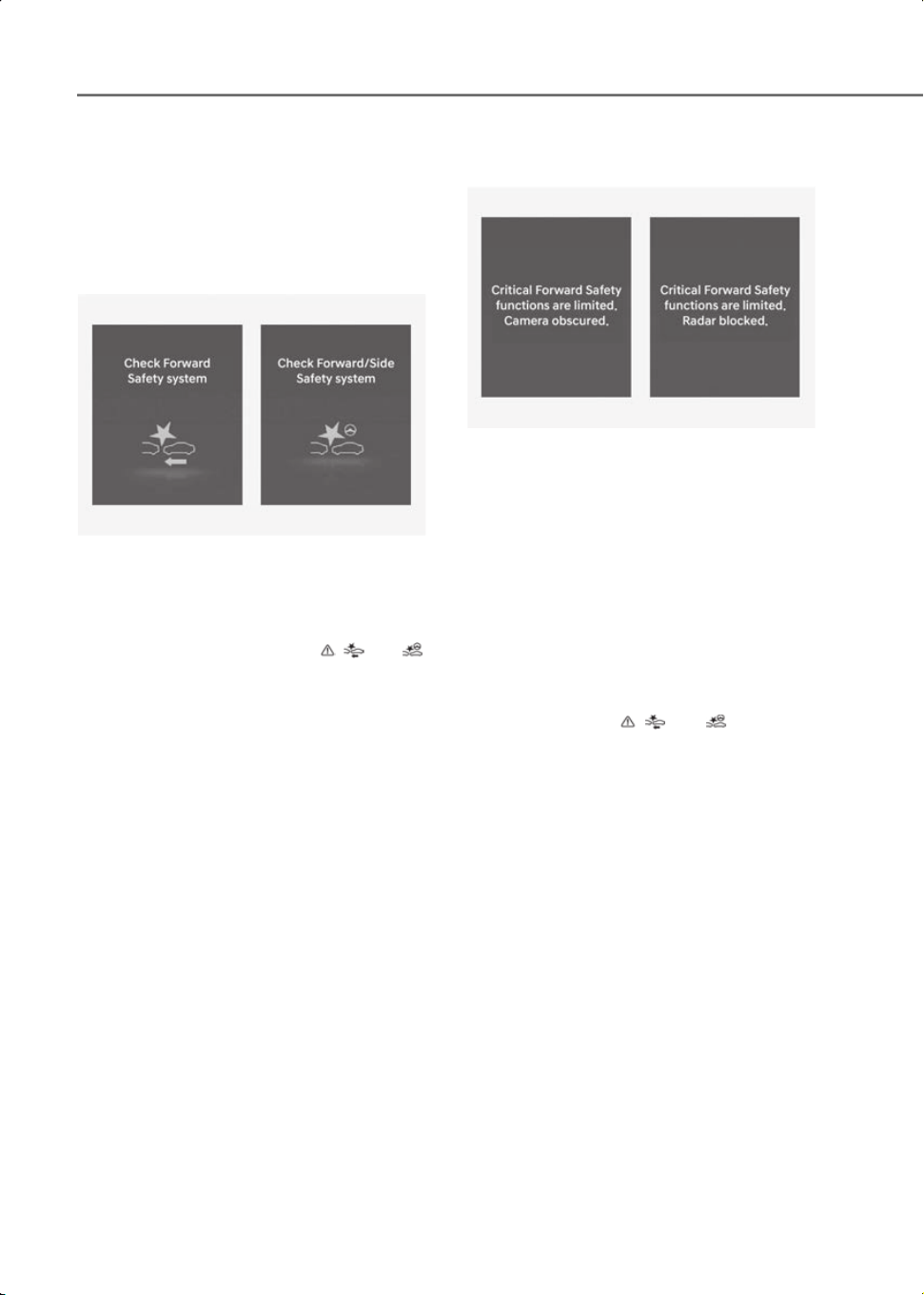
Driver Assistance System
7-22
Forward Collision-Avoidance
Assist Malfunction and
Limitations
Forward Collision-Avoidance Assist
malfunction
B7000401
When Forward Collision-Avoidance Assist
is not working properly, the ‘Check
Forward Safety system’ and ‘Check
Forward/Side Safety system’ warning
message will appear, and the , and
warning lights will illuminate on the
instrument cluster. Have the vehicle
inspected by an authorized HYUNDAI
dealer.
Forward Collision-Avoidance Assist
disabled
B7000402
When the front windshield where the
front view camera is located, front radar
cover, bumper (if equipped) or sensor is
covered with foreign material, such as
snow or rain, it can reduce the detecting
performance and temporarily limit or
disable Forward Collision-Avoidance
Assist.
If this occurs the ‘Critical Forward Safety
functions disabled. Camera obscured’ or
the ‘Critical Forward Safety functions
disabled. Radar blocked’ warning
message, and the , and warning
lights will illuminate on the instrument
cluster.
Forward Collision-Avoidance Assist will
operate properly when snow, rain or
foreign material is removed.
If Forward Collision-Avoidance Assist
does not operate properly after
obstruction (snow, rain, or foreign
material) is removed (including trailer,
carrier, etc., from the rear bumper), have
the vehicle inspected by an authorized
HYUNDAI dealer.
CE_USA.book Page 22

7
7-23
WARNING
• Even though the warning message or
warning light does not appear on the
instrument cluster, Forward
Collision-Avoidance Assist may not
properly operate.
• Forward Collision-Avoidance Assist
may not properly operate in an area (for
example, open terrain), where any
objects are not detected after turning
ON the vehicle.
• If the vehicle is turned off and restarted
while the camera is blocked or
malfunctioned, the condition is
maintained. Therefore, Forward
Collision-Avoidance Assist may not
operate properly.
Limitations of Forward
Collision-Avoidance Assist
Forward Collision-Avoidance Assist may
not operate properly, or it may operate
unexpectedly under the following
circumstances:
• The detecting sensor or the
surroundings are contaminated or
damaged
• The temperature around the front view
camera is high or low due to
surrounding environment
• The camera lens is contaminated due to
tinted, filmed or coated windshield,
damaged glass, or sticky foreign
material (sticker, bug, etc.) on the glass
• Moisture is not removed or frozen on
the windshield
• Washer fluid is continuously sprayed, or
the wiper is on
• Driving in heavy rain or snow, or thick
fog
• The field of view of the front view
camera is obstructed by sun glare
• Street light or light from an oncoming
traffic is reflected on the wet road
surface, such as a puddle on the road
• An object is placed on the dashboard
• Your vehicle is being towed
• The surrounding is very bright
• The surrounding is very dark, such as in
a tunnel, etc.
• The brightness changes suddenly, for
example when entering or exiting a
tunnel
• The brightness outside is low, and the
headlights are not on or are not bright
• Driving through steam, smoke or
shadow
• Only part of the vehicle, powered
two-wheeler, pedestrian or cyclist is
detected
• The vehicle or powered two-wheeler in
front is a bus, heavy truck, truck with an
unusually shaped cargo, trailer, etc.
• The vehicle or powered two-wheeler in
front has no tail lights, tail lights are
located unusually, etc.
• The brightness outside is low, and the
tail lights are not on or are not bright
• The rear of the front vehicle is small or
the vehicle does not look normal, such
as when the vehicle is tilted,
overturned, or the side of the vehicle is
visible, etc.
• The front vehicle’s ground clearance is
low or high
• A vehicle, powered two-wheeler,
pedestrian or cyclist suddenly cuts in
front
• The bumper around the front radar is
impacted, damaged or the front radar is
out of position
• The temperature around the front radar
is high or low
• Driving through a tunnel or iron bridge
• Driving in vast areas where there are
few vehicles or structures (for example,
desert, meadow, suburb, etc.)
• Driving near areas containing metal
substances, such as a construction
zone, railroad, etc.
CE_USA.book Page 23
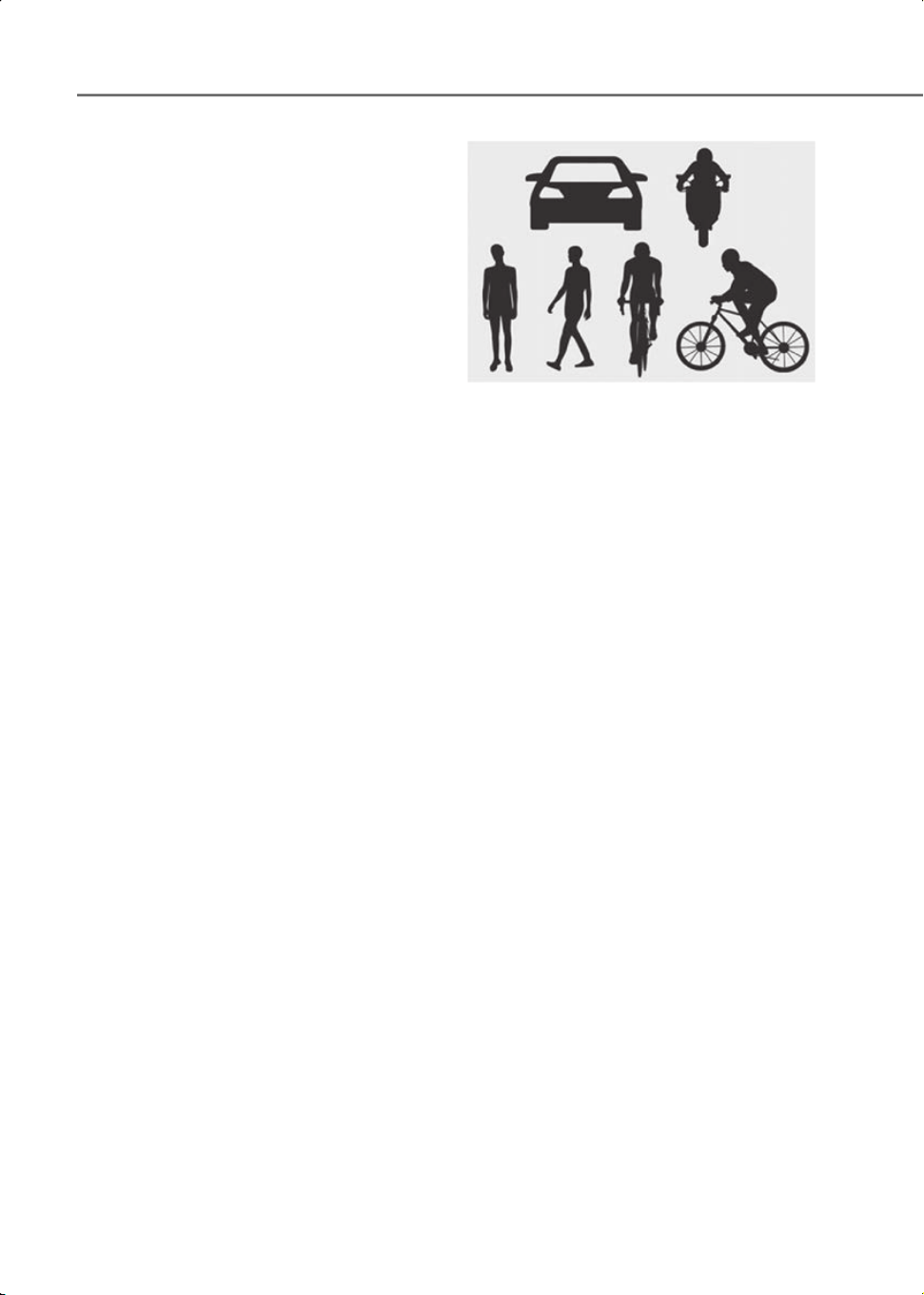
Driver Assistance System
7-24
• A material is near that reflects very well
on the front radar, such as a guardrail,
nearby vehicle, etc.
• The cyclist in front is on a bicycle made
of material that does not reflect on the
front radar
• The vehicle or powered two-wheeler in
front is detected late
• The vehicle or powered two-wheeler in
front is suddenly blocked by an
obstacle
• The vehicle or powered two-wheeler in
front suddenly changes lane or
suddenly reduces speed
• The vehicle or powered two-wheeler in
front is bent out of shape
• The vehicle in front is covered with
snow
• You are departing or returning to the
lane
• Unstable driving
• You are on a roundabout and the
vehicle or powered two-wheeler in
front is not detected
• You are continuously driving in a circle
• The vehicle in front has an unusual
shape
• The vehicle in front is driving uphill or
downhill
• The pedestrian or cyclist is not fully
detected, for example, if the pedestrian
is leaning over or is not fully walking
upright
• The pedestrian or cyclist is wearing
clothing or equipment that makes it
difficult to detect
B7000403
The illustration above shows the image
the front view camera and front radar are
capable of detecting as a vehicle,
pedestrian and cyclist.
• The pedestrian or cyclist in front is
moving very quickly
• The pedestrian or cyclist in front is short
or is posing a low posture
• The pedestrian or cyclist in front has
impaired mobility
• The pedestrian or cyclist in front is
moving intersected with the driving
direction
• There is a group of pedestrians, cyclists
or a large crowd in front
• The pedestrian or cyclist is wearing
clothing that easily blends into the
background, making it difficult to
detect
• The pedestrian or cyclist is difficult to
distinguish from the similarly shaped
structure in the surroundings
• You are driving by a pedestrian, cyclist,
traffic signs, structures, etc., near the
intersection
• Driving in a parking lot
• Driving through a tollbooth,
construction area, unpaved road,
partial paved road, uneven road, speed
bumps, etc.
• Driving on an incline road, curved road,
etc.
• Driving through a roadside with trees or
streetlights
CE_USA.book Page 24

7
7-25
• The adverse road conditions cause
excessive vehicle vibrations while
driving
• Your vehicle height is low or high due to
heavy loads, abnormal tire pressure,
etc.
• Driving through a narrow road where
trees or grass are overgrown
• There is interference by
electromagnetic waves, such as driving
in an area with strong radio waves or
electrical noise
Junction Crossing, Lane-Change
Oncoming, Lane-Change Side, Evasive
if equipped
Steering Assist function
• The temperature around the front
corner radar or rear corner radar is high
or low
• A trailer or carrier is installed around the
rear corner radar
• The front corner radar or rear corner
radar is covered with snow, rain, dirt,
etc.
• The bumper around the front corner
radar or rear corner radar is covered
with objects, such as a bumper sticker,
bumper guard, bike rack, etc.
• The bumper around the front corner
radar or rear corner radar is impacted,
damaged or the radar is out of position
• The front corner radar or rear corner
radar is blocked by other vehicles, walls
or pillars
• Driving on a highway ramp
• Driving on a road where the guardrail or
wall is in double structure
• The other vehicle drives very close
behind your vehicle, or the other
vehicle passes by your vehicle in close
proximity
• The speed of the other vehicle is very
fast so that it passes by your vehicle in a
short time
• Your vehicle passes by the other vehicle
• Your vehicle has started at the same
time as the vehicle next to you and has
accelerated
• The vehicle in the next lane moves two
lanes away from you, or when the
vehicle two lanes away moves to the
next lane from you
• A motorcycle or bicycle is detected
• A vehicle such as a flat trailer is
detected
• A big vehicle such as a bus or truck is
detected
• A small moving obstacle such as a
pedestrian, animal, shopping cart or a
baby stroller is detected
• A vehicle with low height such as a
sports car is detected
• The lane is difficult to see due to foreign
material, such as rain, snow, dust, sand,
oil and water puddles
• The color of the lane marking is not
distinguishable from the road
• There are markings on the road near the
lane or the markings on the road looks
similar to the lane markings
• The shadow is on the lane marking by a
median strip, trees, guardrail, noise
barriers, etc.
• The lane number increases or
decreases, or the lane markings are
crossing
• There are more than two lane markings
on the road
• The lane markings are complicated or a
structure substitutes for the lines, such
as a construction area
• There are road markings, such as zigzag
lanes, crosswalk markings and road
signs
• The lane suddenly disappears, such as
at the intersection
• The lane is very wide or narrow
• There is a curb or road edges without a
lane
CE_USA.book Page 25
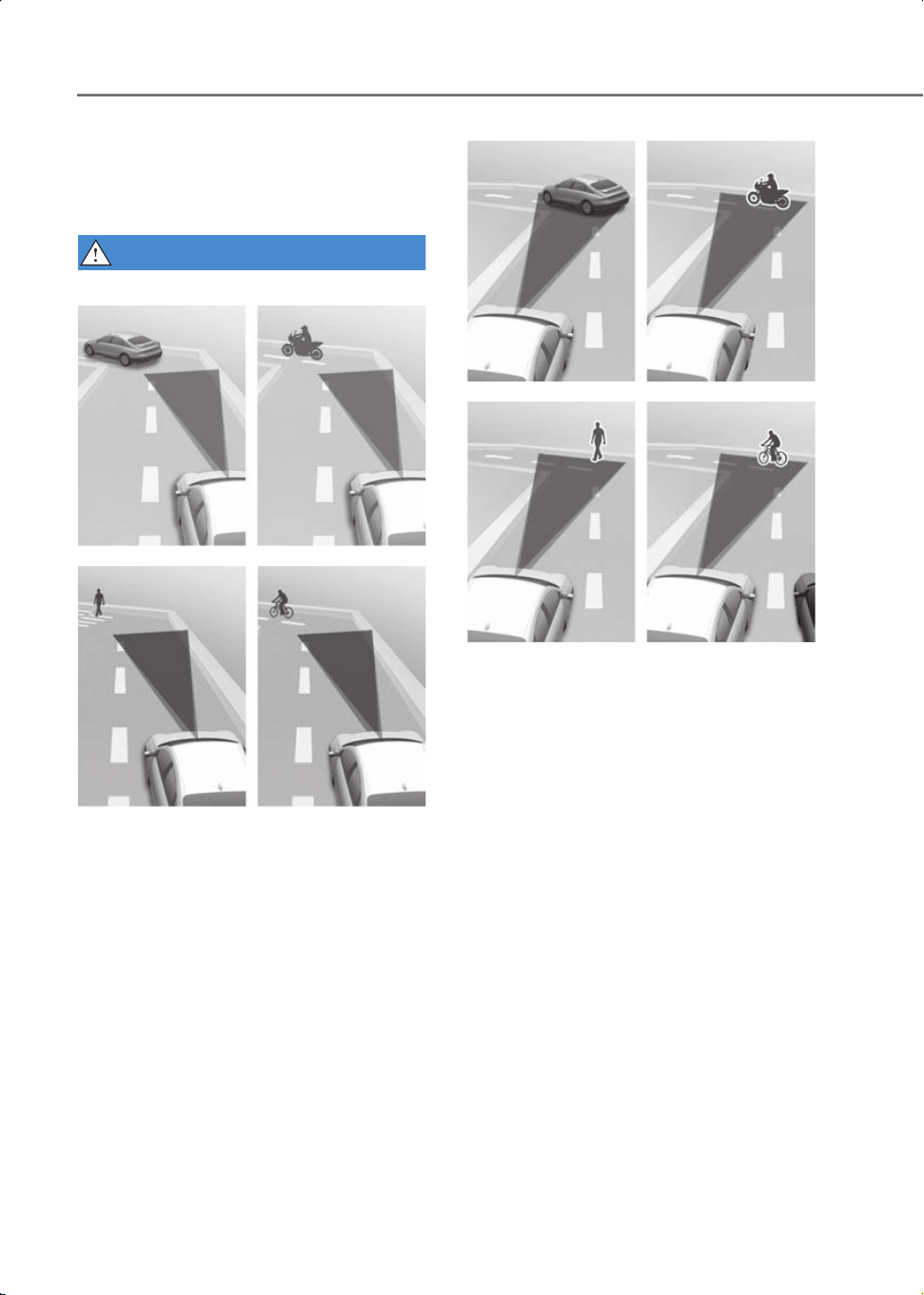
Driver Assistance System
7-26
• The vehicle in front is driving with one
side on the lane marking
• The distance to the front vehicle is
extremely short
WARNING
• Driving on a curved road
B7000404
B7000405
Forward Collision-Avoidance Assist
may not detect other vehicles, powered
two-wheelers, pedestrians or cyclists in
front of you when driving on curved
roads adversely affecting the
performance of the sensors. This may
result in no warning, braking assist or
steering assist (if equipped) when
necessary.
When driving on a curve, you must
maintain a safe braking distance, and if
necessary, steer the vehicle and
depress the brake pedal to reduce your
driving speed in order to maintain a
safe distance.
B7000406
B7000407
Forward Collision-Avoidance Assist
may detect a vehicle, powered
two-wheeler, pedestrian or cyclist in
the next lane or outside the lane when
driving on a curved road.
If this occurs, Forward
Collision-Avoidance Assist may
unnecessarily warn the driver and
control the brake or steering wheel (if
equipped). Always check the traffic
conditions around the vehicle.
CE_USA.book Page 26
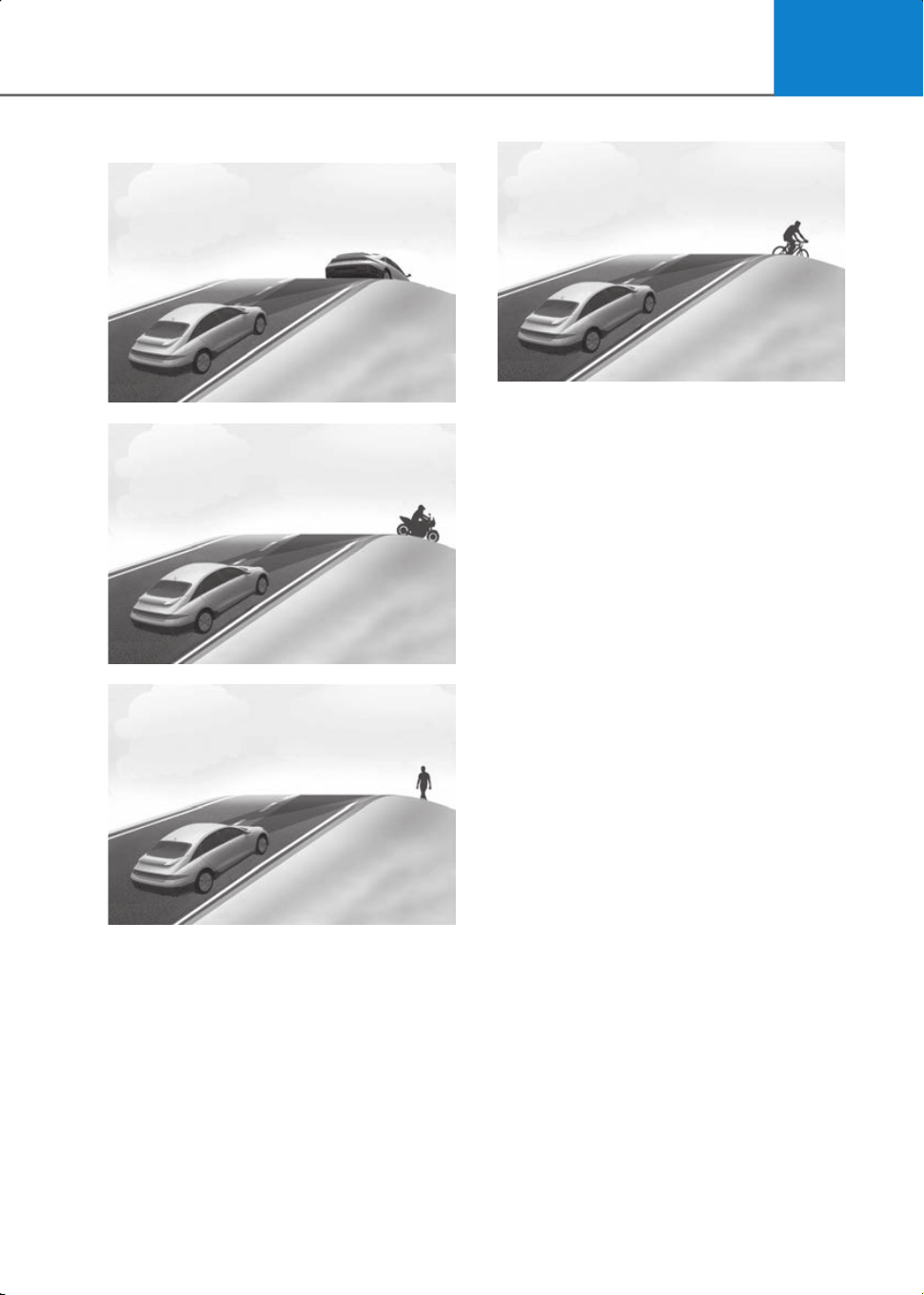
7
7-27
• Driving on an inclined road
B7000408
B7000409
B7000410
B7000411
Forward Collision-Avoidance Assist
may not detect other vehicles, powered
two-wheelers, pedestrians or cyclists in
front of you while driving uphill or
downhill, adversely affecting the
performance of the sensors.
This may result in unnecessary warning,
braking assist or steering assist (if
equipped) or no warning, braking assist
or steering assist (if equipped) when
necessary.
Also, vehicle speed may rapidly
decrease when a vehicle, powered
two-wheeler, pedestrian or cyclist
ahead is suddenly detected.
Always have your eyes on the road
while driving uphill or downhill and if
necessary, steer your vehicle and
depress the brake pedal to reduce your
driving speed in order to maintain a
safe distance.
CE_USA.book Page 27
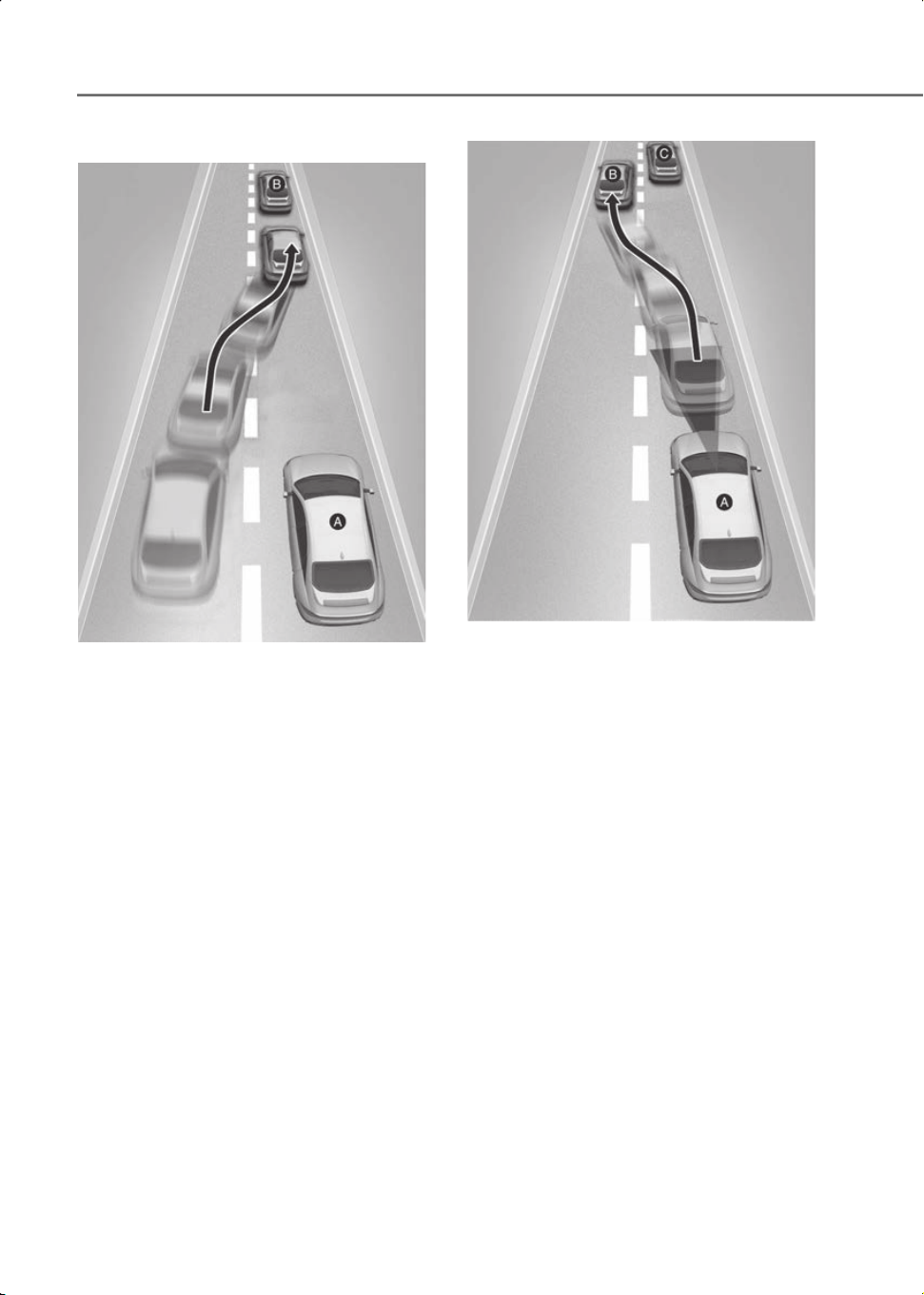
Driver Assistance System
7-28
• Changing lanes
B7000412
[A] Your vehicle
[B] Lane changing vehicle
When a vehicle moves into your lane
from an adjacent lane, it cannot be
detected by the sensor until it is in the
sensor's detection range. Forward
Collision-Avoidance Assist may not
immediately detect the vehicle when
the vehicle changes lanes abruptly. In
this case, you must maintain a safe
braking distance, and if necessary,
steer your vehicle and depress the
brake pedal to reduce your driving
speed in order to maintain a safe
distance.
B7000413
[A] Your vehicle
[B] Lane changing vehicle
[C] Same lane vehicle
When a vehicle in front of you merges
out of the lane, Forward
Collision-Avoidance Assist may not
immediately detect the vehicle that is
now in front of you. In this case, you
must maintain a safe braking distance,
and if necessary, steer your vehicle and
depress the brake pedal to reduce your
driving speed in order to maintain a
safe distance.
CE_USA.book Page 28
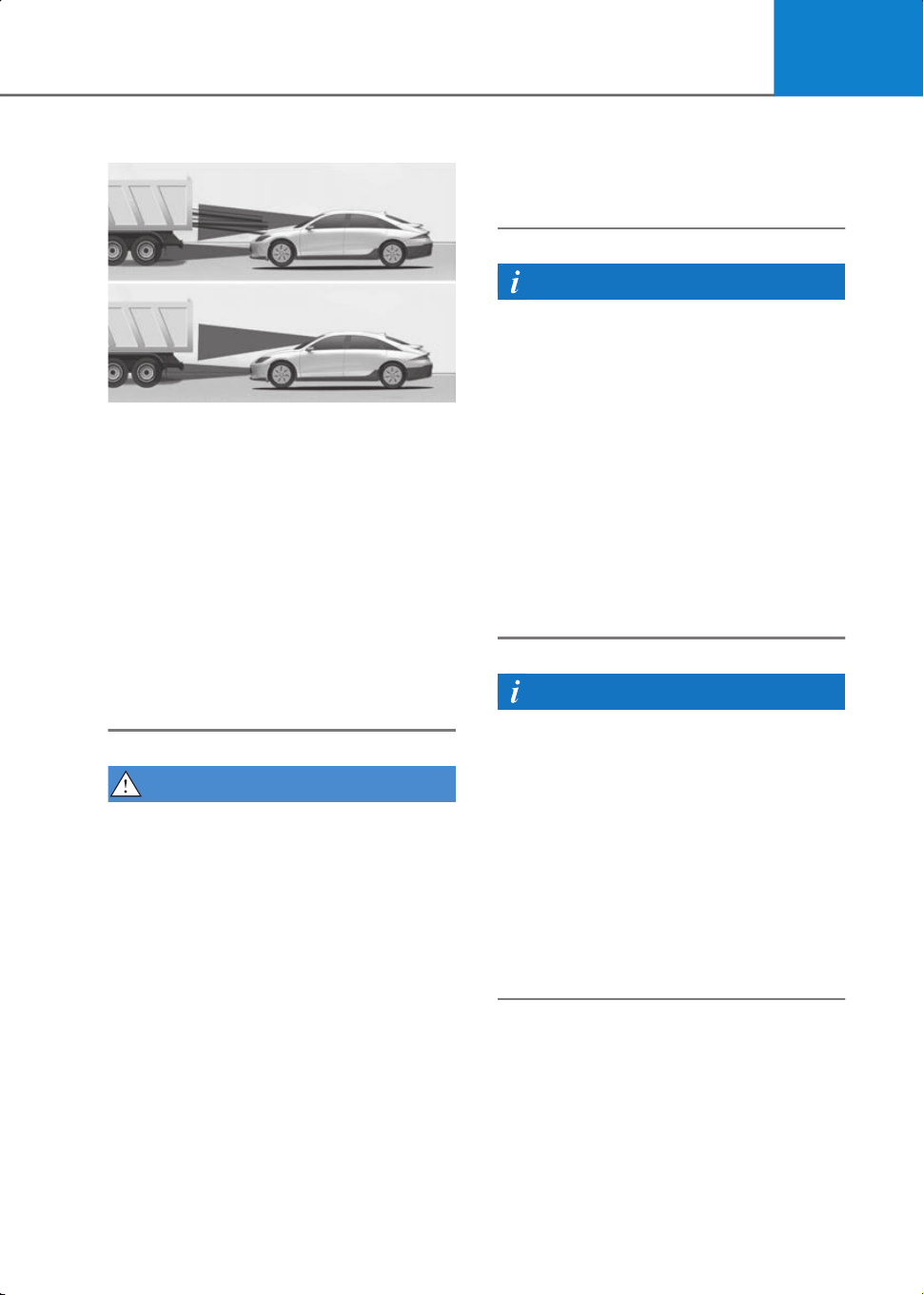
7
7-29
• Detecting vehicle
B7000414
If the vehicle in front of you has cargo
that extends rearward from the cab, or
when the vehicle in front of you has
higher ground clearance, additional
special attention is required. Forward
Collision-Avoidance Assist may not be
able to detect the cargo extending from
the vehicle. In these instances, you
must maintain a safe braking distance
from the rearmost object, and if
necessary, steer your vehicle and
depress the brake pedal to reduce your
driving speed in order to maintain
distance.
WARNING
• When you are towing a trailer or
another vehicle, turn off Forward
Collision-Avoidance Assist for safety
reasons.
• Forward Collision-Avoidance Assist
may operate if objects that are similar
in shape or characteristics to vehicles,
powered two-wheelers, pedestrians
and cyclists are detected.
• Forward Collision-Avoidance Assist
does not operate on bicycles, or smaller
wheeled objects, such as luggage bags,
shopping carts, or strollers.
• Forward Collision-Avoidance Assist
may not operate properly if interfered
by strong electromagnetic waves.
• Forward Collision-Avoidance Assist
may not operate for 15 seconds after
the vehicle is started, or the front view
camera is initialized.
Information
This device complies with Part 15 of the
FCC rules.
Operation is subject to the following three
conditions:
1. This device may not cause harmful
interference, and
2. This device must accept any
interference received, including
interference that may cause undesired
operation.
3. Changes or modifications not expressly
approved by the party responsible for
compliance could void the user’s
authority to operate the device.
Information
Radio frequency radiation exposure
information:
This equipment complies with FCC
radiation exposure limits set forth for an
uncontrolled environment.
This equipment should be installed and
operated with minimum distance of 8 in.
(20 cm) between the radiator (antenna)
and your body.
This transmitter must not be co-located
or operating in conjunction with any other
antenna or transmitter.
CE_USA.book Page 29
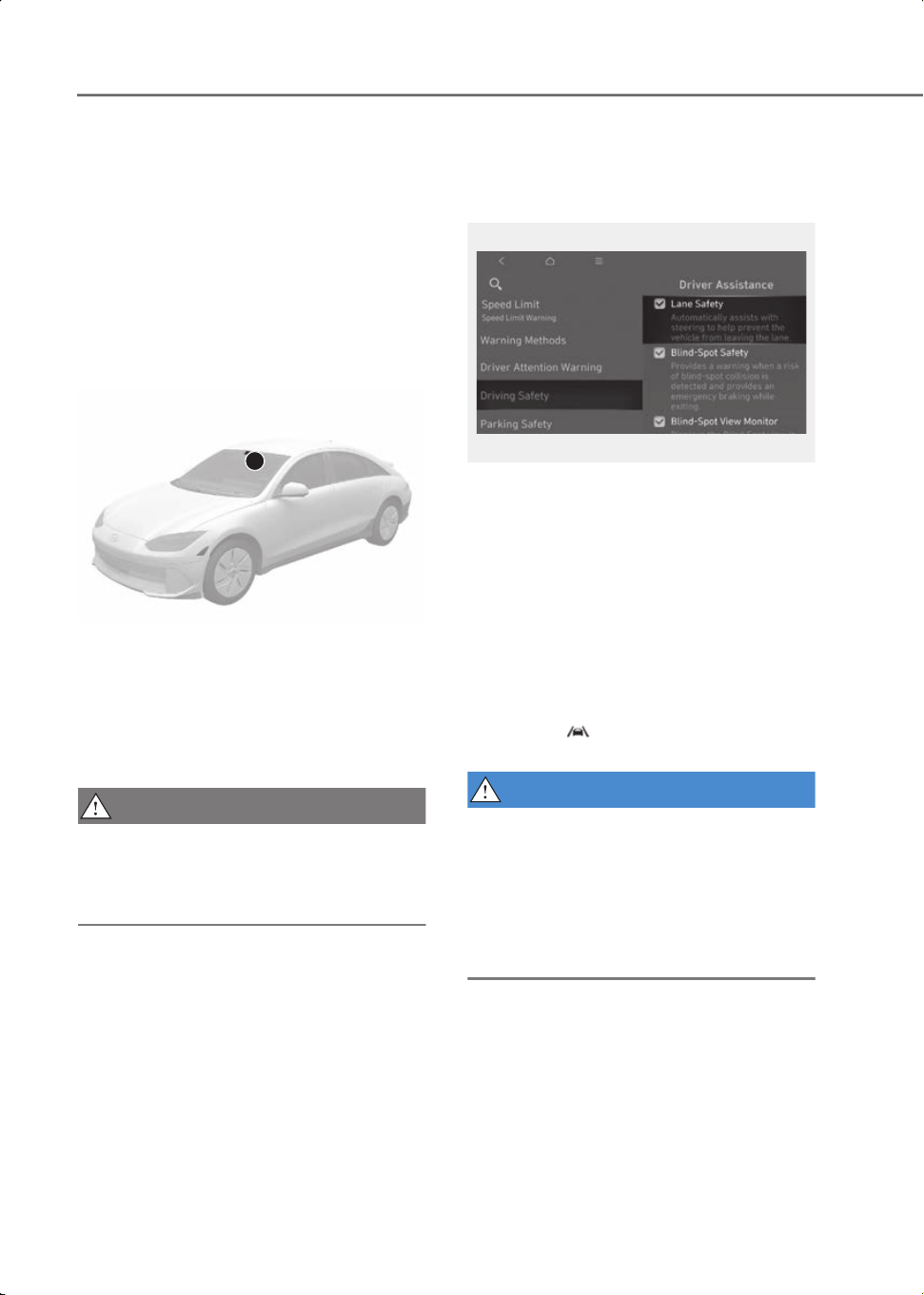
Driver Assistance System
7-30
Lane Keeping Assist (LKA)
While driving over a certain speed, Lane
Keeping Assist detects lane markings (or
road edges) and may warn you if your
vehicle leaves the lane without using the
turn signal and may assist with steering to
prevent your vehicle departing from its
travel lane.
Detecting sensor
B7000901
(1) Front view camera
The front view camera is used as a
detecting sensor to detect lane markings
(or road edges).
Refer to the picture above for the detailed
location of the detecting sensor.
CAUTION
For more information on the precautions
of the front view camera, refer to the
"Forward Collision-Avoidance Assist
(FCA)" section in this chapter.
Lane Keeping Assist Settings
Lane Safety
B7001001
With the vehicle on, select Setup >
Vehicle > Driver Assistance > Driving
Safety > Lane Safety from the Settings
menu to set whether to use each
function.
If Lane Safety is selected, Lane Keeping
Assist will automatically assist the driver’s
steering when lane departure is detected
to help prevent the vehicle from moving
out of its lane. If Lane Safety is
deselected, Lane keeping Assist will turn
off and the ( ) indicator light will turn off
on the instrument cluster.
WARNING
• Lane Keeping Assist does not control
the steering wheel when the vehicle is
driven in the middle of the lane.
• The driver should always be aware of
the surroundings. If Lane Safety is
deselected, Lane Keeping Assist cannot
assist you.
1
CE_USA.book Page 30
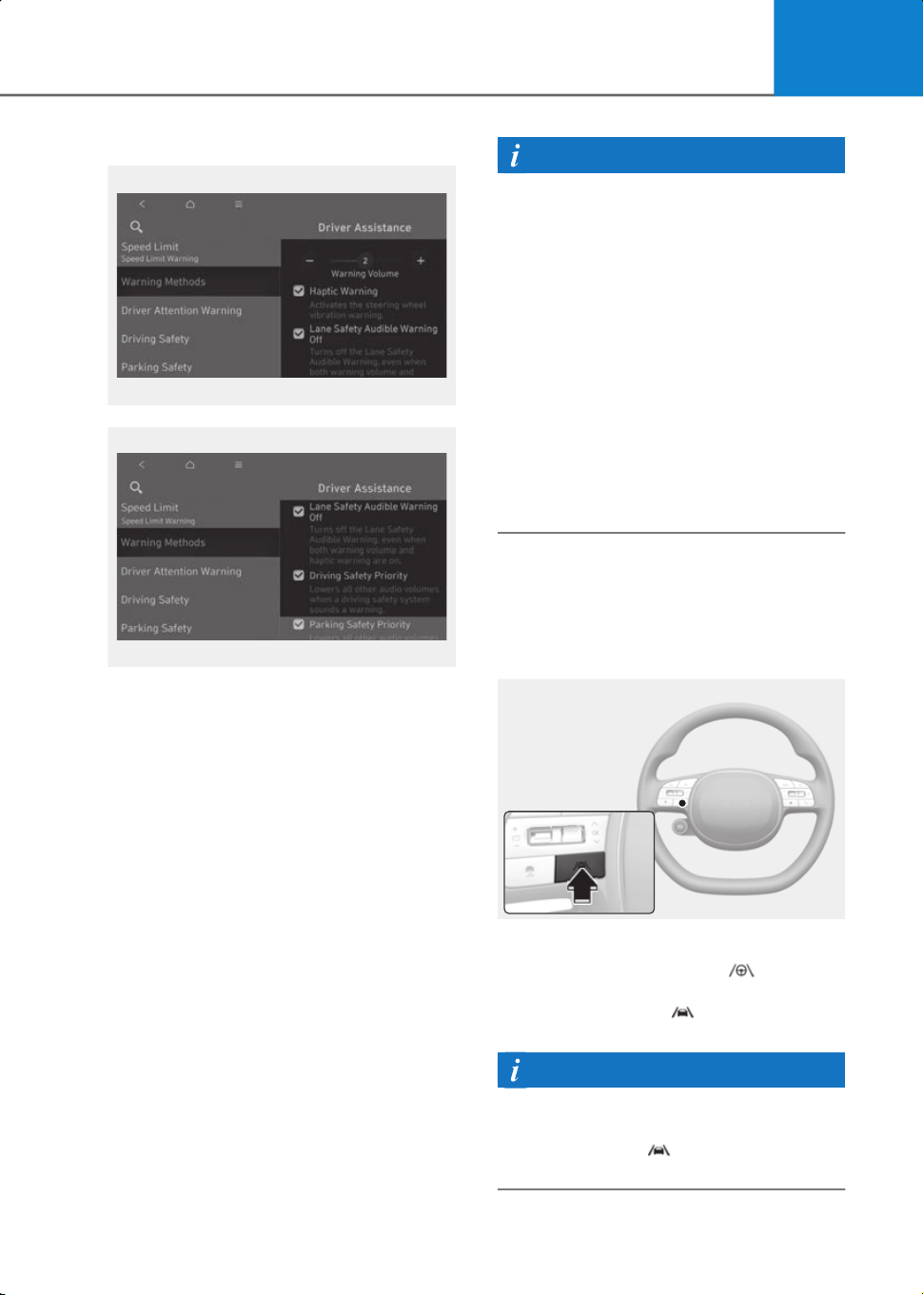
7
7-31
Warning Methods
B7000205_2
B7000205_3
With the vehicle on, go to Setup > Vehicle
> Driver Assistance > Warning Methods
from the Settings in the infotainment
system to select the following:
• Warning Volume: The Warning Volume
can be adjusted.
If you turn off the Warning Volume, for
your safety, the function may warn you
with a low volume.
• Haptic Warning: The steering wheel
vibration can be set.
• Lane Safety Audible Warning Off: The
warning volume of Lane Safety does
not sound when Haptic Warning is
selected.
• Driving Safety Priority: Your vehicle
lowers all other audio volumes when
the Driver Assistance system warning
sounds.
Information
• If you change the Warning Methods,
Warning Methods of other Driver
Assistance systems may change.
• If the vehicle is restarted, Warning
Methods will maintain the last setting.
• There may be no Settings menu
depending on the feature applied to
your vehicle.
• The Warning Volume and Haptic
Warning cannot be turned off at the
same time. When one of the warning is
turned off, the other is activated.
• Lane Safety Audible Warning Off can
be set when both Warning Volume and
Haptic Warning turn on.
Lane Keeping Assist
Operation
Turning Lane Keeping Assist On/Off
B7001101
With the vehicle on, press and hold the
Lane Driving Assist button ( ) located
on the steering wheel to turn on Lane
Keeping Assist. The ( ) indicator light
will illuminate on the instrument cluster.
Information
When the Lane Driving Assist button is
pressed and held, the Lane Safety setting
turns off and the ( ) indicator light will
turn off on the instrument cluster.
CE_USA.book Page 31
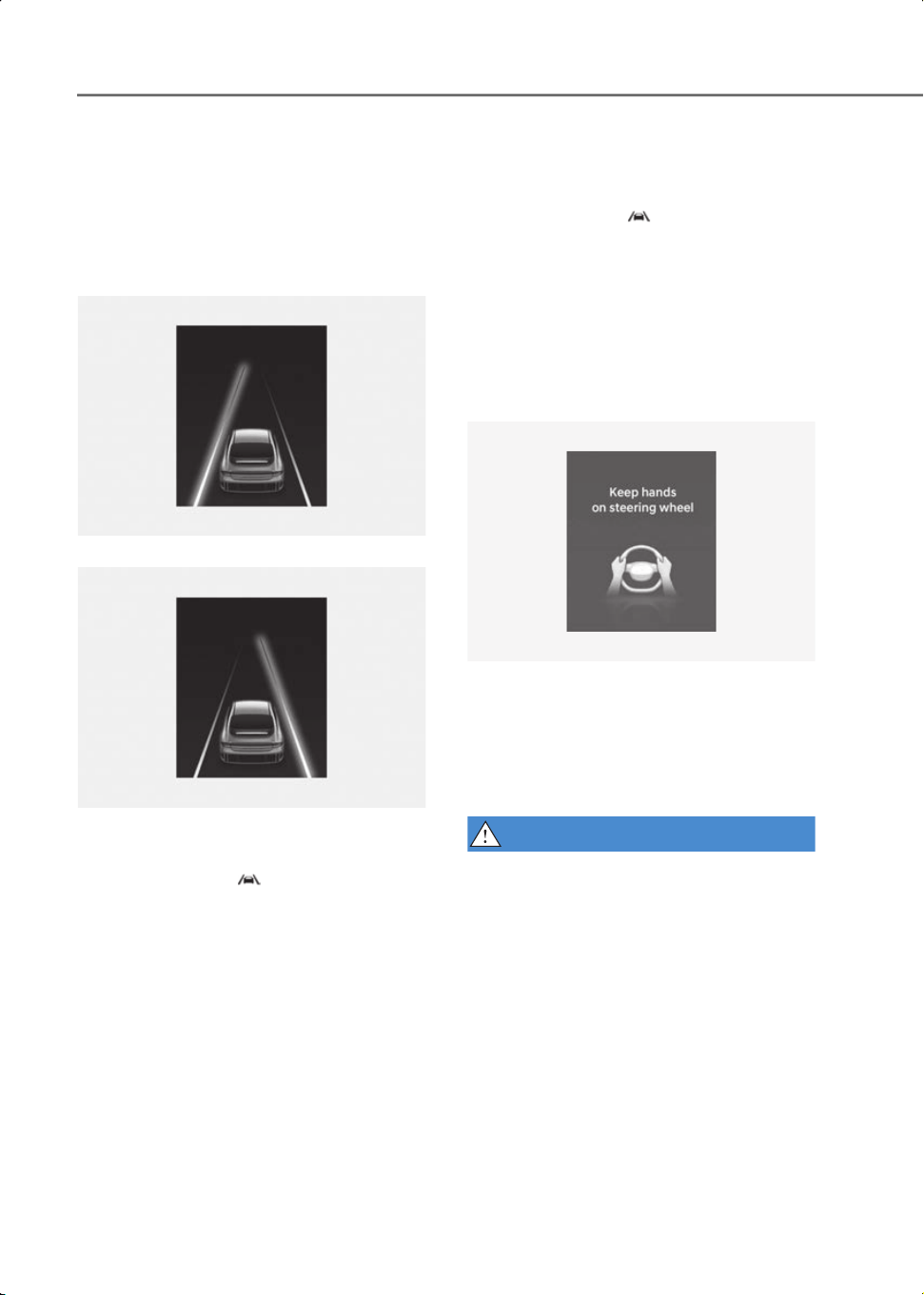
Driver Assistance System
7-32
Warning and control
Lane Keeping Assist will warn and control
the vehicle with Lane Departure Warning
and Lane Keeping Assist.
Lane Departure Warning
Left
B7001102
Right
B7001103
• To warn the driver that the vehicle is
departing from the projected lane in
front, the green ( ) indicator light will
blink on the instrument cluster, the lane
line will blink on the instrument cluster
depending on which direction the
vehicle is veering, and an audible
warning will sound. Also, the steering
wheel will vibrate.
• Lane Departure Warning will operate
when your vehicle speed is between
about 40-120 mph (60-200 km/h).
Lane Keeping Assist
• To warn the driver that the vehicle is
departing from the projected lane in
front, the green ( ) indicator light will
blink on the cluster, and the steering
wheel will make adjustments to keep
vehicle inside the lane.
• Lane Keeping Assist will operate when
your vehicle speed is between about
40-120 mph (60-200 km/h).
Hands-off warning
B7001104
If the driver takes their hands off the
steering wheel for several seconds, the
'Keep hands on steering wheel' warning
message will appear on the instrument
cluster, and an audible warning will sound
in stages.
WARNING
• The steering wheel may not be assisted
if the steering wheel is held very tight or
the steering wheel is steered over a
certain degree.
• Lane Keeping Assist does not operate
at all times. It is the responsibility of the
driver to safely steer the vehicle and to
maintain the vehicle in its lane.
• The hands-off warning message may
appear late depending on road
conditions. Always have your hands on
the steering wheel while driving.
CE_USA.book Page 32
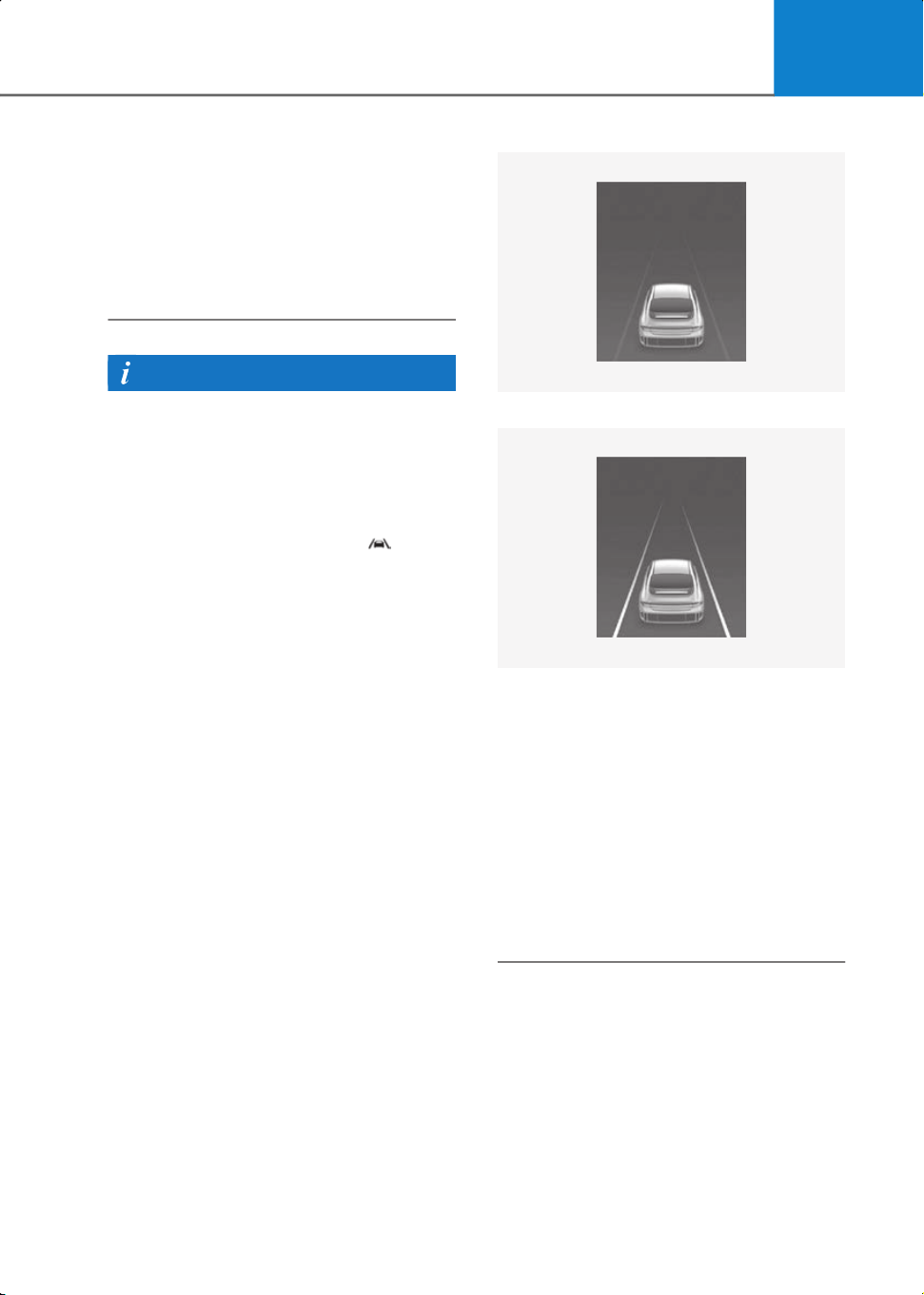
7
7-33
• If the steering wheel is held very lightly,
the hands-off warning message may
appear because Lane Keeping Assist
may not recognize that the driver has
their hands on the steering wheel.
• If you attach objects to the steering
wheel, the hands-off warning may not
work properly.
Information
• For more information on instrument
cluster settings, refer to the "Cluster
Display Control" section in chapter 4.
• When lane markings (or road edges) are
detected, the lane lines on the
instrument cluster will change from
grey to white and the green ( )
indicator light will illuminate.
• When the lane markings (or road edges)
are detected and Highway Lane
Change Assist is on, the lane lines on
the instrument cluster may change to
green.
Lane undetected
B7001105
Lane detected
B7001106
• The images and colors in the
instrument cluster may differ
depending on the instrument cluster
type or theme selected from the
instrument cluster.
• Even though the steering is assisted by
Lane Keeping Assist, the driver may
control the steering wheel.
• The steering wheel may feel heavier or
lighter when the steering wheel is
assisted by Lane Keeping Assist than
when it is not.
CE_USA.book Page 33
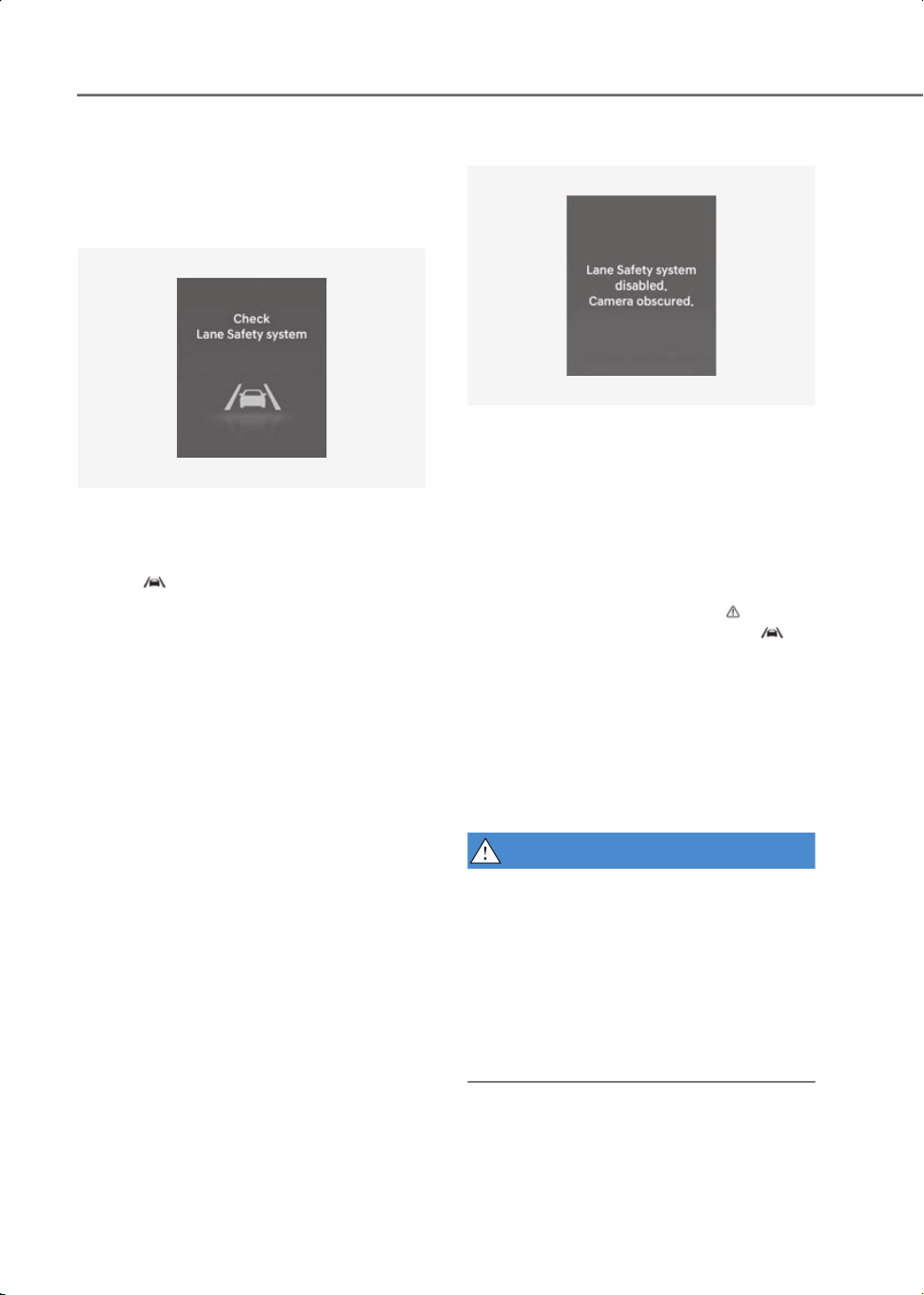
Driver Assistance System
7-34
Lane Keeping Assist
Malfunction and Limitations
Lane Keeping Assist malfunction
B7001201
When Lane Keeping Assist is not working
properly, the 'Check Lane Safety system'
warning message will appear and the
yellow ( ) indicator light will illuminate
on the instrument cluster. If this occurs,
have the vehicle inspected by an
authorized HYUNDAI dealer.
Lane Keeping Assist disabled
B7001202
When the front windshield where the
front view camera is located, or sensor is
covered with foreign material, such as
snow or rain, it can reduce the detecting
performance and temporarily limit or
disable Lane Keeping Assist.
If this occurs, the 'Lane Keeping Assist
system disabled. Camera obscured'
warning message and master ( ) light or
Lane Keeping Assist warning light ( )
will appear on the instrument cluster.
Lane Keeping Assist will operate properly
when snow, rain or foreign material is
removed.
If Lane Keeping Assist does not operate
properly after it is removed, have the
vehicle inspected by an authorized
HYUNDAI dealer.
WARNING
• Even though the warning message or
warning light does not appear on the
instrument cluster, Lane Keeping Assist
may not properly operate.
• If the vehicle is turned off and restarted
while the camera is blocked or
malfunctioned, the condition is
maintained. Therefore, Lane Keeping
Assist may not operate properly.
CE_USA.book Page 34

7
7-35
Limitations of Lane Keeping Assist
Lane Keeping Assist may not operate
properly or may operate unexpectedly
under the following circumstances:
• The lane is contaminated or difficult to
detect because:
- The lane markings (or road edge) are
covered with rain, snow, dirt, oil, etc.
- The color of the lane marking (or road
edge) is not distinguishable from the
road
- There are markings (or road edges)
on the road near the lane or the
markings (or road edges) on the road
look similar to the lane markings (or
road edge)
- The lane marking (or road edge) is
indistinct or damaged
- The shadow is on the lane marking (or
road edge) by a median strip, trees,
guardrail, noise barriers, etc.
• The lane number increases or
decreases, or the lane markings (or
road edges) are crossing
• There are more than two lane markings
(or road edges) on the road
• The lane markings (or road edges) are
complicated or a structure substitutes
for the lines, such as a construction
area
• There are road markings, such as zigzag
lanes, crosswalk markings and road
signs
• The lane suddenly disappears, such as
at the intersection
• The lane (or road width) is very wide or
narrow
• There is a road edge without a lane
• There is a boundary structure in the
roadway, such as a tollbooth, sidewalk,
curb, etc.
• The distance to the front vehicle is
extremely short or the vehicle in front is
covering the lane marking (or road
edge)
Information
For more information on the limitations of
the front view camera, refer to the
"Forward Collision-Avoidance Assist
(FCA)" section in this chapter.
WARNING
Take the following precautions when
using Lane Keeping Assist:
• The driver has the responsibility to
safely drive and control the vehicle. Do
not solely rely on Lane Keeping Assist.
• The operation of Lane Keeping Assist
can be cancelled or not work properly
depending on road conditions and
surroundings. Always be cautious while
driving.
• Refer to the "Limitations of Lane
Keeping Assist" if the lane is not
detected properly.
• When you are towing a trailer or
another vehicle, turn off Lane Keeping
Assist for safety reasons.
• If the vehicle is driven at high speed,
the steering wheel will not be
controlled. The driver must always
follow the speed limit when using Lane
Keeping Assist.
• If any other system’s warning message
is displayed or audible warning is
generated, Lane Keeping Assist
warning message may not be displayed
and audible warning may not be
generated.
• You may not hear the warning sound of
Lane Keeping Assist if the surrounding
is noisy.
• If you attach objects to the steering
wheel, steering may not be assisted
properly.
• Lane Keeping Assist may not operate
for 15 seconds after the vehicle is
started, or the front view camera is
initialized.
CE_USA.book Page 35
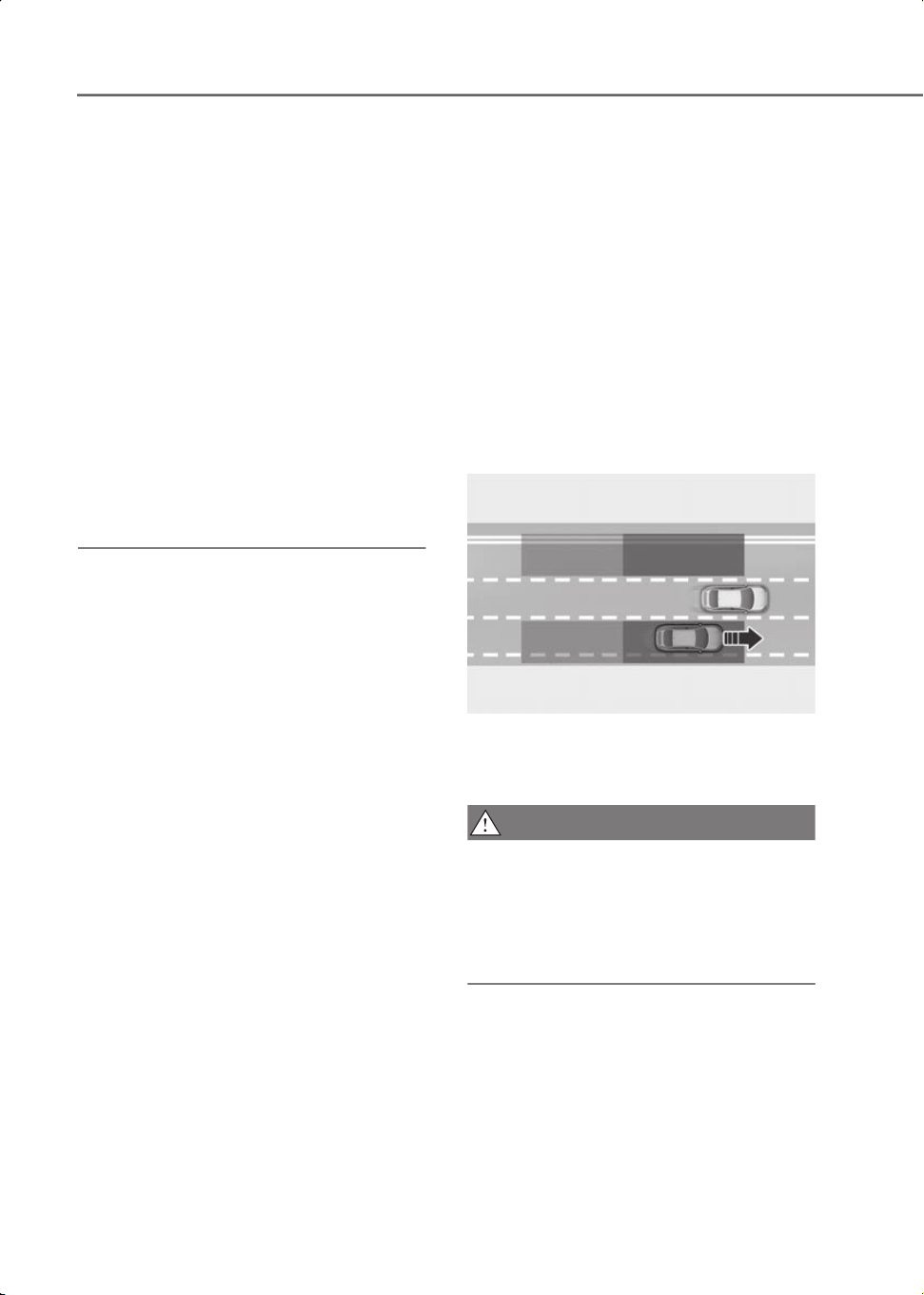
Driver Assistance System
7-36
• Lane Keeping Assist will not operate
when:
- The turn signal or hazard warning
flasher is turned on.
- The vehicle is not driven in the center
of the lane when Lane Keeping Assist
is turned on or right after changing a
lane.
- ESC (Electronic Stability Control) or
VSM (Vehicle Stability Management)
is activated.
- The vehicle is driven on a sharp curve.
- Vehicle speed is below 35 mph (55
km/h) or above 130 mph (210 km/h).
- The vehicle makes sudden lane
changes.
- The vehicle brakes suddenly.
Blind-Spot
Collision-Avoidance
Assist (BCA)
Blind-Spot Collision-Avoidance Assist
detects approaching vehicles in the
driver’s blind spot areas and warn you of a
possible collision with a warning light and
a warning sound.
If there is a collision risk when exiting a
parallel space, Blind-Spot
Collision-Avoidance Assist may assist
with braking your vehicle to help avoid a
collision.
B7001301
Blind-Spot Collision-Avoidance Assist
helps detect and informs the driver that a
vehicle is in the blind spot.
CAUTION
The detecting range may vary depending
on the speed of your vehicle. Even if there
is a vehicle in the blind spot area,
Blind-Spot Collision-Avoidance Assist
may not warn you when you pass by at
high speeds.
CE_USA.book Page 36
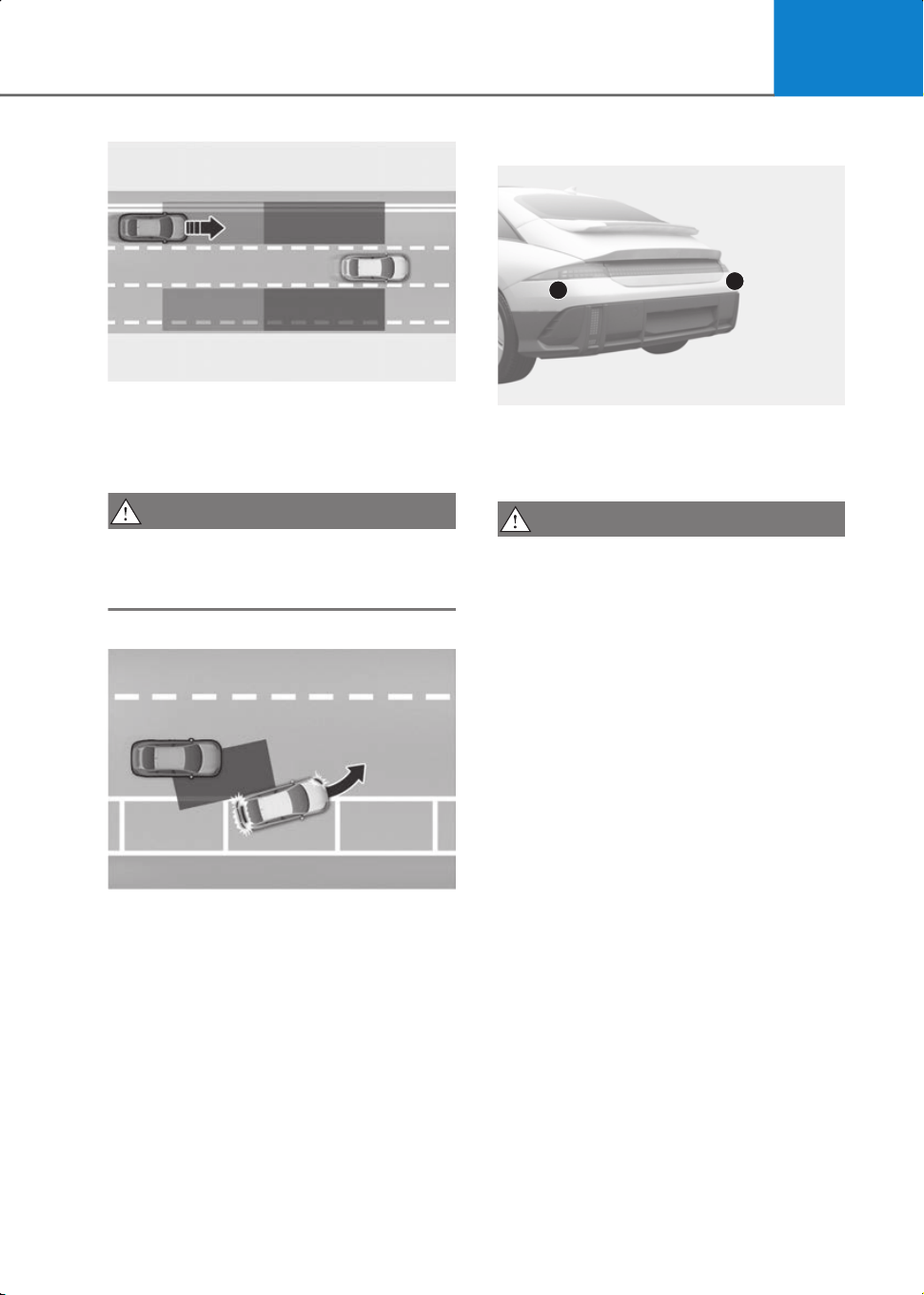
7
7-37
B7001302
Blind-Spot Collision-Avoidance Assist
helps detect and informs the driver that a
vehicle is approaching at high speed from
the blind spot area.
CAUTION
Warning timing may vary depending on
the speed of the vehicle approaching at
high speed.
B7001303
When you are driving forward out of a
parking space, if Blind-Spot
Collision-Avoidance Assist judges that
there is a collision risk with an
approaching vehicle in the blind spot, it
can help avoid collision by applying the
brake.
Detecting sensor
B7001802
(1) Rear corner radar
Refer to the picture above for the detailed
location of the detecting sensors.
CAUTION
Take the following precautions to
maintain optimal performance of the
detecting sensor:
• Never disassemble the detecting
sensor assembly, or cause any damage
to it.
• If the rear corner radar or near the radar
has been damaged or impacted in any
way, even though the warning message
does not appear on the instrument
cluster, Blind-Spot Collision-Avoidance
Assist may not operate properly. Have
the vehicle inspected by an authorized
HYUNDAI dealer.
• If the rear corner radars have been
replaced or repaired, have the vehicle
inspected by an authorized HYUNDAI
dealer.
• Rear bumper genuine parts with rear
corner radars have proven their
performance. Replacing or painting the
rear bumper may result in poor
performance of Blind-Spot
Collision-Avoidance Assist. When the
parts need to be replaced or modified,
make sure to use genuine HYUNDAI
parts.
1
1
CE_USA.book Page 37
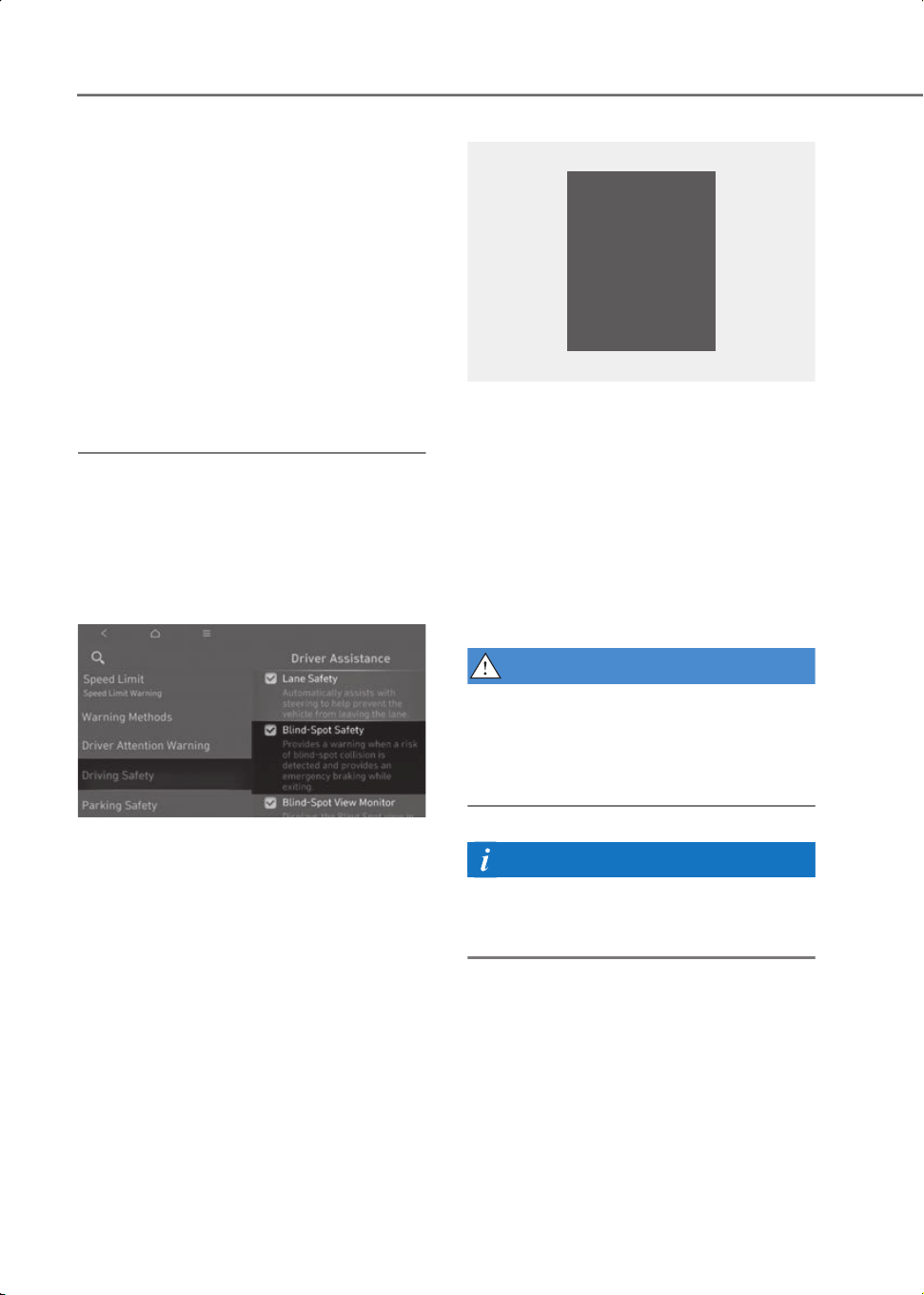
Driver Assistance System
7-38
• Do not apply license plate frame or
objects, such as a bumper sticker, film
or a bumper guard near the rear corner
radar.
• Blind-Spot Collision-Avoidance Assist
may not work properly if the bumper
has been replaced, or the surroundings
of the rear corner radar have been
damaged or paint has been applied.
• If a trailer, carrier, etc., is installed, it
may adversely affect the performance
of the rear corner radar or Blind-Spot
Collision-Avoidance Assist may not
operate.
Blind-Spot
Collision-Avoidance Assist
settings
Blind-Spot Safety
B0320EE01
With the vehicle on, select Setup >
Vehicle > Driver Assistance > Driving
Safety > Blind-Spot Safety from the
settings menu to set whether to use each
function.
• If Blind-Spot Safety is selected,
Blind-Spot Collision Avoidance Assist
will warn the driver with a warning
message, an audible warning
depending on the collision risk levels.
Braking assist will be applied for
parking exit depending on the collision
risk levels.
OTM070097N
When the vehicle is restarted with
Blind-Spot Collision-Avoidance Assist off,
the 'Blind-spot safety system is Off’
message will appear on the instrument
cluster.
If you select Blind-Spot Safety, warning
light on the side view mirror will blink for
three seconds. In addition, if the vehicle is
turned on, when Blind-Spot Safety is
selected, the warning light on the side
view mirror will blink for three seconds.
WARNING
The driver should always be aware of the
surroundings and drive safely. If
Blind-Spot Safety is deselected,
Blind-Spot Collision-Avoidance Assist
cannot assist you.
Information
If the vehicle is restarted, Blind-Spot
Collision-Avoidance Assist will maintain
the last setting.
#MJOETQPUTBGFUZ
TZTUFNJT0GG
CE_USA.book Page 38
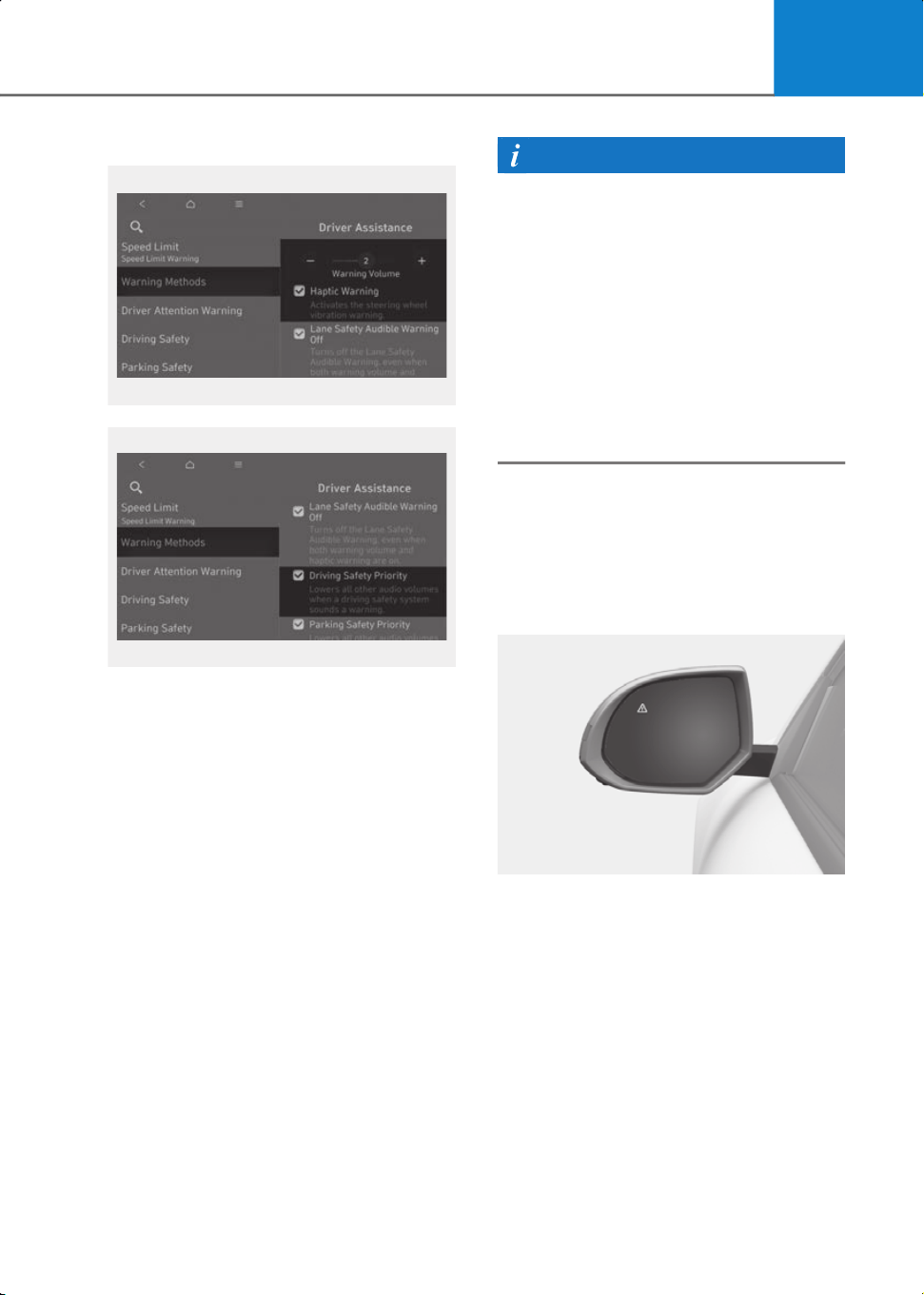
7
7-39
Warning Methods
B7000205
B7000205_1
With the vehicle on, go to Setup > Vehicle
> Driver Assistance > Warning Methods
from the Settings in the infotainment
system to select the following:
• Warning Volume: The Warning Volume
can be adjusted.
• Haptic Warning: The steering wheel
vibration can be set.
• Driving Safety Priority: Your vehicle
lowers all other audio volumes when
the Driver Assistance system warning
sounds.
Information
• If you change the Warning Methods,
Warning Methods of other Driver
Assistance systems may change.
• If the vehicle is restarted, Warning
Methods will maintain the last setting.
• There may be no Settings menu
depending on the feature applied to
your vehicle.
• The Warning Volume and Haptic
Warning cannot be turned off at the
same time. When one of the warnings is
turned off, the other is activated.
Blind-Spot
Collision-Avoidance Assist
Operation
Collision Warning (while driving)
B7001501
• To warn the driver a vehicle is detected,
the warning light on the side view
mirror and head-up display (if
equipped) will illuminate.
• Blind-Spot Collision Warning will
operate when your vehicle speed is
above 12 mph (20 km/h) and the speed
of the vehicle in the blind spot area is
above 7 mph (10 km/h).
• Collision warning will operate when the
turn signal is turned on in the direction
of the detected vehicle.
CE_USA.book Page 39
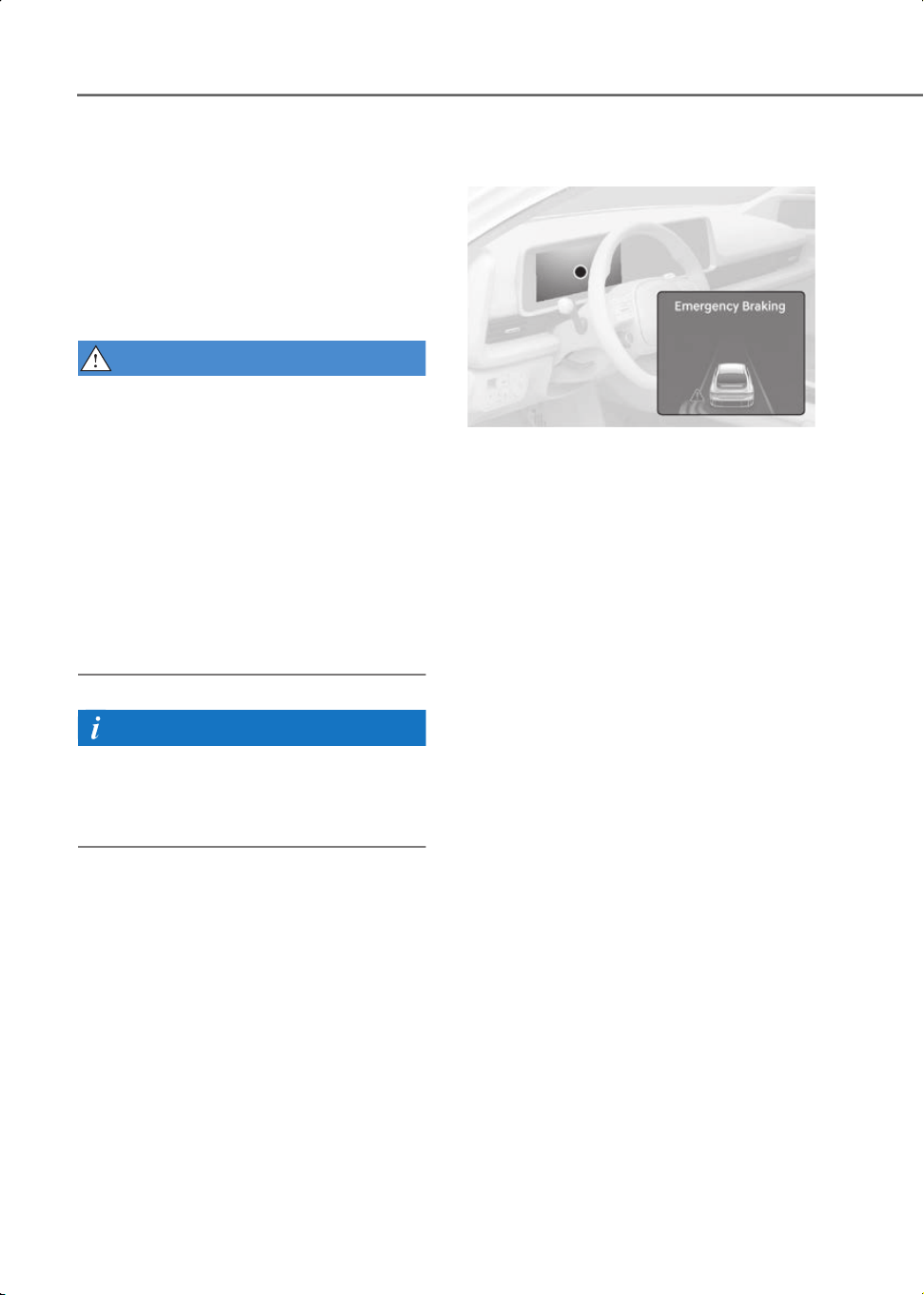
Driver Assistance System
7-40
• To warn the driver of a collision, the
warning light on the side view mirror
and head-up display (if equipped) will
blink. At the same time, an audible
warning will sound.
• When the turn signal is turned off, the
collision warning will be canceled and
Blind-Spot Collision Avoidance Assist
will return to vehicle detection state.
WARNING
• The detecting range of the rear corner
radar is determined by a standard road
width, therefore, on a narrow road,
Blind-Spot Collision-Avoidance Assist
may detect other vehicles two lanes
over and warn you. In contrast, on a
wide road, Blind-Spot
Collision-Avoidance Assist may not be
able to detect a vehicle driving in the
next lane and may not warn you.
• When the hazard warning flasher is on,
the collision warning by the turn signal
will not operate.
Information
The images and colors in the instrument
cluster may differ depending on the
instrument cluster type or theme selected
from the settings menu.
Collision-Avoidance Assist (while
exiting parallel spot)
B7001503
• To warn the driver of a collision, the
warning light on the side view mirror
will blink and a warning message will
appear on the instrument cluster. At the
same time, an audible warning will
sound, warning light on the head-up
display (if equipped) will blink and the
steering wheel will vibrate.
• Emergency braking will be assisted to
help prevent collision with the vehicle
in the blind spot area.
• Blind-Spot Collision-Avoidance Assist
will operate when your vehicle speed is
below 2 mph (3 km/h) and the speed of
the vehicle in the blind spot area is
above 3 mph (5 km/h).
CE_USA.book Page 40
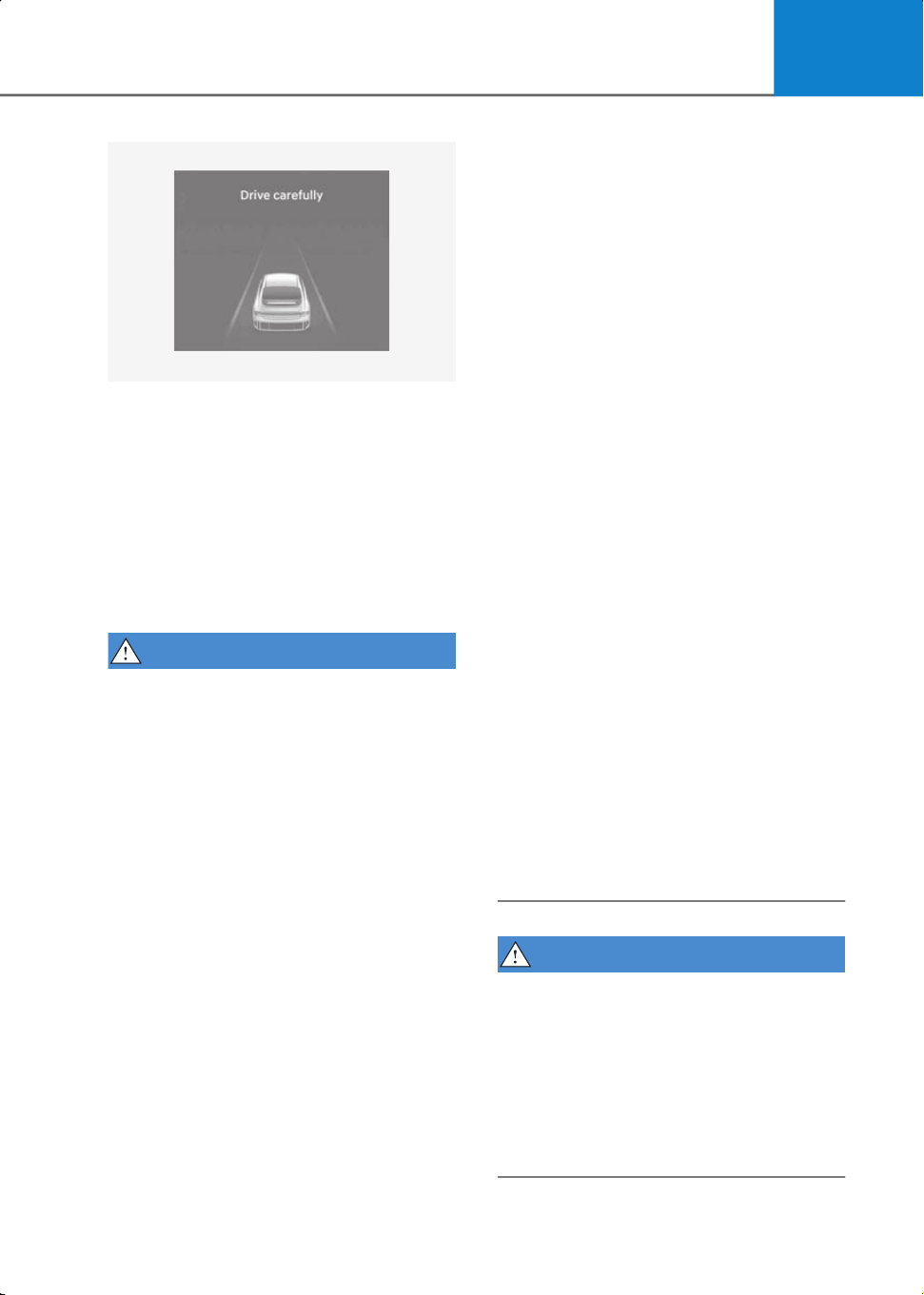
7
7-41
B7001504
• When the vehicle is stopped due to
emergency braking, the ‘Drive
carefully’ warning message will appear
on the instrument cluster.
For your safety, the driver should
depress the brake pedal immediately
and check the surroundings.
• Brake control will end after the vehicle
is stopped by emergency braking for
about 2 seconds.
WARNING
Take the following precautions when
using Blind-Spot Collision-Avoidance
Assist:
• For your safety, only change the
Settings after parking the vehicle at a
safe location.
• If any other system’s warning message
is displayed or audible warning is
generated, Blind-Spot
Collision-Avoidance Assist’s warning
message may not be displayed and
audible warning may not be generated.
• You may not hear the warning sound of
Blind-Spot Collision-Avoidance Assist if
the surrounding is noisy.
• Blind-Spot Collision-Avoidance Assist
may not operate if the driver applies the
brake pedal to avoid a collision.
• When Blind-Spot Collision-Avoidance
Assist is operating, braking control by
the function will automatically cancel
when the driver excessively depresses
the accelerator pedal or sharply steers
the vehicle.
• During Blind-Spot Collision-Avoidance
Assist operation, the vehicle may stop
suddenly injuring passengers and
shifting loose objects. Always have the
seat belt on and keep loose objects
secured.
• Even if there is a problem with
Blind-Spot Collision-Avoidance Assist,
the vehicle's basic braking will function
normally.
• Blind-Spot Collision-Avoidance Assist
does not operate in all situations and
cannot avoid all collisions.
• Blind-Spot Collision-Avoidance Assist
may warn the driver late or may not
warn the driver depending on the road
and driving conditions.
• Driver should maintain control of the
vehicle at all times. Do not depend on
Blind-Spot Collision-Avoidance Assist.
Maintain a safe braking distance, and if
necessary, depress the brake pedal to
reduce driving speed or to stop the
vehicle.
• Never operate Blind-Spot
Collision-Avoidance Assist on people,
animal, objects, etc. It may cause
serious injury or death.
WARNING
The brake control may not operate
properly depending on the status of ESC
(Electronic Stability Control).
There will only be a warning when:
• The ESC (Electronic Stability Control)
warning light is on
• ESC (Electronic Stability Control) is
engaged in a different function
CE_USA.book Page 41
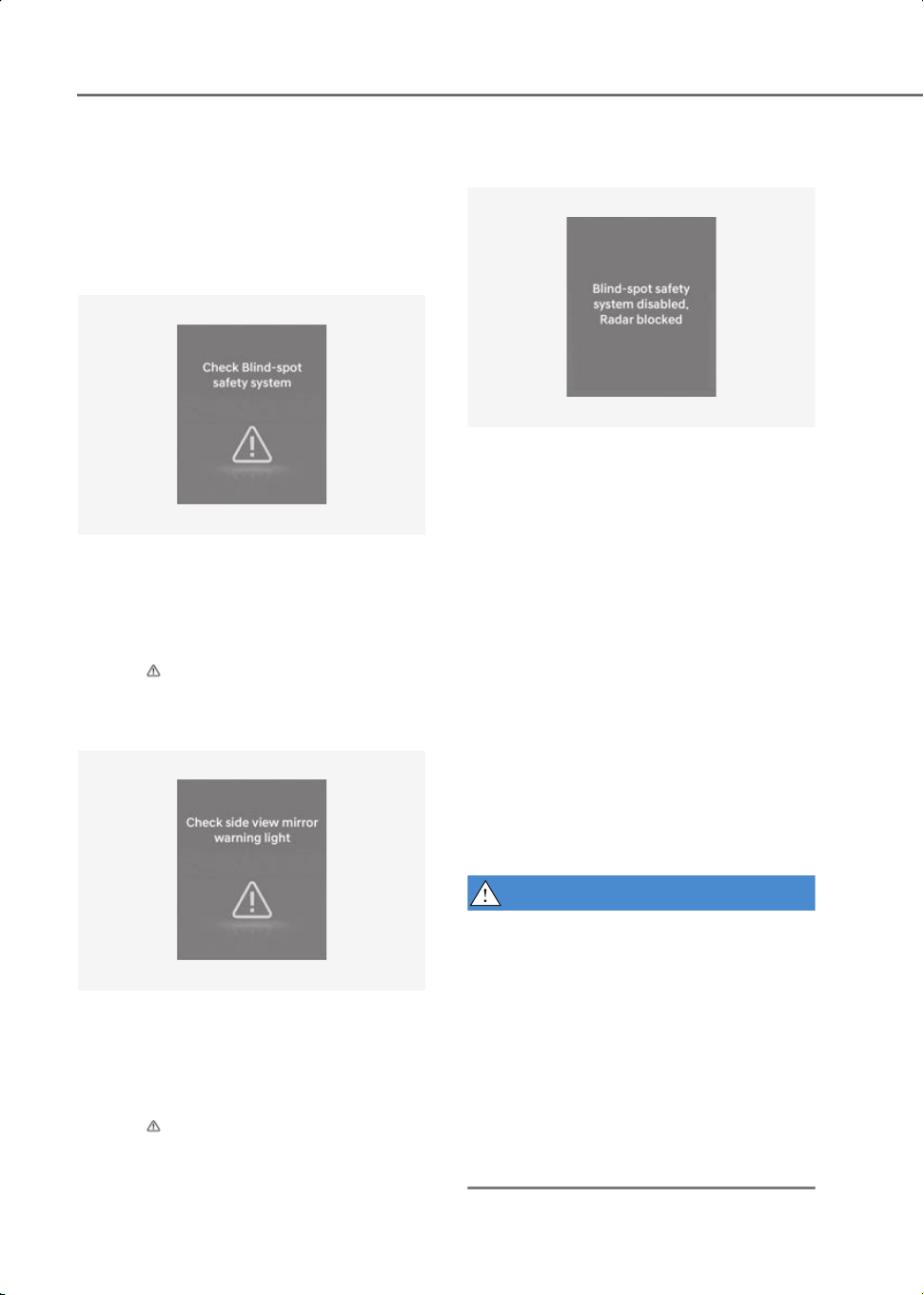
Driver Assistance System
7-42
Blind-Spot
Collision-Avoidance Assist
Malfunction and Limitations
Blind-Spot Collision-Avoidance
Assist malfunction
B7001601
When Blind-Spot Collision-Avoidance
Assist is not working properly, the ‘Check
Blind-spot safety system' warning
message will appear on the instrument
cluster for several seconds, and the
master ( ) warning light will illuminate on
the instrument cluster. If this occurs, have
the vehicle inspected by an authorized
HYUNDAI dealer.
B7001602
When the side view mirror warning light is
not working properly, the 'Check side
view mirror warning light' warning
message will appear on the instrument
cluster for several seconds, and the
master ( ) warning light will illuminate on
the instrument cluster. If this occurs, have
the vehicle inspected by an authorized
HYUNDAI dealer.
Blind-Spot Collision-Avoidance
Assist disabled
B7001603
When the rear bumper around the rear
corner radar or sensor is covered with
foreign material, such as snow or rain, or
installing a trailer or carrier, it can reduce
the detecting performance and
temporarily limit or disable Blind-Spot
Collision-Avoidance Assist.
If this occurs, the 'Blind-Spot Safety
system disabled. Radar blocked'
warning message will appear on the
instrument cluster.
Blind-Spot Collision-Avoidance Assist will
operate properly when such foreign
material or trailer, etc., is removed, and
then the vehicle is restarted.
If Blind-Spot Collision-Avoidance Assist
does not operate properly after it is
removed, have the vehicle inspected by
an authorized HYUNDAI dealer.
WARNING
• Even though the warning message
does not appear on the instrument
cluster, Blind-Spot Collision-Avoidance
Assist may not properly operate.
• Blind-Spot Collision-Avoidance Assist
may not properly operate in an area (for
example, open terrain) where any
objects are not detected right after the
vehicle is turned on, or when the
detecting sensor is blocked with
foreign material right after the vehicle
is turned on.
CE_USA.book Page 42

7
7-43
CAUTION
Turn off Blind-Spot Collision-Avoidance
Assist to install or remove a trailer, carrier,
or another attachment. Turn on
Blind-Spot Collision-Avoidance Assist
when finished.
Limitations of Blind-Spot
Collision-Avoidance Assist
Blind-Spot Collision-Avoidance Assist
may not operate properly, or it may
operate unexpectedly under the
following circumstances:
• There is inclement weather, such as
heavy snow, heavy rain, etc.
• The rear corner radar is covered with
snow, rain, dirt, etc.
• The temperature around the rear corner
radar is high or low
• Driving on a highway ramp
• The road pavement (or the peripheral
ground) abnormally contains metallic
components (for example, possibly due
to subway construction)
• There is a fixed object near the vehicle,
such as sound barriers, guardrails,
central dividers, entry barriers, street
lamps, signs, tunnels, walls, etc.
(including double structures)
• Driving in vast areas where there are
few vehicles or structures (for example,
desert, meadow, suburb, etc.)
• Driving through a narrow road where
trees or grass are overgrown
• Driving on a wet road surface, such as a
puddle on the road
• The other vehicle drives very close
behind your vehicle, or the other
vehicle passes by your vehicle in close
proximity
• The speed of the other vehicle is very
fast that it passes by your vehicle in a
short time
• Your vehicle passes by the other vehicle
• Your vehicle changes lane
• Your vehicle has started at the same
time as the vehicle next to you and has
accelerated
• The vehicle in the next lane moves two
lanes away from you, or when the
vehicle two lanes away moves to the
next lane from you
• A trailer, carrier or other attachment is
installed around the rear corner radar
• The bumper around the rear corner
radar is covered with objects, such as a
bumper sticker, bumper guard, bike
rack, etc.
• The bumper around the rear corner
radar is impacted, damaged or the
radar is out of position
• Your vehicle height is low or high due to
heavy loads, abnormal tire pressure,
etc.
Blind-Spot Collision-Avoidance Assist
may not operate properly, or it may
operate unexpectedly when the following
objects are detected:
• A motorcycle or bicycle is detected
• A vehicle such as a flat trailer is
detected
• A big vehicle such as a bus or truck is
detected
• A moving obstacle such as a
pedestrian, animal, shopping cart or a
baby stroller is detected
• A vehicle with low height such as a
sports car is detected
CE_USA.book Page 43
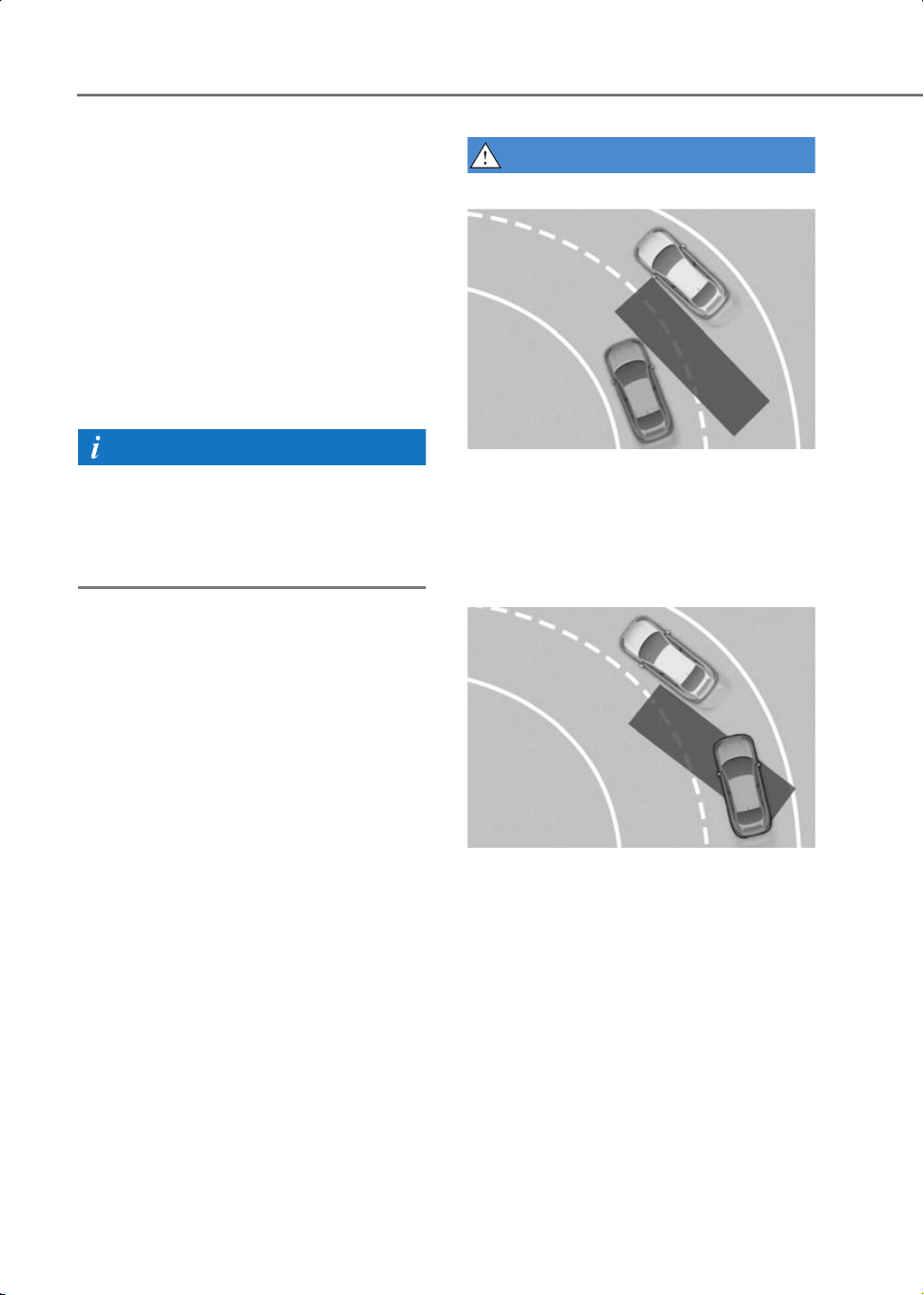
Driver Assistance System
7-44
Braking control may not work, driver’s
attention is required in the following
circumstances:
• The vehicle severely vibrates while
driving over a bumpy road, uneven road
or concrete patch
• Driving on a slippery surface due to
snow, water puddle, ice, etc.
• The tire pressure is low or a tire is
damaged
• The braking system has been modified
• The vehicle makes abrupt lane changes
Information
For more information on the limitations of
the front view camera, refer to the
“Forward Collision-Avoidance Assist
(FCA)” and “Lane Keeping Assist (LKA)”
section in this chapter.
WARNING
• Driving on a curved road
B7001609
Blind-Spot Collision-Avoidance Assist
may not operate properly when driving
on a curved road. The function may not
detect the vehicle in the next lane.
Always pay attention to road and
driving conditions while driving.
B7001610
Blind-Spot Collision-Avoidance Assist
may not operate properly when driving
on a curved road. The function may
recognize a vehicle in the same lane.
Always pay attention to road and
driving conditions while driving.
CE_USA.book Page 44
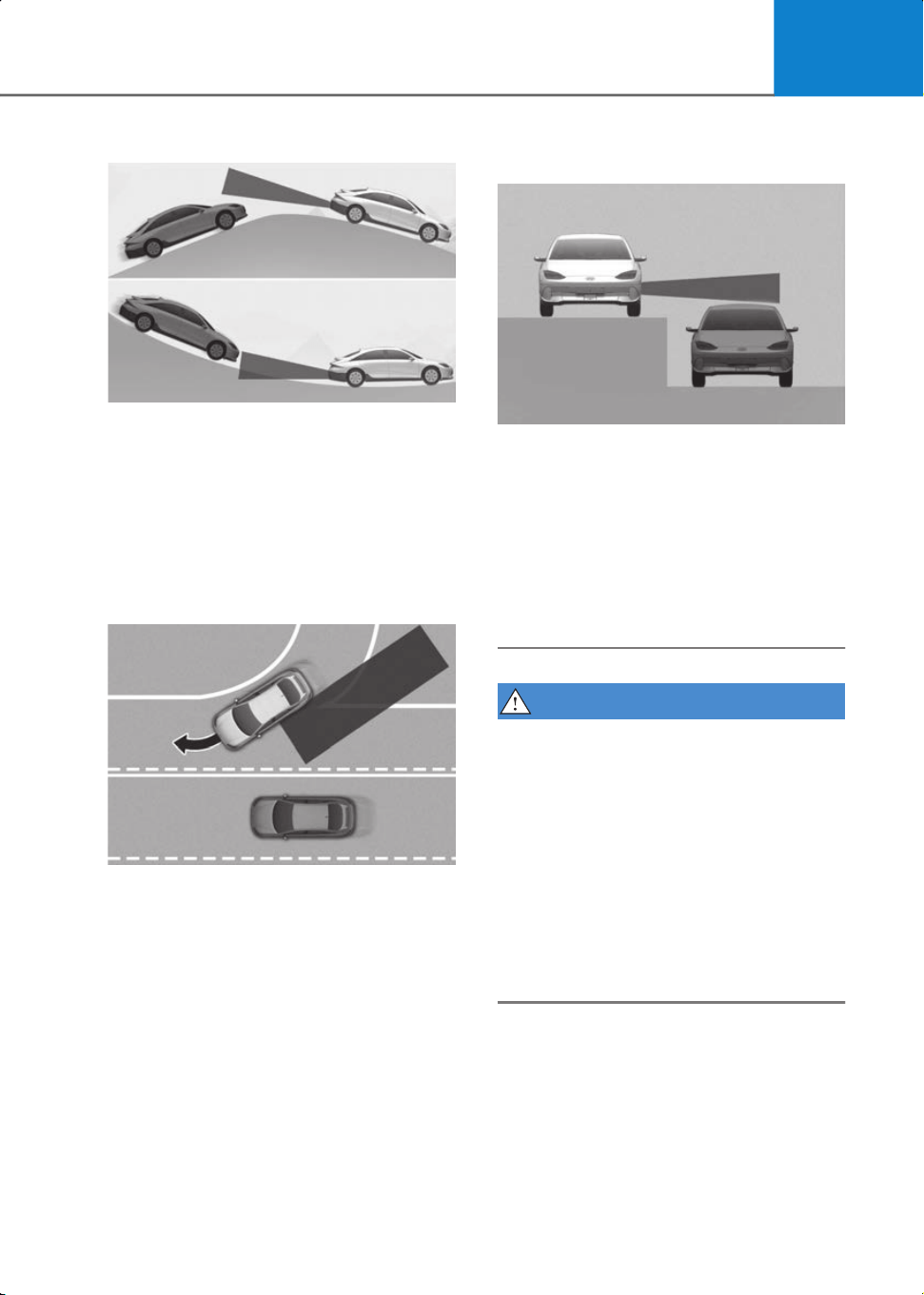
7
7-45
• Driving on an inclined road
B7001614
Blind-Spot Collision-Avoidance Assist
may not operate properly when driving
on a slope. The function may not detect
the vehicle in the next lane or may
incorrectly detect the ground or
structure. Always pay attention to road
and driving conditions while driving.
• Driving where the road is
merging/dividing
B7001615
Blind-Spot Collision-Avoidance Assist
may not operate properly when driving
where the road merges or divides. The
function may not detect the vehicle in
the next lane.
Always pay attention to road and
driving conditions while driving.
• Driving where the heights of the lanes
are different
B7001616
Blind-Spot Collision-Avoidance Assist
may not operate properly when driving
where the heights of the lanes are
different. The function may not detect
the vehicle on a road with different lane
heights (underpass joining section,
grade separated intersections, etc.).
Always pay attention to road and
driving conditions while driving.
WARNING
• When you are towing a trailer or
another vehicle, make sure that you
turn off Blind-Spot Collision-Avoidance
Assist.
• Blind-Spot Collision-Avoidance Assist
may not operate properly if interfered
by strong electromagnetic waves.
• Blind-Spot Collision-Avoidance Assist
may not operate for 15 seconds after
the vehicle is started, or the front view
camera or rear corner radars are
initialized.
CE_USA.book Page 45
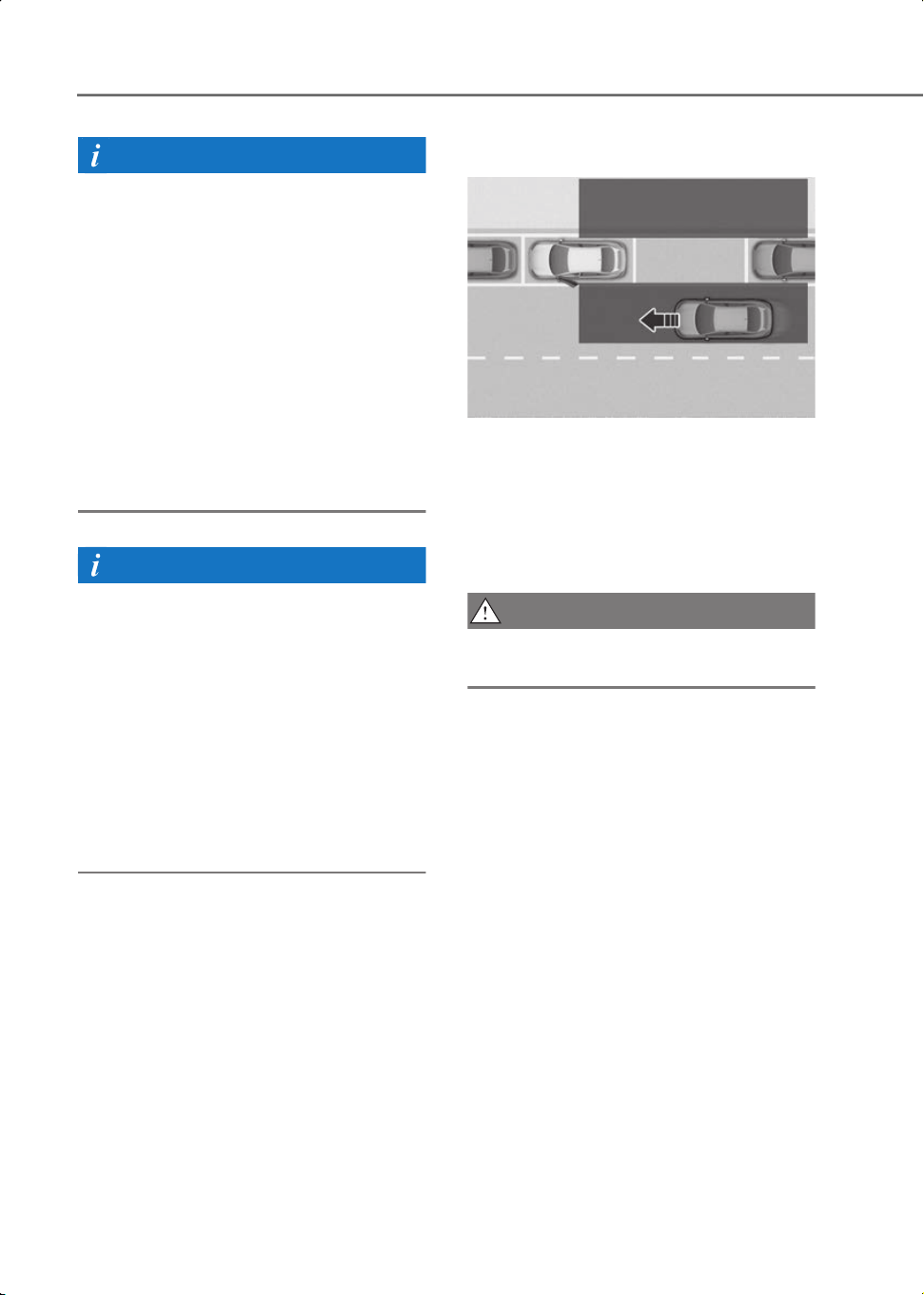
Driver Assistance System
7-46
Information
This device complies with Part 15 of the
FCC rules.
Operation is subject to the following three
conditions:
1. This device may not cause harmful
interference, and
2. This device must accept any
interference received, including
interference that may cause undesired
operation.
3. Changes or modifications not expressly
approved by the party responsible for
compliance could void the user’s
authority to operate the device.
Information
Radio frequency radiation exposure
information:
This equipment complies with FCC
radiation exposure limits set forth for an
uncontrolled environment.
This equipment should be installed and
operated with minimum distance of 8 in.
(20 cm) between the radiator (antenna)
and your body.
This transmitter must not be co-located
or operating in conjunction with any other
antenna or transmitter.
Safe Exit Warning (SEW)
B7001801
While your vehicle is stopped, and if Safe
Exit Warning detects a vehicle
approaching the rear corner of your
vehicle and a passenger opens a door,
Safe Exit Warning may warn you with a
warning message and a warning sound to
help avoid a collision.
CAUTION
Warning timing may vary depending on
the speed of the approaching vehicle.
CE_USA.book Page 46
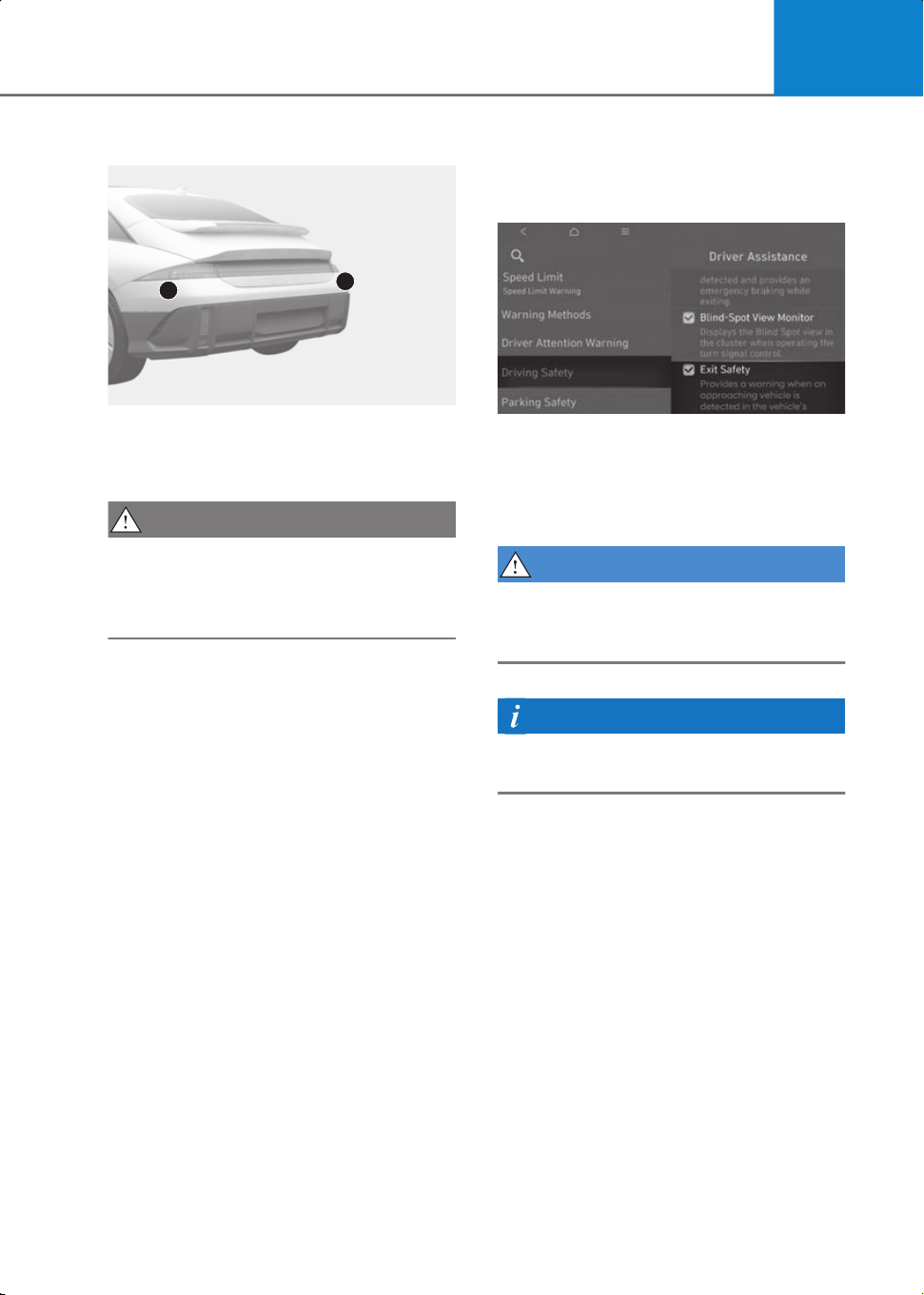
7
7-47
Detecting sensor
B7001802
(1) Rear corner radar
Refer to the picture above for the detailed
location of the detecting sensors.
CAUTION
For more information on the precautions
of the rear corner radars, refer to the
“Blind-Spot Collision-Avoidance Assist
(BCA)” section in this chapter.
Safe Exit Warning Settings
Exit Safety
B7001901
With the vehicle on, select Setup >
Vehicle > Driver Assistance > Driving
Safety > Exit Safety from the Settings
menu to turn on Safe Exit Warning and
deselect to turn off the function.
WARNING
The driver should always be aware of the
surroundings. If Exit Safety is deselected,
Safe Exit Warning cannot assist you.
Information
If the vehicle is restarted, Safe Exit
Warning will maintain the last setting.
1
1
CE_USA.book Page 47
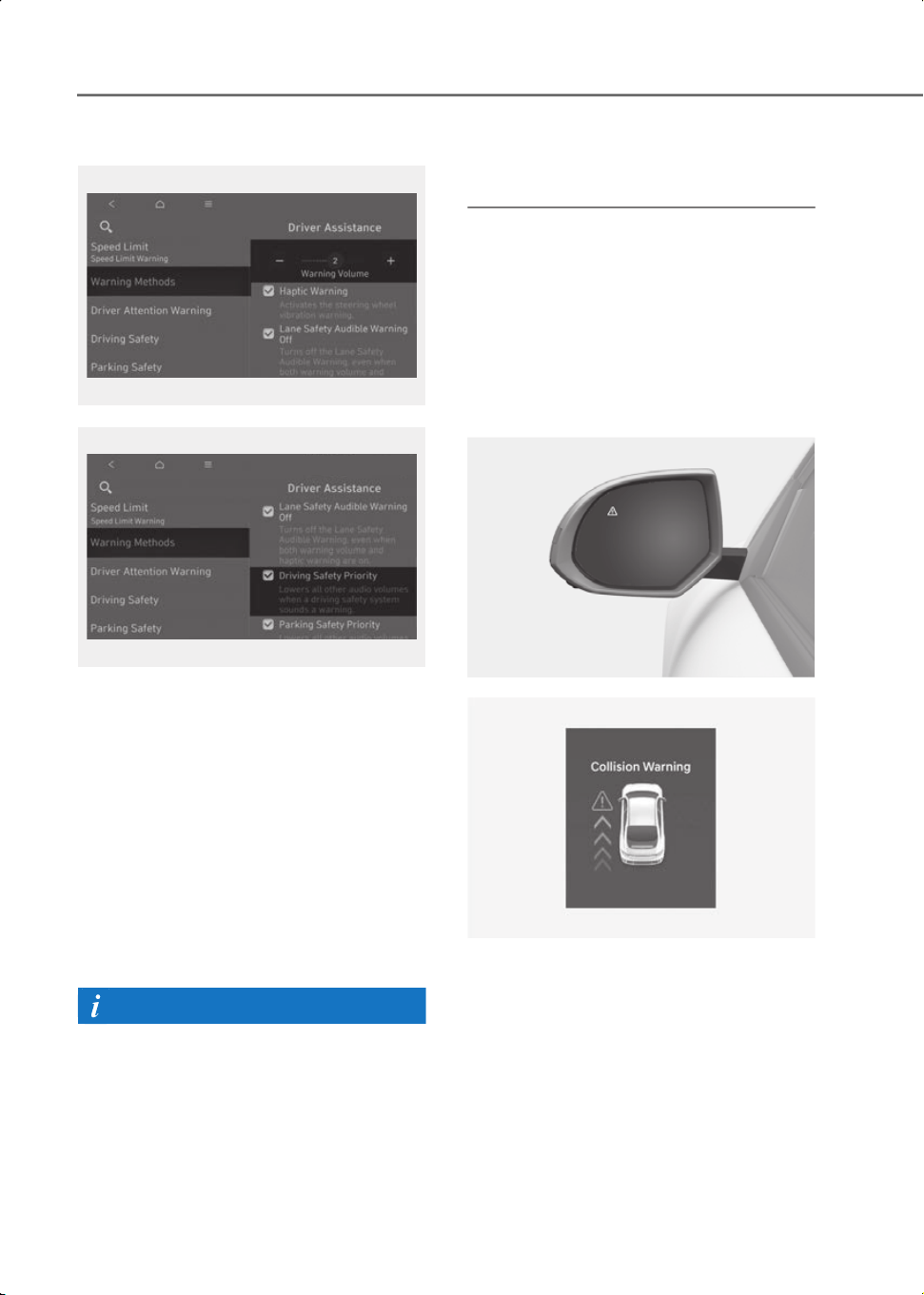
Driver Assistance System
7-48
Warning Methods
B7001902
B7001902_1
With the vehicle on, go to Setup > Vehicle
> Driver Assistance > Warning Methods
from the Settings in the infotainment
system to select the following:
• Warning Volume: The Warning Volume
can be adjusted.
If you turn off the Warning Volume, for
your safety, the function may warn you
with a low volume.
• Driving Safety Priority: Your vehicle
lowers all other audio volumes when
the Driver Assistance system warning
sounds.
Information
• If you change the Warning Methods,
Warning Methods of other Driver
Assistance systems may change.
• If the vehicle is restarted, Warning
Methods will maintain the last setting.
• There may be no Settings menu
depending on the feature applied to
your vehicle.
Safe Exit Warning Operation
Safe Exit Warning
Safe Exit Warning will warn and control
the vehicle with Collision warning when
exiting vehicle.
Collision warning when exiting vehicle
B7002001
B7002003
• When an approaching vehicle from the
rear is detected at the moment a door is
opened, the 'Collision Warning'
warning message will appear on the
instrument cluster, and an audible
warning will sound.
• Safe Exit Warning will warn the driver
when your vehicle speed is below 2
mph (3 km/h), and the speed of the
approaching vehicle from the rear is
above 4 mph (6 km/h).
CE_USA.book Page 48
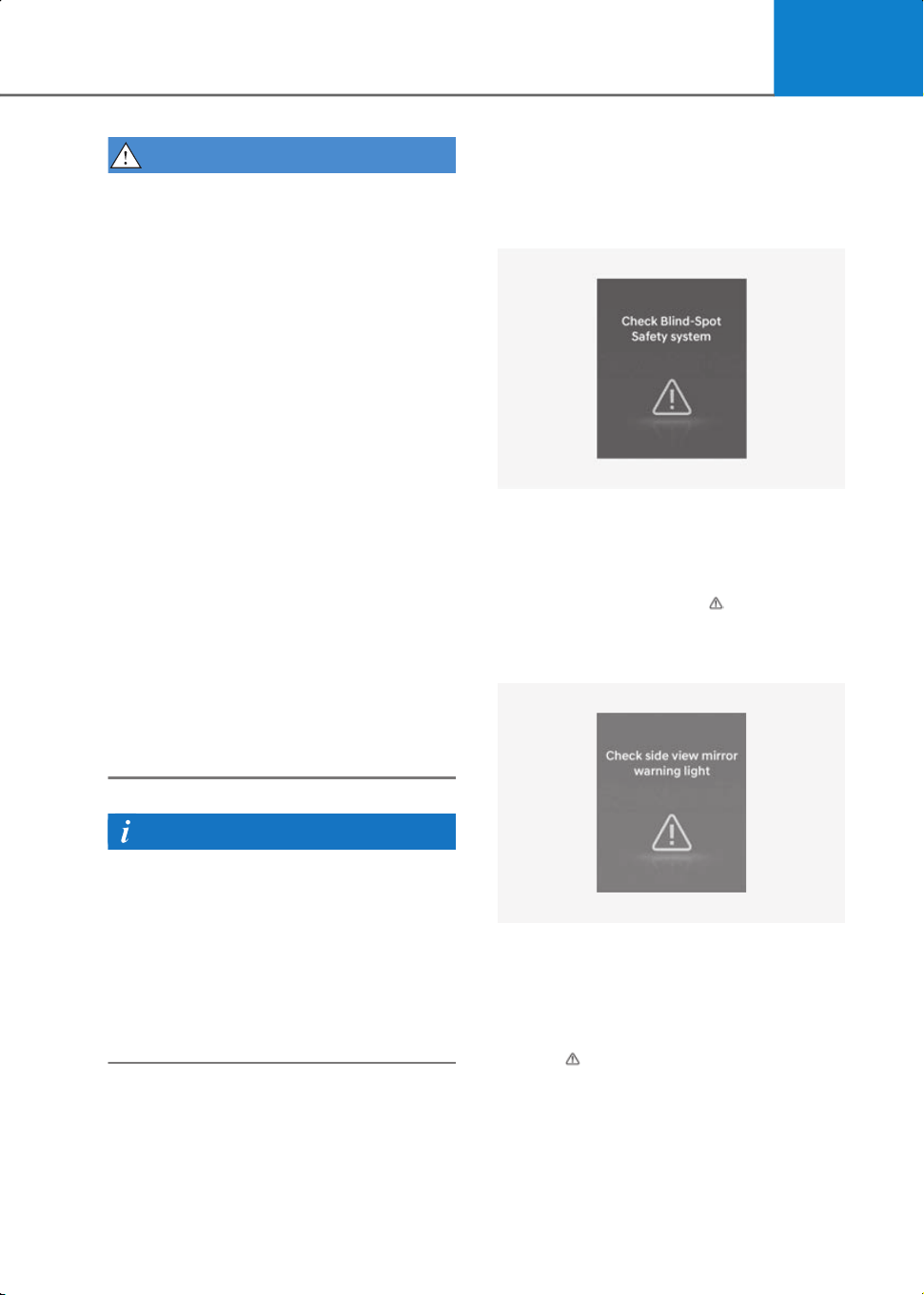
7
7-49
WARNING
Take the following precautions when
using Safe Exit Warning:
• For your safety, only change the
Settings after parking the vehicle at a
safe location.
• If any other system’s warning message
is displayed or audible warning is
generated, Safe Exit Warning's warning
message may not be displayed and
audible warning may not be generated.
• You may not hear the warning sound of
Safe Exit Warning if the surroundings
are noisy.
• Safe Exit Warning does not operate in
all situations and cannot prevent all
collisions.
• Safe Exit Warning may warn the driver
late or may not warn the driver
depending on the road and driving
conditions. Always check vehicle
surroundings.
• The driver and passengers are
responsible for accidents that occur
while exiting the vehicle. Always check
the surroundings before you exit the
vehicle.
Information
• After the vehicle is turned off, Safe Exit
Warning operates about for 3 minutes,
but turns off immediately if the doors
are locked.
• The images and colors in the
instrument cluster may differ
depending on the instrument cluster
type or theme selected from the
settings menu.
Safe Exit Warning Malfunction
and Limitations
Safe Exit Warning malfunction
B7002101
When Safe Exit Warning is not working
properly, the 'Check Blind-Spot Safety
system' warning message will appear on
the instrument cluster for several
seconds, and the master ( ) warning light
will illuminate on the instrument cluster.
If this occurs, have the vehicle inspected
by an authorized HYUNDAI dealer.
B7001602
When the side view mirror warning light is
not working properly, the 'Check side
view mirror warning light' warning
message will appear on the instrument
cluster for several seconds, and the
master ( ) warning light will illuminate on
the instrument cluster. If this occurs, have
the vehicle inspected by an authorized
HYUNDAI dealer.
CE_USA.book Page 49
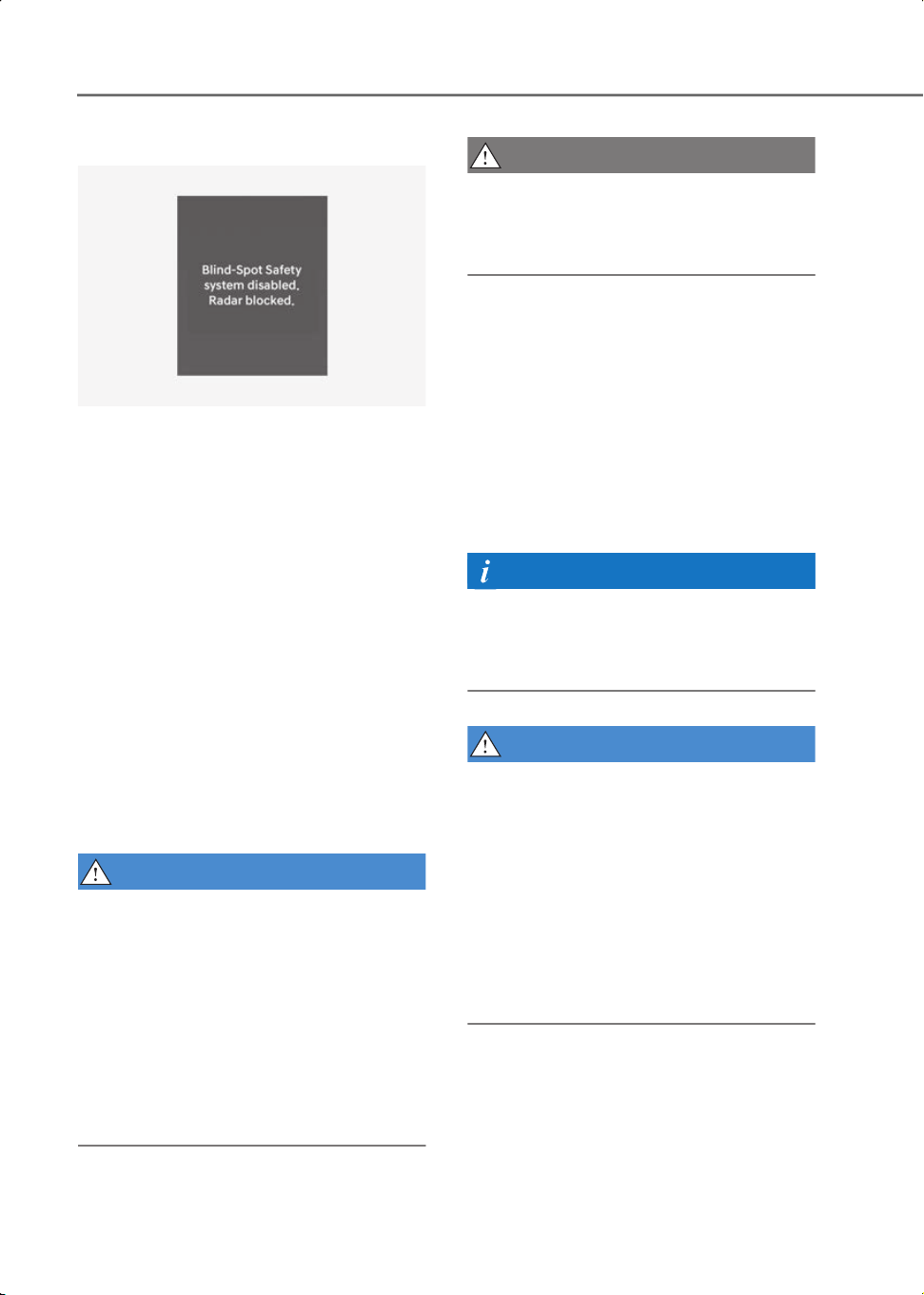
Driver Assistance System
7-50
Safe Exit Warning disabled
B7002103
When the rear bumper around the rear
corner radar or sensor is covered with
foreign material, such as snow or rain, or
installing a trailer or carrier, it can reduce
the detecting performance and
temporarily limit or disable Safe Exit
Warning.
If this occurs, the 'Blind-Spot Safety
system disabled. Radar blocked'
warning message will appear on the
instrument cluster.
Safe Exit Warning will operate properly
when such foreign material or trailer, etc.,
is removed, and then the vehicle is
restarted.
If Safe Exit Warning does not operate
properly after it is removed, have the
vehicle inspected by an authorized
HYUNDAI dealer.
WARNING
• Even though the warning message
does not appear on the instrument
cluster, Safe Exit Warning may not
properly operate.
• Safe Exit Warning may not properly
operate in an area (for example, open
terrain) where any objects are not
detected right after the vehicle is
turned on, or when the detecting
sensor is blocked with foreign material
right after the vehicle is turned on.
CAUTION
Turn off Safe Exit Warning to install or
remove a trailer, carrier, or another
attachment. Turn on Safe Exit Warning
when finished.
Limitations of Safe Exit Warning
Safe Exit Warning may not operate
properly, or it may operate unexpectedly
under the following circumstances:
• Getting out of the vehicle where trees
or grass are overgrown
• Getting out of the vehicle where the
road is wet
• The approaching vehicle is very fast or
very slow
Information
For more information on the limitations of
the rear corner radar, refer to the
“Blind-Spot Collision-Avoidance Assist
(BCA)” section in this chapter.
WARNING
• Safe Exit Warning may not operate
properly if interfered by strong
electromagnetic waves.
• Safe Exit Warning may not operate for 3
seconds after the vehicle is started, or
the rear corner radars are initialized.
• If the vehicle is turned off and restarted
while the rear corner radar is blocked or
malfunctioned, the condition is
maintained. Therefore, Safe Exit
Warning may not operate properly.
CE_USA.book Page 50
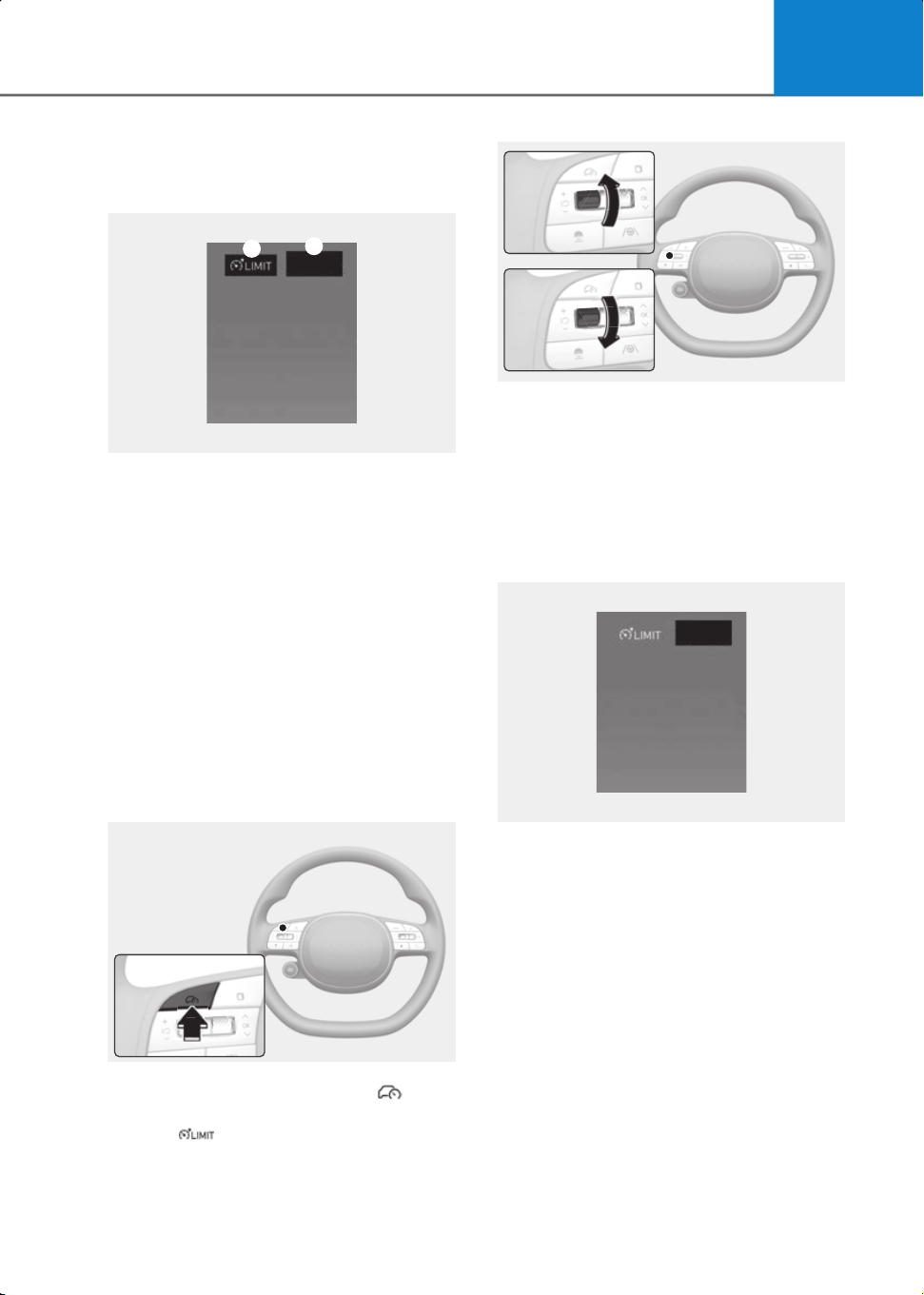
7
7-51
Manual Speed Limit
Assist (MSLA)
B7002201
(1) Speed Limit indicator
(2) Set speed
You can set the speed limit when you do
not want to drive over a specific speed.
If you drive over the preset speed limit,
Manual Speed Limit Assist will operate
(set speed limit will blink and chime will
sound) until the vehicle speed returns
within the speed limit.
Manual Speed Limit Assist
Operation
Setting speed limit
B7002301
1. Press and hold Driving Assist ( )
button at the desired speed. The Speed
Limit ( ) indicator will illuminate on
the instrument cluster.
B7002302
2. Push the + switch up or - switch down,
and release it at the desired speed.
Push the + switch up or - switch down
and hold it. The speed will increase or
decrease to the nearest multiple of five
(multiple of ten in km/h) at first, and
then increase or decrease by 5 mph (10
km/h).
B7002303
3. The set speed limit will be displayed on
the instrument cluster.
If you would like to drive over the preset
speed limit, depress the accelerator
pedal beyond the pressure point to
activate the kickdown function.
The set speed limit will blink and chime
will sound until you return the vehicle
speed within the speed limit.
2
1
50
MPH
50
MPH
CE_USA.book Page 51
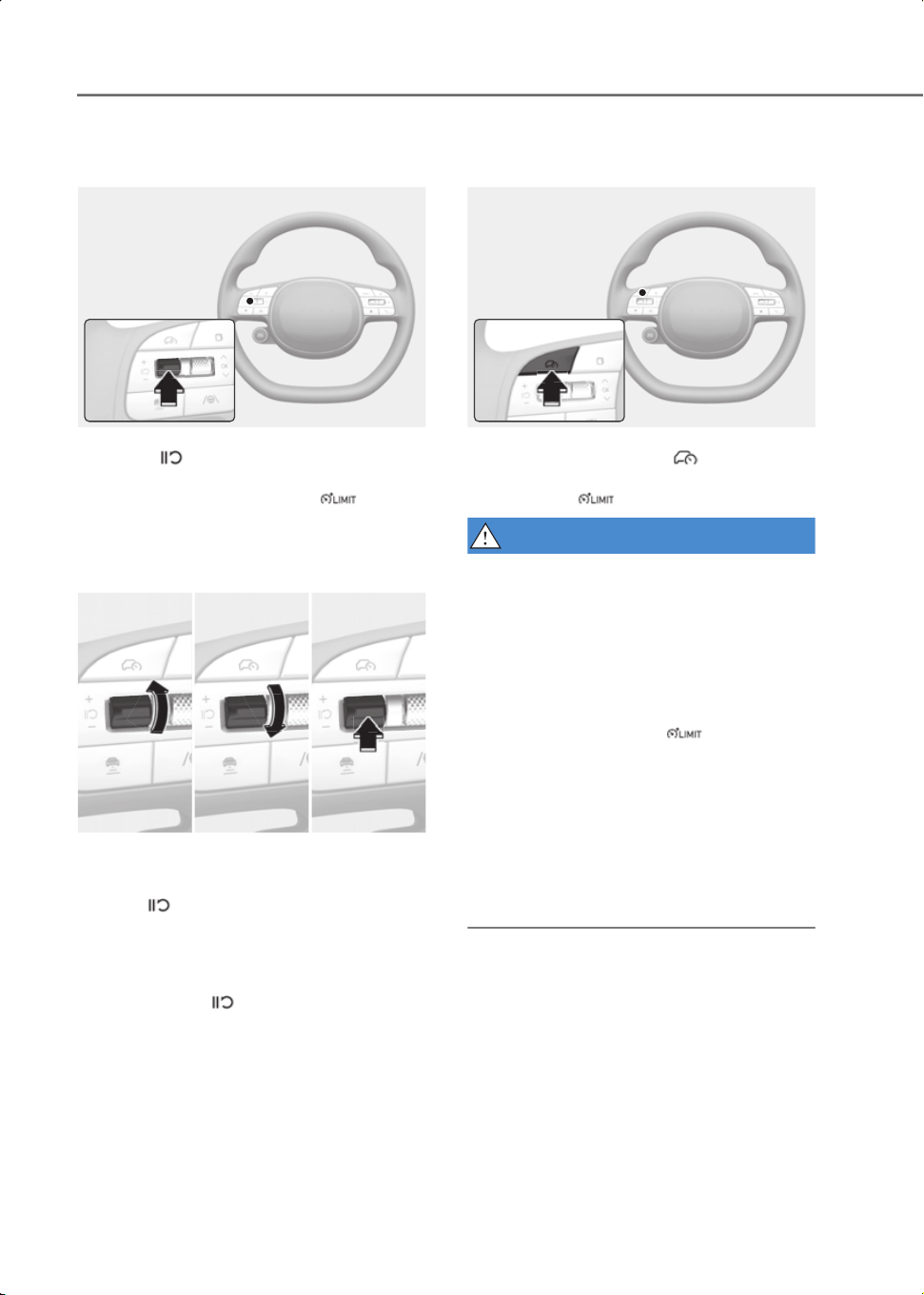
Driver Assistance System
7-52
Temporarily pausing Manual Speed
Limit Assist
B7002304
Press the switch to temporarily pause
the set speed limit. The set speed limit will
turn off but the Speed Limit ( )
indicator will stay on.
Resuming Manual Speed Limit Assist
B7002305
To resume Manual Speed Limit Assist
after the function was paused, operate
the +, -, switch.
If you push the + switch up or - switch
down, vehicle speed will be set to the
current speed on the instrument cluster.
If you press the switch, vehicle speed
will resume to the preset speed.
Turning off Manual Speed Limit
Assist
B7002301_1
Press the Driving Assist ( ) button to
turn Manual Speed Limit Assist off. The
Speed Limit ( ) indicator will go off.
WARNING
Take the following precautions when
using Manual Speed Limit Assist:
• Always set the vehicle speed to the
speed limit in your state.
• Keep Manual Speed Limit Assist off
when the function is not in use, to avoid
inadvertently setting a speed. Check
that the Speed Limit ( ) indicator is
off.
• Manual Speed Limit Assist does not
substitute for proper and safe driving. It
is the responsibility of the driver to
always drive safely and be aware of
unexpected and sudden situations. Pay
attention to the road conditions at all
times.
CE_USA.book Page 52
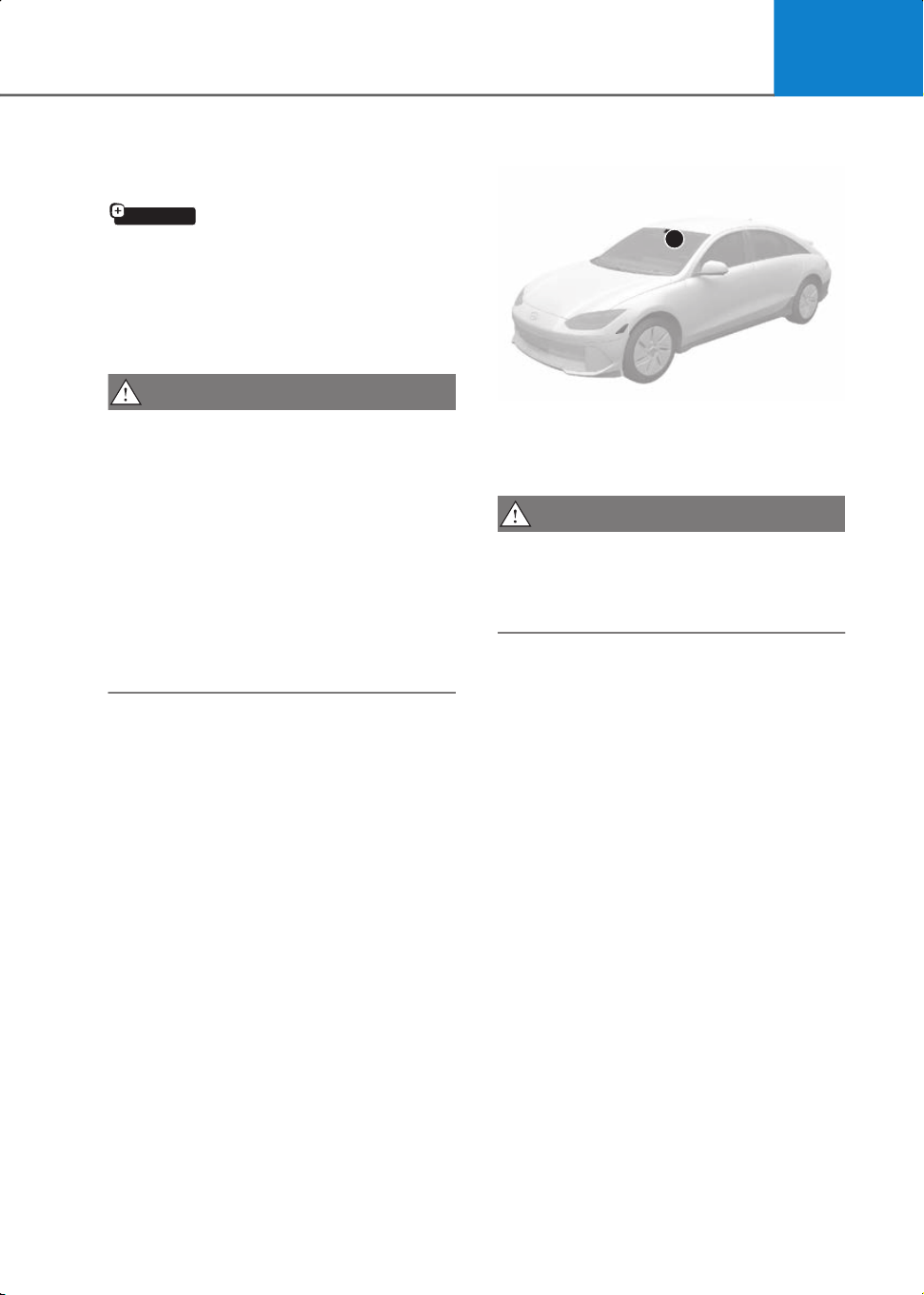
7
7-53
Intelligent Speed Limit
if equipped
Assist (ISLA)
Intelligent Speed Limit Assist uses
information from the detected road signs
and uses the navigation system data to
inform you of the speed limit and to help
maintain within the speed limit on the
road.
CAUTION
• Intelligent Speed Limit Assist may not
operate properly if the function is used
in other countries.
• If a navigation system is equipped to
your vehicle, the navigation needs to be
regularly updated for Intelligent Speed
Limit Assist to operate properly.
• The infotainment system may change
after software updates. For more
information, refer to the user's manual
provided in the infotainment system
and the quick reference guide.
Detecting sensor
B7002501
(1) Front view camera
Refer to the picture above for the detailed
location of the detecting sensor.
CAUTION
For more information on the precautions
of the front view camera, refer to the
Forward Collision-Avoidance Assist (FCA)
section in this chapter.
1
CE_USA.book Page 53
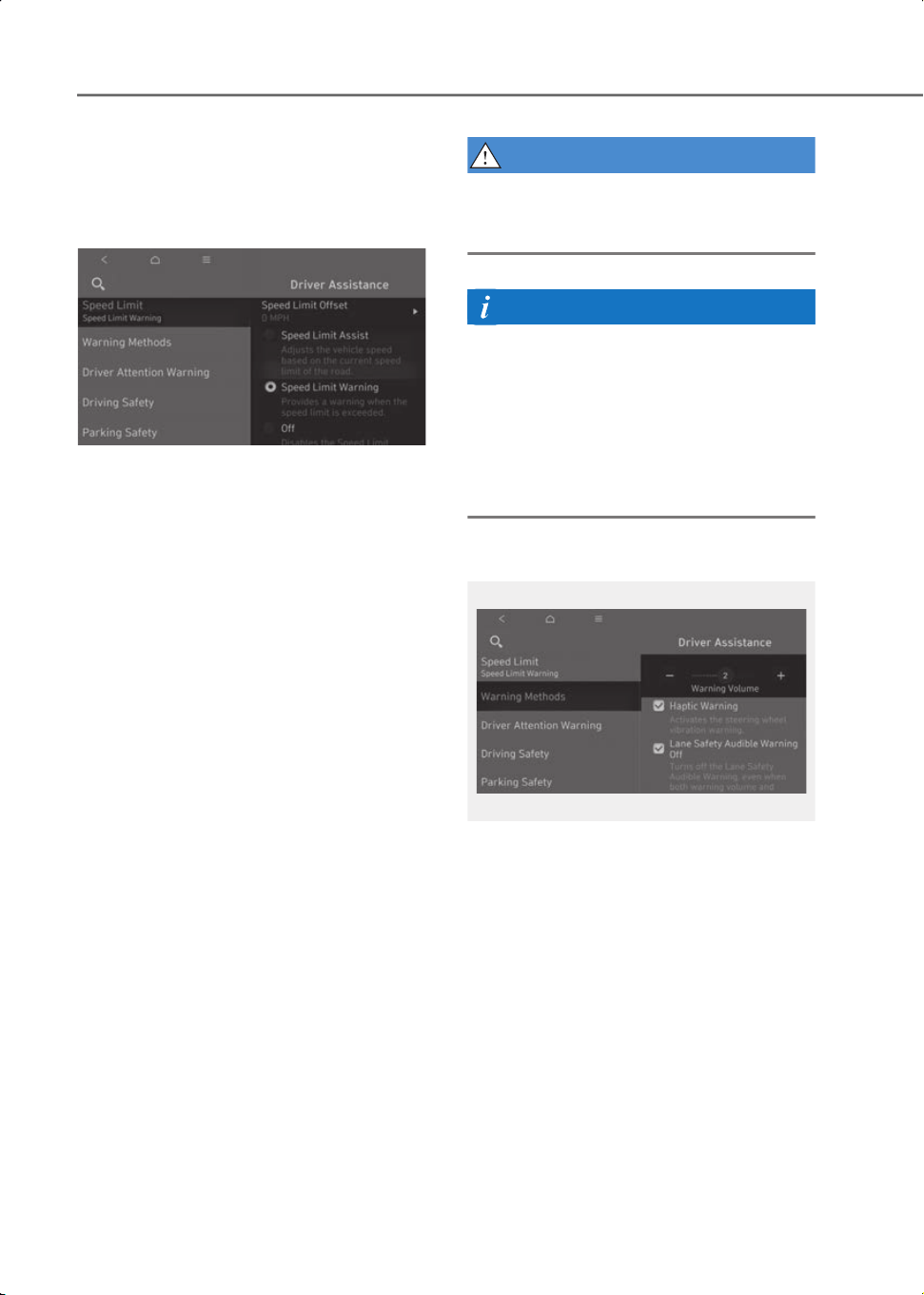
Driver Assistance System
7-54
Intelligent Speed Limit Assist
Settings
Speed Limit
B7002601
With the vehicle on, select or deselect
Setup > Vehicle > Driver Assistance >
Speed Limit from the Settings menu to
set whether to use each function.
• If Speed Limit Offset is selected, the
Speed Limit Offset can be adjusted.
Speed Limit Warning and Speed Limit
Assist will warn the driver and adjust
the driving speed when vehicle speed
exceeds the speed at which the set
Offset is added to speed limit.
• If Speed Limit Assist is selected,
Intelligent Speed Limit Assist will
inform the driver of speed limit and
additional road signs. In addition,
Intelligent Speed Limit Assist will
inform the driver to change set speed of
Manual Speed Limit Assist and/or
Smart Cruise Control to help the driver
stay within the speed limit.
• If Speed Limit Warning is selected,
Intelligent Speed Limit Assist will
inform the driver of speed limit. In
addition, Intelligent Speed Limit Assist
will warn the driver when the vehicle is
driven faster than the speed limit.
• If Off is selected, Intelligent Speed
Limit Assist will turn off.
WARNING
For your safety, only change the Settings
after parking the vehicle at a safe
location.
Information
• Speed Limit Assist function operates
based on the Offset setting added to
the speed limit. If you want to change
the set speed according to the speed
limit, adjust the offset to ‘0’.
• The setting of 'Speed Offset' is not
reflected in Navigation-based Smart
Cruise Control (NSCC).
Warning Methods
B7001902
With the vehicle on, go to Setup > Vehicle
> Driver Assistance > Warning Methods
from the Settings in the infotainment
system to select the following:
• Warning Volume: The Warning Volume
can be adjusted.
If you turn off the Warning Volume, for
your safety, the function may warn you
with a low volume.
CE_USA.book Page 54
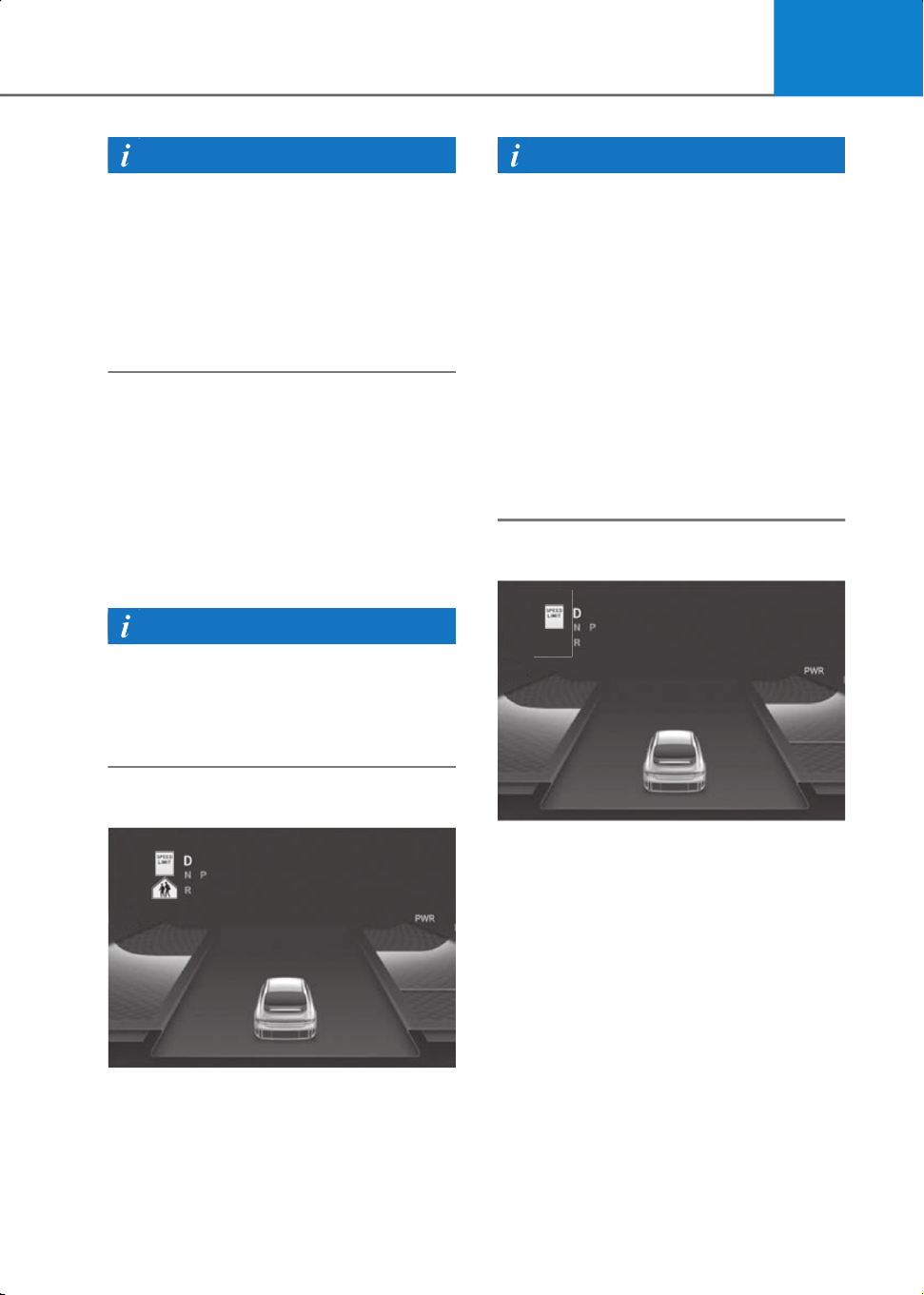
7
7-55
Information
• If you change the Warning Methods,
Warning Methods of other Driver
Assistance systems may change.
• If the vehicle is restarted, Warning
Methods will maintain the last setting.
• There may be no Settings menu
depending on the feature applied to
your vehicle.
Intelligent Speed Limit Assist
Operation
Warning and control
Intelligent Speed Limit Assist will warn
and control the vehicle speed by
“Displaying speed limit”, “Warning
overspeed” and “Changing set speed”.
Information
• Intelligent Speed Limit Assist warning
and control are described based on the
Offset adjust to "0". For details on
Offset setting, refer to the “Intelligent
Speed Limit Assist Settings”.
Displaying speed limit
B7002701
Speed limit information is displayed on
the instrument cluster.
Information
• If speed limit information of the road
cannot be recognized, '---' sign will be
displayed. Please refer to "Limitations
of Intelligent Speed Limit Assist" if the
road signs are difficult to recognize.
• Intelligent Speed Limit Assist provides
additional road sign information in
addition to speed limit. The additional
road sign information provided may
vary according to your state.
• The images and colors in the
instrument cluster may differ
depending on the instrument cluster
type or theme selected from the
instrument cluster.
Warning overspeed
B7002702
When driving at a speed higher than the
displayed speed limit, the speed limit is
displayed in red.
.1)
.1)
CE_USA.book Page 55
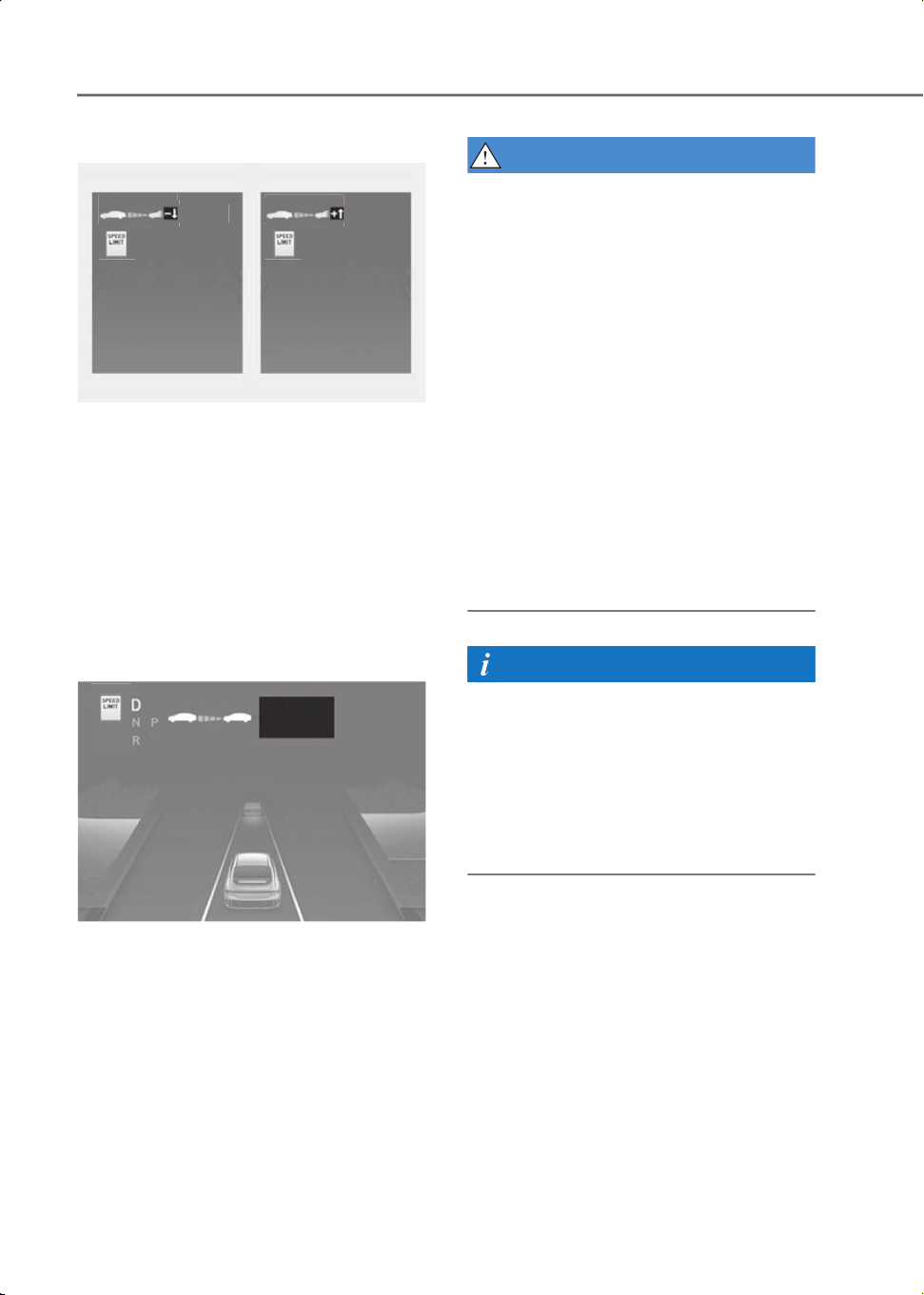
Driver Assistance System
7-56
Changing set speed
B7002703
If the speed limit of the road changes
during the operation of Manual Speed
Limit Assist or Smart Cruise Control, an
arrow in the direction of up or down is
displayed to inform the driver that the set
speed needs to be changed. At this time,
the driver can change the set speed
according to the speed limit by using the
+ or - switch on the steering wheel.
Set Speed Auto Change (Navigation
equipped)
B7002704
Manual Speed Limit Assist or Smart
Cruise Control assists the vehicle to
adjust its speed according to the speed
limit. When the cruising speed is set as
same as the speed limit, the vehicle
automatically adjusts its speed if the
speed limit changes. The function
operates on the road which has a speed
limit of 44 mph (70 km/h) or higher. When
the function is active, the cruising speed
on the instrument cluster appears in
green.
WARNING
• If you want to drive below the speed
limit, adjust the Offset under 0 or use
the – switch on the steering wheel to
lower the set speed.
• Even after changing the set speed
according to the speed limit of the road,
the vehicle can still be driven over the
speed limit. If necessary, depress the
brake pedal to reduce your driving
speed.
• If the speed limit of the road is under 20
mph (30 km/h), the set speed change
function will not work.
• Intelligent Speed Limit Assist operates
using the speed units in the instrument
cluster set by the driver. If the speed
unit is not set to the speed unit used in
your state, Intelligent Speed Limit
Assist may not operate properly.
Information
• For more information on Manual Speed
Limit Assist operation, refer to the
“Manual Speed Limit Assist (MSLA)”
section in this chapter.
• For more information on Smart Cruise
Control operation, refer to the “Smart
Cruise Control (SCC)” section in this
chapter.
60
MPH
45
MPH
50
MPH
CE_USA.book Page 56
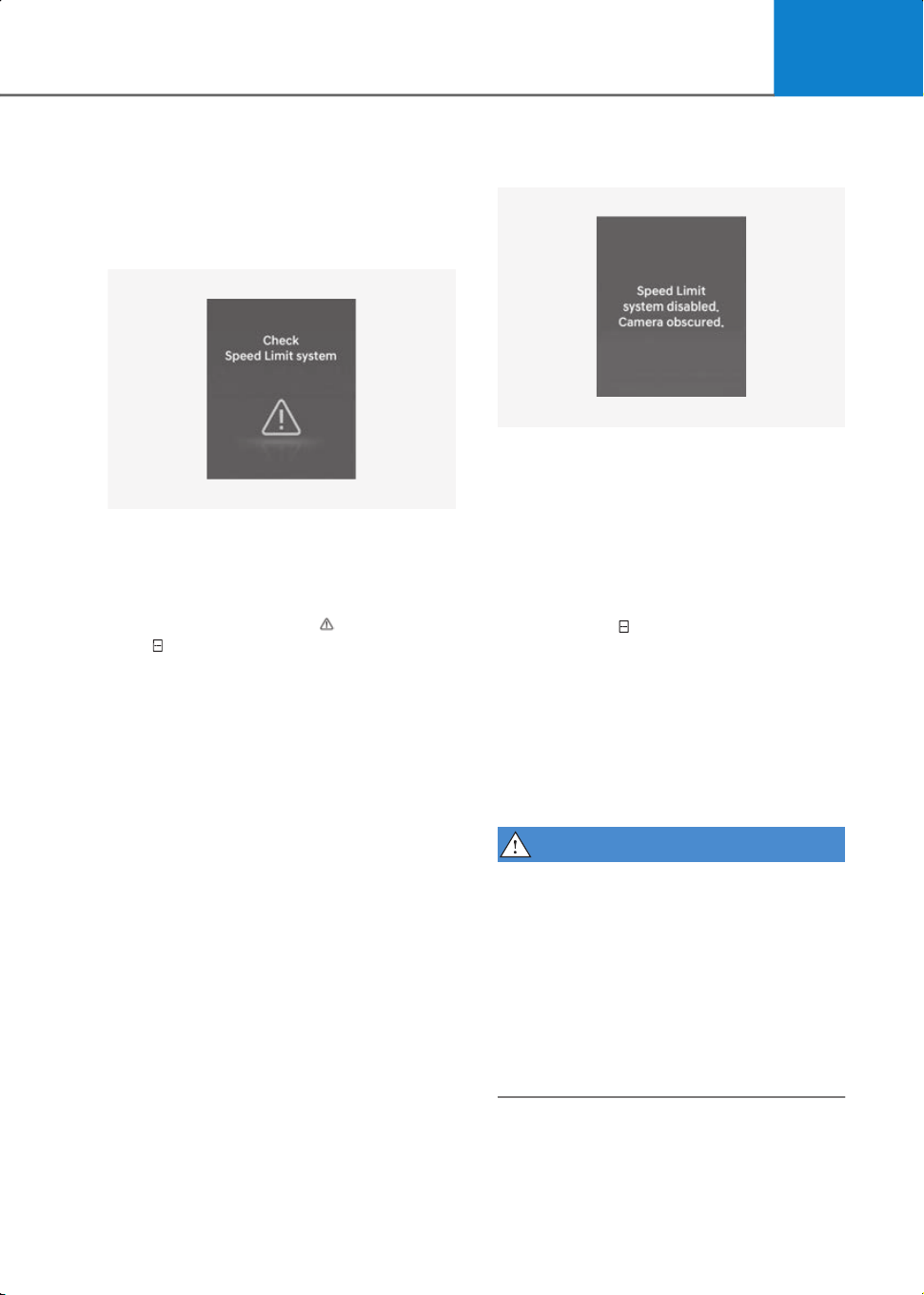
7
7-57
Intelligent Speed Limit Assist
Malfunction and Limitations
Intelligent Speed Limit Assist
malfunction
B7002801
When Intelligent Speed Limit Assist is not
working properly, the 'Check Speed Limit
system' warning message will appear on
the instrument cluster for several
seconds, and the master ( ) warning light
and ( ) warning light will illuminate on
the instrument cluster. If this occurs, have
the vehicle inspected by an authorized
HYUNDAI dealer.
Intelligent Speed Limit Assist
disabled
B7002802
When the front windshield where the
front view camera is located is covered
with foreign material, such as snow or
rain, it can reduce the detecting
performance and temporarily limit or
disable Intelligent Speed Limit Assist. If
this occurs, the 'Speed Limit system
disabled. Camera obscured' warning
message and ( ) warning light will appear
on the instrument cluster.
Intelligent Speed Limit Assist will operate
properly when snow, rain or foreign
material is removed.
If Intelligent Speed Limit Assist does not
operate properly after it is removed, have
the vehicle inspected by an authorized
HYUNDAI dealer.
WARNING
• Even though the warning message or
warning light does not appear on the
instrument cluster, Intelligent Speed
Limit Assist may not properly operate.
• If the vehicle is turned off and restarted
while the camera is blocked or
malfunctioned, the condition is
maintained. Therefore, Intelligent
Speed Limit Assist may not operate
properly.
CE_USA.book Page 57

Driver Assistance System
7-58
Limitations of Intelligent Speed
Limit Assist
Intelligent Speed Limit Assist may not
operate properly, or it may operate
unexpectedly under the following
circumstances:
• The road sign is contaminated or
indistinguishable
- The road sign is difficult to see due to
bad weather, such as rain, snow, fog,
etc.
- The road sign is not clear or damaged
- The road sign is partially obscured by
surrounding objects or shadow
• The road signs do not conform to the
standard
- The text or picture on the road sign is
different from the standard
- The road sign is installed between the
main line and the exit road or
between diverging roads
- There is no conditional road signs on
the road sign located on the exit road
- A sign is attached to another vehicle
• The distance between the vehicle and
the road signs is too far
• The vehicle encounters illuminant road
signs
• Intelligent Speed Limit Assist
incorrectly recognizes numbers or
pictures in the street signs or other
signs as the speed limit
• A road sign near the road you are
driving is detected
• The other traffic sign or signboards are
alongside the road sign
• Multiple signs are installed close
together
• The minimum speed limit sign is
misrecognized
• The minimum speed limit sign is on the
road
• The brightness changes suddenly, for
example when entering or exiting a
tunnel or passing under a bridge
• Headlights are not used or the
brightness of the headlights are weak at
night or in the tunnel
• Road signs are difficult to recognize
due to the reflection of sunlight, street
lights, or oncoming vehicles
• The navigation information or GPS
information contain errors.
• The driver does not follow the guide of
the navigation.
• The driver is driving on a new road that
is not in the navigation system yet.
• The field of view of the front view
camera is obstructed by sun glare
• Driving on a road that is sharply curved
or continuously curved
• Driving through speed bumps, or
driving up and down or left to right on
steep inclines
• The vehicle is shaking heavily
• The navigation software is being
updated while driving
• The navigation is restarted while driving
CE_USA.book Page 58
7
7-59
WARNING
• Intelligent Speed Limit Assist is a
supplemental function that helps the
driver comply with the speed limit on
the road, and may not display the
correct speed limit or control the
driving speed properly.
• Always set the vehicle speed to the
speed limit in your area.
• Intelligent Speed Limit Assist may not
operate for 15 seconds after the vehicle
is started, or the front camera is
initialized.
Information
For more information on the limitations of
the front view camera, refer to the
"Forward Collision-Avoidance Assist
(FCA)" section in this chapter.
Driver Attention Warning
(DAW)
Basic function
Driver Attention Warning monitors your
driving pattern while driving. When the
driver's attention level is below a certain
level, Driver Attention Warning
recommends a break to help with safe
driving.
Leading vehicle departure alert
function
Leading Vehicle Departure Alert function
will inform the driver when a detected
vehicle in front departs.
CE_USA.book Page 59
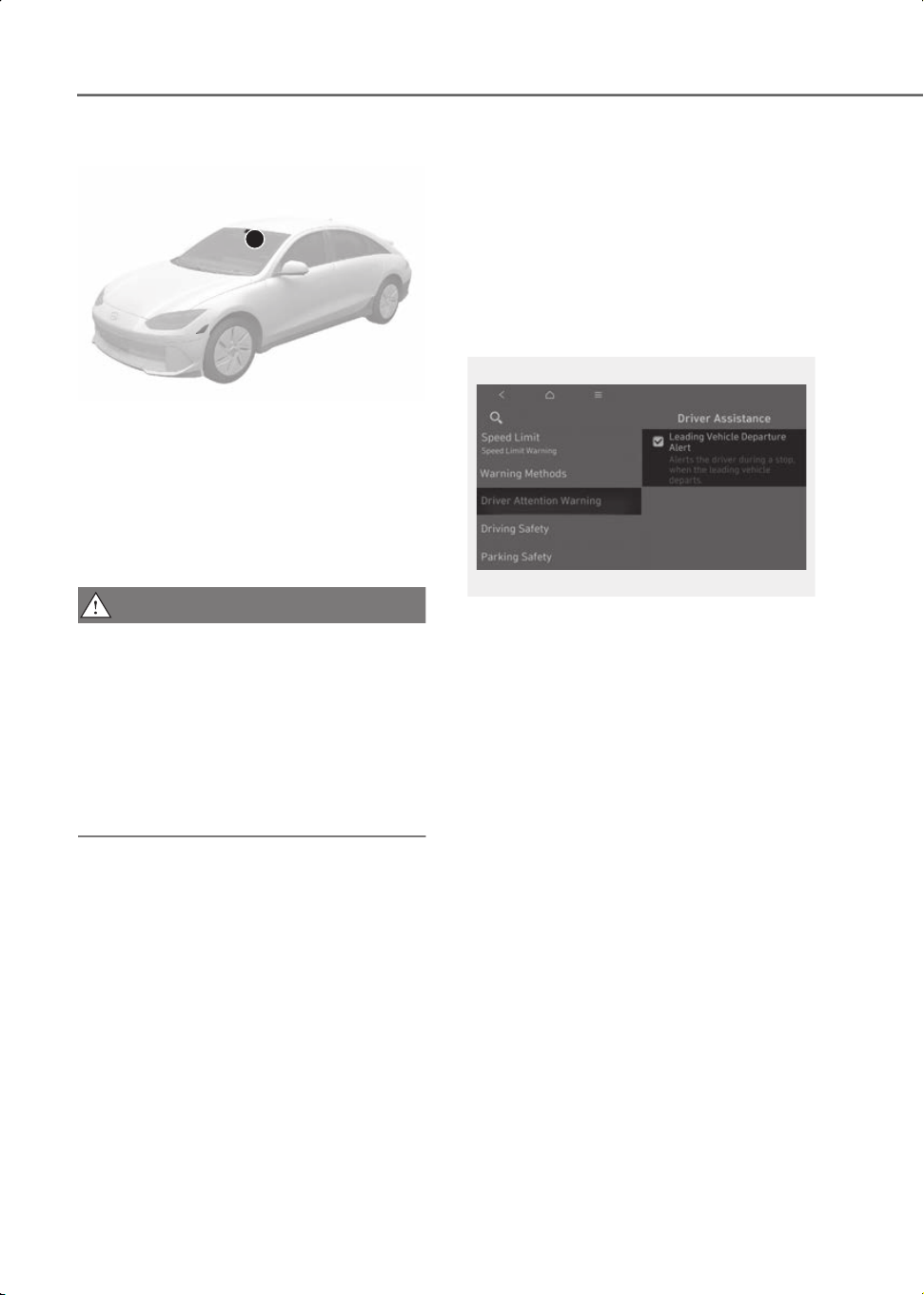
Driver Assistance System
7-60
Detecting sensor
B7002901
(1) Front view camera
The front view camera is used as a
detecting sensor to help detect driving
patterns and front vehicle departure
while vehicle is being driven.
Refer to the picture above for the detailed
location of the detecting sensor.
CAUTION
• Always keep the front view camera in
good condition to maintain optimal
performance of Driver Attention
Warning.
• For more information on the
precautions of the front view camera,
refer to the Forward
Collision-Avoidance Assist (FCA)
section in this chapter.
Driver Attention Warning
Settings
Leading Vehicle Departure Alert
With the vehicle on, select or deselect
Setup > Vehicle > Driver Assistance >
Driver Attention Warning from the
Settings menu to set whether to use the
function.
B7003001
• If Leading Vehicle Departure Alert is
selected, the function will inform the
driver when a detected vehicle in front
departs from a stop.
1
CE_USA.book Page 60
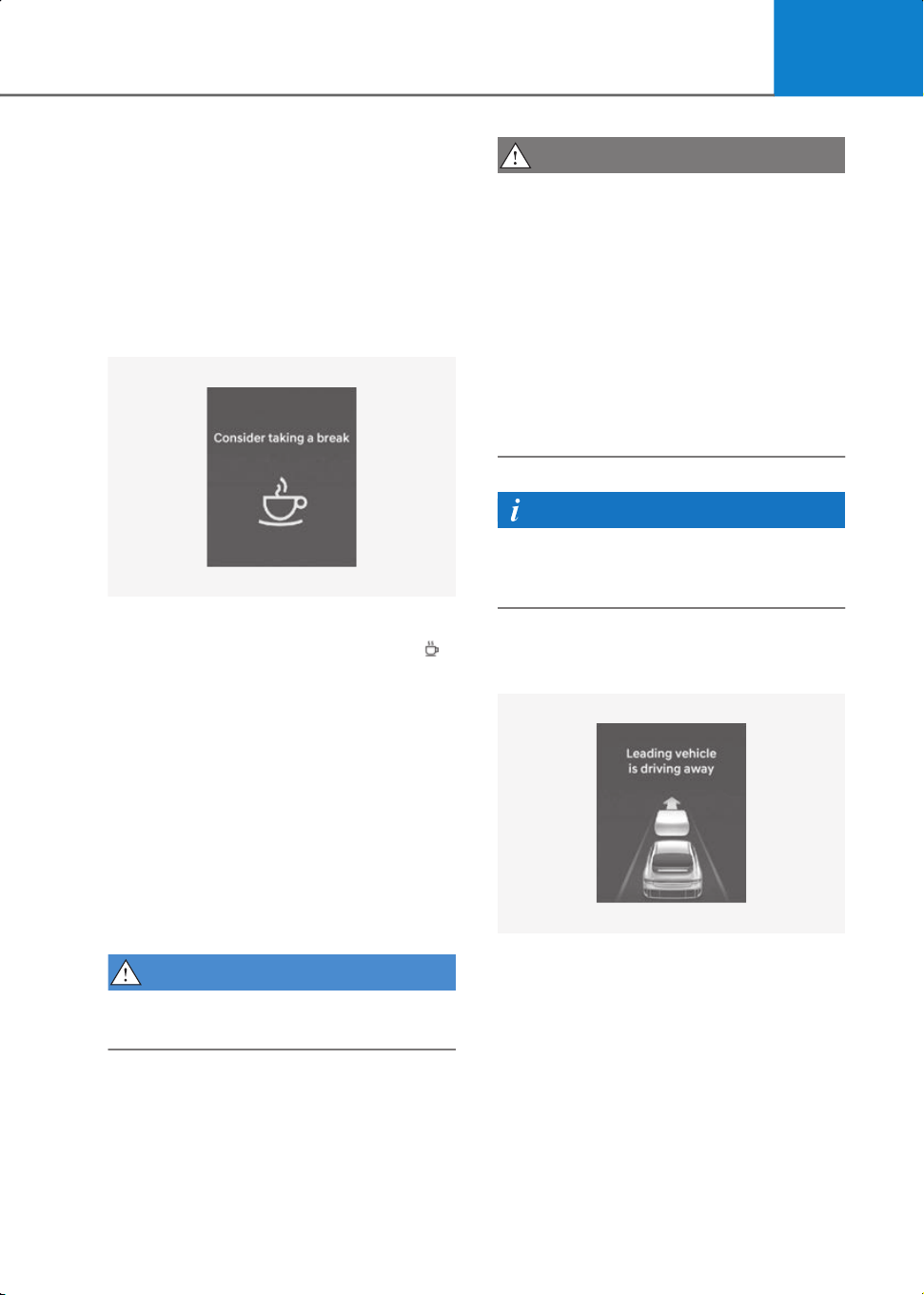
7
7-61
Driver Attention Warning
Operation
Basic function
The basic function of Driver Attention
Warning is to warn the driver 'Consider
taking a break'.
Taking a break
B7003101
• The 'Consider taking a break' message
and Driver Attention Warning light ( )
will appear on the instrument cluster
and an audible warning will sound to
suggest that the driver take a break,
when the driver’s attention level is
below a certain level.
• Driver Attention Warning will not
suggest a break when the total driving
time is shorter than 4 minutes or 4
minutes has not passed after the last
break was suggested.
• A break is suggested when your vehicle
speed is between about 0-120 mph
(0-200 km/h).
WARNING
Only change the Settings after parking
the vehicle at a safe location.
CAUTION
• Driver Attention Warning may suggest
a break depending on the driver’s
driving pattern or habits, even if the
driver doesn’t feel fatigue.
• Driver Attention Warning is a
supplemental function and may not be
able to determine whether the driver is
inattentive.
• A driver who feels fatigued should take
a break at a safe location, even though
there is no break suggestion by Driver
Attention Warning.
Information
For more information on instrument
cluster settings, refer to the “Cluster
Display” section in chapter 4.
Leading Vehicle Departure Alert
function
B7003102
When a detected vehicle in front departs
from a stop, Leading Vehicle Departure
Alert will inform the driver by displaying
the 'Leading vehicle is driving away'
message on the instrument cluster and an
audible warning will sound.
CE_USA.book Page 61
Driver Assistance System
7-62
WARNING
• If any other system’s warning message
is displayed or audible warning is
generated, Leading Vehicle Departure
Alert's warning message may not be
displayed and audible warning may not
be generated.
• The driver has the responsibility to
safely drive and control the vehicle.
CAUTION
• Leading Vehicle Departure Alert is a
supplemental function and may not
alert the driver whenever the front
vehicle departs from a stop.
• Always check the front of the vehicle
and road conditions before departure.
Information
The images and colors in the instrument
cluster may differ depending on the
instrument cluster type or theme selected
from the settings menu.
Driver Attention Warning
Malfunction and Limitations
Driver Attention Warning
malfunction
B7003201
When Driver Attention Warning is not
working properly, the 'Check Inattentive
Driving Warning system' warning
message will appear on the instrument
cluster for several seconds, and the
master ( ) warning light and Driver
Attention Warning light ( ) will illuminate
on the instrument cluster. If this occurs,
have the vehicle inspected by an
authorized HYUNDAI dealer.
$IFDL*OBUUFOUJWF
%SJWJOH8BSOJOHTZTUFN
CE_USA.book Page 62
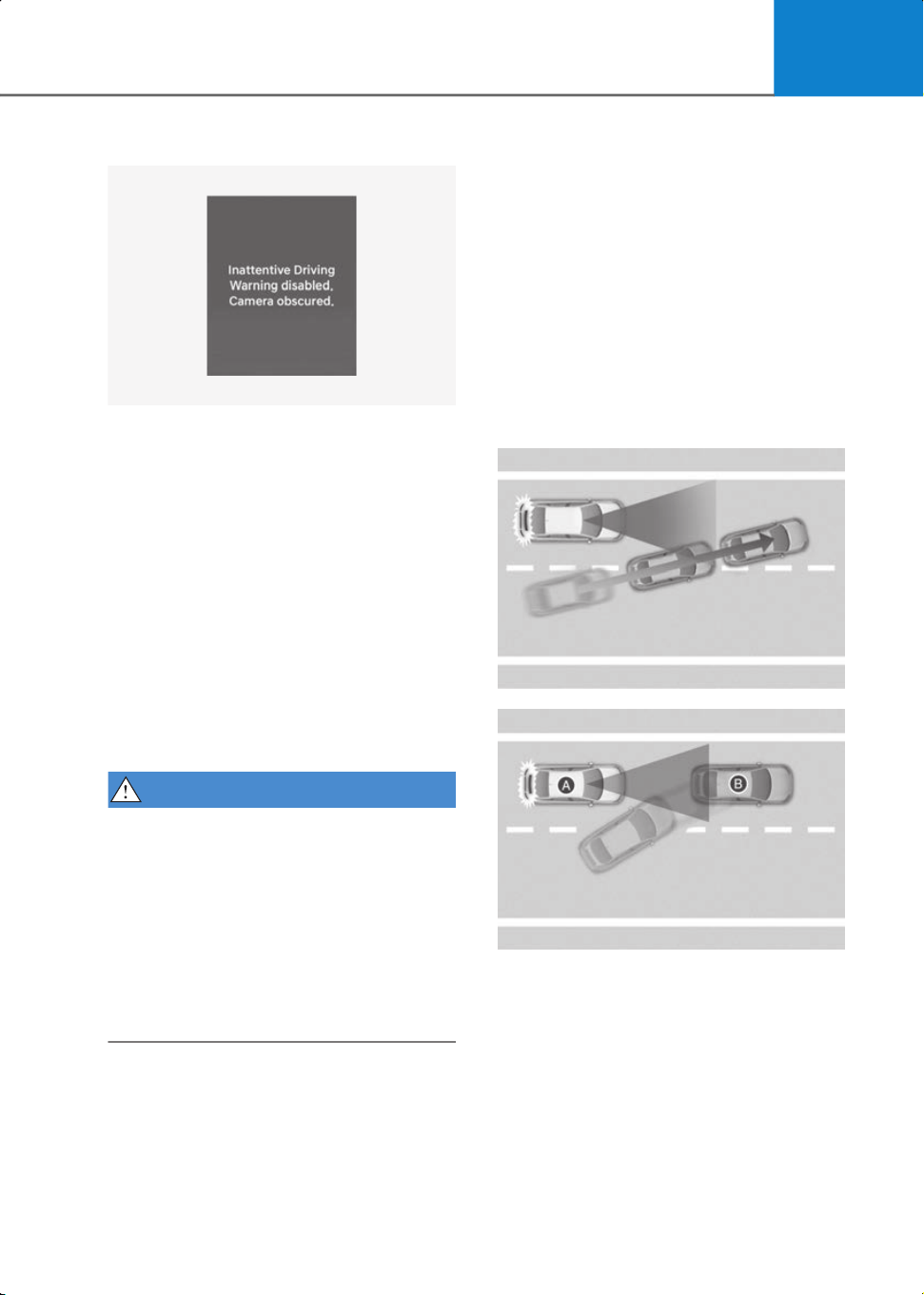
7
7-63
Driver Attention Warning disabled
B7003202
When the front windshield where the
front view camera is located is covered
with foreign material, such as snow or
rain, it can reduce the detecting
performance and temporarily limit or
disable Driver Attention Warning. If this
occurs, the 'Inattentive Driving Warning
disabled. Camera obscured' warning
message will appear on the instrument
cluster. Driver Attention Warning will
operate properly when snow, rain or
foreign material is removed. If Driver
Attention Warning does not operate
properly after it is removed, have the
vehicle inspected by an authorized
HYUNDAI dealer.
WARNING
• Driver Attention Warning may not
properly operate in an area (for
example, open terrain) where any
objects are not detected right after
turning ON the vehicle.
• If the vehicle is turned off and restarted
while the camera is blocked or
malfunctioned, the condition is
maintained. Therefore, Driver Attention
Warning may not operate properly.
Limitations of Driver Attention
Warning
Driver Attention Warning may not work
properly in the following situations:
• The vehicle is driven violently
• The vehicle intentionally crosses over
lanes frequently
• The vehicle is controlled by Driver
Assistance system, such as Lane
Keeping Assist
Leading Vehicle Departure Alert function
• When the vehicle cuts in
B7003203
B7003204
[A] Your vehicle
[B] Front vehicle
If a vehicle cuts in front of your vehicle,
Leading Departure Alert may not
operate properly.
CE_USA.book Page 63
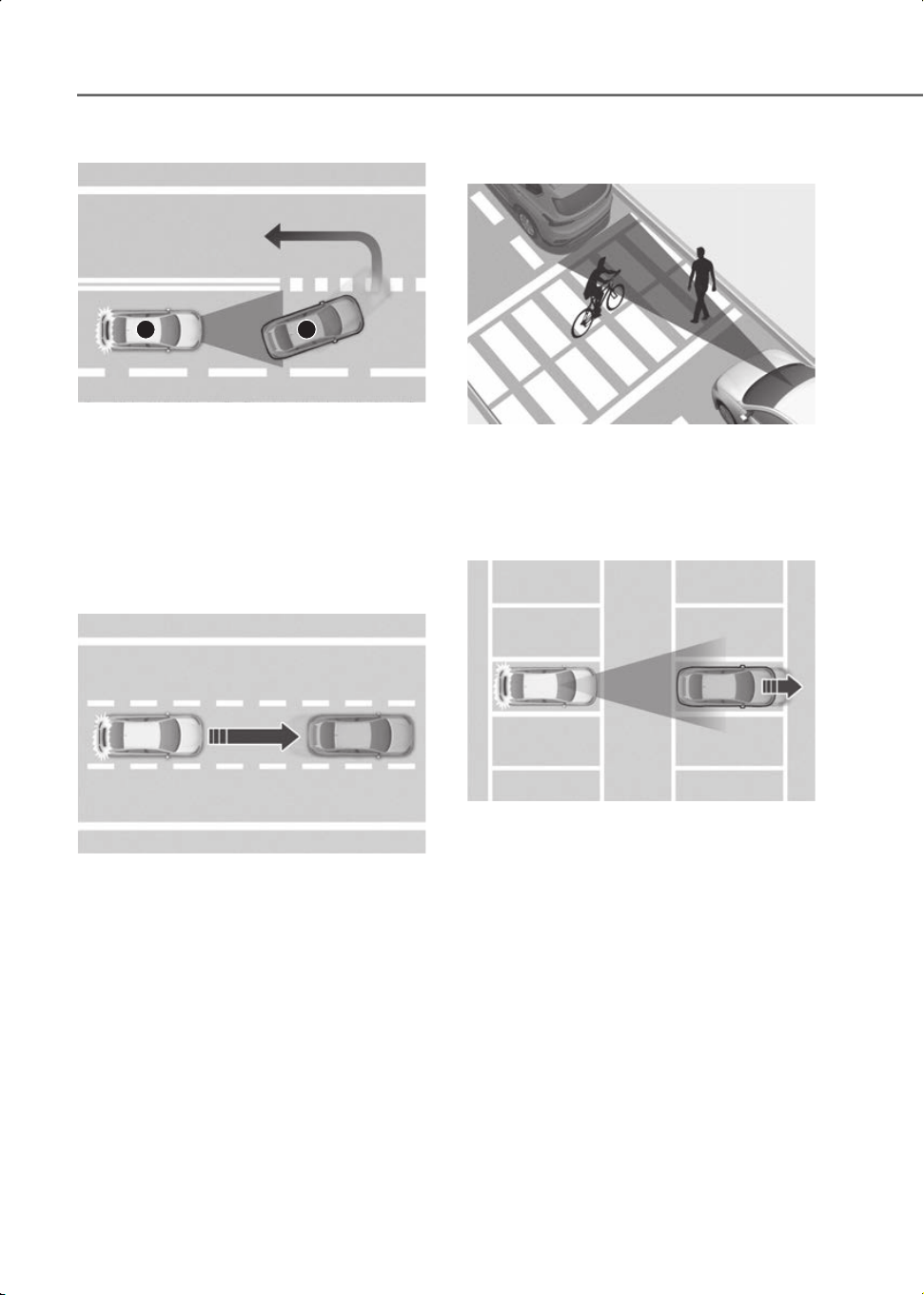
Driver Assistance System
7-64
• When the vehicle ahead sharply steers
B7003205
[A] Your vehicle
[B] Front vehicle
If the vehicle in front makes a sharp
turn, such as to turn left or right or make
a U- turn, etc., Leading Vehicle
Departure Alert may not operate
properly.
• When the vehicle ahead abruptly
departures
B7003206
If the vehicle in front abruptly
departures, Leading Vehicle Departure
Alert may not operate properly.
• When a pedestrian or bicycle is
between you and the vehicle ahead
B7003207
If there is a pedestrian(s) or bicycle(s) in
between you and the vehicle in front,
Leading Vehicle Departure Alert may
not operate properly.
• When in a parking lot
B7003208
If a vehicle parked in front drives away
from you, Leading Vehicle Departure
Alert may alert you that the parked
vehicle is driving away.
A B
CE_USA.book Page 64
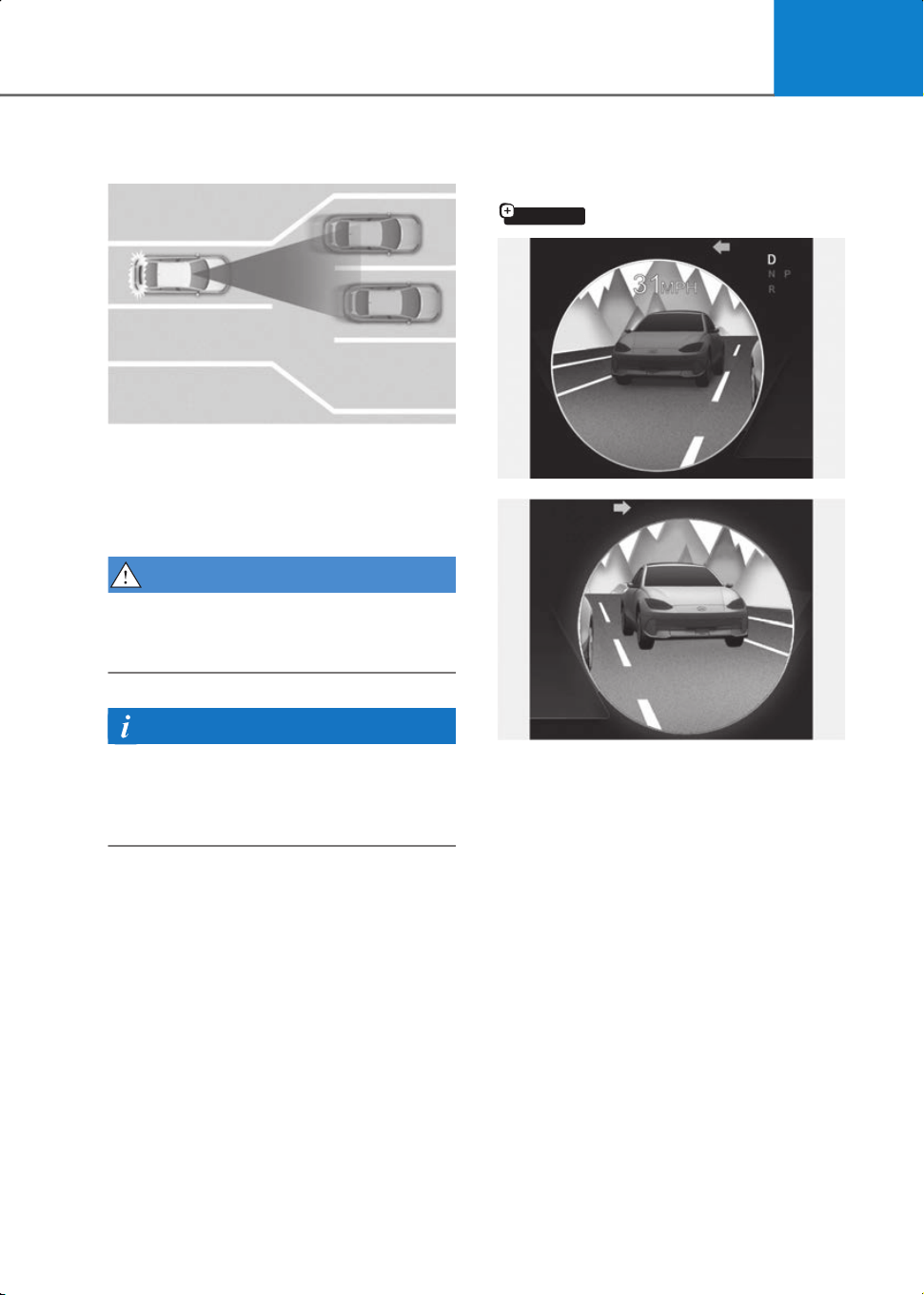
7
7-65
• When driving at a tollbooth or
intersection, etc.
B7003209
If you pass a tollbooth or intersection
with lots of vehicles or you drive where
lanes are merged or divided frequently,
Leading Vehicle Departure Alert may
not operate properly.
WARNING
Driver Attention Warning may not operate
for 15 seconds after the vehicle is started,
or the front view camera is initialized.
Information
For more information on the precautions
of the front view camera, refer to the
“Forward Collision-Avoidance Assist
(FCA)” section in this chapter.
Blind-Spot View Monitor
if equipped
(BVM)
B7003701
B7003702
Blind-Spot View Monitor uses the
wide-side view cameras to display the
rear blind spot areas of your vehicle on
the instrument cluster when the turn
signal is turned on to help with safe lane
changes.
CE_USA.book Page 65
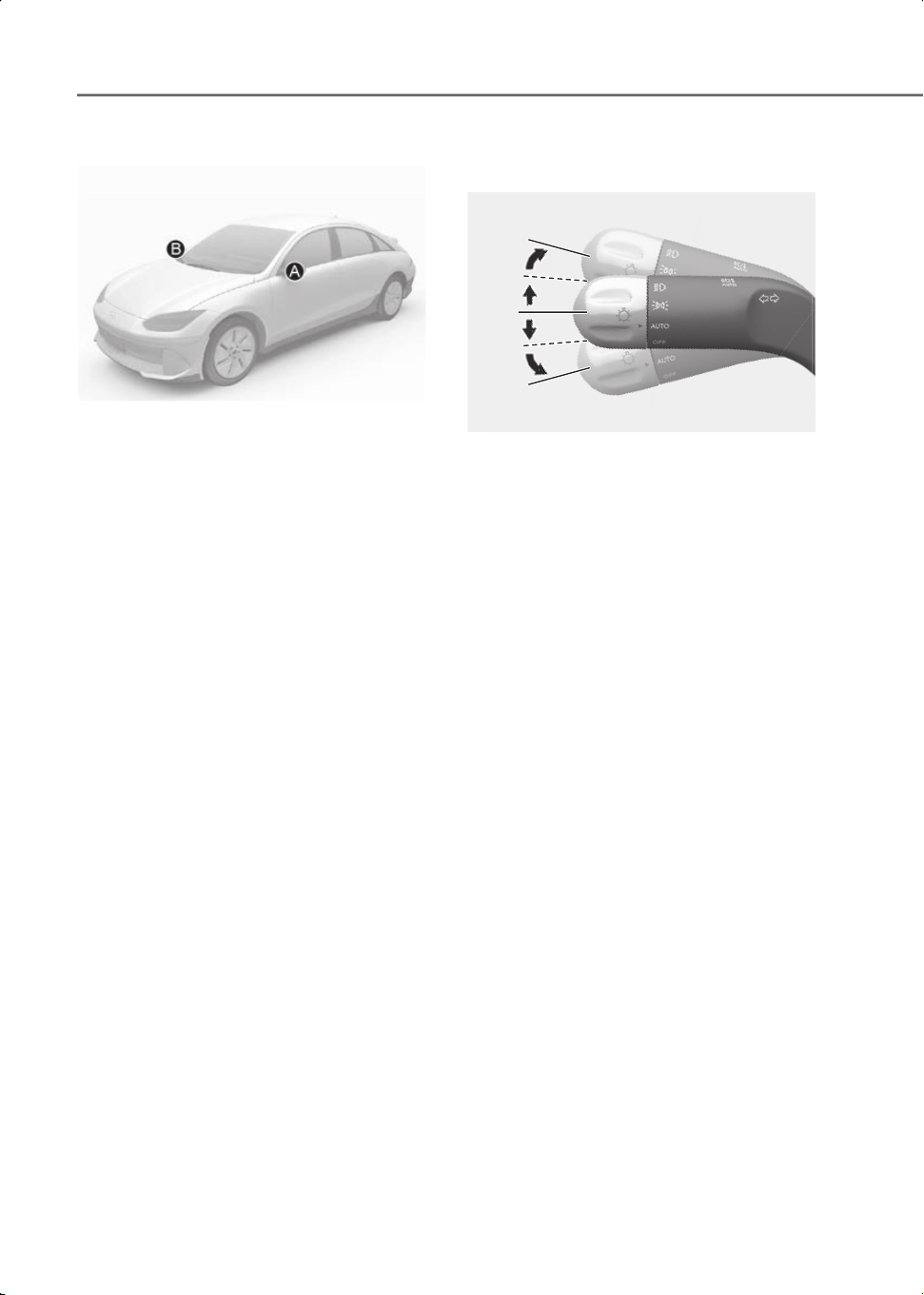
Driver Assistance System
7-66
Detecting sensor
B7003703
[A] Wide-side view camera (camera located at
bottom of the mirror)
[B] Wide-side view camera (camera located at
bottom of the mirror)
Refer to the picture above for the detailed
location of the detecting sensors.
Blind-Spot View Monitor
Settings
Setting features
Blind-Spot View
With the vehicle on, select Setup >
Vehicle > Driver Assistance > Driving
Safety > Blind-Spot View Monitor from
the Settings menu to turn on Blind-Spot
View Monitor and deselect to turn off the
function.
Blind-Spot View Monitor
Operation
B7003901
Blind-Spot View Monitor will turn on and
off when the turn signal is turned on and
off.
Operating conditions
When the left or right side turn signal
turns on, the image in that direction is
displayed on the instrument cluster.
Off conditions
• When the turn signal turns off, the
image on the instrument cluster will
turn off.
• When the hazard warning flasher is on,
Blind-Spot View Monitor will turn off,
regardless of the turn signal status.
• When other important warning is
displayed on the instrument cluster,
Blind-Spot View Monitor may turn off.
CE_USA.book Page 66

7
7-67
Blind-Spot View Monitor
Malfunction
When Blind-Spot View Monitor is not
working properly, or the cluster display
flickers, or the camera image does not
display properly, have the vehicle
inspected by an authorized HYUNDAI
dealer.
WARNING
• The image shown on the instrument
cluster may differ from the actual
distance of the object. Make sure to
directly check the vehicle's
surroundings for safety.
• Always keep the camera lens clean. If
the lens is covered with foreign
material, it may adversely affect
camera performance and Blind-Spot
View Monitor may not operate
properly.
Smart Cruise Control
(SCC)
Smart Cruise Control detects a vehicle
ahead and helps maintain the distance
from the vehicle ahead and the set speed.
Overtaking Acceleration Assist
When Smart Cruise Control judges you
are attempting to overtake a vehicle in
front, Smart Cruise Control help with
accelerating.
if equipped
Based on Driving Style
Smart Cruise Control operates based on
your driving style, such as vehicle
distance, acceleration, and reaction
speed.
CE_USA.book Page 67
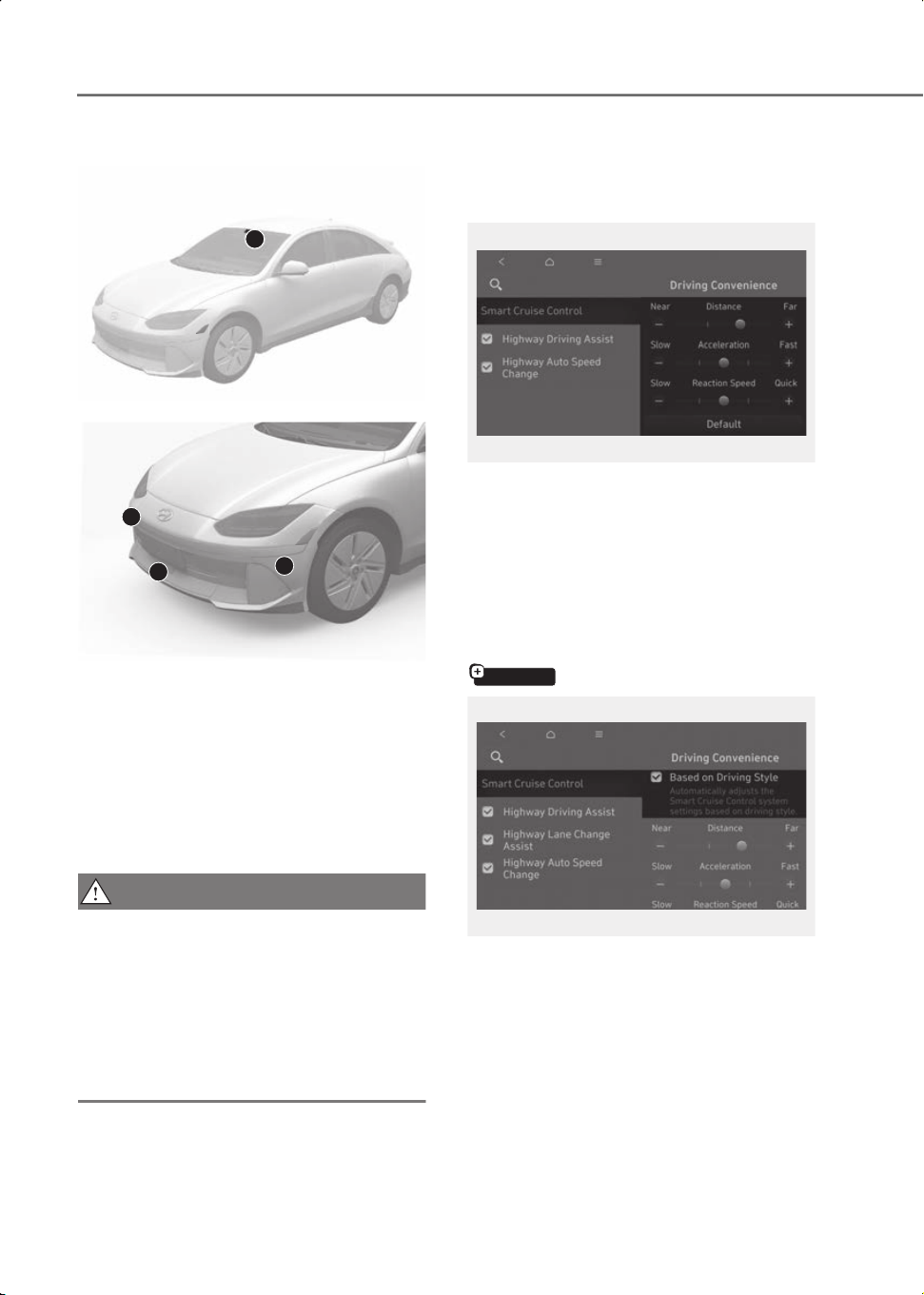
Driver Assistance System
7-68
Detecting sensor
B7004101
B7004102
(1) Front view camera,
(2) Front radar,
(3) Front corner radar (if equipped)
The front view camera and front radar are
used as a detecting sensor to detect front
vehicles.
Refer to the picture above for the detailed
location of the detecting sensor.
CAUTION
Always keep the front view camera and
front radar in good condition to maintain
optimal performance of Smart Cruise
Control.
For more information on the precautions
of the front view camera and front radar,
refer to the "Forward Collision-Avoidance
Assist (FCA)" section in this chapter.
Smart Cruise Control Settings
Smart Cruise Control
B7004201
With the vehicle on, select Setup >
Vehicle > Driver Assistance > Driving
Convenience > Smart Cruise Control
from the settings menu to change
Distance, Acceleration and Reaction
Speed manually.
if equipped
Based on Driving Style
ORS071259L
With the vehicle on, if Setup > Vehicle >
Driver Assistance > Driving Convenience
> Smart Cruise Control > Based on
Driving Style is selected from the
Settings menu, Smart Cruise Control will
operate based on the driver’s driving
style, such as vehicle distance,
acceleration, reaction speed.
1
3
3
2
CE_USA.book Page 68
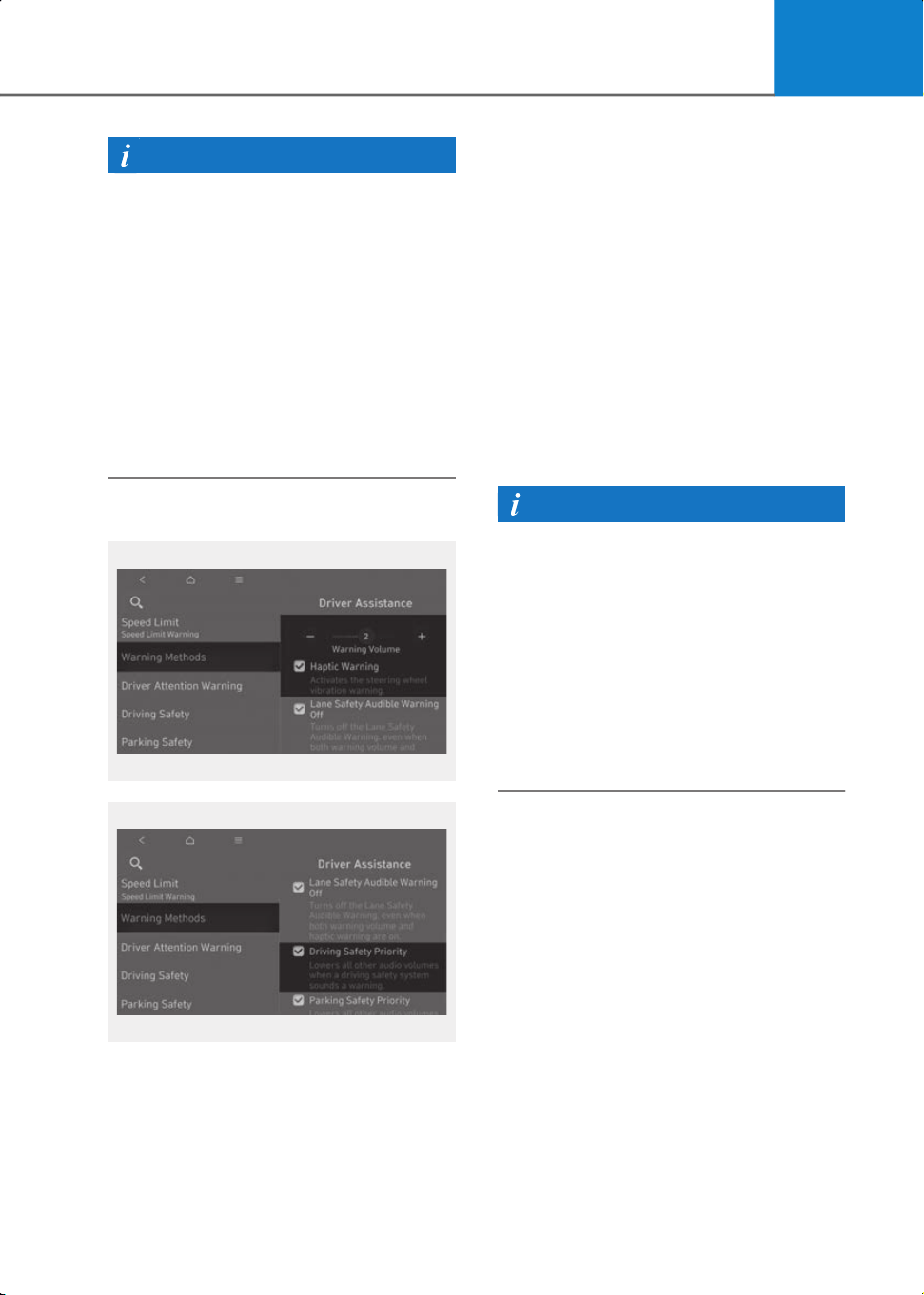
7
7-69
Information
• If the Based on Driving Style is
supported, you can select it from the
Setup > Vehicle > Driver Assistance >
Driving Convenience > Smart Cruise
Control.
• Based on driving style setting
continuously learns when the driver
drives the vehicle.
• When Based on driving style is
deactivated, the driver’s driving style
such as vehicle distance, acceleration,
reaction speed will maintain in the
same stage.
Warning Methods
B7000205
B7000205_1
With the vehicle on, go to Setup > Vehicle
> Driver Assistance > Warning Methods
from the Settings in the infotainment
system to select the following:
• Warning Volume: The Warning Volume
can be adjusted.
If you turn off the Warning Volume, for
your safety, the function may warn you
with a low volume.
• Haptic Warning: The steering wheel
vibration can be set.
• Driving Safety Priority: Your vehicle
lowers all other audio volumes when
the Driver Assistance system warning
sounds.
Information
• If the vehicle is restarted, Warning
Volume will maintain the last setting.
• If the vehicle is restarted, Warning
Methods will maintain the last setting.
• There may be no Settings menu
depending on the feature applied to
your vehicle.
• The Warning Volume and Haptic
Warning cannot be turned off at the
same time. When one of the warnings is
turned off, the other is activated.
CE_USA.book Page 69

Driver Assistance System
7-70
Smart Cruise Control
Operation
Operating conditions
Basic function
Smart Cruise Control operates when the
following conditions are satisfied.
• The gear is in D (Drive)
• The driver’s door is closed
• EPB (Electronic Parking Brake) is not
applied
• Your vehicle speed is within the
operating speed range
- 5-120 mph (10-200 km/h): when
there is no vehicle in front
- 0-120 mph (0-200 km/h): when there
is a vehicle in front
• ESC (Electronic Stability Control) or
ABS (Anti-Lock Braking System) is on
Smart Cruise Control does not operate in
the following conditions.
• The driver's door is opened
• Your vehicle is in power down mode ( )
• EPB (Electronic Parking Brake) is
applied
• ESC (Electronic Stability Control) or
ABS (Anti-Lock Braking System) is
controlling the vehicle
• Forward Collision-Avoidance Assist
brake control is operating
• Remote Smart Parking Assist brake
control is operating (if equipped)
Information
When stopped behind another vehicle,
the driver can turn on Smart Cruise
Control while the brake pedal is
depressed.
Operating conditions for Acceleration
Assist
Overtaking Acceleration Assist operates
when the turn signal indicator is turned on
to the left while Smart Cruise Control is
operating, and the following conditions
are satisfied:
• Your vehicle speed is above 40 mph (60
km/h)
• A vehicle is detected in front of your
vehicle
Overtaking Acceleration Assist does not
operate in the following conditions.
• The hazard warning flasher is on
• Vehicle speed is reduced to maintain
distance with the vehicle in front
WARNING
• When the turn signal indicator is turned
on to the left while there is a vehicle
ahead, the vehicle may accelerate
temporarily. Pay attention to the road
conditions at all times.
CE_USA.book Page 70
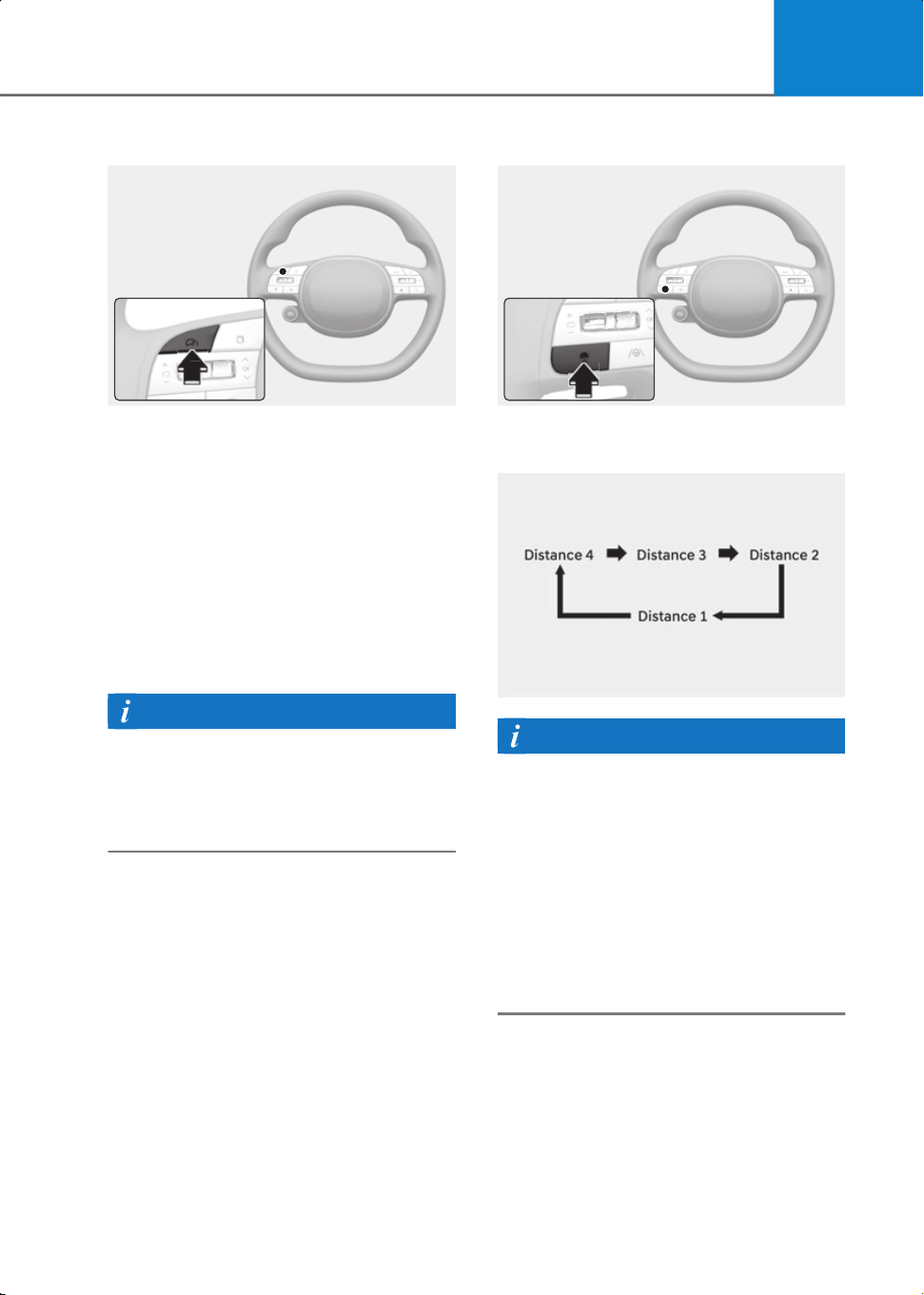
7
7-71
Turning on Smart Cruise Control
B7002301
• Press the Driving Assist button to turn
on Smart Cruise Control. The speed will
be set to the current speed on the
instrument cluster.
• If there is no vehicle in front of you, the
set speed will be maintained, but if
there is a vehicle in front of you, the
speed may decrease to maintain the
distance to the vehicle ahead. If the
vehicle ahead accelerates, your vehicle
will travel at a steady cruising speed
after accelerating to the set speed.
Information
If your vehicle speed is between 0-20
mph (0-30 km/h) when you press the
Driving Assist button, Smart Cruise
Control speed will be set to 20 mph (30
km/h).
Setting vehicle distance
B7004302
Each time the button is pressed, the
headway changes as follows:
B7004303
Information
• If you drive at 56 mph (90 km/h), the
distance is maintained as follows:
Distance 4 - about 172 ft. (53 m)
Distance 3 - about 130 ft. (40 m)
Distance 2 - about 106 ft. (30 m)
Distance 1 - about 82 ft. (25 m)
• The distance is set to the last set
distance when the vehicle is restarted,
or when Smart Cruise Control was
temporarily canceled.
CE_USA.book Page 71
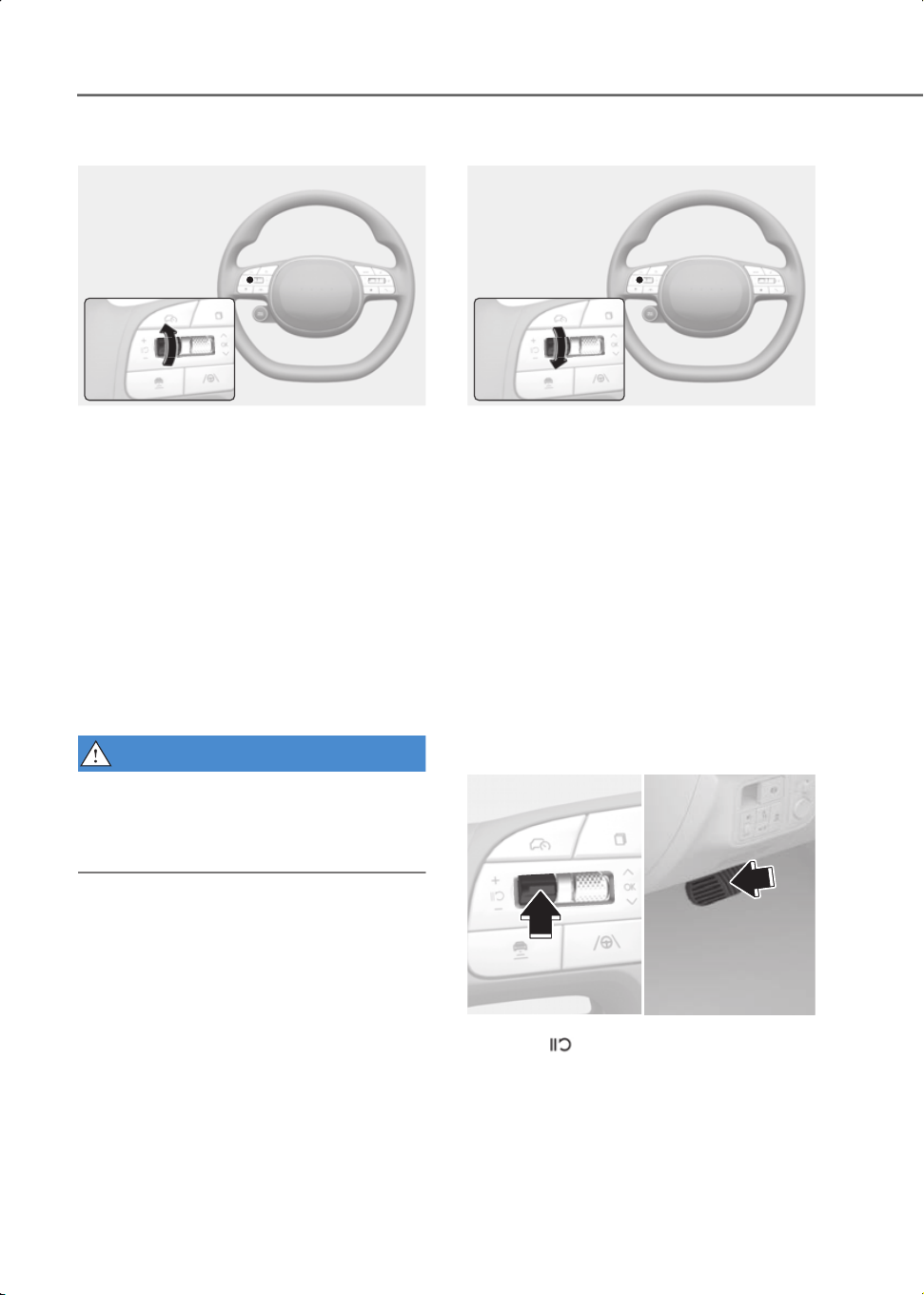
Driver Assistance System
7-72
Increasing set speed
B7002304_1
• Push the + switch up and release it
immediately. The set speed will
increase by 1 mph (1 km/h) each time
the switch is operated in this manner.
• Push the + switch up and hold it while
monitoring the set speed on the
instrument cluster. The set speed will
increase by 5 mph (10 km/h) each time
the switch is operated in this manner.
Release the switch when the desired
speed is shown, and the vehicle will
accelerate to that speed. You can
increase the set speed to 120 mph (200
km/h).
WARNING
Check the driving condition before using
the + switch. Driving speed may sharply
increase when you push up and hold the +
switch.
Decreasing set speed
B7002304_2
• Push the - switch down and release it
immediately. The set speed will
decrease by 1 mph (1 km/h) each time
the switch is operated in this manner.
• Push the - switch down and hold it
while monitoring the set speed on the
instrument cluster. The set speed will
decrease by 5 mph (10 km/h) each time
the switch is operated in this manner.
Release the switch at the speed you
want to maintain. You can decrease the
set speed to 20 mph (30 km/h).
Temporarily canceling Smart Cruise
Control
B7004306
Press the switch or depress the brake
pedal to temporarily cancel Smart Cruise
Control.
CE_USA.book Page 72
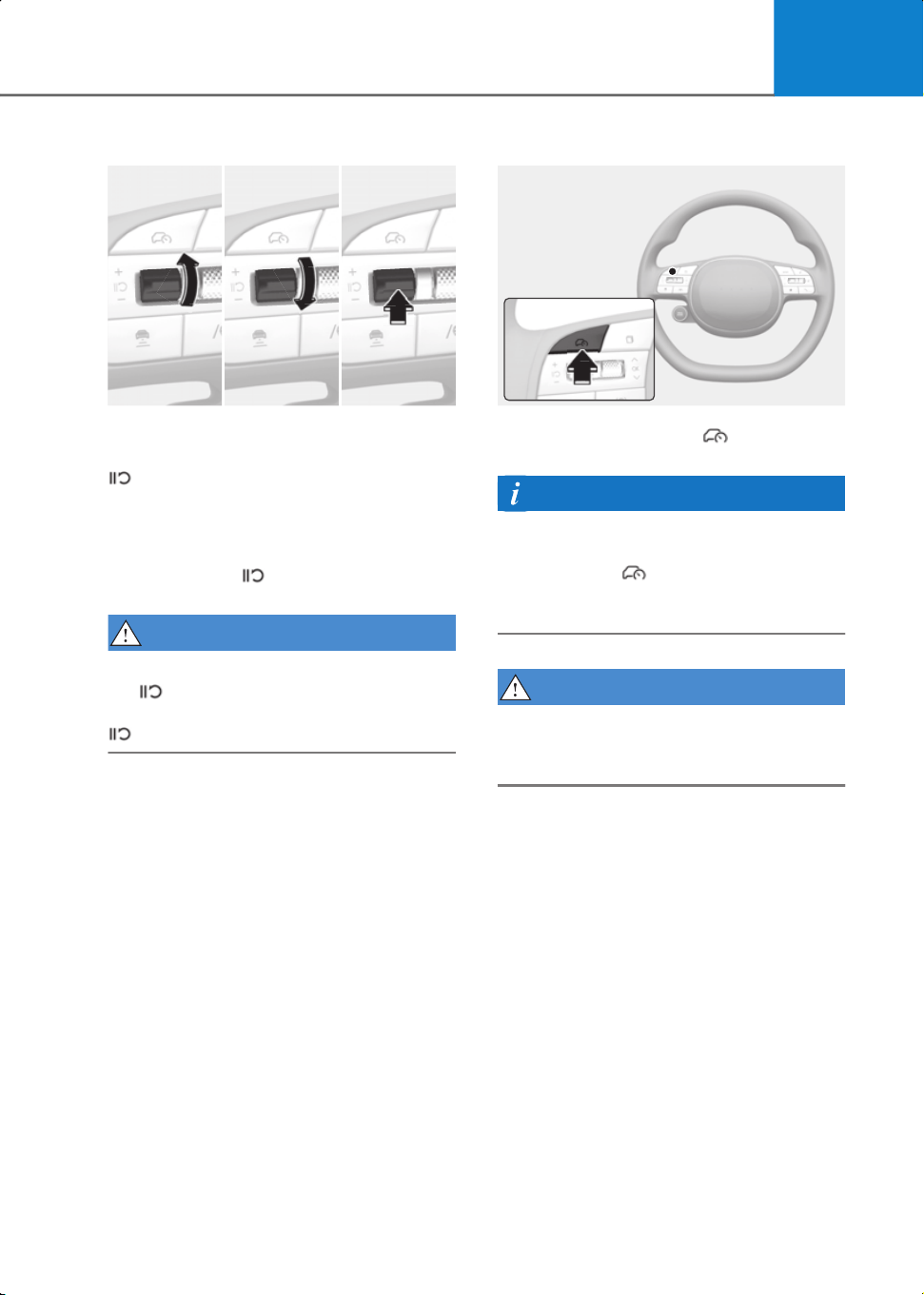
7
7-73
Resuming Smart Cruise Control
B7002305
To resume Smart Cruise Control after the
function was canceled, operate the +, - or
switch.
If you push the + switch up or - switch
down, vehicle speed will be set to the
current speed on the instrument cluster.
If you press the switch, vehicle speed
will resume to the preset speed.
WARNING
Check the driving condition before using
the switch. Driving speed may sharply
increase or decrease when you press the
switch.
Turning off Smart Cruise Control
B7002301
Press the Driving Assist ( ) button to
turn Smart Cruise Control off.
Information
If your vehicle is equipped with Manual
Speed Limit Assist, press and hold the
Driving Assist ( ) button to turn off
Smart Cruise Control. However Manual
Speed Limit Assist will turn on.
WARNING
Do not use the switches and buttons at
the same time. Smart Cruise Control may
not operate properly.
CE_USA.book Page 73
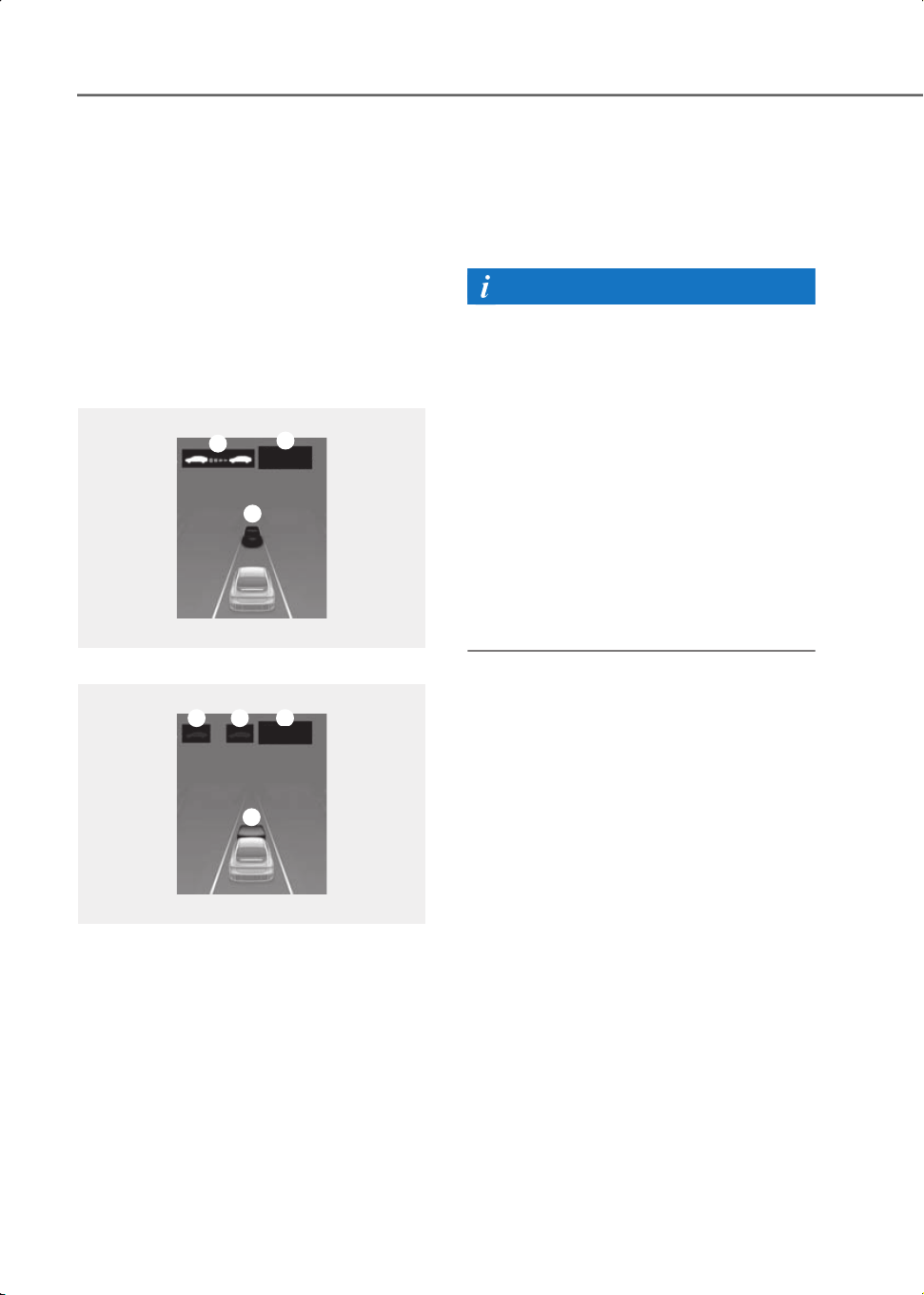
Driver Assistance System
7-74
Display and Control
Basic function
You can see the status of the Smart Cruise
Control operation in the Driving Assist
view on the instrument cluster. For more
information, refer to the "View Modes"
section in chapter 4.
Smart Cruise Control will be displayed as
below depending on the status of the
function.
Operating
B7004309
Temporarily canceled
B7004310
• When operating
1. Whether there is a vehicle ahead and
the selected distance level
2. Set speed
3. Whether there is a vehicle ahead and
the target vehicle distance
• When temporarily canceled
1. Your vehicle (grey)
2. Previous set speed (grey)
3. Vehicle ahead and distance level
(grey) (if equipped)
Information
• The distance of the front vehicle on the
instrument cluster is displayed based
on the actual distance between your
vehicle and the vehicle ahead.
• The target distance may vary according
to the vehicle speed and the set
distance level. If the vehicle speed is
low, even though the vehicle distance
have changed, the change of the target
vehicle distance may be small.
• The images and colors in the
instrument cluster may differ
depending on the instrument cluster
type or theme selected from the
settings menu.
2
3
1
50
MPH
23 1
3
50
MPH
CE_USA.book Page 74
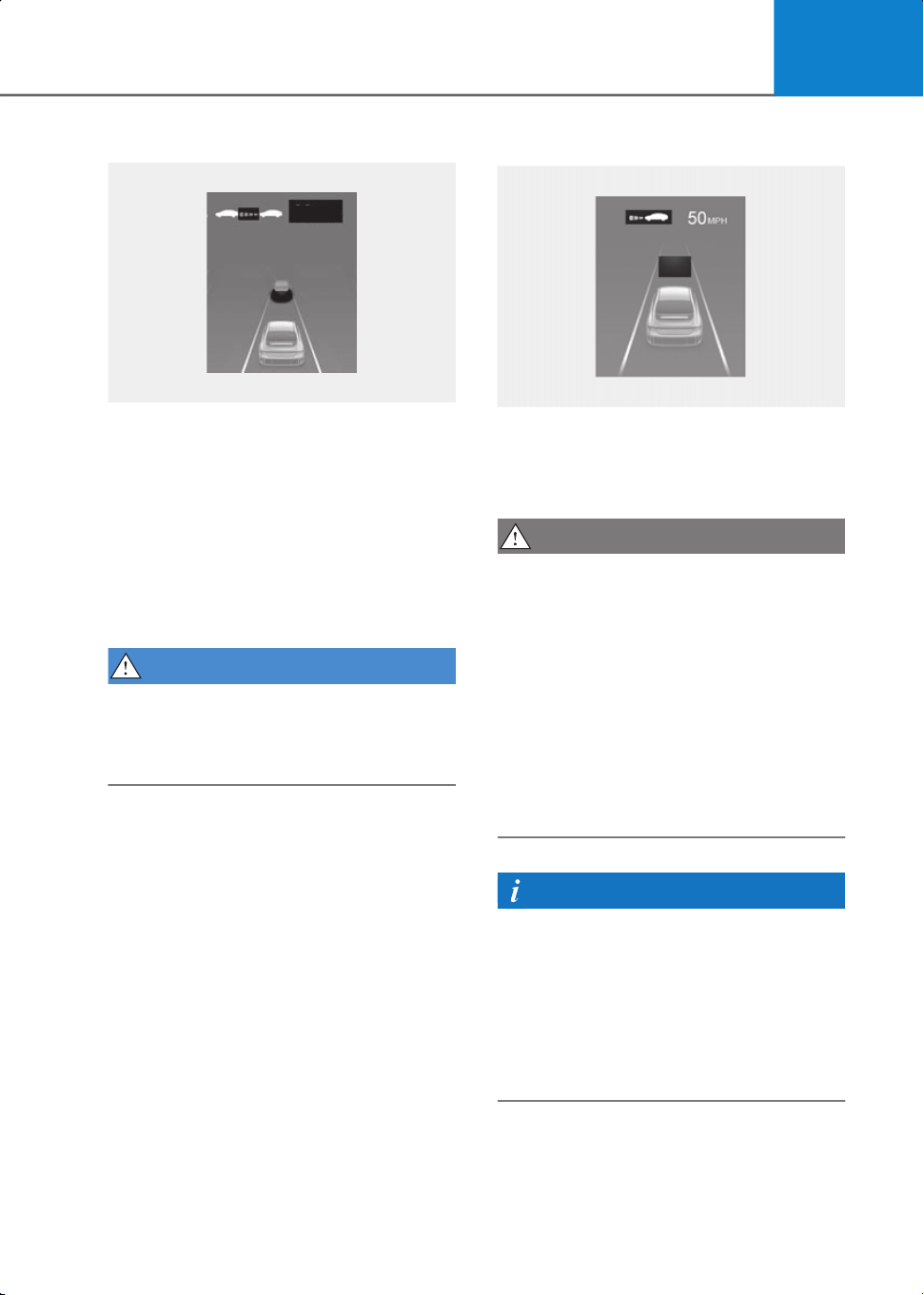
7
7-75
Accelerating temporarily
B7004311
If you want to speed up temporarily
without altering the set speed while
Smart Cruise Control is operating,
depress the accelerator pedal. While the
accelerator pedal is depressed, the set
speed, distance level and target distance
will blink on the instrument cluster.
However, if the accelerator pedal is
depressed insufficiently, the vehicle may
decelerate.
WARNING
Be careful when accelerating temporarily,
because the speed and distance is not
controlled automatically even if there is a
vehicle in front of you.
Based on Driving Style operation
B7004312
When Based on driving style is operating,
the vehicle distance level and target
distance will be displayed white based on
the driving style.
CAUTION
• The vehicle must be driven sufficiently
to reflect the actual driver's driving
style to the Based on Driving Style’s
vehicle distance, acceleration, and
reaction speed.
• Based on Driving Style may not reflect
driving styles or driving conditions that
affect safe driving.
• If you are driving in special conditions,
such as snow, rain, fog, or steep slopes,
the vehicle may not be driven
according to the driver’s driving style.
Information
• Driving styles that are far from safe
driving such as sudden acceleration
may not be reflected to Based on
Driving Style.
• Based on Driving Style does not reflect
any other driving style other than
vehicle distance, acceleration and
reaction speed.
50
MPH
CE_USA.book Page 75
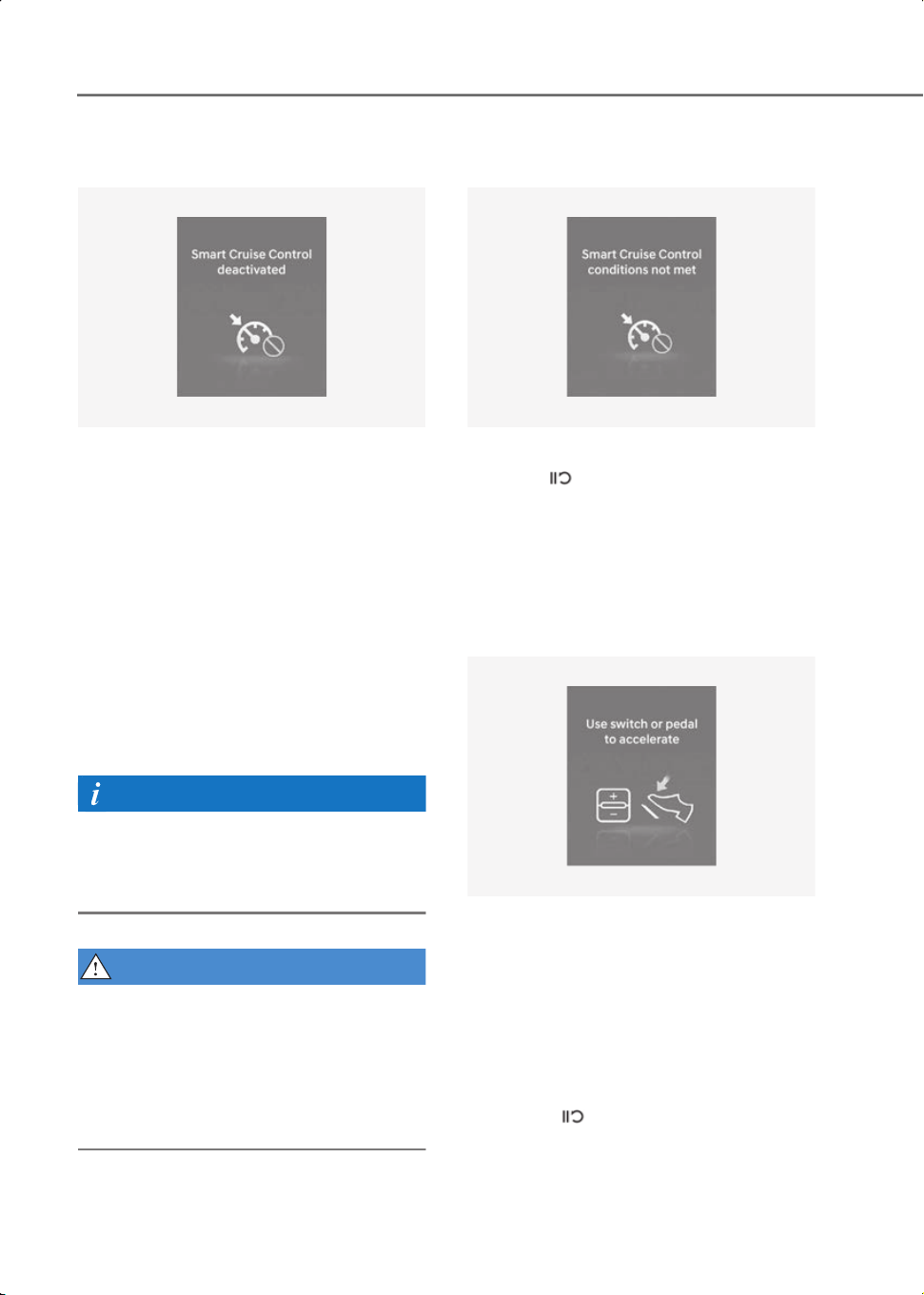
Driver Assistance System
7-76
Temporarily canceling Smart Cruise
Control
B7004313
• The vehicle speed is above 130 mph
(210 km/h)
• The vehicle is stopped for a certain
period of time
• The accelerator pedal is continuously
depressed for a certain period of time
• The conditions for the Smart Cruise
Control to operate is not satisfied
If Smart Cruise Control is temporarily
canceled automatically, the ‘Smart
Cruise Control deactivated’ warning
message will appear on the instrument
cluster, and an audible warning will sound
to warn the driver.
Information
If Smart Cruise Control is temporarily
canceled while the vehicle is at a
standstill with the function activated, EPB
(Electronic Parking Brake) maybe applied.
WARNING
When Smart Cruise Control is temporarily
canceled, distance with the front vehicle
will not be maintained. Always have your
eyes on the road while driving, and if
necessary, depress the brake pedal to
reduce your driving speed in order to
maintain a safe distance.
Smart Cruise Control conditions not
satisfied
B7004314
If the Driving Assist button, + switch, -
switch or switch is operated when
Smart Cruise Control operating
conditions are not satisfied, the 'Smart
Cruise Control conditions not met’ will
appear on the instrument cluster, and an
audible warning will sound.
In traffic situation
B7004315
In traffic, your vehicle will stop if the
vehicle ahead of you stops. Also, if the
vehicle ahead of you starts moving, your
vehicle will start as well. In addition, after
the vehicle has stopped and a certain
time have passed, the 'Use switch or
pedal to accelerate' message will appear
on the instrument cluster. Depress the
accelerator pedal or operate the + switch,
- switch or switch to start driving.
CE_USA.book Page 76
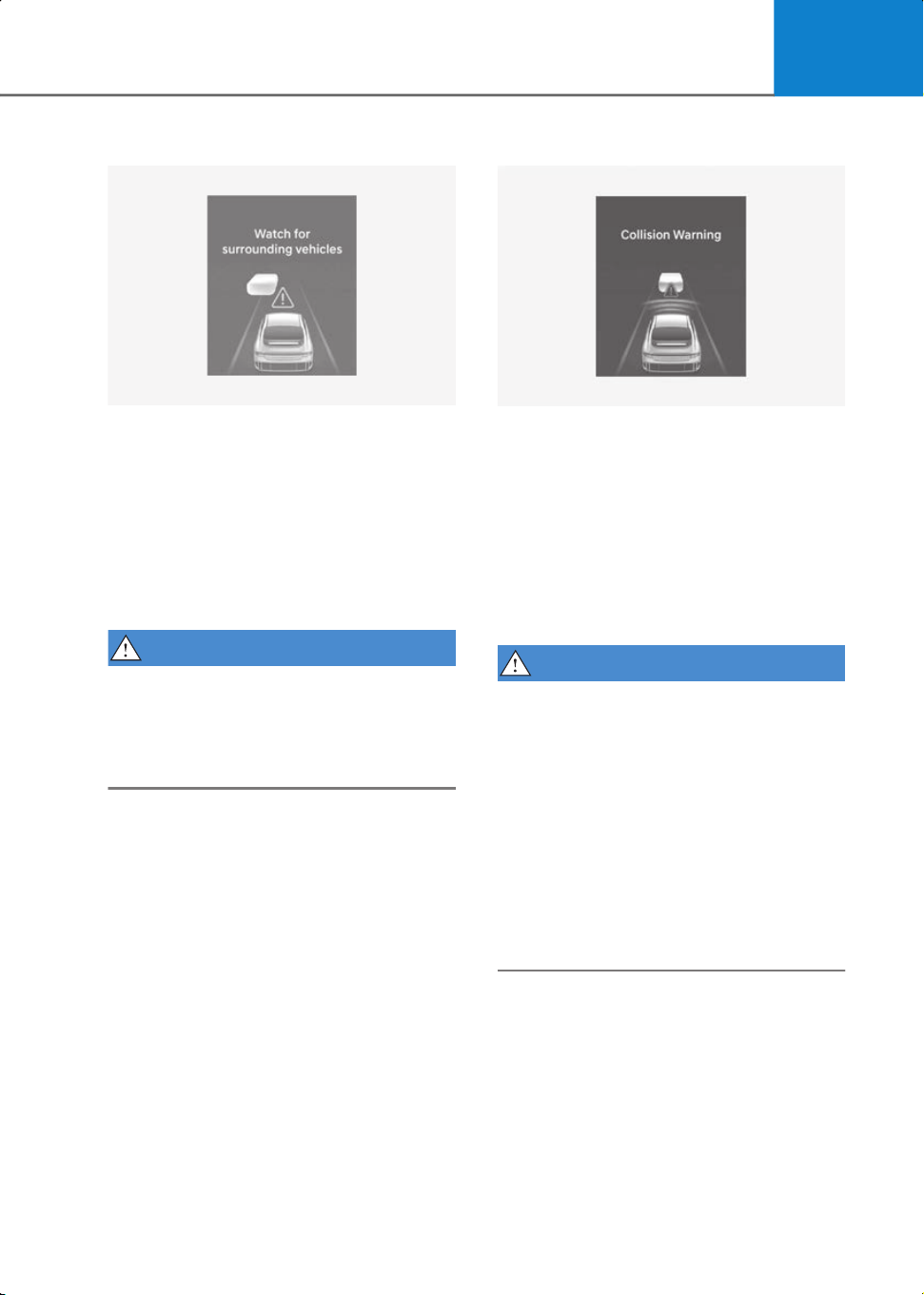
7
7-77
Warning road conditions ahead
B7004316
In the following situation, the ‘Watch for
surrounding vehicles’ warning message
will appear on the instrument cluster, and
an audible warning will sound to warn the
driver of road conditions ahead.
• The vehicle in front disappears when
Smart Cruise Control is maintaining the
distance with the vehicle ahead while
driving below a certain speed.
WARNING
Always pay attention to vehicles or
objects that may suddenly appear in front
of you, and if necessary, depress the
brake pedal to reduce your driving speed
in order to maintain a safe distance.
Collision Warning
B7000301
While Smart Cruise Control is operating,
when the collision risk with the vehicle
ahead is high, the 'Collision Warning'
warning message will appear on the
instrument cluster, and an audible
warning will sound to warn the driver.
Always have your eyes on the road while
driving, and if necessary, depress the
brake pedal to reduce your driving speed
in order to maintain a safe distance.
WARNING
In the following situations, Smart Cruise
Control may not warn the driver of a
collision.
• The distance from the front vehicle is
near, or the vehicle speed of the front
vehicle is faster or similar with your
vehicle
• The speed of the front vehicle is very
slow or is at a standstill
• The accelerator pedal is depressed
right after Smart Cruise Control is
turned on
CE_USA.book Page 77

Driver Assistance System
7-78
WARNING
Take the following precautions when
using Smart Cruise Control:
• Smart Cruise Control does not
substitute for proper and safe driving. It
is the responsibility of the driver to
always check the speed and distance to
the vehicle ahead.
• Smart Cruise Control may not
recognize unexpected and sudden
situations or complex driving
situations, so always pay attention to
driving conditions and control your
vehicle speed.
• Keep Smart Cruise Control off when the
function is not in use to avoid
inadvertently setting a speed.
• Do not open the door or leave the
vehicle when Smart Cruise Control is
operating, even if the vehicle is
stopped.
• Always be aware of the selected speed
and headway distance.
• Keep a safe distance according to road
conditions and vehicle speed. If the
headway distance is too close during
high-speed driving, a serious collision
may result.
• When maintaining distance with the
vehicle ahead, if the front vehicle
disappears, Smart Cruise Control may
suddenly accelerate to the set speed.
Always be aware of unexpected and
sudden situations from occurring.
• Vehicle speed may decrease on an
upward slope and increase on a
downward slope.
• Always be aware of situations such as
when a vehicle cuts in suddenly.
• When you are towing a trailer or
another vehicle, turn off Smart Cruise
Control for safety reasons.
• Turn off Smart Cruise Control when
your vehicle is being towed.
• Smart Cruise Control may not operate
properly if interfered by strong
electromagnetic waves.
• Smart Cruise Control may not detect an
obstacle in front and lead to a collision.
Always look ahead cautiously to
prevent unexpected and sudden
situations from occurring.
• Vehicles moving in front of you with a
frequent lane change may cause a
delay in Smart Cruise Control reaction
or may cause Smart Cruise Control to
react to a vehicle actually in an adjacent
lane. Always drive cautiously to prevent
unexpected and sudden situations
from occurring.
• Always be aware of the surroundings
and drive safely, even though a warning
message does not appear or an audible
warning does not sound.
• If any other system’s warning message
is displayed or warning sound is
generated, Smart Cruise Control
warning message may not be displayed
and warning sound may not be
generated.
• You may not hear the warning sound of
Forward Collision-Avoidance Assist if
the surrounding is noisy.
• The vehicle manufacturer is not
responsible for any traffic violation or
accidents caused by the driver.
• Always set the vehicle speed under the
speed limit in your area.
• Vehicle distance, acceleration and
reaction speed may change if the
driver’s driving style changes.
Information
• Smart Cruise Control may not operate
for 15 seconds after the vehicle is
started or the front view camera or
front radar is initialized.
• You may hear a sound when the brake is
controlled by Smart Cruise Control.
CE_USA.book Page 78
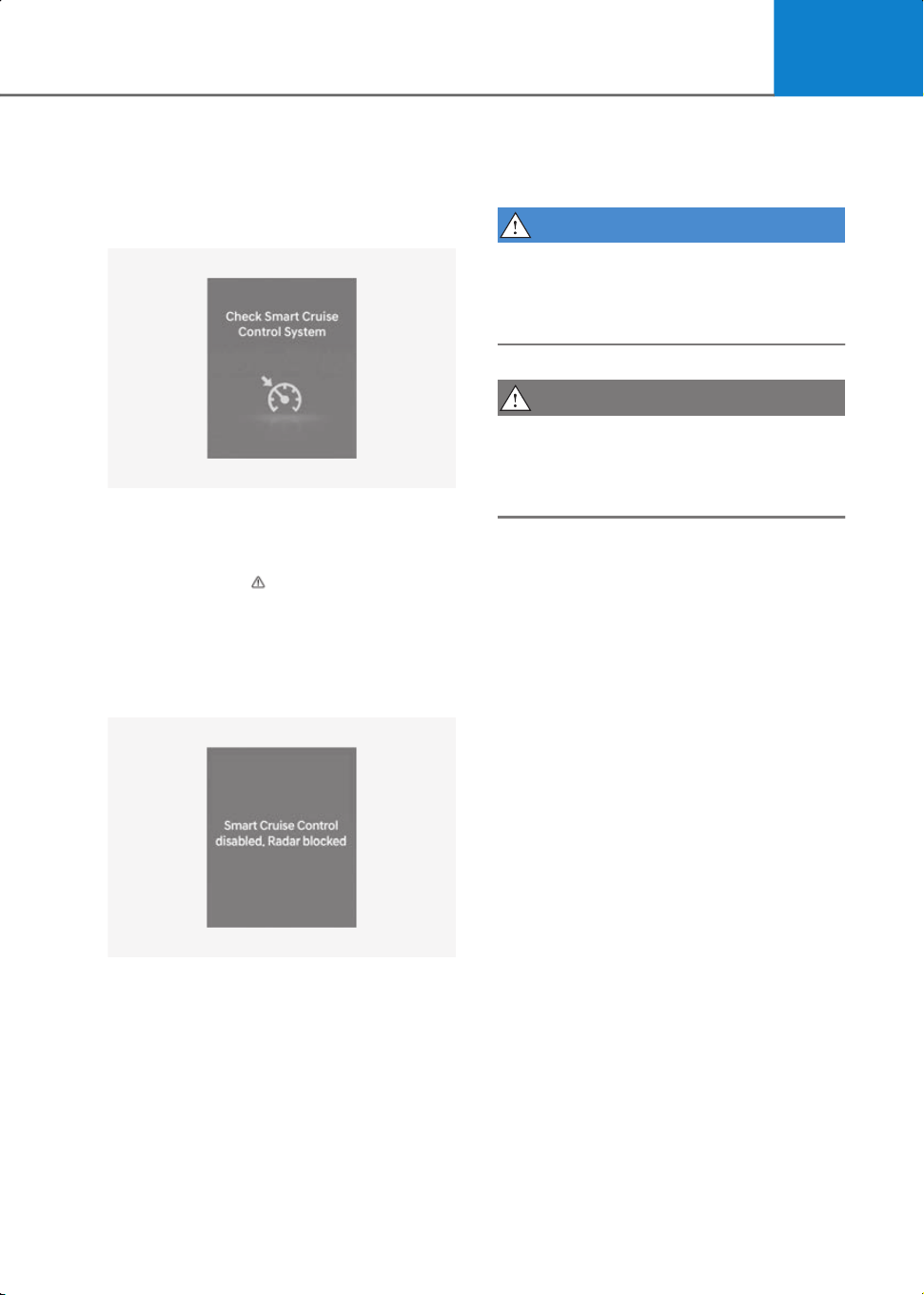
7
7-79
Smart Cruise Control
Malfunction and Limitations
Smart Cruise Control malfunction
B7004401
When Smart Cruise Control is not working
properly, the ‘Check Smart Cruise
Control System’ warning message will
appear, and the ( ) warning light will
illuminate on the instrument cluster. Have
the vehicle inspected by an authorized
HYUNDAI dealer.
Smart Cruise Control disabled
B0349EE02
When the front radar cover or sensor is
covered with snow, rain, or foreign
material, it can reduce the detecting
performance and temporarily limit or
disable Smart Cruise Control.
If this occurs the 'Smart Cruise Control
disabled. Radar blocked' warning
message will appear for a certain period
of time on the instrument cluster.
Smart Cruise Control will operate
properly when snow, rain or foreign
material is removed.
WARNING
Even though the warning message does
not appear on the instrument cluster,
Smart Cruise Control may not properly
operate.
CAUTION
Smart Cruise Control may not properly
operate in an area (for example, open
terrain), where there is nothing to detect
after turning ON the vehicle.
Limitations of Smart Cruise Control
Smart Cruise Control may not operate
properly, or it may operate unexpectedly
under the following circumstances:
• The detecting sensor or the
surroundings are contaminated or
damaged
• Washer fluid is continuously sprayed, or
the wiper is on
• The camera lens is contaminated due to
tinted, filmed or coated windshield,
damaged glass, or sticky foreign
material (sticker, bug, etc.) on the glass
• Moisture is not removed or frozen on
the windshield
• The field of view of the front view
camera is obstructed by sun glare
• Street light or light from an oncoming
vehicle is reflected on the wet road
surface, such as a puddle on the road
• The temperature around the front view
camera is high or low
• An object is placed on the dashboard
• The surrounding is very bright
• The surrounding is very dark, such as in
a tunnel, etc.
CE_USA.book Page 79

Driver Assistance System
7-80
• The brightness changes suddenly, for
example when entering or exiting a
tunnel
• The brightness outside is low, and the
headlights are not on or are not bright
• Driving in heavy rain or snow, or thick
fog
• Driving through steam, smoke or
shadow
• Only part of the vehicle is detected
• The vehicle in front has no tail lights, tail
lights are located unusually, etc.
• The brightness outside is low, and the
tail lights are not on or are not bright
• The rear of the front vehicle is small or
does not look normal (for example,
tilted, overturned, etc.)
• The front vehicle’s ground clearance is
low or high
• A vehicle suddenly cuts in front
• Your vehicle is being towed
• Driving through a tunnel or iron bridge
• Driving near areas containing metal
substances, such as a construction
zone, railroad, etc.
• An object reflecting off the front radar
such as a guardrail, nearby vehicle, etc.
• The bumper around the front radar is
impacted, damaged or the front radar is
out of position
• The temperature around the front radar
is high or low
• Driving in vast areas where there are
few vehicles or structures (for example,
desert, meadow, suburb, etc.)
• The vehicle in front is made of material
that does not reflect on the front radar
• Driving near a highway interchange or
tollbooth
• Driving on a slippery surface due to
snow, water puddle, ice, etc.
• Driving on a curved road
• The vehicle in front is detected late
• The vehicle in front is suddenly blocked
by a obstacle
• The vehicle in front suddenly changes
lane or suddenly reduces speed
• The vehicle in front is bent out of shape
• The front vehicle’s speed is fast or slow
• With a vehicle in front, your vehicle
changes lane at low speed
• The vehicle in front is covered with
snow
• Unstable driving
• You are on a roundabout and the
vehicle in front is not detected
• You are continuously driving in a circle
• Driving in a parking lot
• Driving through a construction area,
unpaved road, partial paved road,
uneven road, speed bumps, etc.
• Driving on an incline road, curved road,
etc.
• Driving through a roadside with trees or
streetlights
• The adverse road conditions cause
excessive vehicle vibrations while
driving
• Your vehicle height is low or high due to
heavy loads, abnormal tire pressure,
etc.
• Driving through a narrow road where
trees or grass are overgrown
• There is interference by
electromagnetic waves, such as driving
in an area with strong radio waves or
electrical noise
CE_USA.book Page 80
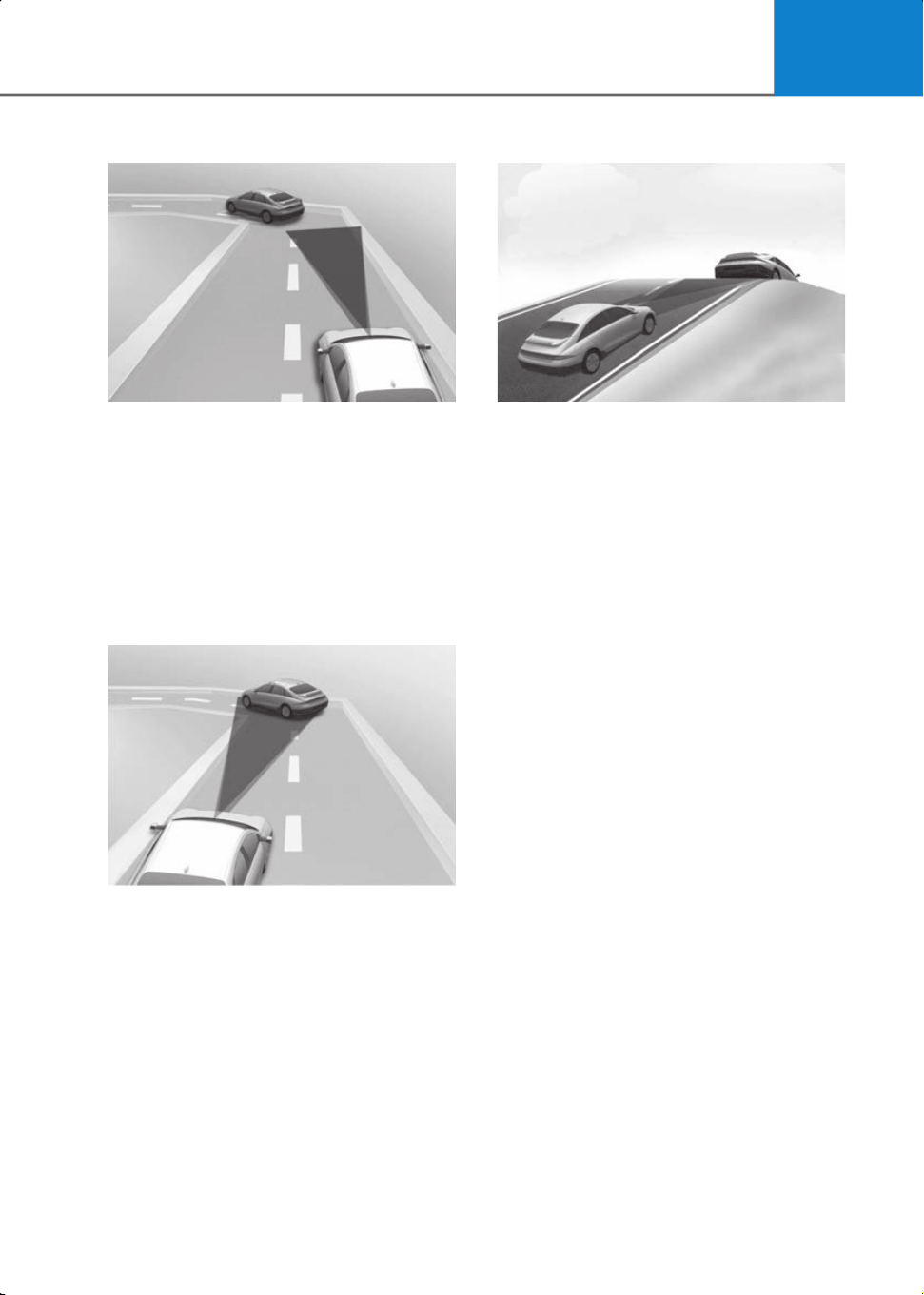
7
7-81
• Driving on a curved road
B7004403
On curves, Smart Cruise Control may
not detect a vehicle in the same lane,
and may accelerate to the set speed.
Also, vehicle speed may rapidly
decrease when the vehicle ahead is
detected suddenly.
Select the appropriate set speed on
curves and apply the brake pedal or
accelerator pedal according to the road
and driving conditions ahead.
B7004404
Your vehicle speed can be reduced due
to a vehicle in the adjacent lane.
Apply the accelerator pedal and select
the appropriate set speed. Check to be
sure that the road conditions permit
safe operation of the Smart Cruise
Control.
• Driving on an inclined road
B7004405
During uphill or downhill driving, the
Smart Cruise Control may not detect a
moving vehicle in your lane, and cause
your vehicle to accelerate to the set
speed. Also, vehicle speed will rapidly
decrease when the vehicle ahead is
detected suddenly.
Select the appropriate set speed on
inclines and apply the brake pedal or
accelerator pedal according to the road
and driving conditions ahead.
CE_USA.book Page 81
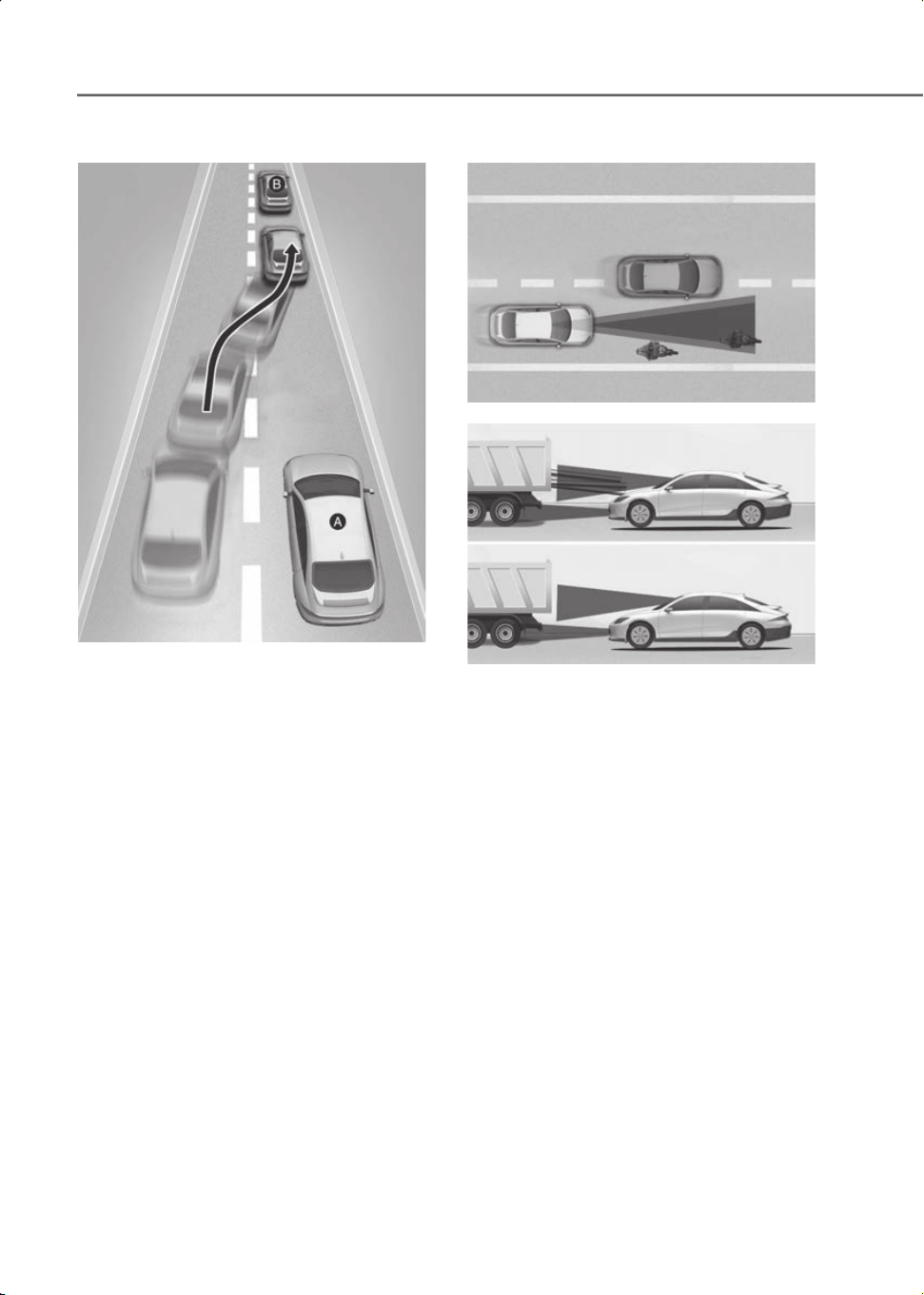
Driver Assistance System
7-82
• Changing lanes
B7004406
[A] Your vehicle
[B] Lane changing vehicle
When a vehicle moves into your lane
from an adjacent lane, it cannot be
detected by the sensor until it is in the
sensor's detection range. Smart Cruise
Control may not immediately detect
the vehicle when the vehicle changes
lanes abruptly. In this case, you must
maintain a safe braking distance, and if
necessary, depress the brake pedal to
reduce your driving speed in order to
maintain a safe distance.
• Situations when detecting are limited
B7004407
B7004408
In the following cases, some vehicles,
pedestrians or animals in your lane
cannot be detected by the sensor:
• Vehicles offset to one side
• Slow-moving vehicles or sudden
decelerating vehicles
• Vehicles with higher ground clearance
or vehicles carrying loads that stick out
of the back of the vehicle
• Vehicles that has the front lifted due to
heavy loads
• Vehicles within about 6 ft. (2 m) from
your vehicle
• Oncoming vehicles
• Stopped vehicles
• Vehicles with small rear profile, such as
trailers
CE_USA.book Page 82
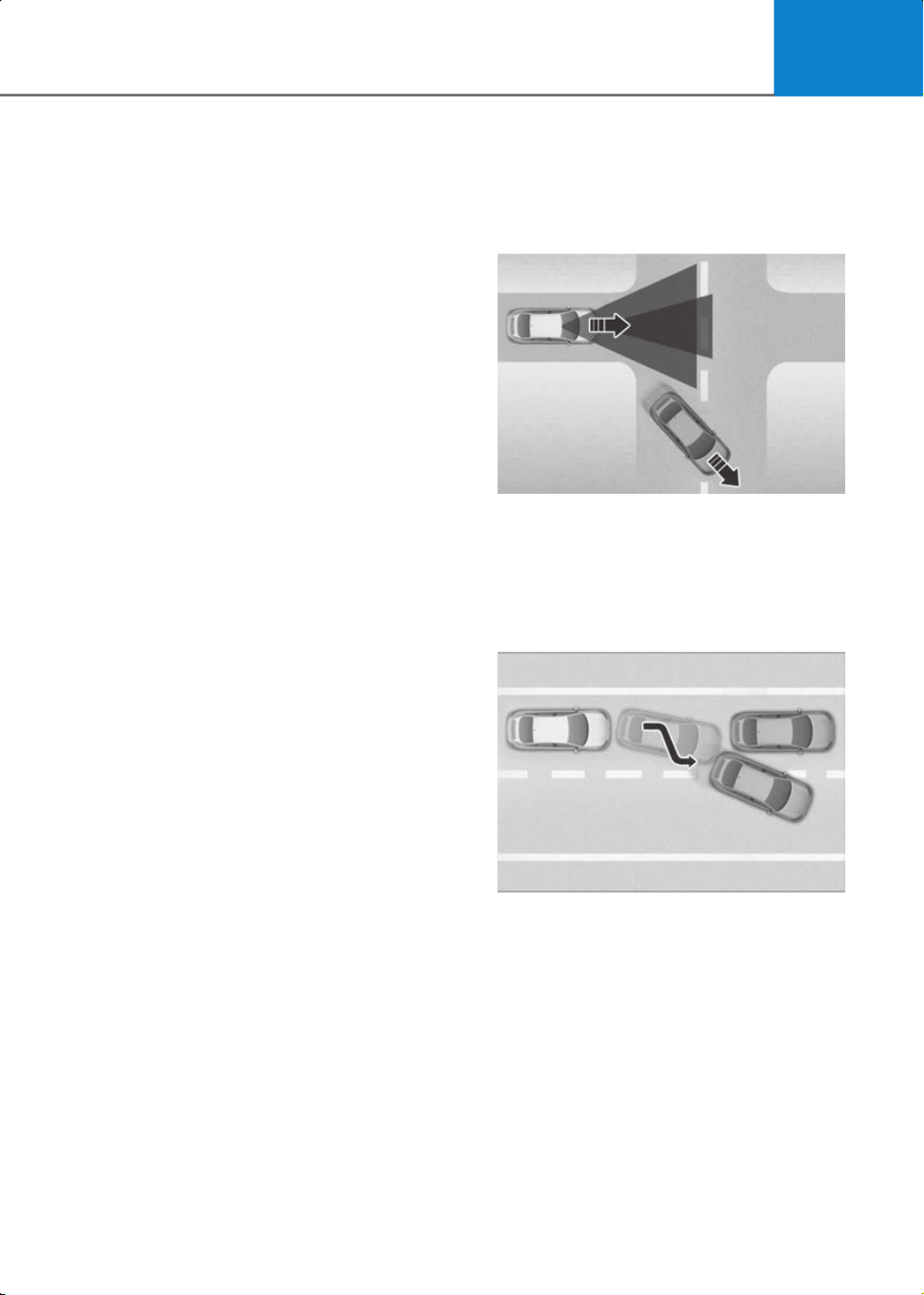
7
7-83
• Narrow vehicles, such as motorcycles
or bicycles
- Special vehicles
- Animals and pedestrians
Adjust your vehicle speed by
depressing the brake pedal
according to the road and driving
conditions ahead.
In the following cases, the vehicle in
front cannot be detected by the
sensor:
• You are steering your vehicle
• Driving on narrow or sharply
curved roads
Adjust your vehicle speed by
depressing the brake pedal
according to the road and driving
conditions ahead.
• When a vehicle ahead disappears at an
intersection, your vehicle may
accelerate.
Always pay attention to road and
driving conditions while driving.
B7004409
• When a vehicle in front of you merges
out of the lane, Smart Cruise Control
may not immediately detect the new
vehicle that is now in front of you.
Always pay attention to road and
driving conditions while driving.
B7004410
CE_USA.book Page 83
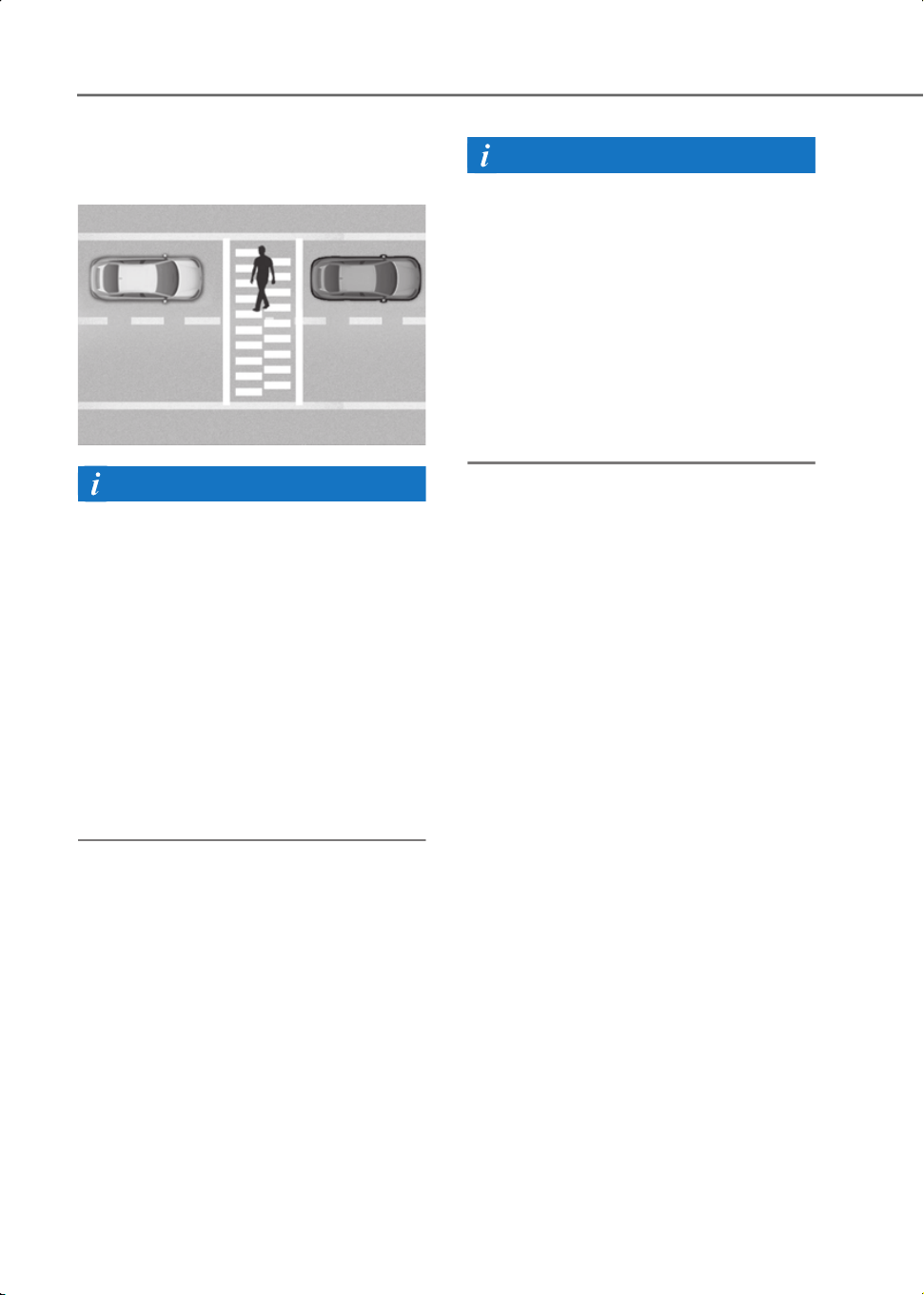
Driver Assistance System
7-84
• Always look out for pedestrians when
your vehicle is maintaining a distance
with the vehicle ahead.
B7004411
Information
This device complies with Part 15 of the
FCC rules.
Operation is subject to the following three
conditions:
1. This device may not cause harmful
interference, and
2. This device must accept any
interference received, including
interference that may cause undesired
operation.
3. Changes or modifications not expressly
approved by the party responsible for
compliance could void the user’s
authority to operate the device.
Information
Radio frequency radiation exposure
information:
This equipment complies with FCC
radiation exposure limits set forth for an
uncontrolled environment.
This equipment should be installed and
operated with minimum distance of 8 in.
(20 cm) between the radiator (antenna)
and your body.
This transmitter must not be co-located
or operating in conjunction with any other
antenna or transmitter.
CE_USA.book Page 84
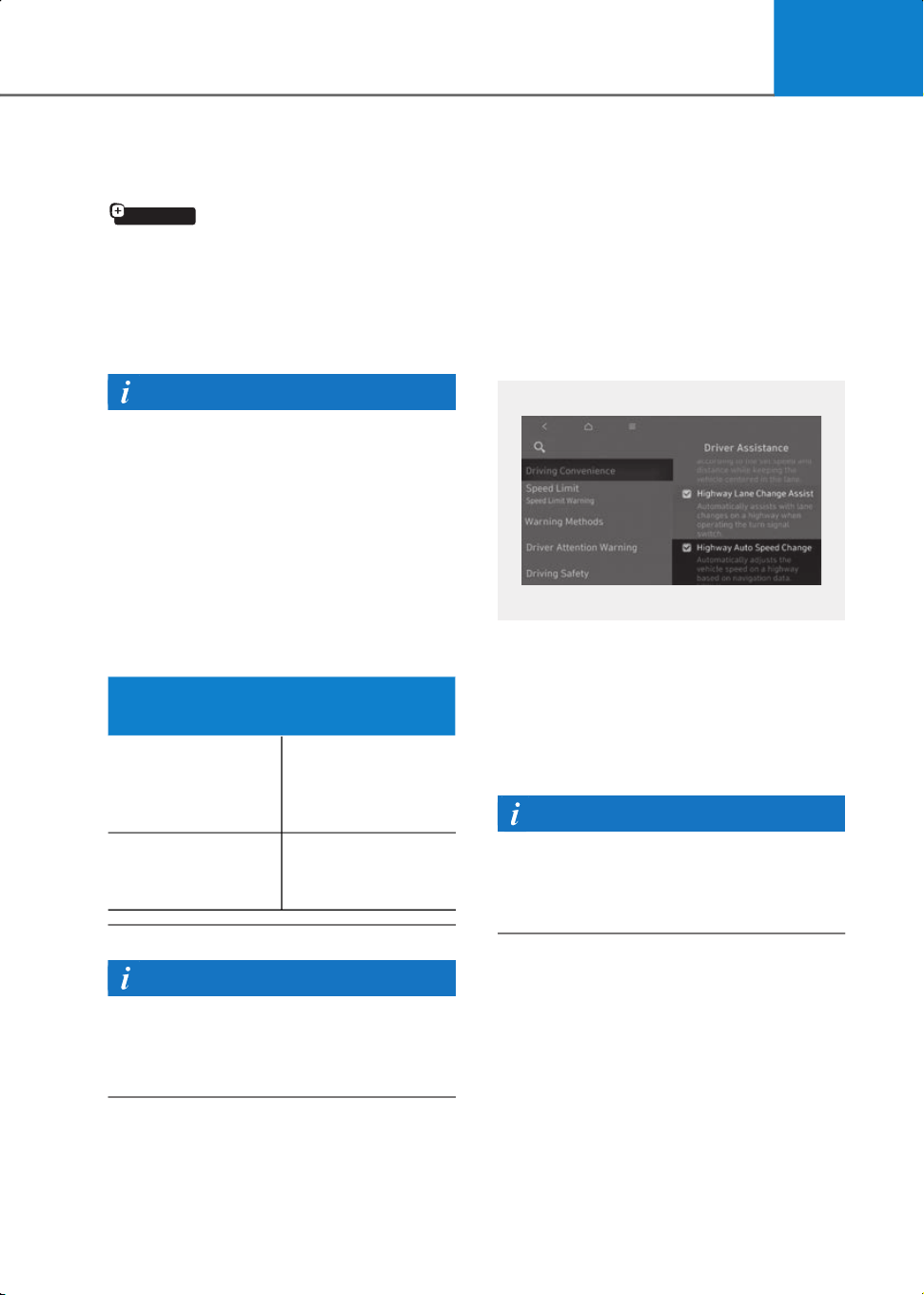
7
7-85
Navigation-based Smart
if equipped
Cruise Control (NSCC)
Navigation-based Smart Cruise Control
helps maintain safe speed depending on
the road conditions by using information
from the navigation system when driving
on highways while Smart Cruise Control is
operating.
Information
• Navigation-based Smart Cruise Control
is available only on controlled access
road of certain highways.
- Controlled access road indicates
roads with limited entrances and
exits that allow uninterrupted high
speed traffic flow. Only passenger
cars and motorcycles are allowed on
controlled access roads.
• Additional highways may be expanded
by future navigation updates.
Information
Navigation-based Smart Cruise Control
operates on main roads of highways, and
does not operate on interchanges or
junctions.
Highway Curve Zone Auto Slowdown
If vehicle speed is high, Highway Curve
Zone Auto Slowdown function will
temporarily decelerate your vehicle or
limit acceleration to help you drive safely
on a curve based on the curve
information from the navigation.
Navigation-based Smart
Cruise Control Settings
B7004601
With the vehicle on, select Setup >
Vehicle > Driver Assistance > Driving
Convenience > Highway Auto Speed
Change from the Settings menu to turn
on Navigation-based Smart Cruise
Control and deselect to turn off the
function.
Information
When there is a problem with
Navigation-based Smart Cruise Control,
the function cannot be set from the
Settings menu.
Available Highway (Controlled access
road)
USA
Select Interstate
Highway and U.S.
(Federal) and State
Highways
Canada
Select Provincial
and Territorial
Highways
CE_USA.book Page 85
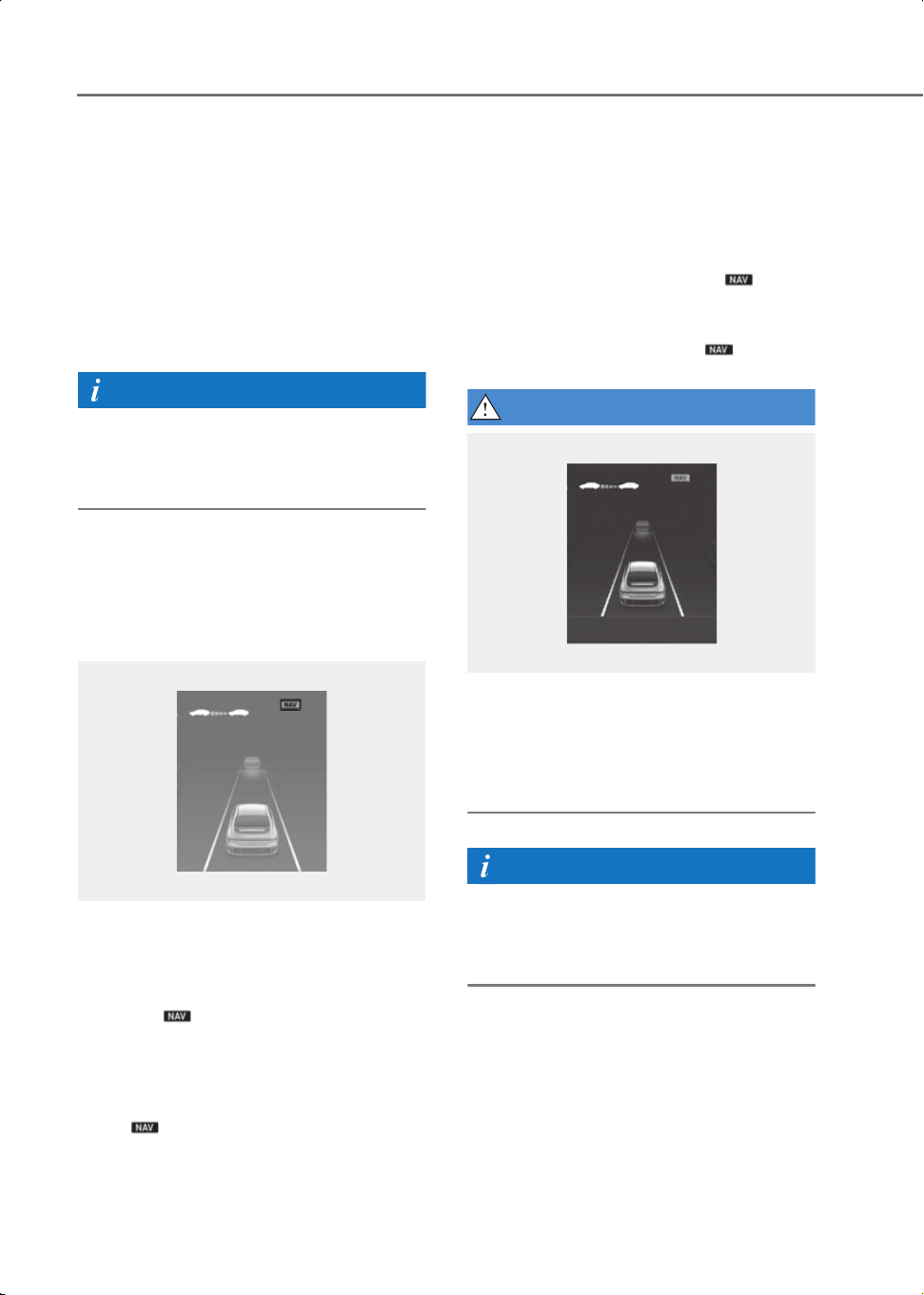
Driver Assistance System
7-86
Navigation-based Smart
Cruise Control Operation
Operating conditions
Navigation-based Smart Cruise Control is
ready to operate if all of the following
conditions are satisfied:
• Smart Cruise Control is operating
• Driving on main roads of highways
Information
For more information on how to operate
Smart Cruise Control, refer to the “Smart
Cruise Control (SCC)” section in this
chapter.
Navigation-based Smart Cruise
Control display and control
When Navigation-based Smart Cruise
Control operates, it will be displayed on
the instrument cluster as follows:
B7004702
Navigation-based Smart Cruise Control
standby
If the operating conditions are satisfied,
the green indicator light illuminates.
Navigation-based Smart Cruise Control
operating
While the speed is being controlled, the
green indicator light blinks.
Temporarily canceled or interrupted by
the driver
If Navigation-based Smart Cruise Control
cannot control the vehicle, such as when
Smart Cruise Control is temporarily
canceled or the navigation system is
searching for a route, the gray
indicator light illuminates.
When the driver depresses the
accelerator pedal, the white indicator
light blinks.
WARNING
B7004703
'Drive carefully' warning message will
appear in the following circumstances:
• Navigation-based Smart Cruise Control
is not able to slow down your vehicle to
a safe speed
Information
The images and colors in the instrument
cluster may differ depending on the
instrument cluster type or theme selected
from the settings menu.
55
MPH
%SJWFDBSFGVMMZ
55
MPH
CE_USA.book Page 86
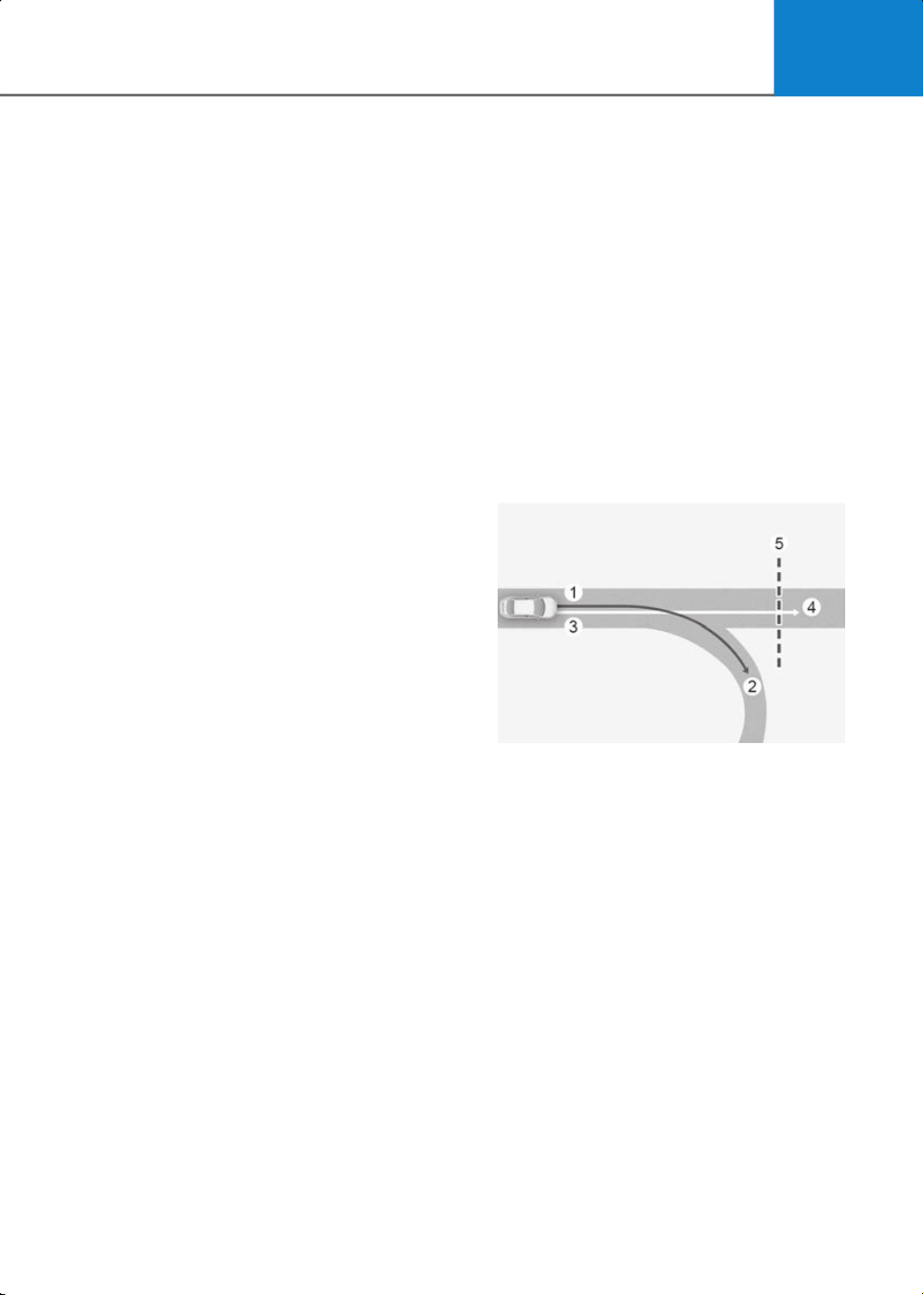
7
7-87
Highway Curve Zone Auto Slowdown
• Depending on the curve ahead on the
highway, the vehicle will decelerate,
and after passing the curve, the vehicle
will accelerate to Smart Cruise Control
set speed.
• Vehicle deceleration time may differ
depending on the vehicle speed and
the degree of the curve on the road. The
higher the driving speed, deceleration
will start faster.
Limitations of
Navigation-based Smart
Cruise Control
Navigation-based Smart Cruise Control
may not operate properly under the
following circumstances:
• The navigation is not working properly
• Map information is not transmitted due
to infotainment system's abnormal
operation
• Speed limit and road information in the
navigation is not updated
• The map information and the actual
road is different because of real-time
GPS data or map information error
• The navigation searches for a route
while driving
• GPS signals are blocked in areas such as
a tunnel
• A road that divides into two or more
roads and joins again
• The driver goes off course from the
route set in the navigation
• The route to the destination is changed
or cancelled by resetting the navigation
• The vehicle enters a service station or
rest area
• Android Auto or Car Play is operating
• The navigation cannot detect the
current vehicle position (for example,
elevated roads including overpass
adjacent to general roads or nearby
roads exist in a parallel way)
• The navigation is being updated while
driving
• The navigation is being restarted while
driving
• The speed limit of some sections
changes according to the road
situations
• Driving on a road under construction
• Driving in lane-restricted driving
situations
• There is bad weather, such as heavy
rain, heavy snow, etc.
• Driving on a road that is sharply curved
B7004801
(1) Set route,
(2) Branch line,
(3) Driving route,
(4) Main road,
(5) Curved road section
• When there is a difference between the
navigation set route (branch line) and
the driving route (main road), Highway
Curve Zone Auto Slowdown function
may not operate until the driving route
is recognized as the main road.
• When the vehicle's driving route is
recognized as the main road by
maintaining the main road instead of
the navigation set route, Highway
Curve Zone Auto Slowdown function
will operate. Depending on the distance
to the curve and the current vehicle
speed, vehicle deceleration may not be
sufficient or may decelerate rapidly.
CE_USA.book Page 87
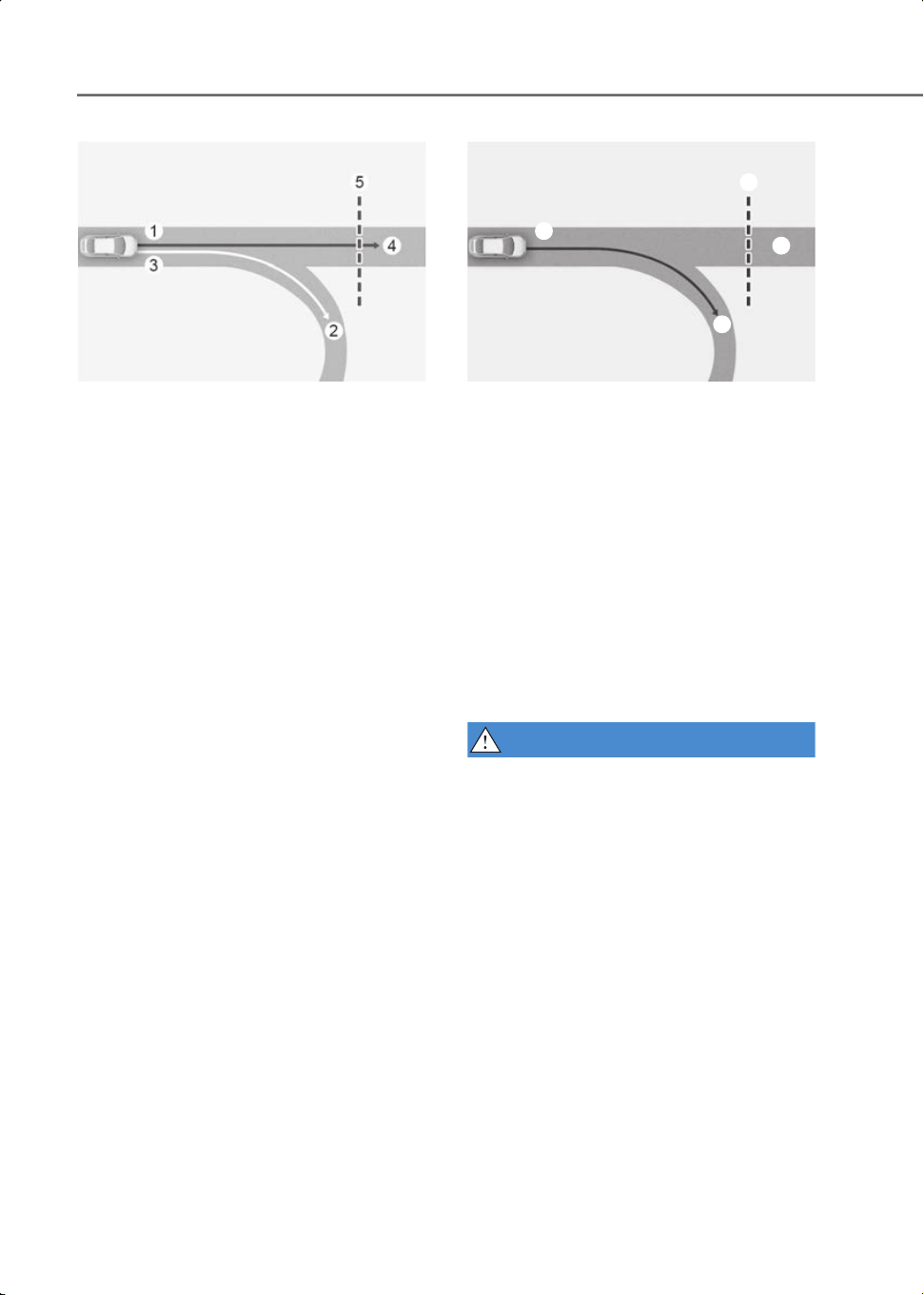
Driver Assistance System
7-88
B7004802
(1) Set route,
(2) Branch line,
(3) Driving route,
(4) Main road,
(5) Curved road section
• When there is a difference between the
navigation route (main road) and the
driving route (branch line), Highway
Curve Zone Auto Slowdown function
will operate based on the curve
information on the main road.
• When it is judged that you are driving
out of the route by entering the
highway interchange or junction,
Highway Curve Zone Auto Slowdown
function will not operate.
B7004803
(1) Driving route,
(2) Branch line,
(3) Curved road section,
(4) Main road,
• If there is no destination set on the
navigation, Highway Curve Zone Auto
Slowdown function will operate based
on the curve information on the main
road.
• Even if you depart from the main road,
Highway Curve Zone Auto Slowdown
function may temporarily operate due
to navigation information of the
highway curve section.
WARNING
• Navigation-based Smart Cruise Control
is not a substitute for safe driving
practices, but a convenience function.
Always have your eyes on the road, and
it is the responsibility of the driver to
avoid violating traffic laws.
• The navigation’s speed limit
information may differ from the actual
speed limit information on the road. It is
the driver's responsibility to check the
speed limit on the actual driving road or
lane.
• Navigation-based Smart Cruise Control
will automatically be canceled when
you leave the highway main road.
Always pay attention to road and
driving conditions while driving.
2
4
3
1
CE_USA.book Page 88

7
7-89
• Navigation-based Smart Cruise Control
may not operate due to the existence of
leading vehicles and the driving
conditions of the vehicle. Always pay
attention to road and driving conditions
while driving.
• When you are towing a trailer or
another vehicle, turn off
Navigation-based Smart Cruise Control
for safety reasons.
• After you pass through a tollbooth on a
highway, Navigation-based Smart
Cruise Control will operate based on
the first lane. If you enter one of the
other lanes, Navigation-based Smart
Cruise Control might not operate
properly.
• The vehicle will accelerate if the driver
depresses the accelerator pedal while
Navigation-based Smart Cruise Control
is operating, and the function will not
decelerate the vehicle. However, if the
accelerator pedal is depressed
insufficiently, the vehicle may
decelerate.
• If the driver accelerates and releases
the accelerator pedal while
Navigation-based Smart Cruise Control
is operating, the vehicle may not
decelerate sufficiently or may rapidly
decelerate to a safe speed.
• If the curve is too large or too small,
Navigation-based Smart Cruise Control
may not operate.
Information
• A time gap could occur between the
navigation’s guidance and when
Navigation-based Smart Cruise Control
operation starts and ends.
• The speed information on the
instrument cluster and navigation may
differ.
• Even if you are driving at a speed lower
than Smart Cruise Control set speed,
acceleration may be limited by the
curve sections ahead.
• If Navigation-based Smart Cruise
Control is operating while leaving the
main road to enter an interchange,
junction, rest area, etc., the function
may operate for a certain period of
time.
• Deceleration by Navigation-based
Smart Cruise Control may feel it is not
sufficient due to road conditions such
as uneven road surfaces, narrow lanes,
etc.
Information
This device complies with Part 15 of the
FCC rules.
Operation is subject to the following three
conditions:
1. This device may not cause harmful
interference, and
2. This device must accept any
interference received, including
interference that may cause undesired
operation.
3. Changes or modifications not expressly
approved by the party responsible for
compliance could void the user’s
authority to operate the device.
CE_USA.book Page 89
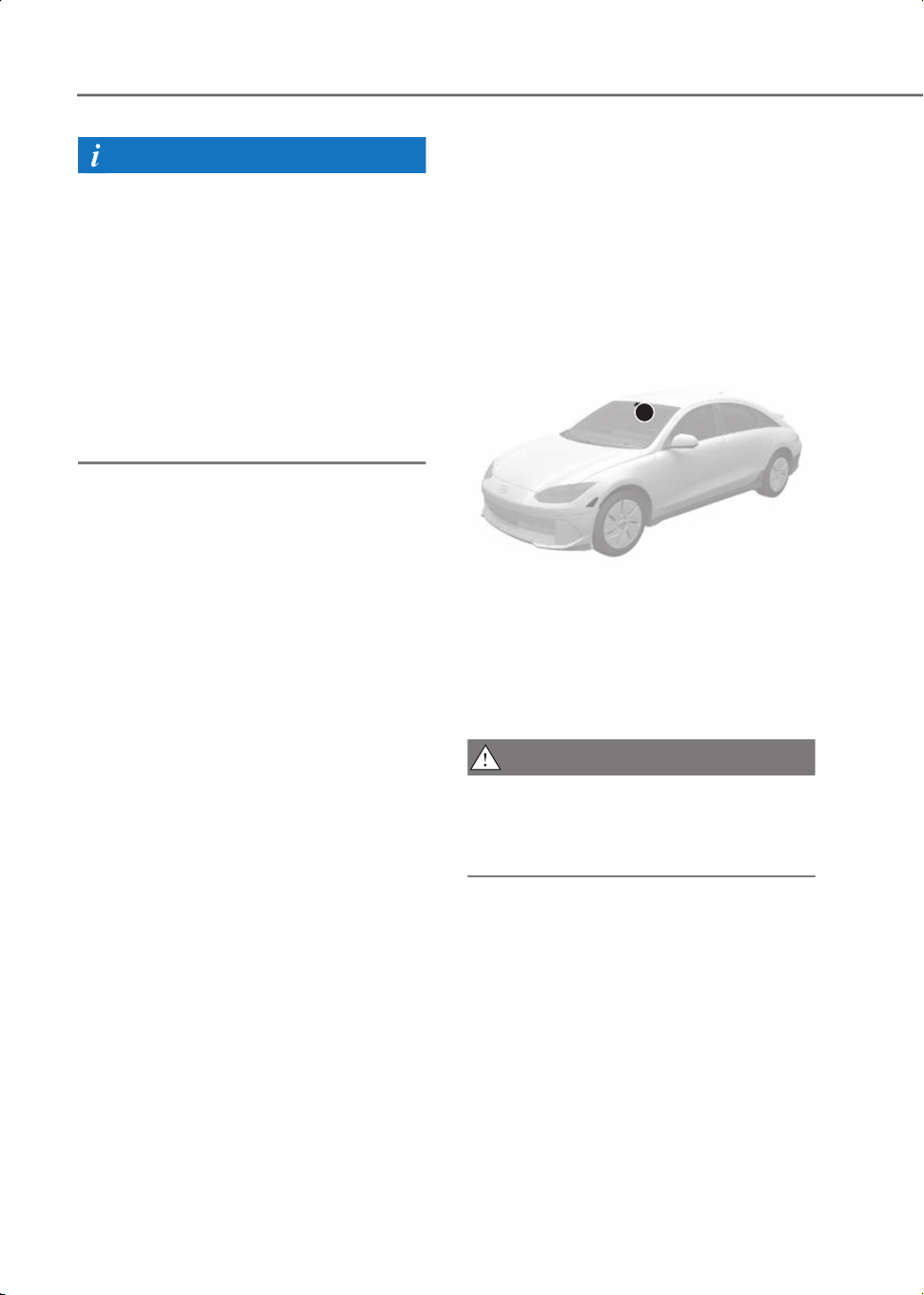
Driver Assistance System
7-90
Information
Radio frequency radiation exposure
information:
This equipment complies with FCC
radiation exposure limits set forth for an
uncontrolled environment.
This equipment should be installed and
operated with minimum distance of 8 in.
(20 cm) between the radiator (antenna)
and your body.
This transmitter must not be co-located
or operating in conjunction with any other
antenna or transmitter.
Lane Following Assist
(LFA)
Lane Following Assist detects lane
markings and/or a vehicle ahead on the
road, and center your vehicle in the lane.
Detecting sensor
B7004901
(1) Front view camera
The front view camera is used as a
detecting sensor to detect lane markings
and front vehicles.
Refer to the picture above for the detailed
location of the detecting sensor.
CAUTION
For more information on the precautions
of the front view camera, refer to the
"Forward Collision-Avoidance Assist
(FCA)" section in this chapter.
1
CE_USA.book Page 90
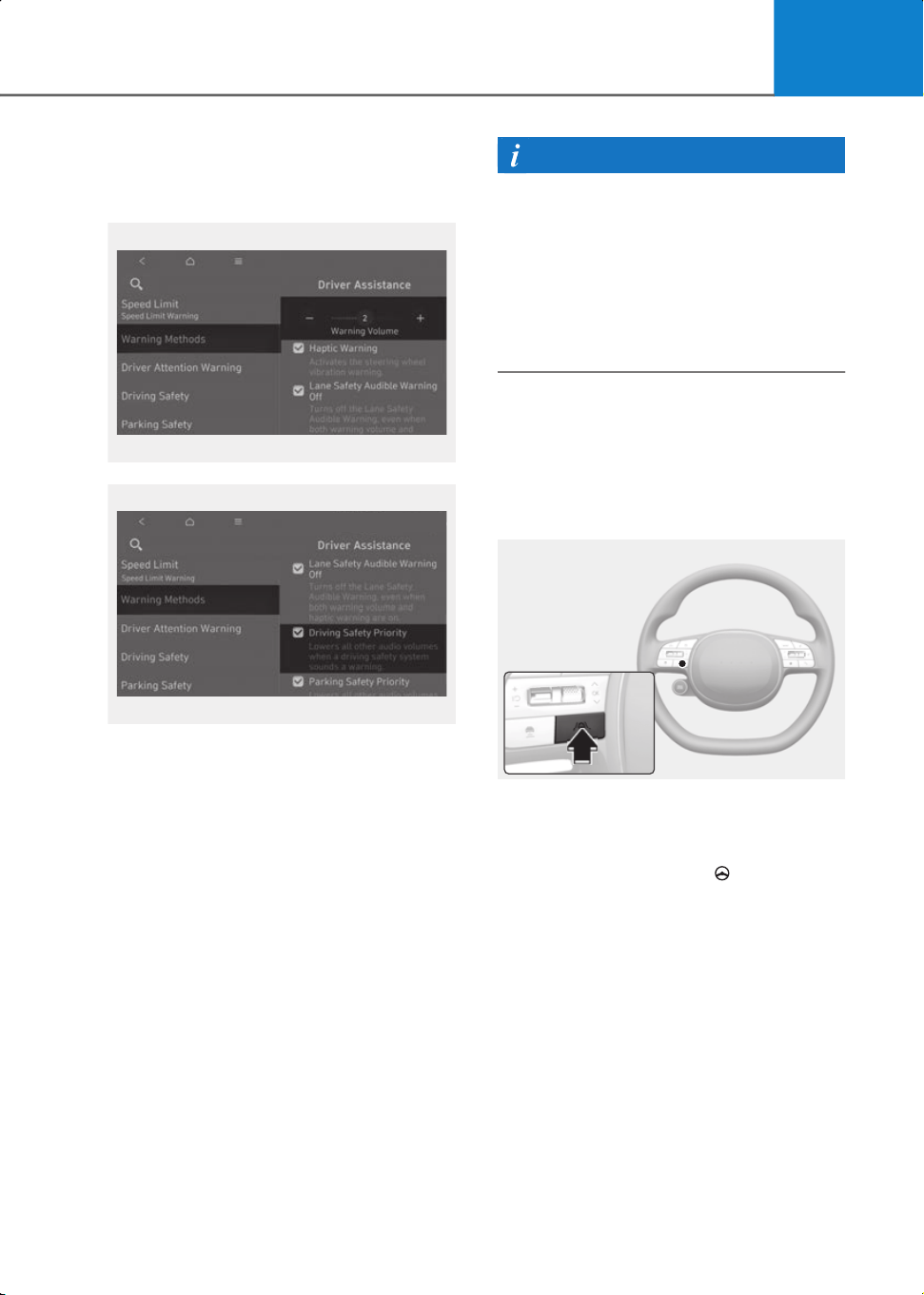
7
7-91
Lane Following Assist Settings
Warning Methods
B7001902
B7001902_1
With the vehicle on, go to Setup > Vehicle
> Driver Assistance > Warning Methods
from the Settings in the infotainment
system to select the following:
• Warning Volume: The Warning Volume
can be adjusted.
If you turn off the Warning Volume, for
your safety, the Hands-off warning
volume may warn you with a low
volume.
• Driving Safety Priority: Your vehicle
lowers all other audio volumes when
the Driver Assistance system warning
sounds.
Information
• If you change the Warning Methods,
Warning Methods of other Driver
Assistance systems may change.
• If the vehicle is restarted, Warning
Methods will maintain the last setting.
• There may be no Settings menu
depending on the feature applied to
your vehicle.
Lane Following Assist
Operation
Turning Lane Following Assist
On/Off
B7001101
With the vehicle on, short press the Lane
Driving Assist button located on the
steering wheel to turn on Lane Following
Assist. The grey or green ( ) indicator
light will illuminate on the instrument
cluster.
Press the button again to turn off the
function.
CE_USA.book Page 91
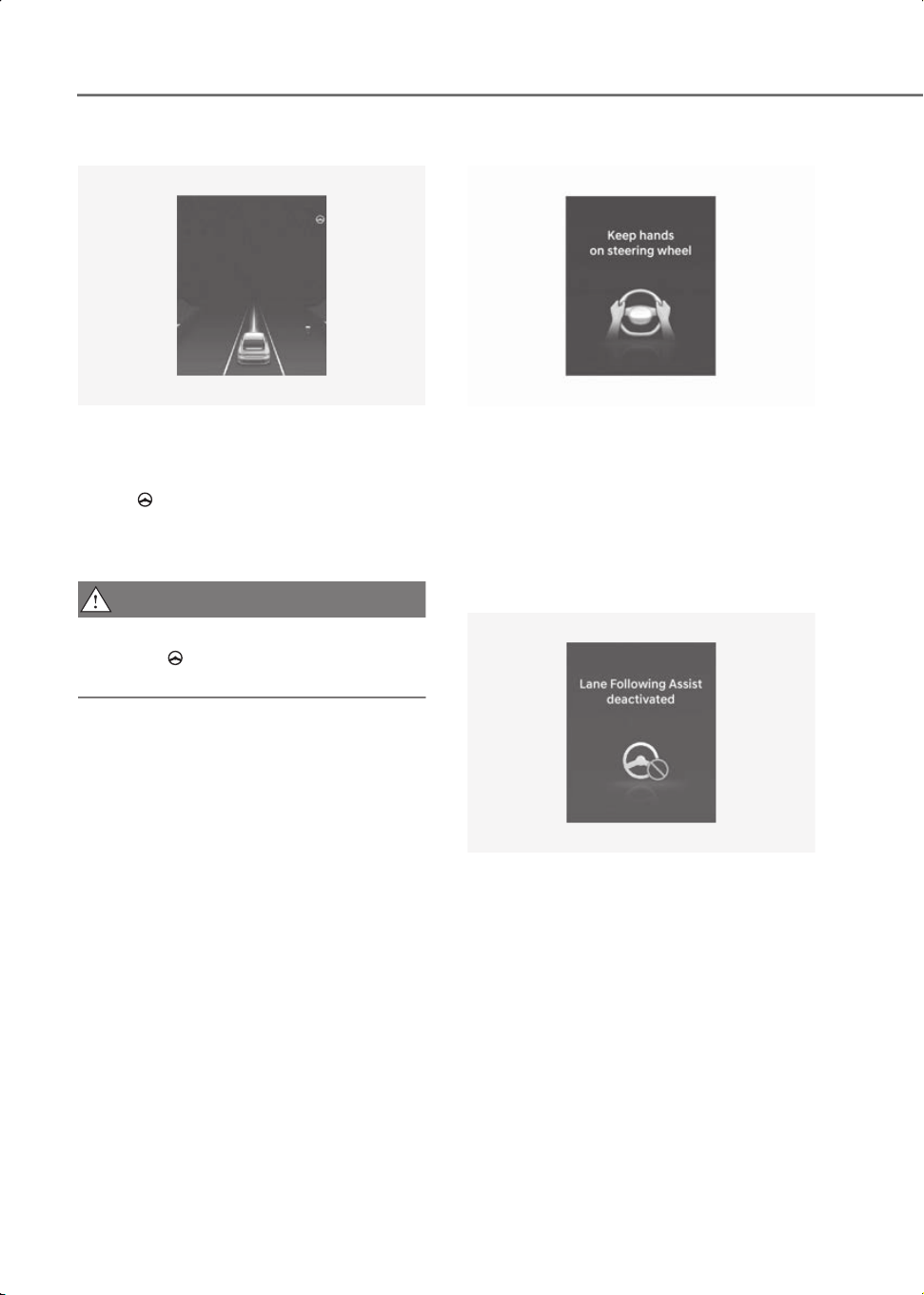
Driver Assistance System
7-92
Lane Following Assist
B7005102
If the vehicle ahead and/or both lane
markings are detected and your vehicle
speed is below 112 mph (180 km/h), the
green ( ) indicator light illuminates on
the instrument cluster, and Lane
Following Assist helps center the vehicle
in the lane by assisting the steering wheel.
CAUTION
When the steering wheel is not assisted,
the white ( ) indicator light blinks and
changes to grey.
Hands-off warning
B7005103
If the driver takes their hands off the
steering wheel for several seconds, the
'Keep hands on steering wheel' warning
message will appear and an audible
warning will sound in stages.
First stage: Warning message
Second stage: Warning message (red
steering wheel) and audible warning
B7005103_1
If the driver still does not have their hands
on the steering wheel after the hands-off
warning, the ‘Lane Following Assist
deactivated’ warning message will
appear and Lane Following Assist will be
automatically canceled.
CE_USA.book Page 92
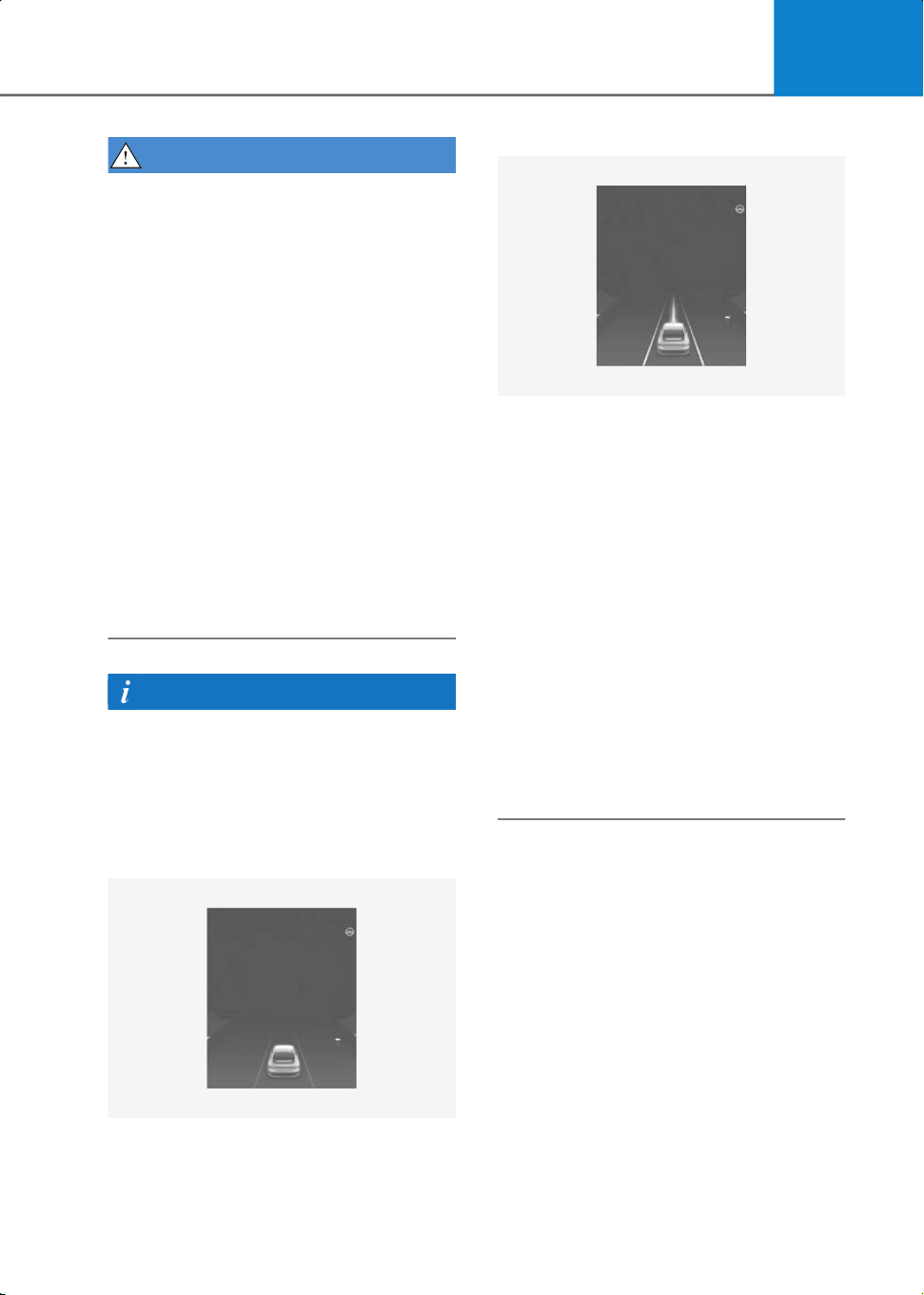
7
7-93
WARNING
• The steering wheel may not be assisted
if the steering wheel is held very tight or
the steering wheel is steered over a
certain degree.
• Lane Following Assist does not operate
at all times. It is the responsibility of the
driver to safely steer the vehicle and to
maintain the vehicle in its lane.
• The hands–off warning message may
appear late depending on road
conditions. Always have your hands on
the steering wheel while driving.
• If the steering wheel is held very lightly
the hands–off warning message may
appear because Lane Following Assist
may not recognize that the driver has
their hands on the steering wheel.
• If you attach objects to the steering
wheel, the hands-off warning may not
work properly.
Information
• For more information on instrument
cluster settings, refer to the "Cluster
Display Control" section in chapter 4.
• When both lane markings are detected,
the lane lines on the instrument cluster
will change from grey to white.
Lane undetected
B7005105
Lane detected
B7005106
• The images and colors in the
instrument cluster may differ
depending on the instrument cluster
type or theme selected from the
settings menu.
• If lane markings are not detected,
steering wheel control by Lane
Following Assist can be limited
depending on whether a vehicle is in
front or the driving conditions of the
vehicle.
• Even though the steering is assisted by
Lane Following Assist, the driver may
control the steering wheel.
• The steering wheel may feel heavier or
lighter when the steering wheel is
assisted by Lane Following Assist than
when it is not.
CE_USA.book Page 93
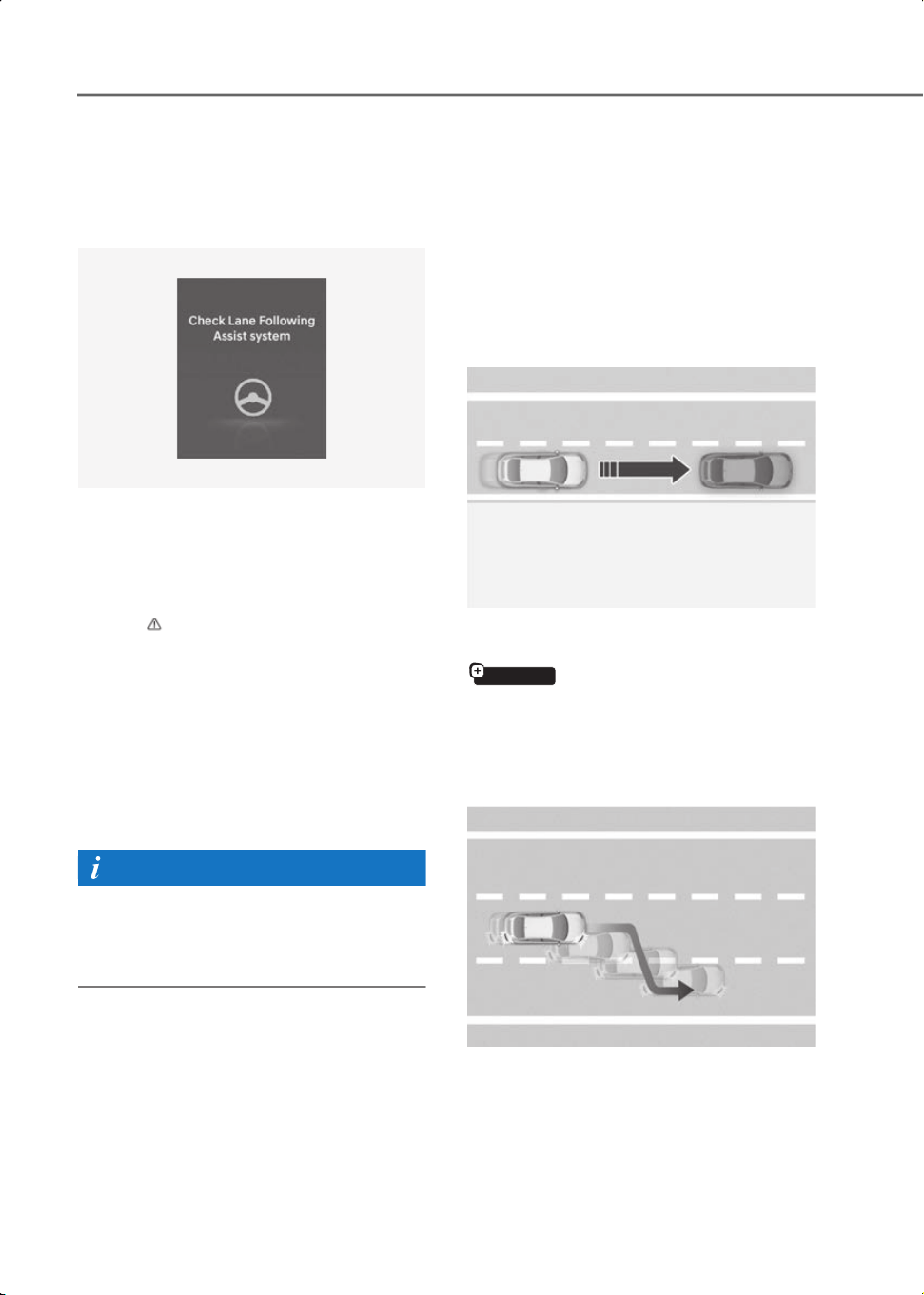
Driver Assistance System
7-94
Lane Following Assist
Malfunction and Limitations
Lane Following Assist malfunction
B7005201
When Lane Following Assist is not
working properly, the ‘Check Lane
Following Assist system’ warning
message will appear on the instrument
cluster for several seconds, and the
master ( ) warning light illuminates on
the instrument cluster. If this occur, have
the vehicle inspected by an authorized
HYUNDAI dealer.
Limitations of Lane Following Assist
For more information on Lane Following
Assist's limitations, refer to the "Lane
Keeping Assist (LKA)" section in this
chapter.
Information
For more information on "Warnings"
when using Lane Following Assist, refer to
the "Lane Keeping Assist (LKA)" section in
this chapter.
Highway Driving Assist
(HDA)
Basic function
Highway Driving Assist detect lanes and
vehicles ahead, and help maintain the
distance from the vehicle ahead and the
set speed, and center your vehicle in the
lane while driving on the highway.
B7005301
if equipped
Highway Lane Change Assist
Highway Lane Change Assist function
helps change lanes to the direction you
operate the turn signal switch if the
function judges that lane change is
possible.
B7005302
CE_USA.book Page 94
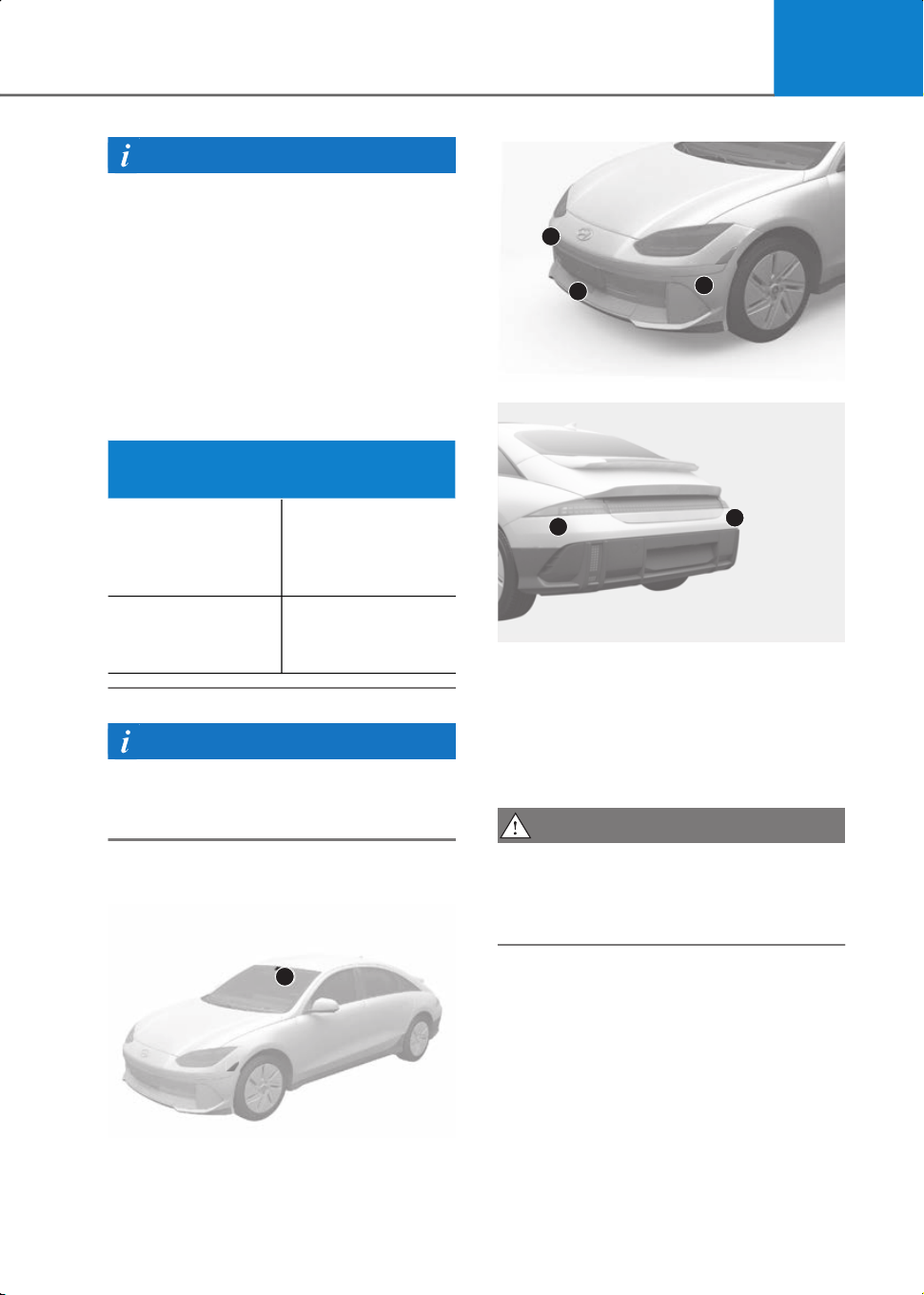
7
7-95
Information
• Highway Driving Assist is available only
on controlled access road of certain
highways.
- Controlled access road indicates
roads with limited entrances and
exits that allow uninterrupted high
speed traffic flow. Only passenger
cars and motorcycles are allowed on
controlled access roads.
• Additional highways may be expanded
by future navigation updates.
Information
Highway Driving Assist operates on main
roads of highways, and does not operate
on interchanges or junctions.
Detecting sensor
B7005303
B7005304
B7005305
(1) Front view camera,
(2) Front radar,
(3) Front corner radar (if equipped),
(4) Rear corner radar (if equipped)
Refer to the picture above for the detailed
location of the detecting sensors.
CAUTION
For more information on the precautions
of the detecting sensors, refer to the
"Forward Collision-Avoidance Assist
(FCA)" section in this chapter.
Available Highway (Controlled access
road)
USA
Select Interstate
Highway and U.S.
(Federal) and State
Highways
Canada
Select Provincial
and Territorial
Highways
1
3
3
2
4
4
CE_USA.book Page 95
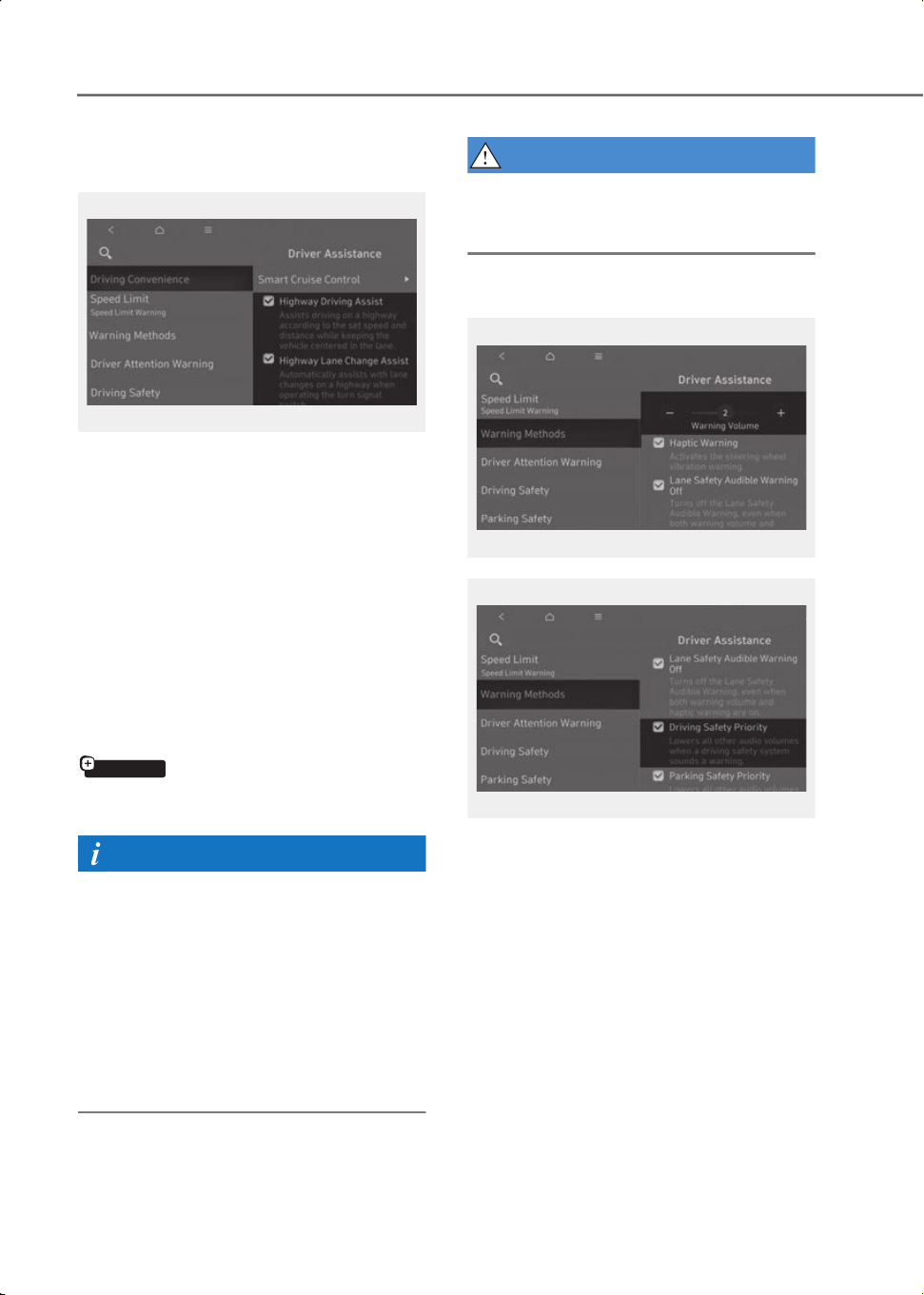
Driver Assistance System
7-96
Highway Driving Assist
Settings
B7005401
With the vehicle on, select or deselect
Setup > Vehicle > Driver Assistance >
Driving Convenience from the Settings
menu to set whether to use each
function.
Basic function
If Highway Driving Assist is selected, it
helps maintain distance from the vehicle
ahead, maintain the set speed, and helps
center the vehicle in the lane.
if equipped
Highway Lane Change Assist
If Highway Lane Change Assist is
selected, it helps the driver change lanes.
Information
• When Highway Driving Assist is
deselected, the setting for Highway
Lane Change Assist cannot be
changed.
• If there is a problem with the functions,
the settings cannot be changed. Have
the vehicle inspected by an authorized
HYUNDAI dealer.
• If the vehicle is restarted, the functions
will maintain the last setting.
WARNING
For your safety, only change the settings
after parking the vehicle at a safe
location.
Warning Methods
B7001902
B7001902_1
With the vehicle on, go to Setup > Vehicle
> Driver Assistance > Warning Methods
from the Settings in the infotainment
system to select the following:
• Warning Volume: The Warning Volume
can be adjusted.
If you turn off the Warning Volume, for
your safety, the Hands-off warning
volume may warn you with a low
volume.
• Driving Safety Priority: Your vehicle
lowers all other audio volumes when
the Driver Assistance system warning
sounds.
CE_USA.book Page 96
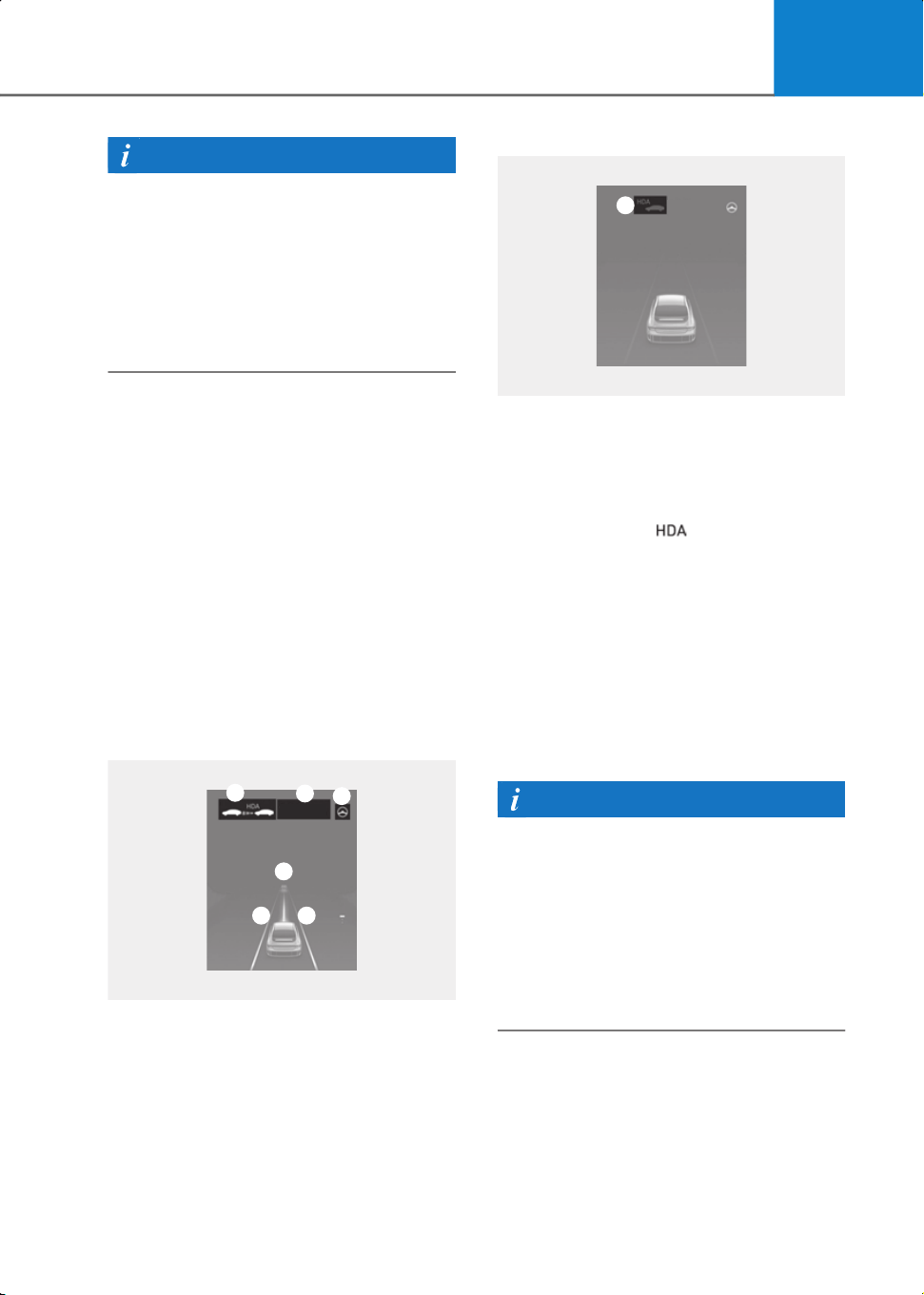
7
7-97
Information
• If you change the Warning Methods,
Warning Methods of other Driver
Assistance systems may change.
• If the vehicle is restarted, Warning
Methods will maintain the last setting.
• There may be no Settings menu
depending on the feature applied to
your vehicle.
Highway Driving Assist
Operation
Basic function
Displaying operating status
You can see the status of the Highway
Driving Assist operation in the Driving
Assist view on the instrument cluster. For
more information, refer to the "View
Modes" section in chapter 4.
Highway Driving Assist will be displayed
as below depending on the status of the
function.
Operating state
B7005501
Standby state
B7005502
1. Highway Driving Assist indicator,
whether there is a vehicle ahead and
the selected distance level are
displayed.
• Highway Driving Assist indicator ()
- Green HDA: Operating state
- Grey HDA: Standby state
- White HDA blink: Accelerator
depressed state
2. Set speed
3. Lane Following Assist indicator
4. Whether there is a vehicle ahead and
the selected headway
5. Whether the lane is detected or not
Information
• For more information on the display
refer to the "Smart Cruise Control
(SCC)" and "Lane Following Assist
(LFA)" sections in this chapter.
• The images and colors in the
instrument cluster may differ
depending on the instrument cluster
type or theme selected from the
settings menu.
2
3
4
5 5
1
55
MPH
1
55
MPH
CE_USA.book Page 97
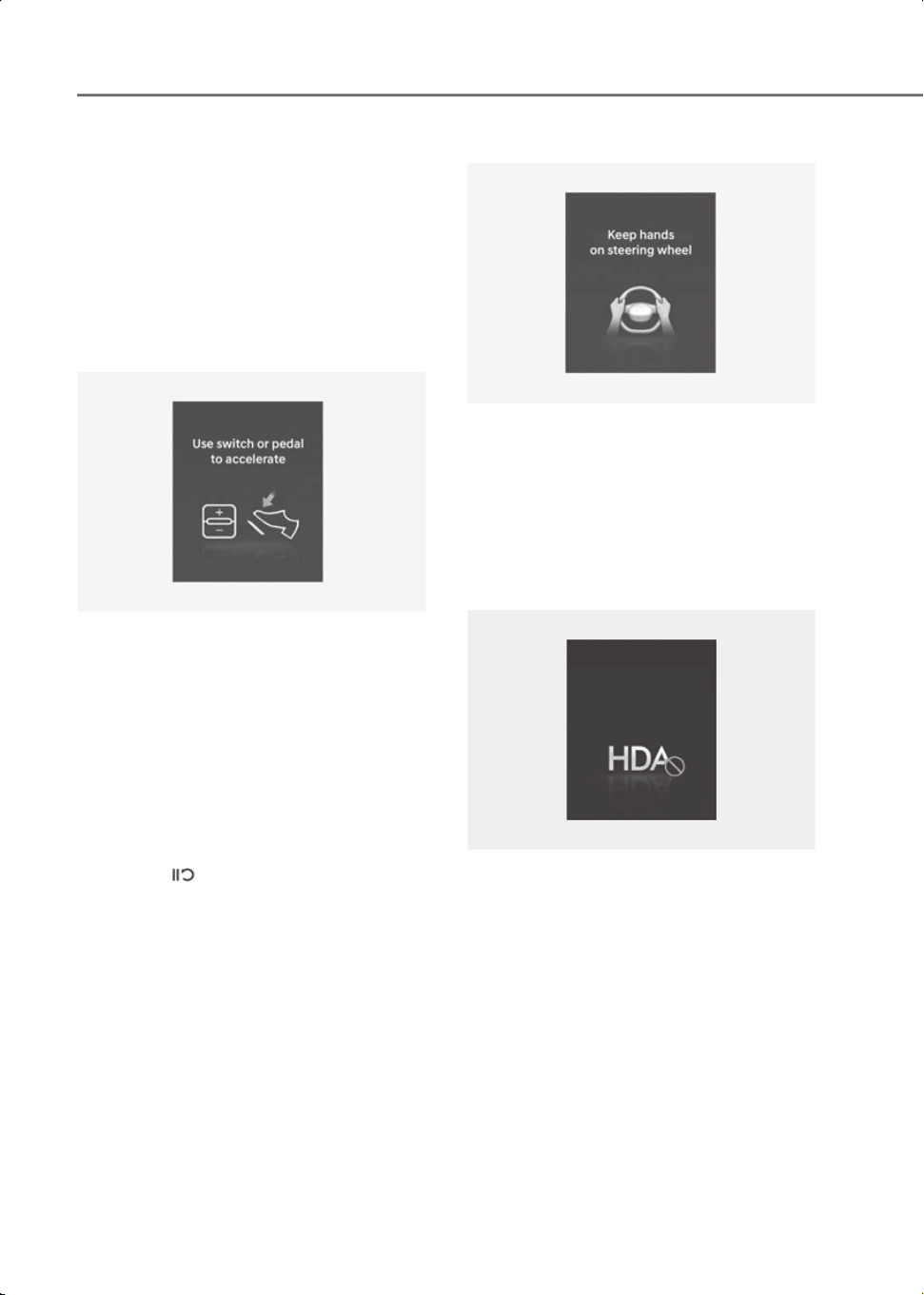
Driver Assistance System
7-98
Highway Driving Assist operation
Highway Driving Assist operates when:
• Driving on the main road of highways,
and turning on Highway Driving Assist
by pressing the Driving Assist button
• Entering the main road of highways
while Lane Following assist and Smart
Cruise Control are operating
Restarting after stopping
B7005503
When Highway Driving Assist is
operating, your vehicle will stop if the
vehicle ahead of you stops. Also, if the
vehicle ahead of you starts moving within
30 seconds after the stop, your vehicle
will start as well. In addition, after the
vehicle has stopped and 30 seconds have
passed, the 'Use switch or pedal to
accelerate' message will appear on the
instrument cluster. Depress the
accelerator pedal or operate the + switch,
- switch or switch to start driving.
Hands-off warning
B7005504
If the driver takes their hands off the
steering wheel for several seconds, the
'Keep hands on steering wheel' warning
message will appear and an audible
warning will sound in stages.
First stage: Warning message
Second stage: Warning message (red
steering wheel) and audible warning
B7005505
If the driver still does not have their hands
on the steering wheel after the hands-off
warning, ‘Highway Driving Assist
deactivated’ warning message will
appear and Highway Driving Assist and
Lane Change Assist will be automatically
canceled.
)JHIXBZ%SJWJOH"TTJTU
EFBDUJWBUFE
CE_USA.book Page 98
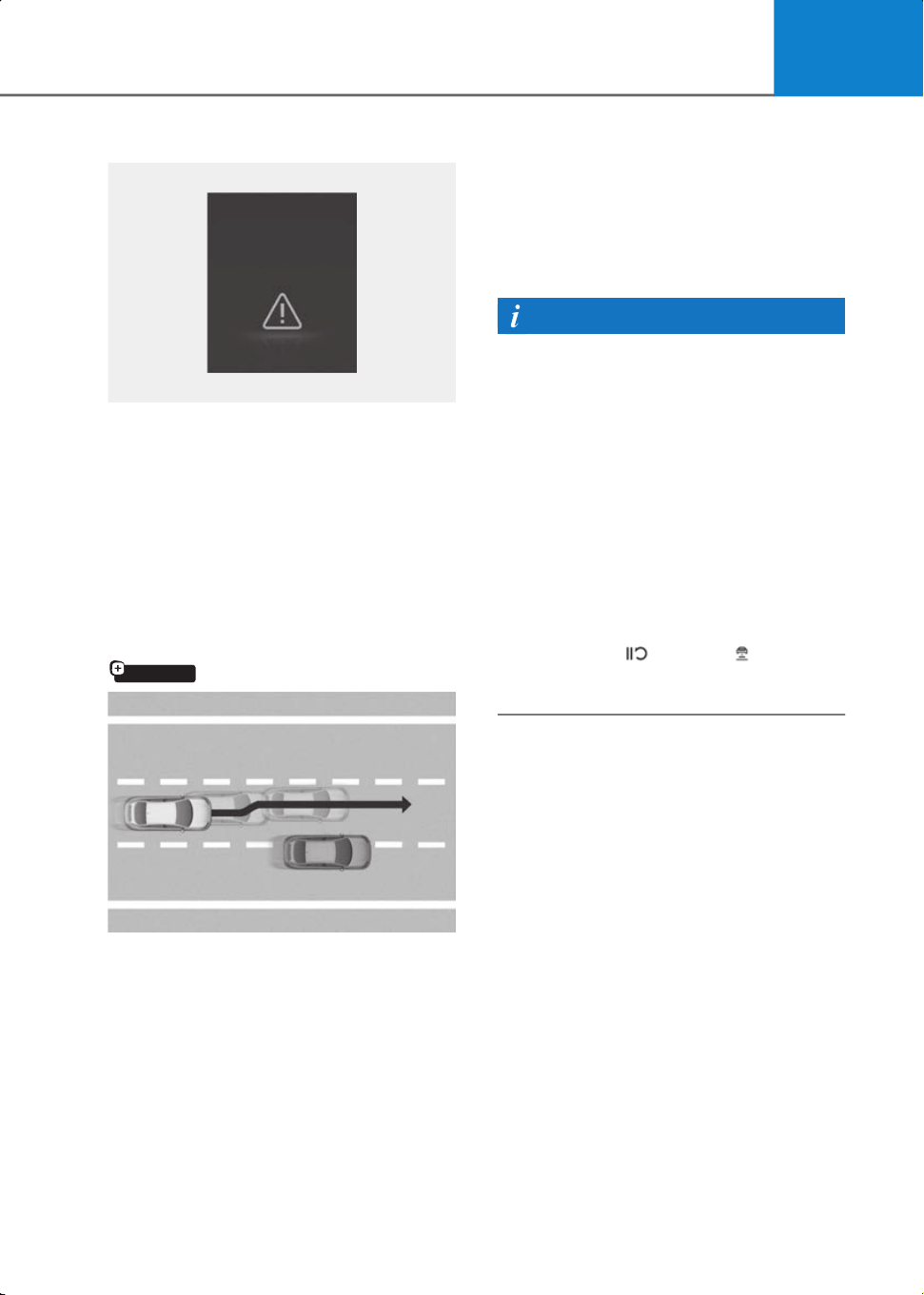
7
7-99
Driving speed limit
B7005506
When Highway Driving Assist is canceled
by the hands-off warning, The driving
speed will be limited.
While Driving Speed Limit function is
operating, the ‘Driver’s grasp not
detected. Driving speed will be limited’
warning message will appear on the
instrument cluster, and an audible
warning will sound continuously.
if equipped
Driving to one side within lane
B7005507
When vehicle speed is above 40 mph (60
km/h), if a vehicle around you is driving at
a close distance, your vehicle will control
steering in the opposite direction of the
vehicle to assist in safe driving.
If there are detected vehicles on both
sides of the lane that are driving close to
you, your vehicle does not control
steering in either direction.
Highway Driving Assist standby
When the Smart Cruise Control is
temporarily canceled while Highway
Driving Assist is operating, Highway
Driving Assist will be in the standby state.
At this time, Lane Following Assist will
operate properly.
Information
• Driving Speed Limit helps you drive
below 40 mph (60 km/h). At this time,
the vehicle decelerates due to the
vehicle ahead. After the vehicle has
decelerated, it cannot automatically
accelerate.
• Driving Speed Limit will cancel in the
following circumstances:
- When the driver grabs the steering
wheel again
- When the driver turns on Lane
Following Assist by pressing the Lane
Driving Assist button
- When +, -, switch or button is
operated, or the accelerator pedal or
the brake pedal is depressed
%SJWFSATHSBTQ
OPUEFUFDUFE
%SJWJOHTQFFE
XJMMCFMJNJUFE
CE_USA.book Page 99
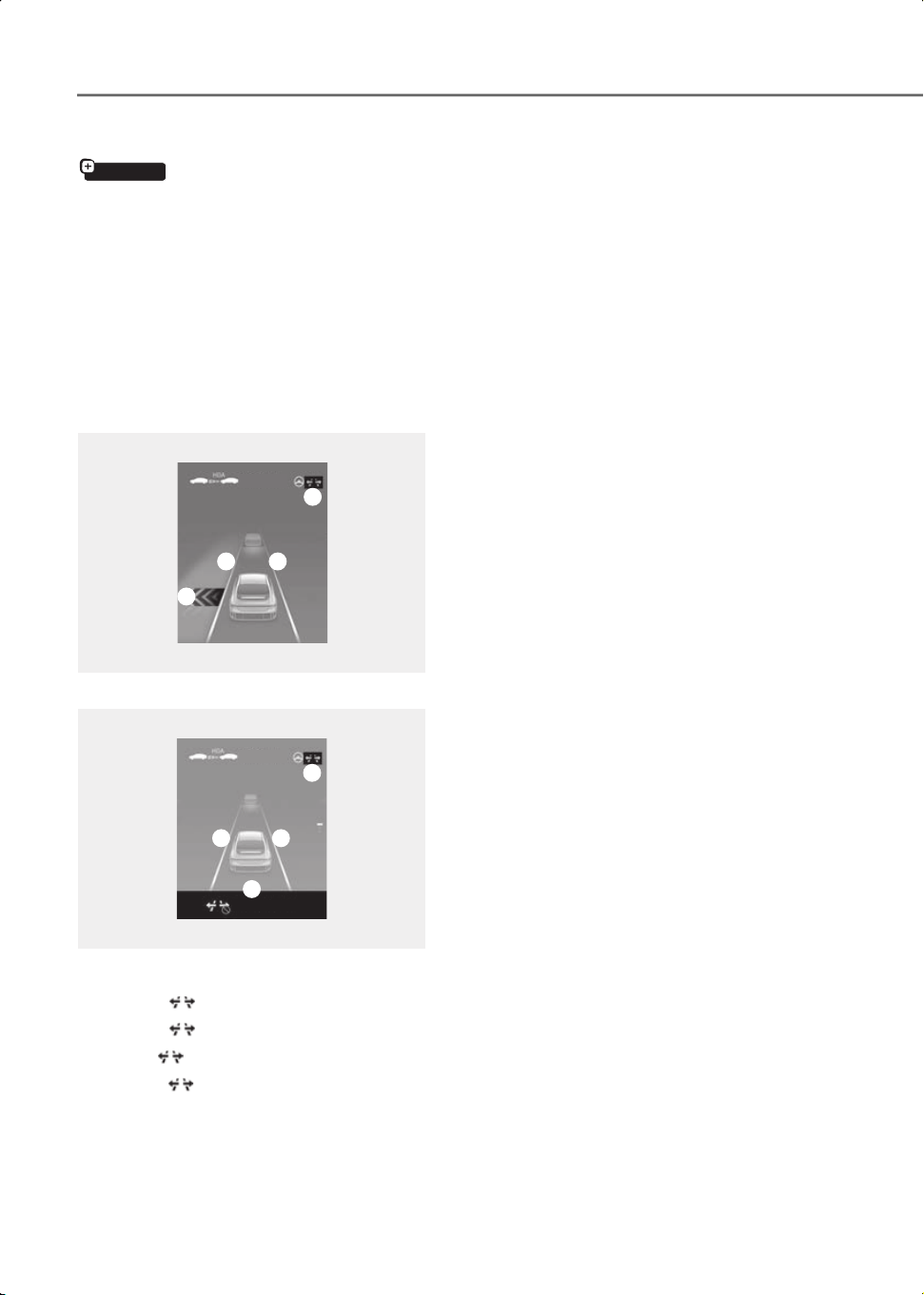
Driver Assistance System
7-100
if equipped
Highway Lane Change Assist
Displaying operating status
You can see the status of the Highway
Lane Change Assist function operation in
the Driving Assist view on the instrument
cluster. For more information, refer to the
"View Modes" section in chapter 4.
Highway Lane Change Assist function will
be displayed as below depending on the
status of the function.
Ready/Operating
B7005508
Standby/Canceled
B7005509
1. Highway Lane Change Assist indicator
• Green on : Ready state
• Green blink : Operating state
• Grey on : Standby state
• White blink : Canceled state
(display only a certain time)
2. Lane line
The lane line is displayed same as the
Highway Lane Change Assist indicator
(1). However, if the function is on
standby, it displays whether the lane
line is detected.
3. Green arrow and shade
The green arrow is displayed when a
certain amount of time has passed after
the function has started operating, and
until the lane change has completed.
4. Message
• Message is displayed when the
function does not operate even
though the turn signal is used.
• Message is displayed when the
function is canceled while operating.
To turn on Highway Lane Change Assist
Highway Lane Change Assist function will
turn on when the following conditions are
satisfied.
• The Driving Assist button or Lane
Driving Assist button is used to turn on
Highway Driving Assist.
Highway Lane Change Assist ready to
operate
While Highway Lane Change Assist
function is on, the function will be ready
to operate when all the following
conditions are satisfied:
• Highway Driving Assist is operating
• Lane Following Assist is operating
• A vehicle in the rear area of your vehicle
is detected more than once after the
vehicle is turned on
• Your vehicle speed is above 40 mph (60
km/h)
• Hands-off warning is not displayed on
the instrument cluster
• Hazard warning flasher is off
2 2
3
1
55
MPH
2 2
4
1
$POEJUJPOTOPUNFU
55
MPH
CE_USA.book Page 100
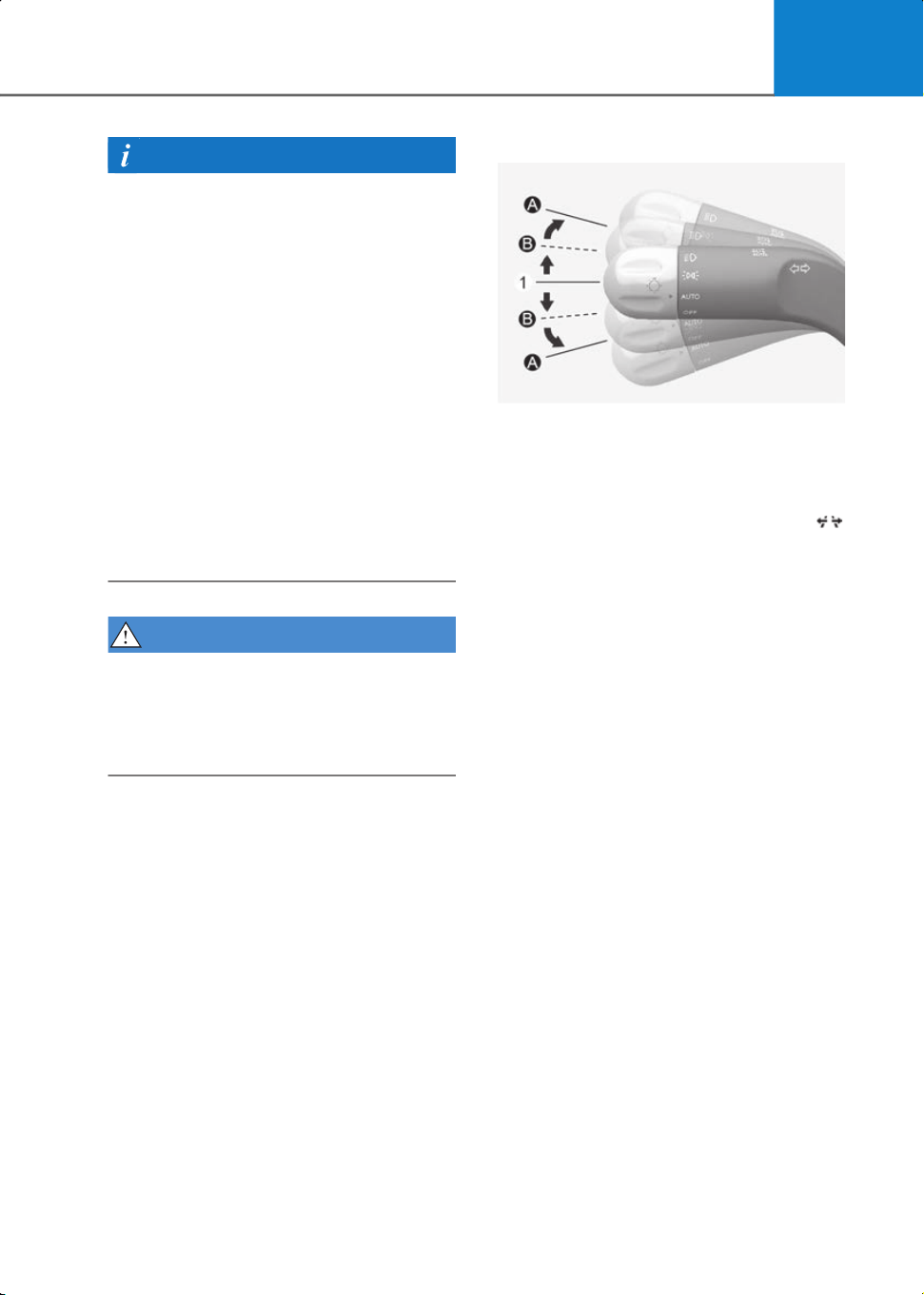
7
7-101
Information
• While Lane Change Assist function is
turned on (indicator on), Lane
Following Assist will not cancel even if
the turn signal indicator or hazard
warning flasher is operating.
• Lane Change Assist function turns off
automatically when driven in the
following road conditions:
- One driving lane
- A road with no structure, such as a
medium strip, guardrails, etc.
- There is a pedestrian or cyclist on the
road ahead
• When the function is in the ready state,
and vehicle speed is below 35 mph (55
km/h), the function will change to the
standby state.
WARNING
When Highway Lane Change Assist
function turns off while operating,
steering assist will be temporarily
canceled. Always be cautious while
driving.
Highway Lane Change Assist operation
B7005511
(1) Center
Highway Lane Change Assist function will
operate, when you push the turn signal
lever up or down to the A or B position
while the function is in the ready state (
indicator is green), and all of the following
conditions are satisfied:
• The driver has his/her hand on the
steering wheel
• There is no collision risk in the direction
of lane change
• There is a single dotted lane line in the
direction of lane change
• There are no Forward
Collision-Avoidance Assist and Blind
Spot Collision-Avoidance Assist
warnings
• The vehicle is driven in the middle of
the lane (should not be driving close to
one side of the lane)
• The road you are driving on, or the road
you are about to change lane is a road
that the function can operate
CE_USA.book Page 101

Driver Assistance System
7-102
Information
• Highway Lane Change Assist operates
when the turn signal lever is positioned
at A. If the turn signal lever is released
to the center (1) before stepping on the
lane, Highway Lane Change Assist
cancels. If the turn signal lever is
released to the center (1) after stepping
on the lane, Highway Lane Change
Assist changes the lane and turns off
the turn signal after lane change is
complete.
• When the turn signal lever is placed at B
position for a certain period of time, the
green arrow will appear. At this time,
even when the lever is released and
returns to it’s original position (1), lane
change will still be assisted.
• While lane change is being made by the
function, the turn signal indicator will
blink even when the turn signal lever is
not held, and the turn signal indicator
will turn off when lane change is
complete.
Highway Lane Change Assist standby
Highway Lane Change Assist function will
be in the standby state when one of the
ready state condition is not satisfied, or
when entering or driving on one of the
following roads:
• Road within a certain distance from the
tollbooth on the main road of the
highway
• The road ahead ends without an
interchange or junction
• Road with sharp curves
• Road with narrow lanes
Highway Lane Change Assist cancel
The function will be canceled when:
• The turn signal lever is moved to the "A"
position while the Highway Lane
Change Assist function is operating and
placed in the center (1) before stepping
on the lane line
• The turn signal lever is turned on in the
opposite direction of lane change
• The steering wheel is steered sharply
WARNING
• While Highway Driving Assist is
operating, the function will cancel if
one of the following occurs:
- Highway Driving Assist is turned off
- Lane Following Assist or Smart Cruise
Control is turned off or temporarily
canceled
- Hands-off warning message is
displayed on the instrument cluster
- The hazard warning flasher is turned
on
- Forward Collision-Avoidance Assist
or Blind-Spot Collision-Avoidance
Assist warning message is displayed
- Possible collision is detected in the
next lane, even though there are no
Forward Collision-Avoidance Assist
and Blind-Spot Collision-Avoidance
Assist warning
- The target lane to make a lane
change disappears
- The target lane to make a lane
change is not detected
- There is a problem with turn signal
lights
CE_USA.book Page 102
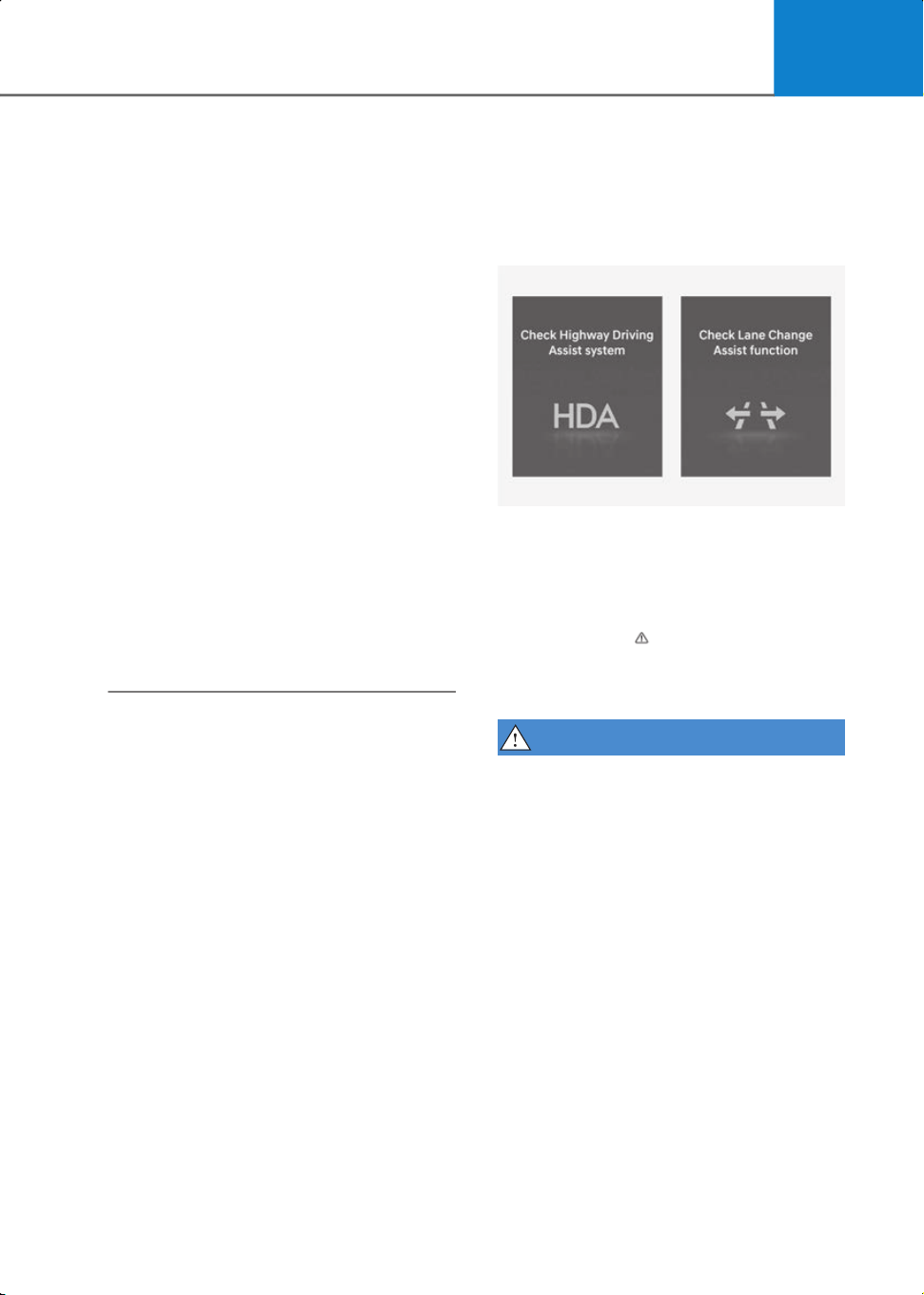
7
7-103
- Highway Lane Change Assist
function is off (The function turns off
when the function is turned off from
the settings menu, when the road
changes to a one-way road, when
there is a intersection or crosswalk
ahead, when you enter a road with no
structure, such as a medium strip,
guardrail, etc., or when there is a
pedestrian or cyclist on the driving
lane.)
- Your vehicle speed is below 35 mph
(55 km/h)
• While the function is operating, when
the function is canceled, depending on
the driving conditions, the vehicle may
drive to the middle of the driving lane or
steering assist may stop. Always pay
attention to road and driving conditions
while driving.
• The function may not operate properly
on roads with pedestrians or cyclists,
such as an intersection or crosswalk.
Always pay attention to road and
driving conditions while driving.
Highway Driving Assist
Malfunction and Limitations
Highway Driving Assist malfunction
Type A/Type B
B7005701
When Highway Driving Assist or Highway
Lane Change function is not working
properly, the 'Check Highway Driving
Assist system' or 'Check Lane Change
Assist function' warning message will
appear, and the warning light will
illuminate on the instrument cluster. Have
the vehicle inspected by an authorized
HYUNDAI dealer.
WARNING
• The driver is responsible for controlling
the vehicle and safe driving.
• Always have your hands on the steering
wheel while driving.
• Highway Driving Assist is a
supplemental function that assists the
driver in driving the vehicle and is not a
complete autonomous driving system.
Always check road conditions, and if
necessary, take appropriate actions to
drive safely.
• Always have your eyes on the road, and
it is the responsibility of the driver to
avoid violating traffic laws. The vehicle
manufacturer is not responsible for any
traffic violation or accidents caused by
the driver.
CE_USA.book Page 103

Driver Assistance System
7-104
• Highway Driving Assist may not be able
to recognize all traffic situations.
Highway Driving Assist may not detect
possible collisions due to limitations of
the function. Always be aware of the
limitations of the function. Obstacles
such as vehicles, motorcycles, bicycles,
pedestrians, or unspecified objects or
structures such as guardrails, tollbooth,
etc., that may collide with the vehicle
may not be detected.
• Highway Driving Assist will turn off
automatically under the following
situations:
- Driving on roads that Highway
Driving Assist does not operate, such
as a rest area, intersection, junction,
etc.
- The navigation does not operate
properly such as when the navigation
is being updated or restarted
• Highway Driving Assist may
inadvertently operate or turn off
depending on road conditions
(navigation information) and
surroundings.
• Lane Following Assist function may be
temporarily disabled when the front
view camera cannot detect lanes
properly or the hands-off warning is on.
• You may not hear the warning sound of
Highway Driving Assist if the
surrounding is noisy.
• If the vehicle is driven at high speed
above a certain speed at a curve, your
vehicle may drive to one side or may
depart from the driving lane.
• When you are towing a trailer or
another vehicle, turn off Highway
Driving Assist for safety reasons.
• The hands-off warning message may
appear early or late depending on how
the steering wheel is held or road
conditions. Always have your hands on
the steering wheel while driving.
• For your safety, please read the owner's
manual before using the Highway
Driving Assist.
• Highway Driving Assist will not operate
when the vehicle is started, or when the
detecting sensors or navigation is being
initialized.
Limitation of Highway Driving Assist
Highway Driving Assist and Highway Lane
Change function may not operate
properly, or may not operate under the
following circumstances:
• The map information and the actual
road is different because the navigation
is not updated
• The map information and the actual
road is different because of real-time
GPS data or map information error
• The infotainment system is overloaded
by simultaneously performing
functions such as route search, video
playback, voice recognition, etc.
• GPS signals are blocked in areas such as
a tunnel
• The driver goes off course or the route
to the destination is changed or
canceled by resetting the navigation
• The vehicle enters a service station or
rest area
• Android Auto or Car Play is operating
• The navigation cannot detect the
current vehicle position (for example,
elevated roads including overpass
adjacent to general roads or nearby
roads exist in a parallel way)
• White single dotted lane line or road
edge cannot be detected
• The road is temporarily controlled due
to construction, etc.
• There is no structure, such as a medium
strip, guardrails, etc., on the road
• There is a changeable lane in the
direction of lane change
• If a trailer, carrier, etc., is installed
CE_USA.book Page 104
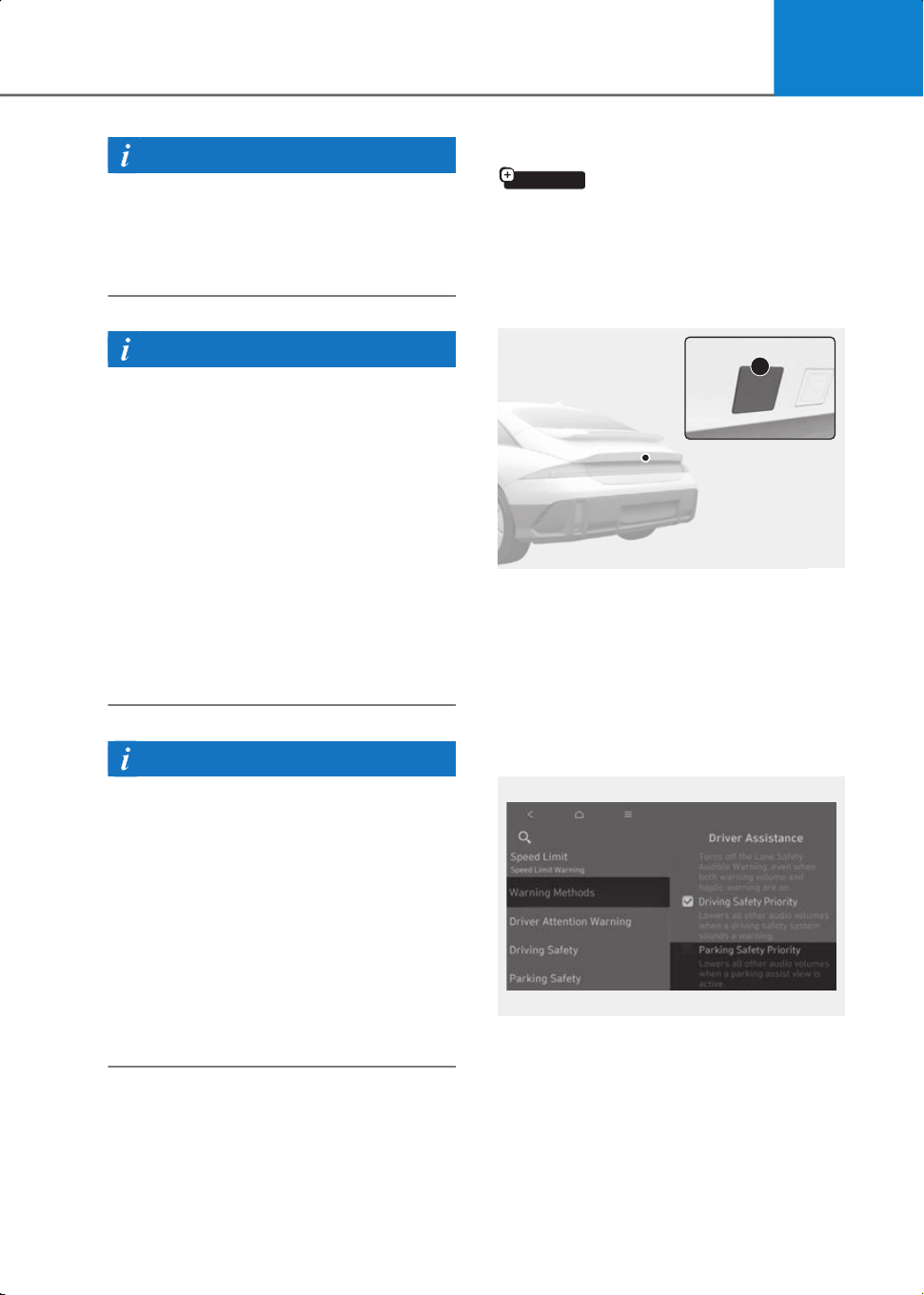
7
7-105
Information
For more information on the limitations of
the front view camera, front radar, front
corner radar and rear corner radar, refer
to the "Forward Collision-Avoidance
Assist (FCA)" section in this chapter.
Information
This device complies with Part 15 of the
FCC rules.
Operation is subject to the following three
conditions:
1. This device may not cause harmful
interference, and
2. This device must accept any
interference received, including
interference that may cause undesired
operation.
3. Changes or modifications not expressly
approved by the party responsible for
compliance could void the user’s
authority to operate the device.
Information
Radio frequency radiation exposure
information:
This equipment complies with FCC
radiation exposure limits set forth for an
uncontrolled environment.
This equipment should be installed and
operated with minimum distance of 8 in.
(20 cm) between the radiator (antenna)
and your body.
This transmitter must not be co-located
or operating in conjunction with any other
antenna or transmitter.
if equipped
Rear View Monitor (RVM)
Rear View Monitor displays the area
behind your vehicle to help with safe
parking or driving.
Detecting sensor
B7005801
(1) Wide-rear view camera
Refer to the picture above for the detailed
location of the detecting sensor.
Rear View Monitor Settings
Warning Methods
B7005901
With the vehicle on, go to Setup > Vehicle
> Driver Assistance > Warning Methods
from the Settings in the infotainment
system to select the following:
• Parking Safety Priority: Your vehicle
lowers all other audio volumes when
Rear View Monitor is operating.
1
CE_USA.book Page 105
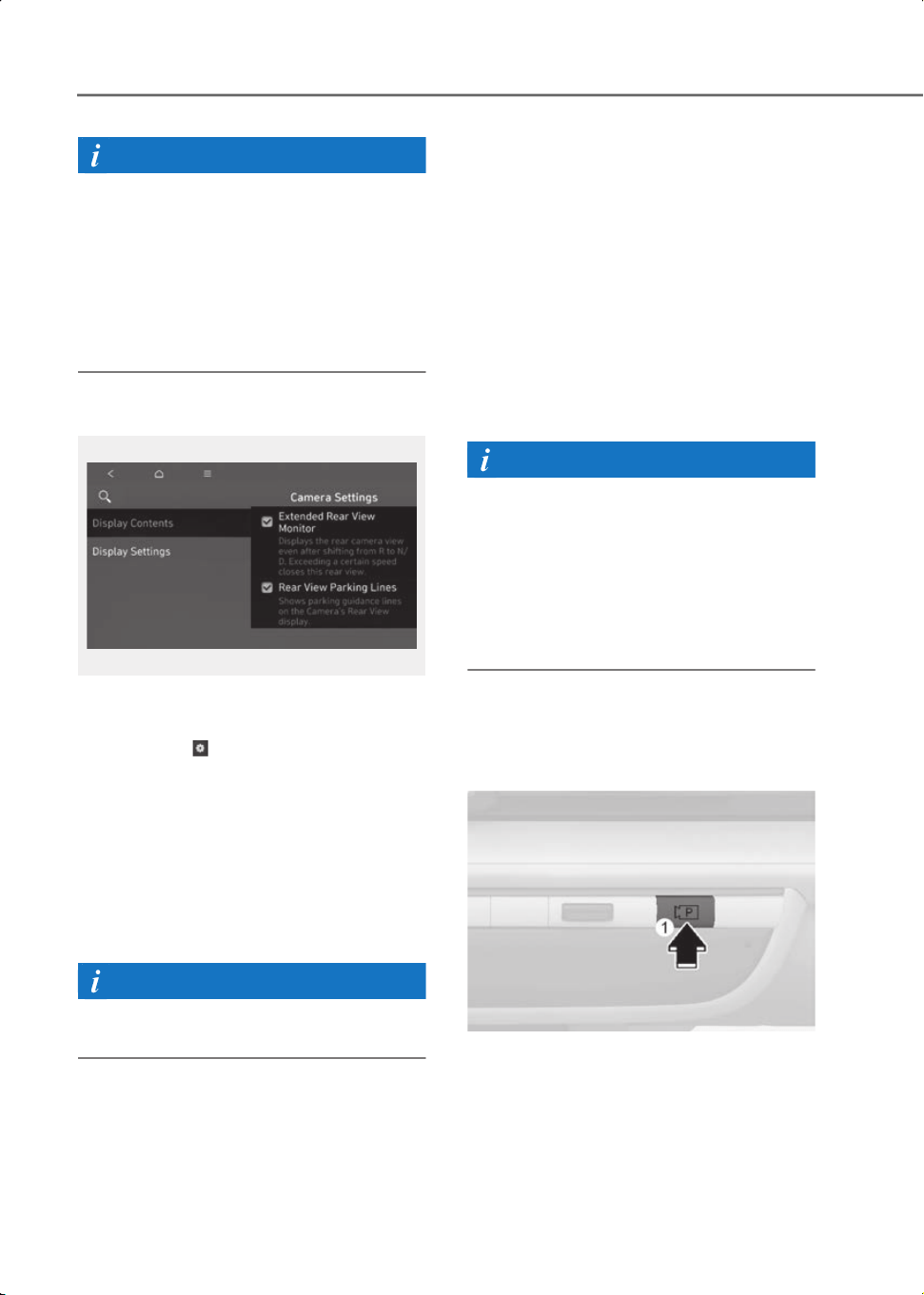
Driver Assistance System
7-106
Information
• If you change the Warning Methods,
Warning Methods of other Driver
Assistance systems may change.
• If the vehicle is restarted, Warning
Methods will maintain the last setting.
• There may be no Settings menu
depending on the feature applied to
your vehicle.
Camera settings
B7005903
• You can change Rear View Monitor
Display Contents by touching the
setup icon ( ) on the screen while Rear
View Monitor is operating, or selecting
Setup > Vehicle > Driver Assistance >
Parking Safety > Camera Settings from
the Settings menu while the vehicle is
on.
• In the Display Contents, you can
change settings for Extended Rear
View Monitor and Rear View Parking
Lines.
Information
There may be no Setting menu depending
on the feature applied to your vehicle.
Extended Rear View Monitor
With the vehicle on, select Camera
Settings > Display Contents > Extended
Rear View Monitor from the Settings
menu to turn on Extended Rear View
Monitor function and deselect to turn off
the function
Rear View Parking Lines
If Rear View Parking Lines is selected, the
rear view parking guide lines and rear top
view guide lines will be displayed at the
left side of the infotainment system.
Information
• The horizontal guideline of the Rear
View Parking Guidance shows the
distance of 1.6 ft. (0.5 m), 3.3 ft. (1 m)
and 7.6 ft. (2.3 m) from the vehicle.
• The horizontal guideline of the Rear Top
View Parking Guidance shows the
distance 1.6 ft. (0.5 m), 4.9 ft. (1.5 m)
from the vehicle.
Rear View Monitor Operation
Parking/View button
B7006001
Press the Parking/View button (1) while
the gear is in P (Park) to turn on Rear View
Monitor.
Press the Parking/View button (1) while
the gear is in D (Drive) or N (Neutral) to
turn on Rear View Monitor while driving.
CE_USA.book Page 106
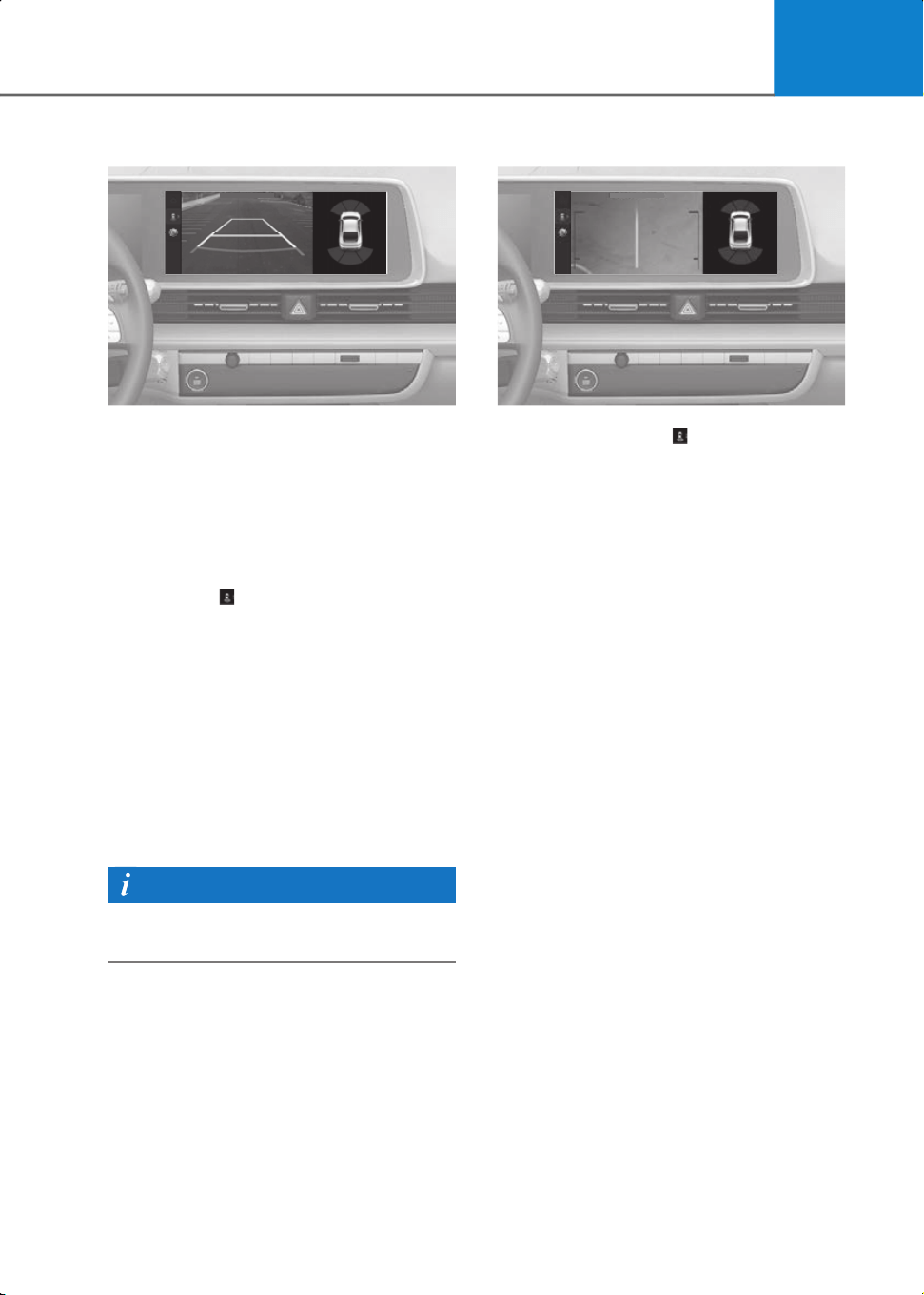
7
7-107
Rear view
B7006002
Operating conditions
• Shift the gear to R (Reverse), the rear
view will appear on the screen.
• Press the Parking/View button (1) while
the gear is in P (Park), the rear view will
appear on the screen.
• Touch the ( ), the rear view will appear
on the screen.
Off conditions
• The rear view cannot be turned off
when the gear is in R (Reverse).
• Press the Parking/View button (1) again
while the gear is in P (Park) with the rear
view on the screen, the rear view will
turn off.
• Shift the gear from R (Reverse) to P
(Park), the rear view will turn off.
Information
When the gear is in R (Reverse), the rear
view does not turn off.
Rear top view
B7006003
When you touch the ( ) icon, the top view
is displayed on the screen and shows the
distance from the vehicle in the back of
your vehicle while parking.
Extended Rear View Monitor
Extended Rear View Monitor function
maintains showing the rear view when
the gear is R (Reverse), N (Neutral) or D
(Drive).
Operating conditions
The gear is in P (Park), N (Neutral) or D
(Drive), and vehicle speed is 6 mph (10
km/h) or less.
Off conditions
• When vehicle speed is above 6 mph (10
km/h), the rear view will turn off.
• Shift the gear to P (Park), the rear view
will turn off.
• Press the Parking/View button (1), the
rear view will turn off.
$IFDL4VSSPVOEJOHTGPSZPVSTBGFUZ
$IFDL4VSSPVOEJOHTGPSZPVSTBGFUZ
$IFDL4VSSPVOEJOHTGPSZPVSTBGFUZ
$IFDL4VSSPVOEJOHTGPSZPVSTBGFUZ
CE_USA.book Page 107
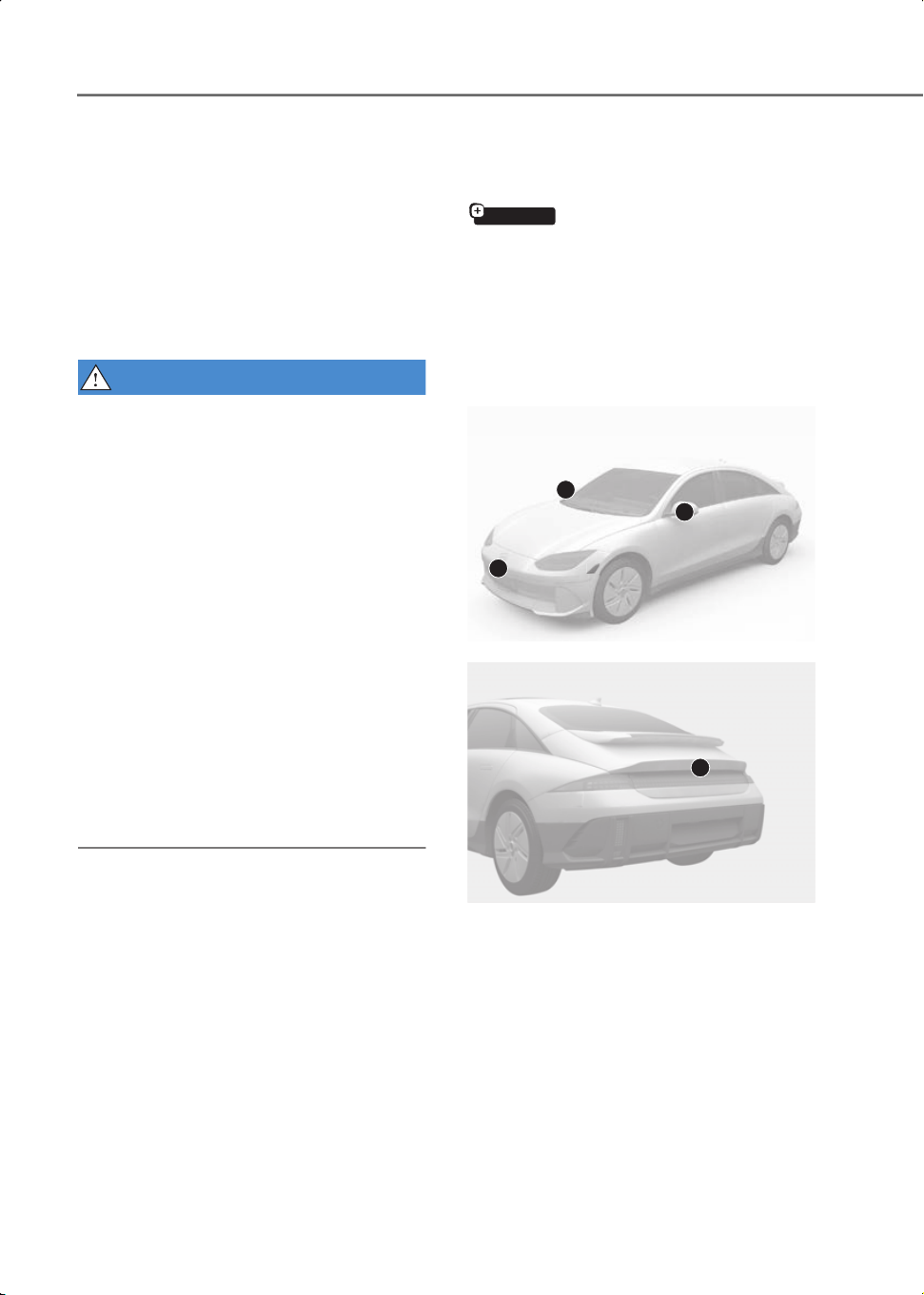
Driver Assistance System
7-108
Rear View Monitor
Malfunction and Limitations
Rear View Monitor malfunction
When Rear View Monitor is not working
properly, or the screen flickers, or the
camera image does not display properly,
have the vehicle inspected by an
authorized HYUNDAI dealer.
WARNING
• The rear view camera does not cover
the complete area behind the vehicle.
The driver should always check the rear
area directly through the inside
rearview mirror and outer side view
mirror before parking or backing up.
• The image shown on the screen may
differ from the actual distance of the
object. Make sure to directly check the
vehicle's surroundings for safety.
• Always keep the rear view camera lens
clean. If the lens is covered with foreign
material, it may adversely affect
camera performance and Rear View
Monitor may not operate properly.
However, do not use chemical solvents
such as strong detergents containing
high alkaline or volatile organic
solvents (gasoline, acetone, etc.). This
may damage the camera lens.
Surround View Monitor
if equipped
(SVM)
Surround View Monitor uses the wide
view cameras and displays images
around your vehicle through the
infotainment system screen to help with
safe parking or driving.
Detecting sensor
B7006201
B7006202
(1) Wide-front view camera
(2) Wide-side view camera (Below the
side view mirror)
(3) Wide-side view camera (Below the
side view mirror)
(4) Wide-rear view camera
Refer to the picture above for the detailed
location of the detecting sensors.
2
3
1
4
CE_USA.book Page 108
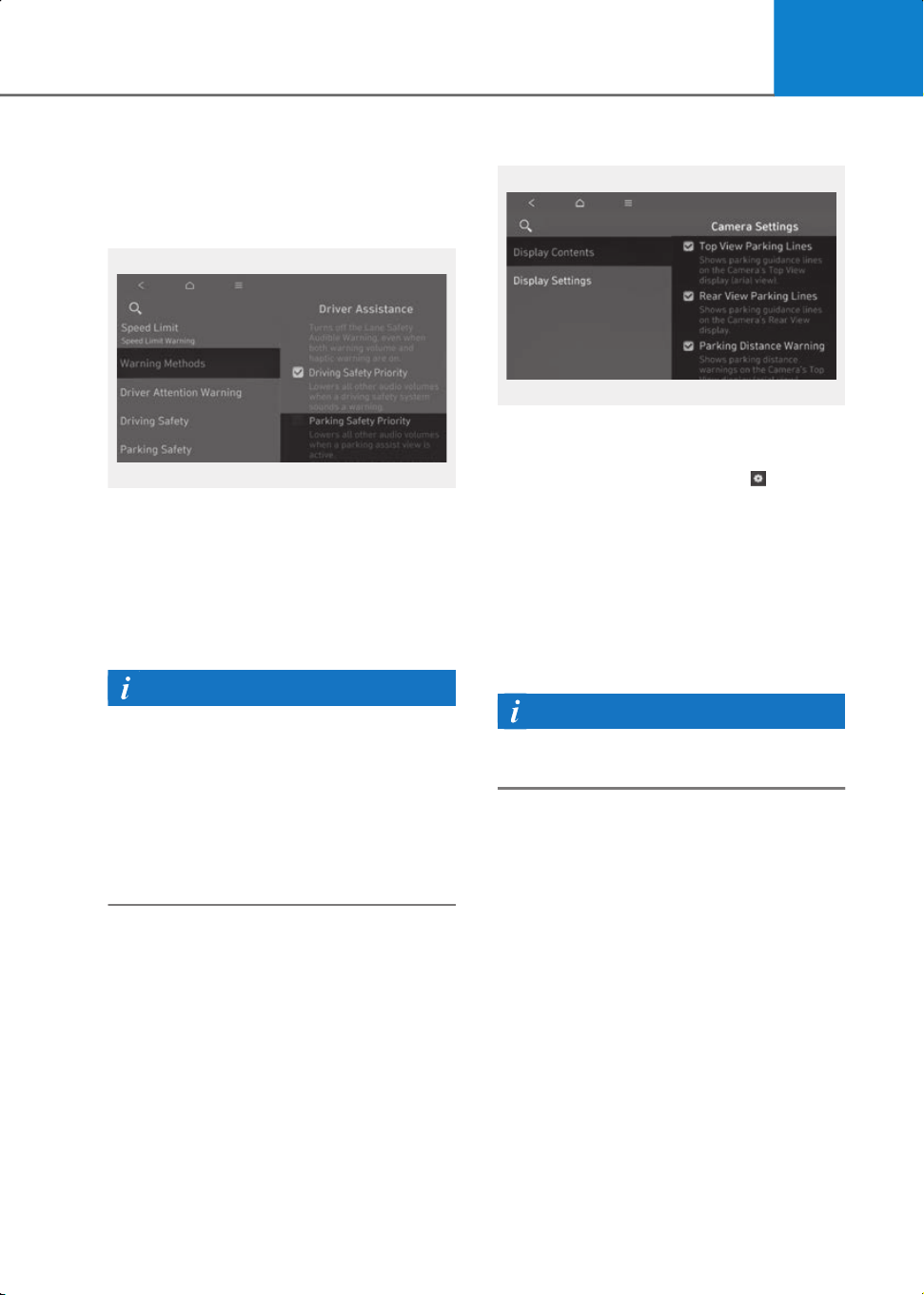
7
7-109
Surround View Monitor
Settings
Warning Methods
B7005901
With the vehicle on, go to Setup > Vehicle
> Driver Assistance > Warning Methods
from the Settings in the infotainment
system to select the following:
• Parking Safety Priority: Your vehicle
lowers all other audio volumes when
Surround View Monitor is operating.
Information
• If you change the Warning Methods,
Warning Methods of other Driver
Assistance systems may change.
• If the vehicle is restarted, Warning
Methods will maintain the last setting.
• There may be no Settings menu
depending on the feature applied to
your vehicle.
Camera settings
B7006303
• You can change Surround View Monitor
Display Contents or Display Settings
by touching the setup icon ( ) on the
screen while Surround View Monitor is
operating, or selecting Setup > Vehicle
> Parking Safety > Camera Settings
from the Settings menu while the
vehicle is on.
• In the Display Contents, you can
change settings for Top View Parking
Lines, Rear View Parking Lines and
Parking Distance Warning.
Information
There may be no Setting menu depending
on the feature applied to your vehicle.
Parking Distance Warning
When the Parking Distance Warning is
selected, parking distance warning is
displayed on the right side of the
Surround View Monitor screen.
CE_USA.book Page 109
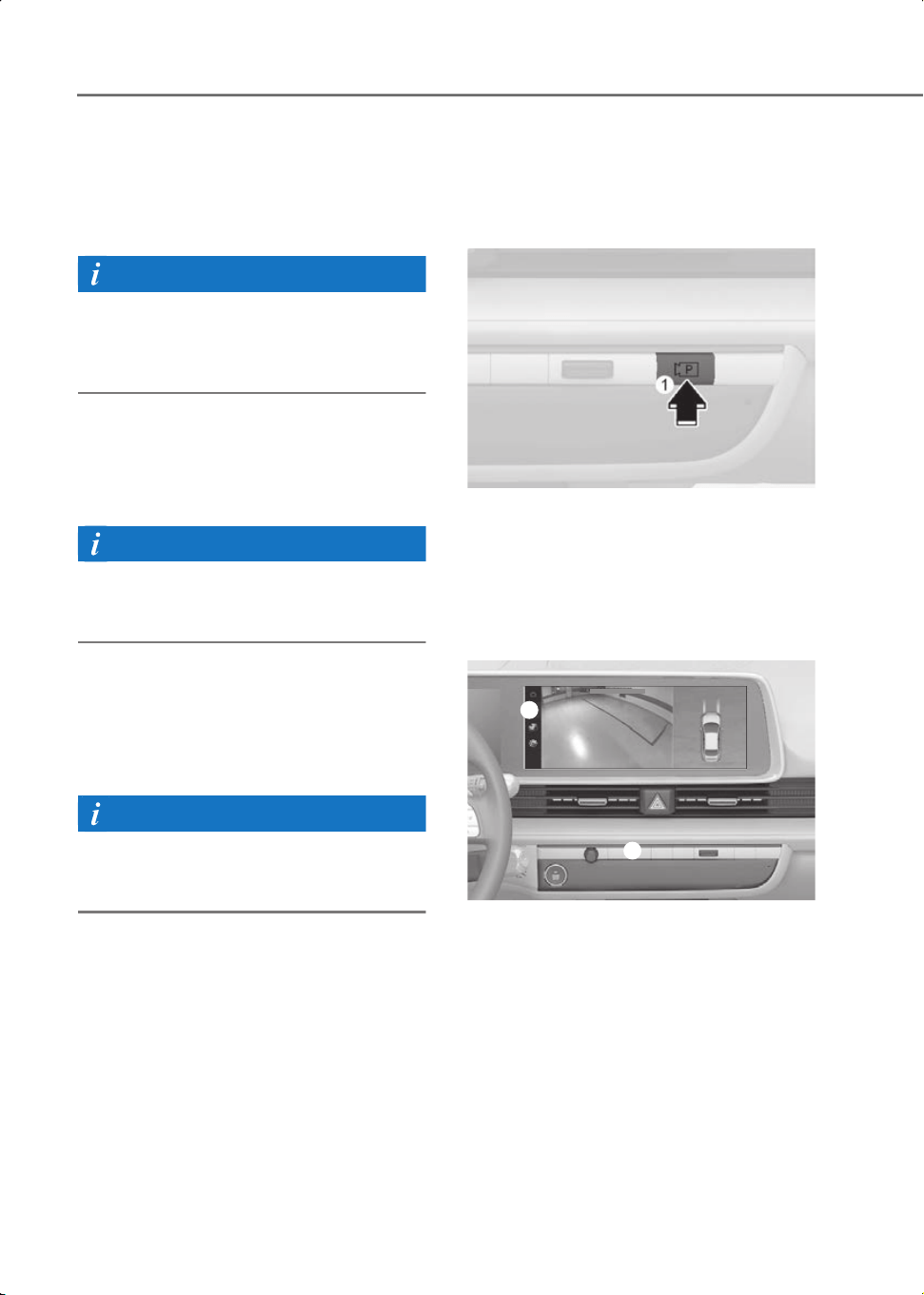
Driver Assistance System
7-110
Top View Parking Guidance
When the Top View Parking Lines is
selected, parking guidance is displayed
on the right side of the Surround View
Monitor screen.
Information
The horizontal guideline of the Rear Top
View Parking Guidance shows the trunk
opening distance and the distance of 1.6
ft. (0.5 m), 6.6 ft. (2 m) from the vehicle.
Rear View Parking Guidance
When the Rear View Parking Lines is
selected, parking guidance is displayed in
the rear view.
Information
The horizontal guideline shows the
distance of 1.6 ft. (0.5 m), 3.3 ft. (1 m) and
7.6 ft. (2.3 m).
Surround View Monitor Auto On
With the vehicle on, select Driver
Assistance > Parking Safety > Surround
View Monitor Auto On from the Settings
menu to use the function.
Information
For more information on Surround View
Monitor Auto On, refer to the “Surround
View Monitor Operation” in this chapter.
Surround View Monitor
Operation
Parking/View button
B7006401
Press the Parking/View button (1) to turn
on Surround View Monitor.
Press the button again to turn off the
function.
Front view
B7006402
The front image is displayed on the screen
when the gear is in N (Neutral) or D (Drive)
to assist in parking. Using the view button
(2) you may select top view, front view
and side view.
3
2
$IFDLTVSSPVOEJOHGPSZPVSTBGFUZ
$IFDLTVSSPVOEJOHGPSZPVSTBGFUZ
CE_USA.book Page 110

7
7-111
Operating conditions
• The gear is in N (Neutral) or D (Drive),
and vehicle speed is 6 mph (10 km/h) or
less.
• The Parking/View button (1) is pressed,
while the gear is in N (Neutral) or D
(Drive), and vehicle speed is 6 mph (10
km/h) or less.
• Surround View Monitor Auto On
function will operate when the
following conditions are satisfied:
- With Setup > Vehicle > Driver
Assistance > Parking Safety >
Surround View Monitor Auto On
selected from the Settings menu, the
front view while parking is displayed.
Off conditions
• The Parking/View button (1) or the
Infotainment system button (3) is
Pressed.
• Vehicle speed is above 6 mph (10
km/h).
• The gear is shifted to P (Park).
Information
Surround View Monitor will turn off when
vehicle speed is above 6 mph (10 km/h).
However, Surround View Monitor will not
turn on again although vehicle speed
drops below 6 mph (10 km/h).
Rear view
The rear image is displayed on the screen
when the gear is in R (Reverse) or P (Park)
to assist in parking. Using the view button
(2) you may select top view, rear view and
side view.
Operating conditions
• The gear is shifted to R (Reverse).
• The Parking/View button (1) is pressed,
while the gear is in P (Park).
Off conditions
• The gear is shifted from R (Reverse) to P
(Park).
• The Parking/View button (1) is pressed,
while the gear is in P (Park).
Information
When the gear is in R (Reverse), the rear
view does not turn off even if the
infotainment system button (3) is
pressed.
3D view
The 3D view shows the image around the
vehicle from various angles.
You can change angles by tapping the
screen. Press the 3D View button again to
return to the initial angle.
3D view will turn on when the 3D view is
selected among the view buttons (2)
under the following conditions:
• The gear is in P (Park), N (Neutral) or D
(Drive) when vehicle speed is below 6
mph (10 km/h).
• The Surround View Monitor is turned on
when the gear is in R (Reverse).
When the gear is in P (Park), N (Neutral) or
D (Drive), 3D view will turn off under the
following conditions:
• The gear is shifted to P (Park).
• The Parking/View button (1) is pressed.
• The infotainment system button (3) is
pressed.
• The Home button (2) is pressed.
• Vehicle speed is above 6 mph (10
km/h).
When the gear is in R (reverse), 3D view
will turn off under the following
conditions.
• The gear is shifted to P (Park).
Information
3D view does not display guidelines.
CE_USA.book Page 111

Driver Assistance System
7-112
Surround View Monitor
Malfunction and Limitations
Surround View Monitor malfunction
When Surround View Monitor is not
working properly, or the screen flickers,
or the camera image does not display
properly, have the vehicle inspected by
an authorized HYUNDAI dealer.
Limitations of Surround View
Monitor
• The screen may be displayed
abnormally, and an icon will appear at
the top left side of the screen under the
following circumstances:
- The trunk is opened
- The driver or front passenger door is
opened
- The side view mirror is folded
WARNING
• Always look around your vehicle to
make sure there are no objects or
obstacles before moving the vehicle.
What you see on the screen may differ
from the actual vehicle’s location.
• The image shown on the screen may
differ from the actual distance of the
object. Make sure to directly check the
vehicle's surroundings for safety.
• Surround View Monitor is designed to
be used on a flat surface.
Therefore, if used on roads with
different heights such as curbs and
speed bumps, the image in the screen
may not look correct.
• Always keep the camera lens clean.
If the lens is covered with foreign
material, it may adversely affect
camera performance and Surround
View Monitor may not operate
properly. However, do not use
chemical solvents such as strong
detergents containing high alkaline or
volatile organic solvents (gasoline,
acetone, etc.). This may damage the
camera lens.
Information
Surround View Monitor uses the cameras
installed on the vehicle to show images
around the vehicle through the
infotainment system. The image shown
on the screen may look unnatural
depending on the surroundings.
CE_USA.book Page 112
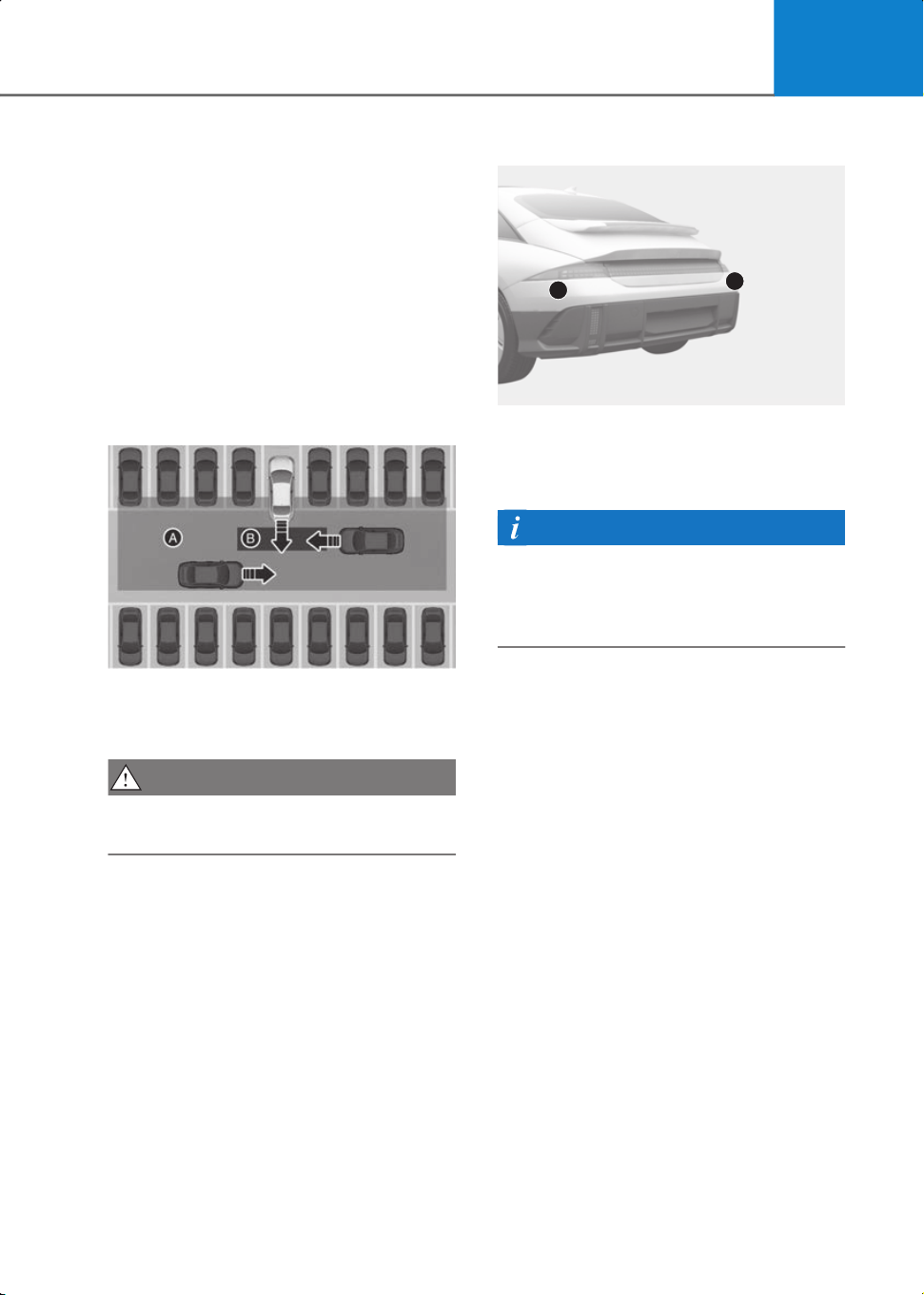
7
7-113
Rear Cross-Traffic
Collision-Avoidance
Assist (RCCA)
Rear Cross-Traffic Collision-Avoidance
Assist detects vehicles approaching from
the rear left or right while your vehicle is
reversing and warns you of a possible
collision with a warning message and a
warning sound. Also, Rear Cross-Traffic
Collision-Avoidance Assist may assist
with braking your vehicle to help avoid a
collision.
B7006601
[A] Rear Cross-Traffic Collision Warning operating
range,
[B] Rear Cross-Traffic Collision-Avoidance Assist
operating range
CAUTION
Warning timing may vary depending on
the speed of the approaching vehicle.
Detecting sensor
B7006602
(1) Rear corner radar
Refer to the picture above for the detailed
location of the detecting sensors.
Information
For more information on the precautions
of the rear corner radar, refer to the
“Blind-Spot Collision-Avoidance Assist
(BCA)” section in this chapter.
1
1
CE_USA.book Page 113
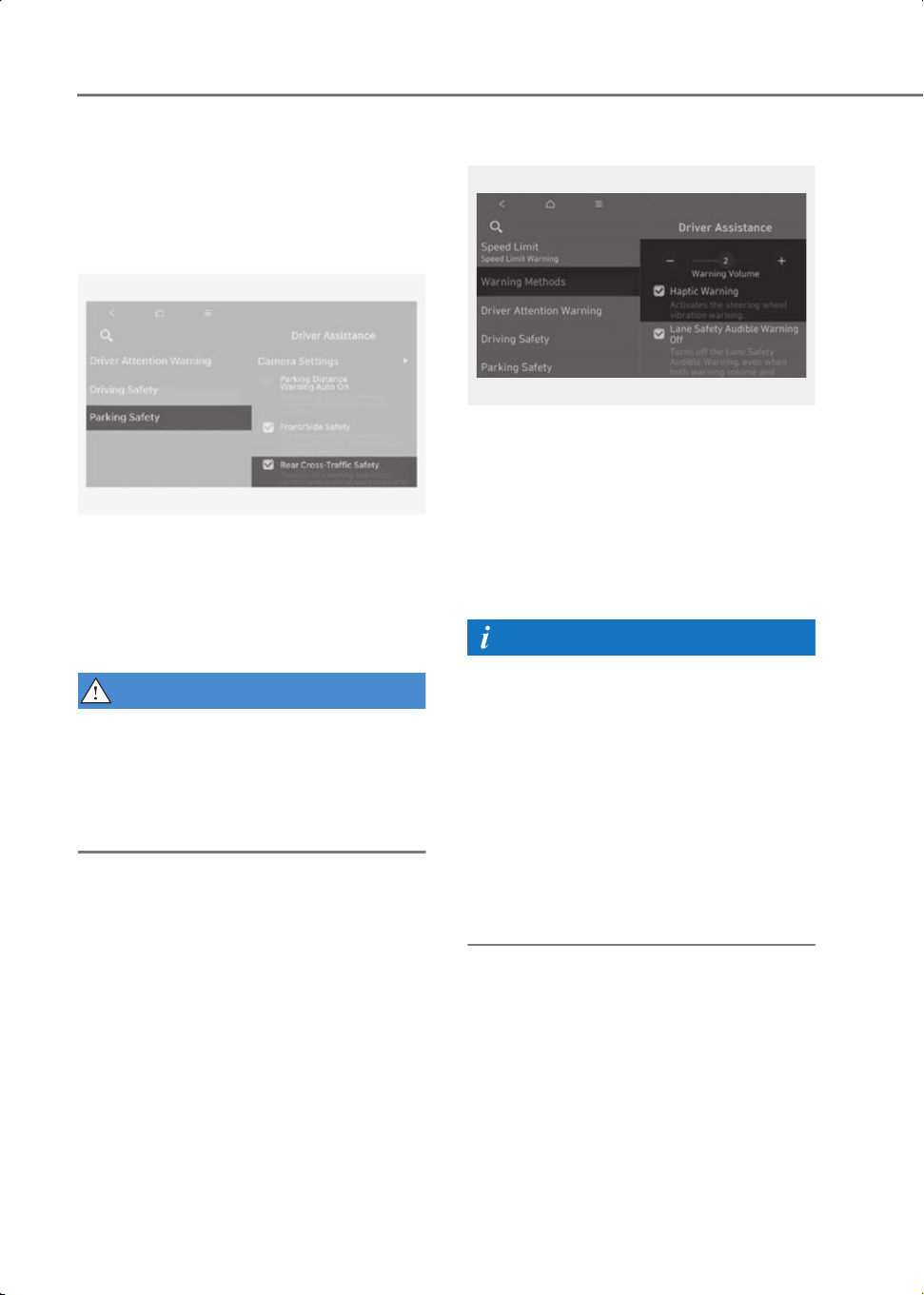
Driver Assistance System
7-114
Rear Cross-Traffic
Collision-Avoidance Assist
Settings
Rear Cross-Traffic Safety
B7006701
With the vehicle on, select Setup >
Vehicle > Parking Safety > Rear-Cross
Traffic Safety from the settings menu to
turn on Rear Cross-Traffic
Collision-Avoidance Assist and deselect
to turn off the function.
WARNING
When the vehicle is restarted, Rear
Cross-Traffic Collision-Avoidance Assist
will always turn on. However, the driver
should always be aware of the
surroundings and drive safely especially if
Rear Cross-Traffic Safety is deselected.
Warning Methods
B7000205
With the vehicle on, go to Setup > Vehicle
> Driver Assistance > Warning Methods
from the Settings in the infotainment
system to select the following:
• Warning Volume: The Warning Volume
can be adjusted.
• Haptic Warning: The steering wheel
vibration can be set.
Information
• If you change the Warning Methods,
Warning Methods of other Driver
Assistance systems may change.
• If the vehicle is restarted, Warning
Methods will maintain the last setting.
• There may be no Settings menu
depending on the feature applied to
your vehicle.
• The Warning Volume and Haptic
Warning cannot be turned off at the
same time. When one of the warnings is
turned off, the other is activated.
Rear Cross-Traffic
Collision-Avoidance Assist
Operation
Rear Cross-Traffic Collision-Avoidance
Assist will warn and help control the
vehicle depending on collision risk level:
‘Collision Warning’, ‘Emergency Braking’
and ‘Stopping vehicle and ending brake
control’.
CE_USA.book Page 114
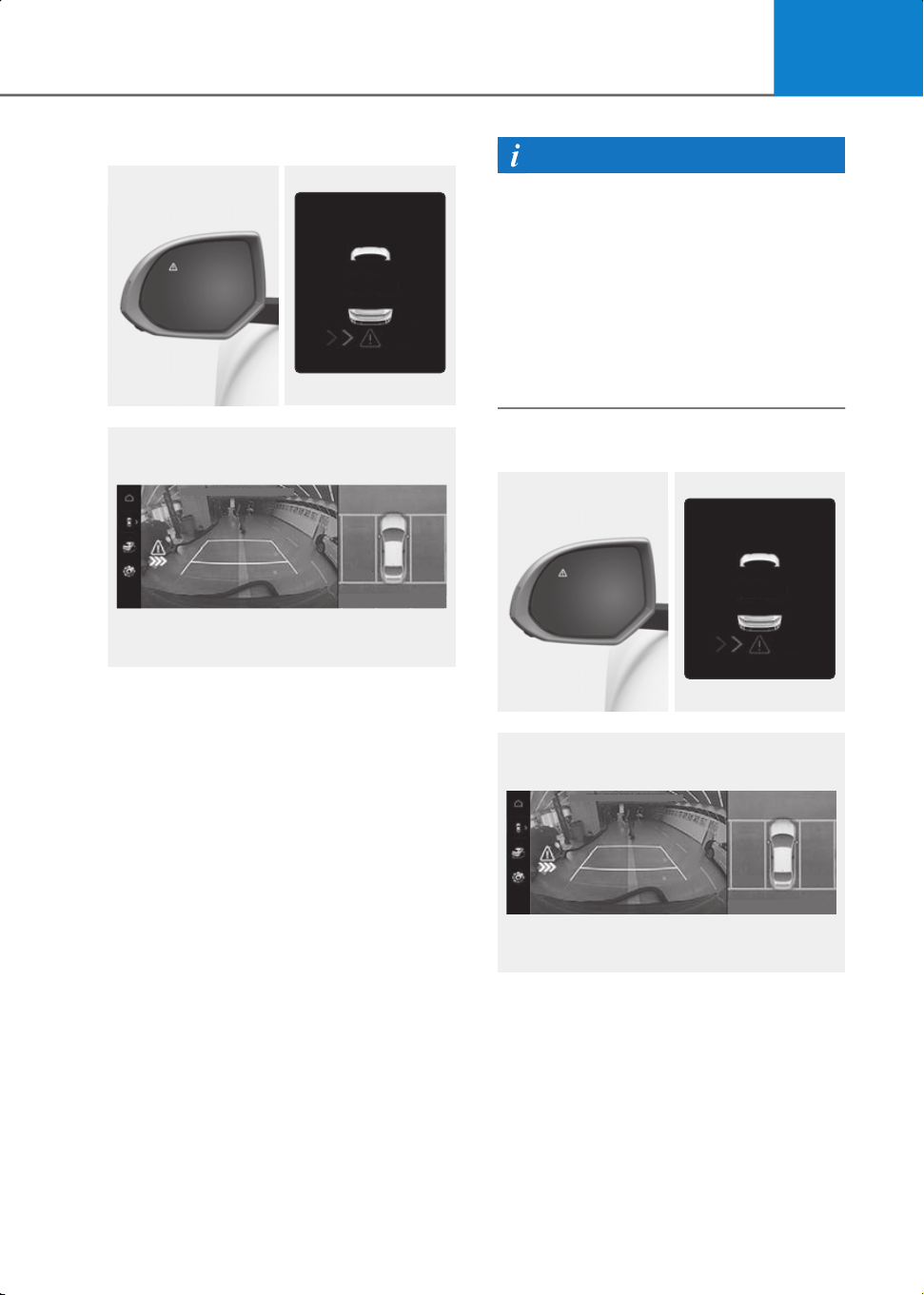
7
7-115
Collision Warning
B7006801
B7006803
• To warn the driver of an approaching
vehicle from the rear left/right side of
your vehicle, the warning light on the
side view mirror will blink and a warning
will appear on the instrument cluster. At
the same time, an audible warning will
sound. If Rear View Monitor is
operating, a warning will also appear on
the infotainment system.
• Rear Cross-Traffic Collision-Avoidance
Assist will operate when all the
following conditions are satisfied:
• The gear is shifted to R (Reverse)
• Vehicle speed is below 5 mph (8 km/h)
• The approaching vehicle is within about
82 ft. (25 m) from the left and right side
of your vehicle
• The speed of the vehicle approaching
from the left and right is above 3 mph (5
km/h)
Information
• If the operating conditions are satisfied,
there will be a warning whenever the
vehicle approaches from the left or
right side even though your vehicle
speed is 0 mph (0 km/h).
• The images and colors in the
instrument cluster may differ
depending on the instrument cluster
type or theme selected from the
instrument cluster.
Emergency Braking
B7006804
B7006803
• To warn the driver of an approaching
vehicle from the rear left/right side of
your vehicle, the warning light on the
side view mirror will blink and a warning
message will appear on the instrument
cluster. At the same time, an audible
warning will sound. A warning will also
appear on the infotainment system.
$PMMJTJPO8BSOJOH
$IFDLTVSSPVOEJOHGPSZPVSTBGFUZ
$IFDLTVSSPVOEJOHGPSZPVSTBGFUZ
&NFSHFODZ#SBLJOH
$IFDLTVSSPVOEJOHGPSZPVSTBGFUZ
$IFDLTVSSPVOEJOHGPSZPVSTBGFUZ
CE_USA.book Page 115
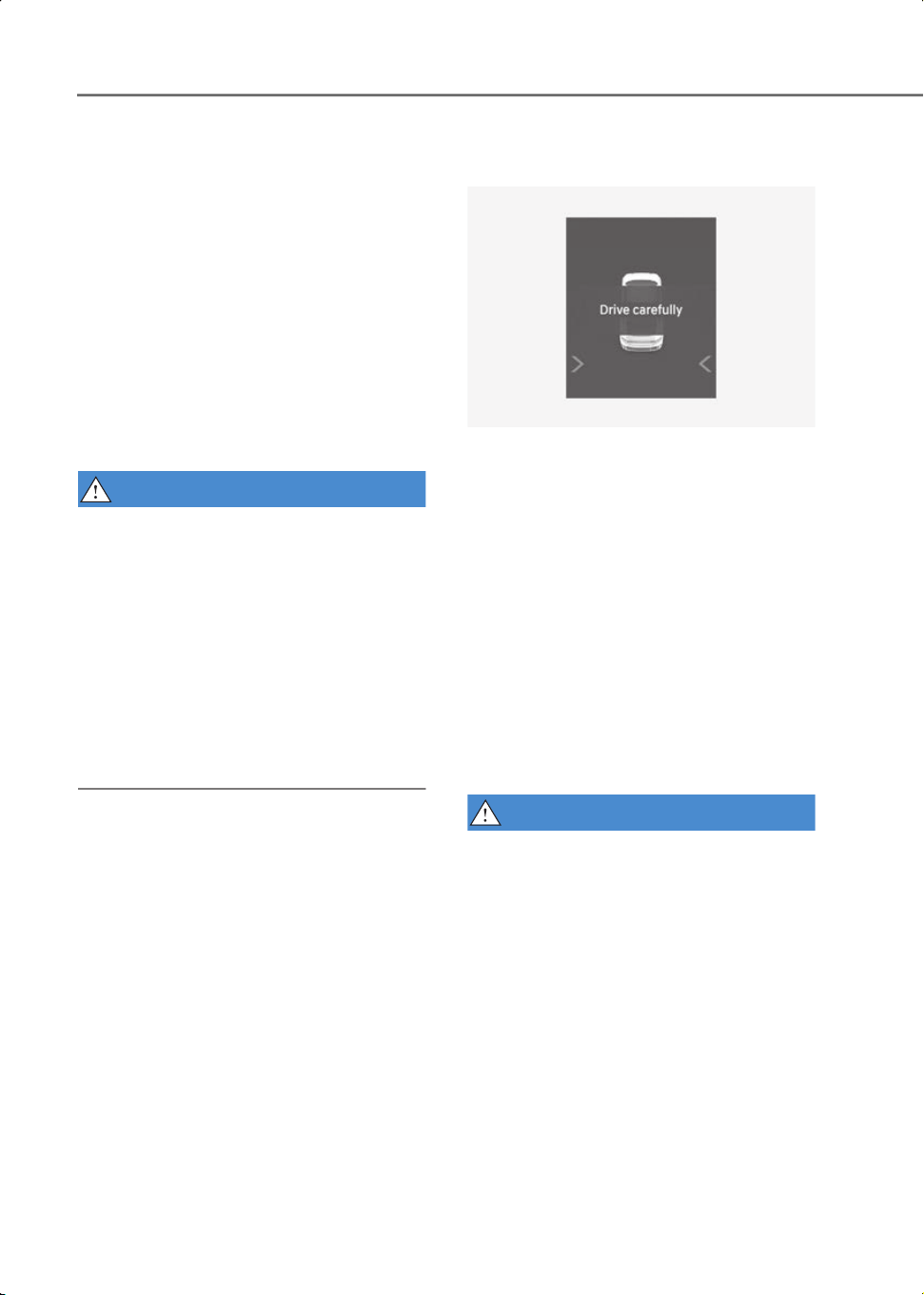
Driver Assistance System
7-116
• Rear Cross-Traffic Collision-Avoidance
Assist will operate when all the
following conditions are satisfied:
• The gear is shifted to R (Reverse)
• Vehicle speed is below 5 mph (8 km/h)
• The approaching vehicle is within about
5 ft. (1.5 m) from the left and right side
of your vehicle
• The speed of the vehicle approaching
from the left and right is above 3 mph (5
km/h)
• Emergency braking will be assisted to
help prevent collision with approaching
vehicles from the left and right.
WARNING
Brake control will end when:
• The approaching vehicle is out of the
detecting range
• The approaching vehicle passes behind
your vehicle
• The approaching vehicle does not drive
toward your vehicle
• The approaching vehicle speed slows
down
• The driver depresses the brake pedal
with sufficient power
Stopping vehicle and ending brake
control
B7006807
• When the vehicle is stopped due to
emergency braking, the ‘Drive
carefully’ warning message will appear
on the instrument cluster.
• For your safety, the driver should
depress the brake pedal immediately
and check the surroundings.
• Brake control will end after the vehicle
is stopped by emergency braking for
about 2 seconds.
• During emergency braking, braking
control by Rear Cross-Traffic
Collision-Avoidance Assist will
automatically cancel when the driver
excessively depresses the brake pedal.
WARNING
Take the following precautions when
using Rear Cross-Traffic
Collision-Avoidance Assist:
• For your safety, only change the
Settings after parking the vehicle at a
safe location.
• If any other system’s warning message
is displayed or audible warning is
generated, Rear Cross-Traffic
Collision-Avoidance Assist warning
message may not be displayed and
audible warning may not be generated.
• You may not hear the warning sound of
Rear Cross-Traffic Collision-Avoidance
Assist if the surrounding is noisy.
CE_USA.book Page 116

7
7-117
• Rear Cross-Traffic Collision-Avoidance
Assist may not operate if the driver
applies the brake pedal to avoid
collision.
• During Rear Cross-Traffic
Collision-Avoidance Assist operation,
the vehicle may stop suddenly injuring
passengers and shifting loose objects.
Always have the seat belt on and keep
loose objects secured.
• Even if there is a problem with Rear
Cross-Traffic Collision-Avoidance
Assist, the vehicle’s basic braking will
function normally.
• When Rear Cross-Traffic
Collision-Avoidance Assist is operating,
braking control by the function will
automatically cancel when the driver
excessively depresses the accelerator
pedal.
• Rear Cross-Traffic Collision-Avoidance
Assist does not operate in all situations
and cannot avoid all collisions.
• Rear Cross-Traffic Collision-Avoidance
Assist may warn the driver late or may
not warn the driver depending on the
road and driving conditions.
• The driver has the responsibility to
control the vehicle. Do not solely
depend on Rear Cross-Traffic
Collision-Avoidance Assist. Rather,
maintain a safe braking distance, and if
necessary, depress the brake pedal to
reduce driving speed or to stop the
vehicle.
• Never deliberately operate Rear
Cross-Traffic Collision-Avoidance
Assist on people, animal, objects, etc. It
may cause serious injury or death.
CAUTION
The brake control may not operate
properly depending on the status of ESC
(Electronic Stability Control).
There will only be a warning when:
• The ESC (Electronic Stability Control)
warning light is on
• ESC (Electronic Stability Control) is
engaged in a different function
Information
If braking is assisted by Rear Cross-Traffic
Collision-Avoidance Assist, the driver
must immediately depress the brake
pedal and check vehicle surroundings.
• Brake control will end when the driver
depresses the brake pedal with
sufficient power.
• After shifting the gear to R (Reverse),
braking control will operate once for
left and right vehicle approach.
CE_USA.book Page 117
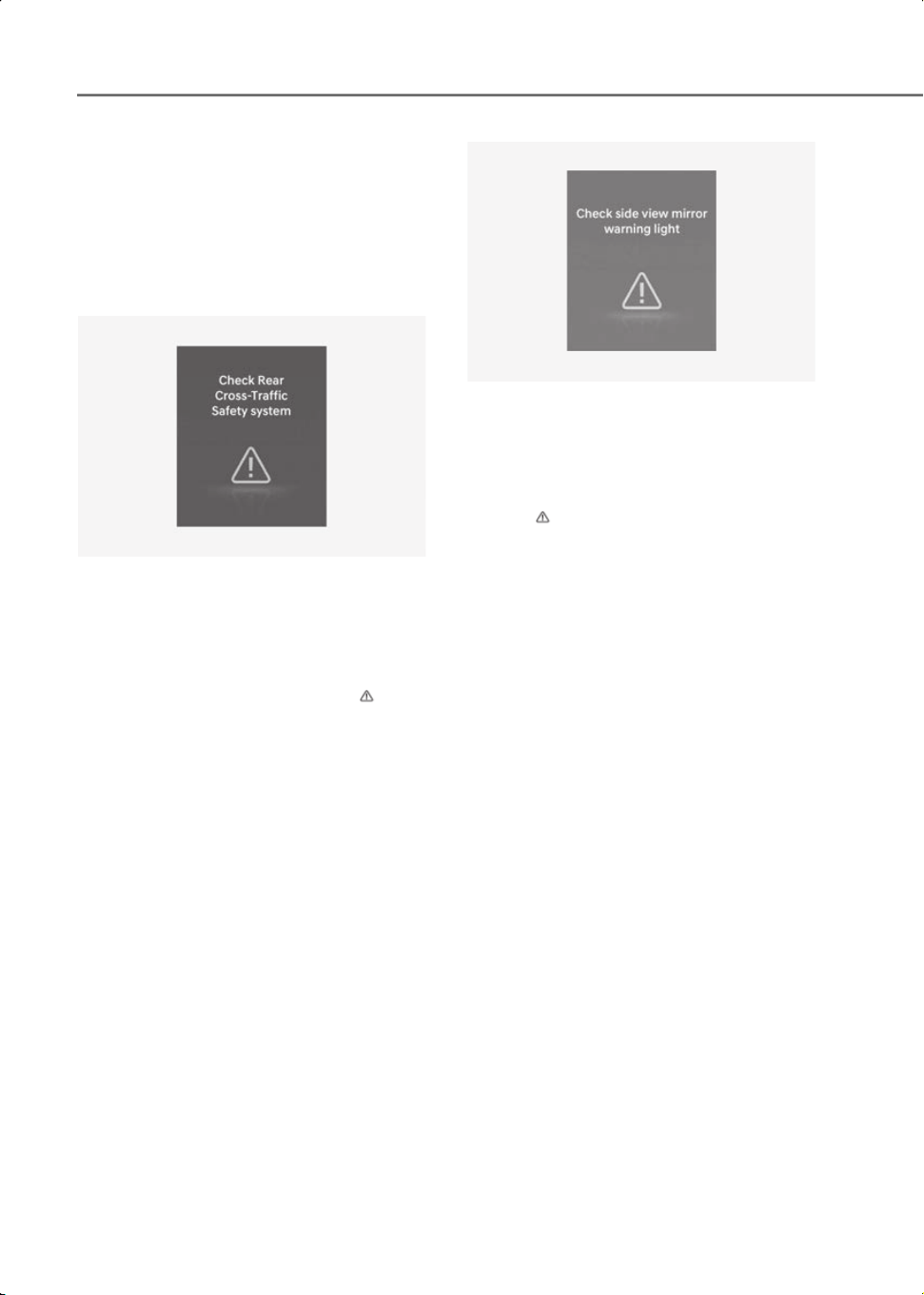
Driver Assistance System
7-118
Rear Cross-Traffic
Collision-Avoidance Assist
Malfunction and Limitations
Rear Cross-Traffic
Collision-Avoidance Assist
malfunction
B7006901
When Rear Cross-Traffic
Collision-Avoidance Assist is not working
properly, the ‘Check Rear Cross-Traffic
Safety system’ warning message will
appear on the instrument cluster for
several seconds, and the master ( )
warning light will illuminate on the
instrument cluster. If this occur, have
vehicle inspected by an authorized
HYUNDAI dealer.
B7001602
When the side view mirror warning light is
not working properly, the ‘Check side
view mirror warning light’ warning
message will appear on the instrument
cluster for several seconds, and the
master ( ) warning light will illuminate on
the instrument cluster. If this occur, have
the vehicle inspected by an authorized
HYUNDAI dealer.
CE_USA.book Page 118
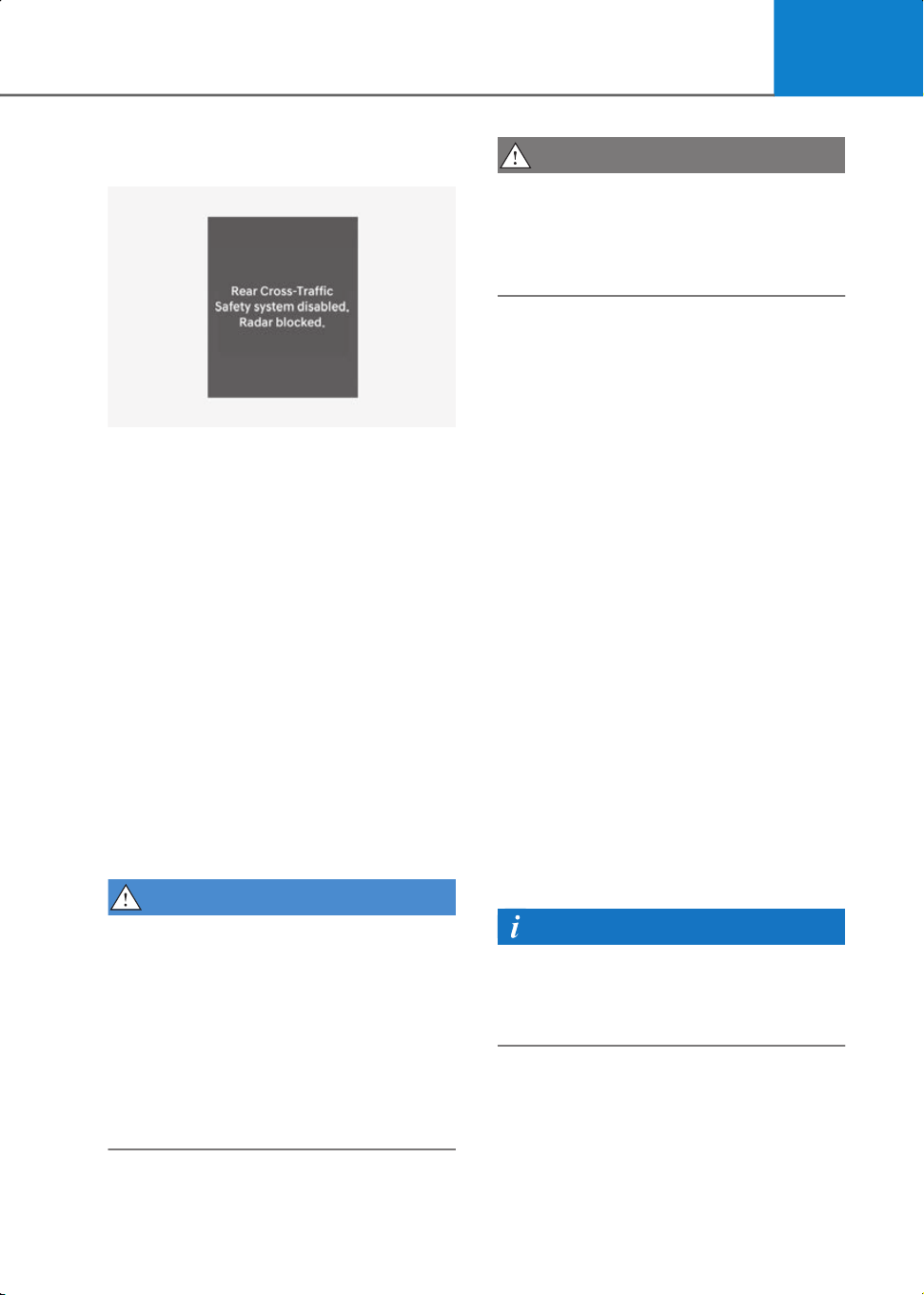
7
7-119
Rear Cross-Traffic
Collision-Avoidance Assist disabled
B7006903
When the rear bumper around the
rear-side radar or sensor is covered with
foreign material, such as snow or rain, or
installing a trailer or carrier, it can reduce
the detecting performance and
temporarily limit or disable Rear
Cross-Traffic Collision-Avoidance Assist.
If this occurs, the ‘Rear Cross-Traffic
Safety system disabled. Radar blocked’
warning message will appear on the
instrument cluster.
Rear Cross-Traffic Collision-Avoidance
Assist will operate properly when such
foreign material or trailer, etc., is
removed.
If Rear Cross-Traffic Collision-Avoidance
Assist does not operate properly after it is
removed, have the vehicle inspected by
an authorized HYUNDAI dealer.
WARNING
• Even though the warning message
does not appear on the instrument
cluster, Rear Cross-Traffic
Collision-Avoidance Assist may not
operate properly.
• Rear Cross-Traffic Collision-Avoidance
Assist may not operate properly in an
area (for example, open terrain), where
any objects are not detected after
turning ON the vehicle.
CAUTION
Turn off Rear Cross-Traffic
Collision-Avoidance Assist to install or
remove a trailer, carrier, or another
attachment. Turn on Rear Cross-Traffic
Collision-Avoidance Assist when finished.
Limitations of Rear Cross-Traffic
Collision-Avoidance Assist
Rear Cross-Traffic Collision-Avoidance
Assist may not operate properly, or it may
operate unexpectedly under the
following circumstances:
• Departing from where trees or grass are
overgrown
• Departing from where roads are wet
• Speed of the approaching vehicle is fast
or slow
Braking control may not work, driver’s
attention is required in the following
circumstances:
• The vehicle severely vibrates while
driving over a bumpy road, uneven road
or concrete patch
• Driving on a slippery surface due to
snow, water puddle, ice, etc.
• The tire pressure is low or a tire is
damaged
• The braking system has been modified
• Remote Smart Parking Assist is
operating (if equipped)
Information
For more information on the limitations of
the rear corner radar, refer to the
“Blind-Spot Collision-Avoidance Assist
(BCA)” section in this chapter.
CE_USA.book Page 119
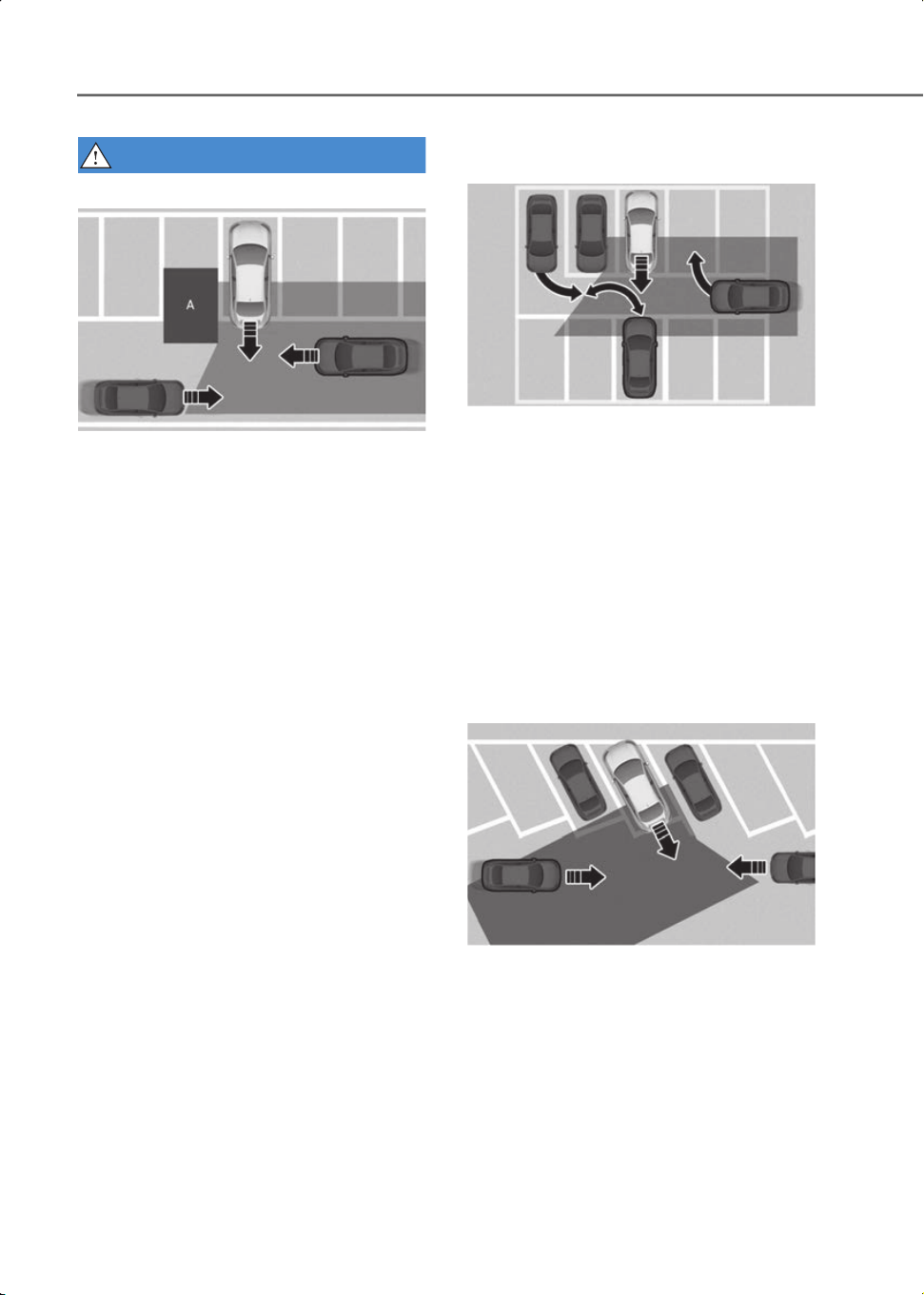
Driver Assistance System
7-120
WARNING
• Driving near a vehicle or structure
B7006904
[A] Structure
Rear Cross-Traffic Collision-Avoidance
Assist may be limited when driving near
a vehicle or structure, and may not
detect the vehicle approaching from
the left or right. If this occurs, the
function may not warn the driver or
control the brakes when necessary.
Always check your surroundings while
backing up.
• When the vehicle is in a complex
parking environment
B7006905
Rear Cross-Traffic Collision-Avoidance
Assist may detect vehicles which are
parking or pulling out near your vehicle
(for example, a vehicle leaving beside
your vehicle, a vehicle parking or
pulling out in the rear area, a vehicle
approaching your vehicle making a
turn, etc.). If this occurs, the function
may unnecessarily warn the driver and
control the brake.
Always check your surroundings while
backing up.
• When the vehicle is parked diagonally
B7006906
Rear Cross-Traffic Collision-Avoidance
Assist may be limited when backing up
diagonally, and may not detect the
vehicle approaching from the left or
right. If this occurs, the function may
not warn the driver or control the
brakes when necessary.
Always check your surroundings while
backing up.
CE_USA.book Page 120
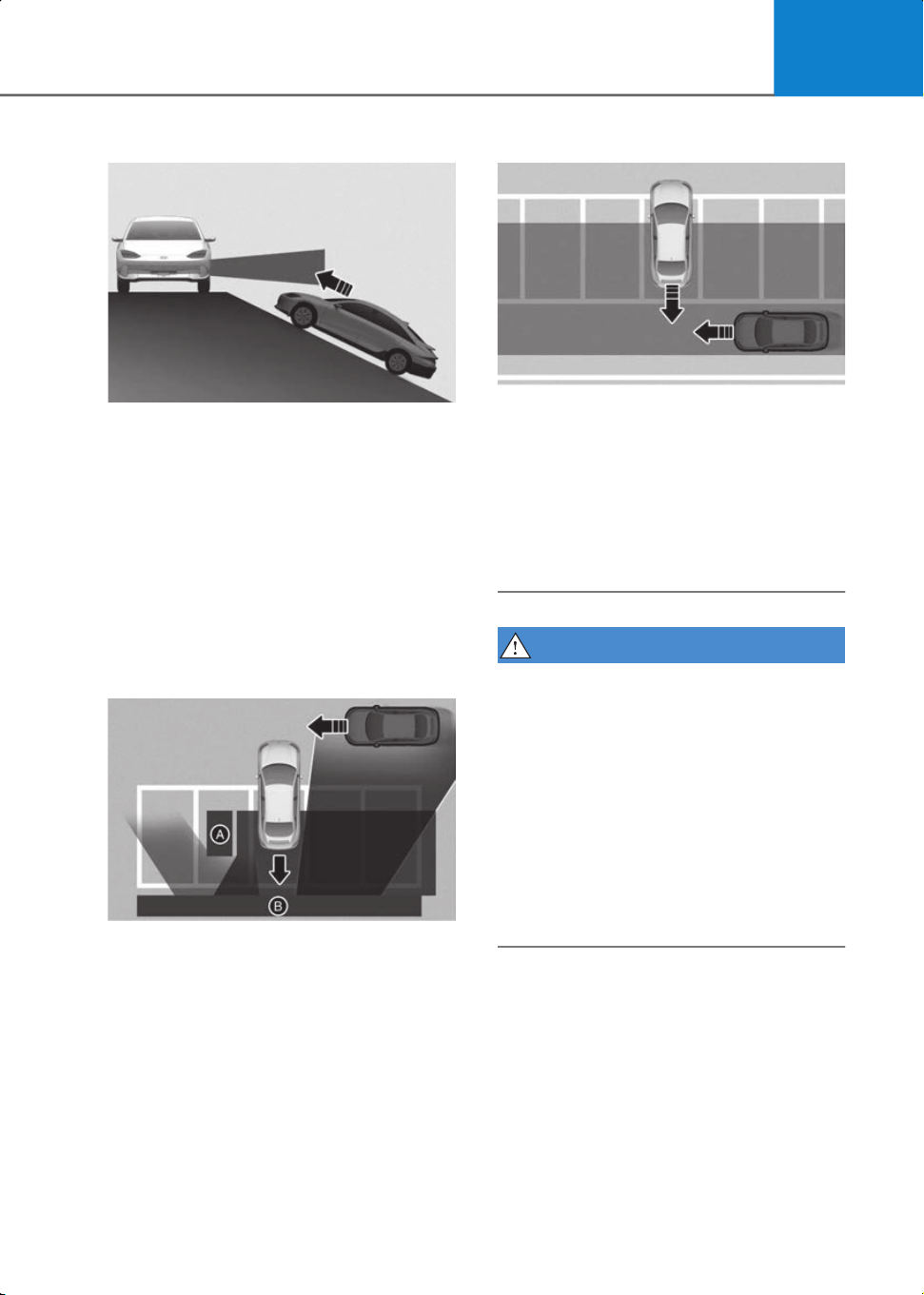
7
7-121
• When the vehicle is on or near a slope
B7006907
Rear Cross-Traffic Collision-Avoidance
Assist may be limited when the vehicle
is on a uphill or downhill slope, or near
it, and may not detect the vehicle
approaching from the left or right. If
this occurs, the function may not warn
the driver or control the brakes when
necessary.
Always check your surroundings while
backing up.
• Pulling into the parking space where
there is a structure
B7006908
[A] Structure
[B] Wall
Rear Cross-Traffic Collision-Avoidance
Assist may detect vehicles passing by in
front of you when parking in reverse
into a parking space with a wall or
structure in the rear or side area. If this
occurs, the function may unnecessarily
warn the driver and control the brake.
Always check your surroundings while
backing up.
• When the vehicle is parked rearward
B7006909
Rear Cross-Traffic Collision-Avoidance
Assist may detect vehicles passing by
behind you when parking in reverse
into a parking space. If this occurs, the
function may unnecessarily warn the
driver and control the brake.
Always check your surroundings while
backing up.
WARNING
• When you are towing a trailer or
another vehicle, turn off Rear
Cross-Traffic Collision-Avoidance
Assist for safety reasons.
• Rear Cross-Traffic Collision-Avoidance
Assist may not operate properly if
interfered by strong electromagnetic
waves.
• Rear Cross-Traffic Collision-Avoidance
Assist may not operate for 3 seconds
after the vehicle is started, or the rear
corner radars are initialized.
CE_USA.book Page 121
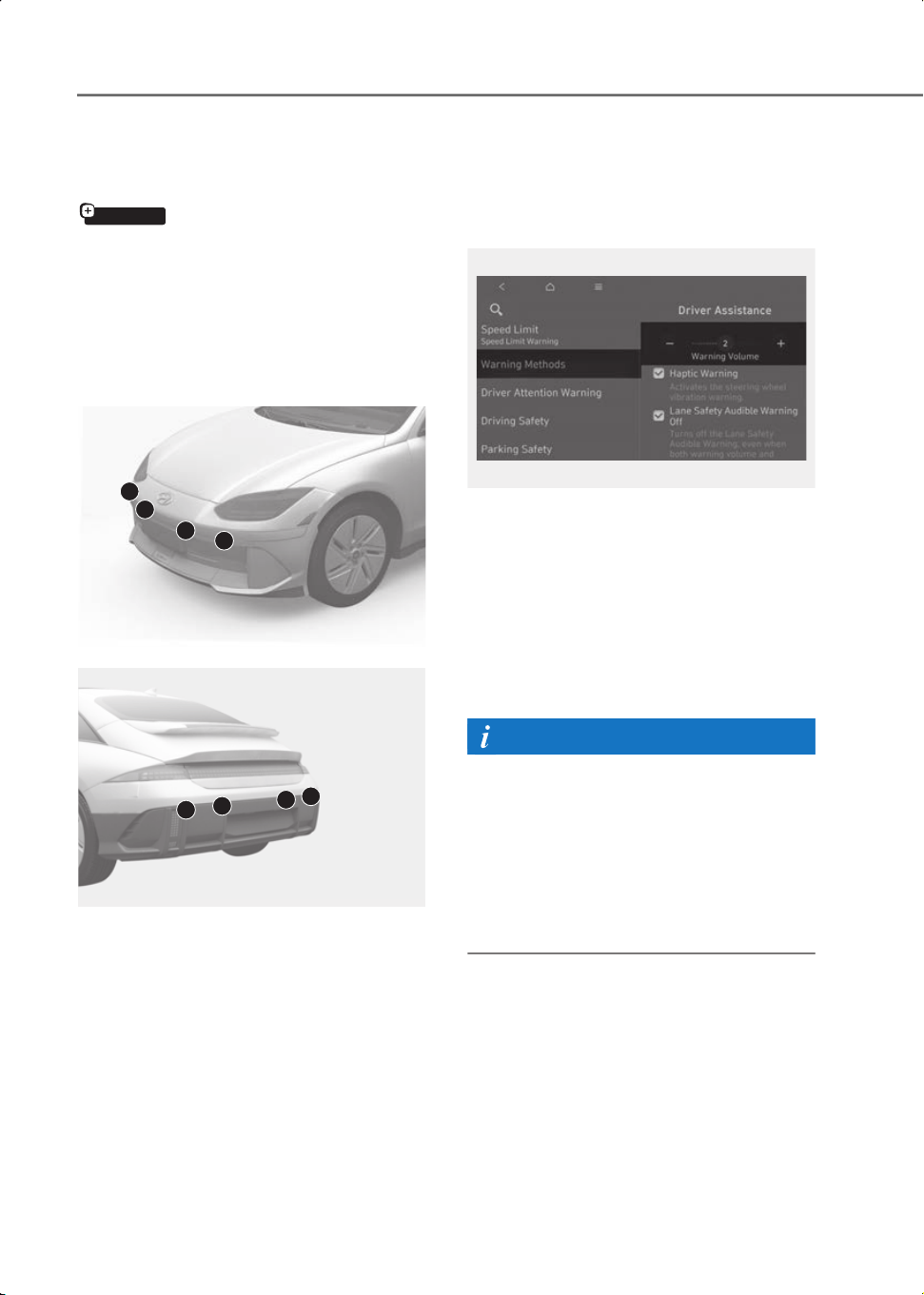
Driver Assistance System
7-122
Forward/Reverse Parking
if equipped
Distance Warning (PDW)
Forward/Reverse Parking Distance
Warning can help warn the driver if an
obstacle is detected within a certain
distance when the vehicle is moving
forward or in reverse at low speeds.
Detecting sensor
B7007001
B7007002
(1) Front ultrasonic sensors,
(2) Rear ultrasonic sensors
Refer to the picture above for the detailed
location of the detecting sensors.
Forward/Reverse Parking
Distance Warning Settings
Warning Methods
B7001902_2
With the vehicle on, go to Setup > Vehicle
> Driver Assistance > Warning Methods
from the Settings in the infotainment
system to select the following:
• Warning Volume: The Warning Volume
can be adjusted.
If you turn off the Warning Volume, for
your safety, the function may warn you
with a low volume.
Information
• If you change the Warning Methods,
Warning Methods of other Driver
Assistance systems may change.
• If the vehicle is restarted, Warning
Methods will maintain the last setting.
• There may be no Settings menu
depending on the feature applied to
your vehicle.
Parking Distance Warning Auto On
To use Parking Distance Warning Auto On
function, select Setup > Vehicle > Driver
Assistance > Parking Safety > Parking
Distance Warning Auto On from the
infotainment system settings menu.
1
1
1
1
2
2
2
2
CE_USA.book Page 122
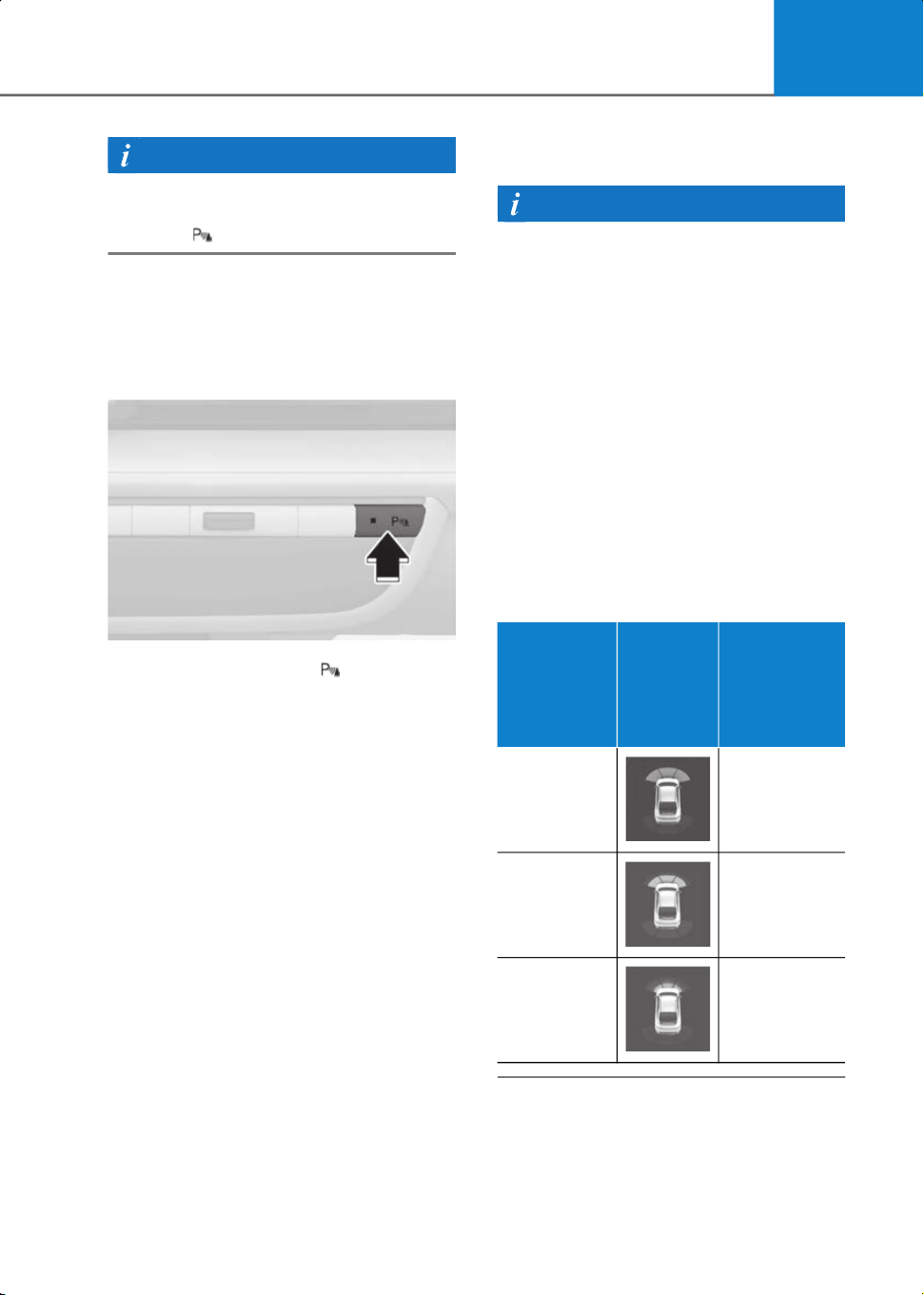
7
7-123
Information
When Parking Distance Warning Auto On
is selected, the Parking Safety button
indicator ( ) stays on.
Forward/Reverse Parking
Distance Warning Operation
Parking Safety button
B7007201
Press the Parking Safety ( ) button to
turn on Forward/Reverse Parking
Distance Warning. Press the button again
to turn off the function.
• When the gear is shift to R (Reverse),
Parking Distance Warning will
automatically turn on (Parking Safety
button indicator on).
Forward Parking Distance Warning
Forward Parking Distance Warning will
operate when one of the conditions is
satisfied.
• The gear is shifted from R (Reverse) to
D (Drive) with Reverse Parking Distance
Warning on
• The gear is in D (Drive) and the Parking
Safety button indicator light is on
• Shift to D (Drive) when the function is
off (Only when Setup > Vehicle > Driver
Assistance > Parking Safety > Parking
Distance Warning Auto On is selected
from the infotainment system settings
menu.)
• The gear is shifted to R (only front
corner warning is on)
Information
• Forward Parking Distance Warning will
operate only when the vehicle’s
forward speed is below 6 mph (10
km/h).
• Forward Parking Distance Warning is
deactivated if the vehicle speed
reaches above 18 mph (30 km/h). It will
not reactivate although the vehicle
speed drops below 6 mph (10 km/h).
• Only the front outer ultrasonic sensor
will operate when the gear is in R
(Reverse).
(Only when Setup > Vehicle > Driver
Assistance > Parking Safety > Parking
Distance Warning Auto On is not
selected from the infotainment system
settings menu.)
Distance
from Object
Warning
Indicator
when
Driving
Forward
Warning
Sound
24-40 in.
(60-100 cm)
Buzzer beeps
intermittently
24-40 in.
(30-60 cm)
Beeps more
frequently
within 12 in.
(30 cm)
Beeps
continuously
CE_USA.book Page 123
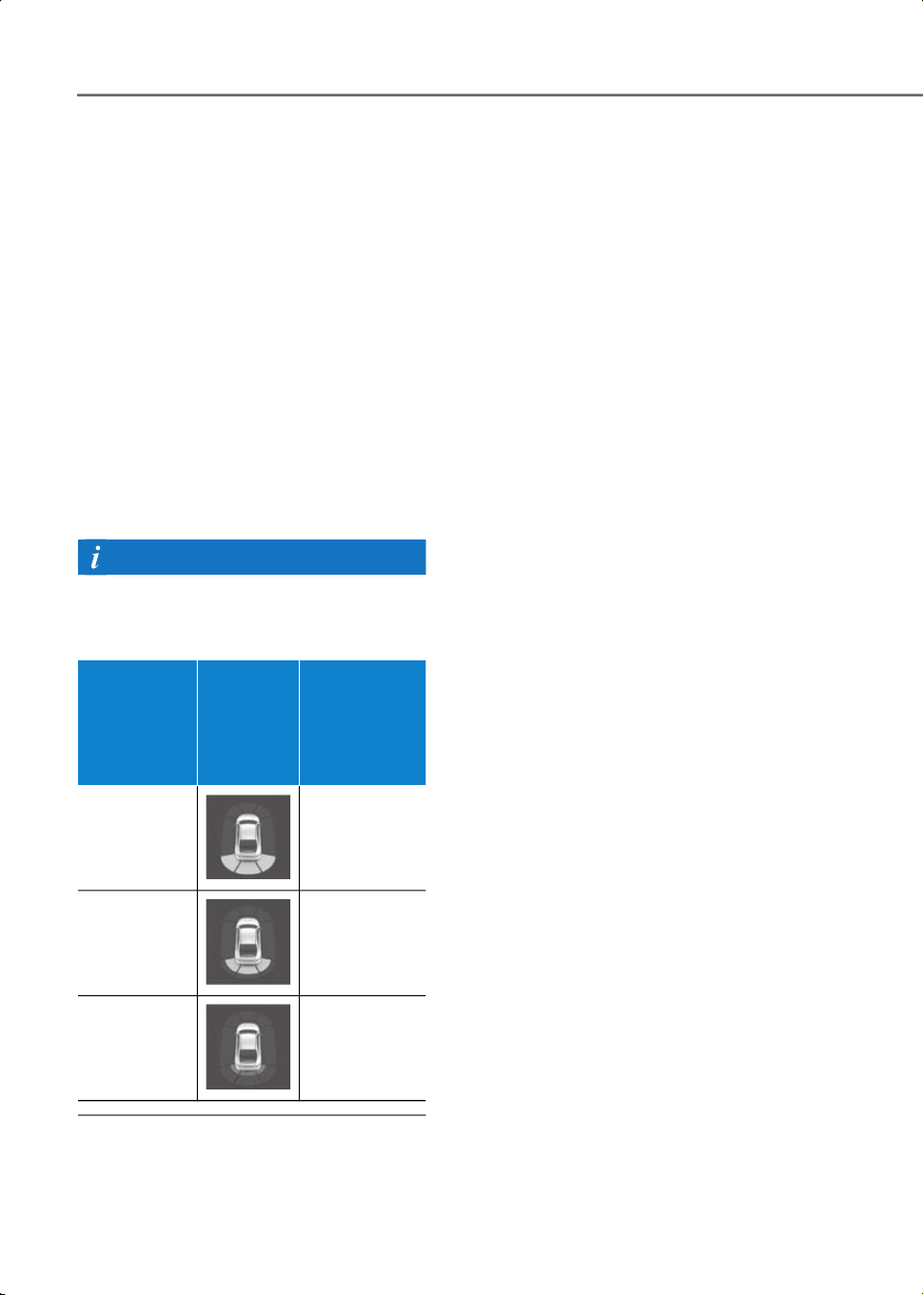
Driver Assistance System
7-124
• The corresponding indicator will
illuminate whenever each ultrasonic
sensor detects a person, animal or
object in its sensing range. Also an
audible warning will sound.
• When more than two objects are
detected at the same time, the closest
one will be warned with an audible
warning.
• The shape of the indicator in the
illustration may differ from the actual
vehicle.
Reverse Parking Distance Warning
Reverse Parking Distance Warning will
operate under the following conditions.
• The gear is shifted to R (Reverse).
Information
Reverse Parking Distance Warning will
operate when the vehicle’s reverse speed
is below 6 mph (10 km/h).
• The corresponding indicator will
illuminate whenever each ultrasonic
sensor detects a person, animal or
object in its sensing range. Also an
audible warning will sound.
• When more than two objects are
detected at the same time, the closest
one will be warned with an audible
warning.
• The shape of the indicator in the
illustration may differ from the actual
vehicle.
Distance
from Object
Warning
Indicator
when
Driving
Backward
Warning
Sound
24-48 in.
(60-120 cm)
Buzzer beeps
intermittently
12-24 in.
(30-60 cm)
Beeps more
frequently
within 12 in.
(30 cm)
Beeps
continuously
CE_USA.book Page 124
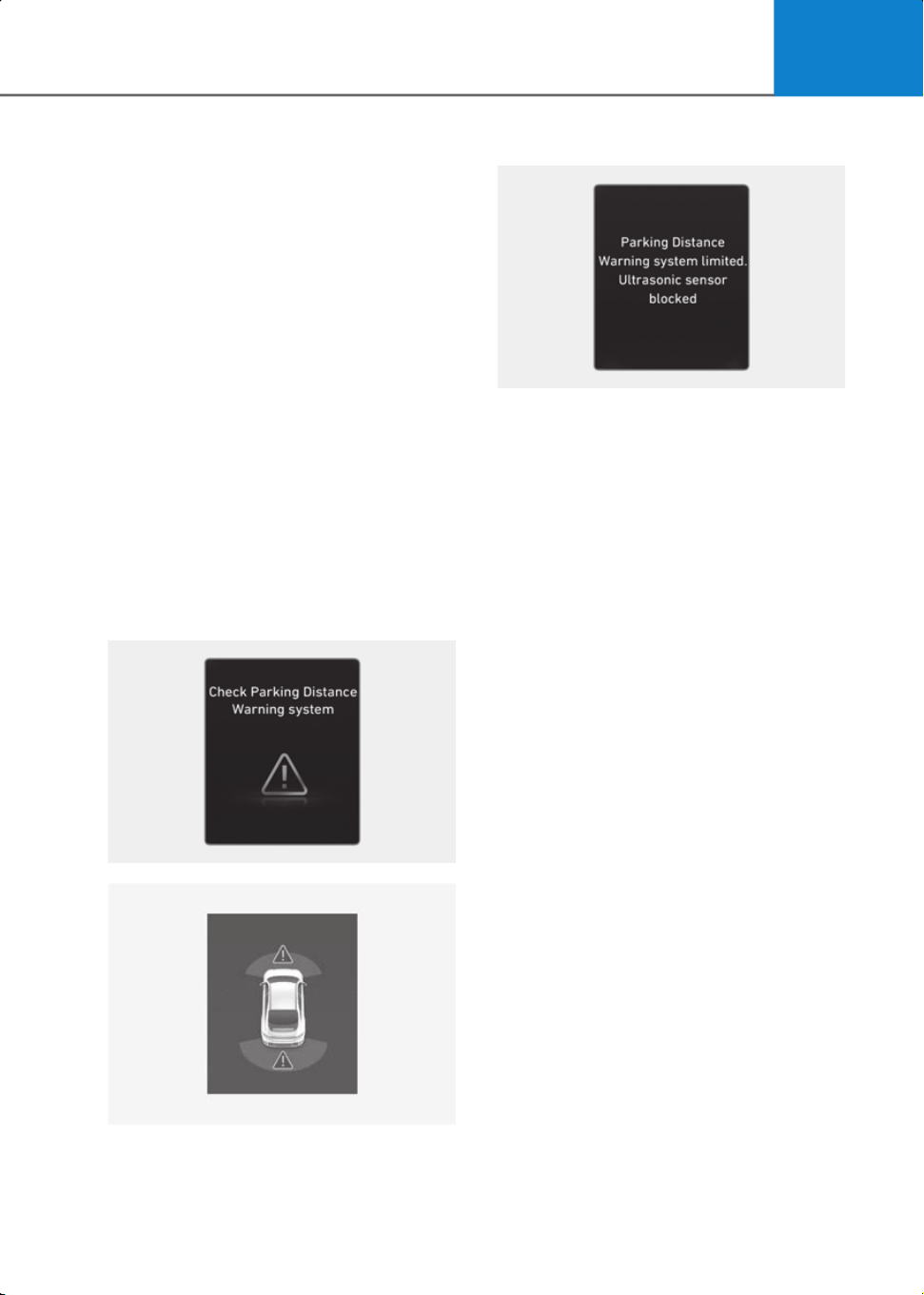
7
7-125
Forward/Reverse Parking
Distance Warning
Malfunction and Limitations
Parking Distance Warning
malfunction
After starting the vehicle, a beep will
sound when the gear is shifted to R
(Reverse) to indicate Parking Distance
Warning is operating properly.
However, if one or more of the following
occurs, first check whether the ultrasonic
sensor is damaged or blocked with
foreign material. If it still does not work
properly, have the vehicle inspected by
an authorized HYUNDAI dealer.
• The audible warning does not sound.
• The buzzer sounds intermittently.
• The ‘Check Parking Distance Warning
system’ warning message appears on
the instrument cluster.
B0377EU01
B7007302
Parking Distance Warning disabled
B0377EU03
If this occurs the ‘Parking Distance
Warning system limited. Ultrasonic
sensor blocked’ warning message
appears on the instrument cluster.
Parking Distance Warning will operate
properly when snow, rain or foreign
material is removed.
If Parking Distance Warning does not
operate properly after obstruction (snow,
rain, or foreign material) is removed
(including trailer, carrier, etc., from the
rear bumper), have the vehicle inspected
by an authorized HYUNDAI dealer.
Limitations of Forward/Reverse
Parking Distance Warning
• Parking Distance Warning may not
operate properly when:
- Moisture is frozen to the sensor
- Sensor is covered with substance,
such as snow or water
(Forward/Reverse Parking Distance
Warning will operate properly when
such substance is removed.)
- The weather is extremely hot or cold
- The sensor or sensor assembly is
disassembled
- The surface of the sensor is pressed
hard or hit with a hard object
- The surface of the sensor is scratched
with a sharp object
- The sensors or its surrounding area is
directly sprayed with high pressure
washer
CE_USA.book Page 125

Driver Assistance System
7-126
• Parking Distance Warning may
malfunction when:
- Heavy rain or water spray is present
- Water flows on the surface of the
sensor
- Affected by another vehicle’s sensors
- The sensor is covered with snow or
ice
- Driving on uneven road, gravel roads
or bushes
- Objects that generate ultrasonic
waves are near the sensor
- License plate is installed in a different
spot from the original location
- The vehicle bumper height or
ultrasonic sensor installation has
been modified
- Attaching equipment or accessories
next to the ultrasonic sensors
• The following objects may not be
detected:
- Sharp or slim objects, such as ropes,
chains or small poles.
- Narrow objects, such as corners of a
square column
- Objects, which tend to absorb sensor
frequency, such as clothes, spongy
material or snow.
- Objects smaller than 100 cm (40 in.)
in length and narrower than 6 in. (14
cm) in diameter.
- Pedestrians, animals or objects that
are very close to the ultrasonic
sensors
WARNING
• Parking Distance Warning is a
supplemental function. The operation
of Parking Distance Warning can be
affected by several factors (including
environmental conditions). It is the
responsibility of the driver to always
check the front and rear views before
and while parking.
• Your new vehicle warranty does not
cover any accidents or damage to the
vehicle due to the malfunction of
Parking Distance Warning.
• Pay close attention when driving near
objects, pedestrians, and especially
children. Some objects may not be
detected by the ultrasonic sensors, due
to the objects distance, size or material,
all of which can limit the effectiveness
of the sensor.
• Parking Distance Warning does not
warn you in the order of detection. It
varies depending on the speed of the
vehicle or the shape of a person,
animal, or object.
• If the Parking Distance Warning does
not operate properly, you have the
vehicle inspected by an authorized
HYUNDAI dealer.
CE_USA.book Page 126
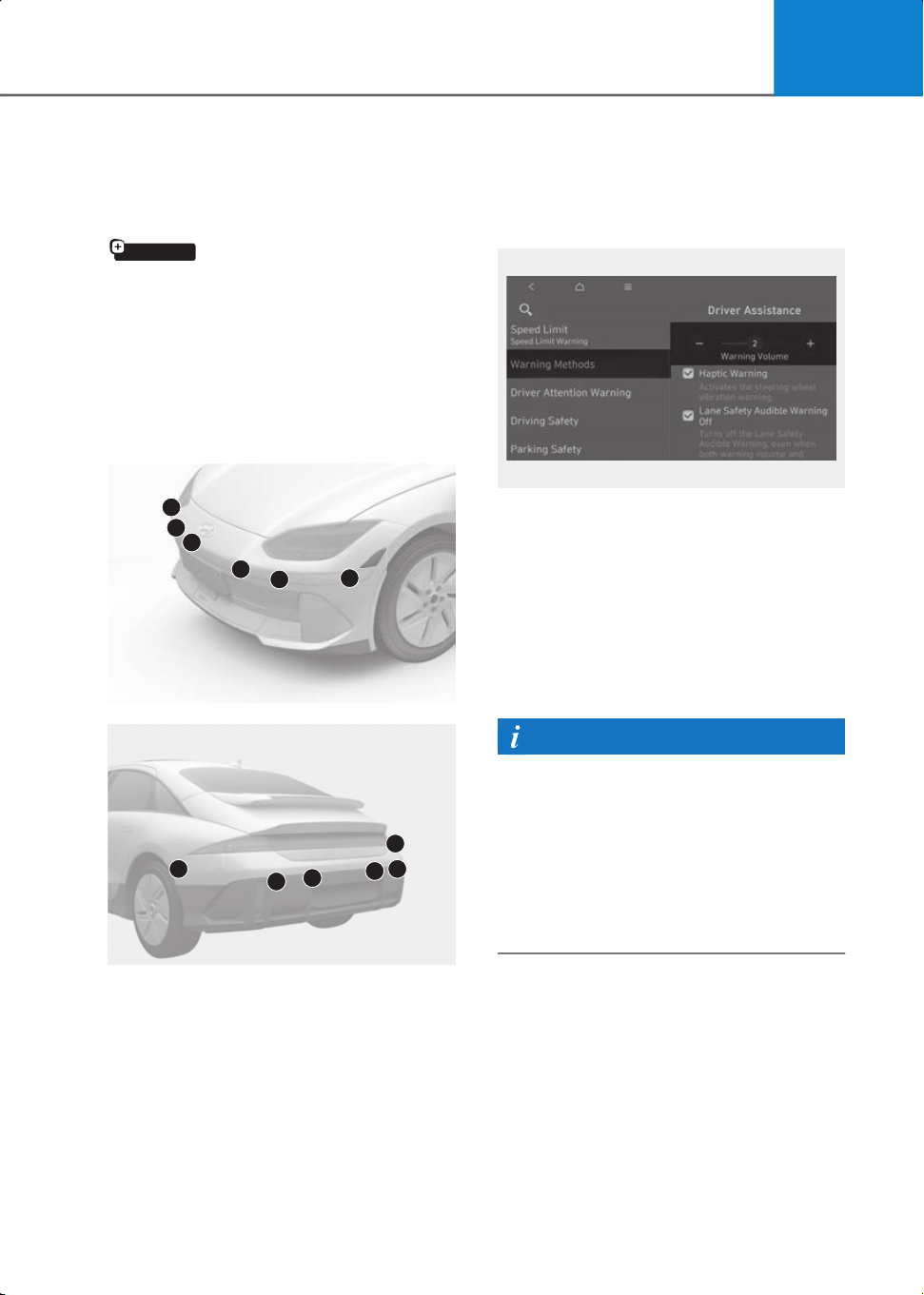
7
7-127
Forward/Side/Reverse
Parking Distance Warning
if equipped
(PDW)
Forward/Side/Reverse Parking Distance
Warning uses the front, side, and rear
ultrasonic sensors to detect and warns
you if a person, animal, or object is within
a certain distance when your vehicle is
stopped or driving at low speed.
Detecting sensor
B7007401
B7007402
(1) Front ultrasonic sensors
(2) Front side ultrasonic sensors
(3) Rear side ultrasonic sensors
(4) Rear ultrasonic sensors
Refer to the picture above for the detailed
location of the detecting sensors.
Parking Distance Warning
Settings
Warning Methods
B7001902_2
With the vehicle on, go to Setup > Vehicle
> Driver Assistance > Warning Methods
from the Settings in the infotainment
system to select the following:
• Warning Volume: The Warning Volume
can be adjusted.
If you turn off the Warning Volume, for
your safety, the function may warn you
with a low volume.
Information
• If you change the Warning Methods,
Warning Methods of other Driver
Assistance systems may change.
• If the vehicle is restarted, Warning
Methods will maintain the last setting.
• There may be no Settings menu
depending on the feature applied to
your vehicle.
Parking Distance Warning Auto On
To use Parking Distance Warning Auto On
function, select Setup > Vehicle > Driver
Assistance > Parking Safety > Parking
Distance Warning Auto On from the
infotainment system settings menu.
1
2
2
1
1
1
4
3
4
4
4
3
CE_USA.book Page 127
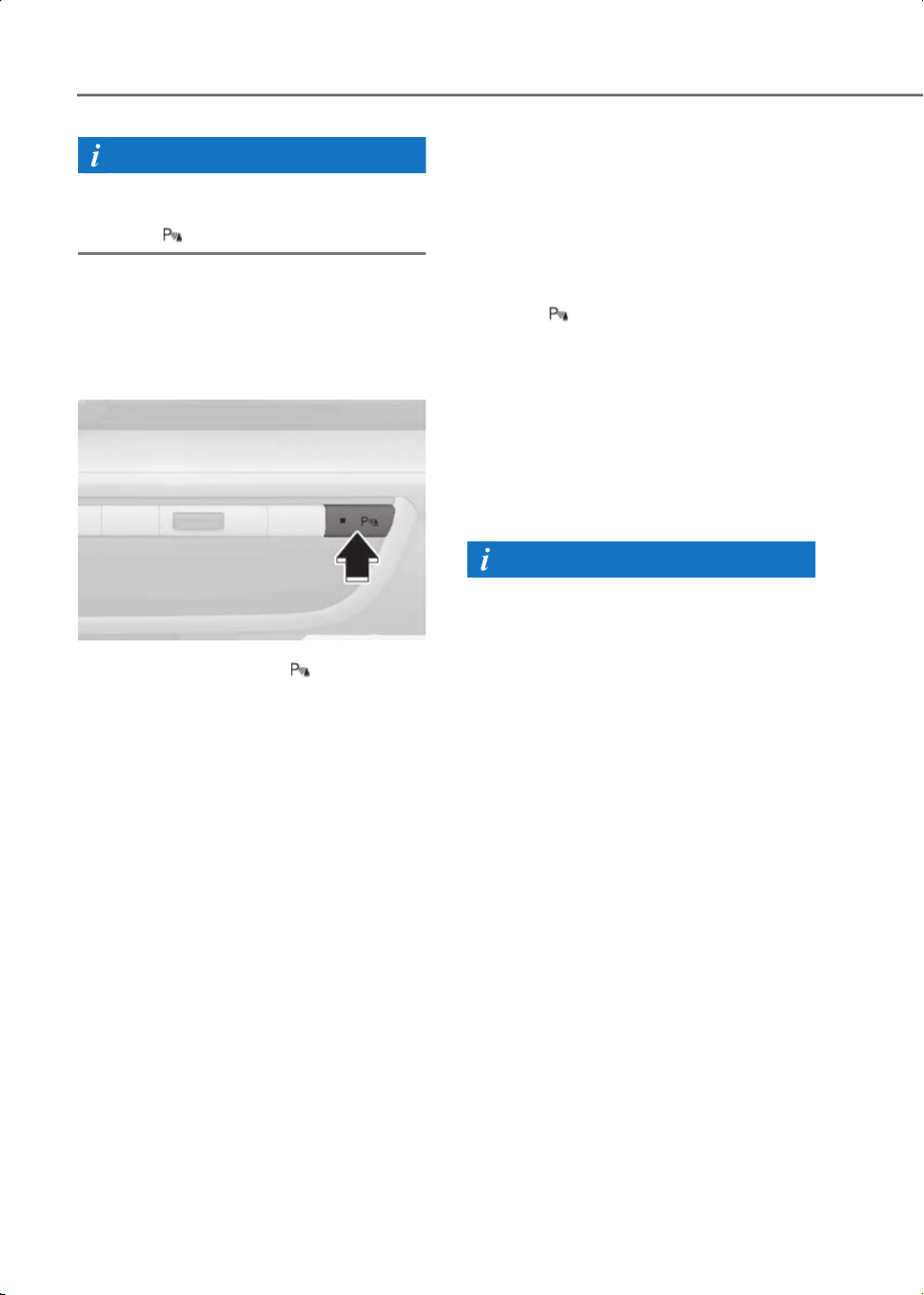
Driver Assistance System
7-128
Information
When Parking Distance Warning Auto On
is selected, the Parking Safety button
indicator ( ) stays on.
Parking Distance Warning
Operation
Parking Safety button
B7007601
Press the Parking Safety ( ) button to
turn on Forward/Reverse Parking
Distance Warning. Press the button again
to turn off the function.
• When the gear is shift to R (Reverse),
Parking Distance Warning will
automatically turn on (Parking Safety
button indicator on).
Forward Parking Distance Warning
Forward Parking Distance Warning will
operate under the following conditions.
• The gear is shifted from R (Reverse) to
D (Drive) with Reverse Parking Distance
Warning on
• The gear is in D (Drive) and the Parking
Safety ( ) button indicator light is on
• Shift to D (Drive) when the function is
off
(Only when Setup > Vehicle > Driver
Assistance > Parking Safety > Parking
Distance Warning Auto On is selected
from the infotainment system settings
menu.)
• Shift to R (Reverse) (only front corner
warning is on)
Information
• Forward Parking Distance Warning will
operate only when the vehicle’s
forward speed is below 6 mph (10
km/h).
• Forward Parking Distance Warning is
deactivated if the vehicle speed
reaches above 18 mph (30 km/h). It will
not reactivate although the vehicle
speed drops below 6 mph (10 km/h).
(Only when Setup > Vehicle > Driver
Assistance > Parking Safety > Parking
Distance Warning Auto On is not
selected from the infotainment system
settings menu.)
• Only the front outer ultrasonic sensor
will operate when the gear is in R
(Reverse).
CE_USA.book Page 128
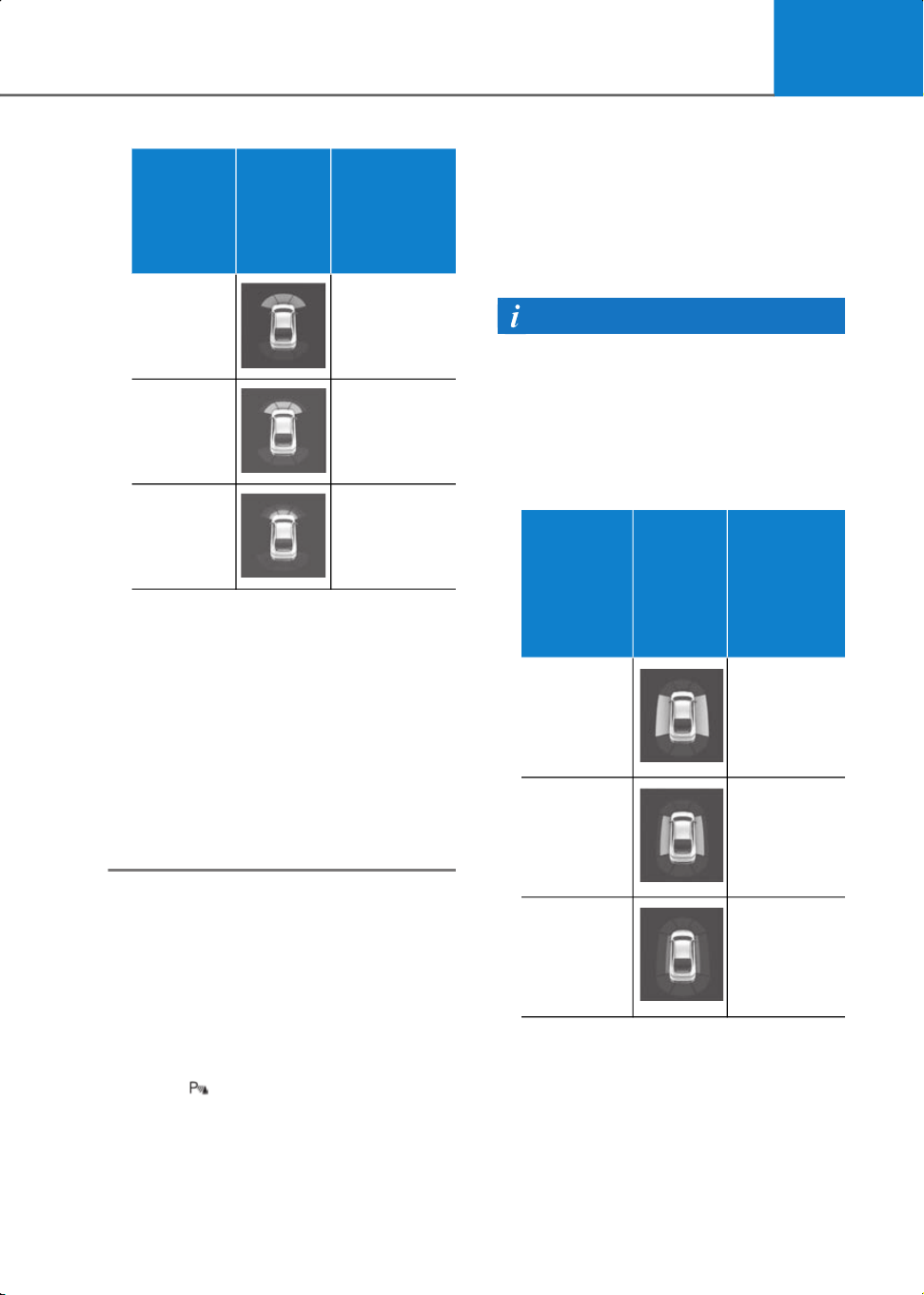
7
7-129
• The corresponding indicator will
illuminate whenever each ultrasonic
sensor detects a person, animal or
object in its sensing range. Also an
audible warning will sound.
• When more than two objects are
detected at the same time, the closest
one will be warned with an audible
warning.
• The shape of the indicator in the
illustration may differ from the actual
vehicle.
Side Parking Distance Warning
Side Parking Distance Warning will
operate under the following conditions.
• The gear is shifted to R (Reverse).
• The gear is shifted from R (Reverse) to
D (Drive).
• The gear is in D (Drive) and the Parking
Safety ( ) button indicator light is on
• Shift to D (Drive) when the function is
off
(Only when Setup > Vehicle > Driver
Assistance > Parking Safety > Parking
Distance Warning Auto On is selected
from the infotainment system settings
menu.)
Information
• Side Parking Distance Warning will
operate when the vehicle’s forward
speed is below 6 mph (10 km/h).
• Side Parking Distance Warning
operated only when Forward or
Rearward Parking Distance Warning is
on.
• The corresponding indicator will
illuminate whenever each ultrasonic
sensor detects a person, animal or
object in its sensing range.
• If an object located within 12 in. (30 cm)
from the side of the vehicle's path is
detected, an audible warning will
sound.
Distance
from
Object
Warning
Indicator
when
Driving
Forward
Warning
Sound
60-100 cm
(24-40 in.)
Buzzer beeps
intermittently
12-24 in.
(30-60
cm)
Beeps more
frequently
30 cm
(within 12
in.)
Beeps
continuously
Distance
from Object
Warning
Indicator
when
Driving
Forward/
Backward
Warning
Sound
24-40 in.
(60-100
cm)
-
12-24 in.
(30-60 cm)
-
12 in.
(within 30
cm)
Beeps
continuously
CE_USA.book Page 129
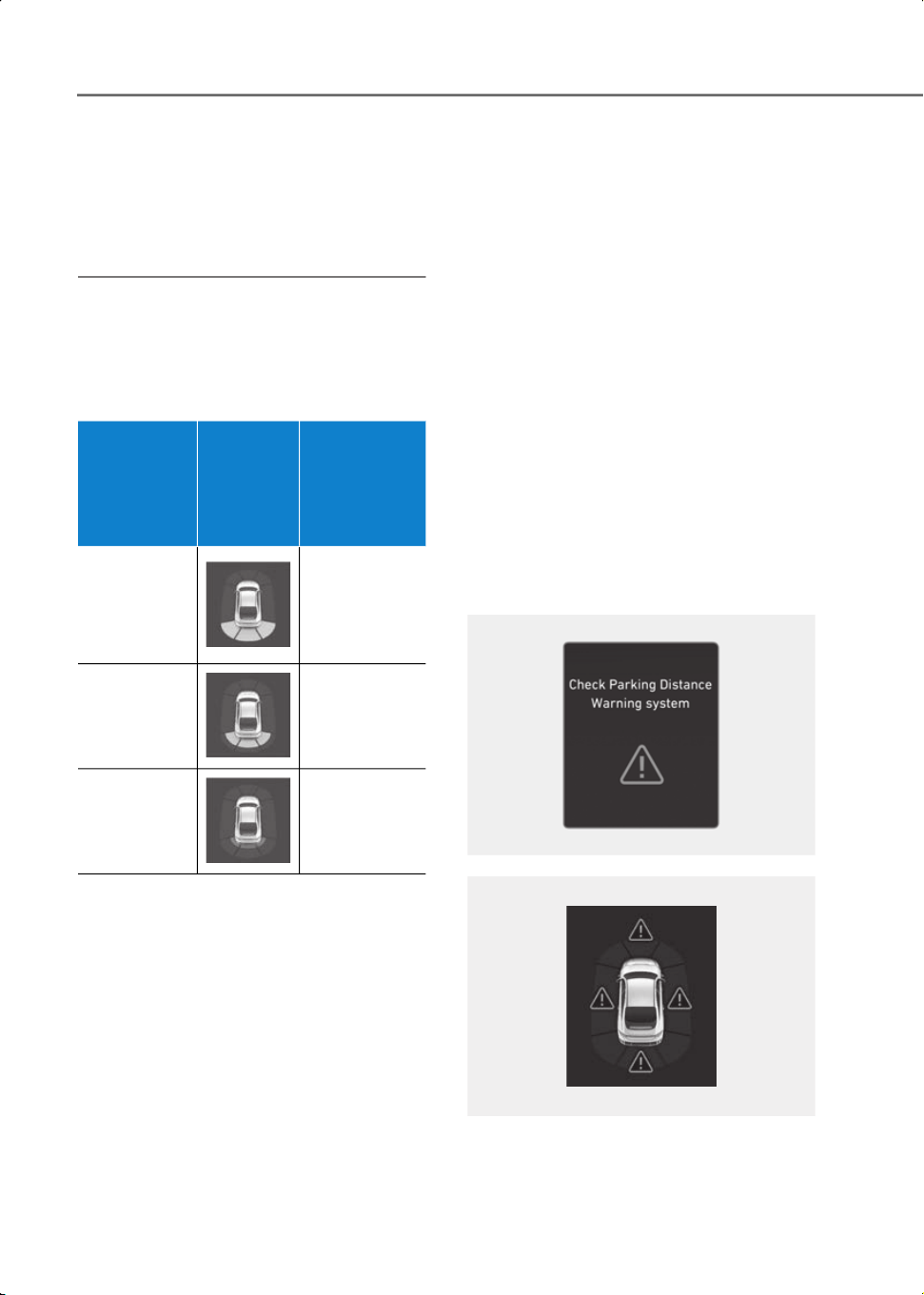
Driver Assistance System
7-130
• If an object outside the side of the
vehicle's path is detected, the warning
indicator will be displayed.
• The shape of the indicator in the
illustration may differ from the actual
vehicle.
Reverse Parking Distance Warning
Reverse Parking Distance Warning will
operate under the following conditions.
• The gear is shifted to R (Reverse).
• The corresponding indicator will
illuminate whenever each ultrasonic
sensor detects a person, animal or
object in its sensing range. Also an
audible warning will sound.
• When more than two objects are
detected at the same time, the closest
one will be warned with an audible
warning.
• The shape of the indicator in the
illustration may differ from the actual
vehicle.
Parking Distance Warning
Malfunction and Limitations
Parking Distance Warning
malfunction
After starting the vehicle, a beep will
sound when the gear is shifted to R
(Reverse) to indicate Parking Distance
Warning is operating properly.
However, if one or more of the following
occurs, first check whether the ultrasonic
sensor is damaged or blocked with
foreign material. If it still does not work
properly, have the vehicle inspected by
an authorized HYUNDAI dealer.
• The audible warning does not sound.
• The buzzer sounds intermittently.
• The 'Check Parking Distance Warning
system' warning message appears on
the instrument cluster.
OJWEV071232L
B7007702
Distance
from Object
Warning
Indicator
when
Driving
Backward
Warning
Sound
24-48 in.
(60-120 cm)
(Corner:
24-40 in.
(60-100 cm))
Buzzer beeps
intermittently
12-24 in.
(30-60 cm)
Beeps more
frequently
12 in.
(within
30 cm)
Beeps
continuously
CE_USA.book Page 130
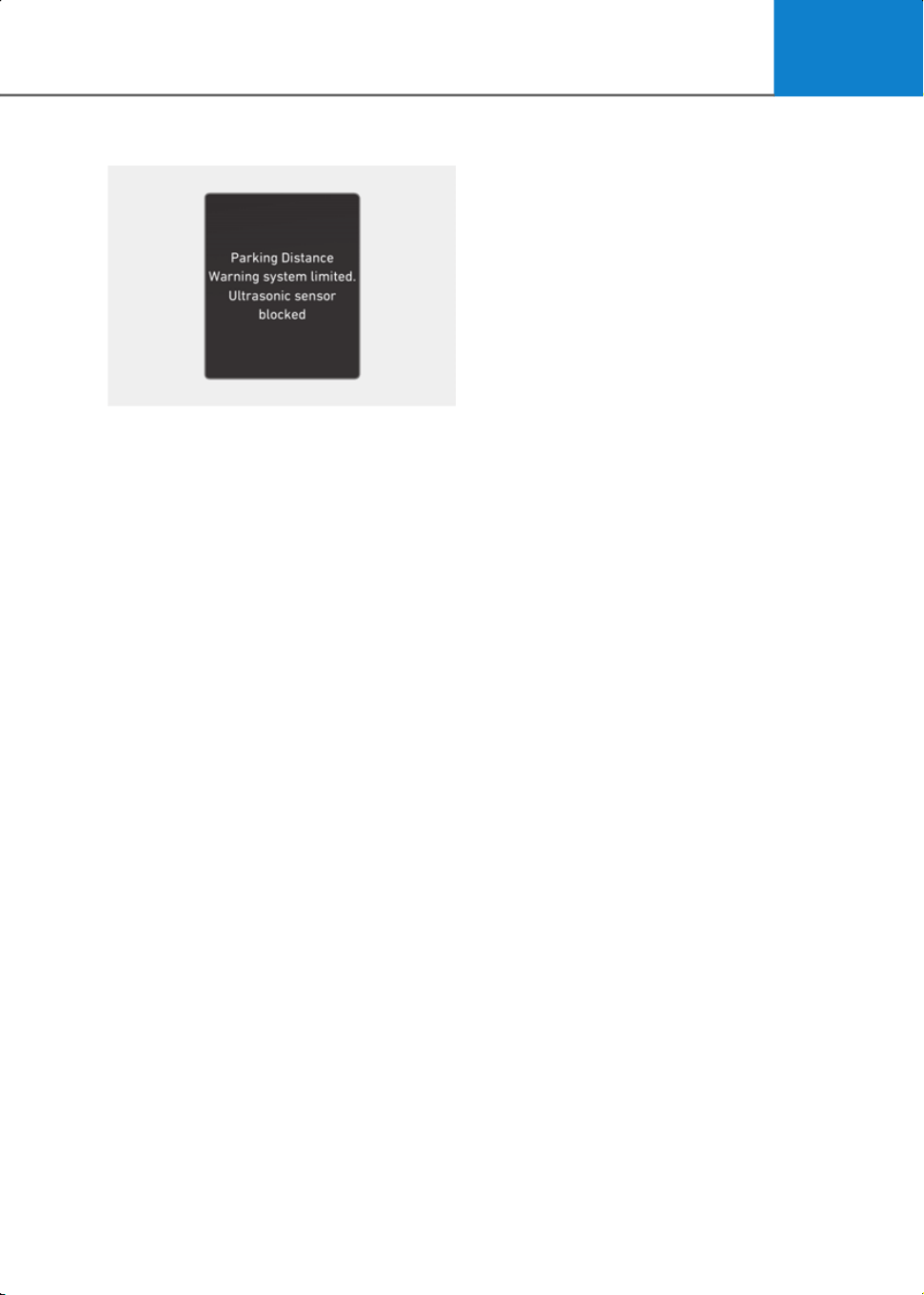
7
7-131
Parking Distance Warning disabled
OJWEV071233L
If this occurs the 'Parking Distance
Warning system limited. Ultrasonic
sensor blocked' warning message
appears on the instrument cluster.
Parking Distance Warning will operate
properly when snow, rain or foreign
material is removed. If Parking Distance
Warning does not operate properly after
obstruction (snow, rain, or foreign
material) is removed (including trailer,
carrier, etc., from the rear bumper), have
the vehicle inspected by an authorized
HYUNDAI dealer.
Limitations of Parking Distance
Warning
• Parking Distance Warning may not
operate properly when:
- There is excessive moisture or frost
on the sensor
- Sensor is covered with foreign
substance, such as snow or water
(Parking Distance Warning will
operate properly when such
substance is removed.)
- The weather is extremely hot or cold
- The sensor or sensor assembly is
disassembled
- The surface of the sensor is pressed
hard or hit with a hard object
- The surface of the sensor is scratched
with a sharp object
- The sensors or its surrounding area is
directly sprayed with high pressure
washer
• Parking Distance Warning may
malfunction when:
- Heavy rain or water spray is present
- Water flows on the surface of the
sensor
- Affected by another vehicle’s sensors
- The sensor is covered with snow or
ice
- Driving on uneven road, gravel roads
or bushes
- Objects that generate ultrasonic
waves are near the sensor
- License plate is installed in a different
spot from the original location
- The vehicle bumper height or
ultrasonic sensor installation has
been modified
- Attaching equipment or accessories
next to the ultrasonic sensors
• The following objects may not be
detected:
- Sharp or slim objects, such as ropes,
chains or small poles.
- Narrow objects, such as corners of a
square column
- Objects, which tend to absorb sensor
frequency, such as clothes, spongy
material or snow.
- Objects smaller than 40 in. (100 cm)
in length and narrower than 6 in. (14
cm) in diameter.
- Pedestrians, animals or objects that
are very close to the ultrasonic
sensors
- An object in the side space between
the front corner ultrasonic sensor and
the rear corner ultrasonic sensor or
an object approaching the side space
CE_USA.book Page 131
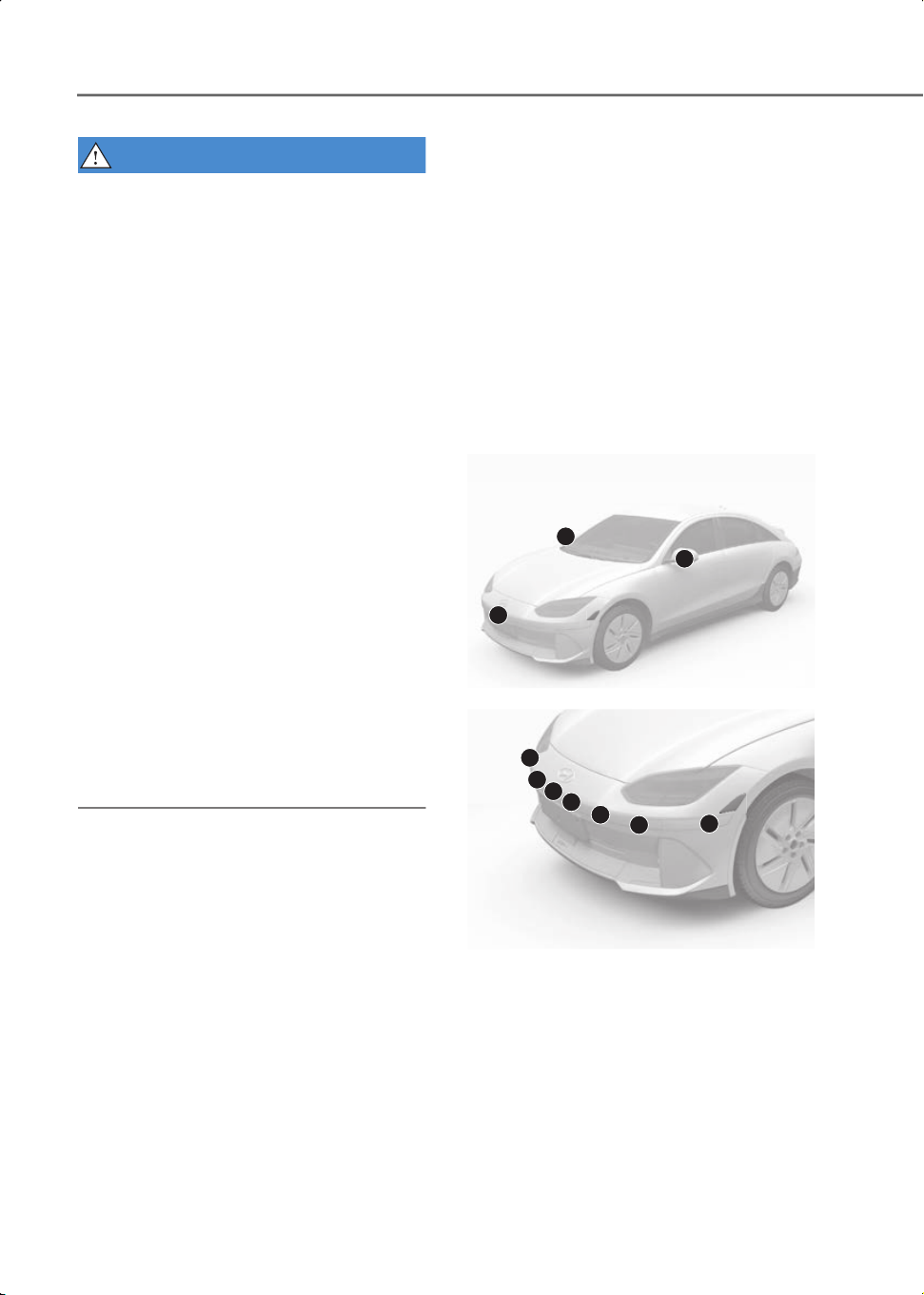
Driver Assistance System
7-132
WARNING
• Parking Distance Warning is a
supplemental function. The operation
of Parking Distance Warning can be
affected by several factors (including
environmental conditions). It is the
responsibility of the driver to always
check the front and rear views before
and while parking.
• Your new vehicle warranty does not
cover any accidents or damage to the
vehicle due to the malfunction of
Parking Distance Warning.
• Pay close attention when driving near
objects, pedestrians, and especially
children. Some objects may not be
detected by the ultrasonic sensors, due
to the objects distance, size or material,
all of which can limit the effectiveness
of the sensor.
• Parking Distance Warning does not
warn you in the order of detection. It
varies depending on the speed of the
vehicle or the shape of a person,
animal, or object.
• If the Parking Distance Warning does
not operate properly, have the vehicle
inspected by an authorized HYUNDAI
dealer.
Forward/Side/Reverse
Parking
Collision-Avoidance
Assist (PCA)
Forward/Side/Reverse Parking
Collision-Avoidance Assist helps detect
pedestrians or objects and may warn you
or assist you with braking to help avoid a
collision while driving at low speed.
Detecting sensor
B7007801
B7007802
2
2
1
4
5
5
4
4
4
1
CE_USA.book Page 132
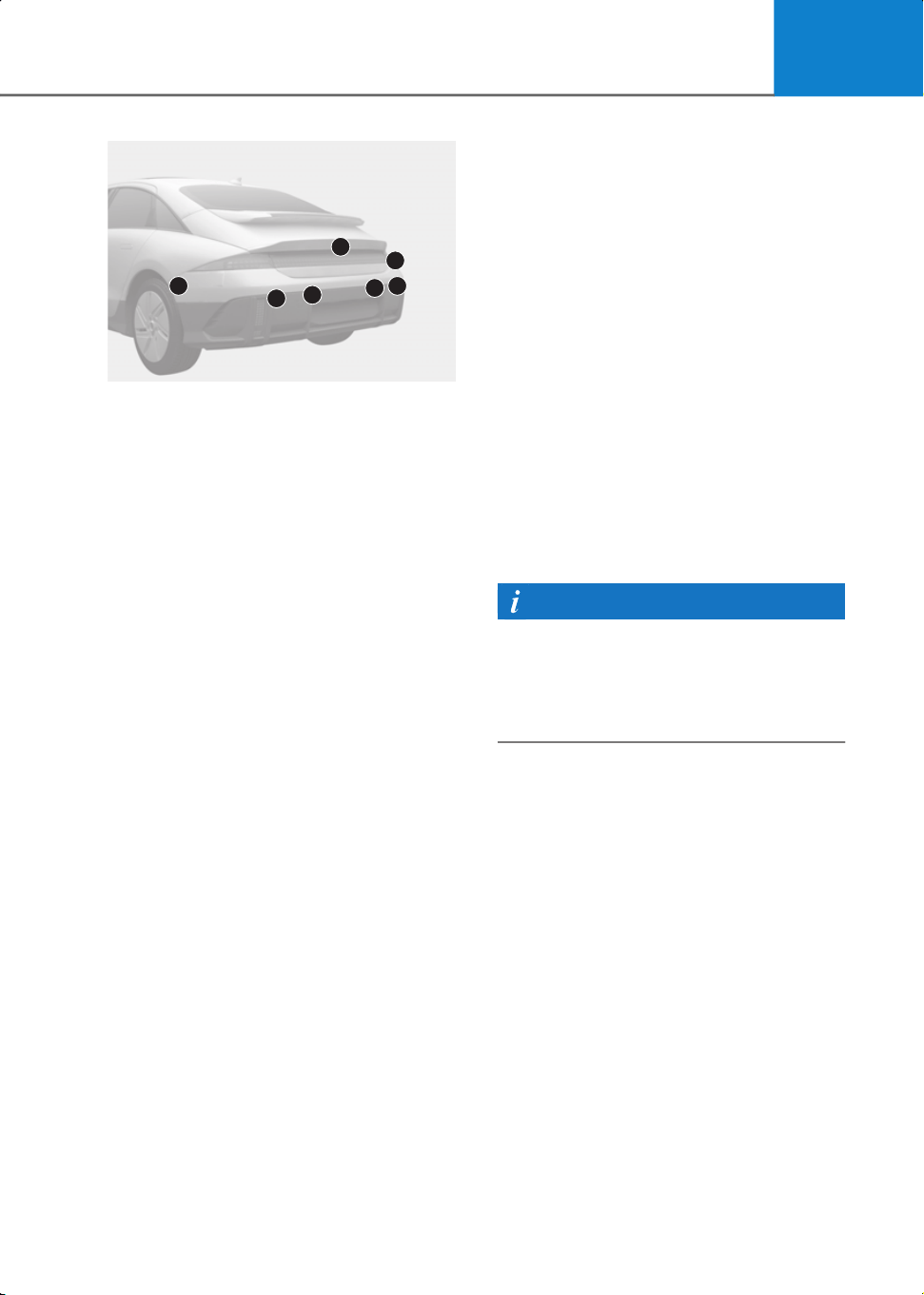
7
7-133
B7007803_1
(1) Wide-front view camera,
(2) Wide-side view camera (below the
side view mirror)
(3) Wide-rear view camera,
(4) Front ultrasonic sensors,
(5) Front side ultrasonic sensors,
(6) Rear side ultrasonic sensors,
(7) Rear ultrasonic sensors
Refer to the picture above for the detailed
location of the detecting sensors.
Parking Collision-Avoidance
Assist Settings
Parking Safety
With the vehicle on, select or deselect
Setup > Vehicle > Driver Assistance >
Parking Safety from the Settings menu to
set whether to use each function.
• If Forward/Side Safety is selected,
Parking Collision-Avoidance Assist will
warn the driver and assist with braking
when a collision with a detected
pedestrian or an object is imminent
from the front or the side.
• If Rear Safety is selected, Parking
Collision-Avoidance Assist will warn the
driver and assist with braking when a
collision with a detected pedestrian or
an object is imminent from behind.
Information
Forward/Side Safety can be selected
only when Rear Safety is selected. If the
vehicle is restarted, Rear Safety is
selected and Forward/Side Safety
maintains the last setting.
7
6
7
7
3
7
6
CE_USA.book Page 133
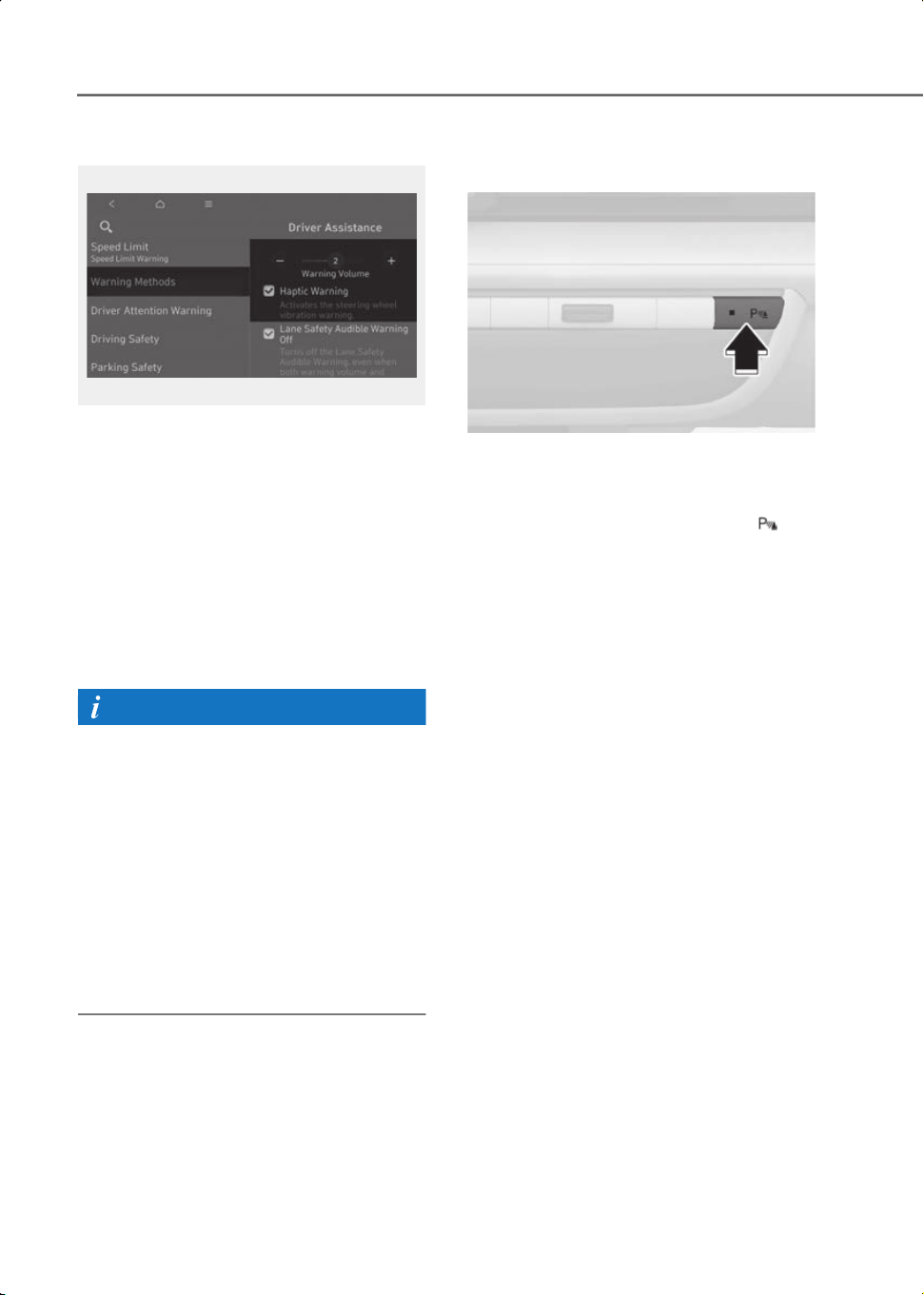
Driver Assistance System
7-134
Warning Methods
B7000205
With the vehicle on, go to Setup > Vehicle
> Driver Assistance > Warning Methods
from the Settings in the infotainment
system to select the following:
• Warning Volume: The Warning Volume
can be adjusted.
If you turn off the Warning Volume, for
your safety, the function may warn you
with a low volume.
• Haptic Warning: The steering wheel
vibration can be set.
Information
• If you change the Warning Methods,
Warning Methods of other Driver
Assistance systems may change.
• If the vehicle is restarted, Warning
Methods will maintain the last setting.
• There may be no Settings menu
depending on the feature applied to
your vehicle.
• The Warning Volume and Haptic
Warning cannot be turned off at the
same time. When one of the warnings is
turned off, the other is activated.
Parking Collision-Avoidance
Assist Operation
B7008001
Turning Parking Collision Avoidance
Assist On/Off
Press and hold the Parking Safety ( )
button more than 2 seconds, to turn the
Parking Collision-Avoidance Assist on or
off.
Operating conditions
If Parking Collision-Avoidance Assist
detects a risk of collision behind the
vehicle with a pedestrian or an object,
Parking Collision-Avoidance Assist will
warn the driver with an audible warning
and warning message on the instrument
cluster. If Surround View Monitor is
operating, a warning will appear on the
infotainment screen.
If collision is imminent, Parking
Collision-Avoidance Assist will assist you
with braking.
Select Parking Safety > Rear Safety from
the settings menu.
Parking Collision-Avoidance Assist is
enabled when the following conditions
are satisfied:
CE_USA.book Page 134
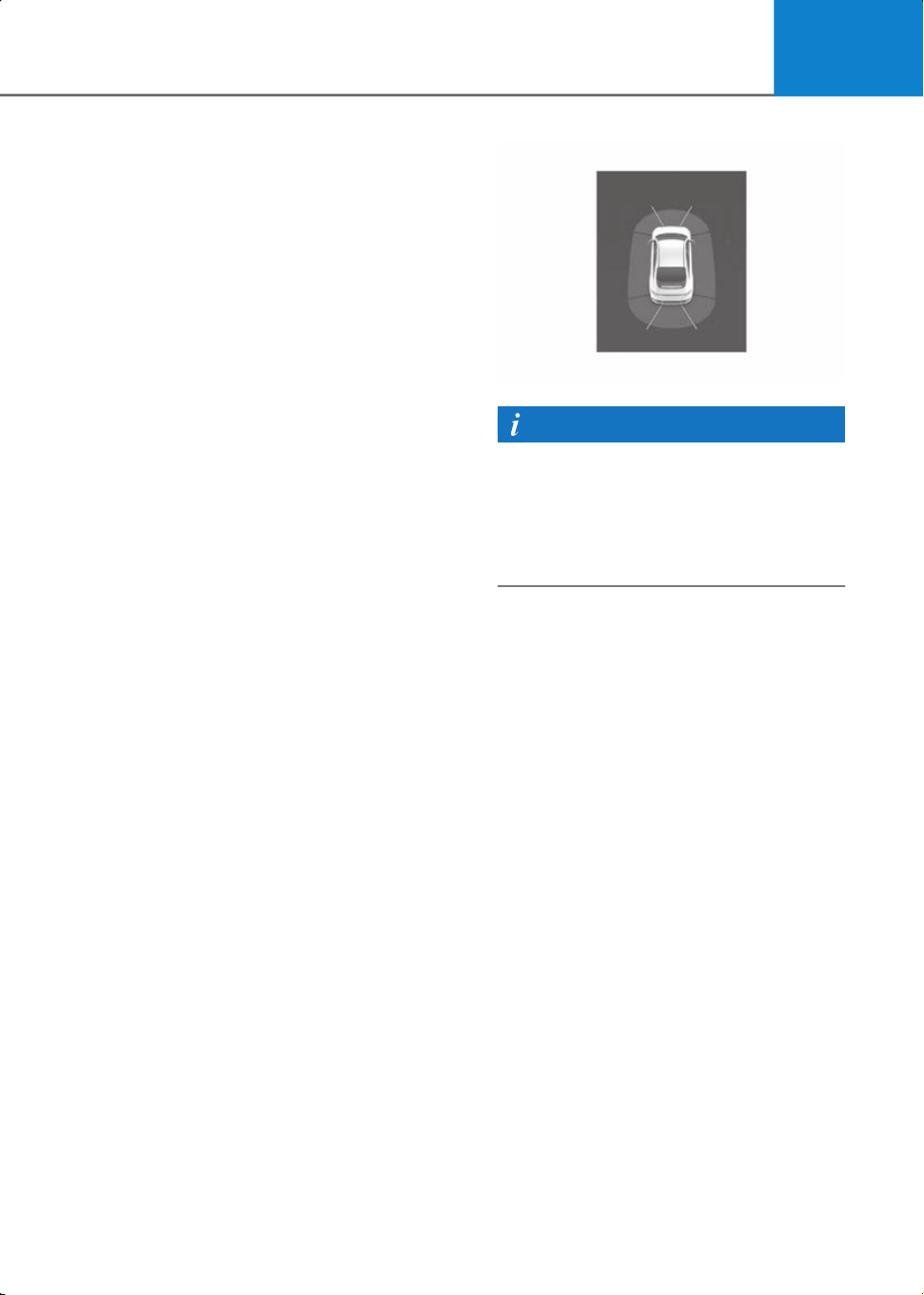
7
7-135
Rear Safety
• The trunk and door are closed
• The Electronic Parking Brake (EPB) is
released
• A trailer is not connected
• The gear is shifted to R (Reverse)
• Vehicle speed is below 6 mph (10 km/h)
(detecting pedestrians)
• Vehicle speed is below 2.4 mph (4
km/h) (detecting objects)
• Parking Collision-Avoidance Assist
components such as the rear view
camera and the rear ultrasonic sensors
are in normal conditions
Front/Side Safety
• Forward/Side Safety is selected from
the Parking Safety settings menu in the
infotainment system.
• The trunk and door are closed
• The Electronic Parking Brake (EPB) is
released
• A trailer is not connected
• The gear is shifted to R (Reverse) or D
(Drive)
• Vehicle speed is below 2.4 mph (4
km/h) (for pedestrians, objects)
• Parking Collision-Avoidance Assist
components such as the rear view
camera and the rear ultrasonic sensors
are in normal conditions
When Parking Collision-Avoidance Assist
activates, a line appears behind the
vehicle image in the instrument cluster.
• Rear Safety: Behind the vehicle image
• Front/Side Safety: In front of vehicle
image
B7008002
Information
Parking Collision-Avoidance Assist
operates only once after shifting the gear
to R (Reverse) or D (Drive). To reactivate
Parking Collision-Avoidance Assist, shift
the gear from another gear to R (Reverse)
or D (Drive).
Off conditions
Front/Side Safety
Braking assist is released 2 seconds after
shifting to D (Drive) and 5 minutes after
shifting to R (Reverse). Immediately
depress the brake pedal and check
vehicle surroundings.
Braking assist is also released in the
following conditions when:
• The gear is shifted to P (Park) or R
(Reverse)
• The brake pedal is depressed with
sufficient power
CE_USA.book Page 135
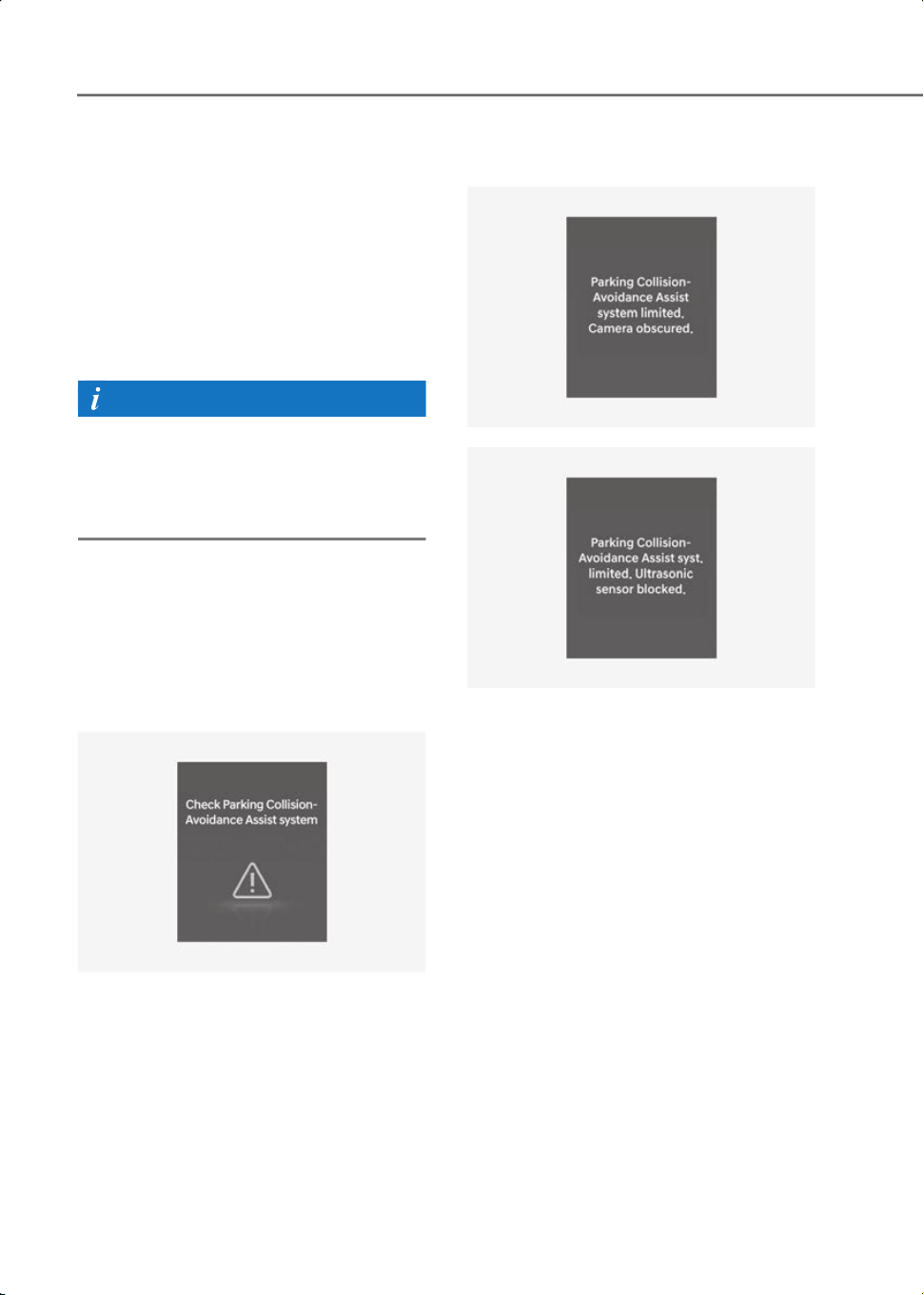
Driver Assistance System
7-136
Rear Safety
Braking assist is released after 5 minutes.
Immediately depress the brake pedal and
check vehicle surroundings.
Braking assist is also released in the
following conditions when:
• The gear is shifted to P (Park) or D
(Drive)
• The brake pedal is depressed with
sufficient power
Information
When Parking Collision-Avoidance Assist
is activated while reversing, braking
control will be released after 5 minutes
and the Electronic Parking Brake (EPB)
will be engaged.
Parking Collision-Avoidance
Assist Malfunction and
Limitations
Parking Collision-Avoidance Assist
malfunction
B7008101
When Parking Collision-Avoidance Assist
or other related functions are not working
properly, the ‘Check Parking
Collision-Avoidance Assist system’
warning message will appear on the
instrument cluster, and Parking
Collision-Avoidance Assist will turn off
automatically. Have the vehicle inspected
by an authorized HYUNDAI dealer.
Parking Collision-Avoidance Assist
disabled
B7008102
B7008103
The ‘Parking Collision-Avoidance Assist
system limited. Camera obscured’ or
‘Parking Collision-Avoidance Assist syst.
limited. Ultrasonic sensor blocked’
warning message will appear on the
instrument cluster if the following
situations occur:
• The camera(s) or ultrasonic sensor(s) is
covered with foreign material, such as
snow or rain, etc.
• There is inclement weather, such as
heavy snow, heavy rain, etc.
If this occurs, Parking
Collision-Avoidance Assist may turn off or
may not operate properly. Check whether
the cameras and ultrasonic sensors are
clean.
CE_USA.book Page 136

7
7-137
Limitations of Parking
Collision-Avoidance Assist
Parking Collision-Avoidance Assist may
not assist braking or warn the driver even
if there are pedestrians or objects under
the following circumstances:
• Problems with vehicle
- Any non-factory equipment or
accessory is installed
- Your vehicle is unstable due to an
accident or other causes
- Bumper height or rear ultrasonic
sensor installation has been modified
- Wide view camera(s) or ultrasonic
sensor(s) is damaged
- Wide view camera(s) or the
ultrasonic sensor(s) is stained with
foreign material, such as snow, dirt,
etc.
- Wide view camera(s) is obscured by a
light source or by inclement weather,
such as heavy rain, fog, snow, etc.
- Your vehicle height is low or high due
to heavy loads, abnormal tire
pressure, etc.
• Problems with the surroundings
- The surrounding is very bright or very
dark
- Outside temperature is very high or
very low
- The wind is either strong (above 12
mph (20 km/h)) or blowing
perpendicular to the rear bumper
- Objects generating excessive noise,
such as vehicle horns, loud
motorcycle vehicles or truck air
brakes, are near your vehicle
- An ultrasonic sensor with similar
frequency is near your vehicle
- The road is slippery or inclined
- The image of the pedestrian in the
front view camera is
indistinguishable from the
background
• Problems with pedestrian or object
- The pedestrians are difficult to detect
- There is ground height difference
between the vehicle and the
pedestrian
- The pedestrian is near the rear edge
of the vehicle
- The pedestrian is not standing
upright
- The pedestrian is either very short or
very tall to detect
- The pedestrian or cyclist is wearing
clothing that easily blends into the
background, making it difficult to
detect
- The pedestrian is wearing clothing
that does not reflect ultrasonic waves
well
- Size, thickness, height, or shape of
the object does not reflect ultrasonic
waves well (for example, low object,
narrow object, circular pillar, small
pillar, corners of a square pillar, bush,
curbs, carts, edge of a wall, etc.)
- The pedestrian or the object is
moving
- The pedestrian or the object is very
close to the rear of the vehicle
- There is a large object such as a wall
is behind the pedestrian or the object
- The object is not located at the front
or rear center of your vehicle
- The object is not parallel to the rear
bumper
- The sensors cannot detect the
pedestrians and objects
• Problems with driving condition
- The driver drives the vehicle
immediately after shifting to R
(Reverse) or D (Drive)
- The driver accelerates or circles the
vehicle
CE_USA.book Page 137

Driver Assistance System
7-138
WARNING
Take the following precautions when
using Parking Collision-Avoidance Assist:
• Always exercise extreme caution while
driving. The driver is responsible for
braking and safe driving.
• Always pay attention to road and traffic
conditions while driving, whether or not
there is a warning.
• Always look around your vehicle to
make sure there are no pedestrians or
objects before moving the vehicle.
• The performance of Parking
Collision-Avoidance Assist may vary
under certain conditions. If vehicle
speed is above 2 mph (4 km/h), Parking
Collision-Avoidance Assist will provide
collision avoidance assist only when
pedestrians are detected. Always look
around and pay attention when driving
your vehicle.
• Parking Collision-Avoidance Assist may
operate differently under certain
conditions. If the vehicle moves
forward and backward repeatedly,
Parking Collision-Avoidance Assist may
fail to assist braking or to warn the
driver. Always pay attention when
driving your vehicle.
• Some objects may not be detected by
the rear ultrasonic sensors due to the
objects distance, size or material, all of
which can limit the effectiveness of the
sensor.
• Parking Collision-Avoidance Assist may
not operate properly or may operate
unnecessarily depending on the road
conditions and the surroundings.
• Do not solely rely on Parking
Collision-Avoidance Assist. Doing so
may lead to vehicle damage or injuries.
CAUTION
• Noise may be heard when sudden
braking occurs to avoid a collision.
• If any other warning sound such as the
seat belt warning chime is already
generated, Parking
Collision-Avoidance Assist warning
may not sound.
• Parking Collision-Avoidance Assist may
not work properly if the bumper has
been damaged, replaced or repaired.
• Parking Collision-Avoidance Assist may
not operate properly if interfered by
strong electromagnetic waves.
• Playing the vehicle audio system at
high volume may prevent passengers
from hearing Parking
Collision-Avoidance Assist warning
sounds.
• Turn off Parking Collision-Avoidance
Assist when towing a trailer. If towing
and moving in reverse, Parking
Collision-Avoidance Assist will activate
as it detects the trailer.
• The brake control may not operate
properly depending on the status of
ESC (Electronic Stability Control).
There will only be a warning when:
- The ESC (Electronic Stability Control)
warning light is on
- ESC (Electronic Stability Control) is
engaged in a different function
CE_USA.book Page 138

7
7-139
CAUTION
Take the following precautions to
maintain optimal performance of the
detecting sensors:
• Always keep the wide view cameras
and ultrasonic sensors clean.
• Do not use any cleanser containing acid
or alkaline detergents when cleaning
the camera lens. Use only a mild soap or
neutral detergent, and rinse thoroughly
with water.
• Do not spray the wide view cameras or
the rear ultrasonic sensors or their
surrounding area directly with a high
pressure washer. It may cause the wide
angle cameras or the ultrasonic sensors
to malfunction.
• Do not apply objects, such as a bumper
sticker or a bumper guard, near the
wide angle cameras or ultrasonic
sensors or apply paint to the bumper.
Doing so may adversely affect the
performance of Parking
Collision-Avoidance Assist.
• Never disassemble or apply impact on
the wide angle cameras or the
ultrasonic sensors components.
• Do not apply unnecessary force on the
wide view cameras or the ultrasonic
sensors. Parking Collision-Avoidance
Assist may not operate properly if the
wide angle cameras or the ultrasonic
sensor(s) is forcibly moved out of
proper alignment. Have the vehicle
inspected by an authorized HYUNDAI
dealer.
Information
Parking Collision-Avoidance Assist can
detect a pedestrian or an object when:
• A pedestrian is standing behind the
vehicle
• A large obstacle, such as a vehicle is
parked in the rear center of your vehicle
CE_USA.book Page 139
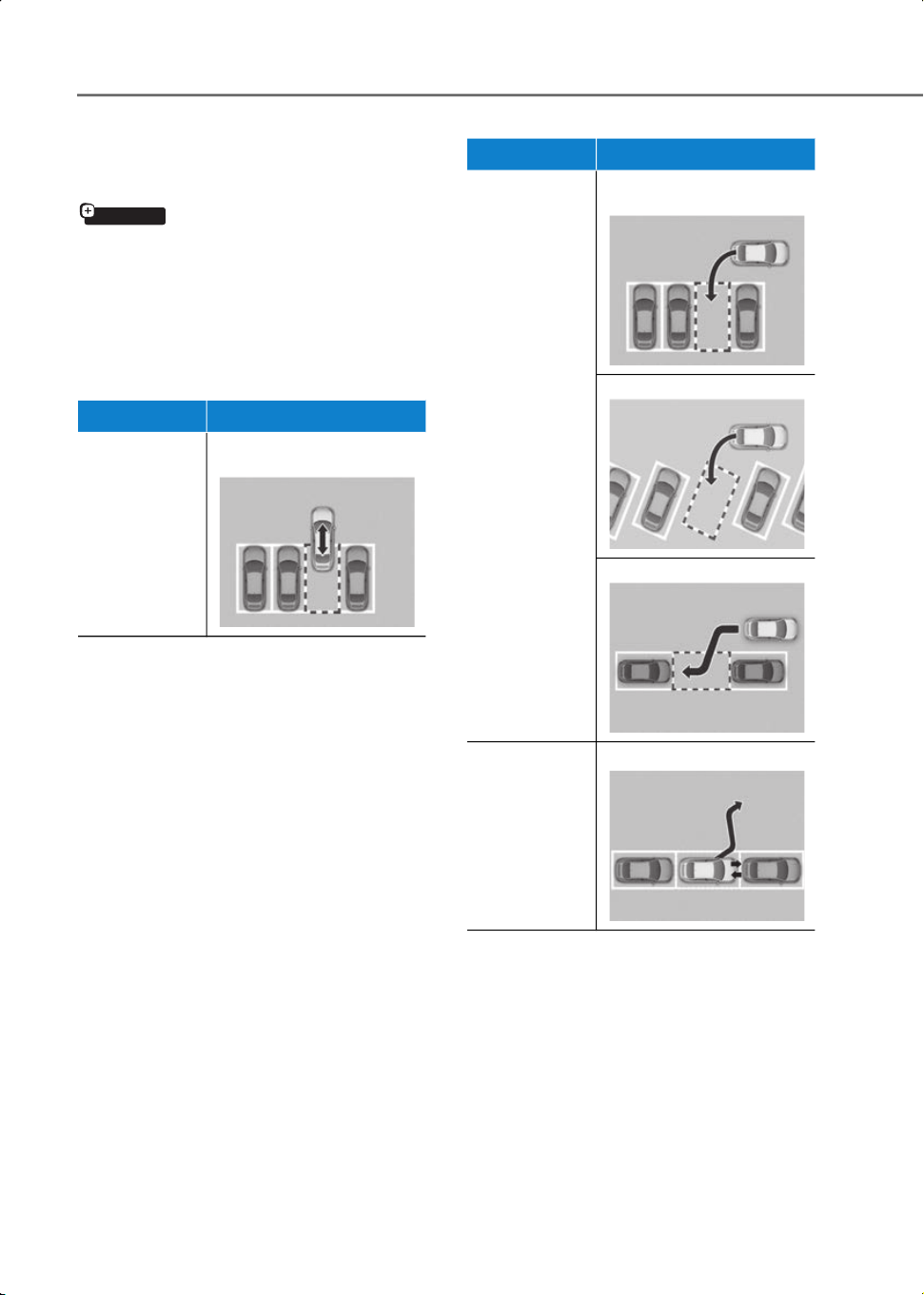
Driver Assistance System
7-140
Remote Smart Parking
if equipped
Assist 2 (RSPA 2)
Remote Smart Parking Assist uses the
front, front side, rear side, and rear
ultrasonic sensors to detect parking
spaces and control vehicle steering,
speed, gear shifts, and help enter and exit
parking spaces remotely from outside
your vehicle.
• Remote Smart Parking and Remote
Operation function may be operated
from outside the vehicle using the
smart key.
• Smart Parking and Smart Exit function
may be operated from inside the
vehicle.
• Smart Parking and Remote Smart
Parking function helps the driver with
perpendicular reverse parking,
diagonal reverse parking and parallel
reverse parking.
Function Description
Remote
Operation
Remotely moving
forward or backward
Smart Parking
or Remote
Smart Parking
Perpendicular reverse
parking
Diagonal reverse parking
Parallel reverse parking
Smart Exit
Parallel forward exit
Function Description
CE_USA.book Page 140
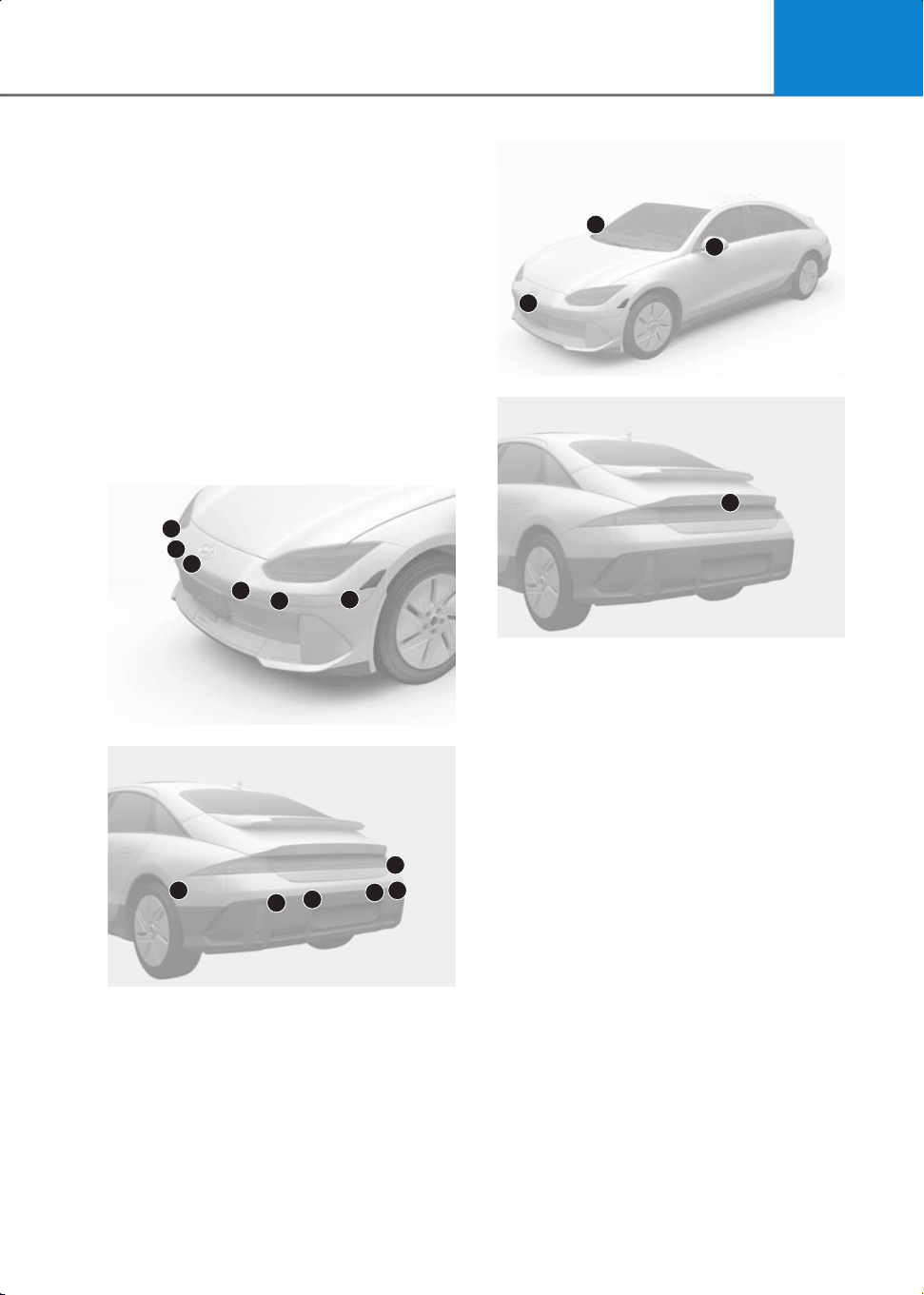
7
7-141
• Smart Exit function helps the driver
with parallel forward exit.
• When Remote Smart Parking Assist
operates, Parking Distance Warning
and Surround View Monitor will also
operate. For more information, refer to
the "Forward/Side/Reverse Parking
Distance Warning (PDW)" and
"Surround View Monitor (SVM)"
sections in this chapter.
• Remote Smart Parking Assist helps
parking by recognizing the parking lines
with the wide angle camera.
Detecting sensors
B7008606
B7008607
(1) Front ultrasonic sensors
(2) Front corner ultrasonic sensors
(3) Rear corner ultrasonic sensors
(4) Rear ultrasonic sensors
Refer to the picture above for the detailed
location of the detecting sensors.
B7008608
B7008609
(1) Wide-front view camera
(2) Wide-side view camera
(3) Wide-side view camera
(4) Wide-rear view camera
Refer to the picture above for the detailed
location of the detecting sensors.
1
2
2
1
1
1
4
3
4
4
4
3
2
3
1
4
CE_USA.book Page 141
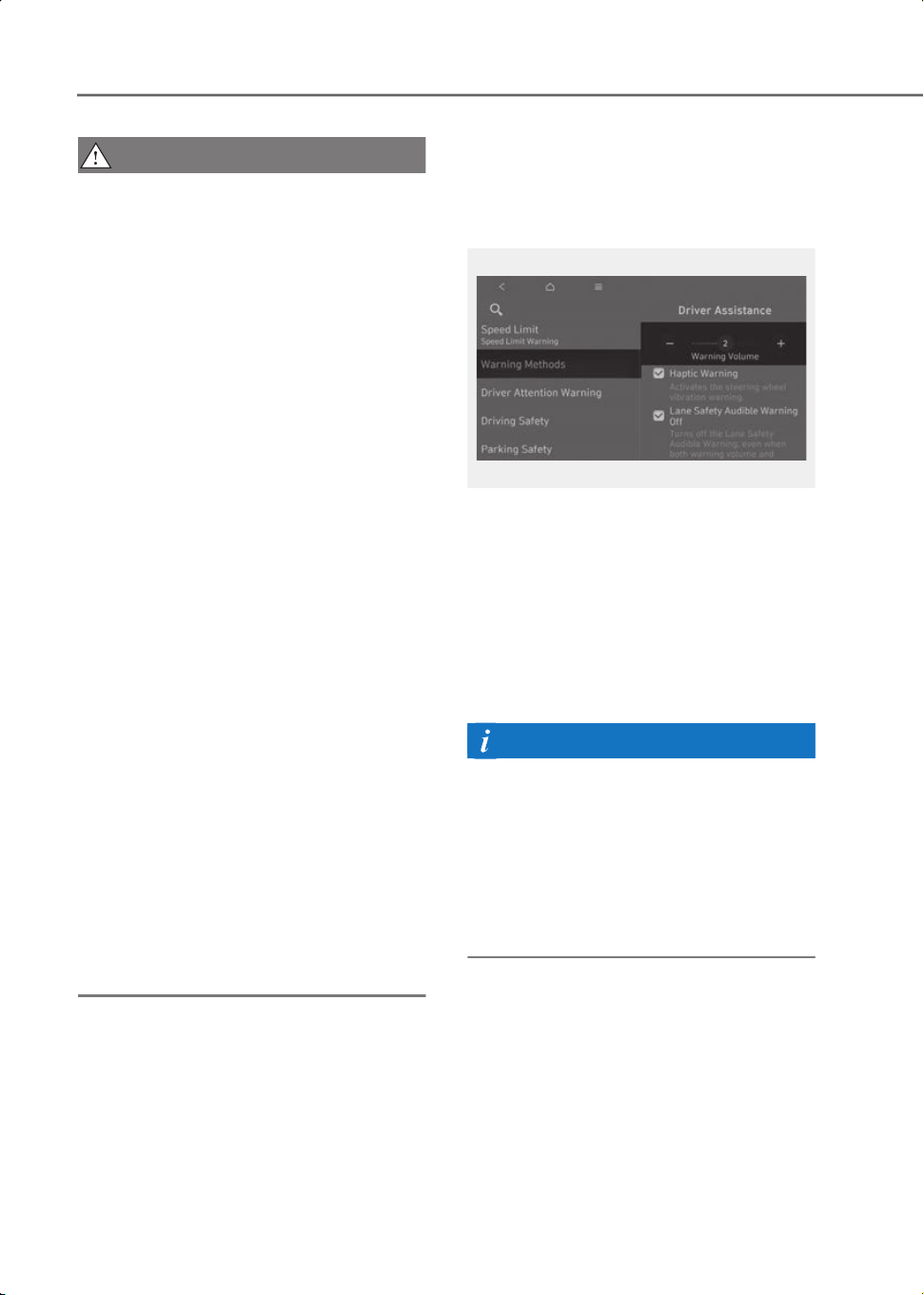
Driver Assistance System
7-142
CAUTION
Take the following precautions to
maintain optimal performance of the
detecting sensors:
• Never disassemble the ultrasonic
sensor or sensor assembly, or cause
any damage to it.
• Remote Smart Parking Assist may
malfunction if the vehicle bumper
height or ultrasonic sensor installation
has been modified or damaged. Any
non-factory installed equipment or
accessories may also interfere with the
sensor performance.
• When the ultrasonic sensor is frozen or
stained with snow, dirt, or water, the
sensor may not operate until the stains
are removed using a soft cloth.
• Do not push, scratch, or strike the
ultrasonic sensor. Sensor damage
could occur.
• Do not spray the ultrasonic sensors or
its surrounding area directly with a high
pressure washer.
• Always keep the camera lens clean. If
the lens is covered with foreign
material, it may adversely affect
camera performance and Remote
Smart Parking Assist may not operate
properly.
• Do not manually adjust the side view
mirror or use Remote Smart Parking
Assist after a hard impact on the side
view mirror. When a collision occurs or
the side view mirror is manually
operated, Remote Smart Parking Assist
may not operate properly.
Remote Smart Parking Assist
Settings
Warning Methods
B7002602
With the vehicle on, go to Setup > Vehicle
> Driver Assistance > Warning Methods
from the Settings in the infotainment
system to select the following:
• Warning Volume: The Warning Volume
can be adjusted.
If you turn off the Warning Volume, for
your safety, the function may warn you
with a low volume.
Information
• If you change the Warning Methods,
Warning Methods of other Driver
Assistance systems may change.
• If the vehicle is restarted, Warning
Methods will maintain the last setting.
• There may be no Settings menu
depending on the feature applied to
your vehicle.
CE_USA.book Page 142
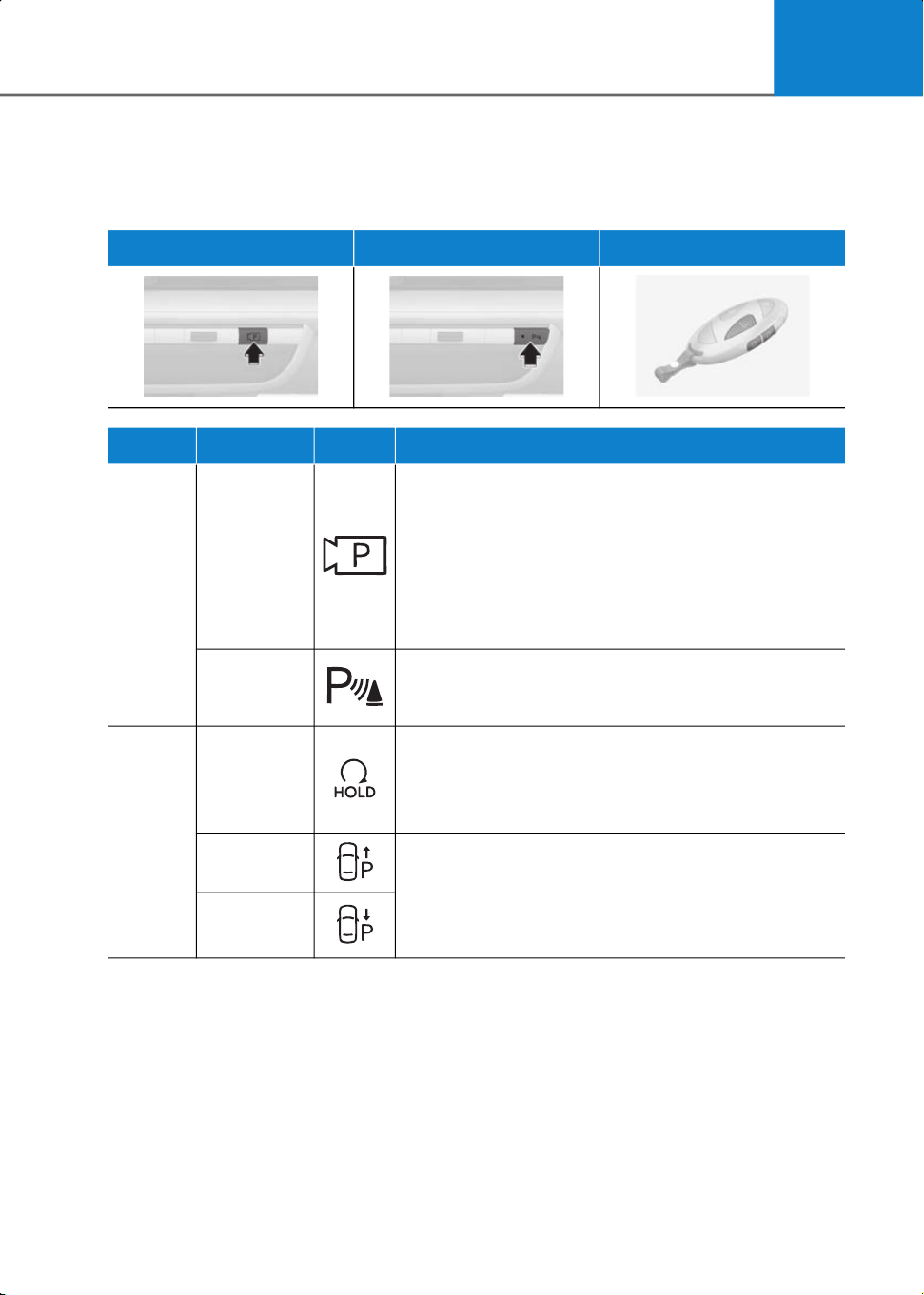
7
7-143
Remote Smart Parking Assist Operation
Remote Smart Parking Assist button
Parking/View Button Parking Safety Button Smart Key
Location Name Symbol Description
Inside
vehicle
Parking/Vie
w button
• Press and hold the Parking/View button to turn on
Remote Smart Parking Assist. Also, Forward/Reverse
Parking Distance warning will automatically turn on.
However, functions may differ depending on the
situations. Refer to the each function's description for
more information in the following pages.
• Press and hold the Parking/View button while Smart
Parking or Smart Exit function is on to operate the
function.
Parking
Safety
button
• Press the Parking Safety button while Remote Smart
Parking Assist is operating to end Remote Smart
Parking Assist operation.
Smart
key
Remote
Start button
• Press the Remote Start button after the door is locked
with the vehicle off to start the vehicle remotely.
• Press the Remote Start button while Remote Smart
Parking or Remote Operation function is operating to
end function operation.
Forward
button
• When using Remote Smart Parking function,
regardless of which direction button is pressed,
parking is supported while the button is pressed.
• When using the Remote Operation function, the
vehicle moves in the direction of the button while the
button is pressed.
Backward
button
CE_USA.book Page 143
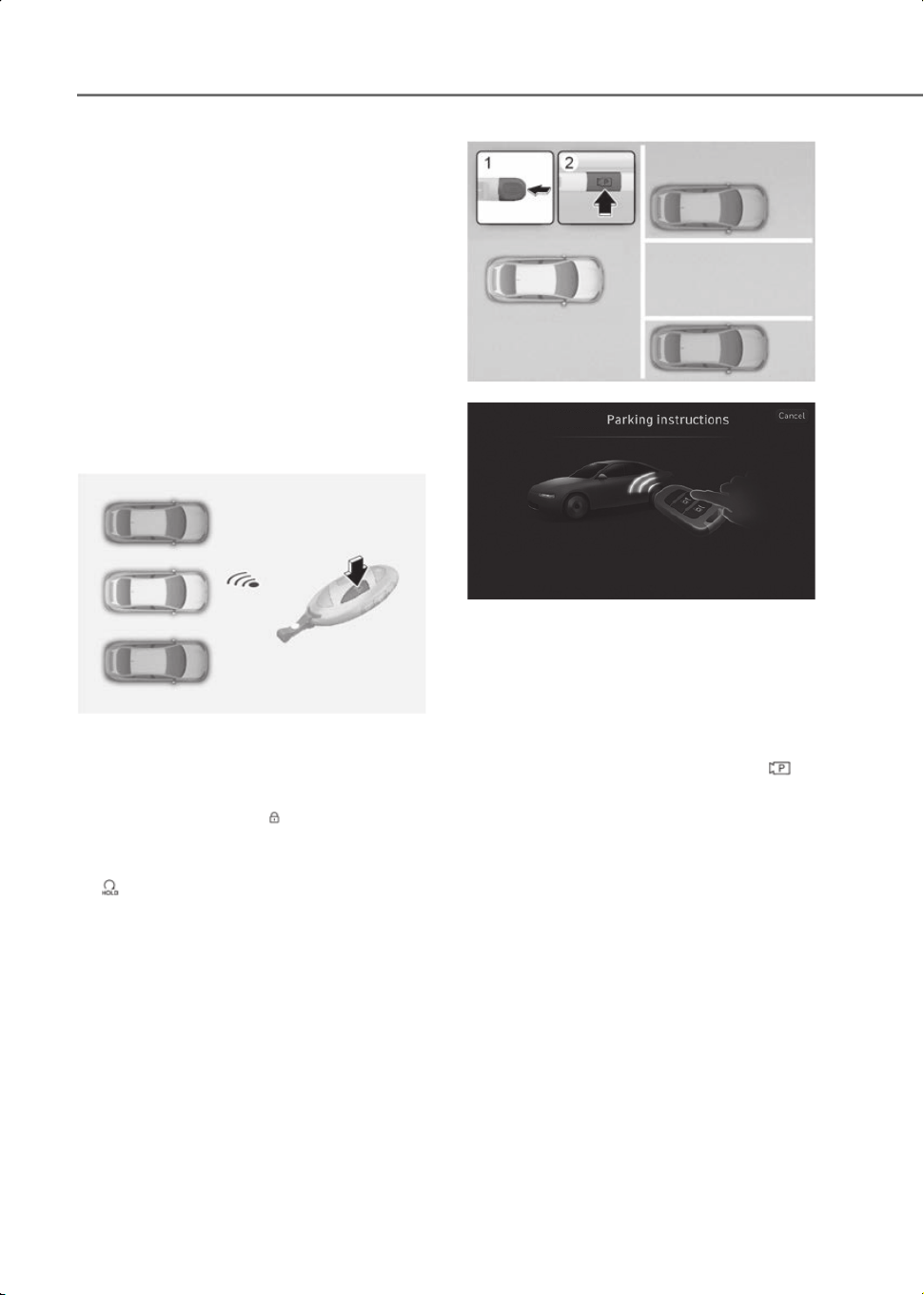
Driver Assistance System
7-144
Remote Operation
Operating order
Remote Operation operates in the
following order:
1. Getting ready to remotely move
forward and backward
2. Remotely moving forward and
backward
1. Getting ready to remotely move
forward and backward
There are two ways to operate Remote
Operation function.
B7008809
Method 1. Using the function with vehicle
off
• Within a certain range from the vehicle
press the door lock ( ) button on the
smart key and lock all doors.
• Press and hold the Remote Start button
( ) within 4 seconds until the vehicle
starts.
For more information on remotely
starting the vehicle, refer to the "Remote
Start" section in chapter 6.
B7008810
B7008811
Method 2. Using the function with vehicle
on
1. Park the vehicle in front of the space
where you want to use Remote
Operation function, and shift the gear
to P (Park).
2. Press and hold the Parking/View ( )
button to turn on Smart Parking Assist.
• A message Remote Parking
instructions will appear on the
infotainment system.
3. Get out of the vehicle with the smart
key and close all doors.
6IQSXI
0IEZIZILMGPIOIITXLIWQEVXOI]'PSWIEPPHSSVW
4VIWWERHLSPHXLI*SV[EVHSV&EGO[EVHFYXXSRSRXLIWQEVXOI]
CE_USA.book Page 144
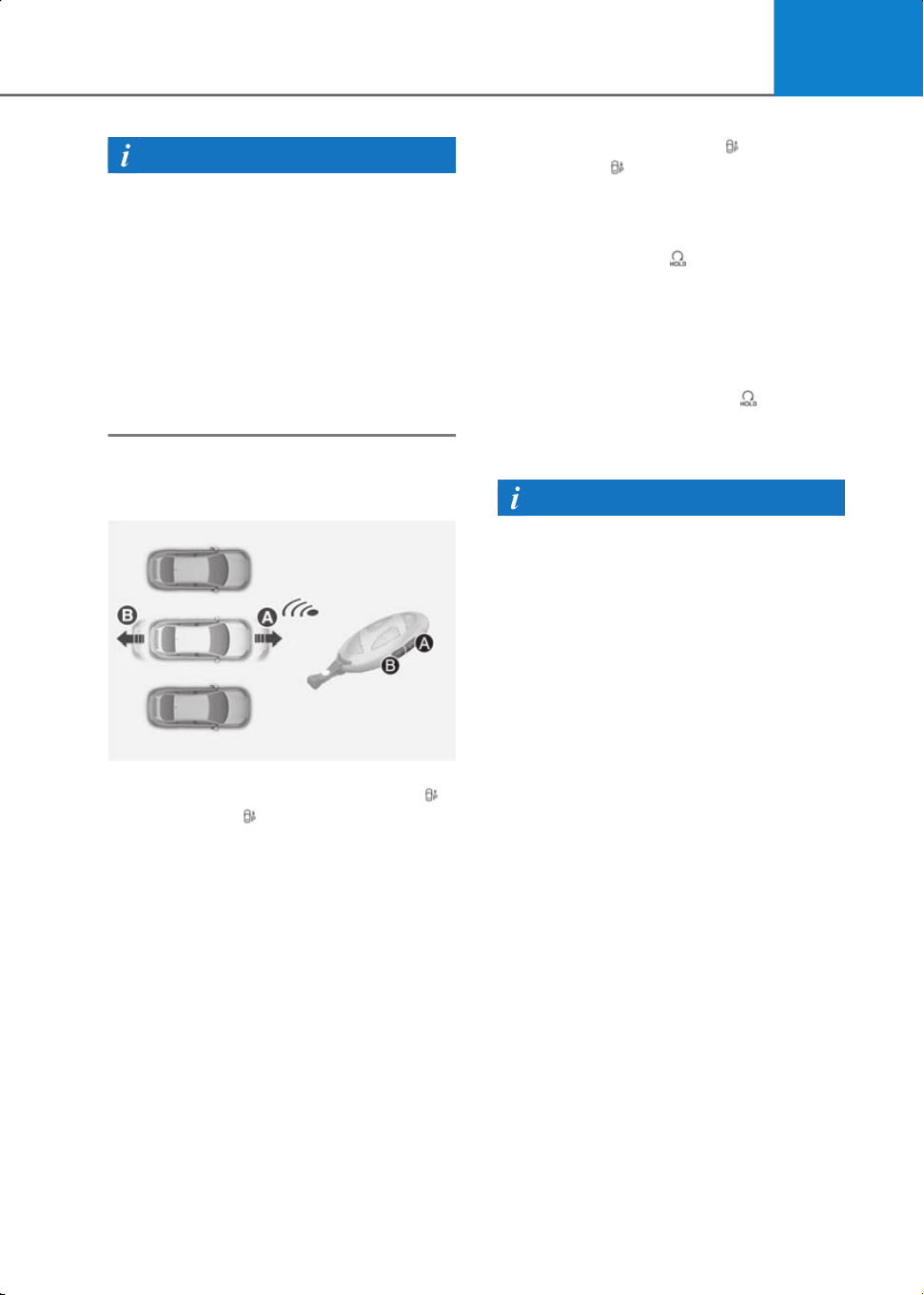
7
7-145
Information
• Agree must be selected on the
infotainment system and the
infotainment system has to operate
properly to use Remote Operation
function.
• Method 2 can be used after the vehicle
has been driven above 3 mph (5 km/h).
• If the function is turned on again after
parking is completed by Remote Smart
Parking Assist, Remote Operation
function can be used with Method 2.
2. Remotely moving forward and
backward
B7008812
1. Press and hold one of the Forward ( )
or Backward ( ) button on the smart
key.
• Remote Smart Parking Assist will
automatically control the steering
wheel, vehicle speed and gearshift.
The vehicle will move in the direction
of the button pressed.
• While Remote Operation function is
operating, if the you let the button,
the vehicle will stop and function
control will pause. The function will
start operating again when the
button is pressed and held again.
2. Hold down the Forward ( ) or
Backward ( ) button until the vehicle
reaches the target location.
3. When Remote Operation is done, get in
the vehicle with the smart key or press
the Remote Start ( ) button on the
smart key from outside the vehicle.
• The message will appear on the
infotainment system. The vehicle will
automatically shift to P (Park) and
engage the parking brake.
• When the Remote Start ( ) button is
pressed, the vehicle will turn off. If
the driver is in the vehicle, the vehicle
will retain ON position.
Information
• Remote Operation can control the
vehicle remotely using the smart key
outside the vehicle.
• Check that all smart keys are outside
the vehicle when using Remote
Operation function.
• Remote Operation function will operate
only when the smart key is within 13 ft.
(4 m) from the vehicle. If there is no
vehicle movement even when the
Forward or Backward button is pressed
on the smart key, check the distance to
the vehicle and press the button again.
• The detecting range of the smart key
may vary depending on the
surroundings that are affected by radio
waves such as transmission tower,
broadcast station, etc.
• When remotely moving forward using
Method 1, it is recognized as an exit
situation, and the vehicle moves 13 ft. (4
m) to check for parking lines,
pedestrians, animals or objects around
the vehicle. After confirmation, the
steering wheel is controlled according
to the condition ahead.
CE_USA.book Page 145
Driver Assistance System
7-146
• When remotely moving forward using
Method 2, it is recognized as a parking
situation, and will immediately control
the steering wheel according to the
condition ahead to assist with entering
the parking space and aligning the
vehicle. However, performance may
reduce depending on the parking lines,
pedestrians, animals, shape of objects,
location, etc., around the vehicle.
• For moving remotely backward, both
Method 1 and 2 aligns the steering
wheel first, and then will only move the
vehicle straight.
WARNING
• When using Remote Operation
function, make sure that all passengers
have gotten out of the vehicle.
• If the vehicle’s battery is discharged or
Remote Smart Parking Assist
malfunctions when parked in a narrow
parking space, Remote Operation
function will not operate. Always park
your vehicle in a space wide enough for
you to get in or out of your vehicle.
• Please note that depending on the
parking space, you may not be able to
exit from the space you have entered
by using Remote Operation function.
• After parking, the surrounding may
change due to the movement of
surrounding vehicles. If this occurs,
Remote Operation function may not
operate.
• Before leaving the vehicle, close
windows and sunroofs, and make sure
the vehicle is off before locking the
doors.
Remote Operation function operation
status
Information
• Operation status by the hazard warning
light may not be applicable based on
the regulation of your state.
• If the smart key is not within the
operating range from the vehicle
(about 13 ft. (4 m)), the smart key LED
will not illuminate or blink. Use the
smart key within the operating range.
How to turn off Remote Operation function
while operating
• Press the Parking/View ( ) button
while the infotainment system guides
the driver using method 2.
• Shift the gear from P (Park) to any other
position while the infotainment system
guides the driver using method 2.
• Press the Parking Safety ( ) button or
select Cancel on the infotainment
system.
Operation
Status
Smart Key LED
Hazard
Warning
Light
Under
control
Green LED
continuously
blinks
-
Pause
Red LED
continuously
blinks
Blinks
Off
Red LED
illuminates for
4 seconds and
then turns off
Blinks 3
times and
turns off
Complete
Green LED
illuminates for
4 seconds and
then turns off
Blinks 1
time and
turns off
CE_USA.book Page 146

7
7-147
• Press the Remote Start ( ) button on
the smart key while the vehicle is being
controlled by Remote Operation
function. Remote Operation function
will turn off. At this time, the vehicle will
turn off.
• Get on the vehicle with the smart key.
Remote Operation function will turn
off. At this time, the vehicle will remain
on.
The function will pause in the following
conditions when:
• There is a pedestrian, animal or object
in the direction the vehicle is moving
• The door or trunk is open
• The Forward ( ) or Backward ( )
button is not continuously pressed
• Simultaneously pressing multiple
buttons on a smart key
• The smart key is not operated within 13
ft. (4 m) from the vehicle
• Button of another smart key is pressed
in addition to the operating smart key
(except Remote Start button)
• Blind-Spot Collision Warning or Rear
Cross-Traffic Collision-Avoidance
Assist operates while the vehicle is
being controlled in the reverse
direction.
• The vehicle moves 22 ft. (7 m) while the
smart key is pressed with Remote
Operation function (maximum travel
distance per button press)
The function will cancel in the following
conditions when:
When Remote Operation function is
canceled, the vehicle will automatically
stop, shift the gear to P (Park) and engage
EPB (Electronic Parking Brake).
• The steering wheel is steered
• The gear is shifted while the vehicle is
moving
• Operating EPB while the vehicle is
moving
• The hood is open
• The brake pedal or accelerator pedal is
depressed when all the doors are
closed
• The smart key is outside the vehicle
when the brake pedal is depressed
while the driver's door is open
• Rapid acceleration occurs
• Vehicle skid occurs
• The wheel is stuck by an obstacle and
cannot move
• About 3 minutes and 50 seconds has
passed after Remote Operation
function has started to operate
• The slope of the road exceeds the
operational range
• The function is paused for more than 1
minute
• The total travel distance of the vehicle
has exceeded 45 ft. (14 m) after Remote
Operation function operation
• The steering wheel, gearshift, braking,
and drive controls are not working
properly
• There is a problem with the smart key or
the smart key battery is low
• ABS, TCS or ESC system operates due
to slippery road conditions
• The alarm of the Theft Alarm System
sounds
• The charging door is open
CE_USA.book Page 147
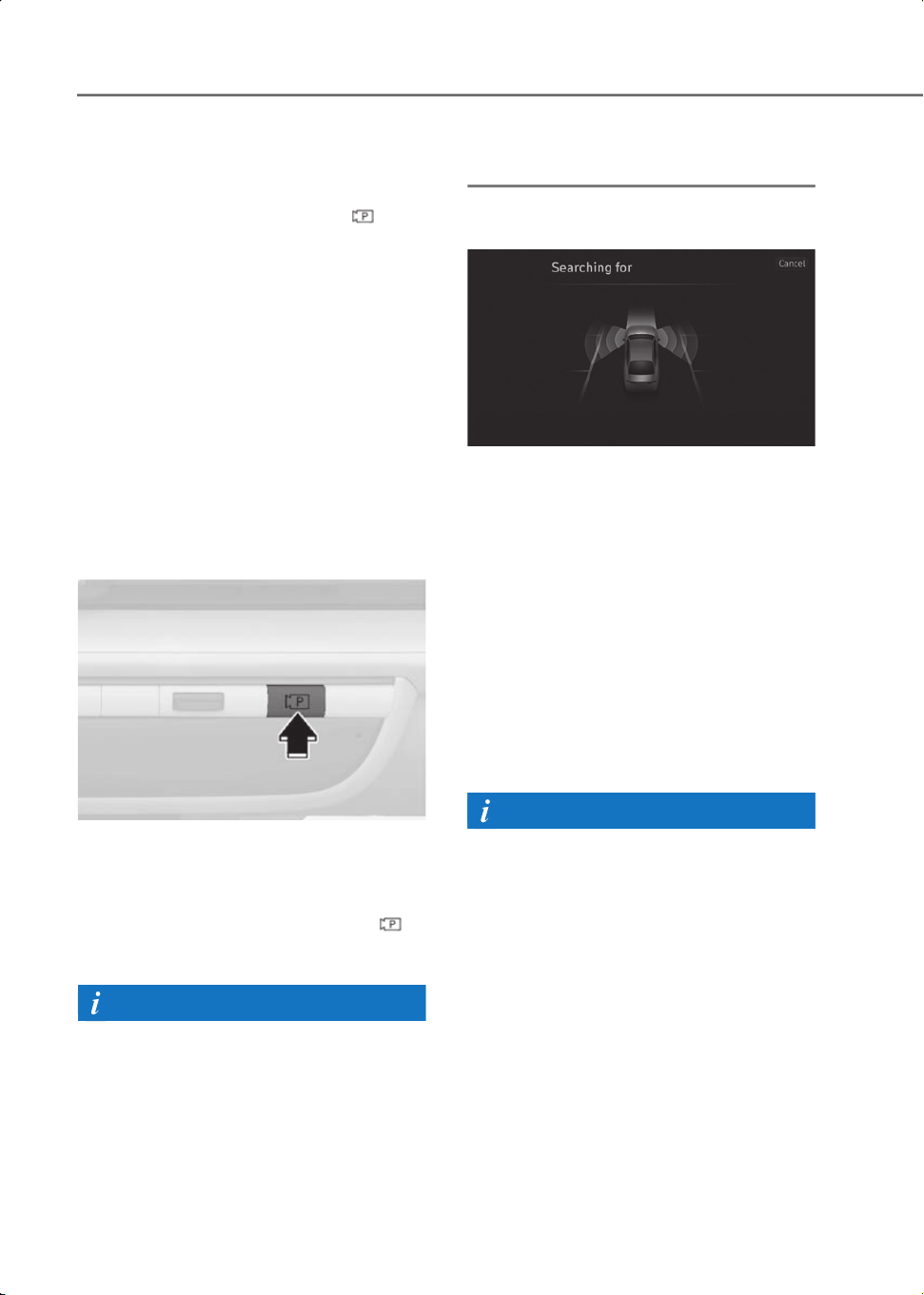
Driver Assistance System
7-148
Smart Parking, Remote Smart
Parking
The parking function includes Smart
Parking using the Parking/View ( )
button and Remote Smart Parking using a
smart key.
Operating order
Parking function operates in the following
order:
1. Getting ready for parking
2. Searching for parking space
3. Select parking type and operating
mode
4. Smart Parking
5. Remote Smart Parking
1. Getting ready for parking
B7008901
1. With the vehicle turned on, depress the
brake pedal and shift the gear to D
(Drive) or N (Neutral).
2. Press and hold the Parking/View ( )
button to turn on Remote Smart
Parking Assist.
Information
• Agree must be selected on the
infotainment system and the
infotainment system has to operate
properly to use Parking function.
• If you drive above 3 mph (5 km/h) with
the vehicle on, you may use the Parking
function with the gear shifted to N
(Neutral).
2. Searching for parking space
B7008902
Slowly drive forward maintaining the
distance of about 40 in. (100 cm) from the
parked vehicles.
Searches for a parking space by detecting
the parking lines or the spaces next to or
in front and behind the parked vehicles.
When searching for a parking space is
complete, a message will appear on the
infotainment system with an audible
sound to notify the search is complete.
Select Parking Type will be displayed on
the infotainment system and the selected
parking space will appear on Top View
screen of Surround View Monitor.
Information
• Remote Smart Parking Assist can only
search for parking spaces when parking
lines are visible or when there are
parked vehicles, and the empty spaces
created after driving or the empty
spaces in front of a vehicle that has not
yet been driven cannot be searched as
the a parking space.
• While searching for a parking space,
when vehicle speed is above 12 mph (20
km/h), a message will appear on the
infotainment system informing you to
slow down. When vehicle speed is
above 18 mph (30 km/h), Parking
function will turn off.
4EVOMRK7TEGI
(VMZIJSV[EVHWPS[P]ERHOIITMRKGPSWIVXSXLIWMHISR[LMGL]SY
[ERXXSTEVO
CE_USA.book Page 148
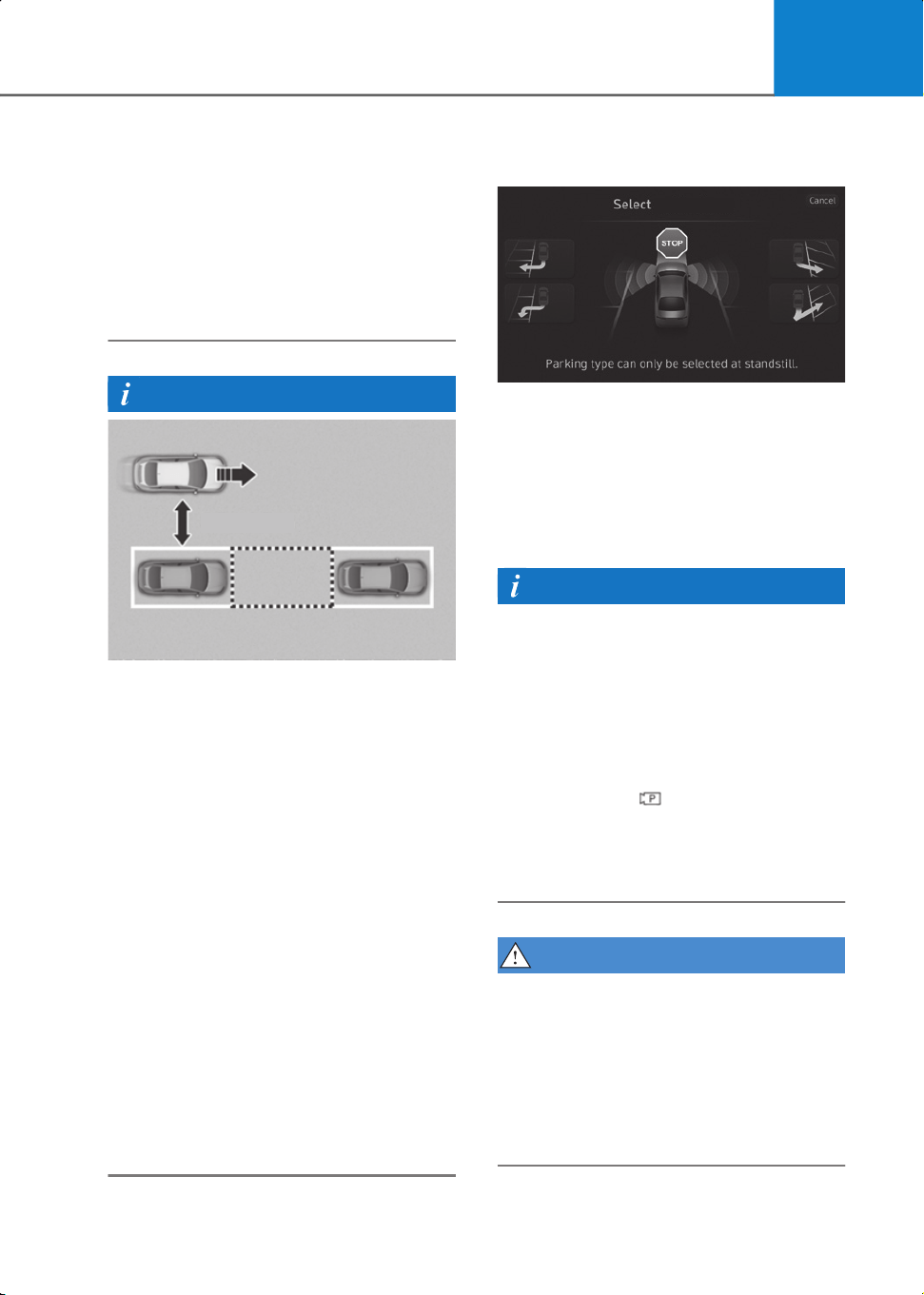
7
7-149
• Searching for a parking space will be
completed when there is enough space
to move the vehicle in addition to the
parking space.
• Even if an audible sound is heard to
notify that searching for a parking
space is complete, search completion
can be cancelled immediately
depending on surroundings.
Information
B7008903
• If the distance is below 20 in. (50 cm) or
over 59 in. (150 cm), Remote Smart
Parking Assist may not be able to
search for a parking space.
• If you do not maintain a certain
distance from the parked vehicle, the
performance to search for a parking
space may reduce.
• Due to abnormal performance of the
ultrasonic sensor or the influence of the
surroundings, Parking function may not
be able to search for a parking space
even if there is a parking space, or may
search for a space that is not suitable
for parking.
• If the parking space is on a incline or is
diagonal, the parking type displayed
may be different from the actual
parking type which should be selected.
If this occurs, do not select the parking
type, and search for another parking
space.
3. Select parking type and operating
mode
B7008904
• Parking type - Perpendicular reverse
(Left/Right), Parallel reverse
(Left/Right)
With the vehicle stopped by depressing
the brake pedal, touch the infotainment
system to select the desired parking
type.
Information
• If you continue to drive without
stopping after the parking type
selection screen appears, Remote
Smart Parking Assist will return to the
previous stage and search for a parking
space.
• If Parking function is cancelled
unintentionally by pressing the
Parking/View ( ) button before the
parking type is selected, you can return
to the parking type selection stage by
pressing and holding the button again
while the vehicle is stopped.
WARNING
Before selecting the Parking type, the
driver should check whether the parking
space is suitable.
If the searched parking space by Remote
Smart Parking Assist is narrow or
unsuitable for parking, do not select the
Parking type and move the vehicle to
search for another parking space.
bMRGLIWbMRGLIW
4EVOMRK8]TI
CE_USA.book Page 149
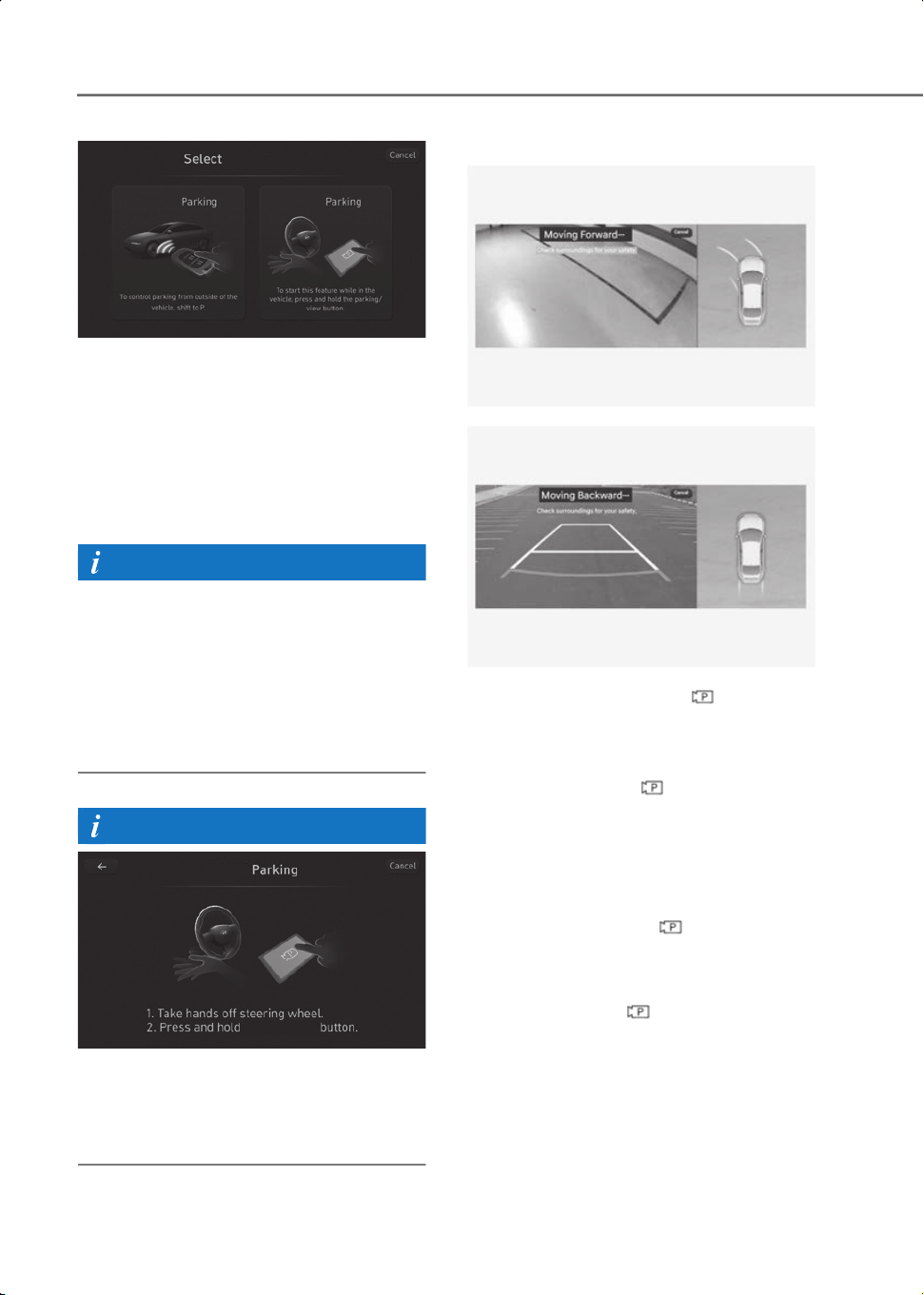
Driver Assistance System
7-150
B7008905
• Operating mode - Remote Parking,
Smart Parking
After selecting a parking type, the
infotainment system will guide you
with Remote Smart Parking function
and Smart Parking function. Follow the
instructions to operate Remote Smart
Parking Assist.
Information
• Operating instructions will be displayed
on the screen for each desired function
you select.
• Do not take your foot off the brake
pedal during the Parking function
guide. When the vehicle moves,
Remote Smart Parking Assist will turn
off.
Information
B7008906
If Remote Smart Parking Assist cannot
activate Remote Smart Parking function,
only the Smart Parking guide will be
displayed on the infotainment system.
4. Smart Parking
B7008907
B7008908
1. Press the Parking/View ( ) button
when the vehicle is stopped by
depressing the brake pedal.
2. Release the brake pedal while pressing
the Parking/View ( ) button.
• Remote Smart Parking Assist will
automatically control the steering
wheel, vehicle speed and gearshift.
• While Smart Parking function is
operating, if you do not hold down
the Parking/View ( ) button, the
function will stop and function
control will pause. The function will
start operating again when the
Parking/View ( ) button is pressed
and held again.
3TIVEXMRK1SHI
6IQSXI 7QEVX
4EVOMRK:MI[
7QEVX
CE_USA.book Page 150
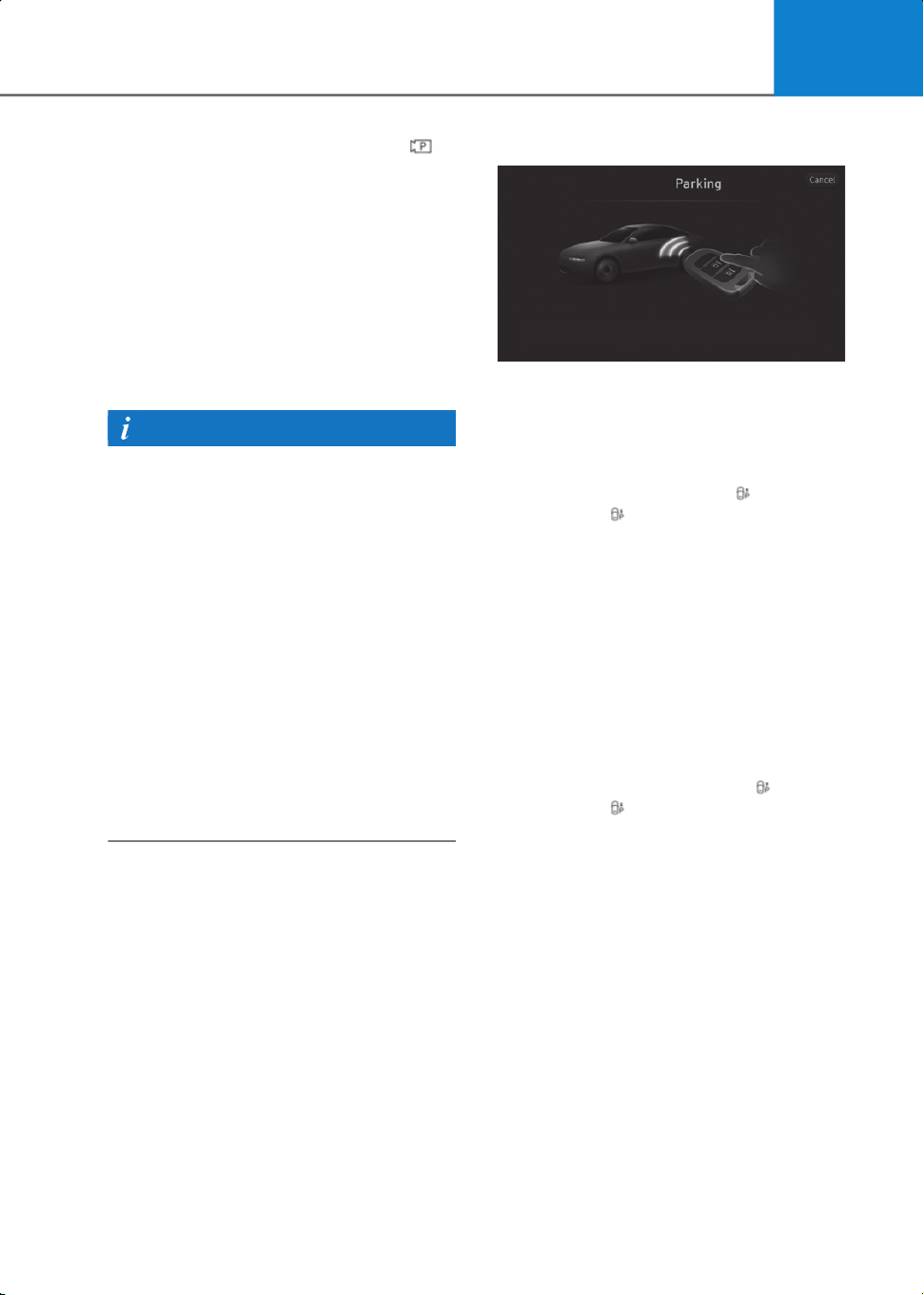
7
7-151
3. Press and hold the Parking/View ( )
button until parking is completed.
• When the vehicle reaches the target
parking position, a message will
appear on the infotainment system to
inform you that parking is complete.
The vehicle will automatically shift to
P (Park) and engage EPB (Electronic
Parking Brake).
4. If you need to change the vehicle's
position or location, manually complete
parking your vehicle.
Information
• Smart Parking function will not operate
if the door is open or the seat belt is not
fastened.
• The parking location indicator is
displayed on Surround View Monitor
screen and is displayed until the vehicle
enters the parking space for the first
time by Smart Parking function.
• Vehicle speed can be adjusted by
depressing the brake pedal while Smart
Parking function is operating. However,
the vehicle does not accelerate even
when the accelerator pedal is
depressed.
• Depending on parking environments, if
the vehicle is stopped by a stopper,
parking may be completed.
5. Remote Smart Parking
B7008909
1. Depress the brake pedal and shift the
gear to P (Park).
2. Get out of the vehicle with the smart
key, and close all doors.
3. Press one of the Forward ( ) or
Backward ( ) button on the smart key.
• While pressing the button, Remote
Smart Parking Assist will
automatically control the steering
wheel, vehicle speed and gearshift.
• While Remote Smart Parking
function is operating, if you do not
hold down the button, the vehicle will
stop and function control will pause.
The function will start operating
again when the button is pressed and
held again.
4. Press and hold the Forward ( ) or
Backward ( ) button until parking is
completed.
• When the vehicle reaches the target
parking position, a message will
appear on the infotainment system to
inform you that parking is complete.
The vehicle will automatically shift to
P (Park), engage EPB (Electronic
Parking Brake) and the vehicle will
turn off.
6IQSXI
0IEZIZILMGPIOIITXLIWQEVXOI]'PSWIEPPHSSVW
4VIWWERHLSPHXLI*SV[EVHSV&EGO[EVHFYXXSRSRXLIWQEVXOI]
CE_USA.book Page 151

Driver Assistance System
7-152
5. If you need to change the vehicle's
position or location, manually complete
parking your vehicle.
Information
• When operating Remote Smart Parking
function, make sure all smart keys are
outside of the vehicle.
• Remote Smart Parking function will
operate only when the smart key is
within 13 ft. (4 m) from the vehicle. If
there is no vehicle movement even
when the Remote Forward or Backward
button is pressed on the smart key,
check the distance to the vehicle and
press the button again.
• The detecting range of the smart key
may vary depending on the
surroundings that are affected by radio
waves such as transmission tower,
broadcast station, etc.
• The parking location indicator is
displayed on Surround View Monitor
screen and is displayed until the vehicle
enters the parking space for the first
time by Remote Smart Parking
function.
• Depending on parking environments, if
the vehicle is stopped by a stopper,
parking may be completed.
WARNING
• When using Remote Smart Parking
function, make sure that all passengers
have gotten out of the vehicle.
• After ending or turning off Remote
Smart Parking function, before leaving
the vehicle, close windows and
sunroofs, and make sure the vehicle is
off before locking the doors.
CE_USA.book Page 152

7
7-153
Parking function operation status
• Smart Parking function
• Smart Parking function
Information
• Operation status by the hazard warning light and turn signal may not be available
based on the regulation of your state.
• If the smart key is not within the operating range from the vehicle (about 13 ft. (4 m)),
the smart key LED will not illuminate or blink. Use the smart key within the operating
range.
Operation Status Turn Signal
Under control
The turn signal of the parking direction blinks until the first reverse
is complete.
Operation Status Smart Key LED
Hazard Warning
Light
Turn Signal
Under control
Green LED
continuously blinks
-
The turn signal of the
parking direction
blinks until the first
reverse is complete.
Pause
Red LED
continuously blinks
Blinks -
Off
Red LED illuminates
for 4 seconds and
then turns off
Blinks 3 times and
turns off
-
Complete
Green LED
illuminates for 4
seconds and then
turns off
Blinks 1 time and
turns off
-
CE_USA.book Page 153

Driver Assistance System
7-154
How to turn off Parking function
while operating
• Press the Parking/View ( ) button in
the following stage:
- Searching for parking space
- Select parking type
• Shift the gear to R (Reverse) in the
following stage:
- Searching for parking space
- Select parking type
- Select operating mode
• Press the Parking Safety ( ) button or
select Cancel on the infotainment
system to turn off Parking function.
• While Smart Parking function is
operating:
- If the vehicle is stopped by
depressing the brake pedal, and the
gear is shifted, Parking function will
turn off. At this time, EPB (Electronic
Parking Brake) will not be engaged.
• While Remote Smart Parking function is
operating:
- Press the Remote Start ( ) button on
the smart key. Parking function will
turn off.
Information
Get on the vehicle with the smart key.
Parking function will turn off. At this time,
the vehicle will remain on.
The function will pause in the
following conditions when:
• Smart Parking
- There is a pedestrian, animal or
object in the direction the vehicle is
moving
- The door or trunk is open
- The driver’s seat belt is not fastened
- Blind-Spot Collision-Avoidance
Assist or Rear-Cross Traffic
Collision-Avoidance Assist operates
while the vehicle is being controlled
in the reverse direction
- The Parking/View ( ) button is not
continuously pressed
- The vehicle is stopped by depressing
the brake pedal
• Remote Smart Parking
- There is a pedestrian, animal or
object in the direction the vehicle is
moving
- The door or trunk is open
- The Forward ( ) or Backward ( )
button is not continuously pressed
- Simultaneously pressing multiple
buttons on a smart key
- The smart key is not operated within
13 ft. (4 m) from the vehicle
- Button of another smart key is
pressed in addition to the operating
smart key
- Blind-Spot Collision-Avoidance
Assist, Rear-Cross Traffic
Collision-Avoidance Assist, or
Parking Collision-Avoidance Assist
operates
When Parking function is paused, the
vehicle will automatically stop. If the
condition that made the function to
pause disappears, the function may
operate again.
The function will cancel in the
following conditions when:
• Smart Parking
- The steering wheel is steered
CE_USA.book Page 154

7
7-155
- The gear is shifted while the vehicle is
moving
- Operating EPB while the vehicle is
moving
- The hood is open
- The driver opens the door with the
seatbelt unfastened
- Rapid acceleration occurs
- Vehicle skid occurs
- The wheel is stuck by an obstacle and
cannot move
- There are pedestrians, animals or
objects at the front and rear of the
vehicle at the same time
- About 3 minutes and 50 seconds
have past after Smart Parking
function has started to operate
- The slope of the road exceeds the
operational range
- The function is paused for more than
1 minute
- The steering wheel, gearshift,
braking, and drive controls are not
working properly
- ABS, TCS or ESC system operates due
to slippery road conditions
- The charging door is open
When Smart Parking function is canceled,
the vehicle will automatically stop, shift
the gear to P (Park) and engage EPB
(Electronic Parking Brake).
• Remote Smart Parking
- The steering wheel is steered
- The gear is shifted
- Operating EPB while the vehicle is
moving
- The hood is open
- The brake pedal or accelerator pedal
is depressed when all the doors are
closed
- The smart key is outside the vehicle
when the brake pedal is depressed
while the driver's door is open
- Rapid acceleration occurs
- Vehicle skid occurs
- The wheel is stuck by an obstacle and
cannot move
- There are pedestrians, animals or
objects at the front and rear of the
vehicle at the same time
- About 3 minutes and 50 seconds
have past after Remote Smart
Parking function has started to
operate
- The slope of the road exceeds the
operational range
- The function is paused for more than
1 minute
- The steering wheel, gearshift,
braking, and drive controls are not
working properly
- There is a problem with the smart key
or the smart key battery is low
- ABS, TCS or ESC system operates due
to slippery road conditions
- The alarm of the Theft Alarm System
sounds
- The charging door is open
When Remote Smart Parking function is
canceled, the vehicle will automatically
stop, shift the gear to P (Park) and engage
EPB (Electronic Parking Brake).
CE_USA.book Page 155
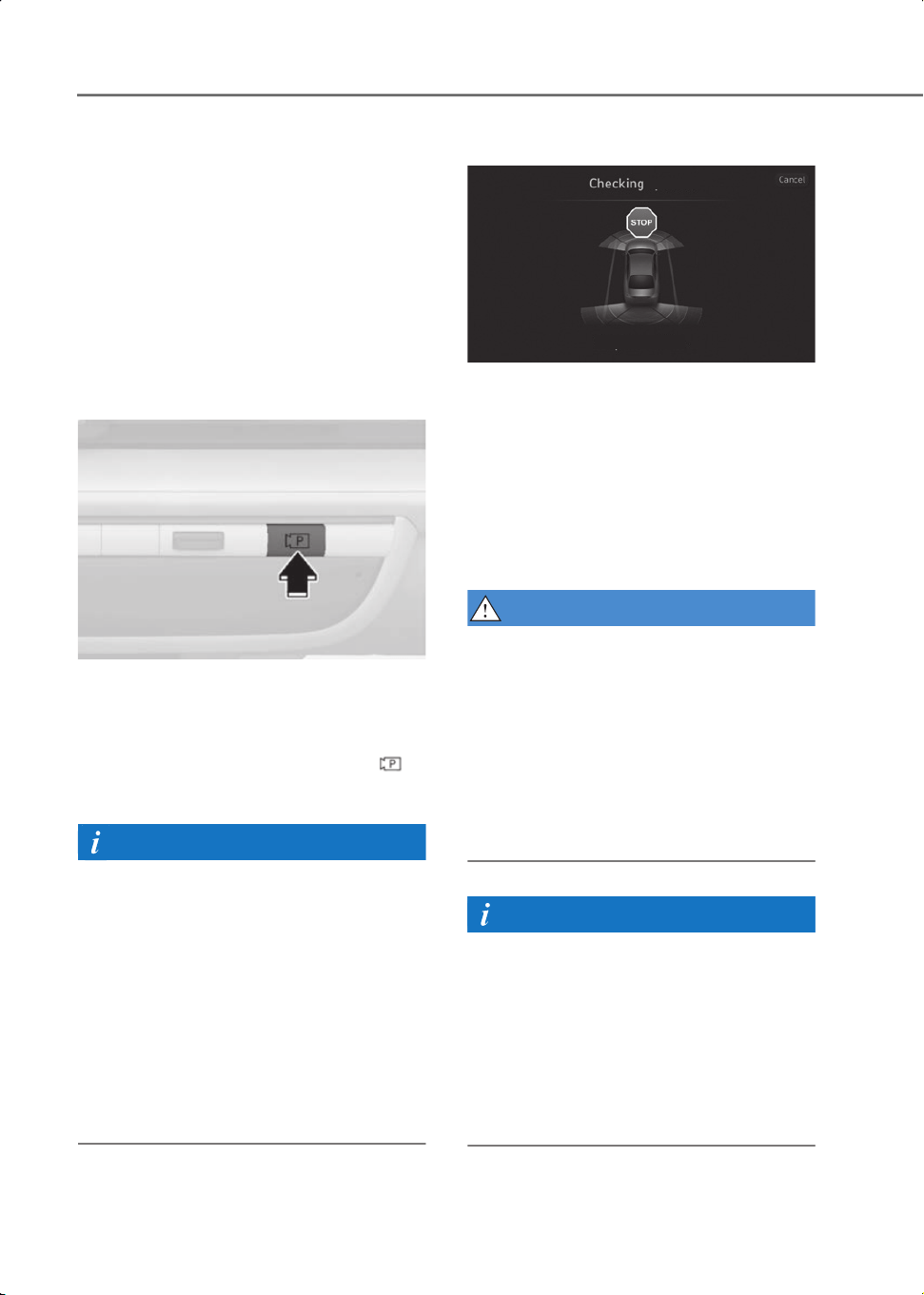
Driver Assistance System
7-156
Smart Exit
Operating order
Smart Exit function operates in the
following order:
1. Getting ready for exit
2. Checking space
3. Select exit direction
4. Smart Exit
1. Getting ready for exit
B7009401
1. With the vehicle turned on, depress the
brake pedal and shift the gear to P
(Park) or N (Neutral).
2. Press and hold the Parking/View ( )
button to turn on Remote Smart
Parking Assist.
Information
• Agree must be selected on the
infotainment system and the
infotainment system has to operate
properly to use Smart Exit function.
• Drive below 3 mph (5 km/h) with the
vehicle on and shift the gear to P (Park)
or N (Neutral), Smart Exit function can
be used.
• If the function is turned on again after
parallel parking is completed by
Remote Smart Parking Assist, Smart
Exit function can be used.
2. Checking space
B7009402
When the vehicle is stopped by
depressing the brake pedal, the vehicle
sensors will detect the distance from
nearby objects and check for space to
exit.
When checking for space is complete, a
message will appear on the infotainment
system with an audible sound to notify
the search is complete.
WARNING
• While checking for space, if there is a
risk of collision with pedestrian, animal
or object in the direction of vehicle exit,
for your safety, Smart Exit function can
be turned off.
• Even if check for space is completed,
objects in the blind spot area cannot be
detected by the sensors. The driver
must directly check the blind spot area
and continue using the function.
Information
Due to abnormal performance of the
ultrasonic sensor or the influence of the
surroundings, Parking function may not
be able to search for a parking space even
if there is a parking space, or may search
for a space that is not suitable for parking.
For more information, refer to the
"Limitations of Remote Smart Parking
Assist" section in this chapter.
7TEGI
/IITXLIZILMGPIWXEXMSREV]
CE_USA.book Page 156
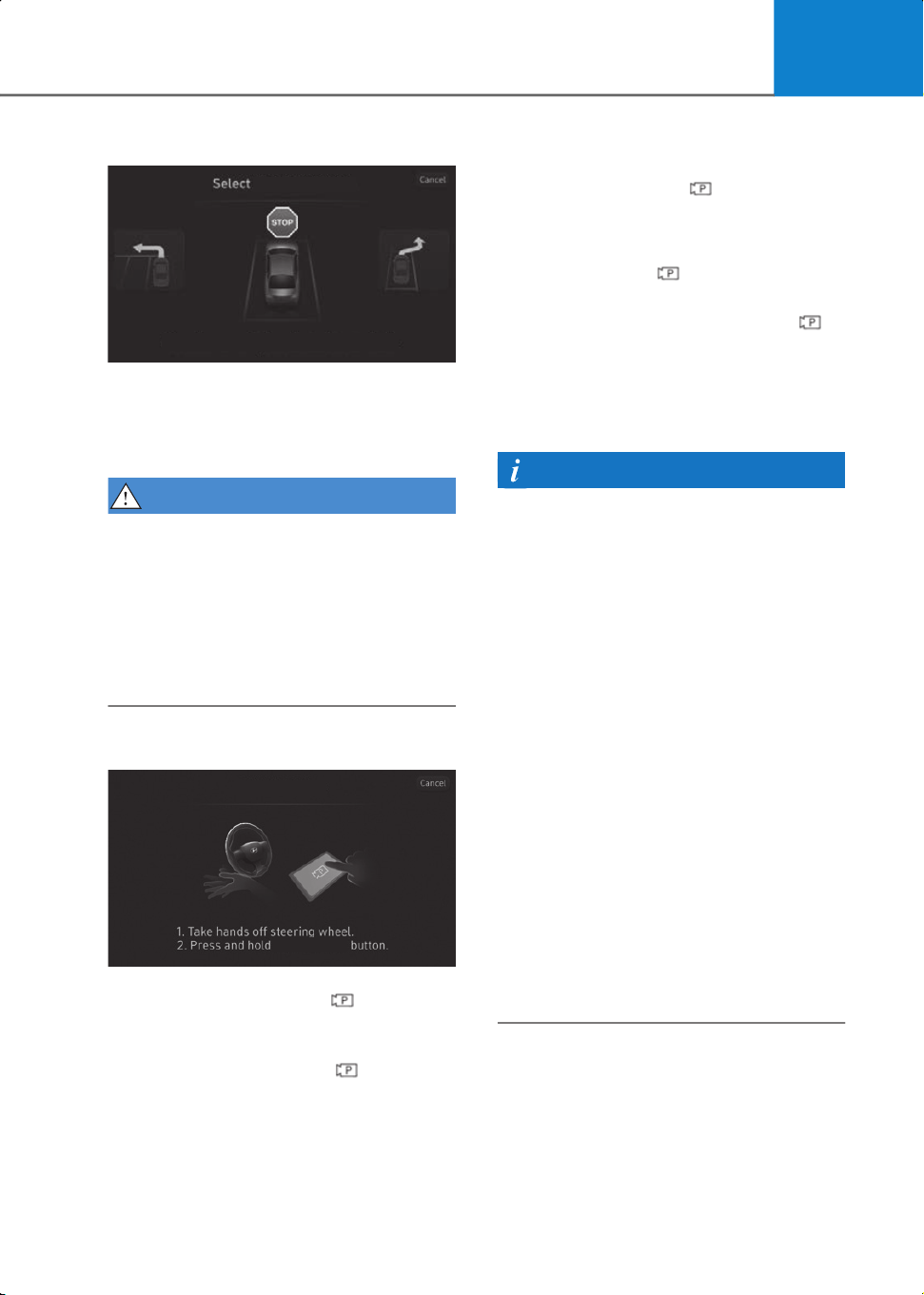
7
7-157
3. Select exit direction
B7009403
With the vehicle stopped by depressing
the brake pedal, touch the infotainment
system to select the desired exit
direction.
WARNING
Before selecting the Exit Direction, the
driver should check whether the space for
exit is suitable.
If the searched exit space by Remote
Smart Parking Assist is narrow or
unsuitable (surrounding vehicles are
parked vertically, etc.), do not use the
Smart Exit function.
4. Smart Exit
B7009404
1. Press the Parking/View ( ) button
when the vehicle is stopped by
depressing the brake pedal.
2. When the Parking/View ( ) button is
pressed, release the brake pedal
according to the instructions.
• Remote Smart Parking Assist will
automatically control the steering
wheel, vehicle speed and gearshift.
• While Smart Exit function is
operating, if you do not hold down
the Parking/View ( ) button, the
vehicle will stop and function control
will pause. The function will start
operating again when the
Parking/View ( ) button is pressed
and held again.
3. Press and hold the Parking/View ( )
button until exiting is completed.
• When the vehicle reaches the target
exit location, a message will appear
on the infotainment system to inform
you that exit is completed.
Information
• Smart Exit function will not operate if
the door is open or the seat belt is not
fastened.
• Vehicle speed can be adjusted by
depressing the brake pedal while Smart
Exit function is operating. However, the
vehicle does not accelerate even when
the accelerator pedal is depressed.
• If exit is completed while depressing
the brake pedal, Smart Exit function will
complete with the gear in D (Drive).
• If exit is completed while depressing
the accelerator pedal, you must take
your foot off the accelerator pedal once
for the accelerator pedal to operate.
• If there is no vehicle operation such as
depressing the brake pedal or
accelerator pedal within 4 seconds
after exit is complete, the vehicle will
automatically shift to P (Park) and
engage EPB (Electronic Parking Brake).
• After Exit function is complete, always
check the surroundings before driving.
)\MX(MVIGXMSR
1YWXFIWXSTTIHXSWIPIGXI\MXHMVIGXMSR
7QEVX)\MX-RWXVYGXMSRW
4EVOMRK:MI[
CE_USA.book Page 157

Driver Assistance System
7-158
Smart Exit operation status
How to turn off Smart function while
operating
• Press the Parking/View ( ) button in
the following stage:
- Checking space
- Select exit direction
• Shift the gear to R (Reverse) in the
following stage:
- Checking space
- Select exit direction
• Press the Parking Safety ( ) button or
select Cancel on the infotainment
system to turn off Exit function.
• While Smart Exit function is operating,
if the vehicle is stopped by depressing
the brake pedal, and the gear is shifted,
Exiting function will turn off. At this
time, EPB (Electronic Parking Brake)
will not be engaged.
The function will pause in the following
conditions when:
• There is a pedestrian, animal or object
in the direction the vehicle is moving
• The door or trunk is open
• The driver’s seat belt is not fastened
• Blind-Spot Collision-Avoidance Assist
or Rear-Cross Traffic
Collision-Avoidance Assist operates
while the vehicle is being controlled in
the reverse direction
• The Parking/View ( ) button is not
continuously pressed
• The vehicle is stopped by depressing
the brake pedal
When Exit function is paused, the vehicle
will stop. If the condition that made the
function to pause disappears, the
function may operate again.
The function will cancel in the following
conditions when:
• Smart Exit
- The steering wheel is steered
- The gear is shifted while the vehicle is
moving
- Operating EPB while the vehicle is
moving
- The hood is open
- The driver opens the door with the
seatbelt unfastened
- Rapid acceleration occurs
- Vehicle skid occurs
- The wheel is stuck by an obstacle and
cannot move
- There are pedestrians, animals or
objects at the front and rear of the
vehicle at the same time
- About 3 minutes and 50 seconds
have past after Smart Exit function
has started to operate
- The slope of the road exceeds the
operational range
- The function was paused for more
than 1 minute
- The steering wheel, gearshift,
braking, and drive controls are not
working properly
- ABS, TCS or ESC system operates due
to slippery road conditions
- The charging door is open
When Smart Exit function is canceled, the
vehicle will automatically stop, shift the
gear to P (Park) and engage EPB
(Electronic Parking Brake).
Operation
Status
Turn Signal
Under
control
The turn signal of the exit
direction blinks until the
exit is complete or Smart
Exit is canceled.
CE_USA.book Page 158
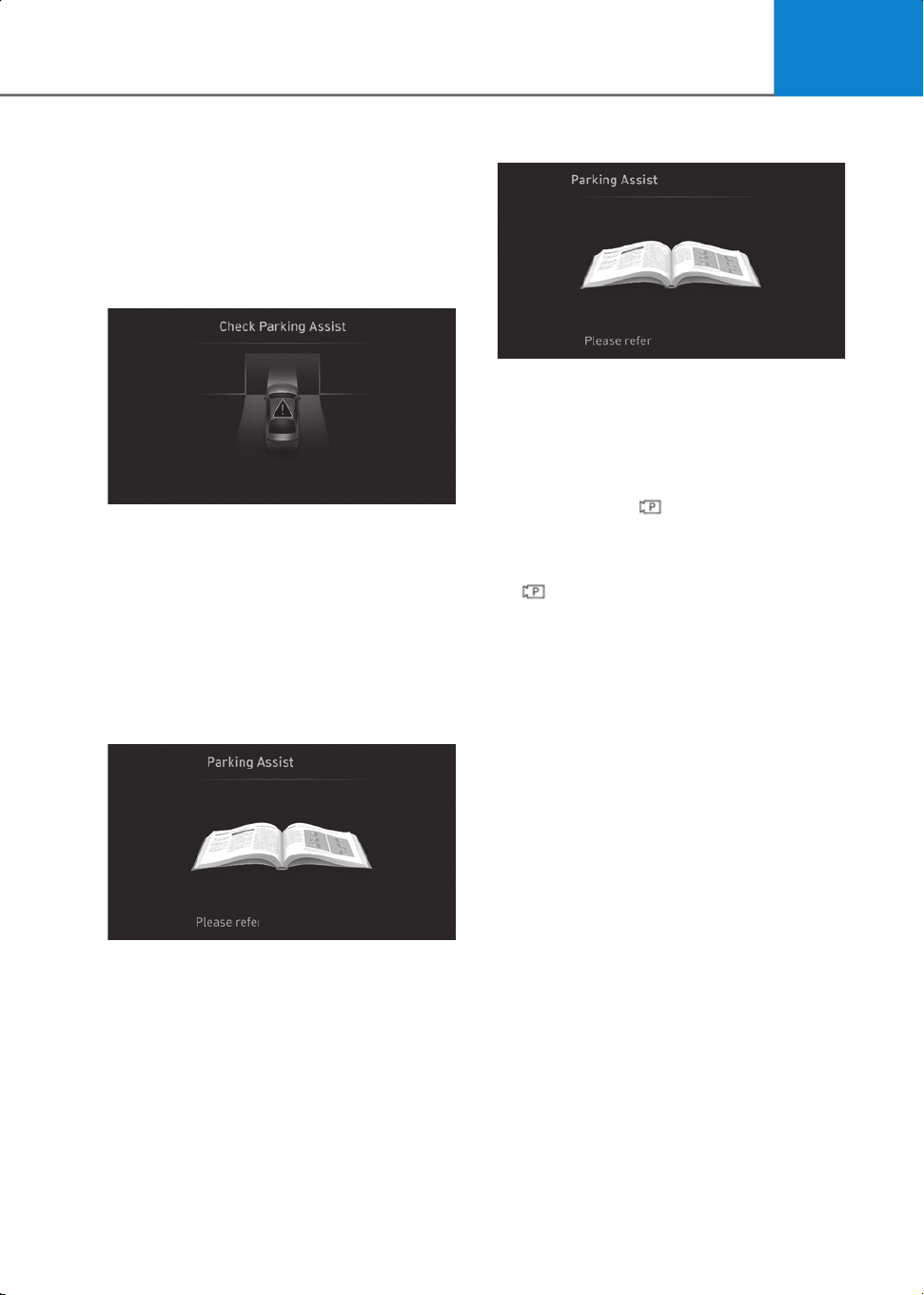
7
7-159
Remote Smart Parking Assist
Malfunction and Limitations
Remote Smart Parking Assist
malfunction
Remote Smart Parking Assist check
B7009501
When Remote Smart Parking Assist is not
working properly, the ‘Check Parking
Assist’ warning message will appear on
the infotainment system. If the message
appears, stop using Remote Smart
Parking Assist, and have the vehicle
inspected by an authorized HYUNDAI
dealer.
Remote Smart Parking Assist canceled
B7009502
When Remote Parking Assist is operating,
the function can be canceled, and the
‘Parking Assist Canceled’ warning
message may appear regardless of the
parking order. Other messages may
appear depending on the situations.
Follow the instructions provided on the
infotainment system while parking your
vehicle with Remote Parking Assist.
Always look around and pay attention
when using Remote Smart Parking Assist.
Remote Smart Parking Assist standby
B7009503
The ‘Parking Assist Conditions Not Met’
message will appears in the following
circumstances:
• When ‘Parking Assist Conditions Not
Met’ message appears when
Parking/View ( ) button has been
pressed and held while Remote Smart
Parking Assist is in standby. After a
while, press and hold the Parking/View
( ) button again to see if Remote
Smart Parking Assist works.
• When the smart key's battery is low.
Check the smart key battery level.
• It does not work even when the EV
mode is in the Utility mode. For related
information, refer to the "Setting Utility
Mode" section in chapter 1.
Limitations of Remote Smart Parking
Assist
In the following circumstances, Remote
Smart Parking Assist performance to park
or exit the vehicle may be limited, there
may be a risk of collision, or Remote
Smart Parking Assist may turn off. Park or
exit the vehicle manually if necessary.
• An object is attached to the steering
wheel
• The vehicle is installed with a snow
chain, spare tire or different size wheel
• Tire pressure is lower or higher than the
standard tire pressure
• Your vehicle is loaded with cargo longer
or wider than your vehicle or a trailer is
connected to your vehicle
:MWMXEHIEPIVSVRIEVF]WIVZMGIGIRXIV
'ERGIPIH
XSXLIS[RIVWQERYEP
'SRHMXMSRW2SX1IX
XSXLIS[RIVWQERYEP
CE_USA.book Page 159

Driver Assistance System
7-160
• There is a problem with the wheel
alignment
• Your vehicle is leaned severely to one
side
• Your vehicle is equipped with a trailer
hitch
• The license plate is installed differently
from the original location
• There is a person, animal or object
above or below the ultrasonic sensor
when Remote Smart Parking Assist is
activated
• The parking space is curved or diagonal
• There is an obstacle such as a person,
animal or object (trash can, bicycle,
motorcycle, shopping cart, narrow
pillar, etc.) near the parking space
• There is a circular pillar or narrow pillar,
or a pillar surrounded by objects such
as fire extinguisher, etc., near the
parking space
• The road surface is bumpy (curbstone,
speed bump, etc.)
• The road is slippery
• The parking space is near a vehicle with
higher ground clearance or big, such as
a truck, etc.
• The parking space is Inclined
• The road surface of parking space with
lines is wet due to snow, puddles, or
there is a road marker inside the
parking space
• The road surface of the parking space
with lines is bumpy due to road cracks
• The parking line is too thin or thick
• The parking line is partially erased or
blurred
• The parking line is obscured by people,
animals, or objects such as snow,
boxes, etc.
• There is heavy wind
• Operating Remote Smart Parking Assist
on uneven roads, gravel roads, bushes,
etc.
• The performance of the ultrasonic
sensor is affected by extremely hot or
cold weather
• The ultrasonic sensor is covered with
snow or water
• An object that generates ultrasonic
waves is nearby
• A wireless device with a transmission
function operates near the ultrasonic
sensors
• Your vehicle is affected by another
vehicle’s Parking Distance Warning
• The sensor is mounted or positioned
incorrectly by an impact to the bumper
• The cameras is improperly mounted or
out of position due to side view mirror
damage
• The ultrasonic sensor cannot detect the
following objects when:
- Sharp or slim objects, such as ropes,
chains or small poles
- Objects smaller than 40 in. (100 cm)
in length and narrower than 6 in. (14
cm) in diameter
- Objects which tend to absorb sensor
frequency, such as clothes, spongy
material or snow
- A narrow object such as a corner of a
square pillar
- Person, animal or object near the
ultrasonic sensor
• The cameras may not properly
recognize or may not recognize the
parking line and objects when:
- There are small objects (curb, etc.),
sharp objects, or thin objects (rope,
etc.) around
- People, animals or objects are too
close or too far from the vehicle
- Objects are on a higher position, such
as pickup trucks
- The camera is obscured by dirt or
moisture
- The camera is exposed to bright light
CE_USA.book Page 160
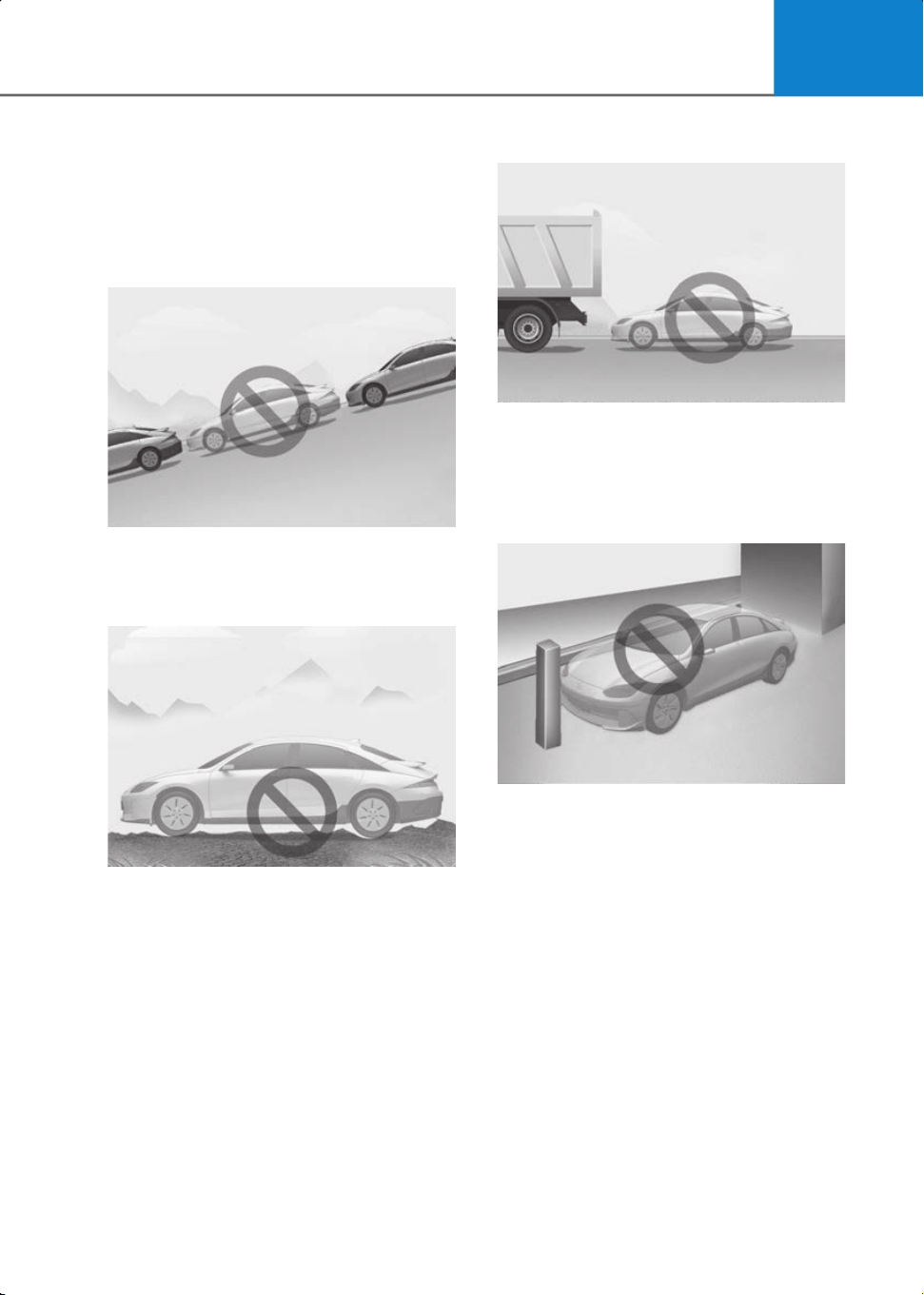
7
7-161
- The surrounding is too dark
- The light is reflected from the surface
Remote Smart Parking Assist may not
operate properly under the following
circumstances:
• Parking on inclines
B7009504
Park or exit manually when the vehicle
is on inclines.
• Parking on uneven road
B7009505
Remote Smart Parking Assist may
cancel when the vehicle slips, or the
vehicle cannot move due to road
conditions such as pebbles or
fragmented stones.
• Parking behind a truck
B7009506
Do not use Remote Smart Parking
Assist around vehicles with higher
ground clearance, such as a bus, truck,
etc. It may lead to an accident.
• Parking near a pillar
B7009507
Remote Smart Parking Assist
performance may reduce or collision
with an obstacle may occur when there
is a narrow object, circular pillar, square
pillar, or a pillar surrounded by objects
such as a fire extinguisher, etc., near
the parking space. The driver should
park the vehicle manually.
CE_USA.book Page 161
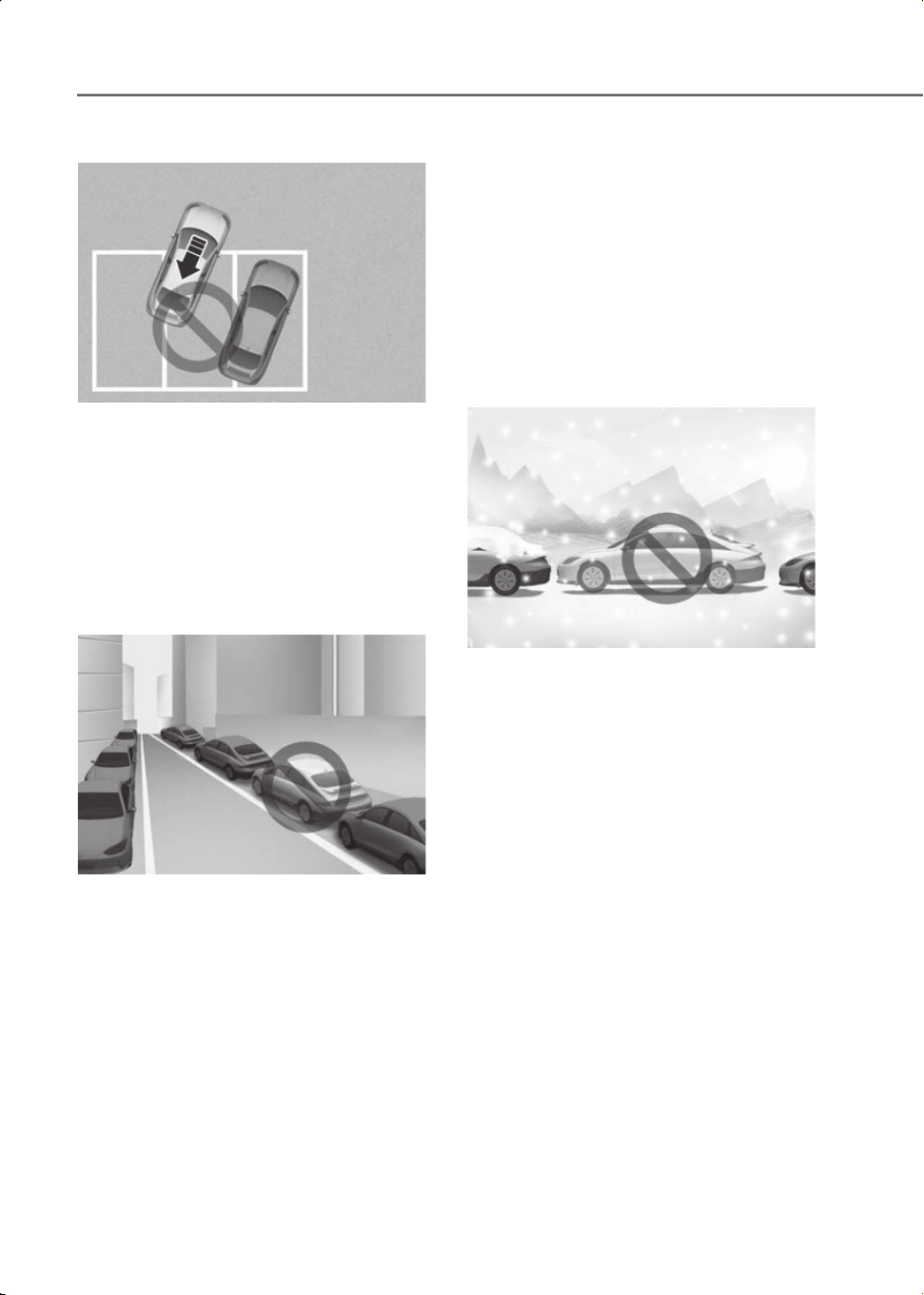
Driver Assistance System
7-162
• Parking next to a misaligned vehicle
B7009508
If Remote Smart Parking Assist is used
when parking in a space next to
misaligned vehicles, your vehicle may
not be parked side by side.
However, if there is a parking line and it
is detected properly, your vehicle will
park side by side with the parking line.
• Leaving a parking space near a wall or
parking in a narrow space
B7009509
- Remote Smart Parking Assist may not
operate properly when leaving a
parking space that is narrow and near
a wall. Always check for pedestrians,
animals, objects while leaving.
- For your safety, Remote Smart
Parking Assist does not search for
parking spaces at areas with narrow
parking spaces that are narrower
than the minimum space required for
parking.
Remote Smart Parking Assist may not
operate properly when parking in a
narrow space. Always check for
pedestrians, animals, objects while
parking.
• Parking in snow
B7009511
Snow may interfere with the operation
of the ultrasonic sensor and wide view
camera, or Remote Smart Parking
Assist may cancel if the road is slippery
while parking.
CE_USA.book Page 162
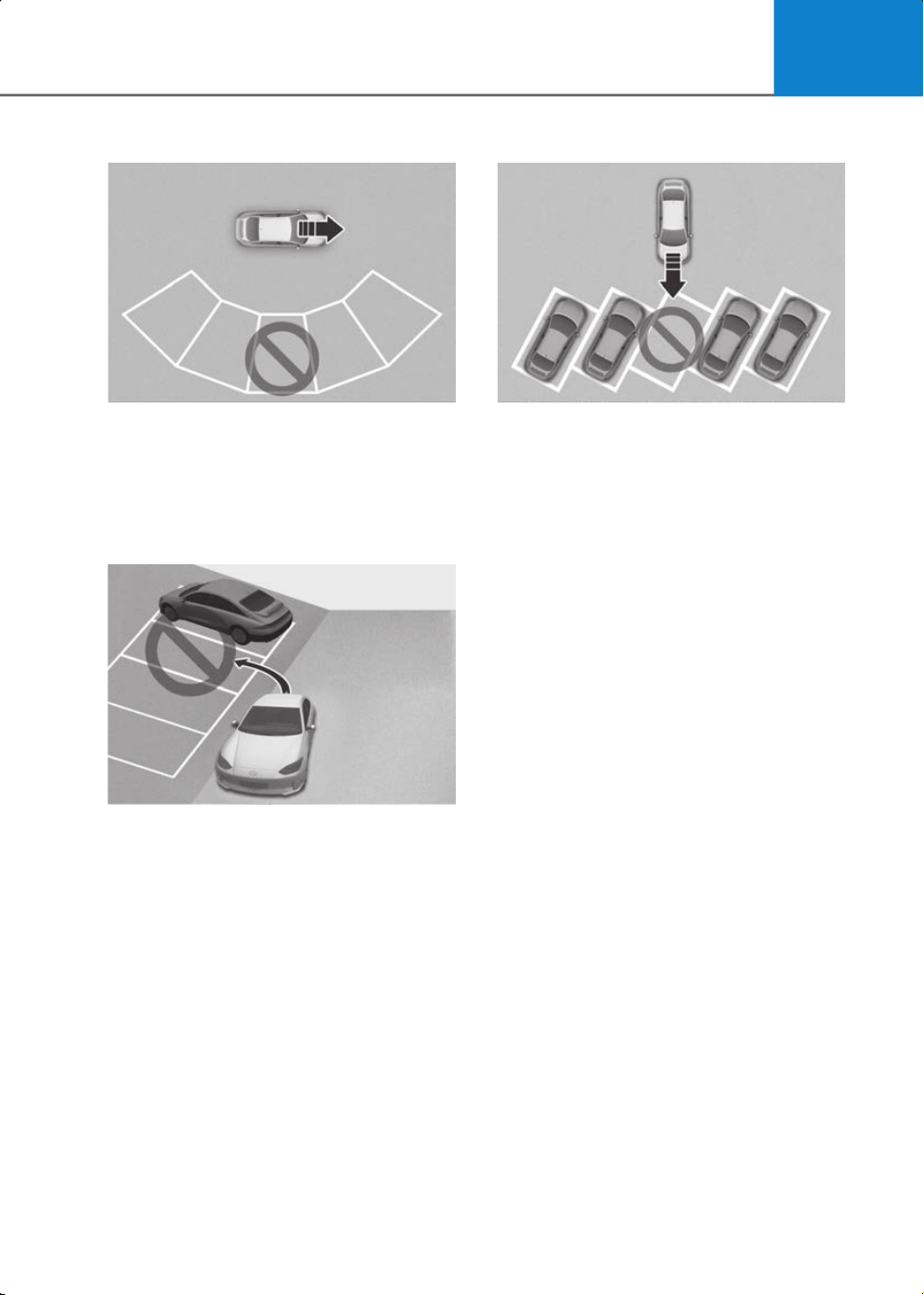
7
7-163
• Abnormal parking space
B7009512
Remote Smart Parking Assist does not
work properly when the parking lines
are not parallel. Do not park although
the parking space is recognized by the
sensor.
• Inclined parking space
B7009513
Remote Smart Parking Assist does not
work properly on a inclined or curved
road surface. Do not park although the
parking space is recognized by the
sensor.
• Parking diagonal
B7009514
Remote forward function may not
operate properly in a diagonal parking
space.
CE_USA.book Page 163

Driver Assistance System
7-164
WARNING
Take the following precautions when
using Remote Smart Parking Assist:
• The driver is responsible for safe
parking and exit when using Remote
Smart Parking Assist.
• When using Remote Smart Parking
Assist, stay out of the way in the
direction the vehicle moves for your
safety.
• Always check surroundings when using
Remote Smart Parking Assist. You may
collide with pedestrians, animals, or
objects if they are near the sensor or are
in the sensor’s blind spot area.
• A collision may occur if a pedestrian,
animal, or object suddenly appears
while Remote Smart Parking Assist is
operating.
• Do not use Remote Smart Parking
Assist when under the influence of
alcohol.
• Do not let children or other people to
use the smart key.
• If Remote Smart Parking Assist is used
continuously for a long period, it may
adversely affect Remote Smart Parking
Assist performance.
• Remote Smart Parking Assist may not
operate properly if the vehicle needs
wheel alignment adjustment such as
when the vehicle tilts to one side. Have
the vehicle inspected by an authorized
HYUNDAI dealer.
• Noise may be heard when braking
occurs by Remote Smart Parking Assist
or when the brake pedal is depressed
by the driver.
• Remote Smart Parking Assist may
suddenly apply the brake to avoid
collision with pedestrian, animal, or
object.
• Use Remote Smart Parking Assist only
in a parking space that is large enough
for the vehicle to move safely.
• If Remote Smart Parking Assist does
not operate properly, have the vehicle
inspected by an authorized HYUNDAI
dealer.
NOTICE
• If the 3rd stage warning (continuous
beep) of the Forward/Reverse Parking
Distance Warning sounds while
Remote Smart Parking Assist is
operating, it means the obstacle
detected is close to your vehicle. At this
time, Remote Smart Parking Assist will
temporarily stop operating. Make sure
there are no pedestrians, animals, or
objects around your vehicle.
• Depending on brake operation, the
stop lights may come on while the
vehicle is moving.
• If the vehicle is remotely started that
has been parked in cold weather for a
long time, the operation of Remote
Smart Parking function may be delayed
or canceled depending on vehicle
condition.
CE_USA.book Page 164

7
7-165
Declaration Of
if equipped
Conformity
Front Radar
The radio frequency components (front
radar) complies:
• For USA
OANATEL351
• For Canada
OANATEL327
FCC ID
: 2A3OZ-MRR30
This device complies with Part 15 of the FCC
Rules. Operaon is subject to the following two
condions:
(1) this device may not cause harmful
interference, and
(2) this device must accept any interference
received, including interference that may cause
undesired operaon.
CAUTION TO USERS
Changes or modificaons not expressly
approved by the party responsible for
compliance could void the user`s authority to
operate the equipment.
Model: MRR-30
IC: 27992-MRR30
This device complies with Industry Canada
licence-
exempt RSS standard(s). Operaon is
subject to the following two condions:
(1) this device may not cause interference, and
(2) this device must accept any interference,
including interference that may cause undesired
operaon of the device.
Le présent appareil est conforme aux CNR
d'Industrie Canada applicables aux appareils
radio exempts de licence. L'exploitaon est
autorisée
aux deux condions suivantes:
(1) l'appareil ne doit pas produire de brouillage,
et
(2) l'ulisateur de l'appareil doit accepter tout
brouillage radioélectrique subi, même si le
brouillage est suscepble d'en compromere
le fonconnement.
CE_USA.book Page 165

Driver Assistance System
7-166
Front Corner Radar/Rear
Corner Radar
The radio frequency components (Front
corner radar/Rear corner radar) complies:
• For USA
OANATEL320
OANATEL320_1
FCC ID : LTQ2H5TR
This device complies with Part 15 of the FCC
Rules. Operaon is subject to the following two
condions:
(1) this device may not cause harmful
interference, and
(2) this device must accept any interference
received, including interference that may cause
undesired operaon.
CAUTION TO USERS
Changes or modificaons not expressly
approved by the party responsible for
compliance could void the user`s authority to
operate the equipment.
FCC ID : LTQH5TR
This device complies with Part 15 of the FCC
Rules. Operaon is subject to the following two
condions:
(1) this device may not cause harmful
interference, and
(2) this device must accept any interference
received, including interference that may cause
undesired operaon.
CAUTION TO USERS
Changes or modificaons not expressly
approved by the party responsible for
compliance could void the user`s authority to
operate the equipment.
CE_USA.book Page 166

7
7-167
• For Canada
OANATEL317
OANATEL317_1
Model: 2H5TR
IC: 3659A-2H5TR
This device complies with Industry Canada
licence-
exempt RSS standard(s). Operaon is
subject to the following two condions:
(1) this device may not cause interference, and
(2) this device must accept any interference,
including interference that may cause undesired
operaon of the device.
Le présent appareil est conforme aux CNR
d'Industrie Canada applicables aux appareils
radio exempts de licence. L'exploitaon est
autorisée
aux deux condions suivantes:
(1) l'appareil ne doit pas produire de brouillage,
et
(2) l'ulisateur de l'appareil doit accepter tout
brouillage radioélectrique subi, même si le
brouillage est suscepble d'en compromere
le fonconnement.
Model: H5TR
IC: 3659A-H5TR
This device complies with Industry Canada
licence-
exempt RSS standard(s). Operaon is
subject to the following two condions:
(1) this device may not cause interference, and
(2) this device must accept any interference,
including interference that may cause undesired
operaon of the device.
Le présent appareil est conforme aux CNR
d'Industrie Canada applicables aux appareils
radio exempts de licence. L'exploitaon est
autorisée
aux deux condions suivantes:
(1) l'appareil ne doit pas produire de brouillage,
et
(2) l'ulisateur de l'appareil doit accepter tout
brouillage radioélectrique subi, même si le
brouillage est suscepble d'en compromere
le fonconnement.
CE_USA.book Page 167

CE_USA.book Page 168

8
8. Emergency Situations
Hazard Warning Flasher..................................................................................................8-2
In Case Of An Emergency While Driving........................................................................8-2
If the Vehicle Stalls While Driving...............................................................................8-2
If the Vehicle Stalls at A Crossroad or Crossing.........................................................8-2
If You Have a Flat Tire While Driving ..........................................................................8-3
If The Vehicle Will Not Start............................................................................................8-3
Confirm the EV Battery is not Low on the Charge Gauge.........................................8-3
Jump Starting (12 V Battery)...........................................................................................8-4
Tire Pressure Monitoring System (TPMS) ...................................................................... 8-7
Check Tire Pressure ..................................................................................................... 8-7
Tire Pressure Monitoring System................................................................................8-8
Low Tire Pressure Warning Light ................................................................................8-9
Low Tire Pressure Position and Tire Pressure Telltale...............................................8-9
Changing a Tire with TPMS ....................................................................................... 8-10
If You Have A Flat Tire (with Tire Mobility Kit) ..............................................................8-12
Introduction.................................................................................................................8-12
Notes on the Safe Use of the Tire Mobility Kit..........................................................8-12
Components of the Tire Mobility Kit ........................................................................ 8-13
Using the Tire Mobility Kit When a Tire is Flat ......................................................... 8-14
How to Adjust Tire Pressure.......................................................................................8-17
Towing............................................................................................................................ 8-18
Towing Service........................................................................................................... 8-18
Removable Towing Hook .......................................................................................... 8-19
CE_USA.book Page 1
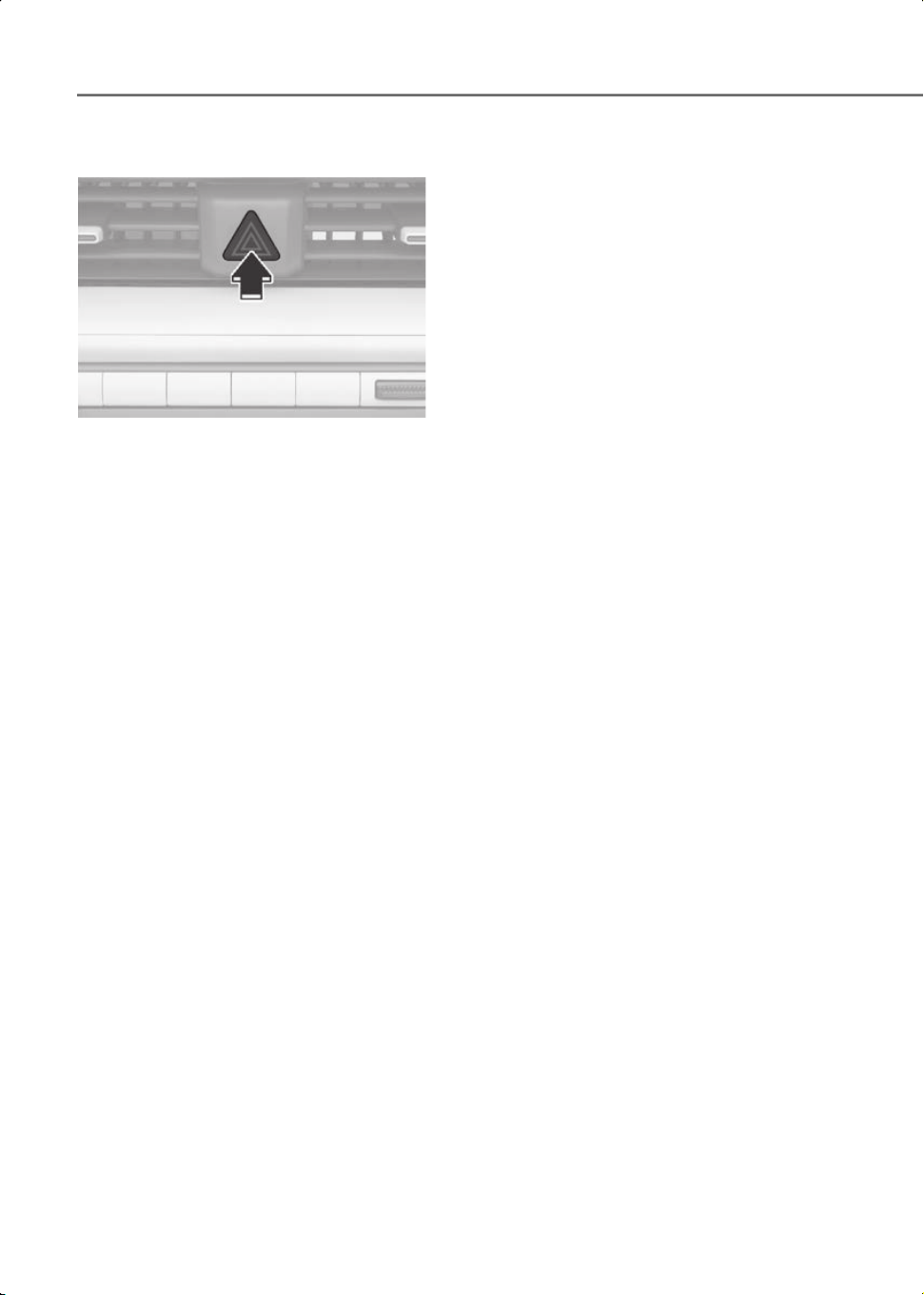
Emergency Situations
8-2
Hazard Warning Flasher
B8000201
The hazard warning flasher warns other
drivers to exercise extreme caution when
approaching, overtaking, or passing your
vehicle. It should be used whenever
making emergency repairs or when
stopped near the edge of a roadway.
To turn on or off the hazard warning
flasher, press the hazard warning flasher
button with the Start/Stop button in any
position. The hazard warning flasher
button is located in the center fascia
panel. All turn signal lights flash
simultaneously.
• The hazard warning flasher operates
whether your vehicle is running or not.
• The turn signals do not work when the
hazard flasher is on.
In Case Of An Emergency
While Driving
If the Vehicle Stalls While
Driving
• Reduce the vehicle speed gradually,
keeping a straight line. Move cautiously
off the road to a safe place.
• Turn on your hazard warning flasher.
• Try to start the vehicle again. If your
vehicle does not start, contact an
authorized HYUNDAI dealer or seek
other qualified assistance.
If the Vehicle Stalls at A
Crossroad or Crossing
If the vehicle stalls at a crossroad or
intersection, if safe to do so, shift the gear
to N (Neutral) and then push the vehicle
to a safe location.
CE_USA.book Page 2

8
8-3
If You Have a Flat Tire While
Driving
If a tire goes flat while you are driving:
• Take your foot off the accelerator pedal
and let the vehicle slow down while
driving straight ahead. Do not apply the
brakes immediately or attempt to pull
off the road because this may cause
loss of vehicle control resulting in a
collision. When the vehicle has slowed
to such a speed that it is safe to do so,
brake carefully and pull off the road.
Drive off the road as far as possible and
park on a firm, level ground. If you are
on a divided highway, do not park in the
median area between the two traffic
lanes.
• When the vehicle is stopped, press the
hazard warning flasher button, shift the
gear to P (Park), apply the parking
brake, and press the Start/Stop button
to the OFF position.
• Have all passengers get out of the
vehicle. Make sure they all get out on
the side of the vehicle that is away from
traffic.
• When you have a flat tire, refer to the "If
You Have A Flat Tire (with Tire Mobility
Kit)" section in this chapter.
If The Vehicle Will Not
Start
Confirm the EV Battery is not
Low on the Charge Gauge
• Be sure the gear is in P (Park). The
vehicle starts only when the gear is in P
(Park).
• Check the 12 V battery connections to
be sure they are clean and tight.
• Turn on the interior light. If the light
dims or goes out when you operate the
starter, the 12 V battery is drained.
NOTICE
Starting the vehicle by pushing or pulling
may cause vehicle damage.
CE_USA.book Page 3
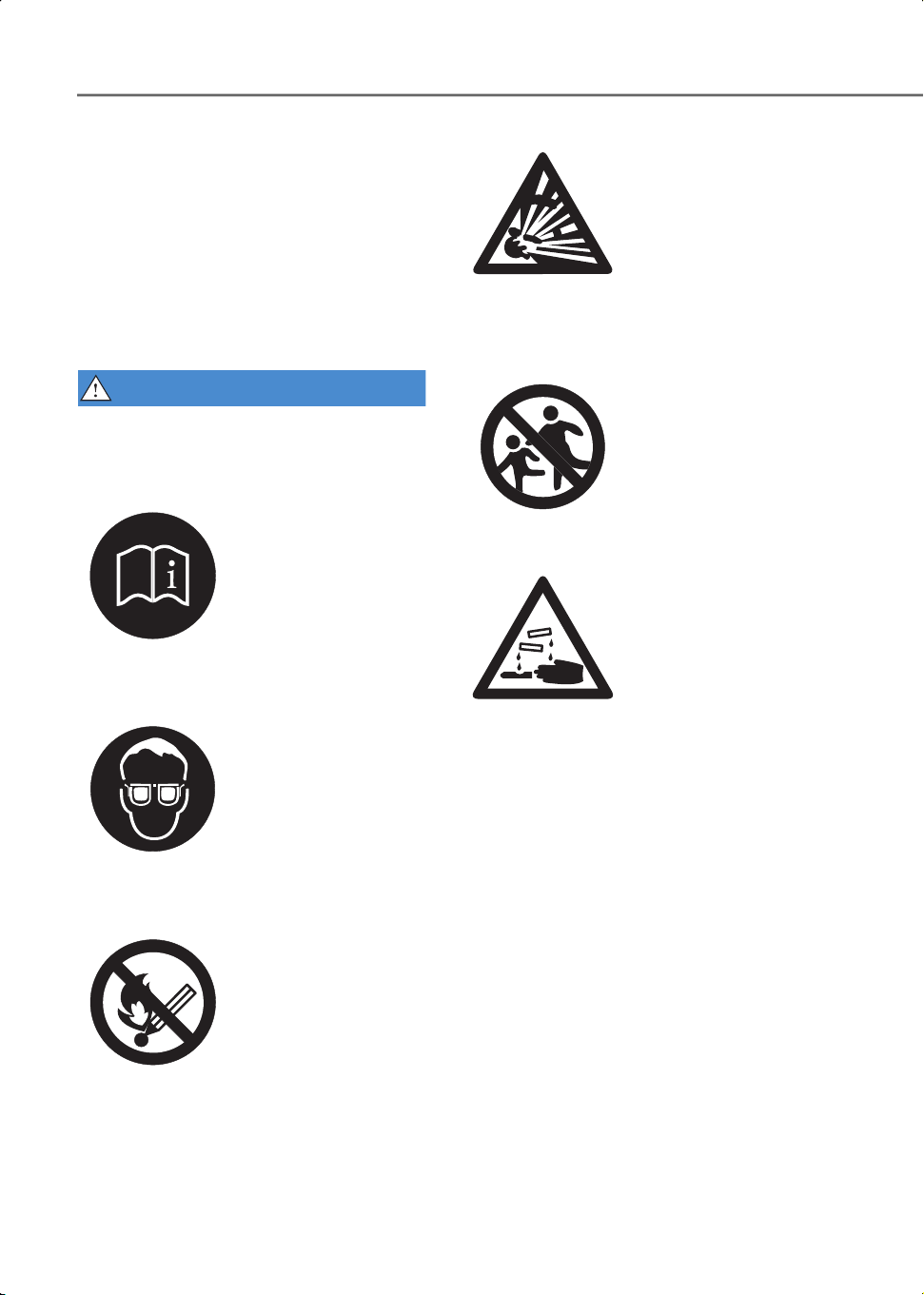
Emergency Situations
8-4
Jump Starting (12 V
Battery)
Jump starting can be dangerous if done
incorrectly. Follow the jump starting
procedure in this section to avoid serious
injury or damage to your vehicle. If in
doubt about how to properly jump start
your vehicle, have a service technician or
towing service do it for you.
WARNING
To prevent SERIOUS INJURY or DEATH to
you or bystanders, always follow these
precautions when working near or
handling the battery:
WL_TakingCareOfBatteryWarning
Always read and follow instructions
carefully when handling a battery.
WL_TakingCareOfBatteryWarning_6
Wear eye protection designed to protect
the eyes from acid splashes.
WL_TakingCareOfBatteryWarning_2
Keep all flames, sparks, or smoking
materials away from the battery.
WL_TakingCareOfBatteryWarning_3
Hydrogen gas is always present in battery
cells. It is highly combustible, and may
explode if ignited.
WL_TakingCareOfBatteryWarning_4
Keep batteries out of reach of children.
WL_TakingCareOfBatteryWarning_5
Batteries contain sulfuric acid that is
highly corrosive. Do not allow acid to
contact your eyes, skin, or clothing. If acid
gets into your eyes, flush your eyes with
clean water for at least 15 minutes and get
immediate medical attention. If acid gets
on your skin, thoroughly wash the area. If
you feel pain or a burning sensation, get
medical attention immediately.
• When lifting a plastic-cased battery,
excessive pressure on the case may
cause battery acid to leak. Lift with a
battery carrier or with your hands on
opposite corners.
• Do not attempt to jump start your
vehicle if your battery is frozen.
• NEVER attempt to recharge the battery
when the vehicle’s battery cables are
connected to the battery.
CE_USA.book Page 4
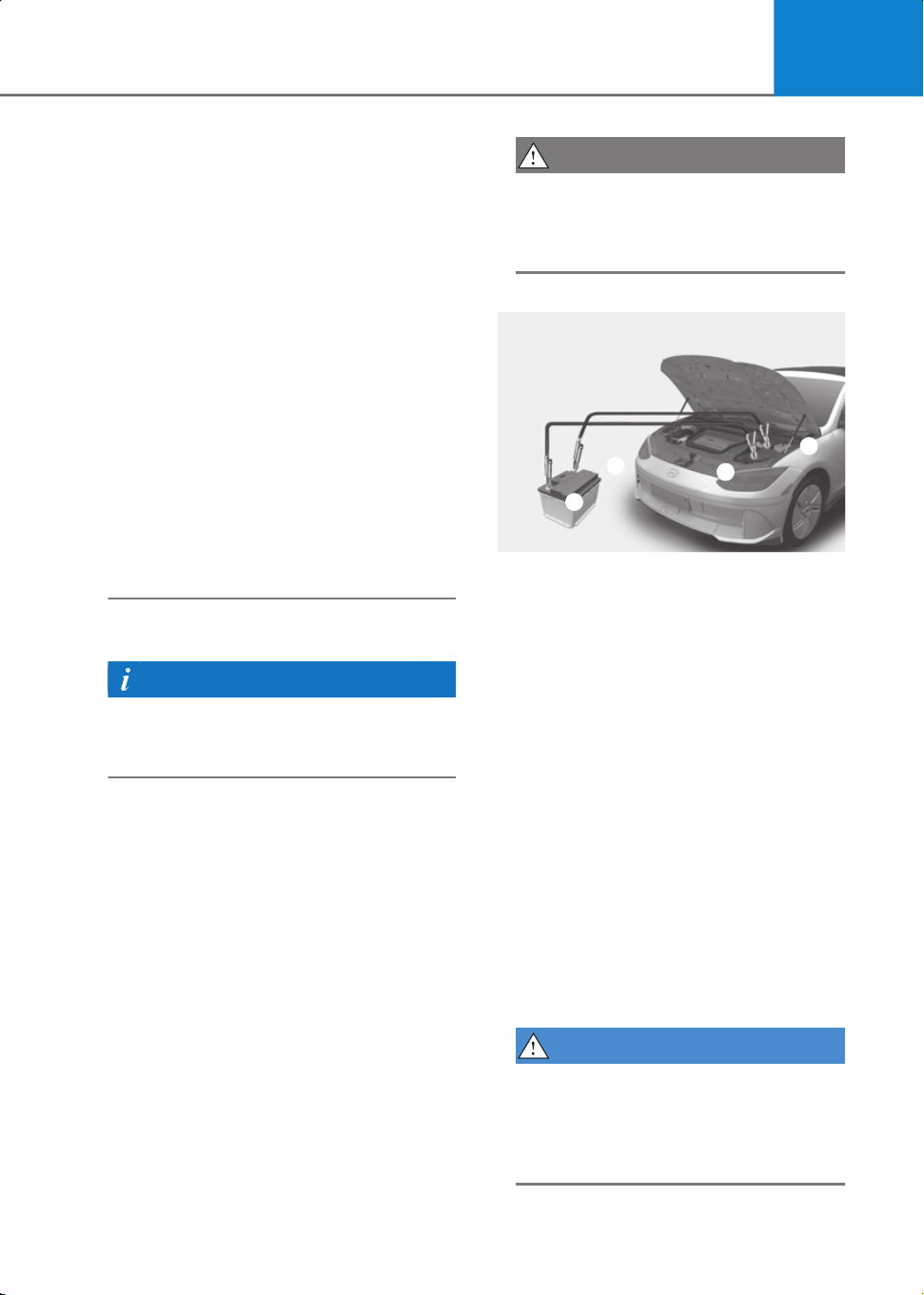
8
8-5
• The electrical ignition system works
with high voltage.
NEVER touch these components with
the vehicle running or when the
Start/Stop button is in the ON position.
• The electrical ignition system works
with high voltage. NEVER touch these
components Start/Stop button in the
ON or START position.
• Do not allow the (+) and (-) jumper
cables to touch. It may cause sparks.
• The battery may rupture or explode
when you jump start with a low or
frozen battery.
• Do not directly connect the (-) to the
jump cable. Connect the (-) to the one
of the metallic parts located far from
the jump cable in the vehicle. The direct
(-) connection to the jump cable may
cause an explosion.
Jump starting procedure
Information
When you jump start your vehicle, use the
jumper terminal in the motor
compartment.
1. Position the vehicles close enough that
the jumper cables will reach. Do not
allow the vehicle body parts to contact.
2. Avoid fans or any moving parts in the
motor compartment at all times, even
when the vehicles are turned off.
3. Turn off all electrical devices such as
radios, lights, air conditioning, etc. Put
the vehicles in P (Park) and apply the
parking brake. Turn both vehicles OFF.
4. Open the hood.
5. Remove the battery cover located
inside of the front trunk.
6.Remove the motor compartment fuse
box cover.
CAUTION
Before jump starting, make sure to
correctly identify the positive (+) and
negative (-) terminals to avoid reverse
polarity connections.
B8001501
7. Connect the jumper cables in the exact
sequence shown in the illustration. First
connect one jumper cable to the red,
positive (+) jumper terminal of your
vehicle (1).
8.Connect the other end of the jumper
cable to the red, positive (+)
battery/jumper terminal of the
assisting vehicle (2).
9.Connect the second jumper cable to
the black, negative (-) battery/jumper
terminal of the assisting vehicle (3).
10.Connect the other end of the second
jumper cable to the black, negative (-)
chassis ground of your vehicle (4).
Do not allow the jumper cables to
contact anything except the correct
battery or jumper terminals or the
correct ground. Do not lean over the
battery when making connections.
WARNING
Do not connect the jumper cable to the
negative (-) jumper terminal of the
discharged battery. A spark could
cause the battery to explode and lead
to a personal injury or vehicle damage.
1
4
2
3
CE_USA.book Page 5
Emergency Situations
8-6
11.Start the assisting vehicle and let it run
for a few minutes. Then start your
vehicle.
12.Keep your vehicle operating for at least
30 minutes at idle or driving to assure
your battery receives enough charge to
be able to start on its own after the
vehicle is shut off. A completely
discharged battery may require as long
as 60 minutes runtime to fully recharge
it. If the vehicle is run for less, battery
may not restart.
If your vehicle does not start after a few
attempts, it probably requires service.
Have your vehicle inspected by an
authorized HYUNDAI dealer.
Disconnect the jumper cables in the exact
reverse order you connected them:
1. Disconnect the jumper cable from the
chassis ground of your vehicle (4).
2. Disconnect the other end of the jumper
cable from battery/chassis ground of
the assisting vehicle (3).
3. Disconnect the second jumper cable
from the red, positive (+)
battery/jumper terminal of the
assisting vehicle (2).
4. Disconnect the other end of the jumper
cable from the red, positive (+) jumper
terminal of your vehicle (1).
Information
WL_TakingCareOfBatteryWarning_7
An inappropriately disposed battery can
be harmful to the environment and
human health. Dispose of the battery
according to your local law(s) or
regulations.
NOTICE
To prevent damage to your vehicle:
• Only use a 12 V power supply (battery or
jumper system) to jump start your
vehicle.
• Do not attempt to jump start your
vehicle by push-starting.
CE_USA.book Page 6
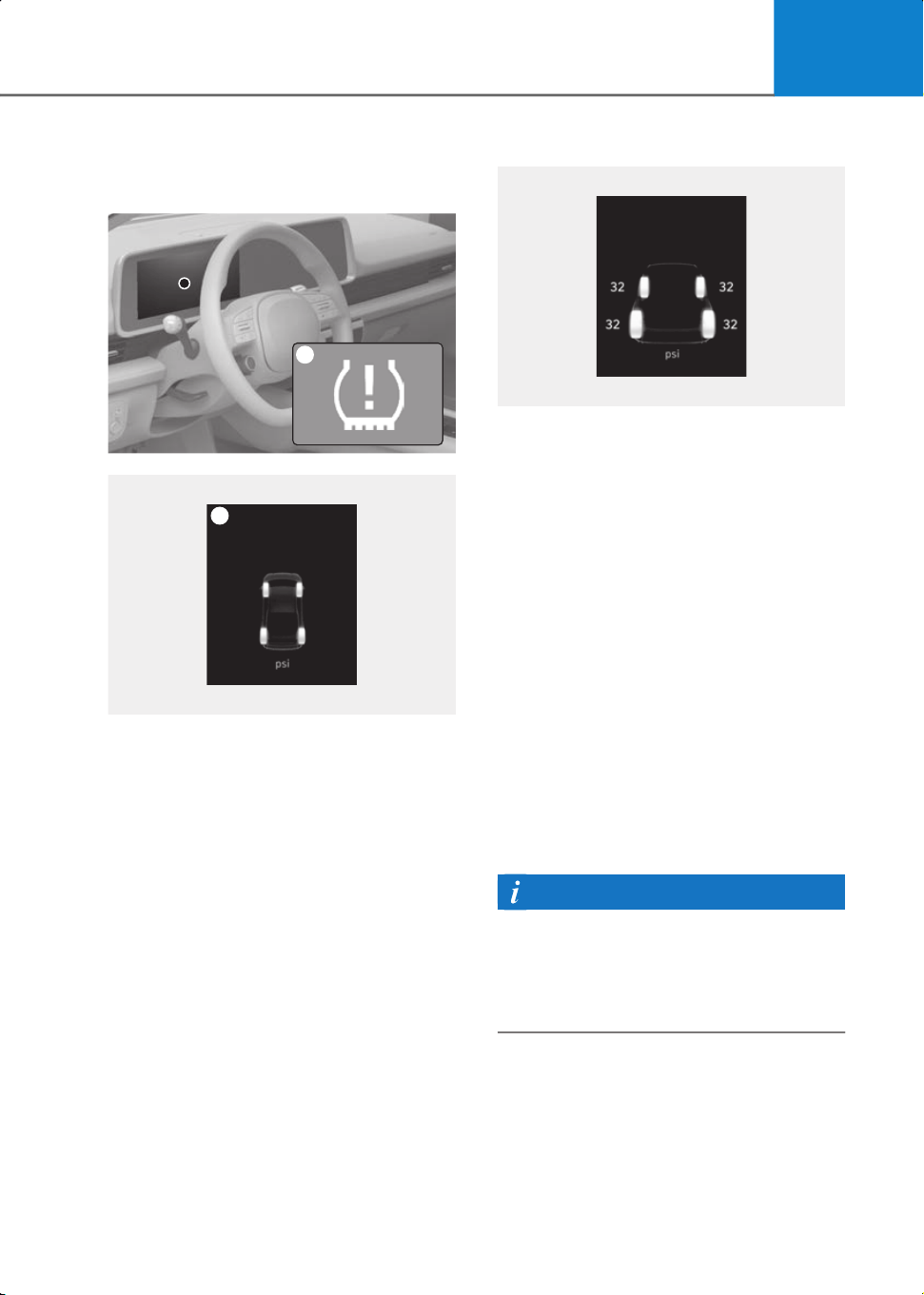
8
8-7
Tire Pressure Monitoring
System (TPMS)
B8001801
B8001802
(1) Low Tire Pressure Telltale/TPMS
Malfunction Indicator
(2) Low Tire Pressure Position Telltale and
Tire Pressure Telltale (Shown on the
cluster display)
Check Tire Pressure
B8002001
• You can check the tire pressure in the
Utility view on the instrument cluster.
For more information, refer to the
“View Modes” section in chapter 4.
• Tire pressure is displayed after a few
minutes of driving after initial vehicle
start up.
• If tire pressure is not displayed when
the vehicle is stopped, "Drive to
display" message appears. After
driving, check the tire pressure.
• The displayed tire pressure values may
differ from those measured with a tire
pressure gauge.
• You can change the tire pressure unit
from the Settings menu in the
infotainment system.
Select Setup > General > Unit > Tire Air
Pressure Unit > psi/kPa/bar.
Information
The infotainment system may change
after software updates. For more
information, refer to the user's manual
provided in the infotainment system and
the quick reference guide.
1
2
-PXUJSFQSFTTVSF
-PX
-PX
-PX
-PX
5JSF1SFTTVSF
CE_USA.book Page 7

Emergency Situations
8-8
Tire Pressure Monitoring
System
WARNING
Over-inflation or under-inflation can
reduce tire life, adversely affect vehicle
handling, and lead to sudden tire failure
that may cause loss of vehicle control
resulting in an accident.
Each tire, including the spare (if
provided), should be checked monthly
when cold and inflated to the inflation
pressure recommended by the vehicle
manufacturer on the vehicle placard or
tire inflation pressure label. (If your
vehicle has tires of a different size than
the size indicated on the vehicle placard
or tire inflation pressure label, you should
determine the proper tire inflation
pressure for those tires.)
As an added safety feature, your vehicle
has been equipped with a tire pressure
monitoring system (TPMS) that
illuminates a low tire pressure telltale
when one or more of your tires is
significantly under-inflated. Accordingly,
when the low tire pressure telltale
illuminates, you should stop and check
your tires as soon as possible, and inflate
them to the proper pressure. Driving on a
significantly under-inflated tire causes
the tire to overheat and can lead to tire
failure.
Under-inflation also reduces energy
efficiency and tire tread life, and may
affect the vehicle’s handling and stopping
ability.
Please note that the TPMS is not a
substitute for proper tire maintenance,
and it is the driver’s responsibility to
maintain correct tire pressure, even if
under-inflation has not reached the level
to trigger illumination of the TPMS low
tire pressure telltale.
Your vehicle has also been equipped with
a TPMS malfunction indicator to indicate
when the system is not operating
properly. The TPMS malfunction indicator
is combined with the low tire pressure
telltale. When the system detects a
malfunction, the telltale will flash for
about one minute and then remain
continuously illuminated. This sequence
will continue upon subsequent vehicle
start-ups as long as the malfunction
exists.
When the malfunction indicator is
illuminated, the system may not be able
to detect or signal low tire pressure as
intended. TPMS malfunctions may occur
for a variety of reasons, including the
installation of replacement or alternate
tires or wheels on the vehicle that prevent
the TPMS from functioning properly.
Always check the TPMS malfunction
telltale after replacing one or more tires or
wheels on your vehicle to ensure that the
replacement or alternate tires and wheels
allow the TPMS to continue to function
properly.
NOTICE
If any of the below happens, have the
system inspected by an authorized
HYUNDAI dealer.
1. The Low Tire Pressure Telltale/TPMS
Malfunction Indicator does not
illuminate for 3 seconds when the
Start/Stop button is pressed to the ON
position or when the vehicle is running.
2. The TPMS Malfunction Indicator
remains illuminated after blinking for
about 1 minute.
3. The Low Tire Pressure Position Telltale
remains illuminated.
CE_USA.book Page 8
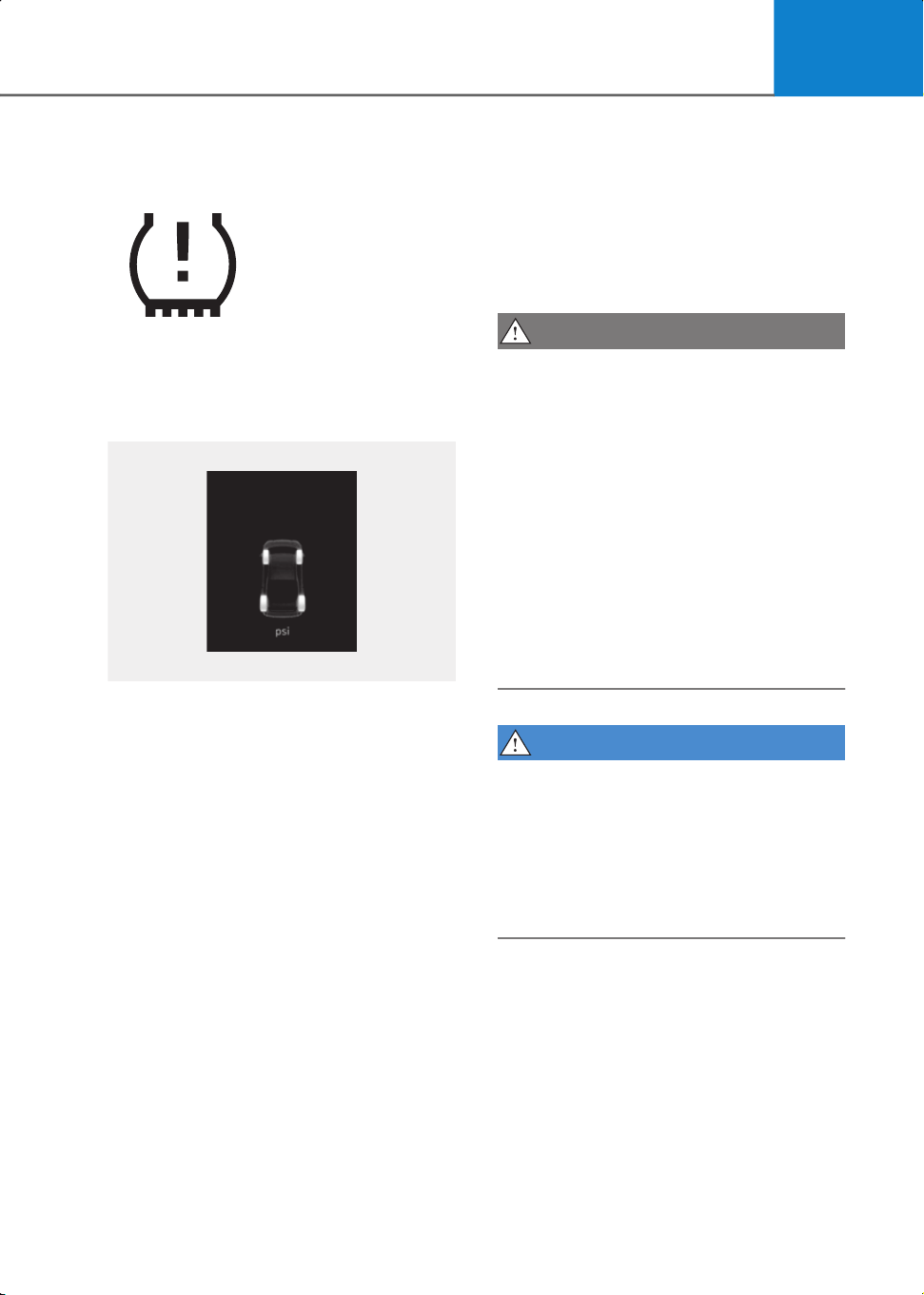
8
8-9
Low Tire Pressure Warning
Light
WL_TPMSWarningLamp
Low Tire Pressure Position
and Tire Pressure Telltale
B8002102
When the tire pressure monitoring
system warning indicators are illuminated
and a warning message displayed on the
cluster display, one or more of your tires is
significantly under-inflated. The Low Tire
Pressure Position Telltale will indicate
which tire is significantly underinflated by
illuminating the corresponding parking
light.
If either telltale illuminates, immediately
reduce your speed, avoid hard cornering
and anticipate increased stopping
distances. You should stop and check
your tires as soon as possible. Inflate the
tires to the proper pressure as indicated
on the vehicle’s placard or tire inflation
pressure label located on the driver’s side
center pillar outer panel.
If you cannot reach a service station or if
the tire cannot hold the newly added air,
replace the low pressure tire with the
spare tire.
The Low Tire Pressure Telltale will remain
on and the TPMS Malfunction Indicator
may blink for one minute and then remain
illuminated (when the vehicle is driven
about 10 minutes at speed above 15.5
mph (25 km/h)) until you have the low
pressure tire repaired and replaced on the
vehicle.
CAUTION
In winter or cold weather, the Low Tire
Pressure Telltale may be illuminated if the
tire pressure was adjusted to the
recommended tire inflation pressure in
warm weather. It does not mean your
TPMS is malfunctioning because the
decreased temperature leads to a
proportional lowering of tire pressure.
When you drive your vehicle from a warm
area to a cold area or from a cold area to a
warm area, or the outside temperature is
greatly higher or lower, you should check
the tire inflation pressure and adjust the
tires to the recommended tire inflation
pressure.
WARNING
Low pressure damage
Significantly low tire pressure makes the
vehicle unstable and can contribute to
loss of vehicle control and increased
braking distances.
Continued driving on low pressure tires
can cause the tires to overheat and fail.
-PXUJSFQSFTTVSF
-PX
-PX
-PX
-PX
CE_USA.book Page 9
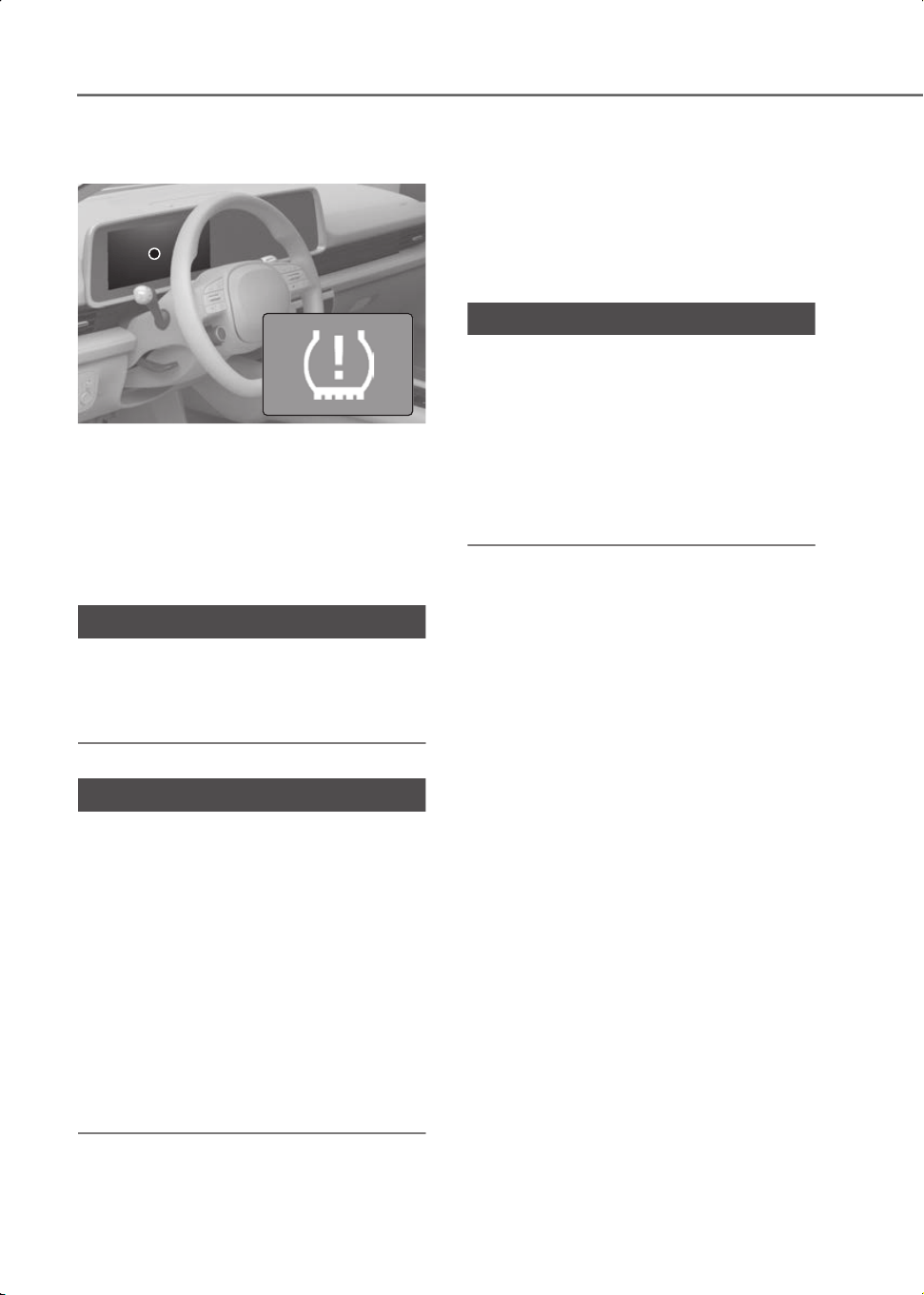
Emergency Situations
8-10
TPMS (Tire Pressure Monitoring System)
Malfunction Indicator
B8001801_1
The TPMS Malfunction Indicator will
illuminate after it blinks for about one
minute when there is a problem with the
Tire Pressure Monitoring System.
Have the system inspected by an
authorized HYUNDAI dealer as soon as
possible.
NOTICE
If there is a malfunction with the TPMS,
the Low Tire Pressure Position Telltale will
not be displayed even though the vehicle
has an under-inflated tire.
NOTICE
The TPMS Malfunction Indicator may
illuminate after blinking for one minute if
the vehicle is near electric power supply
cables or radio transmitters such as police
stations, government and public offices,
broadcasting stations, military
installations, airports, transmitting
towers, etc.
Additionally, the TPMS Malfunction
Indicator may illuminate if snow chains
are used or electronic devices such as
computers, chargers, remote starters,
navigation, etc. This may interfere with
normal operation of the TPMS.
Changing a Tire with TPMS
If you have a flat tire, the Low Tire
Pressure and Position telltales will come
on. Have the flat tire repaired by an
authorized HYUNDAI dealer as soon as
possible or replace the flat tire with the
spare tire.
NOTICE
It is recommended that you do not use a
puncture-repairing agent not approved
by an authorized HYUNDAI dealer or the
equivalent specified for your vehicle to
repair and/or inflate a low pressure tire.
Tire sealant not approved by an
authorized HYUNDAI dealer or the
equivalent specified for your vehicle may
damage the tire pressure sensor.
The spare tire (if equipped) does not
come with a tire pressure monitoring
sensor. When the low pressure tire or the
flat tire is replaced with the spare tire, the
Low Tire Pressure Telltale will remain on.
Also, the TPMS Malfunction Indicator will
illuminate after blinking for one minute if
the vehicle is driven at speed above 15.5
mph (25 km/h) for about 10 minutes.
Once the original wheel equipped with a
tire pressure monitoring sensor is
reinflated to the recommended pressure
and reinstalled on the vehicle, the Low
Tire Pressure Telltale and TPMS
Malfunction Indicator will go off within a
few minutes of driving.
If the indicators do not extinguish after a
few minutes, consult an authorized
HYUNDAI dealer.
Each wheel is equipped with a tire
pressure sensor mounted inside the tire
behind the valve stem (except for the
spare tire). You must use TPMS specific
wheels. It is recommended that you
always have your tires serviced by an
authorized HYUNDAI dealer.
You may not be able to identify a tire with
low pressure by simply looking at it.
CE_USA.book Page 10
8
8-11
Always use a good quality tire pressure
gauge to measure. Please note that a tire
that is hot (from being driven) will have a
higher pressure measurement than a tire
that is cold.
A cold tire means the vehicle has been
sitting for 3 hours and driven for less than
1 mi. (1.6 km) in that 3 hour period.
Allow the tire to cool before measuring
the inflation pressure. Always be sure the
tire is cold before inflating to the
recommended pressure.
WARNING
• The TPMS cannot alert you to severe
and sudden tire damage caused by
external factors such as nails or road
debris.
• If you feel any vehicle instability,
immediately take your foot off the
accelerator pedal, apply the brakes
gradually with light force, and slowly
move to a safe position off the road.
WARNING
Tampering with, modifying, or disabling
the Tire Pressure Monitoring System
(TPMS) components may interfere with
the system’s ability to warn the driver of
low tire pressure conditions and/or TPMS
malfunctions and may void the warranty.
WARNING
This device complies with Part 15 of the
FCC rules.
Operation is subject to the following three
conditions:
1. This device may not cause harmful
interference.
2. This device must accept any
interference received, including
interference that may cause undesired
operation of the device.
3. Changes or modifications not expressly
approved by the party responsible for
compliance could void the user’s
authority to operate the device.
CE_USA.book Page 11
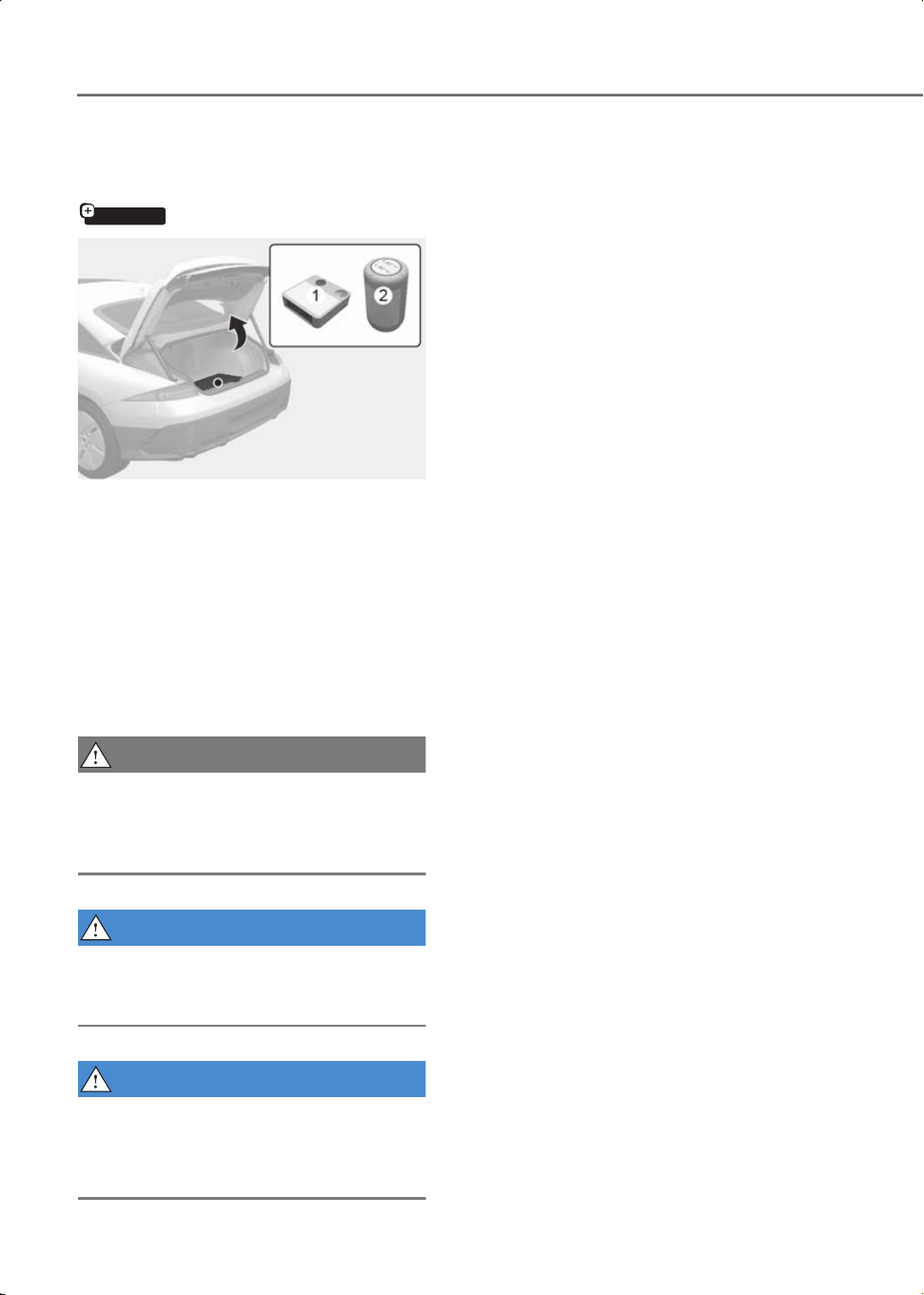
Emergency Situations
8-12
If You Have A Flat Tire
if equipped
(with Tire Mobility Kit)
B8002501
For safe operation, carefully read and
follow the instructions in this manual
before use.
1. Compressor
2. Sealant bottle
The tire mobility kit is a temporary fix to
the tire, have the tire inspected by an
authorized HYUNDAI dealer or the sealant
provided with the Tire Mobility Kit must
be used for only one flat tire.
CAUTION
When two or more tires are flat, do not
use the tire mobility kit because the
sealant provided with the Tire Mobility Kit
must be used for only one flat tire.
WARNING
Do not use the Tire Mobility Kit to repair
punctures in the tire walls. This can result
in an accident due to tire failure.
WARNING
Have your tire repaired as soon as
possible. The tire may lose air pressure at
any time after inflating with the Tire
Mobility Kit.
Introduction
With the Tire Mobility Kit you can stay
mobile even after experiencing a tire
puncture.
The compressor and sealing compound
system effectively and comfortably seals
most punctures in a passenger car tire
caused by nails or similar objects and
reinflates the tire.
After you ensure that the tire is properly
sealed you can drive cautiously on the tire
(distance up to 120 mi. (200 km)) at a max.
speed of 50 mph (80 km/h) in order to
reach a service station or tire dealer for
the tire replacement.
It is possible that some tires, especially
with larger punctures or damage to the
sidewall, cannot be sealed completely.
Air pressure loss in the tire may adversely
affect tire performance.
For this reason, you should avoid abrupt
steering or other driving maneuvers,
especially if the vehicle is heavily loaded
or if a trailer is in use.
The Tire Mobility Kit is not designed or
intended as a permanent tire repair
method and is to be used for one tire only.
This instruction shows you step by step
how to temporarily seal the puncture
simply and reliably.
Read the section “Notes on the safe use
of the Tire Mobility Kit”.
Notes on the Safe Use of the
Tire Mobility Kit
• Park your vehicle at the side of the road
so that you can work with the Tire
Mobility Kit away from moving traffic.
• To be sure your vehicle will not move,
even when you’re on fairly level ground,
always apply your parking brake.
CE_USA.book Page 12
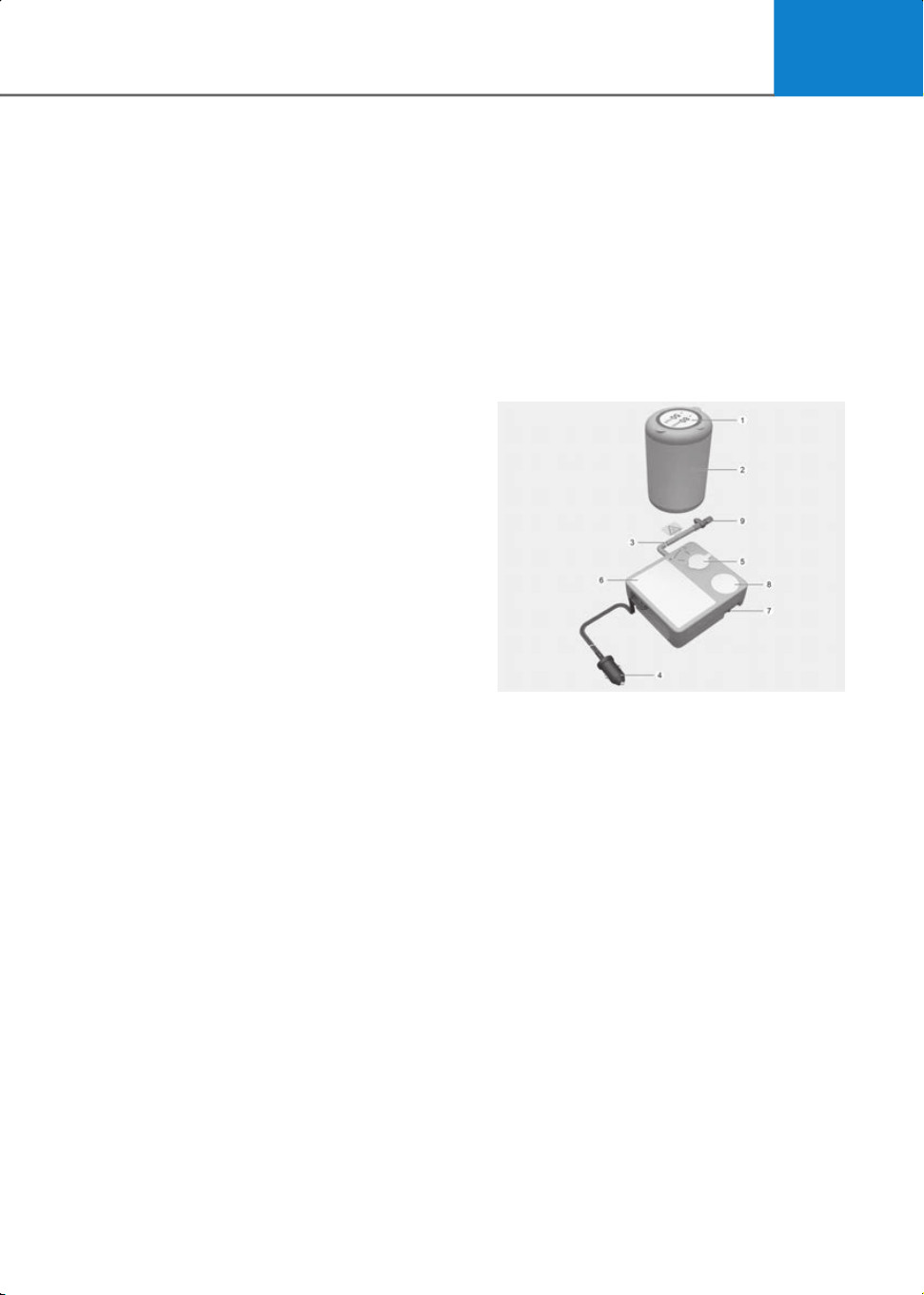
8
8-13
• Only use the Tire Mobility Kit for
sealing/inflation passenger car tires.
Only punctured areas located within
the tread region of the tire can be
sealed using the tire mobility kit.
• Do not use on motorcycles, bicycles or
any other type of tires.
• When the tire and wheel are damaged,
do not use Tire Mobility Kit for your
safety.
• Use of the Tire Mobility Kit may not be
effective for tire damage larger than
about 0.16 in. (4 mm).
• If the tire cannot be made roadworthy
with the Tire Mobility Kit, contact an
authorized HYUNDAI dealer.
• Do not use the Tire Mobility Kit if a tire
is severely damaged by driving run flat
or with insufficient air pressure. Only
punctured areas located within the
tread region of the tire can be sealed
using the Tire Mobility Kit.
• Do not remove any foreign objects such
as nails or screws that have penetrated
the tire.
• Provided the vehicle is outdoors, leave
the vehicle running. Otherwise
operating the compressor may
eventually drain the car battery.
• Never leave the Tire Mobility Kit
unattended while it is being used.
• Do not leave the compressor running
for more than 10 minutes at a time or it
may overheat.
• Do not use the Tire Mobility Kit if the
ambient temperature is below -22 °F
(-30 °C).
• In case of skin contact with the sealant,
wash the area thoroughly with plenty of
water. If the irritation persists, seek
medical attention.
• In case of eye contact with the sealant,
flush your eyes for at least 15 minutes. If
the irritation persists, seek medical
attention.
• In case of swallowing the sealant, rinse
the mouth and drink plenty of water.
However, never give anything to an
unconscious person and seek medical
attention immediately.
• Long time exposure to the sealant may
cause damage to bodily tissue such as
kidney, etc.
Components of the Tire
Mobility Kit
A8002501
1. Speed-restriction label
2. Sealant bottle and label with speed
restriction
3. Filling hose
4. Connectors and cable for the power
outlet direct connection
5. Holder for the sealant bottle
6.Compressor
7. ON/OFF switch
8.Pressure gauge for displaying the tire
inflation pressure
9.Button for reducing the tire inflation
pressure
Connectors, cable and connection hose
are stored in the compressor housing.
Strictly follow the specified sequence,
otherwise the sealant may escape under
high pressure.
CE_USA.book Page 13
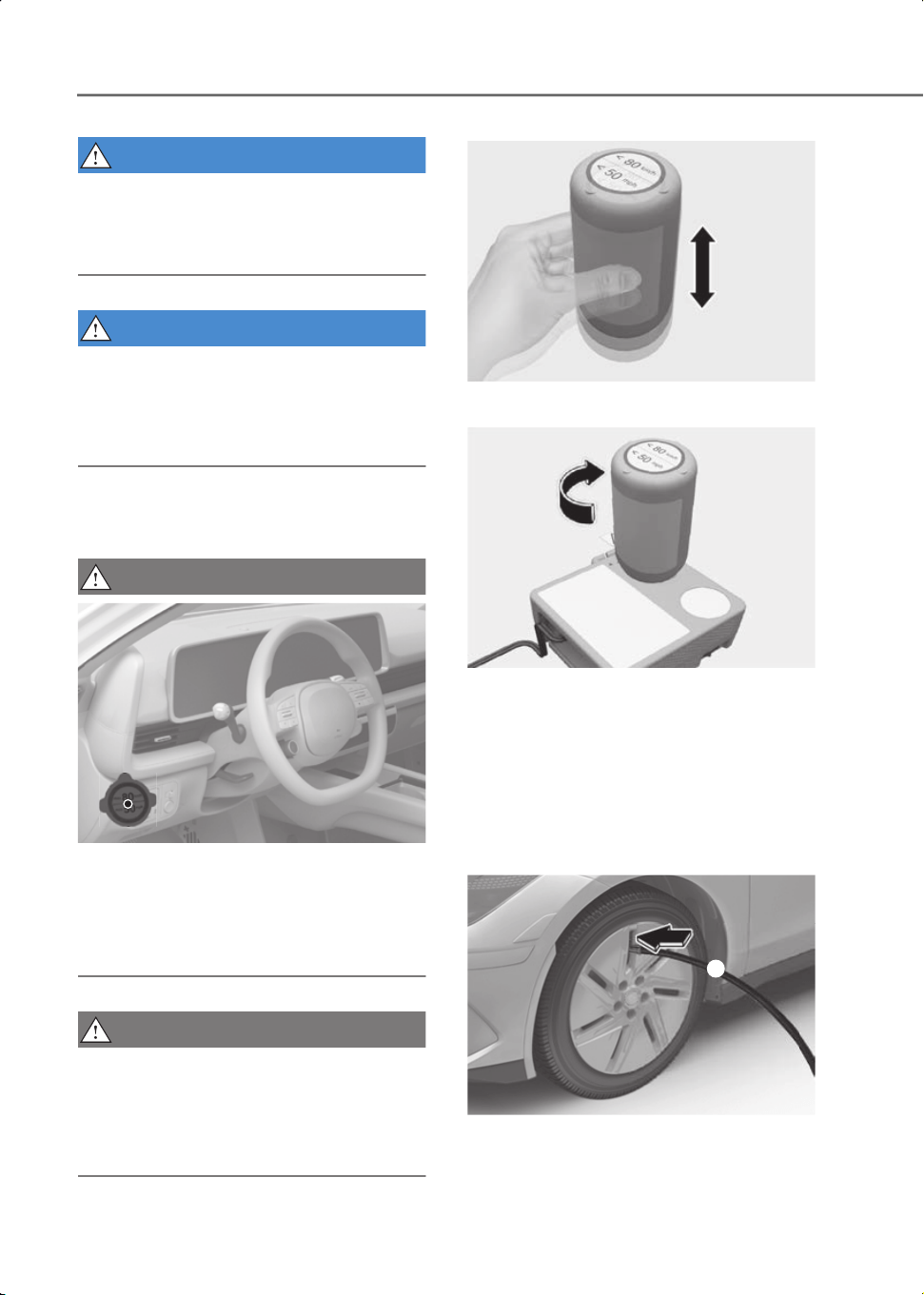
Emergency Situations
8-14
WARNING
Do not use the tire sealant after the
sealant has expired (the expiration date is
pasted on the sealant container). This can
increase the risk of tire failure.
WARNING
Sealant
• Keep out of reach of children.
• Avoid contact with eyes.
• Do not swallow.
Using the Tire Mobility Kit
When a Tire is Flat
CAUTION
B8002503
Detach the speed restriction label (1) from
the sealant bottle (2), and place it in a
highly visible place inside the vehicle
such as on the steering wheel to remind
the driver not to drive too fast.
CAUTION
If only the tire pressure needs to be
adjusted, refer to the “How to Adjust Tire
Pressure” in this chapter.
Before using the Tire Mobility Kit, be fully
aware of the explanation on the sealant.
B8002504
1. Shake the sealant bottle (2).
B8002505
2. Remove the sealant bottle (2) cap and
sealant bottle holder (5) cap and screw
the bottle onto the sealant bottle
holder.
3. Make sure the compressor valve on the
filling hose is locked.
4. Unscrew the valve cap and screw the
filling hose (3) onto the tire valve.
B8002506
3
CE_USA.book Page 14
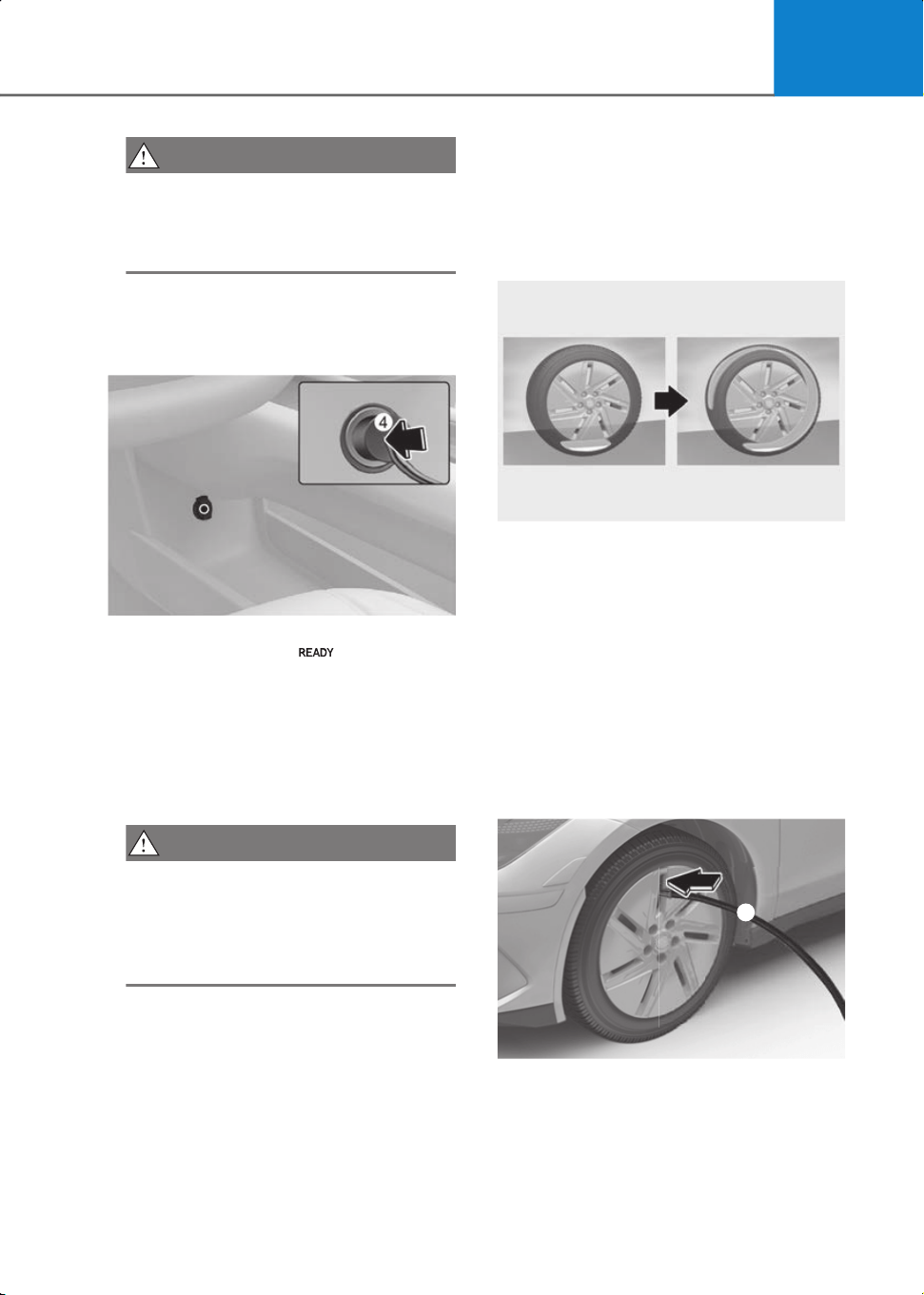
8
8-15
CAUTION
Securely install the sealant filling hose
to the valve. If not, sealant may flow
backward, possibly clogging the filling
hose.
5. Make sure the compressor is turned off
and plug the compressor power cord
(4) into the vehicle power outlet.
B8002507
6.With the vehicle on ( indicator on),
switch on the compressor and let it run
for about 5-7 minutes to on sealant up
on proper pressure (For more
information, refer to the "Tires And
Wheels" section in chapter 2).
Be careful not to overinflate the tire and
stay away from the tire when filling it.
CAUTION
Tire pressure
Do not attempt to drive your vehicle if
the tire pressure is below 29 psi (200
kPa). This could result in an accident
due to sudden tire failure.
7. Switch off the compressor.
8.Detach the hoses from the sealant
bottle connector and from the tire
valve.
9.Return the Tire Mobility Kit to its
storage location in the vehicle.
B8002508
10.Immediately drive about 4-6 mi. (7-10
km or, about 10 minutes) to evenly
distribute the sealant in the tire.
Do not exceed a speed of 50 mph (80
km/h). If possible, do not fall below a
speed of 12 mph (20 km/h).
While driving, if you experience any
unusual vibration, ride disturbance or
noise, reduce your speed and drive with
caution until you can safely pull off of
the side of the road.
Call for road side service or towing.
B8002509
11.After driving about 4-6 mi. (7-10 km or
about 10 minutes), stop at a safety
location.
12.Connect the filling hose (3) of the
compressor directly to the tire valve.
3
CE_USA.book Page 15
Emergency Situations
8-16
13.Plug the compressor power cord into
the vehicle power outlet.
14.Adjust the tire inflation pressure to the
recommended tire inflation.
With the vehicle on ( indicator on)
proceed as follows.
• To increase the inflation pressure:
Switch on the compressor. To check
the current tire inflation pressure
setting, briefly switch off the
compressor.
• To reduce the tire inflation pressure:
Press the button (9) on the
compressor.
Information
The pressure gauge may show higher
than actual reading when the compressor
is running. To get an accurate tire reading,
the compressor needs to be turned off.
CAUTION
If the tire inflation pressure is not
maintained, drive the vehicle a second
time, refer to step 9.
Then repeat steps 10 to 13.
Use of the TMK may be ineffectual for tire
damage larger than about 0.16 in. (4 mm).
Contact an authorized HYUNDAI dealer if
the tire cannot be made roadworthy with
the Tire Mobility Kit.
WARNING
The tire inflation pressure must be at least
32 psi (220 kPa). If it is not, do not
continue driving.
Call for road side service or towing.
CAUTION
Tire pressure sensor (if equipped with
TPMS)
The sealant on the tire pressure sensor
and wheel should be removed when you
replace the tire with a new one and
inspect the tire pressure sensors. Have
this done at an authorized HYUNDAI
dealer.
Information
When reinstalling the repaired or
replaced tire and wheel on the vehicle,
tighten the wheel lug nut to 79-94 lbf·ft
(11-13 kgf·m).
CE_USA.book Page 16
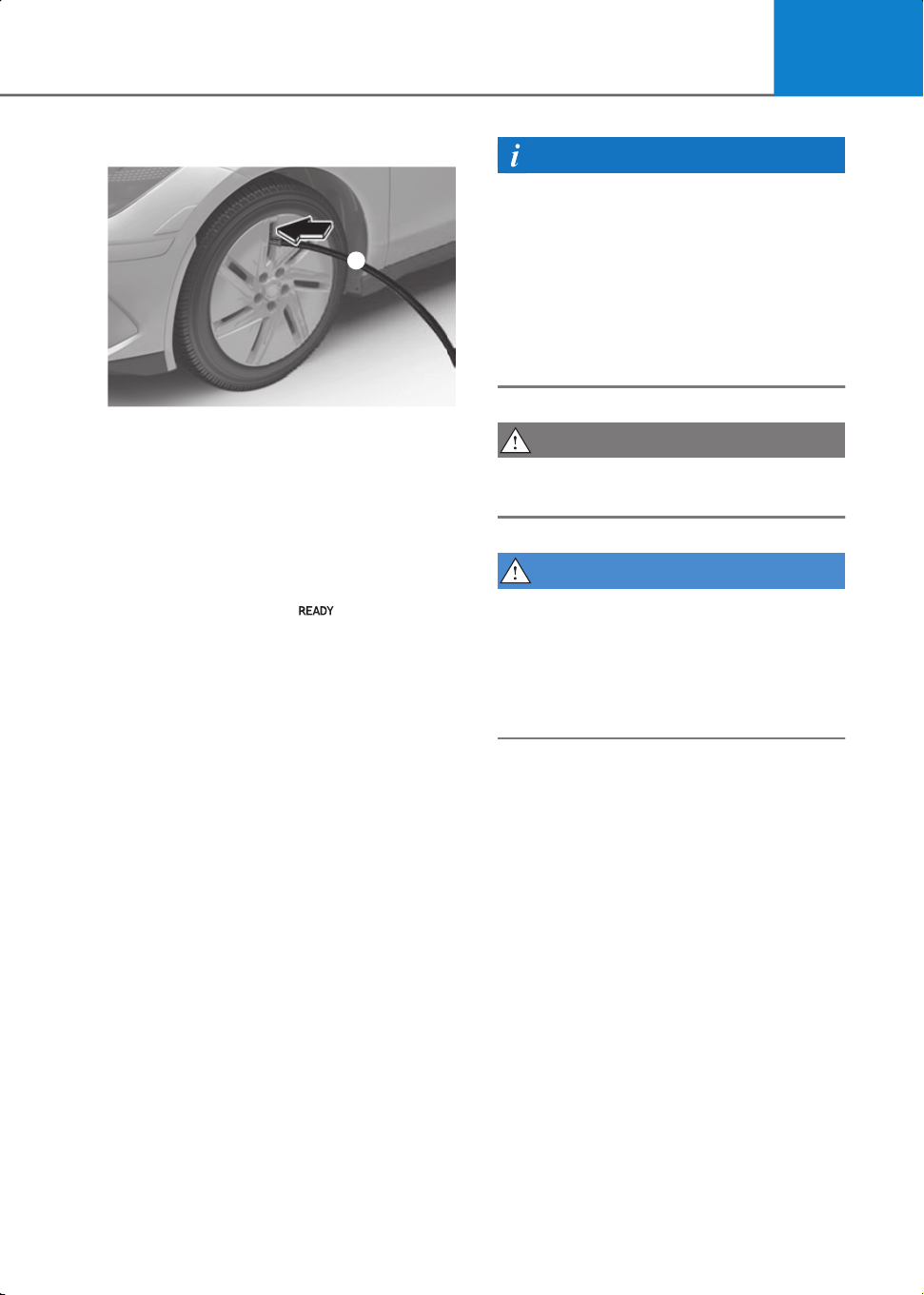
8
8-17
How to Adjust Tire Pressure
B8002510
1. Park your vehicle in a safe location.
2. Connect the filling hose (3) of the
compressor directly to the tire valve.
3. Plug the compressor power cord into
the vehicle power outlet.
4. Adjust the tire inflation pressure to the
recommended tire inflation.
With the vehicle on ( indicator on),
proceed as follows.
• To increase the inflation pressure:
Switch on the compressor. To check
the current tire inflation pressure
setting, briefly switch off the
compressor.
• To reduce the tire inflation pressure:
Press the button (9) on the
compressor.
Information
• The pressure gauge may show higher
than actual reading when the
compressor is running. To get an
accurate tire reading, the compressor
needs to be turned off.
• When reinstalling the repaired or
replaced tire and wheel on the vehicle,
tighten the wheel lug nut to 79-94 lbf·ft
(11-13 kgf·m).
CAUTION
Do not use the sealant when the tire
pressure only needs to be adjusted.
WARNING
The tire inflation pressure must be
Inflated to the proper pressure (For more
information, refer to the “Tires And
Wheels” section in chapter 2). If it is not,
do not continue driving.
Call for road side service or towing.
3
CE_USA.book Page 17
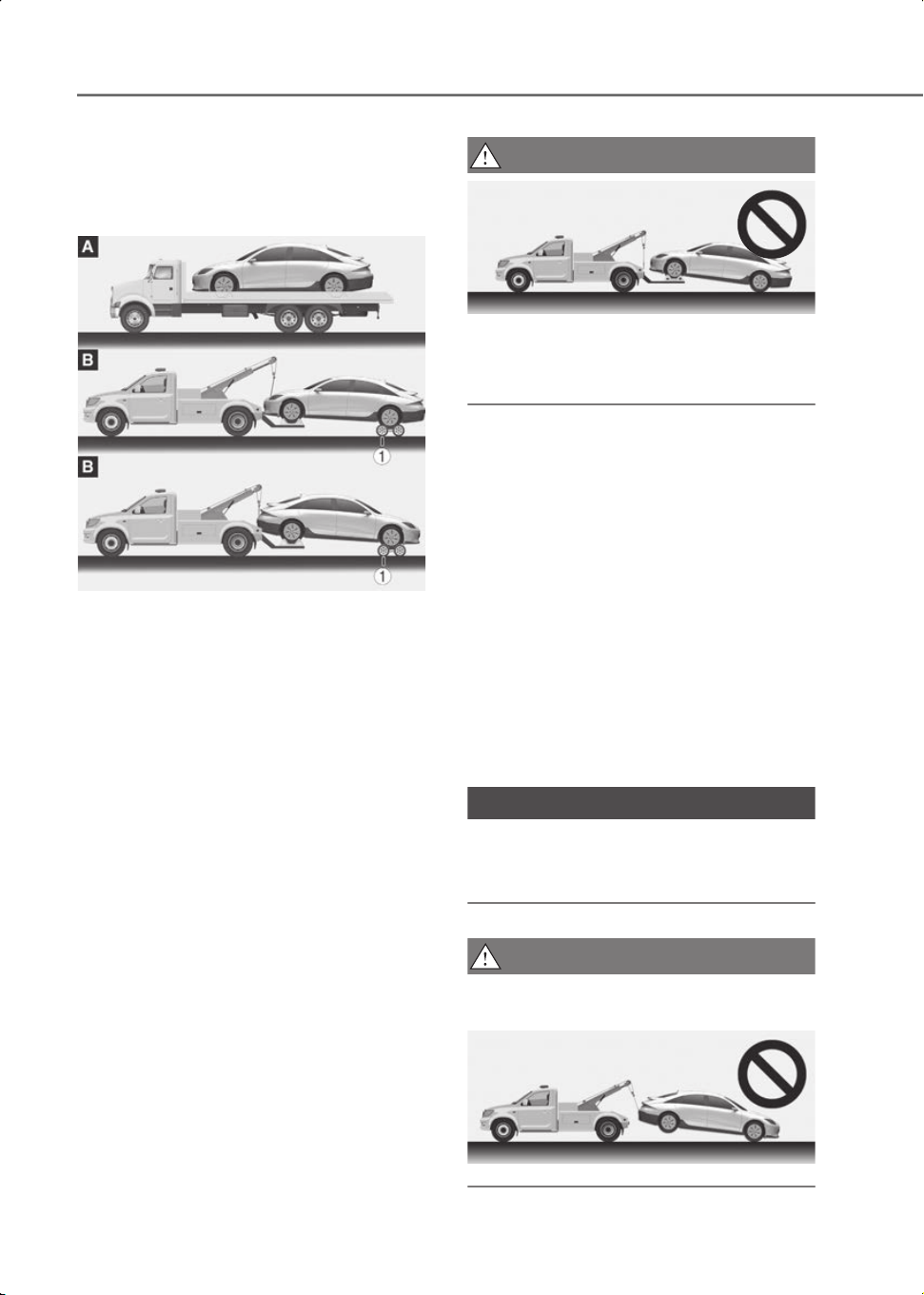
Emergency Situations
8-18
Towing
Towing Service
B8002701
(1) Dollies
If emergency towing is necessary, have it
done by an authorized HYUNDAI dealer or
a commercial tow-truck service.
Proper lifting and towing procedures are
necessary to prevent damage to the
vehicle. The use of wheel dollies or
flatbed is recommended.
2WD vehicle is acceptable to tow the
vehicle with the front wheels on the
ground (without dollies) and the rear
wheels off the ground.
If any of the loaded wheels or suspension
components are damaged or the vehicle
is being towed with the rear wheels on the
ground, use a towing dolly under the rear
wheels.
When being towed by a commercial tow
truck and wheel dollies are not used, the
rear of the vehicle should always be lifted,
not the front.
CAUTION
B8002705
Do not tow the vehicle with the rear
wheels on the ground as this may cause
damage to the vehicle.
AWD vehicle must be towed with a wheel
lift and dollies or flatbed equipment with
all the wheels off the ground.
Precautions when moving a short
distance before towing a vehicle
Move short distances within 33 ft. (10 m)
at a speed of 3 mph (5 km/h) or less only
when loading on a tow truck or if the
vehicle needs to be repositioned.
At this time, the gear must be in the N
(Neutral) position and the parking brake
must be released. If it is impossible to
operate the gear and parking brake, move
the vehicle with the rear wheel lifted.
NOTICE
Do not lift the vehicle by the tow fitting or
body and chassis parts. Otherwise the
vehicle may be damaged.
CAUTION
Do not tow with sling-type equipment.
Use wheel lift or flatbed equipment.
B8002704
CE_USA.book Page 18
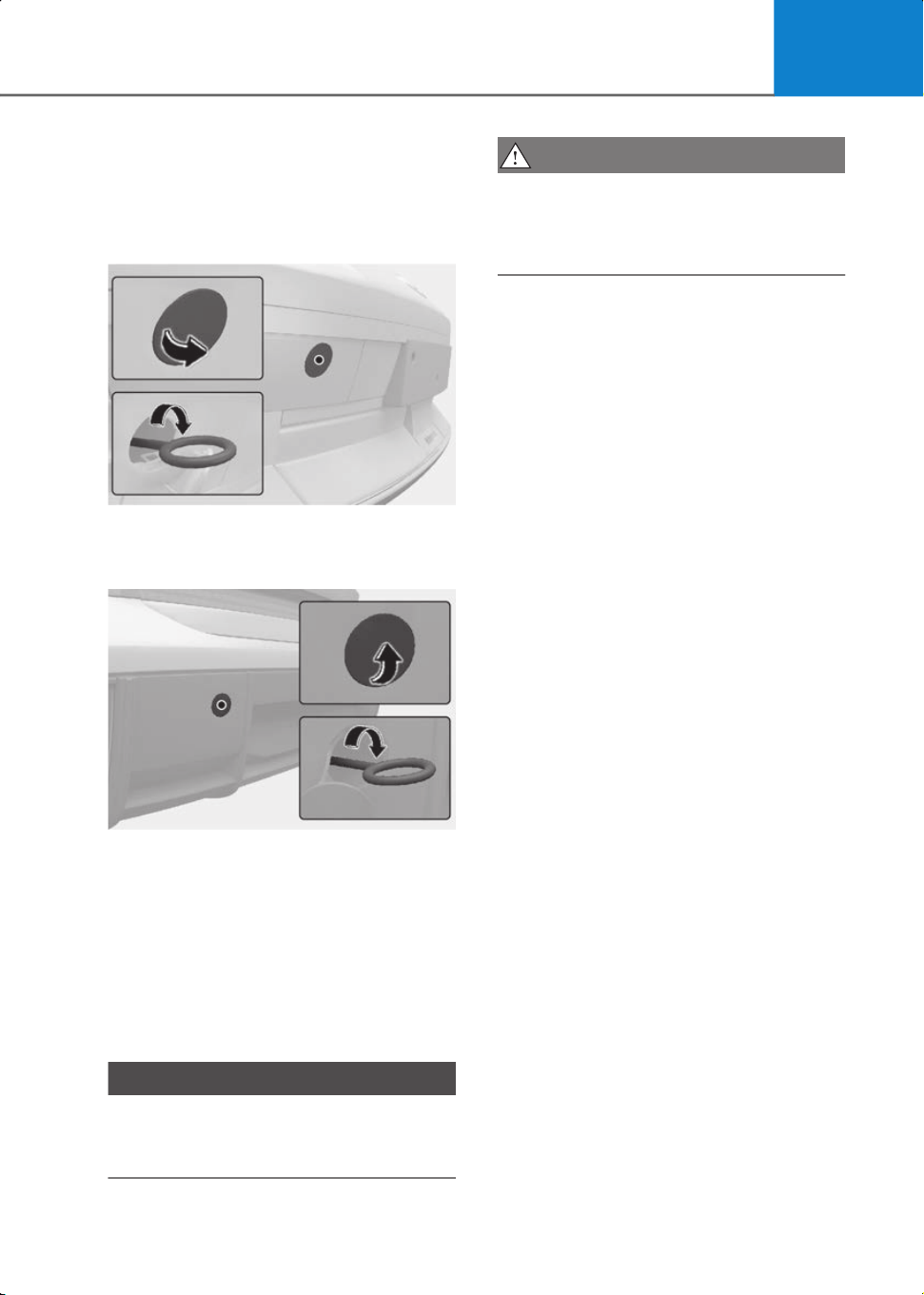
8
8-19
Removable Towing Hook
1. Open the trunk, and remove the towing
hook from the tool case.
2. Remove the hole cover.
Front
B8002801
3. Push the lower part of the bumper hole
cover.
Rear
B8002802
• Push the upper part of the bumper
hole cover.
• Pull the lower part of the bumper hole
cover.
4. Install the towing hook by turning it
clockwise into the hole until it is fully
secured.
5. Remove the towing hook and install the
cover after use.
NOTICE
Failure to properly tighten the towing
hook may result in vehicle damage and
deformation of related parts.
CAUTION
Make sure the towing hook is tighten
properly. If not, during towing the towing
hook may be thrown off the vehicle
resulting in serious injury or accident.
CE_USA.book Page 19

CE_USA.book Page 20

9
9. Maintenance
Motor Compartment .......................................................................................................9-4
Maintenance Services .....................................................................................................9-5
Owner’s Responsibility ................................................................................................9-5
Owner Maintenance Precautions ...............................................................................9-5
Owner Maintenance........................................................................................................9-6
Owner Maintenance Schedule....................................................................................9-6
Scheduled Maintenance Services ..................................................................................9-8
Normal Maintenance Schedule ..................................................................................9-9
Normal Maintenance Schedule ................................................................................ 9-10
Maintenance Under Severe Usage and Low Mileage Conditions ........................... 9-11
Explanation Of Scheduled Maintenance Items............................................................9-12
Cooling System ...........................................................................................................9-12
Coolant ........................................................................................................................9-12
Gear Fluid ....................................................................................................................9-12
Brake Hoses and Lines................................................................................................9-12
Brake Fluid...................................................................................................................9-12
Brake Discs, Pads, Calipers and Rotors.....................................................................9-12
Suspension Mounting Bolts .......................................................................................9-12
Steering Gear Box, Linkage & Boots/Lower Arm Ball Joint .....................................9-12
Drive Shafts and Boots ...............................................................................................9-12
Air Conditioning Refrigerant ......................................................................................9-12
Coolant ........................................................................................................................... 9-13
Changing Coolant ...................................................................................................... 9-14
Brake Fluid ..................................................................................................................... 9-14
Checking the Brake Fluid Level................................................................................. 9-14
Gear Fluid ....................................................................................................................... 9-15
Washer Fluid .................................................................................................................. 9-16
Checking the Washer Fluid Level ............................................................................. 9-16
Cabin Air Filter ............................................................................................................... 9-16
Filter Inspection ......................................................................................................... 9-16
Filter Replacement..................................................................................................... 9-16
Wiper Blades ...................................................................................................................9-17
Blade Inspection .........................................................................................................9-17
Blade Replacement.....................................................................................................9-17
CE_USA.book Page 1

9
Battery (12 V) ..................................................................................................................9-19
For Best Battery Service ............................................................................................ 9-21
Battery Capacity Label............................................................................................... 9-21
Battery Recharging .................................................................................................... 9-21
Reset Items .................................................................................................................9-22
Tires And Wheels........................................................................................................... 9-23
Tire Care..................................................................................................................... 9-23
Recommended Cold Tire Inflation Pressures.......................................................... 9-23
Check Tire Inflation Pressure.................................................................................... 9-24
Tire Rotation .............................................................................................................. 9-25
Wheel Alignment and Tire Balance .......................................................................... 9-25
Tire Replacement ...................................................................................................... 9-26
Wheel Replacement.................................................................................................. 9-26
Tire Traction................................................................................................................9-27
Tire Maintenance........................................................................................................9-27
Tire Sidewall Labeling ................................................................................................9-27
Tire Terminology and Definitions ............................................................................. 9-30
All Season Tires.......................................................................................................... 9-33
Summer Tires............................................................................................................. 9-33
Snow Tires.................................................................................................................. 9-33
Radial-Ply Tires .......................................................................................................... 9-33
Low Aspect Ratio Tires.............................................................................................. 9-34
Fuses .............................................................................................................................. 9-35
Instrument Panel Fuse Replacement....................................................................... 9-36
Motor compartment.................................................................................................. 9-36
Motor Compartment Panel Fuse Replacement ...................................................... 9-36
Fuse/Relay Panel Description .................................................................................. 9-38
CE_USA.book Page 2

9
9. Maintenance
Light Bulbs .................................................................................................................... 9-46
Headlight, Parking Light, Turn Signal Light, Daytime Running Light (DRL)
Replacement ..............................................................................................................9-47
Side Repeater Light Replacement............................................................................9-47
Rear Combination Light Replacement.................................................................... 9-48
High Mounted Stop Light Replacement.................................................................. 9-48
License Plate Light Replacement ............................................................................ 9-48
Front Trunk Light Replacement ............................................................................... 9-49
Interior Light Replacement ...................................................................................... 9-49
Appearance Care ...........................................................................................................9-50
Exterior Care...............................................................................................................9-50
Interior Care ...............................................................................................................9-55
California Perchlorate Notice ....................................................................................... 9-57
CE_USA.book Page 3
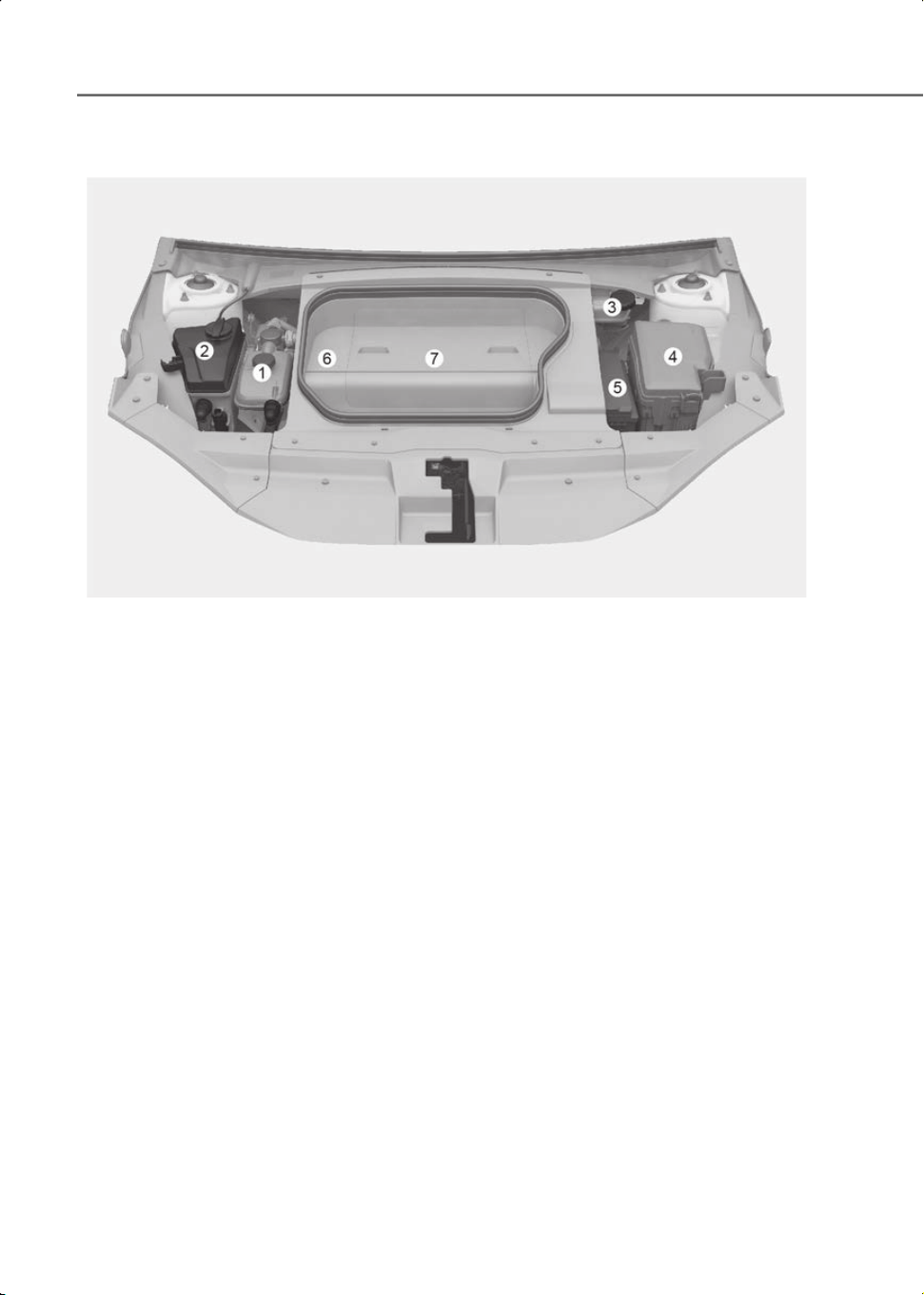
Maintenance
9-4
Motor Compartment
A1000901
The actual motor compartment in the vehicle may differ from the illustration.
(1) Coolant reservoir
(2) Windshield washer fluid reservoir
(3) Brake fluid reservoir
(4) Fuse box
(5) Battery (12 V)
(6) Front trunk
(7) Cabin air filter
CE_USA.book Page 4

9
9-5
Maintenance Services
You should exercise the utmost care to
prevent damage to your vehicle and
injury to yourself whenever performing
any maintenance or inspection
procedures.
Have your vehicle maintained and
repaired by an authorized HYUNDAI
dealer. An authorized HYUNDAI dealer
meets HYUNDAI’s high service quality
standards and receives technical support
from HYUNDAI in order to provide you
with a high level of service satisfaction.
Owner’s Responsibility
Maintenance service and record
retention are the owner’s responsibility.
You should retain documents that show
proper maintenance has been performed
on your vehicle in accordance with the
scheduled maintenance service charts
shown on the following pages. You need
this information to establish your
compliance with the servicing and
maintenance requirements of your
vehicle warranties.
Detailed warranty information is provided
in your Owner’s Handbook & Warranty
Information booklet.
Repairs and adjustments required as a
result of improper maintenance or a lack
of required maintenance are not covered.
Owner Maintenance
Precautions
Inadequate, incomplete or insufficient
servicing may result in operational
problems with your vehicle that could
lead to vehicle damage, an accident, or
personal injury. This chapter provides
instructions only for the maintenance
items that are easy to perform.
Your vehicle should not be modified in
any way. Such modifications may
adversely affect the performance, safety
or durability of your vehicle and may, in
addition, violate conditions of the limited
warranties covering the vehicle.
Certain modifications may also be in
violation of regulations established by the
U.S. Department of Transportation and
other federal or state agencies.
NOTICE
Improper owner maintenance during the
warranty period may affect warranty
coverage. For more information, read the
separate Owner’s Handbook & Warranty
Information booklet provided with the
vehicle. If you’re unsure about any service
or maintenance procedure, have it done
by an authorized HYUNDAI dealer.
CE_USA.book Page 5

Maintenance
9-6
Owner Maintenance
WARNING
Performing maintenance work on a
vehicle can be dangerous. If you lack
sufficient knowledge and experience or
the proper tools and equipment to do the
work, we recommend that it is done by an
authorized HYUNDAI dealer. ALWAYS
follow these precautions for performing
maintenance work:
• Park your vehicle on level ground. Shift
the vehicle to P (Park), apply the
parking brake, and press the Start/Stop
button to the OFF position.
• Block the tires (front and back) to
prevent the vehicle from moving.
Remove loose clothing or jewelry that
can become entangled in moving parts.
• Keep flames, sparks, or smoking
materials away from the battery and
motor related parts.
WARNING
Make sure to turn the Start/Stop button to
the OFF position to shut down the vehicle
before performing maintenance work on
the vehicle.
The following lists are vehicle checks and
inspections that should be performed by
the owner or an authorized HYUNDAI
dealer at the frequencies indicated to
help ensure safe, dependable operation
of your vehicle.
Any adverse conditions should be
brought to the attention of your dealer as
soon as possible.
These Owner Maintenance vehicle
checks are generally not covered by
warranties and you may be charged for
labor, parts and lubricants used.
The electric control system in the vehicle
may cause malfunction or other negative
impact on the artificial heart and the
artificial internal organs. Be sure to
inquire the impact of the electric control
system on the artificial organs from the
medical product corporation.
Owner Maintenance Schedule
When you stop for charging:
• Check the coolant level in the coolant
reservoir.
• Check the windshield washer fluid
level.
• Check for low or under-inflated tires.
WARNING
Be careful when checking your coolant
level if the motor compartment is hot.
This may result in coolant being blown
out of the opening and cause serious
burns and other injuries.
CE_USA.book Page 6

9
9-7
While operating your vehicle:
• Check for vibrations in the steering
wheel. Notice if there is any increased
steering effort or looseness in the
steering wheel, or change in its
straight-ahead position.
• Notice if your vehicle constantly turns
slightly or “pulls” to one side when
traveling on smooth, level road.
• When stopping, listen and check for
unusual sounds, pulling to one side,
increased brake pedal travel or
“hard-to-push” brake pedal.
• If any slipping or changes in the
operation of your gear shift occurs,
check the shift gear fluid level.
• Check the shift gear P (Park) function.
• Check the parking brake.
• Check for fluid leaks under your vehicle
(water dripping from the air
conditioning system during or after use
is normal).
At least monthly:
• Check coolant level in the coolant
reservoir.
• Check the operation of all exterior
lights, including the stoplights, turn
signals and hazard warning flashers.
• Check the inflation pressures of all tires
including the spare for tires that are
worn, show uneven wear, or are
damaged.
• Check for loose wheel lug nuts.
At least twice a year: (for example,
every Spring and Autumn)
• Check radiator, heater and air
conditioning hoses for leaks or
damage.
• Check windshield washer spray and
wiper operation. Clean wiper blades
with a clean cloth dampened with
washer fluid.
• Check headlight alignment.
• Check the seat belts for wear and
function.
At least once a year:
• Clean body and door drain holes.
• Lubricate door hinges and hood hinges.
• Lubricate door and hood locks and
latches.
• Lubricate door rubber weather strips.
• Check the air conditioning system.
• Inspect and lubricate shift gear linkage
and controls.
• Clean the battery (12 V) and terminals.
• Check the brake fluid level.
CE_USA.book Page 7

Maintenance
9-8
Scheduled Maintenance Services
Follow Normal Maintenance Schedule if the vehicle is usually operated where none of the
following conditions apply. If any of the following conditions apply, you must follow the
Maintenance Under Severe Usage Conditions.
• Repeated driving short distance of less than 5 mi. (8 km) in normal temperature or less
than 10 mi. (16 km) in freezing temperature
• Driving on rough, dusty, muddy, unpaved, graveled or salt-spread roads
• Driving in areas using salt or other corrosive materials or in very cold weather
• Driving in heavy dust condition
• Driving in heavy traffic area with the ambient temperature higher than 90 ºF (32 ºC)
while consuming more than 50% of electric energy.
• Driving on uphill, downhill, or mountain roads repeatedly
• Towing a trailer or using a camper, or driving with loads on the roof
• Driving as a patrol car, taxi, other commercial use or vehicle towing
• Frequently driving under high speed or rapid acceleration/deceleration
• Frequently driving in stop-and-go conditions
If your vehicle is operated under the above conditions, you should inspect, replace or
refill more frequently than the following Normal Maintenance Schedule. After the periods
or distance shown in the chart, continue to follow the prescribed maintenance intervals.
CE_USA.book Page 8

9
9-9
Normal Maintenance Schedule
The following maintenance services must be performed to ensure good vehicle
performance.
Keep receipts for all vehicle services to protect your warranty. Where both mileage and
time are shown, the frequency of service is determined by whichever occurs first.
I: Inspect and if necessary, adjust, correct, clean or replace.
R: Replace or change.
MAINTENANCE
INTERVALS
Months 12 24 36 48 60 72 84 96 108 120 132 144 156
Miles×
1,000
8 16 24 32 40 48 56 64 72 80 88 96 104
Km×
1,000
13 26 39 52 65 78 91 104 117 130 143 156 169
MAINTENANCE ITEM
Cooling system
I I I I I I I I I I I I I
12 V auxiliary battery
condition
Brake lines, hoses, and
connections
Disc brakes and pads
Brake pedal
Steering gear rack,
linkage, and boots
Air conditioning
compressor, air
conditioner refrigerant
and performance
CE_USA.book Page 9

Maintenance
9-10
Normal Maintenance Schedule
*1 Consult an authorized HYUNDAI dealer, when replacing or adding coolant.
I: Inspect and if necessary, adjust, correct, clean or replace.
R: Replace or change.
MAINTENANCE
INTERVALS
Months 12 24 36 48 60 72 84 96 108 120 132 144 156
Miles×
1,000
8 16 24 32 40 48 56 64 72 80 88 96 104
Km×
1,000
13 26 39 52 65 78 91 104 117 130 143 156 169
MAINTENANCE ITEM
Drive shafts and boots I I I I I I
Replace Climate Control
Air Filter (For Evaporator
and Blower Unit)
I R I R I R I R I R I R I
Gear fluid I I I
Rotate Tires (Includes Tire
Pressure and Tread Wear
Inspection)
Rotate every 8,000 mi. (13,000 km) or 12 months
Coolant
*1
At first, replace 120,000 mi. (200,000 km) or 120 months.
After that, replace every 24,000 mi. (40,000 km) or 24 month.
Brake fluid
Inspect every 7,500 mi. (12,000 km) or 12 months,
Replace every 60,000 mi. (96,000 km) or 48 months
CE_USA.book Page 10

9
9-11
Maintenance Under Severe Usage and Low Mileage Conditions
The following items must be serviced more frequently on cars mainly used under severe
driving conditions.
Refer to the chart below for the appropriate maintenance intervals.
R: Replace
I: Inspect and if necessary, adjust, correct, clean or replace
Severe driving conditions
A. Repeatedly driving short distance of less than 5 mi. (8 km) in normal temperature or
less than 10 mi. (16 km) in freezing temperature
B. Driving on rough, dusty, muddy, unpaved, graveled or salt spread roads
C. Driving in areas using salt or other corrosive materials or in very cold weather
D. Driving in heavy dust condition
E. Driving in heavy traffic area with the ambient temperature higher than 90 ºF (32 ºC)
while consuming more than 50 % of electric energy.
F. Driving on uphill, downhill, or mountain roads repeatedly
G. Towing a trailer or using a camper, or driving with loads on the roof
H. Driving as a patrol car, taxi, other commercial use or vehicle towing
I. Frequently driving under high speed or rapid acceleration/deceleration
J. Frequently driving in stop-and-go conditions
Maintenance item
Maintenance
operation
Maintenance intervals
Driving
condition
Gear fluid R
Replace every 80,000 mi.
(120,000 km)
B, D, G, H
Steering gear rack,
linkage and boots
I
Inspect more frequently
depending on the condition
B, C, D, E, F
Front suspension ball
joints
I
Inspect more frequently
depending on the condition
B, C, D, E, F
Disc brakes and pads,
calipers and rotors
I
Inspect more frequently
depending on the condition
B, C, D, E, F, G,
H, I, J
Drive shaft and boots I
Inspect more frequently
depending on the condition
B, C, D, E, F, G,
H, I
Cabin air filter R
Replace more frequently
depending on the condition
B, D, F
CE_USA.book Page 11

Maintenance
9-12
Explanation Of Scheduled
Maintenance Items
Cooling System
Check cooling system components, such
as radiator, coolant reservoir, hoses and
connections for leakage and damage.
Replace any damaged parts.
Coolant
The coolant should be changed at the
intervals specified in the maintenance
schedule.
Gear Fluid
The gear fluid should be inspected and
replaced according to the intervals
specified in the maintenance schedule.
Brake Hoses and Lines
Visually check for proper installation,
chafing, cracks, deterioration and any
leakage. Replace any deteriorated or
damaged parts immediately.
Brake Fluid
Check the brake fluid level in the brake
fluid reservoir. The level should be
between the MIN and the MAX marks on
the side of the reservoir. Use only
hydraulic brake fluid conforming to DOT 4
specification.
Brake Discs, Pads, Calipers
and Rotors
Check the pads, the discs, and the rotors
for any excessive wear-out. Inspect
calipers for any fluid leakage.
Suspension Mounting Bolts
Check the suspension connections for
looseness or damage. Retighten to the
specified torque.
Steering Gear Box, Linkage &
Boots/Lower Arm Ball Joint
With the vehicle stopped and the vehicle
off, check for excessive free-play in the
steering wheel. Check the linkage for
bends or damage. Check the dust boots
and ball joints for deterioration, cracks, or
damage.
Replace any damaged parts.
Drive Shafts and Boots
Check the drive shafts, boots and clamps
for cracks, deterioration, or damage.
Replace any damaged parts and, if
necessary, repack the grease.
Air Conditioning Refrigerant
Check the air conditioning lines and
connections for leakage and damage.
CE_USA.book Page 12
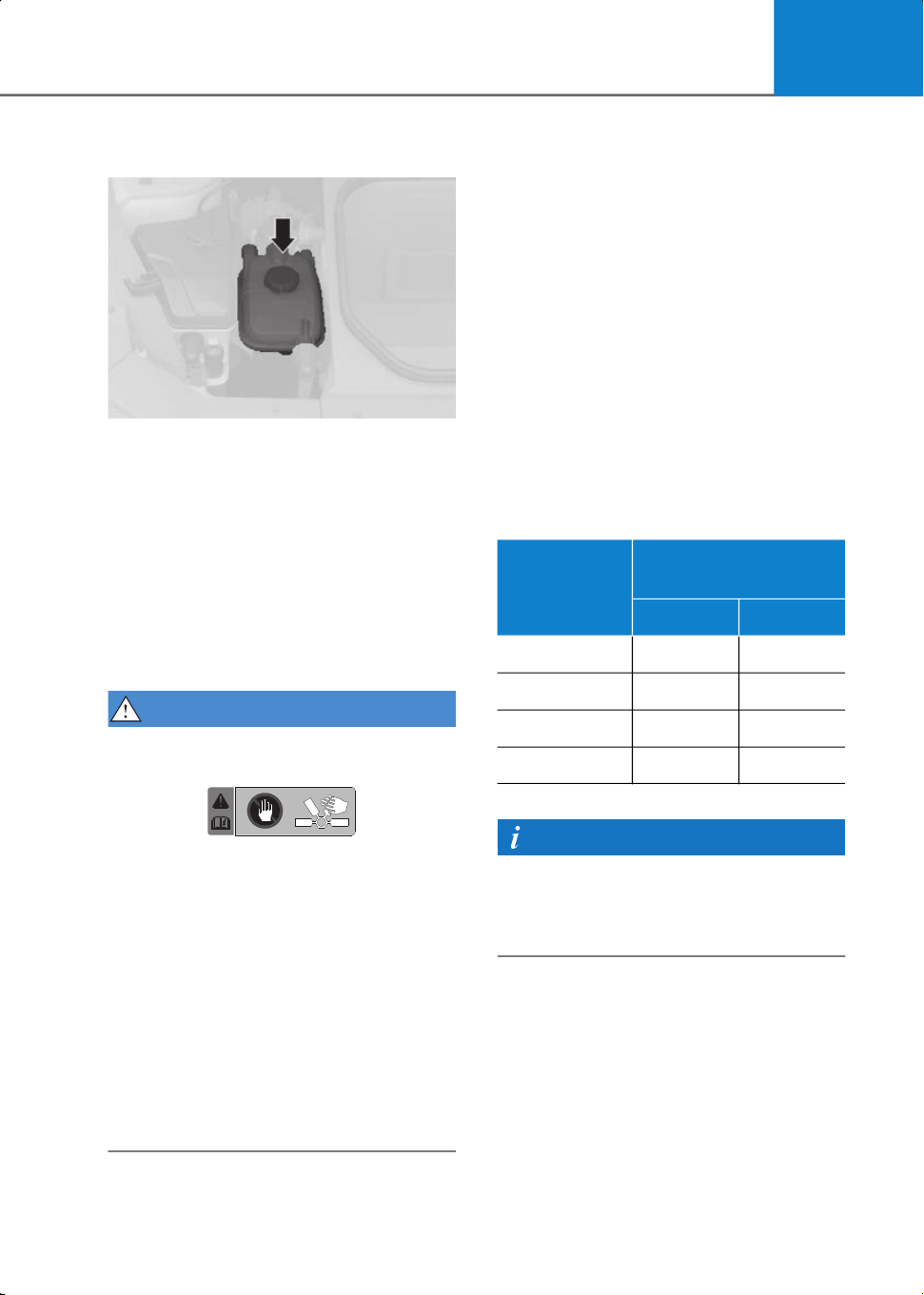
9
9-13
Coolant
B9001901
Check the condition and connections of
all cooling system hoses and heater
hoses. Replace any swollen or
deteriorated hoses.
The coolant level should be filled between
the MAX or F and the MIN or L marks on
the side of the coolant reservoir when the
parts in the motor compartment is cool.
If the coolant level is low, have the vehicle
inspected by an authorized HYUNDAI
dealer.
WARNING
WL_MotorRoomHotCaution
Keep hands, clothing, and tools away
from the rotating fan blades of the
cooling fan. The cooling fan may continue
to operate even though the vehicle is
turned off and can cause serious injury.
The electric motor for the cooling fan is
controlled by vehicle coolant
temperature, refrigerant pressure and
vehicle speed. As the vehicle coolant
temperature decreases, the electric
motor will automatically shut off.
Recommended coolant
• When adding coolant, use only
deionized water, distilled water, or soft
water for your vehicle and never mix
hard water in the coolant filled at the
factory.
• An incorrect coolant mixture may result
in severe malfunction or motor
damage.
• Do not use alcohol or methanol coolant
or mix them with the specified coolant.
• Do not use a solution that contains
more than 60% antifreeze or less than
35% antifreeze, which could reduce the
effectiveness of the solution.
For mixing percentage, refer to the
following table:
Information
If in doubt about the mix ratio, a 50 %
water and 50 % antifreeze mix is the
easiest to mix together because it is the
same quantity for each.
Ambient
Temperature
Mixture Percentage
(volume)
Antifreeze Water
5 °F (-15 °C) 35 65
-13 °F (-25 °C) 40 60
-31 °F (-35 °C) 50 50
-49 °F (-45 °C) 60 40
CE_USA.book Page 13
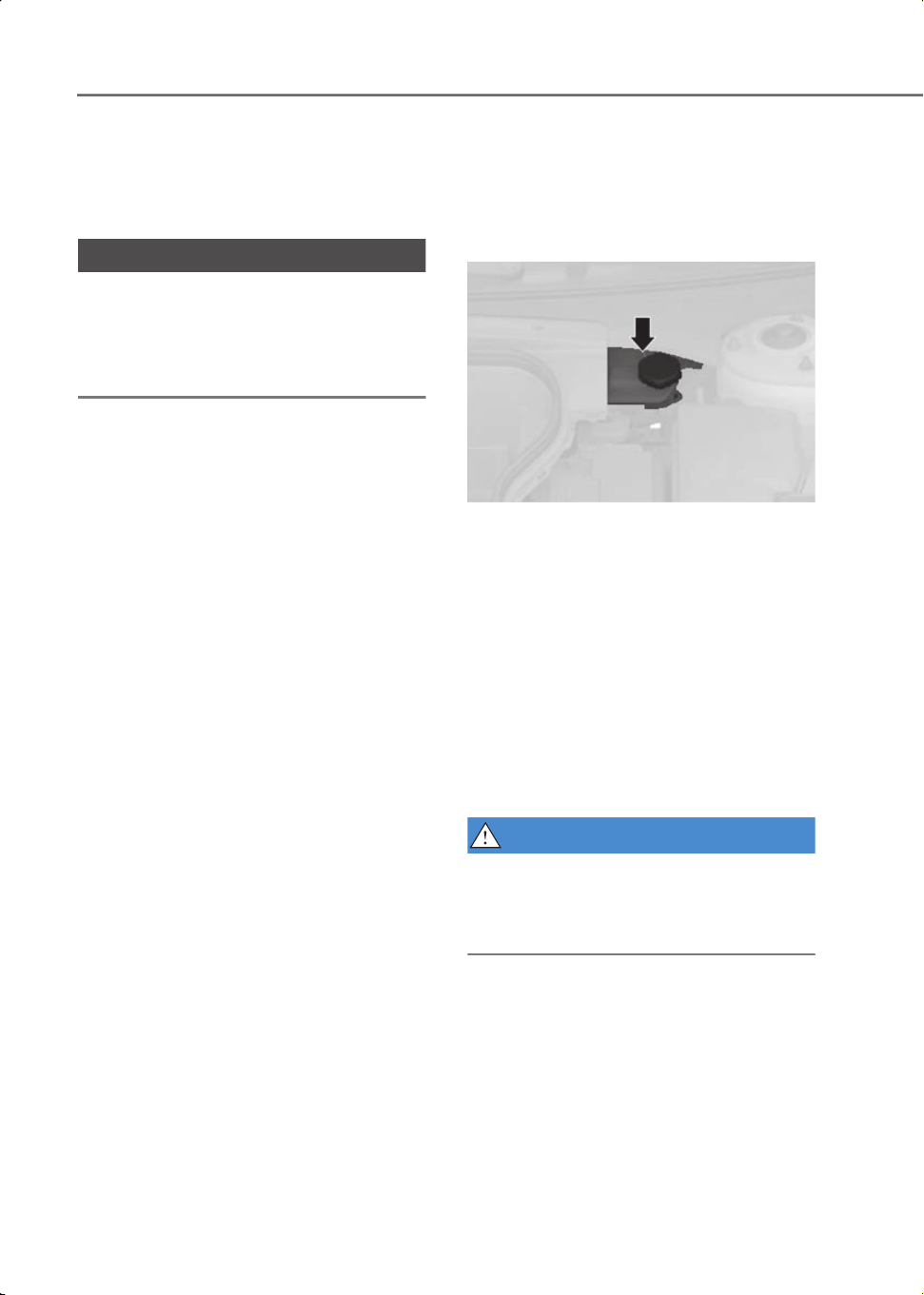
Maintenance
9-14
Changing Coolant
Have the coolant changed by an
authorized HYUNDAI dealer according to
the Maintenance Schedule.
NOTICE
To prevent damage to motor parts, put a
thick towel around the coolant cap before
refilling the coolant to prevent the
coolant from overflowing into motor
parts.
Brake Fluid
Checking the Brake Fluid
Level
B9002301
Check the fluid level in the reservoir
periodically. The fluid level should be
between MAX and MIN marks on the side
of the reservoir.
Before removing the reservoir cap and
adding brake fluid, clean the area around
the reservoir cap thoroughly to prevent
brake fluid contamination.
If the level is low, add the specified brake
fluid to the MAX level. If the fluid level is
excessively low or frequent additions are
required have the brake system inspected
by an authorized HYUNDAI dealer.
WARNING
If brake fluid comes in contact with your
eyes, flush your eyes with clean water for
at least 15 minutes and get immediate
medical attention.
CE_USA.book Page 14
9
9-15
NOTICE
• Do not allow brake fluid to contact the
vehicle’s body paint, because paint
damage may occur.
• Never use brake fluid that has been
exposed to open air for an extended
time and dispose of it properly.
• Do not use the wrong type of brake
fluid. A few drops of mineral based oil
such as engine oil in your brake system
may damage the brake system parts.
Information
Use only the brake fluid specified in the
"Recommended Lubricants And
Capacities" section in chapter 2.
Gear Fluid
There is no gear fluid level gauge in the
vehicle. Check the gear fluid every 32,000
mi. (52,000 km) regularly. If the vehicle is
driven under severe condition, check the
maintenance under severe usage
condition and consult an authorized
HYUNDAI dealer.
CE_USA.book Page 15
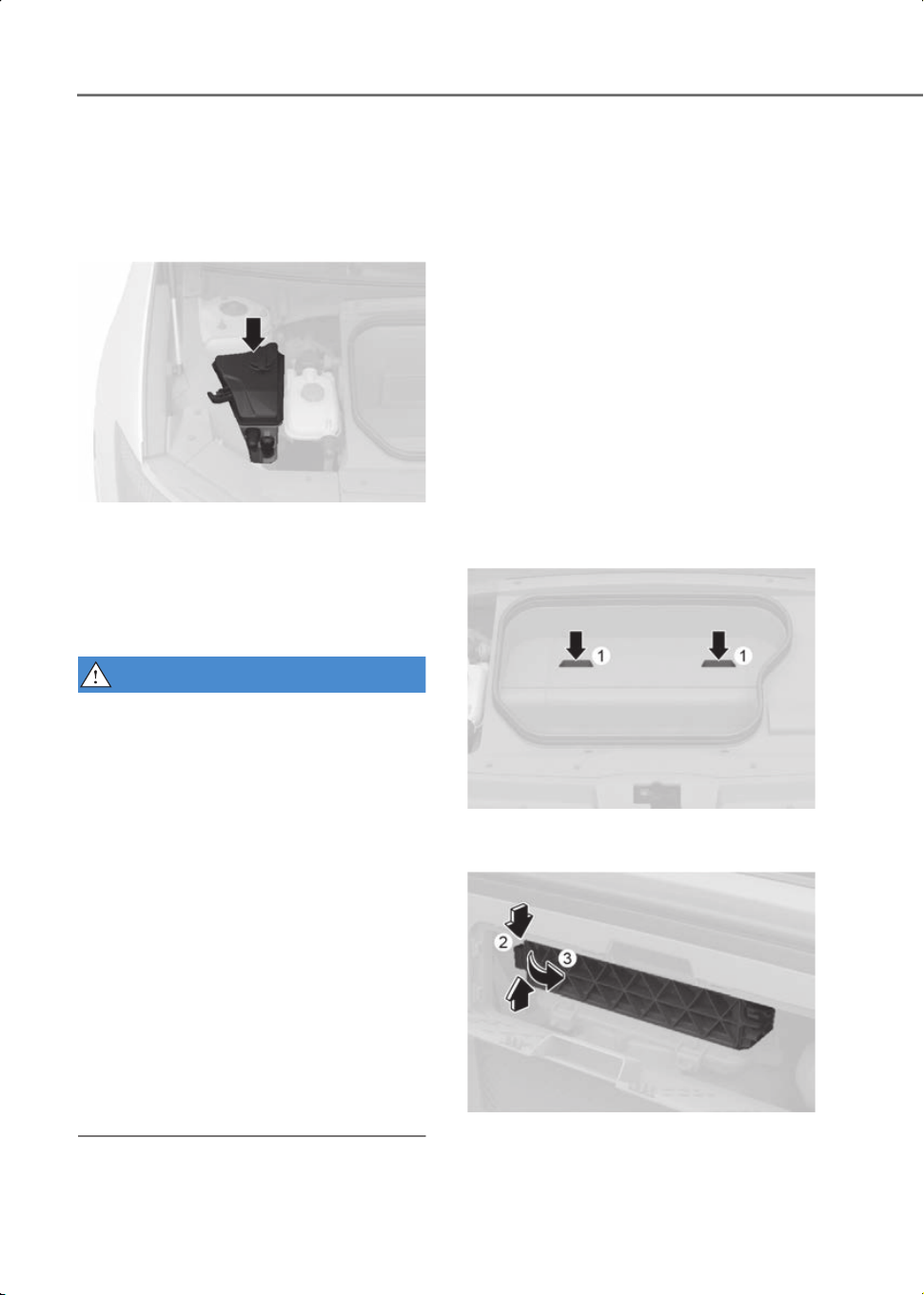
Maintenance
9-16
Washer Fluid
Checking the Washer Fluid
Level
B9002701
Check the fluid level in the washer fluid
reservoir and add fluid if necessary. Plain
water may be used if washer fluid is not
available. However, use washer solvent
with antifreeze characteristics in cold
climates to prevent freezing.
WARNING
To prevent serious injury or death, take
the following safety precautions when
using washer fluid:
• Do not use coolant or antifreeze in the
washer fluid reservoir. Coolant can
severely obscure visibility when
sprayed on the windshield and may
cause loss of vehicle control resulting in
an accident or damage to paint and
body trim.
• Do not allow sparks or flame to contact
the washer fluid or the washer fluid
reservoir. Washer fluid may contain
alcohol and can be flammable.
• Do not drink washer fluid and avoid
contact with skin. Washer fluid is
harmful to humans and animals.
• Keep washer fluid away from children
and animals.
Cabin Air Filter
Filter Inspection
The cabin air filter must be replaced
according to the Maintenance Schedule.
If the vehicle is operated in severely
air-polluted cities or on dusty rough roads
for a long period, it should be inspected
more frequently and replaced sooner.
Replace the cabin air filter by following
the procedure below and be careful to
avoid damaging other components.
Filter Replacement
1. Open the hood.
2. Lift up the front trunk cover while
depressing the front trunk lever (1).
B9003602
3. Press and hold the lock (2) on the left
side of the cover (3).
B9003603
4. Replace the cabin air filter.
CE_USA.book Page 16
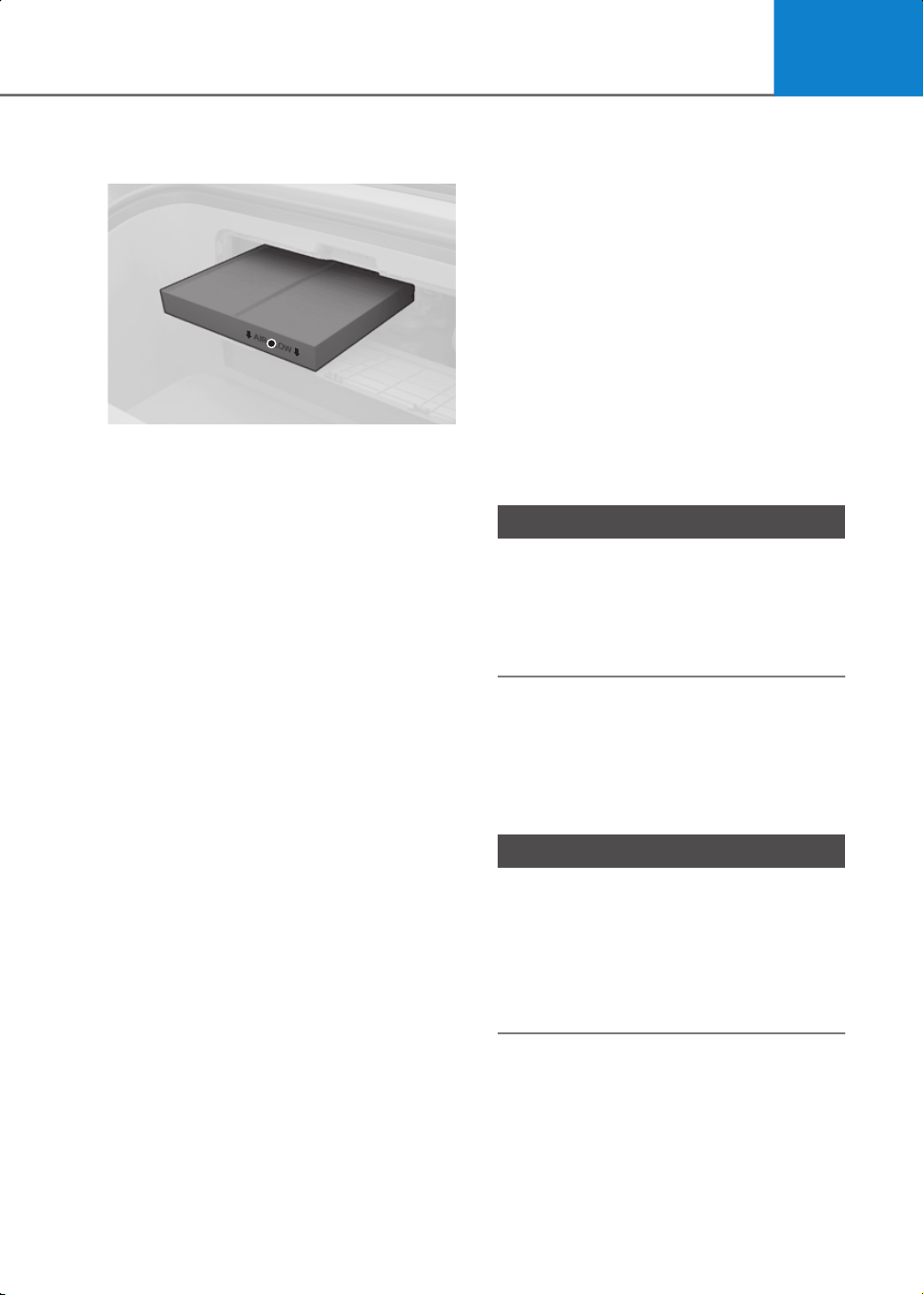
9
9-17
5. Reassemble in the reverse order of
disassembly.
B9003604
• Install a new cabin air filter with the
arrow symbol (↓) facing down to
improve effectiveness.
• Always be sure that the front trunk
cover is firmly closed after replacing
the cabin air filter.
Otherwise is may cause interior
damage in the motor compartment,
noise trouble, or entrance of foreign
substances.
Wiper Blades
Blade Inspection
Contamination of either the windshield or
the wiper blades with foreign matter can
reduce the effectiveness of the
windshield wipers.
Common sources of contamination are
insects, tree sap, and hot wax treatments
used by some commercial car washes. If
the blades are not wiping properly, clean
both the window and the blades with a
good cleaner or mild detergent, and rinse
thoroughly with clean water. Replace
blades as needed.
NOTICE
To prevent damage to the wiper blades,
arms or other components, do not:
• Use gasoline, kerosene, paint thinner,
or other solvents on or near them.
• Attempt to move the wipers manually.
Blade Replacement
When the wipers no longer clean
adequately, the blades may be worn or
cracked. Replace the wipers with new
ones.
NOTICE
To prevent damage:
• Never use non-specified wiper blades.
• Lift the wiper arms when in the top
wiping position.
Always return the wiper arms to the
windshield before driving.
CE_USA.book Page 17
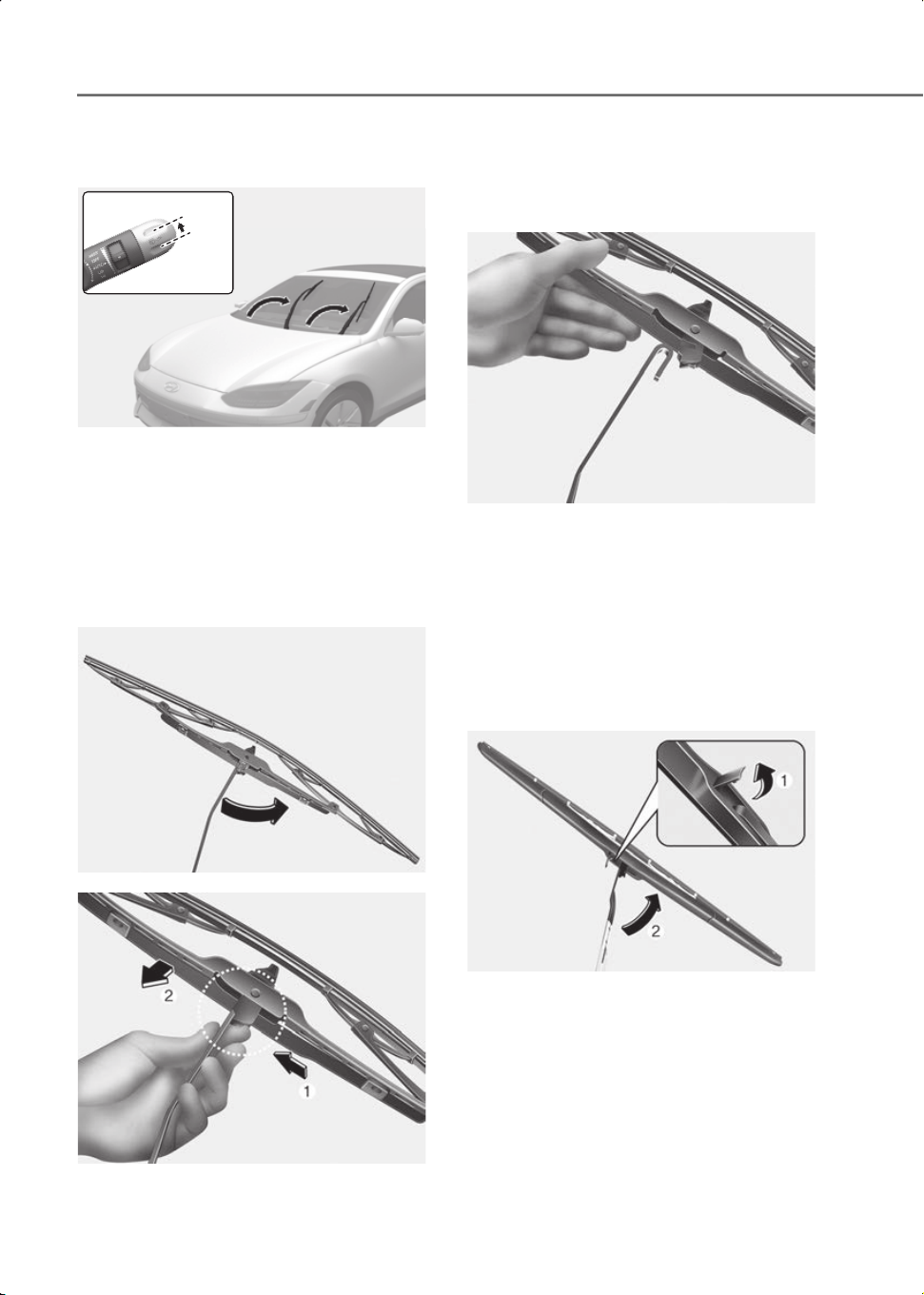
Maintenance
9-18
Front windshield wiper blade
replacement
B9003901
Within 20 seconds of turning off the
vehicle, lift up and hold the wiper lever to
the MIST position for about 2 seconds
until the wipers move to the top wipe
position.
Lift the wipers off the windshield.
Type A
B9003902
B9003903
1. Lift up the wiper blade clip. Then lift up
the wiper blade.
2. While pushing the lock (1), pull down
the wiper blade (2).
B9003904
3. Remove the wiper blade from the wiper
arm.
4. Install a new wiper blade assembly in
the reverse order of removal.
5. Turn the wipers to any ON position to
return the wiper arms to the bottom
resting position.
Type B
B9003905
1. Lift up the wiper blade clip (1). Then lift
up the wiper blade.
MIST
OFF
CE_USA.book Page 18
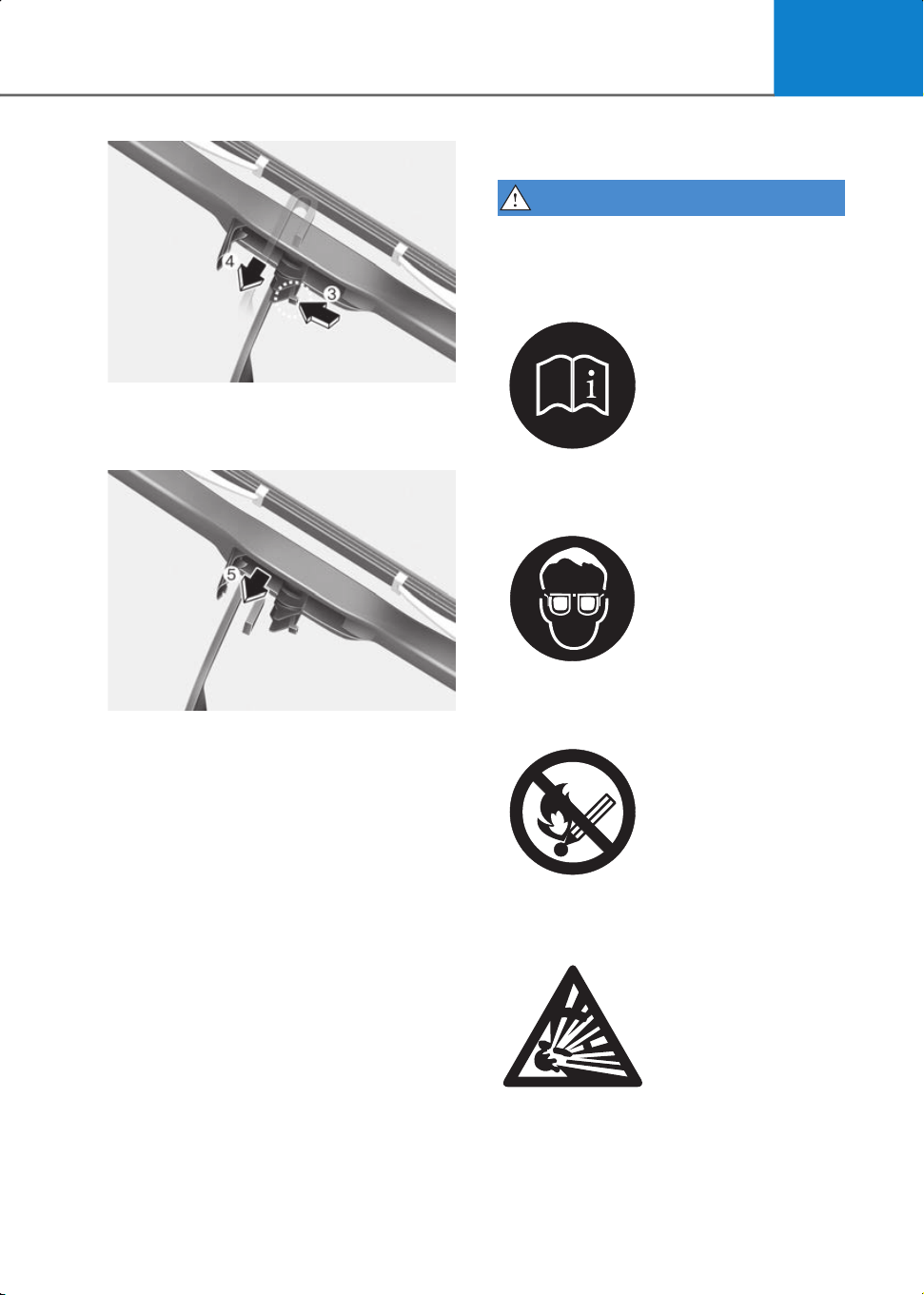
9
9-19
B9003906
2. Press the clip (3). Then push the blade
forward through the wiper arm to
disassemble it (4).
B9003907
3. Remove the wiper blade from the wiper
arm (5).
4. Install the new blade assembly in the
reverse order of removal.
5. Turn the wipers to any ON position to
return the wiper arms to the bottom
resting position.
Battery (12 V)
WARNING
To prevent SERIOUS INJURY or DEATH to
you or bystanders, always follow these
precautions when working near or
handling the battery:
WL_TakingCareOfBatteryWarning
Always read and follow instructions
carefully when handling a battery.
WL_TakingCareOfBatteryWarning_6
Wear eye protection designed to protect
the eyes from acid splashes.
WL_TakingCareOfBatteryWarning_2
Keep all flames, sparks, or smoking
materials away from the battery.
WL_TakingCareOfBatteryWarning_3
Hydrogen gas is always present in battery
cells. It is highly combustible, and may
explode if ignited.
CE_USA.book Page 19
Maintenance
9-20
WL_TakingCareOfBatteryWarning_4
Keep batteries out of reach of children.
WL_TakingCareOfBatteryWarning_5
Batteries contain sulfuric acid that is
highly corrosive. Do not allow acid to
contact your eyes, skin, or clothing.
If acid gets into your eyes, flush your eyes
with clean water for at least 15 minutes
and get immediate medical attention. If
acid gets on your skin, thoroughly wash
the area. If you feel pain or a burning
sensation, get medical attention
immediately.
• Lift a battery with a battery carrier or
with your hands on opposite corners.
When lifting a plastic-cased battery,
excessive pressure on the case may
cause battery acid to leak.
• Do not attempt to jump start your
vehicle if your battery is frozen.
• NEVER attempt to recharge the battery
when the vehicle’s battery cables are
connected to the battery.
• The electrical ignition switch works
with high voltage. NEVER touch these
components with the Start/Stop button
in the ON or START position.
WARNING
CALIFORNIA PROPOSITION 65 WARNING
Battery posts, terminals, and related
accessories contain lead and lead
compounds, chemicals known to the
State of California to cause cancer, birth
defects and reproductive harm. Batteries
also contain other chemicals known to
the State of California to cause cancer.
Wash hands after handling.
NOTICE
To prevent battery damage:
• When you do not use the vehicle for a
long time in a low temperature area,
disconnect the battery and keep it
indoors.
• Always fully charge the battery to
prevent battery case damage in low
temperature areas.
• Prevent liquid from wetting the battery
terminals.
• Do not tilt the battery.
• Never connect unauthorized devices to
the battery.
CE_USA.book Page 20
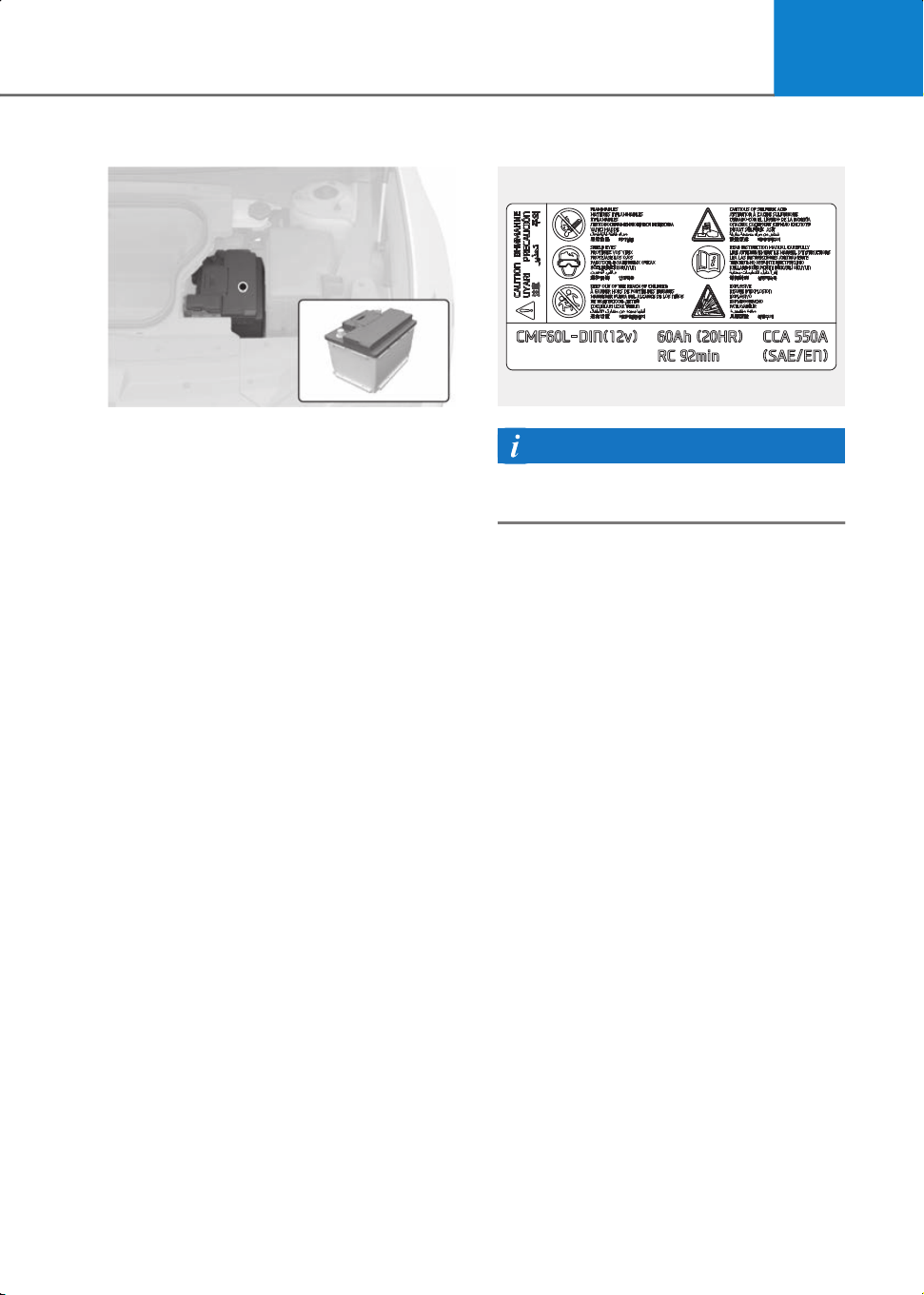
9
9-21
For Best Battery Service
B9004101
• Keep the battery securely mounted.
• Keep the battery top clean and dry.
• Keep the terminals and connections
clean, tight, and coated with petroleum
jelly or terminal grease.
• Rinse any spilled electrolyte from the
battery immediately with a solution of
water and baking soda.
• If the vehicle is not going to be used for
an extended time, disconnect the
battery cables.
Battery Capacity Label
OLMB073072
Information
The actual battery label in the vehicle may
differ from the illustration.
1. CMF60L-DIN(12 v): The HYUNDAI
model name of battery
2. 60Ah (20 HR): The nominal capacity (in
Ampere hours)
3. 550 A: The cold-test current in amperes
by SAE / EN
4. RC 92 min: The nominal reserve
capacity (in minutes)
Battery Recharging
By battery charger
Your vehicle has a maintenance-free,
calcium-based battery.
• If the battery becomes discharged over
a short time (because, for example, the
headlights or interior lights were left on
while the vehicle was not in use),
recharge it by slow charging (trickle) for
10 hours.
• If the battery gradually discharges
because of high electrical load while
the vehicle is being used, recharge it at
20-30 A for two hours.
CE_USA.book Page 21

Maintenance
9-22
WARNING
Always follow these instructions when
recharging your vehicle’s battery to avoid
the risk of SERIOUS INJURY or DEATH
from explosions or acid burns:
• Before performing maintenance or
recharging the battery, turn off all
accessories and stop the vehicle.
• Keep all flames, sparks, or smoking
materials away from the battery.
• Always work outdoors or in an area with
plenty of ventilation.
• Wear eye protection when checking the
battery during charging.
• The battery must be removed from the
vehicle and placed in a well ventilated
area.
• Watch the battery during charging, and
stop or reduce the charging rate if the
battery cells begin boiling violently.
• Remove the negative battery cable first
and install it last when the battery is
disconnected. Disconnect the battery
charger in the following order:
1. Turn off the battery charger main
switch.
2. Unhook the negative clamp from the
negative battery terminal.
3. Unhook the positive clamp from the
positive battery terminal.
By jump starting
After a jump start from a good battery,
drive the vehicle for 20-30 minutes
before it is shutoff. The vehicle may not
restart if you shut it off before the battery
had a chance to adequately recharge. For
more information, refer to the "Jump
Starting (12 V Battery)" section in chapter
8 for more information on jump starting
procedures.
Information
WL_TakingCareOfBatteryWarning_7
An inappropriately disposed battery can
be harmful to the environment and
human health. Dispose of the battery
according to your local law(s) or
regulation.
Reset Items
The following items may need to be reset
after the battery has been discharged or
the battery has been disconnected:
• Drive info/After
Recharging/Accumulated info (items in
View modes) (refer to chapter 4)
• Integrated Memory System (refer to
chapter 5)
• Power Windows (refer to chapter 5)
• Wide Sunroof (if equipped) (refer to
chapter 5)
• Power Trunk (refer to chapter 5)
• Automatic Climate Control System
(refer to chapter 5)
• Clock (refer to the Infotainment system
manual)
• Infotainment System (refer to the
Infotainment system manual)
CE_USA.book Page 22
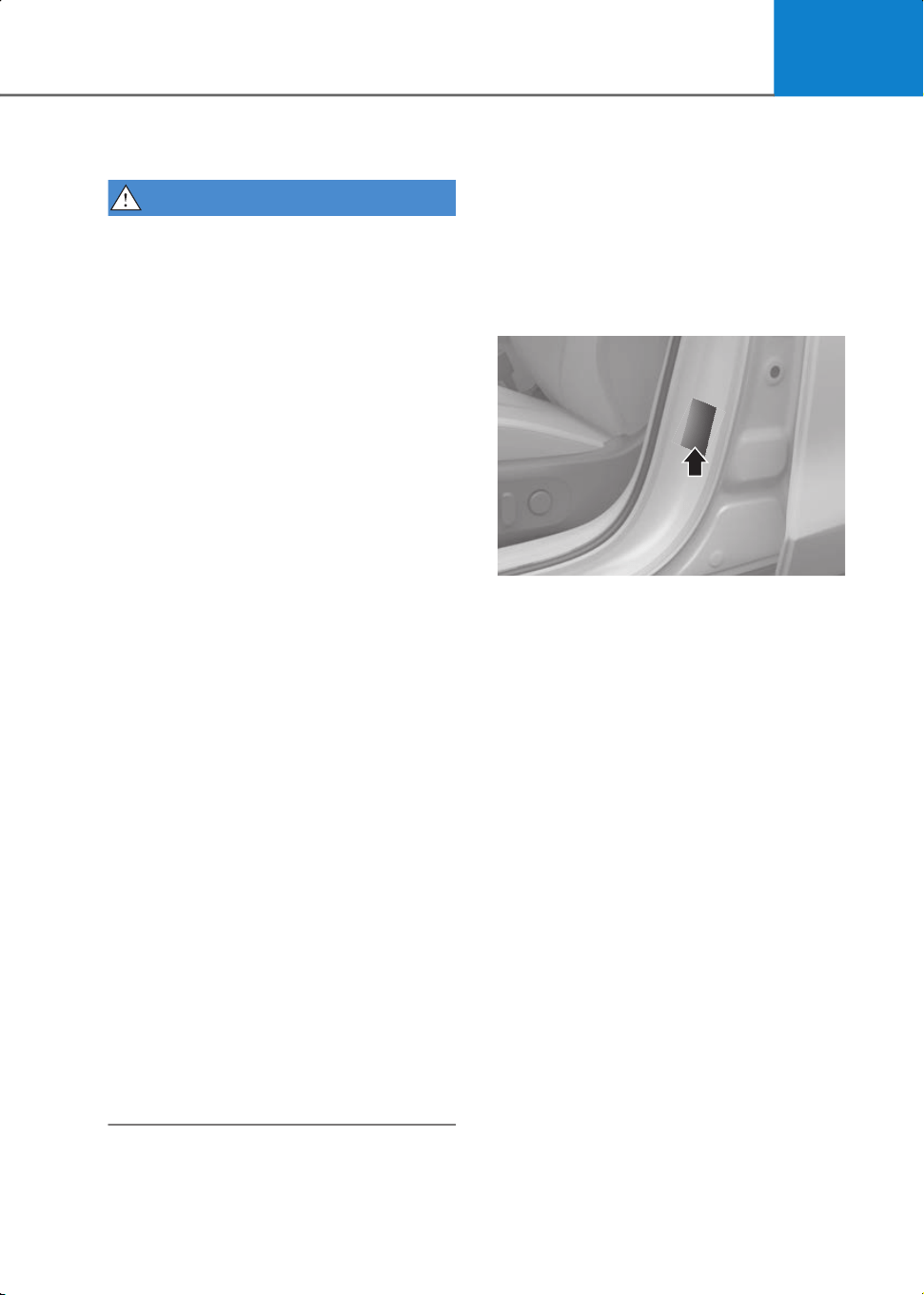
9
9-23
Tires And Wheels
WARNING
Tire failure may cause loss of vehicle
control resulting in an accident. To
reduce risk of SERIOUS INJURY or
DEATH, take the following
precautions:
• Inspect your tires monthly for
proper inflation as well as wear and
damage.
• The recommended cold tire
pressure for your vehicle can be
found in this manual and on the tire
label located on the driver’s side
center pillar. Always use a tire
pressure gauge to measure tire
pressure. Tires with too much or
too little pressure wear unevenly
causing poor handling.
• Check the pressure of the spare
every time you check the pressure
of the other tires on your vehicle.
• Replace tires that are worn, show
uneven wear, or are damaged.
Worn tires can cause loss of braking
effectiveness, steering control, or
traction.
• ALWAYS replace tires with the
same size, type, construction and
tread pattern as each tire that was
originally supplied with this vehicle.
Using tires and wheels other than
the recommended sizes could
cause unusual handling
characteristics, poor vehicle
control, or negatively affect your
vehicle’s Anti-Lock Brake System
(ABS) resulting in a serious
accident.
Tire Care
For proper maintenance, safety, and
maximum electric energy economy,
you must always maintain
recommended tire inflation
pressures and stay within the load
limits and weight distribution
recommended for your vehicle.
OJK010021
All specifications (sizes and
pressures) can be found on a label
attached to the driver’s side center
pillar.
Recommended Cold Tire
Inflation Pressures
All tire pressures (including the spare)
should be checked when the tires are
cold. “Cold tires” means the vehicle
has not been driven for at least three
hours or driven less than one mile (1.6
km).
Warm tires normally exceed
recommended cold tire pressures by
4 to 6 psi (28 to 41 kPa). Do not
release air from warm tires to adjust
the pressure or the tires will be
under-inflated. For recommended
inflation pressure, refer to the “Tires
And Wheels” section in chapter 2.
CE_USA.book Page 23

Maintenance
9-24
WARNING
• Recommended pressures must be
maintained for the best ride,
vehicle handling, and minimum tire
wear.
• Over-inflation or under-inflation
can reduce tire life, adversely affect
vehicle handling, and lead to
sudden tire failure that may result
in loss of vehicle control resulting in
a collision.
• Severe under-inflation may lead to
severe heat build-up, causing
blowouts, tread separation, and
other tire failures that result in loss
of vehicle control resulting in a
collision. This risk is much higher on
hot days and when driving for a
long time at high speeds.
• Under-inflation may cause
excessive wear, poor handling, and
reduced fuel economy. Wheel
deformation is also possible. Keep
your tire pressures at the proper
levels. If a tire frequently needs
refilling, have it inspected by an
authorized HYUNDAI dealer.
• Over-inflation produces a harsh
ride, excessive wear at the center of
the tire tread, and a greater
possibility of damage from road
hazards.
Check Tire Inflation Pressure
Check your tires, including the spare
tire, once a month or more.
How to check
Use a good quality tire pressure
gauge to check tire pressure. You can
not tell if your tires are properly
inflated simply by looking at them.
Radial tires may look properly inflated
when they are under-inflated.
Remove the valve cap from the tire
valve stem. Press the tire gauge
firmly onto the valve to get a pressure
measurement. If the cold tire inflation
pressure matches the recommended
pressure on the tire and loading
information label, no further
adjustment is necessary. If the
pressure is low, add air until you
reach the recommended pressure.
Make sure to put the valve caps back
on the valve stems. Without the valve
cap, dirt or moisture could get into
the valve core and cause air leakage.
If a valve cap is missing, install a new
one as soon as possible.
If you overfill the tire, release air by
pushing on the metal stem in the
center of the tire valve. Recheck the
tire pressure with the tire gauge. Be
sure to put the valve caps back on the
valve stems. Without the valve cap,
dirt or moisture could get into the
valve core and cause air leakage. If a
valve cap is missing, install a new one
as soon as possible.
CE_USA.book Page 24
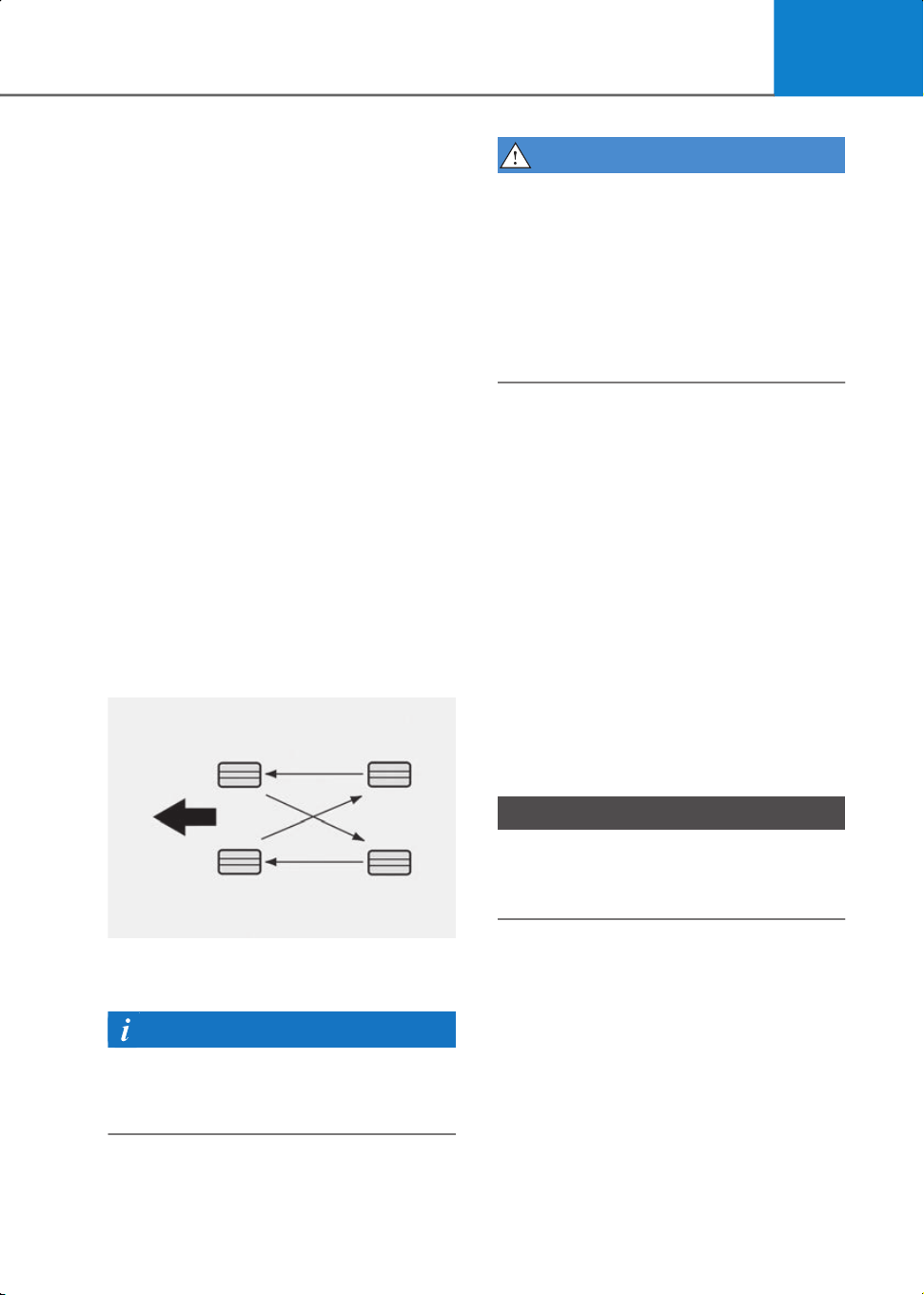
9
9-25
Tire Rotation
To equalize tread wear, HYUNDAI
recommends that the tires be rotated
according to the maintenance
schedule or sooner if irregular wear
develops.
During rotation, check the tires for
correct balance.
When rotating tires, check for uneven
wear and damage. Abnormal wear is
usually caused by incorrect tire
pressure, improper wheel alignment,
out-of-balance wheels, severe
braking or severe cornering. Look for
bumps or bulges in the tread or side
of the tire. Replace the tire if you find
any of these conditions. Replace the
tire if fabric or cord is visible. After
rotation, be sure to bring the front
and rear tire pressures to
specification and check wheel lug nut
tightness (proper torque is 79-94
lbf·ft (11-13kgf·m).
B9005001
Disc brake pads should be inspected
for wear whenever tires are rotated.
Information
When installing an unsymmetrical
tire, install the side marked “outside”
facing out.
WARNING
• Do not use the compact spare tire
for tire rotation.
• Do not mix bias ply and radial ply
tires under any circumstances. This
may cause unusual handling
characteristics that may cause loss
of vehicle control resulting in an
collision.
Wheel Alignment and Tire
Balance
The wheels on your vehicle were
aligned and balanced carefully at the
factory to give you the longest tire life
and best overall performance.
In most cases, you will not need to
have your wheels aligned again.
However, if you notice unusual tire
wear or your vehicle pulling one way
or the other, the alignment may need
to be reset.
If you notice your vehicle vibrating
when driving on a smooth road, your
wheels may need to be rebalanced.
NOTICE
Only use approved wheel weights or
your vehicle’s aluminum wheels may
be damaged.
CE_USA.book Page 25
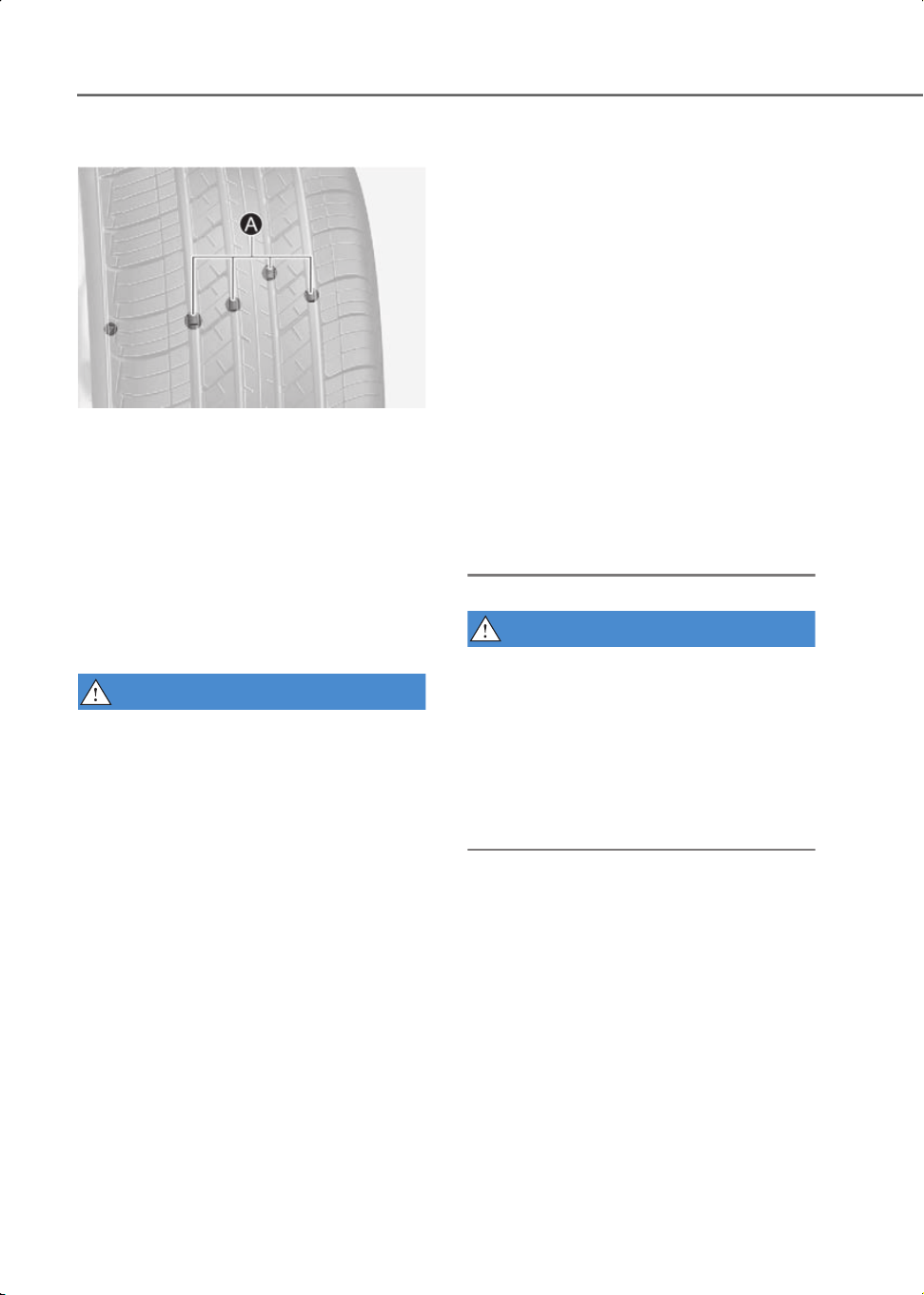
Maintenance
9-26
Tire Replacement
B9005201
[A]Tread wear indicator
If the tire is worn evenly, a tread wear
indicator will appear as a solid band
across the tread. This shows there is
less than 1/16 in. (1.6 mm) of tread left
on the tire. Replace the tire when this
happens.
Do not wait for the band to appear
across the entire tread before
replacing the tire.
WARNING
To reduce the risk of DEATH or
SERIOUS INJURY:
• Replace tires that are worn, show
uneven wear, or are damaged.
Worn tires can cause loss of braking
effectiveness, steering control, and
traction.
• Always replace tires with the same
size as each tire that was originally
supplied with this vehicle. Using
tires and wheels other than the
recommended sizes could cause
unusual handling characteristics,
poor vehicle control, or negatively
affect your vehicle’s Anti-Lock
Brake System (ABS) resulting in a
serious accident.
• When replacing tires (or wheels), it
is recommended to replace the two
front or two rear tires (or wheels) as
a pair. Replacing just one tire can
seriously affect your vehicle’s
handling.
• Tires degrade over time, even when
they are not being used. Regardless
of the remaining tread, HYUNDAI
recommends that tires be replaced
after six (6) years of normal service.
• Heat caused by hot climates or
frequent high loading conditions
can accelerate the aging process.
Failure to follow this warning may
cause sudden tire failure, which
could lead to a loss of vehicle
control resulting in an accident.
WARNING
The original tire should be repaired or
replaced as soon as possible to avoid
failure of the spare and loss of vehicle
control resulting in an accident. The
compact spare tire is for emergency
use only. Do not operate your vehicle
over 50 mph (80 km/h) when using
the compact spare tire.
Wheel Replacement
When replacing the metal wheels for
any reason, make sure the new
wheels are equivalent to the original
factory units in diameter, rim width,
and offset.
CE_USA.book Page 26
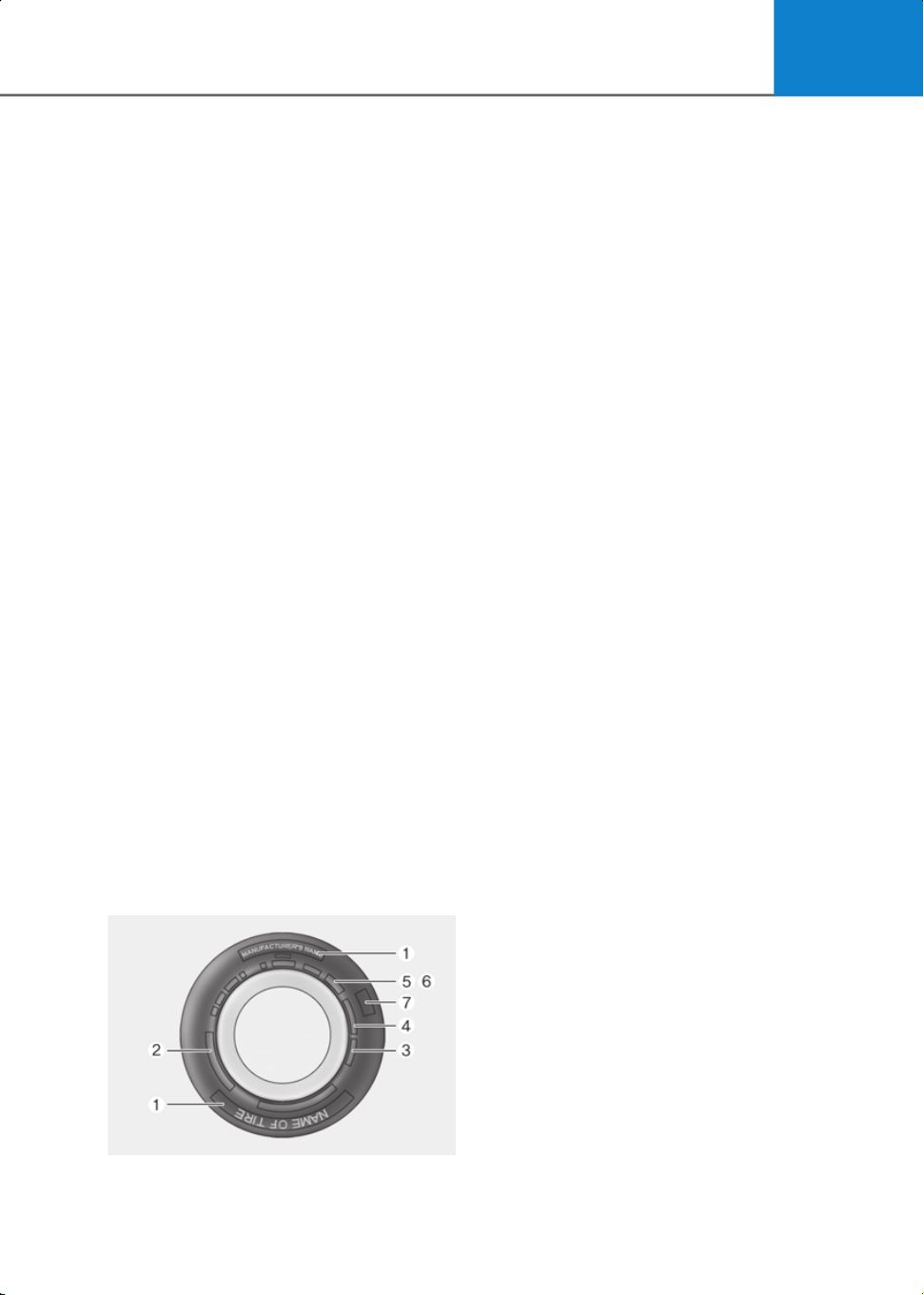
9
9-27
Tire Traction
Tire traction can be reduced if you
drive on worn tires, tires that are
improperly inflated or on slippery
road surfaces. Tires should be
replaced when tread wear indicators
appear. To reduce the possibility of
losing control, slow down whenever
there is rain, snow or ice on the road.
Tire Maintenance
In addition to proper inflation, correct
wheel alignment helps to decrease
tire wear. If you find a tire is worn
unevenly, have your dealer check the
wheel alignment.
When you have new tires installed,
make sure they are balanced. This will
increase vehicle ride comfort and tire
life. Additionally, a tire should always
be rebalanced if it is removed from
the wheel.
Tire Sidewall Labeling
This information identifies and
describes the fundamental
characteristics of the tire and also
provides the Tire Identification
Number (TIN) for safety standard
certification. The TIN can be used to
identify the tire in case of a recall.
B9005401
1. Manufacturer or brand name
Manufacturer or brand name is
shown.
2. Tire size designation
A tire’s sidewall is marked with a tire
size designation. You will need this
information when selecting
replacement tires for your car. The
following explains what the letters
and numbers in the tire size
designation mean.
Example tire size designation:
(These numbers are provided as an
example only; your tire size
designator could vary depending on
your vehicle.)
245/40R20 99W
245 - Tire width in millimeters.
40 - Aspect ratio. The tire’s section
height as a percentage of its width.
R - Tire construction code (Radial).
20 - Rim diameter in in.
99 - Load Index, a numerical code
associated with the maximum load
the tire can carry.
W - Speed Rating Symbol. See the
speed rating chart in this section for
additional information.
CE_USA.book Page 27

Maintenance
9-28
Wheel size designation
Wheels are also marked with
important information that you need
if you ever have to replace one. The
following explains what the letters
and numbers in the wheel size
designation mean.
Example wheel size designation:
8.5 X 20
8.5 - Rim width in inches.
J - Rim contour designation.
20 - Rim diameter in inches.
Tire speed ratings
The chart below lists many of the
different speed ratings currently
being used for passenger vehicle
tires. The speed rating is part of the
tire size designation on the sidewall
of the tire. This symbol corresponds
to that tire’s designed maximum safe
operating speed.
3. Checking tire life (TIN: Tire
Identification Number)
Any tires that are over six years old,
based on the manufacturing date,
(including the spare tire) should be
replaced by new ones. You can find
the manufacturing date on the tire
sidewall (possibly on the inside of the
wheel), displaying the DOT Code. The
DOT Code is a series of numbers on a
tire consisting of numbers and
English letters. The manufacturing
date is designated by the last four
digits (characters) of the DOT code.
DOT: XXXX XXXX OOOO
The front part of the DOT shows a
plant code number, tire size and
tread pattern and the last four
numbers indicate week and year
manufactured.
For example:
DOT XXXX XXXX 1523 represents that
the tire was produced in the 15th
week of 2023.
4. Tire ply composition and material
The number of layers or plies of
rubber-coated fabric in the tire. Tire
manufacturers also must indicate the
materials in the tire, which include
steel, nylon, polyester, and others.
The letter “R” means radial ply
construction; the letter “D“ means
diagonal or bias ply construction; and
the letter “B” means belted-bias ply
construction.
Speed Rating
Symbol
Maximum Speed
S 112 mph (180 km/h)
T 118 mph (190 km/h)
H 130 mph (210 km/h)
V 149 mph (240 km/h)
W 168 mph (270 km/h)
Y 186 mph (300 km/h)
CE_USA.book Page 28

9
9-29
5. Maximum permissible inflation
pressure
This number is the greatest amount
of air pressure that should be put in
the tire. Do not exceed the maximum
permissible inflation pressure. Refer
to the Tire and Loading Information
label for recommended inflation
pressure.
6. Maximum load rating
This number indicates the maximum
load in kilograms and lbs. that can be
carried by the tire. When replacing
the tires on the vehicle, always use a
tire that has the same load rating as
the factory installed tire.
Uniform tire quality grading
Quality grades can be found where
applicable on the tire sidewall
between tread shoulder and
maximum section width.
For example:
TREADWEAR 200
TRACTION AA
TEMPERATURE A
Tread wear
The tread wear grade is a
comparative rating based on the
wear rate of the tire when tested
under controlled conditions on a
specified government test course.
For example, a tire graded 150 would
wear one-and-a-half times (1½) as
well on the government course as a
tire graded 100.
The relative performance of tires
depends upon the actual conditions
of their use, however, and may depart
significantly from the norm due to
variations in driving habits, service
practices and differences in road
characteristics and climate.
These grades are molded on the
sidewalls of passenger vehicle tires.
The tires available as standard or
optional equipment on your vehicle
may vary with respect to grade.
Traction - AA, A, B & C
The traction grades, from highest to
lowest, are AA, A, B and C. Those
grades represent the tire’s ability to
stop on wet pavement as measured
under controlled conditions on
specified government test surfaces
of asphalt and concrete. A tire
marked C may have poor traction
performance.
WARNING
The traction grade assigned to this
tire is based on straight ahead
braking traction tests, and does not
include acceleration, cornering,
hydroplaning, or peak traction
characteristics.
CE_USA.book Page 29

Maintenance
9-30
Temperature - A, B & C
The temperature grades are A (the
highest), B and C representing the
tire’s resistance to the generation of
heat and its ability to dissipate heat
when tested under controlled
conditions on a specified indoor
laboratory test wheel.
Sustained high temperature can
cause the material of the tire to
degenerate and reduce tire life, and
excessive temperature can lead to
sudden tire failure. Grades B and A
represent higher levels of
performance on the laboratory test
wheel than the minimum required by
law.
WARNING
The temperature grade for this tire is
established for a tire that is properly
inflated and not overloaded.
Excessive speed, under-inflation,
over-inflation, or excessive loading,
either separately or in combination,
can cause heat build-up and possible
sudden tire failure. This may cause
loss of vehicle control resulting in an
accident.
Tire Terminology and
Definitions
Air pressure
The amount of air inside the tire
pressing outward on the tire. Air
pressure is expressed in lbs. per
square in. (psi) or kilopascal (kPa).
Accessory weight
This means the combined weight of
optional accessories. Some examples
of optional accessories are gear,
power seats, and air conditioning.
Aspect ratio
The relationship of a tire’s height to
its width.
Belt
A rubber coated layer of cords that is
located between the plies and the
tread. Cords may be made from steel
or other reinforcing materials.
Bead
The tire bead contains steel wires
wrapped by steel cords that hold the
tire onto the rim.
Bias ply tire
A pneumatic tire in which the plies
are laid at alternate angles less than
90 degrees to the centerline of the
tread.
Cold tire pressure
The amount of air pressure in a tire,
measured in lbs. per square in. (psi) or
kilopascals (kPa) before a tire has
built up heat from driving.
Curb weight
This means the weight of a motor
vehicle with standard and optional
equipment including the maximum
capacity of fuel, oil and coolant, but
without passengers and cargo.
CE_USA.book Page 30

9
9-31
DOT markings
A code molded into the sidewall of a
tire signifying that the tire is in
compliance with the U.S. Department
of Transportation motor vehicle
safety standards. The DOT code
includes the Tire Identification
Number (TIN), an alphanumeric
designator which can also identify
the tire manufacturer, production
plant, brand and date of production.
GVWR
Gross Vehicle Weight Rating
GAWR FRT
Gross Axle Weight Rating for the
Front Axle.
GAWR RR
Gross Axle Weight Rating for the Rear
axle.
Intended outboard sidewall
The side of an asymmetrical tire, that
must always face outward when
mounted on a vehicle.
Kilopascal (kPa)
The metric unit for air pressure.
Light Truck (LT) tire
A tire designated by its manufacturer
as primarily intended for use on
lightweight trucks or multipurpose
passenger vehicles.
Load ratings
The maximum load that a tire is rated
to carry for a given inflation pressure.
Load index
An assigned number ranging from 1 to
279 that corresponds to the load
carrying capacity of a tire.
Maximum inflation pressure
The maximum air pressure to which a
cold tire may be inflated. The
maximum air pressure is molded onto
the sidewall.
Maximum load rating
The load rating for a tire at the
maximum permissible inflation
pressure for that tire.
Maximum loaded vehicle weight
The sum of curb weight; accessory
weight; vehicle capacity weight; and
production options weight.
Normal occupant weight
The number of occupants a vehicle is
designed to seat multiplied by 150
lbs. (68 kg).
Occupant distribution
Designated seating positions.
Outward facing sidewall
An asymmetrical tire has a particular
side that faces outward when
mounted on a vehicle. The outward
facing sidewall bears white lettering
or bears manufacturer, brand, and/or
model name molding that is higher or
deeper than the same moldings on
the inner facing sidewall.
CE_USA.book Page 31

Maintenance
9-32
Passenger (P-Metric) tire
A tire used on passenger cars and
some light duty trucks and
multipurpose vehicles.
Ply
A layer of rubber-coated parallel
cords.
Pneumatic tire
A mechanical device made of rubber,
chemicals, fabric and steel or other
materials, that, when mounted on an
automotive wheel provides the
traction and contains the gas or fluid
that sustains the load.
Pneumatic options weight
The combined weight of installed
regular production options weighing
over 5 lbs. (2.3 kg) in excess of the
standard items which they replace,
not previously considered in curb
weight or accessory weight,
including heavy duty breaks, ride
levelers, roof rack, heavy duty
battery, and special trim.
Recommended inflation pressure
Vehicle manufacturer’s
recommended tire inflation pressure
as shown on the tire placard.
Radial ply tire
A pneumatic tire in which the ply
cords that extend to the beads are
laid at 90 degrees to the centerline of
the tread.
Rim
A metal support for a tire and upon
which the tire beads are seated.
Sidewall
The portion of a tire between the
tread and the bead.
Speed rating
An alphanumeric code assigned to a
tire indicating the maximum speed at
which a tire can operate.
Traction
The friction between the tire and the
road surface. The amount of grip
provided.
Tread
The portion of a tire that comes into
contact with the road.
Treadwear indicators
Narrow bands, sometimes called
“wear bars”, that show across the
tread of a tire when only 1/16 in. of
tread remains.
UTQGS
Uniform Tire Quality Grading
Standards is a tire information system
that provides consumers with ratings
for a tire’s traction, temperature and
treadwear. Ratings are determined
by tire manufacturers using
government testing procedures. The
ratings are molded into the sidewall
of the tire.
Vehicle capacity weight
The number of designated seating
positions multiplied by 150 lbs. (68
kg) plus the rated cargo and luggage
load.
CE_USA.book Page 32

9
9-33
Vehicle maximum load on the tire
Load on an individual tire due to curb
and accessory weight plus maximum
occupant and cargo weight.
Vehicle normal load on the tire
Load on an individual tire that is
determined by distributing to each
axle its share of the curb weight,
accessory weight, and normal
occupant weight and dividing by 2.
Vehicle placard
A label permanently attached to a
vehicle showing the original
equipment tire size and
recommended inflation pressure.
All Season Tires
HYUNDAI specifies all season tires on
some models to provide good
performance for use all year round,
including snowy and icy road
conditions. All season tires are
identified by ALL SEASON and/or
M+S (Mud and Snow) on the tire
sidewall. Snow tires have better snow
traction than all season tires and may
be more appropriate in some areas.
Summer Tires
HYUNDAI specifies summer tires on
some models to provide superior
performance on dry roads. Summer
tire performance is substantially
reduced in snow and ice. Summer
tires do not have the tire traction
rating M+S (Mud and Snow) on the
tire side wall. If you plan to operate
your vehicle in snowy or icy
conditions, HYUNDAI recommends
the use of snow tires or all season
tires on all four wheels.
Snow Tires
If you equip your car with snow tires,
they should be the same size and
have the same load capacity as the
original tires. Snow tires should be
installed on all four wheels;
otherwise, poor handling may result.
Snow tires should carry 4 psi (28 kPa)
more air pressure than the pressure
recommended for the standard tires
on the tire label on the driver’s side of
the center pillar, or up to the
maximum pressure shown on the tire
sidewall, whichever is less. Do not
drive faster than 75 mph (120 km/h)
when your vehicle is equipped with
snow tires.
Radial-Ply Tires
Radial-ply tires provide improved
tread life, road hazard resistance and
smoother high speed ride. The
radial-ply tires used on this vehicle
are of belted construction, and are
selected to complement the ride and
handling characteristics of your
vehicle. Radial-ply tires have the
same load carrying capacity, as
bias-ply or bias belted tires of the
same size, and use the same
recommended inflation pressure.
Mixing of radial-ply tires with bias-ply
or bias belted tires is not
recommended. Any combinations of
radial-ply and bias-ply or bias belted
tires when used on the same vehicle
will seriously deteriorate vehicle
handling. The best rule to follow is:
Identical pairs of radial-ply tires
should always be used as a set for the
front tires and a set for the rear tires.
CE_USA.book Page 33
Maintenance
9-34
Longer wearing tires can be more
susceptible to irregular tread wear. It
is very important to follow the tire
rotation interval in this chapter to
achieve the tread life potential of
these tires. Cuts and punctures in
radial-ply tires are repairable only in
the tread area, because of sidewall
flexing. Consult your tire dealer for
radial-ply tire repairs.
WARNING
Do not mix bias ply and radial ply tires
under any circumstances. This may
cause unusual handling
characteristics that may cause loss of
vehicle control resulting in an
accident.
if equipped
Low Aspect Ratio Tires
The aspect ratio is lower than 50 on
low aspect ratio tires.
Because low aspect ratio tires are
optimized for handling and braking,
their sidewall is a little stiffer than a
standard tire. Also, low aspect ratio
tires tend to be wider so that they
consequently have increased contact
with the road surface. In some
instances, low aspect ratio tires may
generate more road noise compared
with standard tires.
NOTICE
Low-aspect wheels and tires are
easily damaged. To reduce the risk of
damage:
• When driving on rough roads,
passing over a pothole, speed
bump, manhole, or curb stone,
drive the vehicle slowly not to
damage the tires and wheels.
Damage is not covered by your
vehicle warranty.
• Inspect the tire condition and
pressure every 8,000 mi. (13,000
km).
• It is difficult to visually inspect for
tire damage with your eyes. If any
damage is found, contact your
authorized HYUNDAI dealer to
replace the tire.
CE_USA.book Page 34
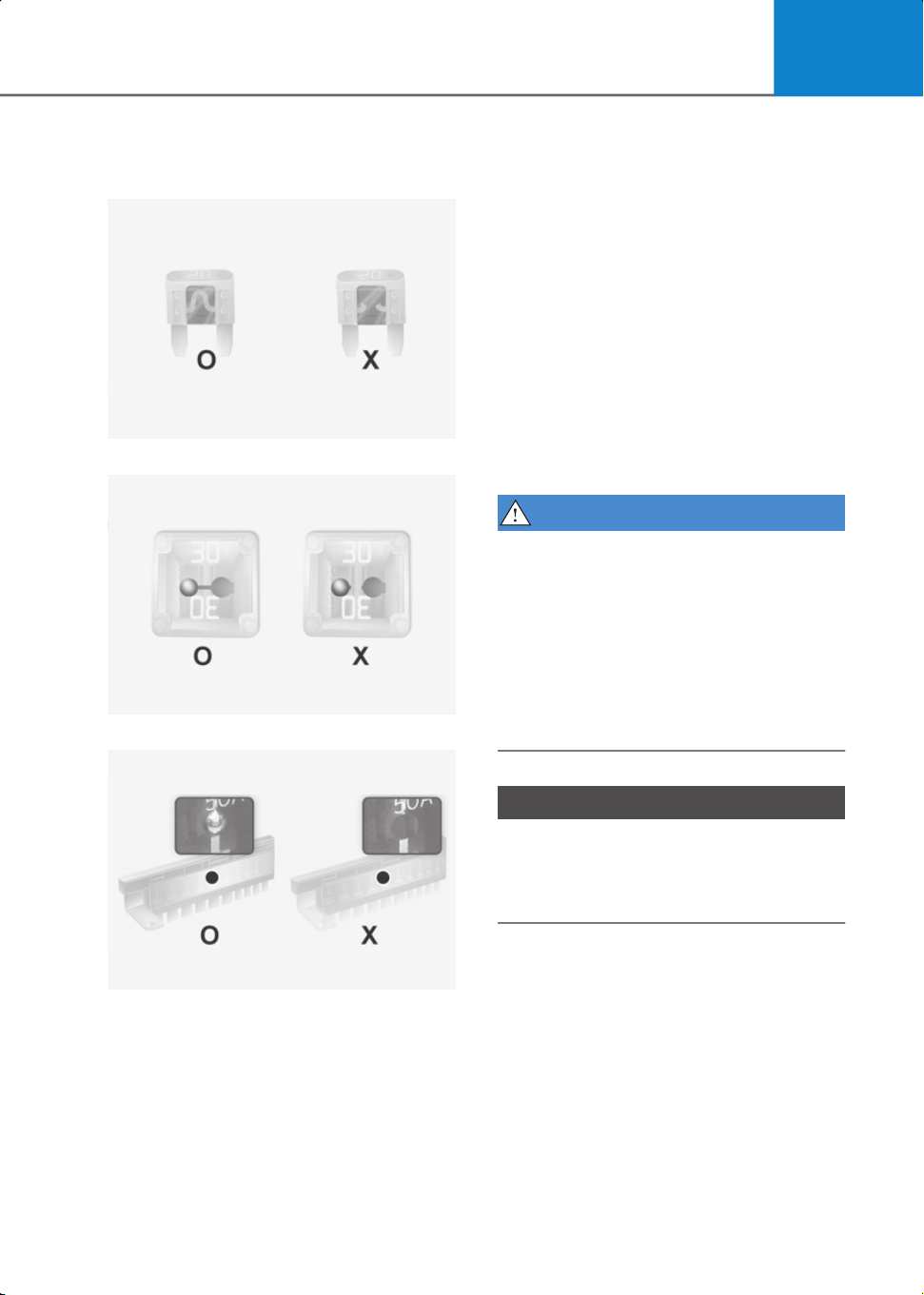
9
9-35
Fuses
Blade type
B9005601
Cartridge type
B9005602
Multi type
B9005603
A vehicle’s electrical system is protected
from electrical overload damage by fuses.
This vehicle has 5 fuse panels, one
located in the driver’s side panel bolster,
the other in the vehicle compartment.
If any of your vehicle’s lights, accessories,
or controls do not work, check the
appropriate circuit fuse. If a fuse has
blown, the element inside the fuse will be
melted or broken.
If the electrical system does not work,
first check the driver’s side fuse panel.
Before replacing a blown fuse, turn the
vehicle and all switches off, and then
disconnect the negative battery cable.
Always replace a blown fuse with one of
the same rating.
If the replacement fuse blows, this
indicates an electrical problem. Avoid
using the system involved. Consult an
authorized HYUNDAI dealer.
WARNING
NEVER replace a fuse with anything but
another fuse of the same rating.
• A higher capacity fuse may cause
damage and possibly cause a fire.
• Do not install a wire or aluminum foil
instead of the proper fuse - even as a
temporary repair. It may cause
extensive wiring damage and possibly a
fire.
NOTICE
Do not use a screwdriver or any other
metal object to remove fuses because it
may cause a short circuit and damage the
system.
CE_USA.book Page 35
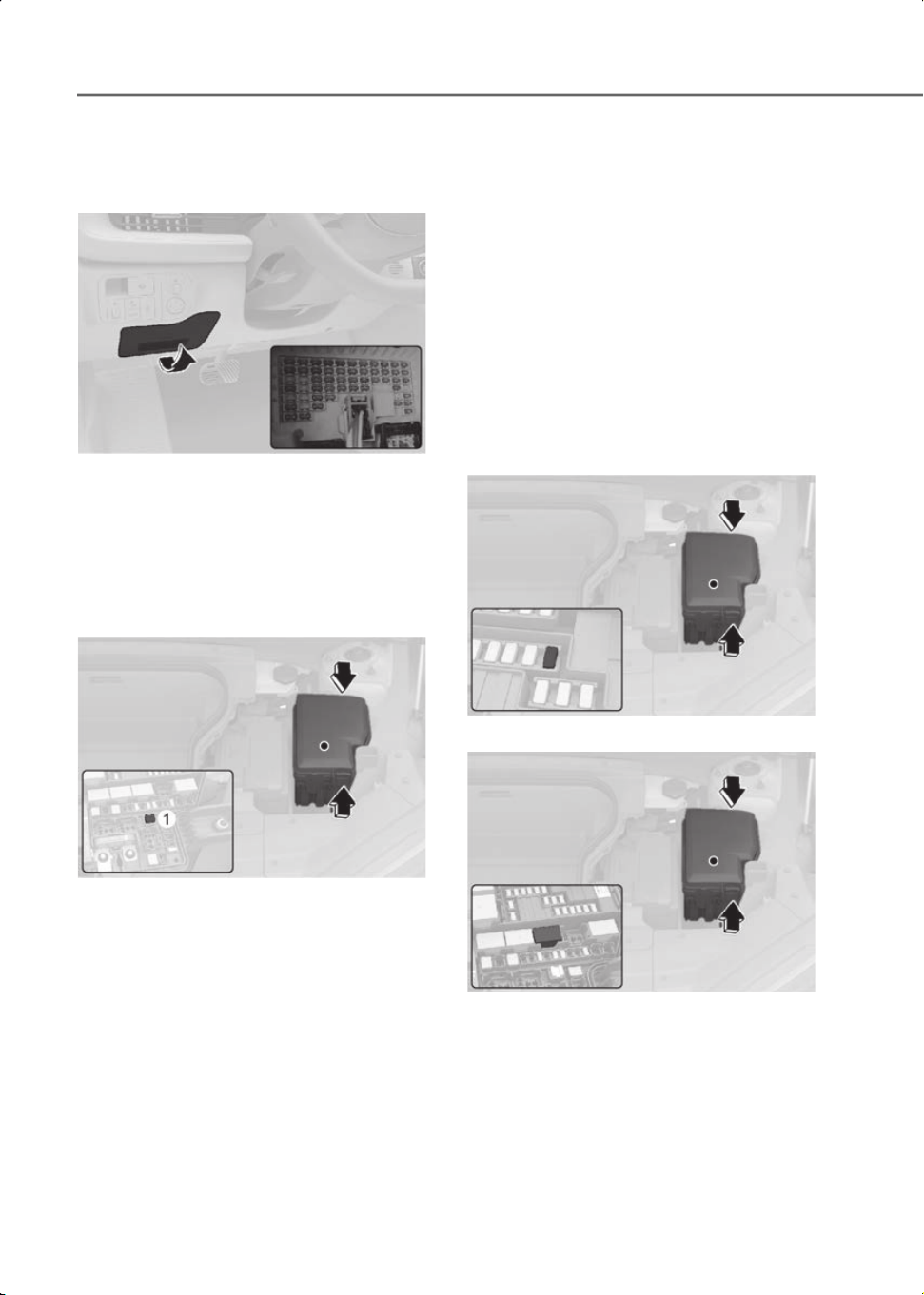
Maintenance
9-36
Instrument Panel Fuse
Replacement
Driver’s side
B9005701
1. Turn off the vehicle.
2. Turn off all other switches.
3. Open the fuse panel cover.
4. Refer to the label on the inside of the
fuse panel cover to locate the
suspected fuse location.
Motor compartment
B9005702
5. Pull the suspected fuse straight out.
Use the removal tool (1) provided in the
motor compartment fuses panel.
6.Check the removed fuse and replace it
if it is blown. Spare fuses are provided in
the instrument panel fuse panels (or in
the motor compartment fuse panel).
7. Push in a new fuse of the same rating,
and make sure it fits tightly in the clips.
If it is not tight, contact consult an
authorized HYUNDAI dealer.
In an emergency, if you do not have a
spare fuse, use a fuse of the same rating
from a circuit you may not need for
operating the vehicle.
If the headlights or other electrical
components do not work and the fuses
are undamaged, check the fuse panel in
the motor compartment.
Motor Compartment Panel
Fuse Replacement
Blade fuse/Cartridge fuse
Blade type fuse
B9005901
Cartridge type fuse
B9005902
1. Turn off the vehicle.
2. Turn off all other switches.
3. Remove the fuse panel cover by
pressing the tap and pulling up.
CE_USA.book Page 36
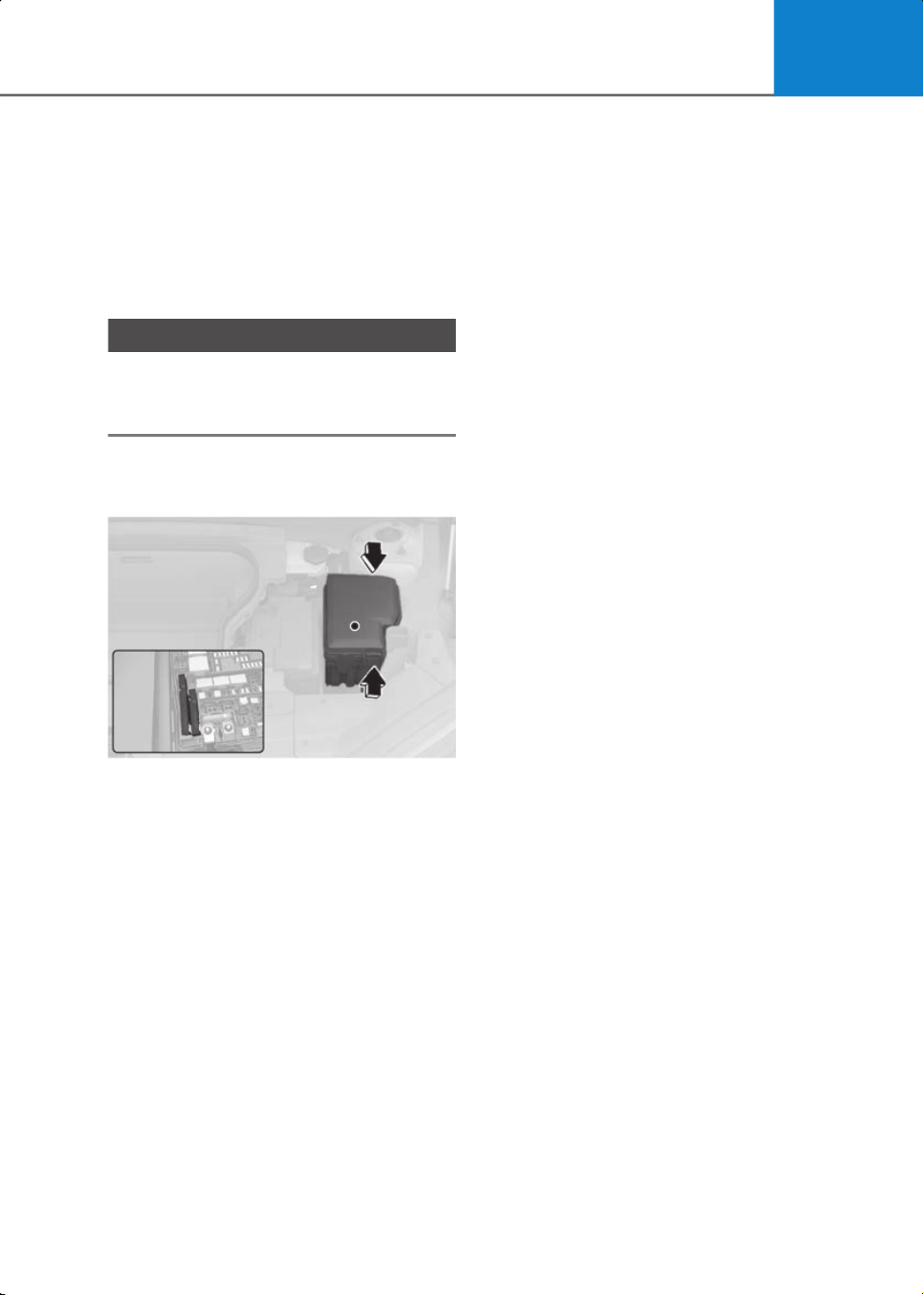
9
9-37
4. Check the removed fuse and replace it
if it is blown. To remove or insert the
fuse, use the fuse puller in the motor
compartment fuse panel.
5. Push in a new fuse of the same rating,
and make sure it fits tightly in the clips.
If it is not tight, contact consult an
authorized HYUNDAI dealer.
NOTICE
Always securely install the fuse panel
cover. Water may contact the fuse and
cause an electrical failure.
Multi fuse
Multi type
B9005903
If the multi fuse is blown, contact an
authorized HYUNDAI dealer.
CE_USA.book Page 37
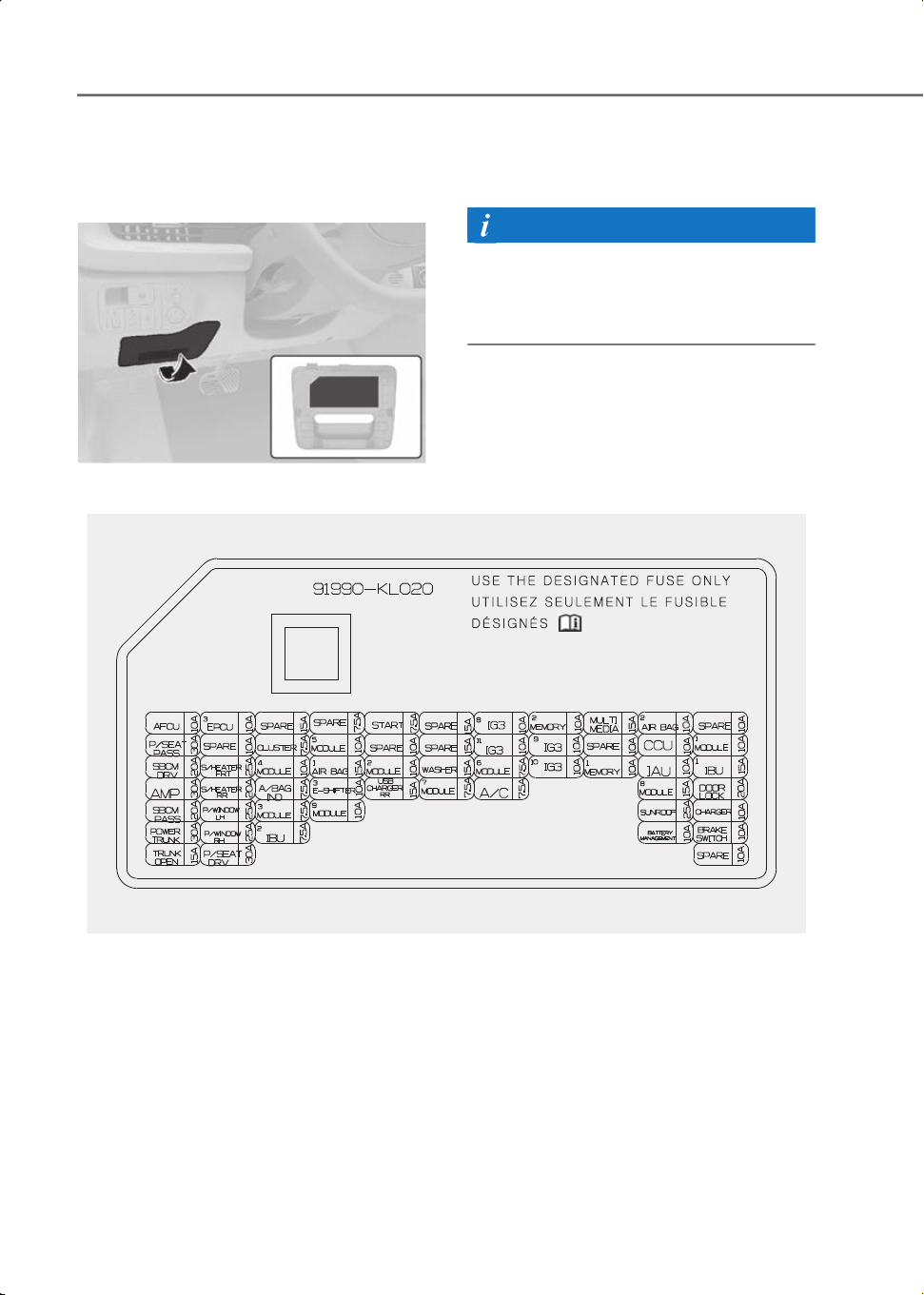
Maintenance
9-38
Fuse/Relay Panel Description
Instrument panel fuse panel
B9006001
Inside the fuse panel cover, you can find
the fuse label describing fuse names and
ratings.
Information
Not all fuse panel descriptions in this
manual may be applicable to your vehicle.
When you inspect the fuse panel on your
vehicle, refer to the fuse panel label.
ONE1091046N
CE_USA.book Page 38

9
9-39
Instrument panel fuse panel
Fuse Name Fuse Rating Circuit Protected
AFCU 10 A Driver/Passenger Door Outside Handle
EPCU3 10 A Rear Inverter
START 7.5 A IBU, VCU
IG3 8 10 A
In-car Temperature Sensor, A/C Control Module, A/C
PTC Heater, Instrument Cluster, CCU, AVNT Head Unit
MEMORY 2 10 A Instrument Cluster, ADAS Unit (Parking)
MULTIMEDIA 15 A AVNT Head Unit
AIRBAG2 10 A SRS Control Module
P/SEAT PASS 30 A Passenger Power Seat Switch, Passenger Seat Unit
ADAS DRV 10 A Not Used
CLUSTER 7.5 A Instrument Cluster, Head-Up Display
MODULE5 10 A
Data Link Connector, Electro Chromic Mirror, AVNT
Head Unit, IFS Unit, Wireless Charger Unit, Head Light
LH/RH, AMP, Driver IMS Module, Front Air Ventilation
Seat Control Module, Front Seat Warmer Control
Module, Passenger Seat Unit, Rear Seat Warmer
Control Module, ADP Unit (Acoustic Design Processor)
IG3 11 10 A Electronic A/C Compressor
IG3 9 10 A Rear Inverter, BMU
wireless DCU1 10 A Not Used
CCU 10 A CCU
MODULE1 10 A
Data Link Connector, Hazard Switch, Multifunction
Switch, Rain Sensor, Driver Power Window Switch,
Dashboard Mood Light, A/C Control Module, Outside
Mirror Switch, UIP Sensor, UIP Siren, Power Trunk Unit,
Driver/Passenger Door Mood Light #1/#2, Rear Door
Mood Light LH/RH #1/#2
SBCM DRV 20 A Driver Side Body Control Module
S/HEATER FRT 25 A
Front Air Ventilation Seat Control Module,Front Seat
Warmer Control Module
CE_USA.book Page 39

Maintenance
9-40
MODULE4 10 A
Front/Rear Corner Radar LH/RH, Rear Inverter
(System), Front View Camera, IBU, ADAS Unit
(Parking/Driving), Dashboard Switch, VESS Unit, Front
Radar
AIRBAG1 15 A SRS Control Module
MODULE2 10 A
ADP Unit (Acoustic Design Processor), AMP, IBU, CCU,
DCU, P/R Junction Block (RLY. 5), AVNT Head Unit,
AVNT Keyboard, ADAS Unit (Parking), IAU (Identity
Authentication Unit)
WASHER 15 A Multifunction Switch
MODULE6 7.5 A IBU
IG3 10 10 A SCU, Rear Electronic Oil Pump, VCMS, V2L Unit, ICCU
MEMORY1 10 A
DCU, A/C Control Module, Head-Up Display, ADP Unit
(Acoustic Design Processor), Mood Lamp Unit
IAU 10 A IAU (Identity Authentication Unit)
IBU1 15 A IBU
AMP 30 A AMP
S/HEATER RR 20 A Rear Seat Warmer Control Module
A/BAG IND 7.5 A Overhead Console Assembly
E-SHIFTER3 10 A Electronic Shift Switch
RR USB
CHARGER
25 A Console/Rear USB Charger Connector
MODULE7 7.5 A Rear Seat Warmer Control Module
A/CON 7.5 A A/C Control Module
MODULE8 15 A Driver IMS Module, Passenger Seat Unit
DOOR LOCK 20 A Door Lock/Unlock Relay, Dead Lock Relay
SBCM PASS 20 A Passenger Side Body Control Module
P/WINDOW LH 25 A
Rear Power Window Switch LH, Rear Safety Power
Window Module LH, Driver Power Window Module,
Driver/Passenger Safety Power Window Module
MODULE3 7.5 A
Stop Light Switch, Driver Power Window Switch, IAU
(Identity Authentication Unit)
Fuse Name Fuse Rating Circuit Protected
CE_USA.book Page 40

9
9-41
CCU2 10 A CCU, DCU
SUNROOF 25 A Sunroof Glass Motor, Sunroof Blind Motor
CHARGER 10 A VCMS, ICCU, Charger Connector Lock/Unlock Relay
MODULE9 10 A CCU
TRUNK OPEN 15 A Not Used
PTL 30 A Power trunk Unit
P/WINDOW RH 25 A
Rear Power Window Switch LH, Rear Safety Power
Window Module LH, Driver Power Window Module,
Driver/Passenger Safety Power Window Module
IBU2 7.5 A IBU
BMS 10 A BMU
BRAKE
SWITCH
10 A Stop Light Switch, IBU
P/SEAT DRV 30 A Driver Power Seat Switch, Driver IMS Module
Fuse Name Fuse Rating Circuit Protected
CE_USA.book Page 41
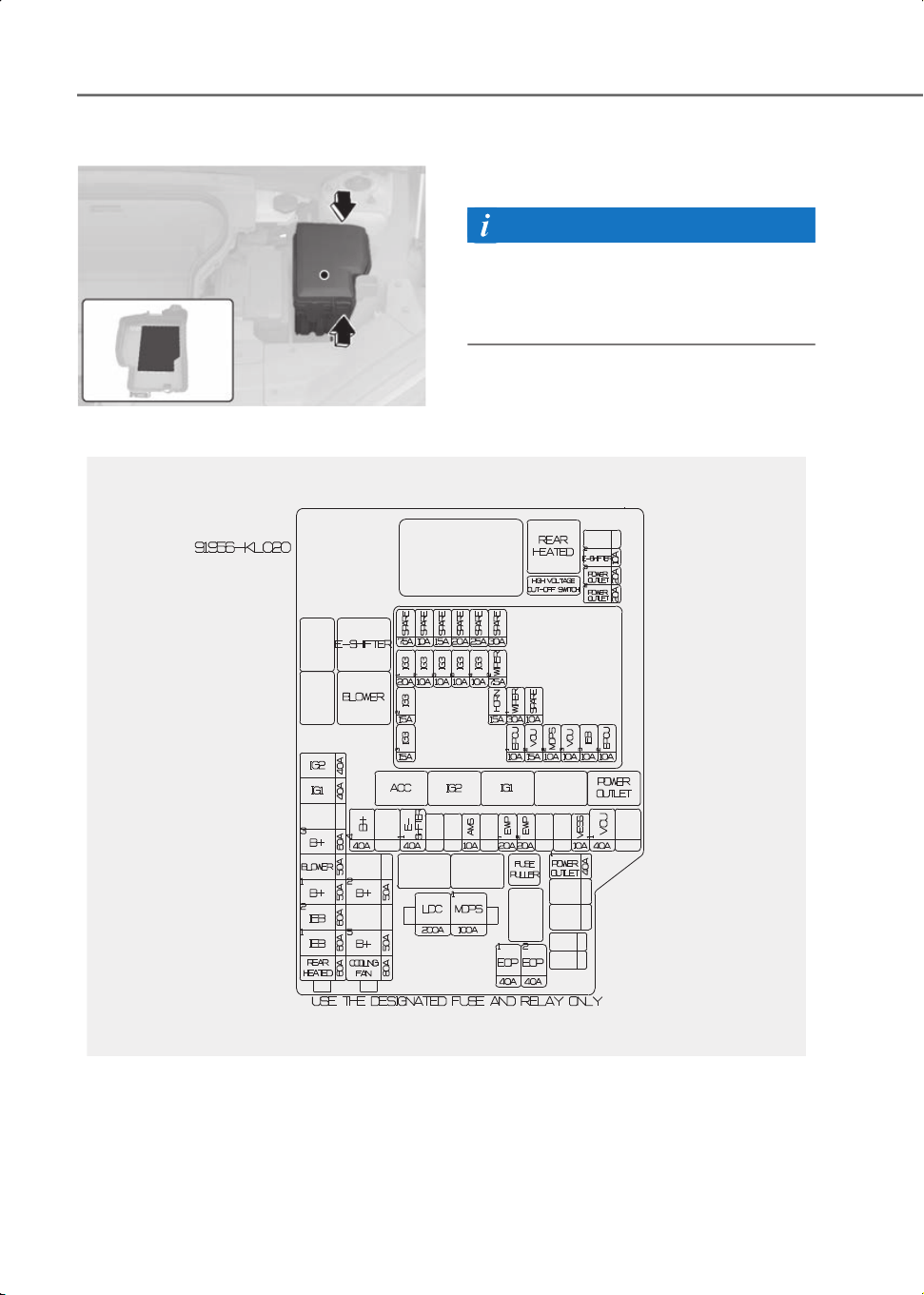
Maintenance
9-42
Motor compartment fuse panel
B9006003
Inside the fuse panel cover, you can find
the fuse label describing fuse names and
ratings.
Information
Not all fuse panel descriptions in this
manual may be applicable to your vehicle.
When you inspect the fuse panel on your
vehicle, refer to the fuse panel label.
ONE1091047N
CE_USA.book Page 42
9
9-43
Motor compartment fuse panel
Type Fuse Name Fuse Rating Circuit Protected
MULTI
FUSE-1
LDC1 200 A
ICCU (LDC), P/R Junction Block
(Fuse : POWER OUTLET1, EOP1, EOP2, LDC2)
MDPS1 100 A MDPS Unit
MULTI
FUSE-2
COOLING
FAN
80 A Cooling Fan Motor
B+5 50 A
PCB Block (Main Relay,
Fuse : VCU2, EPCU1, WIPER1, B/A HORN,
HORN)
B+2 50 A
ICU Junction Block (Fuse : IPS5, IPS7, IPS8,
IPS9)
MULTI
FUSE-3
RR HTD 60 A P/R Junction Block (RLY. 10)
IEB1 60 A IEB Unit
IEB2 50 A IEB Unit
B+1 50 A
ICU Junction Block (Fuse : IPS1, IPS2, IPS3,
IPS4, IPS6)
BLOWER 50 A P/R Junction Block (RLY. 9)
B+3 60 A
ICU Junction Block (Fuse : F1, F2, F12, F13, F23,
F24, F34, F35, F43, F44, F49, F50, F55)
IG1 40 A P/R Junction Block (RLY. 1, RLY. 3)
IG2 40 A P/R Junction Block (RLY. 2)
CE_USA.book Page 43

Maintenance
9-44
FUSE
B+4 40 A
ICU Junction Block (Long Term Load Latch
Relay,
Fuse : F10, F11, F21, F22, F33, F41, F42, F47, F48,
F52, F53)
E-SHIFTER1 40 A P/R Junction Block (RLY. 8, Fuse : F13)
AMS 10 A 12 V Battery
EWP1 20 A Electronic Water Pump #1 (HV Battery)
EWP2 20 A Electronic Water Pump #2 (HV Battery)
VESS 10 A VESS Unit
VCU1 40 A VCU
POWER
OUTLET1
40 A P/R Junction Block (RLY. 5)
EOP1 40 A Rear Electronic Oil Pump
EOP2 40 A Front Electronic Oil Pump
E-SHIFTER2 10 A
SCU, Electronic Shift Switch, P/R Junction
Block (RLY. 8)
POWER
OUTLET3
20 A Rear Power Outlet
POWER
OUTLET2
20 A Front Power Outlet
Type Fuse Name Fuse Rating Circuit Protected
CE_USA.book Page 44

9
9-45
Fuse Name Fuse Rating Circuit Protected
IG3 1 20 A ICU Junction Block (Fuse: F7, F18, F19, F30)
IG3 2 15 A Front Inverter (AWD)
IG3 3 15 A Electronic Water Pump
IG3 4 10 A VCU
IG3 5 10 A A/C Coolant Valve, Electronic Water Pump Batt #1, #2
IG3 6 10 A BMS Coolant 3Way Valve
IG3 7 10 A Cooling Fan Motor, Front Electronic Oil Pump (AWD)
EPCU1 10 A Front Inverter (AWD)
EPCU2 10 A Front Inverter (AWD)
VCU2 10 A VCU
VCU3 10 A VCU
WIPER1 30 A PCB Block (Wiper Main Relay)
WIPER2 7.5 A IBU
HORN 10 A PCB Block (Horn Relay)
IEB3 10 A IEB Unit
MDPS2 10 A MDPS Unit
CE_USA.book Page 45
Maintenance
9-46
Light Bulbs
Consult an authorized HYUNDAI dealer to
replace most vehicle light bulbs. It is
difficult to replace vehicle light bulbs
because other parts of the vehicle must
be removed before you can get to the
bulb. This is especially true for removing
the headlight assembly to get to the
bulb(s).
Removing/installing the headlight
assembly can result in damage to the
vehicle.
WARNING
• Prior to replacing a light bulb, depress
the brake pedal, shift to P (Park), apply
the parking brake, press the Start/Stop
button to the OFF position, and take the
key with you when leaving the vehicle
to avoid sudden movement of the
vehicle and to prevent possible electric
shock.
• Be aware the bulbs may be hot and may
burn your fingers.
NOTICE
Be sure to replace the burned-out bulb
with one of the same wattage to prevent
damage to the fuse or electrical wiring
system.
NOTICE
To prevent damage, do not clean the
headlight lens with chemical solvents or
strong detergents.
Information
Headlight desiccant
This vehicle is equipped with desiccant to
reduce fogging inside the headlight due
to moisture. The desiccant is consumable
and its performance may change based
on the used period or environment. If
fogging inside the headlight due to
moisture continues for a long time,
contact an authorized HYUNDAI dealer.
Information
The headlight and tail light lenses could
appear to have condensation inside if the
vehicle is washed after driving or if the
vehicle is driven in wet weather. This
condition is caused by a higher
temperature inside the light and a cooler
outside temperature. Moisture that
condenses in the light is removed after
driving with the light on. If the moisture is
not removed, contact an authorized
HYUNDAI dealer.
Information
• A normally functioning light may flicker
momentarily to stabilize the vehicle’s
electrical control system. However, if
the light goes out after flickering
momentarily, or continues to flicker,
have the system inspected by an
authorized HYUNDAI dealer.
• The parking light may not turn on when
the parking light switch is turned on,
but the parking light and headlight
switch may turn on when the headlight
switch is turned on. This may be caused
by network failure or vehicle electrical
control system malfunction. If this
occurs, contact an authorized
HYUNDAI dealer.
CE_USA.book Page 46
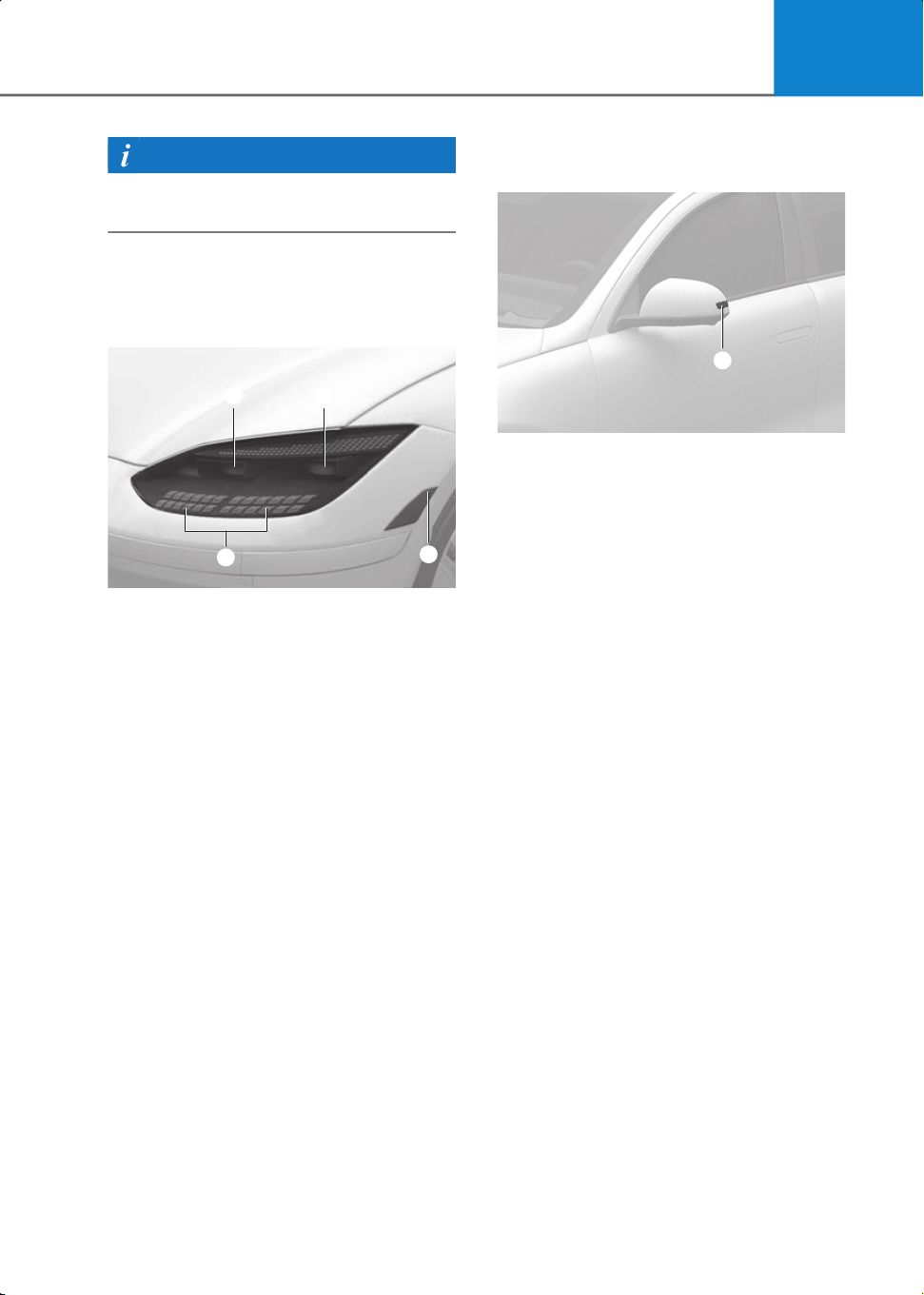
9
9-47
Information
Adjust the headlight aim after an accident
or the headlight is replaced.
Headlight, Parking Light, Turn
Signal Light, Daytime Running
Light (DRL) Replacement
B9006202
1. Headlight (Low)
2. Headlight (High)
3. Parking light/Daytime running
light/Turn signal light
4. Front side marker
If the LED light does not operate, contact
an authorized HYUNDAI dealer for
replacement.
The LED light cannot be replaced as a
single unit. A skilled technician should
check or repair the LED light, for it may
damage related parts of the vehicle.
Side Repeater Light
Replacement
B9006301
If the LED light (1) does not operate,
contact an authorized HYUNDAI dealer
for replacement.
The LED light cannot be replaced as a
single unit. A skilled technician should
check or repair the LED light, for it may
damage related parts of the vehicle.
2 1
3
4
1
CE_USA.book Page 47
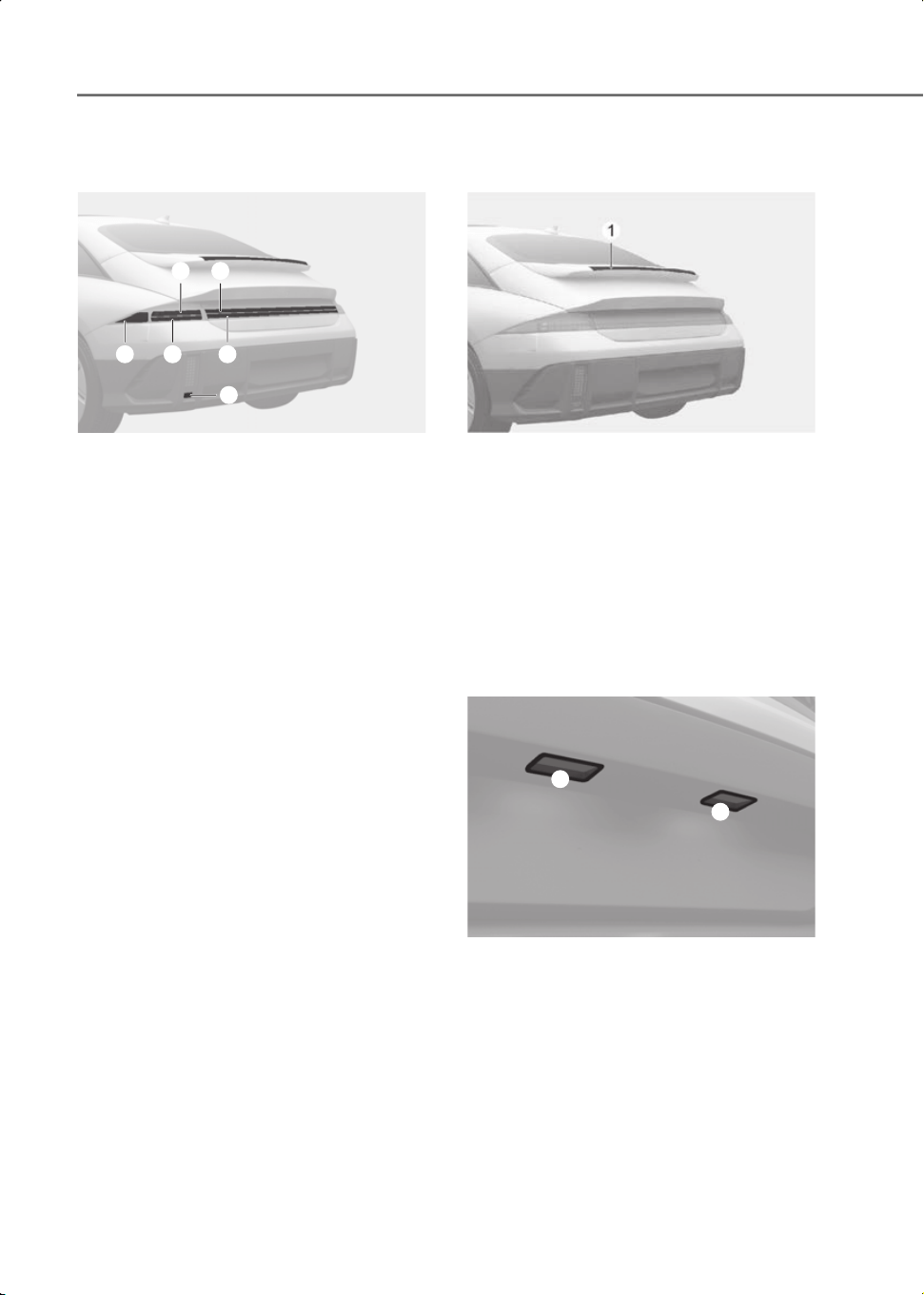
Maintenance
9-48
Rear Combination Light
Replacement
B9006501
1. Stop light
2. Tail light/Stop light
3. Tail light/Stop light/Turn signal light
4. Turn signal light/Stop light
5. Reverse light
6.Rear side marker
If the LED light does not operate, contact
an authorized HYUNDAI dealer for
replacement.
The LED light cannot be replaced as a
single unit. A skilled technician should
check or repair the LED light, for it may
damage related parts of the vehicle.
High Mounted Stop Light
Replacement
B9006601
If the LED light (1) does not operate,
contact an authorized HYUNDAI dealer
for replacement.
The LED light cannot be replaced as a
single unit. A skilled technician should
check or repair the LED light, for it may
damage related parts of the vehicle.
License Plate Light
Replacement
B9006701
If the LED light (1) does not operate,
contact an authorized HYUNDAI dealer
for replacement.
The LED light cannot be replaced as a
single unit. A skilled technician should
check or repair the LED light, for it may
damage related parts of the vehicle.
23
46 1
5
1
1
CE_USA.book Page 48
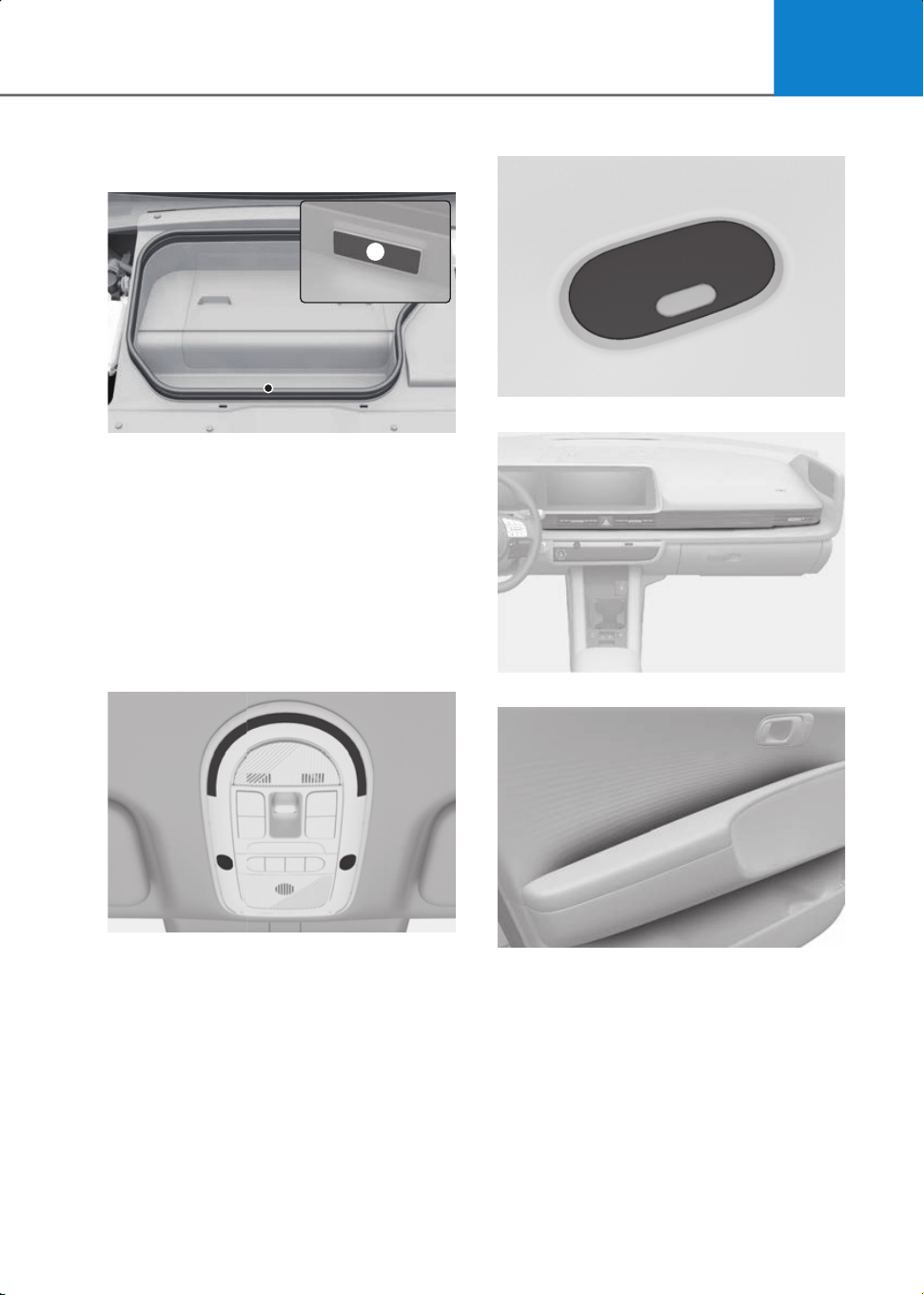
9
9-49
Front Trunk Light
Replacement
B9006801
If the LED light (1) does not operate,
contact an authorized HYUNDAI dealer
for replacement.
The LED light cannot be replaced as a
single unit. A skilled technician should
check or repair the LED light, for it may
damage related parts of the vehicle.
Interior Light Replacement
First row lamp (if equipped)
B9006901
Rear seat room lamp
B9006902
Dashboard mood lamp (if equipped)
B9006904
Door mood lamp (if equipped)
B9006905
1
CE_USA.book Page 49
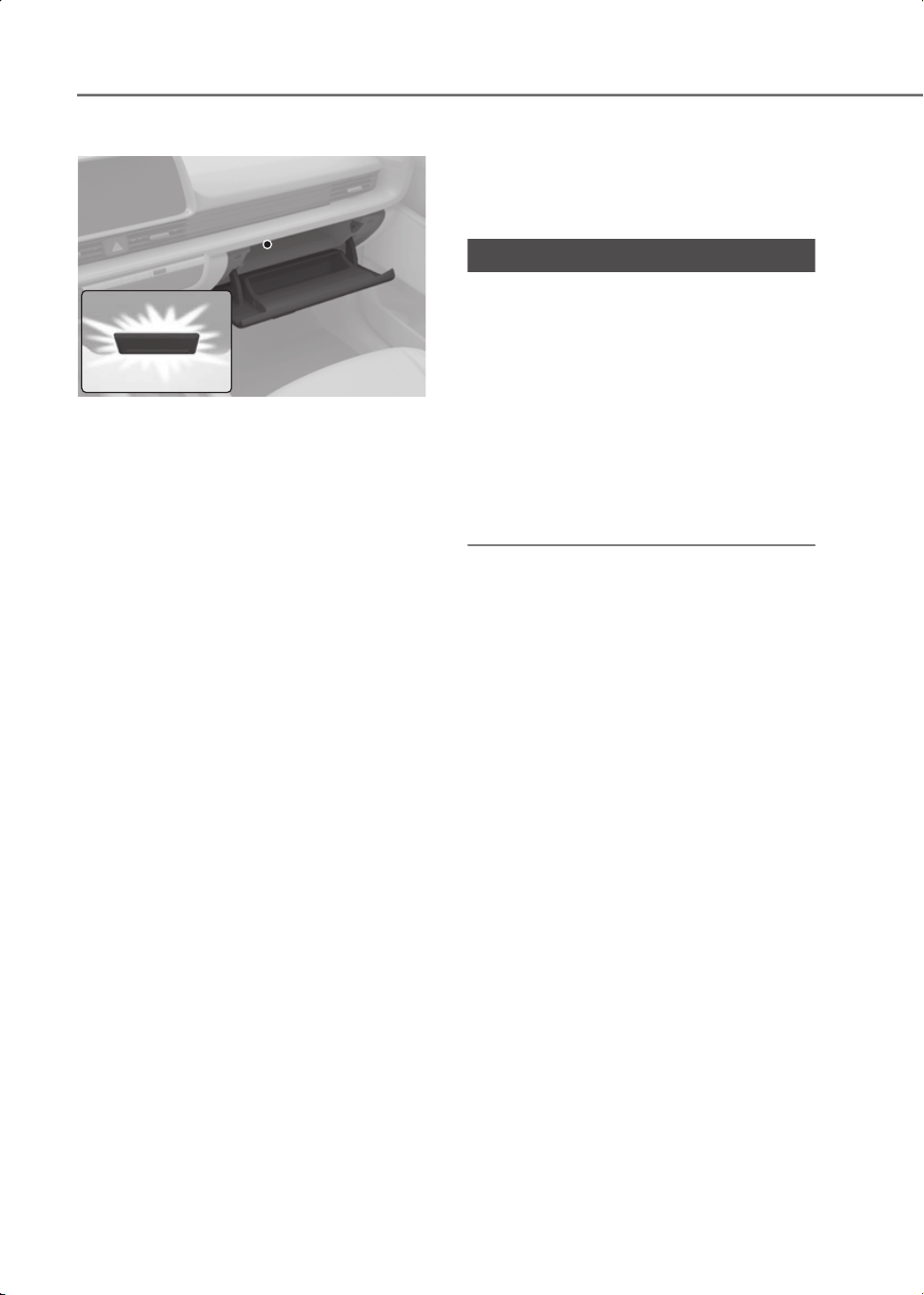
Maintenance
9-50
Glove box lamp
B9006903
If the LED light does not operate, contact
an authorized HYUNDAI dealer for
replacement.
The LED light cannot be replaced as a
single unit. A skilled technician should
check or repair the LED light, for it may
damage related parts of the vehicle.
Appearance Care
Exterior Care
NOTICE
If you park your vehicle near a stainless
steel sign or glass facade building, the
vehicle’s exterior plastic parts such as a
bumper, spoiler, garnish, light or side
view mirror might be damaged due to
sunlight reflected from the sign or
building. To prevent damage of the
exterior plastic parts, you should avoid
parking in areas where light may be
reflected or use a car cover. (The exterior
plastic parts applied to your vehicle may
vary.)
Exterior general caution
It is very important to follow the label
directions when using any chemical
cleaner or polish. Read all warning and
caution statements that appear on the
label.
Finish maintenance
Washing
To help protect your vehicle’s finish from
rust and deterioration, wash it thoroughly
and frequently at least once a month with
lukewarm or cold water.
If you use your vehicle for off-road
driving, you should wash it after each
off-road trip. Pay special attention to the
removal of any accumulation of salt, dirt,
mud, and other foreign materials. Make
sure the drain holes in the lower edges of
the doors and rocker panels are kept clear
and clean.
Insects, tar, tree sap, bird droppings,
industrial pollution and similar deposits
can damage your vehicle’s finish if not
removed immediately.
CE_USA.book Page 50
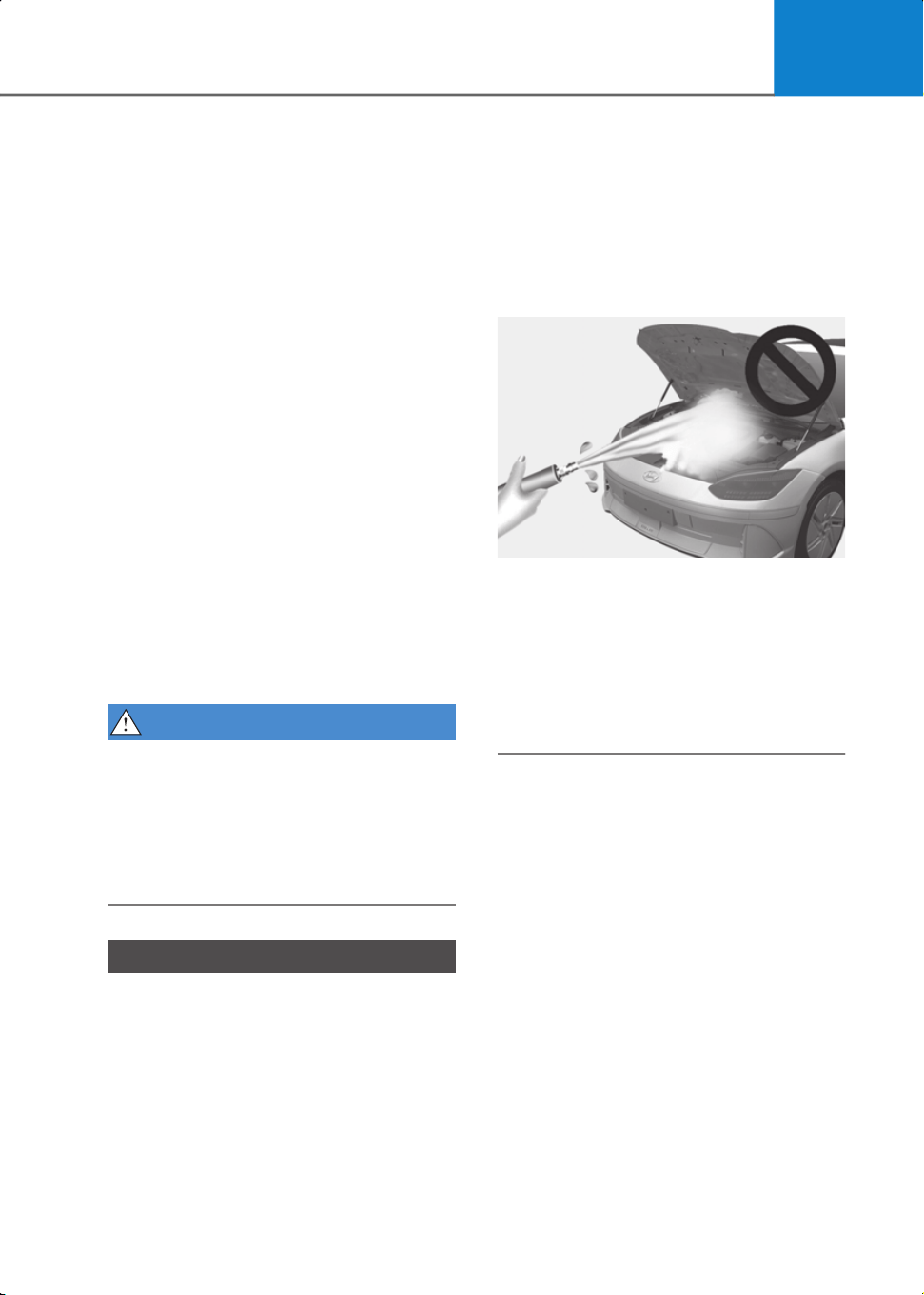
9
9-51
Even prompt washing with plain water
may not completely remove all these
deposits. A mild soap, safe for use on
painted surfaces, should be used.
After washing, rinse the vehicle
thoroughly with lukewarm or cold water.
Do not allow soap to dry on the finish.
High-pressure washing
• When using high-pressure washers,
make sure to maintain sufficient
distance from the vehicle.
Insufficient clearance or excessive
pressure can lead to component
damage or water penetration.
• Do not spray the camera, sensors or its
surrounding area directly with a high
pressure washer. Shock applied from
high pressure water may cause the
device to not operate normally.
• Do not bring the nozzle tip close to
boots (rubber or plastic covers) or
connectors as they may be damaged if
they come into contact with high
pressure water.
WARNING
After washing the vehicle, test the brakes
while driving slowly to see if they have
been affected by water before getting on
the road. If braking performance is
impaired, dry the brakes by applying
them lightly while maintaining a slow
forward speed.
NOTICE
• Do not use strong soap, chemical
detergents or hot water, and do not
wash the vehicle in direct sunlight or
when the body of the vehicle is warm.
• Be careful when washing the side
windows of your vehicle.
• Especially, with high-pressure water,
water may leak through the windows
and wet the interior.
• To prevent damage to the plastic parts,
do not clean with chemical solvents or
strong detergents.
• Water washing in the motor
compartment including high pressure
water washing may cause the failure of
electrical circuits located in the vehicle
compartment.
B9007101
• Never allow water or other liquids to
come in contact with
electrical/electronic components
inside the vehicle as water or other
liquids may flow in to the motor
compartment through the front trunk
and damage electrical/electronic
components.
CE_USA.book Page 51

Maintenance
9-52
NOTICE
Matte paint finish vehicle (if equipped)
Automatic car wash which uses rotating
brushes should not be used as this can
damage the surface of your vehicle. A
steam cleaner which washes the vehicle
surface at high temperature may result
the oil to adhere and leave stains that is
difficult to remove.
Use a soft cloth (for example, microfiber
towel or sponge) when washing your
vehicle and dry with a microfiber towel.
When you hand wash your vehicle, you
should not use a cleaner that finishes with
wax. If the vehicle surface is too dirty
(sand, dirt, dust, contaminant, etc.), clean
the surface with water before washing
the car.
Waxing
A good coat of wax is a barrier between
your paint and contaminate. Keeping a
good coat of wax on your vehicle will help
protect it.
Wax the vehicle when water will no longer
bead on the paint.
Always wash and dry the vehicle before
waxing. Use a good quality liquid or paste
wax, and follow the manufacturer’s
instructions. Wax all metal trim to protect
it and to maintain its luster.
Removing oil, tar, and similar materials
with a spot remover will usually strip the
wax from the finish. Be sure to re-wax
these areas even if the rest of the vehicle
does not yet need waxing.
NOTICE
• Wiping dust or dirt off the body with a
dry cloth will scratch the finish.
• Do not use steel wool, abrasive
cleaners, or strong detergents
containing highly alkaline or caustic
agents on chrome-plated or anodized
aluminum parts. This may result in
damage to the protective coating and
cause discoloration or paint
deterioration.
NOTICE
Matte paint finish vehicle (if equipped)
Do not use any polish protector such as a
detergent, an abrasive and a polish. In
case wax is applied, remove the wax
immediately using a silicon remover and
if any tar or tar contaminant is on the
surface use a tar remover to clean.
However, be careful not to apply too
much pressure on the painted area.
Finish damage repair
Deep scratches or stone chips in the
painted surface must be repaired
promptly. Exposed metal will quickly rust
and may develop into a major repair
expense.
NOTICE
If your vehicle is damaged and requires
any metal repair or replacement, be sure
the body shop applies anti-corrosion
materials to the parts repaired or
replaced.
CE_USA.book Page 52
9
9-53
NOTICE
Matte paint finish vehicle (if equipped)
In case of matte paint finish vehicles, it is
impossible to modify only the damaged
area and repair of the whole part is
necessary. If the vehicle is damaged and
painting is required, have your vehicle
maintained and repaired by an authorized
HYUNDAI dealer. Take extreme care, as it
is difficult to restore the quality after the
repair.
Bright-metal maintenance
• To remove road tar and insects, use a
tar remover, not a scraper or other
sharp object.
• To protect the surfaces of bright metal
parts from corrosion, apply a coating of
wax or chrome preservative and rub to
a high luster.
• During winter weather or in coastal
areas, cover the bright metal parts with
a heavier coating of wax or
preservative. If necessary, coat the
parts with non-corrosive petroleum
jelly or other protective compound.
Underbody maintenance
Corrosive materials used for ice and snow
removal and dust control may collect on
the underbody. If these materials are not
removed, accelerated rusting can occur
on underbody parts such as the frame and
floor pan, even though they have been
treated with rust protection.
Thoroughly flush the vehicle underbody
and wheel openings with lukewarm or
cold water once a month, after off-road
driving and at the end of each winter. Pay
special attention to these areas because it
is difficult to see all the mud and dirt. It
will do more harm than good to wet down
the road grime without removing it. The
lower edges of doors, rocker panels, and
frame members have drain holes that
should not be allowed to clog with dirt;
trapped water in these areas can cause
rusting.
WARNING
After washing the vehicle, test the brakes
while driving slowly to see if they have
been affected by water. If braking
performance is impaired, dry the brakes
by applying them lightly while
maintaining a slow forward speed.
Aluminum wheel maintenance
The aluminum wheels are coated with a
clear protective finish.
• Do not use abrasive cleaner, polishing
compound, solvent, or wire brushes on
aluminum wheels.
• Clean the wheel when it has cooled.
• Use only a mild soap or neutral
detergent, and rinse thoroughly with
water. Also, clean the wheels after
driving on salted roads.
• Do not wash the wheels with
high-speed car wash brushes.
• Do not use any cleaners containing acid
or alkaline detergents.
CE_USA.book Page 53

Maintenance
9-54
Corrosion protection
Protecting your vehicle from corrosion
By using the most advanced design and
construction practices to combat
corrosion, HYUNDAI produces vehicles of
the highest quality. However, this is only
part of the job. To achieve the long-term
corrosion resistance your vehicle can
deliver, the owner’s cooperation and
assistance is also required.
Common causes of corrosion
The most common causes of corrosion on
your vehicle are:
• Road salt, dirt and moisture that is
allowed to accumulate underneath the
vehicle.
• Removal of paint or protective coatings
by stones, gravel, abrasion or minor
scrapes and dents which leave
unprotected metal exposed to
corrosion.
High-corrosion areas
If you live in an area where your vehicle is
regularly exposed to corrosive materials,
corrosion protection is particularly
important. Some of the common causes
of accelerated corrosion are road salts,
dust control chemicals, ocean air and
industrial pollution.
Moisture breeds corrosion
Moisture creates the conditions in which
corrosion is most likely to occur. For
example, corrosion is accelerated by high
humidity, particularly when temperatures
are just above freezing. In such
conditions, the corrosive material is kept
in contact with the vehicle surfaces by
moisture that is slow to evaporate.
Mud is particularly corrosive because it is
slow to dry and holds moisture in contact
with the vehicle. Although the mud
appears to be dry, it can still retain
moisture and promote corrosion.
High temperatures can also accelerate
corrosion of parts that are not properly
ventilated so the moisture can be
dispersed. For all these reasons, it is
particularly important to keep your
vehicle clean and free of mud or
accumulations of other materials. This
applies not only to the visible surfaces but
particularly to the underside of the
vehicle.
To help prevent corrosion
Keep your vehicle clean
The best way to prevent corrosion is to
keep your vehicle clean and free of
corrosive materials. Attention to the
underside of the vehicle is particularly
important.
• If you live in a high-corrosion area -
where road salts are used, near the
ocean, areas with industrial pollution,
acid rain, etc., -, you should take extra
care to prevent corrosion. In winter,
hose off the underside of your vehicle
at least once a month and be sure to
clean the underside thoroughly when
winter is over.
• When cleaning underneath the vehicle,
pay particular attention to the
components under the fenders and
other areas that are hidden from view.
Do a thorough job; just dampening the
accumulated mud rather than washing
it away will accelerate corrosion rather
than prevent it. Water under high
pressure and steam are particularly
effective in removing accumulated
mud and corrosive materials.
• When cleaning lower door panels,
rocker panels and frame members, be
sure that drain holes are kept open so
that moisture can escape and not be
trapped inside to accelerate corrosion.
CE_USA.book Page 54

9
9-55
Keep your garage dry
Don’t park your vehicle in a damp, poorly
ventilated garage. This creates a
favorable environment for corrosion. This
is particularly true if you wash your
vehicle in the garage or drive it into the
garage when it is still wet or covered with
snow, ice or mud. Even a heated garage
can contribute to corrosion unless it is
well ventilated so moisture is dispersed.
Keep paint and trim in good condition
Scratches or chips in the finish should be
covered with “touch-up” paint as soon as
possible to reduce the possibility of
corrosion. If bare metal is showing
through, the attention of a qualified body
and paint shop is recommended.
Bird droppings are highly corrosive and
may damage painted surfaces in just a
few hours. Always remove bird droppings
as soon as possible.
Interior Care
Interior general precautions
Prevent caustic solutions such as
perfume and cosmetic oil, from
contacting the interior parts because they
may cause damage or discoloration. If
they do contact the interior parts, wipe
them off immediately. See the
instructions for the proper way to clean
vehicle interior surfaces.
NOTICE
• Never allow water or other liquids to
come in contact with
electrical/electronic components
inside the vehicle as this may damage
them.
• When cleaning leather products
(steering wheel, seats etc.), use neutral
detergents or low alcohol content
solutions. If you use high alcohol
content solutions or acid/alkaline
detergents, the color of the leather may
fade or the surface may get stripped
off.
Cleaning the upholstery and interior
trim
if equipped
Vehicle interior surfaces
Remove dust and loose dirt from interior
surfaces with a whisk broom or a vacuum
cleaner. If necessary, clean interior
surfaces with a mixture of warm water
and mild non-detergent cleaner (test all
cleaners on a concealed area before use).
CE_USA.book Page 55

Maintenance
9-56
if equipped
Fabric
Remove dust and loose dirt from fabric
with a whisk broom or vacuum cleaner.
Clean with a mild soap solution
recommended for upholstery or carpets.
Remove fresh spots immediately with a
fabric spot cleaner. If fresh spots do not
receive immediate attention, the fabric
can be stained and its color can be
affected. Also, its fire-resistant properties
can be reduced if the material is not
properly maintained.
NOTICE
Using anything but recommended
cleaners and procedures may affect the
fabric’s appearance and fire-resistant
properties.
if equipped
Leather
• Features of seat leather
- Leather is made from the outer skin
of an animal, which goes through a
special process to be available for
use. Since it is a natural product, each
part differs in thickness or density.
Wrinkles may appear as a natural
result of stretching and shrinking
depending on the temperature and
humidity.
- The seat is made of stretchable fabric
to improve comfort.
- The parts contacting the body are
curved and the side supporting area
is high which provides driving
comfort and stability.
- Wrinkles may appear naturally from
usage. It is not a fault of the products.
NOTICE
• Wrinkles or abrasions which appear
naturally from usage are not covered by
warranty.
• Belts with metallic accessories, zippers
or keys inside the back pocket may
damage the seat fabric.
• Make sure not to wet the seat. It may
change the nature of natural leather.
• Jeans or clothes which could bleach
may contaminate the surface of the
seat covering fabric.
• Caring for the leather seats
- Vacuum the seat periodically to
remove dust and sand on the seat. It
will prevent abrasion or damage of
the leather and maintain its quality.
- Wipe the natural leather seat cover
often with dry or soft cloth.
- Use of proper leather protector may
prevent abrasion of the cover and
helps maintain the color. Be sure to
read the instructions and consult a
specialist when using leather coating
or protective agent.
- Light colored (beige, cream beige)
leather is easily contaminated and
the stain is noticeable. Clean the
seats frequently.
- Avoid wiping with wet cloth. It may
cause the surface to crack.
CE_USA.book Page 56

9
9-57
• Cleaning the leather seats
- Remove all contaminations instantly.
Refer to instructions below for
removal of each contaminant.
- Cosmetic products (sunscreen,
foundation, etc.)
Apply cleansing cream on a cloth and
wipe the contaminated spot. Wipe
off the cream with a wet cloth and
remove water with a dry cloth.
- Beverages (coffee, soft drink, etc.)
Apply a small amount of neutral
detergent and wipe until
contaminations do not smear.
- Oil
Remove oil instantly with absorbable
cloth and wipe with stain remover
used only for natural leather.
- Chewing gum
Harden the gum with ice and remove
gradually.
Cleaning the seat belt webbing
Clean the belt webbing with any mild
soap solution recommended for cleaning
upholstery or carpet. Follow the
instructions provided with the soap. Do
not bleach or re-dye the webbing
because this may weaken the seat belt.
Cleaning the interior window glass
If the interior glass surfaces of the vehicle
become fogged (that is, covered with an
oily, greasy or waxy film), they should be
cleaned with glass cleaner. Follow the
directions on the glass cleaner container.
NOTICE
Do not scrape or scratch the inside of the
rear window. This may result in damage
to the rear window defroster grid.
California Perchlorate
Notice
Perchlorate Material-special handling
may apply, See:
www.dtsc.ca.gov/perchlorate.
Notice to California Vehicle Dismantlers:
Perchlorate containing materials, such as
airbag inflators, seatbelt pretensioners
and keyless remote entry batteries, must
be disposed of according to Title 22
California Code of Regulations Section
67384.10 (a).
CE_USA.book Page 57

CE_USA.book Page 58

I
Index
CE_USA.book Page 1

Index
I-2
A
About "Getting Started with Your Electric Vehicle" ................................................................1-8
Accessing Your Vehicle ...............................................................................................................5-5
Immobilizer System ....................................................................................................................5-11
Smart Key .....................................................................................................................................5-5
Active Air Flap ............................................................................................................................ 6-45
Malfunction ............................................................................................................................... 6-45
Active sound design ..................................................................................................................6-46
Air Conditioner Compressor Label ........................................................................................... 2-15
Air Conditioning System ............................................................................................................ 2-12
Airbag - Supplemental Restraint System ............................................................................... 3-38
Airbag Warning Labels ..............................................................................................................3-57
How does the Airbags System Operate? ................................................................................ 3-43
Occupant Classification System (OCS) ................................................................................... 3-46
SRS Care .................................................................................................................................... 3-56
What to Expect After an Airbag Inflates ................................................................................. 3-46
Where are the Airbags? ............................................................................................................3-40
Why didn’t My Airbag Go Off in a Collision? ............................................................................3-52
All Wheel Drive (AWD) .............................................................................................................. 6-37
Emergency Precautions ........................................................................................................... 6-39
Appearance Care ....................................................................................................................... 9-50
Exterior Care ............................................................................................................................. 9-50
Interior Care .............................................................................................................................. 9-55
Automatic Climate Control System ........................................................................................ 5-85
Automatic Temperature Control Mode .................................................................................. 5-87
Climate ...................................................................................................................................... 5-87
Manual Temperature Control Mode ....................................................................................... 5-88
System Maintenance .................................................................................................................5-97
System Operation ..................................................................................................................... 5-96
Aux. Battery Saver+ .................................................................................................................... 1-52
Available Front Trunk Weight ................................................................................................... 2-12
B
Battery (12 V) ...............................................................................................................................9-19
Battery Capacity Label .............................................................................................................. 9-21
Battery Recharging ................................................................................................................... 9-21
For Best Battery Service ............................................................................................................9-21
Reset Items ............................................................................................................................... 9-22
Before Driving .............................................................................................................................. 6-3
Before Entering the Vehicle ....................................................................................................... 6-3
Before Starting ............................................................................................................................ 6-3
Blind-Spot Collision-Avoidance Assist (BCA) ......................................................................... 7-36
Blind-Spot Collision-Avoidance Assist Malfunction and Limitations ....................................7-42
Blind-Spot Collision-Avoidance Assist Operation .................................................................. 7-39
Blind-Spot Collision-Avoidance Assist settings ..................................................................... 7-38
Blind-Spot View Monitor (BVM) ...............................................................................................7-65
Blind-Spot View Monitor Malfunction .....................................................................................7-67
Blind-Spot View Monitor Operation ........................................................................................ 7-66
Blind-Spot View Monitor settings ........................................................................................... 7-66
CE_USA.book Page 2

I
I-3
Brake Fluid ..................................................................................................................................9-14
Checking the Brake Fluid Level ................................................................................................9-14
Braking System .......................................................................................................................... 6-23
Anti-Lock Brake System (ABS) .................................................................................................6-30
Auto Hold ..................................................................................................................................6-28
Brake Assistant System (BAS) .................................................................................................. 6-35
Brake Disc Cleaning ..................................................................................................................6-30
Disc Brakes Wear Indicator ...................................................................................................... 6-24
Electronic Parking Brake (EPB) ................................................................................................ 6-24
Electronic Stability Control (ESC) ............................................................................................ 6-32
Good Braking Practices ............................................................................................................6-36
Hill-Start Assist Control (HAC) ................................................................................................. 6-35
Power-Assist Brakes ................................................................................................................. 6-23
Vehicle Stability Management (VSM) .....................................................................................6-34
Bulb Wattage ..............................................................................................................................2-10
C
Cabin Air Filter ............................................................................................................................9-16
Filter Inspection .........................................................................................................................9-16
Filter Replacement ....................................................................................................................9-16
California Perchlorate Notice .................................................................................................. 9-57
Center Console Overview ........................................................................................................... 2-5
Charging Your Electric Vehicle ..................................................................................................1-13
Checking Basic Information on Charging Your Electric Vehicle ............................................ 1-16
Safety Precautions for Charging Your Electric Vehicle ............................................................1-13
Using a DC Charger ...................................................................................................................1-25
Using a Portable Charger (ICCB) .............................................................................................. 1-27
Using an AC Charger ................................................................................................................. 1-22
Child Restraint System (CRS) ................................................................................................... 3-29
Children Always in the Rear ..................................................................................................... 3-29
Installing a Child Restraint System (CRS) ............................................................................... 3-32
Selecting a Child Restraint System (CRS) ...............................................................................3-30
Climate Control Additional Features .....................................................................................5-102
A/C Automatic Drying .............................................................................................................5-102
Auto Defogging System ..........................................................................................................5-102
Auto Dehumidify ..................................................................................................................... 5-104
Automatic Controls Linked to Climate Control Settings (for driver’s seat) .........................5-105
Recirculating Air When Washer Fluid Is Used ...................................................................... 5-104
Recirculation Mode Plus .........................................................................................................5-105
Smart Ventilation .....................................................................................................................5-105
Sunroof Inside Air Recirculation ............................................................................................ 5-104
Cluster Display ........................................................................................................................... 4-24
Cluster Display Control ............................................................................................................4-24
View Modes ............................................................................................................................... 4-24
Consumer Information ..............................................................................................................2-16
Convenience Features ................................................................................................................. 5-1
Coolant ........................................................................................................................................9-13
Changing Coolant ......................................................................................................................9-14
Countermeasures for Accidents or Fire ...................................................................................1-65
If the Electric Vehicle Catches Fire ...........................................................................................1-65
CE_USA.book Page 3

Index
I-4
If the Electric Vehicle Is Submerged ........................................................................................1-65
If the Electric Vehicle Needs Towing .......................................................................................1-66
Other Precautions for Electric Vehicle Accidents ................................................................... 1-67
D
Declaration of Conformity ...................................................................................................... 7-165
Front Corner Radar/Rear Corner Radar ................................................................................. 7-166
Front Radar .............................................................................................................................. 7-165
Dimensions .................................................................................................................................. 2-9
Door Locks ..................................................................................................................................5-22
Automatic Door Lock and Unlock Features .............................................................................5-27
Child-Protector Rear Door Locks ............................................................................................ 5-28
Operating Door Lock/Unlock from Inside the Vehicle ............................................................5-27
Operating Door Locks from Outside the Vehicle (Electric type) ........................................... 5-24
Operating Door Locks from Outside the Vehicle (Manual type) ........................................... 5-24
Operating Door Unlocks from Outside the Vehicle (Electric type) ........................................5-22
Operating Door Unlocks from Outside the Vehicle (Manual type) ........................................5-22
Drive Mode Integrated Control System (2WD) ......................................................................6-40
Drive Mode ................................................................................................................................6-40
Drive mode Integrated Control System (AWD) ..................................................................... 6-42
Drive Mode ................................................................................................................................ 6-42
Drive Modes Characteristic ..................................................................................................... 6-44
Driver Assistance System ............................................................................................................ 7-1
Driver Assistance System Notice ...............................................................................................7-4
Driver Attention Warning (DAW) ..............................................................................................7-59
Driver Attention Warning Malfunction and Limitations .........................................................7-62
Driver Attention Warning Operation ........................................................................................ 7-61
Driver Attention Warning Settings .......................................................................................... 7-60
Driving Your Electric Vehicle .................................................................................................... 1-53
Checking Electric Vehicle Driving Information ....................................................................... 1-54
Starting and Stopping the Vehicle ........................................................................................... 1-53
Driving Your Vehicle ....................................................................................................................6-1
E
Electric Charging Door ............................................................................................................. 5-66
Electric Vehicle Specifications .................................................................................................. 2-9
Emergency Situations ..................................................................................................................8-1
Explanation of Scheduled Maintenance Items ....................................................................... 9-12
Air Conditioning Refrigerant ..................................................................................................... 9-12
Brake Discs, Pads, Calipers and Rotors ................................................................................... 9-12
Brake Fluid ................................................................................................................................. 9-12
Brake Hoses and Lines .............................................................................................................. 9-12
Coolant .......................................................................................................................................9-12
Cooling System ..........................................................................................................................9-12
Drive Shafts and Boots .............................................................................................................. 9-12
Gear Fluid ...................................................................................................................................9-12
Steering Gear Box, Linkage & Boots/Lower Arm Ball Joint ....................................................9-12
Suspension Mounting Bolts ......................................................................................................9-12
Exterior Overview (Front View) ..................................................................................................2-2
CE_USA.book Page 4

I
I-5
Exterior Overview (Rear View) ................................................................................................... 2-3
F
Forward Collision-Avoidance Assist (FCA) ............................................................................... 7-4
Forward Collision-Avoidance Assist malfunction and limitations .........................................7-22
Forward Collision-Avoidance Assist operation ........................................................................7-11
Forward Collision-Avoidance Assist settings ........................................................................... 7-8
Forward/Reverse Parking Distance Warning (PDW) ............................................................ 7-122
Forward/Reverse Parking Distance Warning Malfunction and Limitations ........................ 7-125
Forward/Reverse Parking Distance Warning Operation ....................................................... 7-123
Forward/Reverse Parking Distance Warning Settings .......................................................... 7-122
Forward/Side/Reverse Parking Collision-Avoidance Assist (PCA) ..................................... 7-132
Parking Collision-Avoidance Assist Malfunction and Limitations ........................................7-136
Parking Collision-Avoidance Assist Operation ......................................................................7-134
Parking Collision-Avoidance Assist Settings ......................................................................... 7-133
Forward/Side/Reverse Parking Distance Warning (PDW) .................................................. 7-127
Parking Distance Warning Malfunction and Limitations ......................................................7-130
Parking Distance Warning Operation ..................................................................................... 7-128
Parking Distance Warning Settings ........................................................................................ 7-127
Front Trunk ................................................................................................................................. 5-58
Opening the Front Trunk .......................................................................................................... 5-58
Fuses ........................................................................................................................................... 9-35
Fuse/Relay Panel Description ..................................................................................................9-38
Instrument Panel Fuse Replacement ......................................................................................9-36
Motor Compartment Panel Fuse Replacement ......................................................................9-36
G
Gear Fluid ....................................................................................................................................9-15
H
Hazard Warning Flasher ............................................................................................................. 8-2
Head-up Display ........................................................................................................................ 5-67
Head-up Display Information ..................................................................................................5-68
Head-up Display Settings ........................................................................................................ 5-67
Precautions while Using the Head-up Display .......................................................................5-68
High Beam Assist (HBA) ............................................................................................................ 5-79
High Beam Assist Malfunction and Limitations ......................................................................5-81
High Beam Assist Operation ....................................................................................................5-80
High Beam Assist Settings .......................................................................................................5-80
Highway Driving Assist (HDA) .................................................................................................. 7-94
Highway Driving Assist Malfunction and Limitations ...........................................................7-103
Highway Driving Assist Operation ............................................................................................7-97
Highway Driving Assist Settings .............................................................................................. 7-96
Hood ............................................................................................................................................ 5-57
Closing the Hood ...................................................................................................................... 5-58
Opening the Hood .................................................................................................................... 5-57
Hyundai Digital Key ....................................................................................................................5-12
Digital key (Card key) ................................................................................................................5-16
Digital key (smartphone) ........................................................................................................... 5-12
CE_USA.book Page 5

Index
I-6
Limitations of the System ......................................................................................................... 5-21
Used vehicle/Digital key maintenance .................................................................................... 5-21
I
If the Vehicle Will Not Start ........................................................................................................ 8-3
Confirm the EV Battery is not Low on the Charge Gauge ....................................................... 8-3
If You Have a Flat Tire (with Tire Mobility Kit) ......................................................................... 8-12
Components of the Tire Mobility Kit ........................................................................................8-13
How to Adjust Tire Pressure ..................................................................................................... 8-17
Introduction ............................................................................................................................... 8-12
Notes on the Safe Use of the Tire Mobility Kit ........................................................................8-12
Using the Tire Mobility Kit When a Tire is Flat .........................................................................8-14
Important Safety Precautions ....................................................................................................3-2
Airbag Hazards ............................................................................................................................3-2
Always Wear Your Seat Belt ........................................................................................................3-2
Control Your Speed .....................................................................................................................3-2
Driver Distraction ........................................................................................................................3-2
Keep Your Vehicle In Safe Condition .........................................................................................3-2
Restrain All Children ....................................................................................................................3-2
In Case of an Emergency While Driving .................................................................................... 8-2
If the Vehicle Stalls at A Crossroad or Crossing ....................................................................... 8-2
If the Vehicle Stalls While Driving ............................................................................................. 8-2
If You Have a Flat Tire While Driving ......................................................................................... 8-3
Infotainment System ................................................................................................................5-113
Antenna .....................................................................................................................................5-114
Bluetooth® Wireless Technology .............................................................................................5-116
Infotainment System ................................................................................................................5-115
Steering Wheel Remote Controls ............................................................................................5-114
USB Port ....................................................................................................................................5-113
Voice Recognition ....................................................................................................................5-115
Instrument Cluster ............................................................................................................... 4-1, 4-2
Cluster Display Messages ......................................................................................................... 4-17
Gauges and Meters .................................................................................................................... 4-3
Gear Shift Indicator .................................................................................................................... 4-6
Instrument Cluster Control ........................................................................................................ 4-3
Power/Charge Gauge ................................................................................................................. 4-3
State of Charge (SOC) Gauge for High Voltage Battery .......................................................... 4-4
Warning and Indicator Lights .................................................................................................... 4-6
Integrated Memory System ......................................................................................................5-32
Recalling Memory Positions .................................................................................................... 5-33
Resetting the System ............................................................................................................... 5-33
Seat Easy Access ...................................................................................................................... 5-34
Storing Memory Positions ........................................................................................................ 5-33
Intelligent Speed Limit Assist (ISLA) ........................................................................................7-53
Intelligent Speed Limit Assist Malfunction and Limitations ................................................... 7-57
Intelligent Speed Limit Assist Operation .................................................................................7-55
Intelligent Speed Limit Assist Settings ....................................................................................7-54
Interior Features ....................................................................................................................... 5-107
Clock ..........................................................................................................................................5-112
Coat Hook .................................................................................................................................5-112
CE_USA.book Page 6

I
I-7
Cup Holder ...............................................................................................................................5-107
Floor Mat Anchor(s) ..................................................................................................................5-113
Power Outlet ........................................................................................................................... 5-108
Sunvisor ................................................................................................................................... 5-108
USB Charger ............................................................................................................................ 5-109
Vehicle to Load (V2L) ................................................................................................................5-112
Wireless Smartphone Charging System ................................................................................ 5-110
Interior Lights ............................................................................................................................ 5-76
Front Lamps .............................................................................................................................. 5-76
Front Trunk Lamp ..................................................................................................................... 5-78
Glove Box Lamp .........................................................................................................................5-77
Interior Light AUTO cut ............................................................................................................ 5-76
Luggage Compartment Lamp ................................................................................................. 5-79
Mood Light .................................................................................................................................5-77
Rear lamps ................................................................................................................................ 5-76
Vanity Mirror Lamp ....................................................................................................................5-77
Interior Overview ........................................................................................................................ 2-4
J
Jump Starting (12 V battery) ......................................................................................................8-4
L
Lane Following Assist (LFA) ...................................................................................................... 7-90
Lane Following Assist Malfunction and Limitations ............................................................... 7-94
Lane Following Assist Operation .............................................................................................. 7-91
Lane Following Assist Settings ................................................................................................. 7-91
Lane Keeping Assist (LKA) ........................................................................................................ 7-30
Lane Keeping Assist Malfunction and Limitations ................................................................. 7-34
Lane Keeping Assist operation ................................................................................................. 7-31
Lane Keeping Assist settings ................................................................................................... 7-30
Light Bulbs ..................................................................................................................................9-46
Front Trunk Light Replacement ...............................................................................................9-49
Headlight, Parking Light, Turn Signal Light, Daytime Running Light (DRL) Replacement . 9-47
High Mounted Stop Light Replacement .................................................................................9-48
Interior Light Replacement ......................................................................................................9-49
License Plate Light Replacement ............................................................................................9-48
Rear Combination Light Replacement ....................................................................................9-48
Side Repeater Light Replacement ........................................................................................... 9-47
Lighting ........................................................................................................................................5-72
Exterior Lights ............................................................................................................................5-72
Welcome system ...................................................................................................................... 5-75
M
Maintenance .................................................................................................................................9-1
Maintenance Services ................................................................................................................. 9-5
Owner Maintenance Precautions .............................................................................................. 9-5
Owner’s Responsibility ............................................................................................................... 9-5
Manual Speed Limit Assist (MSLA) ........................................................................................... 7-51
Manual Speed Limit Assist Operation ...................................................................................... 7-51
CE_USA.book Page 7

Index
I-8
Mirrors ........................................................................................................................................ 5-38
Inside Rearview Mirror ............................................................................................................. 5-38
Reverse Parking Aid ................................................................................................................. 5-49
Side View Mirrors .......................................................................................................................5-47
Motor Compartment ................................................................................................................... 9-4
Motor Compartment Overview ................................................................................................. 2-8
Motor Number ............................................................................................................................ 2-15
N
Navigation-based Smart Cruise Control (NSCC) ................................................................... 7-85
Limitations of Navigation-based Smart Cruise Control .........................................................7-87
Navigation-based Smart Cruise Control Operation ............................................................... 7-86
Navigation-based Smart Cruise Control Settings .................................................................. 7-85
O
Open Source Software Notice ..................................................................................................2-18
Over-The-Air Software Update ................................................................................................ 5-69
Approving Software Update .................................................................................................... 5-69
Downloading Software ............................................................................................................ 5-69
Preparing Software Update ..................................................................................................... 5-70
Updating Software ................................................................................................................... 5-70
Owner Maintenance ................................................................................................................... 9-6
Owner Maintenance Schedule .................................................................................................. 9-6
P
Power Trunk ............................................................................................................................... 5-59
Emergency Trunk Safety Release ............................................................................................ 5-63
Operating the Power Trunk .....................................................................................................5-60
Power Trunk Operating Conditions ......................................................................................... 5-59
Resetting the Power Trunk ...................................................................................................... 5-62
R
Rear Cross-Traffic Collision-Avoidance Assist (RCCA) ......................................................... 7-113
Rear Cross-Traffic Collision-Avoidance Assist Malfunction and Limitations .......................7-118
Rear Cross-Traffic Collision-Avoidance Assist Operation .....................................................7-114
Rear Cross-Traffic Collision-Avoidance Assist Settings ........................................................7-114
Rear Occupant Alert (ROA) ....................................................................................................... 5-30
Declaration of Conformity ........................................................................................................5-32
System Operation ..................................................................................................................... 5-30
System Setting .......................................................................................................................... 5-30
Rear View Monitor (RVM) ........................................................................................................ 7-105
Rear View Monitor Malfunction and Limitations ..................................................................7-108
Rear View Monitor Operation .................................................................................................7-106
Rear View Monitor Settings ....................................................................................................7-105
Recommended Lubricants and Capacities ............................................................................. 2-13
Refrigerant Label ........................................................................................................................ 2-15
Regenerative Braking System (Paddle Shifter) ......................................................................6-14
One Pedal Driving ......................................................................................................................6-15
Regenerative Braking System Limitations ...............................................................................6-15
CE_USA.book Page 8

I
I-9
Using i-PEDAL ............................................................................................................................6-16
Using Regenerative Braking System ........................................................................................6-14
Remote Smart Parking Assist 2 (RSPA 2) ................................................................................7-140
Remote Smart Parking Assist Malfunction and Limitations .................................................7-159
Remote Smart Parking Assist Operation ................................................................................ 7-143
Remote Smart Parking Assist Settings ................................................................................... 7-142
Reporting Safety Defects .......................................................................................................... 2-17
S
Safe Exit Warning (SEW) ........................................................................................................... 7-46
Safe Exit Warning Malfunction and Limitations ..................................................................... 7-49
Safe Exit Warning Operation .................................................................................................... 7-48
Safe Exit Warning Settings ........................................................................................................7-47
Scheduled Maintenance Services ............................................................................................. 9-8
Maintenance Under Severe Usage and Low Mileage Conditions .......................................... 9-11
Normal Maintenance Schedule ........................................................................................9-9, 9-10
Seat Belts .....................................................................................................................................3-19
Additional Seat Belt Safety Precautions ..................................................................................3-27
Care of Seat Belts ..................................................................................................................... 3-29
Seat Belt Restraint System ....................................................................................................... 3-22
Seat Belt Safety Precautions .....................................................................................................3-19
Seat Belt Warning Light ............................................................................................................3-20
Seats .............................................................................................................................................. 3-3
Air Ventilation Seats ..................................................................................................................3-18
Front Seats .................................................................................................................................. 3-5
Head Restraint ............................................................................................................................3-11
Rear Seats ................................................................................................................................... 3-9
Safety Precautions ...................................................................................................................... 3-5
Seat Warmers .............................................................................................................................3-15
Shift By Wire .................................................................................................................................6-8
Cluster Display Messages Information ....................................................................................6-12
Good Driving Practices ..............................................................................................................6-13
Shift By Wire Operation ..............................................................................................................6-8
Smart Cruise Control (SCC) .......................................................................................................7-67
Smart Cruise Control Malfunction and Limitations .................................................................7-79
Smart Cruise Control Operation .............................................................................................. 7-70
Smart Cruise Control Settings ................................................................................................. 7-68
Smart Regeneration System .....................................................................................................6-17
Front Sensors .............................................................................................................................6-19
Pausing Smart Regeneration System .......................................................................................6-19
Smart Regeneration Level Settings ..........................................................................................6-18
Smart Regeneration System On/Off ........................................................................................6-17
Smart Regeneration System Operating Condition .................................................................6-18
Smart Regeneration System Precautions ...............................................................................6-20
System Check Message ...........................................................................................................6-20
Smart Trunk ................................................................................................................................5-64
Deactivating smart trunk ......................................................................................................... 5-65
Detecting area .......................................................................................................................... 5-65
Using Smart Trunk .................................................................................................................... 5-64
Special Driving Conditions .......................................................................................................6-46
CE_USA.book Page 9

Index
I-10
Driving at Night ........................................................................................................................ 6-47
Driving in Flooded Areas ..........................................................................................................6-48
Driving in the Rain .................................................................................................................... 6-47
Hazardous Driving Conditions .................................................................................................6-46
Highway Driving .......................................................................................................................6-48
Hydroplaning ............................................................................................................................6-48
Rocking the Vehicle ..................................................................................................................6-46
Smooth Cornering .................................................................................................................... 6-47
Start/Stop Button ........................................................................................................................ 6-4
Remote Start ................................................................................................................................6-7
Start/Stop Button Positions ....................................................................................................... 6-5
Starting the Vehicle .................................................................................................................... 6-6
Turning Off the Vehicle ...............................................................................................................6-7
Steering Wheel .......................................................................................................................... 5-35
Heated Steering Wheel ............................................................................................................ 5-36
Horn ........................................................................................................................................... 5-36
Motor Driven Power Steering (MDPS) .................................................................................... 5-35
Tilt/Telescopic Steering ........................................................................................................... 5-35
Steering Wheel Control Overview ..............................................................................................2-7
Storage Compartment .............................................................................................................5-106
Center Console Storage ..........................................................................................................5-106
Glove Box .................................................................................................................................5-106
Surround View Monitor (SVM) ................................................................................................7-108
Surround View Monitor Malfunction and Limitations ........................................................... 7-112
Surround View Monitor Operation ..........................................................................................7-110
Surround View Monitor Settings ............................................................................................7-109
T
Theft-Alarm System .................................................................................................................. 5-29
Tire Pressure Monitoring System (TPMS) ..................................................................................8-7
Changing a Tire with TPMS .......................................................................................................8-10
Check Tire Pressure .....................................................................................................................8-7
Low Tire Pressure Position and Tire Pressure Telltale ............................................................. 8-9
Low Tire Pressure Warning Light ............................................................................................... 8-9
Tire Pressure Monitoring System .............................................................................................. 8-8
Tire Specification and Pressure Label ..................................................................................... 2-14
Tires and Wheels ............................................................................................................... 2-11, 9-23
All Season Tires ......................................................................................................................... 9-33
Check Tire Inflation Pressure ................................................................................................... 9-24
Low Aspect Ratio Tires ............................................................................................................. 9-34
Radial-Ply Tires ......................................................................................................................... 9-33
Recommended Cold Tire Inflation Pressures ......................................................................... 9-23
Snow Tires ................................................................................................................................. 9-33
Summer Tires ............................................................................................................................ 9-33
Tire Care .................................................................................................................................... 9-23
Tire Maintenance .......................................................................................................................9-27
Tire Replacement ..................................................................................................................... 9-26
Tire Rotation ............................................................................................................................. 9-25
Tire Sidewall Labeling ...............................................................................................................9-27
Tire Terminology and Definitions ............................................................................................ 9-30
CE_USA.book Page 10

I
I-11
Tire Traction .............................................................................................................................. 9-27
Wheel Alignment and Tire Balance ......................................................................................... 9-25
Wheel Replacement .................................................................................................................9-26
Towing ........................................................................................................................................ 8-18
Removable Towing Hook ..........................................................................................................8-19
Towing Service .......................................................................................................................... 8-18
Trailer Towing ............................................................................................................................ 6-57
U
Understanding Your Electric Vehicle .........................................................................................1-9
Characteristics of Your Electric Vehicle .....................................................................................1-9
Other Precautions for Electric Vehicle Management .............................................................. 1-11
Precautions When Using the High Voltage Battery ................................................................ 1-10
Using EV Mode Functions ..........................................................................................................1-34
Checking Energy Information ...................................................................................................1-35
Checking the EV Mode Screen Configuration .........................................................................1-34
Setting a Battery Discharging Limit When Using Vehicle to Load (V2L) .............................. 1-40
Setting Electric Vehicle Specialized Functions ....................................................................... 1-41
Setting Scheduled Charging and Climate ................................................................................1-38
Setting the Next Departure Time ............................................................................................. 1-37
Using V2L Function .....................................................................................................................1-46
Safety Precautions When Using the V2L Function ..................................................................1-46
Solving V2L Problems .................................................................................................................1-51
Using Electricity Inside the Vehicle ..........................................................................................1-49
Using Electricity Outside the Vehicle .......................................................................................1-48
V
Vehicle Certification Label ........................................................................................................2-14
Vehicle Identification Number (VIN) ........................................................................................2-14
Vehicle Information, Consumer Information, and Reporting Safety Defects ....................... 2-1
Vehicle Load Limit ..................................................................................................................... 6-53
The Loading Information Label ................................................................................................ 6-53
Vehicle Settings (Infotainment System) ................................................................................. 4-27
Setting Your Vehicle .................................................................................................................4-28
Vehicle Weight and Luggage Volume ...................................................................................... 2-12
W
Washer Fluid ...............................................................................................................................9-16
Checking the Washer Fluid Level .............................................................................................9-16
Wide Sunroof ............................................................................................................................. 5-54
Windows ..................................................................................................................................... 5-50
Power Windows .........................................................................................................................5-51
Windshield Defrosting and Defogging ...................................................................................5-99
Defogging Logic ...................................................................................................................... 5-101
Rear Window Defroster ........................................................................................................... 5-101
To Defog Inside Windshield ................................................................................................... 5-100
To Defrost Outside Windshield .............................................................................................. 5-100
Winter Driving ............................................................................................................................6-49
Snow or Icy Conditions ............................................................................................................6-49
CE_USA.book Page 11

Index
I-12
Winter Precautions .................................................................................................................... 6-51
Wiper Blades ............................................................................................................................... 9-17
Blade Inspection ........................................................................................................................ 9-17
Blade Replacement ................................................................................................................... 9-17
Wipers and Washers ................................................................................................................. 5-82
Front Windshield Washers ....................................................................................................... 5-84
Front Windshield Wipers .......................................................................................................... 5-83
CE_USA.book Page 12