

Legal Informaon
©2020 Hangzhou Hikvision Digital Technology Co., Ltd. All rights reserved.
About this Manual
The Manual includes instrucons for using and managing the Product.
Pictures, charts, images and all other informaon hereinaer are for
descripon and explanaon only. The informaon contained in the Manual
is subject to change, without noce, due to rmware updates or other
reasons. Please nd the latest version of this Manual at the Hikvision
website ( hps://www.hikvision.com/ ).
Please use this Manual with the guidance and assistance of professionals
trained in supporng the Product.
Trademarks
and other Hikvision's trademarks and logos are the
properes of Hikvision in various jurisdicons.
Other trademarks and logos menoned are the properes of their
respecve owners.
Disclaimer
TO THE MAXIMUM EXTENT PERMITTED BY APPLICABLE LAW, THIS MANUAL
AND THE PRODUCT DESCRIBED, WITH ITS HARDWARE, SOFTWARE AND
FIRMWARE, ARE PROVIDED “AS IS” AND “WITH ALL FAULTS AND ERRORS”.
HIKVISION MAKES NO WARRANTIES, EXPRESS OR IMPLIED, INCLUDING
WITHOUT LIMITATION, MERCHANTABILITY, SATISFACTORY QUALITY, OR
FITNESS FOR A PARTICULAR PURPOSE. THE USE OF THE PRODUCT BY YOU IS
AT YOUR OWN RISK. IN NO EVENT WILL HIKVISION BE LIABLE TO YOU FOR
ANY SPECIAL, CONSEQUENTIAL, INCIDENTAL, OR INDIRECT DAMAGES,
INCLUDING, AMONG OTHERS, DAMAGES FOR LOSS OF BUSINESS PROFITS,
BUSINESS INTERRUPTION, OR LOSS OF DATA, CORRUPTION OF SYSTEMS, OR
LOSS OF DOCUMENTATION, WHETHER BASED ON BREACH OF CONTRACT,
TORT (INCLUDING NEGLIGENCE), PRODUCT LIABILITY, OR OTHERWISE, IN
Video Intercom D Series Door
Staon User Manual
i

CONNECTION WITH THE USE OF THE PRODUCT, EVEN IF HIKVISION HAS
BEEN ADVISED OF THE POSSIBILITY OF SUCH DAMAGES OR LOSS.
YOU ACKNOWLEDGE THAT THE NATURE OF INTERNET PROVIDES FOR
INHERENT SECURITY RISKS, AND HIKVISION SHALL NOT TAKE ANY
RESPONSIBILITIES FOR ABNORMAL OPERATION, PRIVACY LEAKAGE OR
OTHER DAMAGES RESULTING FROM CYBER-ATTACK, HACKER ATTACK, VIRUS
INSPECTION, OR OTHER INTERNET SECURITY RISKS; HOWEVER, HIKVISION
WILL PROVIDE TIMELY TECHNICAL SUPPORT IF REQUIRED.
YOU AGREE TO USE THIS PRODUCT IN COMPLIANCE WITH ALL APPLICABLE
LAWS, AND YOU ARE SOLELY RESPONSIBLE FOR ENSURING THAT YOUR USE
CONFORMS TO THE APPLICABLE LAW. ESPECIALLY, YOU ARE RESPONSIBLE,
FOR USING THIS PRODUCT IN A MANNER THAT DOES NOT INFRINGE ON THE
RIGHTS OF THIRD PARTIES, INCLUDING WITHOUT LIMITATION, RIGHTS OF
PUBLICITY, INTELLECTUAL PROPERTY RIGHTS, OR DATA PROTECTION AND
OTHER PRIVACY RIGHTS. YOU SHALL NOT USE THIS PRODUCT FOR ANY
PROHIBITED END-USES, INCLUDING THE DEVELOPMENT OR PRODUCTION
OF WEAPONS OF MASS DESTRUCTION, THE DEVELOPMENT OR
PRODUCTION OF CHEMICAL OR BIOLOGICAL WEAPONS, ANY ACTIVITIES IN
THE CONTEXT RELATED TO ANY NUCLEAR EXPLOSIVE OR UNSAFE NUCLEAR
FUEL-CYCLE, OR IN SUPPORT OF HUMAN RIGHTS ABUSES.
IN THE EVENT OF ANY CONFLICTS BETWEEN THIS MANUAL AND THE
APPLICABLE LAW, THE LATER PREVAILS.
Video Intercom D Series Door
Staon User Manual
ii

Symbol Convenons
The symbols that may be found in this document are dened as follows.
Symbol Descripon
Danger
Indicates a hazardous situaon which, if not avoided, will or
could result in death or serious injury.
Cauon
Indicates a potenally hazardous situaon which, if not
avoided, could result in equipment damage, data loss,
performance degradaon, or unexpected results.
Note
Provides addional informaon to emphasize or
supplement important points of the main text.
Video Intercom D Series Door Staon User Manual
iii

Safety Instrucon
Warning
•
All the electronic operaon should be strictly compliance with the electrical
safety regulaons, re prevenon regulaons and other related regulaons in
your local region.
•
Please use the power adapter, which is provided by normal company. The power
consumpon cannot be less than the required value.
•
Do not connect several devices to one power adapter as adapter overload may
cause over-heat or
re hazard.
•
Please make sure that the power has been disconnected before you wire, install
or dismantle the device.
•
When the product is installed on wall or ceiling, the device shall be rmly xed.
•
If smoke, odors or noise rise from the device, turn o the power at once and
unplug the power cable, and then please contact the service center.
•
If the product does not work properly, please contact your dealer or the nearest
service center. Never aempt to disassemble the device yourself. (We shall not
assume any responsibility for problems caused by unauthorized repair or
maintenance.)
Cauon
•
Do not drop the device or subject it to physical shock, and do not expose it to
high electromagnesm radiaon. Avoid the equipment installaon on vibraons
surface or places subject to shock (ignorance can cause equipment damage).
•
Do not place the device in extremely hot (refer to the specicaon of the device
for the detailed
operang temperature), cold, dusty or damp locaons, and do
not expose it to high electromagnec radiaon.
•
The device cover for indoor use shall be kept from rain and moisture.
•
Exposing the equipment to direct sun light, low
venlaon or heat source such
as heater or radiator is forbidden (ignorance can cause
re danger).
•
Do not aim the device at the sun or extra bright places. A blooming or smear
may occur otherwise (which is not a
malfuncon however), and aecng the
endurance of sensor at the same me.
Video Intercom D Series Door
Staon User Manual
iv

•
Please use the provided glove when open up the device cover, avoid direct
contact with the device cover, because the acidic sweat of the ngers may erode
the surface coang of the device cover.
•
Please use a so and dry cloth when clean inside and outside surfaces of the
device cover, do not use alkaline detergents.
•
Please keep all wrappers aer unpack them for future use. In case of any failure
occurred, you need to return the device to the factory with the original wrapper.
Transportaon without the original wrapper may result in damage on the device
and lead to addional costs.
•
Improper use or replacement of the baery may result in hazard of explosion.
Replace with the same or equivalent type only. Dispose of used baeries
according to the instrucons provided by the baery manufacturer.
•
Improper replacement of the baery with an incorrect type may defeat a
safeguard (for example, in case of some lithium baery types).
•
Do not dispose of the baery into re or a hot oven, or mechanically crush or
cut the
baery, which may result in an explosion.
•
Do not leave the baery in an extremely high temperature surrounding
environment, which may result in an explosion or leakage of ammable liquid or
gas.
•
Do not subject the baery to extremely low air pressure, which may result in an
explosion or the leakage of ammable liquid or gas.
•
CAUTION: Risk of explosion if the
baery is replaced by an incorrect type.
Video Intercom D Series Door
Staon User Manual
v

Regulatory Informaon
FCC Informaon
Please take aenon that changes or modicaon not expressly approved
by the party responsible for compliance could void the user’s authority to
operate the equipment.
FCC compliance: This equipment has been tested and found to comply with
the limits for a Class B digital device, pursuant to part 15 of the FCC Rules.
These limits are designed to provide reasonable protecon against harmful
interference in a residenal installaon. This equipment generates, uses and
can radiate radio frequency energy and, if not installed and used in
accordance with the instrucons, may cause harmful interference to radio
communicaons. However, there is no guarantee that interference will not
occur in a parcular installaon. If this equipment does cause harmful
interference to radio or television recepon, which can be determined by
turning the equipment o and on, the user is encouraged to try to correct
the interference by one or more of the following measures:
—Reorient or relocate the receiving antenna.
—Increase the separaon between the equipment and receiver.
—Connect the equipment into an outlet on a circuit
dierent from that to
which the receiver is connected.
—Consult the dealer or an experienced radio/TV technician for help
FCC
Condions
This device complies with part 15 of the FCC Rules. Operaon is subject to
the following two condions:
1. This device may not cause harmful interference.
2. This device must accept any interference received, including interference
that may cause undesired
operaon.
This equipment complies with FCC/IC RSS-102 radiaon exposure limits set
forth for an uncontrolled environment. This equipment should be installed
and operated with minimum distance 20cm between the radiator & your
body.
Video Intercom D Series Door
Staon User Manual
vi

ce matériel est conforme aux limites de dose d'exposion aux
rayonnements, FCC / CNR-102 énoncée dans un autre environnement.cee
eqipment devrait être installé et exploité avec distance minimale de 20
entre le radiateur et votre corps.
EU Conformity Statement
This product and - if applicable - the supplied accessories too are
marked with "CE" and comply therefore with the applicable
harmonized European standards listed under the EMC Direcve
2014/30/EU, the RoHS Direcve 2011/65/EU
2012/19/EU (WEEE direcve): Products marked with this symbol
cannot be disposed of as unsorted municipal waste in the
European Union. For proper recycling, return this product to your
local supplier upon the purchase of equivalent new equipment, or
dispose of it at designated collecon points. For more informaon
see: www.recyclethis.info
2006/66/EC (baery direcve): This product contains a baery
that cannot be disposed of as unsorted municipal waste in the
European Union. See the product documentaon for specic
baery informaon. The baery is marked with this symbol,
which may include leering to indicate cadmium (Cd), lead (Pb),
or mercury (Hg). For proper recycling, return the
baery to your
supplier or to a designated collecon point. For more informaon
see:www.recyclethis.info
Industry Canada ICES-003 Compliance
This device meets the CAN ICES-3 (B)/NMB-3(B) standards requirements.
This device complies with Industry Canada licence-exempt RSS standard(s).
Operaon is subject to the following two condions:
1.
this device may not cause interference, and
2.
this device must accept any interference, including interference that may
cause undesired
operaon of the device.
Video Intercom D Series Door
Staon User Manual
vii

Le présent appareil est conforme aux CNR d'Industrie Canada applicables
aux appareils radioexempts de licence. L'exploitaon est autorisée aux deux
condions suivantes :
1.
l'appareil ne doit pas produire de brouillage, et
2.
l'ulisateur de l'appareil doit accepter tout brouillage radioélectrique
subi, même si le brouillage est suscepble d'en compromere le
fonconnement.
Under Industry Canada regulaons, this radio transmier may only operate
using an antenna of a type and maximum (or lesser) gain approved for the
transmier by Industry Canada. To reduce potenal radio interference to
other users, the antenna type and its gain should be so chosen that the
equivalent isotropically radiated power (e.i.r.p.) is not more than that
necessary for successful communicaon.
Conformément à la réglementaon d'Industrie Canada, le présent émeeur
radio peut fonconner avec une antenne d'un type et d'un gain maximal (ou
inférieur) approuvé pour l'émeeur par Industrie Canada. Dans le but de
réduire les risques de brouillage radioélectrique à l'intenon des autres
ulisateurs, il faut choisir le type d'antenne et son gain de sorte que la
puissance isotrope rayonnée équivalente (p.i.r.e.) ne dépasse pas l'intensité
nécessaire à l'établissement d'une communicaon sasfaisante.
This equipment should be installed and operated with a minimum distance
20cm between the radiator and your body.
Cet équipement doit être installé et ulisé à une distance minimale de 20
cm entre le radiateur et votre corps.
Video Intercom D Series Door
Staon User Manual
viii

Contents
1 Appearance Descripon ............................................................................. 1
1.1 Appearance of 80 Series Door Staon .............................................................. 1
1.2 Appearance of 81 Series Door Staon .............................................................. 2
1.3 Appearance of 30 Series Door Staon .............................................................. 3
2 Terminal and Wiring Descripon ................................................................ 5
2.1 Terminal Descripon ......................................................................................... 5
2.2 Wiring
Descripon ............................................................................................ 7
2.2.1 D-Series Door Lock Wiring ........................................................................ 7
2.2.2 D-Series Door Contact Wiring (8081 Series) ............................................. 7
2.2.3 D-Series Exit
Buon Wiring (8081 Series) ................................................ 8
2.2.4 External Card Reader Wiring .................................................................... 9
2.2.5 D-Series Elevator Controller Wiring ........................................................ 11
2.2.6 Alarm Input Device Wiring ..................................................................... 11
2.2.7 Alarm Output Device Wiring .................................................................. 12
3
Installaon ................................................................................................ 14
3.1 Installaon of 80 Series Door Staon .............................................................. 14
3.1.1 Gang Box for 80 Series Door Staon ...................................................... 14
3.1.2 Flush Mounng with Gang Box .............................................................. 14
3.2 Installaon of 81 Series Door Staon .............................................................. 17
3.2.1 Gang Box for 81 Series Door Staon ...................................................... 17
3.2.2 Flush Mounng with Gang Box .............................................................. 18
3.3 Installaon of 30 Series Door Staon .............................................................. 19
Video Intercom D Series Door
Staon User Manual
ix

3.3.1 Gang Box of 30 Series Door Staon ........................................................ 20
3.3.2 Flush Mounng with Gang Box .............................................................. 20
4 Acvaon ................................................................................................. 23
4.1 Acvate Device Locally .................................................................................... 23
4.2 Acvate Device via Client Soware ................................................................. 24
4.3 Acvate Device via Web .................................................................................. 25
5 Local Operaon ........................................................................................ 26
5.1 Local Conguraon ......................................................................................... 26
5.1.1 Edit Network Parameters ........................................................................ 26
5.1.2 Door
Staon Sengs .............................................................................. 26
5.1.3 Add Residents ......................................................................................... 27
5.1.4 About ...................................................................................................... 27
5.2 Video Intercom
Operaon .............................................................................. 28
5.2.1 Call Resident ........................................................................................... 28
5.2.2 Call Center .............................................................................................. 28
5.3 Unlock Door .................................................................................................... 29
5.3.1 Unlock by Password ................................................................................ 29
5.3.2 Unlock by
Presenng Card ...................................................................... 29
6 Remote
Conguraon via Web ................................................................ 30
6.1 Live View ......................................................................................................... 30
6.2 User Management .......................................................................................... 30
6.3 Device Management ....................................................................................... 31
6.4 Parameters Sengs ........................................................................................ 31
6.4.1 Local Parameters Sengs ....................................................................... 31
Video Intercom D Series Door
Staon User Manual
x

6.4.2 System Sengs ....................................................................................... 33
6.4.3 Network Sengs .................................................................................... 35
6.4.4 Video & Audio Sengs ........................................................................... 40
6.4.5 Display
Sengs ....................................................................................... 42
6.4.6 Event Sengs ......................................................................................... 43
6.4.7 Intercom Sengs .................................................................................... 46
6.4.8 Access Control Sengs ........................................................................... 48
7
Conguraon via Client Soware ............................................................. 53
7.1 Edit Network Parameters ................................................................................ 53
7.2 Add Device ...................................................................................................... 53
7.2.1 Add Online Device .................................................................................. 53
7.2.2 Add Device by IP Address ....................................................................... 54
7.2.3 Add Device by IP Segment ...................................................................... 54
7.3 Remote
Conguraon ..................................................................................... 55
7.4 Device Management ....................................................................................... 55
7.5 Organizaon Management ............................................................................. 55
7.5.1 Add Organizaon .................................................................................... 55
7.5.2 Modify and Delete Organizaon ............................................................. 56
7.6 Person Management ....................................................................................... 56
7.6.1 Add Person ............................................................................................. 56
7.6.2 Modify and Delete Person ...................................................................... 58
7.6.3 Import and Export Person Informaon .................................................. 58
7.6.4 Get Person Informaon from Device ...................................................... 58
7.6.5 Change Person to Other Organizaon .................................................... 59
Video Intercom D Series Door
Staon User Manual
xi

7.6.6 Add Person in Batch ................................................................................ 59
7.6.7 Issue Card in Batch ................................................................................. 60
7.6.8 Permission Sengs ................................................................................. 61
7.7 Video Intercom
Sengs .................................................................................. 62
7.7.1 Receive Call from Door Staon ............................................................... 62
7.7.2 Live View via Door Staon ...................................................................... 63
7.7.3 Release Noce ........................................................................................ 63
7.7.4 Search Video Intercom Informaon ....................................................... 64
A. Communicaon Matrix and Device Command ....................................... 66
Video Intercom D Series Door
Staon User Manual
xii

1 Appearance Descripon
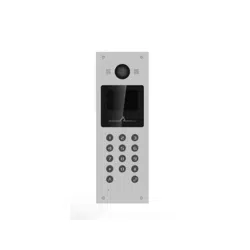
1.1 Appearance of 80 Series Door Staon
Figure 1-1 Appearance of 80 Series Door Staon
Table 1-1
Descripons
No. Descripon No. Descripon
1 IR Supplement Light 6 Keypad
2 Built-in Camera 7 Call Buon
3 LCD Display Screen 8 Microphone
4 Card Reading Area 9 Call Center Buon
5 Loudspeaker 10 TAMPER
Video Intercom D Series Door Staon User Manual
1

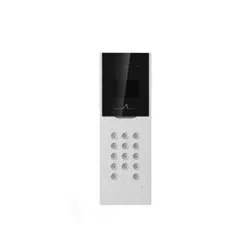
1.2 Appearance of 81 Series Door Staon
Figure 1-2 Appearance of 81 Series Door Staon
Table 1-2
Descripons
No. Descripiton No. Descripon
1 Low Illuminaon
Supplement Light
6 Call Center Buon
2 Built-in Camera 7 Microphone
3 LCD Display Screen 8 Card Reading Area
Video Intercom D Series Door Staon User Manual
2

No. Descripiton No. Descripon
4 Keypad 9 Loudspeaker
5 Call Buon 10 TAMPER
1.3 Appearance of 30 Series Door Staon
Appearance of 30 Series Door Staon
Table 1-3 Descripons
No. Descripon No. Descripon
1 Low Illuminaon
Supplement Light
6 Call Buon
2 Loudspeaker 7 Call Center Buon
3 LCD Display Screen 8 Microphone
Video Intercom D Series Door Staon User Manual
3

No. Descripon No. Descripon
4 Card Reading Area 9 TAMPER
5 Keypad
Video Intercom D Series Door Staon User Manual
4
2 Terminal and Wiring Descripon
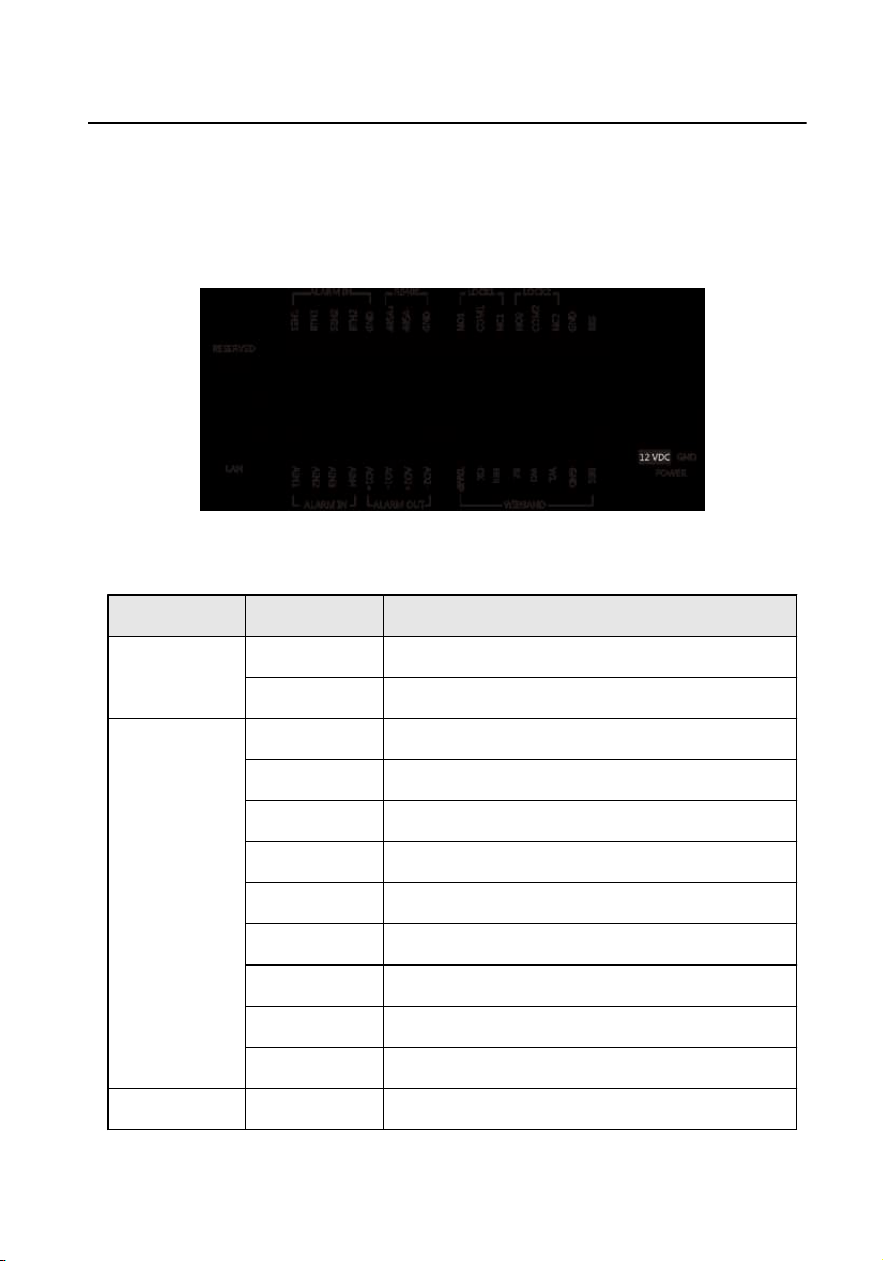
2.1 Terminal Descripon
Figure 2-1 Terminal Descripon
Table 2-1 Descripons
Name Interface Descripon
LAN RESERVED RESERVED
LAN Network Interface
ALARM IN SEN1 Door Contact Detecon Input 1/Door Contact
BTN1 Door Contact Detecon Input 1/Door Contact
SEN2 Door Contact Detecon Input 2/Door Contact
BTN2 Door Contact Detecon Input 2/Door Contact
GND Grounding
AIN1 Alarm Input 1
AIN2 Alarm Input 2
AIN3 Alarm Input 3
AIN4 Alarm Input 4
RS485 485A+ RS-485 Communicaon Interfaces
Video Intercom D Series Door Staon User Manual
5

Name Interface Descripon
485A-
GND Grounding
LOCK1 NO1 Door Lock Relay Output (NO)
COM1 Common Interface
NC1 Door Lock Relay Output (NC)
LOCK2 NO2 Door Lock Relay Output (NO)
COM2 Common Interface
NC2 Door Lock Relay Output (NC)
ALARM OUT` AO1+ Alarm Relay Output 1
AO1-
AO2+ Alarm Relay Output 2
AO2-
WIEGAND TAMP Tamper-proof Input of Wiegand Card Reader
OK Card Reader Indicator Output (Valid Card
Output)
ERR Card Reader Indicator Output (Invalid Card
Output)
BZ Card Reader Buzzer Output
W0 Data Input Interface Wiegand Card Reader: Data
0
W1 Data Input Interface Wiegand Card Reader: Data
1
GND Grounding
RES Reserved
RESERVED GND Grounding
Video Intercom D Series Door Staon User Manual
6

Name Interface Descripon
RES Reserved
POWER 12 VDC DC 12 V Power Supply Input
2.2 Wiring Descripon
2.2.1 D-Series Door Lock Wiring
Figure 2-2 Door Lock Wiring
Note
•
Terminal NC1/COM1 is set as default for accessing electric bolt. Terminal NO1/
COM1 is set as default for accessing electric strike.
•
To connect electric lock in terminal NO2/COM2/NC2, it is required to set the
output of terminal NO2/COM2/NC2 to be electric lock with iVMS-4200client
soware.
2.2.2 D-Series Door Contact Wiring (8081 Series)
Video Intercom D Series Door Staon User Manual
7

Figure 2-3 Door Contact Wiring
Note
Terminal SEN1/SEN2 can both connect to door contact.
2.2.3 D-Series Exit Buon Wiring (8081 Series)
Video Intercom D Series Door Staon User Manual
8

Figure 2-4 Exit Buon Wiring
Note
Terminal BTN1/BTN2 can both connect to exit buon.
2.2.4 External Card Reader Wiring
Note
•
Please set the DIP switch rst before connecng the card reader.
•
If the DIP switch should be congured when the card reader is power-on, please
reboot the card reader aer conguring the DIP switch.
•
The DIP switch descripon is shown in the following table:
Table 2-2 DIP Switch Descripon
No. Descripon How to Congure
1 to 4 Set the RS-485 address ON: 1
OFF: 0
6 Select Wiegand protocol or
RS-485 protocol
ON: Wiegand
Video Intercom D Series Door Staon User Manual
9

No. Descripon How to Congure
OFF: RS-485
7 Set the Wiegand protocol (It is
invalid when seng OFF in 6.)
ON: Wiegand 26
OFF: Wiegand 34
RS-485 Card Reader Wiring
Figure 2-5 RS-485 Card Reader Wiring
Note
When card reader is accessed via RS-485, the door staon cannot connect
to elevator controller.
Video Intercom D Series Door Staon User Manual
10
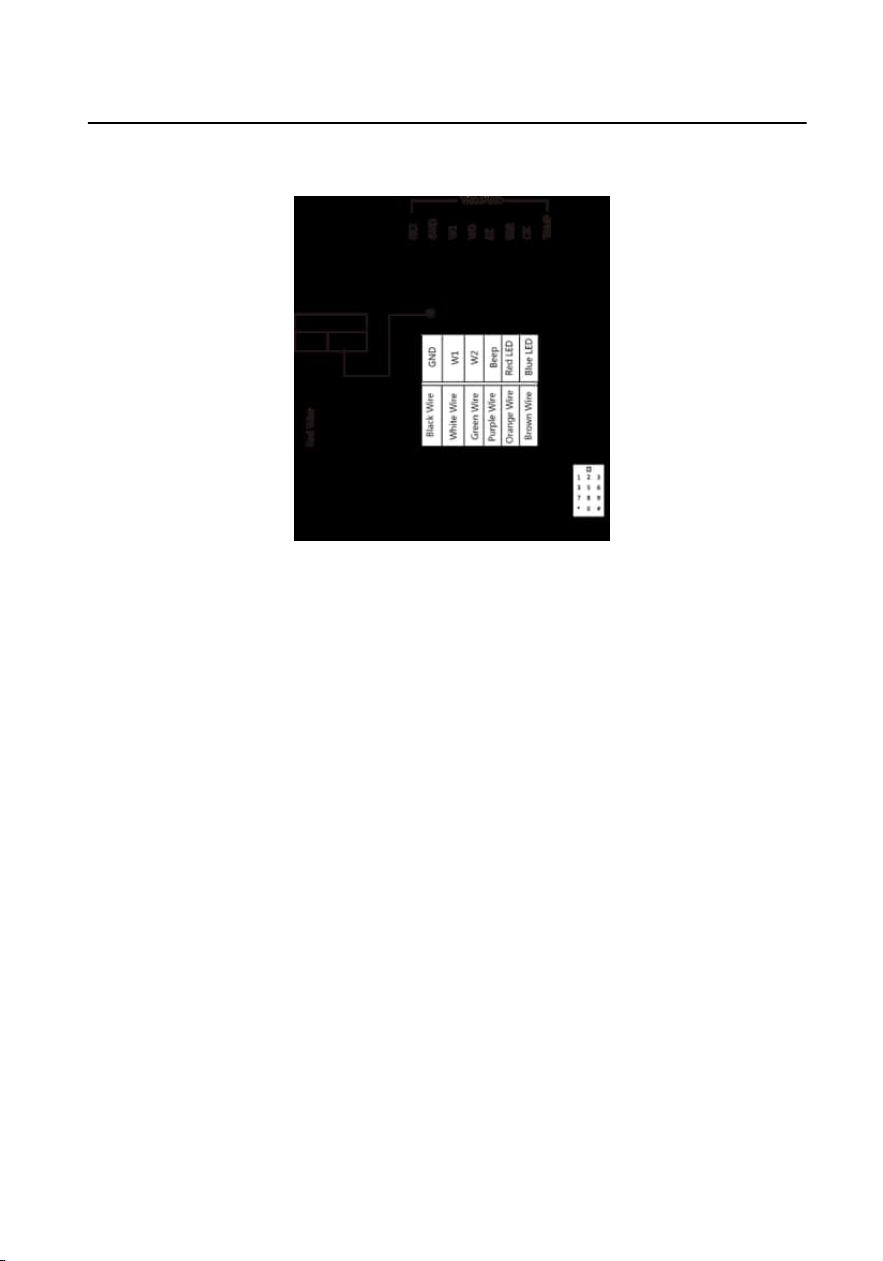
Wiegand Card Reader Wiring
Figure 2-6 Wiegand Card Reader Wiring
2.2.5 D-Series Elevator Controller Wiring
Enter a short descripon of your concept here (oponal).
This is the start of your concept.
2.2.6 Alarm Input Device Wiring
The alarm input wiring diagram is as follows:
Video Intercom D Series Door
Staon User Manual
11

Figure 2-7 Alarm Input Wiring Diagram
2.2.7 Alarm Output Device Wiring
The alarm output wiring diagram is as follows:
Video Intercom D Series Door
Staon User Manual
12

Figure 2-8 Alarm Output Wiring Diagram
Video Intercom D Series Door
Staon User Manual
13

3 Installaon
•
Make sure the device in the package is in good condion and all the assembly
parts are included.
•
The power supply the door staon support is 12 VDC. Please make sure your
power supply matches your door staon.
•
Make sure all the related equipment is power-o during the installaon.
•
Check the product specicaon for the installaon environment.
To install the door staon onto the wall, you are required to use a matched gang box.
Figure 3-1 Gang Box
Note
•
The dimension of gang box is: 407.5 (W) × 135 (H) × 55 (D) mm.
•
The dimensions above are for reference only. The actual size can be slightly
dierent from the theorecal dimension.
3.1.2 Flush Mounng with Gang Box
Steps
1.
Drill a hole in the wall for
inserng the gang box. The size of the hole should be
larger than that of the gang box. The suggested size of the hole is 408 (W) ×
135.5 (H) × 55 (D) mm.
Video Intercom D Series Door
Staon User Manual
14

Figure 3-2 Drill an Installaon Hole
2.
Insert the gang box into the hole and x it with 4 PA4 screws.
Figure 3-3 Insert the Gang Box
Video Intercom D Series Door
Staon User Manual
15

3.
Make sure the edges of the gang box align to the wall and the hook A and hook B
of the gang box hook onto the wall.
4.
Route the cables of the door staon through the cable hole.
5.
Insert the door staon into the gang box and then move the door staon
downward to hook the lock catches on the rear panel onto the hook C of the
gang box.
Figure 3-4 Insert the Door Staon
6.
Fix the door staon with 2 PM3 screws.
7.
Aer xing the door staon onto the gang box, secure it by inserng the plate
and insert 2 POM2 screws.
Video Intercom D Series Door
Staon User Manual
16

Figure 3-5 Fix the Door Staon
To install the door staon onto the wall, you are required to use a matched gang box.
Figure 3-6 Gang Box
Note
•
The dimension of gang box is: 404 (W) × 123 (H) × 47.5 (D) mm.
•
The dimensions above are for reference only. The actual size can be slightly
dierent from the theorecal dimension.
Video Intercom D Series Door Staon User Manual
17

3.2.2 Flush Mounng with Gang Box
Steps
1.
Drill a hole in the wal for inserng the gang box. The size of the hole should be
larger than that of the gang box. The suggested size of the hole is 404.5 (W) ×
123.5 (H) × 48 (D) mm.
Figure 3-7 Drill an Installaon Hole
2.
Insert the gang box into the hole and x it with 4 PA4 screws. Make sure the
edges of the gang box align to the wall.
Figure 3-8 Insert the Gang Box
3.
Route the cables of the door
staon through the cable hole.
Video Intercom D Series Door
Staon User Manual
18

4.
Put the door staon into the gang box and hook the lock catches on the rear
panel.
Figure 3-9 Install the Door Staon
5.
Pull the door
staon downward and then push it towards the inside to make
sure it ts the hole.
6.
Tighten the screws of the door staon with the wrench.
Figure 3-10 Fix the Door Staon
To install the door staon onto the wall, you are required to use a matched gang box.
Video Intercom D Series Door
Staon User Manual
19

Figure 3-11 Gang Box
Note
•
The dimension of gang box is: 343 (W) × 113 (H) × 55 (D) mm.
•
The dimensions above are for reference only. The actual size can be slightly
dierent from the theorecal dimension.
3.3.2 Flush Mounng with Gang Box
Steps
1.
Drill a hole in the wall for
inserng the gang box. The size of the hole should be
larger than that of the gang box. The suggested size of the hole is 343.5 (W) ×
113.5 (H) × 55.5 (D) mm.
Video Intercom D Series Door
Staon User Manual
20

Figure 3-12 Drill an Installaon Hole
2.
Insert the gang box into the hole and x it with 4 PA4 screws.
3.
Make sure the edges of the gang box align to the wall.
4.
Route the cables of the door staon through the cable hole.
5.
Put the door staon into the gang box.
6.
Fix the door staon to the gang box with 4 screws.
Video Intercom D Series Door
Staon User Manual
21

Figure 3-13 Fix the Door Staon
Video Intercom D Series Door
Staon User Manual
22

4 Acvaon
4.1 Acvate Device Locally
You are required to acvate the device rst by sengs a strong password for it
before you can use the device.
Steps
1.
Power on the device to enter the acvaon page automacally.
2.
Create a password and conrm it.
Table 4-1 Number Buon Descripon
No. Descripon No. Descripon
1 1 6 6mnoMNO
2 2abcABC 7 7pqrsPQRS
3 3defDEF 8 8tuvTUV
4 4ghiGHI 9 9wxyzWXYZ
5 5jklJKL 0 0
Hold 0 to enter special characters.
Table 4-2 Number
Buon Descripon
No. Descripon No. Descripon
1 1,.#? 6 6_=+
2 2!@% 7 7[];:
3 3^$* 8 8"|<
4 4( )\ 9 9>{}
5 5&/-
Video Intercom D Series Door Staon User Manual
23

Note
•
The password required 8 to 16 characters.
•
The way to enter the password, take buon 2 as an example: Press 2 to
enter the number '2' or hold 2 for 1.5 s and press 2 again to enter the
character 'a'.
•
When you have entered the password, press # to switch to
conrm the
password.
•
Press * to delete the wrong charater.
3.
Press # to acvate.
4.2 Acvate Device via Client Soware
You can only congure and operate the door staon aer creang a password for
the device
acvaon.
Default parameters of door staon are as follows:
•
Default IP Address: 192.0.0.65.
•
Default Port No.: 8000.
•
Default User Name: admin.
Steps
1.
Run the client
soware, click Maintenance and Management → Device
Management → Device to enter the page.
2.
Click Online Device.
3.
Select an
inacvated device and click Acvate.
4.
Create a password, and conrm the password.
Note
We highly recommend you to create a strong password of your own choosing
(using a minimum of 8 characters, including at least three kinds of following
categories: upper case leers, lower case leers, numbers, and special
characters) in order to increase the security of your product. And we
recommend you change your password regularly, especially in the high security
system, changing the password monthly or weekly can
beer protect your
product.
5.
Click OK to acvate the device.
Video Intercom D Series Door
Staon User Manual
24
Note
•
When the device is not acvated, the basic operaon and remote operaon
of device cannot be performed.
•
You can hold the Ctrl or Shi key to select mulple devices in the online
devices, and click the Acvate buon to acvate devices in batch.
4.3 Acvate Device via Web
You are required to acvate the device rst by seng a strong password for it before
you can use the device.
Default parameters of the door
staon are as follows:
•
Default IP Address: 192.0.0.65.
•
Default Port No.: 8000.
•
Default User Name: admin
Steps
1.
Power on the device, and connect the device to the network.
2.
Enter the IP address into the address bar of the web browser, and click Enter to
enter the
acvaon page.
Note
The computer and the device should belong to the same subnet.
3.
Create and enter a password into the password
eld.
4.
Conrm the password.
5.
Click OK to acvate the device.
Video Intercom D Series Door
Staon User Manual
25

5 Local Operaon
5.1 Local Conguraon
5.1.1 Edit Network Parameters
Aer acvang, you should edit the network parameters.
Steps
1.
Hold * and # at the same me to enter the authencaon page.
2.
Authencate via administrator.
-
Authencate card to login.
-
Press # to enter the password to login.
3.
Swritch to Network sengs according to the ps on the page. Press # to enter
the sengs page.
4.
Edit the parameters according to your needs.
5.
Press * to save and exit.
5.1.2 Door Staon Sengs
Edit the parameters of the door staon (including but not limited to, community No.,
building No., oor No., room No. and device mode).
Steps
1.
Congure the parameters according to the actual needs.
Note
•
Outer door staon can only edit the Community No., Project No. and No.
•
The No. of the main door staon is 0.
•
The No. of sub door staons should be larger than 0 and ranges from 1 to 8.
•
Each unit should add 1 main door
staon. Up to 8 sub door staons can be
added to the main door staon.
2.
Oponal: Adjust the brightness of the screen.
3.
Oponal: Enable the Channel Mode according to your needs.
4.
Oponal: Select the language.
Video Intercom D Series Door
Staon User Manual
26

5.
Aer conguraon, press * to save and exit.
5.1.3 Add Residents
User Management
You can add, edit and delete the informaons of the users.
Steps
1.
Hold * and # at the same me to enter the authencaon page.
2.
Authencate via administrator.
-
Authencate card to login.
-
Press # to enter the password to login.
3.
Switch to User Management according to the ps on the page.
4.
Press # to enter the
sengs page.
Add Users
You can add cards, permissions and room No. for the users.
Steps
1.
Select +Add, and press # to enter the adding page.
2.
Edit the room No.
3.
Add cards.
1) Switch to the card and press # or present cards on the card reading area to
add.
2) Enter the card No. manually or present the card on the card reading area to
get the card No. automacally.
3) Press # to add.
4.
Switch to the permisson and press # to set.
5.
Press * to save and exit.
5.1.4 About
You can view the device model, system version and QR Code of the device.
Video Intercom D Series Door
Staon User Manual
27

Steps
1.
Hold * and # at the same me to enter the authencaon page.
2.
Authencate via administrator.
-
Authencate face/card/ngerprint to login.
-
Press # to enter the password to login.
3.
Swritch to About according to the
ps on the page.
4.
Press # to enter the page.
5.2 Video Intercom Operaon
5.2.1 Call Resident
The door staon can work as main/sub door staon, and outer door staon, which
correspond to
dierent calling resident modes respecvely.
Call Resident from Main/Sub Door Staon
Press any digit buon on the main/sub door staon page to enter the calling
page.
Enter the room No. and press call
buon.
Call Resident from Outer Door Staon
Press call buon on the outer door staon page to enter the calling page .
Enter 【Community No. + Building No. + # + Unit No. + # + Room No.】 and
press call
buon to call resident.
Note
When Unit No. is one, it can be omied. When Unit No. is omied,
Community No. must be omied at the same me.
5.2.2 Call Center
Press any digit buon on the main/sub door staon page to enter the calling page.
Press center buon to call., and press * to cancel during calling management center.
Video Intercom D Series Door
Staon User Manual
28
5.3 Unlock Door
5.3.1 Unlock by Password
Unlock by Common Password
Press any digit buon on the main/sub door staon page to enter the calling
page.
Enter 【 # + Common Password + #】to unlock the door.
Unlock by Public Password
Note
Make sure you have created the public password via iVMS-4200 Client
Soware remotely.
Press any digit buon on the main/sub door staon page to enter the calling
page.
Enter 【# + Public Password + #】to unlock the door.
5.3.2 Unlock by Presenng Card
Note
Make sure you have issued the card to the device.
Present the card on the card reading area to unlock.
Note
You cannot unlock the door by presenng the main card.
Video Intercom D Series Door Staon User Manual
29
6 Remote Conguraon via Web
6.1 Live View
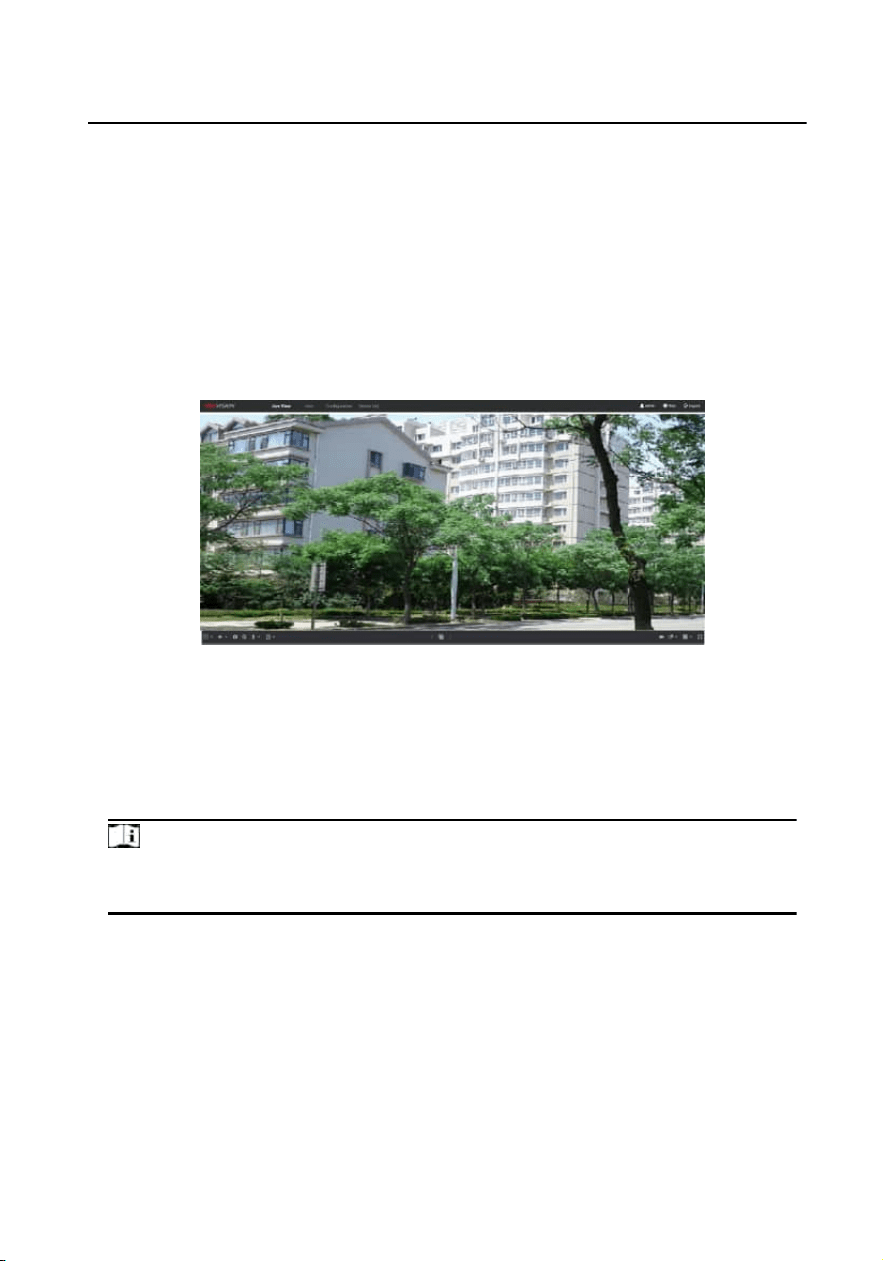
In the browser address bar, enter the IP address of the device, and press the Enter
key to enter the login page.
Enter the user name and password and click Login to enter the Live View page. Or
you can click Live View to enter the page.
Figure 6-1 Live View
•
You can start/stop live view, capture, record, audio on/o, two-way audio, etc.
•
The stream type can be set as main stream or sub stream.
•
For IE (Internet Explorer) or Google users, the device support two-way audio
communicaon.
Note
Live View funcon may vary with dierent models. Please refer to the actual
product.
6.2 User Management
You can add, delete or search the informaon of the user.
Click User to enter the
sengs page.
•
Click Add and enter the username, oor No. and room No. to add.
•
Click Edit to modify the informaons of the user.
Video Intercom D Series Door
Staon User Manual
30

•
Check the box of the user and click Delete to delete the selected user.
•
Enter the keyword and click Search. The informaon will display in the list.
6.3 Device Management
You can manage the linked device on the page.
Click Device List to enter the sengs page.
Add Device
•
Click Add to add the indoor staon or sub door staon. Enter the
parameters and click OK to add.
•
Click Import. Enter the
informaon of the device in the template to
import devices in batch.
Export
Click Export to export the informaon to the PC.
Synchronize
Click Synchronize to synchronize the informaon.
6.4 Parameters
Sengs
Click Conguraon to set the parameters of the device.
Remote conguraon in iVMS-4200 and Batch Conguraon Tool is the same as that
in Web. Here takes the conguraon in web for example.
Note
Run the browser, click → Internet Opons → Security to disable the Protected
Mode.
6.4.1 Local Parameters Sengs
You can congure the parameters of the live view, record les and captured pictures.
The record les and captured pictures are the ones you record and capture by using
Video Intercom D Series Door
Staon User Manual
31

the web browser. You can also set and view the saving paths of the captured pictures
and recorded videos on the PC that running the web browser.
Live View Parameters
Stream Type
Set the stream type as Main Stream or Sub-stream.
Play Performance
Set the live view performance to Shortest Delay, Balanced or Fluent.
Auto Start Live View
Check Yes to enable the
funcon.
Image Format
Select the image format for picture capture.
Click Save to enable the sengs.
Record File Parameters
Record File Size
Select the packed size of the manually recorded and downloaded video
les to 256M, 512M or 1G. Aer the selecon, the maximum record le
size is the value you selected.
Save record les to
Set the saving path for the manually recorded video
les.
Click Save to enable the sengs.
Picture and Clip
Sengs
Save snapshots in live view to
Set the saving path of the manually captured pictures in live view mode.
Note
You can click Browse to change the directory for saving the clips and
pictures, and click Open to open the set folder of clips and picture saving.
Click Save to enable the sengs.
Video Intercom D Series Door
Staon User Manual
32

6.4.2 System Sengs
Follow the instrucons below to congure the system sengs, include System
Sengs, Maintenance, Security, and User Management, etc.
Click System to enter the sengs page.
Basic Informaon
Click System Sengs → Basic Informaon to enter the sengs page. On
the page, you can edit Device Name and Device No. Set the Language and
System Type according to your needs.
Click Save to enable the sengs.
Time Sengs
Click System Sengs → Time Sengs to enter the sengs page. Select the
Time Zone of your locaon from the drop-down list.
•
Enable NTP, set the Server Address, NTP Port and Interval.
•
Enable Manual Time Sync., set the me manually or check the Sync.
with computer me.
Click Save to enable the sengs.
DST
Click
System Sengs → DST to enable DST. Set the parameters according to
your needs and click Save to enable the sengs.
Maintenance
Click Maintenance → Upgrade & Maintenance to enter the sengs page.
Video Intercom D Series Door
Staon User Manual
33

Figure 6-2 Maintenance
•
Reboot: Click Reboot to reboot the device.
•
Restore
Click Restore to reset all the parameters, except the IP parameters
and user informaon, to the default sengs.
Default
Click Default to restore all parameters to default sengs.
•
Export parameters:
1. Click Device Parameters to pop up the dialog box.
2. Set and conrm the encrypon password.
3. Click OK to export parameters.
•
Import Cong. File:
1. Click Browse to select the conguraon le.
2. Click Import and enter the encrypon password to import.
•
Upgrade: Click Browse to select the upgrade le.
Note
The upgrading process will last 1 to 10 minutes, do not power o during
the upgrading. The device reboots automacally aer upgrading.
User Management
Click User Management to enter the sengs page.
Administrator can edit the permission for the users.
Video Intercom D Series Door
Staon User Manual
34
Note
We highly recommend you to create a strong password of your own
choosing (using a minimum of 8 characters, including at least three kinds of
following categories: upper case leers, lower case leers, numbers, and
special characters) in order to increase the security of your product. And we
recommend you change your password regularly, especially in the high
security system, changing the password monthly or weekly can beer
protect your product.
Online Users
Click User Management → Online Users to enter the page.
Figure 6-3 Online Users
Click Refresh to get the present informaon.
Arming/Disarming Informaon
Click User Management → Arming/Disarming Informaon to view the
informaon. Click Refresh to get the present informaon.
6.4.3 Network
Sengs
TCP/IP Sengs
TCP/IP sengs must be properly congured before you operate the device over
network. The device supports IPv4.
Steps
1.
Click Network → Basic
Sengs → TCP/IP to enter the sengs page.
Video Intercom D Series Door
Staon User Manual
35

Figure 6-4 TCP/IP Sengs
2.
Congure the network parameters.
-
Check DHCP, the device will get the parameters automacally.
-
Set the IPv4 Address, IPv4 Subnet Mask and IPv4 Default Gateway
manually.
3.
Congure the DNS server.
4.
Click Save to enable the sengs.
Port Sengs
Steps
1.
Click Network → Basic Sengs → Port to enter the sengs page.
Figure 6-5 Port Sengs
2.
Set the ports of the device.
HTTP Port
The default port number is 80, and it can be changed to any port No. which
is not occupied.
RTSP Port
Video Intercom D Series Door
Staon User Manual
36

The default port number is 554 and it can be changed to any port No. ranges
from 1 to 65535.
Server Port
The default server port number is 8000, and it can be changed to any port
No. ranges from 2000 to 65535.
3.
Click Save to enable the sengs.
SIP Seng
Steps
1.
Click Network → Basic Sengs → SIP to enter the sengs page.
2.
Check Enable VOIP Gateway.
3.
Congure the SIP parameters.
4.
Click Save to enable the sengs.
SNMP Sengs
Before You Start
Before seng the SNMP, please download the SNMP soware and manage to
receive the camera informaon via SNMP port. By seng the Trap Address, the
camera can send the alarm event and
excepon messages to the surveillance center.
Steps
1.
Click Network → Advanced
Sengs → SNMP to enter the sengs page.
Video Intercom D Series Door
Staon User Manual
37

Figure 6-6 SNMP Sengs
2.
Check the checkbox of Enable SNMPv1, Enable SNMP v2c, Enable SNMPv3 to
enable the feature correspondingly.
3.
Congure the SNMP sengs.
4.
Click Save to enable the
sengs.
Note
To lower the risk of informaon leakage, you are suggested to enable SNMP v3
instead of SNMP v1 or v2.
FTP Sengs
Video Intercom D Series Door Staon User Manual
38

Steps
1.
Click Network → Advanced Sengs → FTP to enter the sengs page.
Figure 6-7 FTP Sengs
2.
Check Enable FTP.
3.
Select Server Type.
4.
Input the Server IP Address and Port.
5.
Congure the FTP Sengs, and the user name and password are required for the
server login.
6.
Set the Directory Structure, Parent Directory and Child Directory.
7.
Set the picture naming rules.
8.
Click Save to enable the
sengs.
Video Intercom D Series Door
Staon User Manual
39

6.4.4 Video & Audio Sengs
Video Parameters
Steps
1.
Click Video/Audio → Video to enter the sengs page.
Figure 6-8 Video Parameters
2.
Select the Stream Type.
3.
Congure the video parameters.
Stream Type
Select the stream type to main stream or sub stream.
Video Type
Select the stream type to video stream, or video & audio composite stream.
The audio signal will be recorded only when the Video Type is Video &
Audio.
Resoluon
Video Intercom D Series Door
Staon User Manual
40

Select the resoluon of the video output.
Bitrate Type
Select the bitrate type to constant or variable.
Video Quality
When bitrate type is selected as Variable, 6 levels of video quality are
selectable.
Frame Rate
Set the frame rate. The frame rate is to describe the frequency at which the
video stream is updated and it is measured by frames per second (fps). A
higher frame rate is advantageous when there is movement in the video
stream, as it maintains image quality throughout.
Max. Bitrate
Set the max. bitrate from 32 to 16384 Kbps. The higher value corresponds to
the higher video quality, but the
beer bandwidth is required.
Video Encoding
The device supports H.264.
I Frame Interval
Set I Frame Interval from 1 to 400.
4.
Click Save to save the
sengs.
Audio Parameters
Steps
1.
Click Video/Audio → Audio to enter the sengs page.
Figure 6-9 Audio
Sengs
2.
Congure the stream type and the audio encoding type.
Video Intercom D Series Door
Staon User Manual
41

Stream Type
Select the stream type to main stream or sub stream.
Audio Encoding
The device support G.711ulaw and G.711 alaw.
3.
Adjust the Input Volume, Output Volume and Speak Volume.
Note
Available range of volume: 0 to 10.
4.
Click Save to save the
sengs.
6.4.5 Display Sengs
Congure the image adjustment, backlight sengs and other parameters in display
sengs.
Steps
1.
Click Image → Display Sengs to enter the display sengs page.
Figure 6-10 Display Sengs
2.
Select the Format.
3.
Set the display parameters.
WDR
Wide Dynamic Range can be used when there is a high contrast of the bright
area and the dark area of the scene.
Brightness
Video Intercom D Series Door
Staon User Manual
42

Brightness describes bright of the image, which ranges from 1 to 100.
Contrast
Contrast describes the contrast of the image, which ranges from 1 to 100.
Saturaon
Saturaon describes the colorfulness of the image color, which ranges from 1
to 100.
Sharpness
Sharpness describes the edge contrast of the image, which ranges from 1 to
100.
BLC Area
If you focus on an object against strong backlight, the object will be too dark
to be seen clearly. BLC compensates light to the object in the front to make it
clear. OFF, Up, Down,
Le, Right and Center are selectable.
4.
Click Save to enable the
sengs.
6.4.6 Event Sengs
Moon Detecon
Moon detecon detects the moving objects in the congured surveillance area,
and a series of acons can be taken when the alarm is triggered.
Steps
1.
Click Event → Moon to enter the sengs page.
Video Intercom D Series Door
Staon User Manual
43

Figure 6-11 Moon Detecon
2.
Check Enable
Moon Detecon to enable the funcon.
3.
Click Draw Area.Click and drag the mouse on the live video to draw a
moon
detecon
area. Click Stop Drawing to nish drawing one area. Click Save to save
the sengs.
Clear Area
Click Clear All to clear all of the areas.
Adjust Sensivity Move the slider to set the sensivity of the detecon.
4.
Click Arming Schedule to edit the arming schedule.
5.
Click on the me bar and drag the mouse to select the me period. Click Save to
save the sengs.
Delete Schedule
Click Delete to delete the current arming schedule.
6.
Click Linkage Method to enable the linkages.
Video Intercom D Series Door
Staon User Manual
44

Nofy Surveillance Center
Send an excepon or alarm signal to the remote management soware
when an event occurs.
7.
Click Save to enable the sengs.
Set Video Tampering Alarm
When the congured area is covered and cannot be monitored normally, the alarm
is triggered and the device takes certain alarm response acons.
Steps
1.
Click Event → Basic Event → Video Tampering to enter the
sengs page.
2.
Check Enable Video Tampering.
3.
Draw area.
1) Click Area Sengs.
2)
Click , and drag the mouse in the live view page to draw an area.
3)
Oponal: Click to clear the drawing area.
4.
Drag the block to set the Sensivity. The higher the value is, the easier to detect
the area covering.
5.
Oponal: Click Linkage Method, and check the normal linkage or nofy
surveillance center according to your actual needs.
Normal Linkage
Set the normal alarm linkage.
Nofy Surveillance Center
The alarm informaon is uploaded to the surveillance center when an alarm
event is detected.
6.
Oponal: Click or to perform the record or capture operaon.
7.
Click Save to save the sengs.
Event Linkage
Steps
1.
Click Event → Basic Event → Event Linkage to enter the
sengs page.
Video Intercom D Series Door
Staon User Manual
45
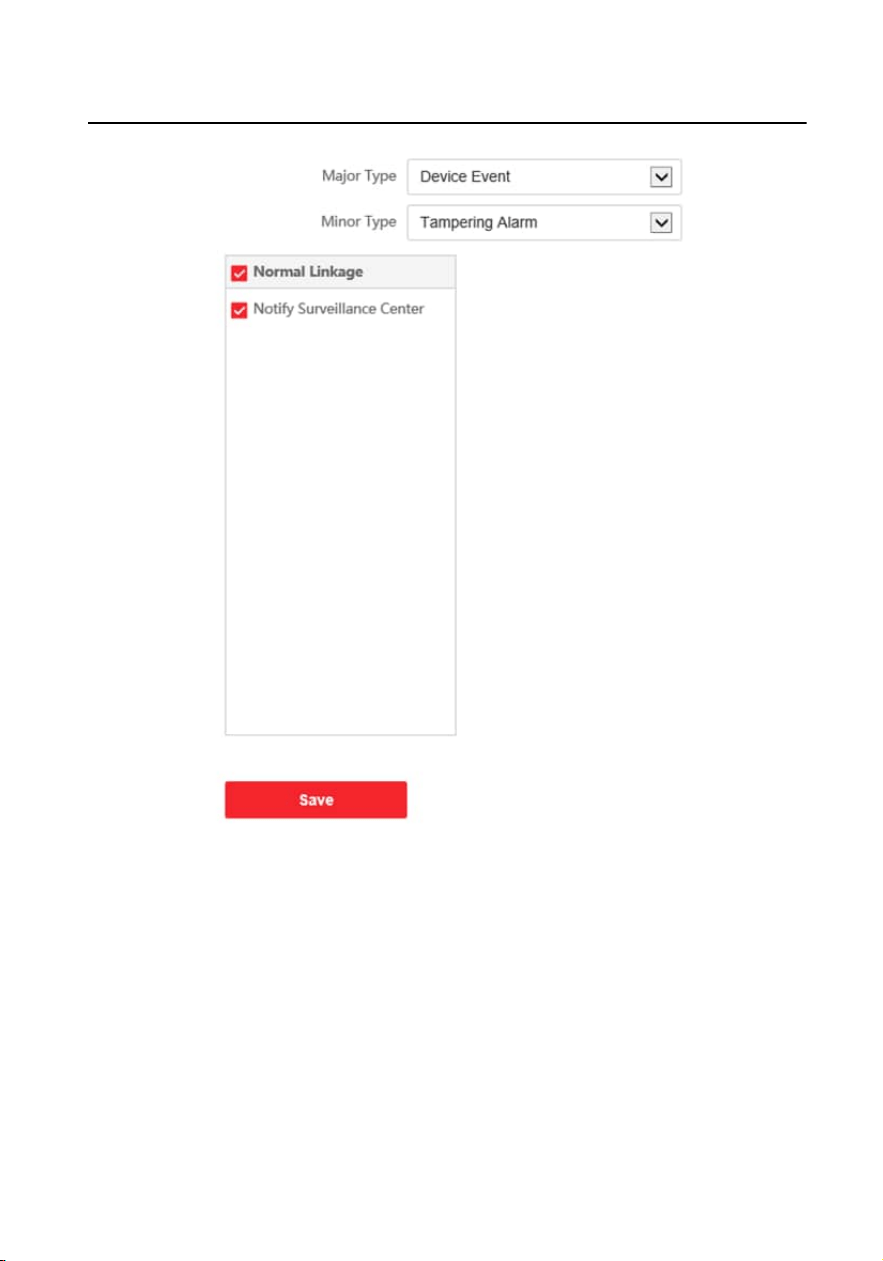
Figure 6-12 Event Linkage
2.
Select the Major Type as Device Event or Door Event.
3.
Select the type of the Normal Linkage for the event.
4.
Click Save to enable the sengs.
6.4.7 Intercom
Sengs
Device ID Conguraon
Video Intercom D Series Door Staon User Manual
46

Steps
1.
Click Device ID Sengs to enter the page.
Figure 6-13 Device ID Sengs
2.
Select the device type from the drop-down list, and set the corresponding
informaon.
3.
Click Save to enable the device number conguraon.
Note
•
For main door staon (D series or V series), the serial No. is 0.
•
For sub door staon (D series or V series), the serial No. cannot be 0. Serial
No. ranges from 1 to 99.
•
For each villa or building, at least one main door staon (D series or V series)
should be
congured, and one sub door staons (D series or V series) can be
customized.
•
For one main door staon (D series or V series), up to 8 sub door staons
can be congured.
Linked Network Sengs
Steps
1.
Click Intercom → Linked Network
Sengs to enter the sengs page.
Video Intercom D Series Door
Staon User Manual
47

Figure 6-14 Linked Network Sengs
2.
Set the master staon IP address and master staon SIP cllient Port.
3.
Set the private SIP server IP address and private SIP Server Port.
4.
Set the SIP Client Port.
5.
Enter the password.
6.
Click Save to enable the sengs.
Time Parameters
Click Intercom → Time Parameters to enter the page.
Congure the me parameters and click Save.
Note
Maximum speaking me varies from 90s to 120s, and maximum message me varies
from 30s to 60s.
6.4.8 Access Control Sengs
Video Intercom D Series Door Staon User Manual
48

Permission Password
Steps
1.
Click Access Control → Permission Password to enter the sengs page.
Figure 6-15 Permission Password
2.
Select the password type.
3.
Change the password.
4.
Set the number of doorphone.
5.
Click Save to enable the sengs.
Door Parameters
Steps
1.
Click Access Control → Door Parameters to enter the
sengs page.
Figure 6-16 Door Parameters
Video Intercom D Series Door
Staon User Manual
49

2.
Select the door and edit the door name.
3.
Set door contact status.
4.
Set lock acon me.
5.
Click Save to enable the
sengs.
Card Security
Click Access Control → Card Security to enter the sengs page.
Slide to enable card encrypon parameters. Click Save to enable the sengs.
Elevator Control
Before You Start
•
Make sure your door staon is in the mode of main door staon. Only the main
door staon support elevator control funcon.
•
Make sure your door staon has been connected to the elevator controller via
RS-485 wire if you want to use RS-485 interface.
Steps
1.
Click Access Control → Elevator Control to enter the corresponding
conguraon page.
Video Intercom D Series Door
Staon User Manual
50

Figure 6-17 Elevator Control
2.
Check to enable elevator control funcon.
3.
Select an Elevator No., and select an elevator controller type for the elevator.
4.
Set the Negave Floor.
5.
Select the Interface Type as RS-485 or Network Interface. And enable the
elevator control.
-
If you select RS-485, make sure you have connected the door staon to the
elevator controller with RS-485 wire.
-
If you select Network interface, enter the elevator controller's IP address,
port No., user name, and password.
6.
Click Save to enable the
sengs.
Note
•
Up to 4 elevator controllers can be connected to one door staon.
•
Up to 10 negave oors can be added.
•
Make sure the interface types of elevator controllers, which are connected
to the same door staon are consistent.
Video Intercom D Series Door Staon User Manual
51

RS-485 Sengs
Set the working mode to linked device.
Steps
1.
Click Access Control → RS485 Sengs to enter the sengs page.
Figure 6-18 RS-485 Sengs
2.
Select the No.
3.
Select the working mode.
4.
Click Save to enable the
sengs.
Video Intercom D Series Door
Staon User Manual
52

7 Conguraon via Client Soware
7.1 Edit Network Parameters
To operate and congure the device via LAN (Local Area Network), you need connect
the device in the same subnet with your PC. You can edit network parameters via
iVMS-4200 client soware.
Steps
1.
Select an online acvated device and click the Modify Nenfo.
2.
Edit the device IP address and gateway address to the same subnet with your
computer.
3.
Enter the password and click OK to save the network parameters
modicaon.
Note
•
The default port No. is 8000.
•
The default IP address of the door staon is 192.0.0.65.
•
Aer eding the network parameters of device, you should add the devices
to the device list again.
7.2 Add Device
You should add device to the soware so as to congure the device remotely.
7.2.1 Add Online Device
Before You Start
Make sure the device to be added is in the same subnet with your computer.
Otherwise, please edit network parameters
rst.
Steps
1.
Click Online Device to select an
acve online device.
2.
Click Add.
3.
Enter corresponding informaon, and click Add.
Video Intercom D Series Door
Staon User Manual
53

Figure 7-1 Add to the Client
7.2.2 Add Device by IP Address
Steps
1.
Click +Add to pop up the adding devices dialog box.
2.
Select IP/Domain as Adding Mode.
3.
Enter corresponding
informaon.
4.
Click Add.
7.2.3 Add Device by IP Segment
Video Intercom D Series Door Staon User Manual
54

You can add many devices at once whose IP addresses are among the IP segment.
Steps
1.
Click +Add to pop up the dialog box.
2.
Select IP Segment as Adding Mode.
3.
Enter corresponding informaon, and click Add.
7.3 Remote Conguraon
Select the device, click to congure the parameters remotely.
7.4 Device Management
Device management includes device
acvaon, adding device, eding device, and
deleng device, and so on.
Aer running the iVMS-4200, video intercom devices should be added to the client
soware for remote conguraon and management.
7.5
Organizaon Management
On the main page of the Client Soware, click PersonalManagement to enter
the conguraon page.
7.5.1 Add
Organizaon
Steps
1.
In the
organizaon list on the le, click +Add.
2.
Enter the Organizaon Name as desired.
3.
Click OK to save the adding.
4.
Oponal: You can add mulple levels of organizaons according to the actual
needs.
1) You can add mulple levels of organizaons according to the actual needs.
2) Then the added organizaon will be the sub-organizaon of the upper-level
organizaon.
Video Intercom D Series Door
Staon User Manual
55

Note
Up to 10 levels of organizaons can be created.
7.5.2 Modify and Delete Organizaon
You can select the added organizaon and click to modify its name.
You can select an organizaon, and click X buon to delete it.
Note
•
The lower-level organizaons will be deleted as well if you delete an
organizaon.
•
Make sure there is no person added under the organizaon, or the organizaon
cannot be deleted.
7.6 Person Management
Aer adding the organizaon, you can add person to the organizaon and manage
the added person such as issuing cards in batch, imporng and exporng person's
informaon in batch, etc.
Note
•
Up to 2,000 persons can be added.
•
Up to 5 cards can be added to each person.
7.6.1 Add Person
Person informaon is necessary for the video intercom system. And when you set
linked device for the person, the intercom between intercom devices can be realized.
Steps
1.
Select an organizaon in the organizaon list and click Add on the Person panel
to pop up the adding person dialog.
Note
The Person No. will be generated automacally and is editable.
2.
Set basic person informaon.
Video Intercom D Series Door
Staon User Manual
56

1) Enter basic informaon: name, gender, tel, birthday details, eecve period
and email address.
Note
The length of person name should be less than 15 characters.
2) Click Add face to upload the photo.
Note
The picture should be in *.jpg format.
Click Upload Select the person picture from the local PC to
upload it to the client.
Click Take Phone Take the person's photo with the PC camera.
Click Remote
Collecon
Take the person's photo with the collecon device.
3.
Issue the card for the person.
1) Click Credenal → Card .
2) Click + to pop up the Add Card dialog.
3) Select Normal Card as Card Type.
4) Enter the Card No.
5) Click Read and the card(s) will be issued to the person.
4.
Link the device to the person.
1) Set the linked devices.
Linked Device
You can bind the indoor
staon to the person.
Note
If you select Analog Indoor Staon in the Linked Device, the Door
Staon eld will display and you are required to select the door staon
to communicate with the analog indoor staon.
Room No.
You can enter the room No. of the person.
2) Click OK to save the
sengs.
5.
Click Add to save the
sengs.
Video Intercom D Series Door
Staon User Manual
57

7.6.2 Modify and Delete Person
Select the person and click Edit to open the eding person dialog.
To delete the person, select a person and click Delete to delete it.
Note
If a card is issued to the current person, the linkage will be invalid aer the person is
deleted.
7.6.3 Import and Export Person Informaon
The person informaon can be imported and exported in batch.
Steps
1.
Exporng Person: You can export the added persons' informaon in Excel format
to the local PC.
1) Aer adding the person, you can click Export Person to pop up the following
dialog.
2) Click ... to select the path of saving the exported Excel le.
3) Check the checkboxes to select the person informaon to export.
4) Click OK to start exporng.
2.
Imporng Person: You can import the Excel le with persons informaon in
batch from the local PC.
1) Click Import Person.
2) You can click Download Template for
Imporng Person to download the
template
rst.
3) Input the person informaon to the downloaded template.
4) Click ... to select the Excel le with person informaon.
5) Click OK to start imporng.
7.6.4 Get Person
Informaon from Device
If the added device has been congured with person informaon (including person
details,
ngerprint, issued card informaon), you can get the person informaon
from the device and import to the client for further operaon.
Video Intercom D Series Door
Staon User Manual
58

Steps
Note
This funcon is only supported by the device the connecon mothod of which is
TCP/IP when adding the device.
1.
In the organizaon list on the le, click to select an organizaon to import the
persons.
2.
Click Get from Device to pop up the dialog box.
3.
The added device will be displayed.
4.
Click to select the device and then click Get to start geng the person
informaon from the device.
Note
•
The person informaon, including person details, person's ngerprint
informaon (if congured), and the linked card (if congured), will be
imported to the selected organizaon.
•
If the person name stored in the device is empty, the person name will be
lled with the issued card No. aer imporng to the client.
•
The gender of the persons will be Male by default.
7.6.5 Change Person to Other Organizaon
You can move the person to another organizaon if needed.
Steps
1.
Select the person in the list and click Change
Organizaon.
2.
Select the organizaon to move the person to.
3.
Click OK to save the sengs.
7.6.6 Add Person in Batch
Enter a short descripon of your task here (oponal).
Before You Start
Enter the prerequisites here (oponal).
Enter the context of your task here (oponal).
Steps
1.
Enter your
rst step here.
Video Intercom D Series Door
Staon User Manual
59

Enter the result of your step here (oponal).
Example
Enter an example that illustrates the current task (oponal).
What to do next
Enter the tasks the user should do
aer nishing this task (oponal).
7.6.7 Issue Card in Batch
You can issue mulple cards for the person with no card issued in batch.
Steps
1.
Click Batch Issue Cards to enter the dialog page. All the added person with no
card issued will display in the Person(s) with No Card Issued list.
Figure 7-2 Issue Card in Batch
2.
Click Sengs.
Video Intercom D Series Door
Staon User Manual
60

Figure 7-3 Card Sengs
3.
Select Card Type and Card No. Type.
4.
Click OK to save the
sengs.
Result
Aer issuing the card to the person, the person and card informaon will display in
the Person(s) with Card Issued list.
7.6.8 Permission
Sengs
Add Permissions
Steps
1.
On the main page, click AccessControlInfo → Access Group to enter the
page.
2.
Click +Add to pop up the adding dialog box.
3.
Congure the parameters.
1) Enter the Name of the permission.
Video Intercom D Series Door
Staon User Manual
61

2) Select the Template of the schedule.
3) Check the person to Selected according to your needs.
4) Check the device to Selected according to your needs.
4.
Click Save.
5.
Check the permission and click Apply All to Device.
The status of the permission displays as Applied.
6.
Oponal: Click Applying Status to check the details.
Modify/Delete Permissions
On the page of the permission sengs, click to edit the parameters of the
permission.
Select one or more permissions, click Delete to remove the permissions.
7.7 Video Intercom
Sengs
The Video Intercom Management module provides the funcon of video intercom,
checking call logs and managing noce via the iVMS-4200 Client Soware.
Note
For the user with access control module permissions, the user can enter the Access
Control module and manage video intercom and search informaon.
You should add the device to the soware and congure the person to link the
device in Access Control module before your conguraon remotely.
On the main page, click AccessControlInfo → Video Intercom → Video
Intercom on the le bar to enter the Video Intercom page.
7.7.1 Receive Call from Door
Staon
Steps
1.
Select the client
soware in the device page to start calling the iVMS-4200 Client
Soware and an incoming call dialog will pop up in the client soware.
2.
Click Answer to answer the call. Or click Hang Up to decline the call.
3.
Aer you answer the call, you will enter the In Call window.
Video Intercom D Series Door
Staon User Manual
62

•
Click to adjust the volume of the loudspeaker.
•
Click
to adjust the volume of the microphone.
•
Click Hang Up to hang up the dialog.
•
Click
to open the door remotely.
Note
•
One video intercom device can only connect with one client soware.
•
The maximum ring duraon can be set from 15s to 60s via the Remote
Conguraon of the video intercom device.
•
The maximum speaking duraon between indoor staon and iVMS-4200 can
be set from 120s to 600s via the Remote
Conguraon of indoor staon.
•
The maximum speaking duraon between door staon and iVMS-4200 can
be set from 90s to 120s via the Remote Conguraon of door staon.
7.7.2 Live View via Door Staon
Steps
1.
On the main page of the client soware, click Main View to enter the Live View
page.
2.
In the le list of the window, double-click the device IP or click the play icon to
live view.
3.
Oponal: On the Live View page, control-click and select Capture to get the
picture of the live view.
7.7.3 Release
Noce
You can create dierent types of noces and send them to the residents. Four noce
types are available, including Adversing, Property, Alarm and Noce Informaon.
Before You Start
Make sure the person has been added to the client.
Steps
1.
On the video intercom sengs page, click Noce to enter the page.
2.
Click +Add to pop up the adding dialog box.
3.
Select the person according to your needs.
Video Intercom D Series Door
Staon User Manual
63

4.
Edit the Subject, Type and Informaon.
5.
Click View to select the picture.
6.
Click Send.
Note
•
Up to 63 characters are allowed in the Subject eld.
•
Up to 6 pictures in the JPGE format can be added to one noce. And the
maximum size of one picture is 512KB.
•
Up to 1023 characters are allowed in the Informaon eld.
7.7.4 Search Video Intercom Informaon
Search Call Logs
Steps
1.
On the Video Intercom page, click Call Log to enter the page.
Figure 7-4 Search Call Logs
2.
Set the search condions, including call status, device type, start me and end
me.
Call Status
Click ˅ to unfold the drop-down list and select the call status as Dialed,
Received or Missed. Or select All to search logs with all statuses.
Device Type
Video Intercom D Series Door
Staon User Manual
64

Click ˅ to unfold the drop-down list and select the device type as Indoor
Staon, Door Staon, Outer Door Staon or Analog Indoor Staon. Or
select All Devices to search logs with all device types.
Start Time/End Time
Click the me icon to specify the start me and end me of a me period to
search the logs.
Reset the Sengs Click Reset to reset all the congured search
condions.
3.
Click Search and all the matched call logs will display on this page.
4.
Oponal: Check the detailed informaon of searched call logs, such as call
status, ring/speaking duraon, device name, resident organizaon, etc.
5.
Oponal: Input keywords in the Search eld to lter the desired log.
6.
Oponal: Click Export to export the call logs to your PC.
Search Noce
Steps
1.
On the Video Intercom page, click Noce to enter the page.
2.
Set the search condions, including noce type, start me and end me.
Type
Select Adversing Informaon, Property Informaon, Alarm Informaon or
Noce Informaon as Type according to your needs.
Start Time/End Time
Click the
me icon to specify the start me and end me of a me period to
search the logs.
Reset the
Sengs Click Reset to reset all the congured search
condiions.
3.
Click Search and the matched noce will display on this page.
4.
Oponal: Click Export to export the noces to your PC.
Video Intercom D Series Door
Staon User Manual
65

A. Communicaon Matrix and Device
Command
Communicaon Matrix
Scan the following QR code to get the device communicaon matrix.
Note that the matrix contains all communicaon ports of Hikvision access
control and video intercom devices.
Figure A-1 QR Code of Communicaon Matrix
Device Command
Scan the following QR code to get the device common serial port
commands.
Note that the command list contains all commonly used serial ports
commands for all Hikvision access control and video intercom devices.
Figure A-2 Device Command
Video Intercom D Series Door Staon User Manual
66

UD19922B