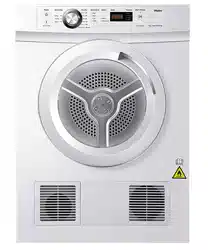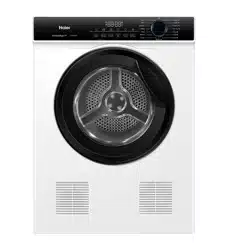
HDV60AWW1
HDV70AWW1
VENTED CLOTHES DRYER

Safety information...........................................................................................................................4
Intended use......................................................................................................................................8
Product description.........................................................................................................................9
Control panel...................................................................................................................................10
Dry cycles..........................................................................................................................................13
Dry Preparation...............................................................................................................................14
Getting started quickly.................................................................................................................16
Care and clean.................................................................................................................................18
Before you call for sevice.............................................................................................................19
Fault codes........................................................................................................................................20
Troubleshooting.............................................................................................................................21
Installation........................................................................................................................................24
Customer care..................................................................................................................................30
Before switching on your appliance for the rst time, read and save this guide.
Before First Use
- Do not operate this machine if it has been damaged during transport.
Contact your dealer or Haier service technician.
- Ensure all transport bolts are removed before running the appliance.
Failure to do so might end in damage to the apppliance.
- Remove all packaging and keep out of reach of children.
- This appliance is heavy, we recommend 2 people to move and install
the appliance.
Fire Hazard
- If you wish to stop the dryer before the cycle has nished you MUST remove the
clothes IMMEDIATELY and spread them out to cool. DO NOT leave the clothes in
the dryer or bunched up in a clothes basket. Take extreme care as the drum and
load items may be extreemly hot.
- Do not use the appliance if industrial chemicals (e.g. solvents) hava been used
on the clothes.
- A clothes dryer produces combustable lint: the lint lter must be cleaned before
every drying cycle.
- Rubber backed articles, foam rubber (latex foam) , clothes or pillows tted with
foam rubber pads, breglass, shoes containing rubber, plastic, shower caps,
babies waterproof napkin covers and waterproof textiles should not be dried in
the dryer.These materials can when heated produce re by spontaneous
combustion.
- Oil- aected items can ignite spintaneously, especially when exposed to heat
sources such as a tumble appliance.
- Items that have previously been cleaned in, washed in, soaked in or spotted with
ammable liquids or solids, eg petrol/gasoline, kerosene, dry cleaning solvents,
vegetable or cooking oil, acetone, denatured alcohol, some brands of spot
removers, turpentine, waxes and wax removers or other ammable or explosive
substances should not be placed in a tumble dryer.
- Failure to follow the warnings outlined in these user instructions can cause a
re hazzard.
- Failure to follow these instructions can result in death or personal injury.
Meaning of symbols on the dryer
Warning: Risk of re/Flammable materials
Read the instructions
- This appliance is not intended for use by persons (including children) with
reduced physical, sensory or mental capabilities, or lack of experience and
knowledge, unless they are supervised or given instructions on how to use
it by someone responsible for their safety.
Capacity
- Do not overload the appliance beyond its rated capacity:
MAXIMUM DRY CAPACITY HDV60AWW1: 6 Kg
MAXIMUM DRY CAPACITY HDV70AWW1: 7 Kg
- Capacity refers to the maximum dry weight of items the appliance can dry at any one time
Dryer Information
- Ensure all lint lters are cleaned before every load.
- Do not operate this product without the lint lter in place or allow lint to
accumulate in or around the appliance.
- Do not place dripping wet clothing in or on top of the appliance as it may create
an electrical hazard.
- Do not use the appliance if industrial chemicals (e.g. solvents) have been used on
the clothes.
- Remove all items such as lighters and matches from pockets.
- Pull up zips, x loose threads and protect embellishments to prevent garments from
being damaged and entangled.
- Garments that contain metal reinforcements should not be placed in the appliance.
If necessary, use an appropriate laundry bag or net.
- The appliance might get hot during operation, use caution if in close proximity.
- Unplug the appliance before undertaking maintenance. Hold the plug (not the cable)
when unplugging the machine.
- Ensure there are no undesirable objects inside the drum before starting a cycle.
- Ensure that the ambient temperature is between 5C and 35C before using the appliance.
- Do not swing on or put weight on the door.
- The appliance should only be used for garments recommended for machine drying.
Always follow the advice on the care label.
- Do not touch or operate the machine with wet hands or with bare-feet.
- Supervise children to ensure they do not play with the appliance or climb inside
the drum.
- This appliance is heavy, we recommend 2 people to move and install
the appliance.
- This product has been designed for personal, family or household use.
This product is not designed for any commercial use. Any commercial
use will terminate this products manufacturer’s warranty.
Dryer Information
the care label specically states it is safe to do so. Never dry these items at high temperatures.
- Fabric Softeners or similar products should not be used in a tumble dryer to eliminate the
eects of static electricity, unless this practice is specically recommended by the
manufacturer of the fabric softener product.
- Oil-aected items can ignite spontaneously, especially when exposed to heat sources such
as a tumble appliance. The items become warm causing an oxidation reaction in the oil.
This oxidation creates heat. If the heat cannot escape the items can become hot enough to
catch re. Piling, stacking or storing oil-aected items can prevent heat from escaping creating
a re hazard.
- If it is unavoidable that fabrics that contain vegetable oil, cooking oil or have been
contaminated by hair care products be placed in the appliance, they should rst be washed in
hot water with extra detergent – this will reduce, but not eliminate the re hazard. The cool
down cycle of the appliance should be used to reduce the temperature of these items. They
should not be removed from the tumble appliance and piled or stacked while hot.
- Do not dry Items which are unwashed.
- Do not dry items which have been cleaned with industrial chemicals.
- Items that have previously been cleaned in, washed in, soaked in or spotted with
ammable liquids or solids, eg petrol/gasoline, kerosene, dry cleaning solvents,
vegetable or cooking oil, acetone, denatured alcohol, some brands of spot
removers, turpentine, waxes and wax removers or other ammable or explosive
substances should not be placed in a tumble dryer.
- Rubber backed articles, foam rubber (latex foam), clothes or pillows tted with
foam rubber pads, breglass, shoes containing rubber, plastic, shower caps, babies
waterproof napkin covers and waterproof textiles should not be dried in the dryer.
These materials when heated can produce re by spontaneous combustion.
- Do not dry an electric blanket or any other electrical items in your dryer, unless
-
WARNING:The last stage of the drying cycle is a cool down phase.
Never stop a tumble clothes appliance before the end of the cycle unless all items
are removed and spread out in order to dissipate the heat.
- If the lint lter is damaged, contact your Haier service technician to arrange
getting a new lter. Do not operate your appliance with a damaged lint lter
or without the lter in place, as this will cause damage to your appliance.
- If ducting the dryer to the outdoors, ensure adequate ventilation is provided
during operation of the appliance to avoid any backow of gases from fuel
burning appliances.
- A damaged electrical cable must be replaced by a Haier service technician or
similarly qualied person. Do not use the appliance until it has been repaired to avoid a risk
of electric shock.
- The only user-removable parts of the appliance are the lint lter .
No other parts are designed to be removed by the user.
- When disposing of the appliance, it is recommended that the door is removed to avoid
children getting trapped inside, and that the electrical cable is cut o close to the machine.
- Unless the product is modied by an approved technician, any changes might
result in loss of warranty.
- Install the appliance in a well-ventilated, dust-free environment.
- This appliance must not be installed or operated on a plinth (other than a genuine
Haier part, installed per the instructions).
- We do not recommend the use of extension cords or portable electrical outlet devices.
- Ensure the installation provides accessibility to the plug or incorporate a switch in the
xed wiring in accordance with the wiring rules to allow disconnection of the appliance
from the supply after installation.
- Review the electrical information on the rating plate before plugging in this appliance
to make sure the right voltage and current can be supplied.
- Install the appliance on a solid and level surface ensuring it has 20mm clearance on
each side. The appliance must not be installed on any textured oor coverings
(eg carpet, rugs).
- Do not expose the appliance to frost, external heat sources or direct sunlight.
- Do not install the appliance in a location where the ambient temperature drops
below 5°C.
- Do not install the appliance outdoors or in a damp location.
Installation
WARNING!Electric Shock
Hazard
Failure
to follow this advice may
result in
in electric shock or death
.
-Ensure that the appliance cable is positioned so that it does not come into contact
with water or moisture.
-The appliance must not be supplied through an external switching device, such as
a timer, or connected to a circuit that is regularly switched on and o by a utility.
- Keep the gasket, dispenser and door clean to prevent odours.
- Do not use water spray or steam to clean the appliance.
Maintenance, Cleaning and Disposal
- This appliance is intended for drying garments that can be tumbled.
- Follow the manufacturer instructions found in the garment label.
- Do not make any changes or modications to this appliance, they might cause personal
injury and damages to property.
- Do not install the appliance behind a lockable door, sliding door, or behind a door where
the hinge is on the opposite side to that of the dryer in such a way that the full opening of
the door is inhibited. Ensure the dryer door can always be opened fully.
- If installed behind a cabinetry door, it must be hinged on the same side as the dryer with
a minimum clearance of 30mm from the dryer handle to the internal surface of the cabinetry
door.The cabinetry door must remain open while the machine is running.
- Exhaust air must not be discharged into a ue which is used for exhausting fumes from
appliances burning gas or other fuels.
HDV60AWW1
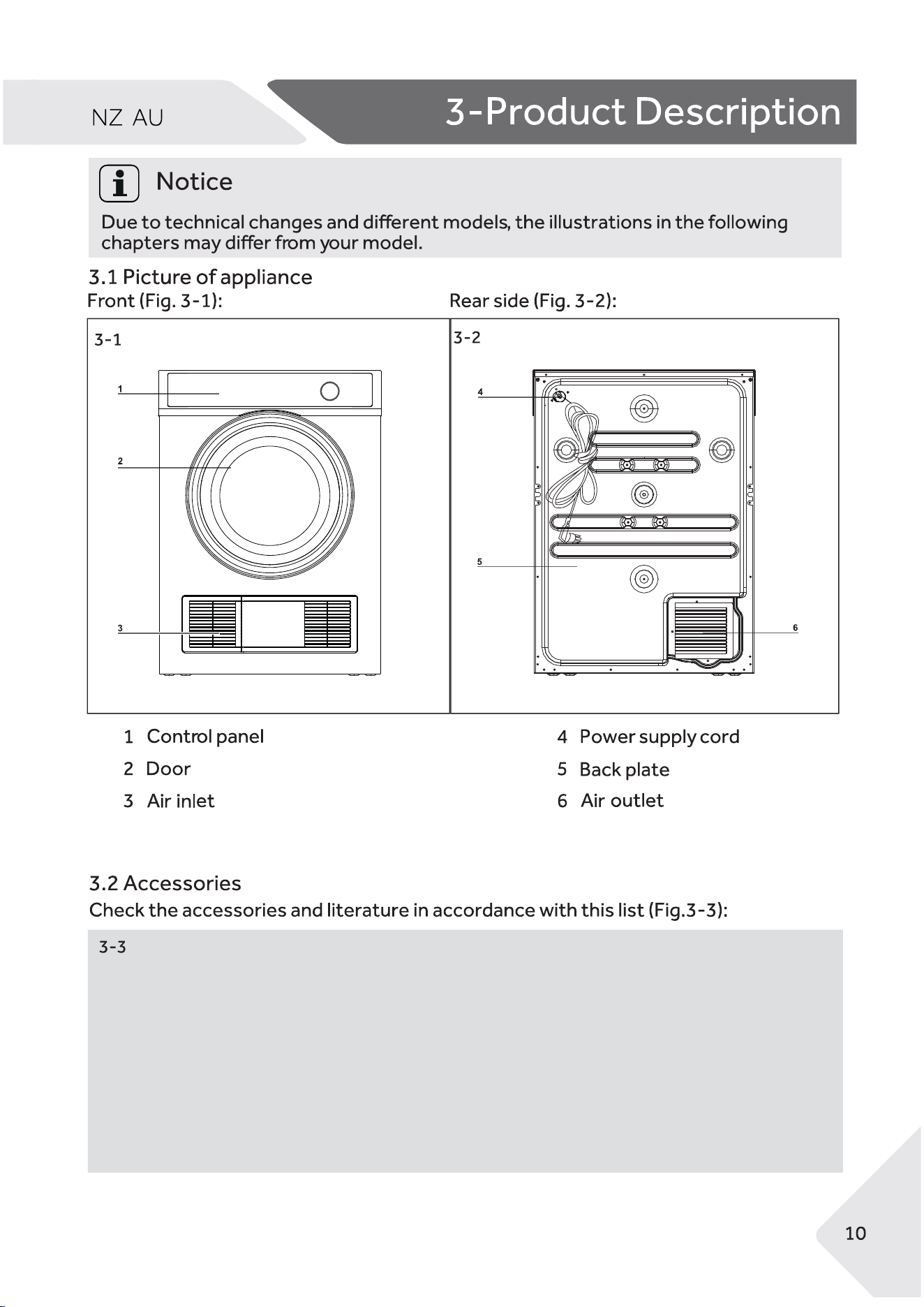
■ 1 x Installation instructions
and user guide
■
1 x Wall mounting kit
■ 2 x Stacking bracket
■
1
x
Inverted
panel
■
1
x
Warranty
card
HDV70AWW1
■ 1 x Installation instructions
and user guide
■ 1 x Wall mounting kit
■ 2 x Stacking bracket
■ 1 x Hose connector
■ 1 x Flexible hose
■ 1 x Flexible hose clip
■ 1 x Inverted panel
■ 1 x Warranty card
■ 1 x Hose connector
■ 1 x Flexible hose
■ 1 x Flexible hose clip
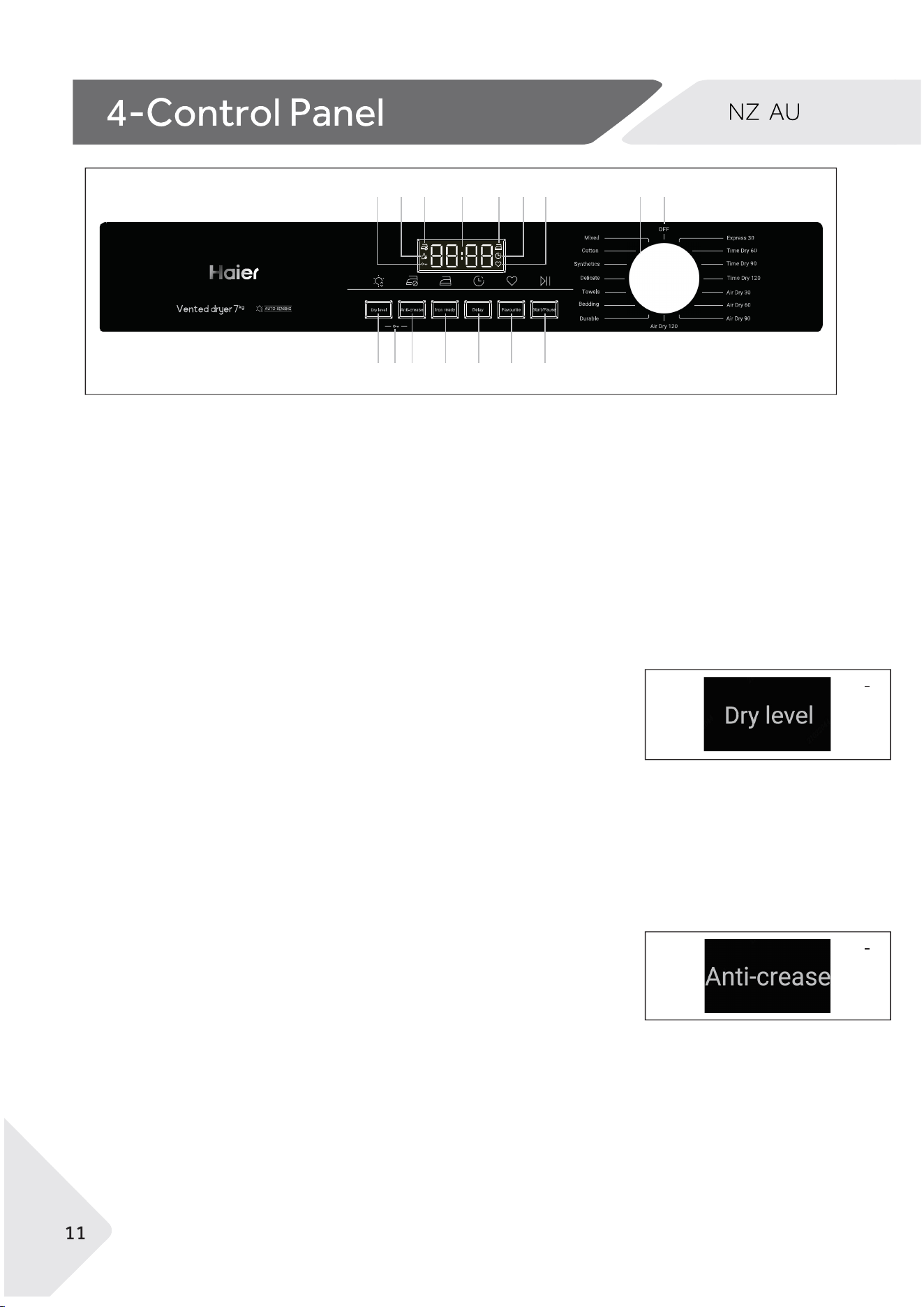
4.2 Anti-crease
Anti-increase indicator
Iron ready indicator
Press the Anti-Crease button
(Fig.4-2)
to add periodical tumbles
after cooldown for a selected period of time.
When active the drum will rotate periodically to minimise
wrinkling and creasing.This is particularly useful if you cannot
remove the items immediately after the cycle ends.
Anti-crease button
4.1 Dry level
Press the Dry Level button (Fig.4-1) to change the end dry level
of the program.
H1:Damp/Dry - This setting is recommended for garments that
will be nished with an iron treatment.
H2:Dry - This setting is recommended for the majority of
garments; garments can be worn after drying
H3:Extra Dry - Use this setting for large,bulky and durable items.
1 22 3 4
5 6
810 911 12 13 14 15 16
7
Dry level button
Iron ready button
Delay button
Favourite button
Start/Pause button
1
2
3
4
5
6
Key lock button7
Power8
Cycle selector knob9
Display10
Key lock indicator11
Clean lter indicator12
13
14
15 Delay indicator
16 Favourite indicator
4 1
4 2
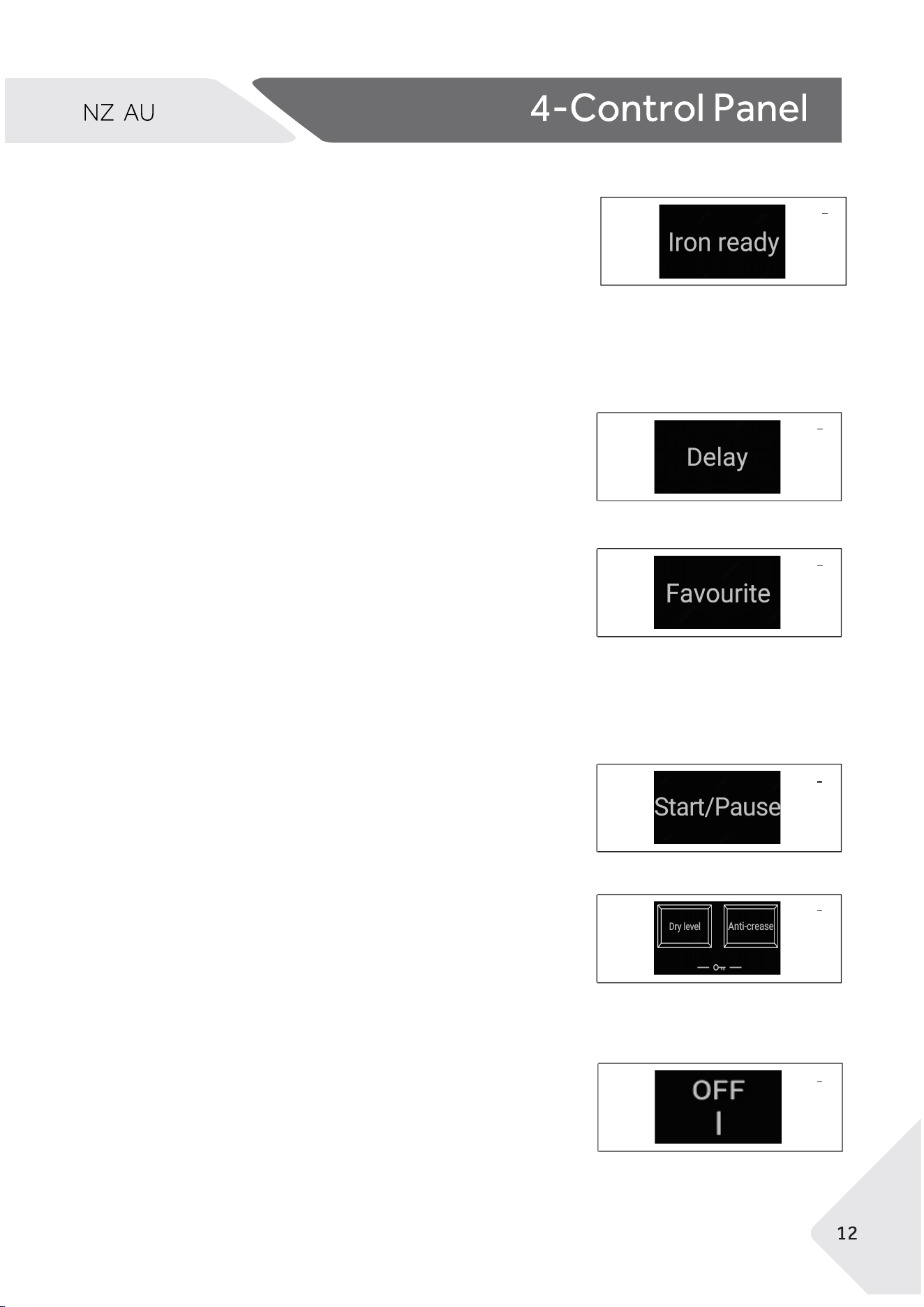
4.5
4.7
Choose a program and the desirable modiers, then start
the cycle. Press Favourite(Fig.4-5)for 3 seconds to save the
personalised options. The selection will become the
default setting for that program and the Favourite icon (Fig.4-16)will be ON on the
display to indicate it. To restore the default parameters, select “Iron ready”and”Dry level”
for 3 seconds simultaneously, the display will show “dEF” to acknowledge the change.
The favourite function is available for all cycles.
Favourite
Use “Iron ready” to set a notication when the garments are
at a moisture level most suitable for ironing.
When ready, the Iron ready Icon LED will start ashing and
the machine 5 beeps every 5 minutes.
Pause the cycle and remove the desired garments. Close the door and restart the cycle to
allow the remainder of garments to nish the cycle. This is particularly useful if you have a
mixed load with only a few garments to be ironed.
4.3 Iron ready
Set a delay time for the cycle to start. Avoid using this
function for damp, non-colourfast items as this may cause
dye run to occur. The Delay function is available for all
cycles.
4.4 Delay
4.6
Press the Start/Pause(Fig.4-6)to start or interrupt the
selected program.
Start/Pause
Key lock
Use Key Lock to disable the buttons on the display panel.
Key Lock can be used at any time including while a cycle is
running. When locked,the controls will be unresponsive
except the Start/Pause button and the Power button. To
select, press Dry level and Anti-crease(Fig.4-7). The Key lock icon will turn ON and the
display will show Key lock to indicate the selection.
4.8
Turn the knob to any position (except OFF) to start the
machine. Turn the OFF position to shut down the machine.
Power
4 3
4 4
4 5
4 6
4 7
4 8
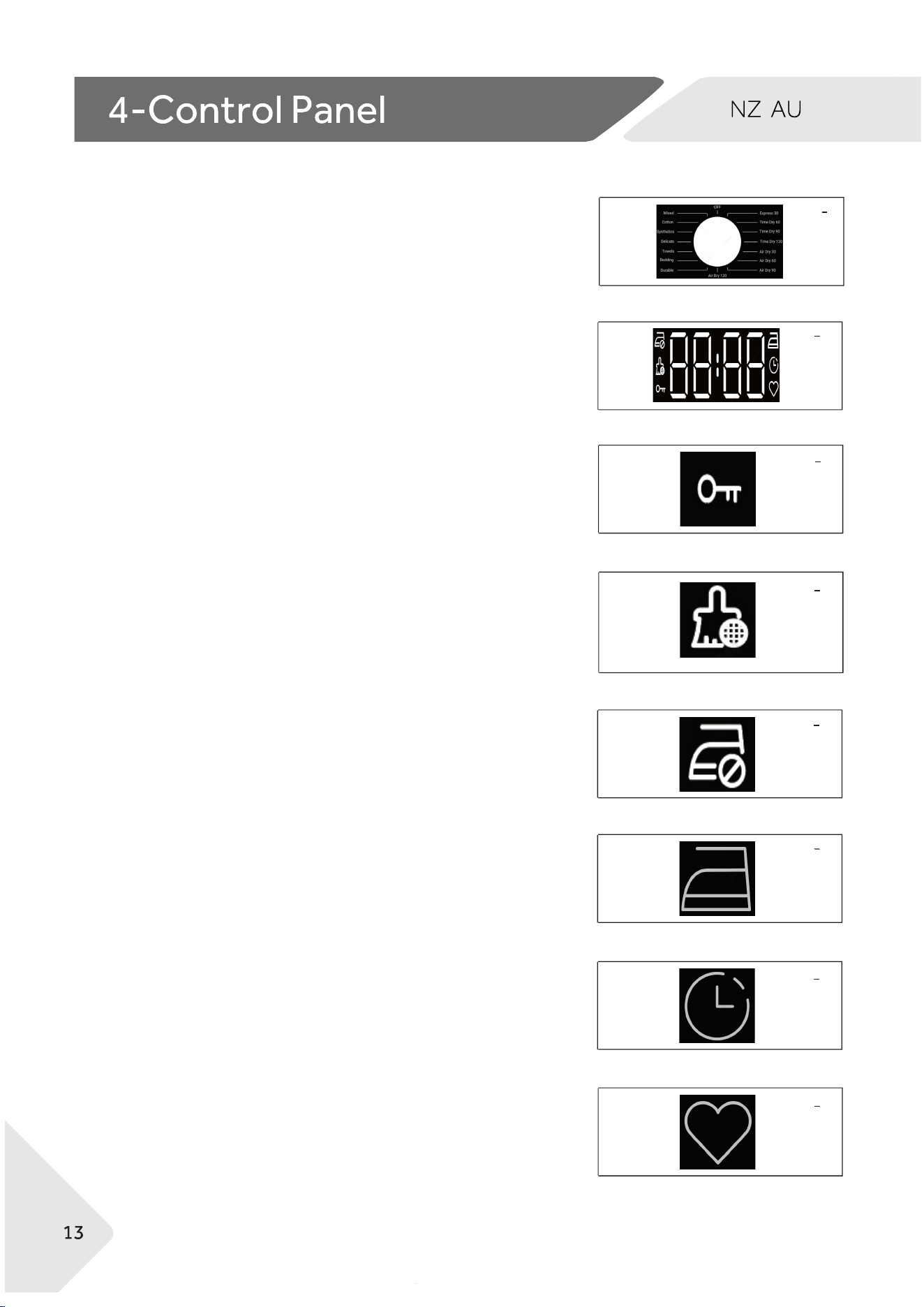
4.9
Turn the knob to select a program.When a cycle is selected,
it will lit up and default setting will be displayed.
Cycle Selector
4.10
The display(Fig.4-10)will shows important information
about cycle:
Options and modiers,remaining time,error codes and
service information,warnings and notications.
Display
4.11
Key lock indicator
4.12
When the clean lter indicator lights up it is time to clean
your lint lter. See instructions in the Care and Cleaning
section.
Clean lter indicator
4.15
Delay indicator
4.16
Favourite indicator
4.13
Anti-crease indicator
4.14
Iron ready indicator
4 9
4 10
4 11
4 12
4 13
4 14
4 15
4 16
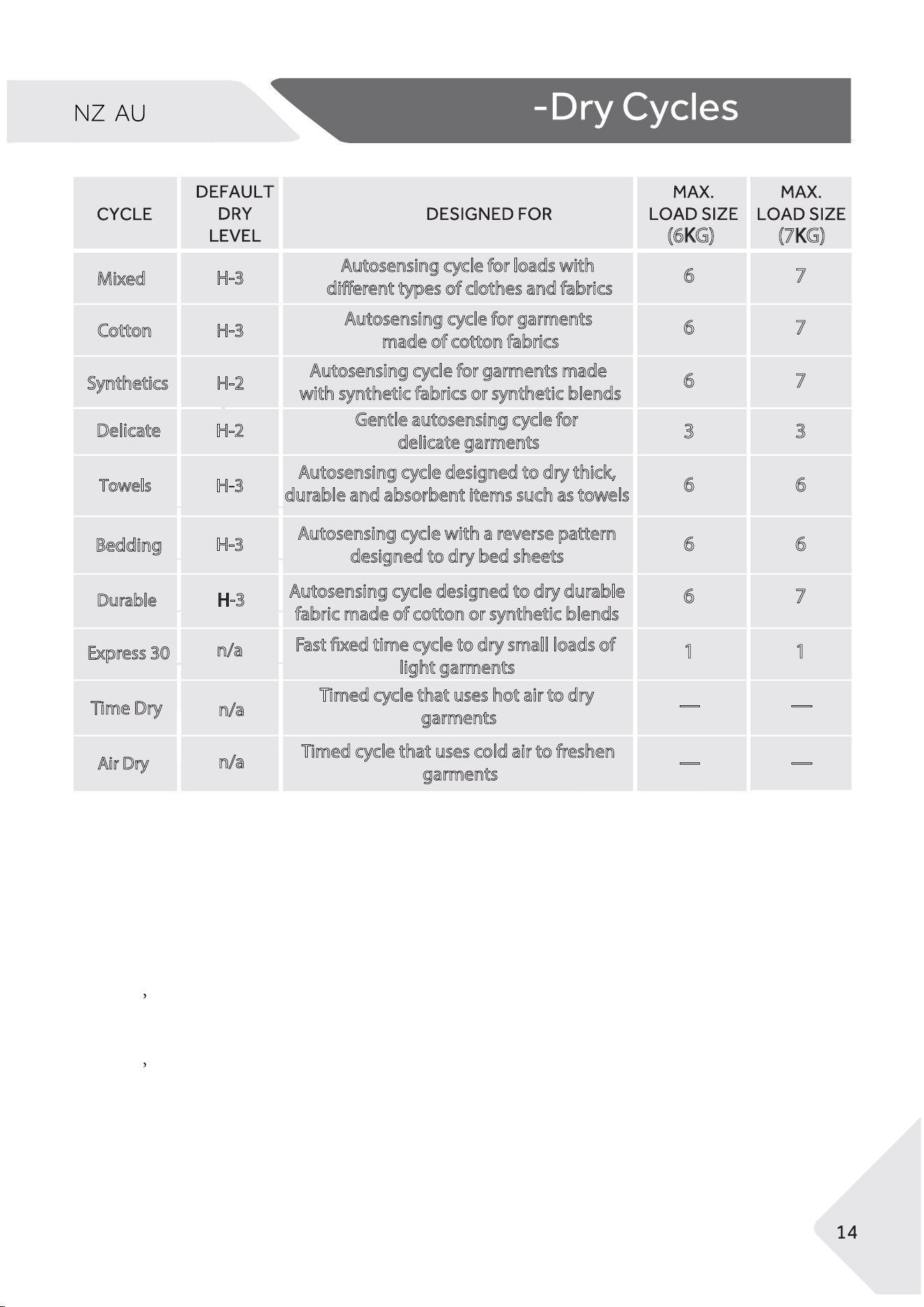
Durable
Towels
Air Dry
—
6
6
3
6
6
6
6
1
—
*DEFAULT DRY LEVEL : Extra-Dry-H-3 ; Dry-H-2 ; Damp-H-1
Mixed
Cotton
Synthetics
Delicate
Bedding
Express 30
Time Dry
H-3
H-3
H-2
H-3
H-2
H-3
H-3
n/a
n/a
n/a
Gentle autosensing cycle for
delicate garments
Autosensing cycle for loads with
dierent types of clothes and fabrics
(6KG)
(7KG)
—
7
7
3
7
6
6
7
1
—
Autosensing cycle for garments
made of cotton fabrics
Autosensing cycle for garments made
with synthetic fabrics or synthetic blends
Autosensing cycle designed to dry thick,
durable and absorbent items such as towels
Autosensing cycle with a reverse pattern
designed to dry bed sheets
Autosensing cycle designed to dry durable
fabric made of cotton or synthetic blends
Fast xed time cycle to dry small loads of
light garments
Timed cycle that uses hot air to dry
garments
Timed cycle that uses cold air to freshen
garments
Registration Cycle
5
Cotton H-2 is the recommended energy saving cycle for everyday drying.
HDV60AWW1
Cotton H-3 is the recommended energy saving cycle for everyday drying.
HDV70AWW1
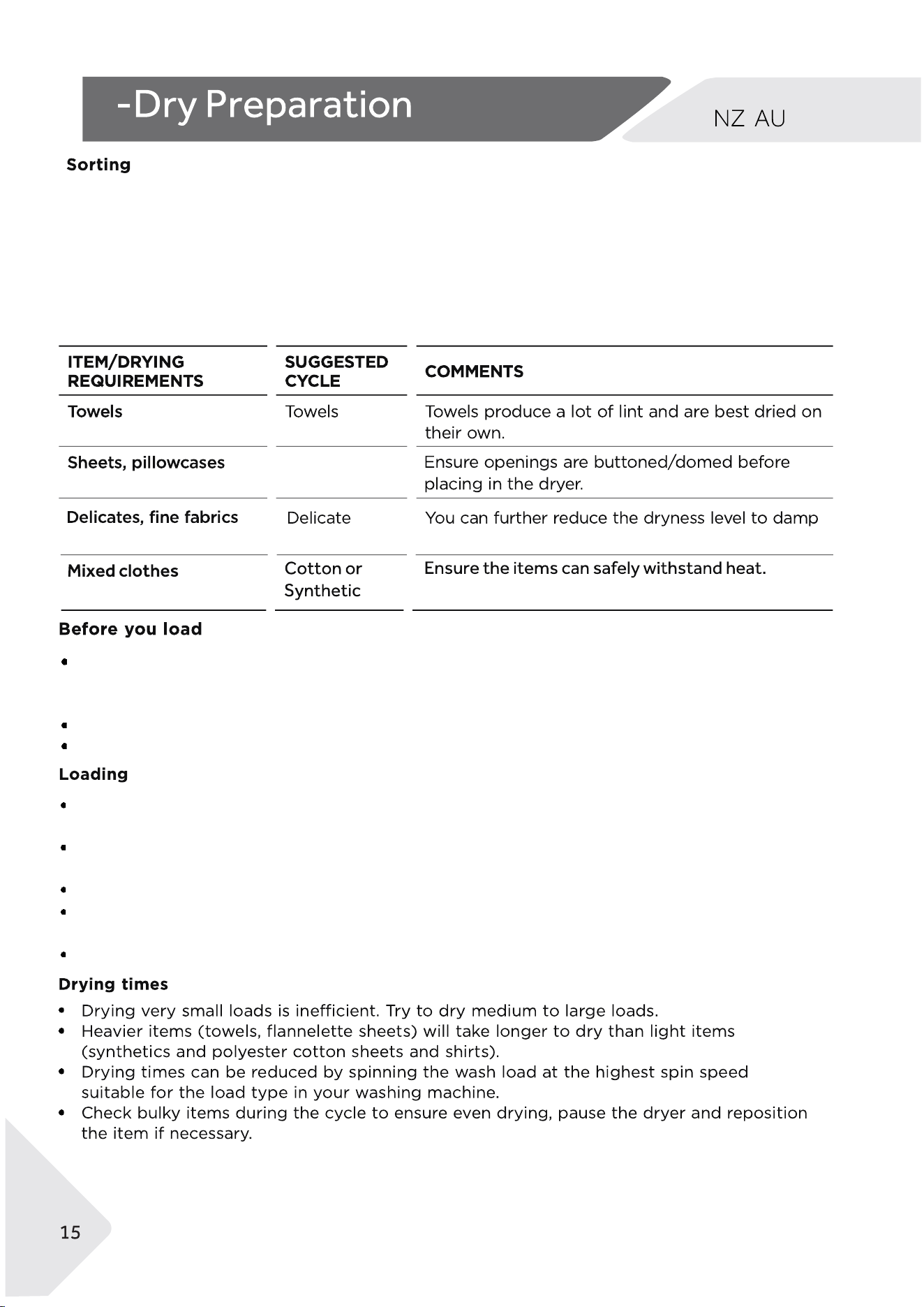
Sort items into loads of similar items,and loads that will likely take similar times to dry.This prevents the
possibiliity of some items be coming over-dried whilst others are still damp.
Separate coloured items from white/light items where possible,especially when new.Colour run may be
an issue,especially if you intend to delay the start of the drying cycle.
Care labels on garments provide valuable information about the fabric type and how the garment should
be dried. Always follow the advice in garment labes.
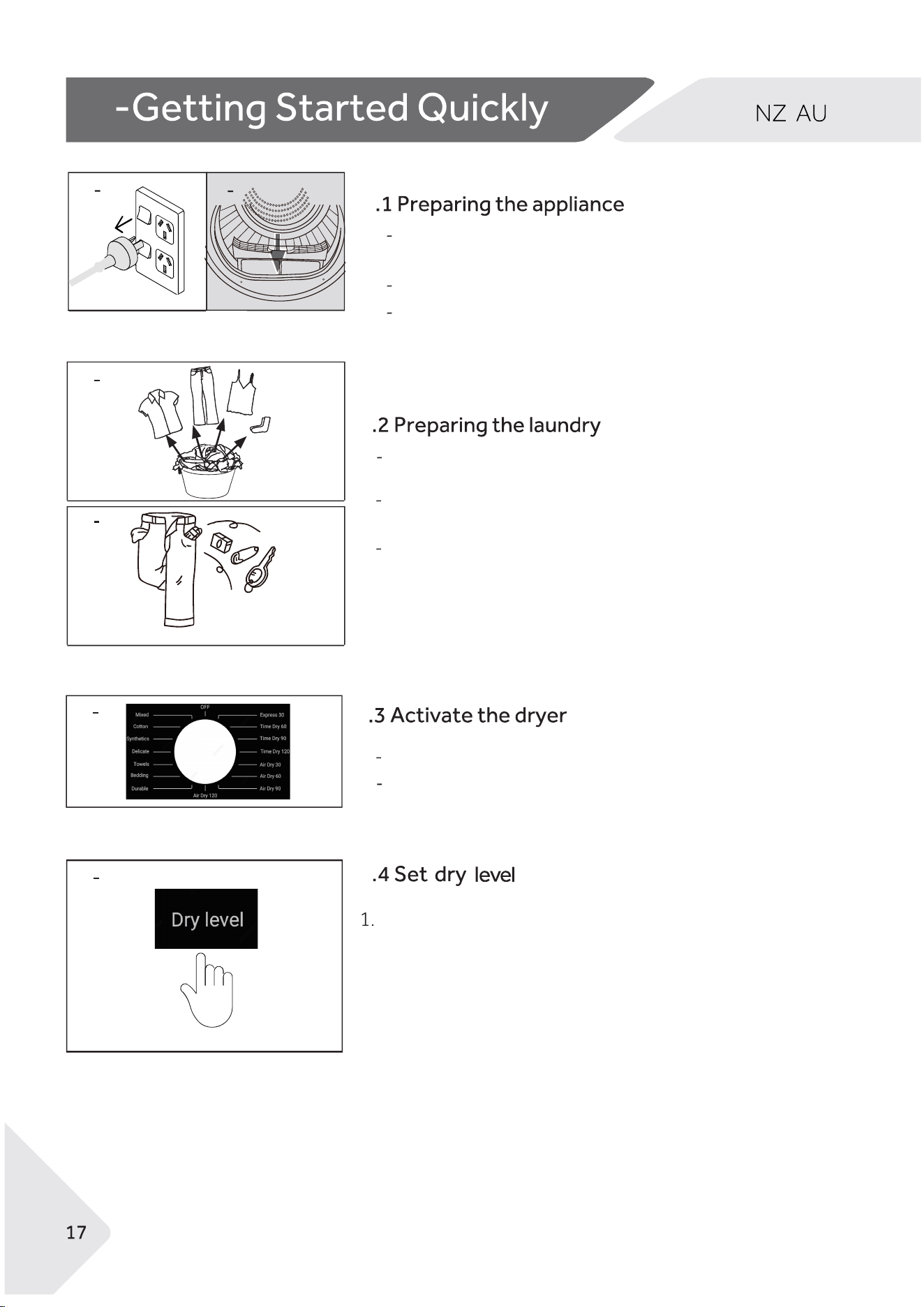
Check pockets for items that could damage your clothes or get caught in the dryer. Close zippers, hooks
and eyes, and other fastenings(ie fasten the openings of duvent/ doona covers), and remove loose bra
wires. These may damage both your dryer and your clothes.
Items of clothing with screen-printing should be turned inside out to prevent damage to he print.
for very delicate items
Bedding
Garments need to be loaded correctly to minimise creasing and wrinkling, and to ensure the load is
dried evenly.
Allow enough room in the dryer for clothes to tumble freely. Load the dryer in terms of the space the
garments take up when dry, rather than when they are wet.
Shake clothes out and load individually to help items dry evenly and reduce tangling.
Dry permanent press garments (business shirts) together on the Damp dryness level with Anti-crease
option on. This will help reduce wrinkling and the need for ironing.
Hang garments as soon as the drying cycle is complete to reduce the need for ironing.
6
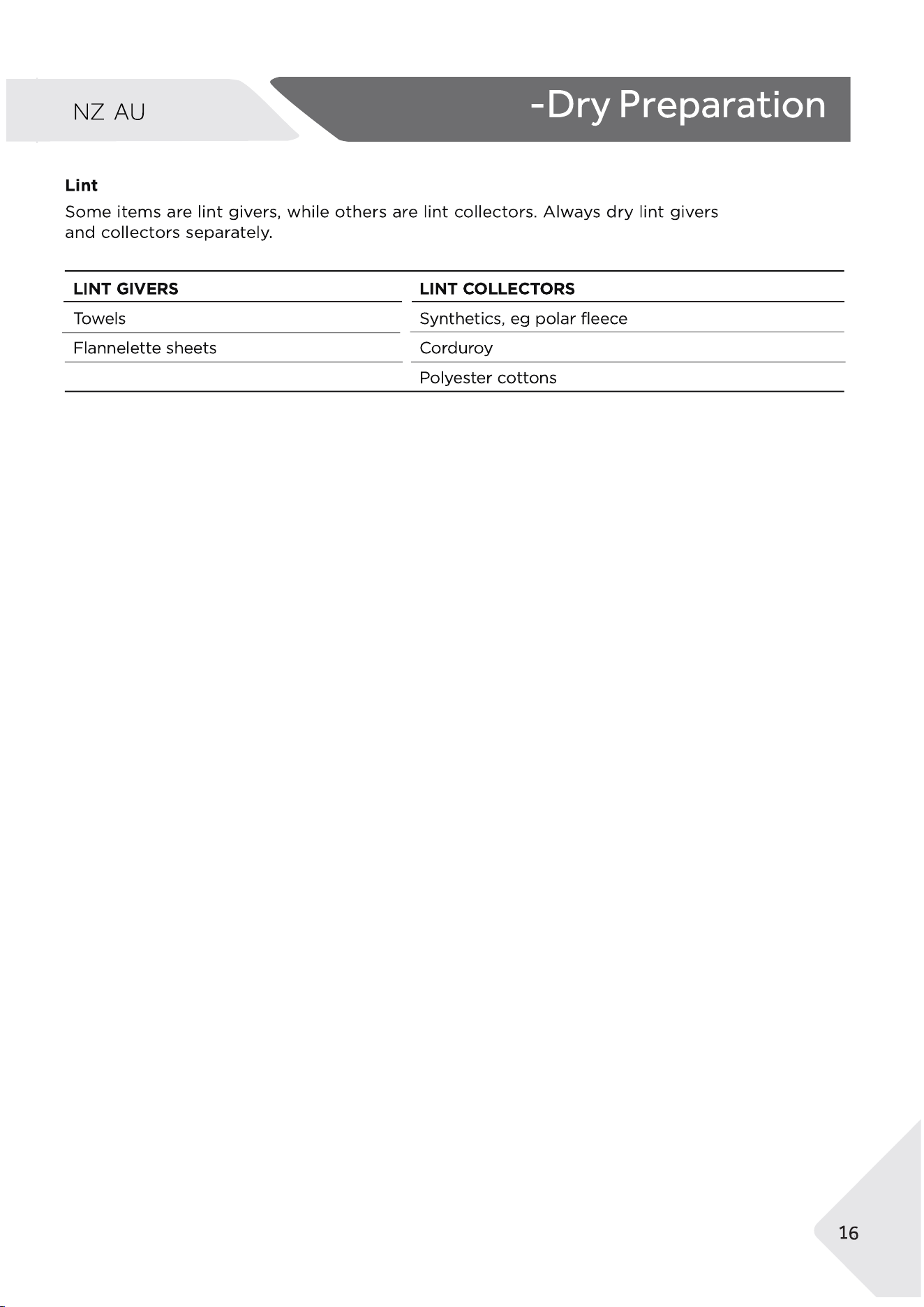
Check the lint lter is clean.
Delicate or easily damaged items (eg nylon stocking, ne fabrics, delicate embroidered fabrics) should be
dried separately, using the DELICATE cycle.
6
7
7
7
7
7
7 3
7
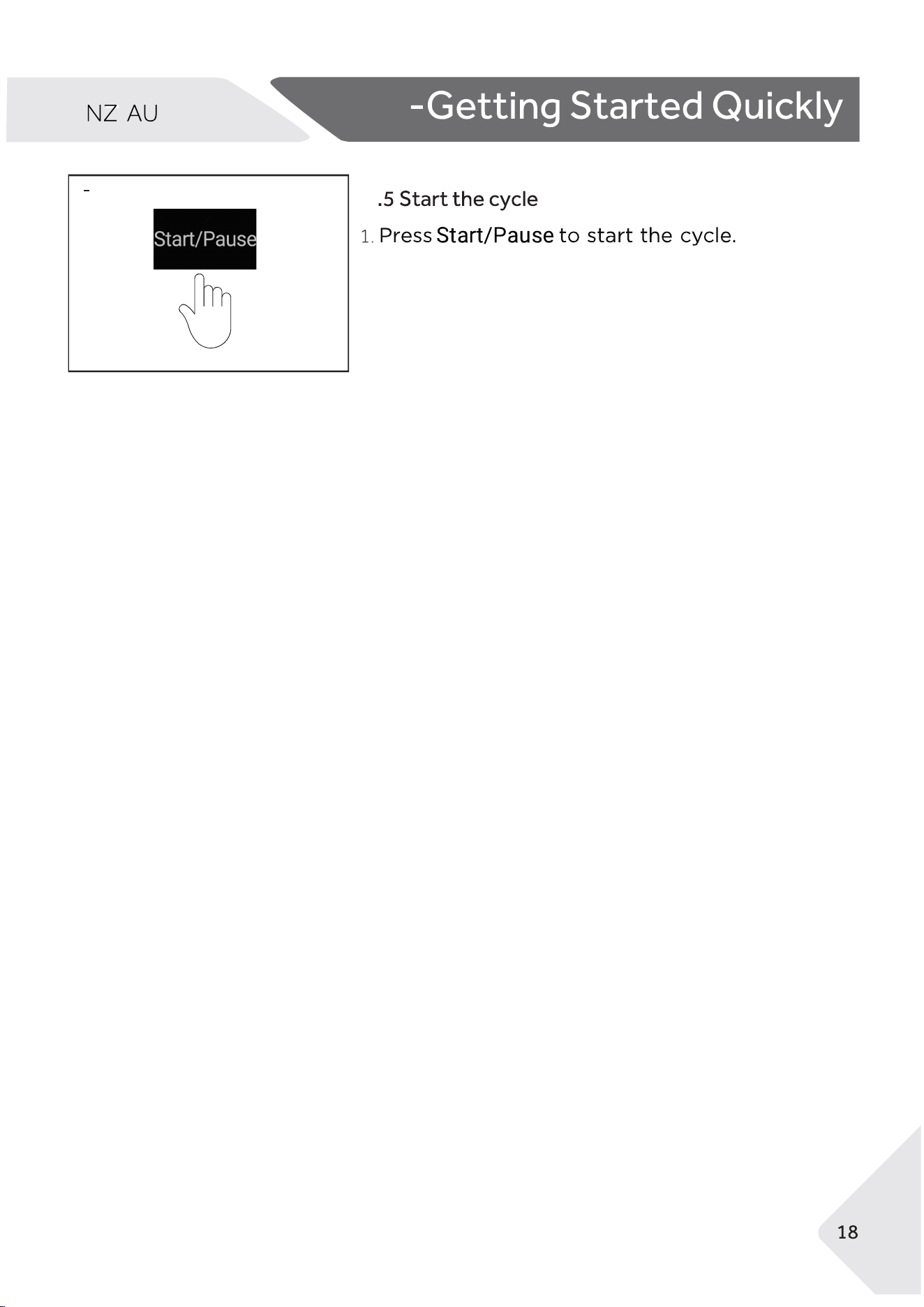
Turn the knob to the program to power on your dryer
Select your desired drying cycle by turning the control
dial
7
7
7
6
Select your desired dry level by pressing the button,
there are three drying temperatures you can choose
from:
H-1 : The highest drying level and longer program
running time
H-2 : Suitable for daily drying of ordinary single-layer
clothing
H-3 : After drying,it is in a damp state,suitable for
removing,ironing or hanging dry
7
1
2
4
5
Connect the appliance to a power supply(220V to
240V~/50Hz)
Make sure:
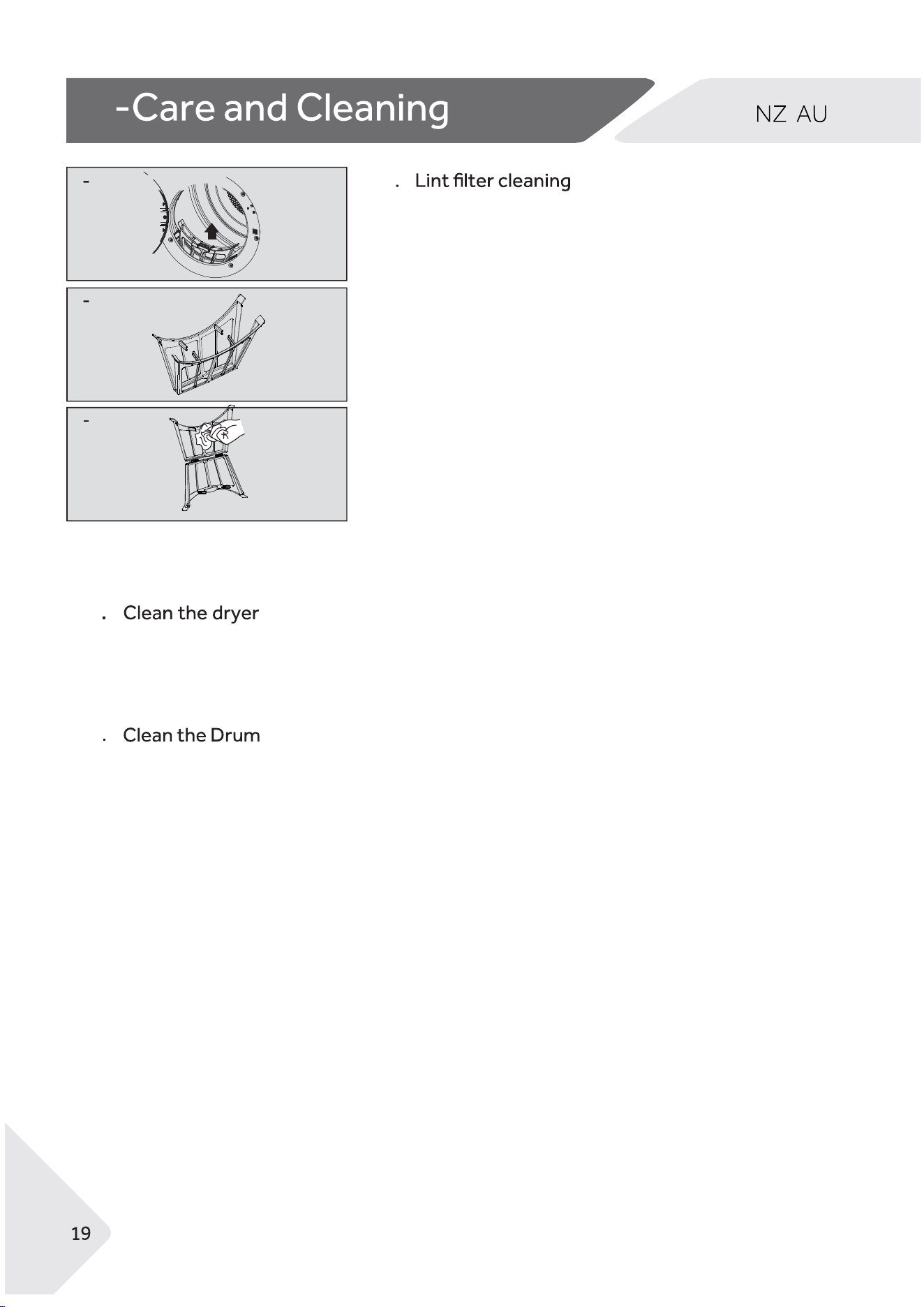
the lint lter is clean and properly installed.(Fig.7-2).
Sort clothes according to fabric
(cotton, synthetics, wool etc.).
Empty pockets of sharp or ammable objects
such as keys and matches.
Follow the instructions in the laundry label and
dry loads that can be dried.
7
7
7
7
If you wish to change a cycle or select a dierent option
once a drying cycle has started, you should power o
and restart the dryer.
8
8
8
3. Clean the lint lter from any lint residuals(Fig.8-3).
8
1
2
3
Clean the lint lter after each dry cycle.
1. Remove the lint lter from the drum(Fig.8-1).
2. Open up the lint lter(Fig.8-2).
Wipe the outside of the tumble dryer and the control panel with a damp cloth.Do
not use any organic solvent or corrosive agent to avoid damage to the device.
After some operation time, fabric care agents or calcium contained in the water
can form an almost invisible lm on the inside of the drum. Use a damp cloth and
some detergent to remove it. Do not use any organic solvent or corrosive agent
to avoid damage to the device.
8
8
1
2
8 3
8
9
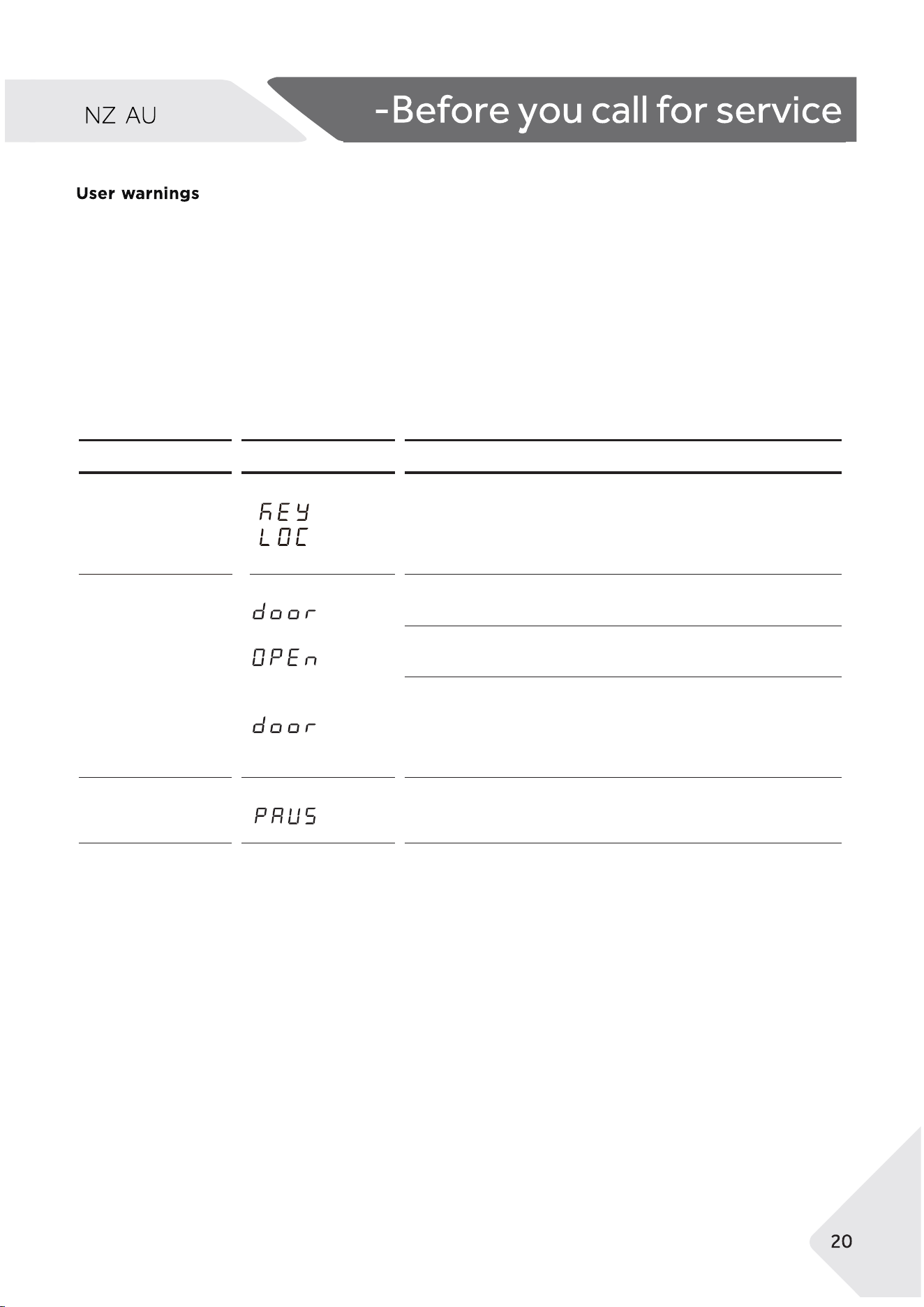
Once you have addressed the issue the user prompt was alerting you to, try using your dryer as per
usual. If the issue persists, call your Haier trained and supported service technician.
Your dryer is capable of diagnosing a number of its own problems. It will sound a continuous series
of beeps and display a user prompt when it has a problem that you can correct yourself. To stop
the beeps sounding, touch any button on the control panel. Do not try to continue your drying cycle
once you stop the noise. You must address the problem the dryer is alerting you to.
Check the below table before you call for service.
PROBLEM DISPLAYED AS WHAT TO DO
The door is not
closed
Close the door fully and press ‘Start / Pause’.
Try opening and closing the door again.
Reposition the load, make sure the load is
correctly in the drum and that protruding
from closing.
Dryer has been
paused
Press the ‘Start / Pause’ to resume the cycle.
deactivate the Keylock.
Keylock is
activated
Touch and hold the ‘Key Lock’ button for 3 seconds
to
items are not stopping the door
10
When a continuous series of beeps sound, all the lights turn o on the control panel and a string of
codes appears on the display ’a fault has occurred’ . Please call your trained and supported Haier
service technician.

11
PROBLEM POSSIBLE CAUSES WHAT TO DO
Turning the knob
does not turn
on the dryer.
Fault with household power
supply.
Try plugging in and turning on another
electrical appliance.
Pressing
‘Start / Pause’
does not start the
drying cycle.
Dryer could be displaying a user
warning or fault code.
Refer to Section 10.
‘Delay’ function is set.
Refer to Section 4”Control panel” for
more information.
Dryer keeps
stopping and
starting.
The ‘Anti-crease’ option has
been selected.
Dryer stops
working mid-cycle.
Power failure. Turn the knob and restart the desired
cycle.
Dryer has been paused.
Press the ‘Start / Pause’ button to restart
the cycle.
Dryer door is open. Ensure the door is firmly shut.
Dryer is taking too
long/results were
not satisfactory.
Drying cycle selected not
appropriate for the load.
Select an appropriate cycle for the load.
Selected drying temp, not
appropriate for the load.
Select a higher drying temp.
Dryer overloaded for the cycle. Some cycles have a lower max. load size.
Try dividing the load in half and dry
half at a time.
Lint filter is blocked. Clean the lint filter.
Load overly wet at the start of
cycle.
Remove more water from the load before
placing it in the dryer, eg select a faster
spin on your washer, a speed appropriate
for your load.
Clothes getting too
hot or damaged.
Cycle selected not appropriate
for the load.
Ensure the cycle selected is appropriate
for items in the load.
Items removed from dryer before
the end of cycle cool down had
finished.
Removing items before cool down may
damage clothing if it is not spread out and
exposed to cooler air once removed from
the dryer.
Refer to Section 4”Control panel” for
more information.
11
PROBLEM POSSIBLE CAUSES WHAT TO DO
Dryer is beeping,
displaying unfamiliar
light patterns and/or
a message on the
digital display.
Dryer has a fault. Refer to Section 10 .
Noises. Dryer is overloaded. Remove some items from the dryer.
Dryer has a fault. Continuous beeping or a musical series of
beeps with a message displayed on digital
display.
Beeps signalling the end of a
drying cycle.
End of cycle beeps can be turned off.
Vibration. Dryer is not installed on a stable
surface.
Ensure the dry r is installed on a flat,
stable surface.
Dryer is overloaded. Remove some items from the dryer.
Creasing. Dryer is overloaded. Remove some items from the dryer.
‘Anti-crease’ option not
selected.
Select the ‘Anti-crease’ option to rotate the
load at the end of the drying cycle.
Dye transfer. White/light and coloured
items not separated before
drying.
Remember to separate white/light and
coloured items before placing them in the
dryer.
Wet items left sitting in the dryer
for long periods of time before
drying.
Do not leave wet items sitting in the dryer
for long periods of time before drying, if
they are prone to colour run. If you do
intend to leave them for long periods
before drying, then separate the load and
put those items that may cause colour run
aside.
Tangling. Loads not separated during
loading.
Try separating out larger items from
smaller items.
Items loaded into the dryer
incorrectly.
Load items individually into the dryer.
Do not place folded items in the dryer.
Load size too large. Try drying smaller load sizes. Some
cycles have a lower maximum load size.
Sheets and duvet covers
due to their size, are prone
to tangling.
Dry sheets and duvet/doona covers
separately from other laundry. Ensure
duvet/doona covers are buttoned or
fastened closed before drying.
e
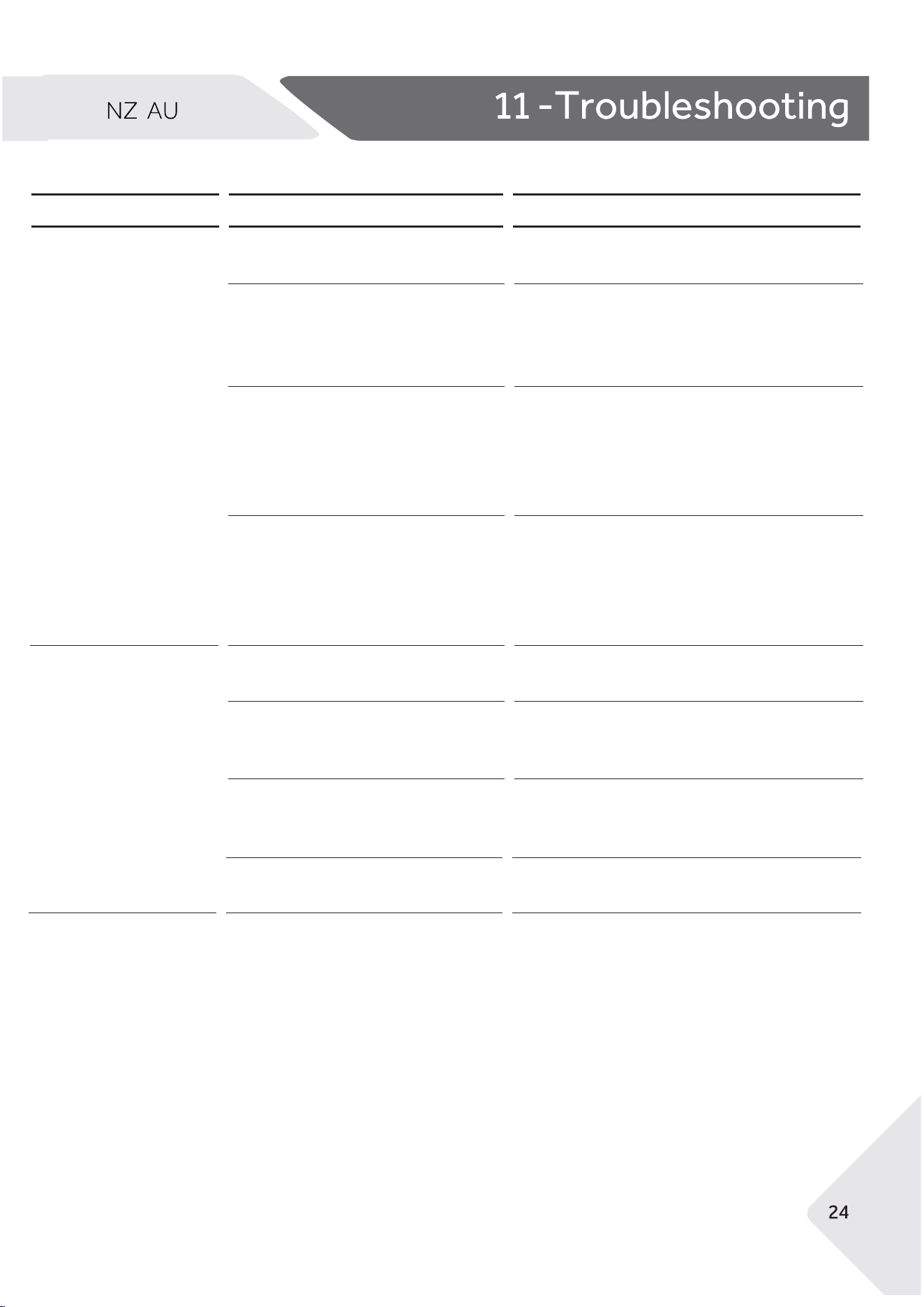
PROBLEM POSSIBLE CAUSES WHAT TO DO
Linting. Lint filter not cleaned or replaced. Ensure the lint filter is cleaned after every
cycle and replaced correctly.
Loads not sorted correctly.
Clothes over dried.
Fabric damage. Catching on metal part on items
in the load.
Fasten zips and other clasps before
placing items in the dryer.
Instructions on care label not
followed.
Follow the instructions on the care label of
the items.
Dry lint givers separately from lint receivers.
Dry similar colours together eg light
coloured items with light coloured items,
dark items with dark items.
Over drying clothes in the dryer can cause
them to attract lint. Use an auto sensing
cycle or ensure you check your load if
using the time dry cycles to avoid over
drying.
New items have been dried in the
dryer recently. New towels or
flannelette sheets can leave lint
in the dryer, which may be picked
up by subsequent loads.
Clean the lint filter and use ‘No heat’ cycle
to clear any remaining lint from the dryer.
Items not separated or dried on
an appropriate cycle for the fabric
type.
Dry similar items together. Ensure an
appropriate cycle is selected.
Used a ‘Time Dry’ cycle and did
not monitor the dryness of clothes
during the cycle.
Ensure that clothes are checked for
dryness during the cycle when using the
timed programmes to avoid over drying.
HDV60AWW1 HDV70AWW1
Capacity (kg)* 6
ELECTRICAL
Volts 220-240
Hz 50
Amps (maximum) 10
Rated Power (W) 1770
7
220-240
50
10
1770
Waterproof degree
IPX4
IPX4
12
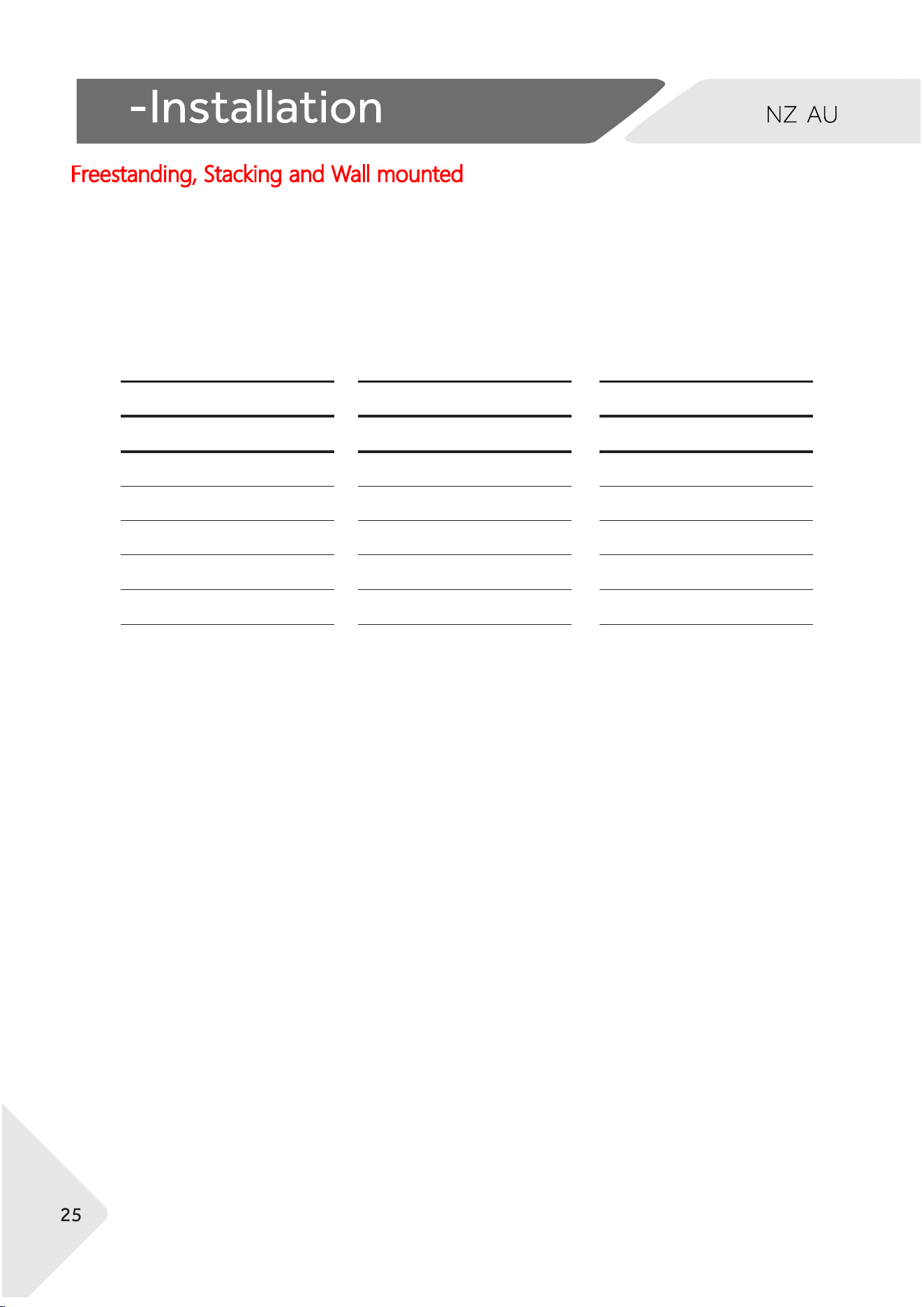
Freestanding, Stacking and Wall mounted
Your dryer can be installed freestanding, stacked on top of a Haier front load washing machine,
or inverted and mounted on the wall.
Your dryer can also be congured for front venting or rear venting.
Please refer to the following section for installation information.

○
B
PRODUCT DIMENSIONS
Overall height*
Overall width
Overall depth
Depth of open door
*Including dial and door (when closed)
○
A
○
A
○
B
○
C
○
D
○
B
○
C
○
D
Product dimensions
FRONT
PLAN
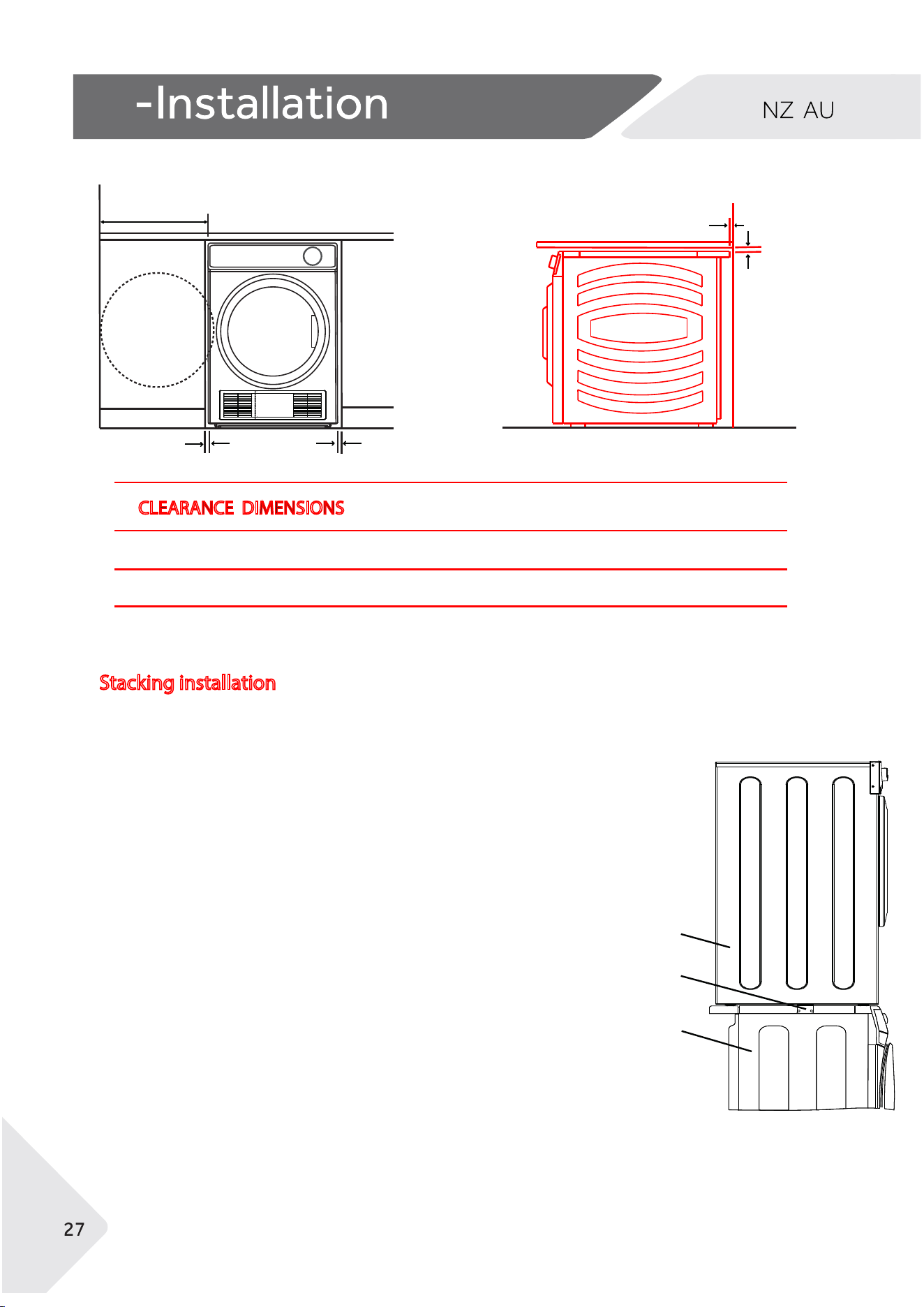
Cavity and clearance dimensions
○
A
○
B
○
C
○
C
*Front panel of the product
CAVITY DIMENSIONS
Minimum cavity height
Minimum cavity width
Minimum cavity depth
- Flush with front panel of the product*
- In cupboard
○
A
iSOMETRIC
565mm
605mm
850mm
630mm
830mm
600mm
565mm
970mm
○
B
○
C
12
○
A
○
B
CLEARANCE DIMENSIONS
Minimum door clearance to adjacent wall
Minimum gap clearance to adjacent product or cabinetry*
*Applies to sides, top and rear
○
A
○
B
20mm
Stacking installation
335mm
12
A stacking kit MUST BE USED between
the products and tted correcrly to the
washing machine and dryer, as per the below instructions.
*Ensure you use the supplied stacking kit for this product
and Haier front load washing machine.
*Ensure the washing machine is the same
width as your dryer.
*Ensure that the power plug is always accessible.
The following stacking congutations
are not safe and MUST NOT be used:
*A washer stacked on top of a dryer.
*A washer on top of a washer.
*An incompatible washer/dryer/stacking
kit combination.
Dryer
Stacking bracket
Front load washing
machine
Tools and parts required:
■
Drill and 2.9mm bit
■
Phillips head screwdriver
Stacking bracket includes:
■2x
Stacking bracket
12
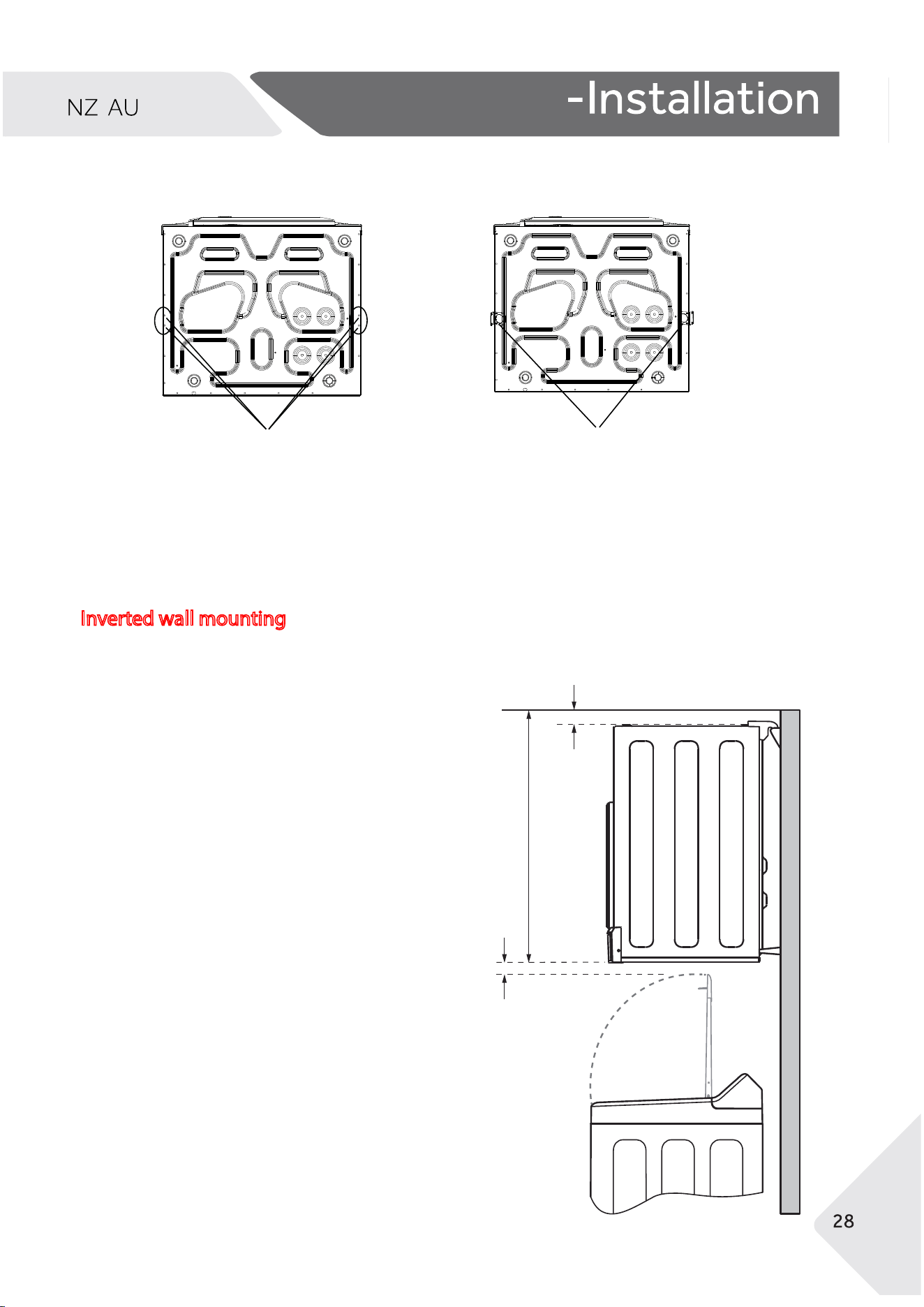
Min. 50mm clearance
Min. 880mm
Min. 50mm clearance
1
4 Screws Stacking bracket
2
Install your dryer with stacking bracket on the top of the front load washing machine.
Drill two holes on both sides of top panel of washing machine with 2.9mm diameter drill.
Detailed drill position as shown on the stacking bracket. Only use the screws supplied in
the stacking bracket. Fix the stacking bracket on the top panel of washing machine.
Remove 4 screws at two sides of bottom panel, then install the stacking bracket.
Inverted wall mounting
Your dryer has been designed to be inverted and mounted on the wall above a
washer or tub. A wall mounting kit must be used. Inverting allows access to the
dry control panel.
Tools and parts required:
■
Drill and 3mm bit
■
Phillips head screwdriver
Wall mounting kit includes:
■
2
x
Plastic spacers
■
2
x
Wall hanging brackets
■
2
x
Hanging hooks
■
4
x
Wood screws
■
6
x
Screws for hanging hooks
and plastic spacers
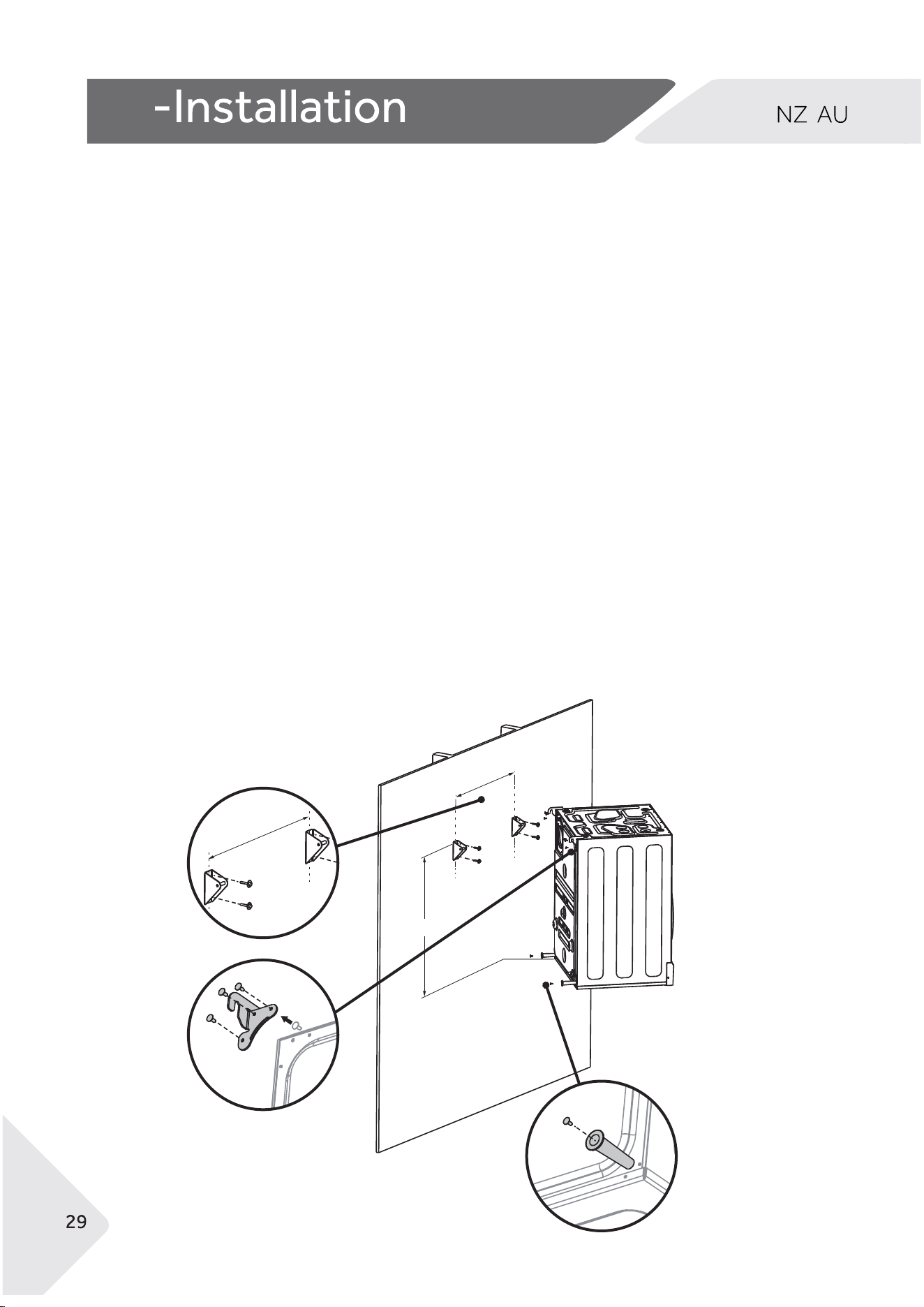
12
Mounting dryer on wall
1 Determine the position of the dryer on the wall and mark the bracket position. A
minimum of 50mm is needed between the top of the dryer and the ceiling for ease
of installation. If mounting above a washing machine, allow sufficient room to open
the lid of the washer.
2 Fix the wall hanging brackets to the wall securely, ie into the stud. If the studs are
too far apart, fit a timber slat to the studs and then mount the brackets to the slat. If
a slat is used install a second slat behind the spacers to ensure the dryer is
horizontal. The distance between the centre of each bracket is 555mm (A).
3 To install the hooks onto the dryer, remove one screw from each side (B), reuse
these screws with two more (each side) from the kit to fasten the hooks in place.
4 Remove plastic plugs from the back of the dryer and screw the spacers provided in
place (C).
5 With assistance, mount the dryer on the wall brackets.
6 The inverted control panel is supplied in the accessories with your dryer. Fit
inverted
control panel over the existing panel.
F
r
o
m
ce
n
tr
e
of t
o
p
hol
e
Fro
m b
o
tto
m
o
f
d
r
y
e
r
C
B
A
835mm
55
5
mm
55
5m
m
7 Adjust the display to read correctly on an inverted panel:
■Pressandholdthe‘Anti-crease’and‘Delay’buttonsforthreeseconds.
■Thedryerwillbeeptoindicateyouhavemadeacorrectselection,andthedisplaywill
change after three seconds.
■Repeatthesamestepstoreturnthepaneltothefactorysetting.
12
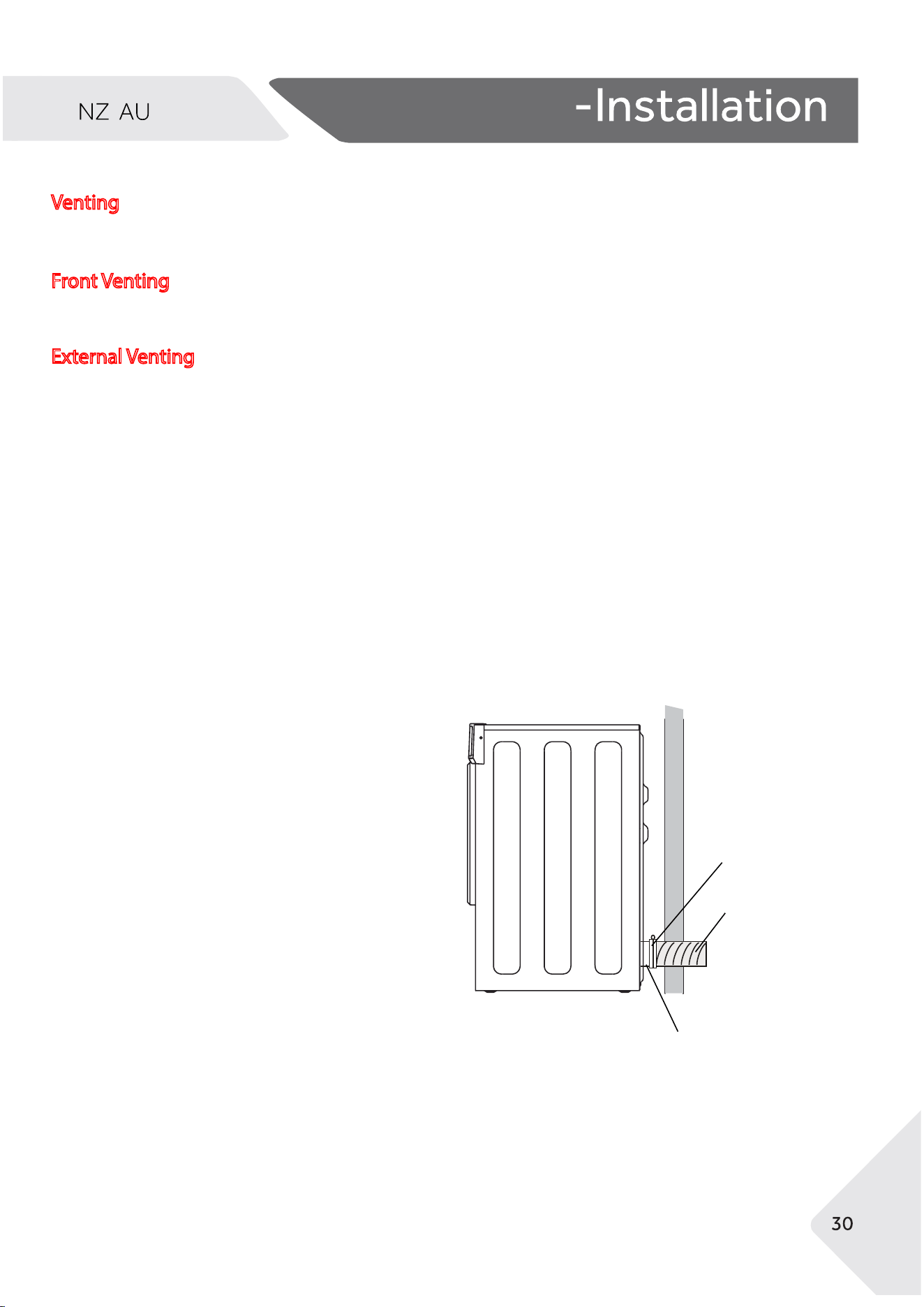
Venting- Never run the dryer unless the airow system is free from obstruction.
- Venting must comply with local by-laws and regulations
Front Venting Your dryer comes already set up for front venting. If front venting is used
there must be adequate ventilation to avoid the
buildup of moisture in the room, which can aect the performance of the dryer.
External Venting
Your dryer has been designed to be vented outside to provide the following advantages:
- Ensures optimum eciency by preventing recirculation of moist air.
- Reduces condensation on walls and ceilings.
- Reduces the chances of lint being sucked into the dryer.
- Prevents lint and other ne particles being blown into the room.
The external venting system should be:
- Made from 100mm diameter exible plastic pipe , where the vent system goes through the wall.
- Exhausted outside and not into another conned space, eg the roof cavity of a house.
- Angled to avoid condensation and rain water running back into the dryer.
- The vent system should be a maximum of two meters with no more that three 90deg bends.
Connect the narrow end of the connector to the dryer duct pipe mouth at the back of
the dryer. Then connect the exible hose to the wide end of the connector. Use the
clip to fasten connection point between the exible hose and connector(fasten clip
with a screwdriver). Extend the exible hose through the duct hole, make sure the
exible hose is not twised to allow the air to be vented outside.
Hose connector
Flexible hose
Flexible hose clip
Tools and parts required:
■
Slotted screwdriver
kit part includes:
■
Hose connector
■
Flexible hose
■
Flexible hose clip
Before a rear venting option is installed the dryer must be changed from the front venting factory
setup. Remove the outlet grille from the front left-hand side and replace with the outlet cover
from the rear left-hand side. These covers should be gently pried at the sides to prevent damage.
13
Customer Care
We recommend our Haier Customer Service and the use of original spare parts.
If you have a problem with your appliance, please rst check the section TROUBLESHOOTING
If you cannot nd a solution there please contact.
- Your local dealer, or
- The Service and Support area at www.haier.com where you can nd telephone numbers,
FAQs and where you can activate a service claim.
Before contacting our service team, ensure that you have the following information available.
The information can be found in the rating plate.
Model No. ______________
Serial No. ______________
Also check the Warranty Card supplied with the product in case of warranty.
For General business enquiries and for more information, please refer to www.haier.com
0180500689C
HDV70AWW1
HDV60AWW1