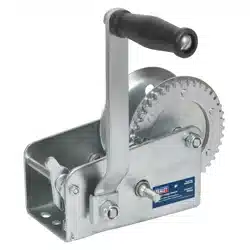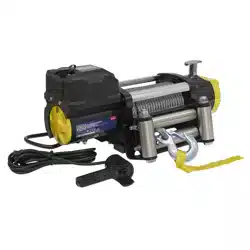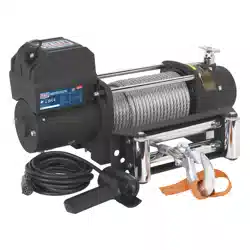
SELF RECOVERY WINCH 2720kg, 4300kg, 5400kg LINE
PULL 12V
MODEL NO: SRW2720(KG), SRW4300(KG), SRW5450(KG)
Thank you for purchasing a Sealey product. Manufactured to a high standard, this product will, if used according to these
instructions, and properly maintained, give you years of trouble free performance.
IMPORTANT: PLEASE READ THESE INSTRUCTIONS CAREFULLY. NOTE THE SAFE OPERATIONAL REQUIREMENTS, WARNINGS & CAUTIONS. USE
THE PRODUCT CORRECTLY AND WITH CARE FOR THE PURPOSE FOR WHICH IT IS INTENDED. FAILURE TO DO SO MAY CAUSE DAMAGE AND/OR
PERSONAL INJURY AND WILL INVALIDATE THE WARRANTY. KEEP THESE INSTRUCTIONS SAFE FOR FUTURE USE.
1. SaFETY
WaRNING! Winching a vehicle, especially with a steel cable, has an inherent danger element to it, and there is always some risk
of injury. Proper training is highly advised and constant risk assessment needs to be undertaken.
WaRNING! Never connect DC powered winches to AC current. Motor damage or fatal shock may occur.
8 DO NOT lift or hoist loads over people. DO NOT lift loads vertically. The winch was designed for ground use only.
8 DO NOT overload. Be sure all equipment used meets the winch’s maximum line pull rating.
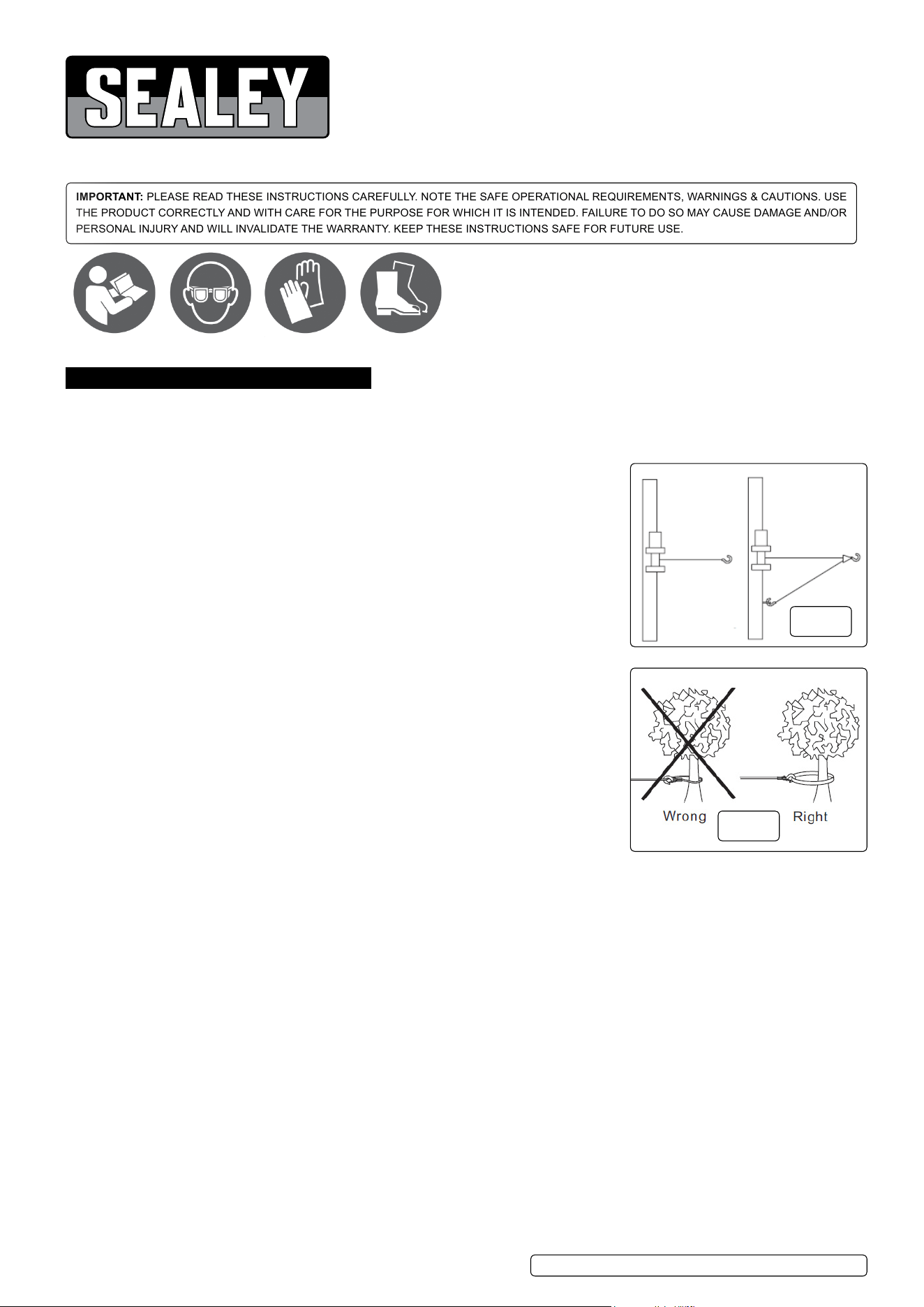
We recommend using the pulley block option to double line the wire rope (see fig.1). Double
line with a pulley block to reduce the load on the winch, wire rope and battery.
When double lining, pulley blocks should be rated to a minimum of two times the winch’s line
pull rating. The cable may break before the winch stalls. For heavy loads use a pulley block
to reduce the load on the cable.
8 DO NOT immerse the winch in water. Doing so will immediately effect load holding and
brake efficiency and in time will damage the motor and cause accelerated gearbox wear
invalidating the warranty.
8 DO NOT operate the winch with less than 5 turns of wire rope around the winch drum, since
the wire rope end may not withstand the full load.
8 DO NOT let the wire rope to build up on one end of the drum, this will break the tie bars from
the castings, will damage the wire rope, and invalidate the warranty.
WaRNING! The winch’s line pull capacity is the maximum line pull of the first layer. Never
operate a winch by pulling a load that is at or over the rated capacity.
8 DO NOT hook the wire cable back to itself because it could damage the wire rope. Use a
Self Recovery Kit, (see fig.2) contact your stockist for full details.
9 Make sure the winch is securely mounted on the vehicle or bracket before operation.
9 Before moving a load inspect the wire rope. Prevent kinks and uneven wire layering before
they occur. Loosened wire rope must be properly tensioned under a load of about 100lbs
(45.4kg).
9 Position a Wire Rope Dampener (available as an optional extra) over the wire rope near
the hook end when pulling, as this will slow the snap back of a broken wire rope and
reduce/prevent serious injury and/or damage.
8 DO NOT move your vehicle to assist the winch in pulling the load. It will be easy to overload,
and cause wire rope damage.
8 DO NOT enter the danger zone. Keep away from the danger zone during operation. The danger zone is the area of the winch drum, the
fairlead (if fitted), the wire rope, the pulley block (if used), and the hook.
8 DO NOT approach or span the wire rope when the winch is under load.
9 When using the winch to move a load, place the vehicle transmission in neutral, apply the handbrake and chock all wheels. The vehicle
engine should be running during winch operation so that the battery is fully charged. Never use the winch if there is any doubt as to the
efficiency of the battery.
8 DO NOT disconnect the free spool clutch when there is load on the winch.
9 After operation release the load immediately. DO NOT allow the cable to tighten anymore.
9 Inspect winch, wire rope, hooks and other accessories frequently. A mashed, pinched, kinked or frayed wire rope with broken strands
should be replaced at once because a damaged wire rope has a reduced load carrying capability and could break easily.
9 Keep tension on the cable to re-spool the cable on the drum tightly after operating. It must be re-spooled with a load of about 45.4kg
(100lbs).
8 DO NOT allow the wire rope to slide through your hands, use heavy rigger gloves when handling wire rope.
9 Disconnect the clutch first then use the hand saver strap to hitch the hook and pull the wire rope. DO NOT pull the wire rope using your
finger and do not put your finger through the hook.
8 DO NOT operate the winch when under the influence of drugs, alcohol or medication.
8 If there is something wrong with the winch, cut the power at once, then check it carefully. If required, return it to your dealer for servicing.
9 Wear eye protection, insulated work clothes, non-slip shoes, keep hair tied up and wear rigger gloves. Remove all jewellery.
8 DO NOT machine or alter the winch in any way.
9 Take good care of the winch when not in use.
WaRNING! Unplug the remote control before working in or around the fairlead or the wire rope drum, (the danger zone). Never tuck it
under your arm or allow anyone to hold it when you are in the danger zone, so as to avoid the hand control being accidentally activated
WaRNING! DO NOT use the winch to hold loads in place. Use other means of holding loads such as tie down straps.
SRW2720 SRW4300 SRW5450 Issue 3 (HF) 06/04/18
Original Language Version
© Jack Sealey Limited
Refer to
instructions
Wear eye
protection
Wear protective
gloves
Wear safety
footwear
fig.1
fig.2
WaRNING! If you are within four feet of the winch DO NOT hold the wire rope and remote control at the same time.
WaRNING! Mount the winch to a firm base. Be sure that your structural support is strong enough to withstand the weight and rated
pulling strength of the winch.
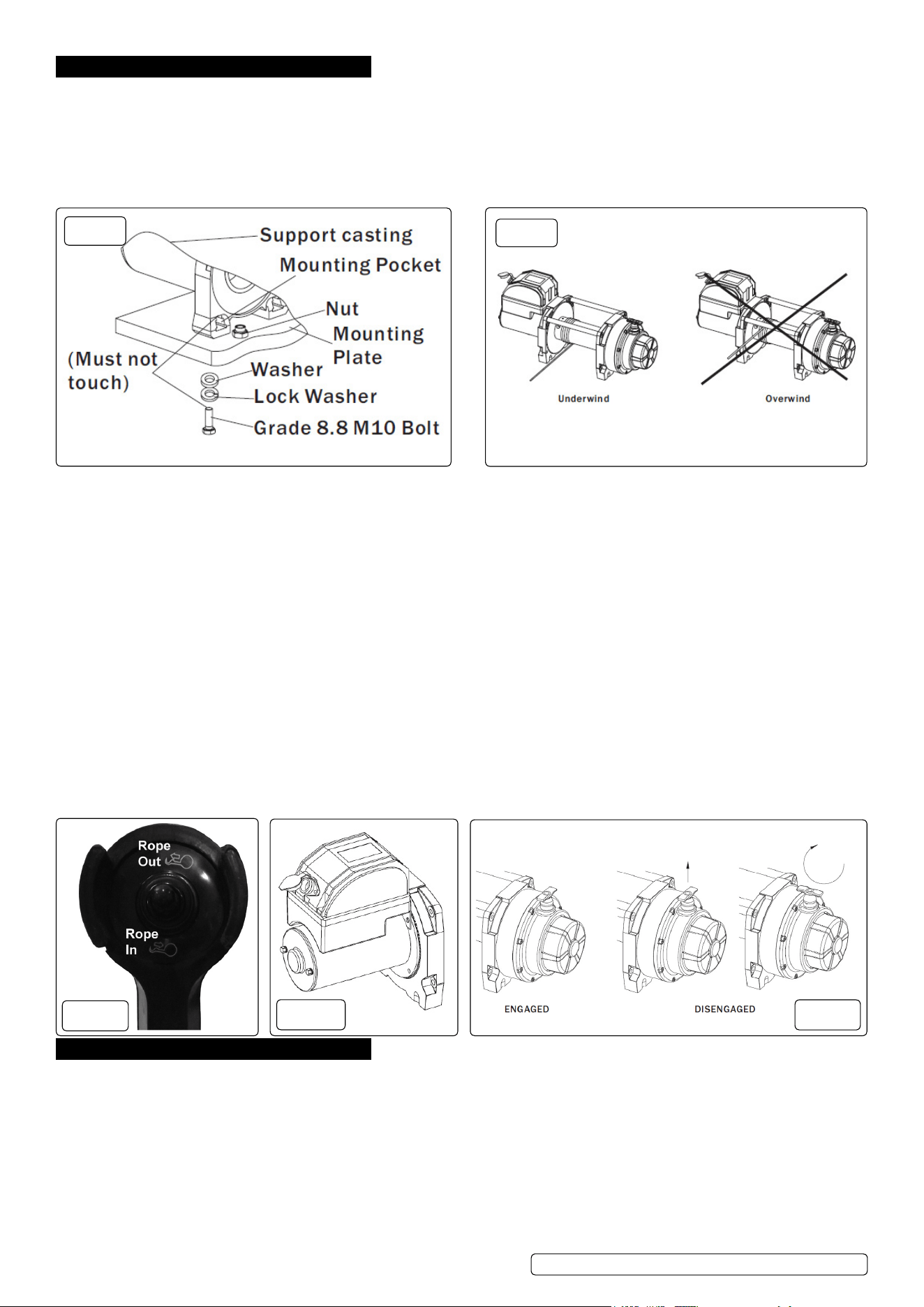
NOTE: Whilst mounting orientation is at your discretion, the winch is to be operated with the wire rope in an under wound orientation
on the drum. The winch is designed to rope out and rope in, in one direction. DO NOT attempt to reverse the operation of the winch.
WaRNING! DO NOT weld or machine any part of the winch, this will weaken it and void the warranty.
WaRNING! Batteries contain explosive gases. The following precautions should be taken before making battery connections: wear
eye protection; remove all jewellery; follow the wiring diagram included in the installation instructions; keep spectators away. In the
event of a battery explosion, acid should be washed away as soon as possible, seek medical help immediately.
WaRNING! Use of any other accessories or attachments other than those recommended in this instruction manual may result in
personal injury or property damage and could void the warranty.
NOTE: The safety precautions and instructions discussed in this manual can’t cover all possible conditions and situations that may
occur. It must be understood by the operator that common sense and caution are factors which cannot be built into this product but
must be applied by the operator.
2. INTRODUCTION
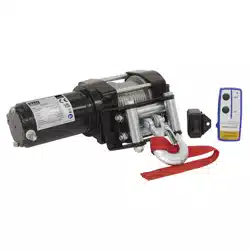
The Self Recovery Winch range is designed and built with the toughest jobs in mind. Three models ranging from 2750kg line pull to 5450kg
line pull. All have 3 stage planetary gears using over sized components for greater torque plus automatic ‘in drum’ brake. All models feature
weather sealed solenoids and ergonomic ‘lift and turn’ free spool clutches. Supplied with units: wire rope with latched hook, 4 way roller
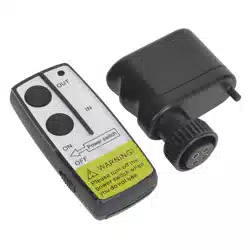
fairlead with mounting bracket and plug-in hand held controller included as standard.
3. SPECIFICaTION
Model No: .................SRW2720 .................SRW4300 .................SRW5450
Voltage:...................12V ......................12V ......................12V
Line Pull*: .................2720kg ...................4300kg ...................5450kg
Motor Power: ..............1.7kW ....................1.9kW ....................2kW
Gear Ratio: ................196.6:1 ...................196.6:1 ...................196.6:1
Line Speed*:
No Load:..................3.6mtr/min .................4.3mtr/min ................4.3mtr/min
At Maximum Load: . . . . . . . . . . 1.7mtr/min .................1.6mtr/min ................0.6mtr/min
Current Draw:
No Load:..................90A ......................90A ......................90A
At Maximum Load: . . . . . . . . . . 350A .....................420A .....................460A
Cable Ø: ..................7.2mm ....................9.2mm ...................9.2mm
Cable Length: ..............32mtr .....................26mtr ....................26mtr
Winch Weight: .............35.6kg ....................41.8kg....................42.0kg
Gross Weight:..............42.5kg ....................49.5kg....................49.5kg
Replacement Rope Wire: .....SRW2720.WR..............SRW5450.WR .............SRW5450.WR
Dyeena Rope:..............SRW2720.DR ..............SRW5450.DR..............SRW5450.DR
Aluminium Hawse: See catalogue for size options to suit your requirements.
PERFORMaNCE SPECIFICaTIONS
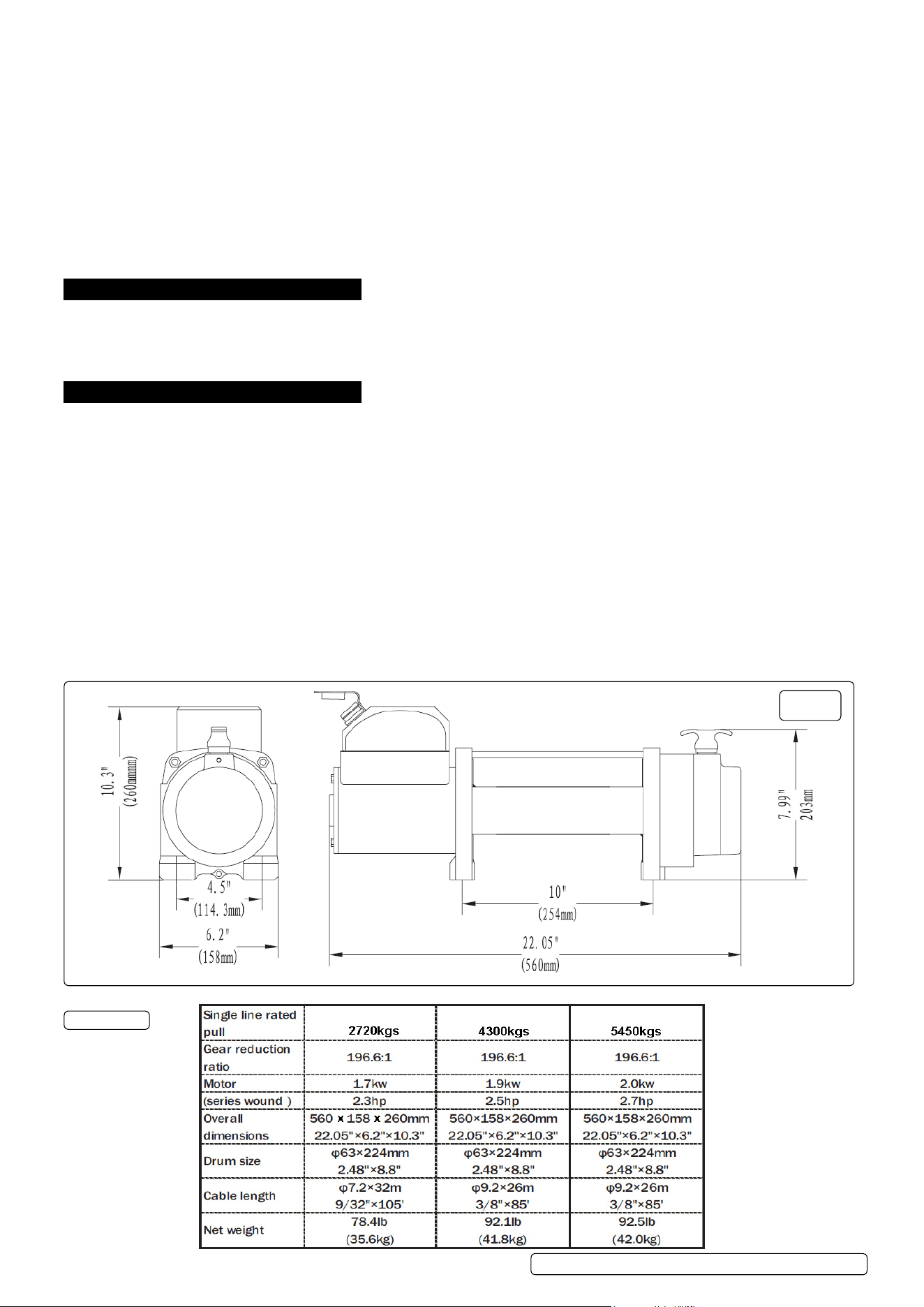
fig.3
CHaRT 1.
SRW2720 SRW4300 SRW5450 Issue 3 (HF) 06/04/18
Original Language Version
© Jack Sealey Limited
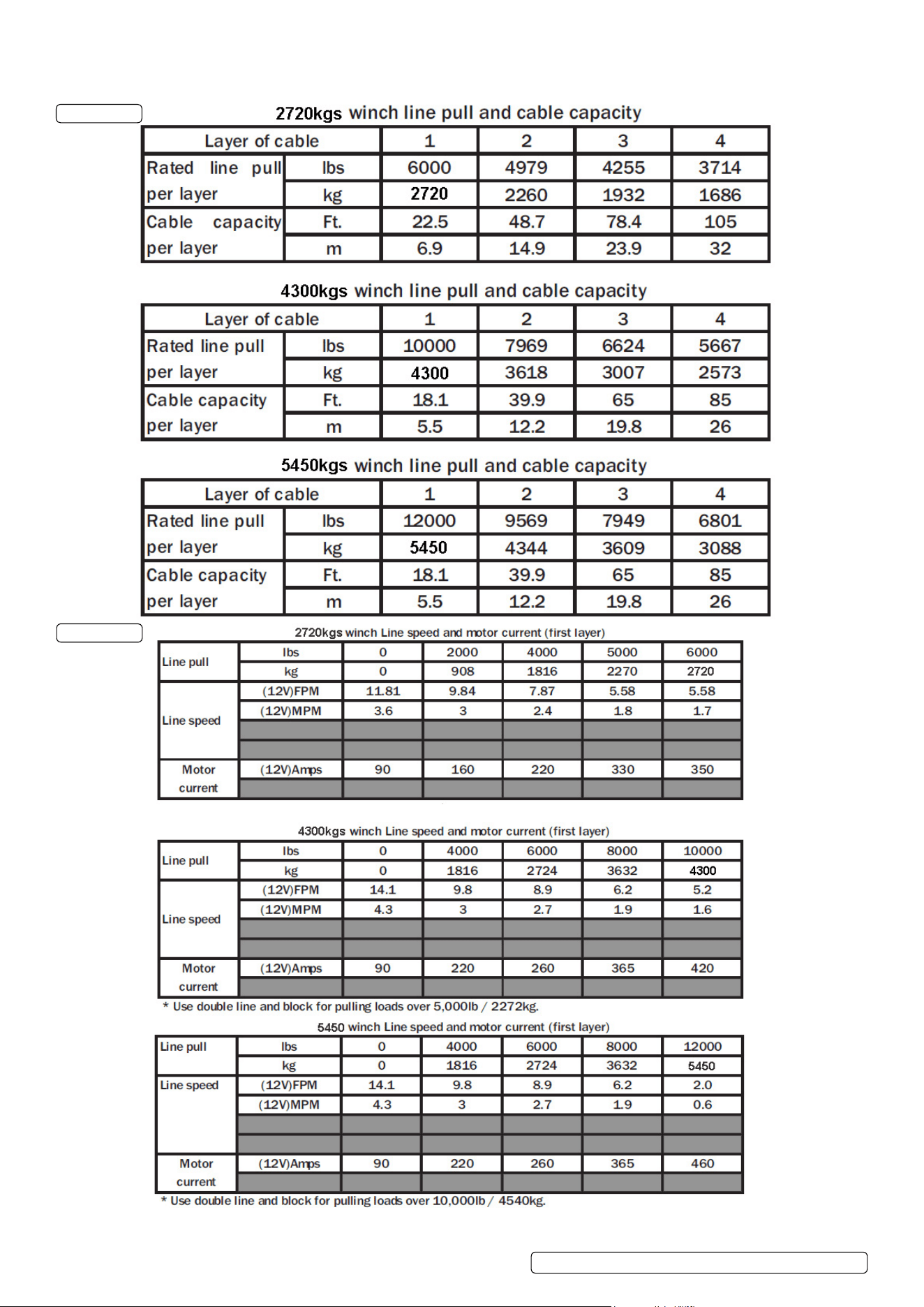
LINE PULL aND LINE SPEED vary according to how much cable is on the drum. The winch is rated at the first layer of cable on the drum. The
maximum line pull force will be reduced by subsequent layers of cable on the drum. Chart 2 illustrates the maximum line force at increasing
cable layers.
CHaRT 2.
CHaRT 3.
SRW2720 SRW4300 SRW5450 Issue 3 (HF) 06/04/18
Original Language Version
© Jack Sealey Limited
4. INSTaLLaTION
4.1. WINCH INSTaLLaTION
4.1.1. The winch needs to be mounted onto a steel mounting using the 4 point foot mounting system, in either a horizontal or vertical plane.
4.1.2. Thewinchneedstobemountedonaatsurfacesothatthethreesections(motor,cabledrumandgearhousing)areproperlyaligned.
4.1.3. Before installation ensure the mounting position being used is capable of withstanding the winch weight and the rated capacity.
4.1.4. Usethedimensionsing.3tomanufactureasteelmountingplate,aminimumof6mmthick.Fastenersshouldbehightensilesteel,
grade 5 or better. A poorly designed mount may invalidate the warranty.
4.1.5. Thewinchshouldbesecuredtothemountingwithgrade8.8M12boltsandspringwashers,seeg.3.
4.2. ELECTRICaL INFORMaTION
WaRNING! This winch works on standard automotive 12V DC only, never connect this winch to a 230V mains; solenoid burnout or fatal
shock may occur.
For normal self-recovery work, your existing electrical system is adequate. A fully charged battery and proper connections are essential.
Run the vehicle engine during winch operation to keep the battery charged. Pay close attention to the electrical connections below,
ensure that they are made correctly.
NOTE: For best performance a battery with 440 cold cranking ampere capacity and a 60 amp alternator are the minimum
recommended power source. If the winch is in heavy use, an auxiliary battery and heavy duty alternator with isolator are recommended.
NOTE: Your battery must be kept in good condition. Make sure the battery cables are not drawn across any surfaces which could
possibly damage them. Corrosion on electrical connections will reduce performance or may cause a short circuit. Keep all connections
clean especially in the remote control switch and receptacle. In salty environments use silicon sealer to protect from corrosion.
4.3. ELECTRICaL LEaD WIRE aTTaCHMENT
4.3.1. Disconnect the vehicle battery.
4.3.2. Thebatteryleadwiresfromthewinchshouldberoutedtothevehiclebattery.Toprotectagainstabrasiontgrommetsorsleeving
where wiring may come into contact with sharp metal parts of the vehicle. Connect the red lead to the positive (+) terminal and the
black lead to the negative (-) terminal of the battery.
4.3.3. Reconnectthebattery,positiveterminalrst,thenthenegative.Rotatetheclutchlevertothe“disengagedposition”.Pullseveral
metresofcableothedrum.Returntheclutchleverbacktothe“engagedposition”.Plugintheremoteswitchassembly,refertog.6.
Switchthehandcontrolto“ropeout”position.Pullthetriggermomentarilytocheckcabledrumrotationdirection.Ifthedrumrotatesin
the wrong direction, recheck the wiring.
WaRNING! Double check the wiring. Incorrect wiring could result in motor burn out and/or personal injury.
5. OPERaTING INSTRUCTIONS
WaRNING! The switch assembly must be kept free of dirt and moisture to ensure safe operation.
5.1. The hand held switch activates power to the winch motor. To connect the remote control remove the waterproof plug cover and insert
thecontrolcableplugandturnthesecuringringclockwisetolockseeg.7.Theplugonthecontrolcordiskeyedandwillonly
tthesocketoneway.Theswitchtriggerreturnstothe“O”positionwhenreleased.Tochangedirection,presstherockerintheother
direction,seeg.7.
5.2. PULLING OUT THE WIRE ROPE
The wire rope has been installed on the winch under minimal load at the factory. It must be re-spooled onto the drum so the outer
layers will not draw down into the inner layers, causing damage to the rope.
5.2.1. Pullandrotatetheclutchlevertothe,“disengaged”positionasshowning.8.Ifthereisaloadonthewirerope,theclutchlever
may not turn easily. DO NOT force the clutch lever. Release the tension on the wire rope by paying out some of the wire rope, then try
releasing the clutch.
fig.5
fig.4
fig.7
fig.8
fig.6
SRW2720 SRW4300 SRW5450 Issue 3 (HF) 06/04/18
Original Language Version
© Jack Sealey Limited
Sealey Group, Kempson Way, Suffolk Business Park, Bury St Edmunds, Suffolk. IP32 7aR
01284 757500 01284 703534 sales@sealey.co.uk www.sealey.co.uk
ENVIRONMENT PROTECTION
Recycle unwanted materials instead of disposing of them as waste. All tools, accessories and packaging should be sorted, taken to
a recycling centre and disposed of in a manner which is compatible with the environment. When the product becomes completely
unserviceable and requires disposal, drain any fluids (if applicable) into approved containers and dispose of the product and fluids
according to local regulations.
WEEE REGULaTIONS
Dispose of this product at the end of its working life in compliance with the EU Directive on Waste Electrical and Electronic Equipment
(WEEE). When the product is no longer required, it must be disposed of in an environmentally protective way. Contact your local solid
waste authority for recycling information.
Note: It is our policy to continually improve products and as such we reserve the right to alter data, specifications and component parts without prior
notice.
Important: No Liability is accepted for incorrect use of this product.
Warranty: Guarantee is 12 months from purchase date, proof of which is required for any claim.
5.2.2. Pull out the wire rope and secure it to an anchor or a load.
5.2.3. Checkthatthereareatleastveturnsofwireropeleftonthedrum.
5.2.4. Re-engagethedrumbyrotatingtheclutchlevertothe“engaged”position,seeg.8.
WaRNING! The lever must be in the engaged position and locked before winching.
5.2.5. Your winch incorporates a proportional friction-type brake. After winching in a load, this mechanism holds the load, up to the rated
capacity of the winch. While powering out the load, the winch controls the rate of speed by applying the brake in proportion to the
amount of load on the wire rope. This results in heavier loads powering-out more slowly than lighter loads. Similar to the friction-type
brakes in your car which can generate heat if used for a long time, the winch brake can generate heat if used to power-out a load
for a long period of time. To ensure optimum winch performance, always limit powering-out a load to one minute and allow the brake
tocoolforfteenminutesbeforecontinuingtowinch.Undernormalusethebrakemechanismshouldnotrequireanyadjustment.
Should the brake fail to hold a load or maintain a constant rate of speed during a powering-out operation, the brake pad may be worn
and require replacement.
5.2.6. Keep a tightly wound wire rope drum. DO NOT allow the windings on the drum to become loosely wound. A loosely wound drum allows
wire rope under load to work its way down into the layers of wire rope on the drum. When this occurs, wire rope may become wedged
within the body of the windings causing damage to the wire rope. To prevent this keep the wire rope tightly and evenly wound on the
drum at all times. Rewind the rope under tension after each use. One method is to attach the hook to a stationary object at the top of a
small hill or incline and winch your vehicle up the incline.
5.2.7. DO NOT allow the motor to overheat. The winch is designed for intermittent use only. During long or heavy pulls the motor will get hot,
with its internal parts hotter than the case. To check motor temperature, stop winching and carefully touch the end of the motor. If
uncomfortably warm, allow the motor to cool before continuing. Keep engine running to recharge battery during this break.
5.2.8. The pull required to start a load moving is often much greater than the pull to keep it moving. Avoid stopping and starting during a pull
except when required by motor temperature.
5.2.9. Prevent kinks before they occur, by keeping an even tension on the cable when paying in, (refer to 5.2.6).
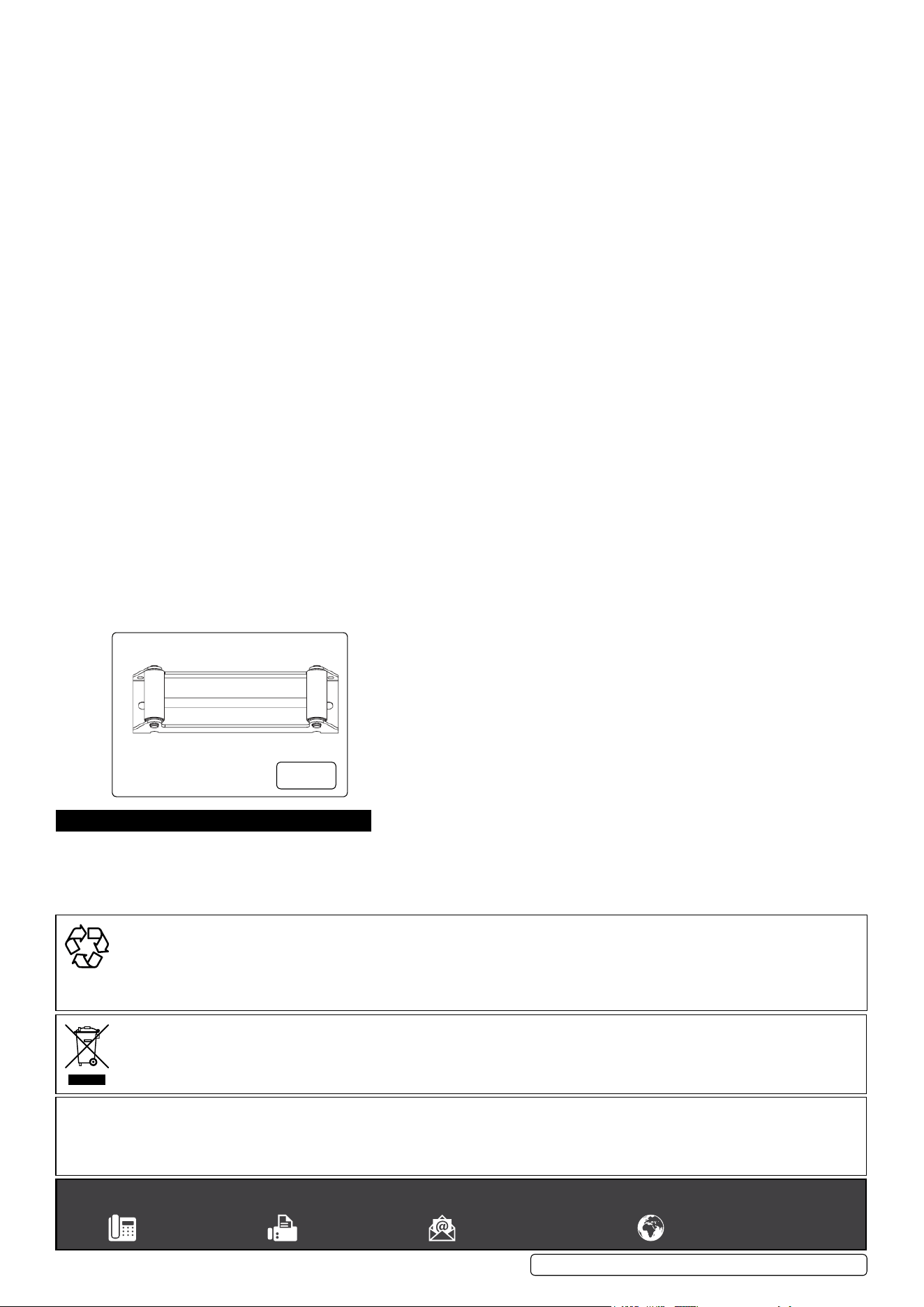
5.2.10. Equipping the winch with a roller fairlead (supplied) will substantially reduce wear on the wire rope during angle pulls, because rollers
eliminateheavyrubbingandabrasiontothewirerope,seeg.9.
NOTE: Never winch your vehicle in gear or in park, which would damage your vehicle’s transmission.
8 Never wrap the wire rope around an object and hook the cable back onto itself. This can cause damage to the object being pulled and
kink or fray the wire rope.
9 Keep hands, clothing, hair and jewellery clear of the drum and cable when winching.
8 Never use the winch if the cable is frayed, kinked or damaged.
▲ DaNGER Never allow anyone to stand near the cable, or in line with the cable or behind the winch while it is under power. If the cable
should slip or break it can suddenly whip back towards the winch, causing great danger for anyone in the area. Always stand well to
the side while winding.
8 DO NOT leave the switch plugged in when the winch is not in use.
9 CHECK THE WINCH THOROUGHLY aND CaREFULLY BEFORE OPERaTING!
6. MaINTENaNCE
6.1. It is strongly recommended that the winch is used regularly (once a month). Simply power out 15mtr of cable, free spool 5mtr then
power back in. This will keep all the components in good working condition so that the winch can be relied on when needed.
fig.9
SRW2720 SRW4300 SRW5450 Issue 3 (HF) 06/04/18
Original Language Version
© Jack Sealey Limited