
© 2020 GeoVision, Inc. All rights reserved.
Under the copyright laws, this manual may not be copied, in whole or in part, without the
written consent of GeoVision.
Every effort has been made to ensure that the information in this manual is accurate.
GeoVision, Inc. makes no expressed or implied warranty of any kind and assumes no
responsibility for errors or omissions. No liability is assumed for incidental or consequential
damages arising from the use of the information or products contained herein. Features and
specifications are subject to change without notice.
GeoVision, Inc.
9F, No. 246, Sec. 1, Neihu Rd.,
Neihu District, Taipei, Taiwan
Tel: +886-2-8797-8377
Fax: +886-2-8797-8335
http://www.geovision.com.tw
Trademarks used in this manual: GeoVision, the GeoVision logo and GV series products are
trademarks of GeoVision, Inc.
September 2020
i
Preface
Welcome to the GV-IP Decoder Box Series and Display User’s Manual.
This Manual is designed for the following models:
Model
GV-IP Decoder Box Lite
GV-IP Decoder Box Plus
GV-IP Decoder Box Ultra
GV-Pad Mini
GV-IP Display 101
ii
Creating GV-IP Device’s Login
Credentials
When purchasing new GV-IP devices, or after resetting them, you need to create a login
username and password for these devices before they can be accessed by other software /
hardware.
1. Download and install GV-IP Device Utility from
GeoVision’s website
.
2. Once started, the utility will automatically search for GV-IP devices connected in the
same LAN.
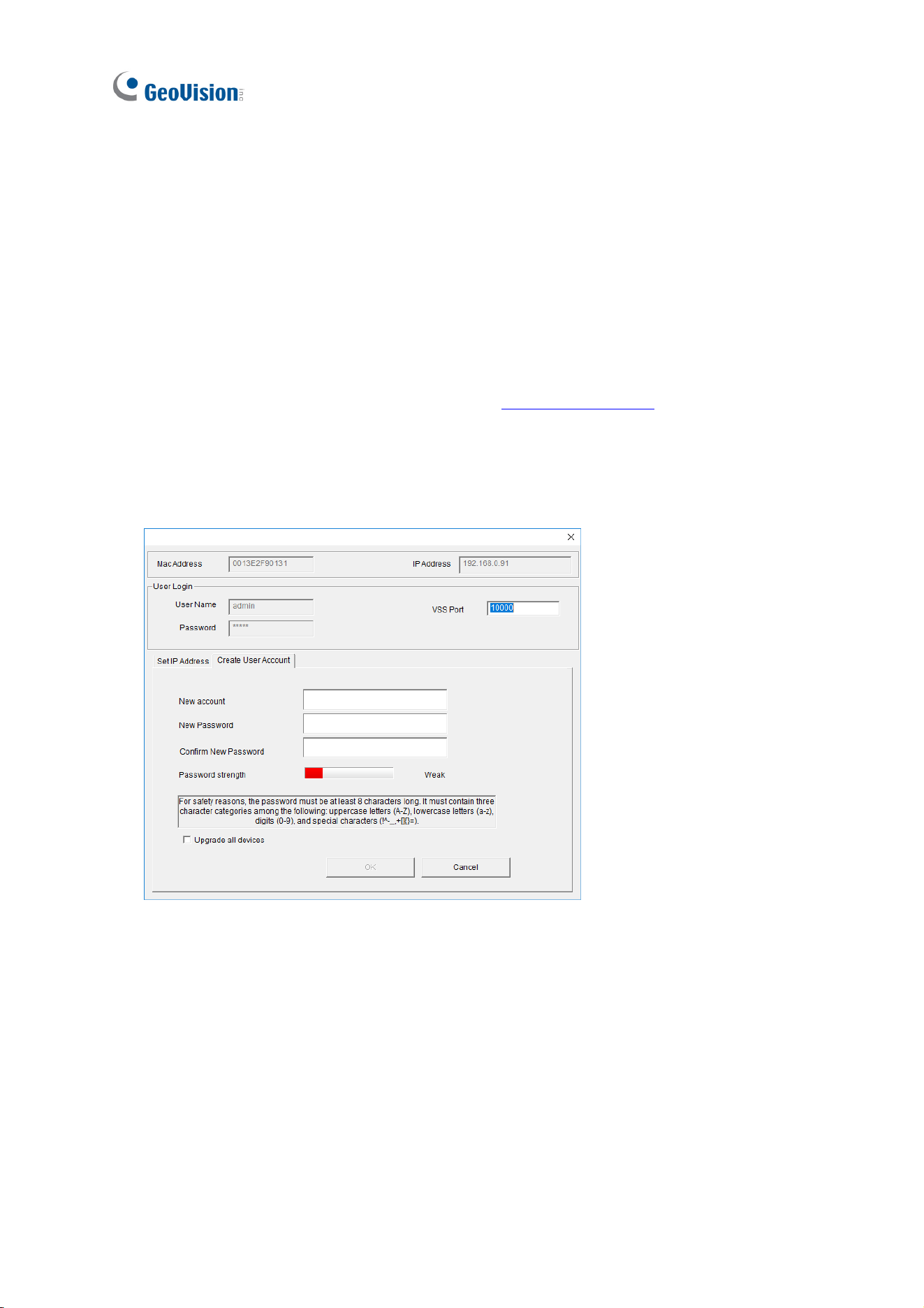
3. Double-click on a device in the list. This dialog box appears.
4. Click the Create User Account tab and type a username and password. The password
must meet the password strength required.
5. Optionally, click Upgrade all devices to apply the created username and password to all
devices which also don’t have any login credentials.

iii
Contents
Creating GV-IP Device’s Login Credentials ....................................................................... ii
Chapter 1 Introduction ..................................................................................................... 1
1.1 GV-IP Decoder Box Ultra......................................................................................... 1
1.1.1 Features ................................................................................................... 2
1.2 GV-IP Decoder Box Plus.......................................................................................... 3
1.2.1 Features ................................................................................................... 4
1.3 GV-IP Decoder Box Lite........................................................................................... 5
1.3.1 Features ................................................................................................... 6
1.4 GV-Pad Mini ............................................................................................................ 7
1.5 GV-IP Display 101 ................................................................................................... 9
1.6 Compatible Devices................................................................................................10
1.7 Packing List ............................................................................................................12
1.8 Optional Accessories ..............................................................................................13
1.9 Overview ................................................................................................................14
1.9.1 GV-IP Decoder Box Series ......................................................................14
1.9.2 GV-Pad Mini / GV-IP Display 101.............................................................18
1.9.3 GV-IR Remote Control.............................................................................20
Chapter 2 Getting Started................................................................................................22
2.1 Installing the GV-IP Decoder Box Series.................................................................22
2.2 Connecting the GV-IP Decoder Box Series.............................................................23
2.3 Connecting the GV-Pad Mini / GV-IP Display 101...................................................25
2.4 The Main Screen ....................................................................................................26
2.5 Setting Up the Network...........................................................................................27
2.6 Adding IP Devices to Live View Grid.......................................................................29
2.6.1 Adding IP Devices through Automatic Search..........................................29
2.6.2 Adding IP Devices Manually ....................................................................31
2.7 Adding Devices Using GV-IP Device Utility.............................................................32
2.7.1 Adding a GV-IP Device ............................................................................33
2.7.2 Adding a Third-party Device.....................................................................35
Chapter 3 Accessing Live View ......................................................................................37
3.1 Live View ................................................................................................................37
3.2 Capturing Snapshots ..............................................................................................41
3.3 Fisheye Dewarping.................................................................................................42
3.4 Controlling PTZ and Speed Dome Cameras with GV-Joystick V2...........................43
Chapter 4 System Settings..............................................................................................44
4.1 System ...................................................................................................................45

iv
4.2 Network ..................................................................................................................46
4.3 Date & Time............................................................................................................46
4.4 Account ..................................................................................................................47
4.5 Display ...................................................................................................................48
4.6 Camera...................................................................................................................49
Chapter 5 Advanced Applications ..................................................................................50
5.1 Upgrading the Firmware .........................................................................................50
5.1.1 Upgrading Firmware through a Storage Device .......................................50
5.1.2 Upgrading Firmware through GV-IP Device Utility....................................51
5.2 Restoring Default Settings ......................................................................................52
Chapter 6 Integration to GV-Software.............................................................................54
6.1 Connecting to GV-VMS...........................................................................................54
6.2 Connecting to GV-Control Center ...........................................................................56
Introduction
1
1
Chapter 1 Introduction
1.1 GV-IP Decoder Box Ultra
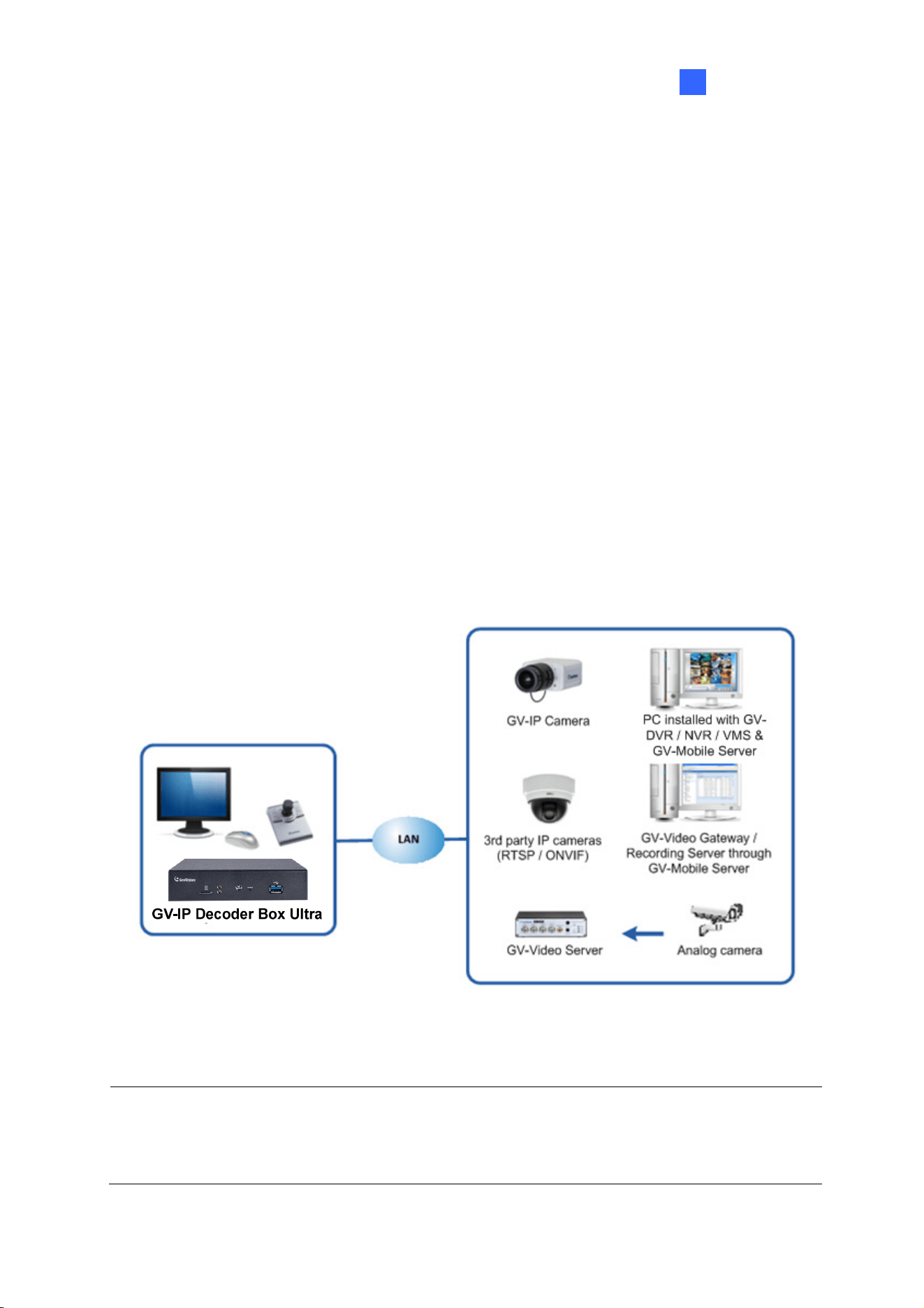
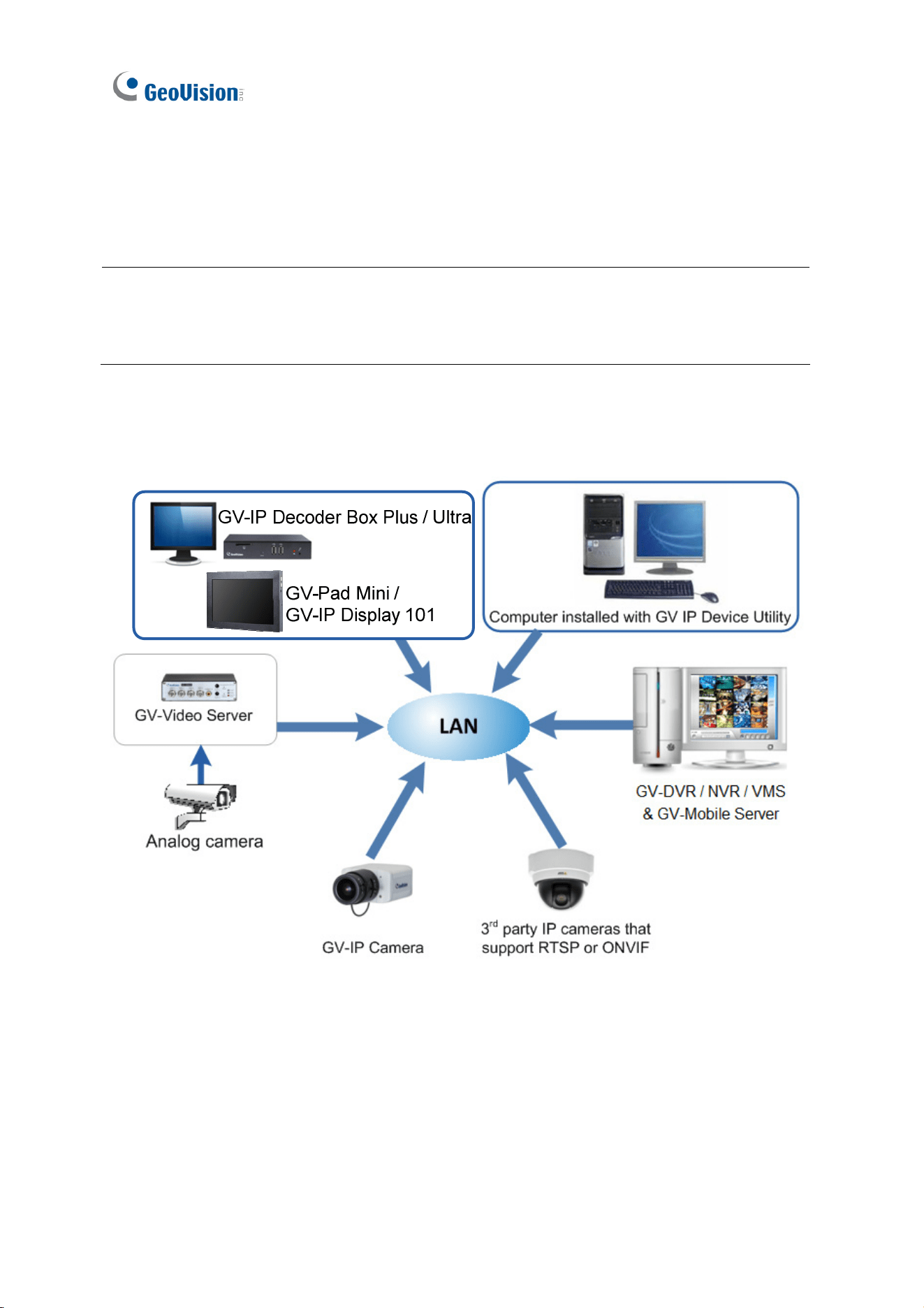
GV-IP Decoder Box Ultra is designed to decode incoming IP streams from GeoVision and
third-party IP devices. It serves as a medium for connecting the cameras and the monitor for
video display in Single, 4-Division, 6-Division, 8-Division, and 9-Division View. It supports
third-party IP cameras that adhere to RTSP or ONVIF and is able to automatically search for
ONVIF-compliant third-party IP devices under the same LAN. To be used with only a monitor,
GV-IP Decoder Box Ultra provides a cost-effective solution for video surveillance as opposed
to the traditional DVR and PC setup. The security administrator can monitor channels, take
snapshots of critical moments, and pause at a channel when events occur. GV-Joystick V2
can be installed to control GeoVision and third-party PT / PTZ / Speed Dome cameras.
The IP Devices and GV-Software that Can Connect with GV-IP Decoder Box Ultra
Figure 1-1
Note: GV-VMS V18.1 or later and GV-Control Center V3.8.0 or later support GV-IP Decoder
Box Ultra
to be assigned with the desired camera channels of GV-VMS and GV-Control
Center for remote display. See details in Chapter 6 Integration to GV-Software.

2
1.1.1 Features
Decode video streams in H.264 / H.265 codec up to 30 fps
Decode up to 8-megapixel IP cameras
Decode up to 64 IP streams
Automatically search for ONVIF IP devices
Support for third-party IP cameras that adhere to RTSP or ONVIF
Support for Single, 4-Divsion, 6-Division, 8-Division, and 9-Division View
Display of Matrix view through GV-Mobile Server
Support for 10/100 Ethernet over LAN
DC 12V / PoE (IEEE 802.3af)
HDMI video output resolutions up to 4K
Control the user interface using GV-IR Remote Control
Control PTZ and Speed Dome cameras using GV-Joystick V2
Remote firmware upgrade, IP address configuration, and addition of new channel
Micro SD card and USB drive for snapshot storage and firmware upgrade
Introduction
3
1
1.2 GV-IP Decoder Box Plus
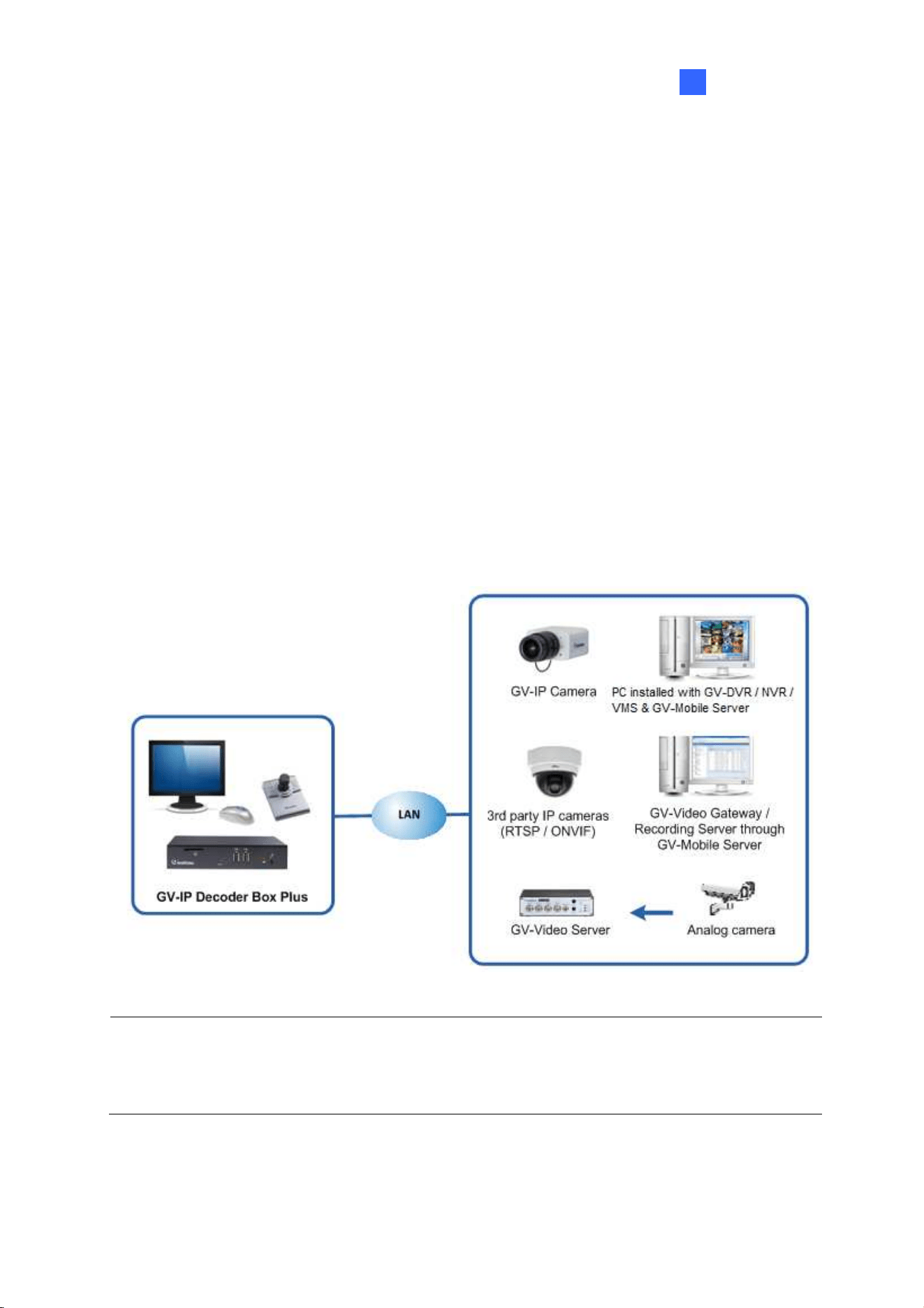
GV-IP Decoder Box Plus is designed to decode incoming IP streams from GeoVision and
third-party IP devices. It serves as a medium for connecting the cameras and the monitor for
video display in Single View, Quad View, and 9-Division View. It supports third-party IP
cameras that adhere to RTSP or ONVIF and is able to automatically search for
ONVIF-compliant third-party IP devices under the same LAN. To be used with only a monitor,
the GV-IP Decoder Box Plus provides a cost-effective solution for video surveillance as
opposed to the traditional DVR and PC setup. The security administrator can monitor
channels, take snapshots of critical moments, and pause at a channel when events occur.
GV-Joystick V2 can be installed to control GeoVision and third-party PT / PTZ / Speed Dome
cameras.
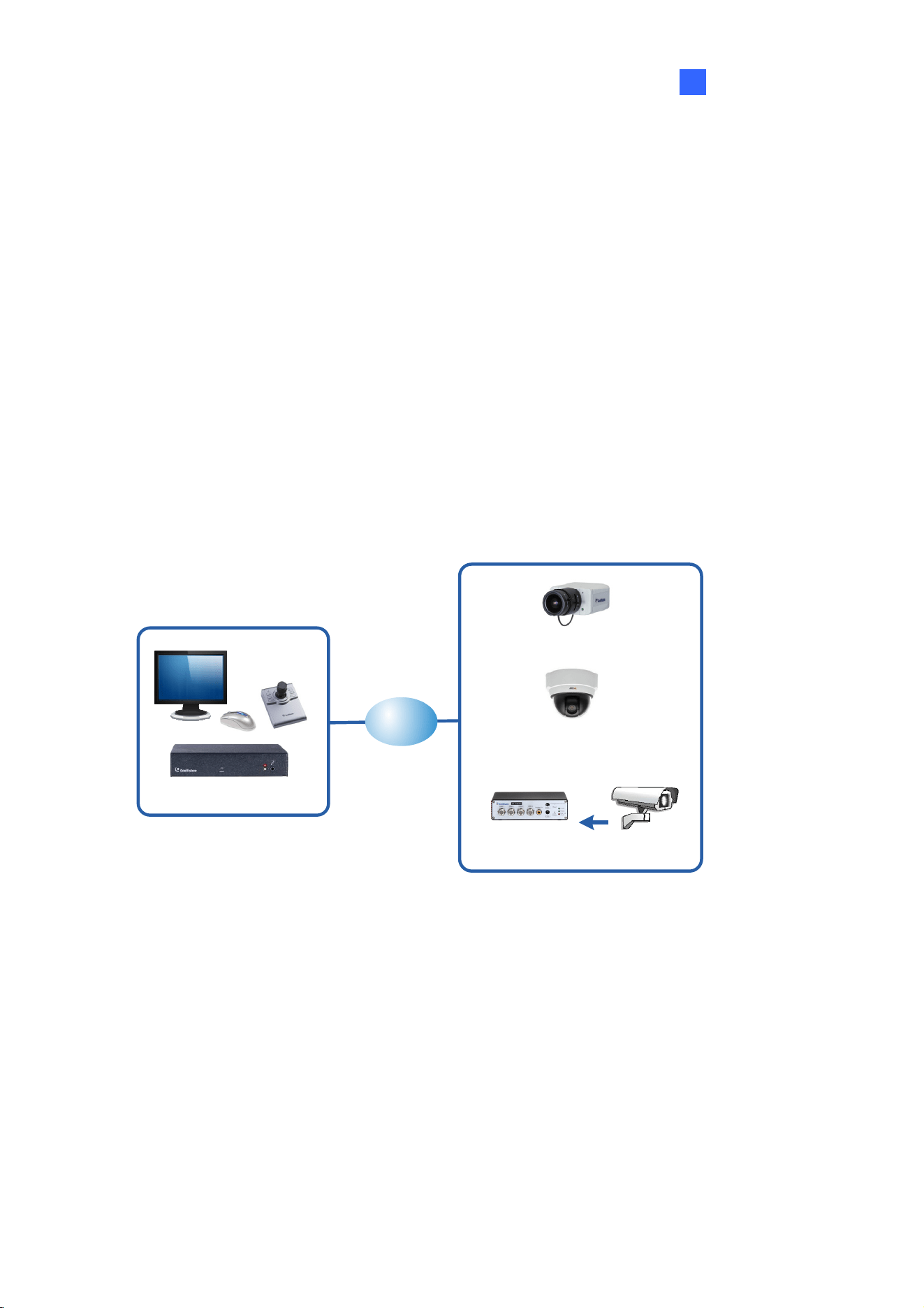
The IP Devices and GV-Software that Can Connect with GV-IP Decoder Box Plus
Figure 1-2
Note: GV-VMS V18.1 or later and GV-Control Center V3.8.0 or later support GV-IP Decoder
Box Plus
to be assigned with the desired camera channels of GV-VMS and GV-Control
Center for remote display. See details in Chapter 6 Integration to GV-Software.

4
1.2.1 Features
Decode video streams in H.264 codec at up to 30 fps
Decode up to 4-megapixel IP cameras
Decode up to 64 IP streams
Automatically search for ONVIF IP devices
Support for third-party IP cameras that adhere to RTSP or ONVIF
Support for fisheye dewarping in Single View and Grid 1 of Quad View
Single View, Quad View, and 9-Division View in sequential display
Display of Matrix view through GV-Mobile Server
Support for 10/100/1000 Ethernet over LAN
VGA or HDMI video output resolutions up to 1080p
Control PTZ and Speed Dome cameras using GV-Joystick V2
Remote firmware upgrade, IP address configuration, and addition of new channel
SD card slot and USB drive for snapshot storage and firmware upgrade
Introduction
5
1
1.3 GV-IP Decoder Box Lite
GV-IP Decoder Box Lite is designed to decode incoming IP streams from GeoVision and
third-party IP devices. It serves as a medium for connecting the cameras and the monitor for
video display in Single View and Quad View. It supports third-party IP cameras that adhere to
ONVIF and is able to automatically search for these third-party IP devices under the same
LAN. To be used with only a monitor, the GV-IP Decoder Box Lite provides a cost-effective
solution for video surveillance as opposed to the traditional DVR and PC setup. The security
administrator can monitor channels and pause at a channel when events occur. GV-Joystick
V2 can be installed to control GeoVision and third-party PT / PTZ / Speed Dome cameras.
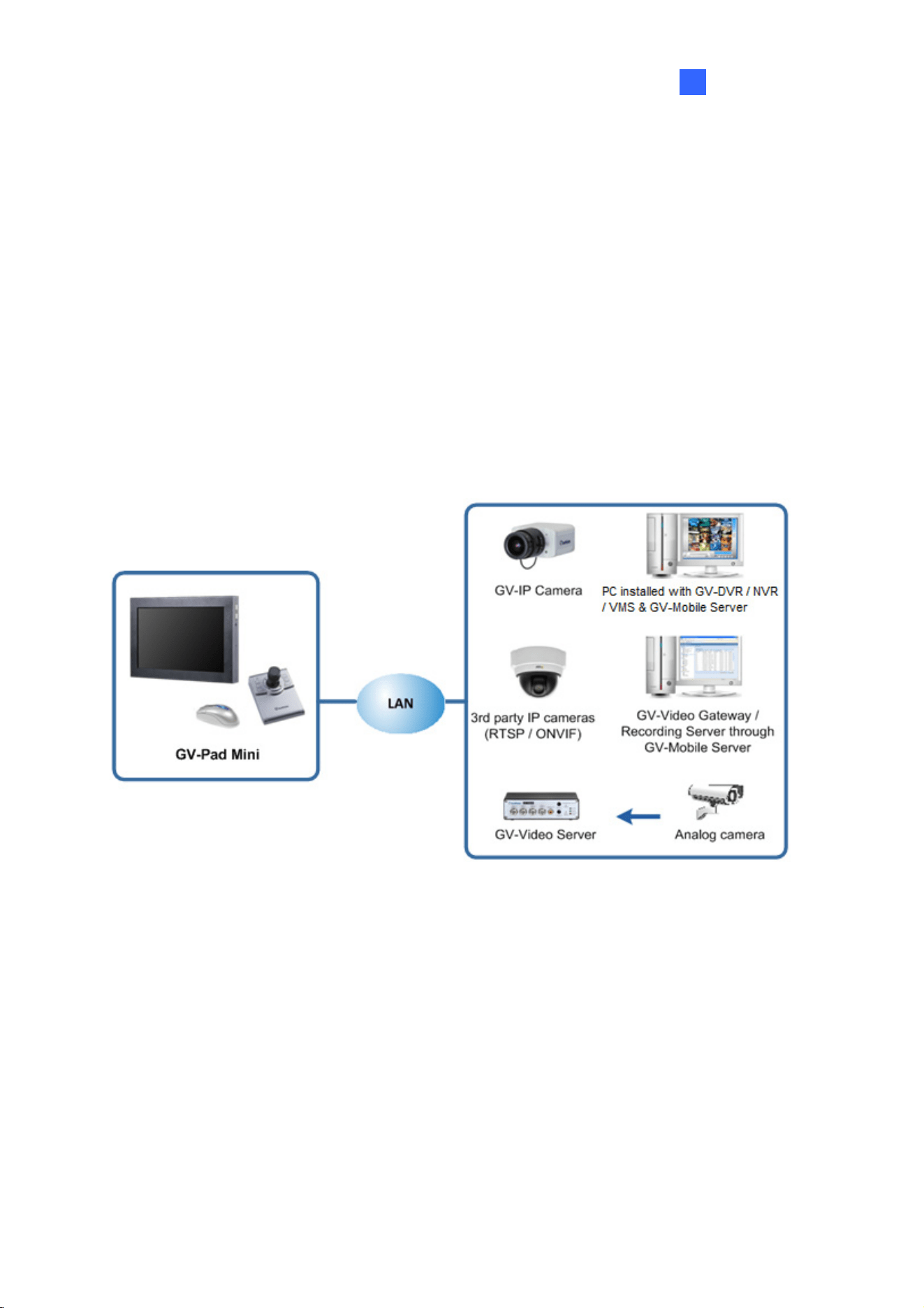
The IP Devices that Can Connect with GV-IP Decoder Box Lite
GV-IP Decoder Box Lite
GV-IP Camera
3rd party IP cameras
(ONVIF)
Analog camera
LAN
GV-Video Server
Figure 1-3

6
1.3.1 Features
Decode video streams in H.264 codec at up to 30 fps
Decode up to 2-megapixel IP cameras
Decode up to 16 IP streams
Automatically search for ONVIF IP devices
Support for third-party IP cameras that adhere to ONVIF
Single View and Quad View in sequential display
Support for 10/100/1000 Ethernet over LAN
VGA or HDMI video output resolutions up to 1080p
Control PTZ and Speed Dome cameras using GV-Joystick V2
Remote firmware upgrade, IP address configuration, and addition of new channel
USB drive for firmware upgrade
Introduction
7
1
1.4 GV-Pad Mini
The GV-Pad Mini is designed to decode and display up to 64 IP videos in Single View, Quad
View, and 9-Division View. It supports third-party IP cameras that adhere to RTSP or ONVIF
and is able to automatically search for ONVIF-compliant third-party IP devices under the
same LAN. With the built-in monitor, the GV-Pad Mini provides a cost-effective solution for
video surveillance as opposed to the traditional DVR and PC setup. The security
administrator can monitor channels, take snapshots of critical moments, and pause at a
channel when events occur. GV-Joystick V2 can be installed to control GeoVision and
third-party PT / PTZ / Speed Dome cameras.
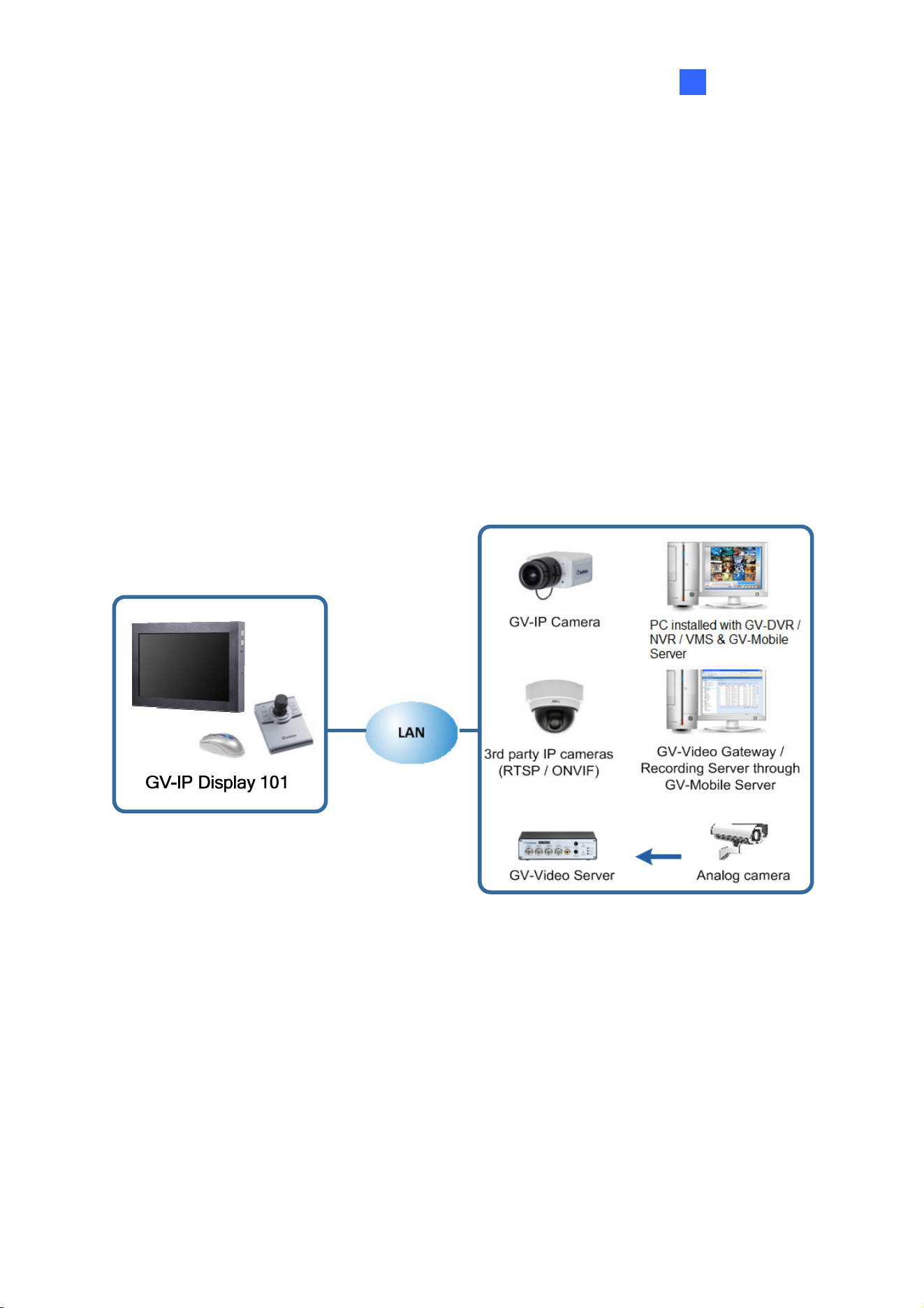
The IP Devices and GV-Software that Can Connect with GV-Pad Mini
Figure 1-4

8
1.4.1 Features
Decode video streams in H.264 codec at up to 30 fps
Decode up to 4-megapixel IP cameras
Decode up to 64 IP streams
Automatically search for ONVIF IP devices
Support for third-party IP cameras that adhere to RTSP or ONVIF
Single View, Quad View, and 9-Division View in sequential display
Display of Matrix view through GV-Mobile Server
Support for 10/100/1000 Ethernet over LAN
Control PTZ and Speed Dome cameras using GV-Joystick V2
Micro SD card slot and USB drive for snapshot storage and firmware upgrade
Introduction
9
1
1.5 GV-IP Display 101
GV-IP Display 101 is designed to connect to and decode incoming IP streams from up to 64
GeoVision and/or third-party IP devices and can display in Single, 4-Division, 6-Division,
8-Division, and 9-Division View. It supports third-party IP cameras that adhere to RTSP or
ONVIF, and can automatically search for ONVIF-compliant third-party IP devices under the
same LAN. With the built-in monitor, the GV-IP Display 101 provides a cost-effective solution
for video surveillance as opposed to the traditional DVR and PC setup. The security
administrator can monitor channels, take snapshots of critical moments, and pause a channel
when events occur. GV-Joystick V2 can be installed to control GeoVision and third-party PTZ
/ Speed Dome cameras.
The IP Devices that Can Connect with GV-IP Display 101

10
1.5.1 Features
Decode video streams in H.264 / H.265 codec at up to 30 fps
Decode up to 8-megapixel IP cameras
Decode up to 64 IP streams
Automatically search for ONVIF IP devices
Support for third-party IP cameras that adhere to RTSP or ONVIF
Support for Single, 4-Divsion, 6-Division, 8-Division, and 9-Division View
Display of Matrix view through GV-Mobile Server
Support for 10/100 Ethernet over LAN
Control PTZ and Speed Dome cameras using GV-Joystick V2
Micro SD card slot and USB drive for snapshot storage and firmware upgrade
1.6 Compatible Devices
The compatible devices for GV-IP Decoder Box Series, GV-Pad Mini, and GV-IP Display 101
vary according to different models.
GV-IP Decoder Box Ultra / GV-IP Display 101
1. GV-IP Camera and GV-Video Server using H.264 / H.265 codec
2. Third-party IP devices that support H.264 / H.265 and adhere to RTSP or ONVIF
3. GV-Mobile Server
To decode and display non-H.264 / H.265 IP channels, analog channels or GV-FER12203 /
12700, connect the devices to GV-DVR / NVR / VMS and access them through GV-Mobile
Server.
GV-IP Decoder Box Plus / GV-Pad Mini
1. GV-IP Camera and GV-Video Server using H.264 codec
2. Third-party IP devices that support H.264 and adhere to RTSP or ONVIF
3. GV-Mobile Server
To decode and display non-H.264 IP channels or analog channels, connect the devices to
GV-DVR / NVR / VMS and access them through GV-Mobile Server.

Introduction
11
1
GV-IP Decoder Box Lite
1. GV-IP Camera and GV-Video Server using H.264 codec
2. Third-party IP devices that support H.264 and adhere ONVIF
To decode and display analog channels, connect the analog cameras to GV-IP Decoder Box
Lite through GV-Video Server.
Note:
1. GV-Mobile Server is an application that encodes up to 64 video channels and
subsequently allows the GV-IP Decoder Box Ultra / Plus / GV-Pad Mini / GV-IP Display
101 to decode and display:
analog cameras and IP cameras connected to GV-DVR / NVR / VMS
IP channels connected to GV-Recording Server / GV-Video Gateway
third-party IP cameras through ONVIF
4 matrix views
For details, see
GV-Mobile Server User’s Manual
.
.
2. Upgrade your GV-IP devices to the latest firmware version if you encounter any
connection problems.

12
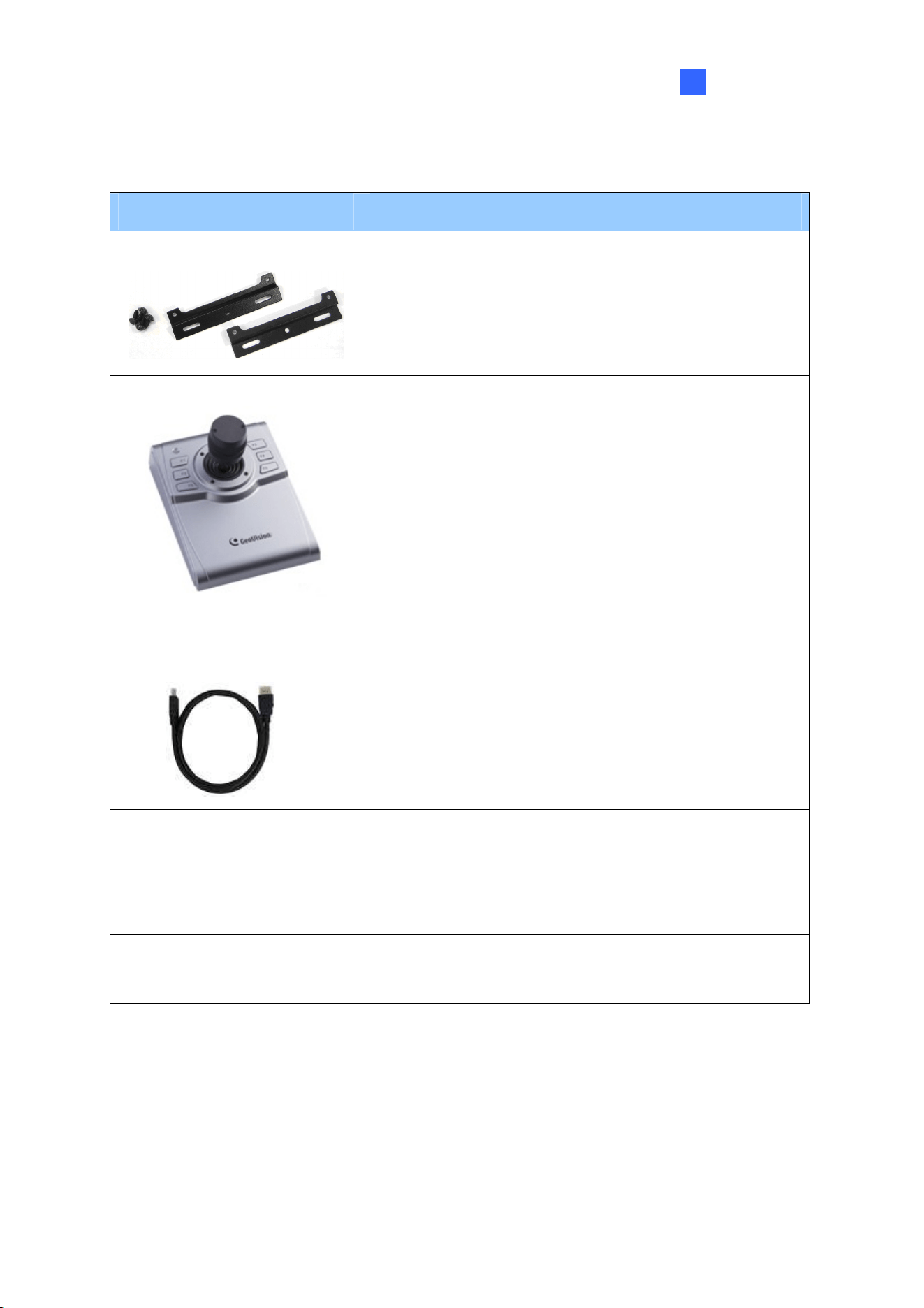
1.7 Packing List
GV-IP Decoder Box Ultra
1. GV-IP Decoder Box Ultra
2. GV-IR Remote Control
3. Dow
nload Guide
4. Warranty Card
GV-Pad Mini
1. GV-Pad Mini
2. AC/DC Adapter (12 V, 3 A, 36 W)
3. Power Cord
4. USB Mouse
5. Download Guide
6. Warranty Card
GV-IP Decoder Box Plus
1. GV-IP Decoder Box Plus
2. AC/DC Adapter (12 V, 3 A, 36 W)
3. Power Cord
4. USB Mouse
5. Download Guide
6. Warranty Card
GV-IP Display 101
1. GV-IP Display 101
2. AC/DC Adapter (12 V, 3 A, 36 W)
3. Power Cord
4. Download Guide
5. Warranty Card
GV-IP Decoder Box Lite
1. GV-IP Decoder Box Lite
2. AC/DC Adapter (12 V, 3 A, 36 W)
3. Power Cord
4. USB Mouse
5. Download Guide
6. Warranty Card
Introduction
13
1
1.8 Optional Accessories
Optional Accessory Details
The Wall Mount Kit is used to mount the GV-IP Decoder
Box Series to the wall.
Wall Mount Kit
L-type brackets x 2
Small screws x 4
GV-Joystick V2 facilitates focusing, zooming, panning,
and tilting of GeoVision and third-party PT, PTZ, and
Speed Dome cameras on GV-IP Decoder Box Series /
GV-Pad Mini / GV-IP Display 101.
GV-Joystick V2
GV-Joystick V2
USB Type A to Type B Cable
RJ-45 Cable
Download Guide
HDMI Cable
Only available for GV-IP Decoder Box Ultra. Use the
HDMI cable to connect GV-IP Decoder Box Ultra
with a HDMI monitor for high-quality display of images.
Length: 150 cm (4.92 ft)
Version: 1.4a
GV-PoE Switch
GV-PoE Switch is designed to provide power along with
network connection for IP devices. GV-PoE Switch is
available in various models with different numbers and
types of ports.
Power Adapter
For GV-IP Decoder Box Ultra, contact our sales
representatives for the countries and areas supported.
14
1.9 Overview
1.9.1 GV-IP Decoder Box Series
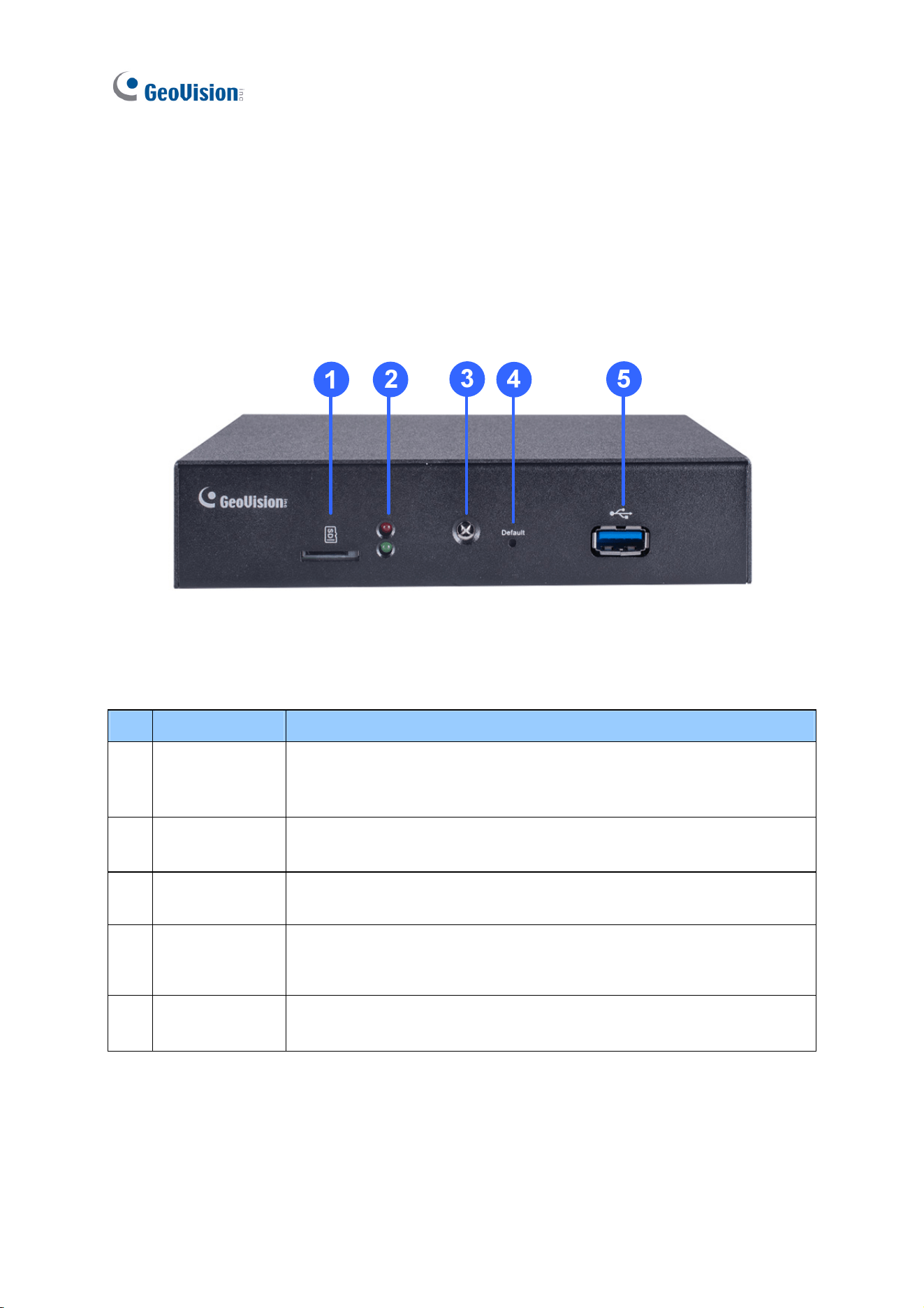
1.9.1.1 Front View
GV-IP Decoder Box Ultra
Figure 1-5
No. Name Function
1
Micro SD Card
Slot
Connect to a micro SD card for local storage of snapshots and
firmware upgrade.
2 LED Indicators
The red LED indicates the power is supplied.
The green LED indicates the system is ready for use.
3 IR sensor
Receive signal from GV-IR Remote Control for controlling the user
interface at the maximum operation distance of 7 m (22.97 ft).
4 Default
Reset the device to the default factory settings. Use a pin to press the
default button for about 10 seconds. The system will then reset and
reboot itself shortly. See 5.2 Restoring Default Settings.
5 USB 3.0 Connect to a GV-Joystick V2, USB mouse, or USB storage device
Introduction
15
1
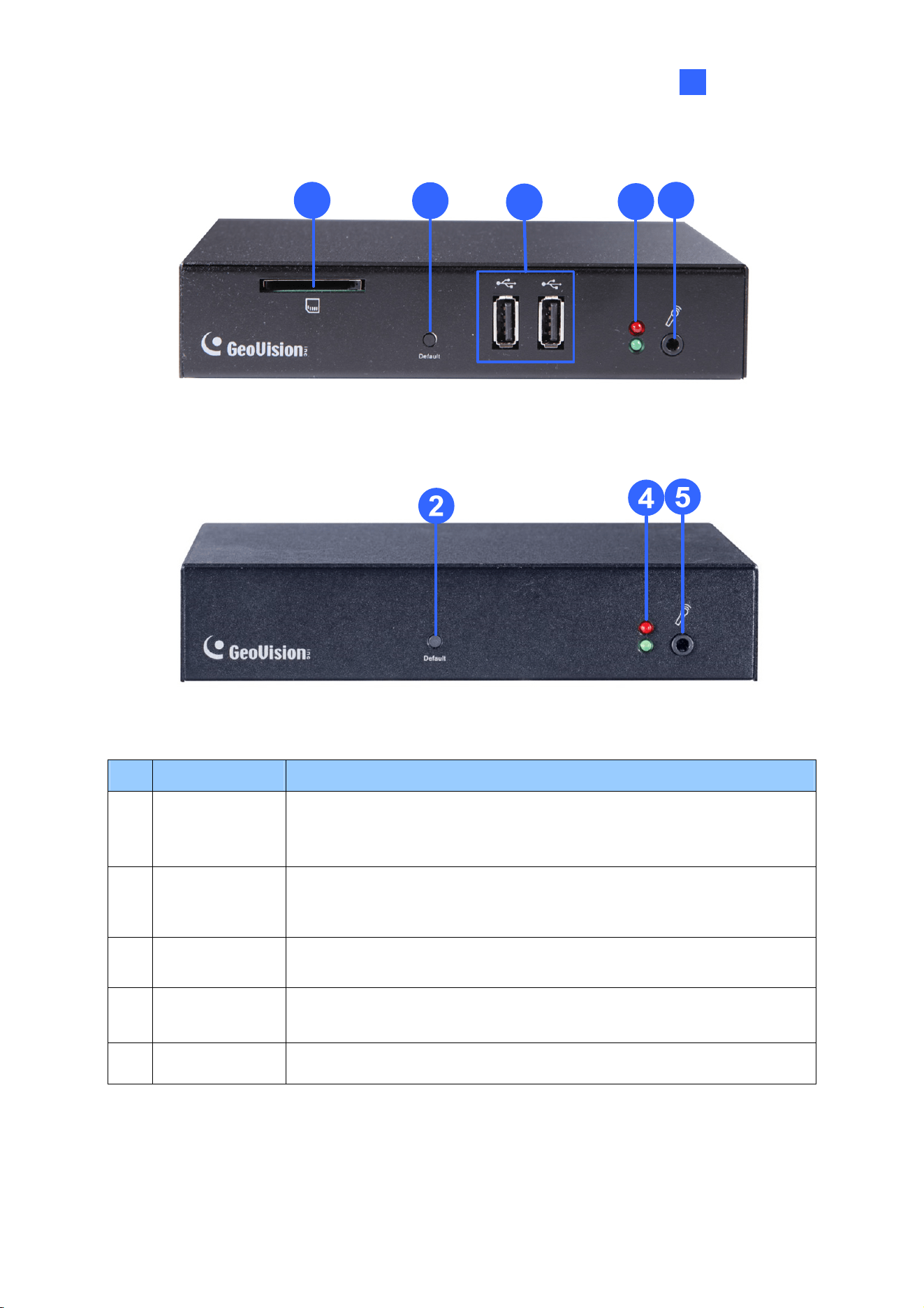
GV-IP Decoder Box Plus
1
4
2
3
5
Figure 1-6
GV-IP Decoder Box Lite
Figure 1-7
No. Name Function
1
SD Card
Slot
Connect to a SD card for local storage of snapshots and firmware
upgrade. Only supported by GV-IP Decoder Box Plus.
2 Default
Reset the device to the default factory settings. Use a pin to press the
default button for about 10 seconds. The system will then reset and
reboot itself shortly. See 5.2 Restoring Default Settings.
3 USB
Connect to a GV-Joystick V2, USB mouse, or USB storage device.
Only supported by GV-IP Decoder Box Plus.
4
LED Indicators
The red LED indicates the power is supplied.
The green LED indicates the system is ready for use.
5 Audio In Not functional.
16
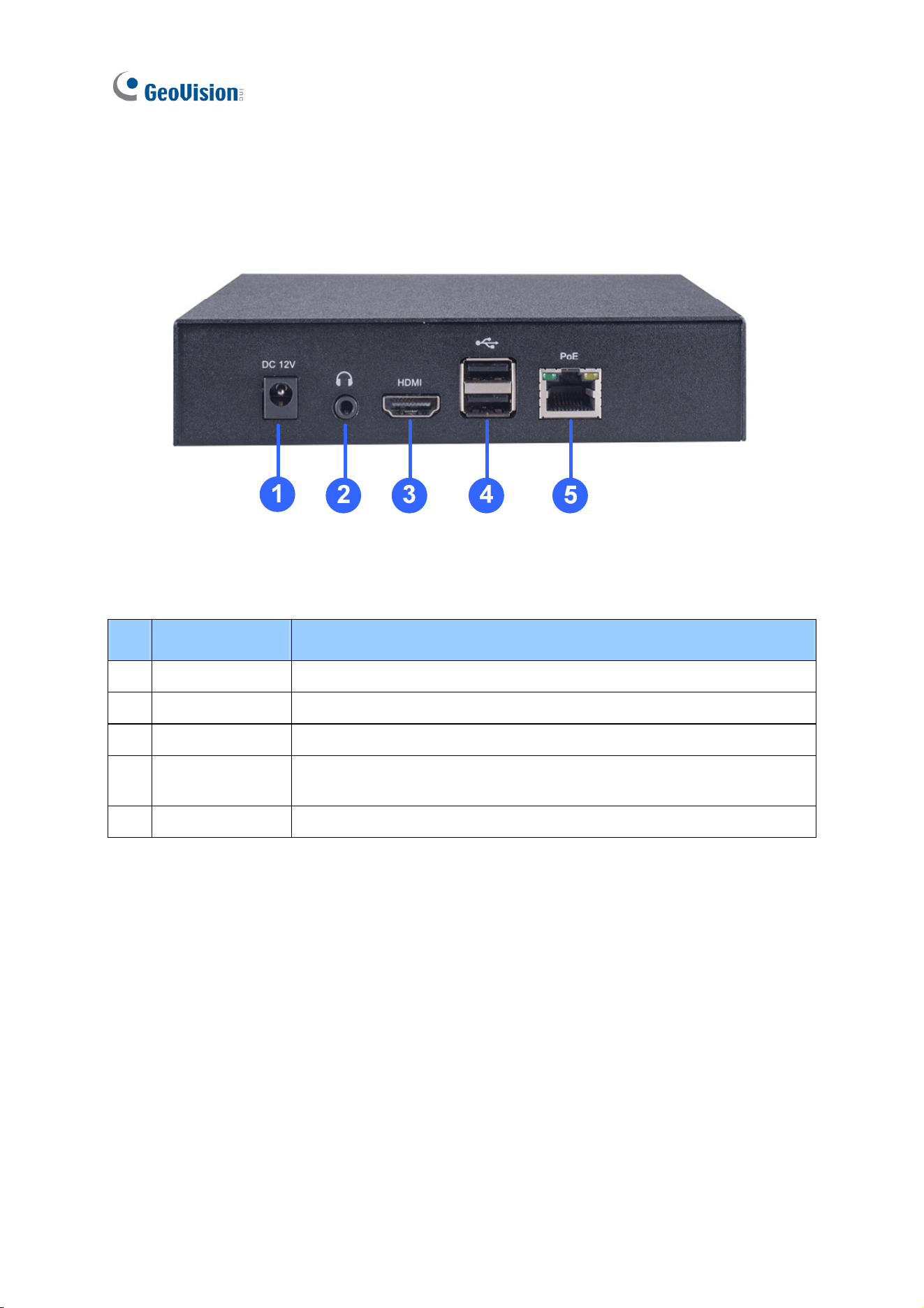
1.9.1.2 Rear View
GV-IP Decoder Box Ultra
Figure 1-8
No. Name Function
1 DC 12V Connect to power by using the supplied power adapter.
2 Audio Out Connect to a speaker.
3 HDMI Connect to an HDMI-compliant display device.
4 USB 2.0
Connect to a GV-Joystick V2, USB mouse, or USB storage
device.
5 Network / PoE Connect to the network or a PoE adaptor.
Introduction
17
1
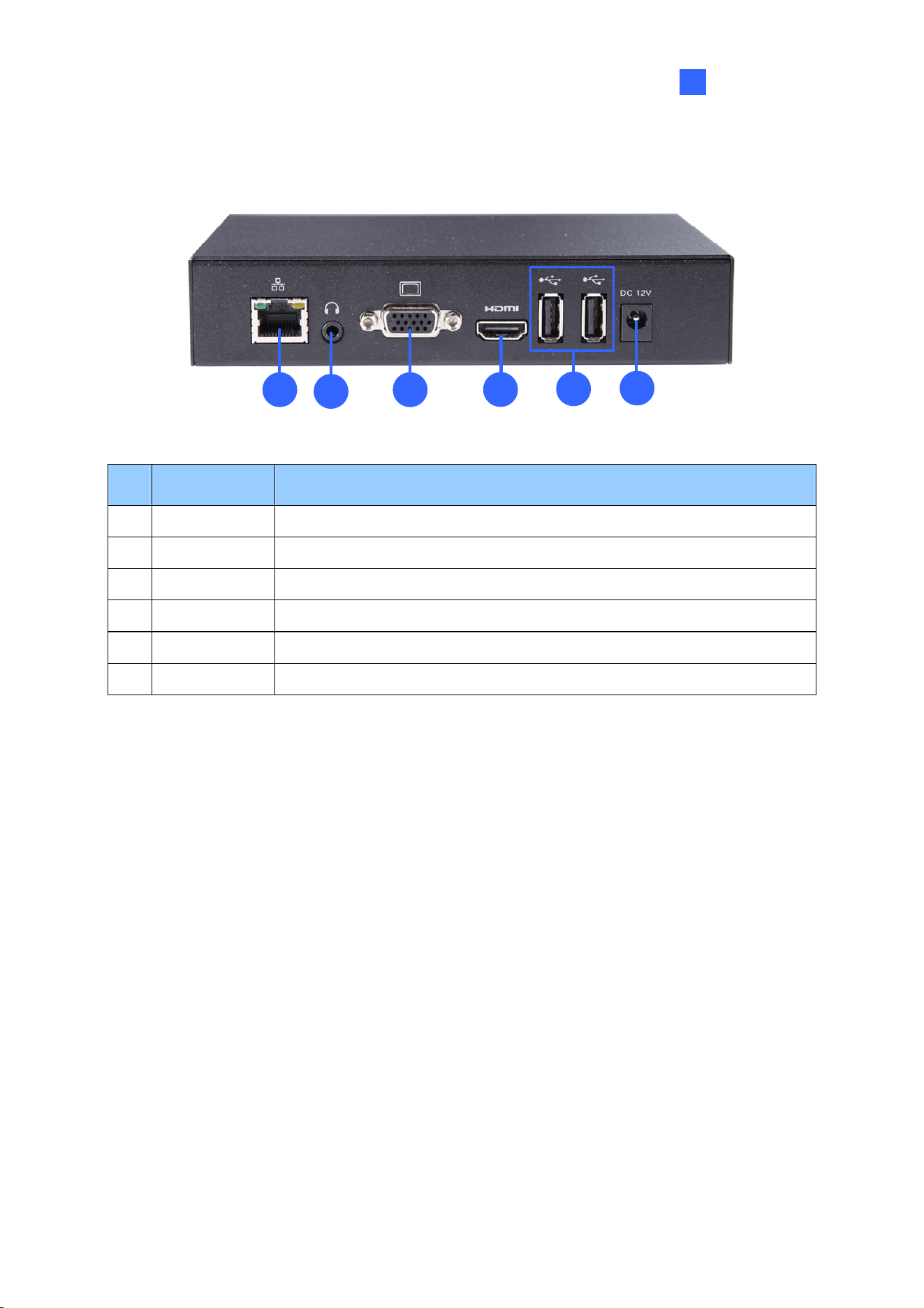
GV-IP Decoder Box Plus / Lite
1
5
3
4
6
2
Figure 1-9
No. Name Function
1 Network Connect to the network.
2 Audio Out Connect to a speaker.
3 VGA Connect to a VGA monitor.
4 HDMI Connect to an HDMI-compliant display device.
5 USB Connect to a GV-Joystick V2, USB mouse, or USB storage device.
6 DC 12V Connect to power by using the supplied power adapter.
18
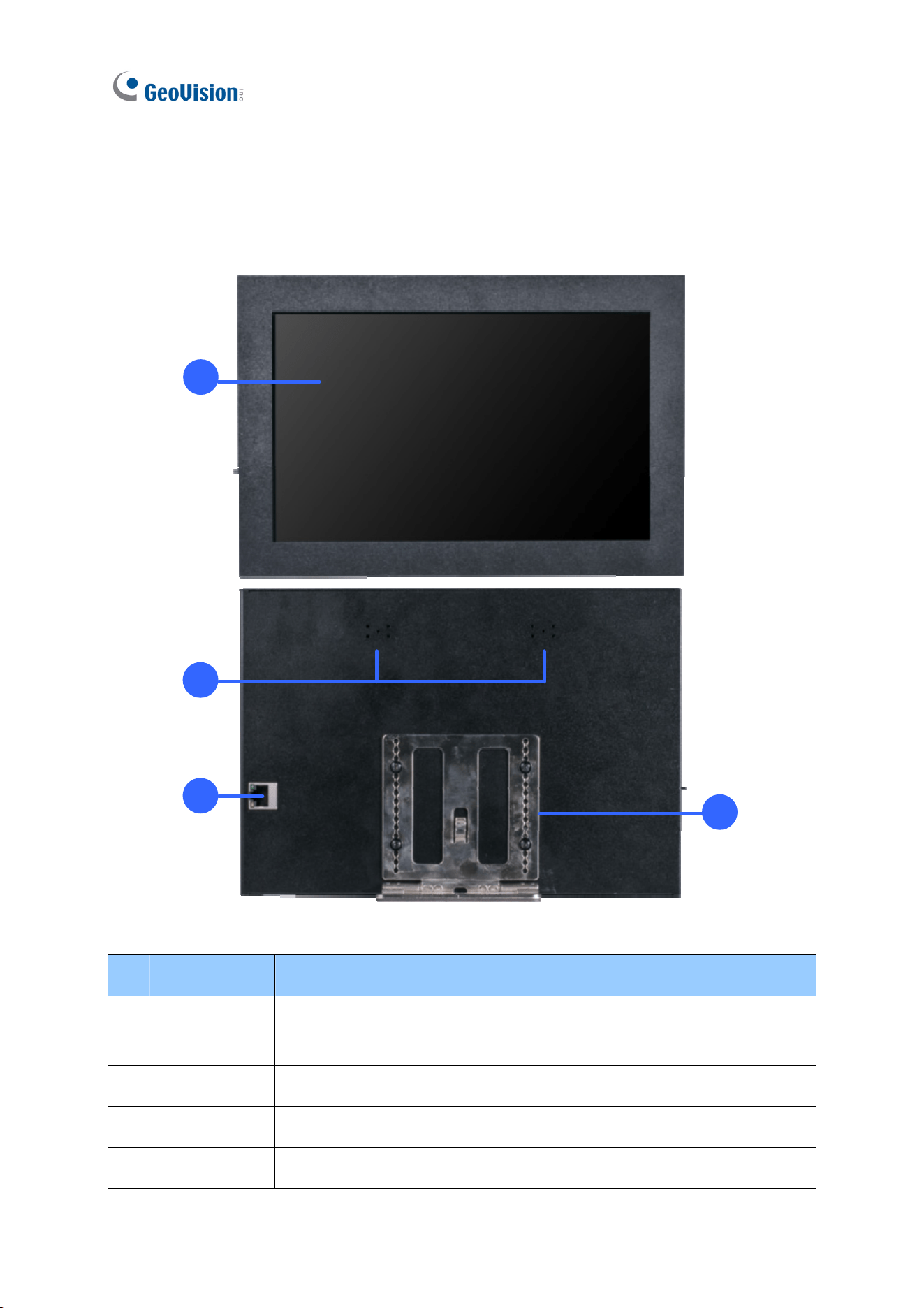
1.9.2 GV-Pad Mini / GV-IP Display 101
1.9.2.1 Front and Rear Views
1
4
2
3
4
Figure 1-10
No. Name Function
1 LCD screen
Display the system settings of the device and the images of connected
IP devices.
2 Speaker Listen to the audio around the connected IP device.
3 Ethernet Port Connect to the network.
4 Stand Position the GV-Pad Mini / GV-IP Display 101 to your preference.
Introduction
19
1
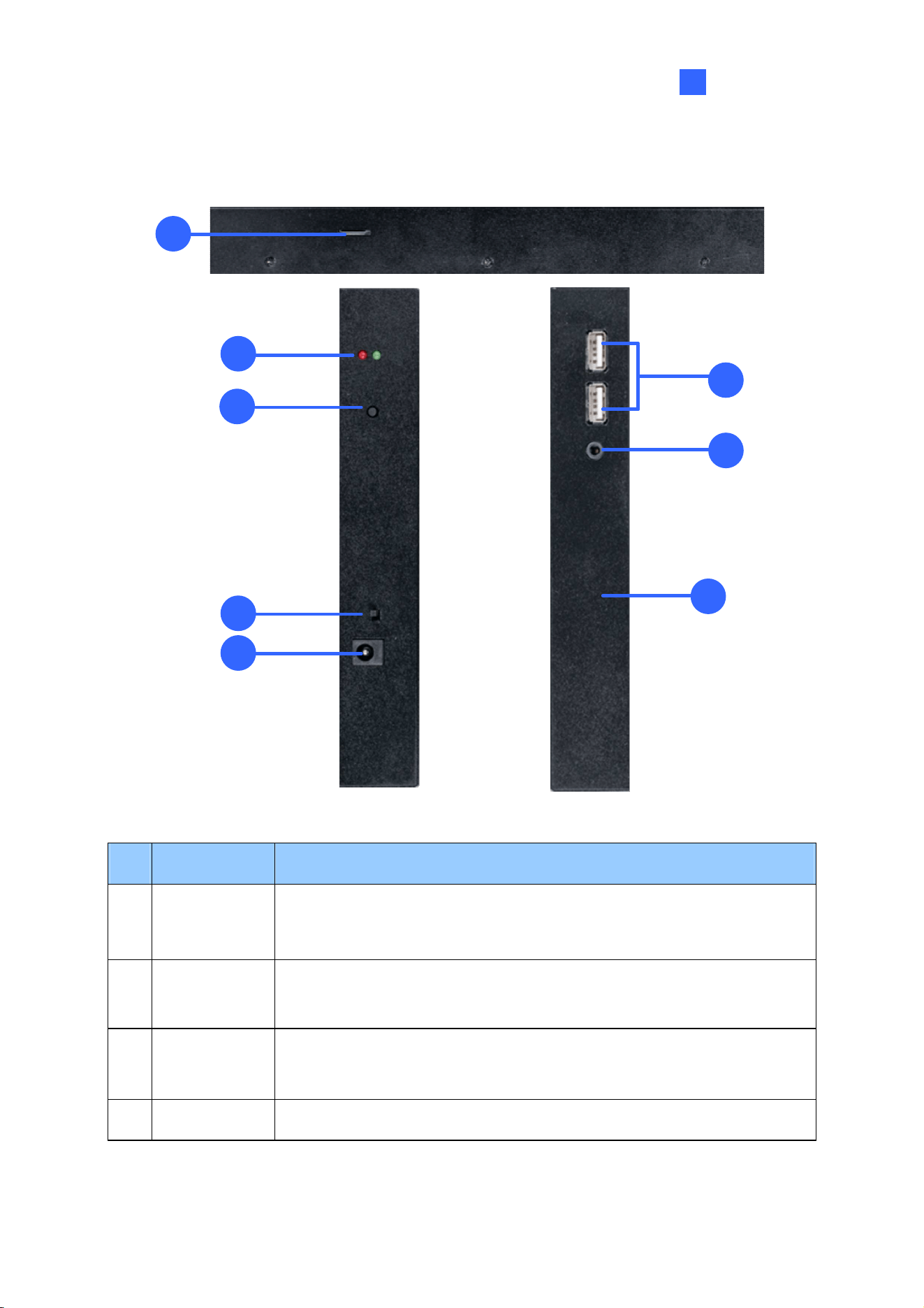
1.9.2.2 Top, Left-Side and Right-Side Views
1
2
3
4
5
7
8
6
Figure 1-11
No. Name Function
1
Micro SD Card
Slot
Connect to a micro SD card for local storage of content and firmware
upgrade.
2 LED Indicators
The red LED indicates the power is supplied.
The green LED indicates the system is ready.
3 Stand By
Press to enter Standby/Sleep mode. In standby mode, the screen turns
off to minimize power consumption. Press the key again to enter ON
mode.
4 Power Off/On Switch the power on or off.
20
No. Name Function
5 DC 12V Connect to power using the supplied power adapter.
6 USB
Connect to a GV-Joystick V2, USB mouse, or USB storage device for
local storage of content and firmware upgrade.
7 Line Out Port Connect to a headphone or speaker.
8 Default
Reset the device to the default settings. Use a pin to press the default
button for about 5 to 10 seconds. The system will then reset and
reboot itself shortly. See 5.2 Restoring Default Settings.
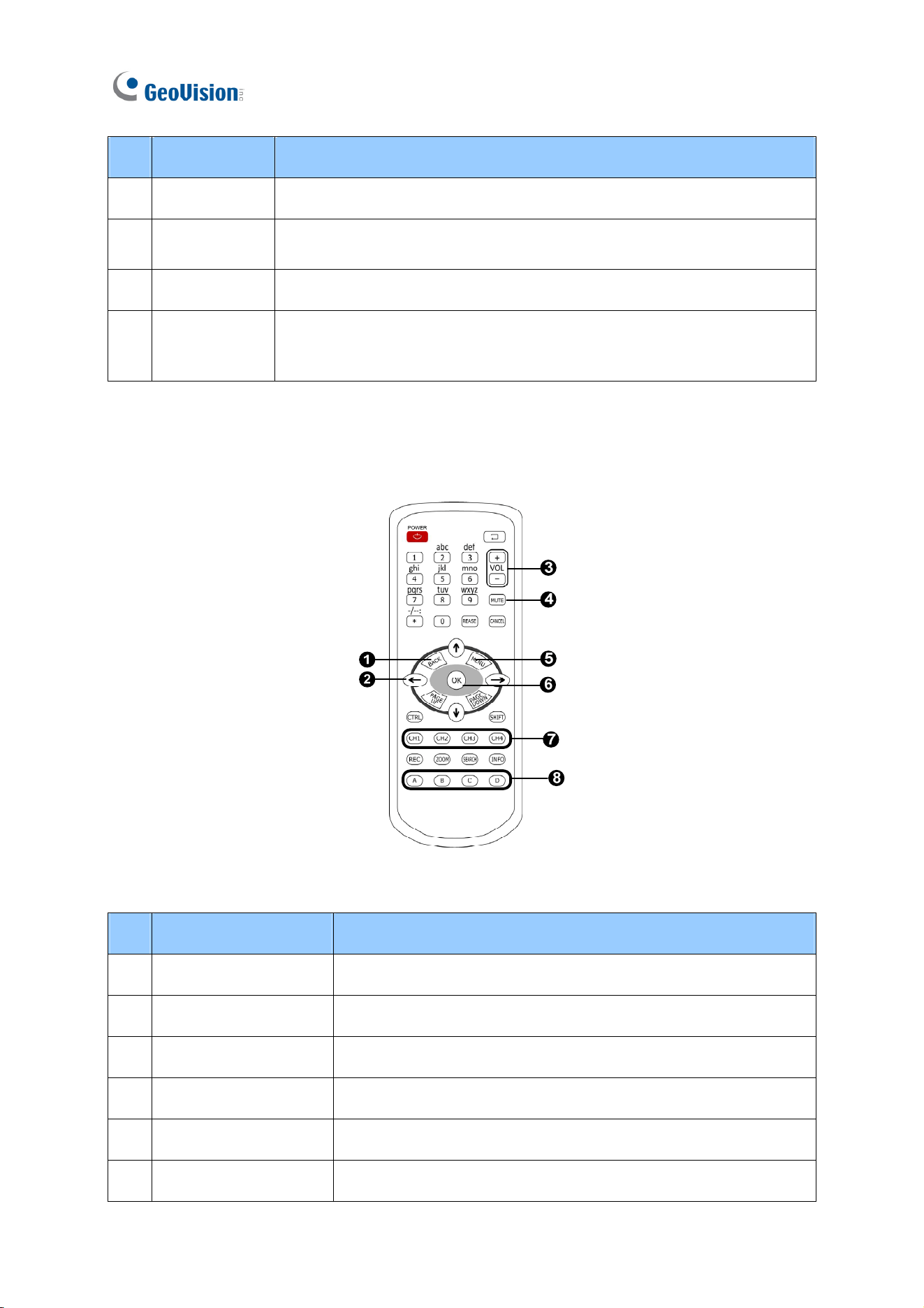
1.9.3 GV-IR Remote Control
The GV-IR Remote Control is only supported by GV-IP Decoder Box Ultra.
Figure 1-12
No. Name Function
1 Back Return to the previous page in the Main Screen.
2 Menu Control Move up, down, right and left in the Main Screen.
3 Volume Control Increase or decrease the volume.
4 Mute Mute the volume.
5 Menu Switch to the Main Screen.
6 OK Enter the setup options or save the settings in the Main Screen.
Introduction
21
1
No. Name Function
7 Hotkeys
Use the following hotkeys to execute commands when a
camera live view is selected in the main screen.
CH1: Take a screenshot
CH2: Activate the PTZ function.
CH3: Enter in full screen mode.
CH4: Activate the audio out function.
PTZ Controls
No. Name Function
2 Menu Control
Control PTZ movements (pan and tilt) on live view display when
the PTZ function is enabled.
6 OK
Bring the camera to a home position when the PTZ function is
enabled.
Press an alphabet key to adjust the zoom / focus.
No. Alphabet Key Function
A Zoom In
B Zoom Out
C Focus In
8
D Focus Out
22
Chapter 2 Getting Started
2.1 Installing the GV-IP Decoder Box Series
You can install the GV-IP Decoder Box Series on the wall or simply use it as desk mount
device.
Wall Mount Installation
For wall mount installation, you need to purchase the wall mount kit.
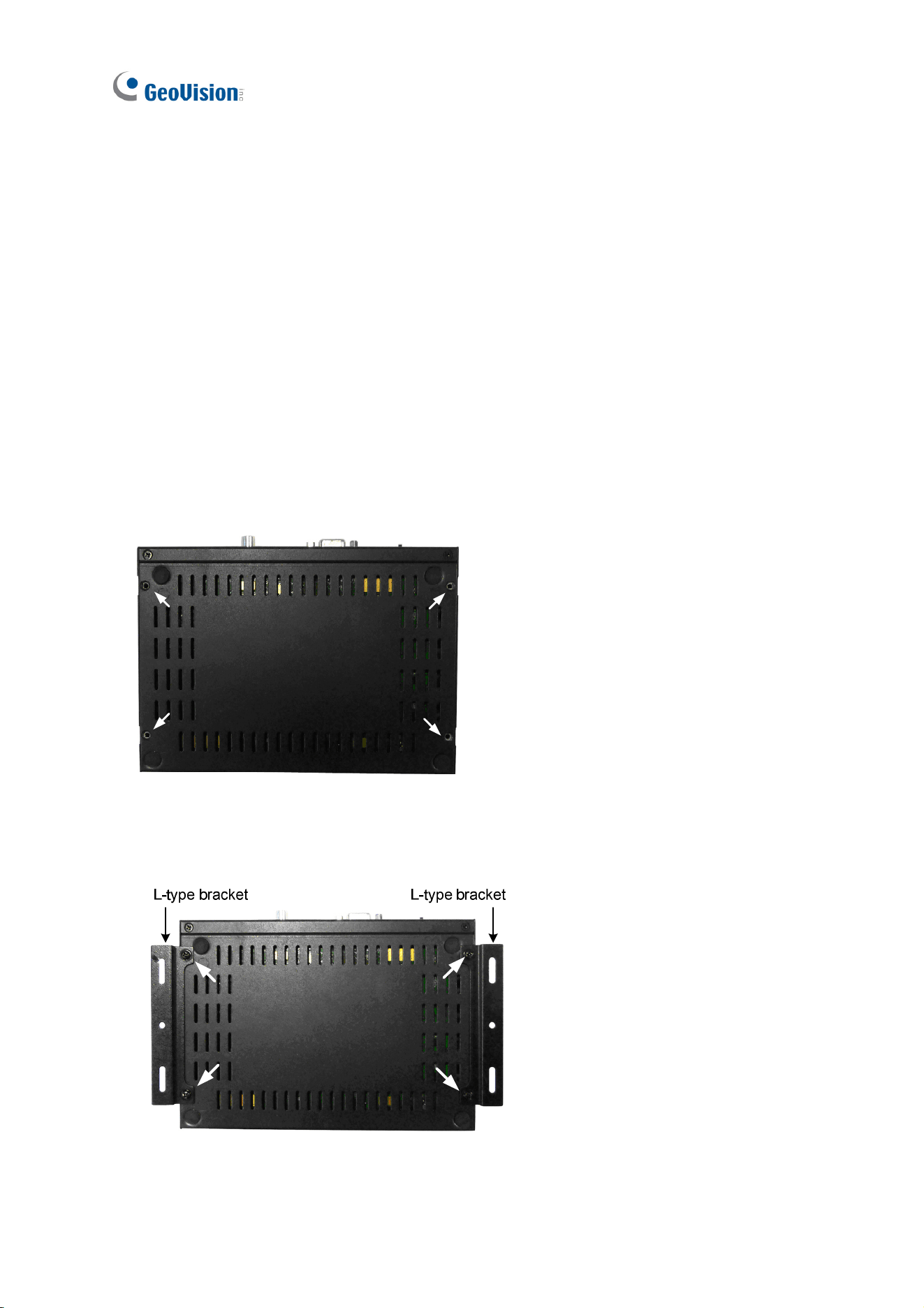
1. Unscrew the 4 screws on the back panel of the GV-IP Decoder Box Series.
Figure 2-1
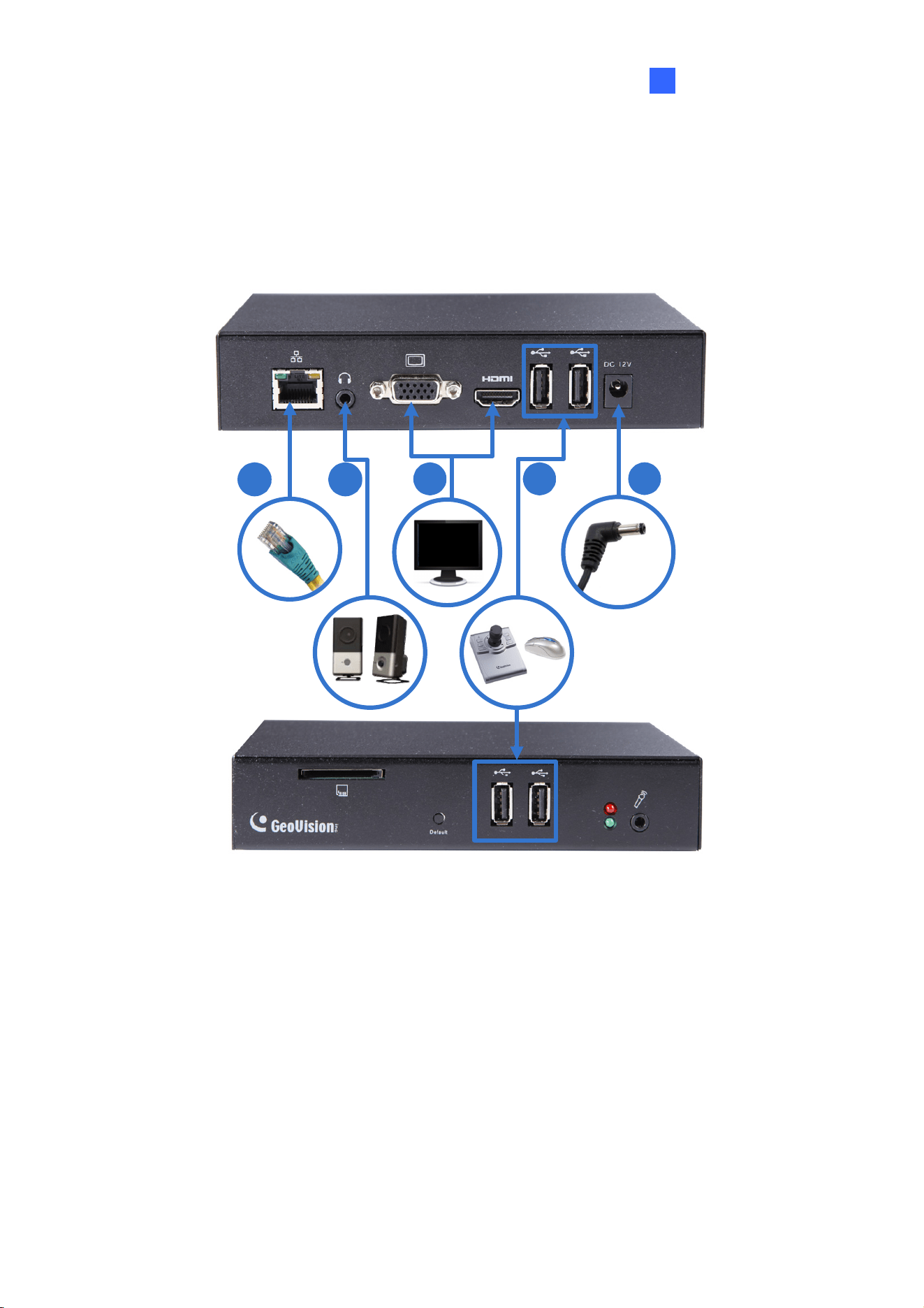
2. Use the 4 small screws in the package to tighten the L-type brackets on the GV-IP
Decoder Box Series.
Figure 2-2
3. Secure the GV-IP Decoder Box Series to the wall with self-prepared screws.
Getting Started
23
2
2.2 Connecting the GV-IP Decoder Box Series
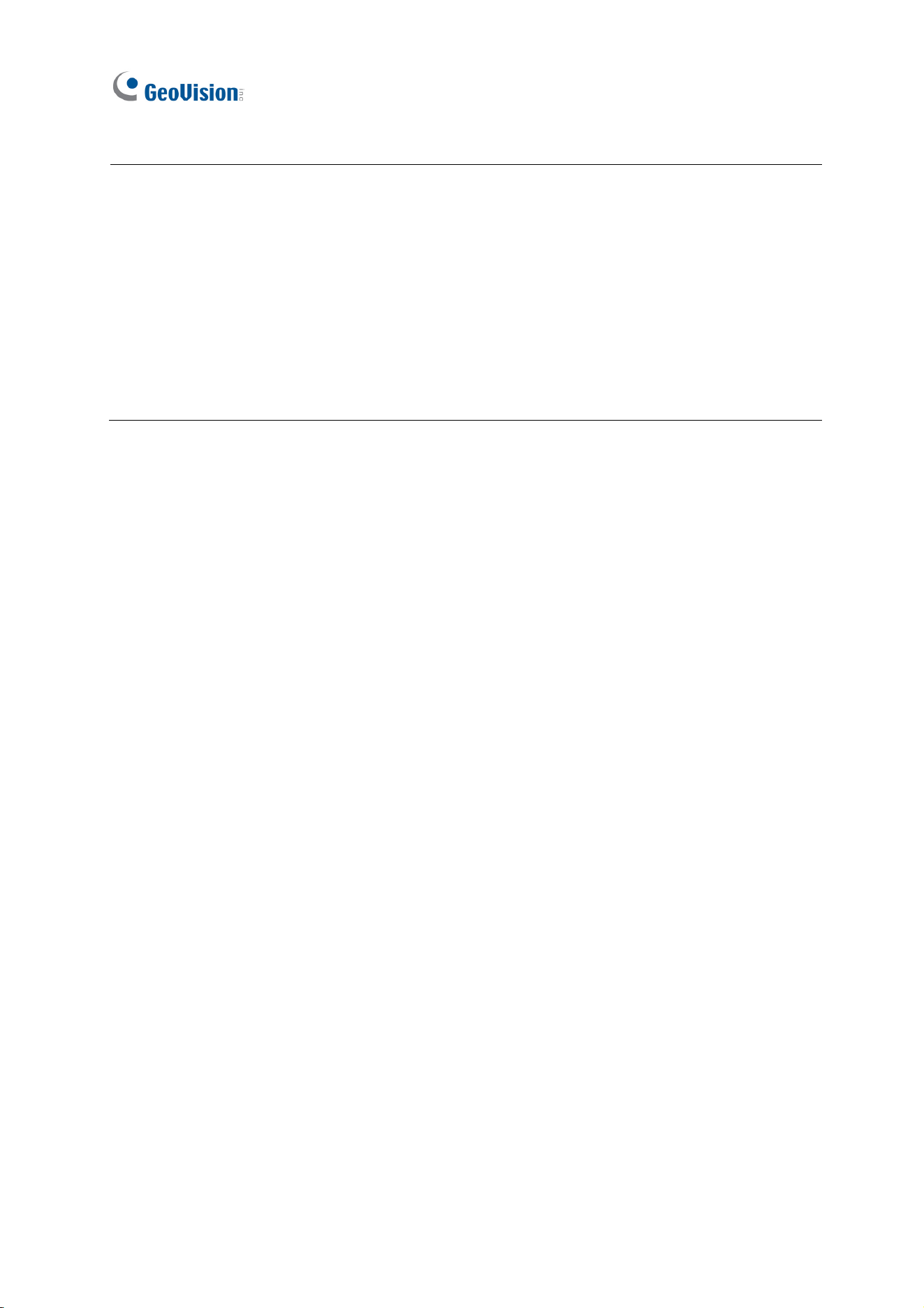
Follow the steps below to connect the GV-IP Decoder Box Series. Here we use GV-IP
Decoder Box Plus as an example.
4
1 2
5
3
Figure 2-3
1. Connect the device to the LAN port using an RJ-45 cable.
2. Connect a speaker to the audio line out port if needed.
3. Connect a display device to VGA or HDMI connector for video output.
4. Connect a mouse and / or GV-Joystick V2 to the USB ports.
5. Connect to power using the supplied power adapter.
24
Note:
1. You can only connect the GV-IP Decoder Box Series to one display device through either
the HDMI or VGA connector.
2. The default video output is set to HD 720P resolution. If you use a VGA monitor, be sure
to change the output resolution to VGA 1024 x 768. If you want to configure your GV-IP
Decoder Box Ultra to 4K resolution, make sure your monitor is 4K-capable and change
the resolution to 3840 x 2160. To change the output resolution, see 4.1 System.
3. Optionally configure the date and time for the device. For details, see 4.3 Date & Time.
Getting Started
25
2
2.3 Connecting the GV-Pad Mini / GV-IP Display 101
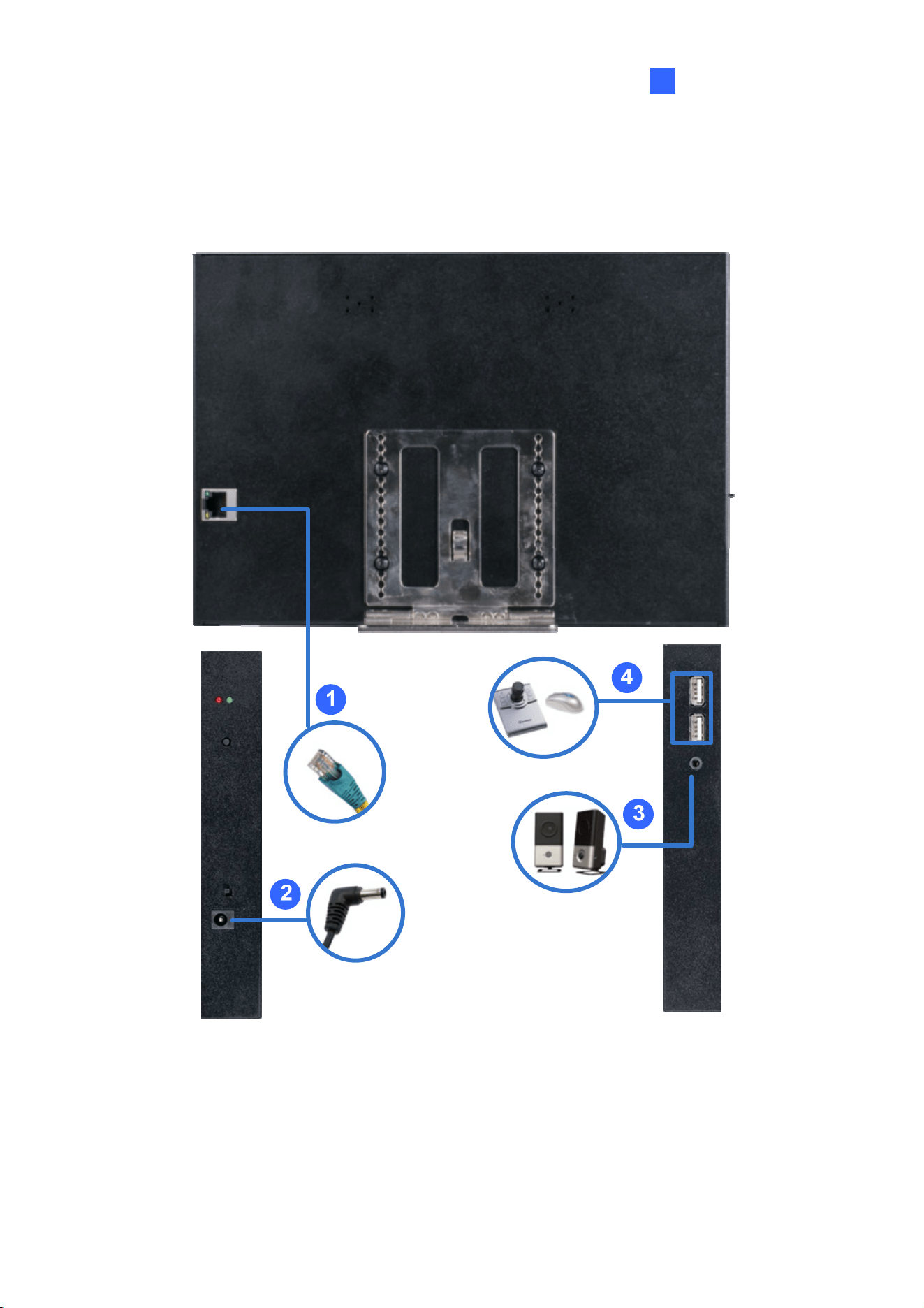
Follow the steps below to connect GV-Pad Mini / GV-IP Display 101.
Figure 2-4
1. Connect the device to the LAN port using an Ethernet cable.
2. Connect to power using the supplied power adapter.
3. Connect a speaker / headphone to the line out port if needed.
4. Connect a mouse and / or GV-Joystick V2 to the USB ports.
26
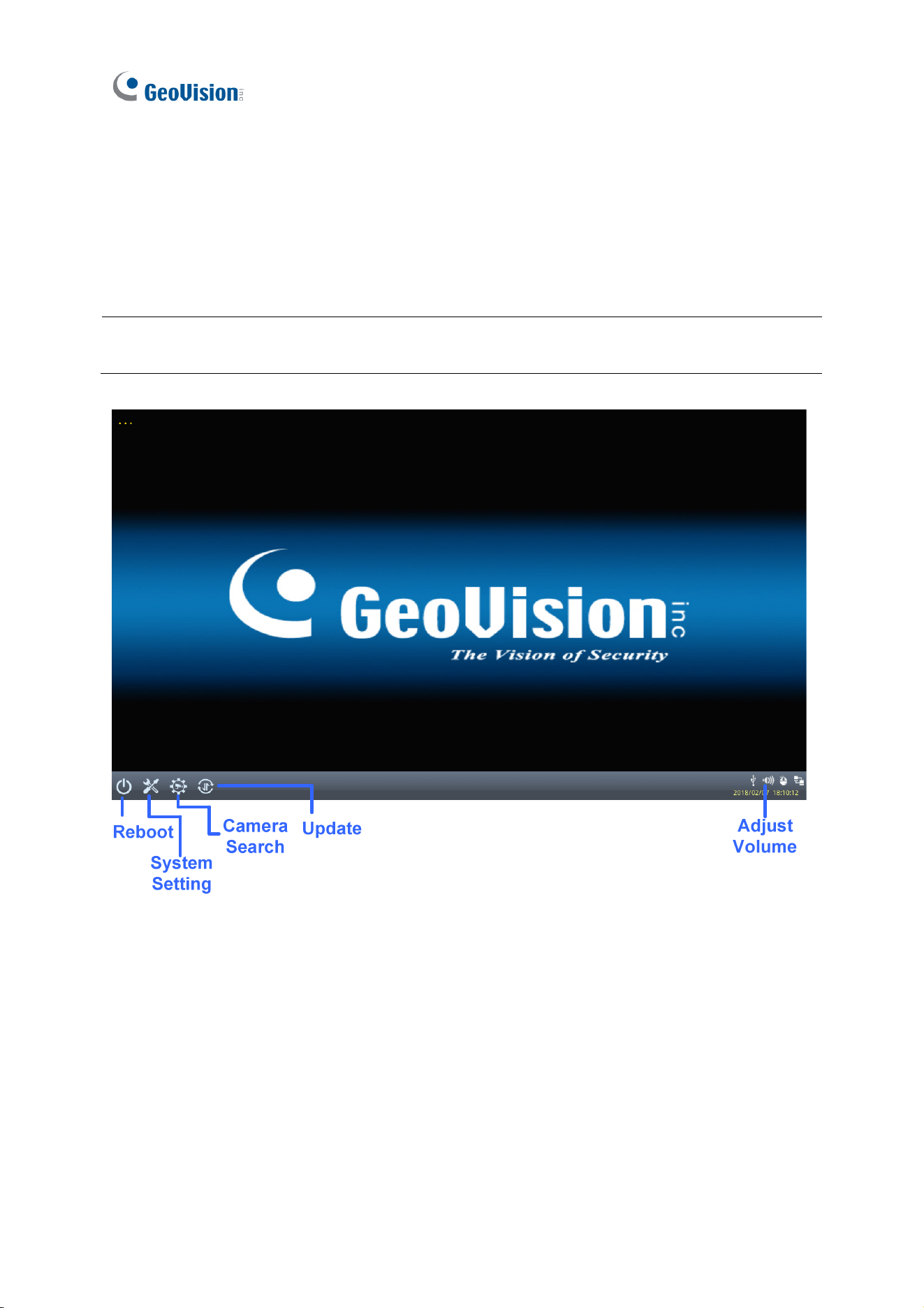
2.4 The Main Screen
After you have connected the necessary wires and cables, GV-IP Decoder Box Series /
GV-Pad Mini / GV-IP Display 101 will power on and the main screen will display on the
monitor.
Note: The user interfaces are different by models. Find the relevant settings corresponding to
your device. Here we use GV-IP Decoder Box Ultra / GV-IP Display 101 as an example.
Figure 2-5
Getting Started
27
2
2.5 Setting Up the Network
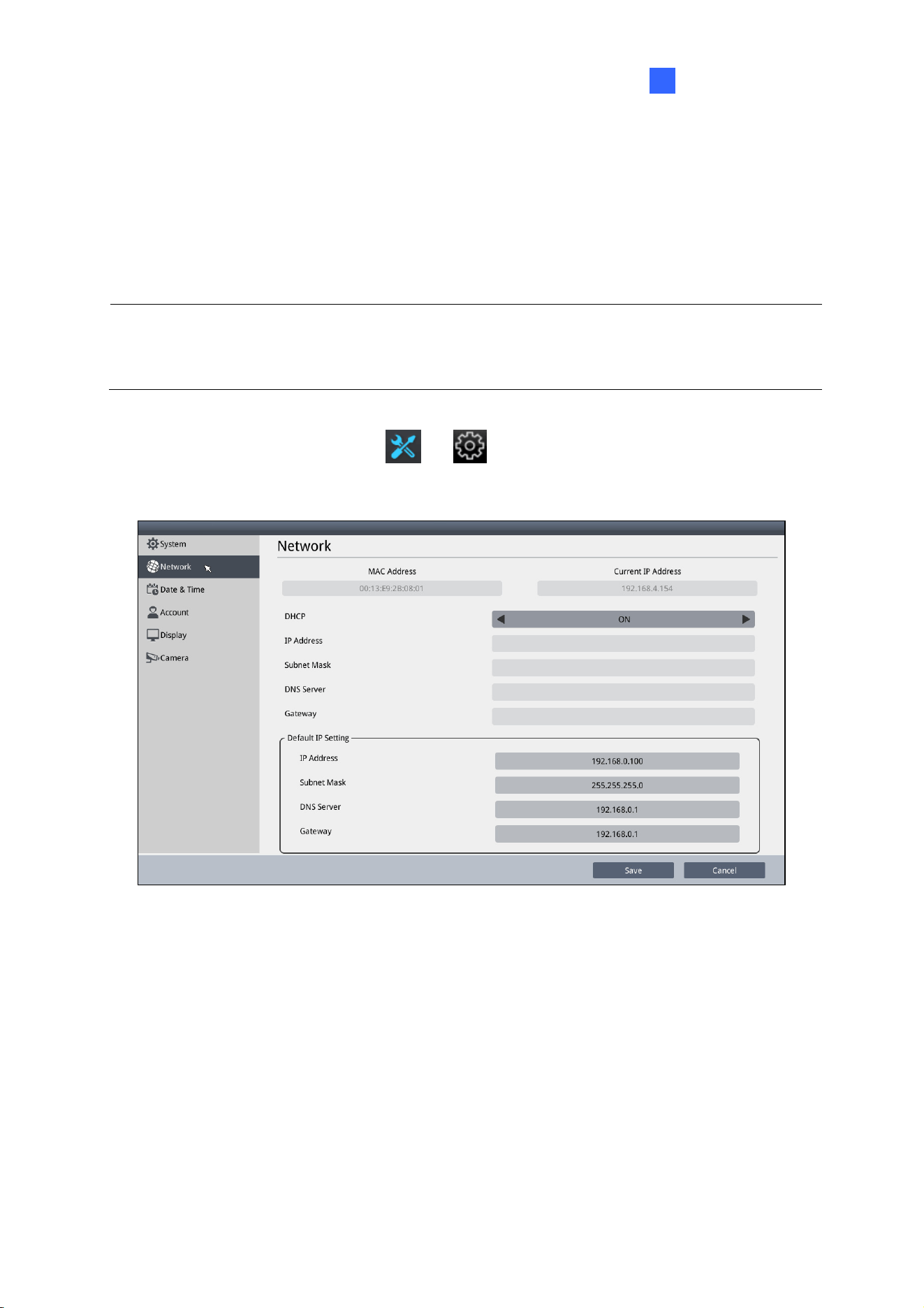
By default, GV-IP Decoder Box Series / GV-Pad Mini / GV-IP Display 101 will be
automatically assigned an IP address by the DHCP server without requiring additional
settings. To change the IP address to a fixed one, follow the steps below.
Note: By default, if GV-IP Decoder Box Series / GV-Pad Mini / GV-IP Display 101 is
connected to LAN without the DHCP server, it will be assigned a static IP address:
192.168.0.100.
1. Click the System Settings icon
or at the bottom of the main screen, and
select Network. You will see the following window.
Figure 2-6
2. To configure the static IP address,
For GV-IP Decoder Box Ultra / GV-IP Display 101, switch the DHCP option to OFF.
For GV-IP Decoder Box Plus / Lite / GV-Pad Mini, select Static IP Address.
3. Fill out the fields of IP Address, Subnet Mask, DNS Server, and Default Gateway.
4. Click Save. When the device is connected to the network, the IP address will be shown in
the Connected IP Address field.
28
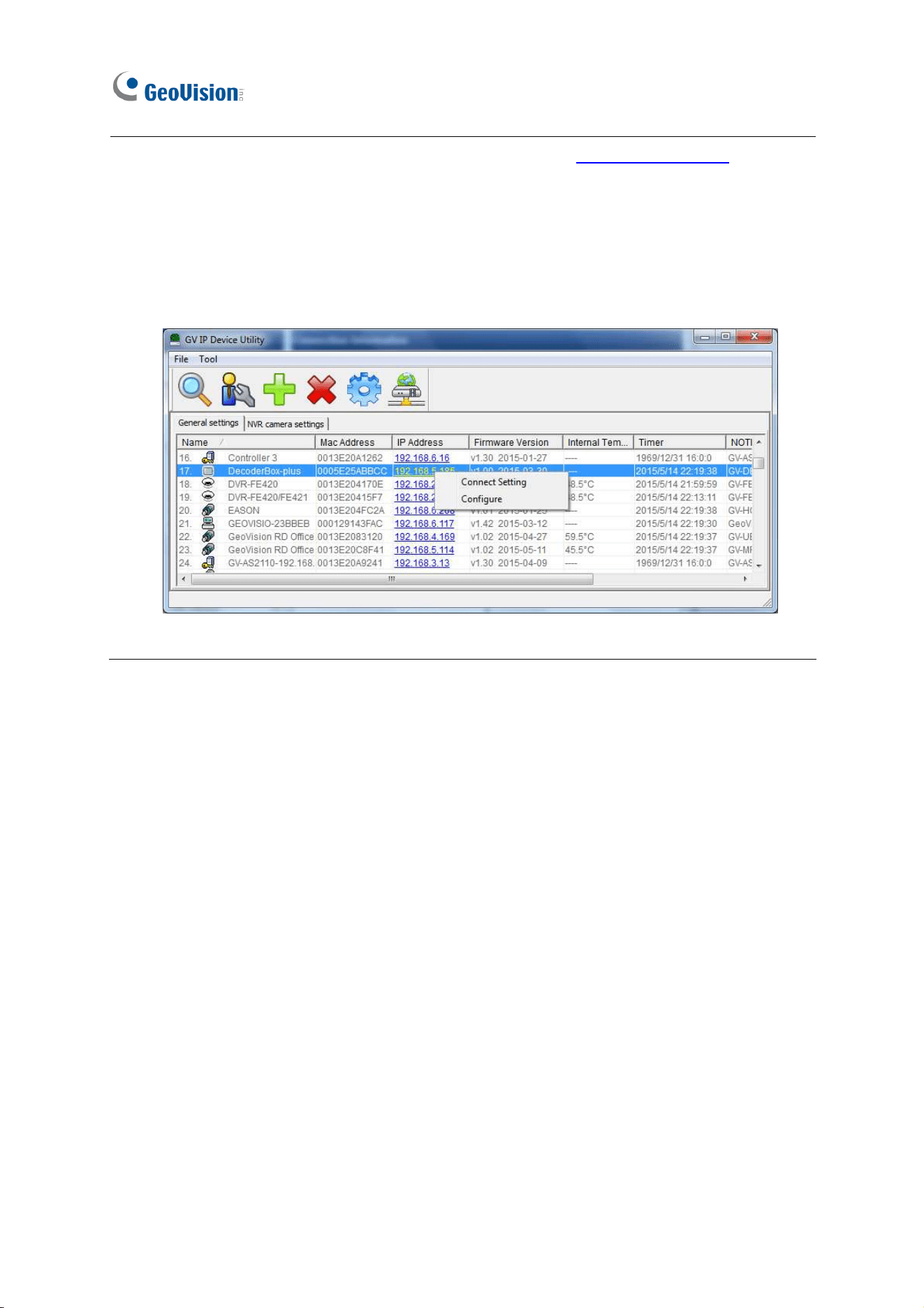
Tip: You can also use GV-IP Device Utility downloaded from GeoVision’s website. to modify
the IP address by clicking on the GV-IP Decoder Box Series / GV-Pad Mini / GV-IP Display
101 and selecting Configure. Note the compatible versions of GV-IP Device Utility for the
following products:
GV-IP Decoder Box Plus / Lite / GV-Pad Mini: GV-IP Device Utility V8.6.6.0 or later.
GV-IP Decoder Box Ultra / GV-IP Display 101: GV-IP Device Utility V8.9.1.0 or later.
Figure 2-7
Getting Started
29
2
2.6 Adding IP Devices to Live View Grid
Before you start, make sure all the IP devices or GV-Mobile Server is under the same LAN as
GV-IP Decoder Box Series / GV-Pad Mini / GV-IP Display 101.
2.6.1 Adding IP Devices through Automatic Search
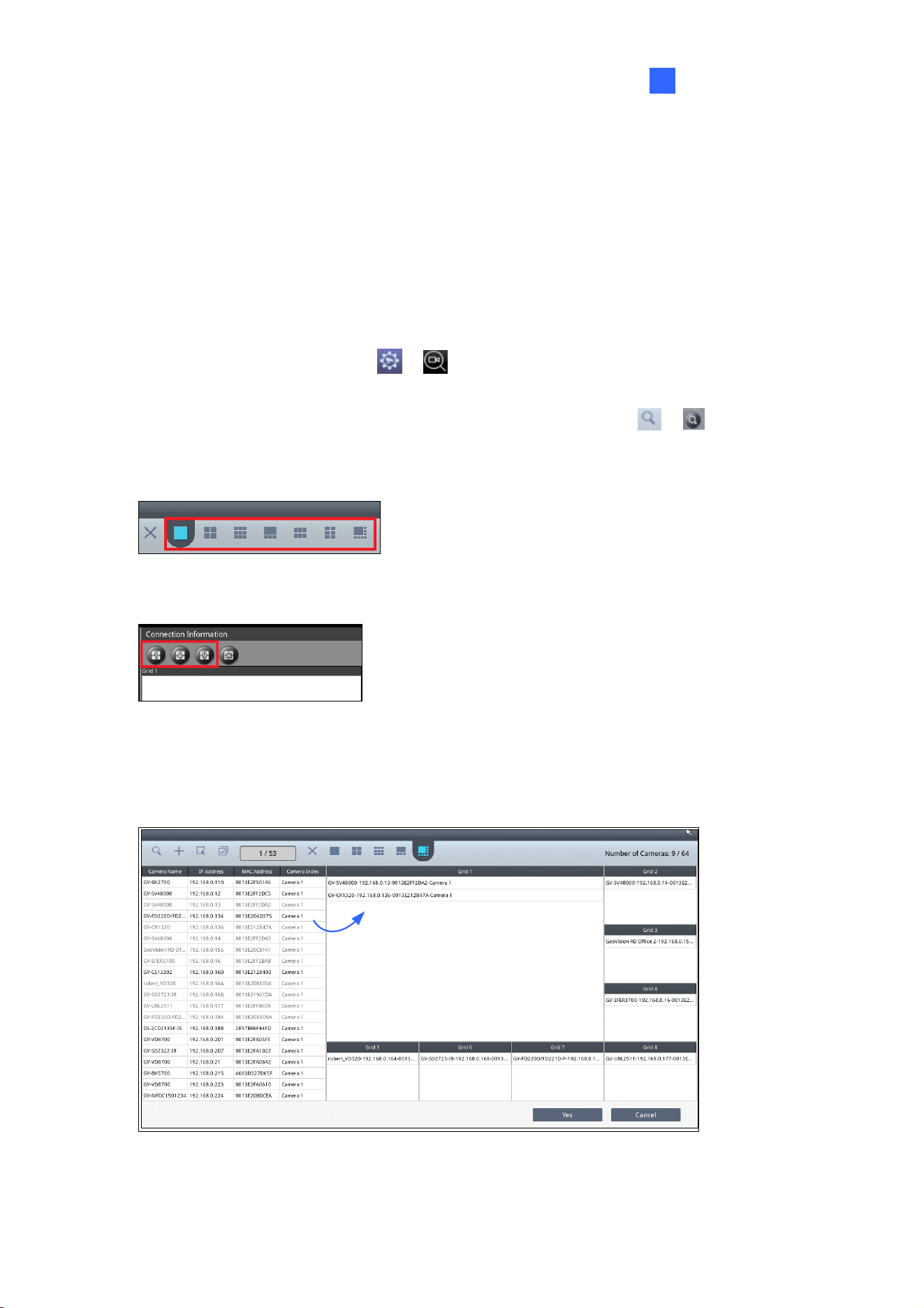
1. Click the Camera Search icon / on the main page.
2. Search for GV-IP Devices, GV-Mobile Server, or the third-party devices that adhere to
ONVIF under the same LAN by clicking the Search Camera icon / .
3. Select a live view layout.
For GV-IP Decoder Box Ultra / GV-IP Display 101:
Figure 2-8
For GV-IP Decoder Box Plus / Lite / GV-Pad Mini:
Figure 2-9
4. Drag and drop an IP device from the camera list to the grid. To select multiple cameras at
a time, click Select Multiple Cameras at the top and select more than one camera from
the camera list.
Figure 2-10
30
5. To change the device settings, hold for right-clicking on a device in the grid and select
Edit to modify the following settings:
Custom Name: Type a customized name for the IP device.
Port: Change the port number if needed. The default port is 10000.
Loop Time Interval: Specify a time interval, ranging from 10 ~ 600 seconds, for the
device to display before switching to the next one. The default value is 30 seconds.
Login Information: Change the login user name and password of the device if
necessary.
Note: All cameras will be applied the default user name and password of admin when
connecting. If you want to change the default login settings, change the user name and
password under Camera in System Settings (see 4.6 Camera).
6. To adjust the display order of the cameras, hold for right-clicking on a camera and click
Move Up or Move Down.
7. To remove a camera, hold for right-clicking on a camera and click the Delete button.
8. To delete all the added devices at once, click the Delete All button
/ .
9. Click Yes or Save to apply the settings.
The selected channels will be displayed on the monitor and be looped at an interval of 30
seconds by default. To change the looping interval, hold for right-clicking on a camera and
click Edit.
Note:
1. Refer to 3.1 Live View for the maximum resolution supported in different live view
layouts.
2. Fisheye dewarping is only supported by GV-IP Decoder Box Plus. To dewarp the fisheye
view, you need to choose 1-division layout or assign the camera to Grid 1 of the
4-division view.
Getting Started
31
2
2.6.2 Adding IP Devices Manually
If the GV-IP Decoder Box Series / GV-Pad Mini / GV-IP Display 101 is unable to detect the IP
device using the search function, you can search for the device manually.
1. Click the Camera Search icon
/
at the bottom of the main page.
2. Click the Add Camera icon
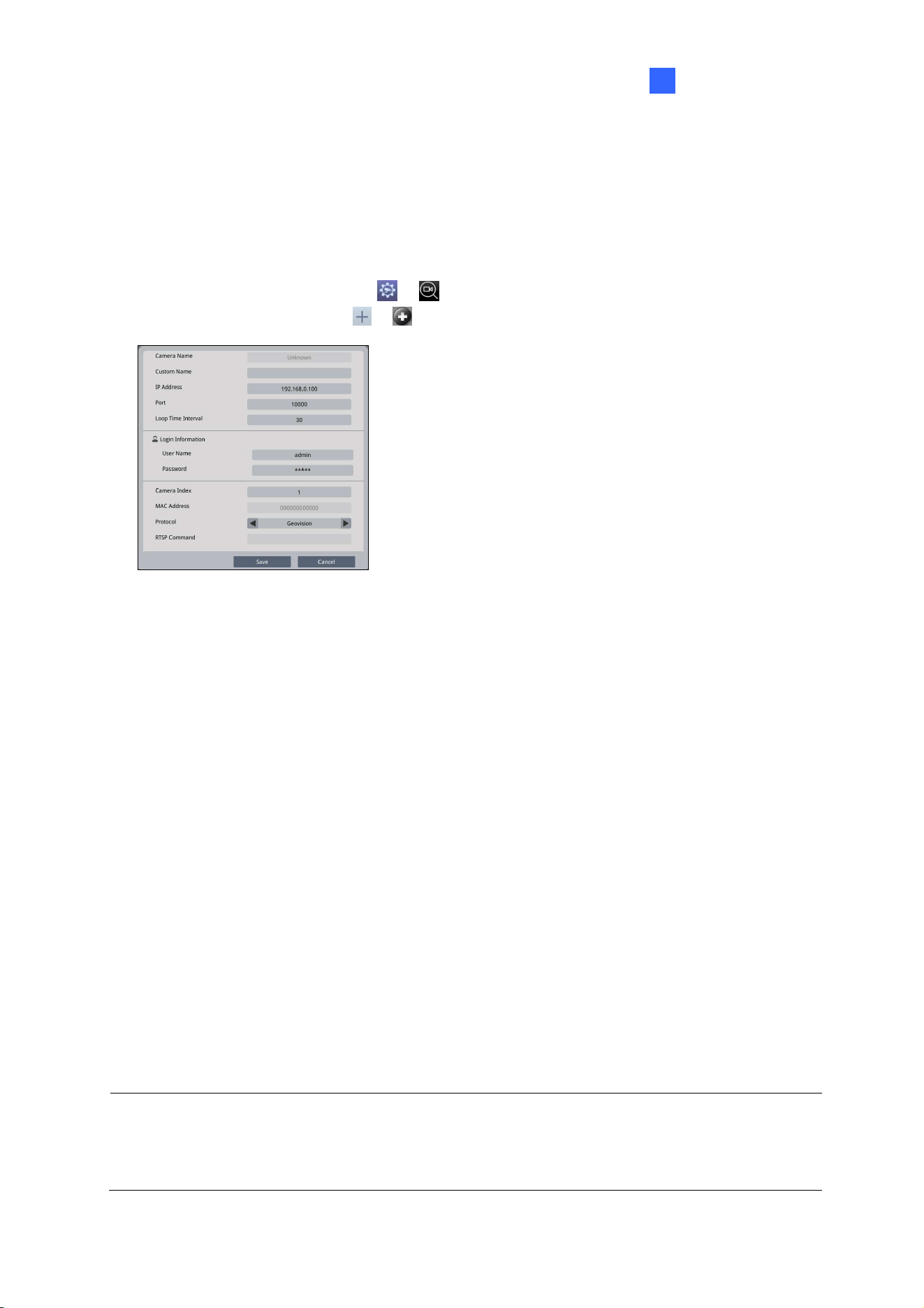
/ . This dialog box appears.
Figure 2-11
3. Fill out the following camera information.
Custom Name: Type a personalized name for the device.
IP Address: Type the IP address of the device.
Port: Change the port number if needed. The default port is 10000.
Loop Time Interval: Specify a time interval, ranging from 10 ~ 600 seconds, for the
device to display before switching to the next one. The default value is 30 seconds.
Login Information: Type the ID and password of the IP device if needed. The
default ID and Passwords are admin.
Camera Index: Number the IP device for searching convenience.
Protocol: For GV-IP Devices, select Geovision as the protocol. For third-party
devices, select ONVIF or one of the RTSP protocols.
RTSP Command: Type the RTSP link if you are connecting to the device through
RTSP protocols.
4. Click Save. The IP device is now added to the camera list.
Note: All cameras will be applied the default user name and password of admin when
connecting. If you want to change the default login settings, change the user name and
password under Camera in System Settings (see 4.6 Camera).
32
2.7 Adding Devices Using GV-IP Device Utility
You may utilize GV-IP Device Utility to add channels.
Note: the compatible versions of GV-IP Device Utility for the following products:
GV-IP Decoder Box Plus / Lite / GV-Pad Mini: GV-IP Device Utility V8.6.6.0 or later.
GV-IP Decoder Box Ultra / GV-IP Display 101: GV-IP Device Utility V8.9.1.0 or later.
Before you start, make sure that all the IP devices / software must be under the same LAN as
GV-IP Decoder Box Series / GV-Pad Mini / GV-IP Display 101.
Figure 2-12
Getting Started
33
2
2.7.1 Adding a GV-IP Device
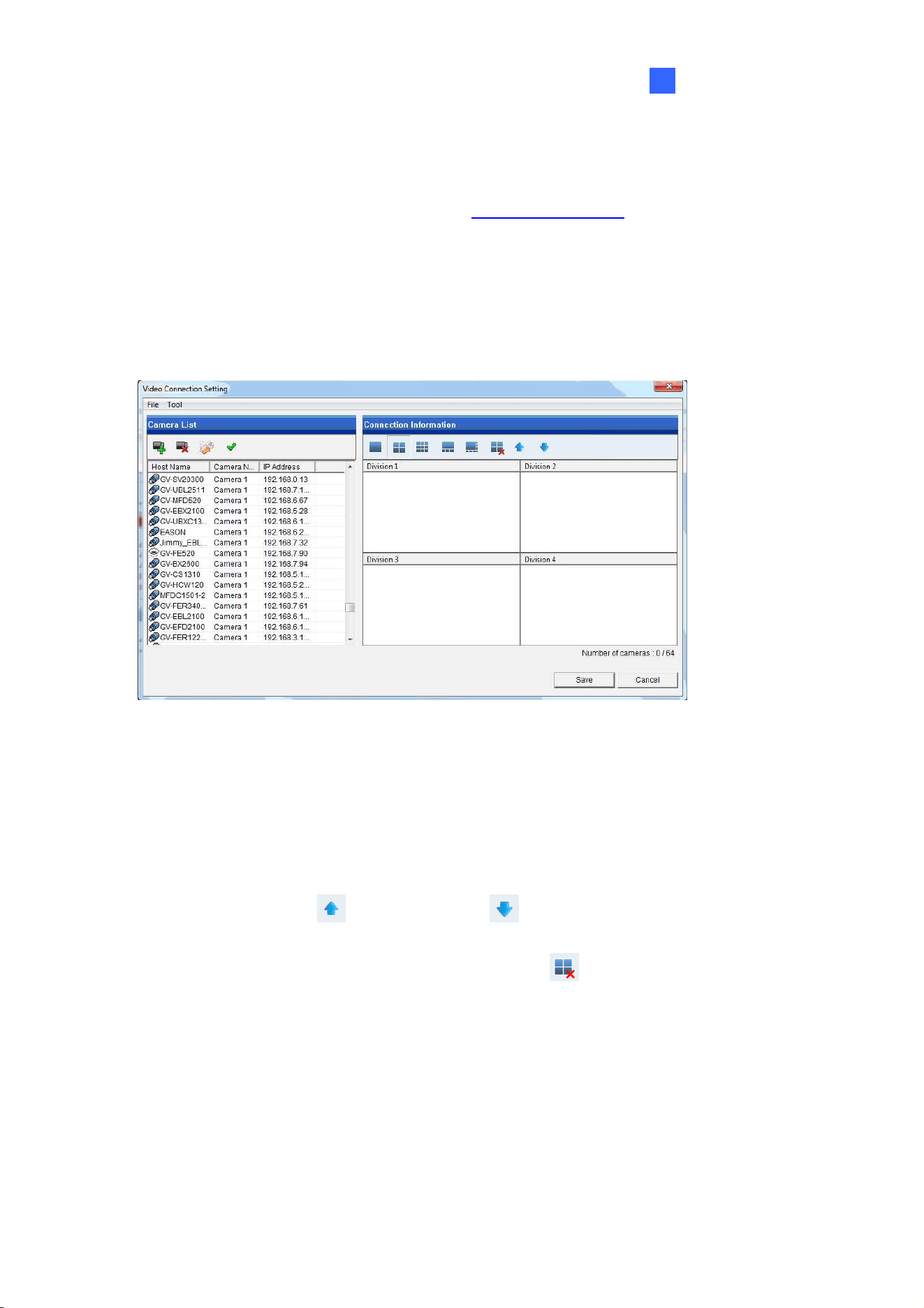
1. Run GV-IP Device Utility downloaded from GeoVision’s website. Once started, the utility
will automatically search for all GV devices under the same LAN.
2. Click on the IP address of GV-IP Decoder Box Series / GV-Pad Mini / GV-IP Display 101,
and select Connect Setting. A login window appears.
3. Type the username and password of the device, and click OK. This window appears. By
default, the username and password both are admin.
Figure 2-13
4. Use the Camera List toolbar to add, remove, or configure a camera in the Camera List.
5. Under Connection Information, select a live view layout.
6. Add channels to the Connection Information column.
A. Drag and drop the camera from the Camera List to the Connection Information
column.
B. Use the Move Up
and Move Down buttons to change the display order of
these channels.
C. To remove a selected camera, click the Remove
button.
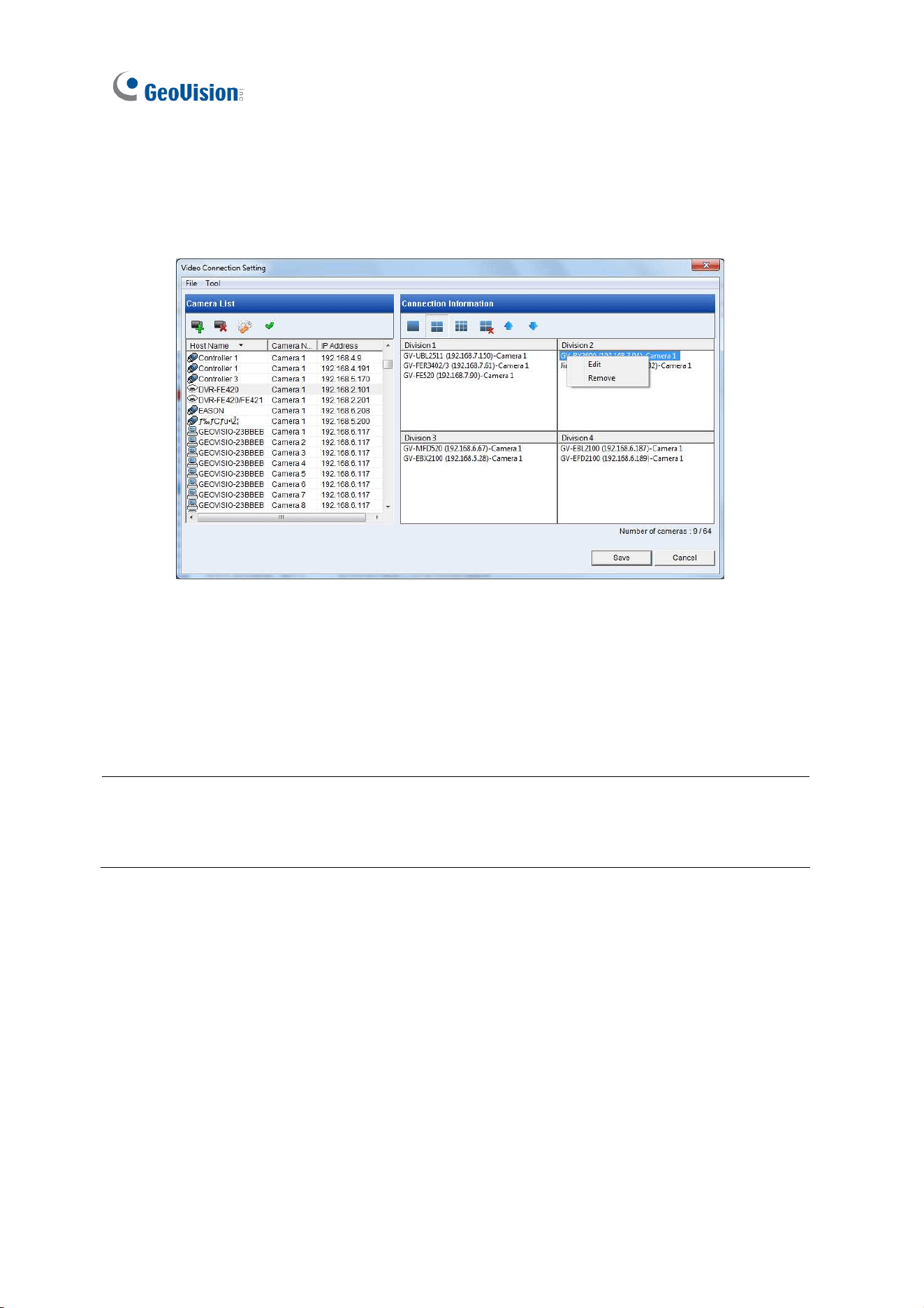
34
D. If you have changed the default ID and password of the added GV-IP Devices /
GV-Mobile Server, right-click the channel, select Edit and type the username and
password to log in for connection. By default, the login ID and password for all GV-IP
Devices are admin.
Figure 2-14
7. Click Save.
The cameras in the Connection Information column will be updated to the GV-IP Decoder Box
Series / GV-Pad Mini / GV-IP Display 101 and looped at a 30-second interval by default.
Note: Fisheye dewarping is only supported by GV-IP Decoder Box Plus. To dewarp the
fisheye view, you need to choose 1-division layout or assign the camera to Grid 1 of the
4-division view.
Getting Started
35
2
2.7.2 Adding a Third-party Device
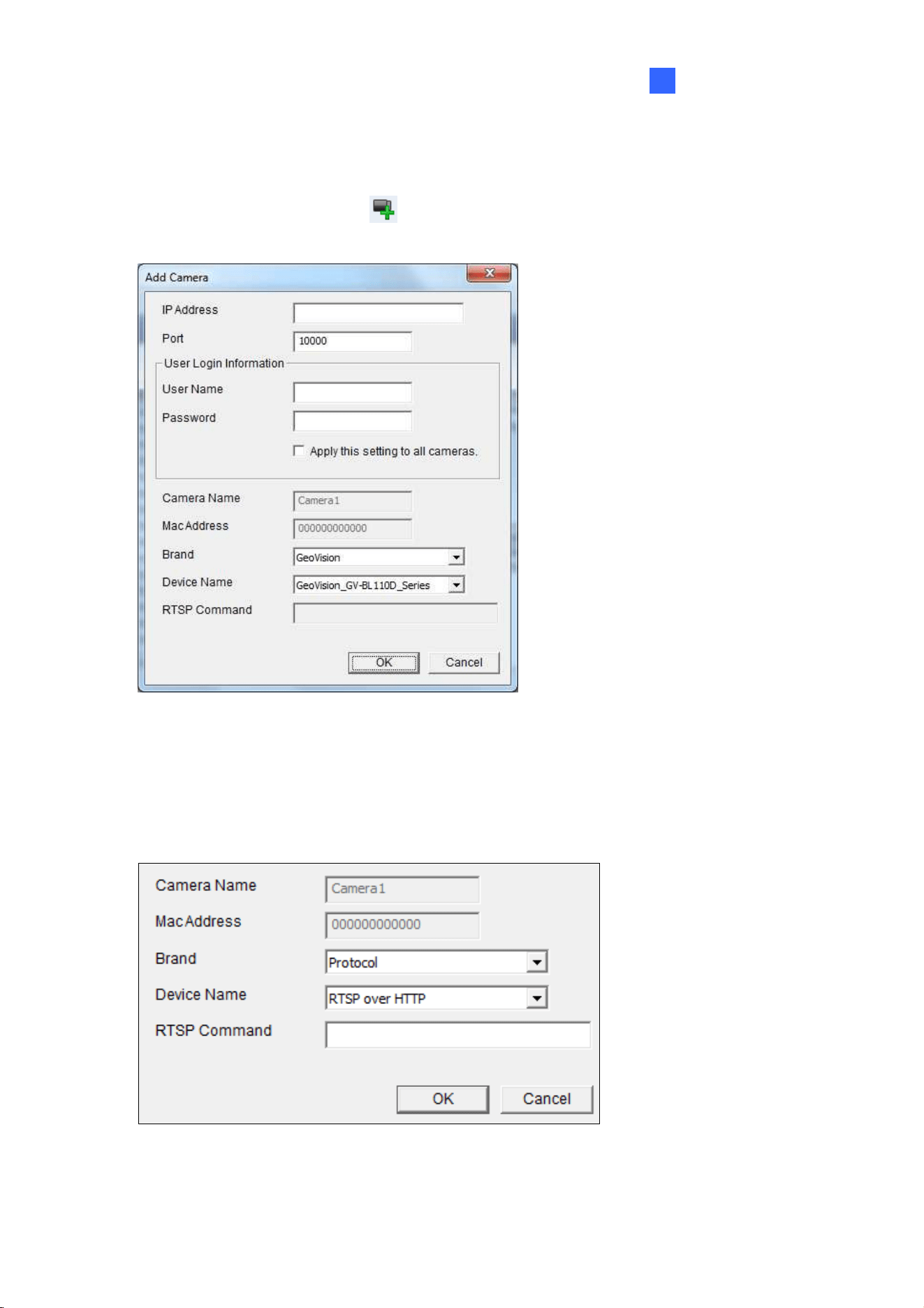
1. Click the Add Camera button on the Video Connection Setting window (Figure
2-13). This dialog box appears.
Figure 2-15
2. Type the IP address, user name, and password of the device.
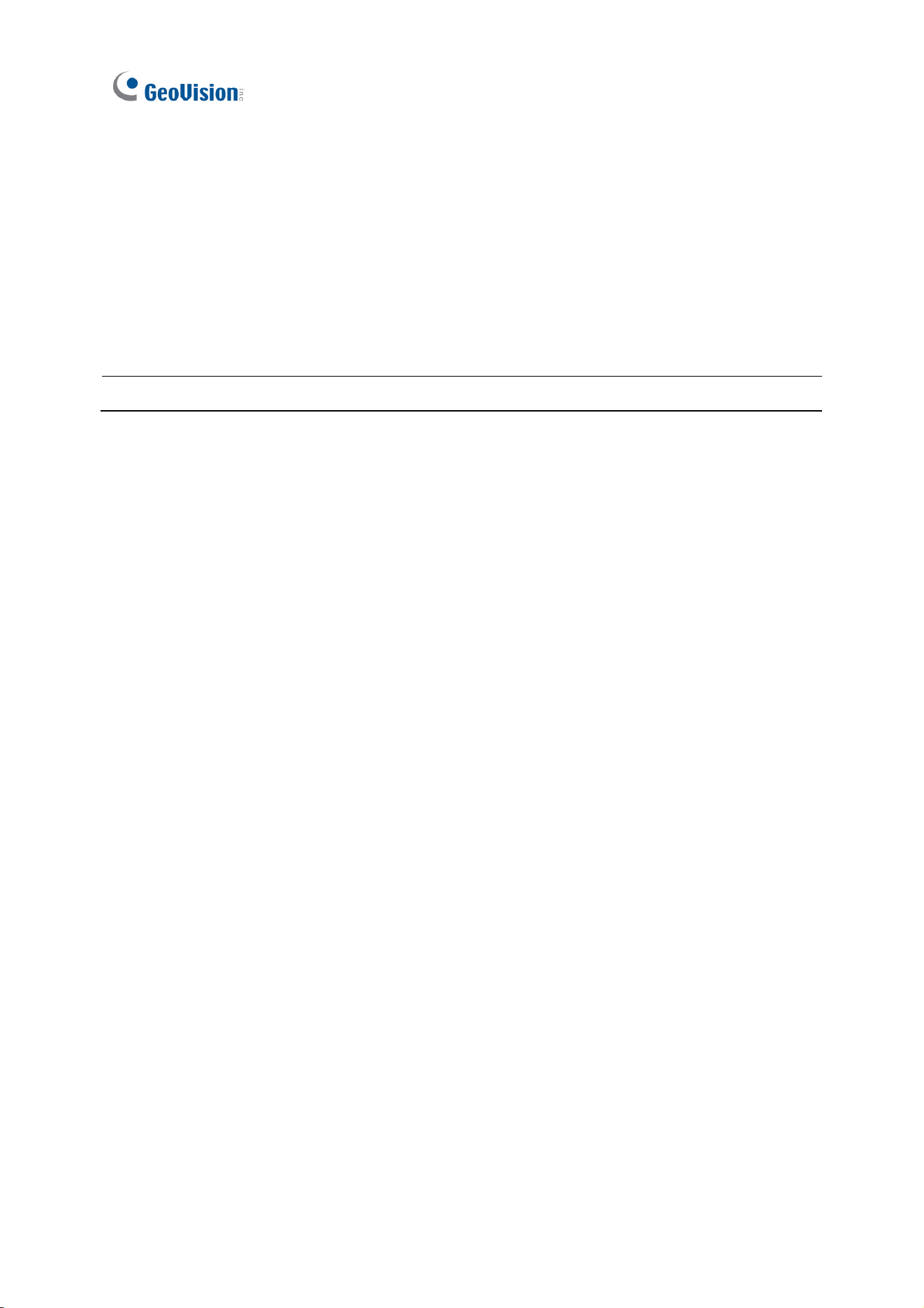
3. Select Protocol for Brand and one of the following protocols for Device Name. Type the
RTSP command if required. Refer to your third-party IP camera’s manual for this
command.
Figure 2-16
36
ONVIF: Select this protocol if your camera adheres to ONVIF.
RTSP over HTTP: The RTSP protocol uses an HTTP port for data streaming from
the IP camera.
RTSP over TCP: The RTSP protocol uses a TCP port for data streaming from the
IP camera.
RTSP over UDP: The RTSP protocol uses a UDP port for data streaming from the
IP camera.
Note: GV-IP Decoder Box Light does not support RTSP connection.
4. Click OK. The camera is added to the list.
5. Add channels to the Connection Information column. See Step 6, 2.7.1 Adding a GV-IP
Device.
6. Click Save.
Accessing Live View
37
3
Chapter 3 Accessing Live View
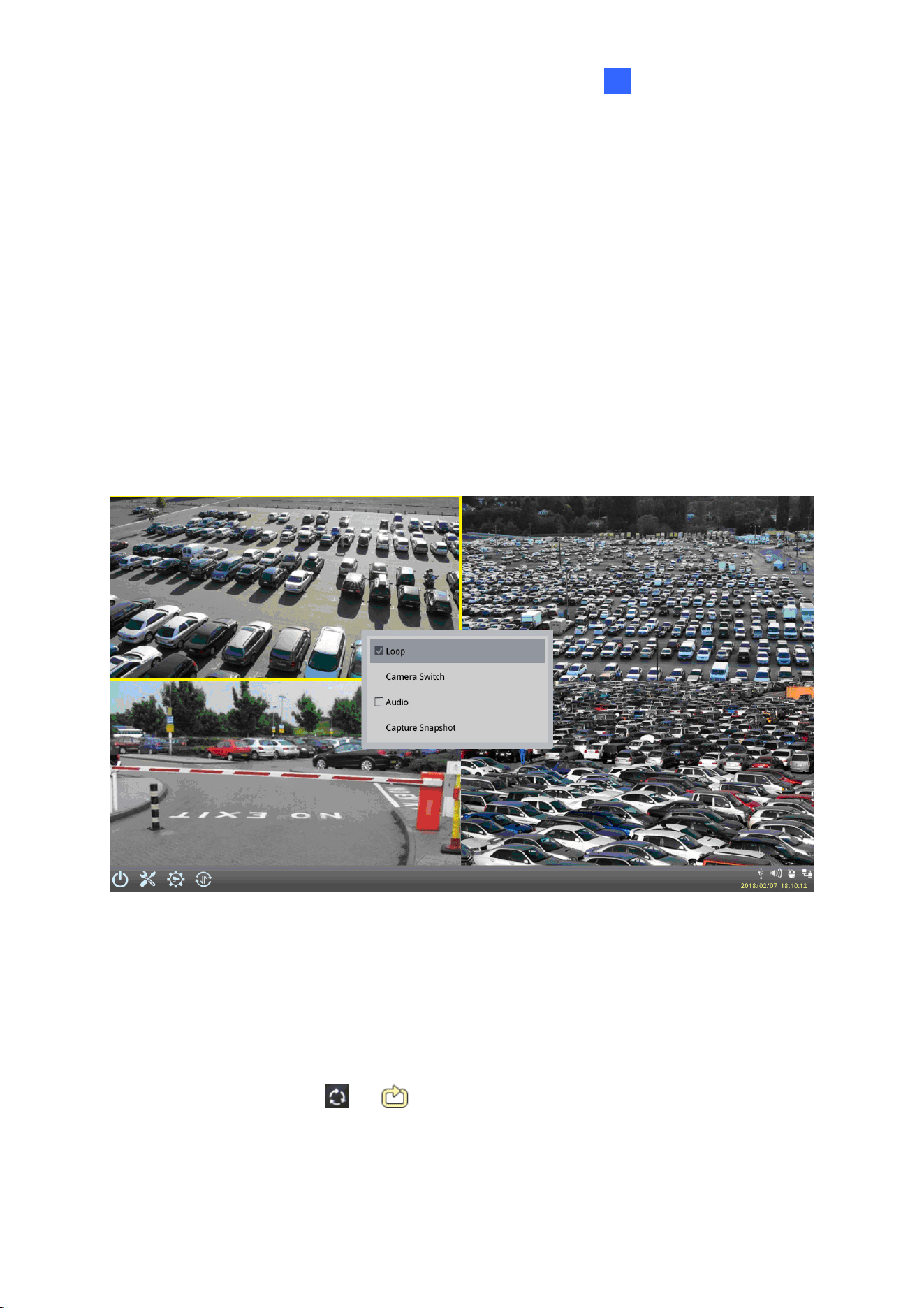
3.1 Live View
After adding and assigning IP devices to the live view grid, the camera live views are
displayed on the main screen. Hold for right-clicking on a live view grid to access the
following options:
Note: The user interfaces are different by models. Find the relevant settings corresponding to
your device. Here we use GV-IP Decoder Box Ultra / GV-IP Display 101 as an example.
Figure 3-1
Capture Snapshot: Only supported by GV-IP Decoder Box Ultra / Plus / GV-Pad Mini /
GV-IP Display 101, capture a snapshot of the live view. This option is only available
when the live view grid is not looping. See 3.2 Capturing Snapshots.
Play Mode: When more than one device is added to a grid, select Loop to start looping
through the devices or select a device number to fix the live view grid to the selected
device. A looping icon
or will appear on the live view grid if you select Loop.
Note: To fix the live view grid to a selected device for GV-IP Decoder Box Ultra, click
Camera Switch and click the desired camera number.
38
PTZ: Select to allow GV-Joystick V2 / your mouse / GV-IR Remote Control to control the
PTZ device. To pan and tilt the live view, click and hold the arrow on the image. This
function is only available for devices with PTZ function and only one PTZ device can be
enabled at a time.
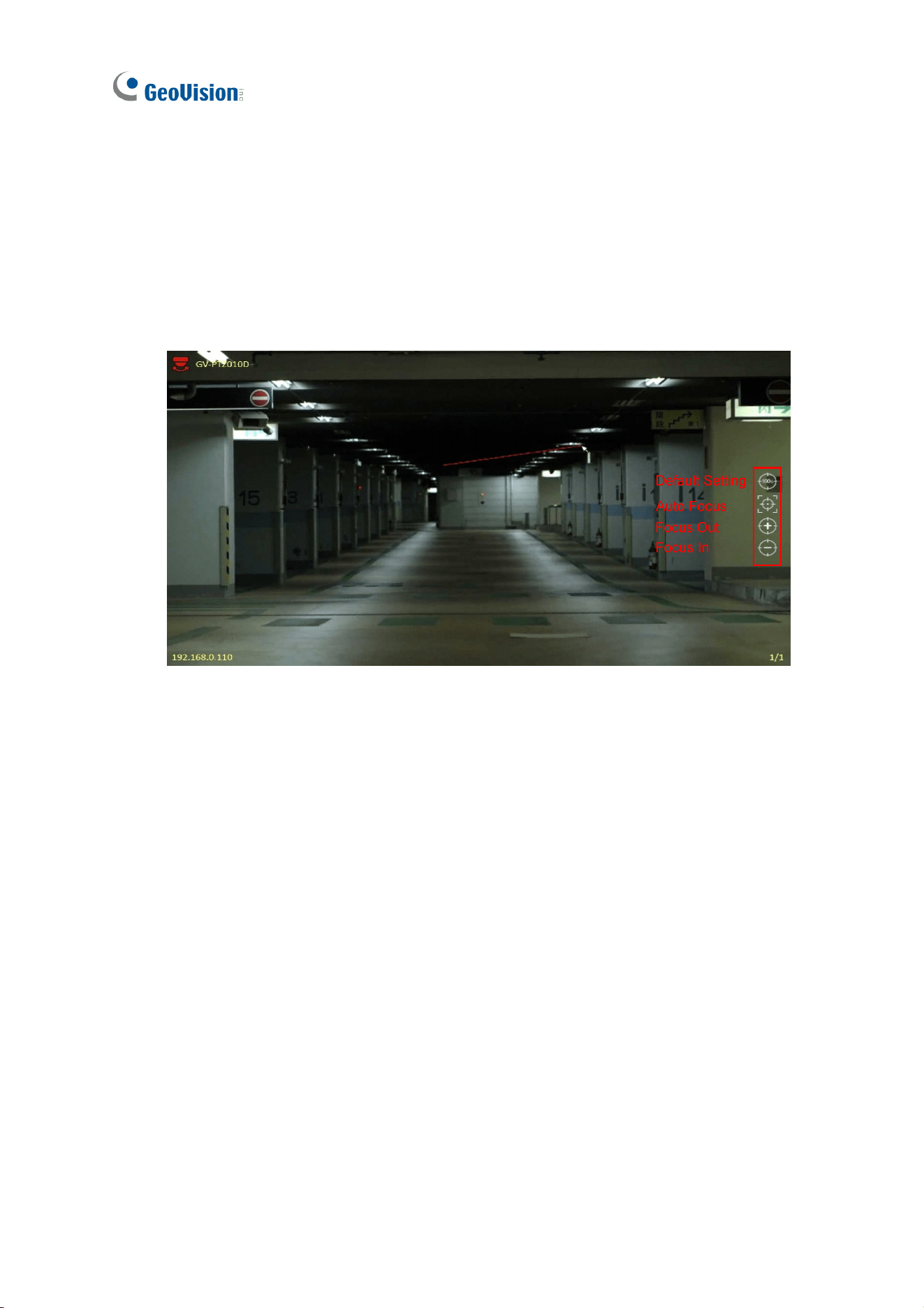
Visual PTZ Button: Only for GV-IP Decoder Box Ultra / Plus / GV-Pad Mini / GV-IP
Display 101, select to activate the PTZ control buttons. This function is only available for
devices with PTZ function.
Figure 3-2
Default Setting: Selects to return to the camera’s home position.
Auto Focus: Automatically adjusts the sharpness of the camera view.
Focus In / Out: Adjusts the sharpness of the camera view.
Audio: Enables or disables the audio out function. You can only enable the audio out
function of one device at a time.
Note the following live view specifications:
The resolution of the added device must be lower than the maximum resolution listed
below for each screen division. When the device resolution exceeds the maximum
resolution supported, GV-IP Decoder Box Series / GV-Pad Mini / GV-IP Display 101 will
connect to stream 2 of the device instead. If stream 2 is unavailable, the message
“Resolution Error” will appear on the screen.
Fisheye dewarping is only supported by GV-IP Decoder Box Plus in Single View and the
Grid 1 of Quad View.
Accessing Live View
39
3
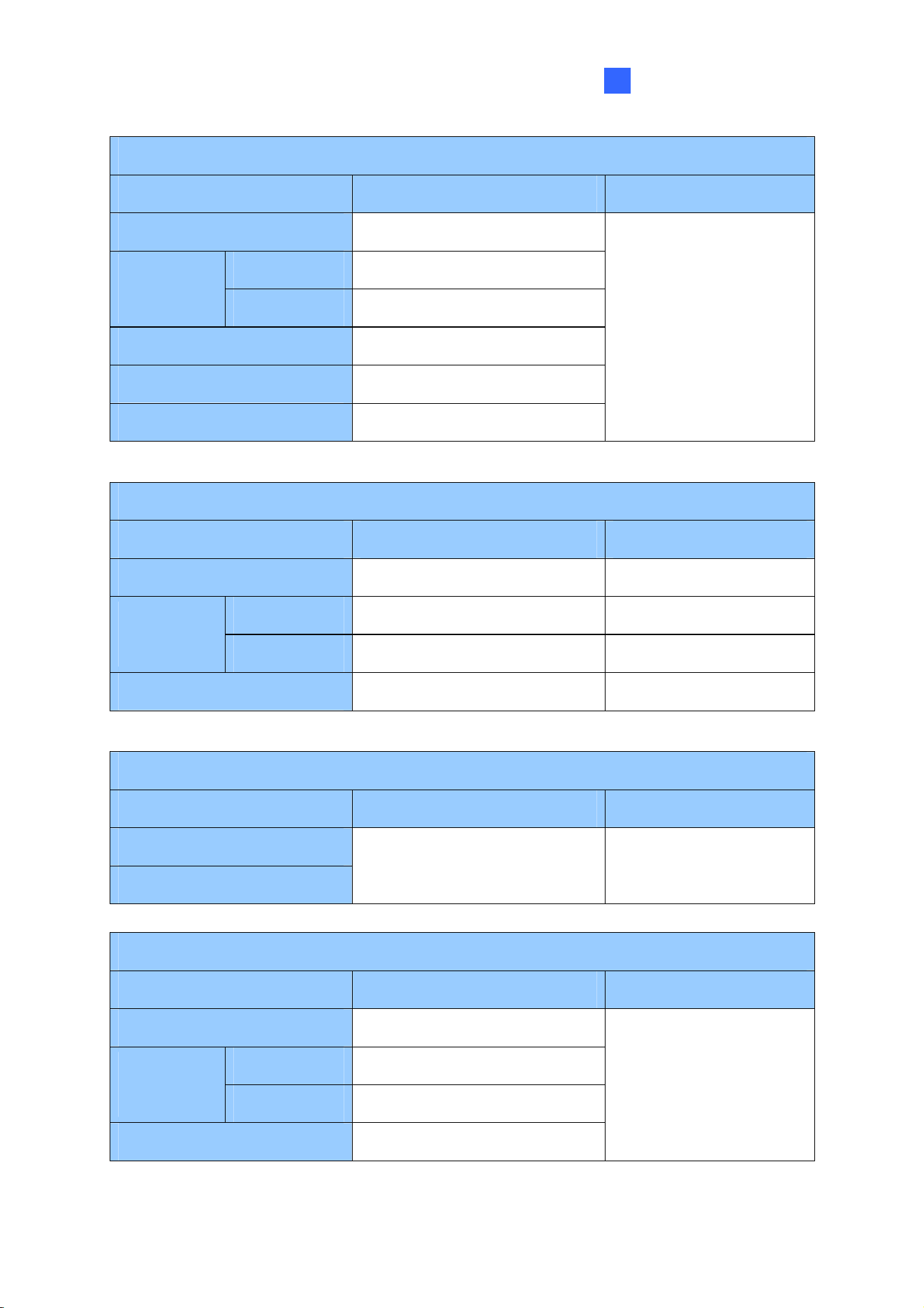
GV-IP Decoder Box Ultra
Screen Division Maximum Resolution Fisheye Dewarping
1-Division (Single View)
3840 x 2160
Grid 1
2560 x 1920
4-Division
(Quad View)
Other 3 Grids
1920 x 1080
6-Division
1280 x 720
8-Division
1280 x 720
9-Division
1280 x 720
Not supported
GV-IP Decoder Box Plus
Screen Division Maximum Resolution Fisheye Dewarping
1-Division (Single View)
2048 x 1944 Supported
Grid 1
2048 x 1944 Supported
4-Division
(Quad View)
Other 3 Grids
1920 x 1080 Not supported
9-Division
1280 x 720 Not supported
GV-IP Decoder Box Lite
Screen Division Maximum Resolution Fisheye Dewarping
1-Division (Single View)
4-Division (Quad View)
1920 x 1080 Not supported
GV-Pad Mini
Screen Division Maximum Resolution Fisheye Dewarping
1-Division (Single View)
2048 x 1944
Grid 1
2048 x 1944
4-Division
(Quad View)
Other 3 Grids
1920 x 1080
9-Division
1280 x 720
Not supported
40
GV-IP Display 101
Screen Division Maximum Resolution Fisheye Dewarping
1-Division (Single View)
3840 x 2160
Grid 1
2560 x 1920
4-Division
(Quad View)
Other 3 Grids
1920 x 1080
6-Division
1280 x 720
8-Division
1280 x 720
9-Division
1280 x 720
Not supported
Note: The camera view will display the message “Connection Lost” if the login ID and
password are incorrect.
Accessing Live View
41
3
3.2 Capturing Snapshots
You can take snapshots of the live view and the snapshots will be automatically saved to the
selected storage device (USB drive or SD card) in JPEG format.
Before you start, be sure:
You have inserted a USB drive or SD card for storage.
You have at least 30 MB of space on your storage device.
The storage type is configured as FAT32 format (or as NTFS format for GV-IP Decoder
Box Ultra).
You have assigned a storage device in the System Setting page (see below).
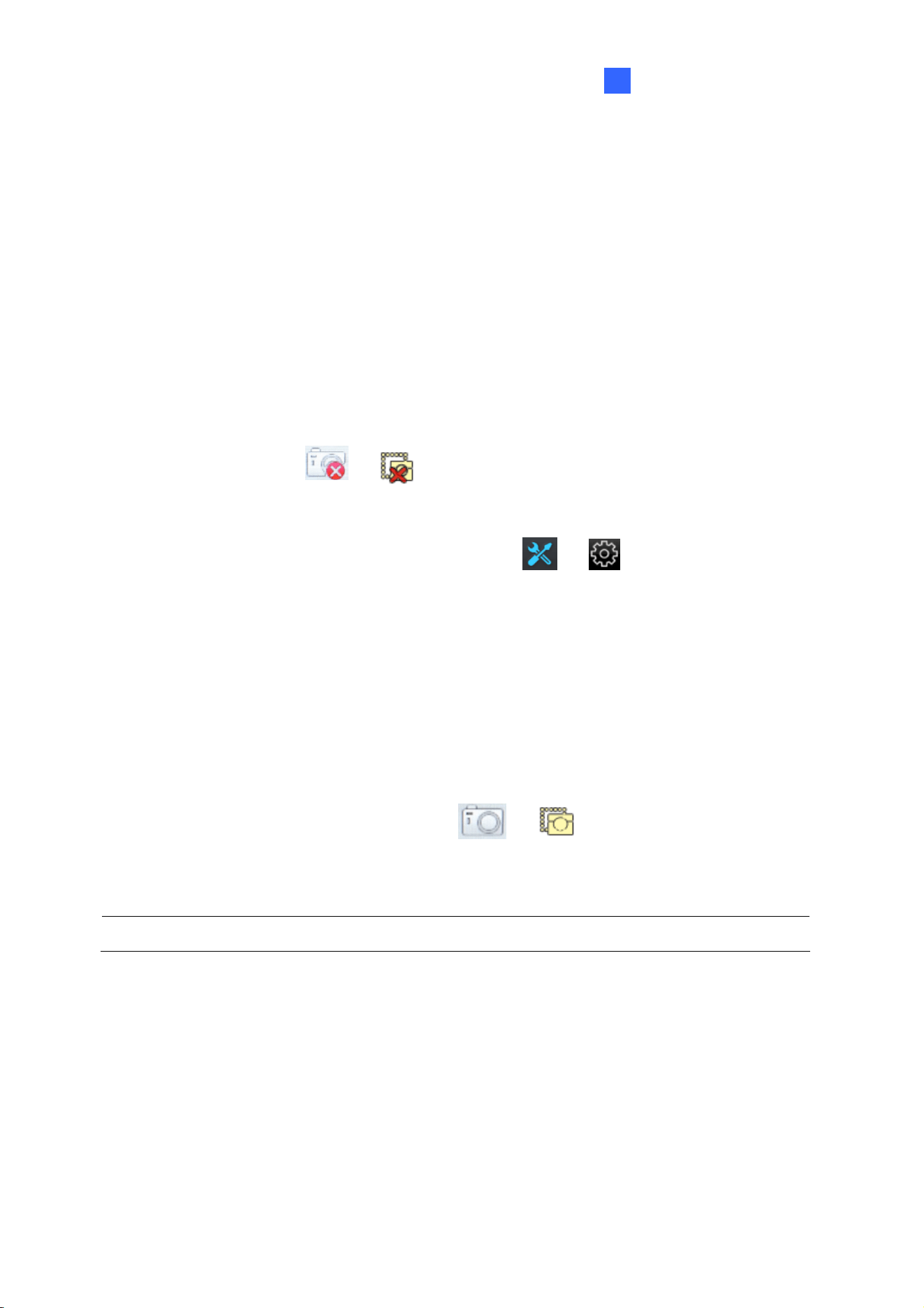
Otherwise, the error icon
or
will appear when attempting to capture an image.
1. On the main menu, click the System Setting icon
or and select System on
the left.
2. Select a storage device from the Storage Device option to store the captured
screenshots, and click Save.
3. If the live view grid is still under looping mode, hold for right-clicking on the live view grid,
select Camera Switch / Play Mode and select the device number to stop the looping.
4. Hold for right-clicking on the live view grid again, and select Capture Snapshot.
When captured successfully, a snapshot icon
or will appear at the top right
corner of the screen.
Note: Capturing snapshots is not supported by GV-IP Decoder Box Lite.
42
3.3 Fisheye Dewarping
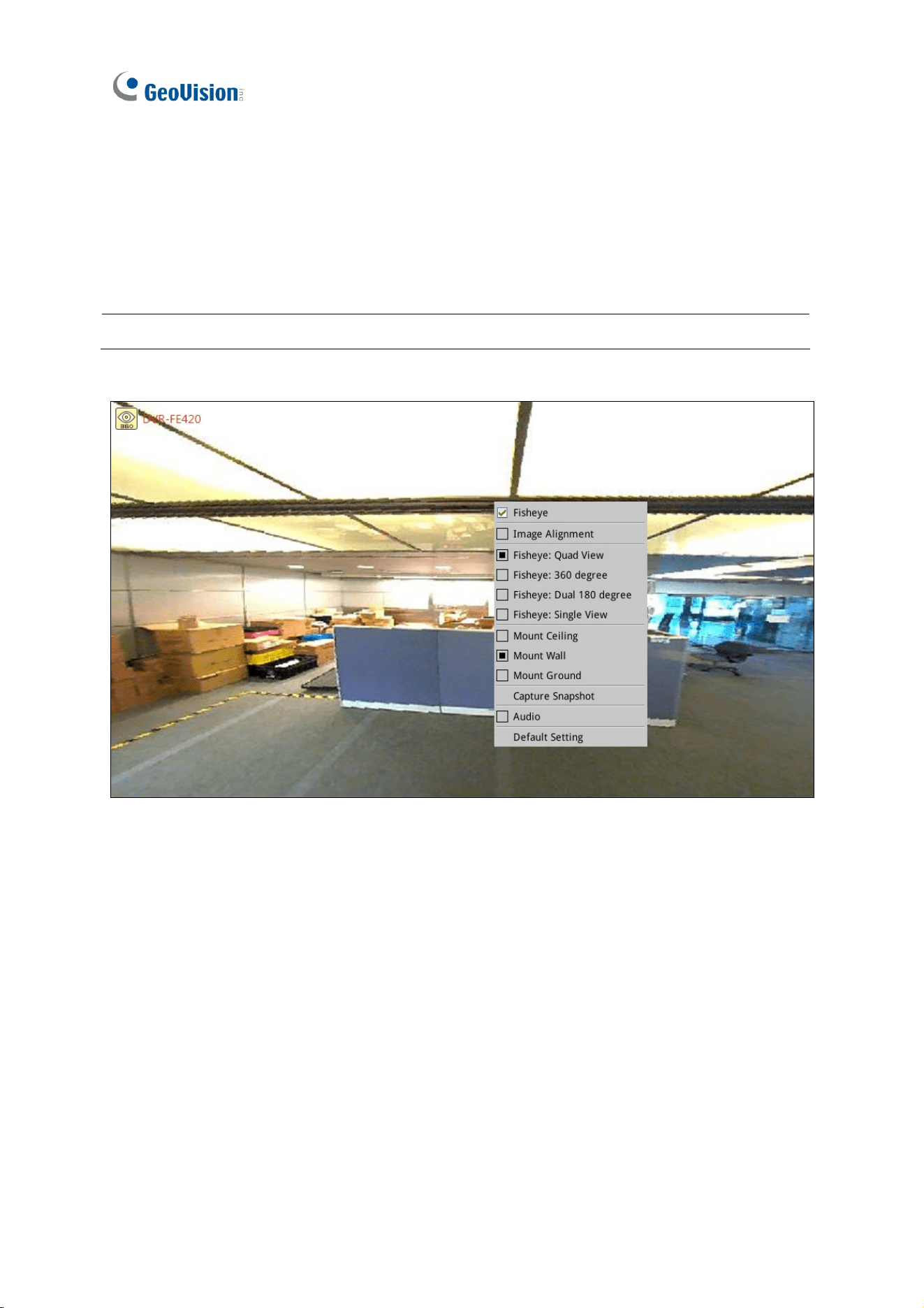
You can enable fisheye dewarping if the fisheye camera is in Single View or Grid 1 of the
Quad View. Right-click the live view of the fisheye camera and select Fisheye to enable
fisheye dewarping.
Note: Fisheye dewarping is only supported by GV-IP Decoder Box Plus.
Figure 3-3
The following fisheye settings are available:
Image Alignment: Align the red circle with the inner edge of the camera image if
needed. You can adjust the red circle by dragging and by scrolling the mouse.
Camera Modes:
Fisheye: Quad view: Composed of 3 PTZ views and a circular source image.
Fisheye: 360 degree: Composed of two PTZ views and one 360º panoramic
view.
Fisheye: Dual 180 degree: Composed of two 180º views.
Fisheye: Single view: Composed of one PTZ view.
Mount Ceiling / Mount Wall / Mount Ground: Select according to where the camera is
mounted.
Accessing Live View
43
3
3.4 Controlling PTZ and Speed Dome Cameras with
GV-Joystick V2
The GV-Joystick V2 can be connected to the GV-IP Decoder Box Series / GV-Pad Mini /
GV-IP Display 101 to control GeoVision PT, PTZ, and Speed Dome cameras, and also
third-party PTZ and Speed Dome cameras. The supported functions include zoom in, zoom
out, tilt (vertical movement), pan (horizontal movement), focus in, focus out, and automatic
focus. The functions corresponded to each button on GV-Joystick V2 are listed below:
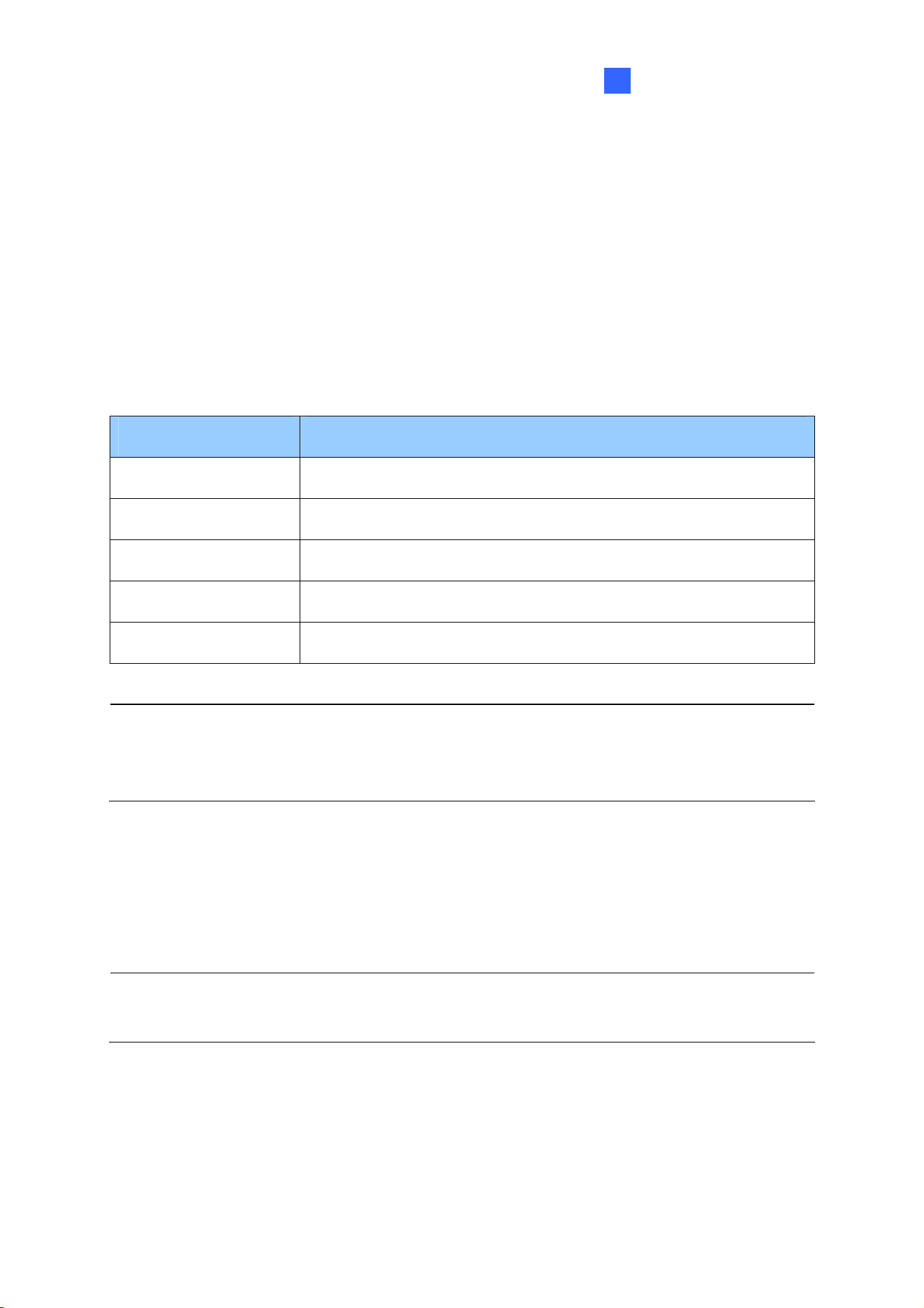
Button Function
F1 Focus In
F2 Focus Out
F3 Auto Focus
F4 Home
F5 / F6 No functions
Note: For PTZ control, GV-SD200 and third-party cameras must be connected through
ONVIF. GV-Joystick V2 cannot control channels connected through GV-Mobile Server or
RTSP.
1. Connect a GV-Joystick V2 to the USB port.
2. Right-click the live view of the PTZ device and select PTZ.
3. You can start to control the camera using the GV-Joystick V2.
Note: For GV-IP Decoder Box Ultra, you can also use GV-IR Remote Control to control
PTZ movements. See 1.9 GV-IR Remote Control.
44
Chapter 4 System Settings
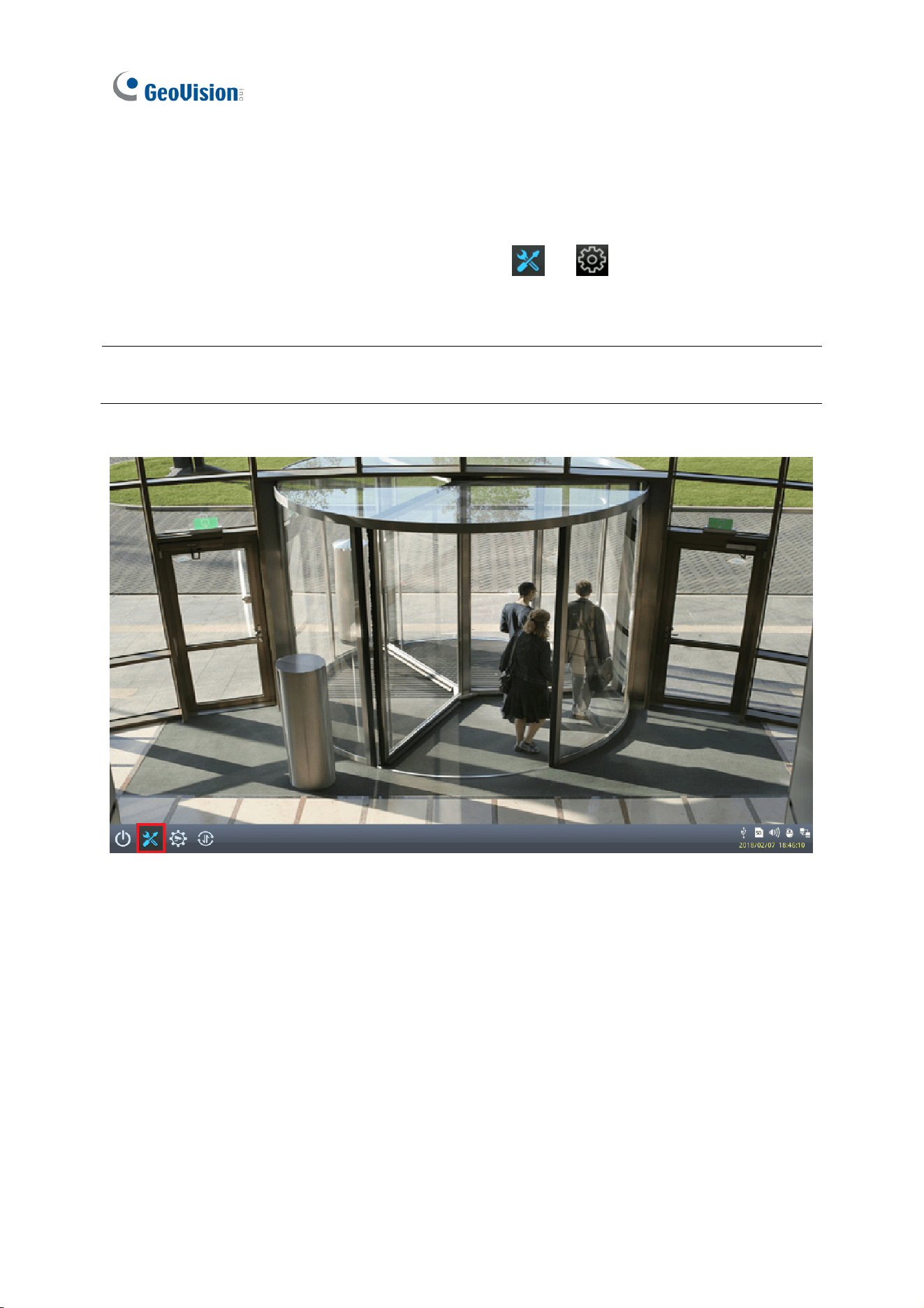
On the main screen, click the System Settings icon or to access the following
setting pages: System, Network, Date & Time, Account, Display, and Camera.
Note: The user interfaces are different by models. Find the relevant settings corresponding to
your device. Here we use GV-IP Decoder Box Ultra / GV-IP Display 101 as an example.
Figure 4-1
System Settings
45
4
4.1 System
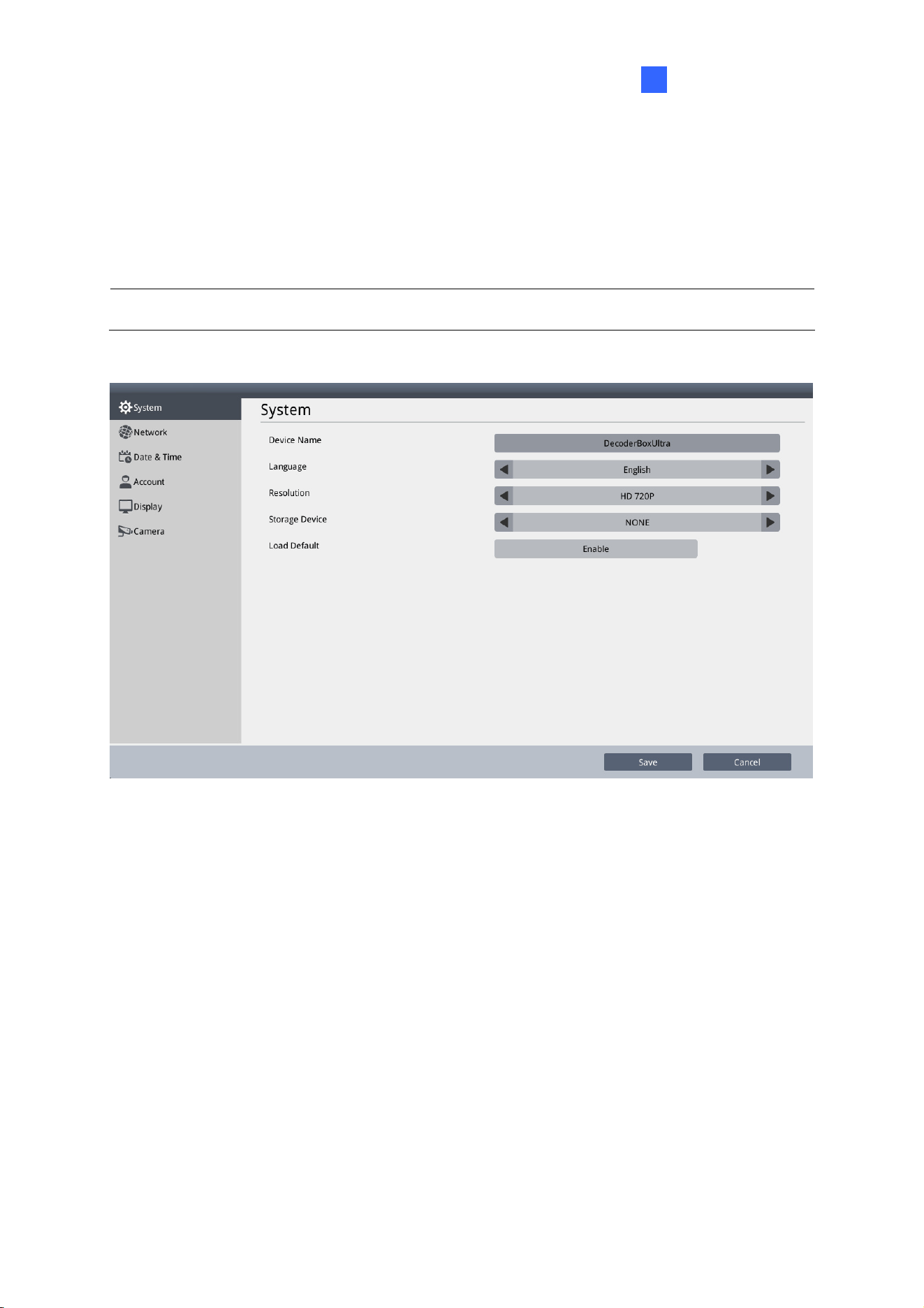
On the System page, you can change the device name, interface language, resolution, or the
designated storage device for storing snapshots.
Note: Capturing snapshots is not supported by GV-IP Decoder Box Lite.
Figure 4-2
Device Name: Click to change the device name.
Language: Select a language for the user interface.
Resolution: Only for GV-IP Decoder Box Series, select a resolution for your monitor.
The default is HD 720P. If you are using a VGA monitor, select VGA 1024 x 768.
Storage Device: Select the storage device you want to use for storing captured
snapshots.
Load Default: Only for GV-IP Decoder Box Ultra and GV-IP Display 101, click Enable
to restore the device to default settings. For details, see 5.2 Restoring Default Settings.
Click Save to apply the settings.
46
4.2 Network
To configure the network settings for the GV-IP Decoder Box Series / GV-Pad Mini / GV-IP
Display 101, see 2.5 Setting Up the Network.
4.3 Date & Time
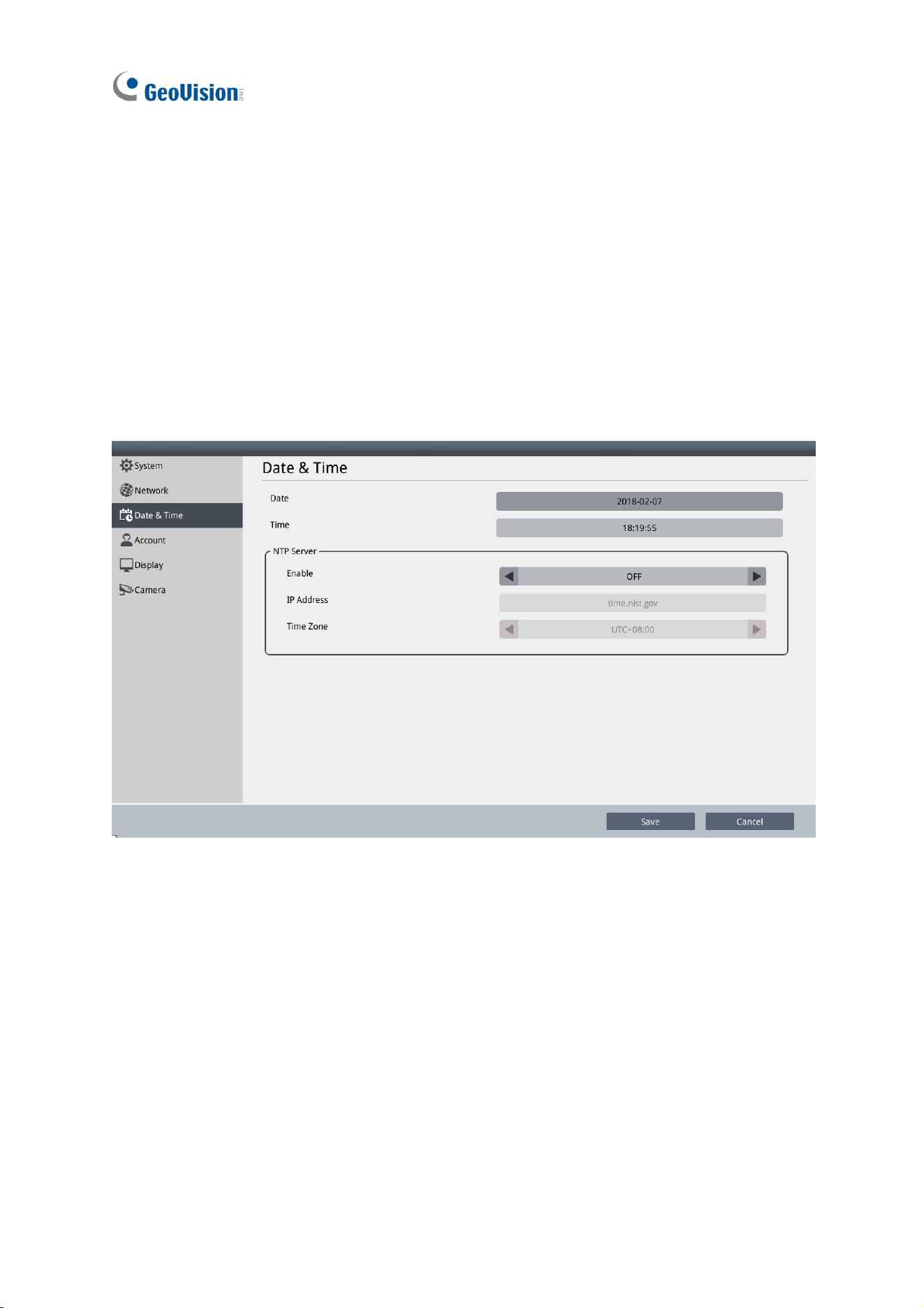
On the Date & Time page, you can configure the date and time of the GV-IP Decoder Box
Series / GV-Pad Mini / GV-IP Display 101.
Figure 4-3
Date & Time: Click to adjust the date and time.
NTP Server: Switch the Enable option to ON or Select Enable NTP and type the URL
of a network time server to synchronize the clock with the network time server.
Time Zone: Select a time zone for your location.
Click Save to apply the settings.
System Settings
47
4
4.4 Account
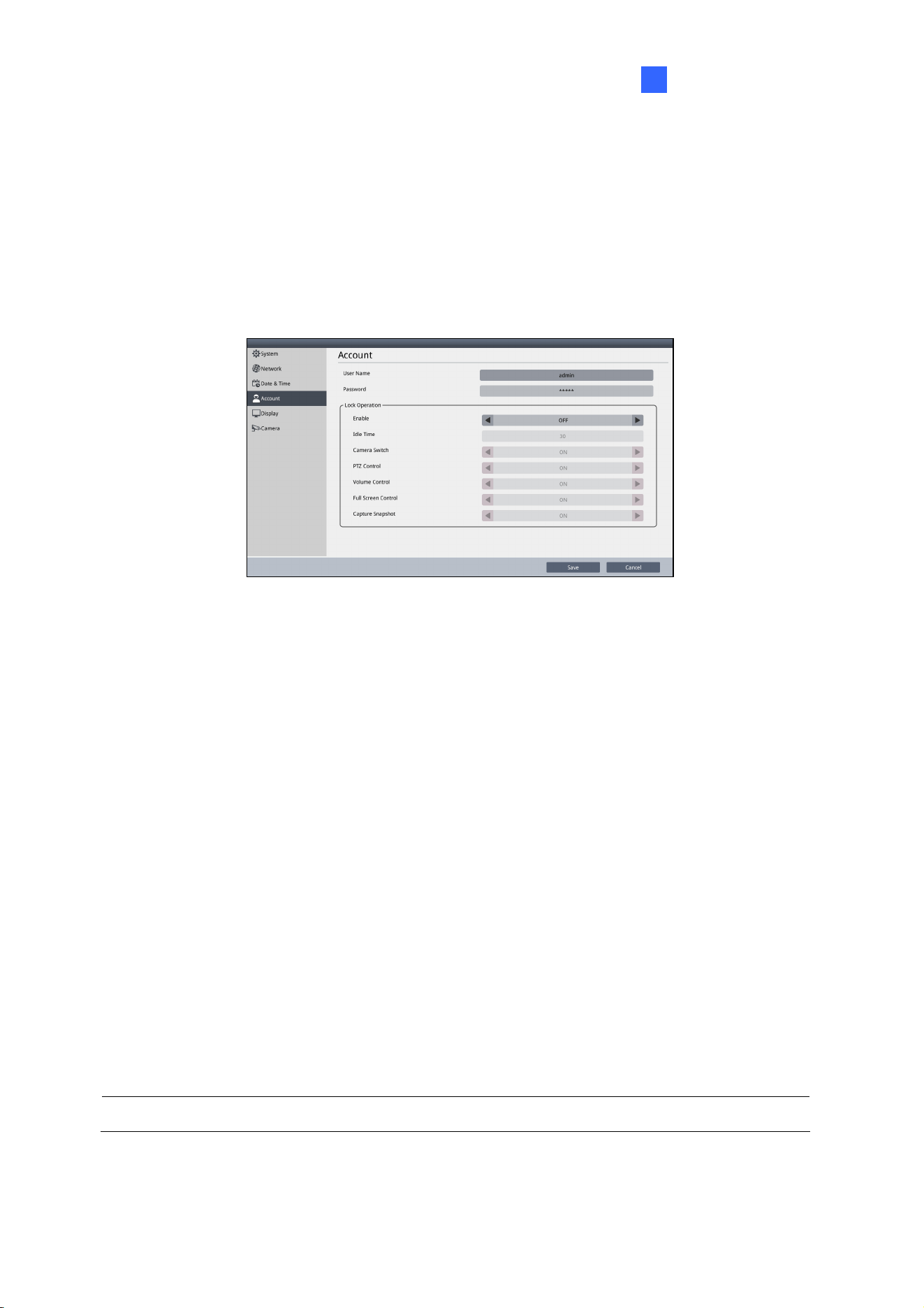
On the Account page, you can configure the login account of the GV-IP Decoder Box Series /
GV-Pad Mini / GV-IP Display 101. The default user name and password are both admin. You
will need the login information if you want to access the GV-IP Decoder Box Series / GV-Pad
Mini / GV-IP Display 101 through GV-IP Device Utility.
Figure 4-4
Configure the lock function by enabling Lock Operation (for GV-IP Decoder Box Ultra /
GV-IP Display 101) / Login window (for GV-IP Decoder Box Plus / Lite / GV-Pad Mini) to
manage users’ accessibility. Once you enable the function, you must enter the User Name
and Password if the device has been idle for a specified time period.
Idle / Wait Time: Specify an idle time from 30 to 300 seconds.
Only for GV-IP Decoder Box Ultra / Plus / GV-Pad Mini / GV-IP Display 101, you can specify
the following functions to be locked or unlocked after the specified time period. Enter the User
Name and Password again to unlock the functions.
Camera Switch / Lock Play Control
PTZ Control / Lock PTZ Control
Volume Control / Lock Audio Control
Full Screen Control / Lock Full screen
Capture Snapshot / Lock Capture Snapshot
Lock Dewarp Control
Note: The Lock Dewarp Control function is only available for GV-IP Decoder Box Plus.
Click Save to apply the settings.
48
4.5 Display
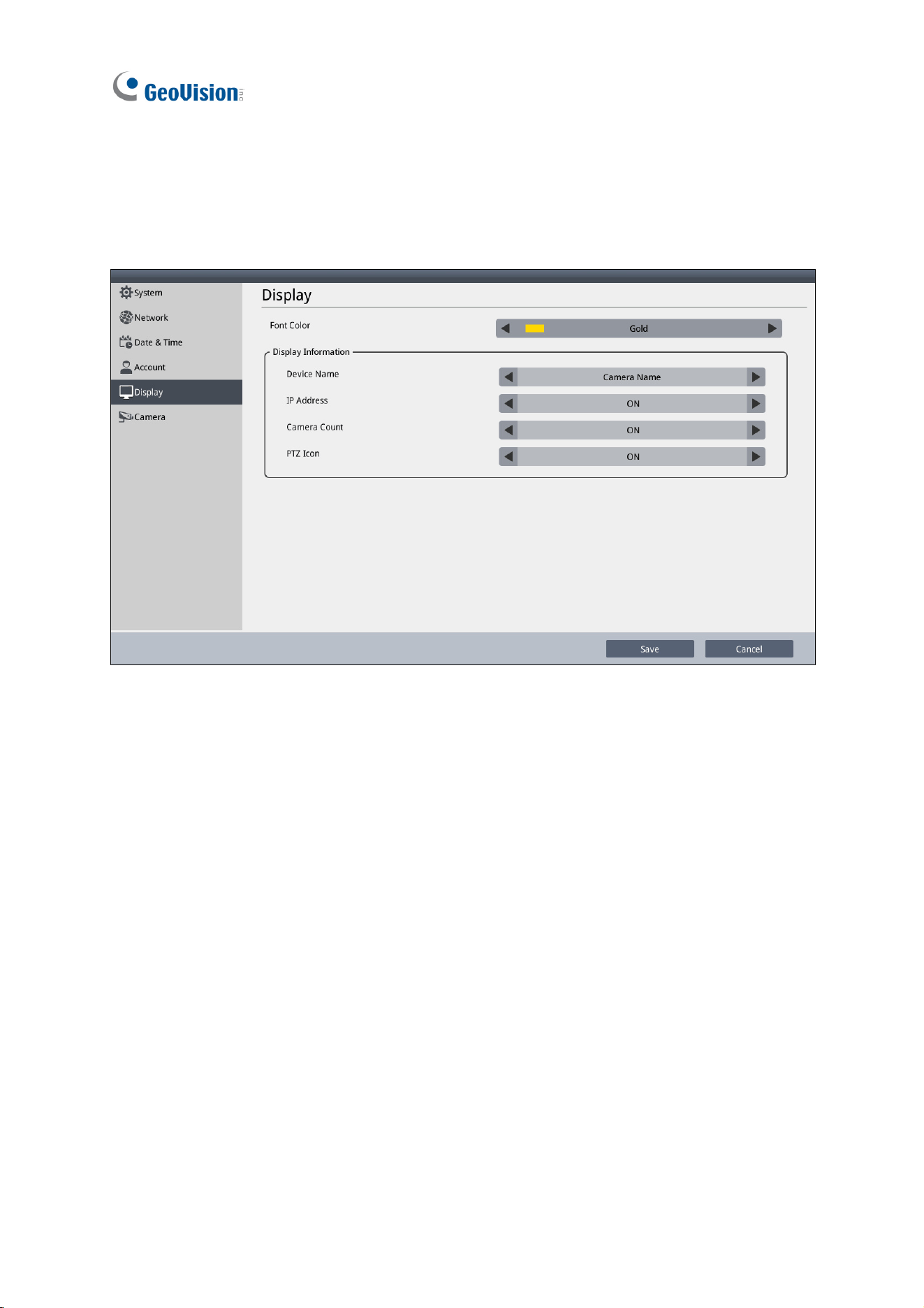
On the Display page, you can specify what information to overlay on the live view.
Figure 4-5
Font Color: Change the font color of the text overlay.
Device Name / Display Name: Select to display the device name of the camera.
Camera Name: Select to display the camera name.
Custom Name: Select to display the personalized camera name.
IP Address / Display IP Address: Select to display the IP address of the camera on
the live view.
Camera Count / Display Camera Count: Select to display the camera count of the live
view grid. For example, 7/8 indicates that there are 8 cameras assigned to the live view
grid, and live view of the 7
th
camera is currently being displayed.
PTZ Icon / Display PTZ Icon: Select to display a PTZ icon when the camera supports
PTZ functions.
Click Save to apply the settings.
System Settings
49
4
4.6 Camera
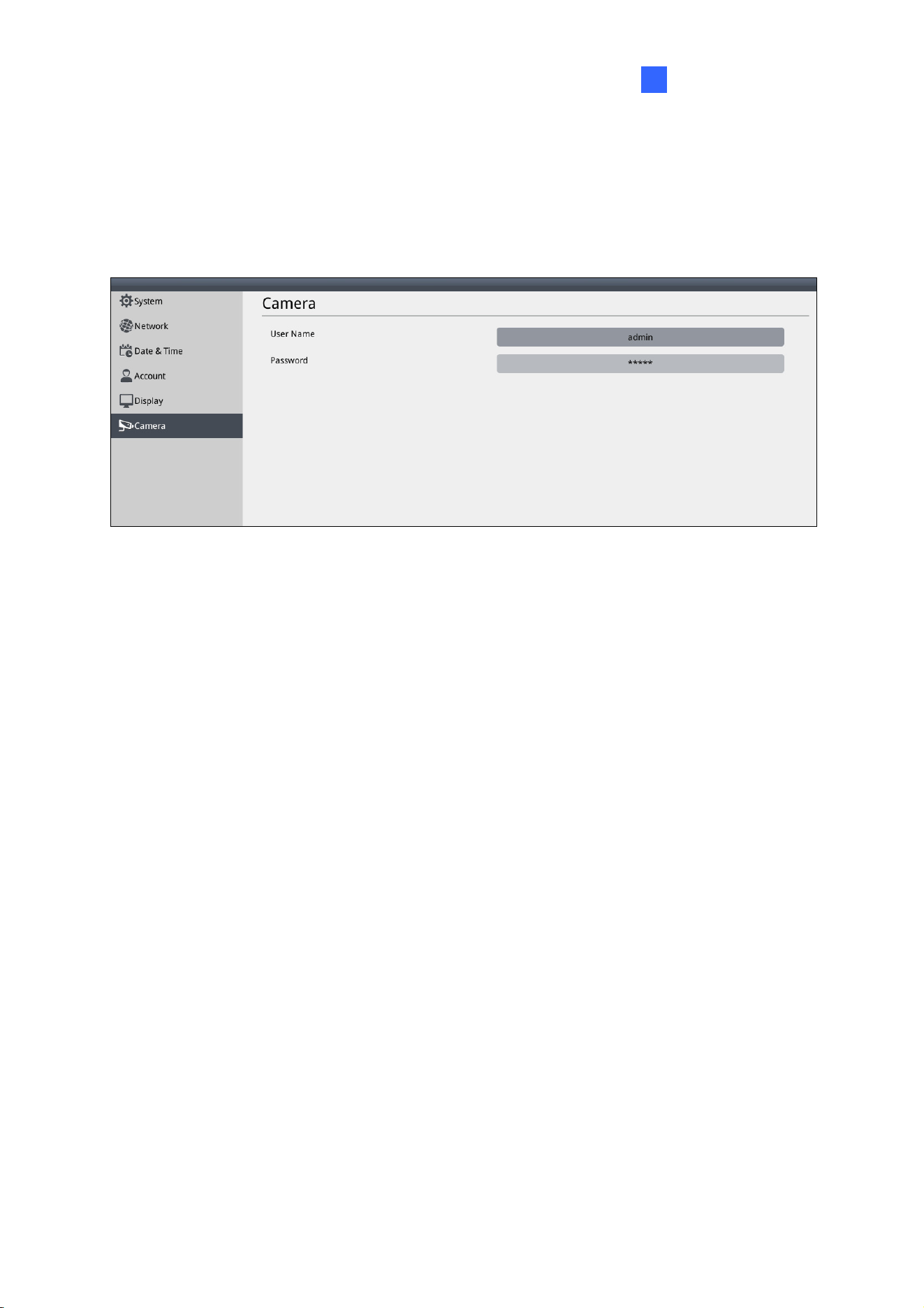
On the Camera page, you can change the ID and password of the IP device, which
automatically applies to all IP devices connected. The default ID and Passwords are admin.
Figure 4-6
Click Save to apply the settings.
50
Chapter 5 Advanced Applications
5.1 Upgrading the Firmware
GeoVision will periodically release firmware updates on the website. You can upgrade
firmware locally using a USB drive or SD card or remotely through GV-IP Device Utility.
Note: SD card is not supported by GV-IP Decoder Box Lite.
5.1.1 Upgrading Firmware through a Storage Device
1. Copy the firmware file to the root folder of a USB drive or an SD card.
2. Insert the storage device to the GV-IP Decoder Box Series / GV-Pad Mini / GV-IP Display
101.
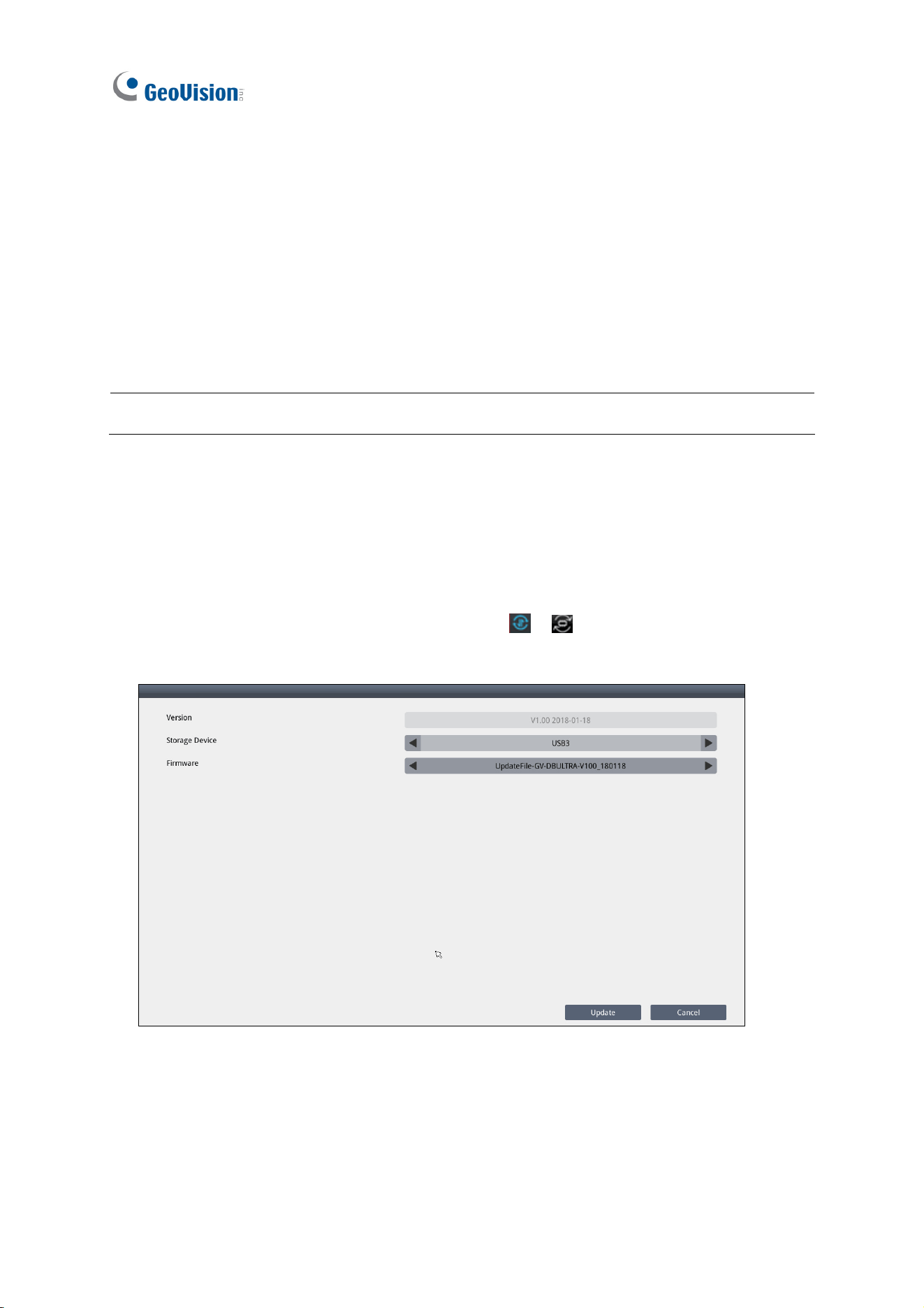
3. On the main screen, click the Firmware Update
/ icon.
4. Select the storage device and select the firmware file.
Figure 5-1
5. Click Update to begin upgrading the firmware. The GV-IP Decoder Box Series / GV-Pad
Mini / GV-IP Display 101 will restart after the firmware upgrade is completed.
Advanced Applications
51
5
5.1.2 Upgrading Firmware through GV-IP Device Utility
1. Run GV-IP Device Utility. Once started, the utility will automatically search for GV
devices connected in the same LAN.
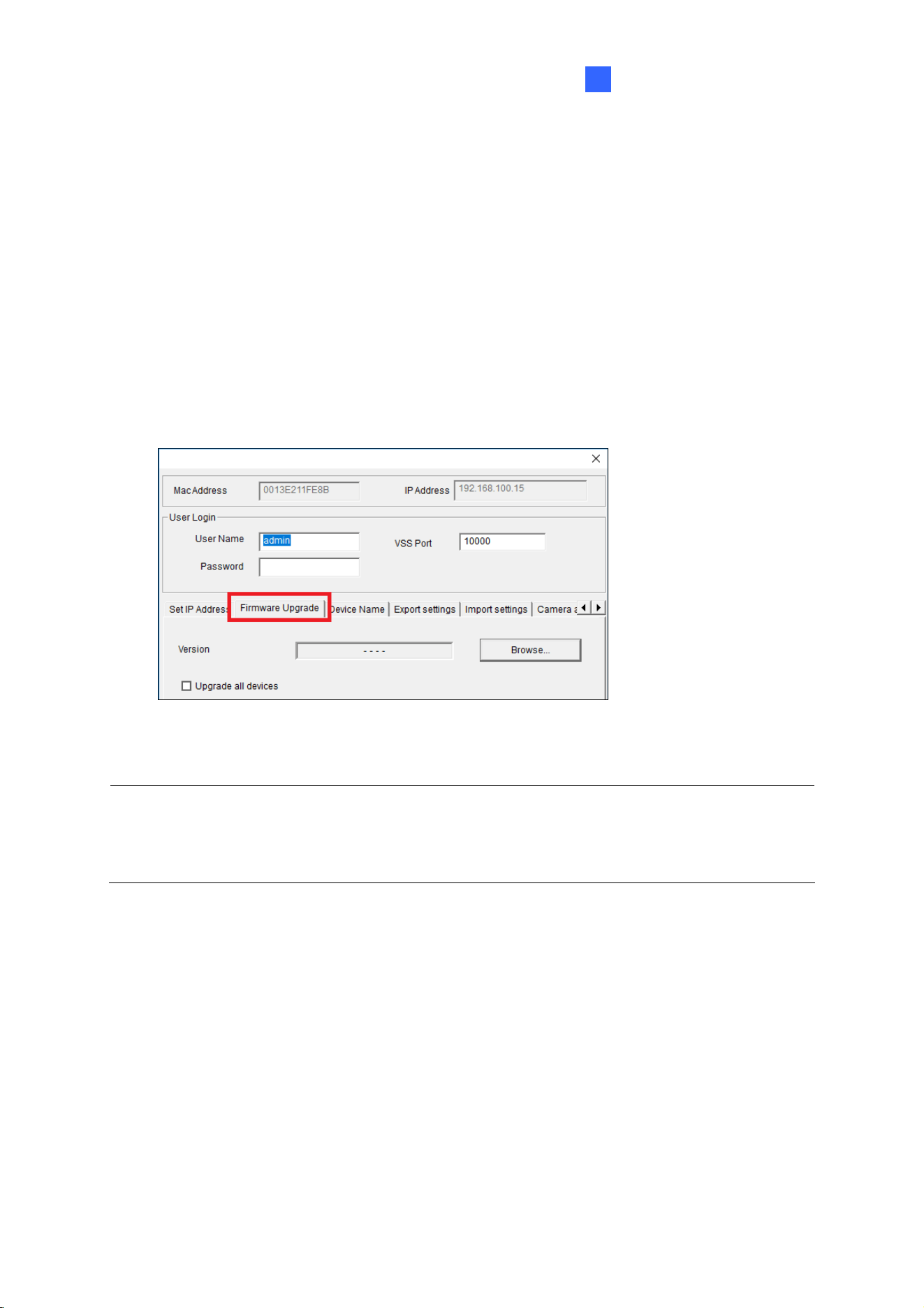
2. Double-click the desired device in the list and select the Firmware Upgrade tab.
3. Click Browse to locate the firmware file downloaded saved on your local PC.
4. Type the username and password of the device under User Login.
5. Optionally, select Upgrade all devices to update the firmware of the devices, with the
same username, password and model, in the list.
6. Click Upgrade. The system will restart itself when the upgrade is completed.
Figure 5-2
Note: The default username and password are both admin. To see how to change the login
information of GV-IP Decoder Box Series / GV-Pad Mini / GV-IP Display 101, refer to 4.4
Account.
52
5.2 Restoring Default Settings
If for any reason the GV-IP Decoder Box Series / GV-Pad Mini / GV-IP Display 101 is not
responding correctly, there are two ways to restore the device to default settings.
1. Use the pin to press the load default button on the front / side panel for about 10 seconds.
2. Use Web interface to configure the setting.
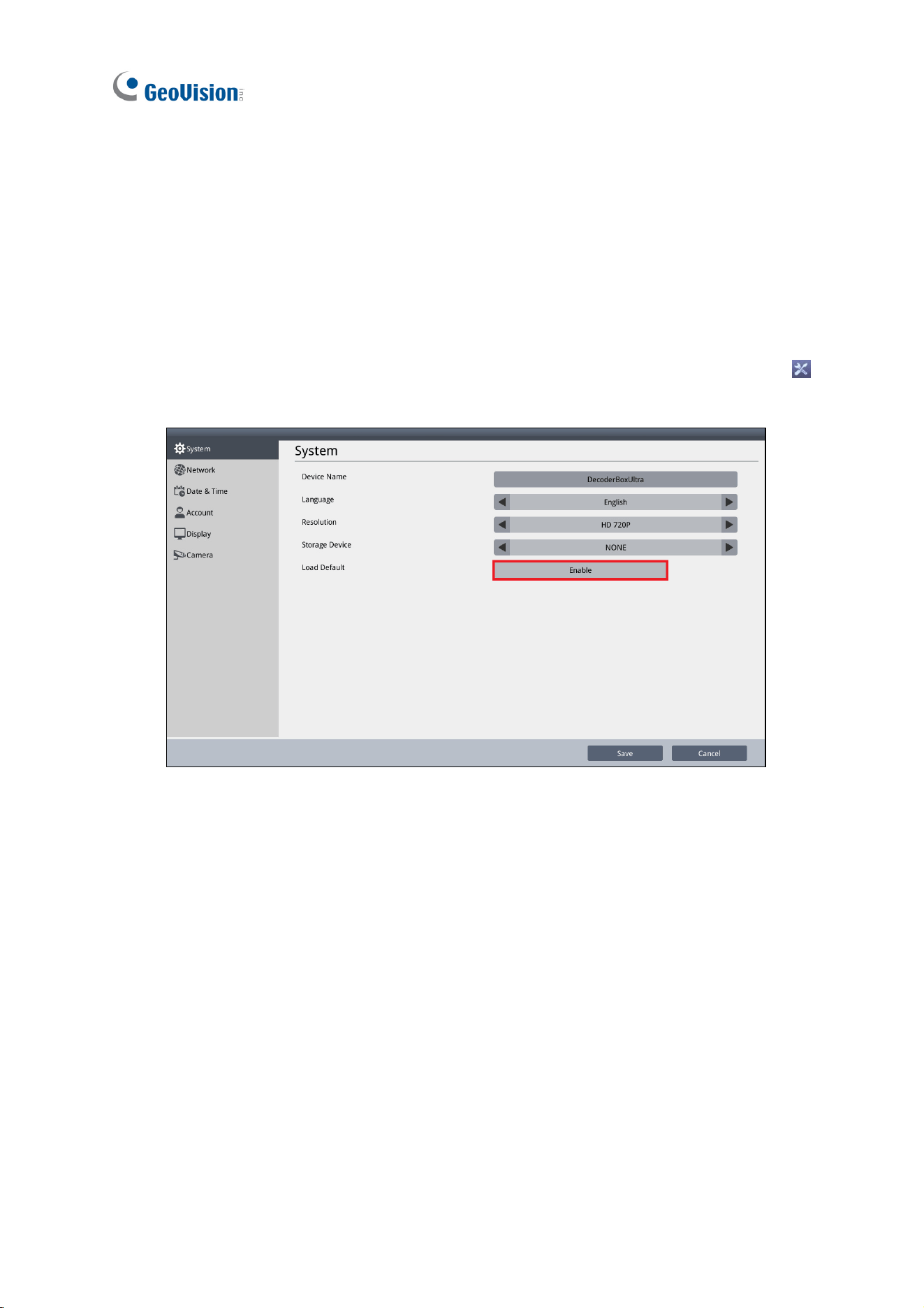
For GV-IP Decoder Box Ultra / GV-IP Display 101, click the System Settings icon
on the main page, click System, and enable Load Default.
Figure 5-3
Advanced Applications
53
5
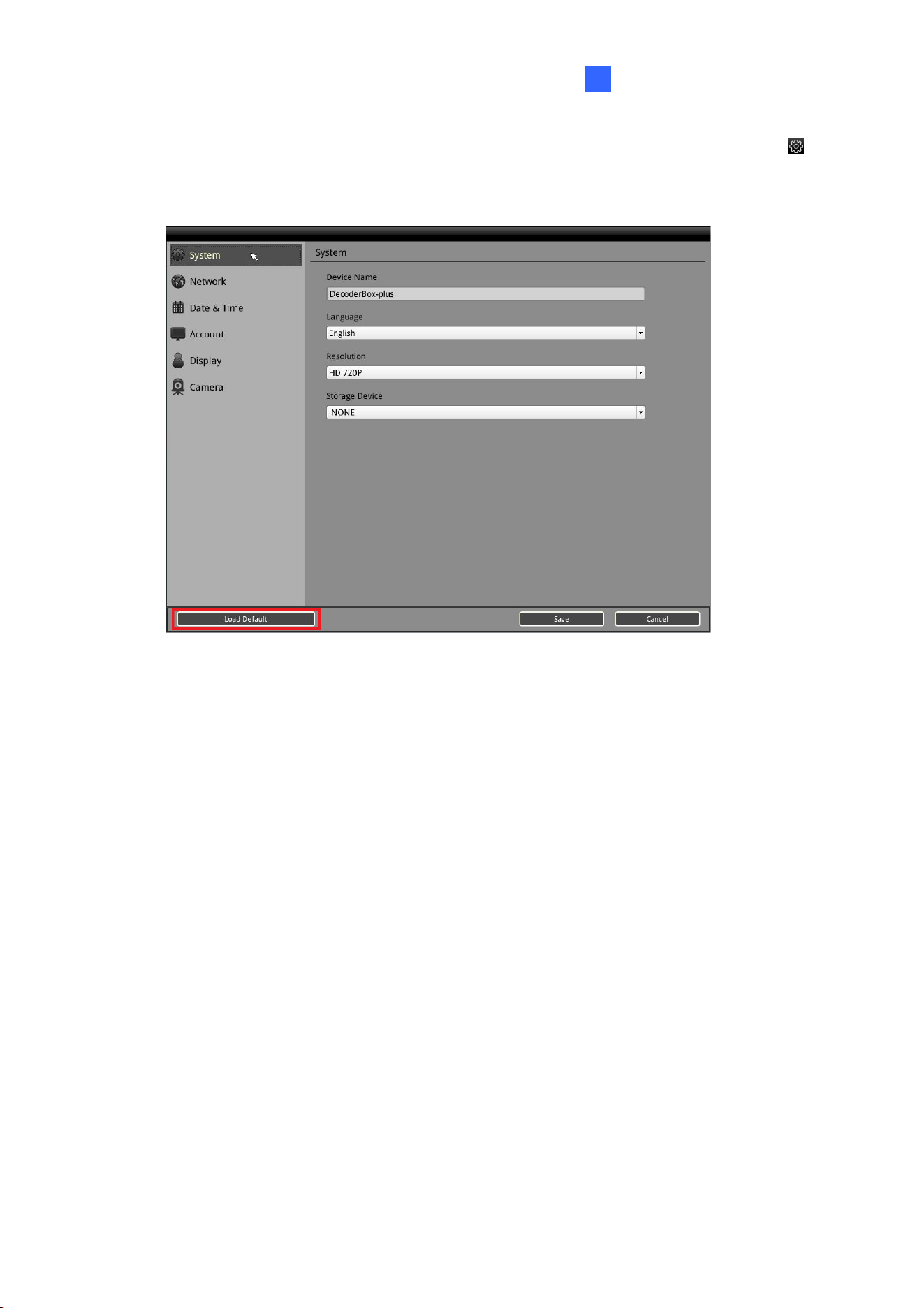
For GV-IP Decoder Box Plus / Lite / GV-Pad Mini, click the System Settings icon
on the main screen and click the Load Default button on the bottom of any of the
setting pages.
Figure 5-4
The system will restore default settings and reboot itself.
54
Chapter 6 Integration to GV-Software
GV-IP Decoder Box can be added to GV-VMS and GV-Control Center to be assigned with the
desired camera channels and layouts for remote display.
Note:
1. This function is only supported by GV-IP Decoder Box Plus / Ultra V1.02 or later and
only compatible with GV-VMS V18.1 or later and GV-Control Center V3.8.0 or later.
2. Make sure the GV-IP Decoder Box is within the same LAN as the GV-VMS or
GV-Control Center.
6.1 Connecting to GV-VMS
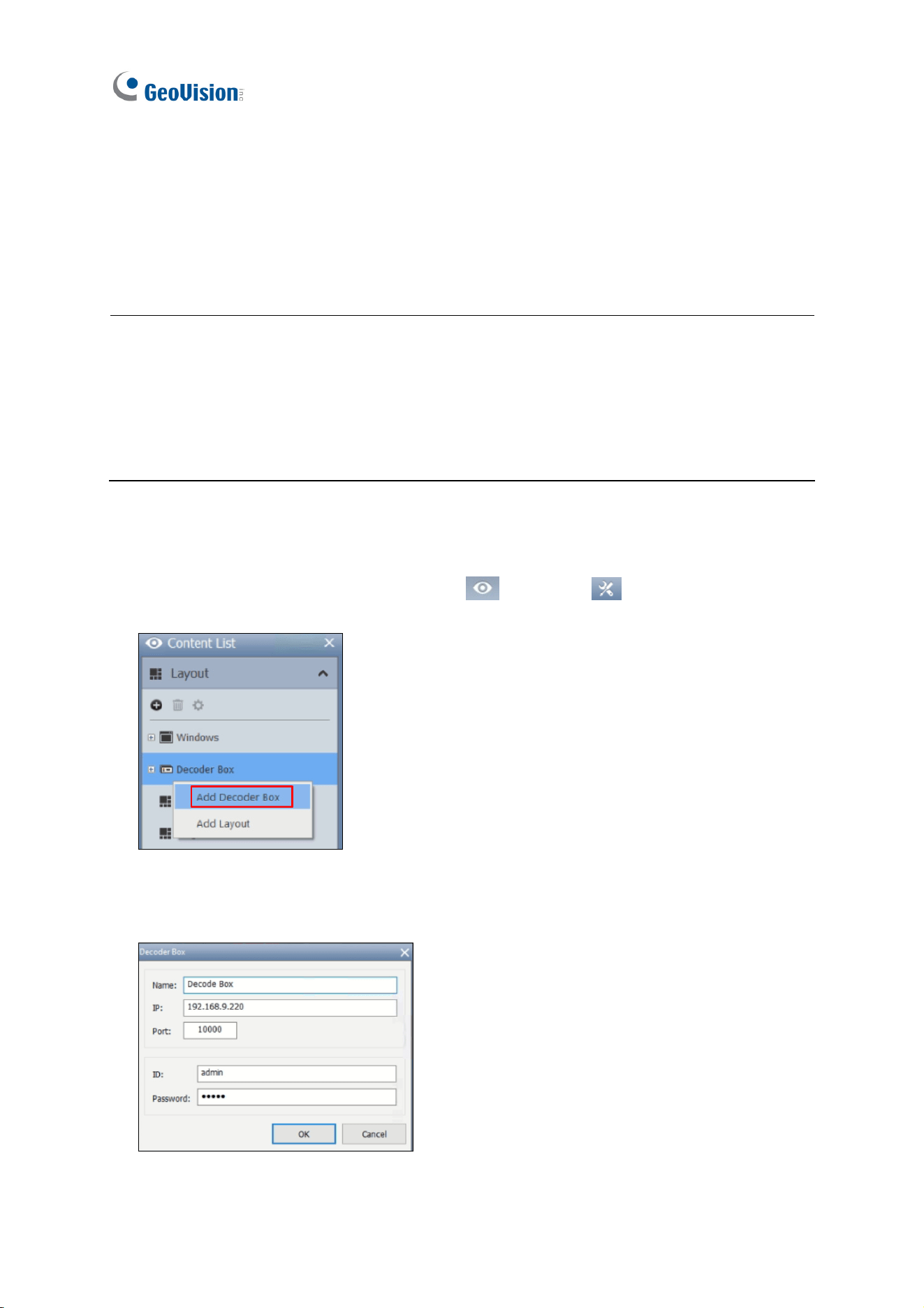
1. In the Content List of the GV-VMS, (Home > Toolbar
> Content List),
right-click Decoder Box and select Add Decoder Box.
Figure 6-1
2. Type a desired Name for the GV-IP Decoder Box you’re connecting to, its IP Address,
Port, ID and Password, and click OK to add it to GV-VMS.
Figure 6-2
Integration to GV-Software
55
6
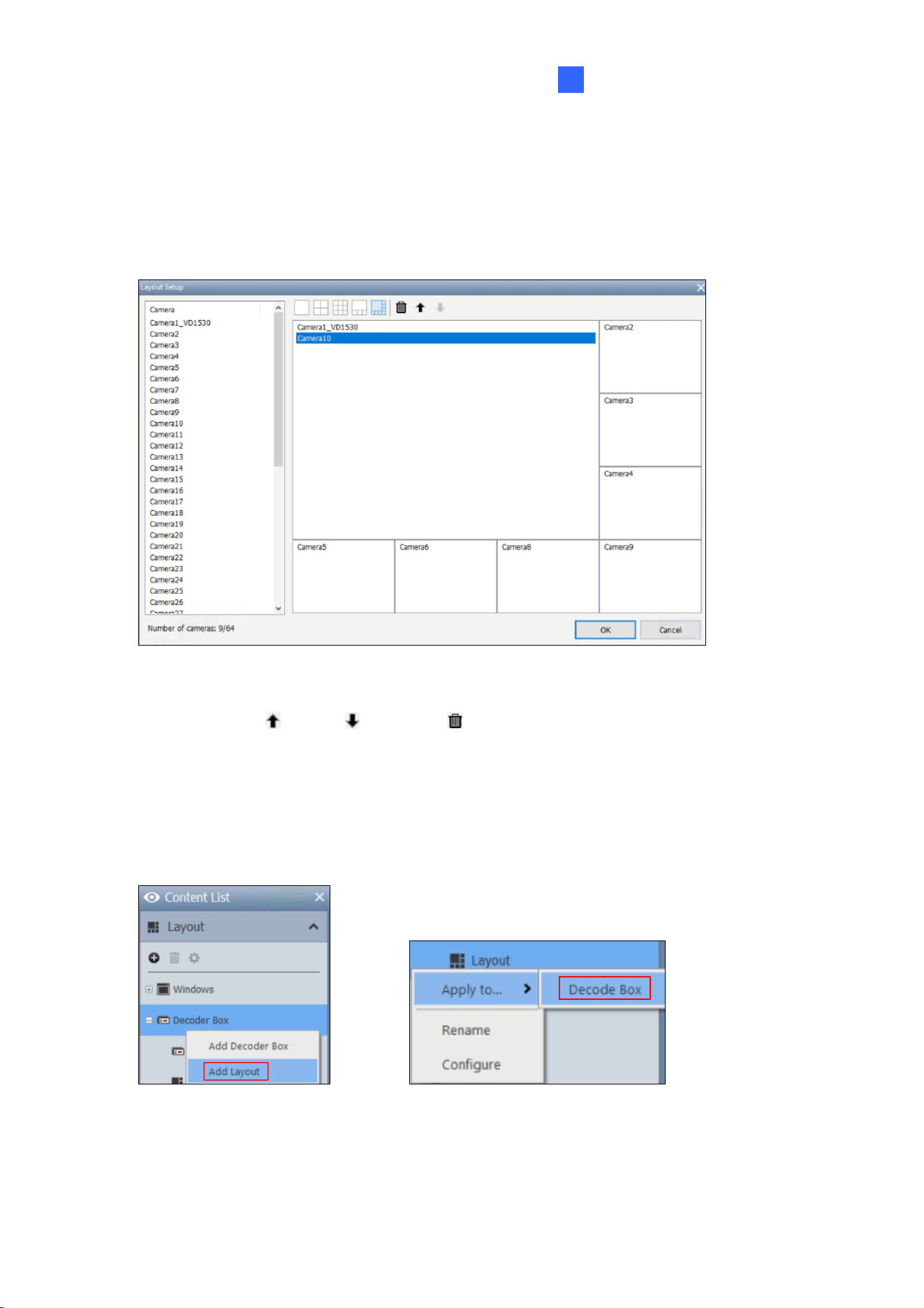
3. Once added, you’re prompted to set the layout of the GV-IP Decoder Box. Click OK. The
Layout Setup dialog box appears.
4. Select a desired layout at the top, and drag the desired camera channels of GV-VMS to
each of the layout divisions. When two or more camera channels are assigned to the
same division, their live views will be displayed within the division in sequential order.
Figure 6-3
5. Optionally select a camera channel within a division to adjust its display order or remove it
by using the Up
, Down or Delete buttons.
6. Click OK. The GV-IP Decoder Box added will display the camera channels assigned as
configured.
7. Users can add more layouts for the GV-IP Decoder Box and alternate between them by
right-clicking Decoder Box and clicking Add Layout, and right-clicking a layout, clicking
Apply to… and selecting the decoder box, respectively.
Figure 6-4 Figure 6-5
56
6.2 Connecting to GV-Control Center
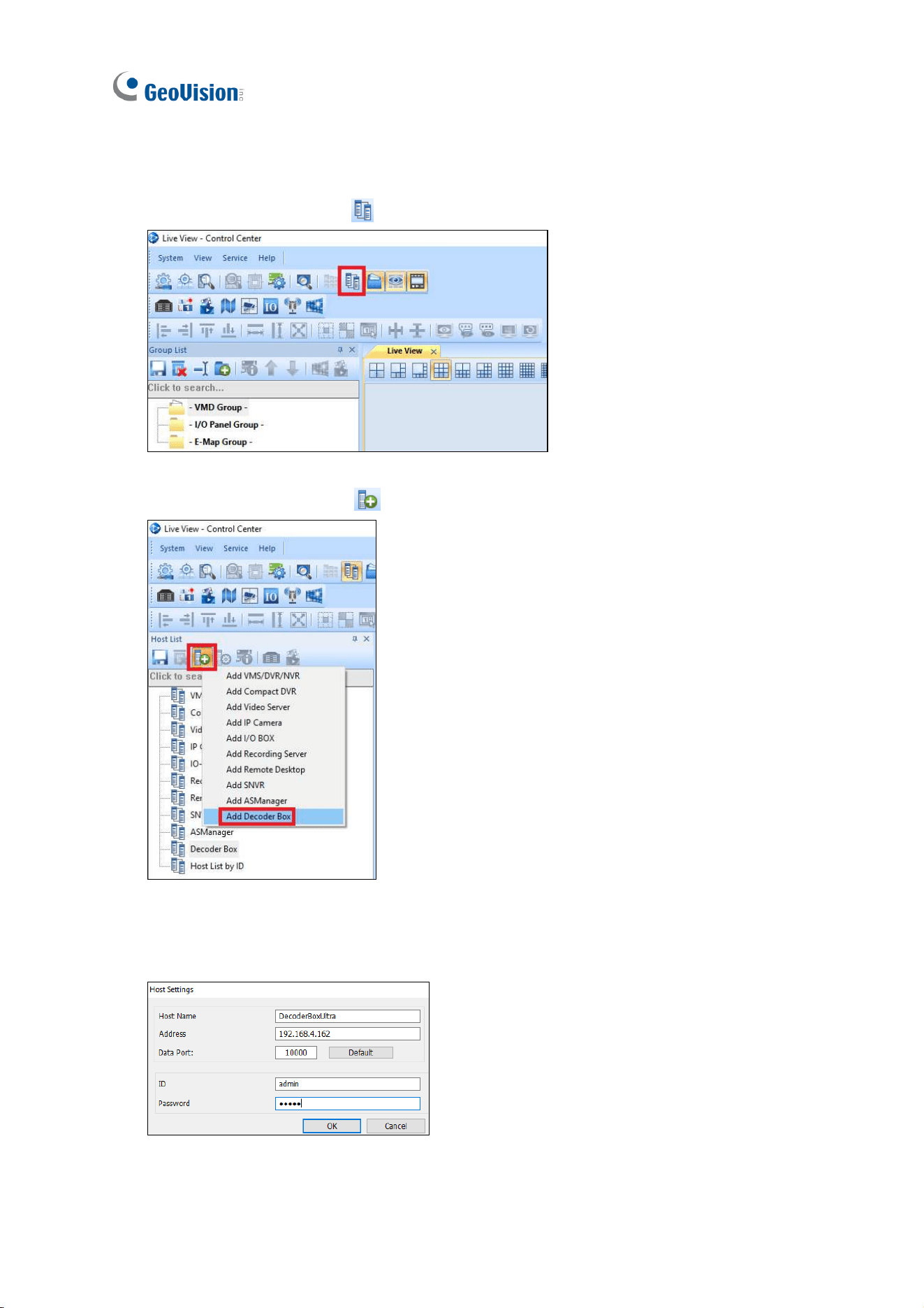
1. Click the Host List button .
Figure 6-6
2. Click the Add Host button
and select Add Decoder Box in the drop-down list.
Figure 6-7
3. Type a desired Host Name for the GV-IP Decoder Box you’re connecting to, its IP
Address, Data Port, ID and Password, and click OK.
Figure 6-8
Integration to GV-Software
57
6
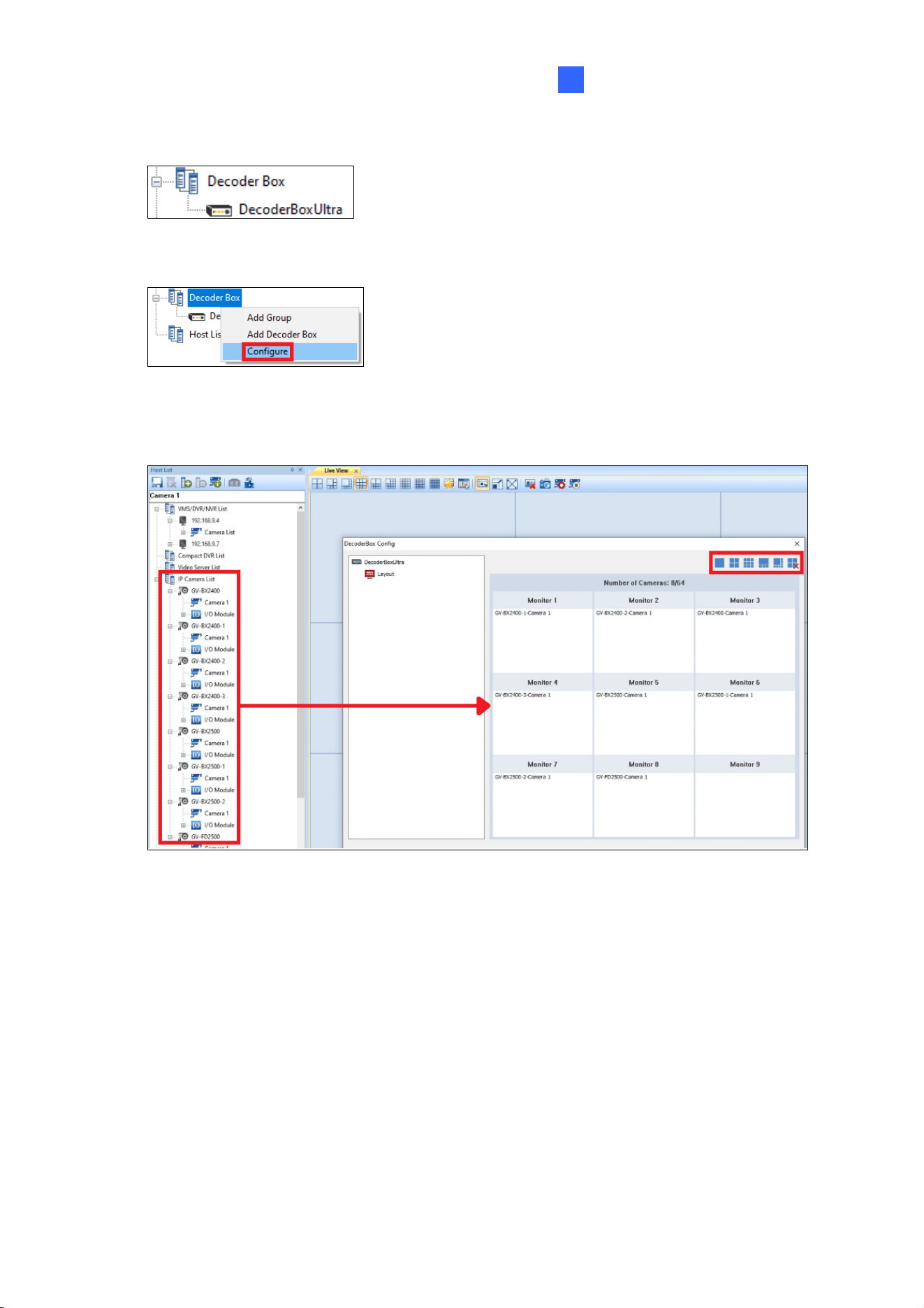
4. Once connected, the GV-IP Decoder Box will appear in the Host List.
Figure 6-9
5. Right-click Decoder Box and select Configure in the drop-down list.
Figure 6-10
6. Select a desired layout at the top, and drag the desired camera channels to each of the
layout divisions.
Figure 6-11
7. Click OK. The GV-IP Decoder Box Ultra added will display the camera channels as
configured.