Operator's Manual
®
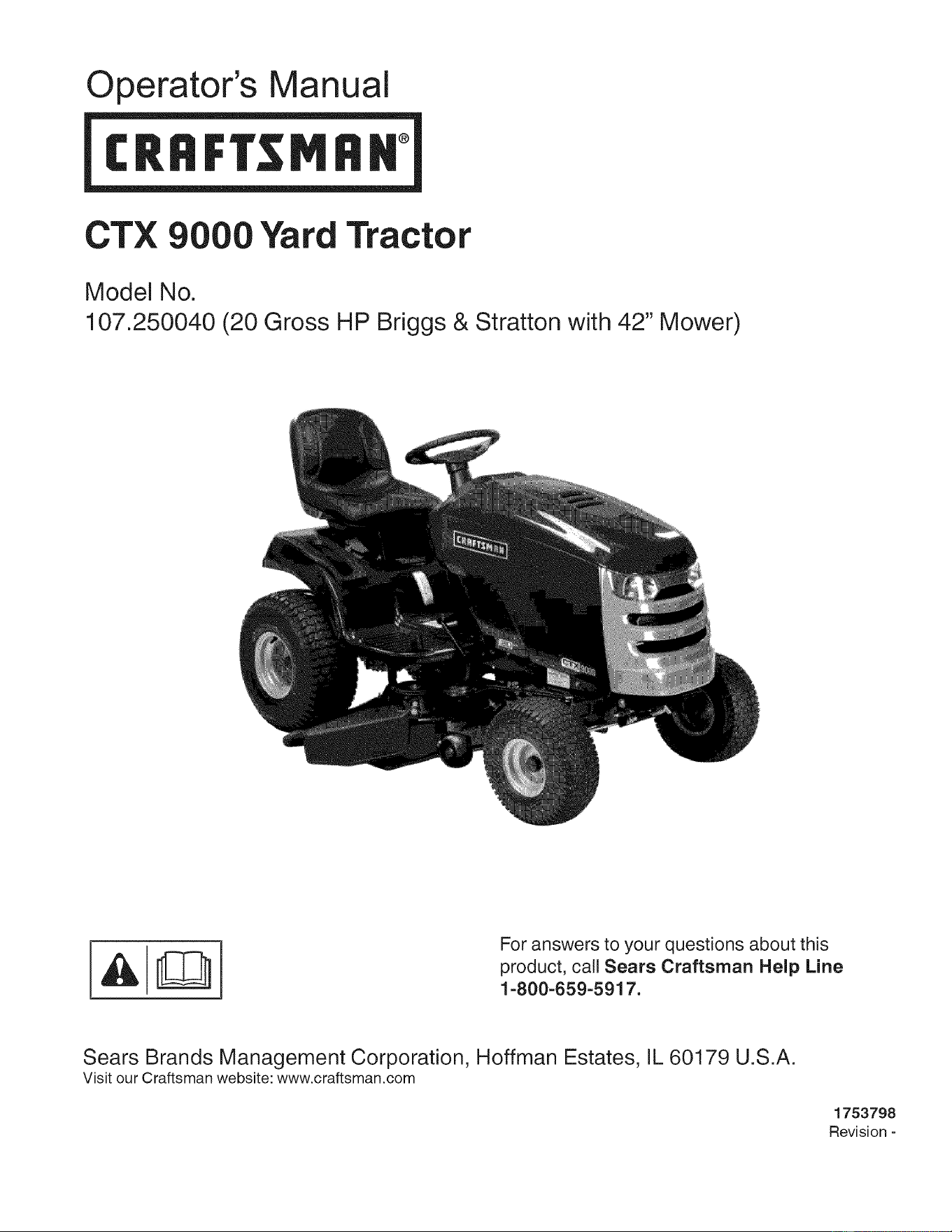
CTX 9000 Yard Tractor
Model No.
107.250040 (20 Gross HP Briggs & Stratton with 42" Mower)
For answers to your questions about this
product, call Sears Craftsman Help Line
1=800=659-5917.
Sears Brands Management Corporation, Hoffman Estates, IL 60179 U.S.A.
Visit our Craftsman website: www.craftsman.com
1753798
Revision -

FrontCover................................................................................................................. 1
Operator Safety .......................................................................................................... 4
Features and Controls ............................................................................................. 10
Operation .................................................................................................................. 13
Safety Interlock System Tests ................................................................................. 13
Maintenance ............................................................................................................. 18
Troubleshooting ....................................................................................................... 28
Specifications ........................................................................................................... 30
Warranty .................................................................................................................... 31
Repair Protection Agreement .................................................................................. 32
Service Parts....................................................................................................... PTS-1
Thank you for purchasing this quality-built CRAFTSMAN mower. We're pleased that you've placed your confidence
in the CRAFTSMAN brand. When operated and maintained according to the instructions in this manual, your
CRAFTSMAN product will provide many years of dependable service.
This manual contains safety information to make you aware of the hazards and risks associated with mowers and
how to avoid them. This product and its approved attachments/accessories are designed and intended only for lawn
work or snow removal and are not intended for any other purpose. It is important that you read and understand these
instructions thoroughly before attempting to start or operate this equipment. Save these original instructions for
future reference.
Where to Find Us
You never have to look far to find support and service for your CRAFTSMAN mower. There are authorized service
dealers in North America who provide quality service. You can contact Customer Service by phone at (800) 659-5917,
or locate a dealer on the Internet at www.craftsman.com.
Mower
Model Number
Serial Number
Engine
Model Type Trim
Date Code
Date Purchased
3
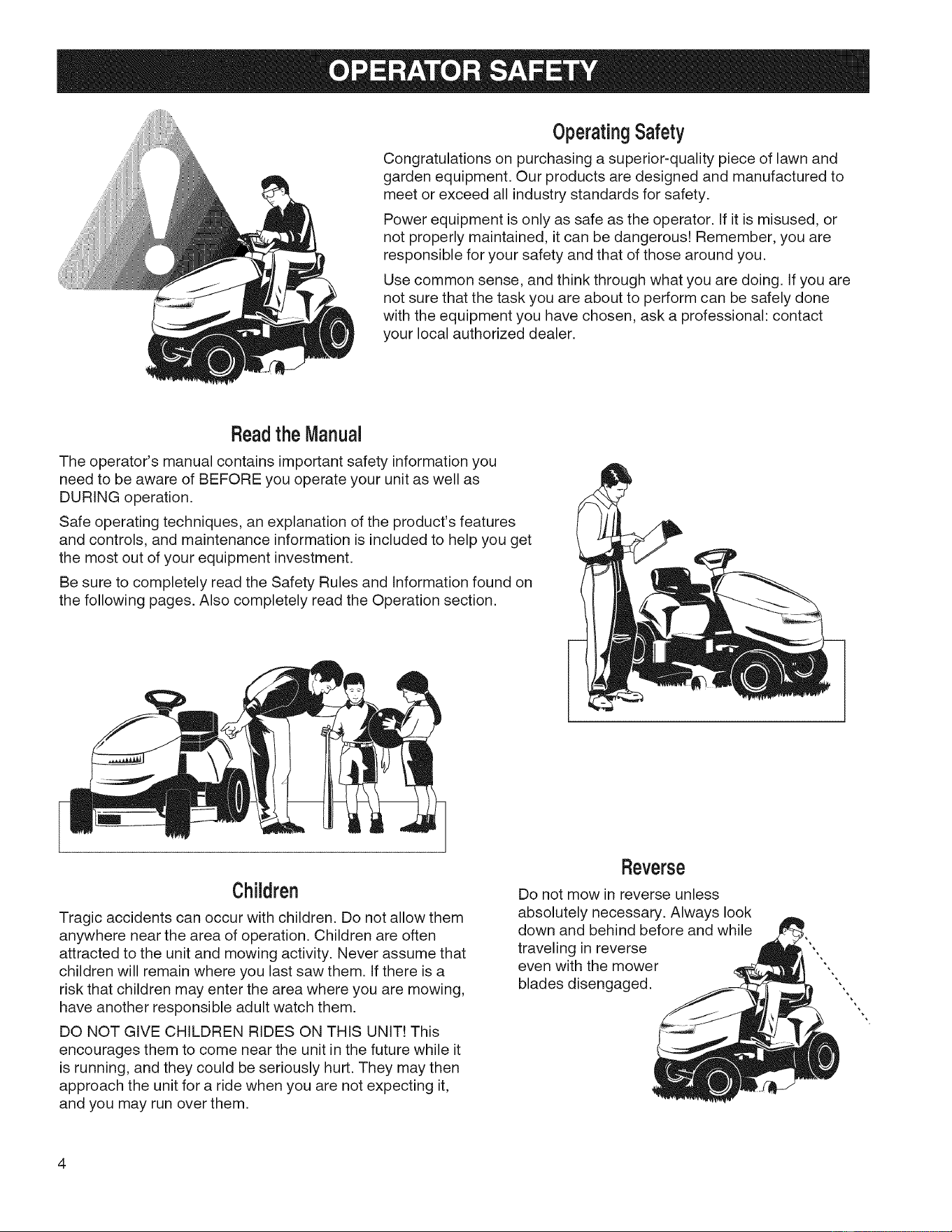
OperatingSafety
Congratulations on purchasing a superior-quality piece of lawn and
garden equipment. Our products are designed and manufactured to
meet or exceed all industry standards for safety.
Power equipment is only as safe as the operator, if it is misused, or
not properly maintained, it can be dangerous! Remember, you are
responsible for your safety and that of those around you.
Use common sense, and think through what you are doing, if you are
not sure that the task you are about to perform can be safely done
with the equipment you have chosen, ask a professional: contact
your local authorized dealer.
Readthe Manual
The operator's manual contains important safety information you
need to be aware of BEFORE you operate your unit as well as
DURING operation.
Safe operating techniques, an explanation of the product's features
and controls, and maintenance information is included to help you get
the most out of your equipment investment.
Be sure to completely read the Safety Rules and Information found on
the following pages. Also completely read the Operation section.
Children
Tragic accidents can occur with children. Do not allow them
anywhere near the area of operation. Children are often
attracted to the unit and mowing activity. Never assume that
children will remain where you last saw them. If there is a
risk that children may enter the area where you are mowing,
have another responsible adult watch them.
DO NOT GIVE CHILDREN RIDES ON THIS UNIT! This
encourages them to come near the unit in the future while it
is running, and they could be seriously hurt. They may then
approach the unit for a ride when you are not expecting it,
and you may run over them.
Reverse
Do not mow in reverse unless
absolutely necessary. Always look
down and behind before and while
traveling in reverse
even with the mower
blades disengaged.
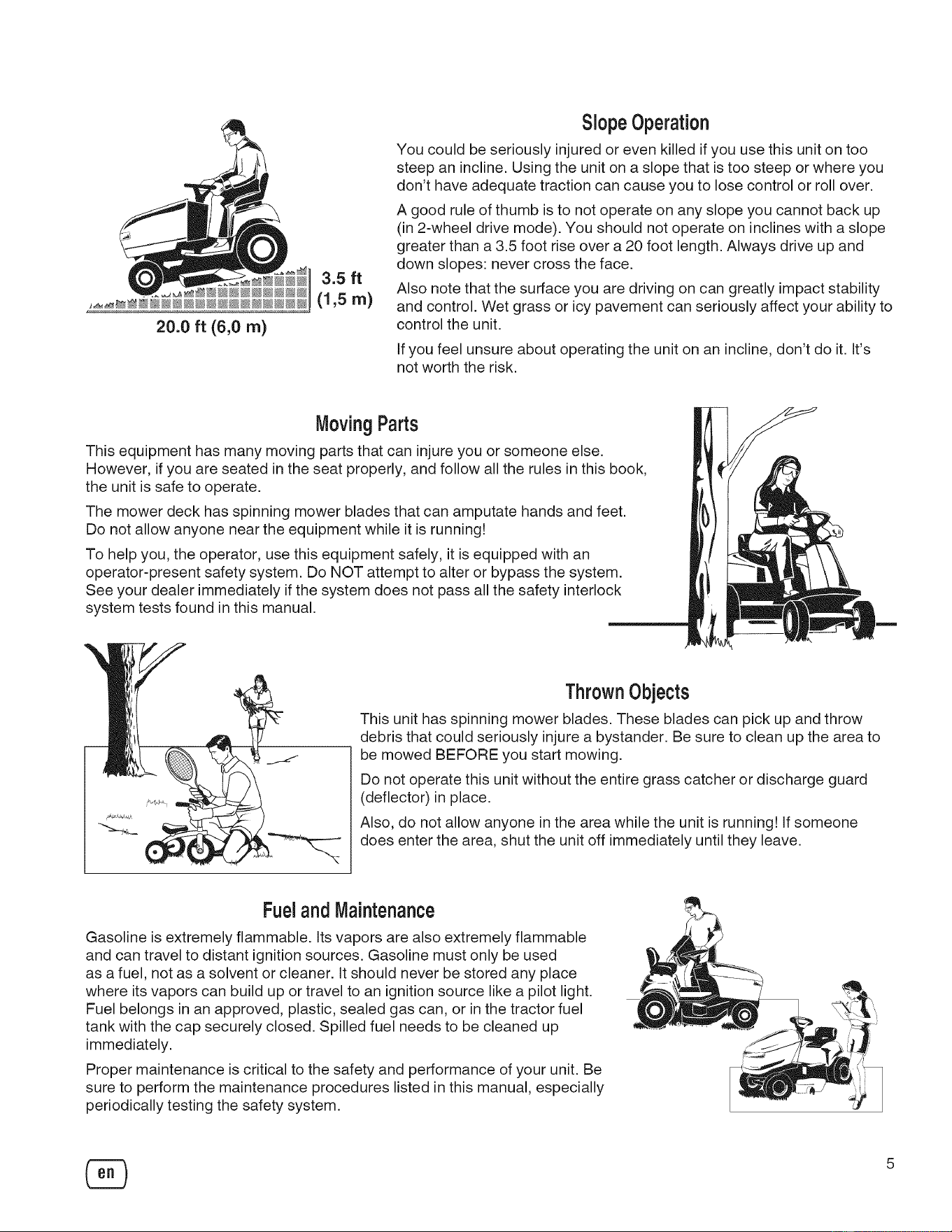
3.5ft
20.0 ft (6,0 m)
SlopeOperation
You could be seriously injured or even killed if you use this unit on too
steep an incline. Using the unit on a slope that is too steep or where you
don't have adequate traction can cause you to lose control or roll over.
A good rule of thumb is to not operate on any slope you cannot back up
(in 2-wheel drive mode). You should not operate on inclines with a slope
greater than a 3.5 foot rise over a 20 foot length. Always drive up and
down slopes: never cross the face.
Also note that the surface you are driving on can greatly impact stability
and control. Wet grass or icy pavement can seriously affect your ability to
control the unit.
If you feel unsure about operating the unit on an incline, don't do it. It's
not worth the risk.
MovingParts
This equipment has many moving parts that can injure you or someone else.
However, if you are seated in the seat properly, and follow all the rules in this book,
the unit is safe to operate.
The mower deck has spinning mower blades that can amputate hands and feet.
Do not allow anyone near the equipment while it is running!
To help you, the operator, use this equipment safely, it is equipped with an
operator-present safety system. Do NOT attempt to alter or bypass the system.
See your dealer immediately if the system does not pass all the safety interlock
system tests found in this manual.
ThrownObjects
This unit has spinning mower blades. These blades can pick up and throw
debris that could seriously injure a bystander. Be sure to clean up the area to
be mowed BEFORE you start mowing.
Do not operate this unit without the entire grass catcher or discharge guard
(deflector) in place.
Also, do not allow anyone in the area while the unit is running! if someone
does enter the area, shut the unit off immediately until they leave.
Fueland Maintenance
Gasoline is extremely flammable. Its vapors are also extremely flammable
and can travel to distant ignition sources. Gasoline must only be used
as a fuel, not as a solvent or cleaner, it should never be stored any place
where its vapors can build up or travel to an ignition source like a pilot light.
Fuel belongs in an approved, plastic, sealed gas can, or in the tractor fuel
tank with the cap securely closed. Spilled fuel needs to be cleaned up
immediately.
Proper maintenance is critical to the safety and performance of your unit. Be
sure to perform the maintenance procedures listed in this manual, especially
periodically testing the safety system.
5
Readthesesafetyrulesandfollowthemclosely.Failuretoobeytheserulescouldresultinlossofcontrol
ofunit,severepersonalinjuryordeathtoyou,orbystanders,ordamageto propertyorequipment.
This mowing deck is capable of amputating hands and feet and throwing objects.
The triangle _ in text signifies important cautions or warnings which must be followed.
GENERAL OPERATION
1. Read, understand, and follow all instructions in the
manual and on the unit before starting.
2. Do not put hands or feet near rotating parts or under
the machine. Keep clear of the discharge opening at
all times.
3. Only allow responsible adults, who are familiar with
the instructions, to operate the unit (local regulations
can restrict operator age).
4. Clear the area of objects such as rocks, toys, wire,
etc., which could be picked up and thrown by the
blade(s).
5. Be sure the area is clear of other people before
mowing. Stop the unit if anyone enters the area.
6. Never carry passengers.
7. Do not mow in reverse unless absolutely necessary.
Always look down and behind before and while
travelling in reverse.
8. Never direct discharge material toward anyone. Avoid
discharging material against a wall or obstruction.
Material may ricochet back toward the operator. Stop
the blade(s) when crossing gravel surfaces.
9. Do not operate the machine without the entire grass
catcher, discharge guard (deflector), or other safety
devices in place.
10. Slow down before turning.
11. Never leave a running unit unattended. Always
disengage the PTO, set parking brake, stop engine,
and remove keys before dismounting.
12. Disengage blades (PTO) when not mowing. Shut off
engine and wait for all parts to come to a complete
stop before cleaning the machine, removing the grass
catcher, or unclogging the discharge guard.
13. Operate the machine only in daylight or good artificial
light.
14. Do not operate the unit while under the influence of
alcohol or drugs.
15 Watch for traffic when operating near or crossing
roadways.
16. Use extra care when loading or unloading the unit into
a trailer or truck.
17. Always wear eye protection when operating this unit.
18. Data indicates that operators, age 60 years and
above, are involved in a large percentage of power
equipment-related injuries. These operators should
evaluate their ability to operate the equipment safely
enough to protect themselves and others from injury.
19. Follow the manufacturer's recommendations for wheel
weights or counterweights.
20. Keep in mind the operator is responsible for accidents
occurring to other people or property.
21. All drivers should seek and obtain professional and
practical instruction.
22. Always wear substantial footwear and trousers. Never
operate when barefoot or wearing sandals.
23. Before using, always visually check that the blades
and blade hardware are present, intact, and secure.
Replace worn or damaged parts.
24. Disengage attachments before: refueling, removing
an attachment, making adjustments (unless the
adjustment can be made from the operator's position).
25. When the machine is parked, stored, or left
unattended, lower the cutting means unless a positive
mechanical lock is used.
26. Before leaving the operator's position for any reason,
engage the parking brake (if equipped), disengage the
PTO, stop the engine, and remove the key.
27. To reduce fire hazard, keep the unit free of grass,
leaves, & excess oil. Do not stop or park over dry
leaves, grass, or combustible materials.
TRANSPORTING AND STORAGE
1. When transporting the unit on an open trailer, make
sure it is facing forward, in the direction of travel. If the
unit is facing backwards, wind lift could damage the
unit.
2. Always observe safe refueling and fuel handling
practices when refueling the unit after transportation
or storage.
3. Never store the unit (with fuel) in an enclosed poorly
ventilated structure. Fuel vapors can travel to an
ignition source (such as a furnace, water heater, etc.)
and cause an explosion. Fuel vapor is also toxic to
humans and animals.
4. Always follow the engine manual instructions for
storage preparations before storing the unit for both
short and long term periods.
5. Always follow the engine manual instructions for
proper start-up procedures when returning the unit to
service.
6. Never store the unit or fuel container inside where
there is an open flame or pilot light, such as in a water
heater. Allow unit to cool before storing.
SLOPE OPERATION
Slopes are a major factor related to loss-of-control and tip-over
accidents, which can result insevere injury or death. Operation
on all slopes requires extra caution. If you cannot back up the
slope or if you feel uneasy on it, do not operate on it.
Control of a walk-behind or ride-on machine sliding on a
slope will not be regained by the application of the brake. The
main reasons for loss of control are: insufficient tire grip on
the ground, speed too fast, inadequate braking, the type of
machine is unsuitable for its task, lack of awareness of the
ground conditions, incorrect hitching and load distribution.
1. Mow up and down slopes, not across.
2. Watch for holes, ruts, or bumps. Uneven terrain could
overturn the unit. Tall grass can hide obstacles.
3. Choose a slow speed so that you will not have to stop
or change speeds while on the slope.
4. Do not mow on wet grass. Tires may loose traction.
5. Always keep unit in gear especially when traveling
down slopes. Do not shift to neutral and coast
downhill.
6. Avoid starting, stopping, or turning on a slope. If tires
lose traction, disengage the blade(s) and proceed
slowly straight down the slope.
7. Keep all movement on slopes slow and gradual. Do
not make sudden changes in speed or direction,
which could cause the machine to rollover.
8. Use extra care while operating machines with grass
catchers or other attachments; they can affect the
stability of the unit. Do not use on steeps slopes.
9. Do not try to stabilize the machine by putting your foot
on the ground (ride-on units).
10. Do not mow near drop-offs, ditches, or embankments.
The mower could suddenly turn over if a wheel is over
the edge of a cliff or ditch, or if an edge caves in.
11. Do not use grass catchers on steep slopes.
12. Do not mow slopes you cannot back up them.
13. See your authorized dealer/retailer for
recommendations of wheel weights or counterweights
to improve stability.
14. Remove obstacles such as rocks, tree limbs, etc.
15. Use slow speed. Tires may lose traction on slopes
even through the brakes are functioning properly.
16. Do not turn on slopes unless necessary, and then,
turn slowly and gradually downhill, if possible.
17. Four Wheel Drive Models: Four Wheel Drive improves
access to dangerously sloped terrain, increasing
the possibility of roll-over. If the machine stops while
going uphill, stop the blades and back down slowly.
Avoid sudden turns.
TOWED EQUIPMENT (RIDE-ON UNITS)
1. Tow only with a machine that has a hitch designed for
towing. Do not attach towed equipment except at the
hitch point.
2. Follow the manufacturer's recommendations for weight
limit for towed equipment and towing on slopes.
3. Never allow children or others in or on towed equipment.
4. On slopes, the weight of the towed equipment may
cause loss of traction and loss of control.
5. Travel slowly and allow extra distance to stop.
6. Do not shift to neutral and coast down hill.
WARNING
Never operate on slopes greater than 17.6 percent
(10 °) which is a rise of 3-1/2 feet (106 cm) vertically in
20 feet (607 cm) horizontally.
When operating on slopes use additional wheel
weights or counterweights. See your dealer/retailer
to determine which weights are available and
appropriate for your unit.
Select slow ground speed before driving onto
slope. In addition to front weights, use extra caution
when operating on slopes with rear-mounted grass
catchers.
Mow UP and DOWN the slope, never across the
face, use caution when changing directions and DO
NOT START OR STOP ON SLOPE.
CHILDREN
Tragic accidents can occur if the operator is not alert to the
presence of children. Children are often attracted to the unit
and the mowing activity. Never assume that children will
remain where you last saw them.
1. Keep children out of the mowing area and under the
watchful care of another responsible adult.
2. Be alert and turn unit off if children enter the area.
3. Before and during reverse operation, look behind and
down for small children.
4. Never carry children, even with the blade(s) off. They
may fall off and be seriously injured or interfere with
safe unit operation. Children who have been given
rides in the past may suddenly appear in the mowing
area for another ride and be run over or backed over
by the machine.
5. Never allow children to operate the unit.
6. Use extra care when approaching blind corners,
shrubs, trees, or other objects that may obscure
vision.
EMISSIONS
1. Engine exhaust from this product contains chemicals
known, in certain quantities, to cause cancer, birth
defects, or other reproductive harm.
2. Look for the relevant Emissions Durability Period and
Air Index information on the engine emissions label.
iGNITiON SYSTEM
1. This spark ignition system complies with Canadian
ICES-002.
7
SERVICE AND MAINTENANCE
Safe Handling of Gasoline
1. Extinguish all cigarettes, cigars, pipes, and other
sources of ignition.
2. Use only approved gasoline containers.
3. Never remove the gas cap or add fuel with the engine
running. Allow the engine to cool before refueling.
4. Never fuel the machine indoors.
5. Never store the machine or fuel container where there
is an open flame, spark, or pilot light such as near a
water heater or other appliance.
6. Never fill containers inside a vehicle or on a truck bed
with a plastic bed liner. Always place containers on the
ground away from your vehicle before filling.
7. Remove gas-powered equipment from the truck or
trailer and refuel it on the ground. If this is not possible,
then refuel such equipment on a trailer with a portable
container, rather than from a gasoline dispenser
nozzle.
8. Keep nozzle in contact with the rim of the fuel tank or
container opening at all times until fueling is complete.
Do not use a nozzle lock-open device.
9. If fuel is spilled on clothing, change clothing
immediately.
10. Never over-fill the fuel tank. Replace gas cap and
tighten securely.
11. Use extra care in handling gasoline and other fuels.
They are flammable and vapors are explosive.
12. If fuel is spilled, do not attempt to start the engine but
move the machine away from the area of spillage and
avoid creating any source of ignition until fuel vapors
have dissipated.
13. Replace all fuel tank caps and fuel container caps
securely.
Service & Maintenance
1. Never run the unit in an enclosed area where carbon
monoxide fumes may collect.
2. Keep nuts and bolts, especially blade attachment
bolts, tight and keep equipment in good condition.
3. Never tamper with safety devices. Check their proper
operation regularly and make necessary repairs if they
are not functioning properly.
4. Keep unit free of grass, leaves, or other debris build-
up. Clean up oil or fuel spillage, and remove any fuel-
soaked debris. Allow machine to cool before storage.
5. If you strike an object, stop and inspect the machine.
Repair, if necessary, before restarting.
6. Never make adjustments or repairs with the engine
running.
7. Check grass catcher components and the discharge
guard frequently and replace with manufacturer's
recommended parts, when necessary.
8. Mower blades are sharp. Wrap the blade or wear
gloves, and use extra caution when servicing them.
9. Check brake operation frequently. Adjust and service
as required.
10. Maintain or replace safety and instructions labels, as
necessary.
11. Do not remove the fuel filter when the engine is hot
as spilled gasoline may ignite. Do not spread fuel line
clamps further than necessary. Ensure clamps grip
hoses firmly over the filter after installation.
12. Do not use gasoline containing METHANOL, gasohol
containing more than 10% ETHANOL, gasoline
additives, or white gas because engine/fuel system
damage could result.
13. If the fuel tank must be drained, it should be drained
outdoors.
14. Replace faulty silencers/mufflers.
15. Maintain or replace safety and instruction labels as
necessary.
16. Use only factory authorized replacement parts when
making repairs.
17. Always comply with factory specifications on all
settings and adjustments.
18. Only authorized service locations should be utilized for
major service and repair requirements.
19. Never attempt to make major repairs on this unit
unless you have been properly trained. Improper
service procedures can result in hazardous operation,
equipment damage and voiding of manufacturer's
warranty.
20. On multiple blade mowers, take care as rotating one
blade can cause other blades to rotate.
21. Do not change engine governor settings or over-
speed the engine. Operating the engine at excessive
speed can increase the hazard of personal injury.
22. Disengage drive attachments, stop the engine,
remove the key, and disconnect the spark plug wire(s)
before: clearing attachment blockages and chutes,
performing service work, striking an object, or if the
unit vibrates abnormally. After striking an object,
inspect the machine for damage and make repairs
before restarting and operating the equipment.
23. Never place hands near the moving parts, such as a
hydro pump cooling fan, when the tractor is running.
(Hydro pump cooling fans are typically located on top
of the transaxle).
24. Units with hydraulic pumps, hoses, or motors:
WARNING: Hydraulic fluid escaping under pressure
may have sufficient force to penetrate skin and cause
serious injury. If foreign fluid is injected into the skin
it must be surgically removed within a few hours by a
doctor familiar with this form of injury or gangrene may
result. Keep body and hands away from pin holes or
nozzles that eject hydraulic fluid under high pressure.
Use paper or cardboard, and not hands, to search
for leaks. Make sure all hydraulic fluid connections
are tight and all hydraulic hoses and lines are in good
condition before applying pressure to the system. If
leaks occur, have the unit serviced immediately by
your authorized dealer.
25. WARNING: Stored energy device. Improper release of
springs can result in serious personal injury. Springs
should be removed by an authorized technician.
26. Models equipped with an engine radiator: WARNING:
Stored energy device. To prevent serious bodily injury
from hot coolant or steam blow-out, never attempt to
remove the radiator cap while the engine is running.
Stop the engine and wait until it is cool. Even then, use
extreme care when removing the cap.
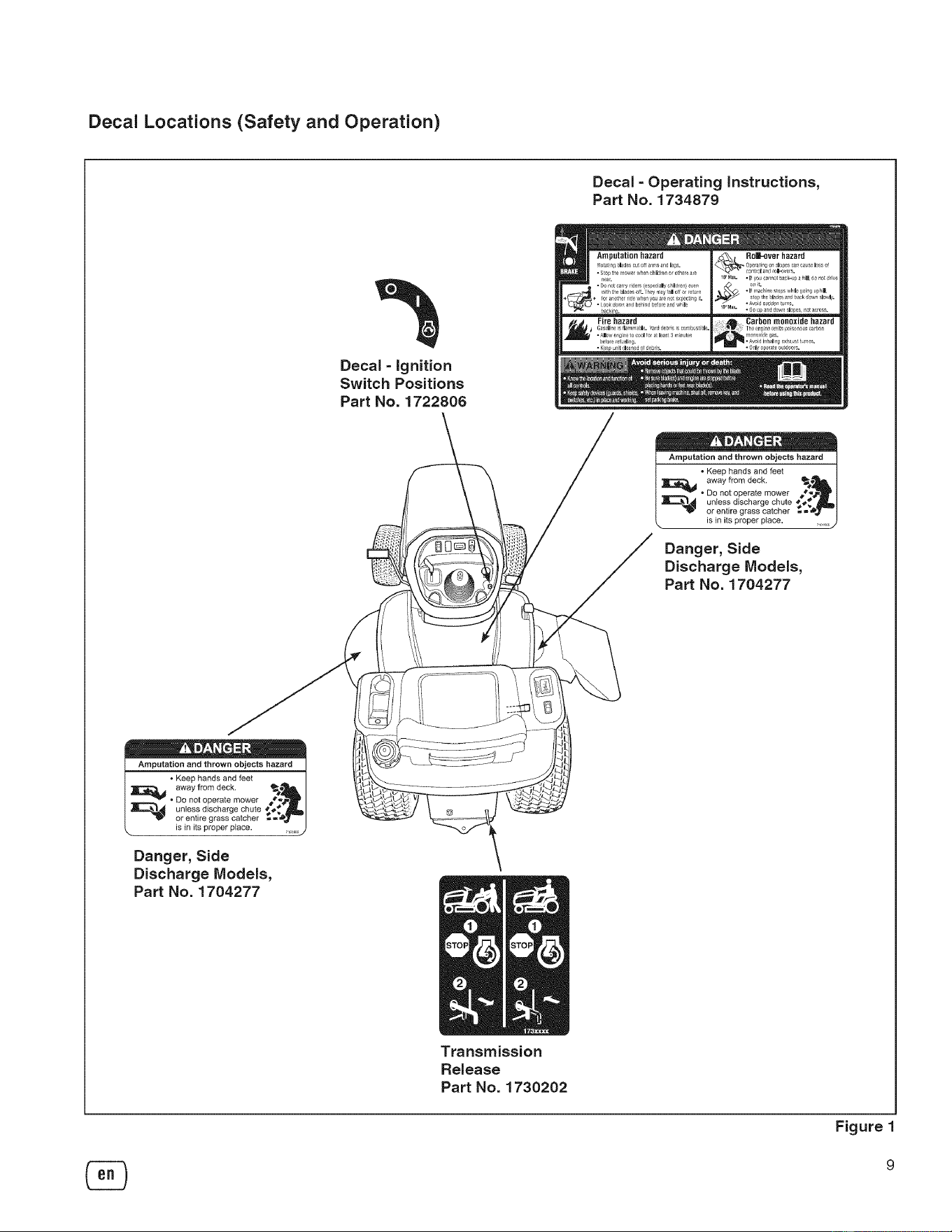
Decal Locations (Safety and Operation)
Decal - Operating instructions,
Part No. 1734879
Decal - ignition
Switch Positions
Part No. 1722808
Amputation and thrown objects hazard !
= Keep hands and feet I
away from deck, _1
• Do not operate mower ##_#.=_,_ J
_ unless discharge chute _LI
or entire grass catcher ==_,_--
,, is in its proper place. 710 6r,[_
Danger, Side
Discharge Models,
Part No. 1704277
Danger, Side
Discharge Models,
Part No. 1704277
!
Transmission
Release
Part No. 1730202
Figure
9
@
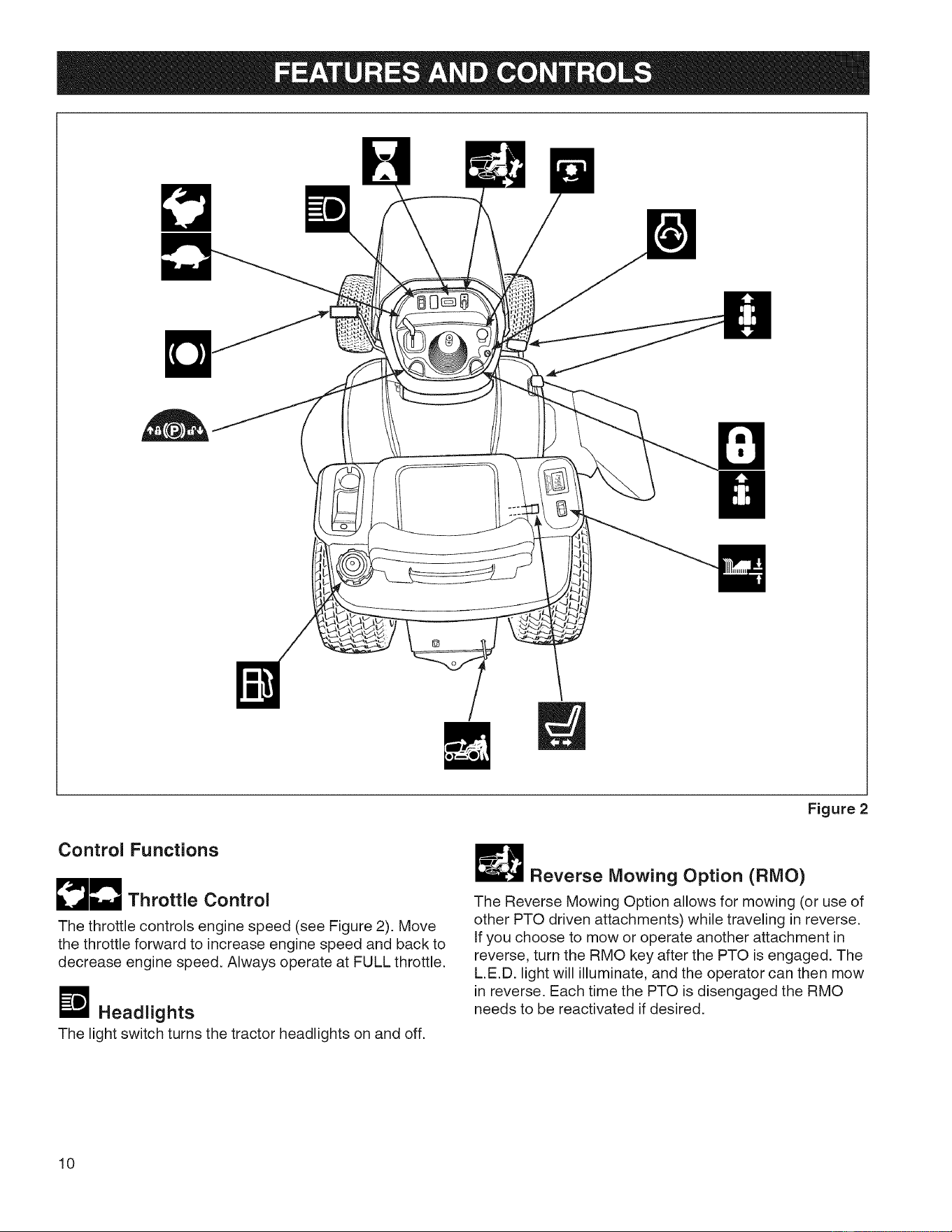
Figure 2
Control Functions
_'J_ L_!_- Throttle Control
The throttle controls engine speed (see Figure 2). Move
the throttle forward to increase engine speed and back to
decrease engine speed. Always operate at FULL throttle.
_] Headlights
The light switch turns the tractor headlights on and off.
_ Reverse Mowing Option (RMO)
The Reverse Mowing Option allows for mowing (or use of
other PTO driven attachments) while traveling in reverse.
If you choose to mow or operate another attachment in
reverse, turn the RMO key after the PTO is engaged. The
L.E.D. light will illuminate, and the operator can then mow
in reverse. Each time the PTO is disengaged the RMO
needs to be reactivated if desired.
10
_PTO Switch
The PTO (Power Take-Off) switch engages and
disengages attachments that use the PTO. To engage the
PTO, pull UP on the switch. Push DOWN to disengage.
Note that the operator must be seated firmly in the tractor
seat for the PTO to function.
[r_)-'t]Ignition Switch
The ignition switch starts and stops the engine, it has
three positions:
I_OFF
H RUN
Stops the engine and shuts off the
electrical system.
Allows the engine to run and powers the
electrical system.
_J START Cranks the engine for starting.
NOTE. Never leave the ignition switch in the RUN
position with the engine stopped-this drains the battery.
D Brake Pedal
Depressing the brake pedal applies the tractor brake.
H Ground Speed Pedals
The tractor's forward ground speed is controlled by the
forward ground speed control pedal. The tractor's reverse
ground speed is controlled by the reverse ground speed
control pedal.
Depressing either pedal will increase ground speed. Note
that the further down the pedal is depressed, the faster
the tractor will travel.
Parking Brake
The parking brake knob is used to lock the parking brake
when the tractor is stopped. Fully depressing the brake
pedal and pulling up on the knob engages the parking
brake
Mower Height of Cut Adjustment
The cutting height is adjustable between 1.5" and 4.0"
(3,8 and 10,2 cm).
The cutting height adjustment switch controls the mower
cutting height. This same switch also controls the spout
rotator motor when a snowthrower is installed. The arrows
on the switch correspond to the direction of adjustment
(UP arrow raises cutting height, RIGHT arrow rotates
the spout right, etc). When the adjustment indicator has
reached the end of its travel, release the switch; holding
the switch down will damage the motor.
IWI co°t ol
The cruise control is used to lock the ground speed
control in forward. Move the lever forward until the
desired ground speed is reached. To disengage the
cruise control move the lever back. In the event you need
to stop quickly, depressing the brake pedal will also return
the cruise control to neutral.
Seat Adjustment Lever
The seat can be adjusted forward and back. Move the
lever, position the seat as desired, and release the lever
to lock the seat into position.
Transmission Release Lever
The transmission release lever deactivates the
transmission so that the tractor can be pushed by hand.
See Pushing the Tractor by Hand.
ril_ Fuel Tank
To remove the cap, turn counterclockwise. The fuel
gauge is part of the dashboard.
B Hour Meter
The hour meter measures the number of hours the key
has been in the RUN position.
11
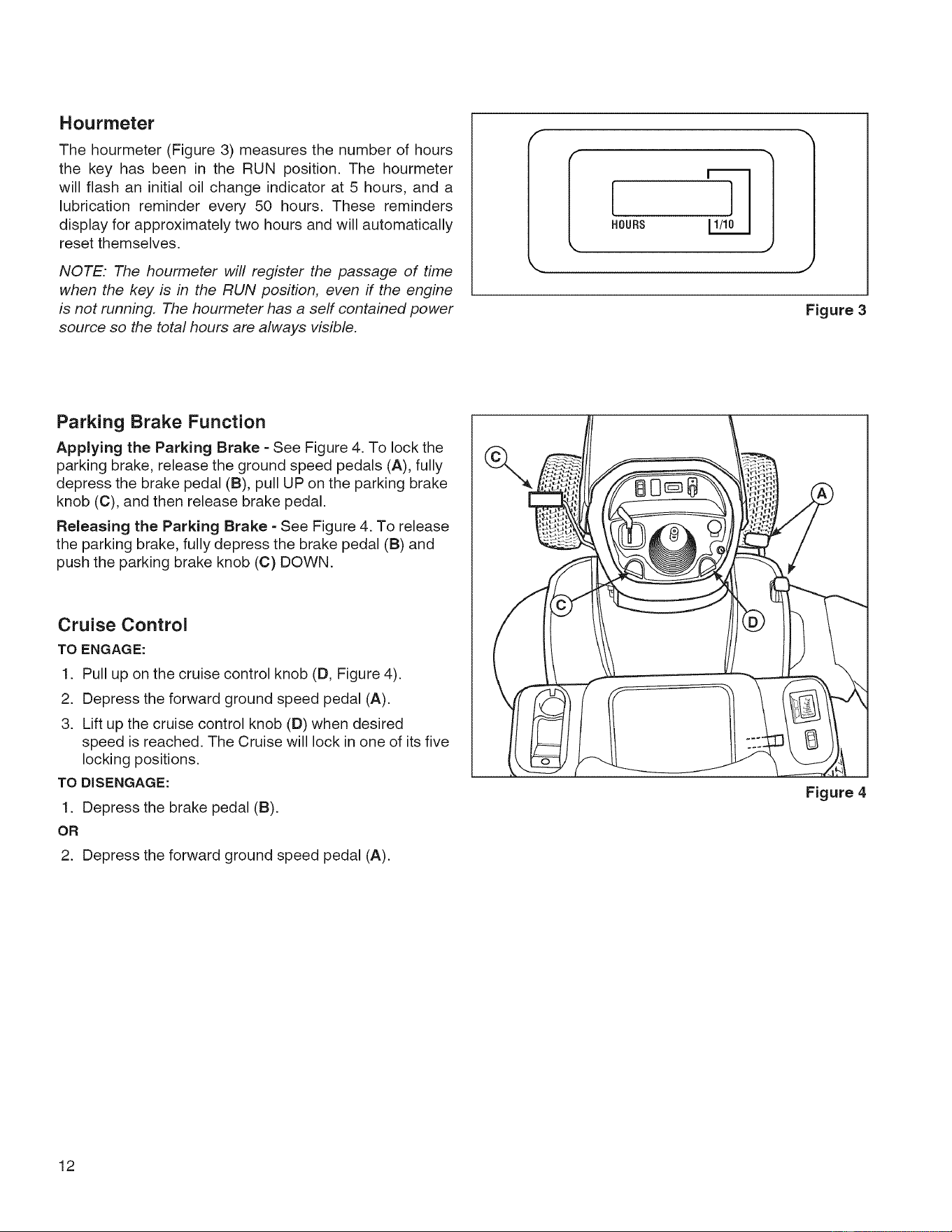
Hourmeter
The hourmeter (Figure 3) measures the number of hours
the key has been in the RUN position. The hourmeter
will flash an initial oil change indicator at 5 hours, and a
lubrication reminder every 50 hours. These reminders
display for approximately two hours and will automatically
reset themselves.
NOTE. The hourmeter will register the passage of time
when the key is in the RUN position, even ff the engine
is not running. The hourmeter has a serf contained power
source so the total hours are always visible.
I
rm
HOURS
1
Figure 3
Parking Brake Function
Applying the Parking Brake - See Figure 4. To lock the
parking brake, release the ground speed pedals (A), fully
depress the brake pedal (B), pull UP on the parking brake
knob (C), and then release brake pedal.
Releasing the Parking Brake - See Figure 4. To release
the parking brake, fully depress the brake pedal (B) and
push the parking brake knob (C) DOWN.
Cruise Control
TO ENGAGE:
1. Pull up on the cruise control knob (D, Figure 4).
2. Depress the forward ground speed pedal (A).
3. Lift up the cruise control knob (D) when desired
speed is reached. The Cruise will lock in one of its five
locking positions.
TO DISENGAGE:
1. Depress the brake pedal (B).
OR
2. Depress the forward ground speed pedal (A).
Figure 4
12
Safety Interlock System Tests
This unit is equipped with safety interlock switches and
other safety devices. These safety systems are present
for your safety: do not attempt to bypass safety switches,
and never tamper with safety devices.
WARNING
if the unit does not pass a safety test, do not
operate it. See your authorized dealer.
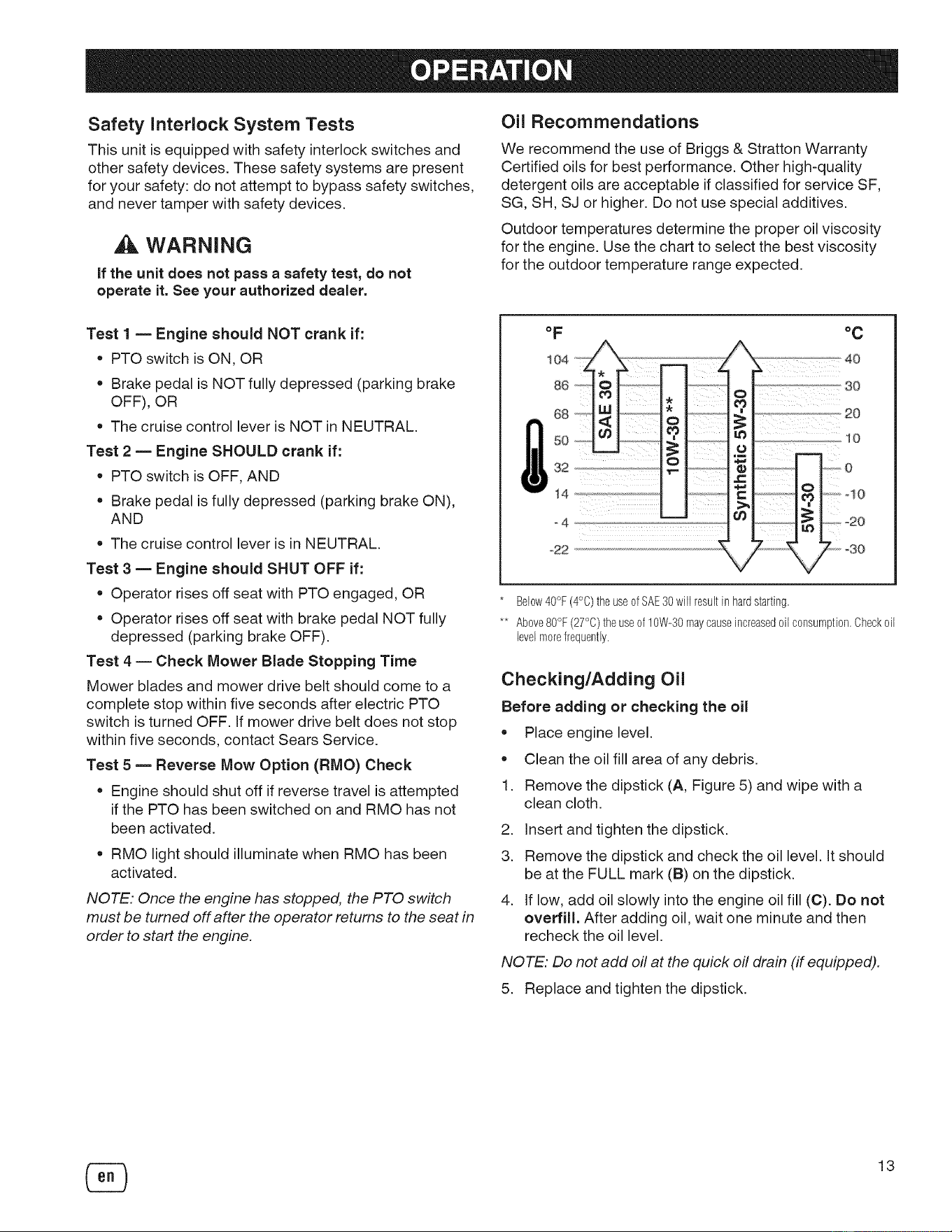
Oil Recommendations
We recommend the use of Briggs & Stratton Warranty
Certified oils for best performance. Other high-quality
detergent oils are acceptable if classified for service SF,
SG, SH, SJ or higher. Do not use special additives.
Outdoor temperatures determine the proper oil viscosity
for the engine. Use the chart to select the best viscosity
for the outdoor temperature range expected.
Test 1 m Engine should NOT crank if:
• PTO switch is ON, OR
• Brake pedal is NOT fully depressed (parking brake
OFF), OR
The cruise control lever is NOT in NEUTRAL.
Test 2 m Engine SHOULD crank if:
PTO switch is OFF, AND
• Brake pedal is fully depressed (parking brake ON),
AND
The cruise control lever is in NEUTRAL.
Test 3 = Engine should SHUT OFF if:
Operator rises off seat with PTO engaged, OR
Operator rises off seat with brake pedal NOT fully
depressed (parking brake OFF).
Test 4 -- Check Mower Blade Stopping Time
Mower blades and mower drive belt should come to a
complete stop within five seconds after electric PTO
switch is turned OFF. If mower drive belt does not stop
within five seconds, contact Sears Service.
Test 5 _ Reverse Mow Option (RMO) Check
• Engine should shut off if reverse travel is attempted
if the PTO has been switched on and RMO has not
been activated.
RMO light should illuminate when RMO has been
activated.
NOTE: Once the engine has stopped, the PTO switch
must be turned off after the operator returns to the seat in
order to start the engine.
°C
_ 40,
_,_i _ _ x_
' ..............,_..........................20
",/_ "} _ Z,,,,,,,,,.........._3o2°
Below40°F (4°C)the useofSAE30will result in hardstarting.
** Above80°F(27°C)the useof 10W-30maycauseincreased0il consumption.Check0il
levelmorefrequently.
Checking/Adding Oil
Before adding or checking the oil
• Place engine level.
• Clean the oil fill area of any debris.
1. Remove the dipstick (A, Figure 5) and wipe with a
clean cloth.
2. Insert and tighten the dipstick.
3. Remove the dipstick and check the oil level. It should
be at the FULL mark (B) on the dipstick.
4. If low, add oil slowly into the engine oil fill (C). Do not
overfill. After adding oil, wait one minute and then
recheck the oil level.
NOTE. Do not add off at the quick off drain (if equipped).
5. Replace and tighten the dipstick.
!
13
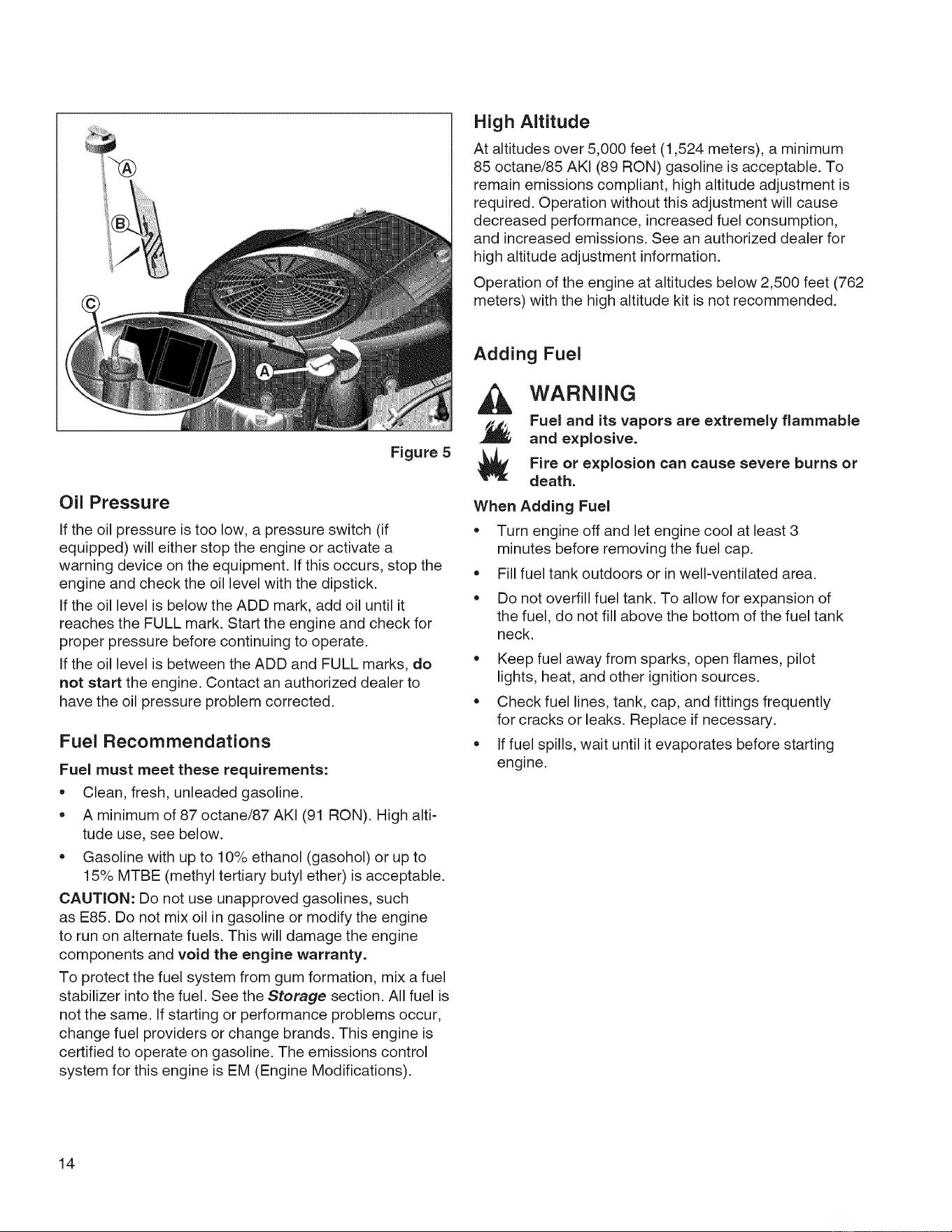
Figure 5
Oil Pressure
If the oil pressure is too low, a pressure switch (if
equipped) will either stop the engine or activate a
warning device on the equipment. If this occurs, stop the
engine and check the oil level with the dipstick.
If the oil level is below the ADD mark, add oil until it
reaches the FULL mark. Start the engine and check for
proper pressure before continuing to operate.
If the oil level is between the ADD and FULL marks, do
not start the engine. Contact an authorized dealer to
have the oil pressure problem corrected.
Fuel Recommendations
Fuel must meet these requirements:
• Clean, fresh, unleaded gasoline.
A minimum of 87 octane/87 AKI (91 RON). High alti-
tude use, see below.
Gasoline with up to 10% ethanol (gasohol) or up to
15% MTBE (methyl tertiary butyl ether) is acceptable.
CAUTION: Do not use unapproved gasolines, such
as E85. Do not mix oil in gasoline or modify the engine
to run on alternate fuels. This will damage the engine
components and void the engine warranty.
To protect the fuel system from gum formation, mix a fuel
stabilizer into the fuel. See the Storage section. All fuel is
not the same. If starting or performance problems occur,
change fuel providers or change brands. This engine is
certified to operate on gasoline. The emissions control
system for this engine is EM (Engine Modifications).
High Altitude
At altitudes over 5,000 feet (1,524 meters), a minimum
85 octane/85 AKI (89 RON) gasoline is acceptable. To
remain emissions compliant, high altitude adjustment is
required. Operation without this adjustment will cause
decreased performance, increased fuel consumption,
and increased emissions. See an authorized dealer for
high altitude adjustment information.
Operation of the engine at altitudes below 2,500 feet (762
meters) with the high altitude kit is not recommended.
Adding Fuel
WARNING
Fuel and its vapors are extremely flammable
and explosive.
Fire or explosion can cause severe burns or
death.
When Adding Fuel
Turn engine off and let engine cool at least 3
minutes before removing the fuel cap.
Fill fuel tank outdoors or in well-ventilated area.
Do not overfill fuel tank. To allow for expansion of
the fuel, do not fill above the bottom of the fuel tank
neck.
Keep fuel away from sparks, open flames, pilot
lights, heat, and other ignition sources.
Check fuel lines, tank, cap, and fittings frequently
for cracks or leaks. Replace if necessary.
If fuel spills, wait until it evaporates before starting
engine.
14
.
.
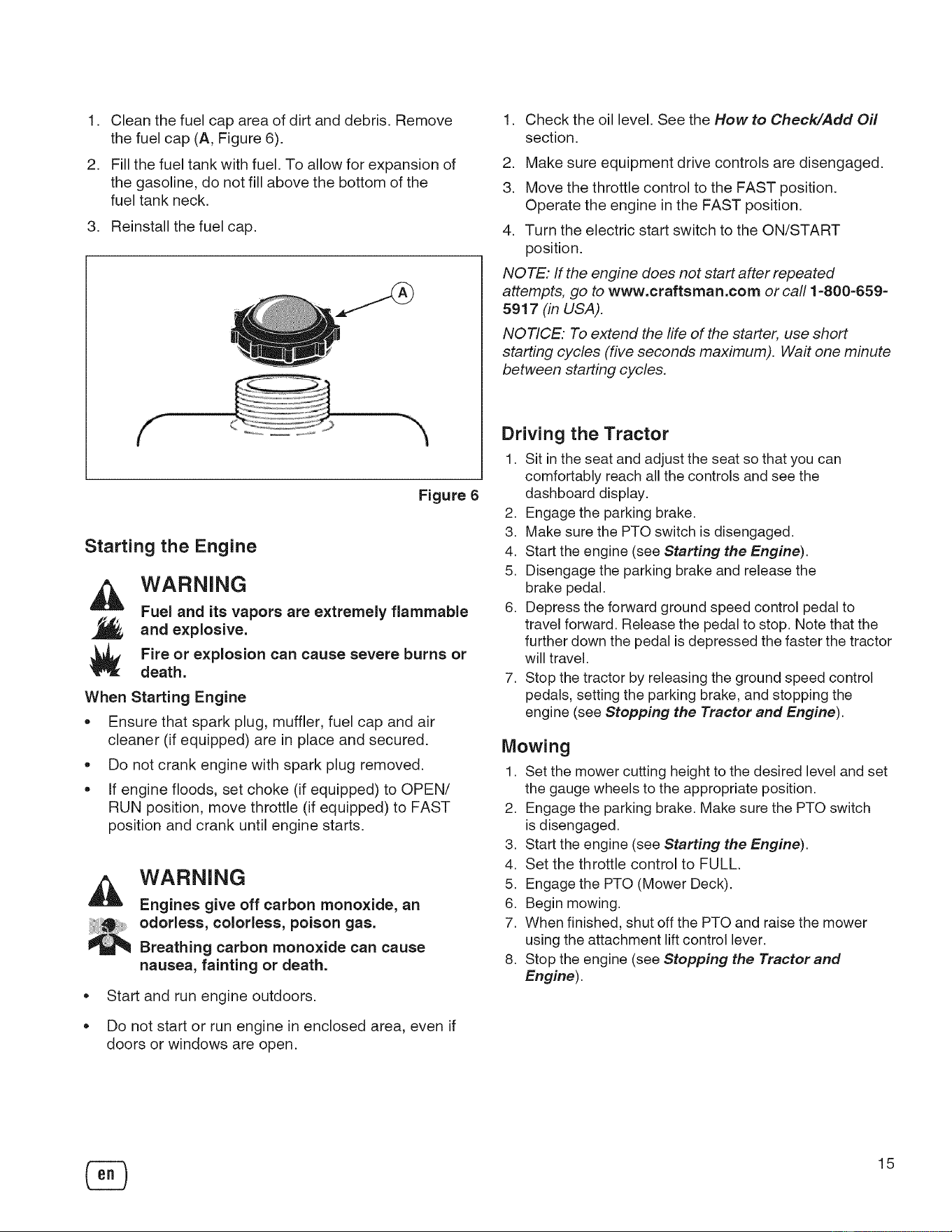
Clean the fuel cap area of dirt and debris. Remove
the fuel cap (A, Figure 6).
Fill the fuel tank with fuel. To allow for expansion of
the gasoline, do not fill above the bottom of the
fuel tank neck.
3. Reinstall the fuel cap.
Figure 6
Starting the Engine
WARNING
Fuel and its vapors are extremely flammable
and explosive.
Fire or explosion can cause severe burns or
death.
When Starting Engine
• Ensure that spark plug, muffler, fuel cap and air
cleaner (if equipped) are in place and secured.
• Do not crank engine with spark plug removed.
If engine floods, set choke (if equipped) to OPEN/
RUN position, move throttle (if equipped) to FAST
position and crank until engine starts.
®
®
WARNING
Engines give off carbon monoxide, an
odorless, colorless, poison gas.
Breathing carbon monoxide can cause
nausea, fainting or death.
Start and run engine outdoors.
Do not start or run engine in enclosed area, even if
doors or windows are open.
1. Check the oil level. See the How to Check/Add Oil
section.
2. Make sure equipment drive controls are disengaged.
3. Move the throttle control to the FAST position.
Operate the engine in the FAST position.
4. Turn the electric start switch to the ON/START
position.
NOTE: If the engine does not start after repeated
attempts, go to www.craftsman.com or call 1-800-659 =
5917 (in USA).
NOTICE. To extend the life of the starter, use short
starting cycles (five seconds maximum). Wait one minute
between starting cycles.
Driving the Tractor
1. Sit in the seat and adjust the seat so that you can
comfortably reach all the controls and see the
dashboard display.
2. Engage the parking brake.
3. Make sure the PTO switch is disengaged.
4. Start the engine (see Starting the Engine).
5. Disengage the parking brake and release the
brake pedal.
6. Depress the forward ground speed control pedal to
travel forward. Release the pedal to stop. Note that the
further down the pedal is depressed the faster the tractor
will travel.
7. Stop the tractor by releasing the ground speed control
pedals, setting the parking brake, and stopping the
engine (see Stopping the Tractor and Engine).
Mowing
1. Set the mower cutting height to the desired level and set
the gauge wheels to the appropriate position.
2. Engage the parking brake. Make sure the PTO switch
is disengaged.
3. Start the engine (see Starting the Engine).
4. Set the throttle control to FULL.
5. Engage the PTO (Mower Deck).
6. Begin mowing.
7. When finished, shut off the PTO and raise the mower
using the attachment lift control lever.
8. Stop the engine (see Stopping the Tractorand
Engine).
15
WARNING
The engine will shut off if the reverse ground speed
pedal is depressed while the PTO is on and the
RMO has not been activated. The operator should
always turn the PTO off prior to driving across
on roads, paths or any area that maybe used by
other vehicles. Sudden loss of drive could create a
hazard.
WARNING
Mowing in reverse can be hazardous to bystanders.
Tragic accidents can occur if the operator is not
alert to the presence of children. Never activate
RMO if children are present. Children are often
attracted to the unit and the mowing activity.
Mowing in Reverse (RMO)
If an operator chooses to mow in reverse, the RMO system
can be used. To use the Reverse Mowing Option (RMO) turn
the RMO key after the PTO is engaged. The L.E.D. light will
illuminate, and the operator can then mow in reverse. Each
time the PTO is engaged the RMO needs to be reactivated if
desired. The key should be removed to restrict access to the
RMO feature.
Attachment Operation in Reverse
If an operator chooses to operate a PTO driven attachment
in reverse, the RMO system can be used. To use the
Reverse Mowing Option (RMO) turn the RMO key after
the PTO is engaged. The L.E.D. light will illuminate, and
the operator can then operate the attachment in reverse.
Each time the PTO is disengaged the RMO needs to be
reactivated if desired. The key should be removed to restrict
access to the RMO feature.
Pushing the Tractor by Hand
1. Disengage the PTO and turn the engine off.
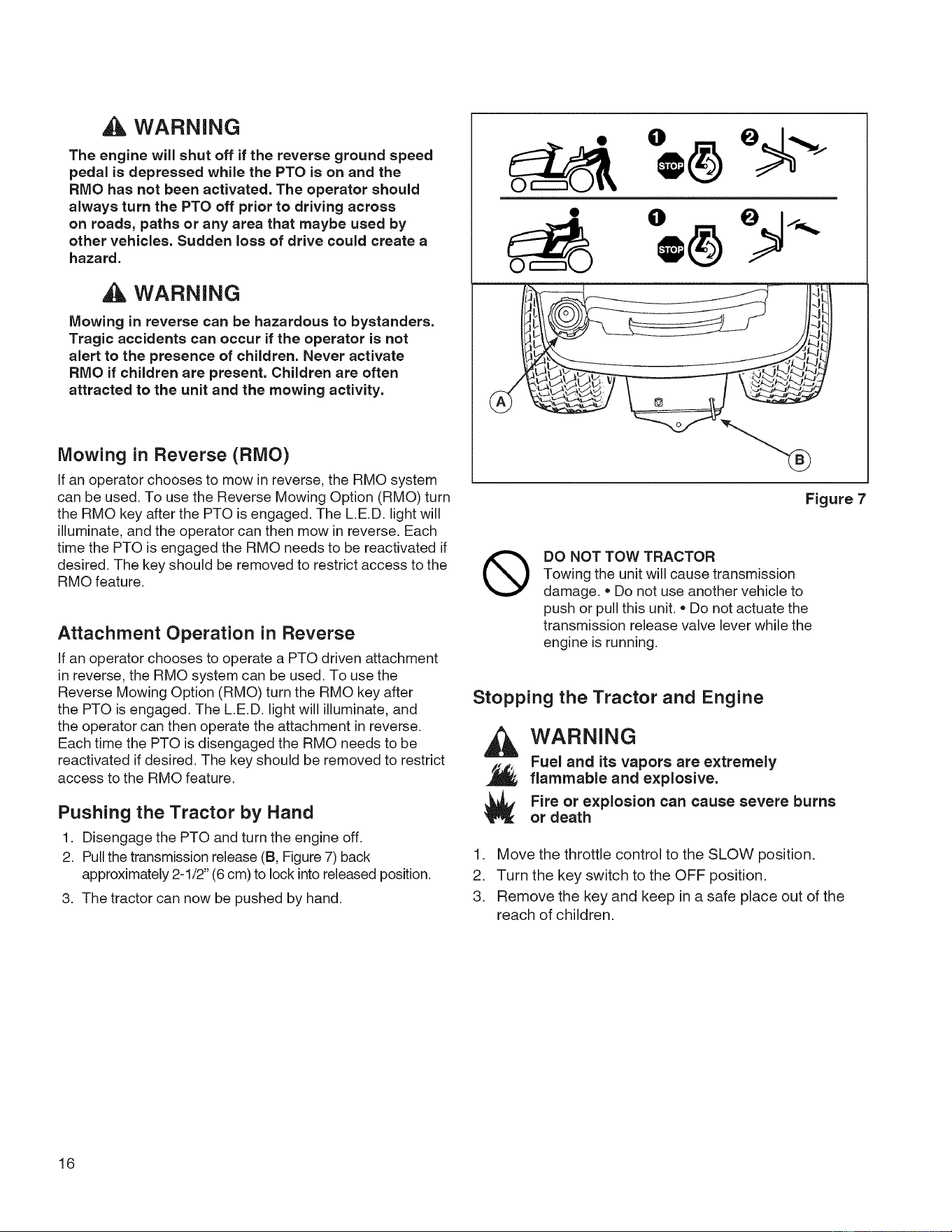
2. Pull the transmission release (B, Figure 7) back
approximately 2-1/2" (6 cm) to lock into released position.
3. The tractor can now be pushed by hand.
I
Figure 7
®
DO NOT TOW TRACTOR
Towing the unit will cause transmission
damage. = Do not use another vehicle to
push or pull this unit. * Do not actuate the
transmission release valve lever while the
engine is running.
Stopping the Tractor and Engine
WARNING
Fuel and its vapors are extremely
flammable and explosive.
Fire or explosion can cause severe burns
or death
1. Move the throttle control to the SLOW position.
2. Turn the key switch to the OFF position.
3. Remove the key and keep in a safe place out of the
reach of children.
16
Adjusting Mower Cutting Height
The cutting height is adjustable between 1.5" and 4.0" (3,8
and 10,2 cm).
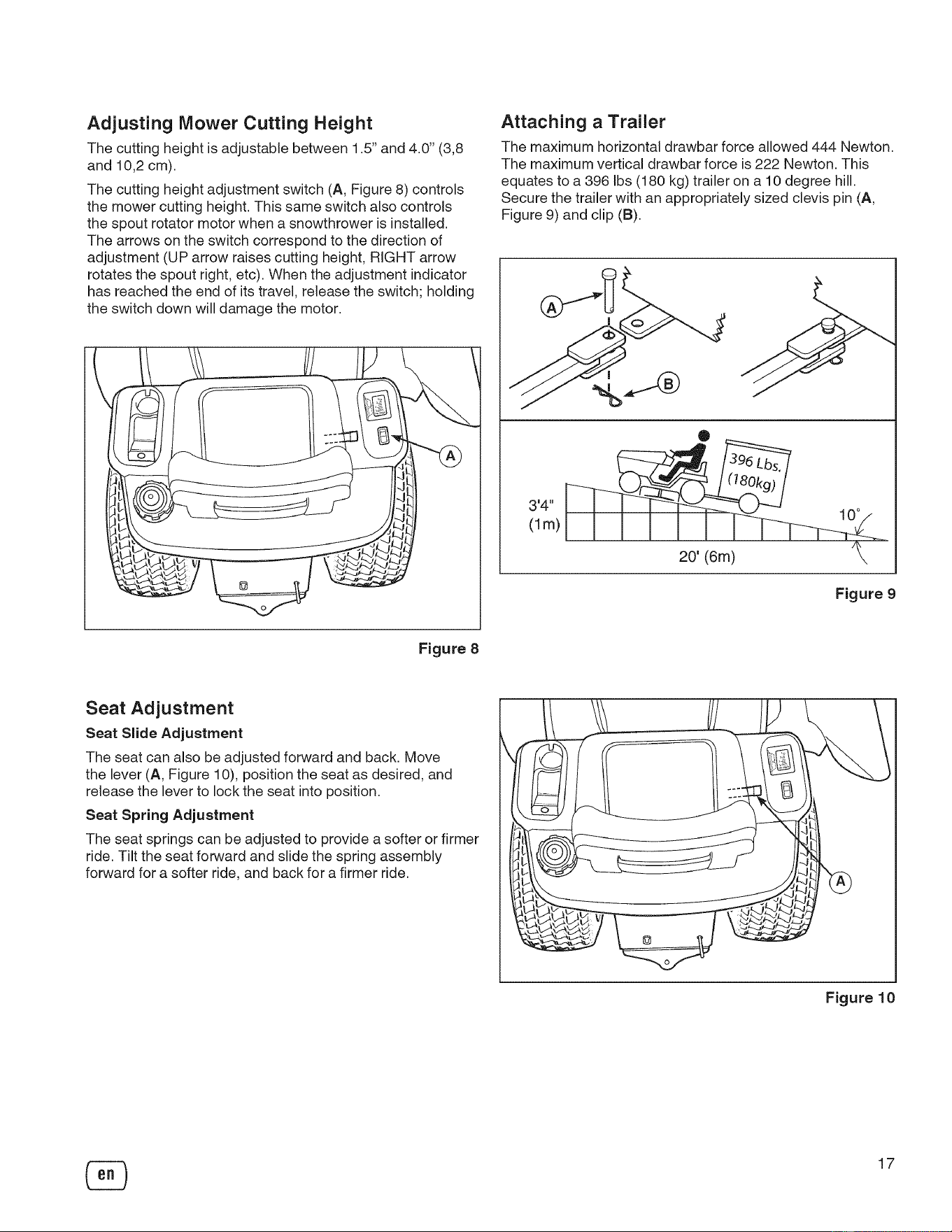
The cutting height adjustment switch (A, Figure 8) controls
the mower cutting height. This same switch also controls
the spout rotator motor when a snowthrower is installed.
The arrows on the switch correspond to the direction of
adjustment (UP arrow raises cutting height, RIGHT arrow
rotates the spout right, etc). When the adjustment indicator
has reached the end of its travel, release the switch; holding
the switch down will damage the motor.
Attaching a Trailer
The maximum horizontal drawbar force allowed 444 Newton.
The maximum vertical drawbar force is 222 Newton. This
equates to a 396 Ibs (180 kg) trailer on a 10 degree hill.
Secure the trailer with an appropriately sized clevis pin (A,
Figure 9) and clip (B).
®
3'4"
(lm)
20' (6m) ?
Figure 9
Figure 8
Seat Adjustment
Seat Slide Adjustment
The seat can also be adjusted forward and back. Move
the lever (A, Figure 10), position the seat as desired, and
release the lever to lock the seat into position.
Seat Spring Adjustment
The seat springs can be adjusted to provide a softer or firmer
ride. Tilt the seat forward and slide the spring assembly
forward for a softer ride, and back for a firmer ride.
Figure 10
17
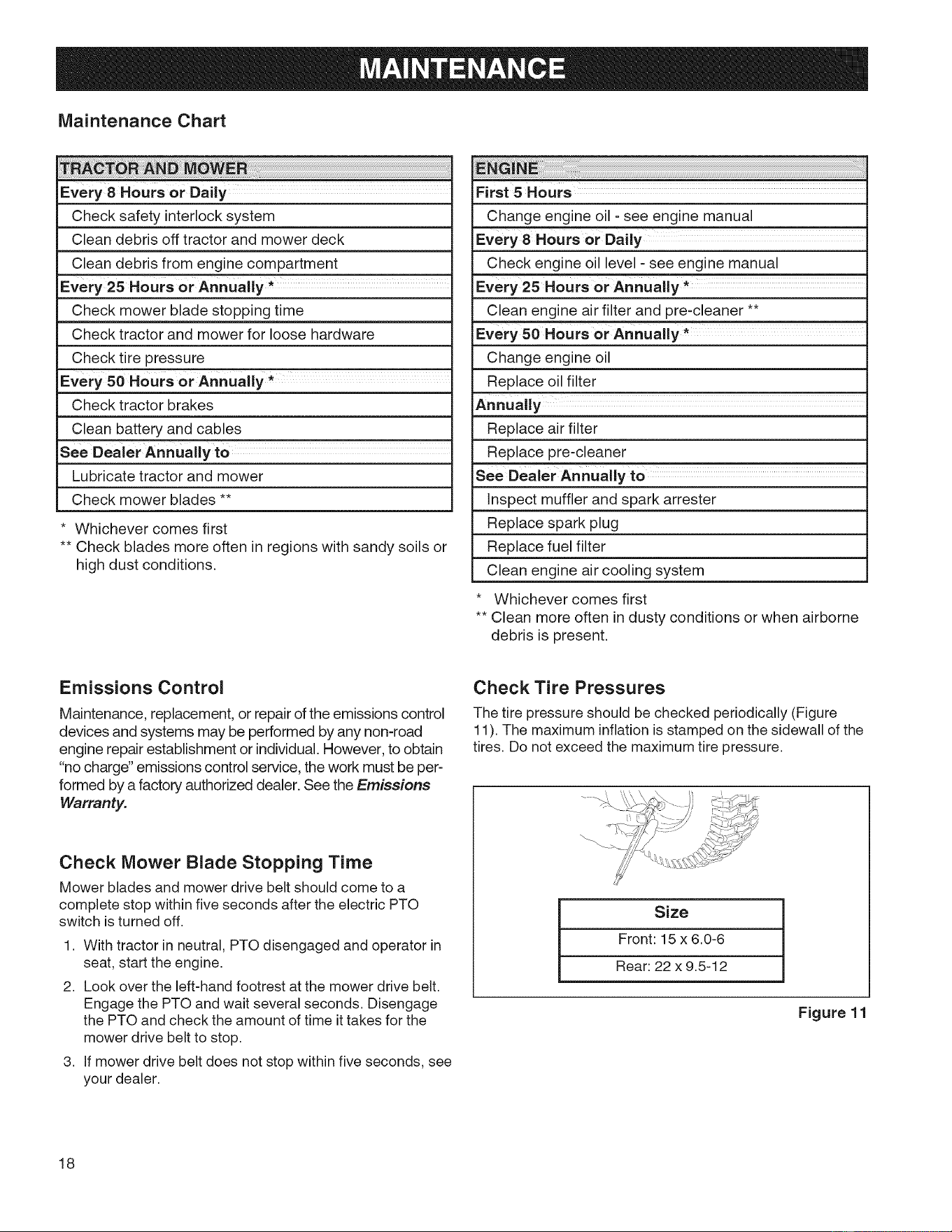
Maintenance Chart
Every 8 Hours or Daily
Check safety interlock system
Clean debris off tractor and mower deck
Clean debris from engine compartment
Every 25 Hours or Annually *
Check mower blade stopping time
Check tractor and mower for loose hardware
Check tire pressure
Every 50 Hours or Annually *
Check tractor brakes
Clean battery and cables
See Dealer Annually to
Lubricate tractor and mower
Check mower blades **
* Whichever comes first
** Check blades more often in regions with sandy soils or
high dust conditions.
First 5 Hours
Change engine oil - see engine manual
Every 8 Hours or Daily
Check engine oil level - see engine manual
Every 25 Hours or Annually *
Clean engine air filter and pre-cleaner **
Every 5o Hours or Annually *
Change engine oil
Replace oil filter
Replace air filter
Replace pre-cleaner
see Dealer Annually to
Inspect muffler and spark arrester
Replace spark plug
Replace fuel filter
Clean engine air cooling system
* Whichever comes first
** Clean more often in dusty conditions or when airborne
debris is present.
Emissions Control
Maintenance, replacement, or repair of the emissions control
devices and systems may be performed by any non-road
engine repair establishment or individual. However, to obtain
"no charge" emissions control service, the work must be per-
formed by a factory authorized dealer. See the Emissions
Warranty.
Check Mower Blade Stopping Time
Mower blades and mower drive belt should come to a
complete stop within five seconds after the electric PTO
switch is turned off.
1. With tractor in neutral, PTO disengaged and operator in
seat, start the engine.
2. Look over the left-hand footrest at the mower drive belt.
Engage the PTO and wait several seconds. Disengage
the PTO and check the amount of time it takes for the
mower drive belt to stop.
3. If mower drive belt does not stop within five seconds, see
your dealer.
Check Tire Pressures
The tire pressure should be checked periodically (Figure
11). The maximum inflation is stamped on the sidewall of the
tires. Do not exceed the maximum tire pressure.
Size
Front: 15 x 6.0-6
Rear: 22 x 9.5-12
Figure 1
18
Electronic Fuel Management System
The Electronic Fuel Management System monitors engine
temperature, engine speed, and battery voltage to adjust
the choke during engine starting and warm up. There are no
adjustments on the system. If starting or operation problems
occur, contact Sears Service.
NOTICE: Make sure to follow the steps below or the
Electronic Fuel Management System could be damaged.
• Never start the engine if the battery cables are loose.
,, Turn the key to the off position before disconnecting,
removing and/or installing the battery.
Never use a battery charger to start the engine.
,, Never disconnect the battery cables while the engine is
running.
When connecting the battery cables, first connect the
positive (+) cable and then connect the negative (-) cable
to the battery.
,, When charging the battery, turn the ignition switch to the
off position and disconnect the negative (-) battery cable
from the battery.
Do not spray water directly on the Electronic Control Unit.
Cleaning the Battery and Cables
WARNING
When removing or installing battery cables,
disconnect the negative cable FIRST and reconnect
it LAST. if not done in this order, the positive terminal
can be shorted to the frame by a tool.
Battery Charging
,A WARNING
Keep open flames and sparks away from the
battery; the gasses coming from it are highly
explosive. Ventilate the battery well during
charging.
A dead battery or one too weak to start the engine may
be the result of a defect in the charging system or other
electrical component. If there is any doubt about the cause
of the problem, see your dealer. If you need to replace the
battery, follow the steps under Cleaning the Battery and
Cables.
To charge the battery, follow the instructions provided by
the battery charger manufacturer as well as all warnings
included in the safety rules sections of this book. Charge
the battery until fully charged. Do not charge at a rate higher
than 10 amps.
1,
2.
3.
4.
5.
6.
7.
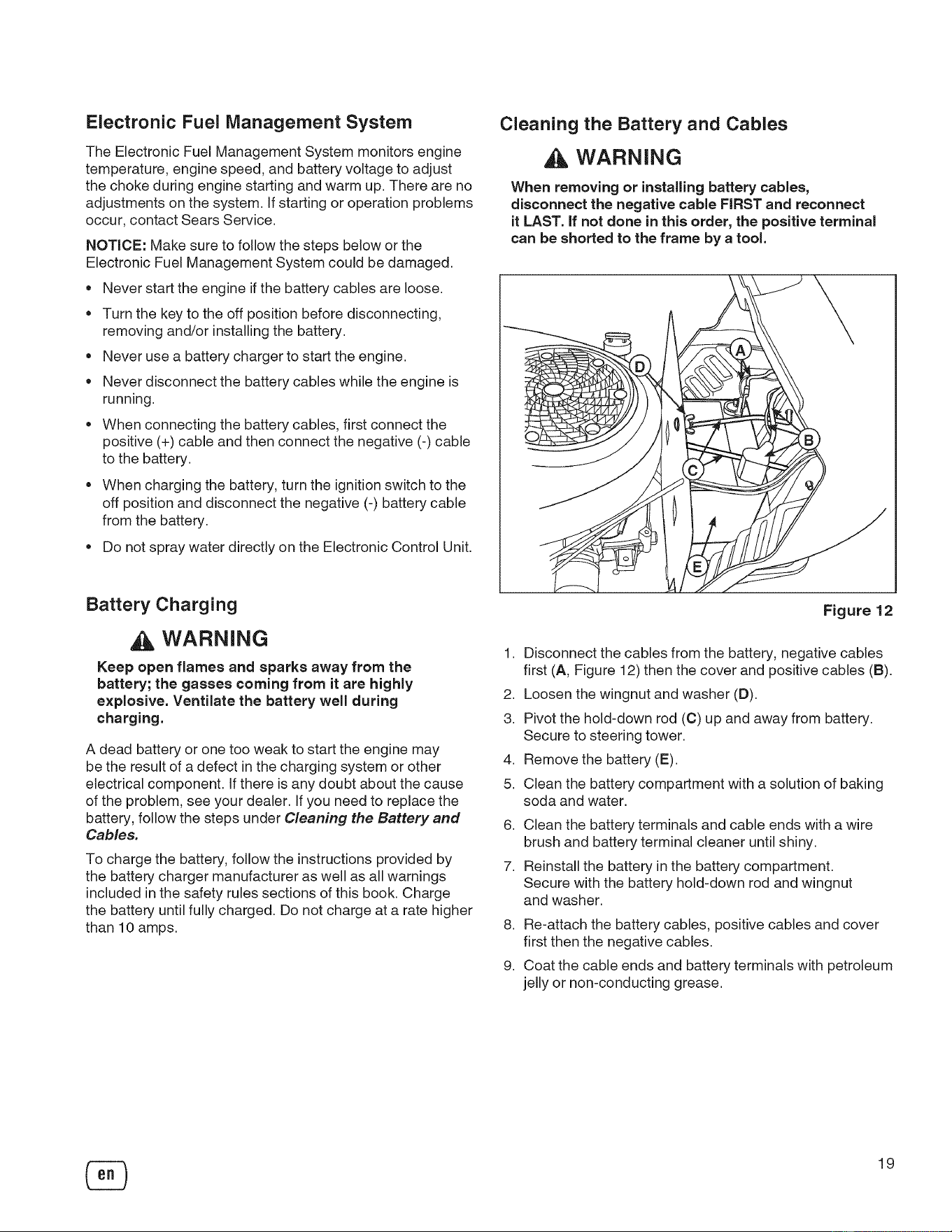
Figure 12
Disconnect the cables from the battery, negative cables
first (A, Figure 12) then the cover and positive cables (B).
Loosen the wingnut and washer (D).
Pivot the hold-down rod (C) up and away from battery.
Secure to steering tower.
Remove the battery (E).
Clean the battery compartment with a solution of baking
soda and water.
Clean the battery terminals and cable ends with a wire
brush and battery terminal cleaner until shiny.
Reinstall the battery in the battery compartment.
Secure with the battery hold-down rod and wingnut
and washer.
8. Re-attach the battery cables, positive cables and cover
first then the negative cables.
9. Coat the cable ends and battery terminals with petroleum
jelly or non-conducting grease.
19
/
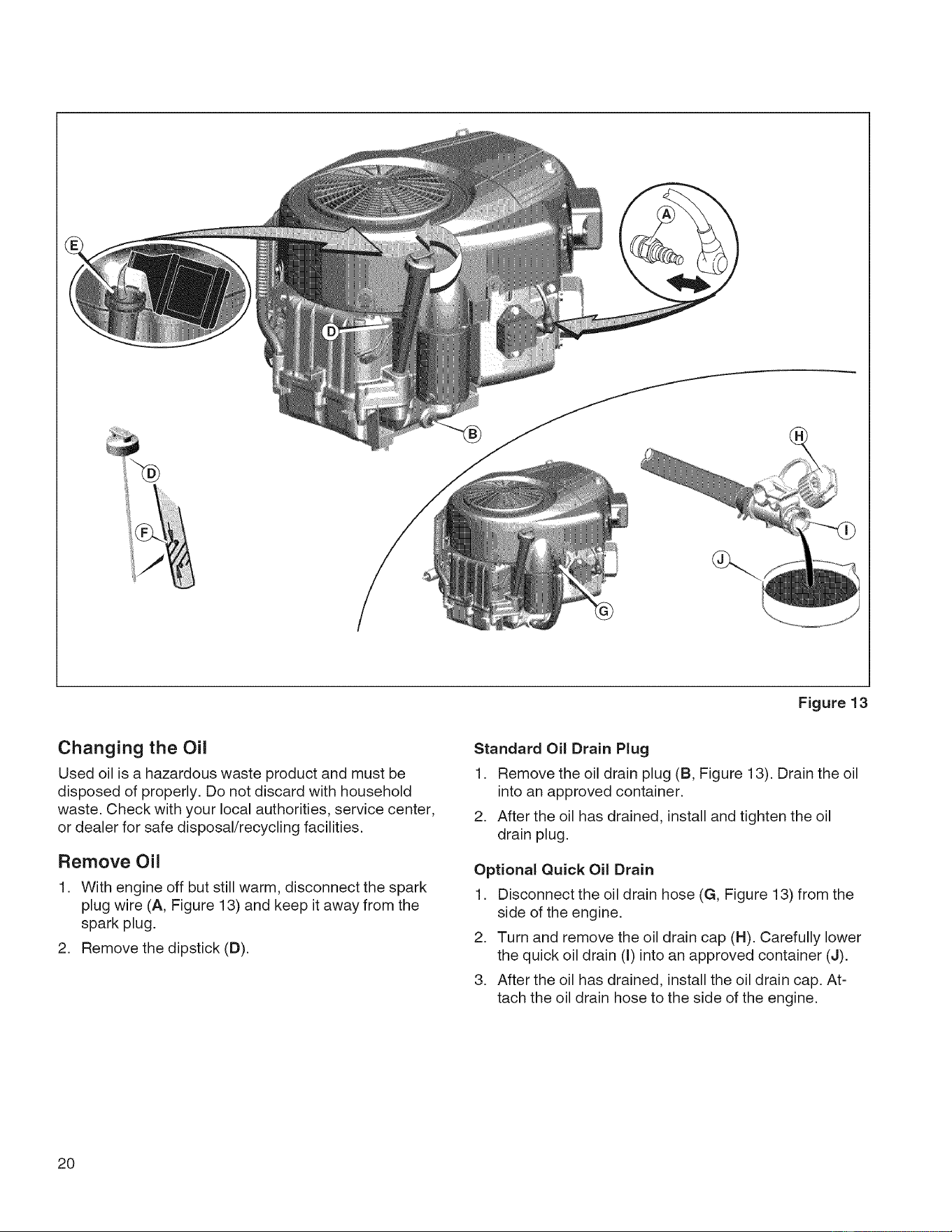
Figure 13
Changing the Oil
Used oil isa hazardous waste product and must be
disposed of properly. Do not discard with household
waste. Check with your local authorities, service center,
or dealer for safe disposal/recycling facilities.
Remove Oil
1. With engine off but still warm, disconnect the spark
plug wire (A, Figure 13) and keep it away from the
spark plug.
2. Remove the dipstick (D).
Standard Oil Drain Plug
1. Remove the oil drain plug (B, Figure 13). Drain the oil
into an approved container.
2. After the oil has drained, install and tighten the oil
drain plug.
Optional Quick Oil Drain
1. Disconnect the oil drain hose (G, Figure 13) from the
side of the engine.
2. Turn and remove the oil drain cap (H). Carefully lower
the quick oil drain (I) into an approved container (J).
3. After the oil has drained, install the oil drain cap. At-
tach the oil drain hose to the side of the engine.
20
Changing the Oil Filter
For replacement intervals, see the Maintenance Chart.
1. Drain the oil from the engine. See Remove Oil sec-
tion.
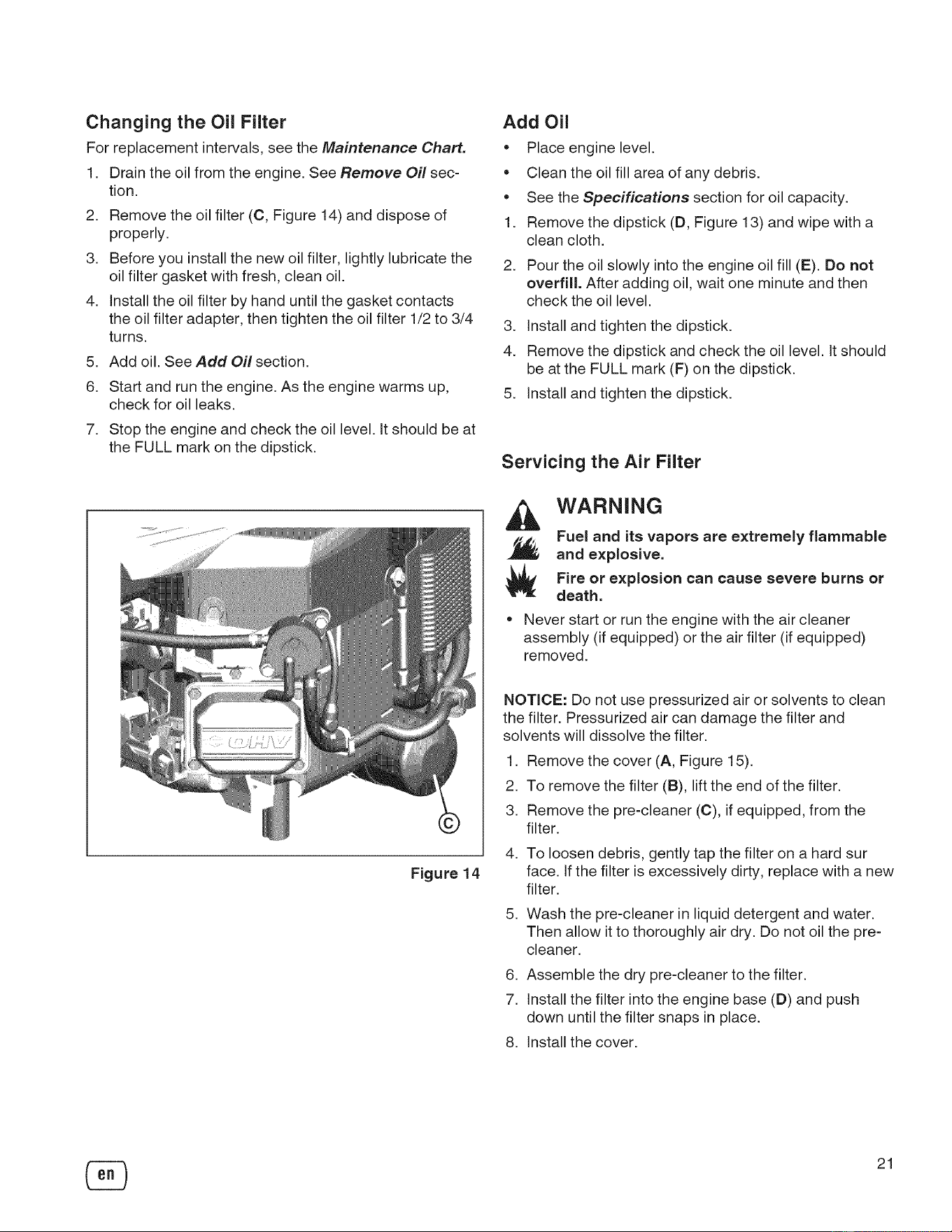
2. Remove the oil filter (C, Figure 14) and dispose of
properly.
3. Before you install the new oil filter, lightly lubricate the
oil filter gasket with fresh, clean oil.
4. Install the oil filter by hand until the gasket contacts
the oil filter adapter, then tighten the oil filter 1/2 to 3/4
turns.
5. Add oil. See Add Oil section.
6. Start and run the engine. As the engine warms up,
check for oil leaks.
7. Stop the engine and check the oil level. It should be at
the FULL mark on the dipstick.
Add Oil
• Place engine level.
• Clean the oil fill area of any debris.
See the Specifications section for oil capacity.
1. Remove the dipstick (D, Figure 13) and wipe with a
clean cloth.
2. Pour the oil slowly into the engine oil fill (E). Do not
overfill, After adding oil, wait one minute and then
check the oil level.
3. Install and tighten the dipstick.
4. Remove the dipstick and check the oil level. It should
be at the FULL mark (F) on the dipstick.
5. Install and tighten the dipstick.
Servicing the Air Filter
WARNING
Fuel and its vapors are extremely flammable
and explosive.
Fire or explosion can cause severe burns or
death.
Never start or run the engine with the air cleaner
assembly (if equipped) or the air filter (if equipped)
removed.
Figure 14
NOTICE: Do not use pressurized air or solvents to clean
the filter. Pressurized air can damage the filter and
solvents will dissolve the filter.
1. Remove the cover (A, Figure 15).
2. To remove the filter (B), lift the end of the filter.
3. Remove the pre-cleaner (C), if equipped, from the
filter.
4. To loosen debris, gently tap the filter on a hard sur
face. If the filter is excessively dirty, replace with a new
filter.
5. Wash the pre-cleaner in liquid detergent and water.
Then allow it to thoroughly air dry. Do not oil the pre-
cleaner.
6. Assemble the dry pre-cleaner to the filter.
7. Installthe filter into the engine base (D) and push
down until the filter snaps in place.
8. Installthe cover.
21
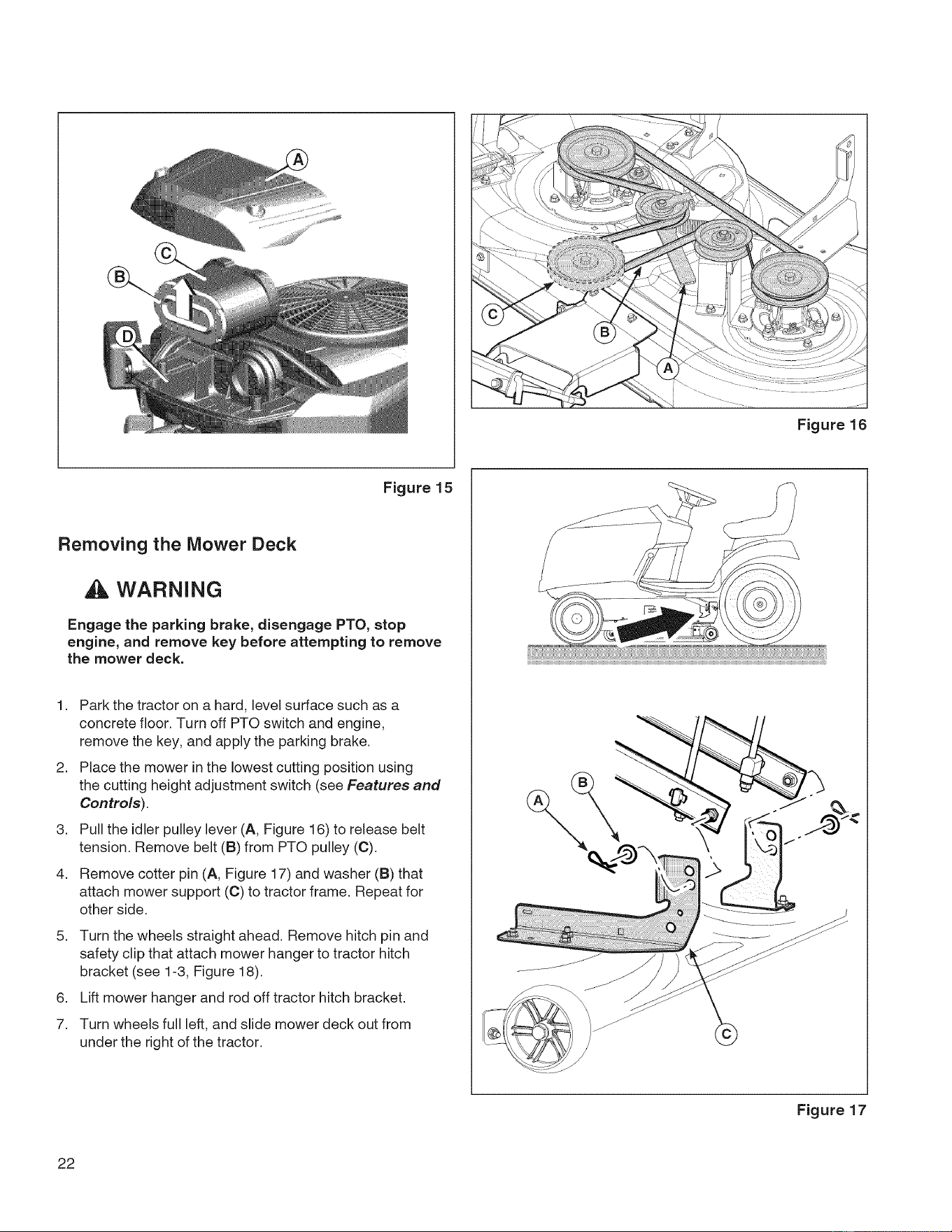
Figure 15
Removing the Mower Deck
WARNING
Engage the parking brake, disengage PTO, stop
engine, and remove key before attempting to remove
the mower deck.
1,
2,
3,
4,
5,
6,
7.
Park the tractor on a hard, level surface such as a
concrete floor. Turn off PTO switch and engine,
remove the key, and apply the parking brake.
Place the mower in the lowest cutting position using
the cutting height adjustment switch (see Features and
Controls).
Pull the idler pulley lever (A, Figure 16) to release belt
tension. Remove belt (B) from PTO pulley (C).
Remove cotter pin (A, Figure 17) and washer (B) that
attach mower support (C) to tractor frame. Repeat for
other side.
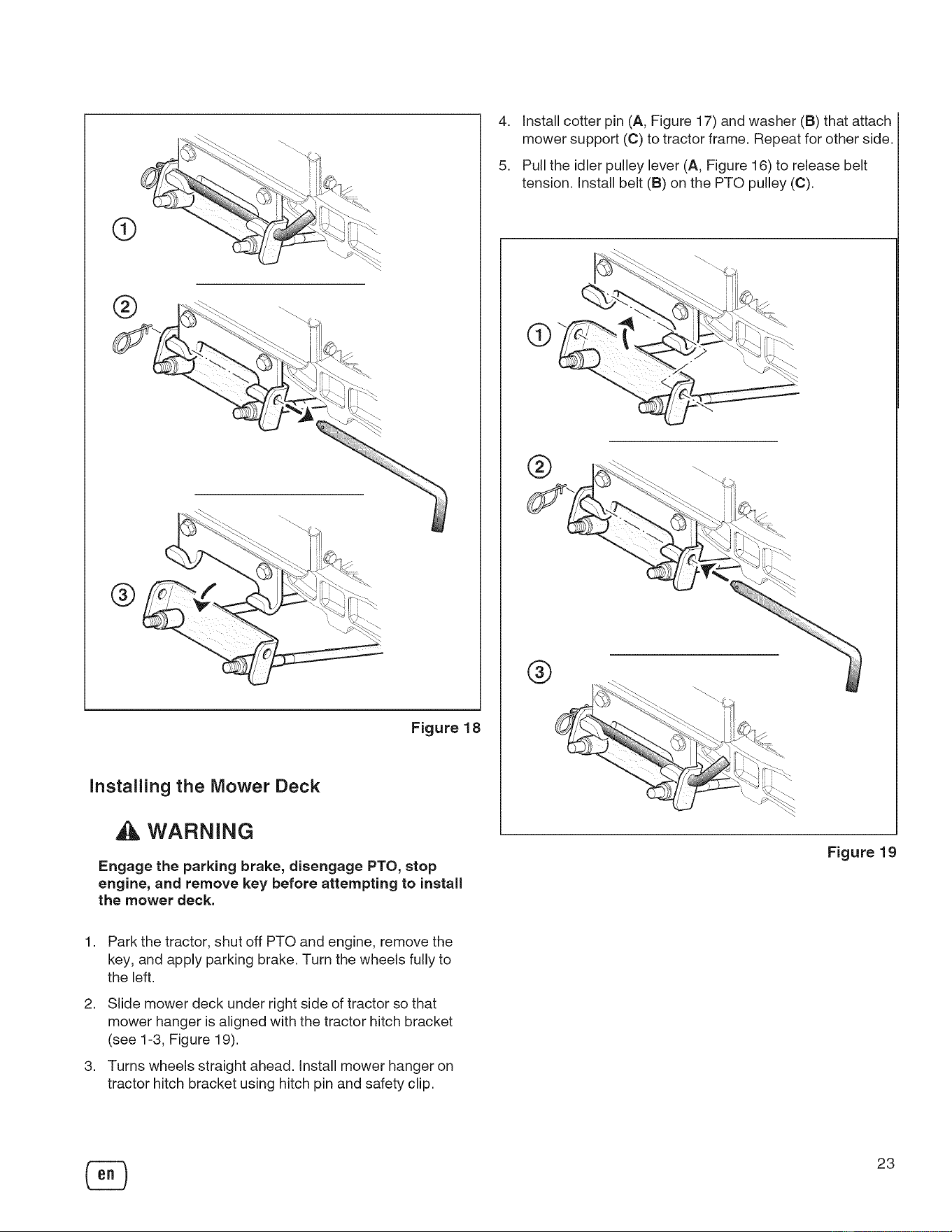
Turn the wheels straight ahead. Remove hitch pin and
safety clip that attach mower hanger to tractor hitch
bracket (see 1-3, Figure 18).
Lift mower hanger and rod off tractor hitch bracket.
Turn wheels full left, and slide mower deck out from
under the right of the tractor.
%
Figure 16
Figure 17
22
®
Figure 18
Installing the Mower Deck
WARNING
Engage the parking brake, disengage PTO, stop
engine, and remove key before attempting to install
the mower deck.
4,
5,
Install cotter pin (A, Figure 17) and washer (B) that attach
mower support (C) to tractor frame. Repeat for other side.
Pull the idler pulley lever (A, Figure 16) to release belt
tension. Install belt (B) on the PTO pulley (C).
®
®
Figure 19
1,
2,
3,
Park the tractor, shut off PTO and engine, remove the
key, and apply parking brake. Turn the wheels fully to
the left.
Slide mower deck under right side of tractor so that
mower hanger is aligned with the tractor hitch bracket
(see 1-3, Figure 19).
Turns wheels straight ahead. Install mower hanger on
tractor hitch bracket using hitch pin and safety clip.
®
23
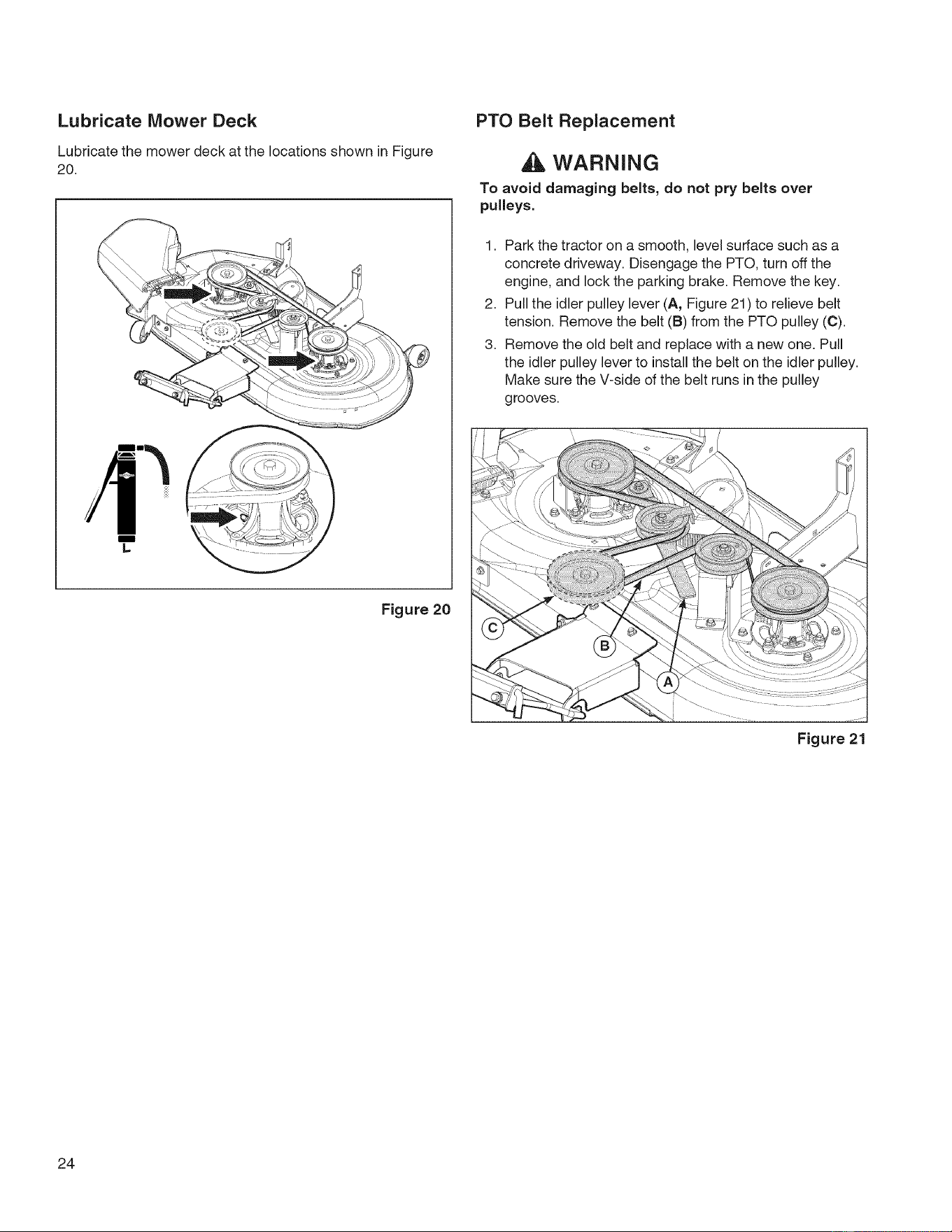
Lubricate Mower Deck
Lubricate the mower deck at the locations shown in Figure
20.
m
L,
Figure 20
PTO Belt Replacement
WARNING
To avoid damaging belts, do not pry belts over
pulleys.
1. Park the tractor on a smooth, level surface such as a
concrete driveway. Disengage the PTO, turn off the
engine, and lock the parking brake. Remove the key.
2. Pull the idler pulley lever (A, Figure 21) to relieve belt
tension. Remove the belt (B) from the PTO pulley (C).
3. Remove the old belt and replace with a new one. Pull
the idler pulley lever to install the belt on the idler pulley.
Make sure the V-side of the belt runs in the pulley
grooves.
24
Figure 21
PTO Clutch Adjustment
Check the PTO clutch adjustment after the initial 25 hour
break-in period and then after every 250 hours of operation.
Also perform the following procedure if the clutch is slipping
or will not engage, or if a new clutch has been installed.
1. Remove key from ignition switch and disconnect spark
plug wires to prevent the possibility of accidental
starting while the PTO is being adjusted.
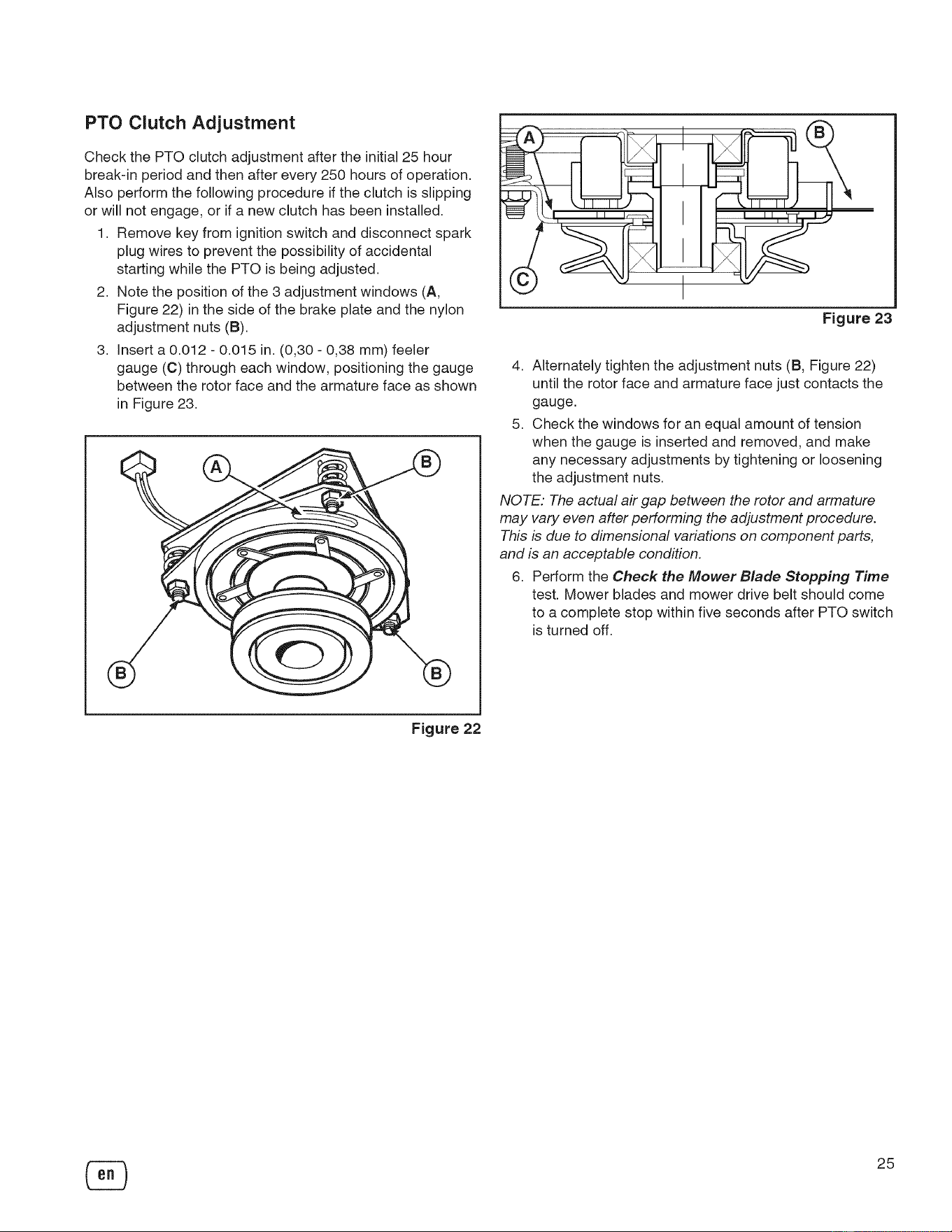
2. Note the position of the 3 adjustment windows (A,
Figure 22) in the side of the brake plate and the nylon
adjustment nuts (B).
3. Insert a 0.012 - 0.015 in. (0,30 - 0,38 mm) feeler
gauge (C) through each window, positioning the gauge
between the rotor face and the armature face as shown
in Figure 23.
®
I
I
Figure 23
4. Alternately tighten the adjustment nuts (B, Figure 22)
until the rotor face and armature face just contacts the
gauge.
5. Check the windows for an equal amount of tension
when the gauge is inserted and removed, and make
any necessary adjustments by tightening or loosening
the adjustment nuts.
NOTE. The actual air gap between the rotor and armature
may vary even after performing the adjustment procedure.
This is due to dimensional variations on component parts,
and is an acceptable condition.
6. Perform the Check the Mower Blade Stopping Time
test. Mower blades and mower drive belt should come
to a complete stop within five seconds after PTO switch
is turned off.
Figure 22
25
Servicing the Mower Blades
WARNING
For your personal safety, do not handle the sharp
mower blades with bare hands. Careless or improper
handling of blades may result in serious injury.
WARNING
For your personal safety, blade mounting capscrews
must each be installed with a heyJspline washer and
spring washer, then securely tightened. Torque blade
mounting capscrew to 50-60 ft-lbs (68=81 Nm).
NOTE." Mower blades must be aligned perpendicular to each
other.
1. Remove mower deck (see Removing the Mower
Deck).
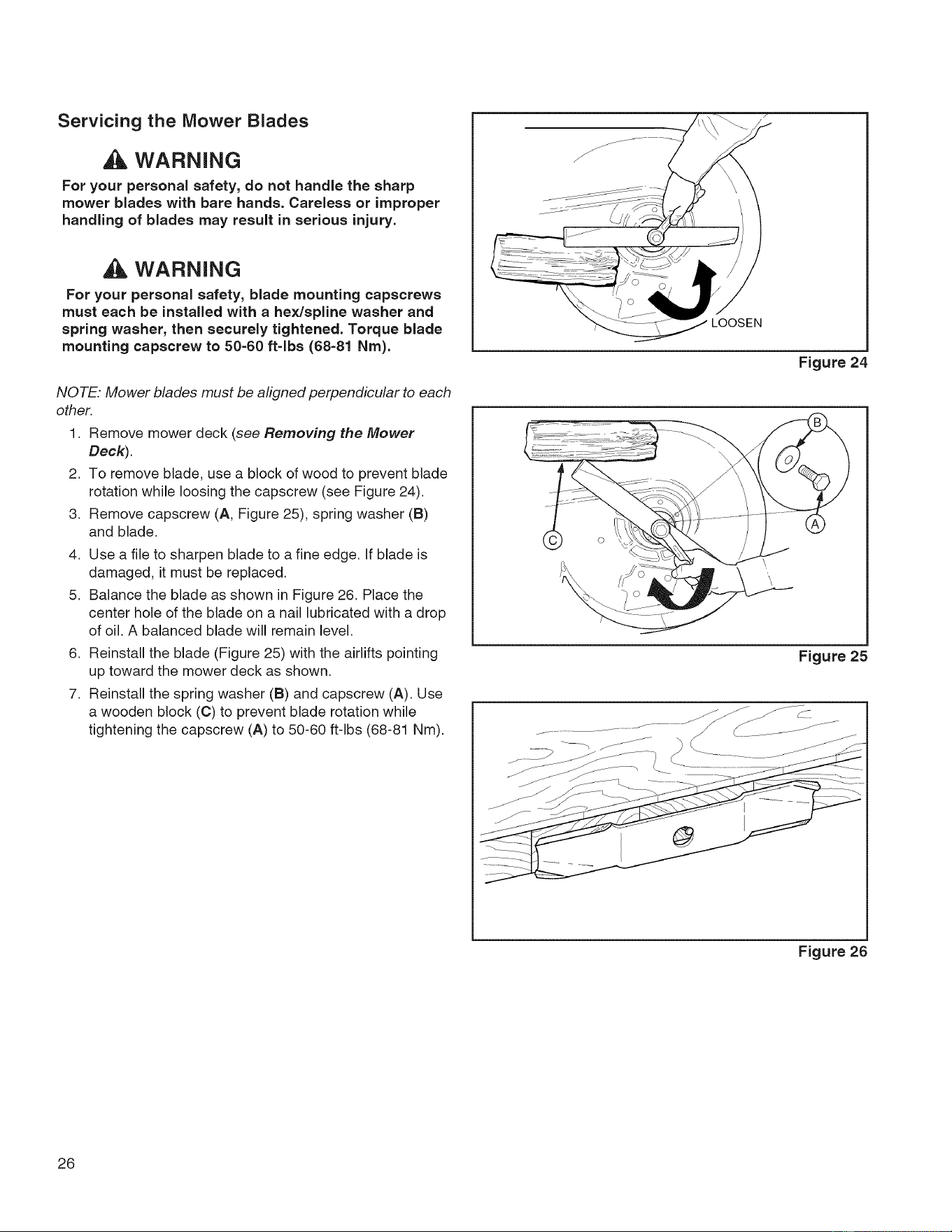
2. To remove blade, use a block of wood to prevent blade
rotation while loosing the capscrew (see Figure 24).
3. Remove capscrew (A, Figure 25), spring washer (B)
and blade.
4. Use a file to sharpen blade to a fine edge. If blade is
damaged, it must be replaced.
5. Balance the blade as shown in Figure 26. Place the
center hole of the blade on a nail lubricated with a drop
of oil. A balanced blade will remain level.
6. Reinstall the blade (Figure 25) with the airlifts pointing
up toward the mower deck as shown.
7. Reinstall the spring washer (B) and capscrew (A). Use
a wooden block (C) to prevent blade rotation while
tightening the capscrew (A) to 50-60 ft-lbs (68-81 Nm).
LOOSEN
Figure 24
Figure 25
Figure 26
26
Storage
WARNING
Never store the unit (with fuel) in an
enclosed, poorly ventilated structure. Fuel
vapors can travel to an ignition source (such
as a furnace, water heater, etc.) and cause an
explosion. Fuel vapor is also toxic to humans
and animals.
When Storing Fuel Or Equipment With Fuel In Tank
• Store away from furnaces, stoves, water heaters or
other appliances that have pilot lights or other ignition
sources because they can ignite fuel vapors.
Equipment
Disengage the PTO, set the parking brake, and remove
the key.
Battery life will be increased if it is removed. Put in a cool,
dry place and fully charged about once a month. If the
battery is left in the unit, disconnect the negative cable.
Fuel System
Fuel can become stale when stored over 30 days. Stale
fuel causes acid and gum deposits to form in the fuel sys-
tem or on essential carburetor parts. To keep fuel fresh,
use fuel stabilizer.
There is no need to drain gasoline from the engine if a
fuel stabilizer is added according to instructions. Run the
engine for 2 minutes to circulate the stabilizer throughout
the fuel system before storage.
Engine Oil
While the engine is still warm, change the engine oil.
Before starting the unit after it has been stored:
• Check all fluid levels. Check all maintenance items.
• Perform all recommended checks and procedures
found in this manual.
• Allow the engine to warm up for several minutes
before use.
27
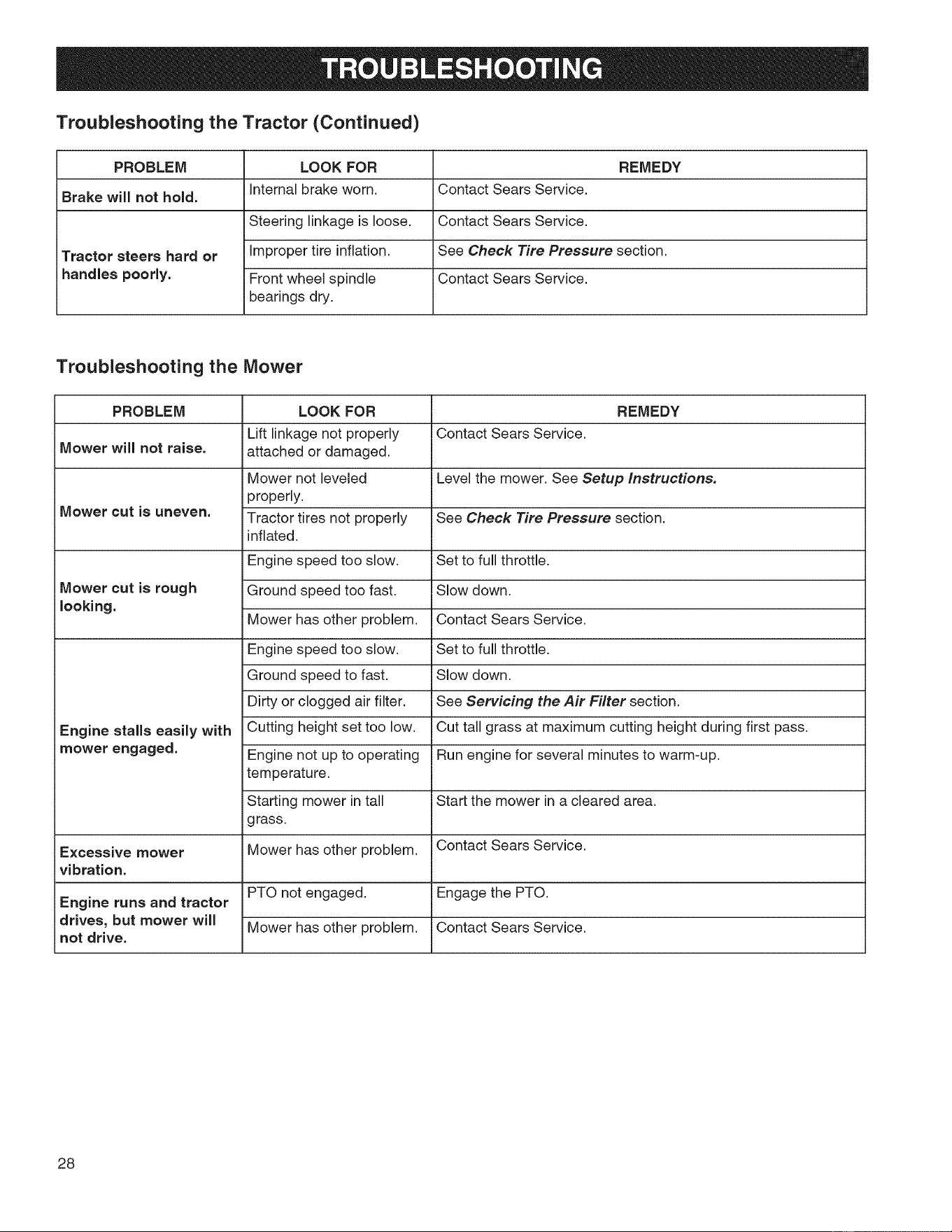
Troubleshooting the Tractor (Continued)
PROBLEM LOOK FOR REMEDY
internal brake worn. Contact Sears Service.
Brake will not hold.
Steering linkage is loose. Contact Sears Service.
Tractor steers hard or improper tire inflation. See Check Tire Pressure section.
handles poorly. Front wheel spindle Contact Sears Service.
bearings dry.
Troubleshooting the Mower
PROBLEM LOOK FOR REMEDY
Lift linkage not properly Contact Sears Service.
Mower will not raise, attached or damaged.
Mower not leveled Level the mower. See Setup Instructions.
properly.
Mower cut is uneven. Tractor tires not properly See Check Tire Pressure section.
inflated.
Engine speed too slow. Set to full throttle.
Mower cut is rough Ground speed too fast. Slow down.
looking.
Mower has other problem. Contact Sears Service.
Engine speed too slow. Set to full throttle.
Ground speed to fast. Slow down.
Dirty or clogged air filter. See Servicing the Air Filter section.
Engine stalls easily with Cutting height set too low. Cut tall grass at maximum cutting height during first pass.
mower engaged. Engine not up to operating Run engine for several minutes to warm-up.
temperature.
Starting mower in tall Start the mower in a cleared area.
grass.
Excessive mower Mower has other problem. Contact Sears Service.
vibration.
PTO not engaged. Engage the PTO.
Engine runs and tractor
drives, but mower will Mower has other problem. Contact Sears Service.
not drive.
28
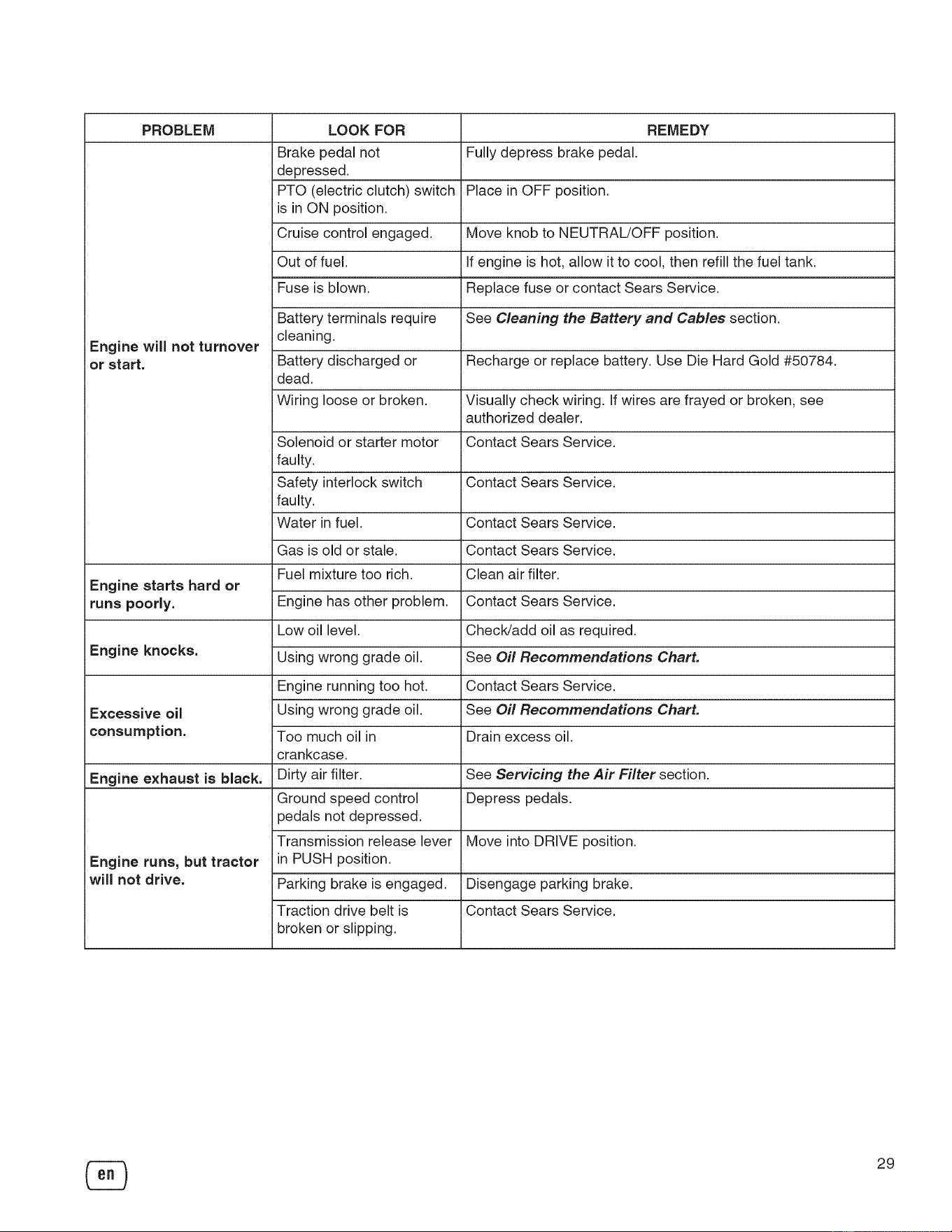
PROBLEM LOOK FOR REMEDY
Brake pedal not Fully depress brake pedal.
depressed.
PrO (electric clutch) switch Place in OFF position.
is in ON position.
Cruise control engaged. Move knob to NEUTRAL/OFF position.
Out of fuel. If engine is hot, allow it to cool, then refill the fuel tank.
Fuse is blown. Replace fuse or contact Sears Service.
Battery terminals require See Cleaning the Battery and Cables section.
cleaning.
Engine will not turnover
or start. Battery discharged or Recharge or replace battery. Use Die Hard Gold #50784.
dead.
Wiring loose or broken. Visually check wiring. If wires are frayed or broken, see
authorized dealer.
Solenoid or starter motor Contact Sears Service.
faulty.
Safety interlock switch Contact Sears Service.
faulty.
Water in fuel. Contact Sears Service.
Gas is old or stale. Contact Sears Service.
Fuel mixture too rich. Clean air filter.
Engine starts hard or
runs poorly. Engine has other problem. Contact Sears Service.
Low oil level. Check/add oil as required.
Engine knocks.
Using wrong grade oil. See Oil Recommendations Chart.
Engine running too hot. Contact Sears Service.
Excessive oil Using wrong grade oil. See Oil Recommendations Chart.
consumption. Too much oil in Drain excess oil.
crankcase.
Engine exhaust is black. Dirty air filter. See Servicing the Air Filter section.
Ground speed control Depress pedals.
pedals not depressed.
Transmission release lever Move into DRIVE position.
Engine runs, but tractor in PUSH position.
will not drive. Parking brake is engaged. Disengage parking brake.
Traction drive belt is Contact Sears Service.
broken or slipping.
29
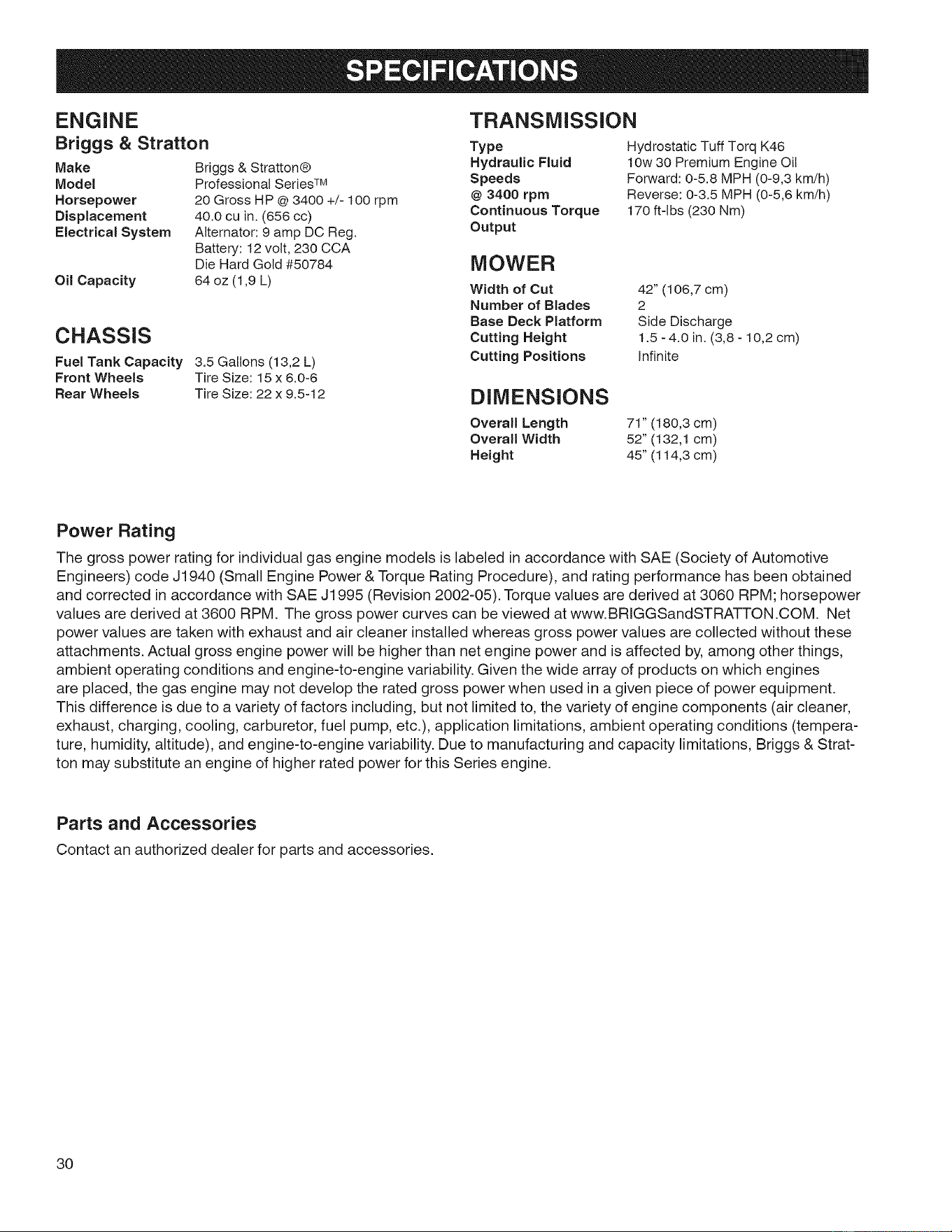
ENGINE
Briggs & Stratton Type
Make Briggs & Stratton® Hydraulic Fluid
Model Professional SeriesTM Speeds
Horsepower 20 Gross HP @3400 +/- 100 rpm @ 3400 rpm
Displacement 40.0 cu in. (656 cc) Continuous Torque
Electrical System Alternator: 9 amp DC Reg. Output
Battery: 12 volt, 230 CCA
Die Hard Gold #50784
64 oz (1,9 L)Oil Capacity
CHASSIS
Fuel Tank Capacity 3.5 Gallons (13,2L)
Front Wheels Tire Size: 15 x 6.0-6
Rear Wheels Tire Size:22 x 9.5-12
TRANSMISSION
Hydrostatic Tuff Torq K46
lOw 30 Premium Engine Oil
Forward: 0-5.8 MPH (0-9,3 km/h)
Reverse: 0-3.5 MPH (0-5,6 km/h)
170 ft-lbs (230 Nm)
MOWER
Width of Cut
Number of Blades
Base Deck Platform
Cutting Height
Cutting Positions
42" (106,7 cm)
2
Side Discharge
1.5 - 4.0 in. (3,8 - 10,2 cm)
Infinite
DIMENSIONS
Overall Length
Overall Width
Height
71" (180,3 cm)
52" (132,1 cm)
45" (114,3 cm)
Power Rating
The gross power rating for individual gas engine models is labeled in accordance with SAE (Society of Automotive
Engineers) code J1940 (Small Engine Power & Torque Rating Procedure), and rating performance has been obtained
and corrected in accordance with SAE J1995 (Revision 2002-05). Torque values are derived at 3060 RPM; horsepower
values are derived at 3600 RPM. The gross power curves can be viewed at www.BRIGGSandSTRATTON.COM. Net
power values are taken with exhaust and air cleaner installed whereas gross power values are collected without these
attachments. Actual gross engine power will be higher than net engine power and is affected by, among other things,
ambient operating conditions and engine-to-engine variability. Given the wide array of products on which engines
are placed, the gas engine may not develop the rated gross power when used in a given piece of power equipment.
This difference is due to a variety of factors including, but not limited to, the variety of engine components (air cleaner,
exhaust, charging, cooling, carburetor, fuel pump, etc.), application limitations, ambient operating conditions (tempera-
ture, humidity, altitude), and engine-to-engine variability. Due to manufacturing and capacity limitations, Briggs & Strat-
ton may substitute an engine of higher rated power for this Series engine.
Parts and Accessories
Contact an authorized dealer for parts and accessories.
3O
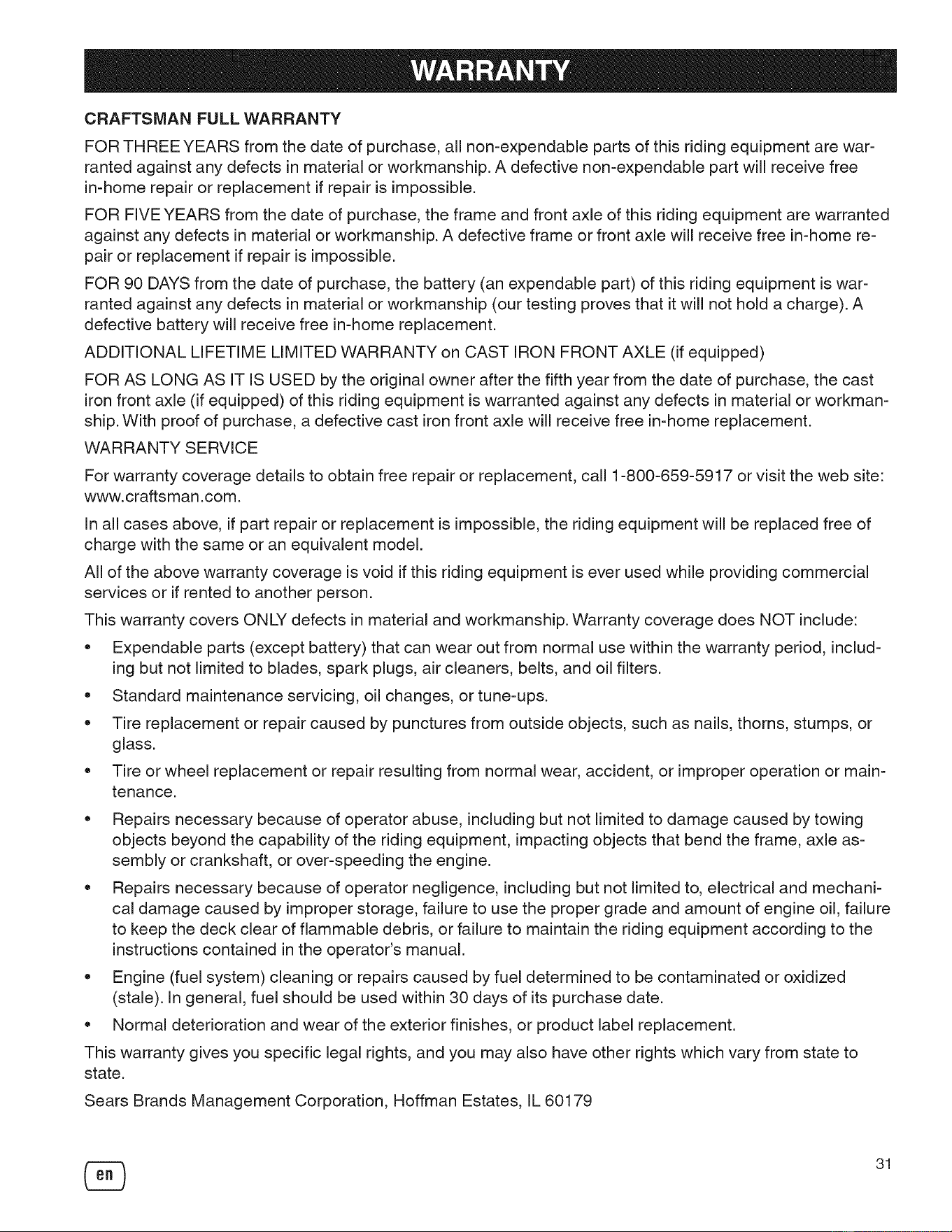
CRAFTSMAN FULL WARRANTY
FOR THREE YEARS from the date of purchase, all non-expendable parts of this riding equipment are war-
ranted against any defects in material or workmanship. A defective non-expendable part will receive free
in-home repair or replacement if repair is impossible.
FOR FIVE YEARS from the date of purchase, the frame and front axle of this riding equipment are warranted
against any defects in material or workmanship. A defective frame or front axle will receive free in-home re-
pair or replacement if repair is impossible.
FOR 90 DAYS from the date of purchase, the battery (an expendable part) of this riding equipment is war-
ranted against any defects in material or workmanship (our testing proves that it will not hold a charge). A
defective battery will receive free in-home replacement.
ADDITIONAL LIFETIME LIMITED WARRANTY on CAST IRON FRONT AXLE (if equipped)
FOR AS LONG AS IT IS USED by the original owner after the fifth year from the date of purchase, the cast
iron front axle (if equipped) of this riding equipment is warranted against any defects in material or workman-
ship. With proof of purchase, a defective cast iron front axle will receive free in-home replacement.
WARRANTY SERVICE
For warranty coverage details to obtain free repair or replacement, call 1-800-659-5917 or visit the web site:
www.craftsman.com.
In all cases above, if part repair or replacement is impossible, the riding equipment will be replaced free of
charge with the same or an equivalent model.
All of the above warranty coverage is void if this riding equipment is ever used while providing commercial
services or if rented to another person.
This warranty covers ONLY defects in material and workmanship. Warranty coverage does NOT include:
• Expendable parts (except battery) that can wear out from normal use within the warranty period, includ-
ing but not limited to blades, spark plugs, air cleaners, belts, and oil filters.
• Standard maintenance servicing, oil changes, or tune-ups.
• Tire replacement or repair caused by punctures from outside objects, such as nails, thorns, stumps, or
glass.
• Tire or wheel replacement or repair resulting from normal wear, accident, or improper operation or main-
tenance.
Repairs necessary because of operator abuse, including but not limited to damage caused by towing
objects beyond the capability of the riding equipment, impacting objects that bend the frame, axle as-
sembly or crankshaft, or over-speeding the engine.
Repairs necessary because of operator negligence, including but not limited to, electrical and mechani-
cal damage caused by improper storage, failure to use the proper grade and amount of engine oil, failure
to keep the deck clear of flammable debris, or failure to maintain the riding equipment according to the
instructions contained in the operator's manual.
Engine (fuel system) cleaning or repairs caused by fuel determined to be contaminated or oxidized
(stale). In general, fuel should be used within 30 days of its purchase date.
• Normal deterioration and wear of the exterior finishes, or product label replacement.
This warranty gives you specific legal rights, and you may also have other rights which vary from state to
state.
Sears Brands Management Corporation, Hoffman Estates, IL 60179
31

Congratulations on making a smart purchase.
Your new Craftsman@ product is designed and
manufactured for years of dependable operation. But like
all products, it may require repair from time to time. That's
when having a Repair Protection Agreement can save
you money and aggravation.
Here's what the Repair Protection Agreement*
includes:
rvl Expert service by our 10,000 professional repair
specialists
r-vl Unlimited service and no charge for parts and
labor on all covered repairs
r-vl Product replacement up to $1500 if your covered
product can't be fixed
r-vl Discount of 10% from regular price of service and
related installed parts not covered by the agreement;
also, 10% off regular price of preventive maintenance
check
Fast help by phone - we call it Rapid Resolution -
phone support from a Sears representative. Think of
us as a "talking owner's manual."
Once you purchase the Repair Protection Agreement, a
simple phone call is all that it takes for you to schedule
service.You can call anytime day or night, or schedule a
service appointment online.
The Repair Protection Agreement is a risk-free purchase.
If you cancel for any reason during the product warranty
period, we will provide a full refund. Or, a prorated
refund anytime after the product warranty period expires.
Purchase your Repair Protection Agreement today!
Some limitations and exclusions apply. For prices
and additional information in the U.S.A. call 1-800-
827-6855.
*Coverage in Canada varies on some items. For full
details call Sears Canada at 1-800-381-6885.
Sears Installation Service
For Sears professional installation of home appliances,
garage door openers, water heaters, and other major
home items, in the U.S.A. or Canada call 1-800-4-MY-
HOME@.
32

33

Your Home
For troubleshooting, product manuals and expert advice:
managemylife
www.managemylife.com
For repair - in your home - of all major brand appliances,
lawn and garden equipment, or heating and cooling systems,
no matter who made it, no matter who sold it!
For the replacement parts, accessories and
owner's manuals that you need to do-it-yourself.
For Sears professional installation of home appliances
and items like garage door openers and water heaters.
1-800-4-MY-HOME ® (1-800-469-4663)
Call anytime, day or night (U.S.A. and Canada)
www.sears.com www.sears.ca
Our Home
For repair of carry-in items like vacuums, lawn equipment,
and electronics, call anytime for the location of your nearest
Sears Parts & Repair Service Center
1-800-488-1222 (U.S.A.) 1-800-469-4663 (Canada)
www.sears.com www.sears.ca
To purchase a protection agreement on a product serviced by Sears:
1-800-827-6655 (U.S.A.)
Para pedir servicio de reparaci6n
a domicilio, y para ordenar piezas:
1-888-SU-HOGAR ®
(1-888-784-6427)
1-800-361-6665 (Canada)
Au Canada pour service en frangais:
1-800-LE-FOYER Mc
(1-800-533-6937)
www.sears.ca
www.sears.com
® Registered Trademark / TMTrademark of KCD IP, LLC in the United States, or Sears Brands, LLC in other countries
® Marca Registrada / TMMarca de Fabrica de KCD IP, LLC en Estados Unidos, o Sears Brands, LLC in otros paises
MCMarque de commerce / MDMarque d6pos6e de Sears Brands, LLC

RepairParts
PTS- 1
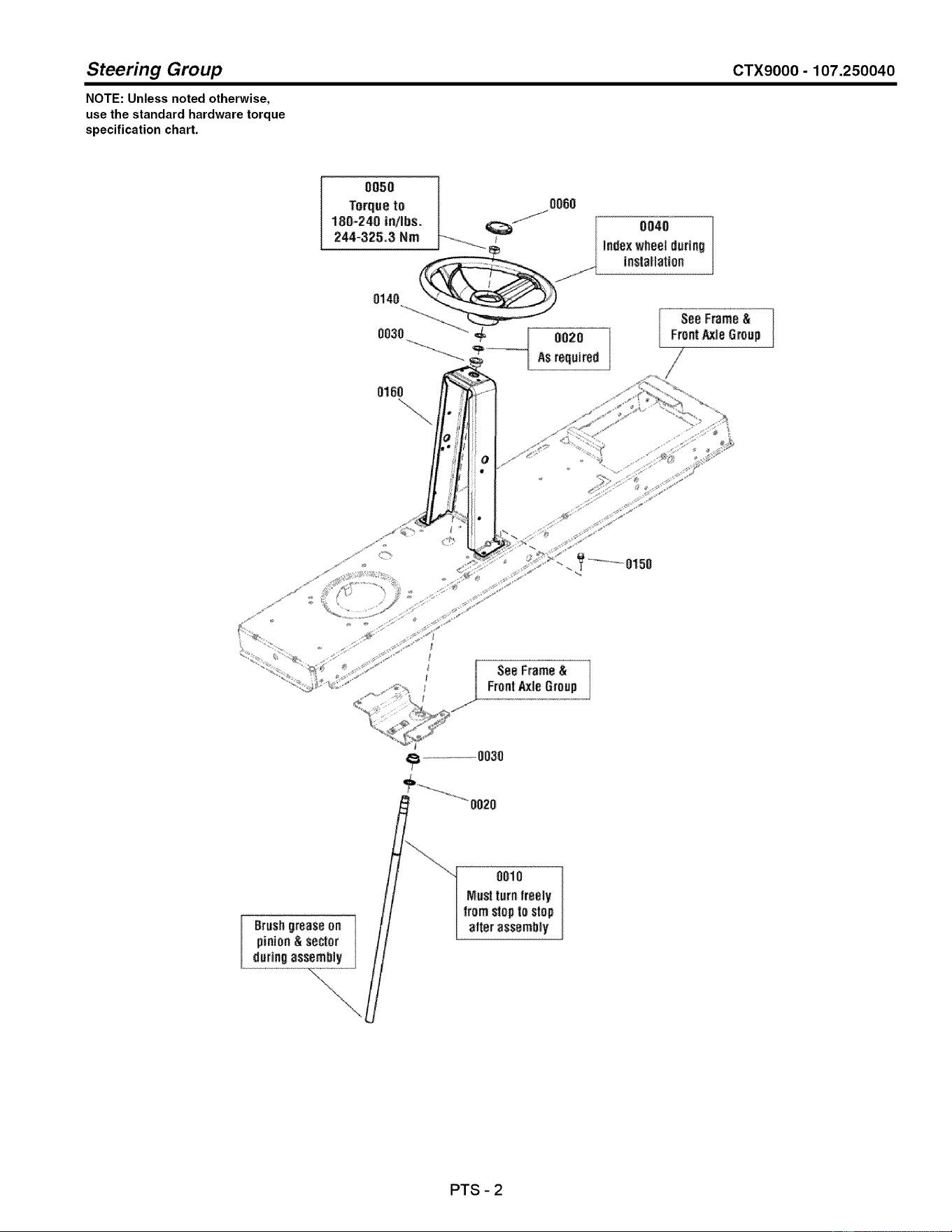
Steering Group CTX9000- 107.250040
NOTE: Unless noted otherwise,
use the standard hardware torque
specification chart.
OO5O
Torqueto
180_240inilbs.
244_325.3Nm
0140
0030
0060
See Frame&
Front _te Group
0010
Mustturnfree|y
from_op to stop
afterassemb|y
PTS - 2
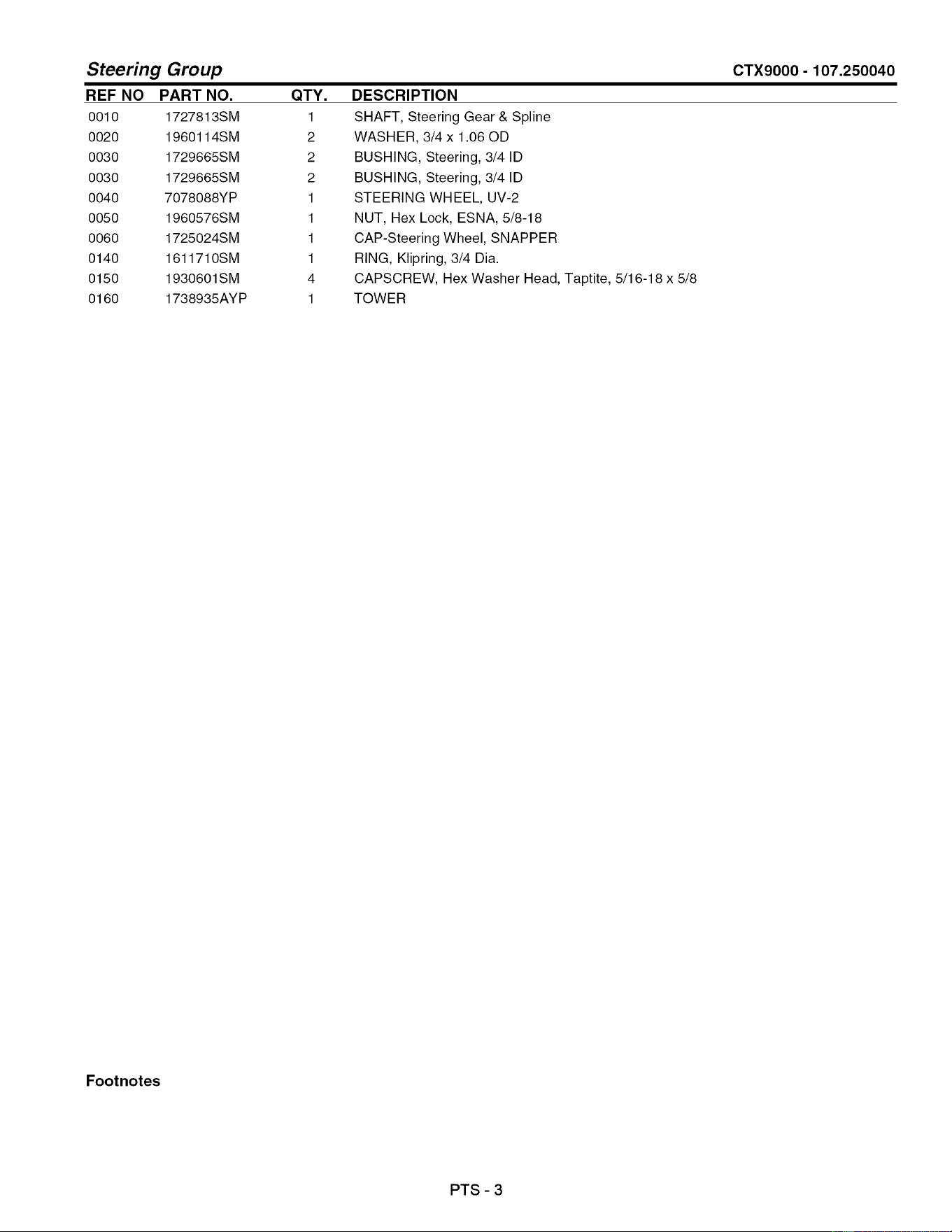
Steering Group CTX9000- 107.250040
REF NO PART NO.
0010 1727813SM
0020 1960114SM
0030 1729665SM
0030 1729665SM
0040 7078088YP
0050 1960576SM
0060 1725024SM
0140 1611710SM
0150 1930601SM
0160 1738935AYP
QTY.
1
2
2
2
1
1
1
1
4
1
DESCRIPTION
SHAFT, Steering Gear & Spline
WASHER, 3/4 x 1.06 OD
BUSHING, Steering, 3/4 ID
BUSHING, Steering, 3/4 ID
STEERING WHEEL, UV-2
NUT, Hex Lock, ESNA, 5/8-18
CAP-Steering Wheel, SNAPPER
RING, Klipring, 3/4 Dia.
CAPSCREW, Hex Washer Head, Taptite, 5/16-18 x 5/8
TOWER
Footnotes
PTS - 3
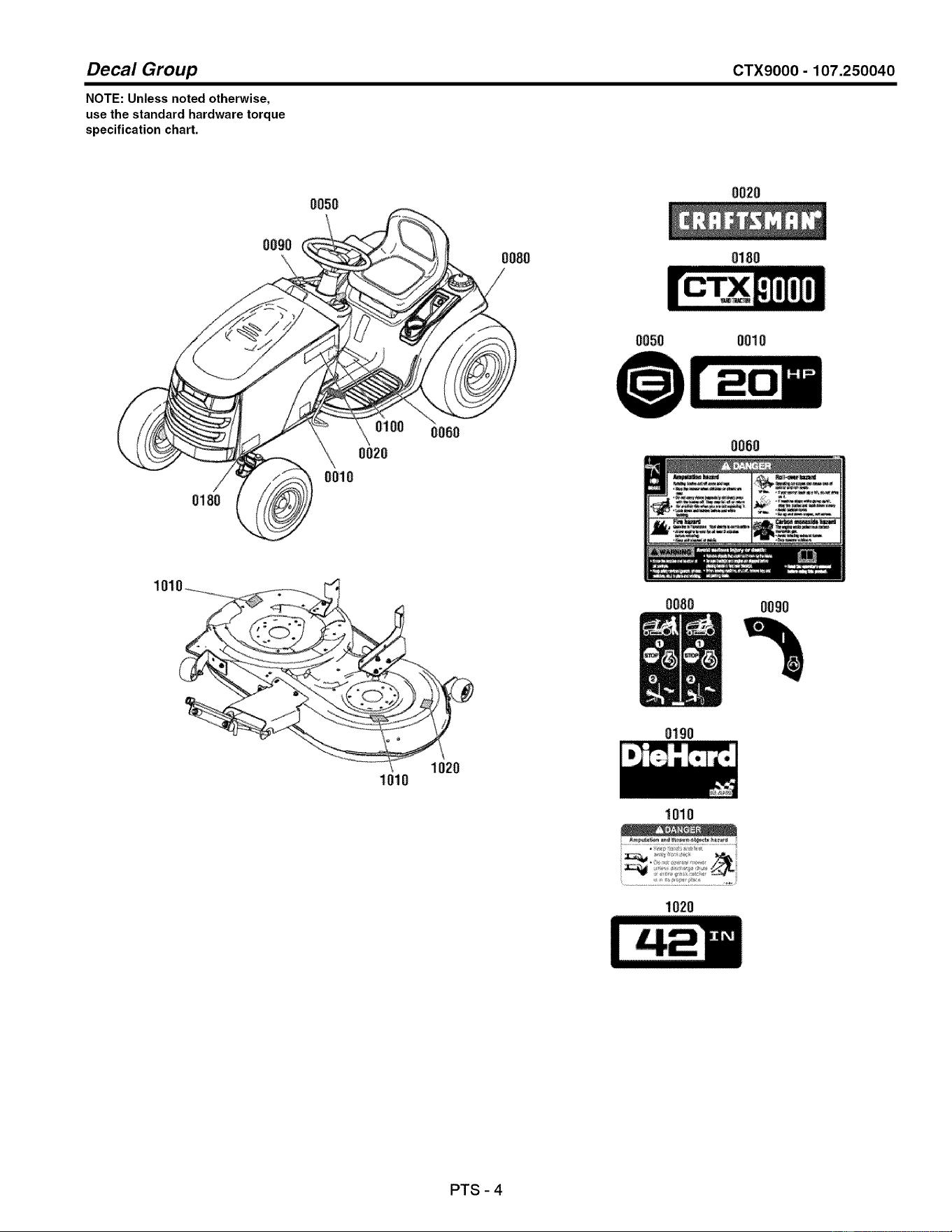
Decal Group CTX9000 - 107.250040
NOTE: Unless noted otherwise,
use the standard hardware torque
specification chart.
0050
0020
0180
0090
0080
0i80
0100
0020
0010
0060
0050 0010
0000
i020
1010
0000
0190
!0!0
........................_ _;:_;;;_:,i_,i,.............................
0090
1020
PTS - 4
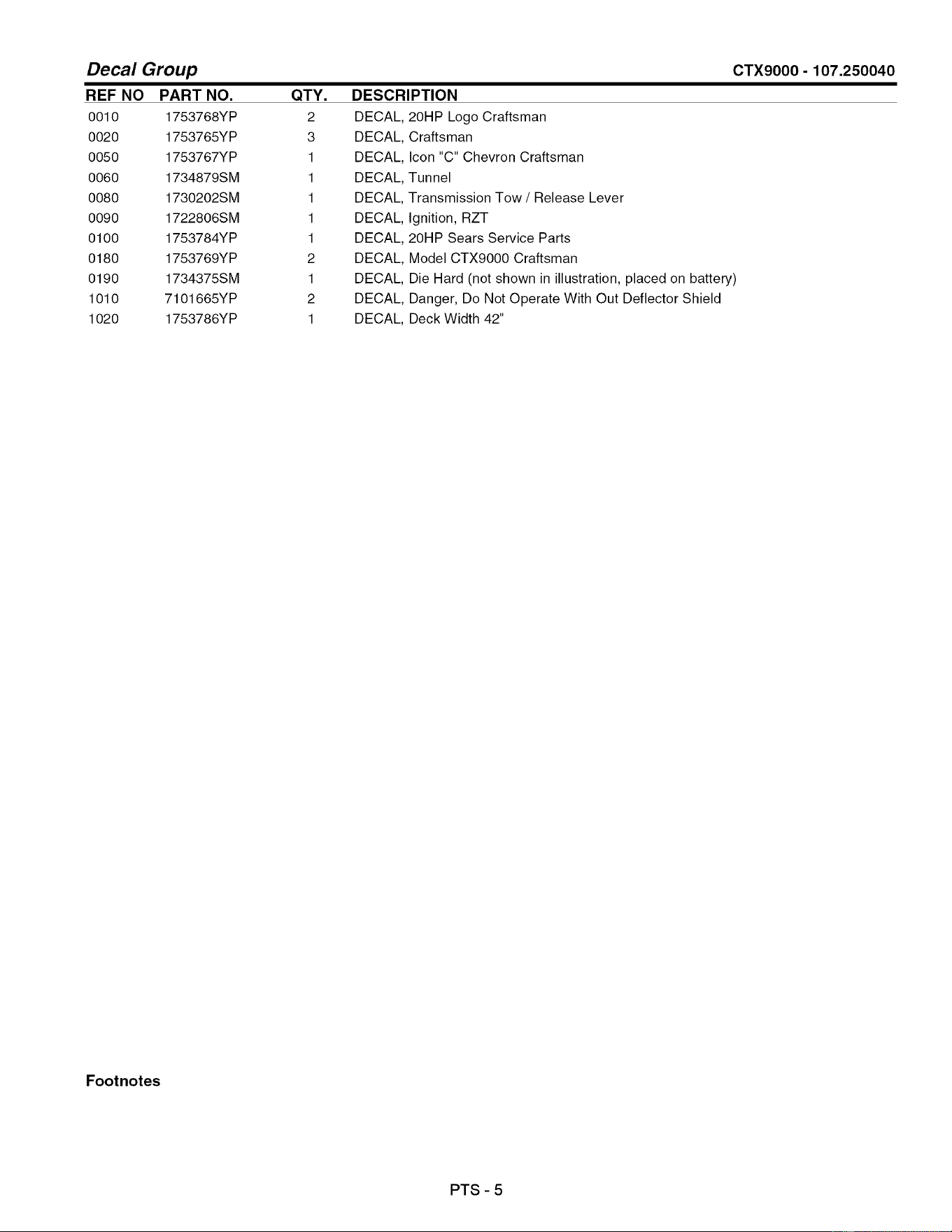
Decal Group CTX9000 - 107.250040
REF NO
0010
0020
0050
0060
0080
0090
0100
0180
0190
1010
1020
PART NO.
1753768YP
1753765YP
1753767YP
1734879SM
1730202SM
1722806SM
1753784YP
1753769YP
1734375SM
7101665YP
1753786YP
QTY.
2
3
1
1
1
1
1
2
1
2
1
DESCRIPTION
DECAL 20HPLogoCra_sman
DECAL
DECAL
DECAL
DECAL
DECAL
DECAL
DECAL
DECAL
DECAL
DECAL
Craftsman
Icon "C" Chevron Craftsman
Tunnel
Transmission Tow / Release Lever
Ignition, RZT
20HP Sears Service Parts
Model CTX9000 Craftsman
Die Hard (not shown in illustration, placed on battery)
Danger, Do Not Operate With Out Deflector Shield
Deck Width 42"
Footnotes
PTS - 5
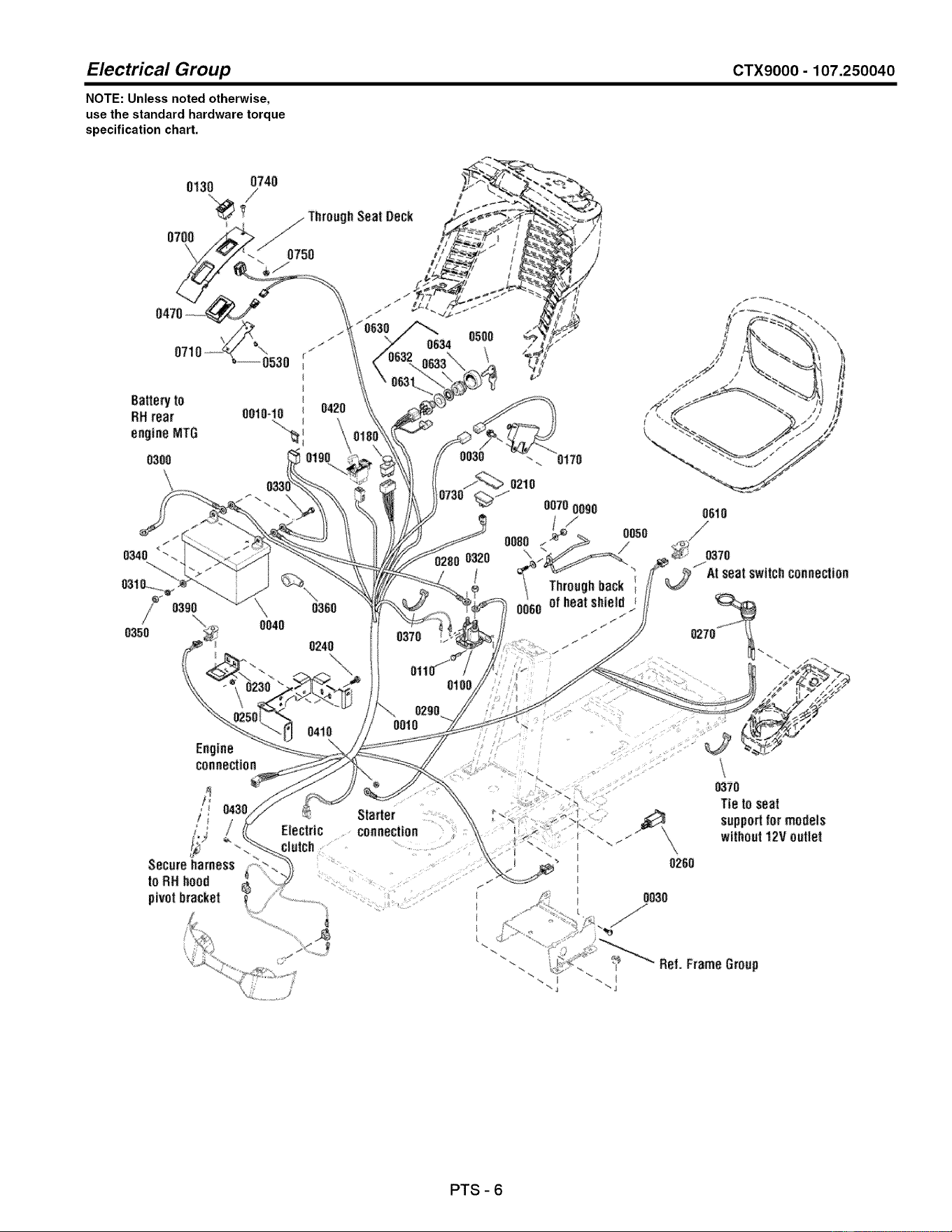
Electrical Group CTX9000 - 107.250040
NOTE: Unless noted otherwise,
use the standard hardware torque
specification chart.
0130 0740
/
O70O
\,
0470
gattew to
RH rear
engineMTG
0530
0010-10
_J
\
0040
0360
0240
0634
0500
0080
0178
0610
\
Engine
connection
0410
Electric
ciutch
\
0010
\
02GO
0370
Tietoseat
supportformo_els
without12Voutlet
PTS - 6
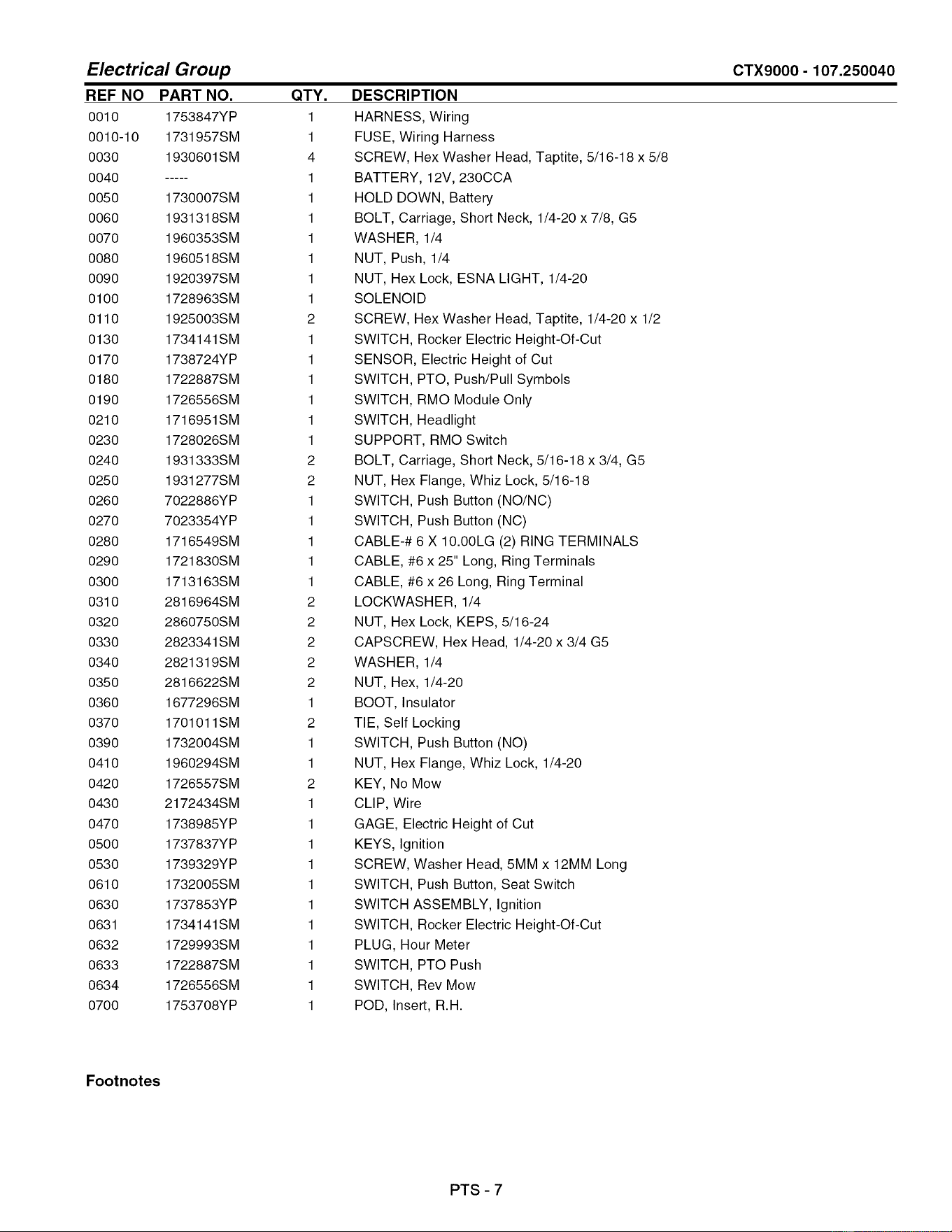
Electrical Group CTX9000 - 107.250040
REF NO PART NO.
0010 1753847YP
0010-10 1731957SM
0030 1930601SM
0040 .....
0050 1730007SM
0060 1931318SM
0070 1960353SM
0080 1960518SM
0090 1920397SM
0100 1728963SM
0110 1925003SM
0130 1734141SM
0170 1738724YP
0180 1722887SM
0190 1726556SM
0210 1716951SM
0230 1728026SM
0240 1931333SM
0250 1931277SM
0260 7022886YP
0270 7023354YP
0280 1716549SM
0290 1721830SM
0300 1713163SM
0310 2816964SM
0320 2860750SM
0330 2823341SM
0340 2821319SM
0350 2816622SM
0360 1677296SM
0370 1701011SM
0390 1732004SM
0410 1960294SM
0420 1726557SM
0430 2172434SM
0470 1738985YP
0500 1737837YP
0530 1739329YP
0610 1732005SM
0630 1737853YP
0631 1734141SM
0632 1729993SM
0633 1722887SM
0634 1726556SM
0700 1753708YP
QTY.
1
1
4
1
1
1
1
1
1
1
2
1
1
1
1
1
1
2
2
1
1
1
1
1
2
2
2
2
2
1
2
1
1
2
1
1
1
1
1
1
1
1
1
1
1
DESCRIPTION
HARNESS, Wiring
FUSE, Wiring Harness
SCREW, Hex Washer Head, Taptite, 5/16-18 x 5/8
BATTERY, 12V, 230CCA
HOLD DOWN, Battery
BOLT, Carriage, Short Neck, 1/4-20 x 7/8, G5
WASHER, 1/4
NUT, Push, 1/4
NUT, Hex Lock, ESNA LIGHT, 1/4-20
SOLENOID
SCREW, Hex Washer Head, Taptite, 1/4-20 x 1/2
SWITCH, Rocker Electric Height-Of-Cut
SENSOR, Electric Height of Cut
SWITCH, PTO, Push/Pull Symbols
SWITCH, RMO Module Only
SWITCH, Headlight
SUPPORT, RMO Switch
BOLT, Carriage, Short Neck, 5/16-18 x 3/4, G5
NUT, Hex Flange, Whiz Lock, 5/16-18
SWITCH, Push Button (NO/NC)
SWITCH, Push Button (NC)
CABLE-# 6 X IO.OOLG (2) RING TERMINALS
CABLE, #6 x 25" Long, Ring Terminals
CABLE, #6 x 26 Long, Ring Terminal
LOCKWASHER, 1/4
NUT, Hex Lock, KEPS, 5/16-24
CAPSCREW, Hex Head, 1/4-20 x 3/4 G5
WASHER, 1/4
NUT, Hex, 1/4-20
BOOT, Insulator
TIE, Self Locking
SWITCH, Push Button (NO)
NUT, Hex Flange, Whiz Lock, 1/4-20
KEY, No Mow
CLIP, Wire
GAGE, Electric Height of Cut
KEYS, Ignition
SCREW, Washer Head, 5MM x 12MM Long
SWITCH, Push Button, Seat Switch
SWITCH ASSEMBLY, Ignition
SWITCH, Rocker Electric Height-Of-Cut
PLUG, Hour Meter
SWITCH, PTO Push
SWITCH, Rev Mow
POD, Insert, R.H.
Footnotes
PTS - 7
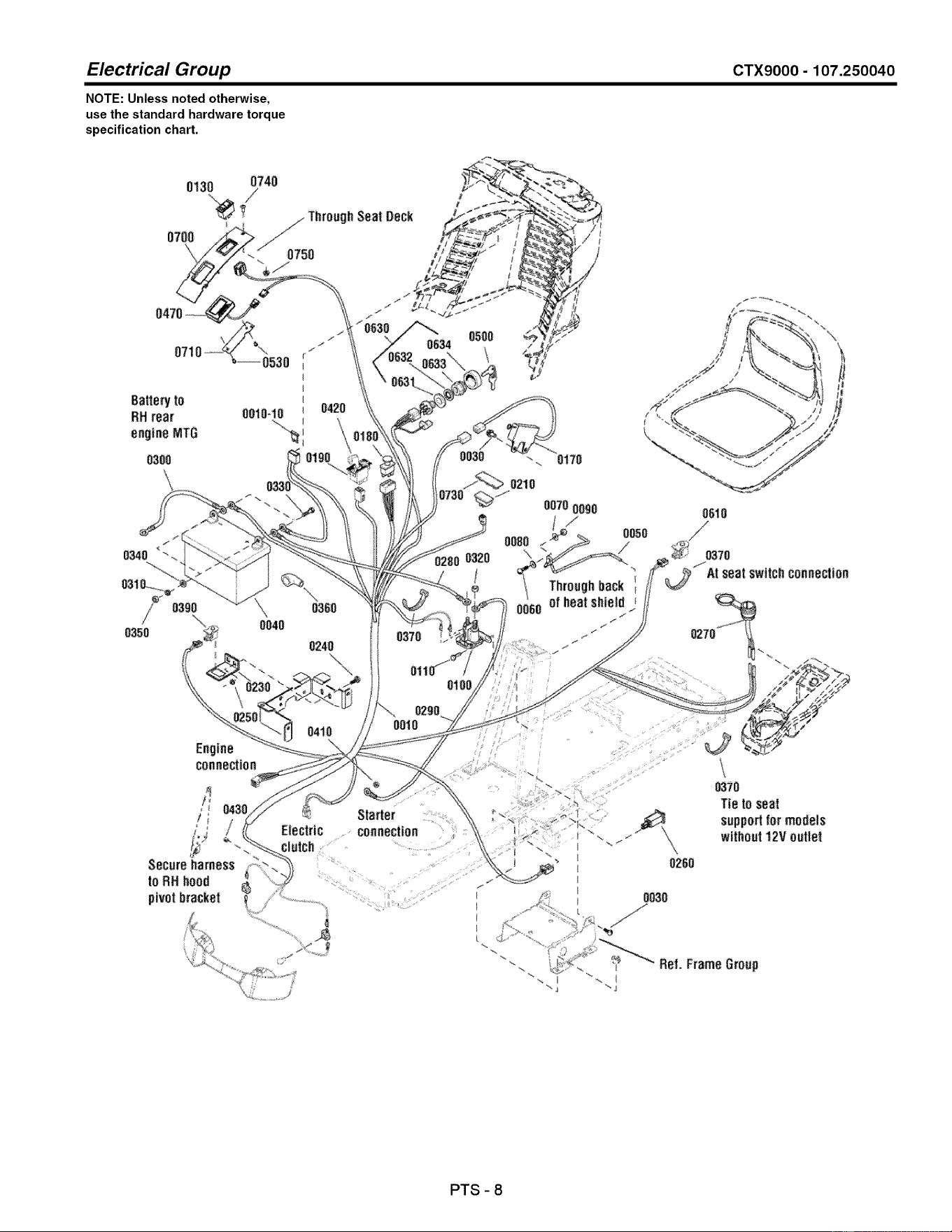
Electrical Group CTX9000 - 107.250040
NOTE: Unless noted otherwise,
use the standard hardware torque
specification chart.
0130 0740
/
O70O
\,
0470
gattew to
RH rear
engineMTG
0530
0010-10
_J
\
0040
0360
0240
0634
0500
0080
0178
0610
\
Engine
connection
0410
Electric
ciutch
\
0010
\
02GO
0370
Tietoseat
supportformo_els
without12Voutlet
PTS - 8

Electrical Group
REF NO PART NO. QTY.
0710 1753757BMYP 1
0730 1722611SM 1
0740 7091696YP 1
0750 1930641SM 1
DESCRIPTION
BRACKET, Indicator Hold Down
PLUG, Hole
SCREW, Philips, Pan Head, Self Tapping
NUT, Hex Flange, Whiz Lock, 1/4-20
CTX9000 - 107.250040
Footnotes
PTS - 9
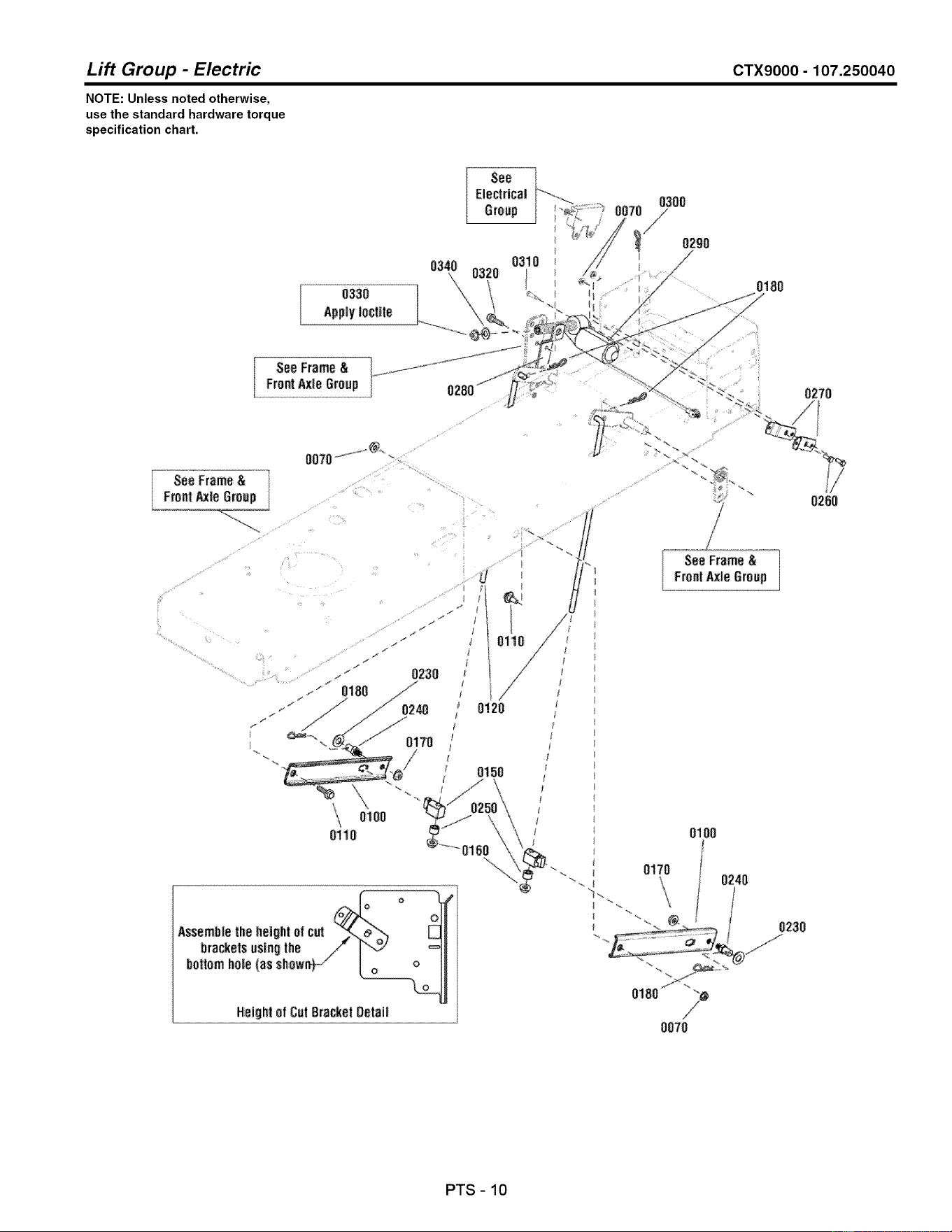
Lift Group - Electric CTX9000 - 107.250040
NOTE: Unless noted otherwise,
use the standard hardware torque
specification chart.
See
Elec#ical l'-"Group
See Frame&
FrontAxle Group
0340 032C 0310
ApplyIo¢lite ,_.
0170
?
0100
0110
O
Assembletheheiaht o|cut
bracketsusln_the /f [....oj
bottom hole (as show o
0150
o,
\
\
Heightof CutBracketDetail
0300
0070/
029B
i
0180
See Frame& ]
FrontAxle Group
/
0100
0070
0270
0260
PTS - 10
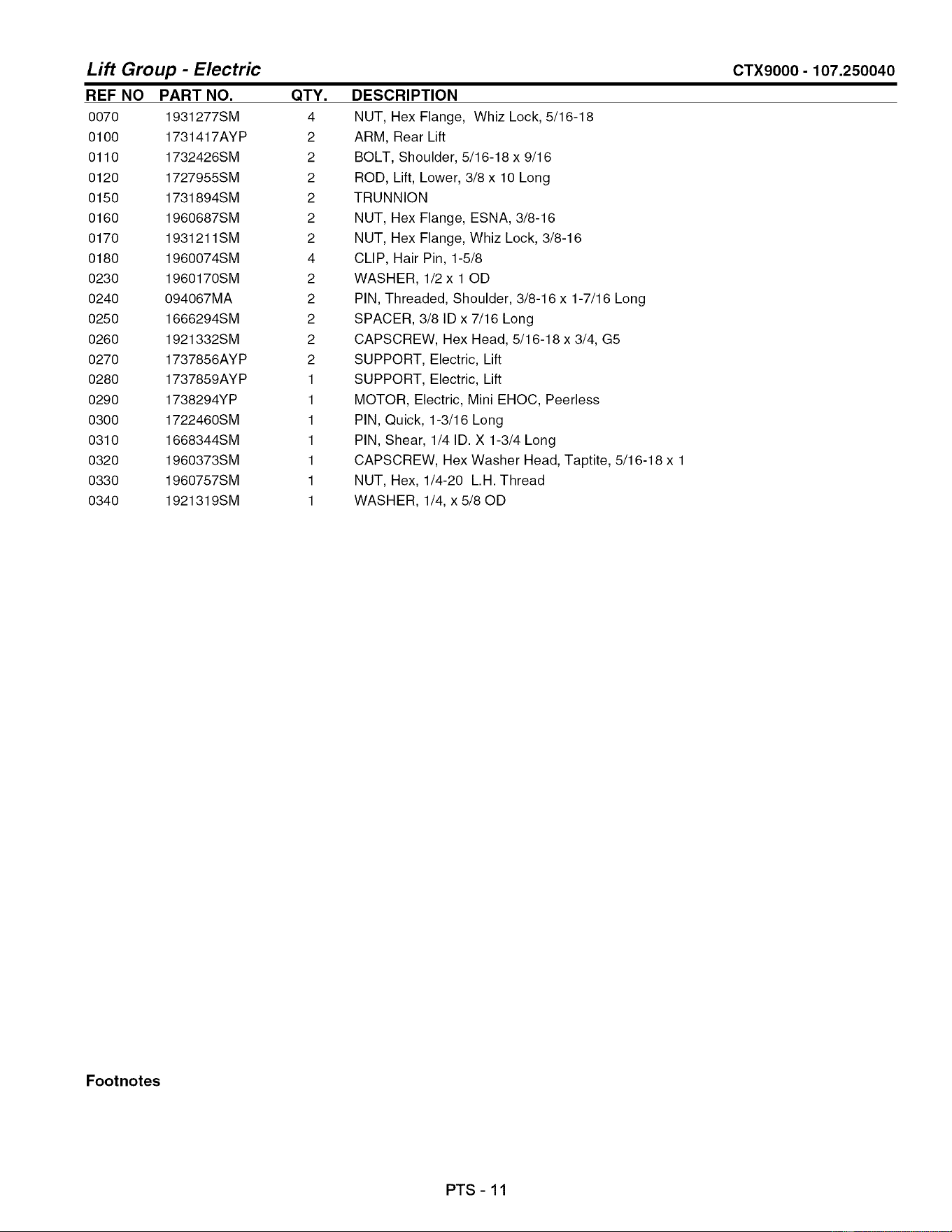
Lift Group - Electric
REF NO PARTNO.
0070 1931277SM
0100 1731417AYP
0110 1732426SM
0120 1727955SM
0150 1731894SM
0160 1960687SM
0170 1931211SM
0180 1960074SM
0230 1960170SM
0240 094067MA
0250 1666294SM
0260 1921332SM
0270 1737856AYP
0280 1737859AYP
0290 1738294YP
0300 1722460SM
0310 1668344SM
0320 1960373SM
0330 1960757SM
0340 1921319SM
QTY.
4
2
2
2
2
2
2
4
2
2
2
2
2
1
1
1
1
1
1
1
DESCRIPTION
NUT, Hex Flange, Whiz Lock, 5/16-18
ARM, Rear Lift
BOLT, Shoulder, 5/16-18 x 9/16
ROD, Lift, Lower, 3/8 x 10 Long
TRUNNION
NUT, Hex Flange, ESNA, 3/8-16
NUT, Hex Flange, Whiz Lock, 3/8-16
CLIP, Hair Pin, 1-5/8
WASHER, 1/2 x 10D
PIN, Threaded, Shoulder, 3/8-16 x 1-7/16 Long
SPACER, 3/8 ID x 7/16 Long
CAPSCREW, Hex Head, 5/16-18 x 3/4, G5
SUPPORT, Electric, Lift
SUPPORT, Electric, Lift
MOTOR, Electric, Mini EHOC, Peerless
PIN, Quick, 1-3/16 Long
PIN, Shear, 1/4 ID. X 1-3/4 Long
CAPSCREW, Hex Washer Head, Taptite, 5/16-18 x 1
NUT, Hex, 1/4-20 L.H. Thread
WASHER, 1/4, x 5/80D
CTX9000 - 107.250040
Footnotes
PTS - 11
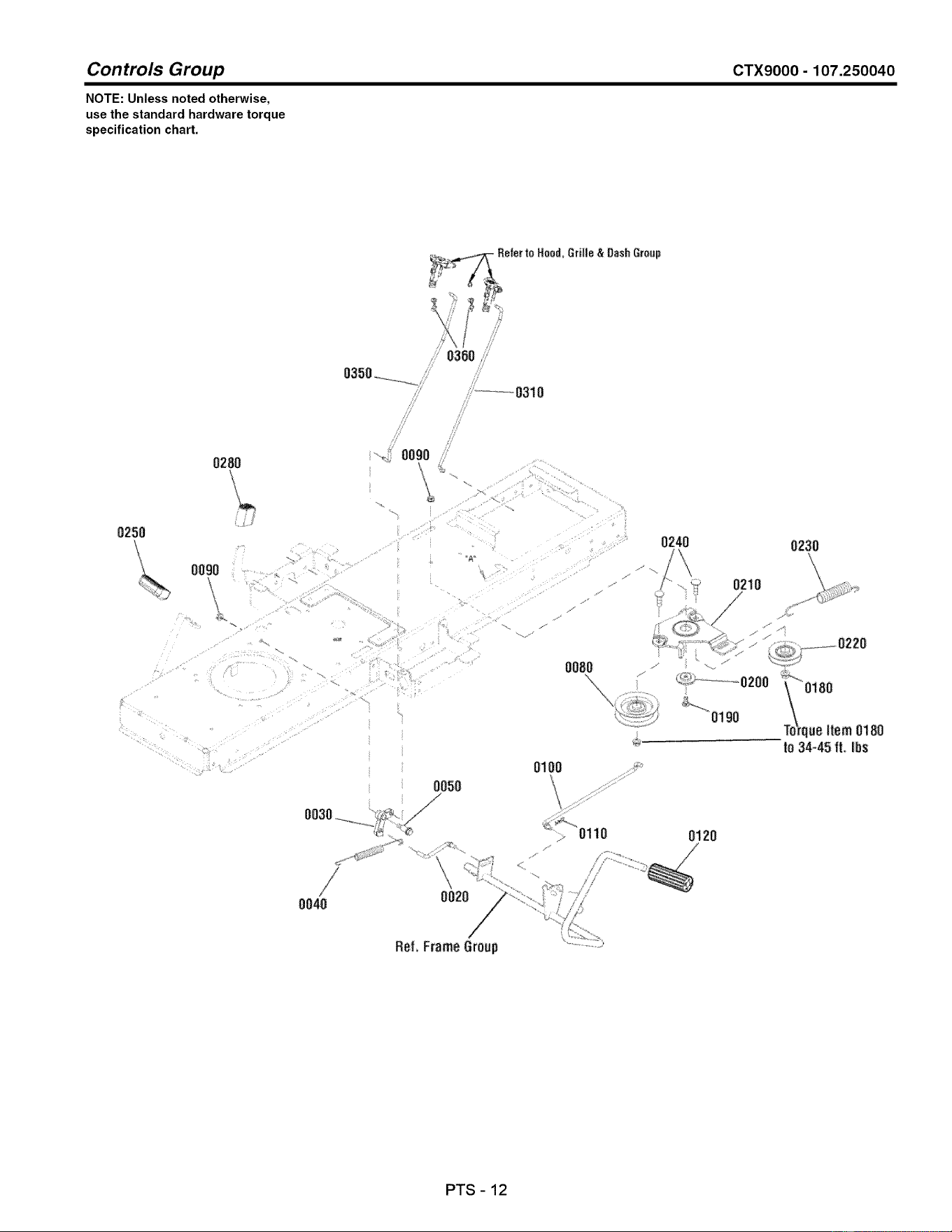
Controls Group CTX9000- 107.250040
NOTE: Unless noted otherwise,
use the standard hardware torque
specification chart.
0250
0280
\
0090
0040
;_o_,I_K- £efe_to Hood,Grille& 0ash Group
0350..............:i:S;:;;:,::;I;/
/
i/
0850
./
/
0080
\
\.
\
\
OlOO _
0020
0120
PTS - 12
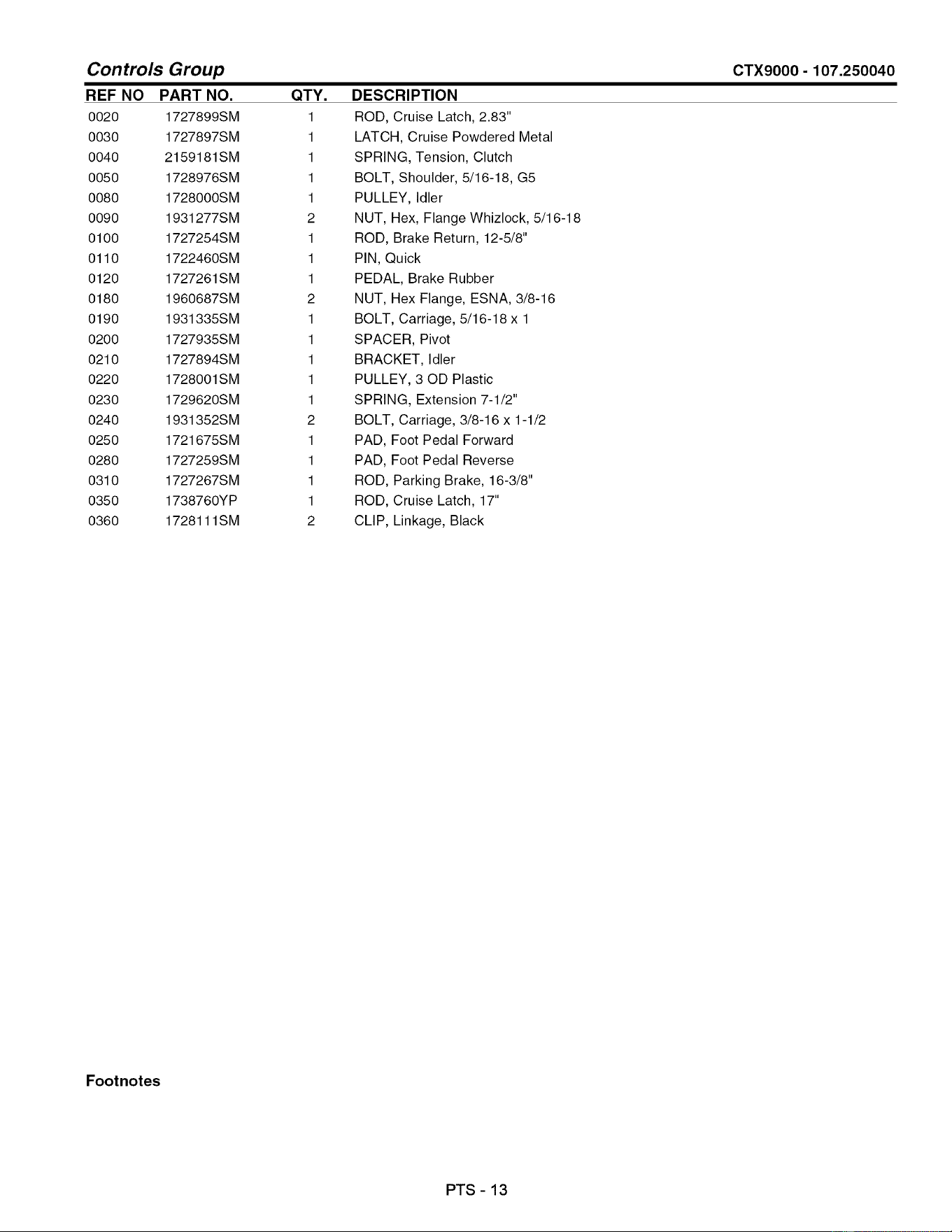
Controls Group CTX9000- 107.250040
REF NO PART NO.
0020 1727899SM
0030 1727897SM
0040 2159181SM
0050 1728976SM
0080 1728000SM
0090 1931277SM
0100 1727254SM
0110 1722460SM
0120 1727261SM
0180 1960687SM
0190 1931335SM
0200 1727935SM
0210 1727894SM
0220 1728001SM
0230 1729620SM
0240 1931352SM
0250 1721675SM
0280 1727259SM
0310 1727267SM
0350 1738760YP
0360 1728111SM
QTY.
1
1
1
1
1
2
1
1
1
2
1
1
1
1
1
2
1
1
1
1
2
DESCRIPTION
ROD, Cruise Latch, 2.83"
LATCH, Cruise Powdered Metal
SPRING, Tension, Clutch
BOLT, Shoulder, 5/16-18, G5
PULLEY, Idler
NUT, Hex, Flange Whizlock, 5/16-18
ROD, Brake Return, 12-5/8"
PIN, Quick
PEDAL, Brake Rubber
NUT, Hex Flange, ESNA, 3/8-16
BOLT, Carriage, 5/16-18 x 1
SPACER, Pivot
BRACKET, Idler
PULLEY, 30D Plastic
SPRING, Extension 7-1/2"
BOLT, Carriage, 3/8-16 x 1-1/2
PAD, Foot Pedal Forward
PAD, Foot Pedal Reverse
ROD, Parking Brake, 16-3/8"
ROD, Cruise Latch, 17"
CLIP, Linkage, Black
Footnotes
PTS - 13
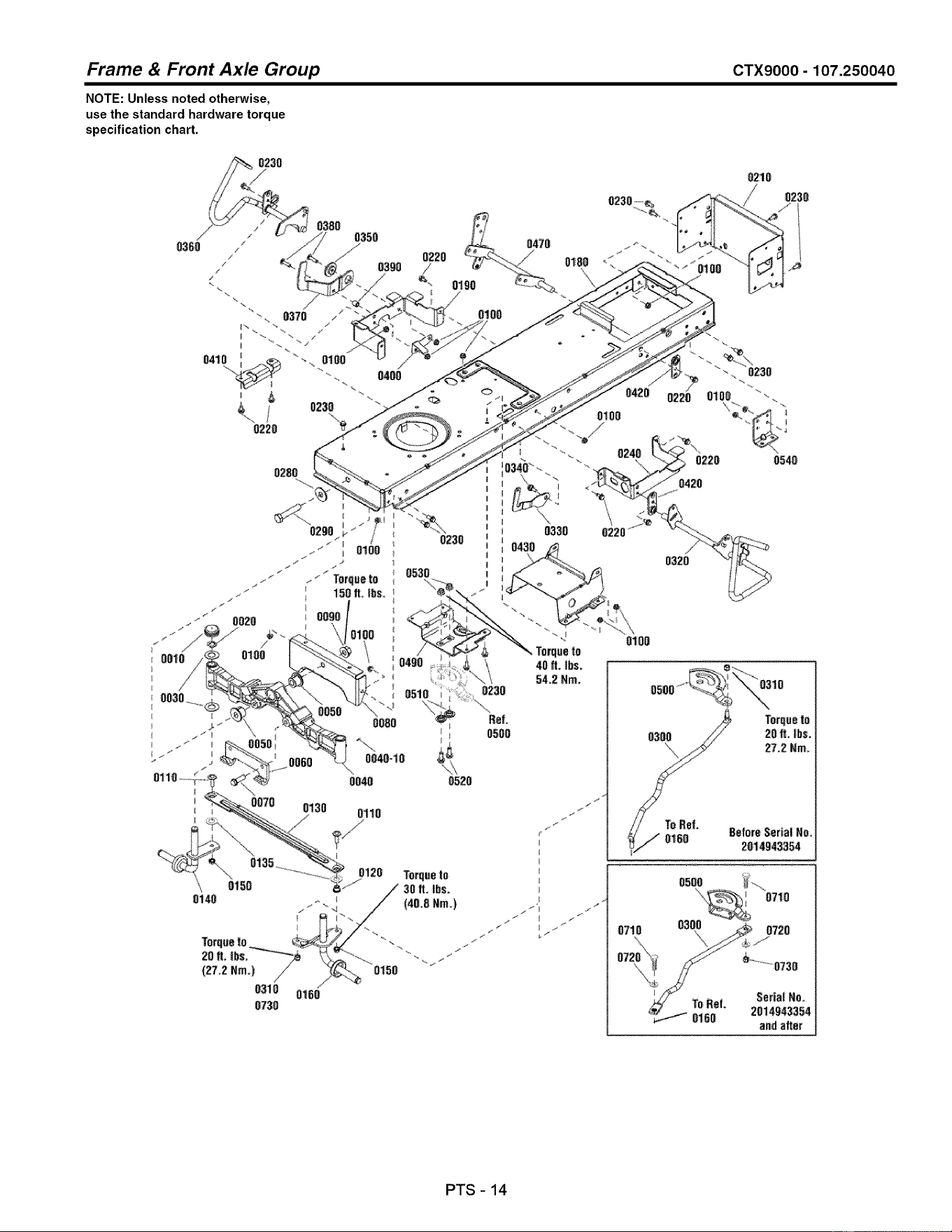
Frame & Front Axle Group CTX9000- 107.250040
NOTE: Unless noted otherwise,
use the standard hardware torque
specification chart.
0230
0360
0380
0350
O3OO
oioo
0180
021i8
r_
0238
0500
0710
andafter
PTS - 14
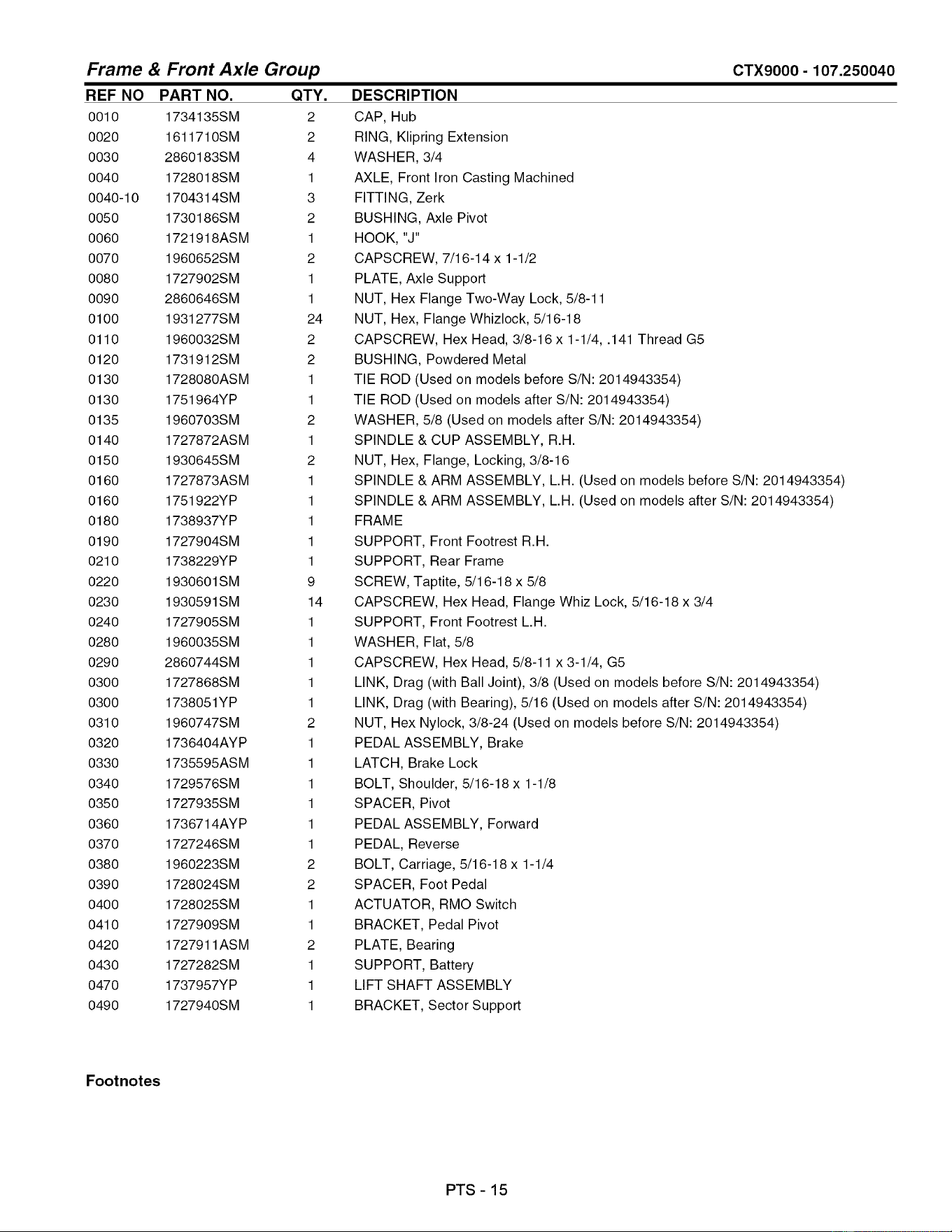
Frame & Front Axle Group CTX9000- 107.250040
REF NO PART NO. QTY.
0010 1734135SM 2
0020 1611710SM 2
0030 2860183SM 4
0040 1728018SM 1
0040-10 1704314SM 3
0050 1730186SM 2
0060 1721918ASM 1
0070 1960652SM 2
0080 1727902SM 1
0090 2860646SM 1
0100 1931277SM 24
0110 1960032SM 2
0120 1731912SM 2
0130 1728080ASM 1
0130 1751964YP 1
0135 1960703SM 2
0140 1727872ASM 1
0150 1930645SM 2
0160 1727873ASM 1
0160 1751922YP 1
0180 1738937YP 1
0190 1727904SM 1
0210 1738229YP 1
0220 1930601SM 9
0230 1930591SM 14
0240 1727905SM 1
0280 1960035SM 1
0290 2860744SM 1
0300 1727868SM 1
0300 1738051YP 1
0310 1960747SM 2
0320 1736404AYP 1
0330 1735595ASM 1
0340 1729576SM 1
0350 1727935SM 1
0360 1736714AYP 1
0370 1727246SM 1
0380 1960223SM 2
0390 1728024SM 2
0400 1728025SM 1
0410 1727909SM 1
0420 1727911ASM 2
0430 1727282SM 1
0470 1737957YP 1
0490 1727940SM 1
DESCRIPTION
CAP, Hub
RING, Klipring Extension
WASHER, 3/4
AXLE, Front Iron Casting Machined
FITTING, Zerk
BUSHING, Axle Pivot
HOOK, "J"
CAPSCREW, 7/16-14 x 1-1/2
PLATE, Axle Support
NUT, Hex Flange Two-Way Lock, 5/8-11
NUT, Hex, Flange Whizlock, 5/16-18
CAPSCREW, Hex Head, 3/8-16 x 1-1/4, .141 Thread G5
BUSHING, Powdered Metal
TIE ROD (Used on models before S/N: 2014943354)
TIE ROD (Used on models after S/N: 2014943354)
WASHER, 5/8 (Used on models after S/N: 2014943354)
SPINDLE & CUP ASSEMBLY, R.H.
NUT, Hex, Flange, Locking, 3/8-16
SPINDLE & ARM ASSEMBLY, L.H. (Used on models before S/N: 2014943354)
SPINDLE & ARM ASSEMBLY, L.H. (Used on models after S/N: 2014943354)
FRAME
SUPPORT, Front Footrest R.H.
SUPPORT, Rear Frame
SCREW, Taptite, 5/16-18 x 5/8
CAPSCREW, Hex Head, Flange Whiz Lock, 5/16-18 x 3/4
SUPPORT, Front Footrest L.H.
WASHER, Flat, 5/8
CAPSCREW, Hex Head, 5/8-11 x 3-1/4, G5
LINK, Drag (with Ball Joint), 3/8 (Used on models before S/N: 2014943354)
LINK, Drag (with Bearing), 5/16 (Used on models after S/N: 2014943354)
NUT, Hex Nylock, 3/8-24 (Used on models before S/N: 2014943354)
PEDAL ASSEMBLY, Brake
LATCH, Brake Lock
BOLT, Shoulder, 5/16-18 x 1-1/8
SPACER, Pivot
PEDAL ASSEMBLY, Forward
PEDAL, Reverse
BOLT, Carriage, 5/16-18 x 1-1/4
SPACER, Foot Pedal
ACTUATOR, RMO Switch
BRACKET, Pedal Pivot
PLATE, Bearing
SUPPORT, Battery
LIFT SHAFT ASSEMBLY
BRACKET, Sector Support
Footnotes
PTS - 15
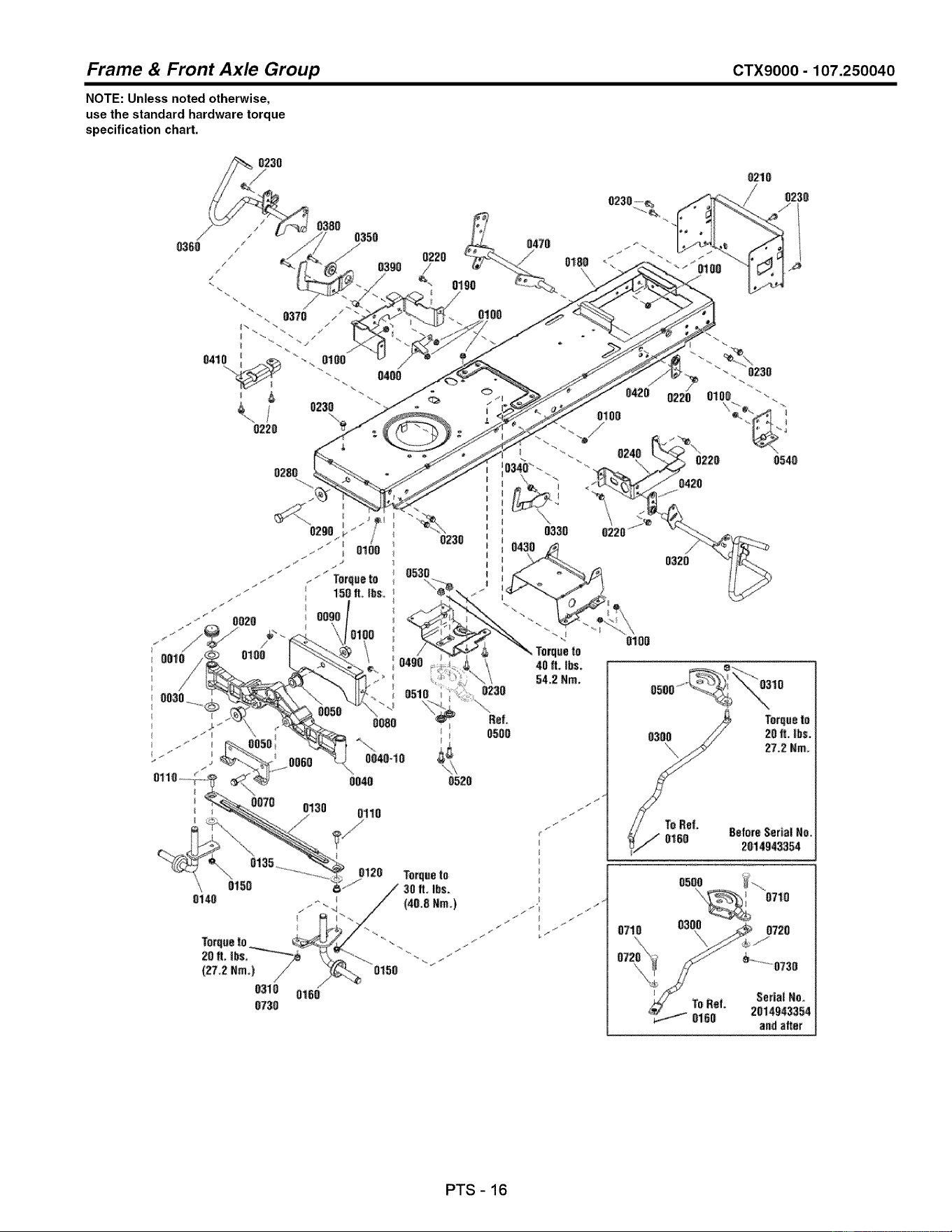
Frame & Front Axle Group CTX9000- 107.250040
NOTE: Unless noted otherwise,
use the standard hardware torque
specification chart.
0230
0360
0380
0350
O3OO
oioo
0180
021i8
r_
0238
0500
0710
andafter
PTS - 16
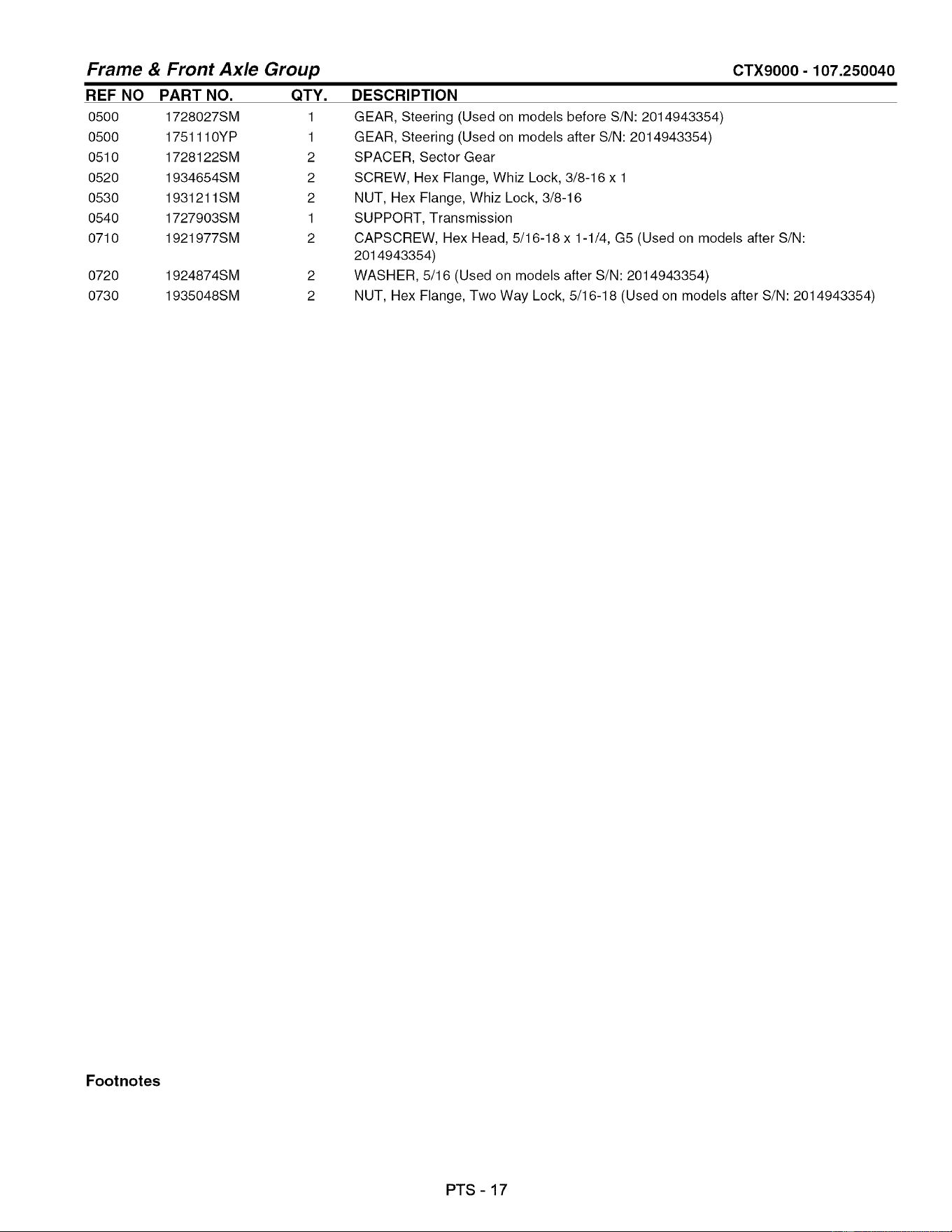
Frame & Front Axle Group
REF NO PART NO. QTY.
0500 1728027SM 1
0500 1751110YP 1
0510 1728122SM 2
0520 1934654SM 2
0530 1931211SM 2
0540 1727903SM 1
0710 1921977SM 2
0720 1924874SM
0730 1935048SM
CTX9000 - 107.250040
2
2
DESCRIPTION
GEAR, Steering (Used on models before S/N: 2014943354)
GEAR, Steering (Used on models after S/N: 2014943354)
SPACER, Sector Gear
SCREW, Hex Flange, Whiz Lock, 3/8-16 x 1
NUT, Hex Flange, Whiz Lock, 3/8-16
SUPPORT, Transmission
CAPSCREW, Hex Head, 5/16-18 x 1-1/4, G5 (Used on models after S/N:
2014943354)
WASHER, 5/16 (Used on models after S/N: 2014943354)
NUT, Hex Flange, Two Way Lock, 5/16-18 (Used on models after S/N: 2014943354)
Footnotes
PTS - 17
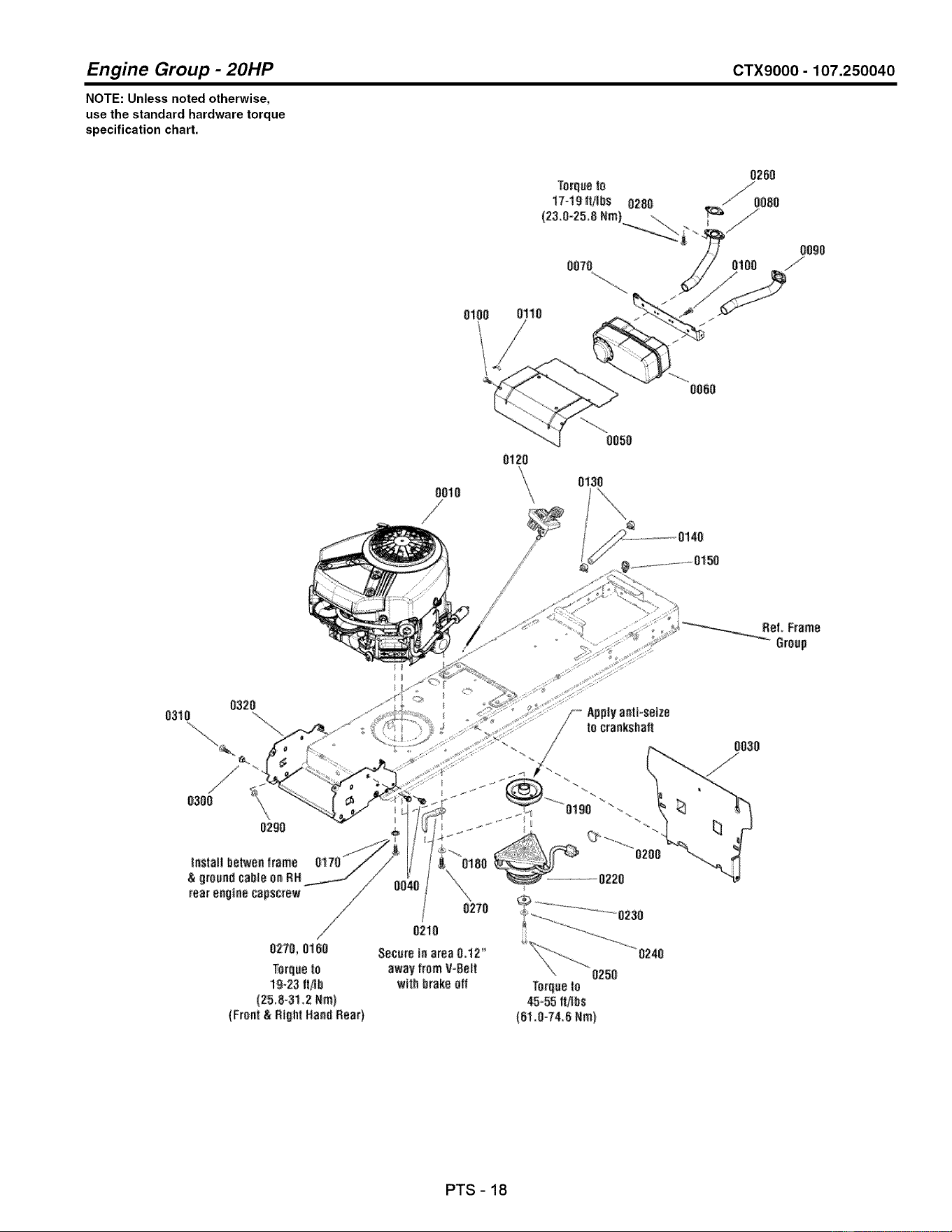
Engine Group - 20HP CTX9000 - 107.250040
NOTE: Unless noted otherwise,
use the standard hardware torque
specification chart.
0070
0100
0O90
0100 0110
0060
0016
0120
0138
0050
0320
0310
0300
028,0
Applyanti-seize
tocrankshaft
0030
PTS - 18
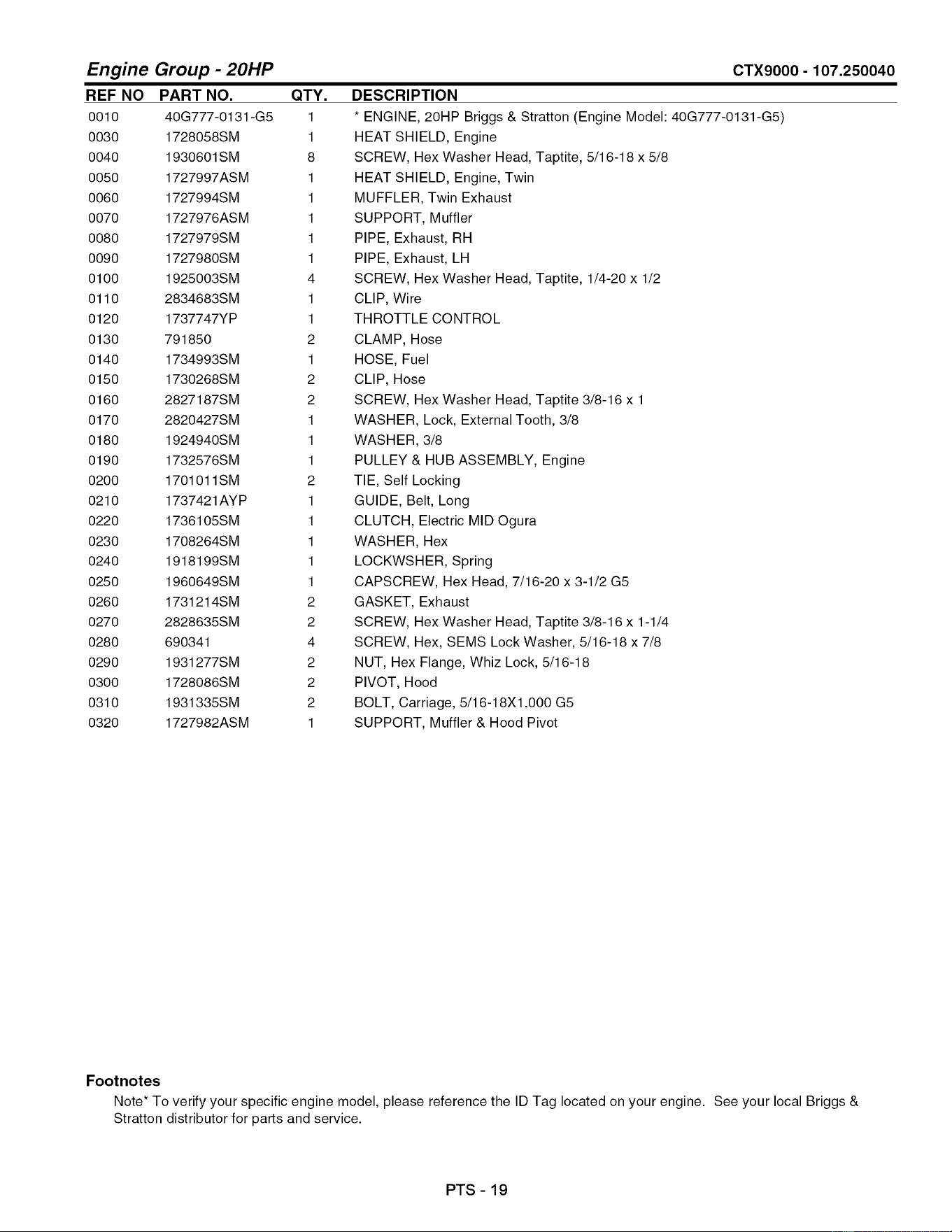
Engine Group - 20HP
REF NO PART NO. QTY.
0010 40G777-0131-G5 1
0030 1728058SM 1
0040 1930601SM 8
0050 1727997ASM 1
0060 1727994SM 1
0070 1727976ASM 1
0080 1727979SM 1
0090 1727980SM 1
0100 1925003SM 4
0110 2834683SM 1
0120 1737747YP 1
0130 791850 2
0140 1734993SM 1
0150 1730268SM 2
0160 2827187SM 2
0170 2820427SM 1
0180 1924940SM 1
0190 1732576SM 1
0200 1701011SM 2
0210 1737421AYP 1
0220 1736105SM 1
0230 1708264SM 1
0240 1918199SM 1
0250 1960649SM 1
0260 1731214SM 2
0270 2828635SM 2
0280 690341 4
0290 1931277SM 2
0300 1728086SM 2
0310 1931335SM 2
0320 1727982ASM 1
CTX9000 - 107.250040
DESCRIPTION
* ENGINE, 20HP Briggs & Stratton (Engine Model: 40G777-0131-G5)
HEAT SHIELD, Engine
SCREW, Hex Washer Head, Taptite, 5/16-18 x 5/8
HEAT SHIELD, Engine, Twin
MUFFLER, Twin Exhaust
SUPPORT, Muffler
PIPE, Exhaust, RH
PIPE, Exhaust, LH
SCREW, Hex Washer Head, Taptite, 1/4-20 x 1/2
CLIP, Wire
THROTTLE CONTROL
CLAMP, Hose
HOSE, Fuel
CLIP, Hose
SCREW, Hex Washer Head, Taptite 3/8-16 x 1
WASHER, Lock, External Tooth, 3/8
WASHER, 3/8
PULLEY & HUB ASSEMBLY, Engine
TIE, Self Locking
GUIDE, Belt, Long
CLUTCH, Electric MID Ogura
WASHER, Hex
LOCKWSHER, Spring
CAPSCREW, Hex Head, 7/16-20 x 3-1/2 G5
GASKET, Exhaust
SCREW, Hex Washer Head, Taptite 3/8-16 x 1-1/4
SCREW, Hex, SEMS Lock Washer, 5/16-18 x 7/8
NUT, Hex Flange, Whiz Lock, 5/16-18
PIVOT, Hood
BOLT, Carriage, 5/16-18X1.000 G5
SUPPORT, Muffler & Hood Pivot
Footnotes
Note* To verify your specific engine model, please reference the ID Tag located on your engine. See your local Briggs &
Stratton distributor for parts and service.
PTS - 19
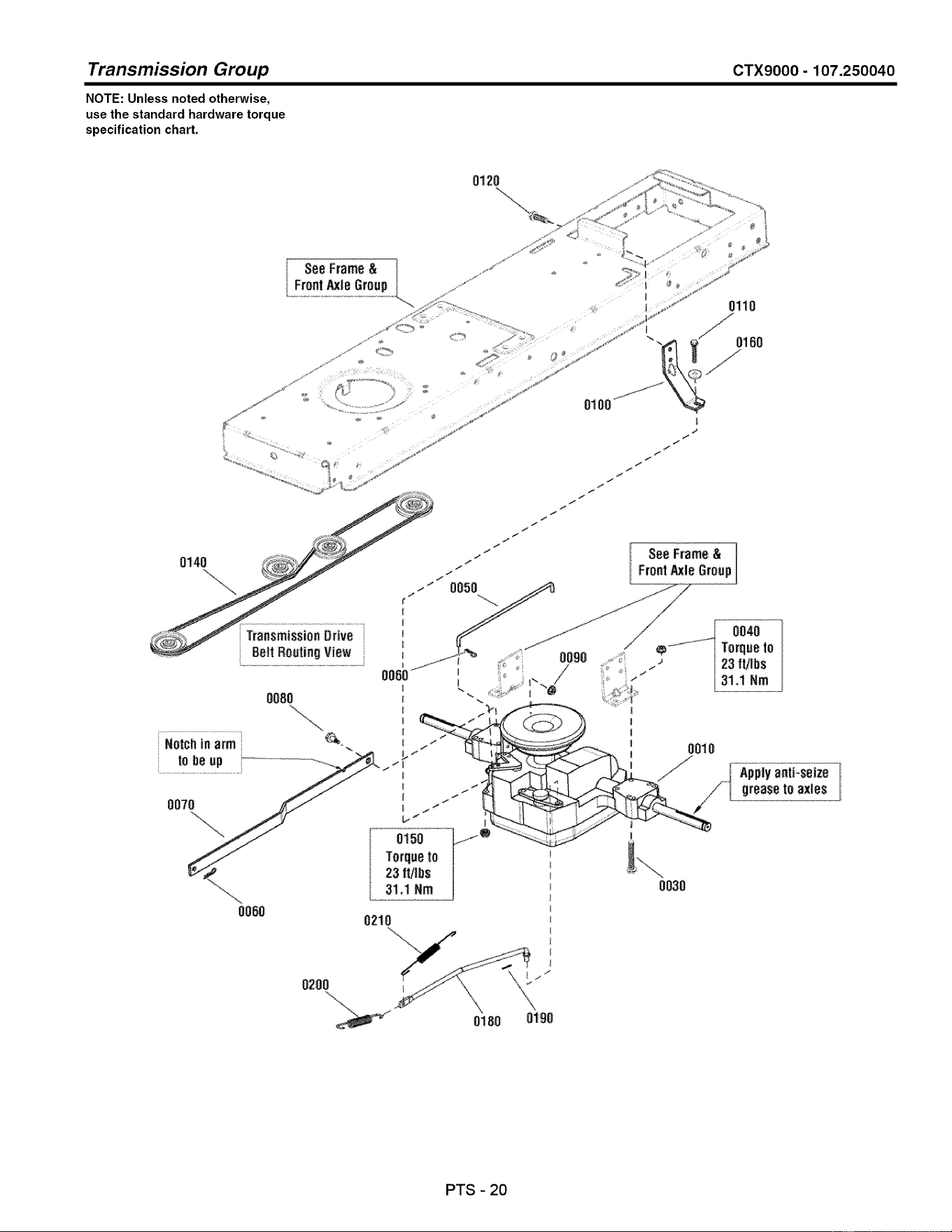
Transmission Group CTX9000- 107.250040
NOTE: Unless noted otherwise,
use the standard hardware torque
specification chart.
0120
s ? _!
J_
I
0110
0160
J
0140
0080
O060
0200
0210
1
t
1
I
t
I
I
t
t
t
I
t J
I
I
I
I 0010
I
0030
0040
Torqueto
23lt/Ibs
31,1Nm
PTS - 20
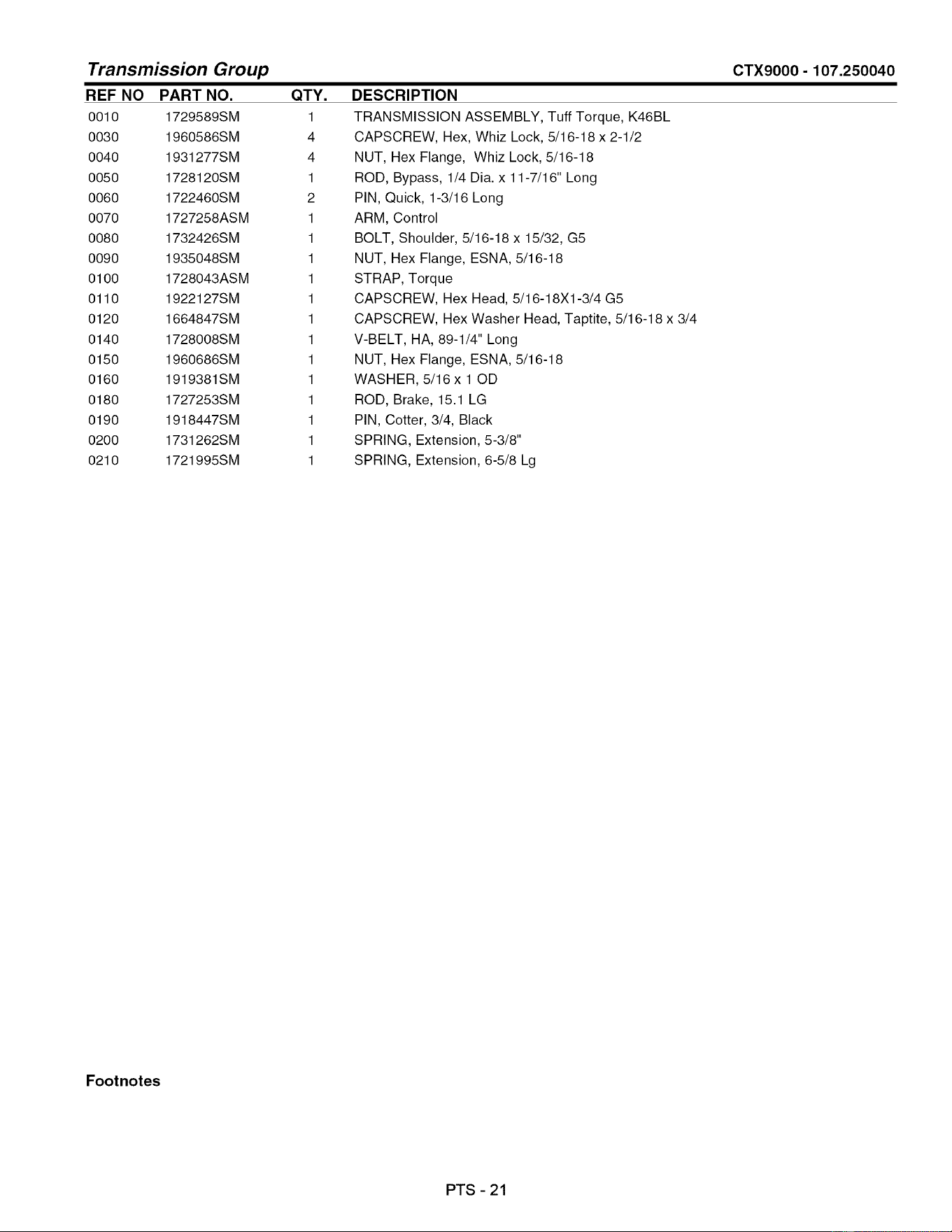
Transmission Group
REF NO PART NO. QTY.
0010 1729589SM 1
0030 1960586SM 4
0040 1931277SM 4
0050 1728120SM 1
0060 1722460SM 2
0070 1727258ASM 1
0080 1732426SM 1
0090 1935048SM 1
0100 1728043ASM 1
0110 1922127SM 1
0120 1664847SM 1
0140 1728008SM 1
0150 1960686SM 1
0160 1919381SM 1
0180 1727253SM 1
0190 1918447SM 1
0200 1731262SM 1
0210 1721995SM 1
DESCRIPTION
TRANSMISSION ASSEMBLY, Tuff Torque, K46BL
CAPSCREW, Hex, Whiz Lock, 5/16-18 x 2-1/2
NUT, Hex Flange, Whiz Lock, 5/16-18
ROD, Bypass, 1/4 Dia. x 11-7/16" Long
PIN, Quick, 1-3/16 Long
ARM, Control
BOLT, Shoulder, 5/16-18 x 15/32, G5
NUT, Hex Flange, ESNA, 5/16-18
STRAP, Torque
CAPSCREW, Hex Head, 5/16-18X1-3/4 G5
CAPSCREW, Hex Washer Head, Taptite, 5/16-18 x 3/4
V-BELT, HA, 89-1/4" Long
NUT, Hex Flange, ESNA, 5/16-18
WASHER, 5/16 x 10D
ROD, Brake, 15.1 LG
PIN, Cotter, 3/4, Black
SPRING, Extension, 5-3/8"
SPRING, Extension, 6-5/8 Lg
CTX9000 - 107.250040
Footnotes
PTS - 21
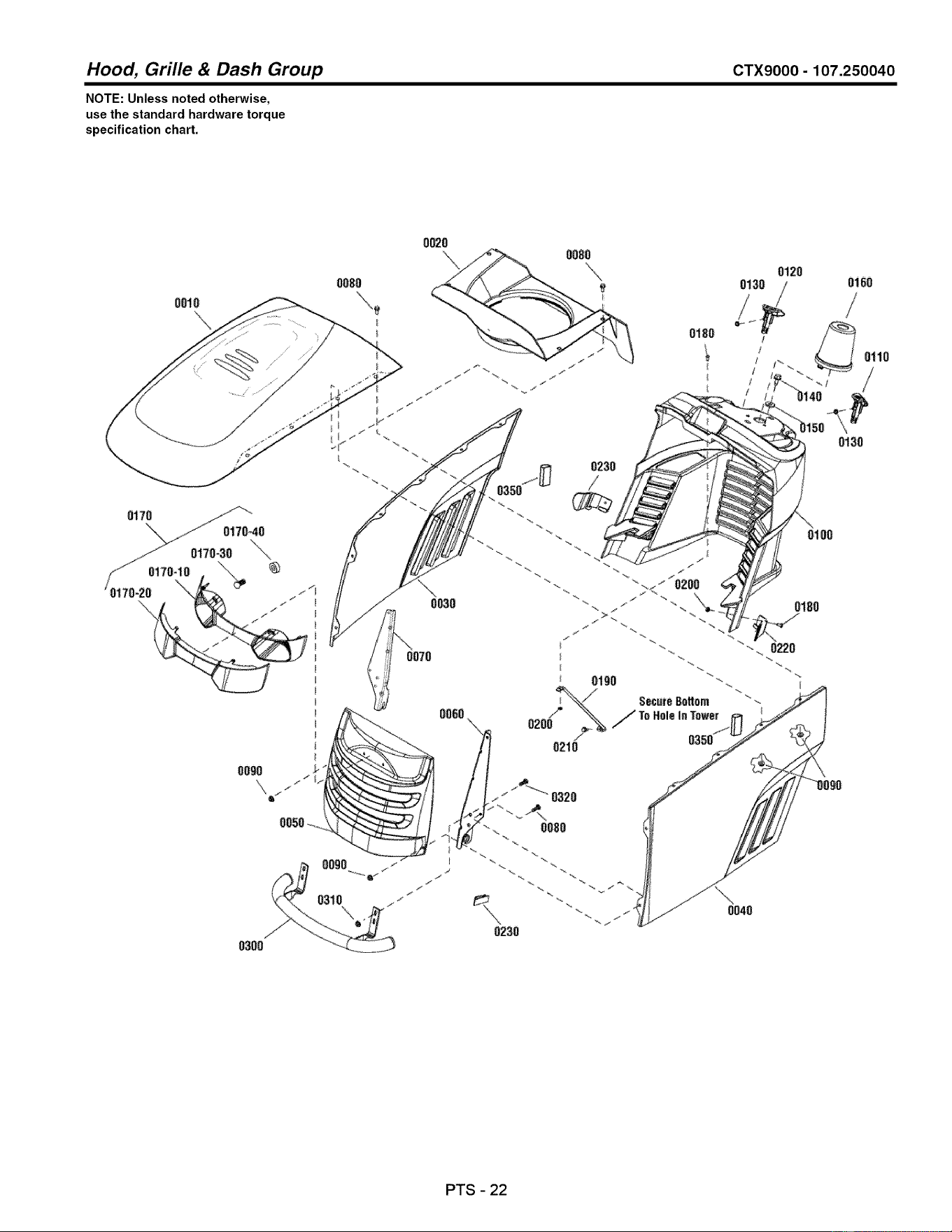
Hood, Grille & Dash Group CTX9000- 107.250040
NOTE: Unless noted otherwise,
use the standard hardware torque
specification chart.
6018
0080
0170 j ....
\ / o17o_4o
/
/
00"20
0080.\.
0180
0070
0230 [_
0120
0130 0160
0040
0100
0180
0130
PTS - 22
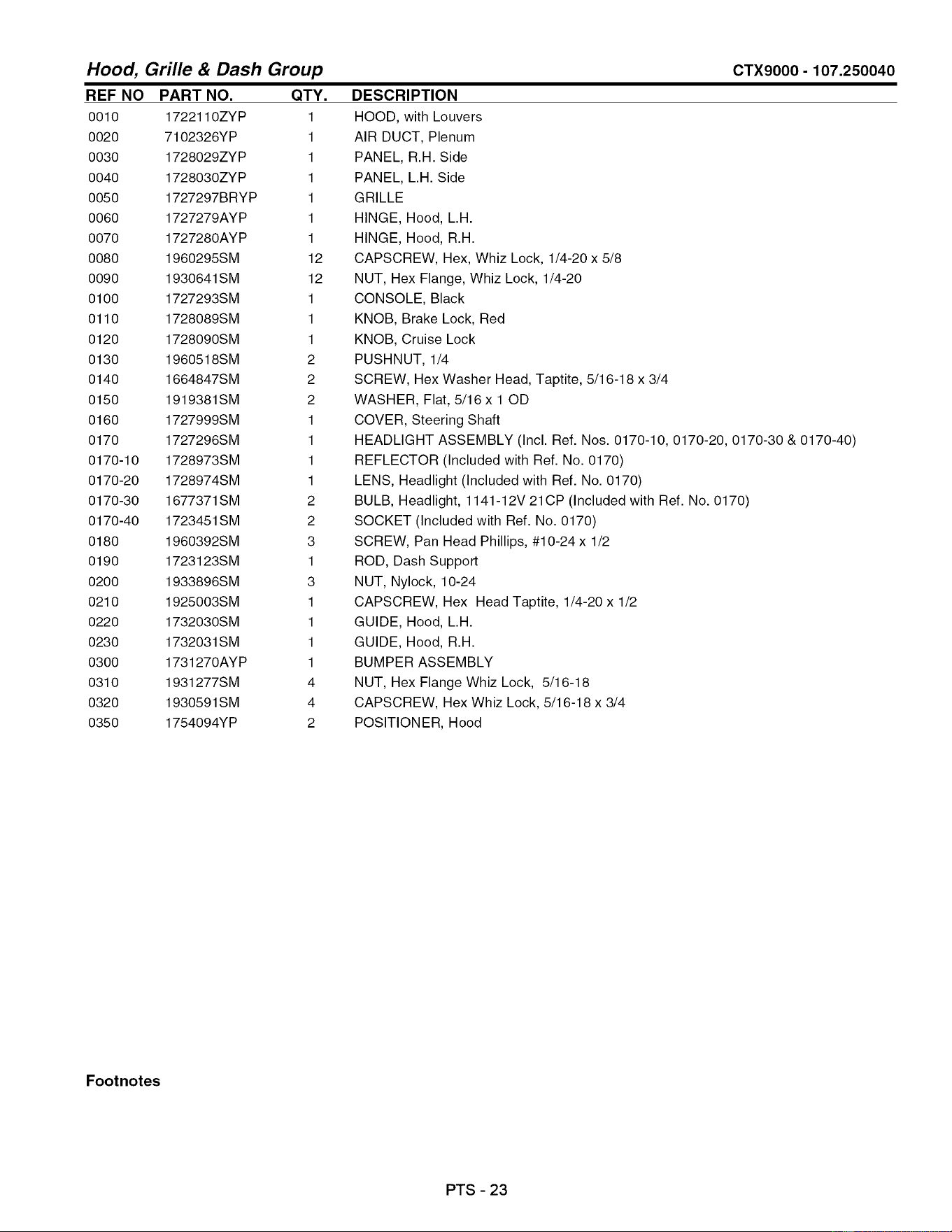
Hood, Grille & Dash Group
REF NO PART NO. QTY.
0010 1722110ZYP 1
0020 7102326YP 1
0030 1728029ZYP 1
0040 1728030ZYP 1
0050 1727297BRYP 1
0060 1727279AYP 1
0070 1727280AYP 1
0080 1960295SM 12
0090 1930641SM 12
0100 1727293SM 1
0110 1728089SM 1
0120 1728090SM 1
0130 1960518SM 2
0140 1664847SM 2
0150 1919381SM 2
0160 1727999SM 1
0170 1727296SM 1
0170-10 1728973SM 1
0170-20 1728974SM 1
0170-30 1677371SM 2
0170-40 1723451SM 2
0180 1960392SM 3
0190 1723123SM 1
0200 1933896SM 3
0210 1925003SM 1
0220 1732030SM 1
0230 1732031SM 1
0300 1731270AYP 1
0310 1931277SM 4
0320 1930591SM 4
0350 1754094YP 2
CTX9000 - 107.250040
DESCRIPTION
HOOD, with Louvers
AIR DUCT, Plenum
PANEL, R.H. Side
PANEL, L.H. Side
GRILLE
HINGE, Hood, L.H.
HINGE, Hood, R.H.
CAPSCREW, Hex, Whiz Lock, 1/4-20 x 5/8
NUT, Hex Flange, Whiz Lock, 1/4-20
CONSOLE, Black
KNOB, Brake Lock, Red
KNOB, Cruise Lock
PUSHNUT, 1/4
SCREW, Hex Washer Head, Taptite, 5/16-18 x 3/4
WASHER, Flat, 5/16 x 10D
COVER, Steering Shaft
HEADLIGHT ASSEMBLY (Incl. Ref. Nos. 0170-10, 0170-20, 0170-30 & 0170-40)
REFLECTOR (Included with Ref. No. 0170)
LENS, Headlight (Included with Ref. No. 0170)
BULB, Headlight, 1141-12V 21CP (Included with Ref. No. 0170)
SOCKET (Included with Ref. No. 0170)
SCREW, Pan Head Phillips, #10-24 x 1/2
ROD, Dash Support
NUT, Nylock, 10-24
CAPSCREW, Hex Head Taptite, 1/4-20 x 1/2
GUIDE, Hood, L.H.
GUIDE, Hood, R.H.
BUMPER ASSEMBLY
NUT, Hex Flange Whiz Lock, 5/16-18
CAPSCREW, Hex Whiz Lock, 5/16-18 x 3/4
POSITIONER, Hood
Footnotes
PTS - 23
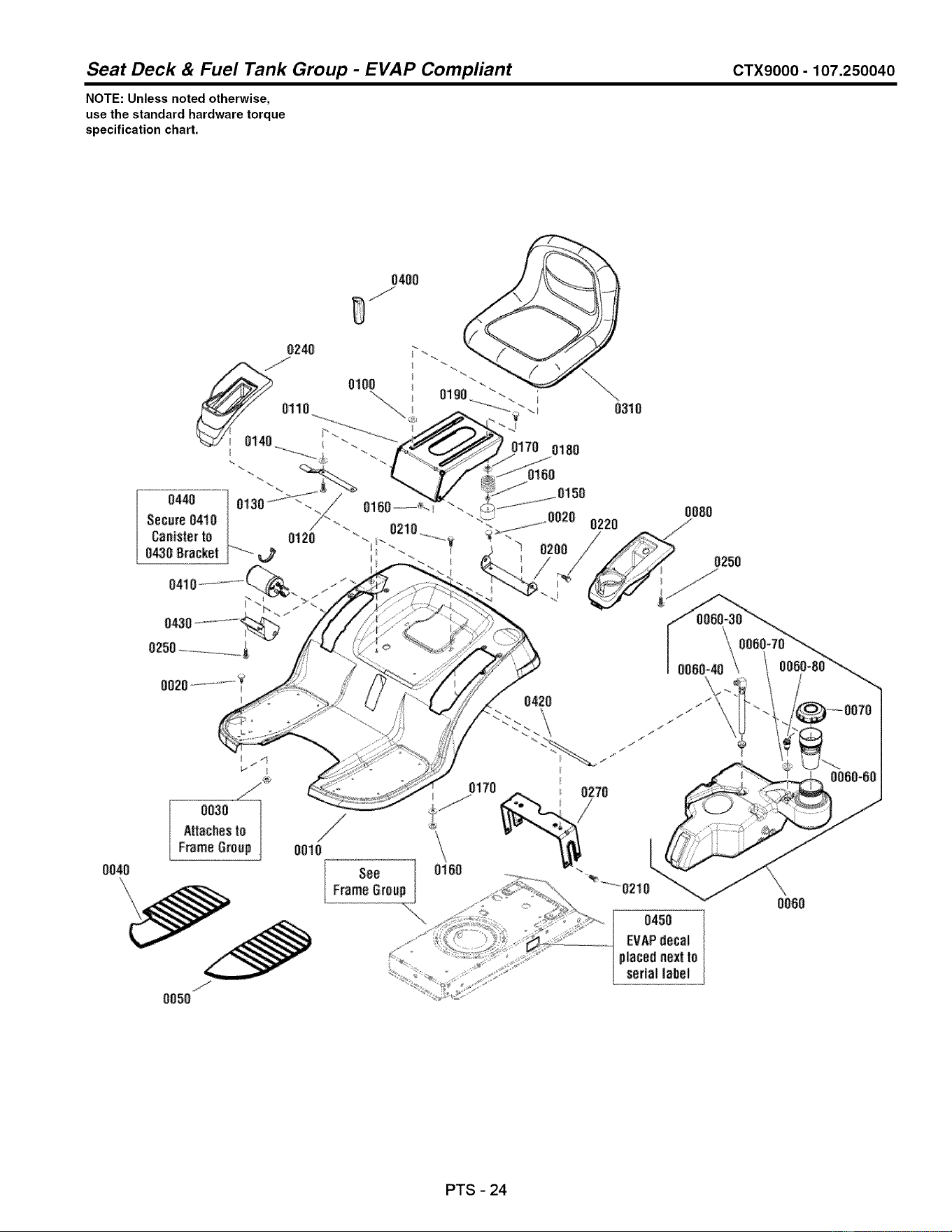
Seat Deck & Fuel Tank Group - EVAP Compliant CTX9000 - 107.250040
NOTE: Unless noted otherwise,
use the standard hardware torque
specification chart.
0400
041_
0080
0250
0040
0050
/
0010
0170
0160
0060
PTS - 24
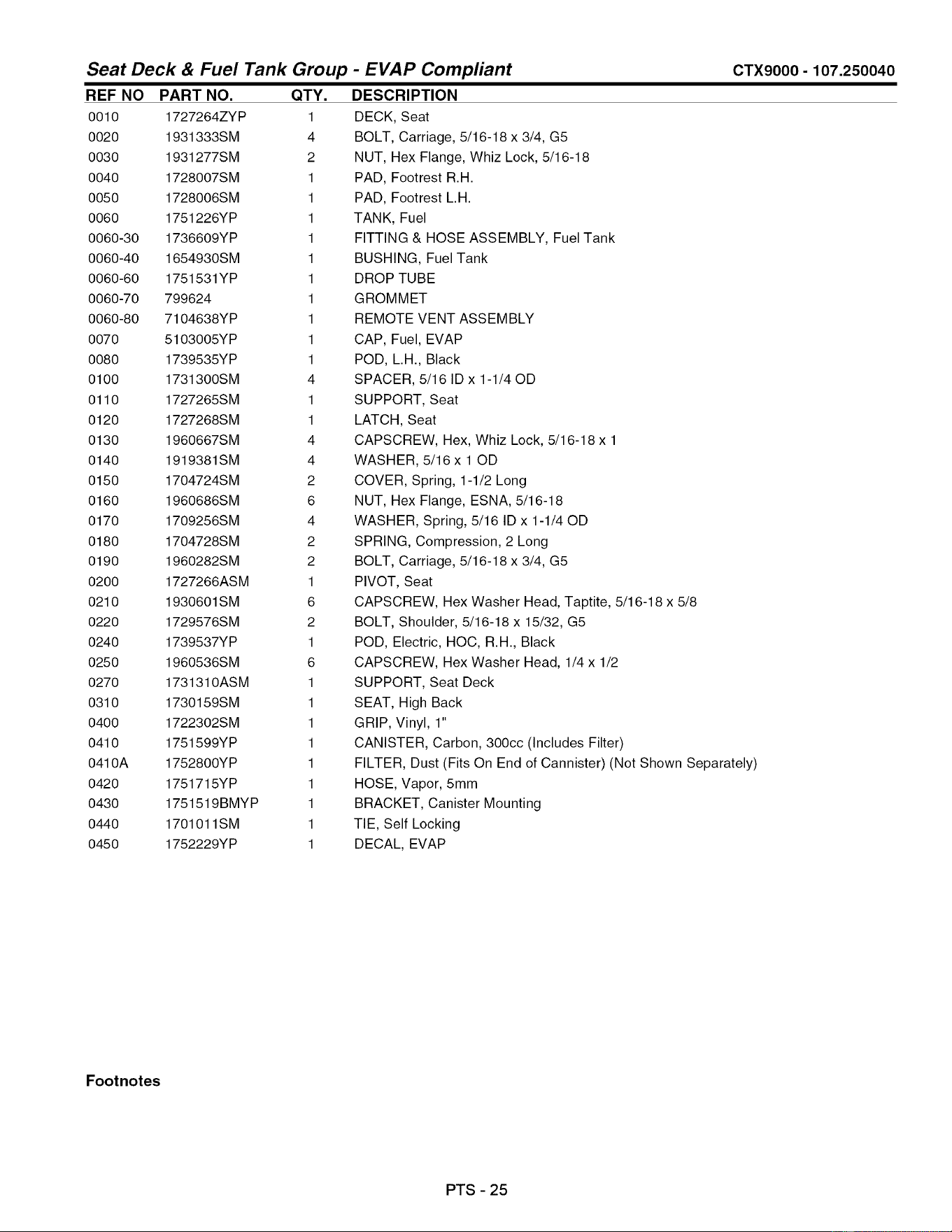
Seat Deck & Fuel Tank Group
REF NO PART NO. QTY.
0010 1727264ZYP 1
0020 1931333SM 4
0030 1931277SM 2
0040 1728007SM 1
0050 1728006SM 1
0060 1751226YP 1
0060-30 1736609YP 1
0060-40 1654930SM 1
0060-60 1751531YP 1
0060-70 799624 1
0060-80 7104638YP 1
0070 5103005YP 1
0080 1739535YP 1
0100 1731300SM 4
0110 1727265SM 1
0120 1727268SM 1
0130 1960667SM 4
0140 1919381SM 4
0150 1704724SM 2
0160 1960686SM 6
0170 1709256SM 4
0180 1704728SM 2
0190 1960282SM 2
0200 1727266ASM 1
0210 1930601SM 6
0220 1729576SM 2
0240 1739537YP 1
0250 1960536SM 6
0270 1731310ASM 1
0310 1730159SM 1
0400 1722302SM 1
0410 1751599YP 1
0410A 1752800YP 1
0420 1751715YP 1
0430 1751519BMYP 1
0440 1701011SM 1
0450 1752229YP 1
- EVAP Compliant
DESCRIPTION
DECK, Seat
BOLT, Carriage, 5/16-18 x 3/4, G5
NUT, Hex Flange, Whiz Lock, 5/16-18
PAD, Footrest R.H.
PAD, Footrest L.H.
TANK, Fuel
FITTING & HOSE ASSEMBLY, Fuel Tank
BUSHING, Fuel Tank
DROP TUBE
GROMMET
REMOTE VENT ASSEMBLY
CAP, Fuel, EVAP
POD, L.H., Black
SPACER, 5/16 ID x 1-1/40D
SUPPORT, Seat
LATCH, Seat
CAPSCREW, Hex, Whiz Lock, 5/16-18 x 1
WASHER, 5/16 x 10D
COVER, Spring, 1-1/2 Long
NUT, Hex Flange, ESNA, 5/16-18
WASHER, Spring, 5/16 ID x 1-1/40D
SPRING, Compression, 2 Long
BOLT, Carriage, 5/16-18 x 3/4, G5
PIVOT, Seat
CAPSCREW, Hex Washer Head, Taptite, 5/16-18 x 5/8
BOLT, Shoulder, 5/16-18 x 15/32, G5
POD, Electric, HOC, R.H., Black
CAPSCREW, Hex Washer Head, 1/4 x 1/2
SUPPORT, Seat Deck
SEAT, High Back
GRIP, Vinyl, 1"
CANISTER, Carbon, 300cc (Includes Filter)
FILTER, Dust (Fits On End of Cannister) (Not Shown Separately)
HOSE, Vapor, 5mm
BRACKET, Canister Mounting
TIE, Self Locking
DECAL, EVAP
CTX9000 - 107.250040
Footnotes
PTS - 25
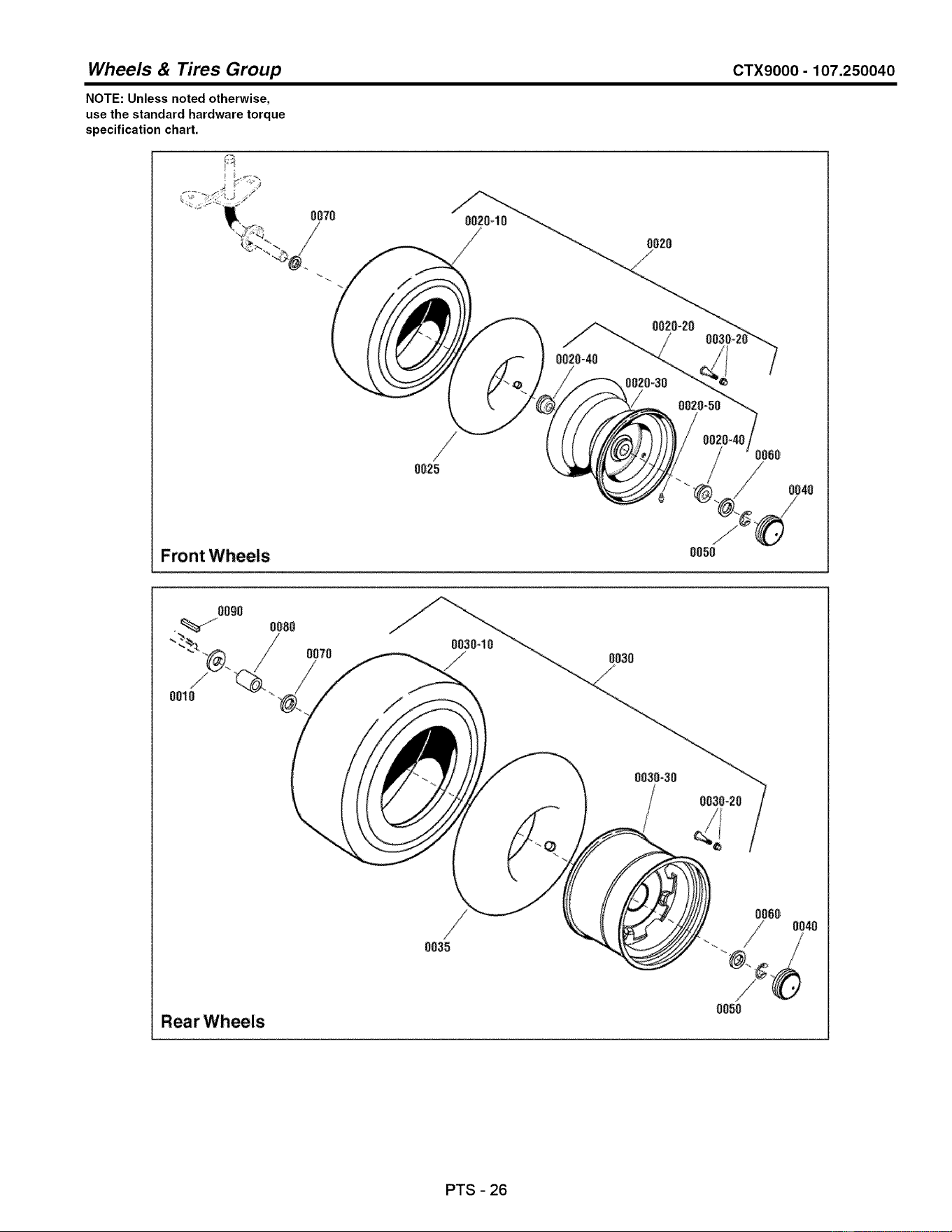
Wheels & Tires Group CTX9000- 107.250040
NOTE: Unless noted otherwise,
use the standard hardware torque
specification chart.
020
0025
0020_40
/I ?60
0050
00g0
0088
007O
0030-10
0030
0035
0060
0040
Rear Wheels
0O50
PTS - 26
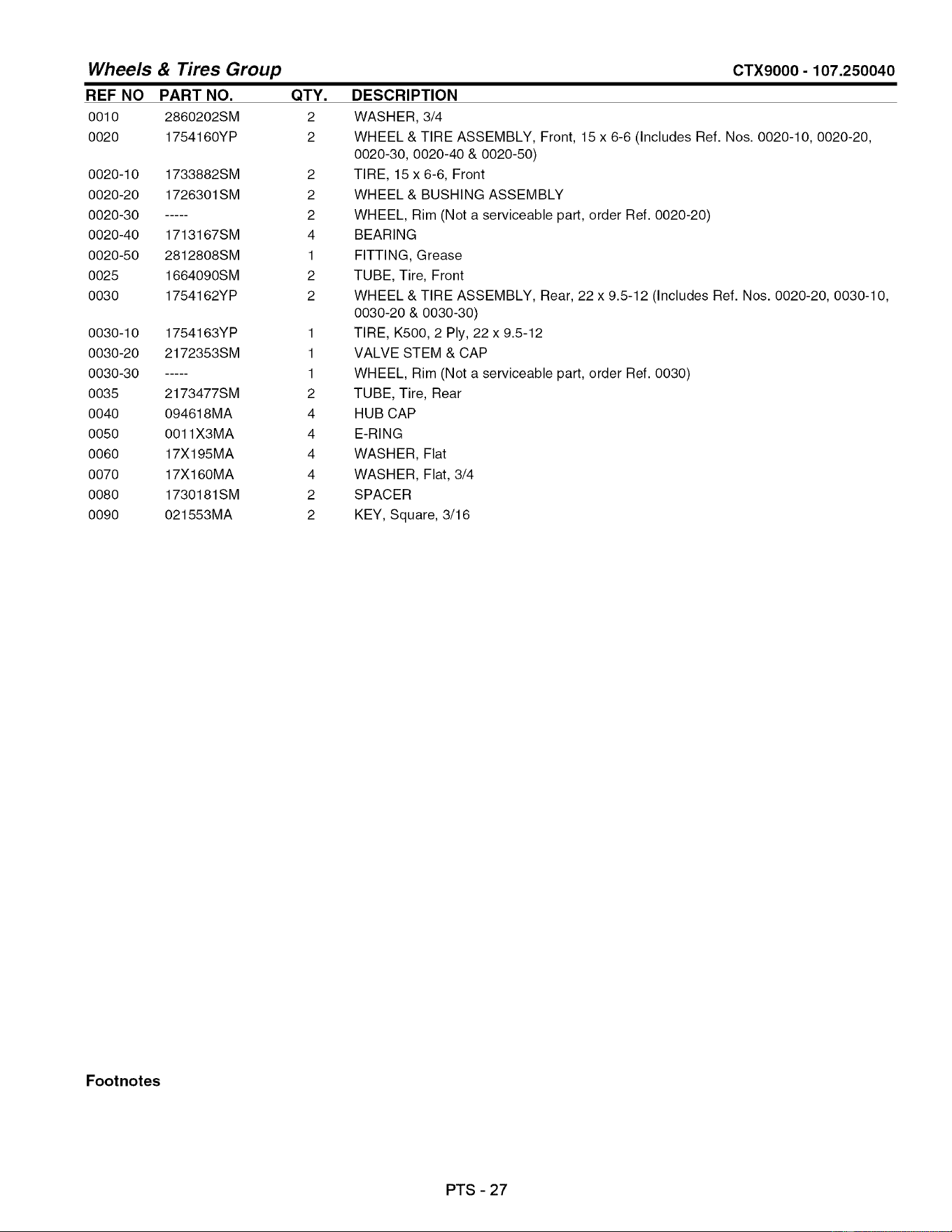
Wheels & Tires Group
REF NO PART NO. QTY.
0010 2860202SM 2
0020 1754160YP 2
0020-10 1733882SM
0020-20 1726301SM
0020-30 .....
0020-40 1713167SM
0020-50 2812808SM
0025 1664090SM
0030 1754162YP
0030-10 1754163YP
0030-20 2172353SM
0030-30 .....
0035 2173477SM
0040 094618MA
0050 0011X3MA
0060 17X195MA
0070 17X160MA
0080 1730181SM
0090 021553MA
2
2
2
4
1
2
2
1
1
1
2
4
4
4
4
2
2
CTX9000 - 107.250040
DESCRIPTION
WASHER, 3/4
WHEEL & TIRE ASSEMBLY, Front, 15 x 6-6 (Includes Ref. Nos. 0020-10, 0020-20,
0020-30, 0020-40 & 0020-50)
TIRE, 15 x 6-6, Front
WHEEL & BUSHING ASSEMBLY
WHEEL, Rim (Not a serviceable part, order Ref. 0020-20)
BEARING
FITTING, Grease
TUBE, Tire, Front
WHEEL & TIRE ASSEMBLY, Rear, 22 x 9.5-12 (Includes Ref. Nos. 0020-20, 0030-10,
0030-20 & 0030-30)
TIRE, K500, 2 Ply, 22 x 9.5-12
VALVE STEM & CAP
WHEEL, Rim (Not a serviceable part, order Ref. 0030)
TUBE, Tire, Rear
HUB CAP
E-RING
WASHER, Flat
WASHER, Flat, 3/4
SPACER
KEY, Square, 3/16
Footnotes
PTS - 27
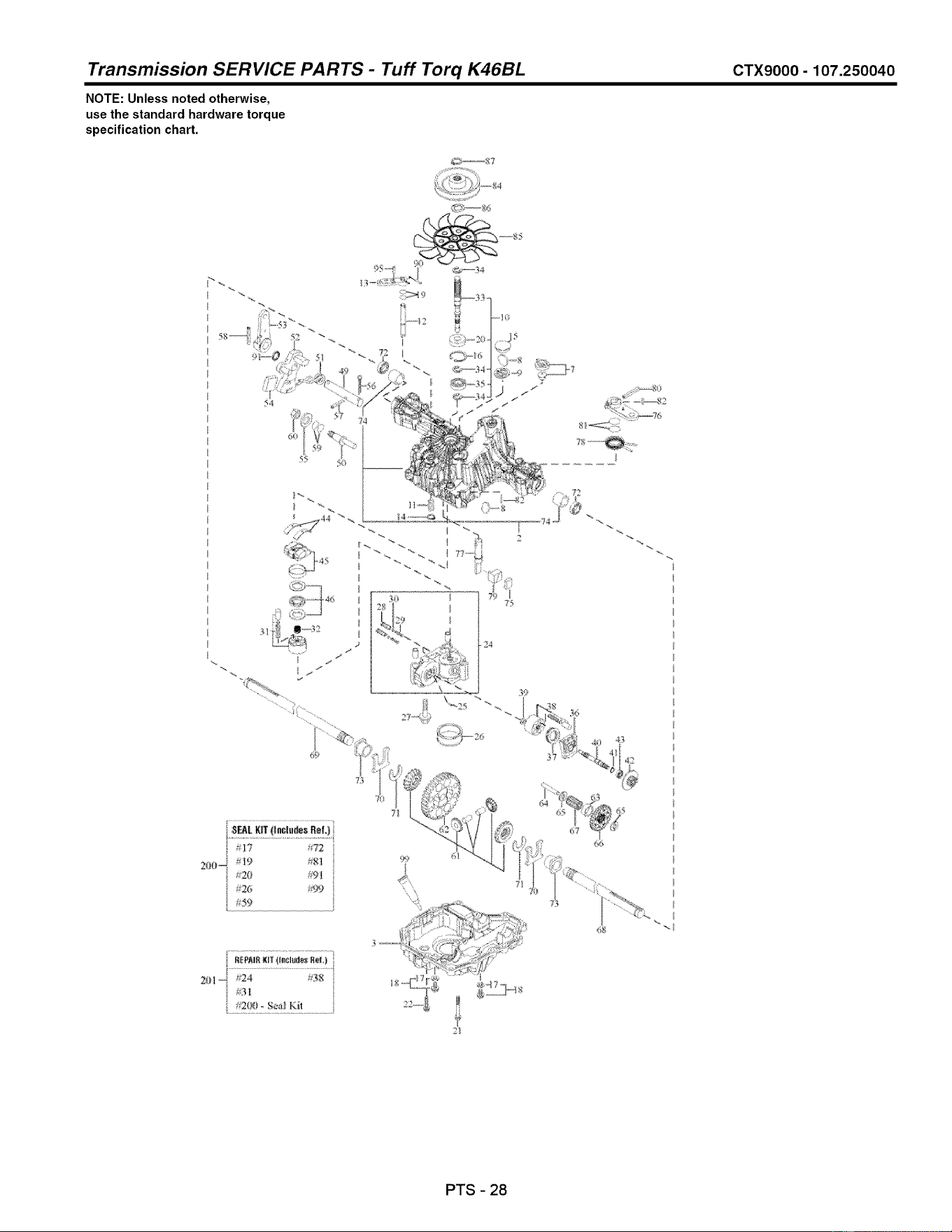
Transmission SERVICE PARTS - Tuff Torq K46BL CTX9000 - 107.250040
NOTE: Unless noted otherwise,
use the standard hardware torque
specification chart.
i_ -_
_7
200 _19
_2o
_26
9
.....25
#20(} - Sea1 K 1
PTS - 28
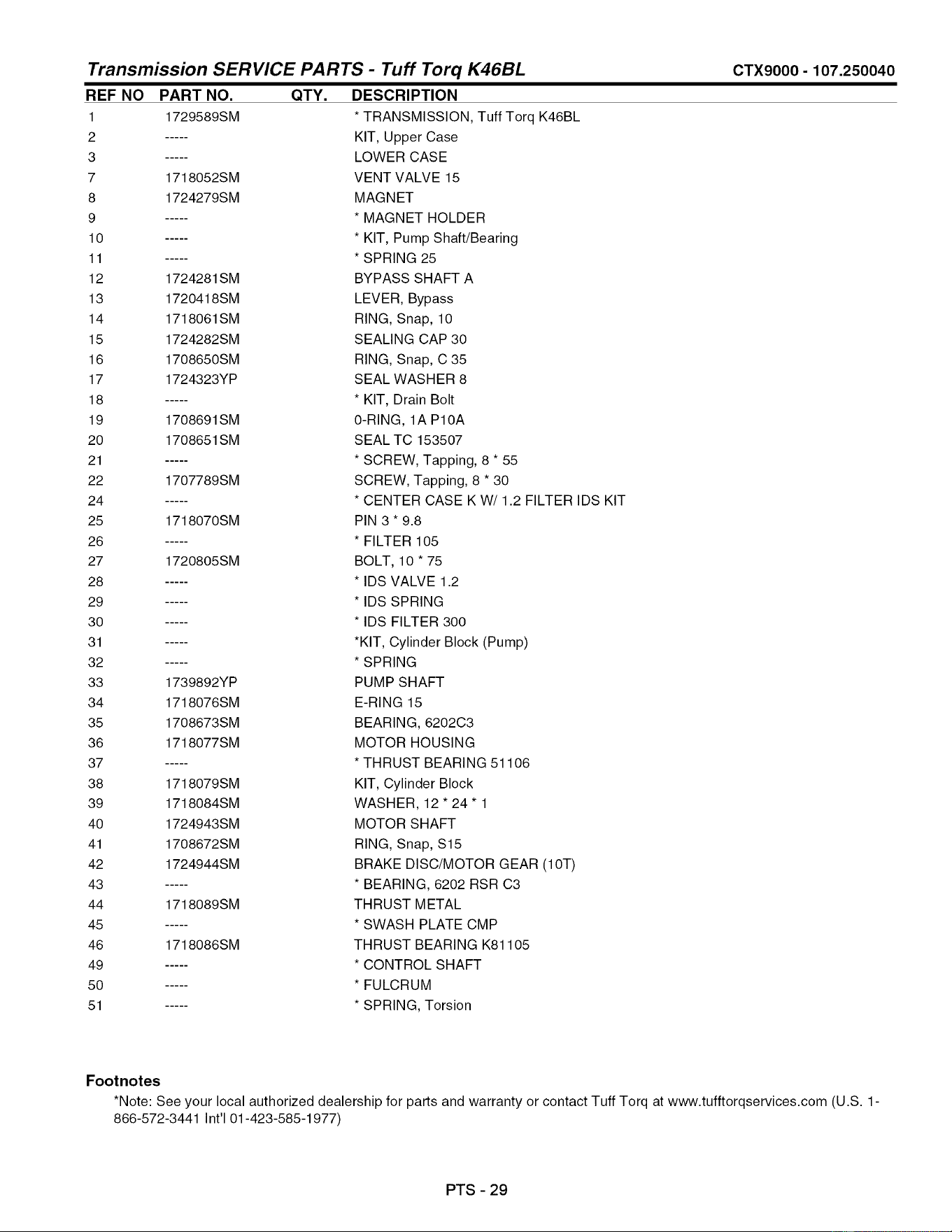
Transmission SERVICE PARTS - Tuff Torq K46BL
REF NO PART NO. QTY. DESCRIPTION
1 1729589SM * TRANSMISSION, Tuff Torq K46BL
2 ..... KIT, Upper Case
3 ..... LOWER CASE
7 1718052SM VENT VALVE 15
8 1724279SM MAG N ET
9 ..... * MAGNET HOLDER
10 ..... * KIT, Pump Shaft/Bearing
11 ..... * SPRING 25
12 1724281SM BYPASS SHAFT A
13 1720418SM LEVER, Bypass
14 1718061SM RING, Snap, 10
15 1724282SM SEALING CAP 30
16 1708650SM RING, Snap, C 35
17 1724323YP SEAL WASHER 8
18 ..... * KIT, Drain Bolt
19 1708691SM 0-RING, 1A P10A
20 1708651SM SEAL TC 153507
21 ..... * SCREW, Tapping, 8 * 55
22 1707789SM SCREW, Tapping, 8 * 30
24 ..... * CENTER CASE K W/1.2 FILTER IDS KIT
25 1718070SM PIN 3 * 9.8
26 ..... * FILTER 105
27 1720805SM BOLT, 10 * 75
28 ..... * IDS VALVE 1.2
29 ..... * IDS SPRING
30 ..... * IDS FILTER 300
31 ..... *KIT, Cylinder Block (Pump)
32 ..... * SPRING
33 1739892YP PUMP SHAFT
34 1718076SM E-RING 15
35 1708673SM BEARING, 6202C3
36 1718077SM MOTOR HOUSING
37 ..... * THRUST BEARING 51106
38 1718079SM KIT, Cylinder Block
39 1718084SM WASHER, 12 * 24 * 1
40 1724943SM MOTOR SHAFT
41 1708672SM RING, Snap, $15
42 1724944SM BRAKE DISC/MOTOR GEAR (10T)
43 ..... * BEARING, 6202 RSR C3
44 1718089SM THRUST METAL
45 ..... * SWASH PLATE CMP
46 1718086SM THRUST BEARING K81105
49 ..... * CONTROL SHAFT
50 ..... * FULCRUM
51 ..... * SPRING, Torsion
CTX9000 - 107.250040
Footnotes
*Note: See your local authorized dealership for parts and warranty or contact Tuff Torq at www.tufftorqservices.com (U.S. 1-
866-572-3441 Int'l 01-423-585-1977)
PTS - 29
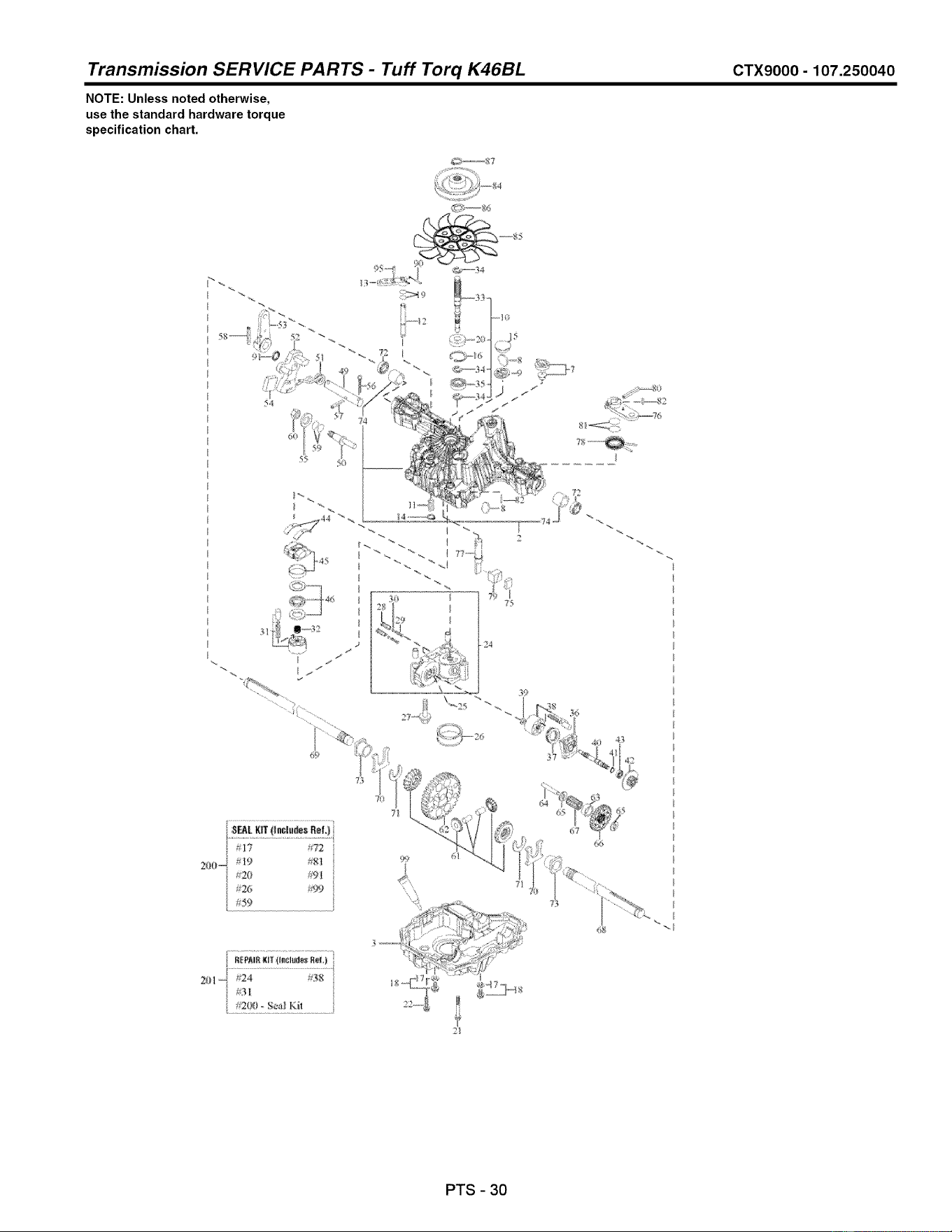
Transmission SERVICE PARTS - Tuff Torq K46BL CTX9000 - 107.250040
NOTE: Unless noted otherwise,
use the standard hardware torque
specification chart.
i_ -_
_7
200 _19
_2o
_26
9
.....25
#20(} - Sea1 K 1
PTS - 30
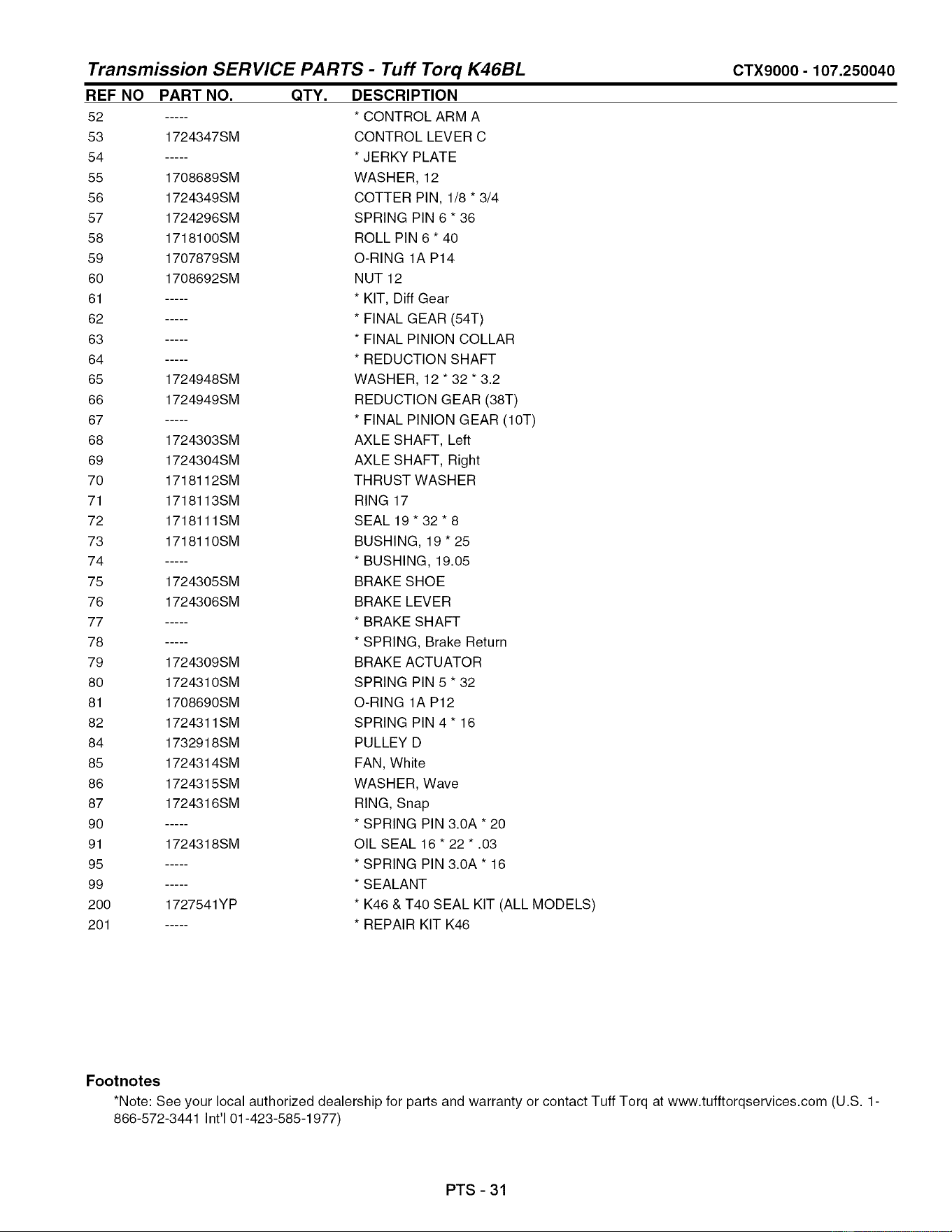
Transmission SERVICE PARTS - Tuff Torq K46BL
REF NO PART NO. QTY. DESCRIPTION
52 ..... * CONTROL ARM A
53 1724347SM CONTROL LEVER C
54 ..... * JERKY PLATE
55 1708689SM WASHER, 12
56 1724349SM COTTER PI N, 1/8 * 3/4
57 1724296SM SPRING PIN 6 * 36
58 1718100SM ROLL PIN 6 * 40
59 1707879SM O-RING 1A P14
60 1708692SM NUT 12
61 ..... * KIT, Diff Gear
62 ..... * FINAL GEAR (54T)
63 ..... * FINAL PINION COLLAR
64 ..... * REDUCTION SHAFT
65 1724948SM WASHER, 12 * 32 * 3.2
66 1724949SM REDUCTION GEAR (38T)
67 ..... * FINAL PINION GEAR (10T)
68 1724303SM AXLE SHAFT, Left
69 1724304SM AXLE SHAFT, Right
70 1718112SM THRUST WASHER
71 1718113SM RING 17
72 1718111SM SEAL 19" 32" 8
73 1718110SM BUSHING, 19 * 25
74 ..... * BUSHING, 19.05
75 1724305SM BRAKE SHOE
76 1724306SM BRAKE LEVER
77 ..... * BRAKE SHAFT
78 ..... * SPRING, Brake Return
79 1724309SM BRAKE ACTUATOR
80 1724310SM SPRING PIN 5 * 32
81 1708690SM O-RING 1A P12
82 172431 lSM SPRING PIN 4 * 16
84 1732918SM PULLEY D
85 1724314SM FAN, White
86 1724315SM WASHER, Wave
87 1724316SM RING, Snap
90 ..... * SPRING PIN 3.0A * 20
91 1724318SM OIL SEAL 16 * 22 * .03
95 ..... * SPRING PIN 3.0A* 16
99 ..... * SEALANT
200 1727541YP * K46 & T40 SEAL KIT (ALL MODELS)
201 ..... * REPAIR KIT K46
CTX9000 - 107.250040
Footnotes
*Note: See your local authorized dealership for parts and warranty or contact Tuff Torq at www.tufftorqservices.com (U.S. 1-
866-572-3441 Int'l 01-423-585-1977)
PTS - 31
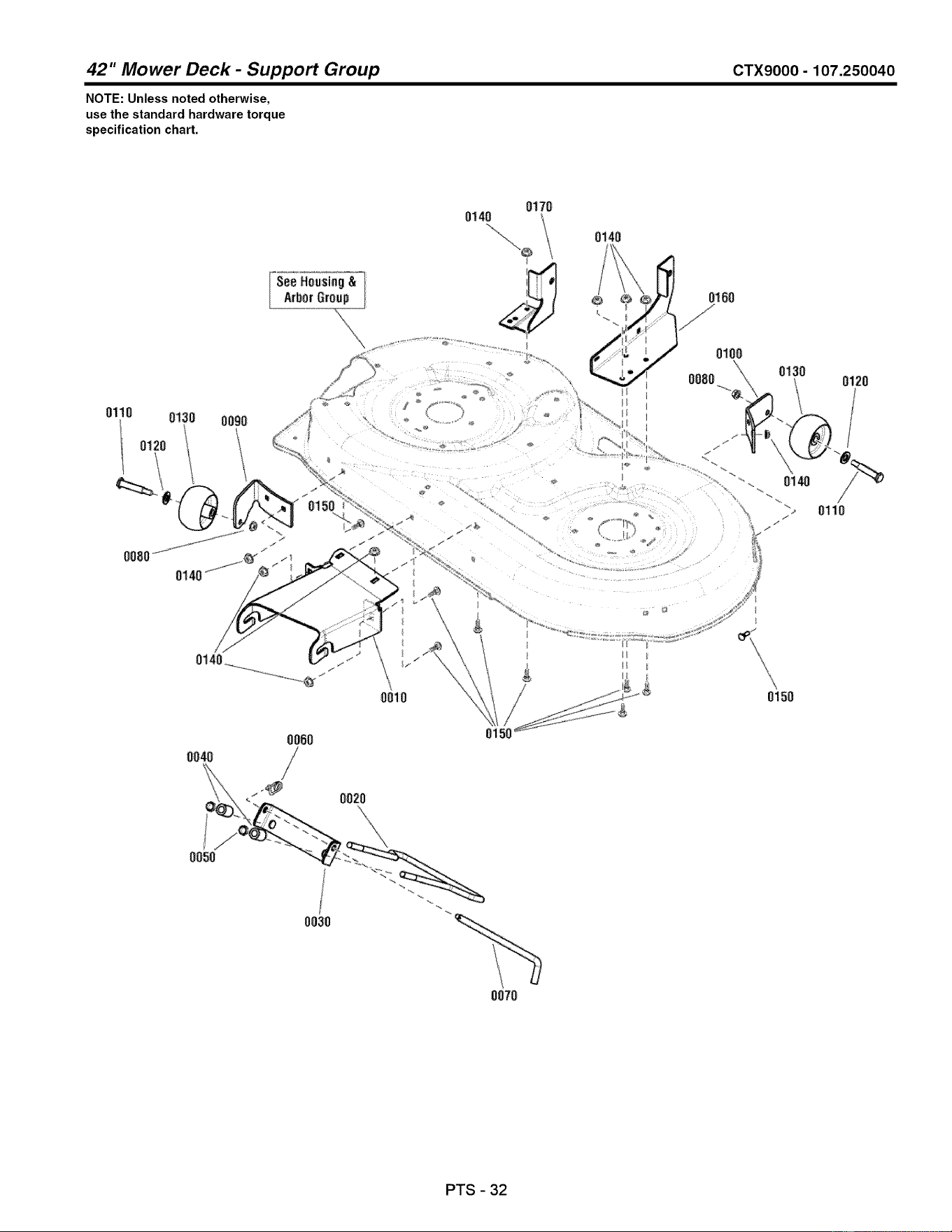
42" Mower Deck- Support Group CTX9000- 107.250040
NOTE: Unless noted otherwise,
use the standard hardware torque
specification chart.
011o
0i20
0130 00901
I SeeHousing&
ArborGroup
\
f
_z
s
_ _i_,,,¸,_,,___,_,' _ _ _ _
0140
0170
0140
®
I
0150
0140_
0010 0150
0060
0030
0070
PTS - 32
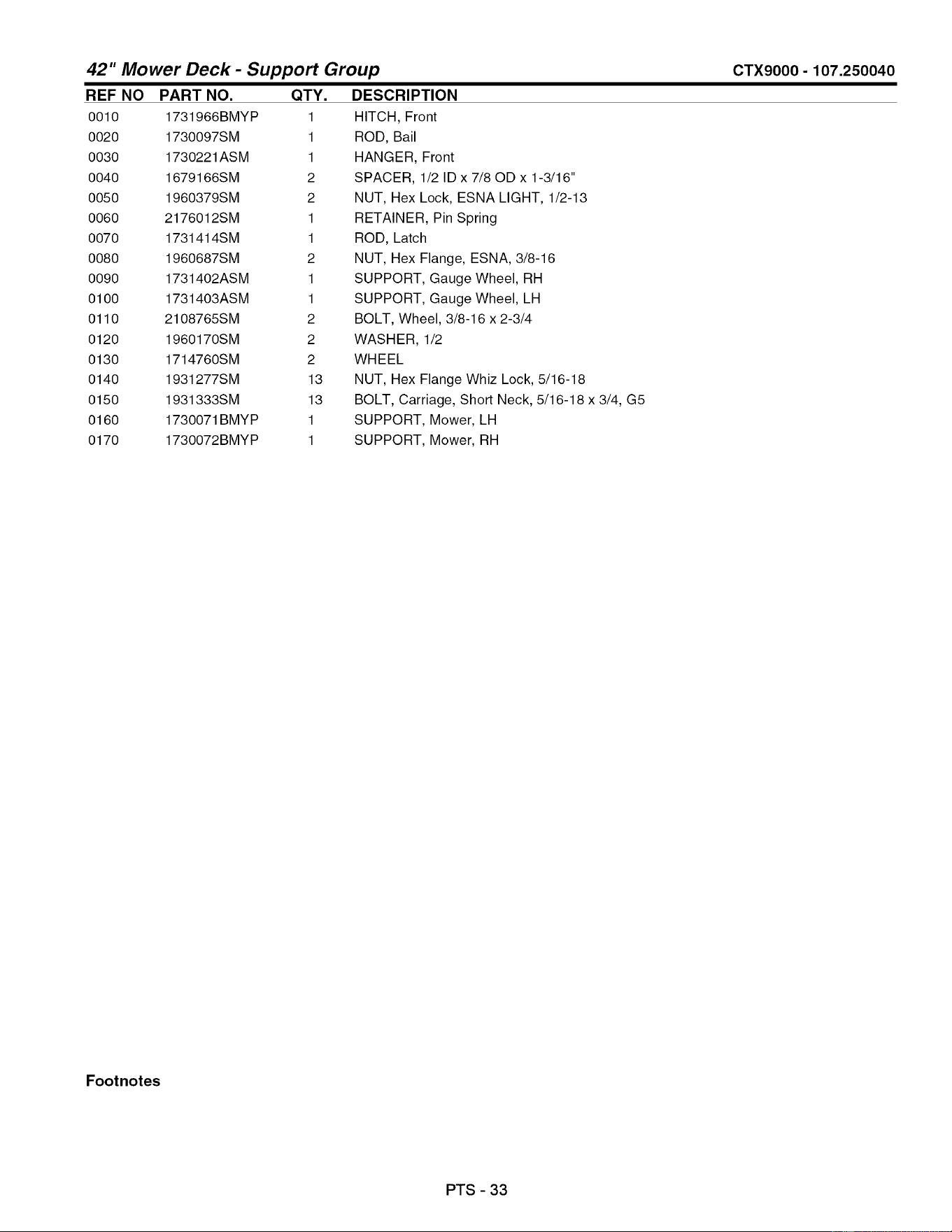
Mower Deck - Support Group CTX9000 - 107.250040
42"
REF NO
0010
0020
0030
0040
0050
0060
0070
0080
0090
0100
0110
0120
0130
0140
0150
0160
0170
PART NO. QTY.
1731966BMYP 1
1730097SM 1
1730221ASM 1
1679166SM 2
1960379SM 2
2176012SM 1
1731414SM 1
1960687SM 2
1731402ASM 1
1731403ASM 1
2108765SM 2
1960170SM 2
1714760SM 2
1931277SM 13
1931333SM 13
1730071 BMYP 1
1730072BMYP 1
DESCRIPTION
HITCH, Front
ROD, Bail
HANGER, Front
SPACER, 1/2 ID x 7/80D x 1-3/16"
NUT, Hex Lock, ESNA LIGHT, 1/2-13
RETAINER, Pin Spring
ROD, Latch
NUT, Hex Flange, ESNA, 3/8-16
SUPPORT, Gauge Wheel, RH
SUPPORT, Gauge Wheel, LH
BOLT, Wheel, 3/8-16 x 2-3/4
WASHER, 1/2
WHEEL
NUT, Hex Flange Whiz Lock, 5/16-18
BOLT, Carriage, Short Neck, 5/16-18 x 3/4, G5
SUPPORT, Mower, LH
SUPPORT, Mower, RH
Footnotes
PTS - 33
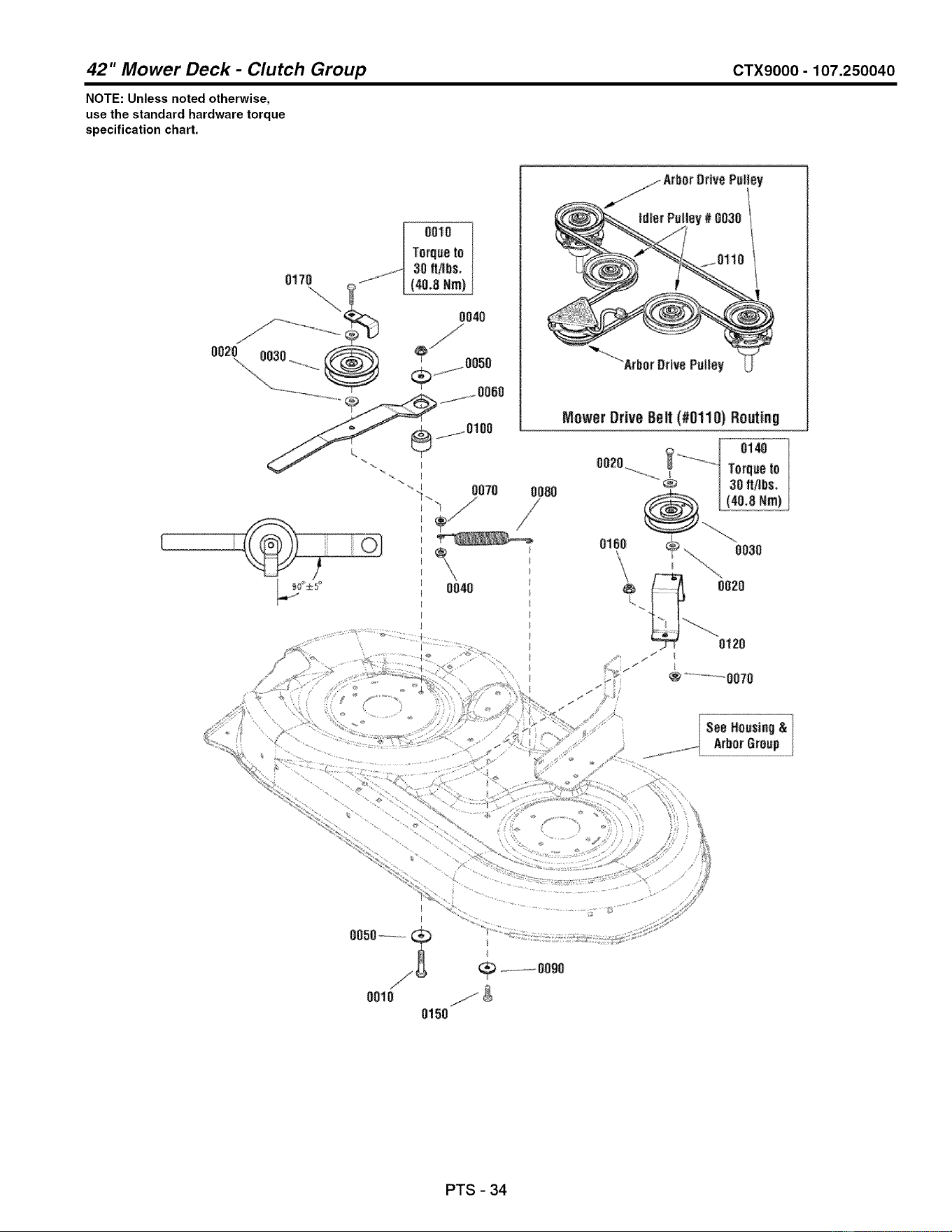
42" Mower Deck - Clutch Group CTX9000 - 107.250040
NOTE: Unless noted otherwise,
use the standard hardware torque
specification chart.
oolo
Torqueto
30ftt_bS_
(40.8Hm)
0040
Pul|ey
oo_
Mower DriveBelt (#0110) Routing
0140
0020.........
, Torqueto
30 fiflbs.
@
0040
0160
SeeHousing&
ArborGroup
0010
PTS - 34
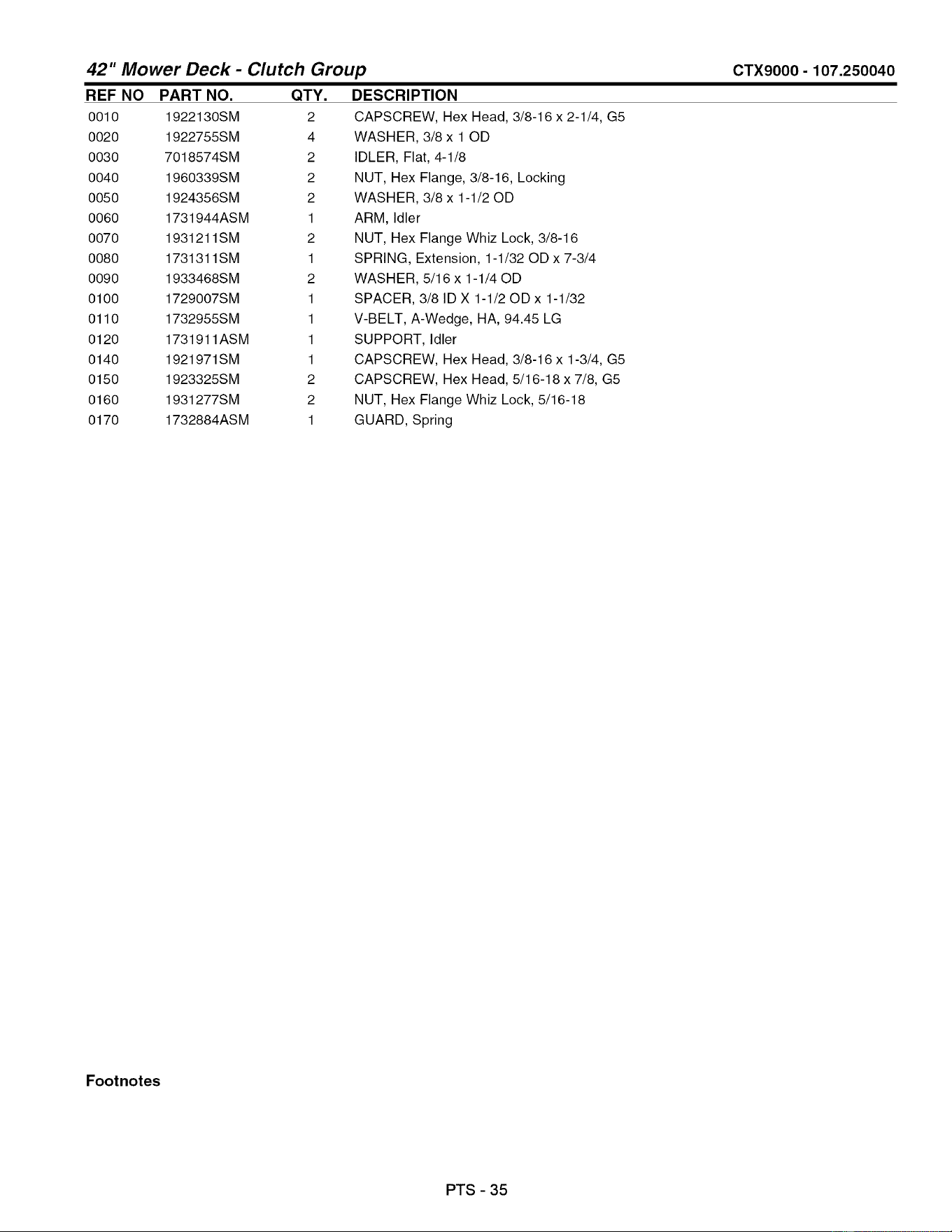
42" Mower Deck - Clutch Group
REF NO PART NO. QTY.
0010 1922130SM 2
0020 1922755SM 4
0030 7018574SM 2
0040 1960339SM 2
0050 1924356SM 2
0060 1731944ASM 1
0070 1931211SM 2
0080 1731311SM 1
0090 1933468SM 2
0100 1729007SM 1
0110 1732955SM 1
0120 1731911ASM 1
0140 1921971SM 1
0150 1923325SM 2
0160 1931277SM 2
0170 1732884ASM 1
DESCRIPTION
CAPSCREW, Hex Head, 3/8-16 x 2-1/4, G5
WASHER, 3/8 x 10D
IDLER, Flat, 4-1/8
NUT, Hex Flange, 3/8-16, Locking
WASHER, 3/8 x 1-1/20D
ARM, Idler
NUT, Hex Flange Whiz Lock, 3/8-16
SPRING, Extension, 1-1/32 OD x 7-3/4
WASHER, 5/16 x 1-1/40D
SPACER, 3/8 ID X 1-1/20D x 1-1/32
V-BELT, A-Wedge, HA, 94.45 LG
SUPPORT, Idler
CAPSCREW, Hex Head, 3/8-16 x 1-3/4, G5
CAPSCREW, Hex Head, 5/16-18 x 7/8, G5
NUT, Hex Flange Whiz Lock, 5/16-18
GUARD, Spring
CTX9000 - 107.250040
Footnotes
PTS - 35
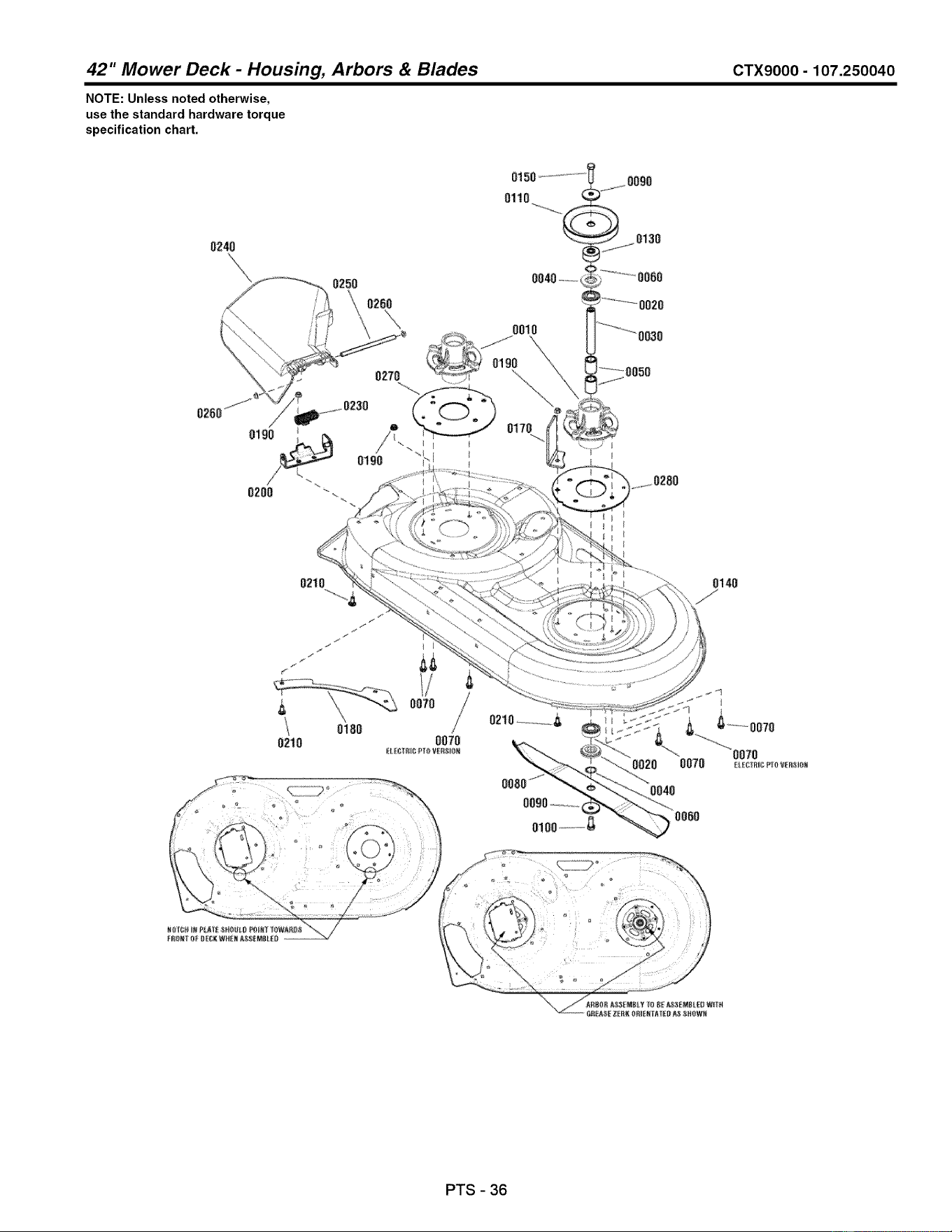
42" Mower Deck- Housing, Arbors & Blades CTX9000- 107.250040
NOTE: Unless noted otherwise,
use the standard hardware torque
specification chart.
0240
0250
0260
,\
0270
0150.......................i
0110
0010
0190
1,0090
_j_ 0130
0050
0250
0200
li
0090..............
OlOO
0140
OO7O
0040
0060
PTS - 36
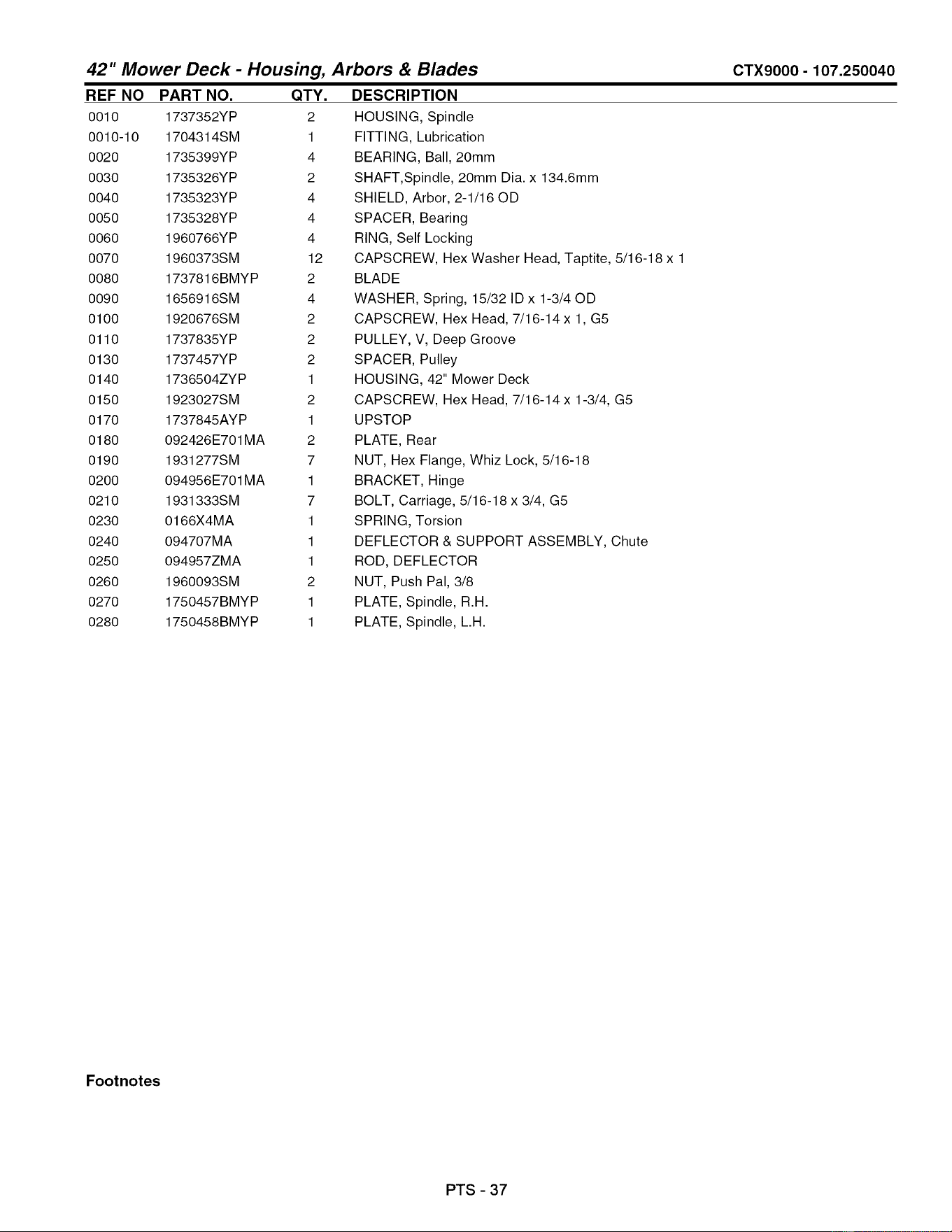
42" Mower Deck- Housing, Arbors & Blades CTX9000- 107.250040
REF NO PART NO. QTY.
0010 1737352YP 2
0010-10 1704314SM 1
0020 1735399YP 4
0030 1735326YP 2
0040 1735323YP 4
0050 1735328YP 4
0060 1960766YP 4
0070 1960373SM 12
0080 1737816BMYP 2
0090 1656916SM 4
0100 1920676SM 2
0110 1737835YP 2
0130 1737457YP 2
0140 1736504ZYP 1
0150 1923027SM 2
0170 1737845AYP 1
0180 092426E701MA 2
0190 1931277SM 7
0200 094956E701MA 1
0210 1931333SM 7
0230 0166X4MA 1
0240 094707MA 1
0250 094957ZMA 1
0260 1960093SM 2
0270 1750457BMYP 1
0280 1750458BMYP 1
DESCRIPTION
HOUSING, Spindle
FITTING, Lubrication
BEARING, Ball, 20mm
SHAFT,Spindle, 20mm Dia. x 134.6mm
SHIELD, Arbor, 2-1/16 OD
SPACER, Bearing
RING, Self Locking
CAPSCREW, Hex Washer Head, Taptite, 5/16-18 x 1
BLADE
WASHER, Spring, 15/32 ID x 1-3/40D
CAPSCREW, Hex Head, 7/16-14 x 1, G5
PULLEY, V, Deep Groove
SPACER, Pulley
HOUSING, 42" Mower Deck
CAPSCREW, Hex Head, 7/16-14 x 1-3/4, G5
UPSTOP
PLATE, Rear
NUT, Hex Flange, Whiz Lock, 5/16-18
BRACKET, Hinge
BOLT, Carriage, 5/16-18 x 3/4, G5
SPRING, Torsion
DEFLECTOR & SUPPORT ASSEMBLY, Chute
ROD, DEFLECTOR
NUT, Push Pal, 3/8
PLATE, Spindle, R.H.
PLATE, Spindle, L.H.
Footnotes
PTS - 37
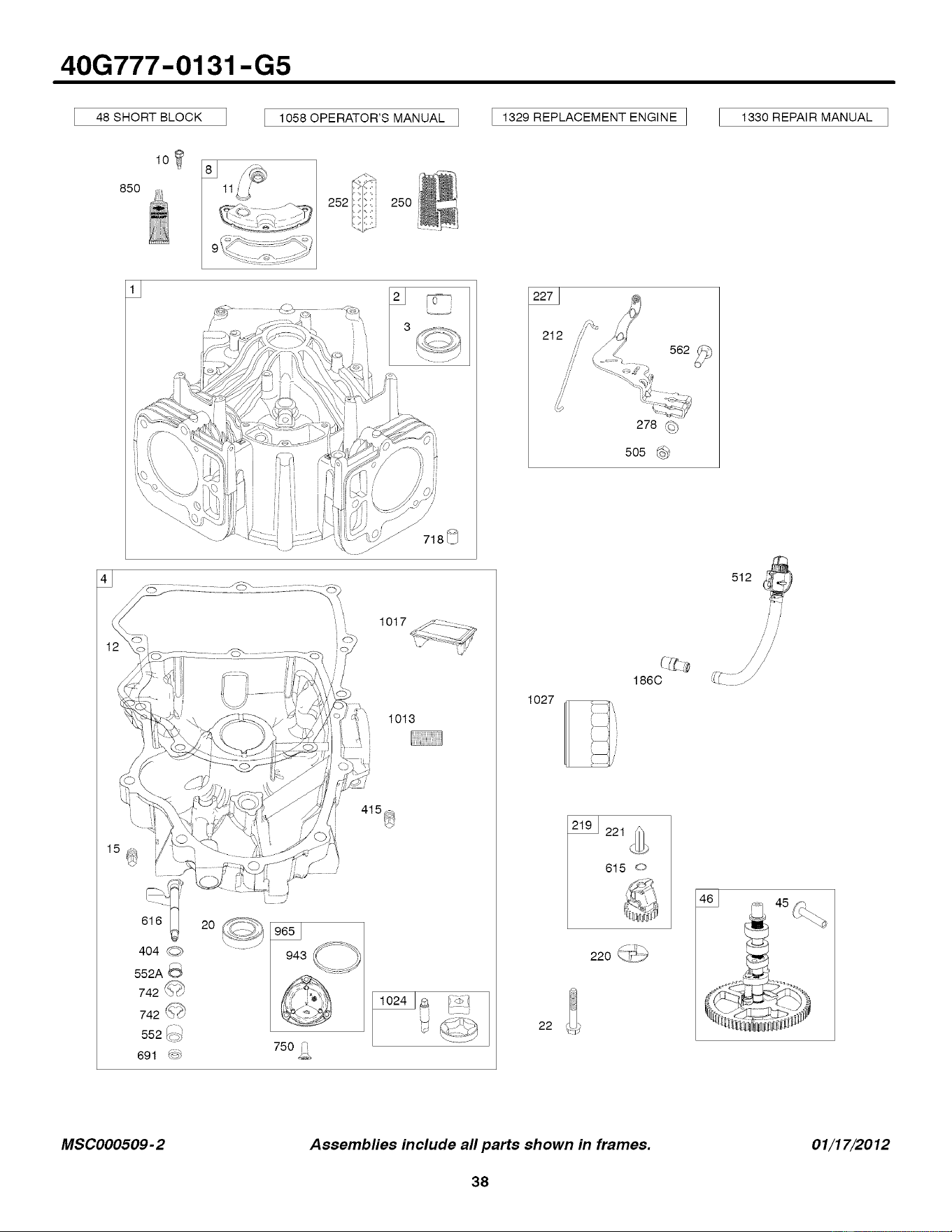
40G777-0131 -G5
48 SHORT BLOCK
lO_
85O
1058 OPERATOR'S MANUAL
250
I 1329 REPLACEMENT ENGINE I
1330 REPAIR MANUAL
20
718_
1017
1013
212
1027
22
278 ,_
505
186C
220<-_0
_r _J
_62_
_12_
_j'
//
,' ,;,
] i
/ /
i/ ii
MSC000509 -2
Assembfies include all parts shown in frames. 01/17/2012
38
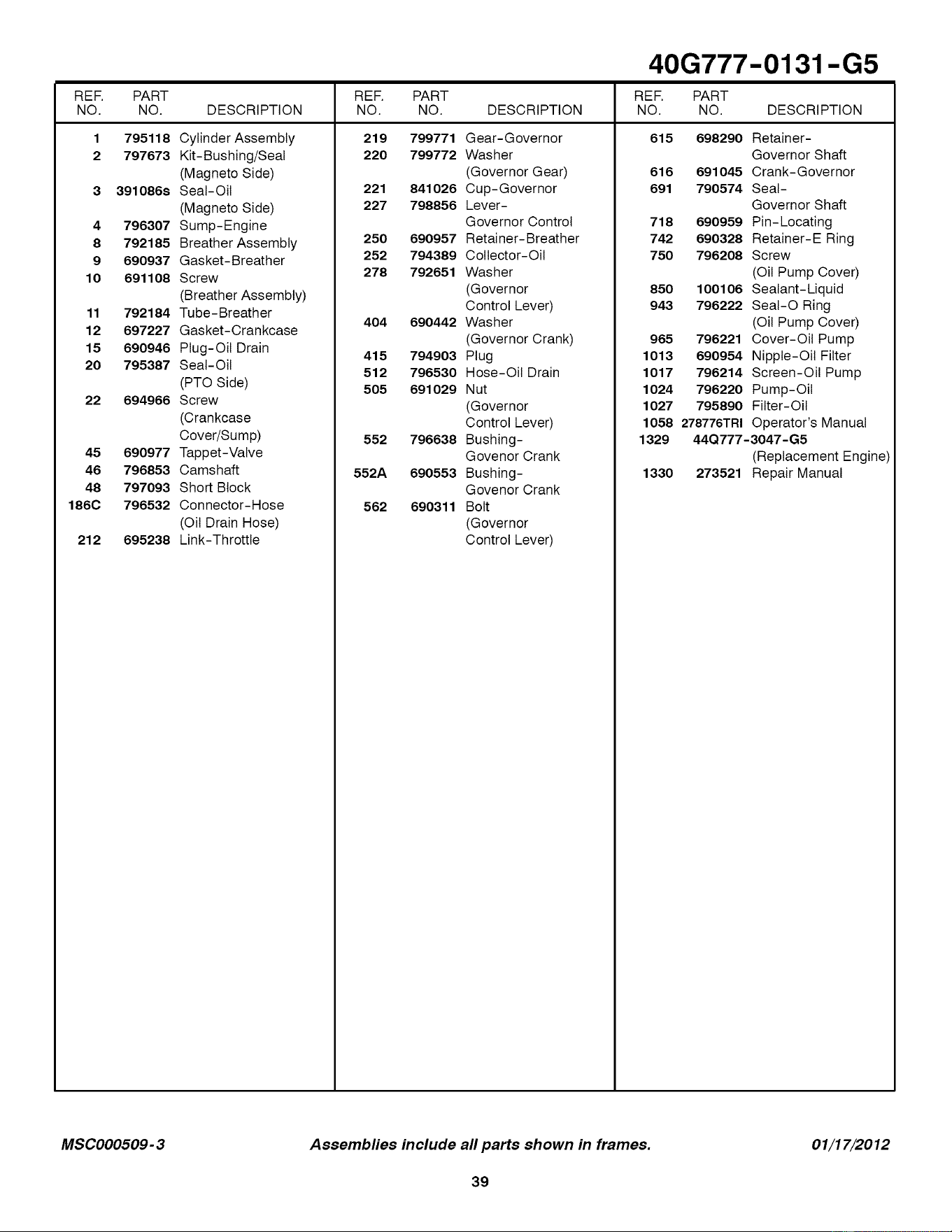
40G777-0131 -G5
REF. PART REF. PART REF. PART
NO. NO. DESCRIPTION NO. NO. DESCRIPTION NO. NO. DESCRIPTION
615 6982901
2
795118
797673
391086s
4 796307
8 792185
9 690937
10 691108
11 792184
12 697227
15 690946
20 795387
22 694966
45 690977
46 796853
48 797093
186C 796532
212 695238
Cylinder Assembly
Kit-Bushing/Seal
(Magneto Side)
Seal-Oil
(Magneto Side)
Sump-Engine
Breather Assembly
Gasket-Breather
Screw
(Breather Assembly)
Tube-Breather
Gasket-Crankcase
Plug-Oil Drain
Seat-Oil
(PTO Side)
Screw
219 799771
220 799772
221 841026
227 798856
250 690957
252 794389
278 792651
404 690442
415 794903
512 796530
505 691029
Gear-Governor
Washer
(Governor Gear)
Cup-Governor
Lever-
Governor Control
Retainer-Breather
Collector-Oil
Washer
(Governor
Control Lever)
Washer
(Governor Crank)
Plug
Hose-Oil Drain
Nut
(Governor
Retainer-
Governor Shaft
616 691045 Crank-Governor
691 790574 Seal-
Governor Shaft
718 690959 Pin-Locating
742 690328 Retainer-E Ring
750 796208 Screw
(Oil Pump Cover)
850 100106 Sealant-Liquid
943 796222 SeaI-O Ring
(Oil Pump Cover)
965 796221 Cover-Oil Pump
1013 690954 Nipple-Oil Filter
1017 796214 Screen-Oil Pump
1024 796220 Pump-Oil
1027 795890 Filter-Oil
(Crankcase
Cover/Sump)
Tappet-Valve
Camshaft
Short Block
Connector-Hose
(Oil Drain Hose)
Link-Throttle
552 796638
552A 690553
562 690311
ControlLever)
Bushing-
Govenor Crank
Bushing-
Govenor Crank
Bolt
(Governor
Control Lever)
1058 278776TRI Operator's Manual
1329 44Q777-3047-G5
(Replacement Engine)
1330 273521 Repair Manual
MSC000509- 3
Assembfies include all parts shown in frames. 01/17/2012
39
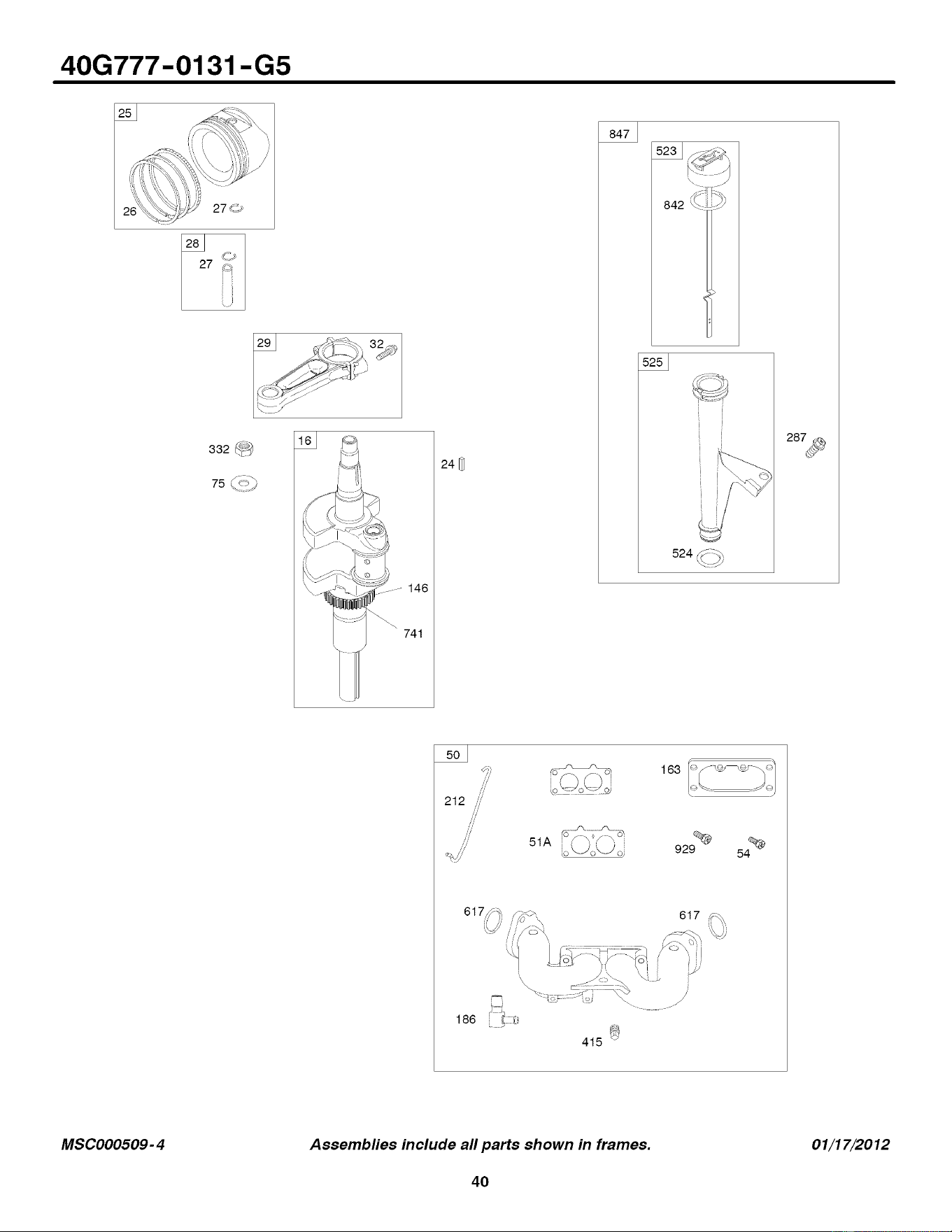
40G777-0131 -G5
332_
75 ,_. C.j
29J ,¢,/_1;_ -_%_ 32_,_)
146
741
24
842
287 @
O
_oj
//,
212 ,,:i/
//
51A
163
929 _4_
617
i=J
186 _:#
415
MSC000509- 4
Assembfies include all parts shown in frames. 01/17/2012
40
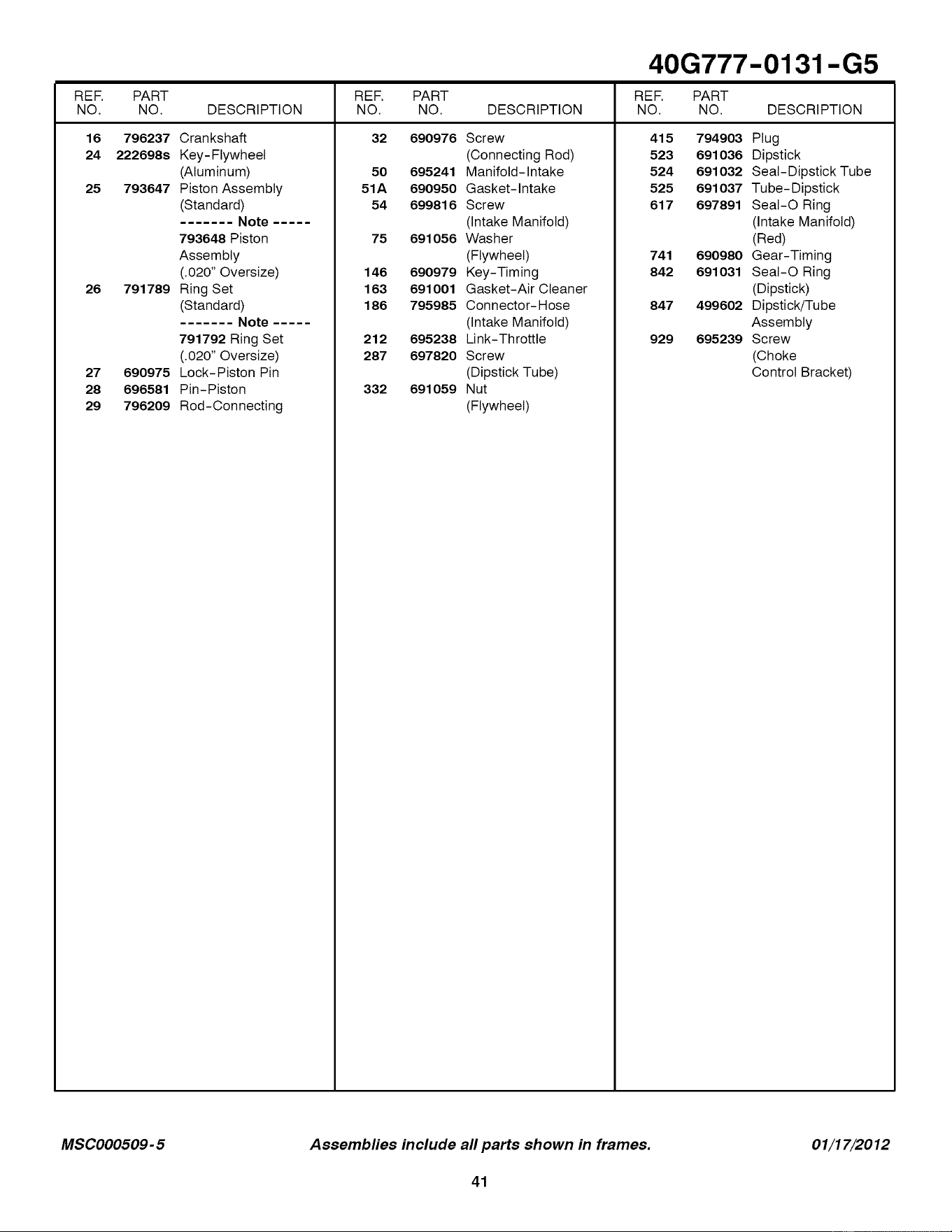
40G777-0131 -G5
REF. PART REF. PART REF. PART
NO. NO. DESCRIPTION NO. NO. DESCRIPTION NO. NO. DESCRIPTION
32 69097616 796237
24 222698s
25 793647
26 791789
27 690975
28 696581
29 796209
Crankshaft
Key-Flywheel
(Aluminum)
Piston Assembly
(Standard)
....... Note .....
793648 Piston
Assembly
(.020" Oversize)
Ring Set
(Standard)
....... Note .....
791792 Ring Set
(,020" Oversize)
Lock-Piston Pin
Pin-Piston
Rod-Connecting
Screw
(Connecting Rod)
50 695241 Manifold-Intake
51A 690950 Gasket-Intake
54 699816 Screw
(Intake Manifold)
75 691056 Washer
(Flywheel)
146 690979 Key-Timing
163 691001 Gasket-Air Cleaner
186 795985 Connector-Hose
(Intake Manifold)
212 695238 Link-Throttle
287 697820 Screw
(Dipstick Tube)
332 691059 Nut
(Flywheel)
415 794903
523 691036
524 691032
525 691037
617 697891
741 690980
842 691031
847 499602
929 695239
Plug
Dipstick
Seal- Dipstick Tube
Tube-Dipstick
Seal-O Ring
(Intake Manifold)
(Red)
Gear-Timing
Seal-O Ring
(Dipstick)
Dipstick/Tube
Assembly
Screw
(Choke
Control Bracket)
MSC000509- 5
Assembfies include all parts shown in frames. 01/17/2012
41
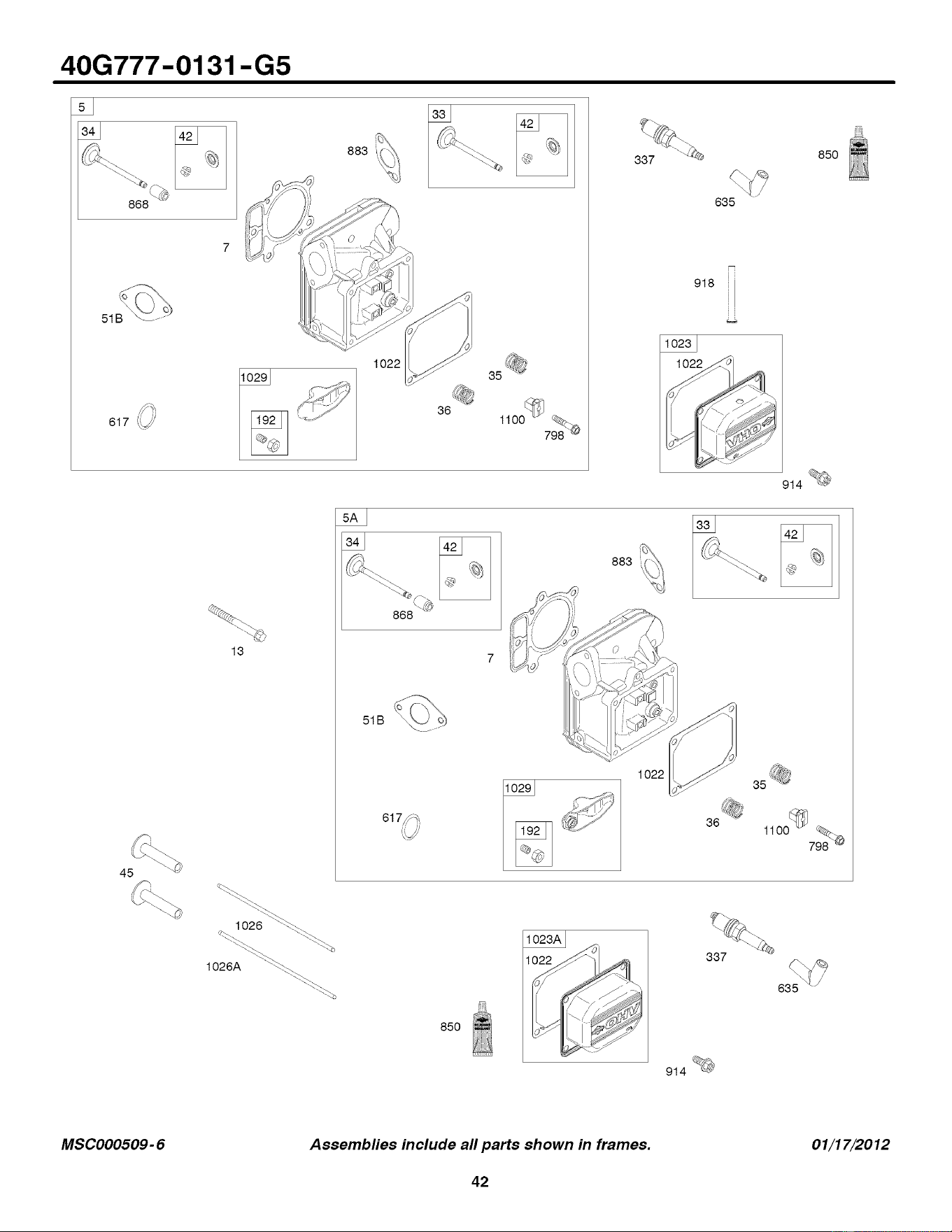
40G777-0131 -G5
868
883
617
1022
635
918 _
1
85O
914 _
45
13
1026 "\_\.
-_-\. \-_.
1026A "\'\._..
868
883
51B
1022
85O
1023,_
1022
337
635
914
MSC000509- 6
Assembfies include all parts shown in frames. 01/17/2012
42
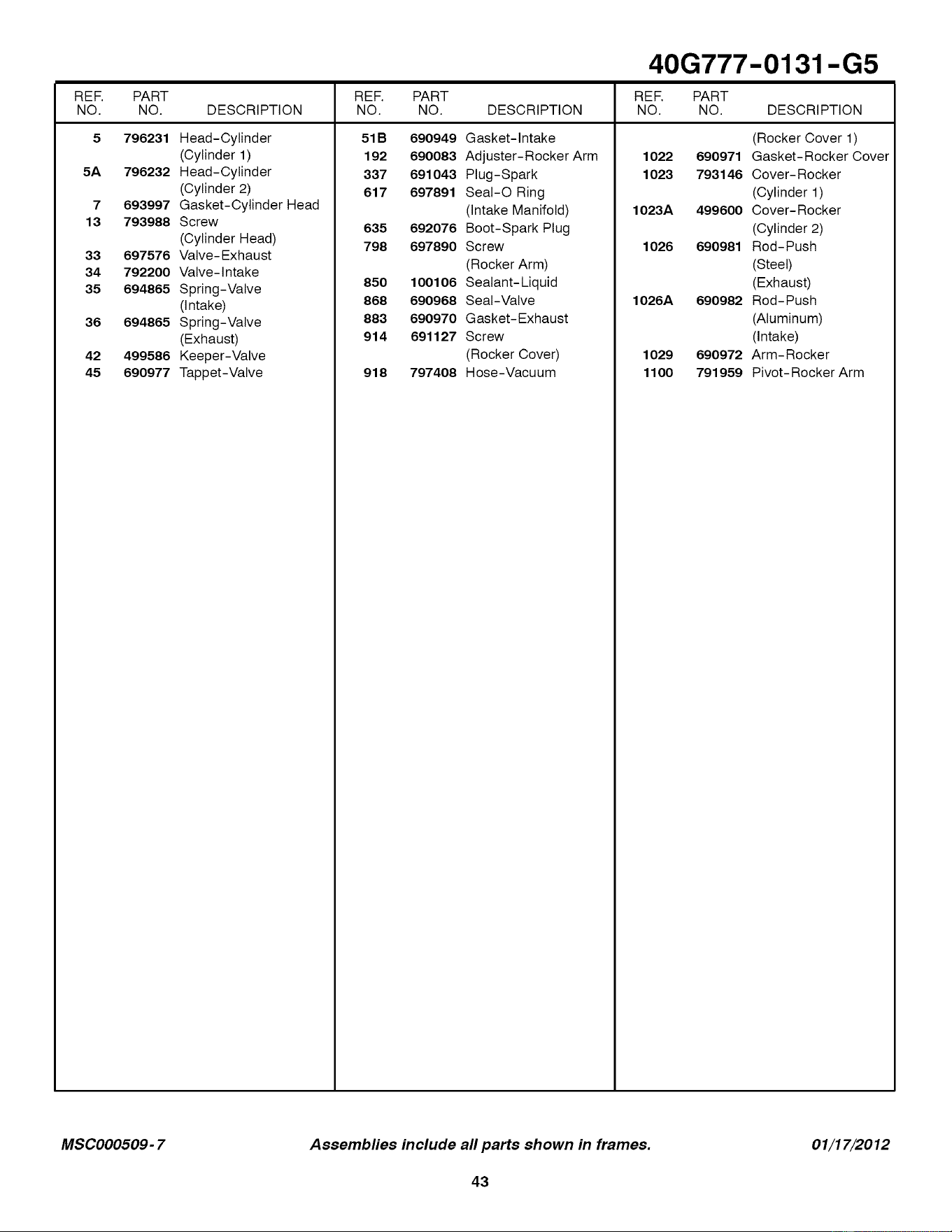
40G777-0131 -G5
PART REF. PART REF. PART
NO. DESCRIPTION NO. NO. DESCRIPTION NO. NO. DESCRIPTION
RER
NO.
5 796231 Head-Cylinder
(Cylinder 1)
5A 796232 Head-Cylinder
(Cylinder 2)
7 693997 Gasket-Cylinder Head
13 793988 Screw
(Cylinder Head)
33 697576 Valve-Exhaust
34 792200 Valve-Intake
35 694865 Spring-Valve
(Intake)
36 694865 Spring-Valve
(Exhaust)
42 499586 Keeper-Valve
45 690977 Tappet-Valve
51B 690949 Gasket-Intake
192 690083 Adjuster-Rocker Arm
337 691043 Plug-Spark
617 697891 Seal-O Ring
(Intake Manifold)
635 692076 Boot-Spark Plug
798 697890 Screw
(Rocker Arm)
850 100106 Sealant-Liquid
868 690968 Seal-Valve
883 690970 Gasket-Exhaust
914 691127 Screw
(Rocker Cover)
918 797408 Hose-Vacuum
(Rocker Cover 1)
1022 690971 Gasket-Rocker Cover
1023 793146 Cover-Rocker
(Cylinder 1)
1023A 499600 Cover-Rocker
(Cylinder 2)
1026 690981 Rod-Push
(Steel)
(Exhaust)
1026A 690982 Rod-Push
(Aluminum)
(Intake)
1029 690972 Arm-Rocker
1100 791959 Pivot-Rocker Arm
MSC000509-7
Assembfies include all parts shown in frames. 01/17/2012
43
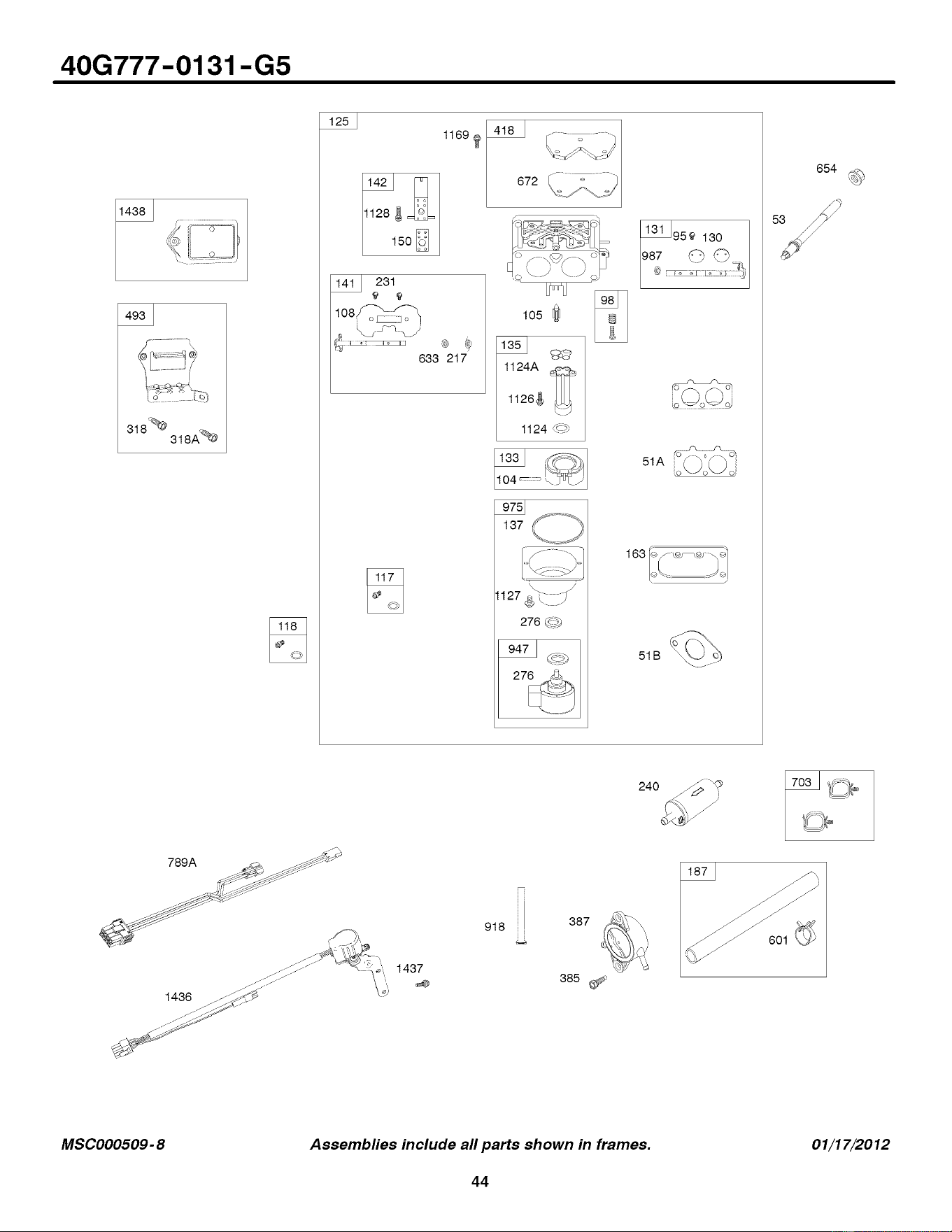
40G777-0131 -G5
318 _
318A%
1169
6o_
14_ 231
108_
®
633 217
672
105 [_
1124A
1126_
1124 '¢ _b
97_
137
276 _:_
947_ _
51A
163
654
24O
J
J
1436
918
387
1437
_,_3 385
MSC000509- 8
Assembfies include all parts shown in frames. 01/17/2012
44
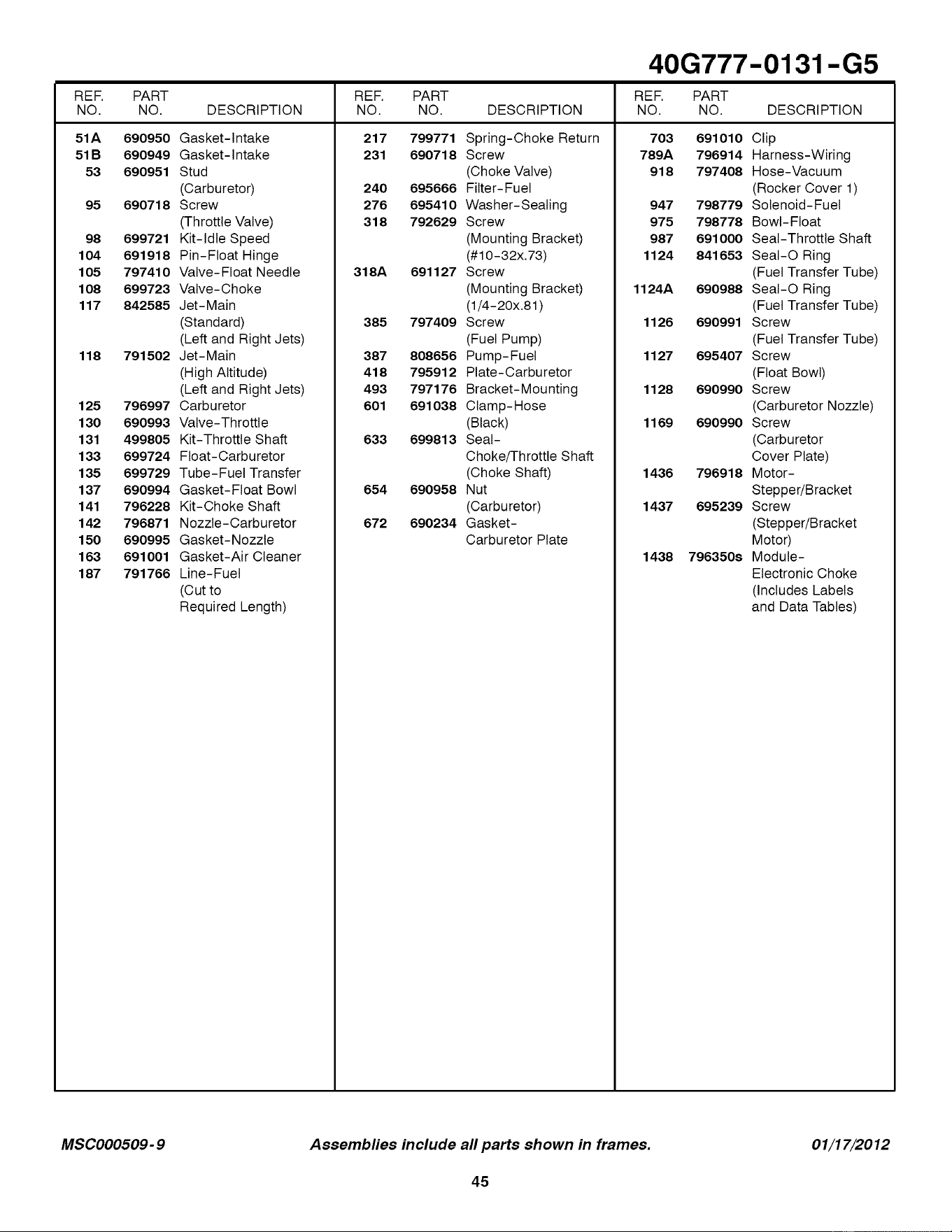
40G777-0131 -G5
REF. PART REF. PART
NO. NO. DESCRIPTION NO. NO. DESCRIPTION DESCRIPTION
51A 690950 Gasket-Intake
51B 690949 Gasket-Intake
53 690951 Stud
(Carburetor)
95 690718 Screw
(Throttle Valve)
98 699721 Kit-Idle Speed
104 691918 Pin-Float Hinge
105 797410 Valve-Float Needle
108 699723 Valve-Choke
117 842585 Jet-Main
(Standard)
(Left and Right Jets)
118 791502 Jet-Main
(High Altitude)
(Left and Right Jets)
125 796997 Carburetor
130 690993 Valve-Throttle
131 499805 Kit-Throttle Shaft
133 699724 Float-Carburetor
135 699729 Tube-Fuel Transfer
137 690994 Gasket-Float Bowl
141 796228 Kit-Choke Shaft
142 796871 Nozzle-Carburetor
150 690995 Gasket-Nozzle
163 691001 Gasket-Air Cleaner
187 791766 Line-Fuel
(Cut to
Required Length)
217 799771 Spring-Choke Return
231 690718 Screw
(Choke Valve)
240 695666 Filter-Fuel
276 695410 Washer-Seating
318 792629 Screw
(Mounting Bracket)
(#10-32x.73)
318A 691127 Screw
(Mounting Bracket)
(1/4-20x.81)
385 797409 Screw
(Fuel Pump)
387 808656 Pump-Fuel
418 795912 Plate-Carburetor
493 797176 Bracket-Mounting
601 691038 Clamp-Hose
(Black)
633 699813 Seal-
Choke/Throttle Shaft
(Choke Shaft)
654 690958 Nut
(Carburetor)
672 690234 Gasket-
Carburetor Plate
RER PART
NO. NO.
703 691010
789A 796914
918 797408
947 798779
975 798778
987 691000
1124 841653
1124A 690988
1126 690991
1127 695407
1128 690990
1169 690990
1436 796918
1437 695239
1438 796350s
Clip
Harness-Wiring
Hose-Vacuum
(Rocker Cover 1)
Solenoid-Fuel
Bowl-Float
Seal-Throttle Shaft
Seal-O Ring
(Fuel Transfer Tube)
Seal-O Ring
(Fuel Transfer Tube)
Screw
(Fuel Transfer Tube)
Screw
(Float Bowl)
Screw
(Carburetor Nozzle)
Screw
(Carburetor
Cover Plate)
Motor-
Stepper/Bracket
Screw
(Stepper/Bracket
Motor)
Module-
Electronic Choke
(Includes Labels
and Data Tables)
MSC000509-9
Assembfies include all parts shown in frames. 01_7/2012
45
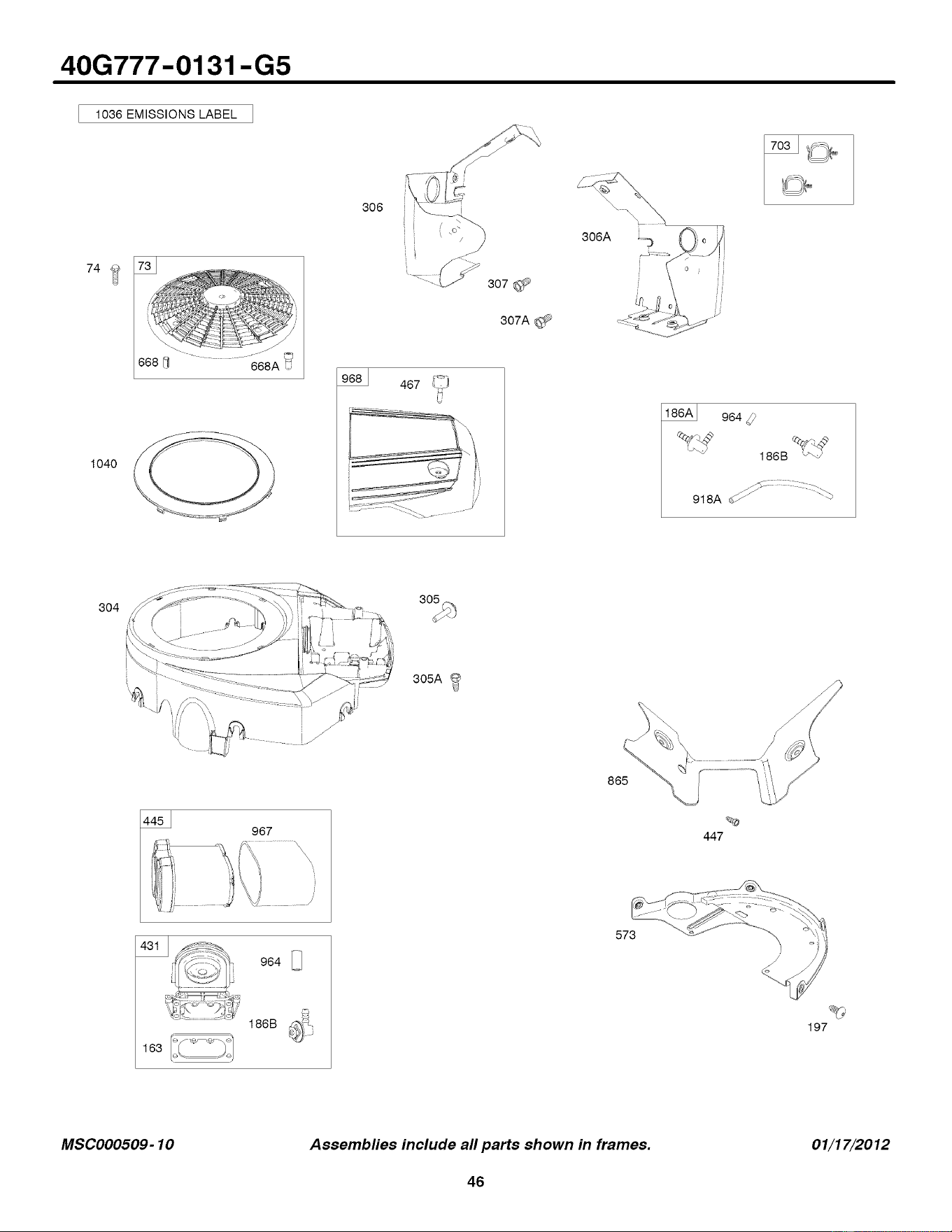
40G777-0131 -G5
1036 EMISSIONS LABEL
74?
1040
306
307
307A_
306A
186AJ 964
186B
918A
3O4
305
305A
967
865
447
163
964
186B
573
197
MSC000509 - 10
Assembfies include all parts shown in frames. 01/17/2012
46
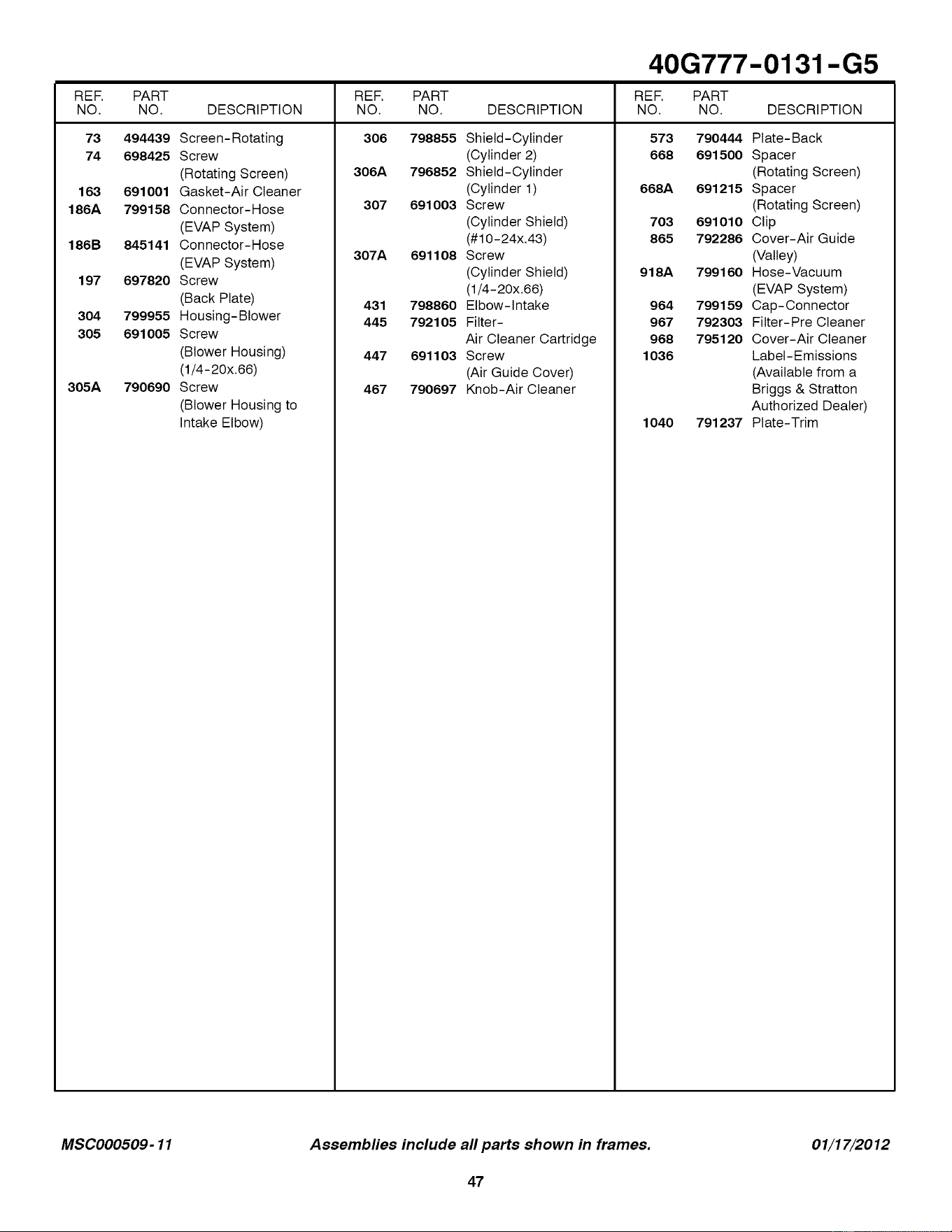
RER PART
NO. NO.
73 494439
74 698425
163 691001
186A 799158
186B 845141
197 697820
304 799955
305 691005
305A 790690
40G777-0131 -G5
DESCRIPTION DESCRIPTION DESCRIPTION
Screen- Rotating
Screw
(Rotating Screen)
Gasket-Air Cleaner
Connector-Hose
(EVAP System)
Connector-Hose
(EVAP System)
RER PART
NO. NO.
306 798855
306A 796852
307 691003
307A 691108
Shield-Cylinder
(Cylinder 2)
Shield-Cylinder
(Cylinder 1)
Screw
(Cylinder Shield)
(#10-24x.43)
Screw
(Cylinder Shield)
REF.
NO.
573
668
668A
703
865
918A
PART
NO.
790444
691500
691215
691010
792286
799160
Screw
(Back Plate)
Housing-Blower
Screw
(Blower Housing)
(1/4-20x.66)
Screw
(Blower Housing to
Intake Elbow)
431 798860
445 792105
447 691103
467 790697
(1/4-20x.66)
Elbow-Intake
Filter-
Air Cleaner Cartridge
Screw
(Air Guide Cover)
Knob-Air Cleaner
964
967
968
1036
1040
799159
792303
795120
791237
Plate-Back
Spacer
(Rotating Screen)
Spacer
(Rotating Screen)
Clip
Cover-Air Guide
(Valley)
Hose-Vacuum
(EVAP System)
Cap-Connector
Filter-Pre Cleaner
Cover-Air Cleaner
Label- Emissions
(Available from a
Briggs & Stratton
Authorized Dealer)
Plate-Trim
MSC000509-11
Assembfies include all parts shown in frames. 01/17/2012
47
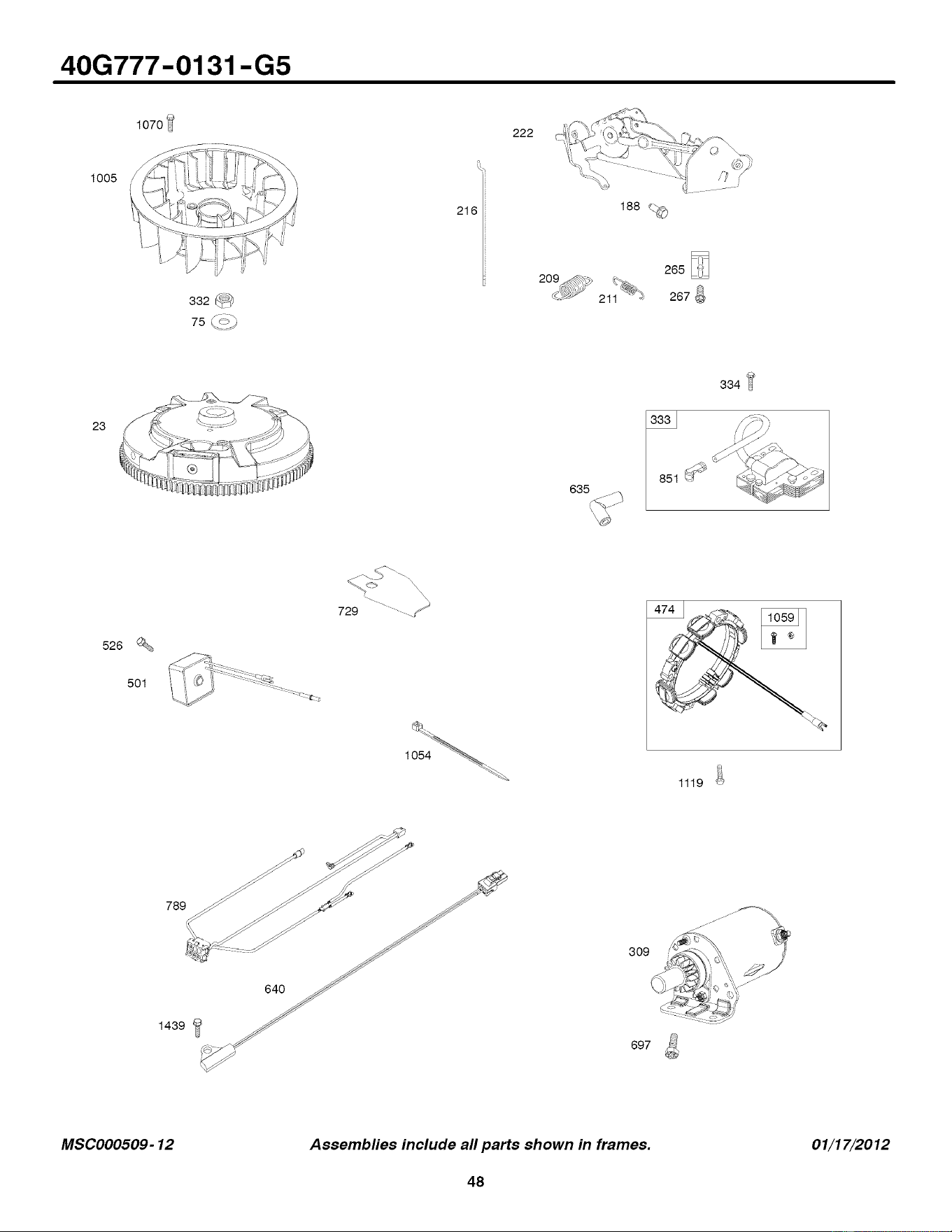
40G777-0131 -G5
1005
1070
216
222
188
209_ ""
d_ 21_;_
23
635
,_/>,
334
526
729 ....................,_
501
1119
309
697
MSC000509-12
Assembfies include all parts shown in frames. 01/17/2012
48
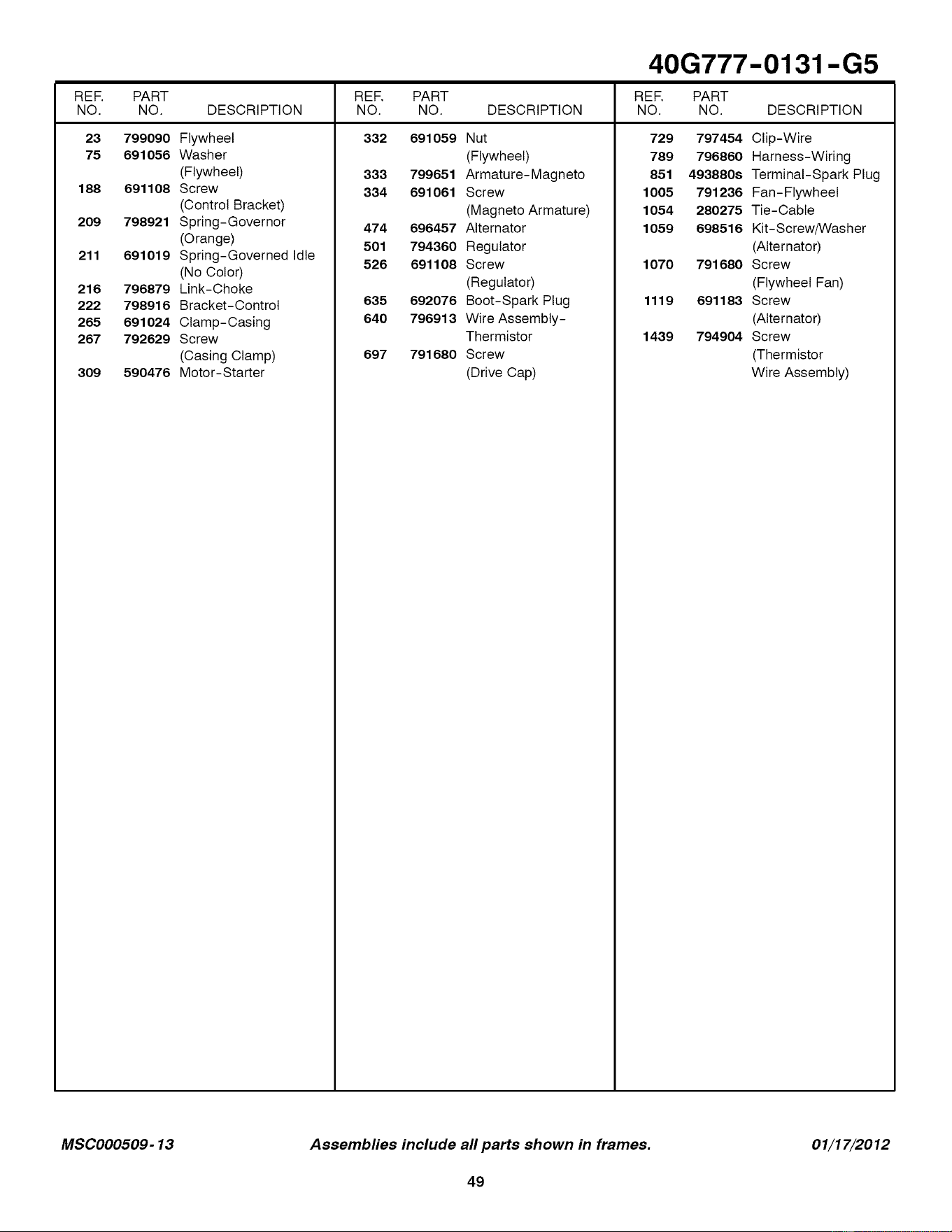
REE PART
NO. NO.
23 799090
75 691056
188 691108
209 798921
211 691019
216 796879
222 798916
265 691024
267 792629
309 590476
40G777-0131 -G5
REF. PART REF. PART
DESCRIPTION NO. NO. DESCRIPTION NO. NO. DESCRIPTION
332 691059
Flywheel
Washer
(Flywheel)
Screw
(Control Bracket)
Spring-Governor
(Orange)
Spring-Governed Idle
(No Color)
Link-Choke
Bracket-Control
Clamp-Casing
Screw
(Casing Clamp)
Motor-Starter
Nut
(Flywheel)
333 799651 Armature-Magneto
334 691061 Screw
(Magneto Armature)
474 696457 Alternator
501 794360 Regulator
526 691108 Screw
(Regulator)
635 692076 Boot-Spark Plug
640 796913 Wire Assembly-
Thermistor
697 791680 Screw
(Drive Cap)
729 797454
789 796860
851 493880s
1005 791236
1054 280275
1059 698516
1070 791680
1119 691183
1439 794904
Clip-Wire
Harness-Wiring
Terminal-Spark Plug
Fan- Flywheel
Tie-Cable
Kit-Screw/Washer
(Alternator)
Screw
(Flywheel Fan)
Screw
(Alternator)
Screw
(Thermistor
Wire Assembly)
MSC000509-13
Assembfies include all parts shown in frames. 01/17/2012
49
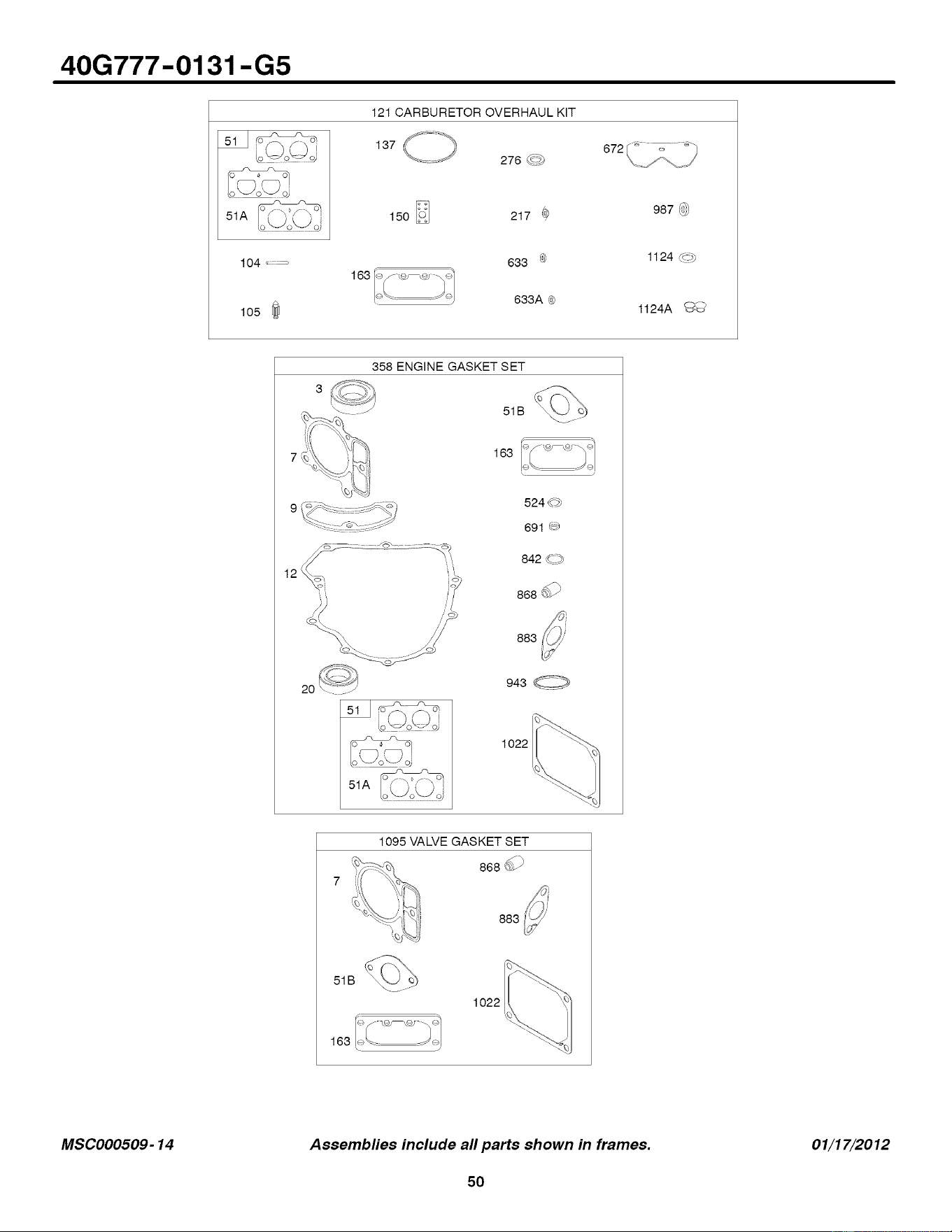
40G777-0131 -G5
121 CARBURETOR OVERHAUL KIT
137
276 _
104 .....
105
163
150 _ 217
987 @
1124 _)
1124A _
358 ENGINE GASKET SET
51B
163
524 <_
691 @
842 ((j_
868 _)
883
943 _
1022
51B
1095 VALVE GASKET SET
8o8_)
/
J
883 !_
1022
MSC000509-14
Assembfies include all parts shown in frames. 01/17/2012
50
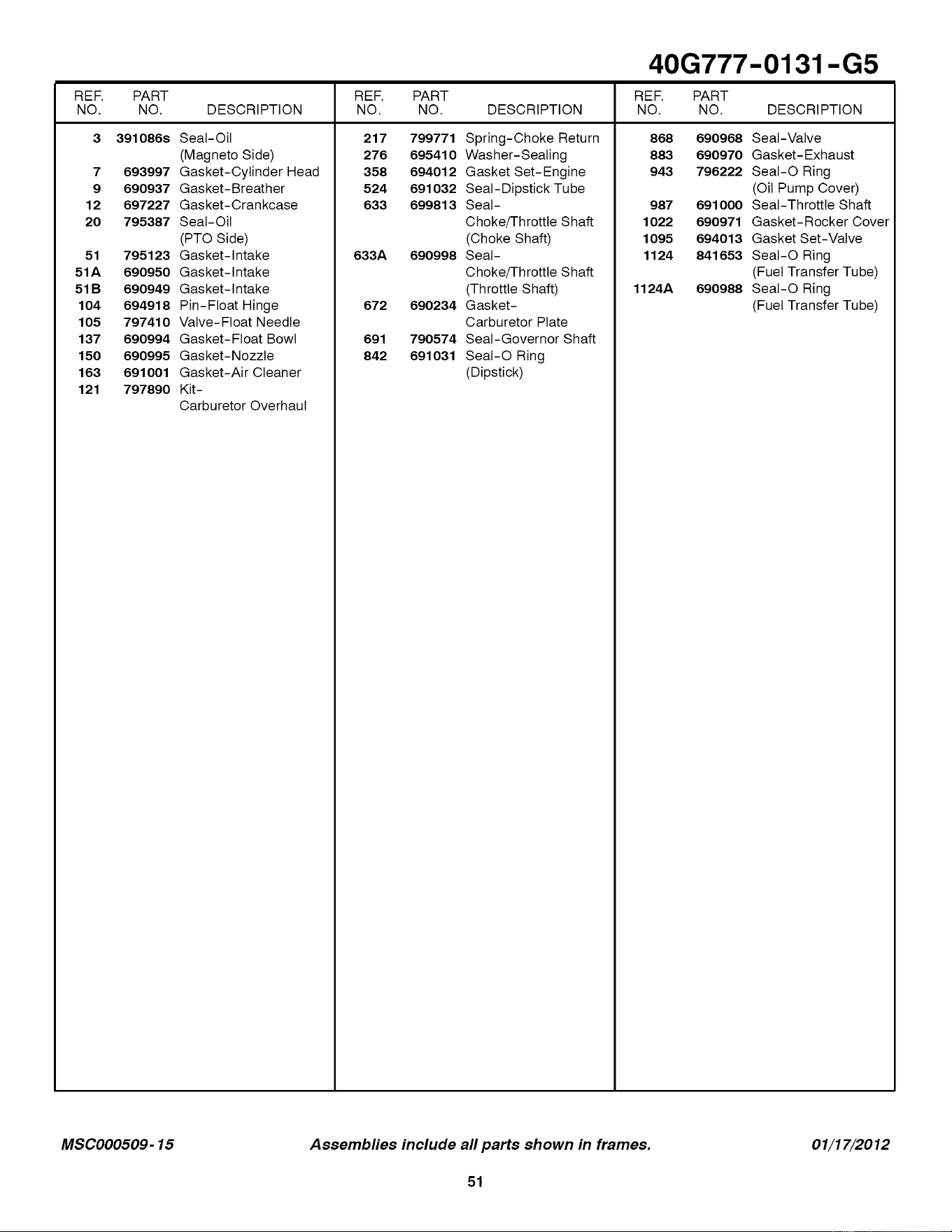
40G777-0131 -G5
REF. PART REF. PART REF. PART
NO. NO. DESCRIPTION NO. NO. DESCRIPTION NO. NO. DESCRIPTION
3 391086s
7 693997
9 690937
12 697227
20 795387
51 795123
51A 690950
51B 690949
104 694918
105 797410
137 690994
150 690995
163 691001
121 797890
Seal-Oil
(Magneto Side)
Gasket-Cylinder Head
Gasket-Breather
Gasket-Crankcase
Seal-Oil
(PTO Side)
Gasket-Intake
217 799771
276 695410
358 694012
524 691032
633 699813
633A 690998
Spring-Choke Return
Washer-Seating
Gasket Set-Engine
Seal-Dipstick Tube
Seal-
Choke/Throttle Shaft
(Choke Shaft)
Seal-
868 690968
883 690970
943 796222
987 691000
1022 690971
1095 694013
1124 841653
Gasket-Intake
Gasket-Intake
Pin-Float Hinge
Valve-Float Needle
Gasket-Float Bowl
Gasket-Nozzle
Gasket-Air Cleaner
Kit-
Carburetor Overhaul
672 690234
691 790574
842 691031
Choke/Throttle Shaft
(Throttle Shaft)
Gasket-
Carburetor Plate
Seal-Governor Shaft
Seat-O Ring
(Dipstick)
1124A 690988
Seal-Valve
Gasket- Exhaust
SeaI-O Ring
(Oil Pump Cover)
Seal-Throttle Shaft
Gasket-Rocker Cover
Gasket Set-Valve
SeaI-O Ring
(Fuel Transfer Tube)
SeaI-O Ring
(Fuel Transfer Tube)
MSC000509-15
Assembfies include all parts shown in frames. 01/17/2012
51
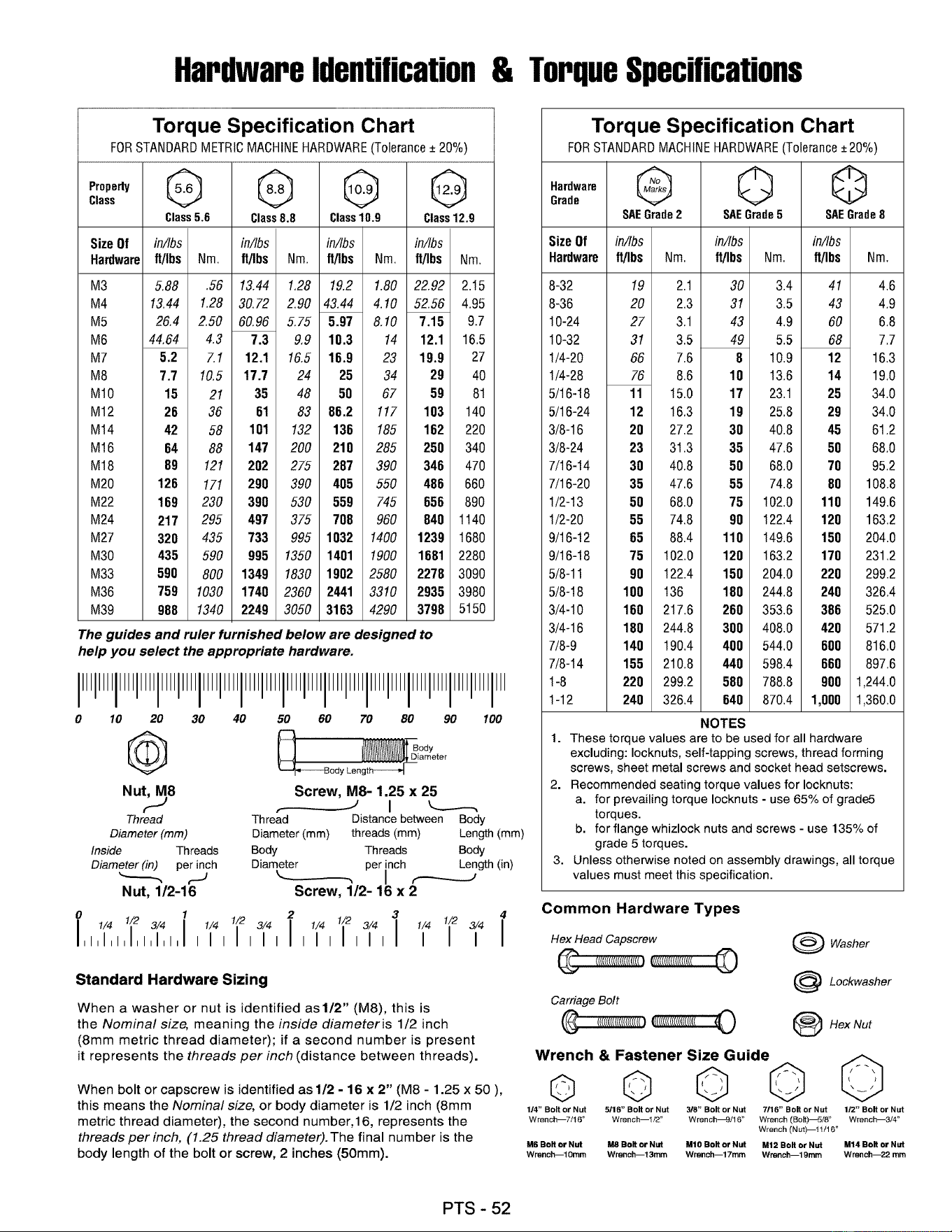
HardwareIdentification& TorqueSpecifications
Torque Specification Chart
FORSTANDARDMETRICMACHINEHARDWARE(Tolerance+ 20%)
Property
Class
SizeOf
Hardware
5.88
13.44
26.4
44,64
5.2
7.7
15
26
42
64
89
126
169
217
320
435
590
759
988
M3
M4
M5
M6
M7
M8
MIO
M12
M14
M16
M18
M20
M22
M24
M27
M30
M33
M36
M39
®
Class5.6
in/Ibs
ft/Ibs Nm.
.56
1,28
2.50
4,3
7,1
10,5
21
36
58
88
121
171
230
295
435
590
800
1030
1340
Q
Class8.8
in/Ibs
ft/lbs Nm.
13.44 1,28
30,72 2.90
60,96 5,75
7.3 9,9
12.1 16,5
17.7 24
35 48
61 83
101 132
147 200
202 275
290 390
390 530
497 375
733 995
995 1350
1349 1830
1740 2360
2249 3050
0
Class10.9
in/Ibs
ft/lbs Nm.
!9.2 1,80
43.44 4.10
5.97 8,10
10.3 14
16.9 23
25 34
50 67
86.2 117
136 185
210 285
287 390
405 550
559 745
708 960
1032 1400
1401 1900
1902 2580
2441 3310
3163 4290
0
Class12.9
in/Ibs
fl/Ibs
22,92
52.56
7.15
12.1
19.9
29
59
103
162
250
346
486
656
840
1239
1681
2278
2935
3798
The guides and ruler furnished below are designed to
help you select the appropriate hardware.
IIIIIIIIIIIIIIIIIIIII
0 10 20 30
©
Nut__.M8
Thread
Diameter (mm)
Inside Threads
Diameter (in) per inch
Nut, 1/2-16
0 1/2 1
Illllll Illllll I
Nrn.
2.15
4.95
9,7
16.5
27
4O
81
140
220
34O
470
66O
890
1140
1680
2280
3090
3980
5150
40 50 60 70 80 90 100
ody
!tllllllllllllllll[lllUr_LD_iam eter
Body Length-----_
Screw, MS- 1.25 x 25
I L___.--,
Thread Distance between Body
Diameter(ram) threads (ram) Length(mm)
Body Threads Body
Diameter per inch Length(in)
Screw, i/2- 1 x 2
2 3 4
'i '; I '; 'i '; I '; 'i i I
Standard Hardware Sizing
When a washer or nut is identified as1/2" (M8), this is
the Nominal size, meaning the inside diameteris 1/2 inch
(8mm metric thread diameter); if a second number is present
it represents the threads per inch (distance between threads).
When bolt or capscrew is identified as1/2 - 16 x 2" (M8 - 1.25 x 50 ),
this means the Nominal size, or body diameter is 1/2 inch (8mm
metric thread diameter), the second number,16, represents the
threads per inch, (1.25 thread diameter). The final number is the
body length of the bolt or screw, 2 inches (50mm).
Torque Specification Chart
FORSTANDARDMACHINEHARDWARE(Tolerance+ 20%)
_rarddware 0 0 0
SAEGrade2 SAEGrade5 SAEGrade8
SizeOf in/Ibs in/Ibs in/Ibs
Hardware ft/Ibs Nm. ft/Ibs Nm. ft/Ibs Nm.
8-32
8-36
10-24
10-32
1/4-20
1/4-28
5/16-18
5/16-24
3/8-16
3/8-24
7/16-14
7/16-20
1/2-13
1/2-20
9/16-12
9/16-18
5/8-11
5/8-18
3/4-10
3/4-16
7/8-9
7/8-14
1-8
1-12
19 2.1
20 2.3
27 3.1
31 3.5
66 7.6
76 8.6
11 15.0
12 16.3
20 27.2
23 31.3
30 40.8
36 47.6
50 68.0
55 74.8
65 88.4
75 102.0
90 122.4
100 136
160 217.6
100 244.8
140 190.4
155 210.8
220 299.2
240 326.4
1. These torque
30 3.4
31 3.5
43 4.9
49 5.5
8 10.9
10 13.6
17 23.1
19 25.8
30 40.8
35 47.6
50 68.0
55 74.8
75 102.0
90 122.4
110 149.6
120 163.2
150 204.0
100 244.8
260 353.6
300 408.0
400 544.0
440 598.4
580 788.8
640 870.4
41 4.6
43 4.9
60 6.8
68 7.7
12 163
14 19.0
25 34.0
29 34.0
45 61.2
50 68,0
70 95.2
80 108.8
110 149.6
120 163.2
150 204.0
170 231.2
220 299.2
240 326.4
386 525.0
420 571.2
600 816,0
660 897.6
900 1,244.0
1,000 1360,0
NOTES
values are to be used for all hardware
excluding: Iocknuts, self-tapping screws, thread forming
screws, sheet metal screws and socket head setscrews.
2. Recommended seating torque values for Iocknuts:
a. for prevailing torque Iocknuts - use 65% of grade5
torques.
b. for flange whizlock nuts and screws - use 135% of
grade 5 torques.
3. Unless otherwise noted on assembly drawings, all torque
values must meet this specification.
Common Hardware Types
Hex Head Capscrew
C (((((((((((((((((l((,{((((((((((((((((((0
Carriage Belt
(_ ((((((((((((((((((((} ((((((((((((((((({((0
Washer
Lockwasher
O Hex Nut
Wrench & Fastener Size Guide
o o 0 ©
114" Bolt of Nut 5116" Bolt or Nut 3/8" Bolt or Nut 7116" Bolt or Nut
Wrench--7/16 ° Wrench--I/2 ° Wrench_/16" Wrench (Bolt)_/8"
Wrench (N ut)--I 1/16"
M6 Bolt or Nut M8 Bolt or Nut MIO Bolt or Nut M1 2 Bolt or Nut
Wrench---lOmm Wmnch--13mm Wmnch--17mm Wrench--19mm
1/2 '_ Bolt or Nut
Wrench--3/4"
M14 Bolt or Nut
Wrench--22 mm
PTS - 52
Manual Del Due_o
CRRFTSMRH°
CTX 9000 Tractor para c_sped
Modelo N-°
107.250040 (20HP brutos Briggs & Stratton con cortacesped de 42 pulg.)
Para obtener respuestas a sus preguntas
sobre este producto, Ilame al: Linea de ayuda
de Sears Craftsman 1-800-659-5917.
Sears Brands Management Corporation, Hoffman Estates, IL 60179 EE. UU
Visite nuestro sitio Web de Craftsman: www.craftsman.com

Tapa delantera ............................................................................................................ 1
Seguridad del operador ............................................................................................. 4
Caracter_sticas y controles ..................................................................................... 10
Funcionamiento ........................................................................................................ 13
Pruebas del sistema de interbloqueo de seguridad ............................................ 13
Mantenimiento .......................................................................................................... 18
Soluci6n de problemas ............................................................................................ 28
Especificaciones ...................................................................................................... 30
Garant_a..................................................................................................................... 31
Acuerdos de proteccibn para reparaciones .......................................................... 32
Repuestos ........................................................................................................... PTS-1
Gracias por haber adquirido este cortacesped CRAFTSMAN de alta calidad. Le agradecemos la confianza que
ha depositado en la marca CRAFTSMAN. Si usa y realiza el mantenimiento del equipo de conformidad con las
instrucciones de este manual, su producto CRAFTSMAN le ofrecerb, muchos ahos de funcionamiento fiable.
Este manual contiene informaci6n de seguridad para advertirle sobre los peligros y riesgos asociados con el
cortacesped y c6mo evitarlos. Este producto y sus accesorios aprobados estb.n disehados solamente para cortar
cesped o retirar nieve, y no tienen otra finalidad. Es importante que lea y comprenda estas instrucciones con
detenimiento antes de proceder a arrancar o hacer funcionar este equipo. Conserve estas instrucciones originales
para consultarlas en el futuro.
D6nde encontrarnos
No tendra que buscar mucho para encontrar el servicio y mantenimiento para su cortacesped CRAFTSMAN. Existen
distribuidores de servicio tecnico autorizados en todo el mundo que ofrecen un servicio de calidad. Puede ponerse
en contacto con el Servicio al Cliente Ilamando al (800) 659-5917, o Iocalizar un distribuidor en Internet en www.
craftsman.com.
Cortac6sped
NOmero de modelo
NOmero de serie
Motor
Corte del tipo de modelo
Fecha de c6digo
Fecha de compra
3
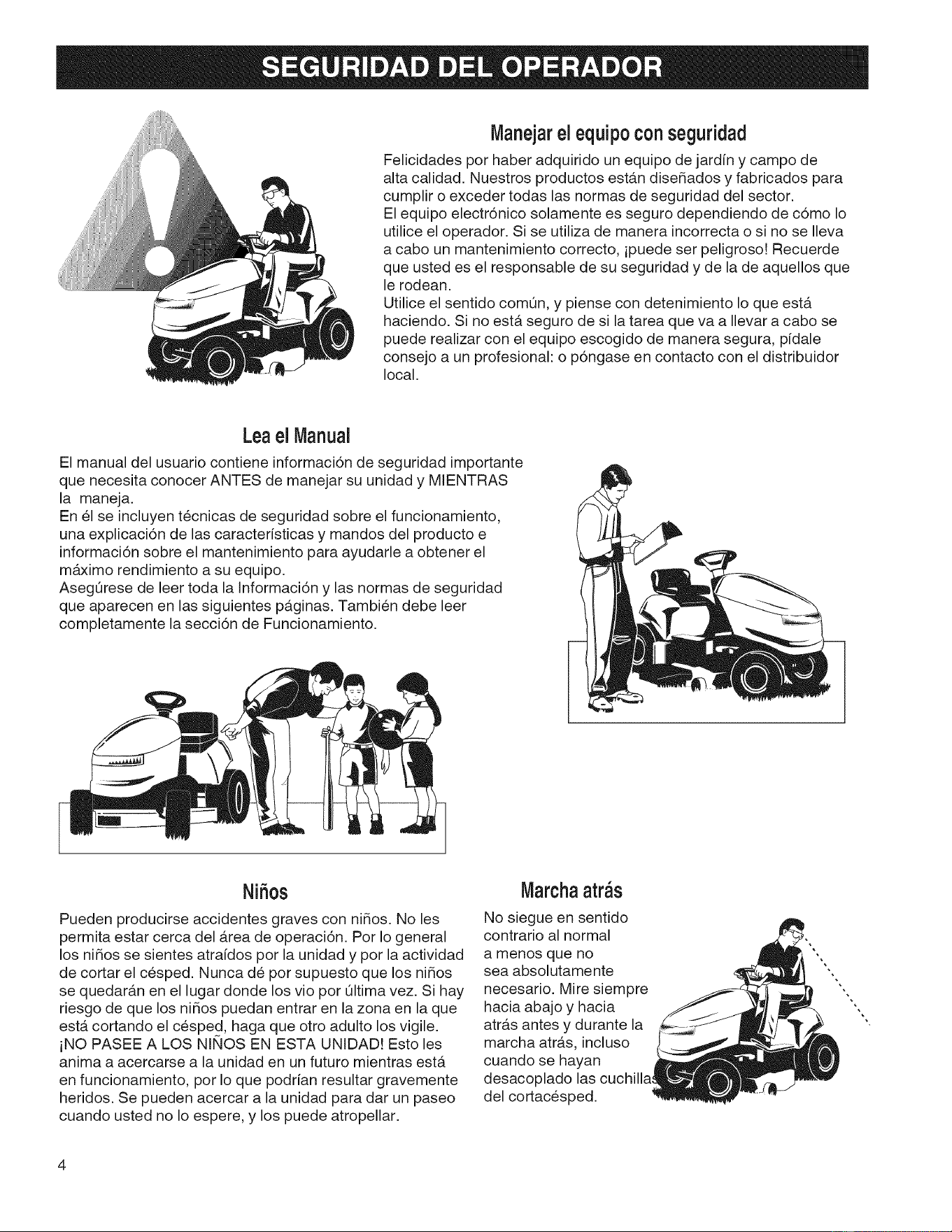
Manejarelequipoconseguridad
Felicidades por haber adquirido un equipo de jardin y campo de
alta calidad. Nuestros productos estAn dise_ados y fabricados para
cumplir o exceder todas las normas de seguridad del sector.
El equipo electr6nico solamente es seguro dependiendo de c6mo Io
utilice el operador. Si se utiliza de manera incorrecta o si no se Ileva
a cabo un mantenimiento correcto, ipuede set peligroso! Recuerde
que usted es el responsable de su seguridad y de la de aquellos que
le rodean.
Utilice el sentido comQn, y piense con detenimiento Io que estA
haciendo. Si no estA seguro de si la tarea que va a Ilevar a cabo se
puede realizar con el equipo escogido de manera segura, pfdale
consejo a un profesionah o p6ngase en contacto con el distribuidor
local.
Leael Manual
El manual del usuario contiene informaci6n de seguridad importante
que necesita conocer ANTES de manejar su unidad y MIENTRAS
la maneja.
En 61se incluyen tecnicas de seguridad sobre el funcionamiento,
una explicaci6n de las caracterfsticas y mandos del producto e
informaci6n sobre el mantenimiento para ayudarle a obtener el
mAximo rendimiento a su equipo.
AsegL_rese de leer toda la Informaci6n y las normas de seguridad
que aparecen en las siguientes paginas. Tambien debe leer
completamente la secci6n de Funcionamiento.
NiSos
Pueden producirse accidentes graves con ni_os. No les
permita estar cerca del Area de operaci6n. Por Io general
los ni_os se sientes atrafdos por la unidad y pot la actividad
de cortar el cesped. Nunca de por supuesto que los ni_os
se quedaran en el lugar donde los vio pot L_ltimavez. Si hay
riesgo de que los nihos puedan entrar en la zona en la que
esta cortando el cesped, haga que otto adulto los vigile.
iNO PASEE A LOS NINOS EN ESTA UNIDAD! Esto les
anima a acercarse a la unidad en un futuro mientras esta
en funcionamiento, pot Io que podrfan resultar gravemente
heridos. Se pueden acercar a la unidad para dar un paseo
cuando usted no Io espere, y los puede atropellar.
Marchaatras
No siegue en sentido
contrario al normal
a menos que no
sea absolutamente
necesario. Mire siempre
hacia abajo y hacia
atras antes y durante la
marcha atras, incluso
cuando se hayan
desacoplado
del cortacesped.
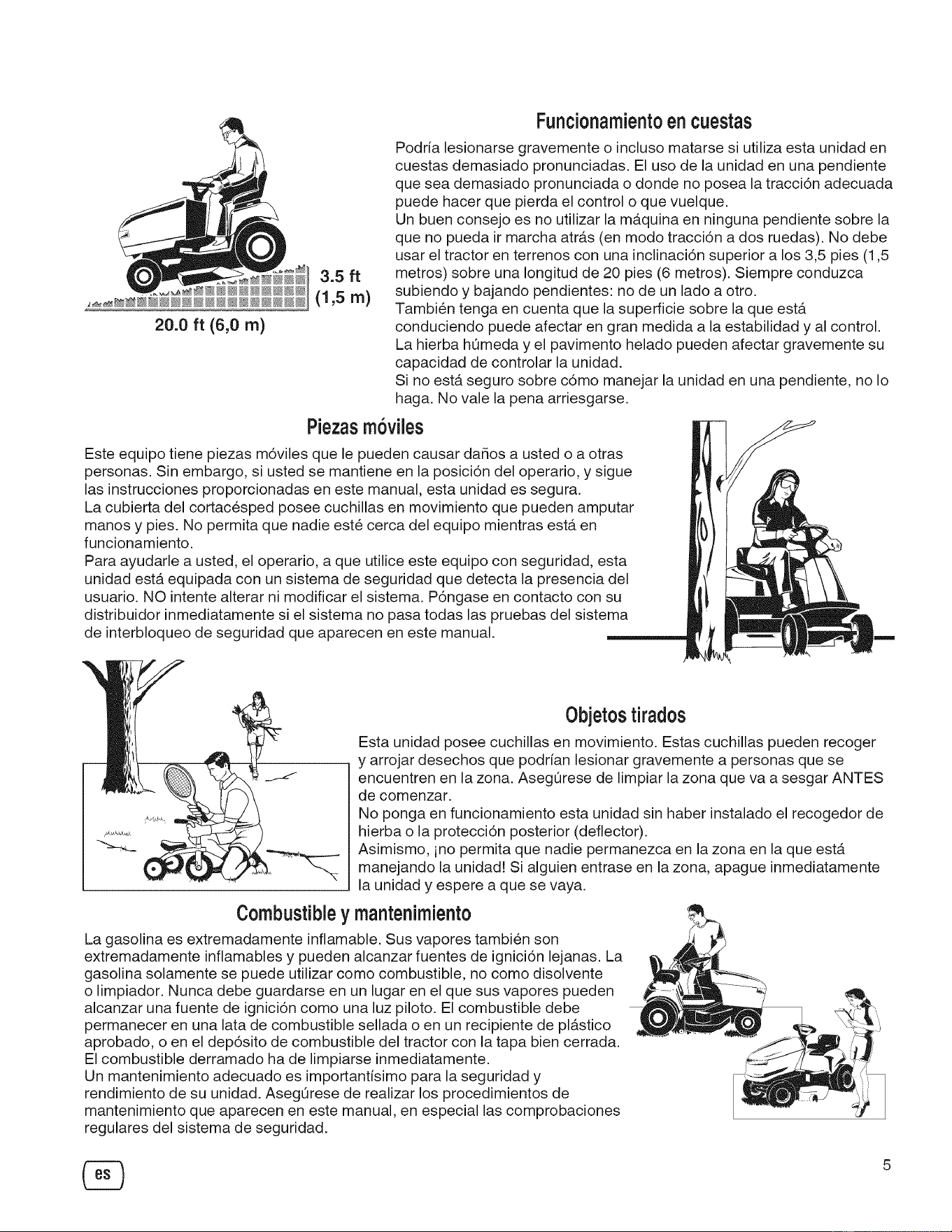
Funcionamientoencuestas
20.0 ft (6,0 rn)
Podria lesionarse gravemente o incluso matarse si utiliza esta unidad en
cuestas demasiado pronunciadas. El uso de la unidad en una pendiente
que sea demasiado pronunciada o donde no posea la tracci6n adecuada
puede hacer que pierda el control o que vuelque.
Un buen consejo es no utilizar la maquina en ninguna pendiente sobre la
que no pueda ir marcha atras (en modo tracci6n a dos ruedas). No debe
usar el tractor en terrenos con una inclinaci6n superior a los 3,5 pies (1,5
3.5 ft metros) sobre una Iongitud de 20 pies (6 metros). Siempre conduzca
(1,5 m) subiendo y bajando pendientes: no de un lado a otto.
Tambien tenga en cuenta que la superficie sobre la que esta
conduciendo puede afectar en gran medida a la estabilidad y al control.
La hierba hOmeda y el pavimento helado pueden afectar gravemente su
capacidad de controlar la unidad.
Si no esta seguro sobre c6mo manejar la unidad en una pendiente, no Io
haga. No vale la pena arriesgarse.
Piezasm6viles
Este equipo tiene piezas m6viles que le pueden causar da_os a usted o a otras
personas. Sin embargo, si usted se mantiene en la posici6n del operario, y sigue
las instrucciones proporcionadas en este manual, esta unidad es segura.
La cubierta del cortacesped posee cuchillas en movimiento que pueden amputar
manos y pies. No permita que nadie este cerca del equipo mientras esta en
funcionamiento.
Para ayudarle a usted, el operario, a que utilice este equipo con seguridad, esta
unidad esta equipada con un sistema de seguridad que detecta la presencia del
usuario. NO intente alterar ni modificar el sistema. P6ngase en contacto con su
distribuidor inmediatamente si el sistema no pasa todas las pruebas del sistema
de interbloqueo de seguridad que aparecen en este manual.
0bjetos tirados
Esta unidad posee cuchillas en movimiento. Estas cuchillas pueden recoger
y arrojar desechos que podrian lesionar gravemente a personas que se
encuentren en la zona. AsegOrese de limpiar la zona que va a sesgar ANTES
de comenzar.
No ponga en funcionamiento esta unidad sin haber instalado el recogedor de
._......... hierba o la protecci6n posterior (deflector).
_=_,- Asimismo, ino permita que nadie permanezca en la zona en la que esta
manejando la unidad! Si alguien entrase en la zona, apague inmediatamente
la unidad y espere a que se vaya.
Combustibley mantenimient0
La gasolina es extremadamente inflamable. Sus vapores tambien son
extremadamente inflamables y pueden alcanzar fuentes de ignici6n lejanas. La
gasolina solamente se puede utilizar como combustible, no como disolvente
o limpiador. Nunca debe guardarse en un lugar en el que sus vapores pueden
alcanzar una fuente de ignici6n como una luz piloto. El combustible debe
permanecer en una lata de combustible sellada o en un recipiente de pl_.stico
aprobado, o en el dep6sito de combustible del tractor con la tapa bien cerrada.
El combustible derramado ha de limpiarse inmediatamente.
Un mantenimiento adecuado es importantisimo para la seguridad y
rendimiento de su unidad. AsegOrese de realizar los procedimientos de
mantenimiento que aparecen en este manual, en especial las comprobaciones
regulates del sistema de seguridad.
5
Lea estas normas de seguridad y respetelas estrictamente. Et no respetar estas normas podda dar como resuttado la
perdida det control de la unidad, lesiones personales graves o la muerte del usuario o de terceros que se encuentren
cerca, o podr[a causar da_os en la propiedad o en el equipo. La cubJerta del cortacesped puede llegar a amputar
rnanos y pies y lanzar obietos. En et texto, et tri&nguto _ significa que debe seguir precauciones o advertencias
importantes.
FUNCIONAiVllENTO GENERAL
1. DeberA leer, comprender y seguir todas las instrucciones que
se contienen en el manual o en la propia unidad antes de
empezar a utilizarla.
2. No coloque las manos o pies cerca de componentes giratorios
ni debajo de la maquina. Mantengase lejos en todo momento de
la apertura de descarga.
3. Unicamente adultos responsables que esten familiarizados
con las instrucciones deber_.n hacer funcionar la unidad (la
normativa local puede imponer restricciones relativas a la edad
del operador).
4. Despeje la zona de objetos como son piedras, juguetes, cables,
etc. Esos objetos podrian set cogidos y lanzados pot la(s)
cuchilla(s).
5. Cerci6rese de que no hay personas en la zona de operaci6n
antes de empezar a utilizar la unidad. Detenga la unidad si
alguna persona entra en la zona de operaci6n.
6. Nunca Ileve en la unidad a nadie como pasajero.
7. No siegue en sentido contrario al normal a menos que no sea
absolutamente necesario. Mire siempre detrb.s y debajo antes
de desplazarse hacia atr_.s y durante esa operaci6n.
8. No realice la descarga en ningQn caso apuntando hacia una
persona en la operaci6n. No realice la descarga del material
contra una pared u otros elementos obstructivos. Los materiales
pueden rebotar hacia el usuario. Detenga la(s) cuchillas cuando
cruce sobre superficies con grava.
9. No haga funcionar la m_.quina sin que el recogedor de hierba,
la protecci6n posterior (deflector) y los dem_.s dispositivos de
seguridad esten en su lugar.
10. Reduzca antes de girar.
11. Nunca deje una unidad en funcionamiento sin vigilancia.
Siempre se deber_, desacoplar el PTO, poner el freno de
estacionamiento, apagar el motor y retirar las Ilaves antes de
proceder a desmontar la unidad.
12. Desacople las cuchillas (PTO) cuando no vaya a utilizar la
unidad. Apague el motor y espere hasta la completa detenci6n
de todos los componentes antes de proceder a limpiar la
m_.quina, retirar el recogedor de hierba o desbloquear la
protecci6n posterior.
13. Utilice la maquina s61o con la luz del dia o con buena
iluminaci6n artificial.
14. No utilice la unidad mientras este bajo los efectos del alcohol o
de drogas.
15 Mantengase alerta ante el tr_.fico cuando se halle cerca de vias
de comunicaci6n o cruce pot elias.
16. Tenga especial cuidado cuando cargue o descargue la unidad
de remolques o camiones.
17. Utilice siempre protecciones oculares cuando utilice la unidad.
18. Los datos indican que los operadores de 60 amos o m_.s estb.n
involucrados en gran parte de las lesiones relacionadas con
equipos motorizados. Estos operadores deberAn evaluar su
capacidad de operar el equipo de manera Io suficientemente
segura como para evitar lesiones, en ellos mismos o en
terceros.
19. Siga las recomendaciones del fabricante sobre los pesos y
contrapesos de las ruedas.
20. Tenga presente que el operador sr_. el responsable de los
accidentes que puedan sufrir otras personas o propiedades.
21. Quienes conduzcan la unidad deber_.n procurarse instrucci6n
practica profesional.
22. Deber_.n vestirse siempre calzado y pantalones robustos.
Nunca utilice la unidad con los pies desnudos o calzando
sandalias
23. antes de utilizar la unidad, siempre debera comprobar
visualmente que las cuchillas y los correspondientes
mecanismos estan en su sitio, intactos y bien firmes. Sustituya
los componentes gastados o da_ados.
24. Desacople los elementos anexos antes de realizar las
siguientes acciones: Ilenar el dep6sito de combustible, retirar
elementos anexos o realizar ajustes (a menos que el ajuste o
ajustes puedan set realizados desde la posici6n del operador).
25. AI estacionar, almacenar o dejar sin vigilancia la maquina,
baje los elementos de corte, a menos que se utilice un cierre
mecAnico efectivo.
26. Antes de abandonar pot cualquier causa la posici6n del
operador, ponga el freno de estacionamiento (si se dispone de
el), desacople el interruptor PTO, detenga el motor y saque la
Ilave.
27. Para reducir el riesgo de incendio, mantenga la unidad libre de
hierba, hojas o exceso de lubricantes. No detenga ni estacione
la unidad sobre hojas o hierba secas, ni sobre materiales
combustibles.
TRANSPORTE Y ALMACENAlVliENTO
1. Cuando transporte la unidad sobre un remolque abierto,
cerci6rese de estb, orientado hacia adelante, en la direcci6n del
viaje. Si la unidad esta orientada en el sentido contrario al de
marcha, el empuje del viento podria daSarla.
2. Siga siempre pr_.cticas seguras de repostaje y manipulaci6n
de combustible al cargar combustible en la unidad despues del
transporte o almacenaje.
3. No almacene la unidad (con combustible) en lugares cerrados
de pobre ventilaci6n. Los vapores del combustible pueden
Ilegar hasta una fuente de ignici6n (hornos, calentadores de
agua, etc.) y producir una explosi6n. El vapor del combustible
tambien es t6xico para los humanos y los animales.
4. Siempre siga las instrucciones de manual del motor para
preparaciones para almacenaje, antes de almacenar la unidad,
tanto para periodos cortos como largos.
5. Siempre siga las instrucciones del manual de motor para
procedimientos adecuados de arranque al colocar la unidad
nuevamente en servicio.
6. No almacene nunca la unidad o el dep6sito de combustible
en el interior de lugares en que haya llamas expuestas o luces
piloto, como es el caso de un calentador de agua. Deje que la
unidad se enfrie antes de preceder a su almacenamiento.
FUNCiONAMIENTO EN PENDIENTES
Las pendientes son un factor de gran p@dida en los casos de p@dida de
control yen los accidentes en los que vuelca el cortacesped, que pueden
resultar en lesiones graves o incluso la muerte. La operaci6n en todo tipo
de pendientes requiere una precauclon a_adida. Si no puede ir hacia
atrAs sobre una pendiente con el cortacesped o no se siente seguro
sobre la pendiente, no la utilice la unidad sobre ella.
El control de un tractor cortacesped que se deslice sobre una
pendiente no se recuperara mediante la aplicaci6n del freno. Las
principales causas de p@dida del control son: insuficiente agarre de
los neumAticos sobre el firme, el exceso de velocidad, la aplicaci6n
incorrecta del freno, la inadecuaci6n del mAquina para el uso concreto,
la incorrecta percepci6n de la condiciones del piso, o el engache o la
distribuci6n de cargas incorrectos.
1. Accione el cortacesped en pendientes, en subida y bajada y no
a Io ancho.
2. Preste atenci6n ante posibles hoyos, surcos o golpes. El
terreno irregular podria hacer que la unidad vuelque. H6gt grb.s
kan g6mma hinder.
3. Escoja una velocidad de segado que le permita no tenet que
detenerse o cambiar la velociad mientras este recorriendo la
pendiente.
4. No utilice el cortacesped sobre hierba hOmeda. Los neumAticos
podrian perder tracci6n.
5. Siempre mantenga la unidad con una marcha al bajar
las pendientes. No ponga el punto muerto para bajar pot
pendientes.
6. Evite arrancar, detenerse, o girar sobre las pendientes. Si los
neumAticos pierden tracci6n, desacople las cuchillas y contint_e
lentamente en linea recta hacia abajo.
7. Todo desplazamiento en pendientes deberA ser lento y gradual.
No realice cambios repentinos en la velocidad o en la direcci6n;
la maquina podria volcar.
8. Ponga la mayor atenci6n cuando haga funcionar la maquina
con recogedores de hierba u otros elementos acoplados;
pueden afectar a la estabilidad de la unidad. No utilice la
mAquina en pendientes pronunciadas.
9. No intente estabilizar la mAquina colocando su pie sobre el piso
(en unidades en las que el conductor va montado sobre elias).
10. No utilice el cortacesped cerca bajadas, zanjas o terraplenes. El
cortacesped podria volcar si una rueda se sitOa sobre el horde
de una zanja o risco, o si el horde cede.
11. No utilice recogedores de hierba en pendientes pronunciadas.
12. No realice la operaci6n de segado en pendientes si no puede ir
marcha atrAs sobre elias.
13. Consulte a su concesionario/vendedor autorizado para obtener
recomendaciones sobre pesos y contrapesos para las ruedas
para mejorar la estabilidad.
14. Retire obstAculos como son piedras, ramas de Arboles, etc.
15. Opere a bajas velocidades. Los neumAticos pueden perder
tracci6n en pendientes incluso si los frenos funcionan
adecuadamente.
16. No realice giros en pendientes a menos que ello sea necesario,
y, en ese caso, haga giros lentos y graduales, siempre
pendiente abajo si clio es posible.
17. Modelos con tracci6n alas cuatro ruedas: La tracci6n alas
cuatro ruedas mejora el acceso a terrenos con pendientes
peligrosas que aumenta la posibilidad de vuelco. Si la mAquina
se detiene mientras sube una pendiente, detenga las cuchillas
y retroceda lentamente. Evite realizar giros repentinos.
EQUIPO REIVIOLCADO (UNIDADES
MONTABLES)
1. Remolque solamente con una maquina que tenga un
enganche dise_ado para remolque. No sujete el equipo
remolcado a elementos que no sean el punto de enganche.
2. Siga las recomendaciones del fabricante en cuanto a los limites de
peso para equipos remolcados y remolque en pendientes.
3. No permita que que ni_os u otras personas se suban al equipo
remolcado.
4. Sobre las pendientes, el peso del equipo remolcado puede
causar p@dida de tracci6n y p@dida de control.
5. Vaya despacio y deje una distancia extra para poder parar.
6. No ponga el punto muerto para bajar pot pendientes.
ADVERTENCIA
Nunca opere en pendientes de m&s de117,6% (10°); esos
valores equivalen a un incremento vertical de 106 cm (3-1/2
pies) en un espacio horizontal de 607 cm (20 pies).
Cuando opere en pendientes utilice pesos y contrapesos
adicionales para las ruedas. Consutte a su concesionario/
vendedor para determinar que pesos apropiados se
encuentran disponibles para su unidad.
Seleccione una vetocidad de avance lenta antes de
empezar a subir una pendiente. Adem&s de los pesos
detanteros, debe emplearse una precauci6n especial
at operar en pendientes con recogedores de hierba de
enganche posterior.
Corte el cesped SUBIENDO y BAJANDO pendientes,
nunca de un costado a otro, ponga la mayor atenci6n
cuando cambie la direcci6n y NO ARRANQUE NI SE
DETENGA EN PENDIENTES.
Tragiska olyckor kan intr&ffa om anv&ndaren inte &r uppm&rksam pA
n&rvaron av barn. Los niSos suelen sentirse atraidos por la unidad y
por la actividad del cortacesped. Nunca de por supuesto que los niSos
se quedaran en el lugar donde los vio por 51tima vez.
1, Mantenga a los niSos fuera del Area de corte y bajo la vigilancia
atenta de otro adulto responsable.
2. Este atento y apague el equipo si entran niSos en la zona.
3, Antes y durante el avance marcha atras, mire atrAs y hacia
abajo para detectar la presencia de niSos.
4. Nunca Ileve ni_os en la unidad, ni siquiera sin la(s) cuchilla(s).
Los niSos podrian caerse y lesionarse gravemente, o interferir
en el seguro funcionamiento de la unidad. Los ni_os que
hayan montado en un cortacesped en otros momentos pueden
aparecer repentinamente en la zona en la que este cortando el
cesped para que los Ileve y pueden caerse o set atropellados
pot la maquina.
5. Nunca permita que ni_os hagan funcionar la unidad.
6. Tenga un especial cuidado al acercarse a esquinas ciegas,
arbustos, Arboles u otros objetos que puedan dificultar la visi6n.
EMiSIONES
1. El humo del motor de este producto contiene agentes quimicos
que se sabe que, en ciertas cantidades, pueden causar cancer,
malformaciones congenitas u otros perjuicios relacionados con
la salud reproductiva.
2. Busque informaci6n relevante de Periodo de Permanencia de
las Emisiones e Indice en el Aire en la etiqueta sobre emisiones
del motor.
SISTEMA DE IGNICION
1. Este sistema de encendido pot chispa cumple con la norma
ICEA-O02 canadiense.
7
REPARACION Y IVlANTENllVliENTO
S_ket hanteting av bensin
1. Apague todos los cigarrillos, puros, pipas y cualquier otra fuente
de ignici6n.
2. Utilice Onicamente contenedores de gasolina homologados.
3. No retire la tapa de la gasolina ni reponga combustible con el
motor en funcionamiento. L&t motorn svalna innan den fylls p&.
4. No Ilene el dep6sito de la m_.quina en espacios cerrados.
5. No guarde la m&quina ni el contenedor de carburante en
lugares en los en que haya llamas expuestas, se produzcan
chispas o haya luces pilotos, como es el caso calentadores de
agua u otros dispositivos.
6. Nunca Ilene recipientes dentro de un vehiculo o sobre el piso
de un cami6n o remolque con cobertores de pl_.stico. Siempre
coloque los contenedores sobre el suelo, lejos del vehiculo,
antes de proceder a Ilenarlos.
7. Retire del remolque o cami6n el equipamiento alimentado por
gasolina y reponga el carburante sobre el suelo. Si ello no es
posible, entonces abastezca el vehiculo sobre un remolque
con un contenedor port_.til, no con una boquilla de surtidor de
gasolina.
8. Mantenga la boquilla en contacto con el borde de la apertura
del tanque o recipiente de combustible en todo momento y
hasta haber completado la operaci6n de Ilenado. No utilice
dispositivos para bloquear y mantener abiertas boquillas.
9. Byt klb.der omg&ende om du spillt brb.nsle pb. klb.derna.
10. En ningOn caso deber_, superar el limite de Ilenado del dep6sito
de combustible. Vuelva a colocar la tapa del dep6sito y ajOstela
firmemente.
11. Emplee la mayor precauci6n cuando manipule gasolina u otros
elementos combustibles. Los carburantes son inflamables y sus
vapores, explosivos.
12. Si se derrama combustible, no intente poner el motor en
marcha; aleje la mb.quina del Area del derrame y evite cualquier
fuente de ignici6n hasta que se hayan disipado los vapores del
combustible.
13. Vuelva ajustar firmemente las tapas de los tanques y de los
contenedores de combustible.
Servicio tecnico y rnantenirniento
1. Nunca haga funcionar la unidad en espacios cerrados en los
que puedan acumularse el mon6xido de carbono.
2. Mantenga las tuercas y pernos, especialmente los pernos de
acomple de las cuchillas, apretados y mantenga el equipo en
buenas condiciones.
3. Nunca fuerce los dispositivos de seguridad. Verifique
peri6dicamente su correcto funcionamiento, y realice todas las
reparaciones necesarias si no funcionan correctamente.
4. Mantenga la unidad libre de hierba, hojas u otras
acumulaciones de desechos. Limpie posibles derrames de
lubricantes o combustible y retire los desechos que puedan
resultar impregnados de combustible. Deje que la m_.quina se
enfrie antes de proceder a su almacenamiento.
5. Si golpea cualquier objeto con la unidad, detengase e
inspeccione la m_.quina. Antes de volver a hacer funcionar la
m_.quina, realice las reparaciones necesarias.
6. No realice ningOn tipo de ajustes o reparaciones con el motor
en marcha.
7. Supervise con frecuencia los componentes de los recogedores
de hierba y la protecci6n posterior y, cuando sea necesario,
sustitOyalos pot componentes recomendados pot el fabricante.
8. Las cuchillas del cortacesped son elementos cortantes.
Retraiga la cuchilla o utilice guantes y emplee la mayor
precauci6n cuando realice operaciones de mantenimiento en
elias.
9. Verifique con frecuencia el funcionamiento de los frenos. Haga
los ajustes y reparaciones necesarios.
10. Mantenga o rcambie las etiquetas de instrucciones y de
seguridad cuando sea necesario.
11. No retire el filtro de gasolina mientras el motor este caliente; la
gasolina que se derrame podria incendiarse. No disperse las
abrazaderas del tubo de combustible m_.s all& de Io necesario.
Asegure firmemente las tuercas de agarre de las abrazaderas
sobre el filtro tras su instalaci6n.
12. No utilice gasolina que METANOL, gasohol que contenga mb.s
de110% de ETANOL, aditivos para la gasolina, o white gas; el
motor o el sistema de alimentaci6n podrian resultar daSados.
13. Si el dep6sito de combustible ha de set drenado, esa operaci6n
debe realizarse al aire libre.
14. Reemplace los silenciadores/tapabocas defectuosos.
15. Mantenga o rcambie las etiquetas de instrucciones y de
seguridad cuando sea necesario.
16. Solo use piezas de reposici6n autorizadas por la f_.brica al
hacer reparaciones.
17. Cumpla siempre con las especificaciones de f_.brica en todas
las configuraciones y ajustes.
18. Unicamente se deberb.n utilizar establecimientos autorizados
para el mantenimiento y las reparaciones de mayor calado.
19. Nunca intente realizar reparaciones mayores en esta unidad a
no set que tenga la capacitaci6n necesaria. Procedimientos de
reparaci6n incorrectos pueden resultar en un funcionamiento
con riesgos, daSos en el equipo y la anulaci6n de la garantia del
fabricante.
20. En mb.quinas de cortacespedes de mOltiples cuchillas, deber_.
emplear la mayor precauci6n, ya que una cuhilla puede hacer
girar alas dem_.s.
21. No cambie los ajustes del limitador del motor ni revolucione
en exceso el motor. La operaci6n de un motor a una velocidad
excesiva puede incrementar el riesgo de que se produzcan
lesiones personales.
22. Desenganche la transmisi6n de los accesorios, detenga
el motor, retire la Ilave y desconecte el o los cables de la
bujia antes de realizar las siguientes operaciones: despejar
obstrucciones y conductos, realizar reparaciones, tras golpear
con un objeto o si la unidad vibra anormalmente. Tras golpear
un objeto, inspeccione la m_.quina en busca de posibles daSos
y haga las reparaciones necesarias antes de volver a poner en
marcha y hacer funcionar el equipo.
23. No coloque nunca las manos cerca de componentes m6viles,
como son el ventilador de refrigeraci6n de la bomba de
carburante cuando la unidad este en funcionamiento (los
ventiladores de refrigeraci6n de la bomba de carburante estb.n
situadas tipicamente en la parte superior del conjunto motriz).
24. Unidades de con bombas hidrb.ulicas, mangueras o motores:
VARNING: Los fluidos hidr_.ulicos que escapen a presi6n puede
tenet fuerza suficientes para penetrar la piel y causar lesiones
graves. Se se inyectan fluidos extraSos en la piel, deber_.n
set eliminados quirOrgicamente en el plazo m_.ximo de unas
horas pot un facultativo que este familiarizado con esta forma
de lesiones; en caso contrario podria producirse un cuadro de
gangrena. Mantenga el cuerpo y las manos lejos de orificios
o boquillas de los que salgan eyectados fluidos hidr_.ulicos a
alta presi6n. Utilice papel o cart6n, no las manos, para detectar
fugas. Cerci6rese de que todas las conexiones de los fiuidos
hidrb, ulicos estb.n ajustadas y que todas las mangueras y cables
se hayan en buenas condiciones antes de aplicar presi6n
sobre el sistema. Si se producen fugas, haga que la unidad
sea reparada de forma inmediata pot su centro de distribuci6n
autorizado.
25. VARNING: Dispositivo acumulador de energia. La inadecuada
liberaci6n de resortes puede resultar en graves lesiones
corporales. Los resortes deben set retirados pot un tecnico
autorizado.
26. Modelos que incluyen un radiador de motor: VARNING:
Dispositivo acumulador de energia. Para evitar lesiones
corporales graves a raiz de la explosi6n del anticongelante
o vapor caliente, nunca intente retirar la tapa del radiador
mientras que el motor este en marcha. Detenga el motor y
espere a que se enfrie. Incluso despues, tenga extremo cuidado
al retirar la tapa.
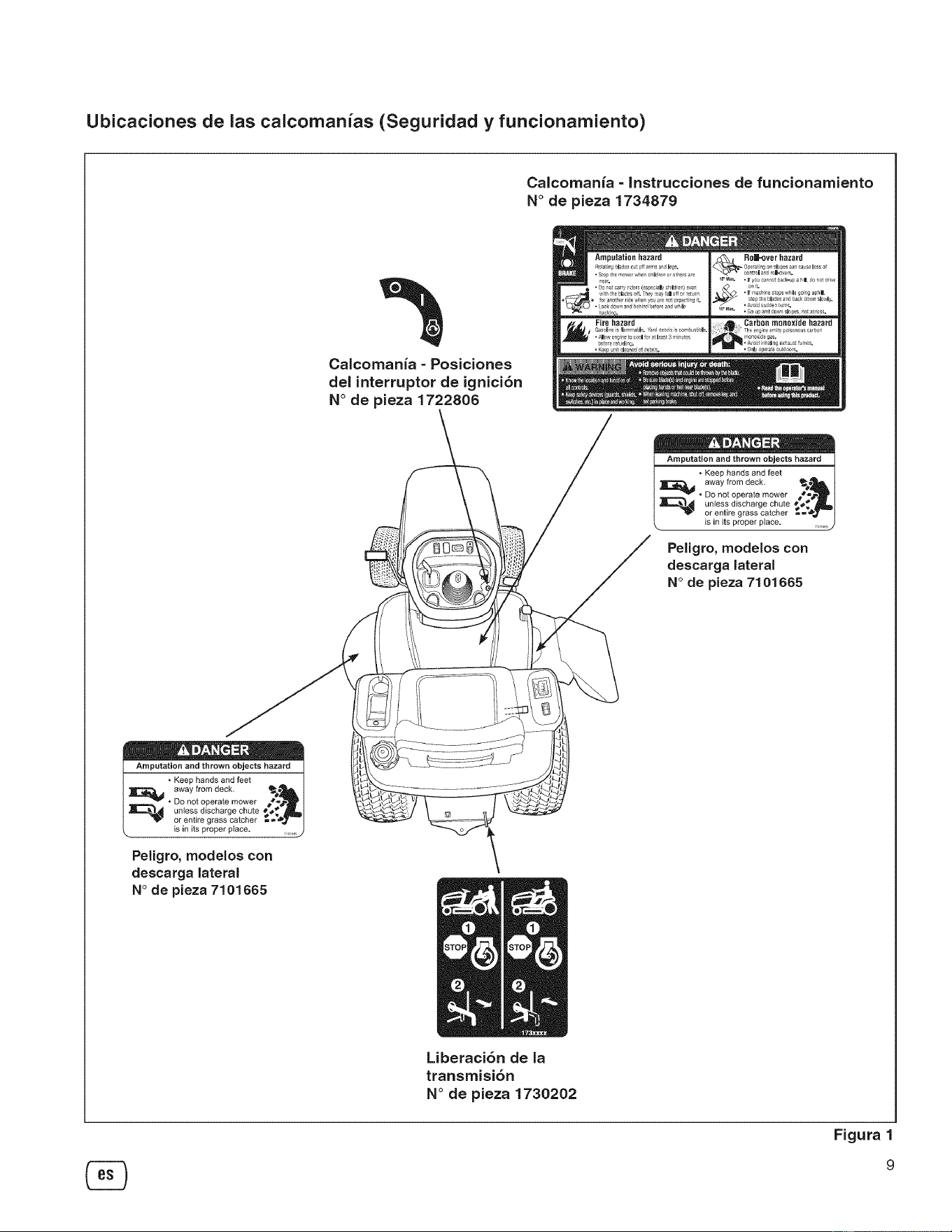
Ubicaciones de las calcomanias (Seguridad y funcionamiento)
is in its proper pIace.
Calcomania = Instrucciones de funcionamiento
N° de pieza 1734879
Caicomania = Posiciones
dei interruptor de ignici6n
N° de pieza 1722806
is in its proper place.
Peligro, modeloa con
deacarga lateral
N ° de pieza 7101665
Peligro, modeloa con
deacarga lateral
N° de pieza 7101665
Liberaci6n de la
transmisi6n
N° de pieza 1730202
Figura 1
9
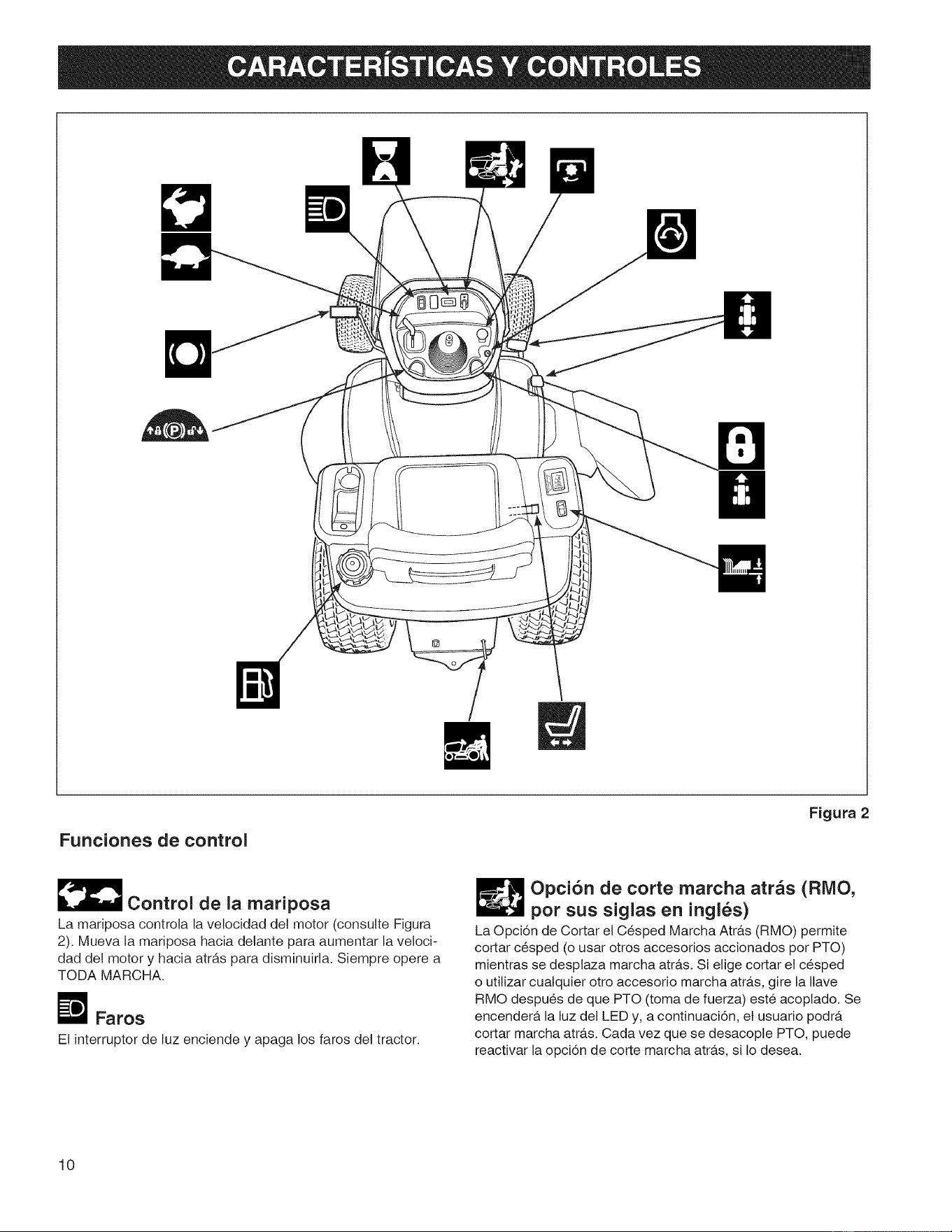
@
Funciones de control
Figura 2
_'Jl'_-l-=qJControl de la mariposa
La mariposa controta la velocidad del motor (consutte Figura
2). Mueva la mariposa hacia detante para aumentar la vetoci-
dad det motor y hacia atr,_s para disminuirta. Siempre opere a
TODA MARCHA.
I_Faros
Et interruptor de luz enciende y apaga los faros det tractor.
_ pci6n de corte marcha atras (RMO,
pot sus siglas en ingles)
La Opci6n de Cortar et Cesped Marcha Atras (RMO) permite
cortar cesped (o usar otros accesorios accionados por PTO)
mientras se desptaza marcha atras. Si etige cortar et cesped
o utilizar cualquier otro accesorio marcha atras, gire la Ilave
RMO despues de que PTO (toma de fuerza) este acoplado. Se
encendera la luz del LED y, a continuaci6n, et usuario podra.
cortar marcha atras. Cada vez que se desacople PTO, puede
reactivar la opci6n de corte marcha atras, si Io desea.
10

_ Interruptor PTO
Et interruptor PTO (toma de fuerza) acopta y desacopta
accesorios que utilizan PTO. Para acoptar PTO, tire hacia
ARRIBA det interruptor. Empuje hacia ABAJO para el
desacople. Recuerde que el usuario debe estar sentado
firmemente en el asiento del tractor para que funcione PTO.
_)'1 Interruptor de encendido
El interruptor de encendido arranca y detiene et motor; tiene
tres posiciones:
r_APAGAR
HEN MARCHA
W ARRANQUE
Detiene el motor y apaga et sistema
etectrico.
Permite que el motor funcione y
pone en marcha et sistema etectrico.
Hace girar el motor para ponerlo
en marcha.
NOTA: Nunca deje el interruptor de encendido en la posicion
MARCHA con el motor detenido ya que esto agota la baterfa.
D Pedal del freno
Si presiona et pedal del freno, se activan los frenos del tractor.
Pedales de velocidad de avance
El acelerador del tractor controla la velocidad de
desplazamiento hacia adetante del tractor. Et pedal de control
de velocidad de desplazamiento marcha atras controla la
velocidad de desplazamiento marcha atra.s det tractor.
Si presiona cualquier pedal, aumentar#, la velocidad de
desplazamiento. Recuerde que cuanto ma.s pise et pedal,
mayor serb, la velocidad a la que se desplazara et tractor.
Freno de estacionamiento
La perilla del freno de estacionamiento se usa para accionar
et freno de estacionamiento cuando se detiene el tractor. Si se
presiona completamente el pedal del freno y se tira de la perilla,
se acciona et freno de estacionamiento.
Ajuste de la altura de corte del
cortacesped
La altura de corte puede ajustarse entre 1,5" y 4,0" (3,8 y 10,2
cm),
El interruptor de ajuste de la altura de corte controla la altura de
corte del cortacesped. Este mismo interruptor tambien controla
et motor del rotor de pico cuando hay instalado un quitanieves.
Las fiechas det interruptor se correspondiente con la direcci6n
det ajuste (ta flecha hacia ARRIBA eteva la attura de corte,
la flecha hacia la DERECHA gira el pico hacia la derecha,
etc.). Cuando el indicador de ajuste haya alcanzado el fin de
su trayectoria, suelte et interruptor; si mantiene presionado et
interruptor, et motor resuttara da_ado.
U D Control de velocidad de crucero
El control de crucero se usa para bloquear et control de
velocidad de desplazamiento hacia delante. Mueva la patanca
hacia delante hasta alcanzar la velocidad de desplazamiento
deseada. Para desacoplar et control de la velocidad crucero,
mueva la palanca hacia atra.s. En et caso de que necesite
detener la maquina rapidamente, al presionar el pedal del freno,
et control de vetocidad crucero tambien volvera a la posici6n de
punto muerto.
Palanca de ajuste del asiento
El asiento puede ajustarse hacia detante y hacia atra.s. Mueva
la palanca, coloque et asiento en la posici6n deseada y suelte la
palanca para bloquear et asiento en su lugar.
PaJanca de liberacibn de la transmisibn
La palanca de liberaci6n de la transmisi6n desactiva
la transmisi6n para que et tractor pueda ser empujado
manualmente. Consutte Ernpujar el tractor a mano.
ri'_ Tanque de combustible
Para retirar la tapa, gire hacia la izquierda. El indicador de
combustible forma parte del tablero.
F'_'*'_PaJanca elevadora de enganche
El contador horatio mide la cantidad de horas que la Ilave Ileva
puesta en la posici6n de ENCENDIDO.
|
11
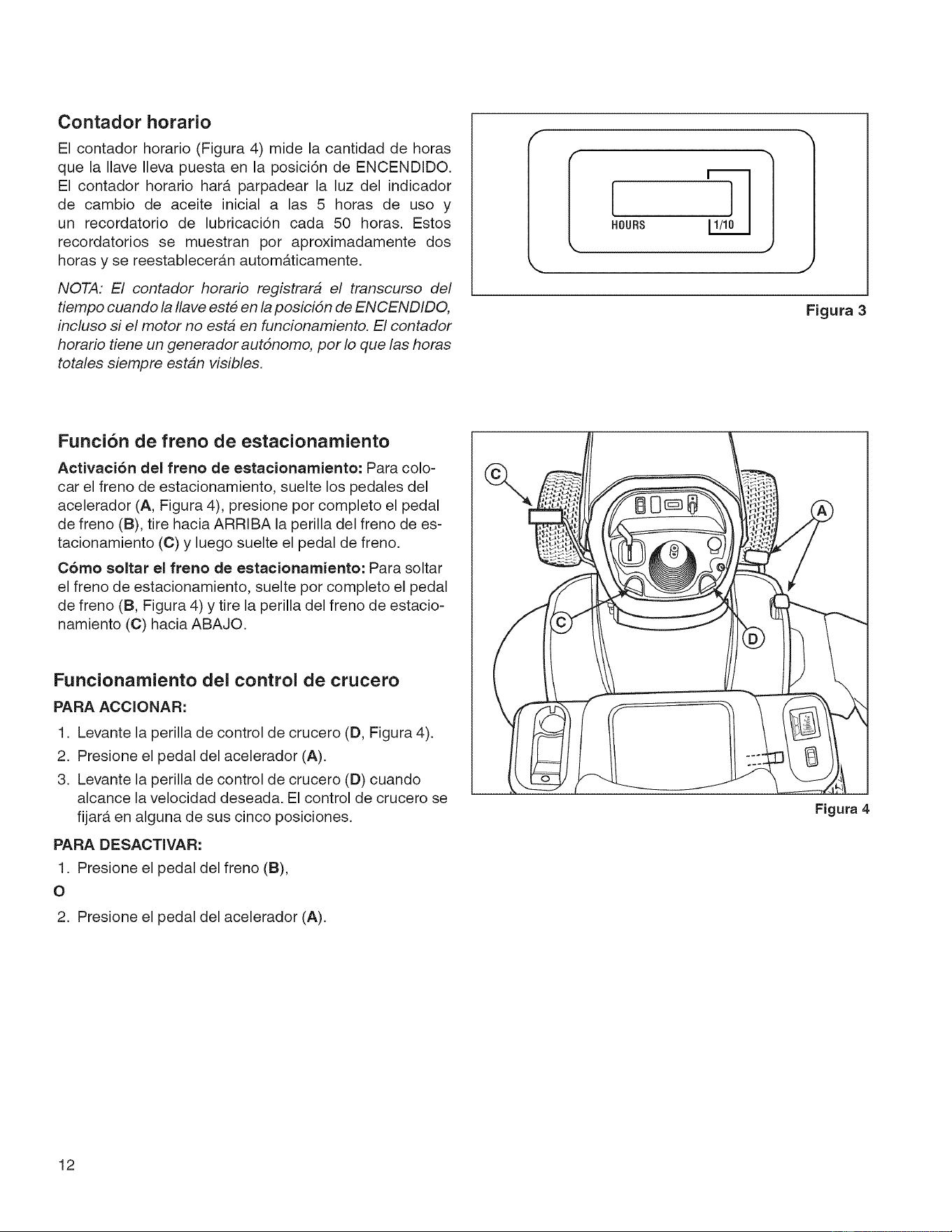
Contador horatio
El contador horario (Figura 4) mide la cantidad de horas
que la Ilave Ileva puesta en la posici6n de ENCENDIDO.
El contador horatio har_. parpadear la luz del indicador
de cambio de aceite inicial a las 5 horas de uso y
un recordatorio de lubricaci6n cada 50 horas. Estos
recordatorios se muestran por aproximadamente dos
horas y se reestableceran automaticamente.
NOTA: El contador horario registrara el transcurso del
tiempo cuando la l/ave este en /a posicidn de ENCENDIDO,
incluso si el motor no esta en funcionamiento. El contador
horario tiene un generador autdnomo, por Io que /as horas
totales siempre estan visibles.
I
rm
[ ]
HOURS
1
Figura 3
Funci6n de freno de estacionamiento
Activaci6n del freno de estacionamiento: Para colo-
car el freno de estacionamiento, suelte los pedales del
acelerador (A, Figura 4), presione pot completo el pedal
de freno (B), tire hacia ARRIBA la perilla del freno de es-
tacionamiento (C) y luego suelte el pedal de freno.
C6mo soltar el freno de estacionamiento: Para soltar
el freno de estacionamiento, suelte pot completo el pedal
de freno (B, Figura 4) y tire la perilla del freno de estacio-
namiento (C) hacia ABAJO.
Funcionamiento del control de crucero
PARA ACClONAR:
1. Levante la perilla de control de crucero (D, Figura 4).
2. Presione el pedal del acelerador (A).
3. Levante la perilla de control de crucero (D) cuando
alcance la velocidad deseada. El control de crucero se
fijara en alguna de sus cinco posiciones.
PARA DESACTIVAR:
1. Presione el pedal del freno (B),
O
2. Presione el pedal del acelerador (A).
Figura 4
12
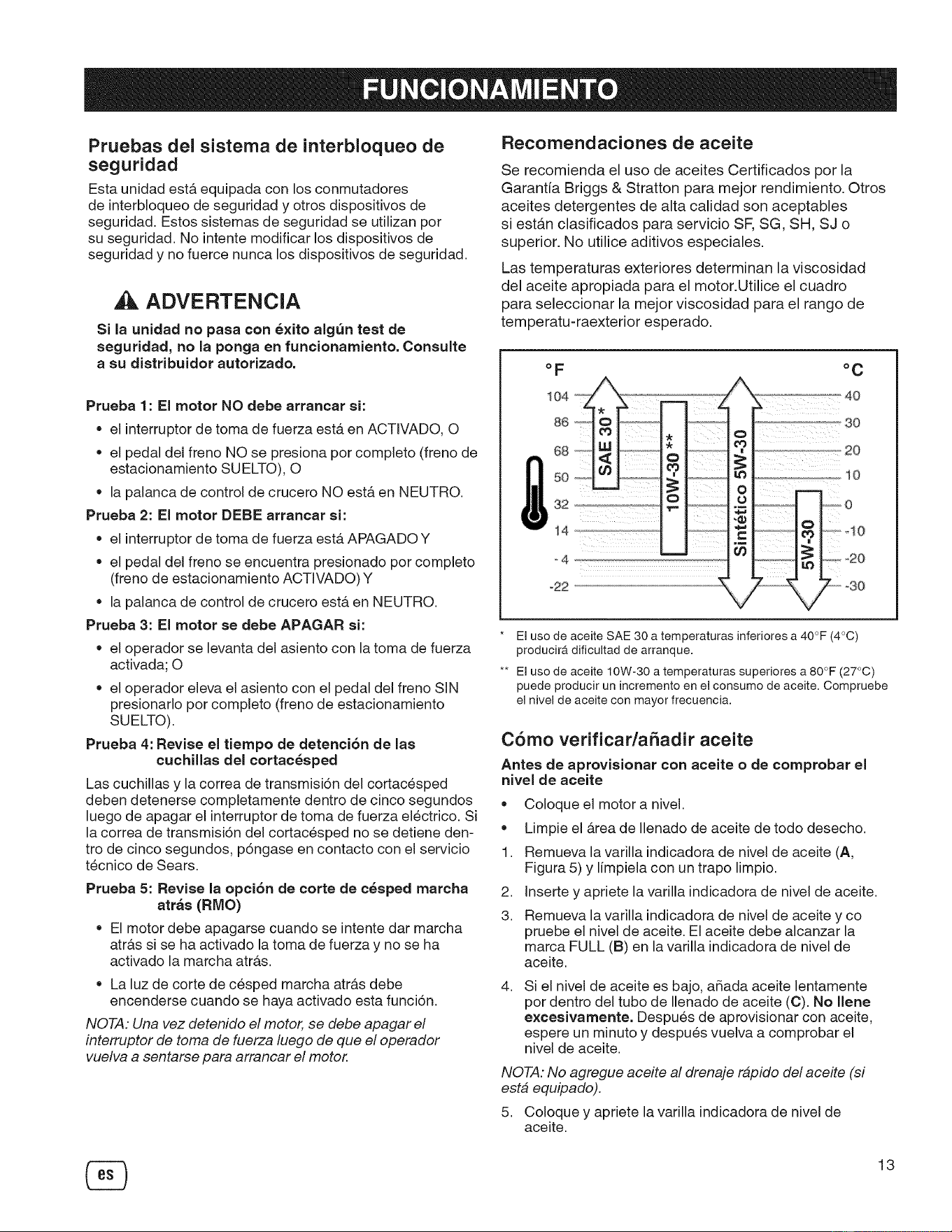
Pruebas dei sistema de interbloqueo de
seguridad
Esta unidad est& equipada con los conmutadores
de interbloqueo de seguridad y otros dispositivos de
seguridad. Estos sistemas de seguridad se utilizan por
su seguridad. No intente modificar los dispositivos de
seguridad y no fuerce nunca los dispositivos de seguridad.
,A ADVERTENCIA
Si la unidad no pasa con _×ito algQn test de
seguridad, no la ponga en funcionamiento. Consulte
a su distribuidor autorizado.
Prueba 1: El motor NO debe arrancar si:
• el interruptor de toma de fuerza est& en ACTIVADO, O
el pedal del freno NO se presiona por completo (freno de
estacionamiento SUELTO), O
la palanca de control de crucero NO est& en NEUTRO.
Prueba 2: El motor DEBE arrancar si:
el interruptor de toma de fuerza est& APAGADO Y
el pedal del freno se encuentra presionado por completo
(freno de estacionamiento ACTIVADO) Y
la palanca de control de crucero est& en NEUTRO.
Prueba 3: El motor se debe APAGAR si:
el operador se levanta del asiento con la toma de fuerza
activada; O
el operador eleva el asiento con el pedal del freno SIN
presionarlo por completo (freno de estacionamiento
SUELTO).
Prueba 4: Revise el tiempo de detenci6n de las
cuchillas del cortac_sped
Las cuchillas y la correa de transmisi6n del cortac_sped
deben detenerse completamente dentro de cinco segundos
luego de apagar el interruptor de toma de fuerza el_ctrico. Si
la correa de transmisi6n del cortac_sped no se detiene den-
tro de cinco segundos, p6ngase en contacto con el servicio
t_cnico de Sears.
Prueba 5: Revise la opci6n de corte de c_sped marcha
atr_s (RMO)
= El motor debe apagarse cuando se intente dar marcha
atr&s si se ha activado la toma de fuerza y no se ha
activado la marcha atr&s.
La luz de corte de c_sped marcha atr&s debe
encenderse cuando se haya activado esta funci6n.
NOTA: Una vez detenido el motor, se debe apagar el
interruptor de toma de fuerza luego de que el operador
vuelva a sentarse para arrancar el motor.
Recomendaciones de aceite
Se recomienda el uso de aceites Certificados pot la
Garantia Briggs & Stratton para mejor rendimiento. Otros
aceites detergentes de alta calidad son aceptables
si estan clasificados para servicio SF, SG, SH, SJ o
superior. No utilice aditivos especiales.
Las temperaturas exteriores determinan la viscosidad
del aceite apropiada para el motor.Utilice el cuadro
para seleccionar la mejor viscosidad para el tango de
temperatu-raexterior esperado.
°C
A
S
.== a o
* EJuso de aceite SAE 30 a temperaturas inferiores a 40°F (4°C)
producira dificuitad de arranque.
** El uso de aceite 10W-30 a temperaturas superiores a 80°F (27°C)
puede producir un incremento en el consumo de aceite. Compruebe
el nivel de aceite con mayor frecuencia.
C6mo verificadaffadir aceite
Antes de aprovisionar con aceite o de comprobar el
nivel de aceite
Coloque el motor a nivel.
Limpie el &rea de Ilenado de aceite de todo desecho.
1. Remueva la varilla indicadora de nivel de aceite (A,
Figura 5) y limpiela con un trapo limpio.
2. Inserte y apriete la varilla indicadora de nivel de aceite.
3. Remueva la varilla indicadora de nivel de aceite y co
pruebe el nivel de aceite. El aceite debe alcanzar la
marca FULL (B) en la varilla indicadora de nivel de
aceite.
4,
Si el nivel de aceite es bajo, affada aceite lentamente
por dentro del tubo de Ilenado de aceite (C). No Ilene
excesivamente. Despu_s de aprovisionar con aceite,
espere un minuto y despu_s vuelva a comprobar el
nivel de aceite.
NOTA: No agregue aceite al drenaje rbpido del aceite (si
estb equipado).
5. Coloque y apriete la varilla indicadora de nivel de
aceite.
13
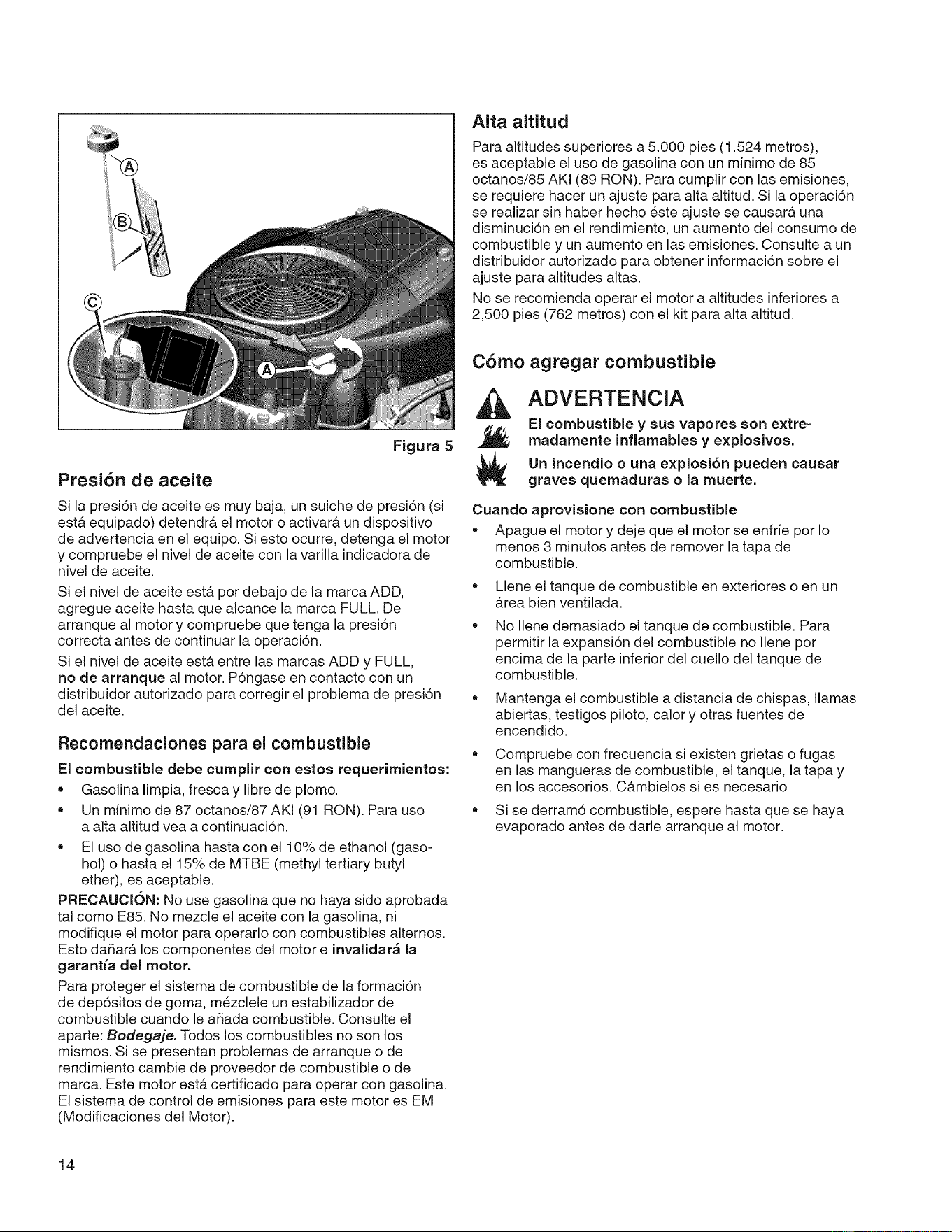
Presi6n de aceite
Figura 5
Si la presi6n de aceite es muy baja, un suiche de presi6n (si
est& equipado) detendr& el motor o activar& un dispositivo
de advertencia en el equipo. Si esto ocurre, detenga el motor
y compruebe el nivel de aceite con la varilla indicadora de
nivel de aceite.
Si el nivel de aceite esta pot debajo de la marca ADD,
agregue aceite hasta que alcance la marca FULL. De
arranque al motor y compruebe que tenga la presi6n
correcta antes de continuar la operaci6n.
Si el nivel de aceite est,. entre las marcas ADD y FULL,
no de arranque al motor. P6ngase en contacto con un
distribuidor autorizado para corregir el problema de presi6n
del aceite.
Recomendaciones para el combustible
El combustible debe cumplir con estos requerimientos:
• Gasolina limpia, fresca y libre de plomo.
Un minimo de 87 octanos/87 AKI (91 RON). Para uso
a alta altitud vea a continuaci6n.
El uso de gasolina hasta con el 10% de ethanol (gaso-
hol) o hasta el 15% de MTBE (methyl tertiary butyl
ether), es aceptable.
PRECAUCION: No use gasolina que no haya sido aprobada
tal como E85. No mezcle el aceite con la gasolina, ni
modifique el motor para operarlo con combustibles alternos.
Esto da_ar& los componentes del motor e invalidar_ la
garant_a del motor.
Para proteger el sistema de combustible de la formaci6n
de dep6sitos de goma, mezclele un estabilizador de
combustible cuando le aSada combustible. Consulte el
aparte: Bodegaje. Todos los combustibles no son los
mismos. Si se presentan problemas de arranque o de
rendimiento cambie de proveedor de combustible o de
marca. Este motor est& certificado para operar con gasolina.
El sistema de control de emisiones para este motor es EM
(Modificaciones del Motor).
Alta altitud
Para altitudes superiores a 5.000 pies (1.524 metros),
es aceptable el uso de gasolina con un minimo de 85
octanos/85 AKI (89 RON). Para cumplir con las emisiones,
se requiere hacer un ajuste para alta altitud. Si la operaci6n
se realizar sin haber hecho _ste ajuste se causara una
disminuci6n en el rendimiento, un aumento del consumo de
combustible y un aumento en las emisiones. Consulte a un
distribuidor autorizado para obtener informaci6n sobre el
ajuste para altitudes altas.
No se recomienda operar el motor a altitudes inferiores a
2,500 pies (762 metros) con el kit para alta altitud.
C6mo agregar combustible
ADVERTENCIA
El combustible y sus vapores son extre-
madamente inflamables y explosivos.
Un incendio ouna explosi6n pueden causar
graves quemaduras o la muerte.
Cuando aprovisione con combustible
Apague el motor y deje que el motor se enfrie por Io
menos 3 minutos antes de remover la tapa de
combustible.
Llene el tanque de combustible en exteriores o en un
&rea bien ventilada.
No Ilene demasiado el tanque de combustible. Para
permitir la expansi6n del combustible no Ilene por
encima de la parte inferior del cuello del tanque de
combustible.
Mantenga el combustible a distancia de chispas, llamas
abiertas, testigos piloto, calor y otras fuentes de
encendido.
Compruebe con frecuencia si existen grietas o fugas
en las mangueras de combustible, el tanque, la tapa y
en los accesorios. Cambielos si es necesario
,, Si se derram6 combustible, espere hasta que se haya
evaporado antes de darle arranque al motor.
14
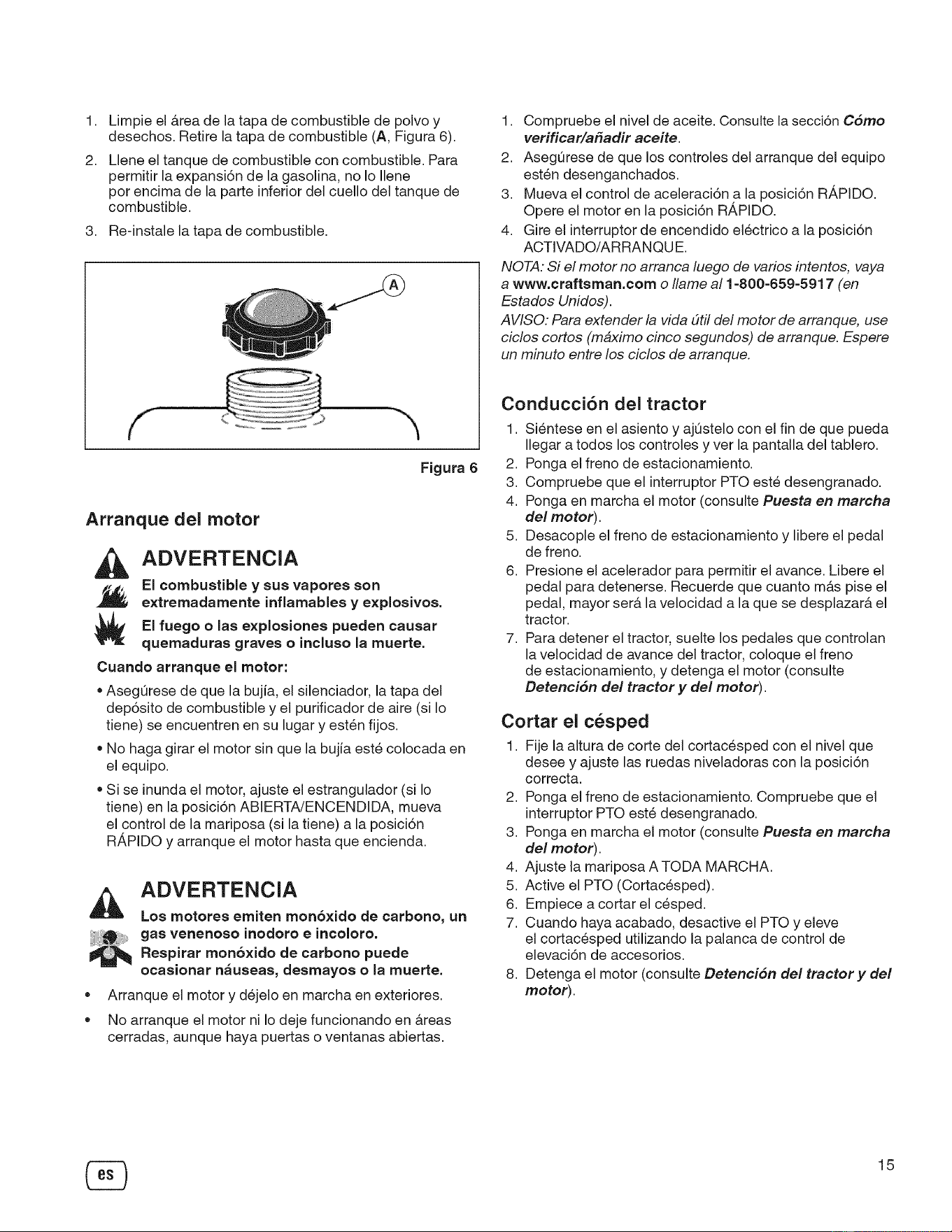
1,
2.
Limpie el &rea de la tapa de combustible de polvo y
desechos. Retire la tapa de combustible (A, Figura 6).
Llene el tanque de combustible con combustible. Para
permitir la expansi6n de la gasolina, no Io Ilene
pot encima de la parte inferior del cuello del tanque de
combustible.
3. Re-instale la tapa de combustible.
Figura 6
Arranque del motor
ADVERTENCIA
El combustible y sus vapores son
extremadamente inflamables y explosivos.
El fuego o las explosiones pueden causar
quemaduras graves o incluso la muerte.
Cuando arranque el motor:
= Aseg_rese de que la bujia, el silenciador, la tapa del
dep6sito de combustible y el purificador de aire (si Io
tiene) se encuentren en su lugar y est_n fijos.
• No haga girar el motor sin que la bujia est_ colocada en
el equipo.
Si se inunda el motor, ajuste el estrangulador (si Io
tiene) en la posici6n ABIERTA/ENCENDIDA, mueva
el control de la mariposa (si la tiene) a la posici6n
R,&PIDO y arranque el motor hasta que encienda.
o
o
ADVERTENCIA
Los motores emiten mon6×ido de carbono, un
gas venenoso inodoro e incoloro.
Respirar mon6xido de carbono puede
ocasionar n_useas, desmayos o la muerte.
Arranque el motor y d_jelo en marcha en exteriores.
No arranque el motor ni Io deje funcionando en &reas
cerradas, aunque haya puertas o ventanas abiertas.
1. Compruebe el nivel de aceite. Consutte la secci6n C6mo
verificar/a_adir aceite.
2. AsegQrese de que los controles del arranque del equipo
est_n desenganchados.
3. Mueva el control de aceleraci6n a la posici6n R,&PIDO.
Opere el motor en la posici6n R_,PIDO.
4. Gire el interruptor de encendido el_ctrico a la posici6n
ACTIVADO/ARRANQUE.
NOTA: Si el motor no arranca luego de varios intentos, vaya
a www.craftsman.com o Ilame al 1-800-659-5917 (en
Estados Unidos).
AVISO: Para extender la vida dtil del motor de arranque, use
cicIos cortos (mbximo cinco segundos) de arranque. Espere
un minuto entre los cicIos de arranque.
Conducci6n del tractor
1. Si_ntese en el asiento y ajQstelo con el fin de que pueda
Ilegar a todos los controles y vet la pantalla del tablero.
2. Ponga el freno de estacionamiento.
3. Compruebe que el interruptor PTO est_ desengranado.
4. Ponga en marcha el motor (consulte Puesta en marcha
de! motor).
5. Desacople el freno de estacionamiento y libere el pedal
de freno.
6. Presione el acelerador para permitir el avance. Libere el
pedal para detenerse. Recuerde que cuanto m&s pise el
pedal, mayor ser& la velocidad a la que se desplazar& el
tractor.
7. Para detener el tractor, suelte los pedales que controlan
la velocidad de avance del tractor, coloque el freno
de estacionamiento, y detenga el motor (consulte
Detenci6n de! tractor y de! motor).
Cortar el cesped
1. Fije la altura de corte del cortac_sped con el nivel que
desee y ajuste las ruedas niveladoras con la posici6n
correcta.
2. Ponga el freno de estacionamiento. Compruebe que el
interruptor PTO est_ desengranado.
3. Ponga en marcha el motor (consulte Puesta en marcha
del motor).
4. Ajuste la mariposa A TODA MARCHA.
5. Active el PTO (Cortac_sped).
6. Empiece a cortar el c_sped.
7. Cuando haya acabado, desactive el PTO y eleve
el cortac_sped utilizando la palanca de control de
elevaci6n de accesorios.
8. Detenga el motor (consulte Detenci6n de! tractor y de!
motor).
!
15
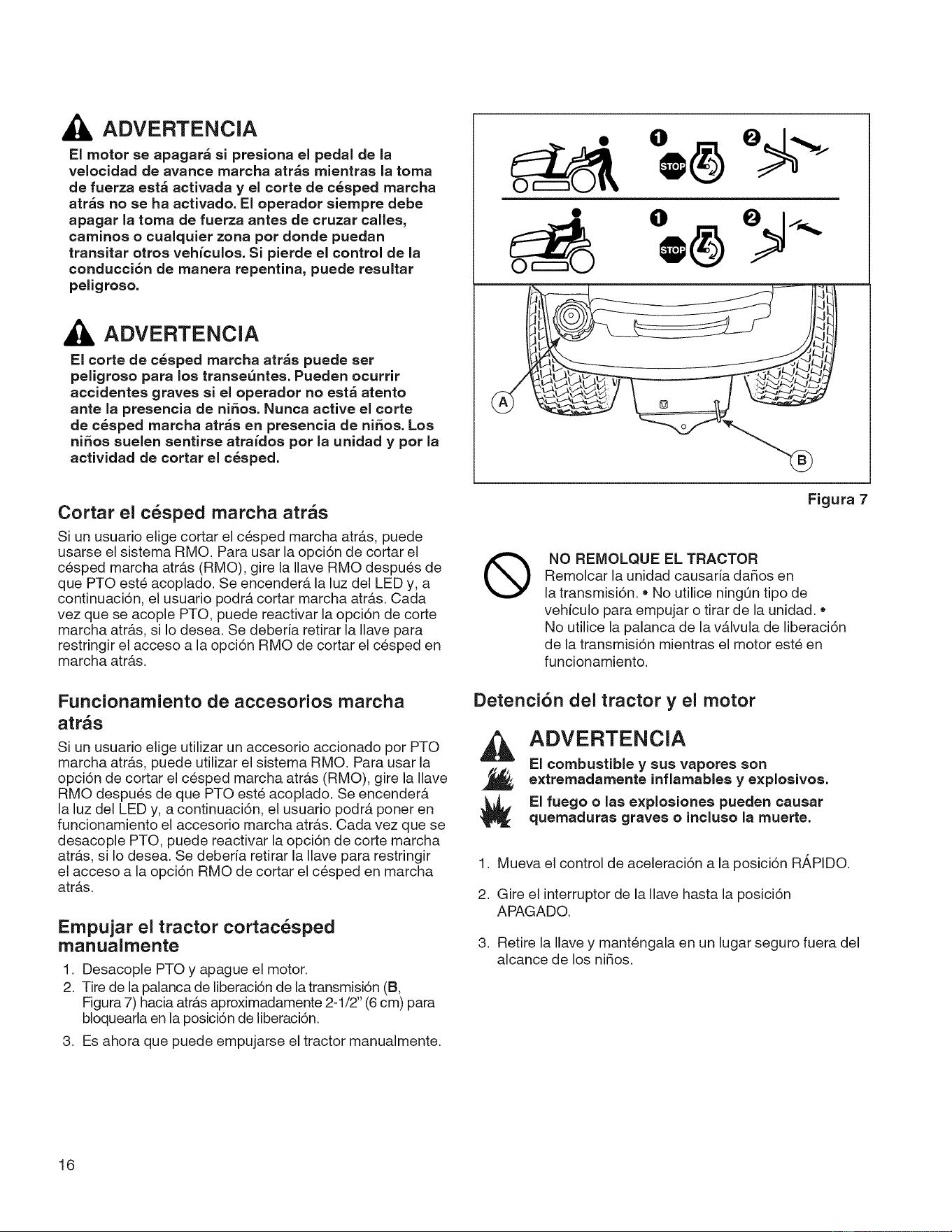
_, ADVERTENCIA
El motor se apagar_ si presiona el pedal de la
velocidad de avarice marcha atr_s mientras la toma
de fuerza est_ activada y el corte de c_sped marcha
atr_s no se ha activado. El operador siempre debe
apagar la toma de fuerza antes de cruzar calles,
caminos o cualquier zona pot donde puedan
transitar otros vehiculos. Si pierde el control de la
conducci6n de manera repentina, puede resultar
peligroso.
ADVERTENCIA
El corte de c_sped marcha atr_s puede set
peligroso para los transe_ntes. Pueden ocurrir
accidentes graves si el operador no est_ atento
ante la presencia de niSos. Nunca active el corte
de c_sped marcha atr_s en presencia de niSos. Los
niSos suelen sentirse atra_dos pot la unidad y pot la
actividad de cortar el c_sped.
Cortar el cesped marcha atras
Si un usuario elige cortar el c_sped marcha atr&s, puede
usarse el sistema RMO. Para usar la opci6n de cortar el
c_sped marcha atr&s (RMO), gire la Ilave RMO despu_s de
que Pro est_ acopiado. Se encender& la luz del LED y, a
continuaci6n, el usuario podr& cortar marcha atr&s. Cada
vez que se acople PTO, puede reactivar la opci6n de corte
marcha atr&s, si Io desea. Se deberia retirar la Ilave para
restringir el acceso a la opci6n RMO de cortar el c_sped en
marcha atr&s.
Funcionamiento de accesorios marcha
atras
Si un usuario elige utilizar un accesorio accionado por PTO
marcha atr&s, puede utilizar el sistema RMO. Para usar la
opci6n de cortar el c_sped marcha atr&s (RMO), gire la Ilave
RMO despu_s de que PTO est_ acoplado. Se encender&
la luz del LED y, a continuaci6n, el usuario podr& poner en
funcionamiento el accesorio marcha atr&s. Cada vez que se
desacople PTO, puede reactivar la opci6n de corte marcha
atr&s, si Io desea. Se deberia retirar la Ilave para restringir
el acceso a la opci6n RMO de cortar el c_sped en marcha
atr&s.
Empujar el tractor cortacesped
manualmente
1. Desacople PrO y apague el motor.
2. Tire de la palanca de liberaci6n de la transmisi6n (B,
Figura 7) hacia atr&s aproximadamente 2-1/2" (6 cm) para
bloquearla en la posici6n de liberaci6n.
3. Es ahora que puede empujarse el tractor manualmente.
• %®
/
Figura 7
®
NO REMOLQUE EL TRACTOR
Remolcar la unidad causaria daSos en
la transmisi6n. • No utilice ningen tipo de
vehiculo para empujar o tirar de la unidad.
No utilice la palanca de la v&lvula de liberaci6n
de la transmisi6n mientras el motor est_ en
funcionamiento.
Detenci6n del tractor y el motor
,&
ADVERTENCIA
El combustible y sus vapores son
extremadamente inflamables y explosivos.
El fuego o las explosiones pueden causar
quemaduras graves o incluso la muerte.
1. Mueva el control de aceleraci6n a la posici6n R,&PIDO.
2. Gire el interruptor de la Ilave hasta la posici6n
APAGADO.
3. Retire la Ilave y mant_ngala en un lugar seguro fuera del
alcance de los niSos.
16
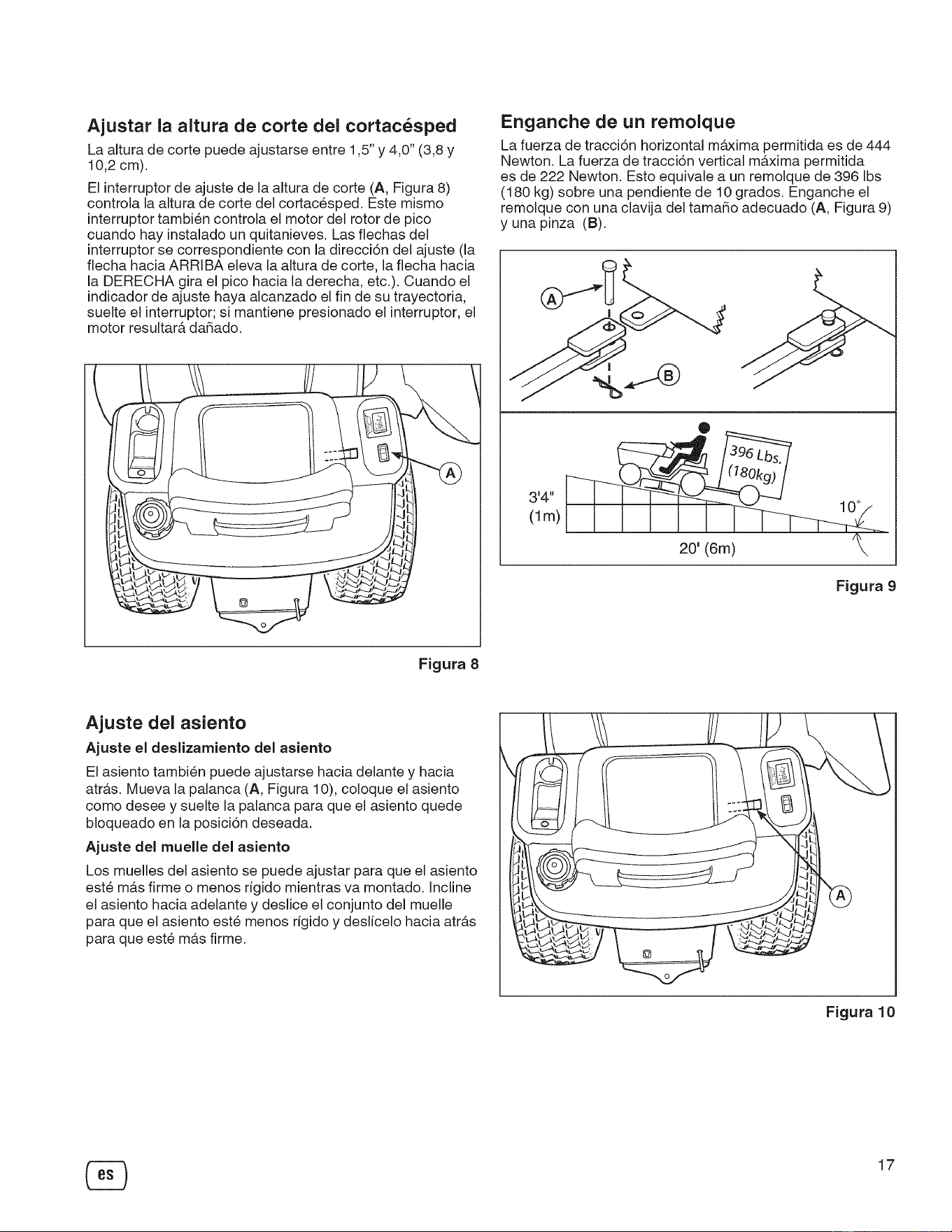
Ajustar la altura de corte del cortacesped
La altura de corte puede ajustarse entre 1,5" y 4,0" (3,8 y
10,2 cm).
El interruptor de ajuste de la altura de corte (A, Figura 8)
controla la altura de corte del cortac_sped. Este mismo
interruptor tambi_n controla el motor del rotor de pico
cuando hay instalado un quitanieves. Las flechas del
interruptor se correspondiente con la direcci6n del ajuste (la
flecha hacia ARRIBA eleva la altura de corte, la flecha hacia
la DERECHA gira el pico hacia la derecha, etc.). Cuando el
indicador de ajuste haya alcanzado el fin de su trayectoria,
suelte el interruptor; si mantiene presionado el interruptor, el
motor resultar& da6ado.
Enganche de un remolque
La fuerza de tracci6n horizontal maxima permitida es de 444
Newton. La fuerza de tracci6n vertical m_txima permitida
es de 222 Newton. Esto equivale a un remolque de 396 Ibs
(180 kg) sobre una pendiente de 10 grados. Enganche el
remolque con una clavija del tama6o adecuado (A, Figura 9)
y una pinza (B).
®
'4"
10°
(lm)
20' (6m)
Figura 9
Figura 8
Ajuste del asiento
Ajuste el deslizamiento del asiento
El asiento tambi_n puede ajustarse hacia delante y hacia
atr_.s. Mueva la palanca (A, Figura 10), coloque el asiento
como desee y suelte la palanca para que el asiento quede
bloqueado en la posici6n deseada.
Ajuste del muelle del asiento
Los muelles del asiento se puede ajustar para que el asiento
est_ m#.s firme o menos rigido mientras va montado. Incline
el asiento hacia adelante y deslice el conjunto del muelle
para que el asiento est_ menos rigido y deslicelo hacia atr&s
para que est_ mas firme.
Figura 10
17
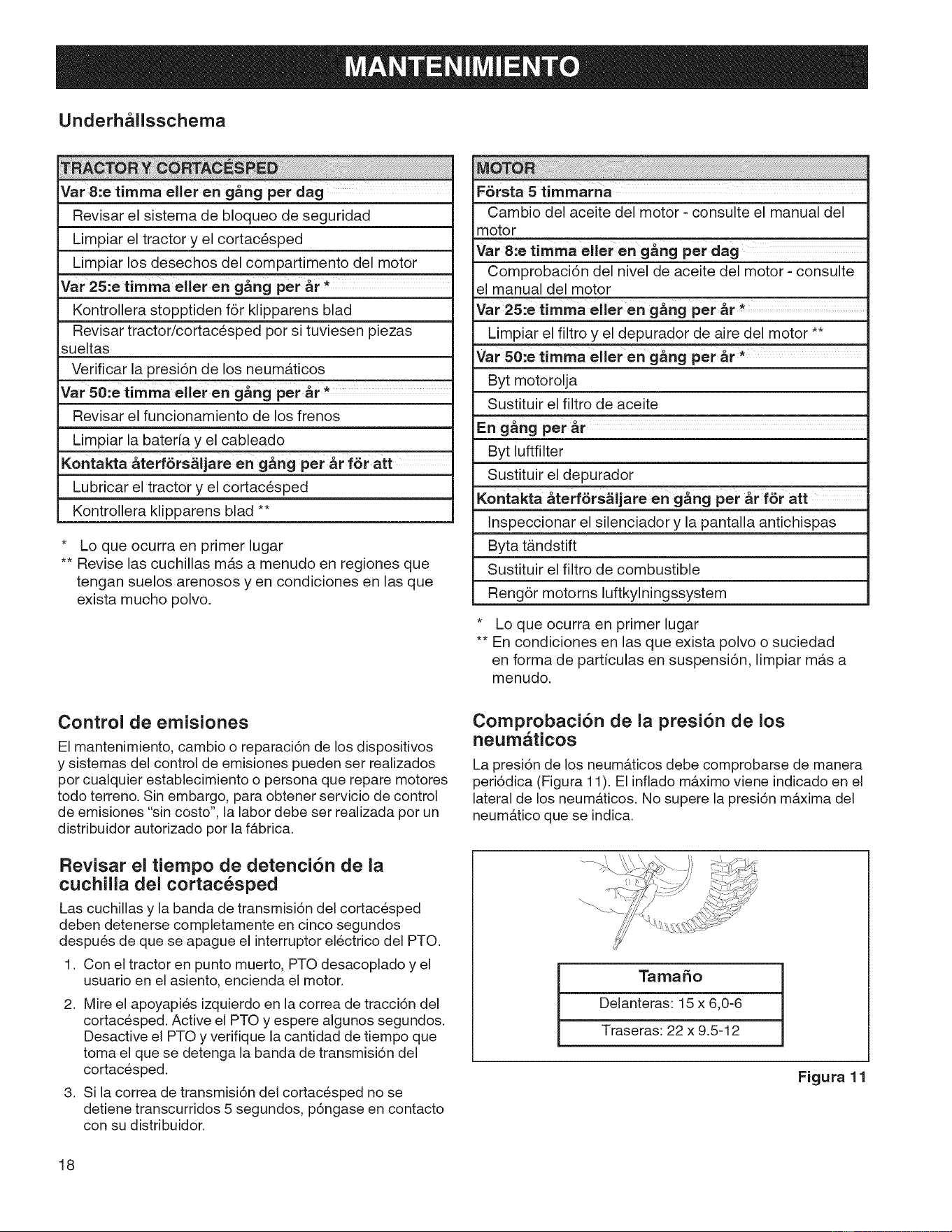
Underh&llsschema
! iiiii i i i !i ! ii i iiiiiiiiiiiiiiiiiiiiiiiiiiiiiiiiiii! i i iii ! iiii!! !! i ! !!i!i!i ; ! i i i!i!iiiiiiiiiiiiiiiiiiii !iiiiiiiiiiiiiiiiiiiiiiiiiiiiiiiiiiiiiiiiiiiiiiiiiiiiiiiiiiiiiiii
vats:eti.,.,a e.ereng ngperdag
Revisar el sistema de bloqueo de seguridad
Limpiar el tractor y el cortacesped
Limpiar los desechos del compartimento del motor
Vat 25:e timma eiler en gang peter *
Kontrollera stopptiden f6r klipparens blad
Revisar tractor/cortacesped por si tuviesen piezas
sueltas
Verificar la presi6n de los neumaticos
Vat 50:e timma eller en gang per _r*
Revisar el funcionamiento de los frenos
Limpiar la baterfa y el cableado
Kontakta _terf6rs_ljare en gang per _r f6r att
Lubricar el tractor y el cortacesped
Kontrollera klipparens blad **
* Lo que ocurra en primer lugar
** Revise las cuchillas mas a menudo en regiones que
tengan suelos arenosos yen condiciones en las que
exista mucho polvo.
........................i'_i'_i'!_''_'I_I'_i'____i_i_/_..............................._ '_"'_"_i_i___"i_'! _!_!_!_!_!_!_!_!_!_!_!_!_!_!_!_!_!_!_!........................_......................................................................................
F6rsta 5 timmarna
Cambio del aceite del motor - consulte el manual del
motor
Vat 8:e timma eiler en gang per dag
Comprobaci6n del nivel de aceite del motor - consulte
el manual del motor
Vat 25:e timrna eiler en gang per _r*
Limpiar el filtro y el depurador de aire del motor **
_ eiler en gang per _r*
Byt motorolja
Sustituir el filtro de aceite
En gang per_r
Byt luftfilter
Sustituir el depurador
Kontakta _terf6rs_ljare en gang per _r f6r att
Inspeccionar el silenciador y la pantalla antichispas
Byta tAndstift
Sustituir el filtro de combustible
Reng6r motorns luftkylningssystem
* Lo que ocurra en primer lugar
** En condiciones en las que exista polvo o suciedad
en forma de parficulas en suspensi6n, limpiar mas a
menudo.
Control de emisiones
El mantenimiento, cambio o reparaci6n de los dispositivos
y sistemas del control de emisiones pueden ser realizados
por cualquier establecimiento o persona que repare motores
todo terreno. Sin embargo, para obtener servicio de control
de emisiones "sin costo", la labor debe ser realizada por un
distribuidor autorizado por la f&brica.
Revisar el tiempo de detenci6n de la
cuchilla del cortacesped
Las cuchillas y la banda de transmisi6n del cortac_sped
deben detenerse completamente en cinco segundos
despu_s de que se apague el interruptor el_ctrico del PTO.
1. Con el tractor en punto muerto, PrO desacoplado y el
usuario en el asiento, encienda el motor.
2. Mire el apoyapi_s izquierdo en la correa de tracci6n del
cortac_sped. Active el PTO y espere algunos segundos.
Desactive el Pro y verifique la cantidad de tiempo que
toma el que se detenga la banda de transmisi6n del
cortac_sped.
3. Si la correa de transmisi6n del cortac_sped no se
detiene transcurridos 5 segundos, p6ngase en contacto
con su distribuidor.
Comprobaci6n de la presi6n de los
neurnaticos
La presi6n de los neum&ticos debe comprobarse de manera
peri6dica (Figura 11). El inflado m&ximo viene indicado en el
lateral de los neumaticos. No supere la presi6n maxima del
neumatico que se indica.
TamaSo
Delanteras: 15 x 6,0-6
Traseras: 22 x 9.5-12
Figura 11
18
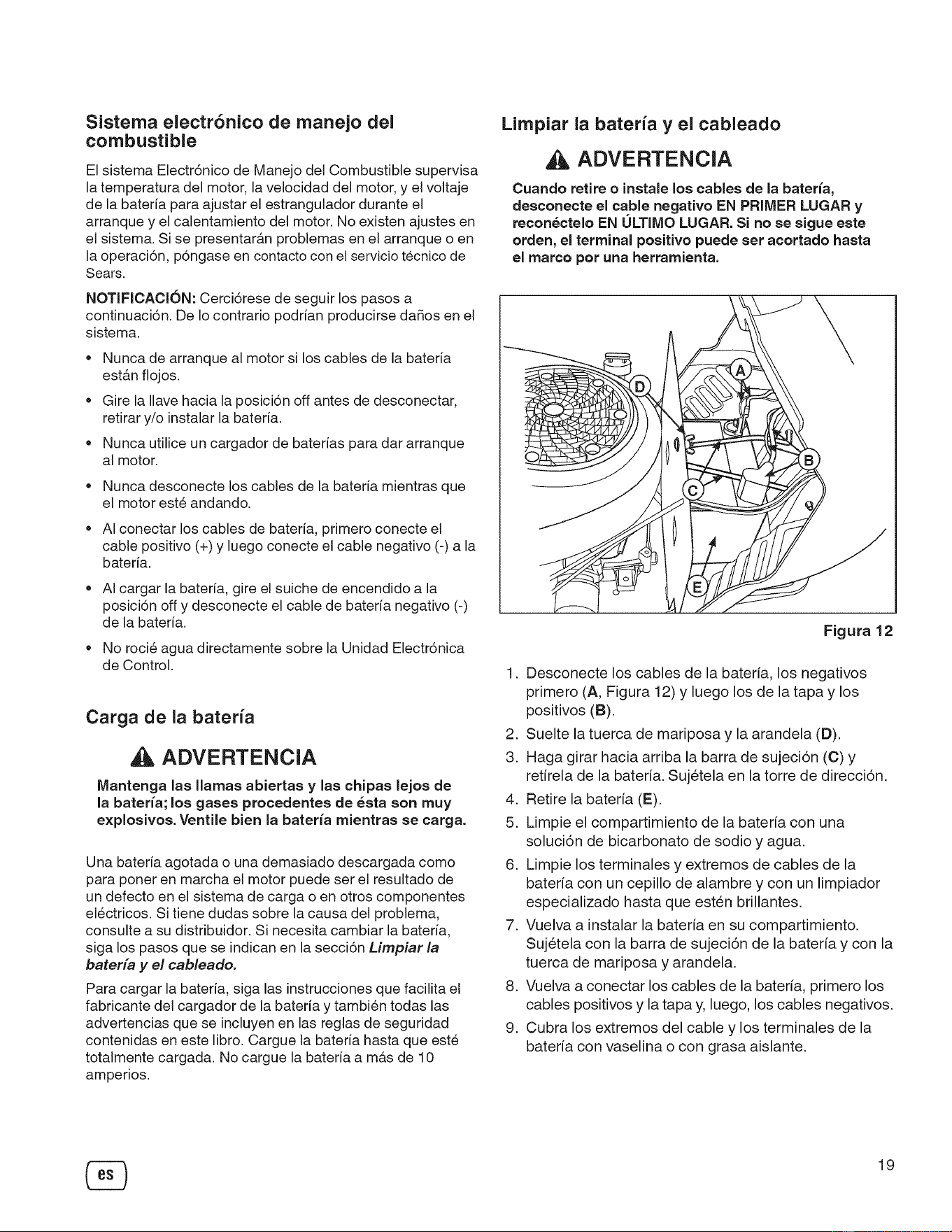
Sistema electr6nico de manejo del
combustible
El sistema Electr6nico de Manejo del Combustible supervisa
la temperatura del motor, la velocidad del motor, y el voltaje
de la bateria para ajustar el estrangulador durante el
arranque y el calentamiento del motor. No existen ajustes en
el sistema. Si se presentar&n problemas en el arranque o en
la operaci6n, p6ngase en contacto con et servicio tecnico de
Sears.
NOTIFICACION: Cerci6rese de seguir los pasos a
continuaci6n. De Io contrario podrian producirse daSos en el
sistema.
Nunca de arranque al motor si los cables de la bateria
est&n flojos.
Gire la Ilave hacia la posici6n off antes de desconectar,
retirar y/o instalar la bateria.
Nunca utilice un cargador de baterias para dar arranque
al motor.
• Nunca desconecte los cables de la bateria mientras que
el motor est_ andando.
AI conectar los cables de bateria, primero conecte el
cable positivo (+) y luego conecte el cable negativo (-) a la
bateria.
AI cargar la bateria, gire el suiche de encendido a la
posici6n off y desconecte el cable de bateria negativo (-)
de la bateria.
No roci_ agua directamente sobre la Unidad Electr6nica
de Control.
Carga de la bateria
ADVERTENCIA
Mantenga las llamas abiertas y las chipas lejos de
la bater[a; los gases procedentes de _sta son muy
explosivos. Ventile bien la bater[a mientras se carga.
Una bateria agotada o una demasiado descargada como
para poner en marcha el motor puede ser el resultado de
un defecto en el sistema de carga o en otros componentes
el_ctricos. Si tiene dudas sobre la causa del problema,
consulte a su distribuidor. Si necesita cambiar la bateria,
siga los pasos que se indican en la secci6n Limpiar la
bater(a y el cableado.
Para cargar la bateria, siga las instrucciones que facilita el
fabricante del cargador de la bateria y tambi_n todas las
advertencias que se incluyen en las reglas de seguridad
contenidas en este libro. Cargue la bateria hasta que est_
totalmente cargada. No cargue la bateria a m&s de 10
amperios.
Limpiar la bateria y el cableado
ADVERTENCIA
Cuando retire o instale los cables de la bater(a,
desconecte el cable negative EN PRIMER LUGAR y
recon_ctelo EN ULTIMO LUGAR.Si no se sigue este
orden, el terminal positivo puede set acortado hasta
el marco pot una herramienta.
Figura 12
1. Desconecte los cables de la bateria, los negativos
primero (A, Figura 12) y luego los de la tapa y los
positivos (B).
2. Suelte la tuerca de mariposa y la arandela (D).
3. Haga girar hacia arriba la barra de sujeci6n (C) y
retirela de la bateria. Sujetela en la torte de direcci6n.
4. Retire la bateria (E).
5. Limpie el compartimiento de la bateria con una
soluci6n de bicarbonato de sodio y agua.
6. Limpie los terminales y extremos de cables de la
bateria con un cepillo de alambre y con un limpiador
especializado hasta que esten brillantes.
7. Vuelva a instalar la bateria en su compartimiento.
Sujetela con la barra de sujeci6n de la bateria y con la
tuerca de mariposa y arandela.
8. Vuelva a conectar los cables de la bateria, primero los
cables positivos y la tapa y, luego, los cables negativos.
9. Cubra los extremos del cable y los terminales de la
bateria con vaselina o con grasa aislante.
19
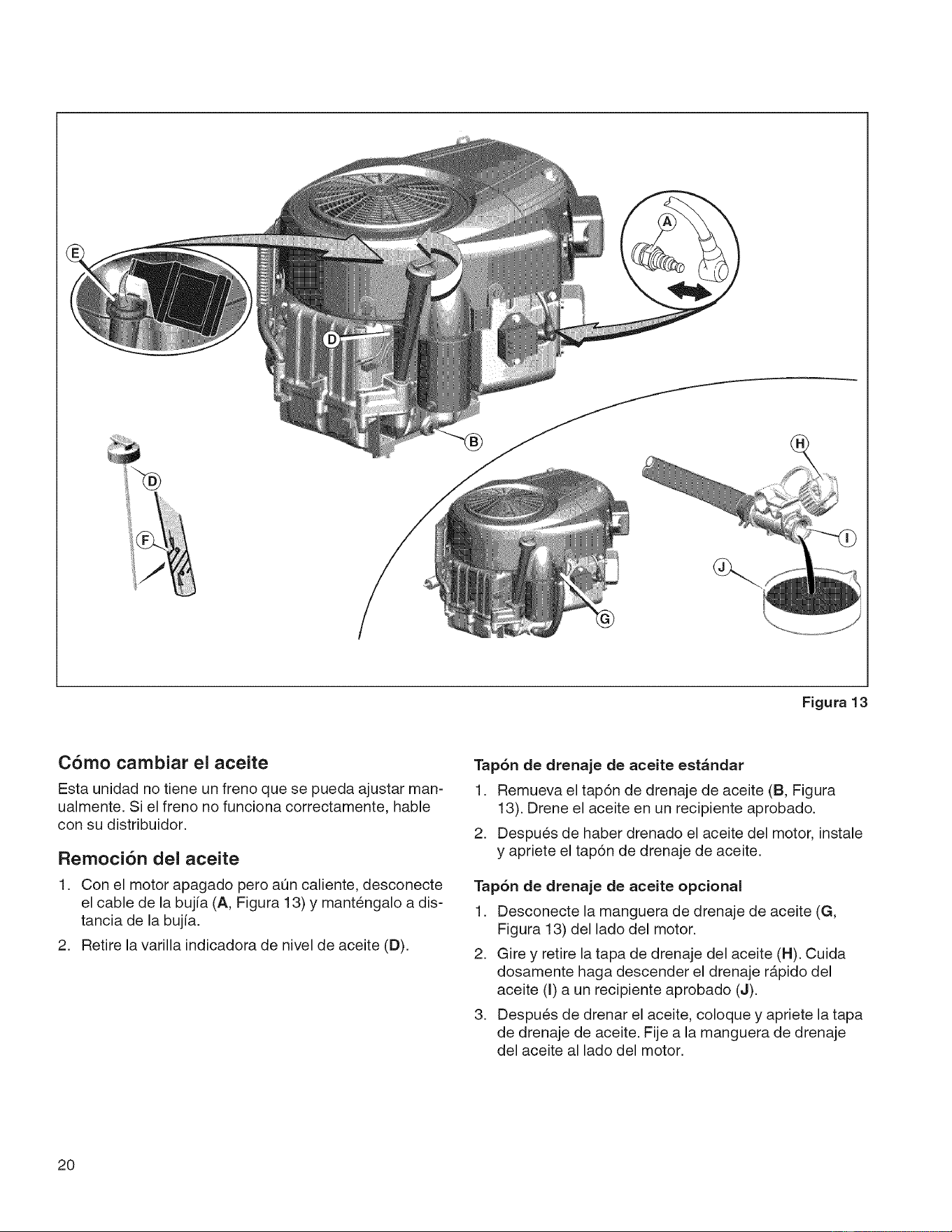
Figura 13
C6mo cambiar el aceite
Esta unidad no tiene un freno que se pueda ajustar man-
ualmente. Si el freno no funciona correctamente, hable
con su distribuidor.
Remoci6n del aceite
1. Con el motor apagado pero ann caliente, desconecte
el cable de la bujia (A, Figura 13) y mantengalo a dis-
tancia de la bujia.
2. Retire la varilla indicadora de nivel de aceite (D).
Tap6n de drenaje de aceite est_ndar
1. Remueva el tap6n de drenaje de aceite (B, Figura
13). Drene el aceite en un recipiente aprobado.
2. Despues de haber drenado el aceite del motor, instale
y apriete el tap6n de drenaje de aceite.
Tap6n de drenaje de aceite opcJonal
1. Desconecte la manguera de drenaje de aceite (G,
Figura 13) del lado del motor.
2. Gire y retire la tapa de drenaje del aceite (H). Cuida
dosamente haga descender el drenaje rapido del
aceite (I) a un recipiente aprobado (J).
3. Despues de drenar el aceite, coloque y apriete la tapa
de drenaje de aceite. Fije a la manguera de drenaje
del aceite al lado del motor.
20
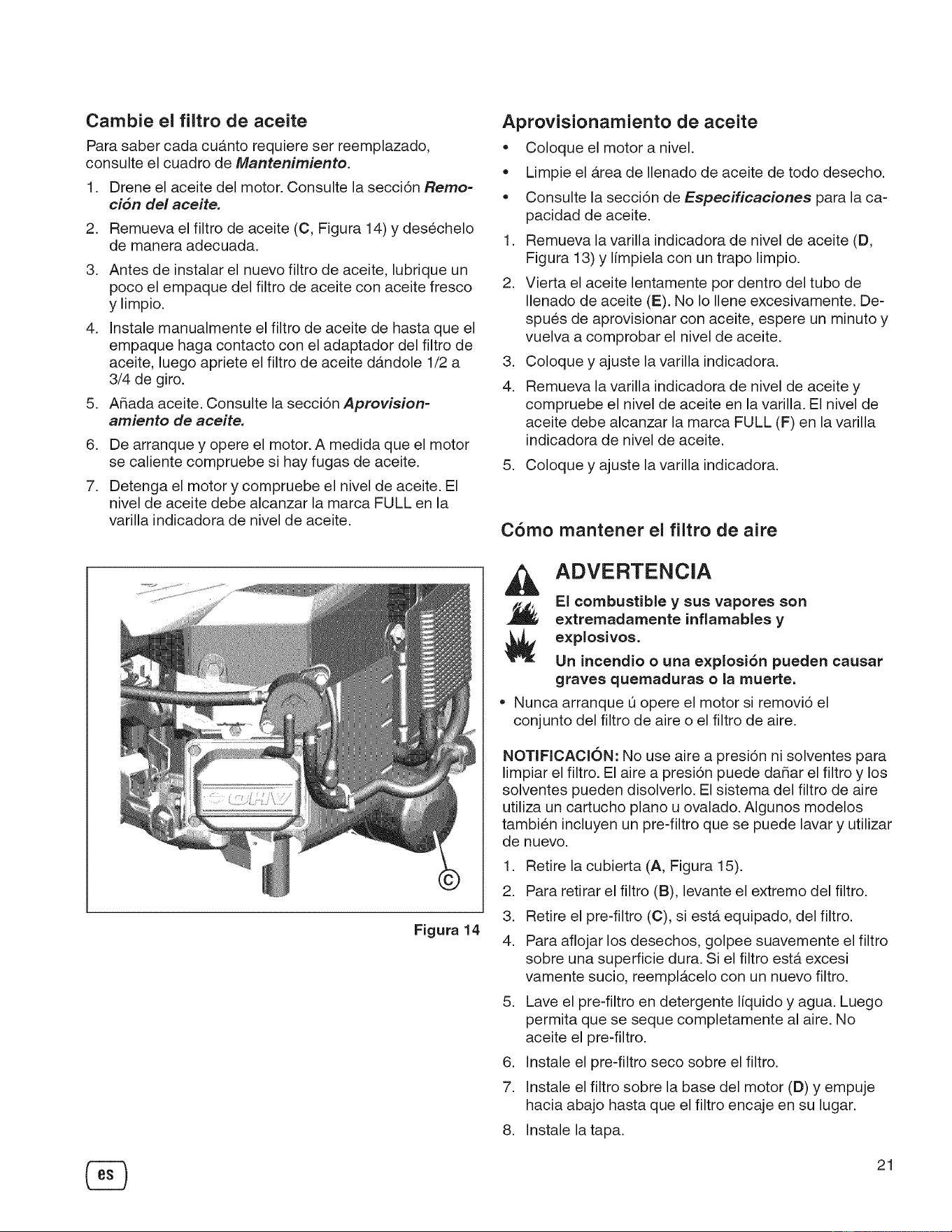
Cambie el filtro de aceite
Para saber cada cuanto requiere ser reemplazado,
consulte el cuadro de Mantenimiento.
1. Drene el aceite del motor. Consulte la secci6n Remo-
ciSn del aceite.
2. Remueva el filtro de aceite (C, Figura 14) y desechelo
de manera adecuada.
3. Antes de instalar el nuevo filtro de aceite, lubrique un
poco el empaque del filtro de aceite con aceite fresco
y limpio.
4. Instale manualmente el filtro de aceite de hasta que el
empaque haga contacto con el adaptador del filtro de
aceite, luego apriete el filtro de aceite dandole 1/2 a
3/4 de giro.
5. Ahada aceite. Consulte la secci6n Aprovision-
amiento de aceite.
6. De arranque y opere el motor. A medida que el motor
se caliente compruebe si hay fugas de aceite.
7. Detenga el motor y compruebe el nivel de aceite. El
nivel de aceite debe alcanzar la marca FULL en la
varilla indicadora de nivel de aceite.
Aprovisionamiento de aceite
• Coloque el motor a nivel.
• Limpie el Area de Ilenado de aceite de todo desecho.
Consulte la secci6n de Especificaciones para la ca-
pacidad de aceite.
1. Remueva la varilla indicadora de nivel de aceite (D,
Figura 13) y limpiela con un trapo limpio.
2. Vierta el aceite lentamente por dentro del tubo de
Ilenado de aceite (E). No Io Ilene excesivamente. De-
spues de aprovisionar con aceite, espere un minuto y
vuelva a comprobar el nivel de aceite.
3. Coloque y ajuste la varilla indicadora.
4. Remueva la varilla indicadora de nivel de aceite y
compruebe el nivel de aceite en la varilla. El nivel de
aceite debe alcanzar la marca FULL (F) en la varilla
indicadora de nivel de aceite.
5. Coloque y ajuste la varilla indicadora.
C6rno mantener el filtro de aire
Figura 14
ADVERTENCIA
El combustible y sus vapores son
extremadamente inflamables y
explosivos.
Un incendio o una explosi6n pueden causar
graves quemaduras o la muerte.
Nunca arranque _ opere el motor si removi6 el
conjunto del filtro de aire o el filtro de aire.
NOTIFICACION: No use aire a presi6n ni solventes para
limpiar el filtro. El aire a presi6n puede dahar el filtro y los
solventes pueden disolverlo. El sistema del filtro de aire
utiliza un cartucho piano u ovalado. Algunos modelos
tambien incluyen un pre-filtro que se puede lavar y utilizar
de nuevo.
1. Retire la cubierta (A, Figura 15).
2. Para retirar el filtro (B), levante el extremo del filtro.
3. Retire el pre-filtro (C), siesta equipado, del filtro.
4. Para aflojar los desechos, golpee suavemente el filtro
sobre una superficie dura. Si el filtro esta excesi
vamente sucio, reemplacelo con un nuevo filtro.
5. Lave el pre-filtro en detergente liquido y agua. Luego
permita que se seque completamente al aire. No
aceite el pre-filtro.
6. Instale el pre-filtro seco sobre el filtro.
7. Instale el filtro sobre la base del motor (D) y empuje
hacia abajo hasta que el filtro encaje en su lugar.
8. Instale la tapa.
21
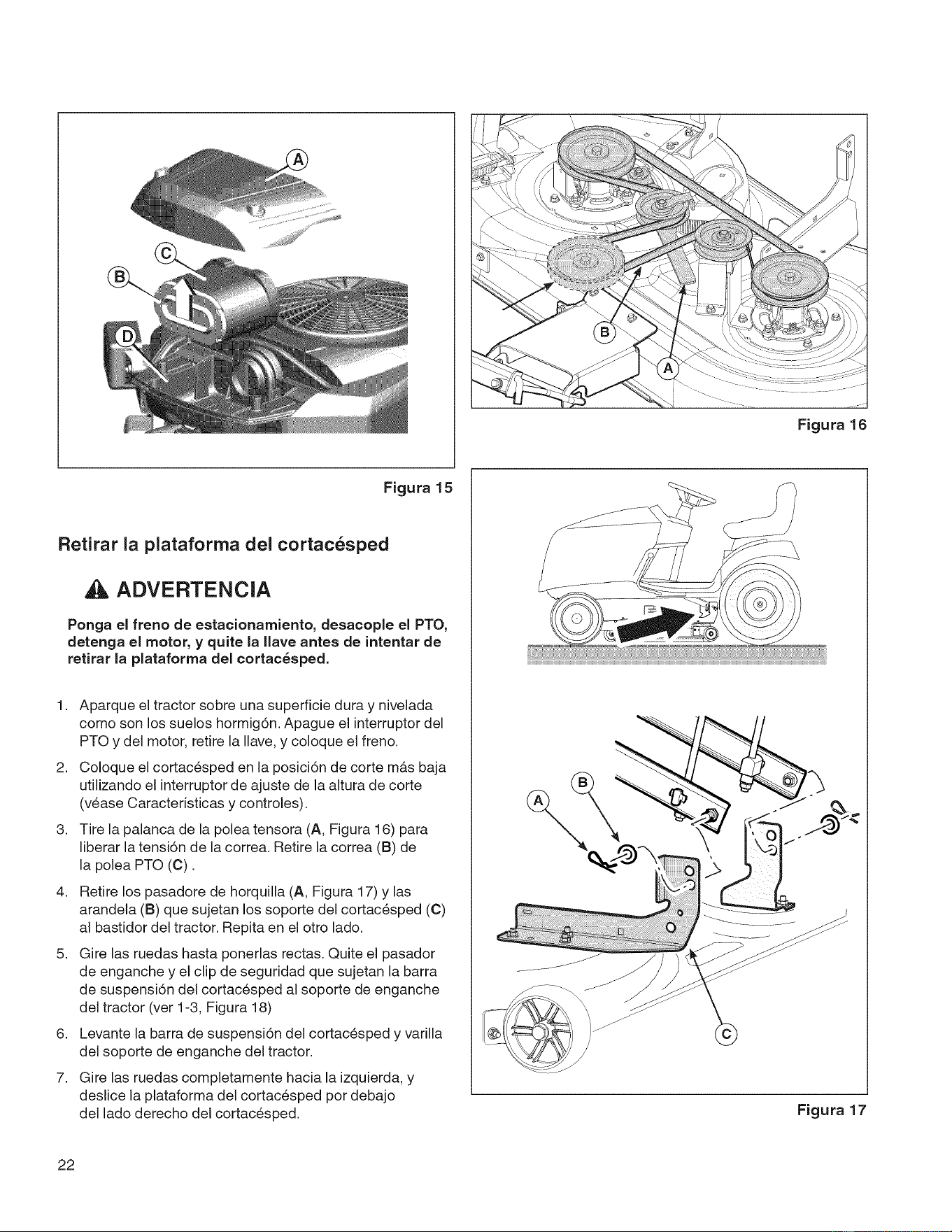
Figura15
Retirar la plataforma del cortacesped
ADVERTENCIA
Ponga el freno de estacionamiento, desacople el PTO,
detenga el motor, y quite la llave antes de intentar de
retirar la plataforma del cortac_sped.
1,
2,
3,
4,
5,
6,
7,
Aparque el tractor sobre una superficie dura y nivelada
como son los suelos hormig6n. Apague el interruptor del
PTO y del motor, retire la Ilave, y coloque el freno.
Coloque el cortac_sped en la posici6n de corte m&s baja
utilizando el interruptor de ajuste de la altura de corte
(v_ase Caracteristicas y controles).
Tire la palanca de la polea tensora (A, Figura 16) para
liberar la tensi6n de la correa. Retire la correa (B) de
la polea PTO (C).
Retire los pasadore de horquilla (A, Figura 17) y las
arandela (B) que sujetan los soporte del cortac_sped (C)
al bastidor del tractor. Repita en el otro lado.
Gire las ruedas hasta ponerlas rectas. Quite el pasador
de enganche y el clip de seguridad que sujetan la barra
de suspensi6n del cortac_sped al soporte de enganche
del tractor (ver 1-3, Figura 18)
Levante la barra de suspensi6n del cortac_sped y varilla
del soporte de enganche del tractor.
Gire las ruedas completamente hacia la izquierda, y
deslice la plataforma del cortac_sped por debajo
del lado derecho del cortac_sped.
%
Figura 16
Figura 17
22
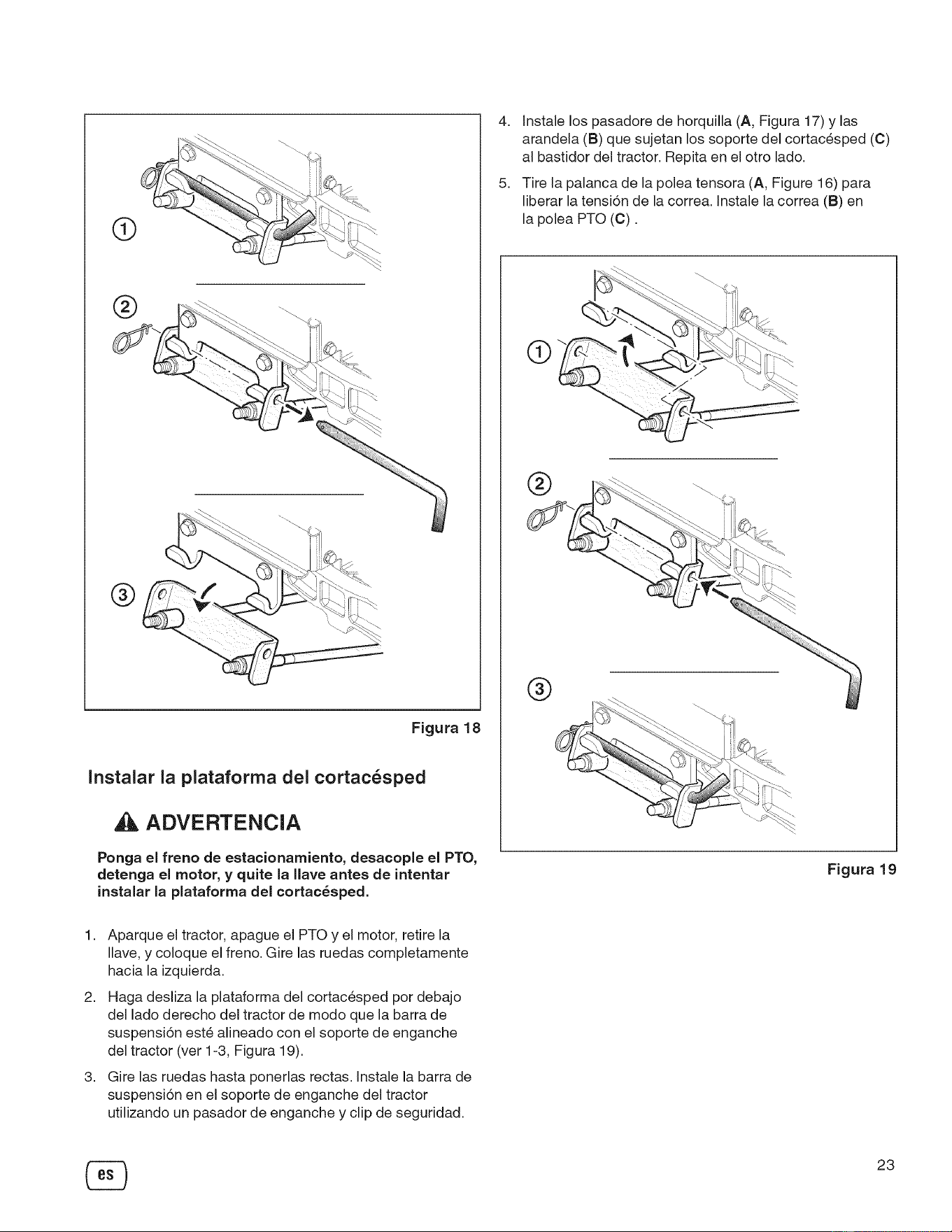
®
Figura 18
Instalar la plataforma del cortacesped
ADVERTENCIA
Ponga el freno de estacionamiento, desacople el PTO,
detenga el motor, y quite la llave antes de intentar
instalar la plataforma del cortac_sped.
4,
5,
Instale los pasadore de horquilla (A, Figura 17) y las
arandela (B) que sujetan los soporte del cortac_sped (C)
al bastidor del tractor. Repita en el otro lado.
Tire la palanca de la polea tensora (A, Figure 16) para
liberar la tensi6n de la correa. Instale la correa (B) en
la polea PTO (C).
®
®
®
Figura 19
1,
2,
3,
Aparque el tractor, apague el PTO y el motor, retire la
Ilave, y coloque el freno. Gire las ruedas completamente
hacia la izquierda.
Haga desliza la plataforma del cortacesped por debajo
del lado derecho del tractor de modo que la barra de
suspensi6n est_ alineado con el soporte de enganche
del tractor (ver 1-3, Figura 19).
Gire las ruedas hasta ponerlas rectas. Instale la barra de
suspensi6n en el soporte de enganche del tractor
utilizando un pasador de enganche y clip de seguridad.
23
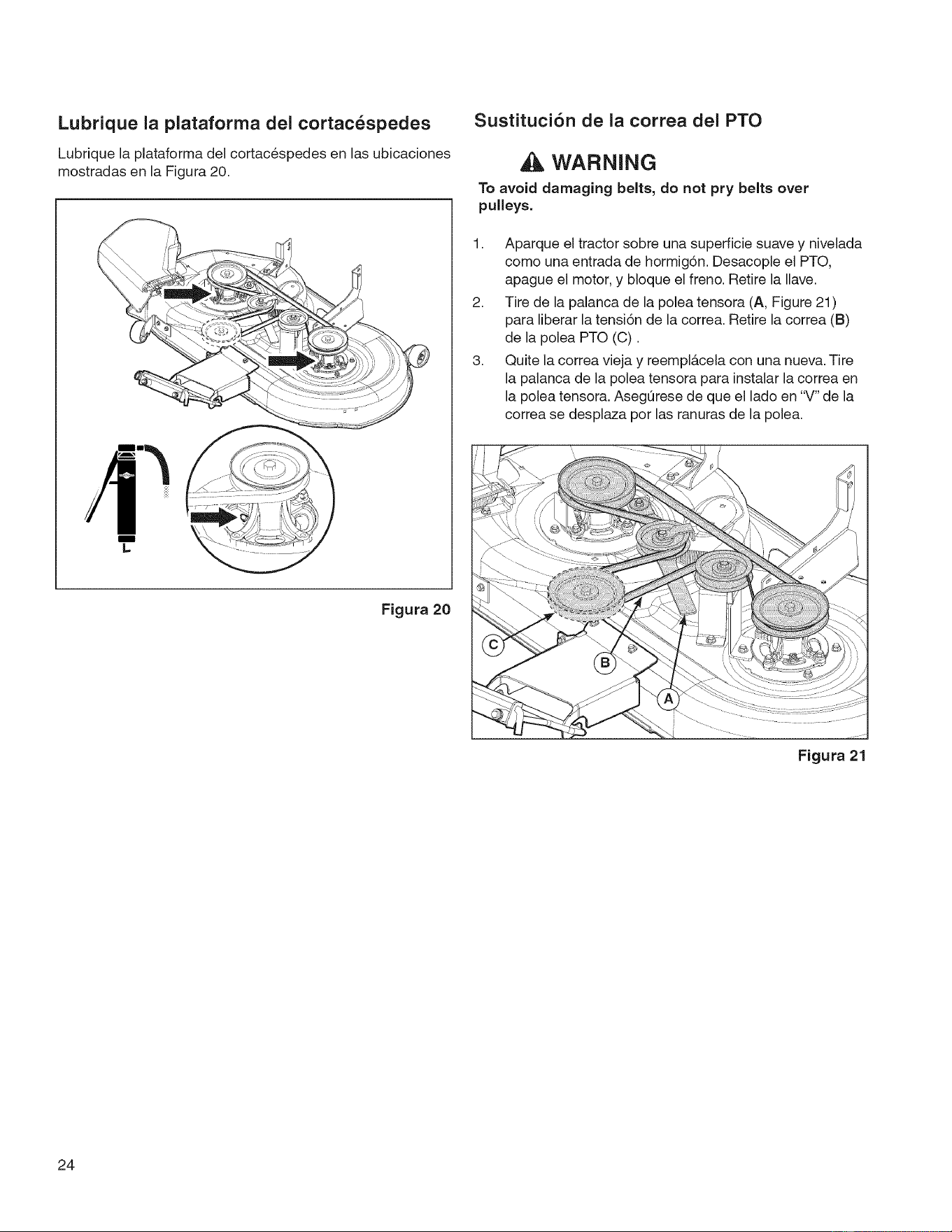
Lubrique la plataforma del cortacespedes
Lubrique la plataforma del cortac_spedes en las ubicaciones
mostradas en la Figura 20.
m
L.
Sustituci6n de la correa del PTO
WARNING
To avoid damaging belts, do not pry belts over
pulleys.
1. Aparque el tractor sobre una superficie suave y nivelada
como una entrada de hormig6n. Desacople el PTO,
apague el motor, y bloque el freno. Retire la Ilave.
2. Tire de la palanca de la polea tensora (A, Figure 21 )
para liberar la tensi6n de la correa. Retire la correa (B)
de la polea PTO (C).
3. Quite la correa vieja y reempl&cela con una nueva. Tire
la palanca de la polea tensora para instalar la correa en
la polea tensor& AsegOrese de que el lado en "V" de la
correa se desplaza por las ranuras de la pole&
Figura 20
24
Figura 21
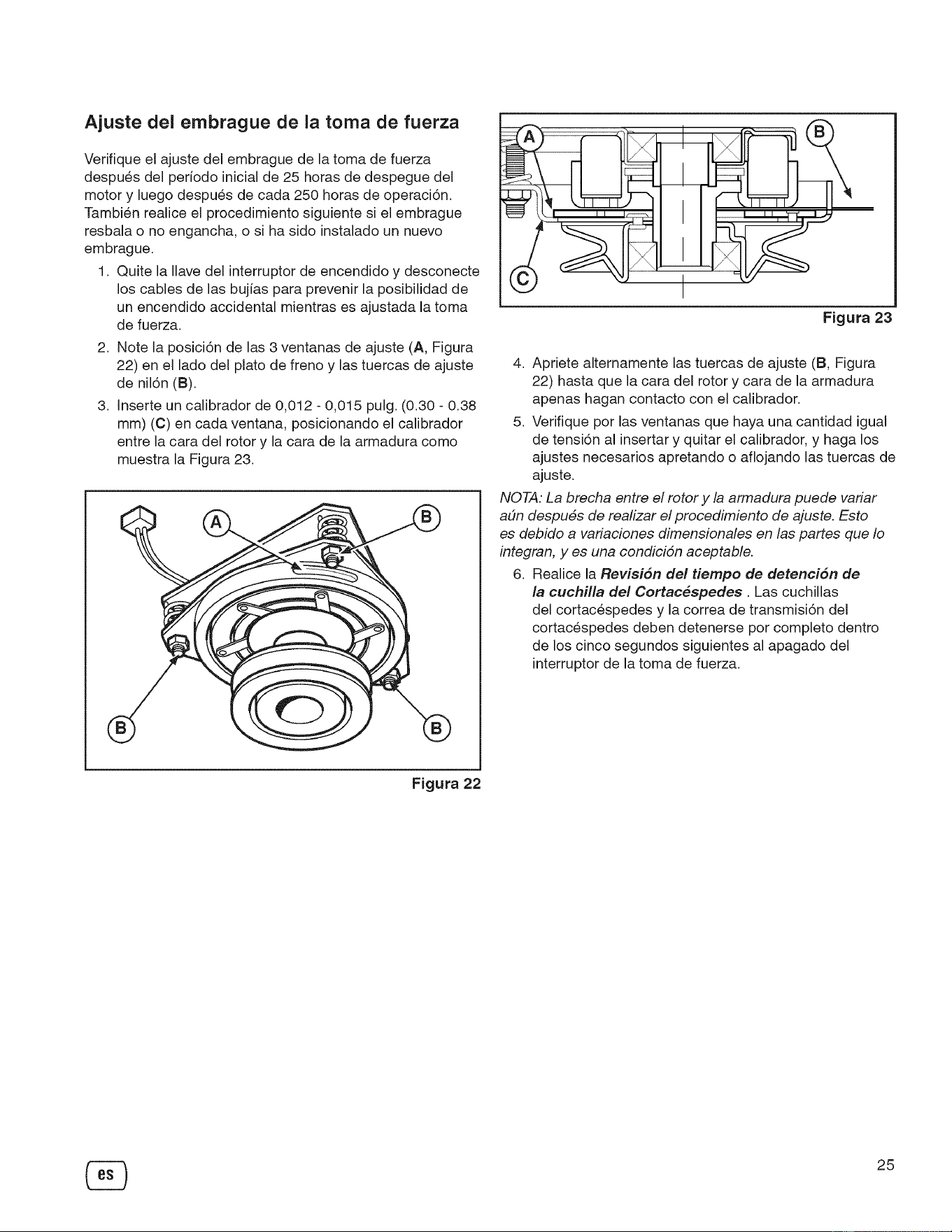
Ajuste del embrague de la toma de fuerza
Verifique el ajuste del embrague de la toma de fuerza
despu_s del periodo inicial de 25 horas de despegue del
motor y luego despu_s de cada 250 horas de operaci6n.
Tambi6n realice el procedimiento siguiente si el embrague
resbala o no engancha, o si ha sido instalado un nuevo
embrague.
1. Quite la Ilave del interruptor de encendido y desconecte
los cables de las bujias para prevenir la posibilidad de
un encendido accidental mientras es ajustada la toma
de fuerza.
2. Note la posici6n de las 3 ventanas de ajuste (A, Figura
22) en el lado del plato de freno y las tuercas de ajuste
de nil6n (B).
3. Inserte un calibrador de 0,012 - 0,015 pulg. (0.30 - 0.38
mm) (C) en cada ventana, posicionando el calibrador
entre la cara del rotor y la cara de la armadura como
muestra la Figura 23.
®
Figura 23
4. Apriete alternamente las tuercas de ajuste (B, Figura
22) hasta que la cara del rotor y cara de la armadura
apenas hagan contacto con el calibrador.
5. Verifique por las ventanas que haya una cantidad igual
de tensi6n al insertar y quitar el calibrador, y haga los
ajustes necesarios apretando o aflojando las tuercas de
ajuste.
NOTA: La brecha entre el rotor y la armadura puede variar
a#n despu6s de realizar el procedimiento de ajuste. Esto
es debido a variaciones dimensionales en las partes que Io
integran, y es una condicidn aceptable.
6. Realice la Revisi6n de! tiempo de detenci6n de
la cuchilla del Cortac_spedes . Las cuchillas
del cortac_spedes y la correa de transmisi6n del
cortac6spedes deben detenerse por completo dentro
de los cinco segundos siguientes al apagado del
interruptor de la toma de fuerza.
Figura 22
25
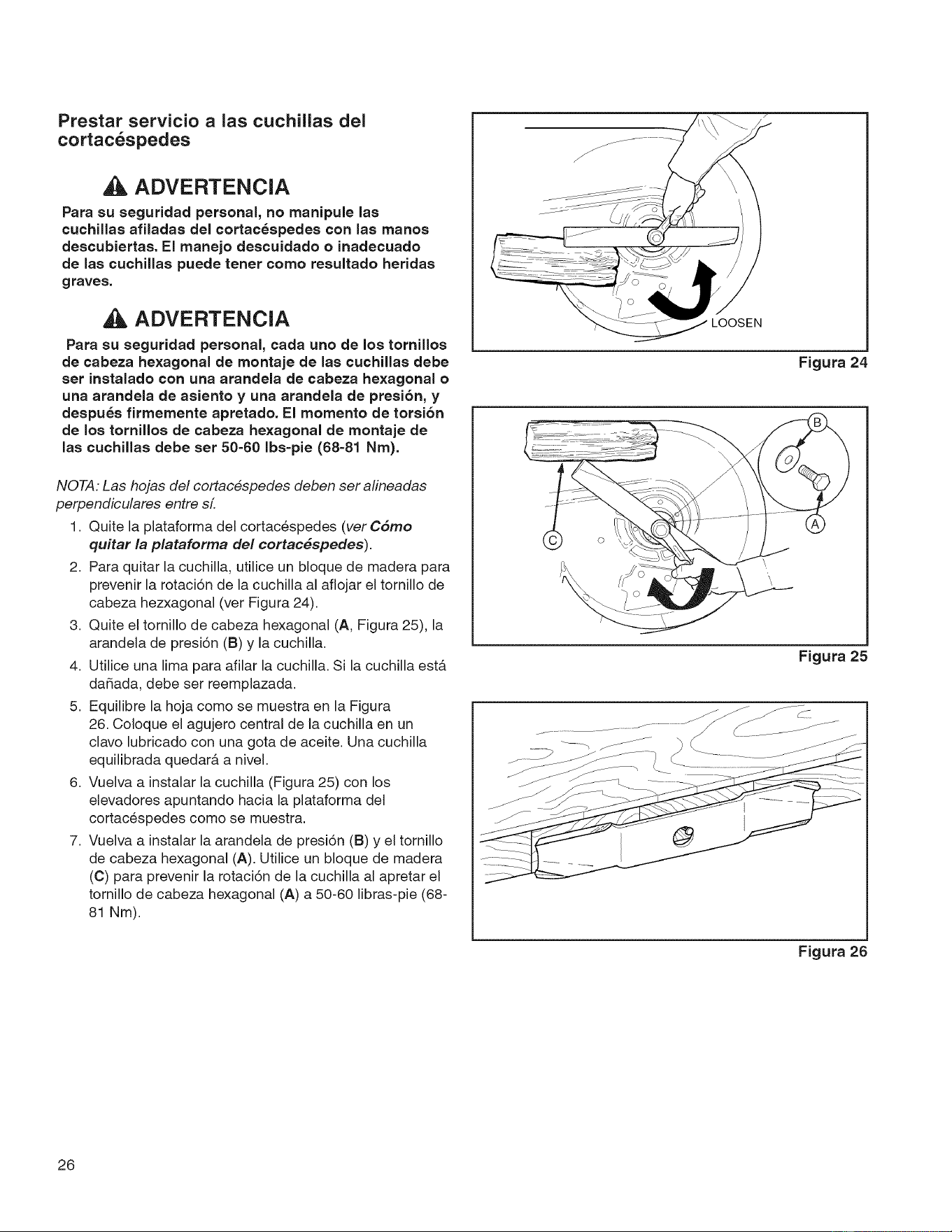
Prestar servicio a las cuchillas del
cortacespedes
ADVERTENCIA
Para su seguridad personal, no manipule las
cuchillas afiladas del cortac_spedes con las manes
descubiertas. El manejo descuidado e inadecuado
de las cuchillas puede tenet come resultado heridas
graves.
ADVERTENCIA
Para su seguridad personal, cada uno de los tomillos
de cabeza hexagonal de montaje de las cuchillas debe
set instalado con una arandela de cabeza hexagonal o
una arandela de asiento y una arandela de presi6n, y
despu_s firmemente apretado. El memento de torsi6n
de los tornillos de cabeza hexagonal de mentaje de
las cuchillas debe set 50-60 Ibs-pie (68=81 Nm).
NOTA: Las hojas del cortac6spedes deben ser alineadas
perpendiculares entre sL
1. Quite la plataforma del cortac_spedes (ver C6mo
quitar la plataforma del cortac_spedes).
2. Para quitar la cuchilla, utilice un bloque de madera para
prevenir la rotaci6n de la cuchilla al aflojar el tornillo de
cabeza hezxagonal (vet Figura 24).
3. Quite el tornillo de cabeza hexagonal (A, Figura 25), la
arandela de presi6n (B) y la cuchilla.
4. Utilice una lima para afilar la cuchilla. Si la cuchilla est&
daSada, debe ser reemplazada.
5. Equilibre la hoja come se muestra en la Figura
26. Coloque el agujero central de la cuchilla en un
clave lubricado con una gota de aceite. Una cuchilla
equilibrada quedar& a nivel.
6. Vuelva a instalar la cuchilla (Figura 25) con los
elevadores apuntando hacia la plataforma del
cortac_spedes come se muestra.
7. Vuelva a instalar la arandela de presi6n (B) y el tornillo
de cabeza hexagonal (A). Utilice un bloque de madera
(C) para prevenir la rotaci6n de la cuchilla al apretar el
tornillo de cabeza hexagonal (A) a 50-60 libras-pie (68-
81 Nm).
LOOSEN
Figura 24
Figura 25
Figura 26
26
AImacenaje
ADVERTENCIA
Nunca alrnacene la unidad (con combustible)
en una estructura cerrada y con poca
ventilaci6n. Los vapores del combustible
pueden trasladarse a una {uente de ignici6n
(tal come una caldera, un calentador de agua,
etc.) y causar una e×plosi6n. El vapor del
combustible tarnbi_n es t6×ico para seres
humanos y animales.
AI almacenar combustible o equipos con combustible
en el tanque
Almacenar lejos de calderas, estufas, calentadores de
agua u otros aparatos con luces-piloto u otras fuentes de
ignici6n, ya que pueden prender fuego a vapores de la
gasolina.
Equipo
Desengrane el PTO, desengrane el freno de
estacionamiento y retire la Ilave.
La vida L_tilde la bateria ser_. superior si se la retira.
Col6quelo en un lugar fresco y seco y ca.rguelo per
complete alrededor de una vez al mes. Si se deja la
bateria en la unidad, desconecte el cable negative.
Sistema de combustible
El combustible puede deteriorarse si permanece
almacenado durante m_.s de 30 dias. El combustible
deteriorado hace que se acumulen dep6sitos de a.cido
y resina en el sistema de combustible o en las piezas
principales del carburador. Para que el combustible se
mantenga fresco, utilice el estabilizador.
No es necesario drenar la gasolina del motor si se
a_ade un estabilizador de combustible siguiendo las
instrucciones. Haga funcionar el motor durante dos
minutes para que el estabilizador circule per el sistema de
combustible antes de almacenarlo.
Aceite de motor
Mientras el motor sigue estando caliente, cambie el aceite
del motor. Consulte el Manual del Motor.
Antes de poner en marcha la unidad despu_s de su
almacenaje:
• Verifique todos los niveles de liquido. Verifique todos
los items de mantenimiento.
• Realice todas las verificaciones y los procedimientos
recomendados en este manual.
Permita que el motor se caliente durante varies
minutes antes de utilizarlo.
27
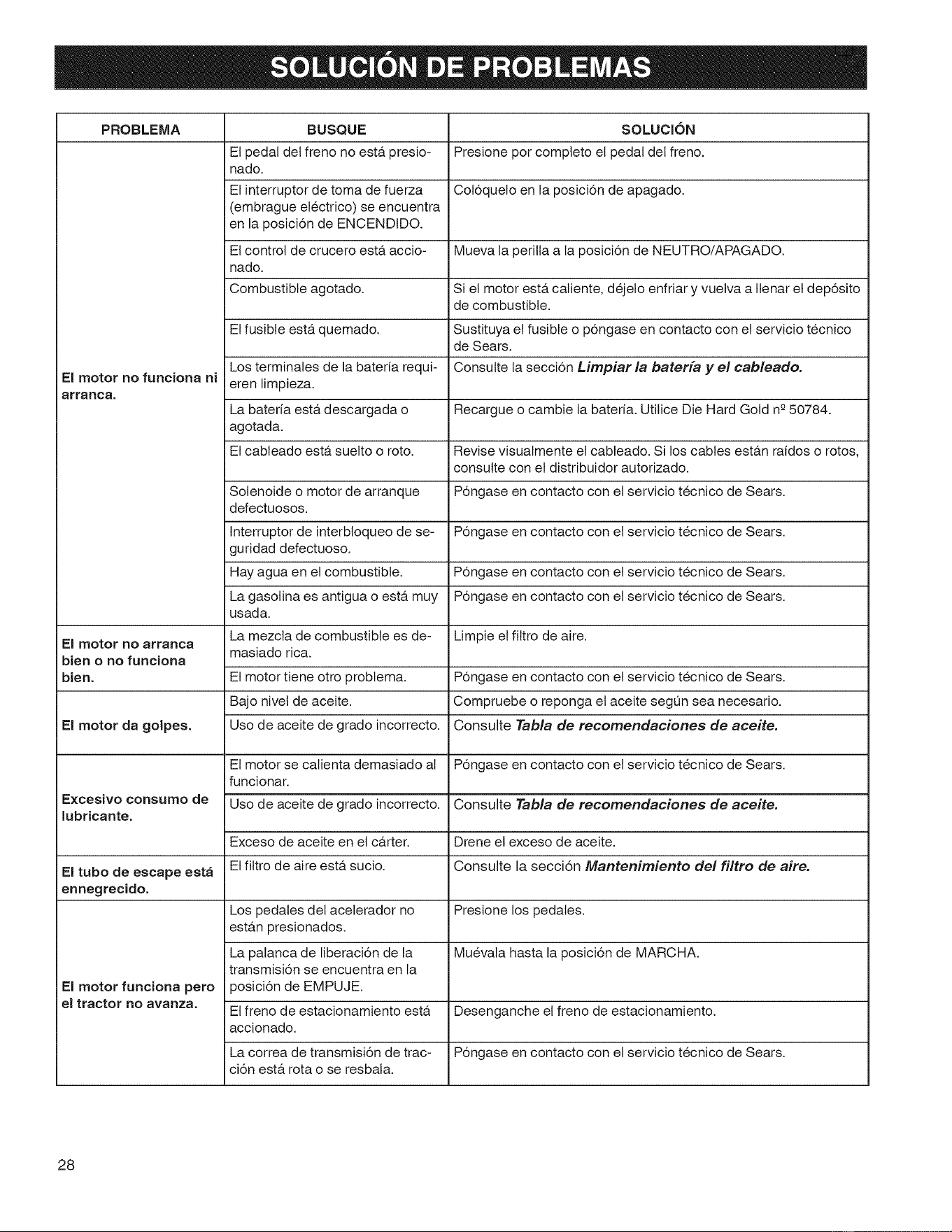
PROBLEIVlA BUSQUE SOLUCION
El pedal det freno no esta. presio- Presione por completo et pedal del freno.
nado.
El interruptor de toma de fuerza Coloquelo en la posici6n de apagado.
(embrague electrico) se encuentra
en la posici6n de ENCENDIDO.
El control de crucero esta. accio- Mueva la perilla a la posici6n de NEUTRO/APAGADO.
nado.
Combustible agotado. Si et motor esta.caliente, dejelo enfriar y vuelva a Ilenar et deposito
de combustible.
El fusible esterquemado. Sustituya et fusible o p6ngase en contacto con et servicio tecnico
de Sears.
Los terminales de la bater[a requi- Consutte la seccidn Limpiar la bater(a y el cableado.
El motor no funciona ni eren limpieza.
arranca.
La bater[a ester descargada o Recargue o cambie la bater[a. Utilice Die Hard Gold n-°50784.
agotada.
El cableado ester suelto o roto. Revise visualmente el cableado. Si los cables est_tn rafdos o rotos,
consutte con et distribuidor autorizado.
Sotenoide o motor de arranque Pongase en contacto con et servicio tecnico de Sears.
defectuosos.
lnterruptor de interbloqueo de se- Pongase en contacto con et servicio tecnico de Sears.
guridad defectuoso.
Hay agua en et combustible. Pongase en contacto con et servicio tecnico de Sears.
La gasolina es antigua o ester muy Pongase en contacto con et servicio tecnico de Sears.
usada.
La mezcta de combustible es de- Limpie et fittro de aire.
El motor no arranca
masiado rica.
bien o no funciona
bien. El motor tiene otro probtema. Pongase en contacto con et servicio tecnico de Sears.
Bajo nivet de aceite. Compruebe o reponga et aceite segun sea necesario.
El motor da golpes. Uso de aceite de grado incorrecto. Consulte Tabla de recomendaciones de aceite.
El motor se calienta demasiado al Pongase en contacto con et servicio tecnico de Sears.
funcionar.
Excesivo consumo de Uso de aceite de grado incorrecto. Consulte Tabla de recomendaciones de aceite.
lubricante.
Exceso de aceite en et carter. Drene et exceso de aceite.
El tubo de escape esta El fittro de aire ester sucio. Consulte la secci6n Mantenimiento de! filtro de aire.
ennegrecido.
Los pedales del acelerador no Presione los pedales.
est_tn presionados.
La palanca de liberacidn de la Muevala hasta la posici6n de MARCHA.
transmisidn se encuentra en la
El motor funciona pero posici6n de EMPUJE.
el tractor no avanza.
El freno de estacionamiento ester Desenganche et freno de estacionamiento.
accionado.
La correa de transmisidn de trac- Pongase en contacto con et servicio tecnico de Sears.
cidn ester rota o se resbala.
28
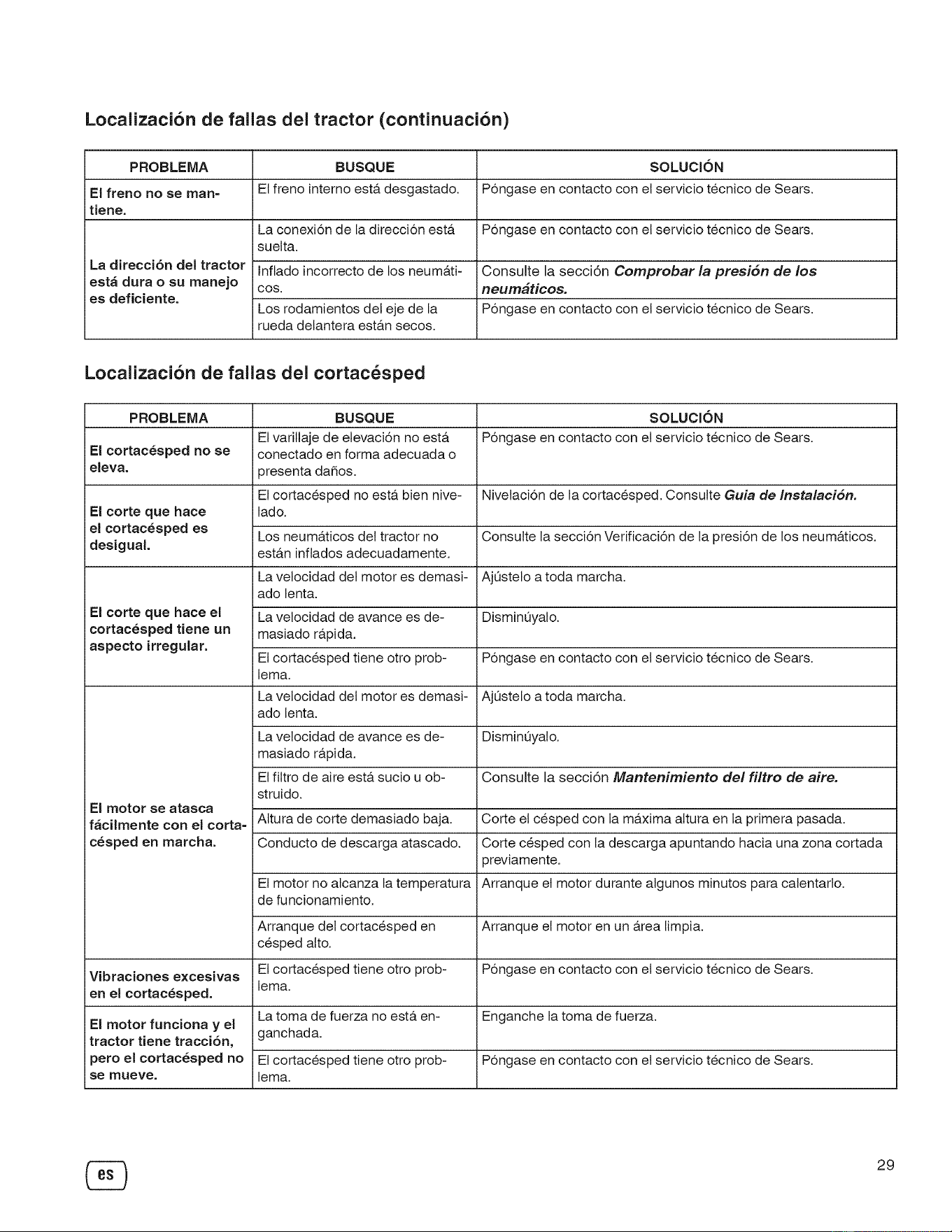
Localizaci6n de fallas del tractor (continuaci6n)
PROBLEMA BUSQUE SOLUCION
El freno no ae man= El freno interno est& desgastado. Pongase en contacto con et servicio tecnico de Sears.
tiene,
La conexion de la direccion est& Pongase en contacto con et servicio tecnico de Sears.
suetta.
La direcci6n del tractor lnfiado incorrecto de los neum#,ti- Consulte la secci6n Comprobar la presiSn de los
esta dura o su manejo cos. neumbticos.
es deficiente.
Los rodamientos del eje de la P6ngase en contacto con et servicio tecnico de Sears.
rueda detantera estan secos.
Localizaci6n de fallas del cortacesped
PROBLEMA BUSQUE SOLUClON
El varillaje de elevaci6n no est& P6ngase en contacto con et servicio tecnico de Sears.
El cortacesped no se conectado en forma adecuada o
eleva, presenta da5os.
El cortacesped no est& bien hive- Nivetaci6n de la cortacesped. Consulte Guia de InstalaciSn.
El corte que hace lado.
el cortacesped es Los neum#,ticos det tractor no Consutte la secci6n Verificaci6n de la presi6n de los neum&ticos.
desigual, est&n infiadosadecuadamente.
La velocidad del motor es demasi- Ajustelo a toda marcha.
ado lent&
El corte que hace el La velocidad de avance es de- DisminQyalo.
cortacesped tiene un masiado r&pida.
aspecto irregular.
Et cortacesped tiene otro prob- P6ngase en contacto con et servicio tecnico de Sears.
lema.
La velocidad det motor es demasi- Ajustelo a toda marcha.
ado lent&
La velocidad de avance es de- DisminQyalo.
masiado r#,pida.
El filtro de aire est& sucio u ob- Consulte la secci6n Mantenimiento de! filtro de aire.
struido.
El motor se atasca
facilmente con el corta= Altura de corte demasiado baja. Corte et cesped con la m#,xima altura en la primera pasada.
cesped en marcha. Conducto de descarga atascado. Corte cesped con la descarga apuntando hacia una zona cortada
previamente.
El motor no atcanza la temperatura Arranque et motor durante algunos minutos para calentarlo.
de funcionamiento.
Arranque del cortacesped en Arranque et motor en un Area limpia.
cesped alto.
El cortacesped tiene otro prob- P6ngase en contacto con et servicio tecnico de Sears.
Vibraciones excesivas
lema.
en el cortacesped.
La toma de fuerza no est& en- Enganche la toma de fuerza.
El motor funciona y el ganchada.
tractor tiene tracci6n,
pero el cortacesped no El cortacesped tiene otro prob- P6ngase en contacto con et servicio tecnico de Sears.
se mueve, lema.
29
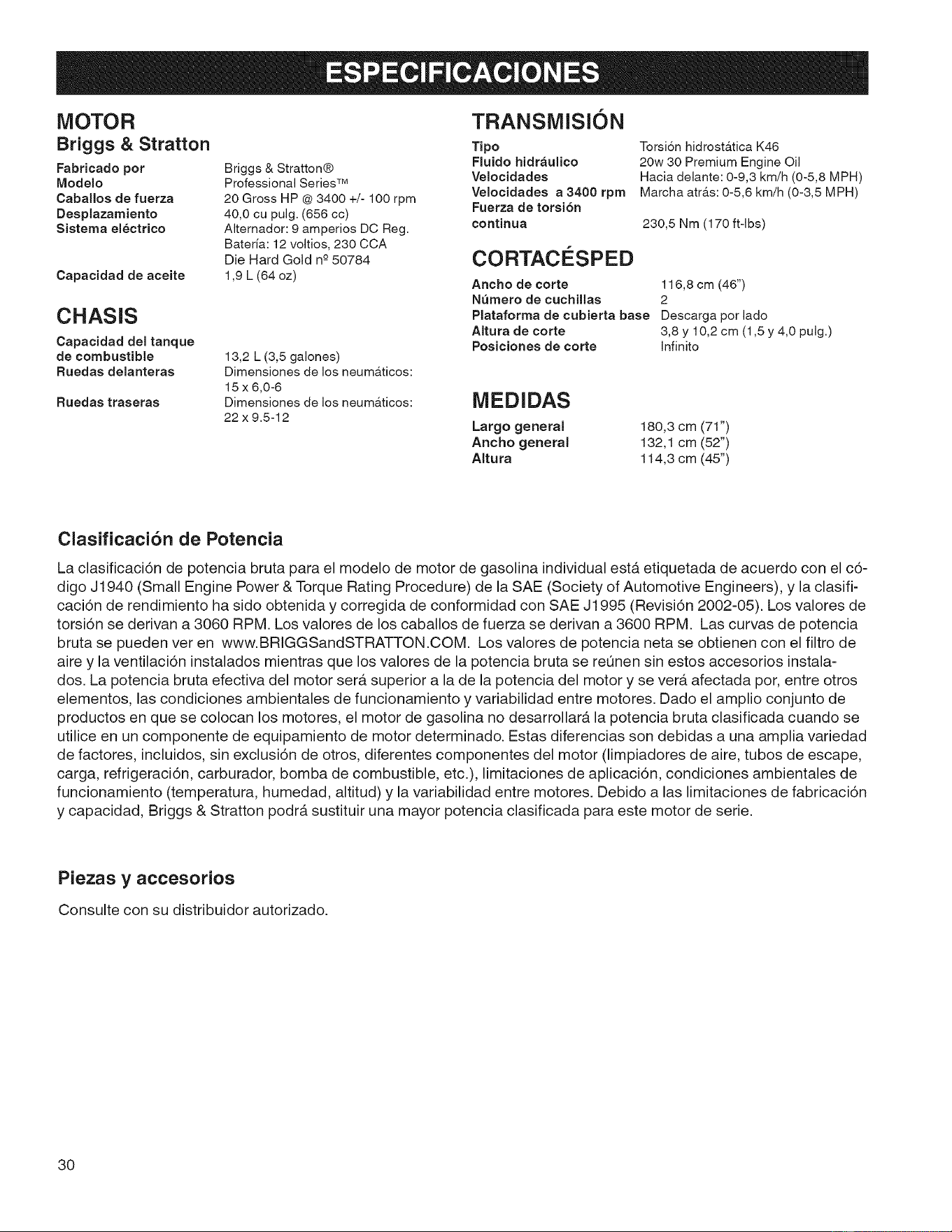
MOTOR
Briggs & Stratton
Fabricado pot
Modelo
CabaHos de fuerza
Desplazamiento
Sistema electrico
Capacidad de aceite
CHASIS
Capacidad del tanque
de combustible
Ruedas delanteras
Ruedas traseras
Briggs & Stratton®
Professional Series TM
20 Gross HP @ 3400 +/- 100 rpm
40,0 cu pulg. (656 cc)
Altemador: 9 amperios DC Reg.
Bateria: 12 voltios, 230 CCA
Die Hard Gold n-°50784
1,9 L (64 oz)
13,2 L (3,5 galones)
Dimensiones de los neum_.ticos:
15 x 6,0-6
Dimensiones de los neum_.ticos:
22 x 9.5-12
TRANSMiSI()N
Tipo
Fluido hidraulico
Velocidades
Velocidades a 3400 tpm
Fuerza de torsi6n
continua
Torsi6n hidrostb.tica K46
20w 30 Premium Engine Oil
Hacia delante: 0-9,3 km/h (0-5,8 MPH)
Marcha atr_.s: 0-5,6 km/h (0-3,5 MPH)
230,5 Nm (170 ft-lbs)
CORTACESPED
Ancho de corte 116,8 cm (46")
NQrnero de cuchillas 2
Plataforrna de cubierta base Descarga pot lado
Altura de corte 3,8 y 10,2 cm (1,5 y 4,0 pulg.)
Posiciones de corte Infinite
MEDIDAS
Largo general 180,3 cm (71")
Ancho general 132,1 cm (52")
AItura 114,3 cm (45")
Clasificaci6n de Potencia
La clasificaci6n de potencia bruta para el modelo de motor de gasolina individual estb. etiquetada de acuerdo con el c6-
digo J1940 (Small Engine Power & Torque Rating Procedure) de la SAE (Society of Automotive Engineers), y la clasifi-
caci6n de rendimiento ha sido obtenida y corregida de conformidad con SAE J1995 (Revisi6n 2002-05). Los valores de
torsi6n se derivan a 3060 RPM. Los valores de los caballos de fuerza se derivan a 3600 RPM. Las curvas de potencia
bruta se pueden ver en www.BRIGGSandSTRATTON.COM. Los valores de potencia neta se obtienen con el filtro de
aire y la ventilaci6n instalados mientras que los valores de la potencia bruta se reOnen sin estos accesorios instala-
dos. La potencia bruta efectiva del motor serb. superior a la de la potencia del motor y se verb.afectada pot, entre otros
elementos, las condiciones ambientales de funcionamiento y variabilidad entre motores. Dado el amplio conjunto de
productos en que se colocan los motores, el motor de gasolina no desarrollarb, la potencia bruta clasificada cuando se
utilice en un componente de equipamiento de motor determinado. Estas diferencias son debidas a una amplia variedad
de factores, incluidos, sin exclusi6n de otros, diferentes componentes del motor (limpiadores de aire, tubos de escape,
carga, refrigeraci6n, carburador, bomba de combustible, etc.), limitaciones de aplicaci6n, condiciones ambientales de
funcionamiento (temperatura, humedad, altitud) y la variabilidad entre motores. Debido alas limitaciones de fabricaci6n
y capacidad, Briggs & Stratton podrb, sustituir una mayor potencia clasificada para este motor de serie.
Piezas y accesorios
Consulte con su distribuidor autorizado.
30
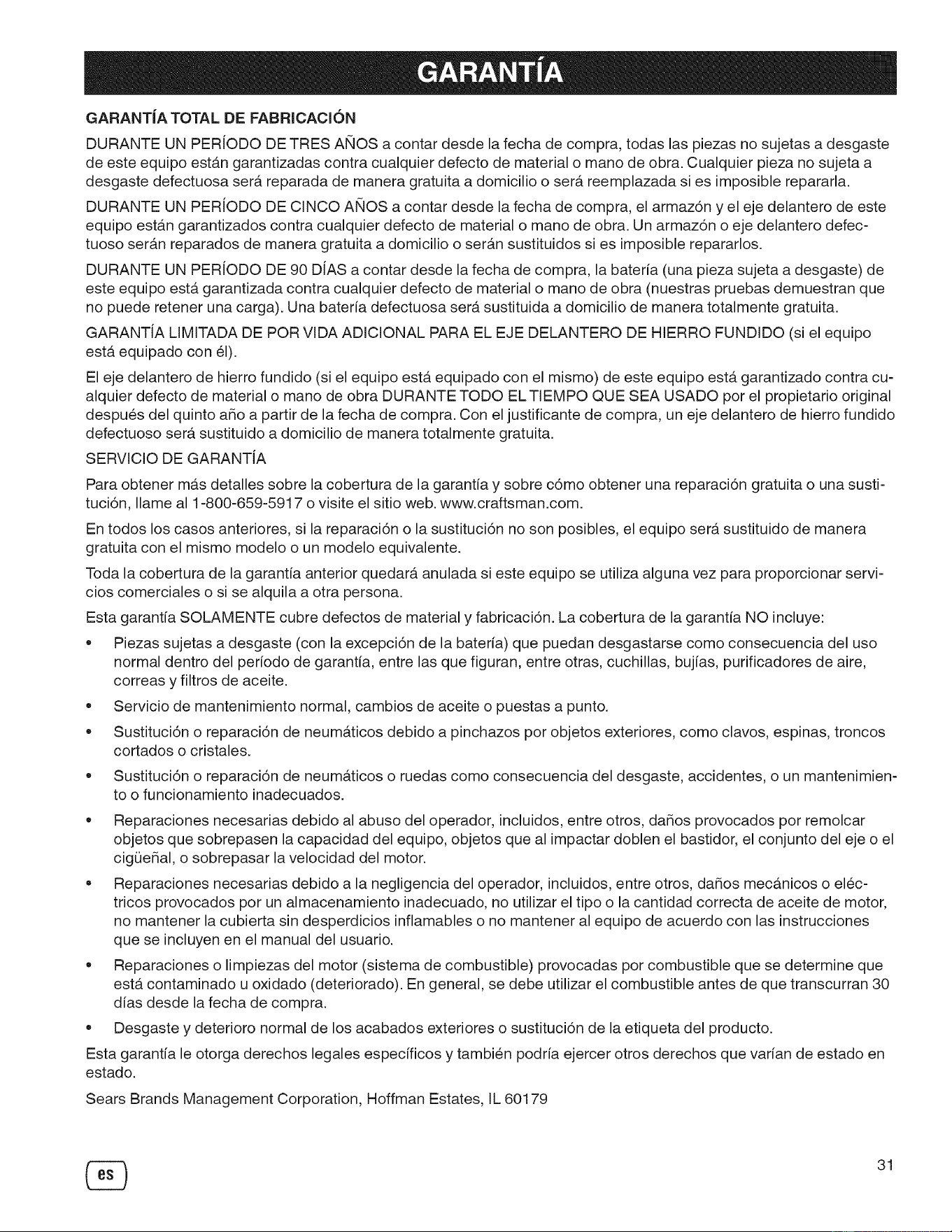
GARANTiATOTAL DE FABRICACION
DURANTE UN PERiODO DE TRES ANOS a contar desde la fecha de compra, todas las piezas no sujetas a desgaste
de este equipo est_tn garantizadas contra cualquier defecto de material o mano de obra. Cualquier pieza no sujeta a
desgaste defectuosa ser_. reparada de manera gratuita a domicilio o sera reemplazada si es imposible repararla.
DURANTE UN PERiODO DE ClNCO ANOS a contar desde la fecha de compra, el armaz6n y el eje delantero de este
equipo estan garantizados contra cualquier defecto de material o mano de obra. Un armaz6n o eje delantero defec-
tuoso seran reparados de manera gratuita a domicilio o seran sustituidos si es imposible repararlos.
DURANTE UN PERiODO DE 90 DiAS a contar desde la fecha de compra, la bateria (una pieza sujeta a desgaste) de
este equipo esta garantizada contra cualquier defecto de material o mano de obra (nuestras pruebas demuestran que
no puede retener una carga). Una bateria defectuosa sera sustituida a domicilio de manera totalmente gratuita.
GARANTiA LIMITADA DE POR VlDA ADIClONAL PARA EL EJE DELANTERO DE HIERRO FUNDIDO (si el equipo
esta equipado con 61).
El eje delantero de hierro fundido (si el equipo esta equipado con el mismo) de este equipo esta garantizado contra cu-
alquier defecto de material o mano de obra DURANTE TODO ELTIEMPO QUE SEA USADO pot el propietario original
despues del quinto a_o a partir de la fecha de compra. Con el justificante de compra, un eje delantero de hierro fundido
defectuoso sera sustituido a domicilio de manera totalmente gratuita.
SERVlClO DE GARANTiA
Para obtener mas detalles sobre la cobertura de la garantia y sobre c6mo obtener una reparaci6n gratuita o una susti-
tuci6n, Ilame al 1-800-659-5917 o visite el sitio web. www.craftsman.com.
En todos los casos anteriores, si la reparaci6n o la sustituci6n no son posibles, el equipo sera sustituido de manera
gratuita con el mismo modelo o un modelo equivalente.
Toda la cobertura de la garantia anterior quedara anulada si este equipo se utiliza alguna vez para proporcionar servi-
cios comerciales o si se alquila a otra persona.
Esta garantia SOLAMENTE cubre defectos de material y fabricaci6n. La cobertura de la garantia NO incluye:
• Piezas sujetas a desgaste (con la excepci6n de la bateria) que puedan desgastarse como consecuencia del uso
normal dentro del periodo de garantia, entre las que figuran, entre otras, cuchillas, bujias, purificadores de aire,
correas y filtros de aceite.
Servicio de mantenimiento normal, cambios de aceite o puestas a punto.
Sustituci6n o reparaci6n de neumaticos debido a pinchazos pot objetos exteriores, como clavos, espinas, troncos
cortados o cristales.
Sustituci6n o reparaci6n de neumaticos o ruedas como consecuencia del desgaste, accidentes, o un mantenimien-
to o funcionamiento inadecuados.
Reparaciones necesarias debido al abuso del operador, incluidos, entre otros, da_os provocados pot remolcar
objetos que sobrepasen la capacidad del equipo, objetos que al impactar doblen el bastidor, el conjunto del eje o el
cig0ehal, o sobrepasar la velocidad del motor.
Reparaciones necesarias debido a la negligencia del operador, incluidos, entre otros, dahos mecanicos o elec-
tricos provocados por un almacenamiento inadecuado, no utilizar el tipo o la cantidad correcta de aceite de motor,
no mantener la cubierta sin desperdicios inflamables o no mantener al equipo de acuerdo con las instrucciones
que se incluyen en el manual del usuario.
Reparaciones o limpiezas del motor (sistema de combustible) provocadas por combustible que se determine que
estb. contaminado u oxidado (deteriorado). En general, se debe utilizar el combustible antes de que transcurran 30
dias desde la fecha de compra.
Desgaste y deterioro normal de los acabados exteriores o sustituci6n de la etiqueta del producto.
Esta garantia le otorga derechos legales especificos y tambien podria ejercer otros derechos que varian de estado en
estado.
Sears Brands Management Corporation, Hoffman Estates, IL 60179
31

Feficitaciones pot su compra inteligente.
Su nuevo producto Craftsman @fue disedado y fabricado
para ados de funcionamiento confiable. Pero como
todos los productos, puede requerir reparaci6n de vez
en cuando. Ese es el momento en que un Acuerdo de
Protecci6n para Reparaciones puede ahorrarle dinero y
dolores de cabeza.
Esto es Io que el Acuerdo de Protecci6n para
Reparaciones* incluye:
r.-Vl Servicio especializado pot nuestros 10,000
especialistas en reparaciones profesionales
r-.-VlServicio ilimitado y sin cargo para piezas y mano
de obra para todas las reparaciones cubiertas
r-.-VlSustituci6n de producto pot hasta $1500, si no es
posible reparar su producto cubierto
r-.-VlDescuento del 10% sobre el precio normal de
servicio y piezas instaladas relacionadas no
cubiertas pot el acuerdo; asimismo, 10% de
descuento sobre el precio normal de chequeo de
mantenimiento preventivo
r-.-VlAyuda r_pida telef6nica -la Ilamamos Resoluci6n
R_pida - soporte telef6nico brindado por un
representante de Sears. Piense en nosotros como un
"manual del propietario hablante".
Una vez que compre el Acuerdo de Protecci6n para
Reparaciones, s61o necesita hacer una simple Ilamada
telef6nica para programar el servicio. Puede Ilamar a
cualquier hora del dia o de la noche, o programar una
cita de servicio en Internet.
El Acuerdo de Protecci6n para Reparaciones es una
compra sin riesgos. Si, pot cualquier motivo, cancela
durante el periodo de garantia del producto, le daremos
un reembolso integral. O, un reembolso prorrateado en
cualquier momento, despu6s del vencimiento del periodo
de garantia, iCompre su Acuerdo de Protecci6n para
Reparaciones hoy mismo!
Corresponden algunas limitaciones y exclusiones.
Para precios e informaci6n adicional en EE.UU.,
Ilarne al 1=800=827-6655.
*La cobertura en Canada varia en algunos articulos.
Para detalles completos, Ilame a Sears Canad_ al
1=800=361=6665.
Servicio de Instalaci6n Sears.
Para la instalaciOn profesional Sears de aparatos
electrodom6sticos, abridores de puertas de garaje,
calderas de agua y otros articulos dom6sticos
importantes, en EE.UU. o Canada, Ilame al 1-800-4-MY-
HOME @.
32

33

Your Home
For troubleshooting, product manuals and expert advice:
managemylife
www.managemylife.com
For repair - in your home - of all major brand appliances,
lawn and garden equipment, or heating and cooling systems,
no matter who made it, no matter who sold it!
For the replacement parts, accessories and
owner's manuals that you need to do-it-yourself.
For Sears professional installation of home appliances
and items like garage door openers and water heaters.
1-800-4-MY-HOME ® (1-800-469-4663)
Call anytime, day or night (U.S.A. and Canada)
www.sears.com www.sears.ca
Our Home
For repair of carry-in items like vacuums, lawn equipment,
and electronics, call anytime for the location of your nearest
Sears Parts & Repair Service Center
1-800-488-1222 (U.S.A.) 1-800-469-4663 (Canada)
www.sears.com www.sears.ca
To purchase a protection agreement on a product serviced by Sears:
1-800-827-6655 (U.S.A.)
Para pedir servicio de reparaci6n
a domicilio, y para ordenar piezas:
1-888-SU-HOGAR ®
(1-888-784-6427)
1-800-361-6665 (Canada)
Au Canada pour service en frangais:
1-800-LE-FOYER Mc
(1-800-533-6937)
www.sears.ca
www.sears.com
® Registered Trademark / TMTrademark of KCD IP, LLC in the United States, or Sears Brands, LLC in other countries
® Marca Registrada / TMMarca de Fabrica de KCD IP, LLC en Estados Unidos, o Sears Brands, LLC in otros paises
MCMarque de commerce / MDMarque d6pos6e de Sears Brands, LLC