1
GAS RANGE
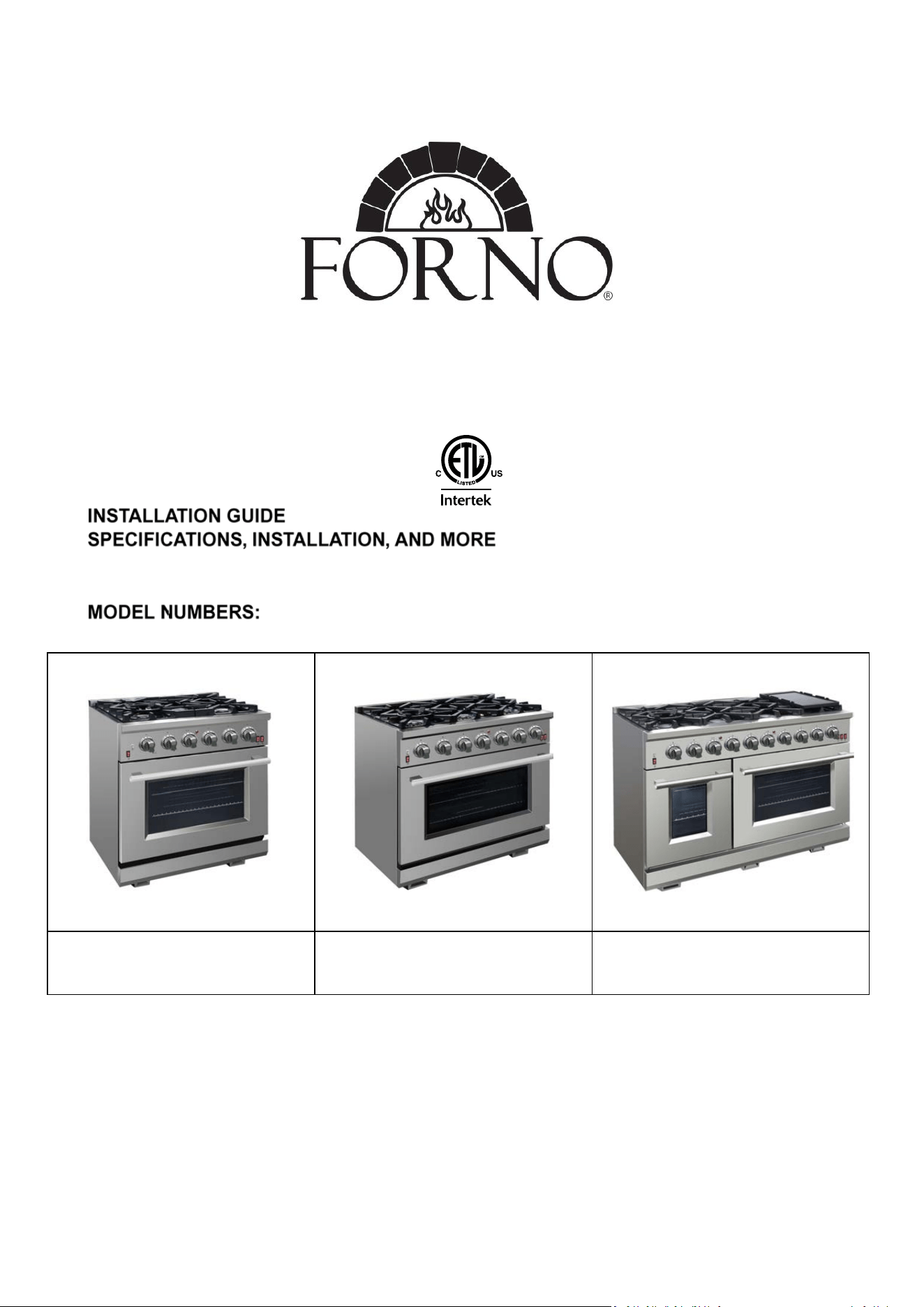
FFSGS6260-30 FFSGS6260-36 FFSGS6260-48
5015011

2
3
4
6
10
Electrical 12
Gas Supply 13
Pressure Regulator 14
Gas Shut-off Valve 14
Product Dimensions and Cabinets 15
Exhaust Hood Installation 17
Gas Conversion Operation 17
Gas Supply Connection 22
Ignition 23
Simmer and Boil 23
Burner Grates 24
Griddle Operation
Cooktop Cleaning Tips
Preheating
Convection Bake
Convection Roast
Setting Broil
Oven Cleaning Tips
24
24
24
24
25
25
25
26
26
27
27
28
24
Door Handle Installation 11
Cooktop Burner Grates Installation 11
30
Wire Diagram
Oven Racks Installation 11
3
Customer Care
Thank you for purchasing a FORNO cooking range. Please read the entire instruction manual before operating your new
appliance for the first time. Whether you are an occasional cook or an expert chef, it will be beneficial to familiarize yourself
with the safety practices, features, operation and care recommendations of your cooking range.
Both the model and serial number are listed in the front panel of the product. For warranty purposes, you will also need the
date of purchase. Record this information below for future reference.
SERVICE INFORMATION
Model Number:
Use these numbers in any correspondence or service
calls concerning your cooking range.
Serial Number:
If you received a damaged cooking range, immediately
contact the dealer (or builder) that sold you the cooking
range.
Date of Purchase:
Purchase Address & Phone:
Save time and money. Before you call for service, check
the Troubleshooting Guide. It lists the causes of minor
operating problems that you can correct yourself.
SERVICE IN CANADA:
Keep the instruction manual handy to answer your questions. If you don’t understand something or you need more
assistance, please call our Customer Service: 1-800-561-7265
Or email: service@distinctive-online.com
Or contact: CTM Household Appliances Inc.
11420 Albert Hudon, Montreal, Quebec, H1G 3J6, Canada
SERVICE IN THE UNITED STATES:
Keep the instruction manual handy to answer your questions. If you don’t understand something or you need more
assistance, please call our Customer Service: 1-866-231-8893
If your cooking range ever requires servicing, be sure to use a FORNO Factory Certified Service provider recommended by
our customer care center. All Factory Certified Service providers are carefully selected and thoroughly trained by us.
4
.
- WHAT TO DO IF YOU SMELL GAS
• Do not try to light any appliance.
• Do not touch any electrical switch.
• Do not use any phone in your building.
• Immediately call your gas supplier from a neighbor’s phone. Follow the gas supplier’s
instructions.
• If you cannot reach your gas supplier, call the fire department.
Your safety and the safety of others are very important.
We have provided many important safety messages in this manual and on your appliance.
Always read and obey all safety messages.
This is a safety alert symbol. It will alert you to potential personal or property safety hazards.
Obey all safety messages to avoid any property damage, personal injury or death.
WARNING indicates a potentially hazardous situation which, if not avoided, could result in
serious injury or death.
CAUTION indicates a moderate hazardous situation which, if not avoided, could result in
minor or moderate injury.
All safety messages will alert you what the potential hazard is, tell you how to reduce the
chance of injury, and let you know what can happen if the instructions are not followed.
5
D
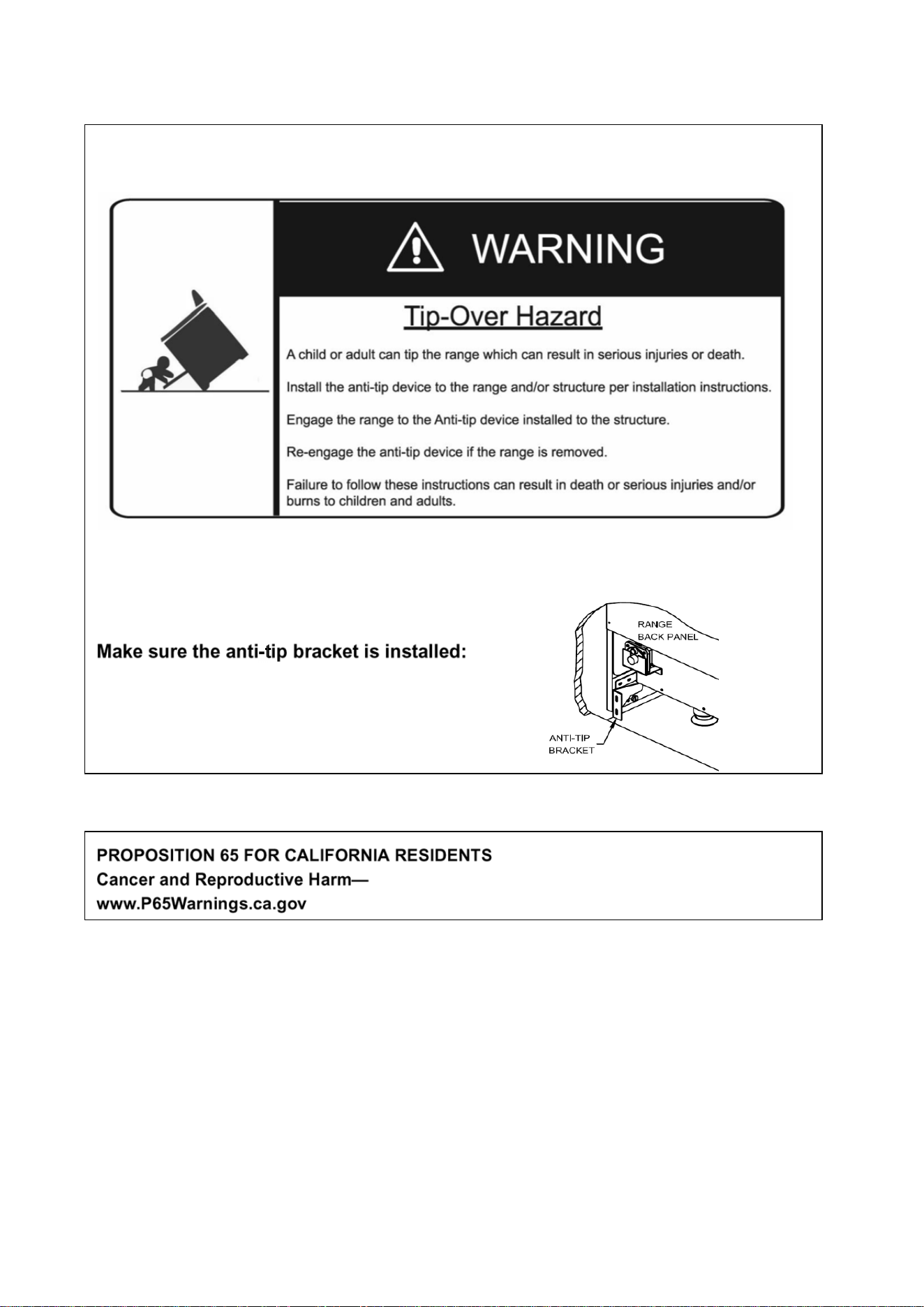
To reduce the risk of tipping the range, the range must be secured by properly installed anti-tip
device packed with the range. See installation instructions shipped with the bracket for complete
details before attempting to install.
All ranges can tip and cause injuries.
Slide range forward.
Make sure the anti-tip bracket is securely attached
to the wall behind the range.
Safely tilt the front of the range upward slightly
and move back against wall. Making sure the pin
slides under bracket.
! WARNING
5

6
Read all safety instructions before using the product. Failure to follow these
instructions may result in fire, electrical shock, serious injury or death.
1. Use this range for its intended purpose as described in this instruction manual.
2. Have your range installed and properly grounded by a qualified installer in accordance with
the provided installation instructions.
3. Any adjustment and service should be performed only by a qualified gas range installer or
service technician. Do not attempt to repair or replace any part of your range unless it is
specifically recommended in this manual.
4. Your range is shipped from the factory set for use with natural gas or propane (LP) gas. It
can be converted for use with either. If required, these adjustments must be made by a
qualified technician in accordance with the installation instructions and local codes. The agency
performing this work assumes responsibility for the conversion.
5. Have the installer show you the location of the range gas shut-off valve and how to turn it off
if necessary.
6. Plug your range into a 120-volt grounded outlet only. Do not removed the round grounding
prong from the plug. If in doubt about the grounding of the home electrical system, it is your
responsibility and obligation to have an ungrounded outlet in accordance with the National
Electrical Code. Do not use an extension code with this range.
7. Before performing any service, unplug the range or disconnect the power supply at the
household distribution panel by removing the fuse or switching off the circuit breaker.
8. Be sure all packing materials are removed from the range before operating to prevent
ignition of these materials.
9. Avoid scratching or impacting glass displays. Doing so may lead to glass breakage. Do not
cook on a product with broken glass. Shock, fire, or cuts may occur.
10. Do not leave children alone or unattended in an area where an appliance is in use. They
should never be allowed to climb, sit or stand on any part of the range.
11. Do not store items of interest to children in cabinets above an oven-children
who climb onto the oven to reach items could be seriously injured.
12. Never block the vents (air openings) of the range. They provide the air inlets and outlets
that are necessary for the range to operate properly with correct combustion. Air openings are
located at the rear of the cooktop, at the top and bottom of the oven door, and at the bottom of
the range.
13. Use only dry pot holders--moist or damp pot holders on hot surfaces may result in burns
from steam. Do not let pot holders touch surface burners, burner grate, or oven heating
element. Do not use a towel or other bulky fabrics in place of pot holders.
7
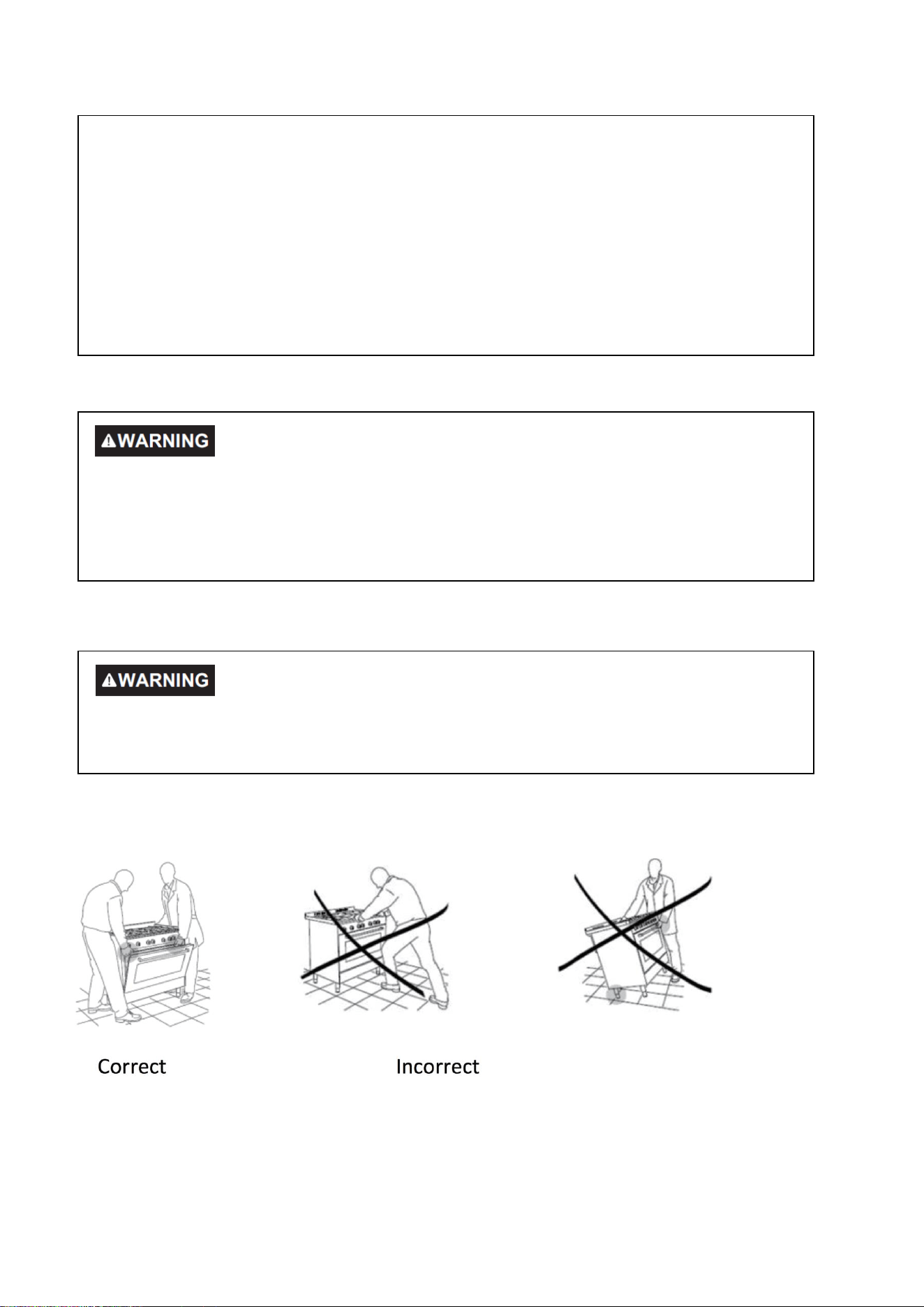
Extremely Heavy.
Proper equipment and adequate manpower are needed when move the range to avoid
personal injury or damage to the unit or the floor.
Failure to follow this advice may result in damage or personal injury.
DO NOT carry or lift the cooking range by the oven door handle or the control panel!
14. Do not touch the heating elements or the interior surface of the oven. These surfaces may
be hot enough to burn even though they are dark in color. During and after use, do not touch, or
let clothing or other flammable materials contact any interior area of the oven; allow sufficient
time for cooling first. Other surfaces of the appliance may become hot enough to cause burns.
Potentially hot surfaces include the burners, grates, oven vent opening, surfaces near the
opening, crevices around the oven door, metal trim parts above the door, any backguard, or
high shelf surface.
15. Do not heat unopened food containers. Pressure could build up and the container could
burst, causing any injury.

8
Cook food thoroughly to help protect against foodborne illness. Minimum safe food temperature
recommendations can be found at www.IsItDoneYet.gov and www.fsis.usda.gov. Use a food
thermometer to take food temperatures and check several locations.
Do not allow anyone to climb, stand or hang on the oven door, drawer or cooktop. They could
damage the range or tip it over causing severe injury or death.
Keep the ventilator hood and grease filter clean to maintain good venting and to avoid grease
fires. Turn the ventilator OFF in case of a fire or when intentionally "flaming" liquor or other
spirits on the cooktop. The blower if in operation, could spread the flames.
Do not store or use flammable materials in an oven or near the cooktop, including paper,
plastic, pot holders, linens, wall coverings, curtains, drapes and gasoline or other flammable
vapors and liquids.
Never wear loose-fitting or hanging garments while using the appliance. These garments may
ignite if they contact hot surfaces causing severe burns.
Do not let cooking grease or other flammable materials accumulate in or near the range.
Grease in the oven or on the cooktop may ignite.
Do not use water on grease fires. Never pick up a flaming pan. Turn the controls off. Smother a
flaming pan on a surface unit by covering the pan completely with a well-fitting lid, cookie sheet
or flat tray. Use a multi-purpose dry chemical or foam-type fire extinguisher.
If there is a fire in the oven during baking, smother the fire by closing the oven door and
turning the oven off or by using a multi-purpose dry chemical or foam-type fire extinguisher.
If there is a fire in the oven during self-clean, turn the oven off and wait for the fire to go out.
Do not force the door open. Introduction of fresh air at self-clean temperatures may lead to a
burst of flame from the oven. Failure to follow this instruction may result in severe burns.
9
NEVER cover any slots, holes, or passages in the oven bottom or cover an entire rack with
materials such as aluminum foil or oven liners. Doing so blocks air flow through the oven and may
cause carbon monoxide poisoning. Never place foil or oven liners on the oven bottom. They can trap
heat causing risk of smoke or fire.
Stand away from the range when opening the oven door. Escaping hot air or steam can cause
burns to hands, face and/or eyes.
Never place cooking utensils, pizza or baking stones, or any type of foil or liner on the oven floor.
These items can trap heat or melt, resulting in damage to the product and risk of shock, smoke or
fire.
Place oven racks in desired location while oven is cool. If the rack must be moved while the oven is
hot, be careful to avoid touching hot surfaces.
Do not leave items such as paper, cooking utensils, or food in the oven when not in use. Items stored
in an oven can ignite.
Do not leave items on the cooktop near the oven vent. Items may overheat resulting in a risk of fire
or burns.
Never broil with the door open. Open-door broiling is not advised due to overheating of control knobs.
Never leave the surface burners unattended at medium or high heat settings. Foods, especially oily
foods, may ignite resulting in fire that could spread to surrounding cabinets.
Never leave oil unattended while frying. If allowed to heat beyond its smoking point, oil may ignite
resulting in fire that may spread to surrounding cabinets. Use a deep fat thermometer whenever
possible to monitor oil temperature.
To avoid oil spillover and fire, use the minimum amount of oil when frying in a shallow pan and
avoid cooking frozen foods with excessive amounts of ice.
Use proper pan size and avoid pans that are unstable or easily tipped. Select cookware that
matches the size of the burner. Burner flames should be adjusted so that they do not extend
beyond the bottom of the pan. Excessive flames may be hazardous.
When using glass/ceramic cookware, make sure it is suitable for cooktop use; others may break
because of a sudden change in temperature.
To minimize the possibility of burns, ignition of flammable materials and spillage, cookware handles
should be turned toward the center of the range without extending over nearby burners.
Do not use a wok with a round metal support ring. The ring may trap heat and block air to the burner
resulting in a carbon monoxide hazard.
Do not attempt to lift the cooktop. Doing so may damage the gas tubing to the surface burners
resulting in a gas leak and risk of fire.
Do not use aluminum foil to cover the grates or line any part of the cooktop. Doing so may result in
carbon monoxide poisoning, overheating of the cooktop surfaces, or a potential fire hazard.
10
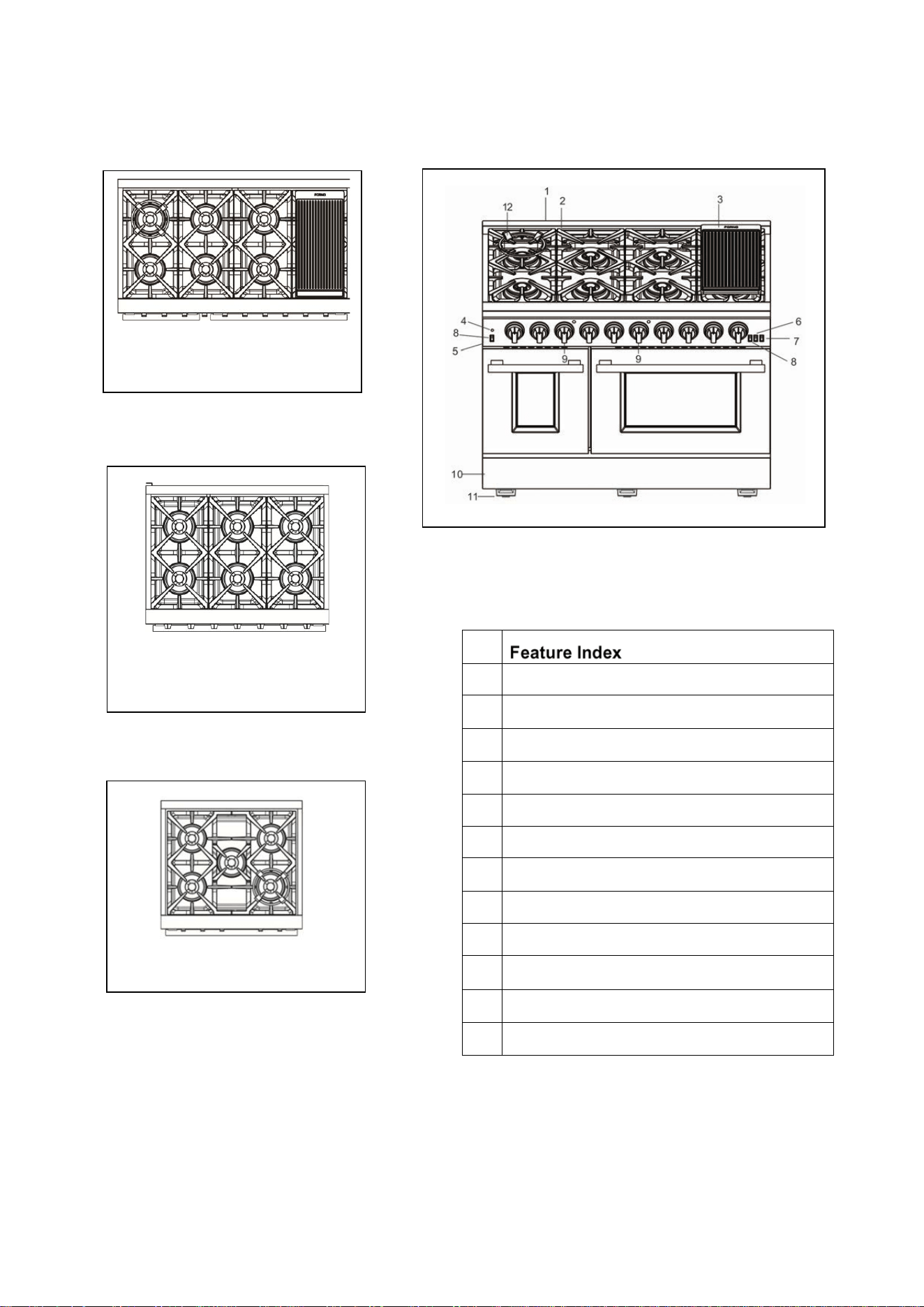
1
Oven Vents
2
Cooktop Burner Grates
3
Griddle (on some models)
4
Magic Eyes (on some models)
5
Control Panel
6
Rotisserie
7
Convention Fan Control Panel
8
Oven Lights
9
Oven/Broil Burner
10
Kick Panel
11
Leveling System
12
Wok Support
8 burners
6 burners
5 burners
Not all features are on all models.Appearance may vary.
eare r age
11
Installation Instructions
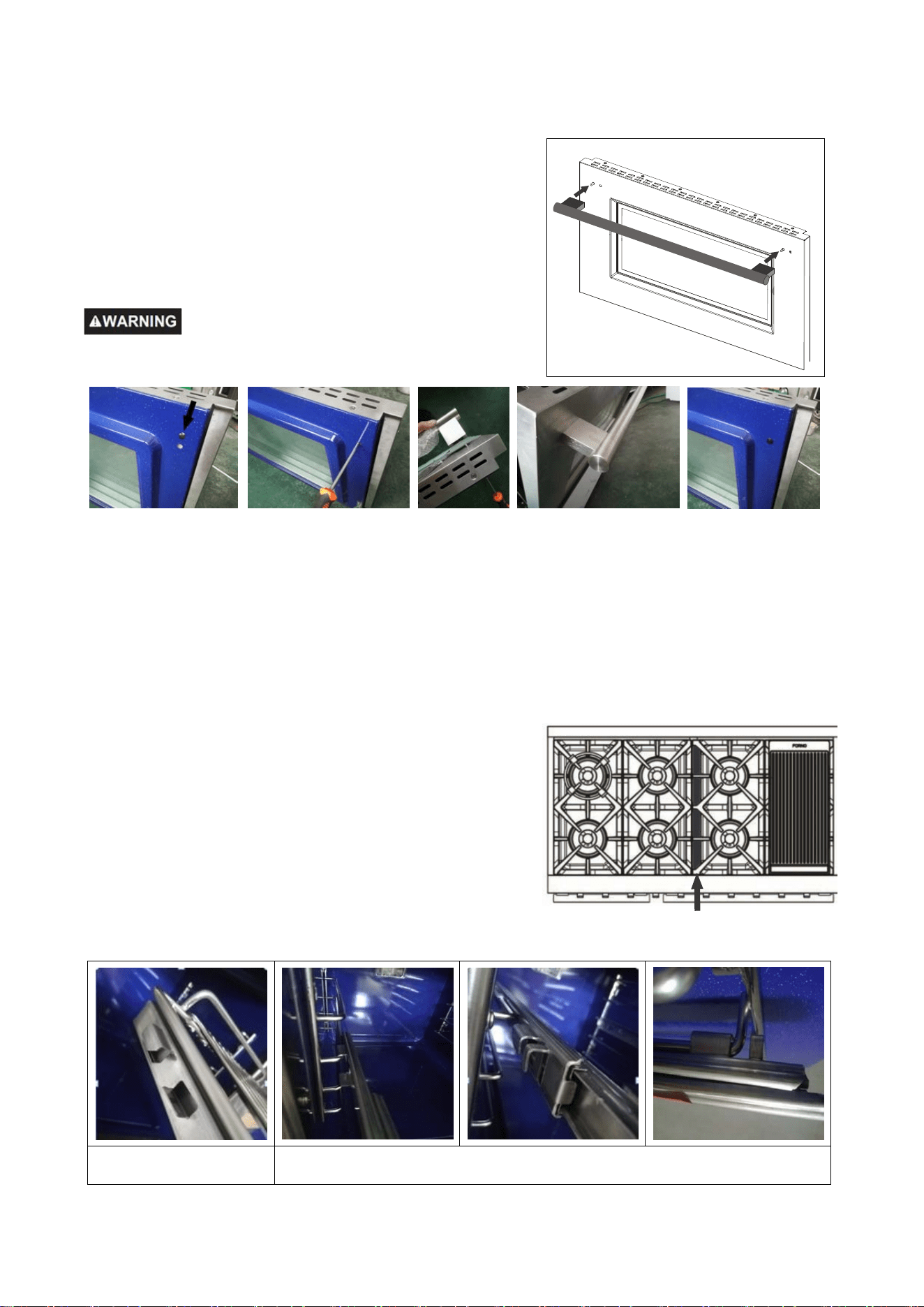
Keep the square rubber mat of the handle
mount to avoid scratching the oven door until this side is
ready to be installed.
Door Handle Installation
The door handle is not preinstalled. Find it in the front
side of the whole package. Follow the illustrations below
to install the door handle quickly and easiliy.
Cooktop Burner Grates Installation
Remove the packing materials from the cooktop burner
grates. Place the burner grates to the right position. Pay
attention to the middle right grates as illustrated, as the
thicker side should be in the left.
Put the griddle (only for FFSGS6260-48) and the wok
support to the burner(s) you like to cook.
1. Remove the round black rubber mat from the inside door, and the square rubber mat on the
handle mount.
2. Insert the screwdriver to the hole, and remove the screw nut from outside.
3. Install the handle with the exposed screw.
4. Repeat for the other side as step 1 to 3.
5. Put the round black rubber mats back to cover the two holes on the inside door.
Oven Racks Installation
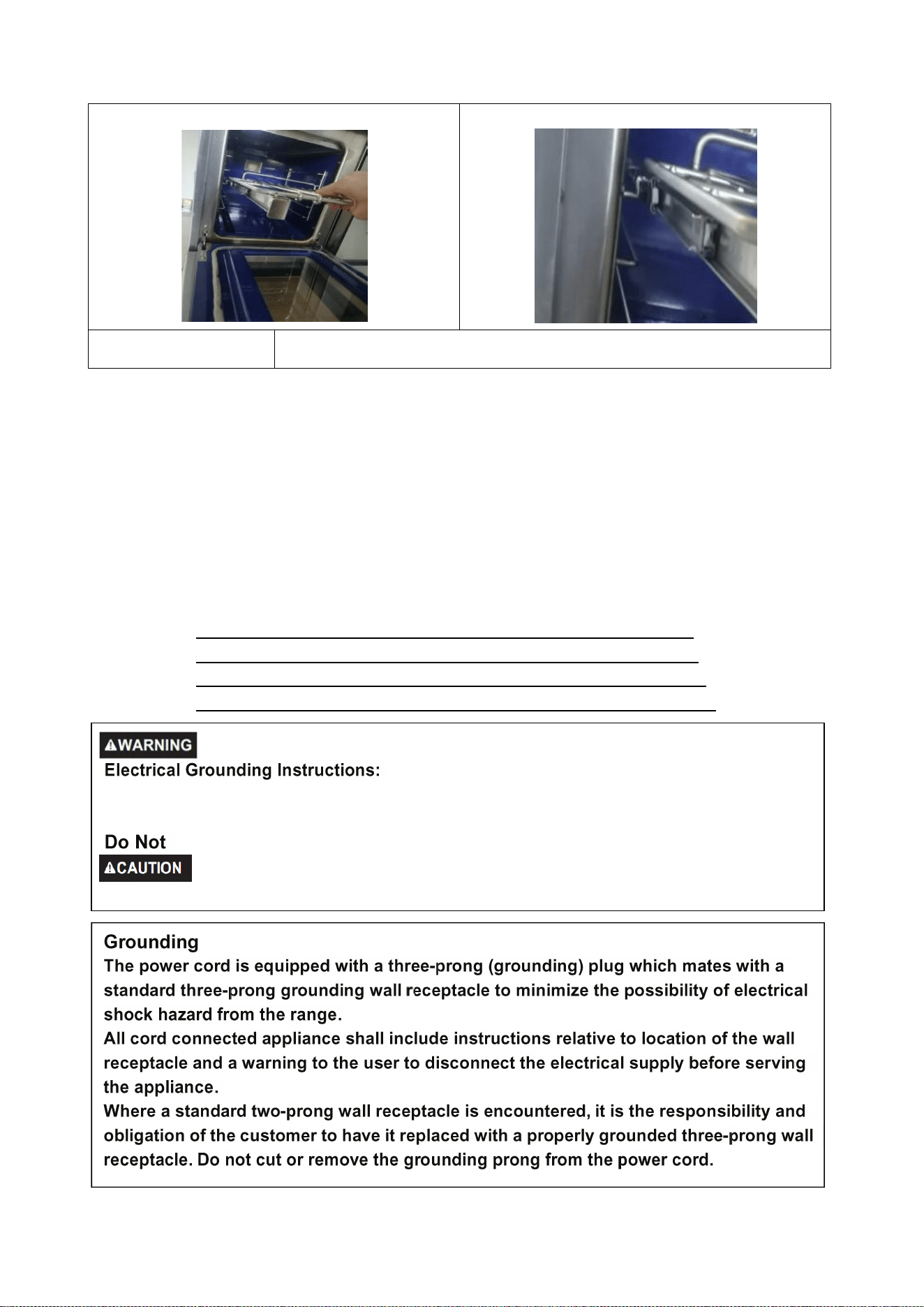
Installation
Hang the rack to the side rails and push in slowly
eria
Your range must be electrically grounded in accordance with local codes or, in the absence of local
codes, in accordance with the National Electrical Code (ANSI/NFPA 70, latest edition). In Canada,
electrical grounding must be in accordance with the current CSA C22.1 Canadian Electrical Code
Part 1 and/or local codes.
The power supply must be the correct polarity. Reverse polarity will result in continuous sparking
of the electrodes, even after flame ignition. If there is any doubt as to whether the power supply
has the correct polarity or grounded, have it checked by a qualified electrician.
12
Disassemble Lift the rack up and pull out slowly until free of the side rails.
this cooking range is equipped with a three-prong
(grounding) plug for your protection against shock hazard and should be plugged directly into a
properly grounded three-pronged receptacle.
cut or removes the grounding prong from the plug.
Label all wires prior to disconnection when servicing controls. Wiring errors can
cause improper and dangerous operation. Verify proper operation after servicing.
ELECTRICAL REQUIREMENTS
Electrical Supply
Service
Grounded, 110/120 VAC, 60 Hz
15 amp or 20 amp dedicated circuit
Receptacle
3-prong grounding-type
Power Cord
6' (1.8 m)
13
a
Installation must comply with local codes or, in the absence of local codes, with the National Fuel
Gas Code, ANSI Z223.1 / NFPA 54. In Canada, installation must conform to the current natural
Gas Installation /code, CAN 1-1.1-M81 and with local codes where applicable.
This range has been design-certified according to ANSI Z21.1b-2012 latest edition.
GAS REQUIREMENTS
NATURAL GAS
WC
Supply Pressure 5" (12.5 mb)
Minimum Supply Pressure
6"
Max Regulator Pressure
14" (34.9 mb), 0.5 psi (3.5 kPa)
LP GAS
WC
10" (25 mb)
11"
14" (34.9 mb), 0.5 psi (3.5 kPa)
Ventilation: it is recommended that the unit be operated with an oven head, vented exhaust
hood of sufficient size and capacity.
Electric Power Supply Requirements
Supply Pressure
Minimum Supply Pressure
Max Regulator Pressure
Since service pressure may fluctuate with local demand, every gas cooking range must be
equipped with a pressure regulator on the incoming service line for safe and efficient operation.
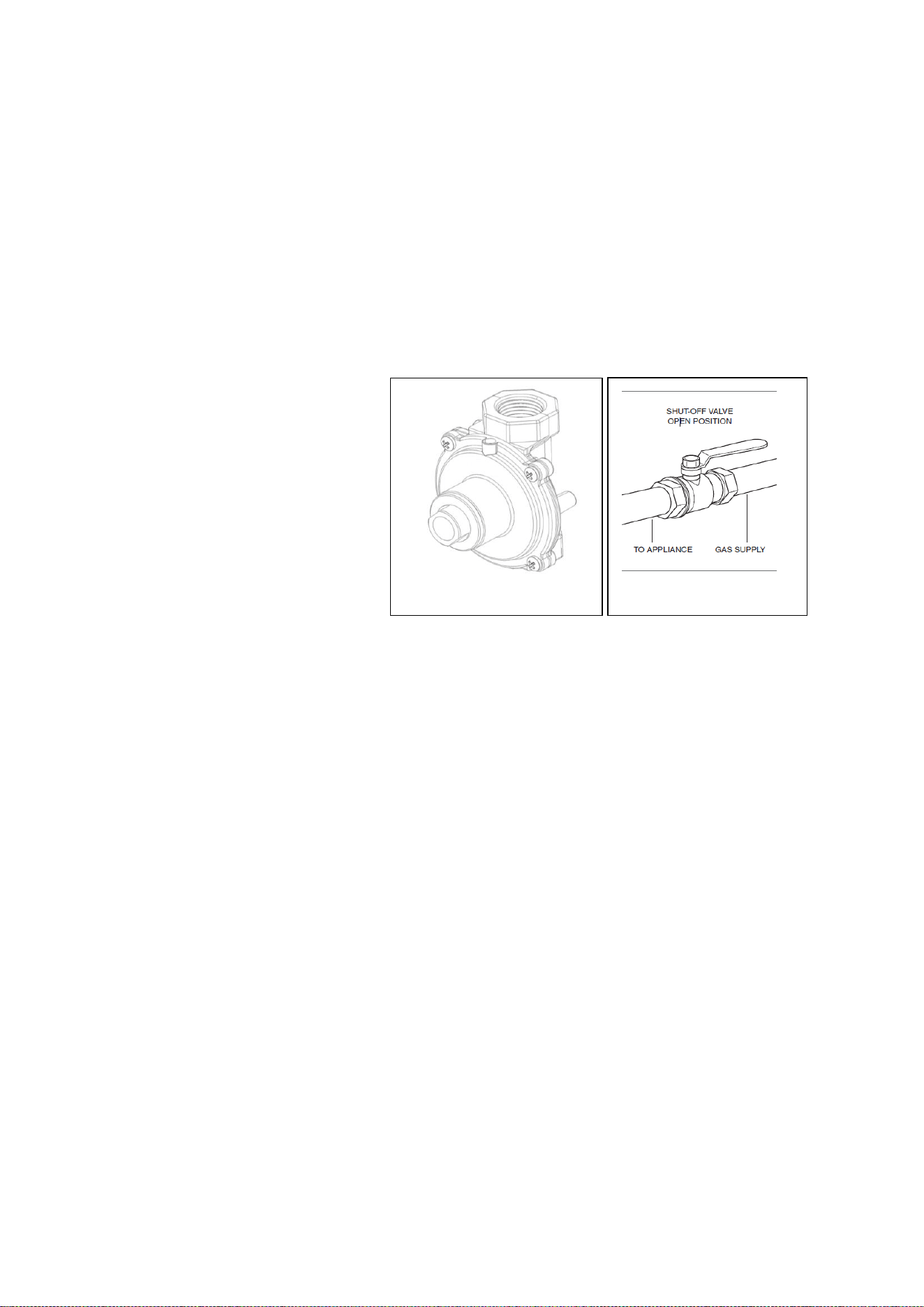
The pressure regulator shipped with the range has two female threads 34" NPT. The regulator
shall be installed properly in order to be accessible when the appliance is installed in its final
position.
Pressure regulator can withstand
a maximum input pressure of 0.5
psi (3.5 kPa), and is set at 5"
wc out let pressure.
Pressure Regulator
Gas Shut-off Valve
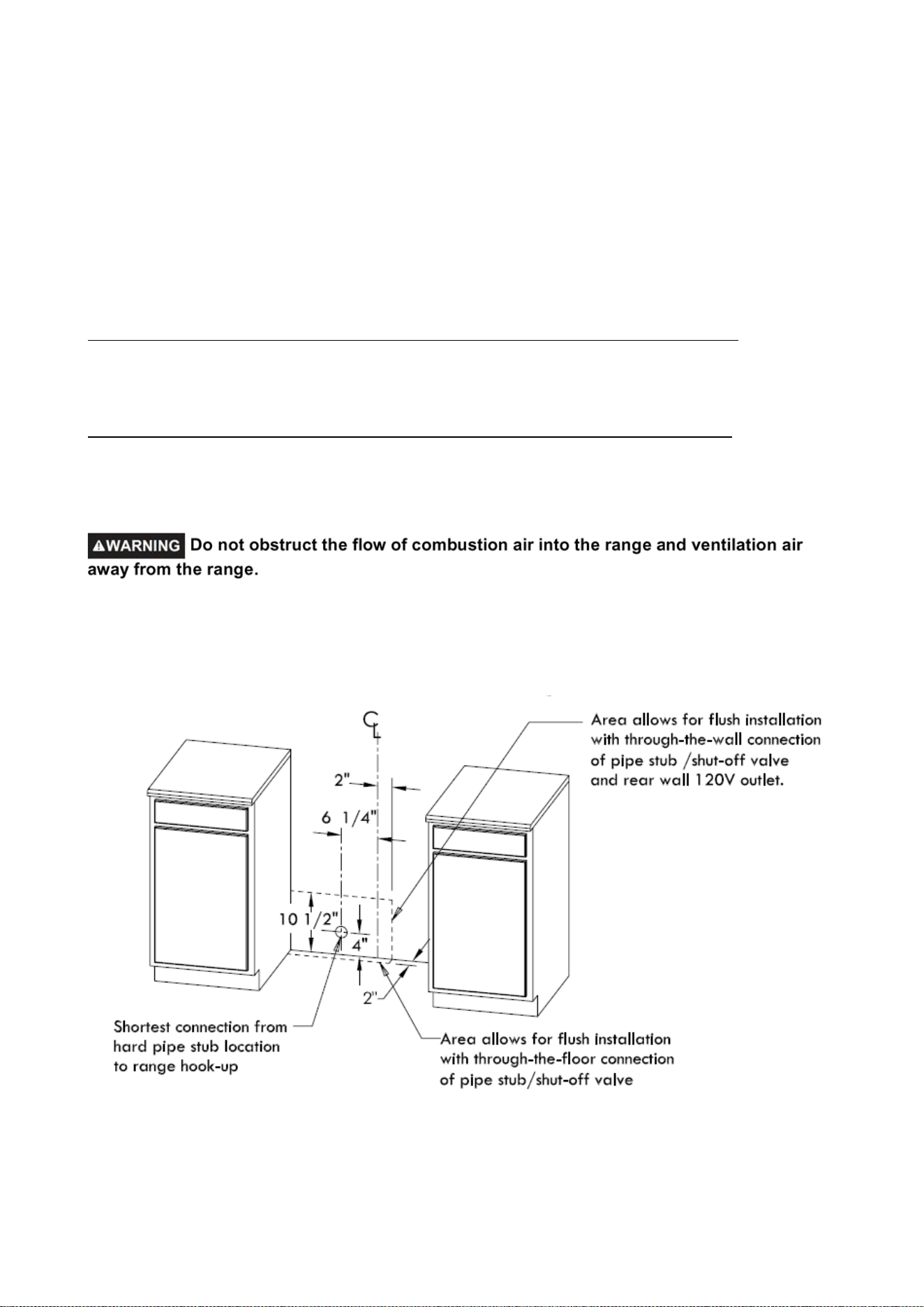
The supply line must be equipped with an approved external gas shut-off valve located near the
range in an accessible location. Do not block access to the shut-off valve. Refer to the illustration
below.
A 3/4" (19) ID gas supply line must be provided to the range. If local codes permit, a certified,
3' (.9 m) long, 1/2" (13) or 3/4" (19) ID flexible metal appliance connector is recommended to
connect the unit’s 1/2" NPT female inlet to the gas supply line. Pipe joint compounds suitable
for
use with natural or LP gas should be used.
The appliance and its shut-off valve must be disconnected from the gas supply piping system
during any pressure testing of the system at test pressures in excess of 0.5 psi (3.5 kPa). The
appliance must be isolated from the gas supply piping system by closing its individual manual
shutoff valve during any pressure testing of the system at test pressures equal to or less than 0.5
psi (3.5 kPa).
14
Gas Shut-off Valve
Pressure Regulator

15
FFSGS6260-36
FFSGS6260-30
r Dimei a aie
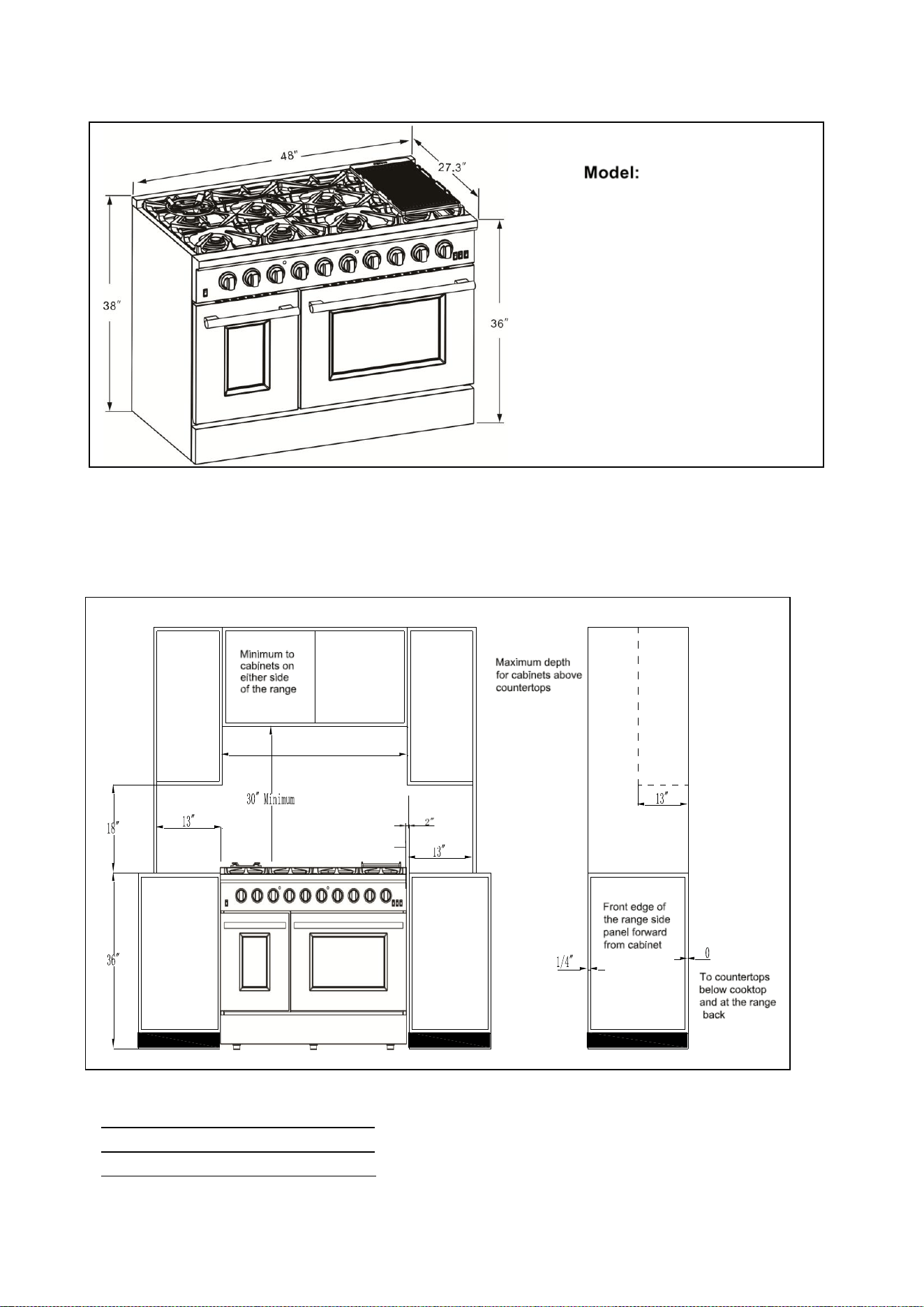
16
This range may be installed directly adjacent to existing countertop-height cabinets (36" or 91.5
cm from the floor).To achieve the best look, the cooktop should be level with the cabinet
countertop. This can be accomplished by raising the unit using the adjustment spindles on the
legs.
FFSGS6260-48
W
OPENING WIDTH
W OPENING WIDTH
30" Model
30" (762)
36" Model
36" (914)
48" Model
48" (1219)
To wall on either side
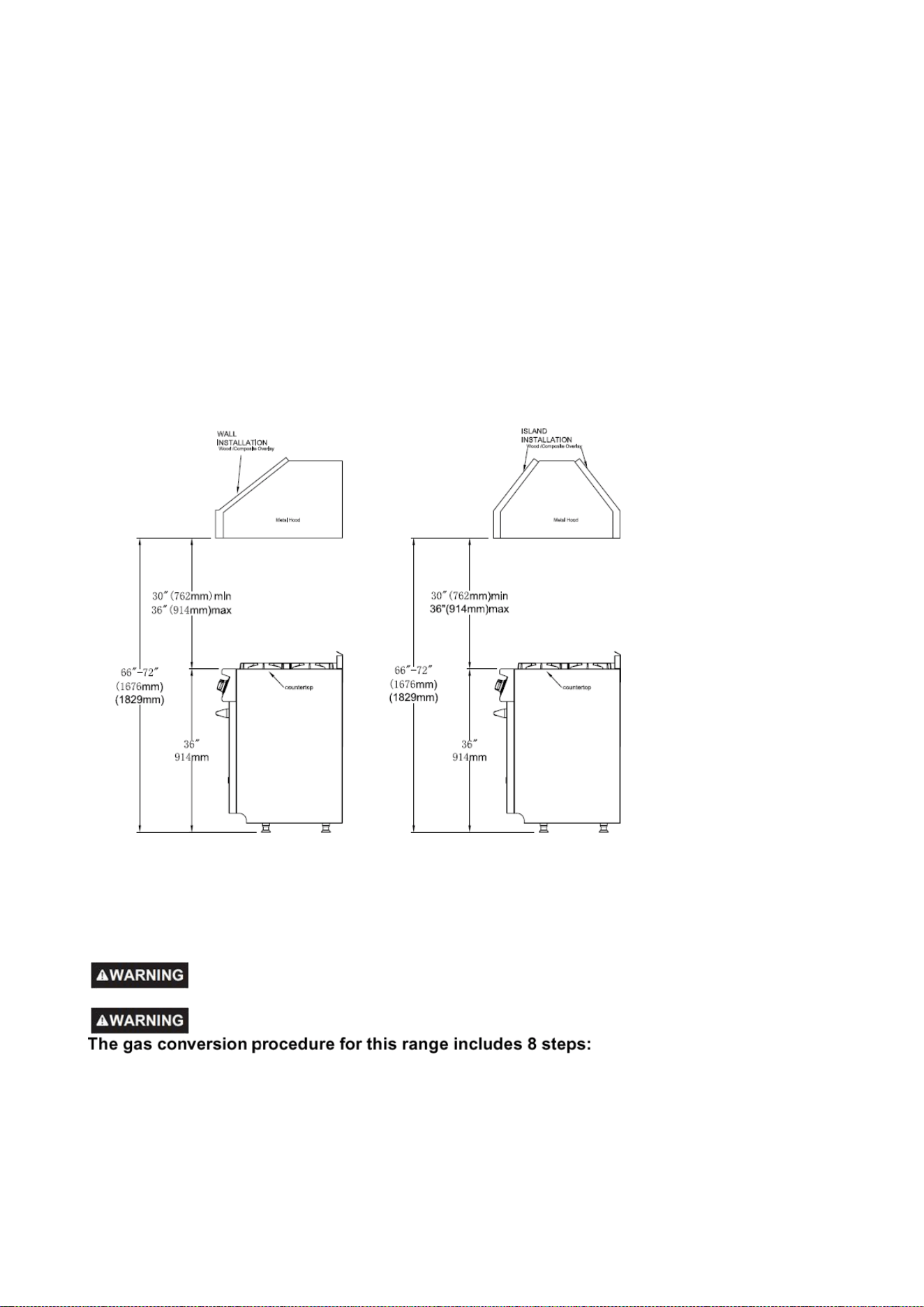
17
The bottom of the hood should be 30" min. to 36" above the countertop. This would typically result
in the bottom of the hood being 66" to 72" above the floor. These dimensions provide safe and
efficient operation of the hood.
After Installation:
1. Check ignition of cooktop burners.
2. Check the air shutter adjustment – sharp blue flame, with no yellow tipping or lifting flames.
3. Check ignition of oven burner.
4. Visually check tubular burner (oven burner) re-ignition to be sure both rows of
burner ports are relighting each time.
5. Check for gas leaks at all gas connections (using a gas detector, never a flame).
6. Check oven bake and convection bake function.
a eri erai
This cooking range can be used with LP gas and NG gas. It is shipped from the factory adjusted
for use with NG(Nature Gas). Conversion nozzles are included. Follow the instruction shown
below for gas conversion.
Gas conversion shall be conducted by a factory- trained professional.Call the
customer service hotline to identify a factory-trained professional near your home.
Before carrying out this operation, disconnect the range from gas and electricity.
1. Pressure regulator 5. Gas valves
2. Cooktop burners 6. Reconnect Gas and Electrical Supply
3. Oven burner 7.Air shutter oven burner
4. Broil burner 8. Installation of new rating label
a aai

18
The conversion is not completed if all 8 steps have not been concluded properly.
Before performing the gas conversion, locate the package containing the replacement nozzles
shipped with every range.
STEP 1: Pressure Regulator
To access the gas regulator, pull the range away from the cabinet wall. The gas regulator
is located at the bottom right corner of the range.
Electrical shock hazard can occur and result in injury or death. Disconnect electrical
power to the range before servicing. Do not remove regulator or allow it to turn during servicing.
a. Unscrew the cap from the regulator.Do not remove the spring from the regulator.
b. Unscrew the insert from the cap and turn it over so the longer stem is facing the cap. Replace
insert on the cap. Replace the cap on the regulator.
STEP 2: Cooktop Burners
a. Remove cooking grates, burner caps and inner burner rings.
b. Lift off outer burner heads and burner bases.
c. Remove the factory installed natural gas nozzles from the center
of the nozzle holders using a 7mm socket wrench. Replace the LP
nozzle in each nozzle holder. Tighten each nozzle until snug. Use
caution not to over tighten.
Care should be taken when removing and replacing gas
components. Use proper support to prevent damage to components.
Each nozzle has a number indicating its flow diameter printed on the body. Consult
the table below for matching nozzles and burners.
Socket Wrench
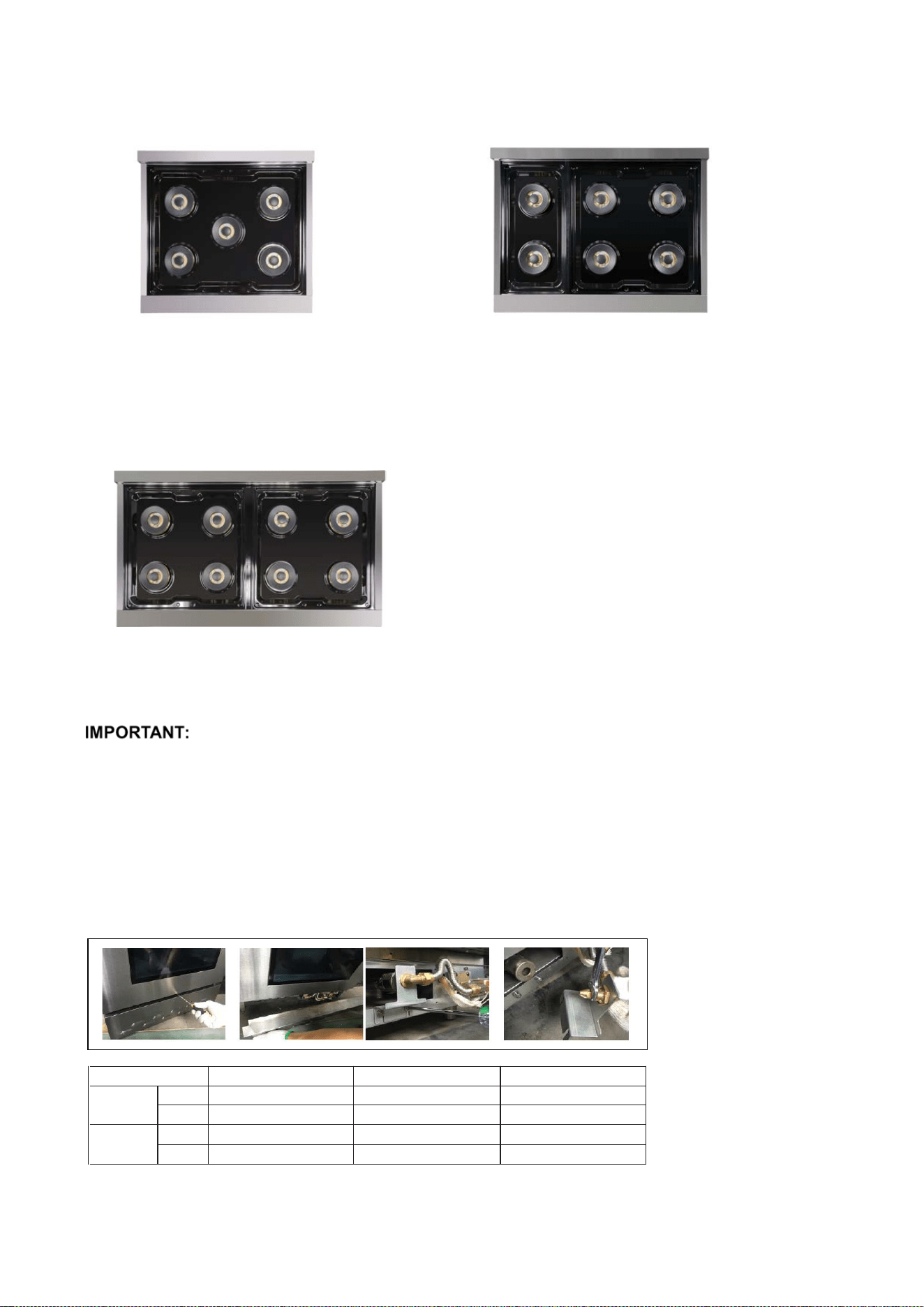
19
Save the nozzles removed from the range for future use.
STEP 3: Oven Burner
a. Remove 3 screws between the kick panel and the oven door . Hold the toe kick panel on both
ends and slowly pull away towards the front.
b. Remove 2 screws which holding the nozzle bracket and locate the nozzle.
Replace with oven burner nozzle, size 1.32mm and tighten. Replace the nozzle bracket, aligning
the new nozzle into the air shutter of the oven burner.
Repeat upon steps for 18”oven (48" ranges only).
1.38*2+0.75
0.9*2+0.46
1.38*2+0.75
0.9*2+0.46
1.38*2+0.75
0.9*2+0.46
NG
LPG
1.38*2+0.75
0.9*2+0.46
1.38*2+0.75
0.9*2+0.46
NG
LPG
1.38*2+0.75
0.9*2+0.46
1.38*2+0.75
0.9*2+0.46
1.38*2+0.75
0.9*2+0.46
NG
LPG
1.38*2+0.75
0.9*2+0.46
1.38*2+0.75
0.9*2+0.46
1.38*2+0.75
0.9*2+0.46
NG
LPG
1.38*2+0.75
0.9*2+0.46
1.38*2+0.75
0.9*2+0.46
1.38*2+0.75
0.9*2+0.46
NG
LPG
1.38*2+0.75
0.9*2+0.46
1.38*2+0.75
0.9*2+0.46
1.38*2+0.75
0.9*2+0.46
1.38*2+0.75
0.9*2+0.46
NG
LPG
1.38*2+0.75
0.9*2+0.46
e
e
e
8Oven
1.7
12
Oven
NG
LPG
22
3
Model:FFSGS6260-30
22
3
Model:FFSGS6260-36
22
3
Model:FFSGS6260-48
NG
LPG
STEP 4: Broil Burner
a. Remove 2 screws which fixing the nozzle bracket and locate the nozzle.
b. Using a 5/8”or 19mm open wrench, remove the gas line from the nozzle holder. Using a ½”open
wrench, remove the nozzle from the orifice holder. Replace with 0.94 mm oven broiler nozzle.
STEP 5: Gas Valve
a. Remove control knobs.
b. Using a flat screwdriver, adjust main burner bypass jets toward to 1/4 circle for LP until the flame
is normal.
.
STEP 6: Reconnect Gas and Electrical Supply
Leak testing of the range shallbe conducted according to the installation instructions provided with
the range.
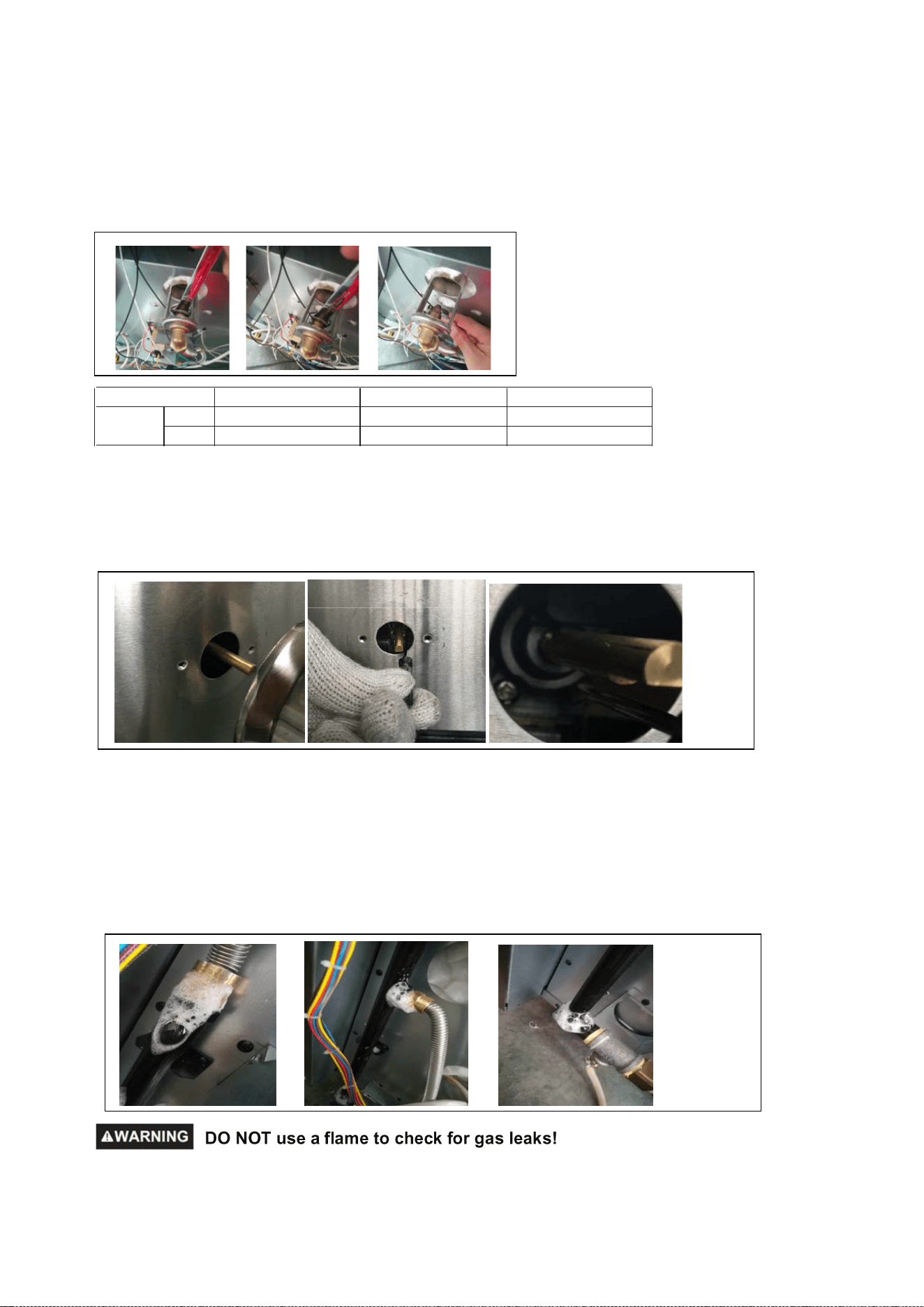
Before operating the range after the gas conversion, always check for leaks with a soapy water
solution or other acceptable method in at gas connections installed between the gas inlet pipe of the
range, gas regulator, and the manual shut-off valve.
20
Broil
NG
LPG
1.8
1.19
Model:FFSGS6260-30
Model:FFSGS6260-36
Model:FFSGS6260-48
1.8
1.19
1.8
1.19

21
STEP 7: Air Shutter Oven Burner (no necessary)
The air shutter for the oven burner may need adjustment, especially if the unit has been converted
for use with LP. The approximate flame height at the oven burner is one inch (distinctive
inner blue flame).
To determine if the oven burner flame is acceptable:
a. With the kick plate removed, set the oven to bake at 350° F and observe the flame. If the flame
yellow in color, increase the air shutter opening size. If the flame is blue and lifting away from the
burner, reduce the air shutter opening size.
b. Turn off the oven and allow it to cool before adjusting the air shutter. To adjust, loosen the lock
screw, reposition the air shutter and tighten the lock screw. Retest the burner by repeating the
steps above. When the burner flame is a distinct blue colour and burning steadily, the air shutter is
adjusted correctly.
STEP 8: Installation of New Rating Label
Record the model and serial number on the LP / Propane Rating serial plate provided in this kit.
The information can be obtained from the existing Rating / Serial plate. Place the new plate as
close as possible to the existing Rating / Serial plate on the range.
Before moving the range, protect any finished flooring and secure oven door(s) closed to prevent
damage.
The oven door(s) can be removed to lighten the load or to fit the unit through a doorway. Only
remove if necessary. Do not remove the griddle or any other component. Door removal should only
be done by a certified installer or service technician.
Placement
Do not lift or carry the oven door by the door handle. The range has rear casters which allow for
easy movement by lifting the front of the unit.
Use an appliance dolly to move the range near the opening. Remove and recycle packing
materials. Do not discard the anti-tip bracket supplied with the range.
Leveling
Raise the range to the desired height by adjusting the legs. The legs can be adjusted by
rotating the hexagonal leg clockwise to raise and counter clockwise to lower.
Anti-Tip Bracket
To prevent the range from tipping forward, the anti-tip bracket must be installed. Refer to the
illustration on page 5.
Preparation
22
Gas Supply Connection
All connections to the gas piping must be wrench-tightened. Do not overtighten or allow pipes to
turn when tightening.
When all connections have been made, check that all range controls are in the “OFF” position and
turn on the main gas supply valve.
If a flexible metal connector is being used, verify it is not kinked, then attach the gas supply line to
the regulator on the range. Open the valve and check for leaks by placing a liquid detergent
solution onto all gas connections. Bubbles around connections indicate a gas leak. If a leak
appears, close the shut-off valve and adjust connections.
Leak testing of the appliance shall be conducted according to the manufacture’s instructions .Use
some soap water (50% water and 50% soap) or a leak detector at all joints and connections to
check for leaks in the system. Do not use a flame to check for gas leaks.
The appliance must be isolated from the building’s gas supply piping system by closing its
individual manual shut-off valve during any pressure testing of the gas supply piping system at test
pressure equal to or less than 0.5 psi (3.5kPa).
Before you start cooking, please take the following steps.
• Remove the exterior and interior packing.
• Remove the protective film on steel and aluminum parts.
• Clean the range thoroughly with hot water and a mild detergent. Rinse and dry with a soft cloth to
remove any residual oil and grease left over from the manufacturing process.
• Check that surface burner components are assembled correctly.
• Furnish the interior of the oven by inserting the shelves and tray.
Cooktop Operation
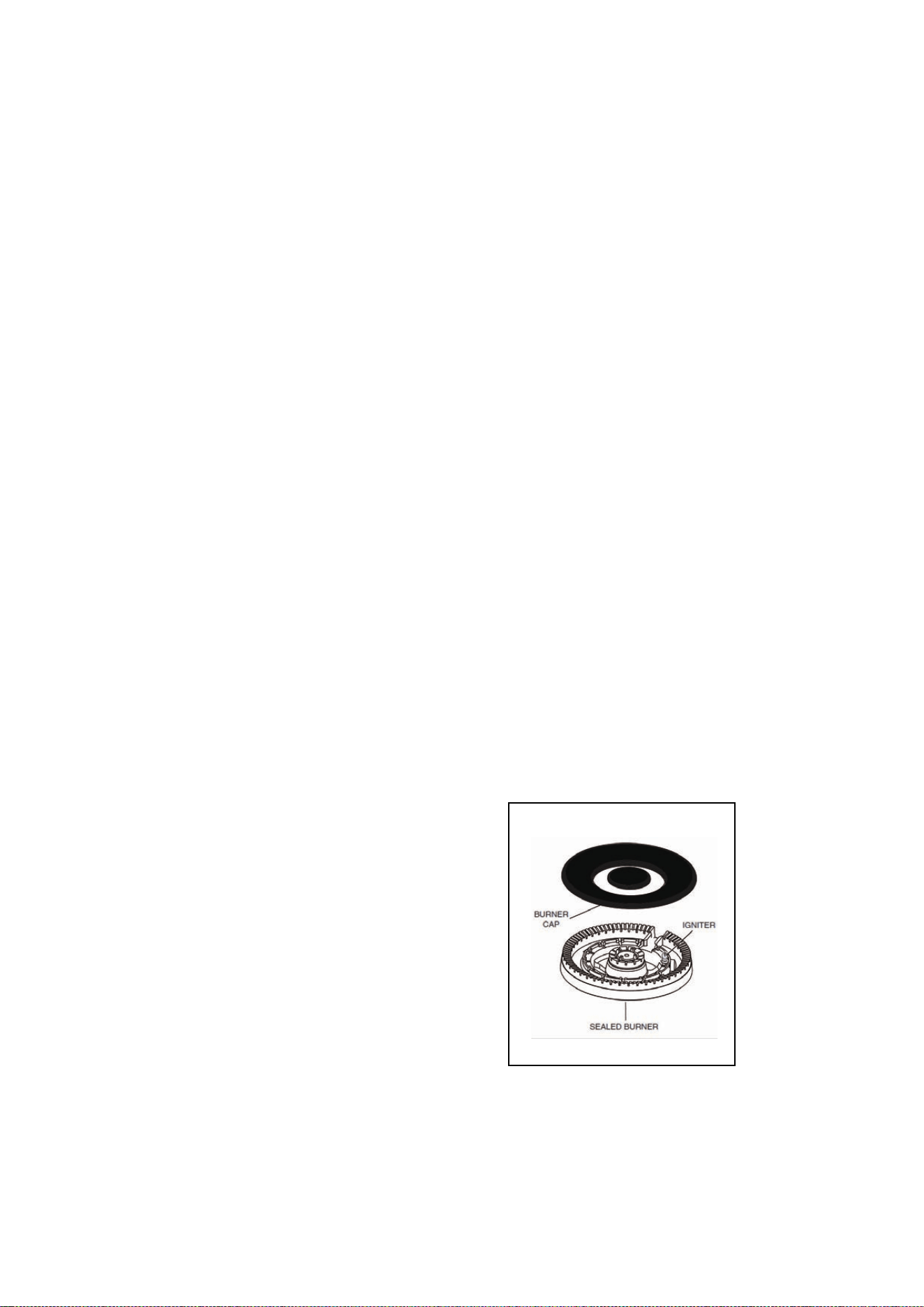
The burner design combines all burner
parts in one assembly. The burner cap must
be seated flatly on the burner. Refer
to the illustration below.
Getting Started
23
gii
To light the cooktop burners, push and turn the appropriate control knob counter clockwise to a “Hi”
position. You will hear a clicking noise –the sound of the electric spark igniting the burner.
Once burner ignition has been achieved, turn the burner control knob to adjust the flame size. If
the knob stays at “Hi”, it will continue to click.
NOTE: When one burner is turned to the “Hi” position, all the burners will spark. Do not attempt to
disassemble or clean around any burner while another burner is on. Do not touch any burner cap,
burner base, or igniter while the igniters are sparking.
Hi
Ignites the burners.
Simmer
Melting small quantities, steaming rice, warming food, melting
chocolate or butter.
Low
Melting large quantities.
Low-Medium
Low-temperature frying, simmering large quantities, heating milk,
cream sauces, gravies.
Medium Sautéing and browning, braising, pan-frying, maintaining
slow boil on large quantities.
Medium-Hi
High-temperature frying, pan boiling, maintaining slow boil
on large quantities.
Hi
Boiling liquid quickly, deep frying.
A smaller flame will give the best results when simmering. Small flames offer precise cooking
performance for delicate foods, keeping food warm, melting chocolate or butter, and for cooking
over low heat for long period of time.
The highest (larger) flame settings provide the maximum heat that is available on your range. This
setting should be used for heavy cooking jobs such as boiling water and cooking pasts.
• When you select the flame size, watch the flame when you turn the knob.
• Any flame larger than the bottom of the cookware is wasted.
• The flame should be steady and blue in color. Foreign material in the gas line may cause an
orange flame during initial operation.
• If the gas does not ignite within four seconds, turn off the valve and allow at least five
minutes for any gas to dissipate. Repeat the lighting procedure.
• In the event of a power failure, the surface burners can be lighted manually. Hold a lighted match
near a burner and turn the knob counter-clockwise to “HI”. After burner lights, turn knob to the
desired setting.
Heat Settings:
immer a i
Flame Size
Power Failure
24
1. The grates must be properly positioned before cooking. Improper installation of the grates may
result in scratching of the cooktop and / or poor combustion.
2. Do not operate the burners without a pan or utensil on the grates.
rie erai aaiae e me
Before Using the Griddle
1. Clean the griddle thoroughly with warm, soapy water to remove dust or any protective coating.
2. Rinse with clean water and wipe off to dry with soft, clean, lint-free towel/cloth.
1.Place the griddle to the position you need to cook.
2. Preheat the griddle for 10-12 minutes.
3. Butter or cooking oil can be added for more flavor, then place the food to cook.
• To prevent the cooktop from discoloring or staining, clean cooktop after each use, and wipe up
acidic or sugary spills as soon as the cooktop has cooled.
• The sealed burners of your range are not secured to the cooktop and are designed to be
removed. Boil overs or spills will not seep underneath the cooktop. The burners should be cleaned
after each use.
The oven light is controlled by a push switch on the control panel.
The light can be used while cooking or cleaning the oven.
Check that power is disconnected from the electrical box before replacing the light bulb.
Allow the oven to cool completely, then unscrew the light cover and remove the light bulb by unscrewing
it from the socket. Replace with a 40-watt halogen bulb.
agi ee
The red Magic Eyes will turn on automatic when the room becomes dark.
e aig
Some ranges are equipped with an automatic rotisserie for roasting.
The rotisserie feature allows for an even cooking and all-over browning of the meat while preventing
the meat from cooking in its rendered grease. The rotisserie will turn the meat allowing it to baste
itself while roasting.
Be sure that you have received the rotisserie accessories included with your unit.
(1) Rotisserie Spit – Rod
(2) Rotisserie Forks
Always use the broiling pan when using the rotisserie to catch the rendered grease and allow for easy
access to the meat when putting in and removing the rotisserie spit – rod.
To use the rotisserie, preheat the oven to the desired temperature. Secure the meat to be cooked
onto spit-rod using the rotisserie forks.
Insert the rotisserie spit-rod into the rotating assembly and select the desired rotisserie function (light
on or light off).
rer rae
Use of the Griddle
eaig i
e ig
25
Make sure that the baking / broiling tray is below the meat being cooked to avoid spills and to prevent
possible flare-up of the oven flames.
1.
Never cover any slots, holes or passages in the oven bottom or cover an entire rack with
materials such as aluminum foil. Doing so blocks air flow through the oven and may cause
carbon monoxide poisoning. The aluminum foil lining may also trap heat, causing a fire hazard.
Do not use aluminum foil on any porcelain surface. Doing so will damage the porcelain and affect
its durability.
2. Position the racks before preheating the oven.
3. Reduce the oven temperature 25˚F (14˚C)when cooking in heat-proof glass or glass ceramic
dishes.
reeaig
Allow the oven to preheat before placing food in the oven. Preheating is necessary for good
results when baking cakes, cookies, pastry and breads.
Remove the broiler pan before preheating with the infrared broiler. Foods will stick on hot metal. To
preheat, turn the “Oven” selector knob to the “Broil” position. Wait for the burner to become hot,
approximately 2 minutes.
Note: Condensation or fogging on the inside of the oven door glass is normal while preheating
and it will usually evaporate by the end of the preheating cycle.
Oven Function
Natural Airflow Bake occurs when heat is transferred into the oven from the bake burners in the
bottom of the oven cavity. Heat is then circulated by natural airflow.This is a traditional bake setting.
ei ae
Heat is transferred from the bake burners in the bottom of the oven cavity to the oven cavity itself.
The convection fan at the rear of the oven then circulates it. This convection process provides a
more even heat distribution throughout the oven cavity.
Using multiple racks is possible for large-batch baking. Convection cooking is faster, can be
done at lower temperatures and provides more even temperatures than regular cooking.
ei a
The convection fan circulates the heated air evenly over and around the food. Using the cover and
broiler pan provided, heated air will be circulated over the around the food being roasted. The
heated air seals in juices quickly for a moist and tender product, while at the same time creating a
rich golden brown exterior. When convection roasting, it is important that you use the broiler pan
for best convection roasting results. The pan is used to catch grease spills and has a cover to
prevent grease splatters.
e erai
e aig i

26
With temperature control off, the motorized fan in the rear of the oven circulates air. The fan
accelerates natural defrosting of the food without heat. To avoid illness and food waste, do not
allow defrost food to remain in the oven for more than two hours without being cooked.
With the temperature control on 175˚F, warm air is radiated from the bake burners in the bottom of
the oven cavity and is circulated by a motorized fan in the rear of the oven. Over a period of time,
the water is removed from the food by evaporation. Removal of water inhibits growth of
microorganisms and retards the activity of enzymes.
Broiler Operation
Note: Door must be closed during broiling operation.
The broil burner is located at the top of the oven. This burner heats the metal screen until it glows. The
glowing screen produces heat, searing the outside of broiled foods and sealing in juices. Broiling is a
method of cooking tender cuts of meat directly under the broiler in the oven.
Oven broiling is done with the oven door closed. It is normal and even necessary to have some smoke
to give the food a broiled flavor.
Setting Broil
The “Oven” selector knob controls the Broil feature. When broiling, heat radiates downward from the
oven broiler for even coverage. The Broil feature temperature is 500˚F (260˚C).
Used together, the broil pan and insert allow dripping grease to drain and be kept away from the
high heat of the oven broiler. DO NOT use the broil pan without the insert. DO NOT cover the broil
pan insert with foil. The exposed grease could catch fire. To set the oven to Broil:
1. Place the broiler pan insert on the broiler pan. Then place the food on the broiler pan insert.
2. Arrange the interior oven rack and place the broiler pan on the rack. Be sure to center the
broiler pan and position it directly under the broil burner. If preheating the broil burner first, position
the broiler pan after the broil burner is preheated.
3. Turn the selector knob to Broil.
The oven indicator light will remain on until the selector knob is turned to the off position or the
temperature control cycles off.
Position the rack at the correct level. The farther away the food is from the broiler, the more well
done it will be inside. Preheating the oven is not necessary. Push in and turn the knob to BROIL.
Turn the food over at the halfway point. Always pull the rack out to the “stop” position before
turning or removing food.
1. After each use, and once cooled, clean splatters and spills immediately.
2. Do not allow foods with a high sugar or acid content to remain on the oven cavity surface.
3. Use an oven cleaner to clean the oven cavity.
Convection Defrost
Convection Dehydrate
Oven Cleaning Tips

27
Stainless steel
Use a non-abrasive stainless steel cleaner and apply with a soft lint-free cloth. To
bring out the natural luster, lightly wipe surface with a water-dampened
microfiber cloth followed by a dry polishing cloth. Always follow the grain of
stainless steel.
Burner grates
Oven rack guides
Remove and place on a flat surface near the sink. Clean with hot water and mild
detergent or paste of baking soda and water. Do not immerse in water. Towel
dry.
Burner pan Remove surface debris before cleaning to help speed up the cleaning process
and decrease the chance of scratching the surface during cleaning. Using mild
abrasive cleaners or spray degreasers, clean and rinse the surface and dry
immediately to avoid streaking. To clean hard water stains, use white vinegar
and water. Rinse and dry immediately.
Surface burners Allow to cool. Use mild detergent or spray degreaser to clean. Rinse with water
and towel dry.
Control knobs Using a damp cloth, wipe with a mild detergent or spray degreaser; rinse and
dry. Do not place in dishwasher.
Oven interior Use mild abrasive cleaners, spray degreasers. Use a razor blade to gently lift
baked on foods from oven cavity and window. For stubborn stains, spray with a
mild abrasive cleaner or spray degreaser. Wash the entire oven cavity with soap
and water to remove all cleaning chemicals.
Broiler pan
To clean the upper rack, use mild detergent and a scouring pad. Rinse and dry.
To clean the bottom pan, discard grease and wash with hot water and mild
detergent. Rinse and dry. The stainless steel upper rack is dishwasher safe.
However, do not place the porcelain-coated rack or pan in dishwasher.
Care and Cleaning Recommendations
Oven Thermostat & Cooking times
The numbers printed on the control panel indicate the increasing oven temperature value (°F).
To regulate the temperature, set the desired number on the control knob indicator.
Note: The BROIL position is only to turn on the broil burner.
Cooking times can vary according to the type of food, its density and its size. It is advisable to
watch when cooking for the first time and to check results since similar results are obtained when
preparing the same dishes under the same conditions.same conditions.
Use the thermostat to control the temperatures, and control the time according to the cooking
guides.
28
Range does not operate
Check that power is on.
Check that electrical power to range and home circuit breaker
is on.
Burners Do Not Light Or Spark
Randomly
Electrical plug is not plugged into a live power outlet.
Gas supply not turned on.
Burner parts not replac
ed correctly.
Holes in the simmer rings or slits in the burner rings are
clogged.
Clogged nozzles, or wet burners or electrodes.
A fuse in your home may be blown or circuit breaker tripped.
Burners Have Yellow Or
Yellow-Tipped Flames
Burner parts not replaced correctly.
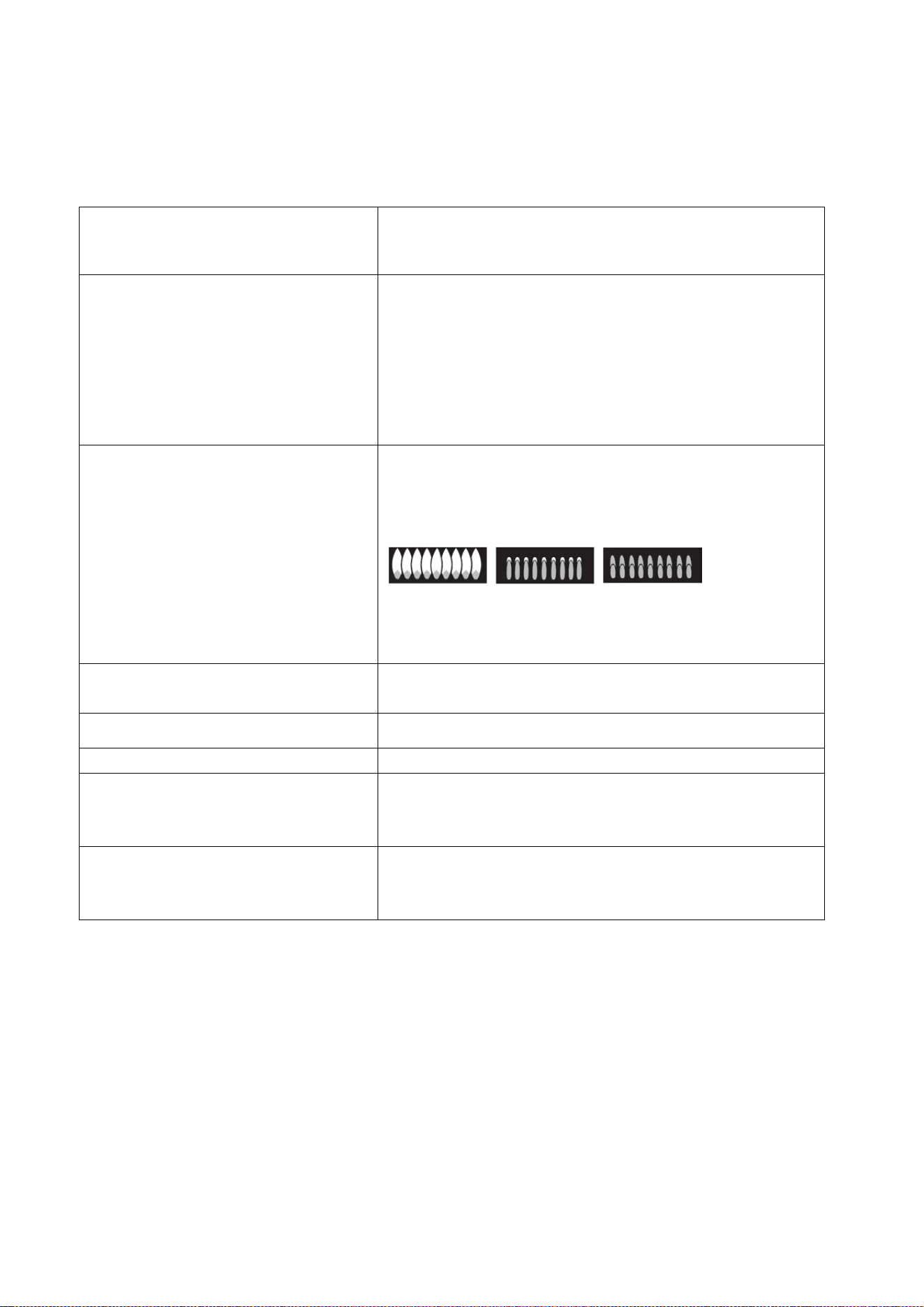
A. Yellow flames: Call for service.
B. Yellow tips on outer cones: Normal for propane (LP) gas.
C. Soft blue flames: Normal for natural gas.
If burner flames look like (A), call for service. Normal burner
flames should look like (B) or (C), depending on the type of
gas.
Burner Flames Very Large Or Yellow
The range may be connected to the wrong fuel type. Contact
the person who installed your range or made the conversion.
Burner Flames Contain Orange Flickers
Airborne dust; cool-mist humidifier; debris on or inside burner.
Oven Lights Do Not Work
The light bulb is defective. Replace the bulb.
Oven Racks Are Hard To Slide
Do not spray with a cooking spray or other lubricant sprays.
See Full extension oven racks in the Care and Cleaning
section.
Food Does Not Bake Or Roast
Properly
The oven controls are improperly set. See the Baking or
Roasting section.
Oven not preheated for a long enough time.
Troubleshooting Tips
Before you call for service
29
Incorrect cookware or cookware of improper size being used.
Racks in the wrong position. See the Baking or Roasting
section.
Use a foil tent to slow down browning during roasting.
Oven thermostat needs adjustment. See the Oven thermostat
adjustment section.
Food Does Not Broil Properly This model is designed for closed door broiling only. Close the
door. Always broil with the door closed.
The oven controls are not set at BROIL. See the Broiling
section.
Improper rack position.
Cookware is not suited for broiling. Use the broiling pan and
rack that came with your oven.
Aluminum foil used on the broiling pan and rack has not been
fitted properly and slit as recommended.
Oven Temperature Too Hot Or Too
Cold
Oven thermostat needs adjustment. See the Oven thermostat
adjustment section.
Steam From The Vent
When using the convection mode, it is normal to see steam
coming out of the oven vent. As the number of racks or amount
of food being cooked increases, the amount of visible steam
will increase.
Burning Or Oily Odor Emitting From
The Vent
This is normal in a new oven and will disappear in time.
Strong Odor
This is temporary. An odour caused by the insulation around
the inside of the oven is normal for the first few times the oven
is used.
Convection Fan Not On All The Time
The convection fan (depending on the function you are using)
may cycle on and off until the function is over or the door is
opened for optimized performance.
This is normal. In addition, the convection fan may cycle in the
clockwise and counter clockwise direction until the function is
over or the door is opened.
Condensation Or Fogging On The
Inside of the Door Glass
Condensation or fogging on the inside of the oven door glass is
normal during the preheating of the oven and will evaporate
usually by the end of the preheating cycle.
Cracking Or Popping Sound During
Cleaning
This is normal. This is the sound of the metal heating and
cooling during both the cooking and cleaning functions.
Excessive Smoking Occurs During
Cleaning
The oven is heavily soiled. Turn the Oven Mode Selector and
the Temperature knobs to OFF. Open the windows to rid the
room of smoke. Wait until the locked door indicator light goes
off. Wipe up excess soil and do the cleaning again.

Wire Diagram
