IF YOU HAVE ANY QUESTIONS OR COMMENTS ABOUT THIS OR ANY D
e
WALT TOOL,
CALL US TOLL FREE AT: 1-800-4-D
e
WALT (1-800-433-9258)
Important Safety Instructions
WARNING: Do not operate this unit until you read this instruction manual for safety,
operation and maintenance instructions.
WARNING: This product contains chemicals known to the State of California to cause
cancer, and birth defects or other reproductive harm. Wash hands after handling.
WARNING: Some dust contains chemicals known to the State of California to cause cancer,
birth defects or other reproductive harm such as asbestos and lead in lead based paint.
SAVE THESE INSTRUCTIONS
DANGER: RISK OF EXPLOSION OR FIRE
WHAT CAN HAPPEN HOW TO PREVENT IT
• Itisnormalforelectricalcontactswithinthe
motor and pressure switch to spark.
• Always operate the compressor in a
well ventilated area free of combustible
materials, gasoline, or solvent vapors.
• Ifelectricalsparksfromcompressorcome
into contact with flammable vapors, they
may ignite, causing fire or explosion.
• If spraying flammable materials, locate
compressor at least 20' (6.1m) away from
sprayarea.Anadditionallengthofairhose
may be required.
• Store flammable materials in a secure
location away from compressor.
• Restrictinganyofthecompressorventilation
openings will cause serious overheating
and could cause fire.
• Never place objects against or on top of
compressor.
• Operate compressor in an open area at
least 12" (30.5 cm) away from any wall or
obstruction that would restrict the flow of
fresh air to the ventilation openings.
• Operate compressor in a clean, dry well
ventilated area. Do not operate unit in any
confined area. Store indoors.
• Unattendedoperationofthisproductcould
resultinpersonalinjuryorpropertydamage.
To reduce the risk of fire, do not allow the
compressor to operate unattended.
• Always remain in attendance with the
product when it is operating.
• Alwaysturnoffandunplugunitwhennotin
use.
DANGER: RISK TO BREATHING (ASPHYXIATION)
WHAT CAN HAPPEN HOW TO PREVENT IT
• The compressed air directly from your
compressor is not safe for breathing. The
air stream may contain carbon monoxide,
toxic vapors, or solid particles from the air
tank. Breathing these contaminants can
causeseriousinjuryordeath.
• Never use air obtained directly from the
compressor to supply air for human
consumption. The compressor is not
equipped with suitable filters and in-line
safety equipment for human consumption.
• Exposuretochemicals in dust created by
power sanding, sawing, grinding, drilling,
and other construction activities may be
harmful.
• Sprayed materials such as paint, paint
solvents, paint remover, insecticides, weed
killers, may contain harmful vapors and
poisons.
• Workinanareawithgoodcrossventilation.
Read and follow the safety instructions
provided on the label or safety data sheets
forthematerialsyou are spraying. Always
use certified safety equipment: NIOSH/
OSHA respiratory protection or properly
fit ting face mask designed for use with your
specific application.
WARNING: RISK OF BURSTING
Air Tank: On February 26, 2002, the U.S. Consumer Product Safety Commission published
Release # 02-108 concerning air compressor tank safety:
Air compressor receiver tanks do not have an infinite life. Tank life is dependent upon several
factors, some of which include operating conditions, ambient conditions, proper installations,
field modifications, and the level of maintenance. The exact effect of these factors on air
receiver life is difficult to predict.
If proper maintenance procedures are not followed, internal corrosion to the inner wall of the
air receiver tank can cause the air tank to unexpectedly rupture allowing pressurized air to
suddenly and forcefully escape, posing risk of injury to consumers.
Your compressor air tank must be removed from service by the end of the year shown on your
tank warning label.
The following conditions could lead to a weakening of the air tank, and result in a violent air
tank explosion:
WHAT CAN HAPPEN HOW TO PREVENT IT
• Failureto properly drain condensed water
from air tank, causing rust and thinning of
the steel air tank.
• Drainairtankdailyoraftereachuse.Ifair
tank develops a leak, replace it immediately
with a new air tank or replace the entire
compressor.
• Modificationsorattemptedrepairstotheair
tank.
• Never drill into, weld, or make any
modifications to the air tank or its
attachments. Never attempt to repair a
damagedorleakingairtank.Replacewith
a new air tank.
• Unauthorized modifications to the safety
valve or any other components which
control air tank pressure.
• The air tank is designed to withstand
specific operating pressures. Never make
adjustments or parts substitutions toalter
the factory set operating pressures.
ATTACHMENTS & ACCESSORIES:
• Exceedingthepressureratingofairtools,
spray guns, air operated accessories, tires,
and other inflatables can cause them to
explode or fly apart, and could result in
seriousinjury.
• Follow the equipment manufacturers
recommendation and never exceed the
maximum allowable pressure rating of
attachments. Never use compressor to
inflatesmall low pressureobjects suchas
children’s toys, footballs, basketballs, etc.
TIRES:
• Over inflation of tires could result in
serious injury and property damage.
• Useatirepressuregaugetocheckthetires
pressure before each use and while inflating
tires; see the tire sidewall for the correct tire
pressure.
NOTE:Airtanks,compressorsandsimilar
equipment used to inflate tires can fill
small tires very rapidly. Adjust pressure
regulator on air supply to no more than
the rating of the tire pressure. Add air in
small increments and frequently use the tire
gauge to prevent over inflation.
WARNING: RISK OF ELECTRICAL SHOCK
WHAT CAN HAPPEN HOW TO PREVENT IT
• Yourcompressorispoweredbyelectricity.
Like any other electrically powered device, if
it is not used properly it may cause electric
shock.
• Never operate the compressor outdoors
when it is raining or in wet conditions.
• Neveroperatecompressorwith protective
covers removed or damaged.
• Repairsattemptedbyunqualifiedpersonnel
can result in serious injury or death by
electrocution.
• Any electrical wiring or repairs required
on this product should be performed by
authorized service center personnel in
accordance with national and local electrical
codes.
• Electrical Grounding: Failure to provide
adequate grounding to this product
could result in serious injury or death
from electrocution. Refer to Grounding
Instructions paragraph in the Installation
section.
• Make certain that the electrical circuit
to which the compressor is connected
provides proper electrical grounding, correct
voltage and adequate fuse protection.
WARNING: RISK FROM FLYING OBJECTS
WHAT CAN HAPPEN HOW TO PREVENT IT
• Thecompressedairstreamcancausesoft
tissue damage to exposed skin and can
propel dirt, chips, loose particles, and small
objectsathighspeed,resultinginproperty
damageorpersonalinjury.
• Always wear certified safety equipment:
ANSI Z87.1 eye protection (CAN/CSA
Z94.3) with side shields when using the
compressor.
• Never point any nozzle or sprayer toward
any part of the body or at other people or
animals.
• Alwaysturnthecompressoroffandbleed
pressure from the air hose and air tank
before attempting maintenance, attaching
tools or accessories.
WARNING: RISK OF HOT SURFACES
WHAT CAN HAPPEN HOW TO PREVENT IT
• Touching exposed metal such as the
compressor head, engine head, engine
exhaustoroutlettubes(J,Fig.2),canresult
in serious burns.
• Never touch any exposed metal parts on
compressor during or immediately after
operation. Compressor will remain hot for
several minutes after operation.
• Donotreacharoundprotectiveshroudsor
attempt maintenance until unit has been
allowed to cool.
WARNING: RISK FROM MOVING PARTS
WHAT CAN HAPPEN HOW TO PREVENT IT
• Movingpartssuch as the pulley, flywheel,
and belt can cause serious injury if they
come into contact with you or your clothing.
• Neveroperatethecompressorwithguards
or covers which are damaged or removed.
• Keepyourhair,clothing, and gloves away
frommovingparts.Looseclothes,jewelry,
or long hair can be caught in moving parts.
• Air vents may cover moving parts and
should be avoided as well.
• Attempting to operate compressor with
damaged or missing parts or attempting to
repair compressor with protective shrouds
removed can expose you to moving parts
andcanresultinseriousinjury.
• Anyrepairsrequiredonthisproductshould
beperformedbyauthorizedservicecenter
personnel.
WARNING: RISK OF UNSAFE OPERATION
WHAT CAN HAPPEN HOW TO PREVENT IT
• Unsafeoperationofyourcompressorcould
lead to serious injury or death to you or
others.
• Reviewandunderstandallinstructionsand
warnings in this manual.
• Become familiar with the operation and
con trols of the air compressor.
• Keep operating area clear of all persons,
pets, and obstacles.
• Keepchildrenawayfromtheaircompressor
at all times.
• Donotoperatetheproductwhenfatigued
or under the influence of alcohol or drugs.
Stay alert at all times.
• Never defeat the safety features of this
prod uct.
• Equip area of operation with a fire
extinguisher.
• Do not operate machine with missing,
broken,orunauthorizedparts.
• Neverstandonthecompressor.
WARNING: RISK OF FALLING
WHAT CAN HAPPEN HOW TO PREVENT IT
• Aportablecompressorcanfallfromatable,
workbench, or roof causing damage to the
compressor and could result in serious
injuryordeathtotheoperator.
• Always operate compressor in a stable
secure position to prevent accidental
movement of the unit. Never operate
compressor on a roof or other elevated
position. Use additional air hose to reach
high locations.
WARNING: RISK FROM NOISE
WHAT CAN HAPPEN HOW TO PREVENT IT
• Under some conditions and duration of
use, noise from this product may contribute
to hearing loss.
• Always wear proper hearing protection
during use.
SAVE THESE INSTRUCTIONS
FOR FUTURE USE
ASSEMBLY
UNPACKING
Remove unit from carton and discard all packaging.
INSTALLATION
How To Set Up Your Unit
LOCATION OF THE AIR COMPRESSOR
• Locatetheaircompressorinaclean,dryandwellventilatedarea.
• Theaircompressorshouldbelocatedatleast12"(30.5cm)awayfromthewallorother
obstructions that will interfere with the flow of air.
• The air compressor pump and shroud are designed to allow for proper cooling. The
ventilation openings on the compressor are necessary to maintain proper operating
temperature. Do not place rags or other containers on or near these openings.
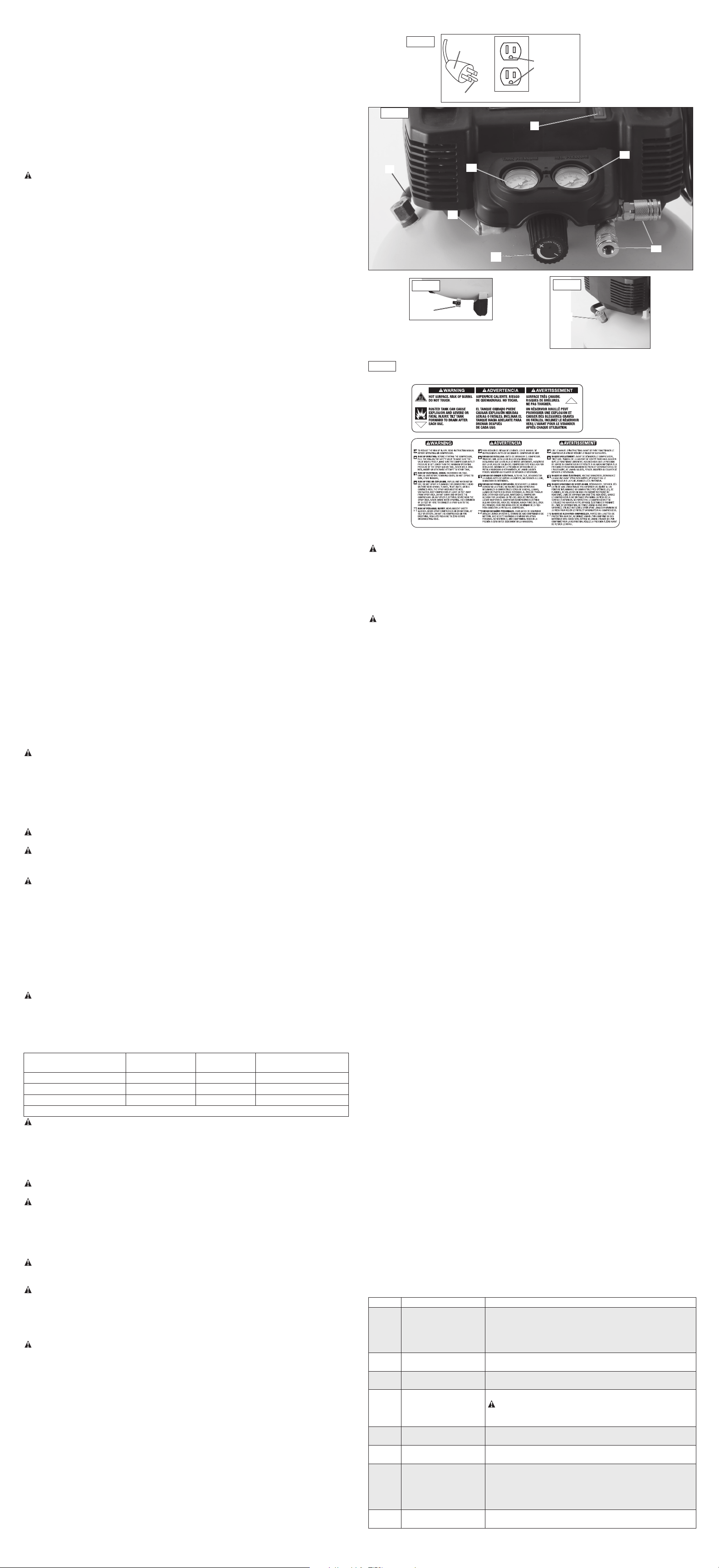
Grounding Instructions (Fig. 1)
WARNING:RiskofElectricalShock.Intheeventofashortcircuit,groundingreducesthe
risk of shock by providing an escape wire for the electric current. This air compressor must be
properly grounded.
The portable air compressor is equipped with a cord having a grounding wire with an
appropriategroundingplug(A).
1.Thecordsetandplug(A)withthisunitcontainsagroundingpin(B).ThisplugMUSTbe
usedwithagroundedoutlet(C).
IMPORTANT: The outlet being used must be installed and grounded in accordance with all
local codes and ordinances.
2.Make sure the outlet being used has the same configuration as the grounded plug.
DO NOT USE AN ADAPTER. See figure 1.
3.Inspecttheplugandcordbeforeeachuse.Donotuseiftherearesignsofdamage.
4. If these grounding instructions are not completely understood, or if in doubt as to whether
the compressor is properly grounded, have the installation checked by a qualified electrician.
DANGER: RiskofElectricalShock.IMPROPERGROUNDINGCANRESULTINELECTRICAL
SHOCK.
•Donot modify theplug provided. If itdoes not fittheavailable outlet, acorrect outlet
should be installed by a qualified electrician.
•RepairstothecordsetorplugMUSTbemadebyaqualifiedelectrician.
INSTRUCTION MANUAL
MANUAL DE INSTRUCCIONES
GUIDE D'UTILISATION
DWFP55126
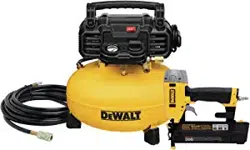
Heavy Duty 165 PSI Max. 6 Gallon Air Compressor
Compresor de aire de alto rendimiento de 165 psi de máximo, 6 galones
Compresseur à air à réservoir de 22,7 L (6 gallons) et un maximum de
1038 kPa (165 psi)
INSTRUCTIVO DE OPERACIÓN, CENTROS DE SERVICIO Y
PÓLIZA DE GARANTÍA. ADVERTENCIA: LÉASE ESTE
INSTRUCTIVOANTESDEUSARELPRODUCTO.
DeWALT Industrial Tool Co., 701 East Joppa Road, Baltimore, MD 21286
(JAN14) Part No. N331539 DWFP55126 Copyright © 2014 D
eWALT
The following are trademarks for one or more DeWALT power tools: the yellow and black color scheme;
the“D”shapedairintakegrill;thearrayofpyramidsonthehandgrip;thekitboxconfiguration;andthearrayoflozenge-
shaped humps on the surface of the tool.
If you have questions or comments, contact us.
Si tiene dudas o comentarios, contáctenos.
Pour toute question ou tout commentaire, nous contacter.
1-800-4-DeWALT • www.dewalt.com
Definitions: Safety Guidelines
The definitions below describe the level of severity for each signal word. Please read the
manual and pay attention to these symbols.
DANGER:Indicatesanimminentlyhazardoussituationwhich,ifnotavoided,will result
in death or serious injury.
WARNING:Indicatesapotentiallyhazardoussituationwhich,ifnotavoided,could result
in death or serious injury.
CAUTION:Indicatesapotentiallyhazardoussituationwhich,ifnotavoided,may result
in minor or moderate injury.
NOTICE: Indicatesapracticenot related to personal injury which, if not avoided, may
result in property damage.
Extension Cords
If an extension cord must be used, be sure it is:
• a3-wireextensioncordthathasa3-bladegroundingplug,anda3-slotreceptaclethatwill
accept the plug on the product
•ingoodcondition
•nolongerthan50'(15.2m)
•14gauge(AWG)orlarger.(Wiresizeincreasesasgaugenumberdecreases.12AWGand
10AWGmayalsobeused.DONOTUSE16OR18AWG.)
NOTICE: RiskofPropertyDamage.Theuseofanundersizedextensioncordwillcausevoltage
todropresultinginpowerlosstothemotorandoverheating.Insteadofusinganextensioncord,
increasetheworkingreachoftheairhosebyattachinganotherlengthofhosetoitsend.Attach
additional lengths of hose as needed.
Voltage and Circuit Protection
Refer to the Specification Chart for the voltage and minimum branch circuit requirements.
WARNING: Riskof Overheating. Certain air compressors can be operated on a 15 amp
circuit if the following conditions are met.
1. Voltage supply to circuit must comply with the National Electrical Code.
2. Circuit is not used to supply any other electrical needs.
3.Extensioncordscomplywithspecifications.
4.Circuitisequippedwitha15ampcircuitbreakeror15amptimedelayfuse.
NOTE: If compressor is connected to a circuit protected by fuses, use only time delay fuses.
Timedelayfusesshouldbemarked"D"inCanadaand"T"intheUS.
If any of the above conditions cannot be met, or if operation of the compressor repeatedly
causes interruption of the power, it may be necessary to operate it from a 20 amp circuit. It is
not necessary to change the cord set.
OPERATION
Know Your Air Compressor
READ THIS OWNER’S MANUAL AND SAFETY RULES BEFORE OPERATING YOUR UNIT.
Compare the illustrations with your unit to familiarize yourself with the location of various controls
and adjustments. Save this manual for future reference.
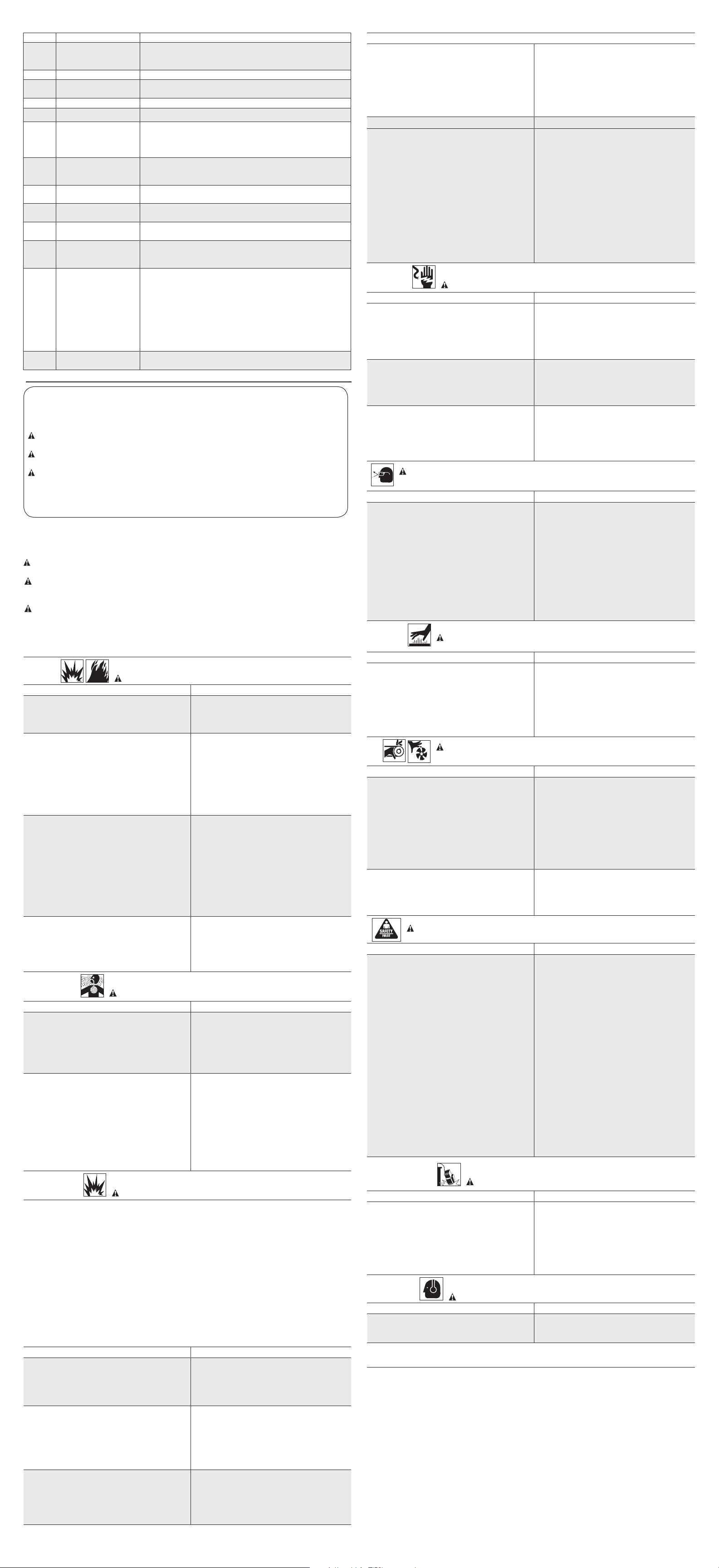
Description of Operation (Fig. 2–4)
Becomefamiliarwiththesecontrolsbeforeoperatingtheunit.
On(I)/Off(O) Switch (D): PlacethisswitchintheOn(I)positiontoprovideautomaticpowerto
thepressureswitchandOff(O)toremovepowerattheendofeachuse.
Pressure Switch (not shown): The pressure switch automatically starts the motor when the
airtankpressuredropsbelowthefactoryset"cut-in"pressure.Itstopsthemotorwhentheair
tankpressurereachesthefactoryset"cut-out"pressure.
Safety Valve (H): Ifthepressureswitchdoesnotshutofftheaircompressoratits"cut-out"
pressuresetting,thesafetyvalvewillprotectagainsthighpressureby"poppingout"atitsfactory
setpressure(slightlyhigherthanthepressureswitch"cut-out"setting).
Tank Pressure Gauge (I): The tank pressure gauge indicates the reserve air pressure in the
tank.
Outlet Pressure Gauge (E): The outlet pressure gauge indicates the air pressure available at
the outlet side of the regulator. This pressure is controlled by the regulator and is always less
than or equal to the tank pressure.
Regulator (G): Controls the air pressure shown on the outlet pressure gauge. Turn regulator
knob clockwise to increase pressure and counterclockwise to decrease pressure.
Cooling System (not shown): This compressor contains an advanced design cooling system.
At the heart of this cooling system is an engineered fan. It is perfectly normal for this fan to blow
air through the vent holes in large amounts. You know that the cooling system is working when
air is being expelled.
Air Compressor Pump (not shown): Compresses air into the air tank. Working air is not
available until the compressor has raised the air tank pressure above that required at the air
outlet.
Drain Valve (K): The drain valve is located at the base of the air tank and is used to drain
condensation at the end of each use.
Check Valve (M):Whentheaircompressorisoperating,thecheckvalveis"open",allowing
compressedairtoentertheairtank.Whentheaircompressorreaches"cut-out"pressure,the
checkvalve"closes",allowingairpressuretoremaininsidetheairtank.
Motor Overload Protector (not shown): The motor has a thermal overload protector. If the
motor overheats for any reason, the overload protector will shut off the motor. The motor must
be allowed to cool down before restarting. To restart:
1.SettheOn/Offleverto"Off"andunplugunit.
2. Allow the motor to cool.
3.Plugthepowercordintothecorrectbranchcircuitreceptacle.
4.SettheAuto/Offleverto"On"position.
Quick-Connect Body (F): The quick connect body accepts industrial quick connect plugs. The
two quick connect bodies allow the use of two tools at the same time.
How to Use Your Unit (Fig. 2)
HOW TO STOP
1.SettheOn/Offswitch(D)to"Off".
2. Unplug unit when not in use.
BEFORE STARTING
WARNING: Do not operate this unit until you read this instruction manual for safety, operation
and maintenance instructions.
BEFORE EACH START-UP
1.SettheOn/Offswitch(D)to"Off".
2.
Plug the power cord into the correct branch circuit receptacle.
(Referto Voltage and Circuit
Protection paragraph in the Installationsectionofthismanual.)
3.Turntheregulatorknob(G)counterclockwisetosettheoutletpressuretozero.
4. Attach hose and accessories.
WARNING: Risk of unsafe operation. Firmly grasp air hose in hand when installing
or disconnecting to prevent hose whip.
WARNING: Risk of unsafe operation. Do not use damaged or worn accessories.
NOTE: The hose or accessory will require a quick connect plug if the air outlet is equipped with
aquickconnectbody(F).
WARNING: Risk of Bursting. Toomuchairpressurecausesahazardousriskofbursting.
Check the manufacturer’s maximum pressure rating for air tools and accessories. The regulator
outlet pressure must never exceed the maximum pressure rating.
NOTICE: Risk of property damage. Compressed air from the unit may contain water
condensation and oil mist. Do not spray un fil tered air at an item that could be damaged by
moisture.Someairtoolsandaccessoriesmayrequirefilteredair.Readtheinstructionsforthe
air tools and accessories.
HOW TO START
1.SettheOn/Offswitch(D)to"On"andallowtankpressuretobuild.Motorwillstopwhentank
pressurereaches"cut-out"pressure.
2.Turnregulatorknob(G)clockwisetoincreasepressureandstopwhendesiredpressureis
reached.
WARNING: Risk of unsafe operation. If any unusual noise or vibration is noticed,
stop the compressor immediately and have it checked by a trained service technician.
The compressor is ready for use.
MAINTENANCE
Customer Responsibilities
Before each use Daily or after
each use
See tank warning label
Check Safety Valve X
Drain Tank X
Remove tank from service X
1
1- For more information,
call 1-800-4-DeW
ALT
(1-800-433-9258)
WARNING: Risk of unsafe operation. Unit cycles automatically when power is on.
When performing maintenance, you may be exposed to voltage sources, compressed air,
or moving parts. Personal injuries can occur. Before performing any maintenance or repair,
disconnect power source from the compressor and bleed off all air pressure.
NOTE: See Operation section for the location of controls.
To Check Safety Valve (Fig. 2)
WARNING: RiskofBursting.Ifthesafetyvalvedoesnotworkproperly,over-pressurization
may occur, causing air tank rupture or an explosion.
WARNING: Risk from Flying Objects. Always wear certified safety equipment:
ANSIZ87.1eyeprotection(CAN/CSAZ94.3)withsideshields.
Beforestartingcompressor,pulltheringonthesafetyvalve(H)tomakesurethatthesafetyvalve
operates freely. If the valve is stuck or does not operate smoothly, it must be replaced with the
same type of valve.
To Drain Tank (Fig. 2, 3)
WARNING:RiskofUnsafeOperation.Airtanks contain highpressureair.Keepface and
otherbodypartsawayfromoutletofdrain.UseANSIZ87.1eyeprotection(CAN/CSAZ94.3)
when draining as debris can be kicked up into face.
WARNING:Riskfromnoise.Alwayswearproperhearingprotectionduringuse.Undersome
conditions and duration of use, noise from this product may contribute to hearing loss.
NOTE: Allcompressedairsystemsgeneratecondensatethataccumulatesinanydrainpoint(e.g.,
tanks,filter,aftercoolers,dryers).Thiscondensatecontainslubricatingoiland/orsubstanceswhich
may be regulated and must be disposed of in accordance with local, state, and federal laws and
regulations.
WARNING:RiskofBursting.Waterwillcondenseintheairtank.Ifnotdrained,waterwill
corrode and weaken the air tank causing a risk of air tank rupture.
NOTICE: RiskofPropertyDamage.Drainwaterfromairtankmaycontainoilandrustwhich
can cause stains.
1.SettheOn/Offswitch(D)to"Off".
2.Turntheregulatorknob(G)counterclockwisetosettheoutletpressuretozero.
3.Removetheairtooloraccessory.
4. Place a suitable container under the drain valve to catch discharge.
5.Pull ring on safety valve (H) allowing air to bleed from the tank until tank pressure is
approximately 20 psi. Release safety valve ring.
6.Drainwaterfromairtankbyopeningdrainvalve(K)onbottomoftank.
7. After the water has been drained, close the drain valve. The air compressor can now be
stored.
NOTE: If drain valve is plugged, release all air pressure. The valve can then be removed,
cleaned, the reinstalled.
STORAGE
Beforeyoustoretheaircompressor,makesureyoudothefollowing:
1. Review the Maintenance section on the preceding pages and perform scheduled
maintenance as necessary.
2. Drain water from air tank. See To Drain Tank under Maintenance.
WARNING: Water will condense in the air tank. If not drained, water will corrode and
weaken the air tank causing a risk of air tank rupture.
3.Protecttheelectricalcordandairhosefromdamage(suchasbeingsteppedonorrunover).
Wind air hose loosely around the compressor handle. Wrap electrical cord onto the cord
wrap.
4. Store the air compressor in a clean and dry location.
Accessories
WARNING: The use of any other accessory not recommended for use with this tool could be
hazardous.Useonlyaccessoriesratedequaltoorhigherthantheratingoftheaircompressor.
Recommended accessories for use with your tool are available for purchase from your local
dealer or authorized service center. If you need assistance in locating any accessory for your tool,
please contact D
e
WALTIndustrialToolCo.,701EastJoppa Road, Baltimore,MD 21286, call
1-800-4-D
e
WALT(1-800-433-9258)orvisitourwebsitewww.dewalt.com.
Service Information
Please have the following information available for all service calls:
ModelNumber_____________________SerialNumber________________________________
DateandPlaceofPurchase_______________________________________________________
Repairs
ToassureproductSAFETYandRELIABILITY,repairs,maintenanceandadjustmentshouldbe
performed by a D
e
WALT factory service center, a D
e
WALT authorized service center or other
qualified service personnel. Always use identical replacement parts.
Full One Year Warranty
DeWALT heavy duty industrial tools are warranted for one year from date of purchase. We
will repair, without charge, any defects due to faulty materials or workmanship. For warranty
repair information, call 1-800-4-D
e
WALT (1-800-433-9258). This warranty does not apply to
accessories or damage caused where repairs have been made or attempted by others. This
warranty gives you specific legal rights and you may have other rights which vary in certain states
or provinces.
LATIN AMERICA: This warranty does not apply to products sold in Latin America. For
productssoldinLatinAmerica,seecountryspecificwarrantyinformationcontainedeitherinthe
packaging, call the local company or see website for warranty information.
FREE WARNING LABEL REPLACEMENT (Fig. 5): If your warning labels become illegible or
are missing, call 1-800-4-D
e
WALT(1-800-433-9258)forafreereplacement.
GLOSSARY
CFM: Cubic feet per minute.
SCFM: Standardcubicfeetperminute;aunitofmeasureofairdelivery.
PSI:Poundspersquareinch;aunitofmeasureofpressure.
kPa (kilopascal): Metricpressuremeasurement.1kilopascalequal1000pascals.
Code Certification: Productsthatbearoneormoreofthefollowingmarks:UL
®
,CUL,CULUS,
ETL
®
,CETL,CETLUS,havebeenevaluatedbyOSHAcertifiedindependentsafetylaboratories
and meet the applicable Standards for Safety.
*UL
®
is a registered trademark of Underwriters Laboratories and ETL
®
is a registered
trademark of Electrical Testing Laboratories.
Cut-In Pressure: While the motor is off, air tank pressure drops when accessory is used.
When the tank pressure drops to a certain low level the motor will restart automatically. The
low pressure at which the motor automatically restarts is called cut-in pressure.
Cut-Out Pressure: When an air compressor is turned on and begins to run, air pressure in
the air tank begins to build. It builds to a certain high pressure before the motor automatically
shuts off, protecting your air tank from pressure higher than its capacity. The high pressure at
which the motor shuts off is called cut-out pressure.
Branch Circuit: The circuit carrying electricity from electrical panel to outlet.
Duty Cycle: This air compressor pump is capable of running continuously. However, to prolong
the lifeof yourair compressor, it is recommendedthat a50%-75% average duty cycle be
maintained;thatis,theaircompressorpumpshouldnotrunmorethan30-45minutesinany
given hour.
Troubleshooting Guide
This section provides a list of the more frequently encountered malfunctions, their causes and
corrective actions. The operator or maintenance personnel can perform some corrective actions,
and others may require the assistance of a qualified D
eWALT technician or your dealer.
Problem Code
Excessive air tank pressure-safety valve pops off ................................................... 1, 2
Air leaks .................................................................................................................... 3
Air leaks in air tank or at air tank welds ...................................................................... 4
Air leaks between head and valve plate ..................................................................... 5
Air leaks from safety valve .......................................................................................... 6
Pressure reading on the regulated pressure gauge
drops when an accessory is used .............................................................................. 7
Compressor is not supplying enough air to operate accessories
............................................................................................................8,9,10,11,12
Regulator knob has continuous air leak ................................................................... 13
Regulator will not shut off air outlet .......................................................................... 13
Motorwillnotrun ............................................................. 6,14,15,16,17,18,19,20
Squealing Sound ..................................................................................................... 21
Troubleshooting Codes
CODE POSSIBLE CAUSE POSSIBLE SOLUTION
1 Pressure switch does
not shut off motor
when compressor
reaches cut-out
pressure
Set the Auto/Off switch to OFF, if the unit does not shut
off contact a D
e
WALTfactoryservicecenteroraD
e
WALT
authorized service center.
2 Pressure switch cut-
out too high
Contact a D
e
WALTfactoryservicecenteroraD
e
WALT
authorized service center.
3 Tube fittings are not
tight enough
Tighten fittings where air can be heard escaping. Check
fittings with soapy water solution. Do Not Overtighten.
4 Defective air tank Air tank must be replaced. Do not repair the leak.
WARNING:Riskofbursting.Donotdrillinto,weldor
otherwise modify air tank or it will weaken. The air tank can
rupture or explode.
5 Leakingseals Contact a D
e
WALTfactoryservicecenteroraD
e
WALT
authorized service center.
6 Defective safety valve Operate safety valve manually by pulling on ring. If valve still
leaks, it must be replaced.
7 Regulator is not
adjusted correctly for
accessory being used
It is normal for some pressure drop to occur when an
accessory is used, adjust the regulator as instructed in
Regulator under Features if pressure drop is excessive.
NOTE: Adjust the regulated pressure under flow conditions
while accessory is being used.
8 Prolonged excessive
use of air
Decrease amount of air usage.
FIG. 5
C
A
B
K
M
FIG. 1
FIG. 3
FIG. 4
FIG. 2
D
H
I
E
G
F
J
CODE POSSIBLE CAUSE POSSIBLE SOLUTION
9 Compressor is not
large enough for
accessory
Check the accessory air requirement. If it is higher than the
CFMorpressuresuppliedbyyouraircompressor,alarger
compressor is needed to operate accessory.
10 Hole in air hose Replace air hose.
11 Check valve restricted Contact a D
e
WALTfactoryservicecenteroraD
e
WALT
authorized service center.
12 Air leaks Tighten fittings.
13 Regulator is damaged Replace.
14 Motoroverload
protection switch has
tripped
RefertoMotorOverloadProtectionunderFeatures.Ifmotor
overload protection trips frequently, contact a D
e
WALT
factory service center or a D
e
WALTauthorizedservice
center.
15 Tank pressure exceeds
pressure switch cut-in
pressure
Motorwillstartautomaticallywhentankpressuredrops
below cut-in pressure of pressure switch.
16 Extension cord is
wrong length or gauge
Check for proper gauge wire and cord length. Refer to the
Extension Cords paragraph in the Installation section.
17 Looseelectrical
connections
Contact a D
e
WALTfactoryservicecenteroraD
e
WALT
authorized service center.
18 Possible defective
motor
Contact a D
e
WALTfactoryservicecenteroraD
e
WALT
authorized service center.
19 Paint spray on internal
motor parts
Contact a D
e
WALTfactoryservicecenteroraD
e
WALT
authorized service center. Do not operate the compressor
in the paint spray area. See flammable vapor warning.
20 Fuse blown, circuit
breaker tripped
1. Check fuse box for blown fuse and replace as necessary.
Reset circuit breaker. Do not use a fuse or circuit breaker
with higher rating than that specified for our particular
branch circuit.
2. Check for proper fuse. You should use a time delay fuse.
3.Checkforlowvoltageconditionsand/orproperextension
cord.
4. Disconnect the other electrical appliances from circuit or
operate the compressor on its own branch circuit.
21 WornBelt Contact a D
e
WALTfactoryservicecenteroraD
e
WALT
authorized service center.
Définitions : lignes directrices en
matière de sécurité
Lesdéfinitionsci-dessousdécriventleniveaudegravitépourchaquesymbole.Veuillezlirele
mode d’emploi et porter une attention particulière à ces symboles.
DANGER : Indique une situation dangereuse imminente qui, si elle n’est pas évitée,
causera la mort ou des blessures graves.
AVERTISSEMENT :Indique unesituationpotentiellementdangereusequi, si ellen’est
pasévitée,pourrait se solder par un décès ou des blessures graves.
ATTENTION : Indique une situation potentiellement dangereuse qui, si elle n’est pas
évitéepourrait se solder par des blessures mineures ou modérées.
AVIS : Indique une pratique ne posant aucun risque de dommages corporels mais
quiparcontre,sirienn’estfaitpourl’éviter,pourrait poser des risques de dommages
matériels.
POUR TOUTES QUESTIONSOUCOMMENTAIRESRELATIFS(VES) ÀL’OUTIL OUÀ PROPOS DE
TOUTAUTREOUTILD
eWALT,COMPOSERSANSFRAISLE:1-800-4-DeWALT (1-800-433-9258)
Directives de sécurité importantes
AVERTISSEMENT : Ne pas utiliser cet appareil avant d’avoir lu le mode d’emploi ainsi que
l’intégralitédesdirectivesdesécurité,d’utilisationetd’entretien.
AVERTISSEMENT :
Ce produit contient des produits chimiques reconnus par l’État de la
Californiecommeétantcancérigènesetpouvantentraînerdesanomaliescongénitalesoud’autres
problèmesliésauxfonctionsreproductrices.Se laver les mains après toute manipulation.
AVERTISSEMENT :
Certainespoussièrescontiennentdesproduitschimiquesreconnuspar
l’ÉtatdelaCaliforniecommecancérigènesetpouvantentraînerdesanomaliescongénitaleset
d’autresproblèmesliésauxfonctionsreproductrices,telsquel’amianteetleplombcontenus
dans les peintures au plomb.
CONSERVER CES DIRECTIVES
DANGER: RISQUE D’EXPLOSION OU D’INCENDIE
CE QUI PEUT SE PRODUIRE COMMENT L’ÉVITER
• Il est normal que des contacts électriques
dans le moteur et le manocontacteur fassent
uneétincelle.
• Faitestoujoursfonctionnerlecompresseur
dans une zone bien aérée sans matière
combustible, essence ou vapeur de
solvant.
• Si une étincelle électrique provenant du
compresseur entre en contact avec des
vapeurs inflammables, elle peut s’enflammer
et causer un incendie ou une explosion.
• Si vous aspergez des matériaux
inflammables, placez le compresseur à
au moins 6,1m (20pieds) de la zone
pulvérisée. Il est possible que vous
ayez besoin d’une longueur de tuyau
additionnelle.
• Entreposez les matières inflammables
dans un endroit sécuritaire, éloigné du
compresseur.
• Le fait de limiter les ouvertures d’aération
de compresseur causera une importante
surchauffe et pourrait causer un incendie.
• Ne placez jamais des objets contre le
compresseur ou sur celui-ci.
• Faites fonctionner le compresseur dans
un endroit aéré à au moins 30,5cm
(12 po) du mur ou de l’obstruction qui
pourraitlimiterledébitd’airfraisdansles
ouverturesd’aération.
• Faites fonctionner le compresseur dans
un endroit propre, sec et bien aéré. Ne
pas utiliser l’appareil à dans un endroit
exigu.Magasinàl’intérieur.
• Le fonctionnement de ce produit sans
surveillance pourrait se solder par des
blessures personnelles ou des dommages
à la propriété. Afin de réduire le risque
d’incendie, ne pas laisser le compresseur
fonctionner sans surveillance.
• Êtretoujoursprésentlorsqueleproduitest
en marche.
• Toujourséteindreetdébrancherl'appareil
sinonutilisé.
DANGER: RISQUE REPIRATOIRE (ASPHYXIE)
CE QUI PEUT SE PRODUIRE COMMENT L’ÉVITER
• Il est dangereux de respirer l’air comprimé
sortant du compresseur. Le flux d’air peut
contenir du monoxyde de carbone, des
vapeurs toxiques ou des particules solides
provenantduréservoird’air.Larespirationde
cescontaminantspeutcauser desérieuses
blessures, voire la mort.
• Ne jamais utiliser l’air obtenu directement
du compresseur pour l’alimentation en
air destinée à la consommation humaine.
Le compresseur n’est pas muni de filtres
et d’équipement de sécurité en ligne qui
conviennentàlaconsommationhumaine.
• Une exposition aux produits chimiques
présents dans la poussière générée par
les activités de ponçage, sciage, meulage,
perçageetautres,peutêtrenocive.
• Lesmatériauxvaporiséscommelapeinture,
les solvants de peinture, les décapants,
les insecticides, les herbicides, pourraient
contenir des vapeurs nocives et du poison.
• Travaillerdansunendroitayantunebonne
aérationtransversale.Lireetrespecterles
directivesenmatièredesécuritéimprimées
sur l’étiquette ou les fiches signalétiques
des matériaux qui sont pulvérisés.
Toujoursutiliserunéquipementdesécurité
homologué : une protection respiratoire
conforme aux normes NIOSH/OSHA,
ou un masque facial bien ajusté, conçus
spécifiquement pour votre utilisation
particulière.
AVERTISSEMENT: RISQUE D’ÉCLATEMENT
Réservoir d’air comprimé: Le26février2002,laU.S.ConsumerProductSafetyCommission
américaine a publié larègle nº 02-108 portant sur la sécurité en matièrede réservoir d’air
comprimédescompresseurs:
Les réservoirs d’air comprimé des compresseurs n’ont pas une durée de vie illimitée. La
duréedeviedesréservoirsdépenddeplusieursfacteurs,quicomprennententreautres:les
conditionsd’utilisation,lesconditionsambiantes,uneinstallationadéquate,lesmodifications
sursite,etleniveaudemaintenance.L’effetexactquepeutavoircesfacteurssurladuréede
viedesréservoirsd’airestdifficilementprévisible.
Siles procéduresadéquatesde maintenance ne sontpassuivies, la corrosion sur la paroi
interne du réservoird’aircomprimépeutfaireque celui-ci éclate defaçon inopinée laissant
soudainementl’airpressurisés’échapperavecforce,posantainsidesrisquesdedommages
corporels à l’utilisateur.
Leréservoird’airdevotrecompresseurdoitêtremishorsserviceàlafindel’annéementionnée
surl’étiquetted’avertissementapposéesurleréservoir.
Les conditions suivantes peuvent amener la dégradation du réservoir d’air, et faire que ce
dernierexploseviolemment:
CE QUI PEUT SE PRODUIRE COMMENT L’ÉVITER
• L’eau condensée n’est pas correctement
vidangéeduréservoird’airprovoquantainsi
la formation de rouille et un amincissement
duréservoird’airenacier.
• Vidangerleréservoird’airquotidiennement
ou après chaque utilisation. Si le
réservoirprésenteunefuite,leremplacer
immédiatementparunnouveau réservoir
d’air ou par un nouveau compresseur.
• Modificationsapportéesauréservoird’airou
tentativesderéparation.
• Nejamaisperceruntroudansleréservoir
d’air ou ses accessoires, y faire de la
soudure ou y apporter quelque modification
quecesoit.Nejamaisessayerderéparer
un réservoir d’air endommagé ou avec
des fuites. Le remplacer par un nouveau
réservoird’air.
• Des modifications non autorisées de la
soupape de sûreté ou de tous autres
composants qui régissent la pression du
réservoird’air.
• Le réservoir d’air a été conçu pour
supporter des pressions spécifiques de
fonctionnement.Nefaitesjamaiseffectuer
deréglagesoudesubstitutionsdepièces
en vue de modifier les pressions de
fonctionnementrégléesenusine.
ACCESSOIRES :
• Lorsqu’on excède la pression nominale
des outils pneumatiques, des pistolets
pulvérisateurs, des accessoires à
commande pneumatique, des pneus et
d’autres dispositifs pneumatiques, on risque
de les faire exploser ou de les projeter et
ainsientraînerdesblessuresgraves.
• Respecter les recommandations du
fabricant de l’équipement et ne jamais
dépasser la pression nominale maximale
permise des accessoires. Ne jamais
utiliser le compresseur pour gonfler de
petitsobjetsàbassepressioncommedes
jouetsd’enfant,desballonsdefootballet
de basket-ball, etc.
PNEUS :
• Des pneus surgonflés pourraient
provoquer des blessures graves et des
dommages à la propriété.
• Utiliser un manomètre pour vérifier la
pression des pneus avant chaque utilisation
et lors du gonflage; consulter le flanc de
pneu pour obtenir la pression correcte.
REMARQUE : Les réservoirs d’air
comprimé, compresseurs et autres
équipementssimilairesutiliséspourgonfler
les pneus peuvent remplir ces derniers
très rapidement. Régler le régulateur de
pressiond’airàunepressionmoindreque
celleindiquée surlepneu.Ajouter del’air
parpetitequantitéetutiliserfréquemment
le manomètre pour empêcher un
surgonflage.
AVERTISSEMENT: RISQUE DE CHOC ÉLECTRIQUE
CE QUI PEUT SE PRODUIRE COMMENT L’ÉVITER
• Votre compresseur d’air est alimenté à
l’électricité. Tout comme n’importe quel
autredispositifalimentédefaçonélectrique,
s’il n’est pas utilisé correctement, il peut
causerunchocélectrique.
• Nefaitesjamaisfonctionnerlecompresseur
à l’extérieur lorsqu’il pleut ou dans des
conditions humides.
• Nefaitesjamaisfonctionnerlecompresseur
aveclescouverclesdeprotectionenlevés
ouendommagés.
• Lestentativesderéparationparunpersonnel
non qualifié peuvent résulter en de graves
blessures,voirelamortparélectrocution.
• Toutcâblageélectriqueoutouteréparation
nécessaire pource produit doit être pris
enchargeparuncentrederéparationen
usine autorisé conformément aux codes
électriquesnationauxetlocaux.
• Mise à la terre électrique : Le fait de ne
pasfaireunemiseàlaterreadéquatedece
produit pourrait résulter en des blessures
graves voire la mort par électrocution.
Consulter les directives relatives à la
mise à la terre sous Installation.
• Assurez-vous que le circuit électrique
auquellecompresseurestbranchéfournit
une mise à la terre électrique adéquate,
une tension appropriée et une bonne
protection des fusibles.
AVERTISSEMENT: RISQUE PROVENANT DES OBJETS PROJETÉS EN L’AIR
CE QUI PEUT SE PRODUIRE COMMENT L’ÉVITER
• Le flux d’air comprimé peut endommager
lestissusmousdelapeauexposéeetpeut
projeter la poussière, des fragments, des
particules détachées et des petits objets
à haute vitesse, ce qui entraînerait des
dommages et des blessures personnelles.
• Toujours utiliser de l’équipement de
sécurité homologué: protection oculaire
conforme àla norme ANSI Z87.1 (CAN/
CSAZ94.3) munie d’écrans latérauxlors
de l’utilisation du compresseur.
• Ne jamais pointer une buse ou un
pulvérisateurversunepartieducorpsou
vers d’autres personnes ou des animaux.
• Toujours mettre le compresseur hors
tension et purger la pressiondu tuyau à
air et du réservoir d’air avant d’effectuer
l’entretien, de fixer des outils ou des
accessoires.
AVERTISSEMENT: ATTENTION SURFACES CHAUDES
CE QUI PEUT SE PRODUIRE COMMENT L’ÉVITER
• Toucher à du métal exposé comme la
tête du compresseur ou du moteur, la
tubulure des gaz d’échappement
(J,Fig.2)oudesortie,peutsesolderende
sérieusesbrûlures.
• Nejamaistoucheràdespiècesmétalliques
exposées sur le compresseur pendant
ou immédiatement après son utilisation.
Le compresseur reste chaud pendant
plusieursminutesaprèssonutilisation.
• Nepastouchernieffectuerdesréparations
aux coiffes de protection avant que
l’appareil n’ait refroidi.
AVERTISSEMENT: RISQUE ASSOCIÉ AUX PIÈCES MOBILES
CE QUI PEUT SE PRODUIRE COMMENT L’ÉVITER
• Lespiècesmobiles comme une poulie, un
volant ou une courroie peuvent provoquer
de graves blessures si elles entrent en
contactavecvousouvosvêtements.
• Ne jamais utiliser le compresseur si
les protecteurs ou les couvercles sont
endommagésouretirés.
• Tenir les cheveux, les vêtements et les
gants hors de portée des pièces en
mouvement.Lesvêtementsamples,bijoux
ou cheveux longs peuvent s’enchevêtrer
danslespiècesmobiles.
• S’éloigner des évents car ces derniers
pourraientcamouflerdespiècesmobiles.
• Utiliser le compresseur avec des pièces
endommagées ou manquantes ou le
réparersanscoiffesdeprotectionrisquede
vousexposeràdespiècesmobilesetpeut
se solder par de graves blessures.
• Toutes les réparations requises pour ce
produit devraient être effectuées par un
centre de réparation de un centre de
réparationautorisé.
AVERTISSEMENT: RISQUE ASSOCIÉ À UTILISATION DANGEREUSE
CE QUI PEUT SE PRODUIRE COMMENT L’ÉVITER
• Une utilisation dangereuse de votre
compresseur d’air pourrait provoquer de
gravesblessures,voirevotredécèsoucelle
d’autres personnes.
• Revoiretcomprendretouteslesdirectives
et les avertissements contenus dans le
présentmoded’emploi.
• Se familiariser avec le fonctionnement et
les commandes du compresseur d’air.
• Dégager la zone de travail de toutes
personnes, animaux et obstacles.
• Tenir les enfants hors de portée du
compresseur d’air en tout temps.
• Nepasutiliserleproduitencasdefatigue
ou sous l’emprise d’alcool ou de drogues.
Restervigilantentouttemps.
• Une utilisation dangereuse de votre
compresseur d’air pourrait provoquer de
gravesblessures,voirevotredécèsoucelle
d’autres personnes.
• Ne jamais rendre inopérant les
fonctionnalitésdesécuritéduproduit.
• Installer un extincteur dans la zone de
travail.
• Nepasutiliserl’appareillorsqu’ilmanque
despiècesouquedespiècessontbrisées
ounonautorisées.
• Ne jamais se tenir debout sur le
compresseur.
AVERTISSEMENT: RISQUE DE CHUTE
CE QUI PEUT SE PRODUIRE COMMENT L’ÉVITER
• Uncompresseurportatifpeuttomberd’une
table,d’unétablioud’untoitetcauserdes
dommages au compresseur, ce qui pourrait
résulterendegravesblessures,voirelamort
del’opérateur.
• Toujoursfairefonctionnerlecompresseur
alorsqu’ilestdansunspositionsécuritaire
etstableafind’empêcherunmouvement
accidentel de l’appareil. Ne jamais faire
fonctionner le compresseur sur un toit ou
surtouteautrepositionélevée.Utiliserun
tuyaud’airsupplémentairepouratteindre
les emplacements en hauteur.
AVERTISSEMENT: RISQUE ASSOCIÉ AU BRUIT
CE QUI PEUT SE PRODUIRE COMMENT L’ÉVITER
• Danscertainesconditionsetselonladurée
d’utilisation,lebruitprovoquéparceproduit
peutcontribueràuneperteauditive.
• Porter systématiquement une protection
auditiveappropriéedurantl’utilisation.
CONSERVER CES DIRECTIVES
POUR UN USAGE ULTÉRIEUR
ASSEMBLAGE
Déballage
Retirezl'appareildesaboîteetjeteztoutl'emballage.
INSTALLATION
Montage De L'appareil
EMPLACEMENT DU COMPRESSEUR D'AIR
• Lecompresseurd'airdoitêtresituédansunendroitpropre,secetbienaéré.
• Lecompresseurd'airdevraitêtresituéàunedistanced'aumoins30,5cm(12po)detout
murouautreobstructionquipourraitbloquerledébitd'air.
• La pompe et la tôle de protection du compresseur sont conçus pour permettre un
refroidissementapproprié.Lesouverturesd'aérationducompresseursontnécessairespour
maintenirlatempératuredefonctionnementappropriée.Neplacezpasdechiffonsoude
contenantssurouàproximitédecesouvertures.
