
$ERXW<RXU&DPHUD
About this Manual
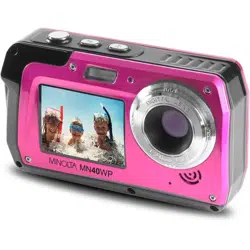
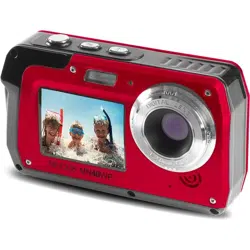
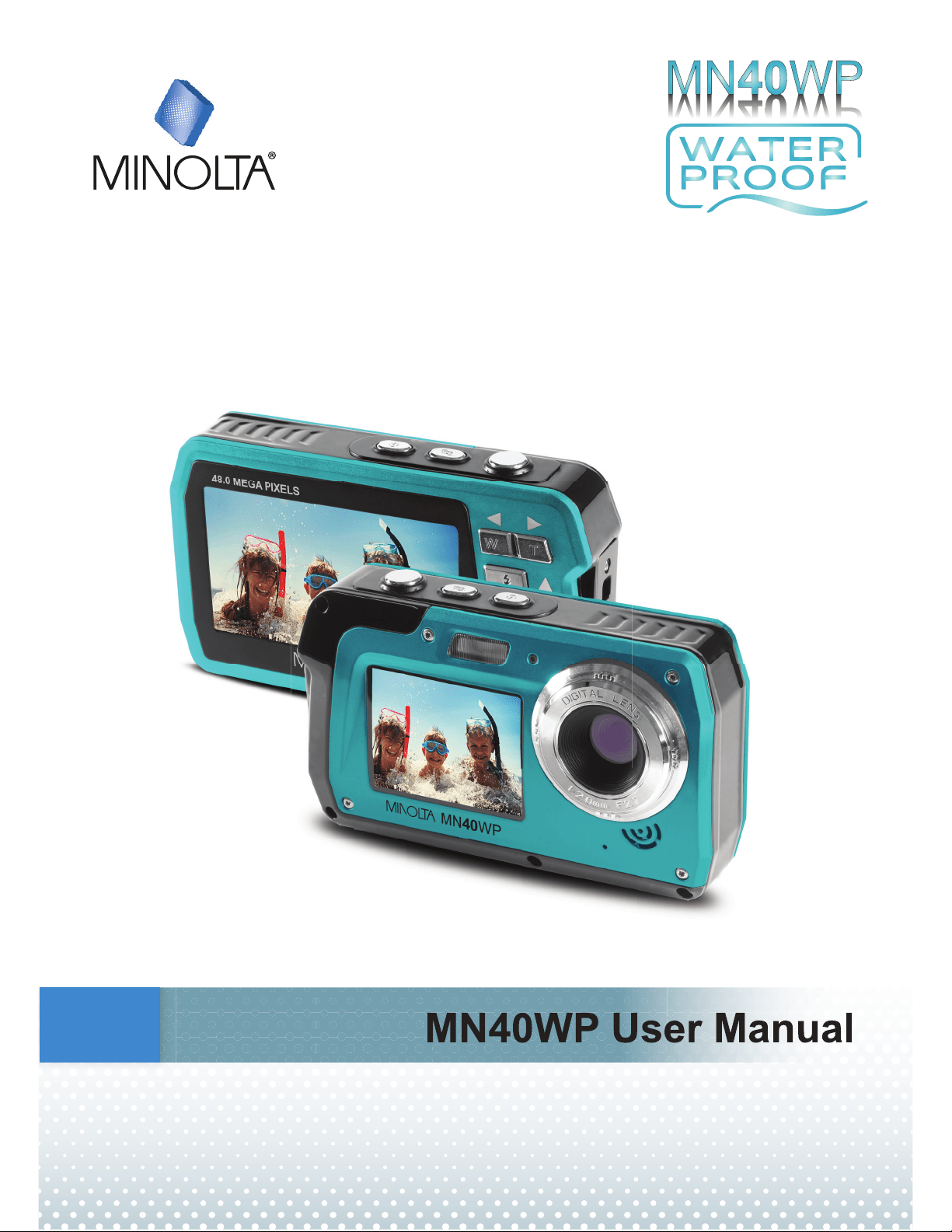
Congratulations on purchasing the Minolta MN40WP Waterproof Camera!
The contents of this manual are subject to change without notice. Note that the
example screens and product illustrations shown in this User’s Guide may differ
somewhat from the screens and configuration of the actual camera.
Copyright
This manual contains proprietary information protected by copyright. All rights
are reserved. No part of this manual may be reproduced by any mechanical,
electronic or other means, in any form, without prior written permission of Elite
Brands Inc. © 2021.
FEDERAL COMMUNICATIONS COMMISSION INTERFERENCE STATEMENT
This equipment has been tested and found to comply with the limits for a Class B
digital device, pursuant to Part 15 of the FCC Rules. These limits are designed to
provide reasonable protection against harmful interference in a residential
installation. This equipment generates, uses and can radiate radio frequency
energy and, if not installed and used in accordance with the instructions, may
cause harmful interference to radio communications. However, there is no
guarantee that interference will not occur in a particular installation. If this
equipment does cause harmful interference to radio or television reception, which
can be determined by turning the equipment off and on, the user is encouraged
to try to correct the interference by one or more of the following measures:
•
Reorient or relocate the receiving antenna.
•
Increase the separation between the equipment and receiver.
•
Connect the equipment into an outlet on a circuit different from that to which the
receiver is connected.
•
Consult the dealer or an experienced radio/TV technician for help.
CAUTION:
Any changes or modifications not expressly approved by the party responsible
for compliance could void the user's authority to operate the equipment.
This device complies with Part 15 of the FCC Rules. Operation is subject to the
following two conditions:
(1)
This device may not cause harmful interference and
(2)
This device must accept any interference received, including interference
that may cause undesired operation.
RF Exposure Warning
This equipment complies with FCC RF radiation exposure limits set forth for an
uncontrolled environment. This equipment must be installed and operated in
accordance with provided instructions and must not be co-located or operating in
conjunction with any other antenna or transmitter. End-users and installers must
be provided with antenna installation instructions and transmitter operating
conditions for satisfying RF exposure compliance.

$ERXW<RXU&DPHUD
FCC: SAR standard Value: 1.6 W/Kg, Maximal Measure: 0.4 W/kg
CE Mark Warning
This is a Class B product, in a domestic environment, this product may cause
radio interference, in which case the user may be required to take adequate
measures.
Safety and Handling Precautions
Camera Information
•
Do not disassemble or attempt to service the camera yourself.
•
Do not expose the camera to moisture, or extreme temperatures.
•
Allow the camera to warm up when moving from cold to warm
temperatures.
•
Do not touch and put pressure on the camera lens.
•
Do not expose the lens to direct sunlight for extended periods.
•
Do not use abrasive chemicals, cleaning solvents or strong detergents to
clean the product. Wipe the product with a slightly damp soft cloth.
•
Do not use the flash or LED Light near a person's eyes to prevent possible
eye injury.
•
To prevent you from falling over or resulting in traffic accident, please do
not use the camera while you are walking, driving or riding a vehicle.
•
Please handle the camera strap with care, and never place the strap
around the neck of an infant or child. Wrapping the strap around a neck
may cause suffocation.
•
Do not subject the LCD screen to impact.
•
To prevent the risk of fire or electric shock, do not expose the inside of this
product to rain or moisture.
Battery Information
•
Turn off the camera before installing or removing the battery.
•
Use only the provided batteries or type of battery and charger that came with
your camera. Using other types of battery or charger may damage the device
and invalidate the warranty.
•
Inserting the battery upside down can cause damage to the product and
possibly cause an explosion.
•
When the camera is used for an extended period of time, it is normal for the
camera body to feel warm.
•
Download all pictures and remove the battery from the camera if you are going
to store the camera for a long period of time.
•
Risk of explosion if battery is replaced by an incorrect type. Dispose of used
batteries according to the instructions.
•
Please keep the batteries out of the reach of children to prevent from
swallowing the batteries, which might cause poisoning.
•
If the battery's color or shape changes in any way, stop using the battery

$ERXW<RXU&DPHUD
3
immediately.
USB Adaptor Information
•
Do not expose the adapter to high temperatures or moisture places. Otherwise, it
may cause fire or electric shock.
•
Do not attempt to repair, disassemble, change or transform the adapter.
•
Avoid sudden changes in temperature, which may cause condensation on the
adapter’s internal surfaces. Please do not use it immediately in this situation.
•
Do not touch the plug with wet hands. Otherwise, it may cause electric shock.
•
Do not use the travel voltage converter or AC/DC power inverter. Otherwise, it
may cause damage, overheating, malfunction or fire to the camera.
Waterproof and Dustproof Information
•
The waterproof and dustproof performance described do not guarantee that
the camera will remain completely waterproof or free from damage and
trouble under all conditions.
•
Do not subject the camera to excessive shock, Vibration or pressure by
dropping it, hitting it or placing a heavy object on it. Failure to observe this
precaution could deform the camera, cause water to seep inside, or damage
the airtight seals, resulting in camera malfunction.
•
The battery door must be closed securely and the lock engaged in order for
the camera to be waterproof. Failure to do this can allow water to enter the
camera and damage it.
The camera can shoot images underwater at a depth of 3m (10ft) for up to
60 minutes.
x Do not drop the camera, strike it against a hard object such as a rock, or
throw it against a water surface.
x Do not subject the camera to shock when using it underwater.
x Do not expose to depths greater than 3m (10ft) underwater.
x Do not continuously use the camera underwater for 60 minutes or more.
x Do not insert a wet memory card or battery in the camera.
x Do not open the battery cover when the camera or your hands are wet.
Doing so may cause water to seep inside the camera or result in camera
malfunction.
x Do not open the battery cover underwater.
x If moisture such as water droplets adheres to the outside of the camera
or inside of the battery cover, immediately wipe it off with a soft dry cloth.
x If a foreign substance adheres to the outside of the camera or inside of
the battery cover, immediately remove it with a soft cloth.
x Do not leave the camera in cold conditions or hot conditions of 40°C
(104°F) or more for a long period of time.
x When using the camera underwater, make sure the water temperature is
from 0°C-40°C (32°F to 104°F).
x Do not use the camera in hot springs.
$ERXW<RXU&DPHUD
Before Using the Camera Underwater
Check the items below before using the camera underwater.
x Make sure that there are no foreign substances inside the battery cover.
x
Make sure that the waterproof packing of the battery cover is not cracked or deformed.
x Make sure that the battery door is firmly closed and the battery cover security lock
is in
the LOCK position.
x Failure to follow these steps can result in damage to the camera.
Notes about Opening and Closing the Battery Door
x Make sure the camera and your hands are not wet.
x Make sure that there are no debris inside the battery-chamber or memory card slot.
x Make sure that the battery cover is firmly closed and the security lock is in the lock
position.
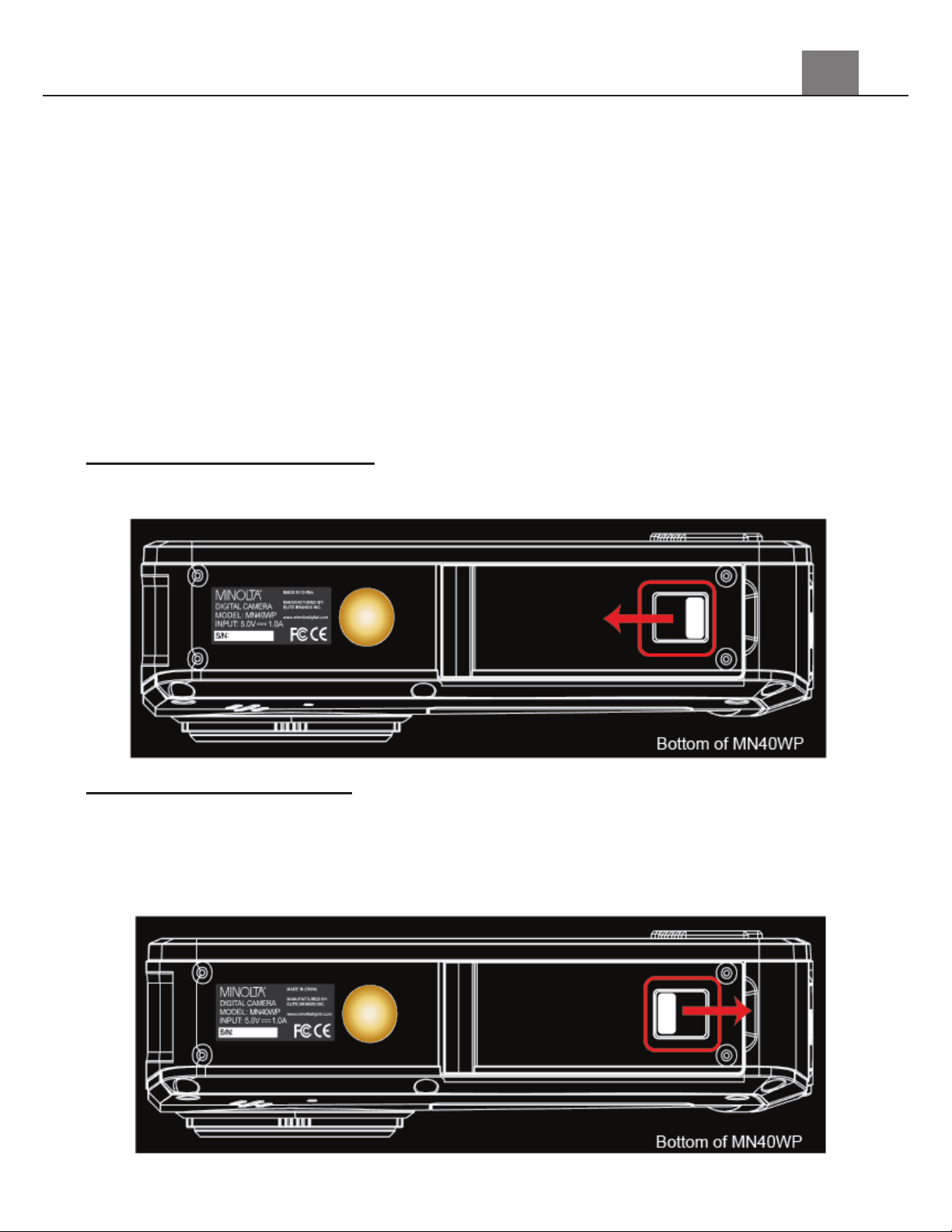
To Unlock the Battery Door
Unlock the battery door by sliding the battery door notch away from the opening.
Use a fingernail or other pointy object when sliding the latch to get a better grip.
To Lock the Battery Door
1. Press the battery door down firmly until it is completely flat.
2. While the battery door is pressed down, slide the door latch into the locked
position as shown in the figure below. Use a fingernail or other pointy object
when sliding the latch to get a better grip. The battery door is fully locked once
the latch clicks into place.

$ERXW<RXU&DPHUD
Precautions When Cleaning
x Do not puncture the microphone or speaker openings with a sharp
implement.
x If the inside of the camera is damaged, the waterproof performance will
deteriorate.
x Do not use soap, natural detergents, or chemicals such as benzene for
cleaning.
Do Not Apply Strong Impact to the Camera
The product may malfunction if subjected to strong shock or vibration. In
addition, do not touch or apply force to the lens.
Avoid Sudden Changes in Temperature
Sudden changes in temperature, such as when entering or leaving a heated
building on a cold day, can cause condensation to form inside the device. To
prevent condensation, place the device in a carrying case or a plastic bag
before exposing it to sudden changes in temperature.
Keep Away from Strong Magnetic Fields
Do not use or store this device in the vicinity of equipment that generates strong
electromagnetic radiation or magnetic fields. Doing so could result in loss of
data or camera malfunction.
Do Not Point the Lens at Strong Light Sources for Extended Periods
Avoid pointing the lens at the sun or other strong light source light sources for
extended periods when using or storing the camera. Intense light may cause
the image sensor to deteriorate or produce a white blur effect in photographs.
Turn the Product Off before Removing or Disconnecting the Power
Source or Memory Card
Do not remove the battery while the product is on, or while images are being
saved or deleted. Forcibly cutting power in these circumstances could result in
loss of data or cause damage to the memory card or internal circuitry.
Notes about the LCD Screen
x The LCD Screens are constructed with extremely high precision; At least
99.99% of pixels are effective, with no more than 0.01% being missing or
defective. Hence, while these displays may contain pixels that are
always lit (white, red, blue or green) or always off (black), this is not a
malfunction and has no effect on images recorded with the device.
x Images viewed on the LCD screen may be difficult to see under certain
lighting.
x Do not apply pressure to the LCD screen, as this could cause damage or
malfunction.

$ERXW<RXU&DPHUD
The Battery
Precautions for Use
x Note that the battery may become hot after use.
x Do not use the battery at ambient temperatures below 0°C (32°F) or
above 40°C (104°F) as this could cause damage or malfunction.
x If you notice any abnormalities such as excessive heat, smoke, or an
unusual smell coming from the battery, immediately discontinue use and
consult your retailer.
x After removing the battery from the camera or optional battery charger,
put the battery in a plastic bag, etc. in order to insulate it.
Charging the Battery
Check the battery level before using the camera and replace or charge the
battery if necessary.
x Charge the battery indoors with an ambient temperature of 5°C (41°F) to
35°C (95°F) before use.
x A high battery temperature may prevent the battery from charging
properly or completely, and may reduce battery performance. Note that
the battery may become hot after use; wait for the battery to cool before
charging. When charging the battery inserted into this camera using the
Charging AC Adapter or a computer, the battery is not charged at battery
temperature below 5°C (41°F) or above 55°C (131°F).
x When the battery is between 45°C (113°F) - 55°C (131°F), the
chargeable capacity may decrease.
x Do not continue charging once the battery is fully charged as this will
result in reduce battery performance.
x The battery temperature may increase during charging. However, this is
not a malfunction.
Using the Battery When Cold
On cold days, the capacity of batteries tends to decrease. If an exhausted
battery is used at a low temperature, the camera may not turn on. Keep spare
batteries in a warm place and exchange as necessary. Once warmed, a cold
battery may recover some of its charge.
Recycling Used Batteries
Replace the battery when it no longer holds a charge. Used batteries are a
valuable resource. Please recycle used batteries in accordance with local
regulations.
Cleaning After Using the Camera Underwater
Follow the procedure below to rinse the camera with fresh water within 30
minutes after using it under saltwater or at the beach.
1.
Keep the battery cover closed and wash off the camera with fresh

$ERXW<RXU&DPHUD
water. Immerse the camera in a shallow basin filled with fresh water for
10 minutes.
2.
Immerse the camera in fresh water and shake it sufficiently in the water
to remove any foreign substances from the camera.
3.
When the cameras is immersed in the water, a few air bubbles may
come out from the water drain holes of the camera such as openings in
the microphone or speakers. This is not a malfunction.
4.
Wipe off water droplets with soft cloth and dry the camera in a well-
ventilated and shady place.
5.
Place the camera on a dry cloth to dry it.
6.
Do not dry the camera with hot air from a hair dryer or clothes dryer.
7.
After making sure that there are no water droplets on the camera, open
the battery cover and use a soft dry cloth to gently wipe off any water
or sand remaining on the waterproof packing or inside the camera.
x If the cover is closed when the inside is wet, this could cause
condensation or a malfunction.
Cleaning After Using the Camera in Conditions Other than Underwater
Use a blower to remove any dust or lint that adheres to the lens, monitor or
camera body. To remove fingerprints or other stains that cannot be removed
with a blower, gently wipe the parts with a soft dry cloth. If you wipe with too
much pressure or with a rough cloth, it may damage the camera or cause a
malfunction.
Storage
If you do not intend to use the camera for an extended period, remove the
battery and avoid storing the camera in any of the following types of locations:
x Places that are poorly ventilated or subject to humidity of over 60%
x Place exposed to temperatures above 50°C (122°F) or below -10°C (14°F).
x Place next to equipment that produces strong electromagnetic field, such
as television or radios.
To prevent mold or mildew, take the camera out of storage at least once a
month, and turn it on and release the shutter a few times before putting it away
again.
$ERXW<RXU&DPHUD
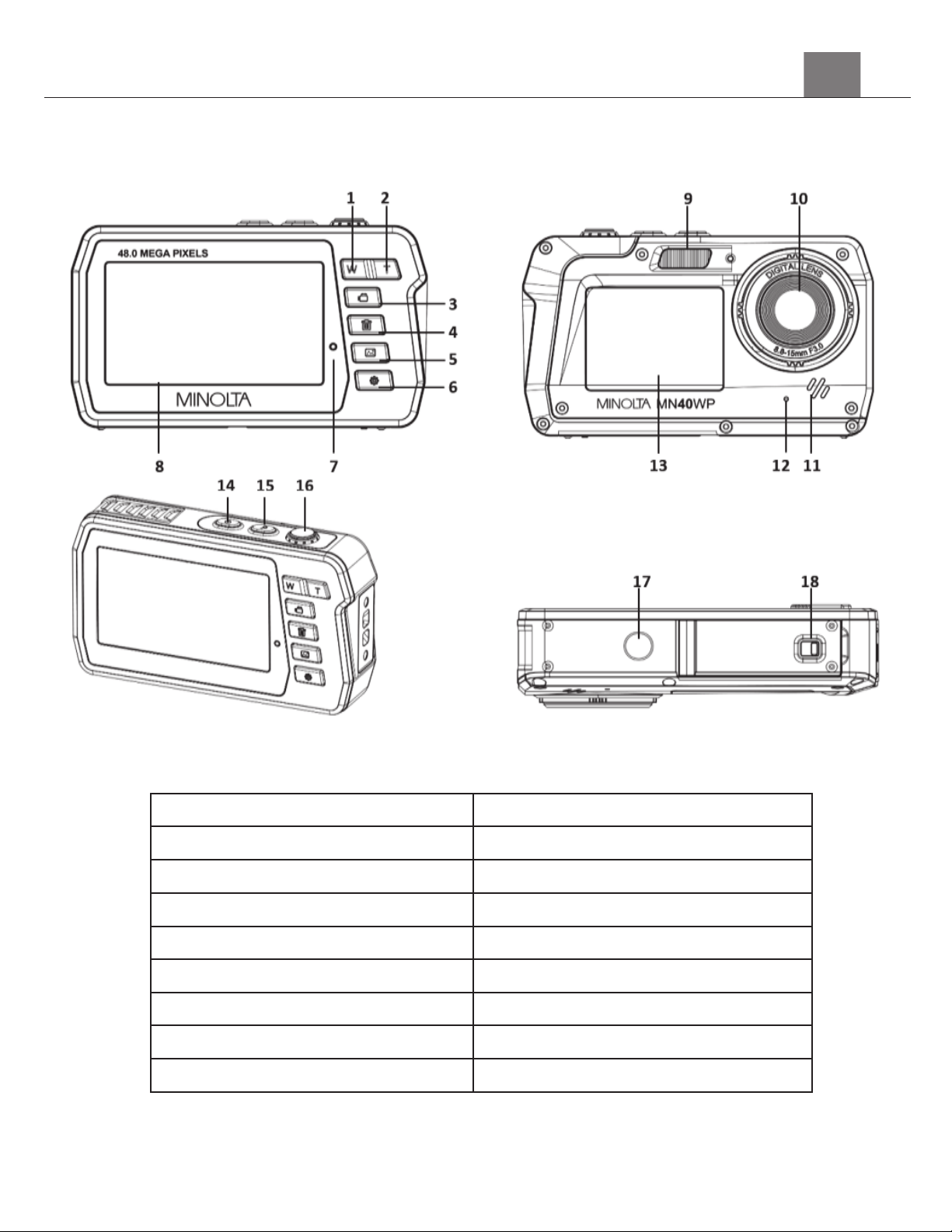
1.1
Camera Interface
1. Zoom Out / Left
10. Lens
2. Zoom In / Right
11. Speaker
3. Flash / Up
12. Microphone
4. Delete / Down
13. Front LCD Screen
5. Mode
14. Power
6. Settings / OK
15. Switch Screen
7. Indicator light
16. Shutter
8. Main LCD Screen
17. Tripod Mount
9. LED Flash
18. Battery Cover/Lock
$ERXW<RXU&DPHUD
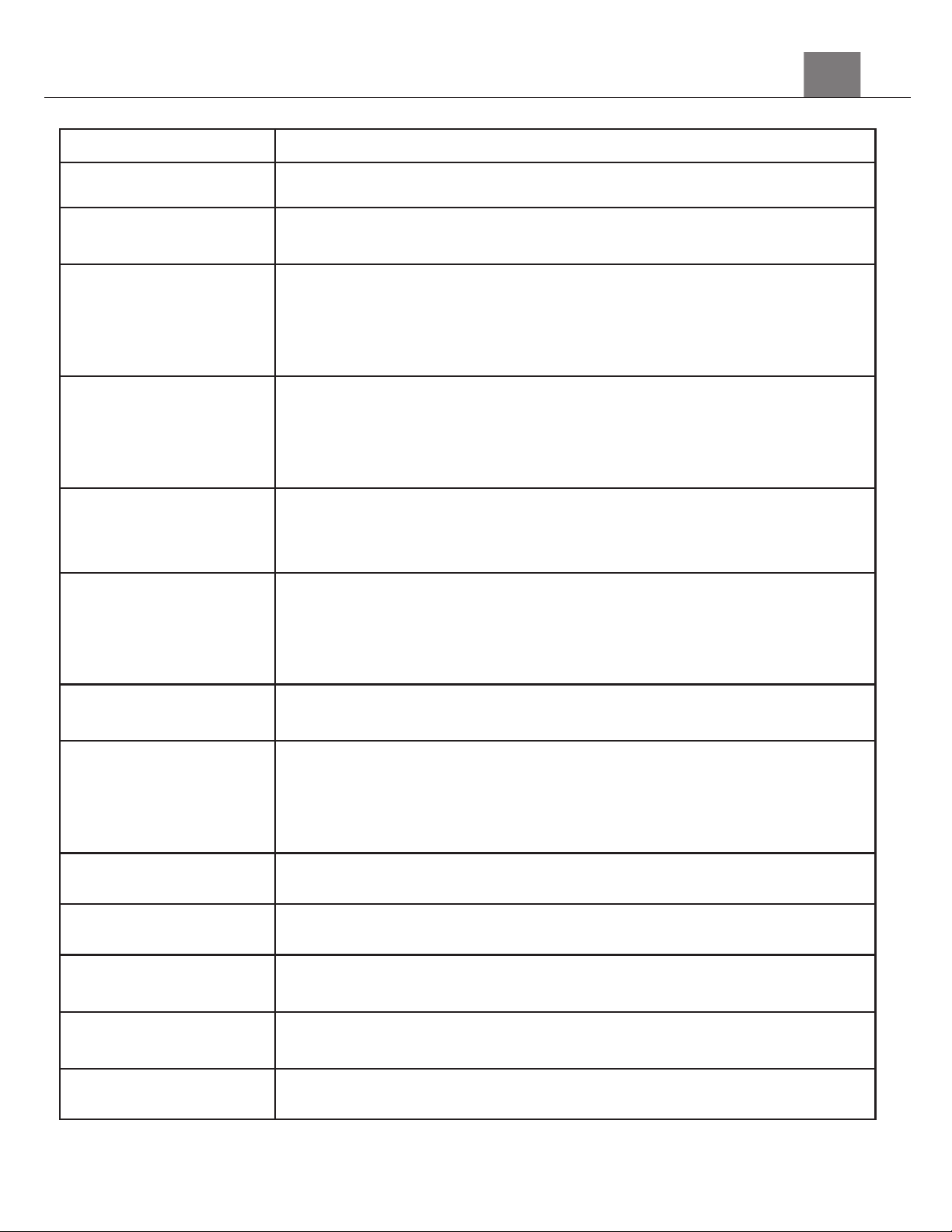
1.2
Button Function Description
Function
Description
Power
Press for 3 seconds to power on or off.
Settings
|OK
Tap to access the settings menu and to confirm
selected setting.
Zoom
Out |
Left
In Video or Photo: Press to zoom-out.
In
Settings: Press to select submenu.
In Playback:
Press to
view multiple images on the
screen.
Zoom In
|
Right
In Video or Photo: Press to zoom-in.
In
Settings: Press to select submenu.
In Playback:
Press to zoom in on the image
displayed on the screen.
Flash
|Up
In Photo: Press to change the flash settings.
In Playback:
Press to go to the previous image.
In Settings: Press to select desired setting.
Delete
|Down
In Video or Photo: Press to delete the last recorder
video or image
.
In Playback:
Press to go to the next image.
In Settings: Press to select desired setting.
Mode
Tap to cycle between Photo, Video and Playback
modes.
Shutter
In Photo: Tap to capture a photo.
In Video
: Tap to start and stop recording.
In Playback:
Tap to play and pause recorded
videos.
Switch Screen
Switches the LCD screen that is powered on
.
Tripod Mount
Mount port for attaching to a tripod nut.
Battery Door
Door to cover the battery compartment and memory
card slot.
Speaker
Built-in speaker output for playback of video files
when audio recording is enabled.
Lens
Front capture device for all video and photo.
)LUVW8VH
2.
First Use
2.1
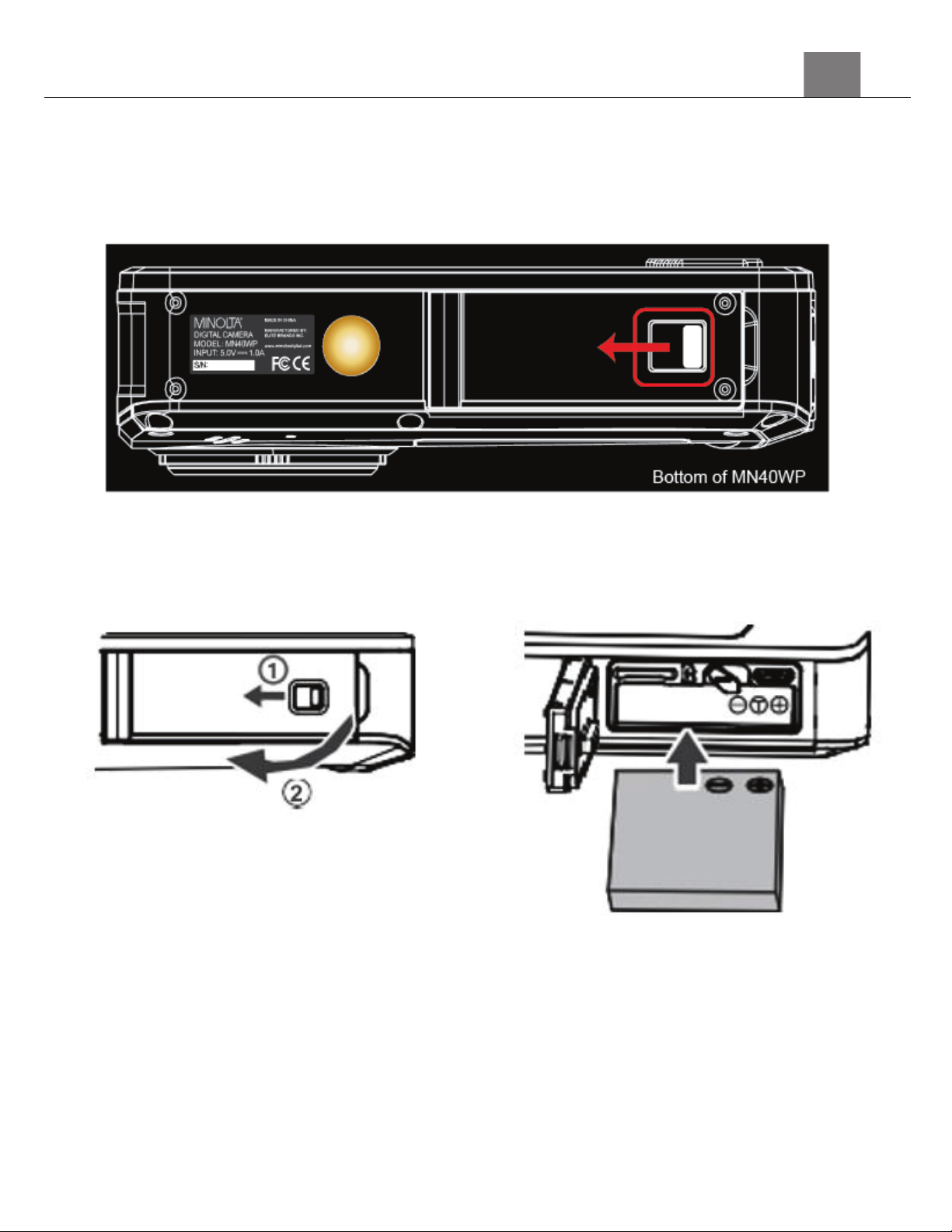
To Open the Battery Door
Unlock the battery door by sliding the battery door notch away from the
opening. Use a fingernail or other pointy object when sliding the latch to get a
better grip.
2.2
Installing the Battery
Insert the lithium-ion battery into the battery compartment with the metal
contacts facing the inside of the camera. The battery can only inserted one
way.
2.3
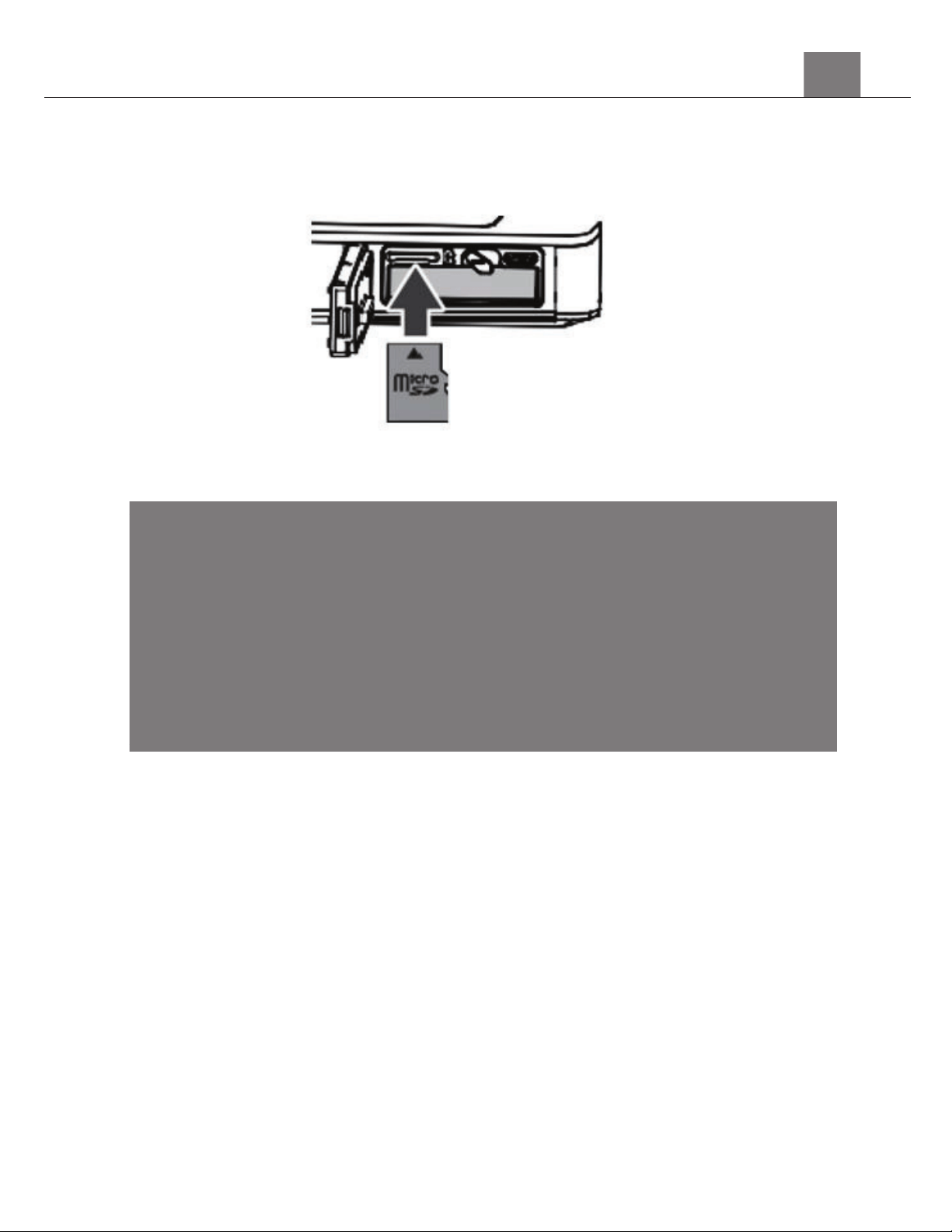
Installing the Memory Card
Insert the included Micro SD memory card to record and store your videos and
photos. When the battery is low, media stored on the memory card will not be
erased. Please insert the SD memory card by following the steps below:
1.
Open the battery door by following the diagram above.
2.
Insert the memory card. Ensure that the metal contacts are inserted first.
Push the memory card down until you hear an audible click.
The memory card can only be inserted in one way. Do not force the
card in if it will not go in smoothly.
)LUVW8VH
3.
Close the memory card door by pushing it down and sliding the lock back
into place.
4.
To remove the memory card, simply push in and the card will eject back out.
NOTE: After closing the battery door, make sure that the door is
closed securely and the lock engaged. Failure to do this can
allow water to enter the camera and damage it.
NOTE:
x Please format the memory card before using the camera
(Caution, this will erase all data on the card).
x Do not remove or insert the memory card when recording. It
may damage the card or cause data loss.
x
Memory card rating must be Class 6 or above.
)LUVW8VH
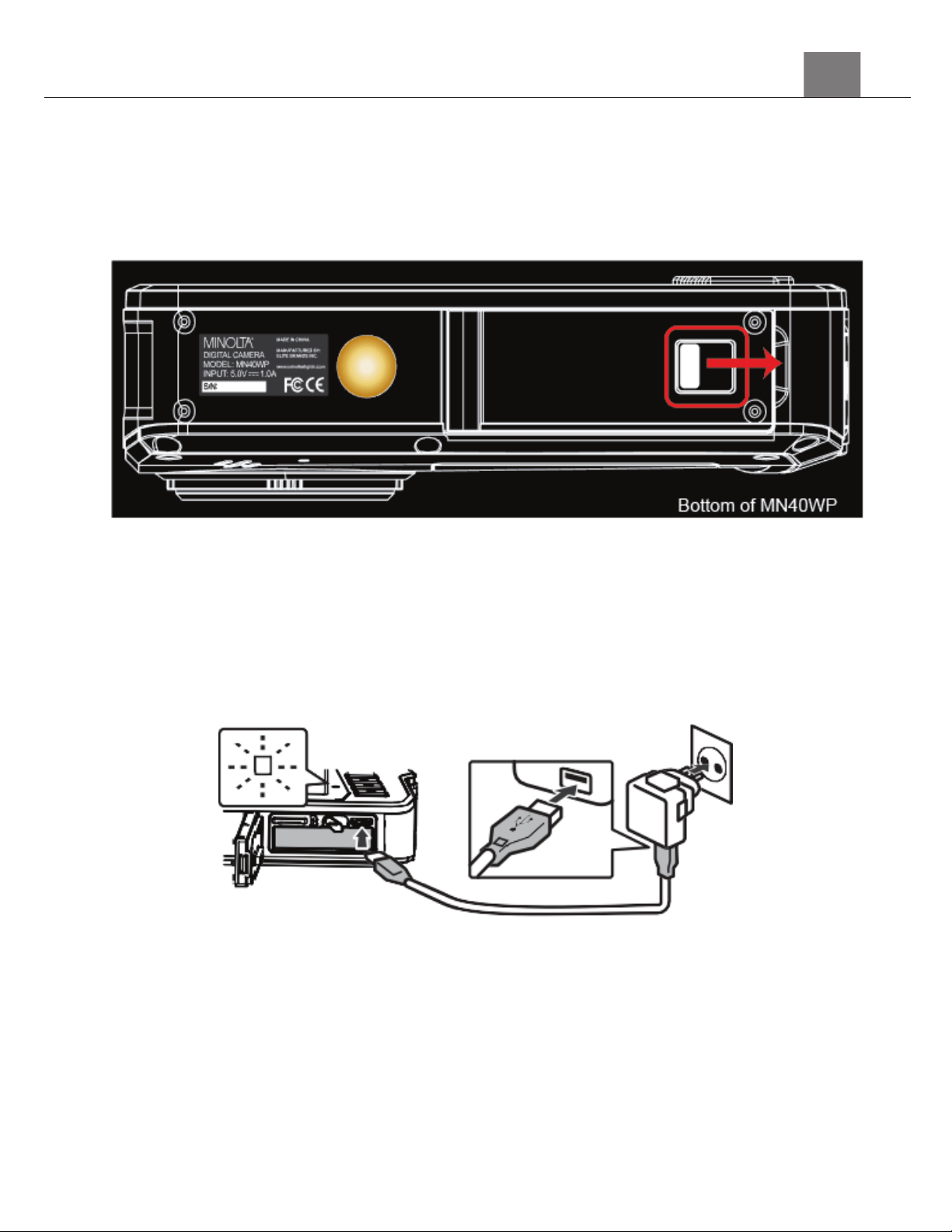
2.4
To Lock the Battery Door
1. Press the battery door down firmly until it is completely flat.
2. While the battery door is pressed down, slide the door latch into the locked
position as shown in the figure below. Use a fingernail or other pointy object
when sliding the latch to get a better grip. The battery door is fully locked
once the latch clicks into place.
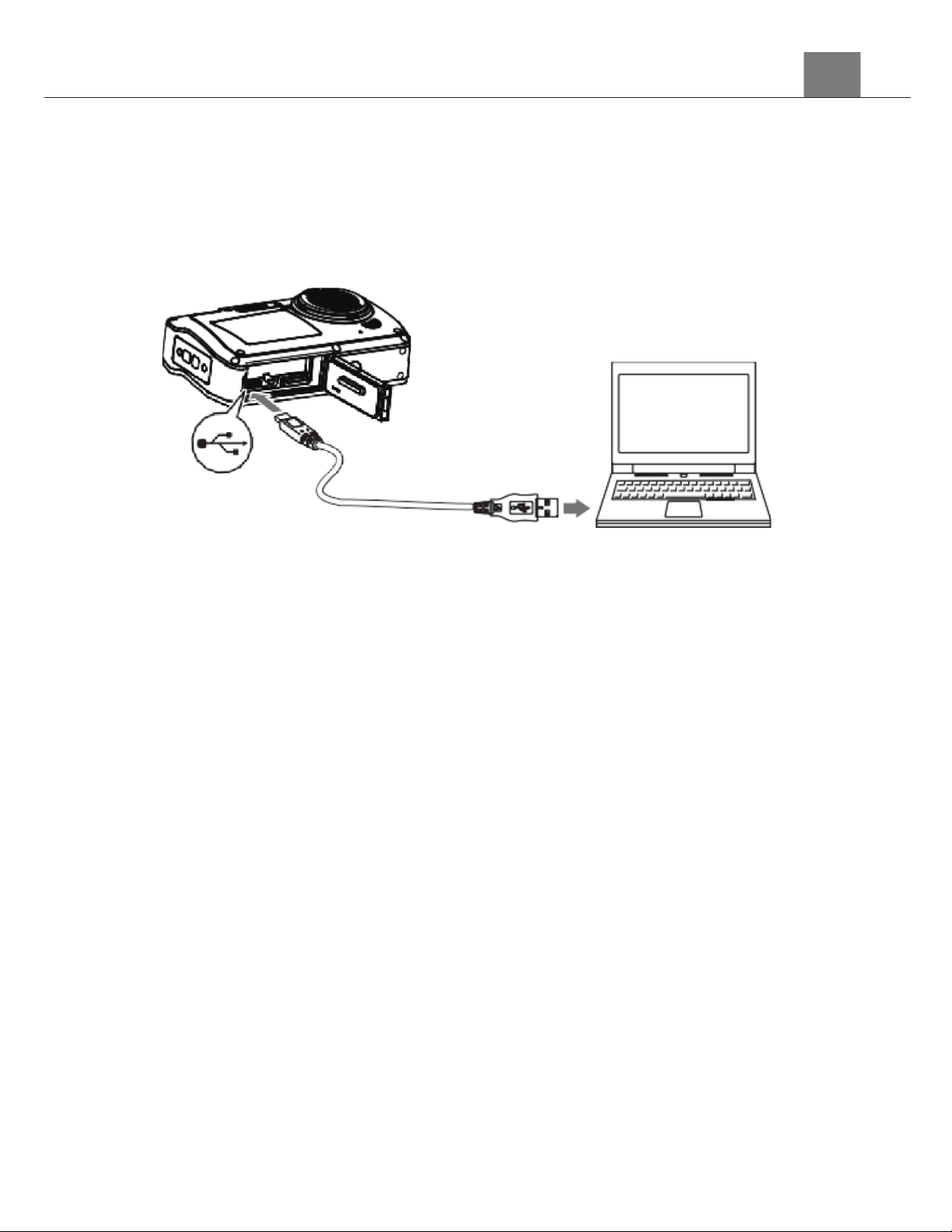
2.5
Charging the Battery
Connect your camera to the included AC adaptor with the USB cable
provided for charging. Insert the small end of the USB plug into the camera’s
port under the battery door, and the larger end in to the included AC adaptor.
While charging the LED indicator light will light up solid red, when finished
charging the light will turn off.
2.6
Powering the Camera On/Off
Hold the POWER button for 3 seconds to power the camera on. To power
the camera off, press and hold the POWER button for a further 3 seconds.
If the camera’s battery is low, a “Low Power” message will display on the
screen and it will automatically shut down within a few seconds to prevent
memory corruption or loss.
2.7
Switching Modes
Press the MODE button to cycle between Photo, Video and Playback
Modes. The corresponding mode will be displayed in the top left corner of
)LUVW8VH
the screen.
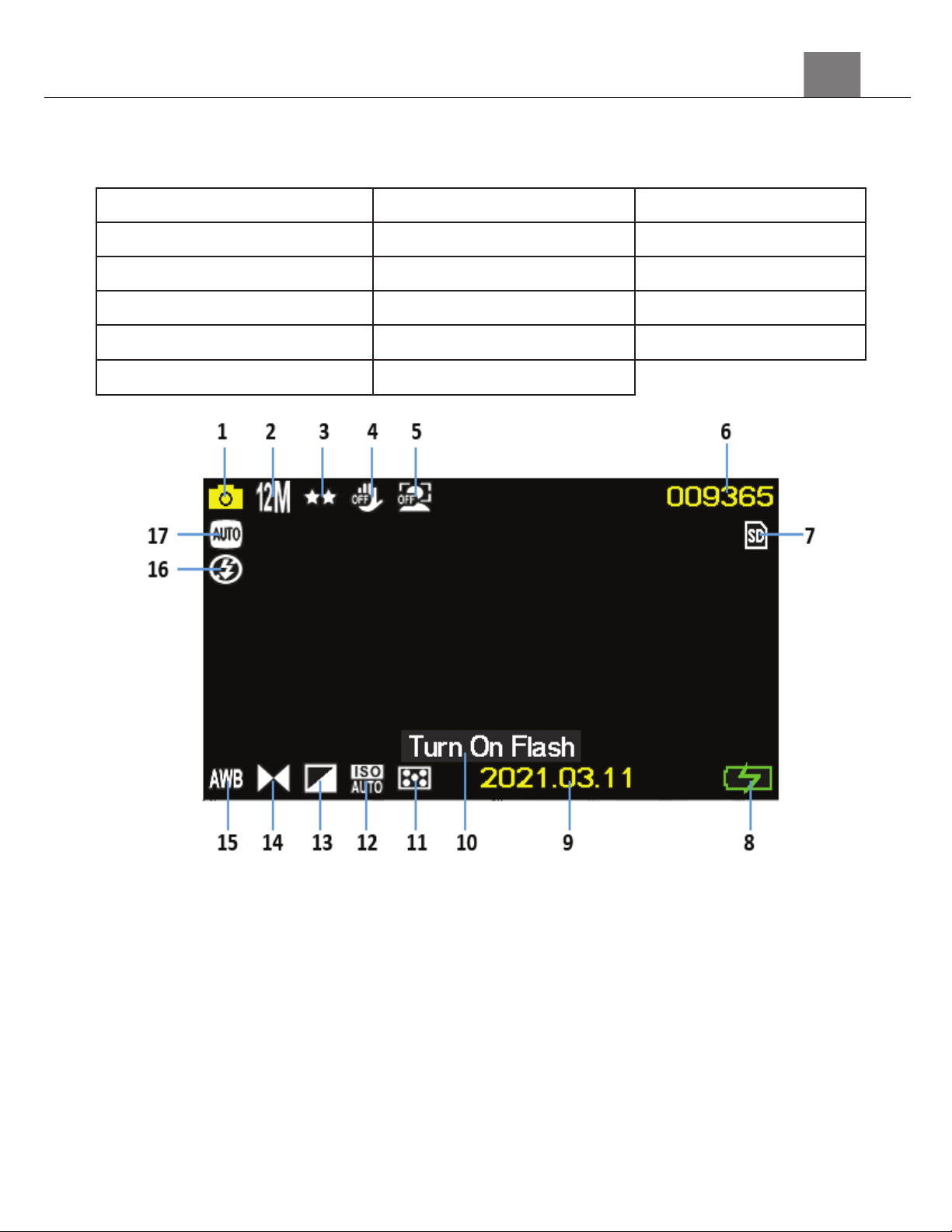
2.8
Connecting to a Computer
Your camera can connect to a computer to transfer photo and video files for
viewing and editing, as shown below. Once connected and powered on, the
camera’s screen will enter “Mass Storage” mode automatically.
2.9
Using the Zoom Function
This camera has a digital zoom function. To operate the zoom function,
press the ZOOM-IN button to zoom in closer to the subject, and press the
ZOOM-OUT button zoom away from the subject.
)LUVW8VH
2.10
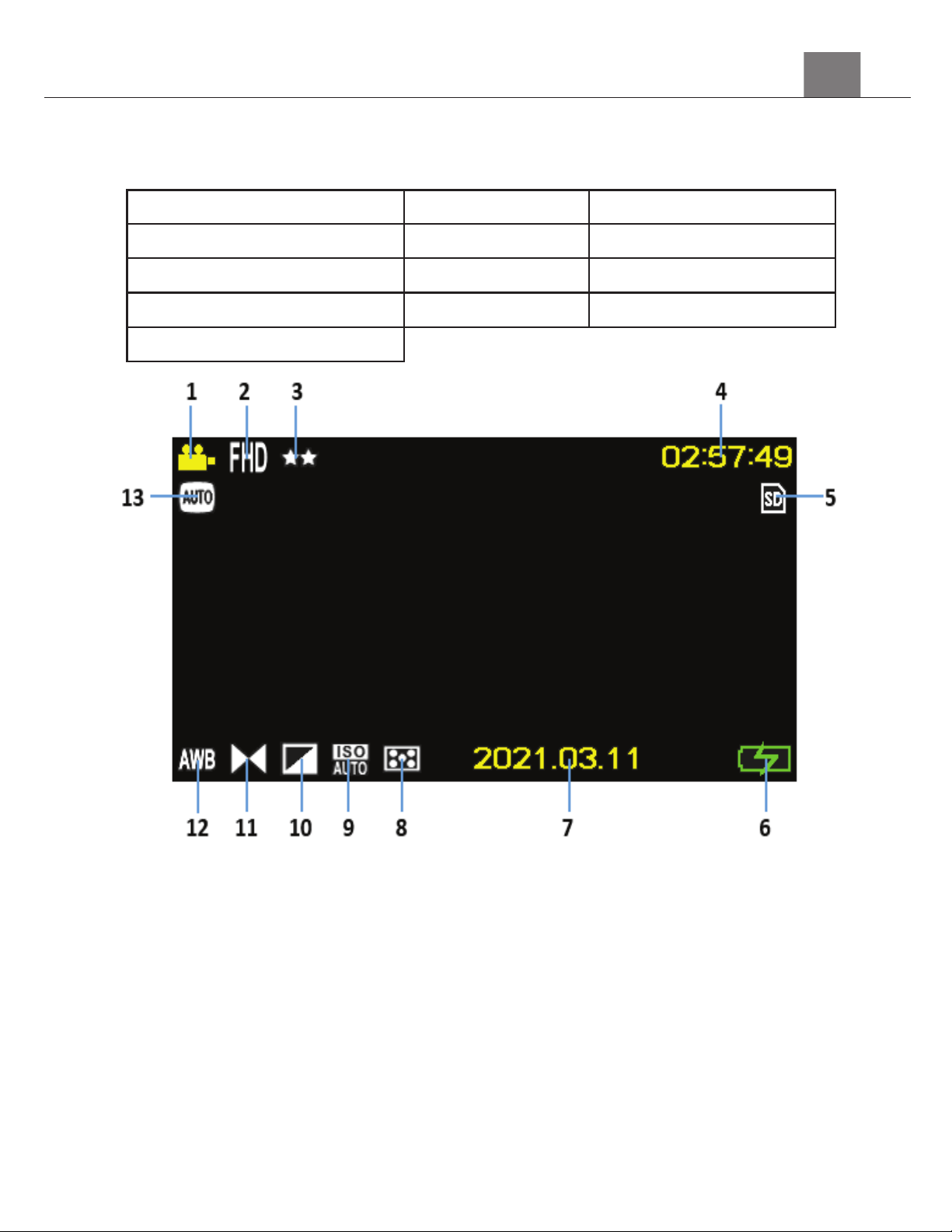
Photo Mode
Press the MODE button to switch to Photo Mode. The meaning of each icon
within Photo Mode is explained in the table below:
1) Photo Mode
7) Memory Card Inserted
13) Light Exposure
2) Image Size (Resolution)
8) Battery Level
14) Image Sharpness
3) Image Quality
9) Current Date
15) White Balance
4) Anti-Shake
10) Flash Needed
16) Flash Status
5) Face Detect
11) Metering
17) Scene
6) Pictures Remaining
12) ISO
)LUVW8VH
2.11
Video Mode
Press the MODE button to switch to Video Mode. The meaning of each icon
within Video Mode is explained in the table below:
1) Video Mode
6) Battery Level
10) Light Exposure
2) Video Size (Resolution)
7) Current Date
11) Image Sharpness
3) Video Quality
8) Metering
12) White Balance
4) Video Time Remaining
9) ISO
13) Scene
5) Memory Card Inserted

8VLQJ<RXU&DPHUD
3.
Using the Camera
3.1
Photo Shooting
Power the camera on and it will be ready to take pictures right away. You
may press the MODE button to switch to another mode.
1.
Line up your shot by looking at the LCD screen to see what is in the shot.
2.
Hold the camera steady and press the SHUTTER button to capture a photo.
3.
The number of photos that can be captured at a particular resolution
will be displayed in the top right corner of the screen.
4.
A “Memory Full” message will be displayed on the screen if there is no SD
card inserted in the camera’s memory card slot. A “Memory Full” message
will be shown on the screen when the SD card is full.
5.
The number of remaining photos is determined by the selected photo
resolution. The higher the photo resolution, the lower the number of photos
you are able to be save to the memory card. Before capturing any photos,
you can select a preferred photo resolution.
The front LCD screen can be used to take selfies. Simply press the SWITCH
SCREEN button and the front LCD screen will turn on. Then use the camera
as normal. Press the SWITCH SCREEN button to turn the rear LCD screen
back on.
Note: Only one LCD screen is active at a time, when one of the screens is
off, this is not a malfunction.
3.1.1
Scene
This function adjusts the camera’s settings to predetermined values that will
produce the best image for that selected scene.
1.
In Photo Mode press the SETTINGS button.
2.
Select ‘Scene’ using the LEFT or RIGHT buttons.
3.
Press the UP or DOWN buttons to navigate the menu, and press the OK
button to confirm your selected option (Auto, Scenery, Portrait, Night
Scenery, Night Portrait, High Sensitivity, Sport, Beach, Party).
4.
Press the MODE button to exit the settings menu.
3.1.1 Image Resolution (Photo Size)
This function sets the photo resolution. The higher the resolution, the greater
the photo quality and the larger the file size of the photo.
1.
In Photo Mode press the SETTINGS button.
2.
Select ‘Image Resolution’ using the LEFT or RIGHT buttons.
3.
Press the UP or DOWN buttons to navigate the menu, and press the
OK button to confirm your selected resolution (48MP, 30MP, 24MP,
20MP, 16MP, 12MP, 8MP, 7MP, 5MP, 3MP, 2MP).

8VLQJ<RXU&DPHUD
4.
Press the MODE button to exit the settings menu.
3.1.2
Image Quality
The Photo Quality function determines the level of compression the
camera uses when saving photos to a memory card.
1. In Photo Mode press the SETTINGS button.
2. Select ‘Image Quality’ using the LEFT or RIGHT buttons.
3. Press the UP or DOWN buttons to navigate the menu, and press the OK
button to confirm your required quality option (Normal, Fine, Super Fine),
Super Fine uses the least amount of compression for saving, and as a
result produces a higher photo quality.
4. Press the MODE button to exit the settings menu.
3.1.3
Self-Timer
This function determines the time delay before a photograph is captured.
This setting can be used by photographers to take photographs of
themselves.
1. In Photo Mode press the SETTINGS button.
2. Select ‘Self Timer’ using the LEFT or RIGHT buttons.
3. Press the UP or DOWN buttons to navigate the menu, and press the OK
button to confirm your selected option (2 Seconds, 5 Seconds, 10
Seconds, Off).
4. Press the MODE button to exit the settings menu.
3.1.4
Anti-Shake
This function enables photo capture in high speed and low-light by
electronically minimizing motion blur and reducing camera shake.
1.
In Photo Mode press the SETTINGS button.
2.
Select ‘Anti-Shake’ using the LEFT or RIGHT buttons.
3.
Press the UP or DOWN buttons to navigate the menu, and press the OK
button to confirm your selected option (On, Off).
4.
Press the MODE button to exit the settings menu.
3.1.5
Face Detect
This function allows you to set your camera to detect faces in a scene and
adjust your camera's setting for the most optimal picture. You can also enable
your camera to capture a photo once a smile is detected on the faces in a
scene.
1.
In Photo Mode press the SETTINGS button.
2.
Select ‘Face Detect’ using the LEFT or RIGHT buttons.
3.
Press the UP or DOWN buttons to navigate the menu, and press the OK
button to confirm your selected option (On, Off).

8VLQJ<RXU&DPHUD
4.
Press the MODE button to exit the settings menu.
3.1.6
Multi Snapshots (Photo Burst)
This function allows to you capture 6 consecutive photos with one click of the
PHOTO button.
1.
In Photo Mode press the SETTINGS button.
2.
Select ‘Multi Snapshots’ using the LEFT or RIGHT buttons.
3.
Press the UP or DOWN buttons to navigate the menu, and press the OK
button to confirm your selected option (On, Off).
4.
Press the MODE button to exit the settings menu.
3.1.7
White Balance
White Balance changes the color of light in your pictures, making it seem
warmer or cooler depending on how the light you're shooting in affects the
frame.
1.
In Photo Mode press the SETTINGS button.
2.
Select ‘White Balance’ using the LEFT or RIGHT buttons.
3.
Press the UP or DOWN buttons to navigate the menu, and press the OK
button to confirm your selected option (Auto, Daylight, Cloudy,
Florescent, Incandescent).
4.
Press the MODE button to exit the settings menu.
3.1.8
Color Effect
This function sets the color filter effect of a photograph.
1.
In Photo Mode press the SETTINGS button.
2.
Select ‘Color Effect’ using the LEFT or RIGHT buttons.
3.
Press the UP or DOWN buttons to navigate the menu, and press the OK
button to confirm your selected option (Standard, Sepia, Monochrome,
Vivid).
4.
Press the MODE button to exit the settings menu.
3.1.9
Image Sharpness
This function adjusts the visible detail of a photograph.
1.
In Photo Mode press the SETTINGS button.
2.
Select ‘Image Sharpness’ using the LEFT or RIGHT buttons.
3.
Press the UP or DOWN buttons to navigate the menu, and press the OK
button to confirm your selected option (Soft, Normal, Sharp).
4.
Press the MODE button to exit the settings menu.
3.1.10
Light Exposure
This function adjusts the frame brightness in your photograph.
1.
In Photo Mode press the SETTINGS button.

8VLQJ<RXU&DPHUD
2.
Select ‘Light Exposure’ using the LEFT or RIGHT buttons.
3.
Press the UP or DOWN buttons to navigate the menu, and press the OK
button to confirm your selected option (+3, +2, +1, 0, -1, -2, -3).
4.
Press the MODE button to exit the settings menu.
3.1.11
ISO
This function adjusts the light sensitivity in your photograph.
1.
In Photo Mode press the SETTINGS button.
2.
Select ‘ISO’ using the LEFT or RIGHT buttons.
3.
Press the UP or DOWN buttons to navigate the menu, and press the OK
button to confirm your selected option (ISO Auto, ISO 100, ISO 200, ISO
400).
4.
Press the MODE button to exit the settings menu.
3.1.12
Metering
Metering mode refers to the way in which a camera determines the appropriate
exposure (quantity of light reaching the camera lens). Spot metering will only
base the exposure setting on a very small area of the scene. Center metering
will use the light from the center of the LCD and the Multi setting measures the
light at several points on the screen.
1.
In Photo Mode press the SETTINGS button.
2.
Select ‘Metering’ using the LEFT or RIGHT buttons.
3.
Press the UP or DOWN buttons to navigate the menu, and press the OK
button to confirm your selected option (Center, Multi, Spot).
4.
Press the MODE button to exit the settings menu.
3.1.13
Language
This function allows you to set the camera’s interface language.
1.
In Photo Mode press the SETTINGS button.
2.
Select ‘Language’ using the LEFT or RIGHT buttons.
3.
Press the UP or DOWN buttons to navigate the menu, and press the OK
button to confirm your selected language.
4.
Press the MODE button to exit the settings menu.
3.1.14
Date/Time
This function allows you to set the current Date and Time on your recorded
video clips and captured photos.
1.
In Photo Mode press the SETTINGS button.
2.
Select ‘Date/Time’ using the LEFT or RIGHT buttons.
3.
Press the UP or DOWN buttons to navigate the menu, and press the OK
button to confirm your selected option (On, Off, Date Setup).
4.
Press the MODE button to exit the settings menu.

8VLQJ<RXU&DPHUD
5.
To set the current date and time use the UP or DOWN buttons to select
Date Setup, and press the OK button to enter date setup menu.
6.
Use the UP or DOWN buttons to change the highlighted field.
7.
Use the LEFT or RIGHT buttons to change the selected field.
8.
Press the OK button to save the entered date and time and to exit the
menu.
3.1.15
Silent Mode
This function allows you to turn off the sounds of the camera.
1.
In Photo Mode press the SETTINGS button.
2.
Select ‘Silent Mode’ using the LEFT or RIGHT buttons.
3.
Press the UP or DOWN buttons to navigate the menu, and press the OK
button to confirm your selected option (On, Off).
4.
Press the MODE button to exit the settings menu.
3.1.16
Auto Power Off
This function sets the duration of time in which the camcorder will wait with
no user input before automatically powering off.
1.
In Photo Mode press the SETTINGS button.
2.
Select ‘Auto Power Off’ using the LEFT or RIGHT buttons.
3.
Press the UP or DOWN buttons to navigate the menu, and press the OK
button to confirm your selected option (1 Minute, 3 Minutes, 5 Minutes,
Off).
4.
Press the MODE button to exit the settings menu.
3.1.17
Frequency
This function sets the frequency of the camera from 50Hz to 60Hz. Please
check the frequency of your location and set accordingly.
1.
In Photo Mode press the SETTINGS button.
2.
Select ‘Frequency’ using the LEFT or RIGHT buttons.
3.
Press the UP or DOWN buttons to navigate the menu, and press the OK
button to confirm your selected option (50 Hz, 60 Hz) the default
frequency for the United States is 60Hz.
4.
Press the MODE button to exit the settings menu.
3.1.18
Format Memory Card
The format setting erases all photos, videos and data stored on your
memory card.
1.
In Photo Mode press the SETTINGS button.
2.
Select ‘Format Memory Card’ using the LEFT or RIGHT buttons.
3.
Press the UP or DOWN buttons to navigate the menu, and press the OK
button to confirm your selected option (Yes, No).

8VLQJ<RXU&DPHUD
4.
Press the MODE button to exit the settings menu.
NOTE: This will delete all of your media and cannot be undone.
3.1.19
Restore Default Settings
Factory default settings can be restored in this menu. This function will not
delete the media stored on the memory card, and will only restore all of the
menu’s setting back to factory default settings.
1.
In Photo Mode press the SETTINGS button.
2.
Select ‘Firmware’ using the LEFT or RIGHT buttons.
3.
Press the UP or DOWN buttons to navigate the menu, and press the OK
button to confirm your selected option (Yes, No).
4.
Press the MODE button to exit the settings menu.

8VLQJ<RXU&DPHUD
3.2 Video Recording
Power the camera on and press the MODE button to switch to Video mode.
A camcorder icon will appear in the top left hand corner of the screen when
you are in Video mode.
1. Line up your shot by looking at the LCD screen to see what is in view.
2. Hold the camera steady and press the SHUTTER button to begin recording.
3.
When recording begins, a rolling timer will display in red in the top right hand
corner of the screen. This indicates the recorded video time elapsed.
4. Press the SHUTTER button to stop recording.
5.
The recorded video files will automatically save onto the inserted memory card.
The front LCD screen can be used to record selfie videos. Simply press the
SWITCH SCREEN button and the front LCD screen will turn on. Then use the
camera as normal. Press the SWITCH SCREEN button to turn the rear LCD
screen back on.
3.2.1
Scene
This function adjusts the camera’s settings to predetermined values that will
produce the best image for that selected scene.
1.
In Video Mode press the SETTINGS button.
2.
Select ‘Scene’ using the LEFT or RIGHT buttons.
3.
Press the UP or DOWN buttons to navigate the menu, and press the OK
button to confirm your selected option (Auto, Scenery, Portrait, Night
Scenery, Night Portrait, High Sensitivity, Sport, Beach, Party).
4.
Press the MODE button to exit the settings menu.
3.2.2
Image Size (Movie Resolution)
Your camera has a number of preset resolutions and frames per second rates.
1.
In Video Mode press the SETTINGS button.
2.
Select ‘Image Size’ using the LEFT or RIGHT buttons.
3.
Press the UP or DOWN buttons to navigate the menu, and press the OK
button to confirm your selected resolution (2.7K 2688x1520, FHD
1920x1080, HD 1280x720).
4.
Press the MOD
E button to exit the settings menu.
3.2.3
Image Quality
The Image Quality function determines the level of compression the camera
uses
when saving photos to a memory card.
1. In Video Mode press the SETTINGS button.
2. Select ‘Image Quality’ using the LEFT or RIGHT buttons.
3. Press the UP or DOWN buttons to navigate the menu, and press the OK

8VLQJ<RXU&DPHUD
button to confirm your required quality option (Normal, Fine, Super Fine),
Super Fine uses the least amount of compression for saving, and as a
result produces a higher photo quality.
4. Press the MODE button to exit the settings menu.
3.2.4
White Balance
White Balance changes the color of light in your pictures, making it seem
warmer or cooler depending on how the light you're shooting in affects the
frame.
1.
In Video Mode press the SETTINGS button.
2.
Select ‘White Balance’ using the LEFT or RIGHT buttons.
3.
Press the UP or DOWN buttons to navigate the menu, and press the OK
button to confirm your selected option (Auto, Daylight, Cloudy,
Florescent, Incandescent).
4.
Press the MODE button to exit the settings menu.
3.2.5
Color Effect
This function sets the color filter effect of a photograph.
1.
In Video Mode press the SETTINGS button.
2.
Select ‘Color Effect’ using the LEFT or RIGHT buttons.
3.
Press the UP or DOWN buttons to navigate the menu, and press the OK
button to confirm your selected option (Standard, Sepia, Monochrome,
Vivid).
4.
Press the MODE button to exit the settings menu.
3.2.6
Image Sharpness
This function adjusts the visible detail of a photograph.
1.
In Video Mode press the SETTINGS button.
2.
Select ‘Image Sharpness’ using the LEFT or RIGHT buttons.
3.
Press the UP or DOWN buttons to navigate the menu, and press the OK
button to confirm your selected option (Soft, Normal, Sharp).
4.
Press the MODE button to exit the settings menu.
3.2.7
Light Exposure
This function adjusts the frame brightness in your photograph.
1.
In Video Mode press the SETTINGS button.
2.
Select ‘Light Exposure’ using the LEFT or RIGHT buttons.
3.
Press the UP or DOWN buttons to navigate the menu, and press the OK
button to confirm your selected option (+3, +2, +1, 0, -1, -2, -3).
4.
Press the MODE button to exit the settings menu.

8VLQJ<RXU&DPHUD
3.2.8
ISO
This function adjusts the light sensitivity in your photograph.
1.
In Video Mode press the SETTINGS button.
2.
Select ‘ISO’ using the LEFT or RIGHT buttons.
3.
Press the UP or DOWN buttons to navigate the menu, and press the OK
button to confirm your selected option (ISO Auto, ISO 100, ISO 200, ISO
400).
4.
Press the MODE button to exit the settings menu.
3.2.9
Metering
Metering mode refers to the way in which a camera determines the appropriate
exposure (quantity of light reaching the camera lens). Spot metering will only
base the exposure setting on a very small area of the scene. Center metering
will use the light from the center of the LCD and the Multi setting measures the
light at several points on the screen.
1.
In Video Mode press the SETTINGS button.
2.
Select ‘Metering’ using the LEFT or RIGHT buttons.
3.
Press the UP or DOWN buttons to navigate the menu, and press the OK
button to confirm your selected option (Center, Multi, Spot).
4.
Press the MODE button to exit the settings menu.
3.2.10
Language
This function allows you to set the camera’s interface language.
1.
In Video Mode press the SETTINGS button.
2.
Select ‘Language’ using the LEFT or RIGHT buttons.
3.
Press the UP or DOWN buttons to navigate the menu, and press the OK
button to confirm your selected language.
4.
Press the MODE button to exit the settings menu.
3.2.11
Date/Time
This function allows you to set the current Date and Time on your recorded
video clips and captured photos.
1.
In Video Mode press the SETTINGS button.
2.
Select ‘Date/Time’ using the LEFT or RIGHT buttons.
3.
Press the UP or DOWN buttons to navigate the menu, and press the OK
button to confirm your selected option (On, Off, Date Setup).
4.
Press the MODE button to exit the settings menu.
5.
To set the current date and time use the UP or DOWN buttons to select
Date Setup, and press the OK button to enter date setup menu.
6.
Use the UP or DOWN buttons to change the highlighted field.
7.
Use the LEFT or RIGHT buttons to change the selected field.
8.
Press the OK button to save the entered date and time and to exit the menu.

8VLQJ<RXU&DPHUD
25
3.2.12
Auto Power Off
This function sets the duration of time in which the camcorder will wait with
no user input before automatically powering off.
1.
In Video Mode press the SETTINGS button.
2.
Select ‘Auto Power Off’ using the LEFT or RIGHT buttons.
3.
Press the UP or DOWN buttons to navigate the menu, and press the OK
button to confirm your selected option (1 Minute, 3 Minutes, 5 Minutes,
Off).
4.
Press the MODE button to exit the settings menu.
3.2.13
Frequency
This function sets the frequency of the camera from 50Hz to 60Hz. Please
check the frequency of your location and set accordingly.
1.
In Video Mode press the SETTINGS button.
2.
Select ‘Frequency’ using the LEFT or RIGHT buttons.
3.
Press the UP or DOWN buttons to navigate the menu, and press the OK
button to confirm your selected option (50 Hz, 60 Hz) the default
frequency for the United States is 60Hz.
4.
Press the MODE button to exit the settings menu.
3.2.14
Format Memory Card
The format setting erases all photos, videos and data stored on your
memory card.
1.
In Video Mode press the SETTINGS button.
2.
Select ‘Format Memory Card’ using the LEFT or RIGHT buttons.
3.
Press the UP or DOWN buttons to navigate the menu, and press the OK
button to confirm your selected option (Yes, No).
4.
Press the MODE button to exit the settings menu.
NOTE: This will delete all of your media and cannot be undone.
3.2.15
Restore Default Settings
Factory default settings can be restored in this menu. This function will not
delete the media stored on the memory card, and will only restore all of the
menu’s setting back to factory default settings.
1.
In Video Mode press the SETTINGS button.
2.
Select ‘Firmware’ using the LEFT or RIGHT buttons.
3.
Press the UP or DOWN buttons to navigate the menu, and press the OK
button to confirm your selected option (Yes, No).
4.
Press the MODE button to exit the settings menu.

8VLQJ<RXU&DPHUD
3.3 Playback Mode
Videos and photos captured on your camera can be easily played back.
1.
Press the MODE button to enter Playback mode, a play icon will display in
the top left corner of the screen.
2.
Press the UP or DOWN buttons to cycle through the captured videos and
photos stored on the memory card.
2.
To enter into a video or photo, press the PHOTO button.
3.
When viewing a photo press and hold the ZOOM-IN button to zoom in on
the picture on the screen, press and hold the ZOOM-OUT button to view
the entire image. While zoomed in, press the OK to enter panning mode,
then use the UP, DOWN, LEFT or RIGHT buttons to move the image on
the screen.
4.
Push the ZOOM-OUT button to see 9 images on the screen at once. Use
the UP or DOWN buttons to change the page. Press the OK button or tap
the picture on the screen to view the selected media.
5.
While viewing a recorded video, press the SHUTTER button to start the
video, press the SHUTTER button again to pause the video and press the
FLASH/UP button to stop the video.
Power the camera on and press the MODE button to switch to Playback
Mode. In Playback Mode the following options are available:
3.4.1 Delete
This function is used to delete photos and videos. Photos and videos can be
deleted singly or all at once.
1.
In Playback Mode press the SETTINGS button.
2.
Select ‘Delete’ using the LEFT or RIGHT buttons.
3.
Press the UP or DOWN buttons to navigate the menu, and press the OK
button to confirm your selected option (Delete This Image?, Delete All
Images?, Cancel).
4.
Press the MODE button to exit the settings menu.
3.4.2 Rotate
This function allows you to rotate stored images.
1.
In Playback Mode press the SETTINGS button.
2.
Select ‘Rotate’ using the LEFT or RIGHT buttons.
3.
Press the UP or DOWN buttons to navigate the menu, and press the OK
button to confirm your selected option (90°, 180°, 270°, Cancel).
4.
Press the MODE button to exit the settings menu.

8VLQJ<RXU&DPHUD
2
3.4.3 Protect/Lock
This function protects the photo/video file. The file will be protected from
being deleted accidentally. Files must be unprotected to be deleted.
1.
In Playback Mode press the SETTINGS button.
2.
Select ‘Protect/Lock’ using the LEFT or RIGHT buttons.
3.
Press the UP or DOWN buttons to navigate the menu, and press the OK
button to confirm your selected option (Lock This Image, Unlock This
Image, Lock All Images, Unlock All Images).
4.
Press the MODE button to exit the settings menu.
3.4.4 Print This Photo
This function allows you to print images when the camera is connected to a
Pictbridge printer. Note, this function only works with certain Pictbridge
printers.
1.
In Playback Mode press the SETTINGS button.
2.
Select ‘Print This Photo’ using the LEFT or RIGHT buttons.
3.
Press the UP or DOWN buttons to navigate the menu, and press the OK
button to confirm your selected option (Print This Photo, Cancel).
4.
Press the MODE button to exit the settings menu.
3.4.3 Slideshow
Photographs can be viewed as a slideshow on the camera.
1.
In Playback Mode press the SETTINGS button.
2.
Select ‘Slide Show’ using the LEFT or RIGHT buttons.
3.
Press the UP or DOWN buttons to navigate the menu, and press the OK button
to confirm your selected option (3 Seconds, 5 Seconds, 10 Seconds).
4.
Press the OK button to exit the slideshow.
5.
Press the MODE button to exit the settings menu.
$SSHQGL[
2
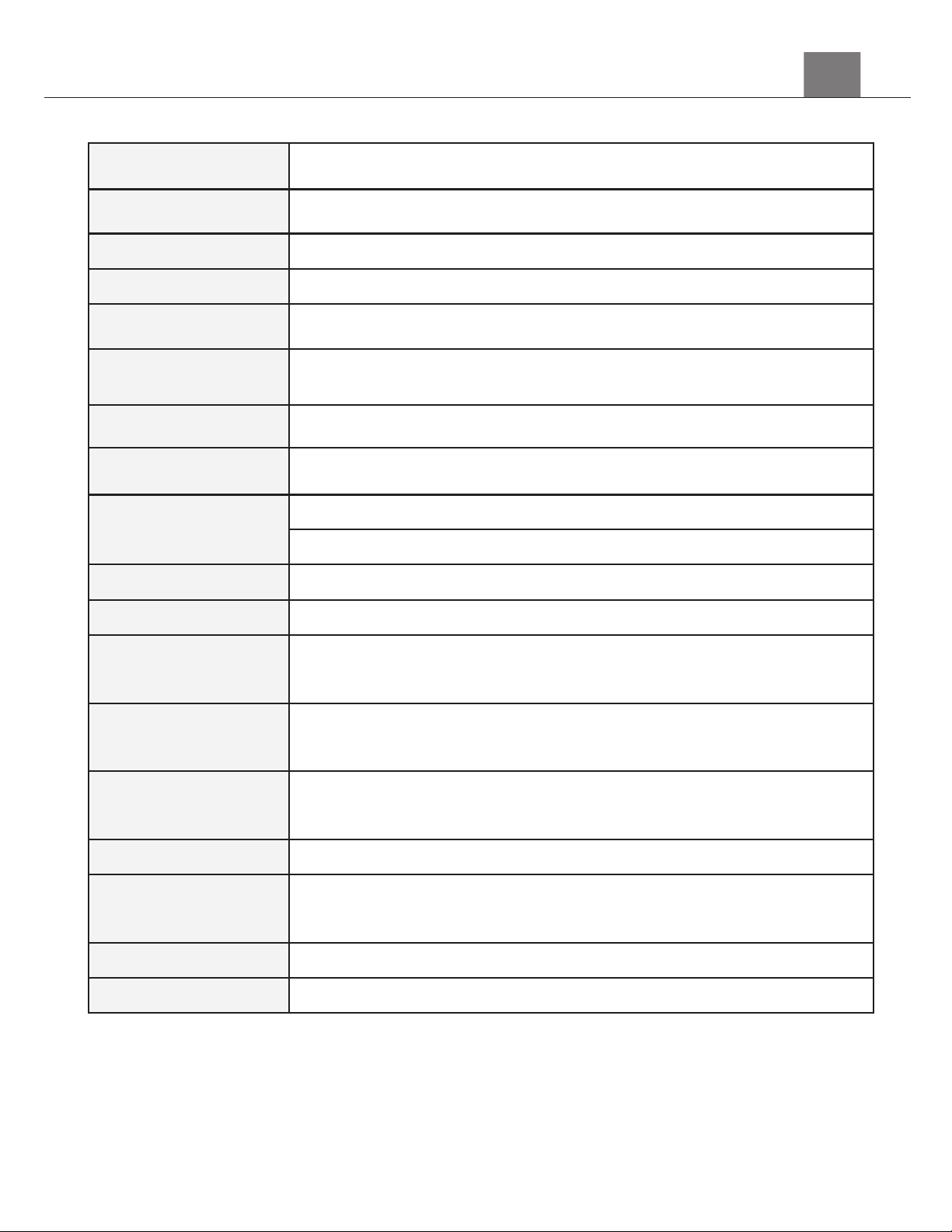
4.1 Technical Specifications
Model Number
Minolta MN40WP
Lens
Fixed Focus • f=8.15mm • F/3.0
Zoom
16X Digital Zoom
Image Sensor
13MP CMOS Sensor
Shutter
Electronic • Anti
-Shake Image Stabilization
Pixels (photo)
JPEG: 48 MP • 30 MP • 24 MP • 20 MP • 16 MP • 12 MP
• 10 MP • 8 MP • 5 MP • 3MP • 2MP
Pixels (video)
MOV: 2.7K • 1080p • 720p
ISO Sensitivity
Auto • 100 • 200 • 400
LCD Screen
Rear: 3.0” TFT LCD Screen
Front: 2.0” TFT LCD Screen
Assistive Light
White LED
Waterproof
Up to 10 feet for up to 60 minutes
Power Saving
Mode
OFF •
1 Minute • 3 Minutes • 5 Minutes
White Balance
Control
Auto • Daylight • Cloudy • Florescent • Incandescent
Scene Modes
Auto • Scenery • Portrait • Night Scenery • Night
Portrait • High
Sensitivity • Sport • Beach • Party
Recording Media
Micro SD • MicroSDHC; Maximum: 128GB
I/O Ports
5-pin Micro USB, USB 2.0 (high speed) • Microphone
(built
-in MIC) • Speaker
Power
Lithium-Ion 3.7V, 1500mAh, 5.55Wh
Dimensions
4.4 x 2.7 x 1.3 in. • 5.8 oz.

Minolta is a registered trademark of JMM Lee Properties, LLC
and is used in the United States by Elite Brands Inc. under license.
40 Wall Street, 61st Floor, New York, NY 10005 USA • Tel: 800-441-1100
www.minoltadigital.com • www.elitebrands.com
Copyright © 2021 Elite Brands Inc.
If you’re having difficulties with your camera, or would like further assistance,
please call our toll-free technical support hotline at 800-441-1100. Please be
sure to have your camera handy when calling.