
© 2021 by Snow Joe
®
, LLC
All rights reserved. Original instructions.
SAVE THESE INSTRUCTIONS
A Division of Snow Joe
®
, LLC
OPERATOR’S MANUAL
Model iON100V-18CS-CT-RM
Form No. SJ-iON100V-18CS-CT-RM-880E-M-V1
R
CORDLESS CHAIN SAW – CORE TOOL
100-VOLT MAX* | 18-INCH
1

© 2021 by Snow Joe
®
, LLC
All rights reserved. Original instructions.
SAVE THESE INSTRUCTIONS
A Division of Snow Joe
®
, LLC
OPERATOR’S MANUAL
Model iON100V-18CS-CT-RM
Form No. SJ-iON100V-18CS-CT-RM-880E-M-V1
R
CORDLESS CHAIN SAW – CORE TOOL
100-VOLT MAX* | 18-INCH
2
IMPORTANT!
Safety Instructions
All Operators Must Read These
Instructions Before Use
Read all the instructions contained in this manual. Keep this
manual in a safe place, so that the information is available at
all times. If you give the equipment to another person, make
sure to provide these operating instructions. Basic safety
precautions should always be followed to reduce the risk of
re, electric shock, and personal injury.
mDANGER! This indicates a hazardous situation, which,
if not followed, will result in serious injury or death.
mWARNING! This indicates a hazardous situation, which,
if not avoided, could result in serious injury or death.
mCAUTION! This indicates a hazardous situation, which,
if not avoided, could result in minor or moderate injury.
Intended Use
This cordless chain saw was designed and manufactured for
trimming and pruning tree limbs and branches and for cutting
smaller logs up to recommended 16.5 inch (42 cm),
not to
exceed a max. cut of 17.5 in. (44.5 cm) in diameter depending
on type of wood. All of the wooden objects intended to be cut
with this chain saw should be no thicker than the guide bar's
maximum cutting capabilities.
Improper Use
Any other use diering from the above mentioned applications
poses a serious hazard to the user and may damage both the
tool and your personal property. Examples of improper use
include, but are not limited to:
• Trimming hedges;
• Carving;
• Sectioning pallets, crates, and various packing materials;
• Sectioning furniture or other materials with nails, screws, or
other metal components;
• Butchering meat;
• Using the machine to lift, move, or split objects;
• Using the machine while fastened to xed supports.
Improper use of the machine will invalidate the warranty,
relieve the manufacturer from all liabilities. The user will
consequently be liable for all and any damage or injury to
himself/herself or others.
General Safety
mWARNING! When using electric/cordless yard tools,
basic safety precautions should always be followed to reduce
the risk of re, electric shock, and personal injury, including
the following:
1. Keep guards in place – Protective guards should be
checked periodically to ensure they are properly tted and
in correct working order.
2. Remove adjusting keys and wrenches – Check that
adjusting wrenches are removed from the saw before
turning it on.
3. Keep work area clean and well-lit – Clear work area of
branches and limbs after each cutting session. Cluttered
areas invite accidents.
4. Do not use in dangerous environments – Do not use
power tools in damp or wet locations.
5. Do not use the chain saw in the rain.
6. Keep bystanders and children away – All bystanders,
including children and pets, should be kept a safe
distance away from the work area.
7. Do not force the tool – It will do the job eectively and
safely if it is used at the rate for which it was designed.
8. Use the right tool – Do not force the tool or any
attachment on the tool to do a job for which they were
not designed.
9. Wear proper apparel – Do not wear loose articles of
clothing or jewelry since such items may get caught
in moving parts. Use of heavy-duty rubber gloves,
substantial non-skid footwear, and close-tting clothing is
recommended when working outdoors with power tools.
10. Wear protective hair coverings to contain long hair.
11. Always wear safety glasses and ear defenders to
provide eye and ear protection – Everyday eyeglasses
only have impact resistant lenses and do not provide the
same protection as safety glasses.
12. Wear face or dust masks – If the cutting operation is
dusty, the use of a face or dust mask specially designed
to lter out microscopic particles is recommended.

3
13. Do not overreach – Keep proper footing and balance
at all times.
14. Maintain tools with care – Keep tools sharp and clean
for best and safest performance. Follow instructions for
lubricating and changing accessories.
15. Reduce the risk of unintentional starting – Make sure
not press the trigger switch before inserting the battery.
16. Use recommended accessories – Consult the owner’s
manual for recommended accessories. The use of
improper accessories may cause risk of injury.
17. Check for damaged parts – Before each use, repair, or
replace any guard or part that is damaged. In addition,
check for alignment of moving parts, binding of moving
parts, breakage of parts, and any other conditions that
may aect the tool's operation.
18. Never leave tool unattended while it is running – Turn
the power OFF and remove the battery. Do not leave the
saw until the cutting bar comes to a complete stop.
19. Avoid unintentional starting – Do not carry the cordless
chain saw with your nger on the switch.
20. Do not grasp the exposed cutting blade or cutting
edges when picking up or holding the saw – Be sure
to encase the cutting bar in its protective sheath when
not in use.
21. Stay alert – Watch what you are doing. Use common
sense. Do not operate the chain saw when you are tired.
22. Store idle tool indoors – When not in use, appliances
should be stored indoors in a dry and high or locked-up
place out of the reach of children.
Chain Saw Safety Warnings
• Keep all parts of the body away from the saw chain when
the chain saw is operating. Before you start the chain saw,
make sure the saw chain is not contacting anything. A
moment of inattention while operating the chain saw may
cause entanglement of your clothing or body with the
saw chain.
• Always hold the chain saw with your right hand on the rear
handle and your left hand on the front handle. Holding the
chain saw with a reversed hand conguration increases
the risk of personal injury and should never be done.
• Wear safety glasses and hearing protection. If you are
using the chain saw every day under normal conditions,
you can be exposed to a noise level of 85 dB (A) or higher.
Further protective equipment for head, hands, legs and
feet is recommended. Adequate protective clothing will
reduce personal injury by ying debris or accidental
contact with the saw chain.
• Do not operate the chain saw in a tree. Operation of a
chain saw while up in a tree may result in personal injury.
• Always keep proper footing and operate the chain saw
only when standing on a xed, secured and level surface.
Slippery or unstable surfaces such as ladders may cause
a loss of balance or control of the chain saw.
• When cutting a limb that is under tension, be cautious
of spring back. When the tension in the wood bers is
released, the spring-loaded limb may strike the operator
and/or throw the chain saw out of control.
• Use extreme caution when cutting brush and saplings.
The slender material may catch the saw chain and be
whipped toward you or pull you o balance.
• Carry the chain saw by the front handle with the chain saw
switched o and away from your body. When transporting
or storing the chain saw, always t the guide bar cover.
Proper handling of the chain saw will reduce the likelihood
of accidental contact with the moving saw chain.
• Follow instructions for lubricating, chain tensioning and
changing accessories. An improperly tensioned or poorly
lubricated chain may either break or increase the chance
for kickback.
• Keep handles dry, clean and free from oil and grease.
Greasy, oily handles are slippery and can cause loss
of control.
• Cut wood only. Do not use the chain saw for any other
purpose. For example, do not use the chain saw to cut
plastic, masonry or non-wood building materials. Using
the chain saw in these incorrect ways could result in
serious damage to you and your tool.
Battery & Charger
Safety Instructions
NOTE: The battery and the charger are not included and
must be purchased separately. The iON100V-18CS-CT-RM
is compatible with the following batteries (models iON100V-
2.5AMP and iON100V-5AMP) and charger (model iON100V-
RCH). See page 24 for more information.
We pay a great deal of attention to the design of every battery
pack to ensure that we supply you with batteries that are safe,
durable and have a high energy density. The battery cells have
a wide range of safety devices. Each individual cell is initially
formatted and its electrical characteristic curves are recorded.
This data is then used exclusively to be able to assemble the
best possible battery packs.
Despite all the safety precautions, caution must always be
exercised when handling batteries. The following points must
be obeyed at all times to ensure safe use. Safe use can only
be guaranteed if undamaged cells are used. Incorrect handling
of the battery pack can cause cell damage.
IMPORTANT! Analyses conrm that incorrect use and poor
care of high-performance batteries are the main factors
responsible for personal and/or product damage.

4
mWARNING! Use only approved replacement batteries;
other batteries may damage the chain saw and cause it to
malfunction, which can lead to serious personal injury.
mCAUTION! To reduce the risk of injury, charge the
iON100V-2.5AMP battery pack or the iON100V-5AMP battery
pack only in their compatible charger (model iON100V-RCH).
Other types of chargers present risk of re, personal injury, and
damage. Do not wire a battery pack to a power supply plug or
car cigarette lighter. Such misuse will permanently disable or
damage the battery pack.
• Avoid dangerous environments – Do not charge the
battery pack in rain, snow or in damp or wet locations.
Do not use the battery pack or charger in the presence of
explosive atmospheres (gaseous fumes, dust or ammable
materials) because sparks may be generated when inserting
or removing the battery pack, which could lead to a re.
• Charge in a well-ventilated area – Do not block the
charger vents. Keep them clear to allow for proper
ventilation. Do not allow smoking or open ames near a
charging battery pack. Vented gases may explode.
NOTE: The safe temperature range for the battery is -4°F
(-20°C) to 113°F (45°C). Do not charge the battery outside
in freezing weather; charge it at room temperature.
• Maintain charger cord – When unplugging the charger, pull
the plug, not the cord, from the receptacle to reduce the
risk of damage to the electrical plug and cord. Never carry
the charger by its cord or yank it by the cord to disconnect
it from the receptacle. Keep the cord away from heat, oil
and sharp edges. Make sure the cord will not be stepped
on, tripped over or subjected to damage or stress when the
charger is in use. Do not use the charger with a damaged
cord or plug. Replace a damaged charger immediately.
• Do not use an extension cord unless it is absolutely
necessary – Using the wrong, damaged or improperly
wired extension cord poses a risk of re and electric shock.
If an extension cord must be used, plug the charger into a
properly wired 18 gauge or larger extension cord with the
female plug matching the male plug on the charger. Make
sure that the extension cord is in good electrical condition.
• Charger iON100V-RCH is rated for 100 – 120 volt AC only –
The charger must be plugged into an appropriate receptacle.
• Use only recommended attachments – Use of an
attachment not recommended or sold by the battery
charger or battery pack manufacturer may result in risk of
re, electric shock or personal injury.
• Unplug charger when not in use – Make sure to remove
battery pack from unplugged chargers.
mWARNING! To reduce the risk of electric shock,
always unplug the charger before performing any cleaning or
maintenance. Do not allow water to ow into the charger.
Use a Ground Fault Circuit Interrupter (GFCI) to reduce
shock hazards.
• Do not burn or incinerate battery packs – Battery
packs may explode, causing personal injury or damage.
Toxic fumes and materials are created when battery packs
are burned.
• Do not crush, drop or damage battery packs – Do not
use the battery pack or charger if they have sustained a
sharp blow, been dropped, run over or have been damaged
in any way (i.e. pierced with a nail, hit with a hammer,
stepped on, etc.).
• Do not disassemble – Incorrect reassembly may pose
a serious risk of electric shock, re or exposure to toxic
battery chemicals. If the battery or charger are damaged,
please contact an authorized Snow Joe
®
+ Sun Joe
®
dealer
or call the Snow Joe
®
+ Sun Joe
®
customer service center
at 1-866-SNOWJOE (1-866-766-9563).
• Battery chemicals cause serious burns – Never let a
damaged battery pack contact the skin, eyes or mouth.
If a damaged battery pack leaks battery chemicals, use
rubber or neoprene gloves to safely dispose of it. If skin
is exposed to battery uids, wash the aected area with
soap and water and rinse with vinegar. If eyes are exposed
to battery chemicals, immediately ush with water for 20
minutes and seek medical attention. Remove and dispose
of contaminated clothing.
• Do not short circuit – A battery pack will short circuit if
a metal object makes a connection between the positive
and negative contacts on the battery pack. Do not place a
battery pack near anything that may cause a short circuit,
such as paper clips, coins, keys, screws, nails and other
metallic objects. A short-circuited battery pack poses a risk
of re and severe personal injury.
• Store your battery pack and charger in a cool, dry
place – Do not store the battery pack or charger where
temperatures may exceed 104ºF (40ºC), such as in
direct sunlight or inside a vehicle or metal building during
the summer.
Protection from environmental inuences
1. Wear suitable work clothes. Wear safety goggles.
2. Protect your cordless tool and the battery charger from
moisture and rain. Moisture and rain can cause dangerous
cell damage.
3. Do not use the cordless tool or the battery charger near
vapors and ammable liquids.
4. Use the battery charger and cordless tools only in dry
conditions and at an ambient temperature of 50°F – 104°F
(10°C – 40°C).
5. Do not keep the battery charger in places where the
temperature is liable to reach over 104°F (40°C). In
particular, do not leave the battery charger in a car that is
parked in the sunshine.
6. Protect batteries from overheating. Overloads,
overcharging and exposure to direct sunlight will result
in overheating and cell damage. Never charge or work
with batteries that have been overheated – replace them
immediately, if possible.

5
7. Store the charger and your cordless tool only in dry
locations with an ambient temperature of 50°F – 104°F
(10°C – 40°C). Store your lithium-ion battery pack in a
cool, dry place at a temperature of 50°F – 68°F
(10°C – 20°C). Protect the battery pack, charger and
cordless tool from humidity and direct sunlight. Only
place fully charged batteries in storage (charged to at
least 40%).
8. Prevent the lithium-ion battery pack from freezing. Battery
packs that were stored below 32°F (0°C) for more than
60 minutes must be discarded.
9. When handling batteries, be wary of electrostatic
charge. Electrostatic discharges can damage the
electronic protection system and the battery cells. Avoid
electrostatic charging and never touch the battery poles.
Information about the battery
1. The battery packs (model iON100V-2.5AMP or
iON100V-5AMP) must be purchased separately for use
with this cordless chain saw are only partially charged.
The battery packs have to be charged completely before
you use the tool for the rst time.
2. For optimum battery performance, avoid low discharge
cycles by charging the battery packs frequently.
3. Store the battery packs in a cool place, ideally at 59°F
(15°C) and charged to at least 40%.
4. Lithium-ion batteries are subject to a natural aging
process. The battery packs must be replaced at the latest
when its capacity falls to just 80% of its capacity when
new. Weakened cells in aged battery packs are no longer
capable of meeting the high power requirements needed
for the proper operation of your cordless chain saw, and
therefore pose a safety risk.
5. Do not throw battery packs into an open re as this poses
a risk of explosion.
6. Do not ignite the battery packs or expose them to re.
7. Do not exhaustively discharge batteries. Exhaustive
discharge will damage the battery cells. The most
common cause of exhaustive discharge is lengthy
storage or non-use of partially discharged batteries. Stop
working as soon as the performance of the batteries falls
noticeably or the electronic protection system triggers.
Place the battery packs in long-term storage only after
they have been fully charged.
8. Protect batteries and the tool from overloads. Overloads
will quickly result in overheating and cell damage inside
the battery housing even if this overheating is not
apparent externally.
9. Avoid damage and shocks. Immediately replace batteries
that have been dropped from a height of more than one
meter or those that have been exposed to violent shocks,
even if the housing of the battery pack appears to be
undamaged. The battery cells inside the battery may have
suered serious damage. In such instances, please read
the waste disposal information for proper battery disposal.
10. If the battery pack suers overloading and overheating,
the integrated protective cuto will switch o the
equipment for safety reasons. If this situation happens,
stop the tool and let the battery cool down for a few
minutes before restarting.
11. Use only original battery packs. The use of other batteries
poses a re risk and may result in injuries or an explosion.
Information about the charger and the
charging process
1. Please check the data marked on the rating plate of the
battery charger (sold separately). Be sure to connect the
battery charger to a power supply with the voltage
marked on the rating plate. Never connect it to a dierent
mains voltage.
2. Protect the battery charger and its cord from damage.
Keep the charger and its cord away from heat, oil and
sharp edges. Have damaged cords repaired without delay
by a qualied technician at an authorized Snow Joe
®
+
Sun Joe
®
dealer or call the Snow Joe
®
+ Sun Joe
®
customer service center at 1-866-SNOWJOE
(1-866-766-9563).
3. Electrical plugs must match the outlet. Never modify
the plug in any way. Do not use any adapter plugs with
grounded appliances. Unmodied plugs and matching
outlets will reduce the risk of electric shock.
4. Keep the battery charger, battery pack and the cordless
tool out of the reach of children.
5. Do not use the supplied battery charger to charge other
cordless tools.
6. During periods of heavy use, the battery pack will become
warm. Allow the battery pack to cool to room temperature
before inserting it into the charger to recharge.
7. Do not overcharge batteries. Do not exceed the maximum
charging times. These charging times only apply to
discharged batteries. Frequent insertion of a charged or
partially charged battery pack will result in overcharging
and cell damage. Do not leave batteries in the charger for
days on end.
8. Never use or charge batteries if you suspect that it has
been more than 12 months since the last time they were
charged. There is a high probability that the battery pack
has already suered dangerous damage (exhaustive
discharge).
9. Charging batteries at a temperature below 50°F (10°C) will
cause chemical damage to the cells and may cause a re.
10. Do not use batteries that have been exposed to heat
during the charging process, as the battery cells may have
suered dangerous damage.
11. Do not use batteries that have suered curvature or
deformation during the charging process or those that
exhibit other atypical symptoms (gassing, hissing,
cracking, etc.)
6
12. Never fully discharge the battery pack (maximum
recommended depth of discharge is 80%). A complete
discharge of the battery pack will lead to premature aging
of the battery cells.
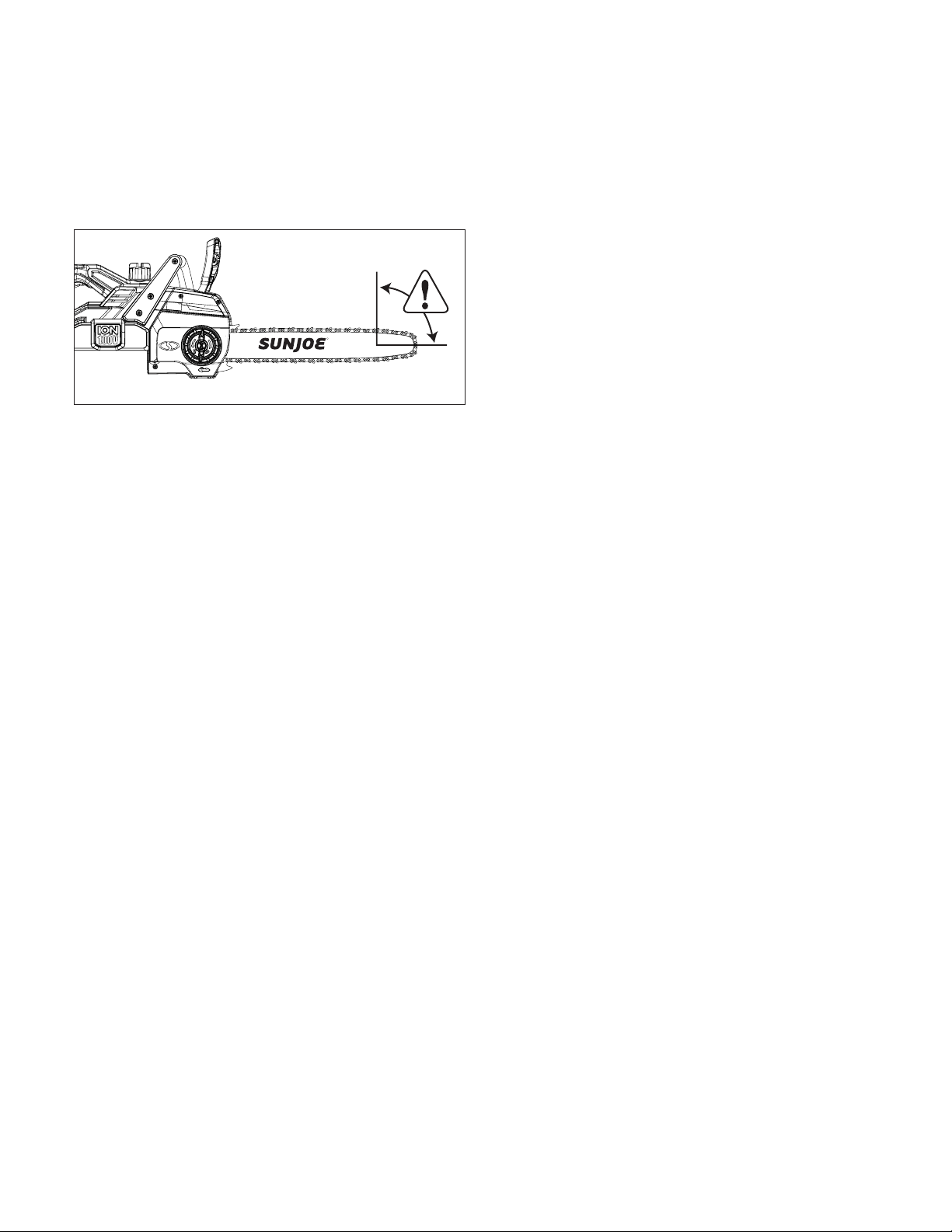
Kickback
mWARNING! Kickback may occur when the nose or tip
of the guide bar touches an object, or when the wood closes
in and pinches the saw chain in the cut.
AVOID CONTACTING THE GUIDE BAR TIP WITH ANY
OBJECT. In some cases, when the tip makes contact with an
object, it may cause a fast reverse reaction, kicking the guide
bar up and back towards the operator. Pinching the saw chain
along the top of the guide bar may also push the guide bar
rapidly back towards the operator. Either of these reactions
may cause you to lose control of the saw, which could result in
serious personal injury.
• Maintain a rm grip (right hand on the rear handle and
left hand on the front handle with thumbs and ngers
encircling the respective handles) and position your body
and arms to allow you to resist kickback forces. Kickback
forces can be controlled by the operator if proper
precautions are taken. Do not let go of the chain saw.
• Keep all guards in place on the machine. Make sure they
are in proper working order.
• Do not overreach. Do not cut above shoulder height. This
helps prevent unintended tip contact and enables better
control of the unit in unexpected situations.
• Keep solid footing and balance at all times.
• Never try cutting through two branches at the same time.
Only cut one at a time.
• Do not bury the guide bar nose or try to cut by boring the
guide bar nose into the wood.
• Watch for shifting of wood or other forces that may pinch
the chain.
• Use extreme caution when re-entering a previous cut.
• Use the low-kickback chain and guide bar supplied with
this cordless chain saw. Only use genuine Snow Joe
®
+
Sun Joe
®
replacement parts designed specically for use
with this cordless chain saw.
• Never use a dull or loose chain. Keep the chain sharp and
properly tensioned.
• Follow the manufacturer’s sharpening and maintenance
instructions for the saw chain. Decreasing the depth
gauge height can lead to increased kickback.
• Always observe the safety regulations and follow the
correct sawing techniques.
• Ensure safe carrying of the unit. Whenever the machine is
to be handled or transported, you must:
– Switch o the motor and wait for the chain to come to
a complete stop;
– Mount the guide bar cover;
– Hold the machine using the hand grips and
position the bar in the opposite direction to that used
during operation.
When using a vehicle to transport the machine, fasten the
tool rmly and position it so that it is not a danger to any
passengers.
• Before cutting, pruning, or delimbing for the rst time,
make sure:
– You have been specically trained to use this type
of equipment;
– Yo u have carefully read the safety regulations and
user instructions contained in this manual;
– You practice rst on logs on the ground or attached
to trestles/saw horses, in order to get familiar with the
machine and the proper cutting techniques.
KICKBACK DANGER
ZONE
R
7
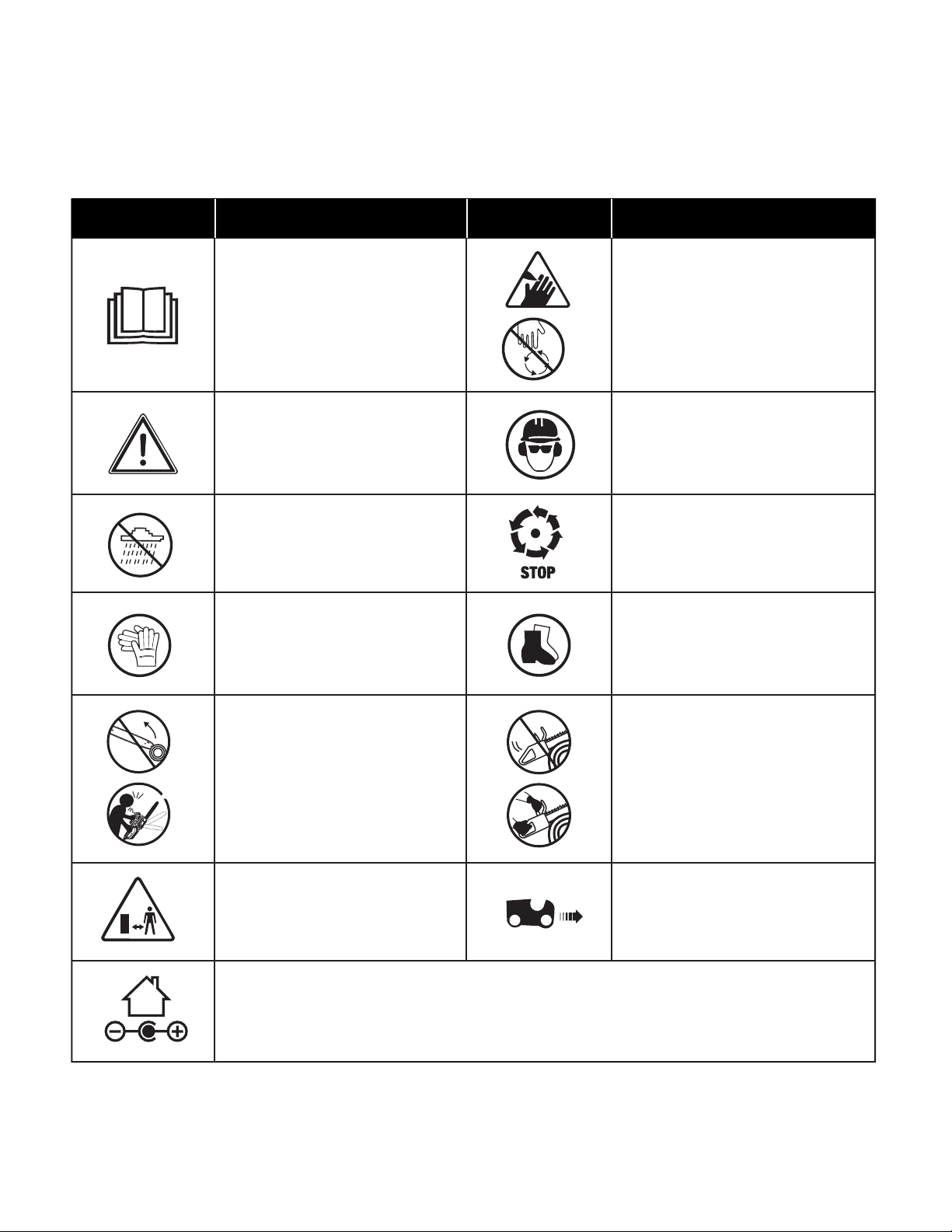
Safety Symbols
The following table depicts and describes safety symbols that may appear on this product. Read, understand, and follow all
instructions on the machine before attempting to assemble and operate.
READ THE OPERATOR'S
MANUAL(S) – Read, understand
and follow all instructions in the
user manual(s) before attempting
to assemble and operate.
SAFETY ALERT – Indicates a
precaution, a warning or a danger.
The moving part will continuously
run for several seconds after you
turn o the machine.
WARNING! Do not expose the unit
to rain or wet conditions.
CAUTION! Avoid contacting the
guide bar tip with any object. Tip
contact may cause the guide bar
to move suddenly upward and
backwards, which may cause
serious injury to the user.
WEAR EYE AND HEARING
PROTECTION – For protection
against injury, wear ear defenders
and safety goggles.
WARNING! Two hands are
always to be used when
operating the chain saw.
Correct direction of cutting teeth.
Keep bystanders and children a
safe distance away.
Symbols Symbols
Descriptions
Descriptions
Indoor use only. Only use battery charger indoors.
m
DANGER! ROTATING
BLADES – Keep hands and
feet away from openings while the
saw is running.
Wear safety footwear at all times to
provide protection against objects
that may accidentally fall on feet.
Wear safety gloves during use to
protect hands.
8
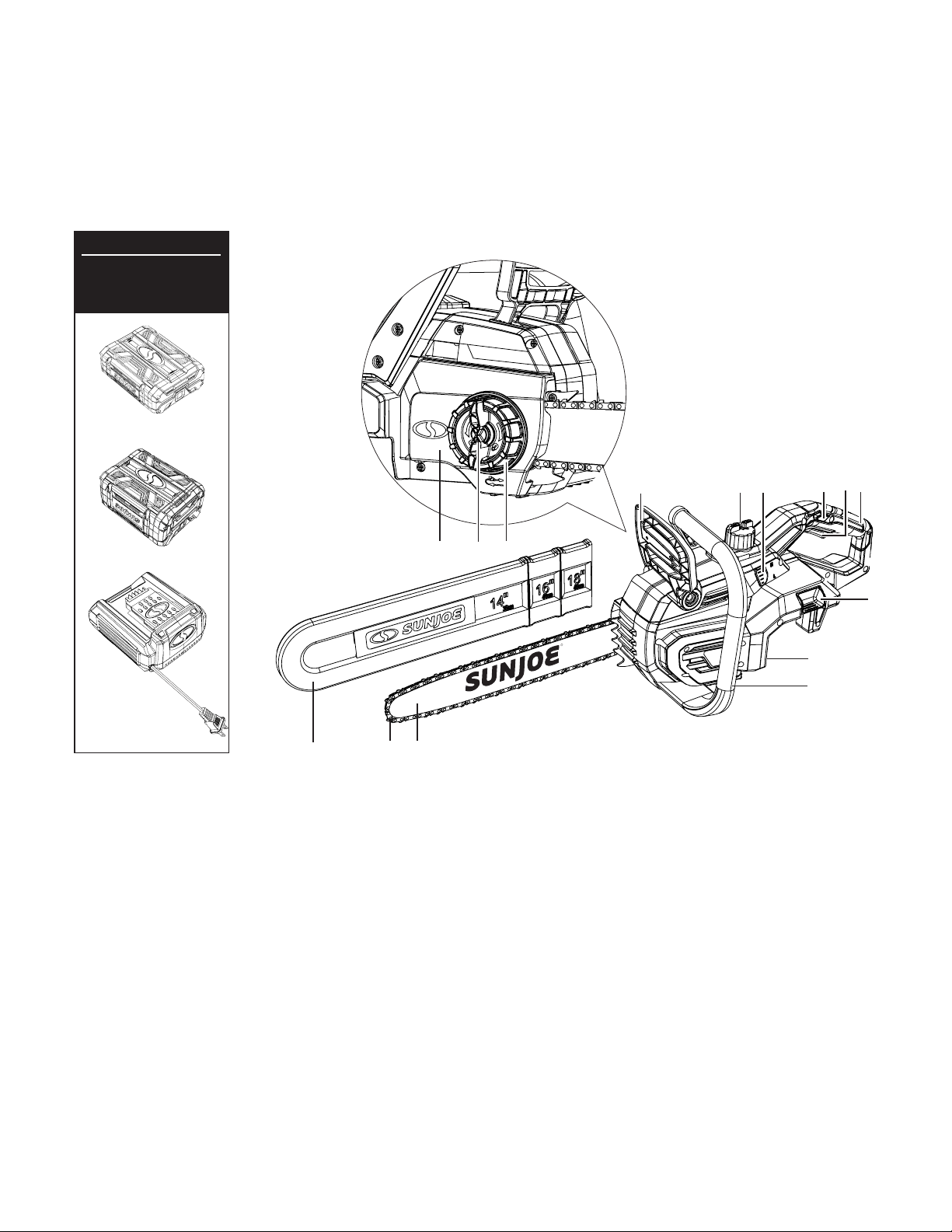
Know Your Cordless Chain Saw
Read the owner’s manual and safety instructions carefully before operating cordless chain saw. Compare the illustration below to
the cordless chain saw in order to familiarize yourself with the location of the various controls and adjustments. Save this manual
for future reference.
Technical Data
Battery Voltage Max* .................. 100 V D.C.
Battery Capacity .........................See page 24 for battery
options and specications
Battery Runtime Max ..................See page 24 for battery
options and specications
Charge Time Max .......................See page 24 for battery
options and specications
Charger Input..............................100 – 120 V AC,
50 – 60 Hz, 500 W
Charger Output ...........................100 V DC 4 A
Motor ........................................... 1500 W Brushless
Bar Chain Length ........................ 18 inch (45.7 cm)
Oil Tank Capacity ........................ 6.1 Oz (180 ml)
Cutting Thickness ........................ Max: 17.5 in. (44.5 cm)
Recommended:16.5 in. (41.9 cm)
Weight (chain saw alone) ............. 11.5 lbs (5.2 kg)
Weight ............................................15.5 lbs (7 kg)
(chain saw + iON100V-2.5AMP)
Weight ............................................18.5 lbs (8.4 kg)
(chain saw + iON100V-5AMP)
*Initial no-load voltage, when fully charged, peaks at 100 volts; nominal voltage under typical load is 86.4 volts.
SOLD SEPARATELY
iON100V-2.5AMP
iON100V-5AMP
iON100V-RCH
Battery + Charger
options available at
snowjoe.com
THE OTHER SIDE
1. Cutting bar sheath
2. 18 in. cutting chain
3. 18 in. guide bar
4. Front hand grip
5. Battery compartment
6. Battery releasing button
7. Rear handle grip
8. On/O switch
9. Safety button
10. Oil tank
11. Oil tank cap
12. Front hand brake
13. Chain tension knob
14. End cover knob
15. Chain/sprocket end cover
R
1 2 3
4
5
6
78910
1112
14 13
15
9
Unpacking
Carton Contents
• Cordless chain saw
• 18 in. (45.7 cm) guide bar
• 18 in. (45.7 cm) cutting chain
• Cutting bar sheath
• Manuals with registration card
1. Carefully remove the cordless chain saw and check to see
that all of the above items are supplied.
2. Inspect the product carefully to make sure no breakage or
damage occurred during shipping. If you nd damaged or
missing parts, DO NOT return the unit to the store. Please
call the Snow Joe
®
+ Sun Joe
®
customer service center at
1-866-SNOWJOE (1-866-766-9563).
NOTE: Do not discard the shipping carton and packaging
material until you are ready to use your new cordless
chain saw. The packaging is made of recyclable materials.
Properly dispose of these materials in accordance with
local regulations.
IMPORTANT! The equipment and packaging material are
not toys. Do not let children play with plastic bags, foils,
or small parts. These items can be swallowed and pose a
suocation risk!
Assembly
mWARNING! Always wear heavy-duty gloves when
handling the bar and chain. Mount the bar and chain very
carefully so as not to impair the safety and eciency of the
machine. If in doubt, contact an authorized Snow Joe
®
+
Sun Joe
®
dealer or call the Snow Joe
®
+ Sun Joe
®
customer
service center at 1-866-SNOWJOE (1-866-766-9563).
mWARNING! Unpacking and assembly should be
completed on a at and stable surface, with adequate space
for moving the machine and its packaging.
mDANGER! Never start the motor before installing the
guide bar, chain, and sprocket cover. Without all these parts in
place, the clutch can y o or explode, exposing the user to
potentially serious injuries.
mWARNING! To avoid serious personal injury, read and
understand all safety instructions provided.
mWARNING! Before performing any maintenance, make
sure the battery is removed from the battery compartment.
Failure to heed this warning could result in serious
personal injury.
Installing/Replacing the
Guide Bar and Chain
NOTE: When replacing the guide bar and chain, use
only identical replacement parts. Make sure the battery
is not inserted in the compartment before proceeding
with installation.
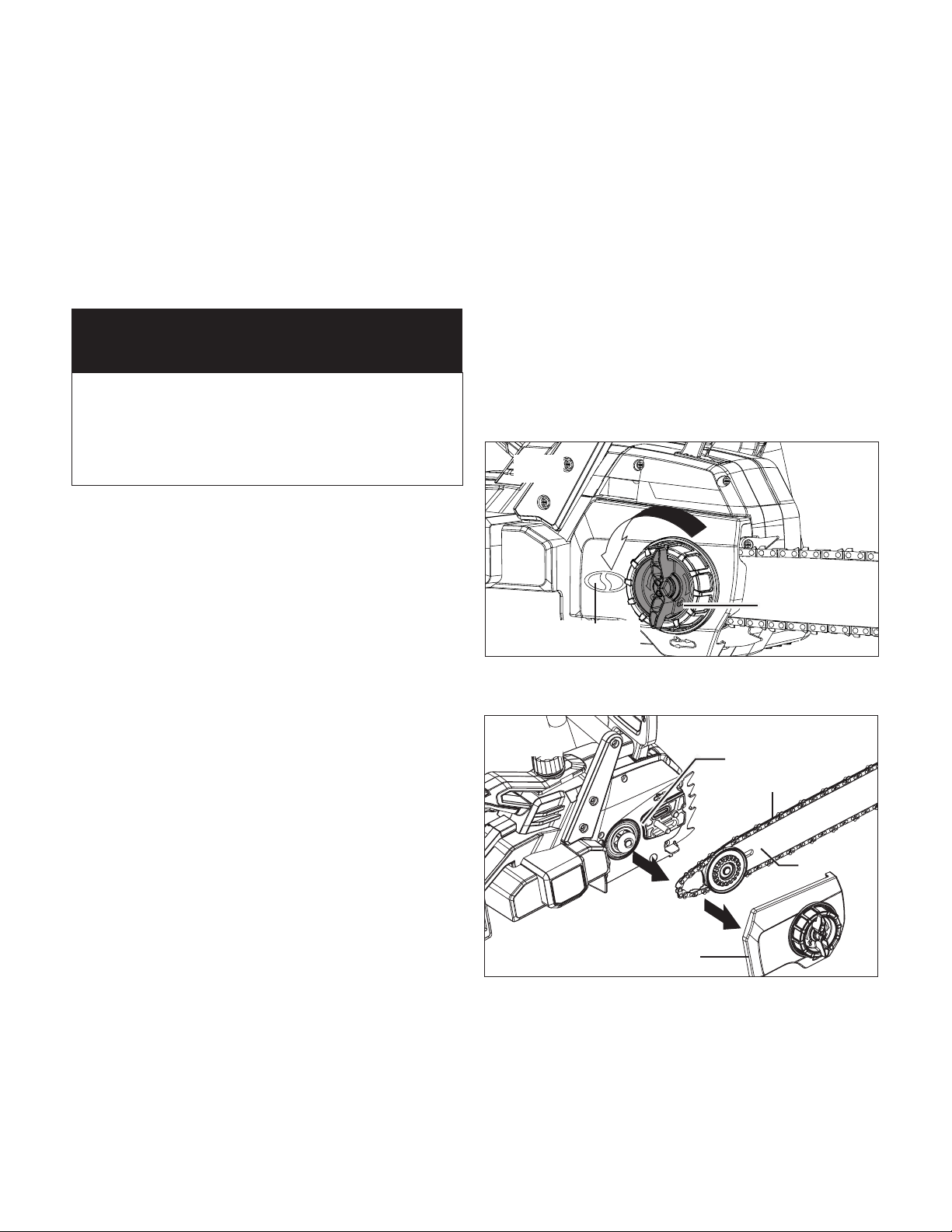
1. Unscrew the end cover knob counterclockwise to unlock
and remove the chain/sprocket end cover (Fig. 1).
Fig. 1
End cover knob
Chain/sprocket
end cover
2. Remove the cutting bar and chain from the mounting
surface (Fig. 2).
3. Remove the old chain from the bar.
NOTE: When you rst purchase your chain saw, the chain
and bar will come packed separately from the saw. Refer
only to the instructions for tting the chain and bar (start
with step 4). Should you need to replace the chain in the
future, follow all the steps in this section.
In order to operate this chain saw, you will need to additionally
purchase either the iON100V-2.5AMP or iON100V-5AMP
lithium-ion battery and the 100 V quick charger (model
iON100V-RCH). Battery and charger options available at
snowjoe.com.
CORE TOOL
BATTERY + CHARGER SOLD SEPARATELY
Fig. 2
Cutting chain
Chain/sprocket end cover
Guide bar
Mounting surface
10
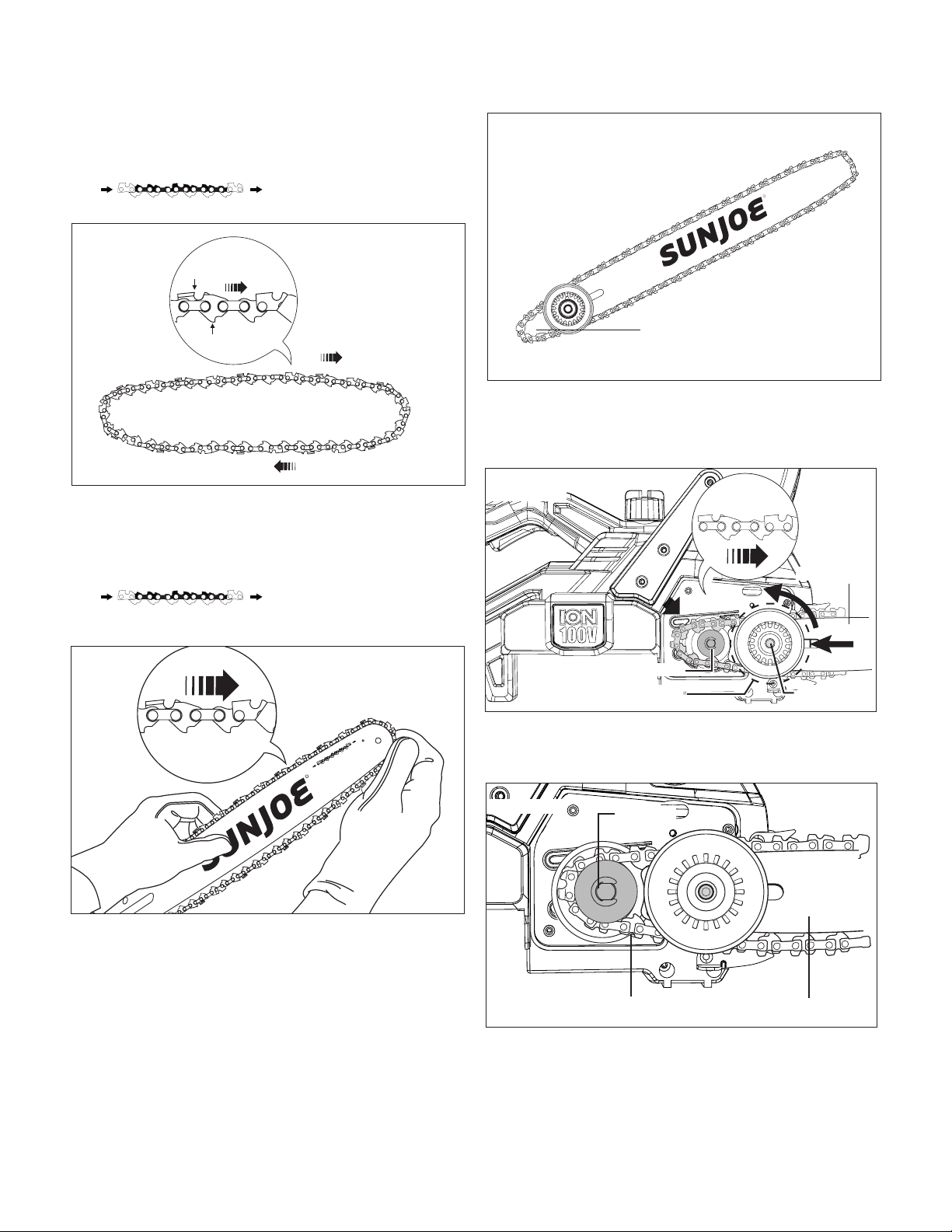
4. Lay out the new saw chain in a loop and straighten
any kinks. THE SHARP SIDE OF THE TEETH MUST
FACE AWAY FROM YOU IN THE DIRECTION OF THE
CHAIN ROTATION INDICATED ON THE GUIDE BAR
. If the teeth face backwards,
turn the loop over (Fig. 4).
5. Starting at the tip, mount the chain drive links into the
bar groove, leaving a loop at the back of the bar. The
chain will loosely t until it is placed on the sprocket
(Figs. 4 & 5).
NOTE: Make certain of the direction of the chain
.If the chain is mounted
backwards, the saw will vibrate abnormally and will not
cut.
6. Mount the guide bar by inserting the stud bolt into the
hole on the tension adjuster; turn the tension adjuster
counterclockwise to move the bar back so the chain loop
can be wound around the sprocket (Fig. 6).
7. Turn the tension adjuster clockwise to push the guide bar
forward to achieve an initial tensioning of the chain
(Fig. 7).
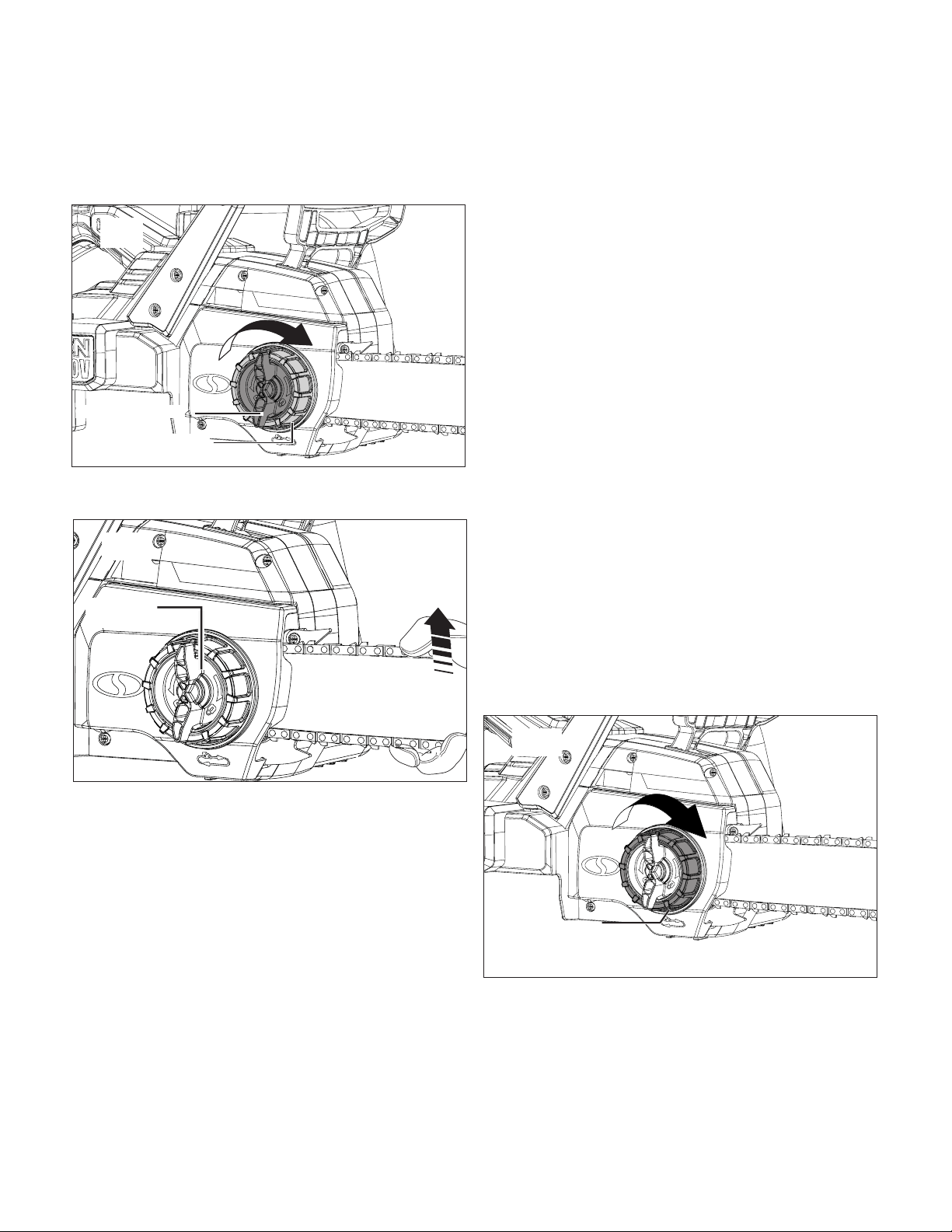
8. Fit the chain/sprocket end cover back on by screwing on
the end cover knob without tightening it. Turn the chain
tension knob clockwise until you nd the right chain
tension (Fig. 8).
Fig. 3
Chain rotation
Sharp cutting edge
Chain drive link
R
Fig. 4
R
Fig. 5
Loop
Fig. 6
Guide bar
Tension adjuster
Sprocket
Stud bolt
Fig. 7
Guide barChain
Sprocket
11
NOTE: The chain is correctly tensioned when there is no
sag on the underside of the guide bar; the chain is snug,
but can be rotated by hand without binding. For more
information on chain tensioning, see the maintenance
section beginning on pg. 20.
9. Raise the guide bar and tighten the end cover knob
securely (Fig. 9).
NOTE: If the chain is too tight, it will not rotate. Loosen the
end cover knob slightly and turn the chain tension knob 1/4
turn counterclockwise. Lift the tip of the guide bar up and
retighten the cover cap knob. Ensure that the chain can be
rotated by hand without binding.
NOTE: A new chain tends to stretch; check the chain tension
frequently, and adjust tension as required.
Preparing To Work
Checking the Machine
mWARNING! Before performing any checks,
adjustments, repairs or maintenance on the machine, make
sure the battery is not inserted in the compartment.
mCAUTION! The chain will continue to run for several
seconds after turning o the tool.
Before starting work please:
• Check that all the screws on the machine and the guide
bar are tightly fastened;
• Check that the chain is tensioned correctly, sharp and
there are no signs of any damage;
• Check that hand grips and protection devices are
clean and dry, correctly mounted and securely fastened
to the machine;
• Check that the chain brake is working eciently;
• Check that the trigger switch and the safety button move
freely without forcing and return automatically and rapidly
back to their neutral positions;
• Check that the trigger switch remains locked until the
safety button is pressed;
• Make sure the cooling air vents are not clogged with
sawdust or debris;
• Check that the chain’s oil level is not below the "L" level
mark; if necessary, top up the oil to 1 cm from the rim of
the ller.
NOTE: You must ll the chain oil tank with bar and chain
oil before using your chain saw.
Adjusting the Chain Tension
1. Tension the chain by turning the chain tensioning
knob clockwise (Fig. 10). A cold chain will be correctly
tensioned when there is no slack on the underside of the
guide bar; the chain is snug, but it can be turned by hand
without binding.
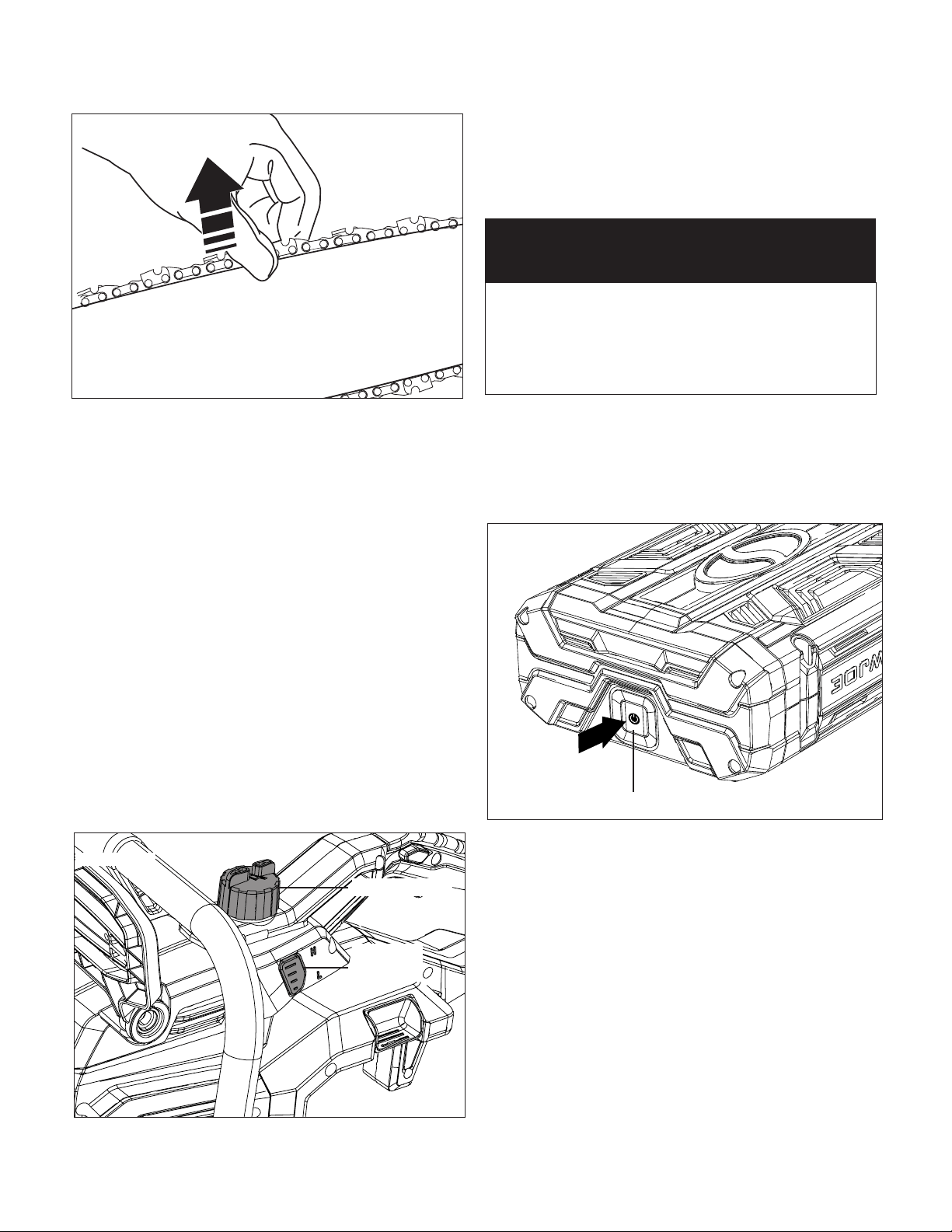
2. The tension is correct when the drive links on the chain do
not slip out of the chain guide on the bar when the chain
is pulled up from the middle of the bar (Fig. 11).
Fig. 8
End cover knob
Chain tension knob
Fig. 9
End cover
knob
Fig. 10
Chain tensioner
knob
12
3. Loosen the brake by pulling it towards the front handle.
Using a screwdriver, run the chain along the guide to
check that it moves smoothly.
Chain Lubricant
IMPORTANT! Only use a good quality bar and chain oil
designed specically for use with chain saws to ensure optimal
lubrication of the cutting parts. Do not use oil containing
impurities to avoid clogging the tank lter and permanently
damaging the oiler.
IMPORTANT! The chain lubricating oil is bio-degradable. The
use of mineral oil or engine oil can have a serious impact on
the environment. It is essential that you use good quality oil to
lubricate the cutting parts eectively. Used or poor quality oil
does not guarantee good lubrication and reduces the lifespan
of the chain and bar.
IMPORTANT! Before each machine use, the oil level should
be checked and topped up to 1 cm from the rim of the
ller. To ll the oil tank, remove the oil tank cap and add the
recommended bar and chain oil. The oil level must not drop
below the "L" level mark, as indicated on the oil tank (Fig. 12).
Battery Pack Operation
The equipment is powered by a lithium-ion battery (sold
separately). The battery pack is completely closed and
maintenance free.
In order to operate this chain saw, you will need to additionally
purchase either the iON100V-2.5AMP or iON100V-5AMP
lithium-ion battery and the 100 V quick charger (model
iON100V-RCH). Battery and charger options available at
snowjoe.com.
CORE TOOL
BATTERY + CHARGER SOLD SEPARATELY
Battery Charge Level Indicator
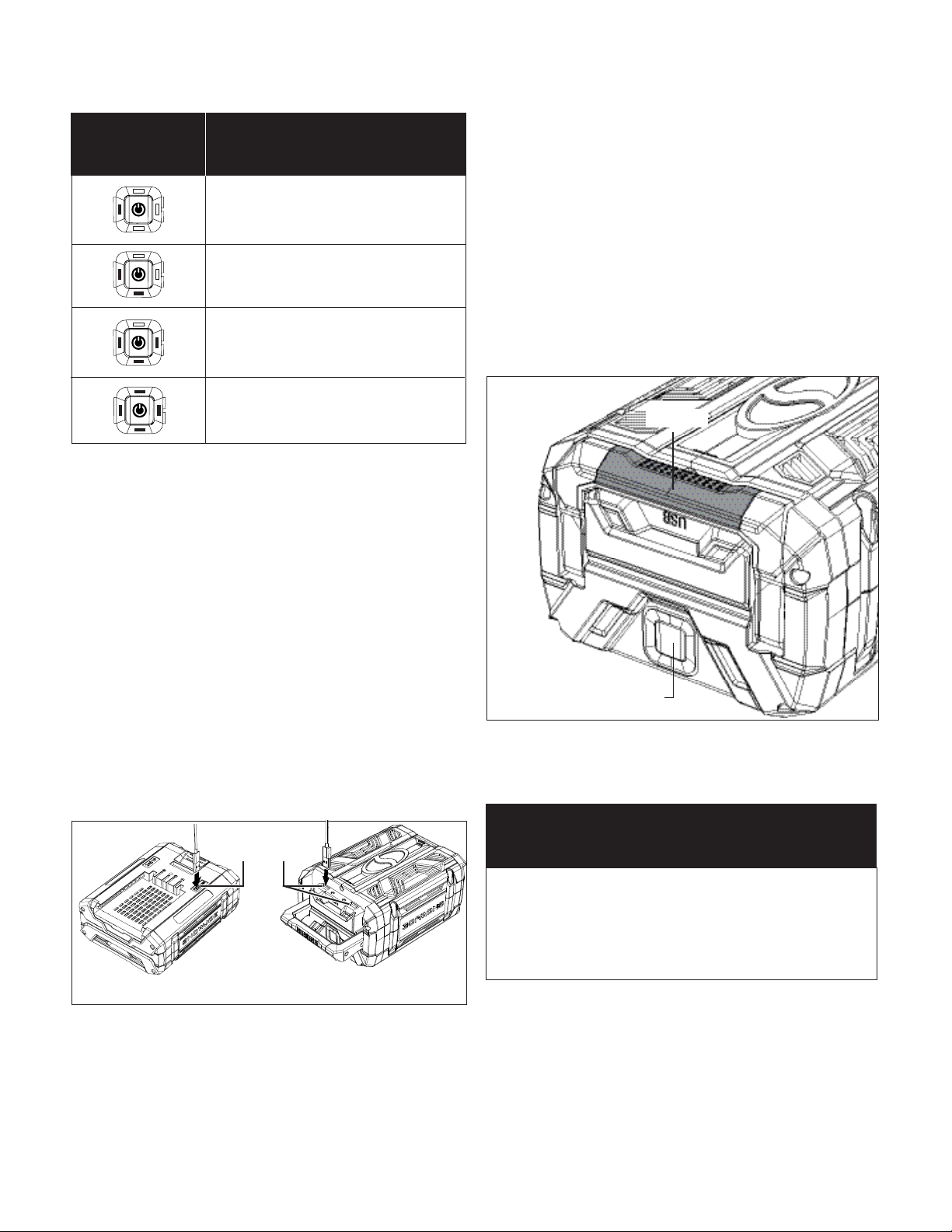
The battery pack is equipped with a push button for checking
the charge level. Simply press the push button to read o the
battery charge level from the LEDs of the battery indicator
(Fig. 13):
• All 4 level monitoring LEDs are lit: Battery charge level
is high.
• 3 level monitoring LEDs are lit: Battery charge level is
decreasing.
• 2 level monitoring LEDs are lit: Battery charge level is
decreasing. Stop work as soon as possible.
• 1 level monitoring LED is lit: Battery is at. Stop work
IMMEDIATELY and charge the battery. Otherwise the
battery’s service life will be greatly shortened.
Fig. 11
Fig. 12
Oil level
window
Oil tank cap
Fig. 13
Charge level indicator push button
Press
13
NOTE: If the charge level button does not appear to be
working, place the battery pack on the charger and charge
as needed.
Immediately after using the battery pack, the charge level
button may display a lower charge than it will if checked a few
minutes later. The battery cells “recover” some of their charge
after resting.
USB Charging Port
iON100V series batteries are equipped with a USB port (or
ports, depending on your model) which can provide 5 V power
for most popular smartphones, tablets, wearables and other
USB devices.
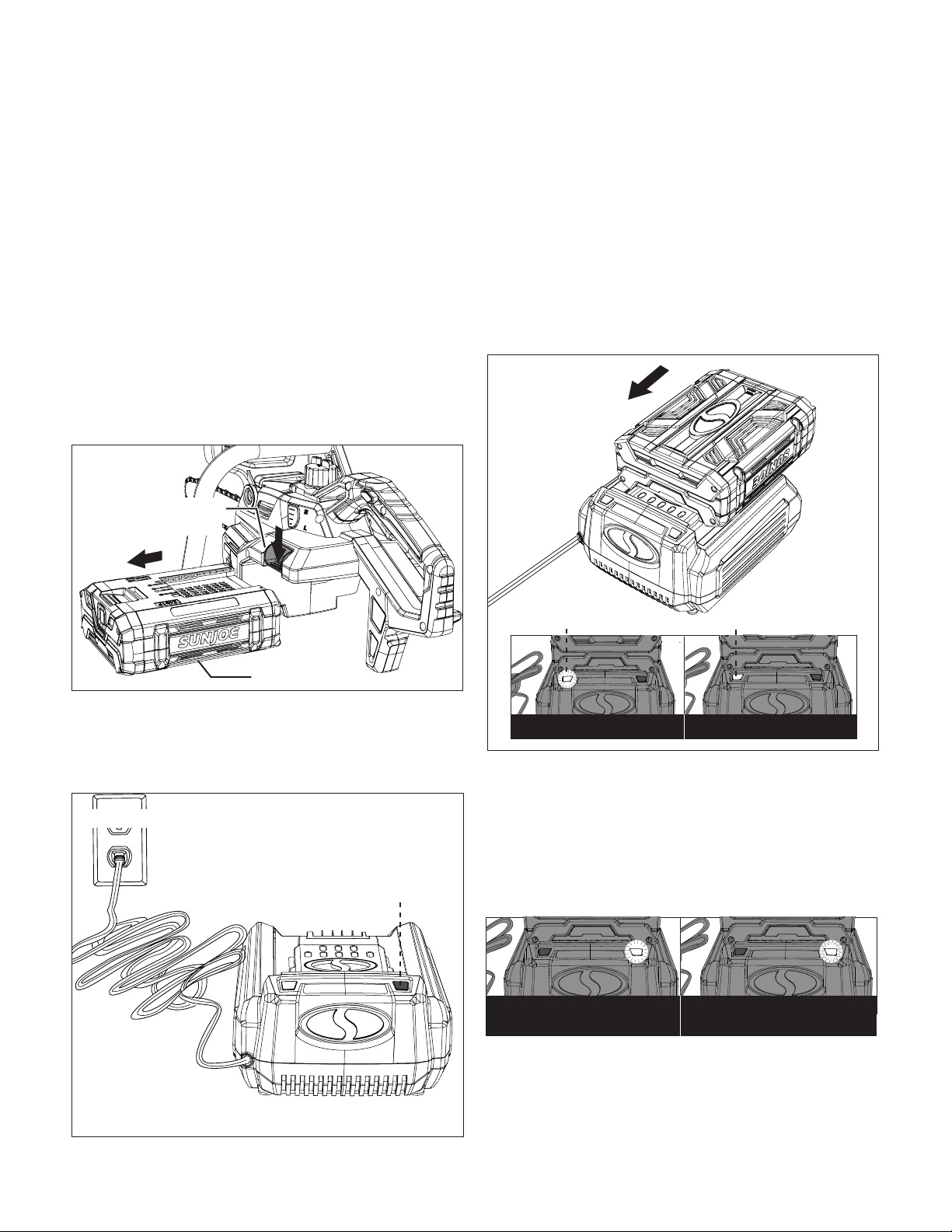
To charge with the battery, connect the USB cable that came
with your device to the USB port (or ports) on your iON100V
series battery and to your device. The charging process will
start immediately (Fig. 14).
NOTE: If you experience any issues with charging your
particular device, ensure that the iON100V battery is
fully charged.
mWARNING! Make sure the battery’s USB port(s) is not
contaminated with lint or other debris. Use a canned-air
type of product periodically to ensure that the port openings
are clear.
LED light
(iON100V-5AMP batteries only – sold
separately)
The iON100V-5AMP battery is equipped with a 0.35 watt LED
light located on the handle, which is good for camping and
emergency illumination. To turn on the LED light, open the
carry handle, and press the battery push button twice in a row.
To turn o the LED light, press the battery push button twice
again (Fig. 15).
NOTE: This function only comes with iON100V-5AMP battery.
iON100V-2.5AMP battery is not equipped with the handle or
the LED light.
Charger Operation
mWARNING! Charge only the iON100V-2.5AMP or
the iON100V-5AMP lithium-ion battery packs in compatible
iON100V-RCH battery charger. Other types of batteries may
cause personal injury and damage.
To reduce the risk of electric shock, do not allow water to ow
into the charger's AC/DC plug.
The battery is at 20% capacity and
requires charging
Light IndicatorsLights
The battery is at 50% capacity and
requires charging soon
The battery is at 70% capacity
The battery is at full capacity
Fig. 14
USB charging
ports
iON100V-2.5AMP iON100V-5AMP
Fig. 15
LED light
Push twice to start/stop
In order to operate this chain saw, you will need to additionally
purchase either the iON100V-2.5AMP or iON100V-5AMP
lithium-ion battery and the 100 V quick charger (model
iON100V-RCH). Battery and charger options available at
snowjoe.com.
CORE TOOL
BATTERY + CHARGER SOLD SEPARATELY
14
When to Charge the iON100V Lithium-
iON Batteries
NOTE: The iON100V-2.5AMP and iON100V-5AMP lithium-ion
battery packs do not develop a "memory" when charged after
only a partial discharge. Therefore, it is not necessary to run
down the battery pack before placing it into the charger.
• Use the battery charge indicator lights to determine when to
charge your iON100V-2.5AMP or iON100V-5AMP lithium-
ion battery pack.
• You can "top-o" your battery pack's charge before starting
a big job or after a long day of use.
Charging the Battery
1. Push the battery releasing button on the chain saw
to release the battery pack. Pull the battery out of the
equipment (Fig. 16).
2. Check that the mains voltage is the same as that marked
on the rating plate of the battery charger. Then, insert the
charger's plug into the electrical wall outlet. When you
plug in the charger, the red light will illuminate steadily
(Fig. 17).
mCAUTION! Charger iON100V-RCH is rated for 100 –
120 volt AC only. DO NOT plug the charger into any outlet that
will provide power with a higher voltage. Over voltage charging
will be harmful to both the battery and charger, and may cause
the charger to burn out.
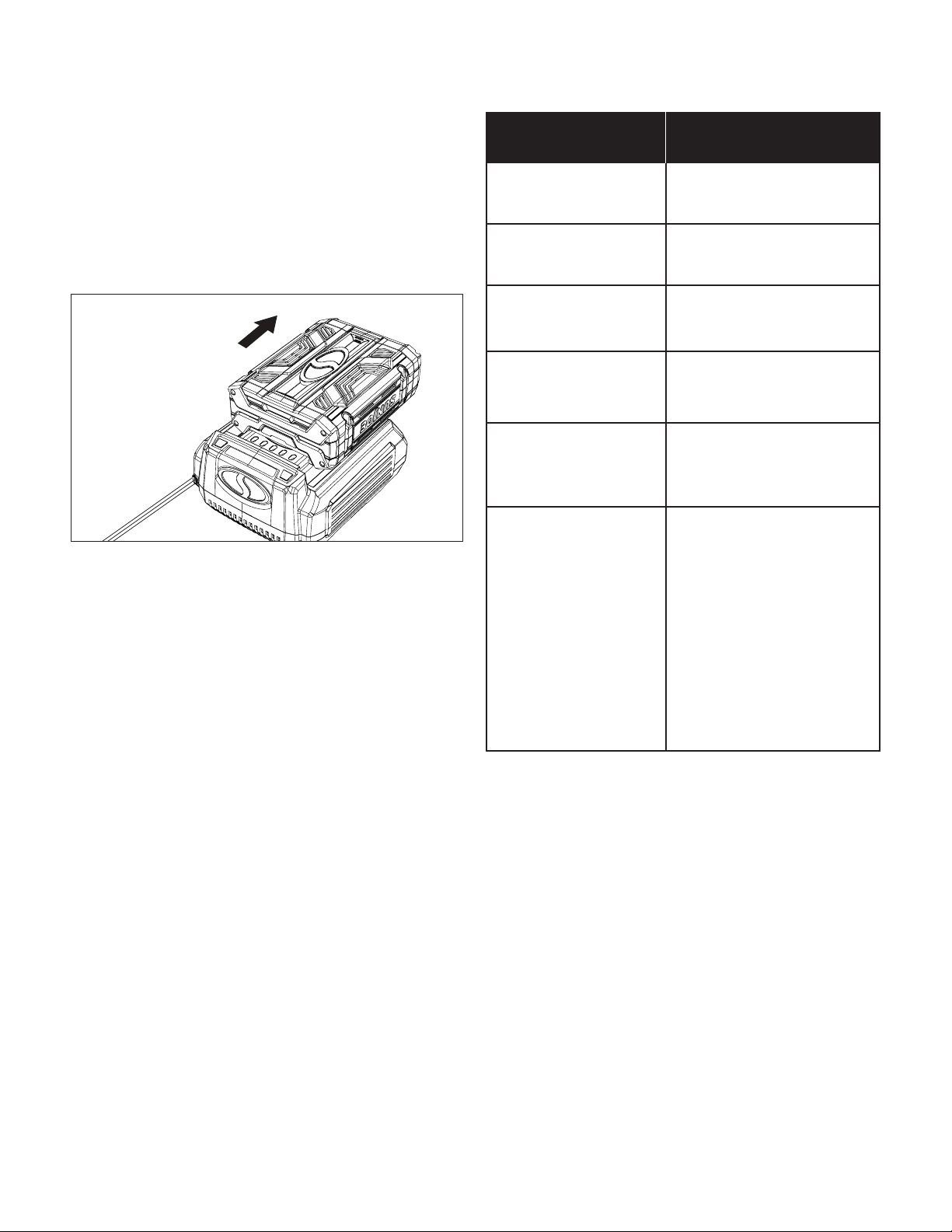
3. Place the battery pack into the charger by sliding the
pack as shown until it clicks into the position. When the
battery is inserted in properly, the green light will slowly
ash to indicate that the battery is charging. The red light
will turn o. You will also hear a fan sound (Fig. 18).
4. When the green light stays on, the battery is fully charged
(Fig. 18).
NOTE: If the green light is o while the red light ashes slowly,
this indicates a temperature abnormality (i.e. that the battery
pack is too hot). If the green light is o while the red light
ashes rapidly, this indicates there's something wrong with the
charger or the battery. Wait for a while and try to reinsert the
battery into the charger. If the situation still persists, contact
Snow Joe
®
+ Sun Joe
®
customer service at 1-866-SNOWJOE
(1-866-766-9563).
Fig. 16
Battery pack
Battery releasing
button
Fig. 17
Red
Fig. 18
Charging Fully Charged
Slowly ash green
Green
Temperature abnormal
(slowly ashing red)
Something is wrong
(rapidly ashing red)
15
5. A fully discharged iON100V-2.5AMP battery pack with an
internal temperature in the normal range will fully charge
in 50 minutes (between 32ºF/0ºC and 113ºF/45ºC). A fully
discharged iON100V-5AMP battery pack with an internal
temperature in the normal range will fully charge in 100
minutes (between 32ºF/0ºC and 113ºF/45ºC). Heavily
cycled battery packs may take longer to charge completely.
6. When charging is complete, remove the battery from the
charger by pulling the battery backward to unlock it from
the charger.
7. Timely recharging of the battery will help prolong the
battery's life. You must recharge the battery pack when
you notice a drop in the equipment's power.
IMPORTANT! Never allow the battery pack to become fully
discharged as this will cause irreversible damage to the battery.
Charger Light Indicator Table
Consult to the table for meanings and possible solutions for
the charger indication light. If there's anything not indicated
in the table or you are not sure about the cause and cannot
x the charger, contact the Snow Joe
®
+ Sun Joe
®
customer
service center at 1-866-SNOWJOE (1-866-766-9563).
Operation
Starting and Stopping
mCAUTION! Starting, stopping, and restarting an electric
motor repeatedly within a few seconds can generate a great
deal of heat and damage the motor. To protect the life of your
cordless chain saw, always wait at least ve seconds after
stopping before restarting the saw.
mWARNING! Be sure that the chain is not in contact with
any object when you start the motor.
mWARNING! Keep hands away from chain. Keep hands
on handles. Do not overreach.
A good, rm grip on the tool using both hands will help you
maintain control. Maintain a rm grip by place your right hand
Fig. 19
Possible Cause
(Solution)
• Red Light – Steady
• Green Light – O
• No load charging –
There's no battery inserted
in the charger.
• Red Light – O
• Green Light – Slowly
ashes
• Normal charging – The
battery is being charged.
• Red Light – O
• Green Light – Steady
• Fully charged – The battery
is fully charged and the
charging process is nished.
• Red Light – O
• Green Light – Rapidly
ashes
• Discharged – The battery
is heavily discharged. Allow
more time for charging.
• Red Light – Slowly
ashes
• Green Light – O
• Temperature abnormal –
Charging process will start
when battery returns to
normal temperature.
• Over current charging –
The current coming through
the charger is greater
than what the charger can
support. Stop charging as
soon as possible.
• Abnormal performance
– Something is wrong with
the battery or the charger.
Contact Snow Joe
®
+
Sun Joe
®
customer service
at 1-866-SNOWJOE
(1-866-766-9563).
• Red Light – Rapidly
ashes
• Green Light – O
Indication
16
on the rear handle and left hand on the front handle with
thumbs and ngers encircling the respective handles. A rm
grip combined with proper positioning of the handle against
your body will help you maintain control of the saw. Do not let
go of the saw while it is in operation.
mWARNING! Do not operate the cordless chain saw in
a tree, on a ladder, or on a scaold. Using the tool under such
circumstances is extremely dangerous.
mCAUTION! The chain will continue to run for several
seconds after turning o the tool.
Do not use the chain saw under wet conditions. Use extreme
caution when cutting small brush, saplings, or limbs under
tension because slender and tense material may catch the
saw and be whipped toward you, pull you o balance, or
spring back.
Do not use the chain saw to cut vines and/or small underbrush.
mWARNING! Do not let familiarity with this type of tool
prevent you from taking all necessary precautions. Remember
that a careless fraction of a second is sucient to inict
serious injury.
mWARNING! Do not cut trees near electrical wires.
mWARNING! Failure to lubricate the chain will cause
damage to the bar and chain. Use only a good quality bar
and chain oil designed specically for use with chain saws.
NOTE: It is normal for oil to seep from the saw when not in
use. To prevent seepage, empty the oil tank after each use.
When storing the unit for a long period of time (3 months or
longer), be sure the chain is lightly lubricated; this will prevent
rust on the chain and bar sprocket.
1. Prior to each cutting session, run through the daily
checklist (see pg. 22).
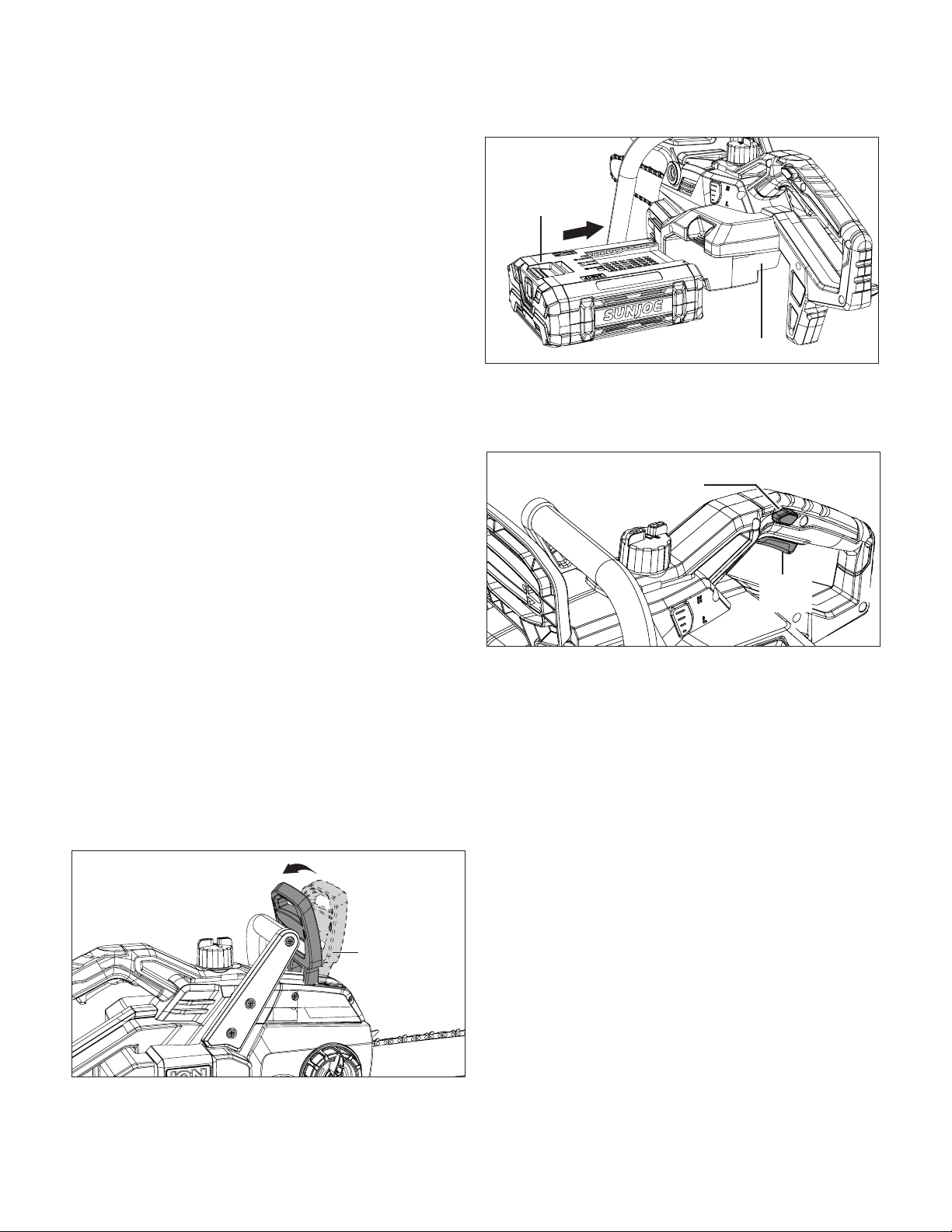
2. In the event of an accidental activation, reset the safety
brake function by returning the front hand brake to the
operating position. (Fig. 20).
3. Insert the battery in the battery compartment (Fig. 21).
3. To turn the tool on, hold the chain saw rmly with both
hands on the handles. Press the safety lock button, then
push the On/O switch. When the chain saw is running,
you can release the safety lock button (Fig. 22).
4. To turn the tool o, simply release the On/O switch, and
push the front handle brake to the brake position.
NOTE: Do not press the On/O switch until you are ready
to make a cut.
Operating Tips
mWARNING! For your safety and that of others:
1. Do not use the machine without reading the instructions
carefully. Become acquainted with the controls and
the proper use of the machine. Learn how to stop the
machine quickly.
2. Keep in mind that the operator or user is responsible
for accidents or hazards occurring to other people or
their property.
3. Always wear suitable clothing when using the machine.
Wear anti-vibration gloves and other personal
protective equipment.
All the above-mentioned precautions do not, however,
guarantee the prevention of certain risks – i.e. Raynaud’s
phenomenon or Carpal tunnel syndrome. For operators
who use this machine for prolonged periods, it is therefore
recommended to have periodic checkups on their hands
and ngers. If any of the above mentioned symptoms
should appear, please contact a physician immediately.
4. Work only in daylight or good articial light.
Fig. 20
Operating position
Brake position
Front handle
brake
Fig. 21
Battery compartment
Battery pack
Fig. 22
On/O
switch
Safety lock button
17
5. Take utmost care when working near metal fences.
6. Take care not to hit the bar hard against foreign objects or
ying debris caused by the movement of the chain.
7. Stop the motor and remove the battery from
its compartment:
– Whenever you leave the machine unattended;
– Before cleaning, checking or servicing the machine;
– After striking a foreign object. Inspect the machine
for any damage and make repairs before restarting
it again;
– If the machine begins to vibrate abnormally,
immediately look for the cause of the vibrations
and have the machine inspected at an authorized
Snow Joe
®
+ Sun Joe
®
dealer or call the Snow Joe
®
+ Sun Joe
®
customer service center at
1-866-SNOWJOE (1-866-766-9563) for assistance.
– When the machine is not in use.
IMPORTANT! Always remember that an incorrectly used
chain saw may disturb others and have a serious impact
on the environment.
To respect people and the environment:
• Avoid using the machine in environments or at times of
the day when it may disturb others.
• Scrupulously comply with local regulations and provisions
for the disposal of waste materials after sawing.
• Scrupulously comply with local regulations and provisions
for the disposal of oils, damaged parts or any elements
which have a strong impact on the environment.
• A certain amount of chain lubricating oil is released into
the environment when the machine is running, so only use
biodegradable oils made specically for this use.
• To avoid the risk of re, do not leave the machine with the
motor hot on leaves or dry grass.
mWARNING! It takes specic training to use the machine
for felling and delimbing.
Checks During Work
• Checking the chain tension
The chain tends to stretch gradually as you work, so you need
to check its tension frequently.
IMPORTANT! During the rst period of use (or after replacing
the chain), the chain tension must be checked more frequently
due to settling of the chain.
mWARNING! Never work with the chain loose, as it can
be hazardous if the chain slips out of its guide.
To adjust the chain tension, follow the instructions in
“Adjusting the Chain Tension” on page 11.
• Checking the oil delivery
IMPORTANT! Never use the machine without lubrication! You
can check the oil level in the tank through the transparent
gauge. Make sure you ll up the oil tank every time you use
the machine. For best results, use only a good quality bar and
chain oil designed specically for use with chain saws.
mWARNING! Make sure the bar and the chain are in
place when you check the oil delivery.
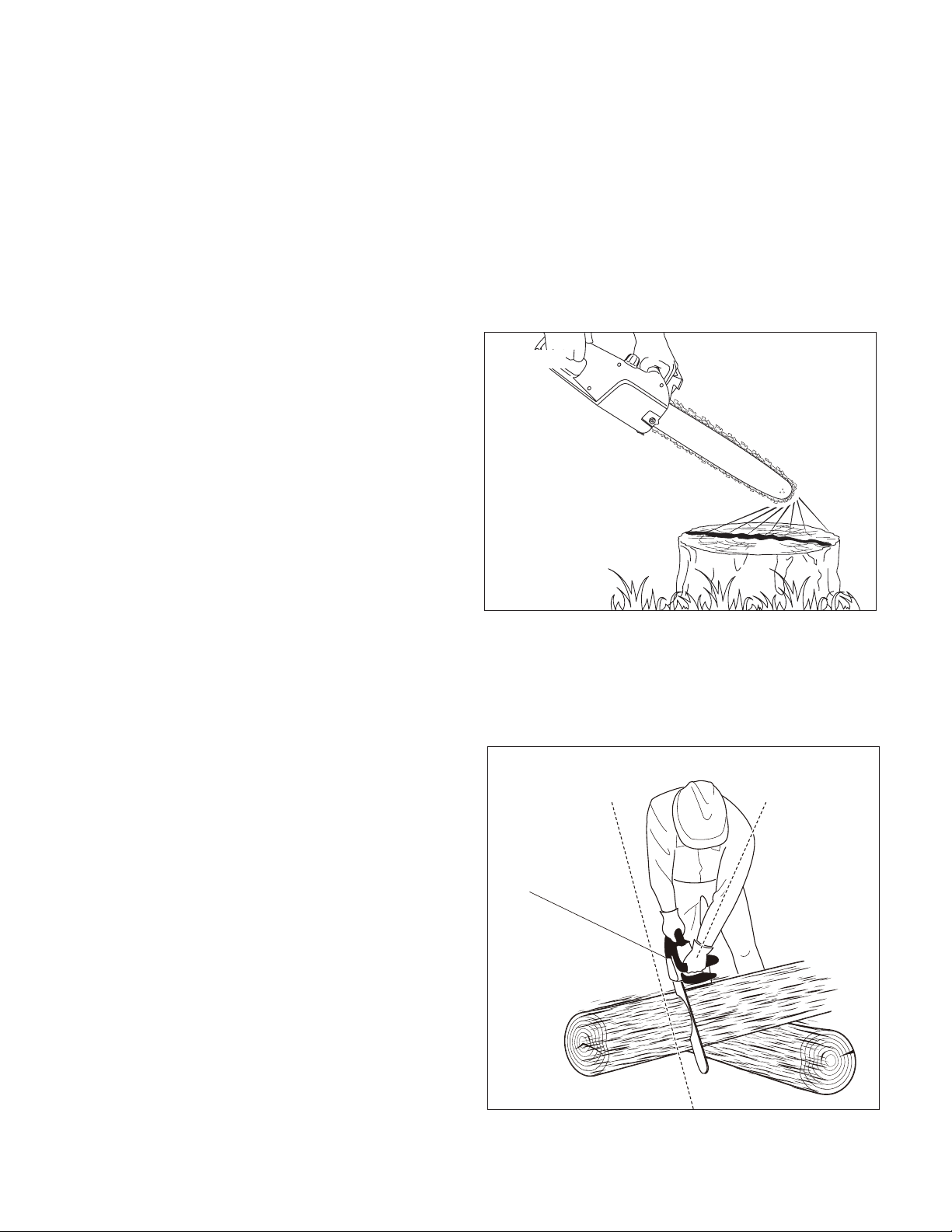
Start the motor and check if the chain oil is delivered as shown
below (Fig. 23).
Proper Cutting Stance
• Weight should be balanced with both feet on
solid ground.
• Keep your left arm and elbow locked in a "straight arm"
position to withstand any kickback force (Fig. 24).
Fig. 23
Fig. 24
Chain line
Straight arm
18
• Your body should always be to the left of the chain line.
Basic Cutting Procedures
mWARNING! This unit is designed for trimming branches
and limbs up to recommended 16.5 in. (41.9 cm), not to
exceed a max. cut of 17.5 in. (44.5 cm) in diameter depending
on type of wood. Practice cutting a few small limbs using the
following technique to get the “feel” of using the saw before
you begin a major sawing operation.
• Take the proper stance in front of the wood with the saw
turned o (Fig. 24).
• Squeeze the On/O switch and let the chain accelerate to
full speed before entering the cut.
• Hold the saw with both hands rmly. Always keep your left
hand on the front handle and your right hand on the rear
handle so that your body is to the left of the chain line.
• Keep the unit running the entire time you are cutting,
maintaining a steady speed.
• Let the chain do the work; exert only light downward
pressure. If you force the cut, damage to the bar, chain,
or unit can result.
• Do not put the pressure on the saw at the end of the cut.
• Always cut with both feet on solid ground to prevent falling.
• Do not cut above chest height since it is dicult to
control kickback forces with a saw held high.
Cutting Techniques
Before felling or delimbing for the rst time, practice sawing
logs on the ground or on trestles, so that you can get familiar
with the machine and the most suitable sawing techniques.
mWARNING! Always hold the machine with both hands
when sawing.
mWARNING! Stop the motor immediately if the chain
stops during sawing. Beware of kickback, which can occur if
the bar contacts an obstacle.
• Felling a tree
i) When bucking and felling are performed by two or more
people at the same time, the felling operation should be
separated from the bucking operation by a distance of at
least twice the height of the tree being felled. Trees should
not be felled in a manner that would endanger any person,
strike any utility line or cause any property damage. If the
tree does make contact with any utility line, the company
should be notied immediately.
ii) The chain saw operator should keep on the uphill side of
the terrain as the tree is likely to roll or slide downhill after
it is felled.
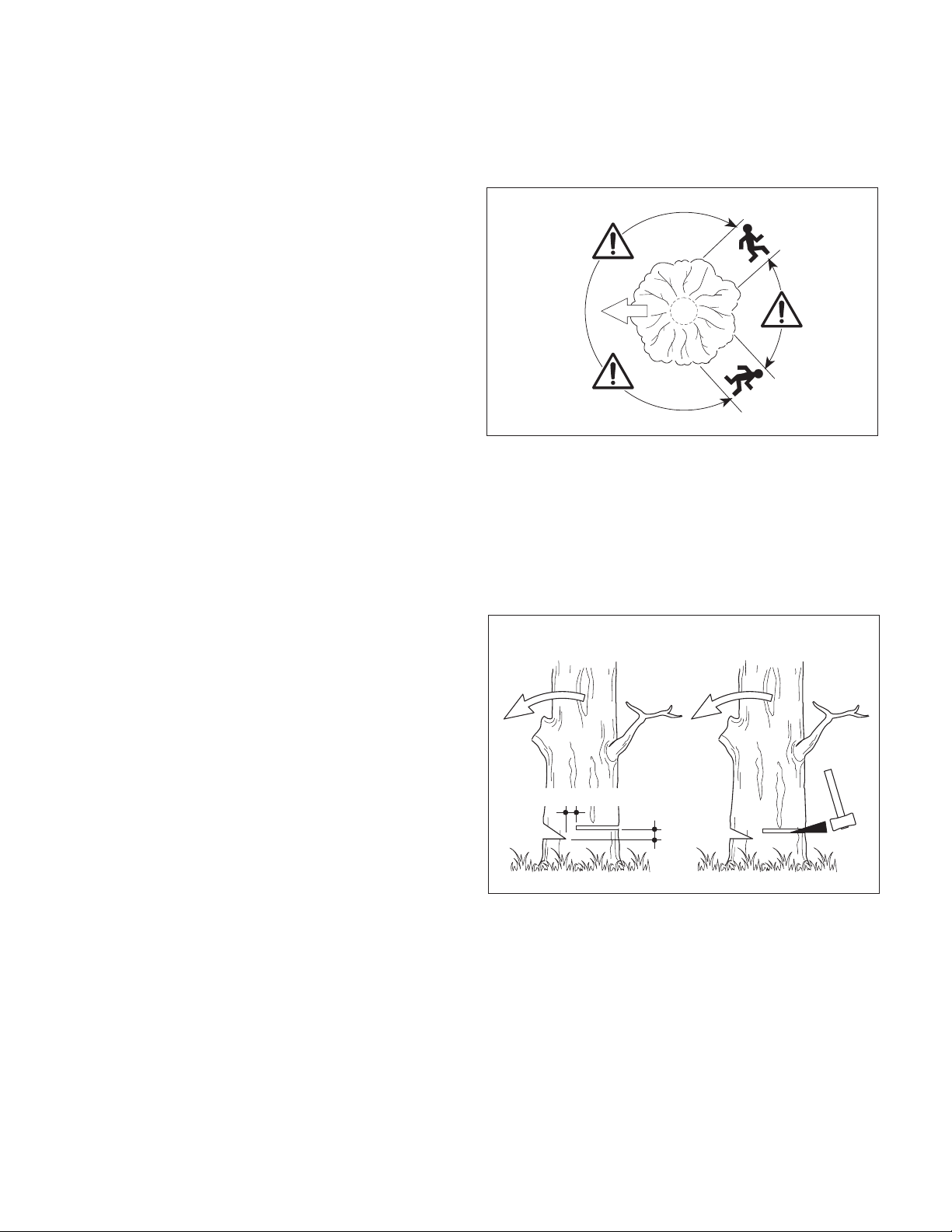
iii) An escape path should be planned and cleared as
necessary before cuts are started. The escape path
should extend back and diagonally to the rear of the
expected line of fall as illustrated (Fig. 25).
iv) Before felling is started, consider the natural lean of the
tree, the location of larger branches and the wind direction
to help you judge which way the tree will fall.
v) Remove dirt, stones, loose bark, nails, staples and wire
from the tree.
• Notching undercut
Make the notch 1/3 the diameter of the tree, perpendicular to
the direction of the fall as illustrated (Fig. 26).
Make the lower horizontal notching cut rst. This will help to
avoid pinching either the saw chain or the guide bar when the
second notch is made.
• Felling back cut
i) Make the felling back cut at least 2 in. (50 mm) higher than
the horizontal notching cut as illustrated (Fig. 26). Keep
the felling back cut parallel to the horizontal notching cut.
Strategically position the felling back cut so that enough
wood is left to act as a hinge. The hinge wood keeps the
tree from twisting and falling in the wrong direction. Do not
cut through the hinge.
Fig. 25
2 plg (50 mm)
2 plg (50 mm)
Fig. 26
19
ii) As the felling gets close to the hinge, the tree should begin
to fall. If there is any chance that the tree may not fall in
the desired direction or it may rock back and bind the saw
chain, stop cutting before the felling back cut is complete
and use wedges of wood, plastic or aluminium to open
the cut and drop the tree along the desired line of fall.
iii) When the tree begins to fall, remove the chain saw from
the cut, stop the motor, put the chain saw down, then
use the retreat path planned. Be alert for overhead limbs
falling and watch your footing.
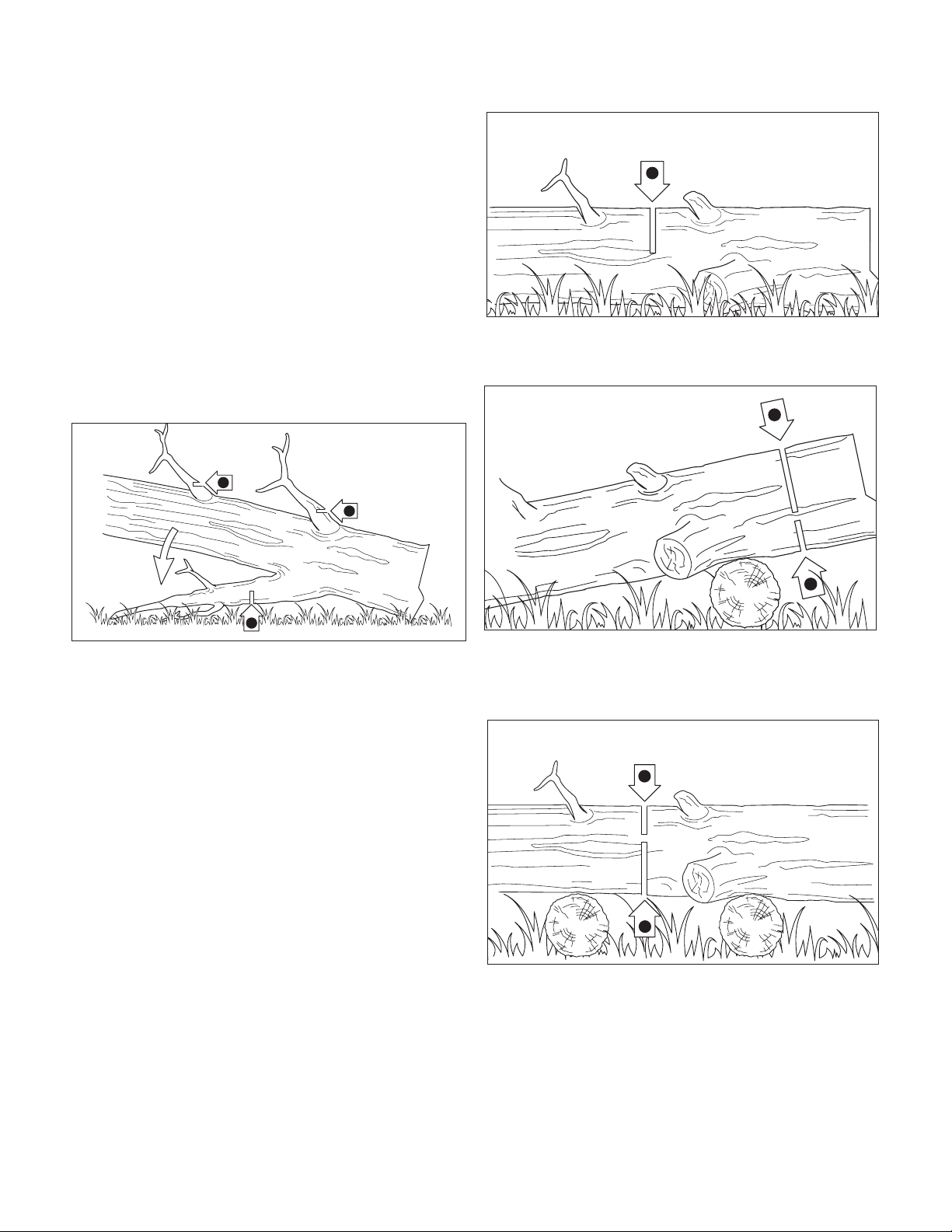
• Limbing
Limbing is the process in which branches are removed from a
fallen tree. When limbing, leave larger lower limbs to support
the log o the ground. Remove the small limbs in one cut as
illustrated (Fig. 27). Branches under tension should be cut from
the bottom up to avoid binding the chain saw.
mWARNING! Pay special attention to where the branches
are lying on the ground and recognize the following risks:
1). the branches may be under tension; 2). the direction in which
the branch will fall may dier from that anticipated; 3). the tree
may be unstable after the branch has been cut.
• Bucking a log
mWARNING! Do not buck logs that are larger than the
maximum cutting thickness.
Bucking is the process in which a log is cut into lengths. It is
important to make sure your footing is rm and your weight is
evenly distributed on both feet. When possible, the log should
be raised and supported by the use of limbs, logs, or chocks.
Follow these simple directions for easy cutting:
• When the log is supported along its entire length as
illustrated (Fig. 28A), cut from the top (overbuck).
• When the log is supported on one end (Fig. 28B), cut 1/3
the diameter from the underside (underbuck). Then make
the nishing cut by overbucking to meet the rst cut.
• When the log is supported on both ends (Fig. 28C), cut
1/3 the diameter from the top (overbuck). Then make the
nishing cut by underbucking the lower 2/3 to meet the
rst cut.
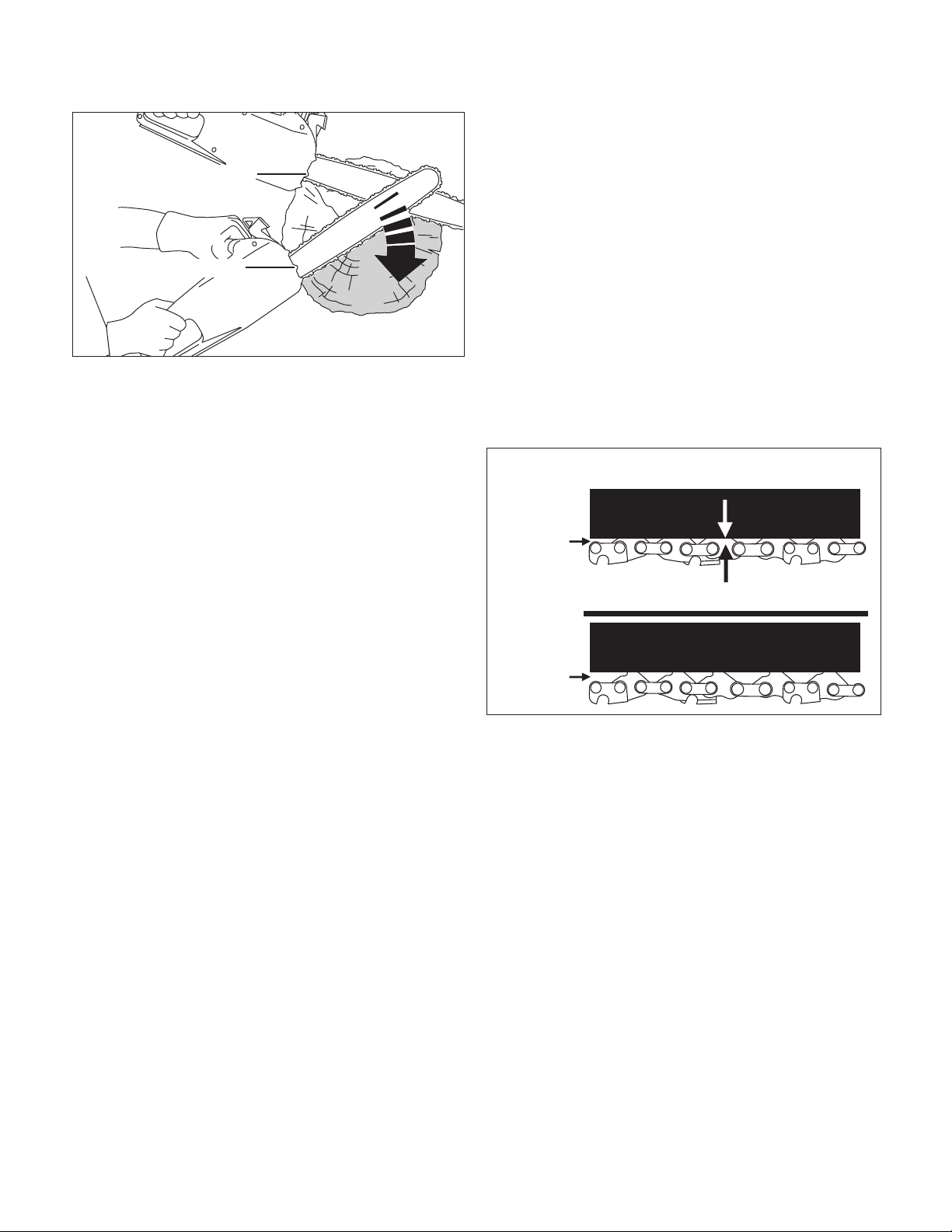
• It is easier to saw a log using the spiked bumper
(Fig. 28D).
– Dig the spiked bumper into the log and use it as a
pivot. Cut with an arched motion to make the bar
penetrate the wood.
– Repeat several times if necessary, changing the point
where you plant the spiked bumper.
1
2
1
Fig. 27
1
Fig. 28A
1
2
Fig. 28B
1
2
Fig. 28C
20
– When bucking on a slope, always stand on the uphill
side of the log. When cutting through the log,
maintain control by releasing the cutting pressure
near the end of the cut without relaxing your grip on
the chain saw handles. Do not let the chain contact
the ground.
After completing the cut, wait for the saw chain to stop before
you move the chain saw. Always stop the motor before moving
from tree to tree.
Maintenance
Please contact an authorized Snow Joe
®
+ Sun Joe
®
dealer
or call the Snow Joe
®
+ Sun Joe
®
customer service center
at 1-866-SNOWJOE (1-866-766-9563) for all maintenance
operations not foreseen in this manual. Any operation
performed in an unauthorized service center or by unqualied
personnel will completely invalidate the warranty.
mWARNING! For your safety and that of others:
• Correct maintenance is essential to maintain the original
eciency and safety of the machine over time.
• Keep all nuts, bolts, and screws tight to be sure the
equipment is in safe working condition.
• Never use the machine with worn or damaged parts.
Damaged parts are to be replaced and never repaired.
• Only use original Snow Joe
®
+ Sun Joe
®
replacement
parts. Parts that are not of the same quality can seriously
damage the equipment, compromise safety, and invalidate
the warranty.
mWARNING! Always remove the battery before
performing any adjustments, maintenance, or repairs to your
cordless chain saw.
• Use protective gloves when handling the bar and chain.
• Keep the bar encased in its sheath, except when working
directly on the bar or the chain.
• Never dispose of oils or other polluting materials in
unauthorized places.
Motor Cooling
To avoid overheating and damage to the motor, always keep
the cooling air vents clean and free of sawdust and debris.
Chain Tension
Check the chain tension before using the saw when the chain
is cold. The correct tension of a cold chain is when there is no
slack on the underside of the guide bar; the chain is snug, but
you can rotate it by hand without binding.
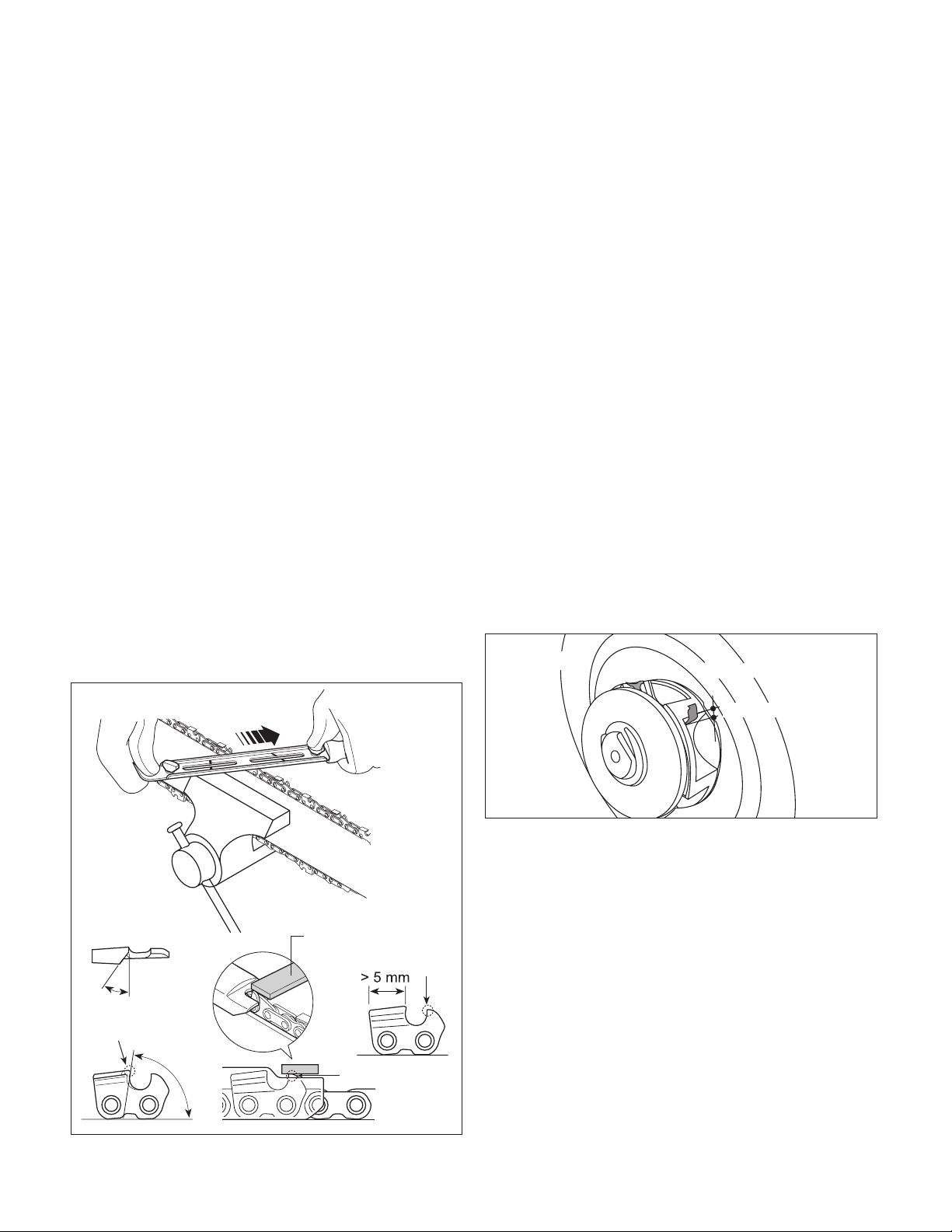
During normal saw operation, the temperature of the chain will
increase. The drive links of a correctly tensioned warm chain
will hang approximately 0.050 in. (1.25 mm) out of the bar
groove (Fig. 29). Be aware that a chain tensioned while warm,
may be too tight upon cooling. Check the “cold tension”
before next use. The chain must be re-tensioned whenever the
ats on the drive links hang out of the bar groove (Fig. 29).
NOTE: A new chain tends to stretch. Check the chain tension
frequently and re-tension as needed.
Chain Sharpening
mWARNING! To ensure that the saw works safely and
eciently, it is essential that the cutting components are
well-sharpened. It is highly recommended to replace the
chain once it loses its ability to cut cleanly and safely.
It is possible, however, to sharpen the existing chain if the
sharpening is carefully performed. Any work on the chain and
bar requires specic experience and special tools. For safety
purposes, we recommend you contact an authorized
Snow Joe
®
+ Sun Joe
®
dealer or call the Snow Joe
®
+
Sun Joe
®
customer service center at 1-866-SNOWJOE
(1-866-766-9563).
Sharpening is necessary when:
• The sawdust looks like dust;
• Cutting becomes more dicult;
• The cut is not straight;
• Vibrations increase.
Fig. 28D
Spiked bumper
Spiked bumper
Fig. 29
Properly Adjusted Warm Chain
Approximately .050 in. (1.25 mm)
Flats are
visible here
Flats are not
visible here
Chain Needs Tensioning
21
An authorized service center will sharpen the chain using the
right tools to ensure minimum removal of material and even
sharpness on all the cutting edges.
If you sharpen the chain yourself, use special round-section
les with the right diameter depending on the type of chain (see
“Chain Maintenance Table” pg. 24). You need a certain amount
of skill and experience to avoid damaging the cutting edges.
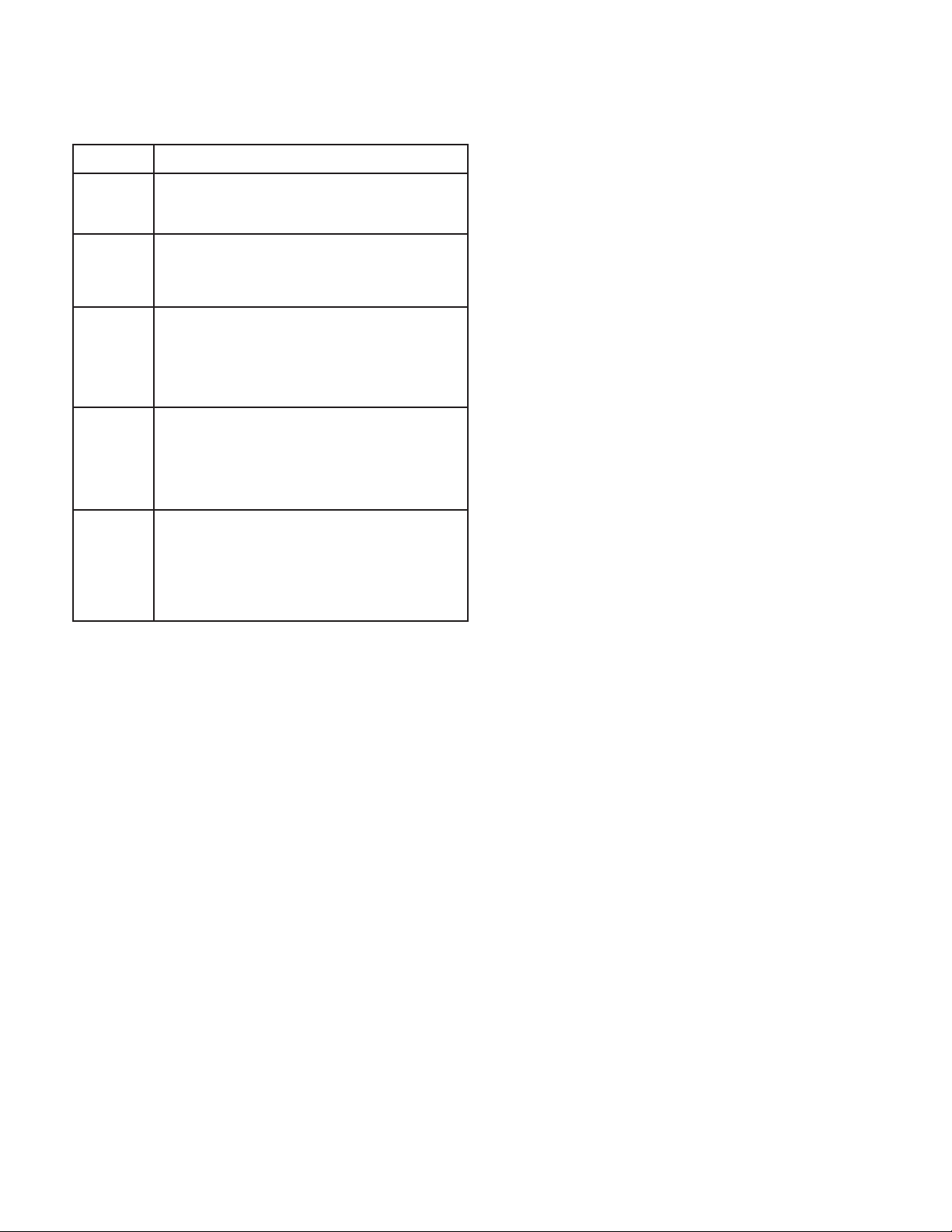
Sharpen the chain as follows (Fig. 30):
• Secure the bar rmly, with the chain mounted, in a
suitable vise.
• Tighten the chain if it is loose.
• Mount the le in the guide and then insert it in the tooth at
a constant angle from the cutting edge.
• Sharpen in a forward motion a few times and repeat this
on all the cutting edges facing the same way (right or left).
• To move the chain forward, use a screwdriver.
• Turn the bar over in the vise and repeat on all the other
cutting edges.
• Check that the depth limiter tooth does not stick out
farther than the inspection tool and le any projecting
parts with a at le, rounding o the edges (Fig. 30).
• After sharpening, remove all traces of ling and dust
and lubricate the chain in an oil bath. Replace the
chain whenever:
– The length of the cutting edges decreases to 5 mm
or less;
– There is too much play between the links and the rivets.
Guide Bar Maintenance
When the guide bar shows signs of wear, turn it over on the
saw to distribute the wear for maximum bar life. Feathering or
burring of the bar rails is a normal process of bar wear. You
should smooth such faults with a le as soon as they occur.
Replace a bar with any of the following faults:
• wear inside the bar rails permitting the chain to
lay over sideways
• bent guide bar
• cracked or broken rails
• spread rails
Turn the saw over, check the underside of the guide bar, and
make sure that the lubrication holes and chain groove are free
from impurities.
You can purchase replacement parts for your Sun Joe
®
iON100V-18CS-CT-RM cordless chain saw by ordering online
at snowjoe.com or, to order by phone, contact Snow Joe
®
+
Sun Joe
®
customer service at 1-866-SNOWJOE
(1-866-766-9563).
Chain Sprocket
Regularly check the condition of the sprocket and replace it
when wear exceeds 0.5 mm (Fig. 31).
Do not mount a new chain with a worn sprocket or vice-versa.
Troubleshooting
Troubleshooting Tips
Most diculties are easy to x. Consult the troubleshooting
table for common problems and their solutions. If you continue
to experience problems or need repairs beyond these minor
adjustments, please call 1-866-SNOWJOE (1-866-766-9563)
for assistance.
mWARNING! Always remove the battery before
performing any adjustments, maintenance, or repairs to your
cordless chain saw.
Fig. 30
Inspection tool
Depth limiter tooth
Cutting edge
Depth
limiter
tooth
< 0.5 mm
Fig. 31
22
Troubleshooting Table
Daily Checklist, Cleaning
and Storage
Daily Checklist
To help maintain your cordless chain saw for optimum
performance, we recommend you complete this checklist prior
to each work session.
mWARNING! Do not insert the battery until you have
completed all of the daily checks.
• Inspect for any visible damage to the chain, guide bar, or
motor housing.
• Inspect the oil port and guide bar rails and clean them to
remove any debris.
• Check the chain tension.
• Check the chain teeth for sharpness.
• Check the bar and chain oil level; ll with only new chain
oil specically formulated for chain saws.
NOTE: If you notice anything unusual, such as a vibration or
odd sound, shut the saw OFF immediately. Remove the battery
and check the saw for any damage.
If you cannot nd the cause of the problem or are uncertain
what to do, then have the saw inspected by an authorized
Snow Joe
®
+ Sun Joe
®
dealer or call the Snow Joe
®
+
Sun Joe
®
customer service center at 1-866-SNOWJOE
(1-866-766-9563) before using it.
mCAUTION!
• Remove the battery and wait at least ve minutes for the
saw to cool before servicing or storing your unit.
• If you drop the saw, carefully inspect it for damage. If the
guide bar is bent, the housing is cracked, the handle is
broken, or if you see any other condition that may aect
the saw’s operation, DO NOT USE the tool. Instead, have
it serviced at an authorized Snow Joe
®
+ Sun Joe
®
dealer or call the Snow Joe
®
+ Sun Joe
®
customer service
center at 1-866-SNOWJOE (1-866-766-9563).
Cleaning
Use only mild soap and a damp cloth to clean the cordless
chain saw. Never let any liquid get inside the motor housing
and NEVER immerse any part of the saw housing in liquid.
Storage
• Ensure that the guide bar cover is in place when storing.
• Do not store cordless chain saw near chemicals, such
as fertilizers or other harsh solvents. Do not expose
the plastic parts of the unit to brake uids, gasoline,
petroleum-based products, penetrating oils, or the like.
These products are often highly corrosive and may cause
permanent damage, weaken, or destroy the plastic parts
of your unit.
• When not in use, your machine should be stored
indoors in a dry and high or locked-up place, out of
the reach of children.
Battery Caution + Disposal
Always dispose of your battery pack according to federal,
state, and local regulations. Contact a recycling agency in your
area for recycling locations.
mCAUTION! Even discharged battery packs contain
some energy. Before disposing, use electrical tape to cover
the terminals to prevent the battery pack from shorting, which
could cause a re or explosion.
mWARNING! To reduce the risk of injury or explosion,
never burn or incinerate a battery pack even if it is damaged,
dead, or completely discharged. When burned, toxic fumes
and materials are emitted into the surrounding atmosphere.
1. Batteries vary according to device. Consult your manual
for specic information.
2. Install only new batteries of the same type in your product
(where applicable).
3. Failure to insert batteries in the correct polarity, as
indicated in the battery compartment or manual, may
shorten the life of the batteries or cause batteries to leak.
Problems Corrective Action
The saw
motor fails
to start
• Make sure that the battery is inserted correctly
• Check charge status and recharge the battery
• The chain is too tight; re-tension.
• The chain tension is too tight; re-tension.
• The chain oil tank is empty; rell.
• The lubrication holes are plugged; clean them out.
• The chain tension is too tight; re-tension.
• The guide bar or chain is damaged; inspect
and replace the damaged part.
The saw
runs, but
the chain
speed is
low
Bar and
chain
running
hot and
smoking
The saw
motor
runs, but
the chain
is not
turning
The saw
stops during
operation
• Make sure that the battery is inserted correctly
• Check charge status and recharge the battery
23
4. Do not mix old and new batteries.
5. Do not mix Alkaline, Standard (Carbon-Zinc), or
Rechargeable (Nickel Cadmium, Nickel Metal Hydride, or
Lithium-Ion) batteries.
6. Do not dispose of batteries in re.
7. Batteries should be recycled or disposed of as per state
and local guidelines.
Service and Support
If your Sun Joe
®
iON100V-18CS-CT-RM cordless chain saw
requires service or maintenance, please call 1-866-SNOWJOE
(1-866-766-9563) for assistance.
Model and Serial Numbers
When contacting the company, reordering parts, or arranging
service from an authorized dealer, you will need to provide the
model and serial numbers, which can be found on the decal
located on the housing of the unit. Copy these numbers into
the space provided below.
Record the following numbers from the housing or handle of your
new product:
Model #:
Serial #:
i O N 1 0 0 V - 1 8 C S - C T - R M
24
Optional Accessories
mWARNING! ALWAYS use only authorized Snow Joe
®
+ Sun Joe
®
replacement parts and accessories. NEVER use
replacement parts or accessories that are not intended for use with this saw. Contact Snow Joe
®
+ Sun Joe
®
if you are unsure
whether it is safe to use a particular replacement part or accessory with your saw. The use of any other attachment or accessory
can be dangerous and could cause injury or mechanical damage.
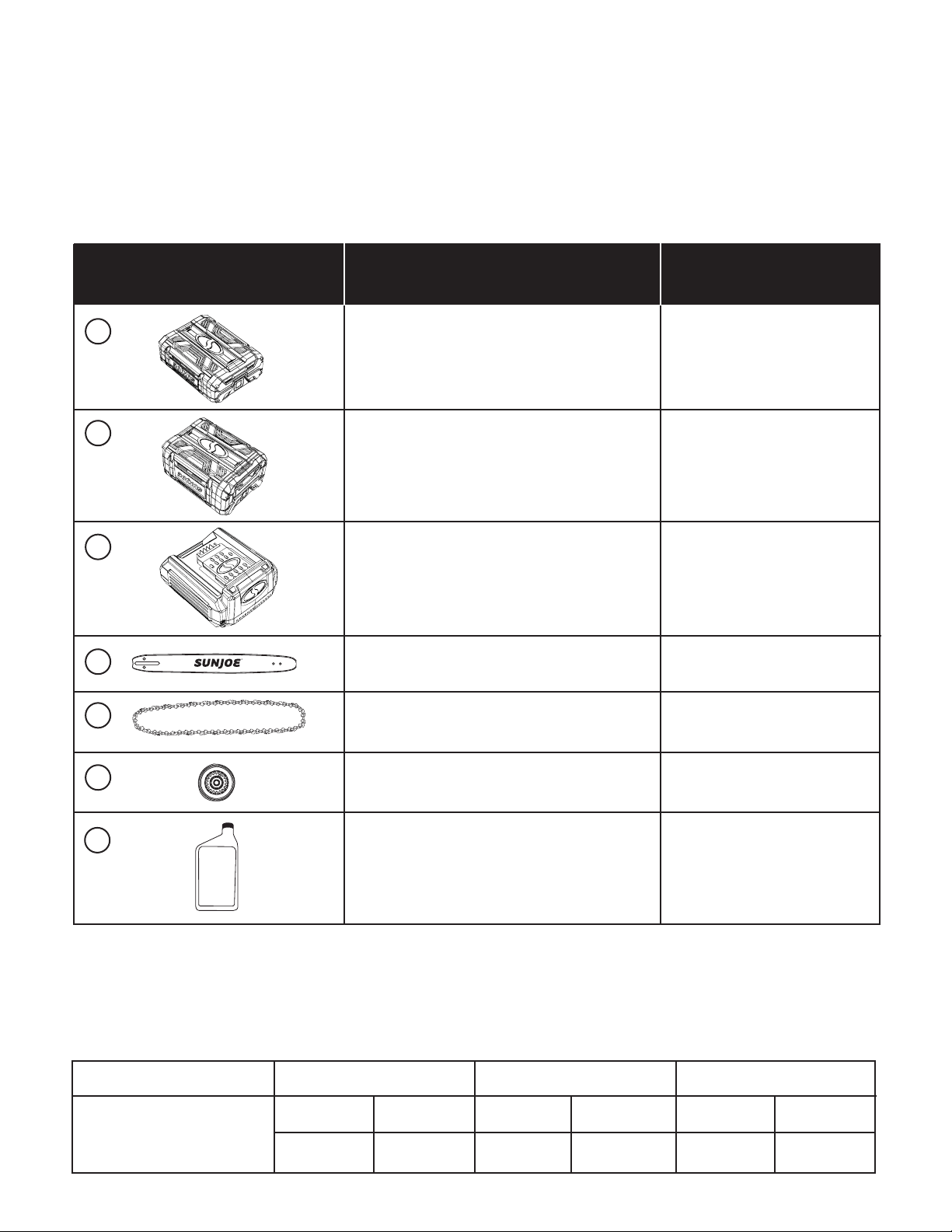
ModelAccessories Item
1
2
3
4
iON100V-2.5AMP
iON100V-5AMP
100 V Battery Quick Charger iON100V-RCH
100 V 2.5 Ah Lithium-Ion Battery
Battery Charge Time Max: 50 min
Battery Runtime Max: 35 min
100 V 5 Ah Lithium-Ion Battery
Battery Charge Time Max: 100 min
Battery Runtime Max: 70 min
5
6
Sun Joe
®
18-inch replacement bar SWJ-18BAR
Sun Joe
®
18-inch replacement chain SWJ-18CHAIN
Bar and chain oil
SWJ-OIL
Sold online at snowjoe.com or
you can purchase equivalent
bar and chain oil at your local
hardware store
R
Sun Joe
®
replacement chain tensioner iON100V-18BARATCH
7
NOTE: Accessories are subject to change without any obligation on the part of Snow Joe
®
+ Sun Joe
®
to provide notice of such
changes. Accessories can be ordered online at snowjoe.com or via phone by contacting the Snow Joe
®
+ Sun Joe
®
customer
service center at 1-866-SNOWJOE (1-866-766-9563).
Chain Maintenance Table
91
3/8
inches mm
Drive Links Chain Pitch Chain Gauge
File Diameter
inches
mm inches mm
9.5 0.050 1.3 4.80.189

25
NOTES

26
NOTES

27
SNOW JOE
®
+ SUN JOE
®
REFURBISHED GOODS WARRANTY
GENERAL CONDITIONS:
Snow Joe
®
+ Sun Joe
®
operating under Snow Joe
®
, LLC warrants
this refurbished product to the original purchaser for 90 days
against defects in material or workmanship when used for normal
residential purposes. If a replacement part or product is needed,
it will be sent free of charge to the original purchaser except as
noted below.
The duration of this warranty applies only if the product is put to
personal use around the household. It is the owner’s responsibility
to correctly perform all maintenance and minor adjustments
explained in the owner’s manual.
HOW TO OBTAIN YOUR REPLACEMENT PART OR PRODUCT:
To obtain a replacement part or product, please visit
snowjoe.com/help or email us at [email protected] for
instructions. Please be sure to register your unit beforehand
to speed up this process. Certain products may require a serial
number, typically found on the decal afxed to the housing
or guard of your product. All products require a valid proof
of purchase.
EXCLUSIONS:
• Wearing parts like belts, augers, chains and tines are
not covered under this warranty. Wearing parts can be
purchased at snowjoe.com or by calling 1-866-SNOWJOE
(1-866-766-9563).
• Batteries are covered in full for 90-days from the date of
purchase.
Snow Joe
®
+ Sun Joe
®
may from time to time change the design of
its products. Nothing contained in this warranty shall be construed
as obligating Snow Joe
®
+ Sun Joe
®
to incorporate such design
changes into previously manufactured products, nor shall such
changes be construed as an admission that previous designs
were defective.
This warranty is intended to cover product defects only.
Snow Joe
®
, LLC is not liable for indirect, incidental or
consequential damages in connection with the use or misuse of
the Snow Joe
®
+ Sun Joe
®
products covered by this warranty.
This warranty does not cover any cost or expense incurred
by the purchaser in providing substitute equipment or service
during reasonable periods of malfunction or non-use of this product
while waiting for a replacement part or unit under this warranty.
Some states do not allow exclusions of incidental or consequential
damages so the above exclusions may not apply in all states. This
warranty may give you specic legal rights in your state.
HOW TO REACH US:
We’re here to help Monday through Friday from 9AM to 7PM EST
and Saturday and Sunday 9AM to 4PM. You can reach us at
1-866-SNOWJOE (1 866-766-9563), online at snowjoe/com, via
email at [email protected] or tweet us @snowjoe.
EXPORTS:
Customers who have purchased Snow Joe
®
+ Sun Joe
®
products exported from the United States and Canada should
contact their Snow Joe
®
+ Sun Joe
®
distributor (dealer) to obtain
information applicable to your country, province or state. If for
any reason, you are not satised with the distributor’s service,
or if you have difculty obtaining warranty information, contact
your Snow Joe
®
+ Sun Joe
®
seller. If in the event your efforts are
unsatisfactory, please reach out to us directly.

sunjoe.com