
EN
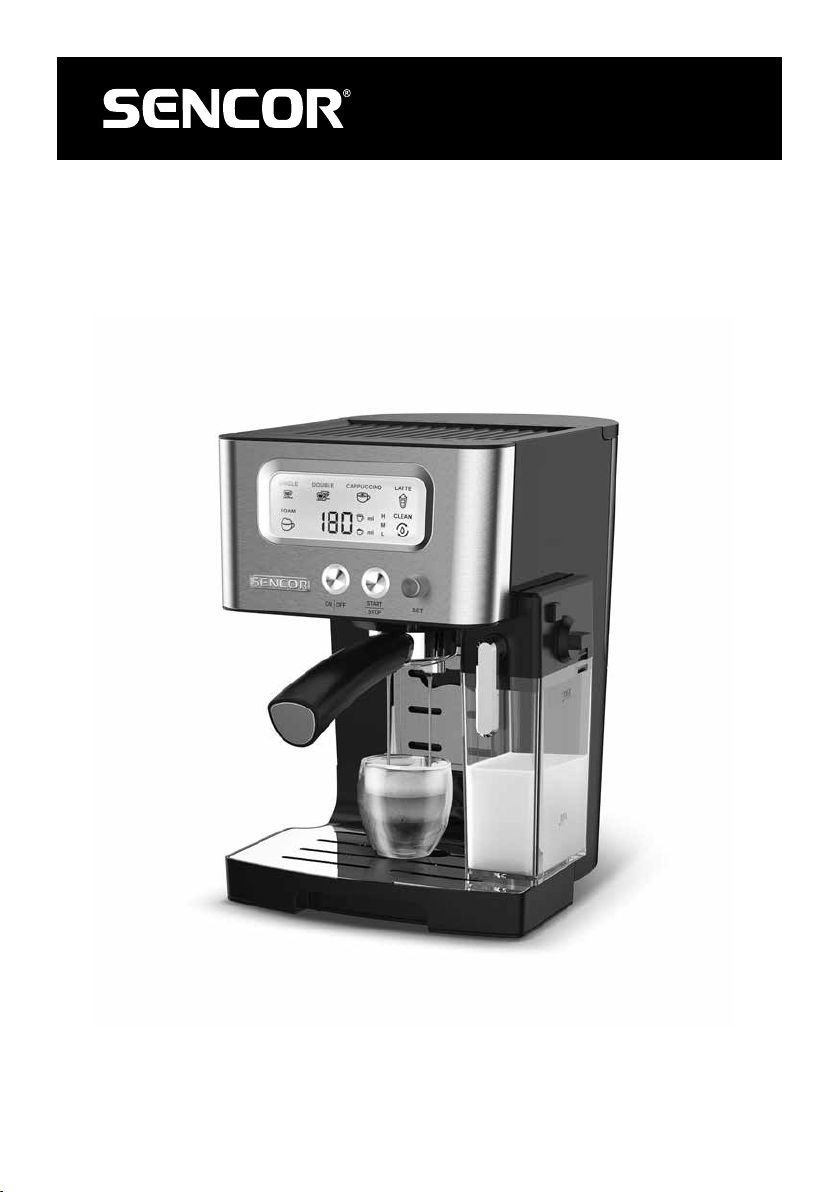
SEMI-AUTOMATIC
ESPRESSO MACHINE
Translation of the original manual
SES 4090SS
SES 4090SS
A
MAX
MIN
ON/OFF
SET
START
STOP
SINGLE DOUBLE CAPPUCCINO LATEE
ml
CLEAN
ml
H
M
L
FOAM
888
1
2
3
6
7
8
15
16
17
14
13
12
11
10
9
5
4
18
19
20
B
ON/OFF
START
SET
STOP
SINGLE DOUBLECAPPUCCINOLATEE
ml
CLEAN
ml
H
M
L
FOAM
888
2
1
34
- 1 -
01/2023
2023, .
EN Semi-automatic espresso machine
Important safety instructions
READ CAREFULLY AND STORE FOR FUTURE USE.
• This appliance may be used by children 8 years of
age and older and by persons with physical or mental
impairments or by inexperienced persons, if they are
properly supervised or have been informed about how
to use the product in asafe manner and understand the
potential dangers.
• Children must not play with the appliance.
• Cleaning and maintenance performed by the user must
not be performed by unsupervised children.
• In the event that the power cord is damaged, have it
repaired at aprofessional service centre to prevent causing
adangerous situation. It is forbidden to use the appliance if
it has adamaged power cord.
• This appliance may not be used by children. Keep the
appliance and its power cord away from children.
• This appliance is intended for home use. It is not intended
for use in locations such as:
– kitchens in stores; offices and other workplaces;
– in agriculture;
– guests of hotels, motels and other accommodation
locations;
– in bed and breakfast establishments.
- 2 -
01/2023
2023, .
• Do not submerge the power plug, the power cord or the
appliance in water or in any other liquid.
WARNING
The hopper must not be opened during use.
WARNING
Do not spill anything on the power plug.
• Always clean the parts of the appliance that come into
contact with food using warm water with asmall amount
of neutral dishwashing detergent, then rinse with clean
water and wipe dry.
WARNING
Incorrect use may result in arisk of possible injury.
• The exterior surface of the appliance heats up during use
and may remain hot for acertain time afterwards. Be very
careful.
• Do not use any other accessories than those supplied with
the appliance. Otherwise, there exists arisk of damage to
the appliance or serious injury.
• Always disconnect the appliance from the power
supply when leaving it without supervision and before
assembling, disassembling, moving or cleaning it.
• The appliance must not be located inside acabinet when it
is used.
- 3 -
01/2023
2023, .
• Before connecting the appliance to apower socket, check that the rated voltage on its rating label matches the electrical voltage in the power
socket.
• Connect the appliance only to aproperly grounded socket. For safety reasons, we do not recommend using multi-socket adapters or extension
cords.
• Do not place the appliance on window sills, kitchen sink drainboards or unstable surfaces. Always place it on astable, even and dry surface.
• Do not place the appliance on or near an electrical or gas stove, or in the vicinity of an open flame.
• Never use the appliance in the near vicinity of abath, shower or swimming pool.
• Use the appliance only for the purposes for which it was designed.
• Only use the appliance with the original accessories that came with it.
• To ensure sufficient air circulation, free space of at least 15 cm must be maintained around and above the appliance when it is running.
• Only use the top surface of the appliance for warming cups. Do not use it as astorage rack.
• Fill the water tank with clean cold water. Do not pour hot water or other liquids into it or place any items inside it.
• Before turning on the appliance, check that:
– the drip tray together with the grate is installed in position;
– the water tank is filled with asufficient amount of water and is properly installed in position. The water level must not exceed the maximum mark.
• Before you begin brewing coffee, check that the portafilter is properly attached to the brew head. Pressure is created in the portafilter during the
coffee steaming process, so do not move it while it is running. Otherwise, this could result in adangerous situation.
• When operating the appliance, be especially careful to avoid scalding by boiling water or steam.
• Regularly inspect the water level in the water tank when using the appliance. When the water level falls below the minimum water level mark, add
water. Before adding water, first turn the appliance off and disconnect it from the power socket.
• To protect the pump from damage, the appliance is equipped with abuilt-in thermal fuse that will disengage it when it runs empty. In the event that
such asituation occurs, disconnect the power cord from the power socket and allow the appliance to cool down for at least 30 minutes. Then you
may continue using it.
• Always turn off the appliance and disconnect it from the power socket when not using it, when leaving it without supervision, before disassembling
or assembling it, before filling up the water tank, and before moving or cleaning it. Allow the appliance to cool down before cleaning or moving it. Do
not move the appliance with acoffee cup located on the drip tray grate or with cups located on the cup warming surface.
• Keep the appliance and its accessories in clean condition. Clean and maintain it according to the instructions in chapter Cleaning and maintenance.
Never wash the appliance under running water or submerge it in water or another liquid.
• Make sure that the power cord does not come into contact with ahot surface and prevent the power plug from coming into contact with water.
• Disconnect the appliance from the power socket by pulling on the plug, never pulling on the power cord. Otherwise, this could damage the power
cord or the socket.
• To avoid the danger of injury by electrical shock, do not repair the appliance yourself or make any adjustments to it. Have all repairs or adjustments
performed at an authorised service centre. By tampering with the appliance, you risk voiding your legal rights arising from unsatisfactory
performance or quality warranty.
- 4 -
01/2023
2023, .
• Thank you for purchasing aSENCOR brand product and we hope that
you will be happy with it.
• Prior to using this appliance, please read the user'smanual
thoroughly, even in cases, when one has already familiarised
themselves with previous use of similar types of appliances. Only use
the appliance in the manner described in this user’smanual. Keep
this user'smanual in asafe place where it can be easily retrieved for
future use.
• We recommend saving the original cardboard box, packaging
material, purchase receipt and responsibility statement of the vendor
or warranty card for at least the duration of the legal liability for
unsatisfactory performance or quality. In the event of transportation,
we recommend that you pack the appliance in the original box from
the manufacturer.
. . . . . . . . . . . . . . . . . . . . . . . . . . . . . . . . . . . . . . . . . . . . . . . . . . . . . . . . . . . . . . . . . . . .
DESCRIPTION OF THE ESPRESSO MACHINE
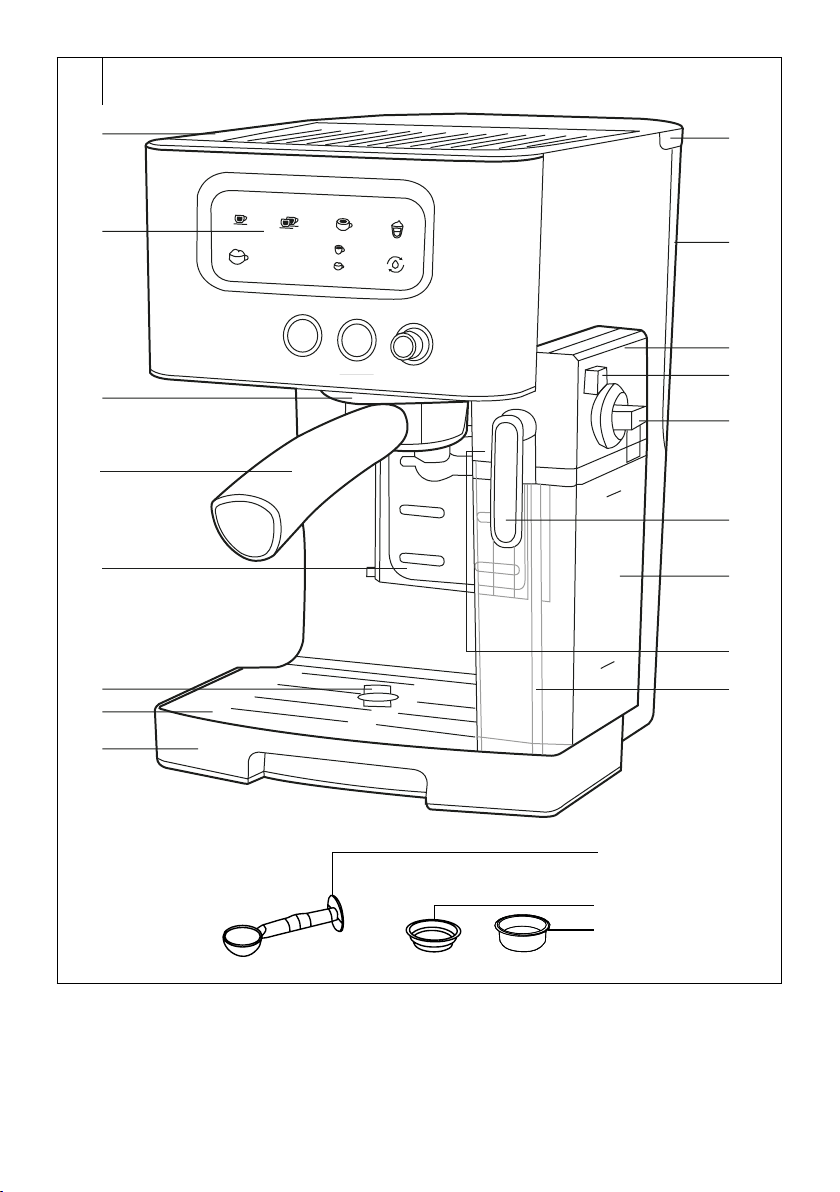
A1 Cup warming surface
A2 Control panel with display
A3 Brew head
A4 Portafilter with coffee spout
A5 Folding tray
A6 Full drip tray indicator
A7 Removable drip tray grate
A8 Removable drip tray
A9 Water tank lid
A10 1.4-litre removable water tank
with handle
A11 Milk tank lid with control
elements
A12 Milk tank removal button
A13 Milk frothing setting knob
A14 Milk nozzle lever
A15 Milk tank
A16 Milk nozzle (located on the
inner side of the milk tank)
A17 Milk hose
A18 Coffee measuring cup with
tamper
A19 Stainless steel strainer for
brewing 1 cup
A20 Stainless steel strainer for
brewing 2 cups
. . . . . . . . . . . . . . . . . . . . . . . . . . . . . . . . . . . . . . . . . . . . . . . . . . . . . . . . . . . . . . . . . . . .
DESCRIPTION OF THE CONTROL PANEL AND BUTTONS
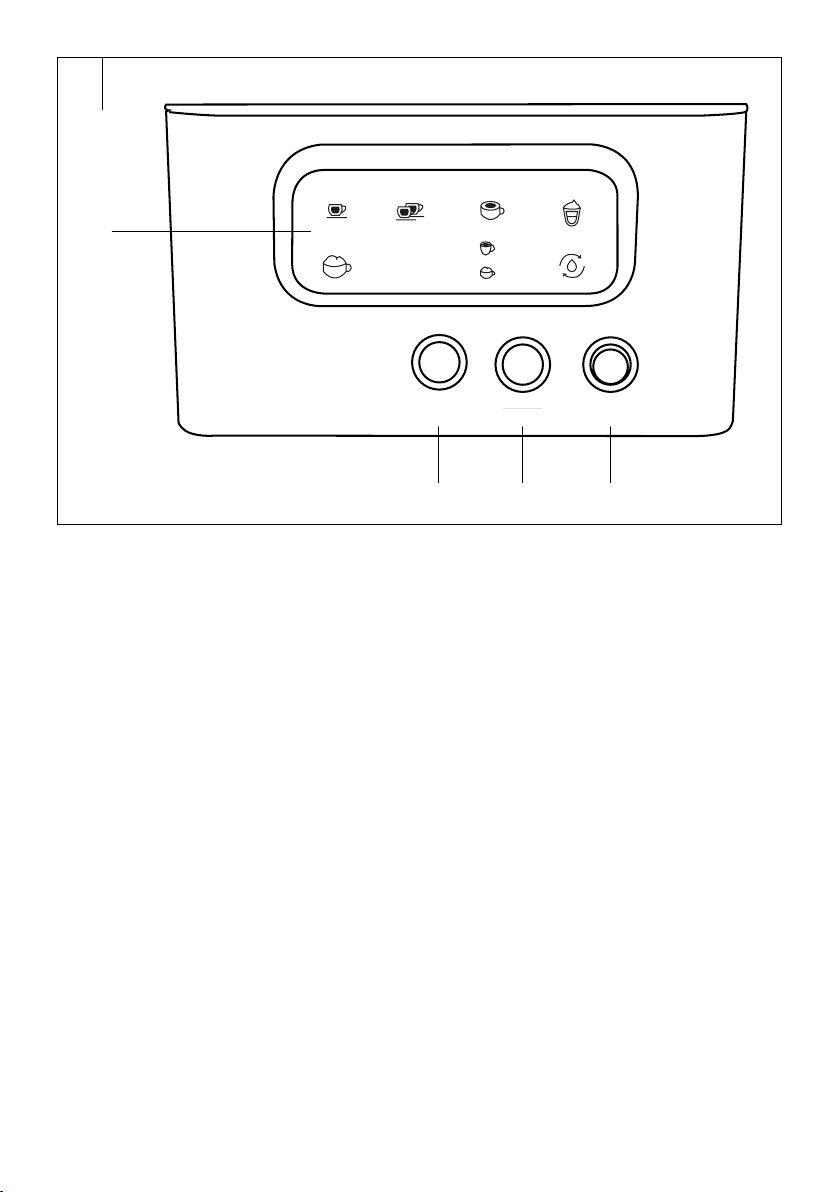
B1 Display
B2 ON/OFF button – turn the
espresso machine on/off
B3 START/STOP button – start
the espresso machine
B4 Combination control button/
knob
SET button – confirm setting
Control knob – select coffee/
setting
Before first use
• Remove all packaging materials from the espresso machine and
remove any protective film, promotional tags or labels.
• Place the appliance on an even, dry and clean surface. Ensure that
there is free space around the espresso machine of at least 35 cm
above it and 15 cm around its sides. Wipe the outer surface of the
appliance with alightly dampened sponge and then wipe it dry.
• Remove the water tank and milk tank from the appliance. Rinse it
out using clean water with the addition of asmall amount of neutral
kitchen detergent. Then thoroughly rinse them out using clean water,
dry them and put them back in their place. Wipe the water tank lid
with aclean soft sponge lightly dampened in warm water.
• Take out the removable drip tray with grate, wipe with adampened
textile, wipe dry and and insert it back into the bottom part of the
appliance.
• Wash the portafilter, coffee measuring cup and the stainless steel
strainers under clean running water with an addition of kitchen
detergent. Then rinse with clean water and wipe dry.
Rinsing out the espresso machine
1. Insert the milk tank into the espresso machine. Correct insertion is
indicated by aclick.
2. Fill the water tank with clean, cold, drinking water. Do not fill the water
tank with hot or warm water or any other liquid.
3. Place acup underneath the brew head.
4. Insert the power plug into apower socket. Press the ON/OFF button.
The display will be lit. The display and all the buttons will flash
intermittently.
5. Press the START/STOP button. The pump will start and asmall amount
of water will flow through the brew head. During this time, the display
and all the buttons will flash intermittently.
6. As soon as the pump stops pumping water, the appliance will beep
twice and the ON/OFF button will start flashing, which means that the
espresso machine is heating up.
Note:
The flush out process of the espresso machine always runs
when it is turned on for the first time or when it is reset to
the factory settings.
Note:
Each time the SET knob is turned when selecting
afunction, abeep is made and the icon of the respective
function flashes on the display.
. . . . . . . . . . . . . . . . . . . . . . . . . . . . . . . . . . . . . . . . . . . . . . . . . . . . . . . . . . . . . . . . . . . .
OPERATING THE ESPRESSO MACHINE
Inserting the drip tray
• The drip tray with grate catches drops of brewed coffee when the
portafilter is removed, or hot water is released from the milk frothing
boiler, it also prevents coffee from burning and also catches any milk
spilt during the frothing process. Therefore, make sure that both parts
are correctly installed and inserted in the appliance.
• Insert or remove the drip tray and grate only when the milk tank is
not installed.
• We recommend to empty out and wash the drip tray after every
use. When cleaning, follow the instructions in chapter Cleaning and
maintenance.
Note:
The drip tray has afull level indicator. This comprises of
afloat switch. As soon as the level of the liquid in the drip
tray pushes it up, it is necessary to empty out the drip tray.
Filling the water tank
• Open the water tank lid. Grasp the tank by the handle and pull it
upwards to remove it. Fill it up with cold drinking water up to the
maximum level mark, insert it back in and tilt the handle down into the
tank. Then, close the water tank lid. The water tank must be securely
seated in place in order for water to be pumped out of it into the boiler.
Note:
The water that you pour into the water tank should ideally
be at room temperature (approximately 25 °C). Water that
is too cold, could negatively affect the final taste of the
coffee beverage. Do not leave any remaining water in the
water tank for longer than one day. For brewing quality
fresh coffee, it is necessary to use fresh water. Otherwise,
the resulting flavour of the coffee beverage may be
negatively affected.
Attention:
The water tank has amaximum capacity of 1.4 litres.
Do not overfill it. Never fill the water tank with warm
water, hot water or sparkling water, or liquids such as
milk, etc. Do not fill the water tank when it is inserted
in the appliance. There is adanger of splashing the
appliance or overfilling the water tank.
Filling the milk tank
• To remove the milk tank, hold down the removal button on the lid and
pull the milk tank away from the appliance.
EN
Semi-automatic espresso machine
User'smanual
- 5 -
01/2023
2023, .
• In order to open and remove the lid, push and hold down the button on
the side of the lid and tilt open the lid from the milk tank.
• Pour fresh, cold milk into the milk tank no higher than the MAX mark.
Always fill to between the maximum and minimum level marks.
• The lid can only be put on in one way. Seat the side of the lid with the
milk nozzle on to the side of the tank with the cut-out for the nozzle
and tilt down the lid. Correct placement is indicated by aclick. Check
that the lid is not moving and does not extend past the edge of the
tank .
• Insert the milk tank with the attached lid into the appliance from the
side until you hear aclick. Check that the milk tank with lid is correctly
inserted and is not moving in any way.
Note:
In the event that you do not use up all the milk, it is
necessary to pour it out of the tank into asuitable container
and to store it in arefrigerator. Then thoroughly clean the
milk tank according to the instructions in chapter "Cleaning
and maintenance".
Inserting and removing the strainer
• Insert the selected strainer into the portafilter and push it in firmly.
• To remove the strainer from the portafilter, use your nail or athin object
(e.g. table knife) inserted between the edge of the filter and the edge
of the portafilter.
Filling the strainer and tamping down the coffee
• Place the portafilter on to an even surface and pour the corresponding
amount of ground coffee into the strainer. The one-cup coffee strainer
is filled with asingle level measuring cup of coffee. The two-cup coffee
strainer is filled with double the amount of coffee. One level measuring
cup is equivalent to approx. 7 g of ground coffee. Spread the coffee out
evenly inside the strainer and gently tamp it down with the flat end of
the measuring cup.
• Thoroughly clean all remains of ground coffee from the edge of the
strainer.
Note:
Only use ground coffee intended for use in espresso
machines.
Do not use ground coffee intended for use in aFrench
press, percolator, etc.
Inserting and removing the portafilter
• Insert the portafilter underneath the brew head so that the handle
points to the left and is aligned with the
symbol on the brew
head. To fasten the portafilter to the brew head, turn the handle to the
right to the position marked with the
symbol.
• To remove the portafilter from the brew head, turn the handle to the
left to the
symbol. Remove it from the brew head and move it
above arubbish bin. Turn the portafilter so that the strainer with the
spent coffee points downwards. Use ateaspoon to remove the coffee
grounds. Avoid coming into contact with the surface of the strainer or
portafilter as they may still be hot. Prior to removing the strainer from
the portafilter, cool it down under cold running water. Then rinse the
strainer and the portafilter under clean running water and dry them
thoroughly.
Warming the cups
• As soon as the appliance is turned on using the ON/OFF button, the
cup warming surface will automatically start to heat up. Place empty
coffee cups upside down on to surface and allow them to warm up.
Preheating the espresso machine
1. Check that the espresso machine is correctly assembled.
2. Press button the ON/OFF button to turn on the espresso machine.
3. The ON/OFF button will start flashing and the espresso machine
will heat up.
4. When the ON/OFF button lights up, two beeps will be made and the
espresso machine is ready for use. The espresso machine will stop
heating. The SINGLE icon will start flashing on the display. Now you
can use the SET control knob to select your favourite beverage.
Note:
The espresso machine will automatically turn off after
30minutes of inactivity. This is normal.
. . . . . . . . . . . . . . . . . . . . . . . . . . . . . . . . . . . . . . . . . . . . . . . . . . . . . . . . . . . . . . . . . . . .
BREWING COFFEE
• The appliance is supplied with 2 stainless steel strainers: astrainer for
brewing 1 cup of coffee and astrainer for brewing 2 cups of coffee.
• The strainer for brewing 1 cup is suitable for brewing 1 espresso,
astandard cappuccino or latté macchiato.
• The two-cup strainer is suitable for brewing adouble espresso, two
espressos, astrong cappuccino or latté macchiato "SINGLE" or
"DOUBLE" will start flashing on the display.
Brewing an espresso
1. Place the one-cup or two-cup strainer into the portafilter, tamp down
the coffee and insert the portafilter into the brew head.
2. Turn on the espresso machine by pressing the ON/OFF button and
allow it to preheat.
3. Place acup or mug underneath the portafilter.
4. Turn the control knob and select "SINGLE" (to brew 1 cup) or
"DOUBLE" (to brew 2 cups). "SINGLE" or "DOUBLE" will start
flashing on the display.
5. Press the START/STOP button and the espresso machine will start.
The START/STOP button will be lit.
6. First, the coffee is steamed, aprocess where the espresso machine
releases asmall amount of coffee into the strainer to allow the
ground coffee to swell in the strainer. After afew moments, the full
coffee extraction process will commence.
7. About 40 ml of coffee (when 1 cup is brewed) or about 80ml (when
2 cups are brewed) will flow into the cup/mug.
8. The dispensing of the coffee will stop automatically. One beep will
be made and the START/STOP button will turn off. The espresso
machine will switch to the stand-by mode.
9. Remove the portafilter from the brew head and clean it out according
to the instructions in the section "Cleaning and maintenance". We
recommend waiting approx. 5 seconds before taking the portafilter
out of the brew head. Pressure will be released naturally, which will
make the removal of the portafilter easier.
10. If you need to stop the dispensing of the coffee sooner, press the
START/STOP button again.
Note:
When brewing coffee into very small cups, tilt out the tray
and place the cup on it. In this way you will prevent coffee
from splashing as aresult of flowing from alarge height into
the cup. When you have finished using the tray, tilt it back
towards the espresso machine.
Brewing cappuccino
1. Fill the milk tank with cold, fresh milk according to the instructions in
section "Filling the milk tank".
2. Place the one-cup strainer into the portafilter, tamp down the coffee
and insert the portafilter into the brew head.
3. Turn on the espresso machine by pressing the ON/OFF button and
allow it to preheat.
4. Place acappuccino cup underneath the portafilter.
5. Turn the lever on the side of the milk tank and slide out the milk
nozzle. Ensure that it is pointing into the cup.
6. Turn the control knob to select "CAPPUCCINO". "CAPPUCCINO" will
start flashing on the display.
7. Press the START/STOP button and the espresso machine will start.
The START/STOP button will be lit.
8. First, the milk will be heated up and frothed, and it will flow out of
the nozzle into the cup. The display will show the default amount of
frothed milk. Turn the knob on the lid of the milk tank to determine
the amount of frothed milk. Turning to the right increases the amount
of frothed milk, turning to the left reduces the amount of frothed milk.
It is possible to turn the knob also during the dispensing of the hot
milk.
9. As soon as the preset amount of milk and frothed milk has flown
into the cup, the coffee extraction process will start and coffee will
start flowing into the cup. The display will show the default amount
coffee.
- 6 -
01/2023
2023, .
10. The dispensing of the coffee will stop automatically. One beep will
be made and the START/STOP button will turn off. The espresso
machine will switch to the stand-by mode.
11. Remove the portafilter from the brew head and the milk tank and
clean it out according to the instructions in the section "Cleaning and
maintenance".
12. If you need to stop the dispensing of the coffee sooner, press the
START/STOP button again.
Brewing alatté
1. Fill the milk tank with cold, fresh milk according to the instructions in
section "Filling the milk tank".
2. Place the one-cup strainer into the portafilter, tamp down the coffee
and insert the portafilter into the brew head.
3. Turn on the espresso machine by pressing the ON/OFF button and
allow it to preheat.
4. Place alatté cup/glass underneath the portafilter.
5. Turn the lever on the side of the milk tank and slide out the milk
nozzle. Ensure that it is pointing into the cup/glass.
6. Turn the control knob to select "LATTE". "LATTE" will start flashing
on the display.
7. Press the START/STOP button and the espresso machine will start.
The START/STOP button will be lit.
8. First, the milk will be heated up and frothed, and it will flow out of
the nozzle into the cup. The display will show the default amount of
frothed milk. Turn the knob on the lid of the milk tank to determine
the amount of frothed milk. Turning to the right increases the amount
of frothed milk, turning to the left reduces the amount of frothed milk.
It is possible to turn the knob also during the dispensing of the hot
milk.
9. As soon as the preset amount of milk and frothed milk has flown into
the cup, the coffee extraction process will start and coffee will start
flowing out. The display will show the default amount coffee.
10. The dispensing of the coffee will stop automatically. One beep will
be made and the START/STOP button will turn off. The espresso
machine will switch to the stand-by mode.
11. Remove the portafilter from the brew head and the milk tank and
clean it out according to the instructions in the section "Cleaning and
maintenance".
12. If you need to stop the dispensing of the coffee sooner, press the
START/STOP button again.
Frothing milk
1. Fill the milk tank with cold, fresh milk according to the instructions in
section "Filling the milk tank".
2. Turn on the espresso machine by pressing the ON/OFF button and
allow it to preheat.
3. Place acup or mug underneath the portafilter.
4. Turn the lever on the side of the milk tank and slide out the milk
nozzle. Ensure that it is pointing into the cup.
5. Turn the control knob to select "FOAM". "FOAM" will start flashing on
the display.
6. Press the START/STOP button and the espresso machine will start.
The START/STOP button will be lit.
7. The milk will be heated up and frothed, and it will flow out of the
nozzle into the cup. Turn the knob on the lid of the milk tank to
determine the amount of frothed milk. Turning to the right increases
the amount of frothed milk, turning to the left reduces the amount of
frothed milk. It is possible to turn the knob also during the dispensing
of the hot milk.
8. The dispensing of the milk will stop automatically. One beep will
be made and the START/STOP button will turn off. The espresso
machine will switch to the stand-by mode.
9. Remove the milk tank and clean it out according to the instructions
in the section "Cleaning and maintenance".
10. If you need to stop the dispensing of the milk sooner, press the
START/STOP button again.
Note:Note:
Without aproperly inserted milk tank it will not be possible Without aproperly inserted milk tank it will not be possible
to brew acappuccino, latté, to froth milk or to perform to brew acappuccino, latté, to froth milk or to perform
automatic cleaning. If you turn the knob to these functions, automatic cleaning. If you turn the knob to these functions,
the display will show the error message "E02". When you the display will show the error message "E02". When you
insert the milk tank into the espresso machine, the error insert the milk tank into the espresso machine, the error
message "E02" on the display will turn off.message "E02" on the display will turn off.
. . . . . . . . . . . . . . . . . . . . . . . . . . . . . . . . . . . . . . . . . . . . . . . . . . . . . . . . . . . . . . . . . . . .
USER SETTINGS
Programming the coffee volume
1. Turn the control knob and select "SINGLE" (to brew 1 cup) or
"DOUBLE" (to brew 2 cups). "SINGLE" or "DOUBLE" will start
flashing on the display.
2. Press the SET button to enter the area for programming the amount
of coffee. The SET button will start flashing.
3. Turn the knob to determine the amount of coffee:
–For 1 cup: from 30 ml to 50 ml (40 ml is the default setting).
–For 2 cups: from 60 ml to 90 ml (80 ml is the default setting).
4. Press the START/STOP button and the coffee brewing process will
start or press the SET button to confirm and save. The SET button
will turn off. The espresso machine will switch to the stand-by mode.
5. If you select the brewing of asingle or double espresso, the espresso
machine will prepare the amount of coffee as stored in memory.
Programming the volume for brewing acappuccino/latté
1. Turn the control knob to select "CAPPUCCINO" or "LATTE".
"CAPPUCCINO" or "LATTE" will start flashing on the display.
2. Press the SET button to enter the area for programming the amount
of coffee. The SET button will start flashing.
3. Turn the knob to determine the amount of frothed milk:
–For cappuccino: from 120 ml to 180 ml (120 ml is the default
setting).
–For latté: from 210 ml to 270 ml (250 ml is the default setting).
The total default volume (coffee + milk + frothed milk) for
acappuccino is 160 ml and for alatté it is 290 ml.
4. Press the SET button to store the settings and switch to the area for
programming the amount of coffee:
–For cappuccino and latté: from 30 ml to 50 ml (40 ml is the default
setting).
5. Press the START/STOP button, the display will show the new total
volume and the cappuccino or latté brewing process will start, or
press the SET button to confirm and save. The SET button will turn
off. The espresso machine will switch to the stand-by mode.
6. If you select the brewing of acappuccino of latté, the espresso
machine will prepare the amount of coffee as stored in memory.
Programming the frothed milk volume
1. Turn the control knob to select "FOAM". "FOAM" will start flashing on
the display.
2. Press the SET button to enter the area for programming the amount
of coffee. The SET button will start flashing.
3. Turn the knob to determine the amount of frothed milk:
–from 120 ml to 200 ml (160 ml is the default setting).
4. Press the START/STOP button and the frothing process will start or
press the SET button to confirm and save. The SET button will turn
off. The espresso machine will switch to the stand-by mode.
5. When you select milk frothing the next time, the espresso machine
will prepare the amount of milk as stored in memory.
Coffee temperature setting
1. Press the ON/OFF button to turn off the espresso machine.
2. Place acontainer underneath the brew head.
3. Press and hold down the SET button for 2 seconds to enter the
coffee temperature setting.
4. Turn the control knob and set the desired temperature: H (high) – M
(medium high) – L (low). The default temperature is M (medium
high)
5. Press the SET button to complete the settings.
6. The espresso machine will save the setting and the system will be
flushed out.
7. When the ON/OFF button starts flashing, the espresso machine will
turn on and start heating up.
Restoring factory settings
• If you restore the factory settings, then all the settings that you have
made will be deleted and the default values will be restored.
1. Press the ON/OFF button to turn off the espresso machine.
2. Place acontainer underneath the brew head.
3. Press and hold down the START/STOP button for 3 seconds,
abeep will be made, the display will be lit and "000" will be shown.
4. Press the SET button.
5. All the buttons and the display will flash twice and then turn off. The
espresso machine will beep twice and then turn off.
6. The factory settings have been successfully restored.
- 7 -
01/2023
2023, .
CLEANING AND MAINTENANCE
• Disconnect the power plug from the power socket and allow the
espresso machine to cool down before cleaning it.
Warning:
For cleaning, do not use cleaning products with an
abrasive effect, solvents, etc. that could damage the
appliance. No part of this appliance is intended for
washing in adishwasher.
Warning:
To prevent the risk of injury by electrical shock, do not
submerge the appliance, power cord or power plug in
water or any another liquid.
. . . . . . . . . . . . . . . . . . . . . . . . . . . . . . . . . . . . . . . . . . . . . . . . . . . . . . . . . . . . . . . . . . . .
EVERYDAY CLEANING AND MAINTENANCE
• Timely cleaning and maintenance are very important for operating the
appliance and extending its lifetime.
• Before cleaning, turn off the espresso machine, disconnect it from the
power socket and allow it to cool down.
• After every use, it is necessary to clean:
– the used strainers and the portafilter;
– the milk tank;
– the drip tray and grate.
• It is necessary to regularly clean:
– The water tank;
Warning:
No part of the espresso machine or any of its
accessories is suitable for washing in adishwasher.
Strainers, portafilter and brew head
• After every use it is necessary to clean the strainers and the portafilter.
1. Take the portafilter out out of the brew head together with the spent
coffee. Throw the coffee grounds out into compost or into standard
communal waste. In the event that it is difficult to remove the coffee
grounds from the strainer, use acutlery knife or spoon.
2. Remove the strainer from the portafilter. You can use the other
strainer as an aid for taking out the strainer. Slide its edge into the
space between the strainer and the portafilter and by means of
adownward motion, push the strainer off the portafilter.
Warning:
Be especially careful since the coffee grounds, the
strainer and the portafilter are very hot after use.
There is adanger of aburns.
3. Rinse the strainer and the portafilter under running hot water and
wipe dry with aclean wiping cloth. Place them on the cup warming
surface so that they are preheated and ready for further use.
4. Remove ground coffee remains from the brew head using adamp
wiping cloth.
Automatic cleaning
• The milk tank and the milk frothing system need to be cleaned after
every use in order to remove any milk residues and to prevent the
formation of bacteria, moulds and unpleasant odours.
1. Fill up with water up to the maximum level mark.
2. Place abowl underneath the brew head.
3. Turn the lever on the side of the milk tank and slide out the milk
nozzle. Ensure that it is pointing into the bowl.
4. Turn the control knob to select "CLEAN". "CLEAN" will start flashing
on the display. The other icons will turn off.
5. Then press the START/STOP button. The button will be lit and
the pump will turn on intermittently and will clean the milk frothing
system for 60 seconds.
6. When the automatic cleaning process is finished, abeep will be
made and the START/STOP button will turn off. And the espresso
machine will switch to the stand-by mode.
Note:
If necessary, repeat the process.
Drip tray and grate
1. Carefully remove the drip tray from the espresso machine. Remove
the grate.
2. Empty out all the contents of the drip tray over asink.
3. Wash the drip tray and the grate using clean water and then dry
thoroughly.
Warning:
Be careful not to scald yourself when handling the
drip tray. It may contain hot water
4. Place the grate and the assembled drip tray back into the espresso
machine.
Warning:
Never use the espresso machine without the drip tray
and grate properly inserted.
Note:
The drip tray has afull level indicator. When there is too
much water in the drip tray, the indicator will slide out to
inform you that it is necessary to empty out the drip tray.
Water tank
• Tilt open the lid and remove the water tank. Wash the water tank using
clean water with the addition of asmall amount of neutral kitchen
detergent. Then rinse it thoroughly using clean water, dry it and put it
back in its place.
Outer surface of the espresso machine
• To clean the outer surface of the appliance, use aclean, lightly
dampened cloth. Then wipe everything so that it is thoroughly dry.
. . . . . . . . . . . . . . . . . . . . . . . . . . . . . . . . . . . . . . . . . . . . . . . . . . . . . . . . . . . . . . . . . . . .
DESCALING
• The descaling process needs to be performed when "CLEAN" starts
flashing on the display. Limescale deposits negatively affect the
performance of the espresso machine, the flavour of the brewed coffee
and power consumption. Regular descaling will extend the lifespan of
your espresso machine.
The descaling process
1. Fill the water tank with clean water up to its maximum water mark
and add white vinegar or alimescale removal agent. Follow the
instructions provided on the packaging or included brochure of the
given agent. Put these parts back into the espresso machine.
2. Place abowl underneath the brew head.
3. Turn the lever on the side of the milk tank and slide out the milk
nozzle. Ensure that it is pointing into the bowl.
4. Turn the control knob to select "CLEAN". "CLEAN" will start flashing on
the display and the other icons will turn off.
5. Press the SET button to enter the descaling mode. "001" will appear
on the display.
6. Press the START/STOP button and the button will be lit.
7. The first phase of descaling will start. The espresso machine will
alternately flush out the coffee brewing system (20 seconds) and the
milk frothing system (20 seconds). There will be atotal of 22 cycles.
8. When the first phase is finished, the START/STOP button will turn off
and "002" will appear on the display.
9. Empty out the contents of the water tank, rinse it out with clean water
and fill up the water tank with clean water up to its maximum water
mark. Put these parts back into the espresso machine.
10. Press the START/STOP button and the button will be lit.
11. The second phase second descaling will start. Here, initially the milk
frothing system will be cleaned out for approx. 2 minutes, then the
coffee brewing system will be cleaned out for approx. 3 minutes and
40 seconds.
- 8 -
01/2023
2023, .
12. When the descaling process is finished, the START/STOP button will
turn off, two beeps will be made and the espresso machine will switch
to the stand-by mode. "CLEAN" will stop flashing on the display.
Note:
If the milk tank is not inserted inside the espresso machine
or if you take the tank out, then ten warning beeps will be
made.
Storage
• When not using the appliance for an extended period of time,
disconnect the power plug from the power socket, allow the appliance
to cool down and clean it according to the instructions provided above.
• Before storing it, check that the appliance and all its accessories are
thoroughly clean and dry.
• Store the appliance in adry, clean and well-ventilated location not
exposed to extreme temperatures and out of children'sreach.
. . . . . . . . . . . . . . . . . . . . . . . . . . . . . . . . . . . . . . . . . . . . . . . . . . . . . . . . . . . . . . . . . . . .
TECHNICAL SPECIFICATIONS
Rated voltage range ..............................................................................220–240 V~
Rated frequency ..........................................................................................50–60 Hz
Rated power input .............................................................................1,240 – 1,450 W
Water tank capacity ................................................................................................ 1.4 l
Noise level .........................................................................................................75 dB(A)
The declared noise emission level of the appliance is 75 dB(A), which
represents alevel Aof acoustic power with respect to areference acoustic
power of 1 pW.
We reserve the right to change text and technical specifications.
. . . . . . . . . . . . . . . . . . . . . . . . . . . . . . . . . . . . . . . . . . . . . . . . . . . . . . . . . . . . . . . . . . . .
INSTRUCTIONS AND INFORMATION REGARDING THE DISPOSAL OF
USED PACKAGING MATERIALS
Dispose of used packaging material at asite designated for waste in your
municipality.
DISPOSAL OF USED ELECTRICAL AND ELECTRONIC EQUIPMENT
This symbol on products or original documents means that
used electric or electronic products must not be added to
ordinary municipal waste. For proper disposal, renewal and
recycling, hand these appliances over to determined
collection points. Alternatively, in some European Union
states or other European countries you may return your
products to the local retailer when buying an equivalent
new product. Correct disposal of this product helps save
valuable natural resources and prevents potential negative effects on the
environment and human health, which could result from improper waste
disposal. Ask your local authorities or collection facility for more details. In
accordance with national regulations penalties may be imposed for the
incorrect disposal of this type of waste.
For business entities in European Union states
If you want to dispose of electrical or electronic equipment, ask your
retailer or supplier for the necessary information.
Disposal in other countries outside the European Union.
This symbol is valid in the European Union. If you wish to dispose of this
product, request the necessary information about the correct disposal
method from the local council or from your retailer.
This product meets all the basic requirements of EU
directives related to it.

FAST ČR, a.s.
U Sanitasu 1621
CZ-251 01 Říčany
www.sencor.eu