Owner's Manual
MOBILE HOME
GAS WATER HEATER
FOR POTABLE WATER HEATING ONLY.
NOT SUITABLE FOR SPACE HEATING.
FOR USE ONLY IN MOBILE HOMES.
THIS WATER HEATER SHALL NOT BE INSTALLED
IN THE OCCUPIED SPACE OF THE
MANUFACTURED (MOBILE) HOME.
MODEL NO.
153.336340
153.336444
30 Gallon Tall
40 Gallon Tall
• Safety Instructions
• Installation
• Operation
• Care and Maintenance
• Troubleshooting
• Parts List
For Your Safety
AN ODORANT IS ADDED TO THE GAS USED BY THIS WATER HEATER.
This water heater complies with ANSI Z21.10.1-
current edition regarding the accidental or
unintended ignition of flammable vapors, such
as those emitted by gasoline.
Read and understand instruction
manual and safety messages
before installing, operating or
servicing this water heater.
Failure to follow instructions and
safety messages could result in
death or serious injury.
Instruction manual must remain
with water heater.
Si no puede leer o entender el ingles y necesita el manual de
instrucciones en espaSol, puede solicitarlo al 1-800-821-2017. NO
TRATE DE INSTALAR U OPERAR ESTE CALENTADOR DE AGUA
Sl NO ENTIENDE LAS INSTRUCCIONES. No hacer caso de esta
advertencia podria originar lesiones graves o mortales.
WARNING: If the information in these
instructions is not followed exactly, a fire
or explosion may result causing property
damage, personal injury or death.
m Do not store or use gasoline or other
flammable vapors and liquids in the
vicinity of this or any other appliance.
-- WHAT TO DO IF YOU SMELL GAS:
• Do not try to light any appliance.
• Do not touch any electrical switch; do
not use any phone in your building.
• Immediately call your gas supplier
from a neighbor's phone. Follow the
gas supplier's instructions.
• If you cannot reach your gas supplier,
call the fire department.
m lnstallation and service must be
performed by a qualified installer,
service agency or the gas supplier.
Sears, Roebuck and Co., Hoffman Estates, IL 60179 U.S.A
PRINTED IN THE U.S.A 0110 www.sears.com PART NO. 316964-000
Your safety and the safety of others is extremely important in the installation, use and servicing of this water heater.
Many safety-related messages and instructions have been provided in this manual and on your own water heater to warn you and others of
a potential injury hazard. Read and obey all safety messages and instructions throughout this manual. It is very important that the meaning
of each safety message is understood by you and others who install, use or service this water heater.
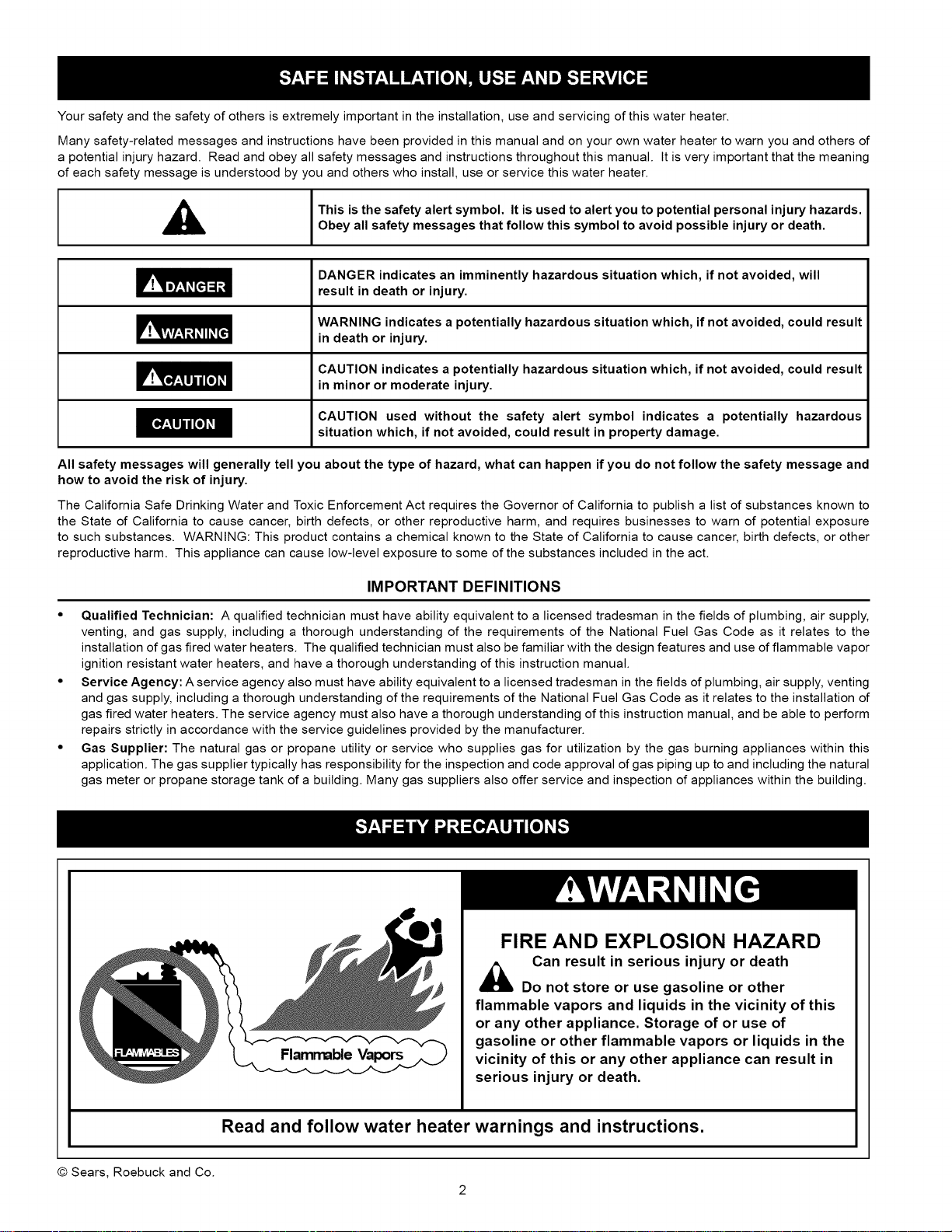
,_ I This is the safety alert symbol, it is used to alert you to potential personal injury hazards.
n
I
Obey all safety messages that follow this symbol to avoid possible injury or death.
DANGER indicates an imminently hazardous situation which, if not avoided, will
result in death or injury.
WARNING indicates a potentially hazardous situation which, if not avoided, could result
in death or injury.
CAUTION indicates a potentially hazardous situation which, if not avoided, could result
in minor or moderate injury.
CAUTION used without the safety alert symbol indicates a potentially hazardous
situation which, if not avoided, could result in property damage.
All safety messages will generally tell you about the type of hazard, what can happen if you do not follow the safety message and
how to avoid the risk of injury.
The California Safe Drinking Water and Toxic Enforcement Act requires the Governor of California to publish a list of substances known to
the State of California to cause cancer, birth defects, or other reproductive harm, and requires businesses to warn of potential exposure
to such substances. WARNING: This product contains a chemical known to the State of California to cause cancer, birth defects, or other
reproductive harm. This appliance can cause low-level exposure to some of the substances included in the act.
IMPORTANT DEFINITIONS
• Qualified Technician: A qualified technician must have ability equivalent to a licensed tradesman in the fields of plumbing, air supply,
venting, and gas supply, including a thorough understanding of the requirements of the National Fuel Gas Code as it relates to the
installation of gas fired water heaters The qualified technician must also be familiar with the design features and use of flammable vapor
ignition resistant water heaters, and have a thorough understanding of this instruction manual
• Service Agency: A service agency also must have ability equivalent to a licensed tradesman in the fields of plumbing, air supply, venting
and gas supply, including a thorough understanding of the requirements of the National Fuel Gas Code as it relates to the installation of
gas fired water heaters The service agency must also have a thorough understanding of this instruction manual, and be able to perform
repairs strictly in accordance with the service guidelines provided by the manufacturer
• Gas Supplier: The natural gas or propane utility or service who supplies gas for utilization by the gas burning appliances within this
application The gas supplier typically has responsibility for the inspection and code approval of gas piping up to and including the natural
gas meter or propane storage tank of a building Many gas suppliers also offer service and inspection of appliances within the building
FIRE AND EXPLOSION HAZARD
Can result in serious injury or death
Do not store or use gasoline or other
flammable vapors and liquids in the vicinity of this
or any other appliance. Storage of or use of
gasoline or other flammable vapors or liquids in the
vicinity of this or any other appliance can result in
serious injury or death.
Read and follow water heater warnings and instructions.
© Sears, Roebuck and Co.
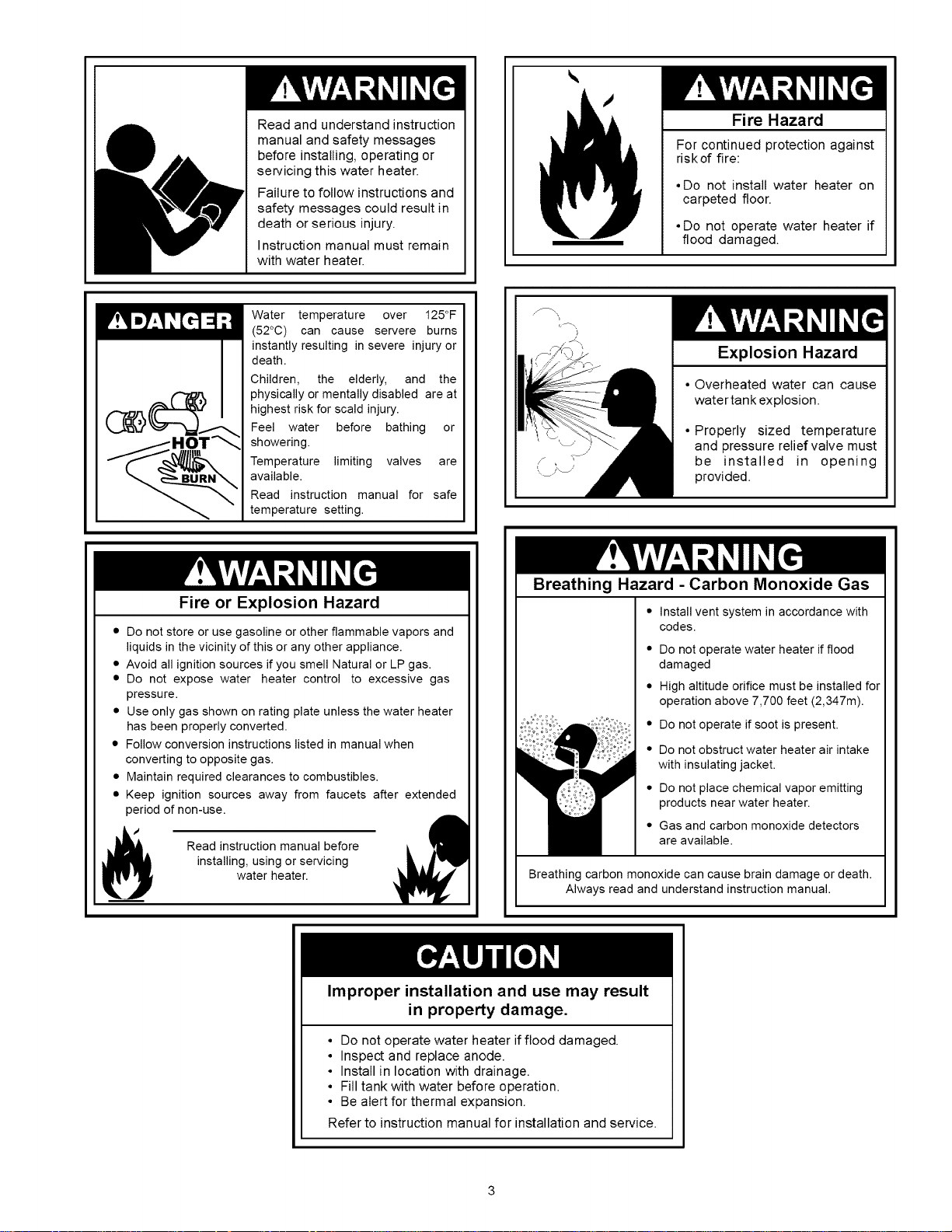
Read and understand instruction
manual and safety messages
before installing, operating or
servicing this water heater.
Failure to follow instructions and
safety messages could result in
death or serious injury.
Instruction manual must remain
with water heater.
Fire Hazard
For continued protection against
riskof fire:
• Do not install water heater on
carpeted floor.
• Do not operate water heater if
flood damaged.
IF: 1,7_,I [d ::4;!
Water temperature over 125°F
(52°C) can cause servere burns
instantly resulting in severe injury or
death.
Children, the elderly, and the
physically or mentally disabled are at
highest risk for scald injury.
Feel water before bathing or
showering.
Temperature limiting valves are
available.
Read instruction manual for safe
temperature setting.
Fire or Explosion Hazard
Explosion Hazard
• Overheated water can cause
water tank explosion.
• Properly sized temperature
and pressure relief valve must
be installed in opening
provided.
• Do not store or use gasoline or other flammable vapors and
liquids in the vicinity of this or any other appliance.
• Avoid all ignition sources if you smell Natural or LP gas.
• Do not expose water heater control to excessive gas
pressure.
• Use only gas shown on rating plate unless the water heater
has been properly converted.
• Follow conversion instructions listed in manual when
converting to opposite gas.
• Maintain required clearances to combustibles.
• Keep ignition sources away from faucets after extended
period of non-use.
Read instruction manual before
installing, using or servicing
water heater.
Breathing Hazard - Carbon Monoxide Gas
Install vent system in accordance with
codes.
• Do not operate water heater if flood
damaged
• High altitude orifice must be installed for
operation above 7,700 feet (2,347m).
• Do not operate if soot is present.
• Do not obstruct water heater air intake
with insulating jacket.
• Do not place chemical vapor emitting
products near water heater.
• Gas and carbon monoxide detectors
are available.
Breathing carbon monoxide can cause brain damage or death.
Always read and understand instruction manual.
Improper installation and use may result
in property damage.
• Do not operate water heater if flood damaged.
• Inspect and replace anode.
• Install in location with drainage.
• Fill tank with water before operation.
• Be alert for thermal expansion.
Refer to instruction manual for installation and service.
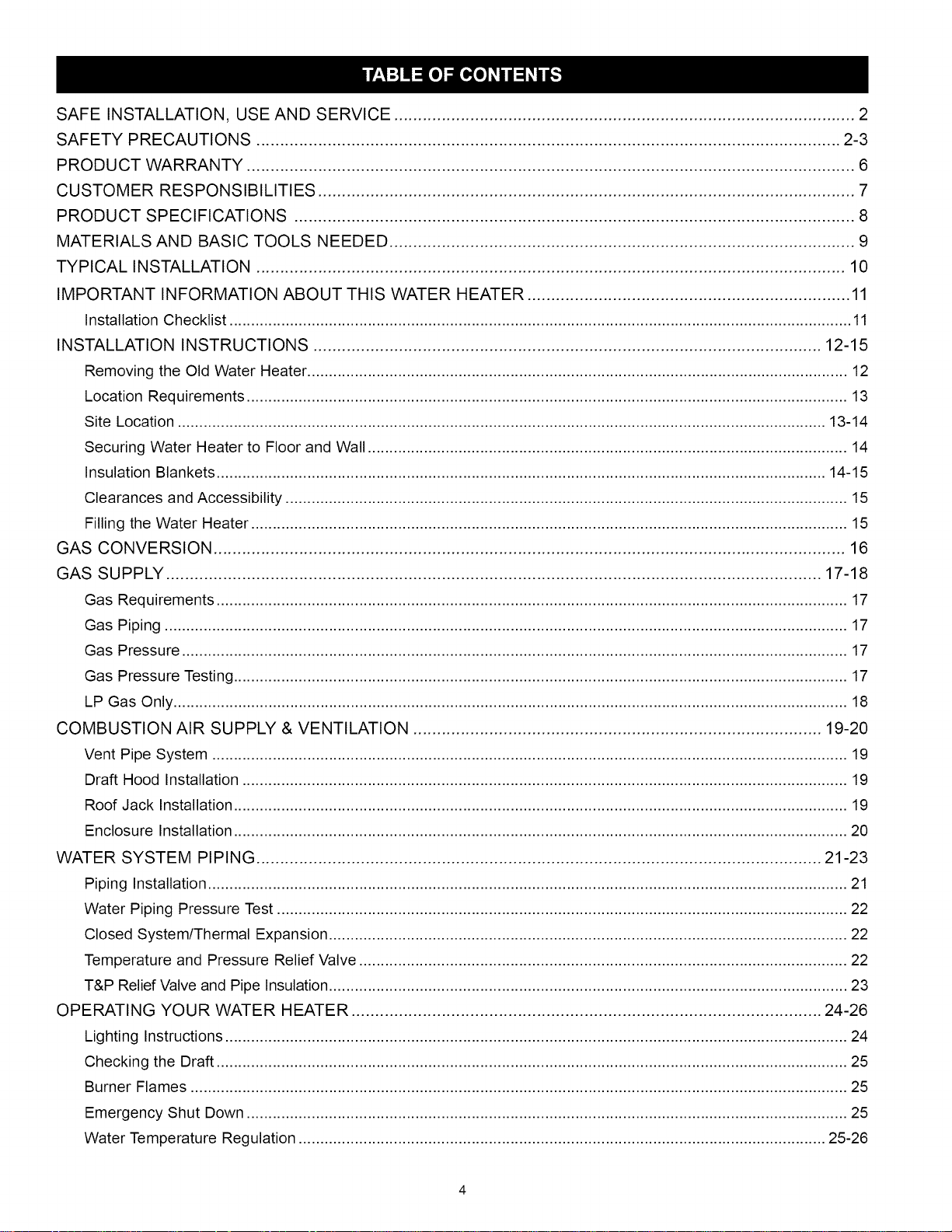
SAFE INSTALLATION, USE AND SERVICE ................................................................................................. 2
SAFETY PRECAUTIONS ........................................................................................................................... 2-3
PRODUCT WARRANTY ................................................................................................................................ 6
CUSTOMER RESPONSIBILITIES ................................................................................................................. 7
PRODUCT SPECIFICATIONS ...................................................................................................................... 8
MATERIALS AND BASIC TOOLS NEEDED .................................................................................................. 9
TYPICAL INSTALLATION ............................................................................................................................ 10
IMPORTANT INFORMATION ABOUT THIS WATER HEATER .................................................................... 11
Installation Checklist ................................................................................................................................................ 11
INSTALLATION INSTRUCTIONS ........................................................................................................... 12-15
Removing the Old Water Heater ............................................................................................................................. 12
Location Requirements ........................................................................................................................................... 13
Site Location ...................................................................................................................................................... 13-14
Securing Water Heater to Floor and Wall ............................................................................................................... 14
Insulation Blankets ............................................................................................................................................. 14-15
Clearances and Accessibility .................................................................................................................................. 15
Filling the Water Heater .......................................................................................................................................... 15
GAS CONVERSION ..................................................................................................................................... 16
GAS SUPPLY .......................................................................................................................................... 17-18
Gas Requirements .................................................................................................................................................. 17
Gas Piping .............................................................................................................................................................. 17
Gas Pressure .......................................................................................................................................................... 17
Gas Pressure Testing .............................................................................................................................................. 17
LP Gas Only ............................................................................................................................................................ 18
COMBUSTION AIR SUPPLY & VENTILATION ...................................................................................... 19-20
Vent Pipe System ................................................................................................................................................... 19
Draft Hood Installation ............................................................................................................................................ 19
Roof Jack Installation .............................................................................................................................................. 19
Enclosure Installation .............................................................................................................................................. 20
WATER SYSTEM PIPING ....................................................................................................................... 21-23
Piping Installation .................................................................................................................................................... 21
Water Piping Pressure Test .................................................................................................................................... 22
Closed System/Thermal Expansion ........................................................................................................................ 22
Temperature and Pressure Relief Valve ................................................................................................................. 22
T&P Relief Valve and Pipe Insulation ........................................................................................................................ 23
OPERATING YOUR WATER HEATER ................................................................................................... 24-26
Lighting Instructions ................................................................................................................................................ 24
Checking the Draft .................................................................................................................................................. 25
Burner Flames ........................................................................................................................................................ 25
Emergency Shut Down ........................................................................................................................................... 25
Water Temperature Regulation .......................................................................................................................... 25-26
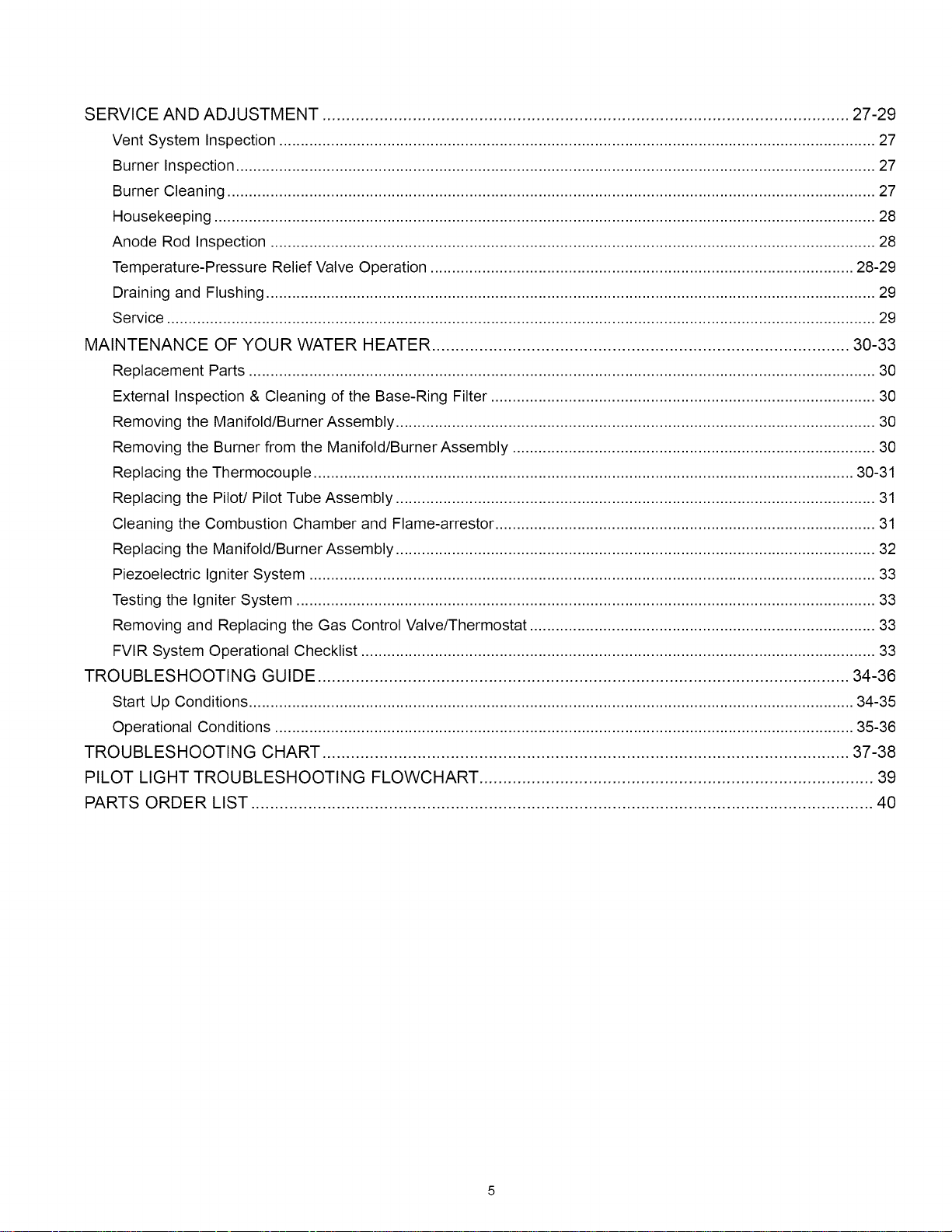
SERVICEANDADJUSTMENT...............................................................................................................27-29
VentSystemInspection..........................................................................................................................................27
BurnerInspection....................................................................................................................................................27
BurnerCleaning......................................................................................................................................................27
Housekeeping.........................................................................................................................................................28
AnodeRodInspection............................................................................................................................................28
Temperature-PressureReliefValveOperation..................................................................................................28-29
DrainingandFlushing.............................................................................................................................................29
Service....................................................................................................................................................................29
MAINTENANCEOFYOURWATERHEATER........................................................................................30-33
ReplacementParts.................................................................................................................................................30
ExternalInspection&CleaningoftheBase-RingFilter.........................................................................................30
RemovingtheManifold/BurnerAssembly...............................................................................................................30
RemovingtheBurnerfromtheManifold/BurnerAssembly....................................................................................30
ReplacingtheThermocouple.............................................................................................................................30-31
ReplacingthePilot/PilotTubeAssembly...............................................................................................................31
CleaningtheCombustionChamberandFlame-arrestor........................................................................................31
ReplacingtheManifold/BurnerAssembly...............................................................................................................32
PiezoelectricIgniterSystem...................................................................................................................................33
TestingtheIgniterSystem......................................................................................................................................33
RemovingandReplacingtheGasControlValve/Thermostat................................................................................33
FVIRSystemOperationalChecklist.......................................................................................................................33
TROUBLESHOOTINGGUIDE................................................................................................................34-36
StartUpConditions............................................................................................................................................34-35
OperationalConditions......................................................................................................................................35-36
TROUBLESHOOTINGCHART...............................................................................................................37-38
PILOTLIGHTTROUBLESHOOTINGFLOWCHART...................................................................................39
PARTSORDERLIST...................................................................................................................................40
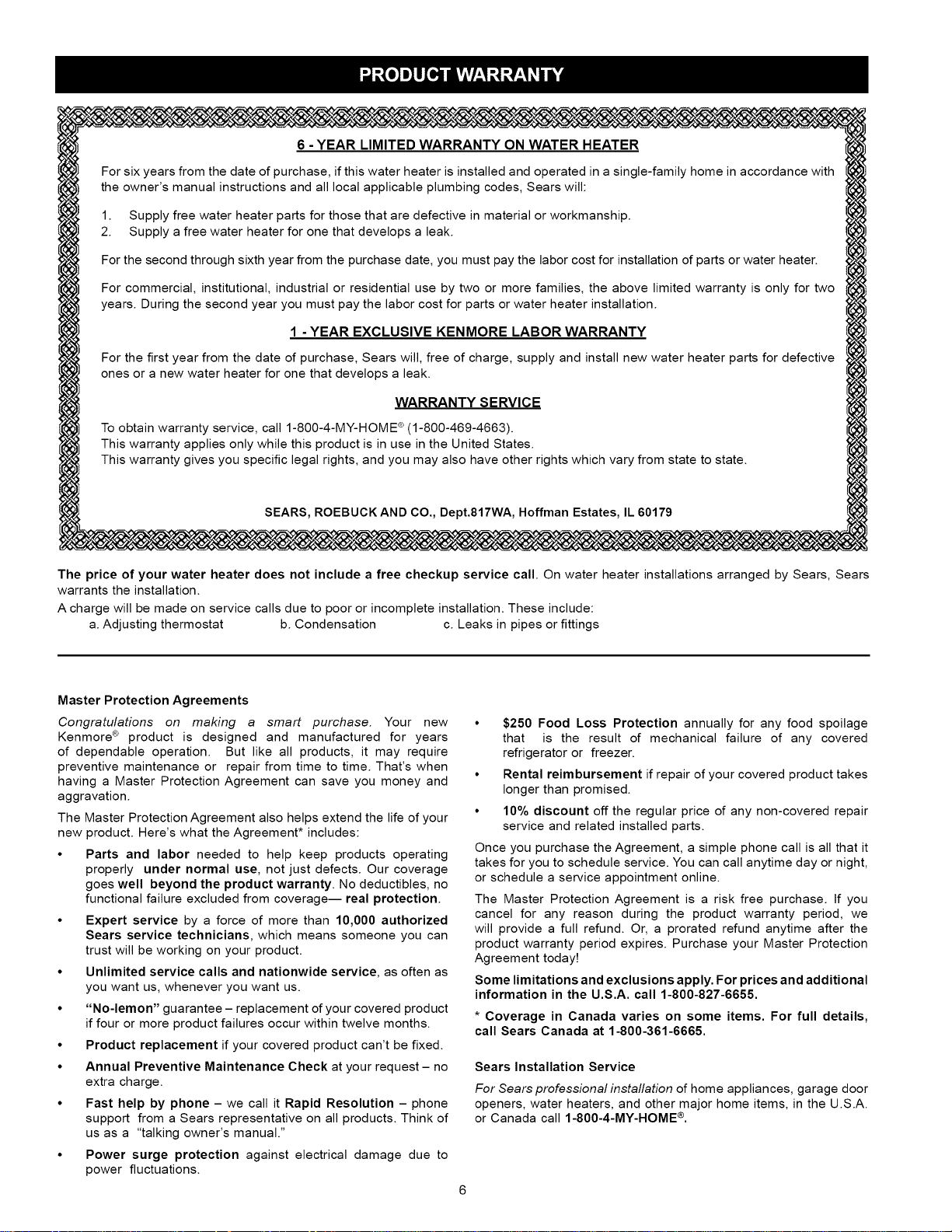
6 - YEAR LIMITED WARRANTY ON WATER HEATER
For six years from the date of purchase, if this water heater is installed and operated in a single-family home in accordance with
the owner's manual instructions and all local applicable plumbing codes, Sears will:
1. Supply free water heater parts for those that are defective in material or workmanship.
2. Supply a free water heater for one that develops a leak.
For the second through sixth year from the purchase date, you must pay the labor cost for installation of parts or water heater.
For commercial, institutional, industrial or residential use by two or more families, the above limited warranty is only for two
years. During the second year you must pay the labor cost for parts or water heater installation.
1 - YEAR EXCLUSIVE KENMORE LABOR WARRANTY
For the first year from the date of purchase, Sears will, free of charge, supply and install new water heater parts for defective
ones or a new water heater for one that develops a leak.
WARRANTY SERVICE
To obtain warranty service, call 1-800-4-MY-HOME ® (1-800-469-4663).
This warranty applies only while this product is in use in the United States.
This warranty gives you specific legal rights, and you may also have other rights which vary from state to state.
SEARS, ROEBUCK AND CO., Dept.817WA, Hoffman Estates, IL 60179
The price of your water heater does not include a free checkup service call. On water heater installations arranged by Sears, Sears
warrants the installation.
A charge will be made on service calls due to poor or incomplete installation. These include:
a. Adjusting thermostat b. Condensation c. Leaks in pipes or fittings
Master Protection Agreements
Congratulations on making a smart purchase. Your new
Kenmore ® product is designed and manufactured for years
of dependable operation. But like all products, it may require
preventive maintenance or repair from time to time. That's when
having a Master Protection Agreement can save you money and
aggravation.
The Master Protection Agreement also helps extend the life of your
new product. Here's what the Agreement* includes:
• Parts and labor needed to help keep products operating
properly under normal use, not just defects. Our coverage
goes well beyond the product warranty. No deductibles, no
functional failure excluded from coverage-- real protection.
• Expert service by a force of more than 10,000 authorized
Sears service technicians, which means someone you can
trust will be working on your product.
• Unlimited service calls and nationwide service, as often as
you want us, whenever you want us.
• "No-lemon" guarantee - replacement of your covered product
if four or more product failures occur within twelve months.
• Product replacement if your covered product can't be fixed.
• Annual Preventive Maintenance Check at your request - no
extra charge.
• Fast help by phone - we call it Rapid Resolution - phone
support from a Sears representative on all products. Think of
us as a "talking owner's manual."
• Power surge protection against electrical damage due to
power fluctuations.
• $250 Food Loss Protection annually for any food spoilage
that is the result of mechanical failure of any covered
refrigerator or freezer.
• Rental reimbursement if repair of your covered product takes
longer than promised.
• 10% discount off the regular price of any non-covered repair
service and related installed parts.
Once you purchase the Agreement, a simple phone call is all that it
takes for you to schedule service. You can call anytime day or night,
or schedule a service appointment online.
The Master Protection Agreement is a risk free purchase. If you
cancel for any reason during the product warranty period, we
will provide a full refund. Or, a prorated refund anytime after the
product warranty period expires. Purchase your Master Protection
Agreement today!
Some limitations and exclusions apply. For prices and additional
information in the U.S.A. call 1-800-827-6655.
* Coverage in Canada varies on some items. For full details,
call Sears Canada at 1-800-361-6665.
Sears Installation Service
For Sears professional installation of home appliances, garage door
openers, water heaters, and other major home items, in the U.S.A.
or Canada call 1-800-4-MY-HOME ®.
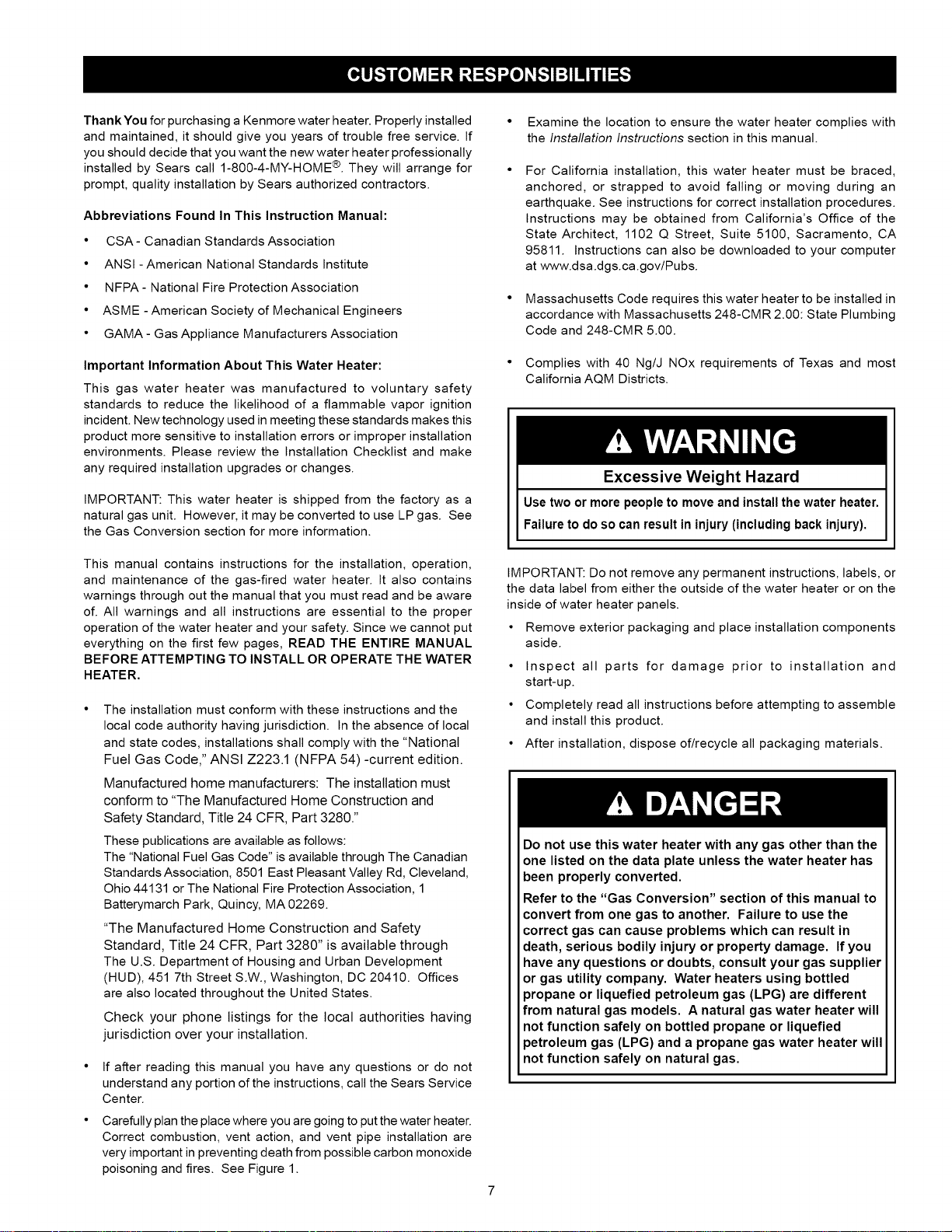
ThankYouforpurchasingaKenmorewaterheater.Properlyinstalled
andmaintained,itshouldgiveyouyearsoftroublefreeservice.If
youshoulddecidethatyouwantthenewwaterheaterprofessionally
installedbySearscall1-800-4-MY-HOME®.Theywillarrangefor
prompt,qualityinstallationbySearsauthorizedcontractors.
Abbreviations Found In This Instruction Manual:
• CSA- Canadian Standards Association
• ANSI- American National Standards Institute
• N FPA- National Fire Protection Association
• ASME - American Society of Mechanical Engineers
• GAMA- Gas Appliance Manufacturers Association
Important Information About This Water Heater:
This gas water heater was manufactured to voluntary safety
standards to reduce the likelihood of a flammable vapor ignition
incident. New technology used in meeting these standards makes this
product more sensitive to installation errors or improper installation
environments. Please review the Installation Checklist and make
any required installation upgrades or changes.
IMPORTANT: This water heater is shipped from the factory as a
natural gas unit. However, it may be converted to use LP gas. See
the Gas Conversion section for more information.
Examine the location to ensure the water heater complies with
the Installation Instructions section in this manual.
For California installation, this water heater must be braced,
anchored, or strapped to avoid falling or moving during an
earthquake. See instructions for correct installation procedures.
Instructions may be obtained from California's Office of the
State Architect, 1102 Q Street, Suite 5100, Sacramento, CA
95811. Instructions can also be downloaded to your computer
at www.dsa.dgs.ca.gov/Pubs.
Massachusetts Code requires this water heater to be installed in
accordance with Massachusetts 248-CMR 2.00: State Plumbing
Code and 248-CMR 5.00.
Complies with 40 Ng/J NOx requirements of Texas and most
California AQM Districts.
Excessive Weight Hazard
Use two or more people to move and install the water heater.
Failure to do so can result in injury (including back injury).
This manual contains instructions for the installation, operation,
and maintenance of the gas-fired water heater, tt also contains
warnings through out the manual that you must read and be aware
of. All warnings and all instructions are essential to the proper
operation of the water heater and your safety. Since we cannot put
everything on the first few pages, READ THE ENTIRE MANUAL
BEFORE ATTEMPTING TO INSTALL OR OPERATE THE WATER
HEATER.
The installation must conform with these instructions and the
local code authority having jurisdiction. In the absence of local
and state codes, installations shall comply with the "National
Fuel Gas Code," ANSI Z223.1 (NFPA 54) -current edition.
Manufactured home manufacturers: The installation must
conform to "The Manufactured Home Construction and
Safety Standard, Title 24 CFR, Part 3280."
These publications are available as follows:
The "National Fuel Gas Code" is available through The Canadian
Standards Association, 8501 East Pleasant Valley Rd, Cleveland,
Ohio 44131 or The National Fire Protection Association, 1
Batterymarch Park, Quincy, MA 02269.
"The Manufactured Home Construction and Safety
Standard, Title 24 CFR, Part 3280" is available through
The U.S. Department of Housing and Urban Development
(HUD), 451 7th Street S.W., Washington, DC 20410. Offices
are also located throughout the United States.
Check your phone listings for the local authorities having
jurisdiction over your installation.
If after reading this manual you have any questions or do not
understand any portion of the instructions, call the Sears Service
Center.
Carefully plan the place where you are going to put the water heater.
Correct combustion, vent action, and vent pipe installation are
very important in preventing death from possible carbon monoxide
poisoning and fires. See Figure 1.
IMPORTANT: Do not remove any permanent instructions, labels, or
the data label from either the outside of the water heater or on the
inside of water heater panels.
• Remove exterior packaging and place installation components
aside.
• Inspect all parts for damage prior to installation and
start-up.
• Completely read all instructions before attempting to assemble
and install this product.
• After installation, dispose of/recycle all packaging materials.
Do not use this water heater with any gas other than the
one listed on the data plate unless the water heater has
been properly converted.
Refer to the "Gas Conversion" section of this manual to
convert from one gas to another. Failure to use the
correct gas can cause problems which can result in
death, serious bodily injury or property damage. If you
have any questions or doubts, consult your gas supplier
or gas utility company. Water heaters using bottled
propane or liquefied petroleum gas (LPG) are different
from natural gas models. A natural gas water heater will
not function safely on bottled propane or liquefied
3etroleum gas (LPG) and a propane gas water heater will
not function safely on natural gas.
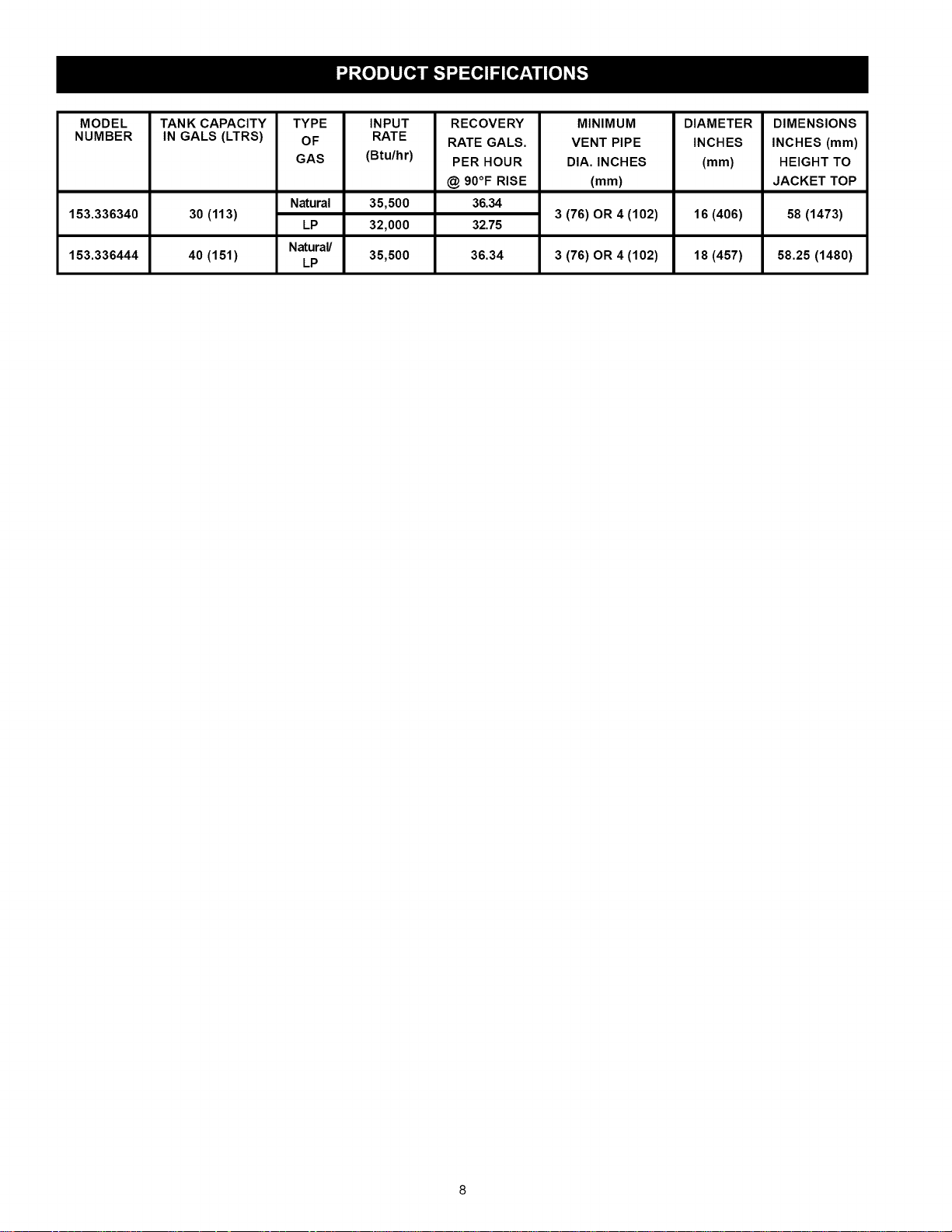
MODEL
NUMBER
TANK CAPACITY
IN GALS (LTRS)
TYPE
OF
GAS
INPUT
RATE
(Btu/hr)
Natural
LP
Natural/
LP
35,500
32,000
RECOVERY
RATE GALS.
PER HOUR
@ 90°F RISE
36.34
32.75
MINIMUM
VENT PIPE
DIA. INCHES
(mm)
DIAMETER
INCHES
(mm)
DIMENSIONS
INCHES (mm)
HEIGHT TO
JACKET TOP
153.336340 30 (113) 3 (76) OR 4 (102) 16 (406) 58 (1473)
153.336444 40 (151) 35,500 36.34 3 (76) OR 4 (102) 18 (457) 58.25 (1480)
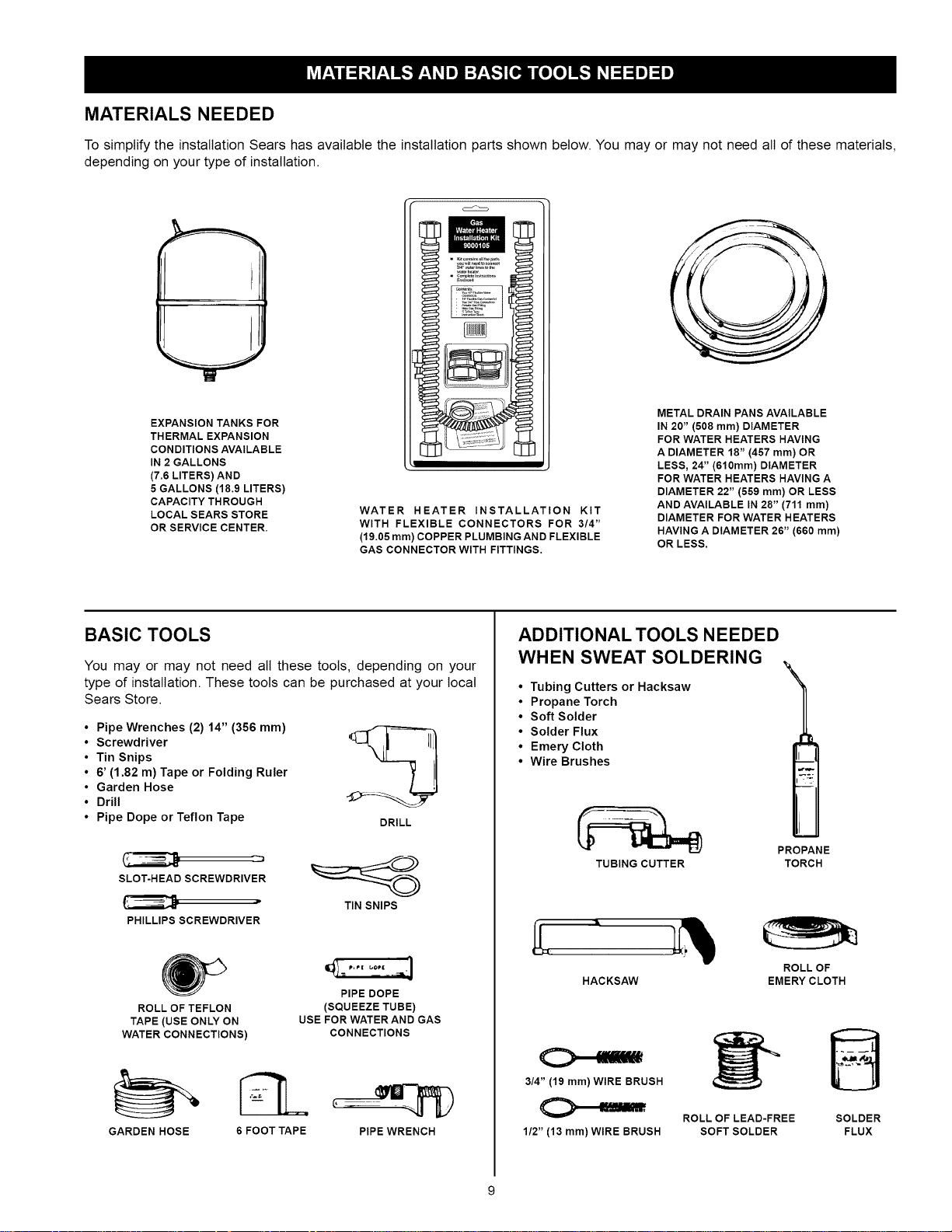
MATERIALS NEEDED
To simplify the installation Sears has available the installation parts shown below. You may or may not need all of these materials,
depending on your type of installation.
EXPANSION TANKS FOR
THERMAL EXPANSION
CONDITIONS AVAILABLE
IN 2 GALLONS
(7.6 LITERS) AND
5 GALLONS (18.9 LITERS)
CAPACITY THROUGH
LOCAL SEARS STORE
OR SERVICE CENTER.
WATER HEATER INSTALLATION KIT
WITH FLEXIBLE CONNECTORS FOR 3/4"
(19.05 ram) COPPER PLUMBING AND FLEXIBLE
GAS CONNECTOR WITH FITTINGS.
METAL DRAIN PANS AVAILABLE
IN 20" (508 mm) DIAMETER
FOR WATER HEATERS HAVING
A DIAMETER 18" (457 ram) OR
LESS, 24" (610mm) DIAMETER
FOR WATER HEATERS HAVING A
DIAMETER 22" (559 ram) OR LESS
AND AVAILABLE IN 28" (711 ram)
DIAMETER FOR WATER HEATERS
HAVING A DIAMETER 26" (660 mm)
OR LESS.
BASIC TOOLS
You may or may not need all these tools, depending on your
type of installation. These tools can be purchased at your local
Sears Store.
• Pipe Wrenches (2) 14" (356 mm)
• Screwdriver
• Tin Snips
• 6' (1.82 m) Tape or Folding Ruler
• Garden Hose
• Drill
• Pipe Dope or Teflon Tape
DRILL
SLOT-HEAD SCREWDRIVER
PHILLIPS SCREWDRIVER
TIN SNIPS
ROLL OF TEFLON
TAPE (USE ONLY ON
WATER CONNECTIONS)
PIPE DOPE
(SQUEEZE TUBE)
USE FOR WATER AND GAS
CONNECTIONS
GARDEN HOSE
6 FOOT TAPE
PIPE WRENCH
ADDITIONAL TOOLS NEEDED
WHEN SWEAT SOLDERING
• Tubing Cutters or Hacksaw
• Propane Torch
• Soft Solder
• Solder Flux
• Emery Cloth
• Wire Brushes
TUBING CUTTER
HACKSAW
3/4" (19 mm) WIRE BRUSH
1/2" (13 mm)WIRE BRUSH
\
1
PROPANE
TORCH
ROLL OF
EMERY CLOTH
ROLL OF LEAD-FREE
SOFT SOLDER
SOLDER
FLUX
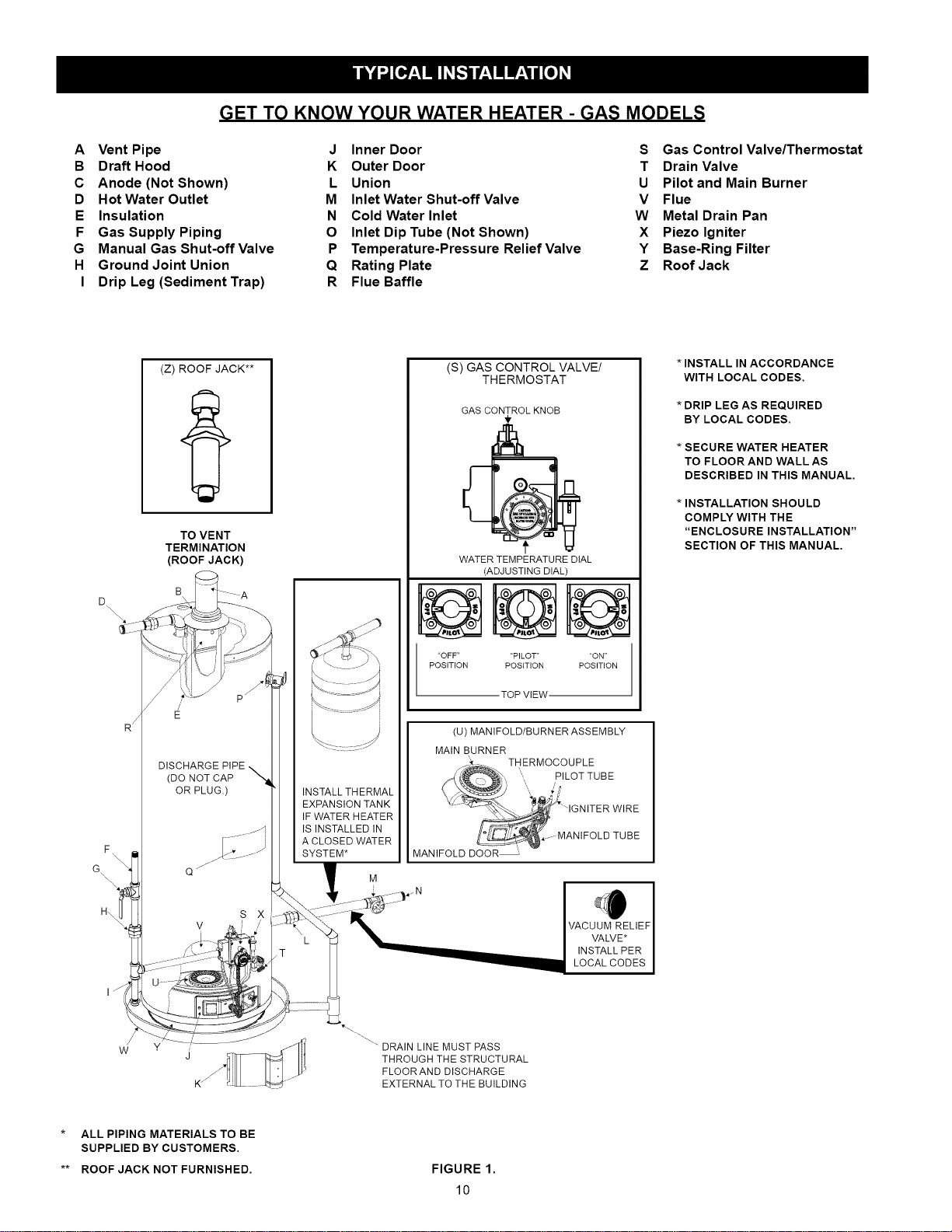
GET TO KNOW YOUR WATER HEATER - GAS MODELS
A Vent Pipe
B Draft Hood
C Anode (Not Shown)
D Hot Water Outlet
E Insulation
F Gas Supply Piping
G Manual Gas Shut-off Valve
H Ground Joint Union
I Drip Leg (Sediment Trap)
J Inner Door
K Outer Door
L Union
M Inlet Water Shut-off Valve
N Cold Water Inlet
O Inlet Dip Tube (Not Shown)
P Temperature-Pressure Relief Valve
Q Rating Plate
R Flue Baffle
S Gas Control Valve/Thermostat
T Drain Valve
U Pilot and Main Burner
V Flue
W Metal Drain Pan
X Piezo Igniter
Y Base-Ring Filter
Z Roof Jack
F
G
H\
(Z) ROOF JACK**
TO VENT
TERMINATION
(ROOF JACK)
DISCHARGE PIPE
(DO NOT CAP
OR PLUG.)
q
s x
v
INSTALL THERMAL
EXPANSION TANK
IF WATER HEATER
IS INSTALLED IN
A CLOSED WATER
SYSTEM*
(S) GAS CONTROL VALVE/
THERMOSTAT
GAS CONTROL KNOB
WATER TEMPERATURE DIAl_
(ADJUSTING DIAL)
"OFF .... PILOT ON"
POSITION POSITION POSITION
TOP VIEW
(U) MANIFOLD/BURNER ASSEMBLY
MAIN BURNER
_}_ ......_ THERMOCOUPLE
(_k_\,= ,, /PILOT TUBE
_ MANIFOLD TUBE
MANIFOLD DOOR--
VACUUM RELIEF I
VALVE*
INSTALL PER
LOCAL CODES
* INSTALL IN ACCORDANCE
WITH LOCAL CODES.
* DRIP LEG AS REQUIRED
BY LOCAL CODES.
* SECURE WATER HEATER
TO FLOOR AND WALL AS
DESCRIBED IN THIS MANUAL.
* INSTALLATION SHOULD
COMPLY WITH THE
"ENCLOSURE INSTALLATION"
SECTION OF THIS MANUAL.
/
W
DRAIN LINE MUST PASS
THROUGH THE STRUCTURAL
FLOOR AND DISCHARGE
EXTERNAL TO THE BUILDING
* ALL PIPING MATERIALS TO BE
SUPPLIED BY CUSTOMERS.
** ROOF JACK NOT FURNISHED. FIGURE 1.
10
This gas water heater was manufactured to voluntary safety standards to reduce the likelihood of a flammable vapor ignition incident.
The new technology used in meeting these standards makes this product more sensitive to installation errors. Please review the
following checklist and make any required installation upgrades or changes.
Questions? Contact Sears at 1-800-4-MY-HOME (1-800-469-4663).
Installation Checklist
Water Heater Location
Water heater location is important and
performance. Please check the following:
[]
can affect system
Installation area free of corrosive elements and flammable
materials.
[] Centrally located with the water piping system (For new
installations). Located as close to the gas piping and vent
pipe system as possible.
[] Located indoors and in a vertical position. Protected from
freezing temperatures.
[] Proper clearances from combustible surfaces
maintained and not installed directly on a carpeted floor.
[] Provisions made to protect the area from water damage.
Metal drain pan installed and piped to an adequate drain.
[] Sufficient room to service the water heater. See Clearances
and Accessibility section of this manual.
[] Water heater not located near an air moving device.
[] Is the installed environment dirty (excessive amounts of
lint, dirt, dust, etc.)? If so, the base-ring filter located on
the bottom of the water heater wilt need to be cleaned
periodically. Refer to the "Maintenance of your Water
Heater" section of this manual for information on cleaning
the base-ring filter.
[]
[]
Combustion Air Supply and Ventilation
Check for sufficient combustion air supply. Insufficient air for
the combustion of gas wilt result in the flame becoming "lazy",
thereby allowing heat to build up in the combustion chamber.
This excessive heat wilt cause a thermal switch on the door
assembly to trip. Is the water heater installed in a closet or other
small, enclosed space? If so:
Are there openings for make-up air to enter and exit the
room/area?
Are the openings of sufficient size? Remember, if there
are other gas-fired or air-consuming appliances in the
same room, you need more make-up air. Refer to the
"Installation Instructions" and "Combustion Air Supply and
Ventilation" sections for specific requirements.
[] Make sure that fresh air is not taken from areas that contain
negative pressure producing devices such as exhaust fans,
dryers, fireplaces, etc.
[] Is there a furnace/air handler in the same room space as
the water heater? If so, has a return air duct system been
attached that exits the room? If so, check for leaks on the
air duct system. If no air duct system is present, correct
immediately by contacting a local Heating, Ventilation, Air-
Conditioning & Refrigeration (HVAC-R) authorized service
provider.
[] Use a fresh air supply that is free of corrosive elements and
flammable vapors.
[] Fresh airopenings must be sized correctly with consideration
given to the blocking effect of louvers and grilles.
Vent Pipe System
Check for proper drafting at the water heater draft hood. Refer
to the "Checking the Draft" section of this manual for the test
procedure. If the procedure shows insufficient draft is present,
please check the following:
[]
[]
[]
[]
[]
[]
Draft hood properly installed.
Vent connectors securely fastened with screws and
supported properly to maintain six inch clearance.
Vent connector made of approved material and sized
correctly.
Vent pipe system installed according to all local and state
codes or, in the absence of local and state codes, the
"National Fuel Gas Code", ANSI Z223.1 (NFPA 54)-current
edition. Manufactured home manufacturers must conform
with the "Manufactured Home Construction and Safety
Standard, Title 24 CFR, Part 3280."
Flue baffle properly positioned in the flue tube.
Check the vent system for restrictions/obstructions and
check the vent termination height. Refer to the "Combustion
Air Supply and Ventilation" section of this water heater
manual for specific requirements.
[] Recheck for sufficient combustion air supply.
Water System Piping
[] Temperature and pressure relief valve properly installed
with a discharge line run to an adequate drain and protected
from freezing.
[] All piping properly installed and free of leaks.
[] Heater completely filled with water.
[] Closed system pressure build-up devices installed.
[] Mixing valve (when applicable) installed per manufacturer's
instructions (See "Water Temperature Regulation" section).
Gas Supply and Piping
[]
[]
[]
[]
[]
Gas type is the same as that listed on the water heater rating
plate unless the water heater has been properly converted.
Refer to the "Gas Conversion" section of this manual.
Gas line equipped with shut-off valve, union, and drip leg.
Use pipe joint compound or teflon tape marked as being
resistant to the action of petroleum [Propane (L.R)] gases.
Adequate pipe size and approved pipe material.
An approved noncorrosive leak detection solution used
to check all connections and fittings for possible gas leaks.
Correct any leak found.
11
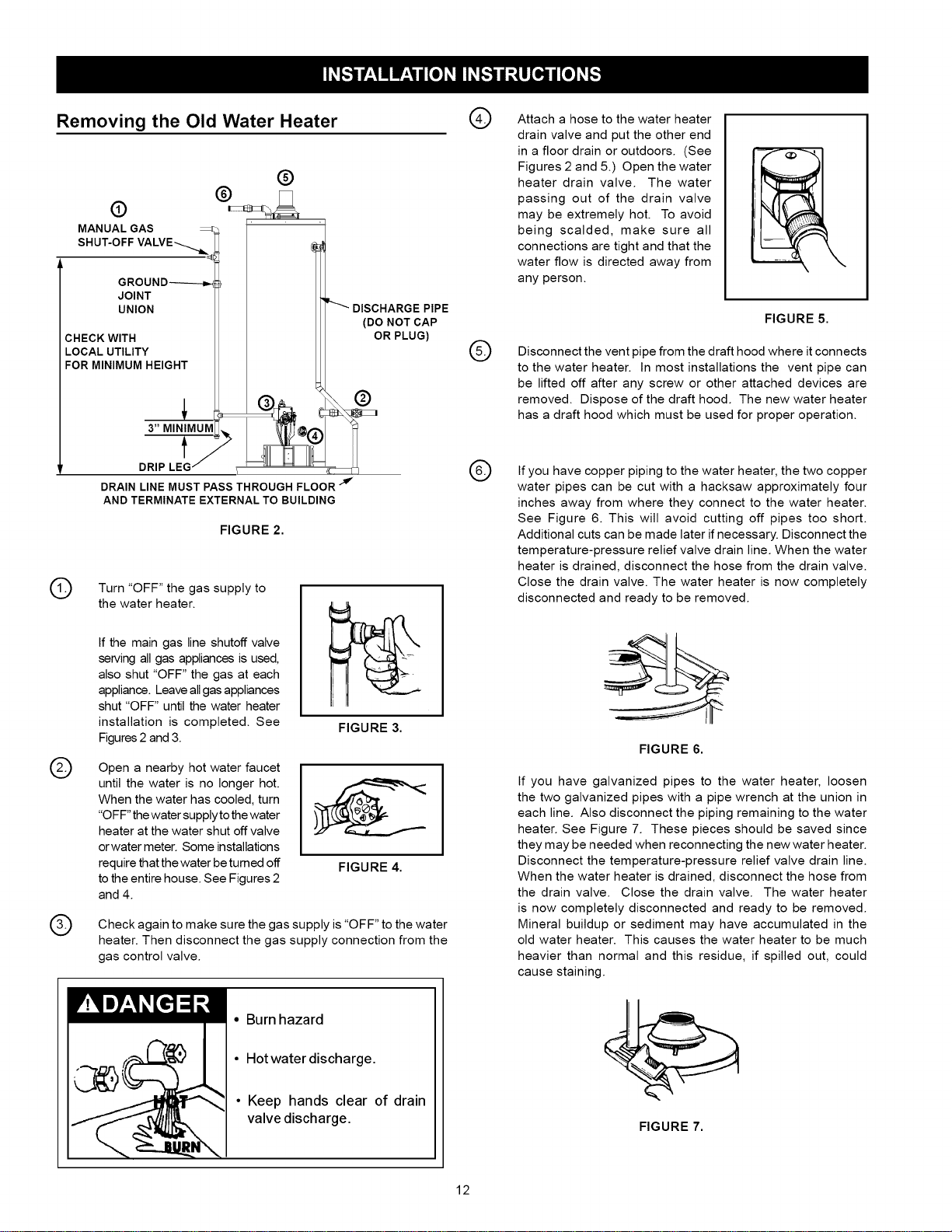
Removing the Old Water Heater (_
®
®
(i)
MANUAL GAS
SHUT-OFF VALVE--..........
GROUND_
JOINT
UNION
CHECK WITH
LOCAL UTILITY
FOR MINIMUM HEIGHT
3" MINIMUM
DR,PL G/
DRAIN LINEMUST PASS THROUGH FLOOR _'_
AND TERMINATE EXTERNAL TO BUILDING
DISCHARGE PIPE
(DO NOT CAP
OR PLUG)
®
FIGURE 2.
©
©
®
Turn "OFF" the gas supply to
the water heater.
If the main gas line shutoff valve
serving all gas appliances is used,
also shut "OFF" the gas at each
appliance. Leave all gas appliances
shut "OFF" until the water heater
installation is completed. See
Figures 2 and 3.
FIGURE 3.
Open a nearby hot water faucet
until the water is no longer hot.
When the water has cooled, turn
"OFF" thewater supply tothe water
heater at the water shut off valve
orwater meter. Some installations
require that the water be turned off
to the entire house. See Figures 2
and 4.
FIGURE 4.
Check again to make sure the gas supply is "OFF" to the water
heater. Then disconnect the gas supply connection from the
gas control valve.
• Burn hazard
• Hotwater discharge.
• Keep hands clear of drain
valve discharge.
®
Attach a hose to the water heater
drain valve and put the other end
in a floor drain or outdoors. (See
Figures 2 and 5.) Open the water
heater drain valve. The water
passing out of the drain valve
may be extremely hot. To avoid
being scalded, make sure all
connections are tight and that the
water flow is directed away from
any person.
FIGURE 5.
Disconnect the vent pipe from the draft hood where it connects
to the water heater. In most installations the vent pipe can
be lifted off after any screw or other attached devices are
removed. Dispose of the draft hood. The new water heater
has a draft hood which must be used for proper operation.
® If you have copper piping to the water heater, the two copper
water pipes can be cut with a hacksaw approximately four
inches away from where they connect to the water heater.
See Figure 6. This will avoid cutting off pipes too short.
Additional cuts can be made later if necessary. Disconnect the
temperature-pressure relief valve drain line. When the water
heater is drained, disconnect the hose from the drain valve.
Close the drain valve. The water heater is now completely
disconnected and ready to be removed.
FIGURE 6.
If you have galvanized pipes to the water heater, loosen
the two galvanized pipes with a pipe wrench at the union in
each line. Also disconnect the piping remaining to the water
heater. See Figure 7. These pieces should be saved since
they may be needed when reconnecting the new water heater.
Disconnect the temperature-pressure relief valve drain line.
When the water heater is drained, disconnect the hose from
the drain valve. Close the drain valve. The water heater
is now completely disconnected and ready to be removed.
Mineral buildup or sediment may have accumulated in the
old water heater. This causes the water heater to be much
heavier than normal and this residue, if spilled out, could
cause staining.
FIGURE 7.
12
Location Requirements
I Carbon Monoxide Poisoning Hazard
Do not install this water heater in any occupied space of the
manufactured (mobile) home.
Doing so can result in carbon monoxide poisoning and death.
the fire department from a neighbor's home. Do not attempt to
clean the spill until all ignition sources have been extinguished.
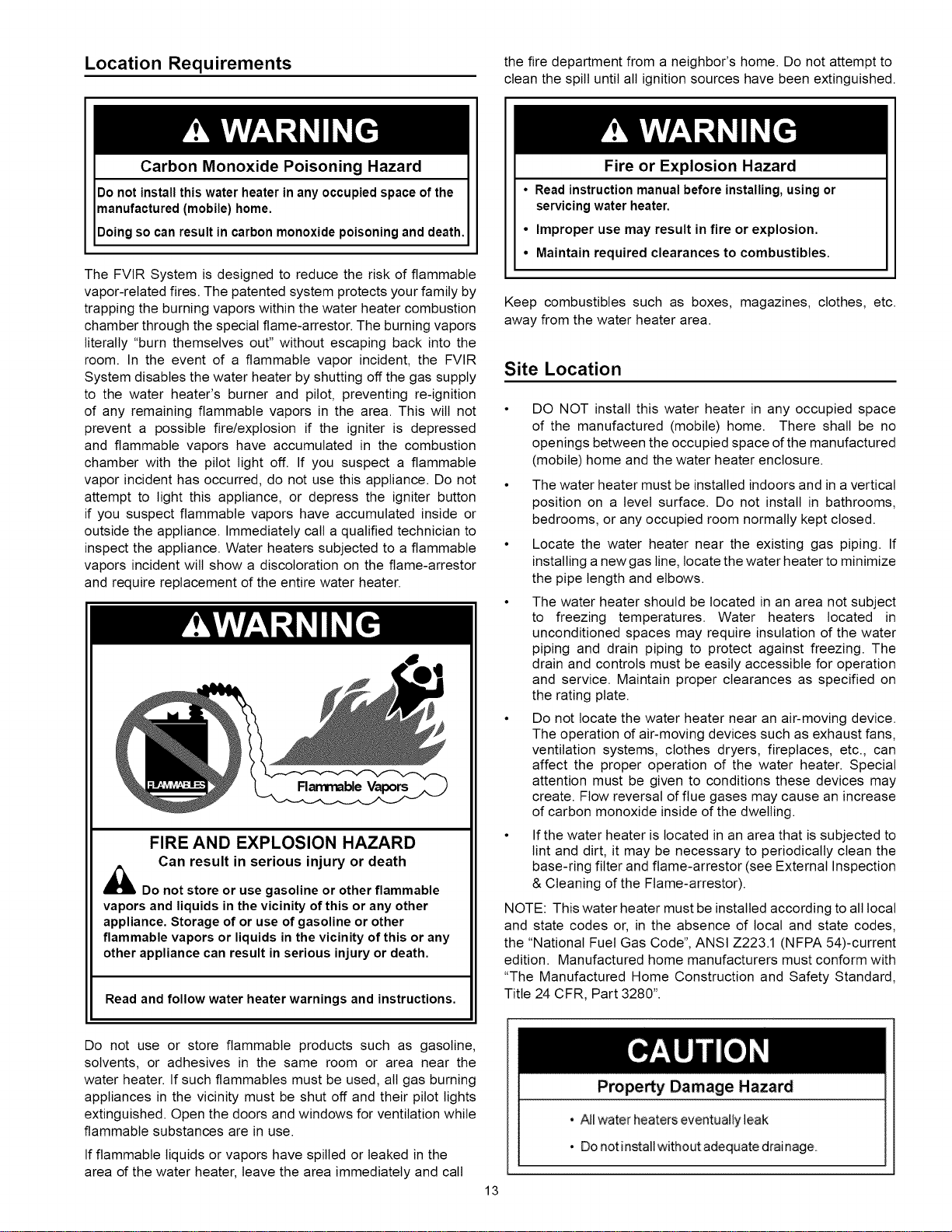
The FVIR System is designed to reduce the risk of flammable
vapor-related fires. The patented system protects your family by
trapping the burning vapors within the water heater combustion
chamber through the special flame-arrestor. The burning vapors
literally "burn themselves out" without escaping back into the
room. In the event of a flammable vapor incident, the FVIR
System disables the water heater by shutting off the gas supply
to the water heater's burner and pilot, preventing re-ignition
of any remaining flammable vapors in the area. This will not
prevent a possible fire/explosion if the igniter is depressed
and flammable vapors have accumulated in the combustion
chamber with the pilot light off. If you suspect a flammable
vapor incident has occurred, do not use this appliance. Do not
attempt to light this appliance, or depress the igniter button
if you suspect flammable vapors have accumulated inside or
outside the appliance. Immediately call a qualified technician to
inspect the appliance. Water heaters subjected to a flammable
vapors incident will show a discoloration on the flame-arrestor
and require replacement of the entire water heater.
Ramn_ble Vapors
FIRE AND EXPLOSION HAZARD
Can result in serious injury or death
_,Do not store or use gasoline or other flammable
vapors and liquids in the vicinity of this or any other
appliance. Storage of or use of gasoline or other
flammable vapors or liquids in the vicinity of this or any
other appliance can result in serious injury or death.
Read and follow water heater warnings and instructions.
Fire or Explosion Hazard
• Read instruction manual before installing, using or
servicing water heater.
• Improper use may result in fire or explosion.
• Maintain required clearances to combustibles.
Keep combustibles such as boxes, magazines, clothes, etc.
away from the water heater area.
Site Location
DO NOT install this water heater in any occupied space
of the manufactured (mobile) home. There shall be no
openings between the occupied space of the manufactured
(mobile) home and the water heater enclosure.
• The water heater must be installed indoors and in avertical
position on a level surface. Do not install in bathrooms,
bedrooms, or any occupied room normally kept closed.
• Locate the water heater near the existing gas piping. If
installing a new gas line, locate the water heater to minimize
the pipe length and elbows.
• The water heater should be located in an area not subject
to freezing temperatures. Water heaters located in
unconditioned spaces may require insulation of the water
piping and drain piping to protect against freezing. The
drain and controls must be easily accessible for operation
and service. Maintain proper clearances as specified on
the rating plate.
• Do not locate the water heater near an air-moving device.
The operation of air-moving devices such as exhaust fans,
ventilation systems, clothes dryers, fireplaces, etc., can
affect the proper operation of the water heater. Special
attention must be given to conditions these devices may
create. Flow reversal of flue gases may cause an increase
of carbon monoxide inside of the dwelling.
• If the water heater is located in an area that is subjected to
lint and dirt, it may be necessary to periodically clean the
base-ring filter and flame-arrestor (see External Inspection
& Cleaning of the Flame-arrestor).
NOTE: This water heater must be installed according to all local
and state codes or, in the absence of local and state codes,
the "National Fuel Gas Code", ANSI Z223.1 (NFPA 54)-current
edition. Manufactured home manufacturers must conform with
"The Manufactured Home Construction and Safety Standard,
Title 24 CFR, Part 3280".
Do not use or store flammable products such as gasoline,
solvents, or adhesives in the same room or area near the
water heater. If such flammables must be used, all gas burning
appliances in the vicinity must be shut off and their pilot lights
extinguished. Open the doors and windows for ventilation while
flammable substances are in use.
If flammable liquids or vapors have spilled or leaked in the
area of the water heater, leave the area immediately and call
13
Property Damage Hazard
•AHwater heaters eventually leak
• Do not install without adequate drainage,
IMPORTANT:Thewaterheatershouldbelocatedinanarea
whereleakageofthetankorconnectionswillnotresultindamage
totheareaadjacenttothewaterheaterortolowerfloorsofthe
structure.Duetothenormalcorrosiveactionofwater,thetankwilt
eventuallyleakafteranextendedperiodoftime.Alsoanyextemal
plumbingleak,includingthosefromimproperinstallation,may
causeearlyfailureofthetankduetocorrosionifnotrepaired.If
thehomeownerisuncomfortablewithmakingtherepairaqualified
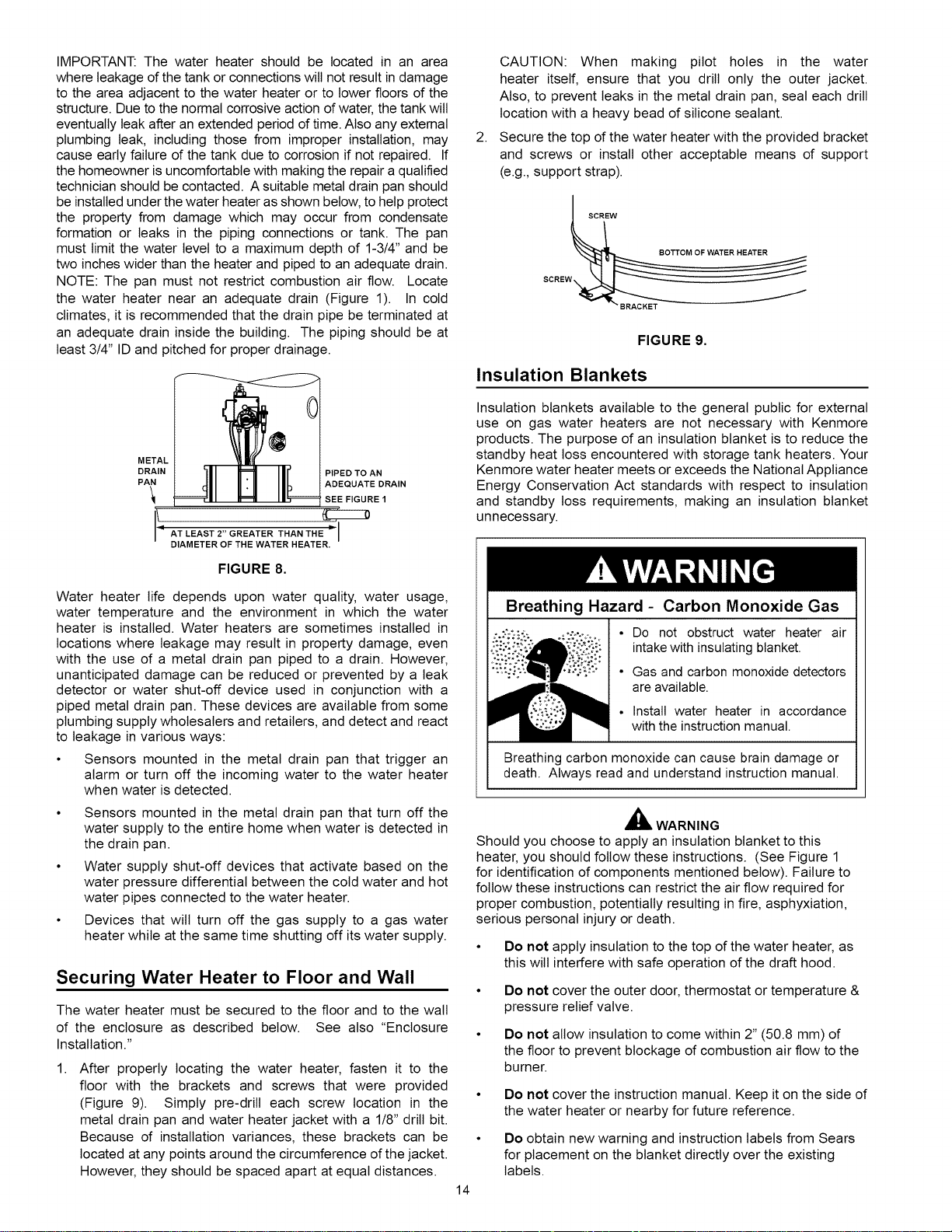
technicianshouldbecontacted.Asuitablemetaldrainpanshould
beinstalledunderthewaterheaterasshownbelow,tohelpprotect
thepropertyfromdamagewhichmayoccurfromcondensate
formationorleaksinthepipingconnectionsortank.Thepan
mustlimitthewaterleveltoamaximumdepthof1-3/4"andbe
twoincheswiderthantheheaterandpipedtoanadequatedrain.
NOTE:Thepanmustnotrestrictcombustionairflow.Locate
thewaterheaternearanadequatedrain(Figure1). Incold
climates,itisrecommendedthatthedrainpipebeterminatedat
anadequatedraininsidethebuilding.Thepipingshouldbeat
least314"IDandpitchedforproperdrainage.
METALDRAIN
PAi
t
PIPED TO AN
ADEQUATE DRAIN
SEE FIGURE 1
AT LEAST 2" GREATER THAN THE_
/
DIAMETER OF THE WATER HEATER,
FIGURE 8.
Water heater life depends upon water quality, water usage,
water temperature and the environment in which the water
heater is installed. Water heaters are sometimes installed in
locations where leakage may result in property damage, even
with the use of a metal drain pan piped to a drain. However,
unanticipated damage can be reduced or prevented by a leak
detector or water shut-off device used in conjunction with a
piped metal drain pan. These devices are available from some
plumbing supply wholesalers and retailers, and detect and react
to leakage in various ways:
• Sensors mounted in the metal drain pan that trigger an
alarm or turn off the incoming water to the water heater
when water is detected.
• Sensors mounted in the metal drain pan that turn off the
water supply to the entire home when water is detected in
the drain pan.
• Water supply shut-off devices that activate based on the
water pressure differential between the cold water and hot
water pipes connected to the water heater.
• Devices that wilt turn off the gas supply to a gas water
heater while at the same time shutting off its water supply.
Securing Water Heater to Floor and Wall
The water heater must be secured to the floor and to the wall
of the enclosure as described below. See also "Enclosure
Installation."
After properly locating the water heater, fasten it to the
floor with the brackets and screws that were provided
(Figure 9). Simply pre-dritt each screw location in the
metal drain pan and water heater jacket with a 118"drill bit.
Because of installation variances, these brackets can be
located at any points around the circumference of the jacket.
However, they should be spaced apart at equal distances.
2,
CAUTION: When making pilot holes in the water
heater itself, ensure that you drill only the outer jacket.
Also, to prevent leaks in the metal drain pan, seal each drill
location with a heavy bead of silicone sealant.
Secure the top of the water heater with the provided bracket
and screws or install other acceptable means of support
(e.g., support strap).
FIGURE 9.
Insulation Blankets
Insulation blankets available to the general public for external
use on gas water heaters are not necessary with Kenmore
products. The purpose of an insulation blanket is to reduce the
standby heat toss encountered with storage tank heaters. Your
Kenmore water heater meets or exceeds the National Appliance
Energy Conservation Act standards with respect to insulation
and standby loss requirements, making an insulation blanket
unnecessary.
14
Breathing Hazard - Carbon Monoxide Gas
• Do not obstruct water heater air
intakewith insulating blanket.
• Gas and carbon monoxide detectors
_"-'__i_':_" _° .:_ are available.• Install water heater in accordance
_o'.:_ with the instruction manual.
I
Breathing carbon monoxide can cause brain damage or
death. Always read and understand instruction manual.
_1_ WARNING
Should you choose to apply an insulation blanket to this
heater, you should follow these instructions. (See Figure 1
for identification of components mentioned below). Failure to
follow these instructions can restrict the air flow required for
proper combustion, potentially resulting in fire, asphyxiation,
serious personal injury or death.
• Do not apply insulation to the top of the water heater, as
this will interfere with safe operation of the draft hood.
Do not cover the outer door, thermostat or temperature &
pressure relief valve.
• Do not allow insulation to come within 2" (50.8 mm) of
the floor to prevent blockage of combustion air flow to the
burner.
• Do not cover the instruction manual. Keep it on the side of
the water heater or nearby for future reference.
• Do obtain new warning and instruction labels from Sears
for placement on the blanket directly over the existing
labels.
• Doinspecttheinsulationblanketfrequentlytomake
certainitdoesnotsag,therebyobstructingcombustionair
flow.
Clearances and Accessibility
NOTE: Minimum clearances from combustible surfaces are
stated on the label adjacent to the gas control valve/thermostat
of the water heater. The water heater is certified for installation
on a combustible floor.
• IMPORTANT: If installing over carpeting, the carpeting
must be protected by a metal or wood panel beneath the
water heater. The protective panel must extend beyond the
full width and depth of the water heater by at least three
inches (76.2mm) in any direction; or if in an alcove or closet
installation, the entire floor must be covered by the panel.
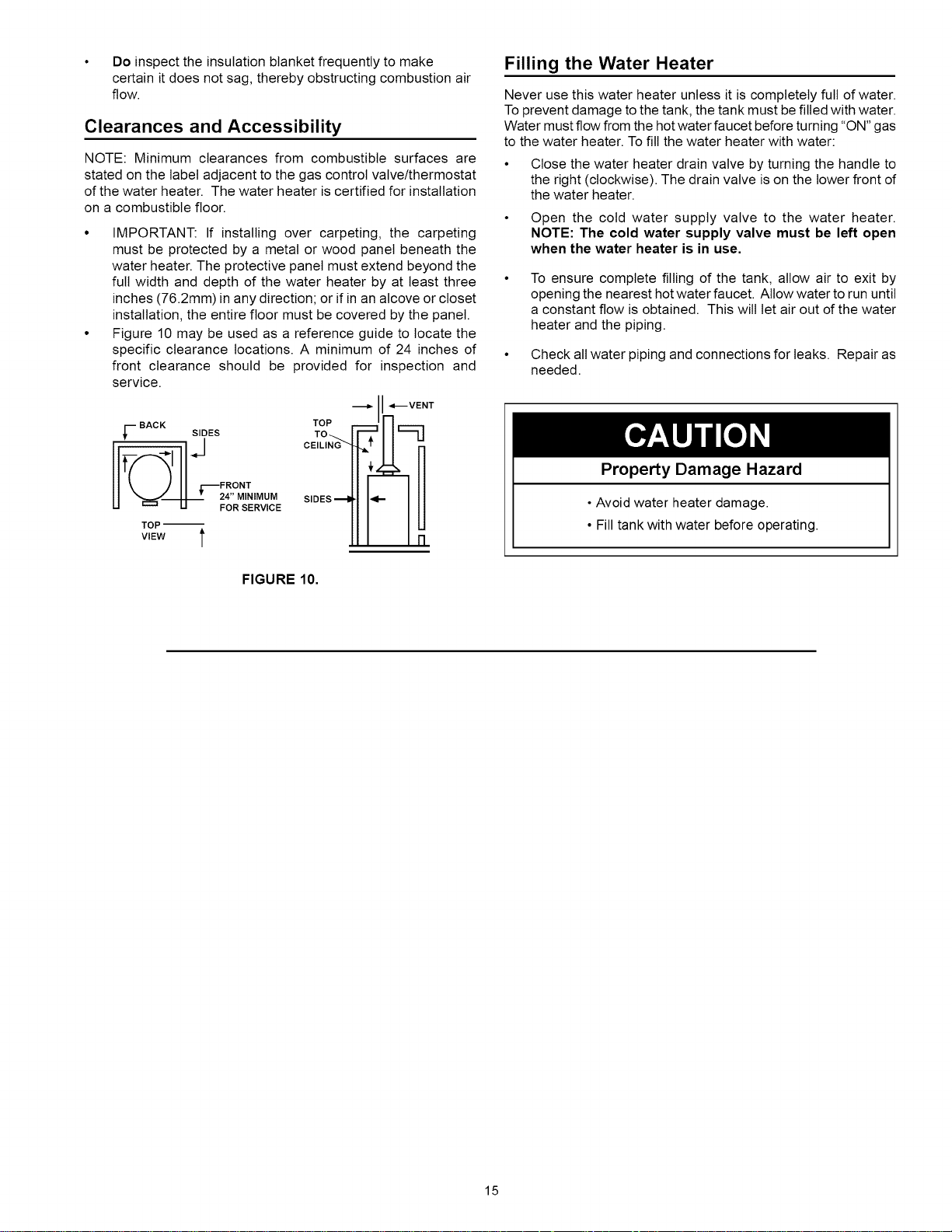
• Figure 10 may be used as a reference guide to locate the
specific clearance locations. A minimum of 24 inches of
front clearance should be
service.
TOP --
VIEW t
provided for inspection and
--_ II _--VENT
-111"I!
Filling the Water Heater
Never use this water heater unless it is completely full of water.
To prevent damage to the tank, the tank must be filled with water.
Water must flow from the hot water faucet before turning "ON" gas
to the water heater. To fill the water heater with water:
• Close the water heater drain valve by turning the handle to
the right (clockwise). The drain valve is on the lower front of
the water heater.
• Open the cold water supply valve to the water heater.
NOTE: The cold water supply valve must be left open
when the water heater is in use.
To ensure complete filling of the tank, allow air to exit by
opening the nearest hot water faucet. Allow water to run until
a constant flow is obtained. This will let air out of the water
heater and the piping.
Check all water piping and connections for leaks. Repair as
needed.
Property Damage Hazard
• Avoid water heater damage.
• Fill tank with water before operating.
FIGURE 10.
15
• For your safety, the following procedures should be
performed by a qualified technician, as it involves
disconnection of gas piping and leak testing.
• Do not connect a natural gas water heater to an L.P. gas
supply.
Do not connect an L.P.gas water heater to a natural gas
supply.
A. REMOVE THE MANIFOLD/BURNER ASSEMBLY
1. Turn off the gas supply to the water heater at the manual gas
shut-off valve. This valve is typically located beside the water
heater. Note the position of the shut-off valve in the open/on
position then proceed to turn itoff.
2. On the lower front of the water heater, locate the gas control
valve/thermostat. Before performing any maintenance, it
is important to turn the temperature dial on the gas control
valve/thermostat to its lowest setting.
3. On top of the gas control valve/thermostat, turn the gas control
knob to the "OFF" position.
4. Remove the outer door.
5. Remove the two screws securing the installed manifold door
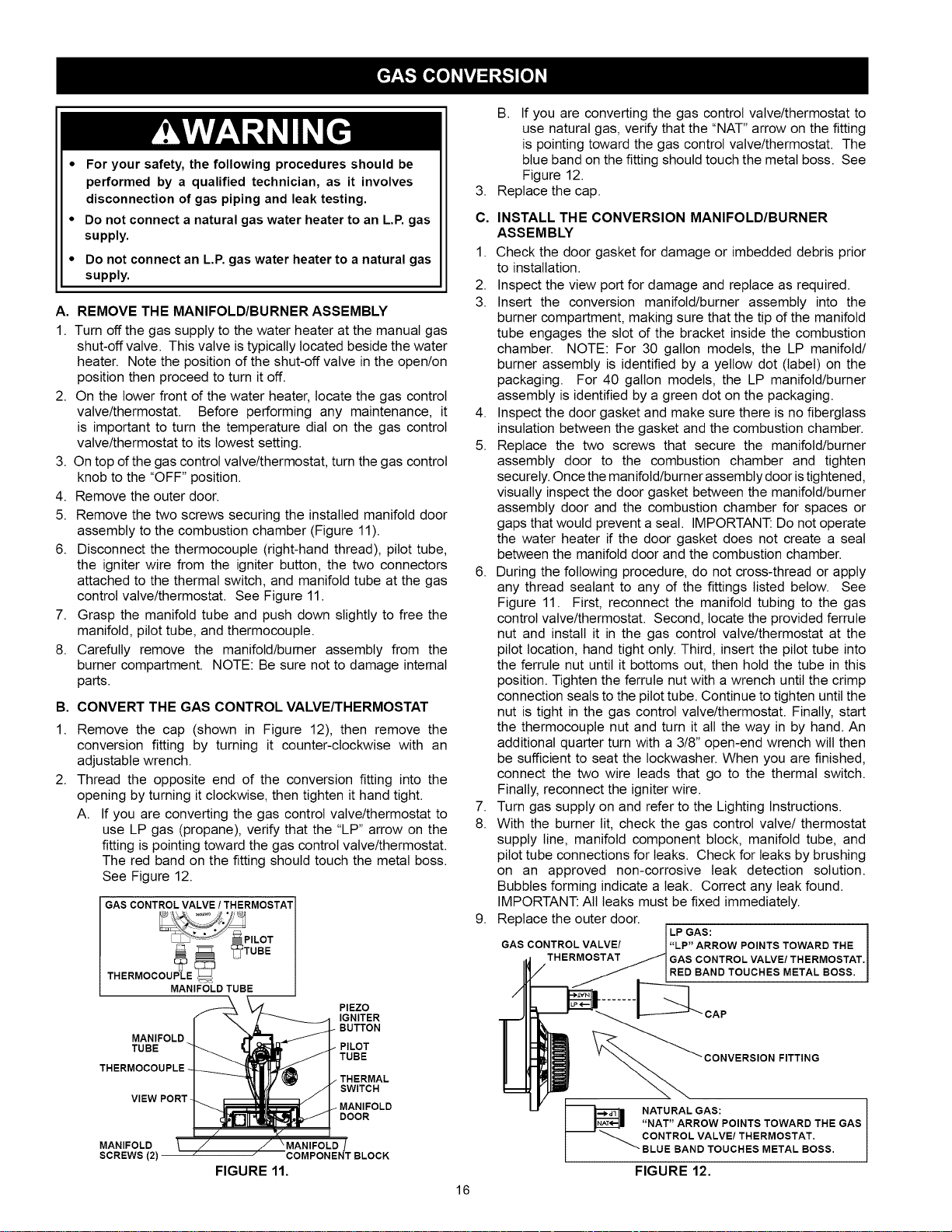
assembly to the combustion chamber (Figure 11).
6. Disconnect the thermocoupte (right-hand thread), pilot tube,
the igniter wire from the igniter button, the two connectors
attached to the thermal switch, and manifold tube at the gas
control valve/thermostat. See Figure 11.
7. Grasp the manifold tube and push down slightly to free the
manifold, pilot tube, and thermocoupte.
8. Carefully remove the manifold/bumer assembly from the
burner compartment. NOTE: Be sure not to damage intemal
parts.
B. CONVERT THE GAS CONTROL VALVE/THERMOSTAT
2.
Remove the cap (shown in Figure 12), then remove the
conversion fitting by turning it counter-clockwise with an
adjustable wrench.
Thread the opposite end of the conversion fitting into the
opening by turning it clockwise, then tighten it hand tight.
A. If you are converting the gas control valve/thermostat to
use LP gas (propane), verify that the "LP" arrow on the
fitting is pointing toward the gas control valve/thermostat.
The red band on the fitting should touch the metal boss.
See Figure 12.
GASCONTROLVALVE/THERMOSTAT
MANIFOLD TUBE
MANIFOLD
TUBE
THERMOCOUPLE
VIEW PORT-
PIEZO
IGNITER
BUTTON
PILOT
TUBE
SWITCH
-MANIFOLD
DOOR
MANIFOLD
SCREWS (2)
\ MANIFOLD "7
COMPONENT BLOCK
FIGURE 11.
16
3.
C.
B. If you are converting the gas control valve/thermostat to
use natural gas, verify that the "NAT" arrow on the fitting
is pointing toward the gas control valve/thermostat. The
blue band on the fitting should touch the metal boss. See
Figure 12.
Replace the cap.
INSTALL THE CONVERSION MANIFOLD/BURNER
ASSEMBLY
1. Check the door gasket for damage or imbedded debris prior
to installation.
2. Inspect the view port for damage and replace as required.
3. Insert the conversion manifold/burner assembly into the
burner compartment, making sure that the tip of the manifold
tube engages the slot of the bracket inside the combustion
chamber. NOTE: For 30 gallon models, the LP manifold/
burner assembly is identified by a yellow dot (label) on the
packaging. For 40 gallon models, the LP manifold/burner
assembly is identified by a green dot on the packaging.
4. Inspect the door gasket and make sure there is no fiberglass
insulation between the gasket and the combustion chamber.
5. Replace the two screws that secure the manifold/burner
assembly door to the combustion chamber and tighten
securely. Once the manifold/burner assembly door istightened,
visually inspect the door gasket between the manifotd/bumer
assembly door and the combustion chamber for spaces or
gaps that would prevent a seal. IMPORTANT: Do not operate
the water heater if the door gasket does not create a seal
between the manifold door and the combustion chamber.
6. During the following procedure, do not cross-thread or apply
any thread sealant to any of the fittings listed below. See
Figure 11. First, reconnect the manifold tubing to the gas
control valve/thermostat. Second, locate the provided ferrule
nut and install it in the gas control valve/thermostat at the
pilot location, hand tight only. Third, insert the pilot tube into
the ferrule nut until it bottoms out, then hold the tube in this
position. Tighten the ferrule nut with a wrench until the crimp
connection seals to the pilot tube. Continue to tighten until the
nut is tight in the gas control valve/thermostat. Finally, start
the thermocouple nut and turn it all the way in by hand. An
additional quarter turn with a 3/8" open-end wrench wilt then
be sufficient to seat the lockwasher. When you are finished,
connect the two wire leads that go to the thermal switch.
Finally, reconnect the igniter wire.
7. Turn gas supply on and refer to the Lighting Instructions.
8. With the burner tit, check the gas control valve/thermostat
supply line, manifold component block, manifold tube, and
pilot tube connections for leaks. Check for leaks by brushing
on an approved non-corrosive leak detection solution.
Bubbles forming indicate a leak. Correct any leak found.
IMPORTANT: All leaks must be fixed immediately.
9. Replace the outer door.
LP GAS:
GAS CONTROL VALVE/ "LP" ARROW POINTS TOWARD THE
THERMOSTAT GAS CONTROL VALVE/THERMOSTAT.
RED BAND TOUCHES METAL BOSS.
CAP
CONVERSION FITTING
_ ATURAL GAS: l
"NAT" ARROW POINTS TOWARD THE GAS
CONTROL VALVE/THERMOSTAT,
BLUE BAND TOUCHES METAL BOSS,
FIGURE 12,
Explosion Hazard
Use a new CSA approved gas supply line.
Install a shut-off valve.
Do not connect a natural gas water heater to an
L.P. gas supply.
Do not connect an L.P. gas water heater to a
natural gas supply.
Failure to follow these instructions can result in
death, explosion, or carbon monoxide poisoning.
Gas Requirements
IMPORTANT: Read the rating plate to be sure the water heater
is made for the type of gas you wilt be using in your home. This
information wilt be found on the rating plate located near the gas
control valve/thermostat. If the information does not agree with
the type of gas available, do not install or light. Call your dealer.
NOTE: If your water heater has been converted, the rating plate
may list a different type of gas than what you wilt be using in your
home. Also, an odorant is added by the gas supplier to the
gas used by this water heater. This odorant may fade over an
extended period of time. Do not depend upon this odorant as an
indication of leaking gas.
Gas Piping
The gas piping must be installed according to all local and
state codes or, in the absence of local and state codes, the
"National Fuel Gas Code", ANSI Z223.1 (NFPA 54)-current
edition. Manufactured home manufacturers must conform with
"The Manufactured Home Construction and Safety Standard,
Title 24 CFR, Part 3280".
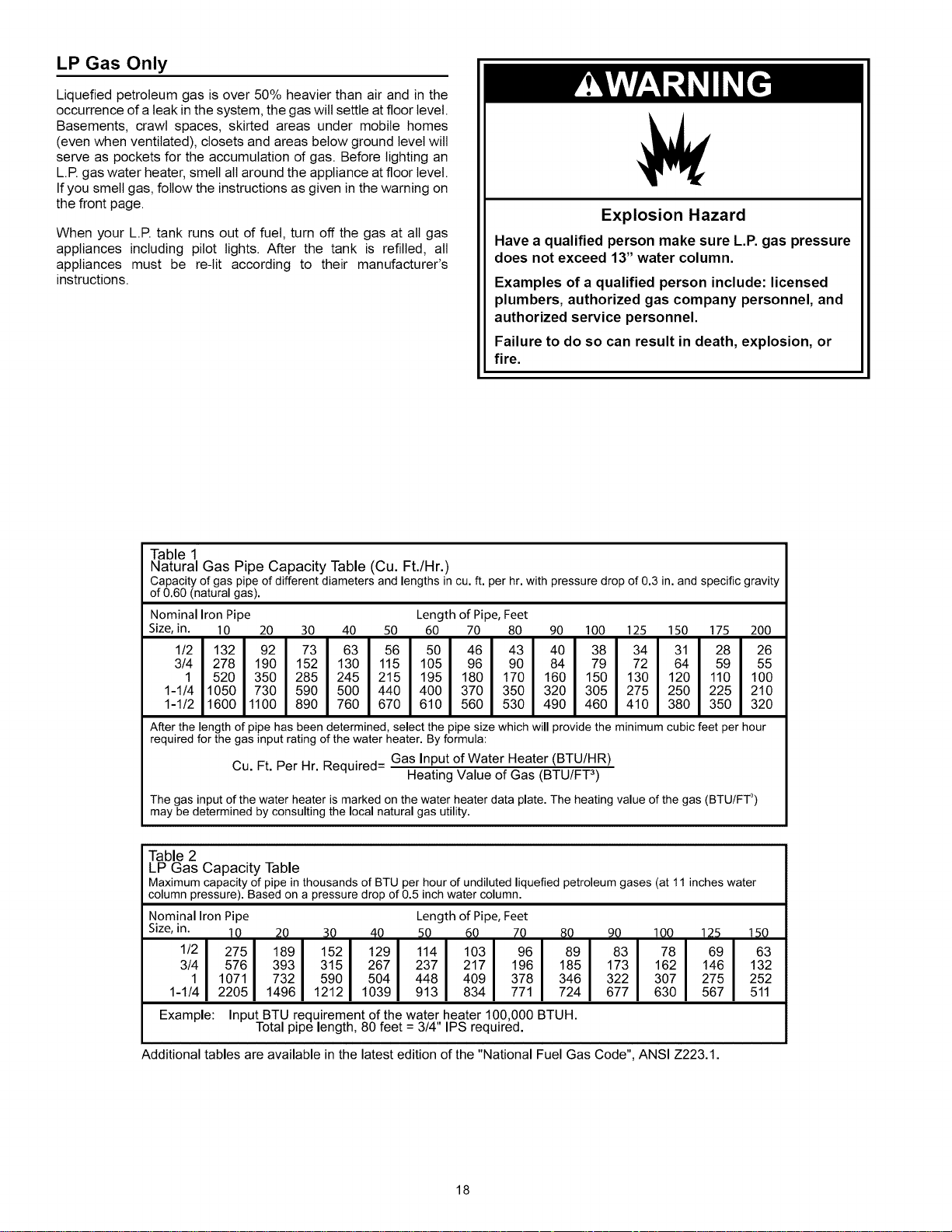
Tables 1and 2 on the following page provide a sizing reference for
commonly used gas pipe materials. Consult the "National Fuel Gas
Code" for the recommended gas pipe size of other materials.
NOTE: Use pipe joint compound or teflon tape marked as being
resistant to the action of petroleum [Propane (L.R)] gases.
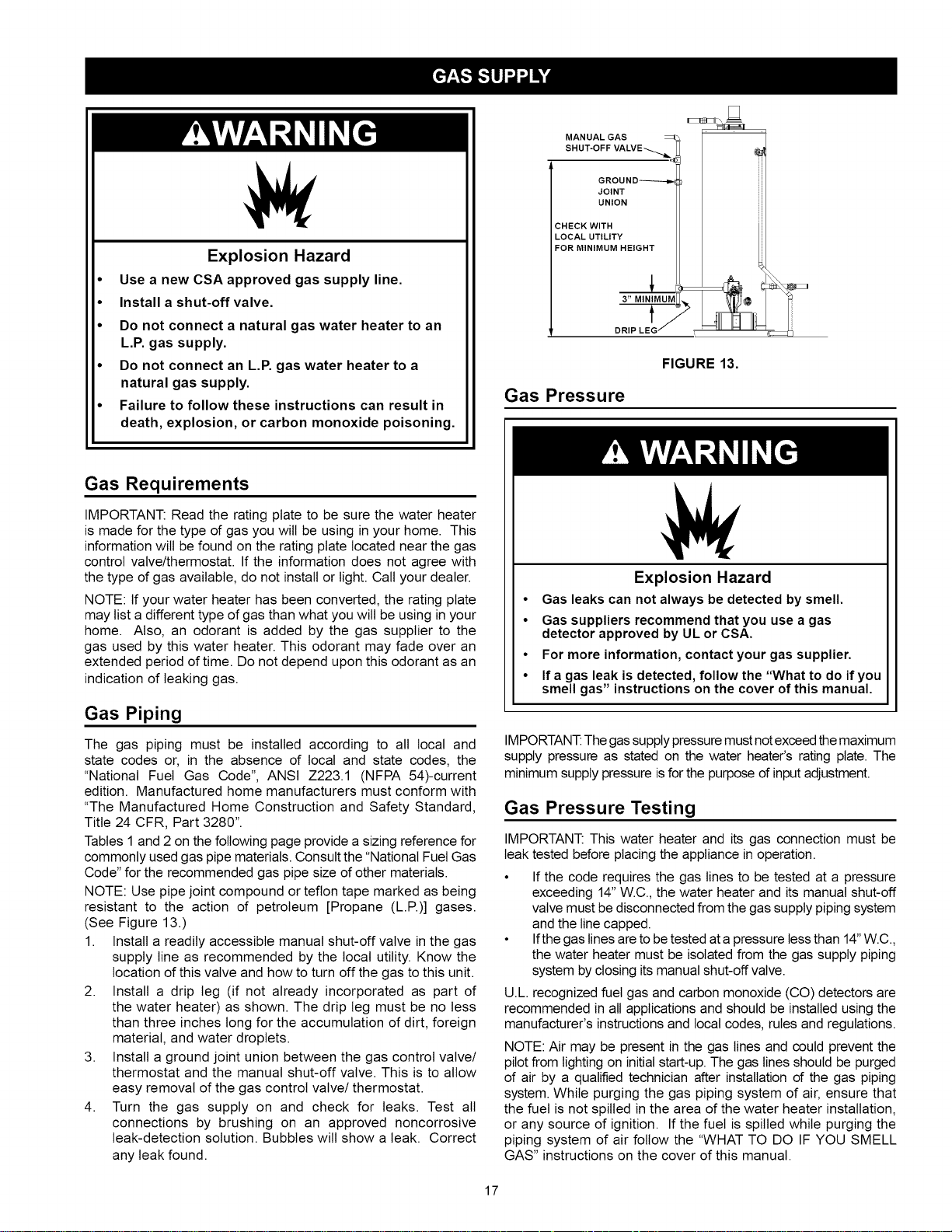
(See Figure 13.)
1. Install a readily accessible manual shut-off valve in the gas
supply line as recommended by the local utility. Know the
location of this valve and how to turn off the gas to this unit.
2. Install a drip leg (if not already incorporated as part of
the water heater) as shown. The drip leg must be no less
than three inches tong for the accumulation of dirt, foreign
material, and water droplets.
3. Install a ground joint union between the gas control valve/
thermostat and the manual shut-off valve. This is to allow
easy removal of the gas control valve/thermostat.
4. Turn the gas supply on and check for leaks. Test all
connections by brushing on an approved noncorrosive
leak-detection solution. Bubbles will show a leak. Correct
any leak found.
MANUAL GAS
SHUT-OFF VALVE _
GROU N D------_
JOINT
UNION
CHECK WITH
LOCAL UTILITY
FOR MINIMUM HEIGHT
3" MINIMUM
' DRIP LJG _
Gas Pressure
FIGURE 13.
Explosion Hazard
• Gas leaks can not always be detected by smell.
• Gas suppliers recommend that you use a gas
detector approved by UL or CSA.
• For more information, contact your gas supplier.
• If a gas leak is detected, follow the "What to do if you
smell gas" instructions on the cover of this manual.
IMPORTANT:The gas supply pressure must not exceed the maximum
supply pressure as stated on the water heater's rating plate. The
minimum supply pressure is for the purpose of input adjustment.
Gas Pressure Testing
IMPORTANT: This water heater and its gas connection must be
leak tested before placing the appliance in operation.
• If the code requires the gas lines to be tested at a pressure
exceeding 14" W.C., the water heater and its manual shut-off
valve must be disconnected from the gas supply piping system
and the line capped.
• If the gas lines are to be tested ata pressure less than 14"W.C.,
the water heater must be isolated from the gas supply piping
system by closing its manual shut-off valve.
U.L. recognized fuel gas and carbon monoxide (CO) detectors are
recommended in all applications and should be installed using the
manufacturer's instructions and local codes, rules and regulations.
NOTE: Air may be present in the gas lines and could prevent the
pilot from lighting on initial start-up. The gas lines should be purged
of air by a qualified technician after installation of the gas piping
system. While purging the gas piping system of air, ensure that
the fuel is not spilled in the area of the water heater installation,
or any source of ignition. If the fuel is spilled while purging the
piping system of air follow the "WHAT TO DO IF YOU SMELL
GAS" instructions on the cover of this manual.
17
LP Gas Only
Liquefied petroleum gas is over 50% heavier than air and in the
occurrence of a leak in the system, the gas wilt settle at floor level.
Basements, crawl spaces, skirted areas under mobile homes
(even when ventilated), closets and areas below ground level will
serve as pockets for the accumulation of gas. Before lighting an
L.R gas water heater, smell all around the appliance at floor level.
If you smell gas, follow the instructions as given inthe warning on
the front page.
When your L.R tank runs out of fuel, turn off the gas at all gas
appliances including pilot lights. After the tank is refilled, all
appliances must be re-lit according to their manufacturer's
instructions.
Explosion Hazard
Have a qualified person make sure L.P.gas pressure
does not exceed 13"water column.
Examples of a qualified person include: licensed
plumbers, authorized gas company personnel, and
authorized service personnel.
Failure to do so can result in death, explosion, or
fire.
Table 1
Natural Gas Pipe Capacity Table (Cu. Ft./Hr.)
Capacityof gaspipe ofdifferentdiametersand lengthsin cu.ft. perhr. withpressuredropof 0.3 in.andspecificgravity
of 0.60(naturalgas).
Nominal Iron Pipe Length of Pipe, Feet
Size,in. 10 20 30 40 50 60 70 80 90 100 125 150 175 200
1/2 132 92 73 63 56 50 46 43 40 38 34 31 28 26
3/4 278 190 152 130 115 105 96 90 84 79 72 64 59 55
1 520 350 285 245 215 195 180 170 160 150 130 120 110 100
1-1/4 1050 730 590 500 440 400 370 350 320 305 275 250 225 210
1-1/2 1600 1100 890 760 670 610 560 530 490 460 410 380 350 320
After the length of pipe has been determined, select the pipe size which will provide the minimum cubic feet per hour
required for the gas input rating of the water heater. By formula:
Gas Input of Water Heater (BTU/HR)
Cu. Ft. Per Hr. Required=
Heating Value of Gas (BTU/FT 3)
The gas input of the water heater is marked on the water heater data plate. The heating value of the gas (BTU/FT 3)
may be determined by consulting the local natural gas utility.
Table 2
LP Gas Capacity Table
Maximumcapacityof pipein thousandsof BTUperhour of undilutedliquefiedpetroleumgases (at11 incheswater
columnpressure).Basedona pressuredropof 0.5 inchwatercolumn.
Nominallron Pipe Length ofPipe, Feet
Size,in. 10 20 30 40 50 60 70 80 90 100 125 150
1/2 275 189 152 129 114 103 96 89 83 78 69 63
3/4 576 393 315 267 237 217 196 185 173 162 146 132
1 1071 732 590 504 448 409 378 346 322 307 275 252
1-1/4 2205 1496 12t2 1039 913 834 771 724 677 630 567 511
Example: Input BTU requirement of the water heater 100,000 BTUH.
Total pipe length, 80 feet = 3/4" IPS required.
Additional tables are available in the latest edition of the "National Fuel Gas Code", ANSI Z223.1.
18
Carbon Monoxide Warning
The vent system must be installed according to all
local and state codes or, in the absence of local and
state codes, the "National Fuel Gas Code", ANSI
Z223.1 (NFPA 54)-current edition. Manufactured home
manufacturers must comply with the "Manufactured
Home Construction and Safety Standard, Title 24 CFR,
Part 3280."
Failure to do so can result in death, explosion, or
carbon monoxide poisoning.
IMPORTANT: Air for combustion and ventilation must not come
from a corrosive atmosphere. Any failure due to corrosive elements
in the atmosphere is excluded from warranty coverage.
The following types of installation (not limited to the following)
wilt require outdoor air for combustion due to chemical exposure
and may reduce but not eliminate the presence of corrosive
chemicals in the air:
• beauty shops
• photo processing tabs
• buildings with indoor pools
• water heaters installed in laundry, hobby, or craft rooms
• water heaters installed near chemical storage areas
Combustion air must befree ofacid-forming chemicals such assulfur,
fluorine, and chlorine. These elements are found in aerosol sprays,
detergents, bleaches, cleaning solvents, air fresheners, paint, and
vamish removers, refrigerants, and many other commercial and
household products. When bumed, vapors from these products
form highly corrosive acid compounds. These products should not
be stored or used near the water heater or air inlet.
Vent Pipe System
This water heater uses a non-direct, single-pipe vent system
to remove exhaust gases created by the burning of fossil
fuels. Air for combustion is taken from the immediate water
heater location or is ducted in from the outside (see "Enclosure
Installation").
This water heater must be properly vented for the removal of
exhaust gases to the outside atmosphere. Correct installation
of the vent pipe system is mandatory for the proper and efficient
operation of this water heater and is an important factor in the
life of the unit.
The vent pipe must be installed according to all local and state
codes or, in the absence of local and state codes, the "National
Fuel Gas Code", ANSI Z223.1 (NFPA 54)-current edition.
Manufactured home manufacturers must conform with "The
Manufactured Home Construction and Safety Standard, Title
24 CFR, Part 3280." The vent pipe installation must not be
obstructed so as to prevent the removal of exhaust gases to the
outside atmosphere.
IMPORTANT: The use of vent dampers is not recommended
by the manufacturer of this water heater. Although some vent
dampers are certified by CSA International, this certification
applies to the vent damper device only and does not mean they
are certified for use on this water heater.
U.L. recognized fuel gas and carbon monoxide (CO) detectors are
recommended in all applications and should be installed using the
manufacturer's instructions and local codes, rules, or regulations.
IMPORTANT: If you tack the necessary skills required to
properly install this venting system, you should not proceed, but
get help from a qualified technician.
Draft Hood Installation
rDRAFT HOOD
-,I" ,____4__.._ ",
INSTALL THE DRAFT HOOD WITH
THE FOUR SCREWS PROVIDED.
FIGURE 14.
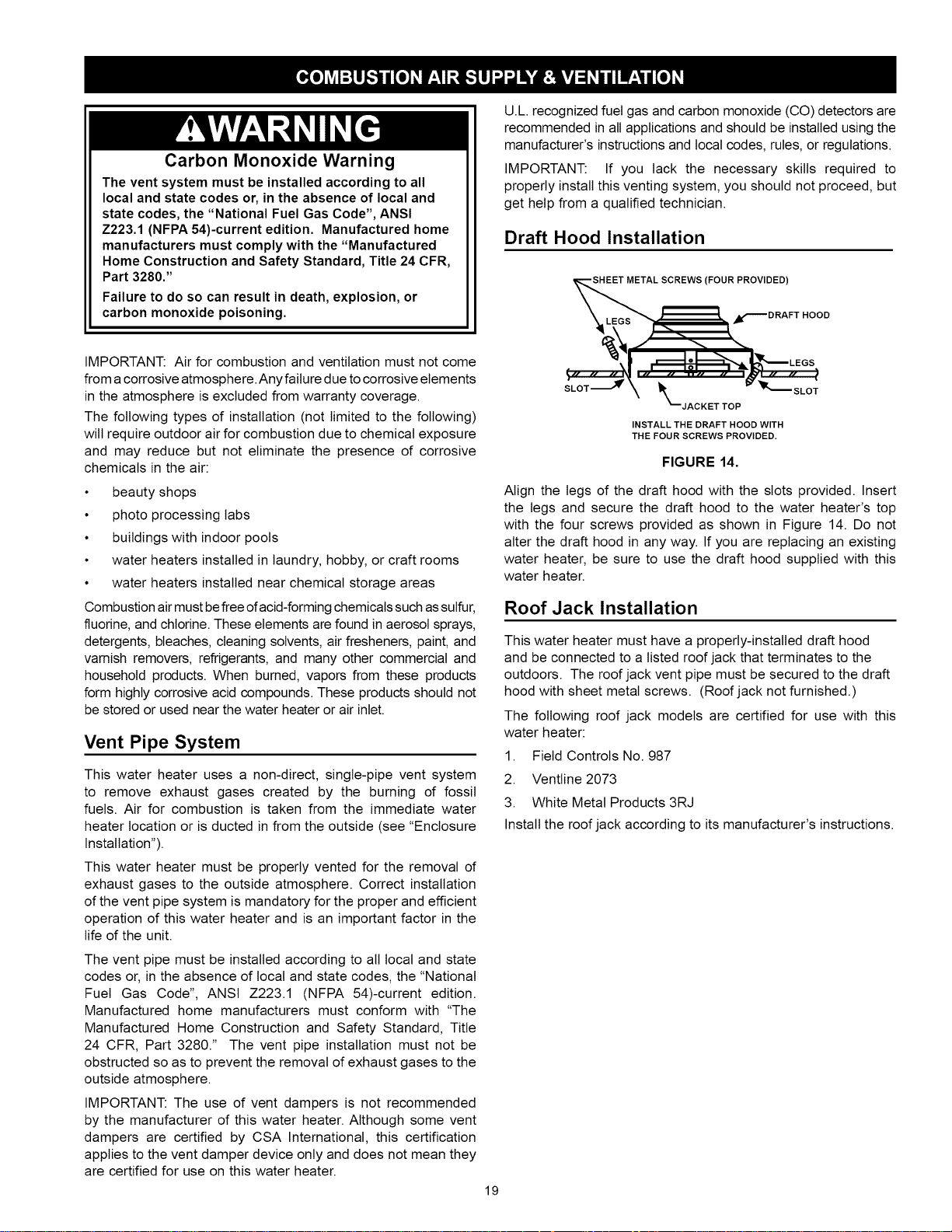
Align the legs of the draft hood with the slots provided. Insert
the legs and secure the draft hood to the water heater's top
with the four screws provided as shown in Figure 14. Do not
alter the draft hood in any way. If you are replacing an existing
water heater, be sure to use the draft hood supplied with this
water heater.
Roof Jack Installation
This water heater must have a property-installed draft hood
and be connected to a listed roof jack that terminates to the
outdoors. The roof jack vent pipe must be secured to the draft
hood with sheet metal screws. (Roof jack not furnished.)
The following roof jack models are certified for use with this
water heater:
1. Field Controls No. 987
2. Ventline 2073
3. White Metal Products 3RJ
Install the roof jack according to its manufacturer's instructions.
19
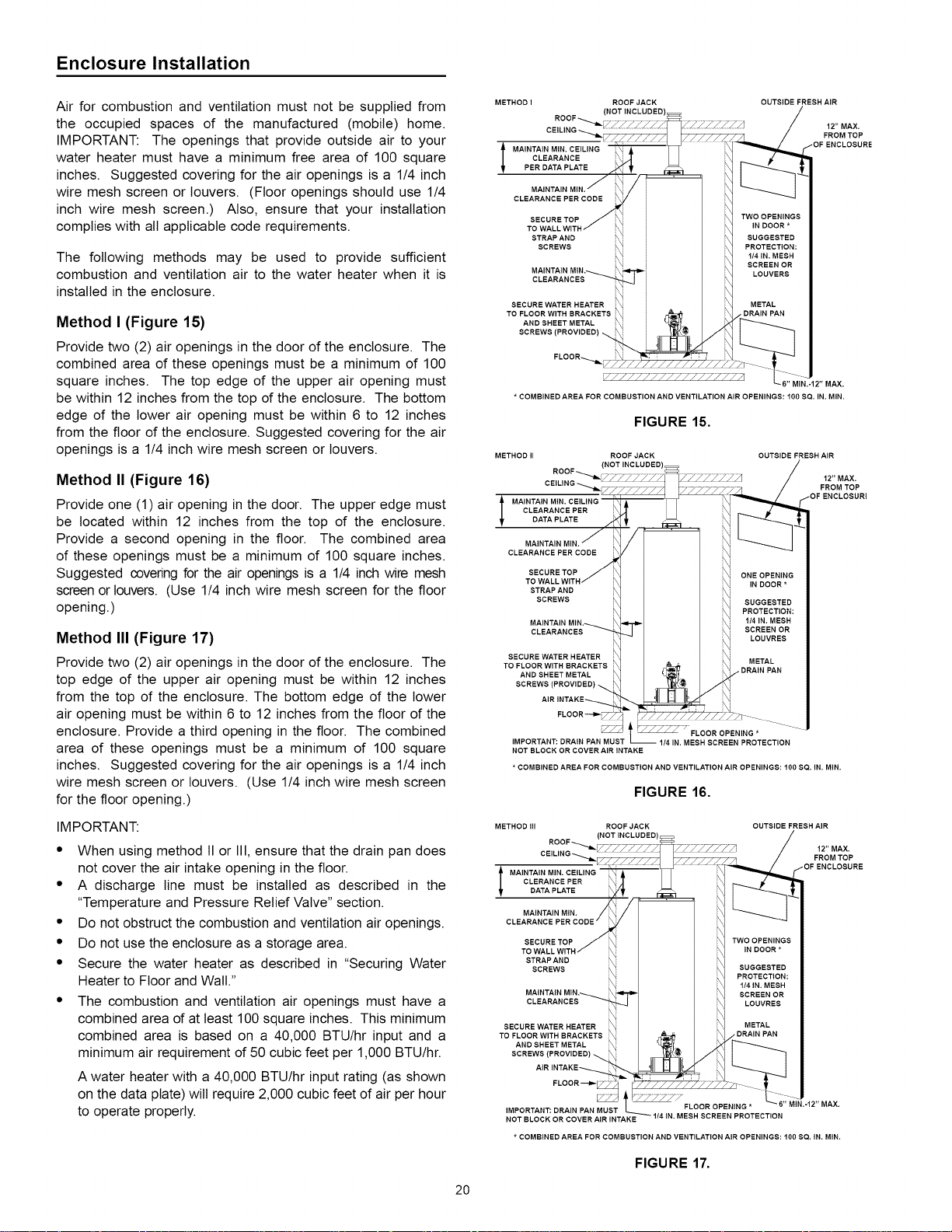
Enclosure Installation
Air for combustion and ventilation must not be supplied from
the occupied spaces of the manufactured (mobile) home.
IMPORTANT: The openings that provide outside air to your
water heater must have a minimum free area of 100 square
inches. Suggested covering for the air openings is a 1/4 inch
wire mesh screen or louvers. (Floor openings should use 1/4
inch wire mesh screen.) Also, ensure that your installation
complies with all applicable code requirements.
The following methods may be used to provide sufficient
combustion and ventilation air to the water heater when it is
installed in the enclosure.
Method I (Figure 15)
Provide two (2) air openings in the door of the enclosure. The
combined area of these openings must be a minimum of 100
square inches. The top edge of the upper air opening must
be within 12 inches from the top of the enclosure. The bottom
edge of the lower air opening must be within 6 to 12 inches
from the floor of the enclosure. Suggested covering for the air
openings is a 1/4 inch wire mesh screen or louvers.
Method II (Figure 16)
Provide one (1) air opening in the door. The upper edge must
be located within 12 inches from the top of the enclosure.
Provide a second opening in the floor. The combined area
of these openings must be a minimum of 100 square inches.
Suggested covering for the air openings is a 1/4 inch wire mesh
screen or louvers. (Use 1/4 inch wire mesh screen for the floor
opening.)
Method III (Figure 17)
Provide two (2) air openings in the door of the enclosure. The
top edge of the upper air opening must be within 12 inches
from the top of the enclosure. The bottom edge of the lower
air opening must be within 6 to 12 inches from the floor of the
enclosure. Provide a third opening in the floor. The combined
area of these openings must be a minimum of 100 square
inches. Suggested covering for the air openings is a 1/4 inch
wire mesh screen or louvers. (Use 1/4 inch wire mesh screen
for the floor opening.)
IMPORTANT:
• When using method II or III, ensure that the drain pan does
not cover the air intake opening in the floor.
• A discharge line must be installed as described in the
"Temperature and Pressure Relief Valve" section.
• Do not obstruct the combustion and ventilation air openings.
• Do not use the enclosure as a storage area.
• Secure the water heater as described in "Securing Water
Heater to Floor and Wall."
• The combustion and ventilation air openings must have a
combined area of at least 100 square inches. This minimum
combined area is based on a 40,000 BTU/hr input and a
minimum air requirement of 50 cubic feet per 1,000 BTU/hr.
A water heater with a 40,000 BTU/hr input rating (as shown
on the data plate) will require 2,000 cubic feet of air per hour
to operate properly.
METHOD I
I MAINTAIN MIN. CEILING
ROOF JACK
(NOT INCLUDED)
OUTSIDE FRESH AIR
SCREWS (PROVIDED)
_77.,777777777777777//
*COMBINEDAREA FOR COMBUSTIONAND VENTILATIONAIR OPENINGS: 100SQ, IN,MIN,
FIGURE 15.
METHOD II ROOF JACK OUTSIDE FRESH AIR
(NOT INDLUDED)_
12" MAX.
FROM TOP
-OF ENDLOSURt
SECURE WATER HEATER
TO FLOOR WITH BRACKETS
AND SHEET METAL
SCREWS (PROVIDED) -_
AIR INTAKE_.._i
FLOO R**-_"_
NOT BLOCK OR COVER AIR INTAKE
* COMBINED AREA FOR COMBUSTION AND VENTILATION AIR OPENINGS: 100 SQ. IN. MIN.
FIGURE 16.
METHOD Ill ROOF JACK OUTSIDE FRESH AIR
(NOT INCLUDED),
I CLERANDE PER
2O
* COMBINED AREA FOR COMBUSTION AND VENTILATION AIR OPENINGS: 100 SQ. IN. MIN.
FIGURE 17.
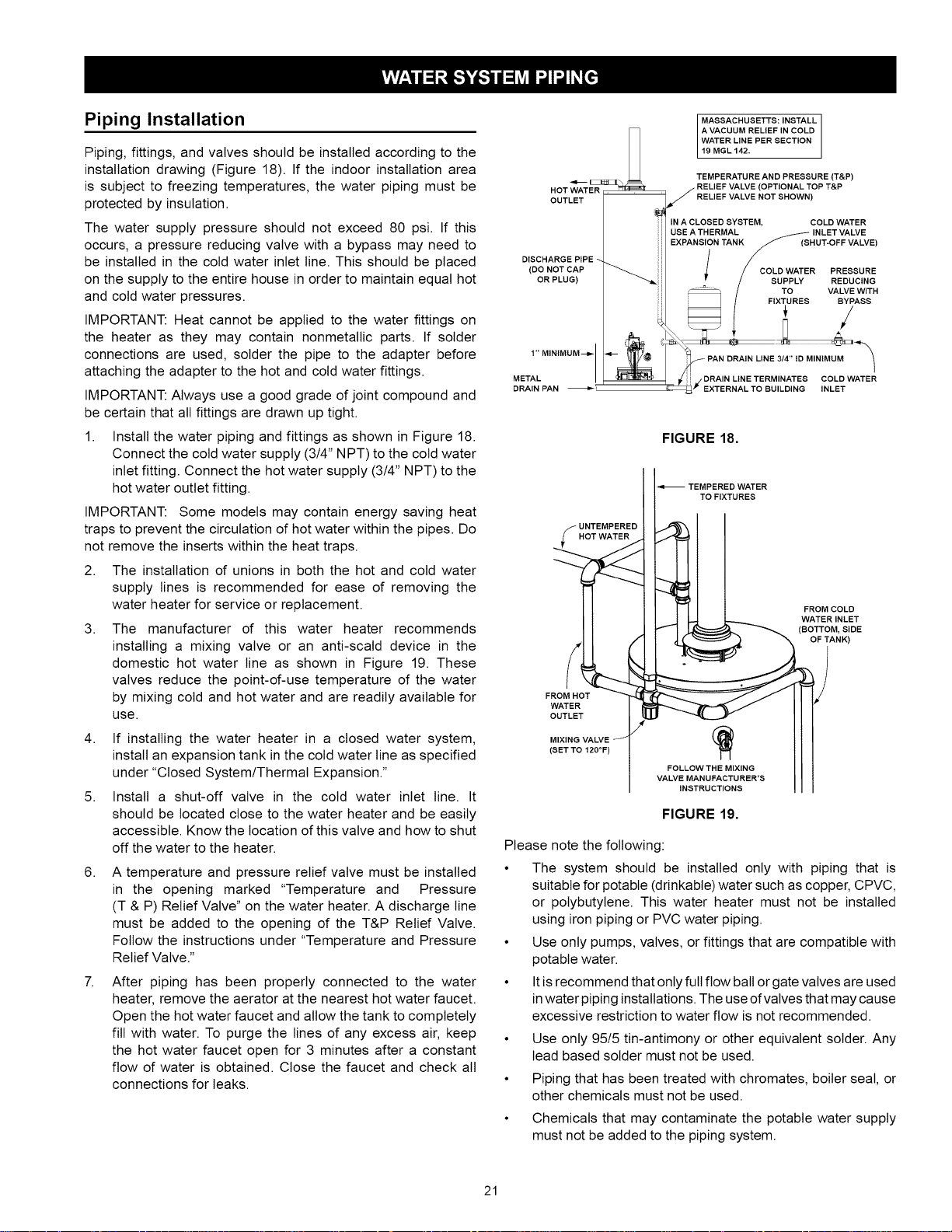
Piping Installation
Piping, fittings, and valves should be installed according to the
installation drawing (Figure 18). If the indoor installation area
is subject to freezing temperatures, the water piping must be
protected by insulation.
The water supply pressure should not exceed 80 psi. If this
occurs, a pressure reducing valve with a bypass may need to
be installed in the cold water inlet line. This should be placed
on the supply to the entire house in order to maintain equal hot
and cold water pressures.
IMPORTANT: Heat cannot be applied to the water fittings on
the heater as they may contain nonmetallic parts. If solder
connections are used, solder the pipe to the adapter before
attaching the adapter to the hot and cold water fittings.
IMPORTANT: Always use a good grade of joint compound and
be certain that all fittings are drawn up tight.
1. Install the water piping and fittings as shown in Figure 18.
Connect the cold water supply (3/4" NPT) to the cold water
inlet fitting. Connect the hot water supply (3/4" NPT) to the
hot water outlet fitting.
IMPORTANT: Some models may contain energy saving heat
traps to prevent the circulation of hot water within the pipes. Do
not remove the inserts within the heat traps.
2,
3,
4,
5,
6,
7,
The installation of unions in both the hot and cold water
supply lines is recommended for ease of removing the
water heater for service or replacement.
The manufacturer of this water heater recommends
installing a mixing valve or an anti-scald device in the
domestic hot water line as shown in Figure 19. These
valves reduce the point-of-use temperature of the water
by mixing cold and hot water and are readily available for
use.
If installing the water heater in a closed water system,
install an expansion tank in the cold water line as specified
under "Closed System/Thermal Expansion."
Install a shut-off valve in the cold water inlet line. It
should be located close to the water heater and be easily
accessible. Know the location of this valve and how to shut
off the water to the heater.
A temperature and pressure relief valve must be installed
in the opening marked "Temperature and Pressure
(T & P) Relief Valve" on the water heater. A discharge line
must be added to the opening of the T&P Relief Valve.
Follow the instructions under "Temperature and Pressure
Relief Valve."
After piping has been properly connected to the water
heater, remove the aerator at the nearest hot water faucet.
Open the hot water faucet and allow the tank to completely
fill with water. To purge the lines of any excess air, keep
the hot water faucet open for 3 minutes after a constant
flow of water is obtained. Close the faucet and check all
connections for leaks.
MASSACHUSETTS: INSTALL
A VACUUM RELIEF IN COLD
WATER LINE PER SECTION
19 MGL 142.
HOT _AAT_ / TE LMIPE%AA_LUR_Ap%DoPNRAELS"_UR%(&TP&P)
OUTLET _ RELIEF VALVE NOT SHOWN)
IN A CLOSED SYSTEM, COLD WATER
_i_NT,%ENRMA' LK //_ / N L.%%FV'LAVLEvE,
DI(S%HN%RTGE AP/P E _'-_ I t / COLD WATER PRESSURE
OR PLUG) ""_; _ / S%PoPLY RvAELD/UCtV_INTGH
_ [ FIxiORBs BYPASS
1
y_
MINIMUM
_- _/_ _ PAN DRAIN LINE 3/4" ID MINIMUM
METAL I __=_/i =/DRAIN LINE TERMINATES COLD WATER
DRAIN PAN -_! _" EXTERNAL TO BUILDING INLET
FIGURE 18.
_-UNTEMPERED
HOT WATER
FROM HOT
WATER
OUTLET
MIXING VALVE -_
(SET TO 120°F)
_.I_TEMPERED WATER
TO FIXTURES
FROM COLD
WATER INLET
(BOTTOM, SIDE
OF TANK)
FOLLOW THE MIXING
VALVE MANUFACTURER'S
INSTRUCTIONS
FIGURE 19.
Please note the following:
• The system should be installed only with piping that is
suitable for potable (drinkable) water such as copper, CPVC,
or polybutytene. This water heater must not be installed
using iron piping or PVC water piping.
• Use only pumps, valves, or fittings that are compatible with
potable water.
• It is recommend that only full flow ball or gate valves are used
in water piping installations. The use of valves that may cause
excessive restriction to water flow is not recommended.
• Use only 95/5 tin-antimony or other equivalent solder. Any
lead based solder must not be used.
• Piping that has been treated with chromates, boiler seal, or
other chemicals must not be used.
• Chemicals that may contaminate the potable water supply
must not be added to the piping system.
21
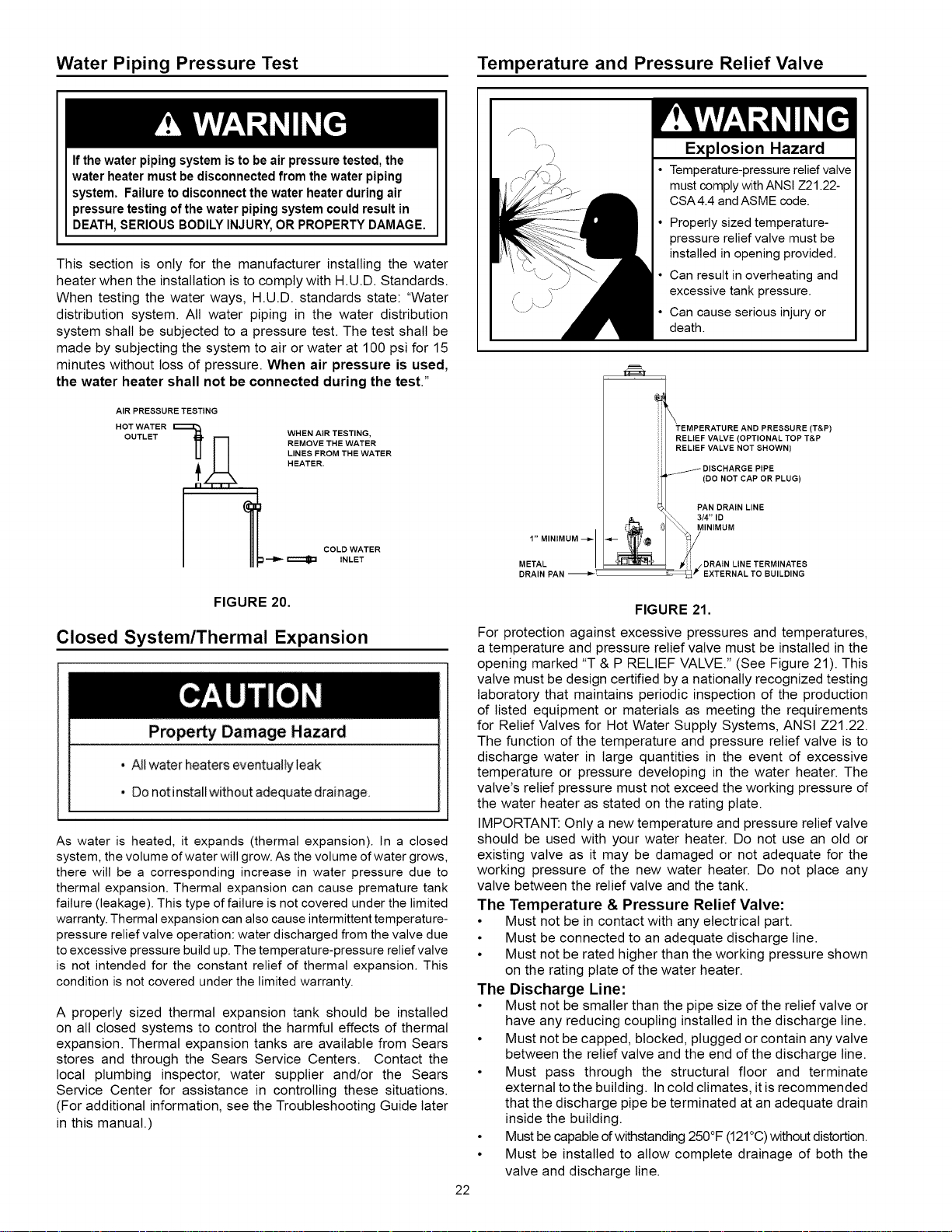
Water Piping Pressure Test Temperature and Pressure Relief Valve
If the water piping system is to be air pressure tested, the
water heater must be disconnected from the water piping
system. Failure to disconnect the water heater during air
pressure testing of the water piping system could result in
DEATH, SERIOUS BODILY INJURY, OR PROPERTY DAMAGE.
This section is only for the manufacturer installing the water
heater when the installation is to comply with H.UD. Standards.
When testing the water ways, H.U.D. standards state: "Water
distribution system. All water piping in the water distribution
system shall be subjected to a pressure test. The test shall be
made by subjecting the system to air or water at 100 psi for 15
minutes without toss of pressure. When air pressure is used,
the water heater shall not be connected during the test."
AIR PRESSURE TESTING
HOT WATER _
OUTLET WHEN AIR TESTING,
REMOVE THE WATER
LINES FROM THE WATER
HEATER,
COLD WATER
I "--I1_ _ INLET
FIGURE 20.
Closed System/Thermal Expansion
Property Damage Hazard
. A_lwater heaters eventually leak
• Do not install without adequate drainage,
As water is heated, it expands (thermal expansion). In a closed
system, the volume of water will grow. As the volume of water grows,
there will be a corresponding increase in water pressure due to
thermal expansion. Thermal expansion can cause premature tank
failure (leakage). This type of failure is not covered under the limited
warranty. Thermal expansion can also cause intermittent temperature-
pressure relief valve operation: water discharged from the valve due
to excessive pressure build up. The temperature-pressure relief valve
is not intended for the constant relief of thermal expansion. This
condition is not covered under the limited warranty.
A properly sized thermal expansion tank should be installed
on all closed systems to control the harmful effects of thermal
expansion. Thermal expansion tanks are available from Sears
stores and through the Sears Service Centers. Contact the
local plumbing inspector, water supplier and/or the Sears
Service Center for assistance in controlling these situations.
(For additional information, see the Troubleshooting Guide later
in this manual.)
)losion Hazard
Temperature-pressurereliefvalve
must complywith ANSI Z21.22-
CSA4.4 and ASME code.
• Properly sized temperature-
pressure relief valve must be
installed in opening provided.
• Can result in overheating and
excessive tank pressure.
• Can cause serious injury or
death.
22
1" MINIMUM
METAL
DRAIN PAN -_='-_
TEMPERATURE AND PRESSURE (T&P)
RELIEF VALVE (OPTIONAL TOP T&P
RELIEF VALVE NOT SHOWN)
_--_- DISCHARGE PIPE
(DO NOT CAP OR PLUG)
PAN DRAIN LINE
_ 3/4" ID
MINIMUM
DRAIN LINE TERMINATES
_P EXTERNAL TO BUILDING
FIGURE 21.
For protection against excessive pressures and temperatures,
a temperature and pressure relief valve must be installed in the
opening marked "T & P RELIEF VALVE." (See Figure 21). This
valve must be design certified by a nationally recognized testing
laboratory that maintains periodic inspection of the production
of listed equipment or materials as meeting the requirements
for Relief Valves for Hot Water Supply Systems, ANSI Z21.22.
The function of the temperature and pressure relief valve is to
discharge water in large quantities in the event of excessive
temperature or pressure developing in the water heater. The
valve's relief pressure must not exceed the working pressure of
the water heater as stated on the rating plate.
IMPORTANT: Only a new temperature and pressure relief valve
should be used with your water heater. Do not use an old or
existing valve as it may be damaged or not adequate for the
working pressure of the new water heater. Do not place any
valve between the relief valve and the tank.
The Temperature & Pressure Relief Valve:
• Must not be in contact with any electrical part.
• Must be connected to an adequate discharge line.
• Must not be rated higher than the working pressure shown
on the rating plate of the water heater.
The Discharge Line:
• Must not be smaller than the pipe size of the relief valve or
have any reducing coupling installed in the discharge line.
• Must not be capped, blocked, plugged or contain any valve
between the relief valve and the end of the discharge line.
• Must pass through the structural floor and terminate
external to the building. In cold climates, it is recommended
that the discharge pipe be terminated at an adequate drain
inside the building.
• Must be capable of withstanding 250°F (121°C)without distortion.
• Must be installed to allow complete drainage of both the
valve and discharge line.
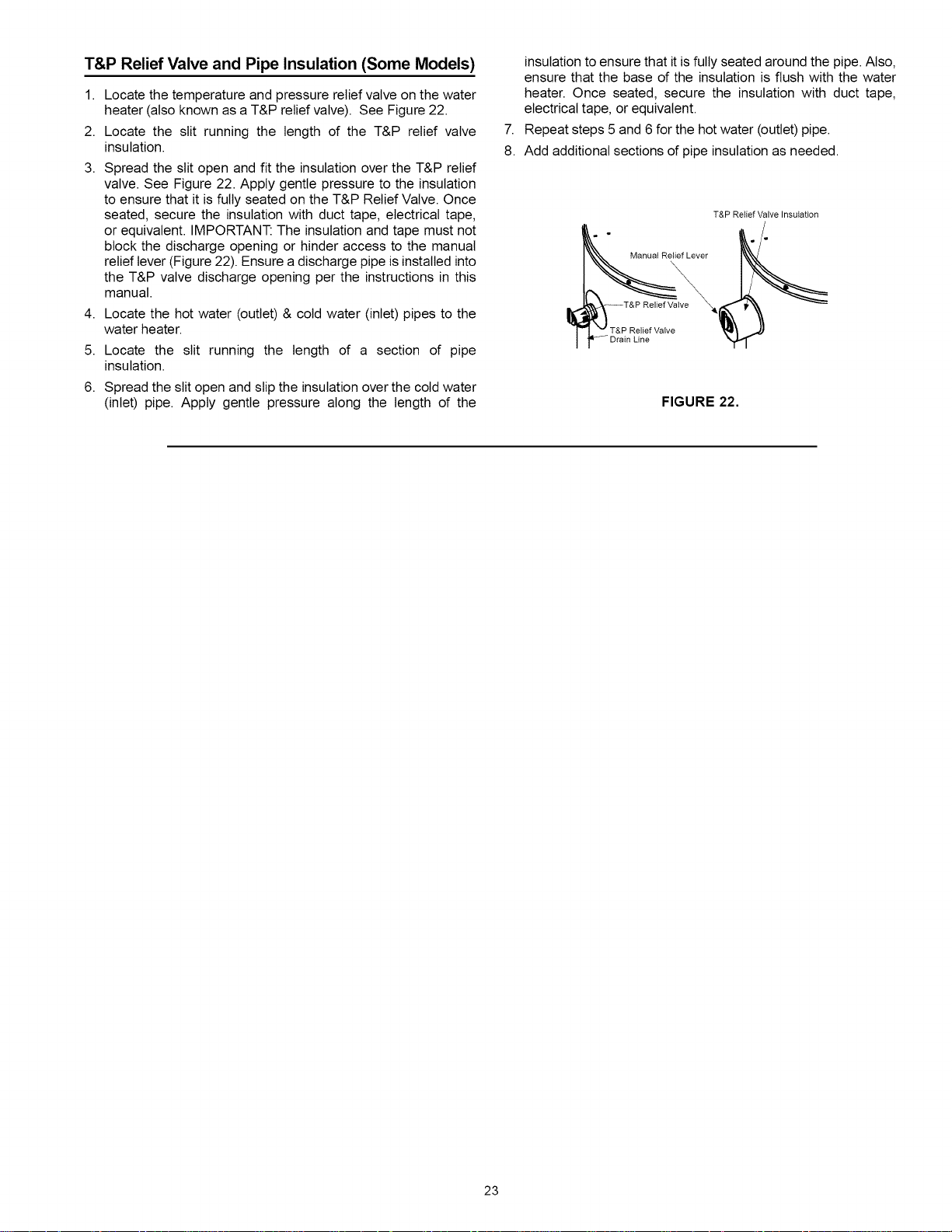
T&P Relief Valve and Pipe Insulation (Some Models)
1. Locate the temperature and pressure relief valve on the water
heater (also known as a T&P relief valve). See Figure 22.
2. Locate the slit running the length of the T&P relief valve
insulation.
3. Spread the slit open and fit the insulation over the T&P relief
valve. See Figure 22. Apply gentle pressure to the insulation
to ensure that it is fully seated on the T&P Relief Valve. Once
seated, secure the insulation with duct tape, electrical tape,
or equivalent. IMPORTANT: The insulation and tape must not
block the discharge opening or hinder access to the manual
relief lever (Figure 22). Ensure a discharge pipe is installed into
the T&P valve discharge opening per the instructions in this
manual.
4. Locate the hot water (outlet) & cold water (inlet) pipes to the
water heater.
5. Locate the slit running the length of a section of pipe
insulation.
6. Spread the slit open and slip the insulation over the cold water
(inlet) pipe. Apply gentle pressure along the length of the
insulation to ensure that it is fully seated around the pipe. Also,
ensure that the base of the insulation is flush with the water
heater. Once seated, secure the insulation with duct tape,
electrical tape, or equivalent.
7. Repeat steps 5 and 6 for the hot water (outlet) pipe.
8. Add additional sections of pipe insulation as needed.
T&P Relief Valve Insulation
Manual Relief Lever
Line
FIGURE 22.
23
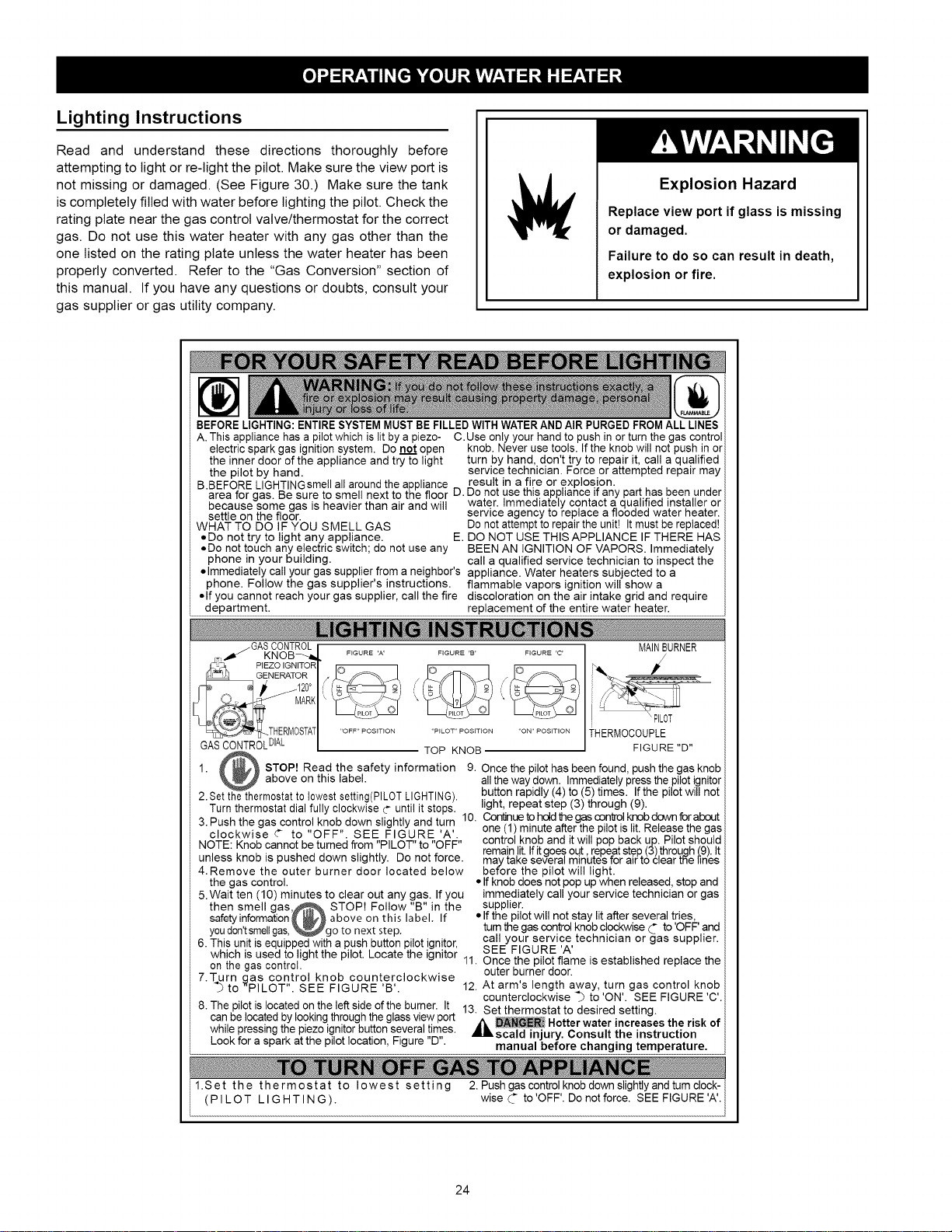
Lighting Instructions
Read and understand these directions thoroughly before
attempting to light or re-light the pilot. Make sure the view port is
not missing or damaged. (See Figure 30.) Make sure the tank
is completely filled with water before lighting the pilot. Check the
rating plate near the gas control valve/thermostat for the correct
gas. Do not use this water heater with any gas other than the
one listed on the rating plate unless the water heater has been
properly converted. Refer to the "Gas Conversion" section of
this manual. If you have any questions or doubts, consult your
gas supplier or gas utility company.
Explosion Hazard
Replace view port if glass is missing
or damaged.
Failure to do so can result in death,
explosion or fire.
BEFORE LIGHTING: ENTIRE SYSTEM MUST BE FILLED WITH WATER AND AIR PURGED FROM ALL LINES
A. This appliance has a pilot which is lit by a piezo- C. Use only your hand to push in or turn the gas control
electric spark gas ignition system. Do not open knob. Never use tools. If the knob will not push in or
the inner door of the appliance and try to light turn by hand, don't try to repair it, call a qualified
the pilot by hand. service technician. Force or attempted repair may
B.BEFORE LIGHTINGsmell all around the appliance result in a fire or explosion.
area for gas. Be sure to smell next to the floor D. Do not use this appliance if any part has been under
because some gas is heavier than air and will water. Immediately contact a qualified installer or
settle on the floor, service agency to replace a flooded water heater.
WHAT TO DO IF YOU SMELL GAS Do not attempt to repair the unit! It must be replaced!
,,Do not try to light any appliance. E. DO NOT USE THIS APPLIANCE IF THERE HAS
,,Do not touch any electric switch; do not use any BEEN AN IGNITION OF VAPORS. Immediately
phone in your building, call a qualified service technician to inspect the
• Immediately call your gas supplier from a neighbor's appliance. Water heaters subjected to a
phone. Follow the gas supplier's instructions, flammable vapors ignition will show a
• If you cannot reach your gas supplier, call the fire discoloration on the air intake grid and require
department, replacement of the entire water heater.
/GAS CONTROLr
r:_ KNOB_-_I. FIGURE 'A' FIGURE 'B' FIGURE 'C'
_C_ PIEZOIGNITORI I_
GENERATOR I / J_U _ -| {/__ o _/
_ -120° I {_7_<m=h<o_
J O, _ MARKI' kr%_'_<._M'-<! '\
THERMOSTAT "OFF" POSITION I'P _UOT" POSITION I'ON" POSITION
GAs_THERMOSTAT l
CONTROLDIAL TOP KNOB
MAINBURNER
/
THERMOCOUPLE
FIGURE "D"
1. STOP! Read the safety information 9. Once the pilot has been found, push the gas knob
above on this label, all the way down. Immediately press the pilot ignitor
2. Set the thermostat to lowest setting(PILOT LIGHTING). button rapidly (4) to (5) times. If the pilot will not
Turn thermostat dial fully clockwise C until it stops, light, repeat step (3) through (9).
3. Push the gas control knob down slightly and turn 10. Continue to hdd lhe gas con'aol knob down forabout
clockwise _ to "OFF". SEE FIGURE 'A'. one (1) minute after the pilot is lit. Release the gas
NOTE: Knob cannot be tumed from "PILOT" to "OFF"
unless knob is pushed down slightly. Do not force.
4. Remove the outer burner door located below
the gas control.
5.Wait ten (10) minutes to clear out any gas. If you
control knob and it will pop back up. Pilot should
remain lit. If itgoes otjt, repeat step,(3),through ,(9).It
may taKe several minutes for air to clear me lines
before the pilot will light.
• If knob does not pop up when released, stop and
immediately call your service technician or gas
then smell gas,_ STOP! Follow "B" in the supplier.
safety information _ _ above on this label. If •If the pilot will not stay lit after several tries,
you don't smellgas, _go to next step. tum the gas control knob clockwise _ to 'OFF' and
6. This unit is equipped with a push button pilot ignitor, call your service technician or gas supplier.
SEE FIGURE 'A'
which is used to light the pilot. Locate the ignitor 11. Once the pilot flame is established replace the
on the gas control, outer burner door.
7.Turn gas control knob counterclockwise
to "PILOT". SEE FIGURE 'B'. 12. At arm's length away, turn gas control knob
counterclockwise _ to 'ON'. SEE FIGURE 'C'.
8. The pilot is located on the left side of the burner. It 13. Set thermostat to desired setting.
can be located by looking through the glass view port
while pressing the piezo ignitor button several times.
Look for a spark at the pilot location, Figure "D". manual before changing temperature.
(PILOT LIGHTING).
24
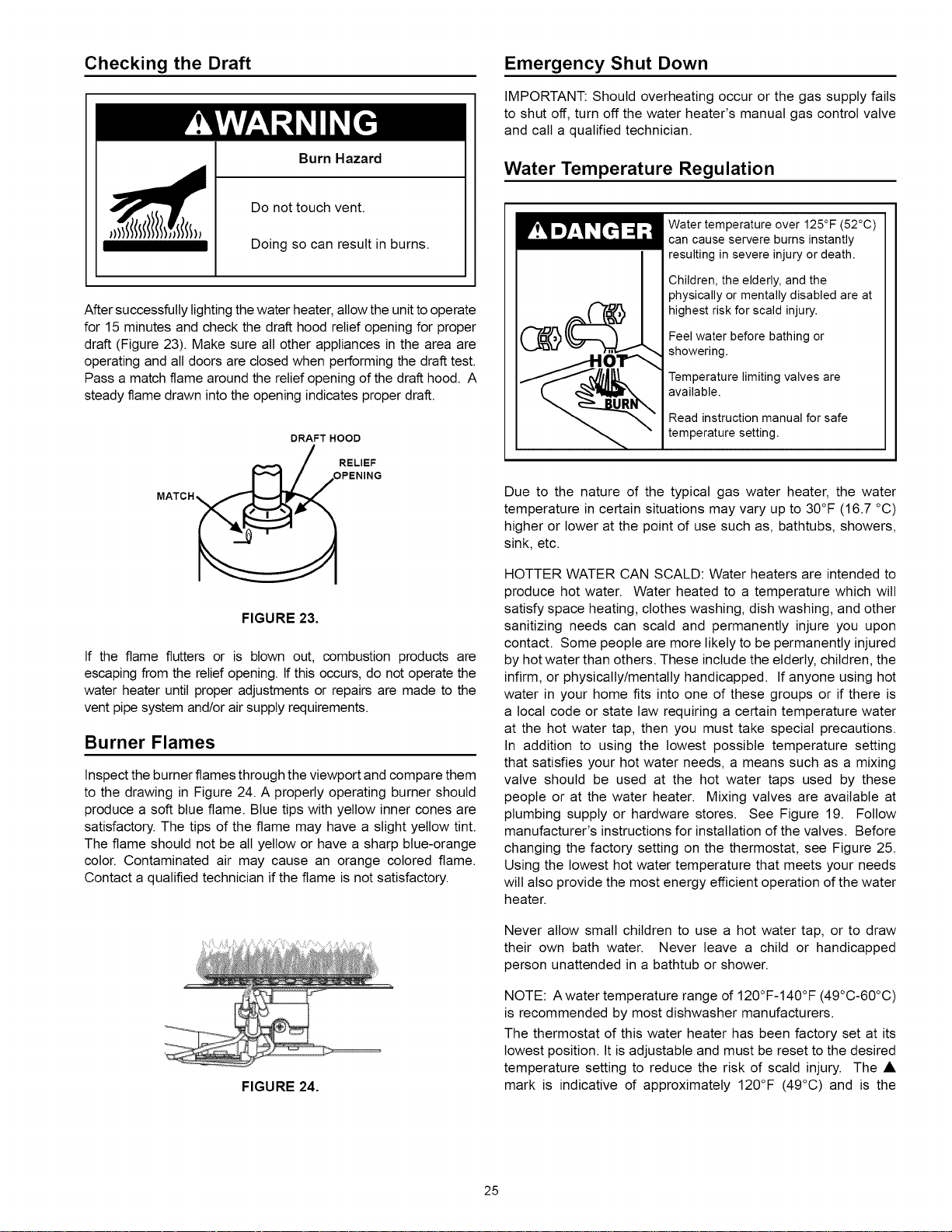
Checking the Draft
Burn Hazard
Do not touch vent.
Doing so can result in burns.
After successfully lighting the water heater, allow the unit to operate
for 15 minutes and check the draft hood relief opening for proper
draft (Figure 23). Make sure all other appliances in the area are
operating and all doors are closed when performing the draft test.
Pass a match flame around the relief opening of the draft hood. A
steady flame drawn into the opening indicates proper draft.
DRAFT HOOD
"" /Y't//
MATCH_
FIGURE 23.
If the flame flutters or is blown out, combustion products are
escaping from the relief opening. If this occurs, do not operate the
water heater until proper adjustments or repairs are made to the
vent pipe system and/or air supply requirements.
Burner Flames
Inspect the burner flames through the viewport and compare them
to the drawing in Figure 24. A properly operating burner should
produce a soft blue flame. Blue tips with yellow inner cones are
satisfactory. The tips of the flame may have a slight yellow tint.
The flame should not be all yellow or have a sharp blue-orange
color. Contaminated air may cause an orange colored flame.
Contact a qualified technician if the flame is not satisfactory.
FIGURE 24.
Emergency Shut Down
IMPORTANT: Should overheating occur or the gas supply fails
to shut off, turn off the water heater's manual gas control valve
and call a qualified technician.
Water Temperature Regulation
IF.'WmT_.l_[d :1;|
Water temperature over 125°F (52°C)
can cause servere burns instantly
resulting in severe injury or death.
Children, the elderly, and the
physically or mentally disabled are at
highest risk for scald injury.
Feel water before bathing or
showering.
Temperature limiting valves are
available.
Read instruction manual for safe
temperature setting.
Due to the nature of the typical gas water heater, the water
temperature in certain situations may vary up to 30°F (16.7 °C)
higher or lower at the point of use such as, bathtubs, showers,
sink, etc.
HOTTER WATER CAN SCALD: Water heaters are intended to
produce hot water. Water heated to a temperature which will
satisfy space heating, clothes washing, dish washing, and other
sanitizing needs can scald and permanently injure you upon
contact. Some people are more likely to be permanently injured
by hot water than others. These include the elderly, children, the
infirm, or physically/mentally handicapped. If anyone using hot
water in your home fits into one of these groups or if there is
a local code or state law requiring a certain temperature water
at the hot water tap, then you must take special precautions.
In addition to using the lowest possible temperature setting
that satisfies your hot water needs, a means such as a mixing
valve should be used at the hot water taps used by these
people or at the water heater. Mixing valves are available at
plumbing supply or hardware stores. See Figure 19. Follow
manufacturer's instructions for installation of the valves. Before
changing the factory setting on the thermostat, see Figure 25.
Using the lowest hot water temperature that meets your needs
will also provide the most energy efficient operation of the water
heater.
Never allow small children to use a hot water tap, or to draw
their own bath water. Never leave a child or handicapped
person unattended in a bathtub or shower.
NOTE: Awater temperature range of 120°F-140°F (49°C-60°C)
is recommended by most dishwasher manufacturers.
The thermostat of this water heater has been factory set at its
lowest position. It is adjustable and must be reset to the desired
temperature setting to reduce the risk of scald injury. The •
mark is indicative of approximately 120°F (49°C) and is the
25
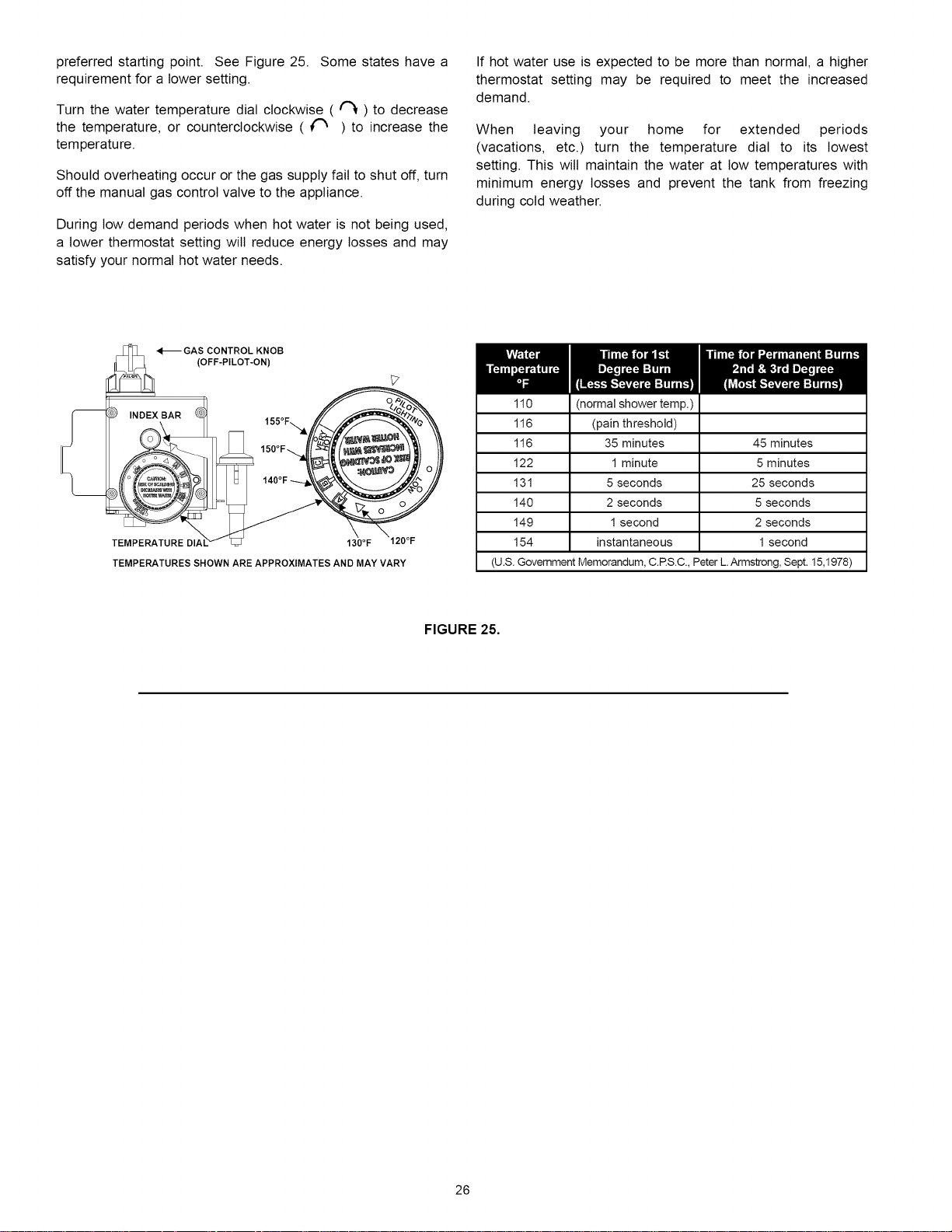
preferred starting point. See Figure 25. Some states have a
requirement for a lower setting.
Turn the water temperature dial clockwise ( t'_ ) to decrease
the temperature, or counterclockwise ( _ ) to increase the
temperature.
Should overheating occur or the gas supply fail to shut off, turn
off the manual gas control valve to the appliance.
During tow demand periods when hot water is not being used,
a lower thermostat setting will reduce energy losses and may
satisfy your normal hot water needs.
If hot water use is expected to be more than normal, a higher
thermostat setting may be required to meet the increased
demand.
When leaving your home for extended periods
(vacations, etc.) turn the temperature dial to its lowest
setting. This wilt maintain the water at tow temperatures with
minimum energy losses and prevent the tank from freezing
during cold weather.
1"_ GAS CONTROL KNOB
(OFF-PILOT-ON)
INDEX BAR
TEMPERATURE Dm,a
120°F
TEMPERATURES SHOWN ARE APPROXIMATES AND MAY VARY
110
116
116
122
131
140
149
154
(normal shower temp.)
(pain threshold)
35 minutes
1 minute
5 seconds
2 seconds
1 second
instantaneous
45 minutes
5 minutes
25 seconds
5 seconds
2 seconds
1 second
(U.S.GovernmentMemorandum,C.RS.C.,PeterL Armstrong,Sept. 15,1978)
FIGURE 25.
26
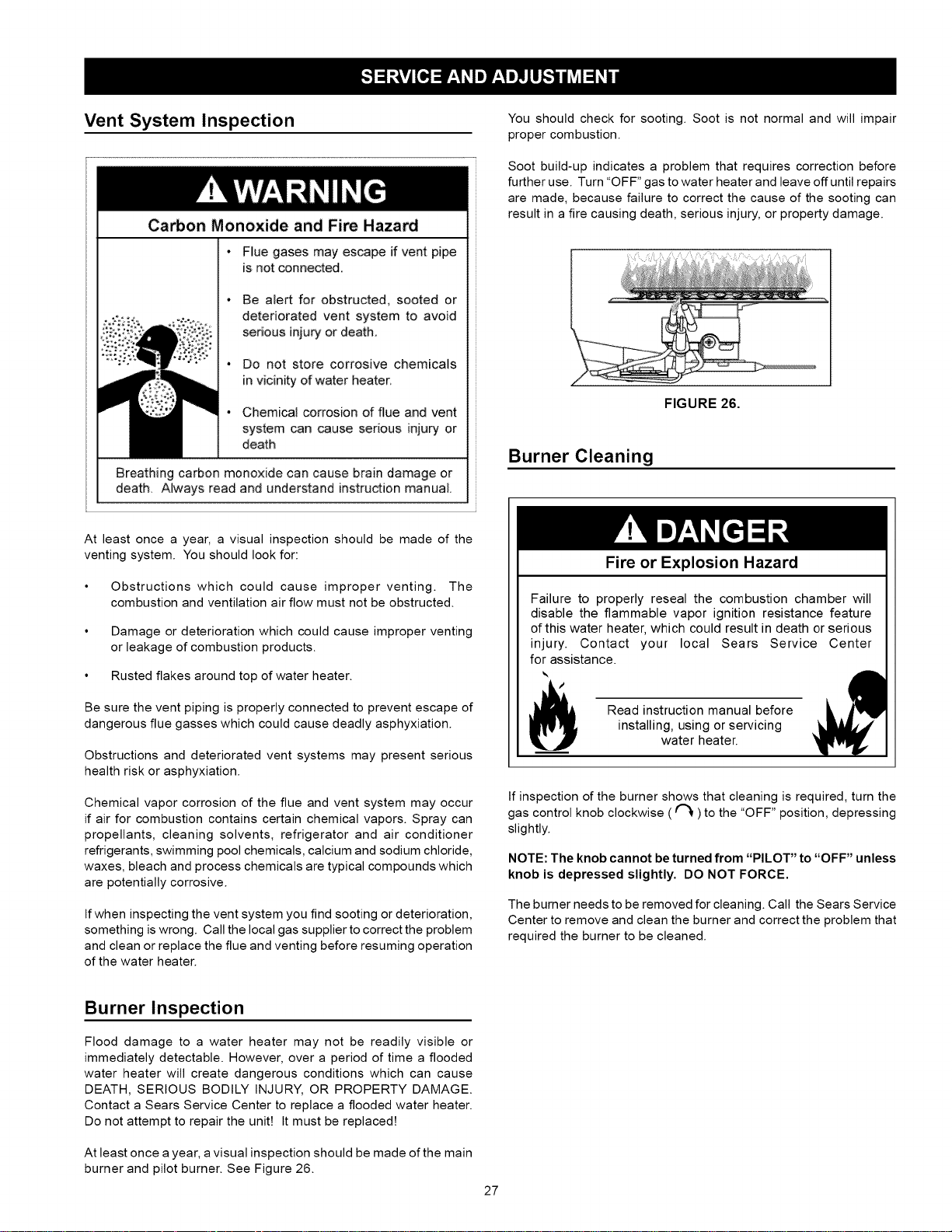
Vent System Inspection
Ca_on Monoxide and Fire Hazard
* Flue gases may escape if vent pipe
is not connected,
* Be alert for obstructed, sooted or
deteriorated vent system to avoid
serious injury or death.
• Do not store corrosive chemicals
in vicinity of water heater.
• ChemicaJ corrosion of flue and vent
system can cause serious injury or
death
Breathing carbon monoxide can cause brain damage or
death Always read and understand instruction manual
You should check for sooting. Soot is not normal and will impair
proper combustion.
Soot build-up indicates a problem that requires correction before
further use. Turn "OFF" gas to water heater and leave off until repairs
are made, because failure to correct the cause of the sooting can
result in a fire causing death, serious injury, or property damage.
FIGURE 26.
Burner Cleaning
Fire or Explosion Hazard
At least once a year, a visual inspection should be made of the
venting system. You should look for:
• Obstructions which could cause improper venting. The
combustion and ventilation air flow must not be obstructed.
• Damage or deterioration which could cause improper venting
or leakage of combustion products.
• Rusted flakes around top of water heater.
Be sure the vent piping is properly connected to prevent escape of
dangerous flue gasses which could cause deadly asphyxiation.
Obstructions and deteriorated vent systems may present serious
health risk or asphyxiation.
Chemical vapor corrosion of the flue and vent system may occur
if air for combustion contains certain chemical vapors. Spray can
propellants, cleaning solvents, refrigerator and air conditioner
refrigerants, swimming pool chemicals, calcium and sodium chloride,
waxes, bleach and process chemicals are typical compounds which
are potentially corrosive.
If when inspecting the vent system you find sooting or deterioration,
something is wrong. Call the local gas supplier to correct the problem
and clean or replace the flue and venting before resuming operation
of the water heater.
Failure to properly reseal the combustion chamber will
disable the flammable vapor ignition resistance feature
of this water heater, which could result in death or serious
injury. Contact your local Sears Service Center
for assistance.
Read instruction manual before
installing, using or servicing
water heater.
If inspection of the burner shows that cleaning is required, turn the
gas control knob clockwise ( t'_ ) to the "OFF" position, depressing
slightly.
NOTE: The knob cannot be turned from PILOT to OFF unless
knob is depressed slightly. DO NOT FORCE.
The burner needs to be removed for cleaning. Call the Sears Service
Center to remove and clean the burner and correct the problem that
required the burner to be cleaned.
Burner Inspection
Flood damage to a water heater may not be readily visible or
immediately detectable. However, over a period of time a flooded
water heater will create dangerous conditions which can cause
DEATH, SERIOUS BODILY INJURY, OR PROPERTY DAMAGE.
Contact a Sears Service Center to replace a flooded water heater.
Do not attempt to repair the unit! tt must be replaced!
At least once a year, a visual inspection should be made of the main
burner and pilot burner. See Figure 26.
27
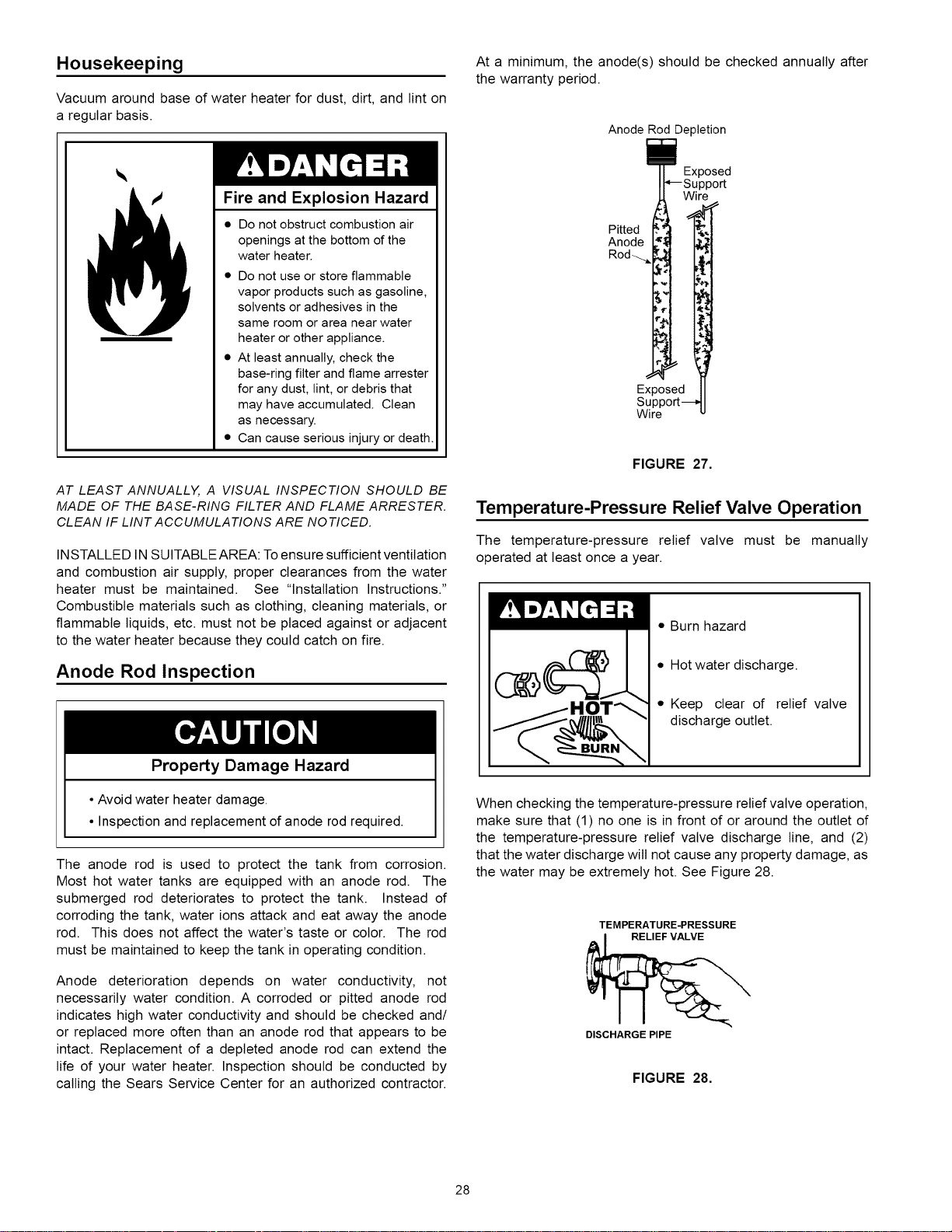
Housekeeping
Vacuum around base of water heater for dust, dirt, and lint on
a regular basis.
Fire and Explosion Hazard
Do not obstruct combustion air
openings at the bottom of the
water heater.
Do not use or store flammable
vapor products such as gasoline,
solvents or adhesives in the
same room or area near water
heater or other appliance.
At least annually, check the
base-ring filter and flame arrester
for any dust, lint, or debris that
may have accumulated. Clean
as necessary.
Can cause serious injury or death.
AT LEAST ANNUALLY, A VISUAL INSPECTION SHOULD BE
MADE OF THE BASE-RING FILTER AND FLAME ARRESTER.
CLEAN IF LINT ACCUMULATIONS ARE NOTICED.
INSTALLED IN SUITABLEAREA: To ensure sufficient ventilation
and combustion air supply, proper clearances from the water
heater must be maintained. See "Installation Instructions."
Combustible materials such as clothing, cleaning materials, or
flammable liquids, etc. must not be placed against or adjacent
to the water heater because they could catch on fire.
Anode Rod Inspection
Property Damage Hazard
• Avoid water heater damage.
• Inspection and replacement of anode rod required.
The anode rod is used to protect the tank from corrosion.
Most hot water tanks are equipped with an anode rod. The
submerged rod deteriorates to protect the tank. Instead of
corroding the tank, water ions attack and eat away the anode
rod. This does not affect the water's taste or color. The rod
must be maintained to keep the tank in operating condition.
Anode deterioration depends on water conductivity, not
necessarily water condition. A corroded or pitted anode rod
indicates high water conductivity and should be checked and/
or replaced more often than an anode rod that appears to be
intact. Replacement of a depleted anode rod can extend the
life of your water heater. Inspection should be conducted by
calling the Sears Service Center for an authorized contractor.
At a minimum, the anode(s) should be checked annually after
the warranty period.
Anode Rod Depletion
i
I| Exposed
|p--Support
LI Wire
Pitted ._ "1_
Anode _ _?,_l
Expose
Support_l
Wire u
FIGURE 27.
Temperature-Pressure Relief Valve Operation
The temperature-pressure relief valve must be manually
operated at least once a year.
r!11mT_, ,'[€-1=I
• Burn hazard
• Hot water discharge.
• Keep clear of relief valve
discharge outlet.
When checking the temperature-pressure relief valve operation,
make sure that (1) no one is in front of or around the outlet of
the temperature-pressure relief valve discharge line, and (2)
that the water discharge will not cause any property damage, as
the water may be extremely hot. See Figure 28.
TEMPERATURE-PRESSURE
RELIEF VALVE
DISCHARGE PIPE
FIGURE 28.
28
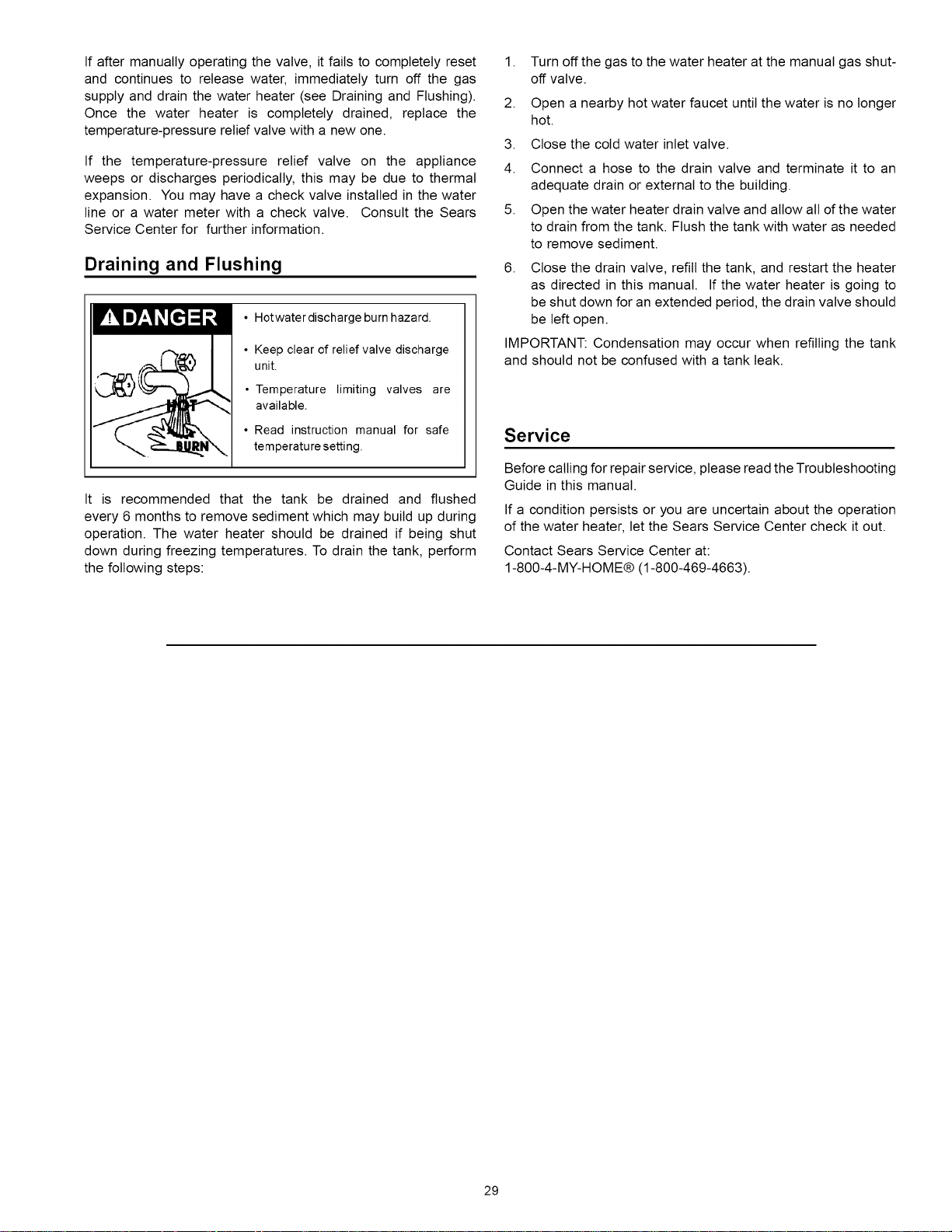
If after manually operating the valve, it fails to completely reset
and continues to release water, immediately turn off the gas
supply and drain the water heater (see Draining and Flushing).
Once the water heater is completely drained, replace the
temperature-pressure relief valve with a new one.
If the temperature-pressure relief valve on the appliance
weeps or discharges periodically, this may be due to thermal
expansion. You may have a check valve installed in the water
line or a water meter with a check valve. Consult the Sears
Service Center for further information.
Draining and Flushing
Ir 1 m7_.1 [€']q ;I
- C
• Hotwaterdischarge burn hazard.
Keep clear of relief valve discharge
unit.
Temperature limiting valves are
available.
Read instruction manual for safe
temperature setting.
It is recommended that the tank be drained and flushed
every 6 months to remove sediment which may build up during
operation. The water heater should be drained if being shut
down during freezing temperatures. To drain the tank, perform
the following steps:
1. Turn off the gas to the water heater at the manual gas shut-
off valve.
2. Open a nearby hot water faucet until the water is no longer
hot.
3. Close the cold water inlet valve.
4. Connect a hose to the drain valve and terminate it to an
adequate drain or external to the building.
5. Open the water heater drain valve and allow all of the water
to drain from the tank. Flush the tank with water as needed
to remove sediment.
6. Close the drain valve, refill the tank, and restart the heater
as directed in this manual. If the water heater is going to
be shut down for an extended period, the drain valve should
be left open.
IMPORTANT: Condensation may occur when refilling the tank
and should not be confused with a tank leak.
Service
Before calling for repair service, please read the Troubleshooting
Guide in this manual.
If a condition persists or you are uncertain about the operation
of the water heater, let the Sears Service Center check it out.
Contact Sears Service Center at:
1-800-4-MY-HOME® (1-800-469-4663).
29
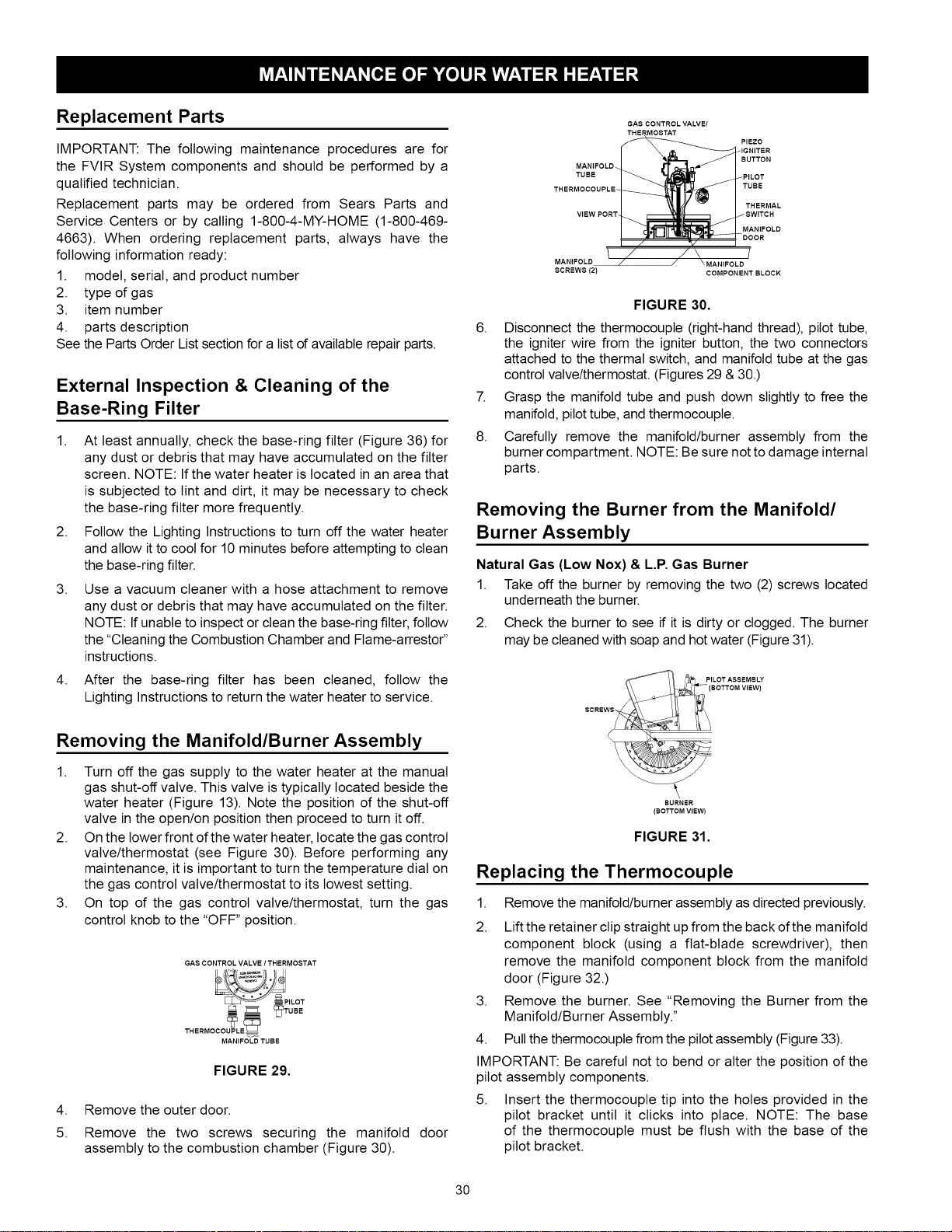
Replacement Parts
IMPORTANT: The following maintenance procedures are for
the FVIR System components and should be performed by a
qualified technician.
Replacement parts may be ordered from Sears Parts and
Service Centers or by calling 1-800-4-MY-HOME (1-800-469-
4663). When ordering replacement parts, always have the
following information ready:
1. model, serial, and product number
2. type of gas
3. item number
4. parts description
See the Parts Order List section for a list of available repair parts.
External Inspection & Cleaning of the
Base-Ring Filter
1. At least annually, check the base-ring filter (Figure 36) for
any dust or debris that may have accumulated on the filter
screen. NOTE: If the water heater is located in an area that
is subjected to tint and dirt, it may be necessary to check
the base-ring filter more frequently.
2. Follow the Lighting Instructions to turn off the water heater
and allow it to coot for 10 minutes before attempting to clean
the base-ring filter.
3. Use a vacuum cleaner with a hose attachment to remove
any dust or debris that may have accumulated on the filter.
NOTE: Ifunable to inspect or clean the base-ring filter, follow
the "Cleaning the Combustion Chamber and Flame-arrestor"
instructions.
4,
After the base-ring filter has been cleaned, follow the
Lighting Instructions to return the water heater to service.
Removing the Manifold/Burner Assembly
1. Turn off the gas supply to the water heater at the manual
gas shut-off valve. This valve is typically located beside the
water heater (Figure 13). Note the position of the shut-off
valve in the open/on position then proceed to turn it off.
2. On the lower front of the water heater, locate the gas control
valve/thermostat (see Figure 30). Before performing any
maintenance, it is important to turn the temperature dial on
the gas control valve/thermostat to its lowest setting.
3. On top of the gas control valve/thermostat, turn the gas
control knob to the "OFF" position.
4,
5.
GAS CONTROL VALVE / THERMOSTAT
o-_ .i
_PILOT
_TUBE
THBRMODO_LE._
MANIFOLD TUBE
FIGURE 29.
Remove the outer door.
Remove the two screws securing the manifold door
assembly to the combustion chamber (Figure 30).
GAS CONTROL VALVE/
THERMOSTAT
P_EZO
IGNITER
BUTTON
MANIFOLD
TUBE PILOT
THERMOCOUPLE TUBE
THERMAL
VIEW PORT SWITCH
MANIFOLD
OOR
/ /\ /
MANIFOLD / / X MANIFOLD
SCREWS (2) COMPONENT BLOCK
FIGURE 30.
6. Disconnect the thermocouple (right-hand thread), pilot tube,
the igniter wire from the igniter button, the two connectors
attached to the thermal switch, and manifold tube at the gas
control valve/thermostat. (Figures 29 & 30.)
7. Grasp the manifold tube and push down slightly to free the
manifold, pilot tube, and thermocoupte.
8. Carefully remove the manifold/burner assembly from the
burner compartment. NOTE: Be sure not to damage internal
parts.
Removing the Burner from the Manifold/
Burner Assembly
Natural Gas (Low Nox) & L.P. Gas Burner
1. Take off the burner by removing the two (2) screws located
underneath the burner.
2. Check the burner to see if it is dirty or clogged. The burner
may be cleaned with soap and hot water (Figure 31).
(BOTTOM VIEW)
SCREW_
BURNER
(BOTTOM VIEW)
FIGURE 31.
Replacing the Thermocouple
1,
2.
Remove the manifold/burner assembly as directed previously.
Lift the retainer clip straight up from the back of the manifold
component block (using a flat-blade screwdriver), then
remove the manifold component block from the manifold
door (Figure 32.)
3. Remove the burner. See "Removing the Burner from the
Manifold/Burner Assembly."
4. Pull the thermocoupte from the pilot assembly (Figure 33).
IMPORTANT: Be careful not to bend or alter the position of the
pilot assembly components.
5. Insert the thermocouple tip into the holes provided in the
pilot bracket until it clicks into place. NOTE: The base
of the thermocouple must be flush with the base of the
pilot bracket.
3O
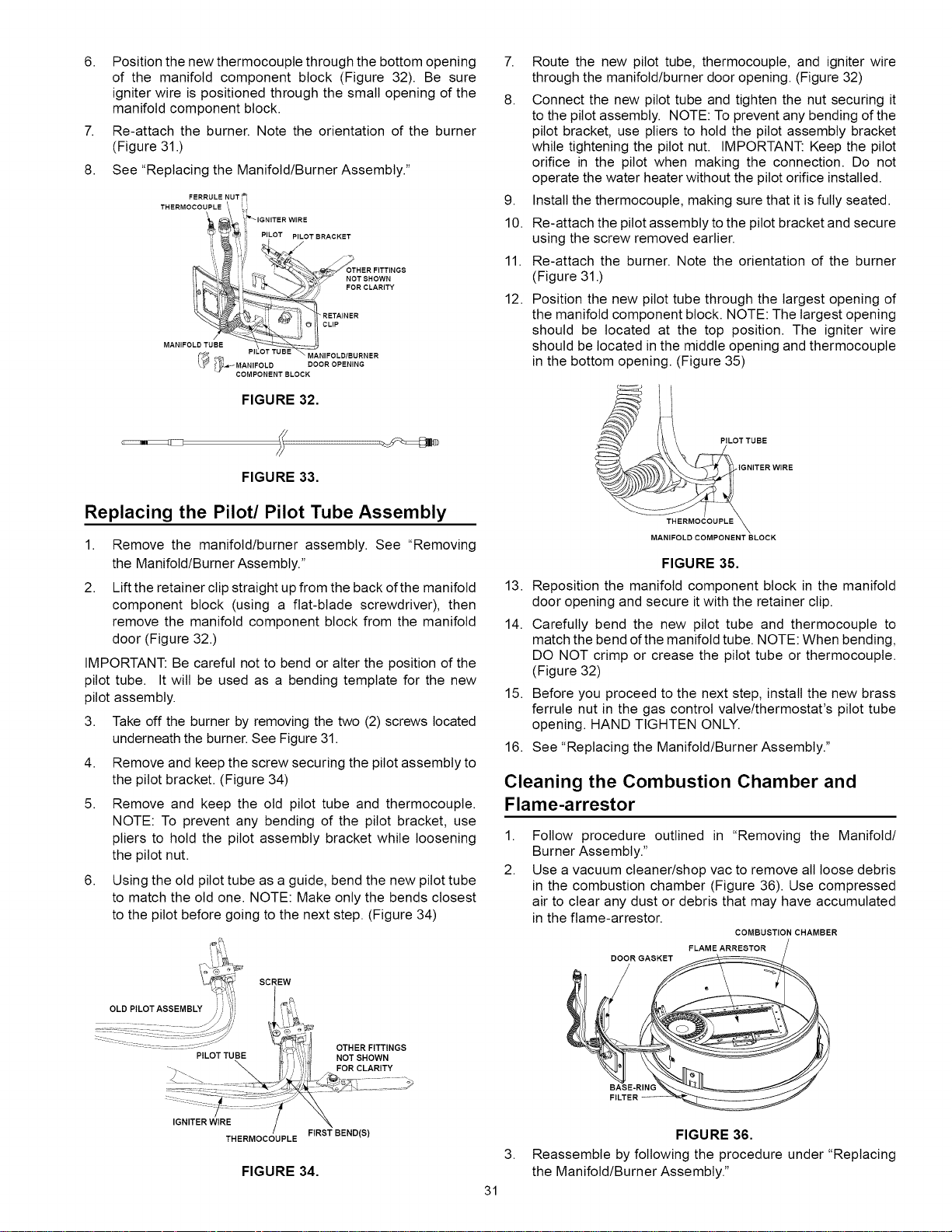
6. Position the new thermocouple through the bottom opening
of the manifold component block (Figure 32). Be sure
igniter wire is positioned through the small opening of the
manifold component block.
7. Re-attach the burner. Note the orientation of the burner
(Figure 31.)
8. See "Replacing the Manifold/Burner Assembly."
"LOT.,LOTB..CKET
_ _! o clip
OT TUBE _ MANIFOLD/BURNER
ooo.oPE°,.o
COMPONENT BLOCK
FIGURE 32.
FIGURE 33.
Replacing the Pilot/Pilot Tube Assembly
1.
2.
Remove the manifold/burner assembly. See "Removing
the Manifold/Burner Assembly."
Lift the retainer clip straight up from the back of the manifold
component block (using a flat-blade screwdriver), then
remove the manifold component block from the manifold
door (Figure 32.)
IMPORTANT: Be careful not to bend or alter the position of the
pilot tube. It will be used as a bending template for the new
pilot assembly.
3. Take off the burner by removing the two (2) screws located
underneath the burner. See Figure 31.
4. Remove and keep the screw securing the pilot assembly to
the pilot bracket. (Figure 34)
5.
Remove and keep the old pilot tube and thermocoupte.
NOTE: To prevent any bending of the pilot bracket, use
pliers to hold the pilot assembly bracket while loosening
the pilot nut.
6. Using the old pilot tube as a guide, bend the new pilot tube
to match the old one. NOTE: Make only the bends closest
to the pilot before going to the next step. (Figure 34)
SCREW
PtLOTTUBE
OTHER FITTINGS
NOT SHOWN
FOR CLARITY
7. Route the new pilot tube, thermocoupte, and igniter wire
through the manifold/burner door opening. (Figure 32)
8. Connect the new pilot tube and tighten the nut securing it
to the pilot assembly. NOTE: To prevent any bending of the
pilot bracket, use pliers to hold the pilot assembly bracket
while tightening the pilot nut. IMPORTANT: Keep the pilot
orifice in the pilot when making the connection. Do not
operate the water heater without the pilot orifice installed.
9. Install the thermocouple, making sure that it is fully seated.
10. Re-attach the pilot assembly to the pilot bracket and secure
using the screw removed earlier.
11. Re-attach the burner. Note the orientation of the burner
(Figure 31.)
12. Position the new pilot tube through the largest opening of
the manifold component block. NOTE: The largest opening
should be located at the top position. The igniter wire
should be located in the middle opening and thermocouple
in the bottom opening. (Figure 35)
PILOT TUBE
ITER WIRE
MANIFOLD COMPONENT BLOCK
FIGURE 35.
13. Reposition the manifold component block in the manifold
door opening and secure it with the retainer clip.
14. Carefully bend the new pilot tube and thermocouple to
match the bend of the manifold tube. NOTE: When bending,
DO NOT crimp or crease the pilot tube or thermocouple.
(Figure 32)
15. Before you proceed to the next step, install the new brass
ferrule nut in the gas control valve/thermostat's pilot tube
opening. HAND TIGHTEN ONLY.
16. See "Replacing the Manifold/Burner Assembly."
Cleaning the Combustion Chamber and
Flame-arrestor
1.
2.
Follow procedure outlined in "Removing the Manifold/
Burner Assembly."
Use a vacuum cleaner/shop vac to remove all loose debris
in the combustion chamber (Figure 36). Use compressed
air to clear any dust or debris that may have accumulated
in the flame-arrestor.
COMBUSTION CHAMBER
FLAME ARRESTOR
DOOR GASKET
BASE-RING
IGNITER WIRE
THERMOCOUPLE FIRST BEND(S)
FIGURE 34.
31
FIGURE 36.
3. Reassemble by following the procedure under "Replacing
the Manifold/Burner Assembly."
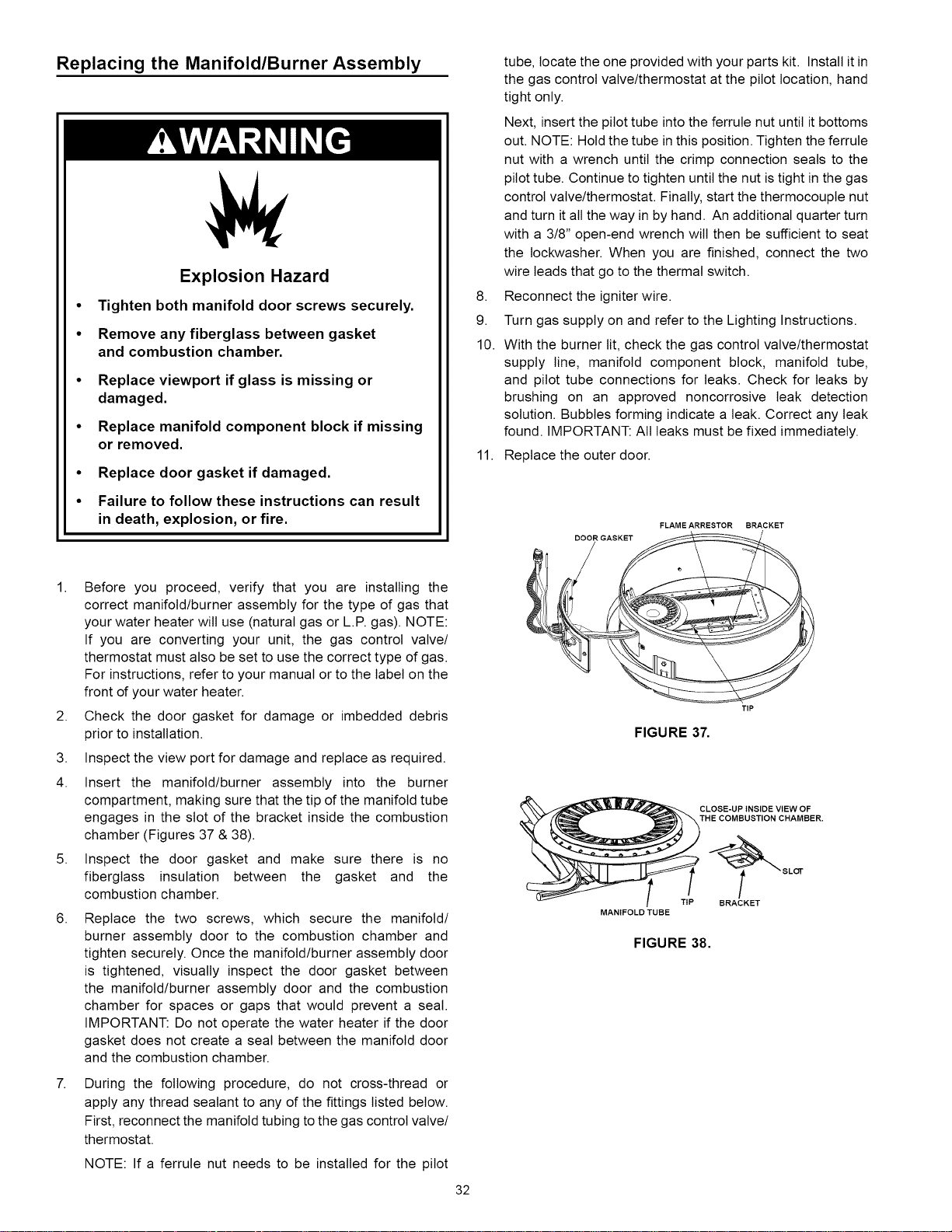
Replacing the Manifold/Burner Assembly
Explosion Hazard
Tighten both manifold door screws securely.
Remove any fiberglass between gasket
and combustion chamber.
Replace viewport if glass is missing or
damaged.
Replace manifold component block if missing
or removed.
• Replace door gasket if damaged.
• Failure to follow these instructions can result
in death, explosion, or fire.
8.
9.
10.
11.
tube, locate the one provided with your parts kit. Install it in
the gas control valve/thermostat at the pilot location, hand
tight only.
Next, insert the pilot tube into the ferrule nut until it bottoms
out. NOTE: Hold the tube in this position. Tighten the ferrule
nut with a wrench until the crimp connection seals to the
pilot tube. Continue to tighten until the nut is tight in the gas
control valve/thermostat. Finally, start the thermocouple nut
and turn it all the way in by hand. An additional quarter turn
with a 3/8" open-end wrench will then be sufficient to seat
the lockwasher. When you are finished, connect the two
wire leads that go to the thermal switch.
Reconnect the igniter wire.
Turn gas supply on and refer to the Lighting Instructions.
With the burner tit, check the gas control valve/thermostat
supply line, manifold component block, manifold tube,
and pilot tube connections for leaks. Check for leaks by
brushing on an approved noncorrosive leak detection
solution. Bubbles forming indicate a leak. Correct any leak
found. IMPORTANT: All leaks must be fixed immediately.
Replace the outer door.
FLAMEARRESTOR BRACKET
2.
3.
4.
5.
6.
Before you proceed, verify that you are installing the
correct manifold/burner assembly for the type of gas that
your water heater will use (natural gas or L.P. gas). NOTE:
If you are converting your unit, the gas control valve/
thermostat must also be set to use the correct type of gas.
For instructions, refer to your manual or to the label on the
front of your water heater.
Check the door gasket for damage or imbedded debris
prior to installation.
Inspect the view port for damage and replace as required.
Insert the manifold/burner assembly into the burner
compartment, making sure that the tip of the manifold tube
engages in the slot of the bracket inside the combustion
chamber (Figures 37 & 38).
Inspect the door gasket and make sure there is no
fiberglass insulation between the gasket and the
combustion chamber.
Replace the two screws, which secure the manifold/
burner assembly door to the combustion chamber and
tighten securely. Once the manifold/burner assembly door
is tightened, visually inspect the door gasket between
the manifold/burner assembly door and the combustion
chamber for spaces or gaps that would prevent a seal.
IMPORTANT: Do not operate the water heater if the door
gasket does not create a seal between the manifold door
and the combustion chamber.
During the following procedure, do not cross-thread or
apply any thread sealant to any of the fittings listed below.
First, reconnect the manifold tubing to the gas control valve/
thermostat.
NOTE: If a ferrule nut needs to be installed for the pilot
32
TIP
FIGURE 37.
TIP
MANIFOLD TUBE
CLOSE-UP INSIDE VIEW OF
THE COMBUSTION CHAMBER.
__SLOT
BRACKET
FIGURE 38.
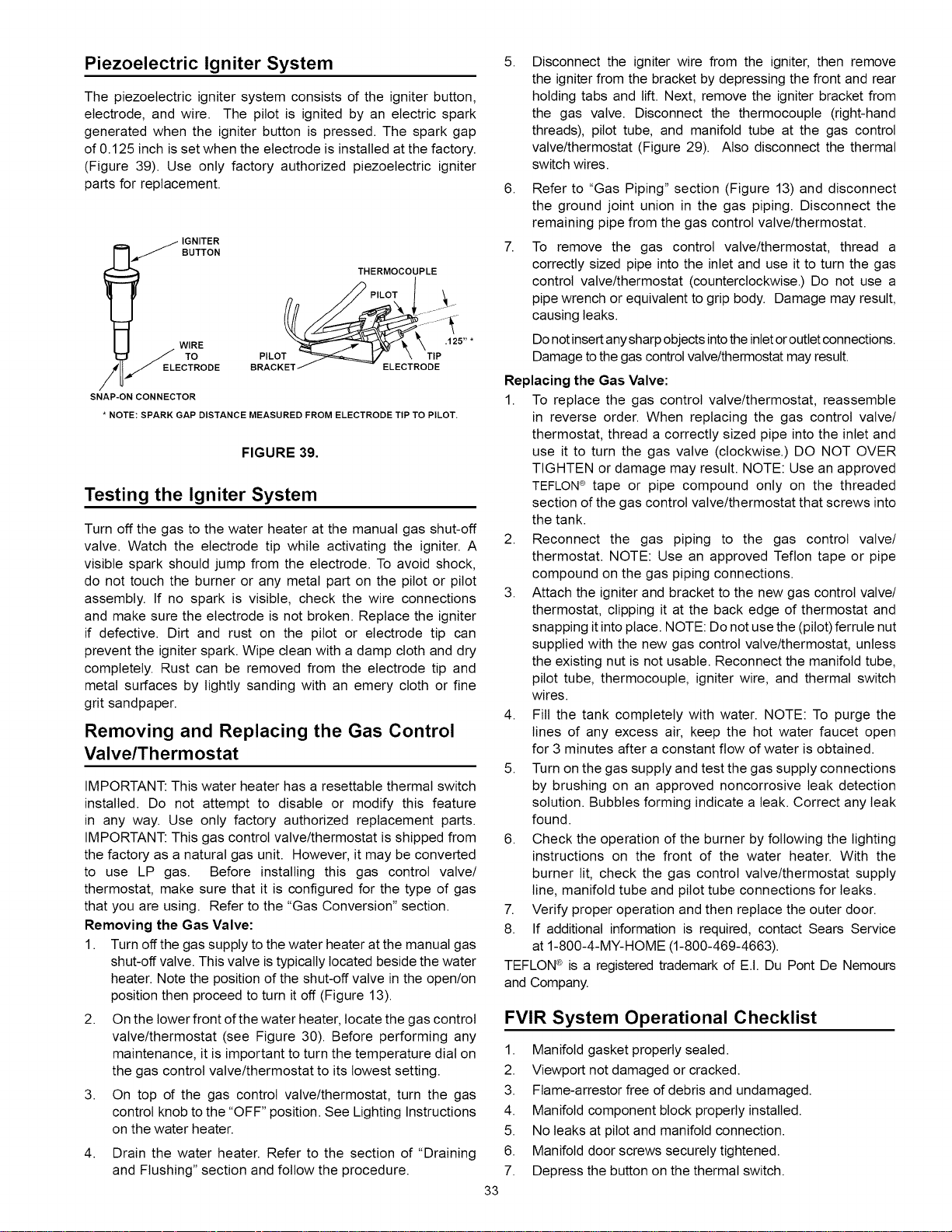
Piezoelectric Igniter System 5
The piezoelectric igniter system consists of the igniter button,
electrode, and wire. The pilot is ignited by an electric spark
generated when the igniter button is pressed. The spark gap
of 0.125 inch is set when the electrode is installed at the factory.
(Figure 39). Use only factory authorized piezoelectric igniter
parts for replacement.
IGNITER
BUTTON
WIRE
TO
ELECTRODE
SNAP-ON CONNECTOR
THERMOCOUPLE
/?P,LOT/
* NOTE: SPARK GAP DISTANCE MEASURED FROM ELECTRODE TIP TO PILOT.
FIGURE 39.
Testing the Igniter System
Turn off the gas to the water heater at the manual gas shut-off
valve. Watch the electrode tip while activating the igniter. A
visible spark should jump from the electrode. To avoid shock,
do not touch the burner or any metal part on the pilot or pilot
assembly. If no spark is visible, check the wire connections
and make sure the electrode is not broken. Replace the igniter
if defective. Dirt and rust on the pilot or electrode tip can
prevent the igniter spark. Wipe clean with a damp cloth and dry
completely. Rust can be removed from the electrode tip and
metal surfaces by lightly sanding with an emery cloth or fine
grit sandpaper.
Removing and Replacing the Gas Control
Valve/Thermostat
IMPORTANT: This water heater has a resettable thermal switch
installed. Do not attempt to disable or modify this feature
in any way. Use only factory authorized replacement parts.
IMPORTANT: This gas control valve/thermostat is shipped from
the factory as a natural gas unit. However, it may be converted
to use LP gas. Before installing this gas control valve/
thermostat, make sure that it is configured for the type of gas
that you are using. Refer to the "Gas Conversion" section.
Removing the Gas Valve:
1. Turn off the gas supply to the water heater at the manual gas
shut-off valve. This valve is typically located beside the water
heater. Note the position of the shut-off valve in the open/on
position then proceed to turn it off (Figure 13).
2. On the lower front of the water heater, locate the gas control
valve/thermostat (see Figure 30). Before performing any
maintenance, it is important to turn the temperature dial on
the gas control valve/thermostat to its lowest setting.
3. On top of the gas control valve/thermostat, turn the gas
control knob to the "OFF" position. See Lighting Instructions
on the water heater.
4. Drain the water heater. Refer to the section of "Draining
and Flushing" section and follow the procedure.
33
6,
Disconnect the igniter wire from the igniter, then remove
the igniter from the bracket by depressing the front and rear
holding tabs and lift. Next, remove the igniter bracket from
the gas valve. Disconnect the thermocouple (right-hand
threads), pilot tube, and manifold tube at the gas control
valve/thermostat (Figure 29). Also disconnect the thermal
switch wires.
Refer to "Gas Piping" section (Figure 13) and disconnect
the ground joint union in the gas piping. Disconnect the
remaining pipe from the gas control valve/thermostat.
To remove the gas control valve/thermostat, thread a
correctly sized pipe into the inlet and use it to turn the gas
control valve/thermostat (counterclockwise.) Do not use a
pipe wrench or equivalent to grip body. Damage may result,
causing leaks.
Do not insert any sharp objects into the inletor outletconnections.
Damage to the gas control valve/thermostat may result.
Replacing the Gas Valve:
1. To replace the gas control valve/thermostat, reassemble
in reverse order. When replacing the gas control valve/
thermostat, thread a correctly sized pipe into the inlet and
use it to turn the gas valve (clockwise.) DO NOT OVER
TIGHTEN or damage may result. NOTE: Use an approved
TEFLON® tape or pipe compound only on the threaded
section of the gas control valve/thermostat that screws into
the tank.
2. Reconnect the gas piping to the gas control valve/
thermostat. NOTE: Use an approved Teflon tape or pipe
compound on the gas piping connections.
3. Attach the igniter and bracket to the new gas control valve/
thermostat, clipping it at the back edge of thermostat and
snapping it into place. NOTE: Do not use the (pilot) ferrule nut
supplied with the new gas control valve/thermostat, unless
the existing nut is not usable. Reconnect the manifold tube,
pilot tube, thermocoupte, igniter wire, and thermal switch
wires.
4. Flit the tank completely with water. NOTE: To purge the
lines of any excess air, keep the hot water faucet open
for 3 minutes after a constant flow of water is obtained.
5. Turn on the gas supply and test the gas supply connections
by brushing on an approved noncorrosive teak detection
solution. Bubbles forming indicate a leak. Correct any leak
found.
6. Check the operation of the burner by following the lighting
instructions on the front of the water heater. With the
burner tit, check the gas control valve/thermostat supply
line, manifold tube and pilot tube connections for leaks.
7. Verify proper operation and then replace the outer door.
8. If additional information is required, contact Sears Service
at 1-800-4-MY-HOME (1-800-469-4663).
TEFLON® is a registered trademark of E.I. Du Pont De Nemours
and Company.
FVIR System Operational Checklist
1. Manifold gasket properly sealed.
2. Viewport not damaged or cracked.
3. Flame-arrestor free of debris and undamaged.
4. Manifold component block properly installed.
5. No leaks at pilot and manifold connection.
6. Manifold door screws securely tightened.
7. Depress the button on the thermal switch.
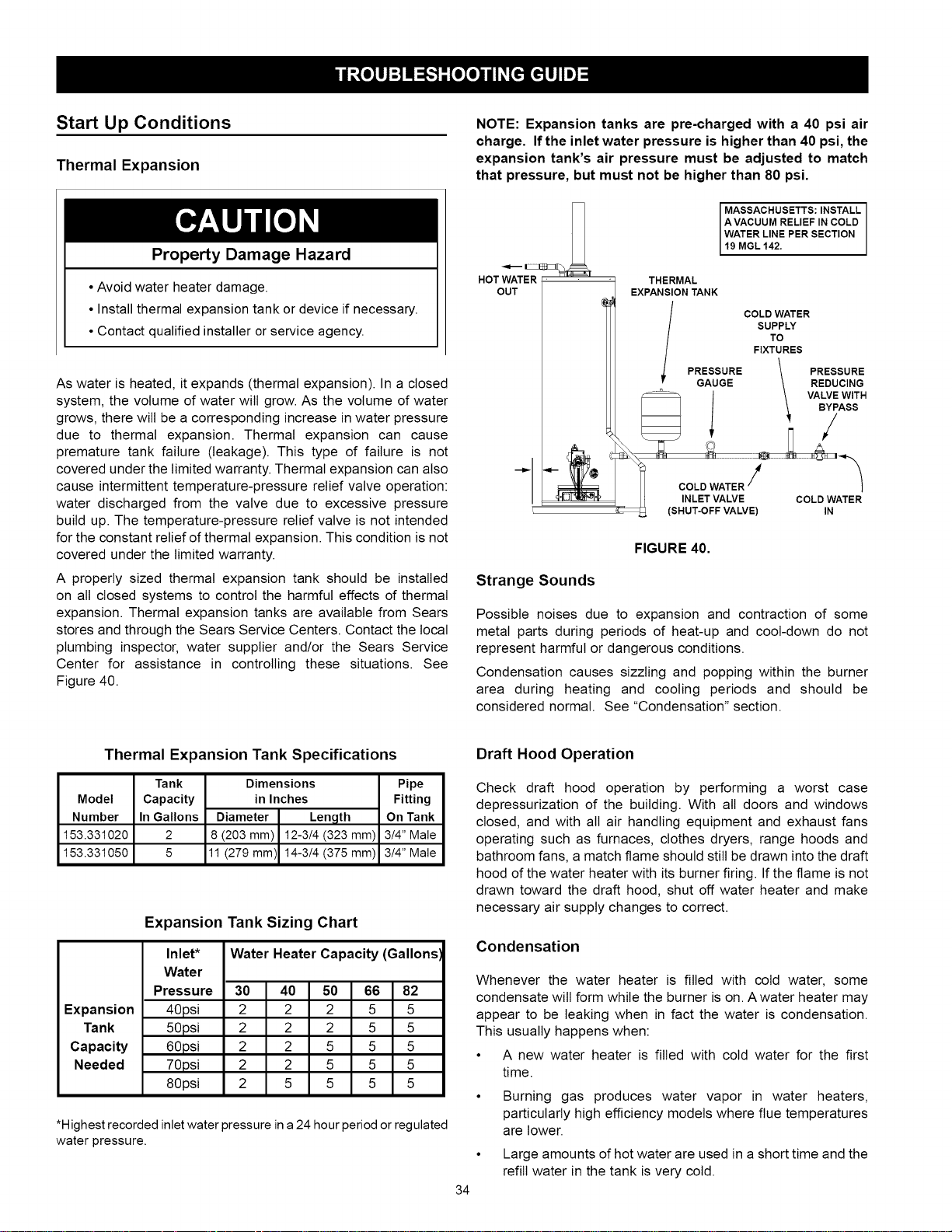
Start Up Conditions
Thermal Expansion
Property Damage Hazard
• Avoid water heater damage.
• Install thermal expansion tank or device if necessary.
• Contact qualified installer or service agency.
As water is heated, it expands (thermal expansion). In a closed
system, the volume of water wilt grow. As the volume of water
grows, there wilt be a corresponding increase in water pressure
due to thermal expansion. Thermal expansion can cause
premature tank failure (leakage). This type of failure is not
covered under the limited warranty. Thermal expansion can also
cause intermittent temperature-pressure relief valve operation:
water discharged from the valve due to excessive pressure
build up. The temperature-pressure relief valve is not intended
for the constant relief of thermal expansion. This condition is not
covered under the limited warranty.
A properly sized thermal expansion tank should be installed
on all closed systems to control the harmful effects of thermal
expansion. Thermal expansion tanks are available from Sears
stores and through the Sears Service Centers. Contact the local
plumbing inspector, water supplier and/or the Sears Service
Center for assistance in controlling these situations. See
Figure 40.
NOTE: Expansion tanks are pre-charged with a 40 psi air
charge. If the inlet water pressure is higher than 40 psi, the
expansion tank's air pressure must be adjusted to match
that pressure, but must not be higher than 80 psi.
MASSACHUSETTS: INSTALL
A VACUUM RELIEF IN COLD
WATER LINE PER SECTION
19 MGL 142.
HOT WATER
OUT
THERMAL
EXPANSION TANK
l PRESSURE
GAUGE
COLD WATER
SUPPLY
TO
FIXTURES
PRESSURE
REDUCING
VALVE WITH
BYPASS
COLD WATER /
INLET VALVE COLD WATER
(SHUT-OFF VALVE) IN
FIGURE 40.
Strange Sounds
Possible noises due to expansion and contraction of some
metal parts during periods of heat-up and cool-down do not
represent harmful or dangerous conditions.
Condensation causes sizzling and popping within the burner
area during heating and cooling periods and should be
considered normal. See "Condensation" section.
Thermal Expansion Tank Specifications
Model
Number
153.331020
153.331050
Tank
Capacity
In Gallons
2
5
Dimensions
in Inches
Diameter Len£1th
8 (203 mm) 12-3/4 (323 mm)
11 (279 mm) 14-3/4 (375 mm)
Pipe
Fitting
On Tank
3/4" Male
3/4" Male
Expansion Tank Sizing Chart
Expansion
Tank
Capacity
Needed
Inlet*
Water
Pressure
40psi
50psi
60psi
70psi
80psi
Water Heater Capacity (Gallons)
30 40 50 66 82
2 2 2 5 5
2 2 2 5 5
2 2 5 5 5
2 2 5 5 5
2 5 5 5 5
*Highest recorded inlet water pressure in a 24 hour period or regulated
water pressure.
Draft Hood Operation
Check draft hood operation by performing a worst case
depressurization of the building. With all doors and windows
closed, and with all air handling equipment and exhaust fans
operating such as furnaces, clothes dryers, range hoods and
bathroom fans, a match flame should still be drawn into the draft
hood of the water heater with its burner firing. If the flame is not
drawn toward the draft hood, shut off water heater and make
necessary air supply changes to correct.
Condensation
34
Whenever the water heater is filled with cold water, some
condensate will form while the burner is on. Awater heater may
appear to be leaking when in fact the water is condensation.
This usually happens when:
• A new water heater is filled with cold water for the first
time.
• Burning gas produces water vapor in water heaters,
particularly high efficiency models where flue temperatures
are lower.
• Large amounts of hot water are used in a short time and the
refill water in the tank is very cold.
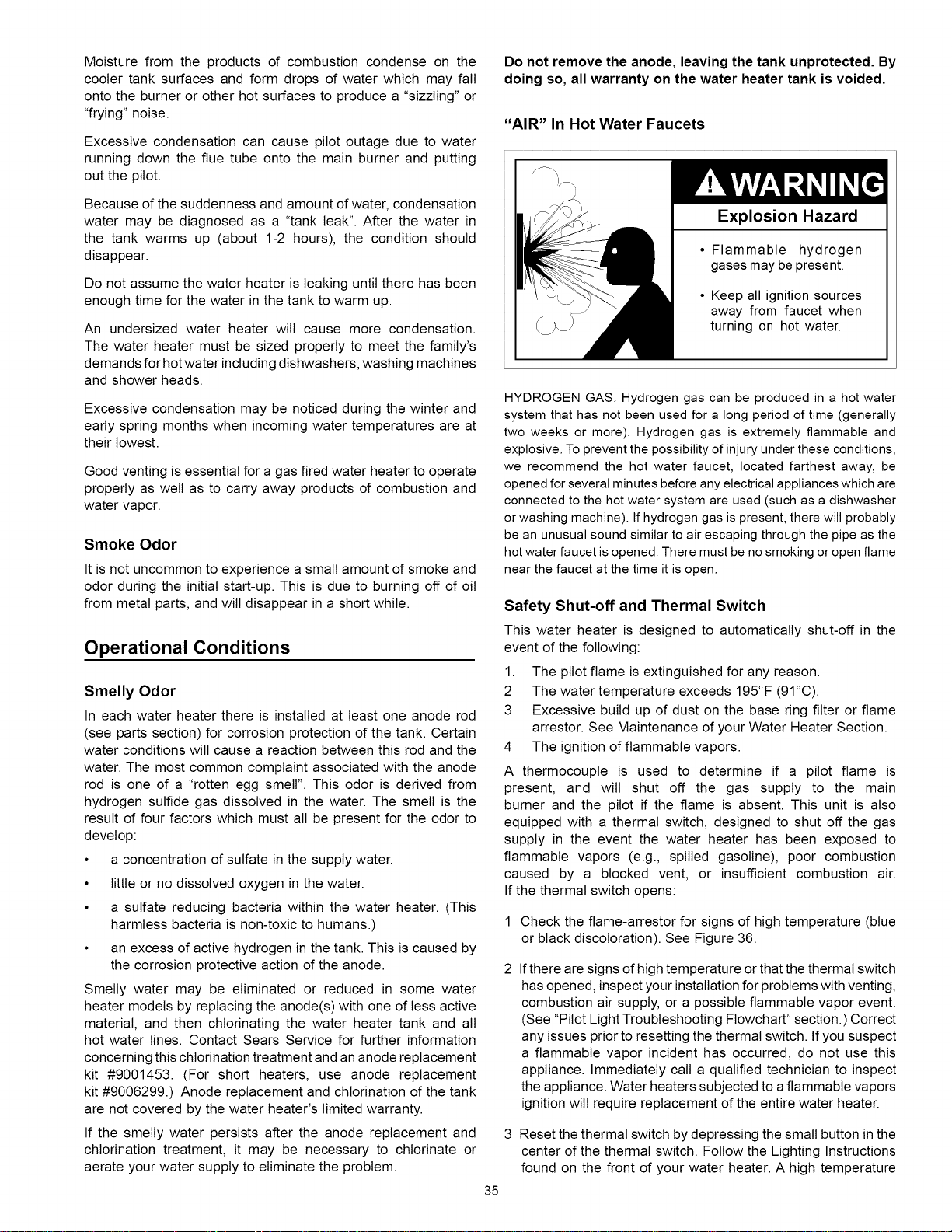
Moisturefromtheproductsofcombustioncondenseonthe
coolertanksurfacesandformdropsofwaterwhichmayfall
ontotheburnerorotherhotsurfacestoproducea"sizzling"or
"frying"noise.
Excessivecondensationcancausepilotoutageduetowater
runningdownthefluetubeontothemainburnerandputting
outthepilot.
Becauseofthesuddennessandamountofwater,condensation
watermaybediagnosedasa "tankleak".Afterthewaterin
thetankwarmsup(about1-2hours),theconditionshould
disappear.
Donotassumethewaterheaterisleakinguntiltherehasbeen
enoughtimeforthewaterinthetanktowarmup.
Anundersizedwaterheaterwillcausemorecondensation.
Thewaterheatermustbesizedproperlytomeetthefamily's
demandsforhotwaterincludingdishwashers,washingmachines
andshowerheads.
Excessivecondensationmaybenoticedduringthewinterand
earlyspringmonthswhenincomingwatertemperaturesareat
theirlowest.
Goodventingisessentialforagasfiredwaterheatertooperate
properlyaswellastocarryawayproductsofcombustionand
watervapor.
Smoke Odor
It is not uncommon to experience a small amount of smoke and
odor during the initial start-up. This is due to burning off of oil
from metal parts, and will disappear in a short while.
Operational Conditions
Smelly Odor
In each water heater there is installed at least one anode rod
(see parts section) for corrosion protection of the tank. Certain
water conditions will cause a reaction between this rod and the
water. The most common complaint associated with the anode
rod is one of a "rotten egg smell". This odor is derived from
hydrogen sulfide gas dissolved in the water. The smell is the
result of four factors which must all be present for the odor to
develop:
• a concentration of sulfate in the supply water.
• little or no dissolved oxygen in the water.
• a sulfate reducing bacteria within the water heater. (This
harmless bacteria is non-toxic to humans.)
• an excess of active hydrogen in the tank. This is caused by
the corrosion protective action of the anode.
Smelly water may be eliminated or reduced in some water
heater models by replacing the anode(s) with one of tess active
material, and then chlorinating the water heater tank and all
hot water lines. Contact Sears Service for further information
concerning this chlorination treatment and an anode replacement
kit #9001453. (For short heaters, use anode replacement
kit #9006299.) Anode replacement and chlorination of the tank
are not covered by the water heater's limited warranty.
If the smelly water persists after the anode replacement and
chlorination treatment, it may be necessary to chlorinate or
aerate your water supply to eliminate the problem.
Do not remove the anode, leaving the tank unprotected. By
doing so, all warranty on the water heater tank is voided.
"AIR" In Hot Water Faucets
Explosion Hazard
• Flammable hydrogen
gases may be present.
• Keep all ignition sources
away from faucet when
turning on hot water.
35
HYDROGEN GAS: Hydrogen gas can be produced in a hot water
system that has not been used for a long period of time (generally
two weeks or more). Hydrogen gas is extremely flammable and
explosive. To prevent the possibility of injury under these conditions,
we recommend the hot water faucet, located farthest away, be
opened for several minutes before any electrical appliances which are
connected to the hot water system are used (such as a dishwasher
or washing machine). If hydrogen gas is present, there will probably
be an unusual sound similar to air escaping through the pipe as the
hot water faucet is opened. There must be no smoking or open flame
near the faucet at the time it is open.
Safety Shut-off and Thermal Switch
This water heater is designed to automatically shut-off in the
event of the following:
1. The pilot flame is extinguished for any reason.
2. The water temperature exceeds 195°F (91°C).
3. Excessive build up of dust on the base ring filter or flame
arrestor. See Maintenance of your Water Heater Section.
4. The ignition of flammable vapors.
A thermocouple is used to determine if a pilot flame is
present, and wilt shut off the gas supply to the main
burner and the pilot if the flame is absent. This unit is also
equipped with a thermal switch, designed to shut off the gas
supply in the event the water heater has been exposed to
flammable vapors (e.g., spilled gasoline), poor combustion
caused by a blocked vent, or insufficient combustion air.
If the thermal switch opens:
1. Check the flame-arrestor for signs of high temperature (blue
or black discoloration). See Figure 36.
2,
Ifthere are signs of high temperature or that the thermal switch
has opened, inspect your installation for problems with venting,
combustion air supply, or a possible flammable vapor event.
(See "Pilot Light Troubleshooting Flowchart" section.) Correct
any issues prior to resetting the thermal switch. If you suspect
a flammable vapor incident has occurred, do not use this
appliance. Immediately call a qualified technician to inspect
the appliance. Water heaters subjected to aflammable vapors
ignition will require replacement of the entire water heater.
3. Reset the thermal switch by depressing the small button in the
center of the thermal switch. Follow the Lighting Instructions
found on the front of your water heater. A high temperature
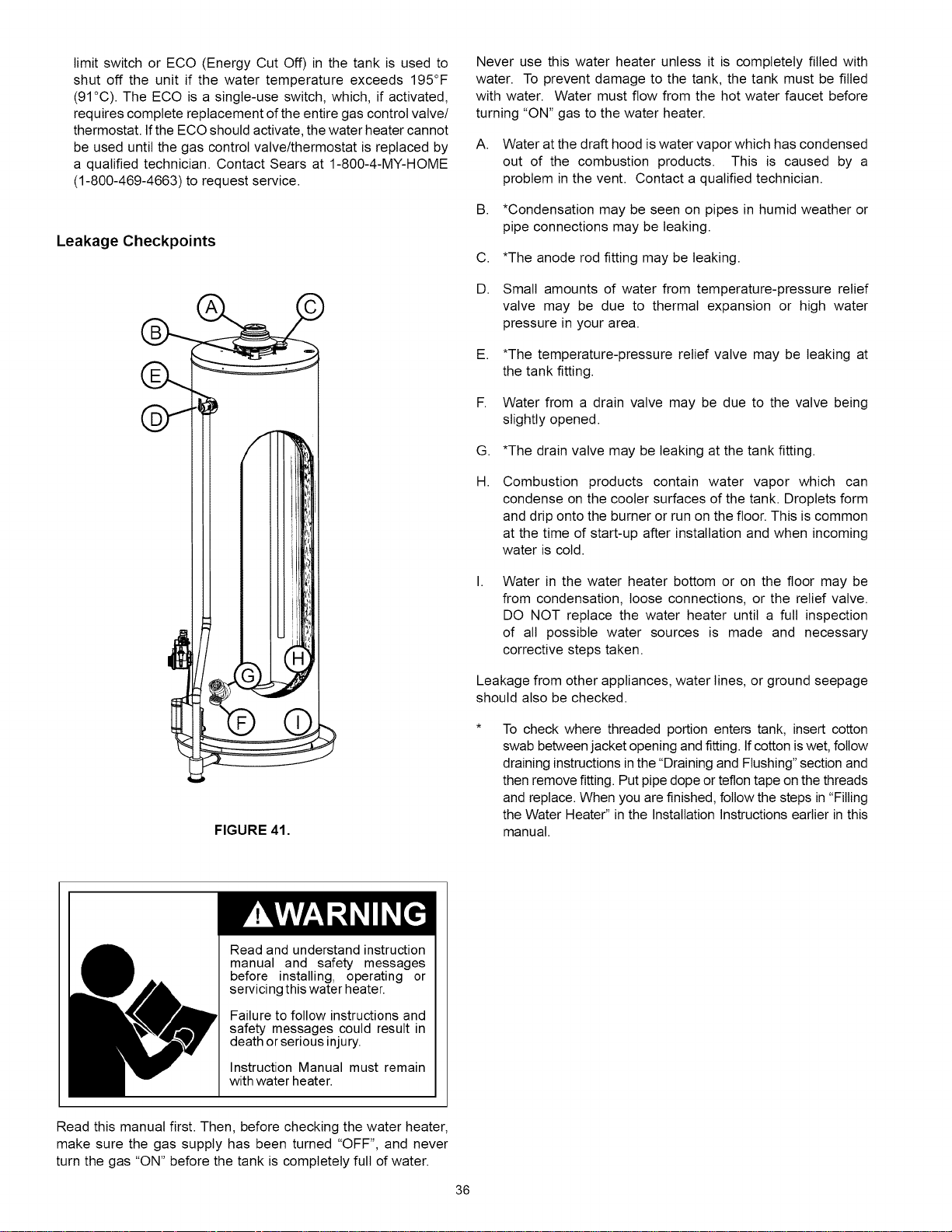
limitswitchorECO(EnergyCutOff)inthetankisusedto
shutofftheunitifthewatertemperatureexceeds195°F
(91°C).TheECOisasingle-useswitch,which,ifactivated,
requirescompletereplacementoftheentiregascontrolvalve/
thermostat.IftheECOshouldactivate,thewaterheatercannot
beuseduntilthegascontrolvalve/thermostatisreplacedby
aqualifiedtechnician.ContactSearsat1-800-4-MY-HOME
(1-800-469-4663)torequestservice.
Leakage Checkpoints
FIGURE 41.
Never use this water heater unless it is completely filled with
water. To prevent damage to the tank, the tank must be filled
with water. Water must flow from the hot water faucet before
turning "ON" gas to the water heater.
A. Water at the draft hood is water vapor which has condensed
out of the combustion products. This is caused by a
problem in the vent. Contact a qualified technician.
B. *Condensation may be seen on pipes in humid weather or
pipe connections may be leaking.
C. *The anode rod fitting may be leaking.
D. Small amounts of water from temperature-pressure relief
valve may be due to thermal expansion or high water
pressure in your area.
E. *The temperature-pressure relief valve may be leaking at
the tank fitting.
F. Water from a drain valve may be due to the valve being
slightly opened.
G. *The drain valve may be leaking at the tank fitting.
a.
Combustion products contain water vapor which can
condense on the cooler surfaces of the tank. Droplets form
and drip onto the burner or run on the floor. This is common
at the time of start-up after installation and when incoming
water is cold.
Water in the water heater bottom or on the floor may be
from condensation, loose connections, or the relief valve.
DO NOT replace the water heater until a full inspection
of all possible water sources is made and necessary
corrective steps taken.
Leakage from other appliances, water lines, or ground seepage
should also be checked.
To check where threaded portion enters tank, insert cotton
swab between jacket opening and fitting. If cotton is wet, follow
draining instructions in the "Draining and Flushing" section and
then remove fitting. Put pipe dope or teflon tape on the threads
and replace. When you are finished, follow the steps in "Filling
the Water Heater" in the Installation Instructions earlier in this
manual.
Read and understand instruction
manual and safety messages
before installing, operating or
servicing this water heater.
Failure to follow instructions and
safety messages could result in
death or serious injury.
Instruction Manual must remain
with water heater.
Read this manual first. Then, before checking the water heater,
make sure the gas supply has been turned "OFF", and never
turn the gas "ON" before the tank is completely full of water.
36
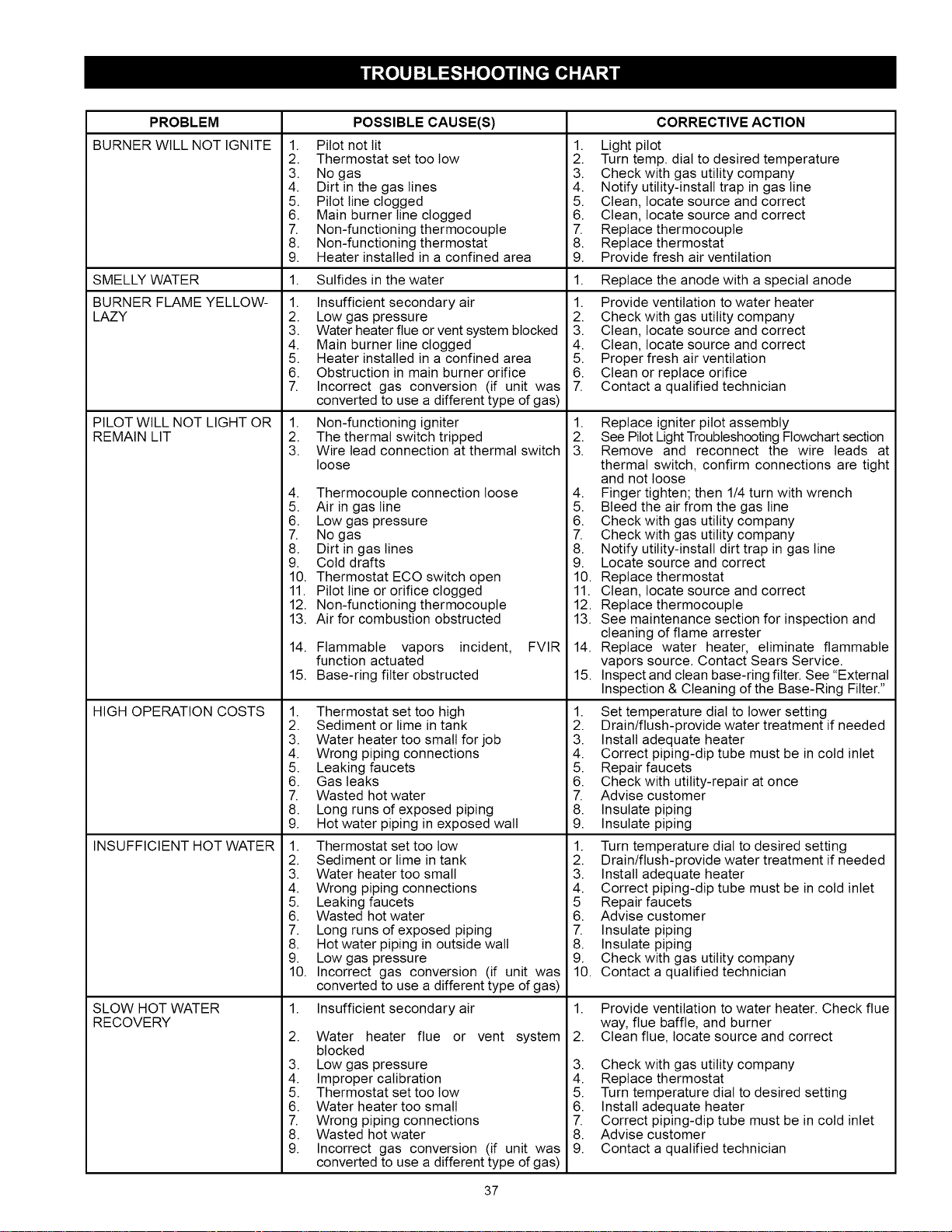
PROBLEM POSSIBLE CAUSE(S) CORRECTIVE ACTION
BURNER WILL NOT IGNITE
SMELLY WATER
BURNER FLAME YELLOW-
LAZY
PILOT WILL NOT LIGHT OR
REMAIN LIT
HIGH OPERATION COSTS
INSUFFICIENT HOT WATER
SLOW HOT WATER
RECOVERY
1. Pilot not tit
2. Thermostat set too low
3. No gas
4. Dirt in the gas lines
5. Pilot line clogged
6. Main burner line clogged
7. Non-functioning thermocouple
8. Non-functioning thermostat
9. Heater installed in a confined area
1. Light pilot
2. Turn temp. dial to desired temperature
3. Check with gas utility company
4. Notify utility-install trap in gas line
5. Clean, locate source and correct
6. Clean, locate source and correct
7. Replace thermocouple
8. Replace thermostat
9. Provide fresh air ventilation
1. Sulfides in the water 1. Replace the anode with a special anode
1. Insufficient secondary air
2. Low gas pressure
3. Water heater flue or vent system blocked
4. Main burner line clogged
5. Heater installed in a confined area
6. Obstruction in main burner orifice
7. Incorrect gas conversion (if unit was
converted to use a different type of gas)
1. Non-functioning igniter
2. The thermal switch tripped
3. Wire lead connection at thermal switch
loose
4. Thermocouple connection loose
5. Air in gas line
6. Low gas pressure
7. No gas
8. Dirt in gas lines
9. Cold drafts
10. Thermostat ECO switch open
11. Pilot line or orifice clogged
12. Non-functioning thermocouple
13. Air for combustion obstructed
14. Flammable vapors incident, FVIR
function actuated
15. Base-ring filter obstructed
1. Thermostat set too high
2. Sediment or time in tank
3. Water heater too small for job
4. Wrong piping connections
5. Leaking faucets
6. Gas leaks
7. Wasted hot water
8. Long runs of exposed piping
9. Hot water piping in exposed wall
1. Thermostat set too tow
2. Sediment or time in tank
3. Water heater too small
4. Wrong piping connections
5. Leaking faucets
6. Wasted hot water
7. Long runs of exposed piping
8. Hot water piping in outside wall
9. Low gas pressure
10. Incorrect gas conversion (if unit was
converted to use a different type of gas)
1. Insufficient secondary air
1. Provide ventilation to water heater
2. Check with gas utility company
3. Clean, locate source and correct
4. Clean, locate source and correct
5. Proper fresh air ventilation
6. Clean or replace orifice
7. Contact a qualified technician
1. Replace igniter pilot assembly
2. See Pilot Light Troubleshooting Flowchart section
3. Remove and reconnect the wire leads at
thermal switch, confirm connections are tight
and not loose
4. Finger tighten; then 1/4 turn with wrench
5. Bleed the air from the gas line
6. Check with gas utility company
7. Check with gas utility company
8. Notify utility-install dirt trap in gas line
9. Locate source and correct
10. Replace thermostat
11. Clean, locate source and correct
12. Replace thermocouple
13. See maintenance section for inspection and
cleaning of flame arrester
14. Replace water heater, eliminate flammable
vapors source. Contact Sears Service.
15. Inspect and clean base-ring filter. See "External
Inspection & Cleaning of the Base-Ring Filter."
1. Set temperature dial to lower setting
2. Drain/flush-provide water treatment if needed
3. Install adequate heater
4. Correct piping-dip tube must be in cold inlet
5. Repair faucets
6. Check with utility-repair at once
7. Advise customer
8. Insulate piping
9. Insulate piping
1. Turn temperature dial to desired setting
2. Drain/flush-provide water treatment if needed
3. Install adequate heater
4. Correct piping-dip tube must be in cold inlet
5 Repair faucets
6. Advise customer
7. Insulate piping
8. Insulate piping
9. Check with gas utility company
10. Contact a qualified technician
1. Provide ventilation to water heater. Check flue
2. Water heater flue or vent
blocked
3. Low gas pressure
4. Improper calibration
5. Thermostat set too tow
6. Water heater too small
7. Wrong piping connections
8. Wasted hot water
9.
system
Incorrect gas conversion (if unit was
converted to use a different type of gas)
2,
way, flue baffle, and burner
Clean flue, locate source and correct
3. Check with gas utility company
4. Replace thermostat
5. Turn temperature dial to desired setting
6. Install adequate heater
7. Correct piping-dip tube must be in cold inlet
8. Advise customer
9. Contact a qualified technician
37
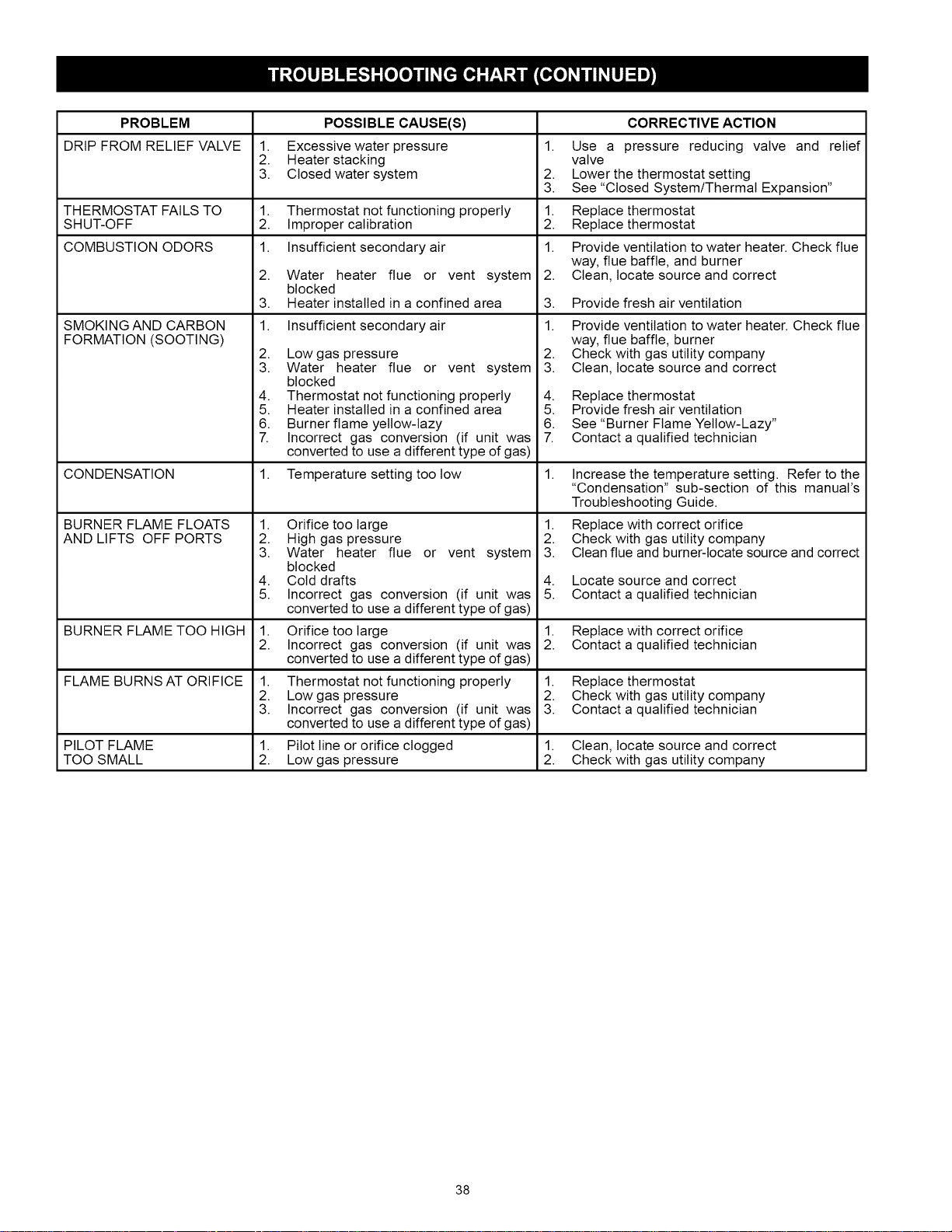
PROBLEM POSSIBLE CAUSE(S) CORRECTIVE ACTION
DRIP FROM RELIEF VALVE 1. Excessive waterpressure 1. Use a pressure reducing valve and relief
2. Heater stacking valve
3. Closed water system 2. Lower the thermostat setting
3. See "Closed System/Thermal Expansion"
THERMOSTAT FAILS TO 1. Thermostat not functioning properly 1. Replace thermostat
SHUT-OFF 2. Improper calibration 2. Replace thermostat
COMBUSTION ODORS 1. Insufficient secondary air 1. Provide ventilation to water heater. Check flue
way, flue baffle, and burner
2. Water heater flue or vent system 2. Clean, locate source and correct
blocked
3. Heater installed in a confined area 3. Provide fresh air ventilation
SMOKING AND CARBON 1. Insufficient secondary air 1.
FORMATION (SOOTING)
2. Low gas pressure
3. Water heater flue or vent system
blocked
4. Thermostat not functioning properly
5. Heater installed in a confined area
6. Burner flame yellow-lazy
7. Incorrect gas conversion (if unit was
converted to use a different type of gas)
2,
3.
Provide ventilation to water heater. Check flue
way, flue baffle, burner
Check with gas utility company
Clean, locate source and correct
4. Replace thermostat
5. Provide fresh air ventilation
6. See "Burner Flame Yellow-Lazy"
7. Contact a qualified technician
CONDENSATION 1. Temperature setting too low 1. Increase the temperature setting. Refer to the
"Condensation" sub-section of this manual's
Troubleshooting Guide.
BURNER FLAME FLOATS
AND LIFTS OFF PORTS
1. Orifice too large
2. High gas pressure
3. Water heater flue or vent system
blocked
4. Cold drafts
5. Incorrect gas conversion (if unit was
converted to use a different type of gas)
1. Replace with correct orifice
2. Check with gas utility company
3. Clean flue and burner-locate source and correct
4. Locate source and correct
5. Contact a qualified technician
BURNER FLAME TOO HIGH 1. Orifice too large 1. Replace with correct orifice
2. Incorrect gas conversion (if unit was 2. Contact a qualified technician
converted to use a different type of gas)
FLAME BURNS AT ORIFICE 1. Thermostat not functioning properly 1. Replace thermostat
2. Low gas pressure 2. Check with gas utility company
3. Incorrect gas conversion (if unit was 3. Contact a qualified technician
converted to use a different type of gas)
PILOT FLAME 1. Pilot line or orifice clogged 1. Clean, locate source and correct
TOO SMALL 2. Low gas pressure 2. Check with gas utility company
38
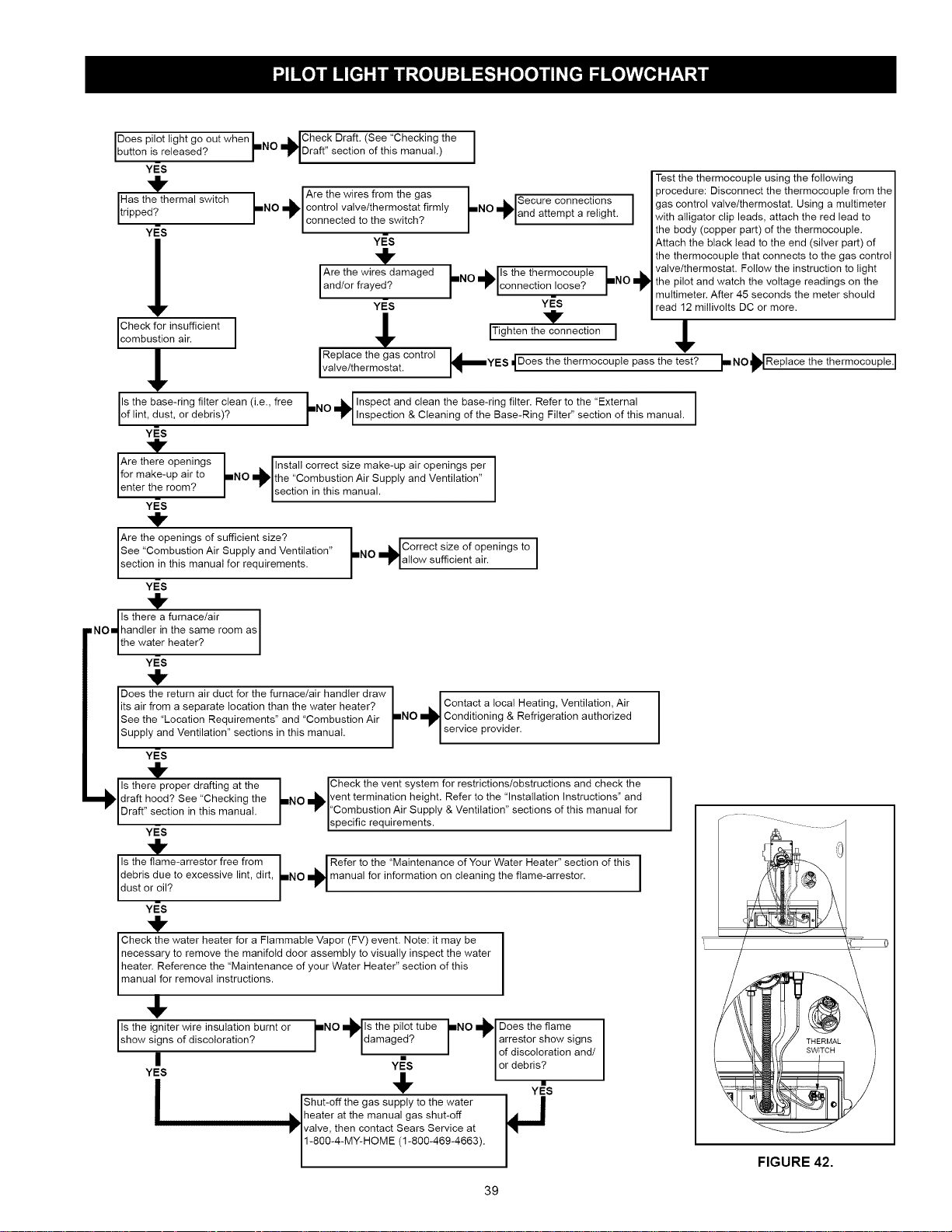
Does pilot light go out when _/ _l•lCheck Draft. (See "Checking the
button is released? I"NO '_Draft" section of this manual.)
n
/
YES
",I,
Has the thermal switch | I Are the wires from the gas
tripped? INNO m_l_Icontrol valve/thermostat firmly
/ --I connected to the switch?
YES
YES
÷
Are the wires damaged
and/or frayed?
YES
Check for insufficient
combust on a r. I
L Replace the gas control
va ve/thermostat.
Is the base-ring filter clean (i.e., free
of nt, dust, or debts)?
yr=s
Are there openings / IInstall correct size make-up air openings per
for make-up air to pNO _,lthe "Combustion Air Supply and Ventilation"
enter the room? | --Isection in this manual.
YES
• ISecure connections
NO m_lland attempt a relight" I
ImNO mlll, IIs the thermocouple pNO• Iconnection/oose?
YES
ITighten the connection I 1
_YES re[Doesthe thermocouple pass the test?
Test the thermocouple using the following
procedure: Disconnect the thermocouple from the
gas control valve/thermostat. Using a multimeter
with alligator clip leads, attach the red lead to
the body (copper part) of the thermocouple.
Attach the black lead to the end (silver part) of
the thermocouple that connects to the gas control
valve/thermostat. Follow the instruction to light
the pilot and watch the voltage readings on the
multimeter. After 45 seconds the meter should
read 12 mi(livoits DC or more.
F • I Inspect and clean the base-ring filter Refer to the "External
I
NO
Inspection & Cleaning of the Base-Ring Filter" section of this manual. I
/ I
]annNO_lReplace the thermocouple n
Are the openings of sufficient size?
ISee "Combustion Air Supply and Ventilation" • ICorrect size of openings to I
section in this manual for requirements. NNO _lallow sufficient air.
YES
| Is there a furnace/air as
nNO_handler in the same room
the water heater?
YES
Does the return air duct for the furnace/air handler draw • IContact a local Heating, Ventilation, Air
its air from a separate location than the water heater?
See the "Location Requirements" and "Combustion Air NNO _t Conditioning & Refrigeration authorized
Supply and Ventilation" sections in this manual. "[service provider.
YES
÷
I Isthere proper drafting at the / ICheck the vent system for restrictions/obstructions and check the
m_.ldraft hood? See "Checking the NO _11,1venttermi.nation height. Refer to the 'i,lnsta!lation Ins!ructions" and
-- r IV Combustion Air Supply & Ventilation sections of thB manual for
IDraft" section in this manual.
specific requirements.
YES
÷
Is the flame-arrestor free from | ,.I Refer to the "Maintenance of Your Water Heater" section of this
debris due to excessive lint, dirt, tNO _ manual for information on cleaning the flame-arrestor.
dust or o ?
YES
Check the water heater for a Flammable Vapor (FV) event. Note: it may be
necessary to remove the manifold door assembly to visually inspect the water
heater. Reference the "Maintenance of your Water Heater" section of this
manua for remove nstructons.
ls the igniter wire insulation burnt or INNO mll_ls the pilot tube INNO nll!'l D°es the flame I
show signs of discoloration? / 7 damaged? / --I arrestor show signs
i _ I of discol?ration and/
Y S or debr s.
YtS
Shut-off the gas supply to the water I II
• heater at the manual gas shut-off
• valve, then contact Sears Service at
1-800-4-MY-HOME (1-800-469-4663).
jo .....
THERMAL
FIGURE 42.
39
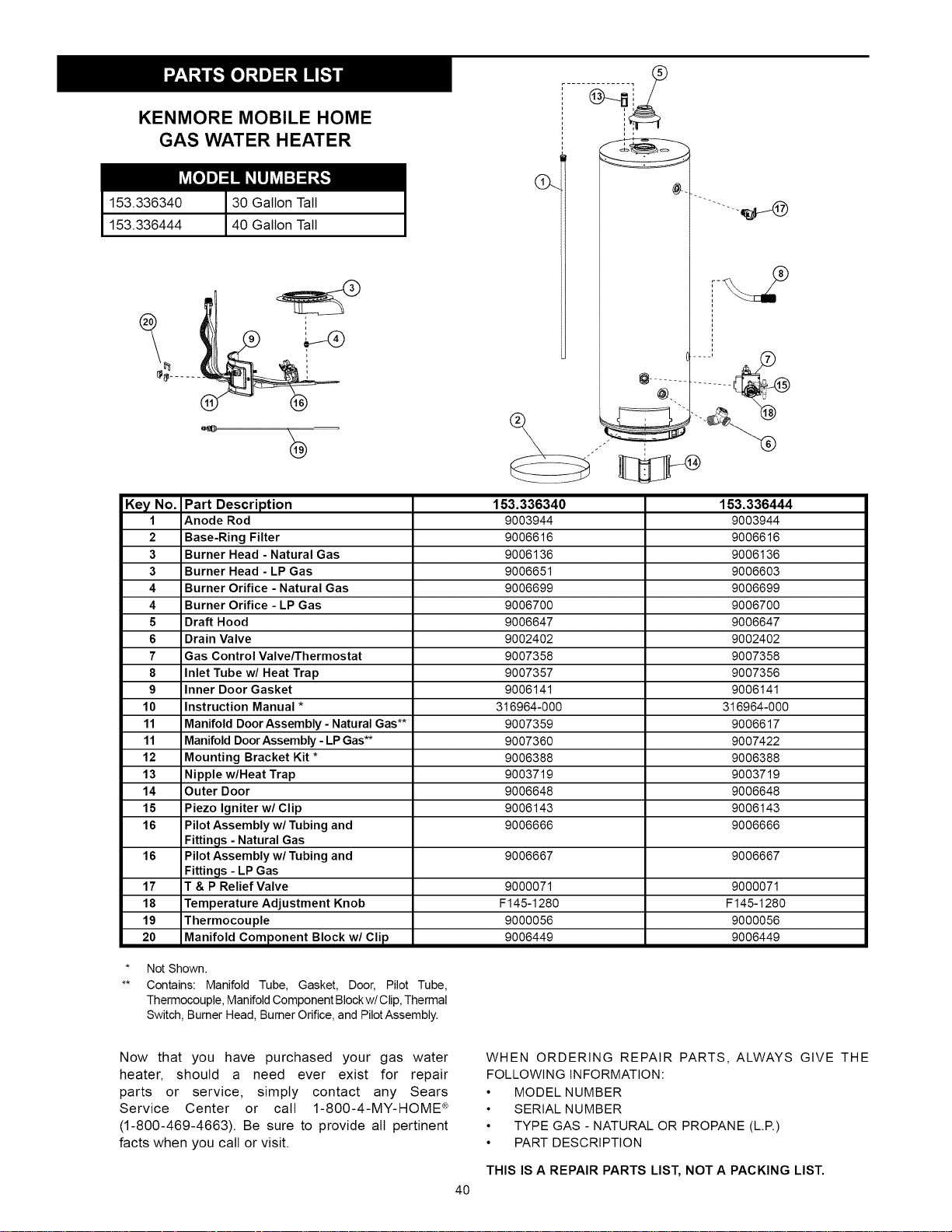
KENMORE MOBILE HOME
GAS WATER HEATER
153.336340 30 Gallon Tall
153.336444 40 Gallon Tall
Key
No,
1
2
3
3
4
4
5
6
7
8
9
10
11
11
12
13
14
15
16
16
17
18
19
2O
/• I
Part Description 153.336340 153.336444
Anode Rod 9003944 9003944
Base-Ring Filter 9006616 9006616
Burner Head - Natural Gas 9006136 9006136
Burner Head - LP Gas 9006651 9006603
Burner Orifice - Natural Gas 9006699 9006699
Burner Orifice - LP Gas 9006700 9006700
Draft Hood 9006647 9006647
Drain Valve 9002402 9002402
Gas Control Valve/Thermostat 9007358 9007358
Inlet Tube w/Heat Trap 9007357 9007356
Inner Door Gasket 9006141 9006141
Instruction Manual * 316964-000 316964-000
Manifold Door Assembly - Natural Gas** 9007359 9006617
Manifold Door Assembly - LP Gas** 9007360 9007422
Mounting Bracket Kit * 9006388 9006388
Nipple w/Heat Trap 9003719 9003719
Outer Door 9006648 9006648
Piezo Igniter w/Clip 9006143 9006143
Pilot Assembly w/Tubing and 9006666 9006666
Fittings - Natural Gas
Pilot Assembly w/Tubing and 9006667 9006667
Fittings - LP Gas
T & P Relief Valve 9000071 9000071
Temperature Adjustment Knob F145-1280 F145-1280
Thermocouple 9000056 9000056
Manifold Component Block w/Clip 9006449 9006449
* Not Shown.
** Contains: Manifold Tube, Gasket, Door, Pilot Tube,
Thermocouple, Manifold Component Block w! Clip,Thermal
Switch, Burner Head, Burner Orifice, and PilotAssembly.
Now that you have purchased your gas water
heater, should a need ever exist for repair
parts or service, simply contact any Sears
Service Center or call 1-800-4-MY-HOME _
(1-800-469-4663). Be sure to provide all pertinent
facts when you call or visit.
4O
WHEN ORDERING REPAIR PARTS, ALWAYS GIVE THE
FOLLOWING INFORMATION:
• MODEL NUMBER
• SERIAL NUMBER
• TYPE GAS - NATURAL OR PROPANE (LR)
• PART DESCRIPTION
THIS IS A REPAIR PARTS LIST, NOT A PACKING LIST.

41

42

43

Your Home
iiiiiiiiiiiiiiii:iiiiiiiiiii SearsParts&RepairServiceCenter iiiiiiiiiiiiiiiiiiii
ii!!i 1-800-488-1222 (U.S.A.) 1-800-469-4663 (Canada) iiiiiiiiiiiiiiiiiiii
iiiiiiiiiiii! www,earscom www,earsca
!i! TopurchaseaprotectionagreementonaproductservicedbySears:
1-800-827-6655 (U.S.A.) 1-800-361-6665 (Canada)
iiiiii!i!iiiiiiiiiiiiiiiiiiiiiiiPara pedirserviciodereparaci6n Au Canada pourserviceenfran_ais: iiiiiiiiiiiiiiiiiiii
i!iiiiiiiiiiiiiiiiiiii!ii!!i!i!!ia domicilio, y para ordenarpiezas: 1.800.LE.FOYERMC iiiiiiiiiiiiiiiiiiii
iiii_iiiiiiiiiiiiiiii 1-888-SU-HOGAR® 1 800 533 6937 "i"i"i"i"i"i"i"i"i"i"i_!iiiii!i!ili
`::_:;:_i:ii_ii_ii_ii_ii_ii_ii_ii_iiii_!!_!_!i_i_i_i_i_ii_ii_ii_i_ii_....... (1-888-784-6427) www.sears.ca .....................................................
TM
® Registered Trademark / Trademark / SMService Mark of Sears Brands, LLC
® Marca Registrada / TM Marca de F&brica / SMMarca de Servicio de Sears Brands, LLC
MD
MCMarque de commerce / Marque depos6e de Sears Brands, LLC © Sears Brands, LLC