Operation Manual
Embroidery Machine
Product Code: 882-W83/W85
Be sure to read this document before using the machine.
We recommend that you keep this document nearby for future reference.The latest manuals are available at
Brother Support website ( https://s.brother/cmeaf/ ).

1
Thank you for purchasing this machine. Before using this
machine, carefully read the “IMPORTANT SAFETY
INSTRUCTIONS”, and then study this manual for the
correct operation of the various functions.
In addition, after you have finished reading this manual,
store it where it can quickly be accessed for future
reference.
Please read these safety instructions before attempting to
use the machine.
DANGER
- To reduce the risk of electric shock
1Always unplug the machine from the
electrical outlet immediately after using,
cleaning, making any user servicing
adjustments mentioned in this manual,
or if you are leaving the machine
unattended.
WARNING
- To reduce the risk of burns, fire, electrical shock, or
injury to persons.
2Always unplug the machine from the electrical
outlet, or when making any adjustments mentioned
in the instruction manual.
• To unplug the machine, switch the machine to the
symbol “O” position to turn it off, then grasp the
plug and pull it out of the electrical outlet. Do not
pull on the cord.
• Plug the machine directly into the electrical outlet.
Do not use an extension cord.
• Always unplug your machine if there is a power
failure.
3Electrical Hazards:
• This machine should be connected to an AC power
source within the range indicated on the rating
label. Do not connect it to a DC power source or
inverter. If you are not sure what kind of power
source you have, contact a qualified electrician.
• This machine is approved for use in the country of
purchase only.
4Never operate this machine if it has a damaged cord
or plug, if it is not working properly, has been
dropped or damaged, or water is spilled on the unit.
Return the machine to the nearest authorized
Brother dealer for examination, repair, electrical or
mechanical adjustment.
• While the machine is stored or in use if you notice
anything unusual, such as an odor, heat,
discoloration or deformation, stop using the
machine immediately and unplug the power cord.
• When transporting the machine, be sure to carry it
by its handle. Lifting the machine by any other part
may damage the machine or result in the machine
falling, which could cause injuries.
• When lifting the machine, be careful not to make
any sudden or careless movements, which may
cause a personal injury.
5Always keep your work area clear:
• Never operate the machine with any air openings
blocked. Keep ventilation openings of the machine
free from the build up of lint, dust, and loose cloth.
• Never drop or insert foreign object into any
opening.
• Do not operate where aerosol (spray) products are
being used or where oxygen is being administered.
• Do not use the machine near a heat source, such as
a stove or iron; otherwise, the machine, power cord
or garment being embroidered may ignite, resulting
in fire or an electric shock.
• Do not place this machine on an unstable surface,
such as an unsteady or slanted table, otherwise the
machine may fall, resulting in injuries.
INTRODUCTION
IMPORTANT SAFETY
INSTRUCTIONS

2
6Special care is required when embroidering:
• Always pay close attention to the needle. Do not use
bent or damaged needles.
• Keep fingers away from all moving parts. Special
care is required around the machine needle.
• Switch the machine to the symbol “O” position to
turn it off when making any adjustments in the
needle area.
• Do not use a damaged or incorrect needle plate, as
it could cause the needle to break.
• Do not push or pull the fabric when embroidering.
7This machine is not a toy:
• Your close attention is necessary when the machine
is used by or near children.
• This product contains small parts. Keep the product
out of the reach of children to prevent accidental
ingestion of small parts.
• The plastic bag that this machine was supplied in
should be kept out of the reach of children or
disposed of. Never allow children to play with the
bag due to the danger of suffocation.
• Do not use the seam ripper in any other way than
how it is intended.
• Do not use outdoors.
8For a longer service life:
• When using and storing this machine, avoid direct
sunlight and high humidity locations. Do not use or
store the machine near a space heater, iron, halogen
lamp, or other hot objects.
• Do not use cleansers or organic solvents, such as
thinner, petroleum ether or alcohol, to clean the
machine. Otherwise, the finish may peel off or
become scratched.
• Always consult the Operation Manual when
replacing or installing any assemblies, the presser
feet, needle, or other parts to assure correct
installation.
9For repair or adjustment:
• If the light unit is damaged, it must be replaced by
an authorized Brother dealer.
• In the event a malfunction occurs or adjustment is
required, first follow the troubleshooting table in the
back of the Operation Manual to inspect and adjust
the machine yourself. If the problem persists, please
consult your local authorized Brother dealer.
Use this machine only for its intended use as described
in the manual.
Use accessories recommended by the manufacturer as
contained in this manual.
The contents of this manual and specifications of this
product are subject to change without notice.
For additional product information and updates, visit
our website at www.brother.com
SAVE THESE
INSTRUCTIONS
This machine is intended
for household use.
FOR USERS IN COUNTRIES EXCEPT
EUROPEAN COUNTRIES
This appliance is not intended for use
by persons (including children) with
reduced physical, sensory or mental
capabilities, or lack of experience and
knowledge, unless they have been
given supervision or instruction
concerning use of the appliance by a
person responsible for their safety.
Children should be supervised to
ensure that they do not play with the
appliance.
FOR USERS IN EUROPEAN
COUNTRIES
This appliance can be used by children
aged from 8 years and above and
persons with reduced physical, sensory
or mental capabilities or lack of
experience and knowledge if they have
been given supervision or instruction
concerning use of the appliance in a
safe way and understand the hazards
involved. Children shall not play with
the appliance. Cleaning and user
maintenance shall not be made by
children without supervision.

3
FOR USERS IN THE UK,
EIRE, MALTA AND
CYPRUS ONLY
IMPORTANT
• In the event of replacing the plug fuse, use a fuse
approved by ASTA to BS 1362, i.e. carrying the
mark, rating as marked on plug.
• Always replace the fuse cover. Never use plugs with
the fuse cover omitted.
• If the available electrical outlet is not suitable for the
plug supplied with this equipment, you should
contact your authorized Brother dealer to obtain the
correct lead.
Federal Communications
Commission (FCC)
Supplier’s Declaration of
Conformity (For U.S.A.
Only)
This device complies with Part 15 of the FCC Rules.
Operation is subject to the following two conditions: (1)
this device may not cause harmful interference, and (2)
this device must accept any interference received,
including interference that may cause undesired
operation.
This equipment has been tested and found to comply
with the limits for a Class B digital device, pursuant to
Part 15 of the FCC Rules. These limits are designed to
provide reasonable protection against harmful
interference in a residential installation. This equipment
generates, uses, and can radiate radio frequency energy
and, if not installed and used in accordance with the
instructions, may cause harmful interference to radio
communications. However, there is no guarantee that
interference will not occur in a particular installation. If
this equipment does cause harmful interference to radio
or television reception, which can be determined by
turning the equipment off and on, the user is
encouraged to try to correct the interference by one or
more of the following measures:
• Reorient or relocate the receiving antenna.
• Increase the separation between the equipment and
receiver.
• Connect the equipment into an outlet on a circuit
different from that to which the receiver is
connected.
• Consult the authorized Brother dealer or an
experienced radio/TV technician for help.
• This transmitter must not be co-located or operated
in conjunction with any other antenna or
transmitter.
Important
Changes or modifications not expressly approved by
Brother Industries, Ltd. could void the user’s authority
to operate the equipment.
This equipment complies with FCC/IC radiation
exposure limits set forth for an uncontrolled
environment and meets the FCC radio frequency (RF)
Exposure Guidelines and RSS-102 of the IC radio
frequency (RF) Exposure rules. This equipment should
be installed and operated keeping the radiator at least
20cm or more away from person's body.
Responsible Party: Brother International Corporation
200 Crossing Boulevard
P.O. Box 6911
Bridgewater, NJ 08807-0911
USA
TEL : (908) 704-1700
declares that the product
Product Name:
Model Number:
Brother Embroidery Machine
XE2

4
For Users in Canada
This device complies with Industry Canada’s licence-exempt
RSSs. Operation is subject to the following two conditions:
(1) This device may not cause interference; and
(2) This device must accept any interference, including
interference that may cause undesired operation of the
device.
This equipment complies with FCC/IC radiation exposure
limits set forth for an uncontrolled environment and meets the
FCC radio frequency (RF) Exposure Guidelines and RSS-102
of the IC radio frequency (RF) Exposure rules. This equipment
should be installed and operated keeping the radiator at least
20cm or more away from person's body.
For Users in Mexico
The operation of this equipment is subject to the following
two conditions:
(1) it is possible that this equipment or device may not cause
harmful interference, and
(2) this equipment or device must accept any interference,
including interference that may cause undesired
operation.
Para usuarios en México
La operación de este equipo está sujeta a las siguientes dos
condiciones:
(1) es posible que este equipo o dispositivo no cause
interferencias perjudiciales y
(2) este equipo o dispositivo debe aceptar cualquier
interferencia, incluyendo la que pueda causar su
operación no deseada.
Declaration of Conformity
(Europe and Turkey only)
We, Brother Industries, Ltd. 15-1 Naeshiro-cho, Mizuho-ku,
Nagoya 467-8561 Japan declare that this product is in
conformity with the essential requirements of all relevant
directives and regulations applied within the European
Community.
The Declaration of Conformity (DoC) can be downloaded
from Brother Support website. Visit support.brother.com
Declaration of Conformity
for RE Directive 2014/53/
EU (Europe and Turkey
only)
(Applicable to models with
radio interfaces)
We, Brother Industries, Ltd. 15-1 Naeshiro-cho, Mizuho-ku,
Nagoya 467-8561 Japan declare that these products are in
conformity with the provisions of the RE Directive 2014/53/
EU.
The Declaration of Conformity (DoC) can be downloaded
from Brother Support website. Visit support.brother.com
Wireless LAN (Models with
Wireless LAN function
only)
This machine supports wireless interface.
Frequency band(s): 2400-2483.5 MHz
Maximum radio-frequency power transmitted in the
frequency band(s): Less than 20 dBm(e.i.r.p)
UK Declaration of
Conformity
(Great Britain only)
We, Brother Industries, Ltd. 15-1 Naeshiro-cho, Mizuho-ku,
Nagoya 467-8561 Japan declare that these products are in
conformity with the relevant UK legislation.
The Declaration of Conformity (DoC) can be downloaded
from Brother Support website. Visit support.brother.com
UK Declaration of
Conformity for Radio
Equipment Regulation
2017
(Great Britain only)
(Applicable to models with
radio interfaces)
We, Brother Industries, Ltd. 15-1 Naeshiro-cho, Mizuho-ku,
Nagoya 467-8561 Japan declare that these products are in
conformity with the provisions of the Radio Equipment
Regulation 2017.
The Declaration of Conformity (DoC) can be downloaded
from Brother Support website. Visit support.brother.com
For Users in Norway
This subsection does not apply for the geographical area
within a radius of 20 km from the centre of Ny-Alesund on
Svalbard.
Dette underavsnittet gjelder ikke for det geografiske området
innenfor en radius av 20 km fra sentrum av Ny-Ålesund på
Svalbard.

5
WPA™ and WPA2™ are trademarks of Wi-Fi Alliance®.
Any trade names and product names of companies appearing on
Brother products, related documents and any other materials are all
trademarks or registered trademarks of those respective companies.
This product includes software developed by the following
vendor: ©2008 Devicescape Software, Inc.
This product includes open-source software.
To see the open source licensing remarks, please go to the
manual download section on your model’s home page of
Brother Support website at https://s.brother/cpeag/
.
Make sure you use a router or firewall when connecting
your machine to the Internet to protect it against
unauthorized access from the Internet.
TRADEMARKS
COPYRIGHT AND LICENSE
OPEN SOURCE LICENSING
REMARKS
PRECAUTION FOR WIRELESS
CONNECTION

CONTENTS
6
Chapter 1 GETTING READY 9
NAMES OF MACHINE PARTS .............................. 9
INCLUDED ACCESSORIES ................................. 10
TURNING THE MACHINE ON/OFF................... 10
LCD SCREEN ...................................................... 12
Using the Machine Settings Key ........................................... 13
Using the Machine Help ...................................................... 17
WIRELESS NETWORK CONNECTION
FUNCTIONS....................................................... 18
Operations Available with a Wireless Network Connection
... 18
Enabling a Wireless Network Connection............................. 19
Using the Wizard to Set Up the Wireless Network
Connection .......................................................................... 19
CONNECTING THE ACCESSORY TO THE
MACHINE........................................................... 21
Using a USB Mouse ............................................................. 21
WINDING/INSTALLING THE BOBBIN.............. 22
Winding the Bobbin ............................................................. 22
Setting the Bobbin ................................................................ 25
UPPER THREADING........................................... 26
Upper Threading.................................................................. 26
CHANGING THE NEEDLE.................................. 29
Chapter 2 BASIC EMBROIDERY 31
BEFORE EMBROIDERING .................................. 31
Embroidery Step by Step....................................................... 31
About the Embroidery Unit................................................... 31
SELECTING PATTERNS....................................... 33
Selecting Embroidery Patterns .............................................. 33
Selecting Character Patterns ................................................. 35
Selecting Frame Patterns....................................................... 36
Combining Patterns.............................................................. 37
EDITING PATTERNS........................................... 39
Previewing the Pattern.......................................................... 41
Changing the Size and the Density of the Pattern ................. 41
Creating Repeated Patterns................................................... 42
Embroidering the Pattern Repeatedly.................................... 45
Deselect Region Setting (No Sew Setting) ............................. 46
EDITING COLORS ............................................. 48
Changing the Thread Color .................................................. 48
Finding New Color Schemes with the Color Shuffling
Function............................................................................... 49
Thread Color Sorting ............................................................ 50
VIEWING THE EMBROIDERY SCREEN .............. 51
PREPARING THE FABRIC ................................... 53
Attaching Iron-on Stabilizers (Backing) to the Fabric............. 53
Hooping the Fabric in the Embroidery Frame ....................... 54
ATTACHING THE EMBROIDERY FRAME........... 56
CONFIRMING THE PATTERN POSITION .......... 57
Checking the Needle Drop Point with the Embroidery Foot “W+”
with LED Pointer .................................................................. 57
Displaying a Background Image........................................... 58
Checking the Pattern Position............................................... 60
THE 2-POINT EMBROIDERY POSITIONING
FUNCTION ........................................................ 61
EMBROIDERING A PATTERN ............................ 65
Embroidering Attractive Finishes .......................................... 65
Embroidering Patterns .......................................................... 65
Using Appliqués................................................................... 67
ADJUSTMENTS DURING THE EMBROIDERY
PROCESS ............................................................ 68
If the Thread Breaks or the Bobbin Runs out of Thread During
Embroidering........................................................................ 68
Resuming Embroidery after Turning off the Power ................ 69
Chapter 3 ADVANCED EMBROIDERY 71
VARIOUS EMBROIDERING FUNCTIONS ......... 71
Basting Embroidery.............................................................. 71
Creating an Appliqué Piece ................................................. 72
MAKING EMBROIDERY ADJUSTMENTS........... 75
Adjusting Thread Tension .................................................... 75
Adjusting the Bobbin Case................................................... 76
Using the Automatic Thread Cutting Function
(End Color Trim) .................................................................. 77
Using the Thread Trimming Function (Jump Stitch Trim)...... 78
Adjusting the Embroidery Speed .......................................... 78
Changing the Thread Color Display..................................... 79
Aligning the Pattern and the Needle .................................... 79
Embroidering Linked Characters .......................................... 80
USING THE MEMORY FUNCTION ................... 81
Saving Embroidery Patterns.................................................. 81
Retrieving Embroidery Patterns ............................................ 82
EMBROIDERY APPLICATIONS .......................... 83
Using a Frame Pattern To Make an Appliqué....................... 83
Embroidering Couching Patterns.......................................... 84
Creating Stippling, Echo Quilting, or Decorative Fill Patterns
around a Design .................................................................. 87
Embroidering Split Embroidery Patterns ............................... 88
Chapter 4 MY DESIGN CENTER 89
ABOUT MY DESIGN CENTER............................ 89
PATTERN DRAWING SCREEN........................... 89
Before Creating Designs....................................................... 91
Drawing Lines ..................................................................... 91
Drawing Regions ................................................................. 92
Using the Stamp Key............................................................ 93
Using the Erase Key ............................................................. 94
Using the Select Key............................................................ 94
STITCH SETTINGS SCREEN ............................... 95
Specifying Individual Stitch Settings..................................... 95
Specifying Global Stitch Settings.......................................... 96
Loading the Background Image............................................ 97
LINE CONVERSION........................................... 98
Create a Pattern with Line Conversion ................................. 98
ILLUSTRATION CONVERSION ....................... 100
Create a Pattern with Illustration Conversion ..................... 100
STIPPLING ....................................................... 102
Basic Stippling with My Design Center .............................. 102
Decorative Stitching around a Pattern in Embroidery
(a Quilting Function).......................................................... 104
MY STITCH MONITOR APP ............................ 106
MY DESIGN SNAP APP.................................... 107
ARTSPIRA APP COMPATIBLE .......................... 108
Chapter 5 APPENDIX 109
CARE AND MAINTENANCE ............................ 109
Cleaning the LCD .............................................................. 109
Cleaning the machine surface............................................ 109
Restrictions on Oiling ........................................................ 109
Precautions on Storing the Machine................................... 109
Cleaning the Race ............................................................. 109
Cleaning the Cutter in the Bobbin Case Area ..................... 110
Changing Embroidery Foot “W+” with LED Pointer ........... 111
BEFORE LENDING OR DISPOSING OF THE
PRODUCT ....................................................... 112
ADJUSTING THE SCREEN ............................... 112
Touch Panel is Malfunctioning .......................................... 112
TROUBLESHOOTING ..................................... 113
If the Thread Becomes Tangled Under the Bobbin
Winder Seat....................................................................... 113
List of Symptoms................................................................ 113
CONTENTS

CONTENTS
7
1
2
3
4
5
ERROR MESSAGES ........................................... 117
SPECIFICATIONS ............................................. 119
UPDATING YOUR MACHINE’S SOFTWARE ... 121
Update Procedure Using USB Media ................................. 121
Update Procedure Using Wireless LAN Connection........... 121
INDEX .............................................................. 123

CONTENTS
8
NAMES OF MACHINE PARTS
GETTING READY
9
1
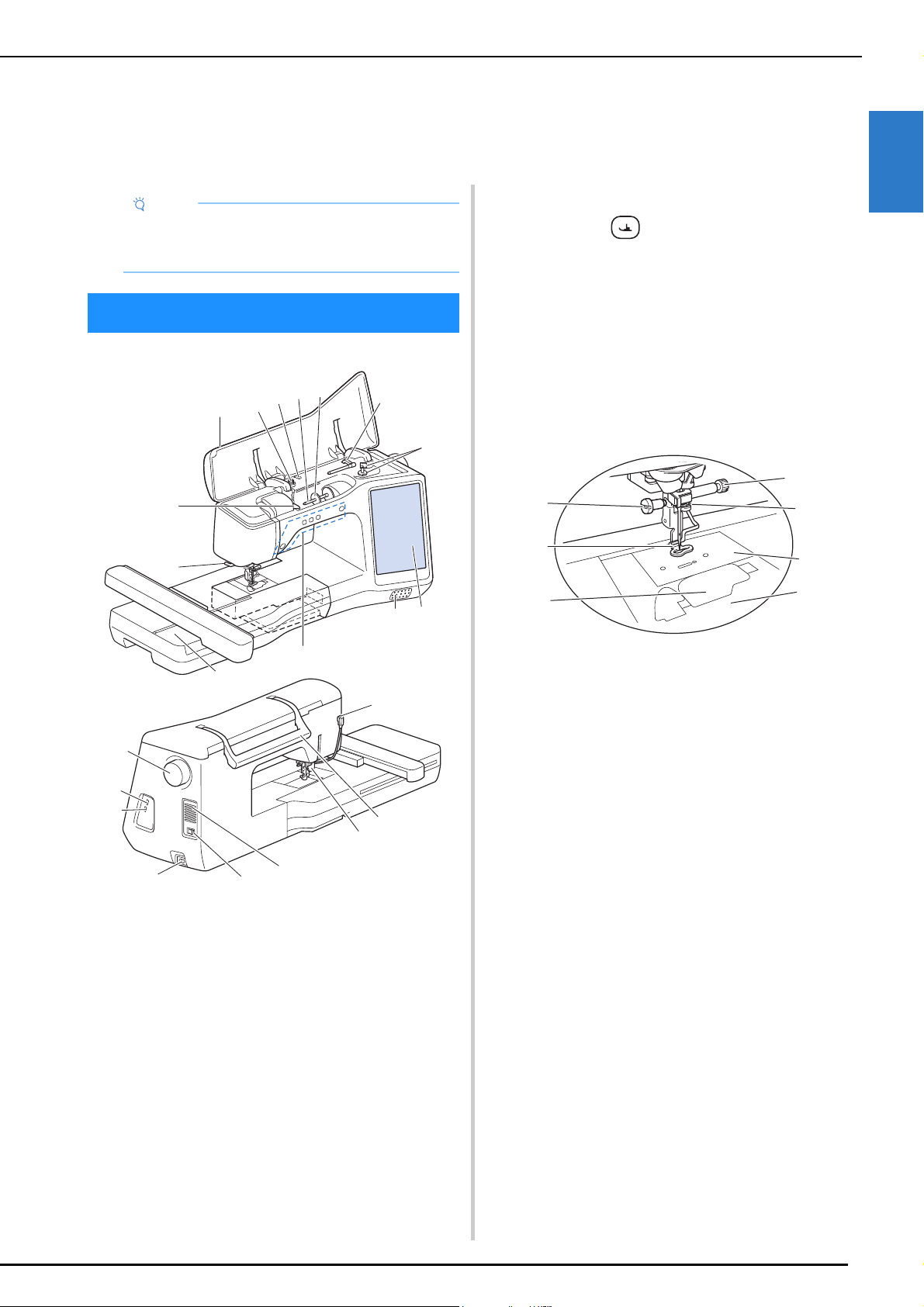
Main Parts
1 Top cover
2 Pretension disk (page 23)
3 Thread guide for bobbin winding (page 23)
4 Spool pin (page 24)
5 Spool cap (page 22)
6 Supplemental spool pin (page 22)
7 Bobbin winder (page 22)
8 LCD (liquid crystal display) (page 12)
9 Speaker
0 Operation buttons (page 10)
A Embroidery unit (page 32)
B Thread cutter (page 28)
C Thread guide plate (page 24)
D Connector for the presser foot (page 111)
E Handle
Carry the machine by its handle when transporting the
machine.
F Presser foot lever
You cannot use the presser foot lever after the presser foot has
been raised using (Presser foot lifter button).
G Air vent
The air vent allows the air surrounding the motor to circulate.
Do not cover the air vent while the machine is being used.
H Main power switch (page 10)
I Power cord receptacle (page 11)
J USB port for mouse (page 21)
K USB port
L Handwheel
Turn the handwheel toward you (counterclockwise) to raise and
lower the needle.
Needle and Presser Foot Section
1 Screw for embroidery foot (page 111)
2 Embroidery foot
The embroidery foot helps control fabric flexibility for better
stitch consistency.
3 Bobbin cover (page 25)
4 Needle plate cover (page 25)
5 Needle plate (page 110)
6 Needle bar thread guide (page 27)
7 Needle clamp screw (page 29)
Chapter 1
GETTING READY
Note
• Be sure to install the latest software.
Refer to “UPDATING YOUR MACHINE’S
SOFTWARE” on page 121.
NAMES OF MACHINE PARTS
a
b
c
d
e
f
g
h
i
j
k
l
m
n
o
p
q
r
s
t
u
v
a
b
c
d
e
f
g
INCLUDED ACCESSORIES
10
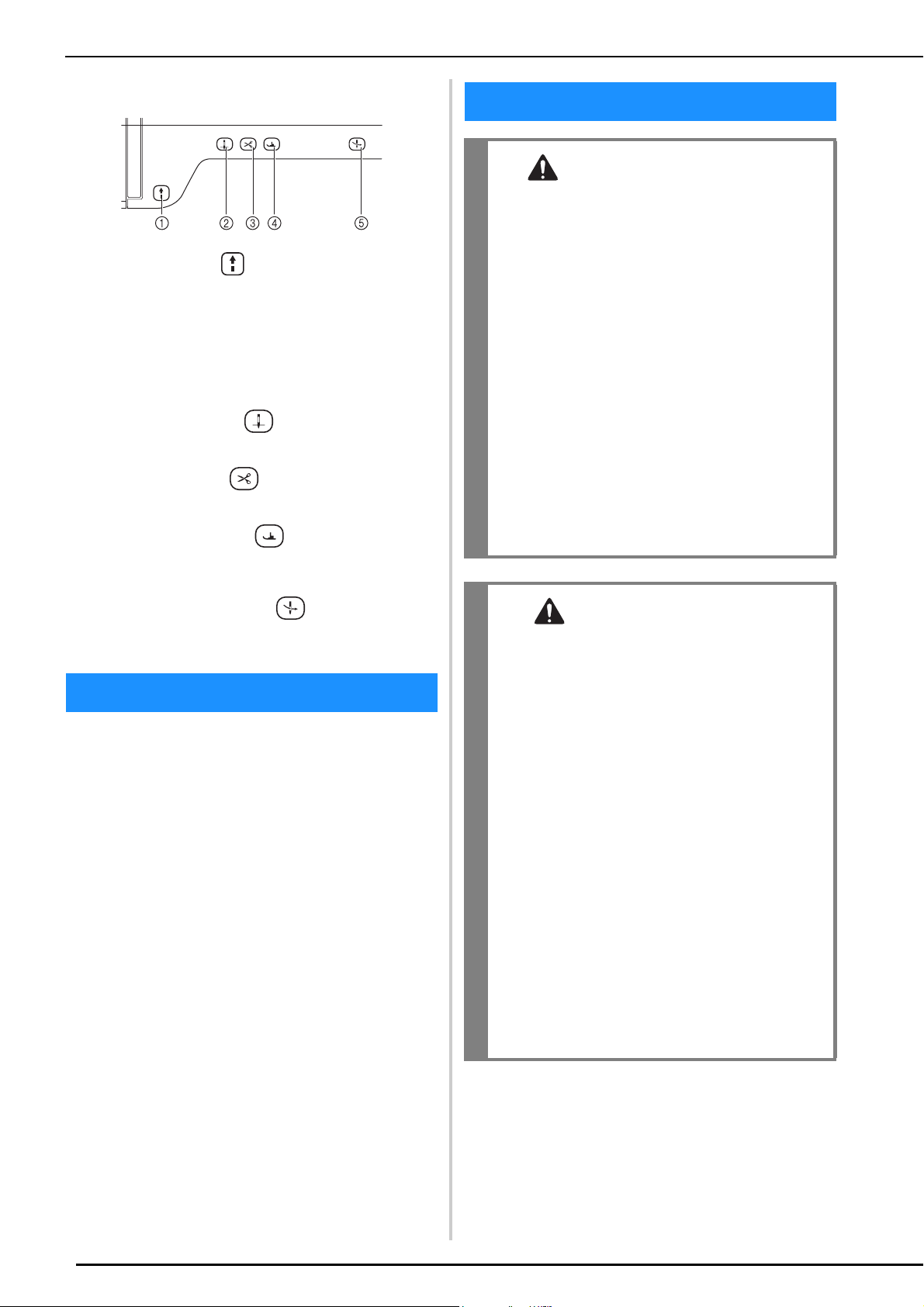
Operation Buttons
1 “Start/Stop” button
Press the “Start/Stop” button to start or stop embroidering.
The button changes color according to the machine’s
operation mode.
2 Needle position button
Press the needle position button to raise or lower the needle
position. Pressing the button twice embroiders a single stitch.
3 Thread cutter button
Press the thread cutter button after embroidering to trim the
excess thread.
4 Presser foot lifter button
Press the presser foot lifter button to lower the presser foot and
apply pressure to the fabric. Press this button again to raise the
presser foot.
5 Automatic threading button
Use the automatic threading button to automatically thread the
needle.
For included accessories of your machine, refer to the
additional sheet “Included Accessories”.
Green: The machine is ready to embroider or is
embroidering.
Red: The machine is not ready to start
embroidering.
INCLUDED ACCESSORIES
TURNING THE MACHINE ON/OFF
WARNING
• Use only regular household electricity for the
power source. Using other power sources may
result in fire, electric shock, or damage to the
machine.
• Do not touch the plug with wet hands. Electric
shock may result.
• Make sure that the plugs on the power cord
are firmly inserted into the electrical outlet
and the power cord receptacle on the
machine. Otherwise, a fire or electric shock
may result.
• Turn the main power to OFF and remove the
plug in the following circumstances:
• When you are away from the machine
• After using the machine
• When the power fails during use
• When the machine does not operate correctly
due to a bad connection or a disconnection
• During electrical storms
CAUTION
• Use only the power cord included with this
machine.
• Do not use extension cords or multi-plug
adapters with many other appliances plugged
in to them. Fire or electric shock may result.
• When unplugging the machine, always turn
the main power to OFF first. Always grasp the
plug to remove it from the outlet. Pulling on
the cord may damage the cord, or lead to fire
or electric shock.
• Do not allow the power cord to be cut,
damaged, modified, forcefully bent, pulled,
twisted, or bundled. Do not place heavy
objects on the cord. Do not subject the cord to
heat. These things may damage the cord, or
cause fire or electric shock. If the cord or plug
is damaged, take the machine to your
authorized Brother dealer for repairs before
continuing use.
• Unplug the power cord if the machine is not to
be used for a long period of time. Otherwise, a
fire may result.
TURNING THE MACHINE ON/OFF
GETTING READY
11
1
a
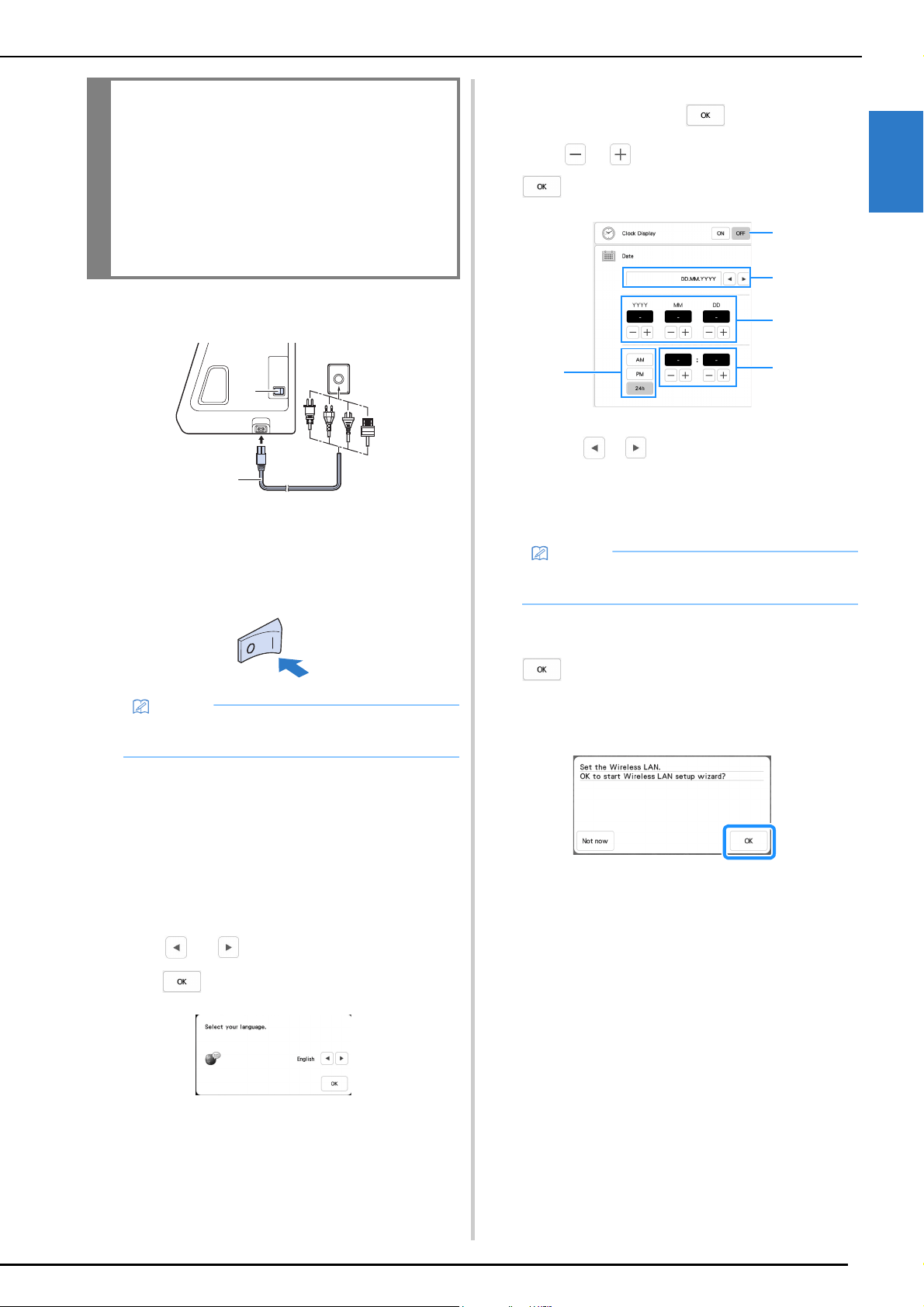
Insert the power supply cord into the power cord
receptacle, then insert the plug into a wall outlet.
1 Main power switch
2 Power supply cord
b
Turn the main power switch to “I” to turn on the
machine.
c
When the machine is turned on, the opening movie is
played. Touch anywhere on the screen.
d
Turn the main power switch to “O” to turn off the
machine.
Setting Your Machine for the First Time
When you first turn on the machine, set the language and
time/date to your language and local time/date.
a
Touch and to set your local language and then
touch .
b
The message screen, confirming if you want to set
time/date, appears. Touch .
c
Touch or to set time/date. And then touch
.
1 Select [ON] to display time/date on the screen.
2 Touch or to select the date display format.
3 Set the year (YYYY), month (MM) and date (DD).
4 Select whether 24h or 12h setting will display.
5 Set the current time.
The clock starts from 0 second of the time you set.
d
The following message about a wireless LAN
connection appears. To set up a connection, touch
, and then refer to steps
c through f in
“Using the Wizard to Set Up the Wireless Network
Connection” on page 19 to finish setting up a wireless
LAN connection.
•(For U.S.A only)
This appliance has a polarized plug (one blade
wider than the other). To reduce the risk of
electrical shock, this plug is intended to fit in a
polarized electrical outlet only one way.
If the plug does not fit fully in the electrical
outlet, reverse the plug. If it still does not fit,
contact a qualified electrician to install the
proper electrical outlet. Do not modify the
plug in any way.
Memo
• The light, LCD and the “Start/Stop” button light up
when the machine is turned on.
a
b
Memo
• The time/date you set may be cleared, if you don't
turn on the machine for an extended period of time.
3
1
4
5
2
LCD SCREEN
12
Touch the LCD screen or a key with your finger or the
included touch pen to select a machine function.
Home Page Screen
LCD SCREEN
IMPORTANT
• Only touch the screen with your finger or the
touch pen (stylus) included with the machine.
Do not use a mechanical pencil, screwdriver
or any other hard or sharp object. In addition,
do not press the screen with extreme pressure.
Otherwise the screen may be damaged.
Note
• All or part of the screen may sometimes become
darker or lighter due to changes in the surrounding
temperature or other changes in the environment.
This is not a sign of a malfunction. If the screen is
difficult to read, adjust its brightness.
No.
Display
Explanation Page
Name
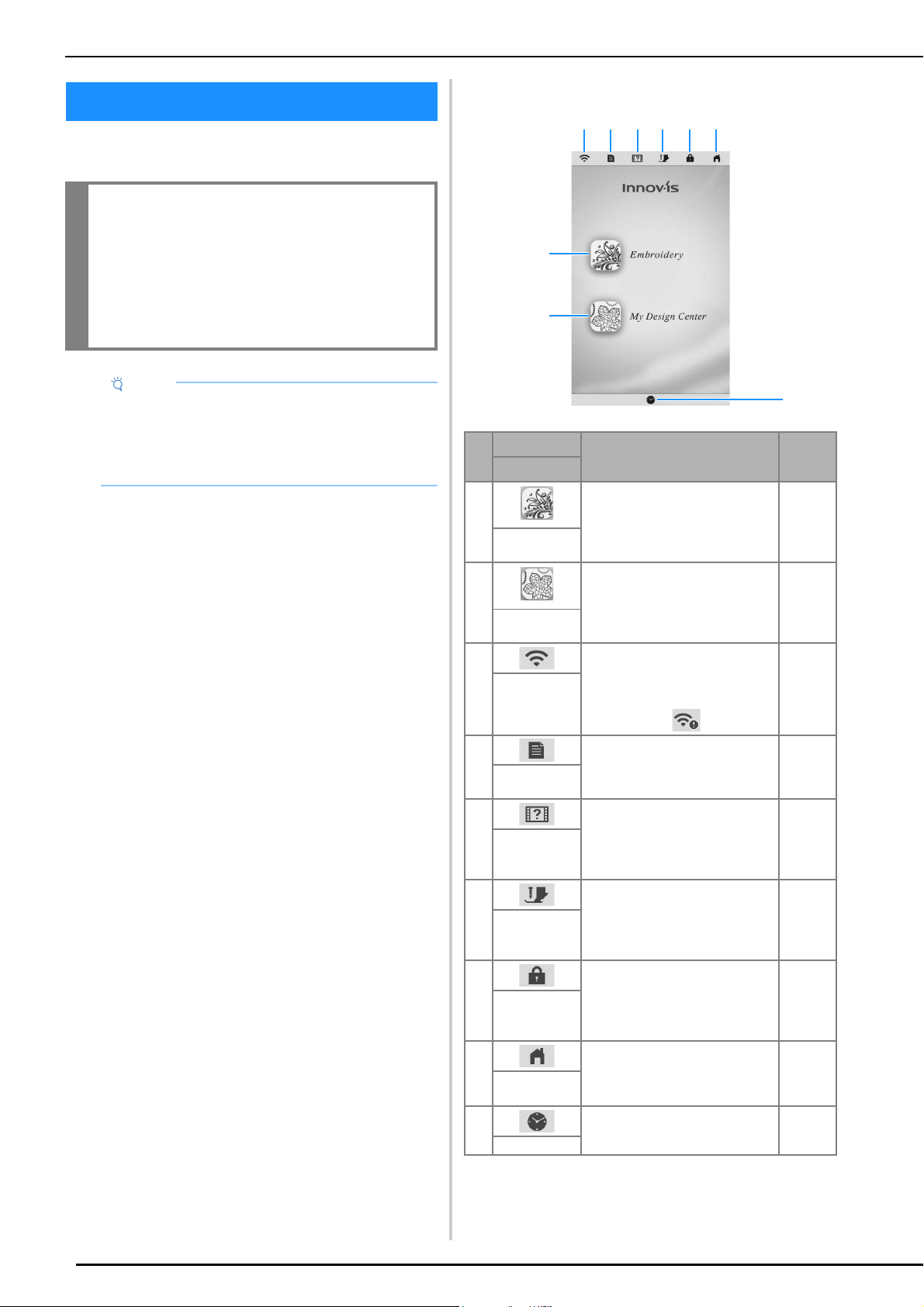
1 Select an embroidery pattern. 31
Embroidery
key
2 Create an original embroidery
pattern.
89
My Design
Center key
3 Shows the machine’s signal
strength. Touch this key to specify
the wireless settings.
If there is a new update file, the
key appears as .
15, 19
Wireless LAN
key
4 Change the needle stop position,
adjust the pattern or screen, and
change other machine settings.
13
Machine
settings key
5 See explanations on how to use
the machine. You can see the
tutorial videos and also MP4
movie files that you have saved on
USB media.
17
Machine help
key
6 Touch this key before changing
the needle, the presser foot, etc.
This key locks all key and button
functions to prevent operation of
the machine.
25, 29
Presser foot/
Needle
exchange key
7 Lock the screen. When the screen
is locked, you can still embroider,
but cannot change any of the
screen functions. Touch this key
again to unlock the screen.
—
Screen lock
key
8 Return to the home page screen at
any time and select a different
category - [Embroidery] or [My
Design Center].
—
Home page
screen key
9 Set the time/date. 11
Time/Date key
2
1
9
3 4 5 6 7 8
LCD SCREEN
GETTING READY
13
1
Using the Machine Settings Key
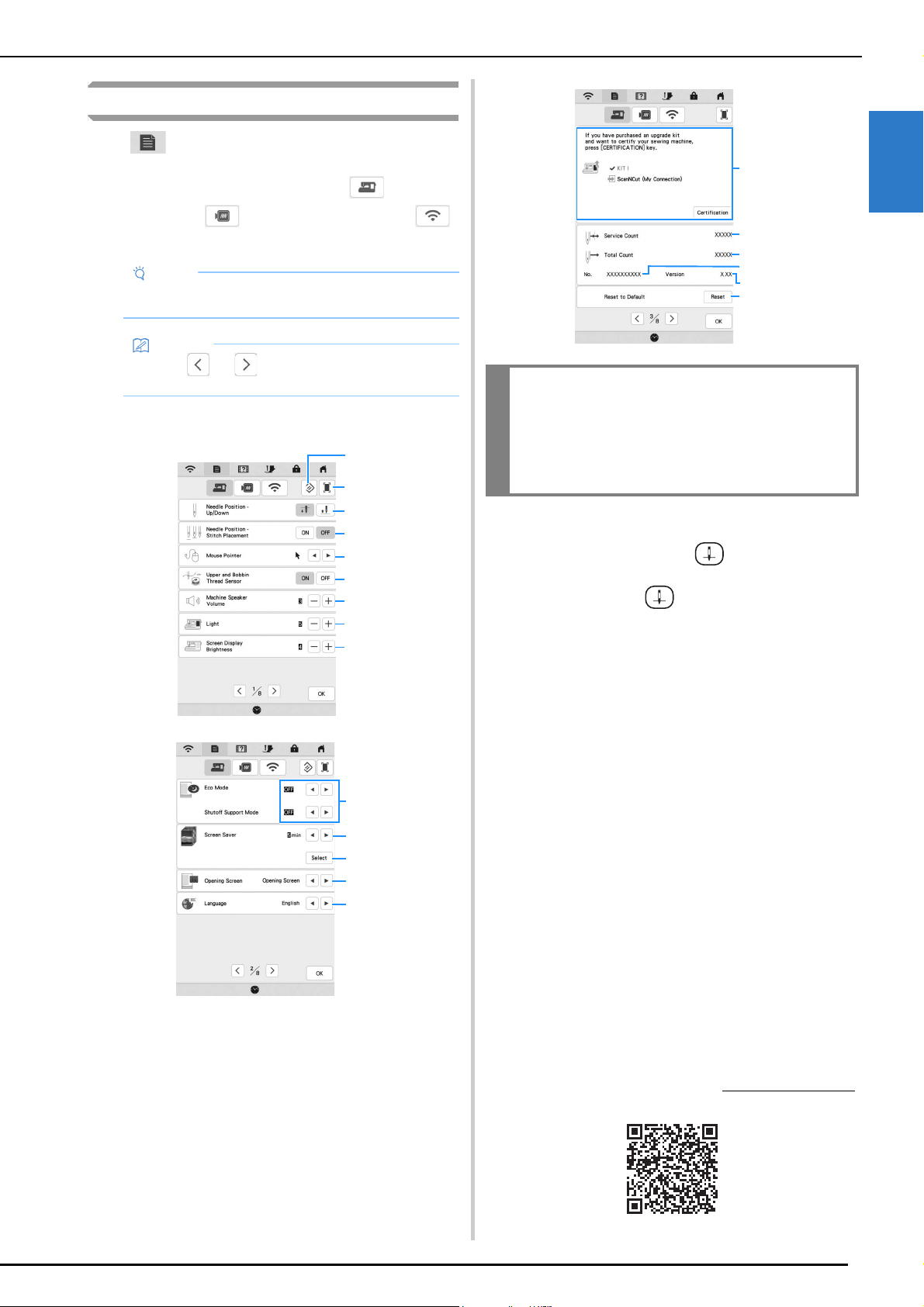
Touch to change the default machine settings (needle
stop position, embroidery speed, opening display, etc.). To
display the different settings screens, touch for
“General settings”, for “Embroidery settings” or
for “Wireless LAN settings”.
General Settings
1 Select the needle stop position (the needle position
when the machine is not operating) to be up or down.
2 Select the operation of the (Needle position
button) from the following two sequences.
Each press of the (Needle position button):
[ON] : Switches the needle position between being
raised, stopped immediately before entering the
fabric, or lowered.
[OFF] : Switches the needle position between being
raised or lowered.
3 Select the shape of the pointer when a USB mouse is
used.
4 Turn both the upper and bobbin thread sensors [ON] or
[OFF]. If it is turned [OFF], the machine can be used
without thread.
5 Select the speaker volume. Increase the number for
louder volume, decrease for softer volume.
6 Select the brightness of the work area lights.
7 Select the screen display brightness.
8 You can save the current settings screen image in a USB
media by touching this key when the USB media is
inserted into the USB port. The files are saved in a folder
labeled [bPocket].
9 Reset settings on this page to original default. Some
settings are not reset.
0 Set the [Eco Mode] and the [Shutoff Support Mode] to
save the machine power (page 15).
A Select the length of time until the screen saver appears.
B Select the image of the screen saver (page 16).
C Select the initial screen that is displayed when the
machine is turned on.
D Select the display language.
E Use to certify your machine when you use [My
Connection] function with Brother cutting machine (sold
separately and limited to certain sales region). For
details, visit the following webpage and refer to the “My
Connection” Operation Manual. https://s.brother/cmeaf/
Note
• The machine default setting is highlighted.
Memo
• Touch or to display a different settings
screen.
1
4
6
7
2
3
5
9
8
A
0
B
C
D
IMPORTANT
• When [Upper and Bobbin Thread Sensor] is set
to [OFF], the machine cannot detect tangled
upper thread. Continuing to use the machine
with tangled thread may cause damage.
J
F
G
E
I
H
LCD SCREEN
14
KIT I has been certified on this machine.
F Shows the service count which is a reminder to take your
machine in for regular servicing. (Contact your
authorized Brother dealer for details.)
G Shows the total number of stitches embroidered on this
machine.
H Shows the internal machine number for this machine.
I Shows the program version.
J Erase all saved data, customized settings and network
information in the machine.
Embroidery Settings
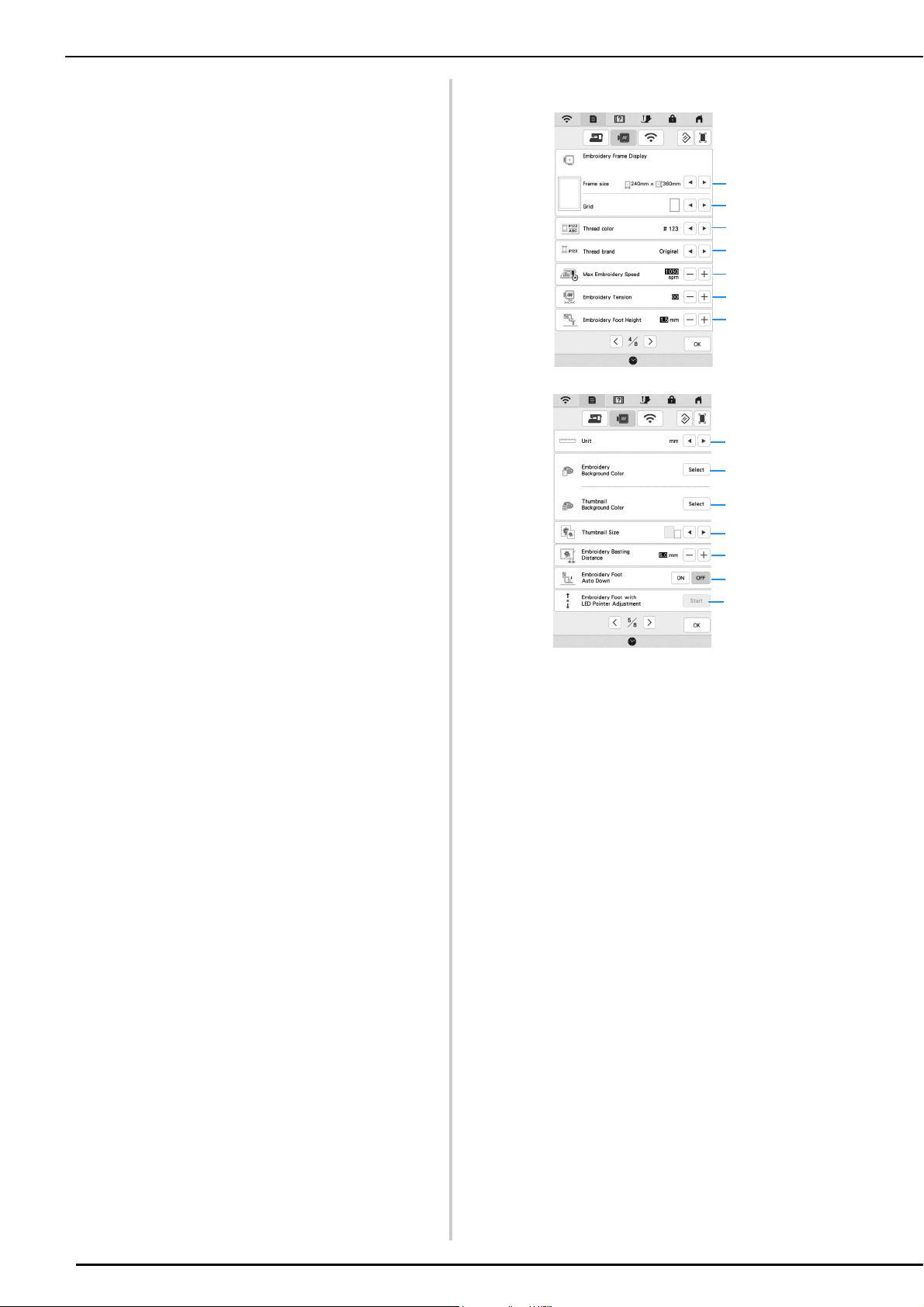
1 Select the embroidery frame to be used.
2 Select the center point marker or grid lines.
3 Select the thread color display on the embroidery
screen; thread number, color name. (page 79)
4 Select the thread brand of the thread color display.
(page 79)
5 Adjust the maximum embroidery speed (page 78).
6 Adjust the upper thread tension for embroidering
(page 76).
7 Select the height of the embroidery foot during
embroidering (page 53).
8 Select the display units for embroidering (mm/inch).
9 Select the color of the background for the embroidery
display area.
0 Select the color of the background for the thumbnail
area.
A Select the size of pattern thumbnails.
B Adjust the distance between the pattern and the basting
stitching. (page 71)
C When set to [ON], pressing the “Start/Stop” button when
the embroidery foot is raised automatically lowers the
embroidery foot before starting embroidering.
D Adjust the position and brightness of the embroidery foot
“W+” with LED pointer (this setting is available if
embroidery foot “W+” with LED pointer has been
attached.) (page 58)
1
4
5
6
2
3
7
B
C
8
9
A
D
0
LCD SCREEN
GETTING READY
15
1
Wireless LAN Settings
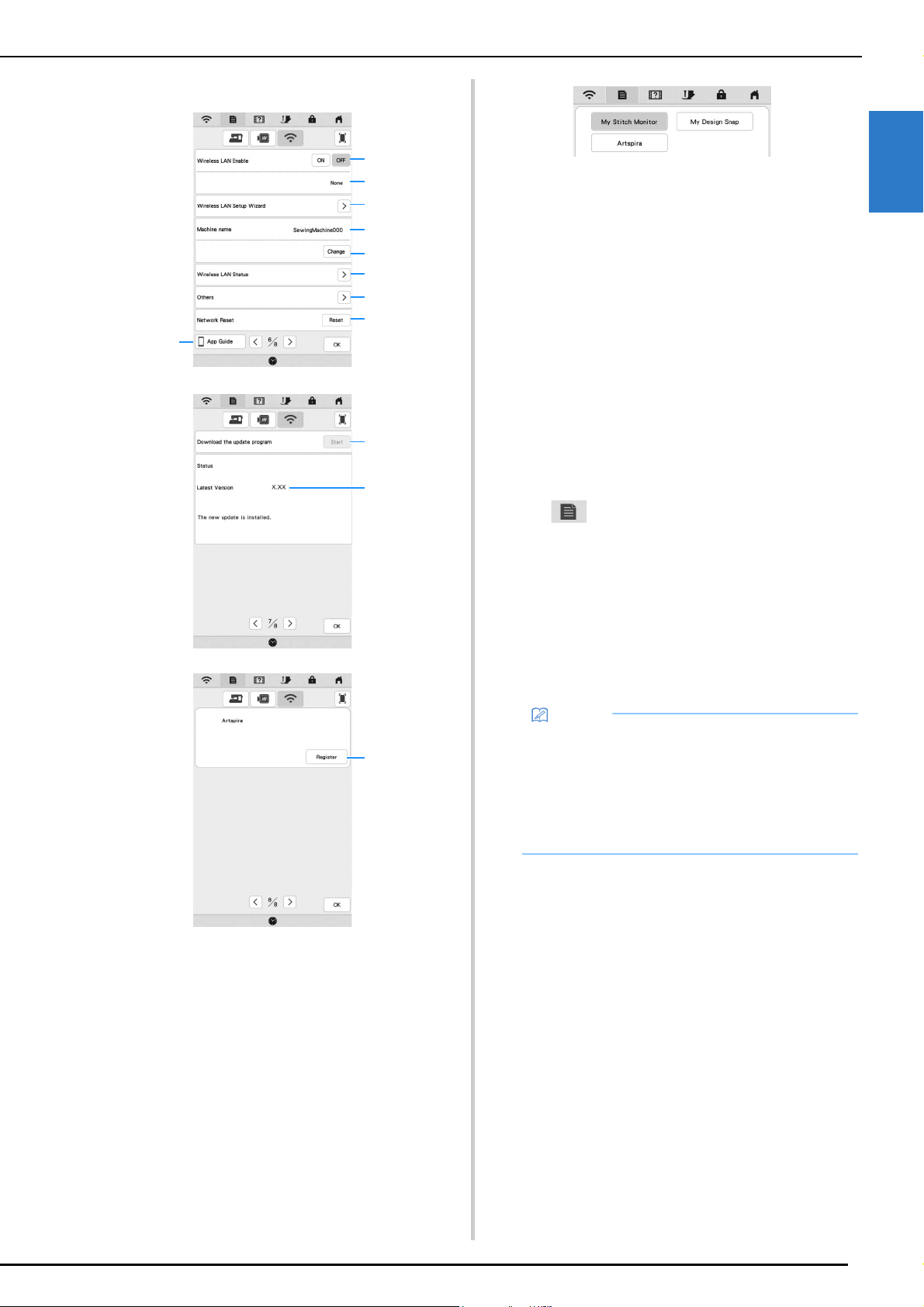
1 Enable/Disable the wireless LAN function (page 19).
2 Shows the connected SSID.
3 Set the machine to connect wireless LAN function.
4 Shows the machine name used on the wireless network.
5 Change the machine name used on the wireless
network.
6 Check the wireless LAN status.
7 Display other menus.
8 Reset network operations.
9 Display the introduction to the applications. Touch the
key of the app whose information you want to display.
On smart devices with a QR reader app installed, scan
the QR code to display a screen that shows how to
install the app.
My Stitch Monitor: The machine’s embroidering status
can be monitored from your smart device. For details,
refer to “MY STITCH MONITOR APP” on page 106.
My Design Snap: You can position your embroidery
designs on the fabric, by capturing image of the hooped
fabric and sending the image to your machine. For
details, refer to “MY DESIGN SNAP APP” on page 107.
Artspira: You can transfer content published on the app
to the embroidery machine and enjoy creating original
works using the functions on the app.
0 If there is a new update program, download the update
file. (page 121)
A Display update program information. (page 121)
B Register the Artspira app. (page 108)
Setting the [Eco Mode] and the [Shutoff
Support Mode]
You can save the machine power by setting the [Eco
Mode] and the [Shutoff Support Mode].
If you leave the machine turned on without using it for the
set period of time, the machine enters in each mode.
Touch to display [Eco Mode] and [Shutoff Support
Mode]. (page 13)
[Eco Mode];
Machine will enter a sleep mode after the set period of
time. Touch the screen or press the “Start/Stop” button to
continue operating.
[Shutoff Support Mode];
Machine will enter the lower power mode after the set
period of time. Turn the machine off and then back on to
restart operating.
1
4
5
6
2
3
7
8
9
0
A
B
Memo
• If you turn off the machine while the machine is in
the [Eco Mode] or the [Shutoff Support Mode], wait
for about 5 seconds before turning on the machine
again.
• For details on condition of the [Eco Mode] and
[Shutoff Support Mode], refer to
“SPECIFICATIONS” on page 119.
LCD SCREEN
16
Changing the Screen Saver Image
Instead of the default image, you can select your own
personal images for the screen saver of your machine.
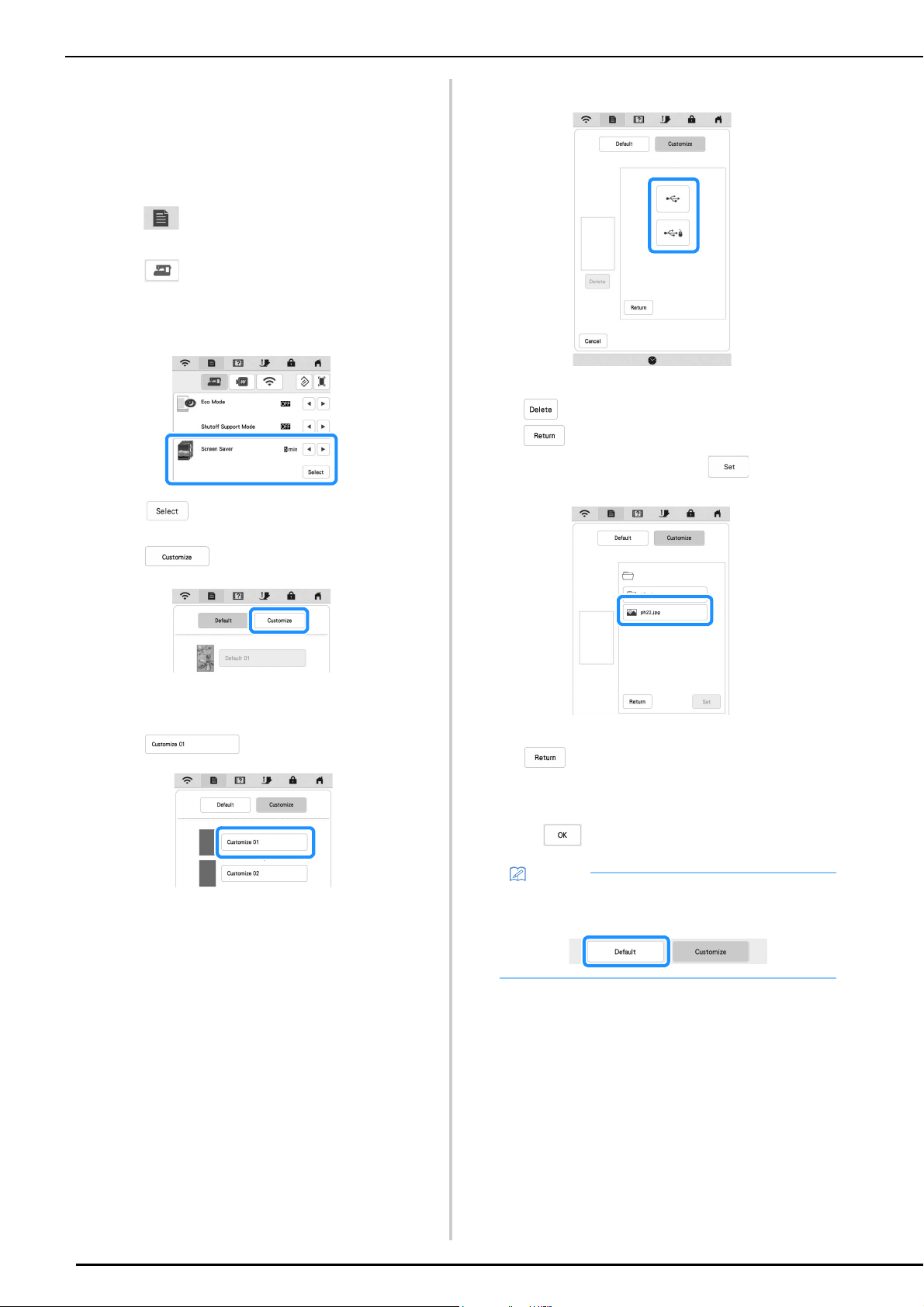
Before changing the screen saver image, prepare the
image on USB media. For details on compatible image
files, refer to “SPECIFICATIONS” on page 119.
a
Touch .
The settings screen appears.
b
Touch .
The general settings screen appears.
c
Display [Screen Saver] in the general settings screen.
d
Touch .
e
Touch .
f
Connect the USB media that contains your personal
image to the USB port of the machine.
g
Touch to select the first image.
h
Select the device that is connected.
A list of your personal images appears on the screen.
* : Delete the selected image.
* : Return to the previous page.
i
Select a file name and then touch .
The selected image is stored on your machine.
* : Return to the previous page.
j
Repeat steps g through i to set the remaining
images.
k
Touch to return to the original screen.
Memo
• Touch [Default] to select default images for the
screen saver.
LCD SCREEN
GETTING READY
17
1
Using the Machine Help
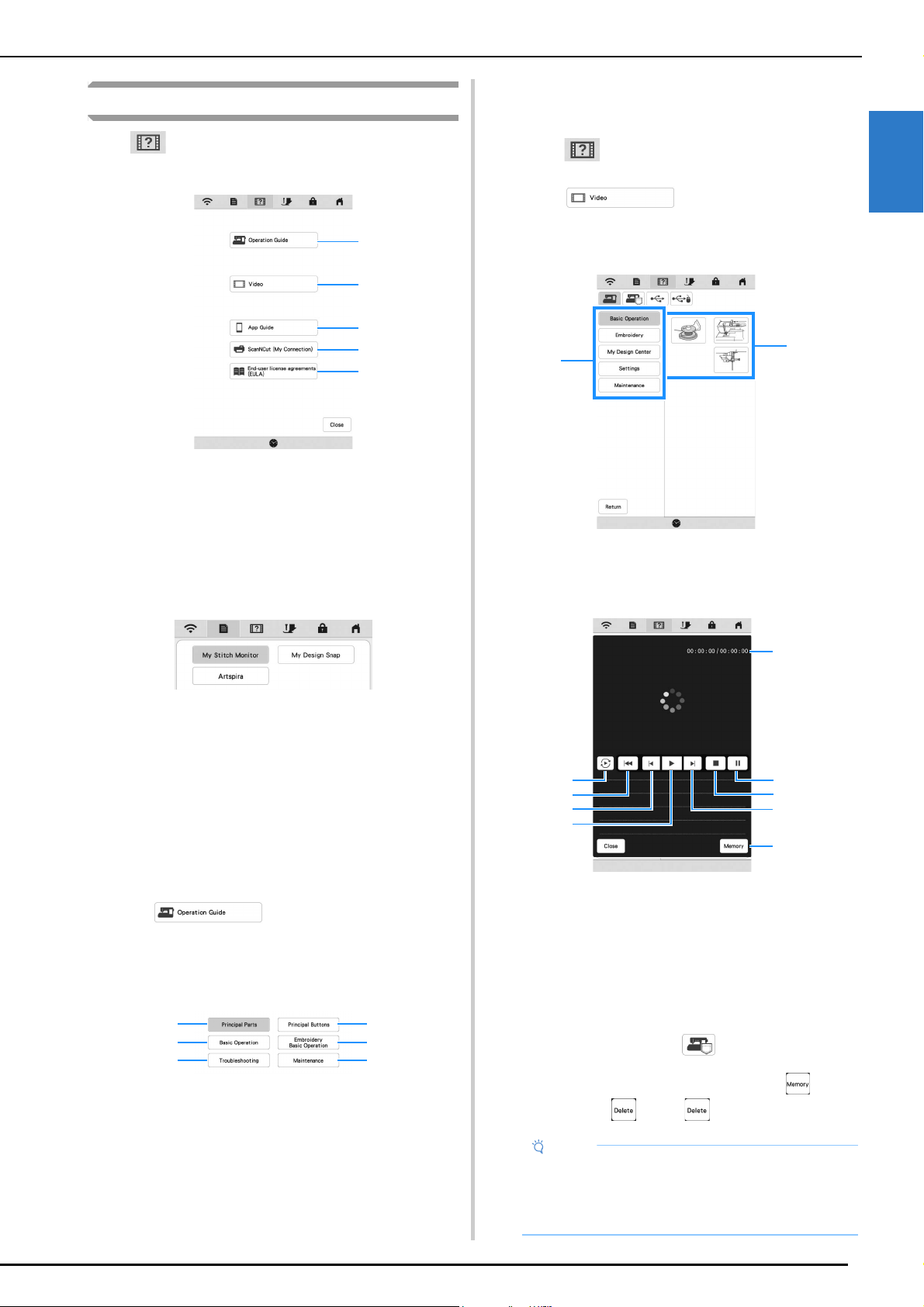
Touch to display the machine help screen. Functions
are available from the screen shown below.
1 Explanation for upper threading, winding the bobbin,
preparing to embroider a pattern, and how to use the
machine (page 17)
2 Tutorial videos or MPEG-4 (MP4) videos (page 17,
page 18)
3 Display the introduction to the applications. Touch the
key of the app whose information you want to display.
On smart devices with a QR reader app installed, scan
the QR code to display a screen that shows how to
install the app.
My Stitch Monitor: The machine’s embroidering status
can be monitored from your smart device. For details,
refer to “MY STITCH MONITOR APP” on page 106.
My Design Snap: You can position your embroidery
designs on the fabric, by capturing image of the hooped
fabric and sending the image to your machine. For
details, refer to “MY DESIGN SNAP APP” on page 107.
Artspira: You can transfer content published on the app
to the embroidery machine and enjoy creating original
works using the functions on the app.
4 Introduction to ScanNCut (My Connection)
5 End-user license agreements (EULA)
Using the Operation Guide Function
Touch to display the screen shown
below. Categories are displayed at the top of the screen.
Touch a key to see more information about that category.
Some of the functions are described in the movies. Watch
these movies for a better understanding of the functions.
1 Information about the main parts of the machine and
their functions
2 Information about the operation buttons
3 Information about threading the machine, changing
needles, etc.
4 Information about attaching the embroidery unit,
preparing fabric for embroidering, etc.
5 Information about troubleshooting
6 Information about cleaning the machine, etc.
Playing a Tutorial Video
This machine provides tutorial videos on how to use the
machine.
a
Touch .
b
Touch .
c
Select the category and the tutorial video.
1 Category
2 Tutorial video
d
Play the tutorial video.
1 Number of seconds elapsed/Total number of seconds
2 Repeat
3 Return to beginning
4 Skip back 10 seconds
5 Play
6 Skip forward 10 seconds
7 Stop
8 Pause
9 Save to machine (when playing from USB media).
A video can be saved to (favorites) of the
machine, from where it can be played.
When playing from the machine’s memory,
changes to . Touch to delete the video.
1
2
3
4
5
2
4
6
3
5
1
Note
• The specifications shown in the movie may differ
from the ones on the actual product, in details.
• The movie includes optional parts not included with
this product.
2
1
1
9
2
3
4
5
8
7
6
WIRELESS NETWORK CONNECTION FUNCTIONS
18
e
After you are finished playing the video, touch .
Playing MPEG-4 (MP4) Videos
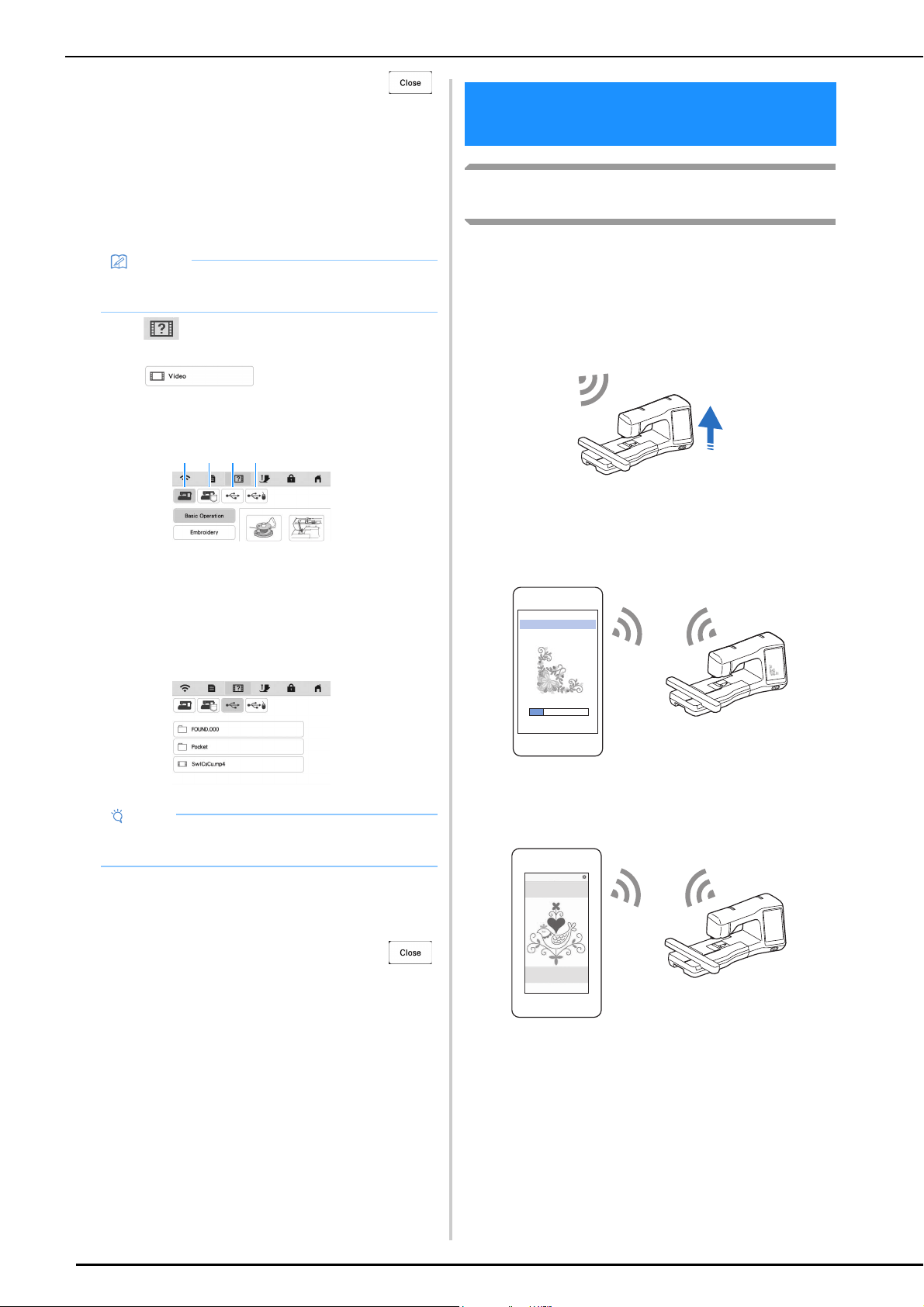
Your MP4 videos can be played from USB media. In
addition, the MP4 video can be saved to the machine so
that a tutorial video on creating a project, for example,
can be viewed at any time. For details on supported file
extensions, refer to “SPECIFICATIONS” on page 119.
a
Touch .
b
Touch .
c
Select the device where the video is saved.
1 Tutorial videos
2 Videos saved on the machine (favorites)
3 Videos from USB media plugged into the USB port
4 Videos from USB media plugged into the USB port for
mouse
d
Select the video that you want to play.
e
Play the video.
* Use the operation keys as described in “Playing a
Tutorial Video” on page 17.
f
After you are finished playing the video, touch .
Operations Available with a Wireless
Network Connection
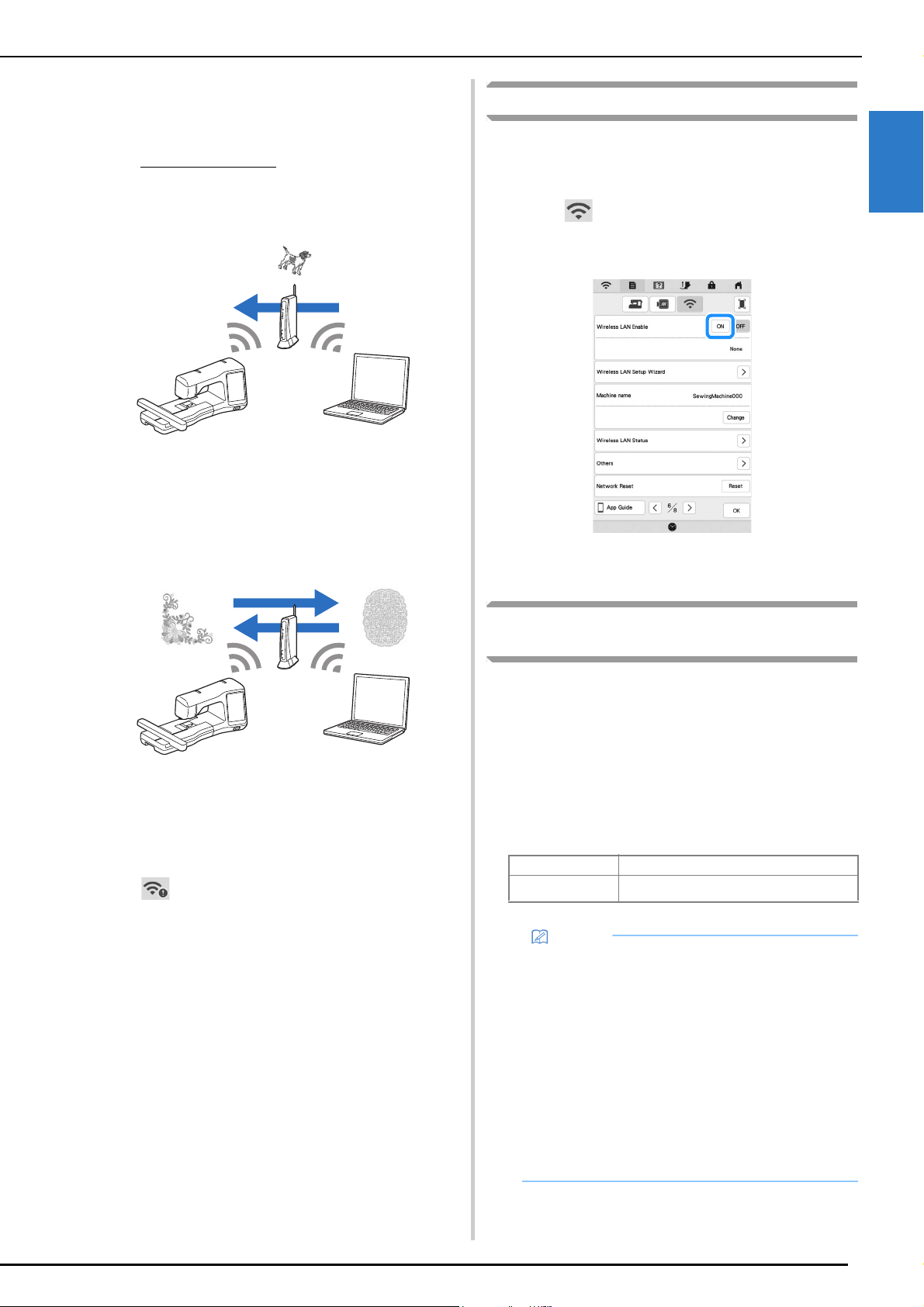
This machine supports a wireless network connection. The
following useful operations will be available if the machine is
connected to a wireless network.
For updating
Directly download the update file to the machine.
(page 121)
For embroidering
• Conveniently check the operating status of the
machine from your smart device by using the
dedicated mobile application (My Stitch Monitor).
• My Design Snap: You can position your embroidery
designs on the fabric, by capturing image of the
hooped fabric and sending the image to your
machine.
Memo
• Some types of MP4 file cannot be played with the
machine.
Note
• Long file names may be shortened when they are
displayed.
1 2 3 4
WIRELESS NETWORK
CONNECTION FUNCTIONS
WIRELESS NETWORK CONNECTION FUNCTIONS
GETTING READY
19
1
• Wirelessly transfer an embroidery pattern from your
computer to the machine by using the dedicated
Windows application (Design Database Transfer).
The application can be downloaded from the
following URL.
https://s.brother/caeka/
* Settings must be specified in Design Database
Transfer. For more information, refer to the manual
for Design Database Transfer.
• Wirelessly transfer to the machine an embroidery
pattern edited with embroidery editing software (PE-
DESIGN version 11 or later) on a computer. Also,
transfer to PE-DESIGN an embroidery pattern edited
on the machine.
* Settings must be specified in
PE-DESIGN. For more
information, refer to the manual for
PE-DESIGN.
• With Artspira App, you can transfer content
published on the app to the embroidery machine and
enjoy creating original works using the functions on
the app.
• When an updated version of the software is available
on our website, the wireless LAN key appears as
. (page 121)
Enabling a Wireless Network Connection
The machine can be connected to your wireless network.
Refer to “SPECIFICATIONS” on page 119 for requirements for
a wireless network connection.
a
Touch .
b
Set [Wireless LAN Enable] to [ON].
The machine begins to emit the wireless network
signal.
Using the Wizard to Set Up the Wireless
Network Connection
There are multiple ways to set up the wireless network
connection. We recommend the method that uses the wizard
on this machine.
a
In order to connect your machine to a wireless
network, the security information (SSID and network
key) for your home network will be required. The
network key may also be called a password, security
key or encryption key. First, find your security
information and note it.
SSID Network Key (Password)
Memo
• The wireless network connection cannot be set up
if you do not have the security information.
• How to find the security information
1 Check the manual provided with your home
network.
2 The default SSID may be the manufacturer's
name or the model name.
3 If you cannot find the security information,
contact the manufacturer of the router, your
network administrator or your Internet provider.
4 Some SSIDs and network keys (passwords) are
case (upper case and lower case) sensitive.
Please properly record your information.
WIRELESS NETWORK CONNECTION FUNCTIONS
20
b
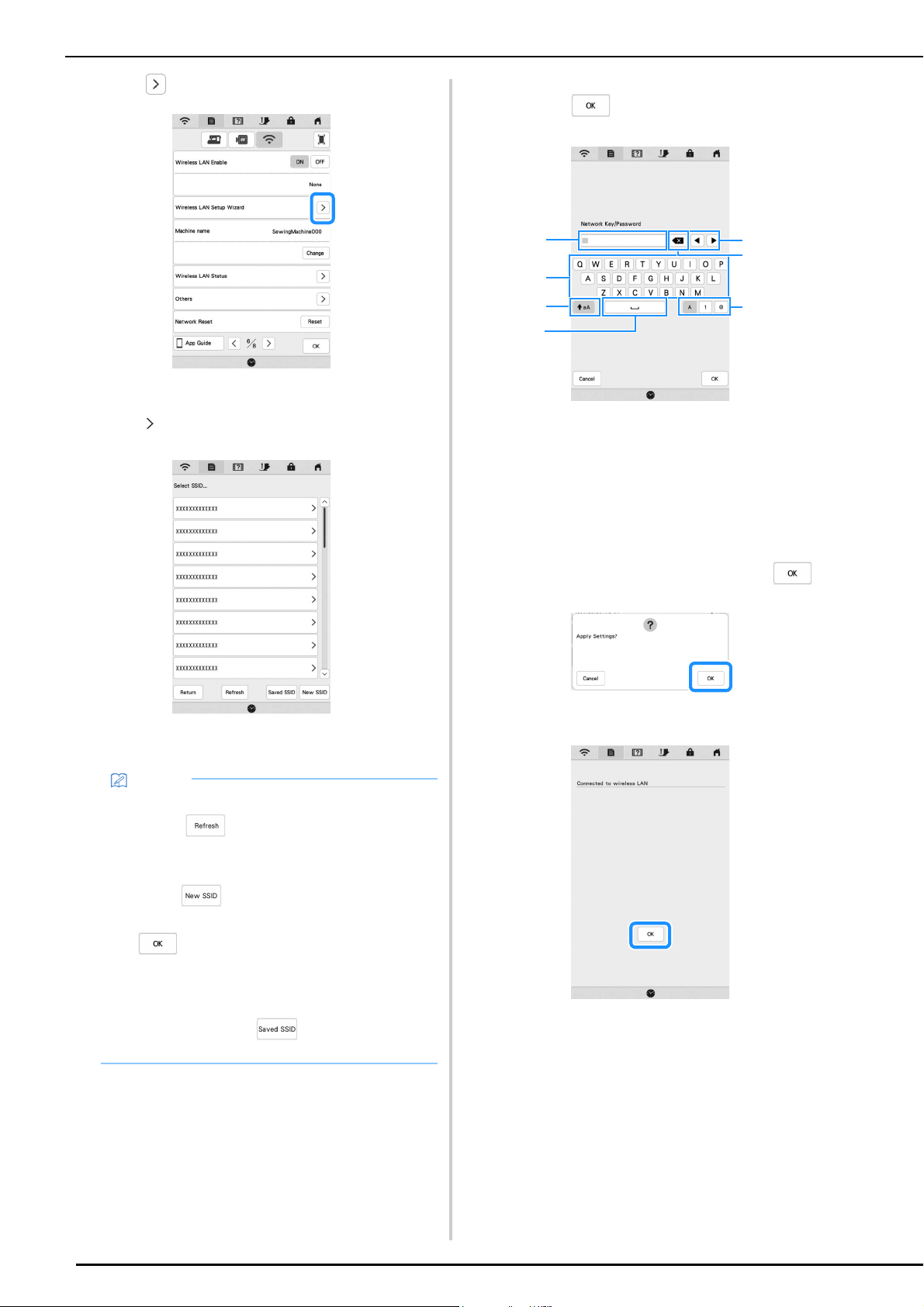
Touch beside [Wireless LAN Setup Wizard].
A list of available SSIDs appears.
c
Touch beside the SSID that was noted.
The screen for entering the network key (password)
appears.
d
Enter the network key (password) that was noted, and
then touch .
1 Text input area
2 Character keys
3 Caps key
4 Space key
5 Letters/numbers/symbols key
6 Backspace key (Deletes the character at the cursor's
position.)
7 Cursor keys (Move the cursor to the left or right.)
e
When the following message appears, touch .
When a connection is established, the following
message appears.
Memo
• If the SSID that was noted does not appear in the
list, touch .
• If the desired network SSID is not displayed,
specify it as described below.
1 Select .
2 Enter the desired network SSID, and then touch
.
3 Select the authentication method and
encryption mode.
• If the machine had already been connected to the
home network, touch , and then select the
saved SSID.
3
2
1
5
4
6
7
CONNECTING THE ACCESSORY TO THE MACHINE
GETTING READY
21
1
f
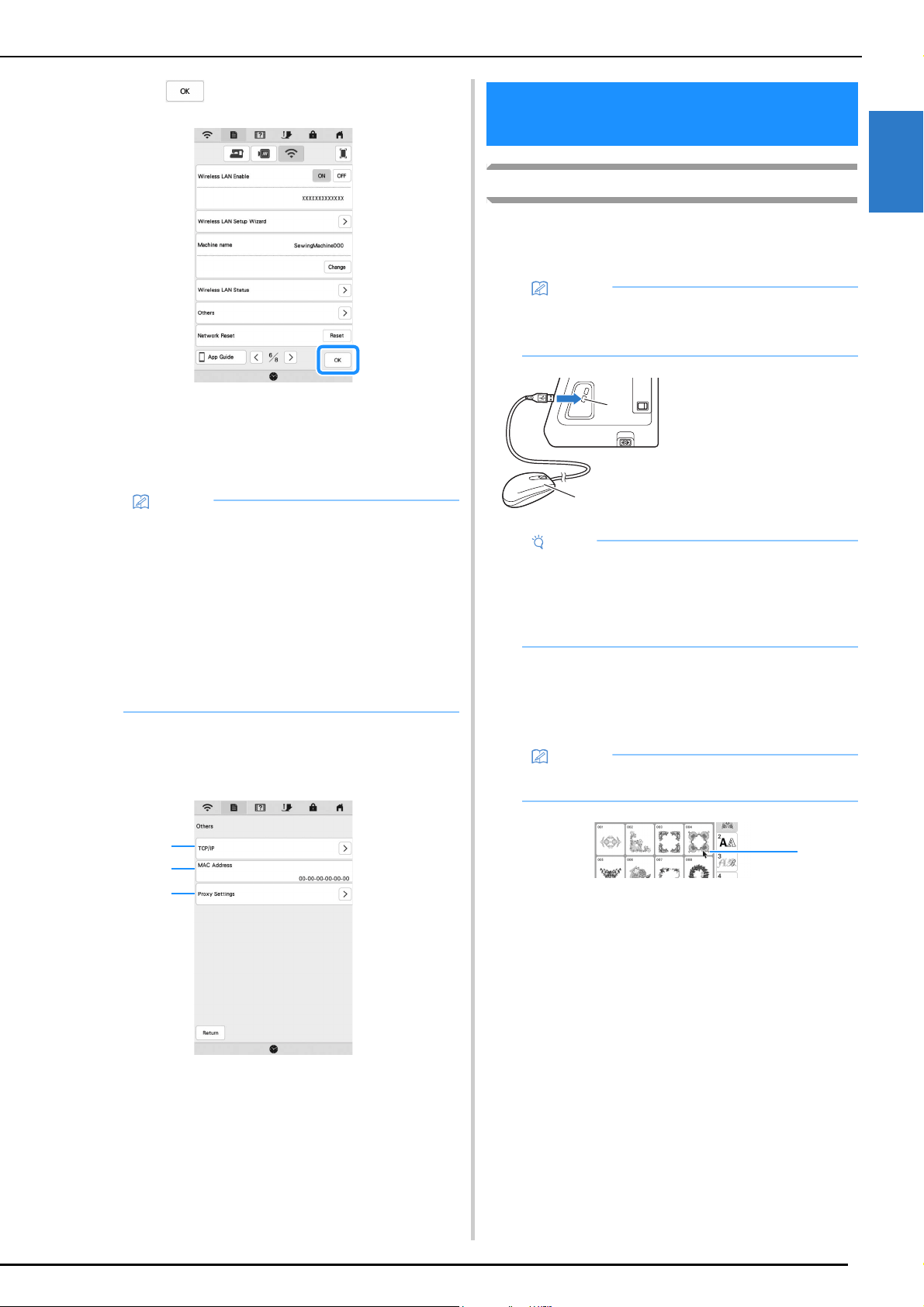
Touch to exit the setup.
The name beside [Machine name] is the name that
will be used when registering the machine with
embroidery editing software (PE-DESIGN version 11
or later) or Design Database Transfer in order to
transfer files.
Using the [Others] Menu to Set Up the
Wireless Network Connection
The [Others] menu contains the following items.
1 TCP/IP settings can be manually entered.
2 Shows the MAC address.
3 Use when proxy settings are required.
Using a USB Mouse
A USB mouse, connected to the machine, can be used to
perform a variety of operations in the screens.
Connect a USB mouse to the USB port.
Clicking a Key
When the mouse is connected, the pointer appears on the
screen. Move the mouse to position the pointer over the
desired key, and then click the left mouse button.
1 Pointer
Memo
• While connected, the signal strength is indicated
by the icon in the upper-left corner of the display.
• Once a wireless network connection has been set
up, a connection will be established each time the
machine is turned on. However, [Wireless LAN
Enable] in the network settings screen must remain
set to [ON].
• The name in the [Machine name] field will be used
with the Artspira App (limited to certain sales
region), My Stitch Monitor App and My Design
Snap App.
1
2
3
CONNECTING THE ACCESSORY TO
THE MACHINE
Memo
• Use a basic computer mouse to operate the
machine functions. Some USB mouse devices may
not be compatible with this machine.
1 USB port
2 USB mouse
Note
• The left mouse button can be used to perform
operations such as choosing a design and
choosing menu keys.
• The mouse pointer does not appear in the screen
saver or opening screen.
Memo
• Double-clicking has no effect.
a
b
1
WINDING/INSTALLING THE BOBBIN
22
Winding the Bobbin
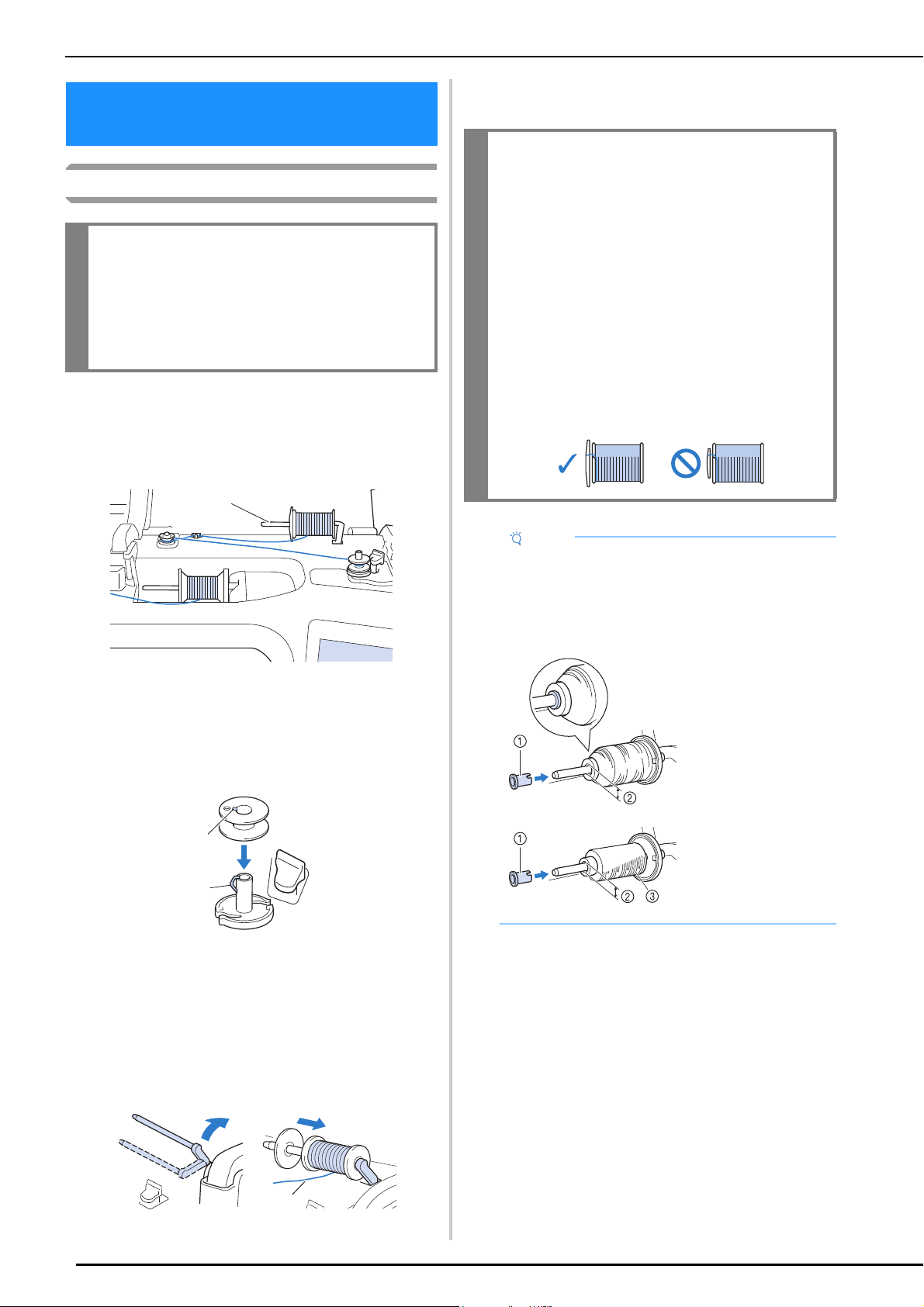
Using the Supplemental Spool Pin
With this machine, you can wind the bobbin during
embroidering. While using the main spool pin for
embroidery, you can conveniently wind the bobbin using
the supplemental spool pin.
1 Supplemental spool pin
a
Turn the main power to ON and open the top cover.
b
Align the groove in the bobbin with the spring on the
bobbin winder shaft, and set the bobbin on the shaft.
1 Groove in the bobbin
2 Spring on the bobbin winder shaft
c
Place the spool of thread for the bobbin and the spool
cap onto the supplemental spool pin.
Slide the spool onto the supplemental spool pin so that
the thread unwinds to the front from the bottom.
Otherwise the thread may become tangled around the
supplemental spool pin.
1 The thread unwinds to the front from the bottom.
d
Slide the spool cap onto the spool pin as far as possible
to the right, with the rounded side on the left.
WINDING/INSTALLING THE
BOBBIN
IMPORTANT
• Use the plastic bobbins that came with this
machine or bobbins of the same type: 11.5 mm
(approx. 7/16 inch) plastic Class 15 (A style)
bobbins, which are available from your
Brother dealer.
a
a
b
a
IMPORTANT
• If the spool or the spool cap is not installed
correctly, the thread may become tangled
around the spool pin, and the machine may be
damaged.
• Three spool cap sizes are available, allowing
you to choose a spool cap that best fits the size
of spool being used. If the spool cap is too
small for the spool being used, the thread may
catch on the slit in the spool or the machine
may be damaged. When using mini king thread
spool, use the thread spool insert.
For details on thread spool insert (mini king
thread spool), refer to “Note” on page 22.
Note
• When using the spool as shown below, use the
thread spool insert (mini king thread spool). Make
sure that the thread spool insert is firmly inserted.
After installing it, pull out some thread, and check
that the thread unwinds without getting caught.
1 Thread spool insert
(mini king thread
spool)
2 Hole diameter 8.0
mm to 10.5 mm
(approx. 5/16 inch
to 13/32 inch)
3 Spool (cross-
wound thread)

WINDING/INSTALLING THE BOBBIN
GETTING READY
23
1
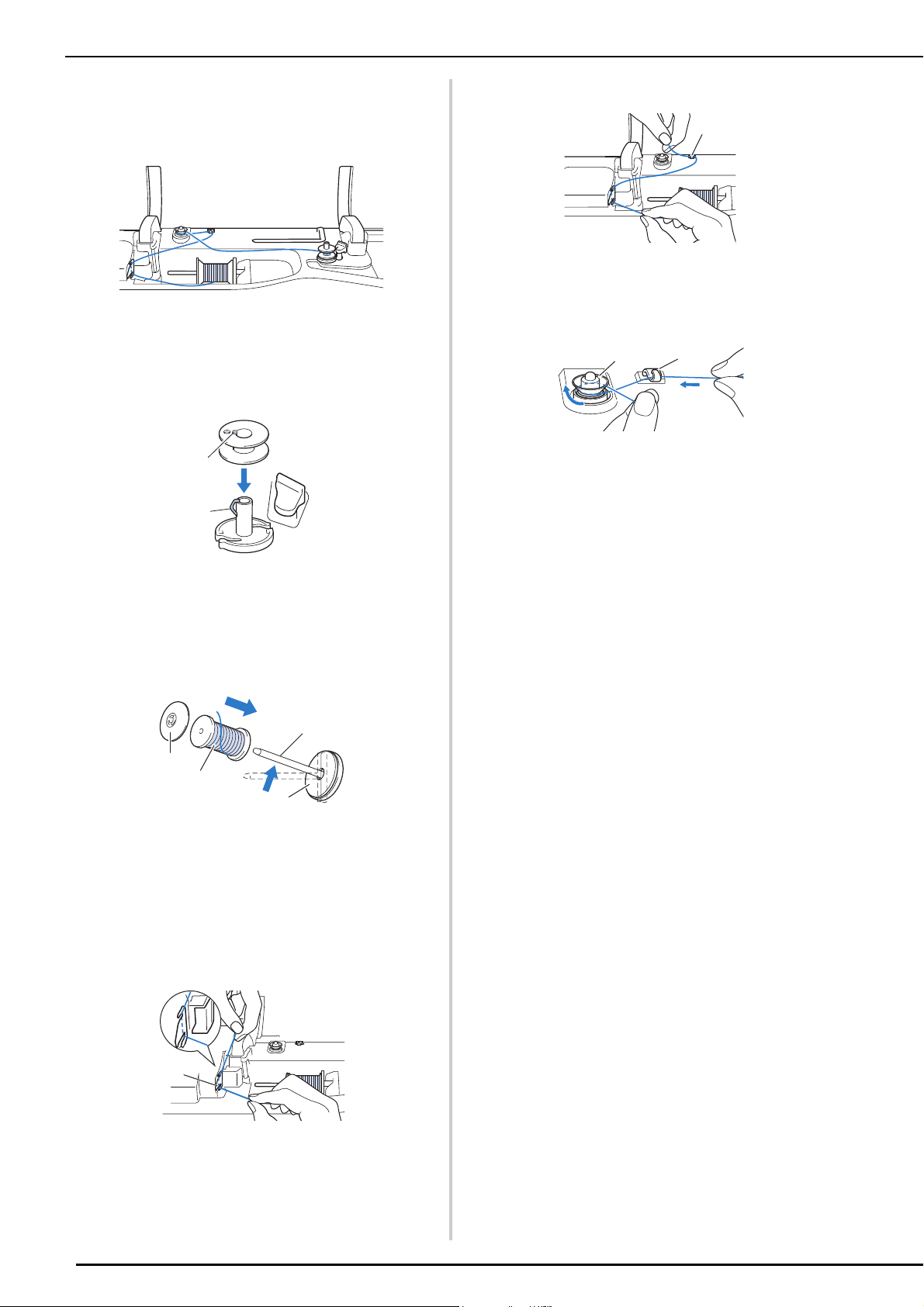
e
With your right hand, hold the thread near the thread
spool. With your left hand, hold the end of the thread,
and use both hands to pass the thread through the
thread guide.
1 Thread guide
f
Pass the thread around the pretension disk making sure
that the thread is under the pretension disk.
1 Pretension disk
Make sure that the thread passes under the
pretension disk.
2 Pretension disk
3 Pull it in as far as possible.
Check to make sure thread is securely set between
pretension disks.
g
Wind the thread clockwise around the bobbin 5 or 6
times, pass the thread through the guide slit in the
bobbin winder seat, and then pull the thread to cut it.
1 Guide slit in bobbin winder seat
(with built-in cutter)
h
Set the bobbin winding switch to the left, until it clicks
into place.
1 Bobbin winding switch
The bobbin winding window appears.
i
Touch .
1 Touch to decrease the winding speed.
2 Touch to increase the winding speed.
Bobbin winding starts. changes to
while the bobbin is winding. The bobbin stops
rotating when bobbin winding is completed. The
bobbin winding switch will automatically return to
its original position.
j
After bobbin winding is finished, cut the thread with
scissors and remove the bobbin.
Note
• Be sure to wind the thread clockwise around the
bobbin, otherwise the thread may become
wrapped around the bobbin winder shaft.
CAUTION
• Be sure to cut the thread as described. If the
bobbin is wound without cutting the thread
using the cutter built into the guide slit in the
bobbin winder seat, the thread may become
tangled in the bobbin or the needle may break
and cause injury when the bobbin thread starts
to run out.
a
a
b
c
a
Memo
• Touch to minimize the bobbin winding
window. Then, you can perform other operations,
such as selecting a pattern or adjusting the thread
tension, while the bobbin is being wound.
• Touch (in top right of the LCD screen) to
display the bobbin winding window again.
• The sound of winding the bobbin with stiff thread,
such as metallic thread for quilting, may be
different from the one produced when winding
normal thread; however, this is not a sign of a
malfunction.
IMPORTANT
• When removing the bobbin, do not pull on the
bobbin winder seat. Doing so could loosen or
remove the bobbin winder seat, and could
result in damage to the machine.
a
1 2
WINDING/INSTALLING THE BOBBIN
24
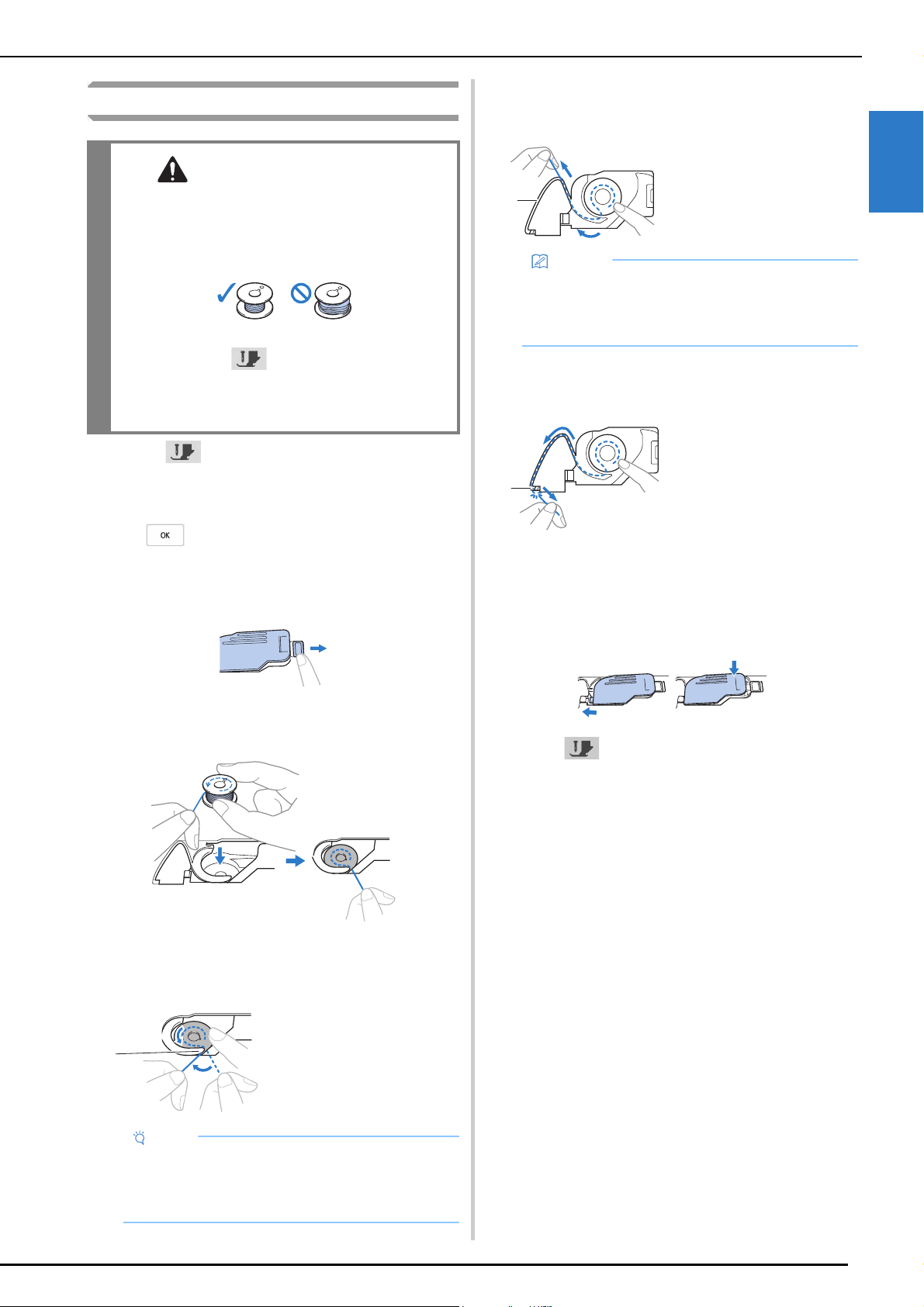
Using the Spool Pin
You can use the main spool pin to wind the bobbin before
embroidering. You cannot use this spool pin to wind the
bobbin while embroidering.
a
Turn the main power to ON and open the top cover.
b
Align the groove in the bobbin with the spring on the
bobbin winder shaft, and set the bobbin on the shaft.
1 Groove in the bobbin
2 Spring on the bobbin winder shaft
c
Remove the spool cap and place the spool of thread for
the bobbin onto the spool pin.
Slide the spool onto the spool pin so that the thread
unwinds to the front from the bottom.
1 Spool pin
2 Spool cap
3 Spool of thread
4 Spool felt
d
Slide the spool cap onto the spool pin as far as possible
to the right, with the rounded side on the left.
e
While holding the thread with both hands, pass the
thread through grooves of the thread guide plate.
1 Thread guide plate
f
Pass the thread through the thread guide.
1 Thread guide
g
Pass the thread around the pretension disk making sure
that the thread is under the pretension disk.
Pull the thread as far as possible.
1 Pretension disk
2 Thread guide
h
Follow steps g through j on page 23 through
page 23.
a
b
a
b
c
d
a
a
a
b
WINDING/INSTALLING THE BOBBIN
GETTING READY
25
1
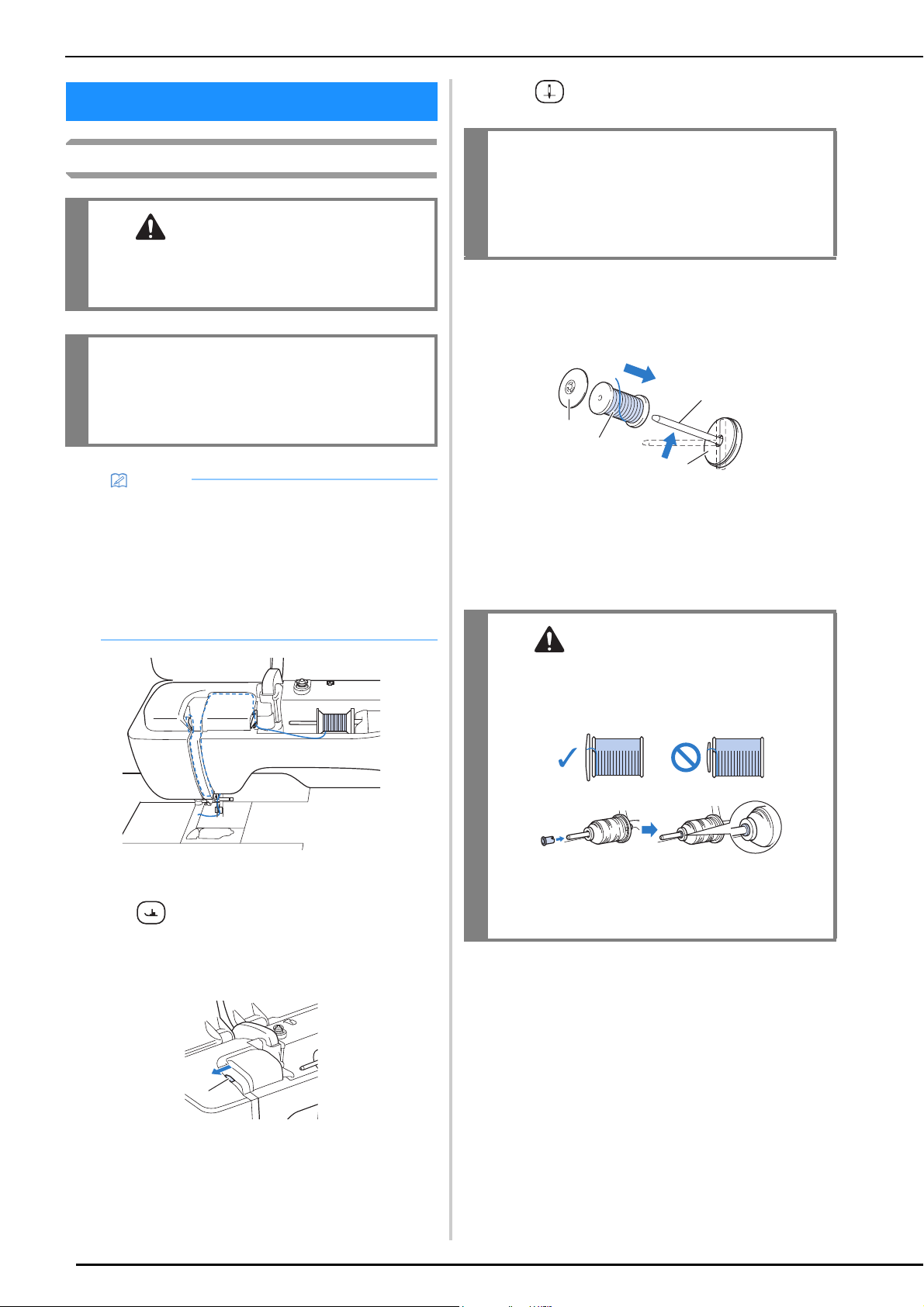
Setting the Bobbin
a
Touch to lock all keys and buttons and raise the
presser foot.
* If the message [OK to automatically lower the
presser foot?] appears on the LCD screen, touch
to continue.
b
Slide the bobbin cover latch to the right and remove
the bobbin cover.
c
Insert the bobbin into the bobbin case so that the
thread unwinds to the left.
d
Lightly hold down the bobbin with your right hand,
and then guide the end of the thread around the tab of
the needle plate cover with your left hand.
e
While lightly holding down the bobbin with your right
hand, guide the thread through the slit in the needle
plate cover and lightly pull it with your left hand.
f
While lightly holding down the bobbin with your right
hand, continue guiding the thread through the slit with
your left hand. Then, cut the thread with the cutter.
The cutter cuts the thread.
g
Reattach the bobbin cover.
Insert the tab of the bobbin cover into the notch of the
needle plate cover, and then lightly press down on the
right side.
h
Touch to unlock all keys and buttons.
CAUTION
• Use a bobbin that has been correctly wound
with thread, otherwise the thread tension may
be incorrect and the needle may break,
causing injuries.
• Before inserting or changing the bobbin, be
sure to touch in the LCD to lock all keys
and buttons. Otherwise injuries may occur if
the “Start/Stop” button or any other button is
pressed and the machine starts embroidering.
1 Tab
Note
• Be sure to hold down the bobbin with your finger
and unwind the bobbin thread correctly, otherwise
the thread may break or the thread tension will be
incorrect.
a
1 Slit
Memo
• By pulling the thread in this way, the thread will
enter the tension spring of the bobbin case to apply
the appropriate tension to the bobbin thread during
embroidery.
1 Cutter
a
a
2
1
UPPER THREADING
26
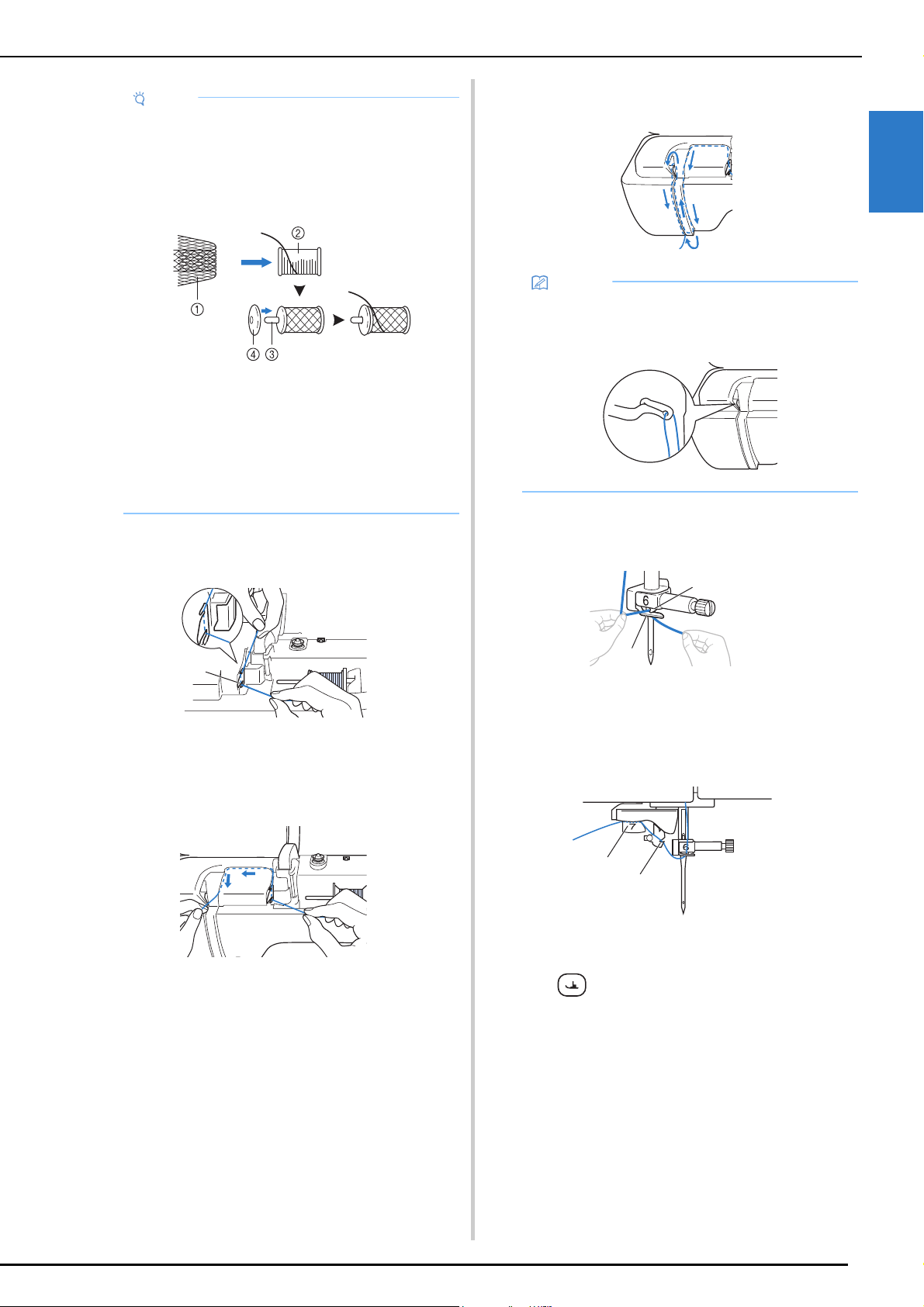
Upper Threading
a
Turn the main power to ON.
b
Press (Presser foot lifter button) to raise the
presser foot.
The upper thread shutter opens so the machine can
be threaded.
1 Upper thread shutter
c
Press (Needle position button) to raise the needle.
d
Remove the spool cap and place the spool of thread
onto the spool pin.
Slide the spool onto the spool pin so that the thread
unwinds to the front from the bottom.
1 Spool pin
2 Spool cap
3 Spool of thread
4 Spool felt
e
Slide the spool cap onto the spool pin as far as possible
to the right, with the rounded side on the left.
UPPER THREADING
CAUTION
• Be sure to thread the machine properly.
Improper threading can cause the thread to
tangle and break the needle, leading to injury.
IMPORTANT
• When using 65/09 needle, manually thread the
needle. If the automatic needle threading
function is used, the unit may be damaged.
Memo
• The automatic threading function can be used with
home sewing machine needle size 75/11.
• When threads such as metallic thread or specialty
threads are used, it is not recommended to use the
needle threader.
• For most embroidery applications, the upper
thread should be 40-weight rayon or polyester
embroidery thread.
a
IMPORTANT
• Be sure to raise the needle before using the
automatic needle threader. Otherwise, the
needle may not thread correctly and the
needle threader may be damaged.
CAUTION
• Choose a spool cap that best fits the size of
spool being used. For more information, refer
to “Note” on page 22.
• If the spool or the spool cap is not positioned
correctly, the thread may become tangled
around the spool pin, possibly causing the
needle to break, resulting in injuries.
a
b
c
d
UPPER THREADING
GETTING READY
27
1
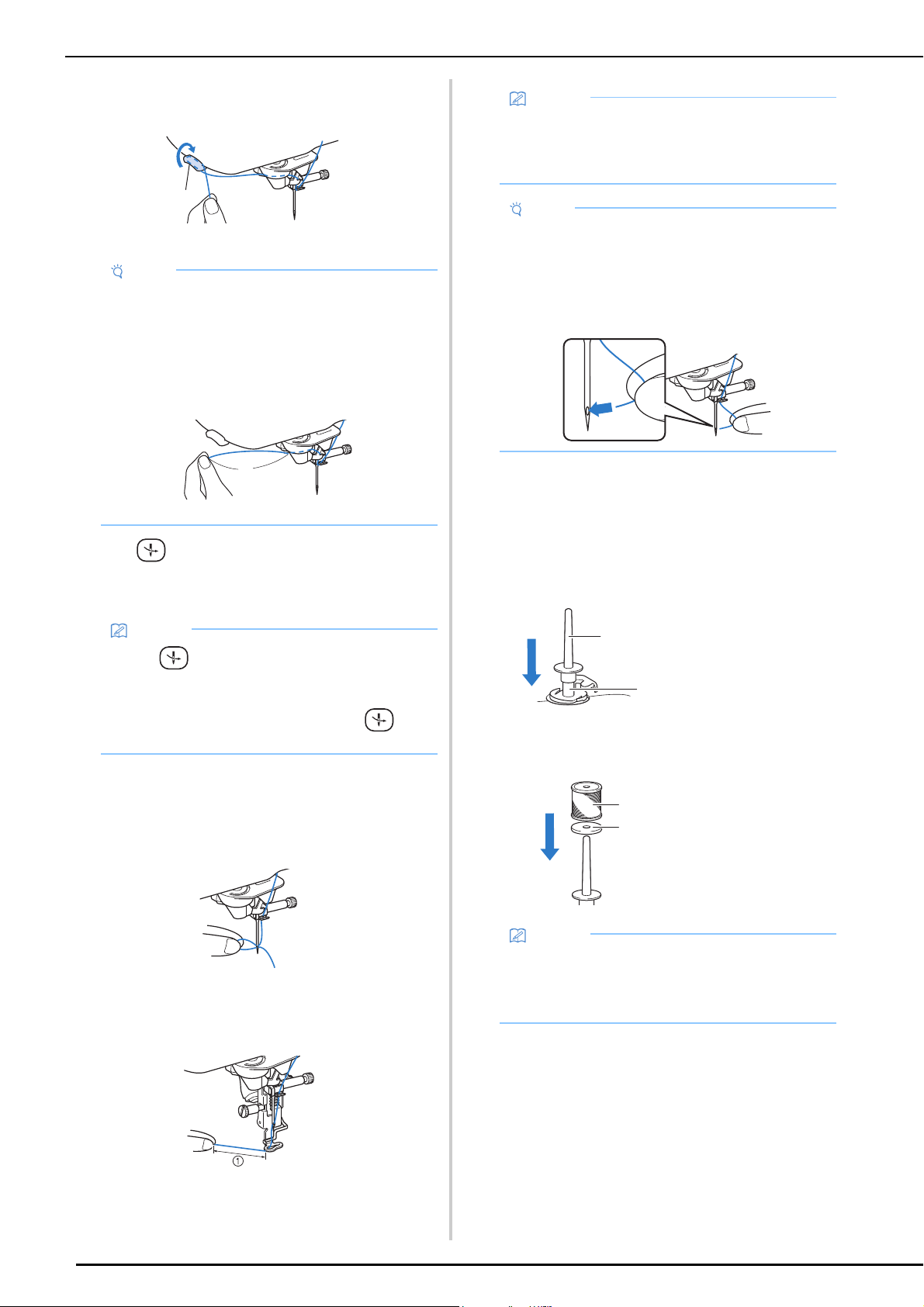
f
While holding the thread with both hands, pass the
thread through grooves of the thread guide plate.
1 Thread guide plate
g
While holding the thread in your right hand, pass the
thread through the thread guide in the direction
indicated.
h
Guide the thread down, up, then down through the
groove, as shown in the illustration.
i
Pass the thread through the needle bar thread guide
(marked “6”) by holding the thread with both hands
and guiding it as shown in the illustration.
1 Needle bar thread guide
2 Tab
j
Pass the thread through the notch in the thread guide.
Then firmly pull the thread from front to back into the
slit of the thread guide disk (marked “7”).
1 Notch in thread guide
2 Thread guide disk
k
Press (Presser foot lifter button) to lower presser
foot.
Note
• When using thread that winds off quickly, such as
metallic thread, place the spool net over the spool
before placing the spool of thread onto the spool
pin.
If the spool net is too long, fold it to fit the size of
the spool.
1 Spool net
2 Thread spool
3 Spool pin
4 Spool cap
* When threading the spool with the spool net on,
make sure that 5-6cm (approx. 2 - 2-1/2 inches) of
thread is pulled out.
* It may be necessary to adjust the thread tension
when using the spool net.
a
Memo
• Look in the upper groove area to check if the
thread catches on the thread take-up lever visible
inside the upper groove area.
a
b
a
b
UPPER THREADING
28
l
Pull the thread up through the thread cutter to cut the
thread, as shown in the illustration.
1 Thread cutter
m
Press (Automatic threading button) to have the
machine automatically thread the needle.
The thread passes through the eye of the needle.
n
Carefully pull the end of the thread that was passed
through the eye of the needle.
* If a loop was formed in the thread passed through
the eye of the needle, carefully pull on the loop of
thread through to the back of the needle.
o
Raise the presser foot lever and pull out about 10 cm
(approx. 4 inches) of the thread, and then pass it under
the presser foot toward the rear of the machine.
1 About 10 cm (approx. 4 inches)
Using the Vertical Spool Pin
Use the vertical spool pin when using an irregularly
shaped thread spool, and when embroidering with
metallic thread.
a
Insert the vertical spool pin onto the bobbin winder
shaft.
b
Install the spool felt and the thread spool in that order,
and then thread the upper thread.
Note
• When using thread that quickly winds off the spool,
such as metallic thread, it may be difficult to thread
the needle if the thread is cut.
Therefore, instead of using the thread cutter, pull
out about 8 cm (approx. 3 inches) of thread after
passing it through the thread guide disks (marked
“7”).
1 About 8 cm (approx. 3 inches) or more
Memo
• When (Automatic threading button) is
pressed, the presser foot will be automatically
lowered. After threading is finished, the presser
foot moves back to the position before
(Automatic threading button) was pressed.
a
a
Memo
• If the needle could not be threaded or the thread
was not passed through the needle bar thread
guides, perform the procedure again starting from
step
c.
Note
• Some needles and threads cannot be threaded
with the needle threader. In this case, instead of
using the needle threader after passing the thread
through the needle bar thread guide (marked “6”),
manually pass the thread through the eye of the
needle from the front.
1 Bobbin winder shaft
2 Vertical spool pin
1 Spool felt
2 Thread spool
Memo
• When setting the thread spool, set it so that the
thread winds off from the front of the spool.
• This method keeps the thread from twisting as it
comes off the spool pin.
b
a
b
a
CHANGING THE NEEDLE
GETTING READY
29
1
Thread and Needle Number
The lower the thread number is, the heavier the thread;
the higher the needle number, the larger the needle.
Embroidery Needles
Use a ball point needle 75/11.
a
Press (Needle position button) to raise the needle.
b
Touch to lock all keys and buttons.
* If the message [OK to automatically lower the
presser foot?] appears on the LCD screen, touch
to continue.
c
Remove the presser foot. (page 111)
d
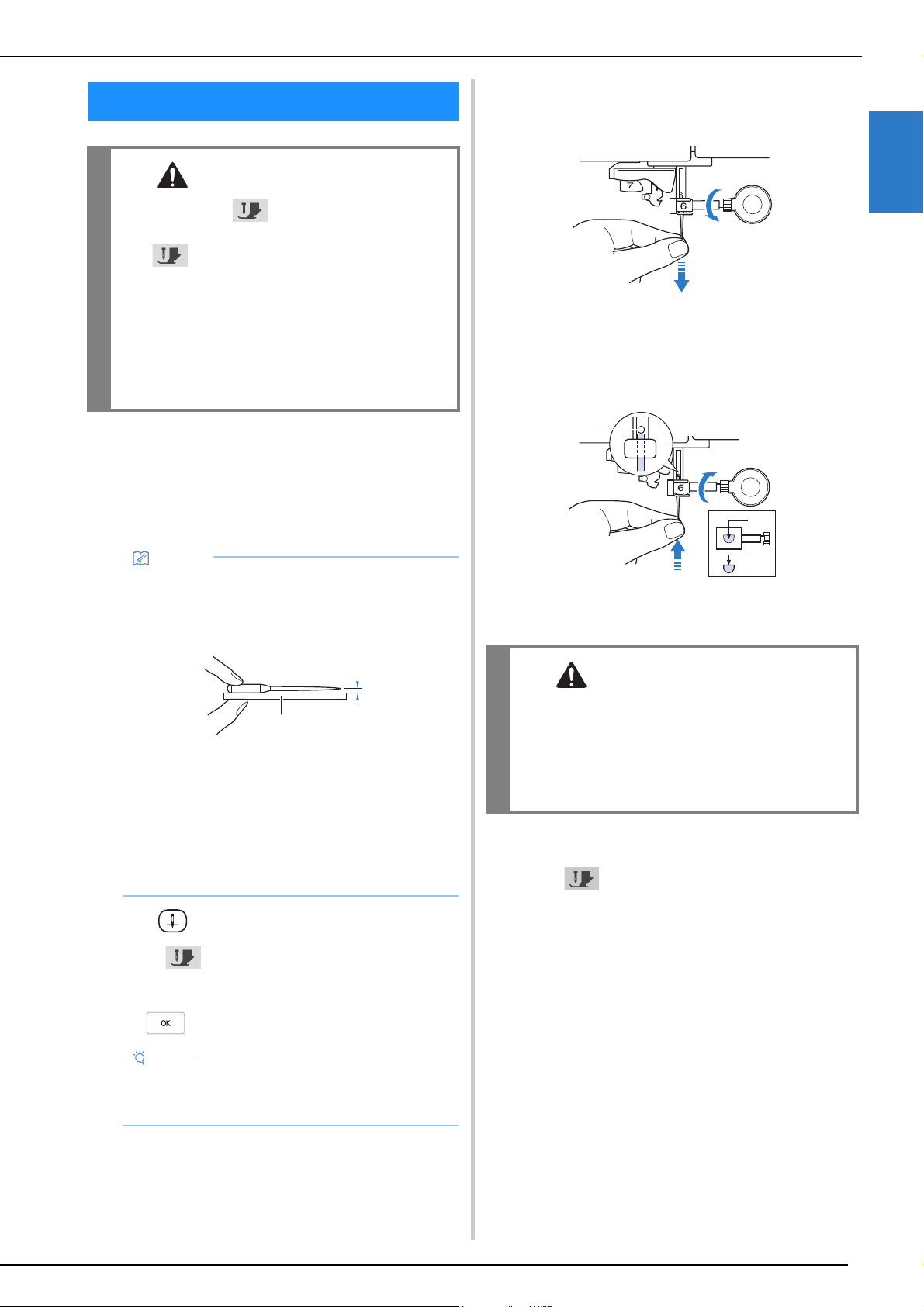
Use the disc-shaped screwdriver to turn the needle
clamp screw toward you (counterclockwise) to loosen
the screw. Remove the needle.
e
With the flat side of the needle facing the back, insert
the new needle all the way to the top of the needle
stopper (viewing window) in the needle clamp. Use the
disc-shaped screwdriver to securely tighten the needle
clamp screw.
1 Needle stopper
2 Hole for inserting the needle
3 Flat side of the needle
f
Attach the presser foot. (page 111)
g
Touch to unlock all keys and buttons.
CHANGING THE NEEDLE
CAUTION
• Always touch on the screen to lock all
keys and buttons before changing the needle.
If is not touched and the “Start/Stop”
button or another operation button is pressed
accidentally, the machine will start and injury
may result.
• Use only home sewing machine needles. Other
needles may break and may cause injury.
• Never use a bent needle. This may cause
injury.
Memo
• To check the needle correctly, place the flat side of
the needle on a flat surface. Check the needle from
the top and the sides. Throw away any bent
needles.
1 Parallel space
2 Flat surface (bobbin cover, glass, etc.)
• The machine needles are consumables.
Replace the needle in cases such as those
described below.
- If an unusual sound is produced when the needle
enters the fabric. (The tip of the needle may be
broken or dull.)
- If stitches are skipped. (The needle may be bent.)
Note
• Before replacing the needle, cover the hole in the
needle plate with fabric or paper to prevent the
needle from falling into the machine.
a
b
CAUTION
• Be sure to push in the needle until it touches
the stopper, and securely tighten the needle
clamp screw with the disc-shaped screwdriver.
If the needle is not completely inserted or the
needle clamp screw is loose, the needle may
break and cause injury.
a
b
c

CHANGING THE NEEDLE
30
BEFORE EMBROIDERING
31
BASIC EMBROIDERY
2
Embroidery Step by Step
Follow the steps below to prepare the machine for
embroidery.
About the Embroidery Unit
Chapter 2
BASIC EMBROIDERY
BEFORE EMBROIDERING
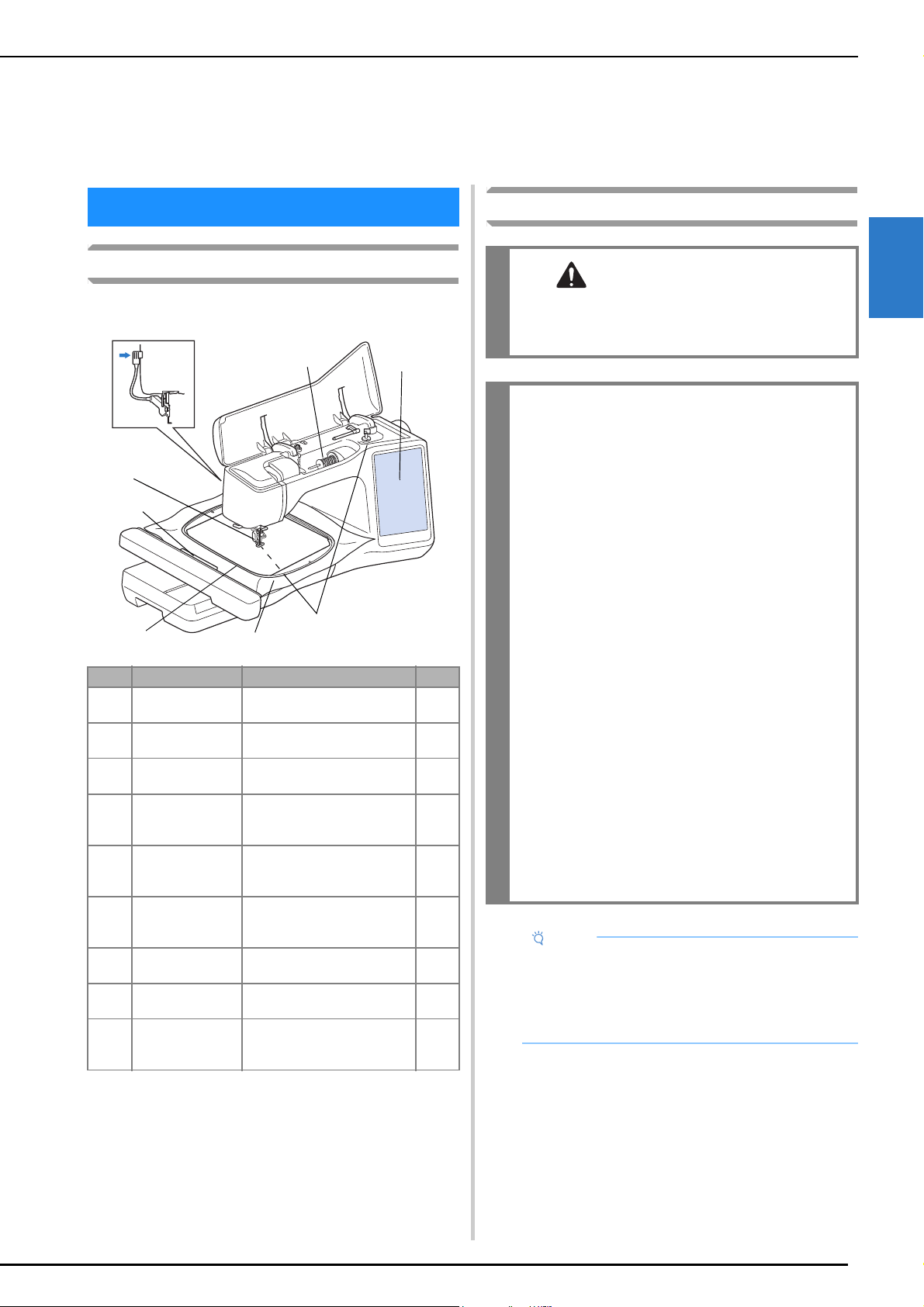
Step # Aim Action Page
1 Presser foot
attachment
Attach embroidery foot “W+”
with LED pointer.
111
2 Checking the
needle
Use needle 75/11 for
embroidery.
29
3 Embroidery unit
attachment
Attach the embroidery unit. 31
4 Bobbin thread
setup
For the bobbin thread, wind
embroidery bobbin thread and
set it in place.
22
5 Fabric preparation Attach a stabilizer material to
the fabric, and hoop it in the
embroidery frame.
53
6 Pattern selection Turn the main power to ON,
and select an embroidery
pattern.
33
7 Embroidery frame
attachment
Attach the embroidery frame
to the embroidery unit.
56
8 Checking the
layout
Check and adjust the size and
position of the embroidery.
57
9Embroidery upper
thread setup
Set up embroidery upper
thread according to the
pattern.
26
Step 3
Step 1, 2
Step 7
Step 5
Step 4
Step 6, 8
Step 9
CAUTION
• Do not move the machine with the embroidery
unit attached. The embroidery unit could fall
off and cause injury.
IMPORTANT
• Keep your hands and foreign objects away
from the embroidery carriage and frame when
the machine is embroidering. Damage or
malfunction may result.
• Be sure to turn off the power before attaching
or removing the embroidery unit. Otherwise,
the machine may be damaged.
• Do not touch the inner connector of the
embroidery unit. The pins on the embroidery
unit connection may be damaged.
• Do not apply strong force to the embroidery
unit carriage or pick up the unit by the
carriage. Otherwise, the embroidery unit may
be damaged.
• Do not push on the carriage when attaching
the embroidery unit onto the machine. Moving
the carriage may damage the embroidery unit.
• Make sure that there is enough space for the
carriage of the embroidery unit to move. If the
embroidery frame comes into contact with an
object, the pattern may not be embroidered
correctly, or damage may result.
• Do not touch the embroidery carriage until the
initialization finishes.
Note
• To avoid distorting your embroidery design, do not
touch the embroidery carriage and frame when the
machine is embroidering.
• Store the embroidery unit in a safe place to prevent
damage to the unit.
BEFORE EMBROIDERING
32
Attaching the Embroidery Unit
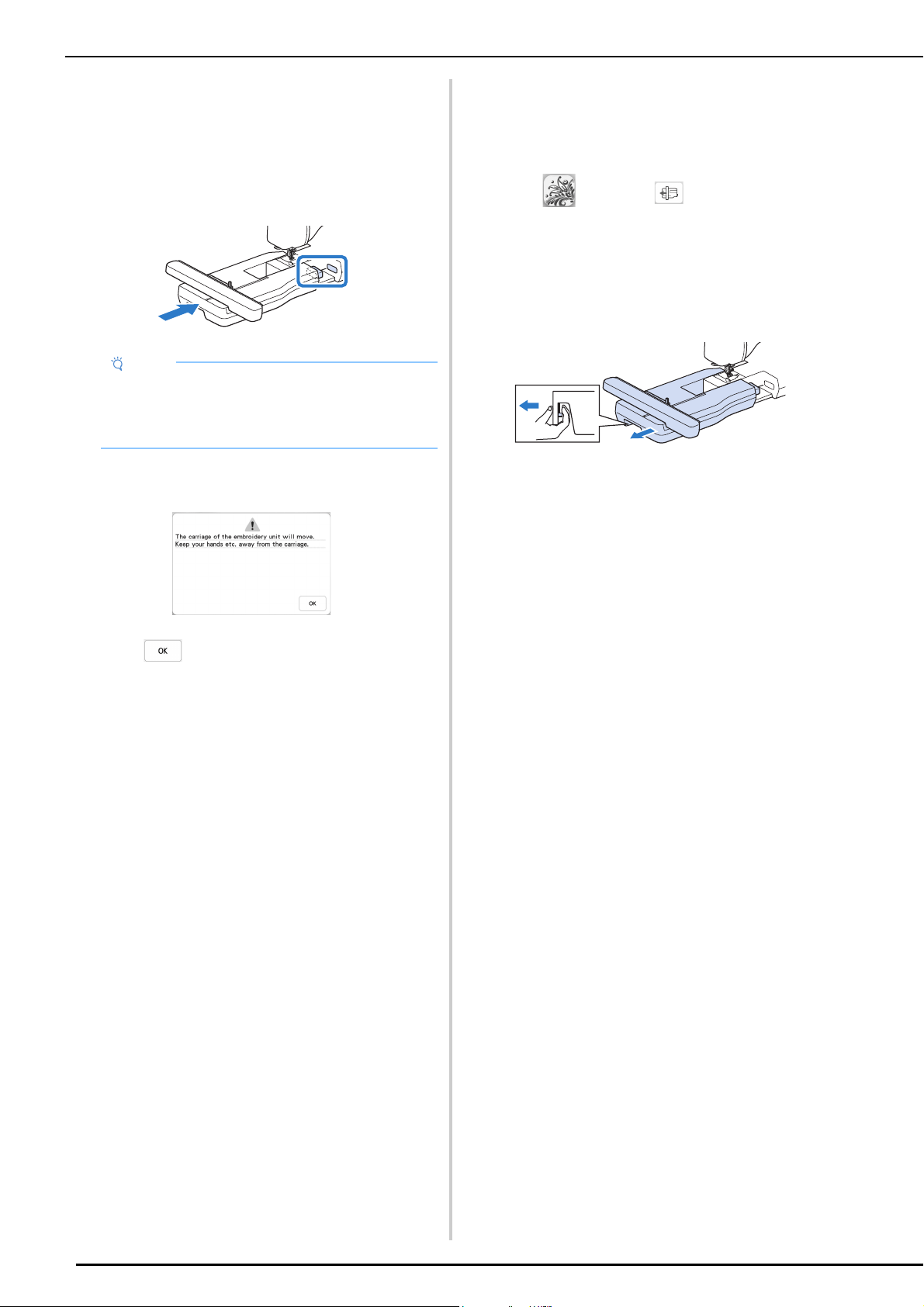
a
Turn the main power to OFF.
b
Insert the embroidery unit connection into the
connection port of the machine until it snaps into
place.
c
Turn the main power to ON.
The following message will appear.
d
Touch .
The carriage will move to the initialization position.
Removing the Embroidery Unit
a
Remove the embroidery frame.
• For details on removing the embroidery frame, refer
to “Removing the Embroidery Frame” on page 57.
b
Touch , then touch .
The carriage will move to the removal position.
c
Turn the main power to OFF.
d
Press the release button, and pull the embroidery unit
away from the machine.
Note
• Be sure there is no gap between the embroidery
unit and the machine. If there is a gap, the
embroidery patterns will not embroider with the
correct registration.
SELECTING PATTERNS
33
BASIC EMBROIDERY
2
Copyright Information
The patterns stored in the machine and patterns sold
separately are intended for private use only. Any public or
commercial use of copyrighted patterns is an infringement
of copyright law and is strictly prohibited.
About Embroidery Patterns
There are many character and decorative embroidery
patterns stored in the machine’s memory (see the
“Embroidery Design Guide” for a full summary of patterns
in the machine’s memory or visit https://s.brother/cmekb/
).
You can also use patterns sold separately.
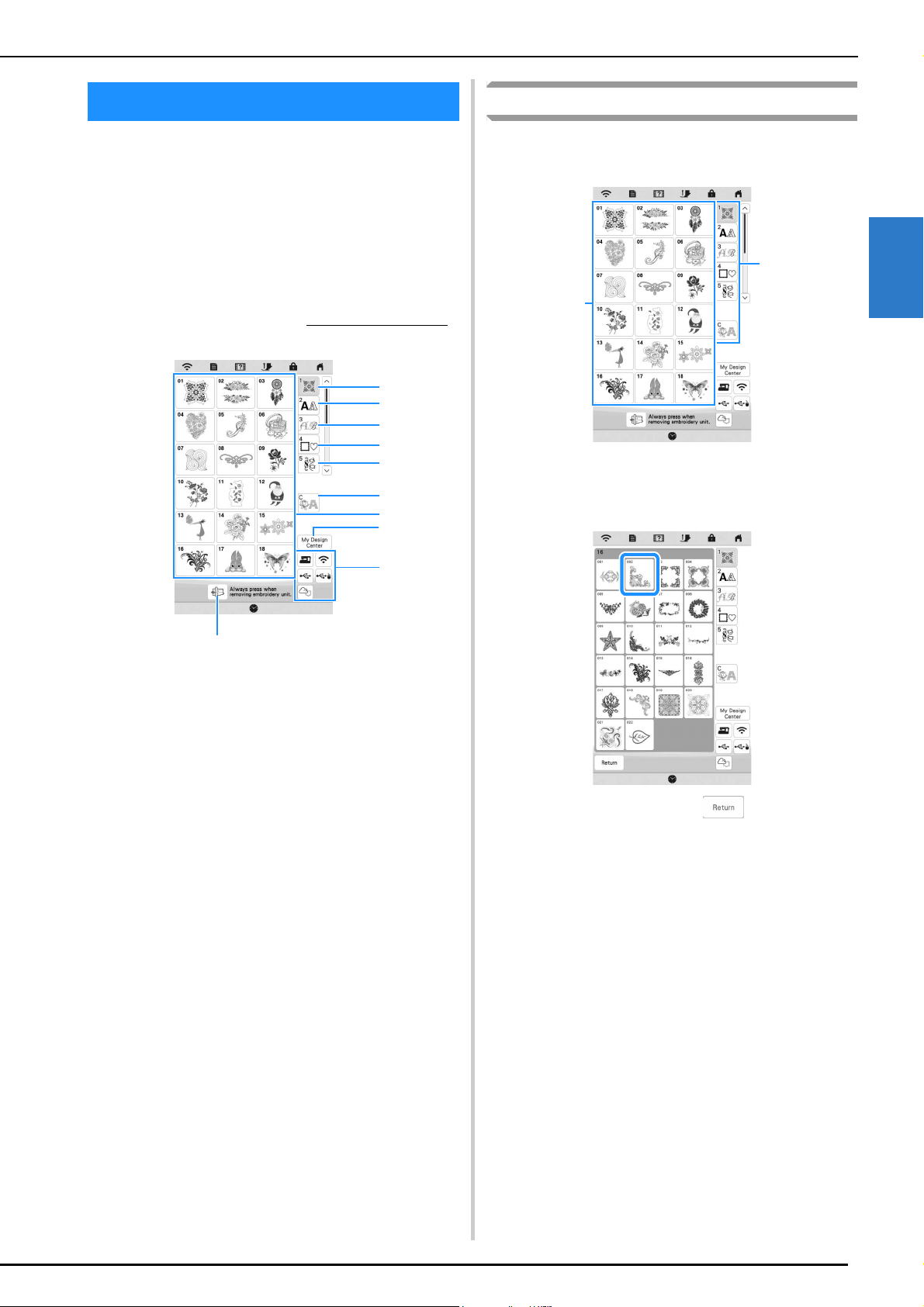
1 Embroidery patterns
2 Character patterns
3 Decorative alphabet patterns
4 Frame patterns
5 Utility embroidery patterns
6 Couching patterns (page 84)
7 Pattern type selection keys
8 My Design Center (page 89)
9 Patterns saved in the machine’s memory, USB media,
etc. (page 82)
0 Touch this key to position the embroidery unit for
storage.
Selecting Embroidery Patterns
a
Touch the category tab and then touch the pattern type
selection key or pattern key you want to embroider.
1 Pattern category tab
2 Pattern type/pattern selection key
b
Select a pattern.
* Touch the category tab or to return to the
previous screen.
The selected pattern is displayed.
SELECTING PATTERNS
1
0
2
3
4
5
7
9
8
6
1
2
SELECTING PATTERNS
34
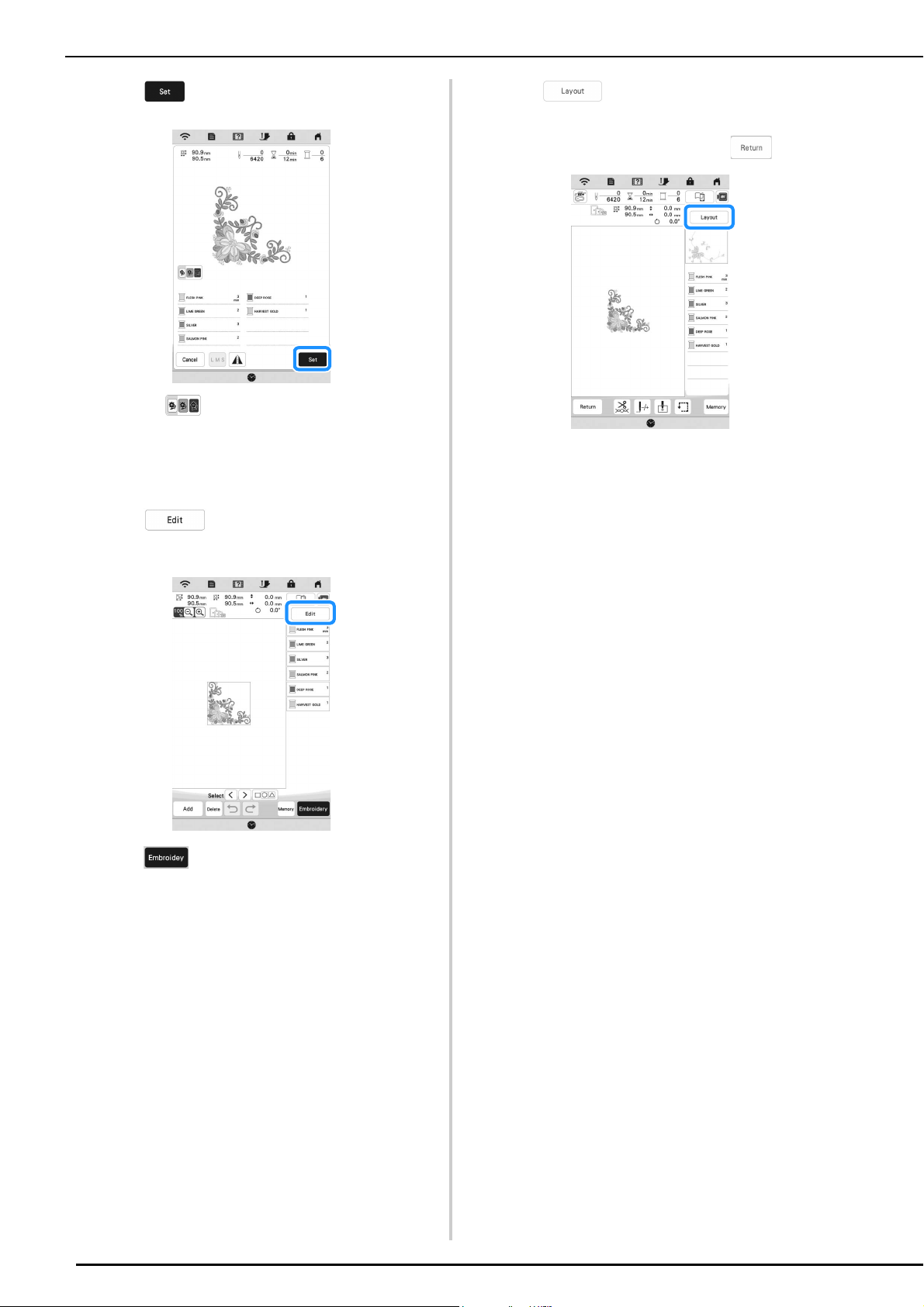
c
Touch to set the pattern.
* Touch to darken the background color for the
pattern image with bright thread colors, to get a
clearer image.
The pattern is designated with a red box around it on
the edit screen.
d
Touch to edit the selected pattern.
(page 39)
e
Touch .
The embroidery screen appears.
f
Touch to edit the pattern before
embroidering. (page 51)
* To return to the edit screen, touch .
g
Start embroidering. (page 65)
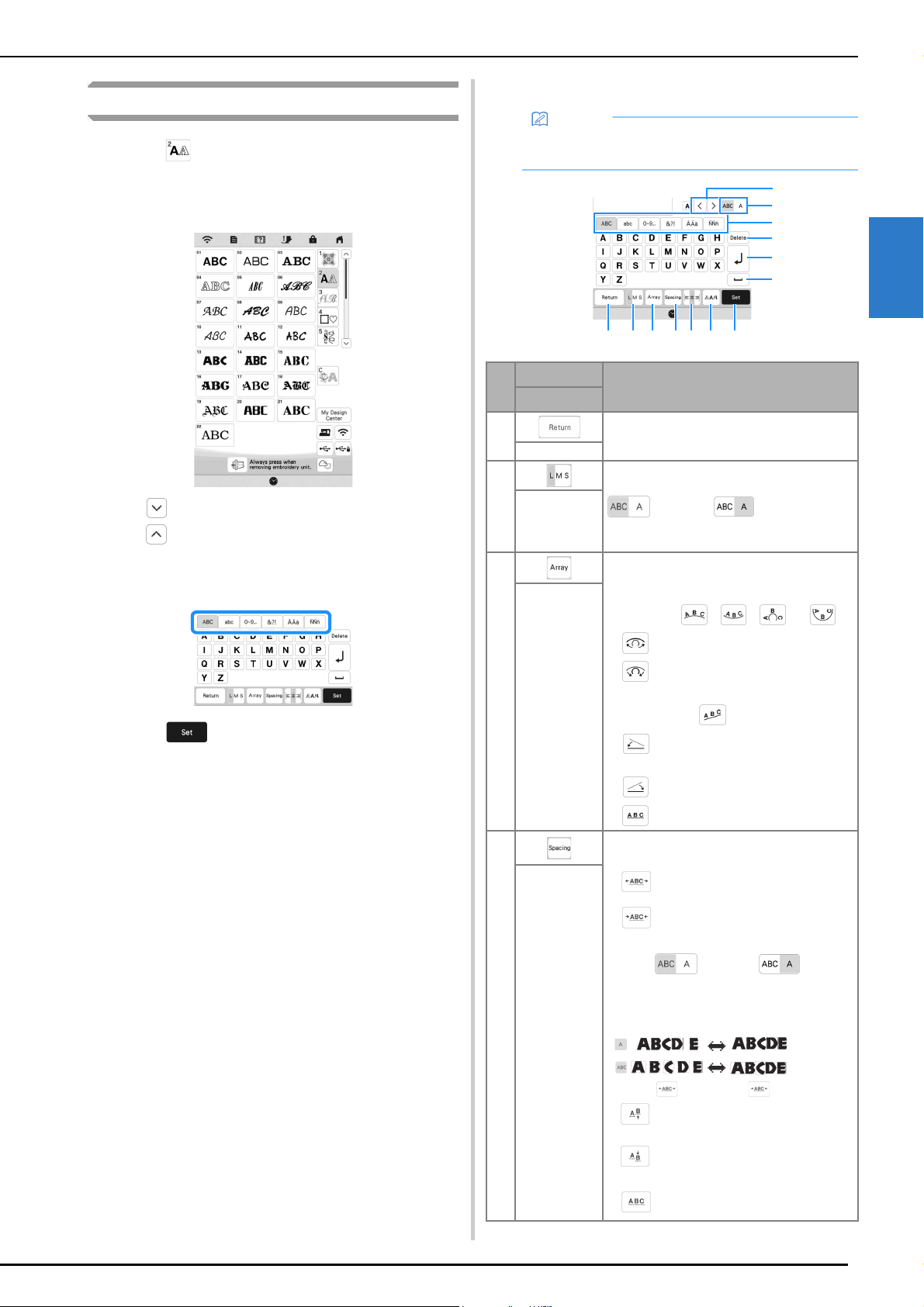
SELECTING PATTERNS
35
BASIC EMBROIDERY
2
Selecting Character Patterns
a
Touch .
b
Touch the key of the font you want to embroider.
* : View the next page.
: View the previous page.
c
Select the character category and then type in the text.
(page 35)
d
Touch .
The edit screen appears.
e
Follow the steps from d to g of “Selecting
Embroidery Patterns” on page 33.
Character Pattern Input Keys
Memo
• If a key display is grayed out, you cannot use that
function with the selected pattern.
No.
Display Explanation
Name
1 Return to the previous screen.
Return key
2 Change the size of the character patterns.
To change the size of one character, touch
to display and then select
the character. The size of the selected
character is changed.
Size key
3 Change the configuration of the character
patterns.
• To arrange the character patterns on an
arc, touch , , or .
: Make the arc flatter.
: Make the arc rounder.
• To arrange the character patterns on an
incline, touch .
: Change the incline
counterclockwise.
: Change the incline clockwise.
• : Reset the layout.
Array key
4 Change the spacing of the character
patterns.
• : Increase the character spacing.
• : Decrease the character spacing.
• To change the spacing after one character,
touch to display and then
select the character. The spacing between
the selected character and the next
character is changed.
• : Move the one selected character
up.
• : Move the one selected character
down.
• : Reset the spacing.
Character
spacing key
0
9
8
A
B
C
5 76431 2
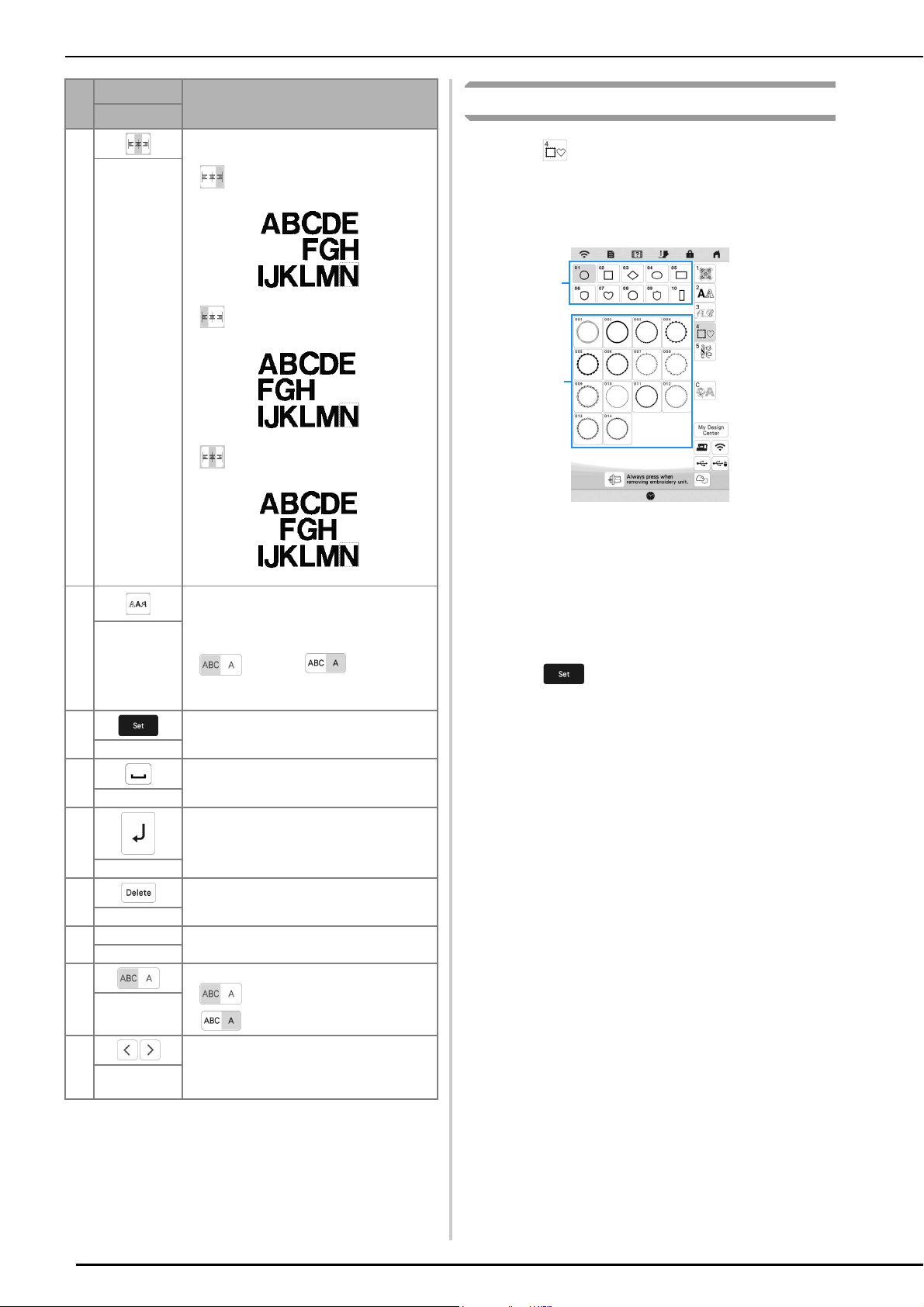
SELECTING PATTERNS
36
Selecting Frame Patterns
a
Touch .
b
Touch the key of the frame shape you want to
embroider in the top part of the screen.
1 Frame shapes
2 Frame patterns
Various frame patterns are displayed at the bottom
part of the screen.
c
Touch the key of the frame pattern you want to
embroider.
The selected pattern is displayed on the screen.
d
Touch .
The edit screen appears.
e
Follow the steps from d to g of “Selecting
Embroidery Patterns” on page 33.
5 Switch alignment. This function is available
when multiple lines of characters are input.
• : Right alignment
• : Left alignment
• :
Center alignment
Alignment key
6 Change the font of the characters.
Depending on the font that was selected, it
may not be possible to change the font.
• To change the font of one character, touch
to display and then
select the character. The font of the
selected character is changed.
Font Type key
7 Apply the character pattern editing.
Set key
8 Enter a space.
Space key
9 Make a new line.
Line feed key
0 Delete the character.
Delete key
A - Select the category of character.
Category keys
B Select to edit all characters or one character.
• : Edit all characters.
• : Edit one character.
Select one/all
key
C Move the cursor and select a character.
Character
selection keys
No.
Display Explanation
Name
1
2
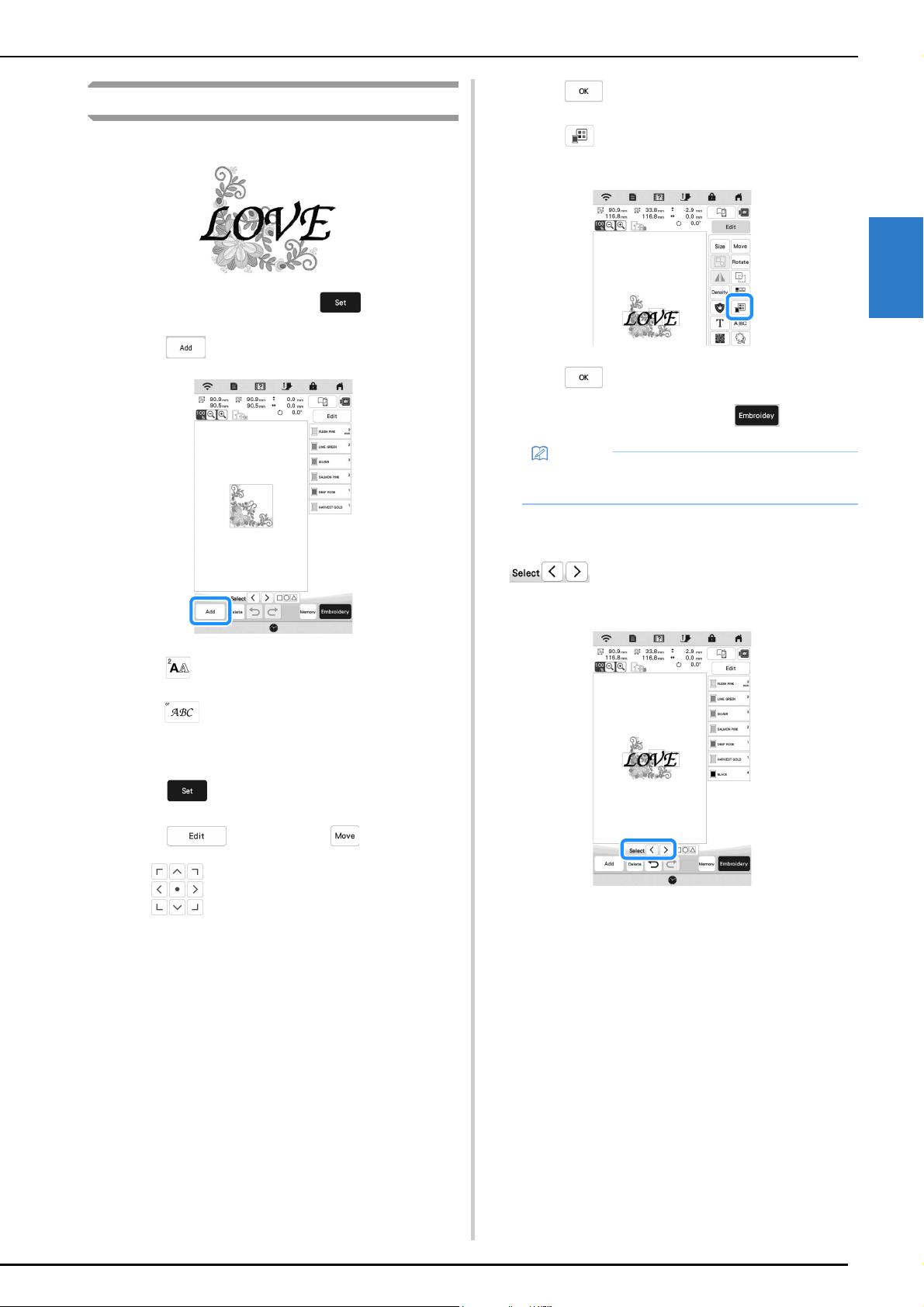
SELECTING PATTERNS
37
BASIC EMBROIDERY
2
Combining Patterns
Example:
a
Select a pattern and then touch .
b
Touch .
c
Touch .
d
Select and enter “LOVE”.
The characters you enter will be displayed in the
center of the embroidery pattern area.
e
Touch .
f
Touch and then touch .
g
Use to move the characters.
* Characters can also be moved by directly dragging
them with your finger or the touch pen.
h
Touch .
i
Touch to change the color of the characters.
(page 48)
j
Touch .
k
When all editing is finished, touch .
Selecting a Pattern
If multiple patterns have been combined, use
to select the pattern to be edited. Patterns
can also be selected by directly touching the screen with
your finger or touch pen.
Memo
• Combined patterns will be embroidered in the
order they were entered.
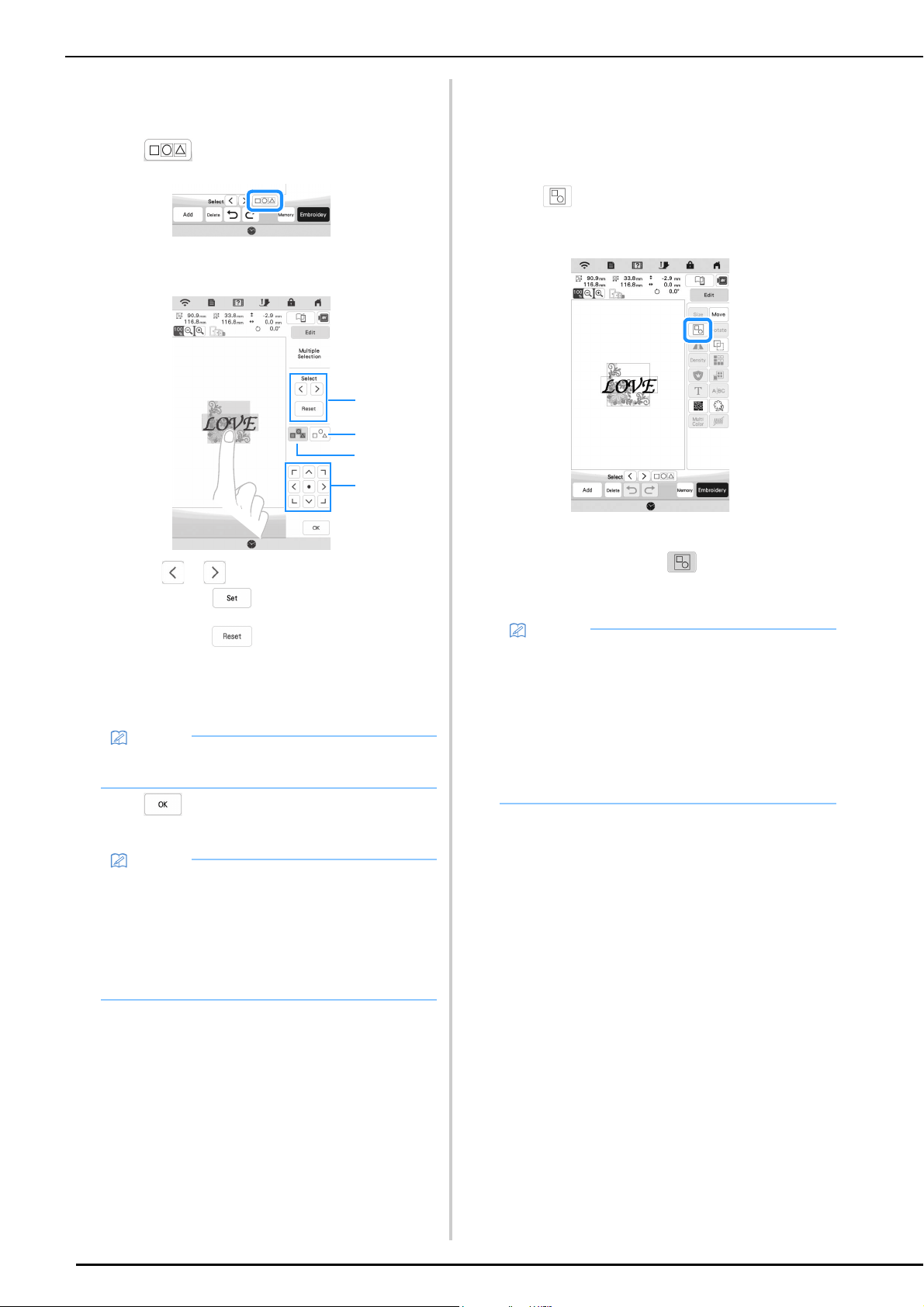
SELECTING PATTERNS
38
Selecting Multiple Patterns at the Same Time
Multiple patterns can easily be edited, for example, when
moving patterns, if they are all selected together.
a
Touch .
b
Touch each pattern to be selected.
1 Touch or to check the patterns to be selected,
and then touch . The selected patterns are
highlighted with a red box. To deselect the selected
patterns, touch .
2 Touch this key to deselect all selected patterns.
3 Touch this key to select all patterns in the pattern display
area.
4 Patterns can be moved with this key.
c
Touch to return to the edit screen.
Each selected pattern is surrounded with a red box.
Grouping Patterns
If the multiple patterns are grouped, they can be edited as
a single pattern.
a
Select patterns you want to group. (page 38)
b
Touch .
The selected patterns are grouped.
* To ungroup a grouped pattern, select the grouped
pattern, and then touch . At this time, multiple
patterns are selected. To cancel the multiple
selection, touch any other pattern or the blank area.
Memo
• You can also select multiple patterns by dragging
your finger to specify the area of selection.
Memo
• The following functions are available while multiple
patterns are selected.
-Moving
-Copying
-Grouping
-Stippling
- Extracting pattern outlines
1
2
4
3
Memo
• The following functions are applied to all patterns in
the grouped pattern.
-Moving
-Rotating
- Appliqué
-Border
- Extracting pattern outlines
- Simple stippling
- Thread color changing
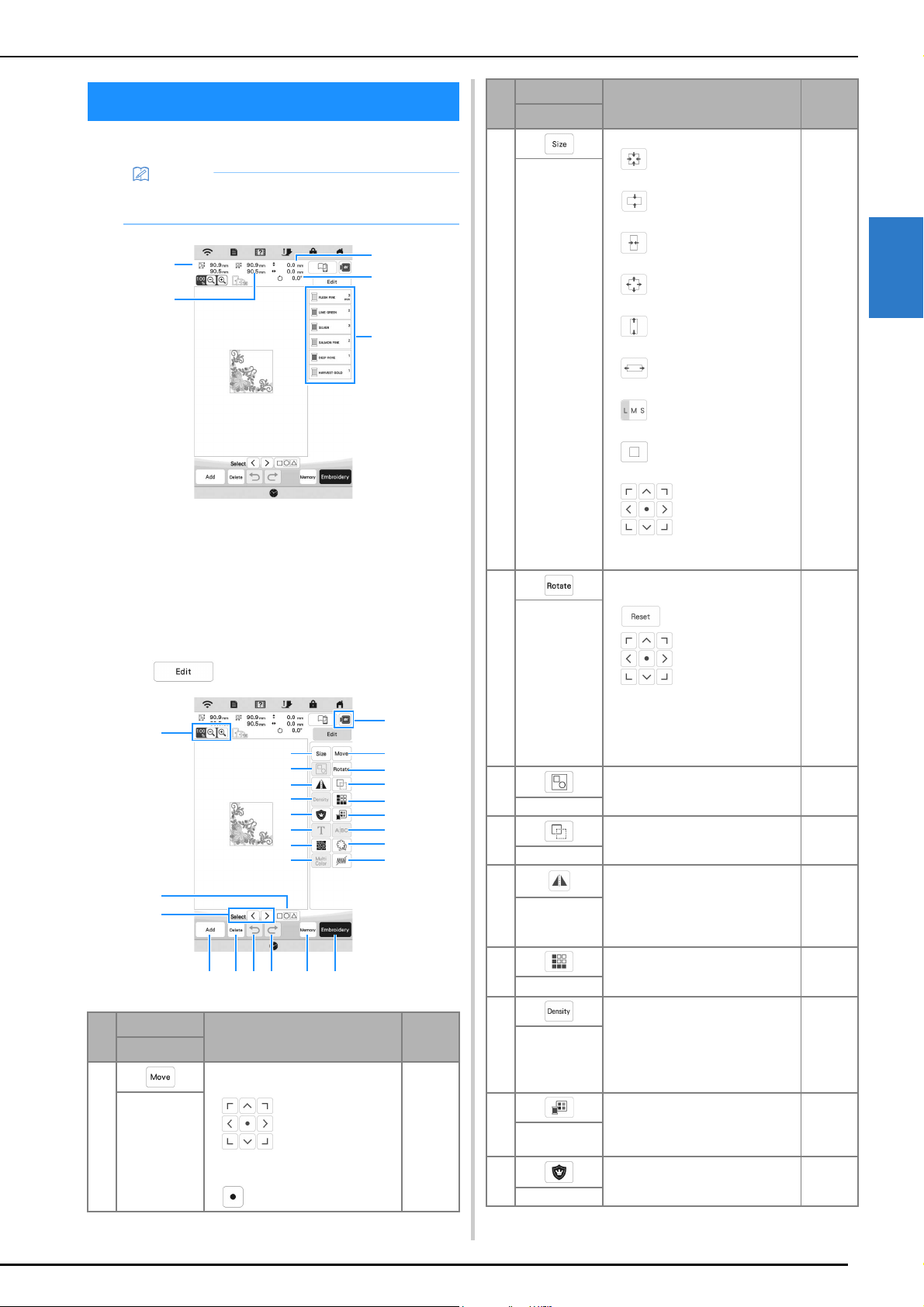
EDITING PATTERNS
39
BASIC EMBROIDERY
2
Using these keys, you can edit the pattern as you like.
1 Size of the entire combined pattern
2 Size of the pattern currently selected
3 Distance from the center of the frame to the center of the
pattern currently selected
4 Degree of rotation for the pattern currently selected
5 Color sequence and stitching times of each step of the
pattern
Key Functions
Touch to display the editing window.
EDITING PATTERNS
Memo
• If a key display is grayed out, you cannot use that
function with the selected pattern.
No.
Display
Explanation Page
Name
1 Display the pattern moving
window.
• : Move the pattern in
the direction shown by the
arrow.
• : Center the pattern.
37
Move key
2
1
5
3
4
L K H GI
O
P
1
3
5
7
9
A
C
E
2
4
6
8
0
B
D
N
M
J
F
2 Display the pattern sizing window.
• : Decrease the pattern
proportionately.
• : Decrease the pattern
vertically.
• : Decrease the pattern
horizontally.
• : Enlarge the pattern
proportionately.
• : Stretch the pattern
vertically.
• : Stretch the pattern
horizontally.
• : Change the size of the
character patterns.
• : Reset the size. (except for
character patterns.)
• : Move the pattern in
the direction shown by the
arrow.
42
Size key
3 Display the pattern rotating
window.
• : Reset the position.
• : Move the pattern in
the direction shown by the
arrow.
You can also rotate the pattern by
dragging the red point at the
corners of the pattern.
—
Rotate key
4 Group selected multiple patterns. 38
Group key
5 Duplicate the pattern. —
Duplicate key
6 Change the pattern to a horizontal
mirror image.
—
Horizontal
mirror image
key
7 Make and edit the repeated
pattern.
42
Border key
8 Allows the thread density to
change for some Alphabet
characters and frame patterns.
Other patterns density can be
modified after the pattern size is
changed.
41
Density key
9 Change the thread color. 49
Thread palette
key
0 Create an appliqué outline of the
pattern.
72
Appliqué key
No.
Display
Explanation Page
Name
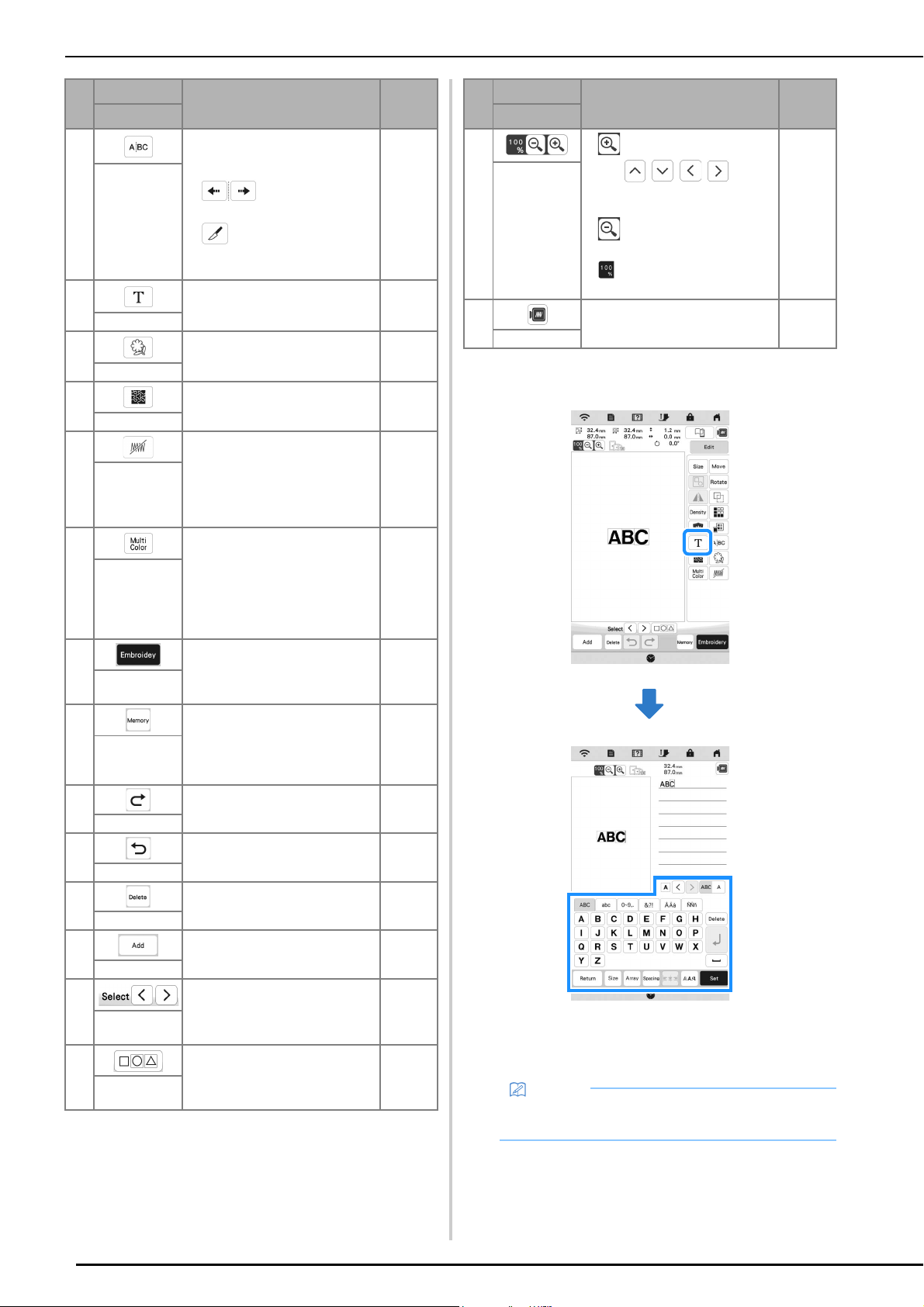
EDITING PATTERNS
40
Editing Letters
For details on input keys, refer to “Character Pattern Input
Keys” on page 35.
A Separate the continuous character
patterns to adjust the spacing or
edit separately afterwards.
• : Select where the
patterns is to be separated.
• : Separate the patten. A
separated character pattern
cannot be combined again.
—
Separate key
B Edit character patterns. 35, 40
Letter Edit key
C Extract the outline of the pattern.
The extracted pattern can be used
with My Design Center.
104
Outline key
D Touch this key to create stippling,
echo quilting, or decorative fill
around a pattern.
87
Stippling key
E Touch this key to specify not to
embroider the selected thread
color.
46
Deselect
region setting
(no sew
setting) key
F Touch this key when you want to
change the thread color, character
by character in character
embroidery. Since the machine
stops at the end of each character,
the upper thread can be changed
as you embroider.
—
Multi color key
G Proceed to the embroidery screen. —
Embroidery
key
H Save a pattern in the machine’s
memory or USB media. The
pattern can also be transferred to
a computer via a wireless network
connection.
81
Memory key
I Redo the last operation that was
undone.
—
Redo key
J Undo the last operation. —
Undo key
K Delete the selected pattern (the
pattern outlined by the red box).
—
Delete key
L Add another pattern to the editing
pattern.
37
Add key
M Select the pattern to edit when
there are multiple patterns.
37
Pattern select
key
N Make multiple patterns to be
selected at the same time.
38
Multiple
selection key
No.
Display
Explanation Page
Name
O
• : Magnify the image.
Use / / / to
scroll through the display in any
direction.
• : Demagnify the image
(minimum: 100%).
• : Select the percent of
magnification.
—
Magnify keys
P Preview the embroidered image. 41
Image key
Memo
• To edit character patterns with multiple lines in the
edit screen, ungroup the pattern. (page 38)
No.
Display
Explanation Page
Name

EDITING PATTERNS
41
BASIC EMBROIDERY
2
Previewing the Pattern
a
Touch .
An image of the pattern as it will be embroidered
appears.
b
Touch to select the frame used in
the preview.
* Frames displayed in gray cannot be selected.
* Touch to enlarge the image of the pattern.
* The pattern can be embroidered as it appears in the
display.
c
Touch to check the embroidering order.
The stitch simulator screen appears.
1 Simulation speed keys
2 Operation keys
: Start the simulation at the set speed.
: Pause the simulation.
: Stop the simulation.
* Touch to return to the embroidery frame
selection screen.
d
Touch .
Changing the Size and the Density of the
Pattern
If is selected, you can change the pattern size while
maintaining the thread density. The machine recalculates the
stitch density automatically. With this function, the pattern
will be enlarged or reduced at a larger ratio than with normal
pattern resizing.
a
Touch , and then touch .
b
Select in the size window.
* : Change the pattern size while maintaining
the number of stitches. Enlarged patterns will be less
dense, and reduced patterns will be more dense. In
order to maintain embroidering quality, there is a
limit to how much the embroidery pattern can be
enlarged or reduced.
* : Change the pattern size while maintaining
the thread density. After the pattern size is changed,
the thread density can be changed in the edit screen.
The number of stitches is recalculated depending on
the pattern size.
1
2
Memo
• This function cannot be used with alphabet
character patterns, frame patterns, repeated
patterns or buttonhole patterns.
• Patterns with a large number of stitches (100,001
or more) cannot be resized while maintaining a
thread density.
• You can also change the size by dragging the red
point at the sides and corners of the pattern.
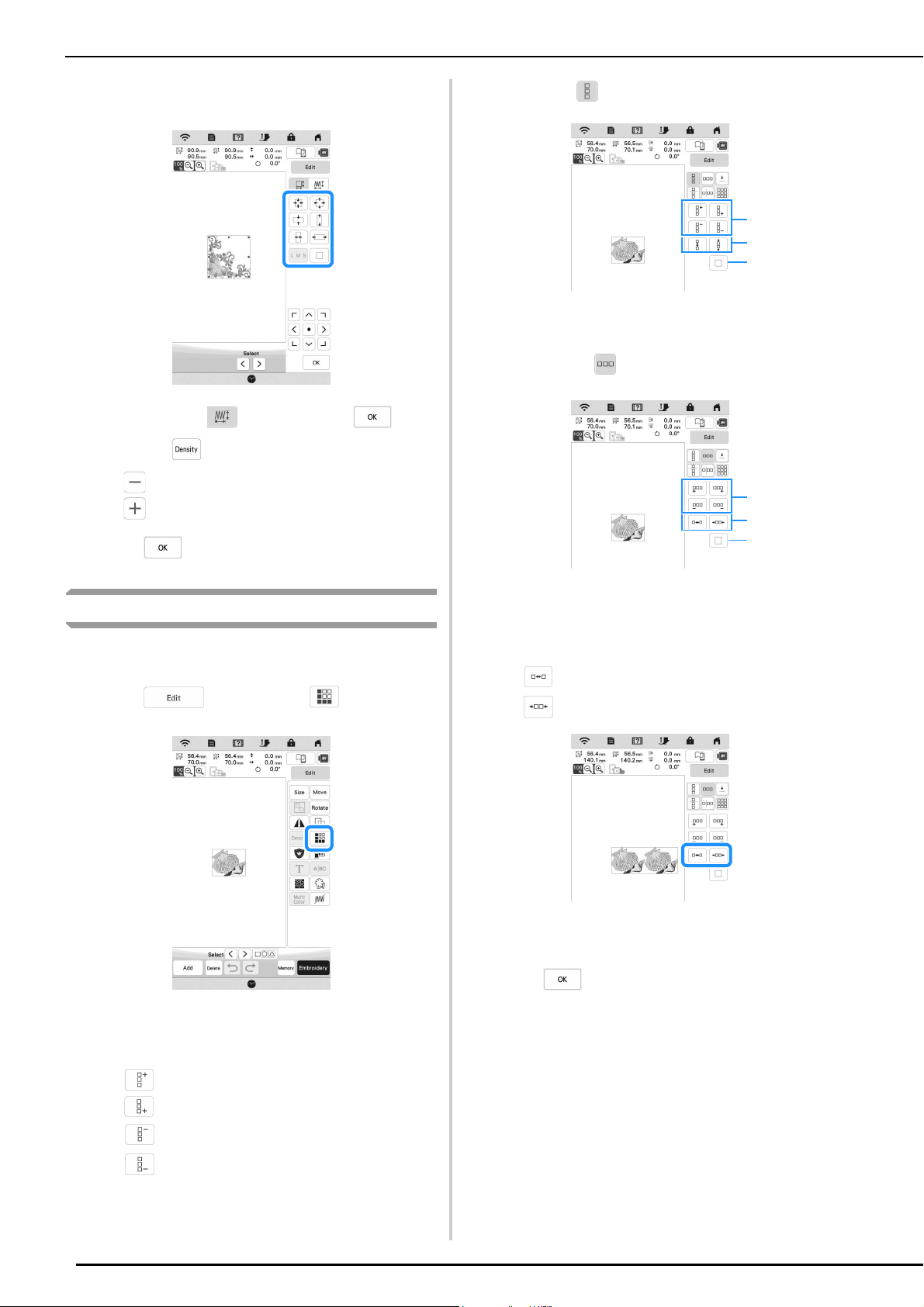
EDITING PATTERNS
42
c
Select the direction in which to change the pattern
size.
d
When you select in step b, touch , and
then touch to change the thread density.
* : Make the pattern less dense.
* : Make the pattern more dense.
e
Touch .
Creating Repeated Patterns
Using the border function, you can create repeated patterns.
You can also adjust the spacing of the patterns.
a
Touch , and then touch .
b
Select the direction in which the pattern will be
repeated.
* : Repeat the pattern above.
* : Repeat the pattern below.
* : Delete above pattern.
* : Delete below pattern.
Vertical direction
1 Repeating and deleting keys
2 Spacing keys
3 Key to cancel pattern repeating
Horizontal direction
1 Repeating and deleting keys
2 Spacing keys
3 Key to cancel pattern repeating
c
Adjust the spacing of the repeated pattern.
* : Widen spacing.
* : Tighten spacing.
d
Complete repeated patterns by repeating steps b
through
c.
e
Touch .
2
1
3
2
1
3
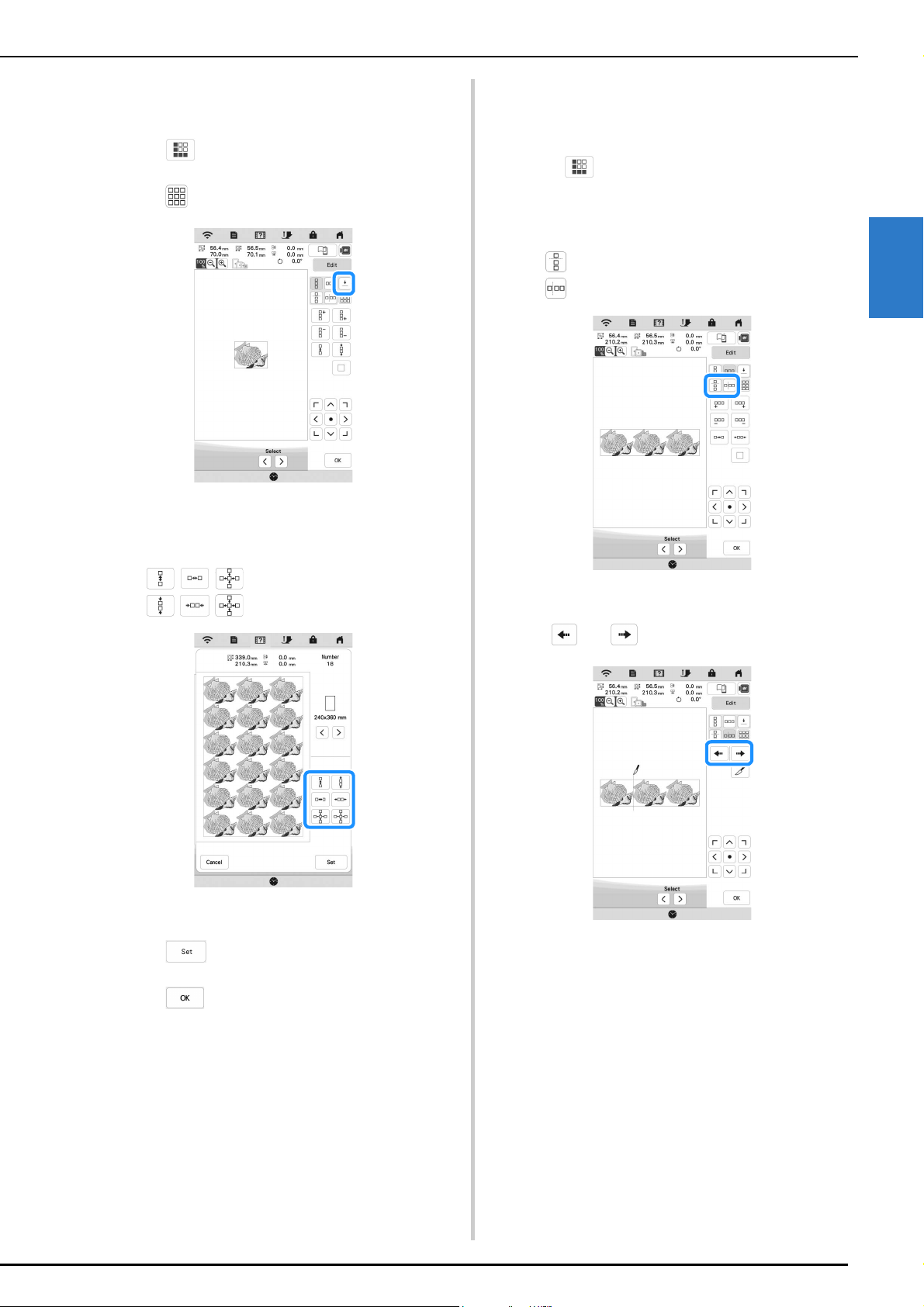
EDITING PATTERNS
43
BASIC EMBROIDERY
2
Repeating Patterns Using the Matrix Copy
Place the pattern repeatedly throughout the embroidery
area.
a
Touch .
b
Touch .
The repeated pattern is displayed positioned
throughout the area.
c
Adjust the spacing of the repeated pattern.
* : Widen spacing.
* : Tighten spacing.
Every time the key is pressed, the pattern is
automatically re-laid out.
d
Touch .
e
Touch .
Repeating One Element of a Repeated Pattern
You can select one element of a repeated pattern and
repeat only that single element. This function allows you
to create complex repeated patterns.
a
Touch .
b
Choose the direction in which the repeated pattern will
be cut.
*
: Cut horizontally.
*
: Cut vertically.
The pattern direction indicator will change
depending on the direction selected.
c
Use and to select the cut line.
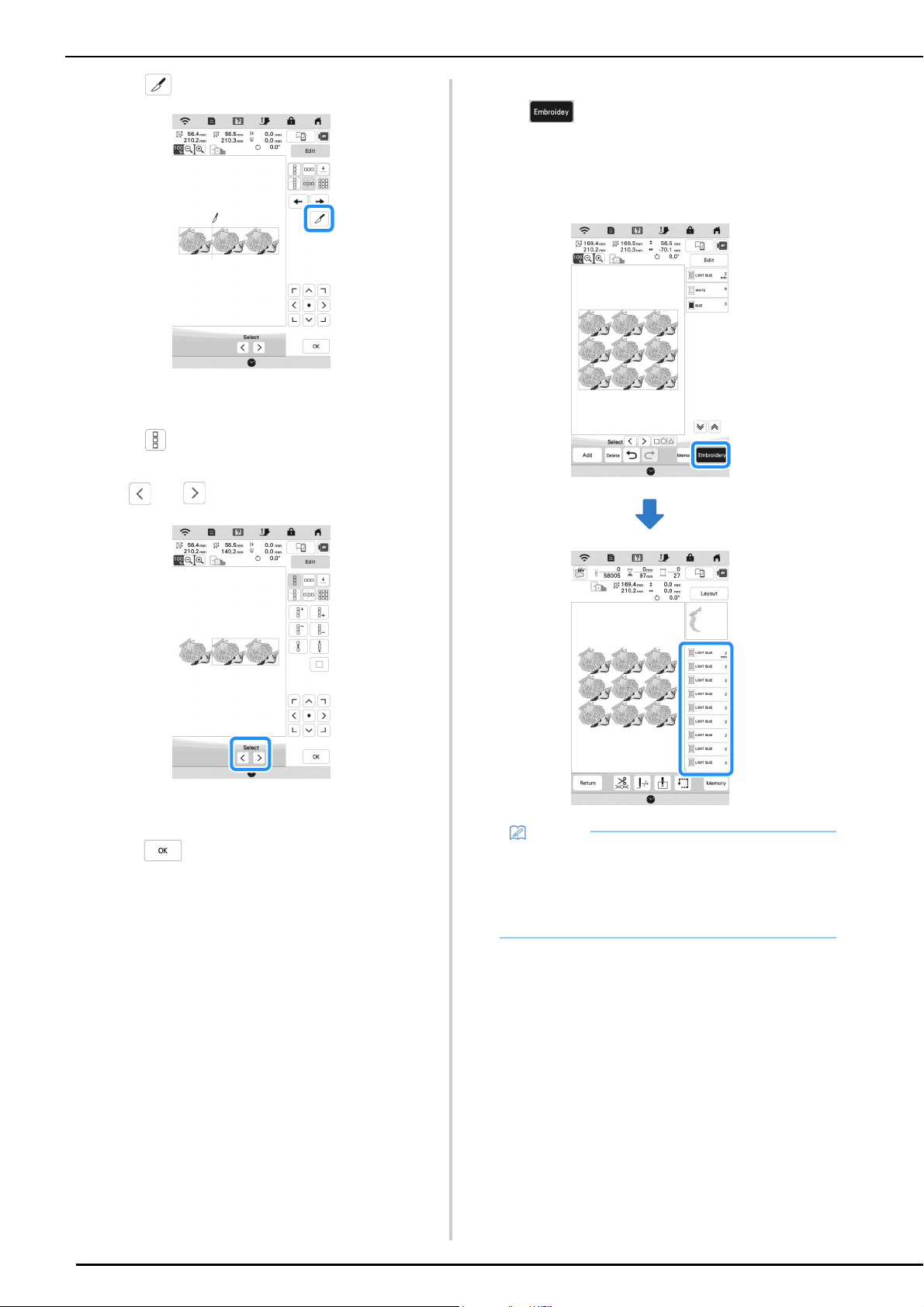
EDITING PATTERNS
44
d
Touch .
The repeated pattern will be divided into separate
elements.
e
Touch .
f
Use and to select the element to repeat.
g
Repeat the selected element.
h
Touch .
Color Sorting Repeated Patterns
Touch to automatically change the embroidering
order of colors in combined border embroidery patterns so
that the same color can be continuously embroidered.
This allows you to continue embroidering without
repeatedly changing the upper thread or changing the
embroidering order manually.
Memo
• When a grouped pattern is repeated, the
embroidering order is changed in each pattern.
• If there are repeated patterns with other repeated
patterns or other patterns, the embroidering order
of only the repeated patterns is changed.
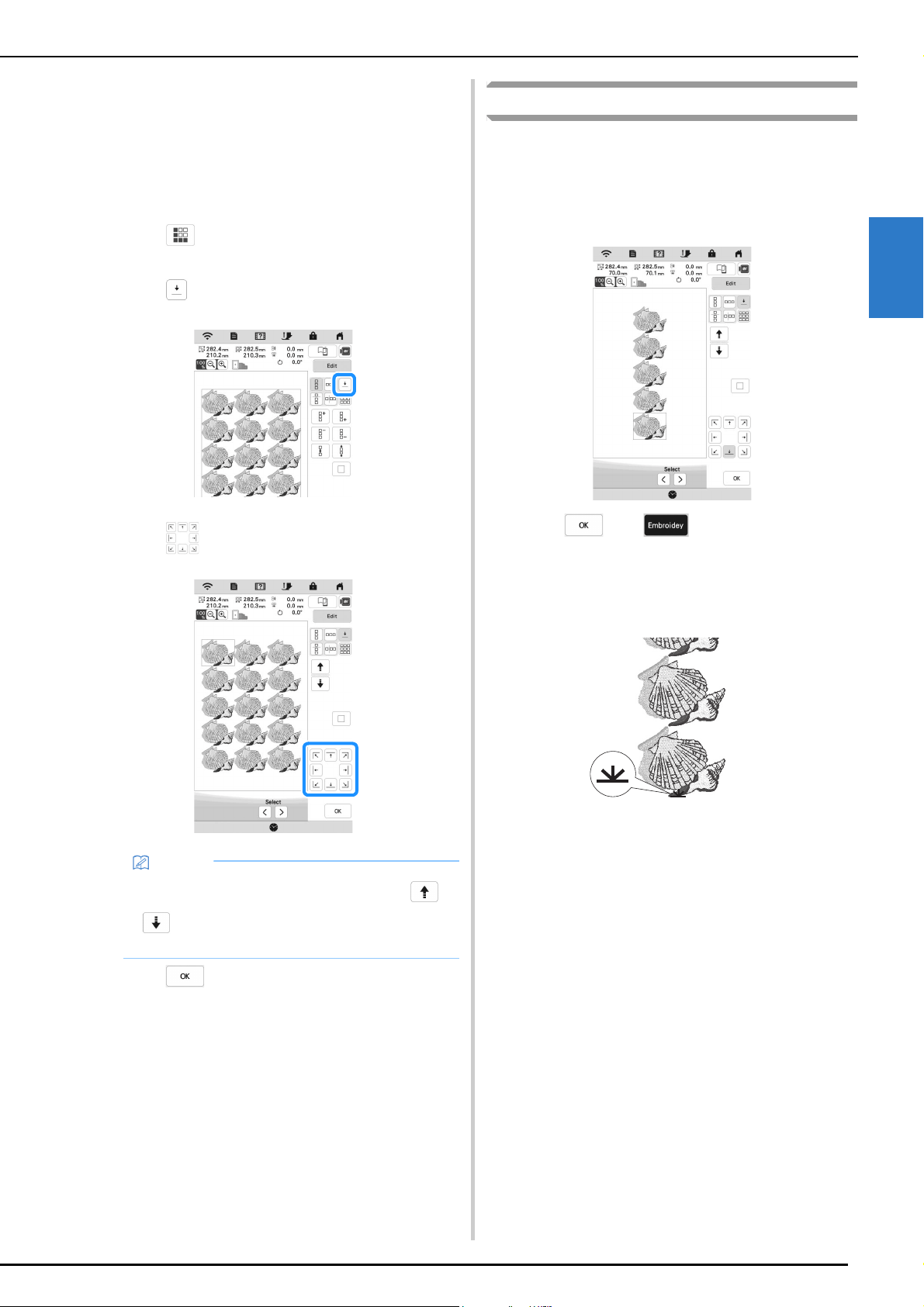
EDITING PATTERNS
45
BASIC EMBROIDERY
2
Assigning Thread Marks
By sewing thread marks, you can easily align patterns
when rehooping the fabric to embroider a series. When
embroidering is finished on a pattern, a thread mark in the
shape of an arrow will be sewn using the final thread.
When embroidering a series of patterns, use the point of
this arrow for positioning the following designs to be
embroidered.
a
Touch .
b
Touch .
c
Touch to select the thread mark to be sewn.
d
Touch .
Embroidering the Pattern Repeatedly
After creating the repeated pattern, rehoop the embroidery
frame and keep embroidering for the next pattern.
a
Select the repeated pattern and assign the thread mark
at the center of the bottom of the pattern.
* Refer to “Assigning Thread Marks” on page 45.
b
Touch , then .
c
Press the “Start/Stop” button to start embroidering.
When embroidering is finished, the thread mark is
embroidered with the last thread color.
d
Remove the embroidery frame.
Memo
• When there are two or more elements, use or
to select an element to assign a thread
mark(s) to.
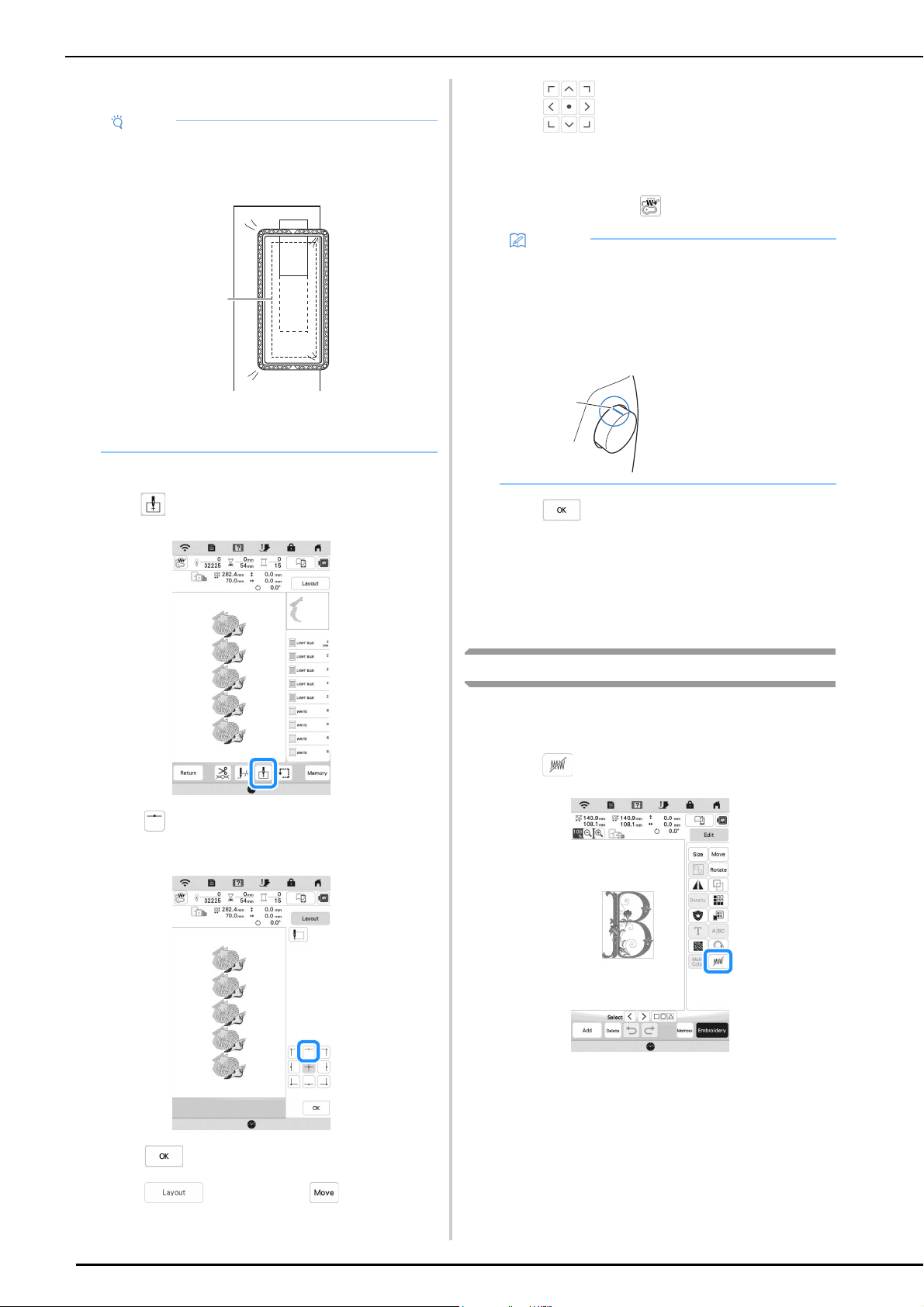
EDITING PATTERNS
46
e
Rehoop the fabric in the embroidery frame.
f
Attach the embroidery frame to the machine, and then
touch .
g
Touch to set the starting point to the center top of
the pattern.
h
Touch .
i
Touch , and then touch .
j
Touch to move the embroidery frame until
the thread mark on the fabric is aligned with the light
of the LED pointer.
* To check the needle drop point with the light of the
LED pointer, touch .
k
Touch .
l
Remove the thread mark.
m
Start embroidering.
Deselect Region Setting (No Sew Setting)
The deselect region setting (which specifies that a thread color
will not be embroidered) can be applied to a part of the
pattern with a specific color.
a
Touch in the embroidering edit screen.
Note
• Adjust the position of the fabric so that the
embroidering area for the next pattern is within the
embroidering area.
1 Pattern embroidered first
2 Position of pattern to be embroidered next
3 Embroidering area
c
a
b
Memo
• For the accurate needle drop point, slowly turn the
handwheel toward you (counterclockwise) to lower
the needle. Then, turn the handwheel away from
you (clockwise) until the mark on the handwheel is
at the top. The carriage cannot move if the mark on
the handwheel is not at the top.
1 Mark
a
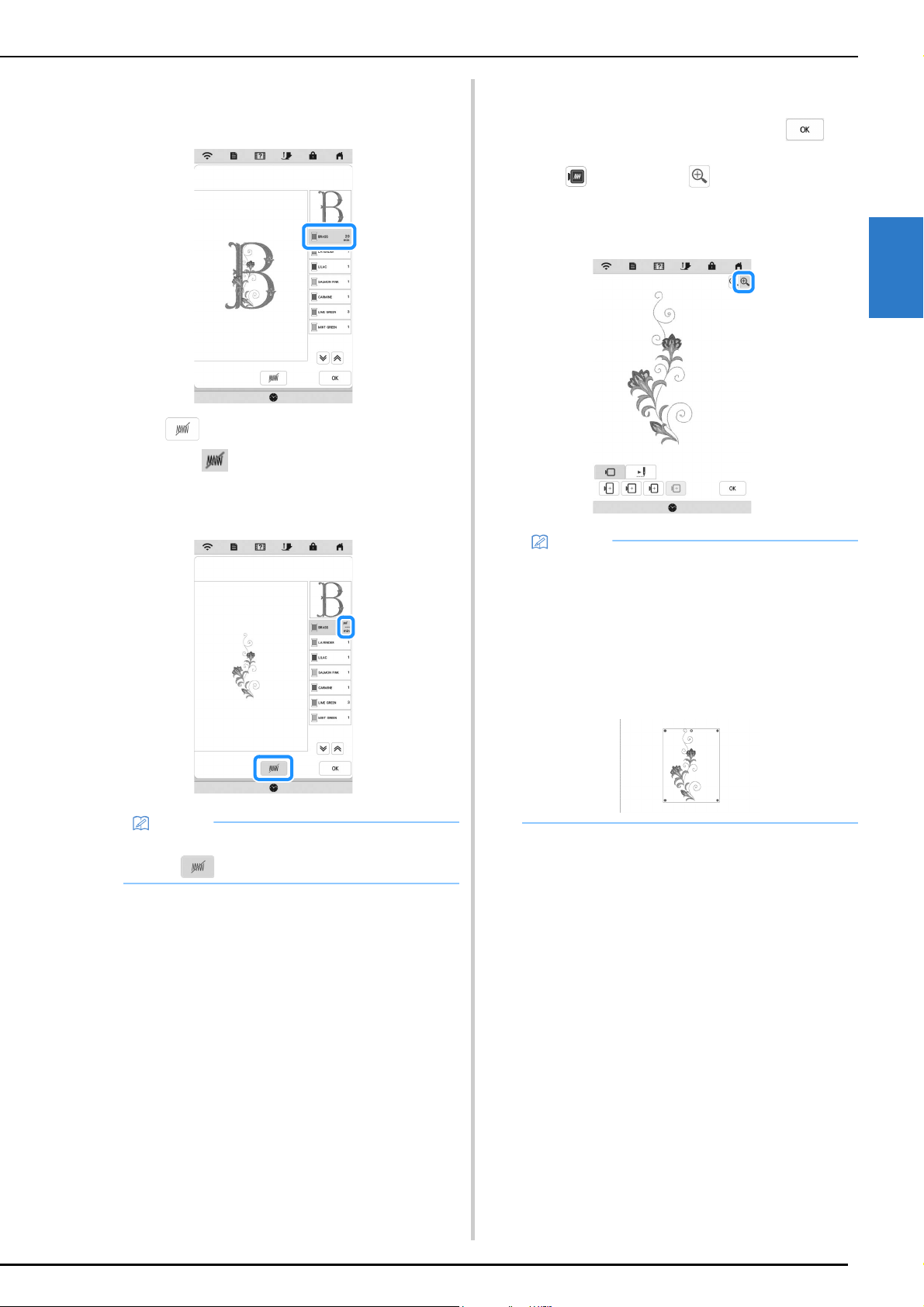
EDITING PATTERNS
47
BASIC EMBROIDERY
2
b
From the thread color sequence display, select the
thread color that will not be embroidered.
The selected thread color is highlighted in blue.
c
Touch .
The mark appears to indicate that the selected
thread color will not be embroidered.
The parts of the pattern that will not be embroidered
are hidden in the pattern preview screen.
d
If necessary, repeat steps b and c for all thread
colors that will not be embroidered.
e
After specifying the desired settings, touch .
f
Touch and then touch to check an enlarged
image of the finished embroidery.
* After deselecting a region, check the image to be
sure no previously hidden stitches are visible.
Memo
• To cancel the setting, select the thread color and
touch .
Memo
• When a pattern with the deselect region setting
applied is saved, the deselect region setting is also
saved. However, the pattern cannot be saved if the
deselect region setting is applied to all thread
colors.
• The parts with the deselect region setting applied
are merely not displayed; they are not deleted. The
embroidery area required to embroider the pattern
is the same as for the original pattern.
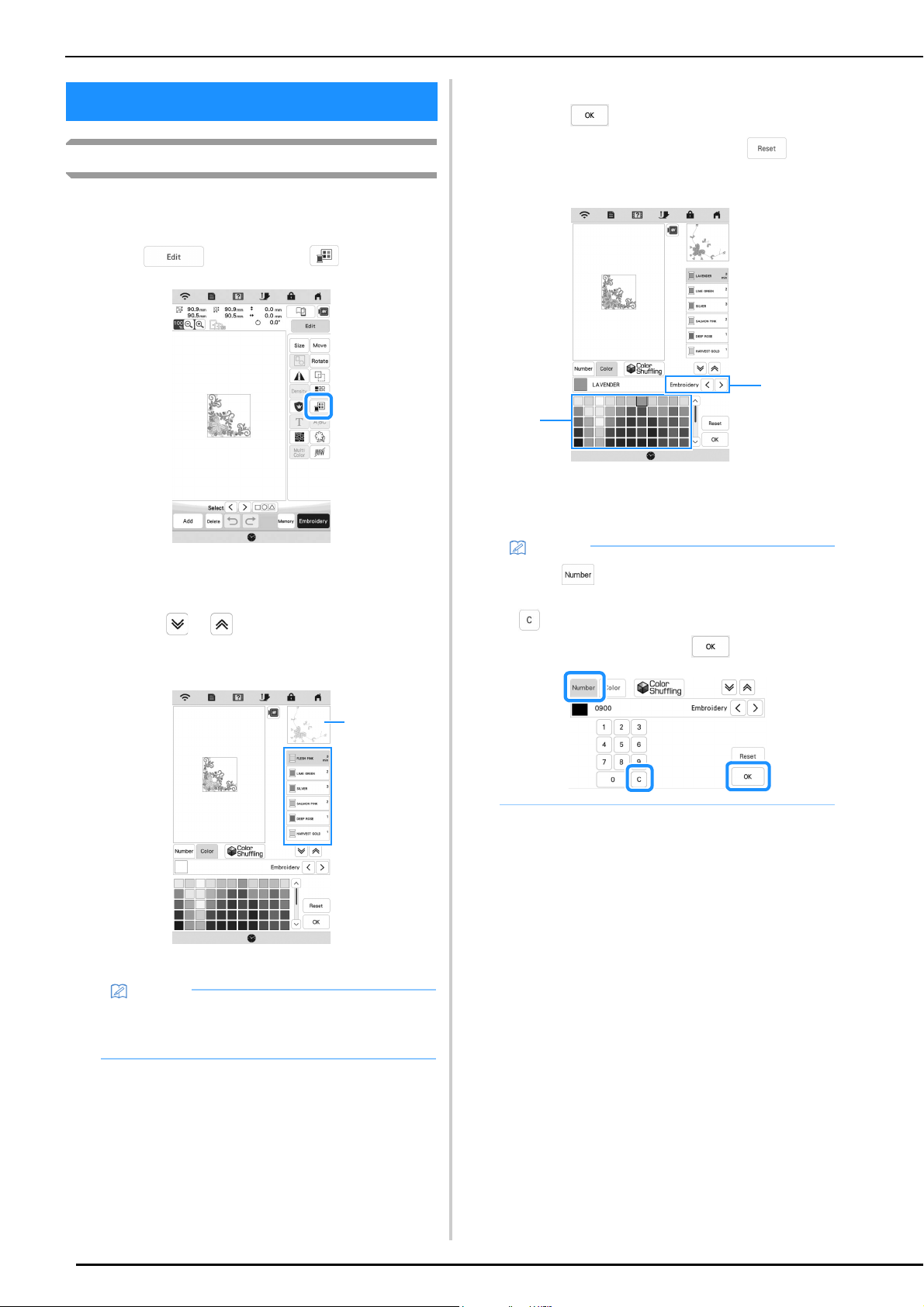
EDITING COLORS
48
Changing the Thread Color
You can change the thread color by moving the color to be
changed to the top of the embroidering order and selecting a
new color from the thread colors in the machine.
a
Touch , and then touch .
The thread color palette appears.
b
Touch the color of the part to be changed.
* Touch or to display the thread color that is
not on the screen.
The selected thread color image appears.
1 Selected thread color image
c
Select a new color from the thread color palette, and
then touch .
* To return to the original color, touch . If
multiple colors have been changed, this command
will return all colors to their original colors.
1 Thread brand for colors
2 Thread color palette
The display shows the changed colors.
EDITING COLORS
Memo
• When you directly touch a part of the pattern
whose color is to be changed, the part can be
selected and displayed.
1
Memo
• Touch to specify a thread color by entering
its number. If you enter the wrong number, touch
, and then enter the correct number. After
entering the number, touch .
2
1
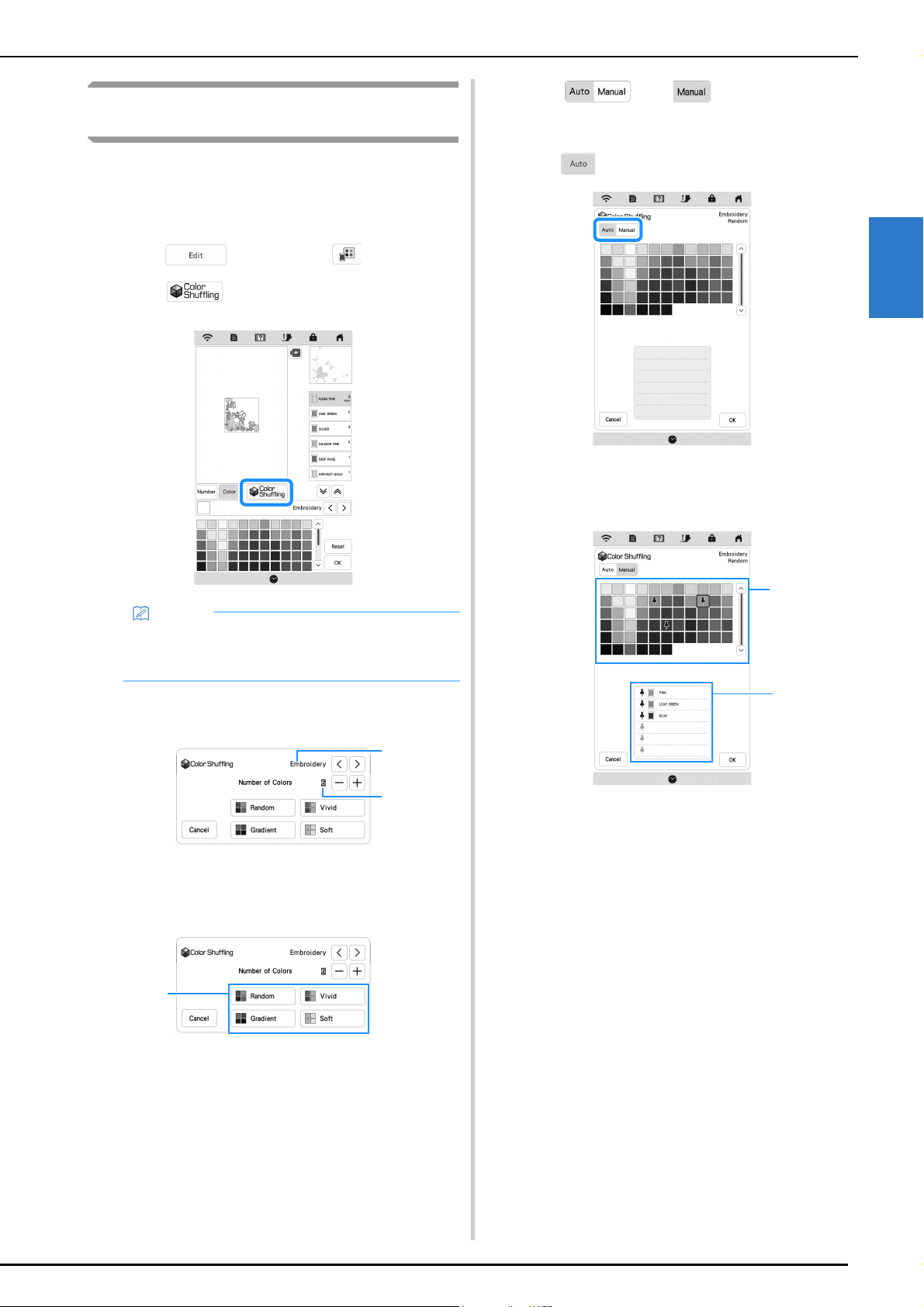
EDITING COLORS
49
BASIC EMBROIDERY
2
Finding New Color Schemes with the Color
Shuffling Function
With the color shuffling function, the machine suggests new
color schemes for the embroidery pattern that you have
selected. After you select the desired effect ([Random],
[Vivid], [Gradient] or [Soft]), sample color schemes for the
selected effect are displayed.
a
Touch , and then touch .
b
Touch .
c
Select the thread brand for colors and the number of
colors you want to create the pattern with.
1 Thread brand for colors
2 Number of colors to be used
d
Select the desired effect.
1 Effects for schemes
If you select [Random] or [Gradient], the color
specifying screen will appear.
If you select [Vivid] or [Soft], proceed to step
g.
e
Touch to set and specify the thread
color to use in the effect.
* If you don’t need to specify the thread color, just set
to .
[Manual] setting for [Random]
You can select up to 6 colors to be used in the [Random]
effect. The effect will be created using the selected colors.
1 Select colors from the palette.
2 Selected colors are listed.
Memo
• This function may not be available depending on
the pattern you select (ex. a repeated pattern,
licensed pattern).
2
1
1
1
2
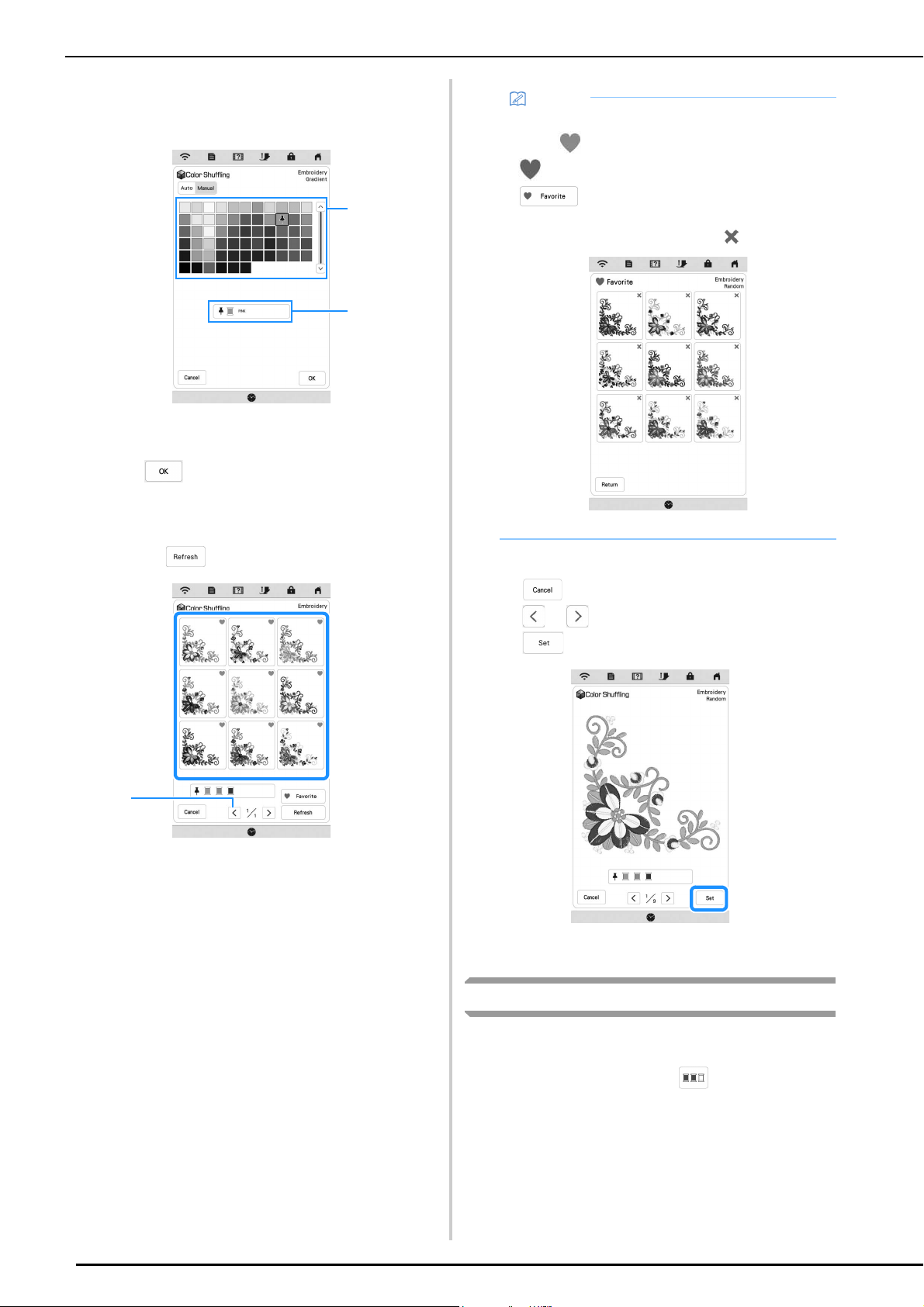
EDITING COLORS
50
[Manual] setting for [Gradient]
You can select one color to be used in the [Gradient] effect.
The effect will be created with a color you select.
1 Select a color from the palette.
2 Selected color is displayed.
f
Touch .
g
Select the desired color scheme from samples.
* Touch to add the new schemes.
1 Touch to review the previous schemes.
h
Select the displayed color scheme.
* : Return to the previous screen.
* or : Display the other color schemes.
* : Select the displayed color scheme.
The thread color palette screen will appear.
Thread Color Sorting
This function allows you to embroider while replacing the
thread spool a minimal number of times.
Before starting to embroider, touch in the embroidery
screen to rearrange the embroidery order and sort it by thread
colors.
1
2
1
Memo
• To temporarily register your favorite schemes,
touch (to release your favorite schemes, touch
again). 9 color schemes can be added. Touch
to check the registered favorite
schemes.
To cancel the registration, touch .
• Maximum 20 pages of schemes can be reviewed.
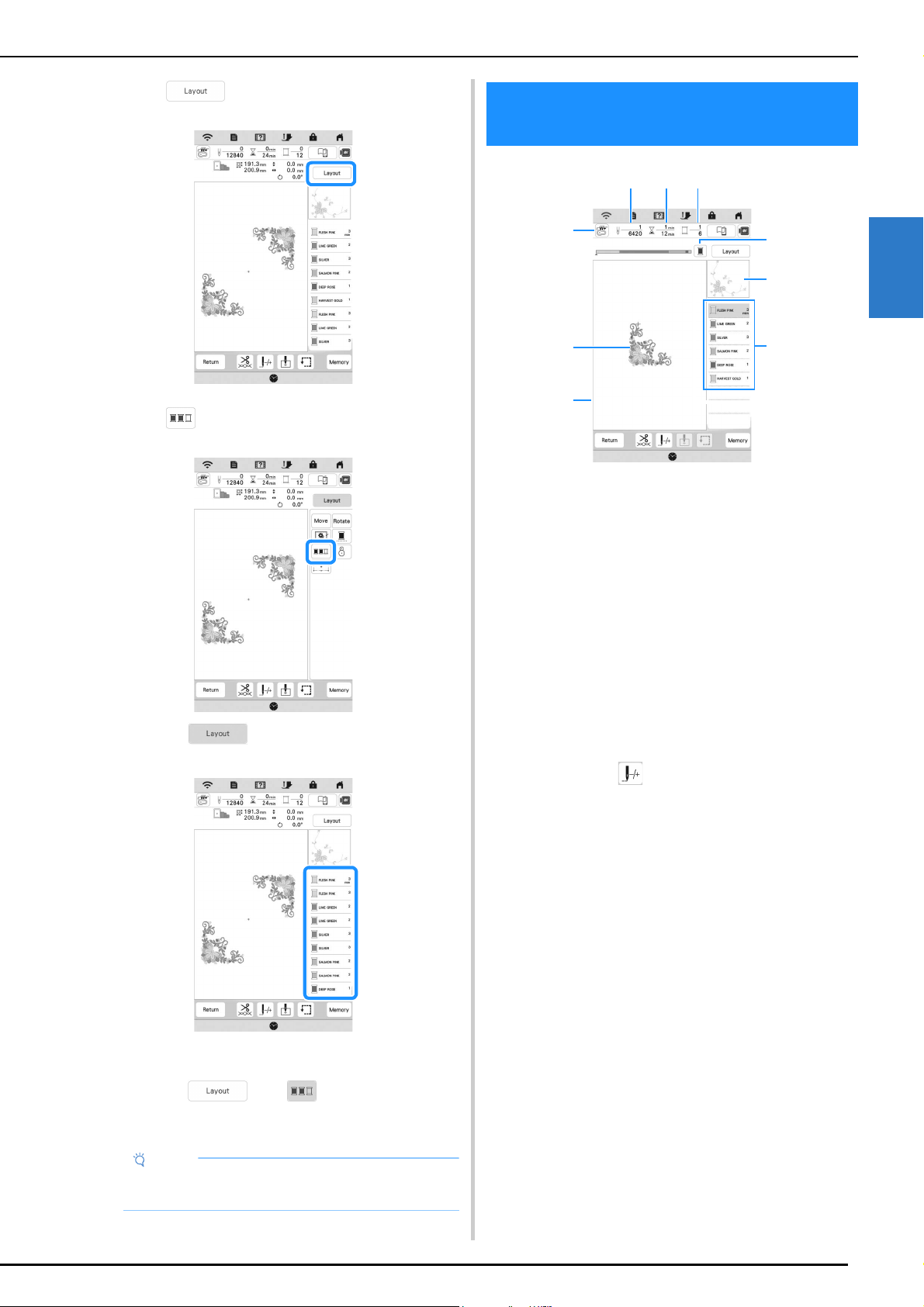
VIEWING THE EMBROIDERY SCREEN
51
BASIC EMBROIDERY
2
a
Touch in the embroidery screen.
b
Touch .
* Touch again to check the sorted thread
colors.
The embroidery color order is rearranged and sorted
by thread colors.
* Touch , then to cancel color sorting
and embroider with the original embroidery color
order.
* This screen appears when embroidery starts.
1 The presser foot symbol
Attach embroidery foot “W+” with LED pointer or
embroidery foot “W” (sold separately) for all embroidery
projects.
2 A preview of the pattern
3 The boundary for embroidering with the selected frame
in the settings screen
4 Total number of stitches in the selected pattern and
number of stitches that have already been embroidered
5 The time necessary to embroider the pattern, and the
time already spent embroidering the pattern (not
including time for changing and automatically trimming
the thread)
6 The number of colors in the pattern, and the number of
the color currently being embroidered
7 Switch the progress bar (which shows the embroidering
progress) between showing only one color or all colors.
This key appears after starting embroidering or after
touching the key.
8 The part of the embroidery pattern that will be
embroidered with the thread color at the top of the list
9 The order for thread color changes and the embroidering
time for each thread color
* The displayed time is the approximate time that will
be required. The actual embroidering time may be
longer than the displayed time, depending on the
embroidery frame that is used. In addition, the
amount of time required to change thread colors is
not included.
Note
• This function does not work on overlapping
patterns.
VIEWING THE EMBROIDERY
SCREEN
9
1
2
3
7
4 5 6
8
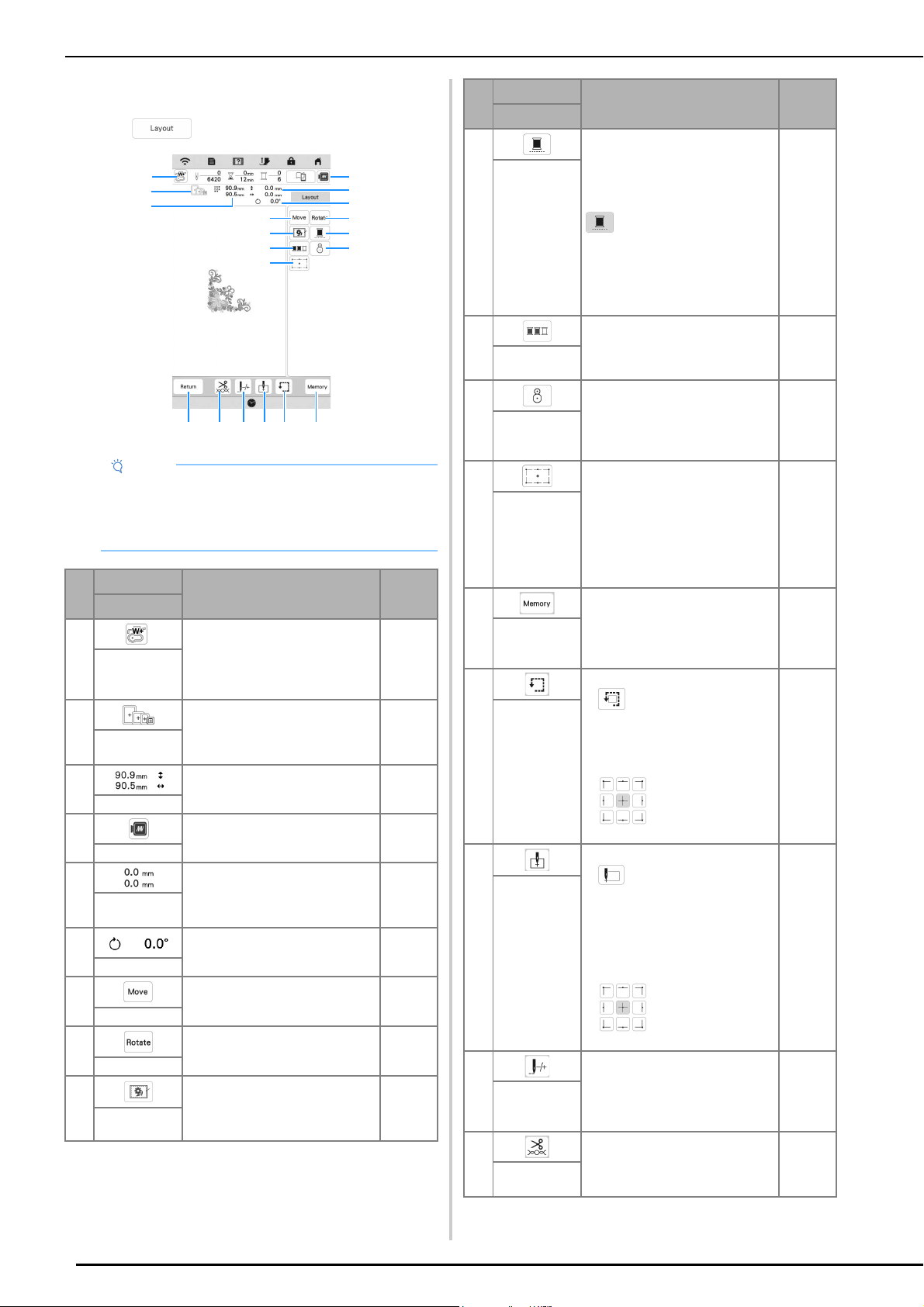
VIEWING THE EMBROIDERY SCREEN
52
Key Functions
Using these keys, you can move or rotate pattern, etc.
Touch to display the editing window.
Note
• Some operations or functions are not available for
certain patterns. If the key display is grayed out,
you cannot use that function or operation with the
selected pattern.
No.
Display
Explanation Page
Name
1 Turn on the light of the LED
pointer.
Touch this key to check the needle
drop point with the light of the LED
pointer.
57
Needle point
check key
2 Shows the embroidery frames that
can be used for the selected
pattern.
Be sure to use the proper frame.
54
Available
frames
3 Shows the size of the selected
pattern.
—
Pattern size
4 Preview the embroidery image. 41
Image key
5 Shows the distance between the
embroidering position and the
center (when the embroidery
pattern is moved).
—
Distance
6 Shows the degree of rotation of
the pattern.
—
Degree
7 Display the pattern moving
window.
—
Move key
8 Display the pattern rotating
window.
—
Rotate key
9 Add the basting stitch around the
pattern. You can select the
distance from the pattern to the
basting stitching.
14, 71
Basting key
8
EFH G
4
0
B
1
DI
7
9
A
3
2
5
6
C
0 Change the setting to embroider
the pattern with a single color.
Touch the key again to return to
the original setting.
Even if uninterrupted embroidering
has been set, the automatic
thread cutting function and the
thread trimming function can be
used.
The icons of the spool of thread
are grayed out.
—
Uninterrupted
embroidery
key
A Touch this key to rearrange the
stitching sequence for combined
patterns.
50
Thread color
sorting key
B Touch this key to align the
embroidering position.
59
Embroidery
positioning
key
C Switch on/off the 2-point
embroidery positioning function
with a LED pointer.
61
2-point
embroidery
positioning
function with a
LED pointer
on/off key
D Save the pattern to the machine’s
memory or USB media. The
pattern can also be transferred to
a computer via a wireless network
connection.
81
Memory key
E Check the position of the pattern.
• : Move the carriage to
trace the embroidery area of the
pattern. This allows you to
check that there is enough
space to embroider the pattern.
• : Move the carriage to
the selected position.
60
Trace key
F Specify the needle start position.
• : Set the needle start
position to the lower-left corner
of the pattern. This setting is
useful when connecting
patterns since it allows you to
continue embroidering until the
first stitch of the next pattern.
• : Move the carriage to
the selected position.
79, 80
Starting point
key
G Move the needle forward or back
in the pattern; useful if the thread
breaks while embroidering or if
you want to start again from the
beginning.
68
Forward/Back
key
H Set automatic thread cutting,
thread trimming or the thread
tension. For embroidery, these
functions are set automatically.
75-78
Cut/Tension
key
No.
Display
Explanation Page
Name
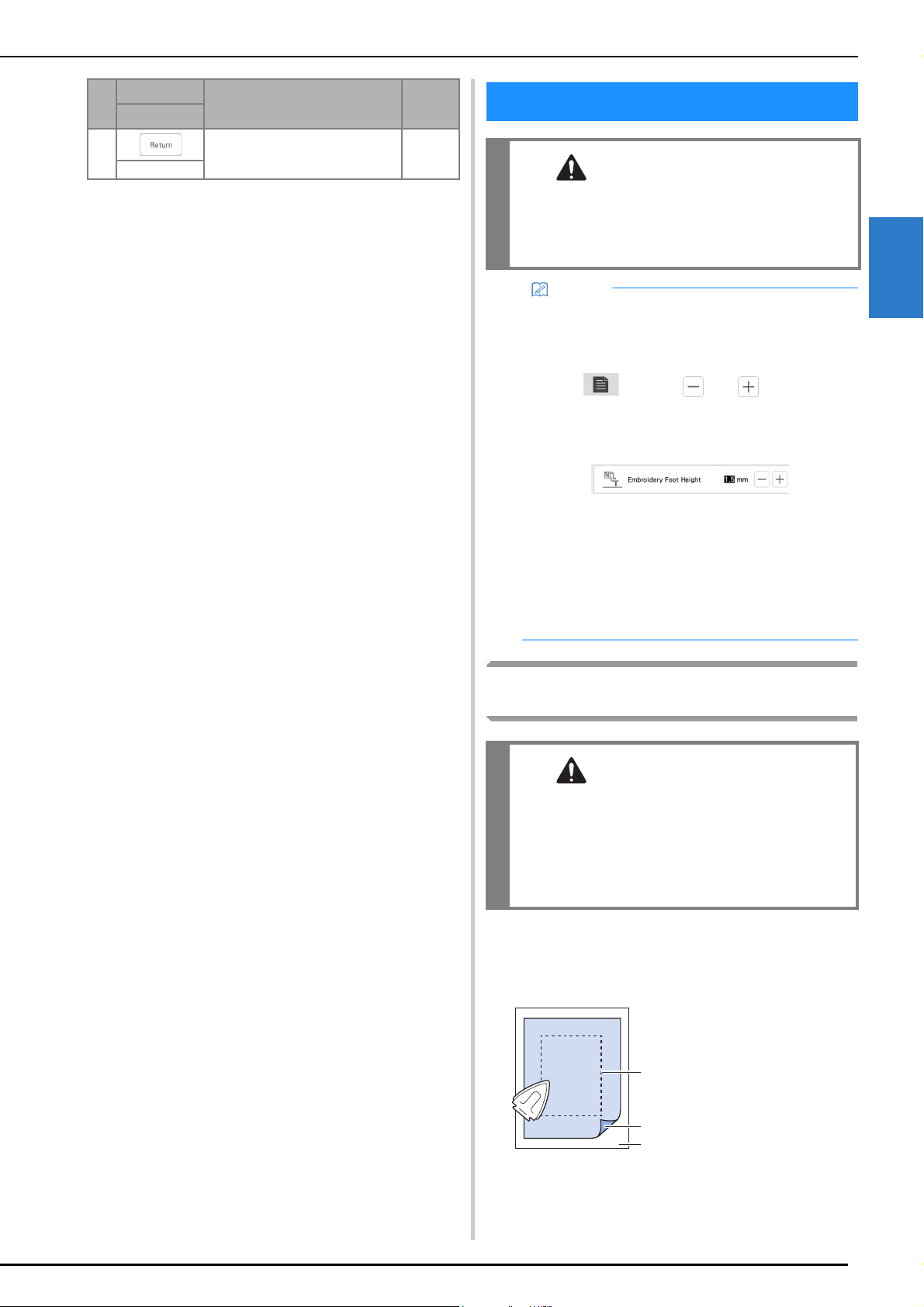
PREPARING THE FABRIC
53
BASIC EMBROIDERY
2
Attaching Iron-on Stabilizers (Backing) to
the Fabric
a
Iron the iron-on stabilizer material to the wrong side of
the fabric.
• Use a piece of stabilizer which is larger than the
embroidery frame being used.
I Return to the edit screen. —
Return key
No.
Display
Explanation Page
Name
PREPARING THE FABRIC
CAUTION
• Use fabrics with a thickness of less than 2 mm
(approx. 1/16 inch). Using fabrics thicker than
2 mm (approx. 1/16 inch) may cause the
needle to break and cause injury.
Memo
• When using layers with thicker batting etc., you can
embroider more attractive finishes by adjusting the
embroidery presser foot height in the embroidery
settings screen.
Touch , and use and in the
[Embroidery Foot Height] in the embroidery
settings screen. Adjust the presser foot height for
thick or puffy fabrics.
• To increase the space between the embroidery foot
and the needle plate, set the [Embroidery Foot
Height] to a larger number.
• In the case of thick terry cloth towels, we
recommend that you place a piece of water soluble
stabilizer on the top surface of the towel. This will
help to reduce the nap of the toweling and result in
more attractive embroidery.
CAUTION
• Always use a stabilizer material for embroidery
when embroidering on stretch fabrics,
lightweight fabrics, fabrics with a coarse
weave, or fabrics which cause pattern
shrinkage. Otherwise, the needle may break
and cause injury.
1 Fusible side of stabilizer
2 Fabric (wrong side)
3 Size of the embroidery
frame
a
b
c
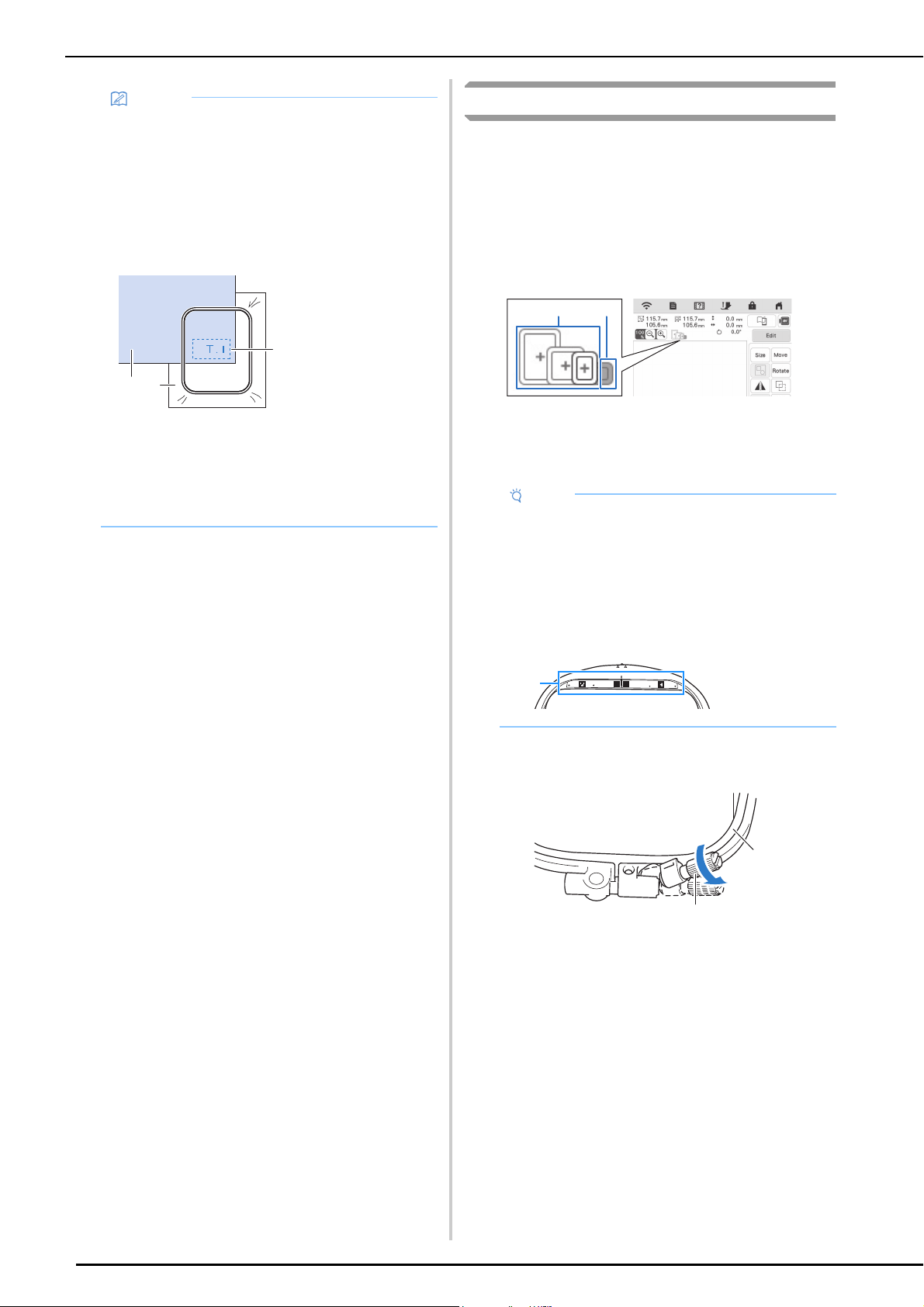
PREPARING THE FABRIC
54
Hooping the Fabric in the Embroidery Frame
Types of Embroidery Frames
Optional embroidery frames can be used. When choosing
frames that do not appear on the screen, be sure to check
the design size of the embroidery field of the optional
frame. Check with your authorized Brother dealer for
frame compatibility.
Select a frame that matches the pattern size. Available
frame options are displayed on the LCD.
1 Highlighted: Can be used
2 Shaded: Cannot be used
Inserting the Fabric
a
Lift-up and loosen the frame adjustment screw and
remove the inner frame.
1 Frame adjustment screw
2 Inner frame
b
Lay the fabric right side up on top of the outer frame.
Memo
• When embroidering small pieces of fabric that
cannot be hooped in an embroidery frame, use
stabilizer material as a base. After lightly ironing the
fabric to the stabilizer material, hoop it in the
embroidery frame. If stabilizer material cannot be
ironed onto the fabric, attach it with a basting
stitch. After completing the embroidery, remove the
stabilizer material carefully.
• When embroidering on thin fabrics such as
organdy or lawn, or on napped fabrics such as
towel or corduroy, use water soluble stabilizer (sold
separately) for best results. The water soluble
stabilizer material will dissolve completely in water,
giving the project a more attractive finish.
1 Fabric
2 Stabilizer
3 Basting
a
b
c
Note
• If the fabric is not securely held in the embroidery
frame, the pattern will embroider out poorly. Insert
the fabric on a level surface, and gently stretch the
fabric taut in the frame.
• Embroidery frames with factory-coded stickers can
be used with the application (My Design Snap).
(page 107)
a
b
1 Factory-
coded
stickers
1
a
b
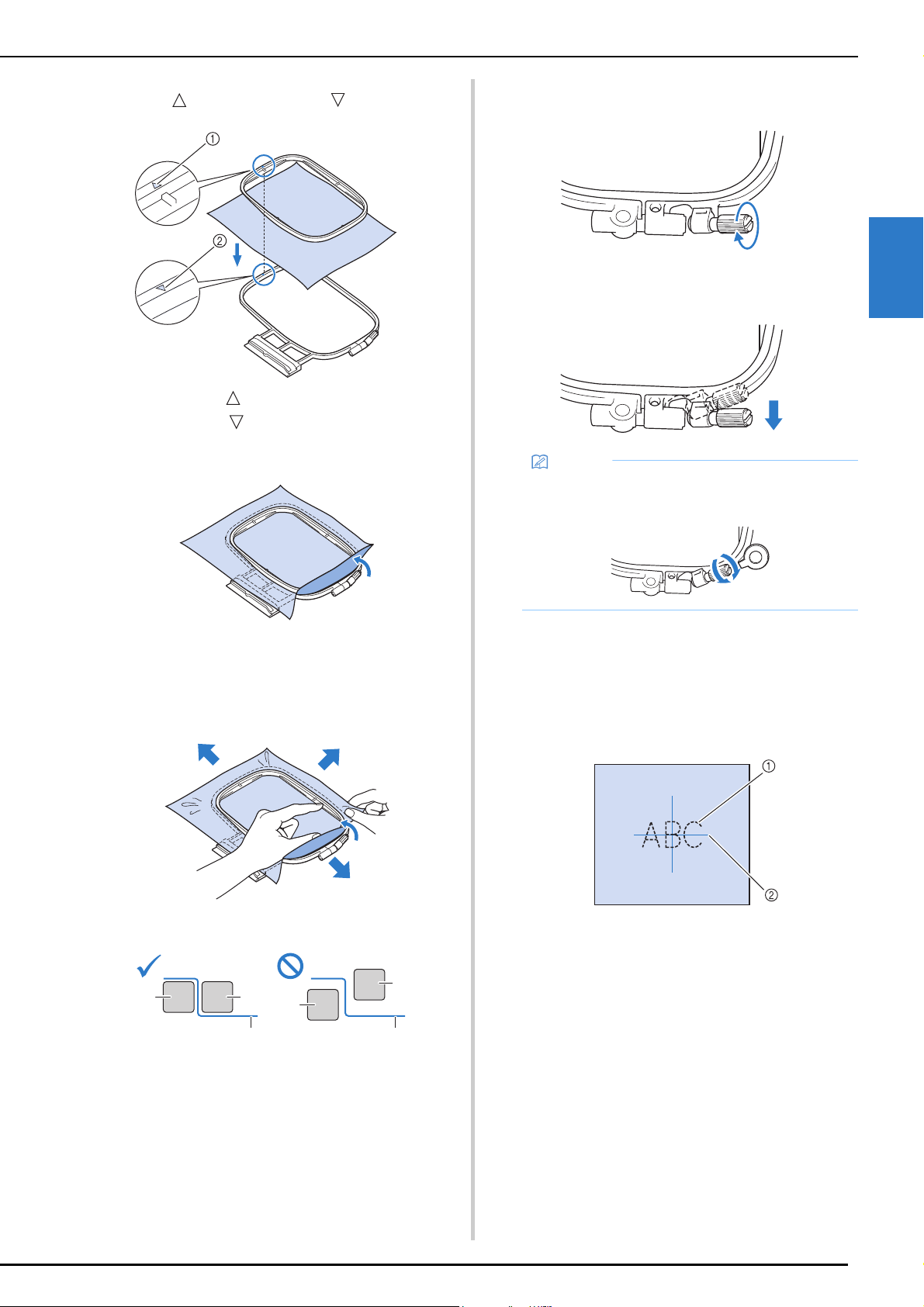
PREPARING THE FABRIC
55
BASIC EMBROIDERY
2
c
Insert the inner frame making sure to align the inner
frame’s with the outer frame’s .
1 Inner frame’s
2 Outer frame’s
d
Slightly tighten the frame adjustment screw.
e
Gently smooth out the fabric. Make sure fabric is flat
and without wrinkles.
* After stretching the fabric, make sure the fabric is
taut.
* Make sure the inside and outside frames are even
before you start embroidering.
1 Outer frame
2 Inner frame
3 Fabric
f
Tighten the frame adjustment screw to keep the fabric
from loosening while stitching.
g
Return the frame adjustment screw to its initial
position.
Using the Embroidery Sheet
When you want to embroider the pattern in a particular
place, use the embroidery sheet with the frame.
a
With a chalk pencil, mark the area of the fabric you
want to embroider.
1 Embroidery pattern
2 Mark
a
b
c
a
b
c
Memo
• You can use the disc-shaped screw driver, when
you loosen or tighten the frame adjustment screw.
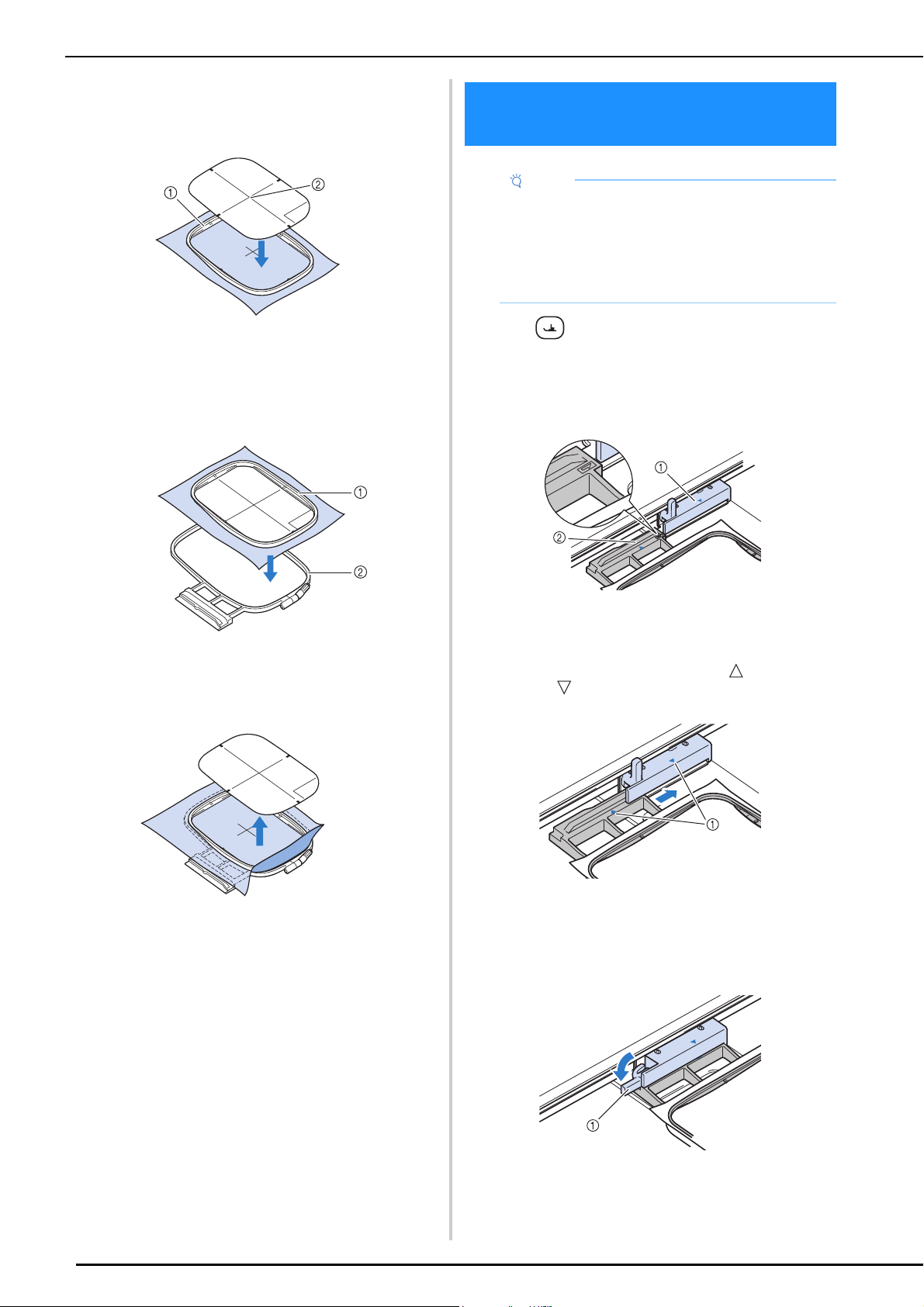
ATTACHING THE EMBROIDERY FRAME
56
b
Place the embroidery sheet on the inner frame. Align
the guide lines on the embroidery sheet with the mark
you made on the fabric.
1 Inner frame
2 Guide line
c
Gently stretch the fabric so there are no folds or
wrinkles, and press the inner frame into the outer
frame.
1 Inner frame
2 Outer frame
d
Remove the embroidery sheet.
a
Press (Presser foot lifter button) to raise the
presser foot.
b
Align the embroidery frame guide with the right edge
of the embroidery frame holder.
1 Embroidery frame holder
2 Embroidery frame guide
c
Slide the embroidery frame into the holder, making
sure to align the embroidery frame’s with the
holder’s .
1 Arrow mark
d
Lower the frame-securing lever to be level with the
frame to secure the embroidery frame in the
embroidery frame holder.
1 Frame-securing lever
ATTACHING THE EMBROIDERY
FRAME
Note
• Wind embroidery bobbin thread and insert the
bobbin before attaching the embroidery frame.
Check that there is enough thread in the bobbin.
• Make sure that the frame-securing lever is correctly
lowered after the embroidery frame has been
installed in the embroidery frame holder.
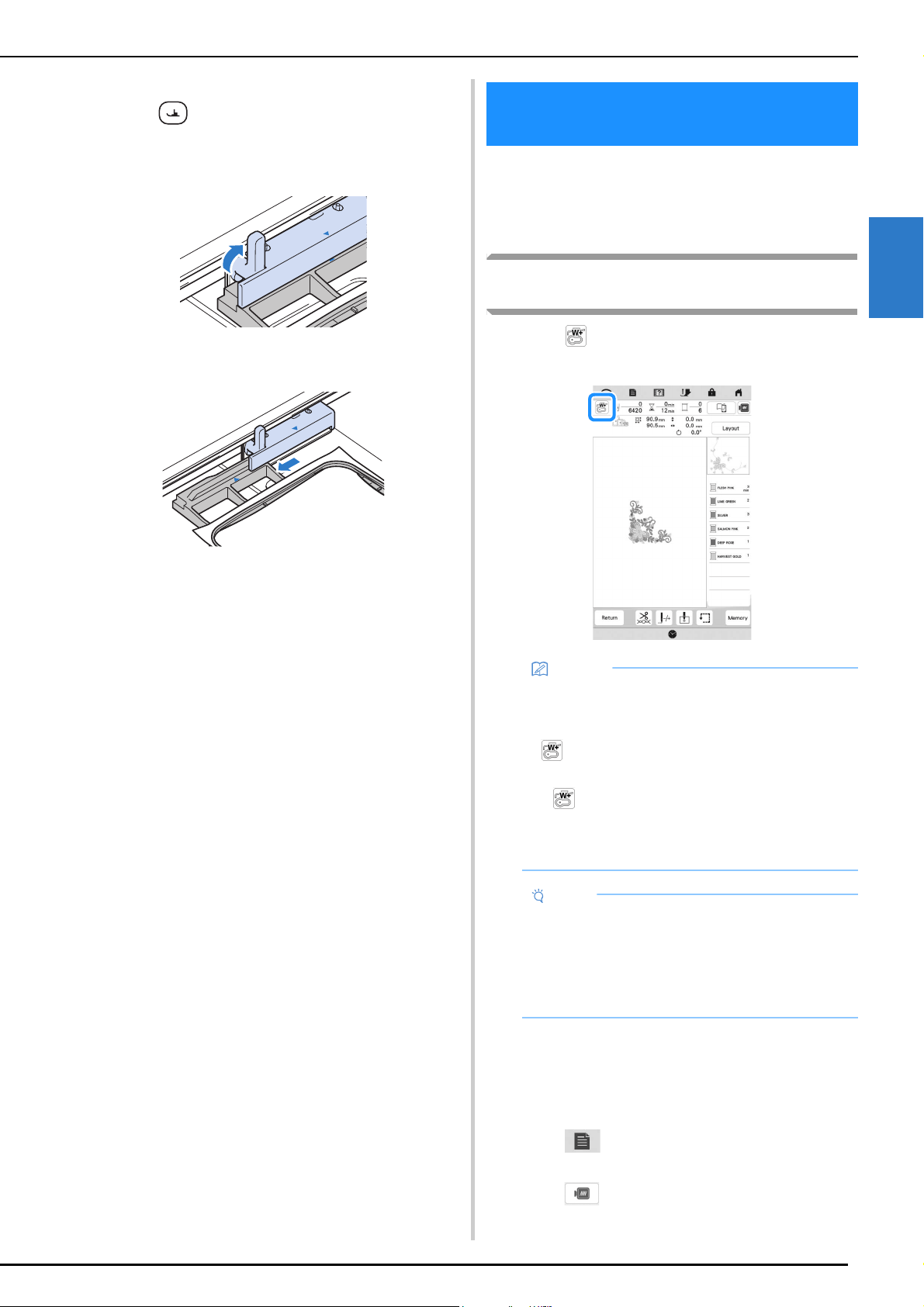
CONFIRMING THE PATTERN POSITION
57
BASIC EMBROIDERY
2
Removing the Embroidery Frame
a
Press (Presser foot lifter button) to raise the
presser foot.
b
Raise the frame-securing lever.
c
Pull the embroidery frame toward you.
The pattern is normally positioned in the center of the
embroidery frame. If the pattern needs to be repositioned
for better placement on the garment, you can check the
layout before starting embroidery.
Checking the Needle Drop Point with the
Embroidery Foot “W+” with LED Pointer
a
Touch in the embroidery screen.
The LED pointer indicates the needle drop point.
Adjusting the LED Pointer
Adjust the LED pointer if it indicates a point different than
the actual needle drop point. Before adjusting the LED
pointer, mark the actual needle drop point on the fabric to
be embroidered, and attach the embroidery frame.
a
Touch .
The settings screen appears.
b
Touch .
The embroidery settings screen appears.
CONFIRMING THE PATTERN
POSITION
Memo
• When the LED pointer turns on, the presser foot
height is automatically adjusted according to the
fabric thickness.
• appears when the embroidery foot “W+” with
LED pointer is attached to the machine.
• If is not displayed, you cannot use the LED
pointer.
• The LED pointer turns off automatically by lowering
the presser foot or returning to the previous page.
Note
• With spongy fabric, the position may not be
accurate due to the various depths of the fabric.
• With fabric that has a very uneven surface such as
quilting, the fabric thickness may not be correctly
measured. In this case, the pointer indication
should be used only as a reference.
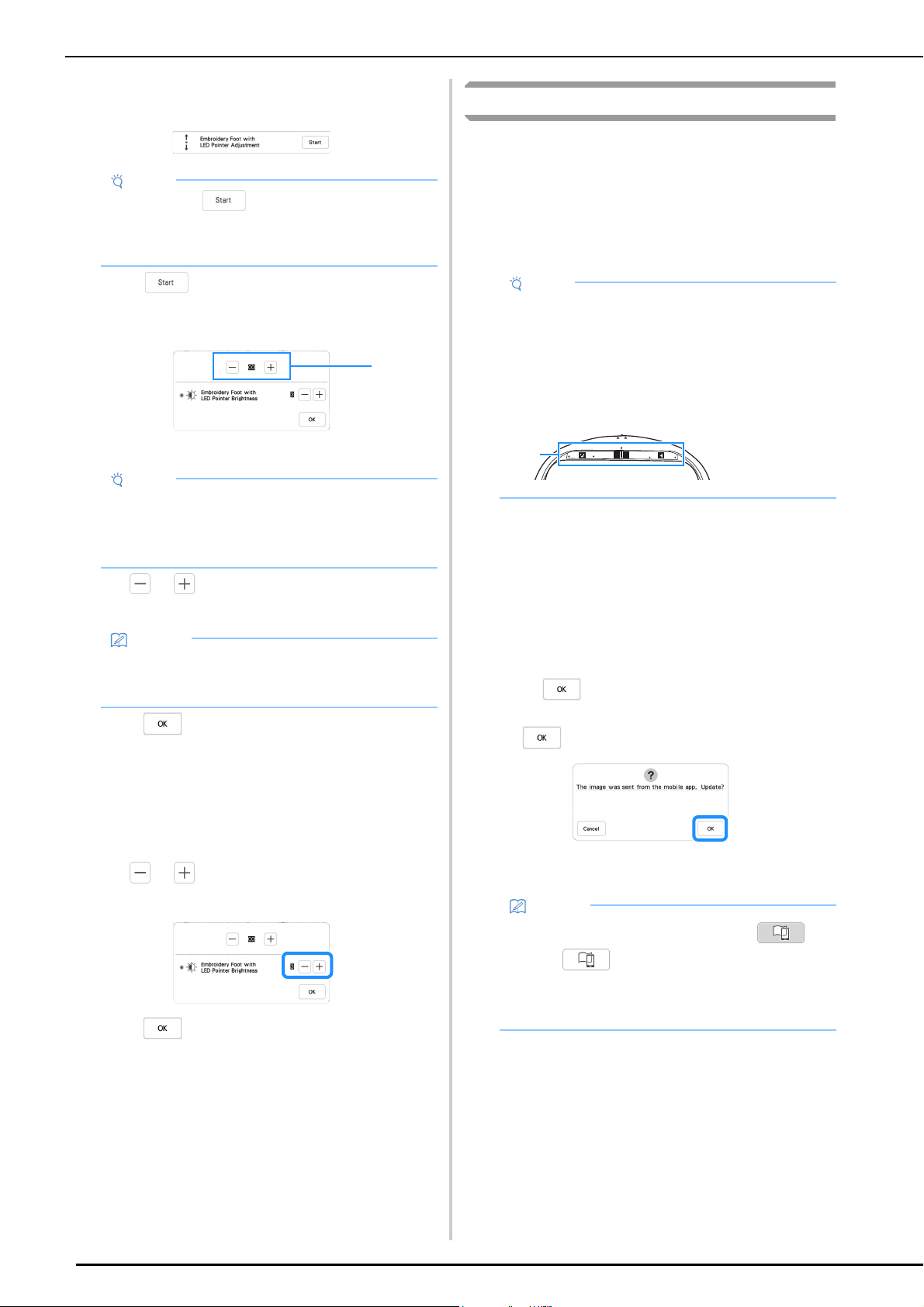
CONFIRMING THE PATTERN POSITION
58
c
Display [Embroidery Foot with LED Pointer
Adjustment] in the embroidery setting screen.
d
Touch .
The Embroidery Foot “W+” with LED Pointer
Adjustment screen appears.
1 LED pointer adjustment
e
Use or to adjust the LED pointer so that it
indicates the actual needle drop point.
f
Touch to return to the original screen.
Adjusting the Brightness of the LED Pointer
a
Follow the steps from a to c of “Adjusting the LED
Pointer” on page 57 to display the embroidery foot
with LED pointer adjustment screen.
b
Use or to adjust the brightness of the LED
pointer.
c
Touch to return to the original screen.
Displaying a Background Image
Using a special application downloaded to a smartphone or
tablet, you can transfer a photo of the hooped fabric to be
embroidered to the machine to be used as a background
image.
The embroidery frame is displayed in the application. You can
see how the pattern will be arranged on the actual fabric.
For details, refer to “MY DESIGN SNAP APP” on page 107.
Displaying the Background Image on the
Screen of the Machine
a
Select the pattern. (page 33)
b
Photograph the fabric in the frame with the easy mode
of the application, and then transfer it to the machine.
For a detailed procedure, refer to the application.
c
Touch .
* Attach the frame used in the image before touching
.
The transferred background image appears on the
screen of the machine.
Note
• As a default, appears gray. After the
embroidery foot “W+” with LED pointer is attached
to the machine, the key becomes available and
settings can be specified.
Note
• The specified setting is saved in the machine’s
memory. This is useful for positioning during
continuous embroidering.
• For normal use, return the setting to [00].
Memo
• In order to more accurately check the needle drop
point, turn the handwheel toward you
(counterclockwise) to lower the needle.
1
Note
• The wireless network settings must first be
specified on the machine. Refer to “WIRELESS
NETWORK CONNECTION FUNCTIONS” on
page 18.
• Embroidery frames with factory-coded stickers can
be used with the application (My Design Snap).
Memo
• To hide the background image, touch .
Touch to display the background image
again.
• The transferred background image includes the
embroidery frame display.
1 Factory-
coded
stickers
1
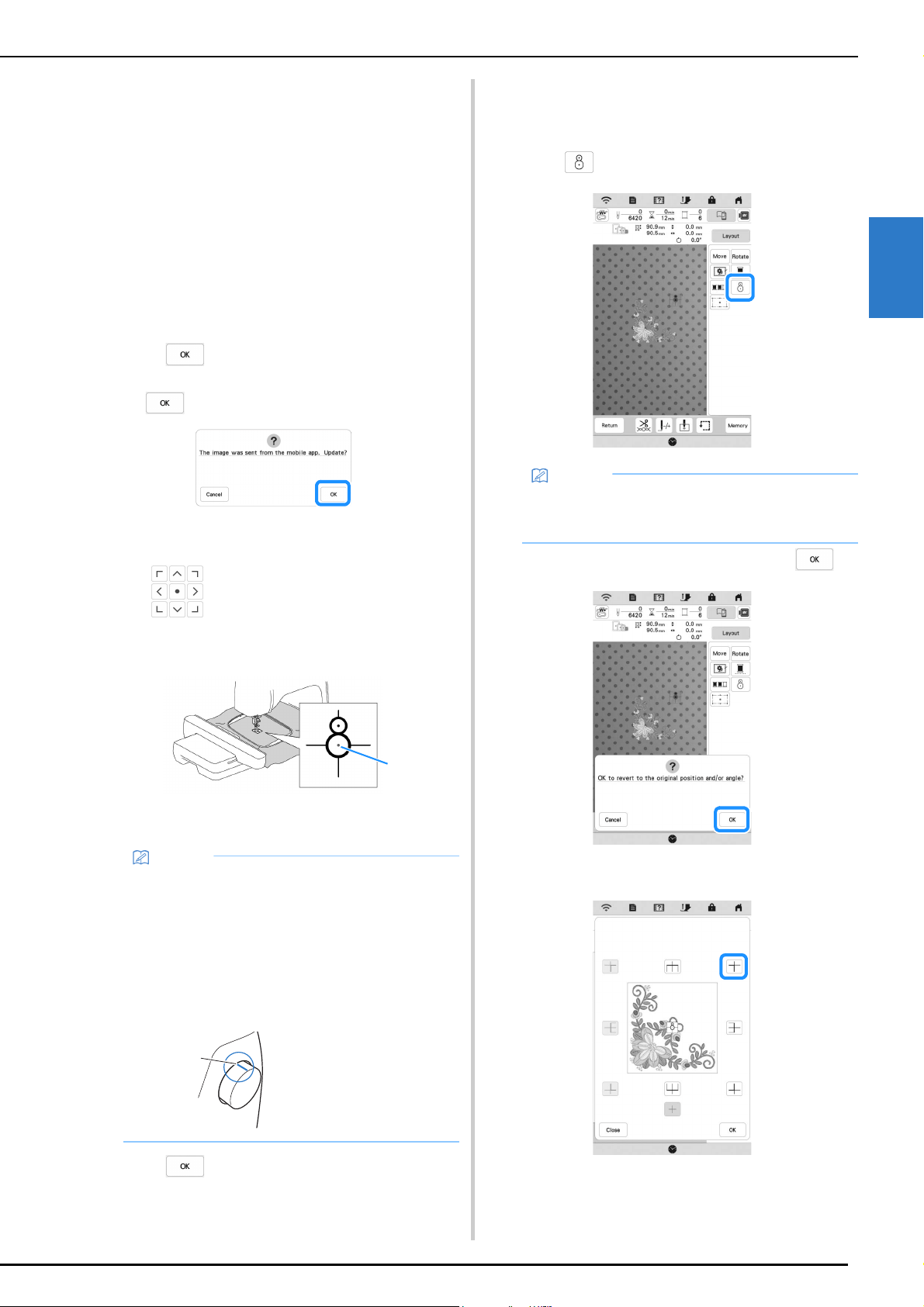
CONFIRMING THE PATTERN POSITION
59
BASIC EMBROIDERY
2
Calibrating the Position of the Background
Image
By calibrating the position of the background image
transferred to the machine, the pattern can be positioned
more accurately.
a
Select a pattern. (page 33)
b
Set the application to advanced mode, attach the
embroidery positioning sticker to the fabric in the
hoop, take the photo of the background, and with the
advanced mode of the application, transfer it to the
machine.
For a detailed procedure, refer to the application.
c
Touch .
* Attach the frame used in the image before touching
.
The carriage will move, and the LED pointer will turn
on.
d
Use to align the LED pointer with the center
of the larger circle in the embroidery positioning
sticker.
1 Center of the larger circle in the embroidery positioning
sticker
e
Touch .
The position of the background image is calibrated.
Aligning the Embroidering Position
a
Calibrate the position of the background image.
(page 59)
b
Touch .
c
When the following message appears, touch .
d
Select the position to be set as the reference point.
Memo
• The position can also be calibrated by lowering the
needle with the handwheel. This method enables
more accurate positioning. Slowly turn the
handwheel toward you (counterclockwise) to check
the needle drop point. Then, turn the handwheel
away from you (clockwise) until the mark on the
handwheel is at the top. The carriage cannot move
if the mark on the handwheel is not at the top.
1
1 Mark
a
Memo
• The orientation of the pattern will change
depending on the orientation of the embroidery
positioning sticker.
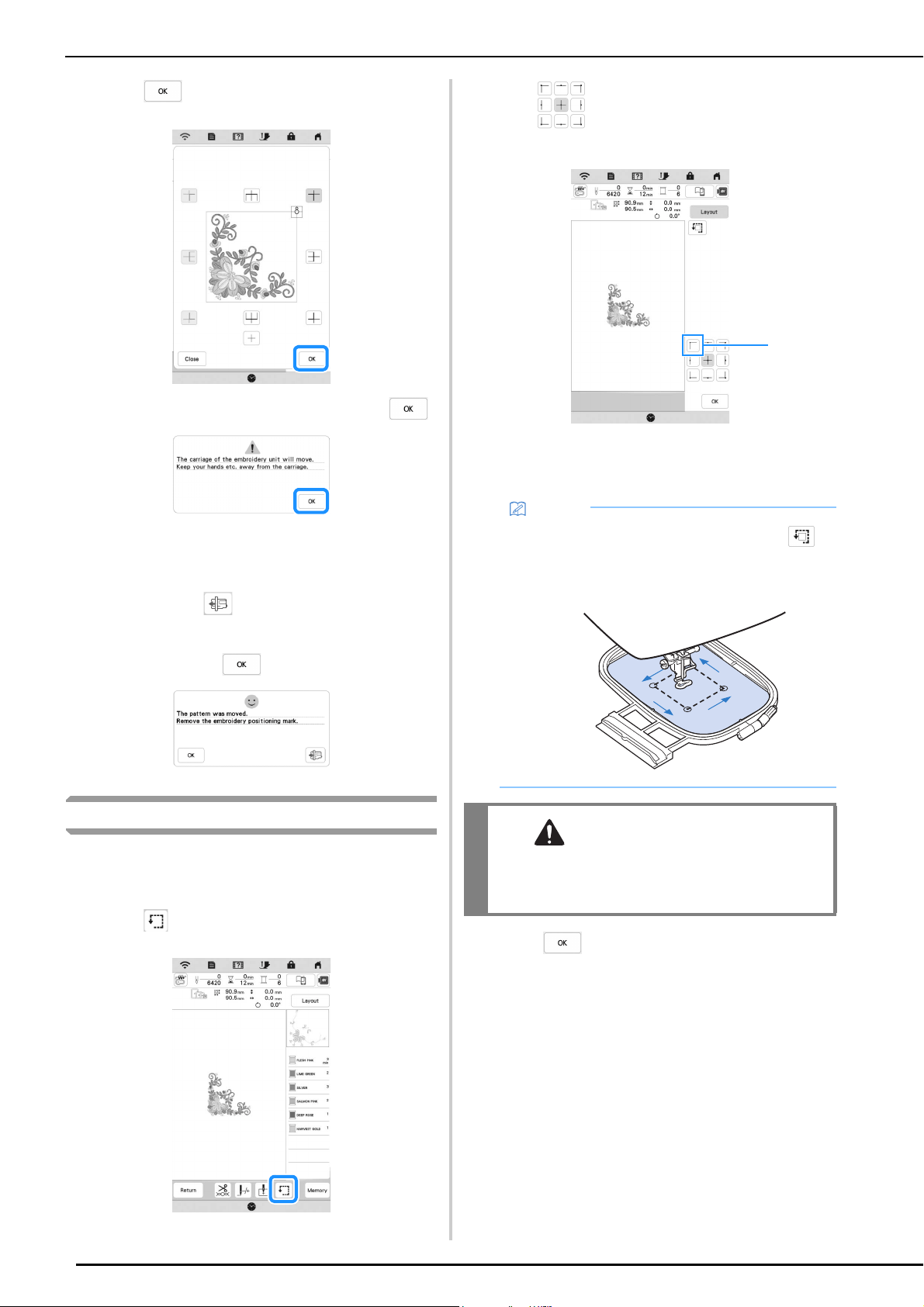
CONFIRMING THE PATTERN POSITION
60
e
Touch .
When the following message appears, touch .
f
Remove the embroidery positioning sticker, and then
start embroidering.
* To remove the embroidery positioning sticker more
easily, touch so that the embroidery frame
moves slightly forward and away from under the
needle. After the embroidery positioning sticker is
removed, touch .
Checking the Pattern Position
The carriage moves and shows the pattern position. Watch the
embroidery frame closely to make sure the pattern will be
embroidered in the right place.
a
Touch .
b
From , touch the key for the position that you
want to check.
1 Selected position
The carriage will move to the selected position on
the pattern.
c
Touch .
Memo
• To see the entire embroidering area, touch .
The carriage moves and shows the embroidery
area.
CAUTION
• Do not lower the needle when the embroidery
frame is moving. If the needle is down, it could
break and result in injury.
1
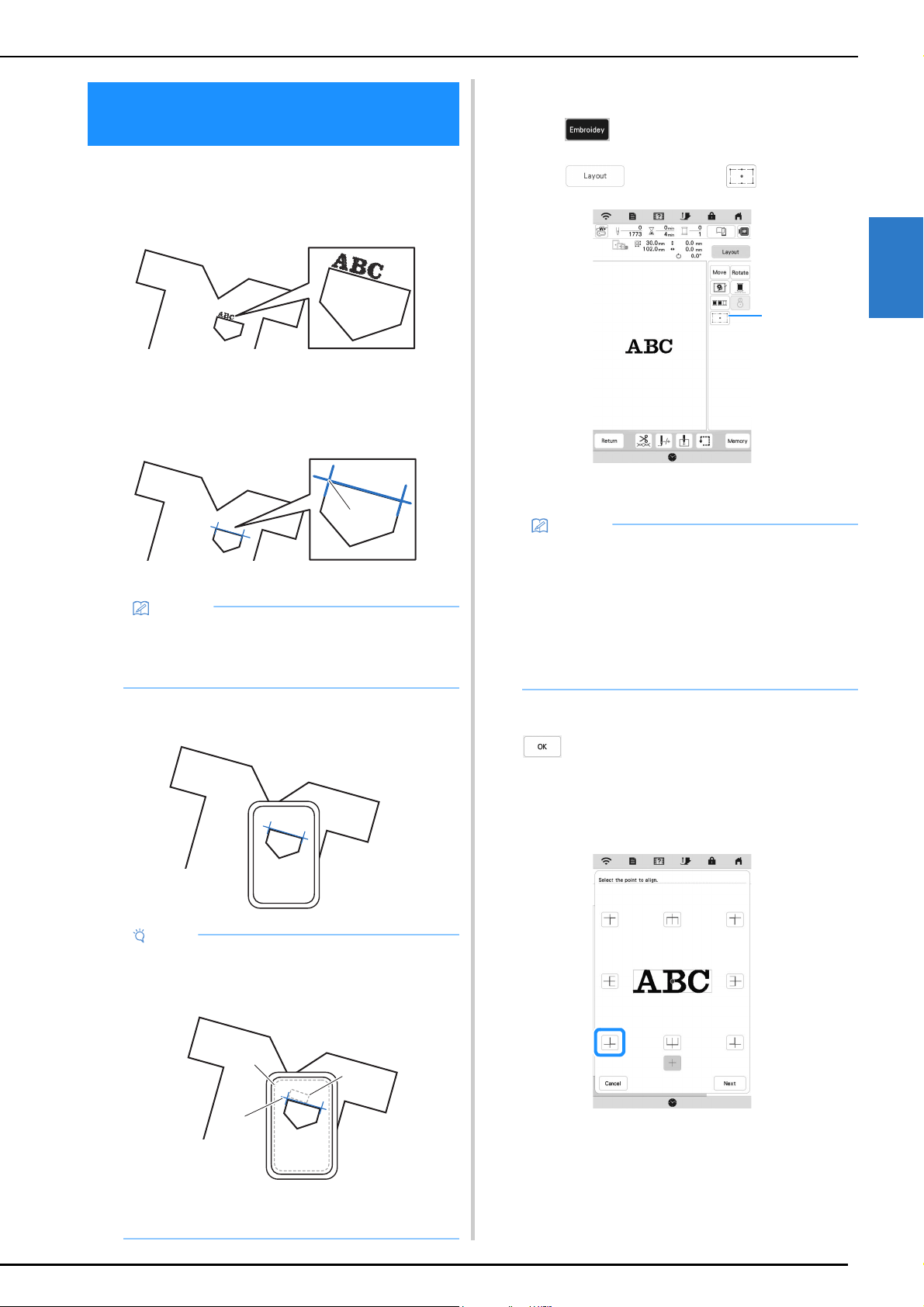
THE 2-POINT EMBROIDERY POSITIONING FUNCTION
61
BASIC EMBROIDERY
2
By using the 2-point embroidery positioning function with a
LED pointer, the embroidering position can easily be aligned.
This is useful when embroidering in an area where it is
necessary to align the pattern, as shown below.
a
Use a chalk pencil to mark the desired embroidering
position.
The line drawn for the reference direction should be
longer.
1 Chalk pencil mark
b
Hoop the fabric in the embroidery frame.
c
Select the pattern.
d
Touch to display the embroidery screen.
e
Touch and then touch .
1 Switch on/off the 2-point embroidery positioning
function with a LED pointer.
f
If a message appears, indicating that the move and
rotate settings will return to the original ones, touch
.
g
From the reference points shown in the screen, select
the point to be used for aligning the pattern.
For this example, select the point in the lower-left
corner of the pattern.
THE 2-POINT EMBROIDERY
POSITIONING FUNCTION
Memo
• If the desired position of the pattern can be clearly
established, such as when embroidering along a
pocket, it is not necessary to mark the position with
a chalk pencil.
Note
• When hooping the fabric in the embroidery frame,
make sure that the embroidery pattern will fit within
the embroidering area of the frame being used.
1 Embroidering area
2 Embroidery pattern size
3 Chalk pencil mark
a
a
b
c
Memo
• The LED pointer lights up to indicate the needle
drop point.
• When the LED pointer is turned on, the embroidery
foot height is automatically adjusted according to
the fabric thickness.
• If the surface of the fabric is too uneven or rough,
check and adjust the alignment of the light of the
LED pointer and the needle drop point before
starting to embroider.
1
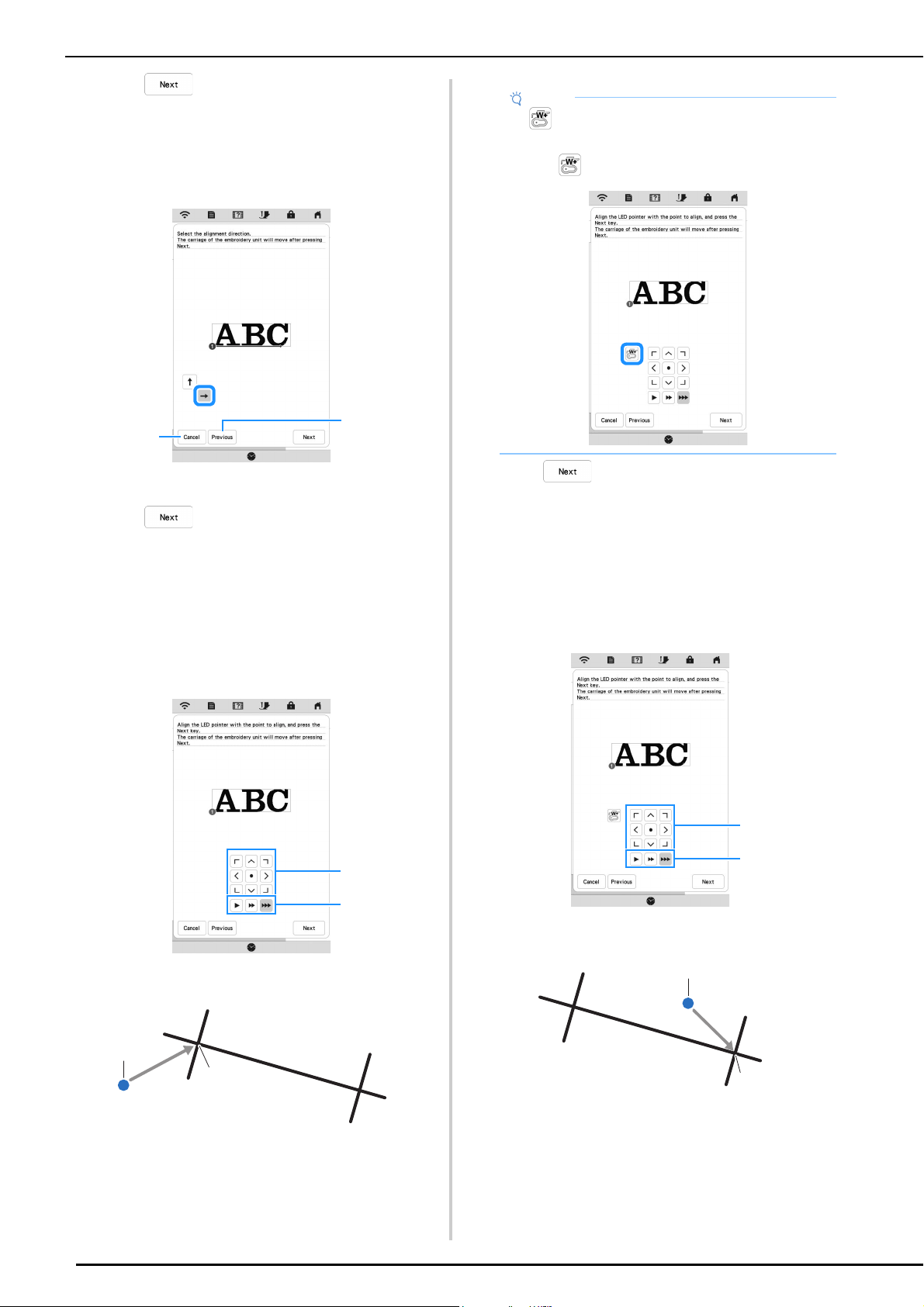
THE 2-POINT EMBROIDERY POSITIONING FUNCTION
62
h
Touch .
i
Select the direction (from the reference point) to be
used as a reference for aligning the pattern.
For this example, select the arrow pointing to the right
as the reference direction.
1 Cancel the pattern alignment settings.
2 Return to the previous screen.
j
Touch .
k
Touch the positioning keys to move the embroidery
frame until the position of the LED pointer and the
center of the first mark are aligned.
To change the speed that the frame moves, use the
frame movement speed keys. If it is difficult to make a
precision alignment, touch a frame movement speed
key for a slower speed.
1 Positioning keys
2 Frame movement speed keys
3 Center of the first mark
4 Light of the LED pointer
l
Touch .
m
Touch the positioning keys to move the embroidery
frame until the position of the LED pointer and the
center of the second mark are aligned.
To change the speed that the frame moves, use the
frame movement speed keys. If it is difficult to make a
precision alignment, touch a frame movement speed
key for a slower speed.
1 Positioning keys
2 Frame movement speed keys
3 Center of the second mark
4 Light of the LED pointer
2
1
1
2
c
d
Note
• If is displayed to the left of the positioning keys,
the LED pointer has shifted from its initial position.
Touch to adjust the position.
1
2
c
d
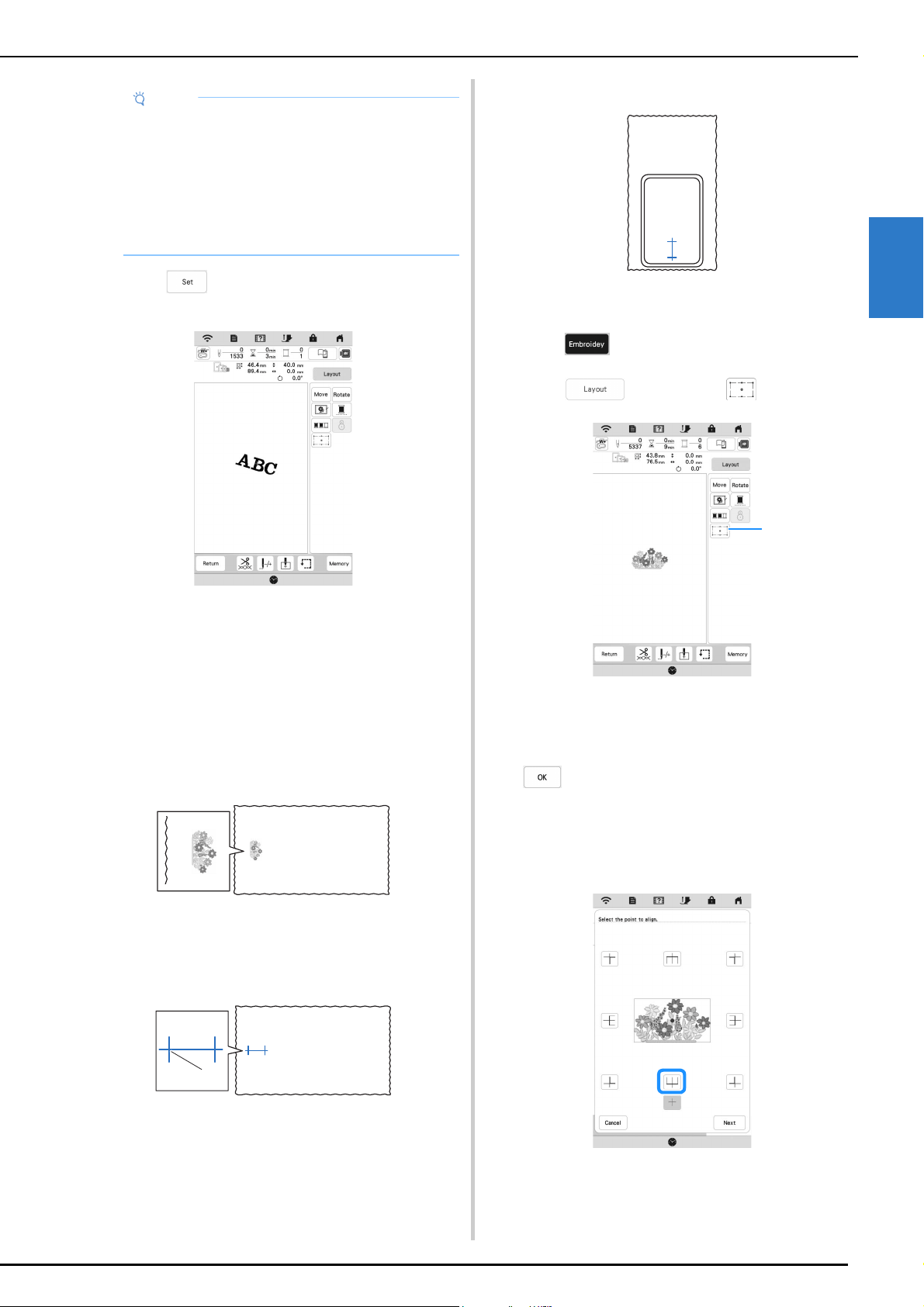
THE 2-POINT EMBROIDERY POSITIONING FUNCTION
63
BASIC EMBROIDERY
2
n
Touch .
The pattern is repositioned.
o
Press the “Start/Stop” button to start embroidering.
Another example
By specifying an alignment point and direction,
embroidery patterns can be positioned and aligned for
various purposes.
In this example, a pattern is aligned at the left center of the
towel.
a
Use a chalk pencil to mark the desired embroidering
position.
The line drawn for the reference direction should be
longer.
1 Chalk pencil mark
b
Hoop the fabric in the embroidery frame.
c
Select the pattern.
d
Touch to display the embroidery screen.
e
Touch and then touch .
1 Switch on/off the 2-point embroidery positioning
function with a LED pointer.
f
If a message appears, indicating that the move and
rotate settings will return to the original ones, touch
.
g
From the reference points shown in the screen, select
the point to be used for aligning the pattern.
For this example, select the point in the lower-center of
the pattern.
Note
• Set the position of the LED pointer to a position
that is not too close to the first reference point. If it
is too close, a message will appear, prompting you
to reposition it.
• In order to increase the accuracy of the pattern
alignment, align the position of the LED pointer
above the second mark (3) and as far away from
the center mark as possible.
a
1
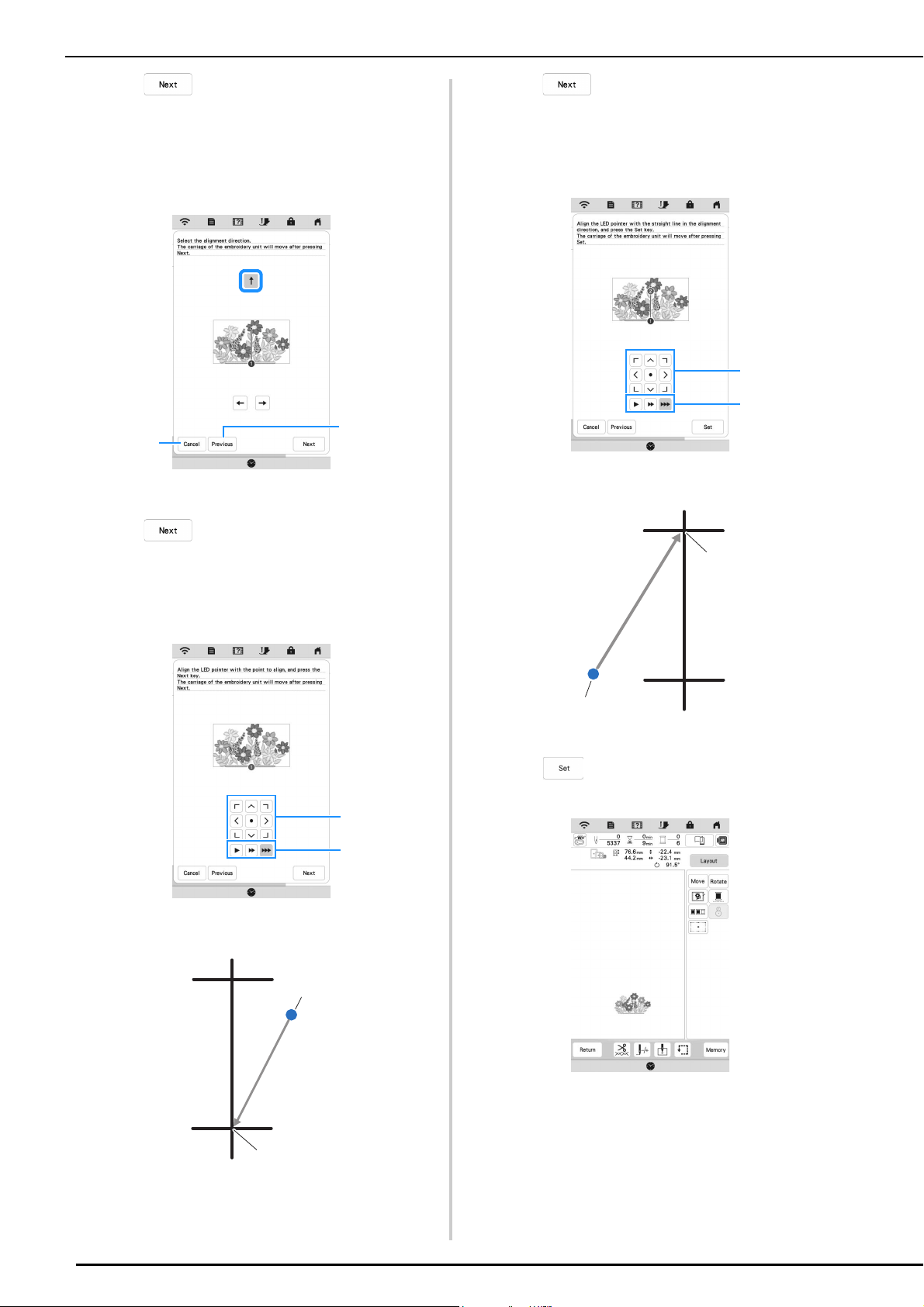
THE 2-POINT EMBROIDERY POSITIONING FUNCTION
64
h
Touch .
i
Select the direction (from the reference point) to be
used as a reference for aligning the pattern.
For this example, select the arrow pointing upward as
the reference direction.
1 Cancel the pattern alignment settings.
2 Return to the previous screen.
j
Touch .
k
Touch the positioning keys to move the embroidery
frame until the position of the LED pointer and the
center of the first mark are aligned.
1 Positioning keys
2 Frame movement speed keys
3 Center of the first mark
4 Light of the LED pointer
l
Touch .
m
Touch the positioning keys to move the embroidery
frame until the position of the LED pointer and the
center of the second mark are aligned.
1 Positioning keys
2 Frame movement speed keys
3 Center of the second mark
4 Light of the LED pointer
n
Touch .
The pattern is repositioned.
o
Press the “Start/Stop” button to start embroidering.
2
1
1
2
c
d
1
2
c
d
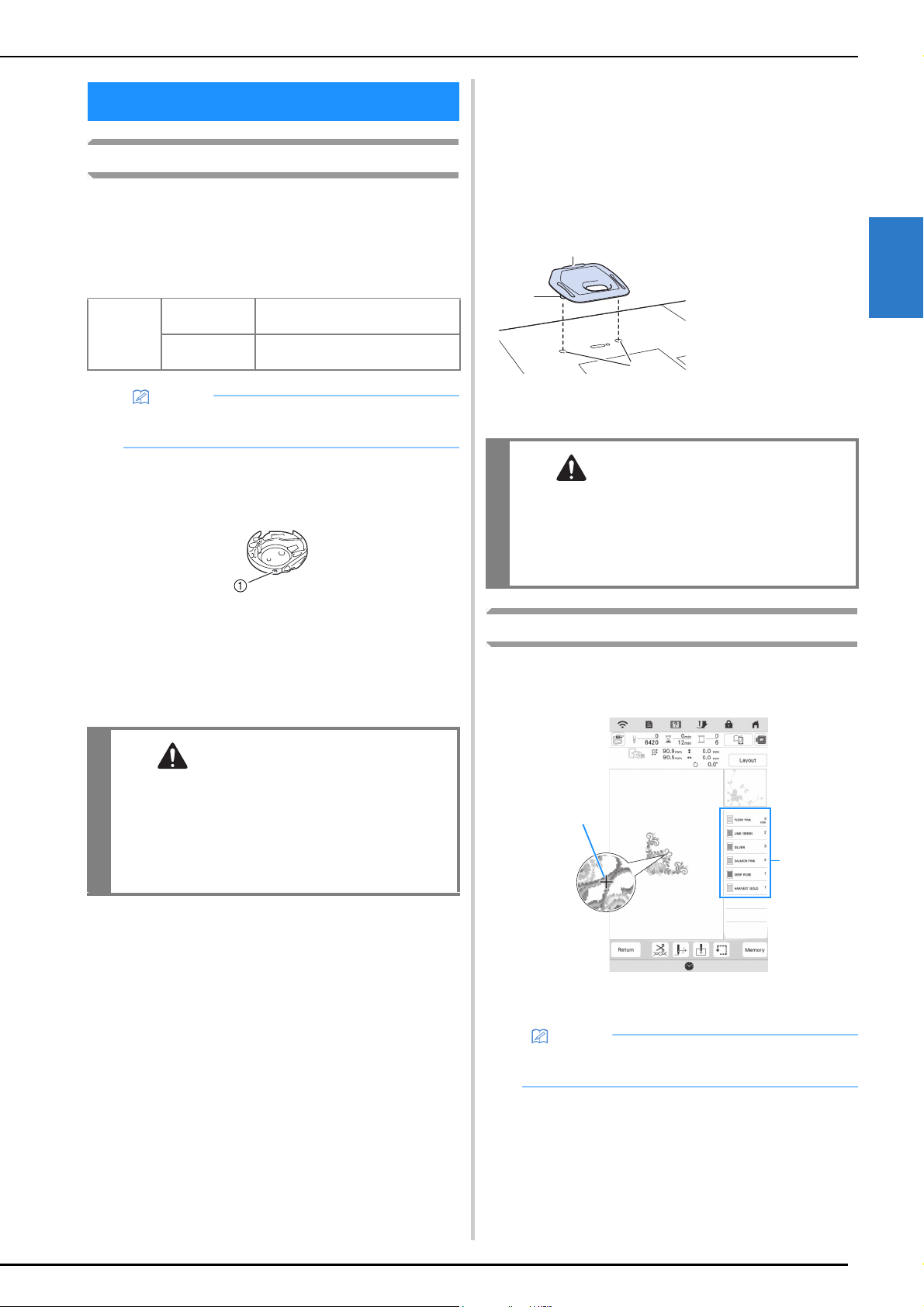
EMBROIDERING A PATTERN
65
BASIC EMBROIDERY
2
Embroidering Attractive Finishes
Many factors are involved in achieving a beautiful embroidery
result. Using the appropriate stabilizer (page 53) and hooping
the fabric in the frame (page 54) are two important factors
mentioned earlier. Another important point is the
appropriateness of the needle and thread being used. See the
explanation of threads below.
Bobbin case (recommended for embroidering with included
90 weight bobbin thread)
1 Bobbin case
The included bobbin case is set for 90 weight bobbin thread.
When you use different weights of bobbin thread, the tension
screw on this bobbin case can be adjusted if necessary. For
details, refer to “Adjusting the Bobbin Case” on page 76.
Embroidery Needle Plate Cover
Under some conditions, based on the type of fabric,
stabilizer, or thread being used, there may be some
looping in the upper thread. In this case, attach the
included embroidery needle plate cover to the needle
plate. Attach the cover by inserting the two projections on
the underside of the cover into the notches on the needle
plate as shown below.
To remove the embroidery needle plate cover, place your
fingernail in the groove and lift the plate out.
Embroidering Patterns
a
Prepare embroidery threads of the colors shown on the
screen.
1 Embroidery color order
2 Cursor
EMBROIDERING A PATTERN
Thread Upper thread Use embroidery thread intended for
use with this machine.
Bobbin thread Use embroidery bobbin thread
intended for use with this machine.
Memo
• If you use threads other than those listed above,
the embroidery may not embroider out correctly.
CAUTION
• When embroidering on large items (especially
jackets or quilts), do not let the fabric hang off
of the table. Otherwise, the embroidery unit
cannot move freely and the embroidery frame
may strike the needle, causing the needle to
break and possibly causing injury.
1 Groove
2 Projection
3 Notch
CAUTION
• Push the embroidery needle plate cover as far
as possible to attach it. If the embroidery
needle plate cover is not securely attached, it
may cause the needle to break and cause
injury.
Memo
• The [+] cursor moves over the pattern, showing
which part of the pattern is being embroidered.
a
b
c
2
1

EMBROIDERING A PATTERN
66
b
Using the automatic needle threader, thread the
machine for the first color. (page 26)
c
Lower the presser foot, then press the “Start/Stop”
button to start embroidering.
When the first color is completely embroidered, the
machine will automatically trim the threads and stop.
The embroidery foot will then automatically be
raised.
On the embroidery color order display, the next
color will move to the top.
d
Remove the upper thread for the first color from the
machine. Thread the machine with the next color.
e
Repeat the same steps for embroidering the remaining
colors.
1 Current stitch numbers/Total stitch numbers
2 Current time/Total time
3 Part of pattern to be embroidered next
4 Embroidered colors/Total colors
When the last color is embroidered, [Finished
embroidering] will appear on the display. Touch
, and the display will return to the original
screen.
Memo
• If you want to get more attractive finishes, try the
procedures below;
- After 5-6 stitches, press the “Start/Stop” button
again to stop the machine.
- Trim the excess thread at the beginning of the
pattern. If the excess thread tail is under the
embroidery foot, raise the embroidery foot, then
trim the excess thread.
• If there is thread left over from the beginning of
embroidering, it may be embroidered over as you
continue embroidering the pattern, making it very
difficult to deal with the thread after the pattern is
finished. Trim the threads at the beginning of each
thread change.
Memo
• The thread trimming function is originally set to trim
excess thread jumps (threads linking parts of the
pattern, etc.). Depending on the type of thread and
fabric that are used, an end of upper thread may
remain on the surface of the fabric at the beginning
of the stitching. After embroidering is finished, cut
off this excess thread.
If the setting has been turned off, trim the excess
thread jumps using scissors after the pattern is
finished. Refer to page 78 for information on the
thread trimming function.
IMPORTANT
• Do not press (Thread cutter button) after
the threads have been cut. Doing so could
tangle the thread or damage the machine.
• Do not press (Thread cutter button) when
there is no fabric set in the machine or during
machine operation. The thread may tangle,
possibly resulting in damage.
3
4
2
1
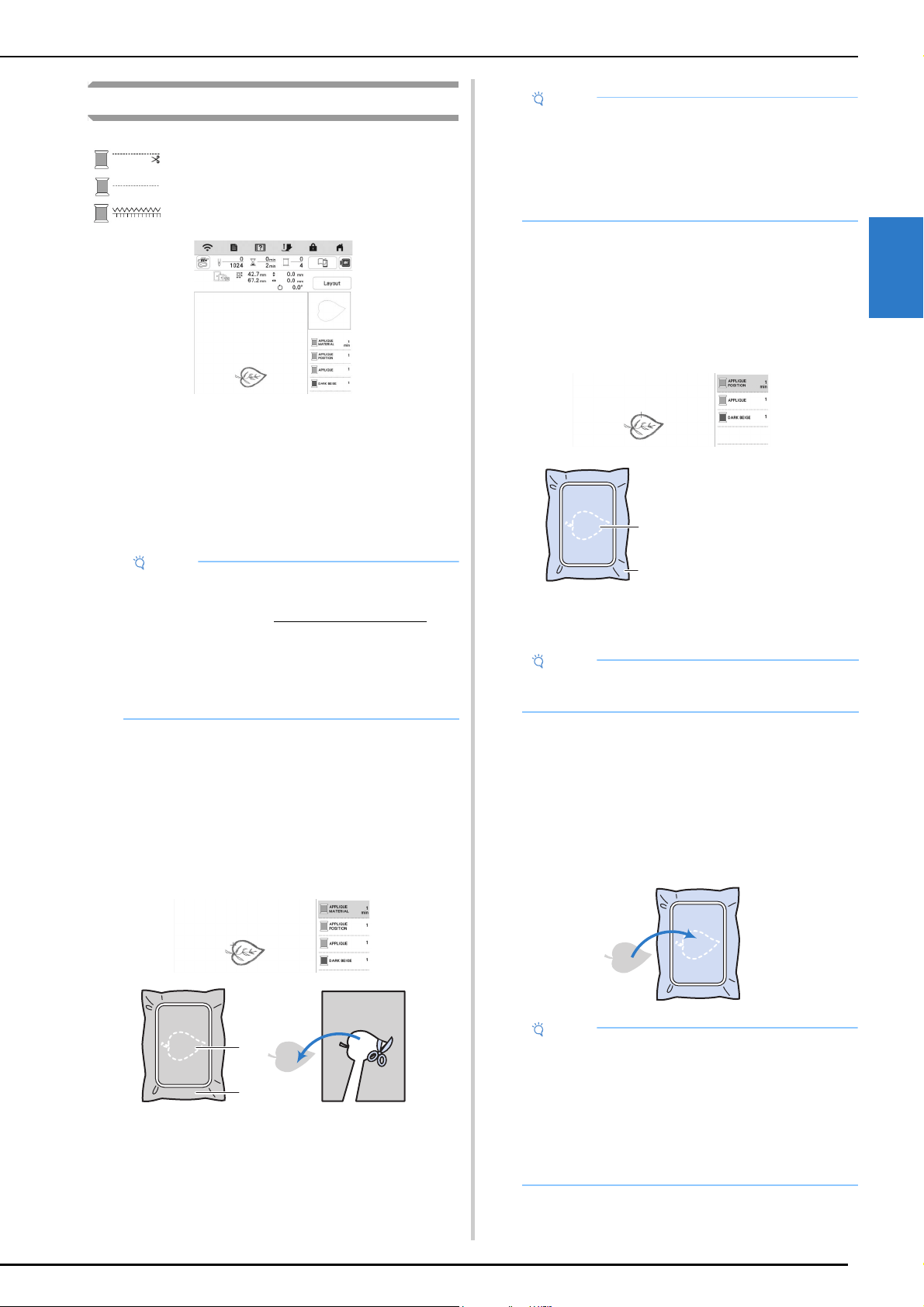
EMBROIDERING A PATTERN
67
BASIC EMBROIDERY
2
Using Appliqués
When the color embroidering order display shows
[ (APPLIQUE MATERIAL)],
[ (APPLIQUE POSITION)] or
[ (APPLIQUE)], follow the procedure below.
Required materials
• Fabric for the appliqué piece
• Fabric for the appliqué base
• Stabilizer material
• Fabric glue or temporary spray adhesive
• Embroidery thread
1. Creating an Appliqué Piece
a
Attach stabilizer material to the wrong side of the
fabric for the appliqué piece.
b
Sew the cutting line of the appliqué piece. Remove the
fabric for the appliqué piece from the embroidery
frame, and then carefully cut along the sewn cutting
line.
1 Outline of appliqué
2 Fabric for appliqué piece
2. Sewing the Appliqué Position on the Base
Fabric
a
Attach stabilizer material to the wrong side of the
fabric for the appliqué base.
b
Sew the appliqué position.
c
Remove the embroidery frame from the embroidery
unit.
3. Affixing the Appliqué Piece to the Base
Fabric
a
Lightly apply fabric glue or temporary spray adhesive
to the back of the appliqué piece, and then attach it to
the base fabric within the outline of the position sewn
in step
b of “2. Sewing the Appliqué Position on the
Base Fabric”.
Note
• Refer to “Embroidery Design Guide” to review the
recommended method for built-in appliqué
patterns. Please visit https://s.brother/cmekb/
.
Some appliqué patterns differ from the procedure
described in this manual.
• The correct names and numbers of the thread
colors to be used will not appear. Use the thread
colors depending on those in the appliqué pattern.
a
b
Note
• If the appliqué piece is cut out along the inside of
the cutting line, it may not be correctly attached to
the fabric. Therefore, carefully cut out the appliqué
piece along the cutting line.
• After cutting out the appliqué piece, carefully
remove the thread.
1 Position of appliqué
2 Base fabric
Note
• Do not remove the base fabric from the embroidery
frame until all embroidering is finished.
Note
• If the appliqué piece cannot be attached to the
base fabric with fabric glue or temporary spray
adhesive, securely baste it in place with basting
stitches.
• If thin fabric is used for the appliqué piece,
reinforce and secure it in place with an iron-on
adhesive sheet. An iron can be used to attach the
appliqué piece to the appliqué location.
a
b
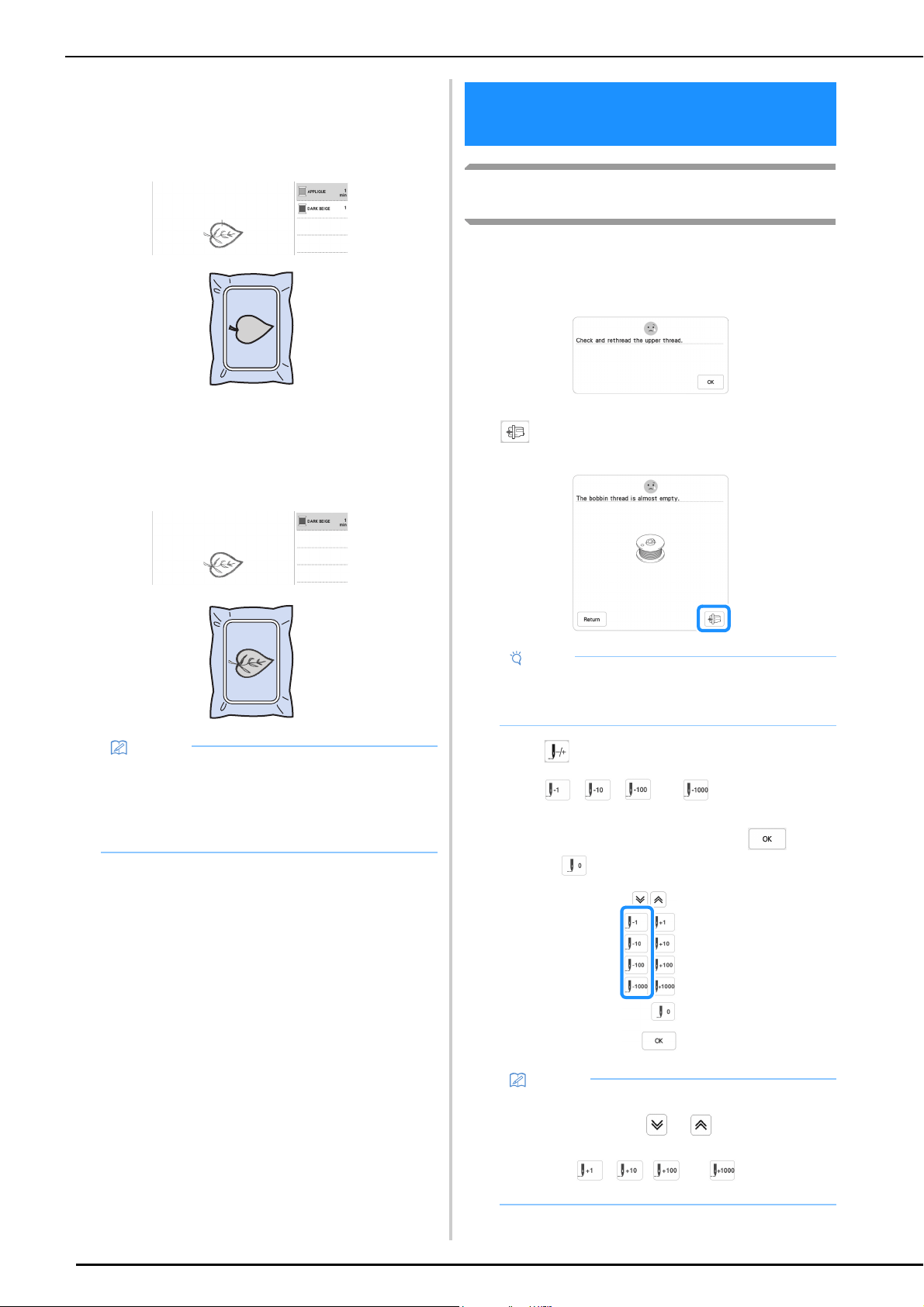
ADJUSTMENTS DURING THE EMBROIDERY PROCESS
68
b
After the appliqué piece is attached, attach the
embroidery frame to the machine.
Thread the machine with the embroidery thread, lower
the presser foot lever, and then press the “Start/Stop”
button to embroider the appliqué.
4. Embroidering the Remainder of the Pattern
a
Change the embroidery thread according to the
embroidery color order display, and then finish
embroidering the remainder of the pattern.
If the Thread Breaks or the Bobbin Runs
out of Thread During Embroidering
a
Redo the upper threading or replace the bobbin.
If the upper thread breaks, stop the machine, trim the
bobbin thread, and then rethread the machine.
If the bobbin thread is almost empty or broken, touch
of the displayed message, remove the embroidery
frame, and then replace the bobbin.
b
Touch .
c
Touch , , , or to move the needle
back the correct number of stitches before the area
where the thread broke, and then touch .
• Touch to restart from the beginning.
Memo
• Since glue may become attached to the presser
foot, needle or needle plate, clean off any glue after
finishing embroidering the appliqué pattern.
• For best results, trim all excess threads each time
the thread color is changed.
ADJUSTMENTS DURING THE
EMBROIDERY PROCESS
Note
• If [Upper and Bobbin Thread Sensor] in the settings
screen of the machine is set to [OFF], the message
shown above does not appear.
Memo
• If you cannot move back to the spot where the
thread broke, touch or
to select the color
and move to the beginning position of that color,
then use , , , or
to move ahead
to slightly before where the thread broke.

ADJUSTMENTS DURING THE EMBROIDERY PROCESS
69
BASIC EMBROIDERY
2
d
Lower the presser foot and press the “Start/Stop”
button to continue embroidering.
Resuming Embroidery after Turning off the
Power
The current color and stitch number are saved when
embroidery is stopped. The next time the machine is turned
on, you have the option to continue or delete the pattern.

ADJUSTMENTS DURING THE EMBROIDERY PROCESS
70
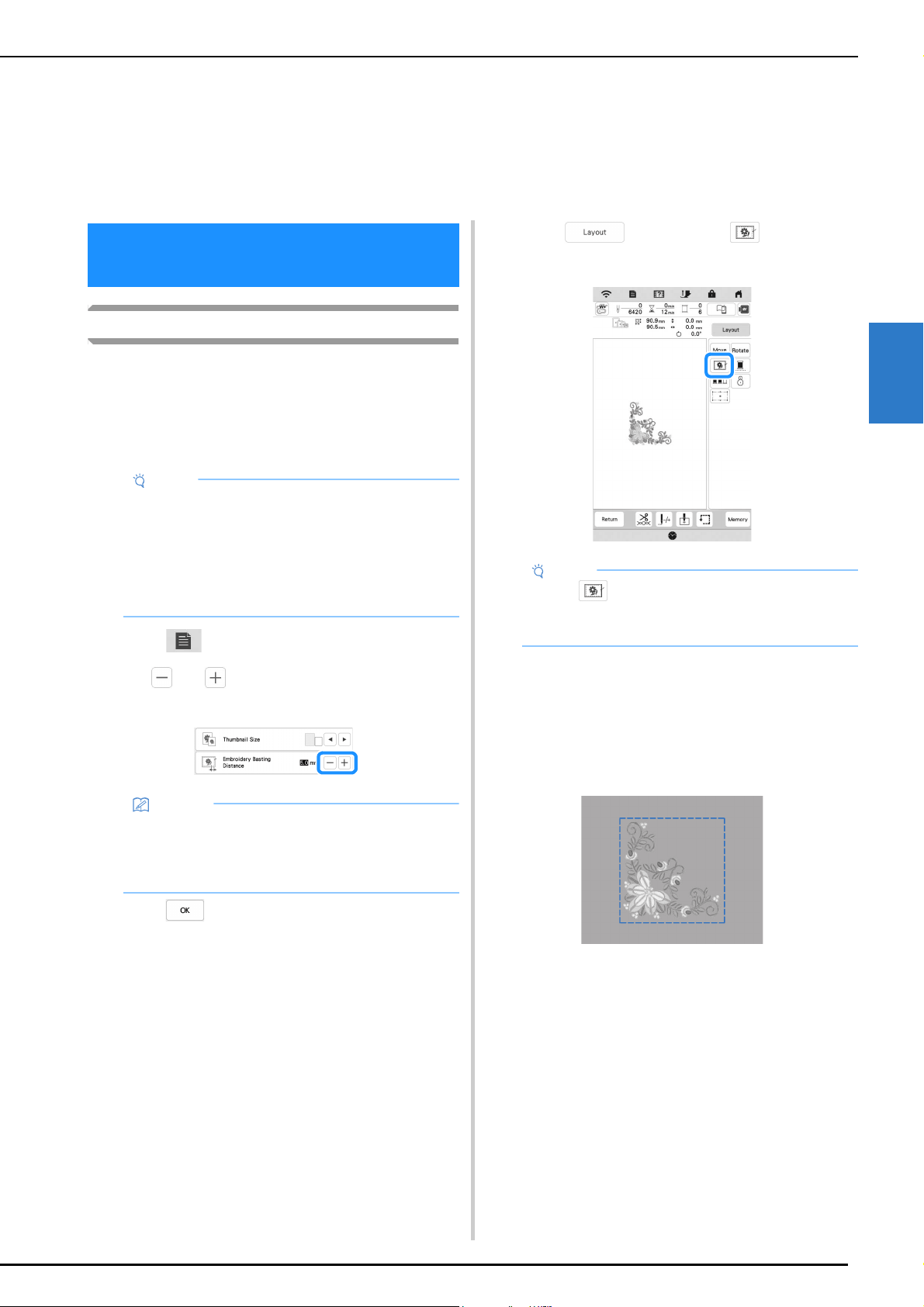
VARIOUS EMBROIDERING FUNCTIONS
71
ADVANCED EMBROIDERY
3
Basting Embroidery
Before embroidering, basting stitches can be sewn along the
outline of the pattern. This is useful for embroidering fabric
that cannot have stabilizer material affixed with an iron or
adhesive. Basting stitches can be used to attach material that
cannot be hooped to stabilizer, making it possible to be
embroidered.
a
Touch .
b
Use and to specify the distance from the
pattern to the basting stitching.
c
Touch to return to the embroidering screen.
d
Touch , and then touch to select the
basting setting.
Basting is added to the beginning of the
embroidering order.
e
Press the “Start/Stop” button to start embroidering.
f
When embroidering is finished, remove the basting
stitching.
Chapter 3
ADVANCED
EMBROIDERY
VARIOUS EMBROIDERING
FUNCTIONS
Note
• It is recommended to finish combining and editing
the pattern before selecting the basting setting. If
the pattern is edited after selecting the basting
setting, the basting and pattern may become
misaligned, and the basting under the pattern may
be difficult to remove after embroidering is
complete.
Memo
• The higher the setting, the farther the basting is
from the pattern.
• The setting remains selected even if the machine is
turned off.
Note
• When is touched, the pattern is moved to the
center. After selecting the basting setting, move the
pattern to the desired position.
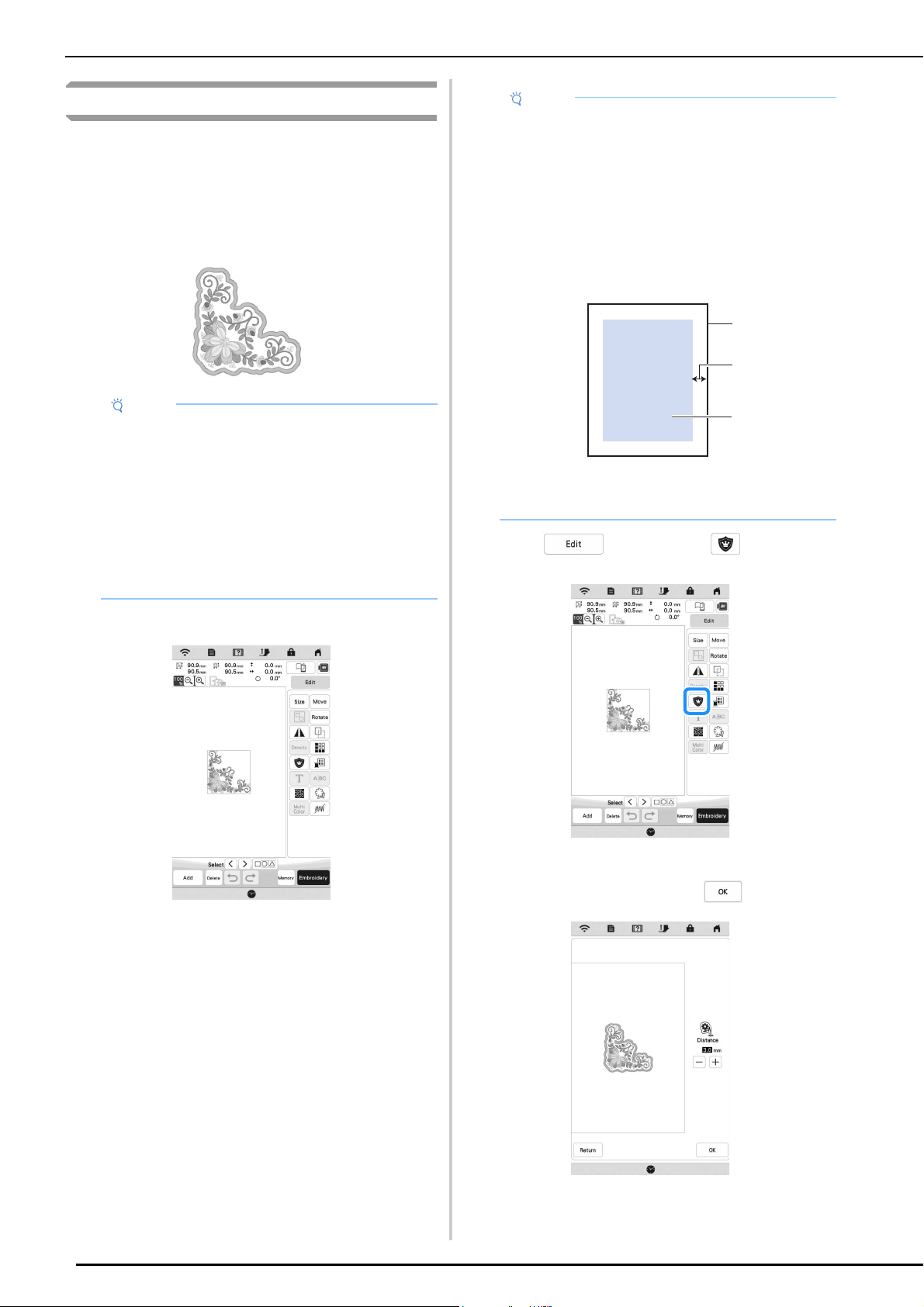
VARIOUS EMBROIDERING FUNCTIONS
72
Creating an Appliqué Piece
Creating an appliqué piece is convenient for fabrics that
cannot be embroidered or when you wish to attach an
appliqué to a garment.
Creating an Appliqué Piece
The following pattern will be used to create an appliqué
piece.
a
Select the pattern, and edit it if necessary.
b
Touch and then, touch .
c
Specify the distance between the pattern and the
appliqué outline, and then touch .
The pattern and appliqué outline are grouped.
Note
• Felt or denim fabrics are recommended to make
the appliqué piece. Depending on the pattern and
fabric used, lighter weight fabrics may cause the
stitching to appear smaller.
• For best results, be sure to use stabilizer material
for embroidering.
• When making appliqué pieces, do not use the
optional border embroidery frame. Depending on
the pattern density and fabric used, shrinkage of
the stitching may occur.
Note
• Finish combining and editing the pattern before
selecting the appliqué setting. If the pattern is
edited after selecting the appliqué setting, the
appliqué stitching and pattern may become
misaligned.
• Since an outline is added, the pattern for an
appliqué piece (when the appliqué setting is
selected) will be larger than the original pattern.
First, adjust the size and position of the pattern as
shown below.
1 Embroidering area
2 About 1cm (approx. 1/2 inch)
3 Pattern size
a
b
c
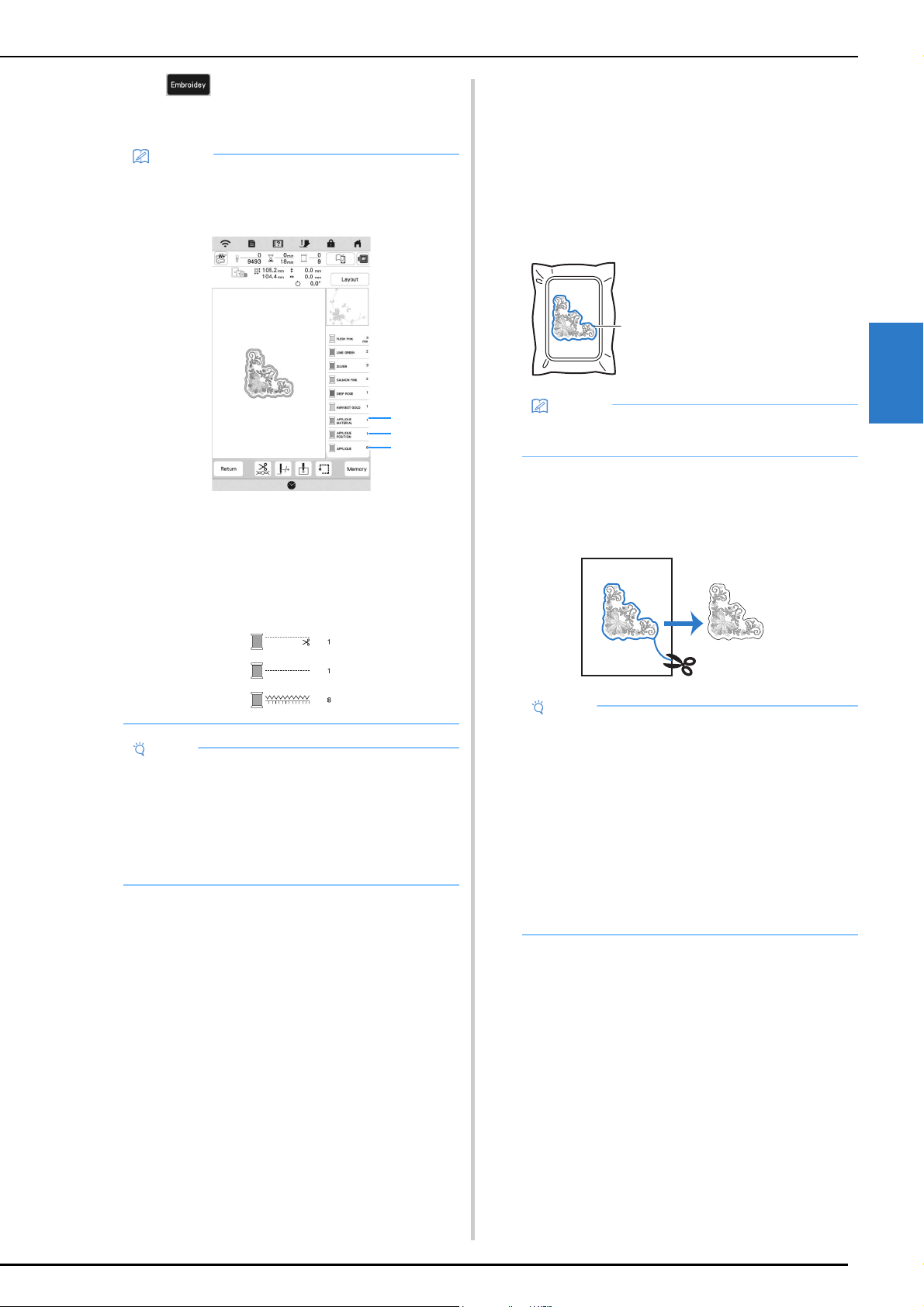
VARIOUS EMBROIDERING FUNCTIONS
73
ADVANCED EMBROIDERY
3
d
Touch .
The steps for creating the appliqué piece are added
to the embroidering order.
e
Fuse or stick a piece of stabilizer to the back of the felt
or denim fabric to be used as the appliqué piece.
f
Hoop the fabric for the appliqué piece in the
embroidery frame, attach the embroidery frame to the
machine, and then start embroidering.
g
After the pattern is embroidered, thread the machine
with the thread for the cutting line, and then sew the
cutting line (APPLIQUE MATERIAL).
h
Remove the fabric for the appliqué piece from the
embroidery frame, and then carefully cut along the
stitching. After cutting, carefully remove all of the
cutting line thread.
Memo
• Three steps are added to the embroidering order:
appliqué cutting line, position of pattern placement
on the stabilizer material, and appliqué stitching.
1 Cutting line for appliqué
2 Position of pattern placement on stabilizer
material
3 Appliqué stitching
• When setting the [Thread color] to [#123] (thread
number) in the settings screen, the following screen
is displayed.
Note
• An appliqué piece cannot be created if the pattern
is too large or too complicated or a combined
pattern is separated. Even if the selected pattern
fits within the embroidering area, the entire
appliqué pattern may exceed the embroidering
area when the outline is added. If an error message
appears, select a different pattern or edit it.
1
2
3
1 Cutting line for appliqué
Memo
• We recommend using thread for the cutting line
that is closest to the color of the fabric.
Note
• Depending on the pattern density and fabric used,
there may be shrinking of the pattern, or the
appliqué may be misaligned with the placement
line. We recommend cutting slightly outside of the
cutting line.
• When using patterns that are vertically and
horizontally symmetrical, use a chalk pencil to
indicate the pattern orientation before cutting it out.
• Carefully cut out the pattern on the outline you just
sewed. Do not cut inside the cutting line, otherwise
the appliqué fabric will not be caught by the
appliqué stitch.
a
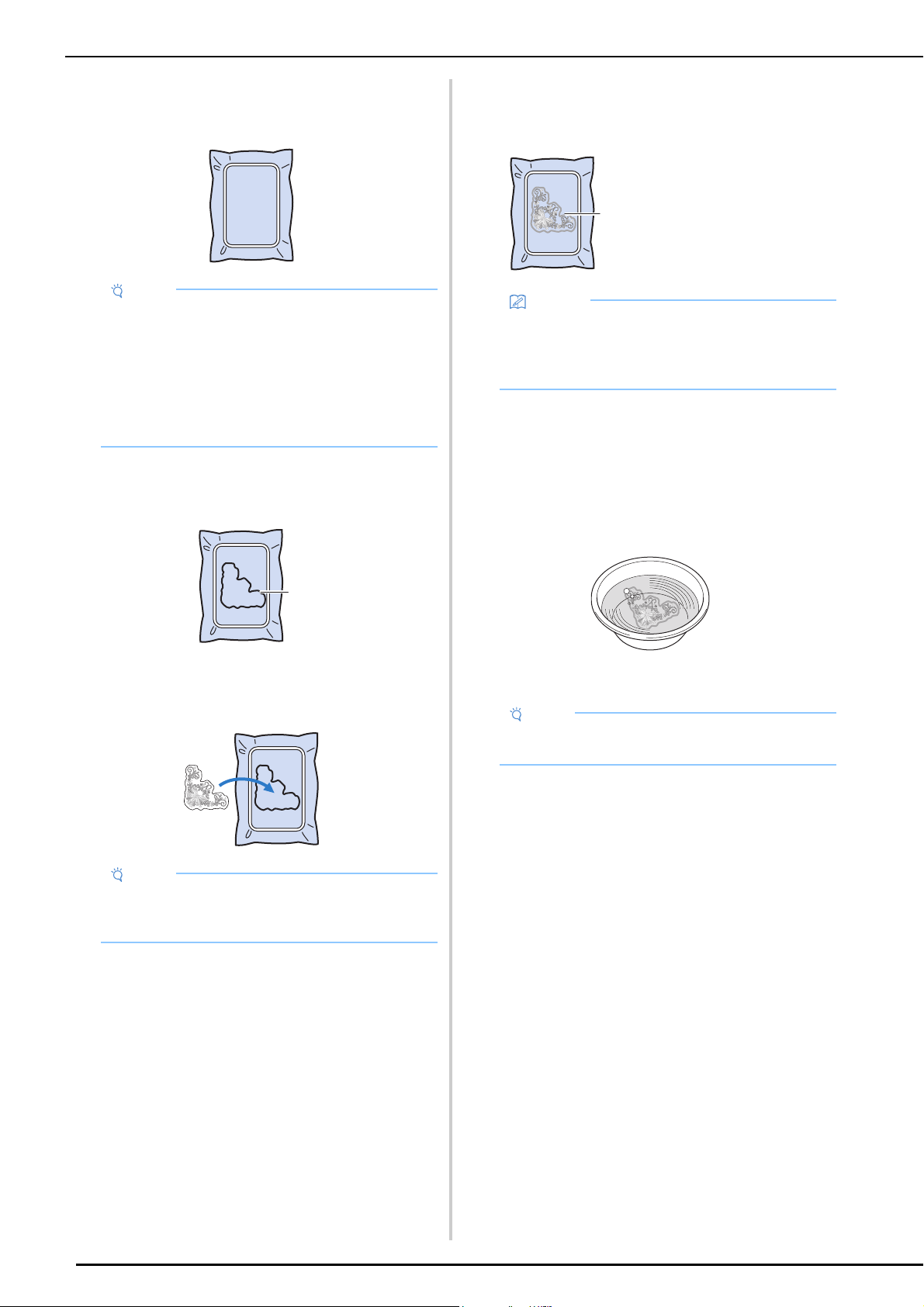
VARIOUS EMBROIDERING FUNCTIONS
74
i
Use two layers of adhesive water soluble stabilizer
material with their sticky sides together, and then hoop
them in the embroidery frame.
j
Thread the machine with the thread for the outline,
and then sew the placement line for the appliqué
position (APPLIQUE POSITION).
1 Pattern placement line
k
Lightly apply glue or spray adhesive, and paste the
appliqué piece so that it aligns with the placement line.
l
With the machine threaded using the thread for the
outline from step
j, embroider the outline
(APPLIQUE).
m
After embroidering is finished, remove the stabilizer
material from the embroidery frame.
n
Use scissors to cut the excess water soluble stabilizer
from outside the appliqué outline.
o
Soak the appliqué piece in water to dissolve the water
soluble stabilizer.
p
Dry the appliqué piece, and then iron it if necessary.
Note
• If water soluble stabilizer is used, it is not
necessary to remove the stabilizer material after
sewing the appliqué outline. To reduce shrinkage
of the pattern, we recommend using water soluble
stabilizer.
• Put together two layers of water soluble stabilizer,
otherwise the stabilizer material may tear during
embroidering.
Note
• Before pasting the appliqué piece down, make sure
the appliqué piece is positioned correctly within the
placement line.
a
1 Outline of appliqué
piece
Memo
• The outline is sewn using satin stitching.
• Since glue may become attached to the presser
foot, needle or needle plate, clean off any glue after
finishing embroidering the appliqué pattern.
Note
• Do not apply a strong force when ironing,
otherwise the stitching may be damaged.
a
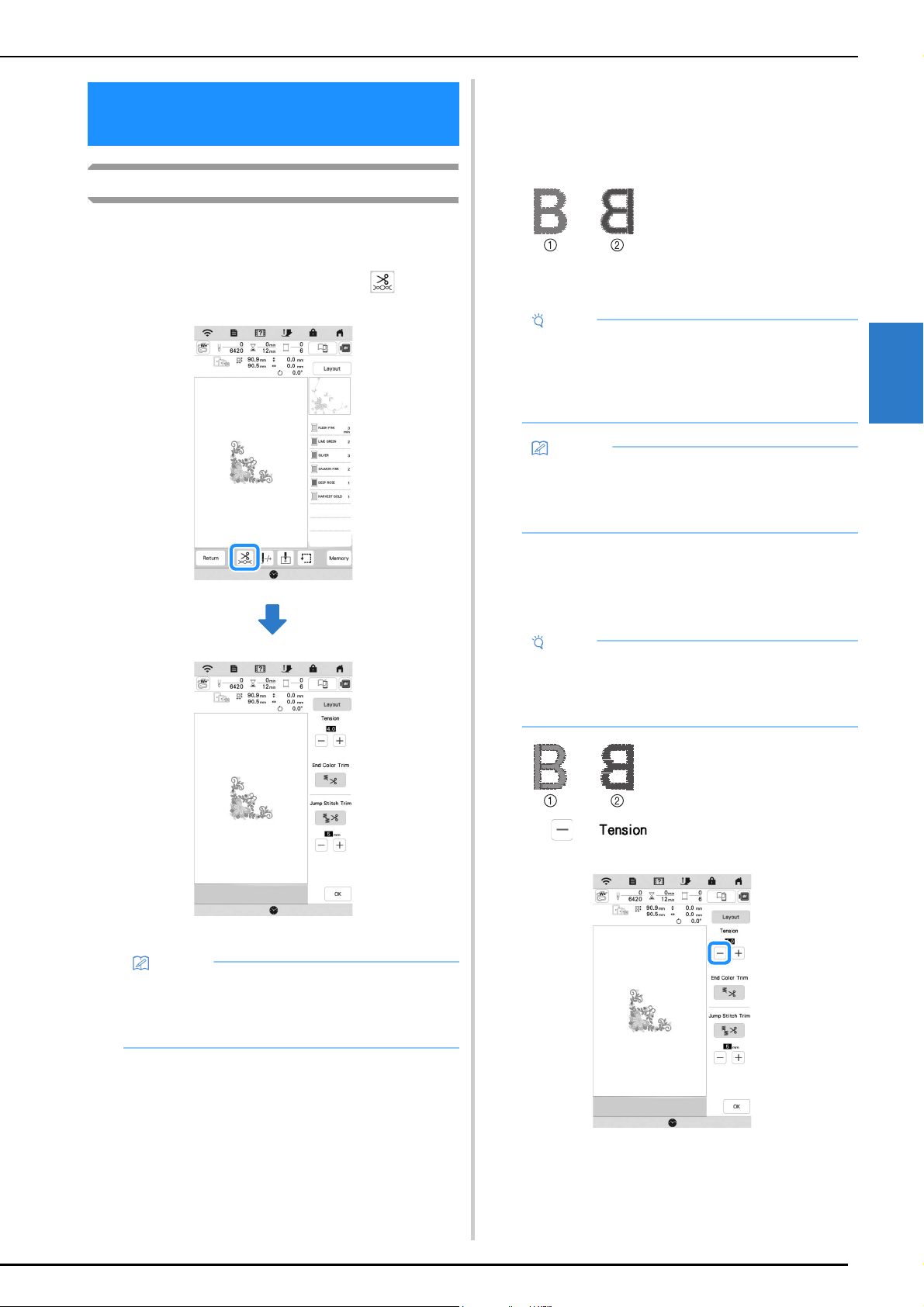
MAKING EMBROIDERY ADJUSTMENTS
75
ADVANCED EMBROIDERY
3
Adjusting Thread Tension
When embroidering, the thread tension should be set so that
the upper thread can slightly be seen on the wrong side of the
fabric.
The following screen appears when you touch .
Correct Thread Tension
The pattern can be seen from the wrong side of the fabric.
If the thread tension is not set correctly, the pattern will
not finish well. The fabric may pucker or the thread may
break.
Follow the operations described below to adjust thread
tension according to the situation.
Upper Thread Is Too Tight
The tension of the upper thread is too tight, resulting in the
bobbin thread being visible from the right side of the
fabric.
Touch in to weaken the upper thread
tension. (The tension number will decrease.)
MAKING EMBROIDERY
ADJUSTMENTS
Memo
• If the thread tension is changed from the default
setting, the new setting will remain after turning the
machine off and on. This new setting will apply to
any selected design.
1 Right side
2 Wrong side
Note
• If the thread tension setting is made extremely
loose, the machine may stop during embroidering.
This is not the sign of a malfunction. Increase the
thread tension slightly, and start embroidering
again.
Memo
• If the thread tension is changed from the default
setting, the new setting will remain after turning the
machine off and on. This new setting will apply to
any selected design.
Note
• If the bobbin thread was incorrectly threaded, the
upper thread may be too tight. In this case, refer to
“Setting the Bobbin” on page 25 and rethread the
bobbin thread.
1 Right side
2 Wrong side
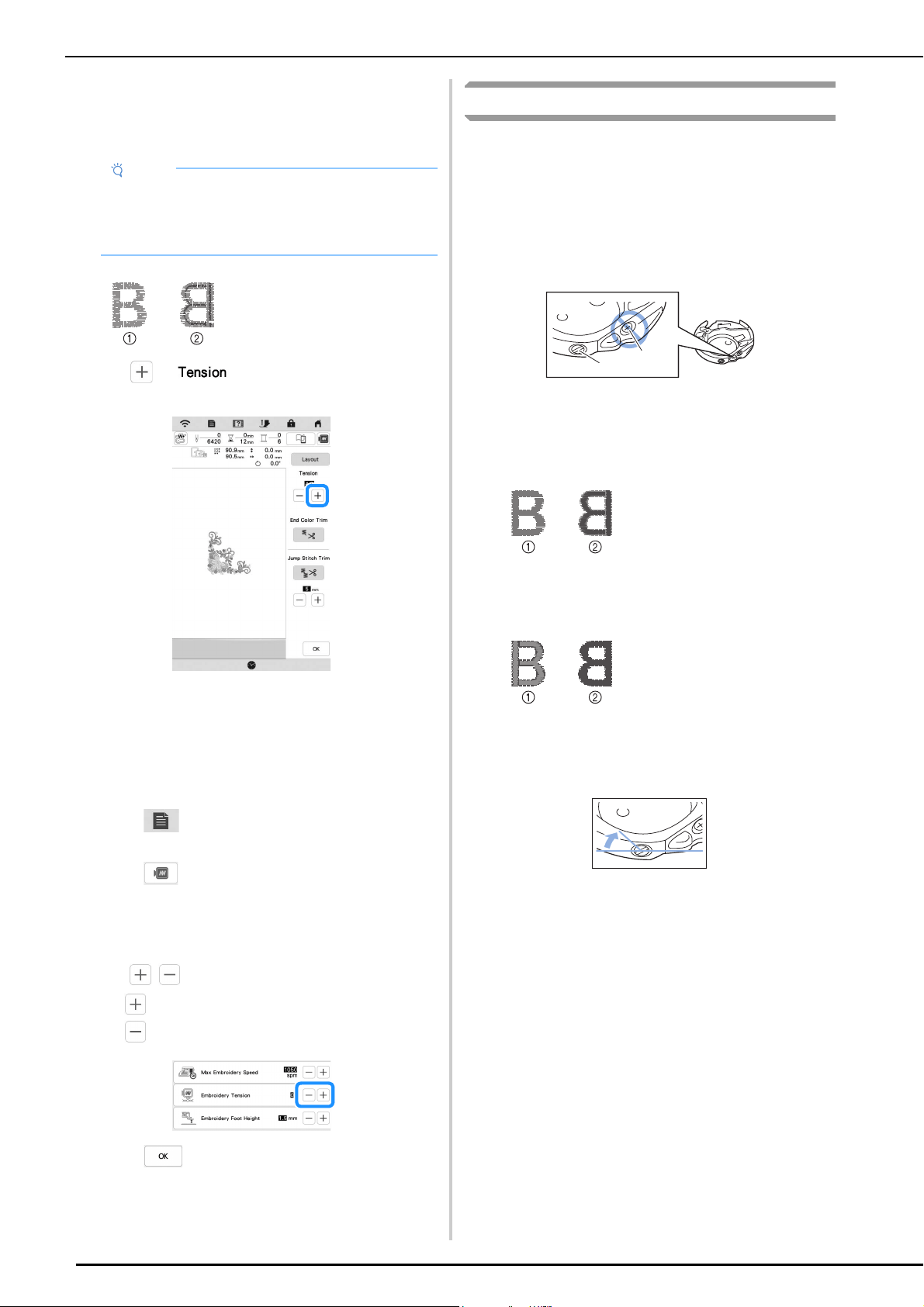
MAKING EMBROIDERY ADJUSTMENTS
76
Upper Thread Is Too Loose
The tension of the upper thread is too loose, resulting in a
loose upper thread, loose thread locks, or loops appearing
on the right side of the fabric.
Touch in to tighten the upper thread
tension. (The tension number will increase.)
Adjusting Overall Upper Thread Tension
When embroidering, if the overall tension of the upper
thread is too tight or too loose, adjust it from the setting
screen. The selected setting will be applied to all patterns.
If an individual embroidery pattern needs additional fine
tuning, refer to “Adjusting Thread Tension” on page 75.
a
Touch .
The settings screen appears.
b
Touch .
The embroidery settings screen appears.
c
Display [Embroidery Tension] in the embroidery
settings screen.
d
Use to adjust the upper thread tension.
* : Tighten the upper thread tension.
* : Loosen the upper thread tension.
e
Touch .
Adjusting the Bobbin Case
The bobbin case can be easily adjusted when bobbin tension
changes are required to accommodate different bobbin
threads. Refer to “Embroidering Attractive Finishes” on page
65.
To adjust the bobbin tension for embroidery function, using
the bobbin case, turn the slotted screw (-) with a (small)
screwdriver.
1 Do not turn a phillips screw (+).
2 Adjust with a screwdriver (small).
Correct Tension
Upper thread slightly appears on the wrong side of fabric.
Bobbin Thread Is Too Loose
Bobbin thread appears slightly on the right side of fabric.
If this occurs, turn the slotted screw (-) clockwise, being
careful not to over-tighten the screw, approximately 30-45
degrees to increase bobbin tension.
Note
• If the upper thread was incorrectly threaded, the
upper thread may be too loose. In this case, refer
to “Upper Threading” on page 26 and rethread the
upper thread.
1 Right side
2 Wrong side
1 Right side
2 Wrong side
1 Right side
2 Wrong side
a
b
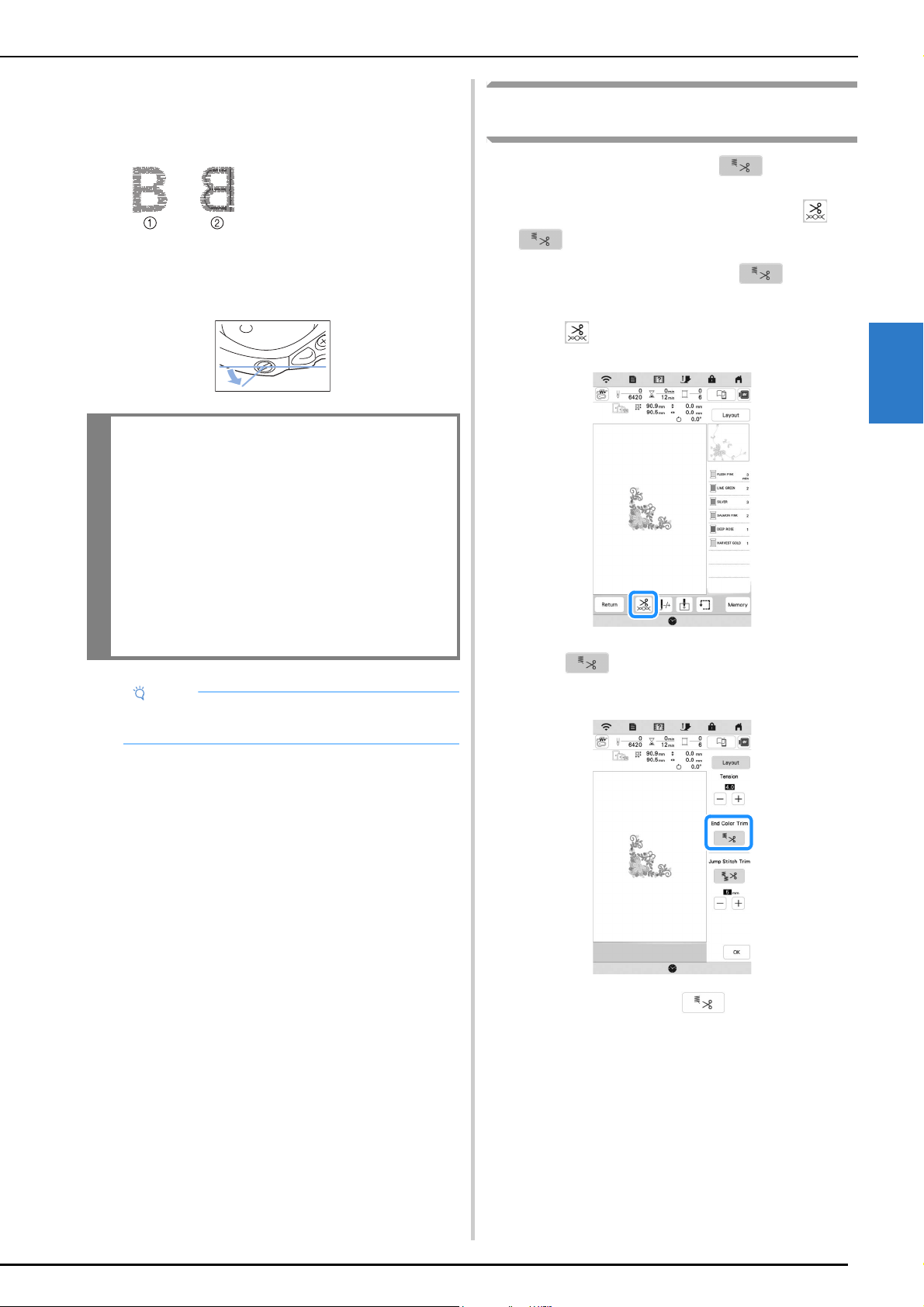
MAKING EMBROIDERY ADJUSTMENTS
77
ADVANCED EMBROIDERY
3
Bobbin Thread Is Too Tight
Upper thread on the right side of fabric seems to be lifting/
looping and bobbin thread is not seen on the wrong side
of fabric.
If this occurs, turn the slotted screw (-) counterclockwise,
being careful not to over-loosen the screw, approximately
30-45 degrees to decrease bobbin tension.
Using the Automatic Thread Cutting
Function (End Color Trim)
The automatic thread cutting function will cut the
thread at the end of embroidering each color. This function is
initially turned ON. To turn this function OFF, touch and
then .
* This setting returns to its default when the
machine is turned off.
a
Touch .
b
Touch to turn off the automatic thread cutting
function.
The key will display as . When one color
thread is embroidered, the machine will stop without
cutting the thread.
1 Right side
2 Wrong side
IMPORTANT
• DO NOT adjust the position of the phillips (+)
screw on the bobbin case as this may result in
damage to the bobbin case, rendering it
unusable.
• If the slotted screw (-) is difficult to turn, do
not use force. Turning the screw too much or
providing force in either (rotational) direction
may cause damage to the bobbin case. Should
damage occur, the bobbin case may not
maintain proper tension.
Note
• When adjusting the bobbin case, be sure to
remove the bobbin from the bobbin case.
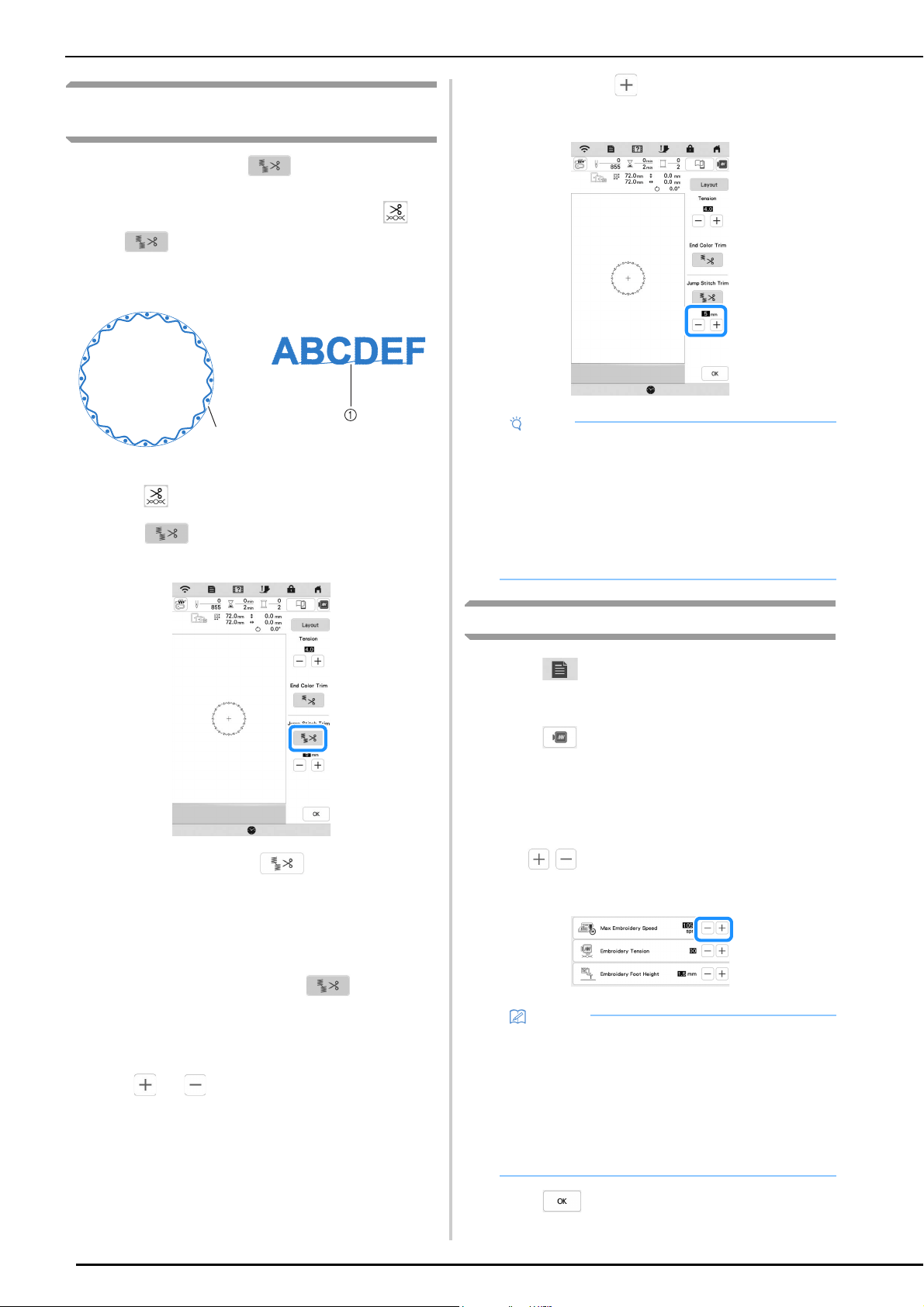
MAKING EMBROIDERY ADJUSTMENTS
78
Using the Thread Trimming Function
(Jump Stitch Trim)
The thread trimming function will automatically trim
any excess thread jumps within the color. This function is
initially turned ON. To turn this function OFF, touch key
and then .
* Your customized setting remains after turning the
machine off and on.
1 Jump stitch
a
Touch .
b
Touch to turn off the thread trimming
function.
The key will display as . The machine will
not trim the thread before moving to the next
stitching.
Selecting the Length Of Jump Stitch Not to
Trim
When the thread trimming function is turned on,
you can select the length of the jump stitch.
Select a setting from 5 mm to 50 mm in 5 mm increments.
* Your customized setting remains after turning the
machine off and on.
Touch or to select the length of jump stitch.
For example: Touch to select 25 mm (approx. 1
inch) and the machine will not trim a jump stitch of 25
mm or less before moving to the next stitching.
Adjusting the Embroidery Speed
a
Touch .
The settings screen appears.
b
Touch .
The embroidery settings screen appears.
c
Display [Max Embroidery Speed] in the embroidery
settings screen.
d
Use to change the maximum embroidery
speed.
e
Touch .
a
Note
• If design has many trims it is recommended to
select a higher jump stitch trim setting in order to
reduce the amount of excess tails on backside of
fabric.
• The higher number of the jump stitch length
selected, the fewer number of times the machine
will trim. In this case, more jump stitches remain on
the surface of the fabric.
Memo
• SPM is the number of stitches embroidered in one
minute.
• Decrease the embroidery speed when
embroidering on thin, thick, or heavy fabrics and
when using a specialty thread like a metallic thread.
• The setting specified before the main power is set
to OFF remains selected the next time that the
machine is turned ON.
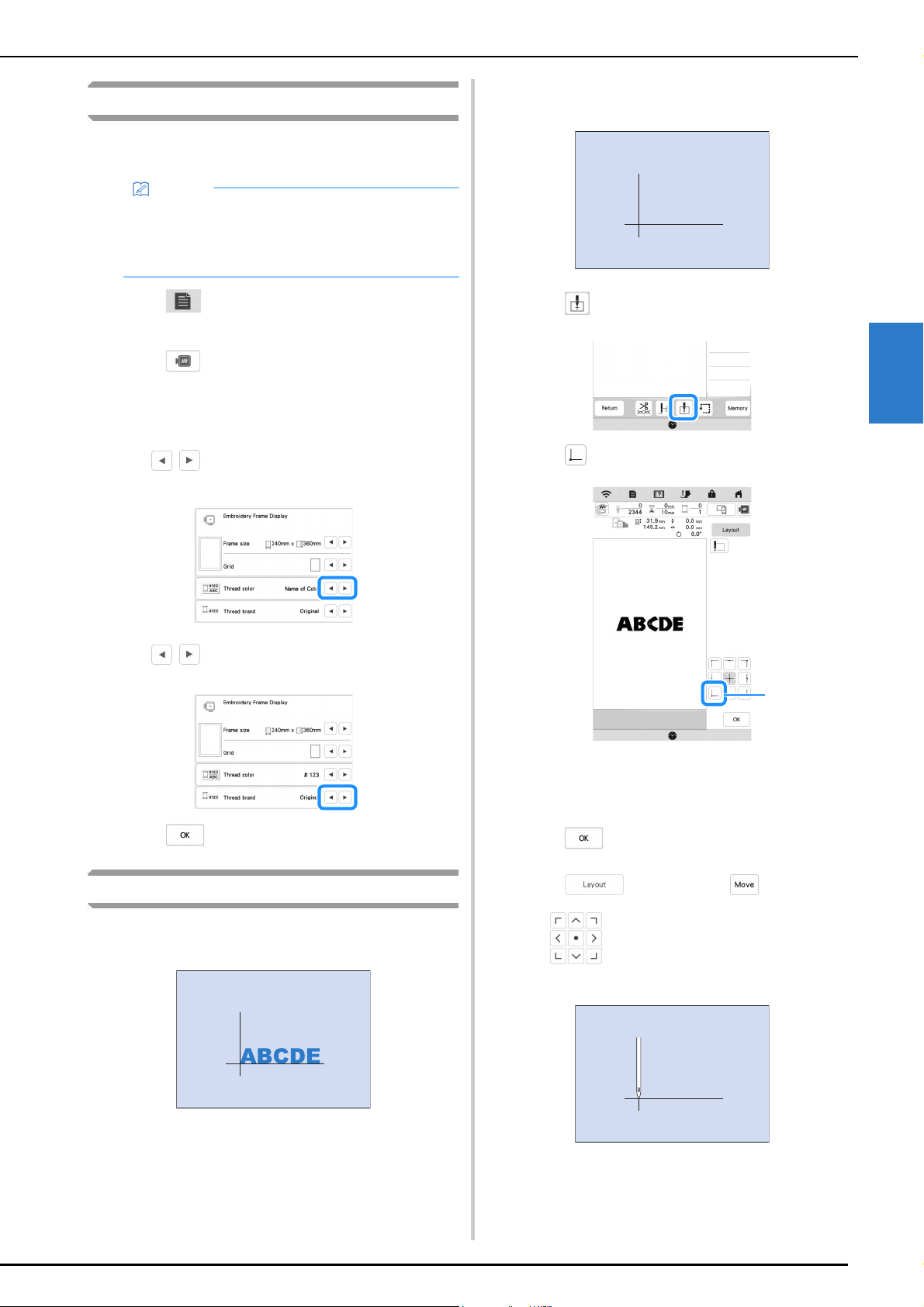
MAKING EMBROIDERY ADJUSTMENTS
79
ADVANCED EMBROIDERY
3
Changing the Thread Color Display
You can display the name of the thread colors or embroidery
thread number.
a
Touch .
The settings screen appears.
b
Touch .
The embroidery settings screen appears.
c
Display [Thread color] in the embroidery settings
screen.
d
Use to display the name of the thread colors
or the embroidery thread number.
e
Use to select a thread brand.
f
Touch .
Aligning the Pattern and the Needle
Example: Aligning the lower left side of a pattern and the
needle
a
Mark the embroidery start position on the fabric, as
shown.
b
Touch .
c
Touch .
1 Start position
The needle is positioned in the lower-left corner of
the pattern. The carriage moves so that the needle is
positioned correctly.
d
Touch .
e
Touch and then, touch .
f
Use to align the needle and the mark on the
fabric, and start embroidering the pattern.
Memo
• Colors on the screen may vary slightly from actual
spool colors.
• [Original], imported data remains the brand thread
created with the software, is set as a default.
1
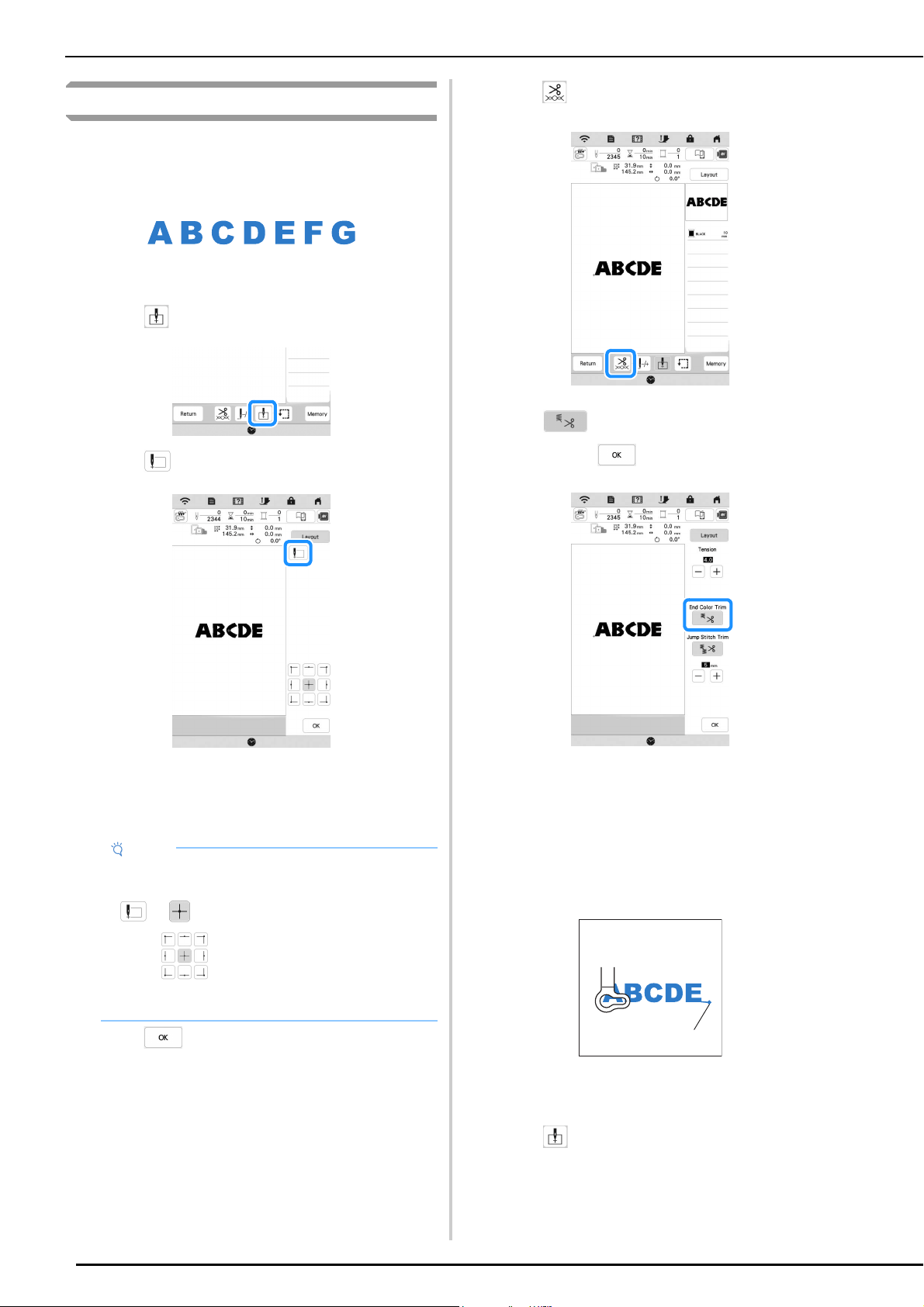
MAKING EMBROIDERY ADJUSTMENTS
80
Embroidering Linked Characters
Follow the procedure described below to embroider linked
characters in a single row when the entire pattern extends
beyond the embroidery frame.
Example: Linking “FG” to the characters “ABCDE”
a
Select the character patterns for “ABCDE”.
b
Touch .
c
Touch .
The needle is positioned in the lower-left corner of
the pattern. The carriage moves so that the needle is
positioned correctly. The machine is set to embroider
until the first stitch of the next character pattern (F).
d
Touch .
e
Touch .
f
Touch to turn off the thread cutting function
and then touch .
g
Press the “Start/Stop” button.
h
After the characters are embroidered, cut the threads
to a generous length, remove the embroidery frame,
reposition the fabric in the hoop so that the remaining
characters (“FG”) can be embroidered, and then attach
the embroidery frame.
1 End of the embroidering
i
As in step a, select the character patterns for “FG”.
j
Touch .
Note
• To cancel the starting point setting and return the
starting point to the center of the pattern, touch
or .
• Using can select a different starting point
for embroidering. However, the starting point
setting is canceled.
a
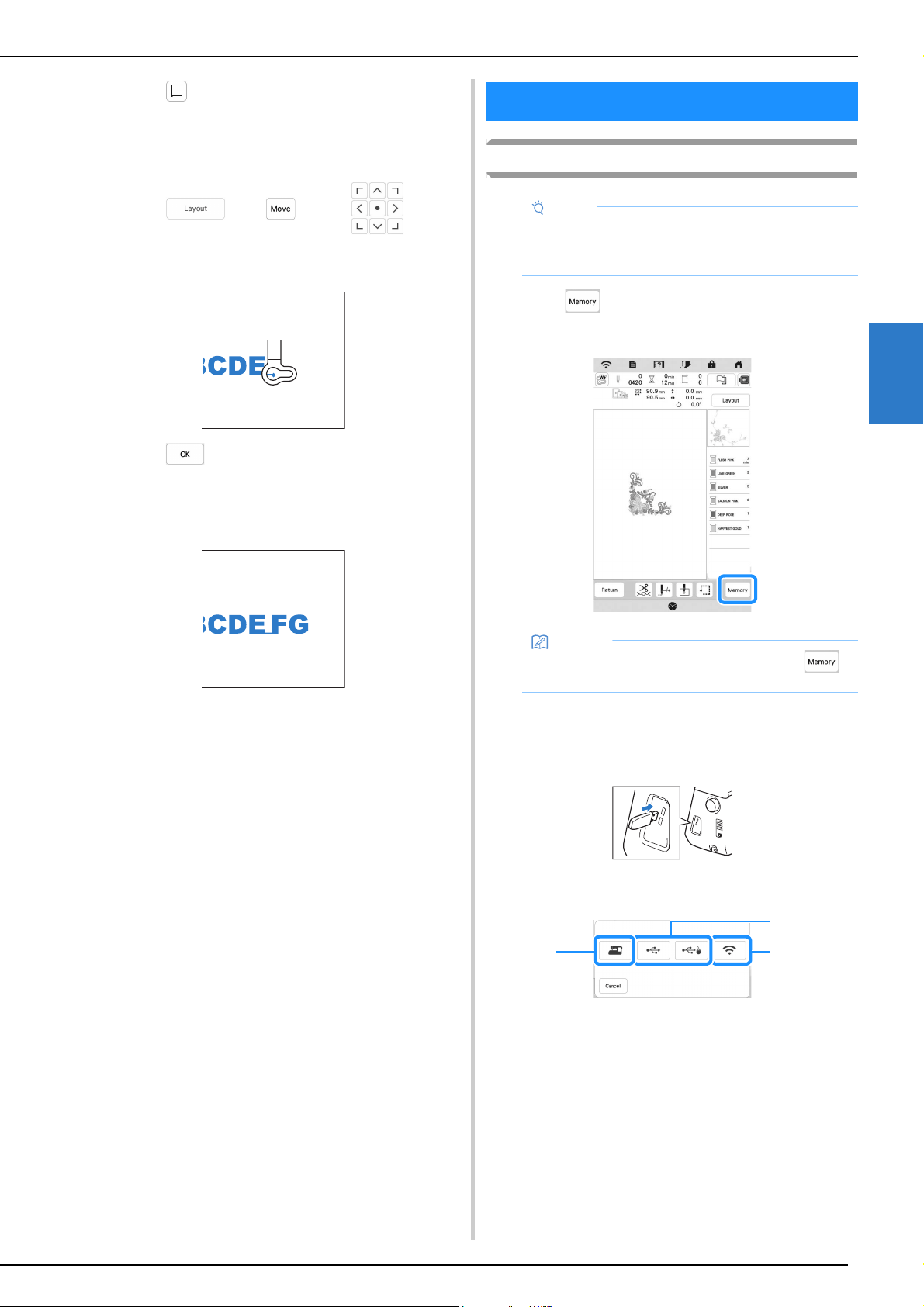
USING THE MEMORY FUNCTION
81
ADVANCED EMBROIDERY
3
k
Touch .
The needle is positioned in the lower-left corner of
the pattern. The carriage moves so that the needle is
positioned correctly.
l
Touch , then and use to align
the needle with the end of embroidering for the
previous pattern.
m
Touch .
n
Press the “Start/Stop” button to start embroidering the
remaining character patterns.
Saving Embroidery Patterns
a
Touch when the pattern you want to save is in
the embroidering screen.
b
When saving the embroidery pattern in a USB media,
insert the USB media into the USB port on the
machine.
c
Touch the desired destination to start saving.
1 Save to the machine’s memory.
2 Save to the USB media. The pattern is saved in a folder
labeled [bPocket].
3 Save to the wireless function pocket. For the detailed
procedure, refer to the manual for PE-DESIGN (version
11 or later).
USING THE MEMORY FUNCTION
Note
• Do not turn the main power to OFF while the
[Saving…] screen is displayed. You will lose the
pattern you are saving.
Memo
• You can also save the pattern by touching in
the embroidery edit screen.
1 31
2
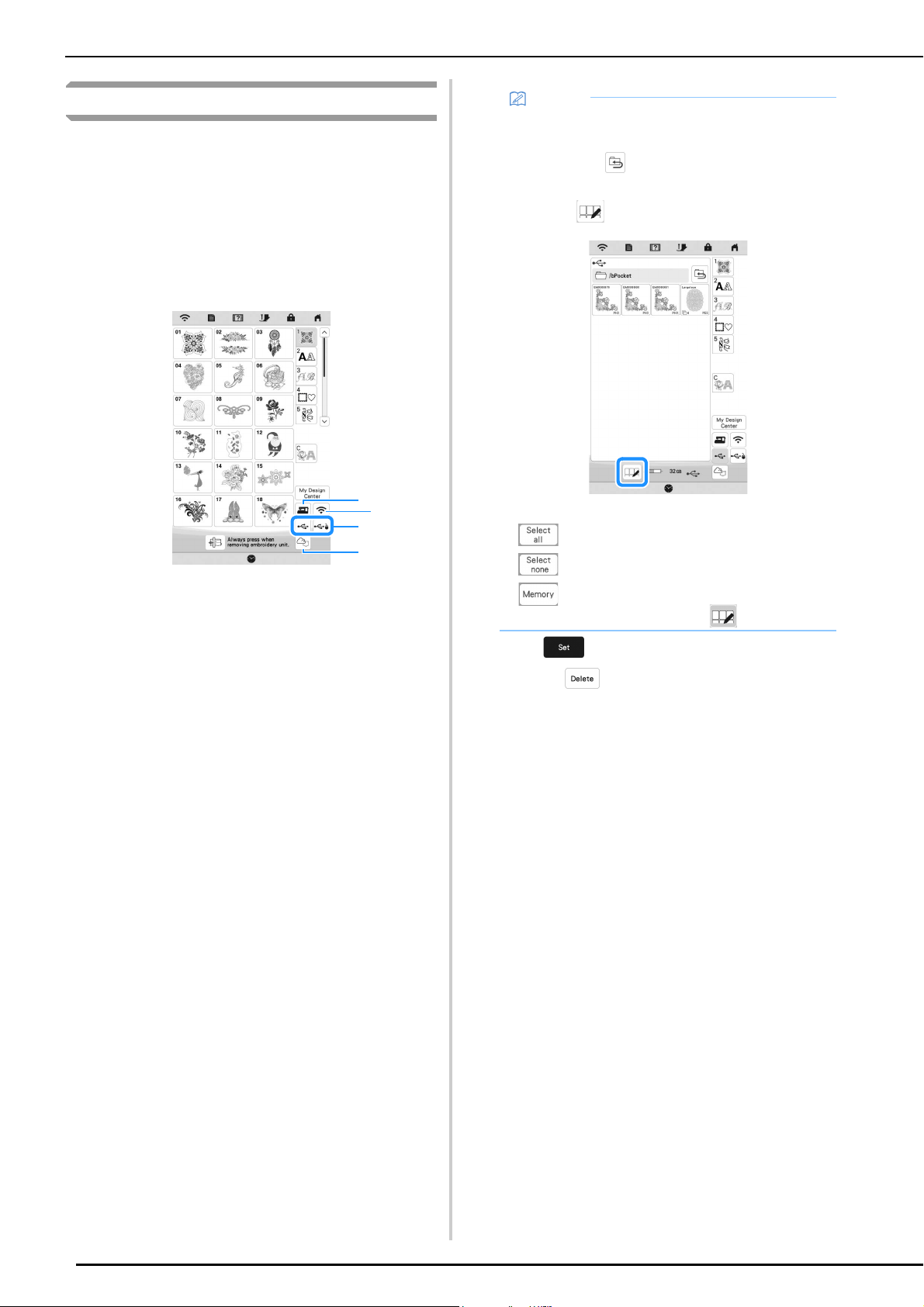
USING THE MEMORY FUNCTION
82
Retrieving Embroidery Patterns
a
When retrieving the embroidery patterns from a USB
flash drive, insert the USB flash drive into the USB port
on the machine.
To retrieve embroidery patterns via wireless network,
use PE-DESIGN (version 11 or later) or Design
Database Transfer to transfer the patterns in advance.
For details on transferring embroidery patterns, refer
to the manual for PE-DESIGN or Design Database
Transfer.
1 Retrieve from the machine’s memory.
2 Retrieve from a USB media.
3 Retrieve the pattern via the wireless network connection.
For detailed procedures, refer to PE-DESIGN manual
(Version 11 or later).
4 Retrieve from Artspira App. (page 108)
b
Touch .
* Touch to delete the embroidery pattern.
2
1
3
4
Memo
• If the embroidery pattern to be retrieved is in a
folder of the USB media, touch the key for that
folder. Touch to return to the previous screen.
• You can save all or multiple data to the machine by
touching .
• To select multiple patterns, touch their thumbnails.
• : Select all patterns.
• : Deselect all patterns.
• : Save the selected patterns to the machine.
* To cancel the selection, touch again.
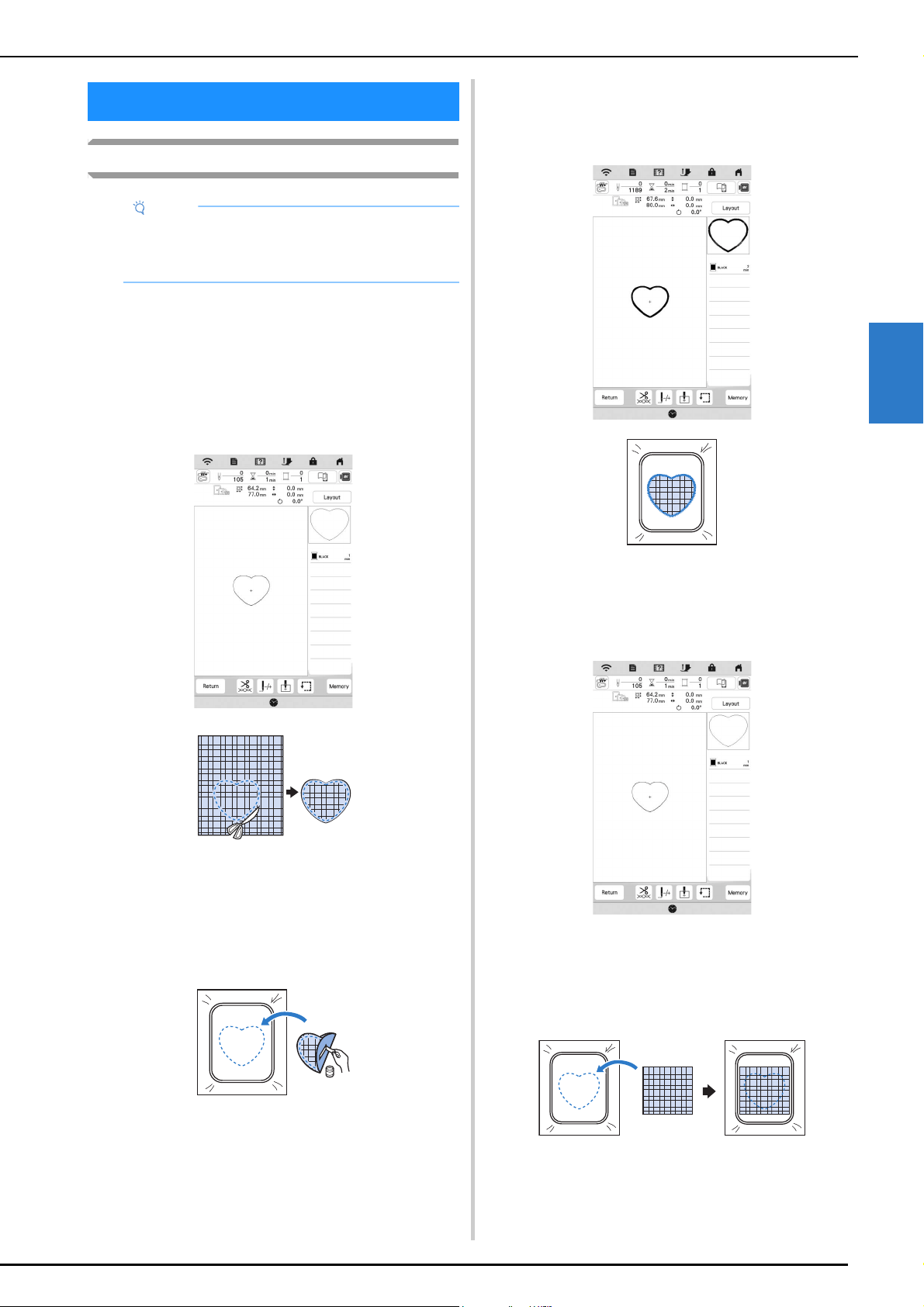
EMBROIDERY APPLICATIONS
83
ADVANCED EMBROIDERY
3
Using a Frame Pattern To Make an Appliqué
Method 1
You can use framed patterns of the same size and shape to
create an appliqué. Embroider one pattern with a straight
stitch and one pattern with a satin stitch.
a
Select a straight stitch frame pattern. Embroider the
pattern onto the fabric for the appliqué piece, then cut
neatly around the outside of the shape.
b
Embroider the same pattern from step a onto the
base fabric.
c
Apply two-sided stabilizer material to the back of the
fabric for the appliqué piece created in step
a. Attach
the appliqué to the base fabric matching the shapes.
d
Select the satin stitch frame pattern of the same shape
as the appliqué. Embroider over the fabric for the
appliqué piece and base fabric from step c to create
the appliqué.
Method 2
a
Select a straight stitch frame pattern, and embroider
the pattern onto the base fabric.
b
Place the fabric for the appliqué piece over the pattern
embroidered in step
a and embroider the same
pattern on the fabric for the appliqué piece.
* Be sure that the fabric for the appliqué piece
completely covers the stitched line.
EMBROIDERY APPLICATIONS
Note
• If you change the size or position of the patterns when
making an appliqué, make a note of the size and the
location.
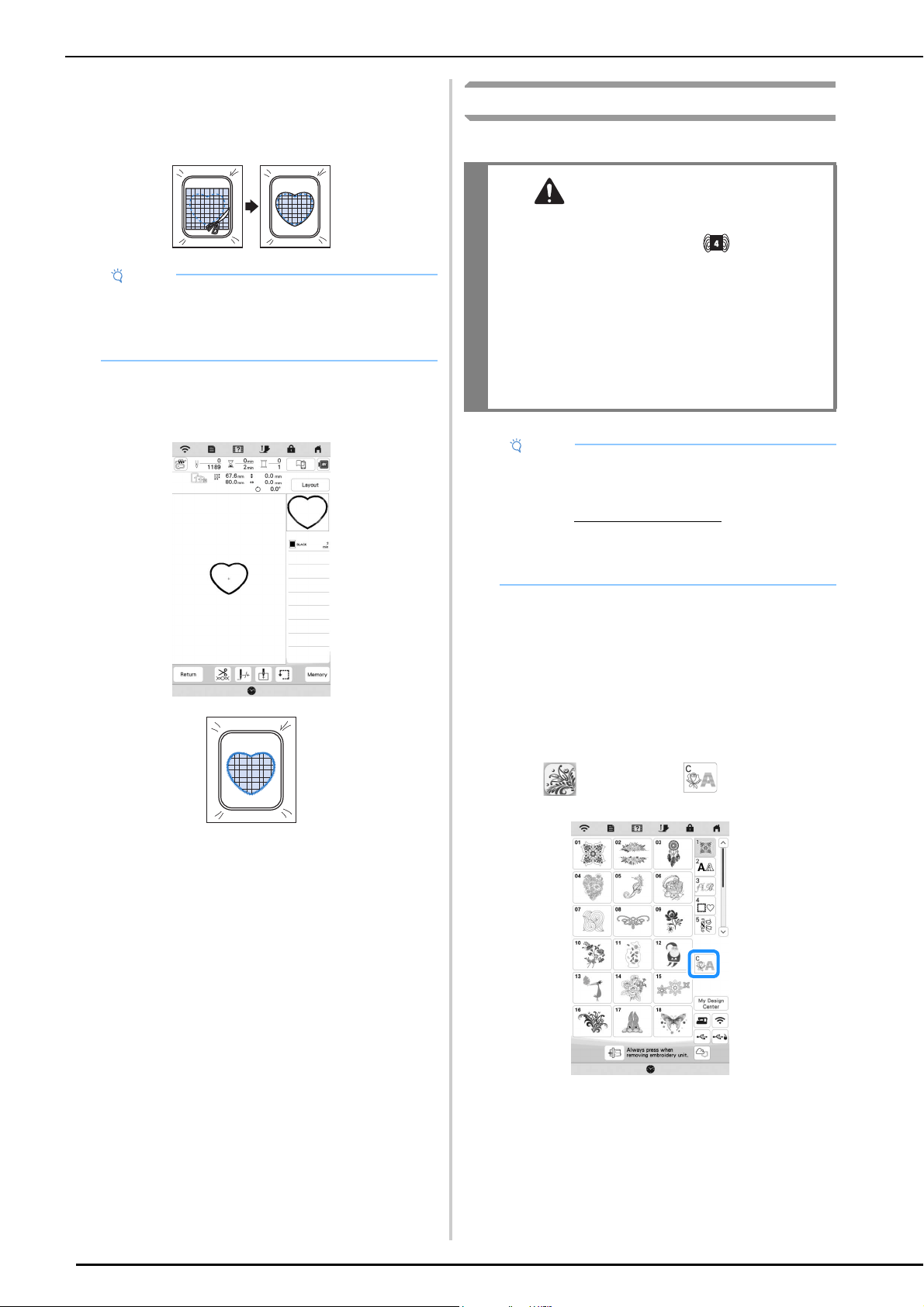
EMBROIDERY APPLICATIONS
84
c
Remove the embroidery frame from the embroidery
unit, and cut around the outside of the stitches of the
fabric for the appliqué piece. And then, reattach the
embroidery frame to the embroidery unit.
d
Select the satin stitch frame pattern of the same shape
as the appliqué and embroider the satin stitch pattern
to create an appliqué.
Embroidering Couching Patterns
Couching patterns can be embroidered using yarn.
Preparing for Embroidery Couching
a
Turn off the machine.
Attach the embroidery unit.
b
Install a bobbin wound with embroidery bobbin
thread.
c
Turn on the machine.
d
Touch , and then touch .
Note
• Do not remove the fabric from the embroidery
frame to cut it. Also, do not pull or push on the
fabric. Otherwise, the fabric may loosen in the
frame.
CAUTION
• When using yarn, we recommend selecting
yarn of weight 4 (MEDIUM ). Medium
yarn is often referred to as worsted weight, 20
knitted stitches per 10 cm, or 9-11 wraps per
inch. The diameter of the yarn is
approximately 2-3 mm (approx. 1/12-1/8
inch). If the yarn is extremely thin or thick, has
an unusual shape (flat or furry), or more than 2
yarns, the best finishing results may not be
achieved, or injuries or damage may result.
Note
• If the spool stand in the procedure is not included
with your machine, purchase the optional spool
stand from your Brother authorized dealer or our
web site https://s.brother/coeka/
.
• Before embroidering your project, do trial
embroidery on a scrap piece of fabric that is the
same as that used in your project.
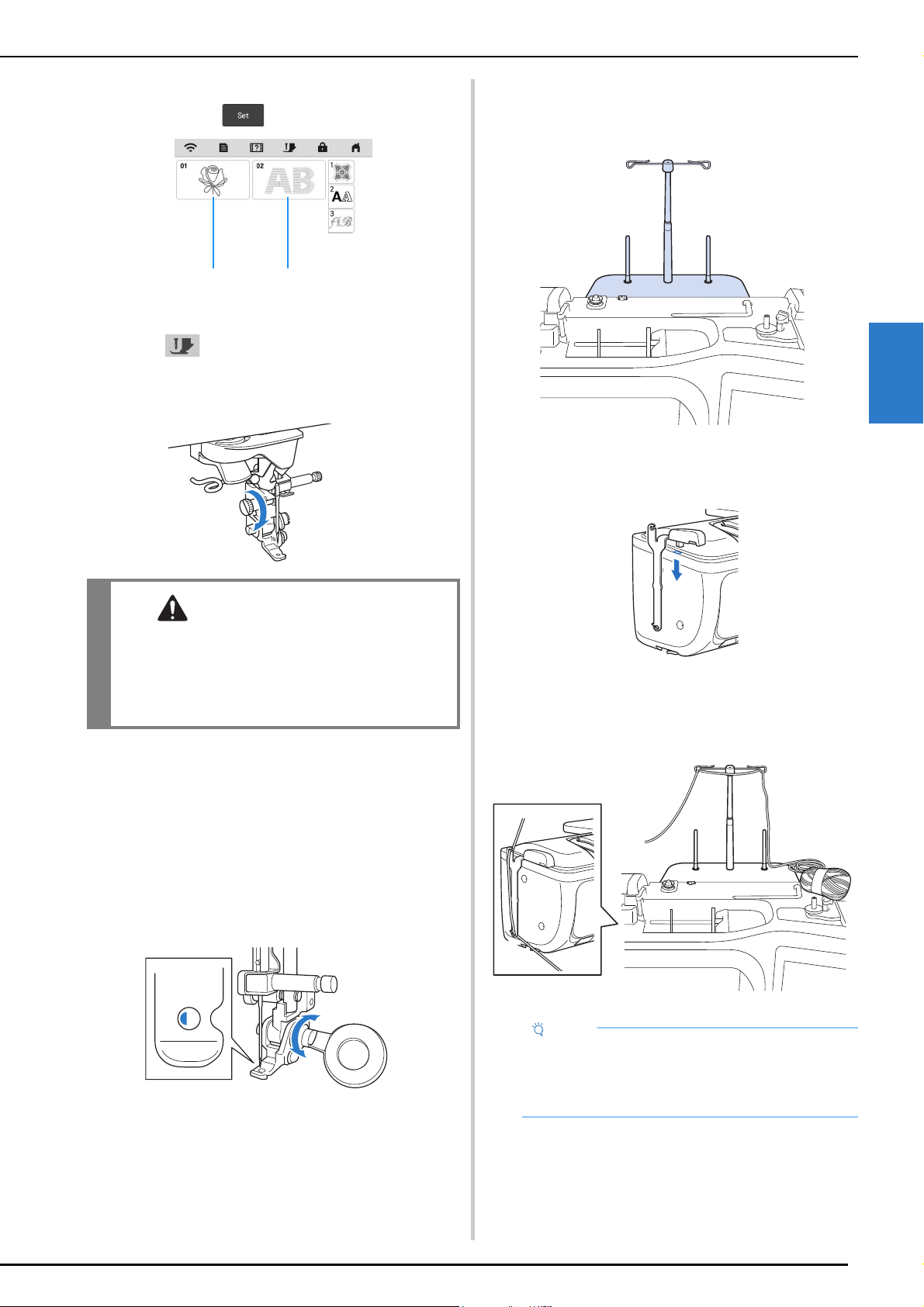
EMBROIDERY APPLICATIONS
85
ADVANCED EMBROIDERY
3
e
Select the desired pattern from the desired category.
And then touch .
1 Couching patterns
2 Fill couching embroidery font
f
Touch to lock all keys and buttons, and then
raise the presser foot lever.
g
Attach embroidery couching foot “Y”.
h
Rotate the handwheel and check that the needle is in
the left half of the hole in embroidery couching foot
“Y”.
If the needle is not in the left half, use the disc-shaped
screwdriver to turn the screw of embroidery couching
foot “Y” to adjust the position of the embroidery foot.
Turn the screw toward you to move the embroidery foot
to the right. Turn the screw toward the back to move the
embroidery foot to the left.
After making adjustments, rotate the handwheel and
check that the needle does not touch the presser foot.
i
Attach the spool stand (sold separately) to the
machine.
At this time, do not raise the telescopic thread guide
shaft.
j
Insert the yarn guide for embroidery couching into the
slot on the top left of the machine.
k
Pass the yarn through the telescopic thread guide and
the yarn guide (1) to (2).
CAUTION
• When using the embroidery couching foot
“Y”, make sure the machine is in embroidery
mode. Otherwise, the needle will strike the
embroidery couching foot, causing the needle
to break and possibly causing injury.
1 2
Note
• Pull off an appropriate amount of yarn from the ball
so that the yarn does not become taut.
• Make sure that the yarn does not become
entangled as you work.
1
2
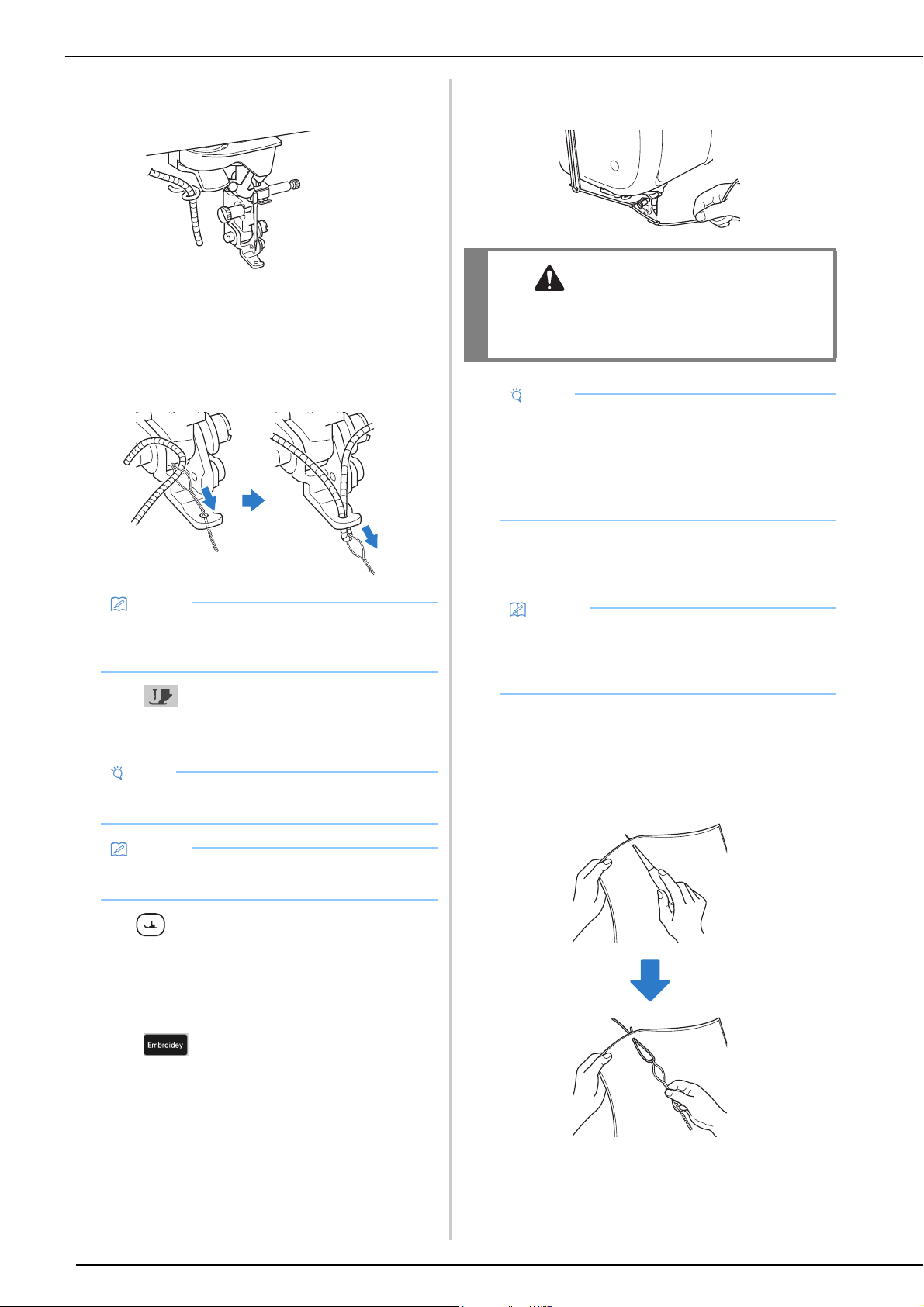
EMBROIDERY APPLICATIONS
86
l
Pass the yarn through the guide on embroidery
couching foot “Y”.
m
Thread the yarn through embroidery couching foot
“Y”.
Pass the yarn through the loop in the yarn threader,
and then pass the threader from top to bottom through
the hole in embroidery couching foot “Y”. Pull the
yarn to the front of the machine.
n
Touch to unlock all keys and buttons.
o
Thread the machine with the upper thread.
p
Press (Presser foot lifter button) twice to raise the
presser foot and then attach the embroidery frame to
the embroidery unit.
Embroidering a Couching Pattern
a
Touch .
b
Make sure that about 20 cm (approx. 8 inches) of yarn
is pulled to the front of the machine.
c
While holding the yarn in your hand in front of you,
press the “Start/Stop” button.
d
After embroidering several stitches, release the yarn.
When embroidering is finished, the machine will
automatically trim the threads and stop.
e
Cut the yarn, leaving about 20 cm (approx. 8 inches).
f
Punch a hole through the fabric with an awl or tapestry
needle and then use the yarn threader to pull the
excess yarn to the wrong side of the fabric.
g
Tie the end of the yarn so it cannot be pulled out, and
then use scissors to cut off any excess yarn.
Memo
• Place a sheet of paper under the presser foot to
smoothly pass the yarn threader through the hole in
embroidery couching foot “Y”.
Note
• Do not use the spool stand for upper thread.
Otherwise thread may tangle with yarn.
Memo
• For best results, use an upper thread that is the
same color as the yarn.
CAUTION
• Pulling the yarn upwards may cause it to catch
on the needle, causing it to break. Be careful
not to allow the yarn to catch on the needle.
Note
• Before embroidering, make sure that there is
enough yarn, upper thread and bobbin thread.
• Make sure that the yarn passes smoothly through
the guides. Unravel as much yarn from the ball as
necessary so that the yarn does not become taut.
• Use yarn that has no knots.
Memo
• When using a high-density yarn, the upper thread
tension may be disturbed. If this happens, it is
possible to improve it by raising the [Embroidery
Foot Height] by about 1 mm on the settings screen.
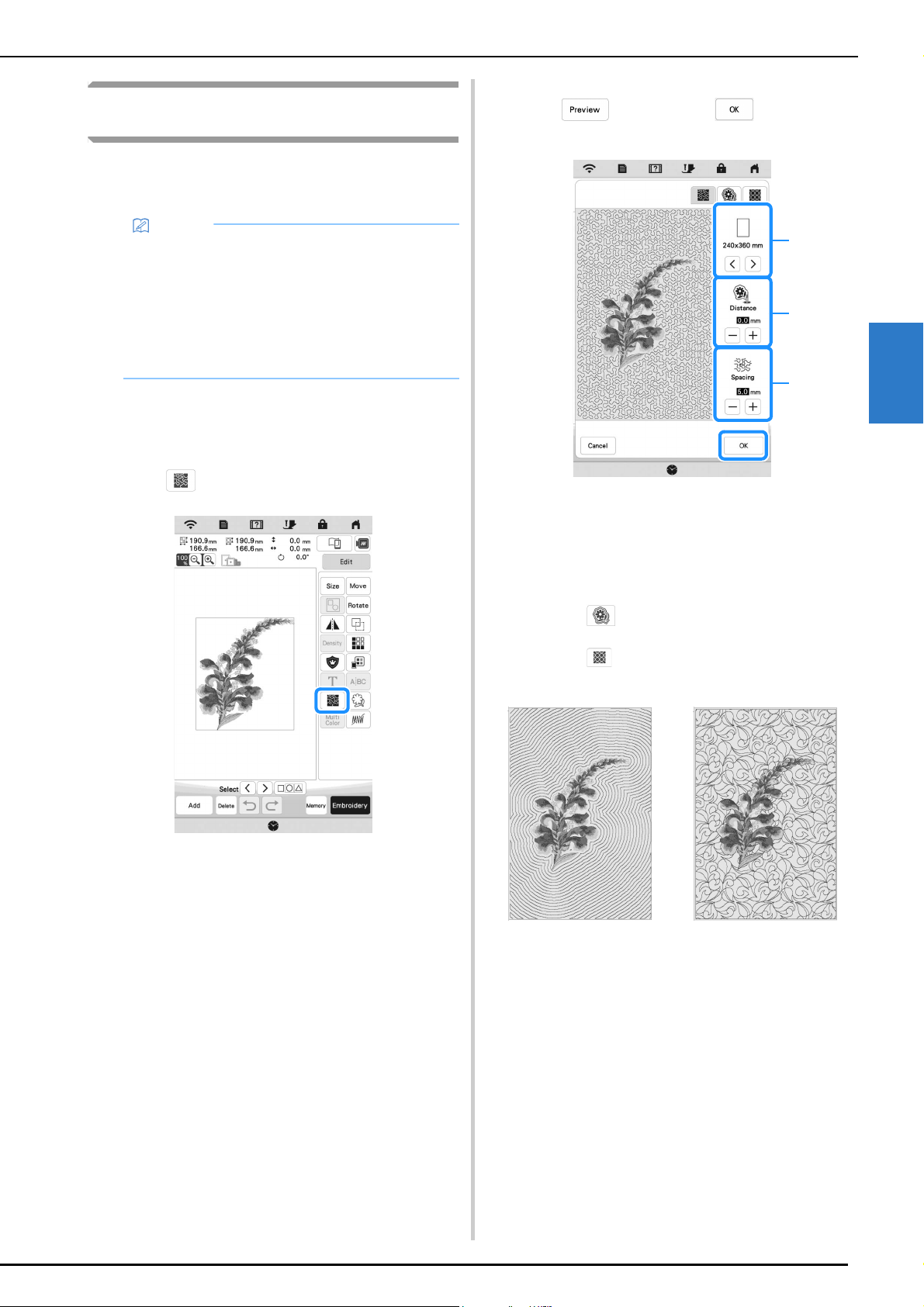
EMBROIDERY APPLICATIONS
87
ADVANCED EMBROIDERY
3
Creating Stippling, Echo Quilting, or
Decorative Fill Patterns around a Design
Stippling, echo quilting, and decorative fill patterns can be
created around the machine’s built-in patterns or original
embroidery data without using My Design Center.
a
Select the pattern that stippling will be added around.
* To select multiple patterns, refer to “Selecting
Multiple Patterns at the Same Time” on page 38.
b
Touch in the embroidery edit screen.
Stippling is automatically applied around the
selected pattern.
c
After specifying the stitch settings for the stippling,
touch , and then touch .
1 The stippling is added within the area of the selected
frame size. If the pattern is larger than the selected frame
size, the area indicating the frame size will appear in
gray, and stippling will not be added.
2 Specify the distance from the outline of the pattern to the
stippling.
3 Specify the spacing for the stippling.
* Touch in the stippling settings screen to create
an echo quilting pattern.
* Touch in the stippling settings screen to create
a decorative fill pattern.
1 Echo quilting pattern
2 Decorative fill pattern
Memo
• If this simple stippling operation is used with
batting sandwiched between two layers of fabric,
the embroidery pattern and stippling may become
misaligned.
Stippling can be added in My Design Center after
the pattern is embroidered. For details, refer to
“Decorative Stitching around a Pattern in
Embroidery (a Quilting Function)” on page 104.
12
1
2
3
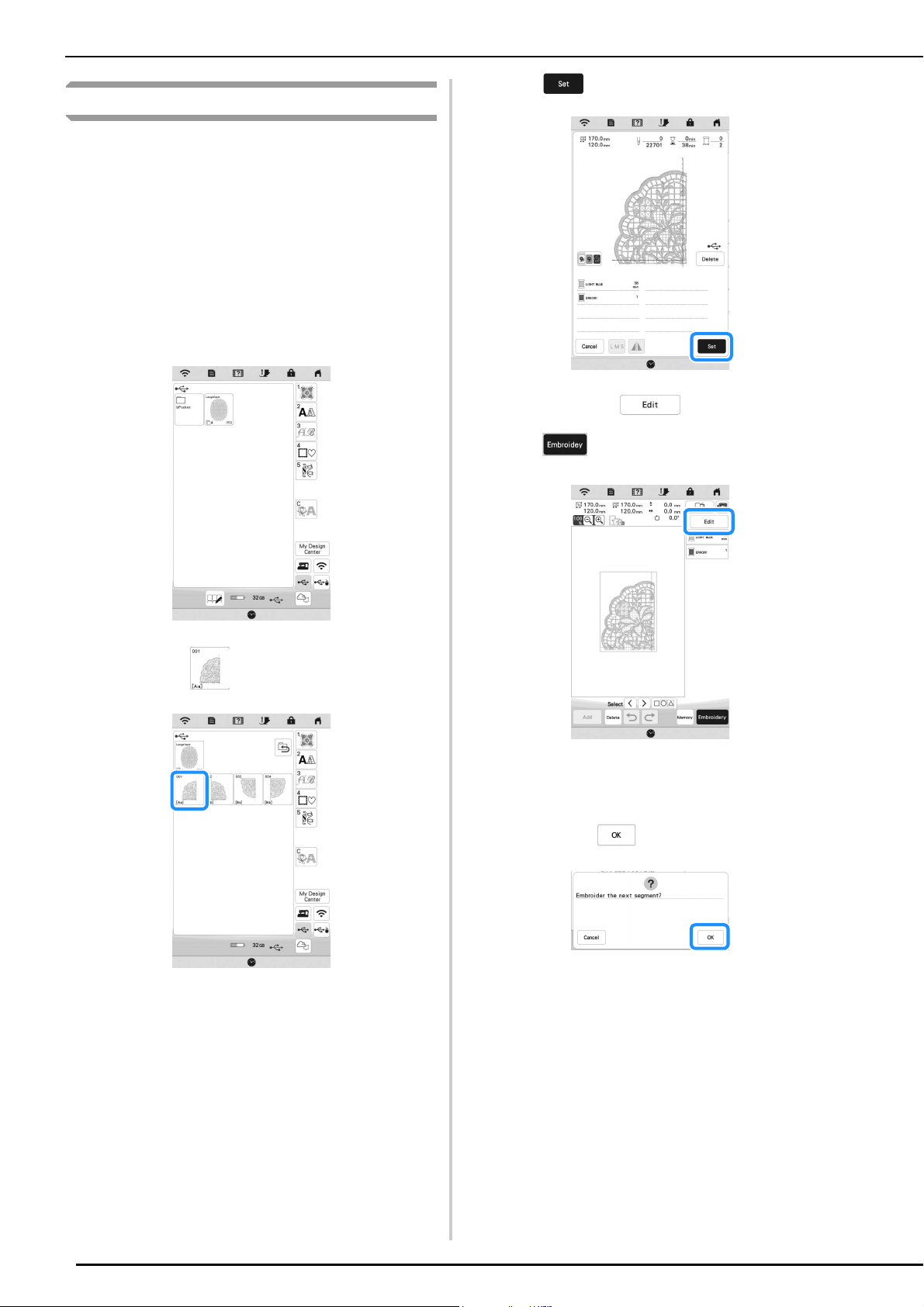
EMBROIDERY APPLICATIONS
88
Embroidering Split Embroidery Patterns
Split embroidery patterns created with PE-DESIGN Ver. 7 or
later can be embroidered. With split embroidery patterns,
embroidery patterns larger than the embroidery frame are
divided into multiple sections, which combine to create a
single pattern after each section is embroidered.
For details on creating split embroidery patterns and for more
detailed embroidery instructions, refer to the Instruction
manual included with PE-DESIGN Ver. 7 or later.
a
Insert the USB media containing the created split
embroidery pattern, and then select the split
embroidery pattern to be embroidered. (page 82)
b
Select section to be embroidered.
c
Touch .
d
If necessary, touch and edit the pattern.
Touch to display the embroidery screen.
e
Embroider the pattern section.
f
When embroidering is finished, the following screen
appears. Touch .
A screen appears so that a section of the split
embroidery pattern can be selected.
g
Repeat steps b through f to embroider the
remaining sections of the pattern.
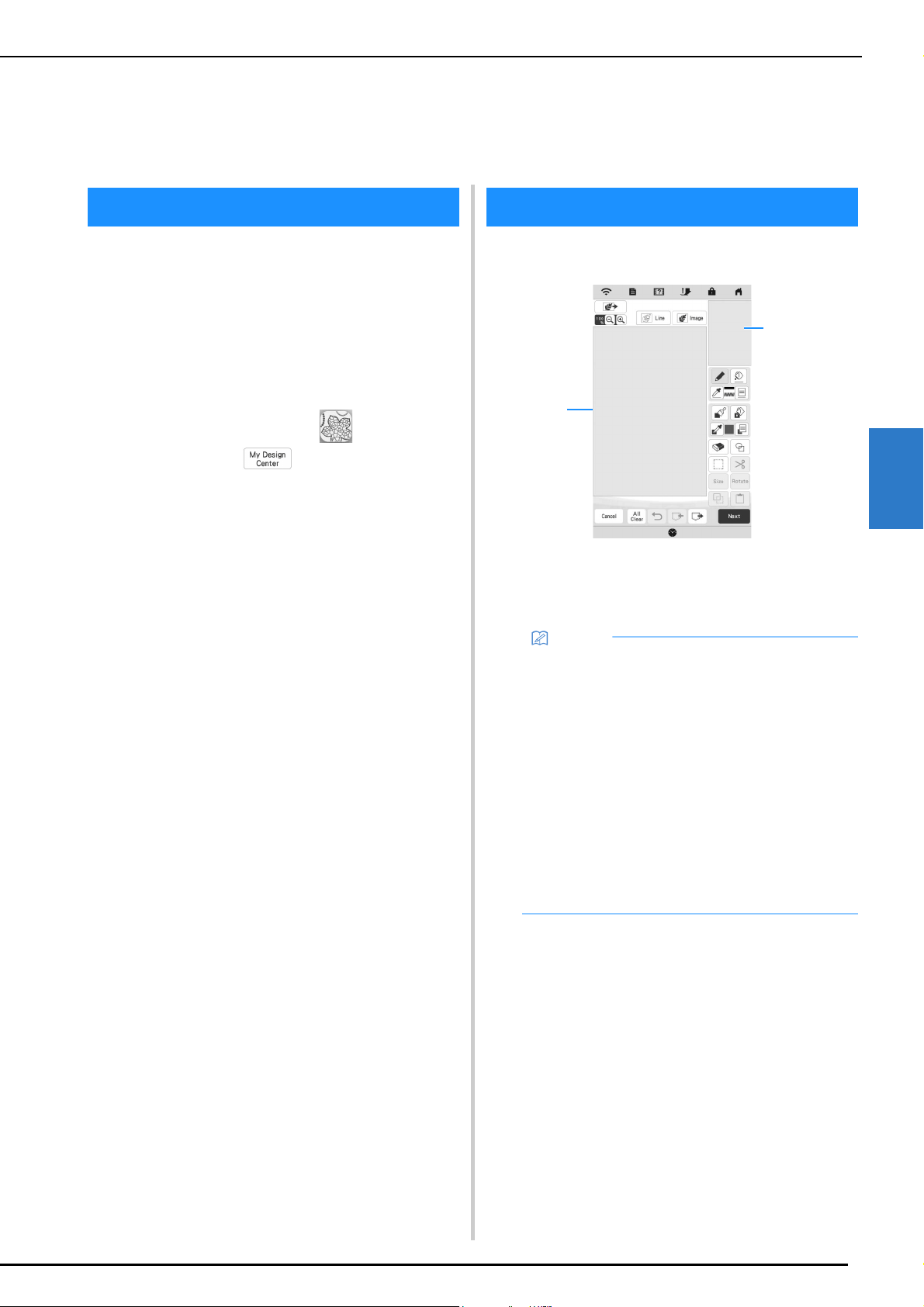
ABOUT MY DESIGN CENTER
89
MY DESIGN CENTER
4
With My Design Center, you can use the functions listed
below:
• Hand-drawn functions - creating embroidery patterns
by drawing on the LCD screen
• Loading functions - creating embroidery patterns by
transferring data from the application or USB media.
You can also combine patterns that you have created with
the machine’s built-in patterns.
Start My Design Center by touching in the home
page screen or touching in the embroidery pattern
selection screen.
1 Pattern drawing area
2 Pattern preview area
Chapter 4
MY DESIGN CENTER
ABOUT MY DESIGN CENTER PATTERN DRAWING SCREEN
Memo
• The actual dimension of the pattern area is the size
of the embroidery frame, which is shown in the
pattern preview area. The pattern you drew may be
bigger than you expected. Please resize the pattern
after converting the design to the embroidery
pattern.
• When the pattern is enlarged so that only a part of
it appears in the pattern drawing area, the entire
pattern is displayed in the pattern preview area.
The red frame in the pattern preview area indicates
the part of the pattern displayed in the pattern
drawing area. Move the red frame in the pattern
preview area with the touch pen (stylus) or your
finger to display the corresponding area in the
pattern drawing area.
1
2
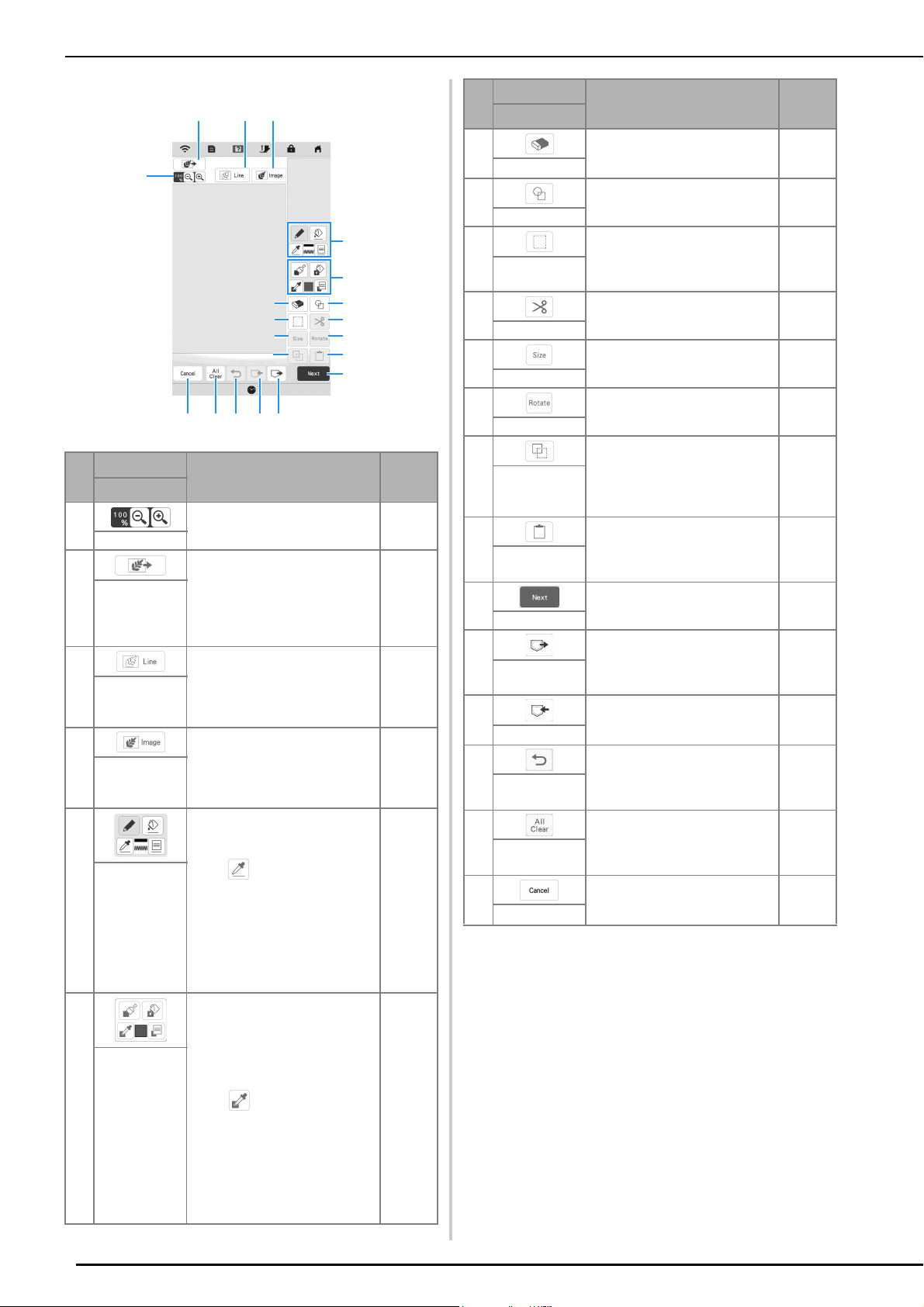
PATTERN DRAWING SCREEN
90
Key Functions
No.
Display
Explanation Page
Name
3 Magnify the pattern. 92
Magnify key
4 Load the fabric as the
background or the picture as the
reference when creating the
pattern. You can load the image
file from the application or USB
media.
97
Load key
5 Load a line drawing, then edit and
convert it to embroidery data. You
can load a line drawing from the
application or USB media to
create the embroidery design.
98
Line design key
6 Load an image, then edit and
convert it to embroidery data. You
can load an image from the
application or USB media to
create the embroidery design.
100
Image design
key
7 Draw lines and set the color. You
can select the line type, stitch
type and color as you need.
Touch to pick up the color,
line type and stitch type from a
line in the pattern within the
pattern drawing area. The picked
up color is shown as the currently
selected line color beside the
button and as the selected color
in the Line Property screen.
91
Line tool key
8 Paint with brush and set the color.
You can select the brush type, fill
type and color as you need.
Painted lines and regions will be
converted to the pattern to be
embroidered with fill stitch.
Touch to pick up the color,
brush type and fill type from a
region in the pattern within the
pattern drawing area. The picked
up color is shown as the currently
selected region color in the color
bar and the Region Property
screen.
92
Brush tool key
3
L
5 6
G
8
0
B
D
K J I H
F
4
7
9
A
C
E
9 Erase lines and shapes that have
been drawn. You can select the
size/shape of the eraser.
94
Erase key
0 Select the stamp shape for
pattern drawing.
93
Stamp key
A Select a section for moving,
copying, deleting, changing size
and rotating lines and shapes that
have been drawn.
94
Select key
B Cut out the selected section. —
Cut key
C Change the size of the selected
section.
102
Size key
D Rotate the selected section. —
Rotate key
E Duplicate the selected section.
The temporarily positioned
section can immediately be
rotated, enlarged, reduced or
moved.
—
Duplicate key
F Paste in the selected section
duplicated with the duplicate key
or a selected section using the
cut key.
—
Paste key
G Proceed to the stitch settings
screen.
—
Next key
H Recall image data created with
My Design Center from the
machine’s memory or the USB
media.
—
Recall key
I Store the pattern being created to
the machine’s memory or the
USB media.
—
Memory key
J Undo the last operation that was
performed and return to the
previous state. Each touch of this
key will undo one operation.
—
Undo key
K Clear all the lines and shapes and
start from the beginning. The
background image is also
cleared.
—
All Clear key
L Exit from My Design Center. All
lines and shaped are erased
when you touch this key.
—
Cancel key
No.
Display
Explanation Page
Name
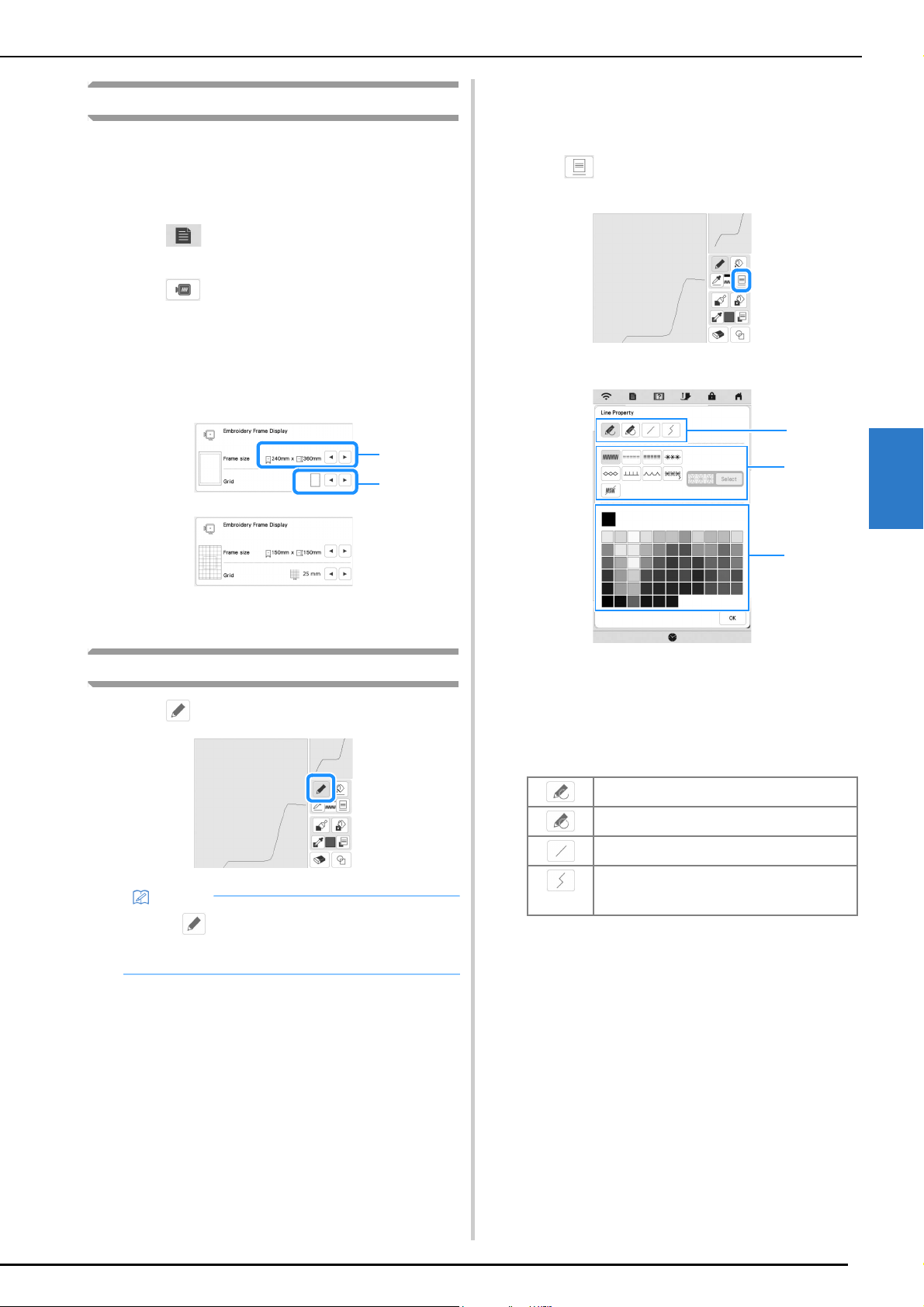
PATTERN DRAWING SCREEN
91
MY DESIGN CENTER
4
Before Creating Designs
The pattern preview displays the design smaller than the
actual size. You can view the actual pattern size by setting the
[Embroidery Frame Display].
With [Embroidery Frame Display] in the settings screen, the
embroidery frame and grid can be specified separately.
a
Touch .
The settings screen appears.
b
Touch .
The embroidery settings screen appears.
c
Display [Embroidery Frame Display] in the embroidery
settings screen.
d
Select the embroidery frame display.
1 Embroidery frame types
2 Grid types
Drawing Lines
a
Touch and draw lines.
Setting the Line Types, Stitch Types and Colors
You can set or change the line types, stitch types and
colors anytime. You can also specify the line types, stitch
types and colors before drawing lines.
a
Touch to set the line types, stitch types and
colors.
The settings screen appears.
1 Line types
2 Stitch types
3 Line color selection: touch the color palette to activate
the drawing pen color.
Line types
Memo
• When is touched, all regions will be displayed
in the background to clarify the drawing lines on
the screen.
1
2
Freehand line with the end open.
Freehand line closing the end automatically.
Straight line with one stroke
Straight line changing directions to the point
you select. If the end point is created near the
start point, a closed object will be created.
1
3
2
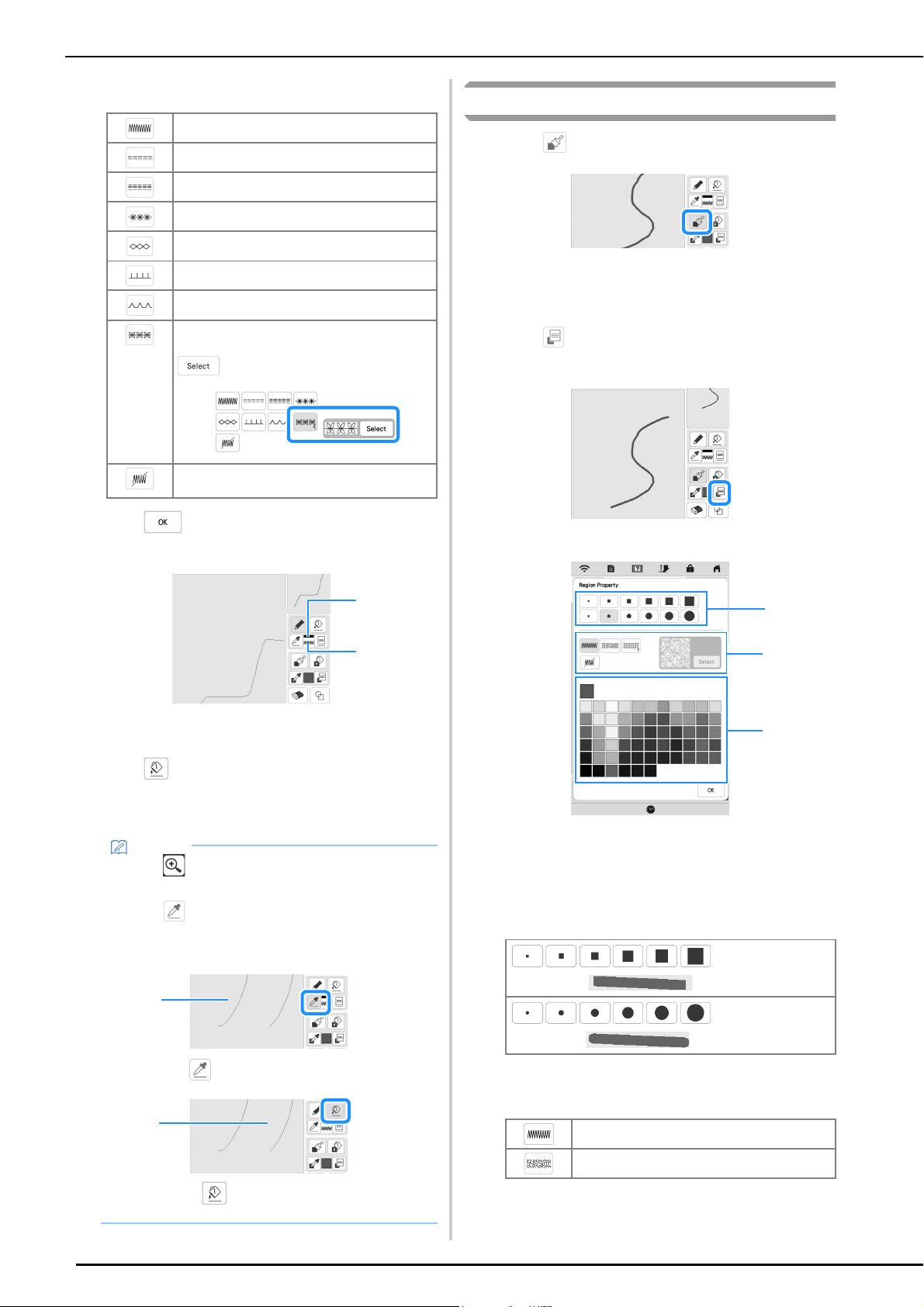
PATTERN DRAWING SCREEN
92
Stitch types
b
Touch to return to the pattern drawing screen.
You can check the selected stitch type and color.
1 Color bar
2 Stitch type
c
Touch then touch on the line to change its color.
The connected line will be changed to the selected
color.
Drawing Regions
a
Touch and draw with brush.
Setting the Brush Types, Fill Patterns and Fill
Colors
a
Touch to set the brush types, fill patterns and fill
colors.
The setting screen appears.
1 Brush types
2 Fill stitch types
3 Fill color selection: touch the color palette to activate the
paint brush color.
Brush shapes/sizes
Fill stitch types
Zigzag stitch
Running stitch
Triple stitch
Candlewicking stitch
Chain stitch
E stitch
V stitch
Select motif stitches
Displays motif stitch selection screen, where
can be touched to select a pattern.
Line without stitch for creating a region.
Created region will be defined by the gray line.
Memo
• Touch to magnify the image when you cannot
touch on the line correctly.
• Touch , and then select a color within the
pattern drawing area to apply the same color to
other lines or parts of the pattern.
1 Use to select the line color.
2 Touch for changing the line color, and then
select the pattern to be changed.
1
2
1
2
Square brush
Round brush
Fill stitch pattern
Stippling pattern
1
3
2
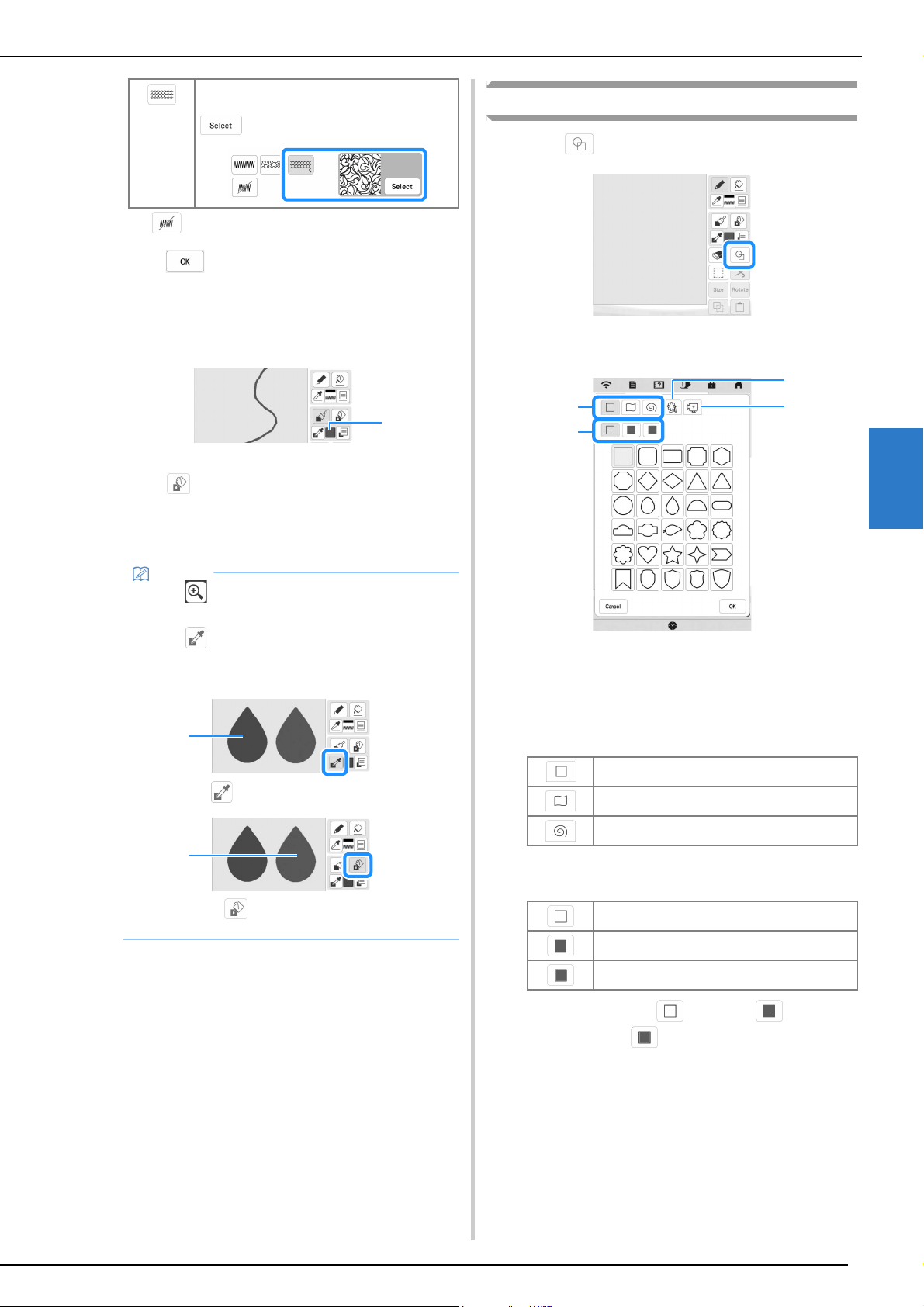
PATTERN DRAWING SCREEN
93
MY DESIGN CENTER
4
Select when you don’t want fill stitch.
b
Touch to return to the pattern drawing screen.
The color bar on the brush tool key is changed to the
selected color. If a stippling pattern or decorative fill
pattern has been selected, the stitch pattern is
displayed.
1 Color bar
c
Touch and touch on the brush line to change
color and fill stitch type. You can also set the fill color,
stitch type and fill pattern of a closed area made of the
lines and brush lines.
Using the Stamp Key
a
Touch .
b
Select a stamp type and stamp shape.
1 Stamp shapes
2 Stamp types
3 Saved outlines
4 Frame embroidering areas
Stamp shapes
Stamp types (Only for Basic shapes)
* Select the outline ( ), fill stitch ( ), or outline
and fill stitch ( ) of a basic shape.
Select decorative fill patterns
Displays a fill pattern selection screen, where
can be touched to select a pattern.
Memo
• Touch to magnify the image when you cannot
touch on the fill correctly.
• Touch , and then select a pattern color in the
pattern drawing area to apply that fill color and
stitch type to other patterns.
1 Use to select the fill color.
2 Touch for changing the fill color and stitch
type, and then select the pattern to be changed.
1
1
2
Basic shapes
Closed shapes
Open shapes
Outline
Fill stitch
Outline and fill stitch
3
2
4
1
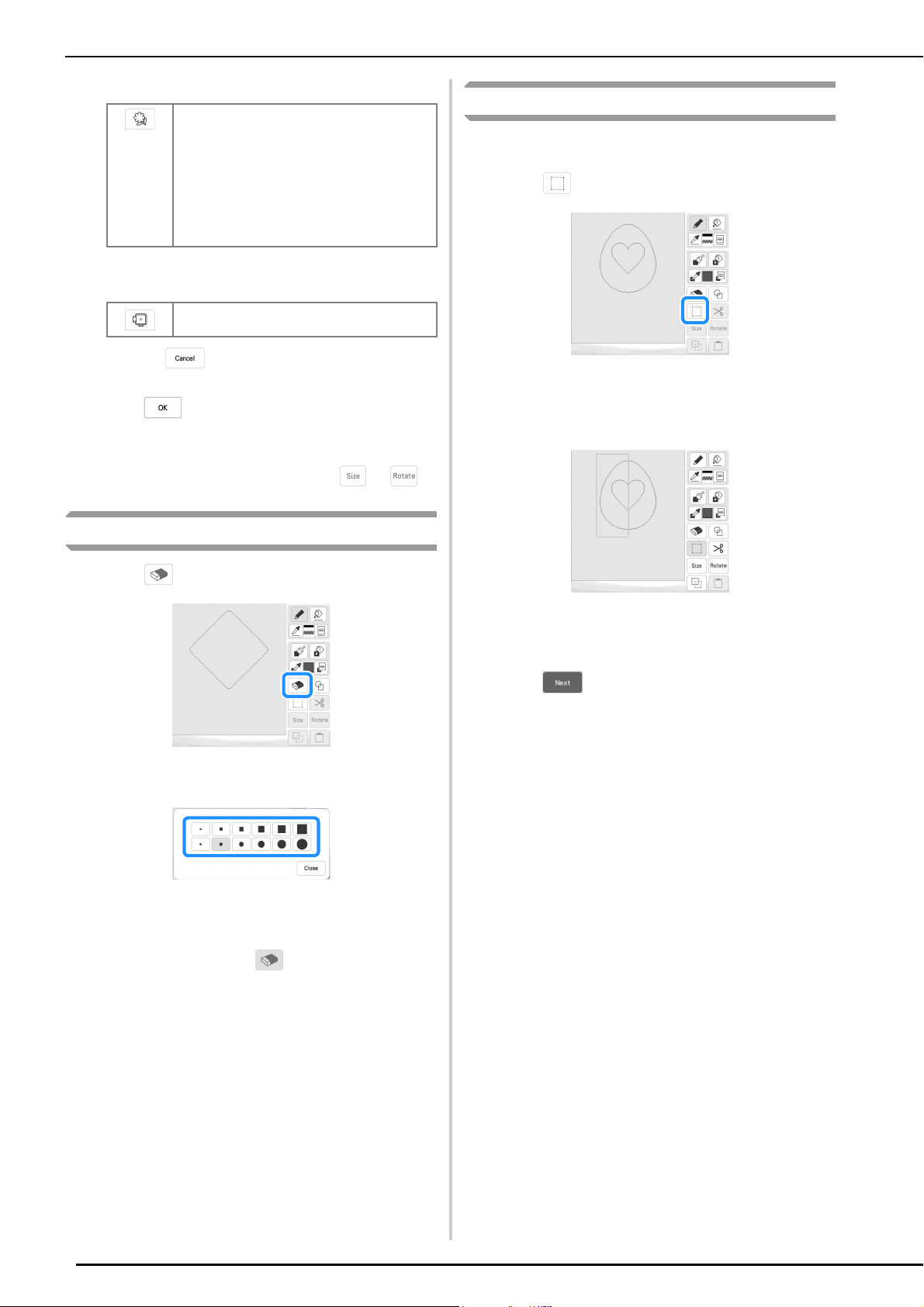
PATTERN DRAWING SCREEN
94
Saved outlines
Frame embroidering areas
* Touch to return to the pattern drawing
screen.
c
Touch to set the selected stamp.
The pattern drawing screen appears.
* You can change size of, rotate or move the shape
right after you create it by touching or .
Using the Erase Key
a
Touch .
b
Select the shape of the eraser.
The pattern drawing screen appears.
c
Drag along the area or line that you want to erase
while the key appears as .
Using the Select Key
You can select the part of the design to move and/or edit.
Some keys are available only after you select the part.
a
Touch .
b
Select the area you want to edit.
* Drag to create the red box around your selected area
to be edited.
c
Edit the design with available keys. (Refer to “Key
Functions” on page 90 for the details of each key
function.)
d
Touch , and then specify the stitch setting.
Embroidery pattern outlines can be registered
as stamp shapes. When registering stamp
shapes, select from the last 20 embroidery
patterns used. If more than 20 shapes are
registered, the oldest one is automatically
erased. For details on registering a stamp
shape, refer to “Decorative Stitching around a
Pattern in Embroidery (a Quilting Function)” on
page 104.
Select an embroidering area in order to
arrange the pattern to fit an embroidery frame.
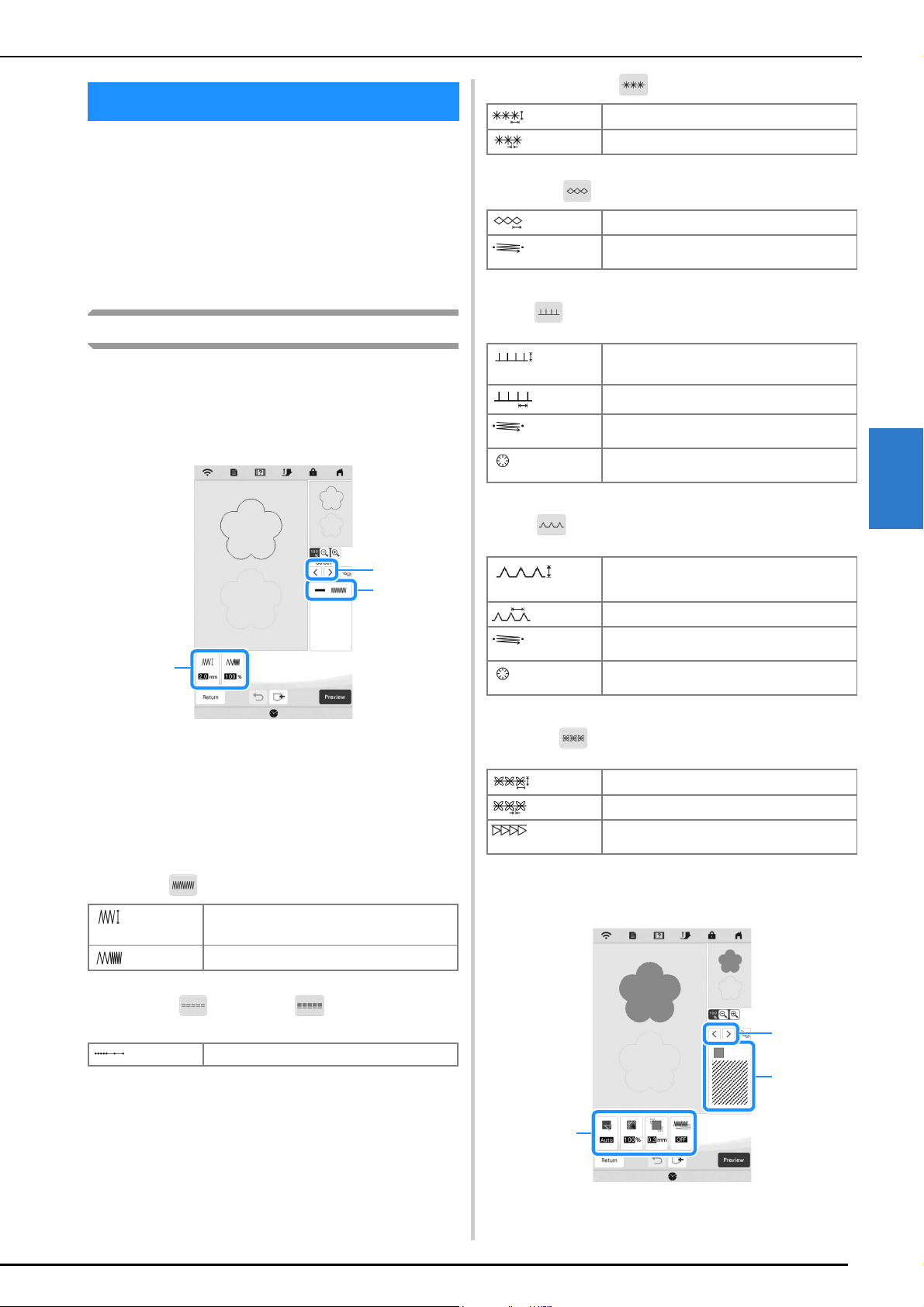
STITCH SETTINGS SCREEN
95
MY DESIGN CENTER
4
After creating the pattern drawing data (.pm9) in the
drawing screen (page 89), you will have an opportunity to:
• Check and change the stitch settings for each line
and region.
• Save the pattern drawing data (.pm9).
• Convert the data to an embroidery pattern (.phx),
proceed to the embroidery edit screen, and/or save
the embroidery pattern.
Specifying Individual Stitch Settings
Select a pattern in the stitch settings screen to specify its line
and region stitch settings. If multiple patterns are selected, the
settings are applied to those patterns.
Line Settings
1 Select the line to be changed.
2 Shows the stitch type and color for the selected line.
3 Shows the stitch settings for the selected line.
Line stitch settings
Select the type of stitching you want applied to your line
art.
Zigzag stitch
Running stitch /Triple stitch
* Both includes an under sewing.
Candlewicking Stitch
Chain stitch
E stitch
V stitch
Motif stitch
Region Settings
1 Select the region to be changed.
2 Shows the stitch type and color for the selected region.
3 Shows the stitch settings for the selected region.
STITCH SETTINGS SCREEN
[Zigzag
width]
Specifies the width of the stitch.
[Density]
Specifies the density of the stitch.
[Run Pitch]
Specifies the length of the stitch.
2
3
1
[Size]
Increases/reduces the size of the stitch.
[Spacing]
Specifies the spacing of the stitch.
[Size]
Increases/reduces the size of the stitch.
[Thickness]
Sets repeated embroidering at the same
part.
[Stitch
width]
Increases/reduces the size of the pattern.
[Spacing]
Specifies the spacing of the E stitch.
[Thickness]
Sets repeated embroidering at the same
part.
[Flip]
Specifies if the decorative line shows up
inside or outside.
[Stitch
width]
Increases/reduces the size of the pattern.
[Spacing]
Specifies the spacing of the V stitch.
[Thickness]
Sets repeated embroidering at the same
part.
[Flip]
Specifies if the decorative line shows up
inside or outside.
[Size]
Increases/reduces the size of the pattern.
[Spacing]
Specifies the spacing of the motif stitch.
[Flip]
Specifies if the decorative line shows up
inside or outside.
2
3
1
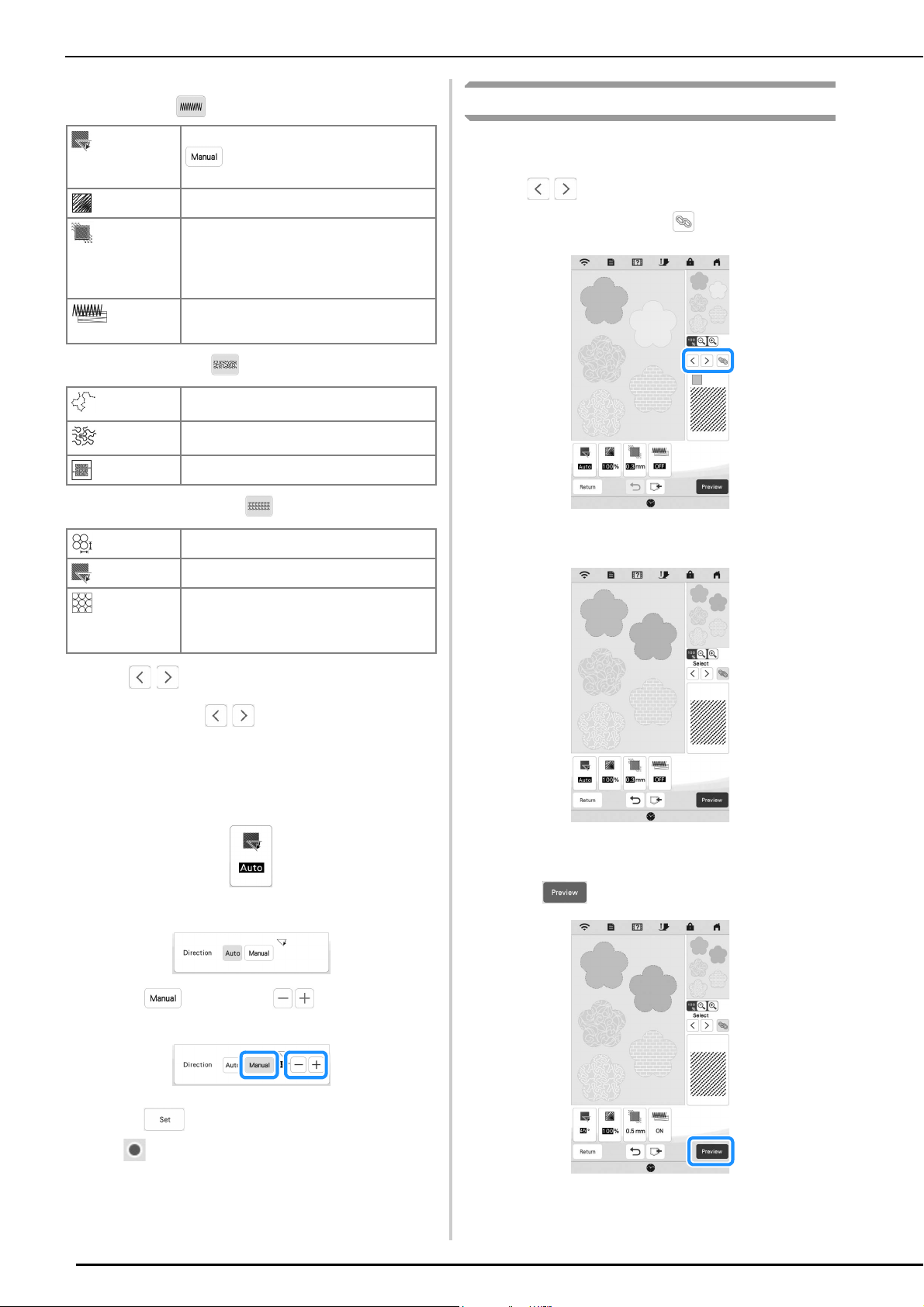
STITCH SETTINGS SCREEN
96
Fill stitch settings
Stippling stitch settings
Decorative fill stitch settings
a
Use to select the line or region to be changed.
Each touch of moves the highlighting of the
selected pattern in order.
b
Select the setting to be changed, and then change the
setting in the screen that appears. (In this example, the
embroidering direction will be changed.)
The setting screen appears.
c
Touch , and then use to change the
direction.
d
Touch to apply the setting.
* appears on the tab for settings that were
changed.
* Change other settings in the same way.
Specifying Global Stitch Settings
The same stitch settings can be changed at the same time for
multiple patterns of the same type.
a
Use
to select the stitch whose settings are to
be changed, and then touch .
The same stitch type lines or regions will be selected
at the same time.
b
Follow steps b through d in “Specifying Individual
Stitch Settings” on page 95 to change the settings.
c
Touch to create the embroidery pattern.
[Direction]
Specifies the embroidering direction. Select
to change to the desired direction of
fill stitch.
[Density]
Specifies the stitch density of fill stitch.
[Pull
compensation]
Specifies to correct the shrinkage of the
pattern by slightly shortening or lengthening
the stitching. Change the setting after you
test embroider the pattern and can check the
shrinkage.
[Under
sewing]
Select if you need or do not need the under
sewing for the stabilized fabric.
[Run Pitch]
Specifies the length of a stitch of the
stippling stitch.
[Spacing]
Specifies the spacing between the stitches
when embroidering the stippling stitch.
[Distance] Specifies the offset from the pattern outline.
[Size]
Increases/reduces the size of the pattern.
[Direction]
Specifies the rotation angle of the pattern.
[Outline]
Select whether [ON] or [OFF] the outline is
also converted to embroidery data. If [ON] is
selected, the number of thread jumps can be
reduced.
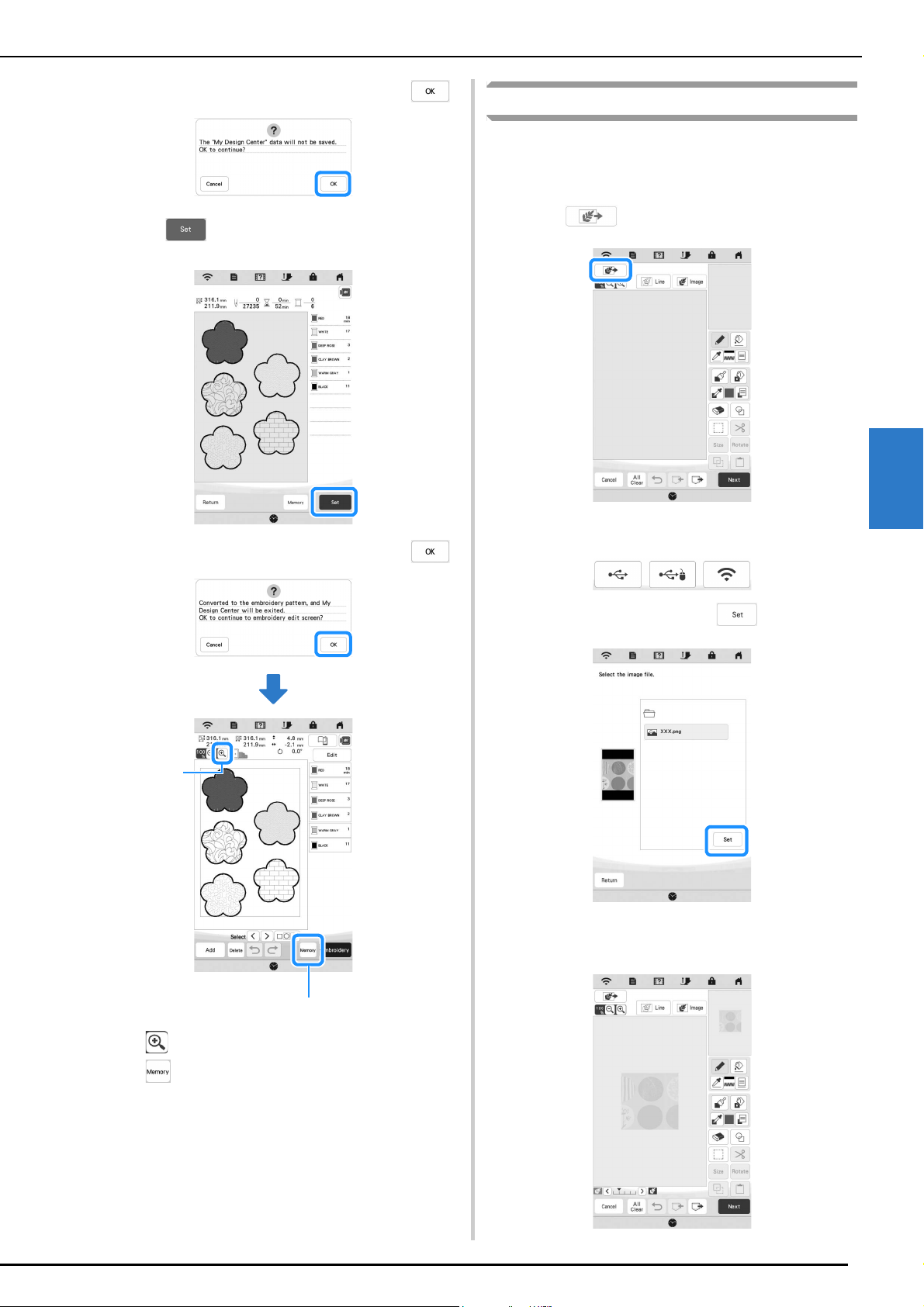
STITCH SETTINGS SCREEN
97
MY DESIGN CENTER
4
When the following message appears, touch .
d
Touch to display the pattern editing screen.
When the following message appears, touch .
1 : Check an enlarged view of the pattern.
2 : Save the embroidery data.
Loading the Background Image
Prepare the data file of your favorite picture so that you can
create an embroidery pattern. Load the image file from the
application “MY DESIGN SNAP APP” on page 107 or a USB
media.
a
Touch .
b
Select the device you saved the data to.
c
Select the data, and then touch .
d
The selected image is displayed transparently in the
pattern drawing area.
1
2
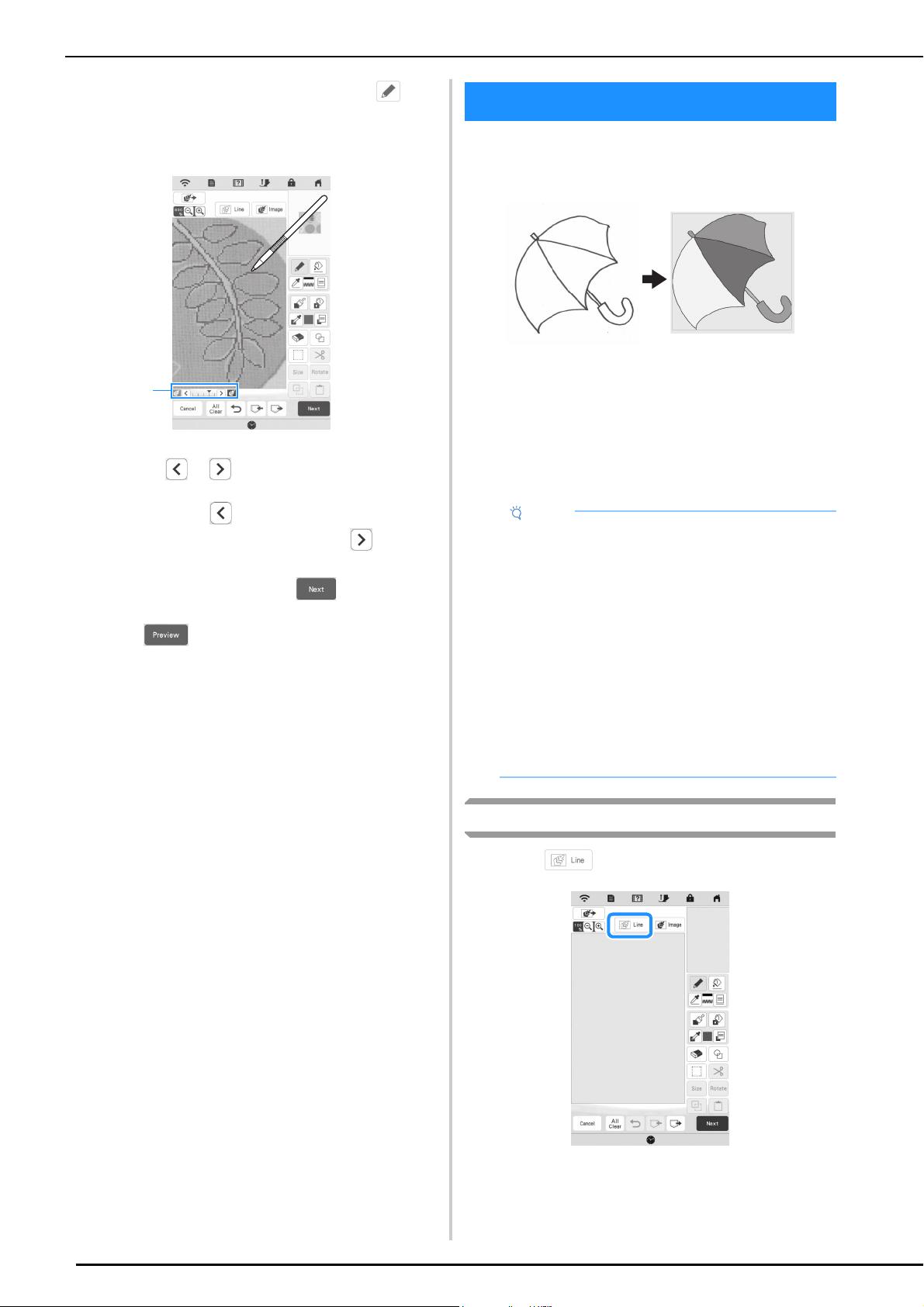
LINE CONVERSION
98
e
Using the included touch pen (stylus), touch , and
then draw lines to trace the image.
* For details on drawing lines, refer to “Drawing
Lines” on page 91.
1 Transparency adjustment
* Touch or to adjust the transparency of the
background.
Each touch of lightens the background, making
the line pattern darker. Each touch of darkens
the background, making the line pattern lighter.
f
After editing the pattern, touch to specify the
settings for pattern.
g
Touch to create the embroidery pattern.
Custom patterns can be created from drawings. You can
create patterns by loading an image on the application
“MY DESIGN SNAP APP” on page 107 or a USB media.
Recommended line drawings for Line Conversion
• Line drawings must be drawn clearly using lines with
approximately 1 mm thickness.
• Line drawings should be drawn in a strong contrast.
• If the lines are too short or gathered too densely, they
will not be loaded correctly.
Create a Pattern with Line Conversion
a
Touch .
The image display screen appears.
1
LINE CONVERSION
Note
• For details on creating patterns using color
illustrations, refer to “ILLUSTRATION
CONVERSION” on page 100.
• If you cannot convert the drawings as expected,
you can edit the design in My Design Center. Refer
to “PATTERN DRAWING SCREEN” on page 89.
• Line drawings are converted without recognizing
the thickness of lines. If you want to change the
thickness of lines, specify in the settings screen.
Refer to “STITCH SETTINGS SCREEN” on
page 95.
• Line drawings are converted as black lines. If you
want to change the colors, specify in My Design
Center. Refer to “Drawing Lines” on page 91.
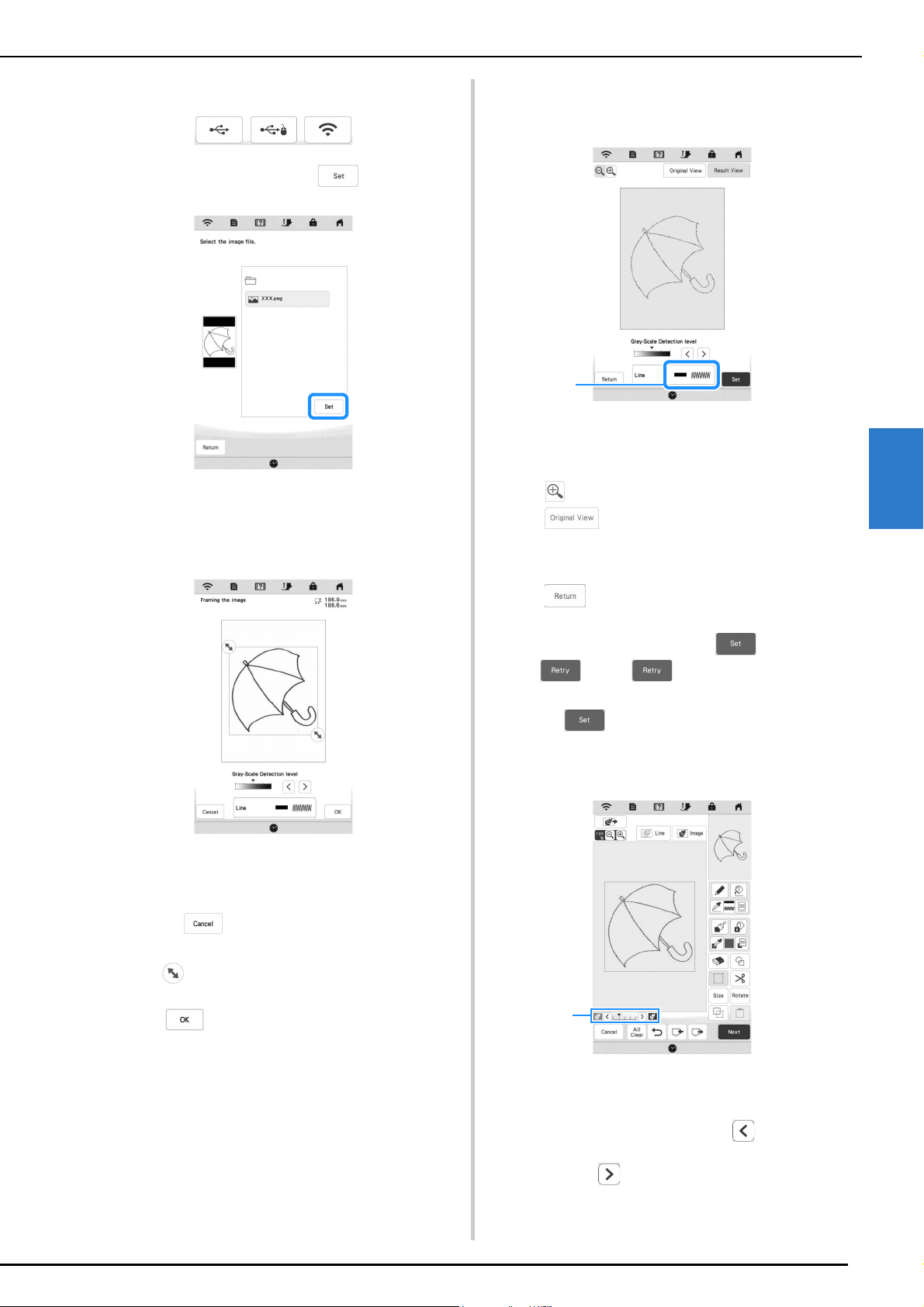
LINE CONVERSION
99
MY DESIGN CENTER
4
b
Select the device you saved the data to.
c
Select the data, and then touch .
d
When loading is finished, specify the [Gray-Scale
Detection level] on the screen if necessary.
The [Gray-Scale Detection level] can change the black
and white threshold for the image.
* If you do not know how the settings should be
changed, first continue the operation without
specifying settings and check the results.
* To stop loading and return to the screen in step
b ,
touch . The loaded image will be deleted
when you return to the previous screen.
e
Move to frame the image for the pattern.
f
Touch .
The screen for confirming the converted image
appears.
g
In the screen for confirming the converted image, you
can adjust the [Gray-Scale Detection level] again, if
necessary.
1 The settings for the lines to be embroidered appear.
* If you do not know how the settings should be
changed, first continue the operation without
specifying settings and check the results.
* : Enlarge the image.
* : Display the image before being
converted. Compare the images before and after
being converted, and then change the settings if
necessary.
* : Return to the previous screen.
After changes to the settings for [Gray-Scale
Detection level] are applied, changes to
. Touch to check that the image is as
desired.
h
Touch .
The pattern drawing screen appears.
i
If necessary, edit the loaded image.
* After the loaded image is converted to stitching, it
appears as a background in the pattern drawing
screen. Use gauge 1 to adjust the transparency of
the background. Each touch of lightens the
background, making the line pattern darker. Each
touch of darkens the background, making the
line pattern lighter.
1
1
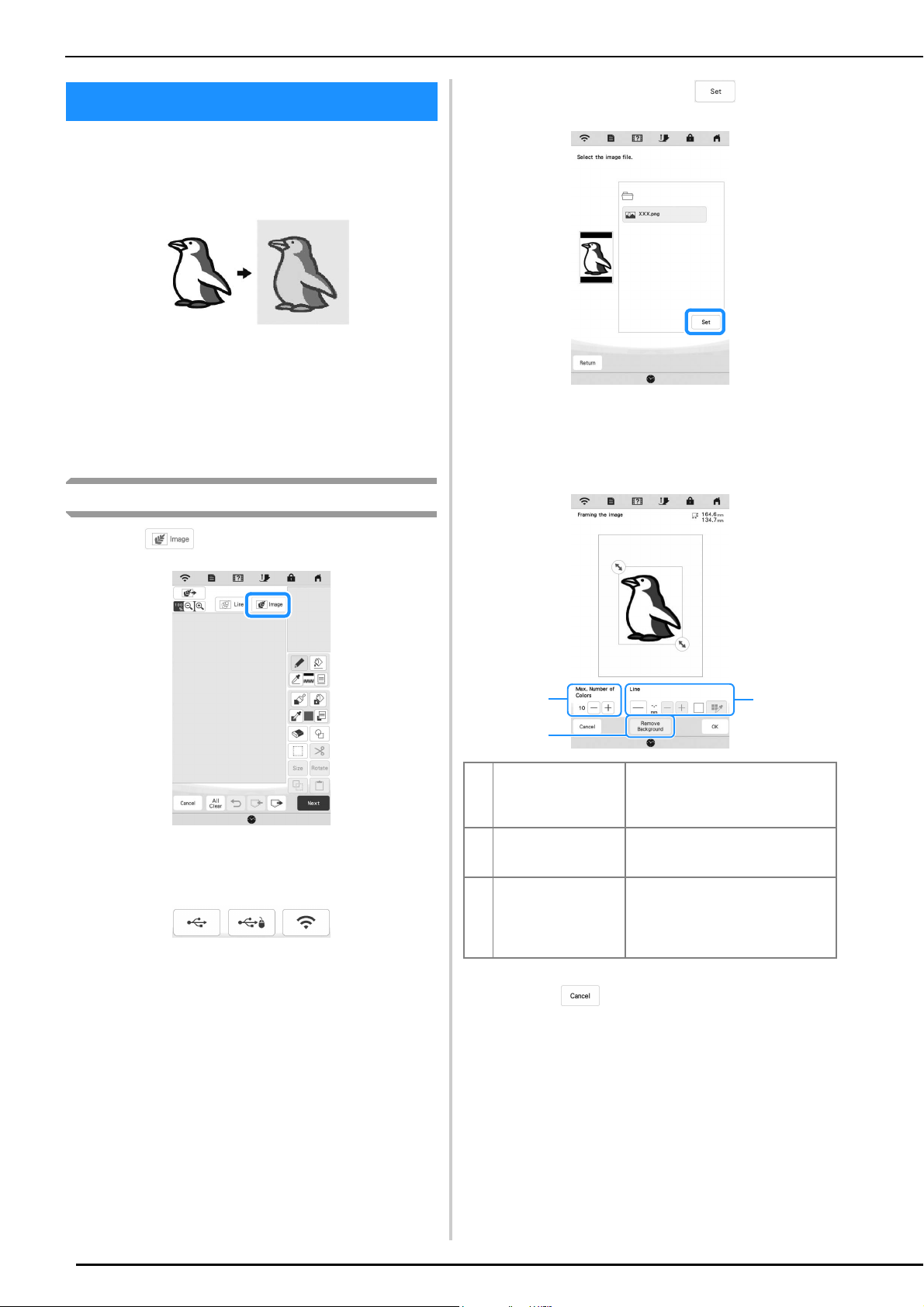
ILLUSTRATION CONVERSION
100
Custom patterns can be created from color illustrations.
You can create patterns by loading an image on the
application “MY DESIGN SNAP APP” on page 107 or a
USB media.
Recommended illustrations for Illustration Conversion
• Illustrations that are clearly drawn, with no
gradation, fading or blurriness.
• Illustrations that are at least a 5 mm square
• Illustrations that are extremely simple images
Create a Pattern with Illustration Conversion
a
Touch .
The image display screen appears.
b
Select the device you saved the data to.
c
Select the data, and then touch .
d
When loading is finished, specify the necessary settings
in the loaded image confirmation screen.
Change the settings to adjust the image so it can easily
be converted to the desired pattern.
* To stop loading and return to the screen in step
b,
touch .
ILLUSTRATION CONVERSION
1 [Max. Number of
Colors]
The number of colors in an image will
be reduced less than the number
specified here, and then the outline
will be extracted.
2 [Remove Background] Select whether or not the
background color will be included as
one of the colors.
3 [Line] Select whether or not the outline will
be detected as a line. A thick outline
can also be detected as a region.
When detected as a line, the line
thickness and color can be specified.
3
2
1
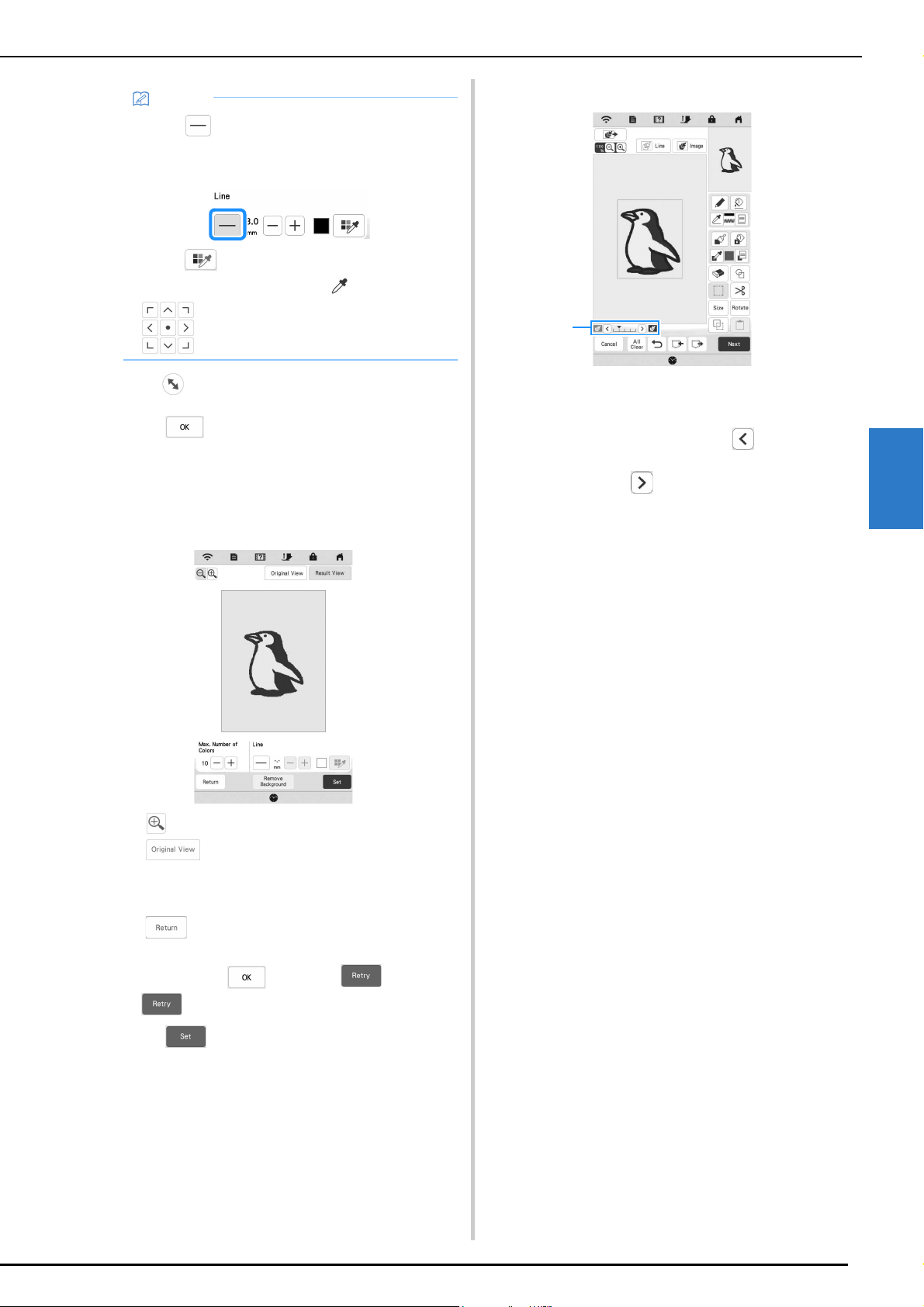
ILLUSTRATION CONVERSION
101
MY DESIGN CENTER
4
e
Move to frame the image for the pattern.
f
Touch .
The screen for confirming the converted image
appears.
g
In the screen for confirming the converted image,
adjust the image as necessary as in step
d.
* : Enlarge the image.
* : Display the image before being
converted. Compare the images before and after
being converted, and then change the settings if
necessary.
* : Return to the previous screen.
After changes to the settings described above have
been applied, changes to . Touch
to check that the image is as desired.
h
Touch .
The pattern drawing screen appears.
i
If necessary, edit the loaded image.
* After the loaded image is converted to stitching, it
appears as a background in the pattern drawing
screen. Use gauge 1 to adjust the transparency of
the background. Each touch of lightens the
background, making the illustration pattern darker.
Each touch of darkens the background, making
the illustration pattern lighter.
Memo
• Touch to detect the outline.
Line thickness can be specified from 1.0 mm
(approx. 1/16 inch) to 5.0 mm (approx. 3/16 inch).
• Touch to select the outline color. Select by
touching the color, or moving icon using
in the color selection screen.
1
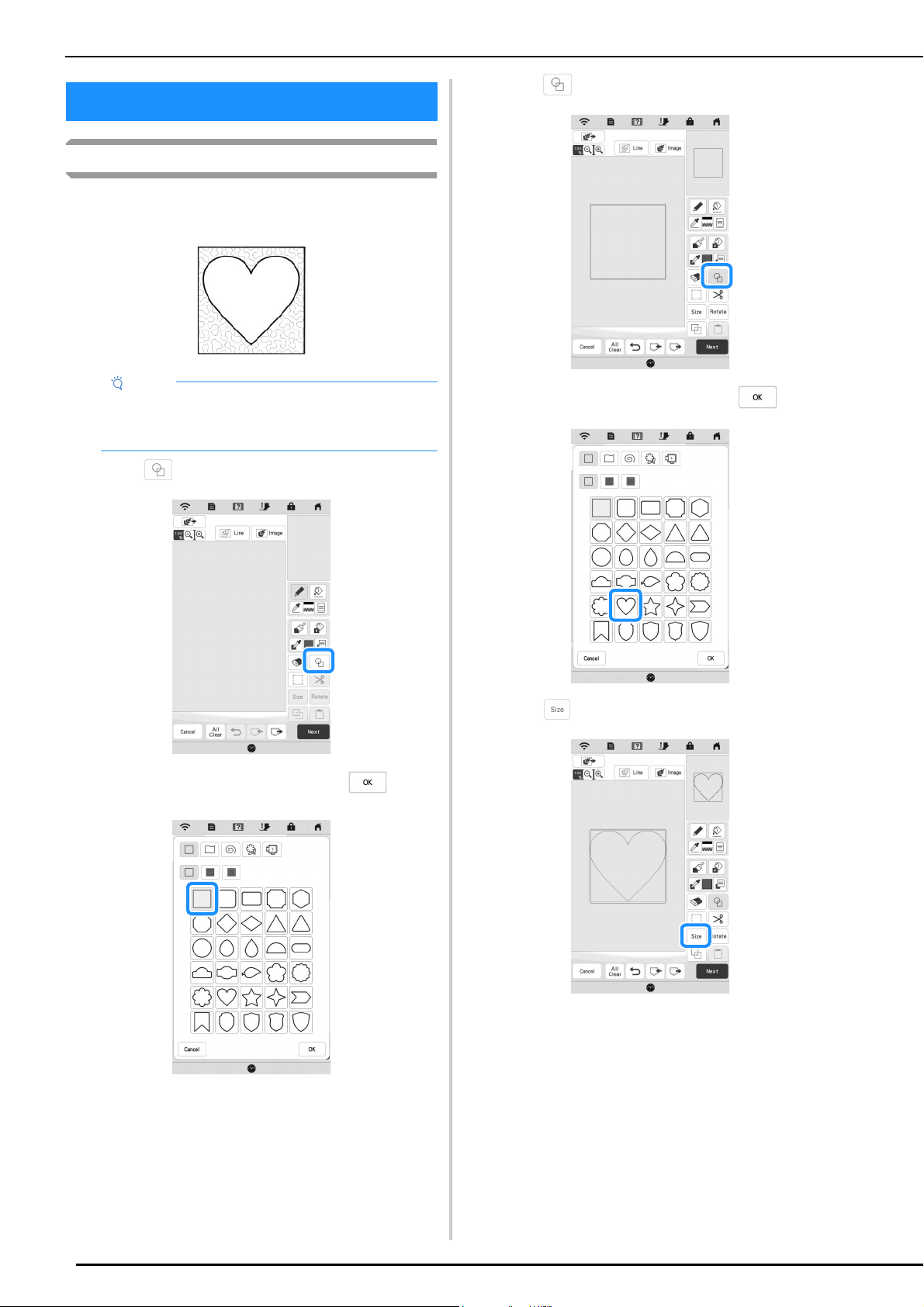
STIPPLING
102
Basic Stippling with My Design Center
Create a stippling design with the basic procedure.
Example:
a
Touch .
b
Select the square shape, and then touch .
c
Touch .
d
Select the heart shape, and then touch .
e
Touch .
STIPPLING
Note
• You can load a line drawing to create a stippling
stitch or use image design function of a fabric
pattern and incorporate the stippling stitch.
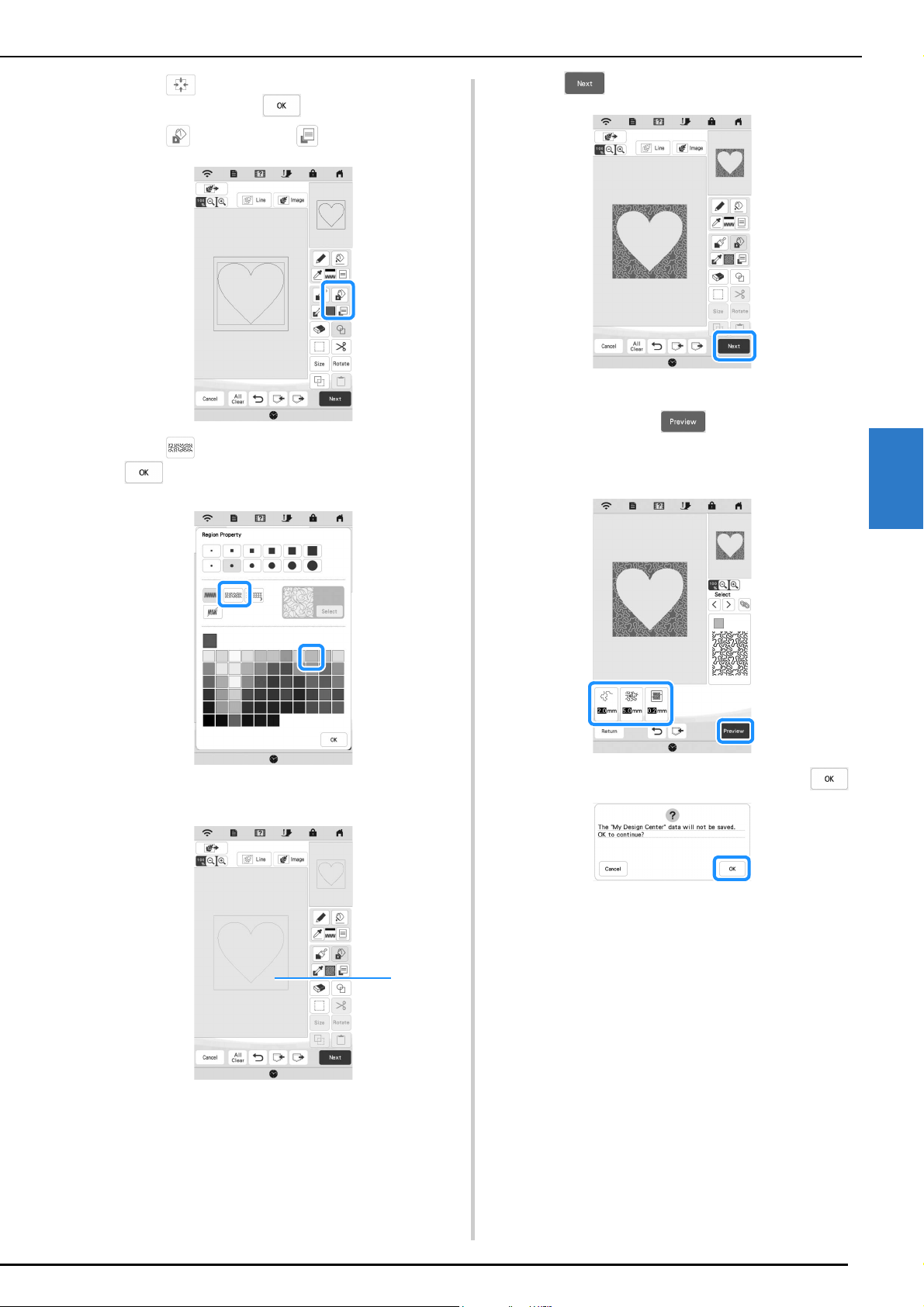
STIPPLING
103
MY DESIGN CENTER
4
f
Touch until the heart shape fits in the square
shape, and then touch .
g
Touch , and then touch .
h
Touch , and then select the stitch color. Touch
after setting the color.
i
Select the region you want to set stippling effect.
1 Select this region.
j
Touch .
k
Adjust the stippling stitch settings to create the desired
effect, and then touch .
* For details, refer to “Specifying Individual Stitch
Settings” on page 95.
When the following message appears, touch .
1
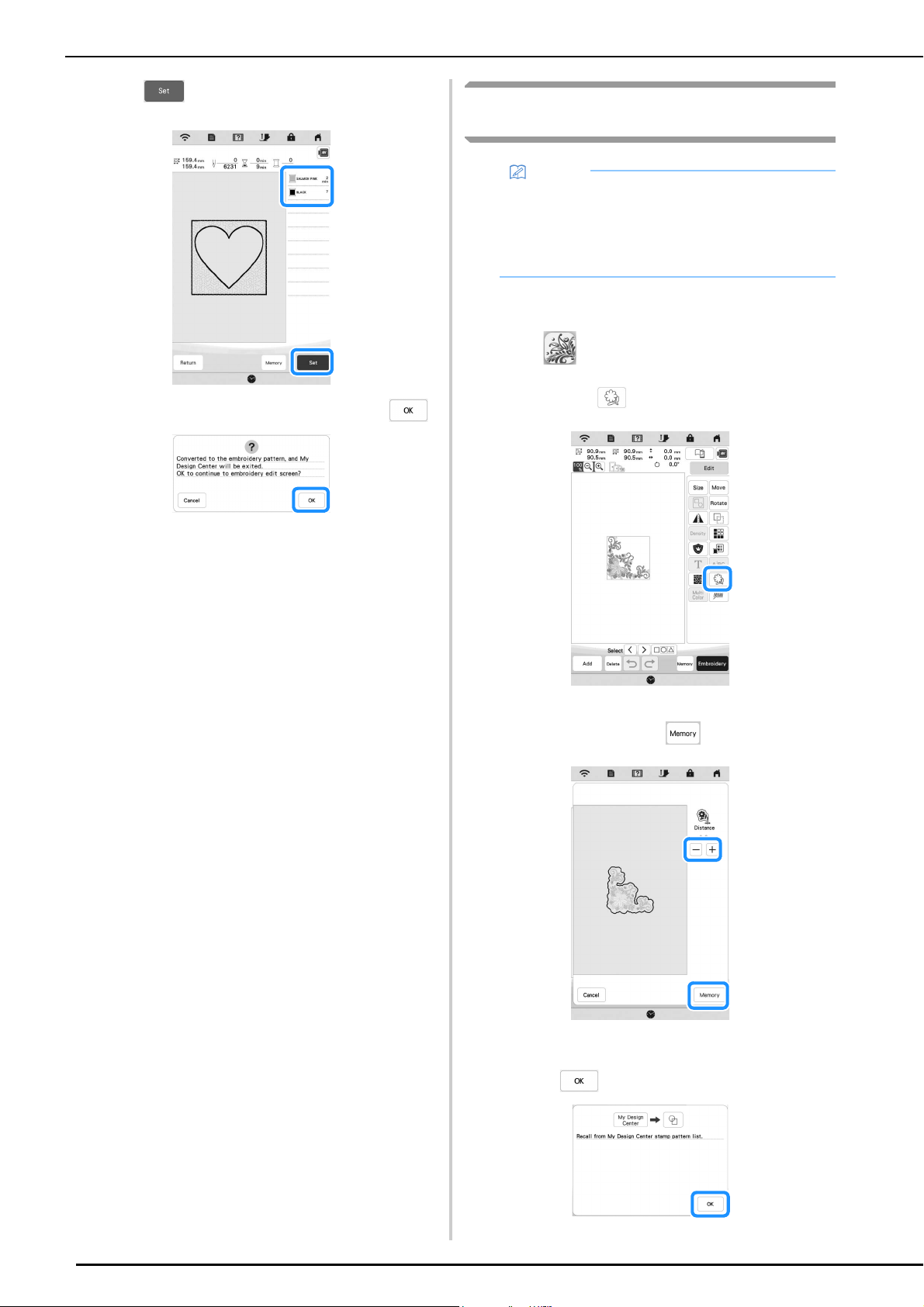
STIPPLING
104
l
Touch to convert into embroidery.
When the following message appears, touch .
m
Follow the procedure described on “EDITING
PATTERNS” on page 39 to edit the pattern as desired.
Decorative Stitching around a Pattern in
Embroidery (a Quilting Function)
A quilt can be created with stippling stitch around an
embroidery pattern.
a
Touch in the home page screen and select the
pattern that decorative stitching will be added around,
and then touch in the embroidery edit screen.
The outline of the pattern is displayed.
b
Set the distance and touch .
A message appears, and the pattern outline is
registered as a stamp shape in My Design Center.
Touch .
Memo
• For best results, reduce the embroidery speed.
(page 14)
• For best results, hoop the stabilizer and fabric and
embroider the design prior to adding the batting
and backing under the hoop for quilting.
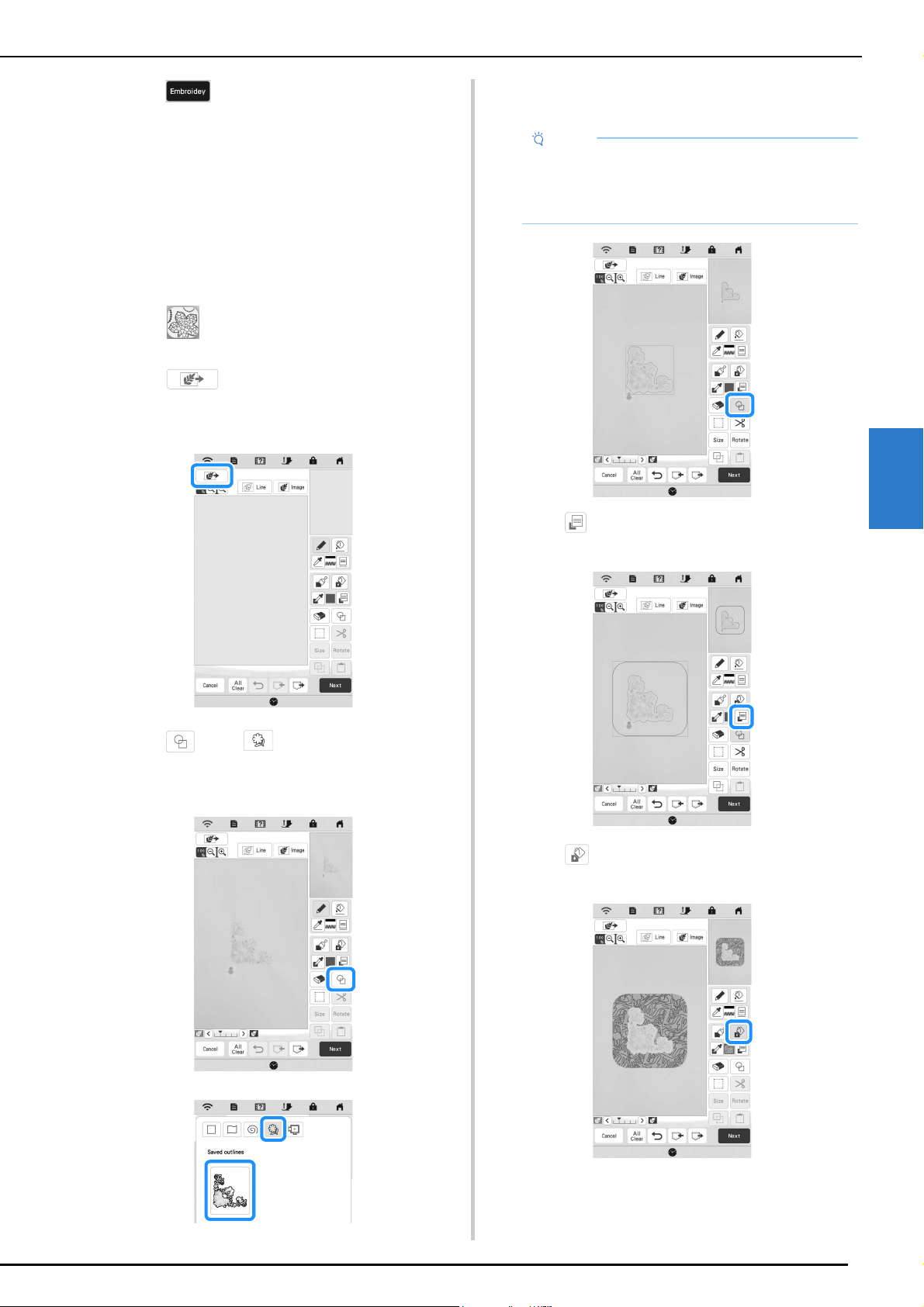
STIPPLING
105
MY DESIGN CENTER
4
c
Touch to continue to the embroidery screen,
and then embroider the pattern at the center.
d
Remove the embroidery frame from the carriage.
e
Photograph the embroidery frame with the application.
f
Attach the embroidery frame to the carriage again.
g
Place the batting and bottom layer of fabric under the
embroidery frame.
h
Touch in the home page screen to start My
Design Center.
i
Touch to load the embroidered fabric. Refer
to “Loading the Background Image” on page 97 for
details.
j
Touch , touch to recall the stamp shape
registered in step
b, and then arrange it over the
loaded pattern.
k
Use a stamp or rectangular frame to determine the
region to be stitched.
l
Touch to select the pattern and color of the
decorative stitching.
m
Touch , and then fill the region to be stitched
outside of the stamp shape outline.
Note
• If the region is to be drawn by hand, be sure to
draw a completely closed shape. If the region is not
closed, it will not be correctly closed with any of
the fill stitches.
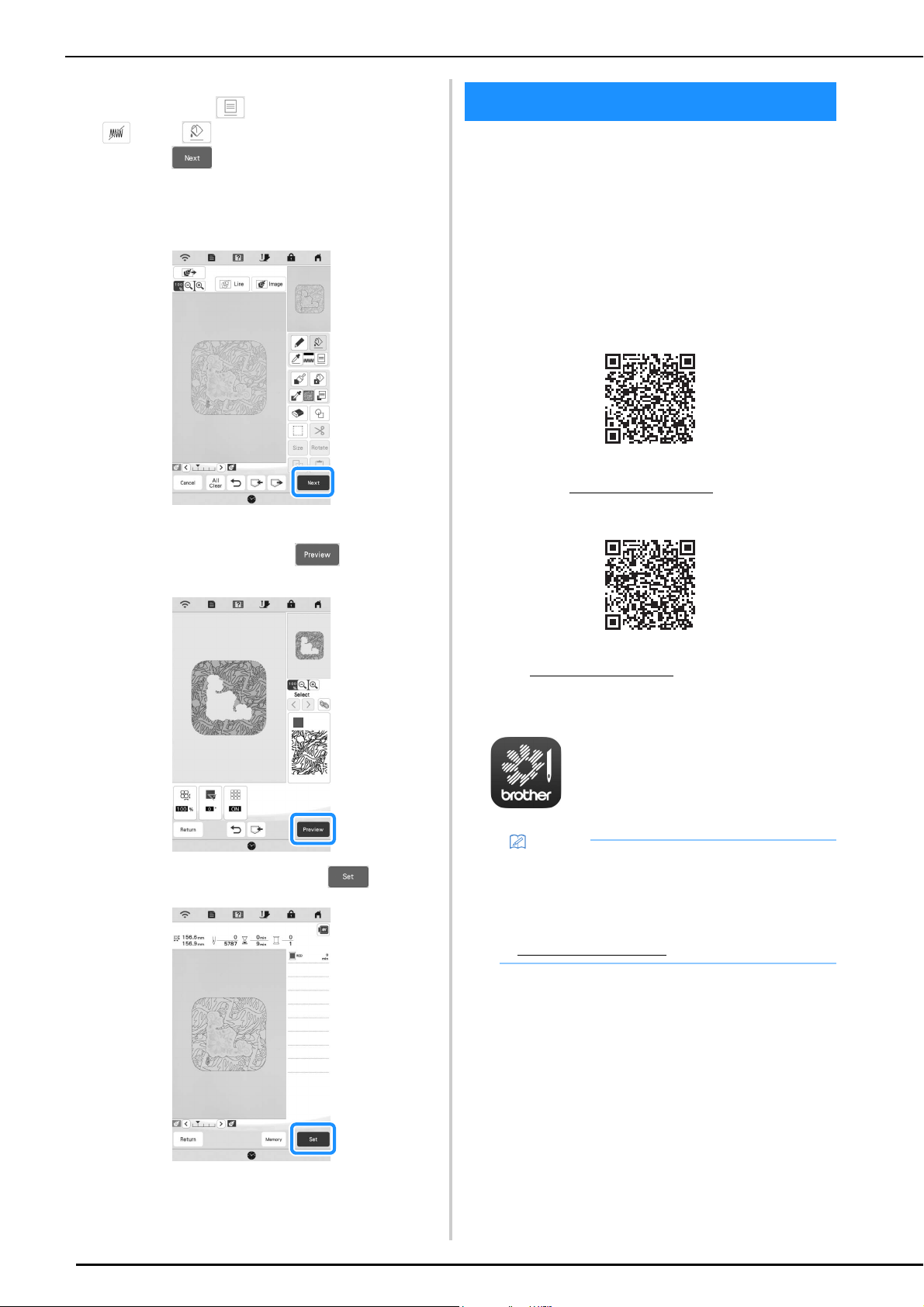
MY STITCH MONITOR APP
106
n
If you select the stamp shapes to determine the region
on step
k, touch for the line tool keys to select
. Touch , then select the frame outline, and
then touch .
* Stitch settings can be adjusted in the stitch settings
screen. For details, refer to “STITCH SETTINGS
SCREEN” on page 95.
o
Specify the stitch spacing and length in the stitch
settings screen, and then touch .
Check the pattern, and then touch .
p
Embroider the stippling stitch around the embroidery
pattern.
With the My Stitch Monitor App installed on your smart
device and the machine and smart device connected to the
same wireless network, you can check the operating status of
the machine. In addition, you can receive notifications when
the machine stops.
Installing the App
a
Use your smart device to scan the appropriate QR
code below to visit Google Play™ or the App Store.
Android™: https://s.brother/msmagi
iOS: https://s.brother/msmggi
b
Install [My Stitch Monitor].
MY STITCH MONITOR APP
My Stitch Monitor
Memo
• To download and install the app, you can also
search for [My Stitch Monitor] in Google Play™ or
the App Store.
• For more information on how to use this
application, visit the following web site.
https://s.brother/cpeag/
MY DESIGN SNAP APP
107
MY DESIGN CENTER
4
Monitoring
a
Connect the machine to your wireless network.
* Refer to “WIRELESS NETWORK CONNECTION
FUNCTIONS” on page 18.
b
Confirm that your smart device and your machine are
connected to the same network.
c
Tap the icon for [My Stitch Monitor] on the smart
device to start the app.
d
Follow the instructions that appear in the app to
connect the app to your machine.
* Select the name that appears beside [Machine
name] in the settings screen on your machine.
The machine can now be monitored.
With My Design Snap app, you can position your embroidery
designs on the fabric, by capturing image of the hooped fabric
and sending the image to your machine.
Installing the My Design Snap App
a
Use your smart device to scan the appropriate QR
code below to visit Google Play™ or the App Store.
Android™: https://s.brother/mdsgfi
iOS: https://s.brother/mdsafi
b
Install [My Design Snap].
Memo
• The app will be updated from time to time. The
following descriptions may differ from the actual
screens and operations.
MY DESIGN SNAP APP
My Design Snap
Memo
• To download and install the app, you can also
search for [My Design Snap] in Google Play™ or
the App Store.
• For more information on how to use this
application, visit the following web site.
https://s.brother/cpeag/

ARTSPIRA APP COMPATIBLE
108
Functions have been added for the Artspira App. With
these functions, you can transfer content published on the
app to the embroidery machine and enjoy creating original
works using the functions on the app.
For more information about the app, refer to the official
website. For details on how to operate the embroidery
machine using the app, see the Artspira Quick Guide on
Artspira support page (https://s.brother/csyai/
).
ARTSPIRA APP COMPATIBLE
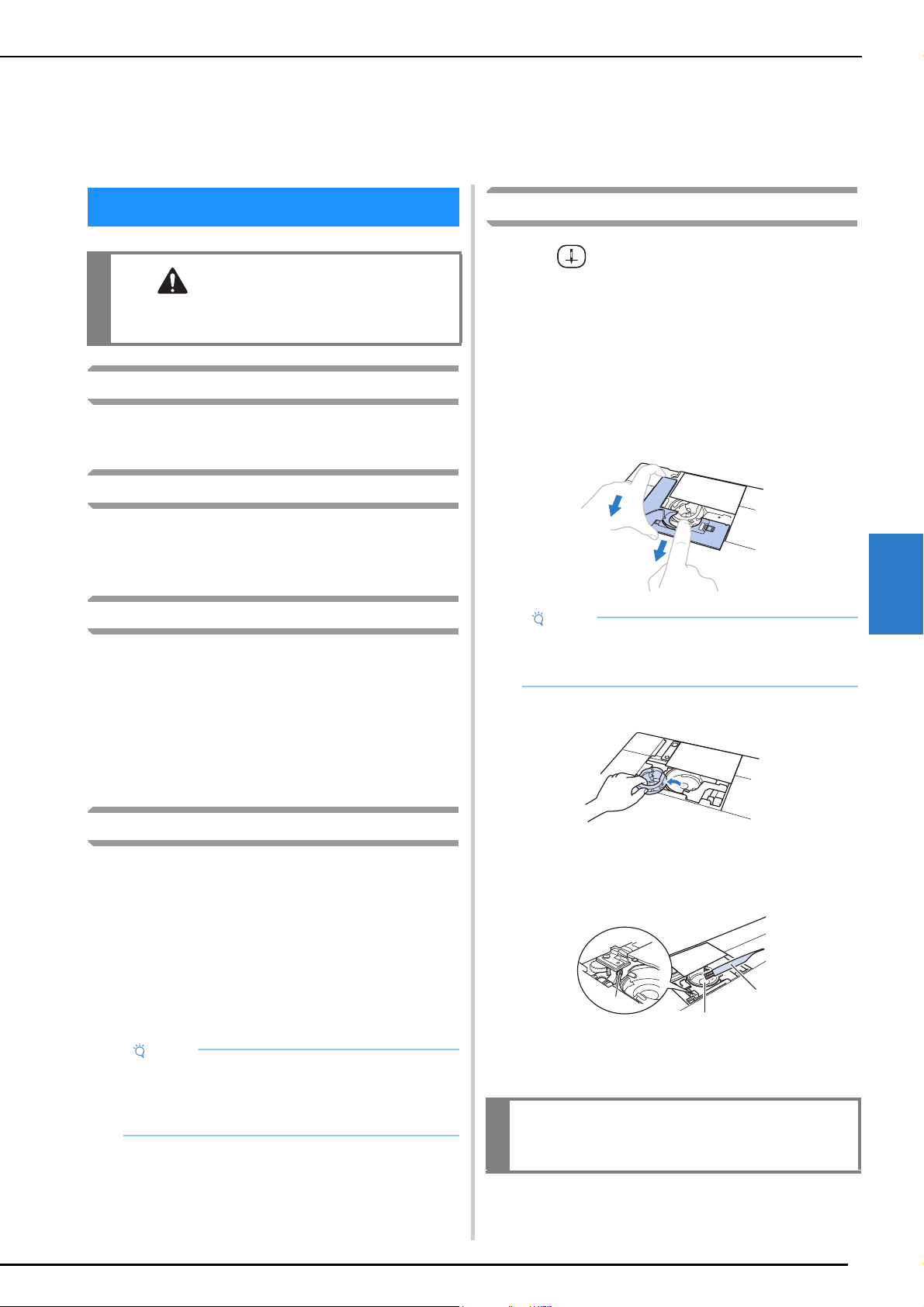
CARE AND MAINTENANCE
109
APPENDIX
5
Cleaning the LCD
If the surface of the LCD is dirty, lightly wipe it with a soft dry
cloth.
Cleaning the machine surface
When wiping dirt off the machine, firmly wring a soft cloth
soaked in (lukewarm) water.
After cleaning the machine, dry it with a soft, dry cloth.
Restrictions on Oiling
In order to prevent damaging this machine, it must not be
oiled by the user. This machine was manufactured with the
necessary amount of oil applied to ensure correct operation,
making periodic oiling unnecessary.
If problems occur, such as difficulty turning the handwheel or
an unusual noise, immediately stop using the machine, and
contact your authorized Brother dealer or the nearest Brother
authorized service center.
Precautions on Storing the Machine
Do not store the machine in any of the locations described
below, otherwise damage to the machine may result, for
example, rust caused by condensation.
* Exposed to extremely high temperatures
* Exposed to extremely low temperatures
* Exposed to extreme temperature changes
* Exposed to high humidity or steam
* Near a flame, heater or air conditioner
* Outdoors or exposed to direct sunlight
* Exposed to extremely dusty or oily environments
Cleaning the Race
a
Press (Needle position button) to raise the needle.
b
Turn the main power to OFF, and then unplug the
machine.
c
Remove the needle and embroidery foot (page 29,
page 111).
d
Remove the bobbin cover.
e
Slide the needle plate cover toward you to remove it.
f
Grasp the bobbin case, and then gently lift out.
g
Use the cleaning brush or a vacuum cleaner to remove
any lint and dust from the race and bobbin thread
sensor and the surrounding area.
1 Cleaning brush
2 Race
3 Bobbin thread sensor
Chapter 5
APPENDIX
CARE AND MAINTENANCE
CAUTION
• Be sure to unplug the machine before cleaning
it. Otherwise, injury may result.
Note
• In order to extend the life of this machine,
periodically turn it on and use it. Storing this
machine for an extended period of time without
using it may reduce its efficiency.
Note
• If the embroidery unit is attached, the needle plate
can be removed when the bobbin cover is
removed.
IMPORTANT
• Do not apply oil to the bobbin case.
a
b
c
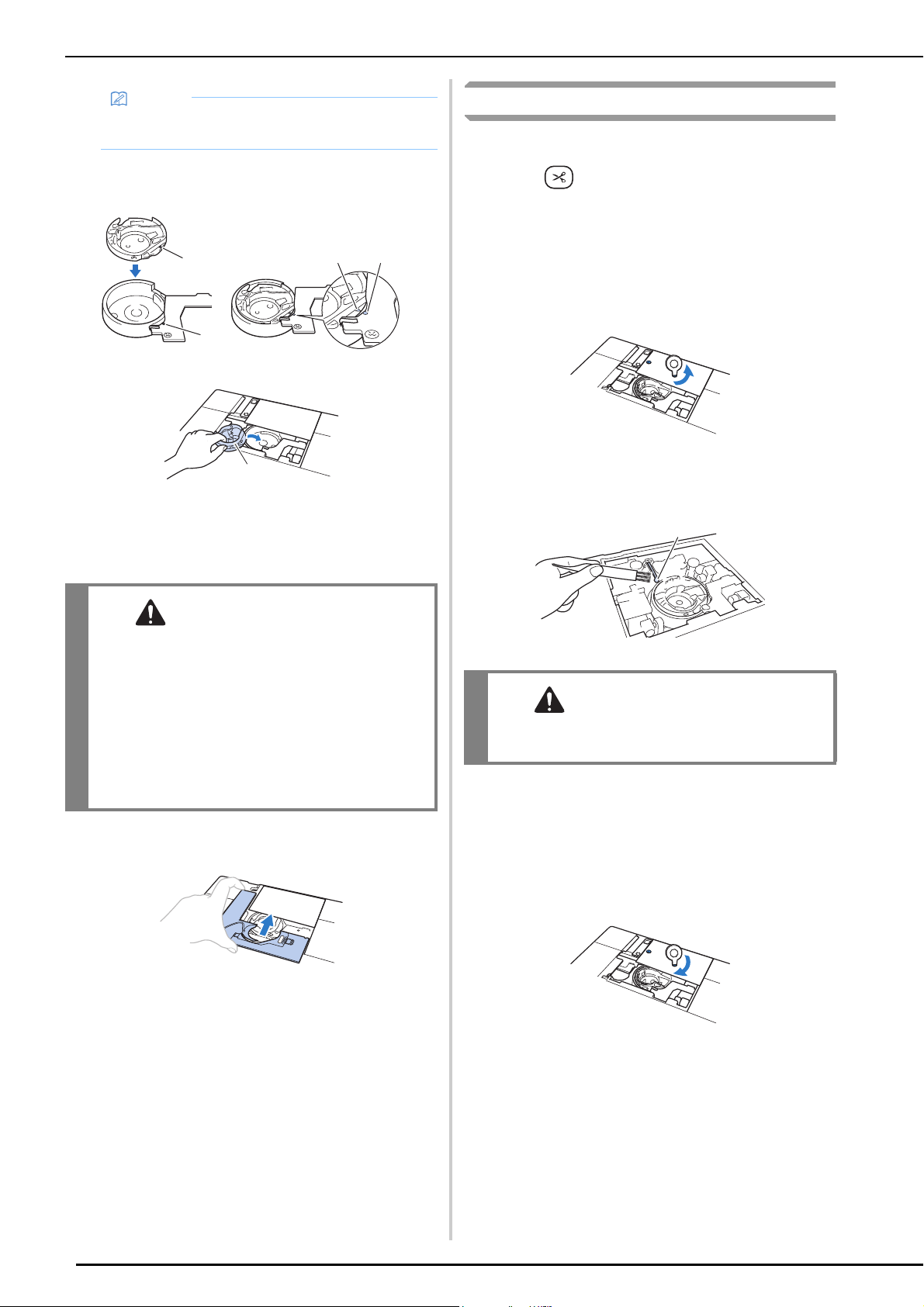
CARE AND MAINTENANCE
110
h
Insert the bobbin case so that the mark on the
bobbin case aligns with the
mark on the machine.
* Align the and marks.
1 mark
2
mark
3 Bobbin case
* Make sure that the indicated points are aligned
before installing the bobbin case.
i
Insert the tabs on the needle plate cover into the
needle plate, and then slide the cover back on.
j
Reattach the bobbin cover.
Cleaning the Cutter in the Bobbin Case Area
The cutter below the needle plate should be cleaned. If dust
or lint accumulate on the cutter, it will be difficult to cut the
thread when (Thread cutter button) is pressed or the
automatic thread cutting function is used. Clean the cutter
when the thread is not easily cut.
a
Follow steps a through e in “Cleaning the Race” to
remove the needle plate cover.
b
Use the screwdriver included with the machine to
unscrew and remove the needle plate.
c
Use the cleaning brush or a vacuum cleaner to remove
any lint and dust from the cutter in the bobbin case
area.
1 Cutter
d
Align the two screw holes in the needle plate with the
two holes at the needle plate mounting base, and then
fit the needle plate onto the machine.
e
Lightly finger-tighten the screw on the right side of the
needle plate. Then, use the screwdriver included to
firmly tighten the screw on the left side. Finally, firmly
tighten the screw on the right side.
f
Replace the bobbin case and the needle plate cover
following steps
h through j in “Cleaning the Race”.
Memo
• If lint or dust collects on the bobbin thread sensor,
the sensor may not operate correctly.
CAUTION
• Never use a bobbin case that is scratched or
has a burr on it. Otherwise the upper thread
may become tangled, and the needle may
break and cause injury. For a new bobbin case,
contact your nearest Brother authorized
service center.
• Be sure that the bobbin case is correctly
installed, otherwise the needle may break and
cause injury.
a
b
a
b
c
CAUTION
• Do not touch the cutter, otherwise injuries
may result.
a
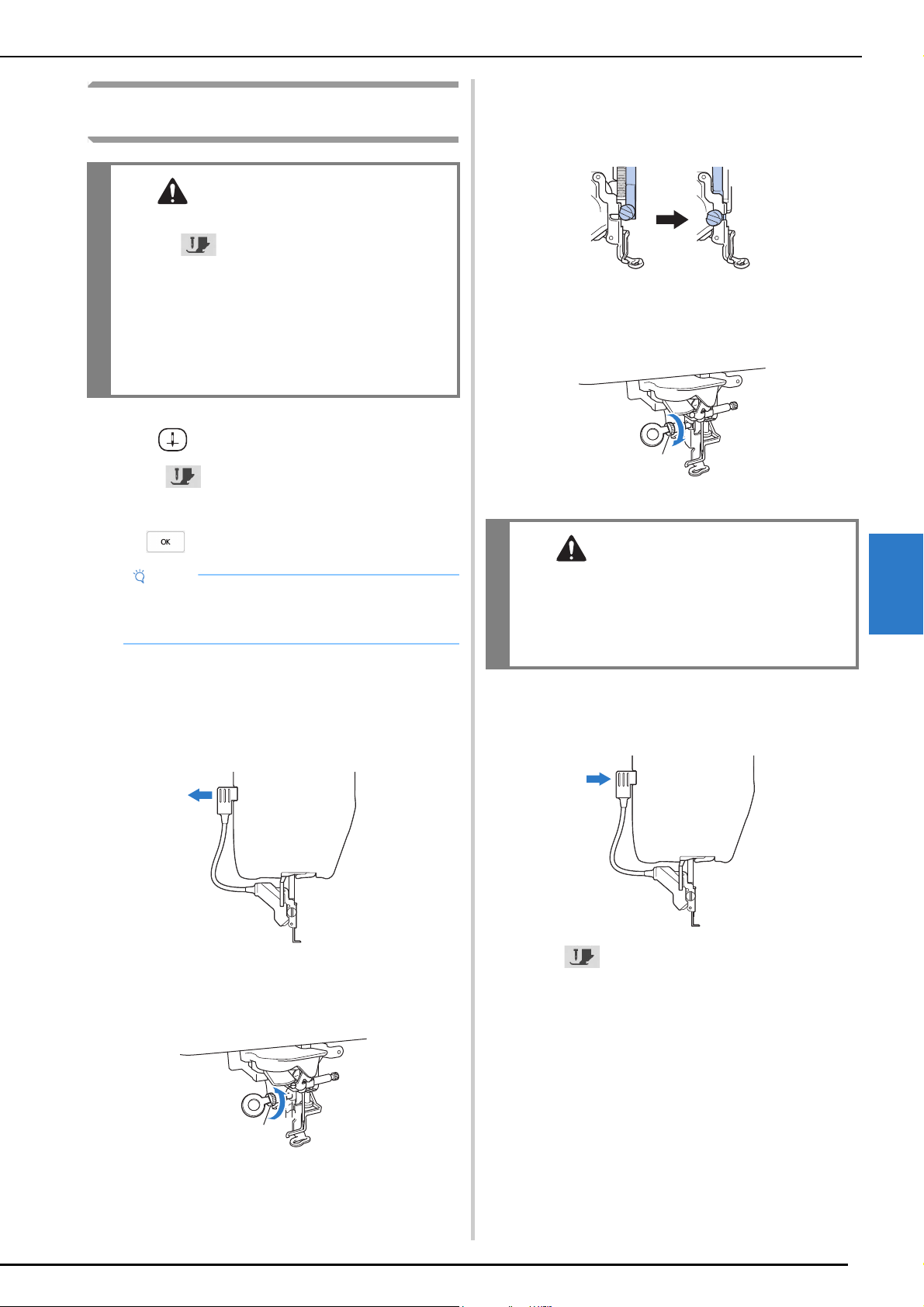
CARE AND MAINTENANCE
111
APPENDIX
5
Changing Embroidery Foot “W+” with LED
Pointer
a
Press (Needle position button) to raise the needle.
b
Touch to lock all keys and buttons.
* If the message [OK to automatically lower the
presser foot?] appears on the LCD screen, touch
to continue.
c
Raise the presser foot lever.
d
Remove the connector of the embroidery foot “W+”
with LED pointer from the connector on the back of
the machine.
e
Use the included disc-shaped screwdriver to loosen the
screw for the embroidery foot, and then remove the
embroidery foot “W+” with LED pointer.
1 Screw for embroidery foot
f
Position the embroidery foot “W+” with LED pointer
on the presser foot bar by aligning the notch of the
presser foot to the large screw.
Side view
g
Hold the embroidery foot in place with your right
hand, and then use the disc-shaped screwdriver to
securely tighten the screw for the embroidery foot.
1 Screw for embroidery foot
h
Plug the connector of the embroidery foot “W+” with
LED pointer into the jack on the back left side of your
machine.
i
Touch to unlock all keys and buttons.
All keys and operation buttons are unlocked, and the
previous screen is displayed.
CAUTION
• When attaching an embroidery foot, always
touch on the screen. You may
accidentally press the “Start/Stop” button and
possibly cause injury.
• Be sure to use the embroidery foot “W+” with
LED pointer when doing embroidery. Using
another embroidery foot may cause the needle
to strike the embroidery foot, causing the
needle to break and possibly causing injury.
Note
• Before replacing the needle, cover the hole in the
needle plate with fabric or paper to prevent the
needle from falling into the machine.
a
CAUTION
• Use the disc-shaped screwdriver to firmly
tighten the screw for the embroidery foot. If
the screw is loose, the needle may strike the
embroidery foot and break, possibly cause
injury.
a
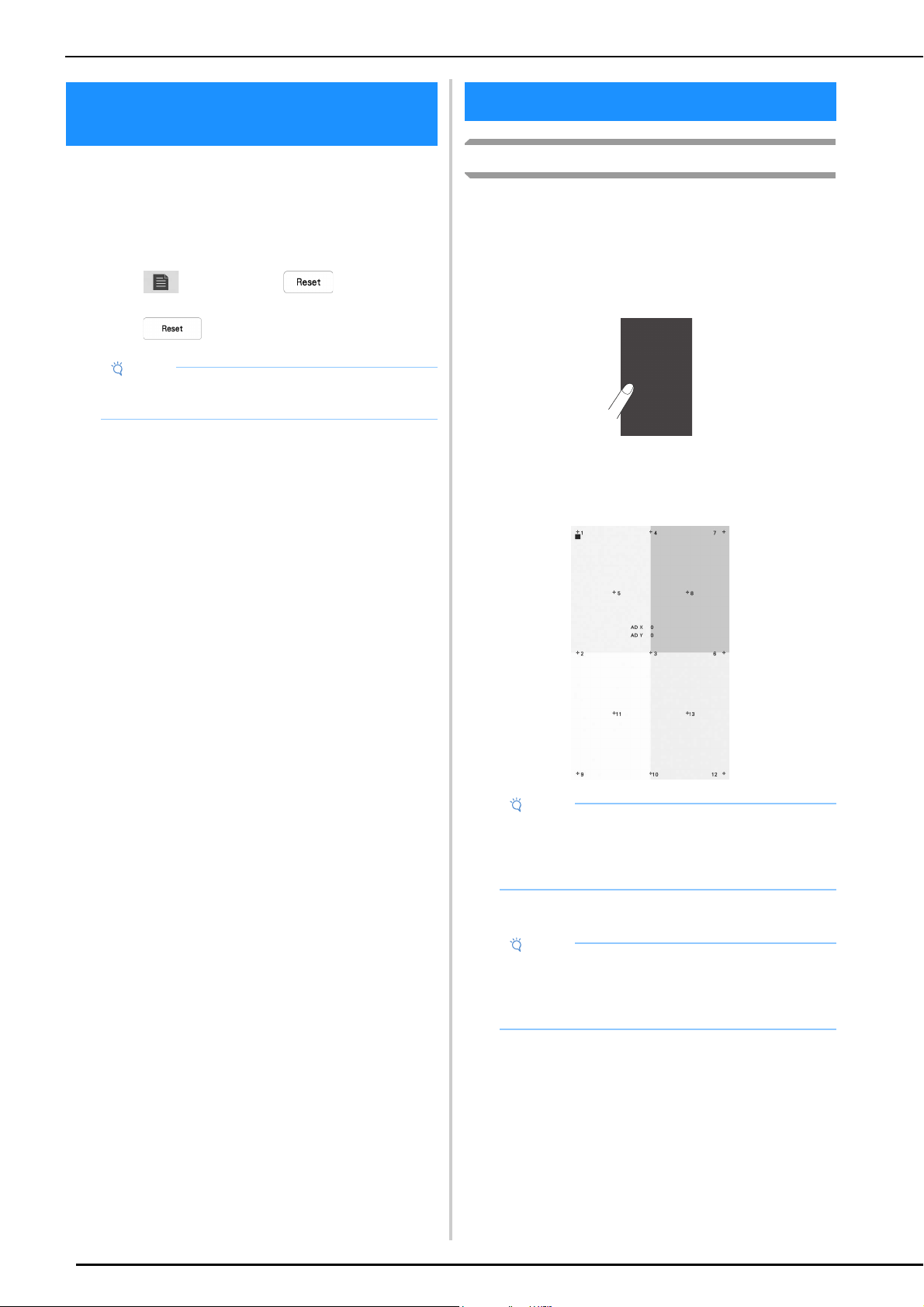
BEFORE LENDING OR DISPOSING OF THE PRODUCT
112
Please be sure to reset the settings of your machine to
delete the following data.
• all saved data
• customized settings
• network information
a
Touch , and then touch beside [Reset to
Default].
b
Touch .
Touch Panel is Malfunctioning
If the screen does not respond correctly when you touch a key
(the machine does not perform the operation or performs a
different operation), follow the steps below to make the
proper adjustments.
a
Holding your finger on the screen, turn the main
power switch to OFF and back to ON.
The touch panel adjustment screen appears.
b
Using the included touch pen, lightly touch the center
of each +, in order from 1 to 13.
c
Turn the main power to OFF, then turn it back to ON.
BEFORE LENDING OR DISPOSING
OF THE PRODUCT
Note
• Do not turn the main power to OFF while the
[Deleting…] screen is displayed.
ADJUSTING THE SCREEN
Note
• Only use the included touch pen to touch the
screen. Do not use a mechanical pencil, pin, or
other sharp object. Do not press too hard on the
screen. Otherwise, damage may result.
Note
• If you finish the screen adjustment and the screen
still does not respond, or if you cannot do the
adjustment, contact your authorized Brother
dealer.
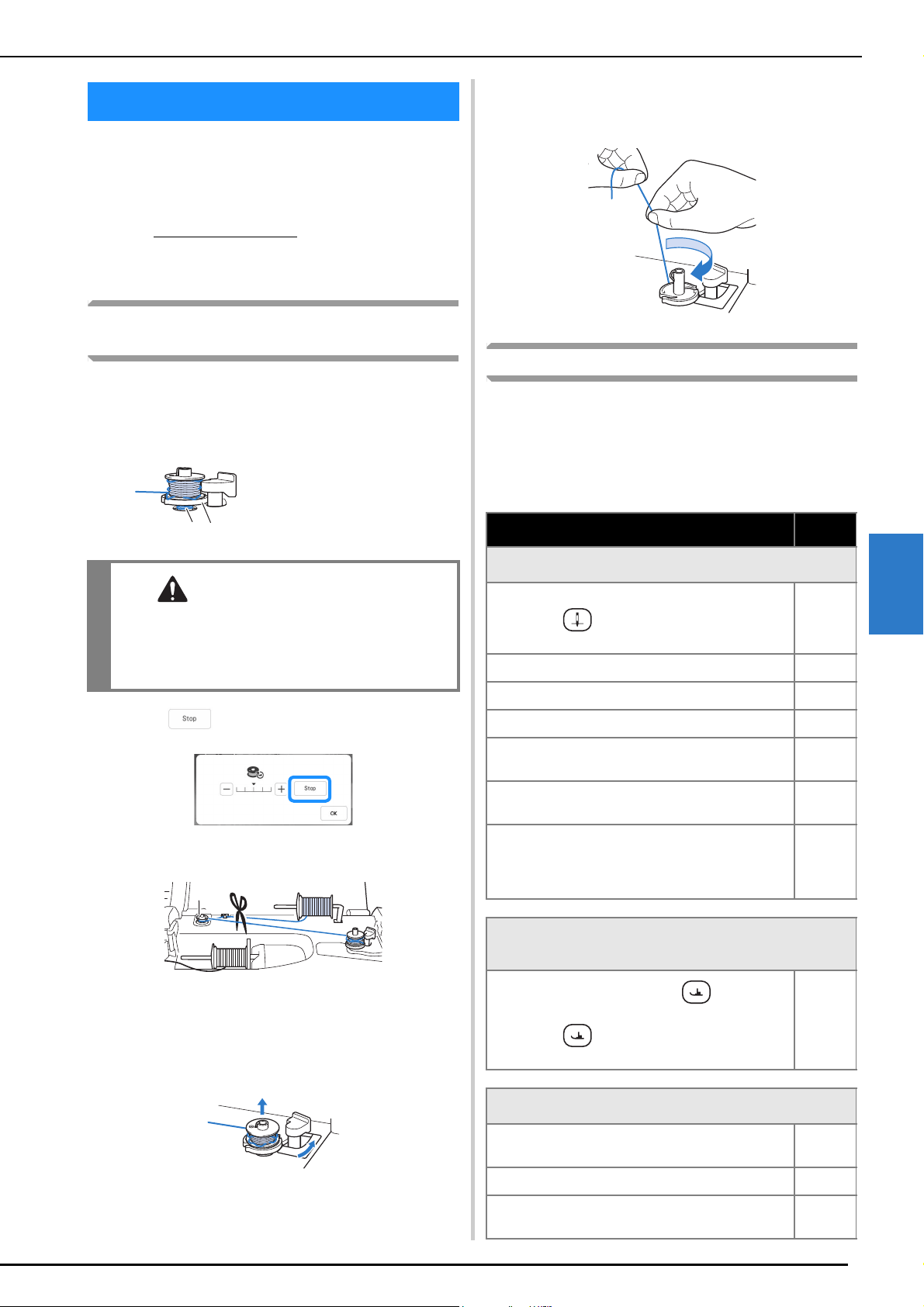
TROUBLESHOOTING
113
APPENDIX
5
If the machine stops operating correctly, check the
following possible problems before requesting service.
You can solve most problems by yourself. If you need
additional help, the Brother Support website offers the
latest FAQs and troubleshooting tips.
Visit us at https://s.brother/cpeag/
.
If the problem persists, contact your authorized Brother
dealer or the nearest Brother authorized service center.
If the Thread Becomes Tangled Under the
Bobbin Winder Seat
If the bobbin winding starts when the thread is not passed
through the pretension disk correctly, the thread may become
tangled beneath the bobbin winder seat.
Wind off the thread according to the following procedure.
a
Touch to stop the bobbin winding.
b
Cut the thread with scissors near the pretension disk.
1 Pretension disk
c
Push the bobbin winder switch to the right, and then
remove the bobbin from the shaft and cut the thread
leading to the bobbin in order to be able to completely
remove the bobbin from shaft.
d
Hold the thread end with your left hand, and wind off
the thread clockwise from under the bobbin winder
seat with your right hand as shown below.
List of Symptoms
Check the following possible problems before requesting
service. If the reference page is “*”, contact your
authorized Brother dealer or the nearest Brother
authorized service center.
Getting Ready
TROUBLESHOOTING
1 Thread
2 Bobbin winder seat
CAUTION
• Do not remove the bobbin winder seat even if
the thread becomes tangled under the bobbin
winder seat. The cutter in the bobbin winder
seat may cause injury.
a
b
a
Symptom, Cause/solution
Reference
Cannot thread the needle.
Needle is not in the correct position.
• Press (Needle position button) to raise
the needle.
10
Needle is installed incorrectly. 29
Needle is turned, bent or the point is dull. 29
Upper threading is incorrect. 26
The needle threader hook is bent and does not
pass through the eye of the needle.
*
The needle threader lever cannot be moved or
returned to its original position.
*
A size 65/9 needle is being used.
• The needle is incompatible with the needle
threader. Manually pass the thread through the
eye of the needle.
28
Cannot lower the presser foot with the presser foot
lever.
Presser foot was raised using (Presser foot
lifter button).
• Press (Presser foot lifter button) to lower
the presser foot.
10
Bobbin thread does not wind neatly on the bobbin.
The thread is not passed through the bobbin
winding thread guide correctly.
23
Bobbin spins slowly. 23
The thread that was pulled out was not wound
onto the bobbin correctly.
23
TROUBLESHOOTING
114
While Operating
The empty bobbin was not set on the pin
properly.
22
While winding the bobbin, the bobbin thread was
wound below the bobbin winder seat.
You have not wound the bobbin thread properly
when you initially wound thread on the bobbin.
Ensure that the bobbin thread was properly set in
the guides.
22
The bobbin thread cannot be pulled up.
Needle is turned, bent or the point is dull. 29
Bobbin is set incorrectly. 25
Machine does not operate
All keys and buttons have been locked by .
29, 111
Nothing appears in the LCD.
Main power switch is not turned on.
10
The plug of the power cord is not inserted into an
electrical outlet.
11
The LCD screen does not look very clear.
The brightness of the screen is not adjusted. 13
Nothing happens, even if the LCD display is touched
Adjust the screen.
112
The screen has been locked.
• Touch either of the following keys to unlock the
screen.
—
The LCD screen is fogged up.
Condensation has formed on the LCD screen.
• After a while, the cloudiness will disappear.
—
Embroidery unit does not operate.
Embroidery unit is not attached correctly.
31
Embroidery frame was attached before the unit
was initialized.
31
Symptom, Cause/solution
Reference
Pointer of the embroidery foot “W+” with LED pointer
does not indicate the position correctly
With thick elastic fabric, the position will be
misaligned only at raised parts in the fabric.
57
With fabric having a very uneven surface, the
position is not correctly aligned.
• The pointer indication should be used only as a
reference.
—
Symptom, Cause/solution
Reference
Machine does not operate.
“Start/Stop” button was not pressed.
10
There is no pattern selected.
33
Presser foot is not lowered.
10
Needle breaks.
Needle is installed incorrectly. 29
Needle clamp screw is not tightened. 29
Needle is turned or bent. 29
Using improper needle, thread or the fabric
prepared insufficiently for embroidering.
29, 53,
65
Upper thread tension is too tight. 75
Fabric is pulled during embroidering. —
Spool cap is set incorrectly. 26
There are scratches around the opening in the
presser foot.
*
There are scratches on the bobbin case. *
Needle is defective. 29
A bobbin designed specifically for this machine is
not used.
22
Upper threading is incorrect. 26
Bobbin is set incorrectly. 25
Presser foot is attached incorrectly. 111
Stabilizer is not attached to fabric being
embroidered.
53
Bobbin thread is incorrectly wound. 22
Upper thread breaks.
Machine is not threaded correctly (used the
wrong spool cap, spool cap is loose, the thread
did not catch the needle bar threader, etc.)
26
Knotted or tangled thread is being used.
—
Upper thread tension is too tight. 75
Symptom, Cause/solution
Reference
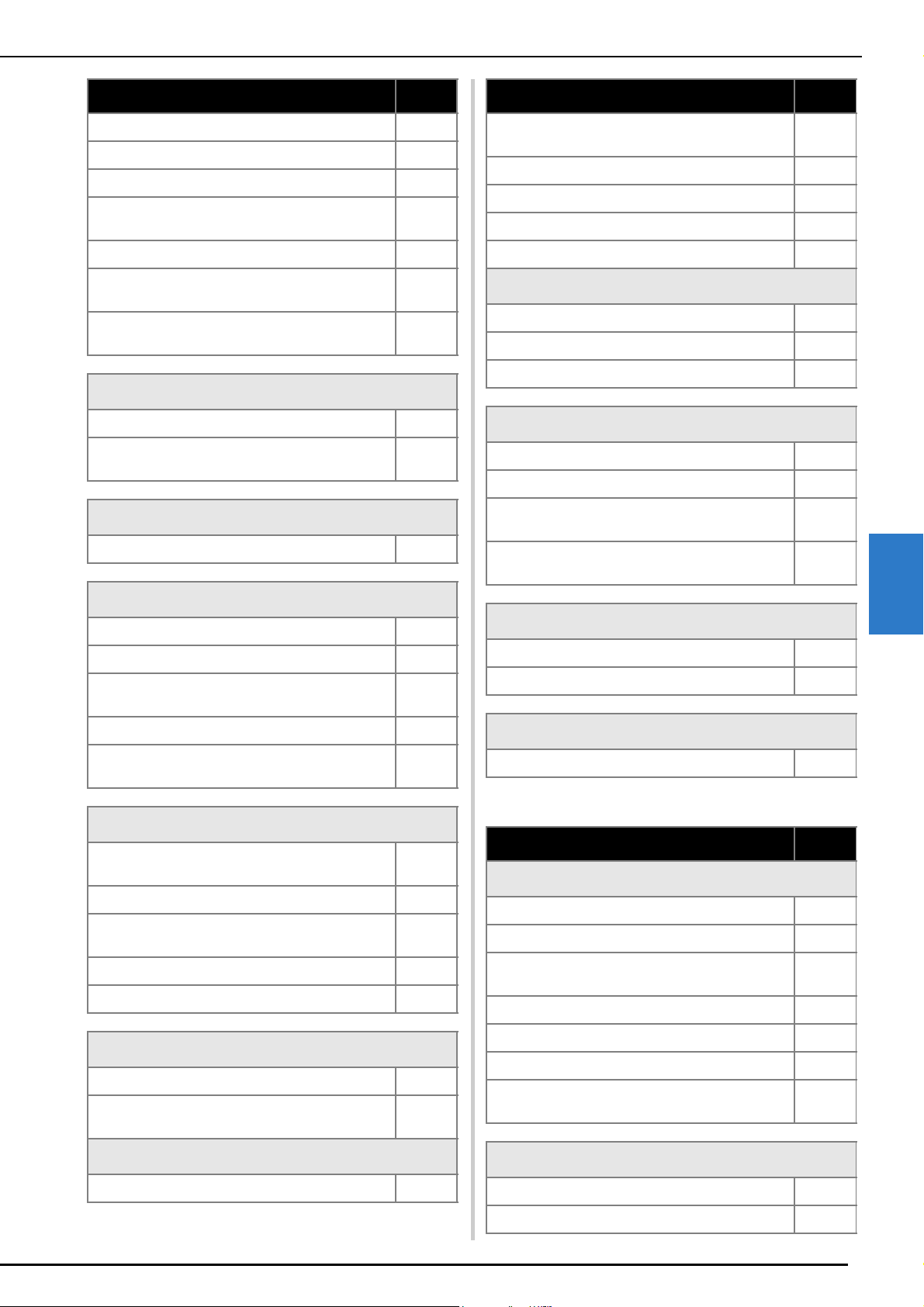
TROUBLESHOOTING
115
APPENDIX
5
After Embroidering
Thread is twisted.
—
Needle is turned, bent or the point is dull. 29
Needle is installed incorrectly. 29
There are scratches around the opening in the
presser foot.
*
There are scratches on the bobbin case. *
Using improper needle or thread for the selected
fabric.
29
A bobbin designed specifically for this machine is
not used.
22
The thread is tangled on the wrong side of the fabric.
Upper threading is incorrect. 26
Using improper needle or thread for the selected
fabric.
29
The upper thread is too tight.
The bobbin thread is incorrectly installed. 25
Bobbin thread breaks.
Bobbin is set incorrectly. 25
Bobbin thread is incorrectly wound. 22
There are scratches on the bobbin or it doesn’t
rotate properly.
25
Thread is twisted.
—
A bobbin designed specifically for this machine is
not used.
22
Fabric puckers.
There is a mistake in the upper or bobbin
threading.
25, 26
Spool cap is set incorrectly. 26
Using improper needle or thread for the selected
fabric.
29
Needle is turned, bent or the point is dull. 29
Thread tension is set incorrectly. 75
The pattern is not embroidered correctly.
The thread tension is incorrect. 75
The thread is tangled, for example, in the bobbin
case.
109
Skipped stitches
Machine is threaded incorrectly. 26
Symptom, Cause/solution
Reference
Using improper needle, thread or the fabric
prepared insufficiently for embroidering.
29, 53,
65
Needle is turned, bent or the point is dull. 29
Needle is installed incorrectly. 29
Needle is defective. 29
Dust or lint has collected under the needle plate. 109
Not embroidering
Needle is turned, bent or the point is dull. 29
Bobbin is set incorrectly. 25
Upper threading is incorrect. 26
High-pitched sound while embroidering
Pieces of thread are caught in the race. 109
Upper threading is incorrect. 26
A bobbin designed specifically for this machine is
not used.
22
There are needle holes or friction scratches in the
bobbin case.
109
The needle contacts the needle plate.
The needle clamp screw is loose. 29
Needle is turned, bent or the point is dull. 29
The handwheel feels sluggish when it is turned.
Thread is tangled in the bobbin case. 109
Symptom, Cause/solution
Reference
Thread tension is incorrect.
Upper threading is incorrect. 26
Bobbin is set incorrectly. 25
Using improper needle, thread or the fabric
prepared insufficiently for embroidering.
29, 53,
65
Thread tension is set incorrectly. 75
Bobbin thread is incorrectly wound. 22
Needle is turned, bent or the point is dull. 29
A bobbin designed specifically for this machine is
not being used.
22
The pattern is not embroidered correctly.
Thread is twisted.
—
Thread tension is set incorrectly. 75
Symptom, Cause/solution
Reference
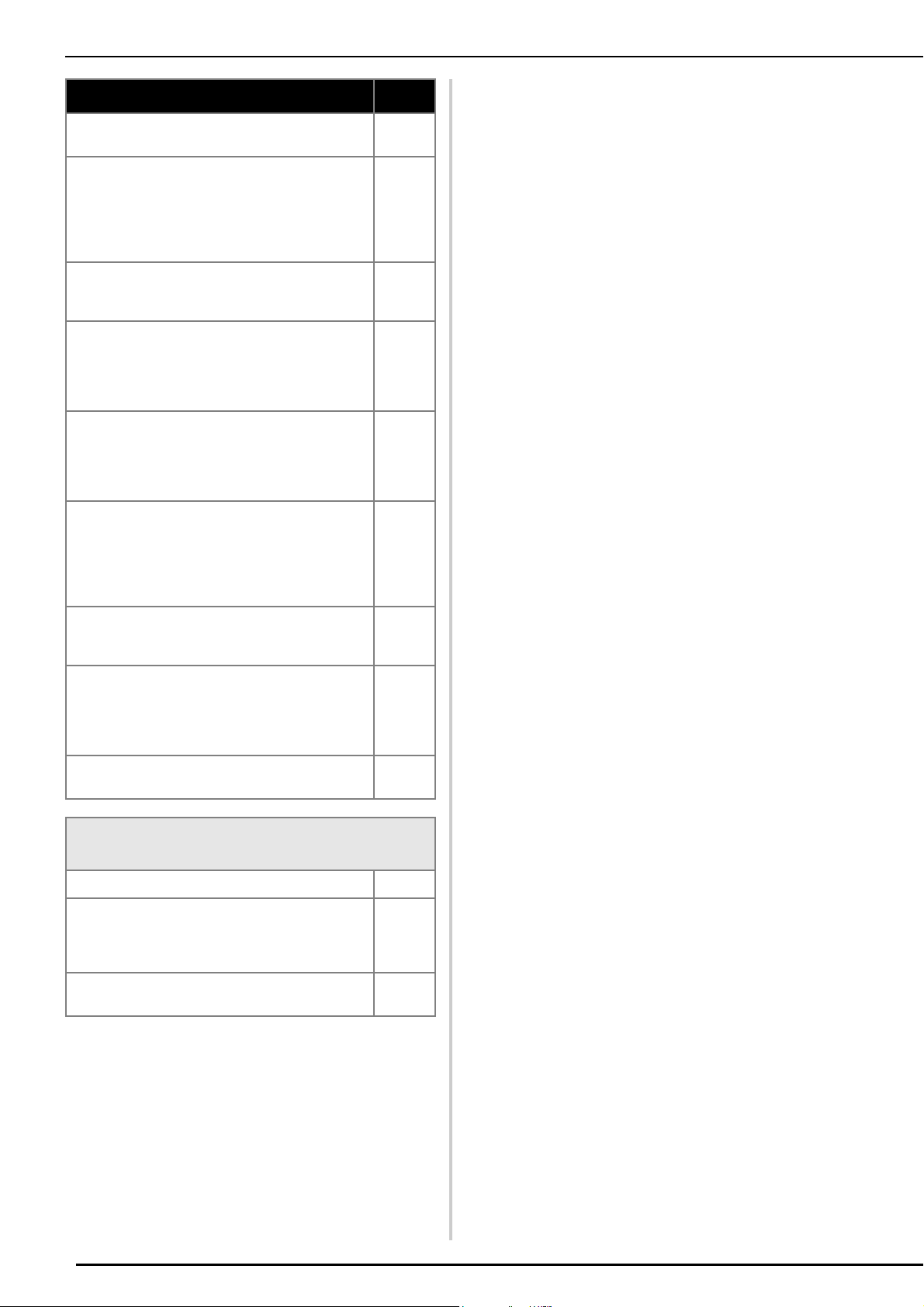
TROUBLESHOOTING
116
Fabric was not inserted into the frame correctly
(fabric was loose, etc.).
54
Stabilizing material was not attached.
• Always use stabilizing material, especially with
stretch fabrics, lightweight fabrics, fabrics with
a coarse weave, or fabrics that often cause
pattern shrinkage. See your authorized Brother
dealer for the proper stabilizer.
53
There was an object placed near the machine,
and the carriage or embroidery frame hit the
object during embroidering.
31
Fabric outside the frame edges interferes with the
arm, so the embroidery unit cannot move.
• Reinsert the fabric in the embroidery frame so
that the excess fabric is away from the arm,
and rotate the pattern 180 degrees.
54
Fabric is too heavy, so the embroidery unit
cannot move freely.
• Place a large thick book or similar object under
the arm head to lightly lift the heavy side and
keep it level.
—
Fabric is hanging off the table.
• If the fabric is hanging off the table during
embroidery, the embroidery unit will not move
freely. Place the fabric so that it does not hang
off the table or hold the fabric to keep it from
dragging.
65
Fabric is snagged or caught on something.
• Stop the machine and place the fabric so that it
does not get caught or snagged.
—
Embroidery frame was removed during
embroidering (for example, to reset the bobbin).
The presser foot was bumped or moved while
removing or attaching the embroidery frame, or
the embroidery unit was moved.
68
Stabilizer is incorrectly attached, for example, it is
smaller than the embroidery frame.
53
Loops appear on the surface of the fabric when
embroidering
The thread tension is incorrectly set.
75
The tension of the upper thread is incorrectly set
for the combination of the fabric, thread and
pattern being used.
• Use the embroidery needle plate cover.
65
The combination of the bobbin case and bobbin
thread is incorrect.
65
Symptom, Cause/solution
Reference
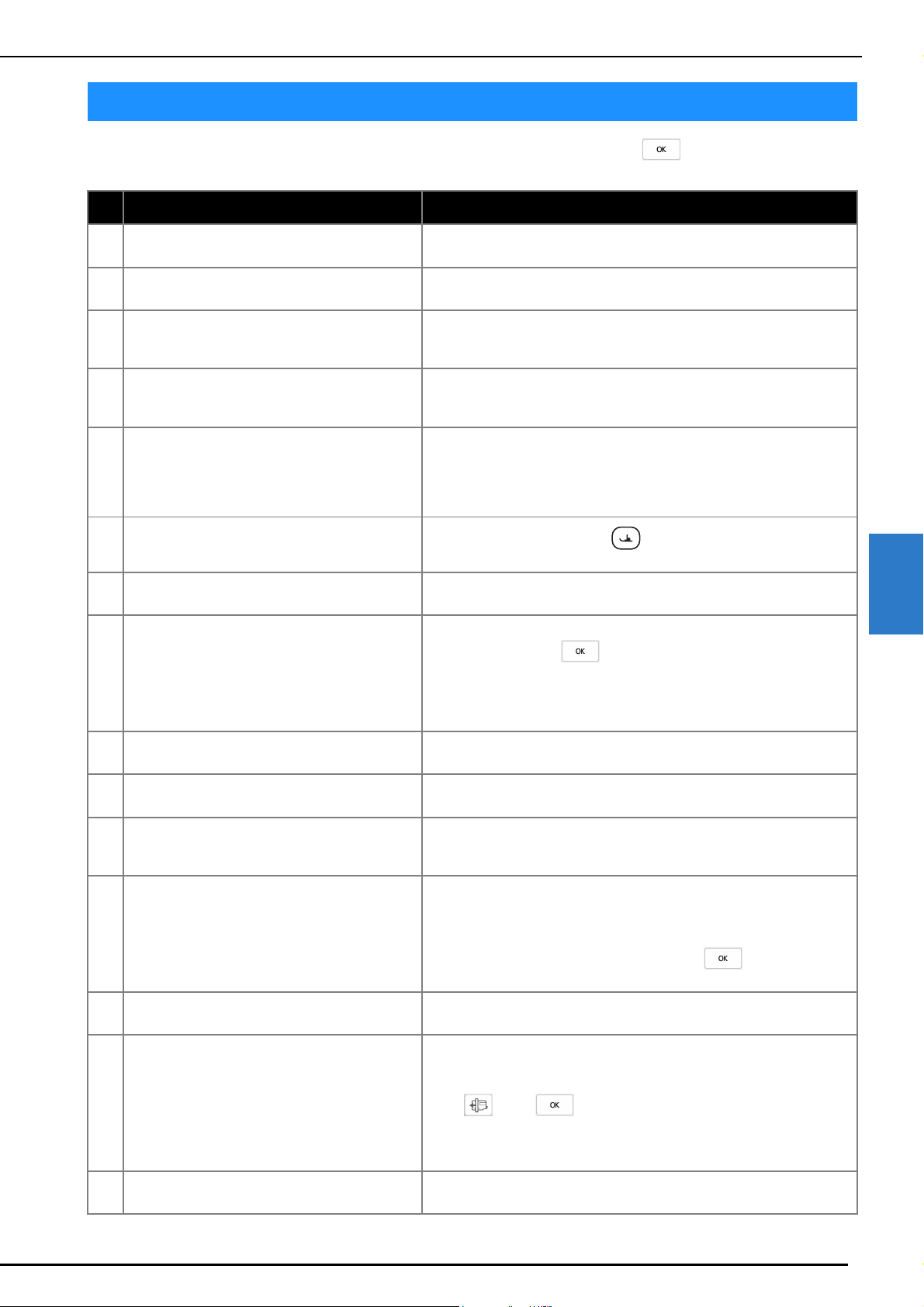
ERROR MESSAGES
117
APPENDIX
5
Below is an explanation of error messages. Refer to these when necessary (if you touch or do the operation
correctly while the error message is displayed, the message disappears).
ERROR MESSAGES
Error messages Cause/solution
1
Cannot change the configuration of the characters. This message is displayed when there are too many characters and the
curved character configuration is impossible.
2
Cannot recognize the data for the selected pattern.
The data may be corrupted.
This message is displayed when there is a possibility that the data for the
selected pattern is corrupted.
3
Change to a larger embroidery frame. This message is displayed when the machine is in embroidery mode and the
small frame is attached, and the selected pattern does not fit in the small
frame.
4
Failed to save file. This message is displayed when no more images can be saved on the USB
media. In this case, delete a file from the USB media or use different USB
media.
5
Includes a special pattern that cannot be saved to
external memory. Save the pattern in the machine's
memory.
This message is displayed when you try to save a copyright protected
pattern to USB media.
According to copyright laws, patterns that are illegal to reproduce or edit
cannot be saved to USB media. If this message displays, save the pattern in
the machine’s memory.
6
Lower the presser foot lever.
This message is displayed when (Presser foot lifter button) is pressed
while the presser foot lever is raised and the needle is lowered.
7
Not enough available memory to save the data.
Delete some patterns or use a different media.
This message is displayed when the memory is full and the embroidery
pattern cannot be saved.
8
OK to recall and resume previous memory? This message appears if the machine is turned off while embroidering, then
turned on again. Touch to return the machine to the condition
(pattern position and number of stitches) when it was turned off. Follow the
procedure described in “If the Thread Breaks or the Bobbin Runs out of
Thread During Embroidering” on page 68 to align the needle position and
embroider the remainder of the pattern.
9
OK to separate the combined border pattern? This message is displayed when rotating a saved combined pattern in the
embroidery screen.
10
Pattern extends to the outside of embroidery frame. This message is displayed when the machine is in embroidery mode, and the
character pattern combination is too large to fit in the embroidery frame.
11
Pattern extends to the outside of embroidery frame.
If you plan to add more patterns, rotate the pattern
combination.
This message is displayed when the machine is in embroidery mode and the
combined character pattern is too large for the embroidery frame. You can
rotate the pattern 90 degrees and continue combining characters.
12
Preventive maintenance is recommended. This message is displayed when the machine needs to be maintained.
Once this message appears, it is recommended to take your machine to an
authorized Brother dealer or the nearest Brother authorized service center for
a regular maintenance check. Although this message will disappear and the
machine will continue to function once you touch , the message will
display several more times until the appropriate maintenance is performed.
13
Set the clock. This message appears when the time/date is not set. Set time/date.
(page 11)
14
The bobbin thread is almost empty. This message is displayed when the bobbin thread is running out.
Although a few stitches can be embroidered when the “Start/Stop” button is
pressed, replace with a wound bobbin immediately. When embroidering,
touch , touch , remove the embroidery frame, and then replace
the bobbin with one wound with plenty of embroidery bobbin thread.
If [Upper and Bobbin Thread Sensor] in the general settings screen of the
machine setting mode is set to [OFF], this message does not appear.
15
The bobbin winder safety device has activated. Is
the thread tangled?
This message is displayed when the bobbin is being wound, and the motor
locks because the thread is tangled, etc.
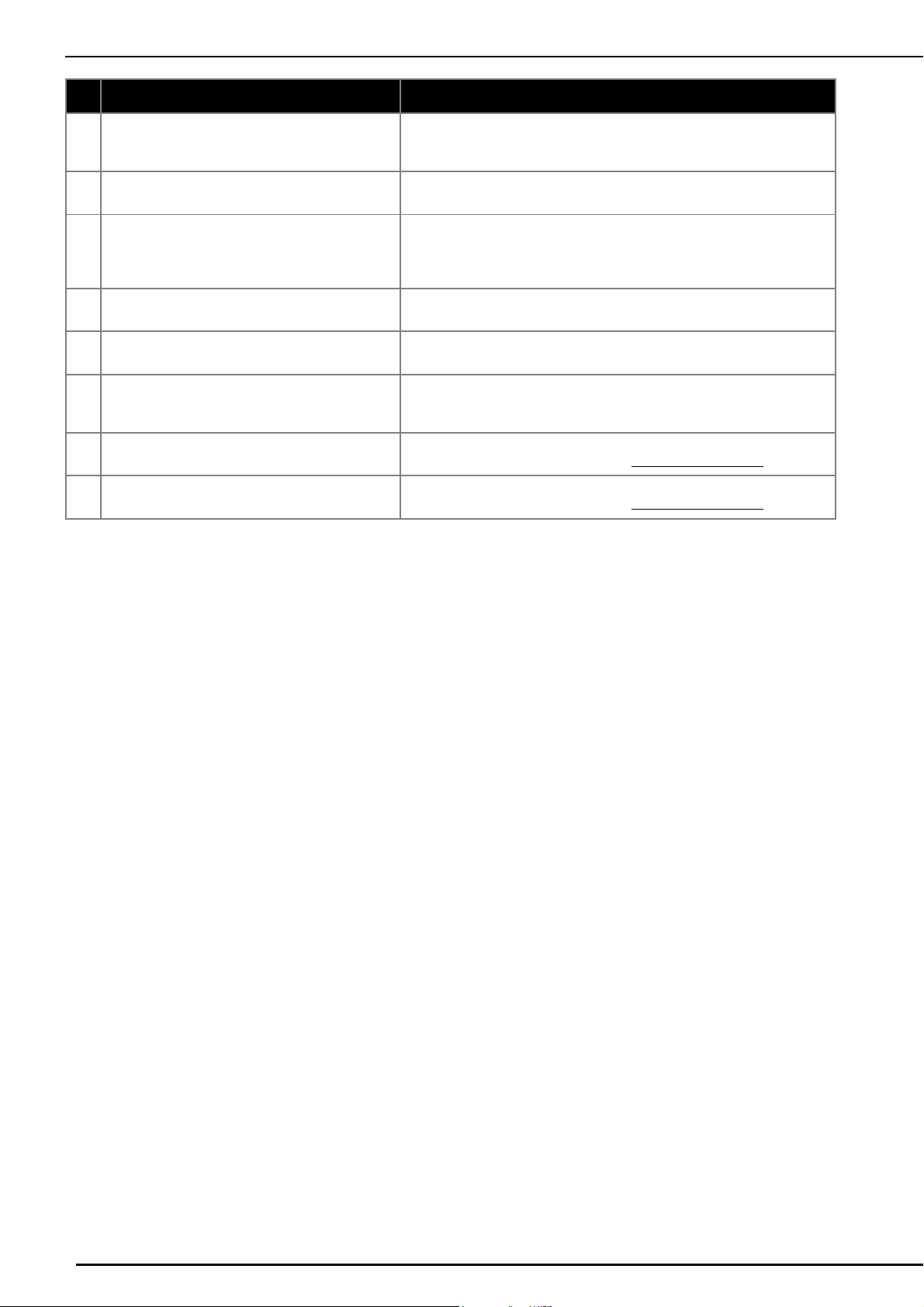
ERROR MESSAGES
118
16
The safety device was activated since the main
shaft motor was heated. Is the thread tangled?
This message is displayed when the temperature of the motor increases,
activating the safety device. Wait until the temperature decreases. If the error
persists, contact your nearest authorized Brother dealer.
17
The safety device was activated since the main
shaft motor seized. Is the thread tangled?
This message is displayed when the motor locks due to tangled thread or for
other reasons related to thread delivery.
18
The safety device was activated since the needle
position sensor malfunctioned.
This message is displayed when an error in the needle position sensor is
detected, activating the safety device. Turn the machine off, then on again. If
the message continues to appear, the machine may be damaged. Contact
your nearest authorized Brother dealer.
19
There is no needle plate cover. Attach a needle
plate cover.
This message is displayed when the needle plate cover is not attached.
20
This file cannot be used. This message appears if the file format is incompatible with this machine.
Check the list of compatible file formats. (page 119)
21
This file exceeds the data capacity and cannot be
used. Use a suitable size file.
This message is displayed when the file size exceeds the data capacity of
the machine.
Confirm the file size and format. (page 119)
22
This USB media cannot be used. This message is displayed when you try to use incompatible media.
For a list of compatible USB media, visit https://s.brother/cpeag/
.
23
USB media error This message is displayed when an error occurs with the USB media.
For a list of compatible USB media, visit https://s.brother/cpeag/.
Error messages Cause/solution
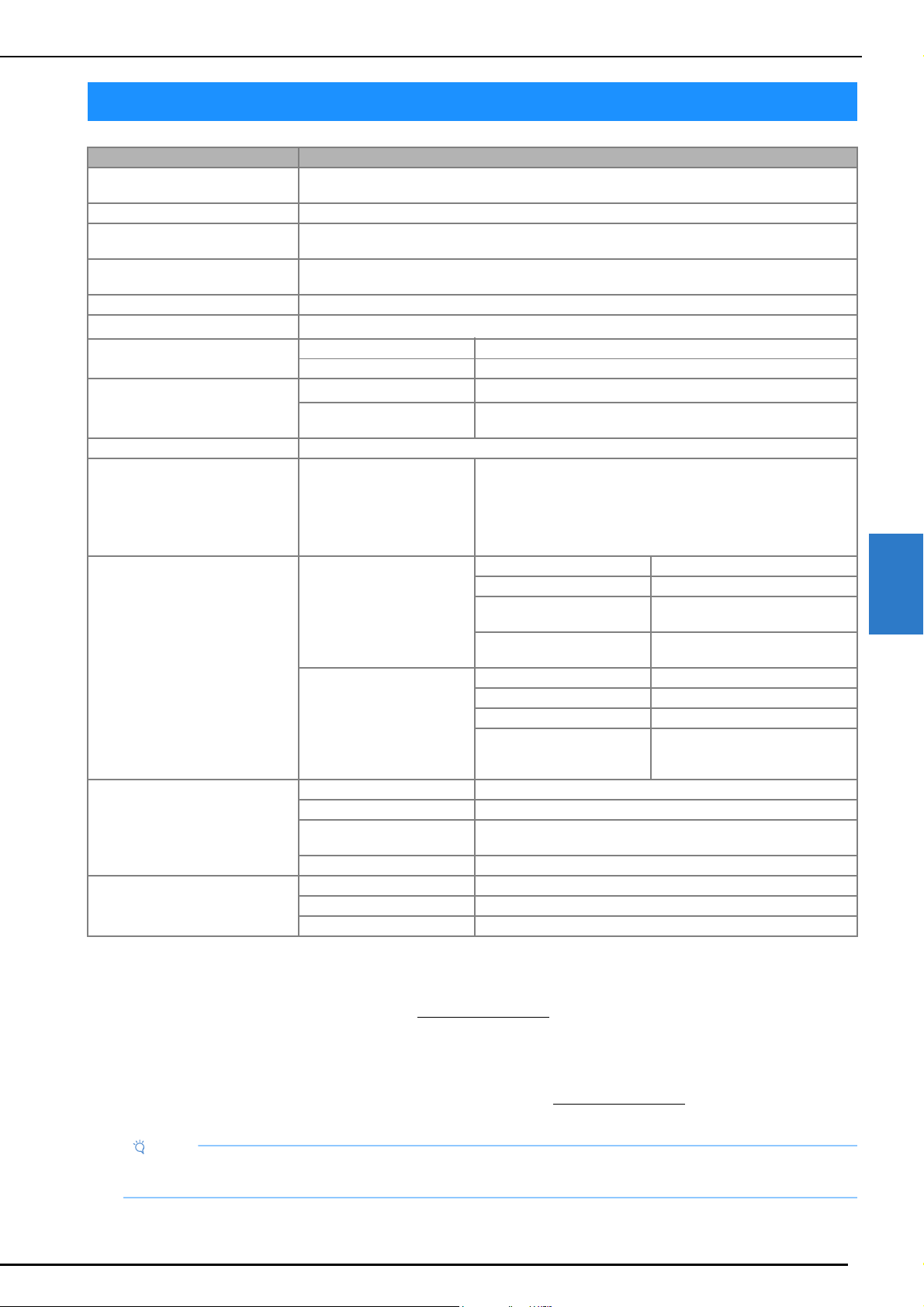
SPECIFICATIONS
119
APPENDIX
5
*1
The wireless network connection complies with IEEE 802.11b/g/n standards and uses the 2.4 GHz frequency.
A wireless network cannot be set up with WPA™/WPA2™ Enterprise.
Use Design Database Transfer or PE-DESIGN version 11 or later to transfer data from your computer to the machine. For the operating
systems compatible with the software, visit our website https://s.brother/cnekd/
.
*2
• Using data other than that saved using our data design systems or this machine may cause this machine to malfunction.
When the machine is used to save a file with any extension, it is saved as a .phx data file.
• Since Tajima (.dst) data does not contain specific thread color information, it is displayed with our default thread color sequence.
Check the preview and change the thread colors as desired.
*3
Some USB media may not be usable with this machine. Please visit our website https://s.brother/cpeag/ for more details.
* Please be aware that some specifications may change without notice.
SPECIFICATIONS
Item Specification
Dimensions of machine Approx. 612 mm (W) × 348 mm (H) × 321 mm (D)
(approx. 24-3/32 inches (W) × 13-11/16 inches (H) × 12-5/8 inches (D))
Weight of machine Approx. 15 kg (approx. 33.1 lb)
Dimensions of machine with
embroidery unit attached
Approx. 916 mm (W) × 348 mm (H) × 524 mm (D)
(approx. 36-1/16 inches (W) × 13-11/16 inches (H) × 20-5/8 inches (D))
Weight of machine with embroidery
unit attached
Approx. 20.7 kg (approx. 45.6 lb)
Maximum embroidery speed 1050 stitches per minute
Interfaces
Wireless LAN
*1
Memory Embroidery patterns 10 MB
My Design Center 100 MB
Data Types
Embroidery patterns
*2
.pes .phc .phx .dst .pen
Data that can be loaded when
using My Design Center
.jpg (up to 2 MB), .png (up to 2 MB), .bmp (up to 3 MB)
Maximum embroidering area 360 mm (H) x 240 mm (W) (approx. 14 inches (H) x 9-1/2 inches (W))
Types of USB Devices/Media that
can be Used
*3
Embroidery patterns Data can be saved to or recalled from USB media. Use media that
meets the following specifications.
• USB Flash drive (USB Flash memory)
Embroidery data can be recalled only from;
• USB External CD/DVD drives
Condition of the [Eco Mode] and
[Shutoff Support Mode]
[Eco Mode] Available time OFF, 10 - 120 (minute)
“Start/Stop” button Green flashing
Suspended function Machine light, Screen display, LED
pointer
After recovering The machine starts from the
previous operation.
[Shutoff Support Mode] Available time OFF, 1 - 12 (hour)
“Start/Stop” button Green slow flashing
Suspended function All functions
After recovering An error message appears.
You need to turn off and on the
machine to restart.
Compatible image files of the Screen
Saver Image
Format .jpg
File size Max. 150 KB for each image
File dimension 1280 × 1280 pixels or less (If the width is between 800 and 1279
pixels, the image will be displayed at 800 pixels.)
Number allowed 5 or less
Videos that can be played MP4 file format Video - H.264/MPEG-4 AVC, Audio – AAC
Size 450 (H) × 800 (W)
Maximum file size 1 GB
Note
• We recommend using the 26 letters of the alphabet (uppercase and lowercase), the numbers 0 through 9, “-”, and
“_” for the name of the file/folder.

SPECIFICATIONS
120
IMPORTANT
• When using embroidery data other than our original patterns, the thread or needle may break when
embroidering with a stitch density that is too fine or when embroidering three or more overlapping
stitches. In that case, use one of our original data design systems to edit the embroidery data.
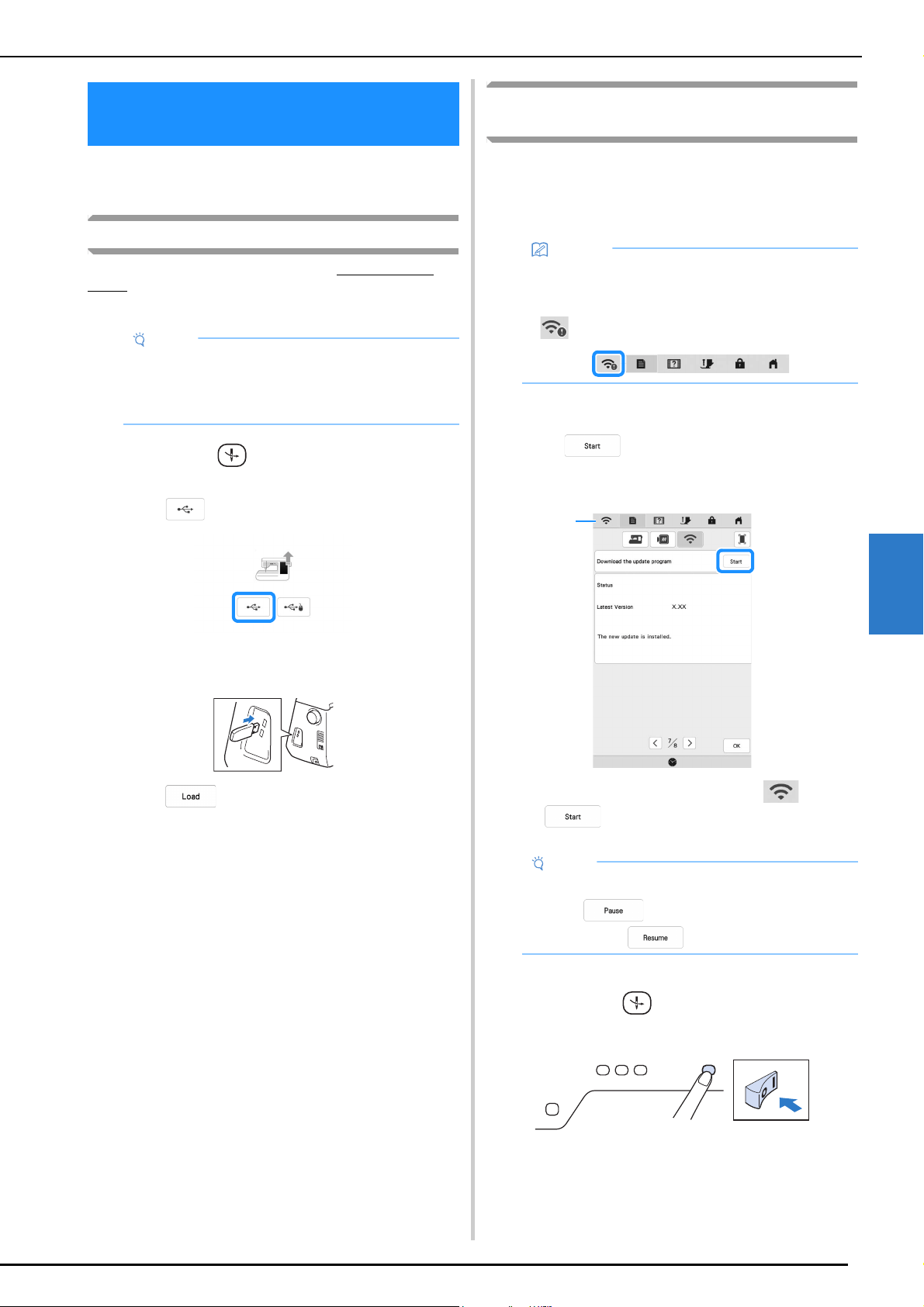
UPDATING YOUR MACHINE’S SOFTWARE
121
APPENDIX
5
You can update your machine’s software using the
following two procedures.
Update Procedure Using USB Media
When an update program is available on https://s.brother/
cpeag/, please download the files following the instructions
on the website and steps below.
a
While pressing (Automatic threading button),
turn the main power to ON.
b
Touch .
c
Insert the USB media into the primary (top) USB port
on the machine.
d
Touch .
When updating is finished, the completion message
appears.
e
Turn the machine off, remove the USB media, and turn
the machine on again.
Update Procedure Using Wireless LAN
Connection
If the machine is connected to a wireless network with a
strong, reliable connection, update files can be downloaded
directly to the machine using this network.
For details on the wireless LAN connection, refer to page 19.
a
Display page 7 of the settings screen.
b
Touch .
* The machine starts to download the update file, if
there is a new update file on server.
1 When the wireless LAN key appears as , touching
causes the machine to check if there is a new
update file. If there is a new file, downloading begins.
c
When downloading is finished, turn off the machine,
then hold down (Automatic threading button)
while turning on the machine.
UPDATING YOUR MACHINE’S
SOFTWARE
Note
• When using USB media to update the software,
check that no data other than the update file is
saved on the USB media being used before
starting to update.
Memo
• The machine periodically checks if there is a new
update file on the server. When there is a new
update file, the wireless LAN key is displayed as
.
Note
• Do not turn off the machine during the download.
• Touch to pause the download. To
restart, touch .
1
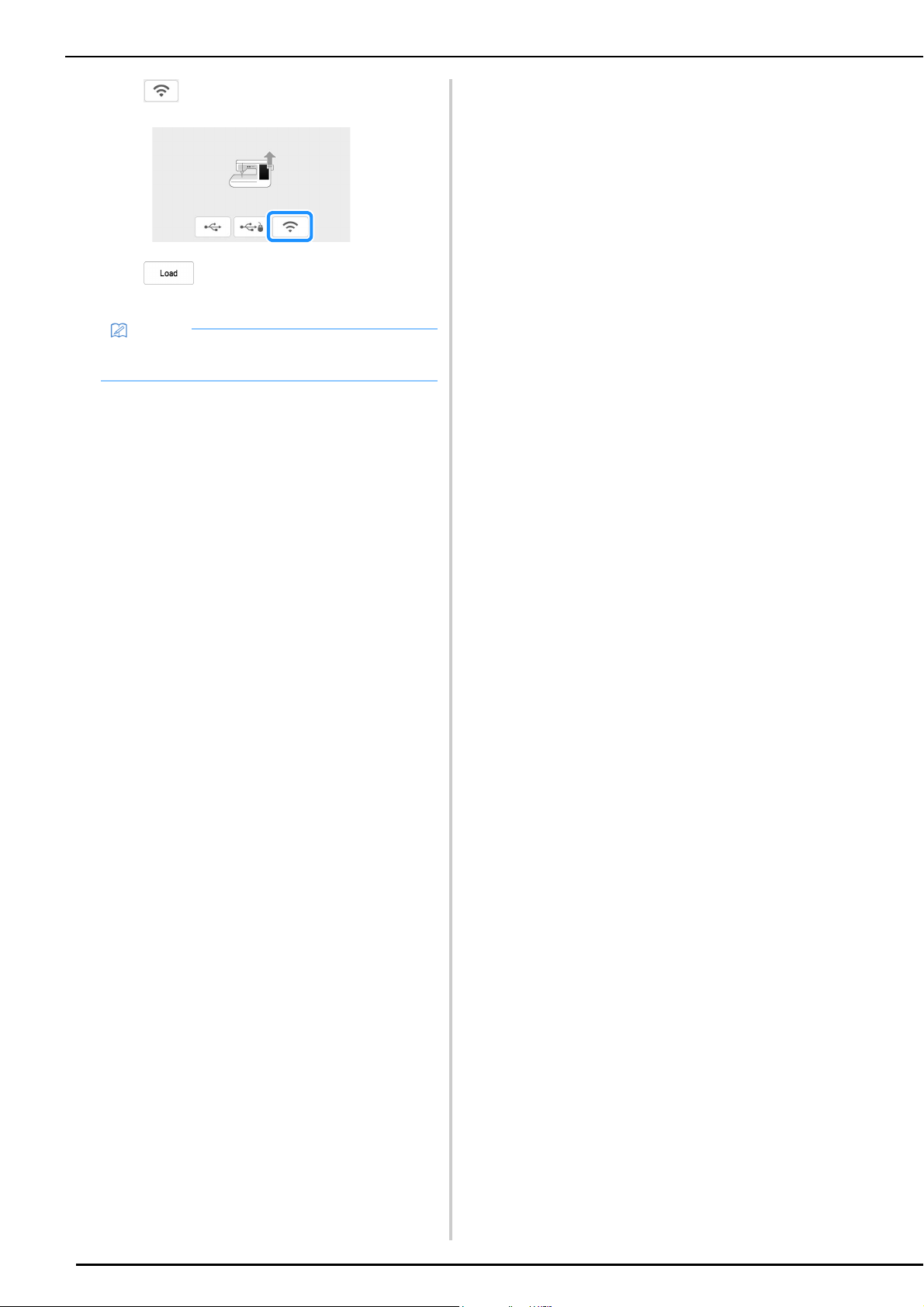
UPDATING YOUR MACHINE’S SOFTWARE
122
d
Touch .
e
Touch to update the machine.
* Do not turn off the machine during the update.
Memo
• If there are changes or additions to functions,
manuals available on the machine may be updated.

INDEX
123
APPENDIX
5
A
Air vent ......................................................................................... 9
Alphabet characters
embroidery
.............................................................................. 35
Appliqué
using an embroidery frame pattern
.......................................... 83
Automatic threading button
................................................. 10, 26
B
Bobbin
setting
...................................................................................... 25
winding
................................................................................... 22
Bobbin case
cleaning
................................................................................. 109
Bobbin cover
................................................................................. 9
Bobbin threading
setting the bobbin
.................................................................... 25
winding the bobbin
................................................................. 22
Bobbin winder
............................................................................... 9
Bobbin winding switch
................................................................ 23
Border key
........................................................................... 42, 45
C
Cleaning
race
....................................................................................... 109
Clock
........................................................................................... 11
Color shuffling function
............................................................... 49
Couching patterns
....................................................................... 84
D
Decorative fill pattern .................................................................. 87
Deselect region setting
................................................................ 46
E
Echo quilting ............................................................................... 87
Eco mode
.................................................................................... 15
Editing
embroidery edit
....................................................................... 39
Embroidery
2-point embroidery positioning function
.................................. 61
adjusting the speed
.................................................................. 78
automatic thread cutting function (End color trim)
................... 77
key functions
........................................................................... 52
resuming embroidery after turning off the power
..................... 69
selecting patterns
..................................................................... 33
thread color display
................................................................. 79
thread trimming function (Jump stitch trim)
.............................. 78
Embroidery appliqué
................................................................... 67
Embroidery edit
changing the thread color
........................................................ 48
key functions
........................................................................... 39
repeated patterns
..................................................................... 42
Embroidery foot “W+” with LED pointer
.................................... 111
Embroidery frames
attaching
.................................................................................. 56
inserting fabric
......................................................................... 54
removing
................................................................................. 57
types
........................................................................................ 54
using the embroidery sheet
...................................................... 55
Embroidery needle plate cover
.................................................... 65
Embroidery patterns
checking the position
............................................................... 60
editing
..................................................................................... 39
embroidering
........................................................................... 65
linked characters
..................................................................... 80
retrieving
................................................................................. 82
saving
...................................................................................... 81
selecting
................................................................................... 33
using a frame pattern to make an appliqué
............................... 83
Embroidery sheet
......................................................................... 55
Embroidery unit
........................................................................... 31
Error messages
........................................................................... 117
F
Favorite color scheme .................................................................. 50
H
Handle ........................................................................................... 9
Handwheel
.................................................................................... 9
Home page screen
....................................................................... 12
I
Image key .................................................................................... 41
K
Key functions
embroidery
.............................................................................. 52
embroidery edit
........................................................................ 39
L
LCD screen ............................................................................ 9, 12
light
......................................................................................... 13
M
Machine help key ........................................................................ 17
Main power switch
........................................................................ 9
Metallic thread
............................................................................. 27
MPEG-4 (MP4) videos
.................................................................. 18
My Design Center
........................................................................ 89
My Design Snap App
................................................................. 107
My Stitch Monitor App
............................................................... 106
N
Needle
changing the needle
................................................................. 29
Needle bar thread guide
................................................................ 9
Needle plate
.................................................................................. 9
Needle position button
................................................................ 10
O
Operation buttons .................................................................. 9, 10
P
Power cord .................................................................................. 11
Power cord receptacle
................................................................... 9
Presser foot code
.......................................................................... 51
Presser foot lever
............................................................................ 9
Presser foot lifter button
............................................................... 10
Presser foot/Needle exchange key
...................................... 29, 111
Pretension disk
............................................................... 9, 23, 24
R
Race .......................................................................................... 109
Repeated patterns
........................................................................ 42
Retrieving
embroidery patterns
................................................................. 82
machine’s memory
................................................................... 82
INDEX

INDEX
124
S
Saving
embroidery patterns
................................................................. 81
machine’s memory
................................................................... 81
Screen saver
................................................................................. 16
Screw for embroidery foot
.............................................................. 9
Settings
automatic thread cutting
.......................................................... 77
embroidery settings
.................................................................. 14
general settings
........................................................................ 13
machine settings key
................................................................ 13
thread tension
.......................................................................... 75
thread trimming
....................................................................... 78
Shutoff support mode
................................................................... 15
Speaker
........................................................................................ 13
Specifications
............................................................................. 119
Spool cap
....................................................................................... 9
Spool net
..................................................................................... 27
Spool pin
....................................................................................... 9
Stabilizer
...................................................................................... 53
Start/Stop button
.......................................................................... 10
Starting point key
......................................................................... 79
Stippling
...................................................................................... 87
Supplemental spool pin
......................................................... 9, 22
T
Thread
thread tension
.......................................................................... 75
Thread color display
.................................................................... 79
Thread color palette
..................................................................... 48
Thread cutter
................................................................................. 9
Thread cutter button
.................................................................... 10
Thread guide
.................................................................. 9, 23, 24
Thread guide plate
................................................................. 9, 24
Thread marks
............................................................................... 45
Touch pen
................................................................................. 112
Trial key
....................................................................................... 60
Troubleshooting
......................................................................... 113
Tutorial video
.............................................................................. 17
U
Upgrading .................................................................................. 121
Upper threading
using the Automatic threading button
....................................... 26
USB mouse
.................................................................................. 21
USB port
........................................................................................ 9




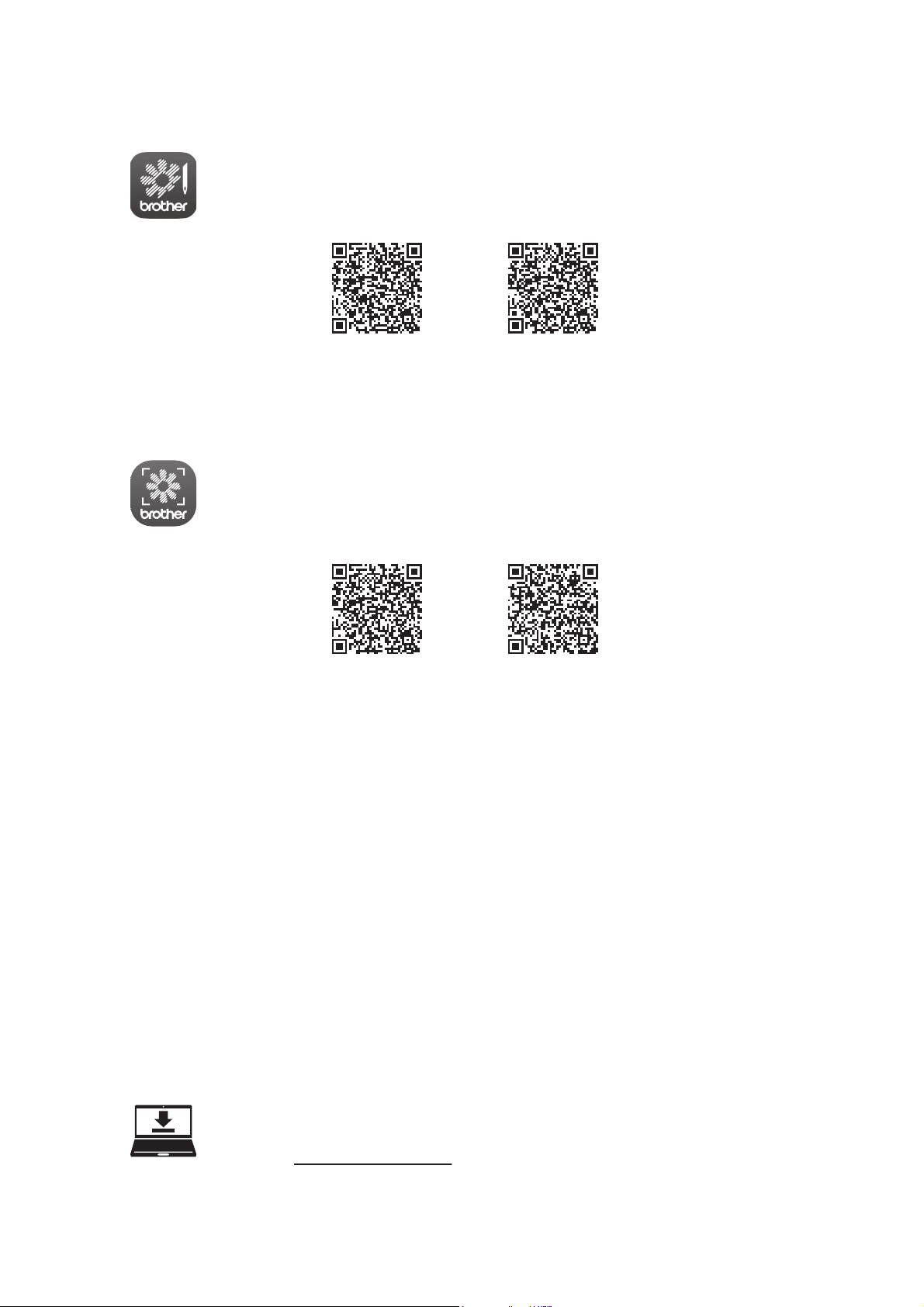
My Stitch Monitor is a mobile app that monitors the operating conditions of your
machine.
Visit the Google Play™ or App Store to download.
Google Play™ App Store
My Design Snap is a mobile app that you can position your embroidery designs on
the fabric, by capturing image of the hooped fabric and sending the image to your
machine.
Visit the Google Play™ or App Store to download.
Google Play™ App Store
Design Database Transfer is a dedicated Windows application for wirelessly
transferring embroidery data from a computer to the machine. This application can
also be used to view and manage embroidery data.
Visit us at https://s.brother/caeka/ to download the application.
English
882-W83/W85
D02M4J-001
Please visit us at https://s.brother/cpeag/ where you
can get product support and answers to frequently asked
questions (FAQs).
This machine is approved for use in the country of purchase only. Local Brother companies or
their dealers will only support machines purchased in their own countries.
Various optional accessories are available to be
purchased separately.
Visit our website https://s.brother/coeka/.
Be sure to install the latest software.
A variety of functional improvements are being performed in the latest version.
Brother SupportCenter is a mobile app that provides the support
information for your Brother product.
Visit the Google Play™ or App Store to download.
Google Play™ App Store