INSTRUCTION MANUAL
MODEL #44349
2
|
ENGLISH
INTRODUCTION
Thank you for purchasing the Celestron TetraView
TM
LCD Digital
Microscope with a 4.3-inch touch screen monitor. Your microscope is
a precision optical instrument, made of the highest quality materials. It is
designed to give you a lifetime of enjoyment with minimal maintenance.
Before attempting to use your microscope, please read through the
instructions to familiarize yourself with its functions and operations. See
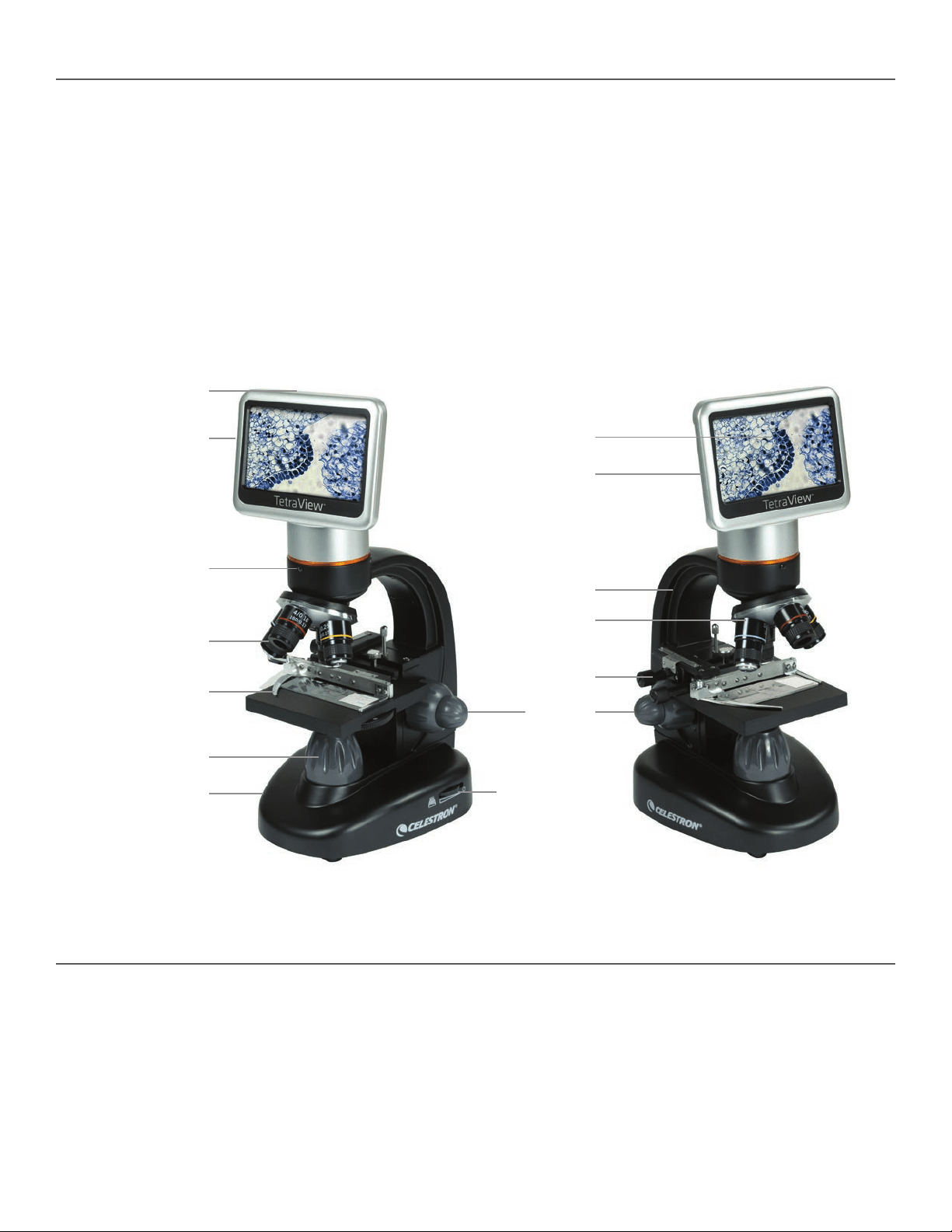
the microscope diagram to locate the parts discussed in this manual.
This microscope provides high powers from 40x up to 400x (up
to 1600x with digital zoom). This microscope is mainly suited for
examining specimen slides of yeasts and molds, cultures, plant and
animal parts, fibers, bacteria, and more.
Unlike traditional microscopes, the Celestron TetraView
TM
LCD Digital
Microscope does not use eyepieces. You will view specimens on the
LCD screen. In addition, you can take snapshots or short videos with
the built-in digital camera. Plus, you can view on most TV screens with
the AV/TV cable.
The final sections of this manual provide simple care, maintenance and
troubleshooting tips to ensure that your microscope provides you with
years of quality performance and enjoyment.
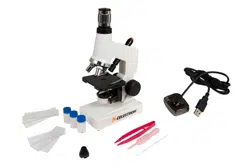
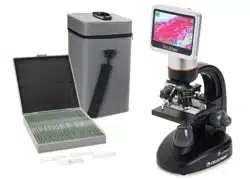
• USB Cable 2.0
• AV / TV Cable
• 100 Slides
• Touch Pen
• Hard Case
• AC Adapter
• SD Card
ACCESSORIES INCLUDED WITH YOUR MICROSCOPE
LCD Module LCD Monitor
Power On/Off
Screw to adjust the tension of
the rotation
Objective Nosepiece
Objective Lenses
Mechanical Stage
Base
Illuminator
SD Card/USB/AV-TV
Cable Receptacles
Arm
Stage Control Knobs
Focus Knobs
Illuminator Adjustment Switch
Fig 1
ENGLISH
|
3
1. Carefully remove the microscope and other parts from the carton
and set them on a table, desk, or other fl at surface.
2. Remove the plastic cover from the microscope.
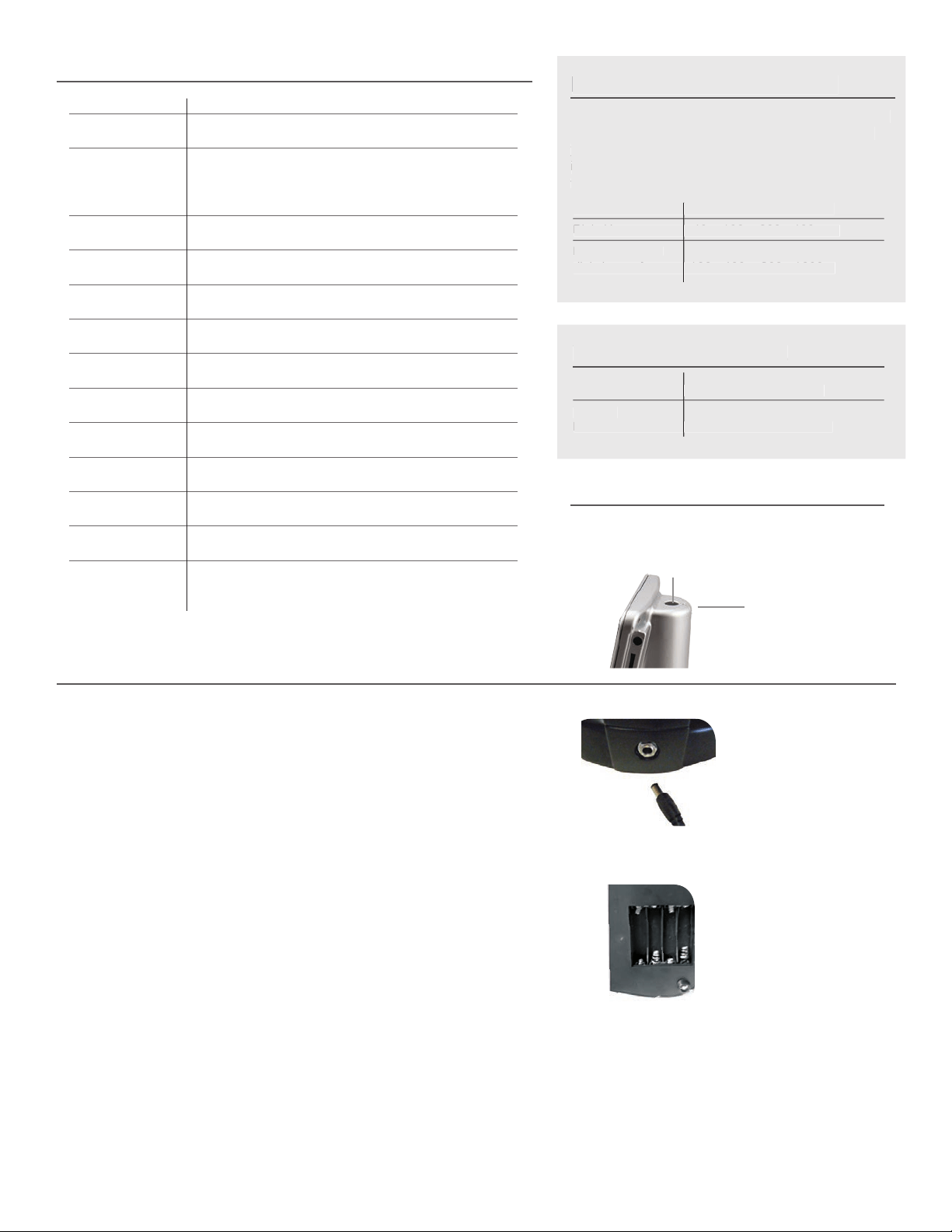
3. Plug the small cable from the AC adapter into the socket on the
back of the base (see Figure 2).
4. Plug the adapter into the proper power source.
Battery Operation — You can use your microscope without AC
power if you choose. This gives you the freedom to operate the
microscope outdoors or indoors, anywhere you please. You’ll need
4 AA batteries (user supplied). Open the battery door on the bottom
of the microscope and insert the batteries according to the battery
polarity shown in the battery compartment (Figure 3). After the
batteries are installed, close the battery door. Battery life will typically
be three hours.
SETTING UP YOUR MICROSCOPE
MAGNIFICATION (POWER)
Use the following table to determine the magnifi cation
of the different objective lenses in combination with
your microscope using the normal mode of the digital
image on the LCD screen and using the digital zoom
feature.
SPECIFICATIONS
Stage Mechanical Stage 3.5 in x 3.5 in (88 mm x 88 mm)
Digital Camera 5 MP ½.5” CMOS; 10x Magnifi cation in lieu of an eyepiece
LCD Monitor 4.3 inch (109 mm) with 4x Digital Zoom —
Touch digital TFT display
Resolution — 480 x 272 pixels
Focuser Dual — Coarse/Fine
Objectives Glass — 4x, 10x 20x, 40x
Memory 8 GB SD Card (approximately 4, 500+ snapshots @ 5 MP)
LCD Rotation 180° – 90° left / 90° right
Filter Wheel Red/Green/Blue/1 mm hole/3 mm hole/6 mm hole (default)
Nosepiece Quad with click stop
Illuminator Built-in electric — LED 6 Volt and 6 Watt
Condenser N.A. 0.65
AC Adapter Input Universal 100 to 240 Volt 50/60HZ
Batteries User supplied 4 AA (optional - up to 3 hours usage)
Weight/Dimensions 67 oz/1.9 kg 7.0” (178 mm) x 5.5 in (140 mm) x 13.0 in (330 mm)
Fig 3
WORKING DISTANCE
Objective Lens 4x 10x 20x 40x
Working
Distance (mm) - est. 35.3 7.8 1.9 0.7
TOUCH PEN
You can keep the touch pen handy in the receptable behind
the Power ON/OFF button.
Objective Lens 4x 10x 20x 40x
Digital Image 40x 100x 200x 400x
Maximum with 4x
digital zoom feature 160x 400x 800x 1600x
MAGNIFICATION (POWER)
Use the following table to determine the magnifi cation
of the different objective lenses in combination with
your microscope using the normal mode of the digital
image on the LCD screen and using the digital zoom
feature.
Objective Lens 4x 10x 20x 40x
Digital Image 40x 100x 200x 400x
Maximum with 4x
digital zoom feature 160x 400x 800x 1600x
Objective Lens 4x 10x 20x 40x
Digital Image 40x 100x 200x 400x
digital zoom feature 160x 400x 800x 1600x
WORKING DISTANCE
Objective Lens 4x 10x 20x 40x
Working
Distance (mm) - est. 35.3 7.8 1.9 0.7
Objective Lens 4x 10x 20x 40x
Distance (mm) - est. 35.3 7.8 1.9 0.7
ON/OFF Button
Touch Pen
Fig 2
4
|
ENGLISH
MICROSCOPE OPERATION
Follow these instructions to turn on the LCD and adjust the
microscope’s stage and illumination before you begin observing.
Remove the protective fi lm from the LCD screen.
LCD MODULE
This digital microscope is different from traditional microscopes
because it uses an LCD instead of eyepeices. With an LCD, you can
view specimens on the screen by yourself or share them with others.
To begin, turn on the LCD monitor by pushing the power button (see
Figure 1). You will see “Celestron Digital Microscope” on the screen.
The touch screen functions on the LCD module are mainly used for
taking images (snapshots and video) and performing other functions
that will be discussed later in this manual.
ILLUMINATION
To get the sharpest and best views, you’ll need to choose the proper
illumination (lighting):
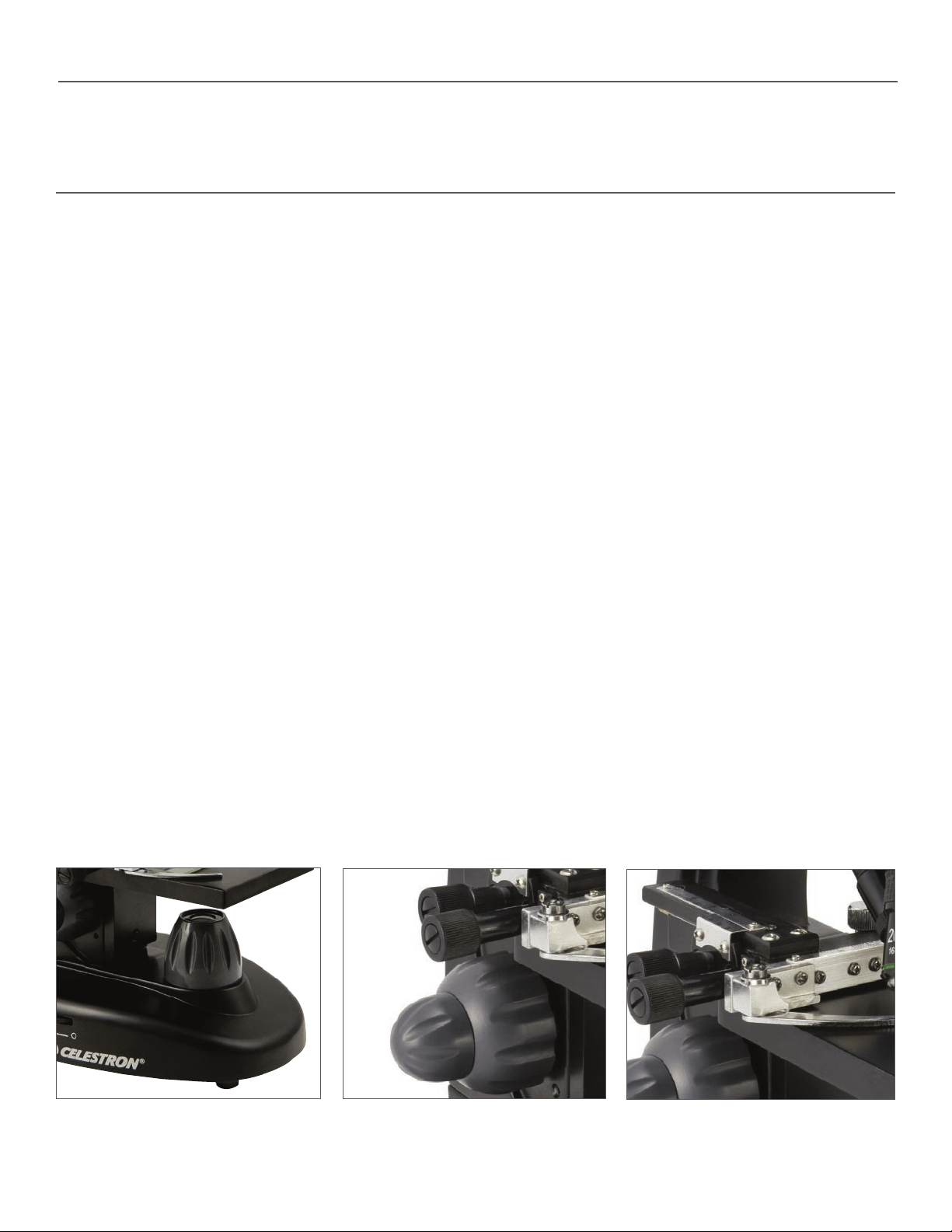
1. To turn the illuminator on, see Figures 4 & 5 and turn one of the
switches as shown.
2. The illuminator (Figure 1) is used mainly for specimen slides
where the light shines up through the hole in the stage through
the slide.
ADJUSTING THE LIGHTING
Specimens of different sizes, widths, and color variations will require
different levels of illumination. Normally, you adjust the brightness by
turning the switches shown in Figure 4 & 5. Another way to adjust
brightness is by changing the EV function on the touch screen. The
EV (exposure value) function increases or decreases the brightness
level by using the (+) or (-) buttons on the screen.
When viewing a dark colored specimen, you may need to increase
the amount of light to resolve certain features or details. This is best
done by increasing the brightness of the illuminator by rotating the
brightness control dial to its highest setting.
Experiment with adjustments to fi nd optimum lighting settings. Each
specimen and magnifi cation may require slightly different illumination.
VIEWING A SPECIMEN
Your microscope fetures a mechanical stage with a stage holder
clamp and directional knobs (see Figure 6).
1. Use the clamp lever to open the clamping arm of the stage holder
clamp.
2. Place a specimen slide (1in x 3 in / 25.4 mm x 76.2 mm size)
inside the holder and gently close the clamping arm against the
slide.
3. Use the stage movement knobs to position the specimen over the
opening in the stage. The rear stage movement knob moves the
X-axis (forward and backward), while the front stage movement
knob moves the Y-axis (side to side). For fi rst time microscope
users, it will take some time to get used to the movements, but
soon you will be able to center objects easily.
NOTE: A vernier scale on both axes allows the exact marking and replication of an object
in the fi eld of view.
4. Use the objective nosepiece (Figure 1) to rotate the objective
lenses (Figure 1) until the 4x objective lens is directly over the
specimen. Always start with the lowest power objective (4x with
this microscope), which gives you 40 power, and work your way
up to higher powers. At 40 power, you will have the widest fi eld
of view and the brightest image.
The TetraView
TM
comes with a 8 GB SD card, which you can use to capture images (snapshot or video). SD cards are inserted into the SD
card slot in the LCD monitor (Figure 1).
USING AN SD CARD
Fig 5Fig 4 Fig 6
ENGLISH
|
5
5. Look at the LCD screen while turning the focus knob (Figures
1 & 6) until the specimen comes into view. You may need to
adjust the stage movement knobs (Figure 6) slightly to center the
specimen in the field of view. The larger focus knob is the coarse
focus and the smaller knob is for fine (exact) focusing.
6. With the 4x objective lens, you can also vary the power anywhere
from 40x to 160x by using the digital zoom.
7. For higher powers, you will need to rotate the objective
nosepiece to the 10x or 20x and to the 40x objective for the
maximum power. You will have to refocus when changing the
power of the objective lenses. While using any of these objective
lenses, you also can increase power by using the digital zoom.
Note that using a higher power objective lens will yield sharper
images than a lower power objective lens and digital zoom for the
same magnification.
8. To use the digital zoom, touch the screen icons on the
right side of the screen to increase or decrease the power from
1x to 4x.
NOTE: When changing objective lenses, lower the stage to its lowest position so you do
not hit anything during the rotation. At the higher powers, be careful when raising
the stage close to the objective lens so that the objective does not hit the slide
specimen (or other object) and cause damage.
USING FILTERS & THE DIAPHRAGM
Normally, most viewing or imaging can be done without colored
filters. Before using the microscope, check to make sure no filters are
in the optical path. To bring out different levels of detail, experiment
with changing the color of the back lighting of the specimen
especially for very bright transparent specimens. To change the
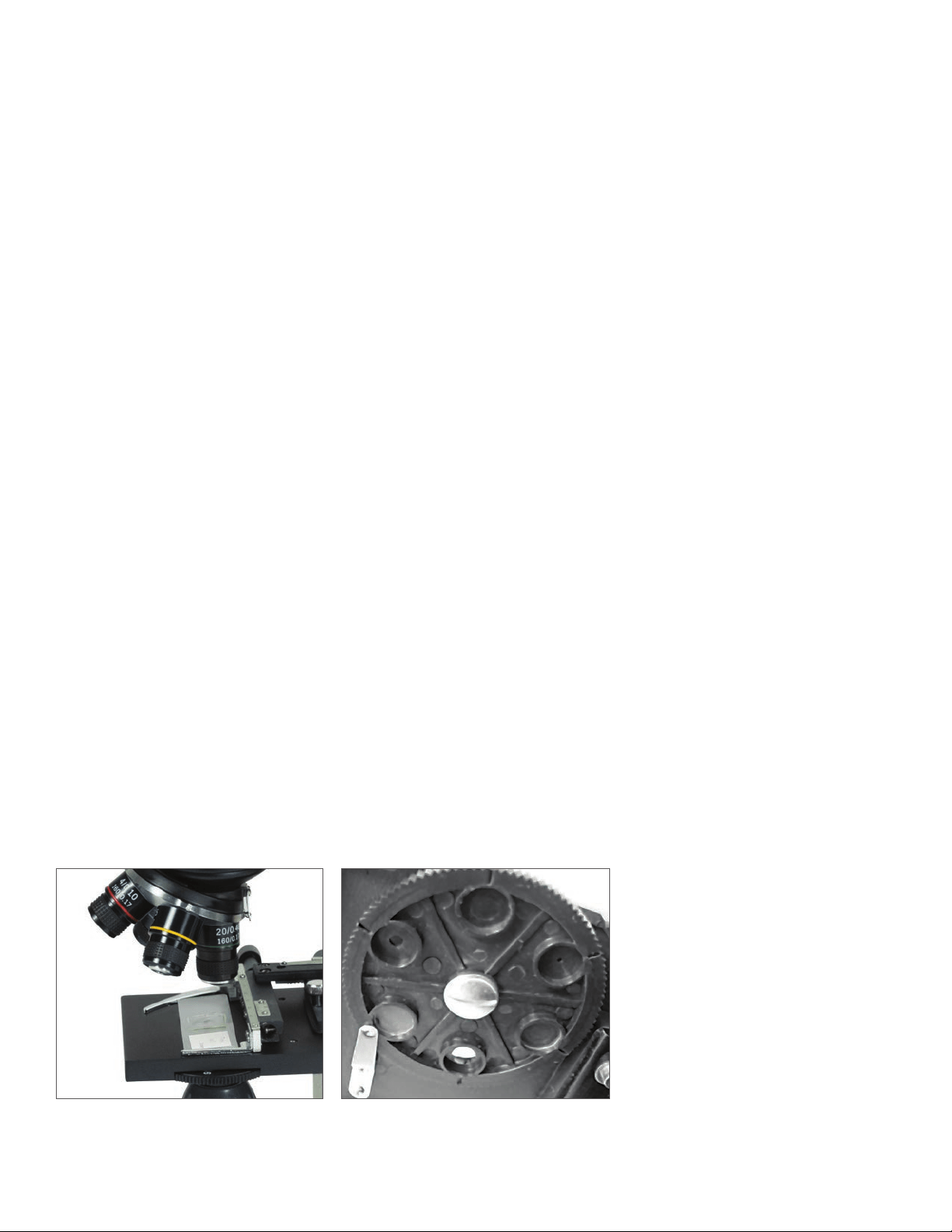
lighting color, rotate the wheel (Figure 7) to the desired color – Red
(R), Green (G), Blue (B). Each color is centered when you hear/feel
the faint click stop. You may need to refocus by adjusting the focus
knob (Figure 1) slightly for best viewing. You should experiment with
each of the colors to see what works best.
Diaphragm — Within the wheel are holes with three different
diameters, (1) 1 mm, (3) 3 mm, (6) 6 mm that limit the amount of
light passing through to the specimen. These holes are part of the
diaphragm. Changing the hole opening size helps you maximize the
contrast, brightness, etc.
The default setting is (6) for the 6 mm hole, which should be used for
most viewing. You can look under the stage (see Figure 8) to make
sure the proper setting is actually being used.
ROTATING THE LCD SCREEN
You can rotate the viewing position of the LCD screen 180°: 90° to
the right and 90° to the left. You can view any position you choose
along the 180° rotation. This function allows you to share the view
with others without actually moving the complete microscope. To
move the LCD screen, hold the top of the arm (see Figure 1) with
one hand, hold the LCD module with the other, and move it to the
position you desire.
You can adjust the tension of the rotation of the monitor by
tightening/loosening the adjustment screws as shown in Figure 1.
It is best to have the tension somewhat tight so the monitor is rigid.
Turn the LCD screen on and you are now ready to use your
microscope for viewing. If any problems arise, check the
troubleshooting section.
AV/TV CABLE
To view specimens or images on a larger format screen, connect
the AV/TV cable in the receptable (see Figure1) on one end and the
other end into the socket on the monitor (if your monitor has a socket
for this purpose).
Fig 8
Wheel
Fig 7
6
|
ENGLISH
You can take snapshots or a short video with your microscope
using the built-in digital camera. With the SD card memory, you
do not need to use a PC or any other devices to do imaging.
Transferring images to your PC for saving or printing is easy and
will be discussed later in this manual.
NOTE: If you are going to take images, do not connect the USB cable to your PC
or damage could occur to the equipment. The USB cable is not used for
taking images.
SETTINGS AND INFORMATION FOR THE
DIGITAL CAMERA AND THE TOUCH SCREEN
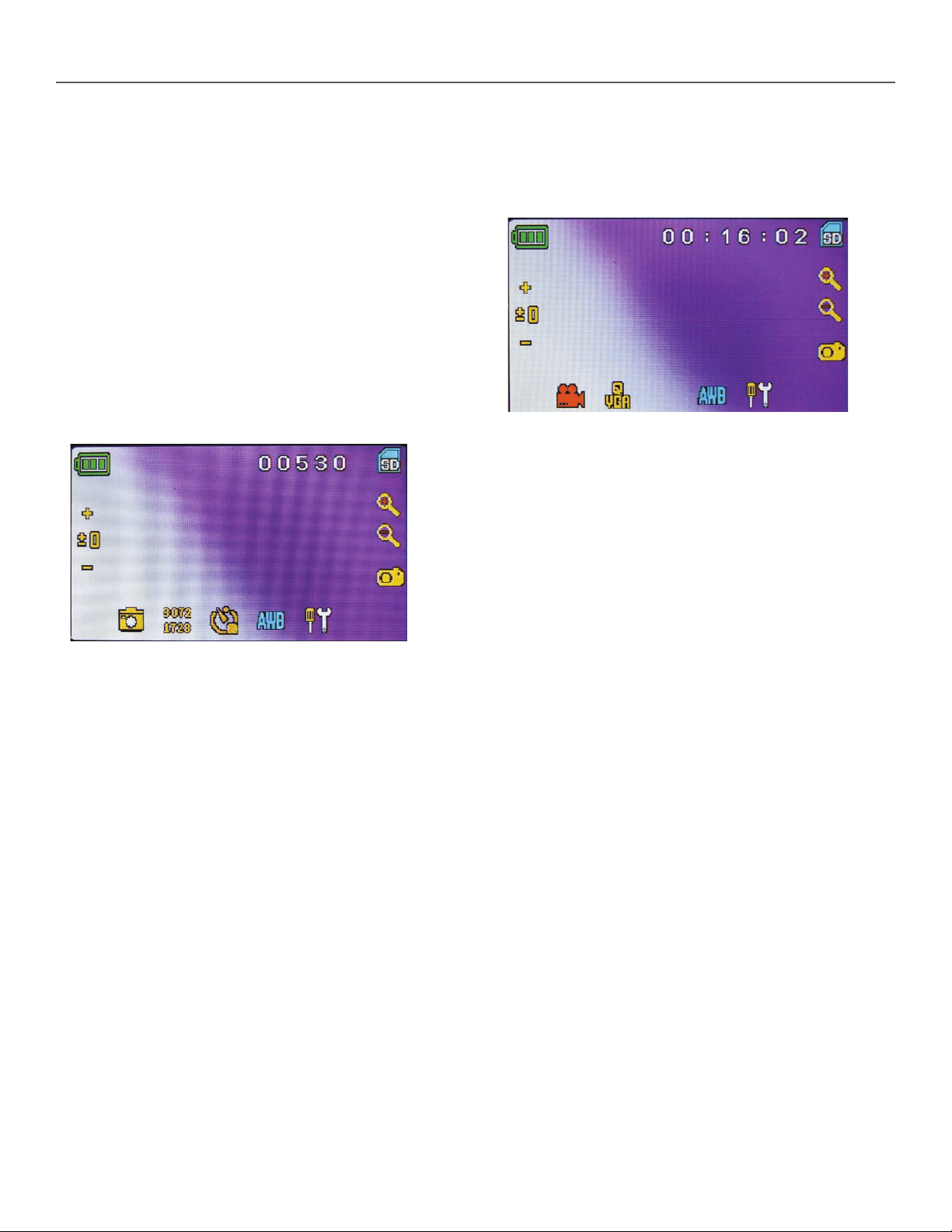
The touch screen icons and their functions are quite easy to use.
Below we’ll discuss the general use of the icons. Typically, you use
your fingers with the touch screen, but you can use the included
touch pen as well. You will find the following 12 icons when in
viewing/snapshot mode:
NOTE: After turning the LCD Monitor off, most settings will revert to the default settings.
Settings Icon (7)
Time & Date — Year, month, date, and time
Language — Choose from Chinese (simple or traditional), English,
French, German, Italian, Japanese, Korean, Portuguese,
Russian, and Spanish
Beep — Beeps with each touch of the screen (can be disabled)
Default Factory Settings — Revert to factory settings
Format- Format the SD card
TV OUT - Sends a signal to an external monitor
Pixel setting icon (4)
Lightly tap the icon to change the pixel setting from 640x360,
1920x1080, 2048x1152, 2560x1440, 3072x1728, and
3648x2048. 3072x1728 is the sensor resolution and 3648x2048
gives you higher resolution through interpolation.
Snapshot selection (5)
The default setting is single shot, but you can set for timed shots.
VIDEO MODE
To take videos, change the “video” setting first. The icons on this
image (Figure 10) work the same way as in the snapshot mode with
the following exceptions:
(3) Touch to go to viewing mode.
(4) Set the pixel size to 640x360 (the highest resolution for videos) by
touching the screen. In both resolutions (high 640x360 or low - QVGA),
the frame specifications is 20fps.
(8) Record Video — Touch to begin video and touch again to stop
the video.
(12) Indicates recording time remaining.
SNAPSHOT OR VIDEO REVIEW
From the video mode, touch the video icon in the lower left of the
screen to go to the review mode. In this mode, you can review the
snapshots and videos you have taken. Touch the arrows and touch/
scroll the screen to navigate and view your videos and snapshots.
You can also delete them if you choose.
NOTE: Inserting or removing an SD card while the LCD is on may cause the LCD to shut
down and/or could damage the SD card.
TRANSFERRING YOUR IMAGES
To transfer images to a PC or Mac, you need to have a free USB
port on your PC and have an imaging program for snapshots and/
or video.
NOTE: Do not disconnect the USB cable while transferring images or damage may occur.
1. You can transfer images from the SD card to your PC by using
the supplied USB cable. The small plug end of the cable plugs
into the LCD monitor (see Figure 1) and the large plug end of
the cable plugs into your PC.When connected properly, you will
see “MSDC” or similar on the screen. Your PC will automatically
recognize the new hardware. Then you will choose a program
on your PC to use for transferring images.
2. You can take the SD card out and use the SD card slot on your
PC (if available) to transfer the images as well. Either way, your
PC will ask you to choose which program you want to transfer the
images to.
Deleting all Snapshots/Video Images – To delete all images
use the memory format function, select Settings / Memory / Format
and choose SD card or Flash memory.
DIGITAL IMAGING
1. Increase EV function
2. Decrease EV function
3. Selection mode
4. Pixel setting
5. Snapshot selection
6. Color special effect
7. Settings
8. Shutter trigger/take snapshot
9-10. Digital zoom indicator
—
+
11. SD card storage
12. Snapshots remaining
3 4
12
8
VIDEO MODE
Fig 10
1
2
3 4 5 6 7
8
9
10
12 11
VIEWING/SNAPSHOT MODE
Fig 9

ENGLISH
|
7
TROUBLESHOOTING
If you do not see an image on your LCD screen, here are a few
things to check:
1. Make sure the AC adapter is plugged in to an AC power source
and attached to the microscope securely and correctly.
2. Make sure you have the illuminators turned on with maximum
brightness adjustment.
3. Make sure the objective lens you have chosen is set correctly
and it has clicked in the right position.
4. Make sure that the diaphragm (filter wheel) is set correctly at
a click position so that the illuminated light comes up properly.
The normal position is the 6 position (6 mm hole) for most
applications.
5. Make sure the specimen slide is correctly inserted into the
clamp on the mechanical stage and properly centered.
6. Make sure the SD card is inserted properly.
If icon does not display, then remove and insert again.
7. If the touch screen icons are not working properly, turn the
microscope OFF and ON.
CARE, MAINTENANCE, AND WARRANTY
Your Celestron microscope is a precision optical instrument and
should be treated with care at all times. Follow these care and
maintenance suggestions and your microscope will need very little
maintenance throughout its lifetime.
• When you are done using your microscope, remove any
specimens left on the stage.
• Turn off the illuminator switches.
• Turn off the LCD monitor — push the on/off button until you see
“Shutting Power Off.”
• Unplug the power cord.
• Always place the plastic bag or dust cover over the microscope
when not in use to help keep it clean.
• Store the microscope in a dry and clean place.
• Be very careful if using your microscope in direct sunlight to
prevent damage to the microscope or your eyes.
• When moving your microscope, carry it by the “arm” with one
hand and not by the focuser knob, LCD monitor, etc.
Then, put your other hand under the base for support.
• Clean the outside surfaces (metal and plastic) with a moist cloth.
• Always unplug any cords before cleaning.
• Never clean optical surfaces with cloth or paper towels as they
can scratch optical surfaces easily.
• To clean optical surfaces, use an air blower or camel hair brush.
• To clean fingerprints off of optical surfaces, use a lens cleaning
agent and lens tissue available at most photo outlets. When
cleaning, do not rub in circles as this may cause streaks or
scratches to occur.
• Never disassemble or clean internal optical surfaces. This
should be done by qualified technicians at the factory or other
authorized repair facilities.
• When handling glass specimen slides, use care as the edges
can be sharp.
YOUR MICROSCOPE HAS A TWO YEAR LIMITED WARRANTY. FOR ASSISTANCE WITH THIS PRODUCT, PLEASE VISIT
CELESTRON’S ONLINE TECHNICAL SUPPORT CENTER AT HTTPS://WWW.CELESTRON.COM/PAGES/TECHNICAL-SUPPORT.
HERE, YOU MAY SEARCH THROUGH A COMPREHENSIVE DATABASE OF FREQUENTLY ASKED QUESTIONS
OR SUBMIT A REQUEST FOR ASSISTANCE.
© 2019 Celestron • All rights reserved
celestron.com/pages/technical-support
Telephone: 1(800) 421-9649
2835 Columbia Street • Torrance, CA 90503 USA
Product design and specifications are subject to change without
prior notification.
This product is designed and intended for use by those 14 years of
age and older.
05-19