TO THE INSTALLER: PLEASE LEAVE THIS INSTRUCTION
BOOK WITH THE UNIT.
TO THE CONSUMER: PLEASE READ AND KEEP THIS
BOOK FOR FUTURE REFERENCE.
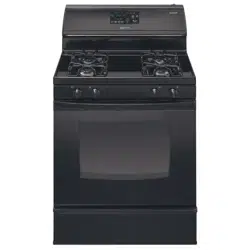
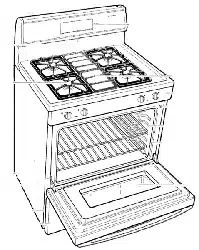
,Super Capacity 466
4.65 Cubic Foot Oven
MODEL SF377PEG
8273152
Appliances
UseECare
A Note to You ............ 2
Range Safety ............. 3
Parts and Features ....5
Using Your Range ...... 6
Using the Self-
Cleaning Cycle ......... 24
Caring for Your
Range ....................... 27
Troubleshooting ....... 32
Requesting
Assistance or
Service ..................... 34
Index ........................ 35
Warranty ................... 36
Call our Consumer Assistance Center
with questions or comments.
www.whirlpool.com
ANOTETOYOU
_'_ _ _;:_::__v_ _ W_,_ _i_._00_ _ _:_:;_
The Whirlpool Brand is committed to designing quality products that consistently perform for you to make your
life easier. To ensure that you enjoy years of trouble-free operation, we developed this Use and Care Guide.
It is full of valuable information about how to operate and maintain your appliance properly. Please read it
carefully.
Also, please complete and mail the Product Registration Card provided with your appliance. The card helps us
notify you about any new information on your appliance.
Whenever you call to request service for your appliance,
you need to know your complete model number and
serial number. You can find this information on the
model and serial number label/plate (see diagram in
the "Parts and Features" section).
Please also record the purchase date of your appliance
and your dealer's name, address, and telephone number.
Model Number
Serial Number
Purchase Date
Dealer Name
Dealer Address
Dealer Phone
Keep this book and the sales slip together in a safe place for future reference. It is important
for you to save your sales receipt showing the date of purchase. Proof of purchase will as-
sure you of in-warranty service.
To find detailed product information, the location of the nearest Whirlpool dealer or designated servicer, to
purchase an accessory item, or register your appliance on-line, please visit our Web site at
www.whirlpool.com
I WARNING: if the information in this manual is not followed exactly, a fire or
I
explosion may result causing property damage, personal injury or death.
I
= Do not store or use gasoline or other flammable vapors and liquids in the vicinity
of this or any other appliance.
= WHAT TO DO IF YOU SMELL GAS
= Do not try to light any appliance.
• Do not touch any electrical switch.
= Do not use any phone in your building.
= immediately call your gas supplier from a neighbor's phone. Follow the gas
supplier's instructions.
= if you cannot reach your gas supplier, call the fire department.
= installation and service must be performed by a qualified installer, service agency
or the gas supplier.
Your safety and the safety of others is very important.
We have provided many important safety messages in this manual and on your appliance. Always read and
obey all safety messages.
This is the safety alert symbol.
This symbol alerts you to hazards that can kill or hurt you and others.
All safety messages will be preceded by the safety alert symbol and the word "DANGER" or
"WARNING." These words mean:
You will be killed or seriously injured if you don't
follow instructions.
You can be killed or seriously injured if you don't
follow instructions.
All safety messages will identify the hazard, tell you how to reduce the chance of injury, and tell you what can
happen if the instructions are not followed.
iii!iii?il,,iiiii!liii i iiii:iiiiiiii!iiiiii!i!i!!i
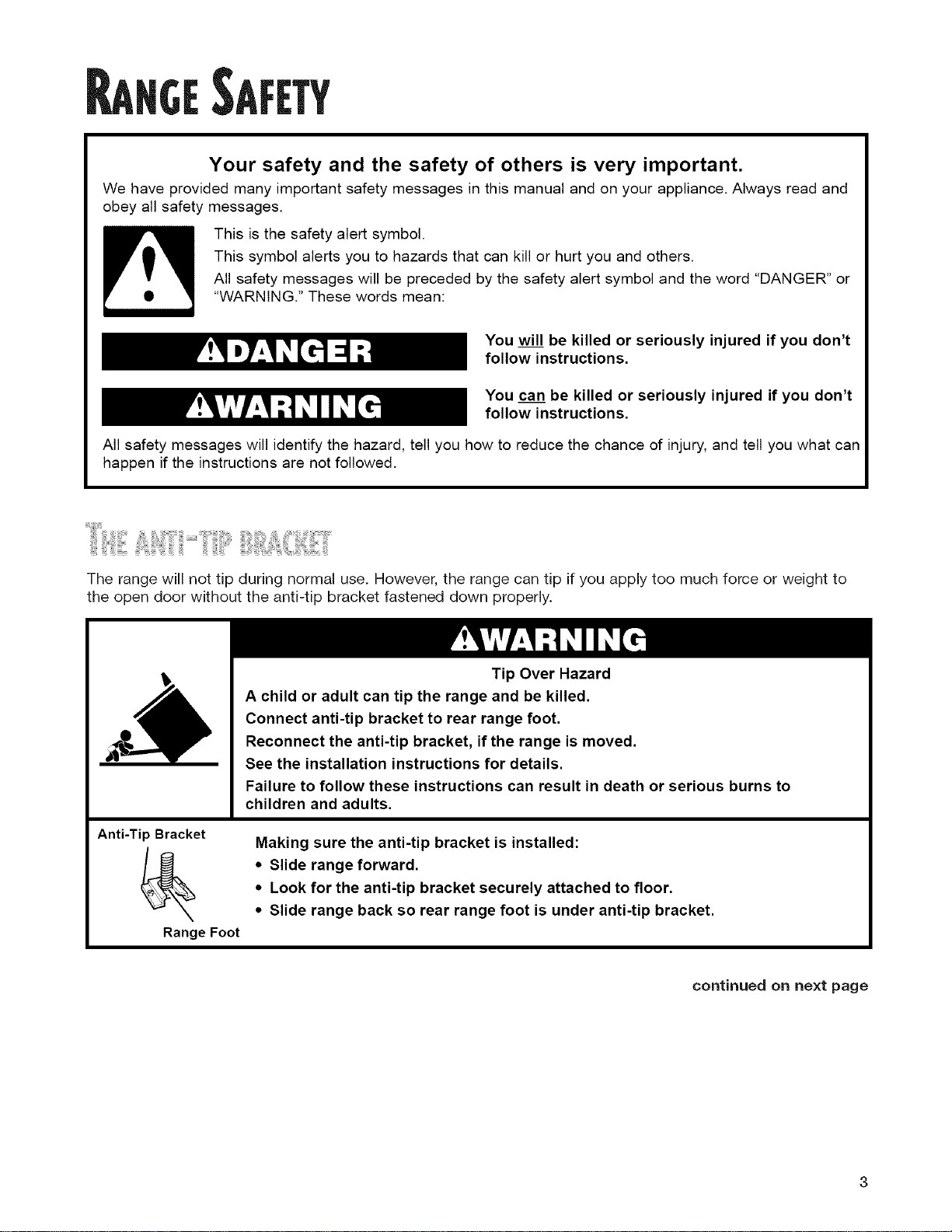
The range will not tip during normal use. However, the range can tip if you apply too much force or weight to
the open door without the anti-tip bracket fastened down properly.
Anti-Tip Bracket
Range Foot
Tip Over Hazard
A child or adult can tip the range and be killed.
Connect anti-tip bracket to rear range foot.
Reconnect the anti-tip bracket, if the range is moved.
See the installation instructions for details.
Failure to follow these instructions can result in death or serious burns to
children and adults.
Making sure the anti-tip bracket is installed:
• Slide range forward.
• Look for the anti-tip bracket securely attached to floor.
• Slide range back so rear range foot is under anti-tip bracket.
continued on next page
iiiiiiii!iiii! !!iiiiiii i !!!!ii!!iill¸i!!iiiiii!!iiiiiiiii!il
IMPORTANT SAFETY INSTRUCTIONS
WARNING: To reduce the risk of fire, electrical
shock, injury to persons, or damage when using the
range, follow basic precautions, including the
following:
• WARNING - TO REDUCETHERISKOF
TIPPING OF THE RANGE, THE RANGE MUST
BE SECURED BY PROPERLY INSTALLED
ANTI-TIP DEVICES. TO CHECK IF THE
DEVICES ARE INSTALLED PROPERLY, SLIDE
RANGE FORWARD, LOOK FOR ANTI-TIP
BRACKET SECURELY ATTACHED TO FLOOR,
AND SLIDE RANGE BACK SO REAR RANGE
FOOT IS UNDER ANTI-TIP BRACKET.
• CAUTION - Do not store items of interest to
children in cabinets above a range or on the
backguard of a range - children climbing on the
range to reach items could be seriously injured.
• Proper Installation - The range, when installed,
must be electrically grounded in accordance with
local codes or, in the absence of local codes, with
the National Electrical Code, ANSI/NFPA 70. Be
sure the range is properly installed and grounded
by a qualified technician.
• This range is equipped with a three-prong
grounding plug for your protection against shock
hazard and should be plugged directly into a
properly grounded receptacle. Do not cut or
remove the grounding prong from this plug.
• Disconnect the electrical supply before servicing
the appliance.
• Never Use the Range for Warming or Heating the
Room.
• Injuries may result from the misuse of appliance
doors or drawers such as stepping, leaning, or
sitting on the doors or drawers.
• Maintenance - Keep range area clear and free
from combustible materials, gasoline, and other
flammable vapors and liquids.
• Storage in or on the Range - Flammable materials
should not be stored in an oven or near surface
units.
• Top burner flame size should be adjusted so it
does not extend beyond the edge of the
cooking utensil.
For self-cleaning ranges -
• Before Self-Cleaning the Oven - Remove broiler
pan and other utensils. Wipe off all excessive
spillage before initiating the cleaning cycle.
SAVE THESE INSTRUCTIONS
The California Safe Drinking Water and Toxic Enforcement Act requires the Governor of California to
publish a list of substances known to the State of California to cause cancer, birth defects, or other
reproductive harm, and requires businesses to warn of potential exposure to such substances.
WARNING: This product contains a chemical known to the State of California to cause cancer, birth
defects, or other reproductive harm.
This appliance can cause low-level exposure to some of the substances listed, including benzene,
formaldehyde, carbon monoxide, toluene, and soot.
PARTSANDFEATURES
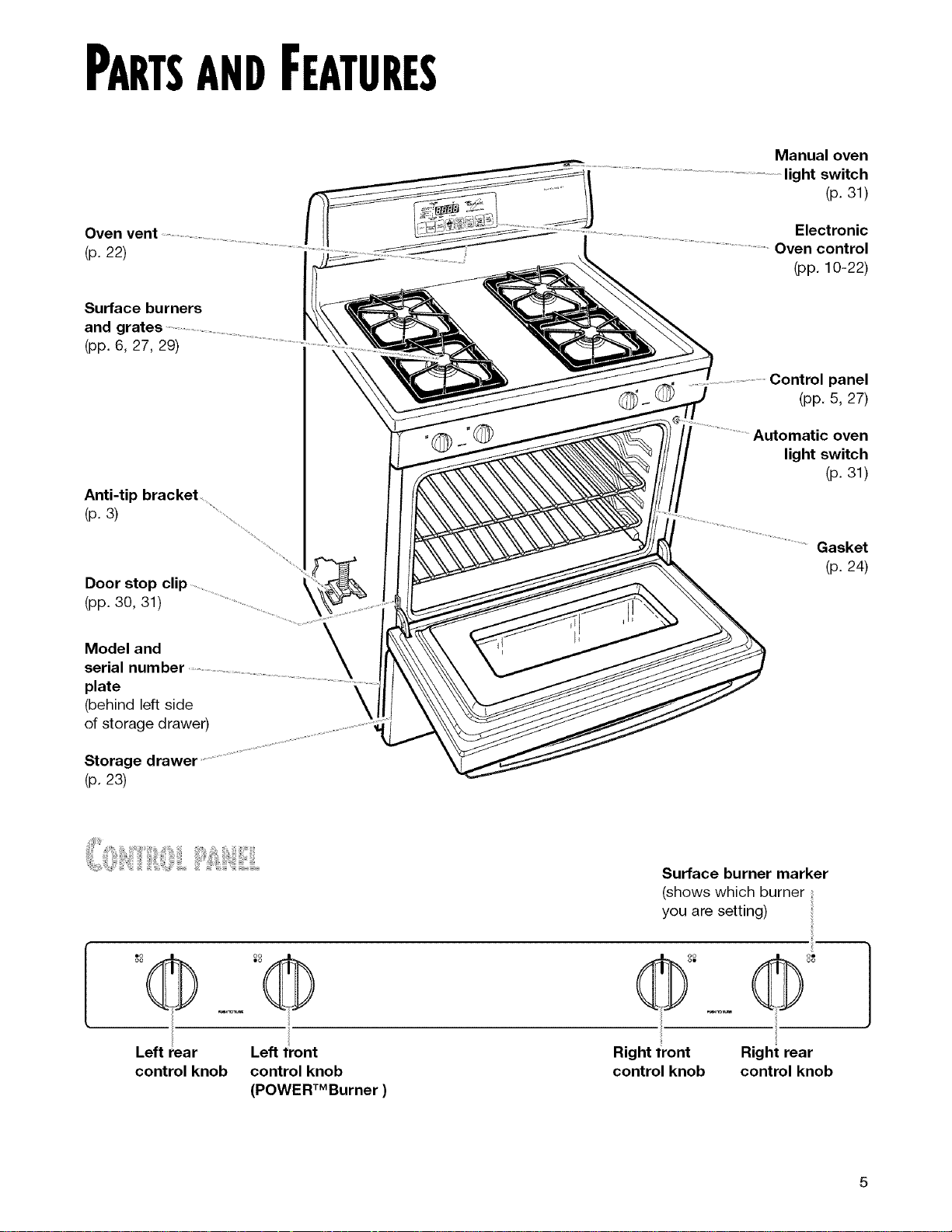
Oven vent
(p. 22)
Surface burners
and g
(pp. 6, 27, 29)
Anti-tip bracket .....
(p. 3) .......
Door stop clip ...........
(pp. 30, 31) ..............................................
Model and
serial
plate
(behind left side
of storage drawer)
Storage drawer
(p. 23)
Manual oven
light switch
(p. 31)
Electronic
Oven control
(pp. 10-22)
.................................Control panel
(pp. 5, 27)
Automatic oven
light switch
(p. 31)
Gasket
(p. 24)
Surface burner marker
(shows which burner
you are setting)
Left Pear
control knob
Left front
control knob
(POWEWiBurner)
oo oo
Right front Right rear
control knob control knob
USINGYOURRANGE
Fire Hazard
Do not let the burner flame extend beyond
the edge of the pan.
Turn off all controls when not cooking.
Failure to follow these instructions can
result in death or fire.
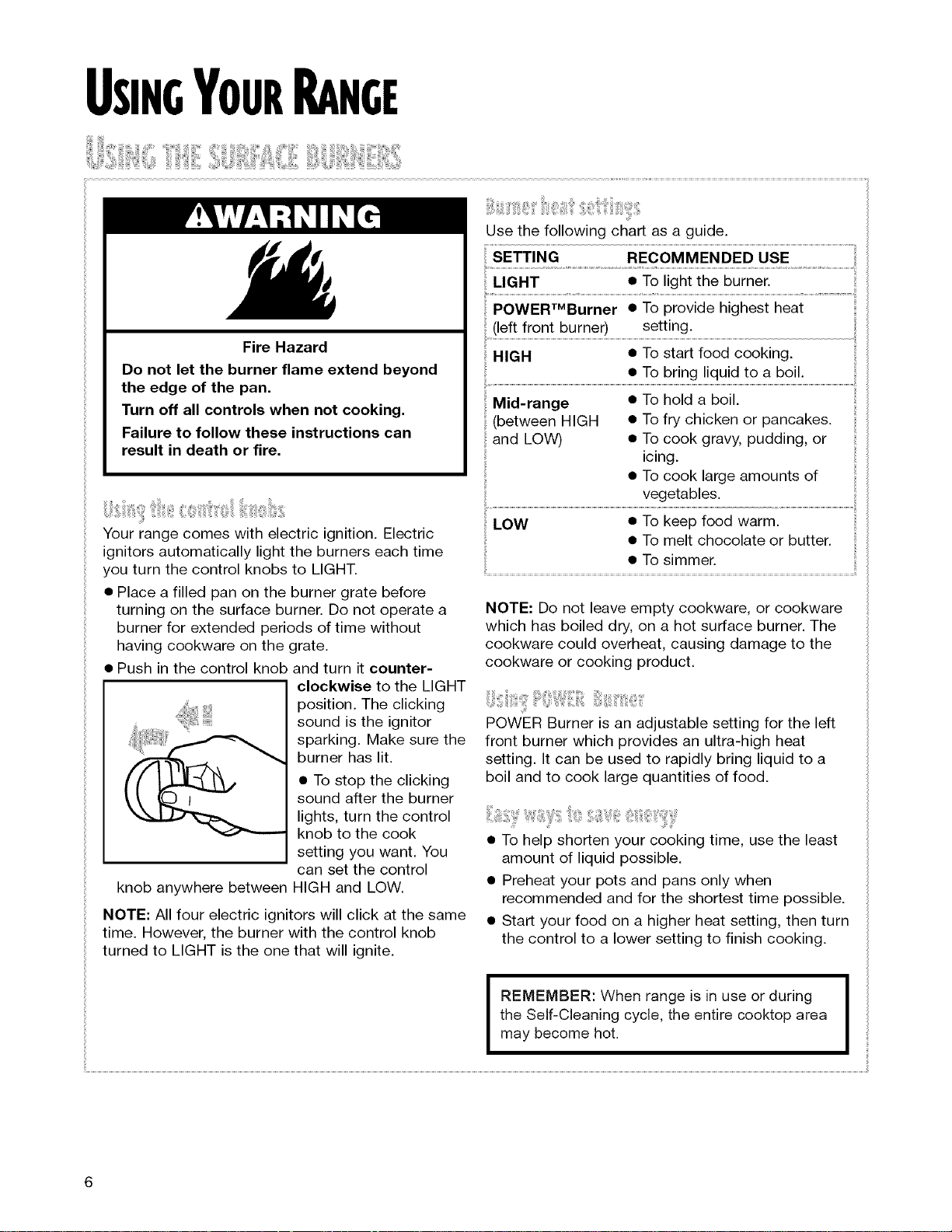
Your range comes with electric ignition. Electric
ignitors automatically light the burners each time
you turn the control knobs to LIGHT.
• Place a filled pan on the burner grate before
turning on the surface burner. Do not operate a
burner for extended periods of time without
having cookware on the grate.
• Push in the control knob and turn it counter-
clockwise to the LIGHT
position. The clicking
sound is the ignitor
sparking. Make sure the
burner has lit.
• To stop the clicking
sound after the burner
lights, turn the control
knob to the cook
setting you want. You
can set the control
knob anywhere between HIGH and LOW.
NOTE: All four electric ignitors will click at the same
time. However, the burner with the control knob
turned to LIGHT is the one that will ignite.
Use the following chart as a guide.
SETTING RECOMMENDED USE
HIGH • To start food cooking.
• To bring liquid to a boil.
Mid-;a nge....................................................................................................................................................................................................
(between HIGH • To fry chicken or pancakes.
LOW) • To cook gravy, pudding, or
icing.
• To cook large amounts of
vegetables.
LOW • To keep food warm.
• To melt chocolate or butter.
• To simmer.
NOTE: Do not leave empty cookware, or cookware
which has boiled dry, on a hot surface burner. The
cookware could overheat, causing damage to the
cookware or cooking product.
POWER Burner is an adjustable setting for the left
front burner which provides an ultra-high heat
setting. It can be used to rapidly bring liquid to a
boil and to cook large quantities of food.
• To help shorten your cooking time, use the least
amount of liquid possible.
• Preheat your pots and pans only when
recommended and for the shortest time possible.
• Start your food on a higher heat setting, then turn
the control to a lower setting to finish cooking.
REMEMBER: When range is in use or during
the Self-Cleaning cycle, the entire cooktop area
may become hot.
.... :i!iii!iiilil!i]i:E,ii!i {]!!!iiii iiili iill
iil i ¸ l:i!i i:)i!i:)i i,!!iii!iii! iill'i !ii iiiiili'i%i!i
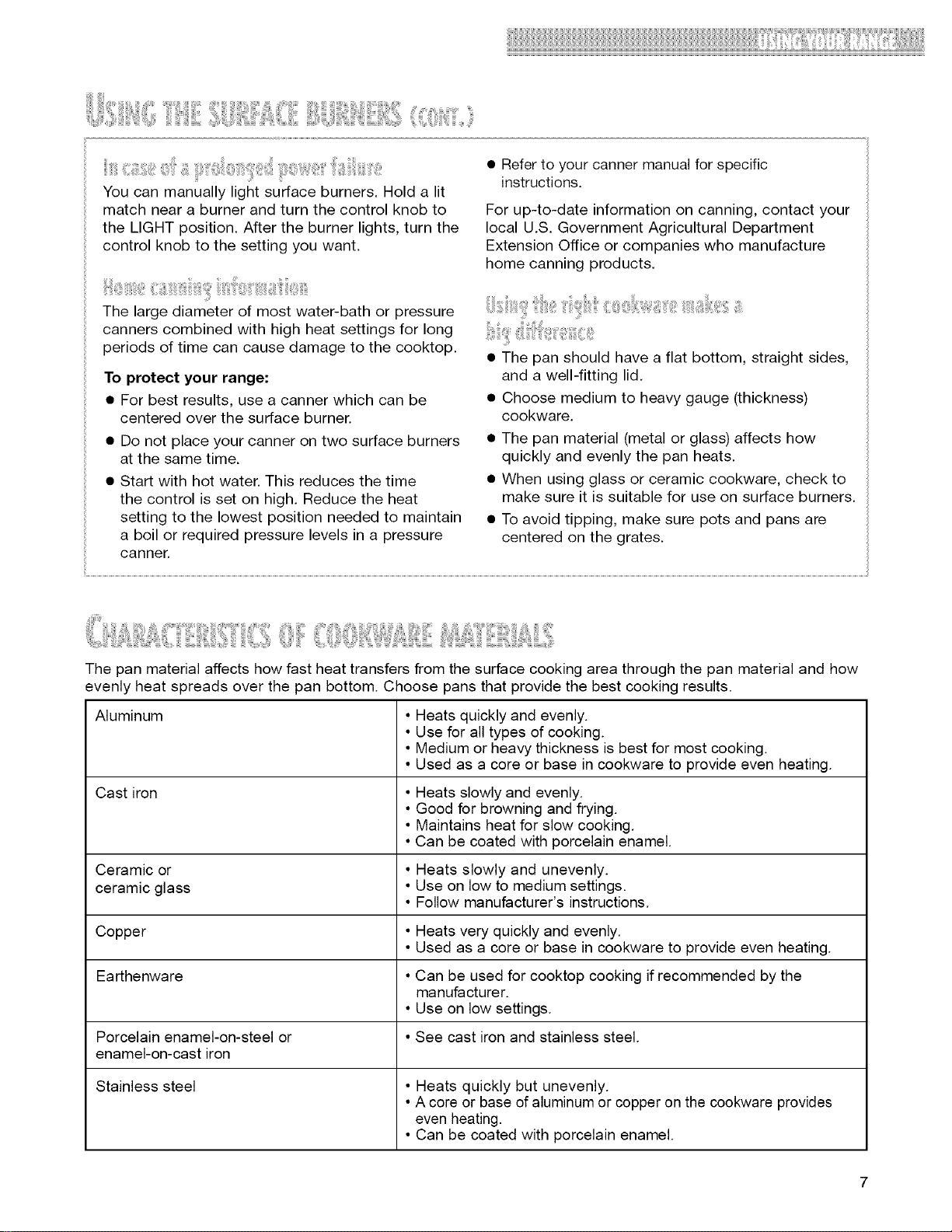
You can manually light surface burners. Hold a lit
match near a burner and turn the control knob to
the LIGHT position. Affer the burner lights, turn the
control knob to the setting you want.
ilil(ii_ilii_¸(ii:_ii!iLl'tiiiiiiiiii,_!!iliiiii'l_i:,ziil,_lil_i_iiiii_l)lii_
The large diameter of most water-bath or pressure
canners combined with high heat settings for long
periods of time can cause damage to the cooktop.
To protect your range:
• For best results, use a canner which can be
centered over the surface burner.
• Do not place your canner on two surface burners
at the same time.
• Start with hot water. This reduces the time
the control is set on high. Reduce the heat
setting to the lowest position needed to maintain
a boil or required pressure levels in a pressure
canner.
• Refer to your canner manual for specific
instructions.
For up-to-date information on canning, contact your
local U.S. Government Agricultural Department
Extension Office or companies who manufacture
home canning products.
• The pan should have a flat bottom, straight sides,
and a well-fitting lid.
• Choose medium to heavy gauge (thickness)
cookware.
• The pan material (metal or glass) affects how
quickly and evenly the pan heats.
• When using glass or ceramic cookware, check to
make sure it is suitable for use on surface burners.
• To avoid tipping, make sure pots and pans are
centered on the grates.
The pan material affects how fast heat transfers from the surface cooking area through the pan material and how
evenly heat spreads over the pan bottom. Choose pans that provide the best cooking results.
Aluminum • Heats quickly and evenly.
• Use for all types of cooking.
• Medium or heaw thickness is best for most cooking.
• Used as a core or base in cookware to provide even heating.
Cast iron • Heats slowly and evenly.
• Good for browning and frying.
• Maintains heat for slow cooking.
• Can be coated with porcelain enamel.
Ceramic or • Heats slowly and unevenly.
ceramic glass • Use on low to medium settings.
• Follow manufacturer's instructions.
Copper • Heats very quickly and evenly.
• Used as a core or base in cookware to provide even heating.
Earthenware • Can be used for cooktop cooking if recommended by the
manufacturer.
• Use on low settings.
Porcelain enamel-on-steel or • See cast iron and stainless steel.
enamel-on-cast iron
Stainless steel • Heats quickly but unevenly.
• A core or base of aluminum or copper on the cookware provides
even heating.
• Can be coated with porcelain enamel.
7
'¸'i' 'iii ii''iiij!! ii!ii!lliiiiiiii!!!i !
iilii 'iiiJi,,,i!ilililiiii!!!i,ii,ili ; iii,ii 'iiii:i:! ,!
ii:_,_',_i:ii_!;iiifii,_i:ili_ii_liiii_iiiiii?!iill¸¸_"i;i_il;:ii,iiii!;_;i_ii_i:i/iiii:il_i_t_lii!;:_
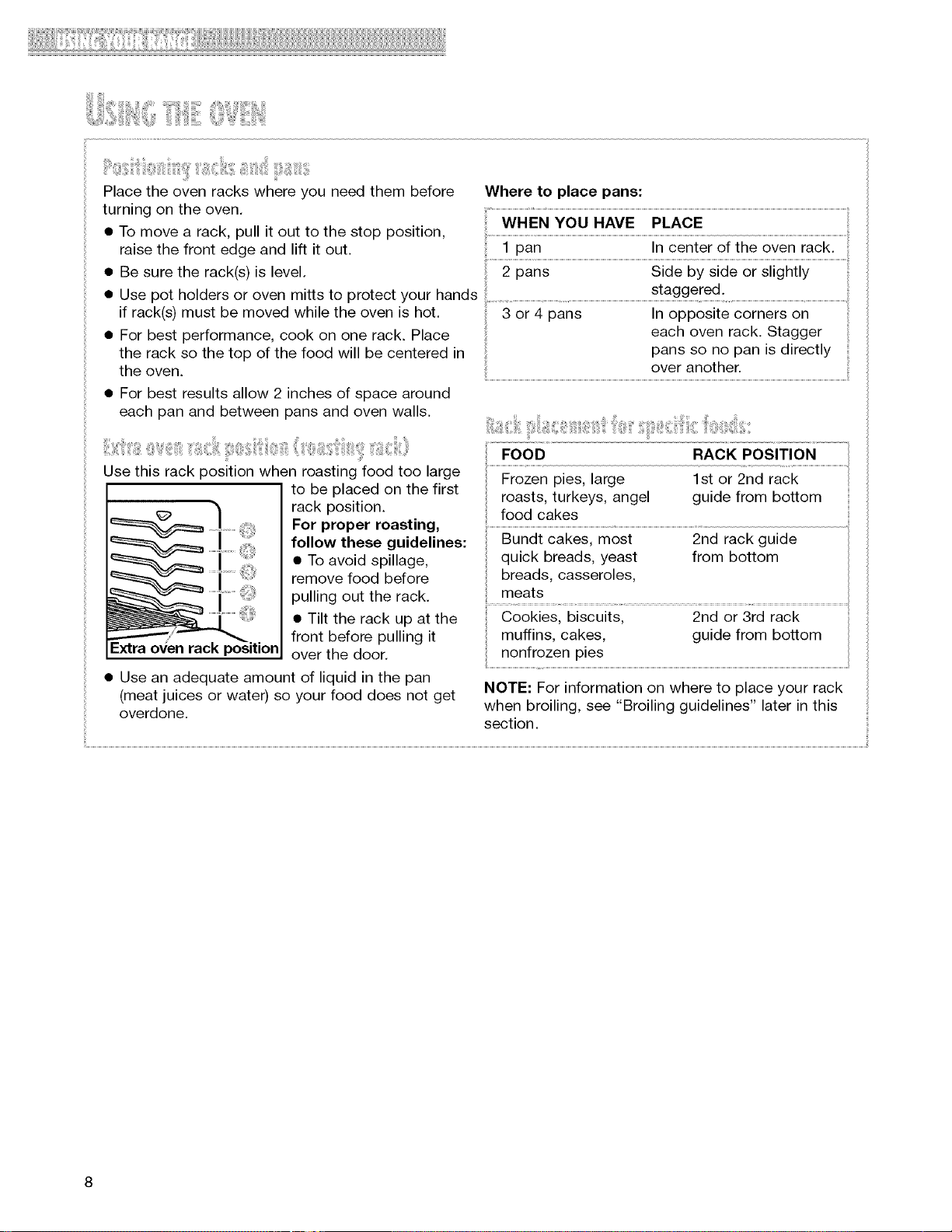
Place the oven racks where you need them before
turning on the oven.
• To move a rack, pull it out to the stop position,
raise the front edge and lift it out.
• Be sure the rack(s) is level.
• Use pot holders or oven mitts to protect your hands
if rack(s) must be moved while the oven is hot.
• For best performance, cook on one rack. Place
the rack so the top of the food will be centered in
the oven.
• For best results allow 2 inches of space around
each pan and between pans and oven walls.
i!i:i_!ili_ii:li_i';_f__;_,_i,i_',_i!i!_ii'_ii_":_!ii_;;!!i;iii::ii_:ii_!il;ii_iiiiiii_i;_,iii_iii_i_'_i:i_!i;_iiiii_iill,_!!!I_ii_ii_ii_:ii,_iil/¸,
Use this rack position when roasting food too large
to be placed on the first
rack position.
For proper roasting,
follow these guidelines:
• To avoid spillage,
remove food before
pulling out the rack.
• Tilt the rack up at the
front before pulling it
over the door.
• Use an adequate amount of liquid in the pan
(meat juices or water) so your food does not get
overdone.
Where to place pans:
WHEN YOU HAVE PLACE
2 pans Side by side or slightly
........................................................................................................................................................................staggered:....................................................................................................................................
3 or 4 pans In opposite corners on
each oven rack. Stagger
pans so no pan is directly
over another.
FOOD RACK POSITION
Frozen pies, large 1st or 2nd rack
roasts, turkeys, angel guide from bottom
food cakes
Bundt cakes, most 2nd rack guide
quick breads, yeast from bottom
breads, casseroles,
meats
Cookies, biscuits, 2nd or 3rd rack
muffins, cakes, guide from bottom
nonfrozen pies
NOTE: For information on where to place your rack
when broiling, see "Broiling guidelines" later in this
section.
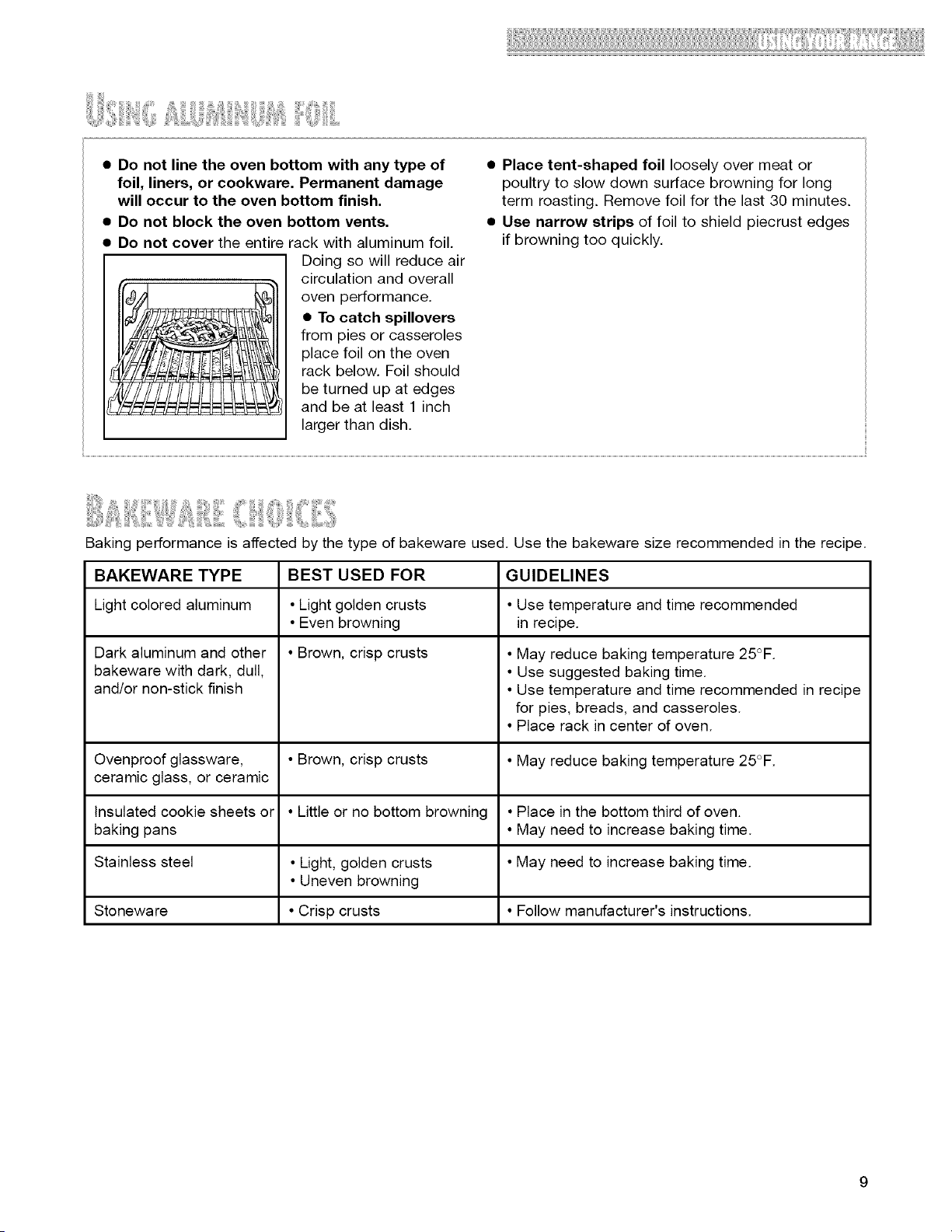
• Do not line the oven bottom with any type of
foil, liners, or cookware. Permanent damage
will occur to the oven bottom finish.
• Do not block the oven bottom vents.
• Do not cover the entire rack with aluminum foil.
Doing so will reduce air
..... circulation and overall
oven performance.
f3t fRF_]:_F_F_FTF_F_F_F_F_F_F_Fq_hll II
• To catch spillovers
from pies or casseroles
place foil on the oven
rack below. Foil should
................................ be turned up at edges
=_=_=_=_===_========v,,_and be at least 1 inch
larger than dish.
• Place tent-shaped foil loosely over meat or
poultry to slow down surface browning for long
term roasting. Remove foil for the last 30 minutes.
• Use narrow strips of foil to shield piecrust edges
if browning too quickly.
Baking performance is affected by the type of bakeware used. Use the bakeware size recommended in the recipe.
BAKEWARE TYPE BEST USED FOR GUIDELINES
Light colored aluminum • Light golden crusts • Use temperature and time recommended
• Even browning in recipe.
• Brown, crisp crusts
Dark aluminum and other
bakeware with dark, dull,
and/or non-stick finish
• May reduce baking temperature 25°F.
• Use suggested baking time.
• Use temperature and time recommended in recipe
for pies, breads, and casseroles.
• Place rack in center of oven.
Ovenproof glassware, • Brown, crisp crusts • May reduce baking temperature 25°F.
ceramic glass, or ceramic
Insulated cookie sheets or • Little or no bottom browning • Place in the bottom third of oven.
baking pans • May need to increase baking time.
Stainless steel • Light, golden crusts • May need to increase baking time.
• Uneven browning
Stoneware • Crisp crusts • Follow manufacturer's instructions.
¸ ¸ ¸ ¸! ii iii! I IIIIIIIIIIIII i i !iiiiiii ii iiiiii ii iiiiii i! iiiiii ii iiiiii i! iiiiii ii iiiiii i! iiiiii ii iiiiii i! iiiiii ii iiiiii i! iiiiii ii iiii
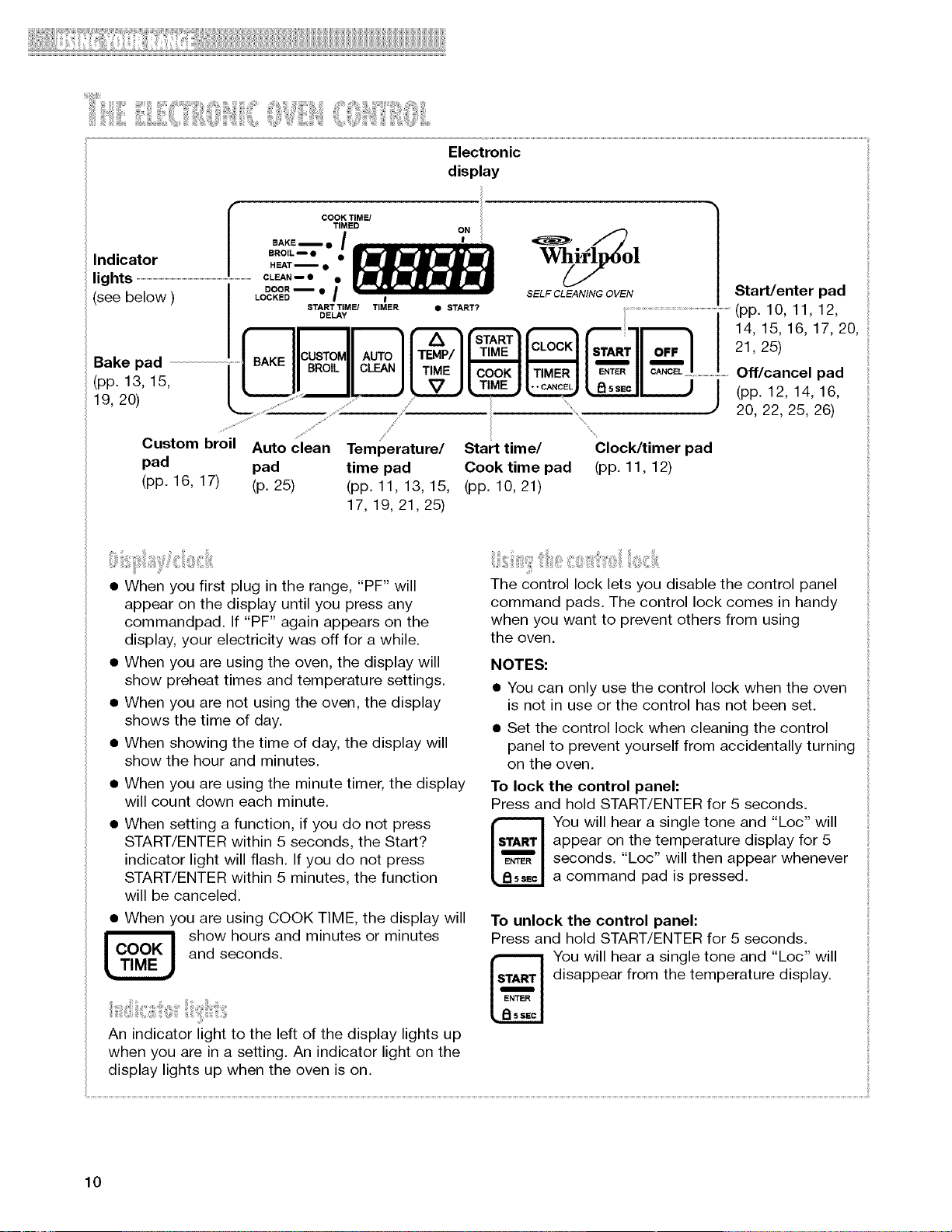
Electronic
display
I COOK TIME/ 1
TIMED ON
B,KEm. I __ --' _ //_
• BROIL_ • " =_
Ind,cator [ .0,T--. " Ini £ Whlfl[_ol /
lights ......................................................................................................L...............cL_,-.. _i _ _yJ= l
(see below) I LOCKED I , SELFCL_N,NGOWN 1 Start/enter pad
I STARTTIMEITIMER . START? .................................................................................................................(pp. 10, 11, 12,
oe_,,' I 14, 15, 16, 17, 20,
Bakepad i B,,E BRO,LCLEAN O,)O, T,MER ....................................
!pp. Id, / b, I !, I! II J_ LTMEJL--c,.c_4Le,,,_II J ] Off/cancel pad
iv, zu) ............ 7 .) (pp. 12, 14, 16,
_-- _ ...... 20, 22, 25, 26)
Custom broil Auto clean Temperature/ Start time/ Clock/timer pad
pad pad time pad Cook time pad (pp. 11, 12)
(pp. 16, 17) (p. 25) (pp. 11, 13, 15, (pp. 10, 21)
17, 19, 21,25)
• When you first plug in the range, "PF" will
appear on the display until you press any
commandpad. If "PF" again appears on the
display, your electricity was off for a while.
• When you are using the oven, the display will
show preheat times and temperature settings.
• When you are not using the oven, the display
shows the time of day.
• When showing the time of day, the display will
show the hour and minutes.
• When you are using the minute timer, the display
will count down each minute.
• When setting a function, if you do not press
START/ENTER within 5 seconds, the Start?
indicator light will flash. If you do not press
START/ENTER within 5 minutes, the function
will be canceled.
When you are using COOK TIME, the display will
show hours and minutes or minutes
and seconds.
An indicator light to the left of the display lights up
when you are in a setting. An indicator light on the
display lights up when the oven is on.
The control lock lets you disable the control panel
command pads. The control lock comes in handy
when you want to prevent others from using
the oven.
NOTES:
• You can only use the control lock when the oven
is not in use or the control has not been set.
• Set the control lock when cleaning the control
panel to prevent yourself from accidentally turning
on the oven.
To lock the control panel:
Press and hold START/ENTER for 5 seconds.
You will hear a single tone and "Loc" will
appear on the temperature display for 5
seconds. "Loc" will then appear whenever
a command pad is pressed.
To unlock the control panel:
Press and hold START/ENTER for 5 seconds.
You will hear a single tone and "Loc" will
disappear from the temperature display.
10
_i¸iiii',!iiGiii!iiiiiii!i!i_il;i!_iiiiiii_iiil;i!,,_i!il
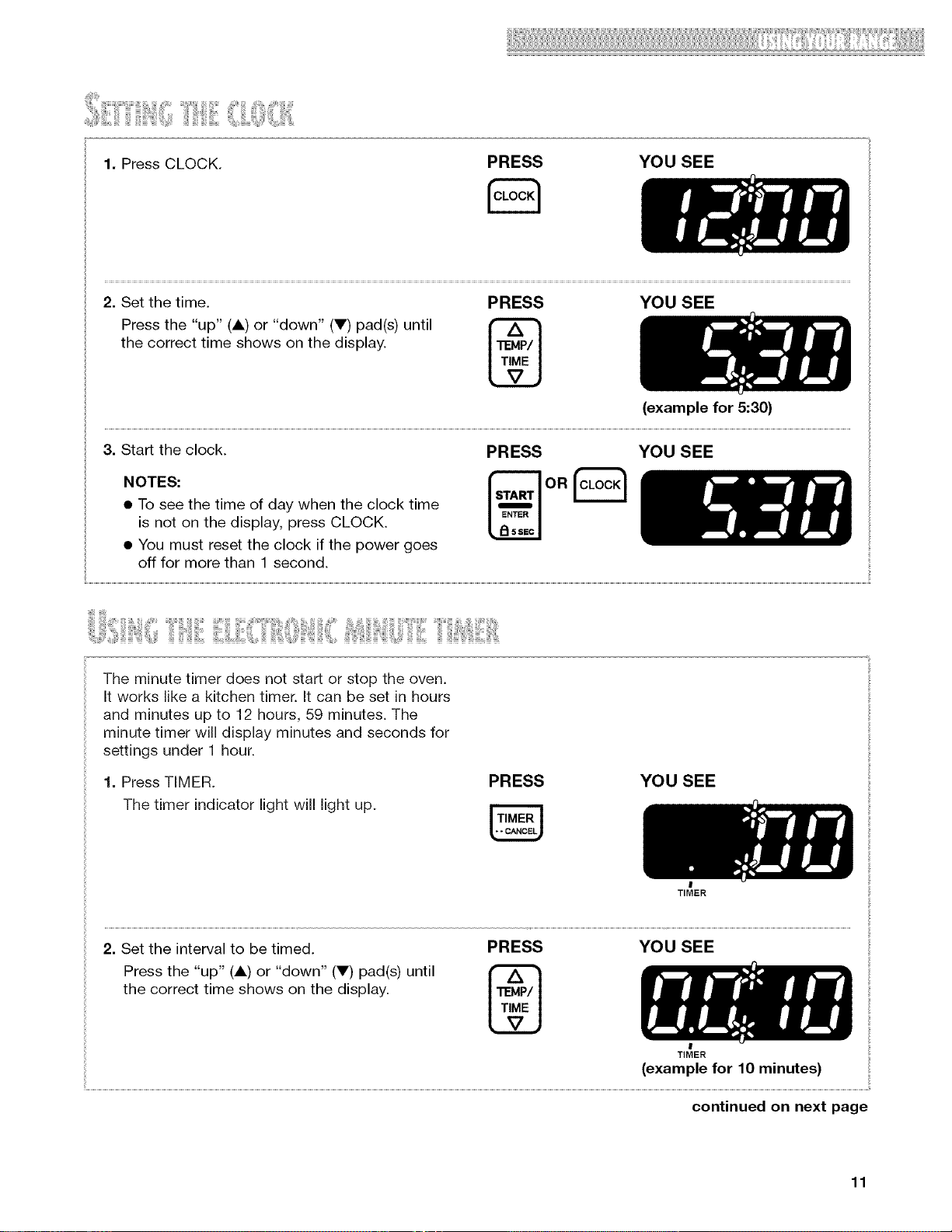
1. Press CLOCK.
PRESS YOU SEE
2. Set the time.
Press the "up" (4,) or "down" (V) pad(s) until
the correct time shows on the display.
PRESS YOU SEE
(example for 5:30)
3. Start the clock.
NOTES:
• To see the time of day when the clock time
is not on the display, press CLOCK.
• You must reset the clock if the power goes
off for more than 1 second.
PRESS YOU SEE
.......!,,_ii_i,,iili_!!iiiii!i!!!_i_i!_iii!!!_ii!i_:_i_iii;_;i_i_iiii_!_!!iii_i_Ui_iiii!i!',_iiiiiS'iiii_ii!!!iiii" !!ii!_,iii:
The minute timer does not start or stop the oven.
It works like a kitchen timer. It can be set in hours
and minutes up to 12 hours, 59 minutes. The
minute timer will display minutes and seconds for
settings under 1 hour.
1. Press TIMER.
The timer indicator light will light up.
PRESS YOU SEE
2. Set the interval to be timed.
Press the "up" (4,) or "down" (V) pad(s) until
the correct time shows on the display.
I
TIMER
PRESS YOU SEE
I
TIMER
(example for 10 minutes)
continued on next page
11
i!iiiii!iiii!i!ii!iii ?ii !i;ii!iiiiii iiiiiii'i!i:iiiiiii'ili'! ii ! i1 iii i ii II II II II II II II II II II II II II II II II II II II II II II II iiiii
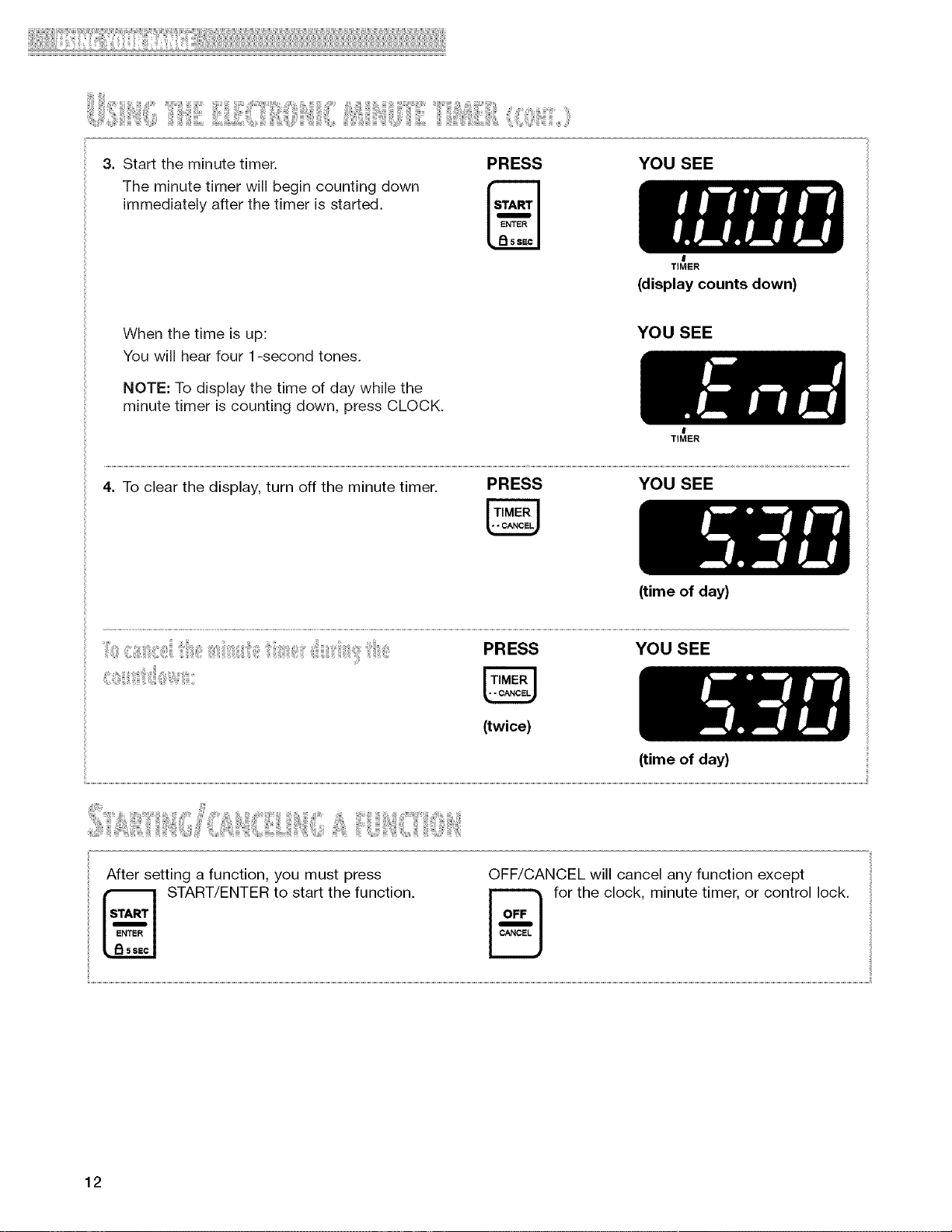
3. Start the minute timer.
The minute timer will begin counting down
immediately after the timer is started.
PRESS YOU SEE
!
TIMER
(display counts down)
When the time is up:
You will hear four 1-second tones.
NOTE: To display the time of day while the
minute timer is counting down, press CLOCK.
YOU SEE
I
TIMER
4. To clear the display, turn off the minute timer. PRESS YOU SEE
(time of day)
PRESS YOU SEE
(twice)
(time of day)
After setting a function, you must press
START/ENTER to start the function.
OFF/CANCEL will cancel any function except
for the clock, minute timer, or control lock.
12
i!iiiiiii
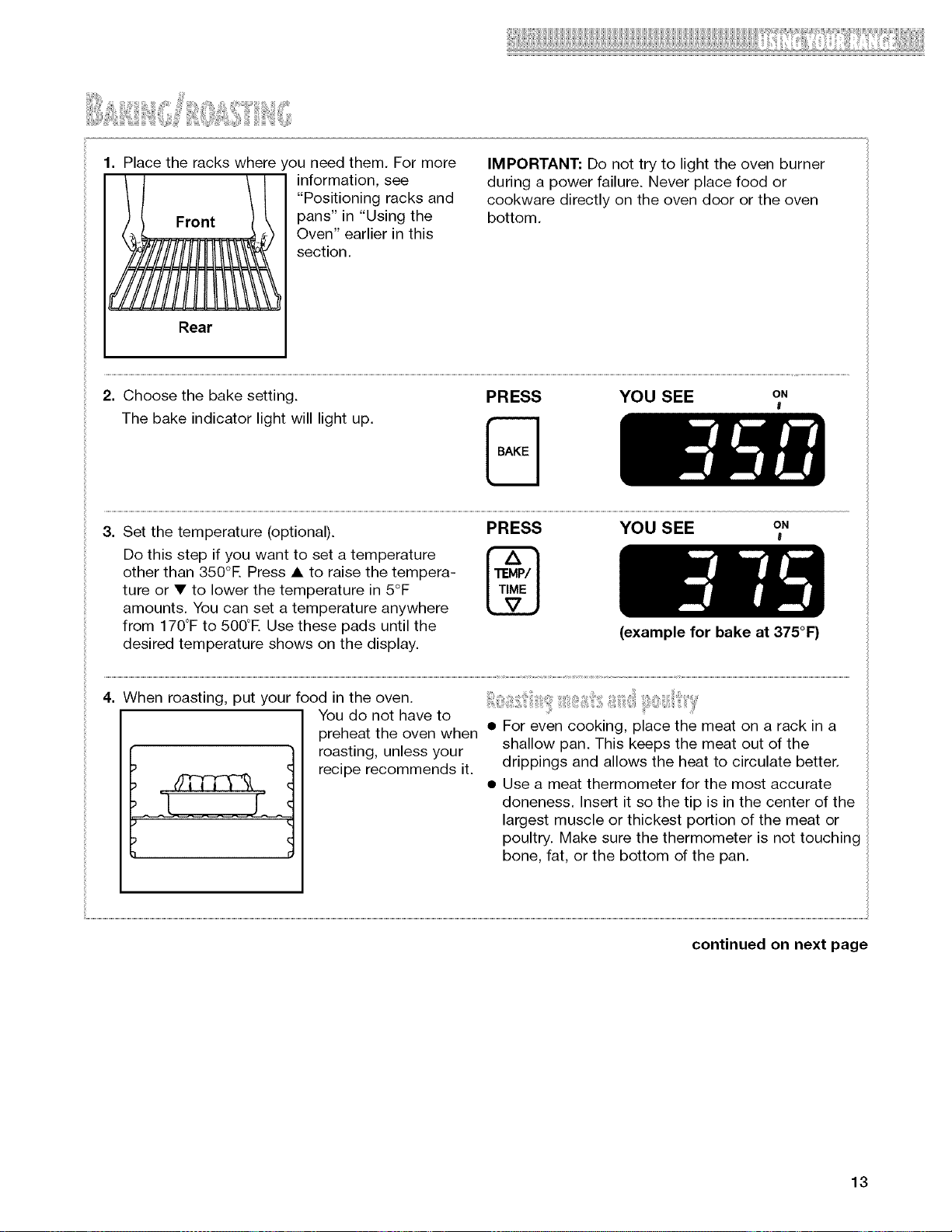
1. Place the racks where you need them. For more
information, see
"Positioning racks and
Front pans" in "Using the
Oven" earlier in this
section.
Rear
IMPORTANT: Do not try to light the oven burner
during a power failure. Never place food or
cookware directly on the oven door or the oven
bottom.
2. Choose the bake setting.
The bake indicator light will light up.
PRESS YOU SEE oN
I
3. Set the temperature (optional).
Do this step if you want to set a temperature
other than 350°E Press • to raise the tempera-
ture or • to lower the temperature in 5°F
amounts. You can set a temperature anywhere
from 170°F to 500°E Use these pads until the
desired temperature shows on the display.
PRESS YOU SEE oN
J
(example for bake at 375°F)
4. When roasting, put your food in the oven.
t J
:r
You do not have to
preheat the oven when •
roasting, unless your
recipe recommends it.
For even cooking, place the meat on a rack in a
shallow pan. This keeps the meat out of the
drippings and allows the heat to circulate better.
Use a meat thermometer for the most accurate
doneness. Insert it so the tip is in the center of the
largest muscle or thickest portion of the meat or
poultry. Make sure the thermometer is not touching
bone, fat, or the bottom of the pan.
continued on next page
13
_!iiiii!iiii!i!ii!iii_il;i_!ili_!i;;i!iiiiii_iiiii_ii!i_iii_i_iiii!iii!!'_'ii_i'¸_i_ii!Ii!iii!iiii!iiiii!iiiiiiiiiiiiiiijiiiiiil!iiliiil!_i _iii!i! ! !
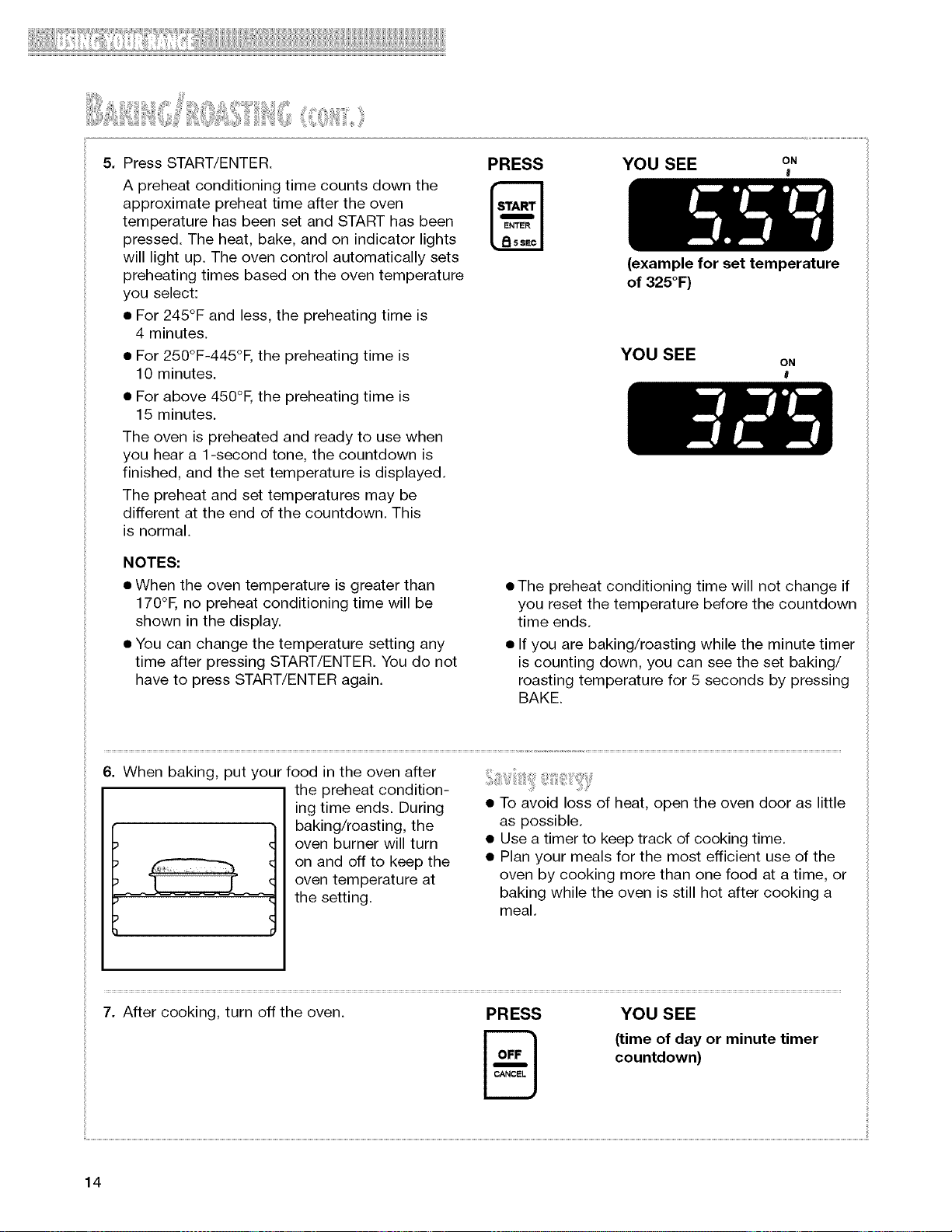
5. Press START/ENTER.
A preheat conditioning time counts down the
approximate preheat time after the oven
temperature has been set and START has been
pressed. The heat, bake, and on indicator lights
will light up. The oven control automatically sets
preheating times based on the oven temperature
you select:
• For 245°F and less, the preheating time is
4 minutes.
• For 250°F-445°F, the preheating time is
10 minutes.
• For above 450°F, the preheating time is
15 minutes.
The oven is preheated and ready to use when
you hear a 1-second tone, the countdown is
finished, and the set temperature is displayed.
The preheat and set temperatures may be
different at the end of the countdown. This
is normal.
NOTES:
• When the oven temperature is greater than
170°F, no preheat conditioning time will be
shown in the display.
• You can change the temperature setting any
time after pressing START/ENTER. You do not
have to press START/ENTER again.
PRESS YOU SEE ON
I
(example for set temperature
of 325°F)
YOU SEE
ON
J
• The preheat conditioning time will not change if
you reset the temperature before the countdown
time ends.
• If you are baking/roasting while the minute timer
is counting down, you can see the set baking/
roasting temperature for 5 seconds by pressing
BAKE.
6. When baking, put your food in the oven after
the preheat condition-
ing time ends. During
baking/roasting, the
oven burner will turn
on and off to keep the
.... j" oven temperature at
the setting.
• To avoid loss of heat, open the oven door as little
as possible.
• Use a timer to keep track of cooking time.
• Plan your meals for the most efficient use of the
oven by cooking more than one food at a time, or
baking while the oven is still hot after cooking a
meal.
7. After cooking, turn off the oven. PRESS YOU SEE
(time of day or minute timer
countdown)
14
!! i!iiii!iliii !!i ii!iiiii!iiiiilli!! i!ii
l,,iii:il "il"iiI'iiiiiiiii!i!i!i' iiiii::ii'ii' i, i 'iil" iiiiii!i, iii !! , ii !iii'ii,,iiiiiiiiiiiiiiii!i!!!i,iiiiiiiii!ii iii ,!"!ii;ii !ili,i :iiii i!ii......
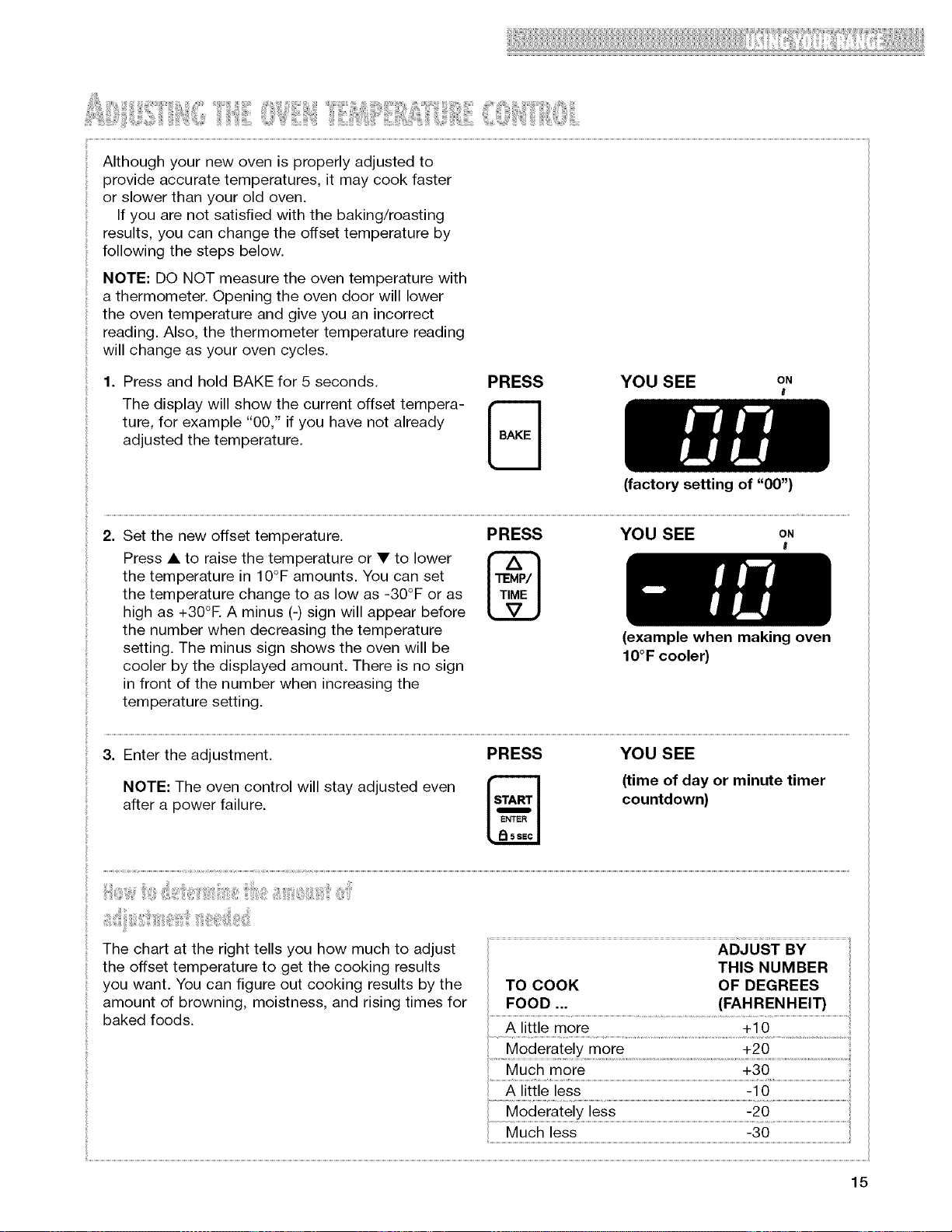
Although your new oven is properly adjusted to
provide accurate temperatures, it may cook faster
or slower than your old oven.
If you are not satisfied with the baking/roasting
results, you can change the offset temperature by
following the steps below.
NOTE: DO NOT measure the oven temperature with
a thermometer. Opening the oven door will lower
the oven temperature and give you an incorrect
reading. Also, the thermometer temperature reading
will change as your oven cycles.
1. Press and hold BAKE for 5 seconds. PRESS
The display will show the current offset tempera- 1'----1
ture, for example "00," if you have not already
U
adjusted the temperature.
YOU SEE oN
(factory setting of "00")
2. Set the new offset temperature. PRESS
Press • to raise the temperature or • to lower
the temperature in 10°F amounts. You can set
®
the temperature change to as low as -30°F or as
high as +30°E A minus (-) sign will appear before
the number when decreasing the temperature
setting. The minus sign shows the oven will be
cooler by the displayed amount. There is no sign
in front of the number when increasing the
temperature setting.
YOU SEE ON
8
(example when making oven
10°F cooler)
NOTE: The oven control will stay adjusted even
after a power failure.
3. Enter the adjustment. PRESS YOU SEE
(time of day or minute timer
countdown)
The chart at the right tells you how much to adjust
the offset temperature to get the cooking results
you want. You can figure out cooking results by the
amount of browning, moistness, and rising times for
baked foods.
ADJUST BY
THIS NUMBER
TO COOK OF DEGREES
FOOD ... (FAHRENHEIT)
A little more +10
......................................................................................................................_20................................................................................
Much more +30
Moderate!y !ess.......................................................................................................................................................................................................................................
Much less -30
15
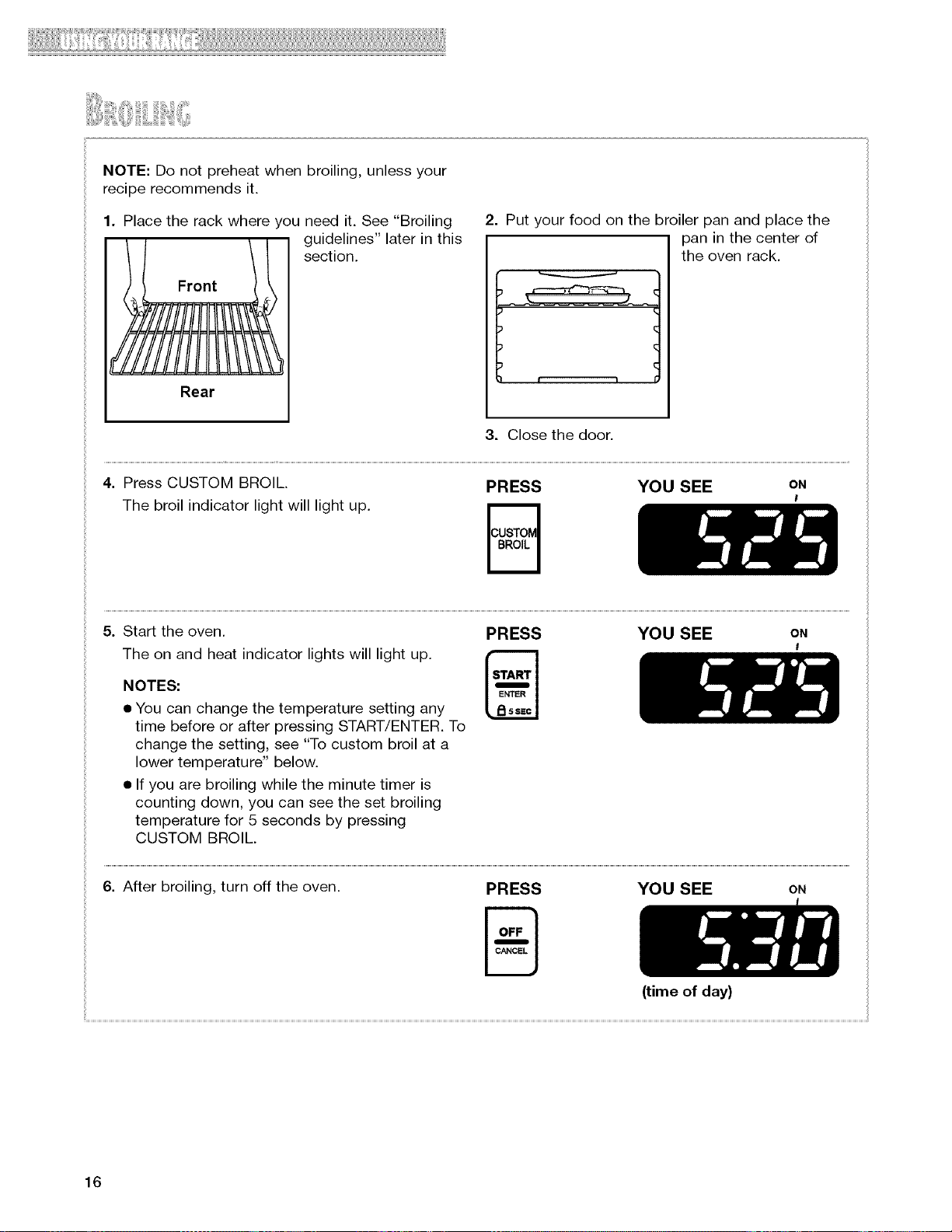
NOTE:Donotpreheatwhenbroiling,unlessyour
reciperecommendsit.
1. Placetherackwhereyouneedit.See"Broiling
guidelines"laterinthis
section.
Front
Rear
2. Put your food on the broiler pan and place the
pan in the center of
the oven rack.
I I
3. Close the door.
4. Press CUSTOM BROIL.
The broil indicator light will light up.
PRESS
B
YOU SEE ON
I
5. Start the oven. PRESS YOU SEE ON
The on and heat indicator lights will light up.
NOTES:
• You can change the temperature setting any
time before or after pressing START/ENTER. To
change the setting, see "To custom broil at a
lower temperature" below.
• If you are broiling while the minute timer is
counting down, you can see the set broiling
temperature for 5 seconds by pressing
CUSTOM BROIL.
6. After broiling, turn off the oven. PRESS YOU SEE ON
B
(time of day)
16
_i_0_i_:_iii_:!!!ii:ii:,i:ii_;liiili!i,_i_iiii_ii!l_!iiLil_iiliiiil,z_!_i_,:_ii_,i_ii!!_ii'_¸_!:_;_iiiii!i_ii_iiiii_i_;/_i_i_i!_::_
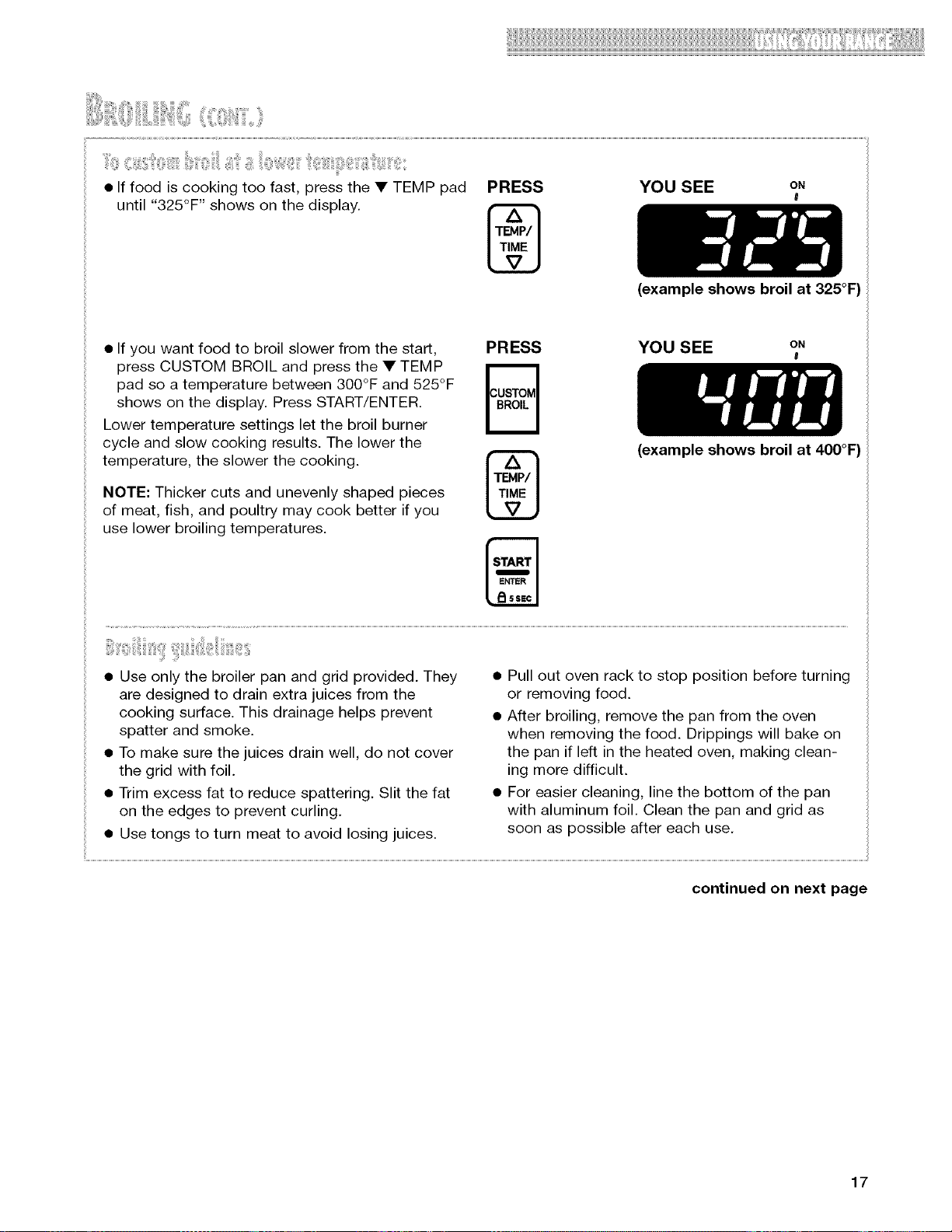
• If food is cooking too fast, press the • TEMP pad
until "325°F '' shows on the display.
PRESS YOU SEE oN
I
(example shows broil at 325°F)
• If you want food to broil slower from the start,
press CUSTOM BROIL and press the • TEMP
pad so a temperature between 300°F and 525°F
shows on the display. Press START/ENTER.
Lower temperature settings let the broil burner
cycle and slow cooking results. The lower the
temperature, the slower the cooking.
NOTE: Thicker cuts and unevenly shaped pieces
of meat, fish, and poultry may cook better if you
use lower broiling temperatures.
PRESS
E
YOU SEE oN
I
(example shows broil at 400°F)
• Use only the broiler pan and grid provided. They
are designed to drain extra juices from the
cooking surface. This drainage helps prevent
spatter and smoke.
• To make sure the juices drain well, do not cover
the grid with foil.
• Trim excess fat to reduce spattering. Slit the fat
on the edges to prevent curling.
• Use tongs to turn meat to avoid losing juices.
• Pull out oven rack to stop position before turning
or removing food.
• After broiling, remove the pan from the oven
when removing the food. Drippings will bake on
the pan if left in the heated oven, making clean-
ing more difficult.
• For easier cleaning, line the bottom of the pan
with aluminum foil. Clean the pan and grid as
soon as possible after each use.
continued on next page
17
....
ii ii' i:i, iiiiiiii ii i ii i!'! i iiiii iii<:ii ilii iiiii ' l,! ¸!!;I; ii
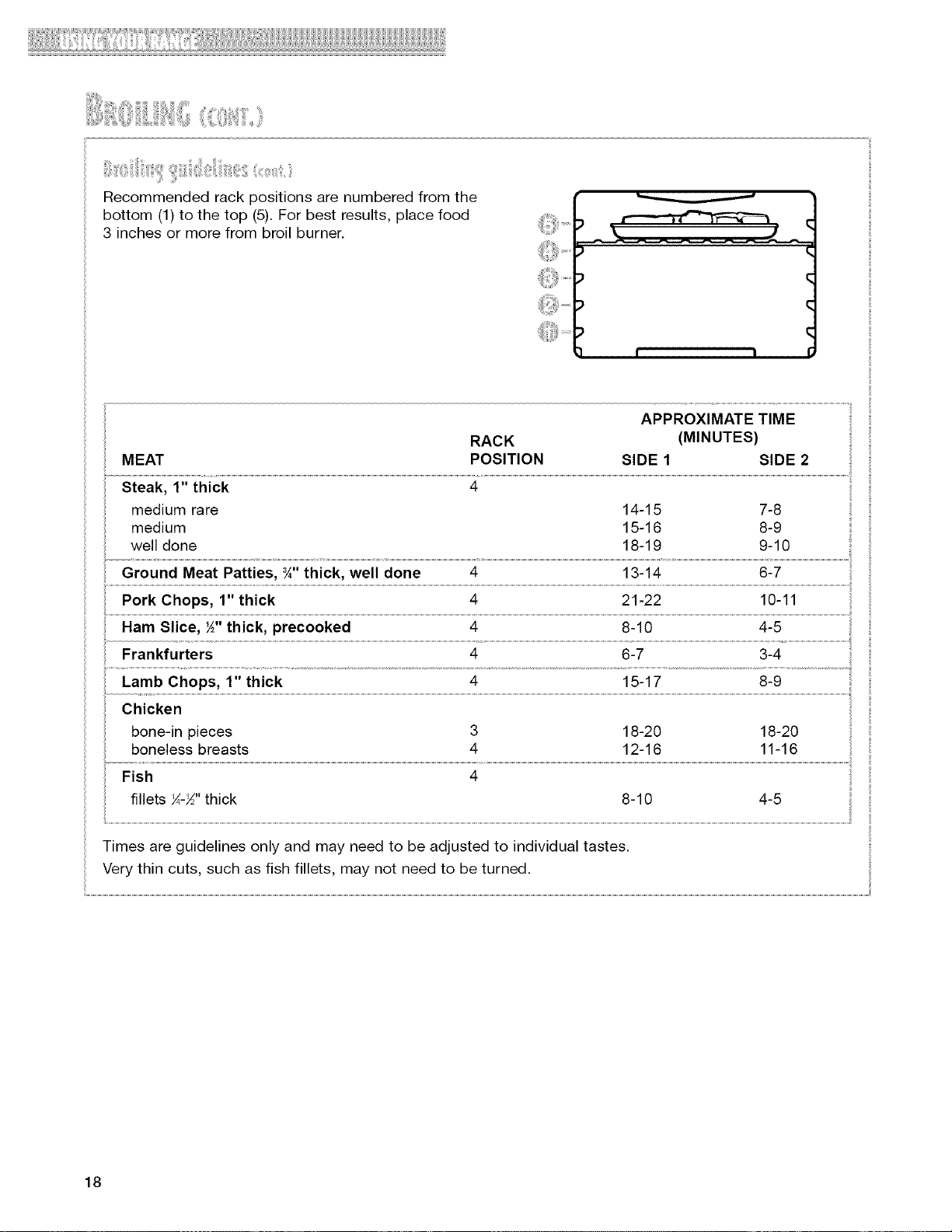
Recommended rack positions are numbered from the
bottom (1) to the top (5). For best results, place food
3 inches or more from broil burner.
I I
<
<
APPROXIMATE TIME
RACK (MINUTES) ....
MEAT POSITION SIDE 1 SIDE 2
Steak, 1" thick 4 .....
medium rare 14-15 7-8 .....
medium 15-16 8-9
well done 18-19 9-10
Ground Meat Patties, ¾" thick, well done 4 13-14 6-7
Pork Chops, 1" thick 4 21-22 10-11
Ham Slice, _" thick, precooked 4 8-10 4-5
Frankfurters 4 6-7 3-4
Lamb Chops, 1" thick 4 15-17 8-9
Chicken ....
bone-in pieces 3 18-20 18-20
boneless breasts 4 12-16 11-16 ....
Fish 4
fillets _-_" thick 8-10 4-5
Times are guidelines only and may need to be adjusted to individual tastes.
Very thin cuts, such as fish fillets, may not need to be turned.
18
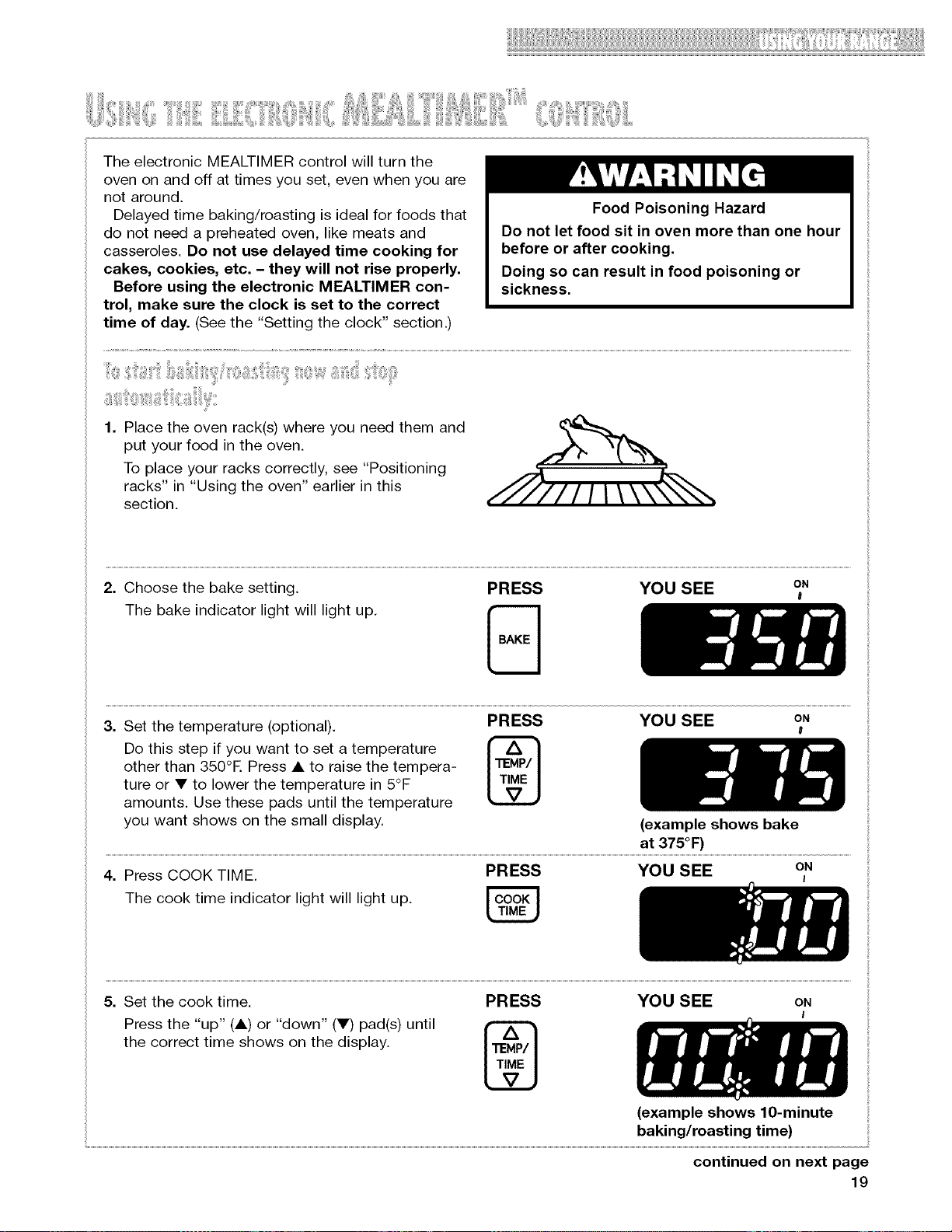
TheelectronicMEALTIMERcontrolwillturnthe
ovenonandoffattimesyouset,evenwhenyouare
notaround.
Delayedtimebaking/roastingisidealforfoodsthat
donotneeda preheatedoven,likemeatsand
casseroles.Do not use delayed time cooking for
cakes, cookies, etc. - they will not rise properly.
Before using the electronic MEALTIMER con-
trol, make sure the clock is set to the correct
time of day. (See the "Setting the clock" section.)
Food Poisoning Hazard
Do not let food sit in oven more than one hour
before or after cooking.
Doing so can result in food poisoning or
sickness.
1. Place the oven rack(s) where you need them and
put your food in the oven.
To place your racks correctly, see "Positioning
racks" in "Using the oven" earlier in this
section.
2. Choose the bake setting. PRESS YOU SEE ON
U
The bake indicator light will light up.
3. Set the temperature (optional). PRESS
Do this step if you want to set a temperature f A]
other than 350°E Press • to raise the tempera-
ture or • to lower the temperature in 5°F
amounts. Use these pads until the temperature
you want shows on the small display.
YOU SEE ON
m
(example shows bake
at 375°F)
4. Press COOK TIME. PRESS YOU SEE ON
I
The cook time indicator light will light up.
t j
5. Set the cook time.
Press the "up" (•) or "down" (•) pad(s) until
the correct time shows on the display.
PRESS YOU SEE ON
I
(example shows 10-minute
baking/roasting time)
continued on next page
19
....i!iiiiiii !!!iCii!ii ;iiii iiiiiiiiii,,,iiiiiii! liiiiiiilliiilZiiii iiiii!' ,ili!iiiil;iiiiiiiiii iiii<: :ii ,¸
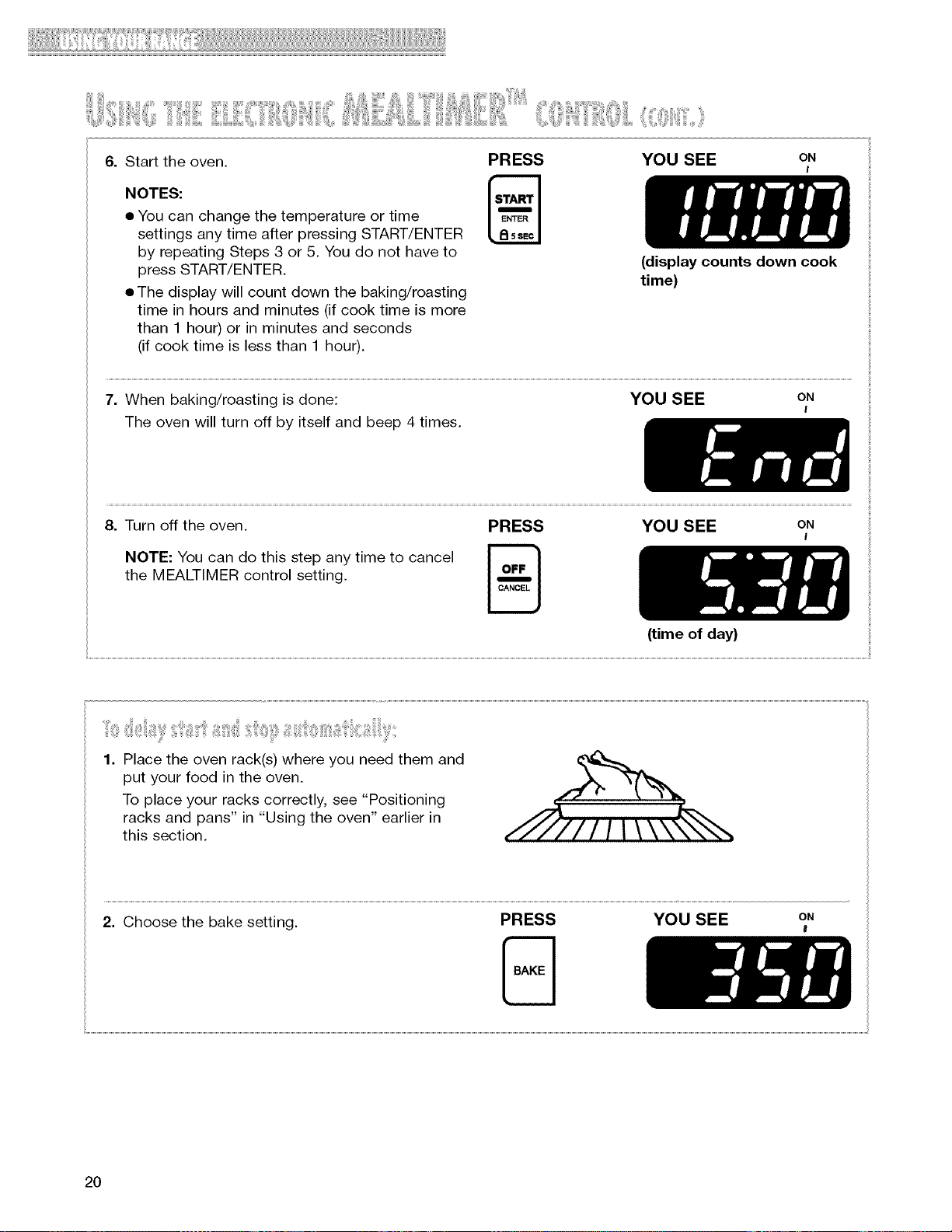
6. Start the oven.
NOTES:
• You can change the temperature or time
settings any time after pressing START/ENTER
by repeating Steps 3 or 5. You do not have to
press START/ENTER.
• The display will count down the baking/roasting
time in hours and minutes (if cook time is more
than 1 hour) or in minutes and seconds
(if cook time is less than 1 hour).
PRESS YOU SEE ON
!
(display counts down cook
time)
7. When baking/roasting is done: YOU SEE ON
I
The oven will turn off by itself and beep 4 times.
8. Turn off the oven.
NOTE: You can do this step any time to cancel
the MEALTIMER control setting.
PRESS YOU SEE ON
I
(time of day)
1. Place the oven rack(s) where you need them and
put your food in the oven.
To place your racks correctly, see "Positioning
racks and pans" in "Using the oven" earlier in
this section.
2. Choose the bake setting. PRESS YOU SEE ON
I
20
i
....ill;iiiiiii ii!i!i!i! iii iilll iii il;i i,,, ! iiiiill !i i!ili¸:j! iiiiII ilii i!i ii i! :iiC!ii iii ,t! iii:ii!i il;i!ii
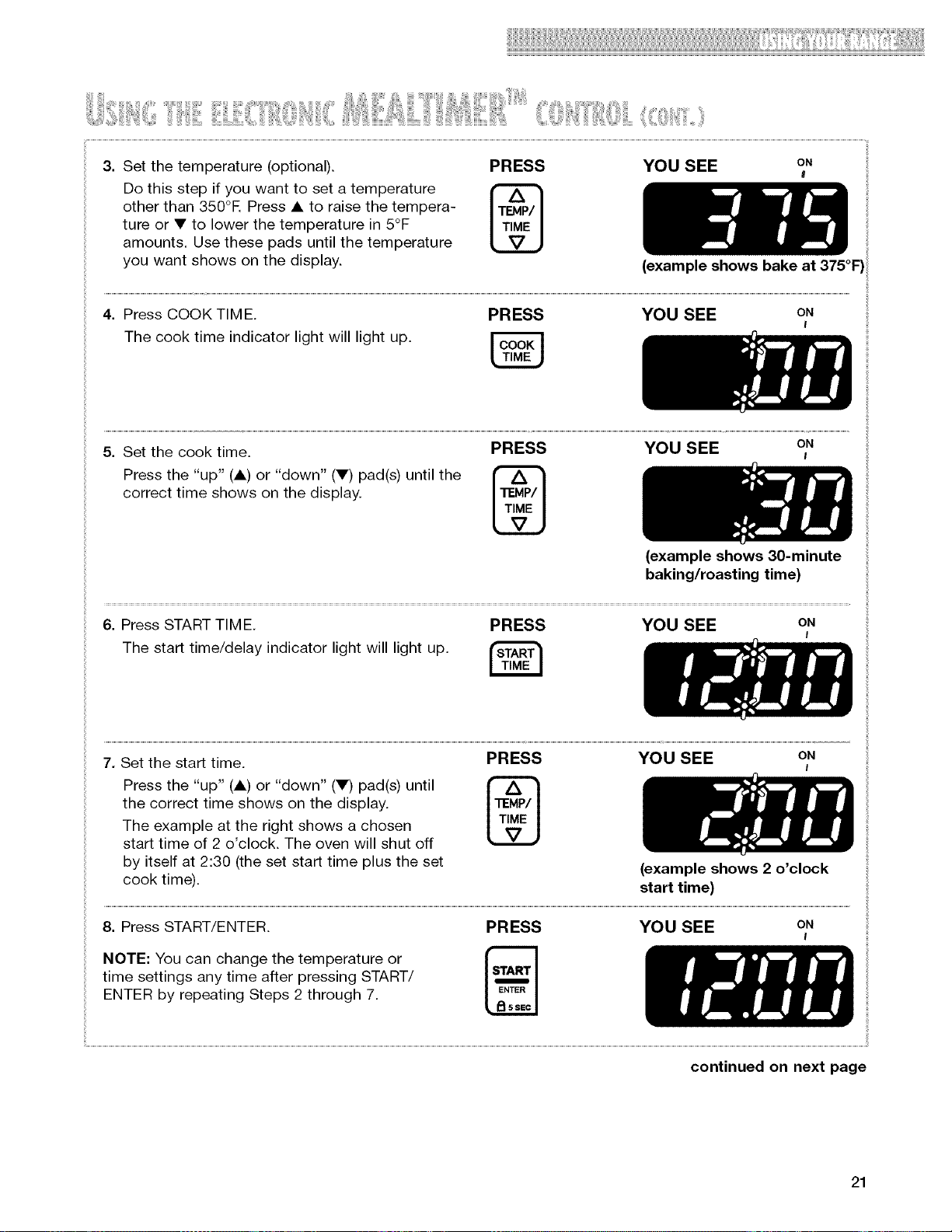
PRESS
Do this step if you want to set a temperature
other than 350°E Press • to raise the tempera-
ture or • to lower the temperature in 5°F
amounts. Use these pads until the temperature
you want shows on the display.
3. Set the temperature (optional).
YOU SEE oN
#
(example shows bake at 375°F)
4. Press COOKTIME.
The cook time indicator light will light up.
PRESS YOU SEE ON
I
Press the "up" (•) or "down" (V) pad(s) until the
correct time shows on the display.
5. Set the cook time. PRESS YOU SEE ON
!
(example shows 30-minute
baking/roasting time)
6. Press START TIME.
The start time/delay indicator light will light up.
PRESS YOU SEE ON
I
Press the "up" (•) or "down" (V) pad(s) until
the correct time shows on the display.
The example at the right shows a chosen
start time of 2 o'clock. The oven will shut off
by itself at 2:30 (the set start time plus the set
cook time).
7. Set the start time. PRESS YOU SEE ON
J
(example shows 2 o'clock
start time)
8. Press START/ENTER.
NOTE: You can change the temperature or
time settings any time after pressing START/
ENTER by repeating Steps 2 through 7.
PRESS YOU SEE ON
t
continued on next page
21
!!! iii i iiiiiiiiiIiI IIIIIIIIIIIIIIIIIIIIIIIII I i!i !i
i ,iiiii!!!il;ii!!iii , iiii i::iill¸Ti i!iiii!! !i i:iil;;iii!::; iiiiiiiiiiiiiiiiii,i!iiiii:iiiil;ill iiii>iiiiiiii iiiii, !iTi! :i ii iiiiiii iiiii
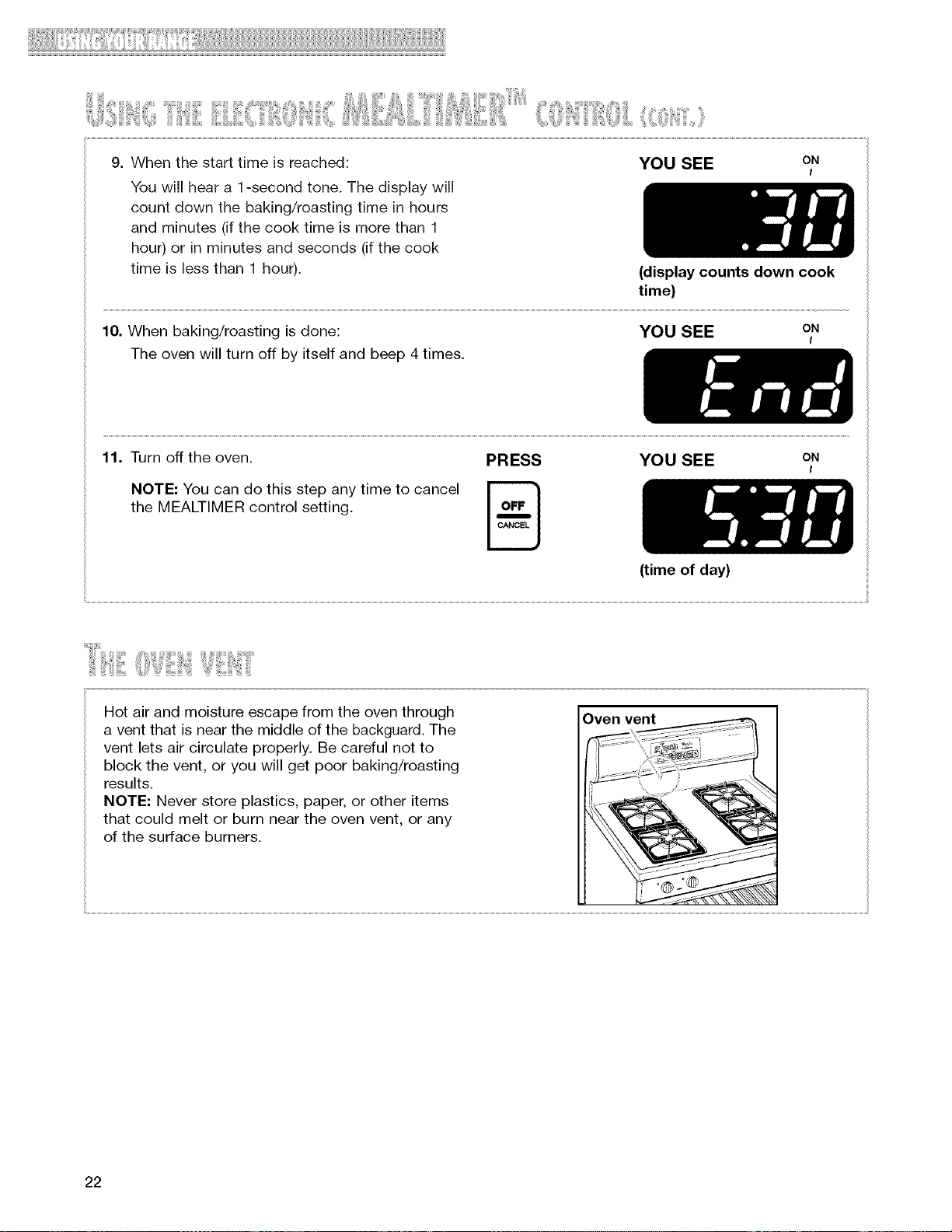
9. When the start time is reached: YOU SEE ON
!
You will hear a 1-second tone. The display will
count down the baking/roasting time in hours
and minutes (if the cook time is more than 1
hour) or in minutes and seconds (if the cook
time is less than 1 hour). (display counts down cook
time)
10. When baking/roasting is done: YOU SEE ON
!
The oven will turn off by itself and beep 4 times.
11. Turn off the oven.
NOTE: You can do this step any time to cancel
the MEALTIMER control setting.
PRESS YOU SEE ON
t
(time of day)
Hot air and moisture escape from the oven through
a vent that is near the middle of the backguard. The
vent lets air circulate properly. Be careful not to
block the vent, or you will get poor baking/roasting
results.
NOTE: Never store plastics, paper, or other items
that could melt or burn near the oven vent, or any
of the surface burners.
Oven vent
22
!! ! ! ! ! ! ii!iiiii!iliiiiiiiiii!!iiill]ii!iiiI[!ili]iiii]i;ii:!Iii!i[iii!!!!iiiii!
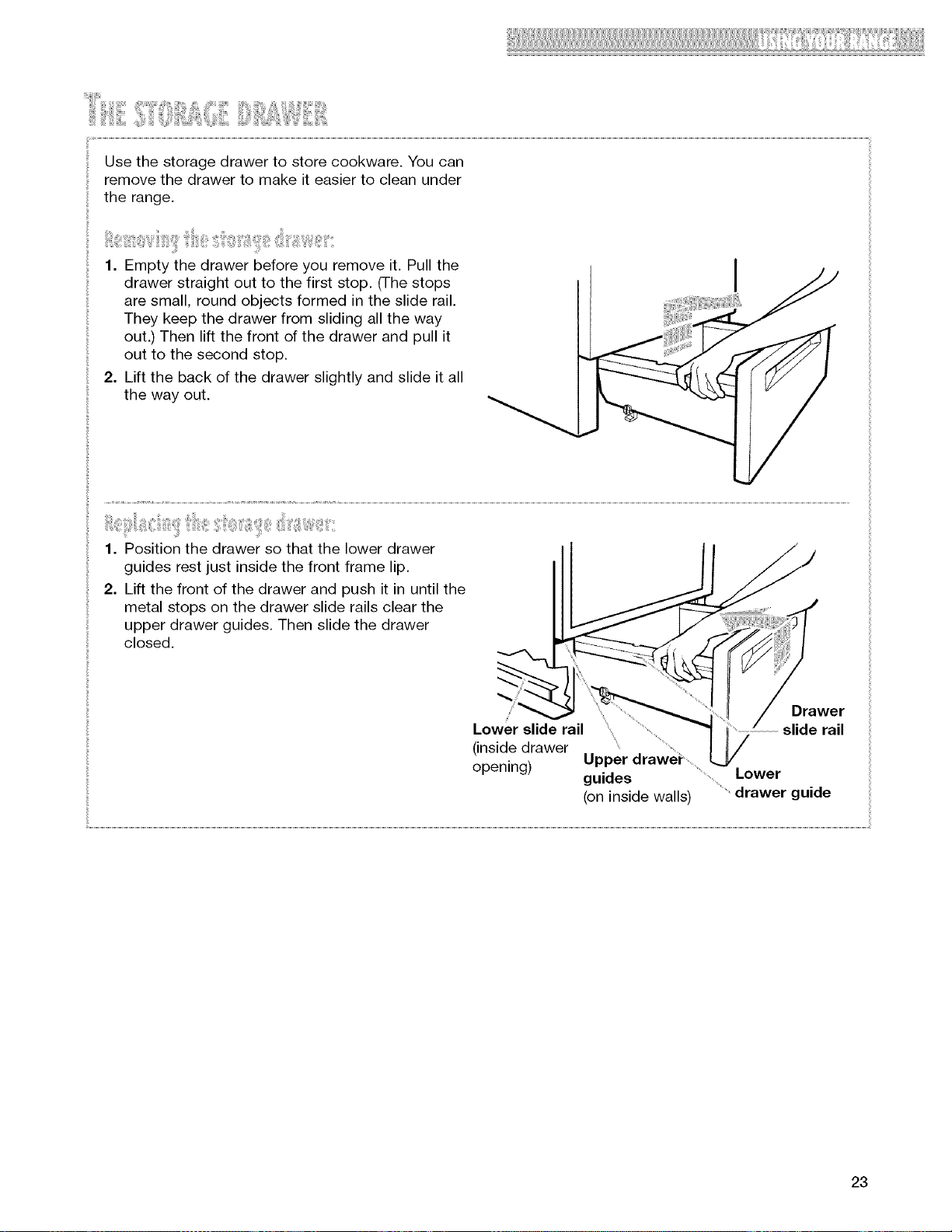
Use the storage drawer to store cookware. You can
remove the drawer to make it easier to clean under
the range.
1. Empty the drawer before you remove it. Pull the
drawer straight out to the first stop. (The stops
are small, round objects formed in the slide rail.
They keep the drawer from sliding all the way
out.) Then lift the front of the drawer and pull it
out to the second stop.
2. Lift the back of the drawer slightly and slide it all
the way out.
I
1. Position the drawer so that the lower drawer
guides rest just inside the front frame lip.
2. Lift the front of the drawer and push it in until the
metal stops on the drawer slide rails clear the
upper drawer guides. Then slide the drawer
closed.
Drawer
Lower slide rail rail
(inside drawer
opening) Upper drawer ............
guides ..................Lower
..........drawer guide
(on inside walls)
23
SELF-CINCCYCLE
Burn Hazard
Do not touch the oven during the Self-Cleaning cycle.
Keep children away from oven during Self-Cleaning cycle.
Do not use commercial oven cleaners in your oven.
Failure to follow these instructions can result in burns, or illness from inhaling
dangerous fumes.
Before you start the Self-Cleaning cycle, make
sure you:
NOTE: DO NOT clean, move, or bend the gasket.
You may get poor cleaning, baking, and roasting.
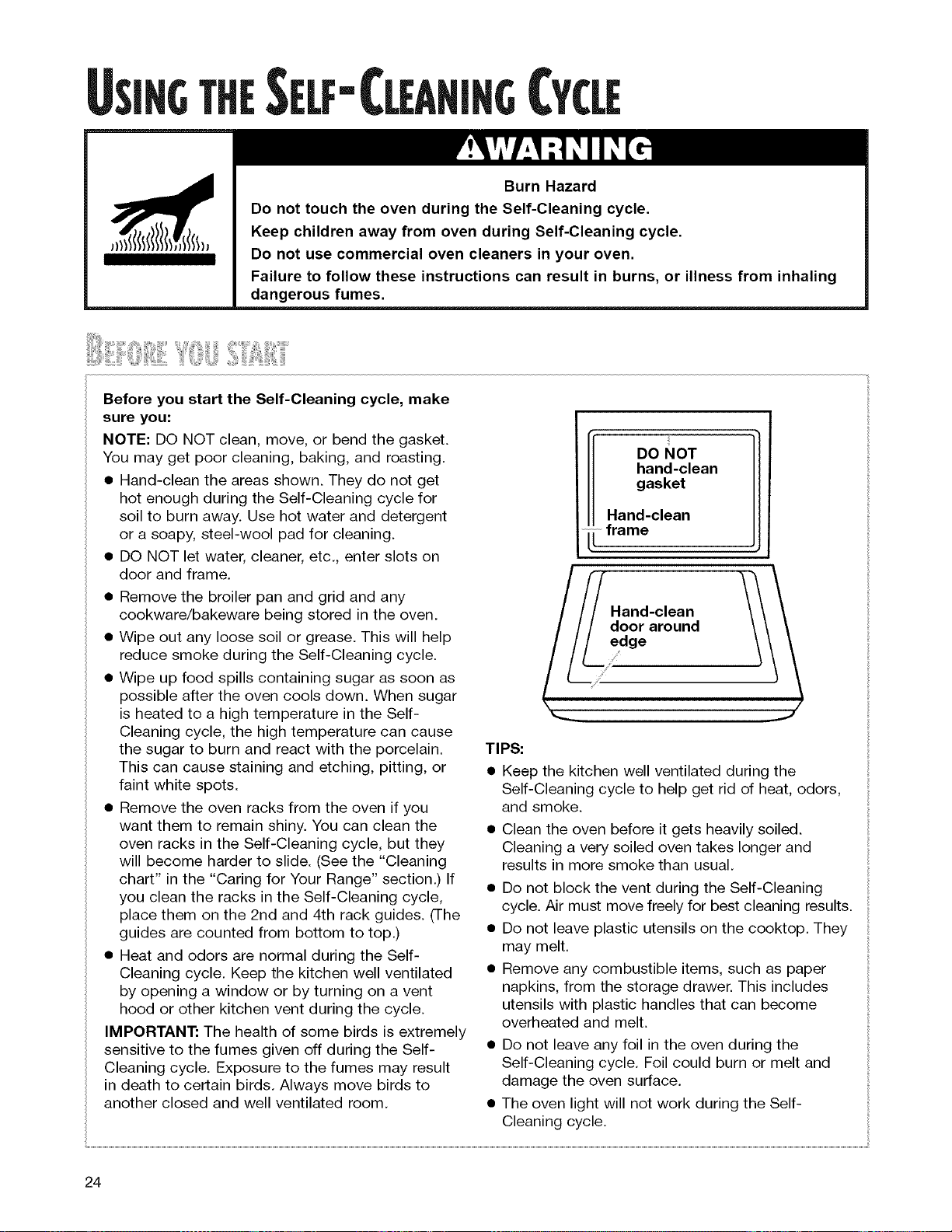
• Hand-clean the areas shown. They do not get
hot enough during the Self-Cleaning cycle for
soil to burn away. Use hot water and detergent
or a soapy, steel-wool pad for cleaning.
• DO NOT let water, cleaner, etc., enter slots on
door and frame.
• Remove the broiler pan and grid and any
cookware/bakeware being stored in the oven.
• Wipe out any loose soil or grease. This will help
reduce smoke during the Self-Cleaning cycle.
• Wipe up food spills containing sugar as soon as
possible after the oven cools down. When sugar
is heated to a high temperature in the Self-
Cleaning cycle, the high temperature can cause
the sugar to burn and react with the porcelain.
This can cause staining and etching, pitting, or
faint white spots.
• Remove the oven racks from the oven if you
want them to remain shiny. You can clean the
oven racks in the Self-Cleaning cycle, but they
will become harder to slide. (See the "Cleaning
chart" in the "Caring for Your Range" section.) If
you clean the racks in the Self-Cleaning cycle,
place them on the 2nd and 4th rack guides. (The
guides are counted from bottom to top.)
• Heat and odors are normal during the Self-
Cleaning cycle. Keep the kitchen well ventilated
by opening a window or by turning on a vent
hood or other kitchen vent during the cycle.
IMPORTANT: The health of some birds is extremely
sensitive to the fumes given off during the Self-
Cleaning cycle. Exposure to the fumes may result
in death to certain birds. Always move birds to
another closed and well ventilated room.
TIPS:
DO NOT
hand-clean
gasket
Hand-clean
frame
\
Hand-clean
door around
edge
Keep the kitchen well ventilated during the
Self-Cleaning cycle to help get rid of heat, odors,
and smoke.
• Clean the oven before it gets heavily soiled.
Cleaning a very soiled oven takes longer and
results in more smoke than usual.
• Do not block the vent during the Self-Cleaning
cycle. Air must move freely for best cleaning results.
• Do not leave plastic utensils on the cooktop. They
may melt.
• Remove any combustible items, such as paper
napkins, from the storage drawer. This includes
utensils with plastic handles that can become
overheated and melt.
• Do not leave any foil in the oven during the
Self-Cleaning cycle. Foil could burn or melt and
damage the oven surface.
• The oven light will not work during the Self-
Cleaning cycle.
24
iiliiiii!!!!iil! iiiii', iiiiii I,,,,iiiiiiil!!!! i;iiiiiiiiiiii!i',,iitii iii liii!ii
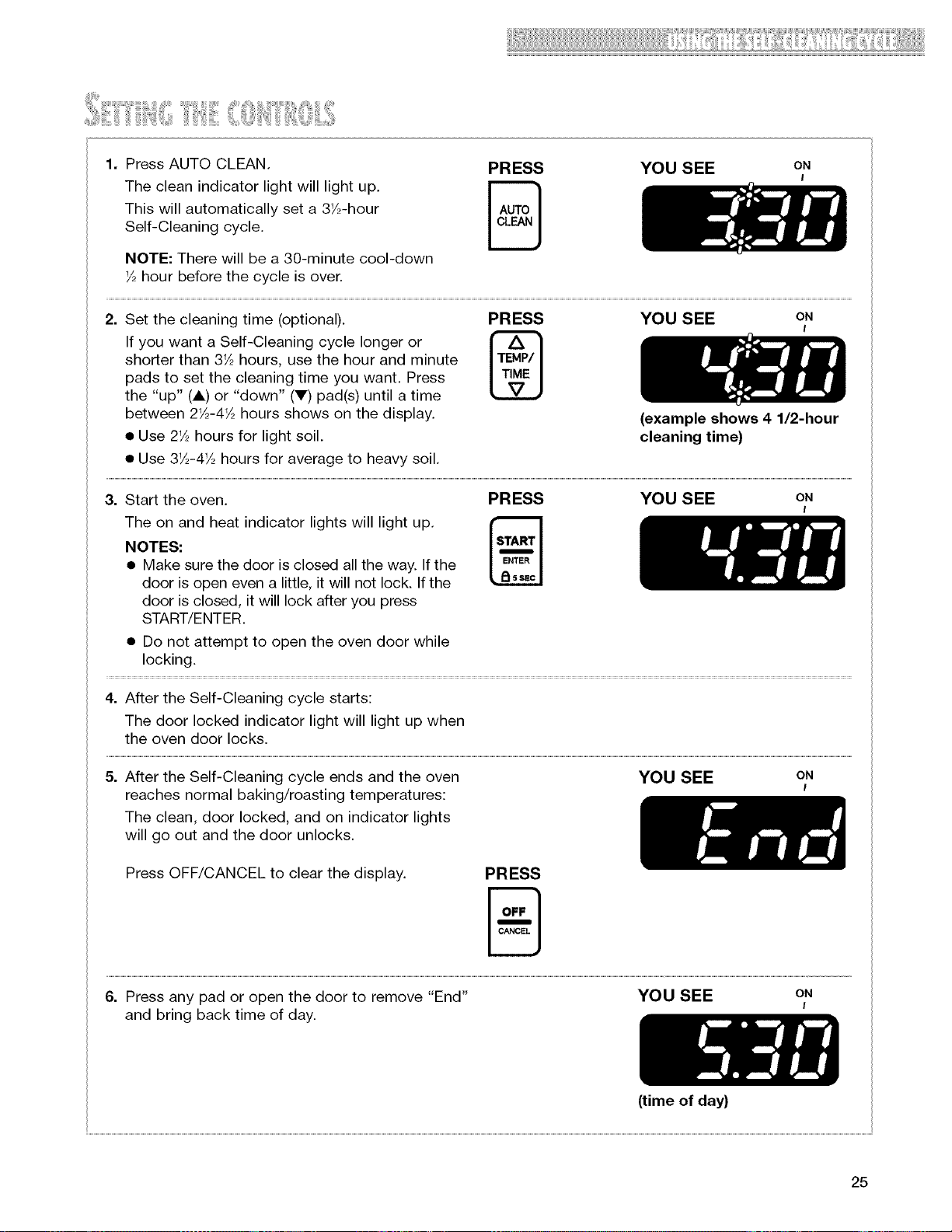
1. Press AUTO CLEAN.
The clean indicator light will light up.
This will automatically set a 3½-hour
Self-Cleaning cycle.
NOTE: There will be a 30-minute cool-down
½ hour before the cycle is over.
PRESS YOU SEE ON
I
2. YOU SEE ON
I
Set the cleaning time (optional). PRESS
If you want a Self-Cleaning cycle longer or
shorter than 3½ hours, use the hour and minute
@
pads to set the cleaning time you want. Press
the "up" (A) or "down" (V) pad(s) until a time
between 2½-4½ hours shows on the display.
• Use 2½ hours for light soil.
• Use 31½-41½hours for average to heavy soil.
(example shows 4 1/2-hour
cleaning time)
3. Start the oven. PRESS
The on and heat indicator lights will light up.
NOTES:
• Make sure the door is closed all the way. If the
door is open even a little, it will not lock. If the
door is closed, it will lock after you press
START/ENTER.
YOU SEE ON
I
• Do not attempt to open the oven door while
locking.
4. After the Self-Cleaning cycle starts:
The door locked indicator light will light up when
the oven door locks.
5. After the Self-Cleaning cycle ends and the oven
reaches normal baking/roasting temperatures:
The clean, door locked, and on indicator lights
will go out and the door unlocks.
YOU SEE ON
!
Press OFF/CANCEL to clear the display.
PRESS
6. Press any pad or open the door to remove "End" YOU SEE ON
and bring back time of day. !
(time of day)
25
i!iiiii iii',,ii<ii:;,iiiiiiiiiiiii!!!!! iiiiiiiiiiiiiii;i ii iiillii} iii {ii iii ii!il¸,
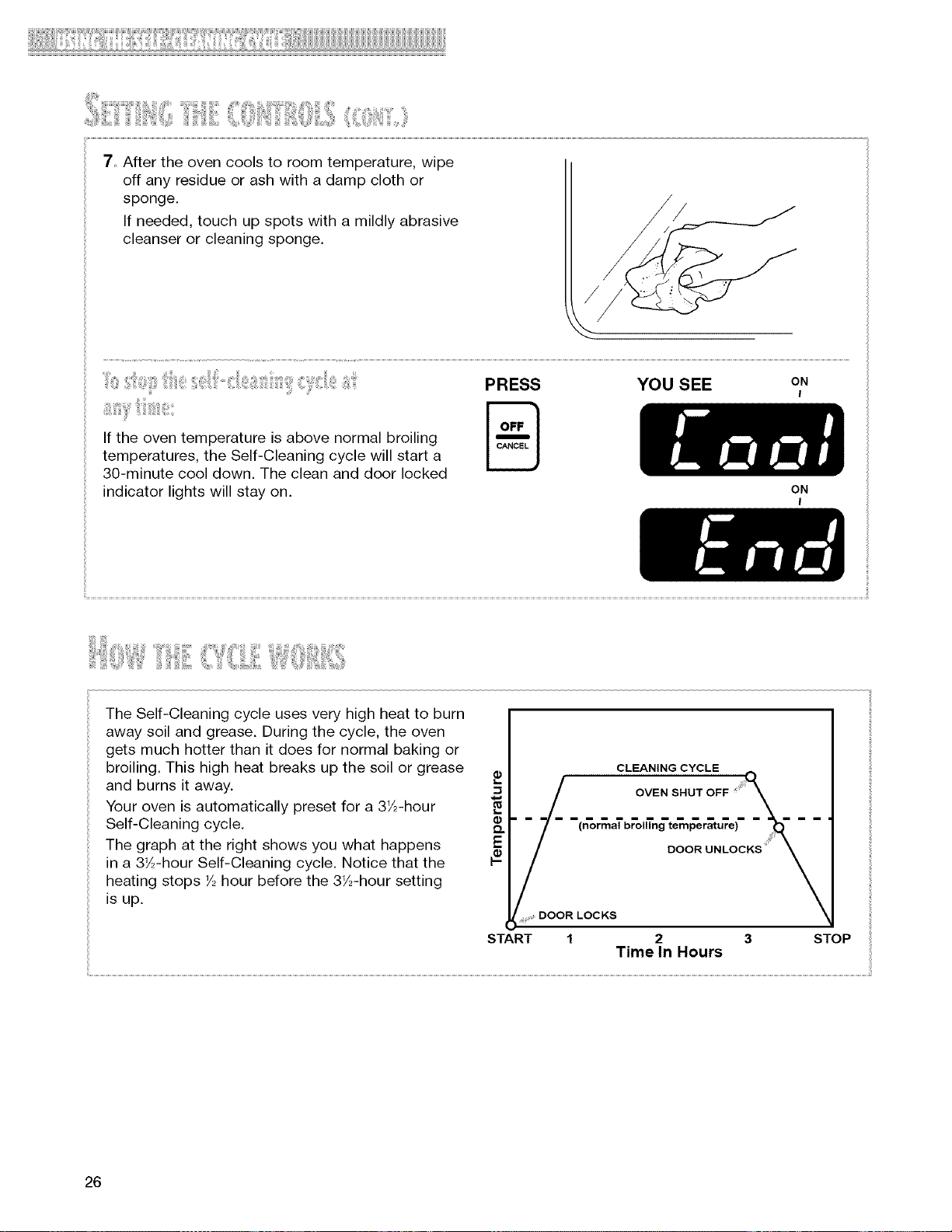
7 After the oven cools to room temperature, wipe
off any residue or ash with a clamp cloth or
sponge.
If needed, touch up spots with a mildly abrasive
cleanser or cleaning sponge.
/
If the oven temperature is above normal broiling
temperatures, the Self-Cleaning cycle will start a
30-minute cool down. The clean and door locked
indicator lights will stay on.
PRESS YOU SEE ON
N
ON
!
The Self-Cleaning cycle uses very high heat to burn
away soil and grease. During the cycle, the oven
gets much hotter than it does for normal baking or
broiling. This high heat breaks up the soil or grease
and burns it away.
Your oven is automatically preset for a 3Z2-hour
Self-Cleaning cycle.
The graph at the right shows you what happens
in a 3½-hour Self-Cleaning cycle. Notice that the
heating stops Y2hour before the 3Z2-hour setting
is up.
CLEANING CYCLE
OVEN SHUT OFF
(norma_ b_'oilTng'te_n_r_tu_e)" - _ - -
DOOR LOCKS DOOR UNLOCKS _
START 2 3
Time In Hours
STOP
26
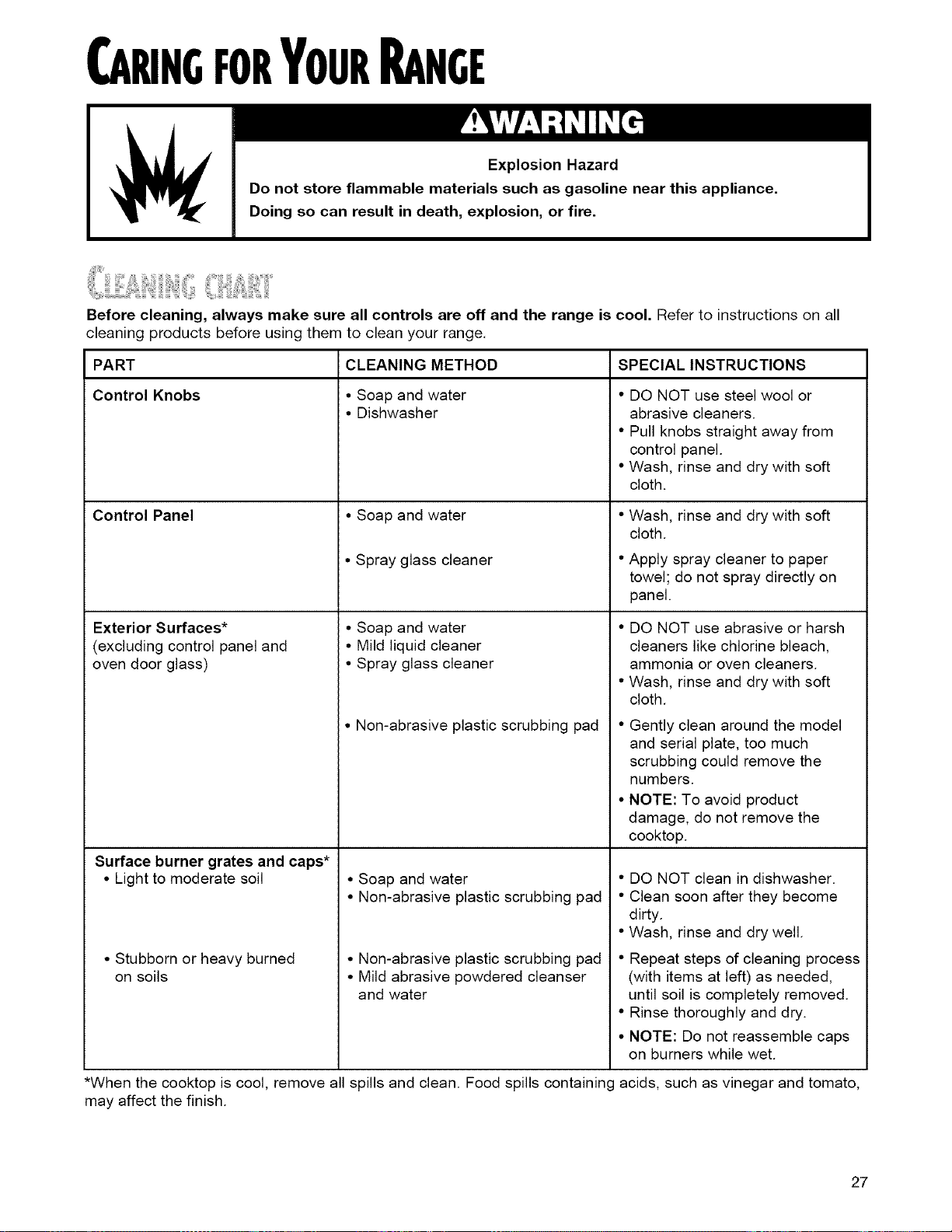
CAmN FORYOURRANge
Explosion Hazard
Do not store flammable materials such as gasoline near this appliance.
Doing so can result in death, explosion, or fire.
:
Before cleaning, always make sure all controls are off and the range is cool. Refer to instructions on all
cleaning products before using them to clean your range.
PART
Control Knobs
Control Panel
Exterior Surfaces*
(excluding control panel and
oven door glass)
Surface burner grates and caps*
• Light to moderate soil
• Stubborn or heavy burned
on soils
CLEANING METHOD
• Soap and water
• Dishwasher
• Soap and water
• Spray glass cleaner
• Soap and water
• Mild liquid cleaner
• Spray glass cleaner
• Non-abrasive plastic scrubbing pad
• Soap and water
• Non-abrasive plastic scrubbing pad
• Non-abrasive plastic scrubbing pad
• Mild abrasive powdered cleanser
and water
*When the cooktop is cool, remove all spills and clean. Food spills containin(
may affect the finish.
SPECIAL INSTRUCTIONS
• DO NOT use steel wool or
abrasive cleaners.
• Pull knobs straight away from
control panel.
• Wash, rinse and dry with soft
cloth.
• Wash, rinse and dry with soft
cloth.
• Apply spray cleaner to paper
towel; do not spray directly on
panel.
• DO NOT use abrasive or harsh
cleaners like chlorine bleach,
ammonia or oven cleaners.
• Wash, rinse and dry with soft
cloth.
• Gently clean around the model
and serial plate, too much
scrubbing could remove the
numbers.
• NOTE: To avoid product
damage, do not remove the
cooktop.
• DO NOT clean in dishwasher.
• Clean soon after they become
dirty.
• Wash, rinse and dry well.
• Repeat steps of cleaning process
(with items at left) as needed,
until soil is completely removed.
• Rinse thoroughly and dry.
• NOTE: Do not reassemble caps
on burners while wet.
I acids, such as vinegar and tomato,
27
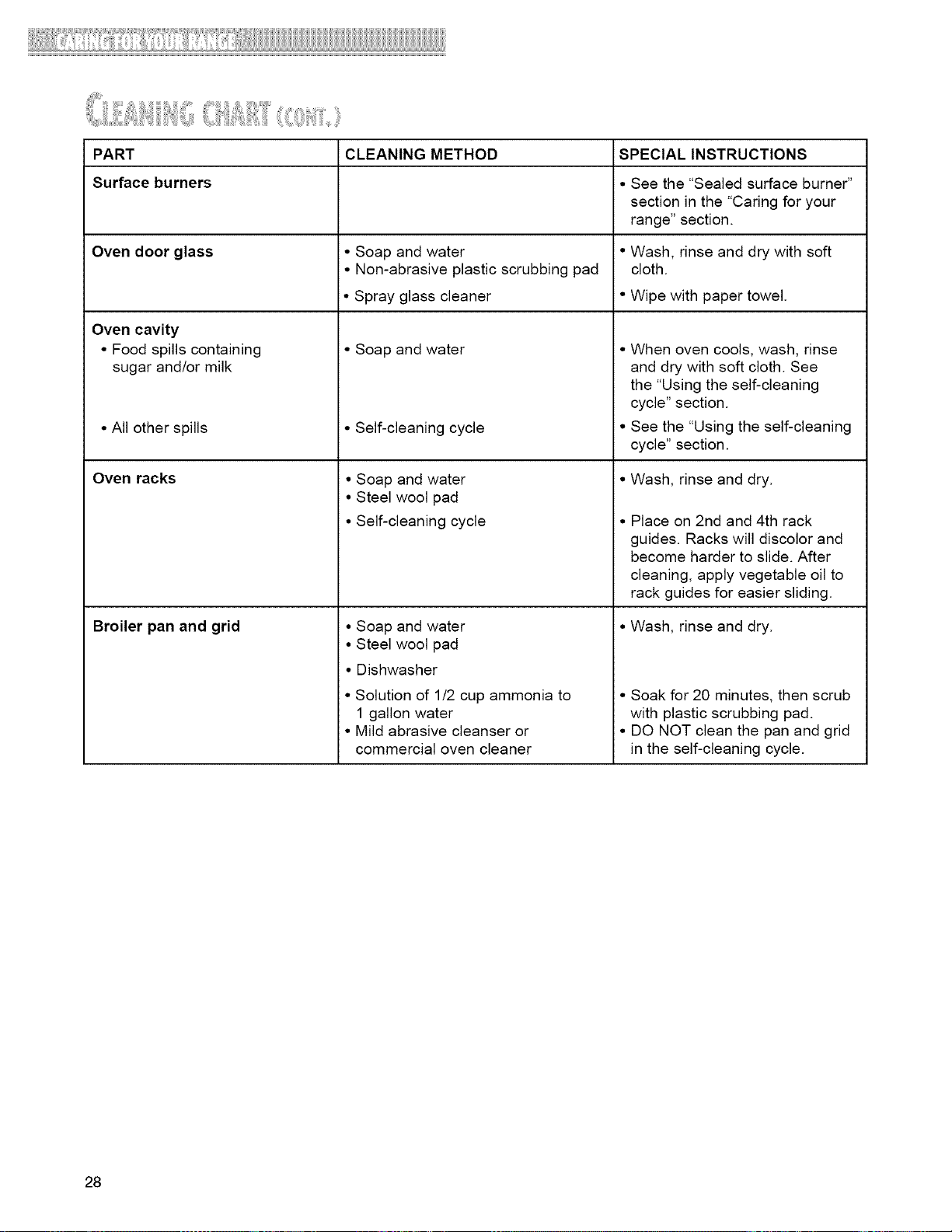
(]l, iiiii il!i]''¸ )
PART CLEANING METHOD SPECIAL INSTRUCTIONS
Surface burners • See the "Sealed surface burner"
section in the "Caring for your
range" section.
Oven door glass • Soap and water • Wash, rinse and dry with soft
• Non-abrasive plastic scrubbing pad cloth.
• Spray glass cleaner • Wipe with paper towel.
Oven cavity
• Food spills containing
sugar and/or milk
• All other spills
Oven racks
Broiler pan and grid
• Soap and water
• Self-cleaning cycle
• Soap and water
• Steel wool pad
• Self-cleaning cycle
• Soap and water
• Steel wool pad
• Dishwasher
• Solution of 1/2 cup ammonia to
1 gallon water
• Mild abrasive cleanser or
commercial oven cleaner
• When oven cools, wash, rinse
and dry with soft cloth. See
the "Using the self-cleaning
cycle" section.
• See the "Using the self-cleaning
cycle" section.
• Wash, rinse and dry.
• Place on 2nd and 4th rack
guides. Racks will discolor and
become harder to slide. After
cleaning, apply vegetable oil to
rack guides for easier sliding.
• Wash, rinse and dry.
• Soak for 20 minutes, then scrub
with plastic scrubbing pad.
• DO NOT clean the pan and grid
in the self-cleaning cycle.
28
iijii i!!iiiiilti!!iiiiiiii ii!i: !i@ ;!ii ,Gi!! ii! ,iiiii!i i <II IH; HIK i i!
• You should routinely remove and clean the burner
cap. Always clean the burner cap after a spill-
over. Keeping the burner cap clean prevents poor
ignition and an uneven flame.
• For the proper flow of gas and ignition of the
burner, do not allow spills, food, cleaning
agents, or any other material to enter the gas
tube opening or burner ports.
• Gas must flow freely through the gas tube
opening for the burner to light properly. You must
keep this area free of any soil and protect it from
boilovers or spillovers. Always keep the burner
cap in place whenever a surface burner is in use.
• Let the cooktop cool before cleaning.
• Do not use oven cleaners, bleach, or rust
removers.
• Do not obstruct the flow of combustion and
ventilation air around the burner grate edges.
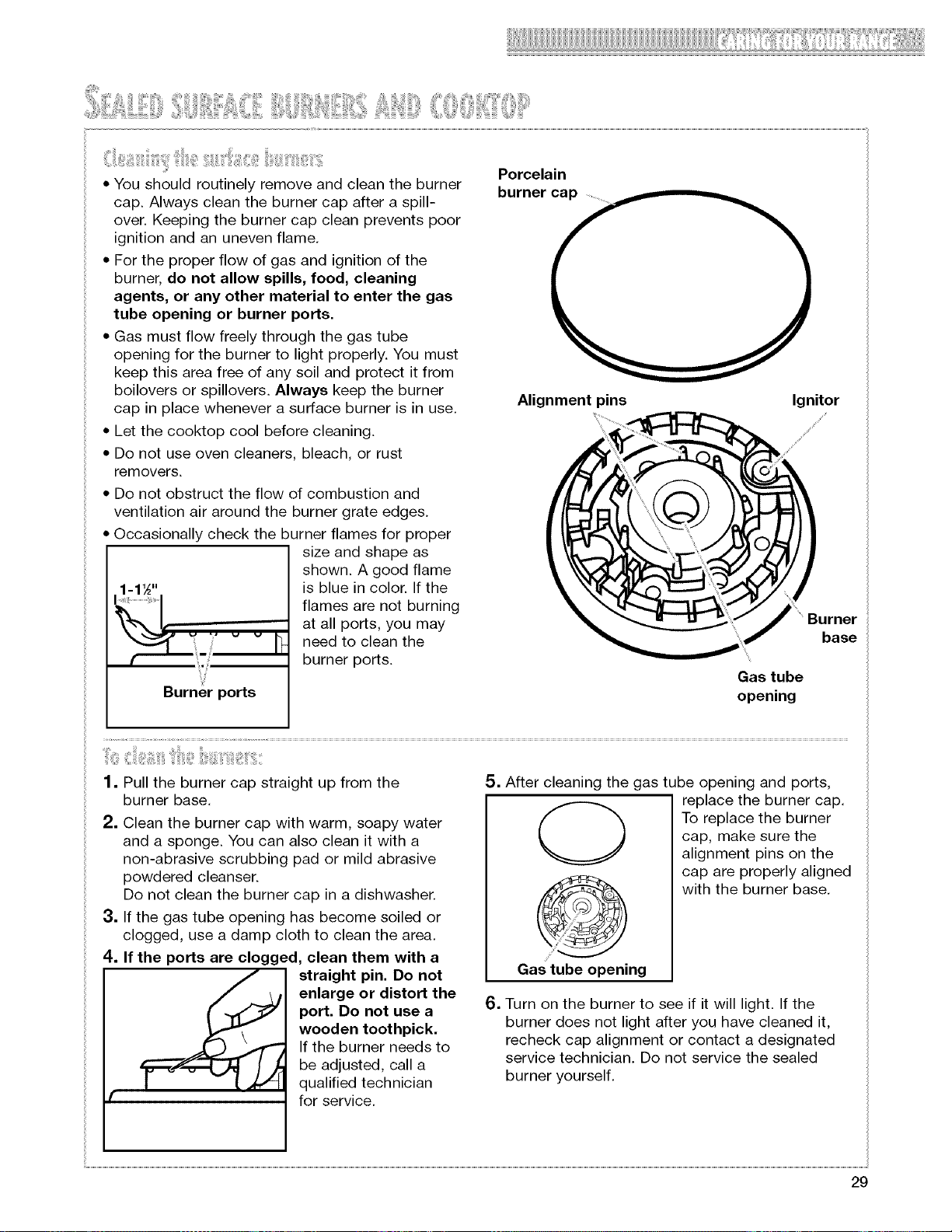
• Occasionally check the burner flames for proper
size and shape as
shown. A good flame
is blue in color. If the
flames are not burning
at all ports, you may
"_ " _ need to clean the
II
burner ports.
Burner ports
Porcelain
burner
Alignment pins Ignitor
<urner
base
Gas tube
opening
1, Pull the burner cap straight up from the
burner base.
2, Clean the burner cap with warm, soapy water
and a sponge. You can also clean it with a
non-abrasive scrubbing pad or mild abrasive
powdered cleanser.
Do not clean the burner cap in a dishwasher.
3, If the gas tube opening has become soiled or
clogged, use a damp cloth to clean the area.
4, If the ports are clogged, clean them with a
straight pin. Do not
enlarge or distort the
port. Do not use a
wooden toothpick.
If the burner needs to
be adjusted, call a
qualified technician
for service.
5. After cleaning the gas tube opening and ports,
0
@
Gas tube opening
replace the burner cap.
To replace the burner
cap, make sure the
alignment pins on the
cap are properly aligned
with the burner base.
6, Turn on the burner to see if it will light. If the
burner does not light after you have cleaned it,
recheck cap alignment or contact a designated
service technician. Do not service the sealed
burner yourself.
29
iili Y!lili:!i()"i,J'li!!!il,,,ii
For normal use of your range, you do not need to
remove the door. However, if you find it necessary
to remove the door, follow the instructions in this
section.
NOTE: The oven door is heavy.
Before removing the door:
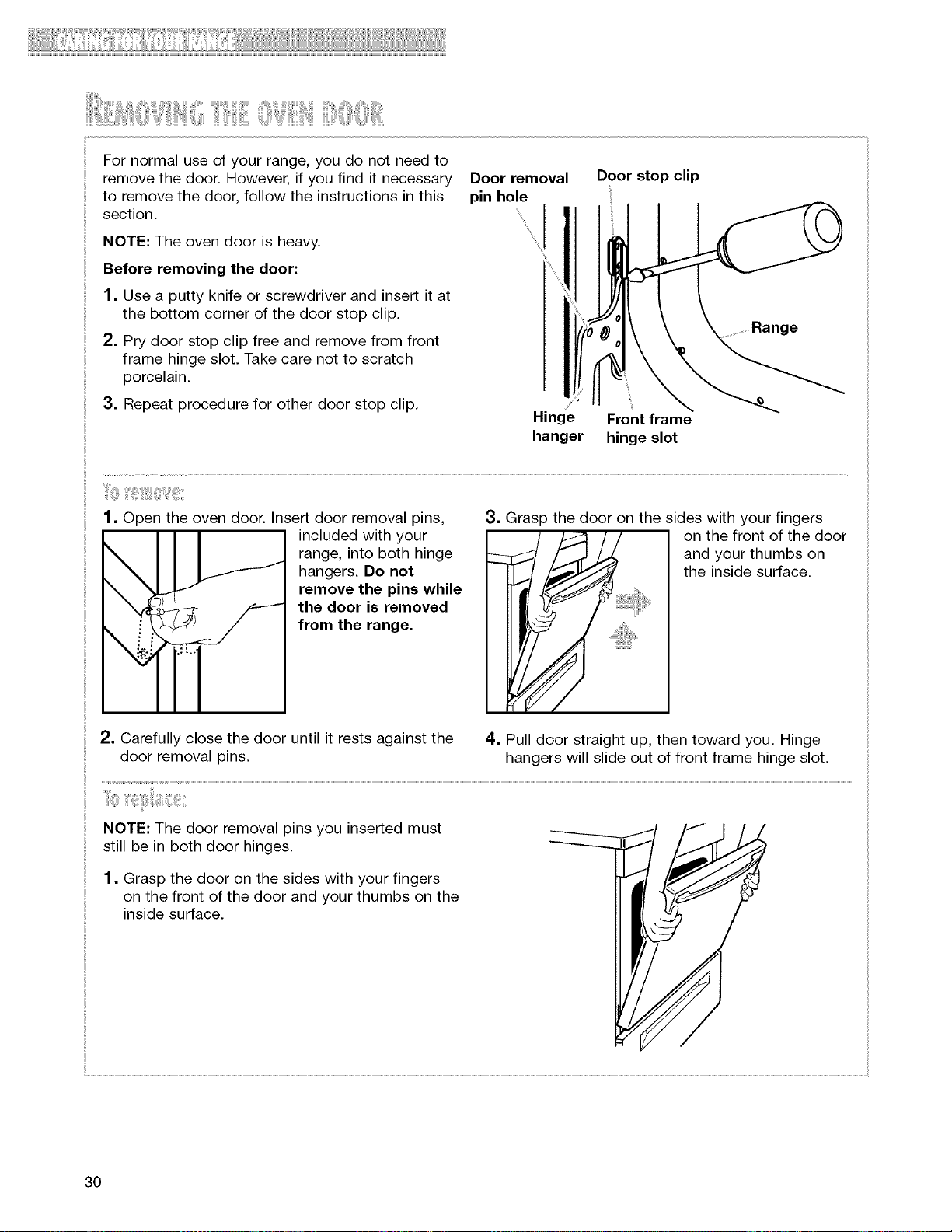
1. Use a putty knife or screwdriver and insert it at
the bottom corner of the door stop clip,
2. Pry door stop clip free and remove from front
frame hinge slot. Take care not to scratch
porcelain,
3. Repeat procedure for other door stop clip,
Door removal
pin hole
II
Hinge
hanger
Door stop clip
Front frame
hinge slot
1. Open the oven door. Insert door removal pins,
included with your
range, into both hinge
hangers. Do not
remove the pins while
the door is removed
from the range.
3, Grasp the door on the sides with your fingers
on the front of the door
and your thumbs on
the inside surface,
2. Carefully close the door until it rests against the
door removal pins.
4, Pull door straight up, then toward you, Hinge
hangers will slide out of front frame hinge slot.
NOTE: The door removal pins you inserted must
still be in both door hinges.
1, Grasp the door on the sides with your fingers
on the front of the door and your thumbs on the
inside surface,
30
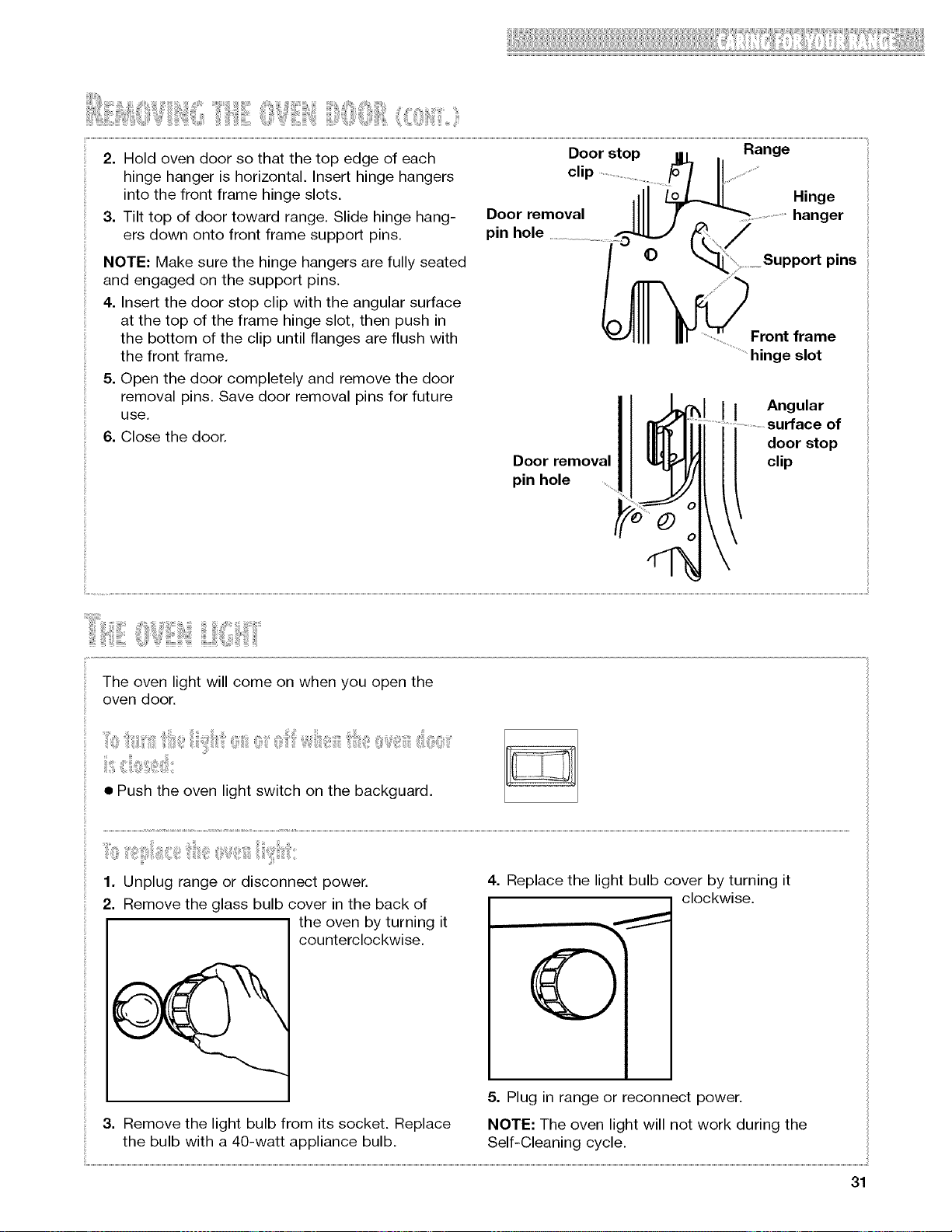
2. Holdovendoorsothatthetopedgeofeach Doorstop Range
hingehangerishorizontal.Inserthingehangers
intothefrontframehingeslots.
3. Tilttopofdoortowardrange.Slidehingehang-
ersdownontofrontframesupportpins.
NOTE:Makesurethehingehangersarefullyseated
andengagedonthesupportpins.
4.Insertthedoorstopclipwiththeangularsurface
atthetopoftheframehingeslot,thenpushin
thebottomoftheclipuntilflangesareflushwith
thefrontframe.
5.Openthedoorcompletelyandremovethedoor
removalpins.Savedoorremovalpinsforfuture
use,
clip ...........
Hinge
Door removal ......._.......................hanger
pin
hole
........../
..........Support pins
Front frame
hinge slot
Angular
6. Close the door.
Door removal
pin hole
door stop
clip
•if,,,!iiiiiiili!:!!i iliiiiiiJiii!!iiiiiiiiii!iiiiiiiiiiiiliiii!iiiiiiiiiiiiiiill....
The oven light will come on when you open the
oven door.
• Push the oven light switch on the backguard.
1. Unplug range or disconnect power.
2. Remove the glass bulb cover in the back of
the oven by turning it
counterclockwise.
4. Replace the light bulb cover by turning it
clockwise.
5. Plug in range or reconnect power.
3. Remove the light bulb from its socket. Replace NOTE: The oven light will not work during the
the bulb with a 40-watt appliance bulb. Self-Cleaning cycle.
31
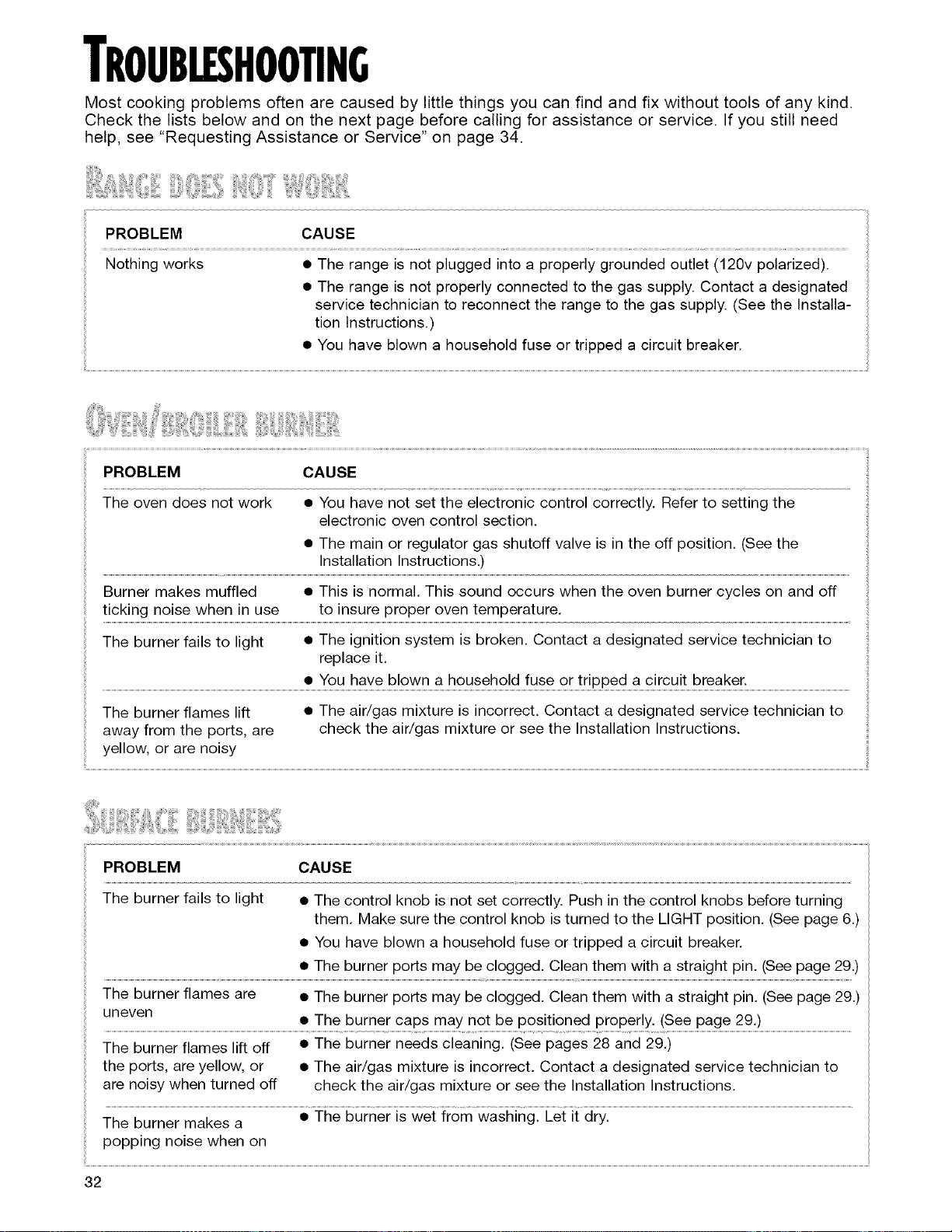
TROUBLESHOOTING
Most cooking problems often are caused by little things you can find and fix without tools of any kind.
Check the lists below and on the next page before calling for assistance or service. If you still need
help, see "Requesting Assistance or Service" on page 34.
PROBLEM CAUSE
Nothing works • The range is not plugged into a properly grounded outlet (120v polarized),
• The range is not properly connected to the gas supply. Contact a designated
service technician to reconnect the range to the gas supply. (See the Installa-
tion Instructions,)
• You have blown a household fuse or tripped a circuit breaker.
PROBLEM CAUSE
The oven does not work • You have not set the electronic control correctly. Refer to setting the
electronic oven control section.
• The main or regulator gas shutoff valve is in the off position, (See the
Installation Instructions.)
Burner makes muffled • This is normal. This sound occurs when the oven burner cycles on and off
ticking noise when in use to insure proper oven temperature,
The burner fails to light • The ignition system is broken, Contact a designated service technician to
replace it.
• You have blown a household fuse or tripped a circuit breaker.
The burner flames lift • The air/gas mixture is incorrect. Contact a designated service technician to
away from the ports, are check the air/gas mixture or see the Installation Instructions.
yellow, or are noisy
PROBLEM CAUSE
The burner fails to light • The control knob is not set correctly. Push in the control knobs before turning
them, Make sure the control knob is turned to the LIGHT position, (See page 6,)
• You have blown a household fuse or tripped a circuit breaker,
• The burner ports may be clogged. Clean them with a straight pin. (See page 29.)
The burner flames are • The burner ports may be clogged, Clean them with a straight pin. (See page 29.)
uneven
• The burner caps may not be positioned properly. (See page 29.)
The burner flames lift off • The burner needs cleaning. (See pages 28 and 29.)
the ports, are yellow, or • The air/gas mixture is incorrect. Contact a designated service technician to
are noisy when turned off check the air/gas mixture or see the Installation Instructions.
The burner makes a • The burner is wet from washing. Let it dry.
popping noise when on
32
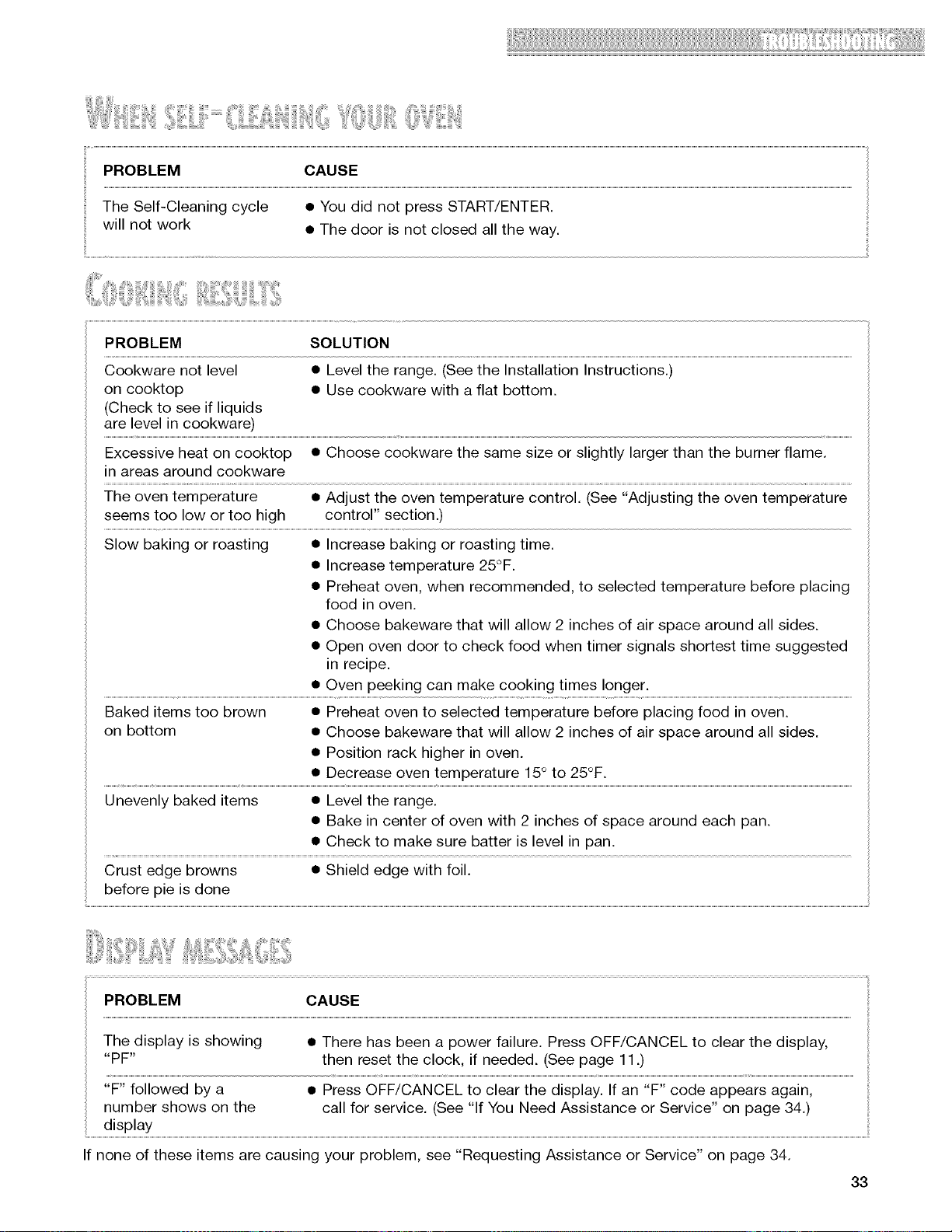
PROBLEM SOLUTION
Cookwarenotlevel • Leveltherange.(SeetheInstallationInstructions.)
oncooktop • Usecookwarewithaflatbottom.
(Checktoseeifliquids
arelevelincookware)
Excessiveheatoncooktop • Choosecookwarethesamesizeorslightlylargerthantheburnerflame.
inareasaroundcookware
Theoventemperature • Adjusttheoventemperaturecontrol.(See"Adjustingtheoventemperature
seemstoolowortoohigh control"section.)
Slowbakingorroasting • Increasebakingorroastingtime.
• Increasetemperature25°F.
• Preheatoven,whenrecommended,toselectedtemperaturebeforeplacing
foodinoven.
• Choosebakewarethatwillallow2inchesofairspacearoundallsides.
• Open oven door to check food when timer signals shortest time suggested
in recipe.
• Oven peeking can make cooking times longer.
Baked items too brown • Preheat oven to selected temperature before placing food in oven.
on bottom • Choose bakeware that will allow 2 inches of air space around all sides.
• Position rack higher in oven.
• Decrease oven temperature 15° to 25°F.
Unevenly baked items • Level the range.
• Bake in center of oven with 2 inches of space around each pan.
• Check to make sure batter is level in pan.
Crust edge browns • Shield edge with foil.
before pie is done
The display is showing • There has been a power failure. Press OFF/CANCEL to clear the display,
"PF" then reset the clock, if needed. (See page 11.)
"F" followed by a • Press OFF/CANCEL to clear the display. If an "F" code appears again,
number shows on the call for service. (See "If You Need Assistance or Service" on page 34.)
.....................disp!aY...........................................................................................................................................................................................................................................................................................................................................................................................................................................................................................................................................................................................................................................................................................................................................................................................................................
If none of these items are causing your problem, see "Requesting Assistance or Service" on page 34.
33
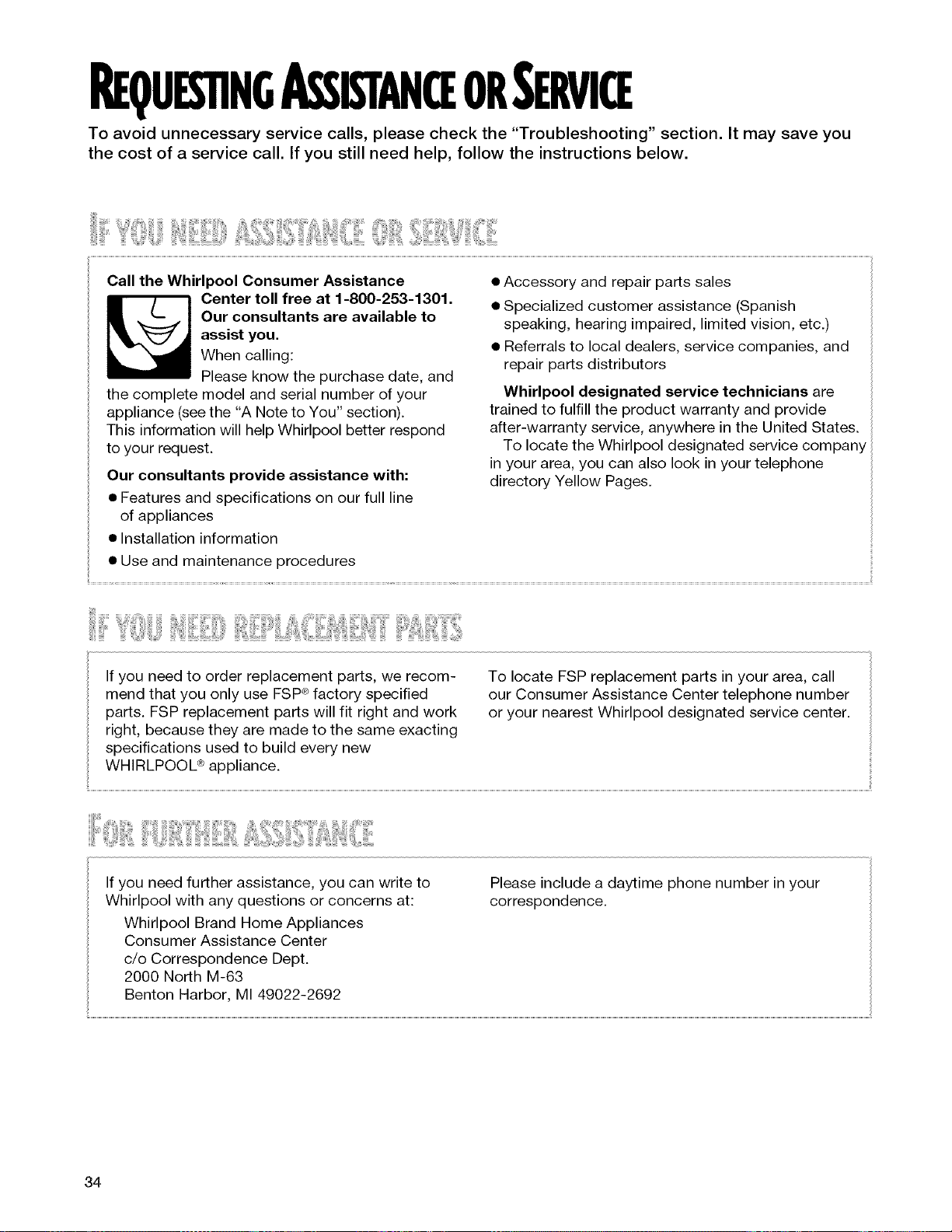
REQUES'flNGA ISTANCEORSERVICE
To avoid unnecessary service calls, please check the "Troubleshooting" section. It may save you
the cost of a service call. If you still need help, follow the instructions below.
Call the Whirlpool Consumer Assistance
Center toll free at 1-800-253-1301.
Our consultants are available to
assist you.
When calling:
Please know the purchase date, and
the complete model and serial number of your
appliance (see the "A Note to You" section).
This information will help Whirlpool better respond
to your request.
Our consultants provide assistance with:
• Features and specifications on our full line
of appliances
• Installation information
• Use and maintenance procedures
• Accessory and repair parts sales
• Specialized customer assistance (Spanish
speaking, hearing impaired, limited vision, etc.)
• Referrals to local dealers, service companies, and
repair parts distributors
Whirlpool designated service technicians are
trained to fulfill the product warranty and provide
after-warranty service, anywhere in the United States.
To locate the Whirlpool designated service company
in your area, you can also look in your telephone
directory Yellow Pages.
iiii
iiii
If you need to order replacement parts, we recom-
mend that you only use FSP_ factory specified
parts. FSP replacement parts will fit right and work
right, because they are made to the same exacting
specifications used to build every new
WHIRLPOOL ®appliance.
To locate FSP replacement parts in your area, call
our Consumer Assistance Center telephone number
or your nearest Whirlpool designated service center.
If you need further assistance, you can write to
Whirlpool with any questions or concerns at:
Whirlpool Brand Home Appliances
Consumer Assistance Center
c/o Correspondence Dept.
2000 North M-63
Benton Harbor, MI 49022-2692
Please include a daytime phone number in your
correspondence.
34
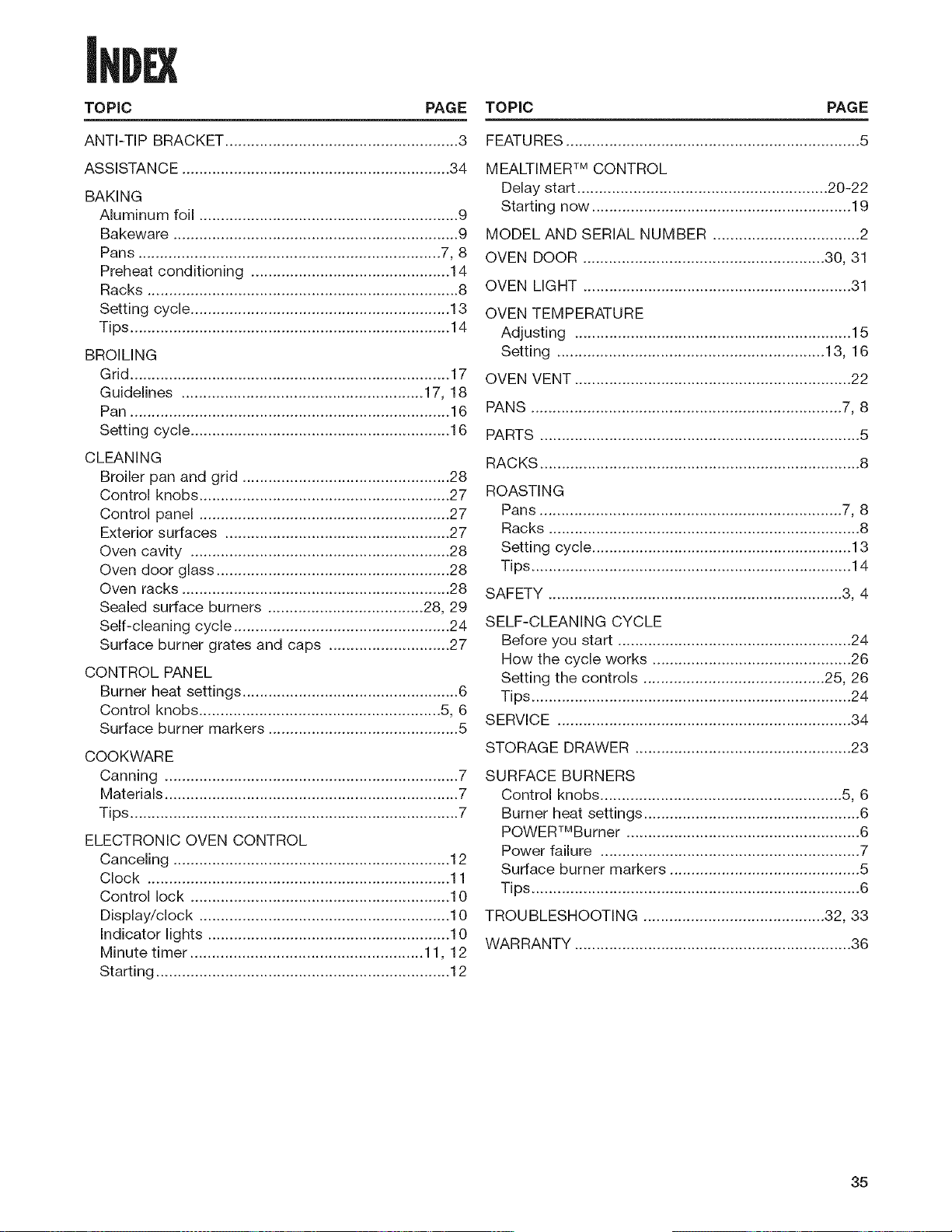
I
TOPIC PAGE
ANTI-TIP BRACKET ...................................................... 3
ASSISTANCE .............................................................. 34
BAKING
Aluminum foil ............................................................ 9
Bakeware .................................................................. 9
Pans ...................................................................... 7, 8
Preheat conditioning .............................................. 14
Racks ........................................................................ 8
Setting cycle ............................................................ 13
Tips .......................................................................... 14
BROILING
Grid .......................................................................... 17
Guidelines ........................................................ 17, 18
Pan .......................................................................... 16
Setting cycle ............................................................ 16
CLEANING
Broiler pan and grid ................................................ 28
Control knobs .......................................................... 27
Control panel .......................................................... 27
Exterior surfaces .................................................... 27
Oven cavity ............................................................ 28
Oven door glass ...................................................... 28
Oven racks .............................................................. 28
Sealed surface burners .................................... 28, 29
Self-cleaning cycle .................................................. 24
Surface burner grates and caps ............................ 27
CONTROL PANEL
Burner heat settings .................................................. 6
Control knobs ........................................................ 5, 6
Surface burner markers ............................................ 5
COOKWARE
Canning .................................................................... 7
Materials .................................................................... 7
Tips ............................................................................ 7
ELECTRONIC OVEN CONTROL
Canceling ................................................................ 12
Clock ...................................................................... 11
Control lock ............................................................ 10
Display/clock .......................................................... 10
Indicator lights ........................................................ 10
Minute timer ...................................................... 11, 12
Starting .................................................................... 12
TOPIC PAGE
FEATURES .................................................................... 5
MEALTIMEF MCONTROL
Delay start .......................................................... 20-22
Starting now ............................................................ 19
MODEL AND SERIAL NUMBER .................................. 2
OVEN DOOR ........................................................ 30, 31
OVEN LIGHT .............................................................. 31
OVEN TEMPERATURE
Adjusting ................................................................ 15
Setting .............................................................. 13, 16
OVEN VENT ................................................................ 22
PANS ........................................................................ 7, 8
PARTS .......................................................................... 5
RACKS .......................................................................... 8
ROASTI NG
Pans ...................................................................... 7, 8
Racks ........................................................................ 8
Setting cycle ............................................................ 13
Tips .......................................................................... 14
SAFETY .................................................................... 3, 4
SELF-CLEANING CYCLE
Before you start ...................................................... 24
How the cycle works .............................................. 26
Setting the controls .......................................... 25, 26
Tips .......................................................................... 24
SERVICE .................................................................... 34
STORAGE DRAWER .................................................. 23
SURFACE BURNERS
Control knobs ........................................................ 5, 6
Burner heat settings .................................................. 6
POWERTMBurner ...................................................... 6
Power failure ............................................................ 7
Surface burner markers ............................................ 5
Tips ............................................................................ 6
TROUBLESHOOTING .......................................... 32, 33
WAR RANTY ................................................................ 36
35
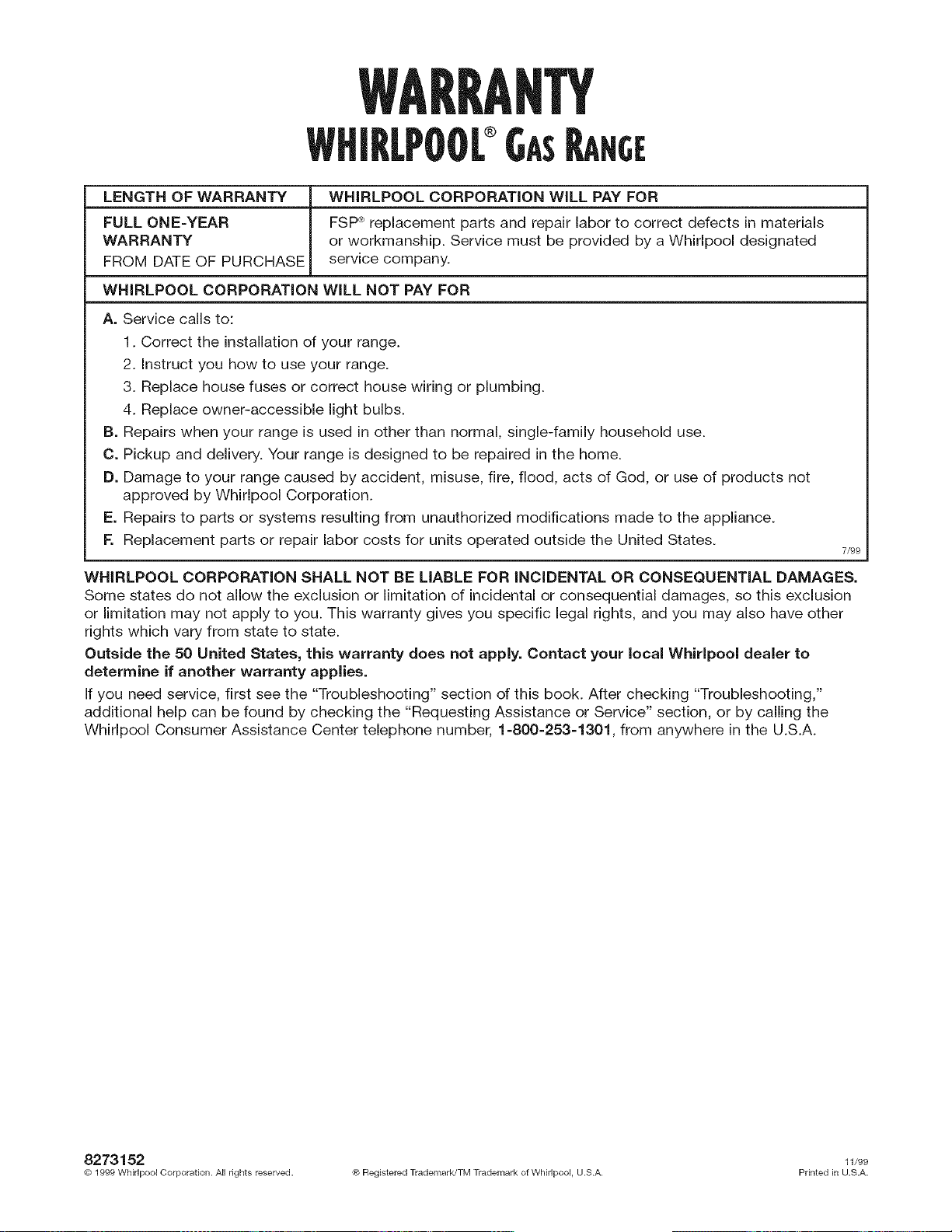
LENGTHOF WARRANTY WHIRLPOOL CORPORATION WiLL PAY FOR
FULL ONE=YEAR FSP®replacement parts and repair labor to correct defects in materials
WARRANTY or workmanship. Service must be provided by a Whirlpool designated
FROM DATE OF PURCHASE service company.
WHIRLPOOL CORPORATION WiLL NOT PAY FOR
A. Service calls to:
1. Correct the installation of your range.
2. Instruct you how to use your range.
3. Replace house fuses or correct house wiring or plumbing.
4. Replace owner-accessible light bulbs.
B. Repairs when your range is used in other than normal, single-family household use.
C. Pickup and delivery. Your range is designed to be repaired in the home.
D. Damage to your range caused by accident, misuse, fire, flood, acts of God, or use of products not
approved by Whirlpool Corporation.
E. Repairs to parts or systems resulting from unauthorized modifications made to the appliance.
E Replacement parts or repair labor costs for units operated outside the United States.
7/99
WHIRLPOOL CORPORATION SHALL NOT BE LIABLE FOR iNCiDENTAL OR CONSEQUENTIAL DAMAGES.
Some states do not allow the exclusion or limitation of incidental or consequential damages, so this exclusion
or limitation may not apply to you. This warranty gives you specific legal rights, and you may also have other
rights which vary from state to state.
Outside the 50 United States, this warranty does not apply. Contact your local Whirlpool dealer to
determine if another warranty applies.
If you need service, first see the "Troubleshooting" section of this book. After checking "Troubleshooting,"
additional help can be found by checking the "Requesting Assistance or Service" section, or by calling the
Whirlpool Consumer Assistance Center telephone number, 1=800=253=1301, from anywhere in the U.S.A.
8273152 11/99
© 1999 Whirlpool Corporation. All rights reserved, d_&Registered TrademarWTM Trademark of Whirlpool, U.S.A. Printed in U.S.A.