Register
your product
www.kaercher.com/welcome
001
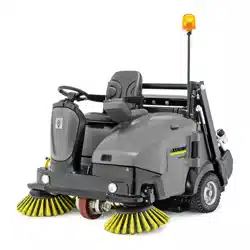
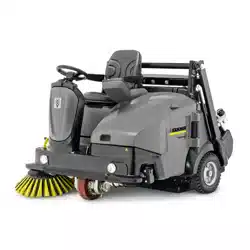
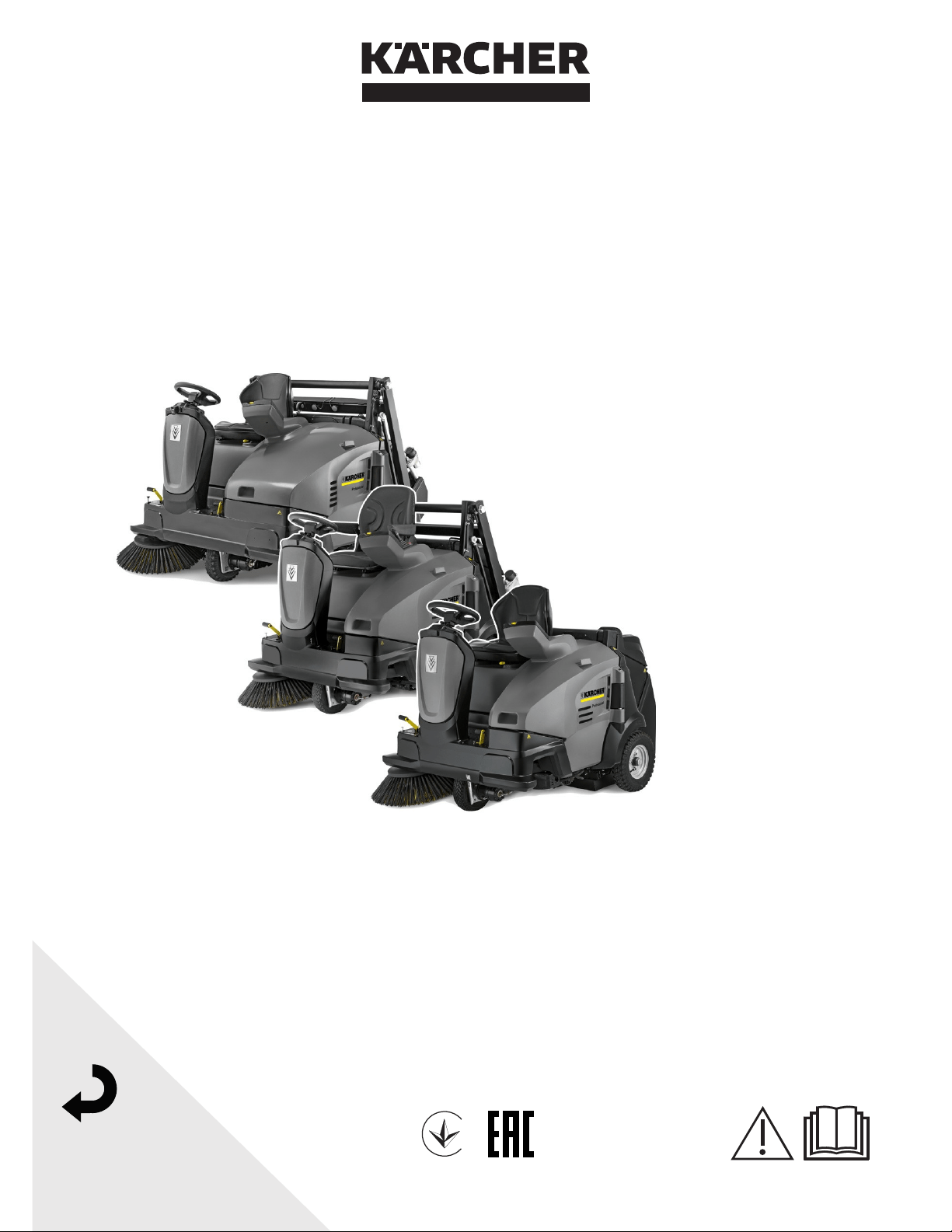
KM 105/100 R (G)
KM 105/110 R (G)
KM 125/130 R (G, D)
59990850 03/22

-
1
Please read and comply with
these original instructions prior
to the initial operation of your appliance and
store them for later use or subsequent own-
ers.
Please read the safety instructions before
start-up!
The devices listed below are described in
these operating instructions.
The devices differ in working width and mo-
torization as well as in the type of waste
emptying, also refer to Chapter "Technical
data".
Appliance configuration
For all appliances the same features are
optionally available. This manual describes
the maximum features.
Waste disposal
There are 2 different options for waste dis-
posal:
Low emptying system
These devices have two waste containers
in the back that must be removed to empty
them.
Lift/tilt emptying mechanism
These devices have a hydraulically operat-
ed waste container that is operated from
the driver seat for emptying.
Appliance motorisation
Two combustion motor variants are availa-
ble:
G: Petrol engine
D: Diesel engine
Your sales outlet should be informed about
any transit damage noted when unpacking
the product.
– Warning and information plates on the
machine provide important directions
for safe operation.
– In addition to the information contained
in the operating instructions, all statuto-
ry safety and accident prevention regu-
lations must be observed.
Notes about the ingredients (REACH)
You will find current information about the
ingredients at:
www.kaercher.com/REACH
The warranty terms published by the rele-
vant sales company are applicable in each
country. We will repair potential failures of
your appliance within the warranty period
free of charge, provided that such failure is
caused by faulty material or defects in man-
ufacturing. In the event of a warranty claim
please contact your dealer or the nearest
authorized Customer Service center.
Please submit the proof of purchase.
ATTENTION
To avoid risks, all repairs and replacement
of spare parts may only be carried out by
authorized customer service personnel.
– Only use accessories and spare parts
which have been approved by the man-
ufacturer. The exclusive use of original
accessories and original spare parts
ensures that the appliance can be oper-
ated safely and trouble free.
– At the end of the operating instructions
you will find a selected list of spare
parts that are often required.
– For additional information about spare
parts, please go to the Service section
at www.kaercher.com.
Contents
Contents . . . . . . . . . . . . . . . . . EN 1
Prior to initial start-up. . . . . . . . EN 1
General notes . . . . . . . . . . . . . EN 1
Environmental protection EN 1
Warranty . . . . . . . . . . . . EN 1
Accessories and Spare
Parts. . . . . . . . . . . . . . . . EN 1
Symbols in the operating in-
structions . . . . . . . . . . . . EN 2
Symbols on the machine EN 2
Proper use. . . . . . . . . . . . . . . . EN 2
Foreseeable misuse. . . . EN 2
Suitable surfaces . . . . . . EN 2
Safety instructions . . . . . . . . . . EN 2
Safety instructions concern-
ing the operation . . . . . . EN 2
Safety information concern-
ing the driving operation. EN 3
Appliances with high empty-
ing system . . . . . . . . . . . EN 3
Machines with driver cabin EN 3
Safety information concern-
ing the combustion engine EN 3
Safety information concern-
ing the transport of the appli-
ance . . . . . . . . . . . . . . . . EN 3
Safety information concern-
ing maintenance and care EN 3
Function. . . . . . . . . . . . . . . . . . EN 3
Operating and Functional Ele-
ments. . . . . . . . . . . . . . . . . . . . EN 4
Appliance view. . . . . . . . EN 4
Operating field . . . . . . . . EN 6
Program selection switch EN 6
Language setting on the
control panel . . . . . . . . . EN 6
KIK-key (Kärcher Intelligent
Key) yellow/grey. . . . . . . EN 6
Safety Devices. . . . . . . . EN 7
Before Startup . . . . . . . . . . . . . EN 7
Remove the appliance coverEN 7
Opening/closing the engine
bonnet . . . . . . . . . . . . . . EN 7
Unloading tips . . . . . . . . EN 7
Moving sweeper without en-
gaging self-propulsion . . EN 8
Moving sweeper by engag-
ing self-propulsion . . . . . EN 8
Install side brush . . . . . . EN 8
Start up . . . . . . . . . . . . . . . . . . EN 8
Prior to start/safety test . EN 8
Refuelling. . . . . . . . . . . . EN 8
Operation. . . . . . . . . . . . . . . . . EN 9
Adjusting driver's seat . . EN 9
Storage area . . . . . . . . . EN 9
Starting up the appliance EN 9
Starting the machine . . . EN 9
Drive the machine . . . . . EN 9
Sweeping mode . . . . . . . EN 9
Emptying waste container EN 10
Turn off the appliance . . EN 11
Transport . . . . . . . . . . . . . . . . . EN 11
Storage/decommissioning . . . . EN 11
Care and maintenance . . . . . . EN 11
General notes . . . . . . . . EN 11
Battery . . . . . . . . . . . . . EN 12
Cleaning . . . . . . . . . . . . EN 12
Maintenance intervals. . EN 12
Maintenance Works . . . EN 13
Troubleshooting . . . . . . . . . . . . EN 17
Troubleshooting by the oper-
ator with plain text messag-
es on the display. . . . . . EN 18
Troubleshooting with coded
error message on the dis-
play . . . . . . . . . . . . . . . . EN 20
Accessories (KM 105/...) . . . . . EN 20
Accessories (KM 125/...) . . . . . EN 20
Technical data (KM 105/...) . . . EN 21
Technical data (KM 125/...) . . . EN 22
EU Declaration of Conformity. . EN 24
Prior to initial start-up
KM 105/100 R G
Low emptying system
G: Petrol engine
Worms EX27
KM 105/110 R G
Lift/tilt emptying mecha-
nism
G: Petrol engine
Worms EX27
KM 125/130 R G
Lift/tilt emptying mecha-
nism
G: Petrol engine
Worms EX40
KM 125/130 R D
Lift/tilt emptying mecha-
nism
D: Diesel engine
Yanmar L100V
General notes
Environmental protection
The packaging material can be
recycled. Please do not throw the
packaging material into house-
hold waste; please send it for re-
cycling.
Old appliances contain valuable
materials that can be recycled.
Please arrange for the proper re-
cycling of old appliances. Please
dispose your old appliances us-
ing appropriate collection sys-
tems.
Engine oil, diesel and petrol must not be
released into the environment. Protect the
ground and dispose of used oil in an envi-
ronmentally responsible way.
Warranty
Accessories and Spare Parts
28 EN
-
2
� DANGER
Warns about immediate danger which can
lead to severe injuries or death.
�
WARNING
Warns about possible danger which could
lead to severe injuries or death.
� CAUTION
Points out a possibly dangerous situation
which can lead to light injuries or property
damage.
ATTENTION
Pointer to a possibly dangerous situation,
which can lead to property damage.
The sweeper is intended for cleaning floor
surfaces for commercial use and e.g. for
the following fields of application:
Car parks
Production facilities
Logistics areas
Hotel
Retail industry
Storage areas
Walkways
– Use this sweeper only as directed in
these operating instructions.
– The machine can only be used on pub-
lic highways with the StVZO extension
kit.
– Any use extending beyond this is not
considered as proper use. The manu-
facturer is not liable for any losses re-
sulting from this; the user alone bears
the risk for this.
– Petrol / diesel engine
: The operation indoors is prohibited.
– The machine may not be modified.
– The machine is only suitable for use on
the types of surfaces specified in the
operating instructions.
– The machine may only be operated on
the surfaces approved by the company
or its authorised representatives.
– The following applies in general: Keep
highly-flammable substances away
from the appliance (danger of explo-
sion/fire).
– Never vacuum up explosive liquids,
combustible gases or undiluted acids
and solvents. This includes petrol, paint
thinner or heating oil which can gener-
ate explosive fumes or mixtures upon
contact with the suction air. Acetone,
undiluted acids and solvents must also
be avoided as they can harm the mate-
rials on the machine.
– Never sweep/vacuum up reactive metal
dusts (e.g. aluminium, magnesium,
zinc), as they form explosive gases
when they come in contact with highly
alkaline or acidic detergents.
– Do not sweep/vacuum up any burning
or glowing objects.
– The appliance is not suitable for sweep-
ing off hazardous substances.
– The machine may not be used or stored
in hazardous areas. It is not allowed to
use the appliance in hazardous loca-
tions.
– It is strictly prohibited to take co-pas-
sengers.
– Pushing/pulling or transporting objects
by means of this appliance is prohibit-
ed.
Asphalt
Industrial floor
Screed
Concrete
Paving stones
– The machine with working equipment
must be checked to ensure that it is in
proper working order and is operating
safely prior to use. Otherwise, the appli-
ance must not be used.
– If the appliance is used in hazardous ar-
eas (e.g. filling stations) the corre-
sponding safety provisions must be ob-
served. It is not allowed to use the ap-
pliance in hazardous locations.
– The operator must use the appliance
properly. The person must consider the
local conditions and must pay attention
to third parties, in particular children,
when working with the appliance.
– Prior to starting work, the operator must
ensure that all protective devices are
properly installed and function correct-
ly.
– The operator of the appliance is liable
for accidents with other individuals or
their property.
– Ensure that the operator wears tight-fit-
ting clothes. Wear sturdy shoes and
avoid wearing loose-fitting clothes.
– Check the immediate vicinity prior to
starting (e.g. children). Ensure suffi-
cient visibility!
– Never leave the machine unattended
so long as the engine is running. The
operator may not leave the machine be-
fore the engine has come to a standstill,
the machine has been protected
against accidental movement and the
parking brake has been applied.
– Please remove the key, when not in
use, to avoid unauthorised use of the
appliance.
– The appliance may only be used by per-
sons who have been instructed in han-
dling the appliance or have proven
qualification and expertise in operating
the appliance or have been explicitly
assigned the task of handling the appli-
ance.
– This machine is not intended for use by
persons (including children) with re-
duced physical, sensory or mental ca-
pabilities, or lack of experience and
knowledge.
– Children should be supervised to pre-
vent them from playing with the appli-
ance.
� DANGER
Risk of injury!
– Do not use the appliance without an
overhead guard in areas where the op-
erator might get hit by falling objects.
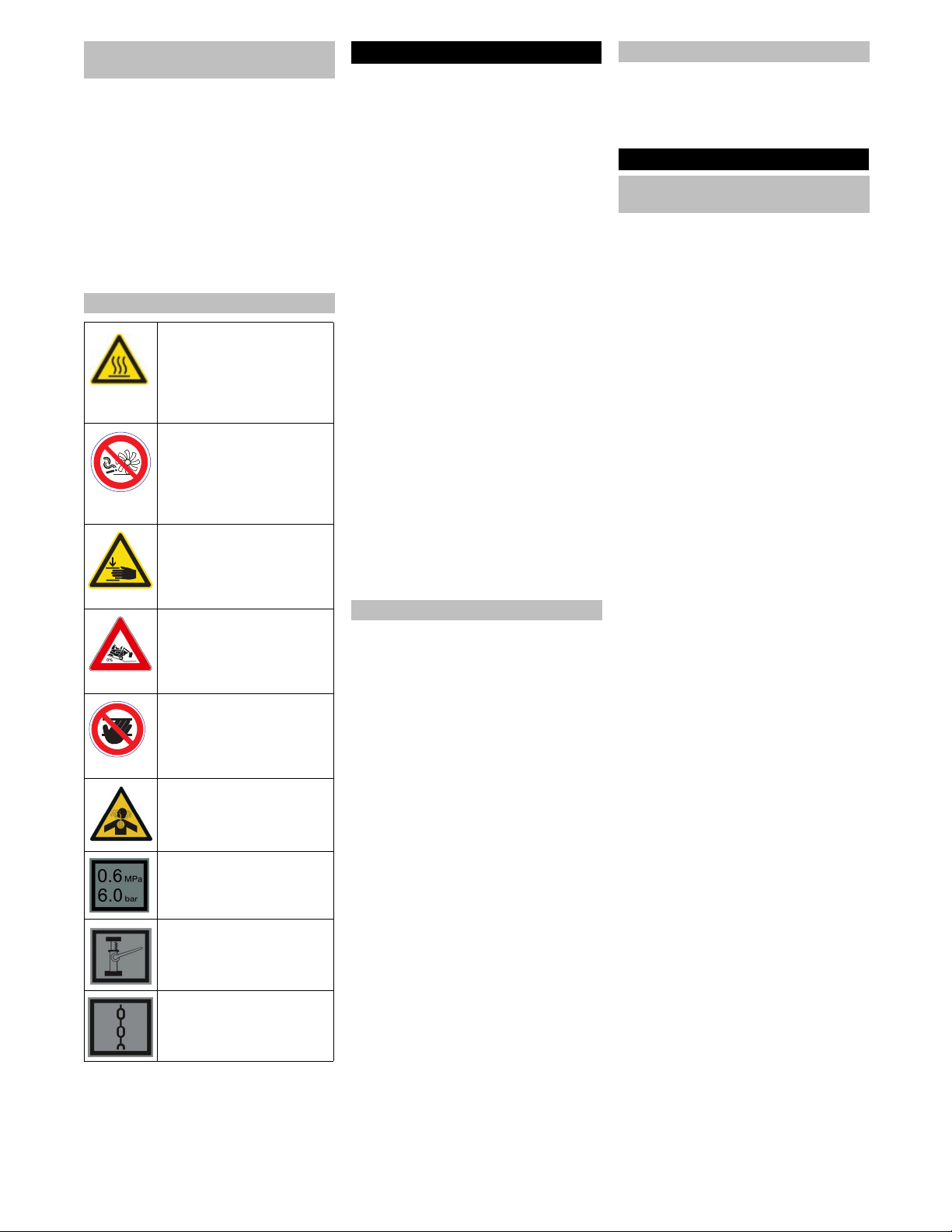
Symbols in the operating
instructions
Symbols on the machine
� CAUTION
Risk of burns on account of
hot surfaces! Allow the ex-
haust to cool down sufficient-
ly before starting work on the
machine.
� DANGER
Risk of fire!
Please do not sweep away
any burning substances such
as cigarettes, match sticks or
similar objects.
� WARNING
Risk of being squeezed or
hurt at the belts, side-brush-
es, containers, machine cov-
er.
� DANGER
Danger of tipping. Only empty
the waste container when the
appliance is placed on a level
and stable ground
� DANGER
Risk of injury on account of
rotating roller brush. Open
the appliance hood only when
the engine has come to a halt.
�
WARNING
Do not inhale exhaust gases
Tyre pressure
Intake points for the jack
Lashing point
Proper use
Foreseeable misuse
Suitable surfaces
Safety instructions
Safety instructions concerning the
operation
29EN
-
3
� DANGER
Danger of tipping if gradient is too high.
KM 105/1xx
– In the direction of travel, inclines and
declines only up to 18%.
KM 125/130
– In the direction of travel, inclines and
declines only up to 16% (diesel motor
and petrol motor).
� DANGER
Danger of tipping on unstable ground.
– Only use the machine on sound surfac-
es.
Danger of tipping with excessive sideways
tilt.
– The gradient perpendicular to the direc-
tion of travel should not exceed 10%.
� WARNING
Risk of accident!
– The travel speed must be adapted to
the existing conditions.
– Drive slowly when cornering.
�
DANGER
Risk of injury!
– When working on the high emptying
system, completely lift and secure the
waste container.
– Perform the safeguarding only from
outside the hazard zone.
– The waste container may only be filled
up to a maximum fill volume or maxi-
mum fill weight.
Refer to chapter "Technical data".
ATTENTION
The overhead guard protects the driver
against larger falling objects. As a canopy it
offers additional protection against weather
conditions. However, it does not provide
rollover protection!
� DANGER
Risk of injury!
– The plastic sheet doors of the driver
cabin have ventilation slots. These
must always be kept clear to ensure ad-
equate ventilation.
� DANGER
Risk of injury!
– Please observe the special safety infor-
mation in the operating instructions of
the engine manufacturer.
– Do not close the exhaust.
– Do not bend over the exhaust or touch
it (risk of burns).
– Do not touch the drive motor (risk of
burns).
– Petrol / diesel engine: It is prohibited to
operate the appliance indoors (risk of
poisoning).
– Gas engine: When operating the appli-
ance indoors, ensure sufficient ventila-
tion and discharge of the exhaust gases
(risk of poisoning).
– Exhaust gases are poisonous and haz-
ardous to health, do not inhale them.
– The engine requires approx. 3-4 sec-
onds to come to a standstill once it has
been switched off. During this time, stay
well clear of the working area.
– The engine is to be brought to a stand-
still and the appliance is to be fastened
properly during transportation.
Close fuel cock.
– First switch off the device and remove
the KIK-key (Kärcher Intelligent Key)
before performing any cleaning or
maintenance tasks on the device, re-
placing parts or switching over to anoth-
er function.
– Always disconnect the battery when
working on the electrics.
– Do not clean the appliance with a water
hose or high-pressure water jet (danger
of short circuits or other damage).
– Maintenance work may only be carried
out by approved customer service out-
lets or experts in this field who are famil-
iar with the respective safety regula-
tions.
– Please observe the local safety regula-
tions regarding portable commercially
used appliances.
– Always use appropriate gloves while
working on the device.
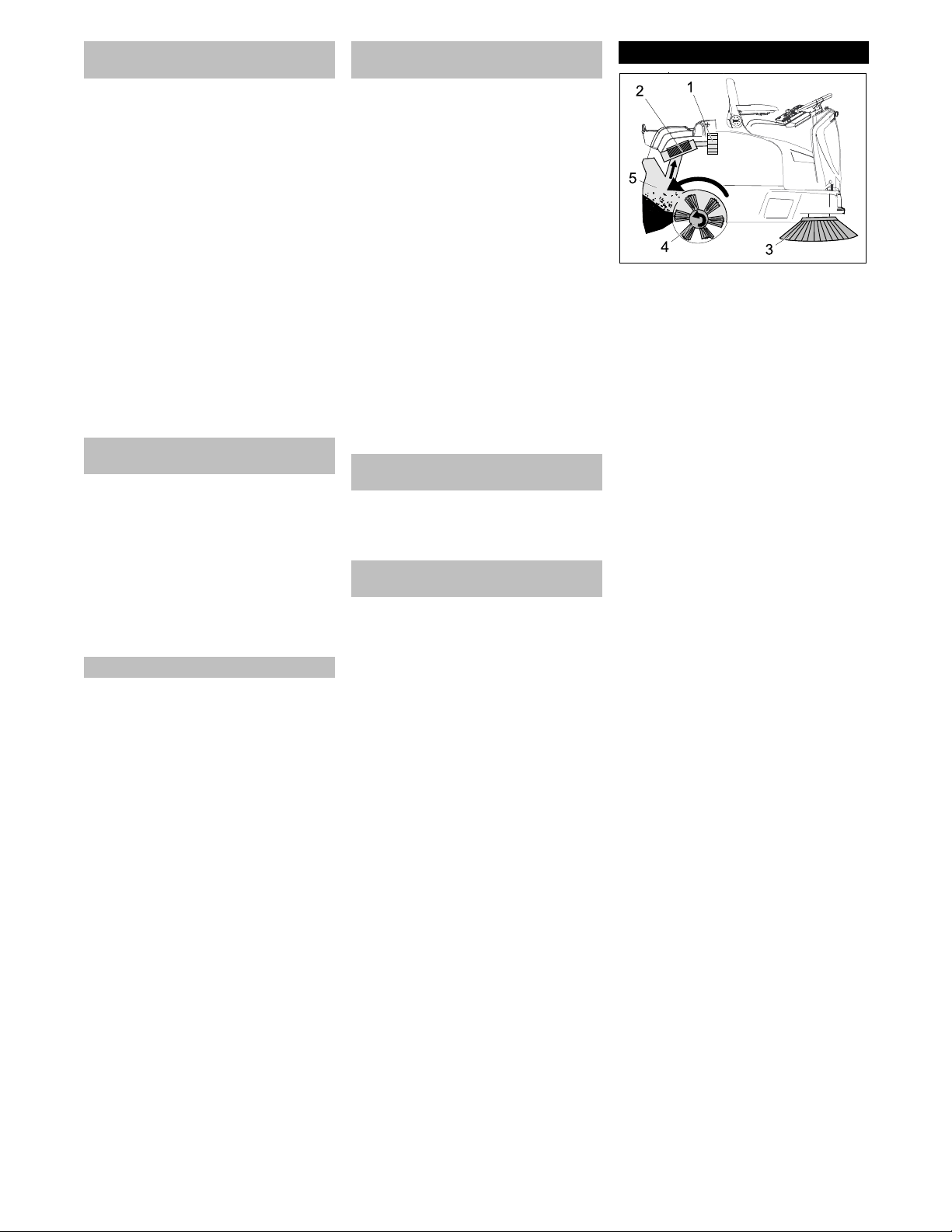
The sweeper operates using the overthrow
principle.
– The side brushes (3) clean the corners
and edges of the surface, moving dirt
and debris into the path of the roller
brush.
– The rotating roller brush (4) moves the
dirt and debris directly into the waste
container (5).
– The dust raised in the container is sep-
arated by the dust filter (2) and the fil-
tered clean air is drawn off by the suc-
tion fan (1).
– The cleaning of the dust filter (2) takes
place automatically.
Safety information concerning the
driving operation
Appliances with high emptying
system
Machines with driver cabin
Safety information concerning the
combustion engine
Safety information concerning the
transport of the appliance
Safety information concerning
maintenance and care
Function
30 EN

-
4
KM 105/100 R
KM 105/110 R
1 Operating field
2 Steering wheel
3 Bonnet left side (engine bonnet)
4 Unlocking device hydraulic oil tank
5 Hydraulic oil tank
6 Pedal for raising/lowering bulk waste
flap
7 Localised work illumination (option)
8 Left side brush (optional)
9 Front wheel
10 Fastener of the side brush
11 Right side brush
12 Drive pedal
13 Sickle brush (option)
14 Holding rail for home base
15 Appliance cover right side
16 Rear wheel
17 Lever for seat adjustment
18 Parking brake
19 Waste container high emptying system
(KM 105/110 R)
20 Waste container low emptying system
(KM 105/100 R)
21 Storage area
22 Storage cylinder support (safeguard
high emptying system)
23 Dust filter (flat-fold filter)
24 Seat (with seat contact switch)
25 Button for two-handed operation
(KM 105/110 R)
26 Rear sealing strip
27 Roller brush
28 Lateral sealing strip on the right
29 Lateral sealing strip on the left
30 Front sealing strip
31 Petrol engine
32 Maintenance-free batteries
33 Freewheel lever
34 Fuel tank
Optional
The following equipment that is installed
when ordering ex work or can be subse-
quently installed from Service is not dis-
played.
– Beacon lamp
– Weather protection cabin with wind-
screen and windscreen wiper
– Weather protection canopy
– Overhead guard
– Side brush cover
– Comfort seat
Operating and Functional Elements
Appliance view
31EN

-
5
KM 125/130 R (G, D)
1 Operating field
2 Steering wheel
3 Bonnet left side (engine bonnet)
4 Hydraulic oil tank
5 Protective grid oil cooler
6 Left side brush (optional)
7 Pedal for raising/lowering bulk waste
flap
8 Front wheel
9 Drive pedal
10 Fastener of the side brush
11 Right side brush
12 Sickle brush (option)
13 Rear wheel
14 Appliance cover right side
15 Lever for seat adjustment
16 Parking brake
17 Holding rail for home base
18 Waste container high emptying system
19 Seat (with seat contact switch)
20 Button for two-handed operation
21 Dust filter (flat-fold filter)
22 Storage cylinder support (safeguard
high emptying system)
23 Rear sealing strip
24 Roller brush
25 Lateral sealing strip on the left
26 Front sealing strip
27 Lateral sealing strip on the right
28 Petrol engine
29 Maintenance-free batteries
30 Fuel tank
31 Diesel engine
32 Freewheel lever
Optional
The following equipment that is installed
when ordering ex work or can be subse-
quently installed from Service is not dis-
played.
– Beacon lamp
– Weather protection cabin with wind-
screen and windscreen wiper
– Weather protection canopy
– Overhead guard
– Side brush cover
– Comfort seat
– Working light
32 EN

-
6
1 Main switch
Position 0: Appliance is decommis-
sioned
Position I: The appliance is ready for
operation.
2 Button suction blower with indicator
lamp
Lamp is illuminated: Suction blower
and filter dedusting deactivated:
– for sweeping damp or wet floors, or fi-
brous dry waste such as straw, hay, etc.
Lamp off: Suction blower and filter de-
dusting activated (default):
– for sweeping dry floors
3 KIK-key (Kärcher Intelligent Key)
yellow - operator
grey - supervisor
4 Display sweeping programme "ECO"
– for even floors with minor soiling
Note: This sweeping programme is ac-
tivated by default with every start-up of
the sweeping system, even if another
sweeping programme was selected be-
fore.
Note: The selected sweeping pro-
gramme is shown on the display, the
setting is effected by means of the di-
rection keys.
5 Display sweeping programme "MEDI-
UM"
– for normally soiled floors
6 Display sweeping programme
"HEAVY"
– for heavily soiled and uneven floors
7 Display
8 Raise waste container
9 Tip waste container out
10 Swivel in the waste container
11 Lower waste container
12 Confirmation key "OK"
13 Horn
14 Program selection switch
Note: Functions are only activated when
the main switch is switched on and the KIK-
key is inserted.
A OFF
Device is switched off
B ON
Appliance is ready for operation (en-
gine off)
C Engine starts automatically
Driving to the Place of Use.
With appliances with low emptying sys-
tem:
Roller brush and side brushes are lifted
and turning.
With appliances with high emptying
system:
Roller brush and side brushes are
raised and switched off.
D Sweeping with sweep roller
Roller brush is lowered.
E Sweeping with roller brush and right
side brush
Roller brush and right side brush are
lowered, the sickle brush (optional) is
activated.
F Sweeping with roller brush and right
and left side brush
Roller brush, right side brush and left
side brush (optional) are lowered, the
sickle brush (optional) is activated.
The default language on the display is Eng-
lish.
Select the desired language on the control
panel prior to working with the machine.
How the language is set for the yellow and
grey key (Intelligent Key) is shown in the il-
lustrated brief instructions on Page 2 of
these operating instructions or in the follow-
ing Chapter "Intelligent Key yellow/grey".
The parameters for the various cleaning
programmes are preset. The indication
takes place on the display.
The texts on the display are plain texts and
therefore self-explanatory. The selection of
the desired sweeping program is made by
means of the direction key "to the right".
Shown display texts are:
>Operating hours and sweeping pro-
gramme<
>Usability of the roller brush: .. %<
>Day counter .. h .. min<
Extra with upgrade kits:
>Switch on beacon light<
>Switch on working light<
If you wish to permanently change the pa-
rameters, you must use a grey intelligent
key to make the settings. The procedure is
described in section "Grey intelligent key".
With the grey intelligent key the authorisa-
tions for the yellow intelligent key are ena-
bled.
Parameters that are adjusted with the grey
Intelligent Key, are kept until another set-
ting is selected.
Insert the grey intelligent key.
Push the direction key "upwards" or
"downwards" until the >key manager<
menu appears.
Note: In this menu item the authorisa-
tions for the yellow intelligent key are
enabled.
Confirm the message with the "OK"
key.
Remove the grey intelligent key and
within the seconds being counted down
insert the yellow intelligent key that is to
be personalised.
Push the direction keys "upwards" or
"downwards" and select menu items.
Available menu items are:
Operating field Program selection switch
Language setting on the control
panel
KIK-key (Kärcher Intelligent Key)
yellow/grey
Yellow KIK-key
Grey KIK-key
Available menu items are:
>Language selection<
18 languages are available in the language
selection, among others German, English,
French, Spanish, Greek and Russian.
>Device operation locked/enabled<
The yellow KIK-key can be locked for the
operation of this machine here.
>Sweeping track locked/enabled<
With a locked sweeping track the sweeping
programme ECO, MEDIUM or HEAVY is to
be set and cannot be changed by the oper-
ator. With an enabled sweeping track you
can change between the 3 sweeping pro-
grammes during operation.
>Dust level locked/enabled<
Adaption of the automatic filter cleaning
(TACT) to the environment.
>Light on/off<
The operator can switch on the light (op-
tional).
>Light locked/enabled<
Continuous operation with light is activated
or locked.
>Flashing beacon locked/enabled<
The operator can choose whether he or
she wants to drive with or without the flash-
ing beacon; when starting the device, the
flashing beacon is on automatically.
>Flashing beacon mode locked/ena-
bled<
It can be selected whether the flashing
beacon is necessarily on (even if it has
been switched off by the operator) or not.
>Speed locked/enabled<
Without function
>Sweeping speed locked/enabled<
Without function
33EN

-
7
To transfer the settings to the yellow in-
telligent key:
While the seconds are counted down,
select >YES< with the direction key "to
the right" and confirm with the "OK" key.
Note: Thereby the settings made are
transferred to the yellow intelligent key
and are enabled.
Make sure that there is no more than 1
KIK-key near the control panel.
If this should be the case, the fault P/11
may appear on the display.
� WARNING
This appliance is equipped with a variety of
safety installations. The proper function of
every safety installation must be checked
prior to operation and must NOT be over-
ridden!
The main switch on the control panel
serves the immediate shutdown of the
combustion engine and the electrical drives
in case of emergencies and may only be
used for this purpose.
The left engine bonnet is equipped with a
safety installation that switches off the run-
ning combustion engine when opened and
issues a warning message on the display.
The emergency stop is located at the side
of the engine.
Actuating the emergency stop:
Open the engine hood.
Push down the red lever (1).
For resetting, push lever (2) to the right.
The high emptying system is equipped with
a safety installation that blocks the sweep-
ing operation during the emptying proce-
dure.
Appliances with a high emptying system
are equipped with a button for two-hand op-
eration.
For emptying the waste container, the
button must be pressed together with
the keys of the high emptying system.
�
DANGER
Risk of injury!
When working on the high emptying
system, completely lift and secure the
waste container.
Perform the safeguarding only from
outside the hazard zone.
During any work underneath the lifted
waste container, the lifting cylinder must be
secured by means of a safety support.
The safety support is attached to the cross-
beam by means of 2 star screws for stor-
age.
Remove safety support, in order to do
this, unscrew 2 star screws.
Insert safety support into the piston rod
for the lifting cylinder and secure it.
Note: The round notch must point up-
wards.
ATTENTION
The appliance cover with the seat may only
be removed by the authorised aftersales
service for repair or maintenance work.
The description can be found in the service
manual.
ATTENTION
The bonnet may only be opened when the
programme selector switch is in the "OFF"
position and the KIK-key is removed.
Opening the engine bonnet during opera-
tion of the appliance is prohibited.
For refuelling and maintenance work the
left engine bonnet must be opened.
Grab the front of the engine bonnet on
the recessed grip, unlock it towards the
top and swivel it to the side.
Note: The engine bonnet is equipped with
a safety installation that switches off the
running combustion engine when opening
the bonnet and issues a warning message
on the display. If the bonnet is not properly
closed, the engine cannot be started.
If a warning message is pending, it can be
reset as follows:
Completely close the bonnet (locking in
place).
Turn the programme selector switch to
"ON".
Sit on the driver's seat.
�
DANGER
Risk of injury, risk of damage!
Observe the weight of the appliance
when you load it!
Do not use a forklift truck to unload the
machine as this may damage it.
ATTENTION
Charge the battery before commissioning
the machine.
When loading the appliance a suitable
ramp must be used!
If the machine is delivered on a pallet,
you must create an unloading ramp us-
ing the boards provided.
To unload the machine, proceed as follows:
Cut plastic packing belt and remove foil.
>Blower/pump locked/enabled<
Without function
>Enable delete day counter<
It can be selected whether the operator is
able to reset the day counter.
>Programming yes/no<
As the last menu item the >Program-
ming< display with the seconds counted
down appears.
Notes on operation using the KIK-key
(Kärcher Intelligent Key)
Safety Devices
Main switch
Bonnet left side (engine bonnet)
Available menu items are:
Emergency switch-off (diesel engine)
Waste container (high emptying system)
Button for two-hand operation
Safety support waste container (high
emptying system)
Before Startup
Remove the appliance cover
Opening/closing the engine bonnet
Unloading tips
Net weight (transport weight)
The net weight is between 400 kg and
608 kg depending on the unit model *.
Refer to chapter "Technical data".
* If upgrade kits are installed, the weight is
respectively higher.
34 EN

-
8
Remove the elastic tape fasteners at
the stop points.
Connect battery (see section on Care
and maintenance)
Four indicated floor boards of the pallet
are fastened with screws. Unscrew
these boards.
Place the boards on the edge of the pal-
let. Place the boards in such a way that
they lie in front of the four wheels of the
machine. Fasten the boards with
screws.
Slide the four support beams included
in the packaging under the ramp.
Remove the wooden blocks for locking
the wheels.
Release parking brake.
Slide the machine over the prepared
ramp from the pallet.
The machine can be moved in 2 ways:
(1) Push appliance (see Chapter "Commis-
sioning/moving the sweeper without self-
propulsion").
(2) Carefully drive the appliance off the pal-
let (see Chapter "Commissioning/moving
the sweeper with self-propulsion").
�
DANGER
Risk of injury!
Secure the device against rolling away
prior to engaging the freewheel.
Note
The travel drive is inoperable.
Braking effect exists no more.
�
CAUTION
Risk of damage to the hydrostatic axle
drive!
Push the appliance only slowly and only
over short distances (do not tow under
any circumstances).
Open the engine hood.
Operate the freewheel lever (open).
Freewheel lever operated - appliance is
movable
Release parking brake.
After moving the appliance:
Move the freewheel lever into the rear
position (close).
Close engine bonnet.
Activate parking brake.
Note: Upon delivery of the appliance the
battery terminal is disconnected, connect
the battery terminal prior to initial commis-
sioning.
Open the engine hood.
Move the freewheel lever into the rear
position (close).
Freewheel lever in rear position - appliance
is ready to start
Close engine bonnet.
Observe the notes on driving in Chapter
"Commissioning/Starting and driving
the appliance".
After the appliance has been driven to
its destination, switch off the engine and
operate the parking brake.
Upon delivery the side brush is not in-
stalled, install side brush prior to commis-
sioning.
Refer to Chapter "Care and mainte-
nance/replacing the side brush".
� DANGER
Risk of burns in the area of the engine, ex-
haust pipe, and manifold as well as at the
hydraulic drive motor at the front wheel.
The description of the checks and work be-
low can be found in Chapter "Care and
maintenance/maintenance work".
Prior to initial commissioning: Connect
the pole terminal to the battery terminal.
Check the safety function of the engine
bonnet (combustion engine may not
start up with open bonnet).
Check function of seat contact switch.
Check engine oil level.
Check the filling level of the front hy-
draulic oil tank.
Check the roller brush and the side
brush for wear, foreign bodies and
wrapped belts
KM 125/... Check the protective grid of
the oil cooler for soiling.
During a standstill of the machine:
Check the drive pedal for ease of move-
ment in order to guarantee functional
reliability or timely detect a jamming of
the pedal.
Empty waste container.
Check tyre pressure.
Petrol and diesel engine:
Check fill level of fuel tank.
�
Danger
Risk of explosion!
Only fuel up while motor is turned off.
Only use the fuels specified in the Op-
erations Manual.
Do not refuel the machine in enclosed
spaces.
Smoking and naked flames are strictly
prohibited.
Ensure that no fuel reaches the hot
open surfaces.
Figure: Petrol motor (KM 105/...)
1 Fuel tank
2 Tank lid
3 Tank indicator
4 Fuel cock
Figure: Petrol motor (KM 125/...)
1 Fuel tank
2 Tank lid
3 Tank indicator
Figure: Diesel engine (KM 125/...)
1 Fuel tank
2 Tank lid
Switch off engine.
Activate parking brake.
Open the engine hood.
Petrol engine: Read the filling level at
the fuel gauge. The red area indicates
the filling level.
Open fuel filler cap.
Use and install a funnel with a filter.
Petrol engine: Fill up with "regular un-
leaded petrol".
Moving sweeper without engaging
self-propulsion
Moving sweeper by engaging self-
propulsion
Install side brush
Start up
Prior to start/safety test
Maintenance Works
Refuelling
35EN

-
9
Diesel engine: Fill up with "diesel".
(below 6°C: winter diesel)
Wipe off any spilt fuel, remove funnel
and close fuel filler cap.
Close engine bonnet.
�
DANGER
Long hours of using the appliance can
cause circulation problems in the hands on
account of vibrations.
It is not possible to specify a generally valid
operation time, since this depends on sev-
eral factors:
– Proneness to blood circulation deficien-
cies (cold, numb fingers).
– Low ambient temperature. Wear warm
gloves to protect hands.
– A firm grip impedes blood circulation.
– Continuous operation is worse than an
operation interrupted by pauses.
In case of regular, long-term operation of
the device and in case of repeated occur-
rence of the symptoms (e.g. cold, numb fin-
gers) please consult a physician.
� DANGER
Risk of accident!
Do not adjust the driver seat while driv-
ing.
Pull seat adjustment lever inwards.
Slide seat, release lever and lock in
place.
Check that the seat is properly locked in
position by attempting to move it back-
wards and forwards.
Note: The max. load of the storage area is
20 kg.
Ensure safe fastening of the cargo.
Preconditions for the functioning operation
of the appliance are:
– The KIK-key (grey or yellow) with the
authorisation for the operation of the
device must be inserted in the key slot
of the control panel.
– The main switch must be in position 1.
– The programme selector switch may
not be in the "OFF" position.
– Waste container and left engine bonnet
must be closed and locked in place.
Note: The appliance is equipped with a
seat contact switch. When leaving the driv-
er seat for more than 1.5 seconds, the com-
bustion engine is switched off. The lowered
roller brush and side brushes are automat-
ically raised.
Open the engine hood.
Open fuel cock.
Figure: Open fuel cock (petrol/gas engine)
Figure: Open fuel cock (diesel engine)
Close engine bonnet.
Sit on the driver's seat.
Activate parking brake.
Do NOT press the accelerator pedal.
Turn the programme selector switch to
position C (drive).
Note: Engine starts automatically
Starting in cold weather:
Petrol motor: Motor has an automatic
choke.
Diesel engine: If the start-up process fails,
actuate the decompression lever (1) on the
engine and repeat the start-up process.
Figure: Decompression lever (diesel en-
gine)
– If the operator gets up from the seat for
more than 1.5 seconds, the combustion
motor stops.
– If the operator sits down on the driver
seat again, the engine starts automati-
cally.
– The combustion engine shuts off if the
seat is left and the programme selector
switch is turned to the "ON" position or
the KIK-key is removed. The side
brushes and roller brush are raised. Af-
ter another 5 minutes the device shuts
off automatically.
ATTENTION
Risk of damage to the drive! Prior to every
run, ensure that the freewheel lever is in the
rear position (closed).
Always press the accelerator pedal careful-
ly and slowly. Do not jerkily change from re-
verse to forward drive or vice versa.
The travel speed must be adapted to the
existing conditions.
1 Accelerator pedal, "forwards"
2 Accelerator pedal, "reverse"
Release parking brake.
Press slowly the accelerator pedal "for-
ward".
� DANGER
Risk of injury!
When reversing, there must not be any
risk for third parties, have somebody
marshal the driver if necessary.
Press slowly the accelerator pedal "re-
verse".
– The accelerator pedal can be used to
vary the driving speed infinitely.
– Avoid pressing the pedal suddenly as
this may damage the hydraulic system.
Release the accelerator pedal, the ma-
chine brakes automatically and stops.
Note: Should the appliance not come to
a stop, operate the parking brake or
push the main switch to the "0" position
for an "Emergency stop".
ATTENTION
Objects or loose obstacles may not be run
over or pushed.
Stationary obstacles of a height of up to
6 cm (2
1/3
inch) can be slowly and care-
fully driven over.
Drive over stationary obstacles higher
than 6 cm (2
1/3
inch) only when using a
suitable ramp.
� DANGER
Risk of personal injury or damage!
If the bulk waste flap is open, stones or
gravel may be flung forwards by the roll-
er brush. Make sure that this does not
endanger persons, animals or objects.
ATTENTION
Do not sweep up packing strips, wire or
similar objects as this may damage the
sweeping mechanism.
Operation
KM 125/130 R D, G
Risk of hearing impairment. Al-
ways use proper hearing protec-
tion while working with the device.
Adjusting driver's seat
Storage area
Starting up the appliance
Starting the machine
Open fuel cock
Start the engine
Notes concerning the automatic choke
of the engine
Drive the machine
Drive forward
Reverse drive
Driving method
Brakes
Driving over obstacles
Sweeping mode
36 EN

-
10
ATTENTION
To avoid damaging the floor, do not oper-
ate the sweeper in one spot when the roller
brush and the side brushes are lowered.
– Adjust the driving speed to the condi-
tions in order to achieve an optimal
cleaning result.
– Empty the waste container at regular in-
tervals during the sweeping operation.
Note: If mainly gravel was swept up
(high weight of the waste), empty the
waste container sooner.
With appliances with low emptying
system: There is a marking for the
maximum filling level for gravel on the
waste container. The marking becomes
visible when the waste container is re-
moved.
– Lower the roller brush while cleaning
surfaces.
– Preferably perform the cleaning of side
edges with the right side brush.
For cleaning with the roller brush 3 different
sweeping programmes are available, they
are shown by 2 arrows on the display.
Note: Only select sweeping programmes
when the appliance is at a standstill.
1 Sweeping programme "ECO"
2 Sweeping programme "MEDIUM"
3 Sweeping programme "HEAVY"
4 Indicator (2 arrows)
Note: By default the sweeping programme
"ECO" is activated during start-up.
If another sweeping programme is re-
quired, proceed as follows (a precondition
is that a KIK-key with the enabled authori-
sation is inserted in the control panel).
(Programme selector switch in position D,
E, F)
Stop the machine.
Push the direction key "to the right" in
order to select the desired sweeping
programme.
Note: The indicator (2 arrows) on the
display points to the selected sweeping
programme.
Note: To sweep up larger items up to a
height of 50 mm, e.g. cigarette packs, the
bulk waste flap must be raised briefly.
Raising bulk waste flap:
Press the pedal for the bulk waste flap
forwards and keep pressed down.
To lower it, take foot off pedal.
Note: An optimum cleaning result can
only be achieved if the bulk waste flap
has been lowered completely.
Turn the programme selector switch to
the E or F position. The side brushes
and roller brush are lowered.
To protect the filter from moisture:
Switch the suction blower off using the
button on the control panel.
Note: The indicator lamp is illuminated.
To avoid clogging of the filter system:
Switch the suction blower off using the
button on the control panel.
Work with suction blower switched on.
Note: The suction blower is activated
by default when switching on a sweep-
ing programme.
The appliance is equipped with an auto-
matic filter cleaning system.
The cleaning takes place automatically ap-
prox. every 15 seconds. In the process a
short blow-off sound can be heard.
Check the installed dust filter for con-
tamination every once in a while. Re-
place a heavily contaminated or defec-
tive filter.
Note: After parking the appliance, wait at
least 1 minute before opening or emptying
the waste container. This way the dust can
settle.
�
DANGER
It is prohibited to remove the waste contain-
er while the engine is running (third per-
son).
Slightly lift the waste container and
swivel it downwards to the rear, then
unhinge the waste container.
Empty waste container.
Slide the waste container in and lock it
in place, check for proper seating of the
waste container
Risk of crushing hands!
Empty the second waste container.
The high emptying system of the appliance
allows the direct disposal of the waste in
the waste container into a refuse container
(for maximum unloading height see Chap-
ter "Technical data").
� DANGER
Danger of tipping!
Place the device on an even surface
during the emptying process.
Risk of injury!
During the emptying process, persons
and animals must not stay within the
swivelling range of the waste container.
Risk of crushing!
Never reach into the rod assembly for
the drainage mechanism. Do not stay
under the raised container.
� CAUTION
Risk of accident, risk of injury!
Do not switch into the sweeping mode
(programme selector switch in D, E, F
position) while the waste container is
raised.
ATTENTION
The container can only be tilted and emp-
tied once a set minimum level has been
reached.
Information on the sweeping operation
Sweeping with sweep roller
Selecting a sweeping programme
Sweeping with bulk waste flap raised
Sweeping with side brushes
Sweeping damp or wet floors
Sweep in fibrous and dry waste (such as
dry grass, hay)
Sweeping dry floors
Filter dedusting
Emptying waste container
With appliances with low emptying
system
With appliances with high emptying
system
37EN

-
11
Turn the programme selector switch to
position C (drive).
Roughly position the appliance.
Note
The waste container can only be emptied in
two-hand operation. For this purpose, push
the two-hand operation button on the bon-
net together with the corresponding direc-
tion keys 1 to 4 on the control panel.
Raise waste container: Push the two-
hand operation button and direction key
1.
Slowly drive towards the collection con-
tainer.
Lock parking brake.
Tipping the waste container outwards:
Push the two-hand operation button
and direction key 2.
Completely tip the waste container in-
wards: Push the two-hand operation
button and direction key 3.
Release parking brake.
Drive away the collection container
slowly.
Lower the waste container to the end-
position: Push the two-hand operation
button and direction key 4.
Note: The waste container can only be
completely lowered after it has been
tipped inwards into its initial position.
Note: After switching off the appliance, the
dust filter is automatically dedusted.
Park the sweeper on an even surface.
Turn the program selection switch to
"OFF".
Activate parking brake.
Remove the key.
Open the engine hood.
Close the fuel supply.
Figure: Close fuel cock (petrol engine)
Figure: Close fuel cock (diesel engine)
Close engine bonnet.
� DANGER
Risk of accident!
When loading the appliance the free-
wheel lever must be closed. Only then
the travel drive and parking brake are
ready for operation. The appliance
must always be moved up or down
slopes by engaging self-propulsion.
Risk of personal injury or damage!
Observe the net weight (transport
weight) of the device during transport
on trailers or vehicles.
When transporting in vehicles, secure
the appliance according to the guide-
lines from slipping and tipping over.
Petrol engine/diesel engine: Close
fuel cock.
Secure the wheels of the machine with
wheel chocks.
Secure the machine with tensioning
straps or cables.
Note: Observe markings for fixing
points on the base frame (chain sym-
bols). Only unload the appliance on lev-
el grounds.
Remove KIK-key.
Disconnect the battery of the sweeper
during transport.
Park the sweeper on a level surface in
a dry, frost protected area. Protect it
against dust by means of covering ma-
terial.
Turn the program selection switch to
"OFF".
Remove KIK-key.
Lock the sweeper to ensure that it does
not roll off.
Additionally observe the following points if
the sweeper is not used over a longer peri-
od of time:
Change engine oil.
Diesel engine: Either completely drain
the fuel tank or completely fill it with fu-
el.
Close fuel cock.
Let the engine turn without starting it
every 6 months.
Petrol engine: Close the fuel cock, re-
move the fuel hose from the fuel cock.
Open the fuel cock and completely
drain the fuel into a suitable container.
Then attach the fuel hose and close the
fuel cock.
Unscrew the spark plug and put 5 ml of
engine oil in the spark plug bore. Rotate
the engine several times without the
spark plug (do not start). Screw in the
spark plug.
Clean the inside and outside of the
sweeper.
Park the machine in a safe and dry
place.
Turn the program selection switch to
"OFF".
Remove KIK-key.
Set the main switch to the "0" position.
Activate parking brake.
Disconnect the negative terminal of the
battery if the appliances is not used for
more than 4 weeks.
Figure is symbolic
Charge battery approx. every 2 months.
– Maintenance work may only be carried
out by approved customer service out-
lets or experts in this field who are famil-
iar with the respective safety regula-
tions.
– Mobile appliances used for commercial
purposes are subject to safety inspec-
tions according to VDE 0701.
– Use only roller brushes/ side-brushes
that are provided with the appliance or
specified in the Operations Manual.
The use of other roller brushes/ side-
brushes can affect the safety of the ap-
pliance.
– The battery installed in the appliance is
maintenance-free.
� DANGER
Risk of personal injury or damage!
First switch off the device and remove
the KIK-key (Kärcher Intelligent Key)
before performing any cleaning or
maintenance tasks on the device, re-
placing parts or switching over to anoth-
er function.
Turn off the appliance
Close fuel cock
Transport
Storage/decommissioning
Care and maintenance
General notes
38 EN

-
12
Always disconnect the battery when
working on the electrics.
Turn the program selection switch to
"OFF".
Remove KIK-key.
ATTENTION
Using non-rechargeable batteries is prohib-
ited.
Only use batteries and chargers approved
by the manufacturer.
Replace batteries with the same battery
type only.
Prior to disposal of the vehicle, the batter-
ies must be removed and disposed of in ac-
cordance with local regulations.
ATTENTION
Follow accident prevention regulations as
well as DIN VDE 0510, VDE 0105 T.1.
Please observe the following warning notes
when handling batteries:
� DANGER
Risk of fire and explosion!
Do not place tools or similar items on
the battery. Risk of short-circuit and ex-
plosion.
Smoking and open flames must be
strictly avoided.
Rooms where batteries are charged
must have good ventilation because
highly explosive gas is emitted during
charging.
Danger of causticization!
Use caution with leaking batteries (sul-
phuric acid may leak).
Risk of injury!
Ensure that wounds never come into
contact with lead. Always clean your
hands after working on batteries.
When used normally, and when observing
the instructions, lead-acid batteries do not
pose any risk.
However, keep in mind that lead-acid bat-
teries contain sulphuric acid which can
cause chemical burns and corrosion.
If there is spillage or, if the battery is
leaking, acid is escaping, lay down a
binding agent such as sand. Do not let
it reach the sewer system, soil or a body
of water.
Neutralise the acid with lime/baking
soda and dispose of it according to local
regulations.
Contact a waste management compa-
ny to dispose of faulty batteries.
Rinse thoroughly with lots of clear water
if acid gets into the eye or comes in con-
tact with the skin.
Then consult a doctor immediately.
Wash off the acid If it comes in contact
with the clothes.
Change clothing.
Note: Upon delivery of the appliance the
battery terminal is disconnected, connect
the battery terminal prior to initial commis-
sioning.
Open the engine hood.
Unscrew and remove the angle bracket
of the battery.
Insert battery in battery mount.
Attach the battery by means of an angle
bracket.
Connect pole terminal (red cable) to
positive pole (+).
Connect pole terminal to negative pole
(-).
Attach the pole covers.
Note: Check that the battery pole and pole
terminals are adequately protected with
pole grease.
ATTENTION
Comply with safety regulations on the han-
dling of batteries. Observe the directions
provided by the manufacturer of the charg-
er.
ATTENTION
Charge the battery only with an appropriate
charger.
Open the engine hood.
Disconnect battery.
Connect positive terminal cable from
the charger to the positive pole connec-
tion on the battery.
Connect negative terminal cable from
the charger to the negative pole con-
nection on the battery.
Plug in mains connector and switch on
charger.
Note: When the battery is charged, first re-
move the charger from the mains and then
disconnect it from the battery.
Open the engine hood.
Disconnect pole terminal to negative
pole (-).
Disconnect pole terminal to positive
pole (+).
Remove the battery from the battery
holder.
Dispose of the used battery according
to the local provisions.
� CAUTION
Risk of damage!
Do not clean the appliance with a water
hose or high-pressure water jet (danger
of short circuits or other damage).
Do not use aggressive and abrasive de-
tergents.
�
DANGER
Health hazard!
Wear dust mask and protective gog-
gles.
Open the engine hood.
Blow through machine with com-
pressed air.
Clean the machine with a damp cloth
which has been soaked in mild deter-
gent.
Close engine bonnet.
Clean the machine with a damp cloth
which has been soaked in mild deter-
gent.
Observe the inspection checklist!
The service hour counter indicates the time
of the maintenance intervals.
Read the service hours: Push the direc-
tion keys "upwards" or "downwards".
Note: If the value reaches "0", a service
message with the phone number of the
local service branch is displayed when
the appliance is switched on.
Note: Where maintenance is carried out by
the customer, all service and maintenance
work must be undertaken by a qualified
specialist. If required, a specialised Kärch-
er dealer may be contacted at any time.
Note: For description, see section on Main-
tenance work.
Daily maintenance:
See chapter "Prior to start/safety test".
Weekly maintenance:
Check leakiness of fuel or gas connec-
tions.
Check dust filter and clean filter box, if
required.
Check air filter.
Check oil level of sweeper hydraulics.
Check hydraulic lines for leaks.
Battery
Safety notes regarding the batteries
Observe the directions on the
battery, in the instructions for
use and in the vehicle operat-
ing instructions!
Wear an eye shield!
Keep away children from acid
and batteries!
Risk of explosion!
Fire, sparks, open light, and
smoking not allowed!
Danger of causticization!
First aid!
Warning note!
Disposal!
Do not throw the battery in the
dustbin!
Procedures in the event of unintentional
release of battery acid
Installing and connecting the battery
Charging battery
Remove the battery
Cleaning
Cleaning the inside of the machine
External cleaning of the appliance
Maintenance intervals
Maintenance by the customer
39EN

-
13
Check moving parts for freedom of
movement.
Check the sealing strips in the sweep-
ing area for position and wear.
Maintenance to be carried out every 100
operating hours:
Change engine oil (initial change after
20 operating hours).
Check and clean spark plug, replace if
necessary.
Clean air filter.
Maintenance to be carried out every 200
operating hours
Replace the air filter insert.
Clean the fuel filter.
Diesel engine: Clean oil filter, replace in
case of damage
Maintenance following wear:
Replace sealing strips.
Replace roller brush.
Replace side brush.
Note: In order to safeguard warranty
claims, all service and maintenance work
during the warranty period must be carried
out by the authorised Kärcher Customer
Service in accordance with the mainte-
nance booklet.
Maintenance to be carried out after 20 op-
erating hours:
Carry out initial inspection.
Maintenance to be carried out every 100
operating hours
Maintenance to be carried out every 200
operating hours
Maintenance to be carried out every 300
operating hours
� DANGER
Risk of injury!
When working on the high emptying
system, completely lift and secure the
waste container.
Perform the safeguarding only from
outside the hazard zone.
Insert safety support into the piston rod
for the lifting cylinder and secure it.
� DANGER
Risk of injury!
The engine requires approx. 3-4 sec-
onds to come to a standstill once it has
been switched off. During this time, stay
well clear of the working area.
Risk of burns!
Allow the machine sufficient time to cool
down before carrying out any mainte-
nance and repair work
.
ATTENTION
Engine oil, diesel and petrol must not be re-
leased into the environment. Protect the
ground and dispose of used oil in an envi-
ronmentally responsible way.
Park the sweeper on an even surface.
Turn the program selection switch to
"OFF".
Remove KIK-key.
Activate parking brake.
Allow device to cool down sufficiently.
Please observe the following warning notes
when handling batteries:
� DANGER
Risk of fire and explosion!
Risk of explosion! Do not put tools or
similar on the battery, i.e. on the termi-
nal poles and cell connectors.
Smoking and open flames must be
strictly avoided.
Rooms where batteries are charged
must have good ventilation because
highly explosive gas is emitted during
charging.
�
WARNING
Risk of injury!
Ensure that wounds never come into
contact with lead. Always clean your
hands after working on batteries.
Danger of causticization!
Rinse thoroughly with lots of clear water
if acid gets into the eye or comes in con-
tact with the skin.
Then consult a doctor immediately.
Wash off the acid If it comes in contact
with the clothes.
Change clothing.
Park the sweeper on an even surface.
Connect air pressure testing device to
tyre valve.
Check air pressure and adjust if re-
quired.
For permissible tyre inflation pressure
see Chapter "Technical specifications".
� WARNING
Risk of injury!
Check stability of ground. Park the vehi-
cle on stable grounds only, additionally
secure it against rolling away by means
of a wheel chock.
ATTENTION
Use a suitable commercially available vehi-
cle jack.
Park the machine on an even surface.
Check stability of ground. Lock the ap-
pliance to ensure that it does not roll off.
Place the jack at the relevant position
point.
Loosen the wheel nuts/wheel bolts by
about 1 revolution using a suitable tool.
Raise machine using vehicle jack.
Unscrew the wheel nuts/wheel bolts
and remove them.
Remove wheel.
Have a defective wheel repaired or re-
placed in a specialist workshop.
Place the wheel and screw in the wheel
nuts/wheel bolts all the way; tighten
them lightly.
Lower machine using vehicle jack.
Torque the wheel nuts/wheel bolts to
the required torque.
Contact the customer service for the re-
moval of the front wheel.
Do not sit down on the driver seat.
Turn the programme selector switch to
position C (drive).
If the message >Please sit down on
the machine< appears on the display,
the safety function is given.
� DANGER
Risk of burns on account of hot surfaces!
Park the machine on an even surface.
Allow engine to cool down.
Wait for at least 5 minutes after switch-
ing off the engine before checking the
engine oil fill level.
Open the engine hood.
Figure: Petrol motor (KM 105/...)
Maintenance by Customer Service
Maintenance Works
General notes on safety
Preparation
Safety notes regarding the batteries
Check the tyre pressure
Remove rear wheel
Torque (Nm) 56 Nm
Removing the front wheel
Check the function of the seat contact
switch
Check engine oil level and top up, if
required
40 EN

-
14
Figure: Petrol motor (KM 125/...)
Figure: Diesel engine (KM 125/...)
1 Oil dipstick
2 Oil filling nozzle
3 Oil drain hose with clamp
4 Oil drain plug
Pull out oil dipstick.
Diesel engine: Wipe off oil dipstick and
insert it completely.
Petrol motor: Wipe off the dipstick,
push it in and place it on the side, do not
push it in all the way.
When inserting the dipstick ensure that
you insert it the correct way round in the
opening (max-min dashes in the direc-
tion of the engine).
Figure: Measuring the oil level in the petrol
motor (KM 105/... and KM 125/...)
Remove the oil dip one more time and
check the oil level.
– The oil level must lie between “MIN“
and “MAX“ marking.
– Add motor oil if the oil level is below the
"MIN" marking.
– Do not fill oil above the "MAX" marking.
Fill motor oil into the oil fill neck.
Note: For filling in the motor oil, use ac-
cessories such as a bent funnel tube or
an oil-change pump 6.491-538.
For oil type refer to Chapter "Technical
specifications".
Wait at least 5 minutes.
If the engine oil level is correct, insert
the oil dipstick.
� WARNING
Risk of burns!
To change the motor oil and motor oil
filter, allow the vehicle to cool down until
there is no longer a risk of burns.
Allow engine to cool down.
Open the engine hood.
Ready a catch bin for appr. 1 litre oil.
Release the clamp on the oil drain
hose, pull out the oil drain plug and
drain the oil completely.
Reinsert the oil drain plug and tighten
the clamp.
Diesel engine: Clean the oil filter every
200 operating hours, replace in case of
damage. Unscrew the screw for disas-
sembly
1 Screw
2 Oil filter
Pull out oil dipstick.
Fill motor oil into the oil fill neck.
For oil type and filling quantity refer to
Chapter "Technical specifications".
Wait at least 5 minutes.
Check engine oil level.
If the engine oil level is correct, insert
the oil dipstick.
Deliver the old oil to the respective col-
lection centres.
ATTENTION
Risk of burns on account of hot surfaces!
Allow engine to cool down.
Open the engine hood.
Figure: Petrol motor (KM 105/...)
Figure: Diesel engine (KM 125/...)
1 Wing bolt
2 Air filter housing
3 Filter inlay
Figure: Petrol motor (KM 125/...)
1 Air filter housing
2 Locking
3 Filter inlay
KM 105/...: Remove the wing screw.
KM 125/...: Open the lock.
Remove the air filter housing.
Take out the filter inlay.
Clean the interior of the air filter reser-
voir.
Clean or replace the filter inlay.
Install a new filter inlay.
KM 105/...: Fit the air filter casing and
secure it by means of the butterfly nut.
KM 125/...: Attach and lock the air filter
casing.
ATTENTION
Risk of injury! Do not remove the spark plug
connector manually.
Figure: Petrol motor (KM 105/...)
1 Vacuum line
2 Ignition plug
3 Casing
Allow engine to cool down.
Open the engine hood.
Pull the vacuum line out of the casing.
Remove the spark plug connector using
suitable tools/tongs.
Unscrew and clean spark plug.
Screw in cleaned or new spark plug.
Push on spark-plug connector.
Reinsert the vacuum pipe into the cas-
ing.
Figure: Petrol motor (KM 125/...)
1 Ignition plug
Allow engine to cool down.
Open the engine hood.
Change the motor oil and the oil filter
Change the air filter
Clean and replace spark plug
41EN

-
15
Remove the spark plug connector using
suitable tools/tongs.
Unscrew and clean spark plug.
Screw in cleaned or new spark plug.
Push on spark-plug connector.
ATTENTION
This inspection may only be carried out
when the engine is cold.
When working on the hydraulic oil tank en-
sure utmost cleanliness.
The appliance is equipped with 2 hydraulic
tanks.
– (1) The rear hydraulic oil tank is located
under the cover and is responsible for
the hydrostatic drive with the KM 105/
.... With the KM 125/... there is a filter in-
side.
Work on this hydraulic oil tank may only
be performed by the authorised cus-
tomer service.
– (2) The front hydraulic oil tank is re-
sponsible for the sweeping function
with the KM 105/... and for all hydraulic
functions with the KM 125/....
Figure: Front hydraulic oil tank
1 Screw
2 Hydraulic oil tank
3 Deaeration valve
Filler neck
4 Oil dipstick
Unscrew and pull out the screw for the
attachment of the hydraulic oil tank.
Swivel the tank towards the front until it
is held in the final position by a belt.
Unscrew and withdraw oil dipstick.
Wipe off and insert the oil dipstick (do
not turn it in).
Remove the oil dip one more time and
check the oil level.
The filling level should be between the
"Max" and "Min" marking.
If hydraulic oil is missing:
Refill hydraulic oil.
For oil type refer to Chapter "Technical
specifications".
Reinsert the oil dipstick.
Note: The side brush floating mounting ad-
justs the sweeping track as the bristles
wear down. The side brush must be re-
placed if it becomes too worn.
Recommendation: Replacing the side
brush at a remaining bristle length of ap-
prox. 10 cm.
Park the machine on an even surface.
Turn the programme selector switch to
"OFF" and remove the KIK-key.
Note: The side brush is raised.
Unscrew all 3 star grip nuts at the bot-
tom of the side brush by hand. For this
purpose reach through the bristles of
the side brush.
Remove the wiper blade.
Clip new side brushes on to driver and
screw on.
Park the sweeper on an even surface.
Activate parking brake.
With appliance with low emptying
system:
Turn the programme selector switch to
"OFF" and remove the KIK-key.
Remove both waste containers.
Remove belts or cords from roller
brush.
With appliance with high emptying
system:
Turn the programme selector switch to
"ON".
Lift the waste container and secure by
means of cylinder support.
Remove belts or cords from roller
brush.
The sweeping track of the roller brush is au-
tomatically adjusted by a system called
TEACH.
The condition of the roller brush can be
shown on the display.
Turn the programme selector switch to
"ON".
Push the direction key "upwards" or
"downwards" until the display > usabil-
ity of the roller brush: ..%< appears.
Note: If the roller brush is heavily worn, the
indication >Usability of the roller brush
<25%< appears on the display.
Now, at the latest, the roller brush should
be replaced.
The replacement is required if the sweep-
ing result visibly decreases due to the wear
of the bristles or the indication >Usability
of the roller brush <25%< appears on the
display.
Each roller brush half is attached to the
shaft by means of 2 screws. Both halves
are identical, which facilitates the installa-
tion.
Park the machine on an even surface.
Activate parking brake.
With appliance with low emptying
system:
Turn the programme selector switch to
"OFF" and remove the KIK-key.
Remove both waste containers.
Note: For the removal of the roller
brush dismount the centre bar first.
Loosen the screw and remove the cen-
tre bar.
The next steps for removing the roller
brush are described in the following
Chapter "With devices with high empty-
ing system".
With appliance with high emptying
system:
Turn the programme selector switch to
position C (drive).
Lift the waste container and secure by
means of cylinder support.
Turn the programme selector switch to
"OFF" and remove the KIK-key.
1 Screws
2 Roller brush
Unscrew both screws by hand and pull
the roller brush half from the shaft.
Check hydraulic oil level and refill
hydraulic oil
Checking the sweeping mirror of the
side-brushes
Replacing side brush
Checking roller brush
Check the sweeping mirror of the
sweeping roller
Replacing the roller brush halves
42 EN
-
16
Insert new roller brush halves and tight-
en the screws (pay attention to the
marking "L" = left and "R" = right).
Turn the roller brush by 180 °, loosen
and remove the screws from the sec-
ond roller brush half.
Insert new roller brush half and tighten
the screws.
Then ensure that the roller brushes are
safely locked in place.
Park the machine on an even surface.
Turn the programme selector switch to
"OFF" and remove the KIK-key.
Side brush and roller brush are raised.
Activate parking brake.
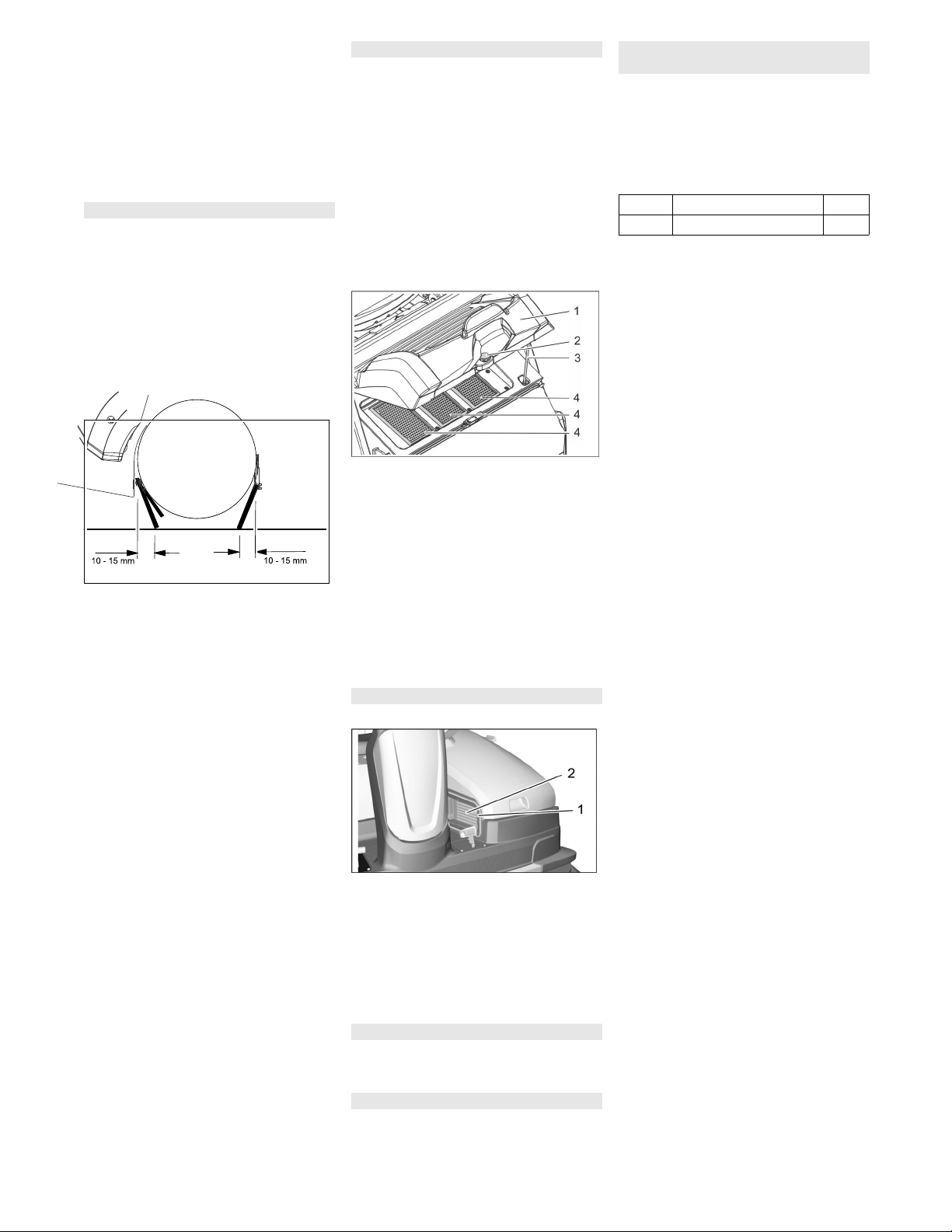
Front sealing strip
Loosen the plastic screws by approx. 2
turns, do not completely unscrew them.
Set the distance between the sealing
strip and the floor so that the bottom
edge trails behind at a distance of be-
tween 10-15 mm.
Tighten the screws.
Caution: Do not strip plastic screws!
If worn, replace.
For replacement unscrew the screws,
attach new sealing strip and retaining
plate, adjust and tighten screws.
Rear sealing strip
Loosen the plastic screws by approx. 2
turns, do not completely unscrew them.
Set the distance between the sealing
strip and the floor so that the bottom
edge trails behind at a distance of be-
tween 5 and 10 mm.
Tighten the screws.
Caution: Do not strip plastic screws!
If worn, replace.
For replacement unscrew the screws,
attach new sealing strip and retaining
plate, adjust and tighten screws.
Side sealing strips
Loosen the plastic screws by approx. 2
turns, do not completely unscrew them.
To set the floor clearance, insert a
sheet with a thickness of between 1 and
3 mm under the sealing strip.
Adjust sealing strip.
Tighten the screws.
Caution: Do not strip plastic screws!
If worn, replace.
For replacement unscrew the screws,
attach new sealing strip and retaining
plate, adjust and tighten screws.
� WARNING
Health hazard!
Wear a dust mask when working
around the dust filter. Observe safety
regulations on the handling of fine parti-
cles.
CAUTION
Risk of damage!
Do not rinse out the dust filter.
Note: Only clean the dust filter dry, careful-
ly knock out the dirt or blow it out with re-
duced compressed air.
Note: Wait at least 1 minute before remov-
ing the dust filter so that the dust can settle.
Figure: KM 125/... with 3 flat fold filters; KM
105/... has 2 flat fold filters
1 Lid with cleaning device
2 Screw
3 Support
4 Dust filter (flat-fold filter)
Unscrew the screw.
Fold the lid up and secure it by means
of the support.
Take out the dust filter.
Check dust filter.
Insert cleaned or new dust filter.
Close the lid.
Screw in the screws and tighten them.
(only with KM 125/...)
1 Protective grid oil cooler
2 Oil cooler
Check the protective grid of the oil cool-
er for contamination daily, clean if nec-
essary.
Check the inside of the oil cooler for
soiling every once in a while, remove
the protective grid and clean the oil
cooler if necessary.
Have the suction blower checked for
leaks.
Only by customer service.
Check tension of V-Belt.
Only by customer service.
The appliance (without upgrade kits) is
equipped with two fuses with 5 A fuse pro-
tection each. They are located under the
appliance cover.
If fuses are defective, contact the author-
ised aftersales service.
Additional fuses for the oil cooler
The diesel version has an additional fuse
FU20 with 30 A fuse protection. It can be
replaced by the customer in case of defect,
in order to do so, swivel the left bonnet to
the side.
Adjusting and replacing sealing strips
Check/replace dust filter
Check/clean protective grid oil cooler
Check suction blower
Checking drive belt
Replacing fuses of drive control/
electronic system
FM 31 Oil cooler engine 7.5 A
FK 31 Oil cooler contactor 5 A
43EN

-
17
Troubleshooting
Fault Remedy
Appliance cannot be started Turn the programme selector switch to position C (drive).
Sit on the driver seat, the seat contact switch gets activated.
Set main switch to “1”.
Insert approved KIK-key (Kärcher Intelligent Key)
Close engine bonnet.
Completely tip in and lower (high emptying system) the waste container
Check engine oil level.
Refuel
Open fuel cock.
Check fuel system, connections and joints
Charging battery
Check and clean spark plug, replace if necessary (petrol motor)
Diesel engine: Actuate decompression lever
Diesel engine: Check position of the emergency stop.
Diesel engine: Check starter fuse FU20 (30 A), replace in case of defect
Have the auto choke checked by the aftersales service.
Inform Kärcher Customer Service.
Engine is running erratically Refuel
Clean or replace air filter
Check fuel system, connections and joints
Replace soiled fuel filter
Check and clean spark plug, replace if necessary (petrol motor)
Inform Kärcher Customer Service.
Engine is running but machine is
not moving
Release parking brake
Have the oil level for the traction hydraulics checked by the aftersales service
Check setting of freewheel lever
Inform Kärcher Customer Service.
Engine is running but machine is
only moving slowly
Release parking brake
Allow machine to warm up for approx. 3 minutes in sub-zero temperatures
Inform Kärcher Customer Service.
Machine is not sweeping properly Check roller brush and side brushes for wear, replace if necessary.
Check function of bulk waste flap
Check sealing strips for wear, adjust or replace as required
Check the roller brush halves for proper seating
Check hydraulic system (sweeping) for leaks.
Inform Kärcher Customer Service.
Dust gathers in the machine
Insufficient vacuum performance
Empty waste container
Check sealing cover on suction fan
Check dust filter, clean or replace
Do not rinse out the dust filter.
Check filter case seal
Check the gaskets on the waste container
Check sealing strips for wear, adjust or replace as required
Side brush or roller brush switch-on
operation is not working
Inform Kärcher Customer Service.
Dust gathers in the machine
Insufficient vacuum performance
Empty waste container
Check hoses of suction blower for absence of leakness.
Clean and check the dust filter, replace if necessary.
Check the dust filter for proper seating.
Switch on suction blower
Check sealing strips for wear, adjust or replace as required
Inform Kärcher Customer Service.
Roller brush does not turn.
Side brush does not turn
Turn the programme selection switch to the desired cleaning program.
Check the oil level on the hydraulic tank (sweeping)
Check the roller brush and side brushes for wrapped belts.
Inform Kärcher Customer Service.
(High emptying system) waste con-
tainer does not retract/extend
Waste container cannot be tilted
Inform Kärcher Customer Service.
44 EN

-
18
The motor cannot be switched off
(Programme selector switch to "0",
main switch to "0")
Petrol engine: Open the engine bonnet and close the fuel cock. Caution: Rotating V-belt!
Diesel engine: Open engine bonnet, actuate the emergency stop on the engine or close the fuel
cock. Caution: Rotating V-belt!
A short blow-off sound can be
heard.
The appliance is OK, the automatic filter cleaning system is working
Troubleshooting by the operator with plain text messages on the display
Note:
If the display messages shown remain despite the corrective measures described, contact service!
Display Meaning and consequence Corrective measures
1 Invalid KiK!
Operation locked
The identification of the inserted key is unknown.
– The appliance operation is prevented
Use approved Kärcher key!
2 Valid KiK but no
operation rights
The Kärcher key is known, however, not approved for
this appliance.
– The appliance operation is prevented
Use approved Kärcher key!
3 High dump tracer
stuck! Check it!
The function of the two-hand operation button is
checked for its safety function when the appliance is
switched on.
– When the two-hand operation button is pushed, the
operation is prevented during start-up
Release the two-hand operation button.
Confirm the message with the OK key (delete).
4 Locked HD-tracer
Hours: xxxxxhym+
The two-hand operation button (high emptying system)
was pushed in a sweeping programme.
– High emptying is prevented in the sweeping pro-
gramme for safety reasons.
Release the two-hand operation button.
Turn the programme selector switch to position
C (drive).
Press the two-hand operation button and keep it
down.
Operate the high emptying system by means of
the direction keys.
5 Sit on machine
for operation!
Appears when a sweeping or transport programme is
selected upon starting up the machine and no operator
is sitting on the seat.
– Start combustion engine and all appliance functions
are disabled
Sit on the driver's seat.
Note: The selected sweeping / transport opera-
tion starts fully automated.
Note: This procedure simultaneously serves the
inspection of the safety function of the seat
switch!
6 Low oil level engine!
Hours: xxxxxhym+
Is displayed during operation if the lubrication of the
combustion engine is no longer guaranteed.
– Combustion engine is shut off, all appliance functions
are disabled
Fill in motor oil
Perform a programme selector switch reset
(OFF position).
Combustion engine can be restarted.
7 Dirt pan open!
Hours: xxxxxhym+
Is displayed (low emptying system) as soon as a trans-
port or sweeping programme has been selected and at
least one waste container is removed.
– Start combustion engine and all appliance functions
are disabled
Lock all waste containers in place.
Turn the programme selector switch to "ON".
Note: The message disappears. The appliance
is ready for operation.
8 Dirt pan open?
Hours: xxxxxhym+
Is displayed (high emptying system) as soon as a
sweeping programme has been selected and the waste
container is not fully retracted and tipped inwards.
– All sweeping functions are disabled, the combustion
engine is running
Turn the programme selector switch to position
C (drive).
Press the two-hand operation button and keep it
down.
If necessary, tip the waste container inwards
and then lower it by means of the direction keys.
Note: In case of an attempt to completely lower a con-
tainer that is tipped outwards, a collision monitoring sys-
tem prevents the high emptying system from being dam-
aged
Release the two-hand operation button and the
direction keys.
Press the two-hand operation button and keep it
down.
Completely tip the container inwards by means
of the direction keys before lowering it.
Note: In case of an attempt to tip a retracted container
outwards, a collision monitoring system prevents the
high emptying system from being damaged
Release the two-hand operation button and the
direction keys.
Press the two-hand operation button and keep it
down.
Sufficiently raise the container by means of the
direction keys before it can be tipped outwards.
9 Brushpos. not ok
Hours: xxxxxhym+
Is displayed when the roller brush cannot move to the
factory-set end position.
– The appliance is ready for operation, however, the
sweeping result may be dissatisfying
Confirm the message with the OK key (delete).
Turn the programme selector switch to position
C (drive).
Change to the desired sweeping programme
again.
45EN

-
19
10 RBroompos.not ok
Hours: xxxxxhym+
Is displayed when the right side brush cannot move to
the factory-set end position.
– The appliance is ready for operation, however, the
sweeping result may be dissatisfying or the right side
brush may not be raised
Confirm the message with the OK key (delete).
Turn the programme selector switch to position
C (drive).
Change to the desired sweeping programme
again.
11 LBroompos.not ok
Hours: xxxxxhym+
Is displayed when the optionally available left side brush
cannot move to the factory-set end position.
– The appliance is ready for operation, however, the
sweeping result may be dissatisfying or the left side
brush may not be raised
Confirm the message with the OK key (delete).
Turn the programme selector switch to position
C (drive).
Change to the desired sweeping programme
again.
12 SBroompos.not ok
Hours: xxxxxhym+
Is displayed when the optionally available sickle brush
cannot move to the factory-set end position.
– The appliance is ready for operation, however, the
sweeping result may be dissatisfying or the sickle brush
may not be raised
Confirm the message with the OK key (delete).
Turn the programme selector switch to position
C (drive).
Change to the desired sweeping programme
again.
13 Seat switch open
Hours: xxxxxhym+
Appears if the seat is left for more than 1.5 seconds in
drive mode.
– Combustion motor switches off, all brushes and the
roller brush that are lowered to the ground are raised au-
tomatically
Sit on the driver's seat.
Note: The selected sweeping / transport opera-
tion starts fully automated.
14 Usable sweeping
brush <25%
Appears if the roller brush has reached its wear limit.
– The appliance is ready for operation, however, the
sweeping result may be dissatisfying
Replace the roller brush as soon as possible to
achieve a good sweeping result.
15 MF-module not
ready to use x
Appears if the control panel has no connection to the
machine control.
– The operation of the appliance is disabled
Perform a programme selector switch reset
(OFF position).
16 Motorhood open!
Hours: xxxxxhym+
Appears if the left side cover is not properly locked in
place.
– The operation of the appliance is disabled
Completely close and lock the engine bonnet in
place.
Turn the programme selector switch to "ON".
Note: The message disappears. The appliance
is ready for operation.
17 Engine support OFF
Hours: xxxxxhym+
Appears if the battery is not sufficiently charged during
operation.
– When driving uphill, the support of the combustion mo-
tor from the battery is disabled
Confirm the message with the OK key (delete).
Drive the appliance on a level ground using the
combustion motor for a longer period of time.
This charges the battery.
18 Low battery
Hours: xxxxxhym+
Appears if the battery voltage in the sweeping mode is
so low that a start of the combustion engine is no longer
possible after switching off the appliance.
– All sweeping functions are switched off, the appliance
is still running
Note: The message can no longer be confirmed.
Drive the appliance on a level ground using the
combustion motor for a longer period of time.
This charges the battery.
19 Battery flat!
Charge externally!
Appears as soon as the programme selector switch is
turned away from the OFF position and it is recognised
that the minimum battery voltage for starting the com-
bustion engine is not reached.
– The operation of the appliance is disabled to protect
the battery
Disconnect the battery and connect it with the
correct polarity to an approved charger for
charging.
20 Firmware update
firmware update!
Appears if the machine control has detected a safety-
critical error during the self test.
– The operation of the appliance is disabled
Call service!
21 V-engine error
OFF for restart
The monitoring system for the control of the combustion
engine has detected a severe error.
– The combustion engine no longer shuts off
CAUTION! Move the main switch to the "0" po-
sition to switch the engine off!
In addition:
Perform a programme selector switch reset
(OFF position).
Subsequently:
Set main switch to “1”.
Change to the desired sweeping programme
again.
22 Call service!
+xx-xxxx-xx-xxxx
The inspection interval has lapsed. This message ap-
pears upon every start-up of the appliance.
– The appliance remains fully operational
Confirm the message with the OK key (delete).
Contact your local service for inspection under
the displayed phone number.
23 Red 0/1 switch=0
Operation locked
The message appears both during operation and start-
up of the appliance if the red main switch is in the "0" po-
sition.
– The appliance operation is prevented
Set main switch to “1”.
24 Easy oper.switch
must be OFF next
This message appears in connection with message 23. Important note: The red main switch has an
EMERGENCY STOP function.
For safety reasons the start-up of the appliance
requires the switching-off of the programme se-
lector switch (OFF position)!
46 EN

-
20
KM 105/100 R (G)
KM 105/110 R (G)
KM 125/130 R (G, D)
Troubleshooting with coded error message on the display
Note:
A coded error message is always displayed in the upper display line and has the following formats:
X yyy Identification letter X followed by up to 3 digits yyy
e.g.
S 110
There is a system error that completely or partly disables the appliance function.
e.g.
P 3
C 41
H 2
There is an error in the machine control. Individual or several appliance functions are disabled.
e.g.
B 121
There is an error in the starter battery. If necessary, replace the battery with a newly charged one.
e.g.
P/11
Make sure that there is no more than 1 KIK-key (Kärcher Intelligent Key) near the control panel.
If a coded error occurs, try resetting the programme selector switch first.
In order to do so, turn the programme selector switch in the "OFF" position. Wait for at least 5 seconds before restarting the appliance.
If the error is still pending, contact service. The indication of the error code may be helpful for the service!
Accessories (KM 105/...)
Name Order No.
Side brushes, standard 6.966-063.0
For cleaning of indoor and outdoor areas.
Hard side-brushes 6.906-705.0
For removing stubborn dirt in the external
area; resistant to moisture.
Side-brushes, soft 6.966-065.0
Especially for sweeping fine dust on even
floors.
Roller brush, standard 4.762-529.0
Resistant of wear and moisture. Universal
bristles for inside and outside cleaning.
Roller-brush, soft 4.762-523.0
With natural bristles especially for fine dust
sweeping on smooth indoor floors. Not re-
sistant to wetness; not for abrasive surfac-
es.
Roller-brush, hard 4.762-524.0
For removing stubborn dirt in the external
area; resistant to moisture.
Flat-fold filter (dust filter) 6.907-352.0
Machine requires 2 units
Accessories (KM 125/...)
Name Order No.
Side brushes, standard 6.966-063.0
For cleaning of indoor and outdoor areas.
Hard side-brushes 6.906-705.0
For removing stubborn dirt in the external
area; resistant to moisture.
Side-brushes, soft 6.966-065.0
Especially for sweeping fine dust on even
floors.
Roller brush, standard 4.762-525.0
Resistant of wear and moisture. Universal
bristles for inside and outside cleaning.
Roller-brush, soft 4.762-526.0
With natural bristles especially for fine dust
sweeping on smooth indoor floors. Not re-
sistant to wetness; not for abrasive surfac-
es.
Roller-brush, hard 4.762-527.0
For removing stubborn dirt in the external
area; resistant to moisture.
Flat-fold filter (dust filter) 6.907-352.0
Machine requires 3 units
47EN

-
21
Technical data (KM 105/...)
KM 105/100 R G
KM 105/110 R G
Machine data
Length x width x height mm 1800 x 1250 x 1450
Net weight (transport weight) kg
kg
400 (KM 105/100 R G)
450 (KM 105/110 R G)
Permissible overall weight kg
kg
650 (KM 105/100 R G)
700 (KM 105/110 R G)
Driving speed km/h 7
Cleaning speed km/h 4
Usage duration when tank is full h about 3
Climbing capability (max.) % 18
Turning radius m 2.70
Roller brush diameter mm 400
Roller brush width mm 640
Side brush diameter mm 600
Surface cleaning performance without side brushes m
2
/h 4480
Surface cleaning performance with 1 side brushes m
2
/h 7000
Surface cleaning performance with 2 side brushes m
2
/h 10150
Working width without side brushes mm 640
Working width with 1 side brushes mm 1050
Working width with 2 side brushes mm 1450
Volume of waste container
KM 105/100 R (low emptying system)
KM 105/110 R (high emptying system)
l
l
2 x 35
80
Maximum fill weight of the waste container
KM 105/100 R (low emptying system)
KM 105/110 R (high emptying system)
kg
kg
2 x 50
110
Maximum unloading height (high emptying system) mm 1550
Protection type, drip-proof -- IPX 3
Engine
Type -- Worms EX27
1 cyl., four-stroke
Cylinder capacity cm
3
265
Max. power kW/PS 6.6 / 9.0
Fuel type -- Petrol, unleaded
CO2 value g/kWh 661
Fuel tank capacity l 5.6
Spark plug, NGK -- BR4HS
Maintenance-free batteries V, Ah 12, 50
Motor oil
Engine oil - type -- SAE 15W-40
Filling quantity l 1.0
Hydraulic oil
Front hydraulic oil tank (sweeping function)
Type Shell SFX 68
Filling quantity l about 7
Rear hydraulic oil tank (drive function)
Type Fuchs Renolin DO 90 HV
Filling quantity l 0.5 - 1.0
Tyres
Size, front mm ø 300
Air pressure, front bar / MPa 6.0 /0.6
Size, rear -- 4.00-8 6PR
Air pressure, rear bar / MPa 6.0 /0.6
Brake
Service brake -- hydrostatic
Parking brake -- mechanical
48 EN

-
22
Filter and vacuum system
Filter system TACT
Category of use – filter for non-hazardous dust -- M
Nominal vacuum, suction system mbar 6
Nominal volume flow, suction system l/s 92
Working conditions
Temperature °C 0...+ 40
Air humidity, non-condensing % 0 - 90
Values determined as per EN 60335-2-72
Noise emission
Sound pressure level L
pA
dB(A) 79
Uncertainty K
pA
3
Sound power level L
WA
+ Uncertainty K
WA
dB(A) 97
Uncertainty K
WA
3
Machine vibrations
Hand-arm vibration value m/s
2
2.5
Seat m/s
2
0.8
Uncertainty K m/s
2
0.2
KM 105/100 R G
KM 105/110 R G
Technical data (KM 125/...)
KM 125/130 R G KM 125/130 R D
Machine data
Length x width x height mm 1800 x 1500 x 1450 1800 x 1500 x 1450
Net weight (transport weight) kg 665 685
Permissible overall weight kg 890 910
Driving speed km/h 8 8
Cleaning speed km/h 4 4
Usage duration when tank is full h 3 3
Climbing capability (max.) % 16 16
Turning radius m 3.0 3.0
Roller brush diameter mm 400 400
Roller brush width mm 870 870
Side brush diameter mm 600 600
Surface cleaning performance without side brushes m
2
/h 6960 6960
Surface cleaning performance with 1 side brushes m
2
/h 10000 10000
Surface cleaning performance with 2 side brushes m
2
/h 13600 13600
Working width without side brushes mm 870 870
Working width with 1 side brushes mm 1250 1250
Working width with 2 side brushes mm 1700 1700
Volume of waste container l 110 110
Maximum fill weight of the waste container kg 150 150
Maximum unloading height (high emptying system) mm 1550 1550
Protection type, drip-proof -- IPX 3 IPX 3
Engine
Type -- Worms EX40
1 cyl., four-stroke
Yanmar L100V
Cylinder capacity cm
3
404 435
Max. power kW/PS 8.3/11.3 6.3/8.5
Fuel type -- Petrol, unleaded Diesel
CO2 value g/kWh 661 964
Fuel tank capacity l 7 5.4
Spark plug, NGK -- BR4HS ---
Maintenance-free batteries V, Ah 12,71 12,71
Motor oil
Engine oil - type SAE 10W-40 SAE 10W-40
Filling quantity l 1.2 1.65
Hydraulic oil
Front hydraulic oil tank (sweeping and drive function)
49EN

-
23
Type Shell SFX 68 Shell SFX 68
Filling quantity l about 8 about 8
Hydraulic pressure max. bar / MPa 160 / 16 160 / 16
Tyres
Size, front mm ø 300 ø 300
Air pressure, front bar / MPa 6.0 /0.6 6.0 /0.6
Size, rear -- 4.00-8 6PR 4.00-8 6PR
Air pressure, rear bar / MPa 6.0 /0.6 6.0 /0.6
Brake
Service brake -- hydrostatic hydrostatic
Parking brake -- mechanical mechanical
Filter and vacuum system
Filter system TACT TACT
Category of use – filter for non-hazardous dust -- M M
Nominal vacuum, suction system mbar 6 6
Nominal volume flow, suction system l/s 92 92
Working conditions
Temperature °C 0...+ 40 0...+ 40
Air humidity, non-condensing % 0 - 90 0 - 90
Values determined as per EN 60335-2-72
Noise emission
Sound pressure level L
pA
dB(A) 81 85
Uncertainty K
pA
3 3
Sound power level L
WA
+ Uncertainty K
WA
dB(A) 98 105
Machine vibrations
Hand-arm vibration value m/s
2
<2.5 <2.5
Seat m/s
2
0.5 0.5
Uncertainty K m/s
2
0.2 0.2
Remark Risk of hearing impairment. Wear
ear-protection aids.
Risk of hearing impairment. Wear
ear-protection aids.
KM 125/130 R G KM 125/130 R D
50 EN
-
24
We hereby declare that the machine de-
scribed below complies with the relevant
basic safety and health requirements of the
EU Directives, both in its basic design and
construction as well as in the version put
into circulation by us. This declaration shall
cease to be valid if the machine is modified
without our prior approval.
The signatories act on behalf of and with of
the authority of the company management.
Documentation supervisor:
S. Reiser
Alfred Kärcher SE & Co. KG
Alfred-Kärcher-Straße 28-40
71364 Winnenden (Germany)
Tel.: +49 7195 14-0
Fax: +49 7195 14-2212
Winnenden, 2021/02/01
We hereby declare that the product de-
scribed below complies with the relevant
provisions of the following UK Regulations,
both in its basic design and construction as
well as in the version put into circulation by
us. This declaration shall cease to be valid
if the product is modified without our prior
approval.
The signatories act on behalf of and with of
the authority of the company management.
Documentation supervisor:
S. Reiser
Alfred Kärcher SE & Co. KG
Alfred-Kärcher-Straße 28-40
71364 Winnenden (Germany)
Tel.: +49 7195 14-0
Fax: +49 7195 14-2212
Winnenden, 2021/02/01
EU Declaration of Conformity
Product: Vacuum sweeper
Type: 1.280-xxx
KM 105/...
1.280-xxx
KM 125/...
Relevant EU Directives
2006/42/EC (+2009/127/EC)
2000/14/EC
2014/30/EU
2014/53/EU (TCU)
Applied harmonized standards
EN 60335–1
EN 60335–2–72
EN 62233: 2008
EN 55012:2010
EN 61000–6–2: 2005
(TCU)
EN 300 328 V2.1.1
EN 300 330 V2.1.1
EN 300 440 V2.1.1
EN 301 511 V12.5.1
Applied conformity evaluation method
2000/14/EC: Appendix V
Sound power level dB(A)
G
Measured: 94 95
Guaranteed: 97 98
D
Measured: -- 103
Guaranteed: -- 105
Chairman of the Board of Management
Director Regulatory Affairs & Certification
Declaration of Conformity
Product: Vacuum sweeper
Type: 1.280-xxx
KM 105/...
1.280-xxx
KM 125/...
Currently applicable UK Regulations
S.I. 2008/1597 (as amended)
S.I. 2001/1701 (as amended)
S.I. 2016/1091 (as amended)
S.I. 2017/1206 (as amended) TCU
Designated standards used
EN 60335–1
EN 60335–2–72
EN 62233: 2008
EN 55012:2010
EN 61000–6–2: 2005
(TCU)
EN 300 328 V2.1.1
EN 300 330 V2.1.1
EN 300 440 V2.1.1
EN 301 511 V12.5.1
Applied conformity assessment procedure
S.I. 2001/1701 (as amended): Schedule 8
Sound power level dB(A)
G
Measured: 94 95
Guaranteed: 97 98
D
Measured: -- 103
Guaranteed: -- 105
Chairman of the Board of Management
Director Regulatory Affairs & Certification
51EN