

en
2
Table of contents
1 Safety ............................................4
1.1 General information....................4
1.2 Intended use...............................4
1.3 Restriction on user group...........4
1.4 Safe installation ..........................4
1.5 Safe use .....................................6
1.6 Damaged appliance...................8
1.7 Risk to children ..........................8
1.8 Safety systems ...........................9
2 Preventing material damage .....10
2.1 Safe installation ........................10
2.2 Safe use ...................................10
3 Childproof lock
1
.........................11
3.1 Door lock..................................11
4 Environmental protection and
saving energy.............................12
4.1 Disposing of packaging ...........12
4.2 Saving energy...........................12
4.3 AquaSensor
1
.............................12
5 Installation and connection.......12
5.1 Scope of supply .......................12
5.2 Installing and connecting the
appliance..................................13
5.3 Drainage connection ................13
5.4 Drinking water connection .......13
5.5 Electrical connection ................14
6 Familiarising yourself with
your appliance............................15
6.1 Appliance .................................15
6.2 Controls ....................................17
7 Programmes ...............................19
7.1 Information for test institutes ....21
8 Additional functions ..................21
9 Features......................................22
9.1 Top basket ...............................22
9.2 Bottom basket ..........................24
9.3 Cutlery basket ..........................24
9.4 Cutlery drawer ..........................24
9.5 Etagere .....................................25
9.6 Folding prongs .........................26
9.7 Small items holder ...................26
9.8 Knife shelf.................................26
9.9 Baking sheet spray head .........27
9.10 Basket heights........................27
10 Before using for the
first time....................................28
10.1 Performing the initial con-
figuration.................................28
11 Water softening system...........28
11.1 Overview of water hardness
settings ...................................29
11.2 Setting water softening sys-
tem .........................................29
11.3 Special salt .............................29
11.4 Switching off water soften-
ing system ..............................30
11.5 Regeneration of the water
softening system ....................30
12 Rinse aid system......................31
12.1 Rinse aid ................................31
12.2 Setting the amount of rinse
aid...........................................32
12.3 Switching rinse aid system
off ...........................................32
13 Detergent ..................................33
13.1 Suitable detergents ................33
13.2 Unsuitable detergents ............34
13.3 Information on detergents ......34
13.4 Adding detergent ...................34
1
Depending on the appliance specifications

en
3
14 Tableware .................................35
14.1 Damage to glass and table-
ware........................................36
14.2 Arrange tableware ..................36
14.3 Removing tableware...............37
15 Basic operation ........................37
15.1 Opening appliance door ........37
15.2 Switching on the appliance ....38
15.3 Setting a programme .............38
15.4 Setting additional functions ....38
15.5 Setting timer programming ....38
15.6 Starting the programme .........38
15.7 Activating button lock.............39
15.8 Deactivate button lock............39
15.9 Interrupting programme .........39
15.10 Terminate programme..........39
15.11 Switching off appliance ........39
16 Basic settings...........................40
16.1 Overview of basic settings .....40
16.2 Changing basic settings.........41
17 Cleaning and servicing............41
17.1 Cleaning the tub .....................41
17.2 Self-cleaning interior
1
..............41
17.3 Cleaning products ..................41
17.4 Tips on appliance care...........41
17.5 Filter system ...........................42
17.6 Cleaning spray arms ..............43
18 Troubleshooting.......................44
18.1 Clean wastewater pump.........55
19 Transportation, storage and
disposal ....................................55
19.1 Removing the appliance ........55
19.2 Protect appliance from frost...56
19.3 Transporting the appliance ....56
19.4 Disposing of old appliance ....56
20 Customer Service.....................57
20.1 Product number (E-Nr.) and
production number (FD).........57
20.2 AQUA-STOP guarantee
1
.........57
21 Technical specifications..........59
1
Depending on the appliance specifications

en Safety
4
1 Safety
Observe the following safety instructions.
1.1 General information
¡ Read this instruction manual carefully.
¡ Keep the instruction manual and the product information safe
for future reference or for the next owner.
¡ Do not connect the appliance if it has been damaged in transit.
1.2 Intended use
Only use this appliance:
¡ For cleaning household tableware.
¡ In private households and in enclosed spaces in a domestic en-
vironment.
¡ Up to an altitude of 4000 m above sea level.
1.3 Restriction on user group
This appliance may be used by children aged 8 or over and by
people who have reduced physical, sensory or mental abilities or
inadequate experience and/or knowledge, provided that they are
supervised or have been instructed on how to use the appliance
safely and have understood the resulting dangers.
Do not let children play with the appliance.
Cleaning and user maintenance must not be performed by chil-
dren unless they are being supervised.
Keep children under the age of 8 years away from the appliance
and power cable.
1.4 Safe installation
WARNING‒Risk of injury!
Improper installation may cause injury.
▶ When installing and connecting the appliance, follow the instruc-
tions in the manual and installation instructions.

Safety en
5
WARNING‒Risk of electric shock!
Incorrect installation is dangerous.
▶ Connect and operate the appliance only in accordance with the
specifications on the rating plate.
▶ Always use the supplied power cable for the new appliance.
▶ Connect the appliance to a power supply with alternating cur-
rent only via a properly installed socket with earthing.
▶ The protective conductor system of the domestic electrical in-
stallation must be properly installed.
▶ Never equip the appliance with an external switching device,
e.g. a timer or remote control.
▶ When the appliance is installed, the mains plug of the power
cord must be freely accessible. If free access is not possible, an
all-pole isolating switch must be installed in the permanent elec-
trical installation according to the installation regulations.
▶ When installing the appliance, check that the power cable is not
trapped or damaged.
Cutting through the supply hose or immersing the Aqua-Stop
valve in water is dangerous.
▶ Never immerse the plastic housing in water. The plastic housing
on the supply hose contains an electric valve.
▶ Never cut through the supply hose. The supply hose contains
electric power cables.
WARNING‒Risk of fire!
It is dangerous to use an extended power cord and non-approved
adapters.
▶ Do not use extension cables or multiple socket strips.
▶ If the power cord is too short, contact Customer Service.
▶ Only use adapters approved by the manufacturer.

en Safety
6
WARNING‒Risk of injury!
Hinges move when opening and closing the appliance door and
can cause injury.
▶ If built-under or integrable appliances are not in a cavity so that
one side is accessible, the hinge area must be covered at the
side. Covers are available from Customer Service or specialist
outlets.
WARNING‒Risk of tipping!
Improper installation may cause the appliance to tip up.
▶ Only install built-under or integrable appliances under a continu-
ous worktop that is securely connected to adjacent cabinets.
WARNING‒Risk of burns!
If the appliance is not installed properly, this may result in burns.
▶ With free-standing appliances, ensure that they are installed with
the back panel against a wall.
1.5 Safe use
WARNING‒Risk of serious harm to health!
Failure to comply with safety instructions and directions for use on
packagings of detergent and rinse aid products may cause seri-
ous harm to health.
▶ Follow the safety instructions and directions for use on the
packagings of detergent and rinse aid products.
WARNING‒Risk of explosion!
Adding solvents to the interior of the appliance may cause explo-
sions.
▶ Never add solvents to the interior of the appliance.

Safety en
7
Highly caustic alkaline or highly acidic cleaning agents in conjunc-
tion with aluminium parts in the interior of the appliance may
cause explosions.
▶ Never use highly caustic alkaline or highly acidic cleaning
agents, in particular commercial or industrial products, in con-
junction with aluminium parts (e.g. grease filters of extractor
hoods or aluminium pans), e.g. for the Machine Care pro-
gramme.
WARNING‒Risk of injury!
Leaving the appliance door open may result in injury.
▶ Only open the appliance door to load or unload tableware in or-
der to prevent accidents, e.g. through tripping.
▶ Do not sit or stand on the appliance door when open.
Knives and utensils with sharp points can cause injuries.
▶ Arrange knives and utensils with sharp points in the cutlery bas-
ket with the points downwards, on the knife shelf or in the cut-
lery drawer.
WARNING‒Risk of scalding!
If you open the appliance door while the programme is running,
hot water may splash out of the appliance.
▶ Open the appliance door carefully if the programme is still run-
ning.
WARNING‒Risk of tipping!
Overfilling the Baskets may cause the appliance to tip up.
▶ Never overfill the Baskets with free-standing appliances.
WARNING‒Risk of electric shock!
An ingress of moisture can cause an electric shock.
▶ Only use the appliance in enclosed spaces.
▶ Never expose the appliance to intense heat or humidity.
▶ Do not use steam- or high-pressure cleaners to clean the appli-
ance.
If the insulation of the power cord is damaged, this is dangerous.
▶ Never let the power cord come into contact with hot appliance
parts or heat sources.

en Safety
8
▶ Never let the power cord come into contact with sharp points or
edges.
▶ Never kink, crush or modify the power cord.
1.6 Damaged appliance
WARNING‒Risk of electric shock!
If the appliance or the power cord is damaged, this is dangerous.
▶ Never operate a damaged appliance.
▶ Never operate an appliance with a cracked or fractured surface.
▶ Never pull on the power cord to unplug the appliance. Always
unplug the appliance at the mains.
▶ If the appliance or the power cord is damaged, immediately un-
plug the power cord or switch off the fuse in the fuse box and
turn off the water tap.
▶ Call customer services. →Page57
Incorrect repairs are dangerous.
▶ Repairs to the appliance should only be carried out by trained
specialist staff.
▶ Only use genuine spare parts when repairing the appliance.
▶ If the power cord of this appliance is damaged, it must be re-
placed with a special connection cable, which is available from
the manufacturer or his Customer Service.
1.7 Risk to children
WARNING‒Risk of suffocation!
Children may put packaging material over their heads or wrap
themselves up in it and suffocate.
▶ Keep packaging material away from children.
▶ Do not let children play with packaging material.
Children may breathe in or swallow small parts, causing them to
suffocate.
▶ Keep small parts away from children.
▶ Do not let children play with small parts.
Children may become trapped in the appliance and suffocate.
▶ Use the childproof lock if fitted.
▶ Never let children play with or operate the appliance.

Safety en
9
WARNING‒Risk of harm to health!
Children can lock themselves in the appliance, thereby putting
their lives at risk.
▶ With redundant appliances, unplug the power cord. Then cut
through the cord and damage the lock on the appliance door
beyond repair so that the appliance door will no longer close.
WARNING‒Risk of crushing!
With higher-level appliances, children can become crushed
between the appliance door and cabinet doors underneath.
▶ Keep an eye on children when opening and closing the appli-
ance door.
WARNING‒Risk of chemical burns!
Rinse aid and detergent may cause chemical burns to the mouth,
throat and eyes.
▶ Keep children away from detergent and rinse aid products.
▶ Keep children away from the appliance when open. The water in
the interior of the dishwasher is not drinking water. It may con-
tain residues of detergents and rinse aid.
WARNING‒Risk of injury!
Children may get their fingers caught in the slots of the tablet col-
lecting tray and injure themselves.
▶ Keep children away from the appliance when open.
1.8 Safety systems
Protect children from possible hazards resulting from the appli-
ance.
Depending on the features of the model, the appliance comes
with a
→"Childproof lock", Page11.

en Preventing
10
Preventing
2 Preventing material
damage
Preventing
2.1 Safe installation
ATTENTION!
Improper installation of the appliance
may cause damage.
▶ If the dishwasher is installed above
or below other domestic appli-
ances, follow the information on in-
stallation in combination with a
dishwasher in the installation in-
structions for the individual appli-
ances.
▶ If there is no information or if the
installation instructions do not in-
clude the relevant information, con-
tact the manufacturer of these ap-
pliances to check that the dish-
washer can be installed above or
below these appliances.
▶ If no information is available from
the manufacturer, the dishwasher
should not be installed above or
below such appliances.
▶ To ensure the safe operation of all
domestic appliances, continue fol-
lowing the installation instructions
for the dishwasher.
▶ Do not install the dishwasher un-
der a hob.
▶ Do not install the dishwasher near
heat sources, e.g. radiators, heat
storage tanks, ovens or other ap-
pliances that generate heat.
Modified or damaged water hoses
may result in material damage and
damage to the appliance.
▶ Never kink, crush, modify or cut
through water hoses.
▶ Only use the water hoses supplied
with the appliance or genuine
spare hoses.
▶ Never re-use water hoses that
have been used before.
If the water pressure is too high or
too low, the appliance may not be
able to operate properly.
▶ Make sure that the water pressure
in the water supply system is min.
50kPa (0.5bar) and max.
1000kPa (10bar).
▶ If the water pressure exceeds the
maximum value specified, a pres-
sure-reducing valve must be in-
stalled between the drinking water
connection and the hose set of the
appliance.
2.2 Safe use
ATTENTION!
Escaping water vapour can damage
fitted units.
▶ When the programme ends, leave
the appliance to cool down for a
while before opening the door.
Special salt for dishwashers can
damage the tub due to corrosion.
▶ To make sure that any special salt
that escapes is washed out of the
tub, add the special salt to the dis-
penser for special salt immediately
before the programme starts.
Detergent may damage the water
softening system.
▶ Only fill the dispenser of the water
softening system with special dish-
washer salt.
Unsuitable cleaning agents may dam-
age the appliance.
▶ Do not use a steam cleaner.
▶ So as not to scratch the finish on
the appliance, do not use sponges
with a rough surface or abrasive
cleaning agents.
▶ To prevent corrosion, do not use
sponge cloths on dishwashers with
a stainless steel front or rinse such
cloths thoroughly several times be-
fore using them for the first time.
Childproof lock en
11
3 Childproof lock
1
The childproof lock lets you protect
children from possible hazards result-
ing from the appliance.
Depending on the features of the
model, the appliance comes with a
door lock.
3.1 Door lock
The door lock is a mechanical safety
system and makes it more difficult to
open the appliance door.
You can activate or deactivate the
door lock.
WARNING
Risk of suffocation!
Children may become trapped in the
appliance and thus suffocate.
▶ Activate the door lock and close
the appliance door.
→"Opening appliance door",
Page37
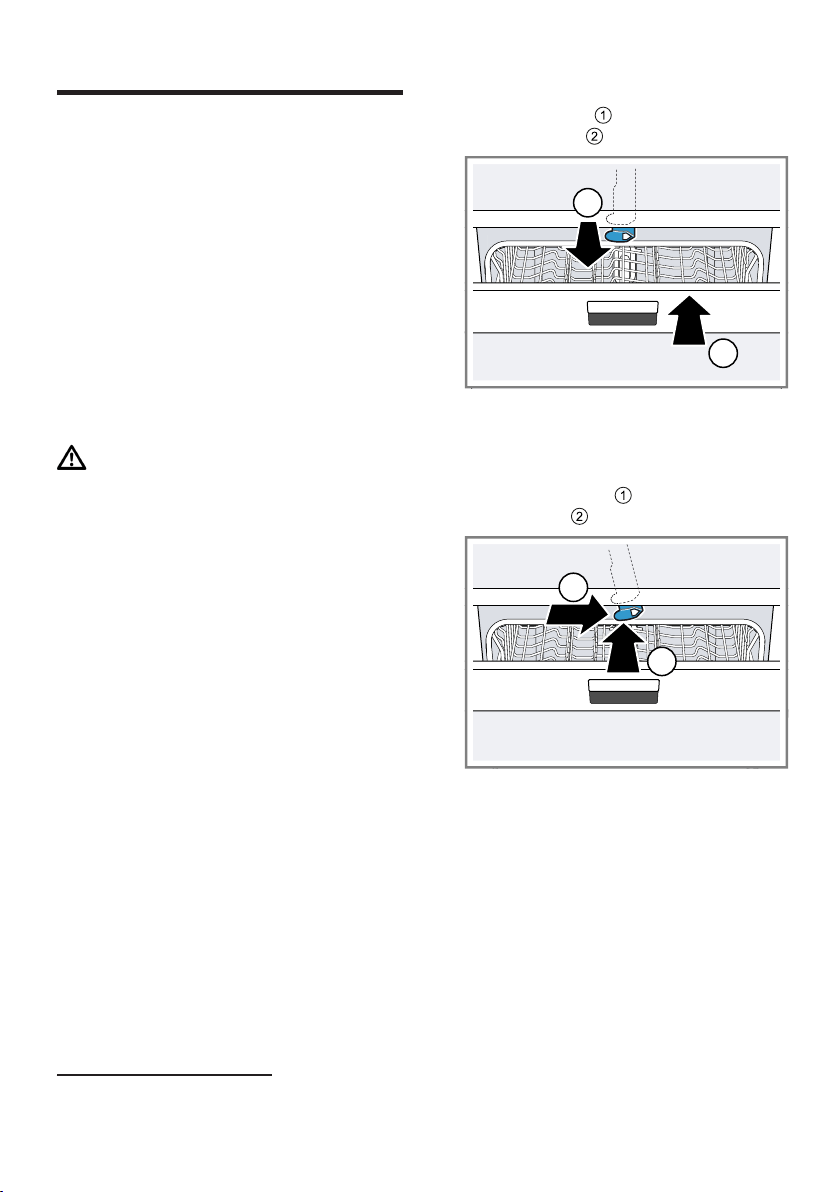
Activating the door lock
Note:The door lock remains activ-
ated until it is deactivated manually.
1. Open the appliance door.
2. Pull the catch of the childproof
lock forwards and close the ap-
pliance door .
1
2
Deactivating the door lock
1. Open the appliance door.
2. Push the catch of the childproof
lock to the right and slide it
backwards .
1
2
3. Close the appliance door.
1
Depending on the appliance specifications

en Environmental protection and saving energy
12
4 Environmental protec-
tion and saving energy
Help protect the environment by us-
ing your appliance in a way that con-
serves resources and by disposing of
reusable materials properly.
4.1 Disposing of packaging
The packaging materials are environ-
mentally compatible and can be re-
cycled.
▶ Sort the individual components by
type and dispose of them separ-
ately.
Information about current disposal
methods are available from your
specialist dealer or local authority.
4.2 Saving energy
If you follow these instructions, your
appliance will use less electricity and
less water.
Use the Eco 50° programme.
a
The Eco 50° programme is en-
ergy efficient and environmentally
friendly.
→"Programmes", Page19
If you do not have much tableware to
wash, use the additional Half Load
function.
1
a
The programme will adjust to a
lower load and consumption will
be reduced.
→"Additional functions", Page21
4.3 AquaSensor
1
The AquaSensor is an optical meas-
uring device (light barrier) which
measures the turbidity of the washing
water. You can save water with the
AquaSensor.
Use of the AquaSensor depends on
the programme. If the soiling level is
low, the washing water is used in the
next wash cycle, so reducing water
consumption by 3-6 litres. If the soil-
ing level is is greater, the washing
water is drained off and replaced with
fresh water. In the automatic pro-
grammes the temperature and run-
ning time are additionally adjusted to
the level of soiling.
5 Installation and con-
nection
To ensure proper operation, connect
the appliance to the power and water
supply correctly. Observe the spe-
cified criteria and the installation in-
structions.
5.1 Scope of supply
After unpacking all parts, check for
any damage in transit and complete-
ness of the delivery.
If you have any complaints, contact
the dealer who sold you the appli-
ance or our Customer Service.
Note:The appliance has been tested
at the factory to check it is in working
order. It is possible that water has left
marks on the appliance. These
marks will disappear after the first
wash cycle.
The delivery consists of the following:
¡ Dishwasher
1
Depending on the appliance specifications

Installation and connection en
13
¡ User manual
¡ Installation Instructions
¡ Warranty
1
¡ Installation material
¡ Steam guard plate
1
¡ Rubber apron
1
¡ Mains cable
¡ Quick reference guide
1
5.2 Installing and connecting
the appliance
You can position your built-under or
integrable appliance in a fitted kit-
chen between wooden and plastic
walls. If you subsequently install your
dishwasher as a free-standing appli-
ance, you must stop it from tipping
over, e.g. by screwing it to the wall or
installing it under a continuous work-
top that is securely connected to ad-
jacent cabinets.
1. Follow the safety instructions.
→Page4
2. Follow the instructions for electrical
connection. →Page14
3. Check the Scope of supply
→Page12 and the condition of
the appliance.
4. Consult the installation instructions
for the installation dimensions re-
quired.
5. Make the appliance level using the
height-adjustable feet.
Make sure that the appliance is
standing on the floor securely.
6. Install the drainage connection.
→Page13
7. Install the drinking water connec-
tion. →Page13
8. Connect the appliance to the
power supply.
5.3 Drainage connection
Connect your appliance to drainage
connection so dirty water is dis-
charged via the wash cycle.
Installing the drainage connection
1. Consult the installation instructions
supplied for the steps required
here.
2. Connect the wastewater hose to
the outlet connection of the siphon
using the enclosed parts.
3. When doing so, check that the
wastewater hose is not kinked,
crushed or twisted.
4. Also check that there is no cover
in the drainage system preventing
the wastewater from being dis-
charged.
5.4 Drinking water connec-
tion
Connect your appliance to a drinking
water connection.
Installing the drinking water
connection
Note
¡ If you are replacing the appliance,
you must use a new water supply
hose.
1. Consult the installation instructions
supplied for the steps required
here.
2. Connect the appliance to the drink-
ing water connection using the en-
closed parts.
Observe the Technical data
→Page59.
3. When doing so, check that the
drinking water connection is not
kinked, crushed or twisted.
1
Depending on the appliance specifications

en Installation and connection
14
5.5 Electrical connection
Connect your appliance to the power
supply.
Connecting the appliance to the
electricity supply
Notes
¡ Please follow the Safety instruc-
tions →Page4.
¡ Connect the appliance to alternat-
ing current only, in the range of
220 - 240V and 50Hz or 60Hz.
¡ Please note that the water safety
system is only functional if there is
a power supply.
1. Insert the non-heating appliance
plug of the power cable into the
appliance.
2. Insert the mains plug of the appli-
ance into a nearby socket.
The connection data for the appli-
ance can be found on the rating
plate.
3. Check that the mains plug is inser-
ted properly.
Familiarising yourself with your appliance en
15
6 Familiarising yourself with your appliance
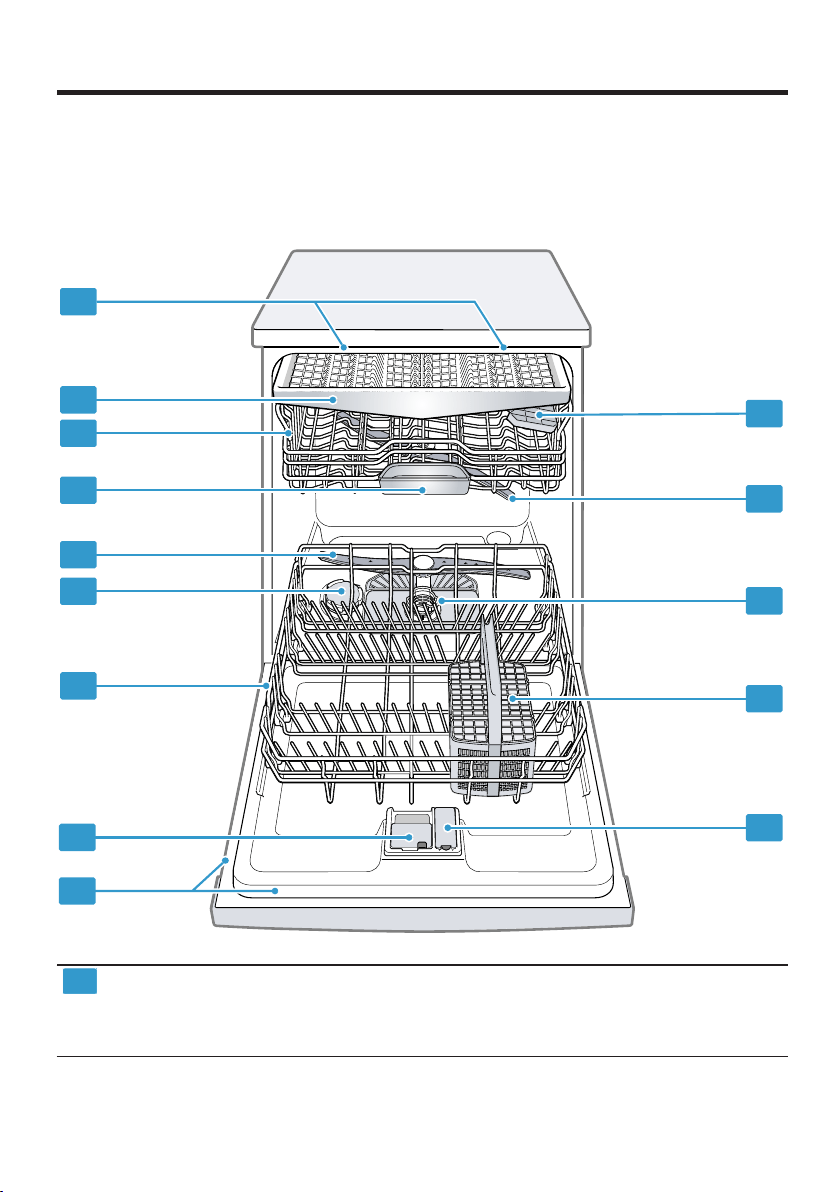
6.1 Appliance
You can find an overview of the parts of your appliance here.
1
2
3
4
5
6
7
8
9
10
11
12
13
14
1
Rating plate Rating plate with E number and FD num-
ber →Page57.
The data you need for Customer Service
→Page57.
1
Depending on the appliance specifications
en Familiarising yourself with your appliance
16
2
Detergent dispenser
Detergent →Page33 is added to the de-
tergent dispenser.
3
Bottom basket
Bottom basket →Page24
4
Dispenser for special salt Add special salt for the Water softening
system →Page28 to the dispenser for
special salt.
5
Lower spray arm The lower spray arm washes the table-
ware in the bottom basket.
If the tableware has not been washed
properly, clean the spray arms.
→"Cleaning spray arms", Page43
6
Tablet collecting tray During the wash cycle tablets automatic-
ally fall out of the detergent dispenser into
the tablet collecting tray where they can
fully dissolve.
7
Top basket
Top basket →Page22
8
Cutlery drawer
1
Cutlery drawer →Page24
9
EmotionLight
1
Interior lighting of the appliance.
→"Overview of basic settings", Page40
10
Etagere
Etagere →Page25
11
Upper spray arm The upper spray arm washes the table-
ware in the top basket.
If the tableware has not been washed
properly, clean the spray arms.
→"Cleaning spray arms", Page43
12
Filter system
Filter system →Page42
13
Cutlery basket
1
Cutlery basket →Page24
14
Dispenser for rinse aid Add rinse aid for the Rinse aid system
→Page31 to the dispenser for rinse aid.
1
Depending on the appliance specifications
Familiarising yourself with your appliance en
17
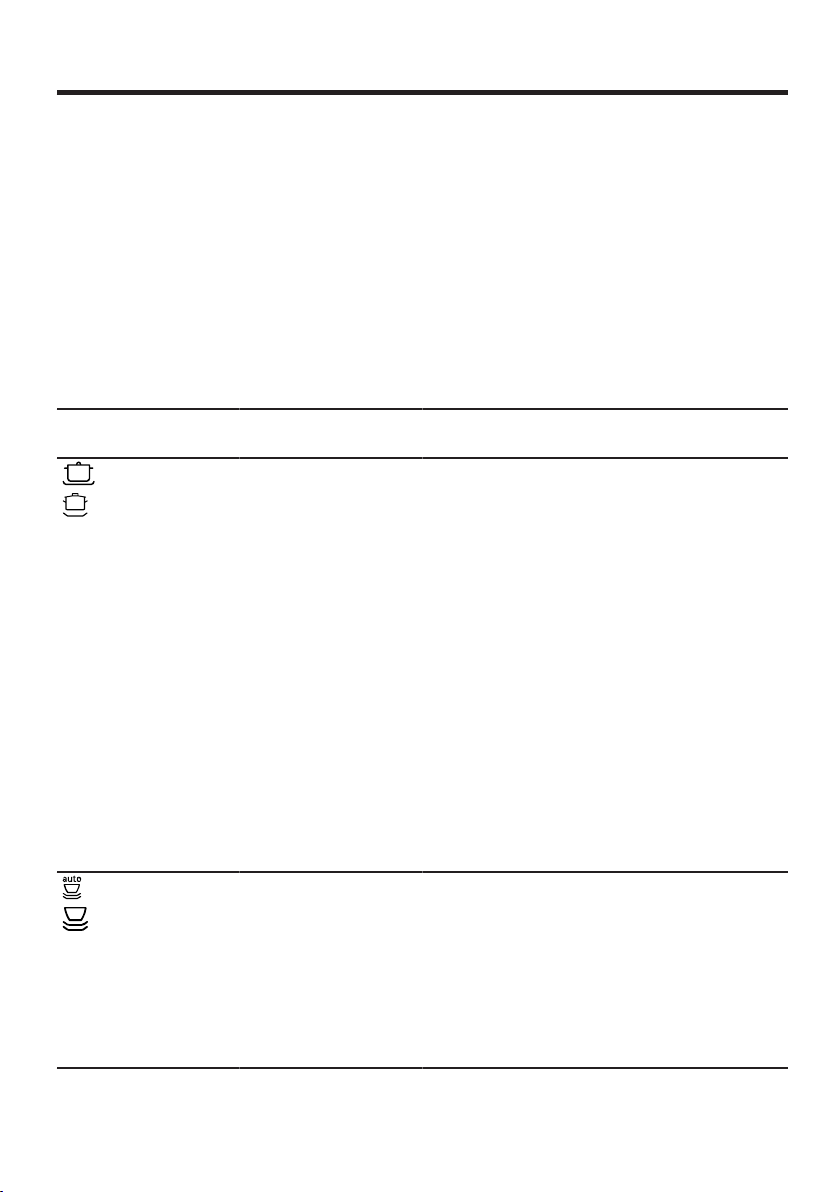
6.2 Controls
The controls are used to configure all functions of your appliance and to obtain
information about the operating status.
With some buttons you can perform different functions.
4
h. min.
h.
h.
1 3 4 5 6
B A
7
8
10
2 2
C
9
1
ON/OFF button Switching on the appliance
→Page38
Switching off the appliance
→Page39
2
Additional functions
1
Additional functions →Page21
3
Water supply display Display for water supply lights up
→Page45
4
Special salt refill indicator
Water softening system →Page28
5
Display The display shows information about
the remaining running time or the ba-
sic settings. You can change the ba-
sic settings via the display and the
setting buttons.
→"Changing basic settings",
Page41
6
Rinse aid refill indicator
Rinse aid system →Page31
7
Start button and reset
button
Starting the programme →Page38
Terminating the programme
→Page39
1
Depending on the appliance specifications

Programmes en
19
7 Programmes
You can find an overview of the pro-
grammes that can be selected here.
Different programmes, which can be
found on the control panel of your
appliance, are available depending
on the appliance configuration.
The running time may vary depend-
ing on the programme selected. The
running time depends on the water
temperature, the quantity of table-
ware, the level of soiling and the Ad-
ditional function →Page21 selec-
ted. The runtime will change if the
rinse aid system is switched off or
rinse aid needs to be added.
The consumption values can be
found in the quick reference guide.
The consumption values relate to
normal conditions and a water hard-
ness of 16-20°E. Different influen-
cing factors such as water temperat-
ure or pipe pressure may result in
deviations.
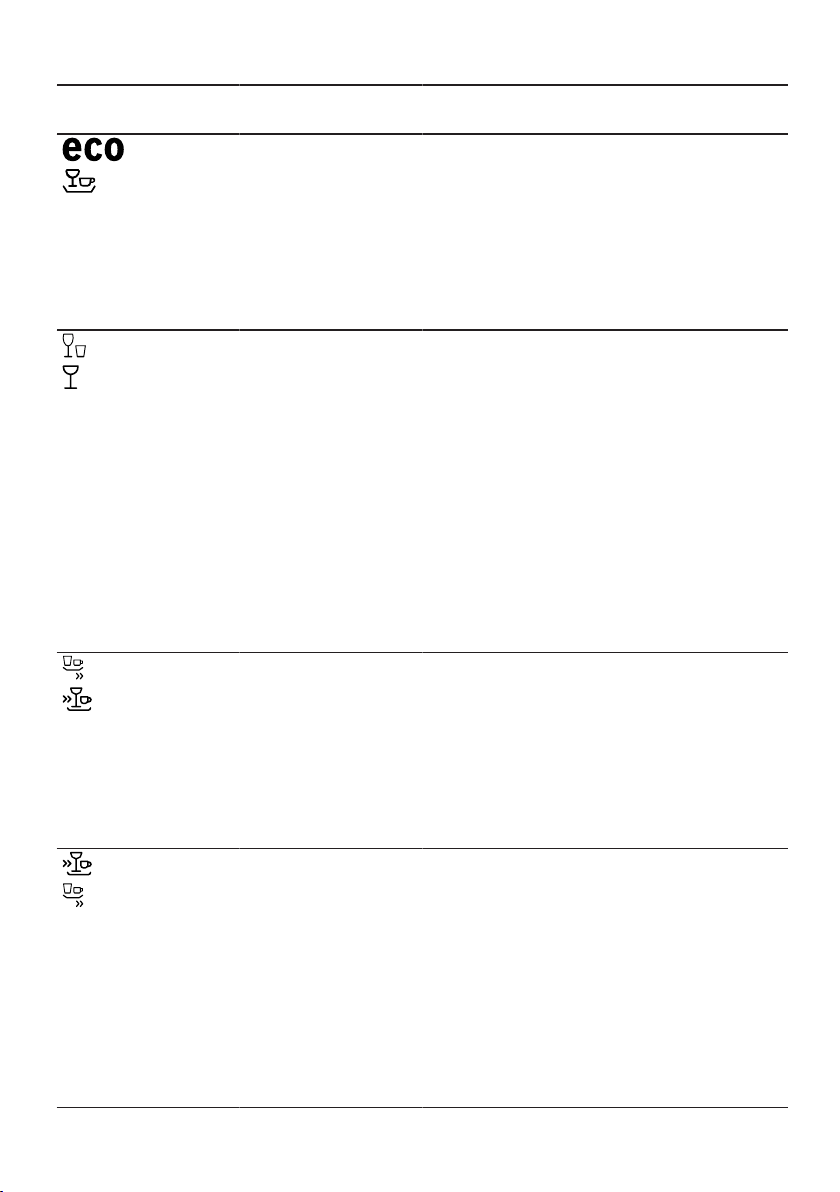
Programme Use Programme se-
quence
Additional func-
tions
Intensive 70°
Tableware:
¡ Washing pots
and pans, non-
fragile table-
ware and cut-
lery.
Level of soiling:
¡ Removing stub-
born burned or
dried-on food
remnants con-
taining starch
and protein.
When using
powder detergent,
you can also ap-
ply a little to the
inside of the appli-
ance door.
Intensive:
¡ PreRinse
¡ Cleaning 70°C
¡ Intermediate
rinse
¡ Rinsing 69°C
¡ Drying
All
→"Additional func-
tions", Page21
Auto 45-65°
Tableware:
¡ Cleaning mixed
tableware and
cutlery.
Level of soiling:
¡ Removing com-
mon household
food remnants
lightly dried-on.
Sensor-controlled:
¡ Optimised by
sensors de-
pending on the
soiling of the
washing water.
All
→"Additional func-
tions", Page21
en Programmes
20
Programme Use Programme se-
quence
Additional func-
tions
Eco 50°
Tableware:
¡ Cleaning mixed
tableware and
cutlery.
Level of soiling:
¡ Removing com-
mon household
food remnants
lightly dried-on.
Most economical
programme:
¡ Pre-Rinse
¡ Cleaning 50°C
¡ Intermediate
rinse
¡ Rinsing 66°C
¡ Drying
All
→"Additional func-
tions", Page21
Glass 40°
Tableware:
¡ Cleaning delic-
ate tableware,
cutlery, temper-
ature-sensitive
plastics,
glasses and
stemware in the
stemware bas-
ket.
Level of soiling:
¡ Removing
lightly adhering
fresh food rem-
nants.
Particularly gentle:
¡ PreRinse
¡ Cleaning 40°C
¡ Intermediate
rinse
¡ Rinsing 60°C
¡ Drying
IntensiveZone
VarioSpeed
Half Load
ExtraDry
→"Additional func-
tions", Page21
Quick 65°
Tableware:
¡ Cleaning mixed
tableware and
cutlery.
Level of soiling:
¡ Removing com-
mon household
food remnants
lightly dried-on.
Time-optimised:
¡ Cleaning 65°C
¡ Intermediate
rinse
¡ Rinsing 70°C
¡ Drying
ExtraDry
→"Additional func-
tions", Page21
Quick 45°
Tableware:
¡ Cleaning delic-
ate tableware,
cutlery, temper-
ature-sensitive
plastics and
glasses.
Level of soiling:
¡ Removing
lightly adhering
fresh food rem-
nants.
Time-optimised:
¡ Cleaning 45°C
¡ Intermediate
rinse
¡ Rinsing 55°C
ExtraDry
→"Additional func-
tions", Page21
Additional functions en
21
7.1 Information for test insti-
tutes
Test institutes are provided with in-
formation for comparability tests, e.g.
according to EN60436.
These are the conditions for conduct-
ing the tests, however they are not
the results or consumption values.
E-mail enquiries to: dishwasher@test-
appliances.com
The product number (E-Nr.) and the
production number (FD) are required
here. They can be found on the rat-
ing plate on the appliance door.
8 Additional functions
You can find an overview of the addi-
tional functions that can be selected
here. Different additional functions,
which can be found on the control
panel of your appliance, are available
depending on the appliance configur-
ation.
Additional
function
Use
VarioSpeed
¡ The running time
is shortened by
20% to 50% de-
pending on the
washing pro-
gramme.
¡ Energy and water
consumption are
increased.
Additional
function
Use
Half Load
¡ Switch on with
small loads.
¡ It is recommended
adding less deter-
gent to the deter-
gent dispenser
than for a full ma-
chine load.
¡ The running time
is shortened.
¡ Energy and water
consumption are
reduced.
HygienePlus
¡ To ensure a
higher hygiene
status for the ap-
pliance and
dishes, the tem-
perature is raised
and maintained for
an extra-long
period.
¡ Especially suitable
for cleaning chop-
ping boards or
baby bottles.
¡ Continuous use of
this function in-
creases the hy-
giene status.
¡ This will increase
the running time
and energy con-
sumption.
en Features
22
Additional
function
Use
Intens-
iveZone
¡ Switch on with
mixed loads con-
taining tableware
with different soil-
ing levels, e.g.
place very soiled
pots and pans in
the bottom basket
and normally
soiled tableware in
the top basket.
¡ The spray pres-
sure in the bottom
basket is in-
creased and the
maximum pro-
gramme temperat-
ure held longer.
This will increase
the running time
and energy con-
sumption.
ExtraDry
¡ For a better drying
result the final
rinse temperature
is increased and
the drying phase
extended.
¡ Especially suitable
for drying plastic
parts.
¡ There is a slight
increase in energy
consumption and
the running time is
extended.
9 Features
You can find an overview of the pos-
sible features of your appliance and
how to use them here.
These features depend on the model
of your appliance.
9.1 Top basket
Arrange cups and glasses in the top
basket.
a
Knife shelf
1
You can adjust the height of the top
basket to make room for larger items
of tableware.
Adjusting top basket with side
levers
To wash large items of tableware in
the baskets, adjust the shelf position
of the top basket.
1. Pull out the top basket.
2. To prevent the basket from sud-
denly dropping down, hold the
side of the basket by the top edge.
1
Depending on the appliance specifications
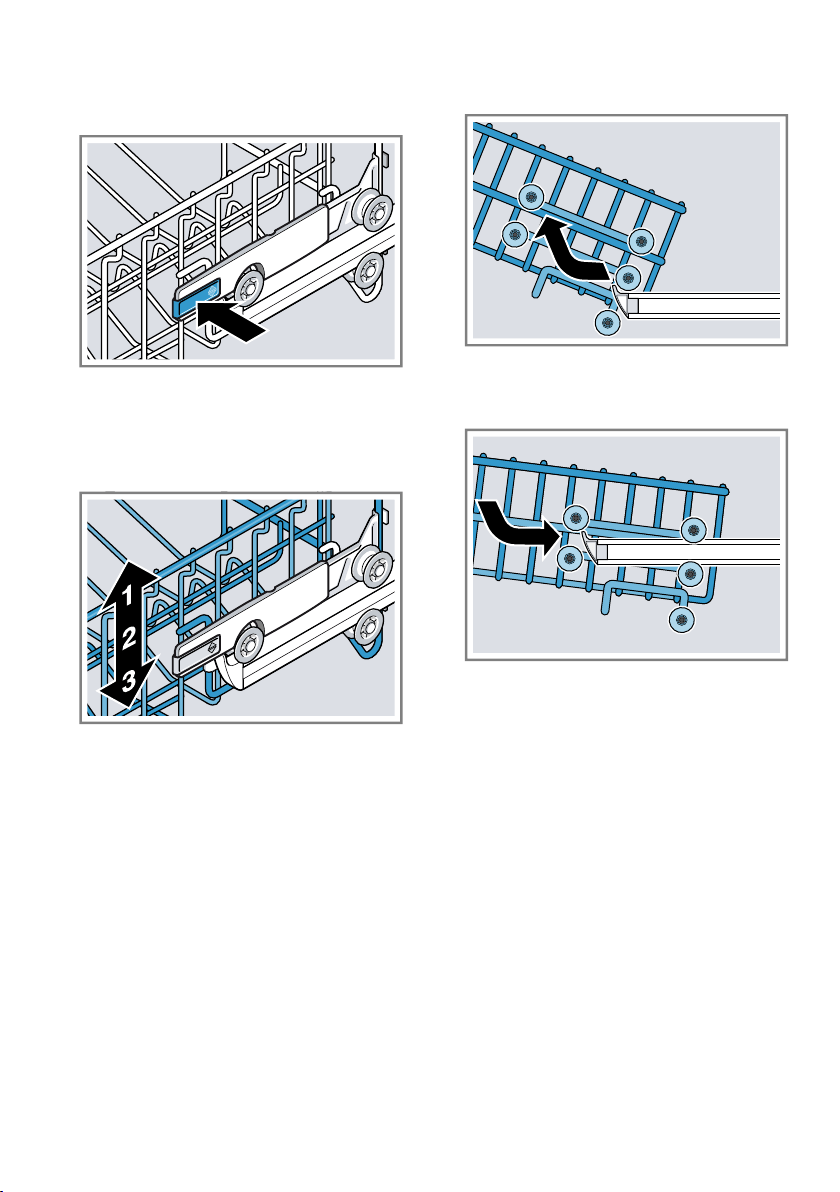
Features en
23
3. Press in the levers on the right and
left on the outside of the basket.
The basket can then slip down
slightly.
4. Raise or lower the basket evenly to
the right level.
→"Basket heights", Page27
Check that the basket is level on
both sides.
5. Slide the basket back in.
Adjusting top basket with pairs of
rollers
To wash large items of tableware in
the baskets, adjust the shelf position
of the top basket.
1. Pull out the top basket.
2. Remove the basket.
3. Insert the basket at the right bas-
ket height.
→"Basket heights", Page27
Check that the basket is level on
both sides.
4. Slide the basket back in.
en Features
24
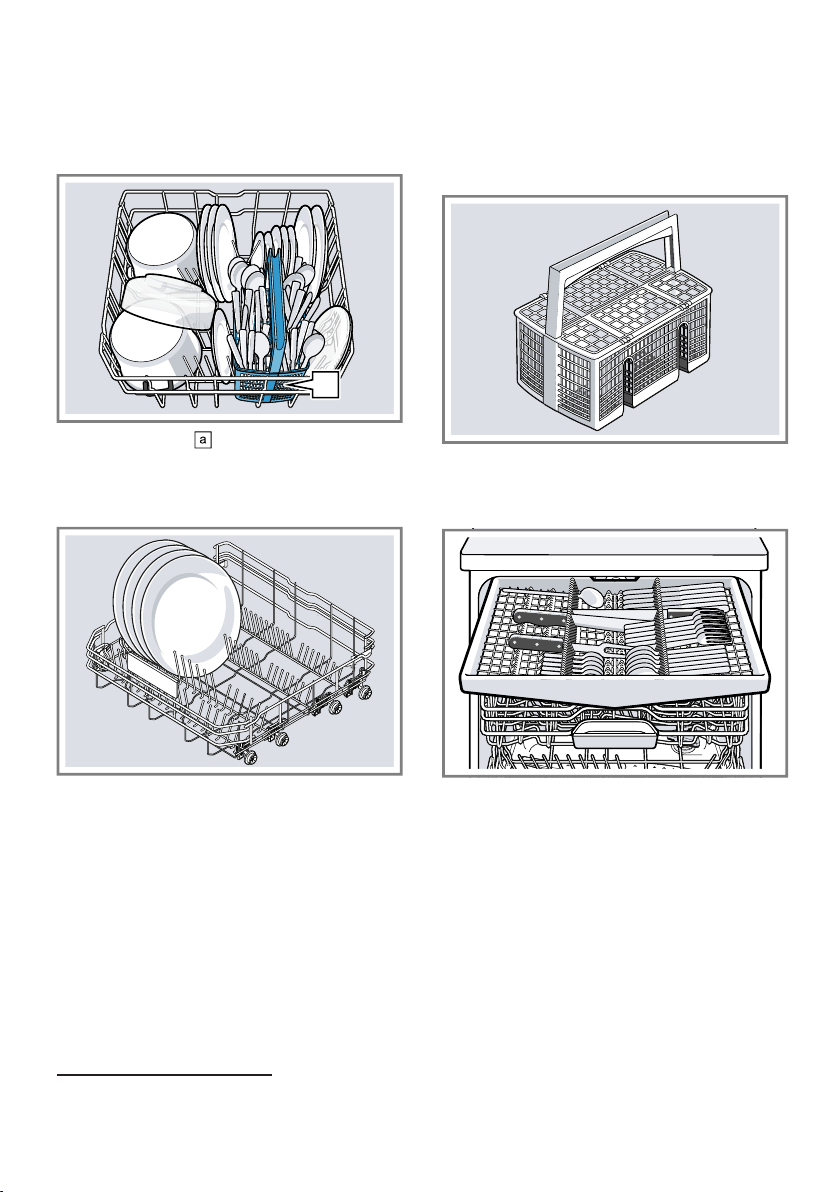
9.2 Bottom basket
Arrange pans and plates in the bot-
tom basket.
a
Cutlery basket
1
Large plates up to a diameter of
31/34cm
1
can be arranged as
shown.
9.3 Cutlery basket
Arrange cutlery in the cutlery basket,
always without sorting it and with the
sharp points downwards.
9.4 Cutlery drawer
Arrange cutlery in the cutlery drawer.
Arrange cutlery with the points and
sharp edges downwards.
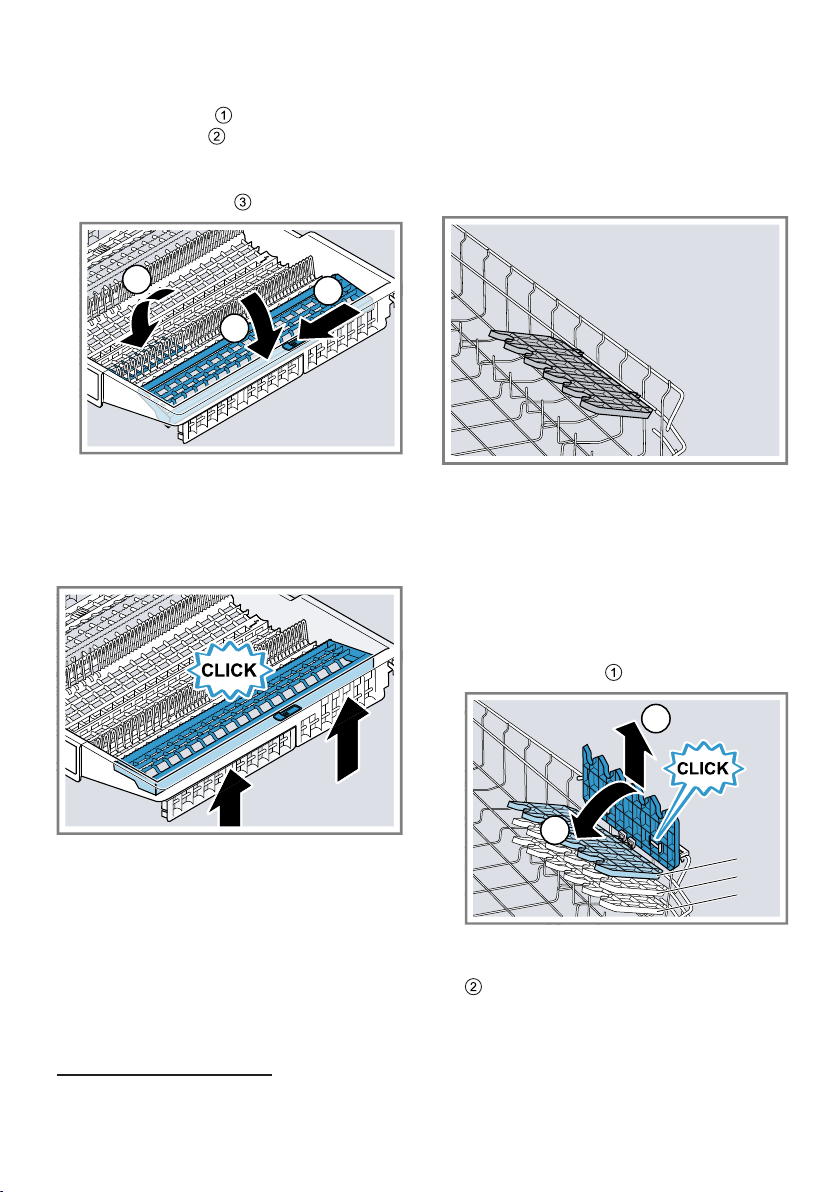
You can reorganise the cutlery
drawer to make more space for
longer/wider items of cutlery.
1
Reorganising cutlery drawer
1
You can fold down the side shelves
and front prongs to make more
space for longer/wider items of cut-
lery.
1
Depending on the appliance specifications
Features en
25
1. To fold down a side shelf, push the
lever forwards and fold down
the side shelf .
2. To fold down the front prongs,
push the lever forwards and fold
down the prongs .
1
2
3
Tip
If you want to return the cutlery
drawer to the original position, fold
the side shelf back up until it clicks
into position.
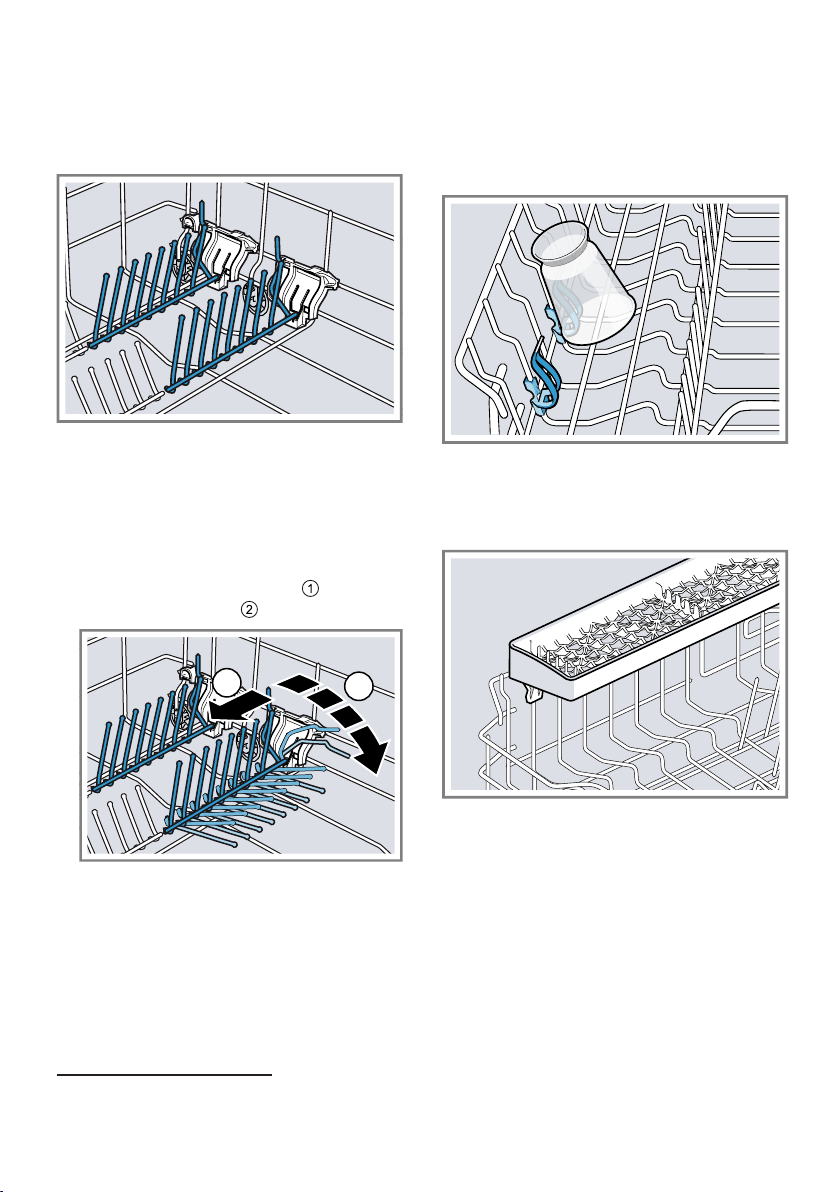
9.5 Etagere
Use the etagere and space under-
neath for small cups and glasses or
for large items of cutlery, e.g.
wooden spoons or serving cutlery.
You can adjust the height of the
etagere.
1
If you do not need the etagere, you
can fold it up.
Adjusting etagere
1
You can adjust the height of the
etagere.
1. Position the etagere vertically and
pull it upwards .
2
3
1
1
2
2. Position the etagere at a slight
angle and move to the right height
.
3. Push the etagere down.
a The etagere clicks into position.
1
Depending on the appliance specifications
en Features
26
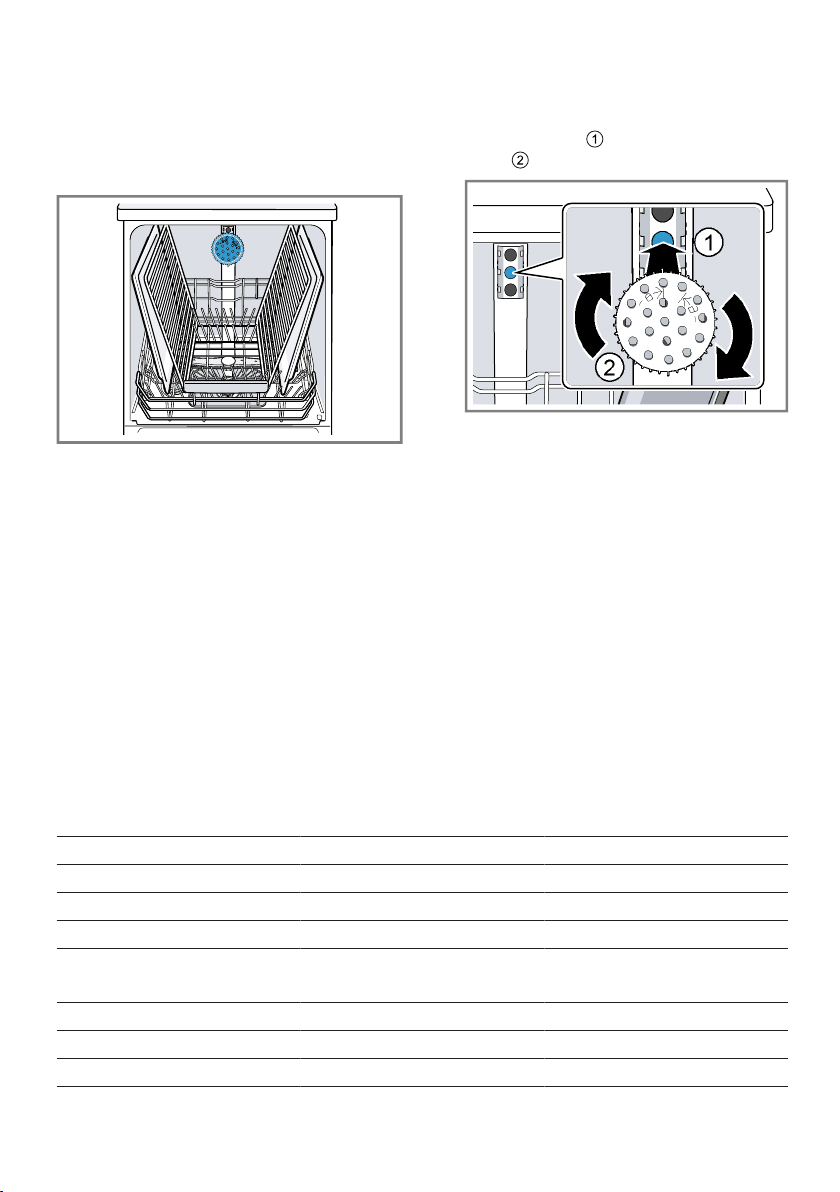
9.6 Folding prongs
Use the folding prongs to position
tableware securely, e.g. plates.
You can fold the prongs down to po-
sition pans, bowls and glasses
better.
1
Folding down prongs
1
If you do not need the prongs, fold
them down.
1. Push the lever forwards and fold
down the prongs .
1
2
2. To use the folding prongs again,
fold them back up.
a The folding prongs click in posi-
tion.
9.7 Small items holder
Use the small items holder to posi-
tion small items of tableware, e.g.
light plastic parts.
9.8 Knife shelf
Use the knife shelf for long, sharp ob-
jects and long items of cutlery.
1
Depending on the appliance specifications
Features en
27
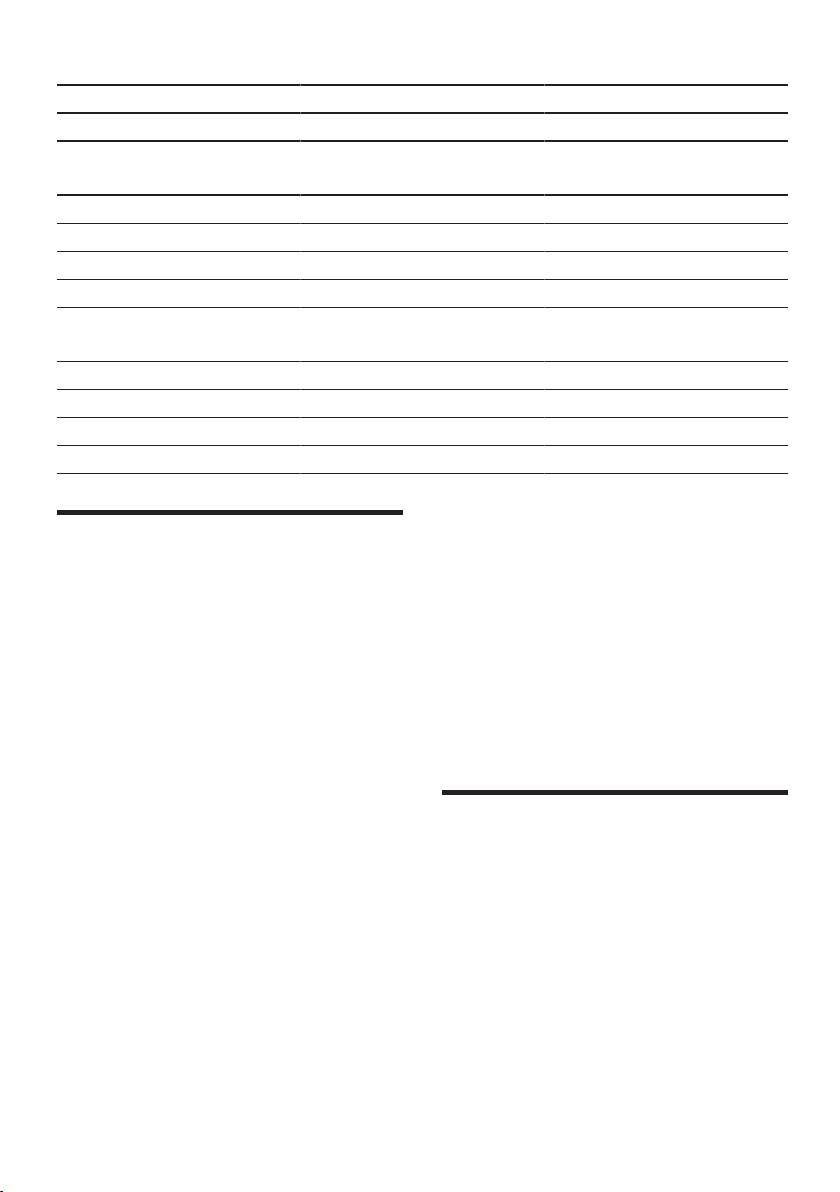
9.9 Baking sheet spray head
Use the baking sheet spray head to
clean large items of tableware, e.g.
trays, grilles and plates.
Arrange max. 2baking sheets and
2grilles as shown to ensure that the
spray jet can reach all parts.
Note:Check that the appliance is al-
ways operated with the top basket or
the baking sheet spray head.
Inserting baking sheet spray head
Use the baking sheet spray head in-
stead of the top basket to clean large
trays, grilles and plates.
1. Remove top basket.
2. Insert the baking sheet spray head
in the holder and turn to the
right .
a The baking sheet spray head
clicks into position.
Removing baking sheet spray
head
If you no longer require the baking
sheet spray head, remove it from the
appliance.
1. Turn the baking sheet spray head
anticlockwise and remove from the
holder.
2. Insert the top basket in the appli-
ance.
9.10 Basket heights
Set the baskets at the right height.
Appliance height 81.5cm with cutlery basket
Level Top basket Bottom basket
1 max. ø 22 cm 31 cm
2 max. ø 24.5 cm 27.5 cm
3 max. ø 27 cm 25 cm
Appliance height 81.5cm with cutlery drawer
Level Top basket Bottom basket
1 max. ø 16 cm 31 cm
2 max. ø 18.5 cm 27.5 cm
en first time
28
Level Top basket Bottom basket
3 max. ø 21 cm 25 cm
Appliance height 86.5cm with cutlery basket
Level Top basket Bottom basket
1 max. ø 24 cm 34 cm
2 max. ø 26.5 cm 30.5 cm
3 max. ø 29 cm 28 cm
Appliance height 86.5cm with cutlery drawer
Level Top basket Bottom basket
1 max. ø 18 cm 34 cm
2 max. ø 20.5 cm 30.5 cm
3 max. ø 23 cm 28 cm
first time
10 Before using for the
first time
first time
Configure the settings for initial start-
up.
10.1 Performing the initial
configuration
On initial start-up or after a reset to
the factory settings, you will need to
make settings.
Requirement:The appliance has
been installed and connected.
→Page12
1.
Add special salt. →Page29
2.
Add rinse aid. →Page31
3. Switch on the appliance.
→Page38
4. Setting the water softening system.
→Page29
5. Set the amount of rinse aid to be
dispensed. →Page32
6.
Add detergent →Page33.
7. Start the Programme with the
highest cleaning temperature
without tableware.
To remove any marks from water
or other residues, we recommend
you operate the appliance without
tableware before using it for the
first time.
Tip:You can change these settings
and other Basic settings →Page40
at any time.
11 Water softening sys-
tem
Hard water leaves limescale on the
tub and tableware and parts of the
appliance may become blocked.
To ensure good dishwashing results,
you can treat the water with special
salt and the water softening system.
To avoid damage to the appliance,
water with a hardness above 9 °E
must be softened.
Water softening system en
29
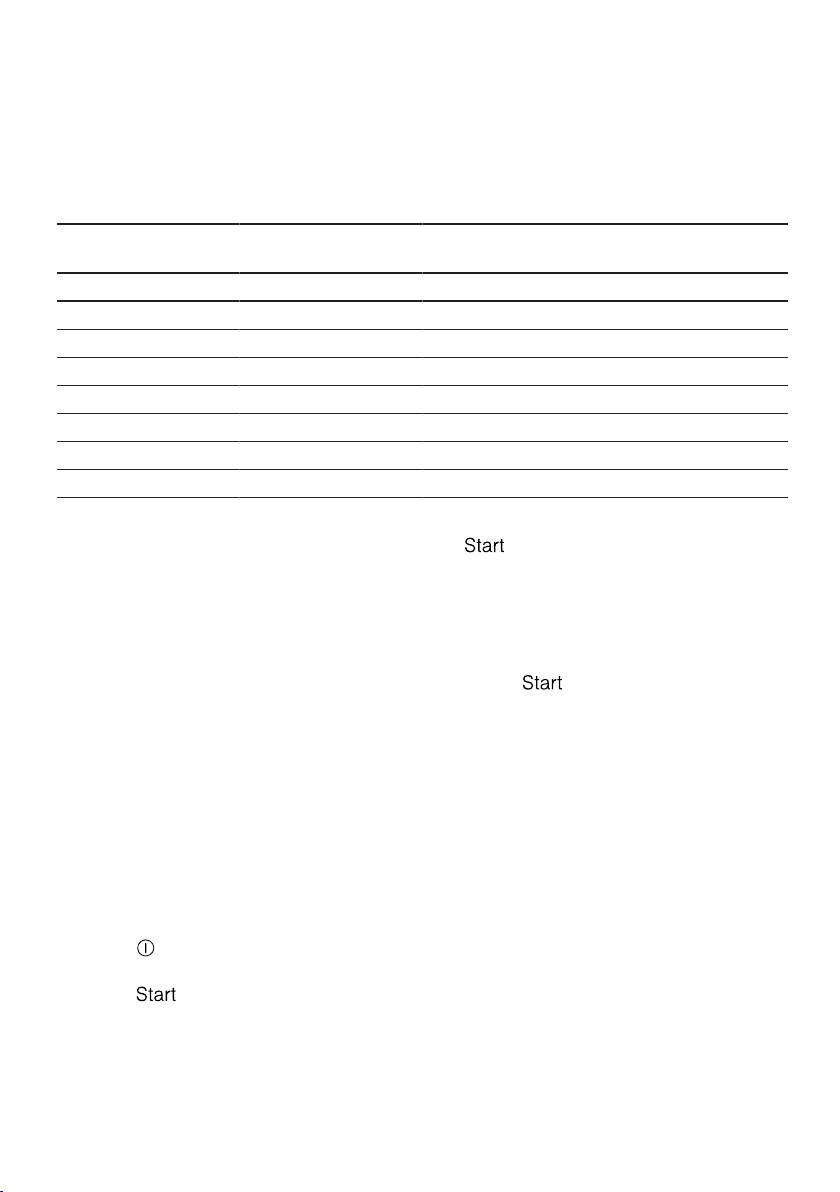
11.1 Overview of water hardness settings
You can find an overview of the water hardness values that can be selected
here.
You can find out how hard your water is from your local water company or by
using a water hardness tester.
Water hardness
°E
Hardness range mmol/l Setting value
0 - 8 Soft 0 - 1.1 H:00
9 - 10 Soft 1.2 - 1.4 H:01
11 - 12 Medium 1.5 - 1.8 H:02
13 - 15 Medium 1.9 - 2.1 H:03
16 - 20 Medium 2.2 - 2.9 H:04
21 - 26 Hard 3.0 - 3.7 H:05
27 - 38 Hard 3.8 - 5.4 H:06
39 - 62 Hard 5.5 - 8.9 H:07
Note:Set the water hardness determ-
ined on your appliance.
→"Setting water softening system",
Page29
With a water hardness of 0 - 8°E
you can dispense with special salt
and switch off the water softening
system.
→"Switching off water softening sys-
tem", Page30
11.2 Setting water softening
system
Set the water hardness on your appli-
ance.
1. Determine the water hardness and
the appropriate setting value.
→"Overview of water hardness set-
tings", Page29
2. Press .
3. Hold programme button A and
press repeatedly until the dis-
play shows H:xx.
4. Release programme button A and
.
a Programme button A flashes and
the display shows H:04.
5. Press programme button C re-
peatedly until the right water hard-
ness has been set.
6. Press to save the setting.
11.3 Special salt
You can use special salt to soften
water.
Adding special salt
If the special salt refill indicator lights
up, add special salt to the dispenser
for special salt just before the pro-
gramme starts. The amount of spe-
cial salt required depends on the wa-
ter hardness: the higher the water
hardness, the greater the amount of
special salt required.
en Water softening system
30
ATTENTION!
Detergent may damage the water
softening system.
▶ Only fill the dispenser of the water
softening system with special dish-
washer salt.
Special salt can damage the tub due
to corrosion.
▶ To make sure that any special salt
that escapes is washed out of the
tub, add the special salt to the dis-
penser for special salt immediately
before the programme starts.
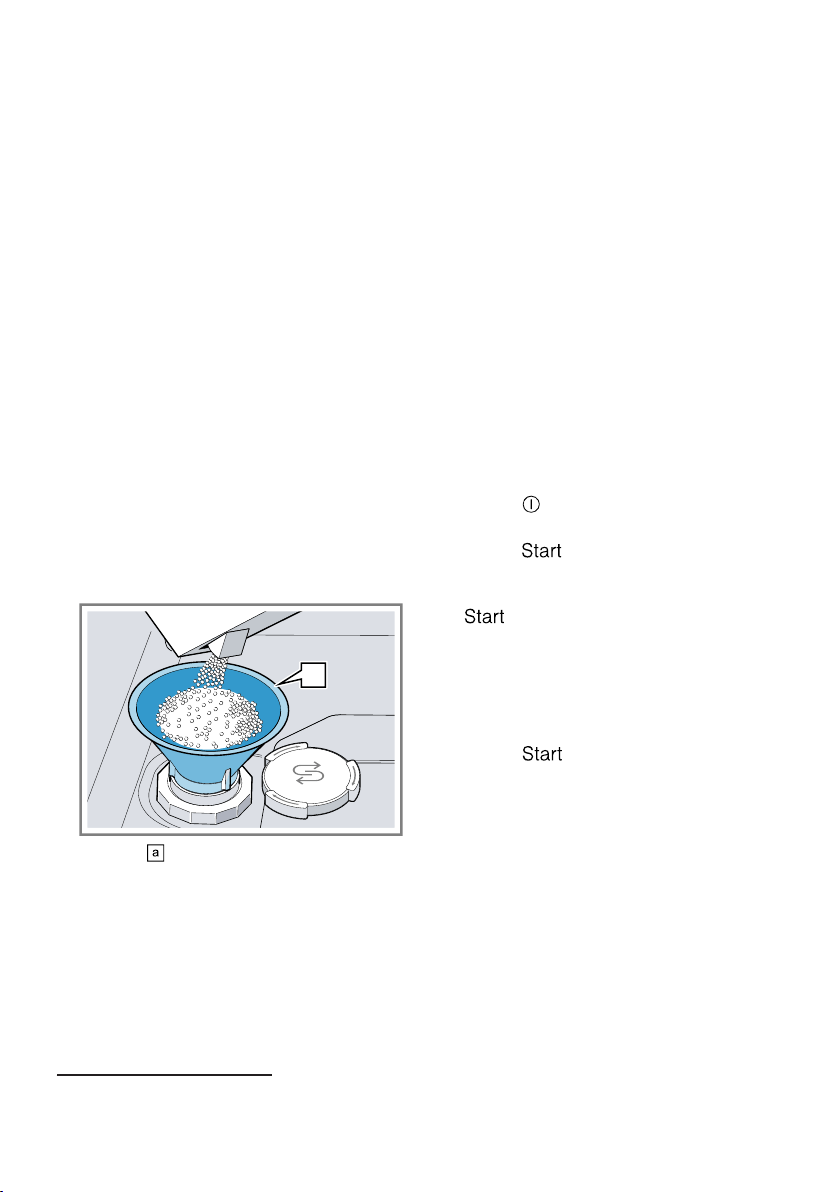
1. Unscrew the lid of the dispenser
for special salt and remove.
2. On initial start-up: Fill the dispenser
right up with water.
3. Note:Only use special salt for
dishwashers.
Do not use salt tablets.
Do not use table salt.
Add the special salt to the dis-
penser.
a
Funnel
1
Fill the dispenser right up with spe-
cial salt. The water in the dis-
penser is displaced and forced
out.
4. Place the lid back on the dis-
penser and turn to close.
11.4 Switching off water
softening system
Note
To avoid damage to the appliance,
only switch off the water softening
system in the following cases:
¡ The water hardness is max. 26°E
and you are using combined deter-
gents with salt replacement sub-
stances. According to manufactur-
ers, combined detergents with salt
replacement substances can gen-
erally only be used up to a water
hardness of 26°E without adding
special salt.
¡ The water hardness is 0 - 8°E.
You do not need to use special
salt.
1. Press .
2. Hold programme button A and
press repeatedly until the dis-
play shows H:xx.
3. Release programme button A and
.
a Programme button A flashes and
the display shows H:04.
4. Press programme button C re-
peatedly until the display shows
H:00.
5. Press to save the setting.
a The water softening system is
switched off and the salt refill indic-
ator is deactivated.
11.5 Regeneration of the wa-
ter softening system
In order to obtain fault-free function of
the water softening system, the appli-
ance performs reheating of the water
softening system at regular intervals.
Regeneration of the water softening
system takes place before the end of
the main rinse cycle in all pro-
1
Depending on the appliance specifications
Rinse aid system en
31
grammes. It will increase the run time
and consumption values, e.g. water
and electricity.
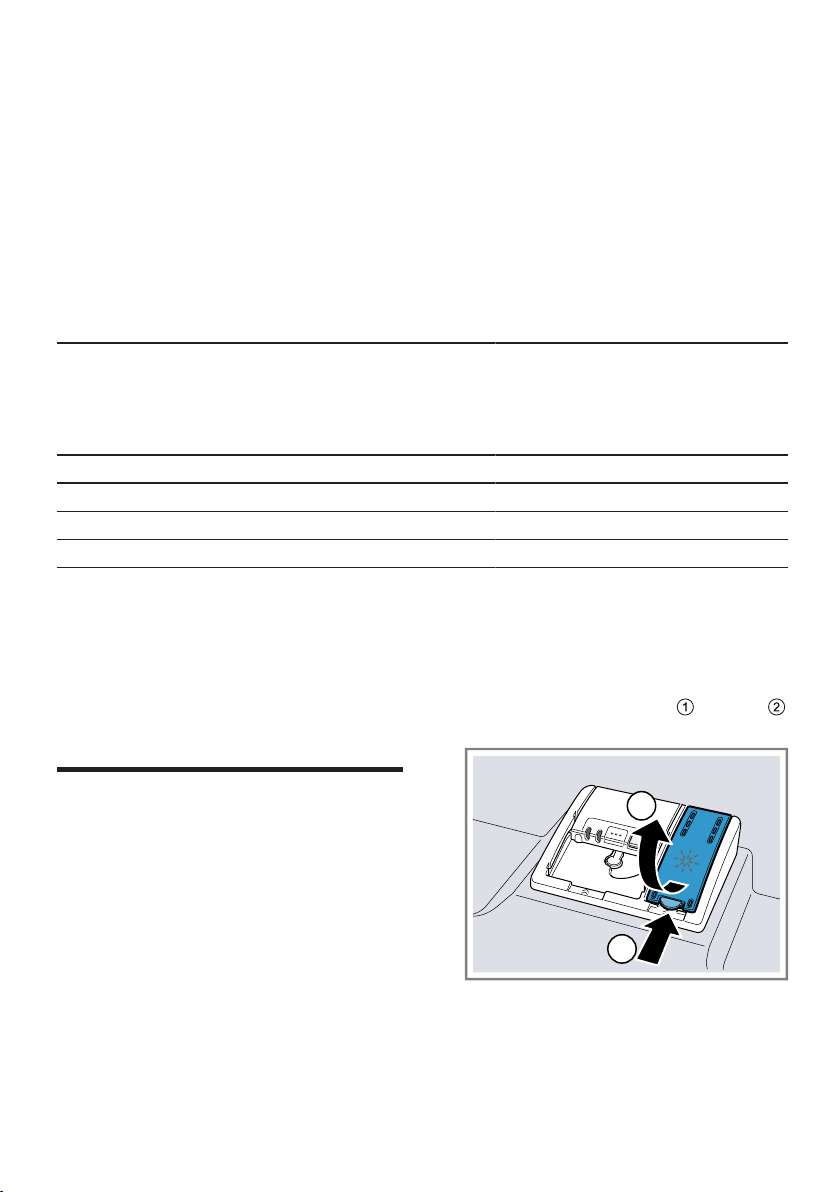
Overview of consumption values with regeneration the water softening
system
Here you can find an overview of the maximum additional running time and
consumption values during regeneration of the water softening system.
You can find the column applicable to your model in the quick reference guide
according to its water consumption in the Eco50° programme.
Water con-
sumption in
litres (de-
pending on
model)
Regeneration
of the water
softening
system after
x rinse cycles
Additional
running time
in minutes
Additional
water con-
sumption in
litres
Additional
power con-
sumption in
kWh
6.5 / 6.7 8 7 5 0.05
7.5 / 7.7 7 7 5 0.05
9.5 6 7 5 0.05
above 10.5 5 7 5 0.05
The consumption values specified
are laboratory measurements determ-
ined in accordance with the currently
applicable standard and using the
Eco 50° programme and the factory
value of the water hardness is set to
16 - 20°E.
12 Rinse aid system
You can use the rinse aid system
and rinse aid to get tableware and
glasses rinsed perfectly without
marks.
12.1 Rinse aid
For optimum drying results, use rinse
aid.
Only use rinse aid for domestic dish-
washers.
Adding rinse aid
If the rinse aid refill indicator lights
up, top up with rinse aid. Only use
rinse aid for domestic dishwashers.
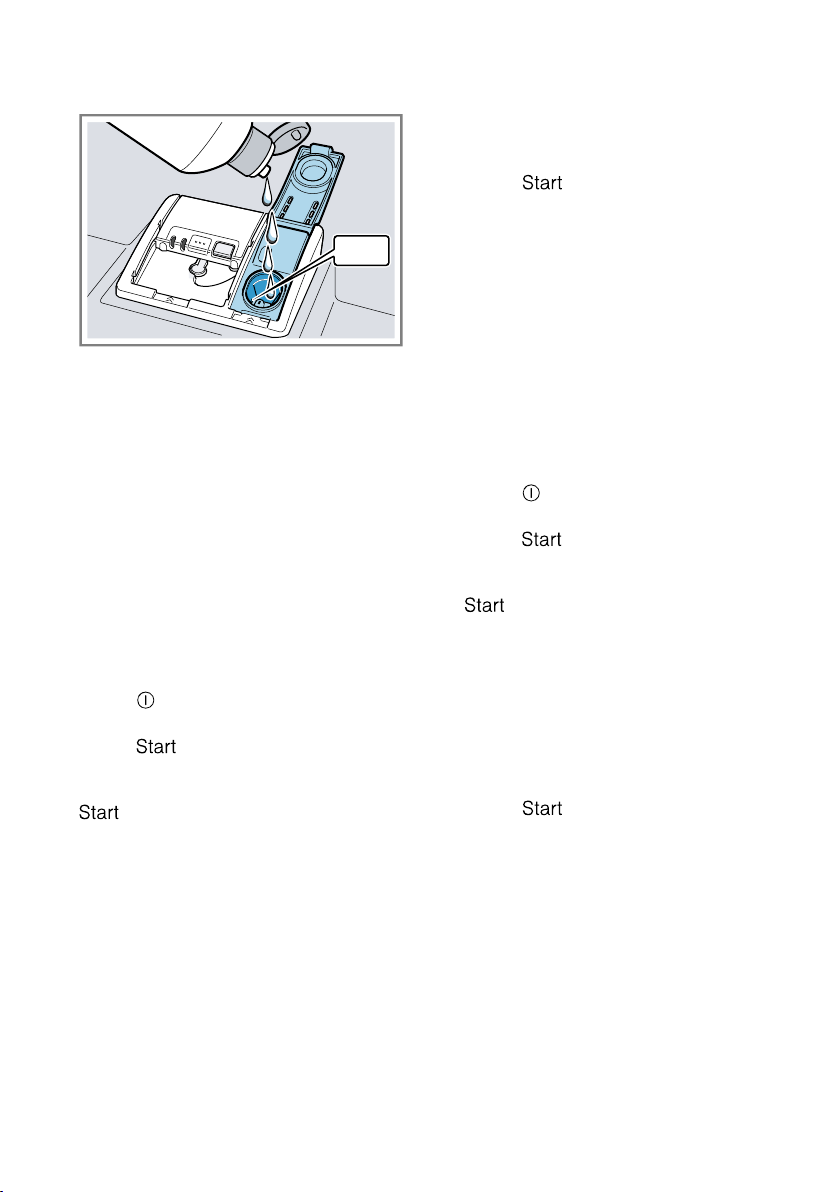
1. Press the catch on the lid of the
dispenser for rinse aid and lift
.
1
2
en Rinse aid system
32
2. Add rinse aid up to the max mark.
max
3. If rinse aid spills out, remove it
from the tub.
Spilled rinse aid can cause ex-
cessive frothing during the wash
cycle.
4. Close the lid of the dispenser for
rinse aid.
a The lid clicks into position.
12.2 Setting the amount of
rinse aid
If there are streaks or water marks on
tableware, change the amount of
rinse aid.
1. Press .
2. Hold programme button A and
press repeatedly until the dis-
play shows H:xx.
3. Release programme button A and
.
a Programme button A flashes and
the display shows H:04.
4. Press programme button A re-
peatedly until the display shows
the value set at the factory r:05.
5. Press programme button C re-
peatedly until the right amount of
rinse aid has been set.
– A low setting adds less rinse aid
during the wash cycle and re-
duces streaking on tableware.
– A higher setting adds more
rinse aid during the wash cycle,
reduces water marks and im-
proves the drying result.
6. Press to save the setting.
12.3 Switching rinse aid sys-
tem off
If you find the rinse aid refill indicator
irritating, e.g. when using combined
detergents with a rinse aid compon-
ent, you can switch the rinse aid sys-
tem off.
Tip:The function of rinse aid is lim-
ited with combined detergents. You
will generally get better results using
rinse aid.
1. Press .
2. Hold programme button A and
press repeatedly until the dis-
play shows H:xx.
3. Release programme button A and
.
a Programme button A flashes and
the display shows H:04.
4. Press programme button A re-
peatedly until the display shows
the value set at the factory r:05.
5. Press programme button C re-
peatedly until the display shows
r:00.
6. Press to save the setting.
a The rinse aid system is switched
off and the rinse aid refill indicator
is deactivated.

Detergent en
33
13 Detergent
Find out which detergents are suit-
able for your appliance.
13.1 Suitable detergents
Only use detergents that are suitable
for dishwashers. Both separate and
combined detergents are suitable.
For optimum washing and drying res-
ults, use separate detergent, adding
Special salt →Page29 and Rinse aid
→Page31 separately.
Modern, powerful detergents mainly
use a low-alkaline formulation with
enzymes. Enzymes break down
starch and remove protein. Oxygen-
based bleaching agents are generally
used to remove coloured marks, e.g.
tea or ketchup.
Note:Follow the manufacturer's in-
structions for each detergent.
Detergent Description
Tabs Tabs are suitable for
all cleaning functions
and do not need to
be measured out.
With shorter Pro-
grammes tabs some-
times do not dissolve
entirely and leave
residues of deter-
gent. This may im-
pair the cleaning ef-
fect.
Powder de-
tergent
Powder detergent is
recommended for
shorter Programmes.
The dosage can be
adjusted to the level
of soiling.
Detergent Description
Liquid deter-
gent
Liquid detergent
works faster and is
recommended for
shorter Programmes
without PreRinse.
Sometimes liquid de-
tergent may leak out
despite the detergent
dispenser being
closed. This is not a
fault and is non-crit-
ical if you remember
the following:
¡ Only choose a
programme
without PreRinse.
¡ Do not select
timer program-
ming for starting
the programme.
The dosage can be
adjusted to the level
of soiling.
Tip:Suitable detergents are available
online via our website or from Cus-
tomer Services →Page57.
Separate detergents
Separate detergents are products
that do not contain components other
than detergent, e.g. powder deter-
gent or liquid detergent.
With powder and liquid detergent the
dosage can be individually adjusted
to the level of soiling of the table-
ware.
For better washing and drying results
and to avoid damage to the appli-
ance, please additionally use Special
salt →Page29 and Rinse aid
→Page31.
Combined detergent
Besides conventional separate deter-
gents, a number of products are
available with additional functions.

en Detergent
34
These products contain not only de-
tergent but also rinse aid and salt re-
placement substances (3in1) and,
depending on the combination (4in1,
5in1,...), additional components such
as glass protection or stainless steel
cleaner.
According to manufacturers, com-
bined detergents generally only func-
tion up to a water hardness of 26°E.
With a water hardness above 26°E
you will need to add special salt and
rinse aid. For the best washing and
drying results we recommend using
special salt and rinse aid from a wa-
ter hardness of 17°E. If you are us-
ing combined detergent, the washing
programme is adjusted automatically
to ensure the best possible washing
and drying result.
13.2 Unsuitable detergents
Do not use detergent which could
cause damage to the appliance or
present a risk to health.
Detergent Description
Hand wash-
ing-up liquid
Hand washing-up li-
quid can cause in-
creased frothing and
damage the appli-
ance.
Detergent
containing
chlorine
Chlorine residue on
tableware may
present a risk to
health.
13.3 Information on deter-
gents
Follow the instructions on detergents
in everyday use.
¡ Detergents marked as "organic" or
"ecological" (environmentally
friendly) generally contain lower
levels of active agents or com-
pletely dispense with certain sub-
stances. The cleaning effect may
be restricted here.
¡ Set the rinse aid and the water
softening system to the separate
detergent or combined detergent
in use.
¡ According to manufacturers, com-
bined detergents with salt replace-
ment substances can only be used
up to a certain water hardness,
usually 26°E, without adding spe-
cial salt. For the best washing and
drying results we recommend us-
ing special salt from a water hard-
ness of 17°E.
¡ To prevent sticking, only touch de-
tergents in a water-soluble pouch
with dry hands and only ever place
them in a dry detergent dispenser.
¡ Even if the rinse aid and special
salt refill indicators light up, wash-
ing programmes will run properly
with combined detergents.
¡ The function of rinse aid is limited
with combined detergents. You will
generally get better results using
rinse aid.
¡ Use tablets with a special drying
performance.
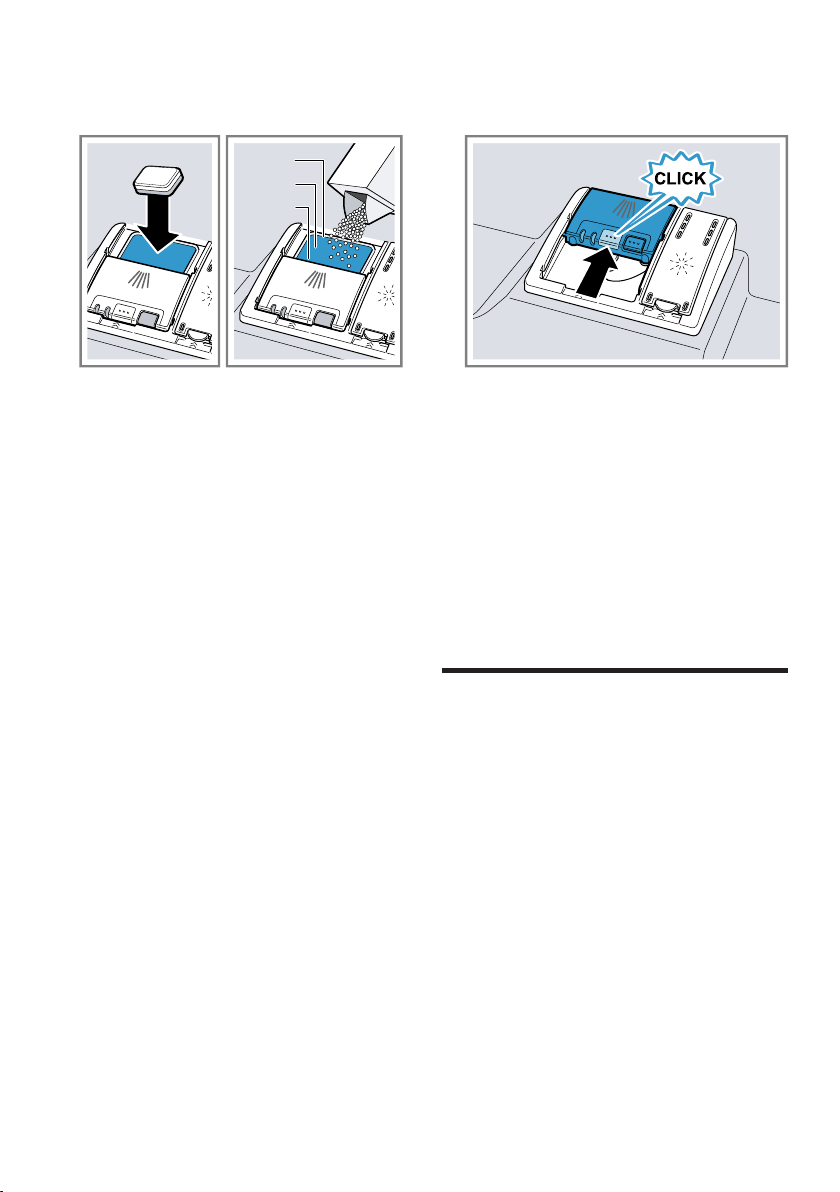
13.4 Adding detergent
1. To open the detergent dispenser,
press the locking latch.
Tableware en
35
2. Add the detergent to the dry deter-
gent dispenser.
15 ml
25 ml
50 ml
If you are using tablets, one is
enough. Insert the tablets in a hori-
zontal position.
If you are using powder or liquid
detergent, follow the manufac-
turer's instructions and quantities
for dosage in the detergent dis-
penser.
20ml–25ml detergent is suffi-
cient for normal soiling. If table-
ware is only lightly soiled, slightly
less than the amount of detergent
specified is usually sufficient.
3. Close the lid of the detergent dis-
penser.
a The lid clicks into position.
a The detergent dispenser will open
automatically at the optimum time
during the programme. Powder or
liquid detergent will spread around
the washing tank and dissolve
there. Tablets will fall into the tablet
collecting tray and dissolve in the
right dosage. In order to ensure
that tablets can dissolve evenly, do
not place any other objects in the
tablet collecting tray.
14 Tableware
Only clean tableware that is suitable
for dishwashers.
Note:Decorated glassware and parts
made of aluminium or silver may
fade or discolour with dishwashing.
Delicate types of glass may turn
cloudy after a few washing cycles.

en Tableware
36
14.1 Damage to glass and
tableware
Avoid damage to glass and table-
ware.
Cause Recommenda-
tion
The following
tableware is not
dishwasher-safe:
¡ Items of cut-
lery and table-
ware made
from wood
¡ Decorated
glassware, an-
tique and
hand-crafted
tableware
¡ Plastic parts
not resistant to
heat
¡ Tableware
made from
copper or tin
¡ Tableware
soiled with
ash, wax, lub-
ricating grease
or paint
¡ Very small
items of table-
ware
Only put table-
ware in the dish-
washer if it is
marked as dish-
washer-safe by
the manufacturer.
Glass and table-
ware was not
dishwasher-safe.
Only put glasses
and china in the
dishwasher if it is
marked as dish-
washer-safe by
the manufacturer.
The chemical
composition of
the detergent
causes damage.
Use a detergent
marked as gentle
on tableware by
the manufacturer.
Cause Recommenda-
tion
Highly caustic al-
kaline or highly
acidic cleaning
agents, in partic-
ular commercial
or industrial
cleaning agents,
are not suitable
for dishwashers
in conjunction
with aluminium.
If you are using
highly caustic al-
kaline or highly
acidic cleaning
agents, in partic-
ular commercial
or industrial
cleaning agents,
do not put alu-
minium parts in
the dishwasher
interior.
The water tem-
perature of the
programme is
too high.
Select a pro-
gramme with
lower temperat-
ures.
After the pro-
gramme has
ended, take
glassware and
cutlery out of the
appliance without
delay.
14.2 Arrange tableware
Arrange the tableware correctly to
optimise the dishwashing result and
prevent damage to both the appli-
ance and tableware.
Tips
¡ Using the appliance allows you to
save energy and water compared
to washing-up by hand.
¡ See our website for examples of
how to load your appliance effi-
ciently, free of charge.
¡ To save energy and water, load
the machine with the number of
place settings specified.
→"Technical specifications",
Page59
operation en
37
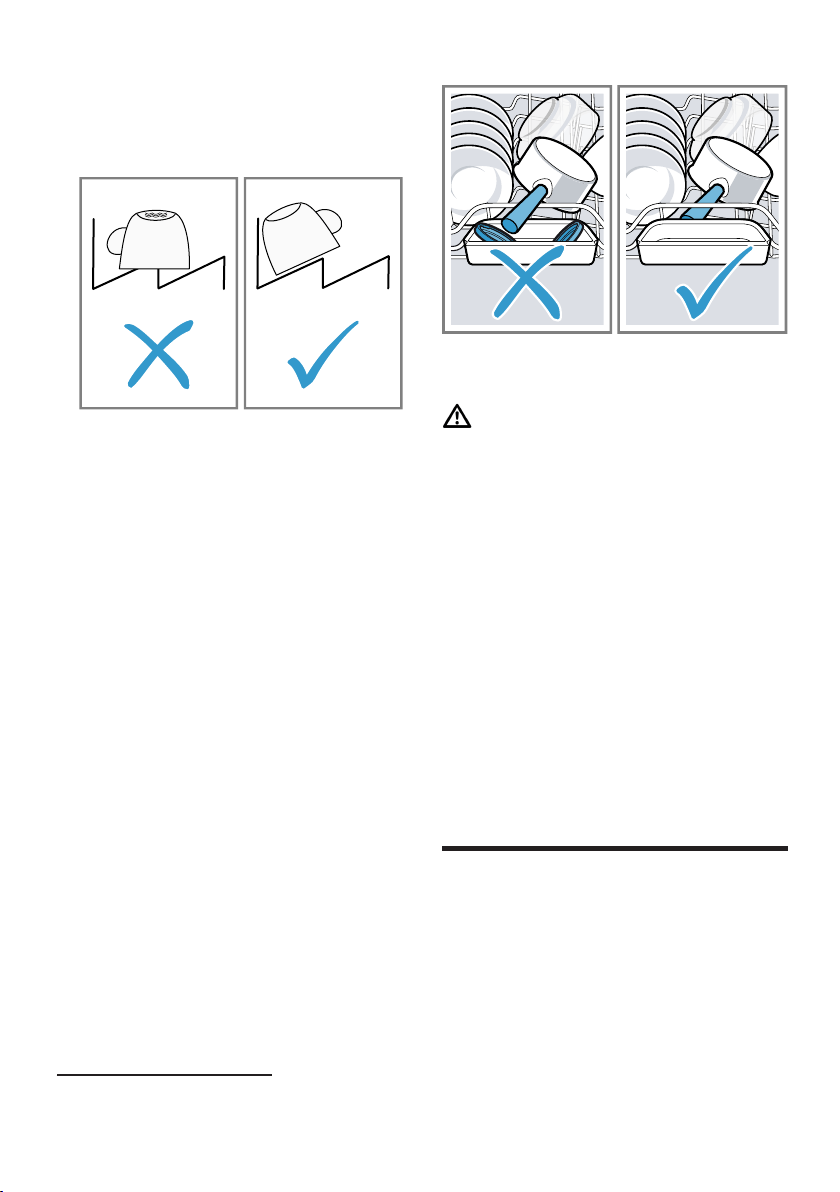
¡ For better washing and drying res-
ults, position items with curves or
recesses at an angle so the water
can run off.
1. Remove large remnants of food
from your tableware.
To save resources, do not pre-
rinse tableware under running wa-
ter.
2. Observe the following when arran-
ging tableware:
– Put heavily soiled tableware in
the bottom basket, e.g. pans.
The more powerful the spray jet,
the better the dishwashing result
will be.
– To prevent damage to table-
ware, arrange it so it is stable
and cannot tip over.
– To prevent injury, arrange cut-
lery with the points and sharp
edges downwards.
– Position containers with the
openings facing down so no wa-
ter can collect in them.
– Do not block the spray arms -
make sure that they can turn
freely.
– Do not place small parts in the
tablet collecting tray and do not
block it with tableware so as not
to obstruct the lid of the deter-
gent dispenser.
14.3 Removing tableware
WARNING
Risk of injury!
Hot tableware can cause burns to the
skin. When hot, tableware is sensitive
to shock, may crack and can result in
injury.
▶ When the programme has ended,
do not empty the appliance until
the tableware has cooled down for
a while.
1. To prevent water dripping on the
tableware, unload it starting at the
bottom and working up.
2. Check the washing tank and ac-
cessories for soiling and clean if
necessary.
→"Cleaning and servicing",
Page41
operation
15 Basic operation
operation
15.1 Opening appliance door
1. If the childproof lock
1
is not activ-
ated, open the appliance door.
1
Depending on the appliance specifications
en operation
38
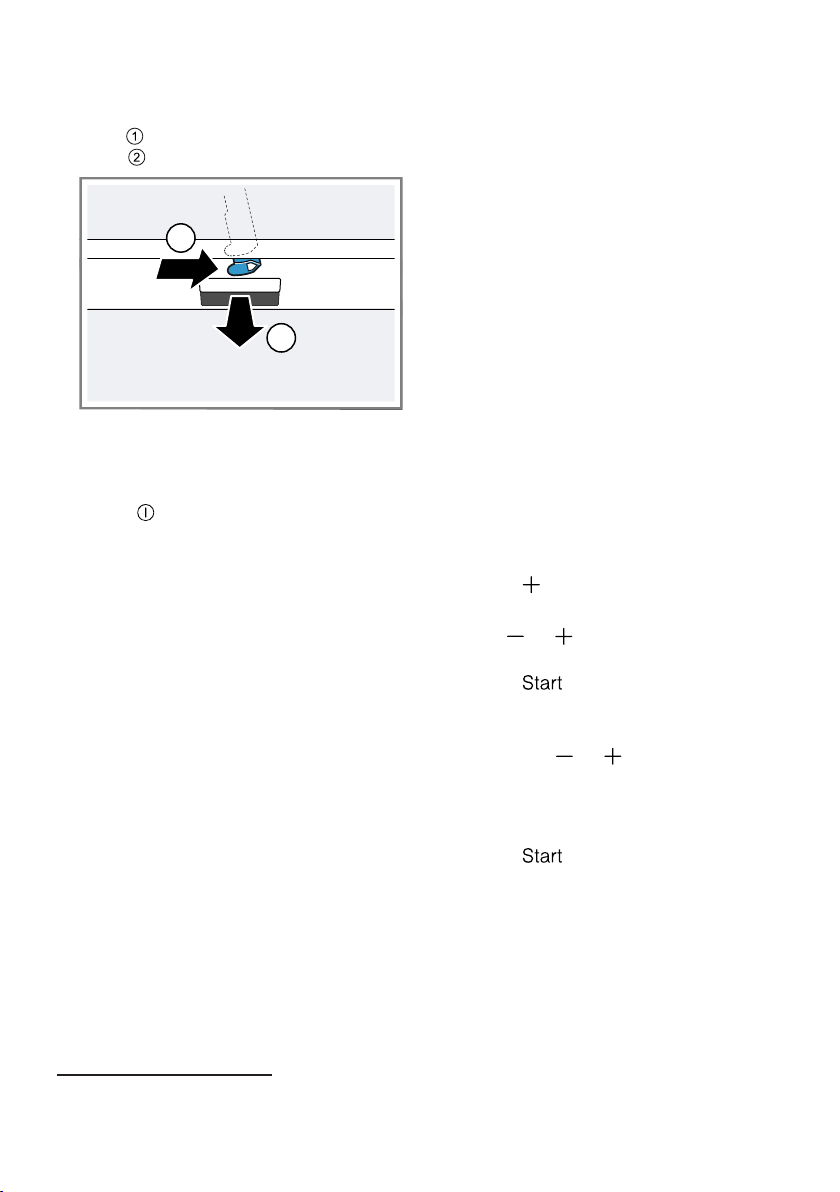
2. If the childproof lock
1
is activated,
press the catch of the lock to the
right and open the appliance
door .
2
1
15.2 Switching on the appli-
ance
▶ Press .
The Eco 50° programme is set by
default.
The Eco 50° programme is an es-
pecially environmentally friendly
programme and ideal for normally
soiled tableware. It is the most effi-
cient programme for the combina-
tion of energy/water consumption
for this type of tableware and evid-
ences conformity with the Eco-
design Directive.
If you do not perform any actions
on the appliance for 15 minutes, it
will switch off automatically.
1
15.3 Setting a programme
To adjust the wash cycle to the soil-
ing level of the tableware, select a
suitable programme.
▶ Press the right programme button.
→"Programmes", Page19
a The remaining running time of the
programme appears on the dis-
play.
15.4 Setting additional func-
tions
You can set additional functions to
complete the washing programme
selected.
Note:The additional functions which
can be used depend on the pro-
gramme selected.
→"Programmes", Page19
▶ Press the button for the relevant
additional function.
→"Additional functions", Page21
a The additional function is set and
the additional function button
flashes.
15.5 Setting timer program-
ming
You can delay the start of the pro-
gramme by up to 24hours.
1. Press .
a "h:01" appears in the display.
2. Use or to set the required
start time for the programme.
3. Press .
a This activates timer programming.
Tip:To deactivate timer program-
ming, press or repeatedly until
"h:00" appears in the display.
15.6 Starting the programme
▶ Press .
a The programme has ended when
the display shows "0:00".
1
Depending on the appliance specifications
operation en
39
Notes
¡ If you want to add more tableware
while the appliance is running, do
not use the tablet collecting tray as
a handle for the top basket. You
might touch the partially dissolved
tablet.
¡ You can only change a pro-
gramme when running if you can-
cel it.
→"Terminate programme",
Page39
¡ The appliance switches off auto-
matically 1minute after the end of
the programme to save energy. If
you open the appliance door im-
mediately after the programme has
ended, the appliance will switch off
after 4 seconds.
15.7 Activating button lock
The button lock prevents the appli-
ance from being operated accident-
ally or incorrectly while running.
Requirement:A programme has
started. →Page38
▶ Press for approx. 3seconds.
a The button lock is activated and
will be automatically deactivated at
the end of the programme.
a The display shows "CL" when the
appliance is running.
a The button lock remains activated
with a power failure.
15.8 Deactivate button lock
▶ Press for approx. 3seconds.
15.9 Interrupting programme
Note:When you open the appliance
door once the appliance has heated
up, leave the door slightly ajar for a
few minutes and then close it. This
will help prevent excess pressure
building up in the appliance and stop
the appliance door bursting open.
1. Press .
a The programme is saved and the
appliance switches off.
2. Press to resume the pro-
gramme.
15.10 Terminate programme
To end a programme early or to
switch from a programme that has
already started, you will need to can-
cel it first.
▶ Press for approx.
3seconds.
a The programme is cancelled and
ends after approx. 1minute.
15.11 Switching off appliance
1. Please note the information on
Safe use →Page10.
2. Press .
3. To prevent damage from dripping
water, turn the water tap off tight
(not applicable to appliances with
Aqua-Stop).
Tip:If you press during the wash
cycle, the programme currently run-
ning will be interrupted. When you
switch the appliance back on, the
programme continues automatically.
en Basic settings
40
16 Basic settings
You can configure the appliance to meet your needs.
16.1 Overview of basic settings
The basic settings depend on the features of your appliance.
Basic setting Display text Selection Description
Water hardness H:04
1
H:00 - H:07 Set the water softening sys-
tem to your water hardness.
→"Setting water softening
system", Page29
Level H:00 switches the wa-
ter softening system off.
Rinse aid dis-
pensing
r:05
1
r:00 - r:06 Set the amount of rinse aid
to be dispensed.
→"Setting the amount of
rinse aid", Page32
Switch the rinse aid system
off with level r:00.
Intensive drying d:00
1
d:00 - d:01 The temperature is in-
creased during the final
rinse, which improves the
drying result. This may in-
crease the run time slightly.
Note:Not suitable for delic-
ate items of tableware.
Switch Extra Dry on "d:01"
or off "d:00".
Hot water A:00
1
A:00 - A:01 Set cold water or hot water
connection. Only set the ap-
pliance to hot water if this
can be prepared with little
energy and a suitable install-
ation is available, e.g. solar
heating system with circula-
tion line. The water temperat-
ure should be at least 40°C
and max. 60°C.
Switch hot water on "A:01"
or off "A:00".
1
Factory setting (may vary according to model)
Cleaning and servicing en
41
16.2 Changing basic settings
1. Press .
2. Hold programme button A and
press repeatedly until the dis-
play shows H:xx.
3. Release programme button A and
.
a Programme button A flashes and
the display shows H:04.
4. Press programme button A re-
peatedly until the display shows
the required setting.
5. Press programme button C re-
peatedly until the display shows
the right value.
You can change several settings.
6. Press to save the setting.
17 Cleaning and servi-
cing
To keep your appliance working effi-
ciently for a long time, it is important
to clean and maintain it carefully.
17.1 Cleaning the tub
WARNING
Risk of harm to health!
Using detergents containing chlorine
may result in harm to health.
▶ Never use detergents containing
chlorine.
1. Remove any coarse soiling in the
interior with a damp cloth.
2. Add detergent to the detergent dis-
penser.
3. Select the programme with the
highest temperature.
→"Programmes", Page19
4. Start the programme without table-
ware. →Page38
17.2 Self-cleaning interior
1
To remove deposits, the appliance
self-cleans the interior at regular inter-
vals.
The programme sequence is auto-
matically adjusted for self-cleaning,
e.g. the cleaning temperature is
briefly increased. Consumption val-
ues, e.g. water and electricity, may
also increase.
If the interior is no longer self-cleaned
adequately and deposits occur, see
this information:
→"Cleaning the tub", Page41.
17.3 Cleaning products
Only use suitable cleaning products
to clean your appliance.
→"Safe use", Page10
17.4 Tips on appliance care
Follow the tips on appliance care to
make sure your appliance functions
properly at all times.
Action Benefit
Wipe the door
seals, the front of
the dishwasher
and the control
panel regularly
using a damp
cloth and wash-
ing-up liquid.
This ensures the
parts of the appli-
ance will remain
clean and hy-
gienic.
If the appliance
is not going to
be used for a
while, leave the
door slightly ajar.
This will prevent
unpleasant
odours.
1
Depending on the appliance specifications
en Cleaning and servicing
42
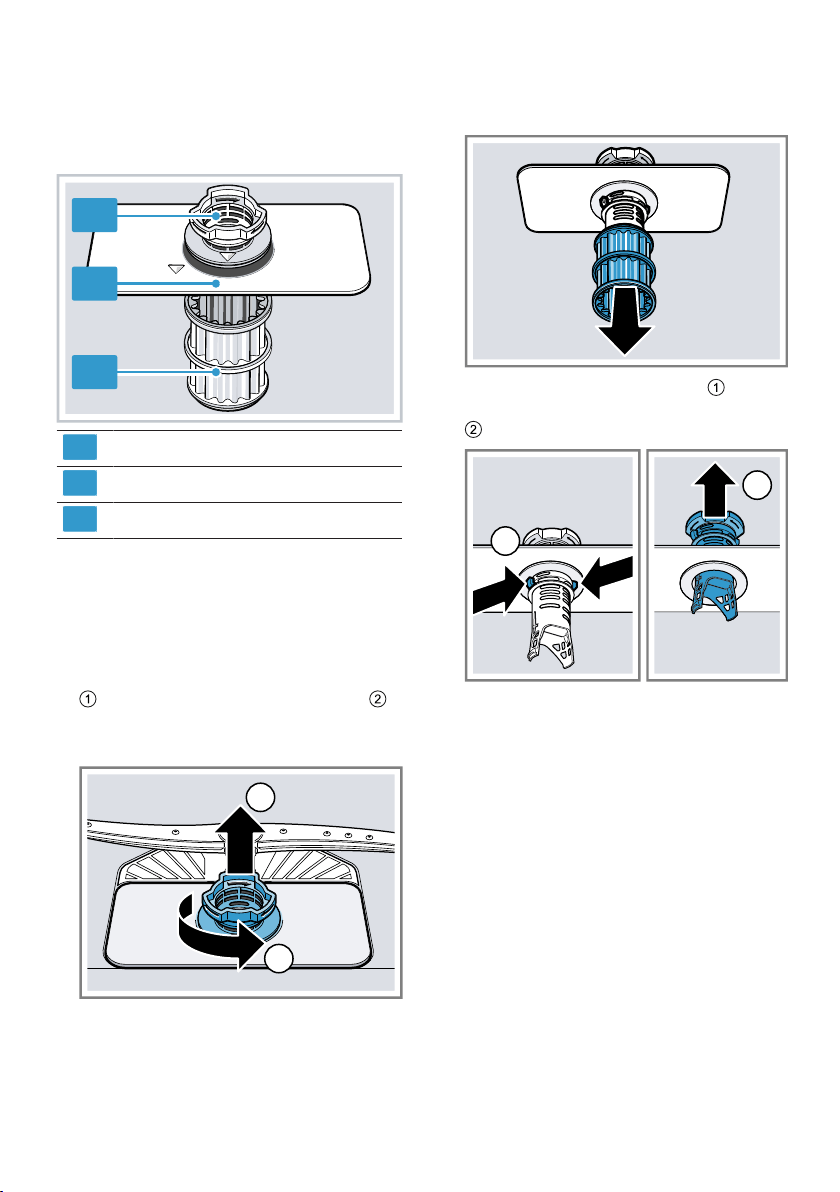
17.5 Filter system
The filter system removes coarse
soiling from the dishwashing cycle.
1
2
3
1
Micro filter
2
Fine filter
3
Coarse filter
Cleaning filters
Soiling in the dishwashing water may
block the filters.
1. After each wash check the filters
for residue.
2. Turn the coarse filter anticlockwise
and remove the filter system .
‒ Check that no foreign objects
fall into the sump.
1
2
3. Pull down the micro filter to re-
move.
4. Press the locking catches to-
gether and lift the coarse filter out
.
1
2
5. Clean the filter elements under run-
ning water.
Carefully clean the rim of dirt
between the coarse and the fine fil-
ter.
6. Re-assemble the filter system.
Make sure that the locking catches
on the coarse filter click into posi-
tion.
7. Insert the filter system into the ap-
pliance and turn the coarse filter
clockwise.
Make sure that the arrow markings
match up.
Cleaning and servicing en
43
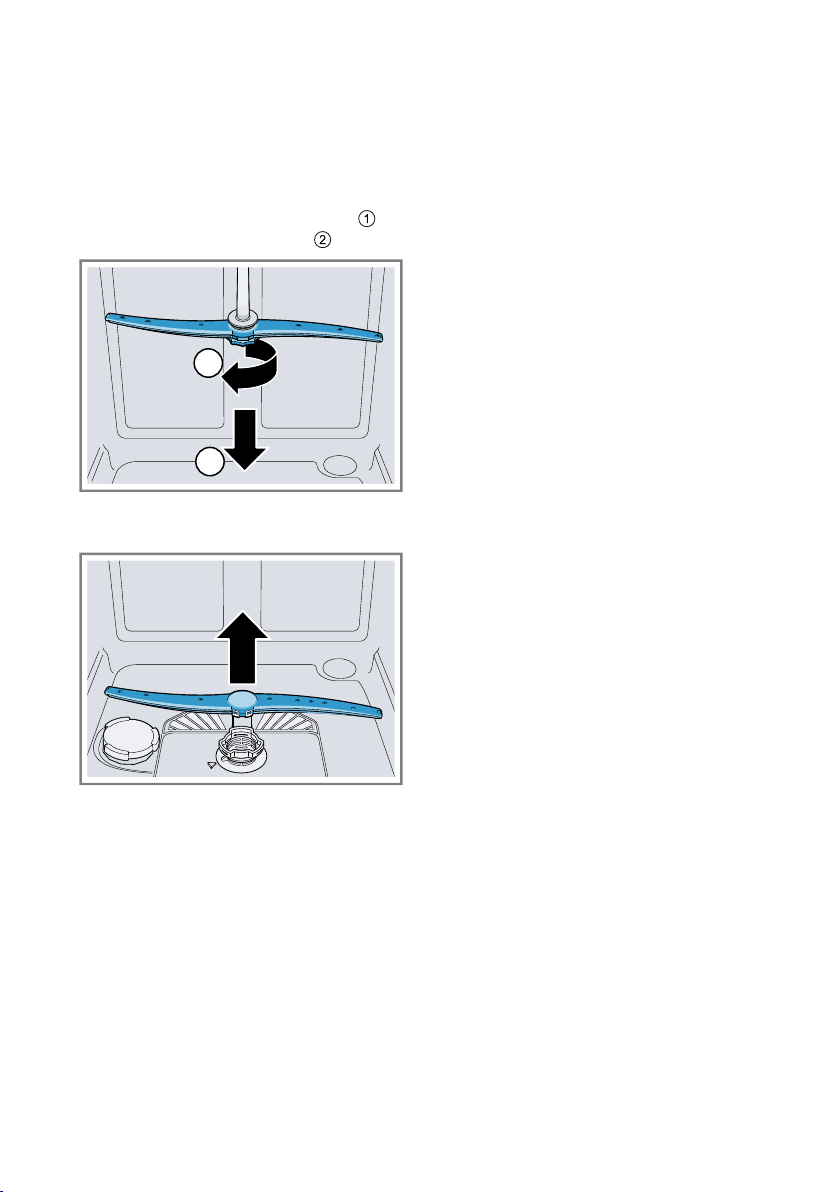
17.6 Cleaning spray arms
Limescale and soiling in the dish-
washing water may block the nozzles
and bearings on the spray arms.
Clean the spray arms regularly.
1. Unscrew the upper spray arm
and pull down to remove .
1
2
2. Pull up the lower spray arm to re-
move.
3. Check the outlet nozzles on the
spray arms for blockages under
running water and remove any for-
eign bodies.
4. Insert the lower spray arm.
a The spray arm clicks into position.
5. Insert the upper spray arm and
screw it firmly in place.
en Troubleshooting
44
18 Troubleshooting
You can rectify minor faults on your appliance yourself. Read the troubleshoot-
ing information before contacting Customer Service. This will avoid unneces-
sary costs.
WARNING
Risk of electric shock!
Improper repairs are dangerous.
▶ Repairs to the appliance should only be carried out by trained specialist
staff.
▶ Only use genuine spare parts when repairing the appliance.
▶ If the power cord of this appliance is damaged, it must be replaced with a
special connection cable, which is available from the manufacturer or his
Customer Service.
Fault Cause and troubleshooting
Appliance door will
not open or cannot be
opened easily.
Childproof lock is activated.
▶
Open the appliance door. →Page37
Fault Cause and troubleshooting
E:12 lights up. Heating element is furred up.
1. Descale the appliance.
2. Operate the appliance with the Water softening sys-
tem.
E:14 lights up. Water protection system is activated.
1. Turn off the water tap.
2.
Call Customer Service →Page57.
E:15 lights up. Water protection system is activated.
1. Turn off the water tap.
2.
Call Customer Service →Page57.
E:16 lights up. Water is continuously running into the appliance.
1. Turn off the water tap.
2.
Call Customer Service →Page57.
E:18 or indicator for
water supply lights up.
Supply hose is kinked.
▶ Install the supply hose without kinks.
Water tap is turned off.
▶ Turn on the water tap.
Water tap is jammed or furred up.
▶ Turn on the water tap.
Troubleshooting en
45
Fault Cause and troubleshooting
E:18 or indicator for
water supply lights up.
The flow rate must be at least 10 l/min when the
water supply is open.
Filter in the water supply is blocked.
1. Switch off the appliance.
2. Pull out the mains plug.
3. Turn off the water tap.
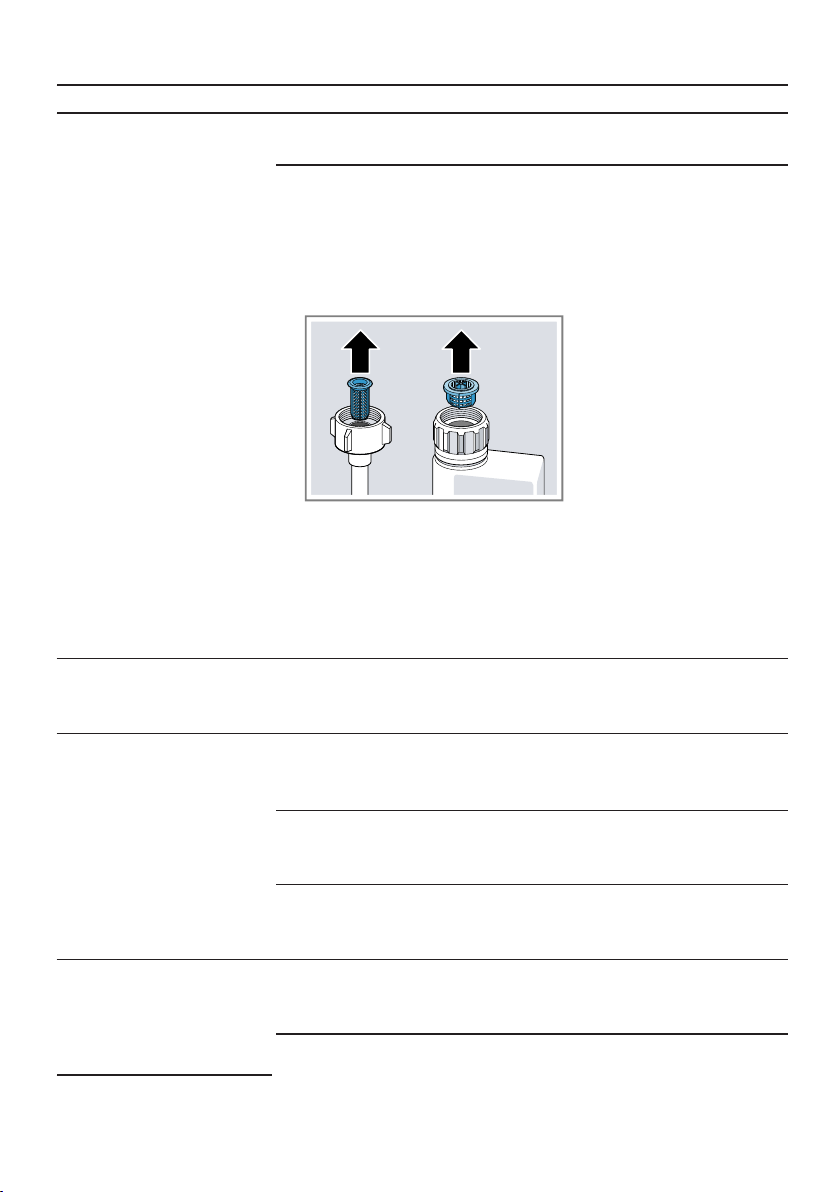
4. Unscrew the water connection.
5. Remove the filter from the supply hose
6. Clean the filter.
7. Re-insert the filter in the supply hose.
8. Screw the water connection back on.
9. Check the water connection for leaks.
10. Restore the power supply.
11. Switch the appliance on.
E:22 lights up.
1
Filters are soiled or blocked.
▶ Clean the filters.
→"Cleaning filters", Page42
E:24 lights up. Wastewater hose is blocked or kinked.
1. Reposition the wastewater hose without kinks.
2. Remove residues.
Siphon connection is still sealed.
▶ Check the connection to the siphon and open if ne-
cessary.
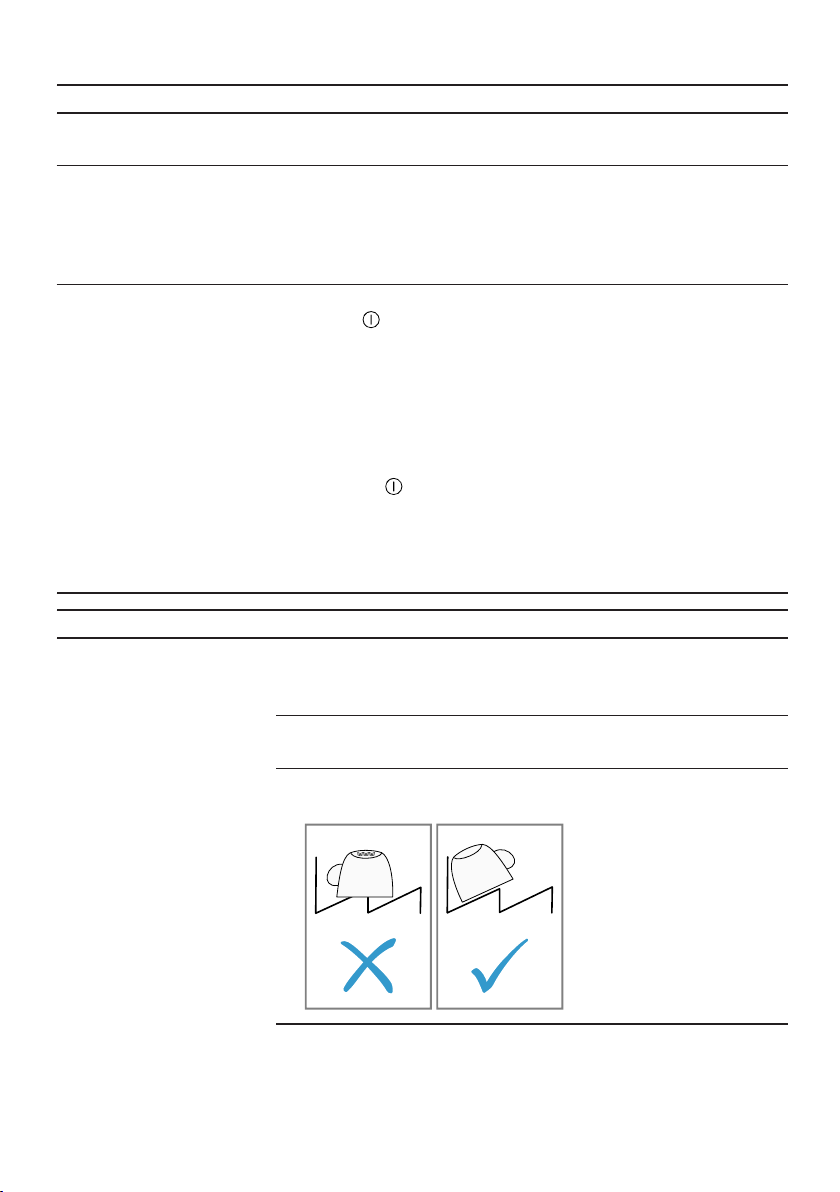
Cover of the wastewater pump is loose.
▶ Secure the cover of the Wastewater pump
→Page55 so it clicks into position.
E:25 lights up. Wastewater pump is blocked.
▶ Clean the wastewater pump.
→"Clean wastewater pump", Page55
Cover of the wastewater pump is loose
1
Depending on the appliance specifications
en Troubleshooting
46
Fault Cause and troubleshooting
E:25 lights up. ▶ Secure the cover of the Wastewater pump
→Page55 so it clicks into position.
E:27 lights up. Mains voltage is too low.
This is not a fault on the appliance.
1. Contact an electrician.
2. Have the mains voltage and electrical installation
checked by an electrician.
Another error code
appears on the dis-
play.
E:01 to E:30
A technical fault is present.
1. Press .
2. Unplug the appliance or switch off the fuse.
3. Wait at least 2minutes.
4. Insert the mains plug of the appliance in a socket
or switch on the fuse.
5. Switch the appliance on.
6. If the problem occurs again:
‒ Press .
‒ Turn off the water tap.
‒ Pull out the mains plug.
‒ Contact Customer Service →Page57 and give
the error code.
Fault Cause and troubleshooting
Tableware is not dry. No rinse aid used or dosage set too low.
1.
Add Rinse aid →Page31.
2. Set the amount of rinse aid to be dispensed.
Selected programme has no drying phase
▶ Select a programme with drying.
Water collects in recesses of the tableware or cutlery.
▶ Position tableware at an angle where possible.
The combined detergent used has a poor drying per-
formance.
1. Use rinse aid to improve drying performance.
Troubleshooting en
47
Fault Cause and troubleshooting
Tableware is not dry. 2. Use a different combined detergent with a better
drying performance.
Extra Dry not activated to improve drying perform-
ance.
▶ Activate Extra Dry.
Tableware removed too early or drying process not
yet ended.
1. Wait until the programme ends.
2. Only remove tableware 30minutes after the pro-
gramme has ended.
Rinse aid used has a limited drying performance.
▶ Use a name-brand rinse aid.
Eco products may have limited effectiveness.
Plastic tableware is
not dry.
Not a fault. As plastic does not store heat so well, it
also does not dry as well.
▶ No remedial action possible.
Cutlery is not dry. Cutlery not arranged properly in the cutlery basket or
cutlery drawer.
1. Arrange the cutlery properly.
→"Arrange tableware", Page36
2. Arrange cutlery individually where possible.
3. Avoid points of contact.
Appliance interior still
wet after wash cycle.
Not a fault. The condensation drying principle causes
water droplets in the tub – they are indeed desirable
here. The moisture in the air condenses on the inside
walls, runs off and is pumped out.
No action required.
Remnants of food on
tableware.
Tableware was placed too close together.
1. Arrange tableware with sufficient space in between.
The spray jets must reach the surfaces of the table-
ware.
2. Avoid points of contact.
Basket is overfilled.
1. Arrange tableware with sufficient space in between.
The spray jets must reach the surfaces of the table-
ware.
2. Avoid points of contact.
Spray arm rotation is blocked.
▶ Arrange tableware so that it does not obstruct
spray arm rotation.
en Troubleshooting
48
Fault Cause and troubleshooting
Remnants of food on
tableware.
Spray arm nozzles are blocked.
▶
Clean the Spray arms →Page43.
Filters are soiled.
▶ Clean the filters.
→"Cleaning filters", Page42
Filters are inserted incorrectly and/or not engaged.
1. Insert the filters properly.
→"Filter system", Page42
2. Engage the filters.
Washing programme selected too weak.
▶ Select a more intensive washing programme.
▶ Adjust the sensitivity of the sensors.
Tableware has been precleaned too intensely. The
sensors chose a weaker programme. Stubborn soiling
cannot be entirely removed.
▶ Only remove large remnants of food and do not
prerinse tableware.
Tall narrow receptacles in corner areas are not rinsed
adequately.
▶ Do not position tall narrow receptacles at too great
an angle or in corner areas.
Top baskets on right and left are not set to same
height.
▶ Set the top baskets on the left and right to the
same level.
→"Top basket", Page22
Detergent residue in
the appliance
Lid of the detergent dispenser is blocked by items of
tableware parts and will not open.
1. Arrange tableware in the top basket tableware so
the tab collecting tray is not obstructed by table-
ware.
→"Arrange tableware", Page36
Items of tableware are blocking the dispenser lid.
2. Do not place tableware or fragrance dispensers in
the tablet collecting tray.
The lid of the detergent dispenser is blocked by the
tab and will not open.
▶ Position the tab in the detergent dispenser cross-
wise, not vertically.
Tabs are used in the quick or short programme. Dis-
solving time of the tab is not attained.
Troubleshooting en
49
Fault Cause and troubleshooting
Detergent residue in
the appliance
▶ Select a more intensive Programme or use Powder
detergent →Page33.
Washing effect and dissolving performance are re-
duced after a prolonged storage time or detergent is
very lumpy.
▶
Change your detergent →Page33.
Water marks on
plastic parts.
Due to laws of physics droplet formation on plastic
surfaces is unavoidable. After drying water marks are
visible.
▶ Select a more intensive programme.
▶ Position tableware at an angle.
→"Arrange tableware", Page36
▶ Use rinse aid.
→"Rinse aid", Page31
▶ Set the water softening system higher.
Wipeable or water-sol-
uble coatings are
present inside the ap-
pliance or on the
door.
Detergent substances are deposited there. These
coatings cannot generally be removed with chemicals.
▶
Change your detergent →Page33.
▶ Clean the appliance mechanically.
White coating is deposited in the appliance interior.
1. Set the water softening system correctly.
In most cases you will need to increase the setting.
2. Change your detergent if required.
Special salt dispenser is not screwed tight.
▶ Screw the special salt dispenser tight.
Stubborn white coat-
ings are present on
tableware, inside the
appliance or the door.
Detergent substances are deposited there. These
coatings cannot generally be removed with chemicals.
▶
Change your detergent →Page33.
▶ Clean the appliance mechanically.
The hardness range is set incorrectly or the water
hardness is greater than 62°E (8,9mmol/l).
▶
Set the Water softening system →Page28 to the
water hardness or add special salt.
3in1/organic/eco detergent is not effective enough.
▶
Set the Water softening system →Page28 to the
water hardness and use separate detergents (pro-
prietary detergent, special salt, rinse aid).
Too little detergent is being used.
▶ Increase the amount of detergent used or change
Detergent →Page33.
en Troubleshooting
50
Fault Cause and troubleshooting
Stubborn white coat-
ings are present on
tableware, inside the
appliance or the door.
Washing programme selected too weak.
▶ Select a more intensive washing programme.
▶ Adjust the sensitivity of the sensors.
Tea residue or lipstick
marks on tableware.
Washing temperature is too low.
▶ Select a programme with a higher washing temper-
ature.
Too little detergent is being used or is unsuitable.
▶
Use a suitable Detergent →Page33 and follow the
manufacturer's instructions for the amount to be
used.
Tableware has been precleaned too intensely. The
sensors chose a weaker programme. Stubborn soiling
cannot be entirely removed.
▶ Only remove large remnants of food and do not
prerinse tableware.
Coloured coatings
(blue, yellow, brown)
that are difficult or im-
possible to remove
are present inside the
appliance or on stain-
less steel tableware.
The formation of films is due to substances contained
in vegetables (cabbage, celery, potatoes, noodles,
etc.) or tap water (manganese).
▶ Clean the appliance.
You can remove deposits with Mechanical cleaning
→Page41 or a machine cleaning product. It may
not always be possible to completely remove de-
posits but they are harmless to health.
The formation of films is due to metal components on
silver or aluminium tableware.
▶ Clean the appliance.
You can remove deposits with Mechanical cleaning
→Page41 or a machine cleaning product. It may
not always be possible to completely remove de-
posits but they are harmless to health.
Coloured deposits
(yellow, orange,
brown) that are easy
to remove are present
inside the appliance
(mainly at the bottom).
The formation of films is due to ingredients of food
remnants and tap water (limescale) "soaplike".
1. Check the setting of the water softening system.
→"Setting water softening system", Page29
2. Add special salt.
→"Adding special salt", Page29
3. If you are using combined detergents (tabs), activ-
ate the water softening system.
Follow the information about detergents.
→"Information on detergents", Page34
Troubleshooting en
51
Fault Cause and troubleshooting
Plastic parts inside the
appliance are discol-
oured.
Plastic parts inside the appliance may become discol-
oured during the life of the dishwasher.
▶ Discolouration can come about and will not impair
functioning of the appliance.
Plastic parts are dis-
coloured.
Washing temperature is too low.
▶ Select a programme with a higher washing temper-
ature.
Tableware has been precleaned too intensely. The
sensors chose a weaker programme. Stubborn soiling
cannot be entirely removed.
▶ Only remove large remnants of food and do not
prerinse tableware.
Removable streaks
are present on
glasses, glassware
with a metallic appear-
ance and cutlery.
Amount of rinse aid to be dispensed is set too high.
▶ Set the rinse aid system to a lower setting.
No rinse aid has been added.
▶
→"Adding rinse aid", Page31
Detergent residue is present in the final rinse. Lid of
the detergent dispenser is blocked by tableware items
and will not open fully.
1. Arrange tableware in the top basket tableware so
the tab collecting tray is not obstructed by table-
ware.
→"Arrange tableware", Page36
Items of tableware are blocking the dispenser lid.
2. Do not place tableware or fragrance dispensers in
the tablet collecting tray.
Tableware has been precleaned too intensely. The
sensors chose a weaker programme. Stubborn soiling
cannot be entirely removed.
▶ Only remove large remnants of food and do not
prerinse tableware.
▶ Adjust the sensitivity of the sensors.
Irreversible clouding
of glassware.
Glasses are not dishwasher-proof, only suitable for
dishwashers.
▶ Use dishwasher-proof glasses.
▶ Avoid a lengthy steam phase (standing time after
wash cycle ends).
▶ Use a programme with a lower temperature.
▶ Set the softening system to the water hardness.
▶ Use detergent with a glass protection component.
en Troubleshooting
52
Fault Cause and troubleshooting
Rust spots on cutlery. Cutlery is not sufficiently rust-resistant. Knife blades
are often more severely affected.
▶ Use rust-resistant tableware.
Cutlery may also rust if washed together with rusting
items.
▶ Do not wash rusting items.
Salt content in washing water is too high.
1. Remove any spilled special salt from the tub.
2. Screw the cap of the special salt dispenser on tight.
Detergent residue is
present in the deter-
gent dispenser or the
tablet collecting tray.
Spray arms were blocked by tableware so detergent
was not rinsed out.
▶ Check that the spray arms are not blocked and can
rotate freely.
Detergent dispenser was damp when detergent was
added.
▶ Only add detergent to a detergent dispenser when
dry.
Excessive formation of
foam occurs.
Hand washing-up liquid is present in dispenser for
rinse aid.
▶ Immediately add rinse aid to the dispenser.
→"Adding rinse aid", Page31
Rinse aid has been spilled.
▶ Remove the rinse aid with a cloth.
Detergent or appliance care product used causes ex-
cessive foaming.
▶ Change the brand of detergent.
Fault Cause and troubleshooting
Special salt refill indic-
ator lights up.
Insufficient special salt.
▶
Add Special salt →Page29.
Sensor does not detect special salt tablets.
▶ Do not use special salt tablets.
Refill indicator for spe-
cial salt does not light
up.
Water softening system is switched off.
▶
Setting water softening system →Page29
Refill indicator for
rinse aid lights up.
Insufficient rinse aid.
1.
Add Rinse aid →Page31.
2. Set the amount of rinse aid to be dispensed.
Troubleshooting en
53
Fault Cause and troubleshooting
Refill indicator for
rinse aid does not
light up.
Rinse aid system is switched off.
▶
→"Setting the amount of rinse aid", Page32
Display flashes. Appliance door is not closed properly.
▶ Close the appliance door.
‒ Arrange the tableware so that no parts project
beyond the basket and prevent the appliance
door from closing properly.
Fault Cause and troubleshooting
Water is left in the ap-
pliance at the end of
the programme.
Filter system or area under the filters is blocked.
1.
Clean the Filters →Page42.
2.
Clean the Wastewater pump →Page55.
Programme has not yet ended.
▶ Wait until the programme ends or cancel the pro-
gramme with reset.
▶
→"Terminate programme", Page39
Appliance cannot be
switched on or oper-
ated.
Appliance functions have failed.
1. Pull out the mains plug or switch off the fuse.
2. Wait at least 2minutes.
3. Connect the appliance to the power supply.
4. Switch the appliance on.
Appliance does not
start.
The mains fuse has tripped.
▶ Check the relevant fuse.
Mains cable is not inserted.
1. Check whether the socket works.
2. Check whether the mains cable is properly inserted
in the socket and on the rear of the appliance.
Appliance door is not closed properly.
▶ Close the appliance door.
Programme starts
automatically.
You did not wait until programme ended.
▶
→"Terminate programme", Page39
Appliance stops dur-
ing the programme or
cuts out.
Appliance door is not closed properly.
▶ Close the appliance door.
Power and/or water supply has been interrupted.
1. Check the power supply.
2. Check the water supply.
Top basket is pressing against inner door and pre-
venting appliance door from being closed securely.
en Troubleshooting
54
Fault Cause and troubleshooting
Appliance stops dur-
ing the programme or
cuts out.
▶ Check whether the rear panel of the appliance is
being pressed in by a socket or hose holder that
has not been removed.
▶ Arrange the tableware so that no parts project bey-
ond the basket and prevent the appliance door
from closing properly.
Fault Cause and troubleshooting
Appliance door can-
not be closed.
Door lock has been activated.
▶ Close the appliance door with greater force.
Door cannot be closed due to installation method.
▶ Check whether the appliance has been installed
properly.
When closed, the appliance door, its decor or at-
tached parts should not knock against adjacent
cabinets or the worktop.
Lid on the detergent
dispenser cannot be
closed.
Detergent dispenser or lid are blocked by sticky deter-
gent residue.
▶ Remove detergent residue.
Fault Cause and troubleshooting
Filling valves making
knocking noises.
Caused by the domestic installation. No appliance
fault present. Does not affect functioning of the appli-
ance.
▶ Can only be remedied in the domestic installation.
Knocking or rattling
noise.
Spray arm is striking tableware.
▶ Arrange tableware so that the spray arms do not
strike tableware.
With a small load the water jets directly strike against
the tub.
▶ Distribute the tableware evenly.
▶ Load the appliance with more tableware.
Light items of tableware move about during the wash
cycle.
▶ Position light items of tableware securely.
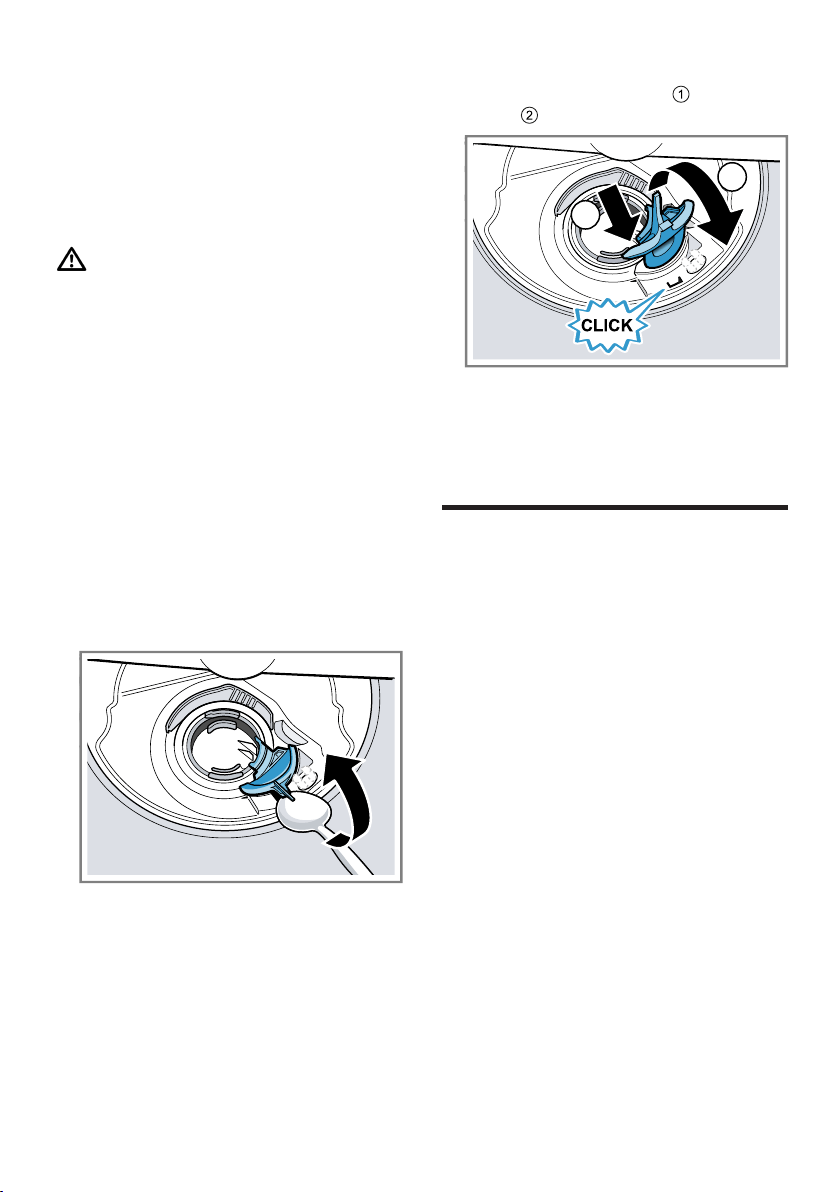
Transportation, storage and disposal en
55
18.1 Clean wastewater pump
Large remnants of food or foreign
bodies can block the wastewater
pump. As soon as the washing water
no longer drains properly, the
wastewater pump must be cleaned.
WARNING
Risk of injury!
Sharp and pointed objects or frag-
ments of glass may block the waste
water pump and cause injury.
▶ Remove any foreign bodies care-
fully.
1. Disconnect the appliance from the
power supply.
2. Remove the top and bottom bas-
ket.
3. Remove the filter system.
4. Scoop out any water.
Use a sponge if necessary.
5. Prise off the pump cover using a
spoon and grip it by the
crosspiece.
6. Lift the pump cover inwards at an
angle and remove.
7. Remove any remnants of food and
foreign bodies in the area of the
impeller.
8. Insert the pump cover and press
down .
1
2
a The pump cover clicks into posi-
tion.
9. Install the filter system.
10. Insert the top and bottom basket.
19 Transportation, stor-
age and disposal
You can find out here how to prepare
your appliance for transportation and
storage. You will also find out how to
dispose of old appliances.
19.1 Removing the appliance
1. Disconnect the appliance from the
power supply.
2. Turn off the water tap.
3. Detach the drainage connection.
4. Detach the drinking water connec-
tion.
5. Loosen any screws fastening the
appliance to cabinet parts.
6. Remove the base panel if fitted.
7. Pull the appliance out carefully,
along with the hose behind it.
en Transportation, storage and disposal
56
19.2 Protect appliance from
frost
If there is a risk of frost where the ap-
pliance will be standing, e.g. in a holi-
day home, empty the appliance com-
pletely.
▶
Empty the appliance. →Page56
19.3 Transporting the appli-
ance
To avoid damage to the appliance,
empty it before transporting.
Note:Always transport the dish-
washer upright to prevent residual
water getting into the machine's con-
trols and damaging the appliance.
1. Remove tableware from the appli-
ance.
2. Secure loose parts.
3. Turn on the water tap.
4.
Switch on appliance. →Page38
5. Select the programme with the
highest temperature.
→"Programmes", Page19
6.
Start the programme. →Page38
7. To drain the appliance, terminate
the programme after approx.
4minutes.
→"Terminate programme",
Page39
8. Switch off the appliance.
→Page39
9. Turn off the water tap.
10. To empty the residual water out of
the appliance, detach the supply
hose and let the water drain out.
19.4 Disposing of old appli-
ance
Valuable raw materials can be re-
claimed by recycling.
WARNING
Risk of harm to health!
Children can lock themselves in the
appliance, thereby putting their lives
at risk.
▶ With redundant appliances, unplug
the power cord. Then cut through
the cord and damage the lock on
the appliance door beyond repair
so that the appliance door will no
longer close.
1. Unplug the appliance from the
mains.
2. Cut through the power cord.
3. Dispose of the appliance in an en-
vironmentally friendly manner.
This appliance is la-
belled in accordance
with European Directive
2012/19/EU concerning
used electrical and elec-
tronic appliances (waste
electrical and electronic
equipment - WEEE).
The guideline determ-
ines the framework for
the return and recycling
of used appliances as
applicable throughout
the EU.

Customer Service en
57
20 Customer Service
If you have any queries, are unable to
rectify faults on the appliance your-
self or if your appliance needs to be
repaired, contact Customer Service.
You can solve many problems your-
self by consulting the information on
troubleshooting in these instructions
or on our website. If this is not the
case, contact our after-sales service.
With any warranty claims, we will
make sure that your appliance is re-
paired by trained after-sales techni-
cians using genuine spare parts, in-
cluding after the manufacturer's war-
ranty has expired.
Function-relevant genuine spare parts
according to the relevant Ecodesign
Directive can be obtained from Cus-
tomer Service for a period of at least
10years from the date on which your
appliance was placed on the market.
Detailed information on the warranty
period and terms of warranty in your
country is available from our after-
sales service, your retailer or on our
website.
If you contact Customer Service, you
will require the product number (E-
Nr.) and the production number (FD)
of your appliance.
The contact details for Customer Ser-
vice can be found in the enclosed
Customer Service directory or on our
website.
20.1 Product number (E-Nr.)
and production number
(FD)
You can find the product number (E-
Nr.) and the production number (FD)
on the appliance's rating plate.
The rating plate is located inside the
appliance door.
Make a note of your appliance's de-
tails and the Customer Service tele-
phone number to find them again
quickly.
20.2 AQUA-STOP guarantee
1
In addition to warranty claims against
the seller under the purchase agree-
ment and in addition to our manufac-
turer's warranty, we will provide a re-
placement under the following condi-
tions.
¡ If our Aqua-Stop system is defect-
ive and causes water damage, we
will make good the damage for
private users. To ensure protection
from water damage, the appliance
must be connected to the power
supply.
¡ The liability guarantee is valid for
the service life of the appliance.
¡ A claim can only be made under
the guarantee if the appliance has
been correctly installed and con-
nected with Aqua-Stop according
to our instructions; this also in-
cludes correctly fitting the Aqua-
Stop extension (genuine access-
ory). Our guarantee does not cover
defective supply lines or fittings up
to the Aqua-Stop connection on
the tap.
¡ If your appliance is fitted with
Aqua-Stop, you can leave your ap-
pliance unattended during opera-
tion and the tap turned on after-
1
Depending on the appliance specifications

en Customer Service
58
wards. The tap only needs to be
turned off if you are away from
home for a long period, e.g. on
holiday for several weeks.
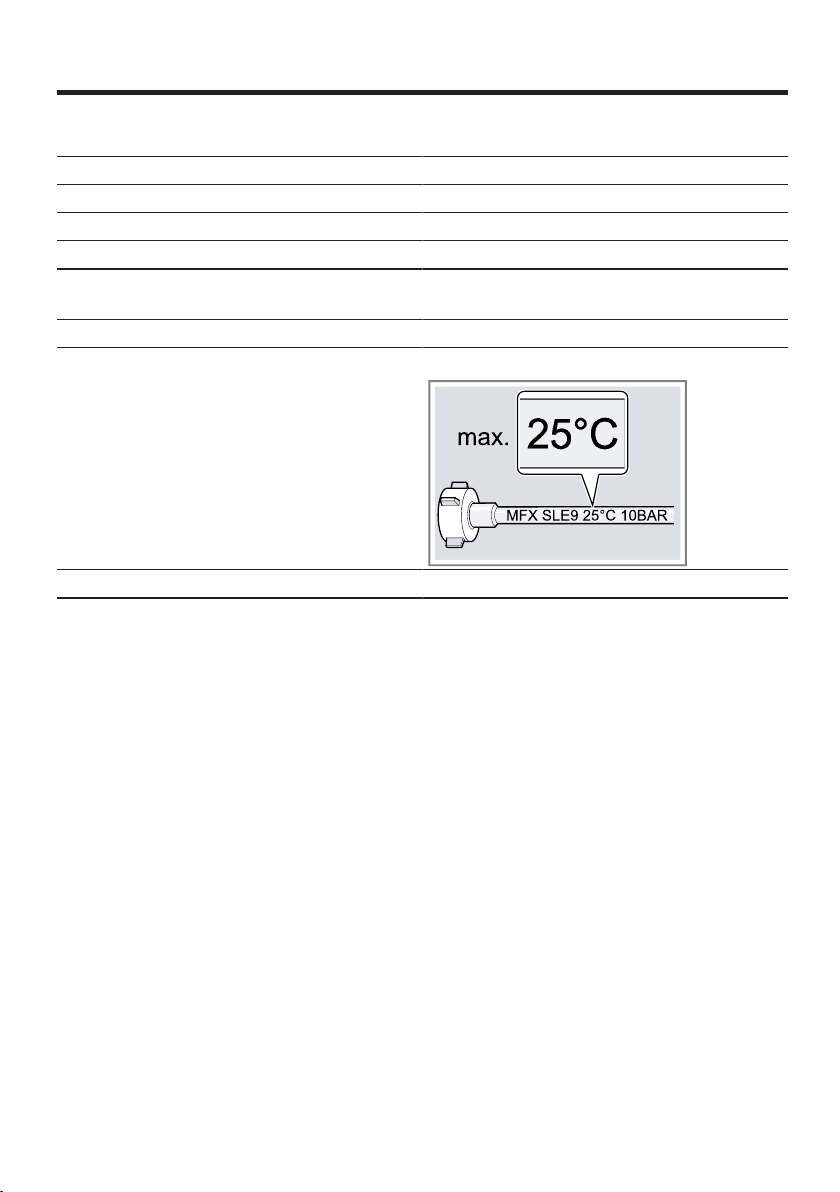
Technical specifications en
59
21 Technical specifications
Weight Max.: 60kg
Voltage 220 - 240V, 50Hz or 60Hz
Power rating 2000 - 2400W
Fuse 10 - 16A
Water pressure ¡ Min. 0.05MPa (0.5bar)
¡ Max. 1MPa (10bar)
Inlet rate Min. 10l/min
Water temperature Cold water: 25°C
Capacity 12-15place settings
You can find more information about
your model online at www.bosch-
home.com/energylabel. Please then
follow the instructions on searching
for models. The model identifier is
made up of the characters before the
slash in the product number (E no.)
on the rating plate. Alternatively, you
can also find the model identifier in
the first line of the energy label.
Thank you for buying a
Bosch Home Appliance!
Register your new device on MyBosch now and profit directly from:
• Expert tips & tricks for your appliance
• Warranty extension options
• Discounts for accessories & spare-parts
• Digital manual and all appliance data at hand
• Easy access to Bosch Home Appliances Service
Free and easy registration – also on mobile phones:
www.bosch-home.com/welcome
Looking for help?
You'll find it here.
Expert advice for your Bosch home appliances, help with problems
or a repair from Bosch experts.
Find out everything about the many ways Bosch can support you:
www.bosch-home.com/service
Contact data of all countries are listed in the attached service direct-
ory.
*9001701790*
9001701790 (020114) 640 MA
en
BSH Hausgeräte GmbH
Carl-Wery-Straße 34
81739 München, GERMANY
www.bosch-home.com
A Bosch Company