HRV130FL (PART NO. HRV130FLS),
ERV130FL (PART NO. ERV130FLS)
THESE PRODUCTS EARNED THE ENERGY
STAR
®
BY MEETING STRICT ENERGY EFFICIENCY
GUIDELINES SET BY NATURAL R ESOURCES CANADA
AND THE US EPA. THEY MEET ENERGY STAR
REQUIREMENTS ONLY WHEN USED IN CANADA.
USER AND INSTALLER MANUAL
INSTALLER: READ THESE INSTRUCTIONS
SAVE THEM FOR USER
RESIDENTIAL USE ONLY
23368 REV. 04
VB0247
BEFORE INSTALLATION:
HRV130FL: READ SECTION 2.1, PAGE 4 FOR IMPORTANT INFORMATION
ABOUT CONDENSING PLATE.
ALL UNITS: R
EAD SECTION 2.1, PAGE 5 FOR IMPORTANT INFORMATION
ABOUT BACKDRAFT DAMPERS ORIENTATION.
I
F CONNECTING THE DUCTWORK OF THIS UNIT TO THE FURNACE/AHU
SUPPLY DUCTWORK, READ NEW INSTRUCTIONS ON PAGES 6, 7 AND 8
BEFORE PERFORMING INSTALLATION.
REGISTER YOUR PRODUCT ONLINE AT: www.broan-nutone.com/register
For additional information - visit www.broan-nutone.com

2
Please take note that this manual uses the following symbols to emphasize particular information:
Identifies an instruction which, if not followed, might cause serious personal injuries including possibility of death.
CAUTION
Denotes an instruction which, if not followed, may severely damage the unit and/or its components.
NOTE: Indicates supplementary information needed to fully complete an instruction.
LIMITATION
For residential (domestic) installation only. Installation work and electrical wiring must be done by a qualified person in accordance with all
applicable codes and standards, including fire-rated construction codes and standards.
⚠ WARNING
TO REDUCE THE RISK OF FIRE, ELECTRIC SHOCK, OR INJURY TO PERSON(S) OBSERVE THE FOLLOWING:
1. Use this unit only in the manner intended by the manufacturer.
2. Before servicing or cleaning this unit, disconnect power cord from electrical outlet.
3. This unit is not designed to provide combustion and/or dilution air for fuel-burning appliances.
4. When cutting or drilling into a wall or ceiling, do not damage electrical wiring and other hidden utilities.
5. Do not use this unit with any solid-state speed control device other than those specified in section 3.1.
6. This unit must be grounded. The power supply cord has a 3-prong grounding plug for your personal safety. It must be plugged into a
mating 3-prong grounding receptacle, grounded in accordance with the national electrical code and local codes and ordinances. Do
not remove the ground prong. Do not use an extension cord.
7. Do not install in a cooking area or connect directly to any appliances.
8. Do not use to exhaust hazardous or explosive materials and vapors.
9. When performing installation, servicing or cleaning this unit, it is recommended to wear safety glasses and gloves.
10. When applicable local regulation comprises more restrictive installation and/or certification requirements, the aforementioned
requirements prevail on those of this document and the installer agrees to conform to these at his own expense.
CAUTION
1. To avoid prematurely clogged filters, turn the unit OFF during construction or renovation.
2. Please read specification label on product for further information and requirements.
3. Be sure to duct air outside – Do not intake/exhaust air into spaces within walls or ceiling or into attics, crawl spaces, or garage. Do not
attempt to recover the exhaust air from a dryer or a range hood.
4. Intended for residential installation only in accordance with the requirements of NFPA 90B (for a unit installed in U.S.A.) or Part 9 of
the National Building Code of Canada (for a unit installed in Canada).
5. Do not run any air ducts directly above or within 2 ft. of a furnace or its supply plenum, boiler, or other heat producing appliance. If
a duct has to be connected to the furnace return plenum, it must be connected 10 ft. away from plenum’s connection to the furnace.
6. The ductwork is intended to be installed in compliance with all applicable local and national codes.
7. When leaving the house for a long period of time (more than two weeks), a responsible person should regularly check if the unit
operates adequately.
8. If the ductwork passes through an unconditioned space (e.g.: attic), the unit must operate continuously except when performing
maintenance and/or repair. Also, the ambient temperature of the house should never drop below 65°F (18°C).
9. At least once a year, the unit mechanical and electronic parts should be inspected by qualified service personnel.
10. Do not use your unit during construction or renovation of your house or when sanding drywall. Certain types of dust and vapors may
damage your system.
11. Make sure at all times that the outside intake and exhaust hoods are free from any snow during the winter season. It is important to
check your unit during a big snow storm, so it doesn’t draw in any snow. If this is the case, please turn the unit OFF for a few hours.
12. Since the electronic control system of the unit uses a microprocessor, it may not operate correctly because of external noise or very
short power failure. If this happens, unplug the unit and wait approximately 10 seconds. Then, plug the unit in again.
⚠ WARNING

3
TABLE OF CONTENTS
1. TECHNICAL DATA ..................................................................................................................... 4
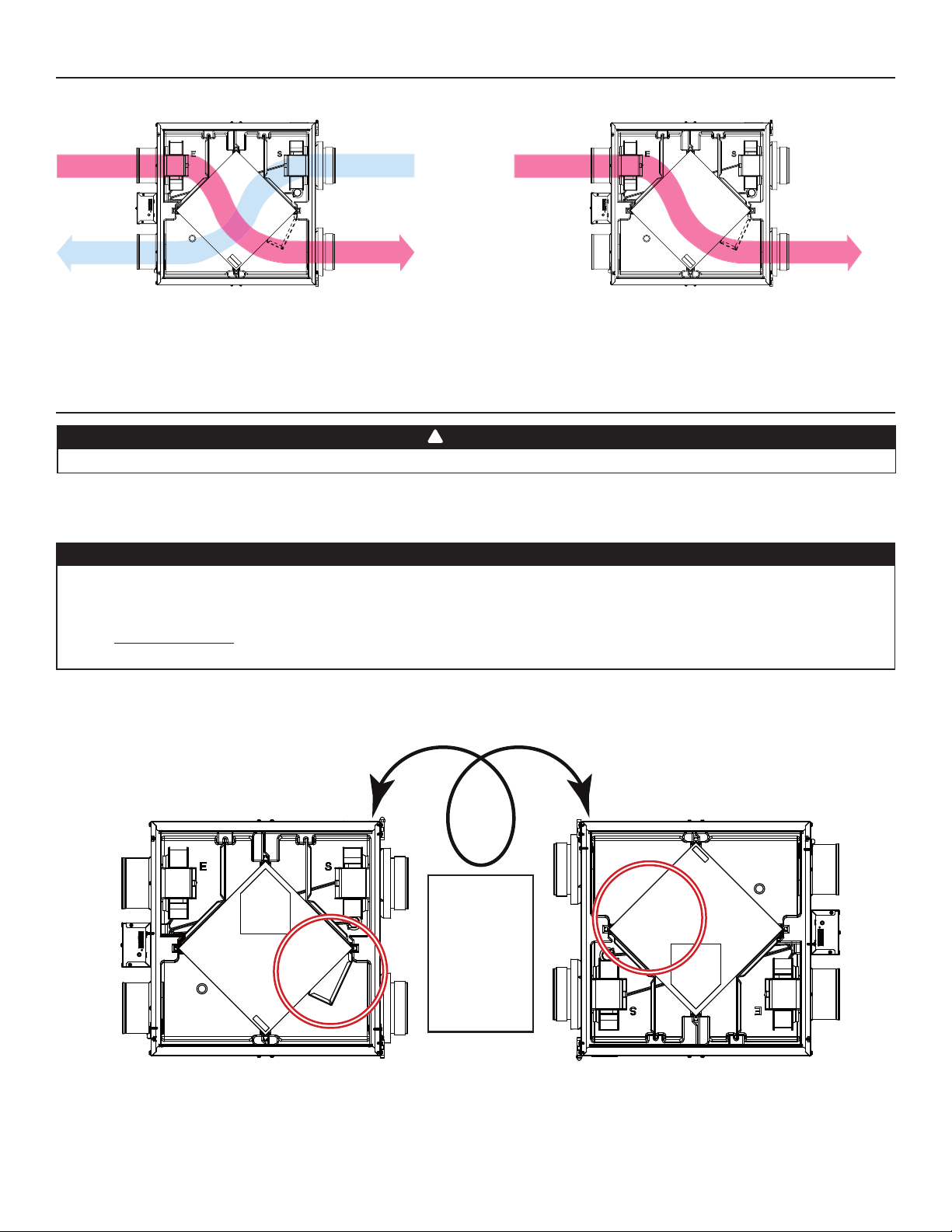
1.1 AIR DISTRIBUTION (NORMAL OPERATION) .....................................................................................................4
1.2 AIR DISTRIBUTION (DEFROST MODE) ..............................................................................................................4
2. INSTALLATION .......................................................................................................................... 4
2.1 LOCATING AND MOUNTING THE UNIT .............................................................................................................4
2.2 INSTALLING THE DUCTWORK AND THE REGISTERS .....................................................................................6
2.2.1 FULLY DUCTED SYSTEM .......................................................................................................................................6
2.2.2 EXHAUST DUCTED SYSTEM ...................................................................................................................................6
2.2.3 SIMPLIFIED INSTALLATION ......................................................................................................................................7
2.2.4 MEASURING THE PRESSURE INSIDE THE DUCTWORK ...................................................................................................8
2.3 CONNECTING THE DRAIN (HRV130FL ONLY) ..................................................................................................8
2.4 INSTALLING DUAL EXTERIOR HOOD USING TANDEM
®
TRANSITION KIT (OPTIONAL) ...............................9
2.5 INSTALLING THE EXTERIOR HOODS ...............................................................................................................9
2.6 CONNECTING THE DUCTS TO THE UNIT .........................................................................................................9
3. CONNECTIONS ....................................................................................................................... 10
3.1 ELECTRICAL CONNECTION TO OPTIONAL MAIN WALL CONTROL ............................................................10
3.1.1 ELECTRICAL CONNECTION TO VT7W MAIN WALL CONTROL .....................................................................................10
3.1.2 ELECTRICAL CONNECTION TO VT4W MAIN WALL CONTROL ..................................................................................... 11
3.1.3 ELECTRICAL CONNECTION TO VT6W MAIN WALL CONTROL ..................................................................................... 11
3.2 ELECTRICAL CONNECTION TO OPTIONAL AUXILIARY WALL CONTROLS ................................................. 11
3.3 CONNECTION TO THE FURNACE/AHU ........................................................................................................... 11
4. WIRING DIAGRAM .................................................................................................................. 12
5. SPEED SELECTION ................................................................................................................ 13
6. BALANCING THE UNIT ........................................................................................................... 13
7. SERVICE PARTS ...................................................................................................................... 14
8. INSTALLER’S TROUBLESHOOTING ..................................................................................... 15
9. USING THIS UNIT .................................................................................................................... 17
9.1 YOUR VENTILATION SYSTEM ..........................................................................................................................17
9.2 INTEGRATED CONTROL ..................................................................................................................................17
9.2.1 BOOT SEQUENCE ..............................................................................................................................................17
9.2.2 SETTING EXTENDED DEFROST ............................................................................................................................17
10. MAINTENANCE ..................................................................................................................... 18
10.1 QUARTERLY ....................................................................................................................................................18
10.2 ANNUAL (AT FALL) ..........................................................................................................................................19
11. USER’S TROUBLESHOOTING .............................................................................................. 19
12. WARRANTY ........................................................................................................................... 20
4
1. TECHNICAL DATA
1.1 AIR DISTRIBUTION (NORMAL OPERATION) 1.2 AIR DISTRIBUTION (DEFROST MODE)
VF0050A
Stale air
from building
Fresh air
to building
Fresh air
from outdoors
Stale air
to outdoors
VF0069A
Stale air
from building
Stale air
to outdoors
NOTE: The dimensions, performance charts, defrost cycle tables and specifications are listed on the specification sheets of the unit.
Visit our website at www.broan.com.
2. INSTALLATION
2.1 LOCATING AND MOUNTING THE UNIT
When performing installation, servicing or cleaning the unit, it is recommended to wear safety glasses and gloves.
WARNING
!
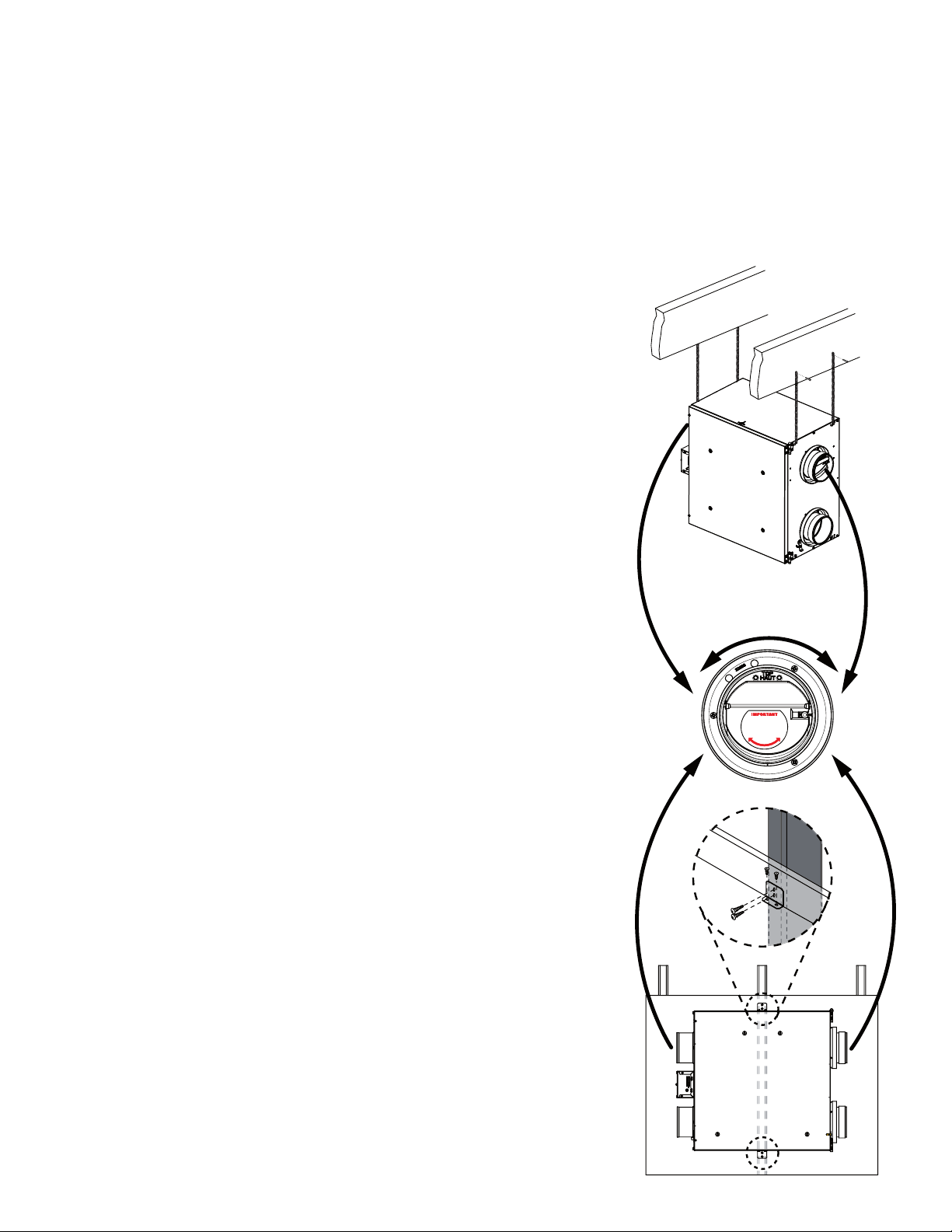
These units can be installed upside down if needed.
• Once the unit has been properly suspended with the chains, if required, rotate both backdraft dampers to make
sure they are positioned in such a way that the word "TOP" is up and that gravity allows them to close properly.
• For HRV130FL units, if unit is installed in reversed position, remove the condensing plate from the core by
removing the core from the unit, and removing both screws holding the plate to the core.
CAUTION
VD0434
180°
NORMAL REVERSED
HRV UNITS:
REMOVE
CONDENSING
PLATE IF
INSTALLED IN
REVERSED
POSITION
5
Choose an appropriate location for the unit:
• Within an area of the house where the ambient temperature is kept between 50°F and 160°F;
• Away from living areas (dining room, living room, bedroom), if possible;
• So as to provide easy access to the interior cabinet for maintenance, and to the control panel on the side of the unit;
• Close to an exterior wall, so as to limit the length of the insulated flexible ducts to and from the unit;
• HRV units only: close to a drain. If no drain is close by, use a pail to collect run-off;
• Away from hot chimneys, electrical panel and other fire hazards;
• Within 6 feet of a power source (standard outlet).
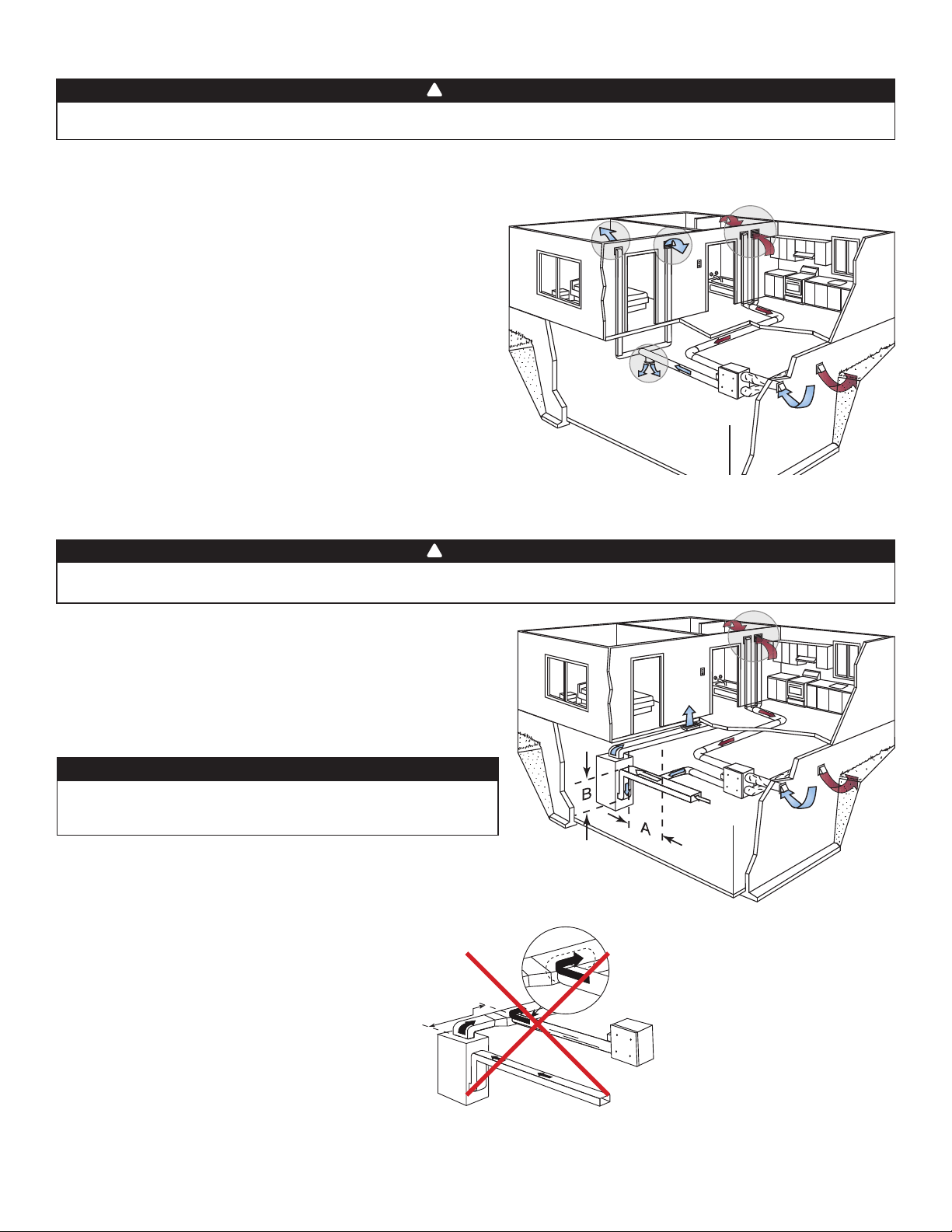
Suspended to the joists or trusts:
• Hang the unit to the joists (or trusts) using the provided chains. Springs are not required.
• Always make sure that the unit is no more than 1/4" off level.
• If required, rotate both backdraft dampers to make sure they are positioned in such a way
that the word "TOP" is up and that gravity allows them to close properly.
OR
Wall mounted:
• Using the provided no. 8 x 3/8" screws, install both provided brackets on the unit − one on
top, one at the bottom of the unit.
• Using the provided no. 8 x 1½" screws, secure the unit to the wall making sure that all
screws engage into a stud.
• Always make sure that the unit is no more than 1/4" off level.
• If required, rotate both backdraft dampers to make sure they are positioned in such a way
that the word "TOP" is up and that gravity allows them to close properly.
VD0433
Make sure that "TOP" engraving is
up. Rotate if necessary.
Assurez-vous que la gravure «HAUT» est
vers le haut. Tournez si nécessaire.
Make sure that "TOP" engraving is
up. Rotate if necessary.
Assurez-vous que la gravure «HAUT» est
vers le haut. Tournez si nécessaire.
ROTATE BOTH
DAMPERS INSIDE
THEIR PORT
2.1 LOCATING AND MOUNTING THE UNIT (CONT’D)
6
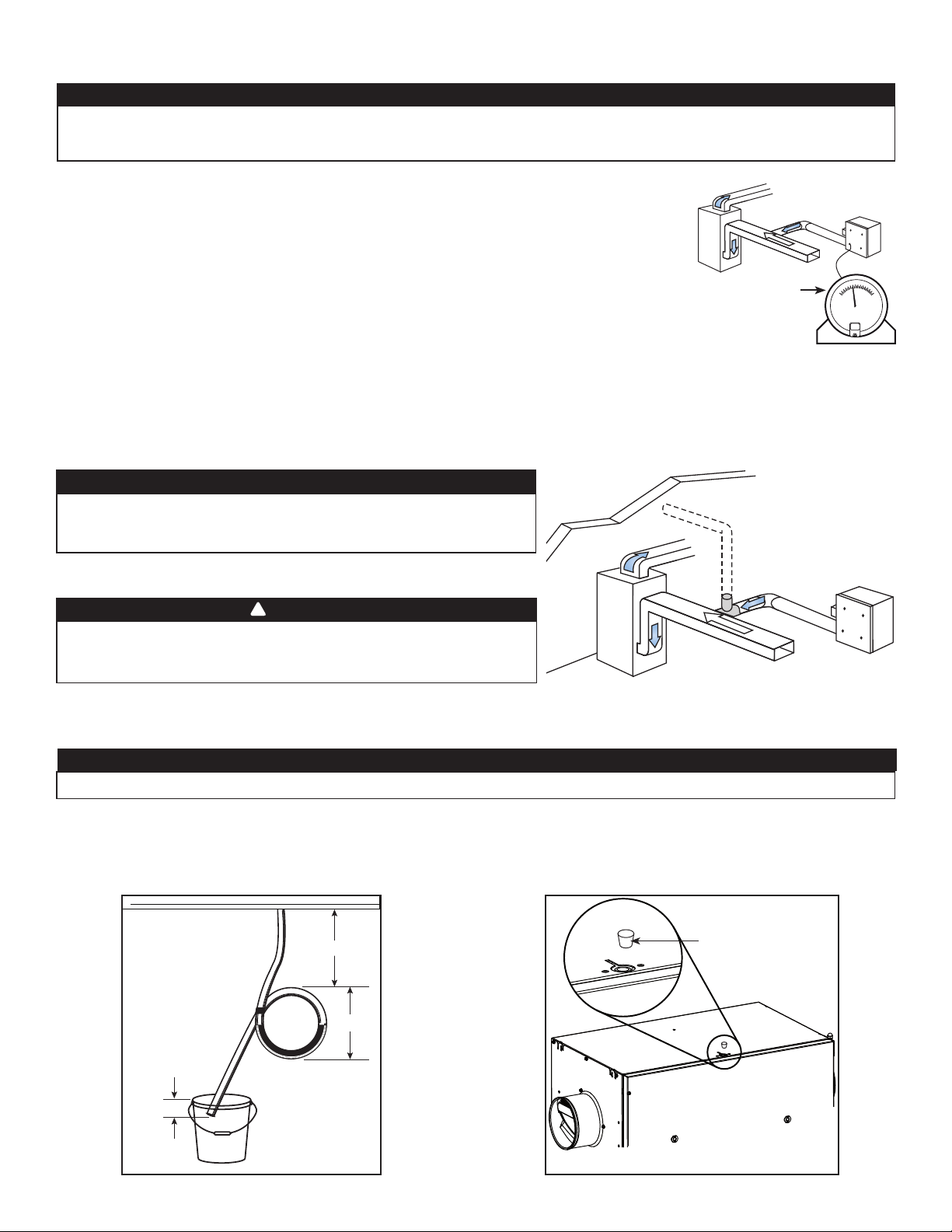
STALE AIR EXHAUST DUCTWORK:
• Install registers in areas where contaminants and humidity are
produced: Kitchen, bathrooms, laundry room, etc.
• Install registers on an interior wall, 6 to 12 inches away from the
ceiling OR in the ceiling.
• Install the kitchen register at least 4 feet away from the range.
• Bathroom fans and range hoods can be used to better exhaust stale
air.
• Homes with more than one level require at least one exhaust register
at the highest level.
FRESH AIR DISTRIBUTION DUCTWORK:
• Install registers in bedrooms, dining room, living room and basement.
• Install registers in the ceiling OR high on the walls with the airflow
directed towards the ceiling.
• If a register must be installed in the floor, direct the air flow up the
wall.
2.2.1 FULLY DUCTED SYSTEM
2.2 INSTALLING THE DUCTWORK AND THE REGISTERS
Never install a stale air exhaust register in a room where there is a combustion device, such as a gas furnace, a
gas water heater or a fireplace.
WARNING
!
VH0118
DO NOT CONNECT TO THE SUPPLY SIDE
OF THE FURNACE/AHU
VJ0136
STALE AIR EXHAUST DUCTWORK:
Same as for Fully Ducted System, described on point 2.2.1.
FRESH AIR DISTRIBUTION:
• Connect the fresh air distribution duct of the unit to the furnace/AHU
return duct at least 10 feet away from the furnace/AHU (A+B)*.
* This 10-ft. distance applies only in areas where the outside temperature
falls below the freezing point (32°F).
NOTE: The furnace/AHU blower operation can be synchronized with
the unit (see Section 3.3). It is recommended, but not essential that the
furnace/AHU blower runs when the unit is in operation.
2.2.2 EXHAUST DUCTED SYSTEM
When performing duct connection to the furnace/AHU, installation must be done in accordance with all applicable
codes and standards. Please refer to your local building code.
WARNING
!
A+B= MIN. 10’
VH0119
For this type of installation, you must perform steps in
section 2.2.4 to make sure that the pressure in the return
duct of the furnace/AHU allows the unit to operate properly.
CAUTION

7
2.2.2 EXHAUST DUCTED SYSTEM (CON’T)
VJ0152A
EXAMPLE OF AN ATTIC INSTALLLATION
NOTE: The AHU blower operation can be synchronized with the
unit (see Section 3.3). It is recommended, but not
essential that the AHU blower runs when the unit is in
operation.
2.2.3 SIMPLIFIED INSTALLATION
For this type of installation, the furnace/AHU must always be synchronized with the unit. See Section 3.3.
CAUTION
When performing duct connection to the furnace/AHU, installation must be done in accordance with all applicable
codes and standards. Please refer to your local building code.
WARNING
!
DO NOT CONNECT TO THE SUPPLY SIDE OF THE FURNACE/AHU
VJ0137
Fresh air and exhaust air flow through the furnace/AHU ducts, which
simplifies the installation.
The use of bathroom fans and a range hood is suggested to exhaust
stale air.
FRESH AIR DISTRIBUTION:
Connect the fresh air distribution duct of the unit to the furnace return
duct at least 10 feet away from the furnace (A+B)*.
* This 10-ft. distance applies only in areas where the outside temperature
falls below the freezing point (32°F).
STALE AIR EXHAUST DUCTWORK:
Connect the stale air intake port of the unit to the furnace return duct at
least 3 feet ahead (C) of the fresh air distribution from the unit.
VH0120
A
C
B
MINIMUM 3’
A+B=
MIN 10’
For this type of installation, you must perform steps in
section 2.2.4 to make sure that the pressure in the return
duct of the furnace/AHU allows the unit to operate properly.
CAUTION
8
2.3 CONNECTING THE DRAIN (HRV130FL ONLY)
A drain tubing (included) must be installed on these units.
CAUTION
• Make a water trap loop in the tube to prevent the unit from drawing unpleasant odors from the drain source. Run the tube to the floor
drain or to an alternate drain pipe or pail.
• IMPORTANT: If using a pail to collect water, place the tube end approximately 1” inside the pail in order to prevent water from being
drawn back up into the unit.
• Fully insert a drain plug (included in parts bag) in alternate drain fitting located on top of the unit.
VO0243A
± 1"
8" MIN.
8" MAX.
VD0428
INSERT ALL THE WAY IN
2.2.4 MEASURING THE PRESSURE INSIDE THE DUCTWORK
After connecting the ductwork as instructed in sections 2.2.2 and 2.2.3, you must make sure that the
pressure in the return duct of the furnace/AHU allows the unit to operate properly.
1. Turn the unit OFF.
2. Turn the furnace/AHU ON at the highest speed.
3. Prepare to measure the pressure:
• Seal all the ductwork with tape. Close all windows and doors.
• Turn off all exhaust devices such as a range hood, dryer and bathroom fan.
• Make sure the unit’s integrated balancing dampers are fully open.
• Make sure all the filters are clean.
4. Place a magnehelic gauge on a level surface and adjust it to zero.
5. Connect tubing from the gauge to the fresh air to the house pressure tap. If the pressure is below 0.25 in. w.g., and the fresh air
distribution duct connection is least 10 feet* away from the furnace/AHU, no action has to be taken. If the pressure exceeds
0.25 in. w.g., or if the fresh air distribution duct cannot be connected at least 10 feet* away from the furnace/AHU, perform
the following step.
* This 10-ft. distance applies only in areas where the outside temperature falls below the freezing point (32°F).
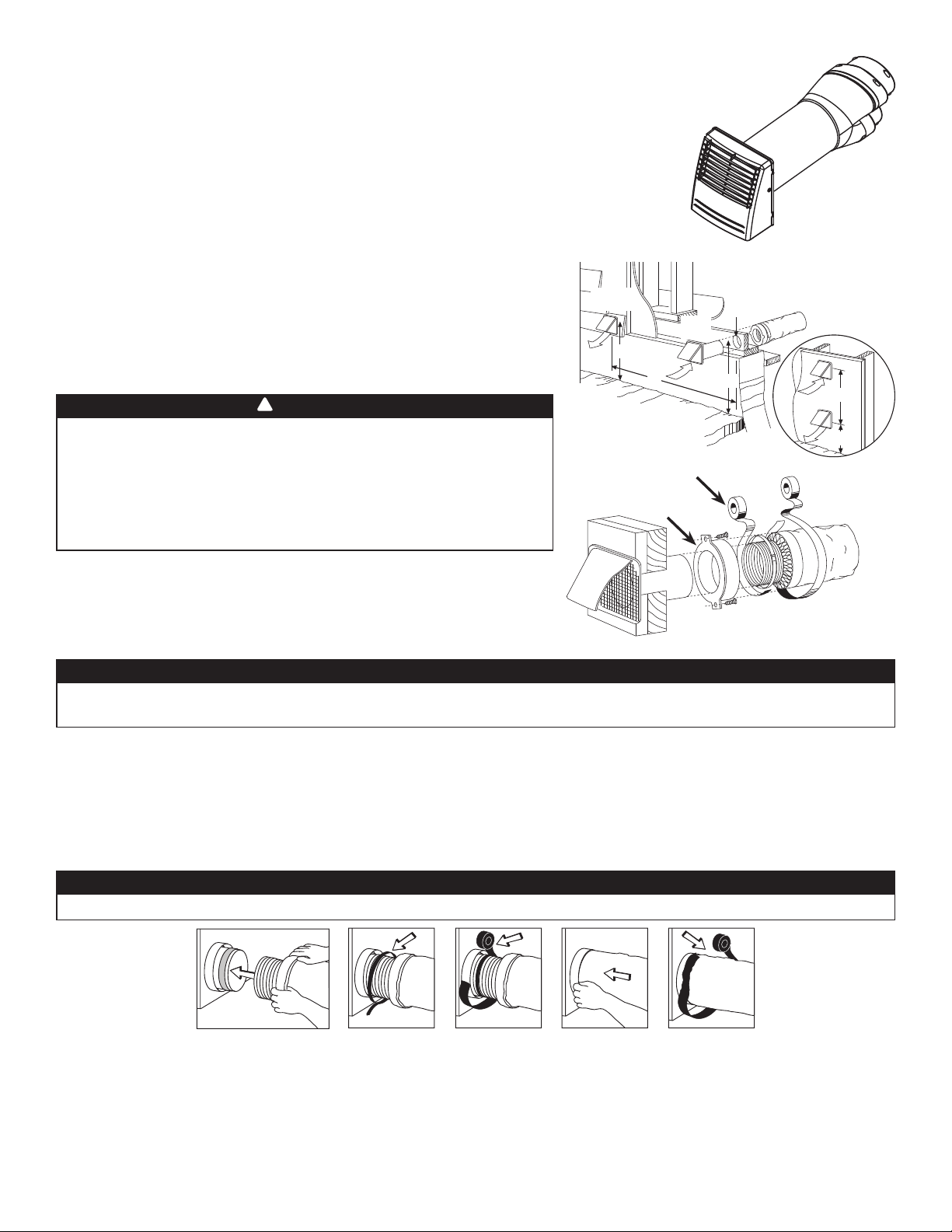
6. Install a metal T coupling at the junction of the fresh air to the house duct
and the furnace/AHU return duct (shaded part in illustration).
If you have to perform the following step, the furnace/AHU blower
must be synchronized with the unit for all types of installations.
See Section 3.3.
CAUTION
This procedure applies to installations where the ductwork of the unit is connected to the return duct of the
furnace/AHU (sections 2.2.2 and 2.2.3). Failure to perform this step may severely decrease the performance of
the ventilation system and damage the unit and the furnace.
CAUTION
In presence of a combustion furnace in a closed room, an
additional duct must be connected to the T metal coupling to
allow air intake from outside this room (dotted line).
WARNING
!
VJ0140
VJ0139
MAX. 0.25 IN. W.G.
9
TRANSITIONING TO 6-IN. DUCTS
If using 6-in. ducts, install 5-in. to 6-in. transitions on the ports, and secure using duct tape only (do NOT use screws). If rigid ducting is
used, install a 12-in. section of flexible duct between the transition and the rigid ducting (see below).
RIGID DUCTS
To prevent potential water leakage in cold side rigid ducting insulation, seal all rigid ducting joints with duct tape.
To avoid transmission of vibrations, always use a 12-inch section of flexible duct to connect rigid ducts to the unit. To connect insulated
rigid ducts to the unit (cold side) using insulated flexible ducts, follow instructions in section 2.5. To connect regular rigid ducts (warm
side) to the unit using non-insulated flexible ducts, use a tie wrap.
2.6 CONNECTING THE DUCTS TO THE UNIT
INSULATED FLEXIBLE DUCTS
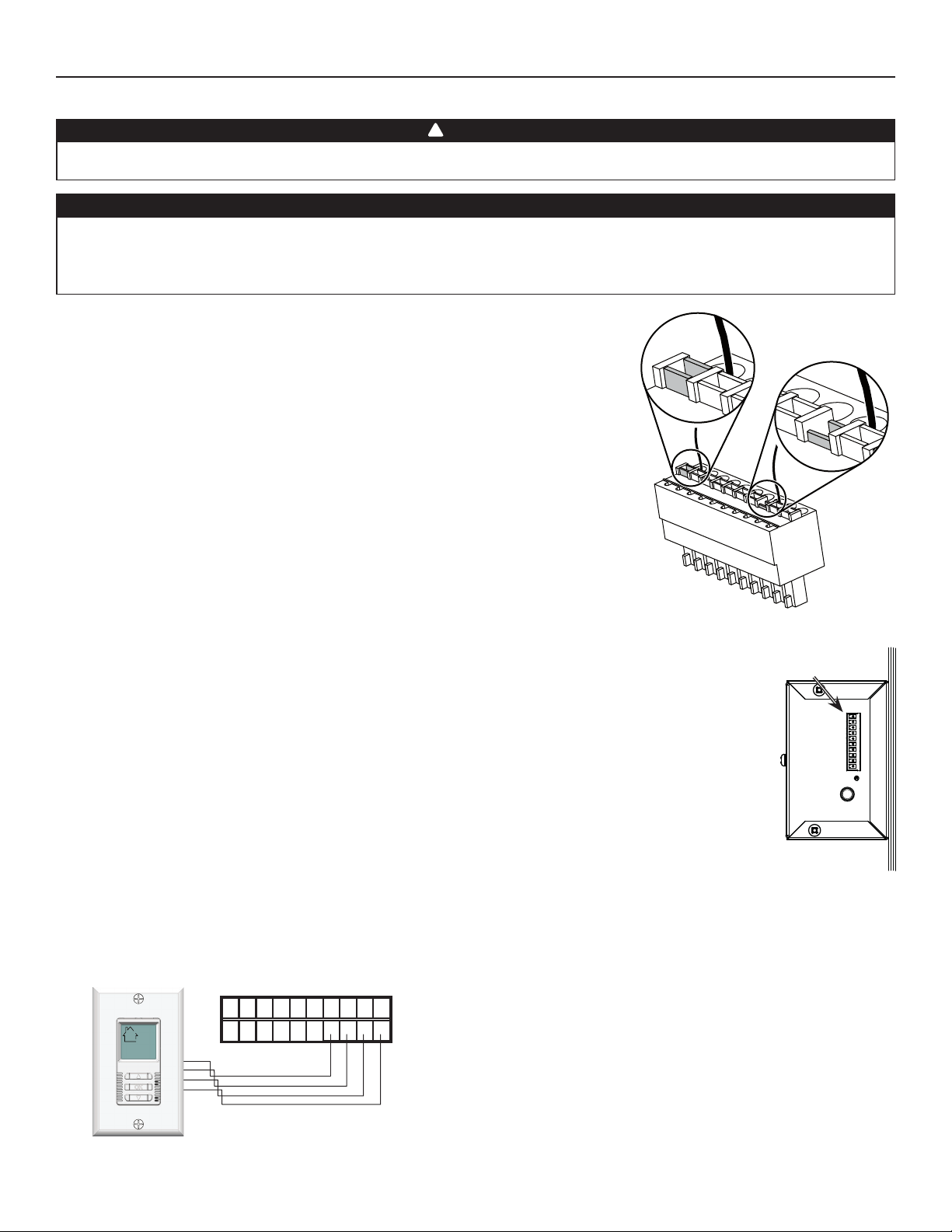
Use the following procedure to connect the insulated flexible ducts to the ports of the unit (exhaust to outside and fresh air from outside).
1. Expose the flexible duct by pulling back the insulation, and place it over the inner port ring.
2. Attach the flexible duct to the port using a tie wrap, making sure that the tie wrap is positioned over the foam band on the port.
3. Seal the joint using duct tape.
4. Pull the insulation and vapor barrier over the joint, tuck them between the inner and outer rings of the double collar and fasten them
in place using duct tape.
VJ0138
• If ducts have to go through an unconditioned space (e.g.: attic), always use insulated ducts.
• Do not use screws to connect the ducts or transitions to the ports.
CAUTION
Avoid tearing the vapor barrier on the insulated ducts during installation to avoid condensation within the ducts.
CAUTION
2.5 INSTALLING THE EXTERIOR HOODS
Choose an appropriate location for the exterior hoods:
• At least 6 feet between both hoods to avoid cross-contamination
• At least 18 inches away from the ground
Refer to illustration at right for proper connection method of the insulated ducts to
the hoods. An “Anti-Gust Intake Hood” should be installed in regions where a lot of
snow is expected to fall.
VD0028
EXHAUST
HOOD
INTAKE
HOOD
18”
18”
6” ø
6’
6’
18”
O
PTIONAL
DUCT
LOCATION
TAPE AND DUCT TIE
CAULKING
Make sure the intake hood is at least 6 feet away from any of the
following:
• Dryer exhaust, high efficiency furnace vent,
central vacuum vent
• Gas meter exhaust, gas barbecue-grill
• Any exhaust from a combustion source
• Garbage bin and any other source of contamination.
WARNING
!
2.4 INSTALLING DUAL EXTERIOR HOOD USING TANDEM
®
TRANSITION KIT (OPTIONAL)
If desired, a Tandem transition kit can be used instead of 2 exterior hoods; but take into account this
device will generate approximately an additional 0.2 in w.g. static pressure depending on the installation.
If using the Tandem hood, we recommend to use 6-in. ducts to minimize the reduction caused by the
tandem hood restriction.
The minimum joist opening needed to install the Tandem
®
transition is 9¾”. The maximum height of the
Tandem transition is 8¾”.
To connect the insulated flexible ducts to the Tandem transition (Exhaust air to outdoors and Fresh air
from outdoors), follow the instructions included with the Tandem transition kit (part no.VTYIK1).
VR0003
10
3. CONNECTIONS
3.1 ELECTRICAL CONNECTION TO OPTIONAL MAIN WALL CONTROL
Use the terminal connector included in the installation kit to perform the electrical connection
for main and optional wall controls. Check if all wires are correctly inserted in their
corresponding holes in the terminal block. A wire is correctly inserted when its orange
receptacle is lower than another one without a wire. On illustration at right, wire A is
correctly inserted, but not wire B.
3.1.1 ELECTRICAL CONNECTION TO VT7W MAIN WALL CONTROL
(RECIRCULATION MODE NOT AVAILABLE FOR THESE UNITS)
NO C NC I OC OL Y R G B
VE0250
Once the wall control connections have been made, insert the terminal connector in the electrical compartment.
NOTES : For information about the operation of the wall control, refer to the Main and auxiliary wall controls user
guide, available at www.broan.com.
The integrated control must be turned OFF (no LED lighted on) to use an optional main control.
Always disconnect the unit before making any connections. Failure to cut power could result in electrical shock or
damage to the wall control or electronic module inside the unit.
Never install more than one optional main wall control per unit. Make sure that the wires do not short-circuit
between themselves or by touching any other components on the wall control. Avoid poor wiring connections. To
reduce the risk of electrical interference (noise), do not run wall control wiring next to control contactors or near
light dimming circuits, electrical motors, dwelling/building power or lighting wiring, or power distribution panel.
CAUTION
WARNING
!
VE0272
A
B
VD0430
TERMINAL
CONNECTOR

11
3. CONNECTIONS (CONT’D)
3.1.2 ELECTRICAL CONNECTION TO VT4W MAIN WALL CONTROL 3.1.3 ELECTRICAL CONNECTION TO VT6W MAIN WALL CONTROL
NO C NC I OC OL Y R G B
BG
G
B
Y
VE0328A
Y
NO C NC I OC OL Y R G B
VE0323
--5°C
23°F
5
°
C
41
°
F
C
O
M
F
O
R
T
Z
O
N
E
-20°C
-4°F
OFF
MIN MAX
#
X
X
X
X
X
0
1
/
9
8
3.1 ELECTRICAL CONNECTION TO OPTIONAL MAIN WALL CONTROL (CONT’D)
3.2 ELECTRICAL CONNECTION TO OPTIONAL AUXILIARY WALL CONTROLS
W R G
Y
W
R
G
C
Y
UNIT TERMINAL CONNECTOR
THERMOSTAT
TERMINALS
FOUR
WIRES
TWO WIRES
heating only
FURNACE
24-VOLT
TERMINAL BLOCK
TWO WIRES
COOLING SYSTEM
NO C NC I OC OL Y R G B
W R G Y
W
R
Y
R
G
Y
C
THERMOSTAT
TERMINAL
4 WIRES
2 WIRES
heating only
wiring
nuts
FURNACE
24-VOLT
TERMINAL BLOCK
2 WIRES
COOLING SYSTEM
NO
NC
C
UNIT TERMINAL CONNECTOR
NO C NC I OC OL Y R G B
VE0108A
Never connect a 120-volt AC circuit to the terminals of the furnace/AHU interlock (standard wiring). Only use the low
voltage class 2 circuit of the furnace/AHU blower control.
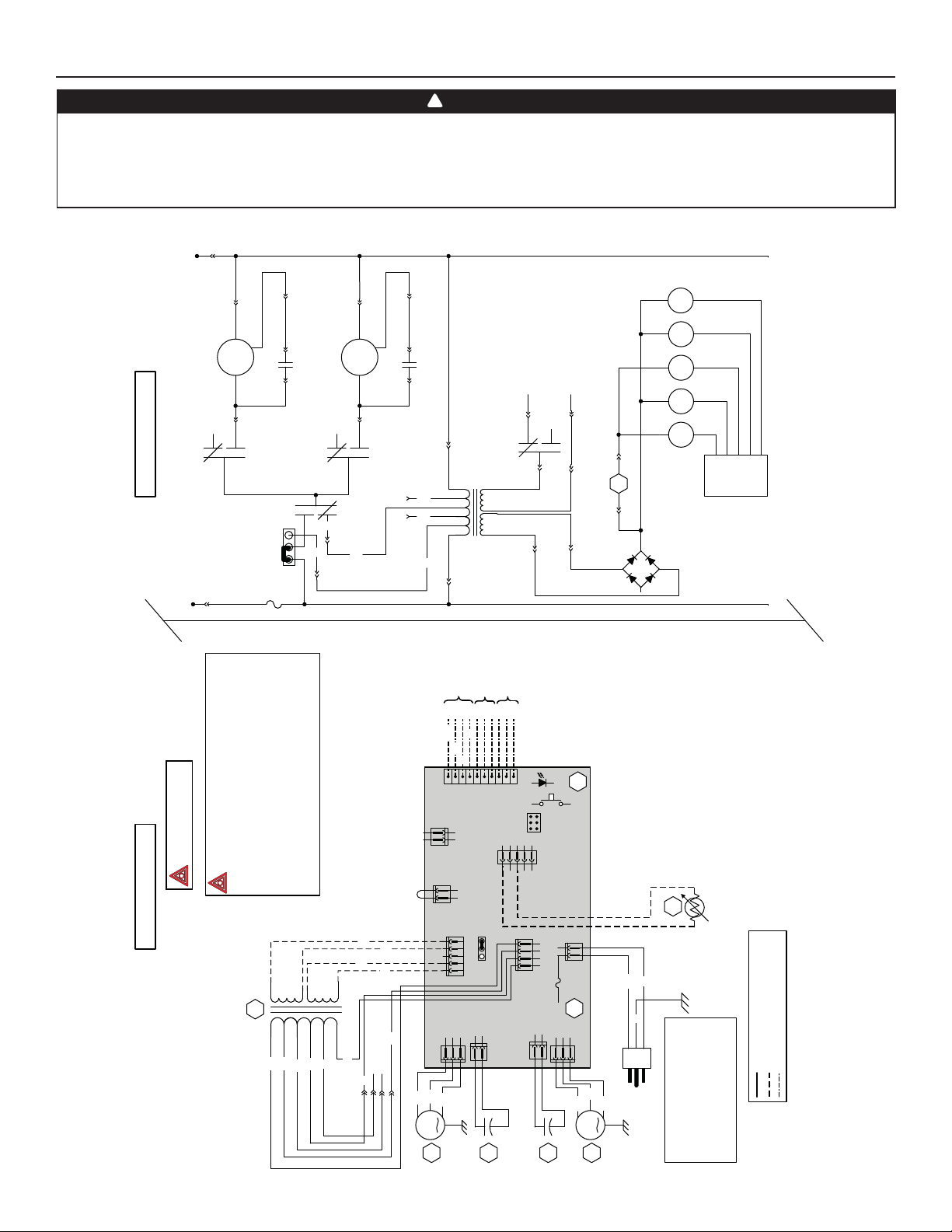
FOR A FURNACE/AHU CONNECTED TO A COOLING SYSTEM:
On some older thermostats, energizing the “R” and “G” terminals at the furnace/AHU has the effect of energizing “Y” at the thermostat and
thereby turning on the cooling system. If you identify this type of thermostat, you must use the
ALTERNATE FURNACE/AHU INTERLOCK WIRING.
STANDARD FURNACE/AHU INTERLOCK WIRING ALTERNATE FURNACE/AHU INTERLOCK WIRING
WARNING
!
3.3 CONNECTION TO THE FURNACE/AHU
VT4W
MAIN WALL CONTROL
REAR
VIEW
NO C NC I OC OL Y R G B
VE0371
59W VB60W VB60W
FURNACE/AHU
24-
VOLT
TERMINAL
BLOCK
FURNACE/AHU
24-VOLT
TERMINAL
BLOCK
12
4. WIRING DIAGRAM
L
INE
N
EUTRAL
120 VAC
J10-2
J10-1
EXHAUST FAN
MOTOR M1
M
C1
M
OTOR
C
APACITOR
K1
J5-1
J5-2
J7-1 J7-2 J5-3
SUPPLY FAN
MOTOR M2
M
C2
M
OTOR
C
APACITOR
K3
J4-1
J4-2
J6-1 J6-2 J4-3
J9-4
J12-1
J12-2
K4
J8-2
J8-1
J8-5
J8-4
J11-1
J11-2
S1
K4K1 K2 K3 K5
+
-
~
~
T1
9.5 VAC 24 VAC
100 VAC
83 VAC
68 VAC
62 VAC
NC NC
J9-1
J9-3
J9-2
F1
321
JU1
M
H
WIRING DIAGRAM
LINE VOLTAGE FACTORY WIRING
CLASS 2 LOW VOLTAGE FACTORY WIRING
CLASS 2 LOW VOLTAGE FIELD WIRING
OVERRIDE SWITCH
(OPTIONAL)
F
IELD WIRING
REMOTE
CONTROL
FURNACE BLOWER
INTERLOCK
(OPTIONAL)
B
G
R
R
G
BK
Y
Y
OL
OC
I
J14
10
9
8
7
6
5
4
3
2
1
J20
12
J13
ICP
A1
ELECTRONIC
ASSEMBLY
12345
J12
J11
12
4321
J9
J10
21
F1
3A
3AG T
YPE
321
JU1
MH
4321
5
J8
J5
J7
1
1
2
2
3
J6
1
2
J4
1
2
3
BK
W
G
120 VAC
60 Hz
C2
M2
BL
BR
BK
M1
C1
BL
BR
BK
SUPPLY FAN
MOTOR
EXHAUST FAN
MOTOR
MOTOR
CAPACITOR
MOTOR
CAPACITOR
T1
24 V Class 2
Optional
9.5 V
Class 2
120 V
100 V
83 V
68 V
62 V
neutral
BK
O
W
R
NC
NC
Y
Y
O
O
Critical characteristic.
NOTES
1.
Protected against fire with
UL listed/CSA Certified line fuse.
2. If any of the original wire, as supplied, must
be replaced, use the same equivalent wire.
3. Field wiring must comply with applicable
codes, ordinances and regulations.
4. Remote controls (class 2 circuit) available,
see instruction manual.
5. Furnace fan circuit must be class 2 circuit only.
K2
CPU
LOGIC DIAGRAM
VE0443A
COLOR CODE
BLACK
BLUE
BROWN
GREEN
ORANGE
BK
BL
BR
G
O
PURPLE
RED
WHITE
YELLOW
NO CONNECTION
P
R
W
Y
NC
R1
THERMISTOR
P
BL
R
O
O
O
R
BL
P
R
ref: 24228_REV-B
WARNING
• Risk of electric shocks. Before performing any maintenance or servicing, always disconnect the unit from its
power source.
• This product is equipped with an overload protection (fuse). A blown fuse indicates an overload or a short-circuit
situation. If the fuse blows, unplug the product from the outlet. Discontinue using the unit and contact technical
support.
!
13
PREPARATION
Follow these steps to ensure accurate measurements:
• Seal all the ductwork with tape. Close all windows and doors.
• Turn off all exhaust devices such as range hood, dryer and bathroom fans.
• Make sure the balancing dampers are fully open.
• If the installation is in any way connected to the ductwork of the cold air return of a furnace/air
handler, make sure that the furnace/air handler blower is ON. If not, leave furnace/air handler blower
OFF.
• If the outside temperature is below 32°F, make sure the unit is not running in defrost mode while
balancing by waiting 10 minutes after plugging the unit in.
• Set the unit to high speed.
BALANCING PROCEDURE
1. Place the magnehelic gauge on a level surface and adjust it to zero.
2. Connect tubing from gauge to EXHAUST airflow pressure taps (see diagram on unit door).
3. Be sure to connect the tubes to their appropriate high/low fittings. If the gauge drops below zero, reverse the tubing connections.
4. Note the CFM value from balancing chart on the unit.
5. Repeat steps 3 and 4, but to FRESH airflow pressure taps.
6. Using the appropriate adjustable balancing damper, lower the highest value so it matches the lowest value. A difference up to ±10cfm
is acceptable.
7. Secure both dampers in place with a fastening screw (included in the hardware kit).
8. Write the required airflow information on a label and stick it near the unit for future reference (date, maximum speed air flows, your
name, phone number and business address).
6. BALANCING THE UNIT
VD0431
CLOSED
OPEN
The fresh air flow must not be higher than the exhaust air flow.
CAUTION
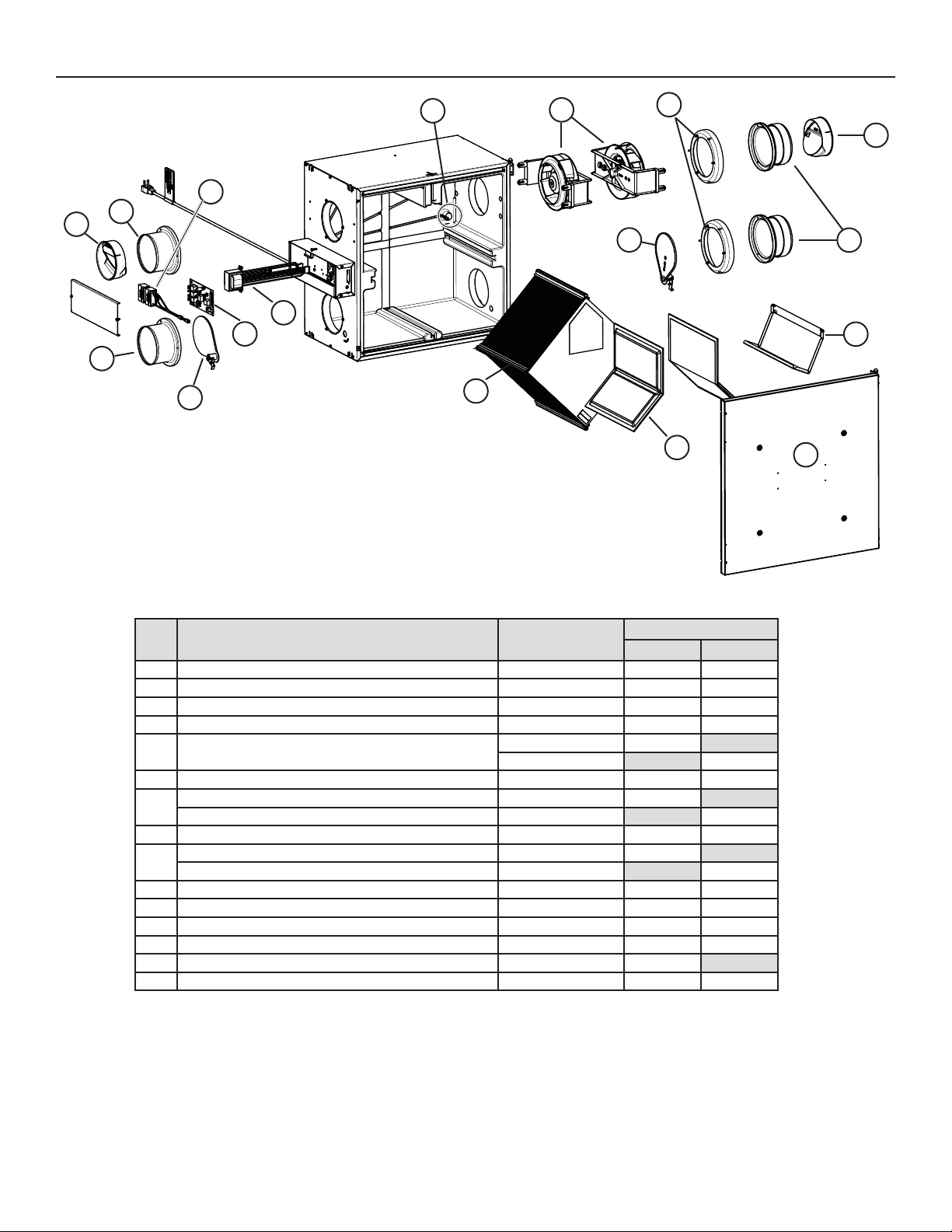
5. SPEED SELECTION
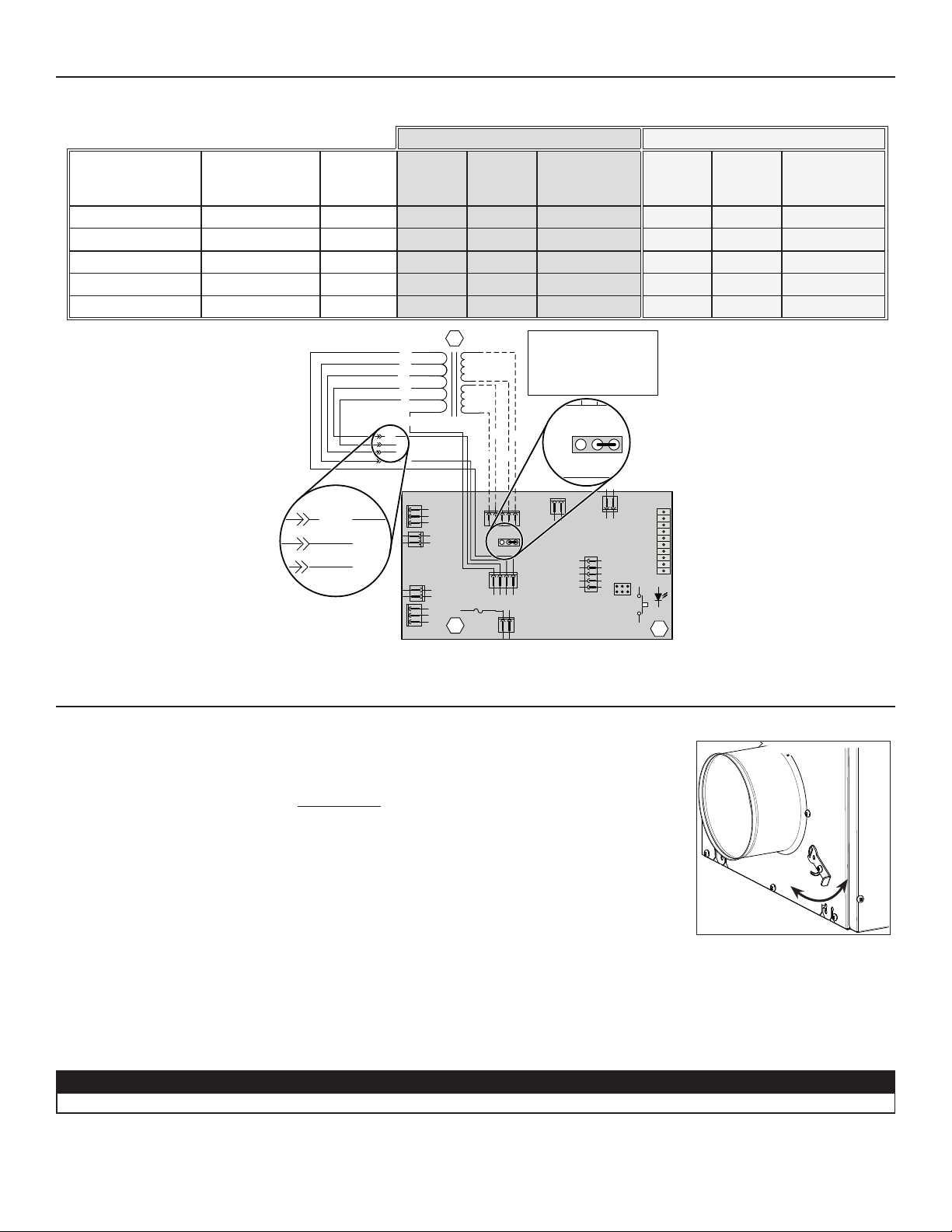
The factory set high-speed value for theses units is 129 CFM, and low speed value is approximately 66 CFM. To change these values, the
transformer wire taps connections must be changed and/or JU1 jumper must be relocated (see table and illustration below).
J14
10
9
8
7
6
5
4
3
2
1
J20
12
J13
ICP
A1
ELECTRONIC
ASSEMBLY
12345
J12
J11
12
4321
J9
J10
21
F1
3A
3AG T
YPE
321
JU1
MH
4321
5
J8
J5
J7
1
1
2
2
3
J6
1
2
J4
1
2
3
T1
24 V Class 2
Optional
9.5 V
Class 2
120 V
100 V
83 V
68 V
62 V
neutral
BK
O
W
R
NC
NC
Y
Y
O
O
P
BL
R
O
COLOR CODE
BLACK
BLUE
GREEN
ORANGE
BK
BL
G
O
PURPLE
RED
WHITE
YELLOW
P
R
W
Y
NO CONNECTION
NC
LOW
SPEED
HIGH
SPEED
VE0429A
R
NC
NC
321
JU1
MH
4321
HRV130FLS ERV130FLS
Speed option Connection
Pressure
(in. w.g.)
Supply
(CFM)
Exhaust
(CFM)
Power
consumption
(Watts)
Supply
(CFM)
Exhaust
(CFM)
Power
consumption
(Watts)
High no. 1 (Default) JU1 in H (1-2) 0.4 129 150 125 129 130 124
High no. 2 JU1 in M (2-3) 0.4 110 130 104 110 112 103
Low no. 1 PURPLE-RED 0.3 95 105 80 95 96 79
Low no. 2 (Default) BLUE-RED 0.2 65 70 64 65 66 62
Low no. 3 RED-RED 0.2 45 50 53 45 46 52
Low speed selection
High speed selection
14
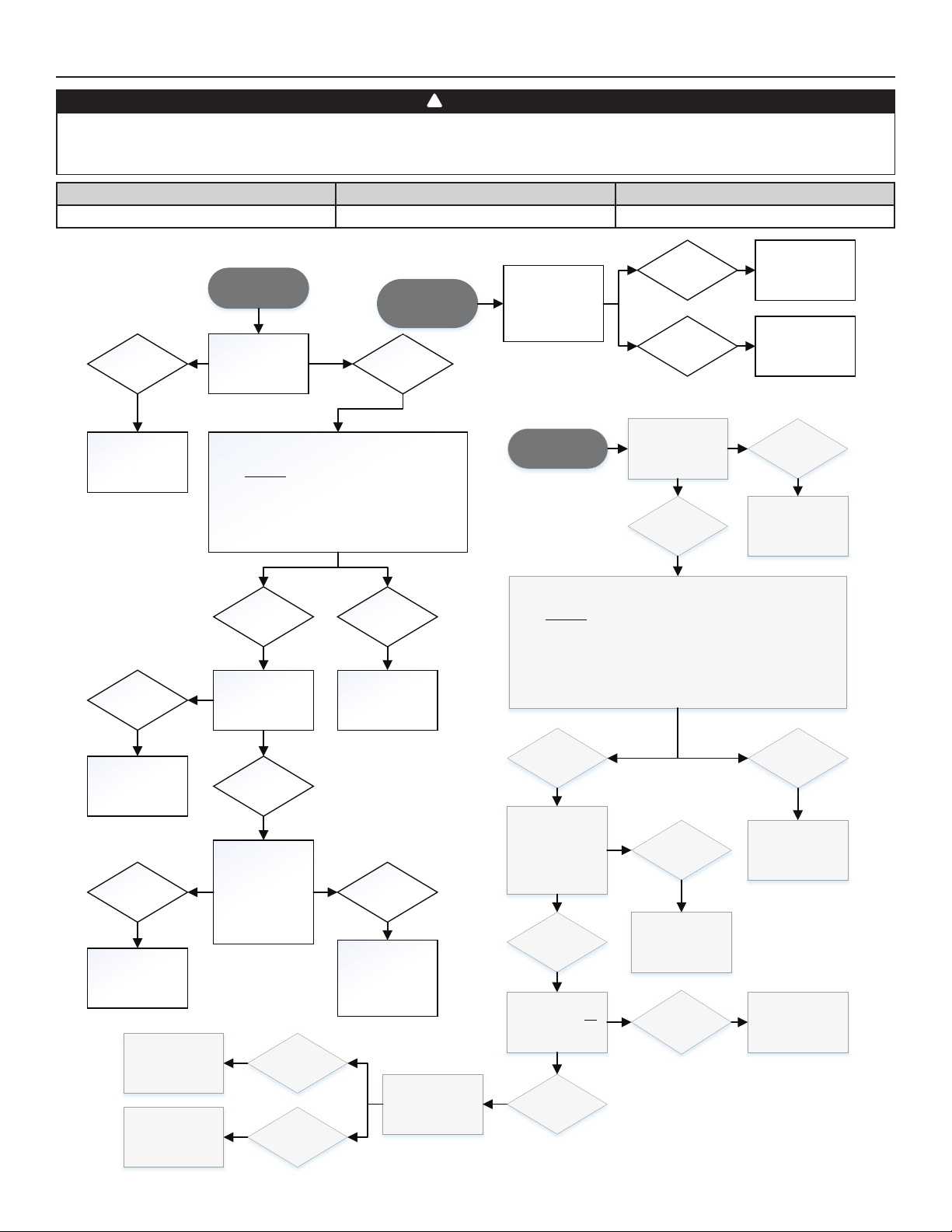
7. SERVICE PARTS
ITEM DESCRIPTION PART NUMBER
QUANTITY
HRV130FL ERV130FL
1 Backdraft damper assembly SV63818 2 2
2 Metal port 5” SV63828 2 2
3 Balancing damper SV63823 2 2
4 Capacitor 5 µF SV24216 2 2
5 Electronic board
SV63821 1
SV63838 1
6 Transformer SV18219 1 1
7
Heat recovery core SV63825 1
Energy recovery core SV63837 1
8 Filter (2) SV63827 1 1
9
Door with screws for HRV130FL SV64802 1
Door with screws for ERV130FL SV64802 1
10 5” Port collar SV63820 2 2
11 5” Insulated metal port SV63819 2 2
12 Motor assembly (including item 4) SV63824 2 2
13 Thermistor SV63833 1 1
14 Condensing plate SV63834 1
* Hardware bag SV63832 1 1
REPLACEMENT PARTS AND REPAIRS
In order to ensure your ventilation unit remains in good working condition, you must use Broan-NuTone LLC genuine replacement parts only. The Broan-NuTone LLC genuine
replacement parts are specially designed for each unit and are manufactured to comply with all the applicable certification standards and maintain a high standard of safety. Any
third party replacement part used may cause serious damage and drastically reduce the performance level of your unit, which will result in premature failing. Broan-NuTone LLC
recommends to contact a certified service depot for all replacement parts and repairs.
* Not shown.
1
1
2
2
3
3
4
5
6
7
8
9
10
11
12
13
14
15
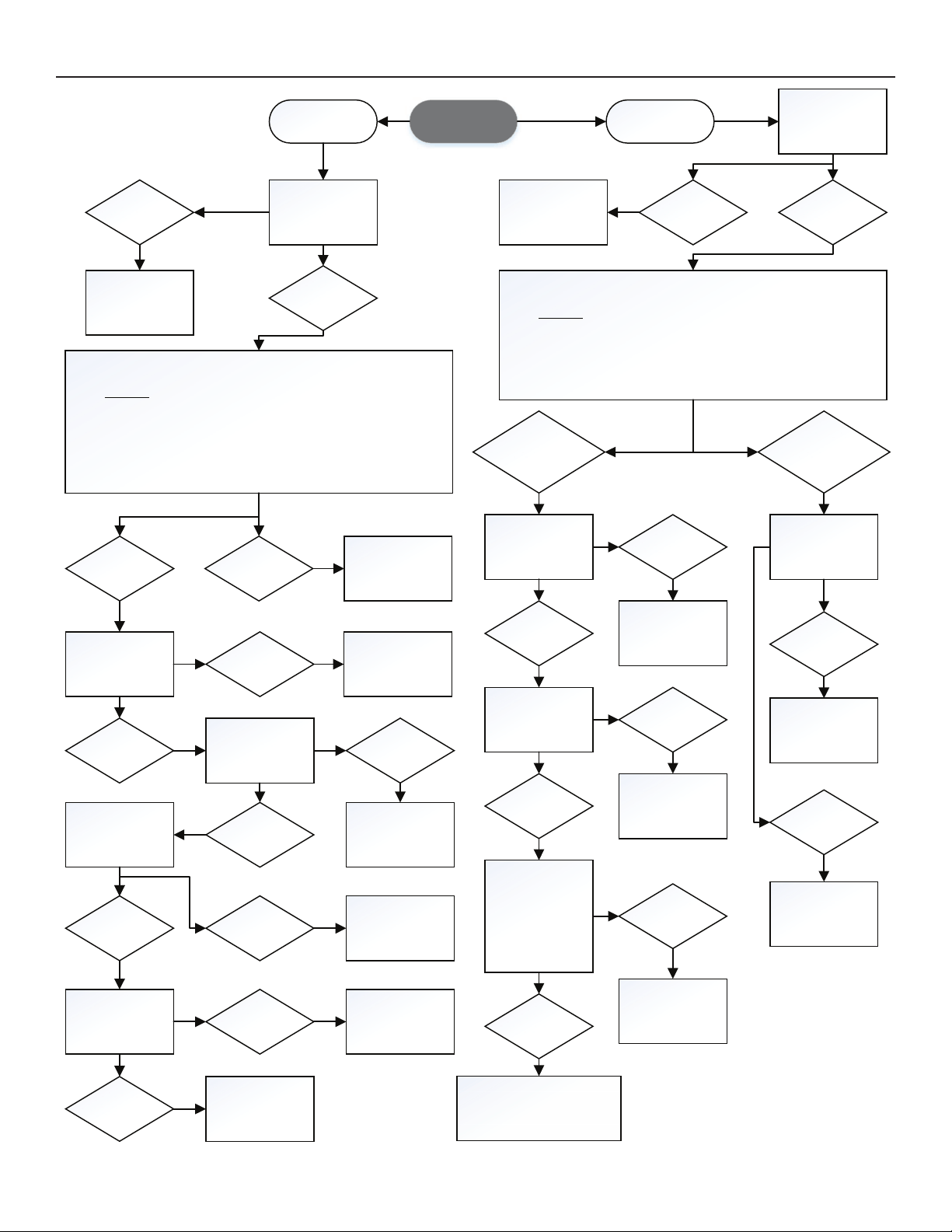
8. INSTALLER’S TROUBLESHOOTING
• A few diagnosis procedures may require the unit to be in operation while proceeding. Be careful with moving
and/or live parts.
• Risk of electric shocks. Electronic board connections must be checked by qualified personnel only.
WARNING
!
LED Signal Error Type Action
LED flashes GREEN (double blink). Thermistor error (unit still works). Replace the thermistor kit.
Supplymotordoes
notwork.
Wallcontroldoes
notwork.
Isthepoweroutlet
energized?
No
Refertoan
electrician.
Yes
• Unplugwallcontrols
• Unplugunit
• Wait1minute
• Plugunitback
• Wait10seconds–Unitperformsbootingsequence
• Oncethebootingsequenceisover(after10sec.),tryoperatingthe
unitusingtheintegratedpushͲbutton.
WhenhittingtheintegratedpushͲbuttonmultipletimes,doestheLEDgo
fromOFFtoAMBERtoGREENandbackto
OFF?
Yes
Arethewallcontrol
wiresproperly
connected?Pay
specialattentionto
theBLACKand
YELLOWwires.
No
Theproblemisnot
thewallcontrol.
Referto«Unitdoes
notwork».
No
Restore
connections.
Yes
Useavoltmeter.
Isthere8Ͳ12VDC
betweenBLACKand
YELLOW?
Yes,but
problemnot
solved.
Changethewall
control.
No
Testthewallcontrol
usinganewwire.
Doesthewall
controlnowwork?
No
Changethewall
control.
YesChangethewire.
InvertJ4andJ5
motorconnections.
Doesthesupply
motornowwork?
No
Restoreoriginal
motorconnections
andreplacethe
supplymotor.
Yes
Restoreoriginal
motorconnections.
InverttheJ6andJ7
capacitors
connections.Does
thesupplymotor
nowwork?
Yes
Restoreoriginal
capacitor
connectionsand
replacethesupply
motorcapacitor.
No
Onlythehigh
speedworks.
Replacethe
electronicboard.
Replacethe
electronicboard.
Tryrotatingthe
supplymotorby
hand.Doesthe
wheelrotateeasily?
No
Replacethe
supplymotor.
Yes
• Unplugwallcontrols
• Unplugunit
• Wait1minute
• Plugunitback
• Wait10seconds–Unitperformsbootingsequence.
• Oncebootingsequenceisover(after10sec.),try
operatingtheunitusingtheintegratedpushͲbutton.
Whathappens?
PushͲbuttontimer
doesnotwork
(nolight).
Atunit,jumpOL
andOConthe
GREENterminal
connector.Doesthe
unitnowwork?
No
Replacethe
electronicboard.
Yes
Thewireorcontrol
isdefective.
Bothspeeds
donotwork.
16
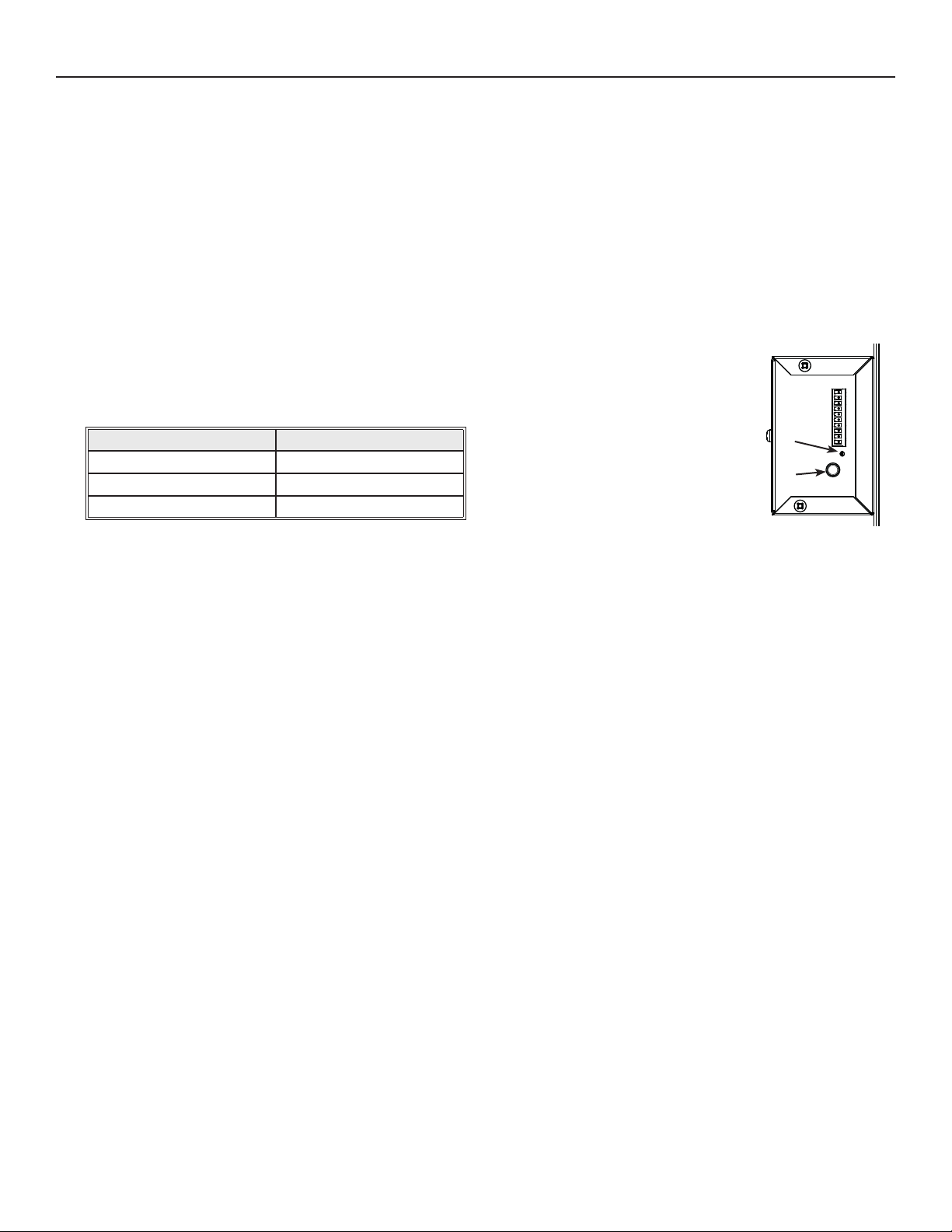
SERVICE TECHNICIANS ONLY: If you require assistance or have questions after performing the troubleshooting, call 1-800-558-1711.
• Unplug auxiliary controls
• Unplug unit
• Wait 1 minute
• Plug unit back
• Wait 10 seconds – Unit performs ƟŶg sequence.
• Once booƟng sequence is over ;ĂŌer 10 sec.), try opeƌĂƟŶg the unit using
the integrated push-ďƵƩŽŶ.
When hiƫng the integrated push-ďƵƩŽn mulƟple Ɵŵes, does the LED go
from OFF to AMBER to GREEN and back to OFF?
Is the power outlet
energized?
No
Refer to an
electrician.
Unit does not work.
Yes
Yes
Replace the
ŽƉƟŽŶĂl wall
control.
No
Integrated control
LED is OFF.
Integrated control
LED Ňashes RED.
Is the jumper
present on J11?
No
Call technical
support.
Yes
Invert J4 and J5
motor connecƟons.
Does the exhaust
motor now work?
No
Restore original
motor connecƟons
and replace the
exhaust motor.
Yes
Restore original
motor connecƟons.
Invert the J6 and J7
capacitors
connecƟŽŶs. Does
the exhaust motor
now work?
Yes
Restore original capacitor
connecƟons and replace the
exhaust motor capacitor.
No
Both speeds
do not work, LED sƟll
Ňashes RED.
Replace the
electronic board.
Use a voltmeter.
Is there 68VAC
between J9-3 and
J9-4?
No
Replace the
transformer.
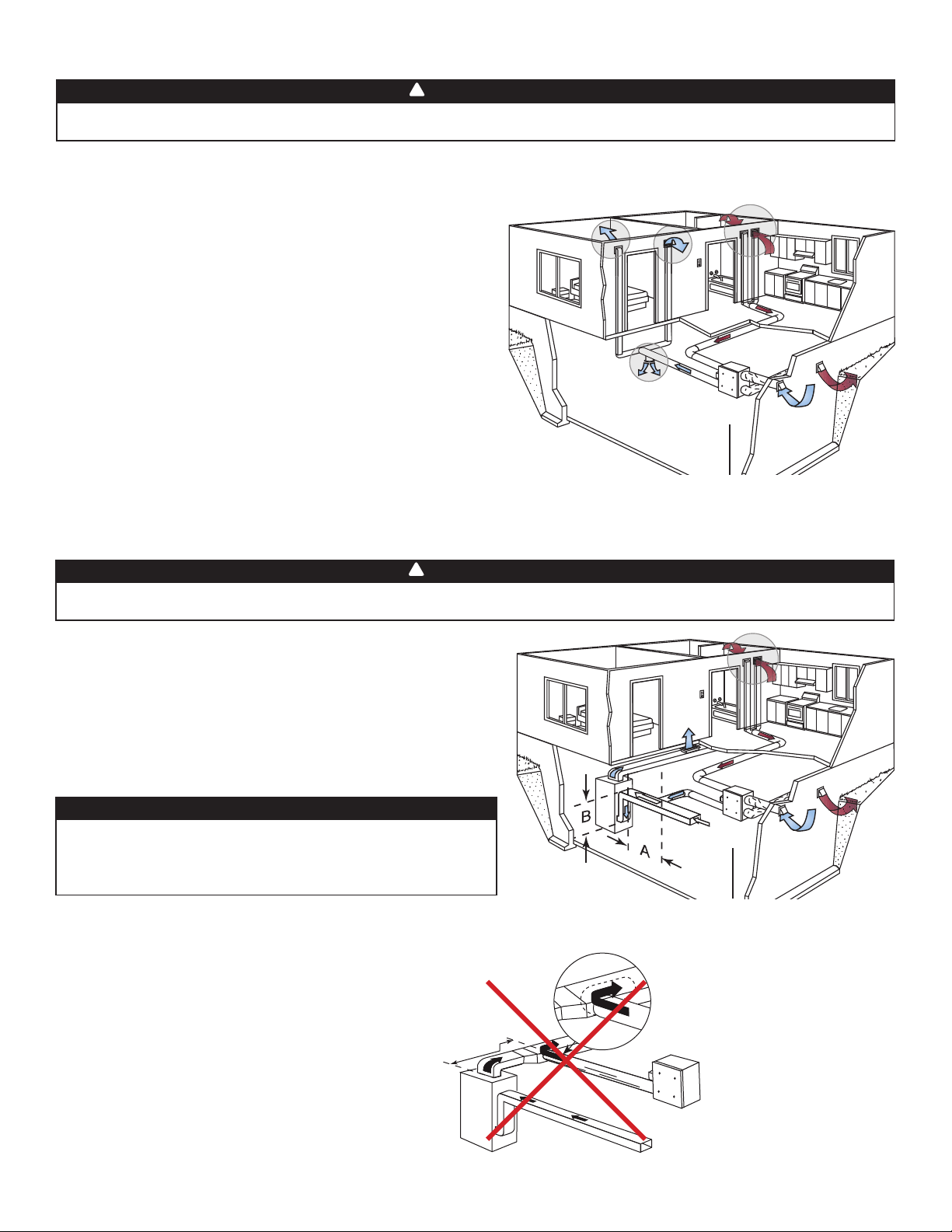
Yes
Replace the
electronic board.
Try ƌŽƚĂƟng the
exhaust motor by
hand. Does the
wheel rotate easily?
No
Replace the
exhaust motor.
Yes
• Unplug auxiliary controls
• Unplug unit
• Wait 1 minute
• Plug unit back
• Wait 10 seconds – Unit performs ƟŶg sequence.
• Once the ƟŶg sequence is over ;ĂŌer 10 sec.), try opeƌĂƟŶg the unit
using the integrated push-ďƵƩŽŶ.
What happens?
High speed
works, but not low
speed.
Is the fuse on the
electronic board
blown?
Yes
No
Use a voltmeter.
Is there 120 V at
J10?
No
Power cord is
defeĐƟve. Call
technical support.
Yes
Use a voltmeter.
Is there 120 V
between J9-4 and
J9-1?
NoYes
Replace the
electronic board.
Use a voltmeter.
Is there 9.5 V
between J8-4 and
J8-5?
No
Replace the
transformer.
Yes
Call technical
support.
ŝƐĐŽŶƟŶƵĞƵƐŝŶŐ
the unit and contact
technical support.
8. INSTALLER’S TROUBLESHOOTING (CONT’D)
17
9. USING THIS UNIT
This unit is designed to provide fresh air to your home while exhausting stale, humid air. By eliminating accumulated pollutants and
humidity, it maintains an optimum air quality and an ideal relative humidity. It is equipped with a recovery core that is designed specifically
to control excess humidity and reduce ventilation costs by recovering the energy from the exhausted air, and using that same energy to
warm the fresh air being supplied. This recovery process is accomplished in such a way that the stale air is never mixed with the fresh air.
When the outdoor temperature is below 23°F, recovery creates frost in the module. To maintain proper operation, the unit is programmed
to defrost the recovery module. The defrost duration and frequency vary according to the outdoor temperature. After defrosting, the unit
returns to the operating mode selected by the user.
9.1 YOUR VENTILATION SYSTEM
9.2 INTEGRATED CONTROL
All units are equipped with an integrated control, located in front of the electrical compartment. Use the push button (2) to control the unit.
The LED (1) will show which mode the unit is in. For more convenience, these units can be controlled using an optionnal wall control.
NOTES:
1. The integrated control must be turned OFF to use an optional main control.
2. If an optional auxiliary control is used, when activated, it overrides the optional main control.
If a problem occurs during the operation of the unit, the integrated control LED (1) will blink. The color of the LED light indicates the
type
of error detected. Contact
your installer.
For wall control problems, refer to the Troubleshooting section in the Main and auxiliary wall controls user guide, available at
www.broan.com
If the problem is still not solved, contact your installer.
Refer to this table to operate the unit using the integrated control.
LED COLOR RESULTS
AMBER UNIT IS ON LOW SPEED
GREEN UNIT IS ON HIGH SPEED
NO LIGHT UNIT IS OFF
9.2.1 BOOT SEQUENCE
The boot sequence of this unit is similar to the boot sequence of a personal computer. Each time the unit is plugged after being unplugged,
or after a power failure, it will perform a booting sequence before starting to operate. During the booting sequence, the integrated control
LED (1) will light up and remain GREEN or AMBER for 3 seconds, and will then shut off; the booting sequence is done.
NOTE: No command will be taken until the unit is fully booted.
9.2.2 SETTING EXTENDED DEFROST
The unit is factory set to normal defrost. In cold regions, it may be necessary to setup extended defrost. To do so, during the first 5 seconds
of the booting sequence, while the integrated control LED is GREEN, press the push button(2) and hold it until the LED turns AMBER
(about 3 seconds).
1
2
18
10. MAINTENANCE
Dangerous voltage. During maintenance and repairs, the unit must always be unplugged.
We take great care to minimize sharp edges; however, please proceed with caution when handling all components.
When cleaning the unit, it is recommended to wear safety glasses and gloves.
1. Disconnect power cord.
2. The door of this unit is hinged and maintained closed by 2 screws. Remove them and set aside.
3. Clean the inside of the door with a damp cloth.
4. Clean filters:
• Remove filters.
• Vacuum to remove most of the dust.
• Wash with a mixture of warm water and mild soap. You may add bleach if you wish to disinfect (one
tablespoon per gallon). Rinse thoroughly. Shake filters to remove excess water and let dry.
5. Clean the condensing tray and plate (if applicable) with a damp cloth.
6. Check the exterior air intake hood:
• Make sure there are no leaves, twigs, ice or snow that could be drawn into the vent.
• Clean if necessary.
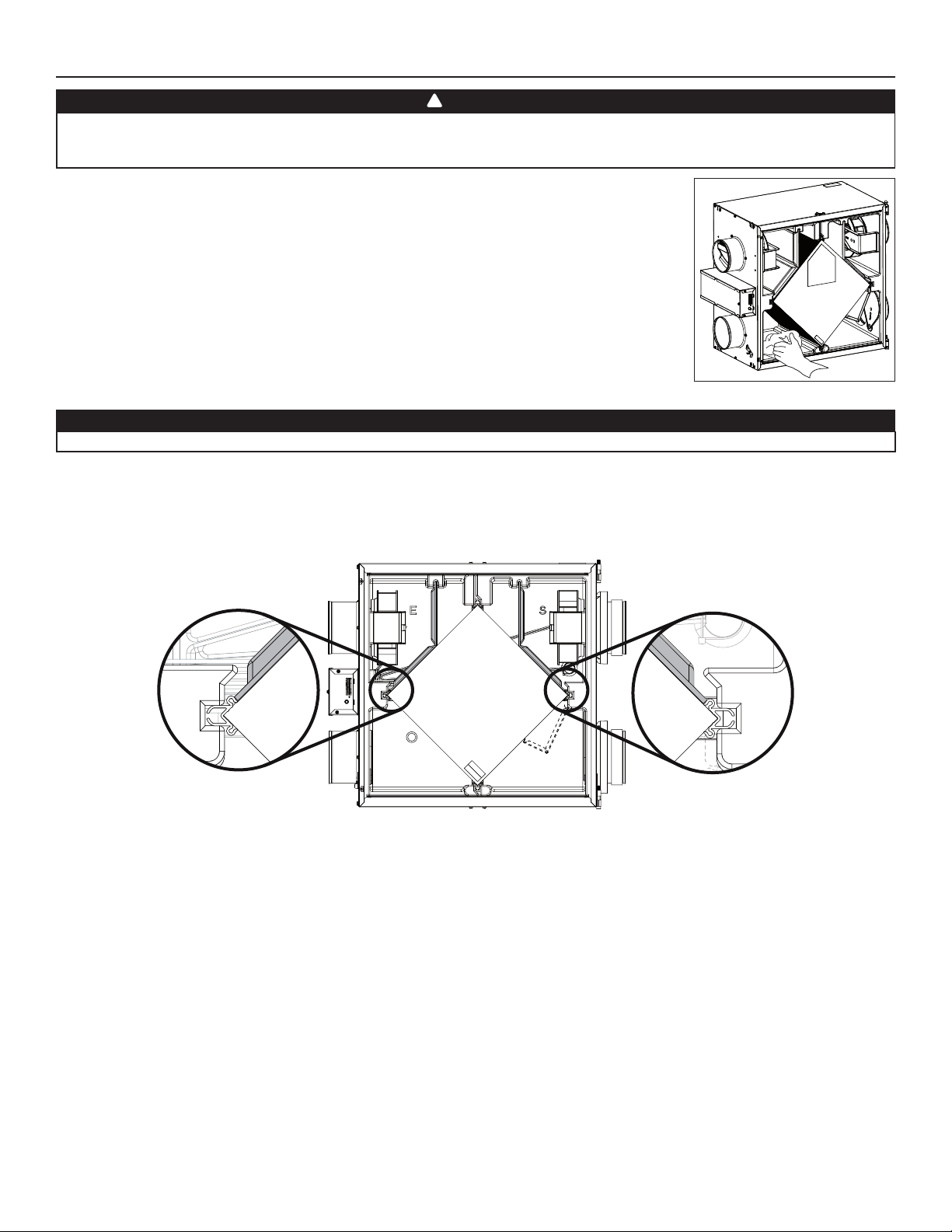
7. Reassemble the components. Pay special attention to the filters by making sure that they are engaged in their slots. If a motor wheel
touches a filter, the filter is not correctly placed (refer to illustration below).
8. Rotate the blower wheels by hand. If one of the wheels does not rotate easily, contact your installer.
9. Close the unit door and reconnect power supply.
CAUTION
A blocked air vent, even partially, can cause the unit to malfunction.
VD0432
10.1 QUARTERLY
WARNING
!
VD0461
19
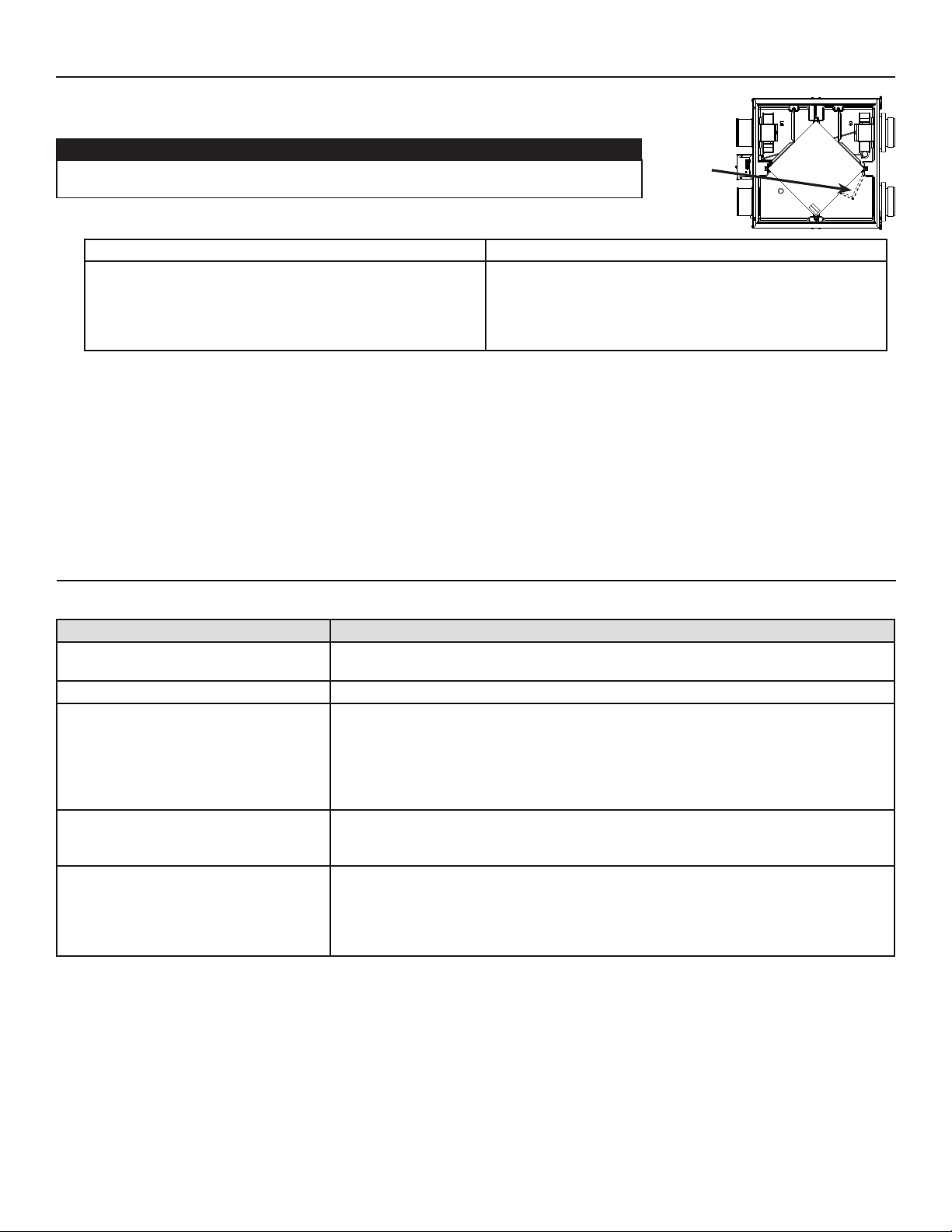
1. Repeat steps 1 to 6 from the previous section and continue with the following steps:
2. Clean the recovery core:
HRV130FL ERV130FL
• Remove the core.
• Let it soak in a mixture of cold or lukewarm water and mild
soap (dishwashing liquid).
• Rinse thoroughly.
• Shake the core to remove excess water and let it dry.
Remove the dust on the core using a vacuum cleaner and a
soft brush attachment.
CAUTION: DO NOT SOAK THE ENERGY RECOVERY
CORE IN WATER
3. Clean the blower assembly.
4. Remove the dust using a vacuum cleaner with a soft brush attachment.
5. Reassemble the components.
6. Reconnect power supply.
CAUTION
• Handle the recovery core with care.
• Do not disassemble the condensing plate from the heat recovery core.
PROBLEM TRY THIS
1. Nothing works. • See if the unit is plugged in.
• See if the unit is receiving power from the house circuit breaker or fuse.
2. Noisy unit. • Clean the unit (see Section 10). If the problem is not solved, contact your installer.
3. Condensation on windows (air too
humid).
• Operate the unit at maximum speed (MAX.) during activities generating excess humidity
(family gatherings, extra cooking, etc.).
• Leave curtains half-open to allow air circulation.
• Store all firewood in a closed room with a dehumidifier or in a well ventilated room, or
store the wood outdoors.
• Keep the temperature in your house above 64°F.
4. Air too dry. • Operate the unit at low speed (MIN.).
• Temporarily switch to the intermittent mode (if available).
• Temporarily use a humidifier.
5. Air too cold at the air supply grille. • Make sure the outdoor hoods are not blocked.
• Operate the unit at low speed (MIN.).
• Have the system’s balancing checked (contact your installer).
• Have the unit’s defrost system checked (contact your installer).
• Install a duct heater (contact your installer).
10.2 ANNUAL (AT FALL)
11. USER’S TROUBLESHOOTING
Contact customer service at 1-800-558-1711 for any unresolved issue.
VD0443
CONDENSING
PLATE
(HRV UNITS
ONLY, SEE
SECT.2.1)
10. MAINTENANCE (CONT’D)

20
12. WARRANTY
This ventilation unit is a high quality product, built and packaged with care. The manufacturer warrants to the original purchaser of its
product, that such products will be free from defects for the period stated below, from date of original purchase. For all units, the warranty
covers parts only against any operational defect. This 5-year warranty is subject to performance of the core maintenance according
recommendations in this manual. The heat recovery core (HRV) has a limited lifetime warranty, and the energy recovery core (ERV) has a
5-year warranty. If any defect should occur, we urge you to read the user guide carefully. If the problem persists, observe the following rules:
RULES TO FOLLOW
If the unit is defective, contact your ventilation contractor (see address on your manual’s cover page). The contractor will determine with
you the reason for the defect, and if needed, do the replacement or repair. If ever it is impossible to reach your ventilation contractor, call
1-800-558-1711 (in North America); the personnel will be pleased to give you the phone number of a distributor or a service center near
you.
REPLACEMENT PARTS AND REPAIR
In order to ensure your ventilation unit remains in good working condition, you must use the Broan genuine replacement parts only. The
Broan genuine replacement parts are specially designed for each unit and are manufactured to comply with all the applicable certification
standards and maintain a high standard of safety. Any third party replacement part used may cause serious damage and drastically reduce
the performance level of your unit, which will result in premature failing. Broan also recommends that you contact a service depot certified
by the manufacturerfor all replacement parts and repair.
BILL OF PURCHASE
No replacement or repair covered by the warranty will be carried out unless the unit is accompanied by a copy of the original bill of
purchase. Please retain your original.
MISCELLANEOUS COSTS
In each case, the labor costs for the removal of a defective part and/or installation of a compliant part will not be covered by the manufacturer.
CONDITIONS AND LIMITATIONS
These units are created for residential use only and must be used in a building as defined below:
Building: All structures zoned and/or erected for the act, process or art of human or animal habitation and/or the storage or
warehousing of goods.
Residential use: Dwelling, lodging, suite: Building, or part of a building, intended to act as either the domicile to one or several people
which can include general sanitary, food consumption and rest facilities. Buildings of only one room or a group of rooms
including those occupied by a tenant or owner; comprise the lodgings, the individual rooms of the motels, hotels,
rooming/lodging houses, boarding/half-way/foster homes, dormitories, and suites, as well as the stores and the business
establishments constituted by only one room in a dwelling.
Commercial use: Agricultural establishment, commercial establishment for assembly, care, or detention: Building or part of a building that
does not contain a dwelling, situated on land dedicated to agriculture or farming and used primarily to shelter animals,
or for the production, the storage or the treatment of agricultural or horticultural products or animal food. Building or part
of a building, used for the display or retail of goods, professional or personal services, or commodities. Building, or part
of a building used by persons gathering for civic activities, religious or political assembly, tourism, educational/vocational
training, recreation or the consumption of food or drink. Building, or part of a building used to shelter persons of impaired
physical or psychological states, persons requiring palliative care or medical treatments, or persons for reasons out of
their control, cannot escape harm or threat of danger autonomously.
Industrial use: Building, or part of a building, used for the assembly, the manufacture, the creation, the treatment, the repair or the
storage of products and combustible materials and that contain fuels that when ignited or exploded in sufficient quantity
may constitute a risk of fire.
The above warranty applies to all cases where the damage is not a result of poor installation, improper use, mistreatment or negligence,
acts of God, or any other circumstances beyond the control of the manufacturer. Furthermore, the manufacturer will not be held responsible
for any bodily injury or damage to personal property or real estate, whether caused directly or indirectly by the unit. This warranty
supersedes all prior warranties.
Broan 926 West State Street, Hartford, WI 53027 www.broan-nutone.com 800-558-1711
ESTOS PRODUCTOS OBTUVIERON LA DENOMINACIÓN ENERGY STAR
®
AL CUMPLIR LAS ESTRICTAS DIRECTRICES DE EFICIENCIA ENERGÉTICA
ESTABLECIDAS POR EL MINISTERIO DE RECURSOS NATURALES DE CANADÁ
Y LA EPA DE ESTADOS UNIDOS. CUMPLEN CON LOS REQUISITOS DE
ENERGY STAR
ÚNICAMENTE CUANDO SE UTILIZAN EN CANADÁ.
23368 REV. 04
HRV130FL (N DE PIEZA HRV130FLS),
ERV130FL (N DE PIEZA ERV130FLS)
MANUAL DEL USUARIO Y DEL INSTALADOR
INSTALADOR: LEA ESTAS INSTRUCCIONES
GUÁRDELAS PARA EL USUARIO
PARA USO RESIDENCIAL ÚNICAMENTE
VB0247
ANTES DE LA INSTALACIÓN:
HRV130FL: LEA LA SECCIÓN 2.1, EN LA PÁGINA 4, PARA OBTENER INFORMACIÓN
IMPORTANTE ACERCA DE LA PLACA DE CONDENSACIÓN.
TODOS LOS APARATOS: LEA LA SECCIÓN 2.1, EN LA PÁGINA 5, PARA OBTENER
INFORMACIÓN IMPORTANTE ACERCA DE LA ORIENTACIÓN
DE LAS COMPUERTAS DE CONTRACORRIENTE.
SI CONECTA LOS CONDUCTOS DE ESTE APARATO A LOS CONDUCTOS DE ALIMENTACIÓN DE
UNA CALDERA/AHU, LEA LAS NUEVAS INSTRUCCIONES DE LAS PÁGINAS 6, 7 Y 8 ANTES
DE REALIZAR LA INSTALACIÓN.
REGISTRE SU PRODUCTO EN LÍNEA EN: www.broan-nutone.com/register
Para obtener más información, visitar nuestro sitio www.broan-nutone.com

2
Este manual utiliza los siguientes símbolos para hacer hincapié en determinada información:
Se refiere a una instrucción que, si no se sigue, puede provocar lesiones personales graves, incluso causar la
muerte.
PRECAUCIÓN
Denota una instrucción que, si no se sigue, puede dañar gravemente el aparato y/o sus componentes
NOTA: Indica la información complementaria necesaria para completar una instrucción.
LIMITACIÓN
Para instalación residencial (doméstica) solamente. Los trabajos de instalación y el cableado eléctrico han de ser realizados por personas
cualificadas, de conformidad con todos los códigos y normas aplicables, incluyendo los códigos y normas de construcción contra incendios.
⚠ ADVERTENCIA
PARA REDUCIR EL RIESGO DE INCENDIO, CHOQUE ELÉCTRICO O HERIDAS CORPORALES, SIGA LAS INDICACIONES
SIGUIENTES:
1. Utilice este aparato sólo en la forma prevista por el fabricante.
2. Antes de realizar tareas de mantenimiento o de limpiar el aparato, desenchufe el cable de alimentación de la toma eléctrica.
3. Este aparato no ha sido pensado para proporcionar aire de combustión o de dilución para aparatos que queman combustible.
4. Al cortar o taladrar en una pared o en el techo, procure no dañar el cableado eléctrico ni otras instalaciones ocultas.
5. No use el aparato con un dispositivo de control de velocidad de semiconductores diferente de los que se indican en la sección 3.1.
6. Este aparato debe conectarse a tierra. El cable de alimentación lleva un enchufe de 3 patillas con toma de tierra para su seguridad
personal. Debe enchufarse en una toma de corriente para tres patillas, conectada a tierra de acuerdo con el código eléctrico nacional
y los códigos y ordenanzas locales. No retire la patilla de la toma de tierra. No utilice el aparato con un cable prolongador.
7. No instale el aparato en un espacio donde se cocina ni lo conecte directamente a otro aparato.
8. No lo use para evacuar materias ni vapores peligrosos o explosivos.
9. Para la instalación, el mantenimiento o la limpieza del aparato se aconseja llevar lentes y guantes de seguridad.
10. Cuando la reglamentación local aplicable sea más restrictiva en materia de instalación o certificación, dicha reglamentación prevalecerá
sobre las exigencias de este manual y el instalador acepta atenerse a dicha reglamentación y asumir los gastos correspondientes.
PRECAUCIÓN
1. Para evitar que los filtros se obstruyan prematuramente, apague el aparato durante las obras de construcción o renovación.
2. Para mayor información sobre otras exigencias, lea la etiqueta de especificaciones que viene en el aparato.
3. Asegúrese de sacar el aire al exterior. No introduzca ni evacue el aire en espacios situados entre paredes, en el techo o en un
desván, en sótanos pequeños ni en cocheras. No intente recuperar el aire de salida de una secadora o de una campana.
4. Aparato para instalación residencial únicamente, de acuerdo con las exigencias de la norma 90B de la NFPA (para un aparato
instalado en EE.UU.) o con la parte 9 del Código Nacional de la Construcción de Canadá (para un aparato instalado en Canadá.
5. No pase ningún conducto de aire por encima o a menos de 2 pies (0,61 m) de una caldera o de su cámara de alimentación, de un
calentador o de otro aparato que genere calor. Si hay que conectar un conducto a la cámara de retorno de una caldera, debe situarse
al menos a 10 pies (3,1 m) de la conexión de la cámara con la caldera.
6. La instalación de los conductos debe hacerse de conformidad con todos los códigos locales y nacionales aplicables.
7. Al ausentarse de la vivienda durante un periodo largo (más de dos semanas), una persona responsable debería verificar regularmente
si el aparato funciona correctamente.
8. Si los conductos pasan a través de un espacio no acondicionado (como un desván), el aparato debe funcionar constantemente,
excepto cuando haya que hacer tareas de mantenimiento o reparaciones. Asimismo, la temperatura ambiente de la casa nunca
debería bajar de 65°F.
9. No use el aparato durante la construcción o renovación de su casa o cuando se lije paredes de yeso. Ciertos tipos de polvo y vapores
pueden dañar su sistema.
10. Las piezas mecánicas y electrónicas del aparato deberían ser examinadas por personal de servicio cualificado al menos una vez al año.
11. Asegúrese en todo momento de que la admisión exterior de aire y las bocas de aire viciado estén libres de nieve durante el invierno.
Es importante comprobar que, durante una gran tormenta de nieve, el aparato no introduzca nieve. Si fuera el caso, por favor, apague
el aparato durante unas horas.
12. Dado que el sistema de control electrónico del aparato utiliza un microprocesador, es posible que no funcione correctamente debido
a los ruidos externos o a fallas de alimentación muy cortas. Si esto ocurre, desenchufe el aparato y espere aproximadamente
10 segundos. A continuación, enchufe de nuevo el aparato.
⚠ ADVERTENCIA

3
ÍNDICE
1. DATOS TÉCNICOS ...............................................................................................................4
1.1 DISTRIBUCIÓN DEL AIRE (FUNCIONAMIENTO NORMAL) .......................................................................4
1.2 DISTRIBUCIÓN DEL AIRE (MODO DESCONGELACIÓN) ..........................................................................4
2. INSTALACIÓN ....................................................................................................................4
2.1 UBICACIÓN Y MONTAJE DEL APARATO ....................................................................................................4
2.2 INSTALACIÓN DE LOS CONDUCTOS Y REGISTROS ...............................................................................6
2.2.1 SISTEMA TOTALMENTE EQUIPADO CON CONDUCTOS ............................................................................................6
2.2.2 SISTEMA EQUIPADO CON CONDUCTOS DE AIRE VICIADO .......................................................................................6
2.2.3 INSTALACIÓN SIMPLIFICADA ............................................................................................................................7
2.2.4 MEDICIÓN DE LA PRESIÓN EN EL INTERIOR DE LOS CONDUCTOS ............................................................................8
2.3 CONEXIÓN DEL DESAGÜE (HRV130FL SOLAMENTE) ............................................................................8
2.4 INSTALACIÓN DE LA BOCA EXTERIOR DOBLE CON EL KIT DE CAMBIO DE SECCIÓN
TANDEM
®
(OPCIONAL) ...............................................................................................................................9
2.5 INSTALACIÓN DE LAS BOCAS EXTERIORAS ...........................................................................................9
2.6 CONEXIÓN DE LOS CONDUCTOS AL APARATO ......................................................................................9
3. CONEXIONES ...................................................................................................................10
3.1 CONEXIÓN ELÉCTRICA CON EL CONTROL MURAL PRINCIPAL OPCIONAL ..................................... 10
3.1.1 CONEXIÓN ELÉCTRICA CON EL CONTROL MURAL PRINCIPAL VT7W ...................................................................... 10
3.1.2 CONEXIÓN ELÉCTRICA CON EL CONTROL MURAL PRINCIPAL VT4W ...................................................................... 11
3.1.3 CONEXIÓN ELÉCTRICA CON EL CONTROL MURAL PRINCIPAL VT6W ...................................................................... 11
3.2 CONEXIÓN ELÉCTRICA CON CONTROLES MURALES AUXILIARES OPCIONALES .......................... 11
3.3 CONEXIÓN CON LA CALDERA/AHU ....................................................................................................... 11
4. DIAGRAMA DE CABLEADOS .........................................................................................12
5. SELECCIÓN DE LA VELCIDAD .......................................................................................13
6. EQUILIBRADO DEL APARATO .......................................................................................13
7. PIEZAS DE RECAMBIO ....................................................................................................14
8. SOLUCIÓN DE PROBLEMAS DEL INSTALADOR .........................................................15
9. USO DE ESTE APARATO .................................................................................................17
9.1 SU SISTEMA DE VENTILACIÓN ...............................................................................................................17
9.2 CONTROL INTEGRADO ............................................................................................................................17
9.2.1 SECUENCIA DE ARRANQUE .......................................................................................................................... 17
9.2.2 CONFIGURACIÓN DE LA DESCONGELACIÓN AMPLIADA ........................................................................................17
10. MANTENIMIENTO ..........................................................................................................18
10.1 TRIMESTRAL ...........................................................................................................................................18
10.2 ANUAL (EN OTOÑO) ................................................................................................................................19
11. SOLUCIÓN DE PROBLEMAS POR PARTE DEL USUARIO .........................................19
12. GARANTÍA .......................................................................................................................20

4
1. DATOS TÉCNICOS
VF0050E
Aire viciado
del edificio
Aire fresco
hacia el edificio
Aire fresco
del exterior
Aire viciado
hacia el exterior
VF0069E
Aire viciado
del edificio
Aire viciado
hacia el exterior
NOTA: Las dimensiones, los gráficos de rendimiento, las tablas del ciclo de descongelación y las especificaciones figuran en las hojas
de especificaciones del aparato. Consulte nuestro sitio web en www.broan.com.
1.1 DISTRIBUCIÓN DEL AIRE (FUNCIONAMIENTO NORMAL) 1.2 DISTRIBUCIÓN DEL AIRE (MODO DESCONGELACIÓN)
2. INSTALACIÓN
Estos aparatos pueden instalarse boca abajo si es necesario.
• Una vez que se haya suspendido correctamente el aparato con las cadenas, de ser necesario, gire ambas
compuertas de contracorriente para asegurarse de que estén colocadas de tal manera que la palabra «TOP»
esté en posición vertical y que la gravedad permita que las compuertas cierren correctamente.
• Para la serie HRV130FL: , si el aparato se instala en posición invertida, quite la placa de condensación desde la
unidad sacando la unidad del aparato y quitando los dos tornillos que sujetan la placa a la unidad.
PRECAUCIÓN
VD0434
180°
NORMAL INVERTIDO
APARATOS HRV:
RETIRE LA PLACA
DE CONDENSACIÓN
SI ESTÁ INSTALADO
EN POSICIÓN
INVERTIDA
Si el aparato sufrió daños durante el transporte, póngase en contacto con su distribuidor local. (Toda reclamación debe hacerse en un
plazo de 24 horas tras la entrega.)
2.1 UBICACIÓN Y MONTAJE DEL APARATO
Para instalar, reparar o limpiar el aparato, se aconseja llevar lentes y guantes de seguridad.
ADVERTENCIA
!

5
2.1 UBICACIÓN Y MONTAJE DEL APARATO (CONT.)
Elija una ubicación adecuada para el aparato:
• En una zona de la vivienda donde la temperatura ambiente se mantenga entre 50°F y 160°F;
• Lejos de las zonas de estar (comedor, sala de estar, dormitorio), de ser posible;
• De forma que sea fácil acceder al interior del armario para las tareas de mantenimiento trimestrales y anuales, y al tablero de control
situado en un lado del aparato;
• Cerca de una pared exterior para limitar la longitud del conducto flexible aislado que sale del aparato o llega a él;
• Sólo para los aparatos HRV: cerca de un desagüe. Si no hay desagüe cerca, utilice un balde para recoger los residuos líquidos;
• Lejos de chimeneas calientes, tableros eléctricos y otros lugares que presenten peligro de incendio;
• A menos de 6 pies de distancia de una fuente de alimentación (toma de corriente estándar.
Suspendido en las viguetas:
• Cuelgue el aparato en las viguetas utilizando las cadenas provistas. Los resortes no son
necesarios.
• Asegúrese siempre de que el desnivel del aparato no sea superior a 1/4".
• De ser necesario, gire ambas compuertas de contracorriente para asegurarse de que estén
colocadas de tal manera que la palabra «TOP» esté en posición vertical y que la gravedad
permita que las compuertas cierren correctamente.
O
Montado en la pared:
• Use los tornillos n.
o
8 x 3/8" provistos para instalar ambos soportes provistos en el aparato,
uno en la parte superior y otro en la parte inferior del aparato.
• Use los tornillos n.
o
8 x 1½" provistos para fijar el aparato a la pared, asegurándose de
que todos los tornillos hayan penetrado en un montante.
• Asegúrese siempre de que el desnivel del aparato no sea superior a 1/4".
• De ser necesario, gire ambas compuertas de contracorriente para asegurarse de que estén
colocadas de tal manera que la palabra "TOP" esté en posición vertical y que la gravedad
permita que las compuertas cierren correctamente.
VD0433
Make sure that "TOP" engraving is
up. Rotate if necessary.
Assurez-vous que la gravure «HAUT» est
vers le haut. Tournez si nécessaire.
Make sure that "TOP" engraving is
up. Rotate if necessary.
Assurez-vous que la gravure «HAUT» est
vers le haut. Tournez si nécessaire.
GIRE AMBAS
COMPUERTAS DENTRO
DE SU PUERTO
6
2.2.2 SISTEMA EQUIPADO CON CONDUCTOS DE AIRE VICIADO
Al conectar los conductos a la caldera/AHU, la instalación debe realizarse de conformidad con todos los códigos
y normas aplicables. Consulte el código de construcción local.
ADVERTENCIA
!
CONDUCTOS DE SALIDA DE AIRE VICIADO:
Igual que para el sistema totalmente equipado con conductos, descrito en
el punto 2.2.1.
DISTRIBUCIÓN DE AIRE FRESCO:
Conecte el conducto de distribución de aire fresco del aparato con el
conducto de retorno de la caldera/AHU por lo menos a 10 pies de distancia
de la caldera/AHU (A+B)*.
* Esta distancia de 10 pies se aplica solamenta en zonas donde la
temperatura exterior desciende por debajo del punto de congelación (32°F).
NOTA: El funcionamiento del ventilador impelente de la caldera/AHU puede sincronizarse con el aparato (véase la sección 3.3). Aunque
no es esencial, se aconseja que el ventilador impelente de la caldera/AHU esté funcionando cuando el aparato esté en marcha.
VH0119
A + B = MíN. 10 PIES
NO CONECTAR CON EL LADO
DE LA ALIMENTACIÓN DE LA
CALDERA/AHU
VJ0136
Para este tipo de instalación debe seguir las etapas de
la sección 2.2.4 para asegurarse de que la presión en el
conducto de retorno de la caldera/AHU permita que el
aparato funcione correctamente.
PRECAUCIÓN
2.2 INSTALACIÓN DE LOS CONDUCTOS Y REGISTROS
2.2.1 SISTEMA TOTALMENTE EQUIPADO CON CONDUCTOS
CONDUCTOS DE SALIDA DE AIRE VICIADO:
• Instale los registros en zonas donde se produce humedad y
contaminantes: cocina, baño, lavadero, etc.
• Instale los registros sobre una pared interior, a una distancia de 6 a
12 pulgadas del techo O en el techo.
• Instale el registro de la cocina al menos a 4 pies de distancia de la
cocina (aparato).
• Se pueden usar los ventiladores del cuarto de baño y de la campana
de cocina para expulsar mejor el aire viciado.
• Los hogares con más de un nivel necesitan al menos un registro de
salida en el nivel más alto.
C
ONDUCTOS DE DISTRIBUCIÓN DE AIRE FRESCO:
• Instale registros en dormitorios, comedor, sala de estar y sótano.
• Instale los registros en el techo O en la parte alta de las paredes de
modo que la corriente de aire vaya dirigida hacia el techo.
• Si hay que instalar un registro en el suelo, dirija la corriente de aire
hacia la parte superior de la pared.
VH0118
No instale nunca un registro de salida de aire viciado en una habitación donde haya un dispositivo de combustión,
tal como una caldera de gas, un calentador de agua a base de gas o una chimenea.
ADVERTENCIA
!
7
El aire fresco y el aire de salida circulan a través de los conductos de la
caldera/AHU, lo que simplifica la instalación.
Se sugiere el uso de los ventiladores de los baños y de una campana de
cocina para expulsar el aire viciado.
DISTRIBUCIÓN DE AIRE FRESCO:
Conecte el conducto de distribución de aire fresco del aparato con
el conducto de retorno de la caldera/AHU por lo menos a 10 pies de
distancia de la caldera/AHU (A+B)*.
* Esta distancia de 10 pies se aplica solamenta en zonas donde la
temperatura exterior desciende por debajo del punto de congelación (32°F).
CONDUCTOS DE SALIDA DE AIRE VICIADO:
Conecte el puerto de admisión de aire viciado del aparato con el conducto de retorno de la caldera/AHU por lo menos 3 pies antes (C)
que la distribución de aire fresco del aparato.
VJ0137
NO CONECTAR CON EL LADO DE LA
ALIMENTACIÓN DE LA CALDERA/AHU
2.2.3 INSTALACIÓN SIMPLIFICADA
Al conectar los conductos a la caldera/AHU, la instalación debe realizarse de conformidad con todos los códigos
y normas aplicables. Consulte el código de construcción local.
ADVERTENCIA
!
Para este tipo de instalación, la caldera/AHU debe estar sincronizada siempre con el aparato. Véase la sección 3.3.
PRECAUCIÓN
Para este tipo de instalación debe seguir las etapas de
la sección 2.2.4 para asegurarse de que la presión en el
conducto de retorno de la caldera/AHU permita que el
aparato funcione correctamente.
PRECAUCIÓN
VH0120
A
C
B
MíNIMO
3 PIES
A + B = MíN. 10 PIES
2.2.2 SISTEMA EQUIPADO CON CONDUCTOS DE AIRE VICIADO (CONTINUACIÓN)
VJ0152E
EJAMPLO DE UNA INSTALACIÓN EN ÁTICO
NOTA: El funcionamiento del ventilador impelente de la AHU
puede sincronizarse con el aparato (véase la sección 3.3).
Aunque no es esencial, se aconseja que el ventilador impelente
de la AHU esté funcionando cuando el aparato esté en marcha.

8
2.3 CONEXIÓN DEL DESAGÜE (HRV130FL SOLAMENTE)
En todos estos aparatos debe instalarse un conducto de desagüe (incluido).
PRECAUCIÓN
• Haga un bucle en el conducto de desagüe para evitar que el aparato saque olores desagradables de la fuente de desagüe. Lleve el
conducto al desagüe del suelo, a otro conducto de desagüe o a un balde.
• IMPORTANTE: Si utiliza un balde para recoger el agua, sitúe el extremo del conducto a 1 pulg. aproximadamente de la parte
superior del balde para evitar que el agua retroceda al aparato.
• Introduzca completamente un tapón de desagüe (incluido en la bolsa de piezas) en el empalme de desagüe alternativo situado en
la parte superior del aparato.
VO0243E
± 1 PULG.
8 PULG. MÍN.
8 PULG. MÁX.
VD0428
INTRODÚZCALO
A
FONDO
2.2.4 MEDICIÓN DE LA PRESIÓN EN EL INTERIOR DE LOS CONDUCTOS
Tras conectar los conductos conforme a las secciones 2.2.2 y 2.2.3, asegúrese de que la presión en el
conducto de retorno de la caldera/AHU permite que el aparato funcione correctamente.
1. Apague el aparato.
2. Ponga en marcha la caldera/AHU a la máxima velocidad.
3. Prepárese a medir la presión:
• Obture todos los conductos con cinta adhesiva. Cierre todas las ventanas y puertas.
• Apague todos los dispositivos de extracción, como la campana de cocina, la secadora y el ventilador
del baño.
• Compruebe que las compuertas de equilibrio integradas del aparato estén totalmente abiertas.
• Asegúrese de que todos los filtros estén limpios.
4. Coloque el caudalímetro sobre una superficie a nivel y póngalo en cero.
5. Conecte el tubo del caudalímetro con el aire fresco hacia la toma de presión de la casa. Si la presión está por debajo de 0,25 pulg.
de agua y la conexión del conducto de distribución de aire fresco está a menos de 10 pies* de distancia de la caldera/AHU, no es
necesario que se adopten medidas. Si la presión es superior a 0,25 pulg. de agua o si el conducto de distribución de aire
fresco no puede conectarse al menos a 10 pies* de distancia de la caldera/AHU, vaya a la etapa siguiente.
* Esta distancia de 10 pies se aplica solamenta en zonas donde la temperatura exterior desciende por debajo del punto de congelación (32°F).
6. Instale un empalme metálico en T en el cruce del conducto de aire hacia
la casa y el conducto de retorno de la caldera/AHU (parte sombreada de
la ilustración).
VJ0140
Si tiene que pasar a la etapa siguiente, el ventilador impelente de
la caldera/AHU debe estar sincronizado con el aparato para todo
tipo de instalaciones. Véase la sección 3.3.
PRECAUCIÓN
Este procedimiento se aplica a las instalaciones en las que los conductos del aparato están conectados al conducto
de retorno de la caldera/AHU (secciones 2.2.2 y 2.2.3). Si no se siguen estas instrucciones, el rendimiento del
sistema de ventilación puede disminuir considerablemente y el aparato y la caldera/AHU podrían resultar dañados.
PRECAUCIÓN
Cuando se trate de una caldera de combustión en un espacio
cerrado, debe conectarse otro conducto al empalme metálico
en T para permitir la entrada de aire desde el exterior de este
espacio (línea punteada).
ADVERTENCIA
!
VJ0139
MÁX. 0,25 PULG.
DE AGUA
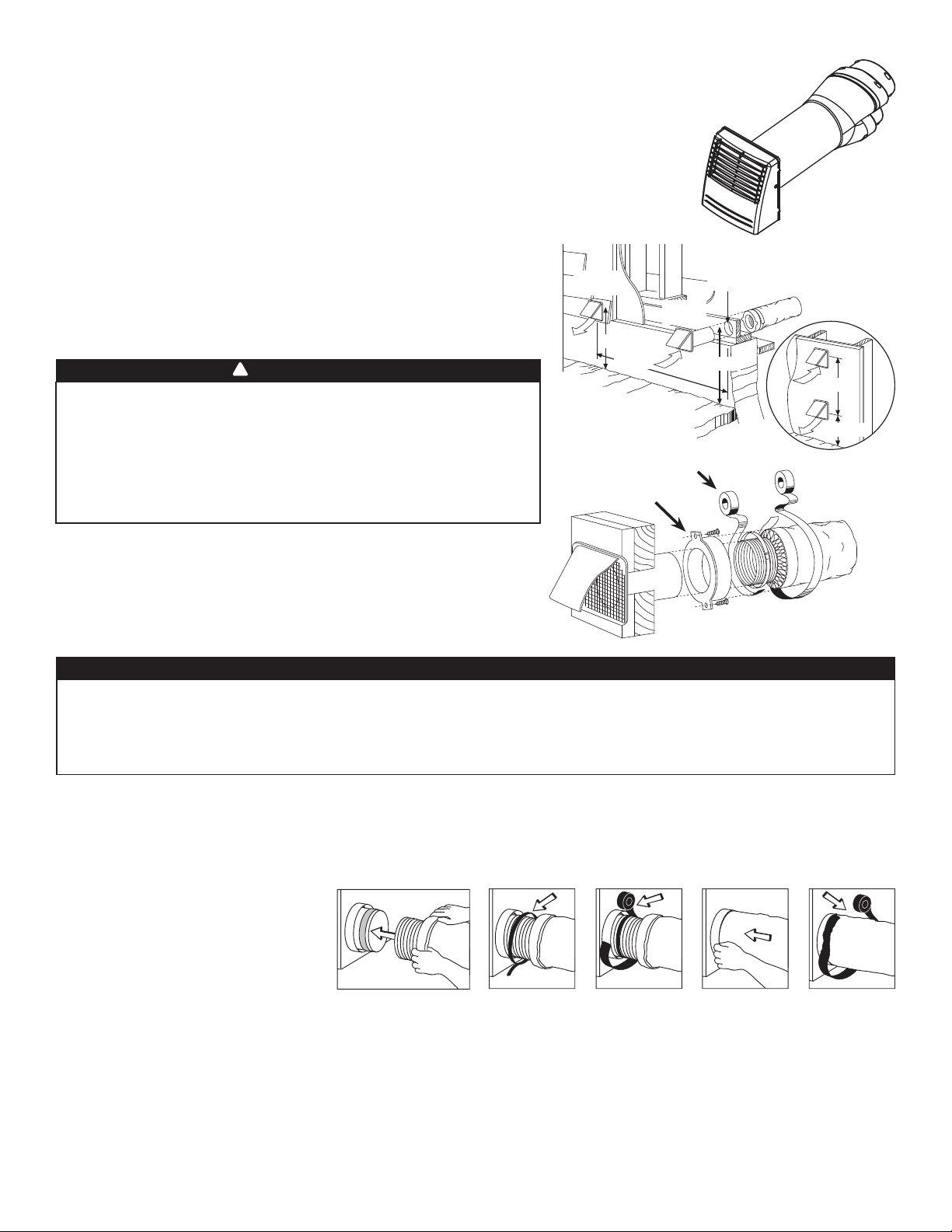
9
CAMBIO DE SECCIÓN A CONDUCTOS DE 6 PULG.
Si utiliza conductos de 6 pulg., instale cambios de sección de 5 a 6 pulg. en los puertos, y sujételos con cinta adhesiva para conductos
solamente (NO utilice tornillos). Si utiliza conductos rígidos, instale una sección de conducto flexible de 12 pulg. entre el cambio de
sección y el conducto rígido (véase más adelante).
CONDUCTOS RÍGIDOS
Para evitar posibles fugas de agua en el aislamiento del conducto rígido del lado frío, selle todas las juntas de los conductos rígidos con
cinta adhesiva para conductos. Para evitar la transmisión de vibraciones, use siempre una sección de conducto flexible de 12 pulg. para
conectar los conductos rígidos al aparato. Para conectar los conductos rígidos aislados al aparato (lado frío) mediante conductos flexibles
aislados, siga las instrucciones de la sección 2.5. Para conectar los conductos rígidos regulares (lado caliente) al aparato mediante
conductos flexibles no aislados, utilice una tira de amarre.
2.6 CONEXIÓN DE LOS CONDUCTOS AL APARATO
CONDUCTOS FLEXIBLES AISLADOS
Siga el método siguiente para conectar los conductos flexibles aislados a los puertos del aparato (de aire viciado hacia el exterior y de
aire fresco desde el exterior).
1. Deje a la vista el conducto flexible, tirando hacia atrás el aislamiento y colóquelo sobre el anillo del puerto interior.
2. Sujete el conducto flexible al puerto mediante una tira de amarre, asegurándose de que la tira esté colocada sobre la banda de espuma
en el puerto.
3. Selle la junta con cinta adhesiva para
conductos.
4. Tire del aislamiento y de la película
impermeable al vapor sobre la junta,
métalos entre el anillo interior y el
exterior del cuello doble y sujételos con
cinta adhesiva para conductos.
• Si los conductos han de pasar a través de un espacio no acondicionado (p. ej., un desván), use siempre
conductos aislados.
• No use tornillos para conectar conductos o cambios de sección a los puertos.
• Procure que la película impermeable al vapor situada sobre los conductos aislados no se rasgue al
manipularla para evitar la condensación dentro de los conductos.
PRECAUCIÓN
VJ0138
Si lo desea, puede usar un kit de cambio de sección Tandem en lugar de 2 bocas exteriores; pero
tenga en cuenta que este dispositivo generará una presión estática adicional de 0,2 pulg. de agua,
según la instalación. Si se usa una boca Tandem, aconsejamos el uso de conductos de 6 pulg. para
minimizar la reducción causada por la restricción de la boca Tandem.
El espacio mínimo entre viguetas para instalar el cambio de sección Tandem es de 9 ¾ pulg. La altura
máxima del cambio de sección Tandem es de 8 ¾ pulg.
Para conectar los conductos flexibles aislados al cambio de sección Tandem (aire viciado hacia el
exterior y aire fresco desde el exterior), siga las instrucciones que vienen con el kit de cambio de
sección Tandem (n.° de pieza VTYIK1).
VR0003
2.4 INSTALACIÓN DE LA BOCA EXTERIOR DOBLE CON EL KIT DE CAMBIO DE SECCIÓN TANDEM
®
(OPCIONAL)
2.5 I
NSTALACIÓN DE LAS BOCAS EXTERIORAS
Elija un lugar adecuado para las bocas exteriores:
• Debe haber al menos 6 pies entre ambas bocas para evitar la contaminación
cruzada.
• Debe haber una distancia mínima de 18 pulg. hasta el suelo.
Consulte la ilustración de la derecha para el método de conexión correcto de
los conductos aislados que van a las bocas. En las regiones donde se espera
que caiga mucha nieve debe instalarse una boca de entrada antirráfagas.
VD0028
18 PULG.
6 PULG. ø
6 PIES
6 PIES
18 PULG.
U
BICACIÓN
OPCIONAL DEL
CONDUCTO
MASILLA
BOCA DE
SALIDA
BOCA DE
ADMISIÓN
CINTA Y AMARRE
DEL
CONDUCTO
Compruebe que la boca de entrada de aire esté al menos a 6 pies
de distancia de cualquiera de los siguientes elementos:
• Salida de secadora, ventilación de caldera de alta eficiencia,
ventilación de aspiradora central;
• Salida de contador de gas, barbacoa de gas;
• Cualquier salida de una fuente de combustión;
• Cubo de basura y cualquier otra fuente de contaminación.
ADVERTENCIA
!
18 PULG.
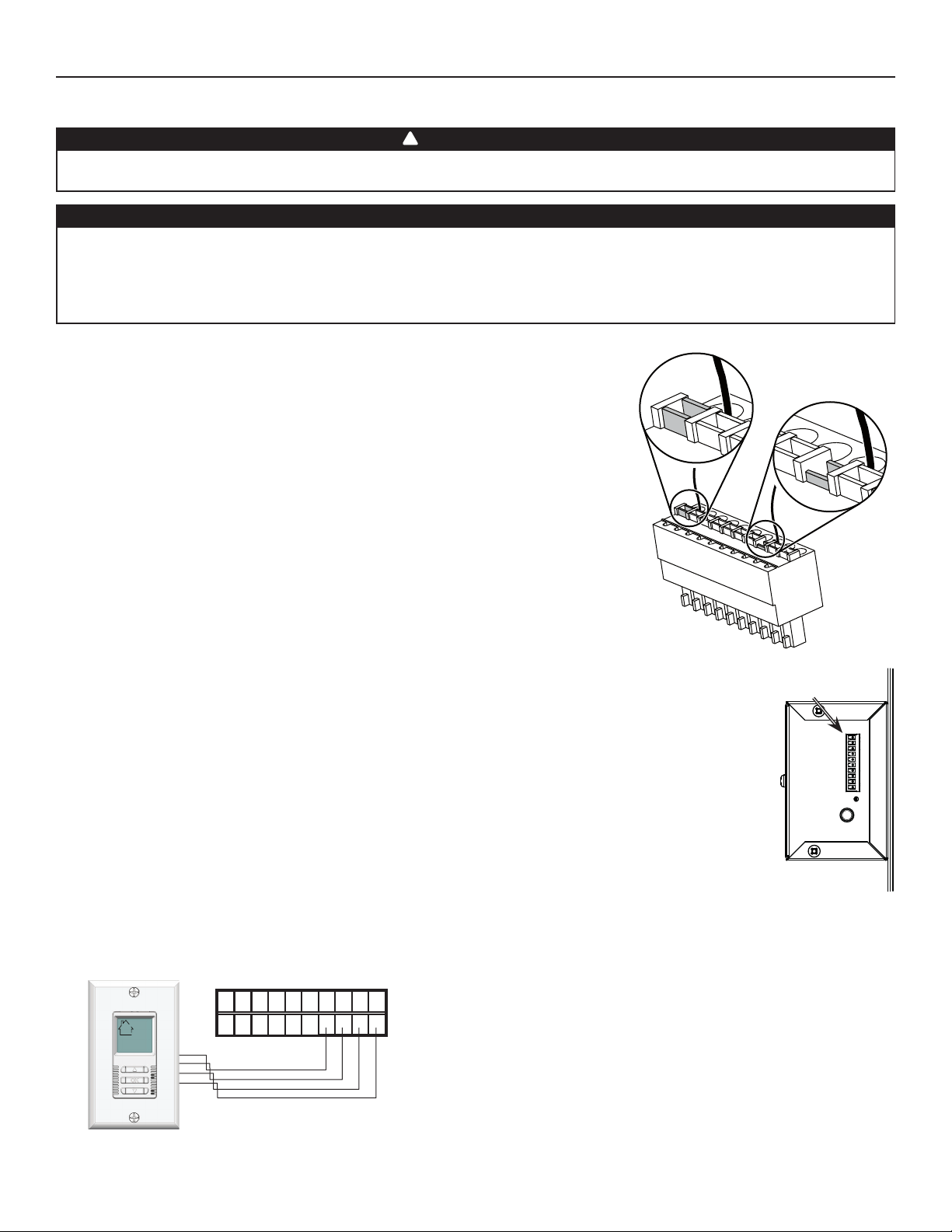
10
3.1.1 CONEXIÓN ELÉCTRICA CON
EL CONTROL MURAL PRINCIPAL VT7W
(EL MODO RECIRCULACIÓN NO SE OFRECE EN ESTOS APARATOS)
NO C NC I OC OL Y R G B
VE0250
Una vez conectado el control o controles murales, introduzca el conector de terminales en el compartimento
eléctrico.
NOTAS: Para obtener información sobre el funcionamiento del control mural, consulte el Main and auxiliary wall
controls user guide, disponible en www.broan.com.
Para utilizar el control principal opcional, el control integrado debe estar apagado (sin luz LED).
Desconecte siempre el aparato antes de efectuar cualquier conexión. De no cortar la alimentación, podría producirse
un choque eléctrico o dañarse el control mural o el módulo electrónico dentro del aparato.
3. CONEXIONES
3.1 CONEXIÓN ELÉCTRICA CON EL CONTROL MURAL PRINCIPAL OPCIONAL
Use el conector de terminales incluido en el kit de instalación para realizar la conexión
eléctrica de los controles murales principal y opcional. Verifique si todos los hilos han sido
introducidos en los orificios correspondientes en el bloque de terminales. Un hilo está
introducido correctamente cuando su receptáculo naranja está más bajo que otro sin hilo. En
la ilustración de la derecha, el hilo A ha sido introducido correctamente, pero no el B.
No instale nunca más de un control mural principal opcional por aparato. Compruebe que los cables no
se cortocircuiten entre ellos o tocando otros componentes del control mural. Evite las malas conexiones del
cableado. Para reducir el riesgo de interferencia eléctrica (ruido), no pase los cables del control mural cerca de
los contactores de control ni de circuitos de atenuación de la luz, motores eléctricos, alimentación de viviendas o
edificios, cables de iluminación o tableros de distribución de energía.
PRECAUCIÓN
ADVERTENCIA
!
VE0272
A
B
VD0430
CONECTOR DE
TERMINALES
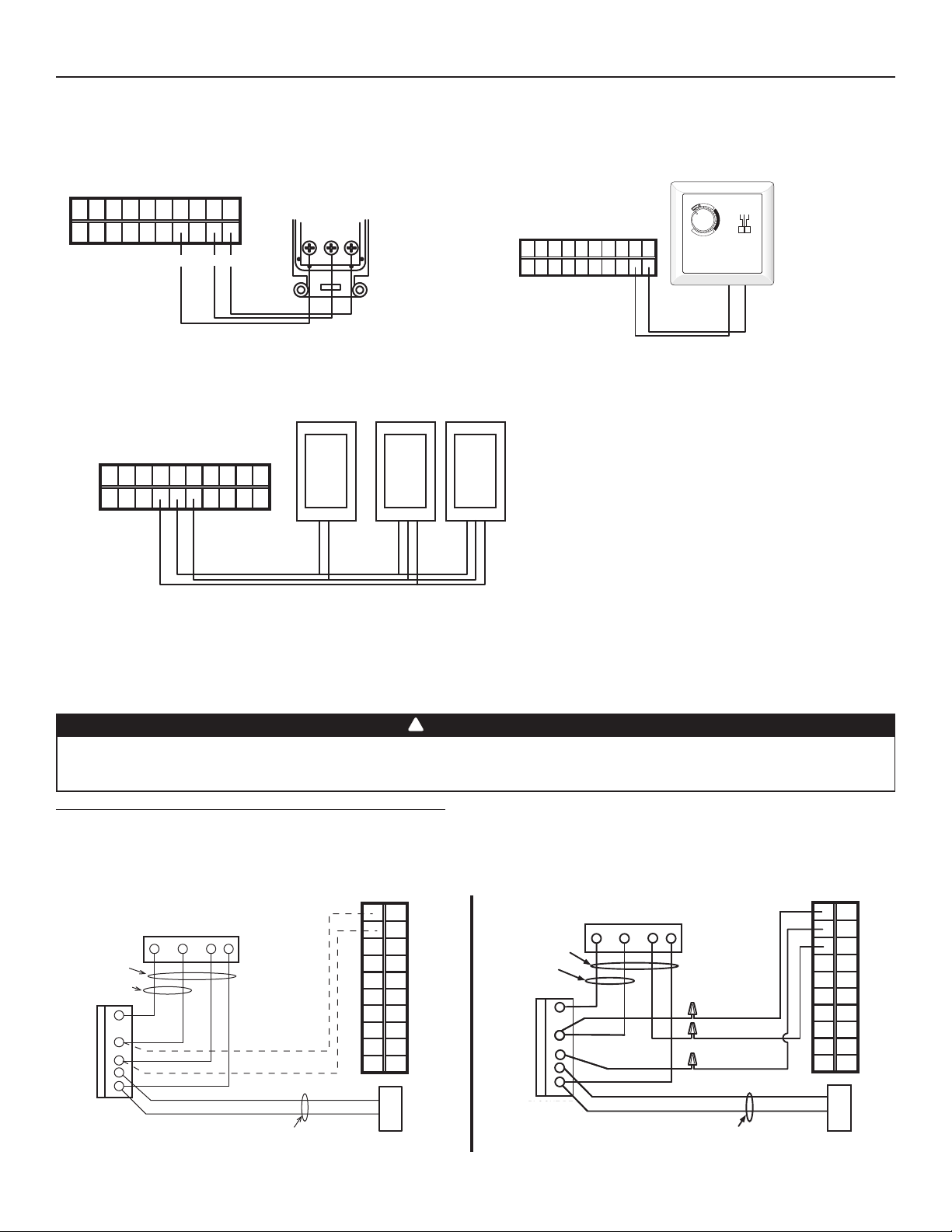
11
No conecte nunca un circuito de 120 voltios de corriente alterna a los terminales del interbloqueo de la caldera/
AHU (cableado estándar). Utilice sólo el circuito de clase 2 de bajo voltaje del control del ventilador impelente de
la caldera/AHU.
CABLEADO INTERBLOQUEO NORMAL DE LA CALDERA/AHU CABLEADO DE INTERBLOQUEO ALTERNATIVO DE LA CALDERA/AHU
3.1.2 C
ONEXIÓN ELÉCTRICA CON
EL CONTROL MURAL PRINCIPAL VT4W
3.1.3 C
ONEXIÓN ELÉCTRICA CON
EL CONTROL MURAL PRINCIPAL VT6W
NO C NC I OC OL Y R G B
VE0323
--5°C
23°F
5
°
C
41
°
F
C
O
M
F
O
R
T
Z
O
N
E
-20°C
-4°F
OFF
MIN MAX
#
X
X
X
X
X
0
1
/
9
8
3.2 CONEXIÓN ELÉCTRICA CON CONTROLES MURALES AUXILIARES OPCIONALES
3.3 CONEXIÓN CON LA CALDERA/AHU
W R G
Y
W
R
G
C
Y
CONECTOR DE TERMINALES DEL APARTO
TERMINALES
DEL TERMOSTATO
CUATRO
CABLES
DOS CABLES
sólo calefacción
BLOQUE DE
TERMINALES DE
24 VOLTIOS DE
LA CALDERA
DOS CABLES
SISTEMA DE
REFRIGERACIÓN
NO C NC I OC OL Y R G B
W R G Y
W
R
Y
R
G
Y
C
CUATRO CABLES
DOS CABLES
tuercas del
cableado
DOS CABLES
NO
NC
C
NO C NC I OC OL Y R G B
VE0108E
SISTEMA DE
REFRIGERACIÓN
BLOQUE DE
TERMINALES DE
24 VOLTIOS DE
LA CALDERA
sólo calefacción
TERMINALES
DEL TERMOSTATO
CONECTOR DE TERMINALES DEL APARTO
PARA UNA CALDERA /AHU CONECTADA A UN SISTEMA DE REFRIGERACIÓN:
En algunos termostatos más antiguos, si se activan los terminales «R» y «G» en la caldera/AHU, se activaría también el terminal «Y» en el
termostato y se pondría en marcha el sistema de refrigeración. Si reconoce este tipo de termostato, debe usar el C
ABLEADO DE INTERBLOQUEO
ALTERNATIVO DE LA CALDERA/AHU.
ADVERTENCIA
!
3. CONEXIONES (CONT.)
3.1 CONEXIÓN ELÉCTRICA CON EL CONTROL MURAL PRINCIPAL OPCIONAL (CONTINUACIÓN)
BG
V
N
A
VE0328E
Y
NO C NC I OC OL Y R G B
VISTA POSTERIOR
DEL CONTROL MURAL
PRINCIPAL VT4W
NO C NC I OC OL Y R G B
VE0371
59W VB60W VB60W
BLOQUE DE
TERMINALES
DE
24 VOLTIOS DE
LA
CALDERA/AHU
BLOQUE DE
TERMINALES
DE
24 VOLTIOS DE
LA
CALDERA/AHU

12
4. DIAGRAMA DE CABLEADOS
L
ÍNEA
N
EUTRO
120 VCA
J10-2
J10-1
M
C1
K1
J5-1
J5-2
J7-1 J7-2 J5-3
M
C2
CONDENSADOR
DEL
MOTOR
K3
J4-1
J4-2
J6-1 J6-2 J4-3
J9-4
J12-1
J12-2
K4
J8-2
J8-1
J8-5
J8-4
J11-1
J11-2
S1
K4K1 K2 K3 K5
+
-
~
~
T1
9,5 VCA 24 VCA
100 VCA
83 VCA
68 VCA
62 VCA
J9-1
J9-3
J9-2
F1
321
JU1
M
H
DIAGRAMA DE CABLEADOS
CABLEADO DE FÁBRICA DE TENSIÓN DE LÍNEA
CABLEADO DE FÁBRICA DE BAJA TENSIÓN DE CLASE 2
CABLEADO IN SITU DE BAJA TENSIÓN DE CLASE 2
INTERRUPTOR
DE
ANULACIÓN
(OPCIONAL)
C
ABLEADO
IN
SITU DEL
CONTROL REMOTO
INTERBLOQUEO
DEL VENTILADOR
DE
LA CALDERA
(OPCIONAL)
B
G
R
R
V
NE
Y
AM
OL
OC
I
J14
10
9
8
7
6
5
4
3
2
1
J20
12
J13
ICP
A1
TARJETA ELECTRÓNICA
12345
J12
J11
12
4321
J9
J10
21
F1
3A
T
IPO 3AG
321
JU1
MH
4321
5
J8
J5
J7
1
1
2
2
3
J6
1
2
J4
1
2
3
NE
B
V
120 VCA
60 Hz
C2
M2
AZ
C
NE
M1
C1
AZ
C
NE
MOTOR DEL
VENTILADOR
DE
EXTRACCIÓN
CONDENSADOR
DEL
MOTOR
T1
Clase 2 de 24 V
Opcional
Clase 2
de 9,5 V
120 V
100 V
83 V
68 V
62 V
neutro
NE
B
R
SC
SC
AM
AM
NA
NA
CÓDIGO DES COLORES
AMARILLO
AZUL
BLANCO
CAFÉ
NEGRO
AM
AZ
B
C
NE
NARANJA
PÚRPURA
ROJO
VERDE
NA
P
R
V
SC SIN CONEXIÓN
Característica fundamentale.
NOTAS
1.
Protegido contra incendios por un fusible
certificado UL listed/CSA.
2. Si hay que sustituir alguno de los hilos originales,
tal y como se suministra, use un hilo equivalente.
3. El cableado in situ debe cumplir con los códigos,
ordenanzas y reglamentos aplicables
4. Controles a distancia (circuito de clase 2)
disponibles, véase el manual de instrucciones.
5. El circuito del ventilador de la caldera
sólo debe ser un circuito de clase 2.
K2
CPU
DIAGRAMA LÓGICO
VE0443E
CONDENSADOR
DEL
MOTOR
MOTOR DEL
VENTILADOR
DE
ALIMENTACIÓN
C
ONDENSADOR
DEL
MOTOR
MOTOR DEL
VENTILADOR
DE
ALIMENTACIÓN
M2
M
OTOR DEL
VENTILADOR
DE
EXTRACCIÓN
M1
R1
TERMISTOR
P
NA
AZ
R
NA
NA
NA
R
AZ
SC SC
PR
ref: 24228_REV-B
• Riesgo de descarga eléctrica. Antes de cualquier trabajo de reparación o mantenimiento, desconecte siempre el
aparato de su fuente de alimentación.
• Este producto está equipado con una protección contra la sobrecarga (fusible). Un fusible fundido indica que
se ha producido una sobrecarga o cortocircuito. Si el fusible se funde, desenchufe el aparato. Deje de utilizar el
aparato y póngase en contacto con el servicio de asistencia técnica.
ADVERTENCIA
!

13
6. EQUILIBRADO DEL APARATO
PREPARACIÓN
Siga estas indicaciones para mediciones precisas:
• Obture todos los conductos con cinta adhesiva. Cierre todas las ventanas y puertas.
• Apague todos los dispositivos de extracción, como la campana de cocina, la secadora y los
ventiladores del baño.
• Compruebe que las compuertas de equilibrio estén totalmente abiertas.
• Si la instalación está de alguna manera conectada a los conductos de retorno de aire frío de
una caldera o acondicionador de aire, asegúrese de que el ventilador impelente de la caldera
o del acondicionador de aire esté encendido. De no ser así, deje el ventilador impelente de la
caldera o del acondicionador de aire apagado.
• Si la temperatura exterior es inferior a 32°F, verifique que el aparato no esté funcionando en modo
descongelación mientras procede al equilibrado; espere 10 minutos después de enchufar el aparato.
• Ponga el aparato en velocidad alta.
PROCEDIMIENTO DE EQUILIBRADO
1. Coloque el caudalímetro de hélice sobre una superficie a nivel y póngalo en cero.
2. Conecte los tubos del caudalímetro a las tomas de presión de la corriente de aire de SALIDA (véase el diagrama de la puerta del aparato).
3. Compruebe que conecta los tubos a los empalmes apropiados high (alta) o low (baja). Si el caudalímetro desciende por debajo de
cero, invierta las conexiones de los tubos.
4. Anote el valor en pi/min del gráfico de equilibrado del aparato.
5. Repita etapas 3 y 4, pero con las tomas de presión de la corriente de FRESCO.
6. Utilice la compuerta de equilibrio ajustable apropiada para bajar el valor más alto para que coincida con el valor más bajo. Una
diferencia de hasta ±10 pi/min es aceptable.
7. Sujete ambas compuertas con un tornillo de sujeción (viene en el kit de piezas).
8. Escriba los datos necesarios sobre la corriente de aire en una etiqueta y péguela cerca del aparato para futuras consultas (fecha,
velocidad máxima de las corrientes de aire, su nombre, teléfono y dirección profesional).
VD0431
CERRADO
ABIERTO
La corriente de aire fresco no debe ser mayor que la corriente de aire viciado.
PRECAUCIÓN
5. SELECCIÓN DE LA VELOCIDAD
El valor de alta velocidad ajustado en fábrica para estas unidades es de 129 pi/min y el valor de baja velocidad es aproximadamente
de 66pi/min. Para cambiar estos valores, las conexiones de los hilos del transformador y/o el puente JU1 deben ser cambiadas (vea la
tabla y la ilustración abajo).
J14
10
9
8
7
6
5
4
3
2
1
J20
12
J13
ICP
A1
12345
J12
J11
12
4321
J9
J10
21
F1
3A
T
IPO 3AG
321
JU1
MH
4321
5
J8
J5
J7
1
1
2
2
3
J6
1
2
J4
1
2
3
T1
120 V
100 V
83 V
68 V
62 V
neutro
NE
NA
B
R
SC
SC
AM
AM
NA
NA
P
AZ
R
NA
BAJA
VELODIDAD
ALTA
VELOCIDAD
VE0429E
CÓDIGO DES COLORES
AMARILLO
AZUL
BLANCO
NEGRO
AM
AZ
B
NE
NARANJA
PÚRPURA
ROJO
VERDE
NA
P
R
V
SC SIN CONEXIÓN
TARJETA ELECTRÓNICA
Clase 2 de 24 V
Opcional
Clase 2
de 9,5 V
R
SC
SC
321
JU1
MH
4321
HRV130FLS ERV130FLS
Opción
de velocidad
Conexión
Presión
(pulg.
de agua)
Distribución
(pi/min)
Salida
(pi/min)
Consumo
eléctrico
(Vatios)
Distribución
(pi/min)
Salida
(pi/min)
Consumo
eléctrico
(Vatios)
Alta n.° 1
(Valor por defecto)
JU1 en H (1-2) 0.4 129 150 125 129 130 124
Alta n.° 2 JU1 en M (2-3) 0.4 110 130 104 110 112 103
Baja n.° 1 PÚRPURA-ROJO 0.3 95 105 80 95 96 79
Baja n.° 2
(Valor por defecto)
AZUL-ROJO 0.2 65 70 64 65 66 62
Baja n.° 3 ROJO-ROJO 0.2 45 50 53 45 46 52
Selección de la
baja velocidad
Selección de la
velocidad alta
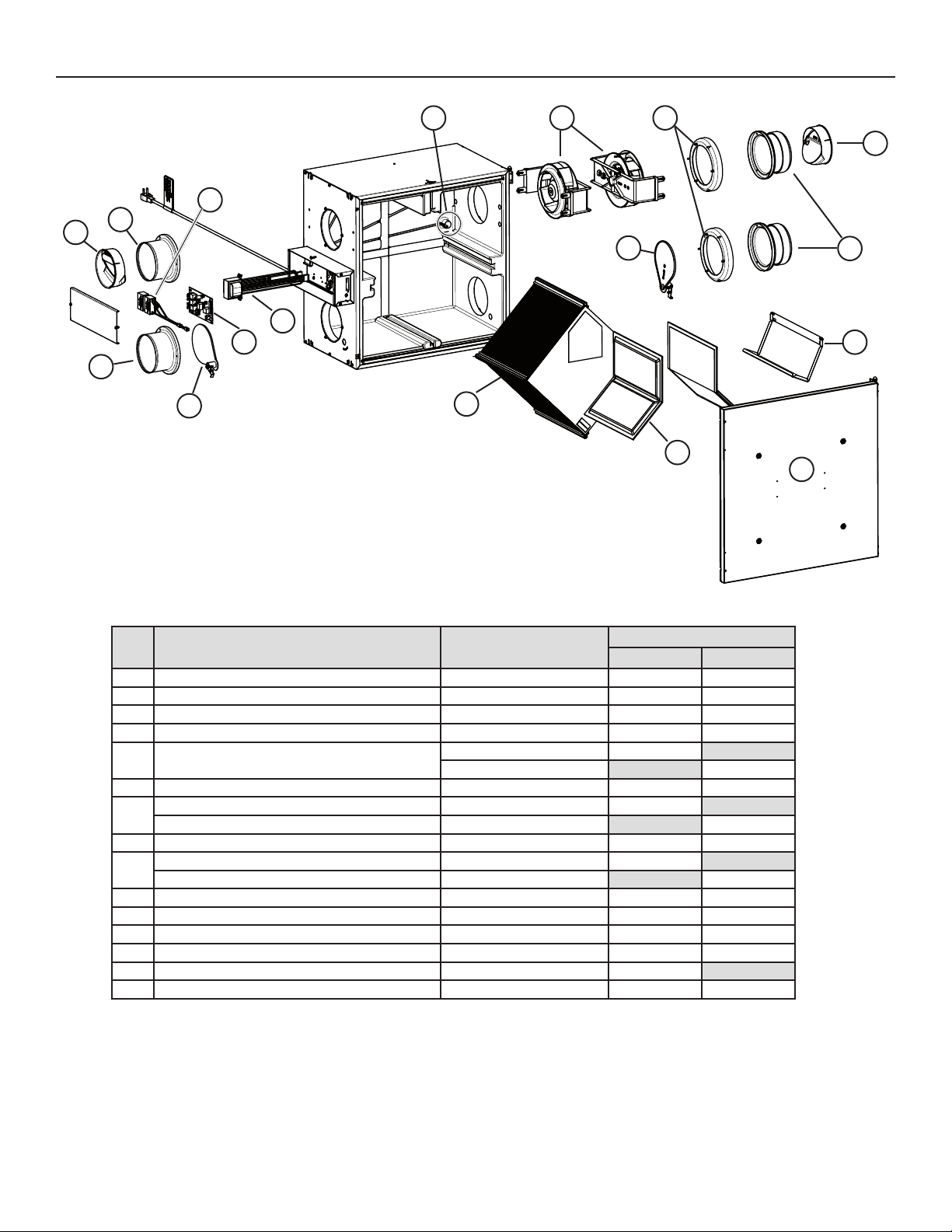
14
REPUESTOS Y REPARACIONES
Para que el aparato de ventilación esté en buenas condiciones, sólo debe utilizar repuestos genuinos de Broan-NuTone LLC. Los repuestos genuinos de Broan-NuTone LLC han
sido diseñados especialmente para cada aparato, se han fabricado de conformidad con todas las normas de certificación aplicables y ofrecen un alto nivel de seguridad. El uso de
repuestos diferentes puede provocar daños graves y reducir drásticamente el nivel de rendimiento del aparato, lo cual podría causar una avería prematura. Broan-NuTone LLC
recomienda ponerse en contacto con un almacén de servicio certificado para todos los repuestos y reparaciones.
* No se muestra.
7. PIEZAS DE RECAMBIO
N DESCRIPCIÓN NÚMERO DE PIEZA
CANTIDAD
HRV130FL ERV130FL
1 Conjunto de la compuerta de contracorriente SV63818 2 2
2 Puerto de metal de 5 pulg. SV63828 2 2
3 Compuerta de equilibrio SV63823 2 2
4 Condensador 5 µF SV24216 2 2
5 Tarjeta electrónica
SV63821 1
SV63838 1
6 Transformador SV18219 1 1
7
Unidad de recuperación de calor SV63825 1
Unidad de recuperación de energía SV63837 1
8 Filtro (2) SV63827 1 1
9
Puerta con tornillos para HRV130FL SV64802 1
Puerta con tornillos para ERV130FL SV64802 1
10 Cuello de puerto de 5 pulg. SV63820 2 2
11 Puerto de metal aislado de 5 pulg. SV63819 2 2
12 Conjunto del motor (incluye el n 4) SV63824 2 2
13 Termistor SV63833 1 1
14 Placa de condensación SV63834 1
* Bolsa de piezas SV63832 1 1
1
1
2
2
3
3
4
5
6
7
8
9
10
11
12
13
14
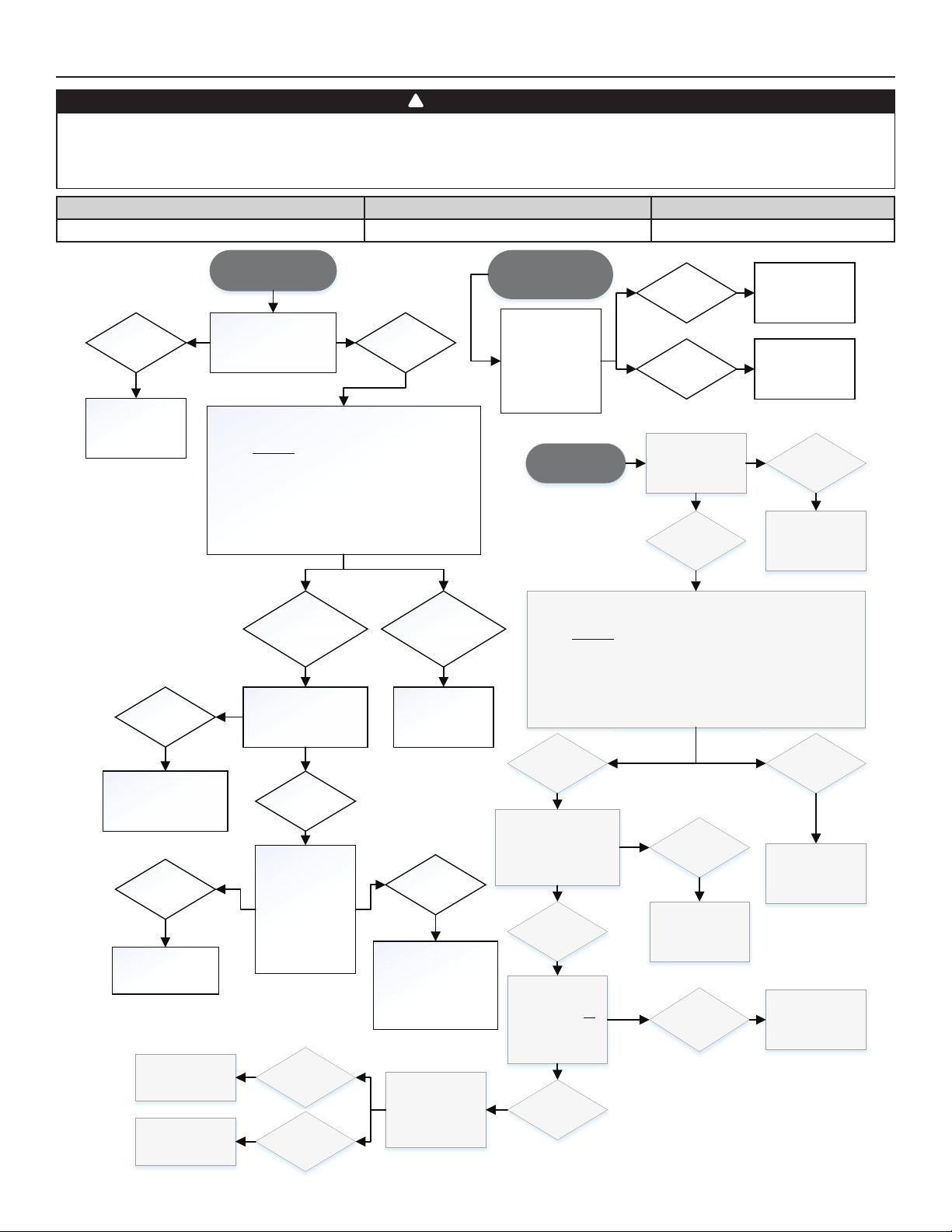
15
8. SOLUCIÓN DE PROBLEMAS DEL INSTALADOR
Señal LED Tipo de error Acción
El LED parpadea en VERDE (parpadeo doble) Error de termistor (el aparato aún funciona). Sustituya el kit del termistor
ADVERTENCIA
• Algunos procedimientos de diagnóstico pueden exigir que el aparato esté funcionando durante el procedimiento.
Tenga cuidado con las piezas en movimiento o móviles.
• Riesgo de descarga eléctrica. Las conexiones de la tarjeta electrónica sólo deben verificarse por personal
cualificado.
!
Elmotordealimentación
nofunciona.
Elcontrolmural
nofunciona.
¿Recibe
alimentaciónla
tomadecorriente?
No
Consulteaun
electricista.
Sí
• DesenchufeloscontroLesmurales
• Desenchufeelaparato
• Espere1minuto
• Vuelvaaenchufarelaparato
• Espere10segundos;elaparatorealizalasecuenciadearranque
• Unavezquelasecuenciadearran quehaterminado(despuésde10seg.),
intentehacerfuncionar el ap aratomedianteelbotónpulsadorintegrado.
• Cuandogolpeaelbotónpulsadorintegradovariasveces,¿pasaelLED
de
APAGADOaÁMBAR,aVERDEydenuevoaAPAGADO?
Sí
¿Estánbienconectados
loshilosdelcontrol
mural?Presteespecial
atenciónaloshilos
NEGROyAMARILLO.
No
Elproblemanoesel
controlmural.Vaya
a“Elaparatono
funciona”.
No
Restablezcalas
conexiones.
Sí
Utiliceun
voltímetro.¿Hay
entre8y12VCC
entrelaconexión
NEGRAyla
AMARILLA?
Sí,peroel
problemanose
haresuelto.
Cambieel
controlmural.
No
Pruebeelcontrol
muralconunhilo
nuevo.¿Funciona
ahoraelcontrol
mural?
No
Cambieel
controlmural.
SíCambieelhilo.
Inviertalasconexionesde
losmotoresJ4yJ5.
¿Funcionaahoraelmotor
dealimentación?
Sí
Restaurelas
conexionesdelos
motoresoriginales.
Inviertalas
conexionesdelos
condensadoresJ6y
J7.¿Funcionaahora
elmotorde
alimentación?
No
Sustituyalatarjeta
electrónica.
Sí
Restaurelasconexiones
originalesdelos
condensadoresy
sustituyaelcondensador
delmotorde
alimentación.
Sustituyalatarjeta
electrónica.
Tratedegirarelmotorde
alimentaciónamano.
¿Giralarueda
fácilmente?
No
Sustituyaelmotor
dealimentación.
Sí
• DesenchufeloscontroLesmurales
• Desenchufeelaparato
• Espere 1minuto
• Vuelvaaenchufarelaparato
• Espere 10segundos;elaparatorealizalasecuenciade
arranque
• Unavezquelasecuenciadearranquehaterminado
(despuésde10seg.),intentehacerfuncionarelaparato
medianteelbotónpulsadorintegrado.
¿Quésucede?
Eltemporizadordel
botónpulsadorno
funciona(sinluz).
Enelaparato,
cortocircuitelos
terminalesOLyOC
enelconectorde
terminalesVERDE.
¿Funcionaahorael
aparato?
No
Sustituyalatarjeta
electrónica.
Sí
Elhilooelcontrol
esdefectuoso.
Sólofuncionala
velocidadalta.
Nofunciona
ningunadelas
velocidades.
No
Restaurelasconexiones
delosmotoresoriginales
ysustituyaelmotorde
alimentación.
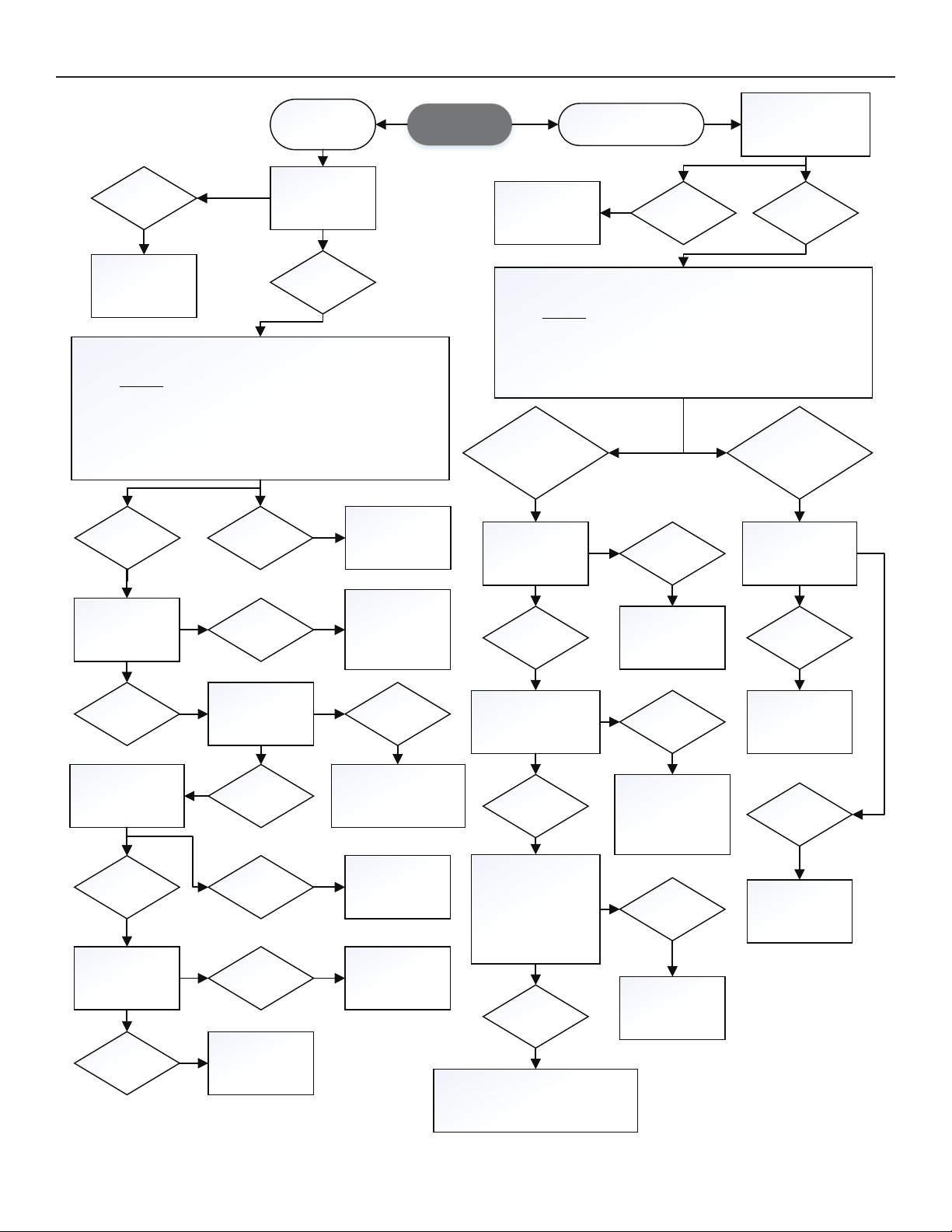
16
TÉCNICOS DE SERVICIO ÚNICAMENTE: Si necesita asistencia o tiene preguntas tras seguir las indicaciones para la solución de problemas,
llame al 1-800-558-1711.
• Desenchufe los controLes murales
• Desenchufe el aparato
• Espere 1 minuto
• Vuelva a enchufar el aparato
• Espere 10 segundos; el aparato realiza la secuencia de arranque
• Una vez que la secuencia de arranque ha terminado (después de 10 seg.),
intente hacer funcionar el aparato mediante el botón pulsador integrado.
• Cuando golpea el botón pulsador integrado varias veces, ¿pasa el LED de
APAGADO a ÁMBAR, a VERDE y de nuevo a APAGADO?
¿Recibe
alimentación la
toma de corriente?
No
Consulte a un
electricista.
El aparato no
funciona.
Sí
Sí
SuƐƟƚƵLJa el control
mural opcional.
No
El LED del control
integrado está
apagado.
El LED del control integrado
parpadea en ROJO.
¿Hay un puente
en J11?
No
Llame al apoyo
técnico.
Sí
Invierta las conexiones
del motor J4 y J5.
¿Funciona ahora el
motor de extracción?
No
Restablezca las
conexiones de los
motores originales y
ƐƵƐƟƚƵya el motor de
extracción.
Sí
Restablezca las
conexiones de los
motores originales.
Invierta las conexiones
de los condensadores J6
y J7. ¿Funciona ahora el
motor de extracción?
Sí
Restablezca las conexiones originales del
condensador y ƐƵƐƟƚƵya el condensador
del motor de extracción.
No
La velocidad alta
funciona, pero no la
baja.
SuƐƟƚƵLJa la tarjeta
electrónica.
UƟůŝce un volơmetro.
¿Hay 68 VCA entre
J9-3 y J9-4?
Sí
SuƐƟƚƵLJa la tarjeta
electrónica.
No
SuƐƟƚƵLJa el
transformador.
Trate de girar el motor
de extracción de aire a
mano. ¿Gira la rueda
fácilmente?
No
SuƐƟƚƵLJa el motor
de extracción
de aire
Sí
• Desenchufe los controLes murales
• Desenchufe el aparato
• Espere 1 minuto
• Vuelva a enchufar el aparato
• Espere 10 segundos; el aparato realiza la secuencia de arranque
• Una vez que la secuencia de arranque ha terminado (después de 10 seg.),
intente hacer funcionar el aparato mediante el botón pulsador integrado.
• ¿Qué sucede?
Ninguna de las
velocidades funciona,
el LED parpadea en
rojo todavía.
¿Está fundido el
fusible en la tarjeta
electrónica?
Sí
No
UƟůŝce un
volơŵetro. ¿Hay
120 V en J10?
No
Sí
UƟůŝce un volơmetro.
¿Hay 120 VCA entre
J9-4 y J9-1?
NoSí
SuƐƟƚƵLJa la tarjeta
electrónica.
UƟůŝce un volơŵetro.
¿Hay 9,5 V entre
J8-4 y J8-5?
No
SuƐƟƚƵLJa el
transformador.
Sí
Llame al apoyo
técnico.
ĞũĞĚĞƵƟůŝnjĂƌĞů
aparato y póngase
en contacto con
el servicio de
asistencia técnica.
El cable de alimentación
está defectuoso. Póngase
en contacto con el servicio
de asistencia técnica.
8. SOLUCIÓN DE PROBLEMAS DEL INSTALADOR (CONT.)
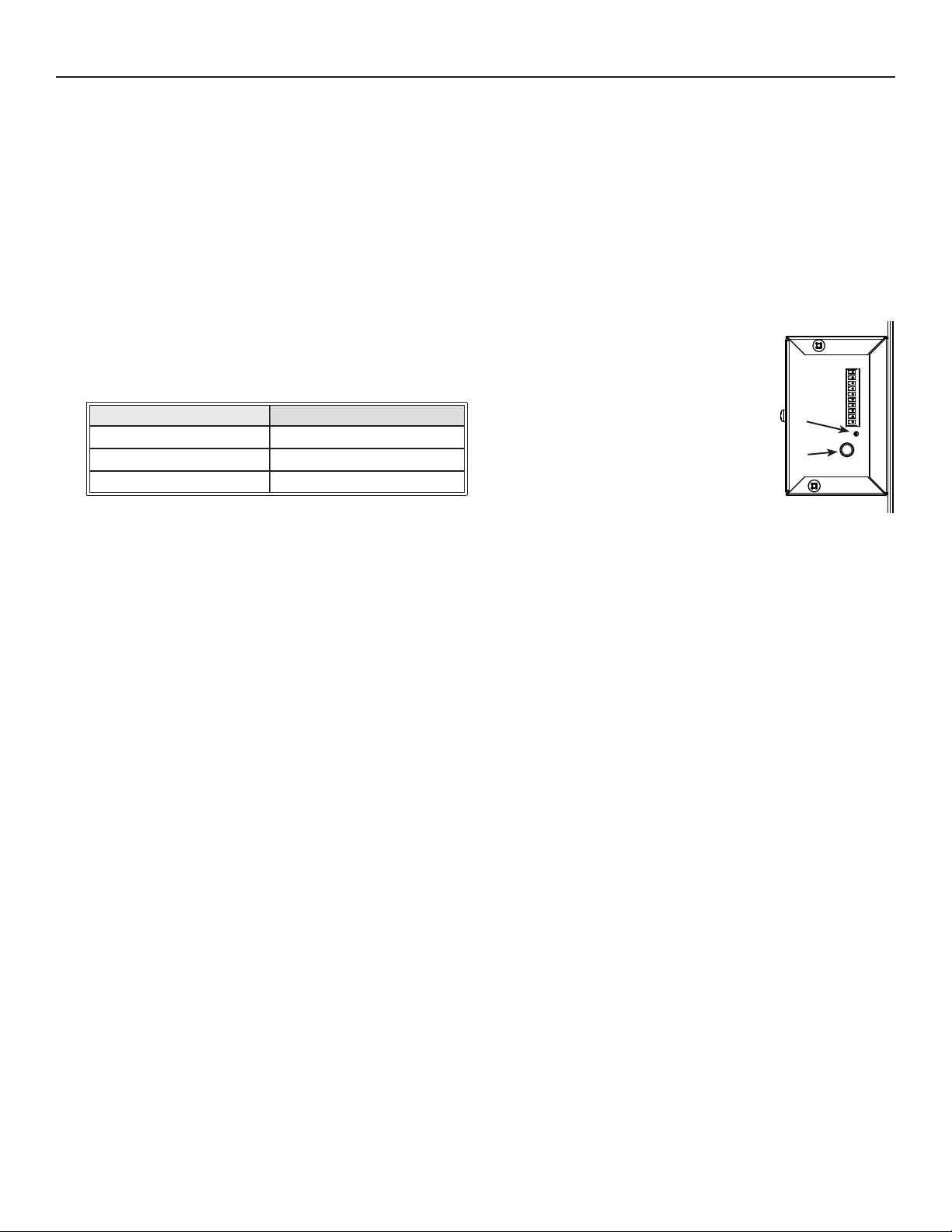
17
9. USO DE ESTE APARATO
9.1 SU SISTEMA DE VENTILACIÓN
Este aparato está pensado para proporcionar aire fresco a su casa y extraer el aire viciado y húmedo. Al eliminar la humedad y los
contaminantes acumulados, el sistema mantiene un aire de calidad óptima y una humedad relativa ideal. Está equipado con una unidad
de recuperación que está pensada específicamente para controlar el exceso de humedad y reducir los costos de ventilación mediante la
recuperación de la energía del aire extraído, y para usar esa misma energía para calentar el aire fresco que suministra. Este proceso de
recuperación se realiza de tal modo que el aire viciado nunca se mezcla con el aire fresco.
Cuando la temperatura exterior es inferior a 23°F, la recuperación forma escarcha en el módulo. Para mantener el buen funcionamiento,
el aparato está programado para descongelar el módulo de recuperación. La duración y la frecuencia de descongelación varían según la
temperatura exterior. Tras la descongelación, el aparato vuelve al modo de funcionamiento seleccionado por el usuario.
9.2 CONTROL INTEGRADO
Todos los aparatos están equipados con un control integrado situado delante del compartimento eléctrico. Utilice el botón pulsador (2)
para controlar el aparato. El LED (1) mostrará el modo en el que se encuentra el aparato. Para mayor comodidad, estos aparatos pueden
controlarse mediante un control mural opcional.
NOTAS: 1. Para utilizar el control principal opcional, el control integrado debe estar apagado.
2. Si se utiliza un control auxiliar opcional, al activarlo, se anula el control principal opcional.
Si se produjera un problema durante el funcionamiento del aparato, el LED del control integrado (1) parpadeará. El color de la luz LED
indica el tipo de error detectado. Póngase en contacto con su instalador.
Para los problemas de los controles murales, consulte la sección de solución de problemas en el Main and auxiliary wall controls user
guide, disponible en www.broan.com.
Si el problema no se soluciona, póngase en contacto con el instalador.
Consulte la tabla abajo para saber cómo funciona el aparato por medio del control integrado.
COLOR DEL LED
RESULTADOS
ÁMBAR
EL APARATO ESTÁ EN VELOCIDAD BAJA.
VERDE
EL APARATO ESTÁ EN VELOCIDAD ALTA.
NINGUNA LUZ
EL APARATO ESTÁ APAGADO.
1
2
9.2.1 SECUENCIA DE ARRANQUE
La secuencia de arranque de este aparato es similar a la de una computadora personal. Cada vez que se enchufa el aparato tras haberse
desenchufado o tras una interrupción de la alimentación eléctrica, el aparato inicia una secuencia de arranque antes de empezar a
funcionar. Durante la secuencia de arranque, el diodo LED (1) del control integrado se encenderá de color VERDE o ÁMBAR durante
3 segundos y luego se apagará; la secuencia de arranque ya ha terminado
NOTA: el aparato no acepta ninguna instrucción hasta que se haya puesto en marcha totalmente.
9.2.2 CONFIGURACIÓN DE LA DESCONGELACIÓN AMPLIADA
El aparato ha sido configurado en fábrica en modo de descongelación normal. En regiones frías puede ser necesario configurar el aparato
en modo de descongelación ampliada. Para ello, durante los 5 primeros segundos de la secuencia de arranque, mientras el LED del
control integrado está en VERDE, presione el botón pulsador (2) hasta que el LED pase a ÁMBAR (unos 3 segundos).
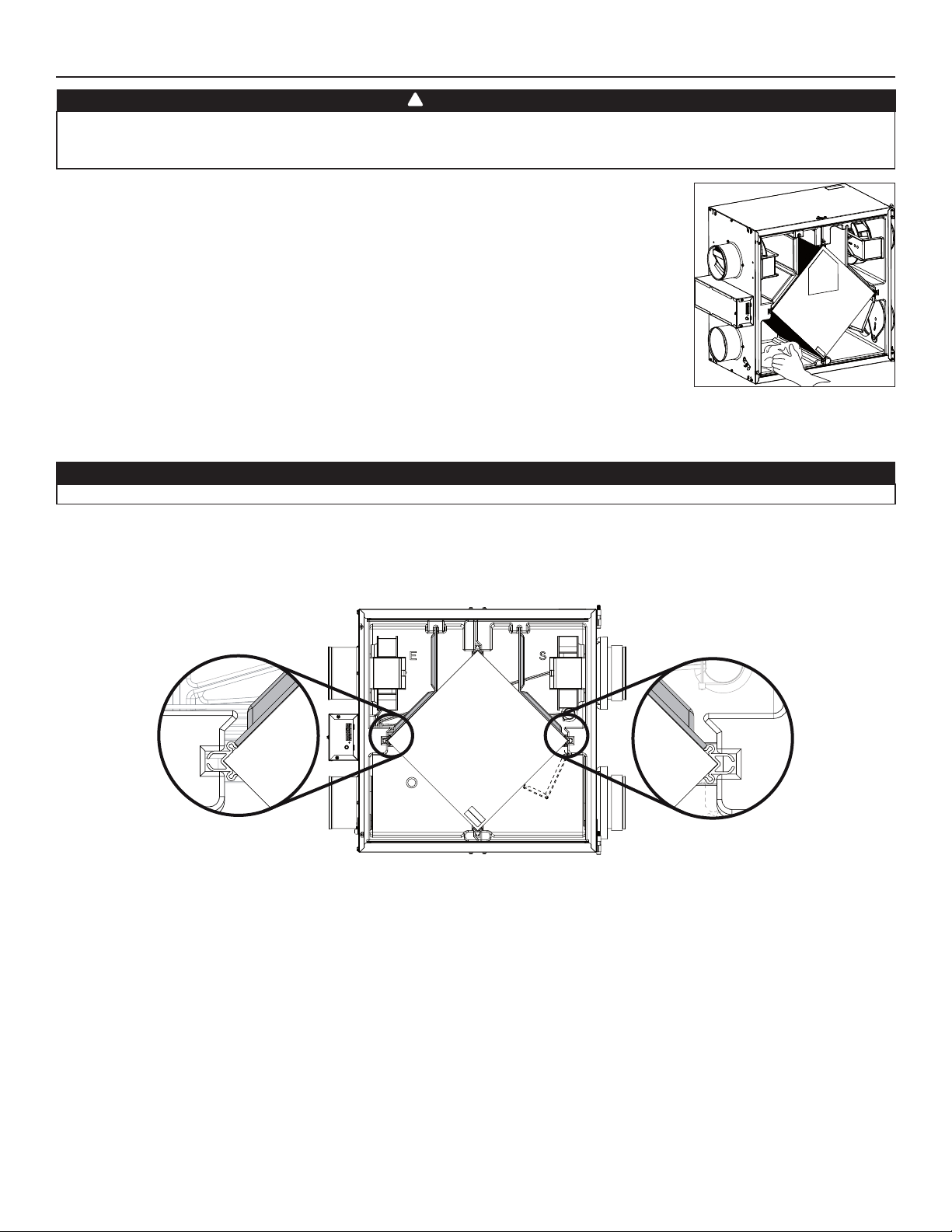
18
1. Desconecte el cable de alimentación.
2. La puerta de este aparato lleva bisagras y se mantiene cerrada con 2 tornillos. Retírelos y póngalos
a un lado.
3. Limpie el interior de la puerta con un paño húmedo.
4. Limpie los filtros:
• Quite los filtros.
• Pase una aspiradora para quitar la mayor parte del polvo.
• Lávelos con una mezcla de agua tibia y jabón suave. Puede añadir lejía si desea desinfectar (una
cucharada por galón). Enjuague a fondo. Agite los filtros para eliminar el exceso de agua y déjelos
secar.
5. Limpie la bandeja y la placa de condensación (si procede) con un paño húmedo.
6. Verifique la boca de entrada de aire del exterior:
• Compruebe que no haya hojas, ramitas, hielo o nieve que podrían entrar en el aparato.
• Limpie si es necesario.
7. Vuelva a montar los componentes. Preste atención especialmente a los filtros y compruebe que están bien encajados en sus ranuras.
Si una rueda motriz toca un filtro, el filtro no está colocado correctamente (véase la ilustración más abajo).
8. Gire las ruedas del ventilador impelente a mano. Si una de las ruedas no gira normalmente, póngase en contacto con su instalador.
9. Cierre la puerta y vuelva a conectar la fuente de alimentación.
10. MANTENIMIENTO
PRECAUCIÓN
Un orificio de ventilación bloqueado, aunque sólo sea parcialmente, puede hacer que el aparato funcione mal.
VD0432
10.1 TRIMESTRAL
Tensión peligrosa. El aparato debe estar siempre desenchufado durante las operaciones de mantenimiento
y reparación. Aunque procuramos minimizar los bordes cortantes, tenga cuidado al manipular todos los
componentes. Al limpiar el aparato, se aconseja llevar lentes y guantes de seguridad.
ADVERTENCIA
!
VD0461
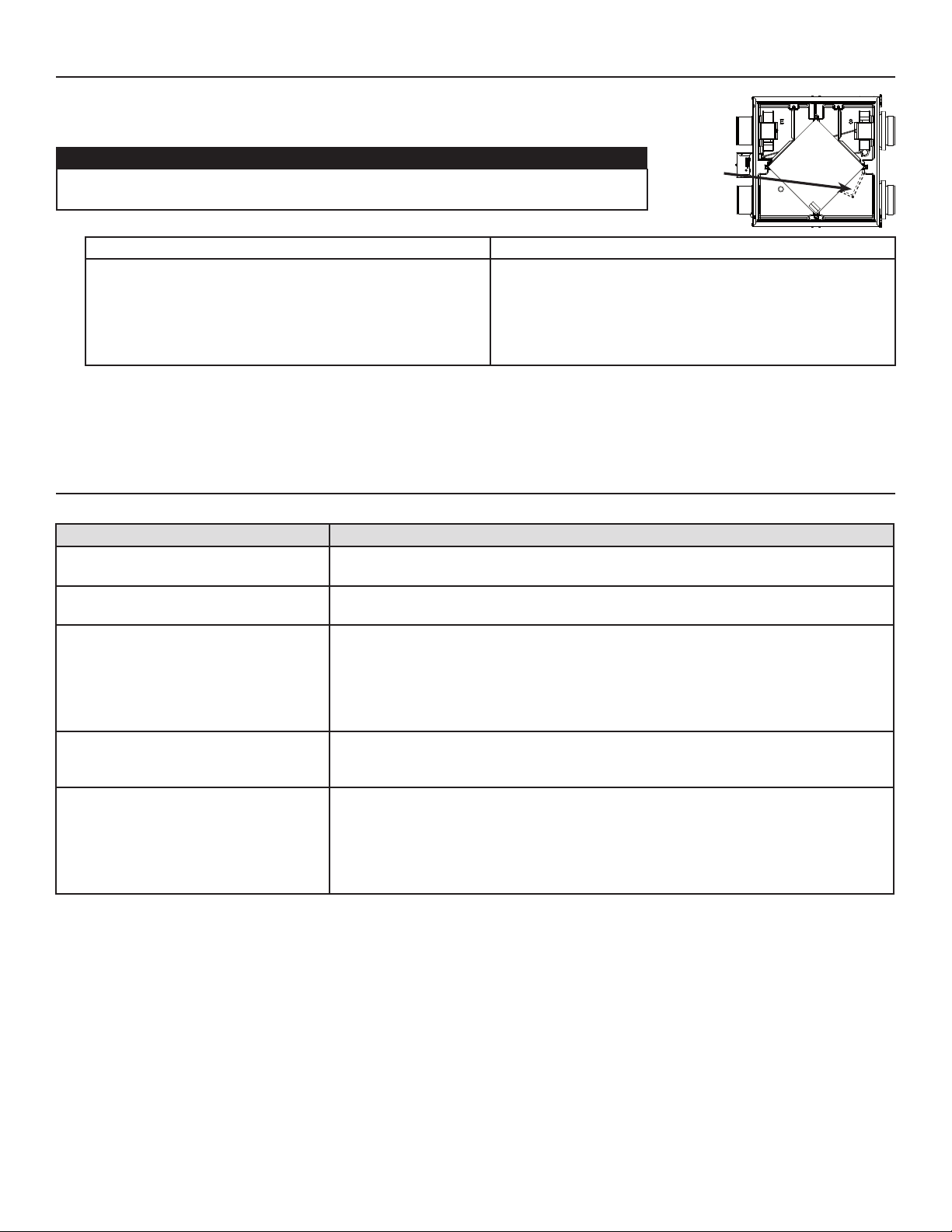
19
10. MANTENIMIENTO (CONT.)
1. Repita las etapas 1 a 6 de la sección anterior y continúe con las que se exponen a continuación:
2. Limpie la unidad de recuperación:
HRV130FL ERV130FL
• Retire la unidad.
• Déjela en remojo en una mezcla de agua fría o tibia y jabón
suave (detergente para vajillas).
• Enjuague a fondo.
• Agite la unidad para eliminar el exceso de agua y déjela
secar.
Quite el polvo de la unidad con una aspiradora equipada con un
cepillo suave.
PRECAUCIÓN: NO SUMERJA EN AGUA LA UNIDAD
DE RECUPERACIÓN DE ENERGÍA.
3. Limpie el conjunto del ventilador impelente.
4. Quite el polvo con una aspiradora equipada con un cepillo suave.
5. Vuelva a montar los componentes.
6. Vuelva a conectar la fuente de alimentación.
PRECAUCIÓN
• Manipule con cuidado la unidad de recuperación.
• No desmonte la placa de condensación de la unidad de recuperación de calor.
PROBLEMA INTENTE ESTO
1. Nada funciona. • Verifique si el aparato está enchufado.
• Compruebe si el aparato recibe alimentación del disyuntor o del fusible de la casa.
2. Aparato ruidoso. • Limpie el aparato (véase la sección 10). Si el problema no se soluciona, póngase en
contacto con el instalador.
3. Condensación en las ventanas
(aire demasiado húmedo).
• Haga funcionar el aparato a velocidad máxima (MÁX.) durante las actividades que
generan humedad excesiva (reuniones familiares, mucha cocina, etc.).
• Deje las cortinas entreabiertas para que el aire circule.
• Guarde toda la leña en un cuarto cerrado equipado con un deshumidificador, en un
cuarto bien ventilado o en el exterior.
• Mantenga la temperatura de su casa por encima de 64°F.
4. Aire demasiado seco. • Haga funcionar el aparato a velocidad baja (MÍN).
• Cambie temporalmente al modo intermitente (si está disponible).
• Use temporalmente un humidificador.
5. Aire demasiado frío en la rejilla de
suministro de aire.
• Asegúrese de que las bocas exteriores no están bloqueadas.
• Haga funcionar el aparato a velocidad baja (MÍN).
• Haga que verifiquen el equilibrio del sistema (póngase en contacto con su instalador).
• Haga que verifiquen el sistema de descongelación (póngase en contacto con su
instalador).
• Instale un calentador de conductos (póngase en contacto con su instalador).
10.2 ANUAL (EN OTOÑO)
11. SOLUCIÓN DE PROBLEMAS POR PARTE DEL USUARIO
Póngase en contacto con el servicio de atención al cliente en el teléfono 1-800-558-1711 para cualquier problema no resuelto.
VD0443
PLACA DE
CONDENSACIÓN
(APPARATOS
HRV
ÚNICAMENTE,
VÉASE LA
SECCIÓN2.1)

20
12. GARANTÍA
Este aparato de ventilación de Broan es un producto de gran calidad, fabricado y empacado con cuidado.
Broan garantiza al comprador original de sus productos que dichos productos están libres de defectos por el periodo de tiempo indicado
más adelante, a partir de la fecha de compra original. La garantía de todos los aparatos Broan cubre las piezas únicamente contra
cualquier defecto que pudiera perjudicar su funcionamiento. Su duración es de cinco (5) años. A reserva de que se efectúe el
mantenimiento del núcleo, tal y como se indica en el manual del usuario y del instalador, el núcleo de recuperación del calor (HRV)
tiene una garantía limitada de por vida, y el núcleo de recuperación de energía (ERV) tiene una garantía de cinco (5) años. Si el aparato
funcionara de manera inadecuada, consulte el manual del usuario y del instalador. Si el problema continúa, siga estos pasos:
PROCEDIMIENTO A SEGUIR
Si el aparato estuviera defectuoso, sírvase comunicar inmediatamente con su empresa de ventilación (véase la dirección en la cubierta
de este manual). La empresa determinará el origen del mal funcionamiento del aparato y lo sustituirá o reparará, de ser necesario.
Si le resultara imposible ponerse en comunicación con la empresa, telefonee (en América del Norte) al 1-800-558-1711 y nuestro
personal le indicará con mucho gusto el teléfono del distribuidor o del centro de servicio más próximo.
REPLACEMENT PARTS AND REPAIR
Para que el aparato funcione bien debe usar siempre piezas originales de Broan. Estas piezas se han diseñado especialmente para
cumplir con todas las normas de certificación de seguridad aplicables. El uso de piezas diferentes podría poner en peligro la seguridad
del aparato, ocasionar una reducción importante de su funcionamiento y producir una falla prematura. Broan también aconseja
consultar siempre con una empresa de servicios competente reconocida por Broan para las piezas de recambio y para solicitar un
servicio.
FACTURA
La garantía no cubrirá ninguna reparación ni sustitución sin la factura original de compra. Le rogamos, pues, que la conserve debidamente.
GASTOS VARIOS
En cada caso, los gastos de mano de obra para retirar una pieza defectuosa o instalar una pieza conforme no estarán cubiertos por el
fabricante.
CONDICIONES Y LÍMITES
Este aparato es pensados únicamente para uso residencial y han de utilizarse en un edificio tal y como se describe a continuación:
Edificio: Toda construcción usada o destinada para ser usada con el fin de alojar o recibir personas, animales o cosas.
Uso residencial: Vivienda, alojamiento, suite: edificio o parte de un edificio que sirve o está destinado a servir de domicilio a una o varias
personas y que también posee instalaciones sanitarias, para preparar y consumir comidas y dormir. Local constituido
por una sola pieza o un grupo de piezas complementarias y ocupado por un inquilino o propietario; incluye los
alojamientos, las habitaciones individuales de moteles, hoteles, las casas de alquiler de habitaciones, los dormitorios
colectivos y las pensiones familiares, incluso las tiendas y los establecimientos de negocios de una sola pieza en una
vivienda.
Uso comercial: Establecimiento agrícola, comercial, de reunión, de cuidados o de detención: edificio o parte de un edificio que no
contenga viviendas, situado en un terreno dedicado a la agricultura o a la ganadería y usado fundamentalmente para
guardar equipos o animales, o para la producción, almacenamiento o tratamiento de productos agrícolas u hortícolas o la
alimentación de los animales. Edificio o parte de un edificio usado para colocar o vender mercancías o productos al por
menor o usado para realizar negocios o prestar servicios profesionales o personales. Edificio o parte de un edificio
usado por personas que se reúnen para realizar actividades cívicas, políticas, turísticas, religiosas, mundanas, educativas,
recreativas o similares, o para consumir alimentos o bebidas. Edificio o parte de un edificio que acoge a personas
que, por su estado físico o mental, necesitan cuidados o tratamientos médicos, o a personas que, por razones de
seguridad fuera de su control, no pueden guarecerse en caso de peligro.
Uso industrial: Edificio o parte de un edificio usado para ensamblar, fabricar, confeccionar, tratar, reparar o almacenar productos,
materias o materiales cuyo contenido es combustible y posee materias muy combustibles, inflamables o explosivas en
cantidad suficiente para constituir un riesgo concreto de incendio.
La garantía se aplicará en todos los casos en los que los daños no resulten de una instalación inadecuada, de un uso inapropiado, de un
abuso o negligencia, de un caso fortuito o de cualquier otra circunstancia fuera del control de Broan. Además, Broan no se hace respon-
sable de las lesiones o daños en la propiedad personal o inmobiliaria causados directa o indirectamente por el aparato de ventilación Broan.
Esta garantía anula todas las garantías anteriores.
Broan 926 West State Street, Hartford, WI 53027 www.broan-nutone.com 800-558-1711