i
Trademarks
Autel
®
, MaxiSys
®
, MaxiDAS
®
, MaxiScan
®
, MaxiTPMS
®
, MaxiRecorder
®
, and
MaxiCheck
®
are trademarks of Autel Intelligent Technology Corp., Ltd., registered in
China, the United States and other countries. All other marks are trademarks or
registered trademarks of their respective holders.
Copyright Information
No part of this manual may be reproduced, stored in a retrieval system or transmitted, in
any form or by any means, electronic, mechanical, photocopying, recording, or otherwise
without the prior written permission of Autel.
Disclaimer of Warranties and Limitation of Liabilities
All information, specifications and illustrations in this manual are based on the latest
information available at the time of printing.
Autel reserves the right to make changes at any time without notice. While information of
this manual has been carefully checked for accuracy, no guarantee is given for the
completeness and correctness of the contents, including but not limited to the product
specifications, functions, and illustrations.
Autel will not be liable for any direct, special, incidental, indirect damages or any
economic consequential damages (including the loss of profits).
IMPORTANT
Before operating or maintaining this unit, please read this manual carefully, paying
extra attention to the safety warnings and precautions.
For Services and Support
pro.autel.com
www.autel.com
1-855-288-3587/1-855-AUTELUS (North America)
0086-755-86147779 (China)
For technical assistance in all other markets, please contact your local selling agent.
ii
Safety Information
For your own safety and the safety of others, and to prevent damage to the device and
vehicles upon which it is used, it is important that the safety instructions presented
throughout this manual be read and understood by all persons operating or coming into
contact with the device.
There are various procedures, techniques, tools, and parts for servicing vehicles, as well
as in the skill of the person doing the work. Because of the vast number of test
applications and variations in the products that can be tested with this equipment, we
cannot possibly anticipate or provide advice or safety messages to cover every
circumstance. It is the automotive technician’s responsibility to be knowledgeable of the
system being tested. It is crucial to use proper service methods and test procedures. It
is essential to perform tests in an appropriate and acceptable manner that does not
endanger your safety, the safety of others in the work area, the device being used, or the
vehicle being tested.
Before using the device, always refer to and follow the safety messages and applicable
test procedures provided by the manufacturer of the vehicle or equipment being tested.
Use the device only as described in this manual. Read, understand, and follow all safety
messages and instructions in this manual.
Safety Messages
Safety messages are provided to help prevent personal injury and equipment damage.
All safety messages are introduced by a signal word indicating the hazard level.
DANGER
Indicates an imminently hazardous situation which, if not avoided, will result in death or
serious injury to the operator or to bystanders.
WARNING
Indicates a potentially hazardous situation which, if not avoided, could result in death
or serious injury to the operator or to bystanders.
Safety Instructions
The safety messages herein cover situations Autel is aware of. Autel cannot know,
evaluate or advise you as to all of the possible hazards. You must be certain that any
condition or service procedure encountered does not jeopardize your personal safety.
DANGER
When an engine is operating, keep the service area WELL VENTILATED or attach a
building exhaust removal system to the engine exhaust system. Engines produce carbon
monoxide, an odorless, poisonous gas that causes slower reaction time and can lead to
serious personal injury or loss of life.

iii
SAFETY WARNINGS
Always perform automotive testing in a safe environment.
Wear safety eye protection that meets ANSI standards.
Keep clothing, hair, hands, tools, test equipment, etc. away from all moving or hot
engine parts.
Operate the vehicle in a well-ventilated work area, for exhaust gases are poisonous.
Put the transmission in PARK (for automatic transmission) or NEUTRAL (for manual
transmission) and make sure the parking brake is engaged.
Put blocks in front of the drive wheels and never leave the vehicle unattended while
testing.
Be extra cautious when working around the ignition coil, distributor cap, ignition wires
and spark plugs. These components create hazardous voltages when the engine is
running.
Keep a fire extinguisher suitable for gasoline, chemical, and electrical fires nearby.
Do not connect or disconnect any test equipment while the ignition is on or the
engine is running.
Keep the test equipment dry, clean, free from oil, water or grease. Use a mild
detergent on a clean cloth to clean the outside of the equipment as necessary.
Do not drive the vehicle and operate the test equipment at the same time. Any
distraction may cause an accident.
Refer to the service manual for the vehicle being serviced and adhere to all
diagnostics procedures and precautions. Failure to do so may result in personal
injury or damage to the test equipment.
To avoid damaging the test equipment or generating false data, make sure the
vehicle battery is fully charged and the connection to the vehicle DLC is clean and
secure.
Do not place the test equipment on the distributor of the vehicle. Strong electro-
magnetic interference can damage the equipment.

iv
CONTENTS
USING THIS MANUAL ................................................................................................... 1
CONVENTIONS ..................................................................................................... 1
Bold Text ...................................................................................................... 1
Notes and Important Messages .................................................................... 1
Hyperlink ....................................................................................................... 1
Illustrations ................................................................................................... 1
GENERAL INTRODUCTION .......................................................................................... 2
MAXICOM MK808 TABLET ................................................................................... 2
Function Description ..................................................................................... 2
Power Sources ............................................................................................. 4
Technical Specifications ............................................................................... 5
ACCESSORY KIT ................................................................................................... 6
Main Cable ................................................................................................... 6
Other Accessories ........................................................................................ 7
GETTING STARTED ...................................................................................................... 8
POWERING UP ..................................................................................................... 8
Application Buttons ....................................................................................... 8
Locator and Navigation Buttons .................................................................. 10
System Status Icons ................................................................................... 11
POWERING DOWN .............................................................................................. 11
Reboot System ........................................................................................... 11
DIAGNOSTICS ............................................................................................................. 12
GETTING STARTED ............................................................................................. 12
Vehicle Menu Layout .................................................................................. 12
Top Toolbar Buttons ................................................................................... 13
VEHICLE IDENTIFICATION ..................................................................................... 14
Auto VIN Scan ............................................................................................ 14
Manual VIN Input ........................................................................................ 16
Automatic Selection .................................................................................... 16
Manual Selection ........................................................................................ 17
NAVIGATION....................................................................................................... 17
Diagnostics Screen Layout ......................................................................... 17
Screen Messages ....................................................................................... 19

v
Making Selections ...................................................................................... 20
DIAGNOSIS ........................................................................................................ 21
Auto Scan ................................................................................................... 21
Control Unit ................................................................................................. 23
GENERIC OBDII OPERATIONS ............................................................................. 32
General Procedure ..................................................................................... 32
Function Descriptions ................................................................................. 34
EXITING DIAGNOSTICS ........................................................................................ 36
SERVICE OPERATIONS .............................................................................................. 37
OIL RESET SERVICE ........................................................................................... 37
ELECTRONIC PARKING BRAKE (EPB) SERVICE...................................................... 40
EPB Safety ................................................................................................. 40
EMF Start-up .............................................................................................. 41
BMS ................................................................................................................ 43
Register Battery Replacement .................................................................... 43
STEERING ANGLE SENSOR (SAS) SERVICE .......................................................... 47
Steering Angle Sensor Calibration .............................................................. 48
DPF SERVICE .................................................................................................... 50
Diesel Particulate Filter: Replacement ........................................................ 51
Diesel Particulate Filter: Request Regeneration ......................................... 53
TIRE PRESSURE MONITOR SYSTEM (TPMS) SERVICE ........................................... 54
IMMO SERVICE ................................................................................................. 56
SHOP MANAGER ........................................................................................................ 58
VEHICLE HISTORY .............................................................................................. 59
Historical Test Record ................................................................................ 59
WORKSHOP INFORMATION................................................................................... 61
CUSTOMER MANAGER ........................................................................................ 61
DATA MANAGER ......................................................................................................... 63
OPERATIONS ..................................................................................................... 63
Image .......................................................................................................... 63
Report ......................................................................................................... 65
PDF ............................................................................................................ 66
Review Data ............................................................................................... 66
Apps Uninstall ............................................................................................. 67
Vehicle Management .................................................................................. 68
vi
Data Logging .............................................................................................. 68
SETTINGS .................................................................................................................... 69
UNIT ................................................................................................................. 69
LANGUAGE ........................................................................................................ 70
PRINTING SETTINGS ........................................................................................... 70
REPORT SETTINGS ............................................................................................. 71
MULTITASK ........................................................................................................ 71
FIRMWARE UPGRADE.......................................................................................... 71
AUTO UPDATE ................................................................................................... 72
CAR ORDER ...................................................................................................... 72
SYSTEM SETTINGS ............................................................................................. 72
ABOUT .............................................................................................................. 73
UPDATE ....................................................................................................................... 74
SUPPORT .................................................................................................................... 76
PRODUCT REGISTRATION .................................................................................... 76
SUPPORT SCREEN LAYOUT ................................................................................. 77
MY ACCOUNT .................................................................................................... 77
Personal Info .............................................................................................. 77
Update Info ................................................................................................. 78
Service Info ................................................................................................. 78
COMMUNITIES .................................................................................................... 78
DATA LOGGING .................................................................................................. 79
User Profile ................................................................................................. 79
TRAINING .......................................................................................................... 79
FAQ ................................................................................................................. 80
ACADEMY .................................................................................................................... 81
REMOTE DESK ............................................................................................................ 82
MAXIFIX ....................................................................................................................... 83
NAVIGATION....................................................................................................... 83
The Header ................................................................................................. 84
Select Vehicle Button.................................................................................. 84
Terminology ................................................................................................ 84
OPERATIONS ..................................................................................................... 85
Home .......................................................................................................... 86
vii
Search Fix .................................................................................................. 86
Ask.............................................................................................................. 86
My MaxiFix ................................................................................................. 87
My Messages ............................................................................................. 88
Support ....................................................................................................... 89
QUICK LINK ................................................................................................................. 91
FUNCTION VIEWER .................................................................................................... 92
DIGITAL INSPECTION ................................................................................................. 94
ADDITIONAL ACCESSORIES .................................................................................. 94
Inspection Camera ..................................................................................... 95
IMAGER HEAD ACCESSORIES ............................................................................... 95
ACCESSORY ASSEMBLY ...................................................................................... 96
TECHNICAL SPECIFICATIONS ................................................................................ 97
OPERATIONS ..................................................................................................... 98
MAINTENANCE AND SERVICE ................................................................................ 100
MAINTENANCE INSTRUCTIONS............................................................................ 100
TROUBLESHOOTING CHECKLIST ......................................................................... 101
ABOUT BATTERY USAGE ................................................................................... 102
SERVICE PROCEDURES ..................................................................................... 103
Technical Support ..................................................................................... 103
Repair Service .......................................................................................... 104
Other Services .......................................................................................... 104
COMPLIANCE INFORMATION .................................................................................. 105
FCC COMPLIANCE ........................................................................................... 105
SAR ............................................................................................................... 106
RF WARNING STATEMENT ................................................................................ 106
ROHS COMPLIANCE ......................................................................................... 106
CE COMPLIANCE ......................................................................................................... 106
WARRANTY ............................................................................................................... 107

1
Using this Manual
This manual contains device usage instructions.
Some illustrations shown in this manual may contain modules and optional equipment
that are not included in your system.
Conventions
The following conventions are used.
Bold Text
Bold text is used to highlight selectable items such as buttons and menu options.
Example:
Tap OK.
Notes and Important Messages
Notes
A NOTE provides helpful information such as additional explanations, tips, and
comments.
Important
IMPORTANT indicates a situation which, if not avoided, may result in damage to the
tablet or vehicle.
Hyperlink
Hyperlinks are available in electronic documents. Blue italic text indicates a selectable
hyperlink and blue underlined text indicates a website link or an email address link.
Illustrations
Illustrations used in this manual are samples, the actual testing screen may vary for each
vehicle being tested. Observe the menu titles and on-screen instructions to make correct
option selection.
2
General Introduction
When it comes to ultra-portability, MaxiCOM MK808 is your perfect companion. Installed
with a fast quad-core processor, MK808 offers maximum convenience and swift
diagnosis. The intuitive user screen makes using the device effortless through a 7-inch
LCD touchscreen that displays at 1024 x 600 quality. Together with the ability to quickly
read and clear DTCs for all available modules of the majority of the makes and models
on the market, MK808 provides you with superior special functions, including Oil Reset,
EPB (Electronic Parking Brake), SAS (Steering Angle Sensor), BMS (Battery
Management System), DPF (Diesel Particulate Filter), IMMO, and TPMS (Tire Pressure
Monitoring System).
This manual describes the construction and operation of the device and how it works to
deliver diagnostics solutions.
MaxiCOM MK808 Tablet
Function Description
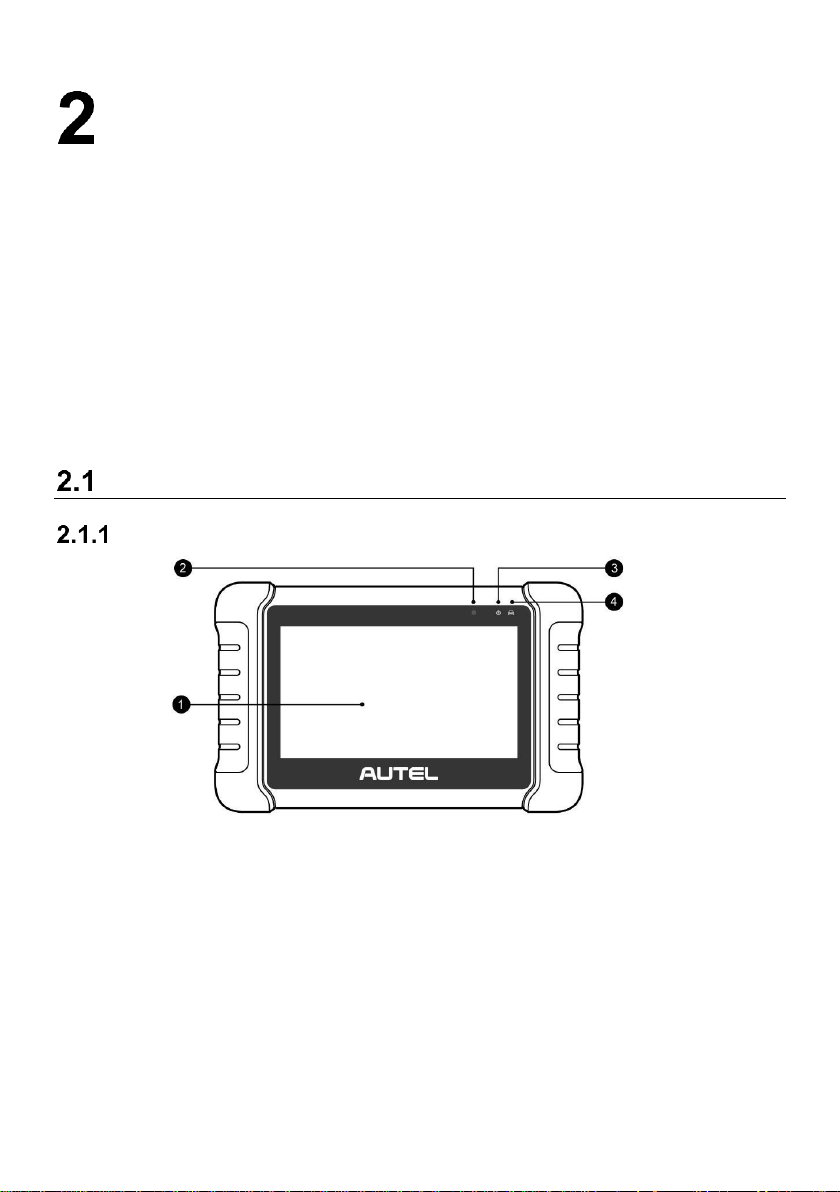
Figure 2-1 MaxiCOM MK808, Front View
1. 7.0” LCD Capacitive Touchscreen
2. Ambient Light Sensor — detects ambient brightness.
3. Power LED — indicates battery level & charging or system status.
4. Vehicle Communication LED — flashes green when the tablet is
communicating/linking with the vehicle’s system.
The power LED displays green, yellow or red depending on power level and operating
state.
A. Green
Illuminates green when the tablet is charging and the battery level is above 90%.
3
Illuminates green when the tablet is powered on and the battery level is above
15%.
B. Yellow
Illuminates yellow when the tablet is charging and the battery level is below 90%.
C. Red
Illuminates red when the tablet is powered on and the battery level is below 15%.
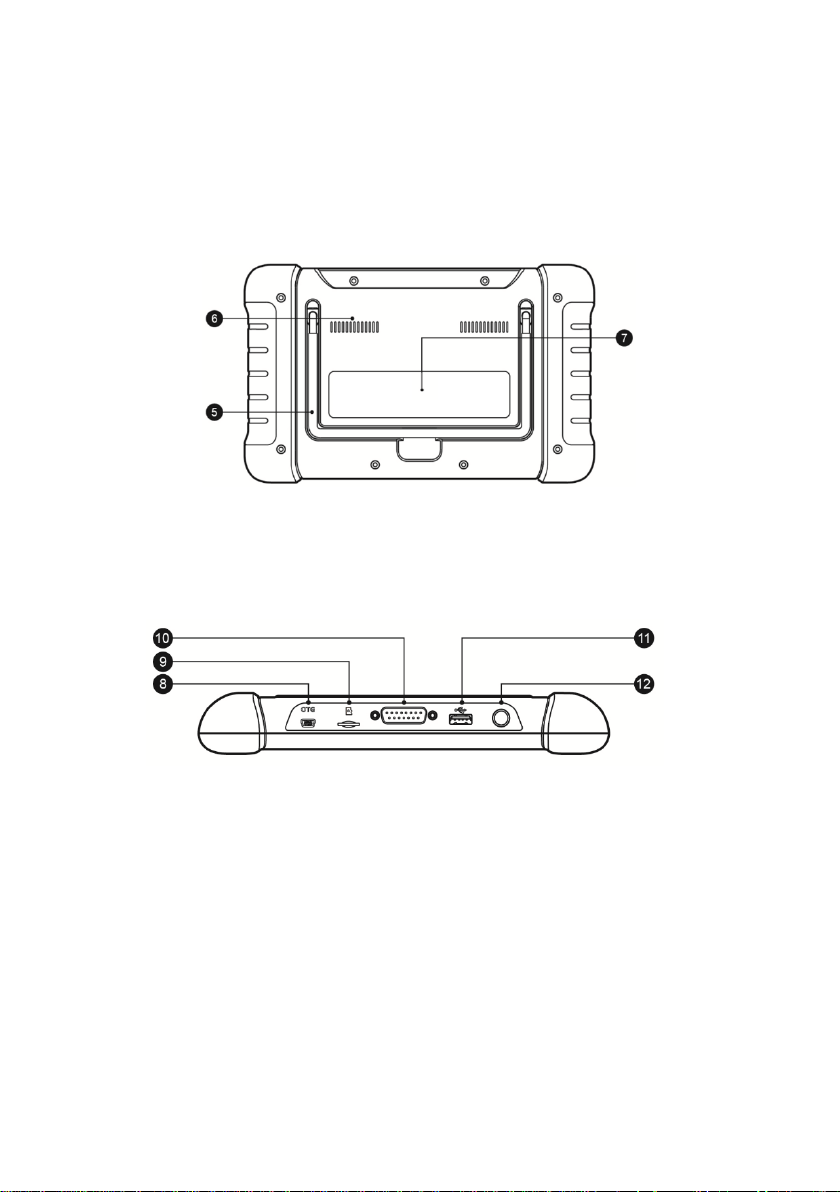
Figure 2-2 MaxiCOM MK808, Back View
5. Collapsible Stand — extends from the back to allow hands-free viewing of the tablet.
6. Heat Sink
7. Built-in Battery
Figure 2-3 MaxiCOM MK808, Top View
8. Mini USB OTG Port
9. Micro SD Card Slot — holds the micro SD card.
10. DB15-Pin Port — connects the main cable.
11. USB Port
12. Lock/Power Button — long press button to turn tablet off and on. Quick press button
to lock screen.

4
Power Sources
The tablet can receive power from any of the following sources:
Internal Battery Pack
Vehicle Power
External Power Supply
Internal Battery Pack
The tablet can be powered with the internal rechargeable battery, which if fully charged
can provide sufficient power for about 4.5 hours of continuous operation.
Vehicle Power
When the tablet is connected to the test vehicle via the main cable, the tablet
automatically receives power from the vehicle.
External Power Supply
The tablet can be powered from a wall socket using the mini USB cable and USB external
power adapter. The external power supply also charges the internal battery pack.
5
Technical Specifications
Table 2-1 Specifications
Item
Description
Recommended Use
Indoor
Operating System
Android
TM
4.4.4
Processor
Cortex-A9 processor (1.5 GHz)
Memory
64 GB
Display
7-inch LCD capacitive touchscreen with
1024x600 resolution
Connectivity
Mini USB 2.0
USB 2.0
Wi-Fi
Micro SD card (supports up to 32 GB)
Sensors
Ambient light sensor for brightness auto adjust
Audio Input/Output
Input: N/A
Output: Beep
Power and Battery
3.7 V/5000 mAh lithium-polymer battery
Charges via 5 V DC power supply
Tested Battery Life
Around 4.5 hours of continuous use
Battery Charging Input
5 V/1.5 A
Power Consumption
500 mA (LCD on with default brightness, Wi-Fi
on) @3.7 V
Operating Temp.
0 to 50 °C (32 to 122 °F)
Storage Temp.
-10 to 60 °C (14 to 140 °F)
Operating Humidity
5 to 95 % non-condensing
Dimensions (W x H x D)
237.8 mm (9.4”) x 148.6 mm (5.9”) x 35.5 mm
(1.4”)
Net Weight
788 g (2.42 lbs.)
6
Item
Description
Supported Automotive
Protocols
ISO9141-2, ISO14230-2,ISO15765, K/L-Line,
Flashing Code, SAE-J1850 VPW, SAE-J1850
PWM, ISO11898 (Highspeed, Middlespeed,
Lowspeed and Singlewire CAN,fault-tolerant
CAN), SAE J2610,GM UART,UART Echo Byte
Protocol, Honda Diag-H Protocol, TP2.0, TP1.6
Accessory Kit
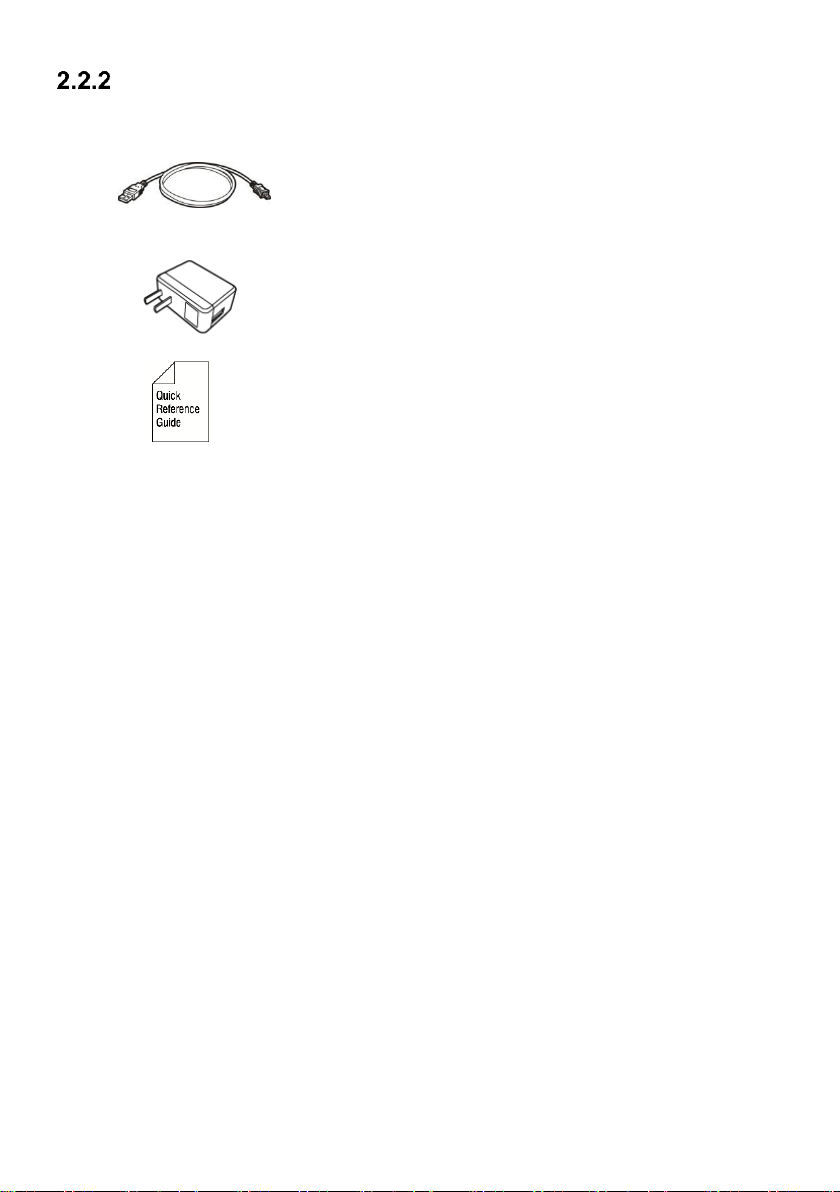
Main Cable
The Main Cable connects the tablet to the vehicle’s data link connector (DLC).
Figure 2-4 Main Cable
7
Other Accessories
Table 2-2 Other Accessories
Mini USB Cable
Connects the tablet to the PC or DC external power
adapter.
USB External Power Adapter
Together with the mini USB cable, connects the tablet
to the external DC power port for power supply.
Quick Guide
Device connection and diagnostics software update
instructions.

8
Getting Started
Ensure the tablet is sufficiently charged or is connected to the external power supply (see
Power Sources).
NOTE
The images and illustrations depicted in this manual may differ from the actual ones.
Powering Up
Press the Lock/Power button on the top right side of the tablet to power the unit on. The
system boots up, and displays the lock screen. Slide the Lock icon to the left to access
the MaxiCOM Job Menu or slide to the right to unlock.
Figure 3-1 Sample MaxiCOM MK808 Job Menu
1. Application Buttons
2. Locator and Navigation Buttons
3. Status Icons
NOTE
The tablet screen is locked by default upon startup. It is recommended to lock the
screen when not in use to protect the information in the system and conserve the power.
Almost all operations on the tablet are controlled through the touchscreen. The
touchscreen navigation is menu driven, which allows you to quickly locate the test
procedure, or data that you need, through a series of choices and questions. Detailed
descriptions of the menu structures are found in the chapters for each application.
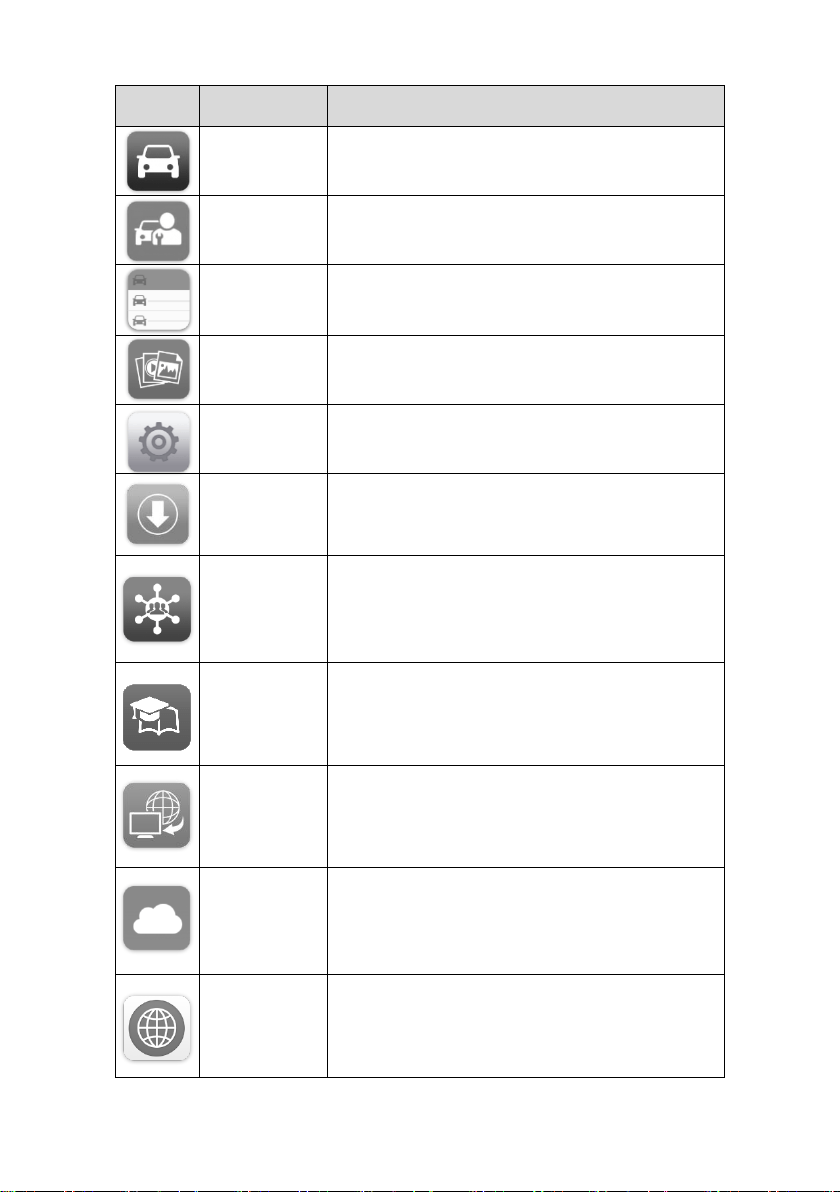
Application Buttons
The tablet below briefly describes each of the applications in the MaxiCOM system.
9
Table 3-1 Application Buttons
Button
Name
Description
Diagnostics
Accesses diagnostics functions menu. See
Diagnostics.
Service
Accesses special functions menu. See
Service Operations.
Shop
Manager
Edits and saves workshop information and
customer data, as well as reviewing test vehicle
history records. See Shop Manager.
Data
Manager
Accesses the organization system for saved
data files. See Data Manager.
Settings
Accesses MaxiCOM system settings menu and
general tablet menu. See Settings.
Update
Checks for the latest update available for the
MaxiCOM system, and performs updates. See
Update.
Support
Launches the Support platform which
synchronizes Autel’s on-line service base
station with the MaxiCOM tablet. See
Support.
Academy
Accesses technical tutorials and training
articles about the device usage and vehicle
diagnostics techniques. See Academy.
Remote
Desk
Configures the unit to receive remote support
using the TeamViewer application program.
See Remote Desk.
MaxiFix
Launches the MaxiFix platform which provides
the most compatible and abundant repair
techniques and diagnostics database. See
MaxiFix.
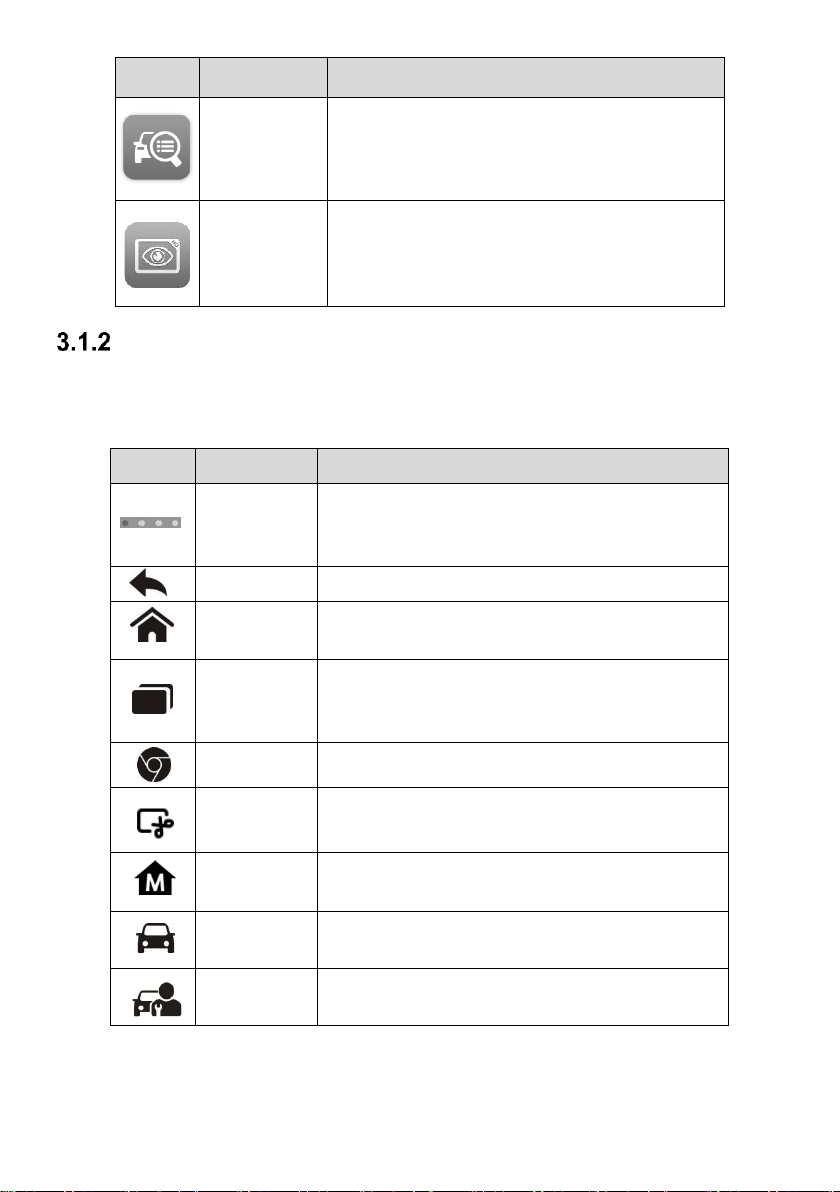
Quick Link
Provides associated website bookmarks to
allow quick access to product update, service,
support and other information. See Quick Link.
10
Button
Name
Description
Function
Viewer
Provides quick search for the supported
functions and vehicles of Autel diagnostics
tools
. See
Function Viewer
.
Digital
Inspection
Configures the unit to operate as a video scope
device by connecting to an Imager head cable
for close vehicle inspections. See Digital
Inspection.
Locator and Navigation Buttons
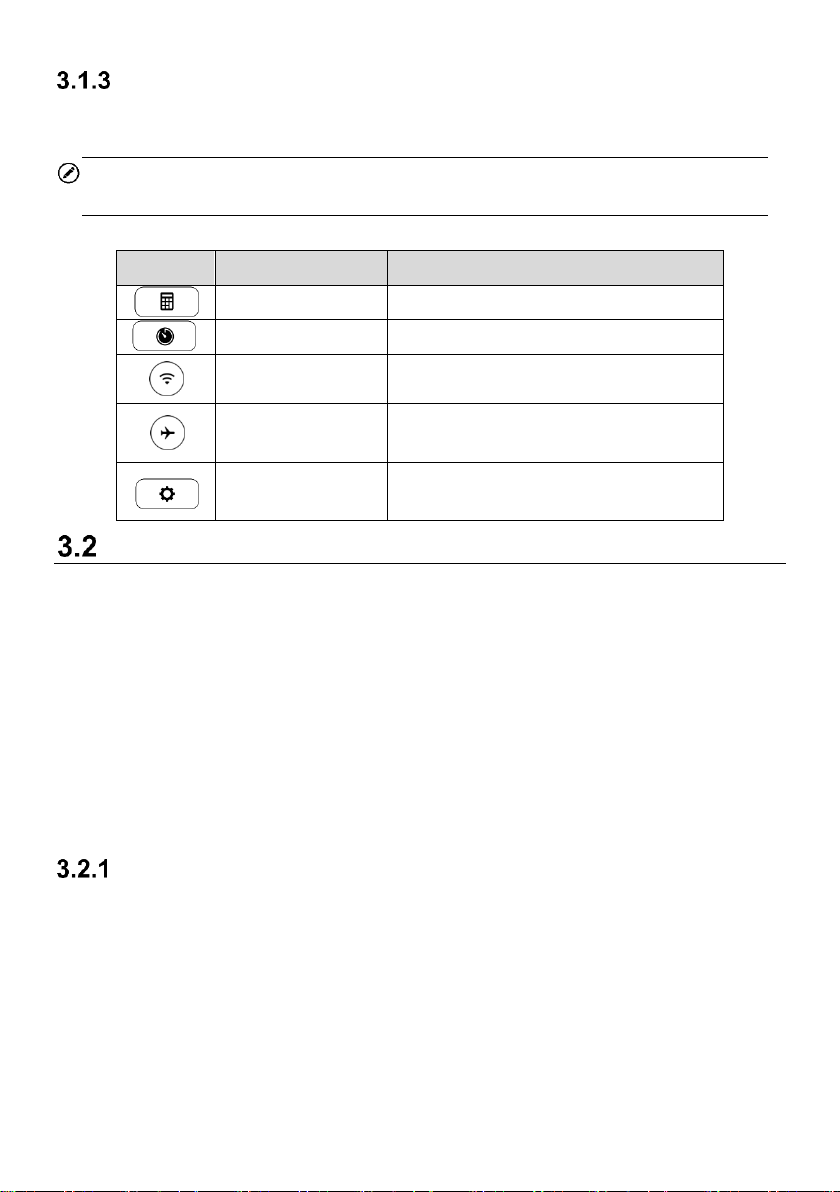
Operations of the Navigation buttons at the bottom of the screen are described in the
table below:
Table 3-2 Locator and Navigation Buttons
Button
Name
Description
Locator
Indicates the location of the screen. Swipe the
screen left or right to view the previous or next
screen.
Back
Returns to the previous screen.
Android
Home
Returns to Android System’s Home screen.
Recent
Apps
Displays a list of applications that are currently in
use. Tap an app icon to launch. To remove an
app, swipe it to the top or bottom.
Chrome
Launches the Android built-in browser.
Screenshot
Takes a screenshot when you want to save the
displayed information.
MaxiCOM
Home
Returns to MaxiCOM Job Menu.
Diagnostic
Shortcut
Returns to the Diagnostic screen.
Service
Shortcut
Returns to the Service screen.
11
System Status Icons
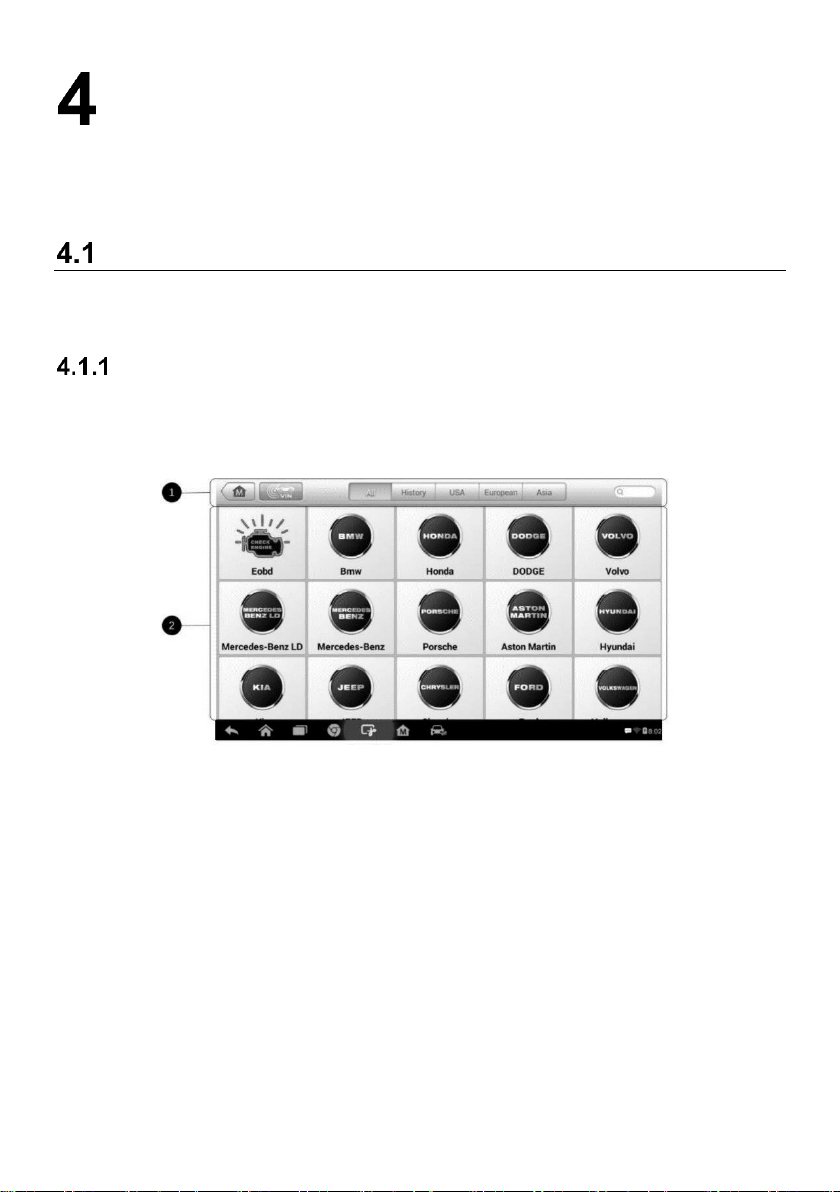
Tap on the bottom right corner to display Shortcuts Panel to set system settings of the
tablet. Each icons function is described in the table below:
NOTE
The shortcuts buttons will be highlighted when enabled and dimmed when disabled.
Table 3-3 Shortcuts Panel Buttons
Button
Name
Description
Calculator
Launches calculator when pressed.
Clock
Launches clock when pressed.
Wi-Fi
Enables/disables Wi-Fi when pressed.
Airplane Mode
Enables/disables Airplane Mode when
pressed.
System Settings
Launches the Android System Settings
screen when pressed.
Powering Down
All vehicle communications must be terminated before shutting down the tablet. A
warning message displays if a shutdown is attempted while the tablet is communicating
with the vehicle. Forcing a shutdown while the tablet is communicating may lead to ECM
problems on some vehicles. Please exit the Diagnostics application before shutting off
the tablet.
To power down the tablet
1. Long press the Lock/Power Button.
2. Tap Power off option.
3. Tap OK, the tablet will turn off in a few seconds.
Reboot System
In case of system crash, long press the Lock/Power button and tap Reboot option to
restart the system.
12
Diagnostics
The Diagnostics application can access the electronic control unit (ECU) of various
vehicle control systems, such as engine, transmission, antilock brake system (ABS),
airbag system (SRS) and more.
Getting Started
The Diagnostics operations require connecting the MaxiCOM MK808 to the test vehicle’s
DLC using the main cable.
Vehicle Menu Layout
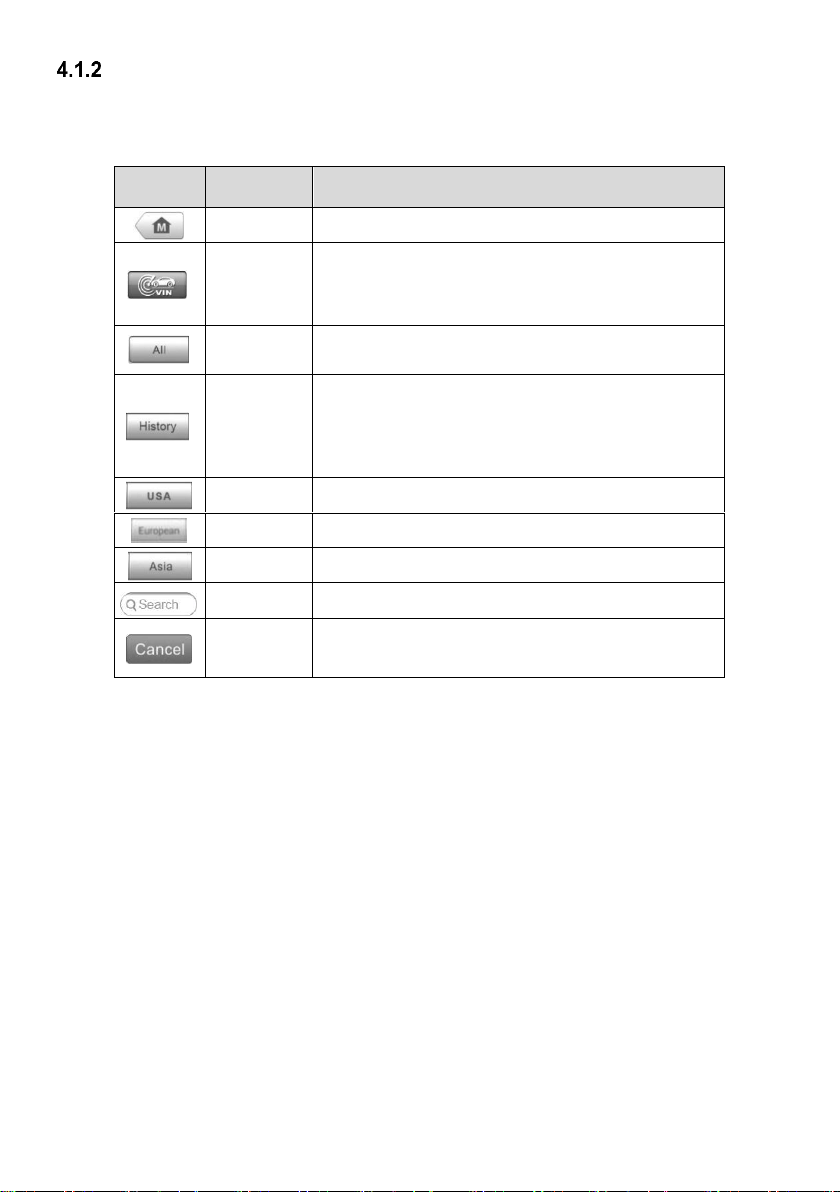
When the tablet is properly connected to the vehicle, the platform is ready to start vehicle
diagnosis. Tap on the Diagnostics application button on the MaxiCOM MK808 Job Menu,
the Vehicle Menu then displays.
Figure 4-1 Sample Vehicle Menu
1. Top Toolbar Buttons
2. Manufacturer Buttons
13
Top Toolbar Buttons
The operations of the toolbar buttons at the top of the screen are listed and described in
the table below:
Table 4-1 Top Toolbar Buttons
Button
Name
Description
Home
Returns to the MaxiCOM Job Menu.
VIN Scan
Displays a dropdown list; tap Auto Detect for
auto VIN detection; tap Manual Input to enter
VIN manually.
All
Displays a menu of vehicle manufacturers.
History
Displays stored test vehicle history records. Tap
record to review record in detail. See Vehicle
History.
USA
Displays the USA vehicle menu.
European
Displays the European vehicle menu.
Asia
Displays the Asian vehicle menu.
Search
Searches for a specific vehicle make.
Cancel
Tap to exit the search screen, or cancels an
operation.
4.1.2.1 Manufacturer Buttons
The vehicle manufacturer buttons display the vehicle brands currently compatible with
the tool. After establishing communication with the vehicle. Tap the desired manufacturer
button to start a diagnostics session.
14
Vehicle Identification
The MaxiCOM diagnostics system supports four methods for Vehicle Identification.
1. Auto VIN Scan
2. Manual VIN Input
3. Automatic Selection
4. Manual Selection
Auto VIN Scan
The MaxiCOM diagnostics system features the latest VIN-based Auto VIN Scan function
to identify vehicles with just one touch, enabling the technician to quickly identify the
vehicle, san all the diagnosable ECUs on the vehicle and perform diagnostics on the
selected system.
To perform Auto VIN Scan
1. Tap the Diagnostics application button from the MaxiCOM Job Menu. The
Vehicle Menu displays.
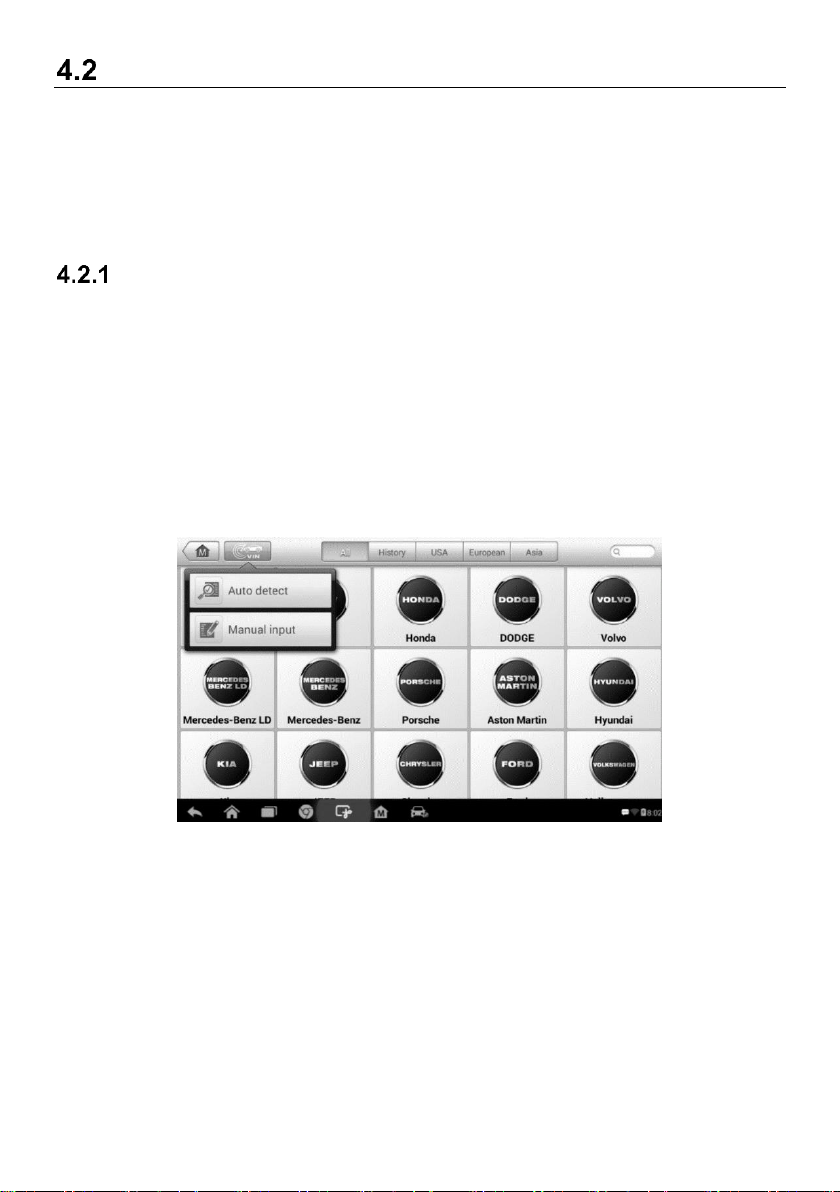
2. Tap the VIN Scan button on the top toolbar to open a dropdown list.
Figure 4-2 Sample Auto VIN Screen 1
3. Select Auto Detect. Once the test vehicle is successfully identified, the screen
will display the Vehicle Identification Number (VIN), tap OK at the bottom right
to confirm. If the VIN does not match, enter the VIN manually or tap Read to
acquire VIN again.
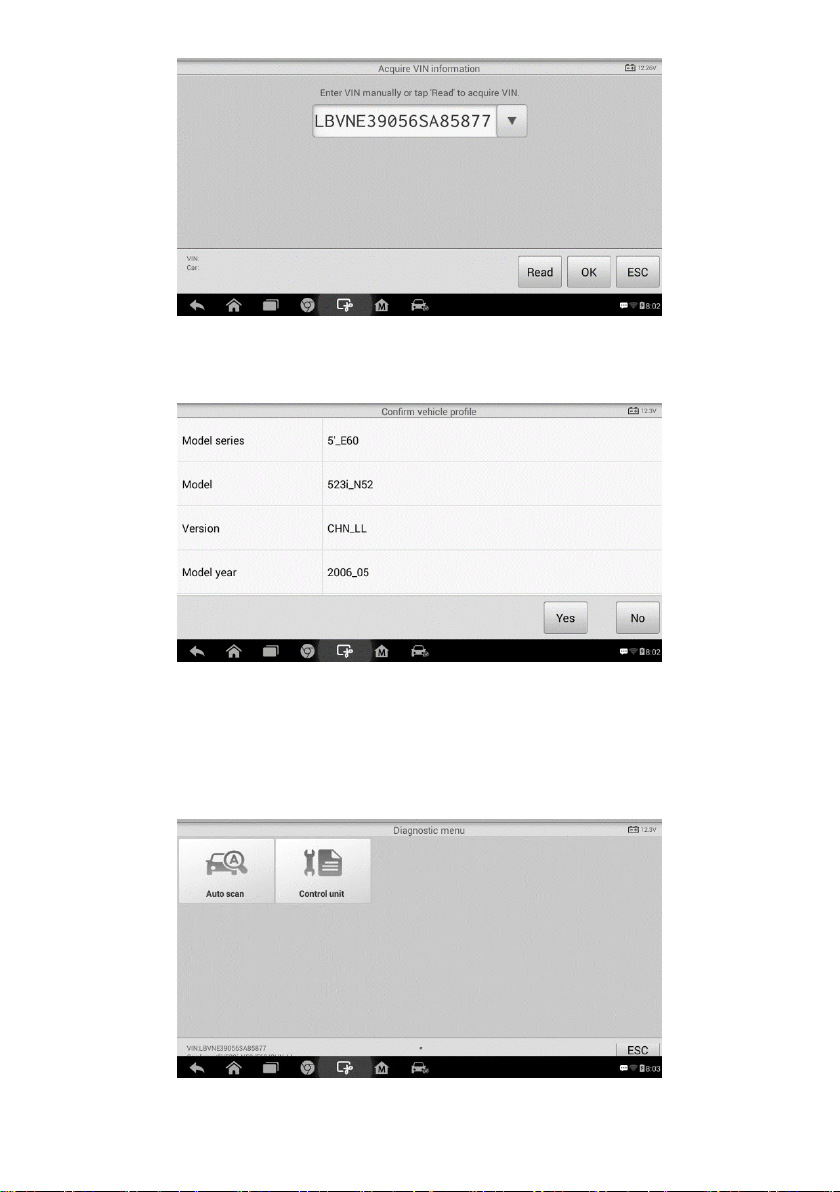
15
Figure 4-3 Sample Auto VIN Screen 2
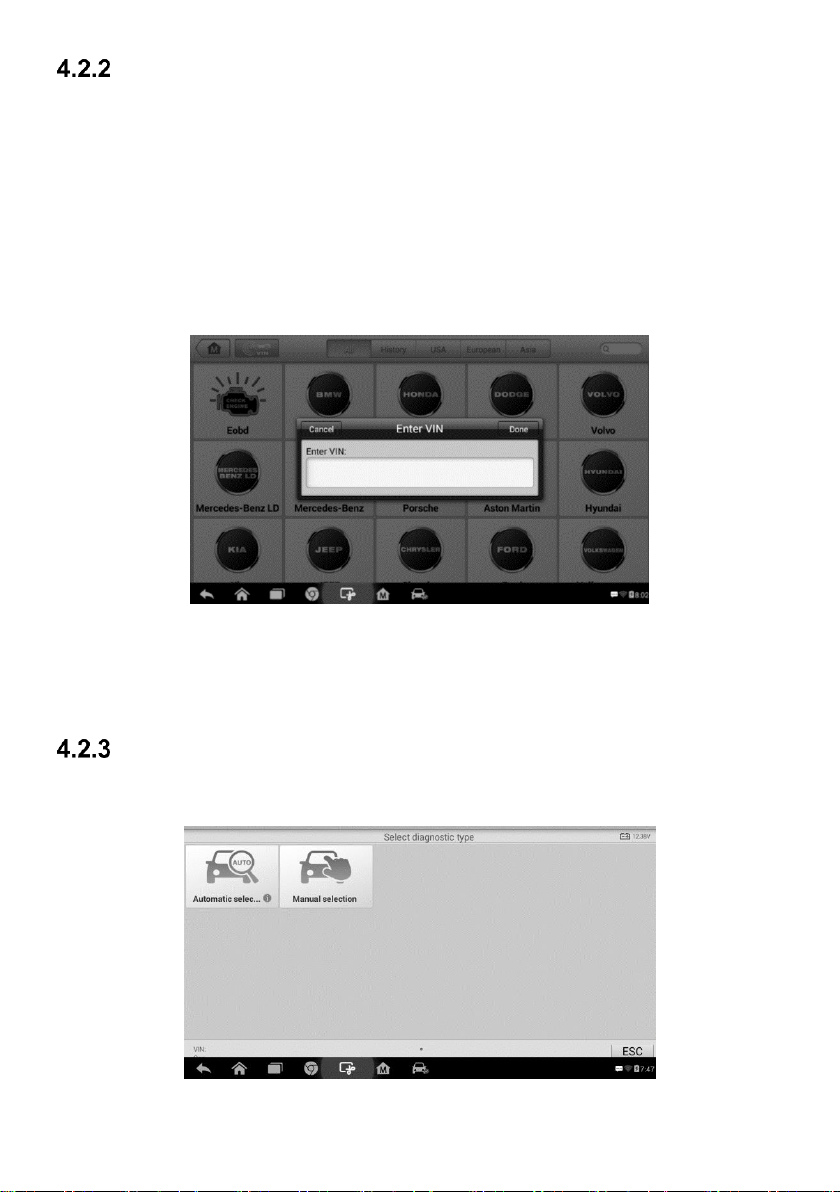
4. Review the information to ensure it is correct. Tap Yes to confirm the vehicle or
NO if the information is not correct.
Figure 4-4 Sample Vehicle Profile Screen
5. The tool will establish communication with the vehicle to read control unit
information. Choose Auto Scan to scan all the available systems of the test
vehicle or tap Control Unit to access the system that you want to diagnose.
Figure 4-5 Sample Diagnostic Screen
16
Manual VIN Input
For some vehicles that not supporting the Auto VIN Scan function, the MaxiCOM
diagnostics system allows you to enter the vehicle VIN manually.
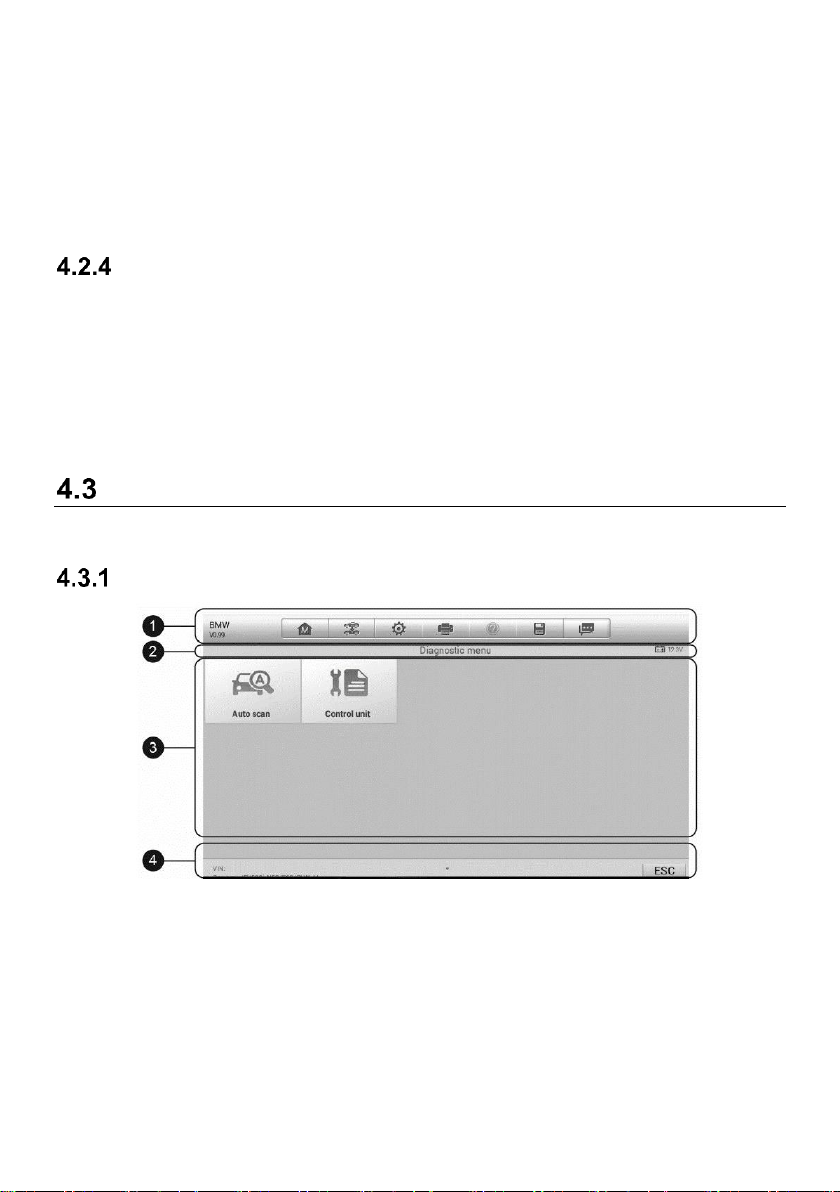
To perform Manual VIN Input
1. Tap the Diagnostics application button from the MaxiCOM Job Menu. The
Vehicle Menu displays.
2. Tap the VIN Scan button on the top toolbar.
3. Select Manual Input.
4. Tap the input box and enter the correct VIN.
Figure 4-6 Sample Diagnostic Screen
5. Tap Done. The vehicle will be identified and the Vehicle Diagnostics screen will
display.
6. Tap Cancel to exit Manual Input.
Automatic Selection
In some cases when users have selected the vehicle brand instead of performing Auto
VIN Scan, the system will still provide an option for vehicle VIN scan.
Figure 4-7 Sample Selection Screen
17
To perform Automatic Selection
1. Tap the Diagnostics application button from the MaxiCOM Job Menu. The
Vehicle Menu displays.
2. Tap the vehicle brand of the test vehicle.
3. Tap Automatic Selection and the system will proceed to acquire the VIN.
4. Follow the on-screen instruction to access the diagnostics screen.
Manual Selection
When the vehicle’s VIN is not automatically retrievable through the vehicle's ECU, or the
specific VIN is unknown, you can choose to select the vehicle manually.
This mode of vehicle selection is menu driven, repeat the first two steps from the
automatic selection operation and tap Manual Selection. Follow the on-screen prompts
to make a series of choices to select the correct vehicle. Press the Back button at the
bottom right corner of the screen to return to the previous step. Exact procedures may
vary by vehicle.
Navigation
This section describes how to operate the Diagnostics screen and select test options.
Diagnostics Screen Layout
Figure 4-8 Sample Diagnostics Screen
The diagnostics screens typically include four sections.
1. Diagnostics Toolbar
2. Status Information Bar
3. Main Section
4. Function Buttons

18
4.3.1.1 Diagnostics Toolbar
The Diagnostics Toolbar contains a number of buttons that allow you to perform various
functions. The table below provides a brief description for the operations of the
Diagnostics Toolbar buttons.
Table 4-2 Diagnostics Toolbar Buttons
Button
Name
Description
Home
Returns to the MaxiCOM Job Menu.
Vehicle
Swap
Exits the current diagnostics session of selected
vehicle, and returns to the vehicle menu screen to
select another vehicle for testing.
Settings
Opens the settings screen. See Settings.
Print
Prints a copy of the displayed data. See Printing
Setting for additional information.
Help
Displays operational instructions or tips.
Save
Opens a submenu and provides 3 options to save
data.
Tap Take a Screenshot to take a screenshot of
the current screen.
Tap Save All Data to save a PDF file (use this
save option when data displays on multiple
screens).
Tap Save Report to save the data in a report
form.
All saved data are stored in the Data Manager
application for later reviews. See Data Manager.
Data
Logging
Records the communication data and ECU
information of the test vehicle. The saved data can
be reported and sent to Autel’s technical center via
the Internet.
You can go to the Support application to follow up
the processing progress, See Data Logging for
detailed information.

19
To print data in Diagnostics
1. Tap the Diagnostics application button from the MaxiCOM Job Menu. The
Print button on the diagnostics toolbar is available throughout the Diagnostics
operations.
2. Tap Print. A drop-down menu displays. Tap Print This Page to print a
screenshot of the current screen.
3. A temporary file will be created and send to the connected PC for printing.
4. When the file is transferred successfully, a confirmation message displays.
To submit Data Logging reports in Diagnostics
1. Tap the Diagnostics application button from the MaxiCOM Job Menu. The
Data Logging button on the diagnostics toolbar is available throughout the
Diagnostics operations.
2. Tap the Data Logging button. The button displays blue during the active
recording process.
3. Tap the Data Logging button again to end recording. A submission form will
display for inputting of report information.
4. Tap the Send button to submit the report form via the Internet. A confirmation
message displays when the report has been successfully sent.
4.3.1.2 Status Information Bar
The Status Information Bar at the top of the Main Section displays the following items:
1. Menu Title — displays the menu heading of the Main Section.
2. Voltage Icon — displays the vehicle’s voltage status.
4.3.1.3 Main Section
The Main Section of the screen varies depending on the stage of operations. The Main
Section can display vehicle identification selections, the main menu, test data, messages,
instructions and other diagnostics information.
4.3.1.4 Function Buttons
The displayed Function Buttons vary depending on the stage of operations. Function
buttons can be used to navigate menus, to save or clear diagnostics data, to exit
scanning and to perform a number of other control functions. The use of these buttons
will be discussed in detail in the following sections of the corresponding test operations.
Screen Messages
Screen messages appear when additional input is needed before proceeding. There are
three main types of on-screen messages: Confirmation, Warning, and Error.

20
4.3.2.1 Confirmation Messages
This type of messages usually displays as an “Information” screen that informs you when
you are about to perform an action that cannot be reversed or when an action has been
initiated and your confirmation is needed to continue.
When a user-response is not required to continue, the message displays briefly.
4.3.2.2 Warning Messages
This type of messages displays a warning that a selected action may result in an
irreversible change or loss of data. The typical example of this is the “Erase Codes”
message.
4.3.2.3 Error Messages
Error messages display when a system or procedural error has occurred. Examples of
possible errors include a disconnection or communication interruption.
Making Selections
The Diagnostics application is a menu driven program that presents a series of choices.
As a selection is made, the next menu in the series displays. Each selection narrows the
focus and leads to the desired test. Tap the screen to make menu selections.
21
Diagnosis
The Diagnostics application enables a data link to the electronic control system of the
test vehicle for vehicle diagnosis. The application performs functional tests, retrieves
vehicle diagnostics information such as trouble and event codes and live data for various
vehicle control systems, such as engine, transmission, and ABS.
There are two options available when accessing the Diagnosis section:
1. Auto Scan — starts auto scanning for all the available systems on the vehicle.
2. Control Unit — displays a selection menu of all available control units of the test
vehicle.
After a section is made and the tablet establishes communication with the vehicle, the
corresponding function menu or selection menu displays.
Auto Scan
The Auto Scan function performs a comprehensive scanning of the ECUs in the vehicle’s
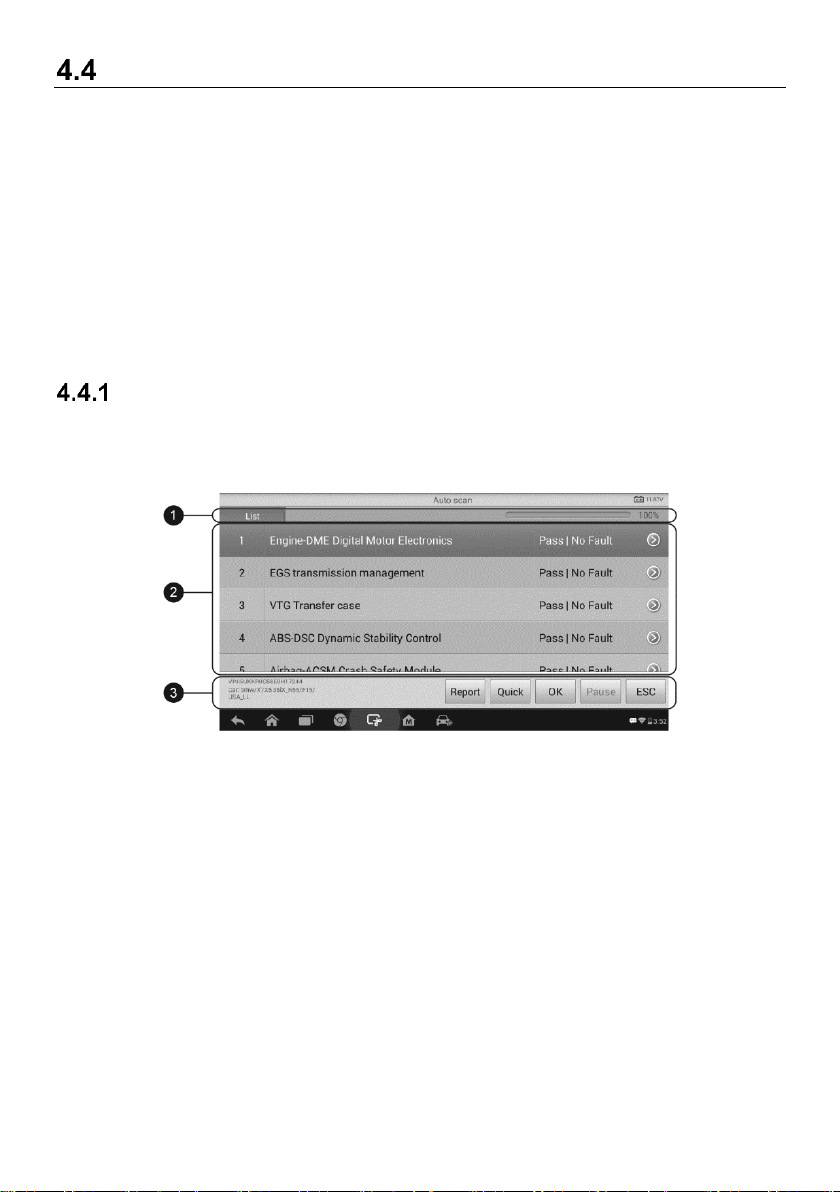
system to locate and retrieve DTCs. The sample operation screen of Auto Scan displays
as below:
Figure 4-9 Sample Auto Scan Operation Screen
1. Navigation Bar
2. Main Section
3. Function Buttons

22
4.4.1.1 Navigation Bar
List Tab — displays the scanned data in list format.
Progress Bar — indicates the test progress.
4.4.1.2 Main Section
Column 1 — displays the sequence numbers.
Column 2 — displays the scanned systems.
Column 3 — displays the diagnostics indicators describing test results.
These indicators are defined as follows:
-!-: Indicates that the scanned system may not support the code reading function,
or there is a communication error between the tablet and the control system.
-?-: Indicates that the vehicle control system has been detected, but the tablet
cannot accurately locate it.
Fault(s) | #: Fault(s) indicates there is/are detected fault code(s) present; “#”
indicates the number of the detected faults.
Pass | No Fault: Indicates the system has passed the scanning process and no
fault has been detected.
Column 4 — to perform further diagnosis or testing on a specific system item, tap
the
○
> button to the right of that item. A Function Menu screen will display.
4.4.1.3 Function Buttons
A brief description of the operations of the Auto Scan’s Function Buttons’ are displayed
in the table below.
Table 4-3 Function Buttons in Auto Scan
Name
Description
Report
Displays the diagnostics data in the report form.
Quick
Deletes codes. A warning message screen will display to
inform you of possible data loss when this function is
selected.
OK
Confirms the test result. Continues to the system
diagnosis after the required system is selected by
tapping the item in the Main Section.
Pause
Suspends scanning and it will change to Continue
button after tapped.
ESC
Returns to the previous screen or exits Auto Scan.
23
Control Unit
This option allows you to manually locate a required control system for testing through a
series of choices. Follow the menu driven procedures and make proper selection each
time; the program will guide you to the diagnostics function menu after selections are
made.
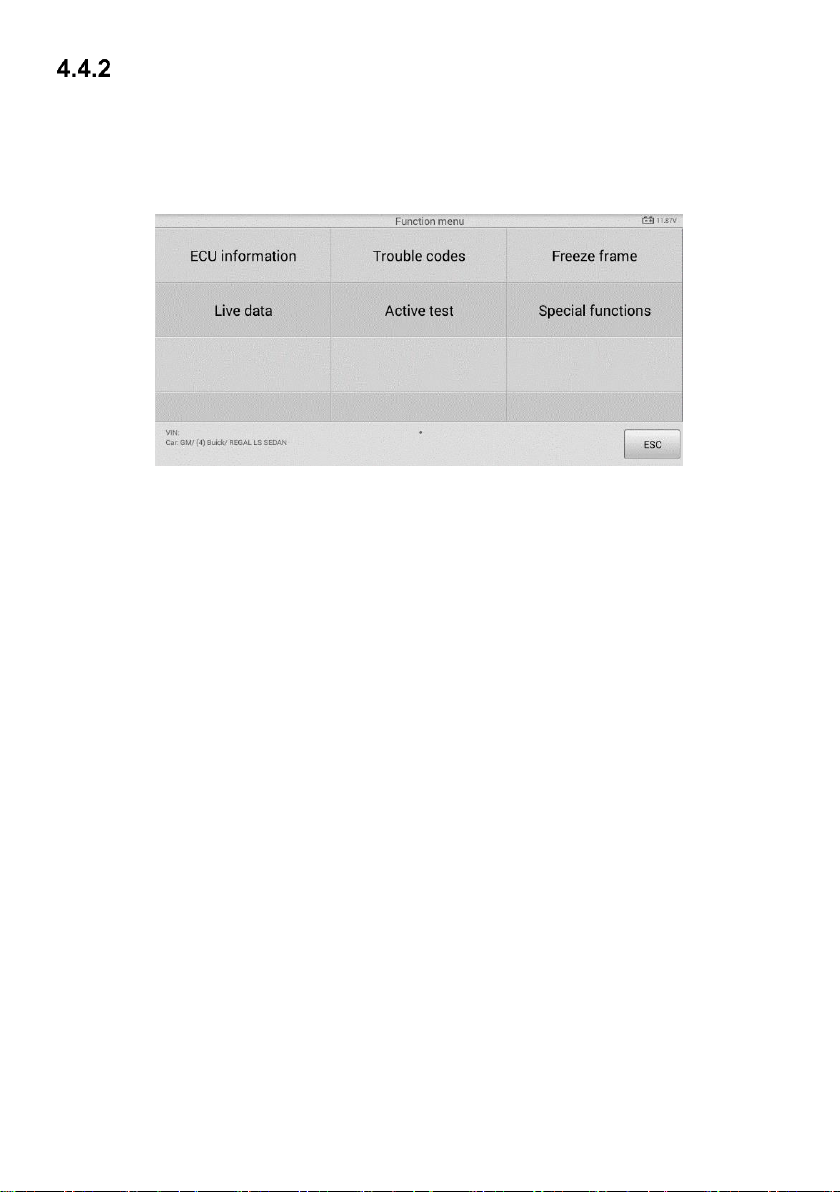
Figure 4-10 Sample Function Menu
The Function Menu options vary slightly for different vehicles. The function menu may
include:
ECU Information — provides the retrieved ECU information in detail. Selecting
opens an information screen.
Trouble Codes — includes Read codes and Erase codes functions. Displays
detailed information of DTC records retrieved from the test vehicle’s ECU and erases
DTC records and other data from the test vehicle’s ECU.
Freeze Frame — displays the freeze frame data of the DTCs.
Live Data — retrieves and displays live data and parameters from the test vehicle’s
ECU.
Active Test — accesses vehicle-specific subsystem and components test.
Special Functions — performs various component adaptations.
24
NOTE
With the diagnostics toolbar on top of the screen throughout the whole diagnostics
procedures, you are allowed to make various controls of the diagnostics information at
any time, such as printing and saving the displayed data, getting help information, or
performing data logging, etc.
To perform a diagnostics function
1. Establish communication with the test vehicle.
2. Identify the test vehicle by selecting from the menu options.
3. Select the Diagnosis section.
4. Locate the required system for testing by Auto Scan or through menu driven
selections in Control Unit.
5. Select the desired diagnostics function from the Function Menu.
4.4.2.1 ECU Information
This function retrieves and displays the specific information for the tested control unit,
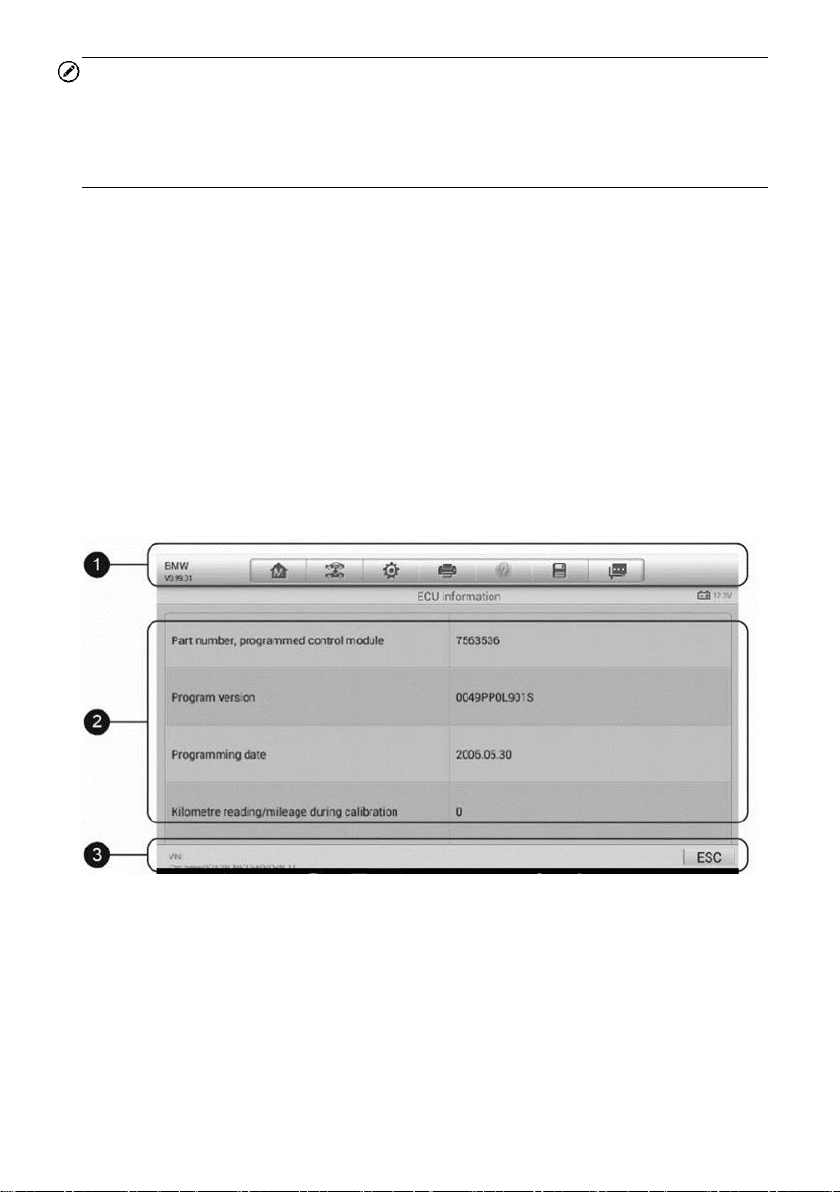
including unit type, version numbers and other specifications.
The sample ECU Information screen displays as below:
Figure 4-11 Sample ECU Information Screen
1. Diagnostics Toolbar Buttons — see Table 4-2 Diagnostics Toolbar Buttons for
detailed descriptions of the operations for each button.
2. Main Section — the left column displays the item names; the right column shows the
specifications or descriptions.
3. Function Button — in this case, only an ESC (or sometimes a Back) button is
available; tap it to exit after viewing.
25
4.4.2.2 Trouble Codes
Read Codes
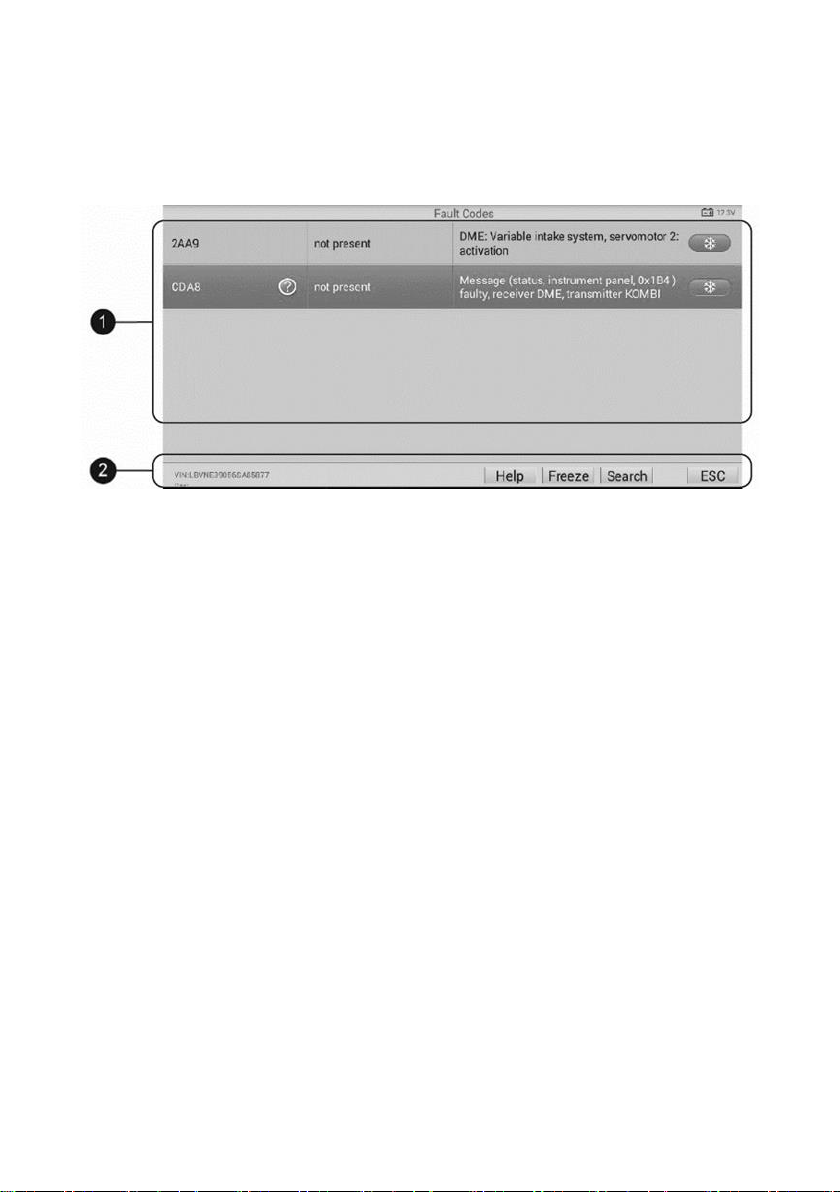
This function retrieves and displays the DTCs from the vehicle’s control system. The
Read Codes screen varies for each vehicle being tested. On some vehicles, freeze frame
data can also be retrieved for viewing. The sample Read Codes screen displays as below:
Figure 4-12 Sample Read Codes Screen
1. Main Section
Code Column — displays the retrieved codes from the vehicle.
Status Column — indicates the status of the retrieved codes.
Description Column — detailed descriptions for the retrieved codes.
Snowflake Icon — only displays when freeze frame data is available for viewing;
selecting this icon will display a data screen that looks very similar to the Read
Codes screen.
2. Function Button
Help — tap this to view fault code, including fault description, condition for fault
identification, and driver information.
Freeze — tap this to view the freeze frame data.
Search — tap this icon to search fault code related information in Google.
ESC — tap it to return to the previous screen or exit the function.
Erase Codes
After reading the retrieved codes from the vehicle and certain repairs have been carried
out, you can erase the codes from the vehicle using this function. Before performing this
function, make sure the vehicle’s ignition key is in the ON (RUN) position with the engine
off.
26
To erase codes
1. Tap Trouble Codes from the Function Menu, then tap Erase Codes.
2. A warning message displays to inform you of data loss if this function is
completed.
a) Tap Yes to continue. A confirming screen displays when the operation is
successfully done.
b) Tap No to exit.
3. Tap ESC on the confirming screen to exit Erase Codes.
4. Perform the Read Codes function again to check if codes have been erased
successfully.
4.4.2.3 Live Data
When this function is selected, the screen displays the data list for the selected module.
The items available for any control module vary from one vehicle to another. The
parameters display in the order that they are transmitted by the ECM, so expect variation
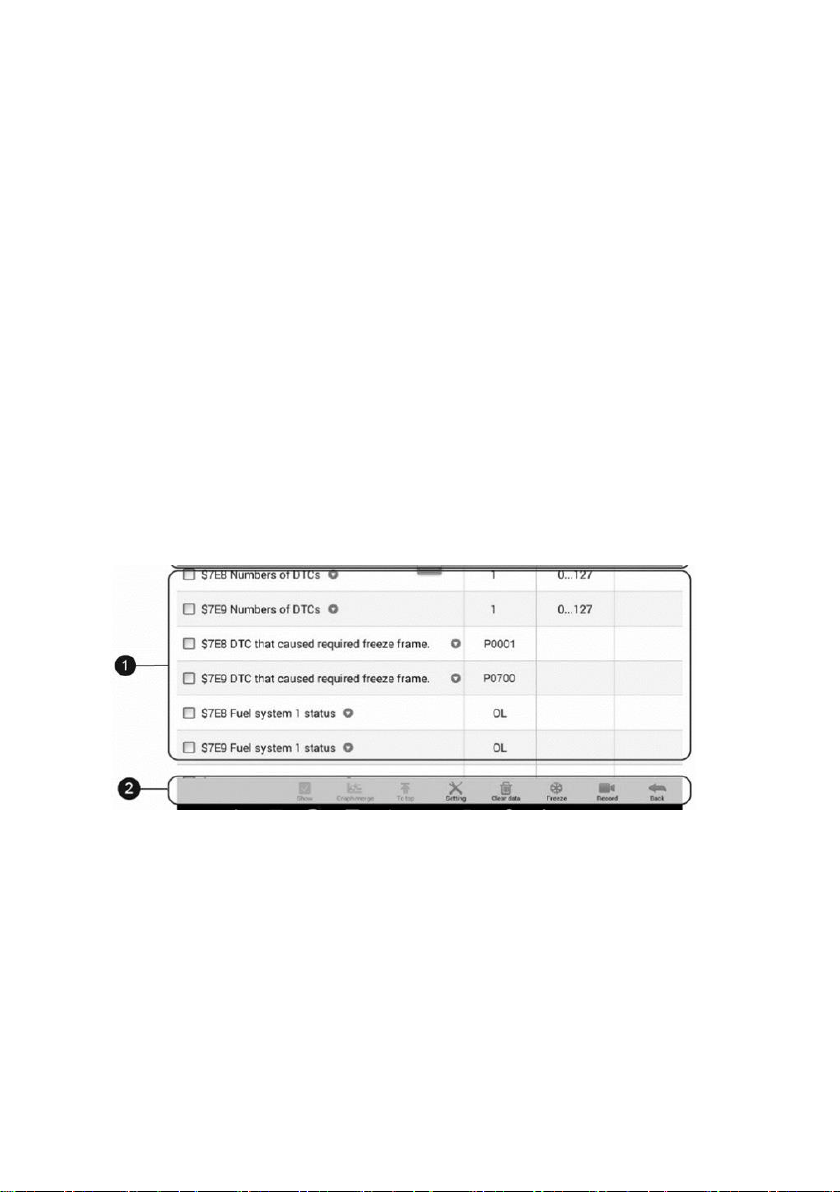
between vehicles.
Gesture scrolling allows you to quickly move through the data list. Simply swipe the
screen up or down to locate the data you want. The figure below shows a typical Live
Data screen:
Figure 4-13 Sample Live Data Screen
1. Main Section
Name Column — displays the parameter names.
a) Check Box — tap the check box on the left side of the parameter name to
make item selection. Tap the check box again to de-select the item.
b) Drop-down Button — tap the drop-down button on the right side of the
parameter name to open a sub menu that provides various choices for data
display mode.
Value Column — displays the values of the parameter items.
Unit Column — displays the unit for the parameters.

27
To change the unit mode, tap the Setting button on the top toolbar and select a required
mode. See Unit for more information.
Display Mode
There are four types of display modes available for data viewing, allowing you to view
various types of parameters in the most suitable way.
Tapping the drop-down button on the right side of the parameter name to open a sub
menu. There are four buttons to configure the data display mode, and a Help button for
access to additional information.
Each parameter item displays the selected mode independently.
1) Analog Gauge Mode — displays the parameters in form of an analog meter graph.
2) Text Mode — this is the default mode that displays the parameters in texts and
displays in list format.
NOTE
Reading of status parameters, such as a switch reading, which are mostly in word form,
such as ON, OFF, ACTIVE, and ABORT, can only be displayed in Text Mode. Whereas
reading of value parameters, such as a sensor reading, can be displayed in text mode
and other graph modes.
3) Waveform Graph Mode — displays the parameters in waveform graphs.
When this mode is applied, three control buttons will display on the right side of the
parameter item, allowing you to manipulate the display status.
Text Button — resumes Text Display Mode.
Scale Button — changes the scale values, which are displayed below the
waveform graph. There are four scales available: x1, x2, x4 and x8.
Zoom-in Button — tap once to display the selected data graph in full screen.
Edit Button — tap this button to open an edit window, on which you can set
the waveform color and the line thickness displayed for the selected
parameter item.
Scale Button — changes the scale values, which are displayed below the
waveform graph. There are four scales available: x1, x2, x4 and x8.
Zoom-out Button — exits full screen display.
4) Digital Gauge Mode — displays the parameters in form of a digital gauge graph.
Full Screen Display — this option is only available in the waveform graph mode, and
mostly used in Graph Merge status for data comparison. There are three control buttons
available on the top right side of the screen under this mode.
To edit the waveform color and line thickness in a data graph
1. Select 1 to 3 parameter items to display in Waveform Graph mode.
2. Tap the Zoom-in Button on the right to display the data graph in full screen.
3. Select a parameter item on the left column.

28
4. Select a desired sample color from the middle column.
5. Select a desired sample line thickness from the right column.
6. Repeat steps 3-5 to edit the waveform for each parameter item.
7. Tap Done to save the setting and exit, or tap Cancel to exit without saving.
2. Function Buttons
The operations of available function buttons on Live Data screen are described
below:
Back — returns to previous screen or exits the function.
Record — starts recording the retrieved live data; the recorded data is then
stored as a video clip in the Data Manager application for future reviews. This
function could be triggered automatically at preset threshold value or manually
as you choose. The triggering mode and record duration can be configured in
the Setting mode of Live Data.
Freeze — displays the retrieved data in freeze frame mode.
Previous Frame — moves to the previous frame in the freeze frame data.
Next Frame — moves to the next frame in the freeze frame data.
Clear Data — clears all previously retrieved parameter values at a selected
point.
To Top — moves a selected data item to the top of the list.
Graph Merge — tap this button to merge selected data graphs (for Waveform
Graph Mode only). This function is useful when making a comparisons between
parameters.
NOTE
This mode supports Graph Merge for 2 to 3 parameter items.
To cancel Graph Merge mode, tap the drop-down button on the right side of the
parameter name, and select a data display mode.
Show — tap this option to switch between the two options; one displays the
selected parameter items, the other displays all the available items.
Setting — tap this button to access setting screen to set the trigger mode,
recording duration and threshold values for data recording, and define other
control settings.
29
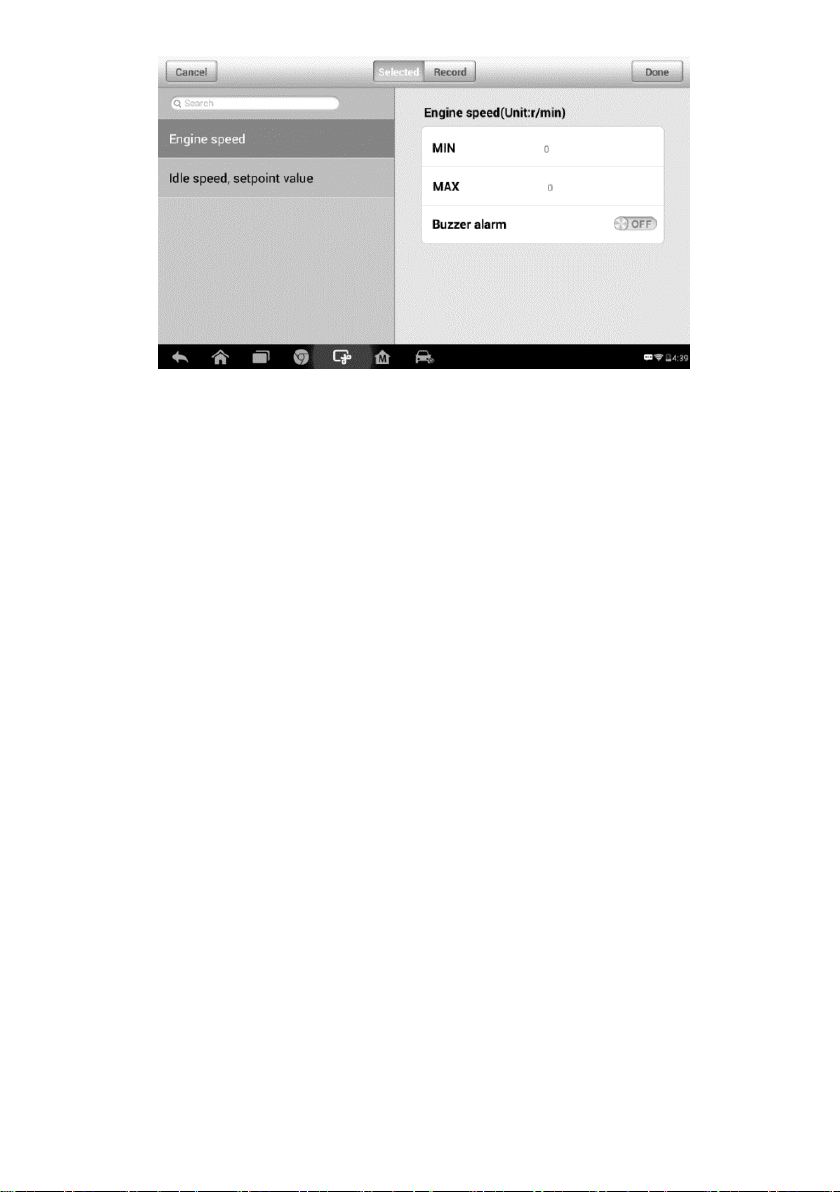
Figure 4-14 Sample Setting Mode in Live Data
There are four navigation buttons on top of the Setting mode screen.
Selected Button — displays the configuration screen on which you can set the
threshold values, an upper limit and a lower limit, for triggering the buzzer alarm.
This function only applies to the Waveform Graph display mode.
a) MIN — tap to open a virtual keyboard, allowing you to enter the required
lower limit value.
b) MAX — tap to open a virtual keyboard, allowing you to enter the required
upper limit value.
c) Buzzer Alarm — switches the alarm on and off. The alarm function beeps
as a reminder whenever the data reading reaches the pre-set minimum or
maximum point.
To set threshold limits for the parameter values
1. Tap the Setting function button at the bottom of the Live Data screen.
2. Tap the Selected navigation button.
3. Select a parameter item on the left column, or enter the item name in the
Search bar.
4. Tap on the right side of the MIN button, and enter the required minimum value.
5. Tap on the right side of the MAX button, and enter the required maximum value.
6. Tap the ON/OFF button on the right side of the Buzzer Alarm button to turn it
on or off.
7. Tap Done to save the setting and return to the Live Data screen; or tap Cancel
to exit without saving.
If the threshold limits are successfully set, two horizontal lines will appear on each of the
data graphs (when Waveform Graph Mode is applied) to indicate the alarming point. The

30
threshold lines are shown in different colors from the waveform of the parameters for
distinction.
Record Button — displays the configuration screen for Record Setting, on
which you can set the trigger type, duration and trigger point for the data
recording function.
a) Trigger Type — sets the trigger mode for data recording, mainly of two
kinds: Manual and Auto. There are four options available:
1) Manual — allows you to manually start and stop data recording
2) DTC — auto triggers data recording when any DTC is detected
3) DTC Check Mode — auto triggers data recording when certain pre-
selected DTC types are detected
4) Parameter — auto triggers data recording when any parameter value
reaches the preset threshold
b) Duration — sets the recording time (for Auto trigger mode only)
c) Trigger Point — reserves a relative percentage of a record length before
the data recording start point for reference (for Auto trigger mode only)
To perform setting for live data record
1. Tap the Setting function button at the bottom of the Live Data screen.
2. Tap the Record navigation button.
3. Tap the
○
> button on the right of Trigger Type bar and select the required
trigger mode.
4. Tap the
○
> button on the right of Duration bar and select a length of time.
5. Tap the
○
> button on the right of Trigger Point bar and select a relative
percentage of a record length to be reserved before the data recording start
point.
6. Tap Done to save the setting and return to the Live Data screen; or tap Cancel
to cancel without saving and exit Setting.
Done Button - confirms and saves the setting, and returns you to the Live Data
screen.
Cancel Button — cancels the setting operation, and returns you to the Live
Data screen.
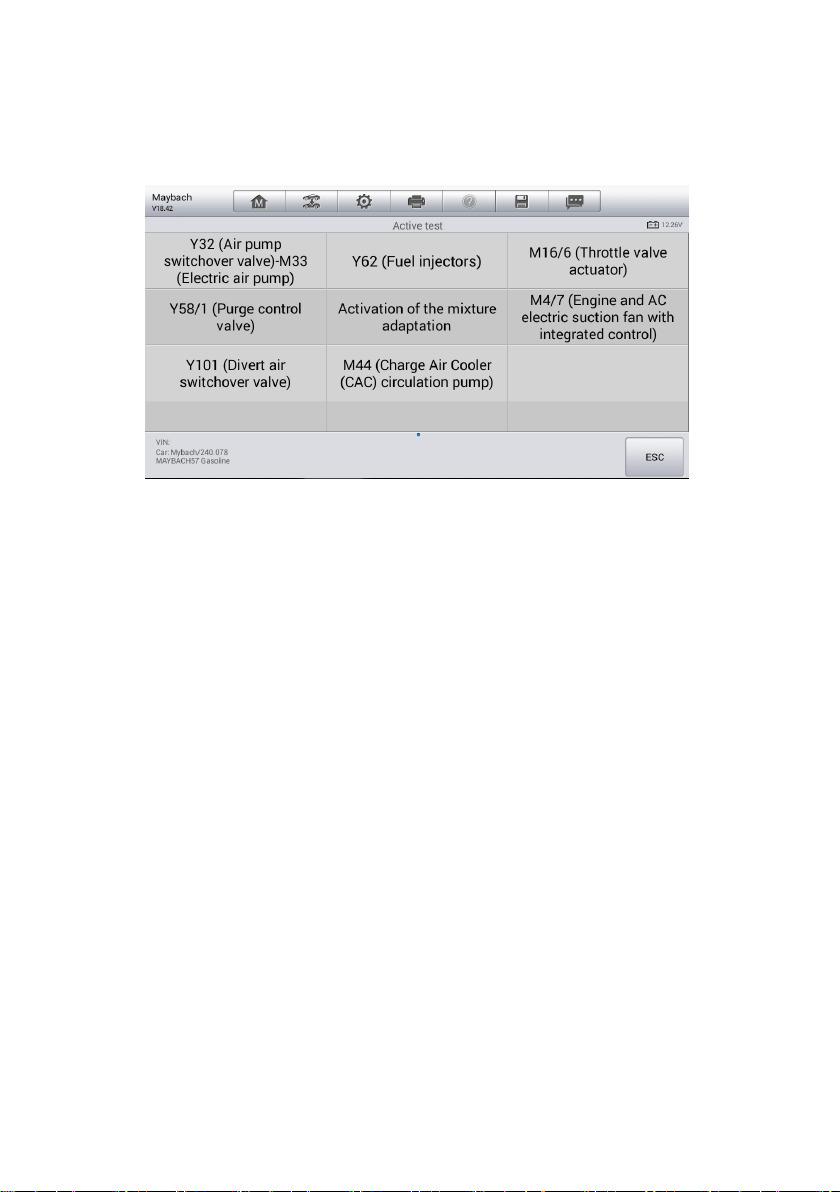
4.4.2.4 Active Test
The Active Test function is used to access vehicle-specific subsystem and component
tests. Available tests vary depending on the manufacturer, year, and model.
During an active test, the tablet sends commands to the ECU in order to drive the
actuators. This test determines the integrity of the system or parts by reading the engine
ECU data, or by monitoring the operation of the actuators. Such tests may include
toggling between two positions of a solenoid, relay or switch.
31
Selecting Active Test opens a menu of test options that varies by make and model.
Select a test from the menu options. Follow on-screen instructions to complete the tests.
Procedures and instructions vary by vehicles. Some toggle and variable control tests
display Active Test Controls at the top of the screen with data stream information below,
or vice versa.
The function buttons at the lower-right corner of the Active Test screen manipulate the
test signals. The operational instructions are displayed on the main section of the test
screen. Simply follow the on-screen instructions and make appropriate selections to
complete the tests. Each time when an operation is successfully executed, message
such as “Command Finished”, “Activation Successful”, or something similar displays.
Tap the ESC function button to exit the test when finished.
4.4.2.5 Special Functions
These functions perform various component adaptations, allowing you to recalibrate or
configure certain components after making repairs or replacement.
Figure 4-15 Sample Active Test Screen

32
The main menu displays the supported special functions for the test vehicle. Follow the
on-screen instructions to complete the tests. When the operation is done, an execution
status message such as Completed, Finished or Successful displays. Tap the ESC
button to exit the function.
Figure 4-16 Sample Special Functions Screen
Generic OBDII Operations
A fast-access option for OBDII/EOBD vehicle diagnosis is available on the Vehicle Menu
screen. This option presents a quick way to check for DTCs, isolate the cause of an
illuminated malfunction indicator lamp (MIL), check monitor status prior to emissions
certification testing, verify repairs, and perform a number of other services that are
emissions-related. The OBD direct access option is also used for testing OBDII/EOBD
compliant vehicles that are not included in the Diagnostics database.
Functions of the diagnostics toolbar buttons at the top of the screen are the same as
those available for specific vehicle diagnostics. See Table 4-2 Diagnostics Toolbar
Buttons for details.
General Procedure
To access the OBDII/EOBD diagnostics functions
1. Tap the Diagnostics application button from the MaxiCOM Job Menu. The
Vehicle Menu displays.
2. Tap the EOBD button. There are two options to establish communication with
the vehicle.
Auto Scan — when this option is selected the diagnostics tool attempts to
establish communication using each protocol in order to determine which
one the vehicle is broadcasting on.
Protocol — when this option is selected the screen opens a submenu of
protocols. A communication protocol is a standardized way of data
33
communication between an ECM and a diagnostics tool. Global OBD may
use several different communications protocols.
3. Select a specific protocol under the Protocol option. Wait for the OBDII
Diagnostic Menu to display.
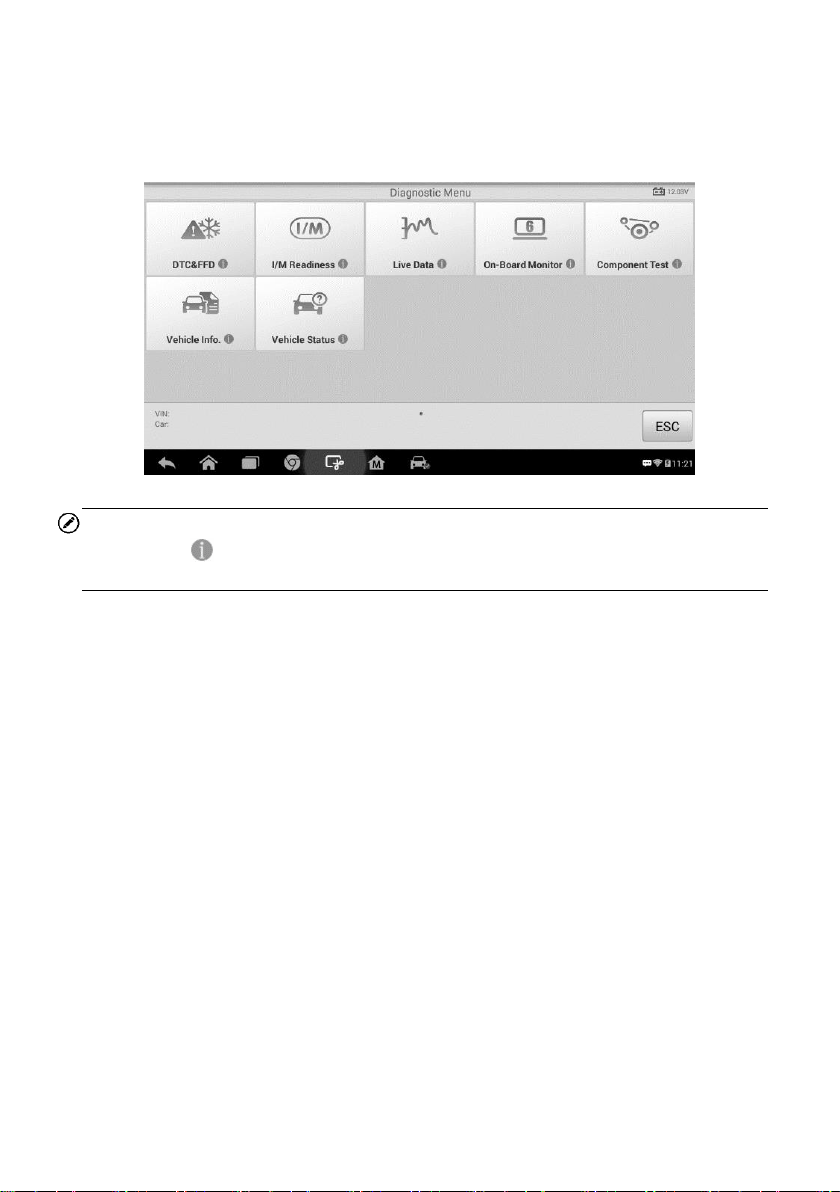
Figure 4-17 Sample OBDII Diagnostic Menu
NOTE
Tapping the button beside the function name to display additional function
information.
4. Select a function option to continue.
DTC & FFD
I/M Readiness
Live Data
On-Board Monitor
Component Test
Vehicle Information
Vehicle Status
34
NOTE
Some functions are supported only on certain vehicle manufacturers.
Function Descriptions
This section describes the various functions of each diagnostics option:
4.5.2.1 DTC & FFD
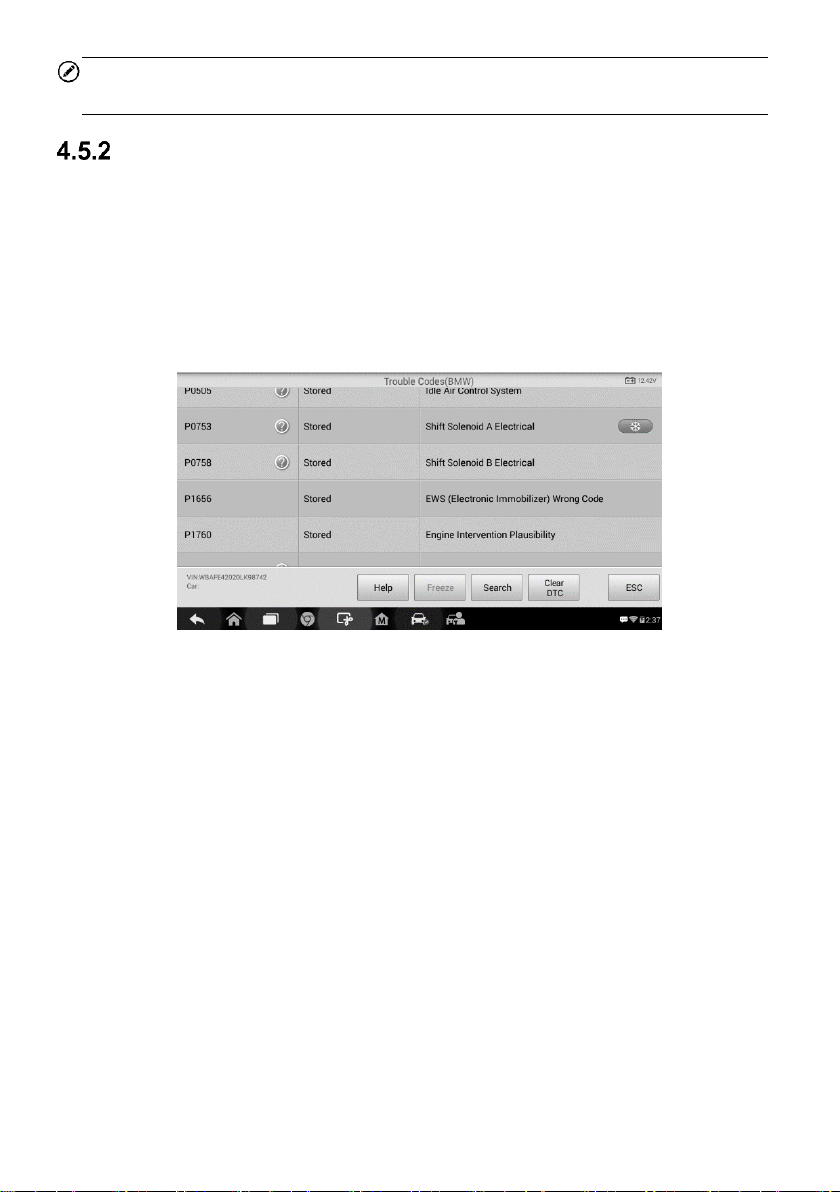
When this function is selected, the screen displays a list of Stored Codes and Pending
Codes. When the Freeze Frame data of certain DTCs are available for viewing, a
snowflake button will display on the right side of the DTC item. The erase codes function
can be applied by tapping the Clear DTC button at the bottom of the screen.
Figure 4-18 Sample DTC & FFD Screen
Stored Codes
Stored codes are the current emission related DTCs from the ECM of the vehicle.
OBDII/EOBD Codes have a priority according to their emission severity, with higher
priority codes overwriting lower priority codes. The priority of the code determines the
illumination of the MIL and the codes erase procedure. Manufacturers rank codes
differently, so expect to see differences between makes.
Pending Codes
These are codes whose setting conditions were met during the last drive cycle, but need
to be met on two or more consecutive drive cycles before the DTC actually sets. The
intended use of this service is to assist the service technician after a vehicle repair and
after clearing diagnostics information, by reporting test results after a driving cycle.
If a test failed during the driving cycle, the DTC associated with that test is reported.
If the pending fault does not occur again within 40 to 80 warm-up cycles, the fault is
automatically cleared from memory.
Test results reported by this service do not necessarily indicate a faulty component
or system. If test results indicate another failure after additional driving, then a DTC
is set to indicate a faulty component or system, and the MIL is illuminated.

35
Freeze Frame
In most cases the stored frame is the last DTC that occurred. Certain DTCs, which have
a greater impact on vehicle emission, have a higher priority. In these cases, the top
prioritized DTC is the one for which the freeze frame records are retained. Freeze frame
data includes a “snapshot” of critical parameter values at the time the DTC is set.
Clear DTC
This option is used to clear all emission related diagnostics data such as, DTCs, freeze
frame data and manufacturer specific enhanced data from the vehicle’s ECM.
A confirmation screen displays when the clear codes option is selected to prevent
accidental loss of data. Select Yes on the confirmation screen to continue or No to exit.
4.5.2.2 I/M Readiness
This function is used to check the readiness of the monitoring system. It is an excellent
function to use prior to having a vehicle inspected for compliance to a state emissions
program. Selecting I/M Readiness opens a submenu with two choices:
Since DTCs Cleared — displays the status of monitors since the last time the DTCs
are erased.
This Driving Cycle — displays the status of monitors since the beginning of the
current drive cycle.
4.5.2.3 Live Data
This function displays the real time PID data from ECU. Displayed data includes analog
inputs and outputs, digital inputs and outputs, and system status information broadcast
on the vehicle data stream.
Live data can be displayed in various modes, see Live Data for detailed information.
4.5.2.4 On-Board Monitor
This option allows you to view the results of On-Board Monitor tests. The tests are useful
after servicing or after erasing a vehicle’s control module memory.
4.5.2.5 Component Test
This service enables bi-directional control of the ECM so that the diagnostics tool is able
to transmit control commands to operate the vehicle systems. This function is useful in
determining whether the ECM responds to a command well.
4.5.2.6 Vehicle Information
The option displays the vehicle identification number (VIN), the calibration identification,
and the calibration verification number (CVN), and other information of the test vehicle.
36
4.5.2.7 Vehicle Status
This item is used to check the current condition of the vehicle, including communication
protocols of OBDII modules, amount of codes, status of the Malfunction Indicator Light
(MIL), and additional information.
Exiting Diagnostics
The Diagnostics application remains open as long as there is active communication with
the vehicle. You must exit the diagnostics operation to stop all communications with the
vehicle before closing the Diagnostics application.
NOTE
Damage to the vehicle electronic control module (ECM) may occur if communication
is disrupted. Make sure all connections, such as USB cable and wireless connections,
are properly connected at all times during testing. Exit all tests before disconnecting
the test connection or powering down the tool.
To exit the Diagnostics application
1. From an active diagnostics screen, tap the Back or ESC function button to exit
a diagnostics session step-by-step.
2. Or tap the Vehicle Swap button on the diagnostics toolbar to return to the
Vehicle Menu screen.
3. From the Vehicle Menu screen, tap the Home button on the top toolbar; or tap
the Back button on the navigation bar at the bottom of the screen.
4. Or tap the Home button on the diagnostics toolbar to exit the application directly
and return to the MaxiCOM Job Menu.
Once the Diagnostics application is no longer communicating with the vehicle, it is safe
to open other MaxiCOM applications, or exit the MaxiCOM Diagnostics System and
return to the Android System’s Home screen.
37
Service Operations
The Service section is specially designed to provide you with quick access to the vehicle
systems for various scheduled service and maintenance performances. The typical
service operation screen is a series of menu driven executive commands. By following
the on-screen instructions to select appropriate execution options, enter correct values
or data, and perform necessary actions, the system will guide you through the complete
performance for various service operations.
The most commonly performed service functions include:
Oil Reset Service
EPB Service
BMS Service
SAS Service
DPF Service
TPMS Service
IMMO Service
After entering each special function, the displayed screen consists of two applications:
Diagnosis and Hot Functions. The Diagnosis is for you to read/clear data since this is
necessary after some special functions. Hot Functions consists of sub functions of the
selected special function.
Oil Reset Service
This function allows you to perform reset for the Engine Oil Life system, which calculates
an optimal oil life change interval depending on the vehicle driving conditions and climate.
The Oil Life Reminder must be reset every time the oil is changed, so the system can
calculate when the next oil change is required.
IMPORTANT
Always reset the engine oil life to 100% after every oil change.
NOTE
All required work must be carried out before the service indicators are reset. Failure to
do so may result in incorrect service values and cause DTCs to be stored by the
relevant control module.
38
NOTE
For some vehicles, the scan tool can perform added functionality to reset additional
service lights (maintenance cycle, service interval). Using BMW as an example, its
service reset function includes engine oil, spark plugs, front/rear brakes, coolant,
particle filter, brake fluid, micro filter, vehicle inspection, exhaust emission inspection
and vehicle check.
All software screens shown in this manual are examples, actual test screens may vary
for each vehicle being tested. Observe the menu titles and on-screen instructions to
make correct option selections.
To perform oil reset functions
1. Tap the Service application button from the MaxiCOM Job Menu.
2. Tap Oil Reset button and wait for the vehicle manufacturer screen. You can
tap VIN Scan or the vehicle make to acquire vehicle VIN information and tap
Yes to confirm. See Vehicle Identification for details.
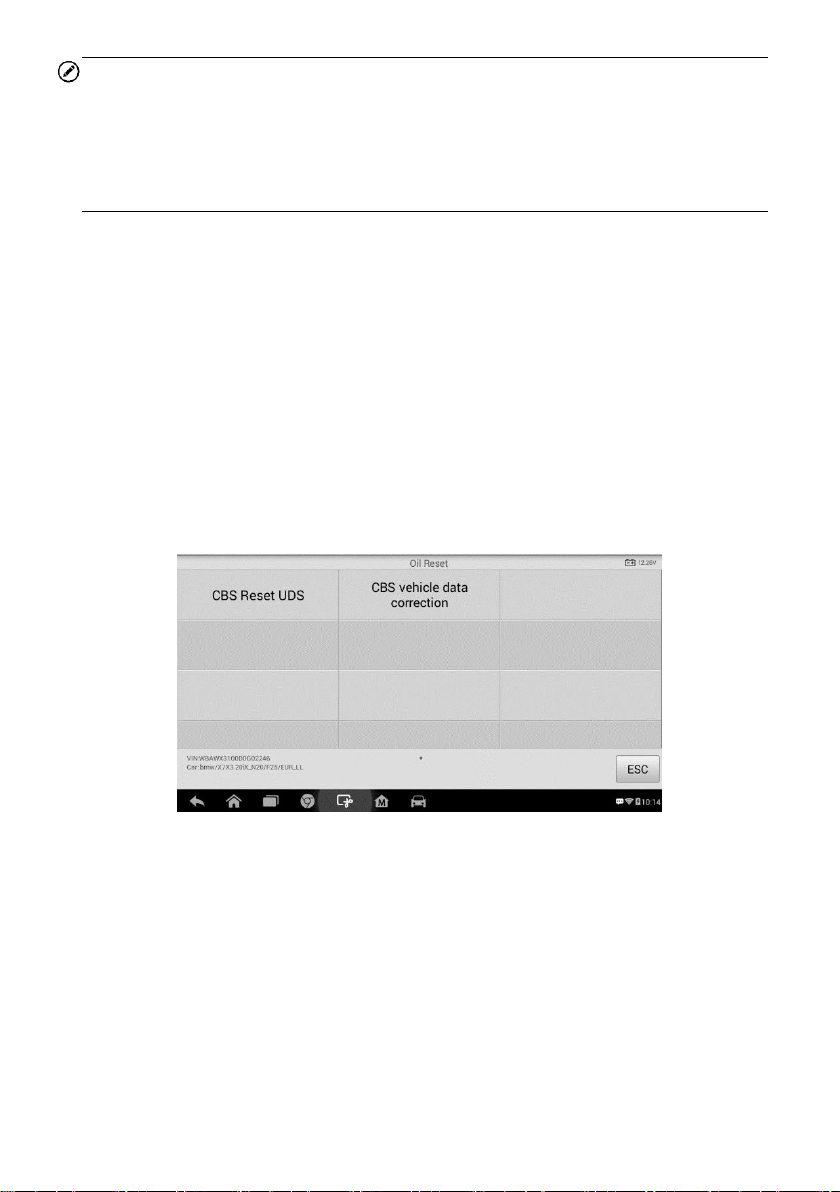
3. Tap the function you want in the Oil Reset function list, the list may vary for
different vehicles being tested.
Figure 5-1 Sample Oil Reset Function List
4. Follow the step-by-step on-screen instruction to complete the service. Using
CBS Reset UDS as an example.
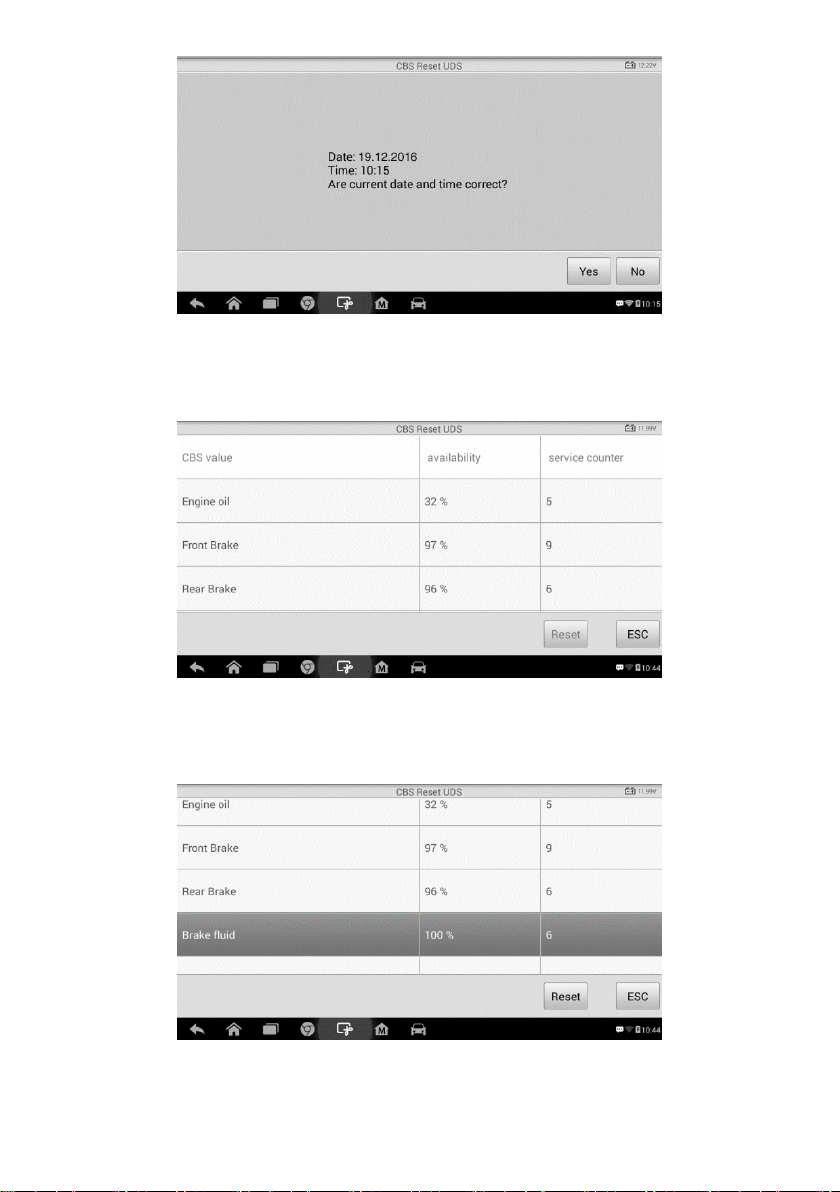
5. Tap CBS Reset UDS on the Oil Reset function list to start the operation. The
screen will guide you to confirm the date and time, if the displayed date and
time are correct, tap Yes to confirm. If not, tap No and go to the Settings menu
to set the correct date and time.
39
Figure 5-2 Sample Oil Reset Service Screen 1
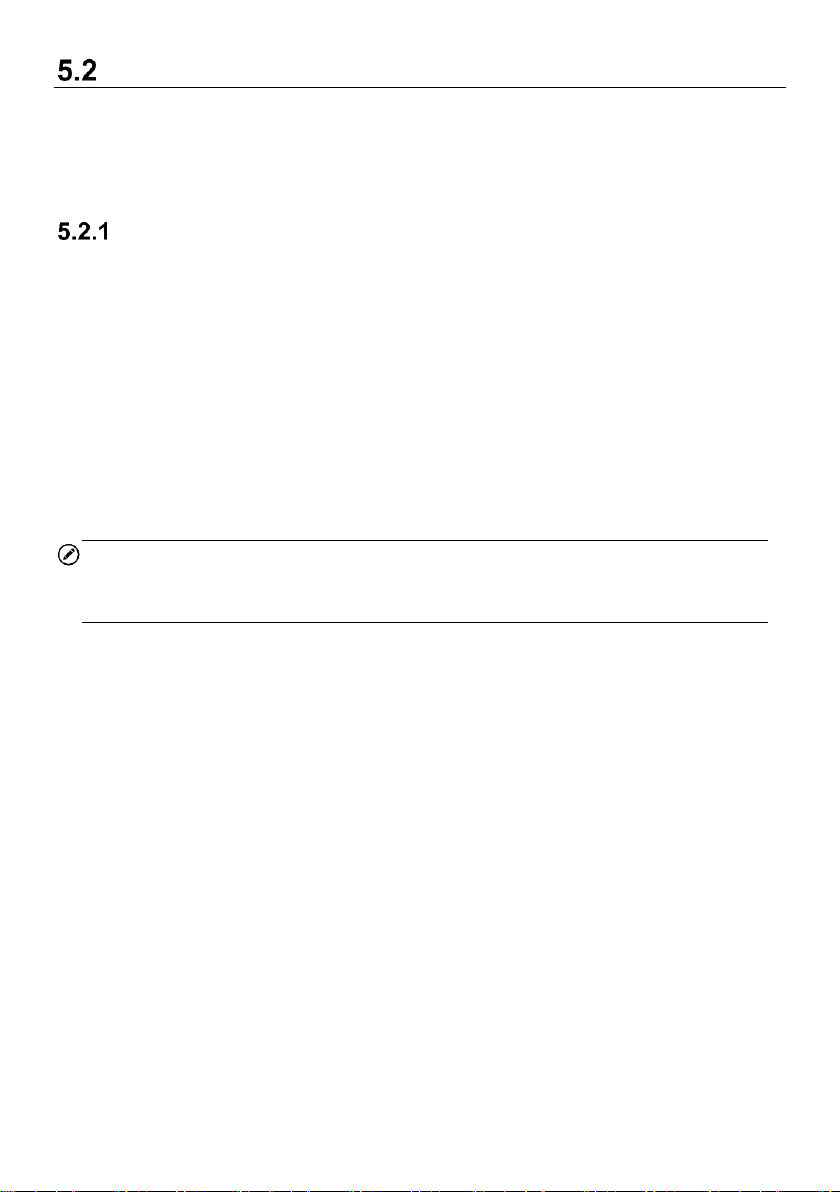
6. On the next screen, the available items would be listed with three columns
displayed: CBS value, availability, and service counter.
Figure 5-3 Sample Oil Reset Service Screen 2
7. Tap on the value you want to reset and then tap the Reset button on the right
bottom of the screen.
Figure 5-4 Sample Oil Reset Service Screen 3
8. When the reset is done, the availability would display as 100%. Tap ESC to exit.
40
Electronic Parking Brake (EPB) Service
This function has a multitude of usages to maintain the electronic braking system safely
and effectively. The applications include deactivating and activating the brake control
system, assisting with brake fluid control, opening and closing brake pads, and setting
brakes after disc or pad replacement.
EPB Safety
It may be dangerous to perform Electronic Parking Brake (EPB) system maintenance, so
before you begin the service work, please keep these rules in mind.
Ensure that you are fully familiar with the braking system and its operation before
commencing any work.
The EPB control system may be required to be deactivated before carrying out any
maintenance/diagnostics work on the brake system. This can be done from the tool
menu.
Only carry out maintenance work when the vehicle is stationary and on level ground.
Ensure that the EPB control system is reactivated after the maintenance work has
been completed.
NOTE
Autel accepts no responsibility for any accident or injury arising from the maintenance
of the Electronic Parking Brake system.
To perform EPB functions
1. Tap the Service application button from the MaxiCOM Job Menu.
2. Tap EPB button and wait for the vehicle manufacturer screen. You can tap VIN
Scan or the vehicle make to acquire vehicle VIN information and tap Yes to
confirm. See Vehicle Identification for details.
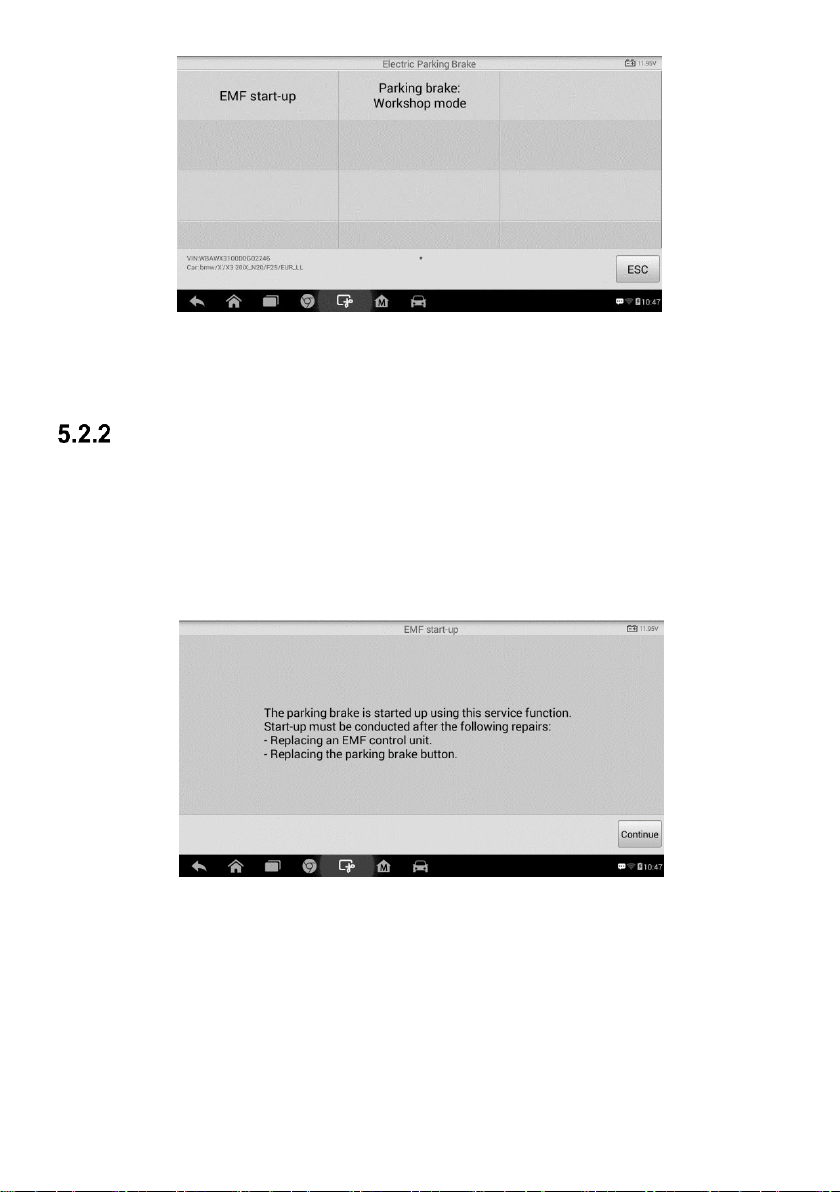
3. Tap the service you want in the EPB function list, the list may vary for different
vehicles being tested.
41
Figure 5-5 Sample EPB Function List
4. Follow the step-by-step on-screen instruction to complete the service.
5. Press OK button to exit.
EMF Start-up
This service function would start the parking brake, it must be conducted after the
following repairs:
Replacing an EMF control unit.
Replacing the parking brake button.
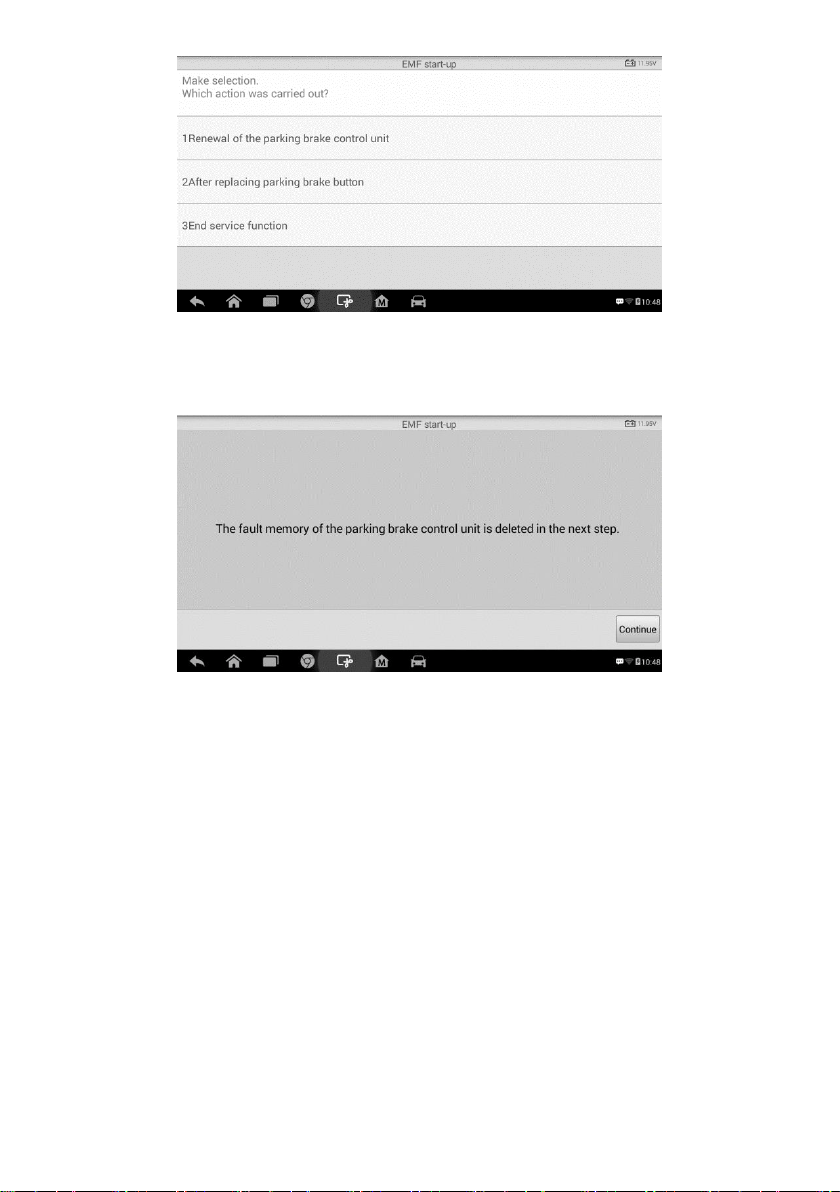
1) Tap Continue to proceed this service function or the Back button at the bottom left
to exit.
Figure 5-6 Sample EMF Star-up Screen 1
2) Tap on the action taken to continue.
42
Figure 5-7 Sample EMF Star-up Screen 2
3) A screen will display to remind you that the fault memory of the parking brake control
unit will be deleted, press Continue to proceed or the Back button to exit.
Figure 5-8 Sample EMF Star-up Screen 3
4) Follow the on-screen instructions to pull the parking brake button and wait for around
3 seconds until the parking brake is set. When the operation is successfully
completed, a “Completed successfully” message will display on the screen. Press
OK to exit.
5.2.2.1 Parking Brake: Workshop Mode
This service is used to activate and deactivate the so-called installation position for the
Automatic Hold brake. In this mode, the parking brake is moved into the opened position
and temporarily deactivated for personal protection.
The installation position must be activated for the following repairs:
Replacement of brake pads.
Replacement of a brake caliper.
Replacement of an actuator.
Select Parking Brake: Workshop Mode and follow the on-screen instructions to
perform a series of operations to start the brake pad after replacement.

43
When the operation is successfully completed, a “Completed successfully” message will
appear on the screen. Press OK to exit.
BMS
The BMS (Battery Management System) allows the scan tool to evaluate the battery
charge state, monitor the close-circuit current, register the battery replacement, and
activate the rest state of the vehicle.
NOTE
This function is not supported by all vehicles. The screens shown in this section are
examples.
The sub functions and actual test screens of the BMS may vary by vehicle. Please
follow the on-screen instructions to make the correct selection.
The vehicle may use either a sealed lead-acid battery or an AGM (Absorbed Glass Mat)
battery. Lead acid battery contains liquid sulphuric acid and can spill when overturned.
AGM battery (known as VRLA battery, valve regulated lead acid) also contains sulphuric
acid, but the acid is contained in glass mats between terminal plates.
It is recommended that the replacement aftermarket battery have the same specifications,
such as capacity and type, as the battery in the vehicle. If the original battery is replaced
with a different type of battery (e.g. a lead-acid battery is replaced with an AGM battery)
or a battery with a different capacity (mAh), the vehicle may require reprogramming the
new battery type in addition to performing the battery reset. Consult the vehicle manual
for additional vehicle-specific information.
Register Battery Replacement
This option allows displaying the mileage reading of last battery replacement, registering
the battery replacement after replacing a new battery and informing the power
management system that a new battery has been fitted to the vehicle.
If the battery change is not registered, the power management system will not function
properly, which may not provide the battery with enough charging power to operate the
car and limit the functions of individual electrical equipment.
Using BMW as an example.
To display the battery history
1. Tap the Service application button from the MaxiCOM Job Menu.
2. Tap BMS button and wait for the vehicle manufacturer screen. Tap VIN Scan or
the vehicle make to acquire vehicle VIN information and tap Yes to confirm. See
Vehicle Identification for detail.
3. Tap Register Battery Replacement in the BMS function list. The list may vary
by vehicle.
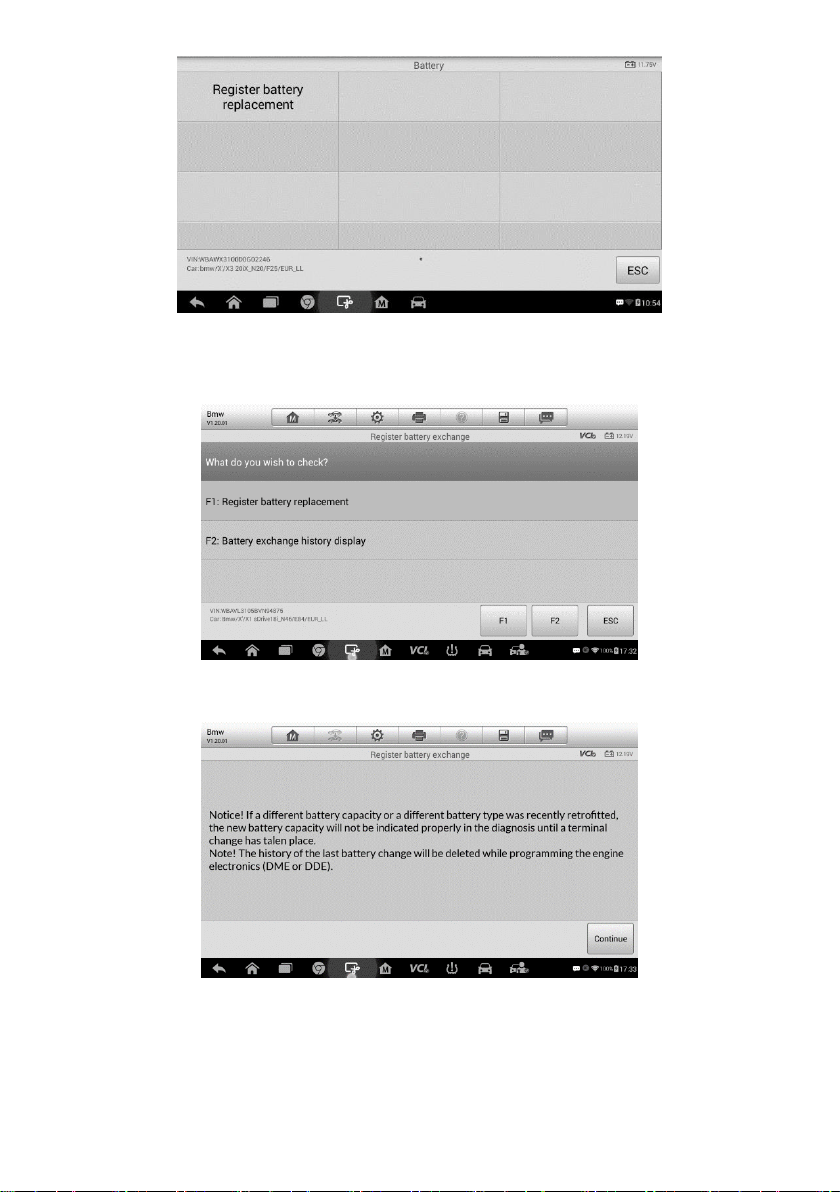
44
Figure 5-9 Sample BMS Function List
4. Tap on the desired service. In this example, Tap function 2 (F2) to choose the
function Battery exchange history display. A notice screen displays.
Figure 5-10 Sample BMS Screen 1
5. Read carefully the complete information and press Continue.
Figure 5-11 Sample BMS Screen 2
6. Check the battery capacity and the battery replacement information displayed.
7. Tap function 1 (F1) to return to the selection screen.
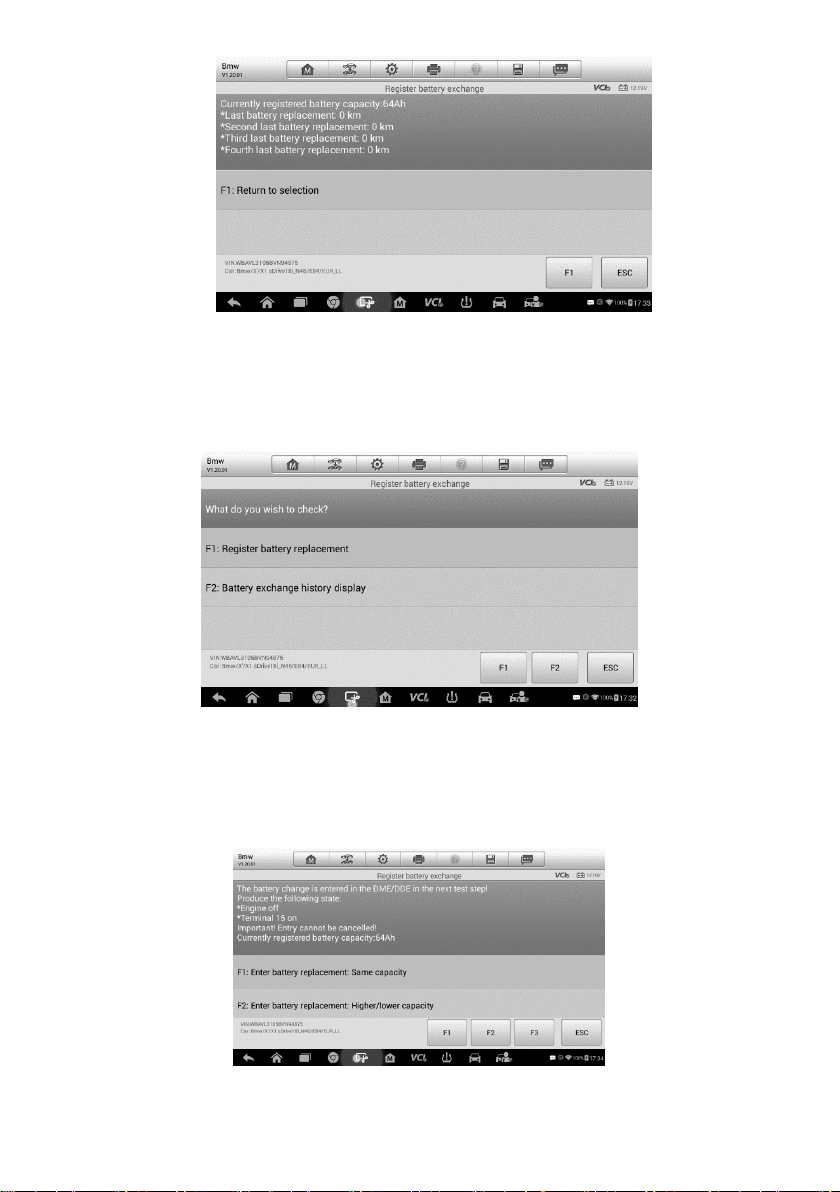
45
Figure 5-12 Sample BMS Screen 3
To register the battery replacement
1. Tap on the appropriate step to complete. In our example, tap function 1 (F1)
Register battery replacement.
Figure 5-13 Sample BMS Screen 4
2. Read carefully the information on the screen. Scroll through lists to view all the
functions.
There are three functions. Select function 1 (F1) for example.
Figure 5-14 Sample BMS Screen 5
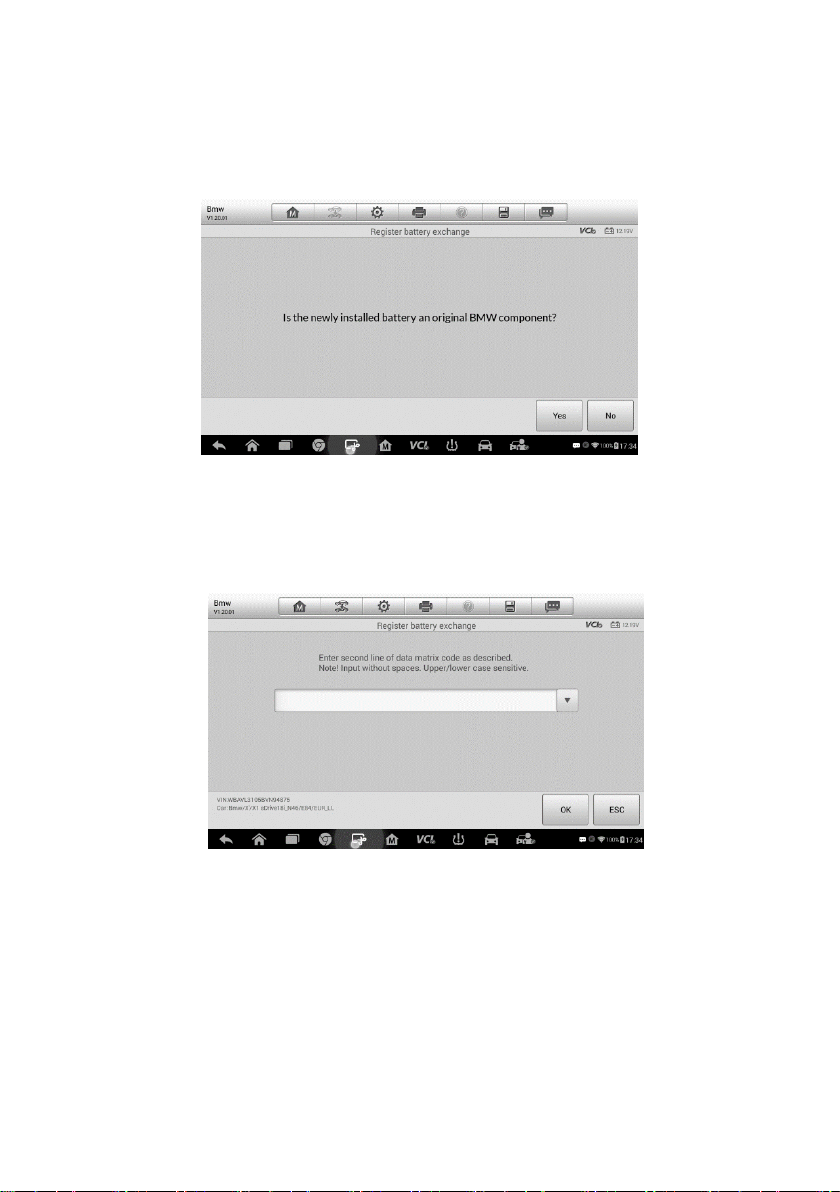
46
1) Enter battery replacement: same capacity
2) Enter battery replacement: different capacity
3) Enter battery replacement: Changing from the normal lead-acid battery
(white housing) to AGM battery (black housing)
Figure 5-15 Sample BMS Screen 6
3. Read carefully the information on the screen and tap Yes to continue.
4. Follow the on-screen instructions to input the data matrix code of the newly
installed battery that should be on the label of the battery. Tap OK to continue.
Figure 5-16 Sample BMS Screen 7
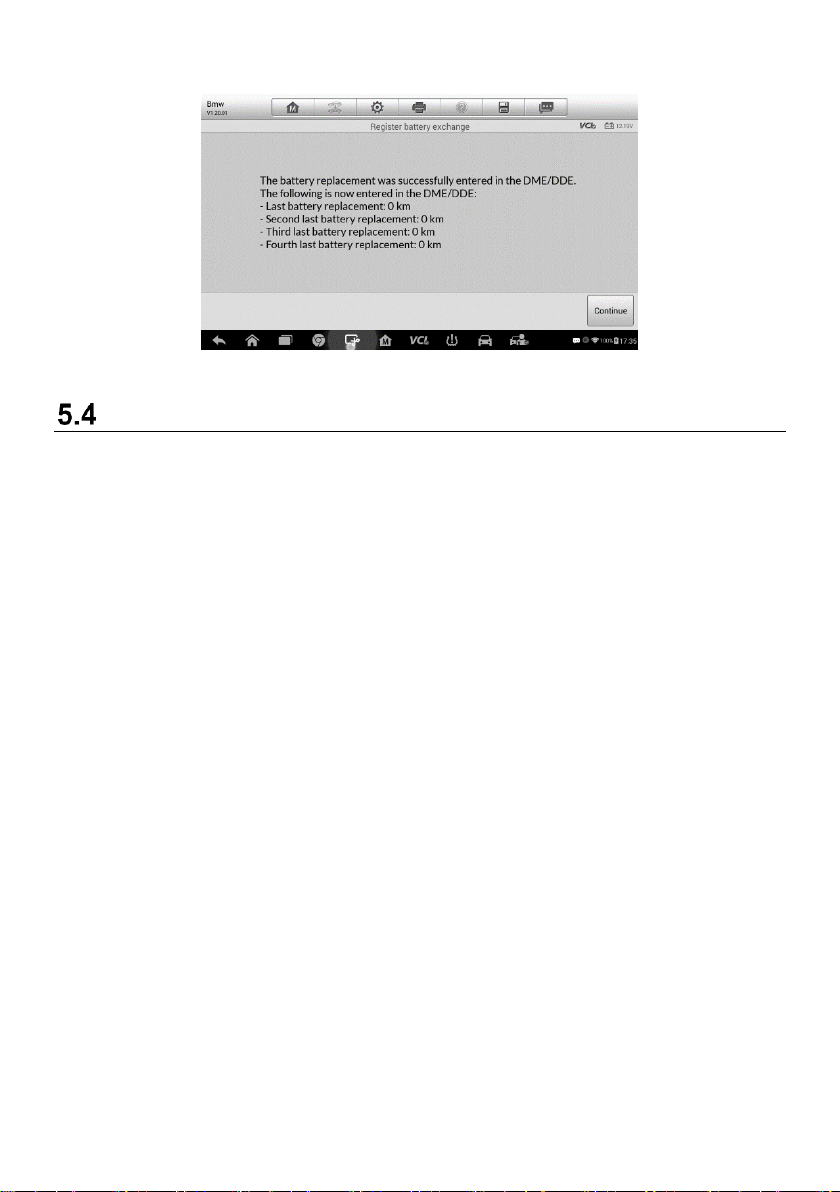
47
5. When the battery exchange is successfully entered, tap Continue to exit.
Figure 5-17 Sample BMS Screen 8
Steering Angle Sensor (SAS) Service
Steering Angle Sensor Calibration permanently stores the current steering wheel position
as the straight-ahead position in the steering angle sensor EEPROM. Therefore, the front
wheels and the steering wheel must be set exactly to the straight-ahead position before
calibration. In addition, the vehicle identification number is also read from the instrument
cluster and stored permanently in the steering angle sensor EEPROM. On successful
completion of calibration, the steering angle sensor fault memory is automatically cleared.
Calibration must be completed after the following operations:
Steering wheel replacement
Steering angle sensor replacement
Any maintenance involving opening the connector hub from the steering angle
sensor to the column
Any maintenance or repair work on the steering linkage, steering gear or other
related mechanism
Wheel alignment or wheel track adjustment
Accident repairs where damage to the steering angle sensor or assembly, or any
part of the steering system may have occurred
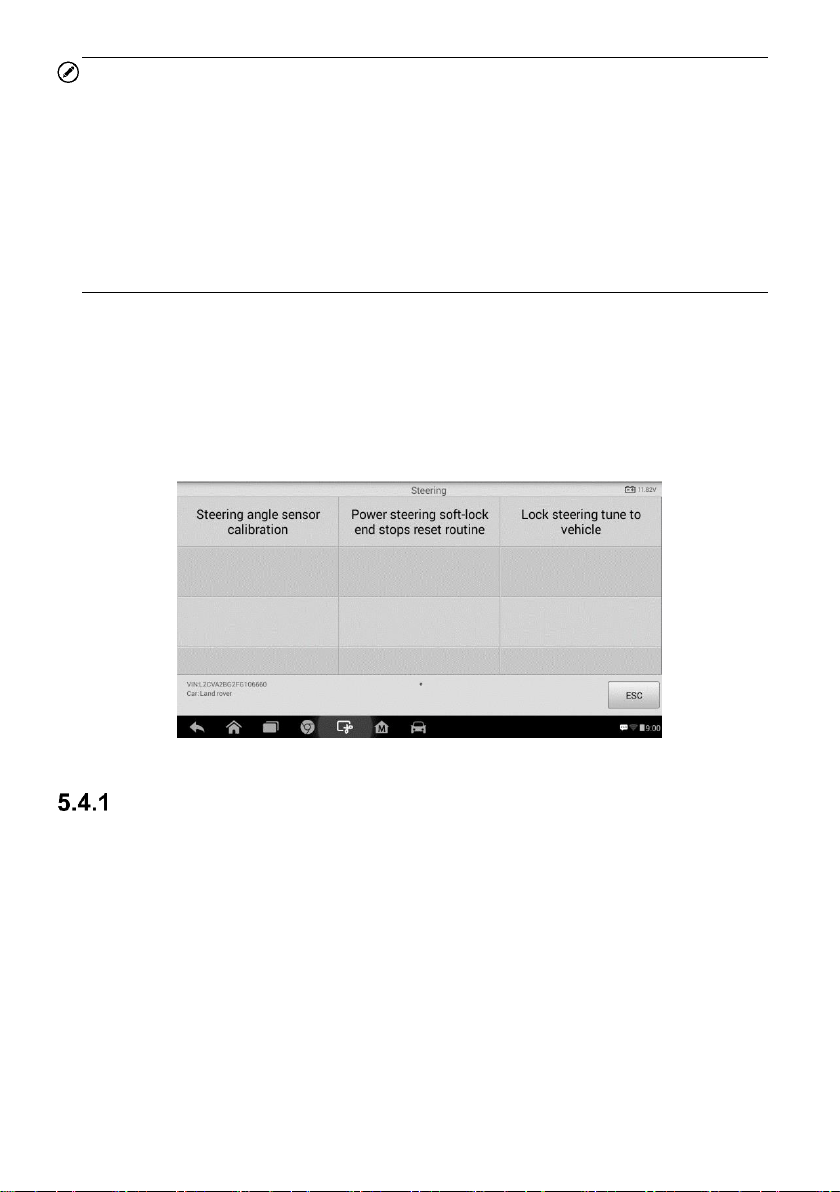
48
NOTE
AUTEL accepts no responsibility for any accident or injury arising from servicing the
SAS system. When interpreting DTCs retrieved from the vehicle, always follow the
manufacturer’s recommendation for repair.
All software screens shown in this manual are examples, actual test screens may
vary for each vehicle being tested. Observe the menu titles and on-screen instructions
to make correct option selections.
Before starting the procedure, make sure the vehicle has an ESC button. Look for
the button on dash.
Using Land Rover as an example.
1. Tap the Service application button from the MaxiCOM Job Menu.
2. Tap SAS button and wait for the vehicle manufacturer screen. You can tap VIN Scan
or the vehicle manufacturer to acquire vehicle VIN information and tap Yes to confirm.
See Vehicle Identification for details.
3. Tap the needed service in the SAS function list. The list may vary by vehicle.
Figure 5-18 Sample SAS Function Menu
Steering Angle Sensor Calibration
This function allows users to perform steering angle sensor calibration and clear records.
Available function options vary by vehicle.
1. Tap Steering Angle Sensor Calibration from the SAS function menu to enter the
function screen.
2. Follow the on-screen instructions to set the ignition on/off as guided. The vehicle
battery voltage signal should be in the range 12.5 – 13.5 volts to proceed with this
service, otherwise the scan tablet will display a warning message.
3. Make sure the steering wheel is in the center position and the front wheels are
straight. Then tap OK to proceed.
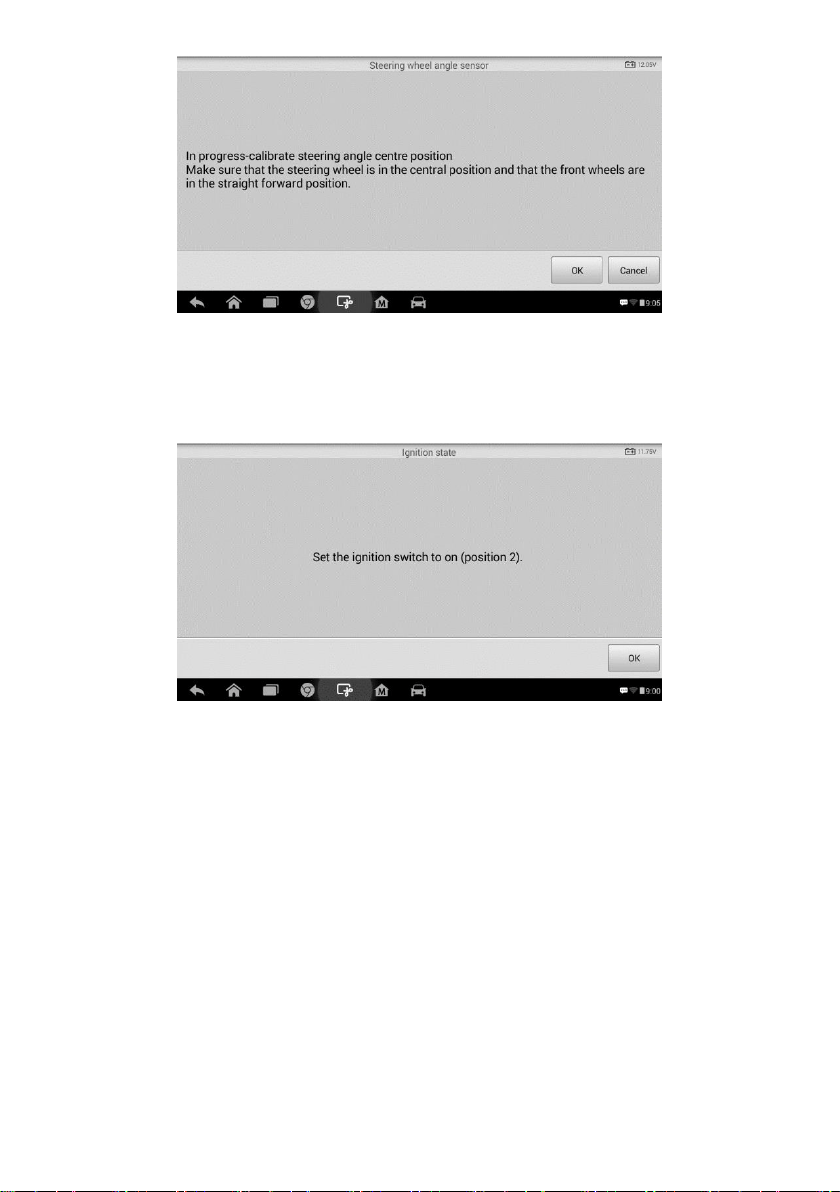
49
Figure 5-19 Sample SAS Function Screen 1
4. A confirmation message will display when the operation is complete. A message will
display if operation could not be completed because of an existing issue. Repair
problem after exiting the diagnostics application.
Figure 5-20 Sample SAS Function Screen 2
50
DPF Service
The DPF function allows you to carry out numerous functions to the Diesel Particulate
Filter system. The tool will manage DPF regeneration, DPF component replacement
teach-in and DPF teach-in after replacing the engine control unit.
The ECM monitors driving style and selects a suitable time to employ regeneration. Cars
driven primarily at idling speed and low load will attempt to regenerate earlier than cars
driven with higher loads and at higher speed. For regeneration to occur, a prolonged high
exhaust temperature must be obtained.
In the event that the vehicle has been driven in such a way that regeneration is not
possible, a diagnostics trouble code will be registered, DPF light and “Check Engine”
indicator will display. A service regeneration can be performed using this tool.
Before carrying out a forced DPF regeneration, check the following items:
The fuel light is not on.
No DPF-relevant faults are stored in system.
The vehicle has the correct spec engine oil.
The oil for diesel is not contaminated.
IMPORTANT
Before diagnosing a vehicle and attempting to perform an emergency regeneration, it
is important to obtain a full diagnostics log and read out relevant measured value
blocks.
NOTE
The DPF will not regenerate if the engine management light is on, or there is a faulty
EGR valve.
The ECU must be re-adapted when replacing the DPF and adding the fuel additive
Eolys.
If the vehicle needs to be driven in order to perform a DPF service, ALWAYS have a
second person help you. One person should drive the vehicle while the other person
observes the screen on the Tool. Trying to drive and observe the Scan Tool at the
same time is dangerous, and could cause a serious traffic accident.
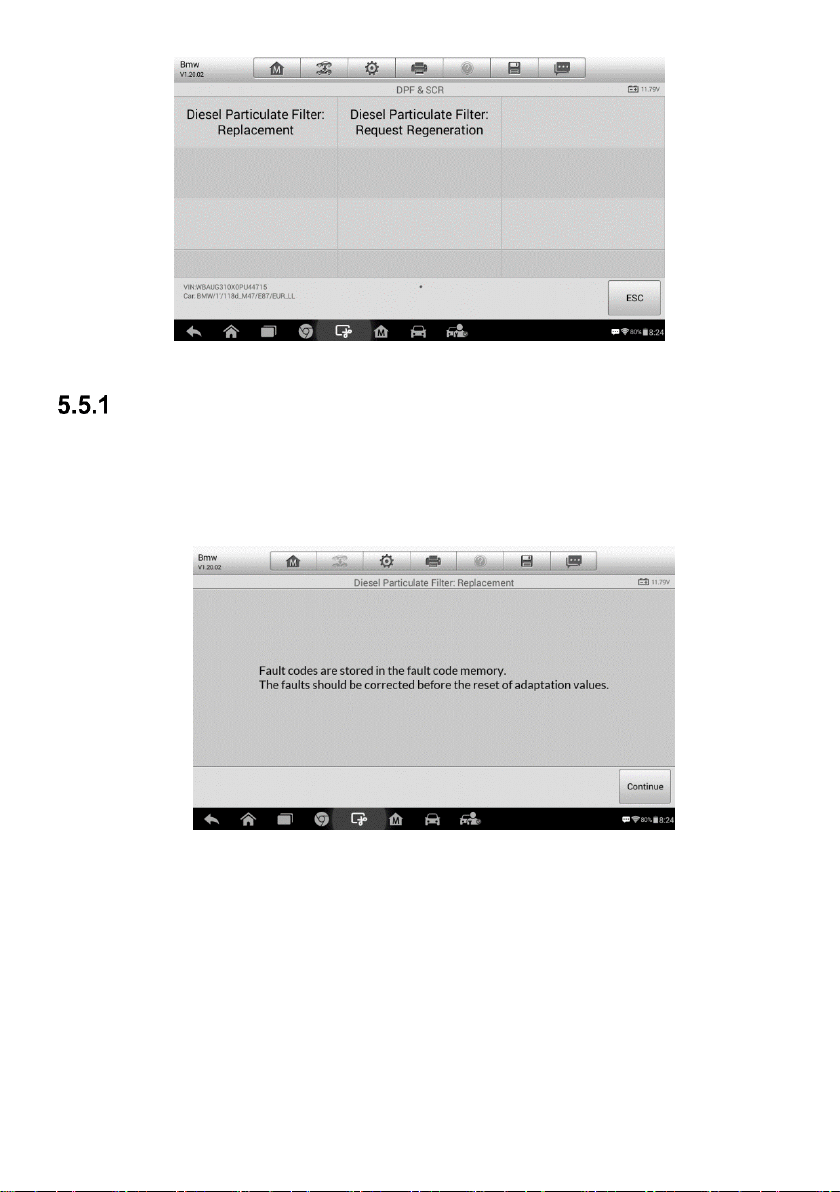
51
Figure 5-21 Sample DPF Service Function Menu
Diesel Particulate Filter: Replacement
This function enable you to reset the adaptation values.
1. Tap Diesel Particulate Filter: Replacement from the service functions menu to
enter the service screen.
2. Read carefully the information on the screen and press Continue.
Figure 5-22 Sample Diesel Particulate Filter Screen 1
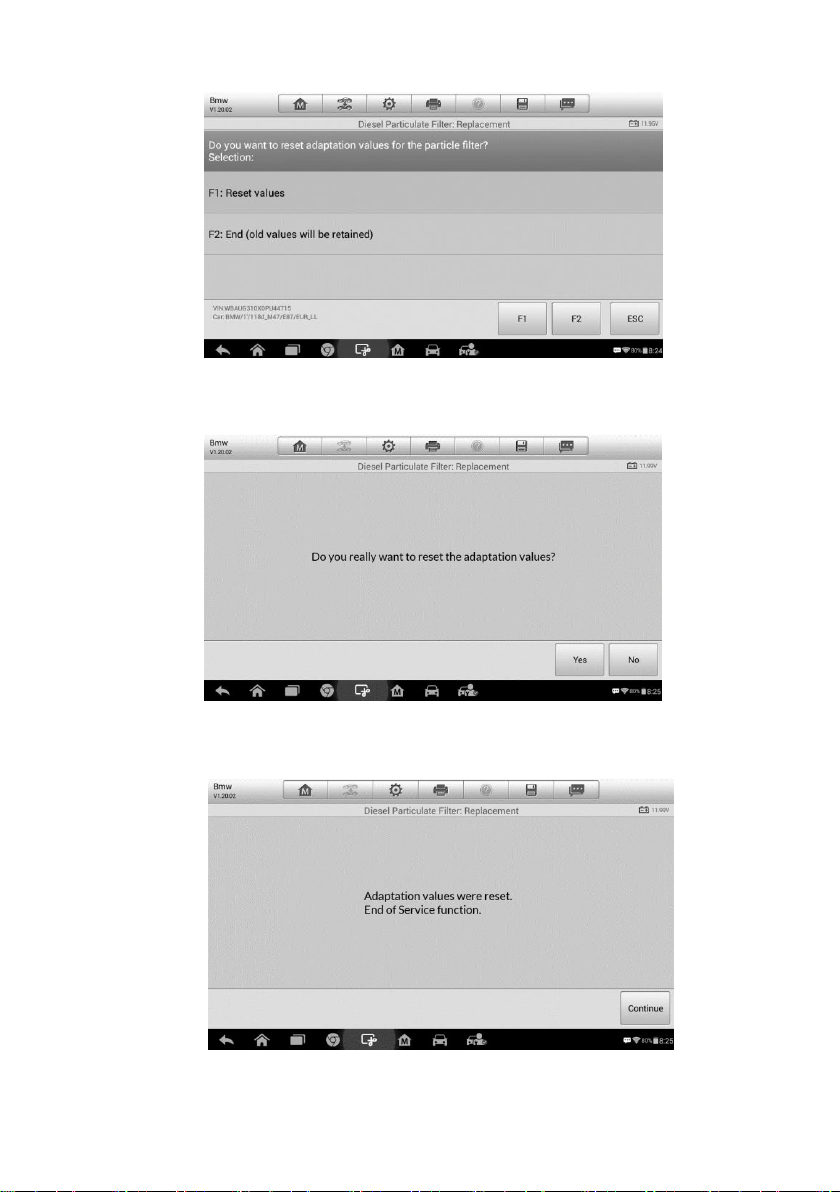
52
3. Tap function 1 (F1) to reset adaptation values for the particle filter.
Figure 5-23 Sample Diesel Particulate Filter Screen 2
4. A confirmation message will display. Tap Yes to continue.
Figure 5-24 Sample Diesel Particulate Filter Screen 3
5. The adaptation values are reset successfully. Tap Continue to end the service
function.
Figure 5-25 Sample Diesel Particulate Filter Screen 4
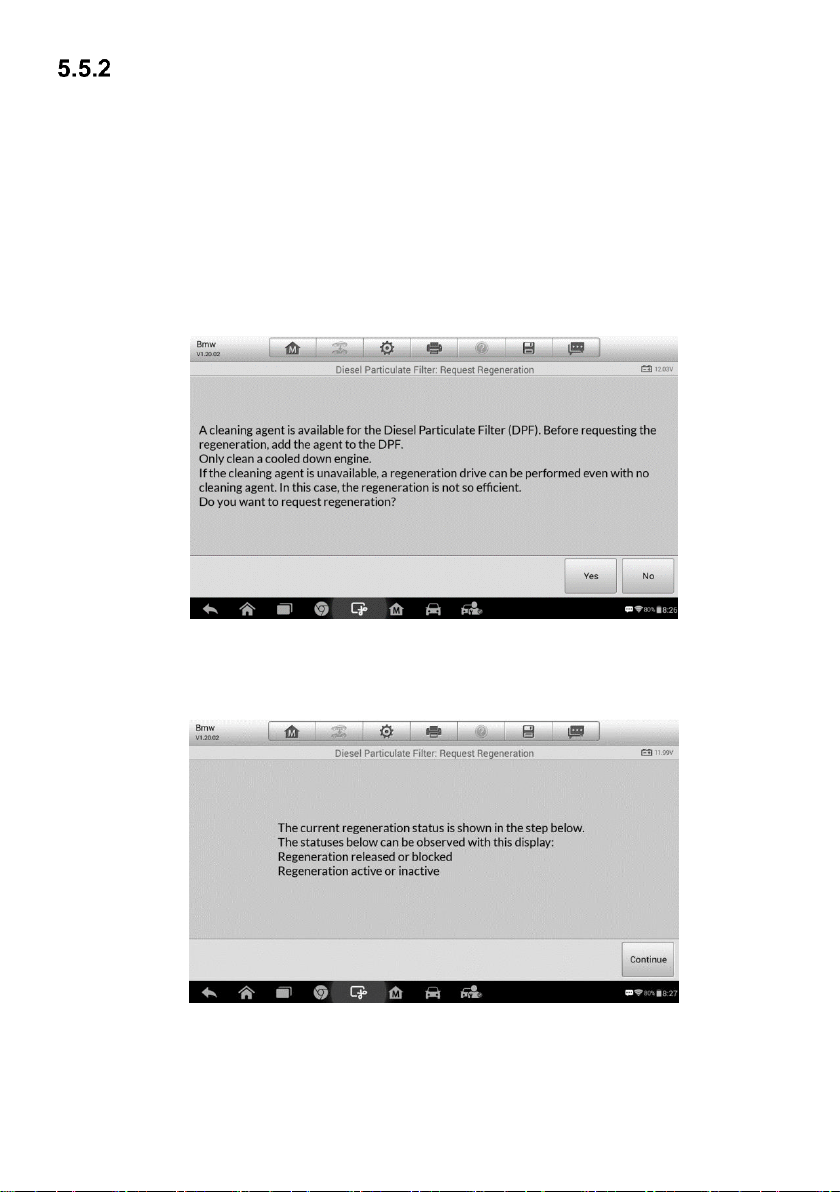
53
Diesel Particulate Filter: Request Regeneration
This function is used to perform a regeneration run when some problems caused by a
clogged Diesel Particulate Filter (DPF) happen. Available function options vary by vehicle.
1. Tap Diesel Particulate Filter: Request Regeneration from the service functions
menu.
2. The tool communicates with the vehicle and reads the fault codes memory. Follow
the on-screen instructions to check the prerequisites before particle filter
regeneration, such as the fuel, the time and driving style.
3. If every prerequisite is met, the tool will ask for confirmation to proceed as below.
Tap Yes to request regeneration or No to end the service function and exit.
Figure 5-26 Sample Regeneration Confirmation Screen
4. Follow the on-screen instructions to perform the particle filter regeneration and tap
Continue.
Figure 5-27 Sample Regeneration Status Screen
5. When the particle filter regeneration is completed, the tool will ask for a confirmation
to exit. Tap F1 to re-check the status or tap ESC to exit.
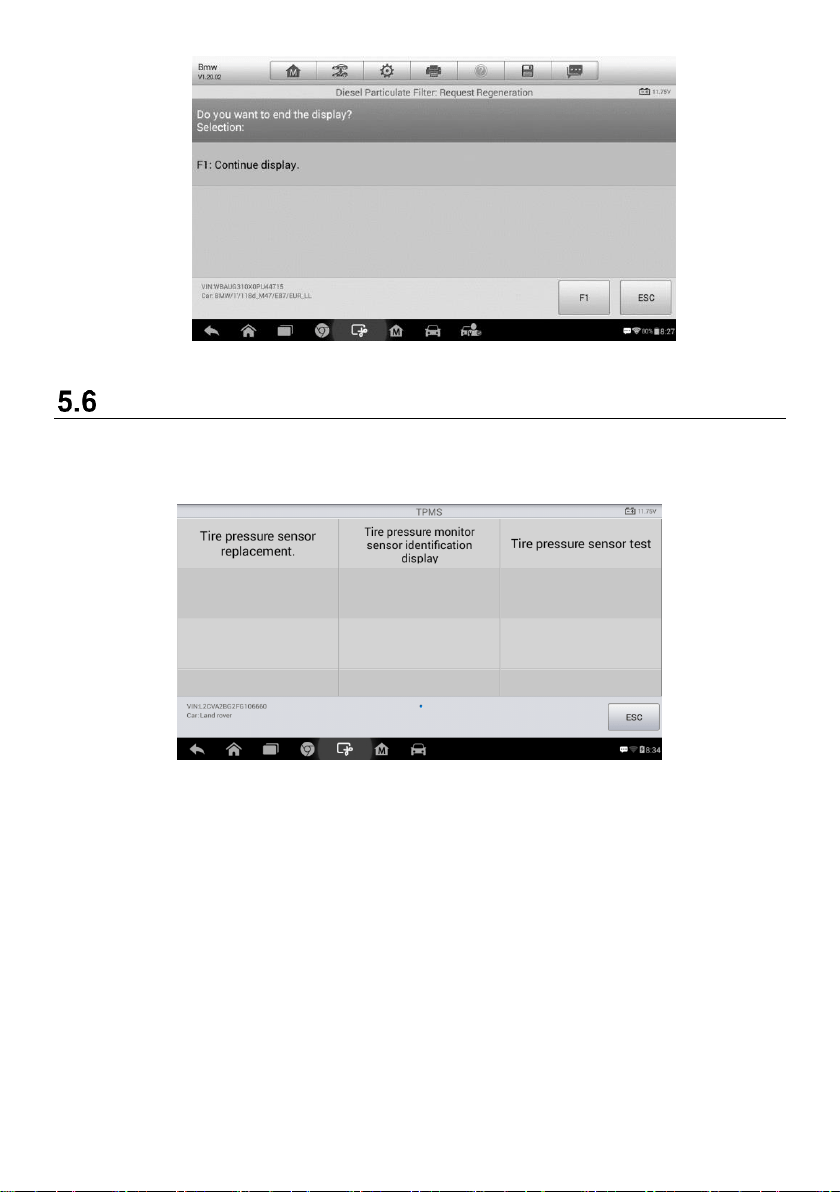
54
Figure 5-28 Sample Status Display Confirmation Screen
Tire Pressure Monitor System (TPMS) Service
The TPMS service function include displaying sensor IDs from the vehicle’s ECU,
inputting TPMS sensor replacement IDs and testing sensors.
Figure 5-29 Sample TPMS Function Menu
Select Tire Pressure Sensor Replacement (Front left wheel sensor) as an example.
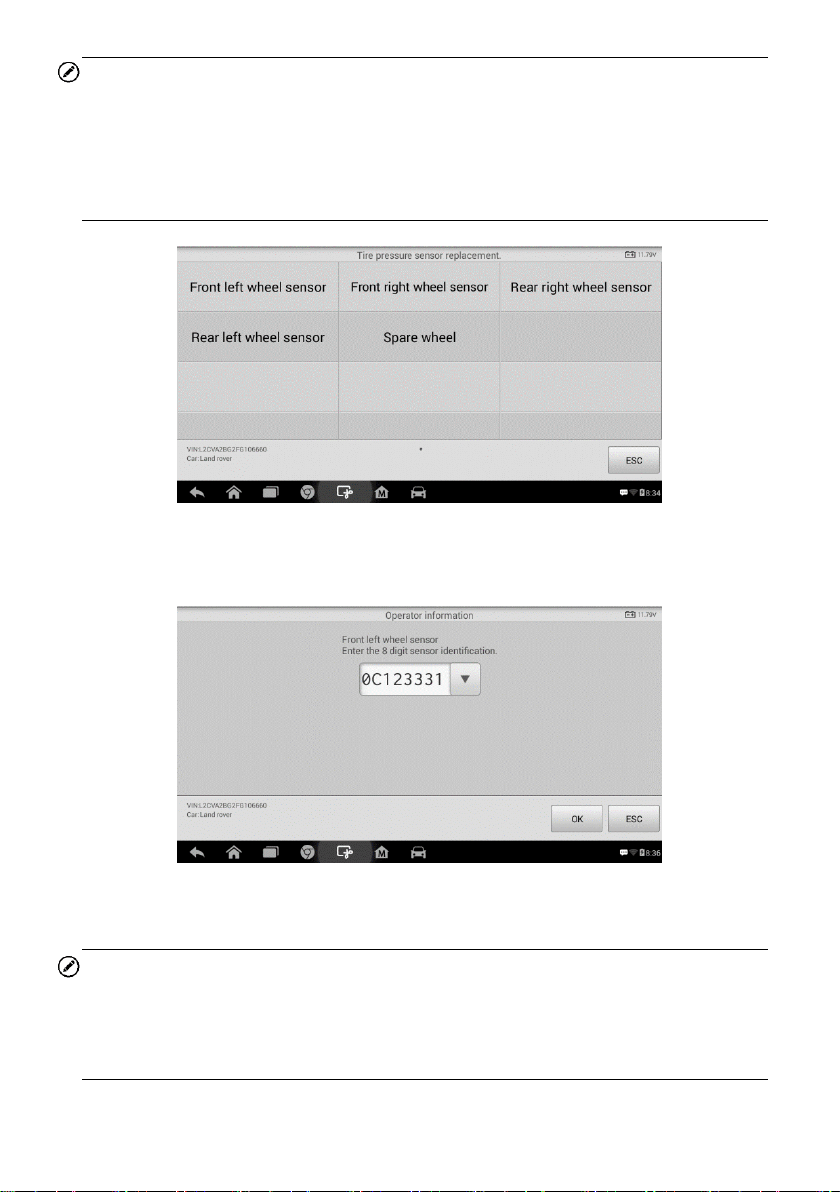
55
NOTE
This function will require the sensor ID be inputted on the screen.
The sensor IDs can be read directly from the sensor or by using a sensor activation
tool that can read the ID.
Once the IDs have been entered, the vehicle may have to be driven at a certain
speed for a certain time to complete procedure. Follow the instructions displays.
Figure 5-30 Sample Tire Pressure Sensor Replacement Screen
1. Tap Front left wheel sensor on the tire pressure sensor replacement menu.
2. Enter the 8 digit sensor identification as required. Press OK.
Figure 5-31 Sample Sensor ID Input Screen
3. Continue to select tire position and enter sensor IDs. A message will display when
the entered IDs have been registered to the vehicle.
NOTE
The vehicle must remain stationary for at least 15 minutes with the ignition off, this will
place the sensors into sleep mode. The vehicle must be driven for at least 15 minutes
at a speed higher than 20 kph to ensure the module has learned the sensor
identifications and positions.

56
For other services, please follow the on-screen instructions to operate.
On completion of the drive cycle, carry out the tire pressure monitor system test
application.
IMMO Service
An immobilizer is an anti-theft mechanism that prevents an automobile’s engine from
starting if the correct ignition key is not used or other device is present. This device
prevents thieves from starting the vehicle by a method known as hot wiring. Most new
vehicles have an immobilizer as standard equipment. An important advantage of this
system is that it doesn’t require the vehicle owner to activate it; it operates automatically.
An immobilizer is a more effective anti-theft protection than an audible alarm alone; many
auto insurance companies offer lower rates for vehicles that are equipped with them.
As an anti-theft device, an immobilizer disables one of the systems needed to start a
vehicle's engine, usually the fuel supply or the ignition. This is accomplished by radio
frequency identification between a transponder in the ignition key and a device called a
radio frequency reader in the steering column. When the key is placed in the ignition, the
transponder sends a signal with a unique identification code to the reader that relays it
to a receiver in the vehicle's computer control module. If the code is correct, the computer
allows the fuel supply and ignition systems to operate and start the vehicle. If the code is
incorrect or absent, the computer disables the system, and the vehicle will be unable to
start until the correct key is placed in the ignition.
The IMMO service of MK808 enables you to disable the lost vehicle keys and program a
replacement key fob. One or more replacement key fob can be programmed, depending
on your needs.
To program the replacement key fob(s)
1. Tap IMMO KEYS after entering the Service function from the MaxiCOM Job
Menu.
2. Tap Automatic Selection or Manual Selection to acquire vehicle VIN
information and tap Yes to confirm.
3. Tap Erase/Program all key fobs in the IMMO function list after it is displayed,
the list may vary for different vehicles being tested.
NOTE
To complete key fob programming, you need to acquire the Security Code, which
can be acquired through the Security Code Read function in hot functions.
Before programming, please check and erase the fault codes.
4. Read the on-screen information carefully and follow the instructions to complete
the operation.
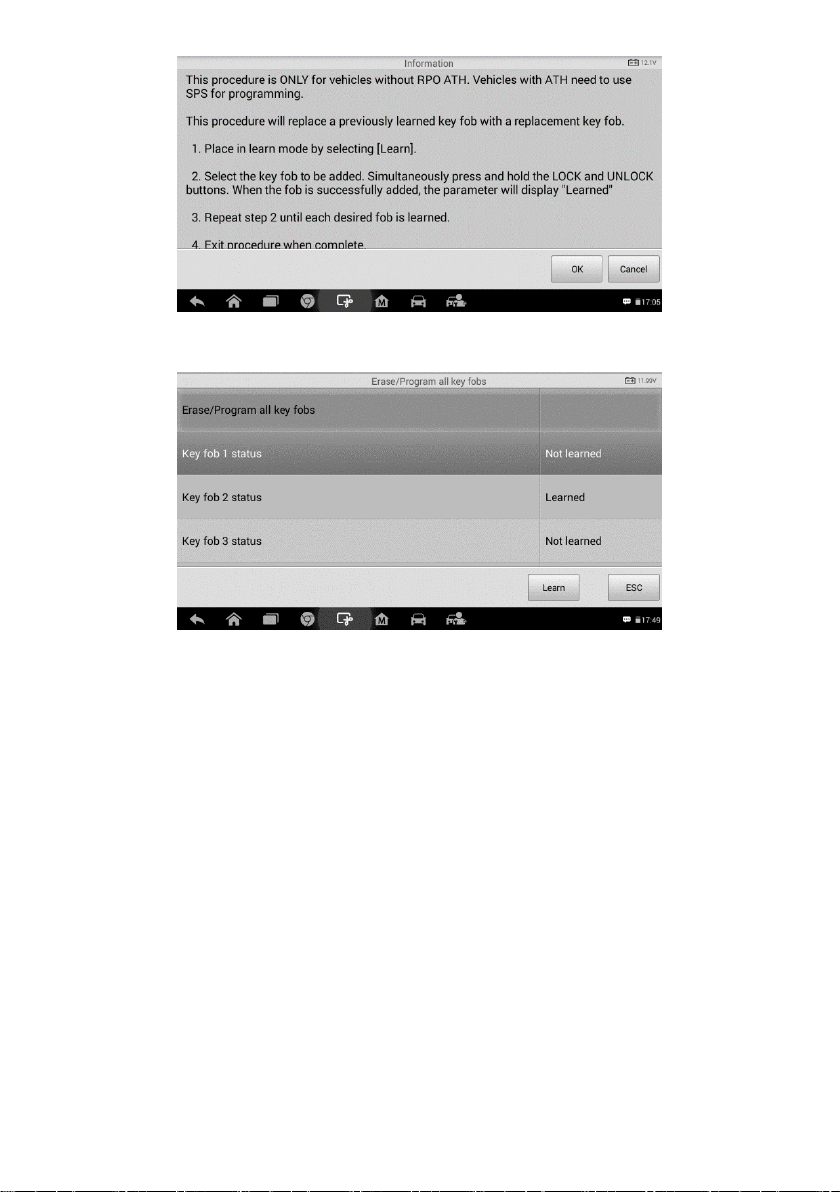
57
Figure 5-32 Sample IMMO Note Screen
Figure 5-33 Sample Program Key FOB Screen
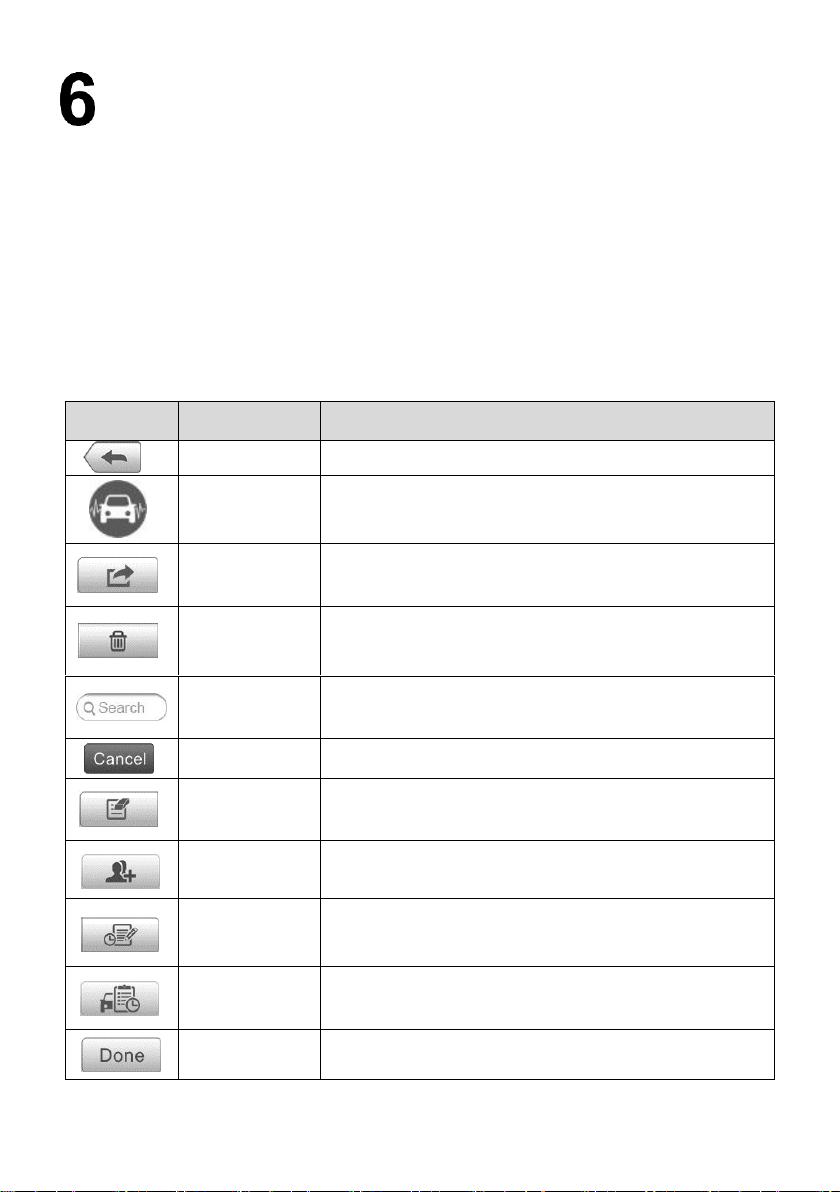
58
Shop Manager
The Shop Manager application manages the workshop information including customer
information records and test vehicle history records. There are three main functions
available:
Vehicle History
Workshop Information
Customer Manager
The operations of these functions of the Shop Manager application are controlled by the
toolbar buttons, which are listed and described in the table below:
Table 6-1 Top Toolbar Buttons in Shop Manager
Button
Name
Description
Back
Returns to the previous screen.
Diagnostics
Accesses the vehicle Diagnostics menu.
Enter Edit
Shows the editing toolbar to print or delete the selected
file.
Delete
Deletes the selected vehicle record item from the list.
Search
Quickly locates the vehicle record by entering the
vehicle name or test path.
Cancel
Cancels edit or file search.
Edit
Allows you to edit information for the displayed file.
Add Account
Creates a new customer account file.
History Notes
Opens a note form, which allows you to create audio
record, attach picture or video, or edit text notes, etc.
Vehicle
History
Opens the Vehicle History screen which displays the
correlated test vehicle records.
Done
Completes editing and saves the file.
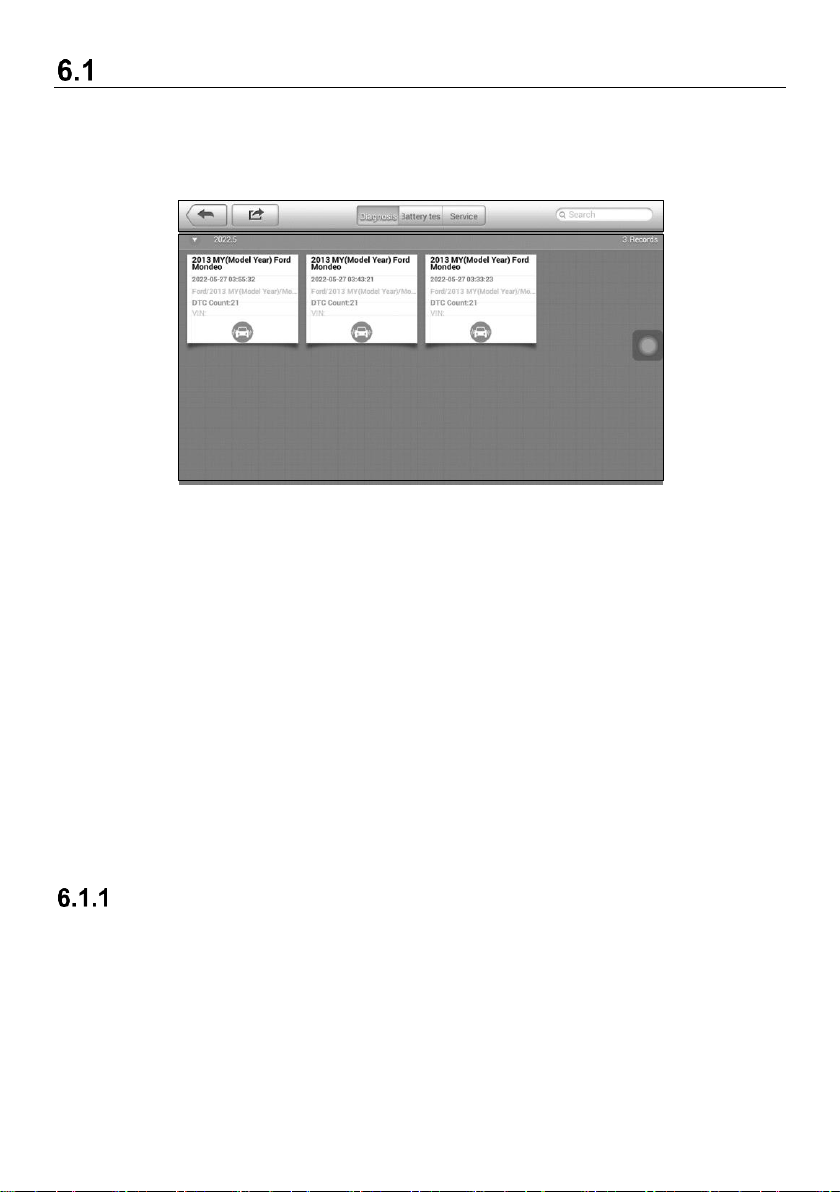
59
Vehicle History
This function stores test vehicle history records, including vehicle information and the
retrieved DTCs from previous diagnostics sessions. All information is displayed in
summarized details. Tap on a record to resume a diagnostics session on a “stored
vehicle”.
Figure 6-1 Sample Vehicle History Screen
1. Top Toolbar Buttons — navigates and makes various controls of the application.
2. Main Section — displays all the vehicle history records information.
To activate a test session for the recorded vehicle
1. Tap the Shop Manager application on the MaxiCOM Job Menu.
2. Tap Vehicle History.
3. Tap the Diagnostics button at the bottom of the thumbnail of a vehicle record
item. Or,
4. Or, tap the vehicle record thumbnail to view record.
5. A Historical Test record sheet displays, check the recorded information of the
recorded test vehicle, and tap the Diagnostics button on the upper right corner.
6. The vehicle’s Diagnostics screen displays a new diagnostics session, see
Diagnosis for detailed instructions on vehicle diagnostics operations.
Historical Test Record
The Historical Test record sheet is a detailed data form that includes general vehicle
information such as vehicle year, make and mode. The form also includes retrieved DTC
from previous test and all information manually inputted by the technician.
①—
②—
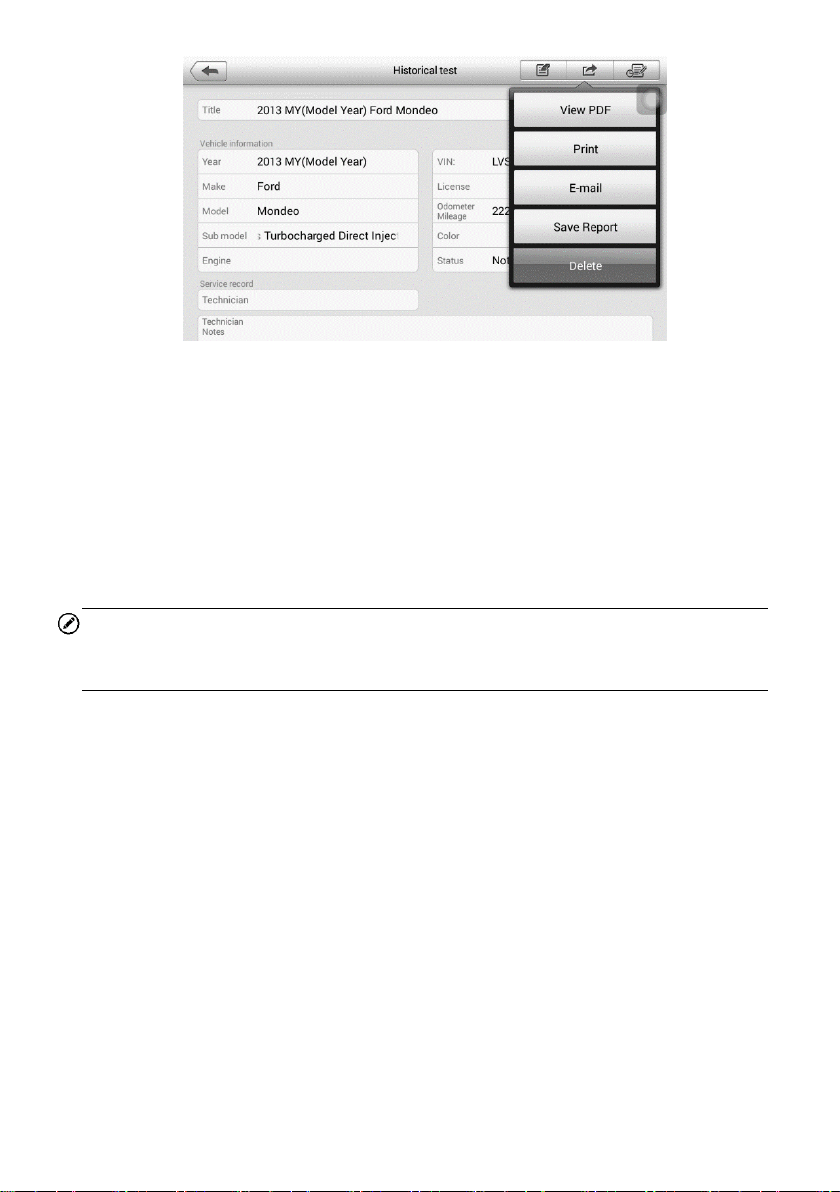
60
Figure 6-2 Sample Historical Test Record Sheet
To edit the Historical Test record sheet
1. Tap the Shop Manager application on the MaxiCOM Job Menu.
2. Tap Vehicle History.
3. Select the specific vehicle history record thumbnail from the main section. The
Historical Test record sheet displays.
4. Tap the Edit button to start editing.
5. Tap on each item to input the corresponding information or add relevant files or
images.
NOTE
The vehicle VIN number, or license and the customer information account are
correlated by default.
6. Tap Add to Customer to supplement a Historical Test record sheet to an
existing customer account, or add a new associated account with the test
vehicle record. See Customer Manager for more information.
7. Tap Done to save the updated record sheet, or tap Cancel to exit without saving.
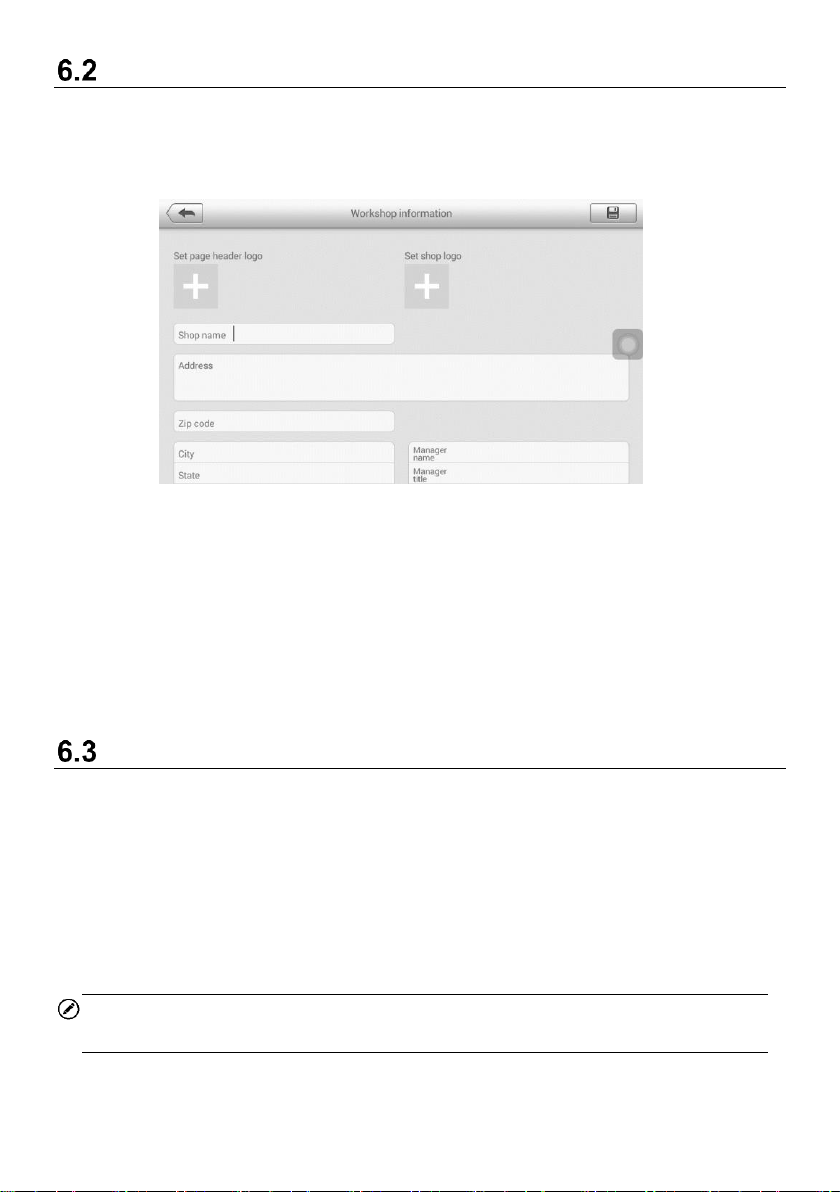
61
Workshop Information
Use the Workshop Information form to edit, input and save the detailed workshop
information, such as shop name, address, phone number and other remarks, which when
printing vehicle diagnostics reports and other associated test file, will display as the
header of the printed documents.
Figure 6-3 Sample Workshop Information Sheet
To edit the Workshop Information sheet
1. Tap the Shop Manager application on the MaxiCOM Job Menu.
2. Tap Workshop Information.
3. Tap the Edit button on the top toolbar.
4. Tap on each field to input the appropriate information.
5. Tap Done to save the updated workshop information sheet, or tap Cancel to
exit without saving.
Customer Manager
Use the Customer Manager function to create and edit customer accounts and correlate
with the associated test vehicle history records.
To create a customer account
1. Tap the Shop Manager application on the MaxiCOM Job Menu.
2. Tap Customer Manager.
3. Tap the Add Account button. An empty information form displays, tap each field
to input the appropriate information.
NOTE
Required fields are noted.
4. Tap the
□
+ photo frame beside the Name chart to add a photo. A sub menu
displays, select Take Photo to take a new photo for the account, or select

62
Choose Photo to choose from an existing images.
5. If a customer adds or changes vehicles, tap Add New Vehicle Information,
and input the vehicle information. Tap the
○
x button to cancel.
6. Tap Done to save the account, or tap Cancel to exit without saving.
To edit a customer account
1. Tap the Shop Manager application on the MaxiCOM Job Menu.
2. Tap Customer Manager.
3. Select a customer account by tapping the corresponding name card. A
Customer Information sheet displays.
4. Tap the Edit button on the top toolbar to start editing.
5. Tap on the input field that needs to be altered or supplemented, and enter
updated information.
6. Tap Done to save the updated information, or tap Cancel to exit without saving.
To delete a customer account
1. Tap the Shop Manager application on the MaxiCOM Job Menu.
2. Tap Customer Manager.
3. Select a customer account by tapping the corresponding name card. A
Customer Information sheet displays.
4. Tap the Edit button on the top toolbar to start editing.
5. Tap the Delete Customer Information button. A confirmation message
displays.
6. Tap OK to confirm the deletion, or tap Cancel to cancel the request.
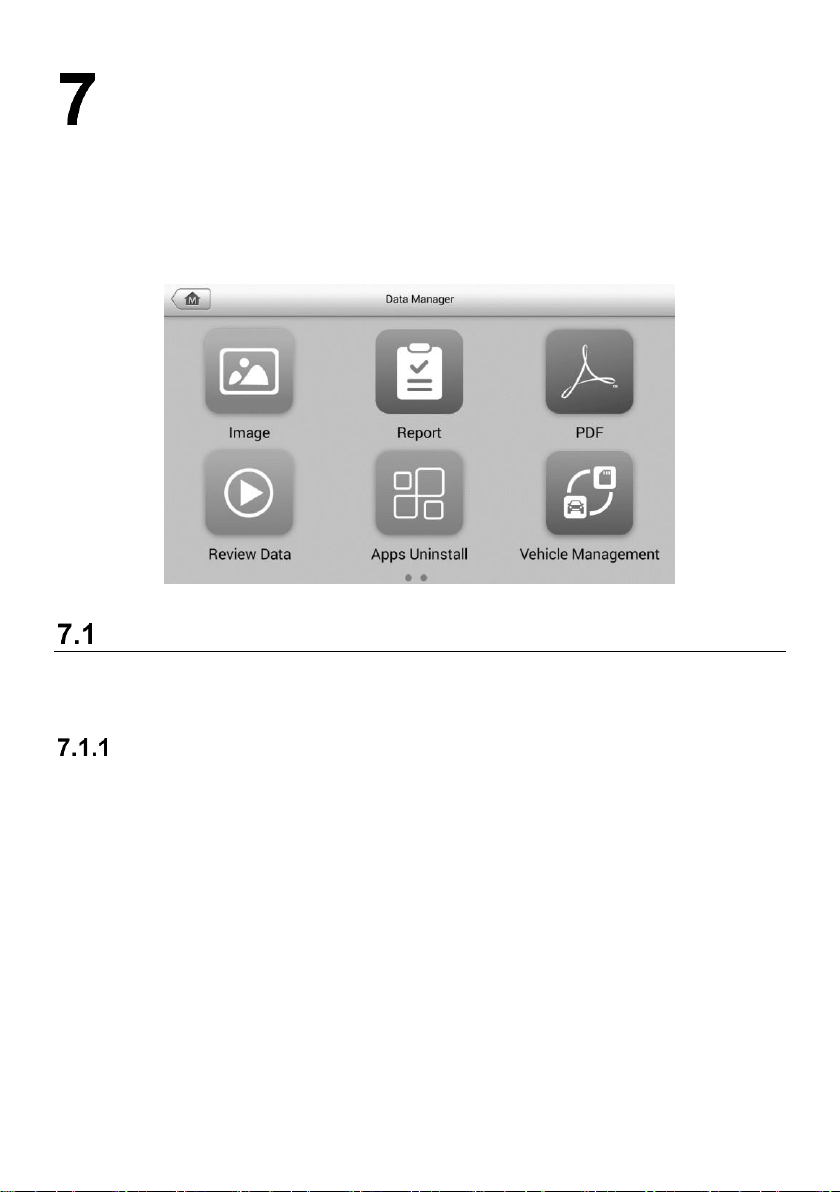
63
Data Manager
The Data Manager application is used to store, print, and review the saved files. Most
operations are controlled through the toolbar.
Selecting the Data Manager application opens the file system menu. Different file types
are sorted separately under different options, there are seven types of information files
to be viewed or played back.
Figure 7-1 Sample Data Manager Main Screen
Operations
Data Manager Operations are based on toolbar controls. Details are explained in the
following sections.
Image
The Image section contains all captured screenshot images.
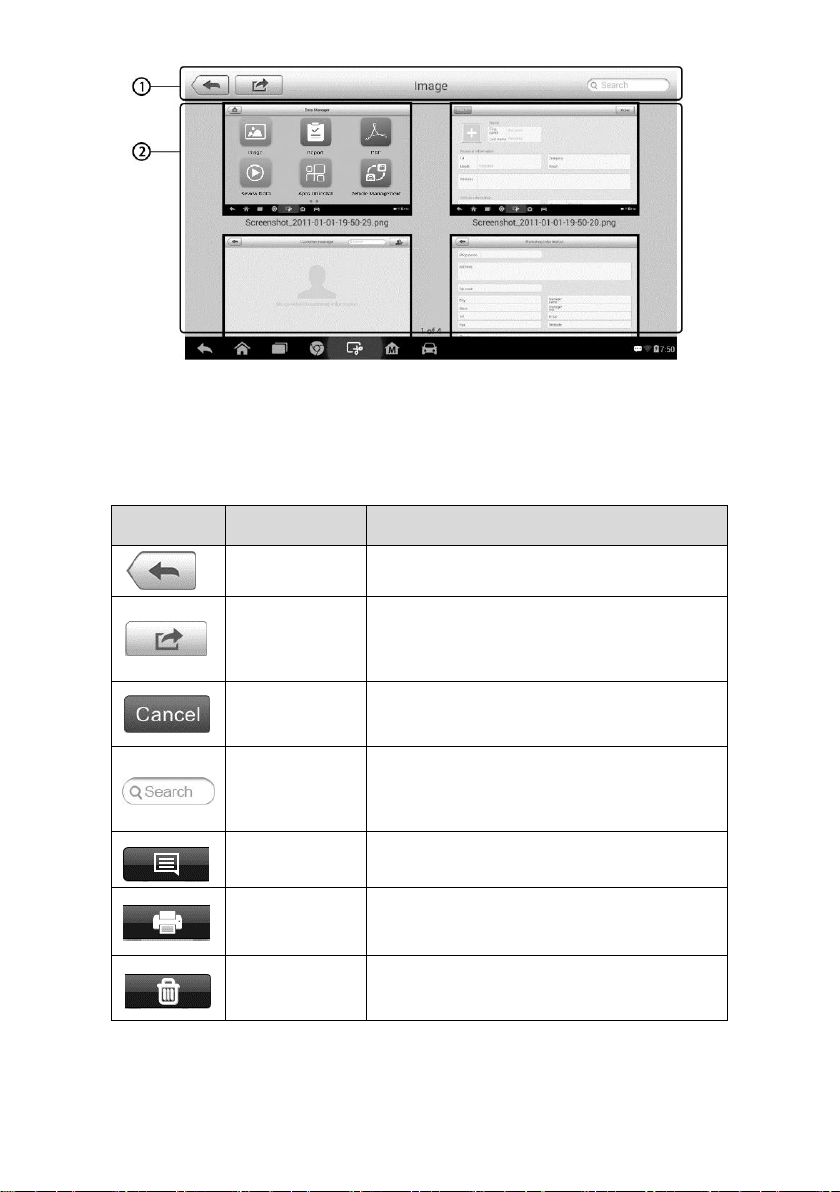
64
Figure 7-2 Sample Image Screen
1. Toolbar Buttons — used to edit, print and delete the image files. See the following
table for detailed information.
2. Main Section — displays the stored images.
Table 7-1 Toolbar Buttons in Image
Button
Name
Description
Back
Returns to the previous screen.
Enter Edit
Tap this button to display the editing
toolbar to print, delete or view image
information.
Cancel
Tap this button to close the editing toolbar
or cancels file search.
Search
Quickly locates the image file by entering
the vehicle name, test path, file name or file
info.
Info
Tap this button to display the image details.
Print
Tap this button to print the selected image.
For details, see Printing Setting.
Delete
Tap this button to delete the selected
image.
To edit image information
1. Tap the Data Manager application from the MaxiCOM Job Menu.
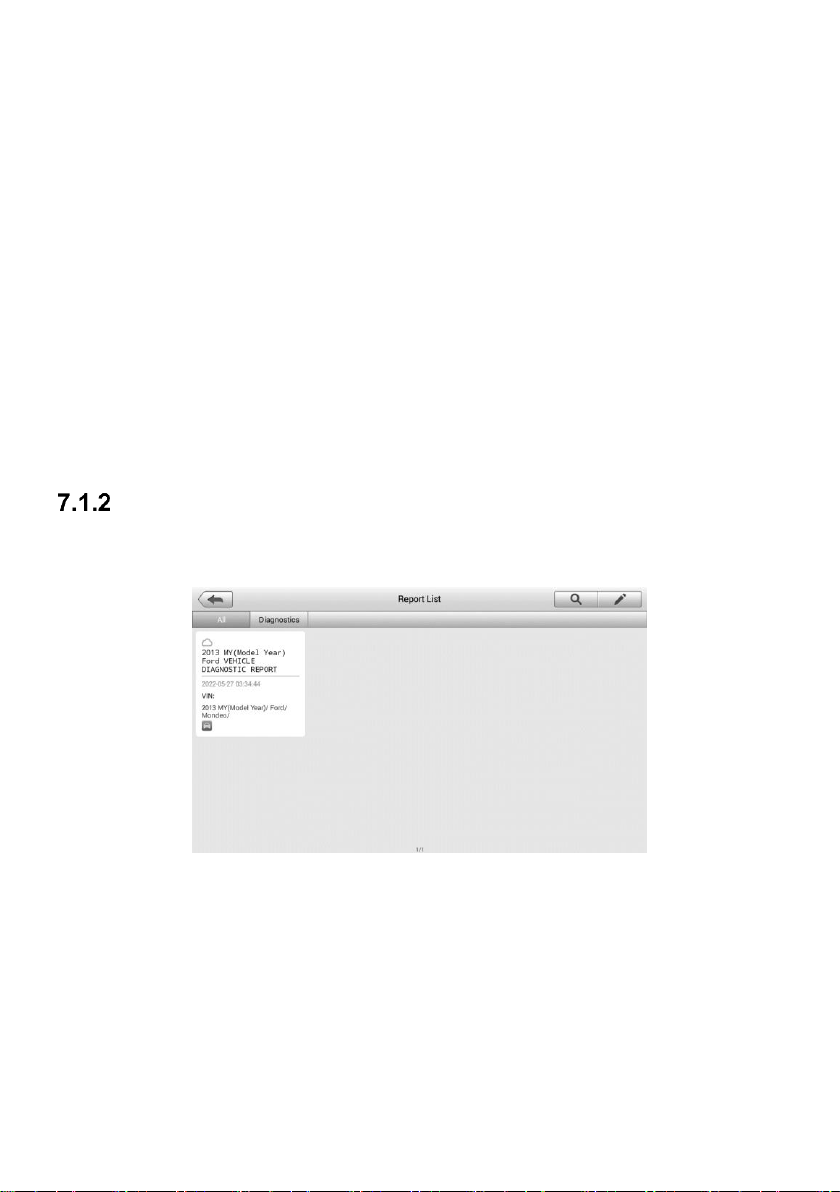
65
2. Tap Image to access the image database.
3. Select an image to display in full screen.
4. Tap the screen to display the editing toolbar.
5. Tap the Info button to display image information.
6. Tap the Edit button on the top right corner of the window. The editing screen
displays.
7. Edit the image information by entering the new file name, and file information.
8. Tap Done to save the information and exit, or tap Cancel to exit without saving.
To delete selected images
1. Select the Data Manager application from the MaxiCOM Job Menu.
2. Select Image to access the JPG database.
3. Tap the image to display the editing toolbar.
4. Tap the Delete button, and then Delete image. The selected images will be
deleted.
Report
The Report section stores diagnostics information of the vehicle and forms a diagnostics
report for user to share.
To share a report
1. Tap the Data Manager application from the MaxiCOM Job Menu.
2. Tap Report to access the Report List screen.
Figure 7-3 Sample Report List Screen
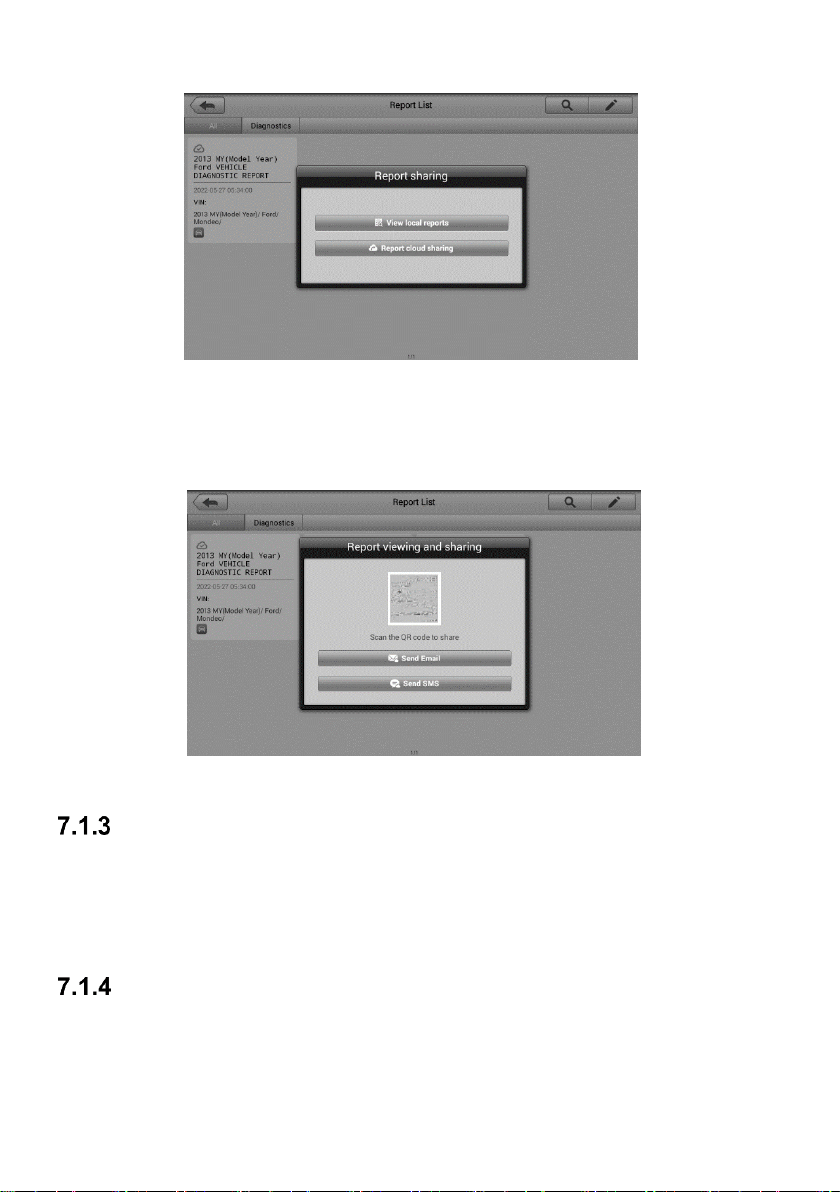
66
3. Tap a report record to display the Report sharing dialog box.
4. Tap View local reports to display it in full screen.
5. Return to the Report List screen, tap the report and tap Report cloud sharing.
6. Scan the QR code or tap Send Email or Send SMS to share the report.
PDF
The PDF section stores and displays all PDF files of saved data. After entering the PDF
database, select a PDF file to view the stored information.
This section uses the standard Adobe Reader application for file viewing and editing,
please refer to the associated Adobe Reader manual for instructions.
Review Data
The Review Data section allows you to playback the recorded data frames of live data
streams.
On the Review Data main screen, select a record file to playback.
Figure 7-4 Sharing Report Screen 1
Figure 7-5 Sharing Report Screen 2
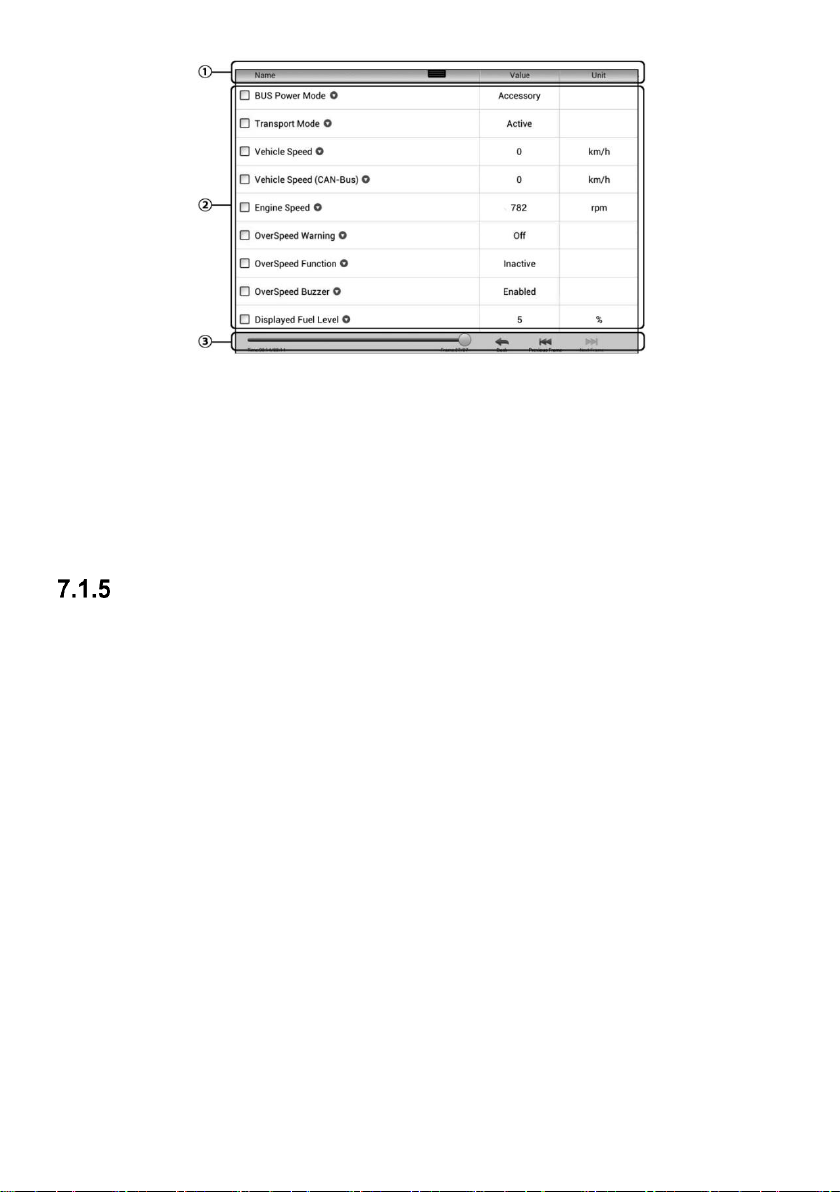
67
Figure 7-6 Sample Data Playback Screen
1. Drop-down Toolbar — tap the button at the top center of the screen to open the
Drop-down Toolbar.
2. Main Section — displays the recorded data frames.
3. Navigation Toolbar — allows you to manipulate data playback.
Use the Navigation Toolbar buttons to playback the record data from frame to frame.
Tap Back to exit data playback.
Apps Uninstall
This section allows you to manage the firmware applications installed on the MaxiCOM
Diagnostics System. Select this section to open a management screen, on which you
can check all the available vehicle diagnostics applications.
Tap the vehicle firmware you want to delete, a blue tick at the upper right corner of the
firmware will display. Tap the Delete button on the top bar and tap OK to delete the
firmware from the system database.
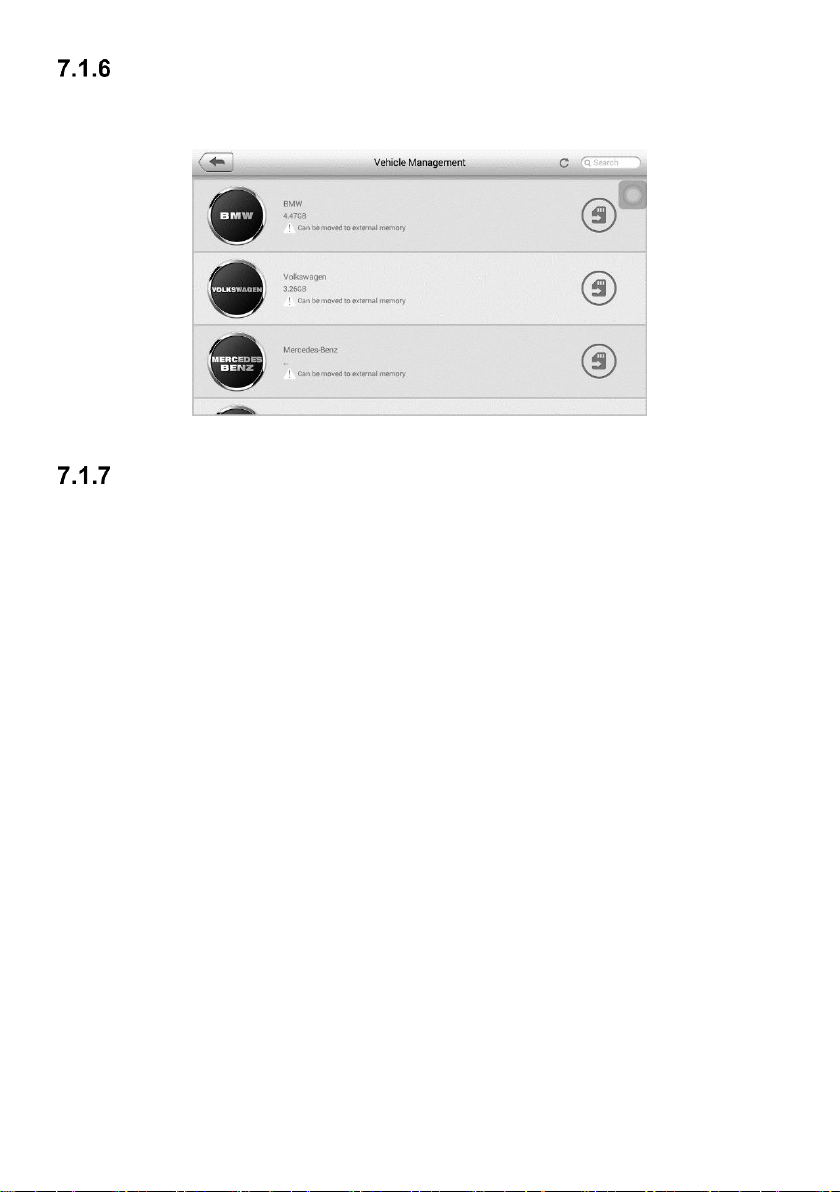
68
Vehicle Management
The Vehicle Management section allows you to transfer the vehicle data to an external
memory card to save memories of the tablet.
Data Logging
The Data Logging section allows you to launch Support platform to view all records of all
sent or unsent (saved) data logs on the diagnostics system. For more details, please
refer to Data Logging.
Figure 7-7 Sample Vehicle Management Screen

69
Settings
Selecting Settings application opens a setup screen to adjust the default setting and view
information about the MaxiCOM system. The following shows options available for the
MaxiCOM system settings:
Unit
Language
Printing Settings
Report Settings
Multitask
Firmware Upgrade
Auto Update
Car order
System Settings
About
This section describes the operation procedures for the settings.
Unit
This option allows you to change the measurement unit for the diagnostics system.
To adjust the unit setting
1. Tap the Settings application on the MaxiCOM Job Menu.
2. Tap the Unit option on the left column.
3. Select the required measurement unit, Metric or Imperial. A check mark will
display on the right of the selected unit.
4. Tap the Home button on the top left corner to return to the MaxiCOM Job Menu
or select another setting.

70
Language
This option allows you to adjust the display language for the MaxiCOM system.
To adjust the language setting
1. Tap the Settings application on the MaxiCOM Job Menu.
2. Tap the Language option on the left column.
3. Select the required language. A check mark will display on the right of the
selected language.
4. Tap the Home button on the top left corner to return to the MaxiCOM Job Menu
or select another setting.
Printing Settings
This option allows you to print via Wi-Fi connection.
To setup the printer connection
1. Tap the Settings application on the MaxiCOM Job Menu.
2. Tap the Printing Setting option on the left column.
3. Tap the Print via Network item to activate the printing function that enables the
device to send files to the printer through the PC via Wi-Fi connection.
4. Tap the Home button on the top left corner to return to the MaxiCOM Job Menu
or select another setting.
To install the printer driver
1. Download the Maxi PC Suite from www.autel.com > Support > Downloads >
Diagnostic Tool and install to your PC.
2. Double click the setup.exe file.
3. Select the installation language and the wizard will load momentarily.
4. Follow the instructions on the screen and click Next to continue.
5. Click Install. The printer driver program will be installed onto the PC.
6. Click Finish to complete the installation.
NOTE
The PC, printer, and the tablet must be connected to the same network.
This section describes how to receive file from the MaxiCOM tablet and perform printing
through the PC:
To print via the PC

71
If the Auto Print option on the MaxiSys Printer tab is selected, the
received file is automatically printed.
If the Auto Print option is not selected, click Open PDF File to view files.
Select the file(s) to print and click Print.
Report Settings
This option automatically synchronizes the diagnostics information of the vehicle to the
vehicle history and forms a diagnostics report for user to upload. Tap the ON/OFF button
to enable/disable the Report Upload to Cloud function. The button appears blue if the
function is enabled and is gray if the function is disabled.
Multitask
The Multitask option allows you to turn the Multitask function on or off. The Multitask
feature enables you to browse and navigate more freely among different applications on
the MaxiCOM system. Tap the Multitask button, the Multitask menu displays all active
applications.
To enable the Multitask function
1. Tap the Settings application on the MaxiCOM Job Menu.
2. Tap the Multitask option on the left column.
3. Tap the ON/OFF button to enable or disable the Multitask function. If the function
is enabled the button displays blue, or if disabled the button displays gray.
4. Tap the Home button on the top left corner to return to the MaxiCOM Job Menu.
Or select another setting option for the system setup.
Firmware Upgrade
This option allows you to update the firmware of the scan tool. Connect the scan tablet
with the vehicle through DLC or use the mini USB cable for power supply. Follow the on-
screen instructions to complete the operation. Internet connection is necessary for this
operation.

72
Auto Update
The Auto Update allows the tool to automatically update the operating system, the
MaxiCOM system and vehicle software. Tap the button on the right side of each software
update to perform and set the time the automatic update should be done.
To enable the auto update
1. Tap the Settings application on the MaxiCOM Job Menu.
2. Tap the Auto Update option on the left column. The three automatic updates
are listed on the right.
3. Set the toggle button to ON to enable the automatic update feature for each
update.
4. Tap on the time to set time. Tap the + and – button or tap on the numbers to
manually adjust the time. Tap Done to complete the time setting.
NOTE
Ensure the tool is or will be connected to the Internet at the time the update is set to
be conducted.
Car Order
This option allows you to sort the vehicles either by alphabetical order or by frequency of
use.
To adjust the vehicle list setting
1. Tap Settings on the MaxiCOM Job Menu.
2. Tap Car order on the left column.
3. Select the desired sort type. A check mark will display to the right of the selected
item.
4. Tap the Home icon on the top-left corner to return to the MaxiCOM Job Menu,
or select another setting option for the system setup.
System Settings
Access the Android background system setting screen to adjust operating system
settings including wireless and network settings and display and system security settings.
Android device information is also displayed.
To enable the App Switcher function
1. Tap the Settings application on the MaxiCOM Job Menu.
2. Tap the System settings option on the left column.
3. Tap the App Switcher option on the left column.

73
4. Mark the checkbox beside “Always show the App Switcher” on the right side of
the screen. The App Switcher icon displays.
Short press the App Switcher icon to open a control panel:
Tap a specific app shortcut button to be directed to the selected application screen.
Long press a specific app shortcut button displays the app menu, on which you can
select and change the app shortcut.
Press and drag the App Switcher icon to another position alongside the edge of the
screen.
Refer to Android documentation for information about Android system settings.
About
The About screen lists the MaxiCOM’s version, hardware, and serial number.
To check the MaxiCOM product information in About
1. Tap the Settings application on the MaxiCOM Job Menu.
2. Tap the About option on the left column. The product information screen
displays on the right.
3. Tap the Home button on the top left corner to return to the MaxiCOM Job Menu,
or select another setting option for the system setup after viewing.
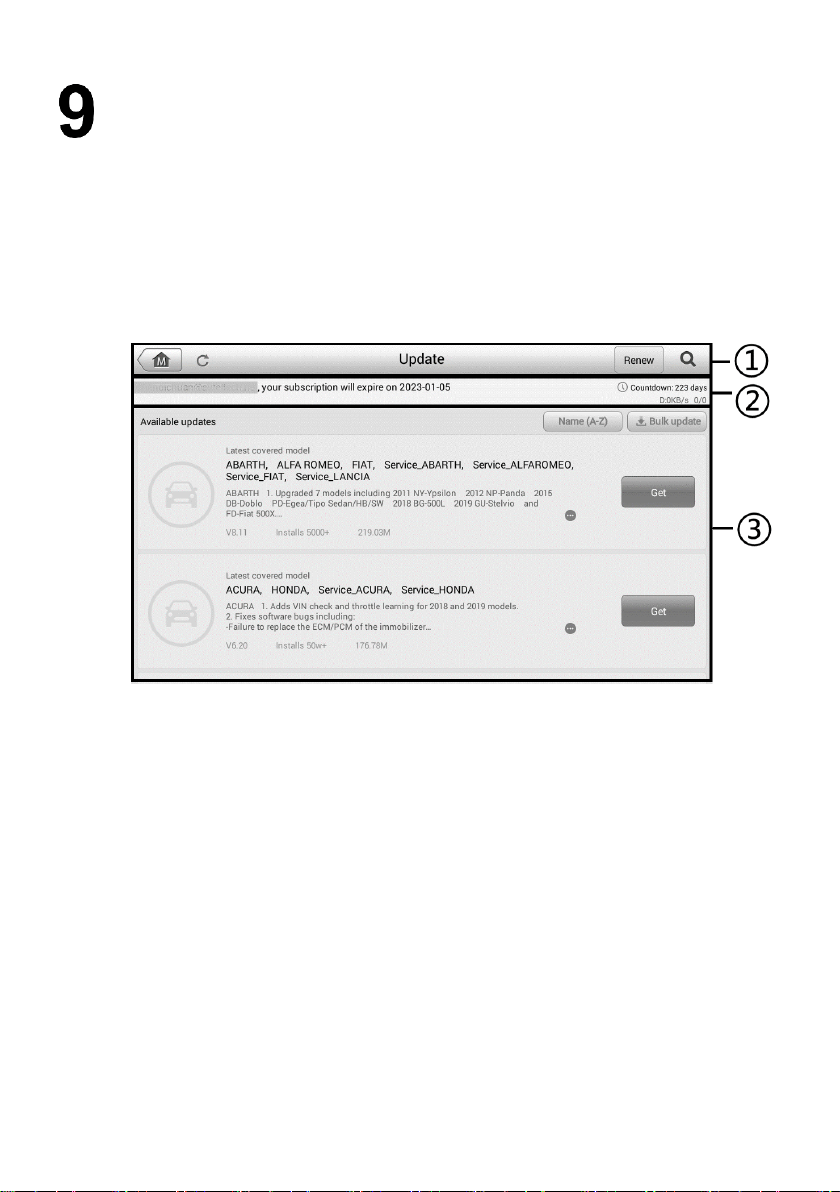
74
Update
The Update application allows you to download the latest released software. The updates
can improve the MaxiCOM applications’ capabilities, typically by adding new tests, new
models, or enhanced applications.
The tablet automatically searches for available updates for the MaxiCOM software when
it is connected to the internet. Any updates that are found can be downloaded and
installed on the device. This section describes installing an update to the MaxiCOM
System.
Figure 9-1 Sample Update Screen
① Navigation and Controls
Home Button — returns to the MaxiCOM Job Menu.
Refresh — refreshes the available update list.
Renew — renews the subscription.
Search Bar — search specific update item by inputting the file name, for
example: a vehicle make.
② Status Bar
Left Side — displays your account email address and expiration date of your
subscription.
Right Side — shows the remaining days of your subscription and real-time
Internet speed amid downloading.
③ Main Section
Left Column — displays vehicle icons.

75
Middle Column — displays a synopsis of the changes to the software. Tap the
button to open an information screen to view details. Tap outside the
information screen to close it.
Right Column — controls software update. According to the status of the
software download, a different titled button displays.
Tap the sort type button to sort available items in desired type.
Tap Bulk update to batch update selected items.
Tap Get to update the item.
Tap Pause to suspend the update.
Tap Continue to resume the update.
To update the software
1. Make sure the tablet is connected to a power source with stable access to the
internet.
2. Tap the Update application button from the MaxiCOM Job Menu; or tap the
update notification message when received; or tap the Update icon on Vehicle
Menu in Diagnostics application. The Update application screen displays.
3. Check all available updates:
If you decide to update all the items, tap Bulk update > Select all.
If you decided to update more than one item, tap the Bulk update button
and selected the desired items.
If you only want to update one item, tap the Get button on the right column
of the item.
4. Tap the Pause button to suspend the update. Tap Continue to resume the
update. The update will resume from the point at which it was paused.
5. The firmware will be installed automatically once its download has completed.
The previous version will be replaced.

76
Support
This application launches the Support platform which synchronizes Autel’s on-line
service base station with the tablet. In order to synchronize the device to your on-line
account, you need to register the product through the Internet when you use it for the
first time. The Support application is connected to Autel’s service channel and on-line
communities which provides the quickest way for problem solutions, allowing you to
submit complaints or sent help requests to obtain direct services and supports.
Product Registration
In order to get access to the Support platform and obtain update and other services from
Autel, you are required to register the MaxiCOM Diagnostics Device the first time you
use it.
To register the diagnostics device
1. Visit http://pro.autel.com.
2. If you already have an Autel account, sign in with your account ID and
password, and skip to step 9.
3. If you are a new member to Autel, click Register on the left side of the screen
to create your Autel ID.
4. Enter your personal information. Fields marked with an asterisk (*) are
mandatory.
5. Enter your email address, then click Request. You will receive an email from
Autel with your verification code. Open the email and copy the code into the
proper input box.
6. Set a password for your account, and enter the password again to confirm.
7. Read the Autel User Service Agreement and Autel Privacy Policy, then
check the box to accept the terms.
8. After all the information is entered, click Register. Once your account is
successfully registered, you will be redirected to the Product Registration
screen. If not, click the button on the screen.
9. Your product serial number and password are required to complete your
registration. To find your serial number and password on the tablet: go to
Settings > About.
10. Enter your tablet serial number and password. Enter the CAPTCHA code as
shown. And click Submit to complete your product registration.
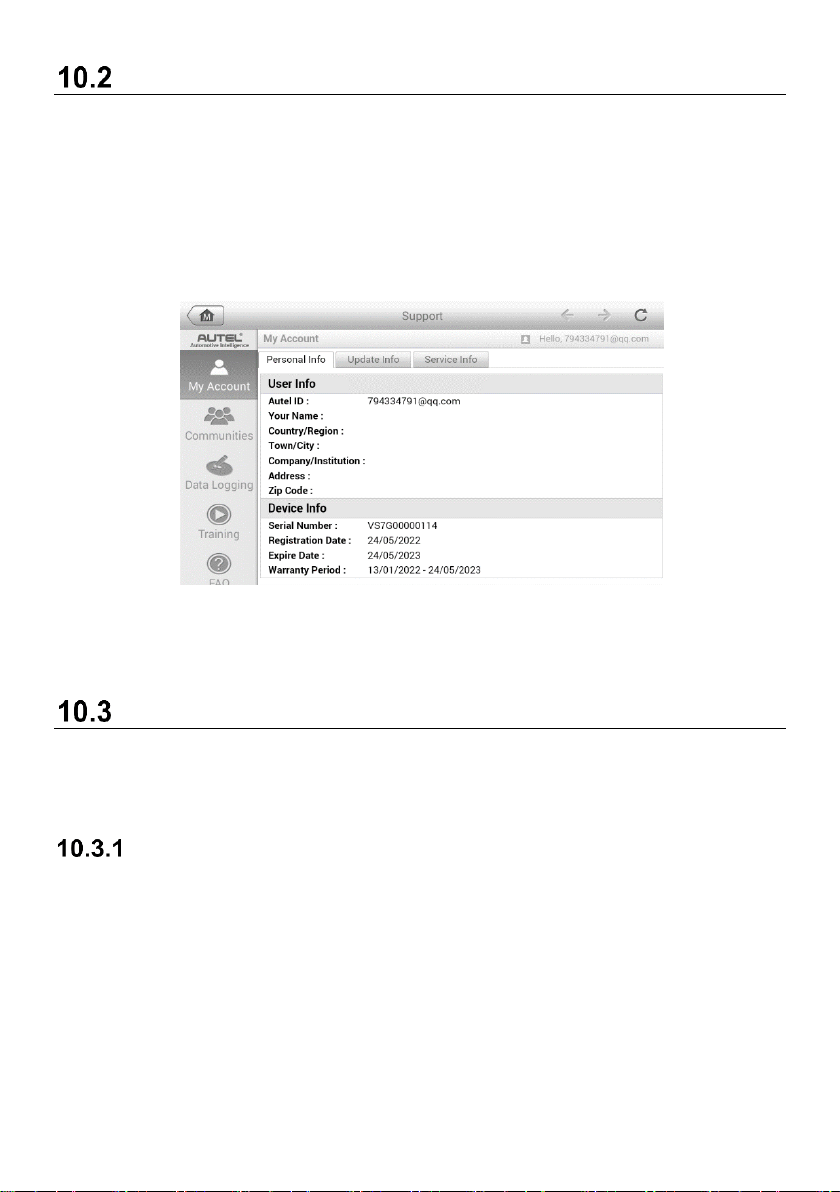
77
Support Screen Layout
The Support application screen is navigated with four simple buttons on the top
navigation bar, operation of each is described below in turn from left to right:
Home Button — returns to the MaxiCOM Job Menu.
Back — press to return to the previous screen.
Forward — press to advance one screen at a time until the last screen visited is
displayed.
Refresh — reload and update the screen.
Figure 10-1 Sample Support Application Screen
The main section of the Support screen is divided into two sections. The narrow column
on the left is the main menu; select a heading from the main menu to its corresponding
functions on the right.
My Account
The My Account screen displays the comprehensive information of the user and the
product including the user, device, update and service information, synchronized with the
registered account.
Personal Info
The User Info and Device Info are both included under the Personal Info section.
User Info — displays detailed information of your registered on-line Autel account,
such as your Autel ID, Name, Address and other contact information.
Device Info — displays the registered product information, including the Serial
Number, Registration Date, Expire Date, and Warranty Period.
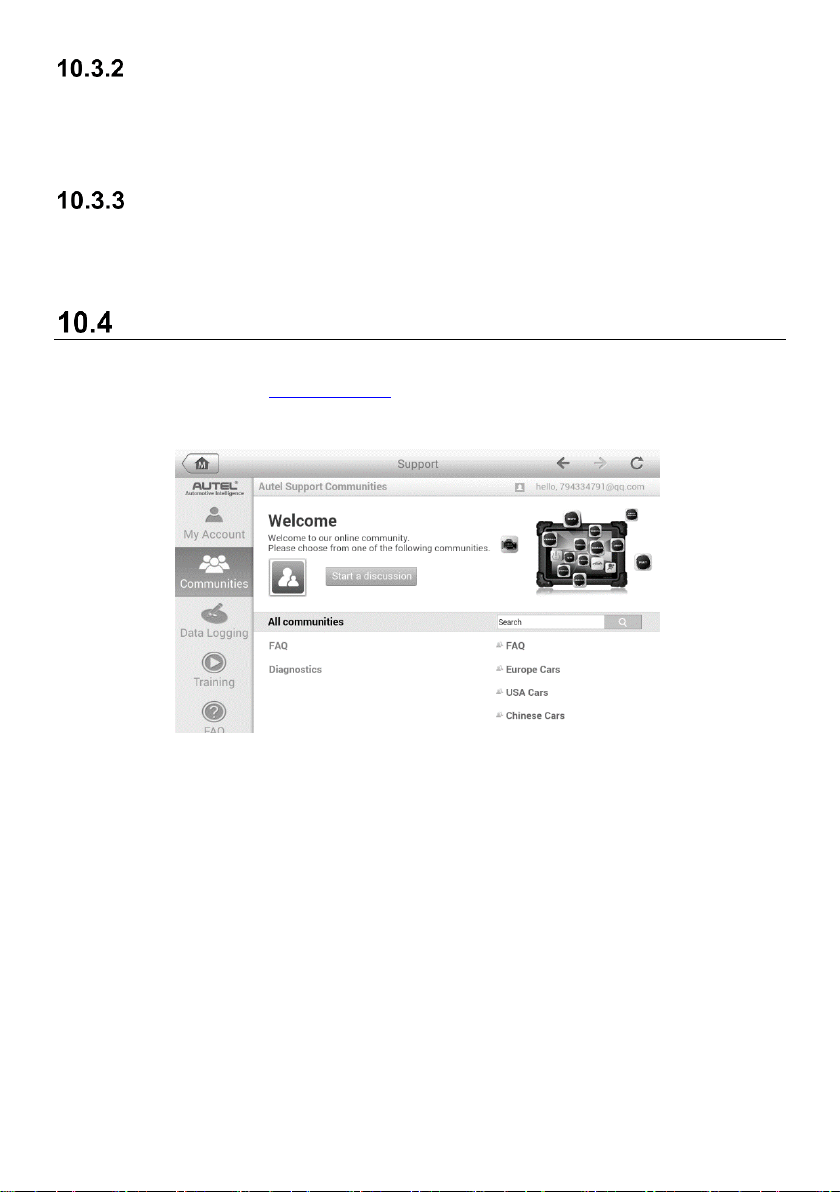
78
Update Info
The Update Info section displays a detailed record of the product’s software update
history, including the product serial number, software version or name, and the update
time.
Service Info
The Service Info section displays a detailed record of the device’s service history
information. The device’s service history including completed service repairs and
software re-installations will be recorded and synchronized with the associated account.
Communities
The Communities section launches and synchronizes with the Technical Forums on
Autel’s official website www.autel.com. The community’s forum allows for discussion of
technical issues, the sharing of information or tips with other members in Autel’s online
support communities.
Figure 10-2 Sample Communities Home Screen
To start a discussion
1. Tap Start a discussion on the Communities Home screen. A list of the major
forums is displayed.
2. Select a desired community according to the subject you are interested in.
3. Enter your topic and the discussion content in the appropriate input field.
4. Select a category or edit tags for the discussed post. This will help other
members with similar interest to find your post.
5. Tap OK to submit the post.
To join and reply to a discussion post
1. Select a forum group either by product or feature on the Communities Home
screen. A list of the latest posts is displayed.

79
2. Select a specific category on the Categories menu to better pinpoint the topics
you are most interested in.
3. Tap the
○
> button on the right side of the topic item to view the discussion. The
posts displays.
4. Browse through all the posts by sliding the screen up and down. Tap Go to
original post to return to the first post.
5. Tap Reply to reply to a specific post, or tap Reply to original post to join and
continue the whole discussion.
6. Enter your comment in the input field, and tap OK to submit your post.
Data Logging
The Data Logging section keeps records of all sent or unsent (saved) data loggings on
the diagnostics system. The support personnel receive and process the submitted
reports through the Support platform. Support personnel will reply to the submitted issue
and corresponding Data Log session within 48 hours.
To make a reply in a Data Logging session
1. Tap on the Sent tag to view a list of submitted data logs.
2. Select a specific item to view the latest update of the submitted issue.
3. Tap on the input field at the bottom of the screen and enter text. Tap the Audio
button to record a voice message, or tap camera button to take a picture.
4. Tap Send to send your message to the technical center.
User Profile
The User Profile section allows you to set personal Avatar, check your member status
and review your posts to the communities.
Tap the Avatar image on the Communities screen to open the User Profile.
Profile — displays the user’s personal information and member status. The Related
links allow you to check the Top Users (ranked according to their points and levels)
in the communities, as well as to find out about other online users.
Avatar — allows you to select an image to set as an Avatar to be displayed in the
communities.
Stuff — displays a list of your posts in the various forums.
Training
The Training section provides quick links to Autel’s online video accounts. Select a video
channel by language to see all the available online tutorial videos.

80
FAQ
The FAQ section provides comprehensive answers to the most frequently asked
questions about member accounts and online subscription purchases.
Account — displays questions and answers about the use of Autel’s online user
account.
Shopping & Payment — displays questions and answers about online subscription
purchase, payment methods or procedures.

81
Academy
Autel provides various tutorials and technical bulletins written by top-notch technicians
and product experts. Please review the materials on the tablet or view additional technical
articles on the online forum by clicking on click on the links provided.
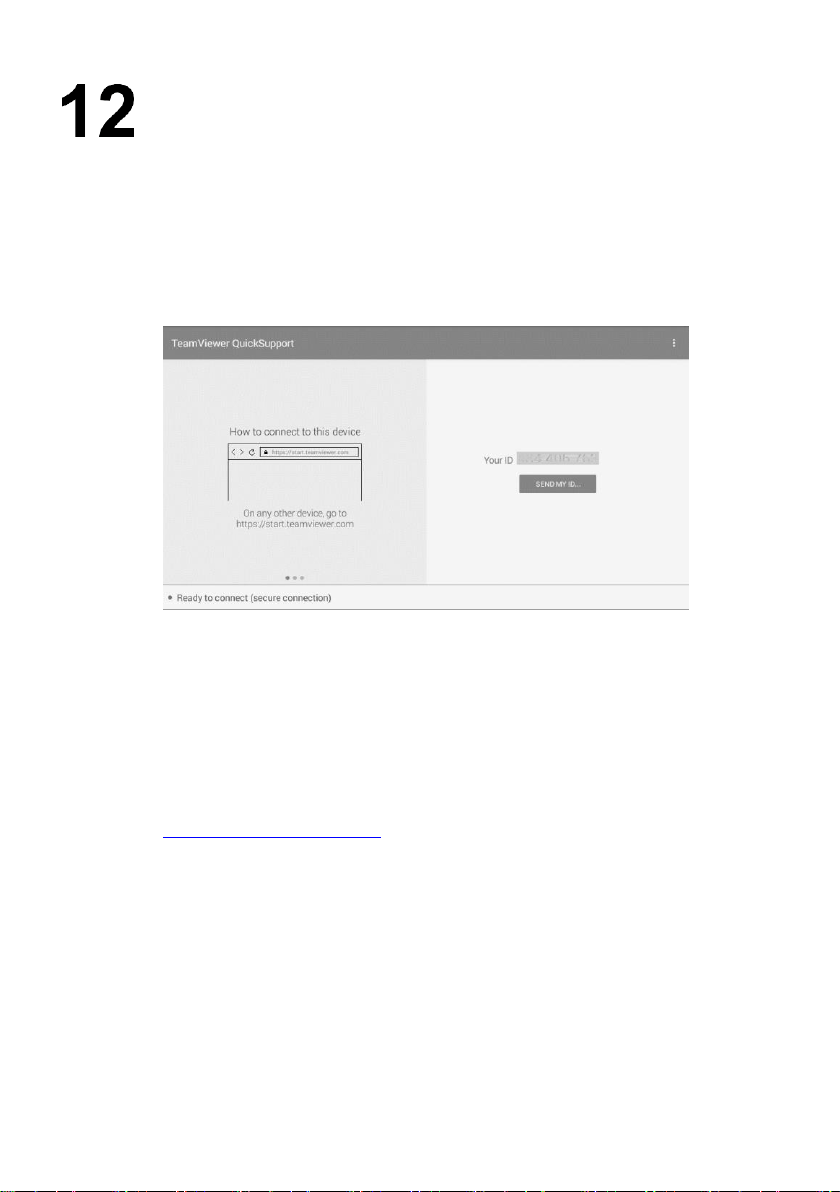
82
Remote Desk
The Remote Desk application launches the TeamViewer Quick Support program, a
simple, fast and secure remote control screen. Use this application to receive ad-hoc
remote support from Autel’s support technicians by allowing them to control your
MaxiCOM tablet on their PC via the TeamViewer software.
Make sure the tablet is connected to the Internet before launching the Remote Desk
application.
Figure 12-1 Sample Remote Desk Screen
To receive remote support from a partner
1. Power on the tablet.
2. Tap the Remote Desk application on the MaxiCOM Job Menu. The TeamViewer
screen displays and the device ID is generated and shown.
3. Your partner must install the Remote Control software to his/her PC by
downloading the TeamViewer full version program online
(http://www.teamviewer.com), and then start the software on his/her PC at the
same time, in order to provide support and take control of the tablet remotely.
4. Provide your ID to the partner, and wait for him/her to send you a remote control
request.
5. A popup will display to ask for your confirmation to allow remote control on your
device.
6. Tap Allow to accept, or tap Deny to reject.
Refer to the associated TeamViewer documents for additional information.
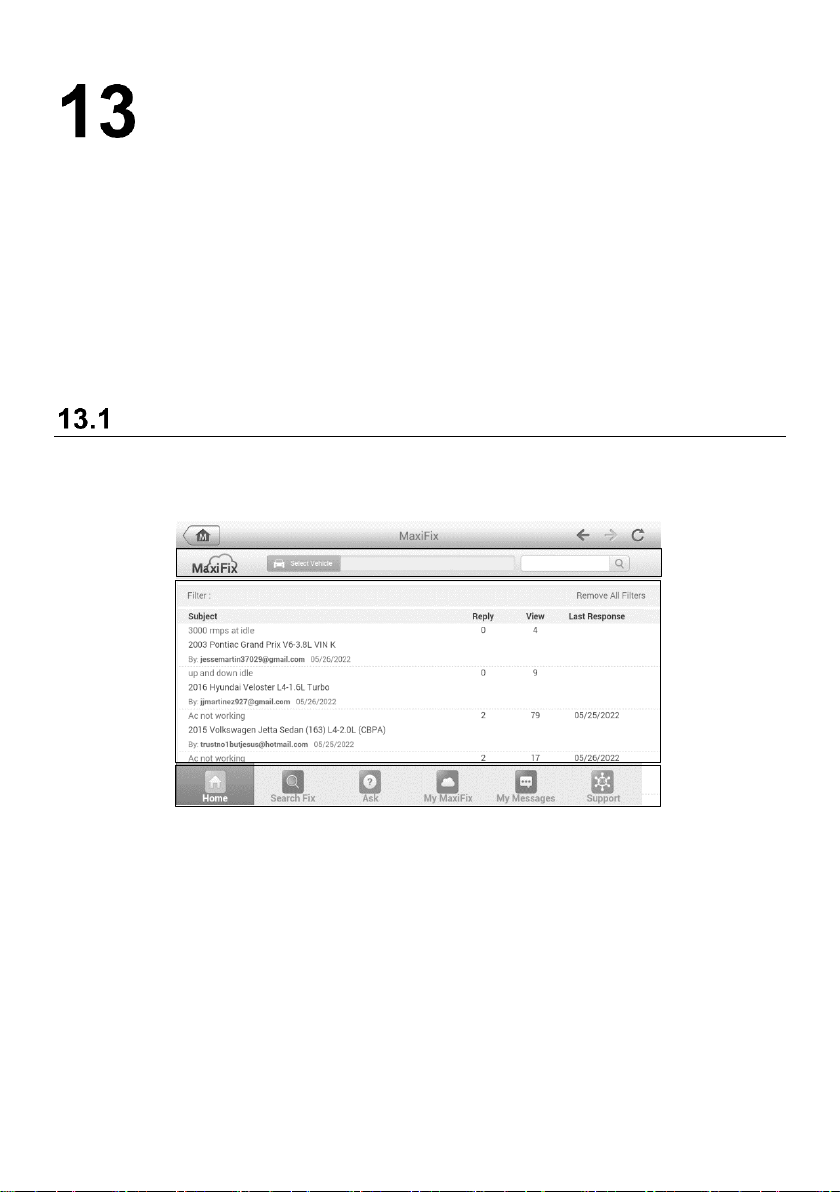
83
MaxiFix
The MaxiFix application launches the on-line troubleshooter database, which not only
provides you virtually all common diagnostics trouble code (DTC) database for most
vehicles, but also serves as a forum allowing for technicians to network with other
MaxiCOM users, and gives you access to a vast database of repair and diagnostics tips
along with proven filed fixes.
While the MaxiFix database keeps growing with daily troubleshooting resources and the
advisory reports from MaxiCOM users from all over the world.
Information in the MaxiFix database is organized into a series of diagnostics tips that are
designed to quickly lead to the root cause of a particular problem on the test vehicle.
Navigation
You need to register the device to your online account before launching the MaxiFix
platform, see Product Registration for details.
Figure 13-1 Sample MaxiFix Home Screen
The MaxiFix screen layout consists of 3 main areas:
1. The Header — the tool bar across the top of the screen which allows you to select
vehicles and perform searches.
2. The Main Screen — located at the center of the screen displaying content based
on the vehicle attributes and keywords specified. The tabs on the main screen vary
in accordance with the section selected on the Navigation Menu, allowing you to
switch between functions.
3. The Navigation Menu — the main menu at the bottom of the screen that provides
you access to different sections of MaxiFix.
—①
—②
—③
84
The Header
The Header at the top of the screen features:
A Select Vehicle button to open the vehicle identification window, and vehicle
information bar, for example “2014 > Hyundai > Accord Coupe > L4-2.4L (K24W1)”.
A search field to find relevant information by entering keywords, codes, or problems.
Select Vehicle Button
The “Select Vehicle” button on the Header allows you to specify the vehicle which you
want to research on MaxiFix, by selecting each of the vehicle attribute from a sequence
of option lists. This feature helps to filter out the searches that allow only the information
that applies to the identified vehicle to display.
NOTE
All attributes must be specified to make a complete vehicle selection for the most
efficient search.
To select a vehicle
Follow the procedure below to select a vehicle:
1. If you haven’t already done so, click the “Select Vehicle” button on the Header.
2. Select the year of the vehicle from the list.
3. Select the make of the vehicle from the list.
4. Select the model of the vehicle from the list.
5. Select the submodel of the vehicle from the list.
6. Select the engine of the vehicle from the list.
After completing the vehicle selection procedure, the identified vehicle is shown on the
Header.
Terminology
13.1.3.1 MaxiFix Tip
A MaxiFix Tip offers a detailed outline of an actual vehicle repair. Combined with proven
results and vehicle specific data, this all-in-one information source provides quick and
easy repair solutions.
On MaxiFix community you can find Tips or share your own Tip with the community.
To search for a MaxiFix Tip
1. Select a Vehicle:
a) Click the “Select Vehicle” button on the Header at the top of the screen.
b) Select the year of the vehicle from the list.

85
c) Select the make of the vehicle from the list.
d) Select the model of the vehicle from the list.
e) Select the submodel of the vehicle from the list.
f) Select the engine of the vehicle from the list.
After completing the vehicle selection, the chosen vehicle is shown in the Header.
2. Enter a Search Term.
MaxiFix has an exclusive one-stop lookup that helps you find all of MaxiFix
resources with one click. Simply enter a search term into the search bar on the
Header to begin the search.
3. Proven Results!
The powerful MaxiFix database gives you proven results. The typical MaxiFix Tips
combine actual workshop fixes and vehicle repair data that may include:
a) OBDII Fault Codes description and reference — helps in diagnostics
assessment by making clear the nature of an automotive problem so that
beginner and advanced technicians can make effective repairs.
b) Real Fix Tips — provides repair tips from actual shop practices and are
presented in an easy to understand Complaint, Cause, Correction format.
If you are unable to find the information relating to your specific problem, you can
pose a question to the MaxiFix community by clicking “Ask” on the Navigation Menu
at the bottom of the screen.
13.1.3.2 Adopted!
The “Adopted!” icon displays at the top right side of a Tip screen when at least one
technician has “adopted” or recommended the tip. If a tip has helped you to solve a repair
problem, you are encouraged to give an Adopted! count to the tip. Each member is
allowed to click the “Adopted!”. The “Adopted!” count helps you to easily identify which
tips that are really helpful. You can also post a comment about how the tip has helped
you as reference to other members.
Operations
The Navigation Menu is at the bottom of the screen. Selecting the items on the Navigation
Menu allows you to switch between the main sections on MaxiFix. These main sections
include:
Home — shows all questions and allows you to specify questions about one or
multiple makes.
Search Fix — allows you to search for information from all available resources on
MaxiFix, including: Open Questions, Tips, and Real Fixes, and displays search
results.
Ask — allows you to ask a question in the community.
86
My MaxiFix — displays all your posts including Questions and Fixes in the
community, and allows you to view your personal profile, select your vehicle
preference, and share your tips.
My Messages — shows a list of message notifications that are relevant to your
activities in the Question section.
Support — opens the FAQ screen, or a message box for contacting Customer
Service by email.
Home
Home is the first option on the Navigation Menu at the bottom of the screen. Tap to open
your MaxiFix home screen. There is a list of questions posted on the community, and
you can scroll down the screen to the bottom and view more questions by tapping View
More. Click on any question and you will be directed to the detailed screen in the Ask
section.
Click the Filter button on the main screen of Home, and select the vehicle manufacturers
that you are interested in. This filter can be canceled anytime by clicking the “Remove
All Filters” button, and the default setting will be restored to display questions about all
vehicle makes.
Search Fix
Search Fix, the second option on the Navigation Menu at the bottom of the screen,
presents search results for the specified vehicle. Search results are listed in various
categories:
All — includes all search results, including related Questions, Tips, and Real Fixes
to your search.
Questions — presents a list of open Question discussed in the community that may
be pertinent to your search.
Tips — presents a list of Tips that directly correlate to your search criteria. Select a
Tip from the list to open and review the complete Tip.
Real Fixes — presents a list of Tips that have been collected from actual shop repair
orders and are presented in an easy-to-understand Complaint, Cause, and
Correction format.
Ask
Ask, the third option on the Navigation Menu at the bottom of the screen, allows you to
ask a question about a particular vehicle repair issue in the community.
To ask a MaxiFix Question
1. Tap Select Vehicle on the Header to specify the vehicle you are asking about.
2. Tap Ask on the Navigation Menu at the bottom of the screen to open the Ask

87
screen.
3. On the Ask screen find Ask for Help and complete the section to ask a question.
The Ask screen has 4 sections:
Subject — enter a brief subject for the question.
My Question — ask a clear and concise question that you want to ask the
community. Be sure to be descriptive and concise when asking your question.
Problem Description — describe how the vehicle is behaving.
Repair History — include any previous diagnostics tests that you performed,
including the results of the tests. Also list any parts that were replaced during
previous diagnostics work.
Tap the Cancel button to cancel your question and return to the Ask screen.
Tap the Submit button to post your question to the community.
Tap the Attach File button to include images or reference files with your question.
Select one answer from the responses and then close the question. For details, please
refer to My Messages section.
My MaxiFix
My MaxiFix, the fourth option on the Navigation Menu at the bottom of the screen, opens
your personal MaxiFix screen. To access the features on My MaxiFix screen you can
select from the following tabs:
My Questions — opens a list with links to the opened questions that you have
posted to the community.
My Cases — opens a list with links to the closed questions and tips that you have
contributed to the community.
Marked Posts — opens a list with links to Tips and discussions that you are actively
participating in.
My Profile — allows you to view your Autel account information including: your Autel
ID, personal information, MaxiFix score, phone number and register time, and add
an avatar image.
Vehicle Preference — used to set up a list of preferred vehicles. The preferred list
allows you to limit the choices that display on the “Select Vehicle” list to specific
years, and makes. Click “Set Year” or “Set Make” to set your preferred models. The
preferred makes will also be displayed in the “Filter” options on the Home screen.
Share a Tip — allows you to share your personal repair experience with the
community.
Tap My MaxiFix on the Navigation Menu at the bottom of the screen, to display all
questions and tips that you have contributed to the community.

88
13.2.4.1 Create a Tip
A “Tip” is a concise and complete description of the fix for a particular vehicle repair issue.
To create a new MaxiFix Tip
1. Select My MaxiFix from the Navigation Menu.
2. Select Select Vehicle from the Header and enter the identifying attributes of the
vehicle you are writing the Tip about.
3. On the My MaxiFix screen find Share a Tip; click this link to open the My Tips
screen.
4. Enter the Tip subject in the Subject field.
5. Compose your Tip in the Description field. Include as much information as
possible, while keeping the information concise and to the point. A Tip should
provide accurate information that is reader-friendly.
6. Use the Cancel button at the right-side bottom of the screen to cancel a tip and
return to the My MaxiFix screen.
7. Or use the Submit button at the right-side bottom of the screen to add your tip
to the community.
8. Use the Attach File button at the left-side bottom of the screen to include
images or other supporting data with your question.
13.2.4.2 View Profile Information
You can view or edit your personal profile by clicking on your account ID or “My Profile”
in My MaxiFix section. View the profiles of other community members’ profile by clicking
their portrait. Information included in your profile determines how you are presented to
the community, and what type of information will be sent to you from the community.
My Messages
My Messages, the fifth option on the Navigation Menu at the bottom of the screen, shows
a list of message notification that are relevant to your activities in the Question section.
A notification icon will appear on the top-right corner of “My Messages” if there is any
new or unread message in the Question section. The number on the notification icon
indicates the total number of the new and unread messages. The message notification
will appear under the following two conditions:
A MaxiFix community member has replied to Your question or answer.
A MaxiFix community member has “Adopted!” one of your answers.
Tap My Messages, select and open a message from the list. If your problem is solved
according to the reply, you should select one Adopted Answer and close the question. If
your answer is marked as “Adopted!”, “Adopted! + 4” will be displayed permanently.
Tap Clear to delete all message notifications.

89
13.2.5.1 Select “Adopted Answers”
Members should select one Adopted Answer from responses on the “My Messages”
screen before closing a question. Community members who provided the Adopted
Answer are rewarded with scores for their contribution.
About Adopted Answer:
Only one answer can be selected as “Adopted Answer”.
Only the MaxiFix member who asked the questions can rate the “Answer”.
13.2.5.2 Close a Question
When a repair question that you've posted to the community is resolved, you are
encouraged to write down the case as a way to share a good information within the
community. This will help the other MaxiFix members.
To close a question, you need to select the question’s response message from the
message list on “My Messages” screen first, then tap “Adopted Answer” and select
“Close Question”. Tap the “Cancel” button to cancel your submission and return to My
Messages screen. It is strongly recommended that you share your repair solutions before
closing a question. Your question will be converted to a MaxiFix Community Tip after
closing.
13.2.5.3 Score Rewarding System
A score of 4 is awarded if your answer is selected as the “Adopted Answer”.
A score of 3 is awarded when you close a question.
A score of 2 is awarded if your closed question is marked as "Adopted!" by no less
than 20 community members.
A score of 1 is awarded if your answer is selected as the "Adopted Answer" for a
closed question that is marked as "Adopted!" by no less than 20 community
members.
A score of 1 is awarded to each of the first three respondents.
Support
Support, the last option on the Navigation Menu at the bottom of the screen, opens a
screen that provides two ways to gain support from MaxiFix:
A message form to contact the MaxiFix administrator.
Frequently Asked Questions (FAQ) section that answers the community’s most
frequently asked questions.
If you wish to contact the administrator of this site please use the contact form. Select
“Support” from the Navigation Menu to open the comment window. To allow the
administrator to respond to your question or issue, the following information should be
provided:
Your name

90
A contact email address
A contact phone number
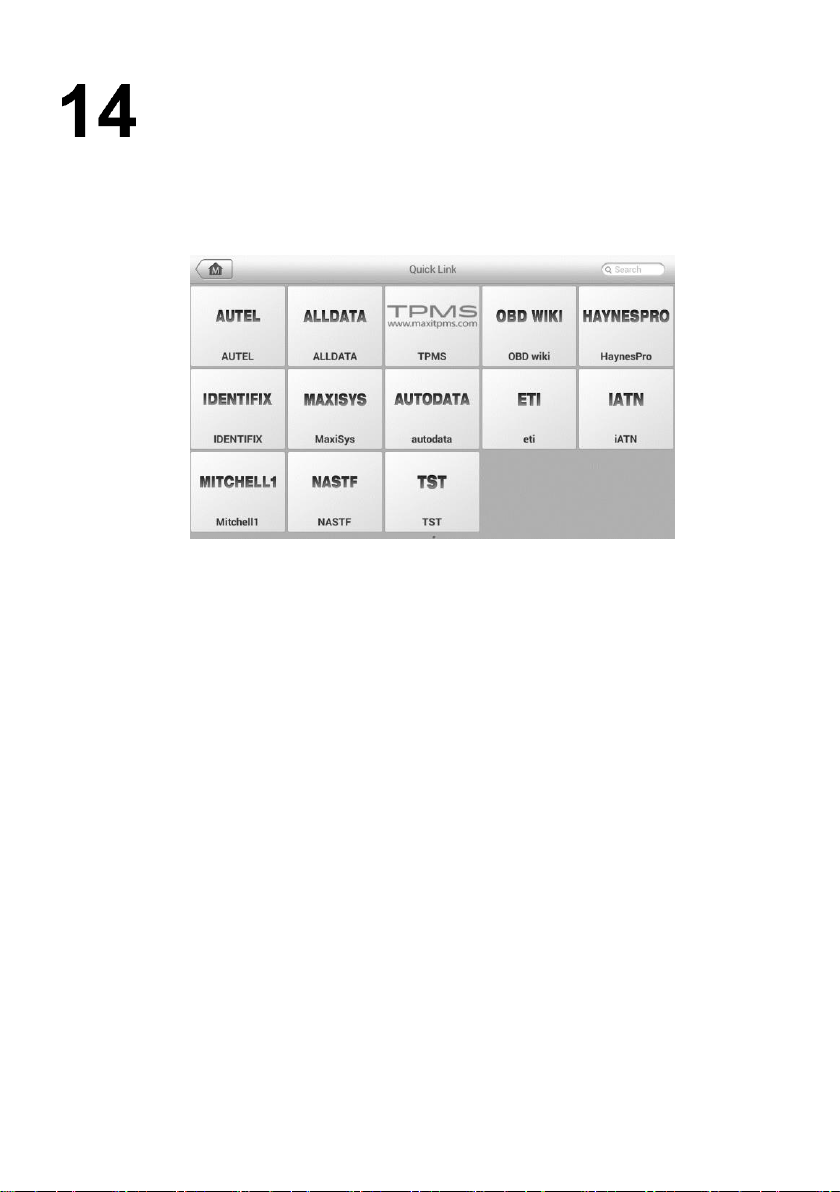
91
Quick Link
The Quick Link application provides access to Autel’s official website and to other popular
automotive service websites. These sites are invaluable resources of automotive
information and repair data and include forums, video training and expert consultation.
Figure 14-1 Sample Quick Link Screen
To open a quick link
1. Tap the Quick Link application on the MaxiCOM Job Menu. The Quick Link
application screen displays.
2. Select a website thumbnail from the main section. The Chrome browser is
launched and the selected website is opened.
3. Now you can start exploring the website.
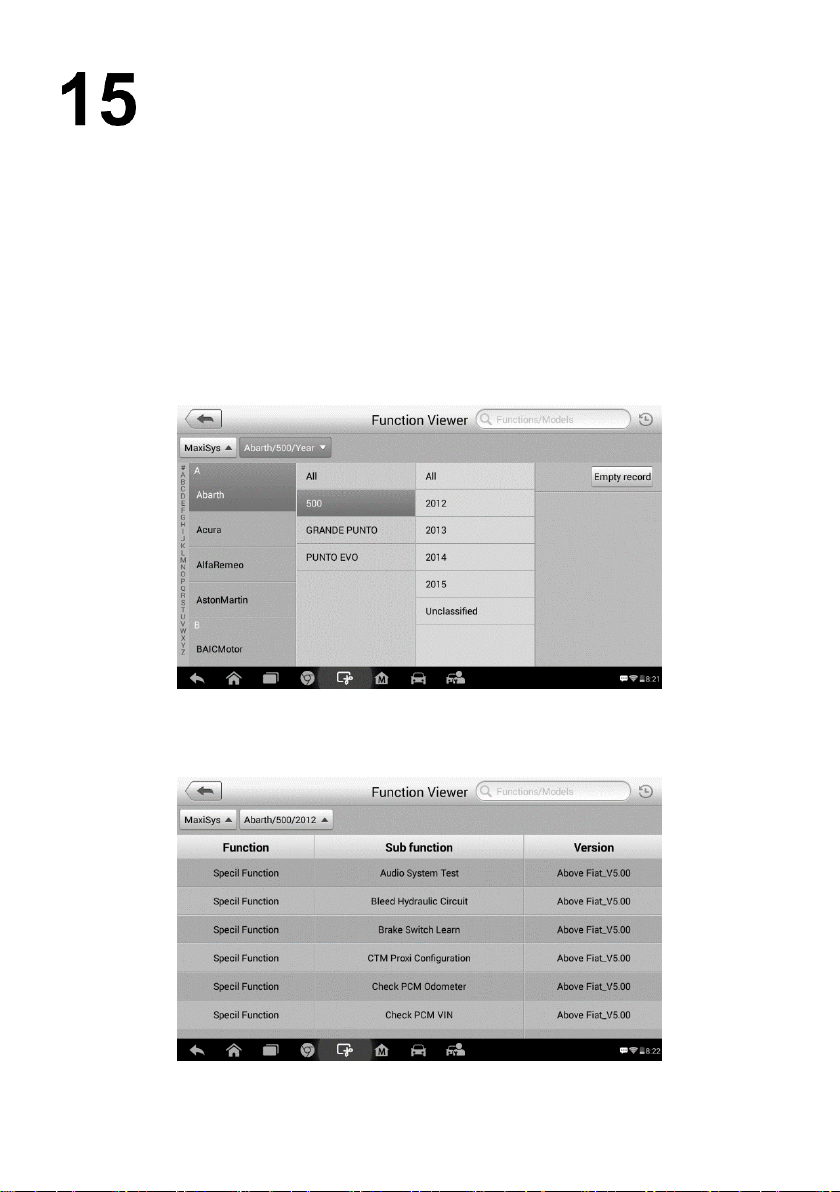
92
Function Viewer
The Function Viewer allows you to search the supported functions. There are two ways
of searching, by vehicle or by function.
To search by the vehicle
1. Tap the Function Viewer application on the MaxiCOM Job Menu. The Function
Viewer application screen displays.
2. Tap the tool name on the top left to drop down the tool list, tap the one you want
to search.
3. Tap the vehicle brand, model, and year you want to search.
Figure 15-1 Sample Function Viewer Screen 1
4. All the functions supported by the selected tool for the selected vehicle displays
with three column: function, sub function, and version.
Figure 15-2 Sample Function Viewer Screen 2
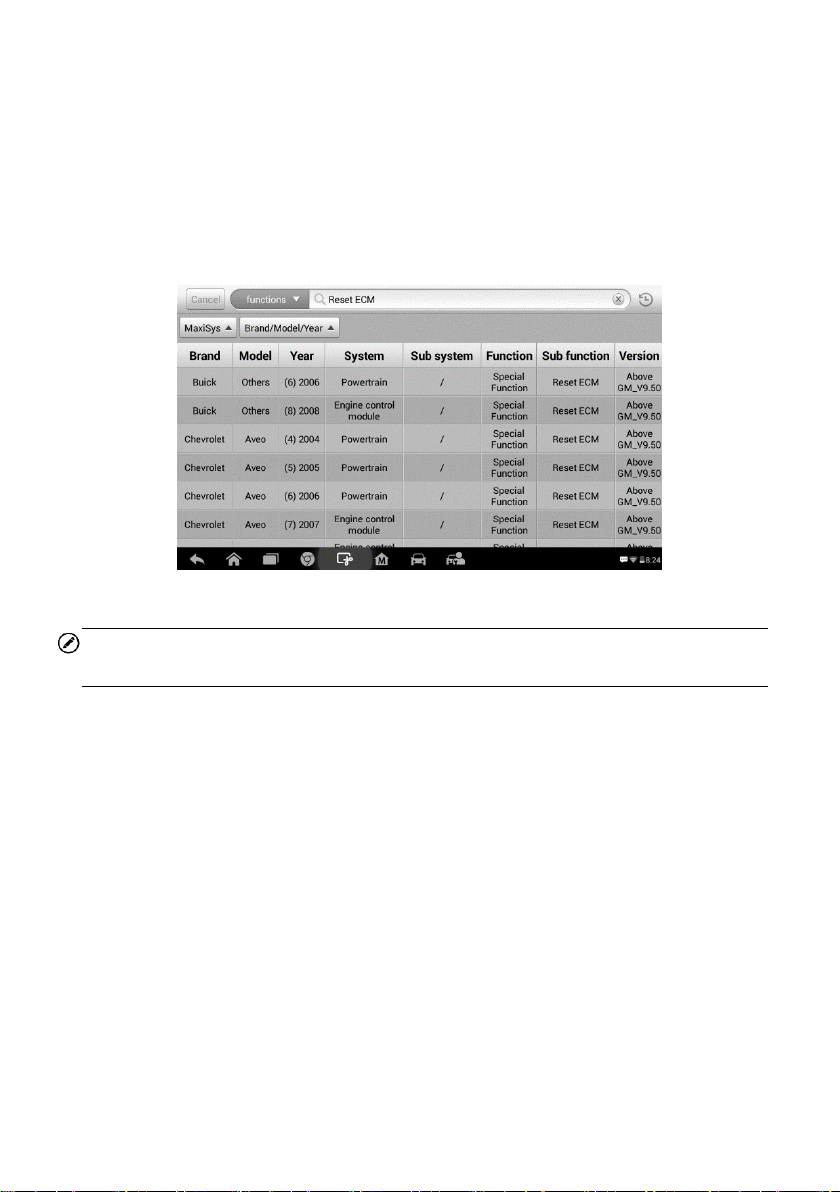
93
To search by the functions
1. Tap the Function Viewer application on the MaxiCOM Job Menu. The Function
Viewer application screen displays.
2. Tap the tool name on the top left to drop down the tool list, tap the one you want
to search.
3. Type in the function you want to search to the top right search column. All the
vehicles with this function will be listed with 8 columns, the Brand, Model, Year,
System, Sub system, Function, Sub function, and Version.
NOTE
Fuzzy search is supported, type in part of the function you want to search for.
Figure 15-3 Sample Function Viewer Screen 3

94
Digital Inspection
The Digital Inspection application configures the MaxiCOM Diagnostics Device to
operate as a digital video scope by simply connecting the tablet to a Digital Inspection
Camera. This function allows you to examine difficult-to-reach areas normally hidden
from sight, with the ability to record digital still images and videos, which offers you an
economical solution to inspect machinery, facilities, and infrastructure in a safe and quick
way.
WARNING & IMPORTANT
Follow these instructions to reduce the risk of injury from electric shock, entanglement,
and other causes, and to prevent tool damage.
Do not place the imager head into anything or anywhere that may contain a live
electric charge or moving parts, which increases the risk of electric shock or
entanglement injuries.
Do not use the imager head cable to modify surroundings or clear pathways or
clogged areas.
When inspection is completed, carefully withdraw the imager head from the
inspected area.
The imager head cable is waterproof to a depth of 3 m (10 ft.). Greater depths may
cause leakage into the imager head cable, electric shock or tool damage.
The working temperature of the imager head is between 32 °F (0 °C) and 113 °F
(45 °C).
Check-Ups:
FOR AUTOMOBILES: Ensure the automobile is not running during inspection to
avoid damage from hot metal and liquid under the hood. Do not get oil or gasoline on
the imager head.
FOR PIPES: If you suspect that a metal pipe may carry electric charge, have a
qualified electrician to check the pipe before inspecting it.
FOR WALLS: Before you inspect the inside of a wall with the imager head, turn off
the circuit breaker to the house.
WORK AREA: Ensure the work area has sufficient light.
Additional Accessories
The Inspection Camera and its fittings are the additional accessories. Both sizes (8.5 mm
and 5.5 mm) of the imager head are optional and available for purchase along with the
standard tool kit.
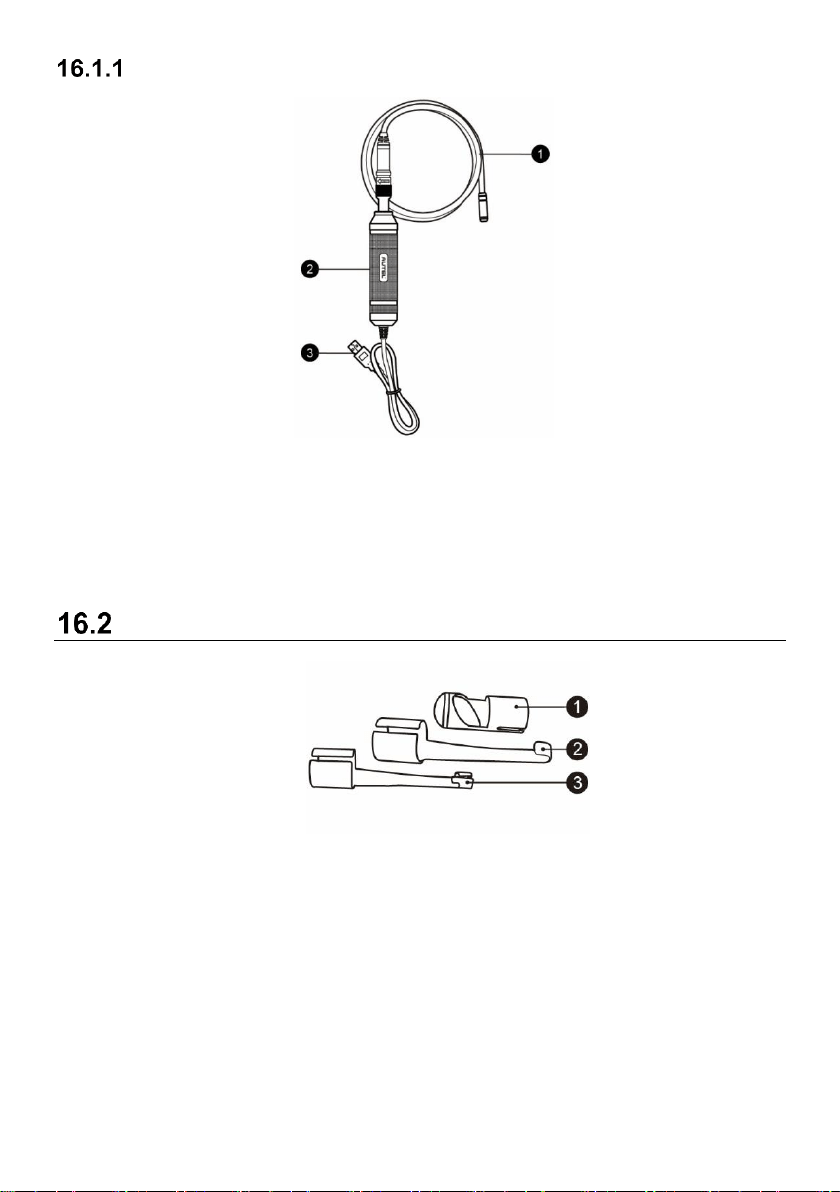
95
Inspection Camera
① Removable Imager Head Cable — connects to the tool when performing inspection
for image and video viewing.
② Handgrip — ergonomically designed handle for comfortable grip and agile operation.
③ USB Cable — connects the Camera to the MaxiCOM tablet.
Imager Head Accessories
① Mirror — helps to look around corners and see the unreachable areas.
② Hook — unclogs obstacles and picks up wires in the pipes or confined areas.
③ Magnet — picks up small metal objects such as dropped rings or screws.
Figure 16-1 Digital Inspection Camera
Figure 16-2 8.5 mm Imager Head Accessories
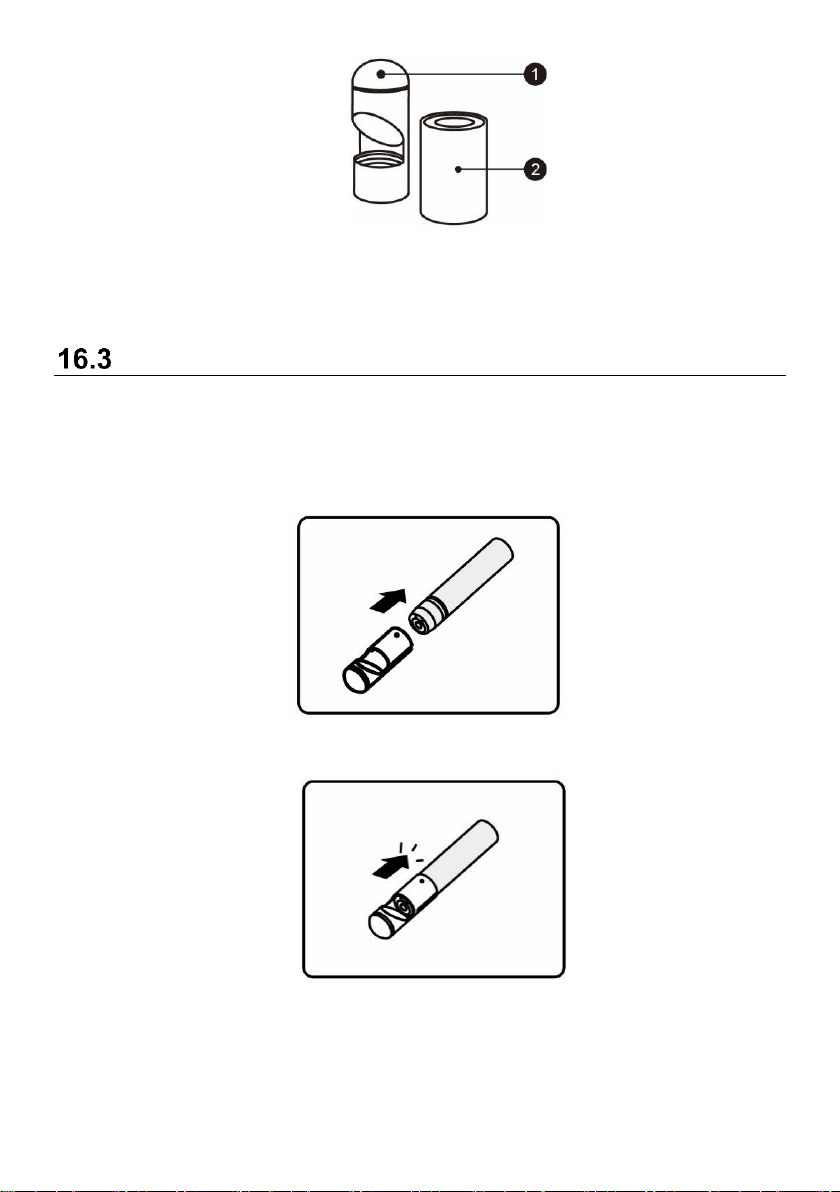
96
Figure 16-3 5.5 mm Imager Head Accessories
① Mirror — helps to look around corners and see the unreachable areas.
② Magnet — picks up small metal objects, such as dropped rings or screws.
Accessory Assembly
8.5 mm Imager Head
The three accessories, including the Magnet, Hook, and Mirror, can be attached to the
Imager Head in the same manner described below:
1. Hold the accessory and the imager head.
2. Slip the end of the accessory over the imager head and then fix the accessory.
5.5 mm Imager Head
The two accessories, the Magnet and Mirror, can be attached to the Imager Head in the
same manner described below:
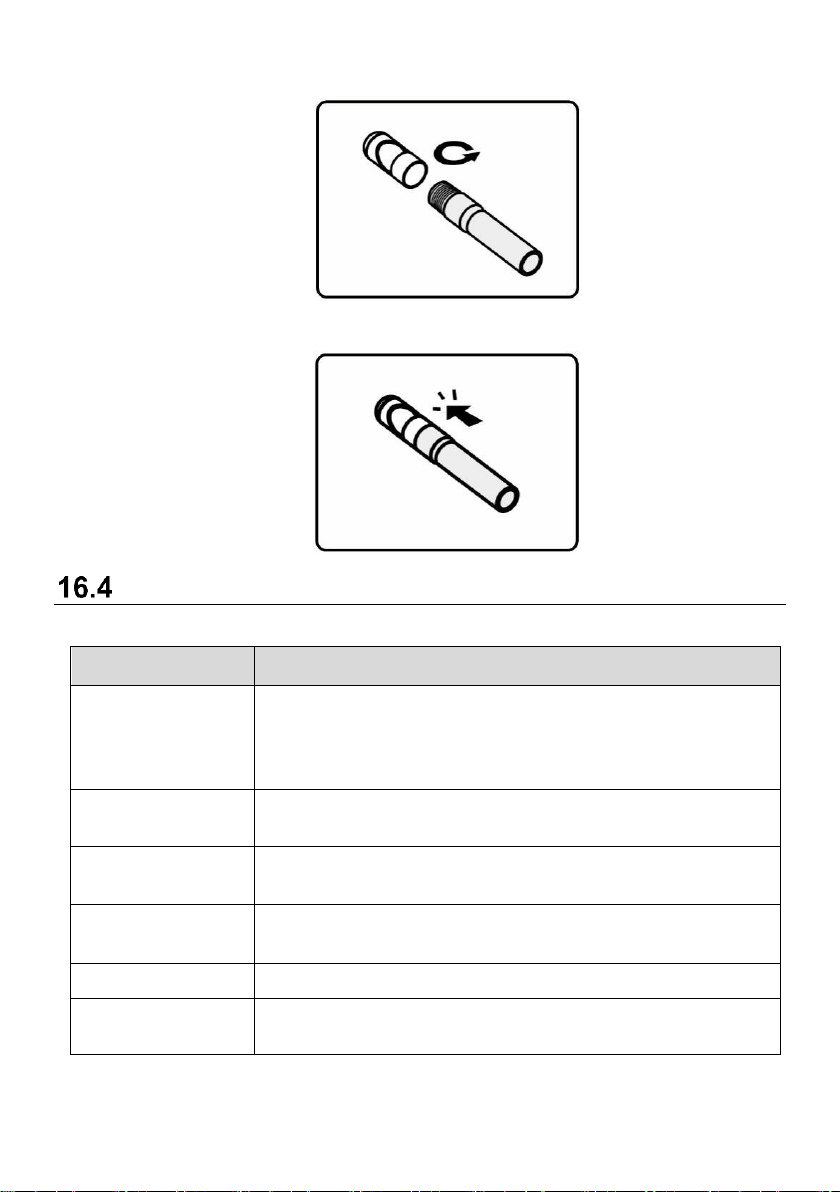
97
1. Hold the accessory and the imager head.
2. Screw the thread part of the accessory over the imager head to fix the accessory.
Technical Specifications
Table 16-1 Technical Specifications
Item
Description
Optimal Viewing
Distance
0.79 to 2.36" (2 to 6 cm) with 8.5 mm-diameter imager
head
0.79 to 2.36" (2 to 6 cm) with 5.5 mm-diameter imager
head
Resolution
JPG images (640 x 480)
AVI videos (320 x 240)
Operating
Temperature
Main Unit: 0 to 55 °C (ambient)
Cable: -10 to 70 °C
Storage
Temperature
-20 to 75 °C (ambient)
Waterproof
Imager head and cable to 1 m
Weight
0.3 kg for 8.5 mm diameter imager head
0.2 kg for 5.5 mm diameter imager head

98
Operations
Before opening the Digital Inspection application, the imager head cable must be
connected to the tablet using the USB cable. Install the correct imager head accessories
according to the specific needs.
NOTE
When in operation, the imager head cable can be manipulated so as to better access
confined or awkward spaces.
To take images using the Digital Inspection application
1. Connect the imager head cable to the USB port on the top of the tablet. If not
already done, power up the tablet.
2. Tap the Digital Inspection application on the MaxiCOM Job Menu. The Digital
Inspection screen displays, showing a camera operating screen. The imager
head camera is used by default.
3. Select the Camera icon at the lower-right corner to take images.
4. Focus the image to be captured in the view finder by adjusting and properly
locating the imager head cable.
5. Tap the blue ring on the screen. The view finder now displays the captured
picture and auto-saves the taken photo.
6. Tap the thumbnail image on the top-right corner of the screen to view the stored
image. Slide the screen left and right to view the images.
7. Tap on the selected image and the edit toolbar instantly displays.
8. Tap the corresponding button to share or delete an image.
9. Tap the Back or Home button on the navigation bar at the bottom of the screen
to exit the Digital Inspection application.
To record a video using the Digital Inspection application
1. Connect the imager head cable to the USB port on the top side of the tablet. If
not already done, power up the tablet.
2. Tap the Digital Inspection application on the MaxiCOM Job Menu. The Digital
Inspection screen displays, showing a camera operating screen. The Imager
head camera is used by default.
3. Select the Video icon at the lower-right corner to record a video.
4. Properly locate the imager head cable to focus the inspection scene for
recording.
5. Tap the red ring on the operating screen to start recording.
6. Tap the red circle again to stop recording. The recorded video is automatically
saved.
7. Tap the gallery icon at the bottom-right corner to review all recorded videos.

99
8. Select the corresponding button on the upper-right corner to search or delete
a video.

100
Maintenance and Service
Maintenance Instructions
The following shows how to maintain your devices, together with precautions to take.
Use a soft cloth and alcohol or a mild window cleaner to clean the touch screen on
the tablet.
Do not use any abrasive cleansers, detergent, or automotive chemicals to the tablet.
Only use the device in dry conditions within normal operating temperatures.
Dry your hands before using the tablet. The touch screen of the tablet may not work
if the touch screen is moist, or if you tap the touch screen with wet hands.
Do not store the devices in humid, dusty or dirty areas.
Before and after use, check the housing, wiring, and connectors for dirt and damage
before and after each use.
At the end of each work day, wipe the device housing, wiring, and connectors clean
with a damp cloth.
Do not attempt to disassemble your tablet or the VCI unit.
Take care not drop the device or allow anything heavy to drop on the device.
Use only authorized battery chargers and accessories. Any malfunction or damage
caused by the use of unauthorized battery charger and accessories will void the
limited product warranty.
Ensure that the battery charger does not come in contact with conductive objects.
Do not operate the tablet next to anything such as microwave oven, cordless phones
and some medical or scientific instruments that might interfere with or prevent signal
interference.
101
Troubleshooting Checklist
A. When the tablet does not work properly:
Make sure the tablet has been registered online.
Make sure the system software and diagnostics application software are
properly updated.
Make sure the tablet is connected to the Internet.
Check all cables, connections, and indicators to see if the signal is being
received.
B. When battery life is shorter than usual:
This may happen when you are in an area with low signal strength. Turn off your
device when not in use.
C. When you cannot turn on the tablet:
Make sure the tablet is connected to a power source or the battery is charged.
D. When you are unable to charge the tablet:
Your charger maybe out of order. Contact your nearest dealer.
You may be attempting to use the device in an overly hot/cold temperature. Try
changing the charging environment.
Your device may have not been connected to the charger properly. Check the
connector.
NOTE
If your problems persist, please contact Autel’s technical support personnel or your
local selling agent.
102
About Battery Usage
Your tablet is powered by a built-in Lithium-ion Polymer battery. This means that, unlike
other forms of battery technology, you can recharge your battery while some charge
remains without reducing your tablet’s autonomy due to the “battery memory effect”
inherent in those technologies.
DANGER
The built-in Lithium-ion Polymer battery is factory replaceable only; incorrect
replacement or tampering with the battery pack may cause an explosion.
Do not use a damaged battery charger.
Do not disassemble or open crush, bend or deform, puncture or shred.
Do not modify or remanufacture, attempt to insert foreign objects into the battery,
expose to fire, explosion or other hazard.
Make sure to use the charger and USB cables only that come together in the
package. If you use the other charger and USB cables, you might incur malfunction
or failure of the device.
Only use the charging device that has been qualified with device per the standard.
Use of an unqualified battery or charger may present a risk of fire, explosion, leakage,
or other hazard.
Avoid dropping the tablet. If the tablet is dropped, especially on a hard surface, and
the user suspects damage, take it to a service center for inspection.
The closer you are to your network’s base station, the longer your tablet usage time
because less battery power is consumed for the connection.
The battery recharging time varies depending on the remaining battery capacity.
Battery life inevitably shortens over time.
Since over charging may shorten battery life, remove the tablet from its charger once
it is fully charged. Unplug the charger, once charging is complete.
Leaving the tablet in hot or cold places, especially inside a car in summer or winter,
may reduce the capacity and life of the battery. Always keep the battery within
normal temperatures.

103
Service Procedures
This section introduces information for technical support, repair service, and application
for replacement or optional parts.
Technical Support
If you have any question or problem on the operation of the product, please contact us
(see the following contact info) or your local distributor.
AUTEL NORTH AMERICA
Phone:1-855-AUTEL-US(288-3587) Monday-Friday 9am-6pm EST
Website: www.autel.com
Email: [email protected]; [email protected]
Address: 36 Harbor Park Drive, Port Washington, New York, USA 11050
AUTEL EUROPE
Phone: 0049 (0) 6103-2000520
Website: www.autel.eu
Email: [email protected]; [email protected]
Address: Landsberger Str. 408, 4. OG, 81241 München, Germany
AUTEL CHINA HQ
Phone: 0086-755-2267-2493
Website: www.autel.com
Email: [email protected]; [email protected]
Address: 7-8th, 10th Floor, Building B1, Zhiyuan, Xueyuan Road, Xili, Nanshan,
Shenzhen, 518055, China
AUTEL LATIN AMERICA
Website: www.autel.com
Email: [email protected]; [email protected]
Address: Avenida Americas 1905, 6B, Colonia Aldrete, Guadalajara, Jalisco,
Mexico
AUTEL APAC
Phone: +045 5948465
Website: www.autel.com/jp/
Email: [email protected]; [email protected]
Address: 719, Nissou Building, 3-7-18, Shinyokohama, Kouhoku, Yokohama,
Kanagawa, Japan 222-0033
AUTEL IMEA DMCC
104
Phone: +971 585002709
Website: www.autel.com
Email: [email protected]; [email protected]
Address: Office 1006-1010, Cluster C, Fortune Tower, Jumeirah Lakes Tower (JLT),
Dubai, U.A.E
Repair Service
If it becomes necessary to return your device for repair, please download the repair
service form from www.autel.com, and fill it in. The following information must be included:
Contact name
Return address
Telephone number
Product name
Complete description of the problem
Proof-of-purchase for warranty repairs
Preferred method of payment for non-warranty repairs
NOTE
For non-warranty repairs, payment can be made with Visa, Master Card, or with
approved credit terms.
Send the device to your local agent, or to the below address:
8th Floor, Building B1, Zhiyuan, Xueyuan Road, Xili, Nanshan, Shenzhen, 518055, China
Other Services
You can purchase the optional accessories directly from Autel’s authorized tool suppliers,
and/or your local distributor or agent.
Your purchase order should include the following information:
Contact information
Product or part name
Item description
Purchase quantity
105
Compliance Information
FCC Compliance
FCC ID: WQ8-1610MX808
This device complies with Part 15 of the FCC rules and Industry Canada’s license-
exempt RSSs. Operation is subject to the following two conditions:
1. This device may not cause harmful interference.
2. This device must accept any interference received, including interference that may
cause undesired operation.
Cet appareil est conforme aux CNR exempts de licence d’Industrie Canada. Son
fonctionnement est soumis aux deux conditions suivantes:
1. Ce dispositif ne peut causer des interferences; et
2. Ce dispositif doit accepter toute interférence, y compris les interférences qui peuvent
causer un mauvais fonctionnement de l’appareil.
WARNING
Changes or modifications not expressly approved by the party responsible for
compliance could void the user’s authority to operate the equipment.
NOTE
This equipment has been tested and found to comply with the limits for a Class B digital
device, pursuant to Part 15 of the FCC Rules. These limits are designed to provide
reasonable protection against harmful interference in a residential installation.
This equipment generates uses and can radiate radio frequency energy and, if not
installed and used in accordance with the instructions, may cause harmful interference
to radio communications. However, there is no guarantee that interference will not occur
in a particular installation. If this equipment does cause harmful interference to radio or
television reception, which can be determined by turning the equipment off and on, the
user is encouraged to try to correct the interference by one or more of the following
measures:
-- Reorient or relocate the receiving antenna.
-- Increase the separation between the equipment and receiver.
-- Connect the equipment into an outlet on a circuit different from that to which the
receiver is connected.
-- Consult the dealer or an experienced radio/TV technician for help.
Changes or modifications not expressly approved by the party responsible for
compliance could void the user’s authority to operate the equipment.
106
SAR
The radiated output power of this device is below the FCC radio frequency exposure
limits. Nevertheless, the device should be used in such a manner that the potential for
human contact is minimized during normal operation.
The exposure standard for wireless devices employs a unit of measurement known as
the Specific Absorption Rate, or SAR. The SAR limit set by the FCC is 1.6 W/Kg. Tests
for SAR are conducted using standard operating positions accepted by the FCC with the
device transmitting at its highest certified power level in all tested frequency bands.
Although the SAR is determined at the highest certified power level, the actual SAR level
of the device while operating can be well below the maximum value. This is because the
device is designed to operate at multiple power levels so as to use only the power
required to reach the network. To avoid the possibility of exceeding the FCC radio
frequency exposure limits, human proximity to antenna should be minimized.
RF Warning Statement
The device has been evaluated to meet general RF exposure requirement. The device
can be used in portable exposure condition without restriction.
The term “IC” before the radio certification number only signifies that IC technical
specifications were met.
RoHS Compliance
This device is declared to be in compliance with the European RoHS Directive
2011/65/EU.
CE Compliance
This product is declared to conform to the essential requirements of the following
Directives and carries the CE mark accordingly:
EMC Directive 2014/30/EU
R&TTE Directive 1999/5/EC
Low Voltage Directive 2014/35/EU

107
Warranty
Limited One Year Warranty
Autel Intelligent Technology Corp., Ltd. (the Company) warrants to the original retail
purchaser of this MaxiCOM Diagnostics Device, that should this product or any part
thereof during normal consumer usage and conditions, be proven defective in material
or workmanship that results in product failure within one (1) year period from the date of
purchase, such defect(s) will be repaired, or replaced (with new or rebuilt parts) with
Proof of Purchase, at the Company’s option, without charge for parts or labor directly
related to the defect(s).
The Company shall not be liable for any incidental or consequential damages arising
from the use, misuse, or mounting of the device. Some states do not allow limitation on
how long an implied warranty lasts, so the above limitations may not apply to you.
This warranty does not apply to:
a) Products subjected to abnormal use or conditions, accident, mishandling, neglect,
unauthorized alteration, misuse, improper installation or repair or improper storage;
b) Products whose mechanical serial number or electronic serial number has been
removed, altered or defaced;
c) Damage from exposure to excessive temperatures or extreme environmental
conditions;
d) Damage resulting from connection to, or use of any accessory or other product not
approved or authorized by the Company;
e) Defects in appearance, cosmetic, decorative or structural items such as framing and
non-operative parts.
f) Products damaged from external causes such as fire, dirt, sand, battery leakage,
blown fuse, theft or improper usage of any electrical source.
IMPORTANT
All contents of the product may be deleted during the process of repair. You should
create a back-up copy of any contents of your product before delivering the product for
warranty service.